WO2023287730A1 - Tricyclic compounds - Google Patents
Tricyclic compounds Download PDFInfo
- Publication number
- WO2023287730A1 WO2023287730A1 PCT/US2022/036733 US2022036733W WO2023287730A1 WO 2023287730 A1 WO2023287730 A1 WO 2023287730A1 US 2022036733 W US2022036733 W US 2022036733W WO 2023287730 A1 WO2023287730 A1 WO 2023287730A1
- Authority
- WO
- WIPO (PCT)
- Prior art keywords
- unsubstituted
- substituted
- compound
- ring
- mmol
- Prior art date
- Legal status (The legal status is an assumption and is not a legal conclusion. Google has not performed a legal analysis and makes no representation as to the accuracy of the status listed.)
- Ceased
Links
Classifications
-
- C—CHEMISTRY; METALLURGY
- C07—ORGANIC CHEMISTRY
- C07D—HETEROCYCLIC COMPOUNDS
- C07D487/00—Heterocyclic compounds containing nitrogen atoms as the only ring hetero atoms in the condensed system, not provided for by groups C07D451/00 - C07D477/00
- C07D487/02—Heterocyclic compounds containing nitrogen atoms as the only ring hetero atoms in the condensed system, not provided for by groups C07D451/00 - C07D477/00 in which the condensed system contains two hetero rings
- C07D487/04—Ortho-condensed systems
-
- A—HUMAN NECESSITIES
- A61—MEDICAL OR VETERINARY SCIENCE; HYGIENE
- A61P—SPECIFIC THERAPEUTIC ACTIVITY OF CHEMICAL COMPOUNDS OR MEDICINAL PREPARATIONS
- A61P35/00—Antineoplastic agents
-
- C—CHEMISTRY; METALLURGY
- C07—ORGANIC CHEMISTRY
- C07D—HETEROCYCLIC COMPOUNDS
- C07D471/00—Heterocyclic compounds containing nitrogen atoms as the only ring hetero atoms in the condensed system, at least one ring being a six-membered ring with one nitrogen atom, not provided for by groups C07D451/00 - C07D463/00
- C07D471/12—Heterocyclic compounds containing nitrogen atoms as the only ring hetero atoms in the condensed system, at least one ring being a six-membered ring with one nitrogen atom, not provided for by groups C07D451/00 - C07D463/00 in which the condensed system contains three hetero rings
- C07D471/14—Ortho-condensed systems
-
- C—CHEMISTRY; METALLURGY
- C07—ORGANIC CHEMISTRY
- C07D—HETEROCYCLIC COMPOUNDS
- C07D487/00—Heterocyclic compounds containing nitrogen atoms as the only ring hetero atoms in the condensed system, not provided for by groups C07D451/00 - C07D477/00
- C07D487/12—Heterocyclic compounds containing nitrogen atoms as the only ring hetero atoms in the condensed system, not provided for by groups C07D451/00 - C07D477/00 in which the condensed system contains three hetero rings
- C07D487/14—Ortho-condensed systems
Definitions
- the present application relates to the fields of chemistry, biochemistry and medicine. More particularly, disclosed herein are tricyclic compounds of Formula (I), along with pharmaceutically acceptable salts thereof, that can be used to treat cancer as described herein.
- Some embodiments provide a compound of Formula (I), or a pharmaceutically acceptable salt thereof.
- compositions that can include an effective amount of one or more of compounds of Formula (I), or a pharmaceutically acceptable salt thereof, and a pharmaceutically acceptable carrier, diluent, excipient or combination thereof.
- Some embodiments described herein relate to a method for treating a cancer described herein that can include administering an effective amount of a compound described herein (for example, a compound of Formula (I), or a pharmaceutically acceptable salt thereof) or a pharmaceutical composition that includes of a compound described herein (for example, a compound of Formula (I), or a pharmaceutically acceptable salt thereof) to a subject having a cancer described herein.
- a compound described herein for example, a compound of Formula (I), or a pharmaceutically acceptable salt thereof
- a pharmaceutical composition that includes of a compound described herein (for example, a compound of Formula (I), or a pharmaceutically acceptable salt thereof)
- inventions described herein relate to the use of an effective amount of a compound described herein (for example, a compound of Formula (I), or a pharmaceutically acceptable salt thereof) or a pharmaceutical composition that includes of a compound described herein (for example, a compound of Formula (I), or a pharmaceutically acceptable salt thereof) in the manufacture of a medicament for treating a cancer described herein.
- Still other embodiments described herein relate to an effective amount of a compound described herein (for example, a compound of Formula (I), or a pharmaceutically acceptable salt thereof) or a pharmaceutical composition that includes of a compound described herein (for example, a compound of Formula (I), or a pharmaceutically acceptable salt thereof) for treating a cancer described herein.
- the cancer can have a KRAS mutation.
- the indicated “optionally substituted” or “substituted” group may be substituted with one or more group(s) individually and independently selected from alkyl, alkenyl, alkynyl, cycloalkyl, cycloalkenyl, aryl, heteroaryl, heterocyclyl, aryl(alkyl), cycloalkyl(alkyl), heteroaryl(alkyl), heterocyclyl(alkyl), hydroxy, alkoxy, acyl, cyano, halogen, thiocarbonyl, O-carbamyl, N-carbamyl, O-thiocarbamyl, N-thiocarbamyl, C-amido, N-amido, S-sulfonamido, N-sulfonamido, C-carboxy, O-carboxy, nitro, sulfenyl, sulfinyl,
- group(s) such as 1, 2 or 3 groups
- C a to C b in which “a” and “b” are integers refer to the number of carbon atoms in a group.
- the indicated group can contain from “a” to “b”, inclusive, carbon atoms.
- a “C1 to C4 alkyl” group refers to all alkyl groups having from 1 to 4 carbons, that is, CH 3 -, CH 3 CH 2 -, CH 3 CH 2 CH 2 -, (CH 3 ) 2 CH-, CH3CH2CH2CH2-, CH3CH2CH(CH3)- and (CH3)3C-. If no “a” and “b” are designated, the broadest range described in these definitions is to be assumed.
- R groups are described as being “taken together” the R groups and the atoms they are attached to can form a cycloalkyl, cycloalkenyl, aryl, heteroaryl or heterocycle.
- R a and R b of an NR a R b group are indicated to be “taken together,” it means that they are covalently bonded to one another to form a ring: R a N
- the alkyl moiety may be branched or straight chain.
- Examples of branched alkyl groups include, but are not limited to, iso-propyl, sec-butyl, t-butyl and the like.
- Examples of straight chain alkyl groups include, but are not limited to, methyl, ethyl, n- propyl, n-butyl, n-pentyl, n-hexyl, n-heptyl and the like.
- the alkyl group may have 1 to 30 carbon atoms (whenever it appears herein, a numerical range such as “1 to 30” refers to each integer in the given range; e.g., “1 to 30 carbon atoms” means that the alkyl group may consist of 1 carbon atom, 2 carbon atoms, 3 carbon atoms, etc., up to and including 30 carbon atoms, although the present definition also covers the occurrence of the term “alkyl” where no numerical range is designated).
- the alkyl group may also be a medium size alkyl having 1 to 12 carbon atoms.
- the alkyl group could also be a lower alkyl having 1 to 6 carbon atoms.
- An alkyl group may be substituted or unsubstituted.
- alkenyl used herein refers to a monovalent straight or branched chain radical of from two to twenty carbon atoms containing a carbon double bond(s) including, but not limited to, 1-propenyl, 2-propenyl, 2-methyl-1-propenyl, 1- butenyl, 2-butenyl and the like. An alkenyl group may be unsubstituted or substituted.
- alkynyl used herein refers to a monovalent straight or branched chain radical of from two to twenty carbon atoms containing a carbon triple bond(s) including, but not limited to, 1-propynyl, 1-butynyl, 2-butynyl and the like. An alkynyl group may be unsubstituted or substituted.
- cycloalkyl refers to a completely saturated (no double or triple bonds) mono- or multi- cyclic hydrocarbon ring system. When composed of two or more rings, the rings may be joined together in a fused, bridged or spiro fashion.
- fused refers to two rings which have two atoms and one bond in common.
- bridged cycloalkyl refers to compounds wherein the cycloalkyl contains a linkage of one or more atoms connecting non-adjacent atoms.
- spiro refers to two rings which have one atom in common and the two rings are not linked by a bridge.
- Cycloalkyl groups can contain 3 to 30 atoms in the ring(s), 3 to 20 atoms in the ring(s), 3 to 10 atoms in the ring(s), 3 to 8 atoms in the ring(s) or 3 to 6 atoms in the ring(s).
- a cycloalkyl group may be unsubstituted or substituted.
- Examples of mono cycloalkyl groups include, but are in no way limited to, cyclopropyl, cyclobutyl, cyclopentyl, cyclohexyl, cycloheptyl and cyclooctyl.
- fused cycloalkyl groups are decahydronaphthalenyl, dodecahydro-lH-phenalenyl and tetradecahydroanthracenyl; examples of bridged cycloalkyl groups are bicyclo[l.l.l]pentyl, adamantanyl and norbornanyl; and examples of spiro cycloalkyl groups include spiro[3.3]heptane and spiro [4.5] decane.
- cycloalkenyl refers to a mono- or multi- cyclic hydrocarbon ring system that contains one or more double bonds in at least one ring; although, if there is more than one, the double bonds cannot form a fully delocalized pi- electron system throughout all the rings (otherwise the group would be “aryl,” as defined herein).
- Cycloalkenyl groups can contain 3 to 10 atoms in the ring(s), 3 to 8 atoms in the ring(s) or 3 to 6 atoms in the ring(s). When composed of two or more rings, the rings may be connected together in a fused, bridged or spiro fashion.
- a cycloalkenyl group may be unsubstituted or substituted.
- Carbocyclyl refers to a non-aromatic a mono- or multi- cyclic hydrocarbon ring system. When composed of two or more rings, the rings may be joined together in a fused, bridged or spiro fashion, as described herein.
- Carbocyclyl groups can contain 3 to 30 atoms in the ring(s), 3 to 20 atoms in the ring(s), 3 to 10 atoms in the ring(s), 3 to 8 atoms in the ring(s) or 3 to 6 atoms in the ring(s).
- a carbocyclyl group may be unsubstituted or substituted.
- carbocyclyl groups include, but are in no way limited to, cycloalkyl groups and cycloalkenyl groups, as defined herein, and the non aromatic portions of 1,2,3,4-tetrahydronaphthalene, 2,3-dihydro- lH-indene, 5, 6,7,8- tetrahydroquinoline and 6,7-dihydro-5H-cyclopenta[b]pyridine.
- aryl refers to a carbocyclic (all carbon) monocyclic or multicyclic aromatic ring system (including fused ring systems where two carbocyclic rings share a chemical bond) that has a fully delocalized pi-electron system throughout all the rings.
- the number of carbon atoms in an aryl group can vary.
- the aryl group can be a C6-C14 aryl group, a C6-C10 aryl group or a Ce aryl group.
- Examples of aryl groups include, but are not limited to, benzene, naphthalene and azulene.
- An aryl group may be substituted or unsubstituted.
- heteroaryl refers to a monocyclic or multicyclic aromatic ring system (a ring system with fully delocalized pi-electron system) that contain(s) one or more heteroatoms (for example, 1, 2 or 3 heteroatoms), that is, an element other than carbon, including but not limited to, nitrogen, oxygen and sulfur.
- heteroatoms for example, 1, 2 or 3 heteroatoms
- the number of atoms in the ring(s) of a heteroaryl group can vary.
- the heteroaryl group can contain 4 to 14 atoms in the ring(s), 5 to 10 atoms in the ring(s) or 5 to 6 atoms in the ring(s), such as nine carbon atoms and one heteroatom; eight carbon atoms and two heteroatoms; seven carbon atoms and three heteroatoms; eight carbon atoms and one heteroatom; seven carbon atoms and two heteroatoms; six carbon atoms and three heteroatoms; five carbon atoms and four heteroatoms; five carbon atoms and one heteroatom; four carbon atoms and two heteroatoms; three carbon atoms and three heteroatoms; four carbon atoms and one heteroatom; three carbon atoms and two heteroatoms; or two carbon atoms and three heteroatoms.
- heteroaryl includes fused ring systems where two rings, such as at least one aryl ring and at least one heteroaryl ring or at least two heteroaryl rings, share at least one chemical bond.
- heteroaryl rings include, but are not limited to, furan, furazan, thiophene, benzothiophene, phthalazine, pyrrole, oxazole, benzoxazole, 1,2,3- oxadiazole, 1,2,4-oxadiazole, thiazole, 1,2,3-thiadiazole, 1,2,4-thiadiazole, benzothiazole, imidazole, benzimidazole, indole, indazole, pyrazole, benzopyrazole, isoxazole, benzoisoxazole, isothiazole, triazole, benzotriazole, thiadiazole, tetrazole, pyridine, pyridazine, pyrimidine
- heterocyclyl refers to three-, four-, five-, six-, seven-, eight-, nine-, ten-, up to 18-membered monocyclic, bicyclic and tricyclic ring system wherein carbon atoms together with from 1 to 5 heteroatoms constitute said ring system.
- a heterocycle may optionally contain one or more unsaturated bonds situated in such a way, however, that a fully delocalized pi-electron system does not occur throughout all the rings.
- the heteroatom(s) is an element other than carbon including, but not limited to, oxygen, sulfur and nitrogen.
- a heterocycle may further contain one or more carbonyl or thiocarbonyl functionalities, so as to make the definition include oxo-systems and thio-systems such as lactams, lactones, cyclic imides, cyclic thioimides and cyclic carbamates.
- the rings When composed of two or more rings, the rings may be joined together in a fused, bridged or spiro fashion.
- the term “fused” refers to two rings which have two atoms and one bond in common.
- bridged heterocyclyl refers to compounds wherein the heterocyclyl contains a linkage of one or more atoms connecting non-adjacent atoms.
- spiro refers to two rings which have one atom in common and the two rings are not linked by a bridge.
- Heterocyclyl groups can contain 3 to 30 atoms in the ring(s), 3 to 20 atoms in the ring(s), 3 to 10 atoms in the ring(s), 3 to 8 atoms in the ring(s) or 3 to 6 atoms in the ring(s).
- heterocyclyl group may be unsubstituted or substituted. Examples of such “heterocyclyl” groups include but are not limited to, 1,3-dioxin, 1,3-dioxane, 1,4-dioxane,
- spiro heterocyclyl groups examples include 2- azaspiro[3.3]heptane, 2-oxaspiro[3.3]heptane, 2-oxa-6-azaspiro[3.3]heptane, 2,6- diazaspiro[3.3]heptane, 2-oxaspiro[3.4]octane and 2-azaspiro[3.4]octane.
- aralkyl and “aryl(alkyl)” refer to an aryl group connected, as a substituent, via a lower alkylene group.
- the lower alkylene and aryl group of an aralkyl may be substituted or unsubstituted. Examples include but are not limited to benzyl, 2-phenylalkyl, 3-phenylalkyl and naphthylalkyl.
- heteroarylkyl and “heteroaryl(alkyl)” refer to a heteroaryl group connected, as a substituent, via a lower alkylene group.
- the lower alkylene and heteroaryl group of heteroaralkyl may be substituted or unsubstituted. Examples include but are not limited to 2-thienylalkyl, 3-thienylalkyl, furylalkyl, thienylalkyl, pyrrolylalkyl, pyridylalkyl, isoxazolylalkyl and imidazolylalkyl and their benzo-fused analogs.
- heterocyclyl(alkyl) refer to a heterocyclic group connected, as a substituent, via a lower alkylene group.
- the lower alkylene and heterocyclyl of a heterocyclyl(alkyl) may be substituted or unsubstituted. Examples include but are not limited tetrahydro-2H-pyran-4-yl(methyl), piperidin-4-yl(ethyl), piperidin-4-yl(propyl), tetrahydro-2H-thiopyran-4-yl(methyl) and l,3-thiazinan-4-yl(methyl).
- lower alkylene groups are straight-chained -CH2- tethering groups, forming bonds to connect molecular fragments via their terminal carbon atoms. Examples include but are not limited to methylene (-CH2-), ethylene (-CH2CH2-), propylene (-CH2CH2CH2-) and butylene (-CH2CH2CH2CH2-).
- a lower alkylene group can be substituted by replacing one or more hydrogen of the lower alkylene group and/or by substituting both hydrogens on the same carbon with a cycloalkyl group (e.g.,
- hydroxy refers to a -OH group.
- alkoxy refers to the Formula -OR wherein R is an alkyl, an alkenyl, an alkynyl, a cycloalkyl, a cycloalkenyl, an aryl, a heteroaryl, a heterocyclyl, a cycloalkyl(alkyl), an aryl(alkyl), a heteroaryl(alkyl) or a heterocyclyl(alkyl) is defined herein.
- alkoxys are methoxy, ethoxy, n-propoxy, 1-methylethoxy (iso- propoxy), n-butoxy, iso-butoxy, sec-butoxy, tert-butoxy, phenoxy and benzoxy.
- An alkoxy may be substituted or unsubstituted.
- acyl refers to a hydrogen, an alkyl, an alkenyl, an alkynyl, a cycloalkyl, a cycloalkenyl, an aryl, a heteroaryl, a heterocyclyl, an aryl(alkyl), a heteroaryl(alkyl) and a heterocyclyl(alkyl) connected, as substituents, via a carbonyl group. Examples include formyl, acetyl, propanoyl, benzoyl and acryl. An acyl may be substituted or unsubstituted. [0027] A “cyano” group refers to a “–CN” group.
- halogen atom or “halogen” as used herein, means any one of the radio-stable atoms of column 7 of the Periodic Table of the Elements, such as fluorine, chlorine, bromine and iodine.
- An O-carbamyl may be substituted or unsubstituted.
- An N-carbamyl may be substituted or unsubstituted.
- An O-thiocarbamyl may be substituted or unsubstituted.
- An N-thiocarbamyl may be substituted or unsubstituted.
- a C-amido may be substituted or unsubstituted.
- An N-amido may be substituted or unsubstituted.
- S-sulfonamido refers to a “–SO 2 N(R A R B )” group in which R A and RB can be independently hydrogen, an alkyl, an alkenyl, an alkynyl, a cycloalkyl, a cycloalkenyl, an aryl, a heteroaryl, a heterocyclyl, a cycloalkyl(alkyl), an aryl(alkyl), a heteroaryl(alkyl) or a heterocyclyl(alkyl).
- An S-sulfonamido may be substituted or unsubstituted.
- N-sulfonamido refers to a “RSO2N(RA)–” group in which R and R A can be independently hydrogen, an alkyl, an alkenyl, an alkynyl, a cycloalkyl, a cycloalkenyl, an aryl, a heteroaryl, a heterocyclyl, a cycloalkyl(alkyl), an aryl(alkyl), a heteroaryl(alkyl) or a heterocyclyl(alkyl).
- R and R A can be independently hydrogen, an alkyl, an alkenyl, an alkynyl, a cycloalkyl, a cycloalkenyl, an aryl, a heteroaryl, a heterocyclyl, a cycloalkyl(alkyl), an aryl(alkyl), a heteroaryl(alkyl) or a heterocyclyl(alkyl).
- An O-carboxy may be substituted or unsubstituted.
- An ester and C-carboxy may be substituted or unsubstituted.
- An urea may be substituted or unsubstituted.
- a “nitro” group refers to an “-NO2” group.
- a “sulfenyl” group refers to an “-SR” group in which R can be hydrogen, an alkyl, an alkenyl, an alkynyl, a cycloalkyl, a cycloalkenyl, an aryl, a heteroaryl, a heterocyclyl, a cycloalkyl(alkyl), an aryl(alkyl), a heteroaryl(alkyl) or a heterocyclyl(alkyl).
- a sulfenyl may be substituted or unsubstituted.
- a sulfinyl may be substituted or unsubstituted.
- a “sulfonyl” group refers to an “-SO2R” group in which R can be the same as defined with respect to sulfenyl.
- a sulfonyl may be substituted or unsubstituted.
- haloalkyl refers to an alkyl group in which one or more of the hydrogen atoms are replaced by a halogen (e.g., mono-haloalkyl, di-haloalkyl, tri- haloalkyl and polyhaloalkyl).
- a halogen e.g., mono-haloalkyl, di-haloalkyl, tri- haloalkyl and polyhaloalkyl.
- groups include but are not limited to, chloromethyl, fluoromethyl, difluoromethyl, trifluoromethyl, l-chloro-2-fluoromethyl, 2-fluoroisobutyl and pentafluoroethyl.
- a haloalkyl may be substituted or unsubstituted.
- haloalkoxy refers to an alkoxy group in which one or more of the hydrogen atoms are replaced by a halogen (e.g., mono-haloalkoxy, di- haloalkoxy and tri- haloalkoxy).
- a halogen e.g., mono-haloalkoxy, di- haloalkoxy and tri- haloalkoxy.
- groups include but are not limited to, chloromethoxy, fluoromethoxy, difluoromethoxy, trifluoromethoxy, l-chloro-2-fluoromethoxy and 2- fluoroisobutoxy.
- a haloalkoxy may be substituted or unsubstituted.
- amino refers to a -NH2 group.
- a “mono-substituted amine” group refers to a “-NHRA” group in which RA can be an alkyl, an alkenyl, an alkynyl, a cycloalkyl, a cycloalkenyl, an aryl, a heteroaryl, a heterocyclyl, a cycloalkyl(alkyl), an aryl(alkyl), a heteroaryl(alkyl) or a heterocyclyl(alkyl), as defined herein.
- the RA may be substituted or unsubstituted. Examples of mono-substituted amino groups include, but are not limited to, -NH(methyl), -NH(phenyl) and the like.
- a “di-substituted amine” group refers to a “-NRAR B ” group in which RA and R B can be independently an alkyl, an alkenyl, an alkynyl, a cycloalkyl, a cycloalkenyl, an aryl, a heteroaryl, a heterocyclyl, a cycloalkyl(alkyl), an aryl(alkyl), a heteroaryl(alkyl) or a heterocyclyl(alkyl), as defined herein.
- RA and R B can independently be substituted or unsubstituted. Examples of di-substituted amino groups include, but are not limited to, -N(methyl) 2 , -N(phenyl)(methyl), -N (ethyl) (methyl) and the like.
- substituents there may be one or more substituents present.
- haloalkyl may include one or more of the same or different halogens.
- C 1 -C 3 alkoxyphenyl may include one or more of the same or different alkoxy groups containing one, two or three atoms.
- a radical indicates species with a single, unpaired electron such that the species containing the radical can be covalently bonded to another species.
- a radical is not necessarily a free radical. Rather, a radical indicates a specific portion of a larger molecule.
- the term “radical” can be used interchangeably with the term “group.”
- salts refers to a salt of a compound that does not cause significant irritation to an organism to which it is administered and does not abrogate the biological activity and properties of the compound.
- the salt is an acid addition salt of the compound.
- Pharmaceutical salts can be obtained by reacting a compound with inorganic acids such as hydrohalic acid (e.g., hydrochloric acid or hydrobromic acid), a sulfuric acid, a nitric acid and a phosphoric acid (such as 2,3- dihydroxypropyl dihydrogen phosphate).
- Pharmaceutical salts can also be obtained by reacting a compound with an organic acid such as aliphatic or aromatic carboxylic or sulfonic acids, for example formic, acetic, succinic, lactic, malic, tartaric, citric, ascorbic, nicotinic, methanesulfonic, ethanesulfonic, p-toluenesulfonic, trifluoroacetic, benzoic, salicylic, 2- oxopentanedioic or naphthalenesulfonic acid.
- an organic acid such as aliphatic or aromatic carboxylic or sulfonic acids
- Pharmaceutical salts can also be obtained by reacting a compound with a base to form a salt such as an ammonium salt, an alkali metal salt, such as a sodium, a potassium or a lithium salt, an alkaline earth metal salt, such as a calcium or a magnesium salt, a salt of a carbonate, a salt of a bicarbonate, a salt of organic bases such as dicyclohexylamine, N-methyl-D-glucamine, tris(hydroxymethyl)methylamine, C 1 -C 7 alkylamine, cyclohexylamine, triethanolamine, ethylenediamine and salts with amino acids such as arginine and lysine.
- a salt such as an ammonium salt, an alkali metal salt, such as a sodium, a potassium or a lithium salt, an alkaline earth metal salt, such as a calcium or a magnesium salt, a salt of a carbonate, a salt of a bicarbonate, a salt of organic bases such as
- the nitrogen-based group when a salt is formed by protonation of a nitrogen-based group (for example, Nth), the nitrogen-based group can be associated with a positive charge (for example, Nth can become Nth + ) and the positive charge can be balanced by a negatively charged counterion (such as Cl ).
- a positively charged counterion such as Cl
- each center may independently be of R-configuration or S -configuration or a mixture thereof.
- the compounds provided herein may be enantiomerically pure, enantiomeric ally enriched, racemic mixture, diastereomerically pure, diastereomerically enriched or a stereoisomeric mixture.
- each double bond may independently be E or Z a mixture thereof.
- all tautomeric forms are also intended to be included.
- valencies are to be filled with hydrogens or isotopes thereof, e.g., hydrogen- 1 (protium) and hydrogen-2 (deuterium).
- each chemical element as represented in a compound structure may include any isotope of said element.
- a hydrogen atom may be explicitly disclosed or understood to be present in the compound.
- the hydrogen atom can be any isotope of hydrogen, including but not limited to hydrogen- 1 (protium) and hydrogen-2 (deuterium).
- reference herein to a compound encompasses all potential isotopic forms unless the context clearly dictates otherwise.
- the methods and combinations described herein include crystalline forms (also known as polymorphs, which include the different crystal packing arrangements of the same elemental composition of a compound), amorphous phases, salts, solvates and hydrates.
- the compounds described herein exist in solvated forms with pharmaceutically acceptable solvents such as water, ethanol or the like.
- the compounds described herein exist in unsolvated form.
- Solvates contain either stoichiometric or non-stoichiometric amounts of a solvent, and may be formed during the process of crystallization with pharmaceutically acceptable solvents such as water, ethanol or the like. Hydrates are formed when the solvent is water or alcoholates are formed when the solvent is alcohol.
- the compounds provided herein can exist in unsolvated as well as solvated forms. In general, the solvated forms are considered equivalent to the unsolvated forms for the purposes of the compounds and methods provided herein.
- the term “comprising” is to be interpreted synonymously with the phrases “having at least” or “including at least”.
- the term “comprising” means that the compound, composition or device includes at least the recited features or components, but may also include additional features or components.
- Some embodiments disclosed herein relate to a compound of Formula (I), or a pharmaceutically acceptable salt thereof, having the structure: wherein: can be each independently a single or a double bond; wherein the bond between X 3 and X 4 can be a double bond; X 4 and X 5 can be a single bond; X 5 and X 6 can be a double bond; and X 2 and X 6 can be a single bond; wherein the bond between X 3 and X 4 can be a single bond; X 4 and X 5 can be a double bond; X 5 and X 6 can be a single bond; and X 2 and X 6 can be a double bond; or wherein the bond between X 3 and X 4 can be a single bond; X 4 and X 5 can be a single bond; X 5 and X 6 can be a single bond; and X 2 and X 6 can be a double bond; X 1 can be N (nitrogen) or C (carbon), provided that when
- the ring that includes X 2 , X 3 , X 4 , X 5 and X 6 can include single and/or double bonds as described herein.
- the bond between X 3 and X 4 can be a double bond;
- X 4 and X 5 can be a single bond;
- X 5 and X 6 can be a double bond;
- X 2 and X 6 can be a single bond, such that the ring that includes X 2 , X 3 , X 4 , X 5 and X 6 can have the structure: .
- X 1 , X 2 , X 4 and X 5 can be each N (ni nd X 6 can be each C (carbon), and the compound of Formula (I), or a pharmaceutically acceptable salt thereof, can be a compound of Formula (Ia), or a pharmaceutically acceptable salt thereof.
- X 1 , X 2 , X 4 , X 5 and X 6 can be each N (nitrogen);
- X 3 can be C (carbon), and the compound of Formula (I), or a pharmaceutically acceptable salt thereof, can be a compound of Formula (Ib), or a pharmaceutically acceptable salt thereof.
- R 1 is absent.
- R 2 , R 3 and R 4 are chosen such that X 4 , X 5 and X 6 are uncharged.
- R 4 when X 4 is N (nitrogen), then R 2 is absent.
- X 5 is N (nitrogen)
- R 3 is absent
- X 6 N (nitrogen)
- R 4 can be hydrogen.
- R 4 can be an unsubstituted C 1-4 alkyl.
- C1-4 alkyls include methyl, ethyl, n-propyl, isopropyl, n-butyl, isobutyl, sec-butyl and tert- butyl.
- R 4 can be an unsubstituted C 1-4 haloalkyl, such as –CF 3 , –CHF 2 , –CH 2 F, –CH 2 CF 3 , – CH2CHF2, –CH2CH2F, –CCl3, –CHCl2 and –CH2Cl.
- the bond between X 3 and X 4 can be a single bond; X 4 and X 5 can be a double bond; X 5 and X 6 can be a single bond; and X 2 and X 6 can be a double bond, and the ring that includes X 2 , X 3 , X 4 , X 5 and X 6 can have the structure: .
- X 2 and X 4 can be each C (carbon); X 5 and X 6 can be each N (nitrogen), such that the compound of Formula (I), or a pharmaceutically acceptable salt thereof, can be a compound of Formula (Ic), or a pharmaceutically acceptable salt thereof.
- X 2 , X 4 and X 5 are each C (carbon); and X 1 , X 3 and X 6 are each N (nitrogen), such that the compound of Formula (I), or a pharmaceutically acceptable salt thereof, can be a compound of Formula (Id), or a pharmaceutically acceptable salt thereof.
- X 2 , X 4 , X 5 and X 6 can be each C (carbon); and X 1 and X 3 can be each N (nitrogen), such that the compound of Formula (I), or a pharmaceutically acceptable salt thereof, can be a compound of Formula (Ie), or a pharmaceutically acceptable salt thereof.
- X 2 , X 5 and X 6 can be each C (carbon); and X 1 , X 3 and X 4 can be each N (nitrogen), and a compound of Formula (I), or a pharmaceutically acceptable salt thereof, can be a compound of Formula (If), or a pharmaceutically acceptable salt thereof.
- R 2 can be hydrogen.
- R 2 can be an unsubstituted C 1-4 alkyl.
- R 2 can be an unsubstituted C1-4 haloalkyl.
- R 2 can be hydrogen. In other embodiments for Formula (Id), or a pharmaceutically acceptable salt thereof, R 2 can be cyano. In still other embodiments for Formula (Id), or a pharmaceutically acceptable salt thereof, R 2 can be an unsubstituted C1-4 alkyl. In yet still other embodiments for Formula (Id), or a pharmaceutically acceptable salt thereof, R 2 can be an unsubstituted C1-4 haloalkyl. In some embodiments for Formula (Id), or a pharmaceutically acceptable salt thereof, R 2 can be an unsubstituted or a substituted aryl.
- R 2 can be an unsubstituted or a substituted phenyl for Formula (Id). In other embodiments for Formula (Id), or a pharmaceutically acceptable salt thereof, R 2 can be an unsubstituted or a substituted C-carboxy.
- Various substituents can also be present at R 3 for a compound of Formula (Id), or a pharmaceutically acceptable salt thereof. In some embodiments for Formula (Id), or a pharmaceutically acceptable salt thereof, R 3 can be hydrogen. In other embodiments for Formula (Id), or a pharmaceutically acceptable salt thereof, R 3 can be cyano.
- R 3 can be an unsubstituted C1-4 alkyl. In yet still other embodiments for Formula (Id), or a pharmaceutically acceptable salt thereof, R 3 can be an unsubstituted C1-4 haloalkyl. In some embodiments for Formula (Id), or a pharmaceutically acceptable salt thereof, R 3 can be an unsubstituted or a substituted aryl, such as an unsubstituted or a substituted phenyl.
- a compound of Formula (Ie), or a pharmaceutically acceptable salt thereof can have various substituents at R 2 , R 3 and R 4 .
- R 2 can be hydrogen.
- R 2 can be cyano.
- R 2 can be an unsubstituted C 1-4 alkyl.
- R 2 can be an unsubstituted C1-4 haloalkyl.
- R 2 can be an unsubstituted or a substituted aryl, for example, an unsubstituted or a substituted phenyl.
- R 3 can be hydrogen.
- R 3 can be cyano.
- R 3 can be an unsubstituted C 1-4 alkyl.
- R 3 can be an unsubstituted C1-4 haloalkyl. In some embodiments of Formula (Ie), or a pharmaceutically acceptable salt thereof, R 3 can be an unsubstituted or a substituted aryl (for example, an unsubstituted or a substituted phenyl).
- R 4 can be hydrogen.
- R 3 can be hydrogen.
- R 3 can be cyano.
- R 3 can be an unsubstituted C 1-4 alkyl.
- R 3 can be an unsubstituted C1-4 haloalkyl.
- the bond between X 3 and X 4 can be a single bond; X 4 and X 5 can be a single bond; X 5 and X 6 can be a single bond; and X 2 and X 6 can be a double bond, and the ring that includes X 2 , X 3 , X 4 , X 5 and X 6 can have the structure: .
- X 2 and X 4 can be each C (carbon); X 5 and X 6 can be each N (nitrogen), such that the compound of Formula (I), or a pharmaceutically acceptable salt thereof, can be a compound of Formula (Ig), or a pharmaceutically acceptable salt thereof.
- X 2 , X 4 and X 5 can be each C (carbon); and X 1 , X 3 , and X 6 can be each N (nitrogen), such that the compound of Formula (I), or a pharmaceutically acceptable salt thereof, can be a compound of Formula (Ih), or a pharmaceutically acceptable salt thereof.
- a tically acceptable salt thereof can have various substituents at R 2 and R 3 .
- R 2 can be hydrogen.
- R 2 can be cyano.
- R 2 can be an unsubstituted C1-4 alkyl.
- R 2 can be an unsubstituted C1-4 haloalkyl.
- R 3 can be hydrogen.
- R 3 can be cyano. In still other embodiments of Formula (Ig), or a pharmaceutically acceptable salt thereof, R 3 can be an unsubstituted C 1-4 alkyl. In yet still other embodiments of Formula (Ig), or a pharmaceutically acceptable salt thereof, R 3 can be an unsubstituted C1-4 haloalkyl.
- R 2 and/or R 3 substituents include, but are not limited to, can be methyl, ethyl, n-propyl, isopropyl, n-butyl, isobutyl, sec-butyl, tert-butyl, –CF 3 , –CHF 2 , – CH 2 F, –CH 2 CF 3 , –CH 2 CHF 2 , –CH 2 CH 2 F, –CCl 3 , –CHCl 2 or –CH 2 Cl for a compound of Formula (Ig), or a pharmaceutically acceptable salt thereof.
- Various substituents can be present for R 2 and R 3 for a compound of Formula (Ih), or a pharmaceutically acceptable salt thereof.
- R 2 can be hydrogen.
- R 3 can be hydrogen.
- R 2 and/or R 3 can be a non-hydrogen substituent, such as those recited herein.
- R 2 can be an unsubstituted C 1-4 alkyl.
- R 2 can be an unsubstituted C 1-4 haloalkyl.
- R 3 can be an unsubstituted C1-4 alkyl. In other embodiments of Formula (Ih), or a pharmaceutically acceptable salt thereof, R 3 can be an unsubstituted C 1-4 haloalkyl. In some embodiments of Formula (Ih), or a pharmaceutically acceptable salt thereof, R 2 and R 3 can be each hydrogen.
- R 2 and/or R 3 substituents include, but are not limited to, can be methyl, ethyl, n-propyl, isopropyl, n-butyl, isobutyl, sec-butyl, tert-butyl, –CF 3 , –CHF 2 , –CH 2 F, –CH 2 CF 3 , – CH2CHF2, –CH2CH2F, –CCl3, –CHCl2 or –CH2Cl for a compound of Formula (Ih), or a pharmaceutically acceptable salt thereof.
- R 2 , R 3 and R 4 can be a variety of substituents.
- R 2 , R 3 and/or R 4 can be hydrogen. In other embodiments, R 2 , R 3 and/or R 4 can be halogen, such as F or Cl. In still other embodiments, R 2 , R 3 and/or R 4 can be hydroxy. In yet still other embodiments, R 2 , R 3 and/or R 4 can be amino. In some embodiments, R 2 , R 3 and/or R 4 can be cyano. In other embodiments, R 2 , R 3 and/or R 4 can be an unsubstituted C 1-4 alkyl, such as those described herein. In still other embodiments, R 2 , R 3 and/or R 4 can be an unsubstituted C1-4 haloalkyl.
- R 2 , R 3 and/or R 4 can be selected from –CF3, – CHF 2 , –CH 2 F, –CH 2 CF 3 , –CH 2 CHF 2 , –CH 2 CH 2 F, –CCl 3 , –CHCl 2 and –CH 2 Cl.
- R 2 , R 3 and/or R 4 can be an unsubstituted or a substituted acyl.
- R 2 , R 3 and/or R 4 can be an unsubstituted or a substituted C-carboxy.
- R 2 , R 3 and/or R 4 can be an unsubstituted or a substituted C-amido.
- R 2 , R 3 and/or R 4 can be an unsubstituted or a substituted urea. In yet other embodiments, R 2 , R 3 and/or R 4 can be an unsubstituted C1-4 alkoxy. In some embodiments, R 2 , R 3 and/or R 4 can be an unsubstituted or a substituted N-carbamyl. In other embodiments, R 2 , R 3 and/or R 4 can be an unsubstituted or a substituted cycloalkyl, for example, an unsubstituted or a substituted monocyclic C3-6 cycloalkyl.
- R 2 , R 3 and/or R 4 can be an unsubstituted or a substituted aryl.
- R 2 , R 3 and/or R 4 can be an unsubstituted or a substituted phenyl.
- R 2 , R 3 and/or R 4 can be an unsubstituted or a substituted heteroaryl, such as an unsubstituted or a substituted 5- or 6-membered monocyclic heteroaryl.
- R 2 , R 3 and/or R 4 can be an unsubstituted or a substituted heterocyclyl, for example, an unsubstituted or a substituted 5- or 6-membered monocyclic heterocyclyl.
- R 2 , R 3 and/or R 4 is a substituted acyl, a substituted C-carboxy, a substituted C-amido, a substituted urea, a substituted N-carbamyl, a substituted cycloalkyl, a substituted aryl, a substituted heteroaryl or a substituted heterocyclyl, the substituted acyl, the substituted C-carboxy, the substituted C-amido, the substituted urea, the substituted N-carbamyl, the substituted cycloalkyl, the substituted aryl, the substituted heteroaryl and the optionally substituted heterocyclyl can be substituted with one or more substituents independently selected from halogen, OH, CN, an unsubstituted C 1-4 alkyl, an unsubstituted C1-4 alkoxy, an unsubstituted C1-4 haloalkyl, an unsubstituted C1-4 hydroxyalky
- Ring B can be an unsubstituted or a substituted aryl.
- An example of a suitable aryl is phenyl.
- Ring B can be an unsubstituted phenyl.
- Ring B can be a substituted phenyl.
- the phenyl for Ring B can be substituted 1, 2 or 3 times.
- Ring B can be a mono-substituted phenyl or a di-substituted phenyl.
- Ring B When Ring B is a mono-substituted phenyl, the phenyl ring can be substituted at the para-position, the meta-position or the ortho-position. In some embodiments, Ring B can be 2,3-substituted phenyl or 3,5-substitued phenyl. In other embodiments, Ring B can be 2,4- substituted phenyl, 2,5-substitued phenyl or a 2,6-substituted phenyl, 3,4-substituted phenyl or a 3,6-substituted phenyl. In still other embodiments, Ring B can be 2, 3 or 5-substituted phenyl.
- Ring B can be an unsubstituted or a substituted C6-8 cycloalkyl.
- Ring B can be an unsubstituted or a substituted monocyclic C 6-8 cycloalkyl, such as cyclohexyl, cycloheptyl and cyclooctyl.
- Ring B can be an unsubstituted or a substituted bicyclic C 6-8 cycloalkyl.
- the unsubstituted or the substituted bicyclic C6-8 cycloalkyl can be a fused bicyclic C6-8 cycloalkyl, a bridged bicyclic C6-8 cycloalkyl or a spirocyclic bicyclic C6-8 cycloalkyl, both can be unsubstituted or substituted.
- Ring B can be an unsubstituted heteroaryl. In other embodiments, Ring B can be a substituted heteroaryl. In still other embodiments, Ring B can be an unsubstituted heterocyclyl. In yet still other embodiments, Ring B can be an unsubstituted heterocyclyl.
- the heteroaryl and/or heterocyclyl can be include 1, 2 or 3 heteroatoms selected form O (oxygen), S (sulfur) and N (nitrogen).
- the heteroaryl and/or heterocyclyl can be monocyclic, for example, a 5-membered monocyclic heteroaryl, a 6- membered monocyclic heteroaryl, a 5-membered monocyclic heterocyclyl or a 6-membered monocyclic heterocyclyl.
- Exemplary cyclic groups for Ring B include, but are not limited to, pyridyl, pyrimidyl, oxadiazole, imidazole, phthalazine, indolyl, indazolyl and 2,3- dihydrobenzofuran (each of the aforementioned can be unsubstituted or substituted).
- Ring B can be substituted one or more times (1, 2 or 3 times) with a group independently selected from halogen, hydroxy, amino, cyano, an unsubstituted C 1-4 alkyl, an unsubstituted C 1-4 haloalkyl, an unsubstituted or a substituted acyl, an unsubstituted or a substituted C-carboxy, an unsubstituted or a substituted C-amido, an unsubstituted or a substituted urea, an unsubstituted alkoxy, an unsubstituted or a substituted N-carbamyl, an unsubstituted or a substituted cycloalkyl, an unsubstituted or a substituted aryl, an unsubstituted or a substituted heteroaryl, an unsubstituted or a substituted heterocyclyl and an unsubstituted or a substituted
- Ring B can be substituted 1 or 2 times wherein each group can be independently selected from halogen, amino, cyano, an unsubstituted C 1-4 alkyl, an unsubstituted C1-4 haloalkyl, an unsubstituted or a substituted cycloalkyl, an unsubstituted or a substituted aryl, an unsubstituted or a substituted heteroaryl and an unsubstituted or a substituted heterocyclyl, such as an unsubstituted or a substituted monocyclic heterocyclyl.
- Ring B can be substituted 1 or 2 times with a group, wherein each group can be independently selected from halogen, amino, cyano, an unsubstituted C1-4 alkyl, an unsubstituted C 1-4 haloalkyl and an unsubstituted or a substituted heterocyclyl, such as an unsubstituted or a substituted monocyclic heterocyclyl.
- Exemplary groups that can be present on Ring B include fluoro, chloro, amino, cyano, methyl, ethyl, n-propyl, iso-propyl, n-butyl, iso-butyl, sec-butyl, tert-butyl, –CF3, –CCl3, –CHF2, –C(CH3)F2, –C(CH3)F2, – CHCl2, –CH2F, –CH(CH3)F, –CH2CF3, –CH2Cl, –CH2CH2F, –CH2CH2Cl, –CH2CH2CH2F, – CH 2 CH 2 CH 2 Cl and an unsubstituted 5-6 membered monocyclic heterocyclyl that includes 1, 2 or 3 heteroatoms selected from O (oxygen), S (sulfur) and N (nitrogen).
- Ring B can be substituted 1 or 2 times with a group, wherein each group can be independently selected from fluoro, amino, cyano, methyl, –CF 3 ,–CHF 2 , –C(CH 3 )F 2 , and an unsubstituted 5-6 membered monocyclic heterocyclyl that includes 1 or 2 heteroatoms selected from O (oxygen) and N (nitrogen).
- exemplary Ring B groups include the following: , , e embodiments, Ring A can be an unsubstituted or a substituted aryl. As an example, Ring A can be an unsubstituted phenyl. As another example, Ring A can be a substituted phenyl.
- Ring A When a phenyl is present for Ring A, the phenyl ring can be substituted 1, 2 or 3 times.
- Ring A can be a mono-substituted phenyl, such as a para-substituted phenyl, a meta-substituted phenyl and an ortho-substituted phenyl.
- Ring A can be a di-substituted phenyl.
- Ring A can be
- R 1a and R 1d can be each hydrogen; and R 1b and R 1c can be selected from the substituents provided herein, such as those of this paragraph.
- R 1a , R 1b and R 1d can be each hydrogen; and R 1c can be selected from the substituents provided herein, such as those of this paragraph.
- R 1a and R 1d can be each hydrogen; and R 1b and R 1c can be each an unsubstituted C1-4 alkoxy, such as methoxy.
- Ring A can be a non-aromatic carbocyclyl, for example, an unsubstituted or a substituted C 6-8 cycloalkyl.
- Ring A can be an unsubstituted C6-8 cycloalkyl. In other embodiments, Ring A can be a substituted C6-8 cycloalkyl.
- the C6-8 cycloalkyl can be a monocyclic C6-8 cycloalkyl, a fused-bicyclic C6- 8 cycloalkyl, a bridged-bicyclic C 6-8 cycloalkyl or a spirocyclic-bicyclic C 6-8 cycloalkyl.
- Ring A can be an unsubstituted or a substituted heteroaryl.
- Ring A can be an unsubstituted or a substituted heterocyclyl.
- the heteroaryl and/or the heterocyclyl of Ring A can include 1, 2 or 3 heteroatoms selected from nitrogen, sulfur and oxygen.
- Ring A can be an unsubstituted or a substituted monocyclic heteroaryl, such as a 5- or 6-membered monocyclic heteroaryl.
- Ring A can be pyridinyl.
- Ring A can be an unsubstituted or a substituted bicyclic heteroaryl, for example, a 9- or 10- membered bicyclic heteroaryl.
- Ring A can be an unsubstituted or a substituted monocyclic heterocyclyl (for example, 4-, 5- or 6-membered monocyclic heterocyclyl).
- Ring A can be an unsubstituted or a substituted bicyclic heterocyclyl (for example, a 9- or 10-membered bicyclic heterocyclyl).
- suitable Ring A heterocyclyls include, but are not limited to, an unsubstituted or a substituted azetidine, an unsubstituted or a substituted pyrrolidine and an unsubstituted or a substituted piperidine.
- Exemplary compounds of Formula (I), including pharmaceutically acceptable salts thereof include the following:
- Ring A can be di-substituted.
- Ring A can be substituted with a substituent selected from hydroxy, amino, cyano, an unsubstituted C1-4 alkyl, an unsubstituted C 1-4 haloalkyl and an unsubstituted alkoxy.
- Ring A can be substituted with one or more substituents independently selected from methyl, ethyl, n- propyl, isopropyl, n-butyl, isobutyl, sec-butyl, tert-butyl, –CF3, –CHF2, –CH2F, –CH2CF3, – CH 2 CHF 2 , –CH 2 CH 2 F, –CCl 3 , –CHCl 2 , –CH 2 Cl, methoxy, ethoxy, n-propoxy, isopropoxy, n-butoxy, isobutoxy, sec-butoxy and tert-butoxy.
- substituents independently selected from methyl, ethyl, n- propyl, isopropyl, n-butyl, isobutyl, sec-butyl, tert-butyl, –CF3, –CHF2, –CH2F, –CH2CF3, – CH 2 CHF 2 ,
- Ring A can be substituted with a substituent selected from an unsubstituted or a substituted acyl, an unsubstituted or a substituted C-carboxy, an unsubstituted or a substituted C-amido, an unsubstituted or a substituted urea and an unsubstituted or a substituted N-carbamyl.
- Ring A can be substituted with an unsubstituted C1-4 alkyl.
- Ring A can be substituted with a substituent selected from an unsubstituted or a substituted acyl, an unsubstituted or a substituted C-carboxy, an unsubstituted or a substituted heterocyclyl and an unsubstituted or a substituted heterocyclyl(C 1-4 alkyl). [0083] In some embodiments, Ring A can be substituted with an unsubstituted alkoxy.
- Ring A can be substituted with an unsubstituted C1-4 alkoxy, such as methoxy, ethoxy, n-propoxy, isopropoxy, n-butoxy, isobutoxy, sec-butoxy and tert-butoxy, a –O–(4 to 6-membered monocyclic heterocyclyl) or –O–(monocyclic C 3-6 cycloalkyl(C 1-4 alkyl)).
- Ring A can be substituted with an unsubstituted or a substituted acyl.
- Ring A can be substituted with an unsubstituted or a substituted C-carboxy.
- Ring A can be substituted with an unsubstituted or a substituted heterocyclyl.
- Ring A can be substituted with an unsubstituted or a substituted heterocyclyl(C 1-4 alkyl).
- heterocyclyls can be present for an unsubstituted or a substituted heterocyclyl and an unsubstituted or a substituted heterocyclyl(C1-4 alkyl) substituted on Ring A.
- the heterocyclyl substituted on Ring A and the heterocyclyl(C 1-4 alkyl) can be a 4- to 6-membered monocyclic heterocyclyl that includes 1 or 2 heteroatoms selected from N (nitrogen) and O (oxygen).
- exemplary heterocyclyls include oxetane, tetrahydrofuran, tetrahydro-2H-pyran and morpholine.
- Ring A can be substituted with cyclic moiety such as an unsubstituted or a substituted aryl (for example, an unsubstituted or a substituted phenyl), an unsubstituted or a substituted cycloalkyl (such as an unsubstituted or a substituted monocyclic C3-6 cycloalkyl), an unsubstituted or a substituted heteroaryl (for example, an unsubstituted or a substituted monocyclic heteroaryl) and an unsubstituted or a substituted heterocyclyl (for example, an unsubstituted or a substituted monocyclic heterocyclyl).
- cyclic moiety such as an unsubstituted or a substituted aryl (for example, an unsubstituted or a substituted phenyl), an unsubstituted or a substituted cycloalkyl (such as an unsubstituted or a substituted monocycl
- Exemplary monocyclic heteroaryls and/or monocyclic heterocyclyls that can be substituted on Ring A can include 1, 2 or 3 heteroatoms selected from N (nitrogen), O (oxygen) and S (sulfur).
- the monocyclic heteroaryls and/or monocyclic heterocyclyls can include 1 nitrogen and/or 1 oxygen.
- Examples of an unsubstituted or a substituted monocyclic heteroaryls and monocyclic heterocyclyls that can be substituted on Ring A include 1,2,3,6-tetrahydropyridine, 3,6-dihydro-2H-pyran, morpholine, tetrahydro-2H-pyran, 3,6-dihydro-2H-pyran, piperidine, piperazine and 1,2,3,6-tetrahydropyridine.
- the substituted C6-8 cycloalkyl, the substituted aryl, the substituted heteroaryl and the substituted heterocyclyl can be substituted with one or two groups selected from halogen, OH, CN, an unsubstituted C 1-4 alkyl, an unsubstituted C 1-4 haloalkyl and an unsubstituted or a substituted heterocyclyl.
- the substituted C6- 8 cycloalkyl, the substituted aryl, the substituted heteroaryl and the substituted heterocyclyl can be substituted with one or two groups selected from F, Cl, OH, CN, methyl, ethyl, n- propyl, isopropyl, n-butyl, isobutyl, sec-butyl, tert-butyl, –CF 3 , –CHF 2 , –CH 2 F, –CH 2 CF 3 , – CH2CHF2, –CH2CH2F, –CCl3, –CHCl2, –CH2Cl and an unsubstituted or a substituted monocyclic heterocyclyl.
- suitable groups that can be substituted on Ring A include the following: O , H , , ,
- carbon indicated with an asterisk in Formula (I), or a pharmaceutically acceptable salt thereof is a chiral center.
- the carbon indicated with an asterisk can be in the (R)-configuration.
- the carbon indicated with an asterisk can be in the (S)-configuration.
- Exemplary compounds of Formula (I) include the following:
- Examples of compound of Formula (I) include the following:
- Exemplary compounds of Formula (I) include the following:
- Ring A and Ring B can be as provided for with respect to Formula (I), and R N can be the same as R 2 or R N can be an unsubstituted or a substituted CM alkyl, an unsubstituted Ci-4 haloalkyl, an unsubstituted Ci-4 alkoxy, an unsubstituted or a substituted cycloalkyl, an unsubstituted or a substituted aryl, an unsubstituted or a substituted heteroaryl or an unsubstituted or a substituted heterocyclyl, wherein the substituted Ci-4 alkyl is substituted with one or more substituents independently selected from halogen, OH, CN, an unsubstituted Ci-4 alkoxy, an unsubstituted C IM haloalkyl, an unsubstituted Ci
- Compounds of Formula (I), including pharmaceutically acceptable salts thereof, can be prepared by reacting a compound of general Formula (A) with a compound of general Formula (B), wherein LGi can be a suitable leaving group.
- a compound of general Formula (B) can include additional leaving groups on Ring A along with being present at R 2 , R 3 and R 4 .
- the leaving group(s) can be replaced with moiety(ies) that correspond to those recited as being present on Ring A, R 2 , R 3 and R 4 , or a moiety(ies) that can be transformed to those moiety(ies) that correspond to those recited as being present on Ring A, R 2 , R 3 and R 4 .
- compositions described herein relate to a pharmaceutical composition, that can include an effective amount of one or more compounds described herein (for example, a compound of Formula (I), or a pharmaceutically acceptable salt thereof) and a pharmaceutically acceptable carrier, diluent, excipient or combination thereof.
- composition refers to a mixture of one or more compounds and/or salts disclosed herein with other chemical components, such as diluents, carriers and/or excipients.
- the pharmaceutical composition facilitates administration of the compound to an organism.
- Pharmaceutical compositions can also be obtained by reacting compounds with inorganic or organic acids such as hydrochloric acid, hydrobromic acid, sulfuric acid, nitric acid, phosphoric acid, methanesulfonic acid, ethanesulfonic acid, p- toluenesulfonic acid, and salicylic acid.
- Pharmaceutical compositions will generally be tailored to the specific intended route of administration.
- a “carrier” refers to a compound that facilitates the incorporation of a compound into cells or tissues.
- DMSO dimethyl sulfoxide
- a “diluent” refers to an ingredient in a pharmaceutical composition that lacks appreciable pharmacological activity but may be pharmaceutically necessary or desirable.
- a diluent may be used to increase the bulk of a potent drug whose mass is too small for manufacture and/or administration. It may also be a liquid for the dissolution of a drug to be administered by injection, ingestion or inhalation.
- a common form of diluent in the art is a buffered aqueous solution such as, without limitation, phosphate buffered saline that mimics the pH and isotonicity of human blood.
- an “excipient” refers to an essentially inert substance that is added to a pharmaceutical composition to provide, without limitation, bulk, consistency, stability, binding ability, lubrication, disintegrating ability etc., to the composition.
- stabilizers such as anti-oxidants and metal-chelating agents are excipients.
- the pharmaceutical composition comprises an anti-oxidant and/or a metal chelating agent.
- a “diluent” is a type of excipient.
- Compounds (B), along with pharmaceutically acceptable salts thereof can be provided in a pharmaceutical composition that includes Compound (A), including pharmaceutically acceptable salts thereof.
- Compound (B), along with pharmaceutically acceptable salts thereof can be administered in a pharmaceutical composition that is separate from a pharmaceutical composition that includes Compound (A), including pharmaceutically acceptable salts thereof.
- compositions described herein can be administered to a human patient per se, or in pharmaceutical compositions where they are mixed with other active ingredients, as in combination therapy, or carriers, diluents, excipients or combinations thereof. Proper formulation is dependent upon the route of administration chosen. Techniques for formulation and administration of the compounds described herein are known to those skilled in the art.
- compositions disclosed herein may be manufactured in a manner that is itself known, e.g., by means of conventional mixing, dissolving, granulating, dragee-making, levigating, emulsifying, encapsulating, entrapping or tableting processes. Additionally, the active ingredients are contained in an amount effective to achieve its intended purpose. Many of the compounds used in the pharmaceutical combinations disclosed herein may be provided as salts with pharmaceutically compatible counterions.
- Compound (A), including pharmaceutically acceptable salts thereof can be administered orally.
- Compound (A), including pharmaceutically acceptable salts thereof can be provided to a subject by the same route of administration as Compound (B), along with pharmaceutically acceptable salts thereof.
- Compound (A), including pharmaceutically acceptable salts thereof can be provided to a subject by a different route of administration as Compound (B), along with pharmaceutically acceptable salts thereof.
- the liposomes will be targeted to and taken up selectively by the organ. For example, intranasal or pulmonary delivery to target a respiratory disease or condition may be desirable.
- compositions may, if desired, be presented in a pack or dispenser device which may contain one or more unit dosage forms containing the active ingredient.
- the pack may for example comprise metal or plastic foil, such as a blister pack.
- the pack or dispenser device may be accompanied by instructions for administration.
- the pack or dispenser may also be accompanied with a notice associated with the container in form prescribed by a governmental agency regulating the manufacture, use, or sale of pharmaceuticals, which notice is reflective of approval by the agency of the form of the drug for human or veterinary administration. Such notice, for example, may be the labeling approved by the U.S. Food and Drug Administration for prescription drugs, or the approved product insert.
- Compositions that can include a compound and/or salt described herein formulated in a compatible pharmaceutical carrier may also be prepared, placed in an appropriate container, and labeled for treatment of an indicated condition.
- Some embodiments described herein relate to a method of treating a cancer that can include administering to a subject identified as suffering from the cancer an effective amount of a compound, or a pharmaceutically acceptable salt thereof, as described herein, or a pharmaceutical composition that includes an effective amount of a compound, or a pharmaceutically acceptable salt thereof, as described herein.
- Other embodiments described herein relate to the use of a compound, or a pharmaceutically acceptable salt thereof, as described herein, or a pharmaceutical composition that includes an effective amount of a compound, or a pharmaceutically acceptable salt thereof, as described herein in the preparation of a medicament for treating a cancer.
- the cancer can be selected from lung cancer, colorectal cancer and pancreatic cancer.
- the lung cancer can be non-small cell lung cancer.
- the cancer can be associated with a KRAS mutation, for example, G12C mutation.
- a “subject” refers to an animal that is the object of treatment, observation or experiment.
- Animal includes cold- and warm-blooded vertebrates and invertebrates such as fish, shellfish, reptiles and, in particular, mammals.
- “Mammal” includes, without limitation, mice, rats, rabbits, guinea pigs, dogs, cats, sheep, goats, cows, horses, primates, such as monkeys, chimpanzees, and apes, and, in particular, humans.
- the subject can be human.
- the subject can be a child and/or an infant, for example, a child or infant with a fever.
- the subject can be an adult.
- treat do not necessarily mean total cure or abolition of the disease or condition. Any alleviation of any undesired signs or symptoms of the disease or condition, to any extent can be considered treatment and/or therapy. Furthermore, treatment may include acts that may worsen the subject’s overall feeling of well-being or appearance.
- an effective amount of compound, salt or composition can be the amount needed to prevent, alleviate or ameliorate symptoms of the disease or condition, or prolong the survival of the subject being treated. This response may occur in a tissue, system, animal or human and includes alleviation of the signs or symptoms of the disease or condition being treated. Determination of an effective amount is well within the capability of those skilled in the art, in view of the disclosure provided herein.
- the effective amount of the compounds disclosed herein required as a dose will depend on the route of administration, the type of animal, including human, being treated and the physical characteristics of the specific animal under consideration. The dose can be tailored to achieve a desired effect, but will depend on such factors as weight, diet, concurrent medication and other factors which those skilled in the medical arts will recognize.
- the useful in vivo dosage to be administered and the particular mode of administration will vary depending upon the age, weight, the severity of the affliction, the mammalian species treated, the particular compounds employed and the specific use for which these compounds are employed.
- the determination of effective dosage levels can be accomplished by one skilled in the art using routine methods, for example, human clinical trials, in vivo studies and in vitro studies.
- useful dosages of a compound of Formula (I), or a pharmaceutically acceptable salt thereof can be determined by comparing their in vitro activity, and in vivo activity in animal models. Such comparison can be done by comparison against an established drug, such as cisplatin and/or gemcitabine)
- Dosage amount and interval may be adjusted individually to provide plasma levels of the active moiety which are sufficient to maintain the modulating effects, or minimal effective concentration (MEC).
- MEC minimal effective concentration
- the MEC will vary for each compound but can be estimated from in vivo and/or in vitro data. Dosages necessary to achieve the MEC will depend on individual characteristics and route of administration. However, HPLC assays or bioassays can be used to determine plasma concentrations. Dosage intervals can also be determined using MEC value.
- Compositions should be administered using a regimen which maintains plasma levels above the MEC for 10-90% of the time, preferably between 30-90% and most preferably between 50-90%. In cases of local administration or selective uptake, the effective local concentration of the drug may not be related to plasma concentration.
- the attending physician would know how to and when to terminate, interrupt or adjust administration due to toxicity or organ dysfunctions. Conversely, the attending physician would also know to adjust treatment to higher levels if the clinical response were not adequate (precluding toxicity).
- the magnitude of an administrated dose in the management of the disorder of interest will vary with the severity of the disease or condition to be treated and to the route of administration. The severity of the disease or condition may, for example, be evaluated, in part, by standard prognostic evaluation methods. Further, the dose and perhaps dose frequency, will also vary according to the age, body weight and response of the individual patient. A program comparable to that discussed above may be used in veterinary medicine.
- Compounds, salts and compositions disclosed herein can be evaluated for efficacy and toxicity using known methods.
- the toxicology of a particular compound, or of a subset of the compounds, sharing certain chemical moieties may be established by determining in vitro toxicity towards a cell line, such as a mammalian, and preferably human, cell line. The results of such studies are often predictive of toxicity in animals, such as mammals, or more specifically, humans.
- the toxicity of particular compounds in an animal model such as mice, rats, rabbits, dogs or monkeys, may be determined using known methods.
- the efficacy of a particular compound may be established using several recognized methods, such as in vitro methods, animal models, or human clinical trials. When selecting a model to determine efficacy, the skilled artisan can be guided by the state of the art to choose an appropriate model, dose, route of administration and/or regime.
- Example 14 (R)-(4-((1-(5-amino-2-methyl-3-(trifluoromethyl)phenyl)ethyl)amino)-8-methyl-1,3-dihydro- 2H-imidazo[1,2-a]pyrrolo[3,4-e]pyrimidin-2-yl)(4-methoxytetrahydro-2H-pyran-4- yl)methanone
- F 3 C NO 2 F 3 C NH 2 solution of 1 (0.25 g, 0.86 mmol, 1.0 eq.) and 2 (0.25 g, 0.86 mmol, 1.0 eq.) in anhydrous acetonitrile (7.0 mL).
- HATU Azabenzotriazol- l-yl)-A,A-A’,A’-tetramethyluronium hexafluorophosphate
- HATU Azabenzotriazol- l-yl)-A,A-A’,A’-tetramethyluronium hexafluorophosphate
- Example 17 (1-Methoxy-cyclopropyl)- ⁇ 8-methyl-4-[1-(3-trifluoromethyl-phenyl)-ethylamino]-1,3- dihydro-2,5,6,8a-tetraaza-as-indacen-2-yl ⁇ -methanone ethylamino]-1,3-dihydro-2,5,6,8a-tetraaza-as-indacen-2-yl ⁇ -methanone was prepared using similar methods as provided in Example 17 using 1-methoxycyclopropane-1-carboxylic acid (0.029 g, 0.252 mmol) in place of 4-methoxytetrahydro-2H-pyran-4-carboxylic acid.
- Example 18 (1-Fluoromethyl-cyclopropyl)- ⁇ 8-methyl-4-[1-(3-trifluoromethyl-phenyl)-ethylamino]-1,3- dihydro-2,5,6,8a-tetraaza-as-indacen-2-yl ⁇ -methanone
- F 3 C F 3 C phenyl)-ethylamino]-1,3-dihydro-2,5,6,8a-tetraaza-as-indacen-2-yl ⁇ -methanone was prepared using similar methods as provided in Example 17 using 1- (fluoromethyl)cyclopropane-1-carboxylic acid (0.029 g, 0.252 mmol) in place of 4- methoxytetrahydro-2H-pyran-4-carboxylic acid.
- Bicyclo[ 1.1.1 ]pent- 1 -yl- ⁇ 8-methyl-4-[ 1 -(3-trifluoromethyl-phenyl)- ethylamino]-l,3-dihydro-2,5,6,8a-tetraaza-as-indacen-2-yl ⁇ -methanone was prepared using similar methods as provided in Example 17 using bicyclo [l.l.l]pentane-l -carboxylic acid (0.028 g, 0.252 mmol) in place of 4-methoxytetrahydro-2H-pyran-4-carboxylic acid.
- the mixture was diluted with EA (10 mL) and concentrated to get the crude product.
- the crude product was purified Combiflash® (product eluted at 60 % of EA in hexane) to obtain 11 (615 mg, 75%).
- the crude product was purified through prep-TLC to get ⁇ 4-[1-(3-Amino-5-trifluoromethyl- phenyl)-ethylamino]-1,3,7,8-tetrahydro-2,5,6,8a-tetraaza-as-indacen-2-yl ⁇ - bicyclo[1.1.1]pent-1-yl-methanone (26.2 mg, 19.28%).
- the mixture was extracted with EA (1 x 200mL). The layers were separated. The organic layer was washed with water (1 x 100 mL), dried over sodium sulphate and concentrated to afford the crude product. The crude product was purified by Combiflash® at 30% EA/hexane. The pure fractions were collected and concentrated to afford 8 (2.3 g, 36%).
- the mixture was diluted in water (50mL) and extract with EA (1 x 100mL). The layer was separated and washed with water (3 x 5 0mL). The organic layer was dried over sodium sulphate and concentrated. The crude product was purified through Combiflash® at 40% EA/hexane. The pure fractions were collected and concentrated under reduced pressure to afford 11 (225 mg, 64%). The crude product was used in the next step without further purification.
- the mixture was diluted with water (10 mL) followed by dichloromethane (20 mL). The mixture was stirred for 10 min and the layers were separated. The organic layer was dried over sodium sulphate and concentrated to obtain the crude product was a residue.
- the crude product was dissolved in N,N dimethyl formamide (2.5 mL, 20 V) and N,N diisopropyl ethylamine (66 mg, 0.5138 mmol) was added. The mixture was allowed to stir at 70 o C for overnight. The mixture was cooled to rt and concentrated under reduced pressure. The resulted residue was purified to RP-HPLC.
- the mixture was diluted with EA (200 mL), washed with water (3 x 100 mL), dried over sodium sulphate and concentrated under reduced pressure to afford the crude product.
- the crude product was purified by Combiflash® at 45- 50% EA/hexane. The pure fractions were collected and concentrated to afford 13 (.2 g, 66%).
- the mixture was diluted with dichloromethane (100 mL) and washed with water (1 x 50 mL). The organic layer was dried over sodium sulphate and concentrated under reduced pressure to afford the crude product.
- the crude product was dissolved in N,N-dimethyl formamide (2.5 mL, 8 V). The solution was purged with Ar for 5 min. The solution was treated with N,N diisopropylethylamine (180 mg, 1.396 mmol) allowed to stir at 70 o C for overnight. The mixture was concentrated under reduced pressure to afford the crude product. The crude product was purified by prep-HPLC. The pure fractions were collected and concentrated to afford 14 (100 mg, 34%).
- Example A KRAS/SOS1 nucleotide exchange HTRF Assay Protocol [0272] Reaction buffer was prepared with 10 mM HEPES 7.4, 150 mM NaCl, 5 mM MgCl 2 , 1 mM DTT, 0.05% BSA, 0.0025% NP40, and 0.5% DMSO. Recombinant KRAS G12C protein (Recombinant human KRAS G12C mutant; wt Genbank accession# NM_033360.3; aa 2-169, expressed in E.
- Compounds in 100% DMSO were added to assay wells with SOS1 reaction mixture (10 ⁇ L per well) using acoustic liquid dispensing (Echo® 550 Series, Labcyte) and incubated for 15 minutes at rt.
- GTP-DY-647P1 was added to the GST-KRAS/anti-GST Tb antibody mixture and 5 uL of mixture was added to assay wells to a final assay volume of 15 ⁇ L.
Landscapes
- Chemical & Material Sciences (AREA)
- Organic Chemistry (AREA)
- Health & Medical Sciences (AREA)
- Chemical Kinetics & Catalysis (AREA)
- General Chemical & Material Sciences (AREA)
- Medicinal Chemistry (AREA)
- Nuclear Medicine, Radiotherapy & Molecular Imaging (AREA)
- Pharmacology & Pharmacy (AREA)
- Life Sciences & Earth Sciences (AREA)
- Animal Behavior & Ethology (AREA)
- General Health & Medical Sciences (AREA)
- Public Health (AREA)
- Veterinary Medicine (AREA)
- Pharmaceuticals Containing Other Organic And Inorganic Compounds (AREA)
- Nitrogen Condensed Heterocyclic Rings (AREA)
Abstract
Disclosed herein are tricyclic compounds, together with pharmaceutical compositions and methods for treating a cancer described herein.
Description
TRICYCLIC COMPOUNDS
INCORPORATION BY REFERENCE TO ANY PRIORITY APPLICATIONS [0001] Any and all applications for which a foreign or domestic priority claim is identified, for example, in the Application Data Sheet or Request as filed with the present application, are hereby incorporated by reference under 37 CFR 1.57, and Rules 4.18 and 20.6, including U.S. Provisional Application No. 63/221,362, filed July 13, 2021, which is hereby incorporated by reference in its entirety.
Field
[0002] The present application relates to the fields of chemistry, biochemistry and medicine. More particularly, disclosed herein are tricyclic compounds of Formula (I), along with pharmaceutically acceptable salts thereof, that can be used to treat cancer as described herein.
Background
[0003] Cancer kills over 7 million people a year. Breast, lung, prostate and colorectal cancer account for almost 50% of all new cancers in the U.S. Lung, colorectal, pancreatic and breast cancers are responsible for nearly 50% of all deaths. Mutations of genes is the cause of cancers.
SUMMARY
[0004] Some embodiments provide a compound of Formula (I), or a pharmaceutically acceptable salt thereof.
[0005] Some embodiments disclosed herein relate to a pharmaceutical composition that can include an effective amount of one or more of compounds of Formula (I), or a pharmaceutically acceptable salt thereof, and a pharmaceutically acceptable carrier, diluent, excipient or combination thereof.
[0006] Some embodiments described herein relate to a method for treating a cancer described herein that can include administering an effective amount of a compound described herein (for example, a compound of Formula (I), or a pharmaceutically acceptable
salt thereof) or a pharmaceutical composition that includes of a compound described herein (for example, a compound of Formula (I), or a pharmaceutically acceptable salt thereof) to a subject having a cancer described herein. Other embodiments described herein relate to the use of an effective amount of a compound described herein (for example, a compound of Formula (I), or a pharmaceutically acceptable salt thereof) or a pharmaceutical composition that includes of a compound described herein (for example, a compound of Formula (I), or a pharmaceutically acceptable salt thereof) in the manufacture of a medicament for treating a cancer described herein. Still other embodiments described herein relate to an effective amount of a compound described herein (for example, a compound of Formula (I), or a pharmaceutically acceptable salt thereof) or a pharmaceutical composition that includes of a compound described herein (for example, a compound of Formula (I), or a pharmaceutically acceptable salt thereof) for treating a cancer described herein. In some embodiments, the cancer can have a KRAS mutation.
DETAILED DESCRIPTION
Definitions
[0007] Unless defined otherwise, all technical and scientific terms used herein have the same meaning as is commonly understood by one of ordinary skill in the art. All patents, applications, published applications and other publications referenced herein are incorporated by reference in their entirety unless stated otherwise. In the event that there are a plurality of definitions for a term herein, those in this section prevail unless stated otherwise.
[0008] Whenever a group is described as being “optionally substituted” that group may be unsubstituted or substituted with one or more of the indicated substituents. Likewise, when a group is described as being “unsubstituted or substituted” if substituted, the substituent(s) may be selected from one or more the indicated substituents. If no substituents are indicated, it is meant that the indicated “optionally substituted” or “substituted” group may be substituted with one or more group(s) (such as 1, 2 or 3 groups) individually and independently selected from alkyl, alkenyl, alkynyl, cycloalkyl, cycloalkenyl, aryl, heteroaryl, heterocyclyl, aryl(alkyl), cycloalkyl(alkyl), heteroaryl(alkyl), heterocyclyl(alkyl), hydroxy, alkoxy, acyl, cyano, halogen, thiocarbonyl, O-carbamyl, N-carbamyl,
O-thiocarbamyl, N-thiocarbamyl, C-amido, N-amido, S-sulfonamido, N-sulfonamido, C-carboxy, O-carboxy, nitro, sulfenyl, sulfinyl, sulfonyl, haloalkyl, haloalkoxy, an amino, a mono-substituted amine and a di-substituted amine. [0009] As used herein, “Ca to Cb” in which “a” and “b” are integers refer to the number of carbon atoms in a group. The indicated group can contain from “a” to “b”, inclusive, carbon atoms. Thus, for example, a “C1 to C4 alkyl” group refers to all alkyl groups having from 1 to 4 carbons, that is, CH3-, CH3CH2-, CH3CH2CH2-, (CH3)2CH-, CH3CH2CH2CH2-, CH3CH2CH(CH3)- and (CH3)3C-. If no “a” and “b” are designated, the broadest range described in these definitions is to be assumed. [0010] If two “R” groups are described as being "taken together" the R groups and the atoms they are attached to can form a cycloalkyl, cycloalkenyl, aryl, heteroaryl or heterocycle. For example, without limitation, if Ra and Rb of an NRaRb group are indicated to be "taken together," it means that they are covalently bonded to one another to form a ring: Ra N [0011] As used herein, rs to a fully saturated aliphatic hydrocarbon group. The alkyl moiety may be branched or straight chain. Examples of branched alkyl groups include, but are not limited to, iso-propyl, sec-butyl, t-butyl and the like. Examples of straight chain alkyl groups include, but are not limited to, methyl, ethyl, n- propyl, n-butyl, n-pentyl, n-hexyl, n-heptyl and the like. The alkyl group may have 1 to 30 carbon atoms (whenever it appears herein, a numerical range such as “1 to 30” refers to each integer in the given range; e.g., “1 to 30 carbon atoms” means that the alkyl group may consist of 1 carbon atom, 2 carbon atoms, 3 carbon atoms, etc., up to and including 30 carbon atoms, although the present definition also covers the occurrence of the term “alkyl” where no numerical range is designated). The alkyl group may also be a medium size alkyl having 1 to 12 carbon atoms. The alkyl group could also be a lower alkyl having 1 to 6 carbon atoms. An alkyl group may be substituted or unsubstituted. [0012] The term “alkenyl” used herein refers to a monovalent straight or branched chain radical of from two to twenty carbon atoms containing a carbon double bond(s) including, but not limited to, 1-propenyl, 2-propenyl, 2-methyl-1-propenyl, 1- butenyl, 2-butenyl and the like. An alkenyl group may be unsubstituted or substituted. -3-
[0013] The term “alkynyl” used herein refers to a monovalent straight or branched chain radical of from two to twenty carbon atoms containing a carbon triple bond(s) including, but not limited to, 1-propynyl, 1-butynyl, 2-butynyl and the like. An alkynyl group may be unsubstituted or substituted.
[0014] As used herein, “cycloalkyl” refers to a completely saturated (no double or triple bonds) mono- or multi- cyclic hydrocarbon ring system. When composed of two or more rings, the rings may be joined together in a fused, bridged or spiro fashion. As used herein, the term “fused” refers to two rings which have two atoms and one bond in common. As used herein, the term “bridged cycloalkyl” refers to compounds wherein the cycloalkyl contains a linkage of one or more atoms connecting non-adjacent atoms. As used herein, the term “spiro” refers to two rings which have one atom in common and the two rings are not linked by a bridge. Cycloalkyl groups can contain 3 to 30 atoms in the ring(s), 3 to 20 atoms in the ring(s), 3 to 10 atoms in the ring(s), 3 to 8 atoms in the ring(s) or 3 to 6 atoms in the ring(s). A cycloalkyl group may be unsubstituted or substituted. Examples of mono cycloalkyl groups include, but are in no way limited to, cyclopropyl, cyclobutyl, cyclopentyl, cyclohexyl, cycloheptyl and cyclooctyl. Examples of fused cycloalkyl groups are decahydronaphthalenyl, dodecahydro-lH-phenalenyl and tetradecahydroanthracenyl; examples of bridged cycloalkyl groups are bicyclo[l.l.l]pentyl, adamantanyl and norbornanyl; and examples of spiro cycloalkyl groups include spiro[3.3]heptane and spiro [4.5] decane.
[0015] As used herein, “cycloalkenyl” refers to a mono- or multi- cyclic hydrocarbon ring system that contains one or more double bonds in at least one ring; although, if there is more than one, the double bonds cannot form a fully delocalized pi- electron system throughout all the rings (otherwise the group would be “aryl,” as defined herein). Cycloalkenyl groups can contain 3 to 10 atoms in the ring(s), 3 to 8 atoms in the ring(s) or 3 to 6 atoms in the ring(s). When composed of two or more rings, the rings may be connected together in a fused, bridged or spiro fashion. A cycloalkenyl group may be unsubstituted or substituted.
[0016] As used herein, “carbocyclyl” refers to a non-aromatic a mono- or multi- cyclic hydrocarbon ring system. When composed of two or more rings, the rings may be joined together in a fused, bridged or spiro fashion, as described herein. Carbocyclyl groups
can contain 3 to 30 atoms in the ring(s), 3 to 20 atoms in the ring(s), 3 to 10 atoms in the ring(s), 3 to 8 atoms in the ring(s) or 3 to 6 atoms in the ring(s). A carbocyclyl group may be unsubstituted or substituted. Examples of carbocyclyl groups include, but are in no way limited to, cycloalkyl groups and cycloalkenyl groups, as defined herein, and the non aromatic portions of 1,2,3,4-tetrahydronaphthalene, 2,3-dihydro- lH-indene, 5, 6,7,8- tetrahydroquinoline and 6,7-dihydro-5H-cyclopenta[b]pyridine.
[0017] As used herein, “aryl” refers to a carbocyclic (all carbon) monocyclic or multicyclic aromatic ring system (including fused ring systems where two carbocyclic rings share a chemical bond) that has a fully delocalized pi-electron system throughout all the rings. The number of carbon atoms in an aryl group can vary. For example, the aryl group can be a C6-C14 aryl group, a C6-C10 aryl group or a Ce aryl group. Examples of aryl groups include, but are not limited to, benzene, naphthalene and azulene. An aryl group may be substituted or unsubstituted.
[0018] As used herein, “heteroaryl” refers to a monocyclic or multicyclic aromatic ring system (a ring system with fully delocalized pi-electron system) that contain(s) one or more heteroatoms (for example, 1, 2 or 3 heteroatoms), that is, an element other than carbon, including but not limited to, nitrogen, oxygen and sulfur. The number of atoms in the ring(s) of a heteroaryl group can vary. For example, the heteroaryl group can contain 4 to 14 atoms in the ring(s), 5 to 10 atoms in the ring(s) or 5 to 6 atoms in the ring(s), such as nine carbon atoms and one heteroatom; eight carbon atoms and two heteroatoms; seven carbon atoms and three heteroatoms; eight carbon atoms and one heteroatom; seven carbon atoms and two heteroatoms; six carbon atoms and three heteroatoms; five carbon atoms and four heteroatoms; five carbon atoms and one heteroatom; four carbon atoms and two heteroatoms; three carbon atoms and three heteroatoms; four carbon atoms and one heteroatom; three carbon atoms and two heteroatoms; or two carbon atoms and three heteroatoms. Furthermore, the term “heteroaryl” includes fused ring systems where two rings, such as at least one aryl ring and at least one heteroaryl ring or at least two heteroaryl rings, share at least one chemical bond. Examples of heteroaryl rings include, but are not limited to, furan, furazan, thiophene, benzothiophene, phthalazine, pyrrole, oxazole, benzoxazole, 1,2,3- oxadiazole, 1,2,4-oxadiazole, thiazole, 1,2,3-thiadiazole, 1,2,4-thiadiazole, benzothiazole, imidazole, benzimidazole, indole, indazole, pyrazole, benzopyrazole, isoxazole,
benzoisoxazole, isothiazole, triazole, benzotriazole, thiadiazole, tetrazole, pyridine, pyridazine, pyrimidine, pyrazine, purine, pteridine, quinoline, isoquinoline, quinazoline, quinoxaline, cinnoline and triazine. A heteroaryl group may be substituted or unsubstituted.
[0019] As used herein, “heterocyclyl” refers to three-, four-, five-, six-, seven-, eight-, nine-, ten-, up to 18-membered monocyclic, bicyclic and tricyclic ring system wherein carbon atoms together with from 1 to 5 heteroatoms constitute said ring system. A heterocycle may optionally contain one or more unsaturated bonds situated in such a way, however, that a fully delocalized pi-electron system does not occur throughout all the rings. The heteroatom(s) is an element other than carbon including, but not limited to, oxygen, sulfur and nitrogen. A heterocycle may further contain one or more carbonyl or thiocarbonyl functionalities, so as to make the definition include oxo-systems and thio-systems such as lactams, lactones, cyclic imides, cyclic thioimides and cyclic carbamates. When composed of two or more rings, the rings may be joined together in a fused, bridged or spiro fashion. As used herein, the term “fused” refers to two rings which have two atoms and one bond in common. As used herein, the term “bridged heterocyclyl” refers to compounds wherein the heterocyclyl contains a linkage of one or more atoms connecting non-adjacent atoms. As used herein, the term “spiro” refers to two rings which have one atom in common and the two rings are not linked by a bridge. Heterocyclyl groups can contain 3 to 30 atoms in the ring(s), 3 to 20 atoms in the ring(s), 3 to 10 atoms in the ring(s), 3 to 8 atoms in the ring(s) or 3 to 6 atoms in the ring(s). For example, five carbon atoms and one heteroatom; four carbon atoms and two heteroatoms; three carbon atoms and three heteroatoms; four carbon atoms and one heteroatom; three carbon atoms and two heteroatoms; two carbon atoms and three heteroatoms; one carbon atom and four heteroatoms; three carbon atoms and one heteroatom; or two carbon atoms and one heteroatom. Additionally, any nitrogens in a heterocyclyl may be quatemized. Heterocyclyl group may be unsubstituted or substituted. Examples of such “heterocyclyl” groups include but are not limited to, 1,3-dioxin, 1,3-dioxane, 1,4-dioxane,
1.2-dioxolane, 1,3-dioxolane, 1,4-dioxolane, 1,3-oxathiane, 1,4-oxathiin, 1,3-oxathiolane,
1.3-dithiole, 1,3-dithiolane, 1,4-oxathiane, tetrahydro-l,4-thiazine, 2H-l,2-oxazine, maleimide, succinimide, barbituric acid, thiobarbituric acid, dioxopiperazine, hydantoin, dihydrouracil, trioxane, hexahydro-l,3,5-triazine, imidazoline, imidazolidine, isoxazoline, isoxazolidine, oxazoline, oxazolidine, oxazolidinone, thiazoline, thiazolidine, morpholine,
oxirane, piperidine N-Oxide, piperidine, piperazine, pyrrolidine, azepane, pyrrolidone, pyrrolidione, 4-piperidone, pyrazoline, pyrazolidine, 2-oxopyrrolidine, tetrahydropyran, 4H- pyran, tetrahydrothiopyran, thiamorpholine, thiamorpholine sulfoxide, thiamorpholine sulfone and their benzo-fused analogs (e.g., benzimidazolidinone, tetrahydroquinoline and/or 3,4-methylenedioxyphenyl). Examples of spiro heterocyclyl groups include 2- azaspiro[3.3]heptane, 2-oxaspiro[3.3]heptane, 2-oxa-6-azaspiro[3.3]heptane, 2,6- diazaspiro[3.3]heptane, 2-oxaspiro[3.4]octane and 2-azaspiro[3.4]octane.
[0020] As used herein, “aralkyl” and “aryl(alkyl)” refer to an aryl group connected, as a substituent, via a lower alkylene group. The lower alkylene and aryl group of an aralkyl may be substituted or unsubstituted. Examples include but are not limited to benzyl, 2-phenylalkyl, 3-phenylalkyl and naphthylalkyl.
[0021] As used herein, “heteroaralkyl” and “heteroaryl(alkyl)” refer to a heteroaryl group connected, as a substituent, via a lower alkylene group. The lower alkylene and heteroaryl group of heteroaralkyl may be substituted or unsubstituted. Examples include but are not limited to 2-thienylalkyl, 3-thienylalkyl, furylalkyl, thienylalkyl, pyrrolylalkyl, pyridylalkyl, isoxazolylalkyl and imidazolylalkyl and their benzo-fused analogs.
[0022] A “heterocyclyl(alkyl)” refer to a heterocyclic group connected, as a substituent, via a lower alkylene group. The lower alkylene and heterocyclyl of a heterocyclyl(alkyl) may be substituted or unsubstituted. Examples include but are not limited tetrahydro-2H-pyran-4-yl(methyl), piperidin-4-yl(ethyl), piperidin-4-yl(propyl), tetrahydro-2H-thiopyran-4-yl(methyl) and l,3-thiazinan-4-yl(methyl).
[0023] As used herein, “lower alkylene groups” are straight-chained -CH2- tethering groups, forming bonds to connect molecular fragments via their terminal carbon atoms. Examples include but are not limited to methylene (-CH2-), ethylene (-CH2CH2-), propylene (-CH2CH2CH2-) and butylene (-CH2CH2CH2CH2-). A lower alkylene group can be substituted by replacing one or more hydrogen of the lower alkylene group and/or by substituting both hydrogens on the same carbon with a cycloalkyl group (e.g.,
[0024] As used herein, the term “hydroxy” refers to a -OH group.

[0025] As used herein, “alkoxy” refers to the Formula -OR wherein R is an alkyl, an alkenyl, an alkynyl, a cycloalkyl, a cycloalkenyl, an aryl, a heteroaryl, a heterocyclyl, a
cycloalkyl(alkyl), an aryl(alkyl), a heteroaryl(alkyl) or a heterocyclyl(alkyl) is defined herein. A non-limiting list of alkoxys are methoxy, ethoxy, n-propoxy, 1-methylethoxy (iso- propoxy), n-butoxy, iso-butoxy, sec-butoxy, tert-butoxy, phenoxy and benzoxy. An alkoxy may be substituted or unsubstituted. [0026] As used herein, “acyl” refers to a hydrogen, an alkyl, an alkenyl, an alkynyl, a cycloalkyl, a cycloalkenyl, an aryl, a heteroaryl, a heterocyclyl, an aryl(alkyl), a heteroaryl(alkyl) and a heterocyclyl(alkyl) connected, as substituents, via a carbonyl group. Examples include formyl, acetyl, propanoyl, benzoyl and acryl. An acyl may be substituted or unsubstituted. [0027] A “cyano” group refers to a “–CN” group. [0028] The term “halogen atom” or “halogen” as used herein, means any one of the radio-stable atoms of column 7 of the Periodic Table of the Elements, such as fluorine, chlorine, bromine and iodine. [0029] A “thiocarbonyl” group refers to a “–C(=S)R” group in which R can be the same as defined with respect to O-carboxy. A thiocarbonyl may be substituted or unsubstituted. [0030] An “O-carbamyl” group refers to a “–OC(=O)N(RARB)” group in which RA and RB can be independently hydrogen, an alkyl, an alkenyl, an alkynyl, a cycloalkyl, a cycloalkenyl, an aryl, a heteroaryl, a heterocyclyl, a cycloalkyl(alkyl), an aryl(alkyl), a heteroaryl(alkyl) or a heterocyclyl(alkyl). An O-carbamyl may be substituted or unsubstituted. [0031] An “N-carbamyl” group refers to an “ROC(=O)N(RA)–” group in which R and RA can be independently hydrogen, an alkyl, an alkenyl, an alkynyl, a cycloalkyl, a cycloalkenyl, an aryl, a heteroaryl, a heterocyclyl, a cycloalkyl(alkyl), an aryl(alkyl), a heteroaryl(alkyl) or a heterocyclyl(alkyl). An N-carbamyl may be substituted or unsubstituted. [0032] An “O-thiocarbamyl” group refers to a “–OC(=S)-N(RARB)” group in which RA and RB can be independently hydrogen, an alkyl, an alkenyl, an alkynyl, a cycloalkyl, a cycloalkenyl, an aryl, a heteroaryl, a heterocyclyl, a cycloalkyl(alkyl), an aryl(alkyl), a heteroaryl(alkyl) or a heterocyclyl(alkyl). An O-thiocarbamyl may be substituted or unsubstituted.
[0033] An “N-thiocarbamyl” group refers to an “ROC(=S)N(RA)–” group in which R and RA can be independently hydrogen, an alkyl, an alkenyl, an alkynyl, a cycloalkyl, a cycloalkenyl, an aryl, a heteroaryl, a heterocyclyl, a cycloalkyl(alkyl), an aryl(alkyl), a heteroaryl(alkyl) or a heterocyclyl(alkyl). An N-thiocarbamyl may be substituted or unsubstituted. [0034] A “C-amido” group refers to a “–C(=O)N(RARB)” group in which RA and RB can be independently hydrogen, an alkyl, an alkenyl, an alkynyl, a cycloalkyl, a cycloalkenyl, an aryl, a heteroaryl, a heterocyclyl, a cycloalkyl(alkyl), an aryl(alkyl), a heteroaryl(alkyl) or a heterocyclyl(alkyl). A C-amido may be substituted or unsubstituted. [0035] An “N-amido” group refers to a “RC(=O)N(RA)–” group in which R and RA can be independently hydrogen, an alkyl, an alkenyl, an alkynyl, a cycloalkyl, a cycloalkenyl, an aryl, a heteroaryl, a heterocyclyl, a cycloalkyl(alkyl), an aryl(alkyl), a heteroaryl(alkyl) or a heterocyclyl(alkyl). An N-amido may be substituted or unsubstituted. [0036] An “S-sulfonamido” group refers to a “–SO2N(RARB)” group in which RA and RB can be independently hydrogen, an alkyl, an alkenyl, an alkynyl, a cycloalkyl, a cycloalkenyl, an aryl, a heteroaryl, a heterocyclyl, a cycloalkyl(alkyl), an aryl(alkyl), a heteroaryl(alkyl) or a heterocyclyl(alkyl). An S-sulfonamido may be substituted or unsubstituted. [0037] An “N-sulfonamido” group refers to a “RSO2N(RA)–” group in which R and RA can be independently hydrogen, an alkyl, an alkenyl, an alkynyl, a cycloalkyl, a cycloalkenyl, an aryl, a heteroaryl, a heterocyclyl, a cycloalkyl(alkyl), an aryl(alkyl), a heteroaryl(alkyl) or a heterocyclyl(alkyl). An N-sulfonamido may be substituted or unsubstituted. [0038] An “O-carboxy” group refers to a “RC(=O)O–” group in which R can be hydrogen, an alkyl, an alkenyl, an alkynyl, a cycloalkyl, a cycloalkenyl, an aryl, a heteroaryl, a heterocyclyl, a cycloalkyl(alkyl), an aryl(alkyl), a heteroaryl(alkyl) or a heterocyclyl(alkyl), as defined herein. An O-carboxy may be substituted or unsubstituted. [0039] The terms “ester” and “C-carboxy” refer to a “–C(=O)OR” group in which R can be the same as defined with respect to O-carboxy. An ester and C-carboxy may be substituted or unsubstituted.
[0040] As used herein, “urea” refers to “-NH-C(=0)-N(RARB)” in which RA and RB can be independently hydrogen, an alkyl, an alkenyl, an alkynyl, a cycloalkyl, a cycloalkenyl, an aryl, a heteroaryl, a heterocyclyl, a cycloalkyl(alkyl), an aryl(alkyl), a heteroaryl(alkyl) or a heterocyclyl(alkyl). An urea may be substituted or unsubstituted.
[0041] A “nitro” group refers to an “-NO2” group.
[0042] A “sulfenyl” group refers to an “-SR” group in which R can be hydrogen, an alkyl, an alkenyl, an alkynyl, a cycloalkyl, a cycloalkenyl, an aryl, a heteroaryl, a heterocyclyl, a cycloalkyl(alkyl), an aryl(alkyl), a heteroaryl(alkyl) or a heterocyclyl(alkyl). A sulfenyl may be substituted or unsubstituted.
[0043] A “sulfinyl” group refers to an “-S(=0)-R” group in which R can be the same as defined with respect to sulfenyl. A sulfinyl may be substituted or unsubstituted.
[0044] A “sulfonyl” group refers to an “-SO2R” group in which R can be the same as defined with respect to sulfenyl. A sulfonyl may be substituted or unsubstituted.
[0045] As used herein, “haloalkyl” refers to an alkyl group in which one or more of the hydrogen atoms are replaced by a halogen (e.g., mono-haloalkyl, di-haloalkyl, tri- haloalkyl and polyhaloalkyl). Such groups include but are not limited to, chloromethyl, fluoromethyl, difluoromethyl, trifluoromethyl, l-chloro-2-fluoromethyl, 2-fluoroisobutyl and pentafluoroethyl. A haloalkyl may be substituted or unsubstituted.
[0046] As used herein, “haloalkoxy” refers to an alkoxy group in which one or more of the hydrogen atoms are replaced by a halogen (e.g., mono-haloalkoxy, di- haloalkoxy and tri- haloalkoxy). Such groups include but are not limited to, chloromethoxy, fluoromethoxy, difluoromethoxy, trifluoromethoxy, l-chloro-2-fluoromethoxy and 2- fluoroisobutoxy. A haloalkoxy may be substituted or unsubstituted.
[0047] The term “amino” as used herein refers to a -NH2 group.
[0048] A “mono-substituted amine” group refers to a “-NHRA” group in which RA can be an alkyl, an alkenyl, an alkynyl, a cycloalkyl, a cycloalkenyl, an aryl, a heteroaryl, a heterocyclyl, a cycloalkyl(alkyl), an aryl(alkyl), a heteroaryl(alkyl) or a heterocyclyl(alkyl), as defined herein. The RA may be substituted or unsubstituted. Examples of mono-substituted amino groups include, but are not limited to, -NH(methyl), -NH(phenyl) and the like.
[0049] A “di-substituted amine” group refers to a “-NRARB” group in which RA and RB can be independently an alkyl, an alkenyl, an alkynyl, a cycloalkyl, a cycloalkenyl, an aryl, a heteroaryl, a heterocyclyl, a cycloalkyl(alkyl), an aryl(alkyl), a heteroaryl(alkyl) or a heterocyclyl(alkyl), as defined herein. RA and RB can independently be substituted or unsubstituted. Examples of di-substituted amino groups include, but are not limited to, -N(methyl)2, -N(phenyl)(methyl), -N (ethyl) (methyl) and the like.
[0050] Where the number of substituents is not specified (e.g. haloalkyl), there may be one or more substituents present. For example, “haloalkyl” may include one or more of the same or different halogens. As another example, “C1-C3 alkoxyphenyl” may include one or more of the same or different alkoxy groups containing one, two or three atoms.
[0051] As used herein, a radical indicates species with a single, unpaired electron such that the species containing the radical can be covalently bonded to another species. Hence, in this context, a radical is not necessarily a free radical. Rather, a radical indicates a specific portion of a larger molecule. The term “radical” can be used interchangeably with the term “group.”
[0052] The term “pharmaceutically acceptable salt” refers to a salt of a compound that does not cause significant irritation to an organism to which it is administered and does not abrogate the biological activity and properties of the compound. In some embodiments, the salt is an acid addition salt of the compound. Pharmaceutical salts can be obtained by reacting a compound with inorganic acids such as hydrohalic acid (e.g., hydrochloric acid or hydrobromic acid), a sulfuric acid, a nitric acid and a phosphoric acid (such as 2,3- dihydroxypropyl dihydrogen phosphate). Pharmaceutical salts can also be obtained by reacting a compound with an organic acid such as aliphatic or aromatic carboxylic or sulfonic acids, for example formic, acetic, succinic, lactic, malic, tartaric, citric, ascorbic, nicotinic, methanesulfonic, ethanesulfonic, p-toluenesulfonic, trifluoroacetic, benzoic, salicylic, 2- oxopentanedioic or naphthalenesulfonic acid. Pharmaceutical salts can also be obtained by reacting a compound with a base to form a salt such as an ammonium salt, an alkali metal salt, such as a sodium, a potassium or a lithium salt, an alkaline earth metal salt, such as a calcium or a magnesium salt, a salt of a carbonate, a salt of a bicarbonate, a salt of organic bases such as dicyclohexylamine, N-methyl-D-glucamine, tris(hydroxymethyl)methylamine, C1-C7 alkylamine, cyclohexylamine, triethanolamine, ethylenediamine and salts with amino
acids such as arginine and lysine. Those skilled in the art understand that when a salt is formed by protonation of a nitrogen-based group (for example, Nth), the nitrogen-based group can be associated with a positive charge (for example, Nth can become Nth+) and the positive charge can be balanced by a negatively charged counterion (such as Cl ).
[0053] It is understood that, in any compound described herein having one or more chiral centers, if an absolute stereochemistry is not expressly indicated, then each center may independently be of R-configuration or S -configuration or a mixture thereof. Thus, the compounds provided herein may be enantiomerically pure, enantiomeric ally enriched, racemic mixture, diastereomerically pure, diastereomerically enriched or a stereoisomeric mixture. In addition, it is understood that, in any compound described herein having one or more double bond(s) generating geometrical isomers that can be defined as E or Z, each double bond may independently be E or Z a mixture thereof. Likewise, it is understood that, in any compound described, all tautomeric forms are also intended to be included.
[0054] It is to be understood that where compounds disclosed herein have unfilled valencies, then the valencies are to be filled with hydrogens or isotopes thereof, e.g., hydrogen- 1 (protium) and hydrogen-2 (deuterium).
[0055] It is understood that the compounds described herein can be labeled isotopically. Substitution with isotopes such as deuterium may afford certain therapeutic advantages resulting from greater metabolic stability, such as, for example, increased in vivo half-life or reduced dosage requirements. Each chemical element as represented in a compound structure may include any isotope of said element. For example, in a compound structure a hydrogen atom may be explicitly disclosed or understood to be present in the compound. At any position of the compound that a hydrogen atom may be present, the hydrogen atom can be any isotope of hydrogen, including but not limited to hydrogen- 1 (protium) and hydrogen-2 (deuterium). Thus, reference herein to a compound encompasses all potential isotopic forms unless the context clearly dictates otherwise.
[0056] It is understood that the methods and combinations described herein include crystalline forms (also known as polymorphs, which include the different crystal packing arrangements of the same elemental composition of a compound), amorphous phases, salts, solvates and hydrates. In some embodiments, the compounds described herein
exist in solvated forms with pharmaceutically acceptable solvents such as water, ethanol or the like. In other embodiments, the compounds described herein exist in unsolvated form. Solvates contain either stoichiometric or non-stoichiometric amounts of a solvent, and may be formed during the process of crystallization with pharmaceutically acceptable solvents such as water, ethanol or the like. Hydrates are formed when the solvent is water or alcoholates are formed when the solvent is alcohol. In addition, the compounds provided herein can exist in unsolvated as well as solvated forms. In general, the solvated forms are considered equivalent to the unsolvated forms for the purposes of the compounds and methods provided herein.
[0057] Where a range of values is provided, it is understood that the upper and lower limit, and each intervening value between the upper and lower limit of the range is encompassed within the embodiments.
[0058] Terms and phrases used in this application, and variations thereof, especially in the appended claims, unless otherwise expressly stated, should be construed as open ended as opposed to limiting. As examples of the foregoing, the term ‘including’ should be read to mean ‘including, without limitation,’ ‘including but not limited to,’ or the like; the term ‘comprising’ as used herein is synonymous with ‘including,’ ‘containing,’ or ‘characterized by,’ and is inclusive or open-ended and does not exclude additional, unrecited elements or method steps; the term ‘having’ should be interpreted as ‘having at least;’ the term ‘includes’ should be interpreted as ‘includes but is not limited to;’ the term ‘example’ is used to provide exemplary instances of the item in discussion, not an exhaustive or limiting list thereof; and use of terms like ‘preferably,’ ‘preferred,’ ‘desired,’ or ‘desirable,’ and words of similar meaning should not be understood as implying that certain features are critical, essential, or even important to the structure or function, but instead as merely intended to highlight alternative or additional features that may or may not be utilized in a particular embodiment. In addition, the term “comprising” is to be interpreted synonymously with the phrases "having at least" or "including at least". When used in the context of a compound, composition or device, the term "comprising" means that the compound, composition or device includes at least the recited features or components, but may also include additional features or components.
[0059] With respect to the use of substantially any plural and/or singular terms herein, those having skill in the art can translate from the plural to the singular and/or from the singular to the plural as is appropriate to the context and/or application. The various singular/plural permutations may be expressly set forth herein for sake of clarity. The indefinite article “a” or “an” does not exclude a plurality. The mere fact that certain measures are recited in mutually different dependent claims does not indicate that a combination of these measures cannot be used to advantage. Any reference signs in the claims should not be construed as limiting the scope.
Compounds
[0060] Some embodiments disclosed herein relate to a compound of Formula (I), or a pharmaceutically acceptable salt thereof, having the structure:
 wherein: can be each independently a single or a double bond; wherein the bond
 between X3 and X4 can be a double bond; X4 and X5 can be a single bond; X5 and X6 can be a double bond; and X2 and X6 can be a single bond; wherein the bond between X3 and X4 can be a single bond; X4 and X5 can be a double bond; X5 and X6 can be a single bond; and X2 and X6 can be a double bond; or wherein the bond between X3 and X4 can be a single bond; X4 and X5 can be a single bond; X5 and X6 can be a single bond; and X2 and X6 can be a double bond; X1 can be N (nitrogen) or C (carbon), provided that when X1 is N (nitrogen), then R1 is absent; X2, X3, X4, X5 and X6 can be each independently N (nitrogen) or C (carbon), provide that at least one of X2, X3, X4, X5 and X6 is C (carbon); and provided that R2, R3 and R4 are chosen such that X2, X3, X4, X5 and X6 are uncharged; R1 can be absent or hydrogen; R2, R3 and R4 can be each independently absent, hydrogen, halogen, hydroxy,
amino, cyano, an unsubstituted C1-4 alkyl, an unsubstituted C1-4 haloalkyl, an unsubstituted or a substituted acyl, an unsubstituted or a substituted C-carboxy, an unsubstituted or a substituted C-amido, an unsubstituted or a substituted urea, an unsubstituted C1-4 alkoxy, an unsubstituted or a substituted N-carbamyl, an unsubstituted or a substituted cycloalkyl, an unsubstituted or a substituted aryl, an unsubstituted or a substituted heteroaryl or an unsubstituted or a substituted heterocyclyl, wherein the substituted acyl, the substituted C- carboxy, the substituted C-amido, the substituted urea, the substituted N-carbamyl, the substituted cycloalkyl, the substituted aryl, the substituted heteroaryl and the optionally substituted heterocyclyl can be substituted with one or more substituents independently selected from halogen, OH, CN, an unsubstituted C1-4 alkyl, an unsubstituted C1-4 alkoxy, an unsubstituted C1-4 haloalkyl, an unsubstituted C1-4 hydroxyalkyl and an unsubstituted C- carboxy; Ring A and Ring B can be each independently an unsubstituted or a substituted C6-8 cycloalkyl, an unsubstituted or a substituted aryl, an unsubstituted or a substituted heteroaryl or an unsubstituted or a substituted heterocyclyl, wherein the substituted C6-8 cycloalkyl, the substituted aryl, the substituted heteroaryl and the substituted heterocyclyl can be substituted with one or more moieties independently selected from halogen, hydroxy, amino, cyano, an unsubstituted C1-4 alkyl, an unsubstituted C1-4 haloalkyl, an unsubstituted or a substituted acyl, an unsubstituted or a substituted C-carboxy, an unsubstituted or a substituted C-amido, an unsubstituted or a substituted urea, an unsubstituted alkoxy, an unsubstituted or a substituted N-carbamyl, an unsubstituted or a substituted cycloalkyl, an unsubstituted or a substituted aryl, an unsubstituted or a substituted heteroaryl and an unsubstituted or a substituted heterocyclyl, wherein the substituted acyl, the substituted C-carboxy, the substituted C-amido, the substituted urea, the substituted N-carbamyl, the substituted cycloalkyl, the substituted aryl, the substituted heteroaryl and the substituted heterocyclyl can be substituted with one or more substituents independently selected from halogen, OH, CN, an unsubstituted C1-4 alkyl, an unsubstituted alkoxy, an unsubstituted C1-4 haloalkyl, an unsubstituted C1-4 hydroxyalkyl and an unsubstituted C-carboxy. [0061] The ring that includes X2, X3, X4, X5 and X6 can include single and/or double bonds as described herein. In some embodiments, the bond between X3 and X4 can be a double bond; X4 and X5 can be a single bond; X5 and X6 can be a double bond; and X2 and X6 can be a single bond, such that the ring that includes X2, X3, X4, X5 and X6 can have
the structure: . In some embodiments of this paragraph, X1, X2, X4 and X5 can be each N (ni
between X3 and X4 can be a double bond; X4 and X5 can be a single bond; X5 and X6 can be a double bond; and X2 and X6 can be a single bond; wherein the bond between X3 and X4 can be a single bond; X4 and X5 can be a double bond; X5 and X6 can be a single bond; and X2 and X6 can be a double bond; or wherein the bond between X3 and X4 can be a single bond; X4 and X5 can be a single bond; X5 and X6 can be a single bond; and X2 and X6 can be a double bond; X1 can be N (nitrogen) or C (carbon), provided that when X1 is N (nitrogen), then R1 is absent; X2, X3, X4, X5 and X6 can be each independently N (nitrogen) or C (carbon), provide that at least one of X2, X3, X4, X5 and X6 is C (carbon); and provided that R2, R3 and R4 are chosen such that X2, X3, X4, X5 and X6 are uncharged; R1 can be absent or hydrogen; R2, R3 and R4 can be each independently absent, hydrogen, halogen, hydroxy,
amino, cyano, an unsubstituted C1-4 alkyl, an unsubstituted C1-4 haloalkyl, an unsubstituted or a substituted acyl, an unsubstituted or a substituted C-carboxy, an unsubstituted or a substituted C-amido, an unsubstituted or a substituted urea, an unsubstituted C1-4 alkoxy, an unsubstituted or a substituted N-carbamyl, an unsubstituted or a substituted cycloalkyl, an unsubstituted or a substituted aryl, an unsubstituted or a substituted heteroaryl or an unsubstituted or a substituted heterocyclyl, wherein the substituted acyl, the substituted C- carboxy, the substituted C-amido, the substituted urea, the substituted N-carbamyl, the substituted cycloalkyl, the substituted aryl, the substituted heteroaryl and the optionally substituted heterocyclyl can be substituted with one or more substituents independently selected from halogen, OH, CN, an unsubstituted C1-4 alkyl, an unsubstituted C1-4 alkoxy, an unsubstituted C1-4 haloalkyl, an unsubstituted C1-4 hydroxyalkyl and an unsubstituted C- carboxy; Ring A and Ring B can be each independently an unsubstituted or a substituted C6-8 cycloalkyl, an unsubstituted or a substituted aryl, an unsubstituted or a substituted heteroaryl or an unsubstituted or a substituted heterocyclyl, wherein the substituted C6-8 cycloalkyl, the substituted aryl, the substituted heteroaryl and the substituted heterocyclyl can be substituted with one or more moieties independently selected from halogen, hydroxy, amino, cyano, an unsubstituted C1-4 alkyl, an unsubstituted C1-4 haloalkyl, an unsubstituted or a substituted acyl, an unsubstituted or a substituted C-carboxy, an unsubstituted or a substituted C-amido, an unsubstituted or a substituted urea, an unsubstituted alkoxy, an unsubstituted or a substituted N-carbamyl, an unsubstituted or a substituted cycloalkyl, an unsubstituted or a substituted aryl, an unsubstituted or a substituted heteroaryl and an unsubstituted or a substituted heterocyclyl, wherein the substituted acyl, the substituted C-carboxy, the substituted C-amido, the substituted urea, the substituted N-carbamyl, the substituted cycloalkyl, the substituted aryl, the substituted heteroaryl and the substituted heterocyclyl can be substituted with one or more substituents independently selected from halogen, OH, CN, an unsubstituted C1-4 alkyl, an unsubstituted alkoxy, an unsubstituted C1-4 haloalkyl, an unsubstituted C1-4 hydroxyalkyl and an unsubstituted C-carboxy. [0061] The ring that includes X2, X3, X4, X5 and X6 can include single and/or double bonds as described herein. In some embodiments, the bond between X3 and X4 can be a double bond; X4 and X5 can be a single bond; X5 and X6 can be a double bond; and X2 and X6 can be a single bond, such that the ring that includes X2, X3, X4, X5 and X6 can have
the structure: . In some embodiments of this paragraph, X1, X2, X4 and X5 can be each N (ni
 nd X6 can be each C (carbon), and the compound of Formula (I), or a pharmaceutically acceptable salt thereof, can be a compound of Formula (Ia), or a pharmaceutically acceptable salt thereof. In some embodiments of this paragraph, X1, X2, X4, X5 and X6 can be each N (nitrogen); X3 can be C (carbon), and the compound of Formula (I), or a pharmaceutically acceptable salt thereof, can be a compound of Formula (Ib), or a pharmaceutically acceptable salt thereof. As provided herein, when X1 is N (nitrogen), then R1 is absent. As also provided herein, R2, R3 and R4 are chosen such that X4, X5 and X6 are uncharged. For example, when X4 is N (nitrogen), then R2 is absent. Likewise, when X5 is N (nitrogen), then R3 is absent, and when X6 is N (nitrogen), then R4 is absent. b) [0062]
 eutically acceptable salt thereof, R4 can be hydrogen. In other embodiments for Formula (Ia), or a pharmaceutically acceptable salt thereof, R4 can be an unsubstituted C1-4 alkyl. Examples of C1-4 alkyls include methyl, ethyl, n-propyl, isopropyl, n-butyl, isobutyl, sec-butyl and tert- butyl. In still other embodiments for Formula (Ia), or a pharmaceutically acceptable salt thereof, R4 can be an unsubstituted C1-4 haloalkyl, such as –CF3, –CHF2, –CH2F, –CH2CF3, – CH2CHF2, –CH2CH2F, –CCl3, –CHCl2 and –CH2Cl. [0063] In some embodiments, the bond between X3 and X4 can be a single bond; X4 and X5 can be a double bond; X5 and X6 can be a single bond; and X2 and X6 can be a double bond, and the ring that includes X2, X3, X4, X5 and X6 can have the structure:
. In some embodiments of this paragraph, X2 and X4 can be each C (carbon);
eutically acceptable salt thereof, R4 can be hydrogen. In other embodiments for Formula (Ia), or a pharmaceutically acceptable salt thereof, R4 can be an unsubstituted C1-4 alkyl. Examples of C1-4 alkyls include methyl, ethyl, n-propyl, isopropyl, n-butyl, isobutyl, sec-butyl and tert- butyl. In still other embodiments for Formula (Ia), or a pharmaceutically acceptable salt thereof, R4 can be an unsubstituted C1-4 haloalkyl, such as –CF3, –CHF2, –CH2F, –CH2CF3, – CH2CHF2, –CH2CH2F, –CCl3, –CHCl2 and –CH2Cl. [0063] In some embodiments, the bond between X3 and X4 can be a single bond; X4 and X5 can be a double bond; X5 and X6 can be a single bond; and X2 and X6 can be a double bond, and the ring that includes X2, X3, X4, X5 and X6 can have the structure:
. In some embodiments of this paragraph, X2 and X4 can be each C (carbon);
 X5 and X6 can be each N (nitrogen), such that the compound of Formula (I), or a pharmaceutically acceptable salt thereof, can be a compound of Formula (Ic), or a pharmaceutically acceptable salt thereof. In other embodiments of this paragraph, X2, X4 and X5 are each C (carbon); and X1, X3 and X6 are each N (nitrogen), such that the compound of Formula (I), or a pharmaceutically acceptable salt thereof, can be a compound of Formula (Id), or a pharmaceutically acceptable salt thereof. In still other embodiments of this paragraph, X2, X4, X5 and X6 can be each C (carbon); and X1 and X3 can be each N (nitrogen), such that the compound of Formula (I), or a pharmaceutically acceptable salt thereof, can be a compound of Formula (Ie), or a pharmaceutically acceptable salt thereof. In yet still other embodiments of this paragraph, X2, X5 and X6 can be each C (carbon); and X1, X3 and X4 can be each N (nitrogen), and a compound of Formula (I), or a pharmaceutically acceptable salt thereof, can be a compound of Formula (If), or a pharmaceutically acceptable salt thereof. f)
 able salt thereof, R2 can be hydrogen. In other embodiments for Formula (Ic), or a pharmaceutically acceptable salt thereof, R2 can be an unsubstituted C1-4 alkyl. In still other embodiments for Formula (Ic), or a pharmaceutically acceptable salt thereof, R2 can be an unsubstituted C1-4 haloalkyl. For example, R2 can be methyl, ethyl, n-propyl, isopropyl, n- butyl, isobutyl, sec-butyl, tert-butyl, –CF3, –CHF2, –CH2F, –CH2CF3, –CH2CHF2, – CH2CH2F, –CCl3, –CHCl2, –CH2Cl, –C(=O)OH, –C(=O)O(an unsubstituted C1-4 alkyl) (such as –C(=O)OCH3, –C(=O)OCH2CH3, –C(=O)OCH2CH2CH3, –C(=O)O(iso-propyl), –
C(=O)OCH2CH2CH2CH3, –C(=O)O(iso-butyl), –C(=O)O(sec-butyl) and –C(=O)O(tert- butyl)) and –C(=O)NH2 for Formula (Ic), or a pharmaceutically acceptable salt thereof. [0065] In some embodiments for Formula (Id), or a pharmaceutically acceptable salt thereof, R2 can be hydrogen. In other embodiments for Formula (Id), or a pharmaceutically acceptable salt thereof, R2 can be cyano. In still other embodiments for Formula (Id), or a pharmaceutically acceptable salt thereof, R2 can be an unsubstituted C1-4 alkyl. In yet still other embodiments for Formula (Id), or a pharmaceutically acceptable salt thereof, R2 can be an unsubstituted C1-4 haloalkyl. In some embodiments for Formula (Id), or a pharmaceutically acceptable salt thereof, R2 can be an unsubstituted or a substituted aryl. As an example, R2 can be an unsubstituted or a substituted phenyl for Formula (Id). In other embodiments for Formula (Id), or a pharmaceutically acceptable salt thereof, R2 can be an unsubstituted or a substituted C-carboxy. [0066] Various substituents can also be present at R3 for a compound of Formula (Id), or a pharmaceutically acceptable salt thereof. In some embodiments for Formula (Id), or a pharmaceutically acceptable salt thereof, R3 can be hydrogen. In other embodiments for Formula (Id), or a pharmaceutically acceptable salt thereof, R3 can be cyano. In still other embodiments for Formula (Id), or a pharmaceutically acceptable salt thereof, R3 can be an unsubstituted C1-4 alkyl. In yet still other embodiments for Formula (Id), or a pharmaceutically acceptable salt thereof, R3 can be an unsubstituted C1-4 haloalkyl. In some embodiments for Formula (Id), or a pharmaceutically acceptable salt thereof, R3 can be an unsubstituted or a substituted aryl, such as an unsubstituted or a substituted phenyl. Exemplary an unsubstituted C1-4 alkyl and an unsubstituted C1-4 haloalkyl are described herein, and an exemplary C-carboxy for R2 and/or R3 can be –C(=O)OH and –C(=O)O(an unsubstituted C1-4 alkyl) (such as –C(=O)OCH3, –C(=O)OCH2CH3, –C(=O)OCH2CH2CH3, – C(=O)O(iso-propyl), –C(=O)OCH2CH2CH2CH3, –C(=O)O(iso-butyl), –C(=O)O(sec-butyl) and –C(=O)O(tert-butyl)). An example of a C-amido is –C(=O)NH2. [0067] A compound of Formula (Ie), or a pharmaceutically acceptable salt thereof, can have various substituents at R2, R3 and R4. In some embodiments of Formula (Ie), or a pharmaceutically acceptable salt thereof, R2 can be hydrogen. In other embodiments of Formula (Ie), or a pharmaceutically acceptable salt thereof, R2 can be cyano. In still other embodiments of Formula (Ie), or a pharmaceutically acceptable salt thereof, R2
can be an unsubstituted C1-4 alkyl. In yet still other embodiments of Formula (Ie), or a pharmaceutically acceptable salt thereof, R2 can be an unsubstituted C1-4 haloalkyl. In some embodiments of Formula (Ie), or a pharmaceutically acceptable salt thereof, R2 can be an unsubstituted or a substituted aryl, for example, an unsubstituted or a substituted phenyl. In other embodiments of Formula (Ie), or a pharmaceutically acceptable salt thereof, R2 can be an unsubstituted or a substituted C-carboxy, such as an unsubstituted or a substituted C- carboxy having the formula –C(=O)OH or –C(=O)O(an unsubstituted C1-4 alkyl). In still other embodiments of Formula (Ie), or a pharmaceutically acceptable salt thereof, R2 can be an unsubstituted or a substituted C-amido (for example, an unsubstituted or a substituted C- amido having the formula –C(=O)NH2 or –C(=O)N(an unsubstituted C1-4 alkyl)2). In some embodiments of Formula (Ie), or a pharmaceutically acceptable salt thereof, R3 can be hydrogen. In other embodiments of Formula (Ie), or a pharmaceutically acceptable salt thereof, R3 can be cyano. In still other embodiments of Formula (Ie), or a pharmaceutically acceptable salt thereof, R3 can be an unsubstituted C1-4 alkyl. In yet still other embodiments of Formula (Ie), or a pharmaceutically acceptable salt thereof, R3 can be an unsubstituted C1-4 haloalkyl. In some embodiments of Formula (Ie), or a pharmaceutically acceptable salt thereof, R3 can be an unsubstituted or a substituted aryl (for example, an unsubstituted or a substituted phenyl). In other embodiments of Formula (Ie), or a pharmaceutically acceptable salt thereof, R3 can be an unsubstituted or a substituted C-carboxy (for example, an unsubstituted or a substituted C-carboxy having the formula –C(=O)OH or –C(=O)O(an unsubstituted C1-4 alkyl)). In still other embodiments of Formula (Ie), or a pharmaceutically acceptable salt thereof, R3 can be an unsubstituted or a substituted C-amido, such as an unsubstituted or a substituted C-amido having the formula –C(=O)NH2 or –C(=O)N(an unsubstituted C1-4 alkyl)2). For example, R3 can be methyl, ethyl, n-propyl, isopropyl, n- butyl, isobutyl, sec-butyl, tert-butyl, –CF3, –CHF2, –CH2F, –CH2CF3, –CH2CHF2, – CH2CH2F, –CCl3, –CHCl2, –CH2Cl, an unsubstituted phenyl, a substituted phenyl, – C(=O)OH, –C(=O)O(an unsubstituted C1-4 alkyl) (such as –C(=O)OCH3, –C(=O)OCH2CH3, –C(=O)OCH2CH2CH3, –C(=O)O(iso-propyl), –C(=O)OCH2CH2CH2CH3, –C(=O)O(iso- butyl), –C(=O)O(sec-butyl) and –C(=O)O(tert-butyl)) and –C(=O)NH2. In some embodiments of Formula (Ie), or a pharmaceutically acceptable salt thereof, R4 can be hydrogen.
[0068] For Formula (If), or a pharmaceutically acceptable salt thereof, in some embodiments, R3 can be hydrogen. In other embodiments for Formula (If), or a pharmaceutically acceptable salt thereof, R3 can be cyano. In still other embodiments for Formula (If), or a pharmaceutically acceptable salt thereof, R3 can be an unsubstituted C1-4 alkyl. In yet still other embodiments for Formula (If), or a pharmaceutically acceptable salt thereof, R3 can be an unsubstituted C1-4 haloalkyl. In some embodiments for Formula (If), or a pharmaceutically acceptable salt thereof, R3 can be an unsubstituted or a substituted aryl, such as an unsubstituted or a substituted phenyl. In other embodiments for Formula (If), or a pharmaceutically acceptable salt thereof, R3 can be an unsubstituted or a substituted C- carboxy. For example, R3 can be –C(=O)O(an unsubstituted C1-4 alkyl). In some embodiments for Formula (If), or a pharmaceutically acceptable salt thereof, R4 can be hydrogen. [0069] In some embodiments, the bond between X3 and X4 can be a single bond; X4 and X5 can be a single bond; X5 and X6 can be a single bond; and X2 and X6 can be a double bond, and the ring that includes X2, X3, X4, X5 and X6 can have the structure: . In some embodiments of this paragraph, X2 and X4 can be each C (carbon);
able salt thereof, R2 can be hydrogen. In other embodiments for Formula (Ic), or a pharmaceutically acceptable salt thereof, R2 can be an unsubstituted C1-4 alkyl. In still other embodiments for Formula (Ic), or a pharmaceutically acceptable salt thereof, R2 can be an unsubstituted C1-4 haloalkyl. For example, R2 can be methyl, ethyl, n-propyl, isopropyl, n- butyl, isobutyl, sec-butyl, tert-butyl, –CF3, –CHF2, –CH2F, –CH2CF3, –CH2CHF2, – CH2CH2F, –CCl3, –CHCl2, –CH2Cl, –C(=O)OH, –C(=O)O(an unsubstituted C1-4 alkyl) (such as –C(=O)OCH3, –C(=O)OCH2CH3, –C(=O)OCH2CH2CH3, –C(=O)O(iso-propyl), –
C(=O)OCH2CH2CH2CH3, –C(=O)O(iso-butyl), –C(=O)O(sec-butyl) and –C(=O)O(tert- butyl)) and –C(=O)NH2 for Formula (Ic), or a pharmaceutically acceptable salt thereof. [0065] In some embodiments for Formula (Id), or a pharmaceutically acceptable salt thereof, R2 can be hydrogen. In other embodiments for Formula (Id), or a pharmaceutically acceptable salt thereof, R2 can be cyano. In still other embodiments for Formula (Id), or a pharmaceutically acceptable salt thereof, R2 can be an unsubstituted C1-4 alkyl. In yet still other embodiments for Formula (Id), or a pharmaceutically acceptable salt thereof, R2 can be an unsubstituted C1-4 haloalkyl. In some embodiments for Formula (Id), or a pharmaceutically acceptable salt thereof, R2 can be an unsubstituted or a substituted aryl. As an example, R2 can be an unsubstituted or a substituted phenyl for Formula (Id). In other embodiments for Formula (Id), or a pharmaceutically acceptable salt thereof, R2 can be an unsubstituted or a substituted C-carboxy. [0066] Various substituents can also be present at R3 for a compound of Formula (Id), or a pharmaceutically acceptable salt thereof. In some embodiments for Formula (Id), or a pharmaceutically acceptable salt thereof, R3 can be hydrogen. In other embodiments for Formula (Id), or a pharmaceutically acceptable salt thereof, R3 can be cyano. In still other embodiments for Formula (Id), or a pharmaceutically acceptable salt thereof, R3 can be an unsubstituted C1-4 alkyl. In yet still other embodiments for Formula (Id), or a pharmaceutically acceptable salt thereof, R3 can be an unsubstituted C1-4 haloalkyl. In some embodiments for Formula (Id), or a pharmaceutically acceptable salt thereof, R3 can be an unsubstituted or a substituted aryl, such as an unsubstituted or a substituted phenyl. Exemplary an unsubstituted C1-4 alkyl and an unsubstituted C1-4 haloalkyl are described herein, and an exemplary C-carboxy for R2 and/or R3 can be –C(=O)OH and –C(=O)O(an unsubstituted C1-4 alkyl) (such as –C(=O)OCH3, –C(=O)OCH2CH3, –C(=O)OCH2CH2CH3, – C(=O)O(iso-propyl), –C(=O)OCH2CH2CH2CH3, –C(=O)O(iso-butyl), –C(=O)O(sec-butyl) and –C(=O)O(tert-butyl)). An example of a C-amido is –C(=O)NH2. [0067] A compound of Formula (Ie), or a pharmaceutically acceptable salt thereof, can have various substituents at R2, R3 and R4. In some embodiments of Formula (Ie), or a pharmaceutically acceptable salt thereof, R2 can be hydrogen. In other embodiments of Formula (Ie), or a pharmaceutically acceptable salt thereof, R2 can be cyano. In still other embodiments of Formula (Ie), or a pharmaceutically acceptable salt thereof, R2
can be an unsubstituted C1-4 alkyl. In yet still other embodiments of Formula (Ie), or a pharmaceutically acceptable salt thereof, R2 can be an unsubstituted C1-4 haloalkyl. In some embodiments of Formula (Ie), or a pharmaceutically acceptable salt thereof, R2 can be an unsubstituted or a substituted aryl, for example, an unsubstituted or a substituted phenyl. In other embodiments of Formula (Ie), or a pharmaceutically acceptable salt thereof, R2 can be an unsubstituted or a substituted C-carboxy, such as an unsubstituted or a substituted C- carboxy having the formula –C(=O)OH or –C(=O)O(an unsubstituted C1-4 alkyl). In still other embodiments of Formula (Ie), or a pharmaceutically acceptable salt thereof, R2 can be an unsubstituted or a substituted C-amido (for example, an unsubstituted or a substituted C- amido having the formula –C(=O)NH2 or –C(=O)N(an unsubstituted C1-4 alkyl)2). In some embodiments of Formula (Ie), or a pharmaceutically acceptable salt thereof, R3 can be hydrogen. In other embodiments of Formula (Ie), or a pharmaceutically acceptable salt thereof, R3 can be cyano. In still other embodiments of Formula (Ie), or a pharmaceutically acceptable salt thereof, R3 can be an unsubstituted C1-4 alkyl. In yet still other embodiments of Formula (Ie), or a pharmaceutically acceptable salt thereof, R3 can be an unsubstituted C1-4 haloalkyl. In some embodiments of Formula (Ie), or a pharmaceutically acceptable salt thereof, R3 can be an unsubstituted or a substituted aryl (for example, an unsubstituted or a substituted phenyl). In other embodiments of Formula (Ie), or a pharmaceutically acceptable salt thereof, R3 can be an unsubstituted or a substituted C-carboxy (for example, an unsubstituted or a substituted C-carboxy having the formula –C(=O)OH or –C(=O)O(an unsubstituted C1-4 alkyl)). In still other embodiments of Formula (Ie), or a pharmaceutically acceptable salt thereof, R3 can be an unsubstituted or a substituted C-amido, such as an unsubstituted or a substituted C-amido having the formula –C(=O)NH2 or –C(=O)N(an unsubstituted C1-4 alkyl)2). For example, R3 can be methyl, ethyl, n-propyl, isopropyl, n- butyl, isobutyl, sec-butyl, tert-butyl, –CF3, –CHF2, –CH2F, –CH2CF3, –CH2CHF2, – CH2CH2F, –CCl3, –CHCl2, –CH2Cl, an unsubstituted phenyl, a substituted phenyl, – C(=O)OH, –C(=O)O(an unsubstituted C1-4 alkyl) (such as –C(=O)OCH3, –C(=O)OCH2CH3, –C(=O)OCH2CH2CH3, –C(=O)O(iso-propyl), –C(=O)OCH2CH2CH2CH3, –C(=O)O(iso- butyl), –C(=O)O(sec-butyl) and –C(=O)O(tert-butyl)) and –C(=O)NH2. In some embodiments of Formula (Ie), or a pharmaceutically acceptable salt thereof, R4 can be hydrogen.
[0068] For Formula (If), or a pharmaceutically acceptable salt thereof, in some embodiments, R3 can be hydrogen. In other embodiments for Formula (If), or a pharmaceutically acceptable salt thereof, R3 can be cyano. In still other embodiments for Formula (If), or a pharmaceutically acceptable salt thereof, R3 can be an unsubstituted C1-4 alkyl. In yet still other embodiments for Formula (If), or a pharmaceutically acceptable salt thereof, R3 can be an unsubstituted C1-4 haloalkyl. In some embodiments for Formula (If), or a pharmaceutically acceptable salt thereof, R3 can be an unsubstituted or a substituted aryl, such as an unsubstituted or a substituted phenyl. In other embodiments for Formula (If), or a pharmaceutically acceptable salt thereof, R3 can be an unsubstituted or a substituted C- carboxy. For example, R3 can be –C(=O)O(an unsubstituted C1-4 alkyl). In some embodiments for Formula (If), or a pharmaceutically acceptable salt thereof, R4 can be hydrogen. [0069] In some embodiments, the bond between X3 and X4 can be a single bond; X4 and X5 can be a single bond; X5 and X6 can be a single bond; and X2 and X6 can be a double bond, and the ring that includes X2, X3, X4, X5 and X6 can have the structure: . In some embodiments of this paragraph, X2 and X4 can be each C (carbon);
 X5 and X6 can be each N (nitrogen), such that the compound of Formula (I), or a pharmaceutically acceptable salt thereof, can be a compound of Formula (Ig), or a pharmaceutically acceptable salt thereof. In other embodiments of this paragraph, X2, X4 and X5 can be each C (carbon); and X1, X3, and X6 can be each N (nitrogen), such that the compound of Formula (I), or a pharmaceutically acceptable salt thereof, can be a compound of Formula (Ih), or a pharmaceutically acceptable salt thereof.
h) [0070] A
 tically acceptable salt thereof, can have various substituents at R2 and R3. In some embodiments of Formula (Ig), or a pharmaceutically acceptable salt thereof, R2 can be hydrogen. In other embodiments of Formula (Ig), or a pharmaceutically acceptable salt thereof, R2 can be cyano. In still other embodiments of Formula (Ig), or a pharmaceutically acceptable salt thereof, R2 can be an unsubstituted C1-4 alkyl. In yet still other embodiments of Formula (Ig), or a pharmaceutically acceptable salt thereof, R2 can be an unsubstituted C1-4 haloalkyl. In some embodiments of Formula (Ig), or a pharmaceutically acceptable salt thereof, R3 can be hydrogen. In other embodiments of Formula (Ig), or a pharmaceutically acceptable salt thereof, R3 can be cyano. In still other embodiments of Formula (Ig), or a pharmaceutically acceptable salt thereof, R3 can be an unsubstituted C1-4 alkyl. In yet still other embodiments of Formula (Ig), or a pharmaceutically acceptable salt thereof, R3 can be an unsubstituted C1-4 haloalkyl. Exemplary R2 and/or R3 substituents include, but are not limited to, can be methyl, ethyl, n-propyl, isopropyl, n-butyl, isobutyl, sec-butyl, tert-butyl, –CF3, –CHF2, – CH2F, –CH2CF3, –CH2CHF2, –CH2CH2F, –CCl3, –CHCl2 or –CH2Cl for a compound of Formula (Ig), or a pharmaceutically acceptable salt thereof. [0071] Various substituents can be present for R2 and R3 for a compound of Formula (Ih), or a pharmaceutically acceptable salt thereof. In some embodiments of Formula (Ih), or a pharmaceutically acceptable salt thereof, R2 can be hydrogen. In some embodiments of Formula (Ih), or a pharmaceutically acceptable salt thereof, R3 can be hydrogen. In other embodiments of Formula (Ih), or a pharmaceutically acceptable salt thereof, R2 and/or R3 can be a non-hydrogen substituent, such as those recited herein. In some embodiments of Formula (Ih), or a pharmaceutically acceptable salt thereof, R2 can be an unsubstituted C1-4 alkyl. In other embodiments of Formula (Ih), or a pharmaceutically
acceptable salt thereof, R2 can be an unsubstituted C1-4 haloalkyl. In some embodiments of Formula (Ih), or a pharmaceutically acceptable salt thereof, R3 can be an unsubstituted C1-4 alkyl. In other embodiments of Formula (Ih), or a pharmaceutically acceptable salt thereof, R3 can be an unsubstituted C1-4 haloalkyl. In some embodiments of Formula (Ih), or a pharmaceutically acceptable salt thereof, R2 and R3 can be each hydrogen. Examples of R2 and/or R3 substituents include, but are not limited to, can be methyl, ethyl, n-propyl, isopropyl, n-butyl, isobutyl, sec-butyl, tert-butyl, –CF3, –CHF2, –CH2F, –CH2CF3, – CH2CHF2, –CH2CH2F, –CCl3, –CHCl2 or –CH2Cl for a compound of Formula (Ih), or a pharmaceutically acceptable salt thereof. [0072] When present, R2, R3 and R4 can be a variety of substituents. In some embodiments, R2, R3 and/or R4 can be hydrogen. In other embodiments, R2, R3 and/or R4 can be halogen, such as F or Cl. In still other embodiments, R2, R3 and/or R4 can be hydroxy. In yet still other embodiments, R2, R3 and/or R4 can be amino. In some embodiments, R2, R3 and/or R4 can be cyano. In other embodiments, R2, R3 and/or R4 can be an unsubstituted C1-4 alkyl, such as those described herein. In still other embodiments, R2, R3 and/or R4 can be an unsubstituted C1-4 haloalkyl. For example, R2, R3 and/or R4 can be selected from –CF3, – CHF2, –CH2F, –CH2CF3, –CH2CHF2, –CH2CH2F, –CCl3, –CHCl2 and –CH2Cl. In yet still other embodiments, R2, R3 and/or R4 can be an unsubstituted or a substituted acyl. In some embodiments, R2, R3 and/or R4 can be an unsubstituted or a substituted C-carboxy. In other embodiments, R2, R3 and/or R4 can be an unsubstituted or a substituted C-amido. In still other embodiments, R2, R3 and/or R4 can be an unsubstituted or a substituted urea. In yet other embodiments, R2, R3 and/or R4 can be an unsubstituted C1-4 alkoxy. In some embodiments, R2, R3 and/or R4 can be an unsubstituted or a substituted N-carbamyl. In other embodiments, R2, R3 and/or R4 can be an unsubstituted or a substituted cycloalkyl, for example, an unsubstituted or a substituted monocyclic C3-6 cycloalkyl. In still other embodiments, R2, R3 and/or R4 can be an unsubstituted or a substituted aryl. As an example, R2, R3 and/or R4 can be an unsubstituted or a substituted phenyl. In yet still other embodiments, R2, R3 and/or R4 can be an unsubstituted or a substituted heteroaryl, such as an unsubstituted or a substituted 5- or 6-membered monocyclic heteroaryl. In some embodiments, R2, R3 and/or R4 can be an unsubstituted or a substituted heterocyclyl, for example, an unsubstituted or a substituted 5- or 6-membered monocyclic heterocyclyl.
[0073] When R2, R3 and/or R4 is a substituted acyl, a substituted C-carboxy, a substituted C-amido, a substituted urea, a substituted N-carbamyl, a substituted cycloalkyl, a substituted aryl, a substituted heteroaryl or a substituted heterocyclyl, the substituted acyl, the substituted C-carboxy, the substituted C-amido, the substituted urea, the substituted N-carbamyl, the substituted cycloalkyl, the substituted aryl, the substituted heteroaryl and the optionally substituted heterocyclyl can be substituted with one or more substituents independently selected from halogen, OH, CN, an unsubstituted C1-4 alkyl, an unsubstituted C1-4 alkoxy, an unsubstituted C1-4 haloalkyl, an unsubstituted C1-4 hydroxyalkyl and an unsubstituted C-carboxy. Exemplary substituents that can be present on a substituted group of R2, R3 and/or R4 include, but are not limited to, F, Cl, OH, CN, methyl, ethyl, n-propyl, isopropyl, n-butyl, isobutyl, sec-butyl, tert-butyl, methoxy, ethoxy, n-propoxy, isopropoxy, n- butoxy, isobutoxy, sec-butoxy, tert-butoxy, –CF3, –CHF2, –CH2F, –CH2CF3, –CH2CHF2, – CH2CH2F, –CCl3, –CHCl2, –CH2Cl, –CH2–OH, –CH2CH2–OH, –CH2CH2CH2–OH, – CH2CH2CH2CH2–OH, –C(=O)OH and –C(=O)O(an unsubstituted C1-4 alkyl) (such as – C(=O)OCH3, –C(=O)OCH2CH3, –C(=O)OCH2CH2CH3, –C(=O)O(iso-propyl), – C(=O)OCH2CH2CH2CH3, –C(=O)O(iso-butyl), –C(=O)O(sec-butyl) and –C(=O)O(tert- butyl)). [0074] A variety of ring structures can be present for Ring B. In some embodiments, Ring B can be an unsubstituted or a substituted aryl. An example of a suitable aryl is phenyl. In some embodiments, Ring B can be an unsubstituted phenyl. In other embodiments, Ring B can be a substituted phenyl. The phenyl for Ring B can be substituted 1, 2 or 3 times. For example, Ring B can be a mono-substituted phenyl or a di-substituted phenyl. When Ring B is a mono-substituted phenyl, the phenyl ring can be substituted at the para-position, the meta-position or the ortho-position. In some embodiments, Ring B can be 2,3-substituted phenyl or 3,5-substitued phenyl. In other embodiments, Ring B can be 2,4- substituted phenyl, 2,5-substitued phenyl or a 2,6-substituted phenyl, 3,4-substituted phenyl or a 3,6-substituted phenyl. In still other embodiments, Ring B can be 2, 3 or 5-substituted phenyl. [0075] In some embodiments, Ring B can be an unsubstituted or a substituted C6-8 cycloalkyl. For example, Ring B can be an unsubstituted or a substituted monocyclic C6-8 cycloalkyl, such as cyclohexyl, cycloheptyl and cyclooctyl. In some embodiments, Ring B
can be an unsubstituted or a substituted bicyclic C6-8 cycloalkyl. The unsubstituted or the substituted bicyclic C6-8 cycloalkyl can be a fused bicyclic C6-8 cycloalkyl, a bridged bicyclic C6-8 cycloalkyl or a spirocyclic bicyclic C6-8 cycloalkyl, both can be unsubstituted or substituted. [0076] In some embodiments, Ring B can be an unsubstituted heteroaryl. In other embodiments, Ring B can be a substituted heteroaryl. In still other embodiments, Ring B can be an unsubstituted heterocyclyl. In yet still other embodiments, Ring B can be an unsubstituted heterocyclyl. The heteroaryl and/or heterocyclyl can be include 1, 2 or 3 heteroatoms selected form O (oxygen), S (sulfur) and N (nitrogen). The heteroaryl and/or heterocyclyl can be monocyclic, for example, a 5-membered monocyclic heteroaryl, a 6- membered monocyclic heteroaryl, a 5-membered monocyclic heterocyclyl or a 6-membered monocyclic heterocyclyl. Exemplary cyclic groups for Ring B include, but are not limited to, pyridyl, pyrimidyl, oxadiazole, imidazole, phthalazine, indolyl, indazolyl and 2,3- dihydrobenzofuran (each of the aforementioned can be unsubstituted or substituted). [0077] As provided herein, Ring B can be substituted one or more times (1, 2 or 3 times) with a group independently selected from halogen, hydroxy, amino, cyano, an unsubstituted C1-4 alkyl, an unsubstituted C1-4 haloalkyl, an unsubstituted or a substituted acyl, an unsubstituted or a substituted C-carboxy, an unsubstituted or a substituted C-amido, an unsubstituted or a substituted urea, an unsubstituted alkoxy, an unsubstituted or a substituted N-carbamyl, an unsubstituted or a substituted cycloalkyl, an unsubstituted or a substituted aryl, an unsubstituted or a substituted heteroaryl, an unsubstituted or a substituted heterocyclyl and an unsubstituted or a substituted heterocyclyl(C1-4 alkyl). In some embodiments, Ring B can be substituted 1 or 2 times wherein each group can be independently selected from halogen, amino, cyano, an unsubstituted C1-4 alkyl, an unsubstituted C1-4 haloalkyl, an unsubstituted or a substituted cycloalkyl, an unsubstituted or a substituted aryl, an unsubstituted or a substituted heteroaryl and an unsubstituted or a substituted heterocyclyl, such as an unsubstituted or a substituted monocyclic heterocyclyl. In some embodiments, Ring B can be substituted 1 or 2 times with a group, wherein each group can be independently selected from halogen, amino, cyano, an unsubstituted C1-4 alkyl, an unsubstituted C1-4 haloalkyl and an unsubstituted or a substituted heterocyclyl, such as an unsubstituted or a substituted monocyclic heterocyclyl. Exemplary groups that can be
present on Ring B include fluoro, chloro, amino, cyano, methyl, ethyl, n-propyl, iso-propyl, n-butyl, iso-butyl, sec-butyl, tert-butyl, –CF3, –CCl3, –CHF2, –C(CH3)F2, –C(CH3)F2, – CHCl2, –CH2F, –CH(CH3)F, –CH2CF3, –CH2Cl, –CH2CH2F, –CH2CH2Cl, –CH2CH2CH2F, – CH2CH2CH2Cl and an unsubstituted 5-6 membered monocyclic heterocyclyl that includes 1, 2 or 3 heteroatoms selected from O (oxygen), S (sulfur) and N (nitrogen). In some embodiments, Ring B can be substituted 1 or 2 times with a group, wherein each group can be independently selected from fluoro, amino, cyano, methyl, –CF3,–CHF2, –C(CH3)F2, and an unsubstituted 5-6 membered monocyclic heterocyclyl that includes 1 or 2 heteroatoms selected from O (oxygen) and N (nitrogen). [0078] Exemplary Ring B groups include the following: , ,
tically acceptable salt thereof, can have various substituents at R2 and R3. In some embodiments of Formula (Ig), or a pharmaceutically acceptable salt thereof, R2 can be hydrogen. In other embodiments of Formula (Ig), or a pharmaceutically acceptable salt thereof, R2 can be cyano. In still other embodiments of Formula (Ig), or a pharmaceutically acceptable salt thereof, R2 can be an unsubstituted C1-4 alkyl. In yet still other embodiments of Formula (Ig), or a pharmaceutically acceptable salt thereof, R2 can be an unsubstituted C1-4 haloalkyl. In some embodiments of Formula (Ig), or a pharmaceutically acceptable salt thereof, R3 can be hydrogen. In other embodiments of Formula (Ig), or a pharmaceutically acceptable salt thereof, R3 can be cyano. In still other embodiments of Formula (Ig), or a pharmaceutically acceptable salt thereof, R3 can be an unsubstituted C1-4 alkyl. In yet still other embodiments of Formula (Ig), or a pharmaceutically acceptable salt thereof, R3 can be an unsubstituted C1-4 haloalkyl. Exemplary R2 and/or R3 substituents include, but are not limited to, can be methyl, ethyl, n-propyl, isopropyl, n-butyl, isobutyl, sec-butyl, tert-butyl, –CF3, –CHF2, – CH2F, –CH2CF3, –CH2CHF2, –CH2CH2F, –CCl3, –CHCl2 or –CH2Cl for a compound of Formula (Ig), or a pharmaceutically acceptable salt thereof. [0071] Various substituents can be present for R2 and R3 for a compound of Formula (Ih), or a pharmaceutically acceptable salt thereof. In some embodiments of Formula (Ih), or a pharmaceutically acceptable salt thereof, R2 can be hydrogen. In some embodiments of Formula (Ih), or a pharmaceutically acceptable salt thereof, R3 can be hydrogen. In other embodiments of Formula (Ih), or a pharmaceutically acceptable salt thereof, R2 and/or R3 can be a non-hydrogen substituent, such as those recited herein. In some embodiments of Formula (Ih), or a pharmaceutically acceptable salt thereof, R2 can be an unsubstituted C1-4 alkyl. In other embodiments of Formula (Ih), or a pharmaceutically
acceptable salt thereof, R2 can be an unsubstituted C1-4 haloalkyl. In some embodiments of Formula (Ih), or a pharmaceutically acceptable salt thereof, R3 can be an unsubstituted C1-4 alkyl. In other embodiments of Formula (Ih), or a pharmaceutically acceptable salt thereof, R3 can be an unsubstituted C1-4 haloalkyl. In some embodiments of Formula (Ih), or a pharmaceutically acceptable salt thereof, R2 and R3 can be each hydrogen. Examples of R2 and/or R3 substituents include, but are not limited to, can be methyl, ethyl, n-propyl, isopropyl, n-butyl, isobutyl, sec-butyl, tert-butyl, –CF3, –CHF2, –CH2F, –CH2CF3, – CH2CHF2, –CH2CH2F, –CCl3, –CHCl2 or –CH2Cl for a compound of Formula (Ih), or a pharmaceutically acceptable salt thereof. [0072] When present, R2, R3 and R4 can be a variety of substituents. In some embodiments, R2, R3 and/or R4 can be hydrogen. In other embodiments, R2, R3 and/or R4 can be halogen, such as F or Cl. In still other embodiments, R2, R3 and/or R4 can be hydroxy. In yet still other embodiments, R2, R3 and/or R4 can be amino. In some embodiments, R2, R3 and/or R4 can be cyano. In other embodiments, R2, R3 and/or R4 can be an unsubstituted C1-4 alkyl, such as those described herein. In still other embodiments, R2, R3 and/or R4 can be an unsubstituted C1-4 haloalkyl. For example, R2, R3 and/or R4 can be selected from –CF3, – CHF2, –CH2F, –CH2CF3, –CH2CHF2, –CH2CH2F, –CCl3, –CHCl2 and –CH2Cl. In yet still other embodiments, R2, R3 and/or R4 can be an unsubstituted or a substituted acyl. In some embodiments, R2, R3 and/or R4 can be an unsubstituted or a substituted C-carboxy. In other embodiments, R2, R3 and/or R4 can be an unsubstituted or a substituted C-amido. In still other embodiments, R2, R3 and/or R4 can be an unsubstituted or a substituted urea. In yet other embodiments, R2, R3 and/or R4 can be an unsubstituted C1-4 alkoxy. In some embodiments, R2, R3 and/or R4 can be an unsubstituted or a substituted N-carbamyl. In other embodiments, R2, R3 and/or R4 can be an unsubstituted or a substituted cycloalkyl, for example, an unsubstituted or a substituted monocyclic C3-6 cycloalkyl. In still other embodiments, R2, R3 and/or R4 can be an unsubstituted or a substituted aryl. As an example, R2, R3 and/or R4 can be an unsubstituted or a substituted phenyl. In yet still other embodiments, R2, R3 and/or R4 can be an unsubstituted or a substituted heteroaryl, such as an unsubstituted or a substituted 5- or 6-membered monocyclic heteroaryl. In some embodiments, R2, R3 and/or R4 can be an unsubstituted or a substituted heterocyclyl, for example, an unsubstituted or a substituted 5- or 6-membered monocyclic heterocyclyl.
[0073] When R2, R3 and/or R4 is a substituted acyl, a substituted C-carboxy, a substituted C-amido, a substituted urea, a substituted N-carbamyl, a substituted cycloalkyl, a substituted aryl, a substituted heteroaryl or a substituted heterocyclyl, the substituted acyl, the substituted C-carboxy, the substituted C-amido, the substituted urea, the substituted N-carbamyl, the substituted cycloalkyl, the substituted aryl, the substituted heteroaryl and the optionally substituted heterocyclyl can be substituted with one or more substituents independently selected from halogen, OH, CN, an unsubstituted C1-4 alkyl, an unsubstituted C1-4 alkoxy, an unsubstituted C1-4 haloalkyl, an unsubstituted C1-4 hydroxyalkyl and an unsubstituted C-carboxy. Exemplary substituents that can be present on a substituted group of R2, R3 and/or R4 include, but are not limited to, F, Cl, OH, CN, methyl, ethyl, n-propyl, isopropyl, n-butyl, isobutyl, sec-butyl, tert-butyl, methoxy, ethoxy, n-propoxy, isopropoxy, n- butoxy, isobutoxy, sec-butoxy, tert-butoxy, –CF3, –CHF2, –CH2F, –CH2CF3, –CH2CHF2, – CH2CH2F, –CCl3, –CHCl2, –CH2Cl, –CH2–OH, –CH2CH2–OH, –CH2CH2CH2–OH, – CH2CH2CH2CH2–OH, –C(=O)OH and –C(=O)O(an unsubstituted C1-4 alkyl) (such as – C(=O)OCH3, –C(=O)OCH2CH3, –C(=O)OCH2CH2CH3, –C(=O)O(iso-propyl), – C(=O)OCH2CH2CH2CH3, –C(=O)O(iso-butyl), –C(=O)O(sec-butyl) and –C(=O)O(tert- butyl)). [0074] A variety of ring structures can be present for Ring B. In some embodiments, Ring B can be an unsubstituted or a substituted aryl. An example of a suitable aryl is phenyl. In some embodiments, Ring B can be an unsubstituted phenyl. In other embodiments, Ring B can be a substituted phenyl. The phenyl for Ring B can be substituted 1, 2 or 3 times. For example, Ring B can be a mono-substituted phenyl or a di-substituted phenyl. When Ring B is a mono-substituted phenyl, the phenyl ring can be substituted at the para-position, the meta-position or the ortho-position. In some embodiments, Ring B can be 2,3-substituted phenyl or 3,5-substitued phenyl. In other embodiments, Ring B can be 2,4- substituted phenyl, 2,5-substitued phenyl or a 2,6-substituted phenyl, 3,4-substituted phenyl or a 3,6-substituted phenyl. In still other embodiments, Ring B can be 2, 3 or 5-substituted phenyl. [0075] In some embodiments, Ring B can be an unsubstituted or a substituted C6-8 cycloalkyl. For example, Ring B can be an unsubstituted or a substituted monocyclic C6-8 cycloalkyl, such as cyclohexyl, cycloheptyl and cyclooctyl. In some embodiments, Ring B
can be an unsubstituted or a substituted bicyclic C6-8 cycloalkyl. The unsubstituted or the substituted bicyclic C6-8 cycloalkyl can be a fused bicyclic C6-8 cycloalkyl, a bridged bicyclic C6-8 cycloalkyl or a spirocyclic bicyclic C6-8 cycloalkyl, both can be unsubstituted or substituted. [0076] In some embodiments, Ring B can be an unsubstituted heteroaryl. In other embodiments, Ring B can be a substituted heteroaryl. In still other embodiments, Ring B can be an unsubstituted heterocyclyl. In yet still other embodiments, Ring B can be an unsubstituted heterocyclyl. The heteroaryl and/or heterocyclyl can be include 1, 2 or 3 heteroatoms selected form O (oxygen), S (sulfur) and N (nitrogen). The heteroaryl and/or heterocyclyl can be monocyclic, for example, a 5-membered monocyclic heteroaryl, a 6- membered monocyclic heteroaryl, a 5-membered monocyclic heterocyclyl or a 6-membered monocyclic heterocyclyl. Exemplary cyclic groups for Ring B include, but are not limited to, pyridyl, pyrimidyl, oxadiazole, imidazole, phthalazine, indolyl, indazolyl and 2,3- dihydrobenzofuran (each of the aforementioned can be unsubstituted or substituted). [0077] As provided herein, Ring B can be substituted one or more times (1, 2 or 3 times) with a group independently selected from halogen, hydroxy, amino, cyano, an unsubstituted C1-4 alkyl, an unsubstituted C1-4 haloalkyl, an unsubstituted or a substituted acyl, an unsubstituted or a substituted C-carboxy, an unsubstituted or a substituted C-amido, an unsubstituted or a substituted urea, an unsubstituted alkoxy, an unsubstituted or a substituted N-carbamyl, an unsubstituted or a substituted cycloalkyl, an unsubstituted or a substituted aryl, an unsubstituted or a substituted heteroaryl, an unsubstituted or a substituted heterocyclyl and an unsubstituted or a substituted heterocyclyl(C1-4 alkyl). In some embodiments, Ring B can be substituted 1 or 2 times wherein each group can be independently selected from halogen, amino, cyano, an unsubstituted C1-4 alkyl, an unsubstituted C1-4 haloalkyl, an unsubstituted or a substituted cycloalkyl, an unsubstituted or a substituted aryl, an unsubstituted or a substituted heteroaryl and an unsubstituted or a substituted heterocyclyl, such as an unsubstituted or a substituted monocyclic heterocyclyl. In some embodiments, Ring B can be substituted 1 or 2 times with a group, wherein each group can be independently selected from halogen, amino, cyano, an unsubstituted C1-4 alkyl, an unsubstituted C1-4 haloalkyl and an unsubstituted or a substituted heterocyclyl, such as an unsubstituted or a substituted monocyclic heterocyclyl. Exemplary groups that can be
present on Ring B include fluoro, chloro, amino, cyano, methyl, ethyl, n-propyl, iso-propyl, n-butyl, iso-butyl, sec-butyl, tert-butyl, –CF3, –CCl3, –CHF2, –C(CH3)F2, –C(CH3)F2, – CHCl2, –CH2F, –CH(CH3)F, –CH2CF3, –CH2Cl, –CH2CH2F, –CH2CH2Cl, –CH2CH2CH2F, – CH2CH2CH2Cl and an unsubstituted 5-6 membered monocyclic heterocyclyl that includes 1, 2 or 3 heteroatoms selected from O (oxygen), S (sulfur) and N (nitrogen). In some embodiments, Ring B can be substituted 1 or 2 times with a group, wherein each group can be independently selected from fluoro, amino, cyano, methyl, –CF3,–CHF2, –C(CH3)F2, and an unsubstituted 5-6 membered monocyclic heterocyclyl that includes 1 or 2 heteroatoms selected from O (oxygen) and N (nitrogen). [0078] Exemplary Ring B groups include the following: , ,
 e embodiments, Ring A can be an unsubstituted or a substituted aryl. As an example, Ring A can be an unsubstituted phenyl. As another example, Ring A can be a substituted phenyl. When a phenyl is present for Ring A, the phenyl ring can be substituted 1, 2 or 3 times. In some embodiments, Ring A can be a mono-substituted phenyl, such as a para-substituted phenyl, a meta-substituted phenyl and an ortho-substituted phenyl. In other embodiments, Ring A can be a di-substituted phenyl. For example, Ring A can be
, wherein R1a, R1b, R1c and R1d can be independently selected from
 r example, F or Cl), OH, CN, an unsubstituted C1-4 alkyl, an unsubstituted alkoxy (such as an unsubstituted C1-4 alkoxy, –O(monocyclic 4- to 6-membered heterocyclyl) and –O(monocyclic C3-6 cycloalkyl(C1-4 alkyl))), an unsubstituted C1-4 haloalkyl (such as –CF3, –CHF2, –CH2F, –CH2CF3, –CH2CHF2, –CH2CH2F, –CCl3, –CHCl2 and –CH2Cl), an unsubstituted C1-4 hydroxyalkyl (such as –(CH2)1-4–OH) and an unsubstituted C-carboxy (for example, –C(=O)O(an unsubstituted C1-4 alkyl)). In some embodiments, R1a and R1d can be each hydrogen; and R1b and R1c can be selected from the substituents provided herein, such as those of this paragraph. In some embodiments, R1a, R1b and R1d can be each hydrogen; and R1c can be selected from the substituents provided herein, such as those of this paragraph. In some embodiments, R1a and R1d can be each hydrogen; and R1b and R1c can be each an unsubstituted C1-4 alkoxy, such as methoxy. [0080] In some embodiments, Ring A can be a non-aromatic carbocyclyl, for example, an unsubstituted or a substituted C6-8 cycloalkyl. In some embodiments, Ring A can be an unsubstituted C6-8 cycloalkyl. In other embodiments, Ring A can be a substituted C6-8 cycloalkyl. The C6-8 cycloalkyl can be a monocyclic C6-8 cycloalkyl, a fused-bicyclic C6- 8 cycloalkyl, a bridged-bicyclic C6-8 cycloalkyl or a spirocyclic-bicyclic C6-8 cycloalkyl. [0081] In other embodiments, Ring A can be an unsubstituted or a substituted heteroaryl. In still other embodiments, Ring A can be an unsubstituted or a substituted heterocyclyl. The heteroaryl and/or the heterocyclyl of Ring A can include 1, 2 or 3 heteroatoms selected from nitrogen, sulfur and oxygen. In some embodiments, Ring A can be an unsubstituted or a substituted monocyclic heteroaryl, such as a 5- or 6-membered monocyclic heteroaryl. For example, Ring A can be pyridinyl. In other embodiments, Ring A can be an unsubstituted or a substituted bicyclic heteroaryl, for example, a 9- or 10- membered bicyclic heteroaryl. In still other embodiments, Ring A can be an unsubstituted or
a substituted monocyclic heterocyclyl (for example, 4-, 5- or 6-membered monocyclic heterocyclyl). In yet still other embodiments, Ring A can be an unsubstituted or a substituted bicyclic heterocyclyl (for example, a 9- or 10-membered bicyclic heterocyclyl). Examples of suitable Ring A heterocyclyls include, but are not limited to, an unsubstituted or a substituted azetidine, an unsubstituted or a substituted pyrrolidine and an unsubstituted or a substituted piperidine. Exemplary compounds of Formula (I), including pharmaceutically acceptable salts thereof, include the following:
r example, F or Cl), OH, CN, an unsubstituted C1-4 alkyl, an unsubstituted alkoxy (such as an unsubstituted C1-4 alkoxy, –O(monocyclic 4- to 6-membered heterocyclyl) and –O(monocyclic C3-6 cycloalkyl(C1-4 alkyl))), an unsubstituted C1-4 haloalkyl (such as –CF3, –CHF2, –CH2F, –CH2CF3, –CH2CHF2, –CH2CH2F, –CCl3, –CHCl2 and –CH2Cl), an unsubstituted C1-4 hydroxyalkyl (such as –(CH2)1-4–OH) and an unsubstituted C-carboxy (for example, –C(=O)O(an unsubstituted C1-4 alkyl)). In some embodiments, R1a and R1d can be each hydrogen; and R1b and R1c can be selected from the substituents provided herein, such as those of this paragraph. In some embodiments, R1a, R1b and R1d can be each hydrogen; and R1c can be selected from the substituents provided herein, such as those of this paragraph. In some embodiments, R1a and R1d can be each hydrogen; and R1b and R1c can be each an unsubstituted C1-4 alkoxy, such as methoxy. [0080] In some embodiments, Ring A can be a non-aromatic carbocyclyl, for example, an unsubstituted or a substituted C6-8 cycloalkyl. In some embodiments, Ring A can be an unsubstituted C6-8 cycloalkyl. In other embodiments, Ring A can be a substituted C6-8 cycloalkyl. The C6-8 cycloalkyl can be a monocyclic C6-8 cycloalkyl, a fused-bicyclic C6- 8 cycloalkyl, a bridged-bicyclic C6-8 cycloalkyl or a spirocyclic-bicyclic C6-8 cycloalkyl. [0081] In other embodiments, Ring A can be an unsubstituted or a substituted heteroaryl. In still other embodiments, Ring A can be an unsubstituted or a substituted heterocyclyl. The heteroaryl and/or the heterocyclyl of Ring A can include 1, 2 or 3 heteroatoms selected from nitrogen, sulfur and oxygen. In some embodiments, Ring A can be an unsubstituted or a substituted monocyclic heteroaryl, such as a 5- or 6-membered monocyclic heteroaryl. For example, Ring A can be pyridinyl. In other embodiments, Ring A can be an unsubstituted or a substituted bicyclic heteroaryl, for example, a 9- or 10- membered bicyclic heteroaryl. In still other embodiments, Ring A can be an unsubstituted or
a substituted monocyclic heterocyclyl (for example, 4-, 5- or 6-membered monocyclic heterocyclyl). In yet still other embodiments, Ring A can be an unsubstituted or a substituted bicyclic heterocyclyl (for example, a 9- or 10-membered bicyclic heterocyclyl). Examples of suitable Ring A heterocyclyls include, but are not limited to, an unsubstituted or a substituted azetidine, an unsubstituted or a substituted pyrrolidine and an unsubstituted or a substituted piperidine. Exemplary compounds of Formula (I), including pharmaceutically acceptable salts thereof, include the following:

d
 er embodiments, Ring A can be di-substituted. In some embodiments, Ring A can be substituted with a substituent selected from hydroxy, amino, cyano, an unsubstituted C1-4 alkyl, an unsubstituted C1-4 haloalkyl and an unsubstituted alkoxy. For example, Ring A can be substituted with one or more substituents independently selected from methyl, ethyl, n- propyl, isopropyl, n-butyl, isobutyl, sec-butyl, tert-butyl, –CF3, –CHF2, –CH2F, –CH2CF3, – CH2CHF2, –CH2CH2F, –CCl3, –CHCl2, –CH2Cl, methoxy, ethoxy, n-propoxy, isopropoxy, n-butoxy, isobutoxy, sec-butoxy and tert-butoxy. In some embodiments, Ring A can be substituted with a substituent selected from an unsubstituted or a substituted acyl, an unsubstituted or a substituted C-carboxy, an unsubstituted or a substituted C-amido, an unsubstituted or a substituted urea and an unsubstituted or a substituted N-carbamyl. In some embodiments, Ring A can be substituted with an unsubstituted C1-4 alkyl. In some embodiments, Ring A can be substituted with a substituent selected from an unsubstituted or a substituted acyl, an unsubstituted or a substituted C-carboxy, an unsubstituted or a substituted heterocyclyl and an unsubstituted or a substituted heterocyclyl(C1-4 alkyl).
[0083] In some embodiments, Ring A can be substituted with an unsubstituted alkoxy. For example Ring A can be substituted with an unsubstituted C1-4 alkoxy, such as methoxy, ethoxy, n-propoxy, isopropoxy, n-butoxy, isobutoxy, sec-butoxy and tert-butoxy, a –O–(4 to 6-membered monocyclic heterocyclyl) or –O–(monocyclic C3-6 cycloalkyl(C1-4 alkyl)). [0084] In some embodiments, Ring A can be substituted with an unsubstituted or a substituted acyl. Exemplary an unsubstituted or a substituted acyls that can be present on Ring A include, but are not limited to, –C(=O)(an unsubstituted C1-4 alkyl), –C(=O)(an unsubstituted C1-4 haloalkyl), –C(=O)(an unsubstituted or a substituted monocyclic C3-6 cycloalkyl), –C(=O)(an unsubstituted or a substituted bicyclic C3-6 cycloalkyl) (for example, an unsubstituted or a substituted bridged C3-6 cycloalkyl), –C(=O)(an unsubstituted or a substituted monocyclic heteroaryl), –C(=O)(an unsubstituted or a substituted bicyclic heteroaryl), –C(=O)(an unsubstituted or a substituted monocyclic heterocyclyl) and – C(=O)(an unsubstituted or a substituted bicyclic heterocyclyl). For example, Ring A can be substituted with –C(=O)CH3, –C(=O)-C(CH3)3, –C(=O)(an unsubstituted cyclopropyl), – C(=O)(C1-4 alkyl-substituted cyclopropyl) (for example, –C(=O)(H3C-substituted cyclopropyl)), –C(=O)(C1-4 alkoxy-substituted cyclopropyl) (for example, –C(=O)(H3CO- substituted cyclopropyl)), –C(=O)(C1-4 haloalkyl-substituted cyclopropyl) (such as, – C(=O)(FCH2-substituted cyclopropyl)), –C(=O)(C1-4 hydroxalkyl-substituted cyclopropyl) (such as, –C(=O)(HOCH2-substituted cyclopropyl)), –C(=O)(an unsubstituted bicyclo[1.1.1]pentan-1-yl), –C(=O)(halogen-substituted bicyclo[1.1.1]pentan-1-yl), – C(=O)(C1-4 alkyl-substituted bicyclo[1.1.1]pentan-1-yl) (such as –C(=O)(H3C-substituted bicyclo[1.1.1]pentan-1-yl)), –C(=O)(C1-4-carboxy-substituted bicyclo[1.1.1]pentan-1-yl) (such as –C(=O)(H3C-O-C(=O)-substituted bicyclo[1.1.1]pentan-1-yl)), –C(=O)(C1-4- hydroxyalkyl-substituted bicyclo[1.1.1]pentan-1-yl) (for example, –C(=O)(HOCH2- substituted bicyclo[1.1.1]pentan-1-yl)), –C(=O)(C1-4 haloalkyl-substituted bicyclo[1.1.1]pentan-1-yl) (such as –C(=O)(F3C-substituted bicyclo[1.1.1]pentan-1-yl)), – C(=O)(an unsubstituted 4- to 6-membered monocyclic heterocyclyl that includes 1 or 2 heteroatoms selected from O (oxygen)and N (nitrogen), such as oxetane, tetrahydro-2H- pyran and morpholine, –C(=O)(C1-4 alkyl-substituted 4- to 6-membered monocyclic heterocyclyl that includes 1 or 2 heteroatoms selected from O (oxygen)and N (nitrogen), such
as oxetane, tetrahydro-2H-pyran and morpholine (for example, –C(=O)(H3C-substituted 4- to 6-membered monocyclic heterocyclyl that includes 1 or 2 heteroatoms selected from O (oxygen)and N (nitrogen)) and –C(=O)(C1-4 alkoxy-substituted 4- to 6-membered monocyclic heterocyclyl that includes 1 or 2 heteroatoms selected from O (oxygen)and N (nitrogen), such as oxetane, tetrahydro-2H-pyran and morpholine (for example, – C(=O)(H3CO-substituted 4- to 6-membered monocyclic heterocyclyl that includes 1 or 2 heteroatoms selected from O (oxygen)and N (nitrogen)). [0085] As described herein, in some embodiments, Ring A can be substituted with an unsubstituted or a substituted C-carboxy. As an example, Ring A can be substituted with –C(=O)O(an unsubstituted C1-4 alkyl). In some embodiments, Ring A can be substituted with –C(=O)O(CH2CH3) or –C(=O)O(C(CH3)3). [0086] In some embodiments, Ring A can be substituted with an unsubstituted or a substituted heterocyclyl. In other embodiments, Ring A can be substituted with an unsubstituted or a substituted heterocyclyl(C1-4 alkyl). Various heterocyclyls can be present for an unsubstituted or a substituted heterocyclyl and an unsubstituted or a substituted heterocyclyl(C1-4 alkyl) substituted on Ring A. For example, the heterocyclyl substituted on Ring A and the heterocyclyl(C1-4 alkyl) can be a 4- to 6-membered monocyclic heterocyclyl that includes 1 or 2 heteroatoms selected from N (nitrogen) and O (oxygen). Exemplary heterocyclyls include oxetane, tetrahydrofuran, tetrahydro-2H-pyran and morpholine. When the heterocyclyl and/or heterocyclyl(C1-4 alkyl) is substituted on Ring A, the heterocyclyl and/or heterocyclyl(C1-4 alkyl) can be substituted with an unsubstituted C1-4 alkyl, an unsubstituted C1-4 alkoxy and/or an unsubstituted C-carboxy, such as –C(=O)(C1-4 alkyl). [0087] In some embodiments, Ring A can be substituted with cyclic moiety such as an unsubstituted or a substituted aryl (for example, an unsubstituted or a substituted phenyl), an unsubstituted or a substituted cycloalkyl (such as an unsubstituted or a substituted monocyclic C3-6 cycloalkyl), an unsubstituted or a substituted heteroaryl (for example, an unsubstituted or a substituted monocyclic heteroaryl) and an unsubstituted or a substituted heterocyclyl (for example, an unsubstituted or a substituted monocyclic heterocyclyl). Exemplary monocyclic heteroaryls and/or monocyclic heterocyclyls that can be substituted on Ring A can include 1, 2 or 3 heteroatoms selected from N (nitrogen), O (oxygen) and S (sulfur). In some embodiments, the monocyclic heteroaryls and/or monocyclic heterocyclyls
can include 1 nitrogen and/or 1 oxygen. Examples of an unsubstituted or a substituted monocyclic heteroaryls and monocyclic heterocyclyls that can be substituted on Ring A include 1,2,3,6-tetrahydropyridine, 3,6-dihydro-2H-pyran, morpholine, tetrahydro-2H-pyran, 3,6-dihydro-2H-pyran, piperidine, piperazine and 1,2,3,6-tetrahydropyridine. [0088] As described herein, the substituted C6-8 cycloalkyl, the substituted aryl, the substituted heteroaryl and the substituted heterocyclyl can be substituted with one or two groups selected from halogen, OH, CN, an unsubstituted C1-4 alkyl, an unsubstituted C1-4 haloalkyl and an unsubstituted or a substituted heterocyclyl. For example, the substituted C6- 8 cycloalkyl, the substituted aryl, the substituted heteroaryl and the substituted heterocyclyl can be substituted with one or two groups selected from F, Cl, OH, CN, methyl, ethyl, n- propyl, isopropyl, n-butyl, isobutyl, sec-butyl, tert-butyl, –CF3, –CHF2, –CH2F, –CH2CF3, – CH2CHF2, –CH2CH2F, –CCl3, –CHCl2, –CH2Cl and an unsubstituted or a substituted monocyclic heterocyclyl. [0089] Examples of suitable groups that can be substituted on Ring A include the following: O , H , , ,
er embodiments, Ring A can be di-substituted. In some embodiments, Ring A can be substituted with a substituent selected from hydroxy, amino, cyano, an unsubstituted C1-4 alkyl, an unsubstituted C1-4 haloalkyl and an unsubstituted alkoxy. For example, Ring A can be substituted with one or more substituents independently selected from methyl, ethyl, n- propyl, isopropyl, n-butyl, isobutyl, sec-butyl, tert-butyl, –CF3, –CHF2, –CH2F, –CH2CF3, – CH2CHF2, –CH2CH2F, –CCl3, –CHCl2, –CH2Cl, methoxy, ethoxy, n-propoxy, isopropoxy, n-butoxy, isobutoxy, sec-butoxy and tert-butoxy. In some embodiments, Ring A can be substituted with a substituent selected from an unsubstituted or a substituted acyl, an unsubstituted or a substituted C-carboxy, an unsubstituted or a substituted C-amido, an unsubstituted or a substituted urea and an unsubstituted or a substituted N-carbamyl. In some embodiments, Ring A can be substituted with an unsubstituted C1-4 alkyl. In some embodiments, Ring A can be substituted with a substituent selected from an unsubstituted or a substituted acyl, an unsubstituted or a substituted C-carboxy, an unsubstituted or a substituted heterocyclyl and an unsubstituted or a substituted heterocyclyl(C1-4 alkyl).
[0083] In some embodiments, Ring A can be substituted with an unsubstituted alkoxy. For example Ring A can be substituted with an unsubstituted C1-4 alkoxy, such as methoxy, ethoxy, n-propoxy, isopropoxy, n-butoxy, isobutoxy, sec-butoxy and tert-butoxy, a –O–(4 to 6-membered monocyclic heterocyclyl) or –O–(monocyclic C3-6 cycloalkyl(C1-4 alkyl)). [0084] In some embodiments, Ring A can be substituted with an unsubstituted or a substituted acyl. Exemplary an unsubstituted or a substituted acyls that can be present on Ring A include, but are not limited to, –C(=O)(an unsubstituted C1-4 alkyl), –C(=O)(an unsubstituted C1-4 haloalkyl), –C(=O)(an unsubstituted or a substituted monocyclic C3-6 cycloalkyl), –C(=O)(an unsubstituted or a substituted bicyclic C3-6 cycloalkyl) (for example, an unsubstituted or a substituted bridged C3-6 cycloalkyl), –C(=O)(an unsubstituted or a substituted monocyclic heteroaryl), –C(=O)(an unsubstituted or a substituted bicyclic heteroaryl), –C(=O)(an unsubstituted or a substituted monocyclic heterocyclyl) and – C(=O)(an unsubstituted or a substituted bicyclic heterocyclyl). For example, Ring A can be substituted with –C(=O)CH3, –C(=O)-C(CH3)3, –C(=O)(an unsubstituted cyclopropyl), – C(=O)(C1-4 alkyl-substituted cyclopropyl) (for example, –C(=O)(H3C-substituted cyclopropyl)), –C(=O)(C1-4 alkoxy-substituted cyclopropyl) (for example, –C(=O)(H3CO- substituted cyclopropyl)), –C(=O)(C1-4 haloalkyl-substituted cyclopropyl) (such as, – C(=O)(FCH2-substituted cyclopropyl)), –C(=O)(C1-4 hydroxalkyl-substituted cyclopropyl) (such as, –C(=O)(HOCH2-substituted cyclopropyl)), –C(=O)(an unsubstituted bicyclo[1.1.1]pentan-1-yl), –C(=O)(halogen-substituted bicyclo[1.1.1]pentan-1-yl), – C(=O)(C1-4 alkyl-substituted bicyclo[1.1.1]pentan-1-yl) (such as –C(=O)(H3C-substituted bicyclo[1.1.1]pentan-1-yl)), –C(=O)(C1-4-carboxy-substituted bicyclo[1.1.1]pentan-1-yl) (such as –C(=O)(H3C-O-C(=O)-substituted bicyclo[1.1.1]pentan-1-yl)), –C(=O)(C1-4- hydroxyalkyl-substituted bicyclo[1.1.1]pentan-1-yl) (for example, –C(=O)(HOCH2- substituted bicyclo[1.1.1]pentan-1-yl)), –C(=O)(C1-4 haloalkyl-substituted bicyclo[1.1.1]pentan-1-yl) (such as –C(=O)(F3C-substituted bicyclo[1.1.1]pentan-1-yl)), – C(=O)(an unsubstituted 4- to 6-membered monocyclic heterocyclyl that includes 1 or 2 heteroatoms selected from O (oxygen)and N (nitrogen), such as oxetane, tetrahydro-2H- pyran and morpholine, –C(=O)(C1-4 alkyl-substituted 4- to 6-membered monocyclic heterocyclyl that includes 1 or 2 heteroatoms selected from O (oxygen)and N (nitrogen), such
as oxetane, tetrahydro-2H-pyran and morpholine (for example, –C(=O)(H3C-substituted 4- to 6-membered monocyclic heterocyclyl that includes 1 or 2 heteroatoms selected from O (oxygen)and N (nitrogen)) and –C(=O)(C1-4 alkoxy-substituted 4- to 6-membered monocyclic heterocyclyl that includes 1 or 2 heteroatoms selected from O (oxygen)and N (nitrogen), such as oxetane, tetrahydro-2H-pyran and morpholine (for example, – C(=O)(H3CO-substituted 4- to 6-membered monocyclic heterocyclyl that includes 1 or 2 heteroatoms selected from O (oxygen)and N (nitrogen)). [0085] As described herein, in some embodiments, Ring A can be substituted with an unsubstituted or a substituted C-carboxy. As an example, Ring A can be substituted with –C(=O)O(an unsubstituted C1-4 alkyl). In some embodiments, Ring A can be substituted with –C(=O)O(CH2CH3) or –C(=O)O(C(CH3)3). [0086] In some embodiments, Ring A can be substituted with an unsubstituted or a substituted heterocyclyl. In other embodiments, Ring A can be substituted with an unsubstituted or a substituted heterocyclyl(C1-4 alkyl). Various heterocyclyls can be present for an unsubstituted or a substituted heterocyclyl and an unsubstituted or a substituted heterocyclyl(C1-4 alkyl) substituted on Ring A. For example, the heterocyclyl substituted on Ring A and the heterocyclyl(C1-4 alkyl) can be a 4- to 6-membered monocyclic heterocyclyl that includes 1 or 2 heteroatoms selected from N (nitrogen) and O (oxygen). Exemplary heterocyclyls include oxetane, tetrahydrofuran, tetrahydro-2H-pyran and morpholine. When the heterocyclyl and/or heterocyclyl(C1-4 alkyl) is substituted on Ring A, the heterocyclyl and/or heterocyclyl(C1-4 alkyl) can be substituted with an unsubstituted C1-4 alkyl, an unsubstituted C1-4 alkoxy and/or an unsubstituted C-carboxy, such as –C(=O)(C1-4 alkyl). [0087] In some embodiments, Ring A can be substituted with cyclic moiety such as an unsubstituted or a substituted aryl (for example, an unsubstituted or a substituted phenyl), an unsubstituted or a substituted cycloalkyl (such as an unsubstituted or a substituted monocyclic C3-6 cycloalkyl), an unsubstituted or a substituted heteroaryl (for example, an unsubstituted or a substituted monocyclic heteroaryl) and an unsubstituted or a substituted heterocyclyl (for example, an unsubstituted or a substituted monocyclic heterocyclyl). Exemplary monocyclic heteroaryls and/or monocyclic heterocyclyls that can be substituted on Ring A can include 1, 2 or 3 heteroatoms selected from N (nitrogen), O (oxygen) and S (sulfur). In some embodiments, the monocyclic heteroaryls and/or monocyclic heterocyclyls
can include 1 nitrogen and/or 1 oxygen. Examples of an unsubstituted or a substituted monocyclic heteroaryls and monocyclic heterocyclyls that can be substituted on Ring A include 1,2,3,6-tetrahydropyridine, 3,6-dihydro-2H-pyran, morpholine, tetrahydro-2H-pyran, 3,6-dihydro-2H-pyran, piperidine, piperazine and 1,2,3,6-tetrahydropyridine. [0088] As described herein, the substituted C6-8 cycloalkyl, the substituted aryl, the substituted heteroaryl and the substituted heterocyclyl can be substituted with one or two groups selected from halogen, OH, CN, an unsubstituted C1-4 alkyl, an unsubstituted C1-4 haloalkyl and an unsubstituted or a substituted heterocyclyl. For example, the substituted C6- 8 cycloalkyl, the substituted aryl, the substituted heteroaryl and the substituted heterocyclyl can be substituted with one or two groups selected from F, Cl, OH, CN, methyl, ethyl, n- propyl, isopropyl, n-butyl, isobutyl, sec-butyl, tert-butyl, –CF3, –CHF2, –CH2F, –CH2CF3, – CH2CHF2, –CH2CH2F, –CCl3, –CHCl2, –CH2Cl and an unsubstituted or a substituted monocyclic heterocyclyl. [0089] Examples of suitable groups that can be substituted on Ring A include the following: O , H , , ,


[0090] Those skilled in the art understand that carbon indicated with an asterisk in Formula (I), or a pharmaceutically acceptable salt thereof, is a chiral center. In some embodiments, the carbon indicated with an asterisk can be in the (R)-configuration. In other embodiments, the carbon indicated with an asterisk can be in the (S)-configuration.


[0092] Additional examples of compound of Formula (I) include the following:


[0093] Exemplary compounds of Formula (I) include the following:


[0094] A example of compound of Formula pharmaceutically acceptable salt thereof.

[0095] Examples of compound of Formula (I) include the following:


[0096] Additional examples of compound of Formula (I) include the following:


[0097] Exemplary compounds of Formula (I) include the following:


[0098] A example of compound of Formula
 pharmaceutically acceptable salt thereof.
[0099] Some embodiments disclosed herein relate to a compound of Formula (II), or a pharmaceutically acceptable salt thereof, having the structure: wherein:
 Ring A and Ring B can be as provided for with respect to Formula (I), and RN can be the same as R2 or RN can be an unsubstituted or a substituted CM alkyl, an unsubstituted Ci-4 haloalkyl, an unsubstituted Ci-4 alkoxy, an unsubstituted or a substituted cycloalkyl, an unsubstituted or a substituted aryl, an unsubstituted or a substituted heteroaryl or an unsubstituted or a substituted heterocyclyl, wherein the substituted Ci-4 alkyl is substituted with one or more substituents independently selected from halogen, OH, CN, an unsubstituted Ci-4 alkoxy, an unsubstituted C IM haloalkyl, an unsubstituted Ci-4 hydroxyalkyl and an unsubstituted C-carboxy, and wherein the substituted cycloalkyl, the substituted aryl, the substituted heteroaryl and the optionally substituted heterocyclyl is substituted with one or more substituents independently selected from halogen, OH, CN, an unsubstituted Ci-4 alkyl, an unsubstituted Ci-4 alkoxy, an unsubstituted Ci-4 haloalkyl, an unsubstituted Ci-4 hydroxyalkyl and an unsubstituted C- carboxy.
[0100] Exemplary compounds of Formula (II), along with pharmaceutically acceptable salts thereof, include the following:
Ring A and Ring B can be as provided for with respect to Formula (I), and RN can be the same as R2 or RN can be an unsubstituted or a substituted CM alkyl, an unsubstituted Ci-4 haloalkyl, an unsubstituted Ci-4 alkoxy, an unsubstituted or a substituted cycloalkyl, an unsubstituted or a substituted aryl, an unsubstituted or a substituted heteroaryl or an unsubstituted or a substituted heterocyclyl, wherein the substituted Ci-4 alkyl is substituted with one or more substituents independently selected from halogen, OH, CN, an unsubstituted Ci-4 alkoxy, an unsubstituted C IM haloalkyl, an unsubstituted Ci-4 hydroxyalkyl and an unsubstituted C-carboxy, and wherein the substituted cycloalkyl, the substituted aryl, the substituted heteroaryl and the optionally substituted heterocyclyl is substituted with one or more substituents independently selected from halogen, OH, CN, an unsubstituted Ci-4 alkyl, an unsubstituted Ci-4 alkoxy, an unsubstituted Ci-4 haloalkyl, an unsubstituted Ci-4 hydroxyalkyl and an unsubstituted C- carboxy.
[0100] Exemplary compounds of Formula (II), along with pharmaceutically acceptable salts thereof, include the following:
 pharmaceutically acceptable salt thereof.
Synthesis
[0101] Compounds of Formula (I), or a pharmaceutically acceptable salt thereof, and those described herein may be prepared in various ways. Some compounds of Formula (I), or a pharmaceutically acceptable salt thereof, can be obtained utilizing known synthetic procedures. General synthetic routes to the compounds of Formula (I), or a pharmaceutically acceptable salt thereof, and some examples of starting materials used to synthesize the compounds of Formula (I), or a pharmaceutically acceptable salt thereof, are shown and described herein. An example is shown below in Scheme 1. The routes shown and described herein are illustrative only and are not intended, nor are they to be construed, to limit the scope of the claims in any manner whatsoever. Those skilled in the art will be able to recognize modifications of the disclosed syntheses and to devise alternate routes based on the disclosures herein and knowledge of the art; all such modifications and alternate routes are within the scope of the claims.

[0102] Compounds of Formula (I), including pharmaceutically acceptable salts thereof, can be prepared by reacting a compound of general Formula (A) with a compound of general Formula (B), wherein LGi can be a suitable leaving group. A compound of general Formula (B) can include additional leaving groups on Ring A along with being present at R2, R3 and R4. Using methods known to those skilled in the art, the leaving group(s) can be replaced with moiety(ies) that correspond to those recited as being present on Ring A, R2, R3 and R4, or a moiety(ies) that can be transformed to those moiety(ies) that correspond to those recited as being present on Ring A, R2, R3 and R4.
Pharmaceutical Compositions
[0103] Some embodiments described herein relate to a pharmaceutical composition, that can include an effective amount of one or more compounds described herein (for example, a compound of Formula (I), or a pharmaceutically acceptable salt thereof) and a pharmaceutically acceptable carrier, diluent, excipient or combination thereof.
[0104] The term “pharmaceutical composition” refers to a mixture of one or more compounds and/or salts disclosed herein with other chemical components, such as diluents,
carriers and/or excipients. The pharmaceutical composition facilitates administration of the compound to an organism. Pharmaceutical compositions can also be obtained by reacting compounds with inorganic or organic acids such as hydrochloric acid, hydrobromic acid, sulfuric acid, nitric acid, phosphoric acid, methanesulfonic acid, ethanesulfonic acid, p- toluenesulfonic acid, and salicylic acid. Pharmaceutical compositions will generally be tailored to the specific intended route of administration.
[0105] As used herein, a “carrier” refers to a compound that facilitates the incorporation of a compound into cells or tissues. For example, without limitation, dimethyl sulfoxide (DMSO) is a commonly utilized carrier that facilitates the uptake of many organic compounds into cells or tissues of a subject.
[0106] As used herein, a “diluent” refers to an ingredient in a pharmaceutical composition that lacks appreciable pharmacological activity but may be pharmaceutically necessary or desirable. For example, a diluent may be used to increase the bulk of a potent drug whose mass is too small for manufacture and/or administration. It may also be a liquid for the dissolution of a drug to be administered by injection, ingestion or inhalation. A common form of diluent in the art is a buffered aqueous solution such as, without limitation, phosphate buffered saline that mimics the pH and isotonicity of human blood.
[0107] As used herein, an “excipient” refers to an essentially inert substance that is added to a pharmaceutical composition to provide, without limitation, bulk, consistency, stability, binding ability, lubrication, disintegrating ability etc., to the composition. For example, stabilizers such as anti-oxidants and metal-chelating agents are excipients. In an embodiment, the pharmaceutical composition comprises an anti-oxidant and/or a metal chelating agent. A “diluent” is a type of excipient.
[0108] In some embodiments, Compounds (B), along with pharmaceutically acceptable salts thereof, can be provided in a pharmaceutical composition that includes Compound (A), including pharmaceutically acceptable salts thereof. In other embodiments, Compound (B), along with pharmaceutically acceptable salts thereof, can be administered in a pharmaceutical composition that is separate from a pharmaceutical composition that includes Compound (A), including pharmaceutically acceptable salts thereof.
[0109] The pharmaceutical compositions described herein can be administered to a human patient per se, or in pharmaceutical compositions where they are mixed with other
active ingredients, as in combination therapy, or carriers, diluents, excipients or combinations thereof. Proper formulation is dependent upon the route of administration chosen. Techniques for formulation and administration of the compounds described herein are known to those skilled in the art.
[0110] The pharmaceutical compositions disclosed herein may be manufactured in a manner that is itself known, e.g., by means of conventional mixing, dissolving, granulating, dragee-making, levigating, emulsifying, encapsulating, entrapping or tableting processes. Additionally, the active ingredients are contained in an amount effective to achieve its intended purpose. Many of the compounds used in the pharmaceutical combinations disclosed herein may be provided as salts with pharmaceutically compatible counterions.
[0111] Multiple techniques of administering a compound, salt and/or composition exist in the art including, but not limited to, oral, rectal, pulmonary, topical, aerosol, injection, infusion and parenteral delivery, including intramuscular, subcutaneous, intravenous, intramedullary injections, intrathecal, direct intraventricular, intraperitoneal, intranasal and intraocular injections. In some embodiments, Compound (A), including pharmaceutically acceptable salts thereof, can be administered orally. In some embodiments, Compound (A), including pharmaceutically acceptable salts thereof, can be provided to a subject by the same route of administration as Compound (B), along with pharmaceutically acceptable salts thereof. In other embodiments, Compound (A), including pharmaceutically acceptable salts thereof, can be provided to a subject by a different route of administration as Compound (B), along with pharmaceutically acceptable salts thereof.
[0112] One may also administer the compound, salt and/or composition in a local rather than systemic manner, for example, via injection or implantation of the compound directly into the affected area, often in a depot or sustained release formulation. Furthermore, one may administer the compound in a targeted drug delivery system, for example, in a liposome coated with a tissue-specific antibody. The liposomes will be targeted to and taken up selectively by the organ. For example, intranasal or pulmonary delivery to target a respiratory disease or condition may be desirable.
[0113] The compositions may, if desired, be presented in a pack or dispenser device which may contain one or more unit dosage forms containing the active ingredient.
The pack may for example comprise metal or plastic foil, such as a blister pack. The pack or dispenser device may be accompanied by instructions for administration. The pack or dispenser may also be accompanied with a notice associated with the container in form prescribed by a governmental agency regulating the manufacture, use, or sale of pharmaceuticals, which notice is reflective of approval by the agency of the form of the drug for human or veterinary administration. Such notice, for example, may be the labeling approved by the U.S. Food and Drug Administration for prescription drugs, or the approved product insert. Compositions that can include a compound and/or salt described herein formulated in a compatible pharmaceutical carrier may also be prepared, placed in an appropriate container, and labeled for treatment of an indicated condition.
Uses and Methods of Treatment
[0114] Some embodiments described herein relate to a method of treating a cancer that can include administering to a subject identified as suffering from the cancer an effective amount of a compound, or a pharmaceutically acceptable salt thereof, as described herein, or a pharmaceutical composition that includes an effective amount of a compound, or a pharmaceutically acceptable salt thereof, as described herein. Other embodiments described herein relate to the use of a compound, or a pharmaceutically acceptable salt thereof, as described herein, or a pharmaceutical composition that includes an effective amount of a compound, or a pharmaceutically acceptable salt thereof, as described herein in the preparation of a medicament for treating a cancer. Still other embodiments described herein relate to the use of a compound, or a pharmaceutically acceptable salt thereof, as described herein, or a pharmaceutical composition that includes an effective amount of a compound, or a pharmaceutically acceptable salt thereof, as described herein for the use of treating a cancer. In some embodiments, the cancer can be selected from lung cancer, colorectal cancer and pancreatic cancer. The lung cancer can be non-small cell lung cancer. In some embodiments, the cancer can be associated with a KRAS mutation, for example, G12C mutation.
[0115] As used herein, a “subject” refers to an animal that is the object of treatment, observation or experiment. “Animal” includes cold- and warm-blooded vertebrates and invertebrates such as fish, shellfish, reptiles and, in particular, mammals.
“Mammal” includes, without limitation, mice, rats, rabbits, guinea pigs, dogs, cats, sheep, goats, cows, horses, primates, such as monkeys, chimpanzees, and apes, and, in particular, humans. In some embodiments, the subject can be human. In some embodiments, the subject can be a child and/or an infant, for example, a child or infant with a fever. In other embodiments, the subject can be an adult.
[0116] As used herein, the terms “treat,” “treating,” “treatment,” “therapeutic,” and “therapy” do not necessarily mean total cure or abolition of the disease or condition. Any alleviation of any undesired signs or symptoms of the disease or condition, to any extent can be considered treatment and/or therapy. Furthermore, treatment may include acts that may worsen the subject’s overall feeling of well-being or appearance.
[0117] The term “effective amount” is used to indicate an amount of an active compound, or pharmaceutical agent, that elicits the biological or medicinal response indicated. For example, an effective amount of compound, salt or composition can be the amount needed to prevent, alleviate or ameliorate symptoms of the disease or condition, or prolong the survival of the subject being treated. This response may occur in a tissue, system, animal or human and includes alleviation of the signs or symptoms of the disease or condition being treated. Determination of an effective amount is well within the capability of those skilled in the art, in view of the disclosure provided herein. The effective amount of the compounds disclosed herein required as a dose will depend on the route of administration, the type of animal, including human, being treated and the physical characteristics of the specific animal under consideration. The dose can be tailored to achieve a desired effect, but will depend on such factors as weight, diet, concurrent medication and other factors which those skilled in the medical arts will recognize.
[0118] As will be readily apparent to one skilled in the art, the useful in vivo dosage to be administered and the particular mode of administration will vary depending upon the age, weight, the severity of the affliction, the mammalian species treated, the particular compounds employed and the specific use for which these compounds are employed. The determination of effective dosage levels, that is the dosage levels necessary to achieve the desired result, can be accomplished by one skilled in the art using routine methods, for example, human clinical trials, in vivo studies and in vitro studies. For example, useful dosages of a compound of Formula (I), or a pharmaceutically acceptable salt thereof,
can be determined by comparing their in vitro activity, and in vivo activity in animal models. Such comparison can be done by comparison against an established drug, such as cisplatin and/or gemcitabine)
[0119] Dosage amount and interval may be adjusted individually to provide plasma levels of the active moiety which are sufficient to maintain the modulating effects, or minimal effective concentration (MEC). The MEC will vary for each compound but can be estimated from in vivo and/or in vitro data. Dosages necessary to achieve the MEC will depend on individual characteristics and route of administration. However, HPLC assays or bioassays can be used to determine plasma concentrations. Dosage intervals can also be determined using MEC value. Compositions should be administered using a regimen which maintains plasma levels above the MEC for 10-90% of the time, preferably between 30-90% and most preferably between 50-90%. In cases of local administration or selective uptake, the effective local concentration of the drug may not be related to plasma concentration.
[0120] It should be noted that the attending physician would know how to and when to terminate, interrupt or adjust administration due to toxicity or organ dysfunctions. Conversely, the attending physician would also know to adjust treatment to higher levels if the clinical response were not adequate (precluding toxicity). The magnitude of an administrated dose in the management of the disorder of interest will vary with the severity of the disease or condition to be treated and to the route of administration. The severity of the disease or condition may, for example, be evaluated, in part, by standard prognostic evaluation methods. Further, the dose and perhaps dose frequency, will also vary according to the age, body weight and response of the individual patient. A program comparable to that discussed above may be used in veterinary medicine.
[0121] Compounds, salts and compositions disclosed herein can be evaluated for efficacy and toxicity using known methods. For example, the toxicology of a particular compound, or of a subset of the compounds, sharing certain chemical moieties, may be established by determining in vitro toxicity towards a cell line, such as a mammalian, and preferably human, cell line. The results of such studies are often predictive of toxicity in animals, such as mammals, or more specifically, humans. Alternatively, the toxicity of particular compounds in an animal model, such as mice, rats, rabbits, dogs or monkeys, may be determined using known methods. The efficacy of a particular compound may be
established using several recognized methods, such as in vitro methods, animal models, or human clinical trials. When selecting a model to determine efficacy, the skilled artisan can be guided by the state of the art to choose an appropriate model, dose, route of administration and/or regime.
EXAMPLES
[0122] Additional embodiments are disclosed in further detail in the following examples, which are not in any way intended to limit the scope of the claims.
Example 1
[l-(3-Amino-5-trifluoromethyl-phenyl)-ethyl]-(8, 9-dimethoxy-3-methyl-[l,2,4]triazolo[3,4- a] phthalazin- 6-y 1) - amine

[0123] To a cold (0°C), magnetically stirred suspension of 5, 6- dimcthoxyisobcnzofuran- 1 (3/7)-onc (1) (10 g, 5.1498 mmol) in demineralized water (100 mL, 10 V), was added a solution of powdered KMnCL (20 g, 12.87 mmol) in aq. NaOH (7%, 7 g, in 100 mL of H2O) over a period of 3 h. The mixture was slowly warmed up to room temperature (rt) and stirred overnight (TLC eluent: 10% MeOH in EtOAc, UV active ). After
complete consumption of the starting materials, the mixture was filtered through Celite®, and the celite bed was washed with cold water. The filtrate was then acidified to pH ~ 1-3, and the product was extracted with EtOAc (3 x 200 mL). The combined organic layers were dried over anhydrous Na2SO4 and concentrated under reduced pressure to furnish 2. Yield: 6.8 g (50%). 1H NMR (400 MHz, DMSO-d6) δ 12.83 (bs, 2H), 7.16 (s, 2H), 3.81 (s,6H). [0124] A solution of 2 (6.8 g, 3.00 mmol) in acetic anhydride (68 mL, 10 V) was refluxed at 150 °C for 2 h (TLC eluent: EtOAc, UV active). Upon completion, the mixture was concentrated under reduced pressure to remove acetic anhydride. The crude obtained was then triturated with n-hexane (70 mL), and the resultant product was dried under vacuum to furnish 3. Yield: 6.5 g (61%). 1H NMR (400 MHz, DMSO-d6) δ 7.36 (s, 2H), 4.03 (s, 6H). [0125] To a solutio
 of 3 (6.5 g, 3.12 mmol) in ethanol (300 mL) was added hydrazine hydrate (64% aq.) (32.5 mL), and the mixture was refluxed for 60 min (TLC eluent: EtOAc, UV active). Upon completion of the reaction, the mixture was cooled and filtered. The residue was triturated with ethanol (65 mL) to afford 4. Yield: 6 g (86%). 1H NMR (400 MHz, DMSO-d6) δ 7.41 (s, 2H), 3.90 (s, 6H). [0126] A solution of 4 (6 g, 2.700 mmol) in POCl3 (30 mL, 5 V) was refluxed at 115 °C for 2 h (TLC eluent: 70% EtOAc in n-hexane, UV active). Upon completion of the reaction, the mixture was concentrated on rotavap for removing POCl3. The obtained residue was poured into the ice water (100 mL). The precipitate was filtered and dried under reduced pressure to give 5. Yield: 6 g (87%). 1H NMR (400 MHz, DMSO-d6) δ 7.49 (s, 2H), 4.14 (s, 6H).
 [0127] To solution of 5 (4.5g, 16.48 mmol) in DMSO (45 mL, 10 V) was added 6 (3-(1-Amino-ethyl)-5-trifluoromethyl-phenylamine) (4.4 g, 16.48 mmol) and DIPEA (5.1 g, 39.55 mmol), and the mixture was stirred at 120 °C for 24 h (TLC eluent: 50% EtOAc in hexane). Upon completion, the mixture was cooled to ambient temperature, diluted with water and extracted with DCM (3 x 45 mL). The combined organic layers were dried over anhydrous Na2SO4 and concentrated under reduced pressure to give the crude. The crude was purified via Combiflash® purification technique (eluent: 35-45% EtOAc in hexane) to give the crude product, which was further purified a second time by reverse phase Combiflash® purification technique (50% CH3CN in 0.01 M CH3COONH4 solution) to afford 7. Yield: 500 mg (6.3%). 1H NMR (400 MHz, DMSO-d6) δ 8.55 (s, 1H), 8.35-8.25
(m, 2H), 7.90-7.80 (m, 2H), 7.31 (s, 1H), 5.70-5.50 (m, 1H), 4.05 (s, 3H), 3.97 (s, 3H), 1.66 (d, J=7.2 Hz, 3H). [0128] To a solution of 7 (150 mg, 0.328 mmol) in n-BuOH (7.5 mL, 50V) was added acetohydrazine (49 mg, 0.657 mmol), and the mixture was refluxed at 120 °C for 24 h (TLC eluent: 10% MeOH in DCM, UV active). Upon completion, the mixture was evaporated to afford a crude residue. The crude residue was subjected to purification using reverse phase Combiflash® purification technique to afford 8. Yield: 55 mg (35%). 1H NMR (400 MHz, DMSO-d6) δ 8.63 (s, 1H), 8.39, (s, 1H), 8.32 (s, 1H), 8.02 (d, J=6.4 Hz, 1H), 7.87 (s, 1H), 7.70 (s, 1H), 5.40-5.25 (m, 1H), 4.02 (s, 3H), 3.97 (s, 3H), 2.39 (s, 3H), 1.69 (d, J = 6.8 Hz, 3H). [0129] To a solution of 8 (50 mg, 0.046 mmol) in THF (5 mL) at ambient temperature, Pd/C (10%, 50 wet) (50 mg, W/W) was added in one lot, and the mixture was stirred under H2 atmosphere (Balloon pressure) for 6 h at ambient temperature. Upon completion of the reaction (TLC eluent: 10% MeOH in DCM), the mixture was filtered through a Celite bed. The obtained filtrate was concentrated under reduced pressure at 45 °C. The obtained residue was dried to obtain [1-(3-Amino-5-trifluoromethyl-phenyl)-ethyl]- (8, 9-dimethoxy-3-methyl-[1,2,4]triazolo[3,4-a]phthalazin-6-yl)-amine (40 mg, 79% yield). 1H NMR (400 MHz, DMSO-d6) δ 7.89 (s, 1H), 7.75 (d, J = 6.8 Hz, 1H), 7.71 (s, 1H), 6.95- 6.85 (m, 2H), 6.67 (s, 1H), 5.52 (s, 2H), 5.10-5.05 (m, 1H), 4.00 (s, 3H), 3.97 (s, 3H), 2.42 (s, 3H), 1.59 (d, J = 7.04 Hz, 3H). Example 2 (R)-(5-((1-(3-amino-5-(trifluoromethyl)phenyl)ethyl)amino)-1-methyl-6,8-dihydro-7H- pyrrolo[3,4-e][1,2,4]triazolo[4,3-a]pyrimidin-7-yl)(bicyclo[1.1.1]pentan-1-yl)methanone
[0127] To solution of 5 (4.5g, 16.48 mmol) in DMSO (45 mL, 10 V) was added 6 (3-(1-Amino-ethyl)-5-trifluoromethyl-phenylamine) (4.4 g, 16.48 mmol) and DIPEA (5.1 g, 39.55 mmol), and the mixture was stirred at 120 °C for 24 h (TLC eluent: 50% EtOAc in hexane). Upon completion, the mixture was cooled to ambient temperature, diluted with water and extracted with DCM (3 x 45 mL). The combined organic layers were dried over anhydrous Na2SO4 and concentrated under reduced pressure to give the crude. The crude was purified via Combiflash® purification technique (eluent: 35-45% EtOAc in hexane) to give the crude product, which was further purified a second time by reverse phase Combiflash® purification technique (50% CH3CN in 0.01 M CH3COONH4 solution) to afford 7. Yield: 500 mg (6.3%). 1H NMR (400 MHz, DMSO-d6) δ 8.55 (s, 1H), 8.35-8.25
(m, 2H), 7.90-7.80 (m, 2H), 7.31 (s, 1H), 5.70-5.50 (m, 1H), 4.05 (s, 3H), 3.97 (s, 3H), 1.66 (d, J=7.2 Hz, 3H). [0128] To a solution of 7 (150 mg, 0.328 mmol) in n-BuOH (7.5 mL, 50V) was added acetohydrazine (49 mg, 0.657 mmol), and the mixture was refluxed at 120 °C for 24 h (TLC eluent: 10% MeOH in DCM, UV active). Upon completion, the mixture was evaporated to afford a crude residue. The crude residue was subjected to purification using reverse phase Combiflash® purification technique to afford 8. Yield: 55 mg (35%). 1H NMR (400 MHz, DMSO-d6) δ 8.63 (s, 1H), 8.39, (s, 1H), 8.32 (s, 1H), 8.02 (d, J=6.4 Hz, 1H), 7.87 (s, 1H), 7.70 (s, 1H), 5.40-5.25 (m, 1H), 4.02 (s, 3H), 3.97 (s, 3H), 2.39 (s, 3H), 1.69 (d, J = 6.8 Hz, 3H). [0129] To a solution of 8 (50 mg, 0.046 mmol) in THF (5 mL) at ambient temperature, Pd/C (10%, 50 wet) (50 mg, W/W) was added in one lot, and the mixture was stirred under H2 atmosphere (Balloon pressure) for 6 h at ambient temperature. Upon completion of the reaction (TLC eluent: 10% MeOH in DCM), the mixture was filtered through a Celite bed. The obtained filtrate was concentrated under reduced pressure at 45 °C. The obtained residue was dried to obtain [1-(3-Amino-5-trifluoromethyl-phenyl)-ethyl]- (8, 9-dimethoxy-3-methyl-[1,2,4]triazolo[3,4-a]phthalazin-6-yl)-amine (40 mg, 79% yield). 1H NMR (400 MHz, DMSO-d6) δ 7.89 (s, 1H), 7.75 (d, J = 6.8 Hz, 1H), 7.71 (s, 1H), 6.95- 6.85 (m, 2H), 6.67 (s, 1H), 5.52 (s, 2H), 5.10-5.05 (m, 1H), 4.00 (s, 3H), 3.97 (s, 3H), 2.42 (s, 3H), 1.59 (d, J = 7.04 Hz, 3H). Example 2 (R)-(5-((1-(3-amino-5-(trifluoromethyl)phenyl)ethyl)amino)-1-methyl-6,8-dihydro-7H- pyrrolo[3,4-e][1,2,4]triazolo[4,3-a]pyrimidin-7-yl)(bicyclo[1.1.1]pentan-1-yl)methanone


[0139] A mixture of 7,8-dimethoxyimidazo[l,2-a]quinazolin-5(4H)-one (0.30 g, 1.223 mmol) and phosphoryl chloride (1.716 mL, 18.35 mmol) was heated under reflux for 16 h. The product was cooled, filtered and washed with hexane to obtain 5-chloro-7,8- dimethoxyimidazo[l,2-a]quinazoline (0.14 g, 43%). MS (APCI) m/z 264.0 [M+H]+.
[0140] To a stirred solution of 5-chloro-7,8-dimethoxyimidazo[l,2-a]quinazoline (0.07 g, 0.265 mmol) in DMSO (1.3 mL) were added (R)-l-(2-methyl-3- (trifluoromethyl)phenyl)ethanamine (0.059 g, 0.292 mmol) and triethylamine (0.10 mL, 0.796 mmol) at rt. After being heated at 125 °C for 14 h, the mixture was cooled and purified by reverse phase HPLC using 10-40% CH3CN (contains 0.1% formic acid) in water (contains 0.1% formic acid) to afford (R)-7,8-dimethoxy-N-(l-(2-methyl-3- (trifluoromethyl)phenyl)ethyl)imidazo[l,2-a]quinazolin-5-amine (20.6 mg, 18.0%). 'H NMR (400 MHz, DMSO -d6) d 1.57 (d, / = 7.1 Hz, 3 H), 2.62 (s, 3 H), 3.97 (d, / = 8.6 Hz, 6 H), 5.73 (quin, / = 7.0 Hz, 1 H), 7.13 (d, / = 1.5 Hz, 1 H), 7.37 (t, / = 7.8 Hz, 1 H), 7.58-7.53 (m, 2 H), 7.81 (d, / = 7.58 Hz, 1 H), 7.94 (s, 1 H), 8.10-8.05 (m, 2 H), 8.17 (s, 1 H).
Example 4
(R)-7-(l -methyl- 1,2, 3, 6-tetrahydropyridin-4-yl)-N-(l-(2-methyl-3 (trifluoromethyl)phenyl) ethyl)imidazo[l,2-a]quinazolin-5-amine


[0141] A mixture of 6-bromo-2,4-dichloroquinazoline (3 g, 10.79 mmol), NaOH (IN, 43 mL) and THF (24 mL) was stirred at rt under N2 for 15 h. The solution was cooled to 0 °C and adjusted to pH 5 with AcOH. The precipitate was 6-bromo-2-chloroquinazolin- 4(3H)-one (2.70 g, 96%). MS (APCI) m/z 258.9, 259.9 [M+H]+.
[0142] A mixture of 6-bromo-2-chloroquinazolin-4(3H)-one (2 g, 7.71 mmol) and 2,2-dimethoxyethanamine (4.05 g, 38.5 mmol) was refluxed for 16 h, and then cooled and filtered to give 6-bromo-2-((2,2-dimethoxyethyl)amino)quinazolin-4(3H)-one (1.7 g, 67%). MS (APCI) m/z 330.0, 331.0 [M+H]+.
[0143] 6-bromo-2-((2,2-dimethoxyethyl)amino)quinazolin-4(3H)-one (1 g, 3.05 mmol) was heated in hydrobromic acid (20 mL) at 100 °C for 16 h. The mixture was cooled, filtered and washed with hexane to obtain 7-bromoimidazo[l,2-a]quinazolin-5(4H)-one (0.78 g, 97%). MS (APCI) m/z 265, 265.9 [M+H]+.
[0144] A mixture of 7-bromoimidazo[l,2-a]quinazolin-5(4H)-one (1.09 g, 4.13 mmol) and phosphoryl chloride (3.86 mL, 41.3 mmol) was heated at 90 °C for 16 h. The resulting product was cooled, filtered and washed with hexane to obtain 7-bromo-5- chloroimidazo[l,2-a]quinazoline (0.54 g, 46.3%). MS (APCI) m/z 281.9, 283 [M+H]+.
[0145] To a stirred solution of 7-bromo-5-chloroimidazo[l,2-a]quinazoline (0.124 g, 0.439 mmol) in DMSO (2.2 mL) were added (R)-l-(2-methyl-3- (trifluoromethyl)phenyl)ethanamine (0.116 g, 0.571 mmol) and triethylamine (0.184 mL,
1.317 mmol) at rt. After being heated at 120 oC for 15 h, the mixture was cooled to rt. The reaction was quenched with water (15 mL) and extracted with EtOAc (3 x 10 mL). The combined organic layers were washed with brine (10 mL), dried over Na2SO4 and concentrated under reduced pressure to afford (R)-7-bromo-N-(1-(2-methyl-3- (trifluoromethyl)phenyl)ethyl)imidazo[1,2-a]quinazolin-5-amine (0.11 g, 56%). The crude compound was used directly in next step without further purification. MS (APCI) m/z 449.0, 450.1 [M+H]+. [0146] A mixture of (R)-7-bromo-N-(1-(2-methyl-3- (trifluoromethyl)phenyl)ethyl)imidazo[1,2-a]quinazolin-5-amine (0.05 g, 0.111 mmol), 1,2,3,6-tetrahydro-1-methyl-4-(4,4,5,5-tetramethyl-1,3,2-dioxaborolan-2-yl)pyridine (0.030 g, 0.134 mmol), phosphoric acid, potassium salt (0.094 g, 0.445 mmol), Xphos (10.61 mg, 0.022 mmol) and tris(dibenzylideneacetone)dipalladium(0) (10.19 mg, 0.011 mmol) in dioxane:H2O (degassed, 4:1, 1.5 mL) was heated at 100 oC for 3 h. The mixture was cooled, treated with 5 mL water, extracted with EtOAc, concentrated and purified by reverse phase HPLC using 10-40% CH3CN (contains 0.1% formic acid) in water (contains 0.1% formic acid) to obtain (R)-7-(1-methyl-1,2,3,6-tetrahydropyridin-4-yl)-N-(1-(2-methyl-3- (trifluoromethyl)phenyl)ethyl)imidazo[1,2-a]quinazolin-5-amine (16 mg, 0.034 mmol, 31%). 1H NMR (400 MHz, DMSO-d6) δ 1.59 (d, J = 7.1 Hz, 3 H), 2.33 (s, 3 H), 2.72-2.60 (m, 6 H), 3.14-3.08 (m, 2 H), 5.74 (quin, J = 6.9 Hz, 1 H), 6.39 (t, J = 3.6 Hz, 1 H), 7.13 (d, J = 1.6 Hz, 1 H), 7.36, (t, J = 7.8 Hz, 1 H), 7.55 (d, J = 7.2 Hz, 1 H), 7.82 (d, J = 7.8 Hz, 1 H), 7.92 (dd, J = 8.7, 1.8 Hz, 1 H), 8.01 (d, J = 1.71 Hz, 1 H), 8.06 (d, J = 8.9 Hz, 1 H), 8.19 (s, 1 H), 8.33 (d, J=7.1 Hz, 1 H), 8.50 (d, J = 1.7 Hz, 1 H). Example 5 Methyl (R)-5-((1-(3-(difluoromethyl)-2-fluorophenyl)ethyl)amino)-7,8- dimethoxypyrrolo[1,2-a]quinazoline-2-carboxylate


[0147] To a dry clean 250 mL round bottom flask, succinonitrile (20 g, 0.249 mol) was taken in toluene (168 mL, 8.4 V) and /-butanol (33.4 mL, 1.67 V) solvent mixture. The resulting solution was treated with ethyl formate (22.2 g, 0.299 mol) in one lot at rt. The solution was cooled to -5 °C, and a potassium tert-butoxide (28.5 g, 0.254 mol) solution in t- butanol (220 mL) was added dropwise. After complete addition, the resulting suspension was warmed to rt and then stirred for 3 h. The thick suspension was filtered. The wet cake was collected, stirred with ethanol (200 mL, 10 V) for 15 min and filtered. The wet cake was collected, stirred with methyl tert-butyl ether (250 mL, 12.5 V) for 15 min, filtered and dried under vacuum to afford 2-formyl succinonitrile (20 g, 55%). 'H-NIVIR (DMSO-rfr,): 3.05 (s, 2H), 8.26 (s, 1H).
[0148] Methyl-2-amino-4,5 dimethoxy benzoate (10 g, 0.0473 mol) and 2-formyl succinonitrile (6.9 g, 0.0473 mol) were taken together in a water-acetic acid mixture (100 mL, 1:1, 10 V). The solution was heated to 100 °C and then stirred for 10 min. The thick suspension was diluted with ethanol (100 mL, 10 V) and filtered. The wet cake was stirred with ethanol (100 mL, 10 V) for 10 min at rt and filtered. The wet cake was collected, stripped off with toluene (3 x 100 mL) and dried under reduced pressure to afford 2-(2,3- dicyano-propenylamino)-4,5-dimethoxy-benzoic acid methyl ester (11 g, 55%). 'H-NIVIR (DMSO -de) [Mixture of isomers]: 8.24 (d, 0.3H), 8.15 (d, 0.7H), 7.34 (s, 1H), 7.14 (s, 0.3H), 6.96 (s, 0.7H), 3.89 (s, 3H), 3.85 (s, 3H), 3.74 (s, 3H), 3.32-3.61 (d, /=14Hz, 2 H).
[0149] To an ice cooled suspension of 2-(2,3-dicyano-propenylamino)-4,5- dimethoxy-benzoic acid methyl ester (11 g, 0.0365 mol) in ethanol (190 mL, 17.3 V) was added sodium ethoxide (6.2 g, 0.0912 mol) dropwise by dissolving in ethanol (85 mL, 7.8 V) at 0-5 °C. After completion of the addition, the mixture was warmed to rt and then stirred for 3 h. The thick suspension was diluted with IN hydrochloric acid solution (132 mL, 12 V), filtered washed with water (154 mL, 14 V) and dried. The product was suspended in ethanol (154 mL, 14 V) stirred for 15 min at rt, filtered and dried. The product was collected, stripped off with toluene (3 x 100 mL) and dried under high vacuum to give 7,8-Dimethoxy- 5-oxo-4,5-dihydro-pyrrolo[l,2-a]quinazoline-2-carbonitrile (7.5 g, 76%). ^-NMR (DMSO- de): 11.84 (s, 1H), 8.53 (s, 1H), 7.58 (s, 1H), 7.46 (s, 1H), 5.88 (s, 1H), 3.94 (s, 3H), 3.84 (s, 3H).
[0150] 7,8-Dimethoxy-5-oxo-4,5-dihydro-pyrrolo[l,2-a]quinazoline-2- carbonitrile (2.5 g, 9.285 mmol) was taken up in phosphorous oxychloride (42.5 mL, 17 V). The suspension was allowed to stir at 110 °C for 48 h. The mixture was concentrated under reduced pressure. The residue was treated with cold 10% aqueous sodium bicarbonate solution (40 mL). The material was triturated, filtered, washed with water (5 mL) and dried. The material was collected, stripped off with toluene (3 x 25 mL) and dried under high vacuum to obtain 5-chloro-7,8-dimethoxy-pyrrolo[l,2-a]quinazoline-2-carbonitrile (6 g, 60%). LCMS: m/z 288 [M+l]
[0151] In a sealed tube 5-chloro-7,8-dimethoxy-pyrrolo[l,2-a]quinazoline-2- carbonitrile (750 mg, 2.606 mmol) and l-(3-Difluoromethyl-2-fluoro-phenyl)-ethylamine (493 mg, 2.606 mmol) were taken together in dimethyl sulfoxide (20 mL). The suspension was treated with N, N diisopropylethylamine (1.01 g, 7.820 mmol), heated to 125 °C and allowed to stir for 36 h. The mixture was cooled to rt, and then poured into ice cold water (50 mL) and extracted with ethyl acetate (EA) (3 x 75 mL). The combined organic layer was washed with water (1 x 50 mL), dried over sodium sulphate and concentrated to afford the crude product. The crude was purified through reverse phase HPLC. The pure fractions were collected and concentrated. The residue was diluted with EA (50 mL), washed with 10% sodium bicarbonate solution (1 x 25 mL), dried over sodium sulphate and concentrated to give 5 - [ 1 -(3 -diflu oromethyl-2-fluoro-phenyl)-ethylamino] -7 ,8-dimethoxy-pyrrolo [1,2- a]quinazoline-2-carbonitrile (300 mg, 26%). ^ NMR (DMSO -d6) 8.49 (s, 1H), 7.87-7.83
(m, 2H), 7.65-7.63 (m, 2H), 7.49-7.46 (m, 1H), 7.37-7.10 (m, 2H), 6.07 (s, 1H), 5.72-5.65 (m, 1H), 3.95 (s, 6H), 1.60 (d, /= 6.4 Hz, 3H).
[0152] In a sealed tube 5-[l-(3-difluoromethyl-2-fluoro-phenyl)-ethylamino]-7,8- dimethoxy-pyrrolo[l,2-a]quinazoline-2-carbonitrile (2 x 50 mg, 0.227 mmol) was taken and then 14 M methanolic HC1 (5 mL) was added. The mixture was allowed to stir at 50 °C for 4 h, and then kept at rt for 36h. The mixture was cooled to rt and then concentrated completely under reduced pressure. The residue was diluted with sat. bicarbonate solution (10 mL) and extracted with EA (2 x 15 mL). The combined organic layer was dried over sodium sulphate, concentrated and subjected for reverse phase HPLC purification. The pure fractions were collected and concentrated. The resulting residue was diluted with EA (50 mL), washed with 10% sodium bicarbonate solution (1 x 25 mL), dried over sodium sulphate and concentrated to provide methyl (R)-5-((l-(3-(difluoromethyl)-2- fluorophenyl)ethyl)amino)-7,8-dimethoxypyrrolo[l,2-a]quinazoline-2-carboxylate (20 mg, 20%). ^ NMR (DMSO -d6) 7.85 (s, 1H), 7.56-7.60 (m, 1H), 7.46-7.49 (m, 1H), 7.27-7.15 (m, 2H), 7.21-6.79 (m, 2H), 6.43 (s, 1H), 5.71-5.68 (m , 1H), 5.25 (d, /= 8.8 Hz,IH), 4.05 (s, 3H), 4.03 (s, 3H), 3.87 (s, 3H), 1.70 (d, / = 6.8 Hz, 3H).
Example 6
(R)-2-Methyl-3-(l-((7-morpholinoimidazo[l,2-a]quinazolin-5-yl)amino)ethyl)benzonitrile


[0153] To a solution of methyl 2-amino-5-morpholinobenzoate (1 g, 4.23 mmol) in THF (17 mL), trichloroacetyl isocyanate (0.84 g, 4.44 mmol) was added. The mixture was stirred for 2 h at rt and then the solvent was removed. To the residue, Et20 (25 mL) was added. The resulting white precipitate was collected by filtration to obtain methyl 5- morpholino-2-(3-(2,2,2-trichloroacetyl)ureido)benzoate (1.75 g, 97%). MS m/z: 425.7 [M+l]
[0154] To a solution of methyl 5-morpholino-2-(3-(2,2,2- trichloroacetyl)ureido)benzoate (1.75 g, 4.12 mmol) in MeOH (21 mL), ammonia (7N in MeOH) (1.177 mL, 8.24 mmol) was added. The mixture stirred at rt under N2 for 2 h. The solution was heated under reflux for another 2 h. The mixture was cooled to rt. The mixture was filtered off to give 6-morpholinoquinazoline-2,4(lH,3H)-dione (0.83 g, 81%) MS m/z: 248.3 [M+l]
[0155] To a suspension of 6-morpholinoquinazoline-2,4(lH,3H)-dione (0.83 g, 3.36 mmol) in phosphoryl chloride (3.13 mL, 33.6 mmol), N,N-diethylaniline (1.068 mL, 6.71 mmol) was added dropwise under stirring at 0 °C. The mixture was heated under reflux for 15 h. The excess phosphoryl chloride was removed. Ice-water was added to the residue and the mixture was stirred for 30 min. The resulting precipitate was filtered, washed with
water and hexane, and dried in vacuum oven to obtain 4-(2,4-dichloroquinazolin-6- yl)morpholine (0.84 g, 88%) as a brownish powder. MS m/z: 285.2 [M+l].
[0156] To a solution of 4-(2,4-dichloroquinazolin-6-yl)morpholine (0.25 g, 0.880 mmol) in DMSO (4.5 mL), (R)-l-(3-bromo-2-methylphenyl)ethanamine hydrochloride (0.231 g, 0.924 mmol) and triethylamine (2.70 mL, 19.41 mmol) were added. The mixture was heated at 110 °C for 16 h. The mixture was cooled to rt, and then poured into ice cold water (50 mL). The mixture extracted with EA (3 x 35 mL). The combined organic layer was washed with water (1 x 50 mL), dried over sodium sulphate and concentrated. The crude product was purified by silica gel chromatography (0-70% EA to obtain (R)-N-(l-(3- bromo-2-methylphenyl)ethyl)-2-chloro-6-morpholinoquinazolin-4-amine (0.28 g, 69%). MS m/z: 462.8 [M+l]
[0157] A mixture of (R)-N-(l-(3-bromo-2-methylphenyl)ethyl)-2-chloro-6- morpholinoquinazolin-4-amine (0.28 g, 0.61 mmol) and 2,2-dimethoxyethan-l -amine (1.9 g, 18.2 mmol) was heated at 100 °C for 18 h. The mixture was cooled to rt and then poured into ice cold water (20 mL). The precipitate was filtered off, washed with water and hexane and dried in vacuum oven to obtain (R)-N-4-(l-(3-bromo-2-methylphenyl)ethyl)-N2-(2,2- dimethoxyethyl)-6-morpholinoquinazoline-2, 4-diamine (0.32 g, 99%). MS m/z: 531.6 [M+l]
[0158] (R)-N4-(l-(3-bromo-2-methylphenyl)ethyl)-N2-(2,2-dimethoxyethyl)-6- morpholinoquinazoline-2, 4-diamine (0.40 g, 0.754 mmol) was dissolved in formic acid (2.84 mL, 75 mmol)and then heated at 100 °C for 17 h. The mixture was cooled to rt, neutralized with aqueous sodium bicarbonate, and extracted with EA (3 x 30 mL). The combined organic layer was washed with water (1 x 20 mL), dried over sodium sulphate and concentrated. The crude product was purified by silica gel chromatography (0-70% (9:1 DCM : MeOH) in DCM) to obtain (R)-N-(l-(3-bromo-2-methylphenyl)ethyl)-7- morpholinoimidazo[l,2-a]quinazolin-5-amine (0.16 g, 45%). MS m/z: 467.4 [M+l].
[0159] To a solution of (R)-N-(l-(3-bromo-2-methylphenyl)ethyl)-7- morpholinoimidazo[l,2-a]quinazolin-5-amine (0.095 g, 0.204 mmol) in degassed DMF (1 mL), zinc cyanide (0.029 g, 0.244 mmol) and tetrakis(triphenylphosphine)palladium(0) (0.024 g, 0.020 mmol) were added. The mixture was degassed and heated for 3 h at 110 °C. The mixture was cooled to rt. Water (5 mL) and EtOAc (10 mL) were added, and then
precipitated off and filtered. The product was dissolved in DMSO (2 mL) and purified by reverse phase HPLC column using 10-50% CH3CN in water to obtain (R)-2-methyl-3-(l-((7- morpholinoimidazo[l,2-a]quinazolin-5-yl)amino)ethyl)benzonitrile (10 mg, 12%). MS m/z: 413.5 [M+l]
Example 7
(R)-N-(l-(2-Methyl-3-(trifluoromethyl)phenyl)ethyl)-3-(tetrahydro-2H-pyran-4- yl)imidazo[l,2-a]pyrido[4,3-e]pyrimidin-5-amine

[0160] A mixture of (R)-3-chloro-N-(l-(2-methyl-3-
(trifluoromethyl)phenyl)ethyl)imidazo[l,2-a]pyrido[4,3-e]pyrimidin-5-amine (0.06 g, 0.148 mmol), 2-(3,6-dihydro-2H-pyran-4-yl)-4,4,5,5-tetramethyl-l,3,2-dioxaborolane (0.037 g, 0.177 mmol), phosphoric acid potassium salt (0.126 g, 0.591 mmol), Xphos (0.014 g, 0.030 mmol) and tris(dibenzylideneacetone)dipalladium(0) (0.014 g, 0.015 mmol) in degassed dioxaneithO (4:1, 1.5 mL) was heated at 100 °C for 2 h. The mixture was cooled to rt, treated with water (20 mL), extracted with EtOAc and then concentrated. The resulting crude was purified by reverse phase HPLC column using 10-50% CH3CN in water to obtain
(R)-3-(3,6-dihydro-2H-pyran-4-yl)-N-(l-(2-methyl-3-(trifluoromethyl)phenyl)ethyl) imidazo[l,2-a]pyrido[4,3-e]pyrimidin-5-amine (36 mg, 53.7%). MS m/z : 454.5 [M+l].
[0161] To (R)-3-(3,6-dihydro-2H-pyran-4-yl)-N-(l-(2-methyl-3-
(trifluoromethyl)phenyl)ethyl) imidazo[l,2-a]pyrido[4,3-e]pyrimidin-5-amine (0.06 g, 0.132 mmol) in degassed methanol, Pd/C (10 w%, 0.014 g, 0.013 mmol) was added. The solution was degassed a second time and then stirred under the hydrogen atmosphere at rt. After 15 h, LCMS showed exclusive formation of product. The mixture was filtered over Celite and then concentrated. The crude product was purified by reverse phase HPLC column using 10- 50% CH3CN in water to obtain (R)-N-(l-(2-methyl-3-(trifluoromethyl)phenyl)ethyl)-3- (tetrahydro-2H-pyran-4-yl)imidazo[l,2-a]pyrido[4,3-e]pyrimidin-5-amine (25.4 mg, 41.3%).
 1.59 (d, / = 4 Hz, 3H), 1.93-1.82 (m, 4H), 2.61 (s, 3H), 3.10 (quint, / = 8 Hz, 1H), 3.57-3.46 (m, 2H), 4.06-3.99 (m, 2H), 5.70 (quint, / = 8 Hz, 1H) 7.18 (d, / = 4 Hz, 1H) 7.39 (t, / = 8 Hz, 1H) 7.56 (d, / = 8 Hz, 1H) 7.80 (d, / = 8 Hz, 1H) 8.16 (d, /= 1.71 Hz, 1H) 8.36 (s, 1 H), 8.48 (d, 7= 8 Hz, 1H) 9.47 (s, 1H).
Example 8
(R)-(8-Methyl-4-((l-(2-methyl-3-(trifluoromethyl)phenyl)ethyl)amino)-l,3-dihydro-2H- imidazo[l,2-a]pyrrolo[3,4-e]pyrimidin-2-yl)(l-methylcyclopropyl)methanone

[0162] To a suspension of (R)-8-methyl-N-(l-(2-methyl-3- (trifluoromethyl)phenyl)ethyl)-2, 3-dihydro- lH-imidazo[l, 2-a]pyrrolo[3,4-e]pyrimidin-4- amine (0.060 g, 0.160 mmol) and 1-methylcyclopropanecarboxylic acid (0.019 g, 0.192 mmol) in DMF (1.066 mL) at 0 °C, lH-benzo[d][l,2,3]triazol-l-ol (0.026 g, 0.192 mmol), N-(3-dimethylaminopropyl)-N'-ethylcarbodiimide (0.037 g, 0.240 mmol) and N,N- diisopropylethylamine (0.111 mL, 0.639 mmol) were successively added. The mixture was stirred at rt for 12 h. Upon completion as indicated by LCMS, the mixture was added to
water (20 mL), extracted with EtOAc (2 x 5 mL), dried over anhydrous sodium sulfate, and concentrated under reduced pressure. The residue obtained was purified by reverse phase HPLC using 10-50% CH3CN in water to obtain (R)-(8-methyl-4-((l-(2-methyl-3- (trifluoromethyl)phenyl)ethyl)amino)-lH-imidazo[l,2-a]pyrrolo[3,4-e]pyrimidin-2(3H)- yl)(l-methylcyclopropyl)methanone (0.017 g, 23%). CH NMR (400 MHz, DMSO-<i6) d 0.62 (br s, 2H), 0.95 (br s, 2H), 1.36 (br s, 3H) 1.48 (br s, 3H) 2.46-2.39 (m, 3H) 2.56 (br s, 3H), 4.65-4.33 (m, 1H), 4.87 (br s, 1H) 5.05 (br s, 1H) 5.42 (br s, 1H) 5.54 (br s, 1H) 6.84 (s, 1H) 7.37 (br s, 1H) 7.67-7.50 (m, 2H) 7.75 (s, 1H).
Example 9
(R)-(4-Methoxytetrahydro-2H-pyran-4-yl)(8-methyl-4-((l-(2-methyl-3- (trifluoromethyl)phenyl)ethyl)amino)- 1 ,3-dihydro-2H-imidazo[ 1 ,2-a]pyrrolo[3,4- e]pyrimidin-2-yl)methanone


[0163] To a solution of tert-butyl-2,4-dichloro-5H-pyrrolo[3,4-d]pyrimidine- 6(7H)-carboxylate (0.90 g, 3.10 mmol) in DMSO (16 mL), (R)-l-(2-methyl-3- (trifluoromethyl)phenyl)ethanamine (0.693 g, 3.41 mmol) and triethylamine (2.70 mL, 19.41 mmol) were added. The mixture was heated at 120 °C for 15 h. The mixture was cooled to rt. The mixture was poured into ice-cold water (100 mL) and extracted with EA (3 x 50 mL). The combined organic layer was washed with water (1 x 50 mL), dried over sodium sulphate and concentrated. The crude product was purified by silica gel column chromatography (0- 70% EA in hexane) to obtain (R)-tert-butyl 2-chloro-4-((l-(2-methyl-3- (trifluoromethyl)phenyl)ethyl)amino)-5H-pyrrolo[3,4-d]pyrimidine-6(7H)-carboxylate (1.20 g, 85%). MS m/z: 457.9 [M+1]
[0164] To a solution of (R)-tert-butyl 2-chloro-4-((l-(2-methyl-3- (trifluoromethyl)phenyl)ethyl)amino)-5H-pyrrolo[3,4-d]pyrimidine-6(7H)-carboxylate (1.26 g, 2.76 mmol), 3-amino-l-propyne (0.759 g, 13.79 mmol) and N,N-diisopropylethylamine (1.441 mL, 8.27 mmol) were added and then heated at 100 °C for 4 days. The mixture was cooled to rt. The mixture was poured into cold water (25 mL) and extracted with EA (3 x 35 mL). The combined organic layer was washed with water (1 x 20 mL), dried over sodium sulphate and concentrated. The crude product was purified by silica gel column chromatography (0-60% EA in hexane) to obtain (R)-tert-butyl 4-((l-(2-methyl-3- (trifluoromethyl)phenyl)ethyl)amino)-2-(prop-2-yn-l-ylamino)-5H-pyrrolo[3,4- d]pyrimidine-6(7H)-carboxylate (0.63 g, 48%). MS m/z: 476.6 [M+1].
[0165] (R)-Tert-butyl-4-((l-(2-methyl-3-(trifluoromethyl)phenyl)ethyl)amino)-2- (prop-2-yn-l-ylamino)-5H-pyrrolo[3,4-d]pyrimidine-6(7H)-carboxylate (0.44 g, 0.925 mmol) in anhydrous acetonitrile (4.63 mL), was deoxygenated with N2 for 10 min, and then silver trifluoromethanesulfonate (0.071 g, 0.278 mmol) was added. The mixture was heated
at 85 ºC for 18 h. After the completion of reaction, the mixture was evaporated under reduced pressure. The residue was purified by silica gel chromatography (0-100% EA in hexane) to obtain (R)-tert-butyl 8-methyl-4-((1-(2-methyl-3- (trifluoromethyl)phenyl)ethyl)amino)-1H-imidazo[1,2-a]pyrrolo[3,4-e]pyrimidine-2(3H)- carboxylate (0.25 g, 57%). MS m/z: 476.6 [M+1]. [0166] To a solution of (R)-tert-butyl 8-methyl-4-((1-(2-methyl-3- (trifluoromethyl)phenyl)ethyl)amino)-1H-imidazo[1,2-a]pyrrolo[3,4-e]pyrimidine-2(3H)- carboxylate (0.14 g, 0.294 mmol) in DCM (1.963 mL), trifluoroacetic acid (0.676 mL, 8.83 mmol) was added dropwise at 0 oC. The mixture was stirred at rt for 4 h. After the completion of reaction, the mixture was evaporated under reduced pressure. The residue was purified by silica gel column chromatography (0-100% 9:1 DCM: methanol (7N ammonia) in DCM) to obtain (R)-8-methyl-N-(1-(2-methyl-3-(trifluoromethyl)phenyl)ethyl)-2,3-dihydro- 1H-imidazo[1,2-a]pyrrolo[3,4-e]pyrimidin-4-amine (0.08 g, 72%). MS m/z: 376.6 [M+1]. [0167] To a suspension of (R)-8-methyl-N-(1-(2-methyl-3- (trifluoromethyl)phenyl)ethyl)-2,3-dihydro-1H-imidazo[1,2-a]pyrrolo[3,4-e]pyrimidin-4- amine (0.060 g, 0.160 mmol) and 4-methoxyoxane-4-carboxylicacid (0.028 g, 0.176 mmol) in DMF (0.90 mL) at 0 °C, 1H-benzo[d][1,2,3]triazol-1-ol (0.026 g, 0.192 mmol), N-(3- dimethylaminopropyl)-N'-ethylcarbodiimide (0.037 g, 0.240 mmol) and N,N- diisopropylethylamine (0.111 mL, 0.639 mmol) were successively added. The mixture was stirred at rt for 12 h. Upon completion as indicated by LCMS, the mixture was added to water (20 mL), extracted with EtOAc (2 x 5 mL), dried over anhydrous sodium sulfate and concentrated under reduced pressure. The residue obtained was purified by reverse phase HPLC using 10-50% CH3CN in water to obtain (R)-(4-methoxytetrahydro-2H-pyran-4-yl)(8- methyl-4-((1-(2-methyl-3-(trifluoromethyl)phenyl)ethyl)amino)-1H-imidazo[1,2- a]pyrrolo[3,4-e]pyrimidin-2(3H)-yl)methanone (0.016 g, 19%). 1H NMR (400 MHz, DMSO-d6) δ 1.47 (t, J = 7.21 Hz, 3H), 2.02-1.88 (m, 4H), 2.42 (bs, 4H), 2.58 (br s, 3H) 3.24- 3.14 (m, 2H), 3.75-3.58 (m, 4H), 4.64 (br d, J = 12.47 Hz, 1H), 4.90 (bs, 1H) 5.18 (br s, 1H), 5.41 (bs, 1H), 5.49-5.59 (m, 1H), 6.84 (dd, J = 2.08, 1.10 Hz, 1H) 7.39-7.34 (m, 1H) 7.53 (dd, J = 7.3, 4.9 Hz, 1H), 7.71-7.61 (m, 1H) 7.72-7.78 (m, 1H). MS m/z: 518.6 [M+1].
Example 10
(R)-N-( 1 -(2-Methyl-3 -(trifluoromethyl)phenyl)ethyl)-3 -morpholino- 8 ,9-dihydroimidazo [1,2- a]pyrido[4,3-e]pyrimidin-5-amine

[0168] To a solution of (R)-2,6-dichloro-N-(l-(2-methyl-3- (trifluoromethyl)phenyl)ethyl)pyrido[3,4-d]pyrimidin-4-amine (0.90 g, 2.243 mmol) in EtOH (3 mL), 2-aminoethanol (1.370 g, 22.43 mmol) was added. The mixture was heated at 80 °C for 3 h. The mixture was cooled to rt and then concentrated. To the residue, water (20 mL) was added and the mixture was stirred for 15 min. The resulting precipitate was filtered, washed with water and hexane, and dried in a vacuum oven to obtain (R)-2-((6-chloro-4-((l- (2-methyl-3-(trifluoromethyl)phenyl)ethyl)amino)pyrido[3,4-d]pyrimidin-2-yl)amino)ethanol (0.86 g, , 90%). MS m/z: 426.9 [M+l].
[0169] To a solution of (R)-2-((6-chloro-4-((1-(2-methyl-3- (trifluoromethyl)phenyl)ethyl)amino)pyrido[3,4-d]pyrimidin-2-yl)amino)ethanol (0.44 g, 1.033 mmol) in DCM (5.17 mL), methane sulfonyl chloride (0.096 mL, 1.240 mmol) and triethylamine (0.216 mL, 1.550 mmol) were added at 0 °C. The mixture was allowed to stir at same temperature for 2 h. The progress of reaction was monitored by LCMS. The mixture was diluted with water (10 mL) followed by dichloromethane (10 mL). The layers were separated. The organic layer was dried over sodium sulphate and concentrated to obtain (R)-2-((6-chloro-4-((1-(2-methyl-3-(trifluoromethyl)phenyl)ethyl)amino)pyrido[3,4- d]pyrimidin-2-yl)amino)ethyl methanesulfonate (0.51 g, 98%, crude) as an oil. [0170] To a solution of R)-2-((6-chloro-4-((1-(2-methyl-3- (trifluoromethyl)phenyl)ethyl)amino)pyrido[3,4-d]pyrimidin-2-yl)amino)ethyl methanesulfonate (0.27 g, 0.536 mmol) in DMF (2.143 mL), N,N-diisopropylethylamine (0.187 mL, 1.072 mmol) was added. The mixture was allowed to stir at 75 oC for 14 h. The progress of reaction was monitored LCMS. The mixture was cooled to rt. The mixture was cooled to rt, and then ice water (15 mL) was added. The mixture was stirred for 15 min. The resulting precipitate was filtered, washed with water and hexane, and dried in a vacuum oven to obtain to obtain (R)-3-chloro-N-(1-(2-methyl-3-(trifluoromethyl)phenyl)ethyl)-8,9- dihydroimidazo[1,2-a]pyrido[4,3-e]pyrimidin-5-amine (0.17 g, 78%). MS m/z: 408.9 [M+1]. [0171] To a degassed solution of (R)-3-chloro-N-(1-(2-methyl-3- (trifluoromethyl)phenyl)ethyl)-8,9-dihydroimidazo[1,2-a]pyrido[4,3-e]pyrimidin-5-amine (0.10 g, 0.245 mmol) in dioxane, cesium carbonate (0.399 g, 1.226 mmol), morpholine (0.043 g, 0.490 mmol) and Pd PEPPSI-IHEPT Cl 3-chloropyridine (0.024 g, 0.025 mmol) were added. The mixture was allowed to stir at 100 oC for 15 h. The mixture was cooled to rt and then treated water (20 mL). The mixture was extracted with EA (3 x 20 mL). The combined organic layer was washed with water (20 mL), dried over sodium sulphate, and concentrated. The crude product was purified over silica gel column chromatography (0- 100% 9:1 DCM:methanol (7N ammonia) in DCM) to obtain (R)-N-(1-(2-methyl-3- (trifluoromethyl)phenyl)ethyl)-3-morpholino-8,9-dihydroimidazo[1,2-a]pyrido[4,3- e]pyrimidin-5-amine (44 mg, 39%). 1H NMR (400 MHz, DMSO-d6) δ 1.37 (br d, J = 4 Hz, 3H), 2.47 (br s, 3H), 3.42-3.37 (m, 4H) 3.76-3.60 (m, 7H), 4.09-3.96 (m, 2H), 5.62 (q, J = 8
Hz, 1H), 7.37 (t, / = 8 Hz, 1H), 7.45 (br s, 1H), 7.52 (d, / = 8 Hz, 1H), 7.98 (br d, / = 8 Hz, 1H), 8.05 (s, 1H).
Example 11
N-((R)-l-(2-methyl-3-(trifluoromethyl)phenyl)ethyl)-7-(((S)-tetrahydrofuran-3-yl)oxy)-l,2- dihydroimidazo[ 1 ,2-a]quinazolin-5-amine

[0172] To a solution of (R)-2-chloro-6-methoxy-N-(l-(2-methyl-3- (trifluoromethyl)phenyl)ethyl)quinazolin-4-amine (1.4 g, 3.54 mmol) in EtOH (2 mL), 2- aminoethanol (3.24 g, 53.1 mmol) was added. The mixture was heated at 80 °C for 3 h. The mixture was cooled to rt and then concentrated. To the residue, water (30 mL) was added and then stirred for 15 min. The resulting precipitate was filtered, washed with water and hexane, and dried in vacuum oven to obtain (R)-2-((6-methoxy-4-((l-(2-methyl-3-
(trifluoromethyl)phenyl)ethyl)amino)quinazolin-2-yl)amino)ethanol (1.2 g, 81%). MS m/z: 421.5 [M+l].
[0173] To a solution of (R)-2-((6-methoxy-4-((l-(2-methyl-3-
(trifluoromethyl)phenyl)ethyl)amino)quinazolin-2-yl)amino)ethanol (1.1 g, 2.62 mmol) in DCM (13.08 mL) were added dropwise methane sulfonyl chloride (0.243 mL, 3.14 mmol) and triethylamine (0.912 mL, 6.54 mmol) at 0 °C. The mixture was allowed to stir at 0 °C for 2 h. TLC shows starting material was completely consumed. The mixture was diluted with water (10 mL) followed by dichloromethane (20 mL). The mixture was stirred for 10 min. The layers were separated. The organic layer was dried over sodium sulphate and concentrated to obtain (R)-2-((6-methoxy-4-((l-(2-methyl-3-
(trifluoromethyl)phenyl)ethyl)amino)quinazolin-2-yl)amino)ethyl methane sulfonate (0.41 g, 31%), which was used in the next step without purification.
[0174] To a solution of (R)-2-((6-methoxy-4-((l-(2-methyl-3-
(trifluoromethyl)phenyl)ethyl)amino)quinazolin-2-yl)amino)ethylmethanesulfonate (0.50g, 1.003 mmol) in DMF (4.01 mL), N,N-diisopropylethylamine (0.349 mL, 2.006 mmol) was added. The mixture was allowed to stir at 75 °C for 14 h. The progress of reaction was monitored by LCMS. After completion of the reaction, the mixture was cooled to rt. Ice water (15 mL) was added and the mixture was stirred for 15 min. The resulting precipitate was filtered, washed with water and hexane, and dried in a vacuum oven to obtain (R)-7- methoxy-N-(l-(2-methyl-3-(trifluoromethyl)phenyl)ethyl)-l,2-dihydroimidazo[l,2- a]quinazolin-5-amine (0.17 g, 42.1%). MS m/z: 403.3 [M+l].
[0175] To a solution of (R)-7-methoxy-N-(l-(2-methyl-3- (trifluoromethyl)phenyl)ethyl)-l,2-dihydroimidazo[l,2-a]quinazolin-5-amine (0.40 g, 0.994 mmol) in DCM (4.97 mL), borontribromide (1.690 mL, 1.690 mmol) was added. The mixture was allowed to stir at 55 °C for 15 h. After completion of the reaction, the mixture was cooled to rt and then neutralized with saturated sodium bicarbonate. The resulting precipitate was filtered, washed with water and hexane, and dried in a vacuum oven to obtain (R)-5-(( l-(2-methyl-3-(trifluoromethyl)phenyl)ethyl)amino)- 1 ,2-dihydroimidazo[ 1 ,2- a]quinazolin-7-ol (0.26 g, 67% yield). MS m/z: 398.2 [M+l].
[0176] To solution of (R)-5-((l-(2-methyl-3-
(trifluoromethyl)phenyl)ethyl)amino)-l,2-dihydroimidazo[l,2-a]quinazolin-7-ol (0.10 g,
0.257 mmol) in DMF (1.3 mL), cesium carbonate (0.168 g, 0.515 mmol) and (R)- tetrahydrofuran-3-yl 4-methylbenzenesulfonate (0.094 g, 0.386 mmol) were added. The mixture was stirred at rt for 24 h under N2 atmosphere. After consumption of starting material, water (10 mL) was added. The mixture was extracted with EA (3 x 15 mL). The combined organic layer was washed with water (10 mL), dried over sodium sulphate and concentrated. The crude product was purified on HPLC column using 10-50% CH3CN (contains 0.1% formic acid) in water (contains 0.1% formic acid). The product was lyophilized to afford N-((R)-l-(2-methyl-3-(trifluoromethyl)phenyl)ethyl)-7-(((S)- tetrahydrofuran-3-yl)oxy)-l,2-dihydroimidazo[l,2-a]quinazolin-5-amine (25 mg, 21%). 'H NMR (400 MHz, DMSO -d6) d 1.56 (d, / = 4 Hz, 3H), 2.03-1.93 (m, 1H), 2.35-2.24 (m, 1H), 2.55 (s, 3H), 4.02-3.72 (m, 6H), 4.36-4.21 (m, 2H), 5.25-5.22 (m, 1H), 5.72 (q, / = 8 Hz, 1H) 7.29 (d, / = 8 Hz, 1H) 7.39 (t, / = 8 Hz, 1H) 7.48 (t, / = 8 Hz, 1H) 7.58 (d, / = 4 Hz, 1H) 7.87 (d, J = 4 Hz, 1H) 8.18 (s, 1H) 8.53 (s, 1H).
Example 12
N-((R)-l-(2-Methyl-3-(trifluoromethyl)phenyl)ethyl)-7-(((S)-tetrahydrofuran-3- yl)oxy)imidazo[l,2-a]quinazolin-5-amine


[0177] To a solution of 2,4-dichloro-6-methoxyquinazoline (0.81 g, 3.54 mmol) in DMSO (17.68 mL), (R)-l-(2-methyl-3-(trifluoromethyl)phenyl)ethanamine (1.1 g, 5.41 mmol) and triethylamine (1.971 mL, 14.14 mmol) were added. The mixture was heated at 110 °C for 16 h. The mixture was cooled to rt, and then poured into ice cold water (150 mL). The mixture was extracted with EA (3 x 60 mL). The combined organic layer was washed with water (1 x 50 mL), dried over sodium sulphate and concentrated. The crude product was purified over silica gel chromatography (0-50% EA in hexane to obtain (R)-2-chloro-6- methoxy-N-(l-(2-methyl-3-(trifluoromethyl)phenyl)ethyl)quinazolin-4-amine (1.30 g, 93%). MS m/z: 396.9 [M+l].
[0178] A mixture of (R)-2-chloro-6-methoxy-N-(l-(2-methyl-3- (trifluoromethyl)phenyl)ethyl)quinazolin-4-amine (0.35 g, 0.884 mmol) and 2,2- dimethoxyethanamine (1.859 g, 17.69 mmol) were heated at 100 °C for 18 h. The mixture was cooled to rt, and then poured into ice cold water (30 mL). The resulting precipitate was filtered, washed with water and hexane, and dried in a vacuum oven to obtain (R)-N2-(2,2- dimethoxyethyl)-6-methoxy-N4-(l-(2-methyl-3-(trifluoromethyl)phenyl)ethyl)quinazoline- 2, 4-diamine (0.38 g, 93%). MS m/z: 465.4 [M+l].
[0179] (R)-N2-(2,2-dimethoxyethyl)-6-methoxy-N4-(l-(2-methyl-3- (trifluoromethyl)phenyl)ethyl)quinazoline-2, 4-diamine (0.30 g, 0.646 mmol) was dissolved in formic acid (2.437 mL, 64.6 mmol) and heated at 100 °C for 16 h. The mixture was cooled to rt, concentrated and neutralized with saturated sodium bicarbonate. The precipitate was filtered, washed with water and hexane, and dried under vacuum to obtain (R)-7- methoxy-N-(l-(2-methyl-3-(trifluoromethyl)phenyl)ethyl)imidazo[l,2-a]quinazolin-5-amine (0.25 g, 97%). MS m/z: 401.0 [M+l]
[0180] To a mixture of (R)-7-methoxy-N-(l-(2-methyl-3- (trifluoromethyl)phenyl)ethyl)imidazo[l,2-a]quinazolin-5-amine (0.25 g, 0.624 mmol) in
DCM (3.12 mL), boron tribromide (1.061 mL, 1.061 mmol) was added. The mixture was heated at 55 oC for 15 h. The mixture was cooled to 0 oC and neutralized with saturated sodium bicarbonate. The resulting precipitate was filtered, washed with water and hexane, and dried under vacuum to obtain (R)-5-((1-(2-methyl-3- (trifluoromethyl)phenyl)ethyl)amino)imidazo[1,2-a]quinazolin-7-ol (0.22 g, 91%). MS m/z: 386.9 [M+1]. [0181] To a solution of (R)-5-((1-(2-methyl-3- (trifluoromethyl)phenyl)ethyl)amino)imidazo[1,2-a]quinazolin-7-ol (0.06 g, 0.155 mmol) in DMF (0.776 mL), (R)-tetrahydrofuran-3-yl 4-methylbenzenesulfonate (0.041 g, 0.171 mmol) and cesium carbonate (0.091 g, 0.280 mmol) were added. The mixture was stirred at ambient temperature for 18 h under N2 atmosphere. Water (5 mL) was added. The mixture was extracted with EA (3 x 15 mL). The combined organic layer was washed with water (10 mL), dried over sodium sulphate, and concentrated. The crude product was purified by reverse phase HPLC using 10-50% CH3CN (contains 0.1% formic acid) in water (contains 0.1% formic acid). The product was lyophilized to afford N-((R)-1-(2-methyl-3- (trifluoromethyl)phenyl)ethyl)-7-(((S)-tetrahydrofuran-3-yl)oxy)imidazo[1,2-a]quinazolin-5- amine (16 mg, 23%). 1H NMR (400 MHz, DMSO-d6) δ 1.56 (d, J = 4.0 Hz, 3H), 1.95-2.11 (m, 1H), 2.10 – 1.98 (m, 1H), 2.31-2.24 (m, 1H), 3.89-3.71 (m, 3H), 4.03-3.90 (m, 4H), 5.32- 5.24 (m, 1H), 7.11 (s, 1H), 7.36 (t, J = 8 Hz, 1H), 7.58-7.47 (m, 2H), 7.80 (d, J = 8 Hz, 1H), 7.99 (s, 1H), 8.04-8.13 (m, 2H), 8.20 (d, J = 4.0 Hz, 1H). Example 13 (R)-N-(1-(2-methyl-3-(trifluoromethyl)phenyl)ethyl)-3-morpholinoimidazo[1,2-a]pyrido[4,3- e]pyrimidin-5-amine


[0182] To a solution of methyl-5-amino-2-chloroisonicotinate (5 g, 26.8 mmol) in THF (107 mL), trichloro acetyl isocyanate (5.30 g, 28.1 mmol) was added. The mixture was stirred for 2 h at rt. The solvent was removed. To the residue, Et20 (25 mL) was added. The white precipitate was collected by filtration to obtain methyl 2-chloro-5-(3-(2,2,2- trichloroacetyl)ureido)isonicotinate (9.3 g, 93%). MS m/z: 457.0 [M+l].
[0183] To a solution of methyl 2-chloro-5-(3-(2,2,2- trichloroacetyl)ureido)isonicotinate (9.3 g, 24.80 mmol) in MeOH (100 mL), ammonia (7N in MeOH) (7.09 mL, 49.6 mmol) was added. The mixture was stirred at rt under N2 for 2 h. The solution was heated under reflux for another 2 h. The mixture was cooled to rt. The precipitate was filtered off to give 6-chloropyrido[3,4-d]pyrimidine-2,4(lH,3H)-dione (4.5 g, 92%). MS m/z: 198.9 [M+l]
[0184] To a suspension of 6-chloropyrido[3,4-d]pyrimidine-2,4(lH,3H)-dione (4.75 g, 24.04 mmol) in phosphoryl chloride (42.7 mL, 457 mmol), N,N- diisopropylethylamine (4.40 mL, 25.2 mmol) and DMF (0.30 mL) were added dropwise under stirring at 0 °C. The mixture was heated under reflux for 10 h. The excess phosphoryl chloride was removed. The ice water was added to the residue and the mixture was stirred for 30 min. The precipitate was filtered, washed with water and hexane, and dried in a vacuum oven to obtain 2,4,6-trichloropyrido[3,4-d]pyrimidine (4.23 g, 75% yield). MS m/z: 235.5 [M+l]
[0185] To a solution of 2,4,6-trichloropyrido[3,4-d]pyrimidine (1.30 g, 5.54 mmol) in DMSO (27.7 mL), (R)-l-(2-methyl-3-(trifluoromethyl)phenyl)ethanamine (1.127 g, 5.54 mmol) and triethylamine (2.70 mL, 19.41 mmol) were added. The mixture was heated at 80 °C for 2.5 h. The mixture was cooled to rt, and then poured into ice cold water (150 mL). The mixture was extracted with EA (3 x 75 mL). The combined organic layer was washed with water (1 x 50 mL), dried over sodium sulphate and concentrated. The crude product was purified over silica gel chromatography (0-50% EA in hexane) to obtain (R)-2,6-dichloro-N-(l-(2-methyl-3-(trifluoromethyl)phenyl)ethyl)pyrido[3,4-d]pyrimidin-4- amine (1.60 g, 72%). MS m/z: 402.2 [M+l]
[0186] A mixture of (R)-2,6-dichloro-N-(l-(2-methyl-3-
(trifluoromethyl)phenyl)ethyl)pyrido[3,4-d]pyrimidin-4-amine (0.90 g, 2.24 mmol) and 2,2- dimethoxyethan-1 -amine (4.7 g, 44.9 mmol) were heated at 100 °C for 18 h. LCMS showed exclusive formation of product. The mixture was cooled to rt, and then poured into ice cold water (20 mL). The resulting precipitate was filtered, washed with water and hexane, and dried in a vacuum oven to obtain (R)-6-chloro-N2-(2,2-dimethoxyethyl)-N4-(l-(2-methyl-3- (trifluoromethyl) phenyl) ethyl)pyrido[3,4-d]pyrimidine-2, 4-diamine (0.80 g, 76%). MS m/z: 470.9 [M+l]
[0187] (R)-6-chloro-N2-(2,2-dimethoxyethyl)-N4-(l-(2-methyl-3- (trifluoromethyl)phenyl)ethyl)pyrido[3,4-d]pyrimidine-2, 4-diamine (0.40 g, 0.851 mmol) was dissolved in formic acid (3.21 mL, 85 mmol). The mixture was heated at 100 °C for 7 days. The mixture was cooled to rt, neutralized with aqueous sodium bicarbonate and extracted with EA (3 x 30 mL). The combined organic layer was washed with water (1 x 30 mL), dried over sodium sulphate and concentrated. The crude product was purified over
silica gel chromatography (0-70% (9:1 DCM:MeOH) in DCM) to obtain (R)-3-chloro-N-(1- (2-methyl-3-(trifluoromethyl)phenyl)ethyl)imidazo[1,2-a]pyrido[4,3-e]pyrimidin-5-amine (0.20 g, 0.493 mmol, 58%). MS m/z: 406.10 [M+1]. [0188] To a solution of (R)-3-chloro-N-(1-(2-methyl-3- (trifluoromethyl)phenyl)ethyl)imidazo[1,2-a]pyrido[4,3-e]pyrimidin-5-amine (0.09 g, 0.222 mmol) in dioxane (0.887 mL), cesium carbonate (0.361 g, 1.109 mmol), morpholine (0.023 g, 0.266 mmol) and Pd PEPPSI-IHEPT Cl 3-chloropyridine (0.022 g, 0.022 mmol) were added. The mixture was degassed and allowed to stir at 100 oC for 12 h. The mixture was cooled to rt and extracted with EA (3 x 30 mL). The combined organic layer was washed with water (1 x 30 mL), dried over sodium sulphate and concentrated. The crude product was purified by reverse phase HPLC using 10-50% CH3CN in water to obtain R)-N-(1-(2-methyl- 3-(trifluoromethyl)phenyl)ethyl)-3-morpholinoimidazo[1,2-a]pyrido[4,3-e]pyrimidin-5- amine (16.7 mg, 17%). 1H NMR (400 MHz, DMSO-d6) δ 1.58 (d, J = 4.0 Hz, 3H), 2.60 (s, 3 H) 3.61-3.53 (m, 4H), 3.83-3.76 (m, 4H), 5.70 (quin, J = 8.0 Hz, 1H), 7.10 (s, 1H), 7.38 (t, J = 8.0 Hz, 1H) 7.56 (d, J = 8.0 Hz, 1H), 7.68 (s, 1H), 7.77 (d, J = 8.0 Hz, 1H), 8.04 (s, 1H) 8.34 (d, 1H) 9.13 (s, 1H). Example 14 (R)-(4-((1-(5-amino-2-methyl-3-(trifluoromethyl)phenyl)ethyl)amino)-8-methyl-1,3-dihydro- 2H-imidazo[1,2-a]pyrrolo[3,4-e]pyrimidin-2-yl)(4-methoxytetrahydro-2H-pyran-4- yl)methanone
 F3C NO2 F3C NH2
 solution of 1 (0.25 g, 0.86 mmol, 1.0 eq.) and 2 (0.25 g, 0.86 mmol, 1.0 eq.) in anhydrous acetonitrile (7.0 mL). The mixture was stirred at 80 °C for 17 h, at which time LCMS analysis indicated reaction was complete. The solvents were evaporated under reduced pressure at 29 °C. The yellow crudes were purified on a Teledyne ISCO automated chromatography system (40 g RediSepRf silica gel column), eluting with a gradient of 0 to 30% EA in hexanes to give 3 (0.41 g, 94% yield, >99% LCMS purity). LCMS m/z: 502.10 [M+H]+. [0190] Propargylamine (0.38 mL, 5.98 mmol, 10.0 eq.) and N,N- diisopropylethylamine (0.31 mL, 1.79 mmol, 3.0 eq.) were sequentially added to a solution of 3 (0.30 g, 0.60 mmol, 1.0 eq.) in anhydrous 2-propanol (5.0 mL). The mixture was stirred at 105 °C for 2.5 days, at which time LCMS analysis indicated reaction was complete. The solvents were evaporated under reduced pressure at 29 °C . The yellow crudes were purified on a Teledyne ISCO automated chromatography system (40 g RediSepRf silica gel column), eluting with a gradient of 0 to 100% EA in hexanes to give 4 (0.08 g, 26% yield, >99% LCMS purity). LCMS m/z: 521.10 [M+H]+.
[0191] A mixture of 4 (65 mg, 0.13 mmol, 1.0 eq.) and 10% palladium on carbon (10.0 mg, 50% wet) in methanol (1.0 mL) was hydrogenated at 1 psi for 18 h, at which time LCMS analysis indicated reaction was complete. The mixture was filtered through Celite (2 g) which was washed with methanol (10 mL). The filtrate was concentrated under reduced pressure at 29 °C to give 5 (60 mg, 98% yield, >90% LCMS purity), which was used subsequently without any purification. LCMS m/z: 491.20 [M+H]+.
solution of 1 (0.25 g, 0.86 mmol, 1.0 eq.) and 2 (0.25 g, 0.86 mmol, 1.0 eq.) in anhydrous acetonitrile (7.0 mL). The mixture was stirred at 80 °C for 17 h, at which time LCMS analysis indicated reaction was complete. The solvents were evaporated under reduced pressure at 29 °C. The yellow crudes were purified on a Teledyne ISCO automated chromatography system (40 g RediSepRf silica gel column), eluting with a gradient of 0 to 30% EA in hexanes to give 3 (0.41 g, 94% yield, >99% LCMS purity). LCMS m/z: 502.10 [M+H]+. [0190] Propargylamine (0.38 mL, 5.98 mmol, 10.0 eq.) and N,N- diisopropylethylamine (0.31 mL, 1.79 mmol, 3.0 eq.) were sequentially added to a solution of 3 (0.30 g, 0.60 mmol, 1.0 eq.) in anhydrous 2-propanol (5.0 mL). The mixture was stirred at 105 °C for 2.5 days, at which time LCMS analysis indicated reaction was complete. The solvents were evaporated under reduced pressure at 29 °C . The yellow crudes were purified on a Teledyne ISCO automated chromatography system (40 g RediSepRf silica gel column), eluting with a gradient of 0 to 100% EA in hexanes to give 4 (0.08 g, 26% yield, >99% LCMS purity). LCMS m/z: 521.10 [M+H]+.
[0191] A mixture of 4 (65 mg, 0.13 mmol, 1.0 eq.) and 10% palladium on carbon (10.0 mg, 50% wet) in methanol (1.0 mL) was hydrogenated at 1 psi for 18 h, at which time LCMS analysis indicated reaction was complete. The mixture was filtered through Celite (2 g) which was washed with methanol (10 mL). The filtrate was concentrated under reduced pressure at 29 °C to give 5 (60 mg, 98% yield, >90% LCMS purity), which was used subsequently without any purification. LCMS m/z: 491.20 [M+H]+.
[0192] 4M HC1 in 1,4-dioxane (0.31 mL, 1.22 mmol, 10.0 eq.) was added dropwise to a solution of 5 (60 mg, 0.122 mmol, 1.0 eq.) in anhydrous 1,4-dioxane (1.0 mL) at 0 °C. The mixture was warmed to rt and then stirred at this temperature for 17 h, at which time LCMS analysis indicated that the reaction was complete. The mixture was concentrated under reduced pressure at 29 °C to give 6 (95 mg, 95% yield, >90% LCMS purity), which was used subsequently without any purification. LCMS m/z: 391.20 [M+H]+ (free base).
[0193] Azabenzotriazol- l-yl)-A,A-A’,A’-tetramethyluronium hexafluorophosphate (HATU) (44 mg, 0.12 mmol, 1.1 eq.) was added to a solution of 4- methoxytetrahydro-2/7-pyran-4-carboxylic acid (17 mg, 0.11 mmol, 1.0 eq.) in anhydrous dimethylformamide (1.2 mL) at 0 °C. The mixture was stirred at for 10 mins. Compound 6 (45 mg, 0.11 mmol, 1.0 eq.) and A, A- d i i s o p o p y 1 c t h y 1 a m i n c (0.06 mL, 0.32 mmol, 3.0 eq.) were sequentially added at 0 °C. The mixture was stirred at 0 C for 20 mins, at which time LCMS analysis indicated reaction was complete. Saturated sodium bicarbonate and saturated brine (4.0 mL, 1:1) were added and then extracted with EA (2 x 20 mL). The combined organic extracts were washed with saturated brine (10 mL), dried over sodium sulfate, filtered and concentrated under reduced pressure at 30 °C. The yellow crudes were purified on a Teledyne ISCO automated chromatography system (40 g RediSepRf Gold silica gel column), eluting with a gradient of 0 to 8% methanol in dichloromethane to give (R)-(4-((l- (5-amino-2-methyl-3-(trifluoromethyl)phenyl)ethyl)amino)-8-methyl-l,3-dihydro-2/7- imidazo[l,2-a]pyrrolo[3,4-e]pyrimidin-2-yl)(4-methoxytetrahydro-2/7-pyran-4-yl)methanone (15 mg, 27% yield, 96% LCMS purity). ^ NMR (400 MHz, DMSO -d6) d 7.29 (s, 1H), 6.90-6.84 (m, 1H), 6.80 (dd, 1H), 5.51-5.38 (m, 2H), 5.36-5.21 (m, 3H), 4.95 (br d, 1H), 3.76-3.56 (m, 5H), 3.29-3.26 (m, 1H), 3.24-3.13 (m, 4H), 2.34-2.32 (m, 1H), 2.32 (s, 3H), 2.03-1.84 (m, 4H), 1.46 (t, 3H).
Example 15
(i?)-(4-((l-(3-(l,l-difluoroethyl)-2-fluorophenyl)ethyl)amino)-l,3,V,8-tetrahydro-2//- imidazo[l,2-a]pyrrolo[3,4-e]pyrimidin-2-yl)(4-methoxytetrahydro-2//-pyran-4-yl)methanone


[0194] A, A- d i i s o p ro p y 1 c t h y 1 a m i n c (0.36 mL, 2.07 mmol, 3.0 eq.) was added to a solution of compound 1 (0.2 g, 0.69 mmol, 1.0 eq.) and 2 (0.17 g, 0.69 mmol, 1.0 eq.) in anhydrous acetonitrile (5.0 mL). The mixture was stirred at 80 °C for 17 h, at which time LCMS analysis indicated reaction was complete. The mixture was cooled to rt. The solvents were evaporated under reduced pressure at 29 °C. The yellow crudes were purified on a Teledyne ISCO automated chromatography system (24 g RediSepRf silica gel column), eluting with a gradient of 0 to 30% EA in hexanes to give 3 (0.28 g, 89% yield, >95% LCMS purity). LCMS m/z: 457.10 [M+H]+.
[0195] 4M HC1 in 1,4-dioxane (0.82 mL, 3.28 mmol, 6.0 eq.) was added dropwise to a solution of 3 (250 mg, 0.55 mmol, 1.0 eq.) in anhydrous 1,4-dioxane (2.0 mL) at 0 °C. The mixture was warmed to rt and then stirred at this temperature for 17 h, at which time LCMS analysis indicated that the reaction was complete. The mixture was concentrated under reduced pressure at 29 °C to give 4 (210 mg, 98% yield, >90% LCMS purity), which was used subsequently without any purification. LCMS m/z: 357.10 [M+H]+ (free base).
[0196] Azabenzotriazol- l-yl)-A,A-A’,A’-tetramethyluronium hexafluorophosphate (HATU) (223 mg, 0.59 mmol, 1.1 eq.) was added to a solution of 4- methoxytetrahydro-2/7-pyran-4-carboxylic acid (86 mg, 0.53 mmol, 1.0 eq.) in anhydrous dimethylformamide (5.0 mL) at 0 °C. The mixture was stirred at rt for 10 mins. Compound 4 (210 mg, 0.53 mmol, 1.0 eq.) and A, A- d i i s o p ro p y 1 c t h y 1 a m i n c (0.28 mL, 1.60 mmol, 3.0 eq.) were sequentially added at rt. The mixture was stirred at rt for 1 h, at which time LCMS analysis indicated reaction was complete. Water (10 mL) was added. The mixture was extracted with EA (3 x 100 mL). The combined organic extracts were washed with saturated brine (30 mL), dried over sodium sulfate, filtered and concentrated under reduced pressure at
29 °C. The yellow crudes were purified on a Teledyne ISCO automated chromatography system (24 g RediSepRf silica gel column), eluting with a gradient of 0 to 70% EA in hexanes to give 5 (210 mg, 79% yield, >95% LCMS purity). LCMS m/z: 499.10 [M+H]+. [0197] Ethanol amine (1.0 mL) was added slowly to 5 (100 mg, 0.20 mmol, 1.0 eq.). After addition, the clean brown solution was stirred at 80 °C for 2 h, at which time LCMS analysis indicated reaction was complete. The mixture was cooled rt and then cold water (3.0 mL) was added. The mixture was precipitate out and filtered. The filter cake was washed with water (2 x 10 mL), and dried under high vacuum oven at 35 °C for 18 h to give 6 (60 mg, 57% yield, >90% LCMS purity), which was used subsequently without any purification. LCMS m/z: 524.10 [M+H]+. [0198] Triethylamine (24 µL, 0.17 mmol, 1.5 eq.) and methanesulfonyl chloride (11 µL, 0.14 mmol, 1.2 eq.) were sequentially added to a solution of 6 (60 mg, 0.12 mmol, 1.0 eq.) in anhydrous dichloromethane (0.6 mL) at 0 °C. The mixture was stirred at 0 °C for 2 h, at which time LCMS analysis indicated reaction was complete. Ice cold water (10 mL) was added and the mixture was extracted with dichloromethane (3 x 30 mL). The combined organic extracts were dried over sodium sulfate, filtered and concentrated under reduced pressure at less than 29 °C to give 7 (60 mg, 87% yield, >70% LCMS purity), which was used subsequently without any purification. LCMS m/z: 602.10 [M+H]+. [0199] N,N-diisopropylethylamine (36 µL, 0.20 mmol, 2.0 eq.) was added to a solution of 7 (60 mg, 0.10 mmol, 1.0 eq.) in anhydrous dimethylformamide (0.5 mL). The mixture was stirred at 70 °C for 1 h, at which time LCMS analysis indicated reaction was complete. The mixture was cooled to rt. The crudes were directly purified on a reversed phase Teledyne ISCO automated chromatography system, eluting with a gradient of 0 to 60% acetonitrile in water. The desired fractions were collected and dried via lyophilization to give (R)-(4-((1-(3-(1,1-difluoroethyl)-2-fluorophenyl)ethyl)amino)-1,3,7,8-tetrahydro-2H- imidazo[1,2-a]pyrrolo[3,4-e]pyrimidin-2-yl)(4-methoxytetrahydro-2H-pyran-4-yl)methanone (30 mg, 60% yield, 98.4% LCMS purity). LCMS m/z: 506.20 [M+H]+. 1H NMR (400 MHz, DMSO-d6) δ 8.50 (br s, 1H), 7.62 (dd, 1H), 7.48 (t, 1H), 7.30 (dt, 1H), 5.65-5.53 (m, 1H), 5.02-4.90 (m, 1H), 4.84 (s, 1H), 4.71 (d, 1H), 4.57 (d, 1H), 4.34-4.19 (m, 2H), 3.79-3.56 (m, 6H), 3.53-3.43 (m, 2H), 3.23-3.11 (m, 4H), 1.95-1.83 (m, 4H), 1.51 (t, 3H).
Example 16
4-(4-methoxyoxane-4-carbonyl)- 12-methyl-N- [( 1 R)- 1 - [3 -(trifluoromehtyl)phenyl] ethyl] - 1,4,8, 10-tetraazatricyclo [7.3.0.02,6]dodeca-2(6),7,9,ll-tetraen-7-amine

[0200] To a solution of 1 (8 g, 27.57 mmol) in dimethyl sulfoxide (80 mL, 10 V) was added 2 (5.7 g, 30.33 mmol) was added N,N-Di isopropylethylamine (7.2 mL, 41.36 mmol). The mixture was refluxed at 120 °C for 12 h . After complete consumption of the staring material, the reaction was quenched with water (3 x 50 mL). The mixture was extracted with EtOAc (3 x 200 mL). The combined organic layers were separated, dried (anhyd. NaiSCL) and concentrated under reduced pressure to get crude product. The crude product was purified by column chromatography to get 3 (10 g, 81.9%). LCMS m/z: 443.2 [M+H]+.
[0201] To a solution of 3 (5 g, 11.29 mmol) in dimethyl sulfoxide (31 mL, 6.2 V) was added propargyl amine (4, 2.1 mL, 33.87 mmol), N,N-di isopropyl ethylamine (6.2 mL, 33.87 mmol) was refluxed at 105 °C for 36 h. The reaction was quenched with water (3 x 50 mL). The mixture was extracted with EtOAc (3 x 200 mL). The combined organic layers were separated, dried (anhyd. NaiSOO and concentrated under reduced pressure to get crude product, which was purified by column chromatography to get 5 (0.7 g, 13%). LCMS m/z: 462.32 [M+H]+.
[0202] To a solution of 5 (0.7 g, 1.51 mmol) in acetonitrile (7 mL, 10 V) was added AgoTf (38.9 mg, 0.151 mmol). The mixture was refluxed at 85 °C for 16 h. The reaction was quenched with water (3 x 50 mL). The mixture was extracted with EtOAc (3 x 200 mL). The combined organic layers were separated, dried (anhyd. NaiSCL) and concentrated under reduced pressure to get crude product. The crude product was purified by column chromatography to get 6 (0.55 g, 79.7%). LCMS m/z: 463.27 [M+H]+.
[0203] To a solution of 6 (0.55g, 1.193 mmol) in 1,4-dioxane (2.75 mL, 5 V), 4M HC1 in dioxane (2.75 mL, 5V) was added. The mixture was stirred for 16 h at rt . The mixture was evaporated under reduced pressure to remove minimum amount of solvent. The mixture was washed with diethyl ether (20 mL), and residue was dried under reduced pressure to obtain 7 (0.4 g, 93%).
[0204] To solution of 4-methoxytetrahydro-2H-pyran-4-carboxylic acid (0.04 g, 0.252 mmol) in dichloromethane (1 mL, 10 V), were added EDC*HC1 (0.0725 g, 0.378 mmol), HOBT (0.034 g, 0.252 mmol) and DIPEA (0.176 mL, 1.0 mmol). The mixture was stirred for 15 min, and then 7 (0.1 g, 0.252 mmol) was added. The mixture was stirred at rt for 12 h. The mixture was diluted with water and then extracted with DCM (3 x 30 mL). The combined organic layers were separated, dried (anhyd. NaiSCL) and concentrated under reduced pressure to provide the crude product. The crude product was purified by column chromatography to obtain 4-(4-methoxyoxane-4-carbonyl)-12-methyl-N-[(lR)-l-[3- (trifluoromehtyl)phenyl]ethyl]-l,4,8,10-tetraazatricyclo [7.3.0.02,6]dodeca-2(6),7,9,ll- tetraen-7-amine.
 NMR (400 MHz, DMSO-d6) d 8.55 (s, 1H), 8.35-8.25 (m, 2H), 7.90- 7.80 (m, 2H), 7.31 (s, 1H), 5.70-5.50 (m, 1H), 4.05 (s, 3H), 3.97 (s, 3H), 1.66 (d, 7=7.2 Hz , 3H), NH protons not observed because of due to exchange.
Example 17 (1-Methoxy-cyclopropyl)-{8-methyl-4-[1-(3-trifluoromethyl-phenyl)-ethylamino]-1,3- dihydro-2,5,6,8a-tetraaza-as-indacen-2-yl}-methanone
 ethylamino]-1,3-dihydro-2,5,6,8a-tetraaza-as-indacen-2-yl}-methanone was prepared using similar methods as provided in Example 17 using 1-methoxycyclopropane-1-carboxylic acid (0.029 g, 0.252 mmol) in place of 4-methoxytetrahydro-2H-pyran-4-carboxylic acid. (1- Methoxy-cyclopropyl)-{8-methyl-4-[1-(3-trifluoromethyl-phenyl)-ethylamino]-1,3-dihydro- 2,5,6,8a-tetraaza-as-indacen-2-yl}-methanone was obtained. 1H NMR (400 MHz, DMSO-d6) δ 8.55 (s, 1H), 8.35-8.25 (m, 2H), 7.90-7.80 (m, 2H), 7.31 (s, 1H), 5.70-5.50 (m, 1H), 4.05 (s, 3H), 3.97 (s, 3H), 1.66 (d, J=7.2 Hz, 3H), NH protons not observed because of due to exchange.
Example 18 (1-Fluoromethyl-cyclopropyl)-{8-methyl-4-[1-(3-trifluoromethyl-phenyl)-ethylamino]-1,3- dihydro-2,5,6,8a-tetraaza-as-indacen-2-yl}-methanone F3C F3C
 phenyl)-ethylamino]-1,3-dihydro-2,5,6,8a-tetraaza-as-indacen-2-yl}-methanone was prepared using similar methods as provided in Example 17 using 1- (fluoromethyl)cyclopropane-1-carboxylic acid (0.029 g, 0.252 mmol) in place of 4- methoxytetrahydro-2H-pyran-4-carboxylic acid. (1-Fluoromethyl-cyclopropyl)-{8-methyl-4- [1-(3-trifluoromethyl-phenyl)-ethylamino]-1,3-dihydro-2,5,6,8a-tetraaza-as-indacen-2-yl}- methanone was obtained. 1H NMR (400 MHz, DMSO-d6) δ 8.55 (s, 1H), 8.35-8.25 (m, 2H), 7.90-7.80 (m, 2H), 7.31 (
 1H), 5.70-5.50 (m, 1H), 4.05 (s, 3H), 3.97 (s, 3H), 1.66 (d, J=7.2 Hz, 3H), NH protons not observed because of due to exchange.
Example 19
(l-Methyl-cyclopropyl)-{8-methyl-4-[l-(3-trifluoromethyl-phenyl)-ethylamino]- 1,3-dihydro-
2,5,6,8a-tetraaza-as-indacen-2-yl}-methanone

[0207] (l-Methyl-cyclopropyl)-{8-methyl-4-[l-(3-trifluoromethyl-phenyl)- ethylamino]-l,3-dihydro-2,5,6,8a-tetraaza-as-indacen-2-yl}-methanone was prepared using similar methods as provided in Example 17 using 1-methylcyclopropane-l -carboxylic acid (0.025 g, 0.252 mmol) in place of 4-methoxytetrahydro-2H-pyran-4-carboxylic acid. (1- Methyl-cyclopropyl)- { 8-methyl-4- [ 1 -(3 -trifluoromethyl-phenyl)-ethylamino] - 1 ,3-dihydro- 2,5,6,8a-tetraaza-as-indacen-2-yl}-methanone was obtained. 'H NMR (400 MHz, DMSO-d6) d 8.55 (s, 1H), 8.35-8.25 (m, 2H), 7.90-7.80 (m, 2H), 7.31 (s, 1H), 5.70-5.50 (m, 1H), 4.05 (s, 3H), 3.97 (s, 3H), 1.66 (d, 7=7.2 Hz, 3H), NH protons not observed because of due to exchange.
Example 20
Bicyclo [1.1.1 ]pent- 1 -yl- { 8-methyl-4- [ 1 -(3 -trifluoromethyl-phenyl)-ethylamino] - 1 ,3 -dihydro-
2, 5,6, 8a-tetraaza-as-indacen-2-yl}-methanone

[0208] Bicyclo[ 1.1.1 ]pent- 1 -yl- { 8-methyl-4-[ 1 -(3-trifluoromethyl-phenyl)- ethylamino]-l,3-dihydro-2,5,6,8a-tetraaza-as-indacen-2-yl}-methanone was prepared using similar methods as provided in Example 17 using bicyclo [l.l.l]pentane-l -carboxylic acid (0.028 g, 0.252 mmol) in place of 4-methoxytetrahydro-2H-pyran-4-carboxylic acid. B icyclo [1.1.1 ]pent- 1 -yl- { 8-methyl-4- [ 1 -(3 -trifluoromethyl-phenyl)-ethylamino] - 1 ,3 -dihydro- 2, 5,6, 8a-tetraaza-as-indacen-2-yl}-methanone was obtained. 'H NMR (400 MHz, DMSO-d6) d 8.55 (s, 1H), 8.35-8.25 (m, 2H), 7.90-7.80 (m, 2H), 7.31 (s, 1H), 5.70-5.50 (m, 1H), 4.05 (s, 3H), 3.97 (s, 3H), 1.66 (d, 7=7.2 Hz, 3H), NH protons not observed because of due to exchange.
Example 21
(4-Methoxy-tetrahydro-pyran-4-yl)- { 4- [ 1 -(2-methyl-3 -trifluoromethyl-phenyl)-ethylamino] - l,3-dihydro-2,5,6,8a-tetraaza-as-indacen-2-yl}-methanone

[0209] To a cooled (0 °C) solution of 1 (10 g, 34.02 mmol) in 1,4-dioxane (50 mL) was added slowly 4M HC1 in 1,4-dioxane (50 mL) at 0 °C. The mixture was stirred 12 h at rt. The mixture was evaporated under reduced pressure to remove the 1,4-dioxane. The residue was washed with DCM (10 mL) and dried under reduced pressure to get 2 (8 g, 95.12%). LCMS m/z: 190 [M+H]+. [0210] To a solution of 2 (8 g, 0.3539 mmol) in DCM (160 mL, 20 V) were added DIPEA (18.54 mL, 0.1061 mmol) and ethyl chloroformate (3.47 mL, 0.03539 mmol). The mixture was stirred at rt for 2 h. The mixture was diluted with purified water (10 mL) and extracted with DCM (3 x 10 mL) The organic layer dried over Na2S04, concentrated and purified by column chromatography (10% EA:Hex) to obtain 3 (8 g 86.29%). LCMS m/z: 262.2 [M+H]+.
[0210] A solution of 3 (2.5 g, 9.5778 mmol) and 4 (2.33 mg, 11.49 mmol) in DMSO (25 mL) was stirred at rt for 5 min and then DIPEA (5.1 mL, 28.73 mmol) was added. The mixture was stirred at 90 °C for 12 h. The mixture was cooled to rt and ice-cold water (25 mL) was added. The mixture was extracted with EA (3 x 100 mL). The organic layer was dried over Na2SO4 and concentrated under reduced pressure to get the crude product. The crude product was purified by column chromatography (5 % EA:Hex) to obtain 5 (3.6 g, 87.80%). LCMS m/z: 429.2 [M+H]+. [0211] To a solution of 5 (3.6 g, 8.394 mmol) and 6 (1.37 mL, 12.59 mmol) in DMSO (36 mL) was stirred at rt for 5 min and then DIPEA (5.1 mL, 28.73 mmol) was added. The mixture was stirred at 130 °C for 18 h. The mixture was cooled to rt and then ice-cold water (25 mL) was added. The mixture was extracted with EA (3 x 100 mL). The organic layer dried over Na2SO4 and concentrated under reduced pressure to give the crude product, which was purified by column chromatography (5 % EA:Hex) to obtain 7 (2.3 g, 55%). LCMS m/z: 498.00 [M+H]+. [0212] A solution of 7 (2.5 g, 5.0525 mmol) dissolved in HBr in acetic acid (25 mL, 10 V).was stirred at 100 °C for 12 h. The mixture was cooled to rt and then concentrated to remove the HBr in AcOH. The reaction was quenched with sat. NaHCO3 solution (pH maintained 8 to 9) and then extracted with 10% MeOH:DCM. The organic layer was dried over Na2SO4 and concentrated under reduced pressure to get the crude product. The crude product was purified by column chromatography (5 % MeOH:DCM) to obtain 8 (620 mg, 34.15%). LCMS m/z: 362.3 [M+H]+. [0213] To a stirred solution of 8 (80 mg, 0.2216 mmol) and 9 (35.4 mg, 0.2216 mmol) in DCM (4.2 mL, 62 V) were added DIPEA (0.09 mL, 0.5540 mmol), EDC●HCl (63.2 mg, 0.3324 mmol) and HOBT (29.9 mg, 0.2216 mmol). The mixture was stirred at rt for 12 h. The mixture was diluted with purified water (10 mL) and extracted with DCM (3 x 10 mL). The organic layer was dried over Na2SO4 and concentrated (1% MeOH: DCM) to provide (4-Methoxy-tetrahydro-pyran-4-yl)-{4-[1-(2-methyl-3-trifluoromethyl-phenyl)- ethylamino]-1,3-dihydro-2,5,6,8a-tetraaza-as-indacen-2-yl}-methanone (35 mg, 31%). LCMS m/z: 504.4 [M+H]+.
Example 22
( 1 -Fluoromethy 1-cyclopropyl)- { 4- [ 1 -(2-methyl-3-trifluoromethyl-phenyl)-ethylamino] -1,3- dihydro-2,5,6,8a-tetraaza-as-indacen-2-yl}-methanone

[0214] ( 1 -Fluoromethy 1-cyclopropyl)- { 4- [ l-(2-methyl-3-trifluoromethyl- phenyl)-ethylamino]-l,3-dihydro-2,5,6,8a-tetraaza-as-indacen-2-yl}-methanone was prepared using similar methods as provided in Example 21 using 1- (fluoromethyl)cyclopropane- 1 -carboxylic acid (22.9 mg, 0.1939 mmol) in place of 4- methoxy tetrahydro-2H-pyran-4-carboxylic acid. ( 1 -Fluoromethyl-cy clopropyl)- { 4-[ l-(2- methyl-3-trifluoromethyl-phenyl)-ethylamino]-l,3-dihydro-2,5,6,8a-tetraaza-as-indacen-2- yl}-methanone (25 mg, 28%) was obtained. LCMS m/z: 462.3 [M+H]+.
Example 23
(l-Methyl-cyclopropyl)-{4-[l-(2-methyl-3-trifluoromethyl-phenyl)-ethylamino]- 1,3-dihydro-
2,5,6,8a-tetraaza-as-indacen-2-yl}-methanone

[0215] ( 1 -Methyl-cyclopropyl)- { 4-[ l-(2-methyl-3-trifluoromethyl-phenyl)- ethylamino]-l,3-dihydro-2,5,6,8a-tetraaza-as-indacen-2-yl}-methanone was prepared using similar methods as provided in Example 21 using 1-methylcyclopropane-l -carboxylic acid (27.7 mg, 0.2768 mmol) in place of 4-methoxytetrahydro-2H-pyran-4-carboxylic acid. (1- Methyl-cyclopropyl)- { 4- [ 1 -(2-methyl-3 -trifluoromethyl-phenyl)-ethylamino] - 1 ,3 -dihydro- 2, 5,6, 8a-tetraaza-as-indacen-2-yl}-methanone (25 mg, 20%) was obtained. LCMS m/z: 444.25 [M+H]+.
Example 24
( 1 -Methoxy-cy clopropyl)- { 4-[ l-(2-methyl-3-trifluoromethyl-phenyl)-ethylamino]- 1 ,3- dihydro-2,5,6,8a-tetraaza-as-indacen-2-yl}-methanone

[0216] ( 1 -Methoxy-cy clopropyl)- { 4- [ 1 -(2-methyl-3 -trifluoromethyl-phenyl)- ethylamino]-l,3-dihydro-2,5,6,8a-tetraaza-as-indacen-2-yl}-methanone was prepared using similar methods as provided in Example 21 using 1-methoxycyclopropane-l -carboxylic acid (32.14 mg, 0.2768 mmol) in place of 4-methoxytetrahydro-2H-pyran-4-carboxylic acid. (1- Methoxy-cyclopropyl)- { 4- [ 1 -(2-methyl-3-trifluoromethyl-phenyl)-ethylamino] - 1 ,3-dihydro- 2,5,6,8a-tetraaza-as-indacen-2-yl}-methanone (26 mg, 21%) was obtained. LCMS m/z: 460.3 [M+H]+.
Example 25
((2,3-Dihydro-lH-2,5,6,8a-tetraaza-as-indacen-4-yl)-[l-(2-methyl-3-trifluoromethyl-phenyl)- ethyl] -amine

[0217] To a solution of 7 (2.5 g, 5.0525 mmol) HBr in acetic acid (25 mL, 10 V) stirred at 100 °C for 12 h. The mixture was cooled to rt and then concentrated to remove the HBr in AcOH The reaction was quenched with sat. NaHCCE solution (pH maintained 8 to 9). The mixture was extracted with 10% MeOH:DCM. The organic layer was dried over Na2S04 and concentrated under reduced pressure to get the crude product. The crude product was purified by column chromatography (5 % MeOH:DCM) to obtain ((2,3- Dihydro- 1H-2, 5,6, 8a-tetraaza-as-indacen-4-yl)-[l-(2-methyl-3-trifluoromethyl-phenyl)- ethyl]- amine (620 mg, 34.15%). LCMS m/z: 362.3 [M+H]+.
Example 26
([l-(2-Methyl-3-trifluoromethyl-phenyl)-ethyl]-[2-(tetrahydro-pyran-4-ylmethyl)-2,3- dihydro-lH-2,5,6,8a-tetraaza-as-indacen-4-yl]-amine


[0218] ([l-(2-Methyl-3-trifluoromethyl-phenyl)-ethyl]-[2-(tetrahydro-pyran-4- ylmethyl)-2, 3-dihydro- 1H-2, 5, 6, 8a-tetraaza-as-indacen-4-yl]-amine was prepared using similar methods as provided in Example 21 using tetrahydro-2H-pyran-4-carbaldehyde (22.1 mg, 0.1938 mmol) in place of 4-methoxytetrahydro-2H-pyran-4-carboxylic acid. ([ l-(2- Methyl-3-trifluoromethyl-phenyl)-ethyl]-[2-(tetrahydro-pyran-4-ylmethyl)-2,3-dihydro-lH- 2,5,6,8a-tetraaza-as-indacen-4-yl]-amine (29 mg, 32%) was obtained. LCMS m/z: 460.4 [M+H]+.
Example 27
{4-[l-(3-Amino-5-trifluoromethyl-phenyl)-ethylamino]-l,3-dihydro-2,5,6,8a-tetraaza-as- indacen-2-yl } -( 1 -methoxy-cyclopropyl)-methanone


[0219] A solution of 3 (3 g, 11.45 mmol) and 4 (3.7 g, 16.48 mmol) in DMSO (30 mL) was stirred at rt for 5 min and then DIPEA (7.9 mL, 45.80 mmol) was added. The mixture was stirred at 120 °C for 12 h. The mixture was cooled to rt and ice-cold water (25 mL) was added. The mixture was extracted with EA (3 x 100 mL). The organic layer was dried over NaiSCE and concentrated under reduced pressure to get the crude product. The crude product was purified by column chromatography (5 % EA:Hex) to obtain 5 (3.6 g, 69%). LCMS m/z: 460.3 [M+H]+.
[0220] To a solution of 5 (3.2 g, 6.9595 mmol) and 6 (1.13 mL, 10.43 mmol) in DMSO (32 mL) was stirred at rt for 5 min and DIPEA (4.25 mL, 24.35 mmol) was added. The mixture was stirred at 120 °C for 12 h. The mixture was cooled to rt and ice-cold water (25 mL) was added. The mixture was extracted with EA (3 x 100 mL). The organic layer was dried over Na2S04 and concentrated under reduced pressure to get the crude product. The crude product was purified by column chromatography (10 % EA:Hex) to obtain 7 (3.2 g 88%).
[0221] To a solution of 7 (3.2 g, 6.5057 mmol) HBr in acetic acid (32 mL, 10 V). The mixture was stirred at 100 °C for 12 h. The mixture was cooled to rt and then concentrated to remove the HBr in AcOH. The reaction was quenched with sat. NaHCCL
solution (pH maintained 8 to 9) and then extracted with 10% MeOH:DCM. The organic layer was dried over Na2SO4 and concentrated under reduced pressure to get the crude product. The crude product was purified by column chromatography (5 % MeOH:DCM) to obtain 8 (790 mg, 33.3%). [0222] To a solution 8 (800 mg, 2.03 mmol) in THF:Water (7:3, 56 mL:24 mL) were added zinc dust (2.4 g, 3 times W/W) and NH4Cl (2.4 g, 3 times W/W). The mixture was stirred at rt for 12 h. The mixture was filtered through a Celite bed and then concentrated to remove the THF. The mixture was extracted with 10 % MeOH: DCM (3 x 10 V). The organic layer was dried over Na2SO4 and concentrated to provide the crude product. The crude product was purified through prep-TLC to obtain 9 (350 mg, 47%). LCMS m/z: 363.3 [M+H]+. [0223] To a stirred solution of 9 (80 mg, 0.2207 mmol) and 10 (25.6 mg, 0.2207 mmol) in DCM (4.9 mL, 62 V) were added DIPEA (0.0.09 mL, 0.5517 mmol), EDC●HCl (62.9 mg, 0.3311 mmol) and HOBT (29.8 mg, 0.2207 mmol). The mixture was stirred at rt for 12 h. The mixture was diluted with purified water (10 mL) and extracted with DCM (3 x 10 mL). The organic layer was dried over Na2SO4 and concentrated (1% MeOH:DCM) to obtain {4-[1-(3-Amino-5-trifluoromethyl-phenyl)-ethylamino]-1,3-dihydro-2,5,6,8a-tetraaza- as-indacen-2-yl}-(1-methoxy-cyclopropyl)-methanone (9 mg, 8.85%). LCMS m/z: 461.3 [M+H]+. Example 28 (R)-(1-methoxycyclopropyl)(4-((1-(2-methyl-3-(trifluoromethyl)phenyl)ethyl)amino)- 1,3,7,8-tetrahydro-2H-imidazo[1,2-a]pyrrolo[3,4-e]pyrimidin-2-yl)methanone


[0224] To a stirred solution of 1 (4 g, 1 eq.) in dimethyl sulfoxide (20 mL, 5 V) was added 2 (2.51 g, 0.9 eq.) followed by N,N diisopropylethylamine (8.32 mL, 3.5 eq.) dropwise at rt. The resulting solution was heated to 90 °C and allowed to stir for 12 h. The mixture was cooled to rt and the resulting solution was concentrated under reduced pressure to obtain a residue. The residue was diluted with water (100 mL) and extracted with EA (2 x 70 mL). The combined organic layer was dried over sodium sulphate and concentrated. The crude product was purified through Combiflash® at 20-25% of EA in hexane as an eluent. The pure fractions were collected and concentrated to afford 3 (4.4 g, 70%). LCMS m/z: 457.3 [M+H]+.
[0225] To a stirred solution of 3 (0.5 g, 1 eq.) in 1,4-dioxane (1.5 mL, 3 V) was added 4M HC1 in dioxane (2.5mL, 5V) dropwise at 0 °C-5 °C. The mixture was stirred for 15 min. The temperature was slowly increased to ambient temperature. The mixture was allowed to stir for 12 h. The mixture was concentrated under reduced pressure. The mixture was washed with toluene to afford 4 (0.84 g, HC1 salt), which was used in the next step. LCMS m/z: 357.16 [M+H]+.
[0226] To a solution of 4 (0.42 g, 1 eq.) in dichloromethane (4.2 mL, 10V) was added N,N diisopropylethylamine (0.63 mL, 5 eq.) dropwise at rt followed by EDC*HC1 (0.28 g, 1.5 eq.), HOBt (0.13 g, 1 eq.) and 5 (0.11 g, 1 eq.) at rt. The mixture was stirred for
12 h at ambient temperature. The reaction was quenched with ice-cold water and then extracted with dichloromethane (3x20mL). The combined organic layer was dried over sodium sulphate, concentrated under reduced pressure and purified by Combiflash® using 3- 4% of dichloromethane in methanol as an eluent. The pure fractions were collected and concentrated to afford 6 (0.35 g, 79%). LCMS m/z: 455.26 [M+H]+.
[0227] Compound 6 (0.35 g, 1 eq.) was taken in 2-aminoethanol (0.46 mL, 10 eq.). The mixture was heated to 70 °C and then allowed to stir for 6 h. The reaction was monitored by TLC After completion of reaction, the mixture was cooled to rt. The reaction was quenched with cold water and extracted with EA (2 x 40 mL). The combined organic layer was dried over sodium sulphate, concentrated under reduced pressure and purified by Combiflash® using dichloromethane in methanol as an eluent. The pure fractions were collected and concentrated to afford 8 (0.25 g, 69%). LCMS m/z: 480.41 [M+H]+.
[0228] To a suspension of 8 (0.15 g, 1 eq.) in chloroform (0.75 mL, 5 V) was added phosphorous oxychloride (0.75mL, 5 V) dropwise at rt. The resulting solution was heated to 65 °C and then allowed to stir for 4 h. The mixture was cooled to rt and concentrated under reduced pressure. The mixture was stripped with toluene (2 x 5 mL) to afford 9 (0.17 g, crude), which was used in the next step. LCMS m/z: 498.4 [M+H]+.
[0229] To a solution of 9 (0.17 g, 1 eq.) in DML (3.4 mL, 20 V) degassed with Ar was added N,N-diisopropylethylamine (0.12 mL, 2 eq.) dropwise at rt. The resulting solution was heated to 70 °C and allowed to stir for 3 h. The mixture was cooled to rt, diluted with water and extracted with EtOAc. The aqueous layer was concentrated under reduced pressure. The resulting crude was purified by using RP-HPLC. The pure fractions were concentrated and lyophilized to get (R)-(l-methoxycyclopropyl)(4-((l-(2-methyl-3- (trifluoromethyl)phenyl)ethyl)amino)-l,3,7,8-tetrahydro-2H-imidazo[l,2-a]pyrrolo[3,4- e]pyrimidin-2-yl)methanone (32 mg, 20.38%) as a TLA salt. LCMS m/z: 462.3 [M+H]+.
Example 29
{4-[l-(3-Amino-5-trifluoromethyl-phenyl)-ethylamino]-l,3,7,8-tetrahydro-2,5,6,8a-tetraaza- as-indacen-2-yl}-(4-methoxy-tetrahydro-pyran-4-yl)-methanone

[0230] To a solution of 1 (1 g, 3.44 mmol) and 2 (930 mg, 3.44 mmol) in DMSO (10 mL) was stirred at rt for 5 min and DIPEA (2.1 mL, 12.00 mmol) was added. The mixture was stirred at 90 °C for 12 h and then cooled to rt. Ice-cold water (10 mL) was added to the mixture The mixture was extracted with EA (3 x 100 mL). The organic layer was dried over NaiSCE and concentrated under reduced pressure to get the crude product. The crude product was purified by column chromatography (7 % EA:Hex) to obtain 3 (1.5 g,
93.5%). 1H NMR (300 MHz, DMSO-d6) δ 8.55 (s, 1H), 8.40-8.20 (m, 3H), 5.50-5.35 (m, 1H), 4.50-4.30 (m, 4H), 1.54 (d, J=6.9 Hz, 3H), 1.50-1.40 (m, 9H). [0231] To a solution of 3 (1.5 g, 2.45 mmol) and 4 (1.5 mL 24.5 mmol) was refluxed at 70 °C for 6 h. The mixture was cooled at rt and then ice-cold water (15 mL) was added. The mixture was filtered to get a residue. The residue was washed with n-hexane (15 mL). The resultant product was dried under vacuum to furnish 5 (1.4 g, 89.17%). 1H NMR (400 MHz, DMSO-d6) δ 8.49 (s, 1H), 8.30 (s, 1H), 8.188 (s, 1H), 7.44 (d, J=6.4 Hz, 1H), 6.40 (bs, 1H), 5.50-5.35 (m, 1H), 4.45-4.10 (m, 6H), 3.10 (s, 2H), 1.44-1.40 (m, 12H). [0232] To a cooled (0 °C) solution of 5 (1.4 g, 2.70 mmol) in 1,4-dioxane (7 mL) was added slowly 4M HCl in 1,4-dioxane (7 mL) at 0 °C. The mixture was stirred 12 h at rt and then evaporated under reduced pressure to remove the 1,4-dioxane. The residue was chased with DCM (10 mL) and dried under reduced pressure to afford 6 (1.1 g, 91.23%). 1H NMR (300 MHz, DMSO-d6): 1H NMR (400 MHz, DMSO-d6) δ 10.55 (s, 1H), 10.34 (s, 1H), 9.65 (s, 1H), 8.60 (s, 1H), 8.40-8.35 (m, 2H), 7.20-7.10 (m, 2H), 5.50-5.45 (m, 1H), 4.40- 4.15 (m, 6H), 3.65-3.15 (m, 4H), 2.85-2.80 (m, 1H), 1.55 (d, J=6.4 Hz, 1H). [0233] To a stirred solution of 6 (400 mg, 0.8958 mmol) and 7 (85 mg, 0.5357) in DCM (4 mL, 10 V) were added DIPEA (0.77 mL, 4.4642 mmol), EDC●HCl (254 mg, 1.3392 mmol) and HOBT (120 mg, 0.8928 mmol). The mixture was stirred at rt for 12 h, diluted with purified water (10 mL) and extracted with DCM (3 x 10 mL). The organic layer was dried over Na2SO4 and concentrated (1% MeOH:DCM) to afford 8 (250 mg, 50%). 1H NMR (300 MHz, DMSO-d6) δ 8.50 (s, 1H), 8.30 (s, 1H), 8.20 (s, 1H), 7.60-7.50 (m, 1H), 5.40-5.35 (m, 1H), 4.80-4.70 (m, 1H), 4.60-4.50 (m, 4H), 4.35 (s, 1H), 3.70-3.60 (m, 6H), 3.20-3.10 (m, 6H), 1.98-1.90 (m, 6H), 1.52-1.50 (m, 4H). [0234] To a solution of 8 (250 mg, 0.651 mmol) CHCl3 (1.75 mL, 5 V) was added thionyl chloride (1.75 mL, 5 V). The mixture was refluxed 3 h at 65 °C. The mixture was cooled to rt and then concentrated to remove the thionyl chloride. The residue was chased with toluene (5 mL) to get 9 (150 mg, 57.03%, crude), which was used in the next step. LCMS m/z: 573.3 [M+H]+. [0235] To a solution 9 (150 mg, 0.2613 mmol) in DMF (1.5 mL) was added DIPEA (0.09 mL, 0.5226 mmol). The mixture was stirred at 75 °C 3 h and then concentrated
to remove the DMF to get 10 (50 mg, 35.03%, crude), which was used in the next step. LCMS m/z: 537.3 [M+H]+. [0236] To a solution 10 (50 mg, 0.09328 mmol) in THF:Water (7:3, 3.5 mL:1.5 mL) were added zinc dust (150 mg, 3 times W/W) and NH4Cl (150 mg, 3 times W/W). The mixture was stirred at rt for 12 h and then filtered through a Celite bed. The mixture was concentrated to remove the THF. The mixture was extracted with 10 % MeOH:DCM (3 x 10 V). The organic layer was dried over Na2SO4 and concentrated to get the crude product which was purified through prep-TLC to obtain 11 {4-[1-(3-Amino-5-trifluoromethyl- phenyl)-ethylamino]-1,3,7,8-tetrahydro-2,5,6,8a-tetraaza-as-indacen-2-yl}-(4-methoxy- tetrahydro-pyran-4-yl)-methanone (15 mg, 31.92%). 1H NMR (300 MHz, DMSO-d6) δ 6.88 (m, 3H), 5.53 (m, 1H), 5.52-4.96 (m, 4H), 4.31 (t,J-18.3 Hz, 2H), 3.9 (t, J-9 Hz, 2H), 3.77- 3.69 (m, 4H), 3.26 (s, 3H), 1.61 (d, J-12.6 Hz, 3H), 1.37-1.30 (m, 4H). Example 30 {4{4-[1-(3-Amino-5-trifluoromethyl-phenyl)-ethylamino]-1,3-dihydro-2,5,6,8a-tetraaza-as- indacen-2-yl}-(1-methyl-cyclopropyl)-methanone F C NO2 Cl Cl Cl 3


{4{4-[l-(3-Amino-5-trifluoromethyl-phenyl)-ethylamino]-l,3-dihydro-2,5,6,8a- tetraaza-as-indacen-2-yl}-(l-methyl-cyclopropyl)-methanone (51 mg, 68.05%) was obtained using similar procedures as provided in Example 29. LCMS m/z: 445.2 [M+H]+.
Example 31
{4-[l-(3-Amino-5-trifluoromethyl-phenyl)-ethylamino]-l,3-dihydro-2,5,6,8a-tetraaza-as- indacen-2-yl } -bicyclo [1.1.1 ]pent- 1 -yl-methanone
 { {4-[l-(3-Amino-5-trifluoromethyl-phenyl)-ethylamino]-l,3-dihydro-2,5,6,8a- tetraaza-as-indacen-2-yl}-bicyclo[l.l.l]pent-l-yl-methanone (53 mg, 75.3%) was obtained using similar procedures as provided in Example 29. LCMS m/z: 457.3 [M+H]+.
Example 32
{4-[l-(3-Amino-5-trifluoromethyl-phenyl)-ethylamino]-l,3-dihydro-2,5,6,8a-tetraaza-as- indacen-2-yl}-(4-methoxy-tetrahydro-pyran-4-yl)-methanone

{4-[l-(3-Amino-5-trifluoromethyl-phenyl)-ethylamino]-l,3-dihydro-2,5,6,8a- tetraaza-as-indacen-2-yl}-(4-methoxy-tetrahydro-pyran-4-yl)-methanone (31 mg, 43.98%) was obtained using similar procedures as provided in Example 29. LCMS m/z: 505.3 [M+H]+.
Example 33
[l-(3-Amino-5-trifluoromethyl-phenyl)-ethyl]-[2-(tetrahydro-pyran-4-ylmethyl)-2, 3-dihydro- lH-2,5,6,8a-tetraaza-as-indacen-4-yl]-amine

{[l-(3-Amino-5-trifluoromethyl-phenyl)-ethyl]-[2-(tetrahydro-pyran-4-ylmethyl)-2,3- dihydro-lH-2,5,6,8a-tetraaza-as-indacen-4-yl]-amine (54 mg, 63.89%) was obtained using similar procedures as provided in Example 29. LCMS m/z: 461.3 [M+H]+.
Example 34
N-((R)-l-(3-amino-5-(trifluoromethyl)phenyl)ethyl)-8-methoxy-7-(((S)-tetrahydrofuran-3- yl)oxy)imidazo[l,2-a]quinazolin-5-amine
 O O Cl OH OAc OAc HN N
 in sodium hydroxide (aq. 20 %, 125 mL, 5V) was stirred at 100 °C for 48 h. Reaction progress was monitored by TLC. After consumption of the starting material, the mixture was cooled to ambient temperature and acidified using (aq. 6 M) HCl to pH 2. By maintaining the temperature at 10-20 °C, a product formed and then filtered off. The product was washed with water, and dried over high vacuum to get 2 (22 g, 92%). Product formation was confirmed by LCMS and 1H-NMR (400 MHz, DMSO-d6) δ 7.24 (s, 1H), 6.76 (s, 1H), 3.75 (s, 3H). ).
[0238] To suspension of 5-hydroxy-4-methoxy-2-nitro-benzoic acid (22 g, 7.959 mmol) in MeOH (1100 mL, 50V) was added Pd/C (10 %, 50 % wet) (2.2 g) in one lot. The mixture was allowed to stir at ambient temperature for 4 h under H2 atmosphere (1.5 Kg/cm2). The reaction was monitored by TLC (20 % MeOH in DCM and after reaction nonpolar spot formation was observed). After consumption of the starting material, the mixture was filtered through a Celite bed and concentrated to get 3 (17.5 g, 92%). 1H NMR (400 MHz, DMSO3) δ 7.65 (bs, 1H), 7.20 (s, 1H), 6.23 (bs, 2H), 6.06 (s, 1H), 3.65 (s, 3H). [0239] To a solution of 3 (17.5 g, 0.082 mol) in MeOH (175 mL, 10 V) at ambient temperature, acetic acid (8.75 mL, 0.5 V) was added in one lot. A solution of KOCN (10.0 g, 0.124 mol) in water (60 mL) was added dropwise at rt for 20 min. The mixture was stirred for 2 h at ambient temperature. The resulting slurry was added dropwise to a hot solution of aqueous sodium hydroxide (25%) (350 mL, 20 V) by maintaining internal temperature at 90 °C (internal) and while simultaneous distillation of solvent with a distillation condenser at the rate of slurry addition. The mixture was cooled to ambient temperature within 30 min and was diluted with water (90 mL). The resulting solution was acidified with formic acid (pH 3). The mixture was stirred at rt for 2 h. The mixture was filtered, washed with water (150 mL) and dried under vacuum to get 4 (14.5 g, 71%). 1H NMR (400 MHz, DMSO) δ 10.99 (bs, 1H), 10.82 (bs, 1H), 9.36 (bs, 1H), 7.17 (s, 1H), 6.62 (s, 1H), 3.80 (s, 3H). [0240] To a solution of 6-hydroxy-7-methoxy-1H-quinazoline-2,4-dione (5) (14 g, 0.355 mol) in pyridine (280 mL) was added acetic anhydride (36 mL, 2V) in dropwise manner. The mixture was allowed to stir at 120 °C for 18 h. The progress of reaction was monitored by TLC. After completion of the reaction, the mixture was concentrated under reduced pressure at 45 °C to 40 mL. The product obtained was collected by filtration. The residue was washed with water (100 mL) followed by acetone (50 mL) to get 5 (14 g, 80%). 1H NMR (400 MHz, DMSO) δ 11.21 (bs, 1H), 11.09 (bs, 1H), 7.52 (s, 1H), 6.75 (s, 1H),
in sodium hydroxide (aq. 20 %, 125 mL, 5V) was stirred at 100 °C for 48 h. Reaction progress was monitored by TLC. After consumption of the starting material, the mixture was cooled to ambient temperature and acidified using (aq. 6 M) HCl to pH 2. By maintaining the temperature at 10-20 °C, a product formed and then filtered off. The product was washed with water, and dried over high vacuum to get 2 (22 g, 92%). Product formation was confirmed by LCMS and 1H-NMR (400 MHz, DMSO-d6) δ 7.24 (s, 1H), 6.76 (s, 1H), 3.75 (s, 3H). ).
[0238] To suspension of 5-hydroxy-4-methoxy-2-nitro-benzoic acid (22 g, 7.959 mmol) in MeOH (1100 mL, 50V) was added Pd/C (10 %, 50 % wet) (2.2 g) in one lot. The mixture was allowed to stir at ambient temperature for 4 h under H2 atmosphere (1.5 Kg/cm2). The reaction was monitored by TLC (20 % MeOH in DCM and after reaction nonpolar spot formation was observed). After consumption of the starting material, the mixture was filtered through a Celite bed and concentrated to get 3 (17.5 g, 92%). 1H NMR (400 MHz, DMSO3) δ 7.65 (bs, 1H), 7.20 (s, 1H), 6.23 (bs, 2H), 6.06 (s, 1H), 3.65 (s, 3H). [0239] To a solution of 3 (17.5 g, 0.082 mol) in MeOH (175 mL, 10 V) at ambient temperature, acetic acid (8.75 mL, 0.5 V) was added in one lot. A solution of KOCN (10.0 g, 0.124 mol) in water (60 mL) was added dropwise at rt for 20 min. The mixture was stirred for 2 h at ambient temperature. The resulting slurry was added dropwise to a hot solution of aqueous sodium hydroxide (25%) (350 mL, 20 V) by maintaining internal temperature at 90 °C (internal) and while simultaneous distillation of solvent with a distillation condenser at the rate of slurry addition. The mixture was cooled to ambient temperature within 30 min and was diluted with water (90 mL). The resulting solution was acidified with formic acid (pH 3). The mixture was stirred at rt for 2 h. The mixture was filtered, washed with water (150 mL) and dried under vacuum to get 4 (14.5 g, 71%). 1H NMR (400 MHz, DMSO) δ 10.99 (bs, 1H), 10.82 (bs, 1H), 9.36 (bs, 1H), 7.17 (s, 1H), 6.62 (s, 1H), 3.80 (s, 3H). [0240] To a solution of 6-hydroxy-7-methoxy-1H-quinazoline-2,4-dione (5) (14 g, 0.355 mol) in pyridine (280 mL) was added acetic anhydride (36 mL, 2V) in dropwise manner. The mixture was allowed to stir at 120 °C for 18 h. The progress of reaction was monitored by TLC. After completion of the reaction, the mixture was concentrated under reduced pressure at 45 °C to 40 mL. The product obtained was collected by filtration. The residue was washed with water (100 mL) followed by acetone (50 mL) to get 5 (14 g, 80%). 1H NMR (400 MHz, DMSO) δ 11.21 (bs, 1H), 11.09 (bs, 1H), 7.52 (s, 1H), 6.75 (s, 1H),
 [0241] A suspension of acetic acid 7-methoxy-2,4-dioxo-1,2,3,4-tetrahydro- quinazolin-6-yl ester (5) (14 g, 0.056 mol) in POCl3 (28 mL, 2V) and N,N-diethylaniline (16.7 g, 0.112 mol) was heated to reflux for 3 h. The progress of reaction was monitored by TLC. After completion of the reaction, the mixture was concentrated under reduced pressure
at 45 °C to remove the POCl3. The residue was poured onto ice water (300 mL). The slurry was stirred for 1 h at 0-5 °C. The slurry was filtered, washed with water and dried to give 6 (11.5 g, 72%). 1H NMR (400 MHz, DMSO) δ 8.06 (s, 1H), 7.64 (s, 1H), 4.02 (s, 3H), 2.27 (s, 3 H). [0242] To a solution of 2, 4-dichloro-7-methoxy-quinazolin-6-yl ester (6) (100 mg, 0.35 mmol) in THF (2 mL, 20V) and MeOH (0.2 mL, 2 V) at ambient temperature, methyl magnesium chloride (3 M in THF, 0.37 mL, 1.12 mmol) was added in dropwise manner. The resulting mixture was stirred at reflux for 3 h. Reaction progress was monitored by TLC. After consumption of the starting material, the mixture was allowed to cool to rt and then acetic acid (0.11 mL, 1.75 mol) was added dropwise. The resulting solution was concentrated and extracted with EA (15 mL). The solution was washed with water (10 mL) and brine (10 mL), dried over Na2SO4, filtered and the solvent was evaporated to give 7 (60 mg, 83%). 1H NMR (400 MHz, DMSO) δ 10.59 (s, 1H), 7.42 (s, 1H), 7.38 (s, 1H), 4.01 (s, 3H). [0243] To a solution of 2,4-dichloro-7-methoxy-quinazolin-6-ol (7) (800 mg, 3.29 mmol) and 1-(3-nitro-5-trifluoromethyl-phenyl)-ethylamine (8) (690 mg , 2.96 mmol) in DMSO (8 mL, 10 V) at rt, DIPEA (2.4 mL, 13.16 mmol) was added in dropwise. The resulting solution was stirred for 4 h at 90 °C. Reaction progress was monitored by TLC. After consumption of the starting material, the mixture was cooled to ambient temperature, diluted with EA and washed with water. The organic layer was separated, dried over Na2SO4 and concentrated over high vacuum to get the crude product, which was purified by Combiflash® (product eluted at 60-70 % of EA in hexane) to get 9 (730 mg, 49%). 1H NMR (400 MHz, CD3OD) δ 8.57 (S, 1H), 8.38 (d, J = 8.4 Hz, 1H), 8.18 (d, J = 8.4 Hz, 1H), 7.54 (s, 1H), 6.96 (s, 1H), 5.61-5.56 (m, 1H), 3.96 (s, 3H) 1.70 (d, J = 7.2 Hz, 3H). [0244] To solution of 2-chloro-7-methoxy-4-[1-(3-nitro-5-trifluoromethyl- phenyl)-ethylamino]-quinazolin-6-ol (9) (700 mg, 1.58 mmol) in DMF (7 mL, 10 V), Cs2CO3 (1.8 g, 5.54 mmol) followed by the addition of toluene-4-sulfonic acid tetrahydro-furan-3-yl ester (10) (575 mg, 2.37 mmol). The mixture was stirred at ambient temperature for 24 h under N2 atmosphere. Reaction progress was monitored by TLC (70 % EA in hexane). After consumption of the starting material, the mixture was diluted with EA (10 mL) and concentrated to get the crude product. The crude product was purified Combiflash® (product
eluted at 60 % of EA in hexane) to obtain 11 (615 mg, 75%). 1H NMR (400 MHz, CD3OD) δ 8.57 (d, J = 1.6 Hz, 1H), 8.37 (S, 1H), 8.19-8.17 (m, 1H), 7.62 (s, 1H), 6.99 (s, 1H), 5.62- 5.60 (m, 1H), 5.18-5.16 (m, 1H), 4.04-3.84 (m, 7H), 1.74-1.68 (m, 2H), 1.46 (d, J = 6.8 Hz, 3H). [0245] A solution of [2 -chloro-7-methoxy-6- (tetrahydro-furan-3-yloxy) - quinazolin-4-yl]-[1-(3-nitro-5-trifluoromethyl-phenyl)-ethyl]-amine (11) (600 mg, 1.17 mmol) in aminoacetaldehyde dimethyl acetal (6 mL, 10 V) was heated to 90 °C for 24 h. Reaction progress was monitored by TLC. After consumption of the starting material, the mixture was cooled to ambient temperature and concentrated over high vacuum to get the crude product. The crude product was purified by Combiflash® (product eluted at 65-70 % of EA in hexane) to obtain 13 (420 mg, impure). LCMS m/z: 582.3 [M+H]+. [0246] A solution of N2-(2,2-dimethoxy-ethyl)-7-methoxy-N4-[1-(3-nitro-5- trifluoromethyl-phenyl)-ethyl]-6-(tetrahydro-furan-3-yloxy)-quinazoline-2,4-diamine (13) (400 mg, 0.688 mmol) in formic acid (4 mL, 10 V) was stirred at 100 °C for 24 h. Reaction progress was monitored by TLC. After consumption of the starting material, the mixture was cooled to ambient temperature and concentrated over high vacuum to get the crude product. The crude product was purified by RP- HPLC and the collected fractions were concentrated under reduced pressure to afford 14 (180 mg). 1H NMR (300 MHz, DMSO) δ 9.21 (d, J = 7.2 Hz, 1H), 8.89 (S, 1H), 8.51 (s, 1H), 8.40 (s, 1H), 8.33, 8.08 (s, 1H), 7.85 (S, 1H), 7.71 (s, 1H), 5.80-5.65 (m, 1H), 5.35-5.20 (m, 1H), 4.05-3.85 (m, 7H), 2.49-2.39, (m, 2H), 1.80-1.75 (m, 3H). [0247] To a solution of [8-methoxy-7-(tetrahydro-furan-3-yloxy)-imidazo[1,2- a]quinazolin-5-yl]-[1-(3-nitro-5-trifluoromethyl-phenyl)-ethyl]-amine (14) (48 mg, 0.093 mmol) in THF:water (1:1, 4 mL) Zn (144 mg, 3x w/w) and Zn (144 mg, 3x w/w) were added successively. The mixture was stirred at ambient temperature for 16 h. Reaction progress was monitored by TLC and IPC LCMS. After consumption of the starting material, the mixture was diluted with EA and filtered through a Celite bed. The organic layer was separated, concentrated, purified by RP HPLC and dried by lyophilization to get N-((R)-1-(3- amino-5-(trifluoromethyl)phenyl)ethyl)-8-methoxy-7-(((S)-tetrahydrofuran-3- yl)oxy)imidazo[1,2-a]quinazolin-5-amine (21 mg, 47%). 1H NMR (400 MHz, CD3OD) δ 8.83 (d, J = 8.8 Hz 1H), 8.24 (d, J = 2.4 Hz, 1H), 7.99 (s, 1H), 7.69 (s, 1H), 7.48 (d, J = 2.4
Hz, 1H), 6.97 (d, / = 5.6 Hz, 1H), 6.81 (S, 1H), 5.59-5.56 (m, 1H), 5.25-5.24 (m, 1H), 4.87 (S, 3H) 4.07-3.85 (m, 4H), 2.31-2.28 (m, 1H), 2.23-2.22 (m, 1H), 1.69 (d, / = 7.2 Hz, 1H).
[0241] A suspension of acetic acid 7-methoxy-2,4-dioxo-1,2,3,4-tetrahydro- quinazolin-6-yl ester (5) (14 g, 0.056 mol) in POCl3 (28 mL, 2V) and N,N-diethylaniline (16.7 g, 0.112 mol) was heated to reflux for 3 h. The progress of reaction was monitored by TLC. After completion of the reaction, the mixture was concentrated under reduced pressure
at 45 °C to remove the POCl3. The residue was poured onto ice water (300 mL). The slurry was stirred for 1 h at 0-5 °C. The slurry was filtered, washed with water and dried to give 6 (11.5 g, 72%). 1H NMR (400 MHz, DMSO) δ 8.06 (s, 1H), 7.64 (s, 1H), 4.02 (s, 3H), 2.27 (s, 3 H). [0242] To a solution of 2, 4-dichloro-7-methoxy-quinazolin-6-yl ester (6) (100 mg, 0.35 mmol) in THF (2 mL, 20V) and MeOH (0.2 mL, 2 V) at ambient temperature, methyl magnesium chloride (3 M in THF, 0.37 mL, 1.12 mmol) was added in dropwise manner. The resulting mixture was stirred at reflux for 3 h. Reaction progress was monitored by TLC. After consumption of the starting material, the mixture was allowed to cool to rt and then acetic acid (0.11 mL, 1.75 mol) was added dropwise. The resulting solution was concentrated and extracted with EA (15 mL). The solution was washed with water (10 mL) and brine (10 mL), dried over Na2SO4, filtered and the solvent was evaporated to give 7 (60 mg, 83%). 1H NMR (400 MHz, DMSO) δ 10.59 (s, 1H), 7.42 (s, 1H), 7.38 (s, 1H), 4.01 (s, 3H). [0243] To a solution of 2,4-dichloro-7-methoxy-quinazolin-6-ol (7) (800 mg, 3.29 mmol) and 1-(3-nitro-5-trifluoromethyl-phenyl)-ethylamine (8) (690 mg , 2.96 mmol) in DMSO (8 mL, 10 V) at rt, DIPEA (2.4 mL, 13.16 mmol) was added in dropwise. The resulting solution was stirred for 4 h at 90 °C. Reaction progress was monitored by TLC. After consumption of the starting material, the mixture was cooled to ambient temperature, diluted with EA and washed with water. The organic layer was separated, dried over Na2SO4 and concentrated over high vacuum to get the crude product, which was purified by Combiflash® (product eluted at 60-70 % of EA in hexane) to get 9 (730 mg, 49%). 1H NMR (400 MHz, CD3OD) δ 8.57 (S, 1H), 8.38 (d, J = 8.4 Hz, 1H), 8.18 (d, J = 8.4 Hz, 1H), 7.54 (s, 1H), 6.96 (s, 1H), 5.61-5.56 (m, 1H), 3.96 (s, 3H) 1.70 (d, J = 7.2 Hz, 3H). [0244] To solution of 2-chloro-7-methoxy-4-[1-(3-nitro-5-trifluoromethyl- phenyl)-ethylamino]-quinazolin-6-ol (9) (700 mg, 1.58 mmol) in DMF (7 mL, 10 V), Cs2CO3 (1.8 g, 5.54 mmol) followed by the addition of toluene-4-sulfonic acid tetrahydro-furan-3-yl ester (10) (575 mg, 2.37 mmol). The mixture was stirred at ambient temperature for 24 h under N2 atmosphere. Reaction progress was monitored by TLC (70 % EA in hexane). After consumption of the starting material, the mixture was diluted with EA (10 mL) and concentrated to get the crude product. The crude product was purified Combiflash® (product
eluted at 60 % of EA in hexane) to obtain 11 (615 mg, 75%). 1H NMR (400 MHz, CD3OD) δ 8.57 (d, J = 1.6 Hz, 1H), 8.37 (S, 1H), 8.19-8.17 (m, 1H), 7.62 (s, 1H), 6.99 (s, 1H), 5.62- 5.60 (m, 1H), 5.18-5.16 (m, 1H), 4.04-3.84 (m, 7H), 1.74-1.68 (m, 2H), 1.46 (d, J = 6.8 Hz, 3H). [0245] A solution of [2 -chloro-7-methoxy-6- (tetrahydro-furan-3-yloxy) - quinazolin-4-yl]-[1-(3-nitro-5-trifluoromethyl-phenyl)-ethyl]-amine (11) (600 mg, 1.17 mmol) in aminoacetaldehyde dimethyl acetal (6 mL, 10 V) was heated to 90 °C for 24 h. Reaction progress was monitored by TLC. After consumption of the starting material, the mixture was cooled to ambient temperature and concentrated over high vacuum to get the crude product. The crude product was purified by Combiflash® (product eluted at 65-70 % of EA in hexane) to obtain 13 (420 mg, impure). LCMS m/z: 582.3 [M+H]+. [0246] A solution of N2-(2,2-dimethoxy-ethyl)-7-methoxy-N4-[1-(3-nitro-5- trifluoromethyl-phenyl)-ethyl]-6-(tetrahydro-furan-3-yloxy)-quinazoline-2,4-diamine (13) (400 mg, 0.688 mmol) in formic acid (4 mL, 10 V) was stirred at 100 °C for 24 h. Reaction progress was monitored by TLC. After consumption of the starting material, the mixture was cooled to ambient temperature and concentrated over high vacuum to get the crude product. The crude product was purified by RP- HPLC and the collected fractions were concentrated under reduced pressure to afford 14 (180 mg). 1H NMR (300 MHz, DMSO) δ 9.21 (d, J = 7.2 Hz, 1H), 8.89 (S, 1H), 8.51 (s, 1H), 8.40 (s, 1H), 8.33, 8.08 (s, 1H), 7.85 (S, 1H), 7.71 (s, 1H), 5.80-5.65 (m, 1H), 5.35-5.20 (m, 1H), 4.05-3.85 (m, 7H), 2.49-2.39, (m, 2H), 1.80-1.75 (m, 3H). [0247] To a solution of [8-methoxy-7-(tetrahydro-furan-3-yloxy)-imidazo[1,2- a]quinazolin-5-yl]-[1-(3-nitro-5-trifluoromethyl-phenyl)-ethyl]-amine (14) (48 mg, 0.093 mmol) in THF:water (1:1, 4 mL) Zn (144 mg, 3x w/w) and Zn (144 mg, 3x w/w) were added successively. The mixture was stirred at ambient temperature for 16 h. Reaction progress was monitored by TLC and IPC LCMS. After consumption of the starting material, the mixture was diluted with EA and filtered through a Celite bed. The organic layer was separated, concentrated, purified by RP HPLC and dried by lyophilization to get N-((R)-1-(3- amino-5-(trifluoromethyl)phenyl)ethyl)-8-methoxy-7-(((S)-tetrahydrofuran-3- yl)oxy)imidazo[1,2-a]quinazolin-5-amine (21 mg, 47%). 1H NMR (400 MHz, CD3OD) δ 8.83 (d, J = 8.8 Hz 1H), 8.24 (d, J = 2.4 Hz, 1H), 7.99 (s, 1H), 7.69 (s, 1H), 7.48 (d, J = 2.4
Hz, 1H), 6.97 (d, / = 5.6 Hz, 1H), 6.81 (S, 1H), 5.59-5.56 (m, 1H), 5.25-5.24 (m, 1H), 4.87 (S, 3H) 4.07-3.85 (m, 4H), 2.31-2.28 (m, 1H), 2.23-2.22 (m, 1H), 1.69 (d, / = 7.2 Hz, 1H).
Example 35
{4-[l-(3-Amino-5-trifluoromethyl-phenyl)-ethylamino]-l,3,7,8-tetrahydro-2,5,6,8a-tetraaza- as-indacen-2-yl } -bicy clo [1.1.1 ]pent- 1 -yl-methanone
 [0248] To a solution of 1 (1 g, 3.44 mmol) and 2 (930 mg, 3.44 mmol) in DMSO (10 mL) was stirred at rt for 5 min was added DIPEA (2.1 mL, 12.00 mmol) The mixture was stirred at 90 °C for 12 h. The mixture was cooled to rt and then ice-cold water (10 mL) was added. The mixture extracted with EA (3 x 100 mL). The organic layer was dried over Na2SO4 and concentrated under reduced pressure to get the crude product. The crude product was purified by column chromatography (7 % EA:Hex ) to obtain 3 (1.5 g, 93.50%). 1H NMR (300 MHz, DMSO-d6) δ 8.55 (s, 1H), 8.40-8.20 (m, 3H), 5.50-5.35 (m, 1H), 4.50- 4.30 (m, 4H), 1.54 (d, J=6.9 Hz, 3H), 1.50-1.40 (m, 9H). [0249] To a solution of 3 (1.5 g, 2.45 mmol) and 4 (1.5 mL 24.5 mmol) was refluxed at 70 °C for 6 h. The mixture was cooled at rt and ice-cold water (15 mL) was added. The mixture was filtered to get a residue. The residue was washed with n-hexane (15 mL). The resultant product was dried under vacuum to furnish 5 (1.4 g, 89.17%). 1H NMR (400 MHz, DMSO-d6) δ 8.49 (s, 1H), 8.30 (s, 1H), 8.188 (s, 1H), 7.44 (d, J=6.4 Hz, 1H), 6.40 (bs, 1H), 5.50-5.35 (m, 1H), 4.45-4.10 (m, 6H), 3.10 (s, 2H), 1.44-1.40 (m, 12H). [0250] To a cooled (0 °C) solution of 5 (1.4 g, 2.70 mmol) in 1,4-dioxane (7 mL) was added slowly 4M HCl in 1,4-dioxane (7 mL) at 0 °C. The mixture was stirred 12 h at rt. The mixture was evaporated under reduced pressure to remove the 1,4-dioxane. The residue was washed with DCM (10 mL) and dried under reduced pressure to provide 6 (1.1 g, 91.23%). 1H NMR (300 MHz, DMSO-d6) δ 10.55 (s, 1H), 10.34 (s, 1H), 9.65 (s, 1H), 8.60 (s, 1H), 8.40-8.35 (m, 2H), 7.20-7.10 (m, 2H), 5.50-5.45 (m, 1H), 4.40-4.15 (m, 6H), 3.65- 3.15 (m, 4H), 2.85-2.80 (m, 1H), 1.55 (d, J=6.4 Hz, 1H). [0251] To a stirred solution of 6 (500 mg, 1.1140 mmol) and 7 (74.8 mg, 0.6684) in DCM (5 mL, 10 V) were added DIPEA (0.97 mL, 5.5704 mmol), EDC●HCl (317.7 mg, 1.6711 mmol) and HOBT (150.05 mg, 1.1140 mmol). The mixture was stirred at rt for 12 h. The mixture was diluted with purified water (10 mL) and extracted with DCM (3 x 10 mL). The organic layer dried over Na2SO4 and concentrated (1% MeOH: DCM) to obtain 8 (240 mg, 42.53$). 1H NMR (300 MHz, DMSO-d6) δ 8.51 (s, 1H), 8.32 (s, 1H), 8.22 (s, 1H), 7.52 (d, J-16.5Hz, 1H), 5.39 (m, 1H), 4.66-4.21 (m, 4H), 3.15-3.13 (m, 2H), 2.27 (m, 2H), 1.28 (d, J-6.3Hz, 3H), 0.84 (m, 6H). [0252] To a solution of 8 (250 mg, 0.4940 mmol) and DCM (2.5 mL, 10 V) was added triethylamine (0.172 mL, 1.2351 mmol). To the mixture was added methane
sulphonyl chloride (0.04 mL, 0.5928 mmol), and the resulting mixture was stirred at 0 °C for 2 h. The mixture was diluted with purified water (10 mL) and extracted with 10 % MeOH:DCM (3 x 10 V). The organic layer was dried over Na2SO4 and concentrated to get 9 (270 mg, 93.52%, crude). [0253] To a solution 9 (260 mg, 0.4448 mmol) in DMF (2.7 mL) was added DIPEA (0.15 mL, 0.8896 mmol). The mixture was stirred at 75 °C 3 h and then concentrated on to remove the DMF to get the crude product. The crude product was purified by column chromatography to get 10 (150 mg, 69.12%). 1H NMR (400 MHz, DMSO-d6) δ 8.61 (s, 1H), 8.53 (s, 1H), 8.38 (s, 1H), 5.51 (m, 1H), 4.98
[0248] To a solution of 1 (1 g, 3.44 mmol) and 2 (930 mg, 3.44 mmol) in DMSO (10 mL) was stirred at rt for 5 min was added DIPEA (2.1 mL, 12.00 mmol) The mixture was stirred at 90 °C for 12 h. The mixture was cooled to rt and then ice-cold water (10 mL) was added. The mixture extracted with EA (3 x 100 mL). The organic layer was dried over Na2SO4 and concentrated under reduced pressure to get the crude product. The crude product was purified by column chromatography (7 % EA:Hex ) to obtain 3 (1.5 g, 93.50%). 1H NMR (300 MHz, DMSO-d6) δ 8.55 (s, 1H), 8.40-8.20 (m, 3H), 5.50-5.35 (m, 1H), 4.50- 4.30 (m, 4H), 1.54 (d, J=6.9 Hz, 3H), 1.50-1.40 (m, 9H). [0249] To a solution of 3 (1.5 g, 2.45 mmol) and 4 (1.5 mL 24.5 mmol) was refluxed at 70 °C for 6 h. The mixture was cooled at rt and ice-cold water (15 mL) was added. The mixture was filtered to get a residue. The residue was washed with n-hexane (15 mL). The resultant product was dried under vacuum to furnish 5 (1.4 g, 89.17%). 1H NMR (400 MHz, DMSO-d6) δ 8.49 (s, 1H), 8.30 (s, 1H), 8.188 (s, 1H), 7.44 (d, J=6.4 Hz, 1H), 6.40 (bs, 1H), 5.50-5.35 (m, 1H), 4.45-4.10 (m, 6H), 3.10 (s, 2H), 1.44-1.40 (m, 12H). [0250] To a cooled (0 °C) solution of 5 (1.4 g, 2.70 mmol) in 1,4-dioxane (7 mL) was added slowly 4M HCl in 1,4-dioxane (7 mL) at 0 °C. The mixture was stirred 12 h at rt. The mixture was evaporated under reduced pressure to remove the 1,4-dioxane. The residue was washed with DCM (10 mL) and dried under reduced pressure to provide 6 (1.1 g, 91.23%). 1H NMR (300 MHz, DMSO-d6) δ 10.55 (s, 1H), 10.34 (s, 1H), 9.65 (s, 1H), 8.60 (s, 1H), 8.40-8.35 (m, 2H), 7.20-7.10 (m, 2H), 5.50-5.45 (m, 1H), 4.40-4.15 (m, 6H), 3.65- 3.15 (m, 4H), 2.85-2.80 (m, 1H), 1.55 (d, J=6.4 Hz, 1H). [0251] To a stirred solution of 6 (500 mg, 1.1140 mmol) and 7 (74.8 mg, 0.6684) in DCM (5 mL, 10 V) were added DIPEA (0.97 mL, 5.5704 mmol), EDC●HCl (317.7 mg, 1.6711 mmol) and HOBT (150.05 mg, 1.1140 mmol). The mixture was stirred at rt for 12 h. The mixture was diluted with purified water (10 mL) and extracted with DCM (3 x 10 mL). The organic layer dried over Na2SO4 and concentrated (1% MeOH: DCM) to obtain 8 (240 mg, 42.53$). 1H NMR (300 MHz, DMSO-d6) δ 8.51 (s, 1H), 8.32 (s, 1H), 8.22 (s, 1H), 7.52 (d, J-16.5Hz, 1H), 5.39 (m, 1H), 4.66-4.21 (m, 4H), 3.15-3.13 (m, 2H), 2.27 (m, 2H), 1.28 (d, J-6.3Hz, 3H), 0.84 (m, 6H). [0252] To a solution of 8 (250 mg, 0.4940 mmol) and DCM (2.5 mL, 10 V) was added triethylamine (0.172 mL, 1.2351 mmol). To the mixture was added methane
sulphonyl chloride (0.04 mL, 0.5928 mmol), and the resulting mixture was stirred at 0 °C for 2 h. The mixture was diluted with purified water (10 mL) and extracted with 10 % MeOH:DCM (3 x 10 V). The organic layer was dried over Na2SO4 and concentrated to get 9 (270 mg, 93.52%, crude). [0253] To a solution 9 (260 mg, 0.4448 mmol) in DMF (2.7 mL) was added DIPEA (0.15 mL, 0.8896 mmol). The mixture was stirred at 75 °C 3 h and then concentrated on to remove the DMF to get the crude product. The crude product was purified by column chromatography to get 10 (150 mg, 69.12%). 1H NMR (400 MHz, DMSO-d6) δ 8.61 (s, 1H), 8.53 (s, 1H), 8.38 (s, 1H), 5.51 (m, 1H), 4.98
 .45 (m, 4H), 4.28-4.13 (m, 2H), 3.72 (m, 2H), 2.13 (d, J-18.6 Hz, 3H), 1.55 (m, 6H). [0254] To a solution 10 (150 mg, 0.3070 mmol) in THF:Water (7:3, 10.5 mL:4.5 mL) and were added zinc dust (450 mg, 3x, w/w) and NH4Cl (450 mg, 3x, w/w). The mixture was stirred at rt for 12 h. The mixture was filtered through a Celite bed and then concentrated to remove the THF. The mixture was extracted with 10 % MeOH:DCM (3 x 10 V). The organic layer was dried over Na2SO4 and concentrated to obtain the crude product. The crude product was purified through prep-TLC to get {4-[1-(3-Amino-5-trifluoromethyl- phenyl)-ethylamino]-1,3,7,8-tetrahydro-2,5,6,8a-tetraaza-as-indacen-2-yl}- bicyclo[1.1.1]pent-1-yl-methanone (26.2 mg, 19.28%). 1H NMR (400 MHz, DMSO-d6) δ 6.86-6.80 (m, 3H), 5.40 (m, 1H), 4.97-4.56 (m, 4H), 4.35-4.31 (m, 2H), 3.90-3.85 (m, 2H), 2.28-2.21 (m, 6H), 1.55 (d, J-7.2 Hz, 3H). Example 36 {4-[1-(3-Amino-5-trifluoromethyl-phenyl)-ethylamino]-1,3,7,8-tetrahydro-2,5,6,8atetraaza- as-indacen-2-yl}-(1-methoxy-cyclopropyl)-methanone


{4-[l-(3-Amino-5-trifluoromethyl-phenyl)-ethylamino]-l,3,7,8-tetrahydro- 2,5,6,8atetraaza-as-indacen-2-yl}-(l-methoxy-cyclopropyl)-methanone (35.3 mg, 31.25%) was obtained using similar procedures as provided in Example 35. 'H NMR (400 MHz, DMSO-de) d 6.83-6.78 (s, 3H), 5.35 (m, 1H), 5.07-4.35 (m, 4H), 4.34-4.28 (m, 2H), 3.86- 3.82 (m, 2H), 3.28 (s, 3H), 1.56 (d, J-9.2 Hz, 3H), 1.16-1.11 (m, 2H), 1.09-1.04 (m, 2H).
Example 37
{4-[l-(3-Amino-5-trifluoromethyl-phenyl)-ethylamino]-l,3,7,8-tetrahydro-2,5,6,8atetraaza- as-indacen-2-yl } -( 1 -methoxy-cyclopropyl)-methanone

[0255] To a stirred solution of 1 (4 g, 1 eq.) in dimethyl sulfoxide (20 mL, 5 V) was added 2 (2.51 g, 0.9 eq.) followed by N,N diisopropylethylamine (8.32 mL, 3.5 eq.) dropwise at rt. The resulting solution was heated to 90 C and allowed to stir for 12 h. The mixture was cooled to rt. The solution was concentrated under reduced pressure to obtain a residue. The residue was diluted with water (100 mL) and extracted with EA (2 x 70 mL). The combined organic layer was dried over sodium sulphate and concentrated to afford the crude product. The crude product was purified by Combiflash® at 20-25% of EA in hexane as the eluent. The pure fractions were collected and concentrated to afford 3 (4.4 g, 70%). LCMS m/z: 457.3 [M+H]+.
[0256] To a stirred solution of 3 (0.5 g, 1 eq.) in 1,4-dioxane (1.5 mL, 3 V) was added 4M HC1 in dioxane (2.5mL, 5V) dropwise at 0-5 °C. The mixture was stirred for 15 min and the temperature was slowly increased to ambient temperature. The mixture was allowed to stir for 12 h and then concentrated under reduced pressure. The mixture was washed with toluene to afford 4 (0.84 g, HC1 salt), which was used in the next step.
[0257] To a solution of 4 (0.45 g, 1 eq.) in dichloromethane (4.5 mL, 10V) was added N,N diisopropylethylamine (0.67 mL, 5 eq.) dropwise atrt. EDC*HC1 (0.3 g, 1.5 eq.), HOBt (0.14 g, 1 eq.) and Int-5 (0.11 g, 1 eq.) were then added at rt. The mixture was stirred for 12 h at ambient temperature. The reaction was quenched with ice cold water and then extracted with dichloromethane (3 x 20mL). The organic layer was dried over sodium sulphate, concentrated under reduced pressure and purified by Combiflash® using EtOAc in hexanes as an eluent. The pure fractions were collected and concentrated to afford 6 (0.24 g, 51%).
[0258] Compound 6 (0.24 g, 1 eq.) was taken in 2-aminoethanol (0.32 mL, 10 eq.). The mixture was heated to 70 °C and then allowed to stir for 16 h. Reaction was monitored through TLC. After completion of reaction, the mixture was cooled to rt. The reaction was quenched with cold water, filtered and washed with diethyl ether to afford 8 (0.19 g, 76%).
[0259] To a suspension of 8 (0.2 g, 1 eq.) in DCM (2 mL, 10 V) added triethylamine (0.1 g, 2.5 eq.) in dropwise at 0-5 °C followed by mesyl chloride (0.04 mL g, 1.2 eq.). The mixture was allowed to stir for 12 h. The reaction mixture was monitored through TLC. After completion of reaction, the mixture was diluted with water and extracted with DCM. The organic layer was dried over sodium sulphate and concentrated under reduced pressure to obtain the crude product, which was purified by RP-HPLC to get 9 (22.7 mg, 9.78%). LCMS m/z: 458.3 [M+H]+.
Example 38
2-[7-Methoxy-4-[l-(2-methyl-3-trifluoromethyl-phenyl)-ethylamino]-6-(tetrahydro-furan-3- yloxy)-quinazolin-2-ylamino]-ethanol

[0260] To a solution of acetic acid 2,4-dichloro-7-methoxy-quinazolin-6-yl ester (6) (4 g, 0.0139 mol) in dimethyl sulfoxide (20 mL , 5V) was added N,N-diisopropylethyl amine (7.2 g, 0.0557 mol) followed by l-(2-methyl-3-trifluoromethyl-phenyl)-ethylamine (7) in one lot at rt. The mixture was allowed to stir at 85 °C for 3 h. The progress of reaction was monitored by TLC. The mixture was cooled rt, and then diluted with water (100 mL, 5 V). The mixture was extracted with EA (1 x 200mL). The layers were separated. The organic layer was washed with water (1 x 100 mL), dried over sodium sulphate and concentrated to afford the crude product. The crude product was purified by Combiflash® at 30% EA/hexane. The pure fractions were collected and concentrated to afford 8 (2.3 g, 36%). ^ NMR (400 MHz, DMSO -d6) S 1.52 (d, 7=7.2 Hz, 3H), 2.33 (s, 3H), 2.58 (s, 3H), 3.87 (s, 3H), 5.58-5.61 (m, 1H), 7.21 (s, 1H), 7.32-7.38 (m, 1H), 7.54 (d, 7 =7.6 Hz ,1H), 7.73 (d, 7=7.2 Hz, 1H), 8.24 (s, 1H), 8.85 (d, 7=7.2 Hz, 1H).
[0261] To the solution of acetic acid 2-chloro-7-methoxy-4-[1-(2-methyl-3- trifluoromethyl-phenyl)-ethylamino]-quinazolin-6-yl ester (8) (100 mg, 0.2206 mmol) in tetrahydrofuran (10 mL, 20 V) and methanol (4 mL, 8 V) was added potassium carbonate (304 mg, 0.4413 mmol) in one lot at rt. The mixture was allowed to stir at rt for 2 h. The mixture was diluted with water (25 mL) and extracted with EA (1 x 50 mL). The combined organic layer was dried over sodium sulphate and concentrated. The layer was separated, dried over sodium sulphate and concentrated to afford 9 (72 mg, ,80%). Crude was proceeded for next step without further purification. 1H-NMR (400 MHz, DMSO-d6) δ 1.52 (d, J =7.2 Hz, 3H), 2.59 (s, 3H), 3.90 (s, 3H), 5.55-5.62 (m, 1H), 7.05 (s, 1H), 7.32-7.36 (m, 1H), 7.53 (d, J =7.6 Hz, 1H), 7.72 (s, 1H) 7.67 (d, J =7.6 Hz, 1H), 8.59 (d, J =7.2 Hz, 1H), 9.56 (bs, 1H). [0262] To the solution of 2-Chloro-7-methoxy-4-[1-(2-methyl-3-trifluoromethyl- phenyl)-ethylamino]-quinazolin-6-ol (9) (300 mg, 0.7284 mmol) in N,N-dimethyl formamide (5 mL, 15V) were added cesium carbonate (831 mg, 2.5497 mmol) and potassium iodide (12 mg, 0.0728 mmol) in one lot and followed by tosyl-tetrahydrofuran (10) (441 mg, 1.8212 mmol) in one lot at rt. The mixture was allowed to stir at rt for 16 h. The mixture was diluted in water (50mL) and extract with EA (1 x 100mL). The layer was separated and washed with water (3 x 5 0mL). The organic layer was dried over sodium sulphate and concentrated. The crude product was purified through Combiflash® at 40% EA/hexane. The pure fractions were collected and concentrated under reduced pressure to afford 11 (225 mg, 64%). The crude product was used in the next step without further purification. 1H-NMR (400 MHz, DMSO-d6) δ 1.55 (d, J =6.8 Hz, 3H), 1.98-2.50 (m, 1H), 2.28-2.38 (m, 1H), 2.57 (s, 3H), 3.78-3.9 (m,61H), 3.95-4.02 (m, 1H), 5.18-5.22 (m, 1H), 5.60-5.65 (m, 1H), 7.06 (s, 1H), 7.32-7.38 (m, 1H), 7.53 (d, J =7.6 Hz, 1H), 7.70 (d, J =7.6 Hz, 1H), 7.75 (s, 1H), 8.64 (d, J = 6.8 Hz, 1H). [0263] To the solution of [2-Chloro-7-methoxy-6-(tetrahydro-furan-3-yloxy)- quinazolin-4-yl]-[1-(2-methyl-3-trifluoromethyl-phenyl)-ethyl]-amine (11) (200 mg, 0.4565 mmol) in 2-amino ethanol (2 mL, 10 V) was added in one lot at rt. The mixture was allowed to stir at 85 °C for 4 h. The mixture was cooled to rt, diluted with water (40 mL) and extracted with EA (1 x 80 mL). The organic layer was separated, washed with water (1 x 20 mL), dried over sodium sulphate and concentrated to afford 13 (130 mg, 62%). 1H-NMR
(400 MHz, DMSO-d6) δ 1.51 (d, J =6.9 Hz, 3H), 1.95-2.05 (m, 1H), 2.15-2.30 (m, 1H), 2.55 (s, 3H), 3.17-3.25 (m, 2H), 3.40-3.50 (m, 2H), 3.75-4.00 (m, 7H), 5.00-5.12 (m, 1H), 5.6- 5.75 (m, 1H), 5.95-6.0 (m, 1H), 6.67 (s, 1H), 7.32-7.42 (m, 1H), 7.53 (d, J =7.8 Hz, 1H), 7.64 (s, 1H),7.74 (d, J =7.5 Hz, 1H), 7.87 (d, J =7.2 Hz, 1H). [0264] To the solution of 2-[7-Methoxy-4-[1-(2-methyl-3-trifluoromethyl- phenyl)-ethylamino]-6-(tetrahydro-furan-3-yloxy)-quinazolin-2-ylamino]-ethanol (13) (130 mg, 0.2569 mmol) in dichloromethane (2.5 mL, 20 V) were added methane sulphonyl chloride (35.2 mg, 0.3079 mmol) and triethyl amine (65 mg, 0.6416 mmol) was added at 0 °C. The mixture was allowed to stir at 0° C for 3 h. The mixture was diluted with water (10 mL) followed by dichloromethane (20 mL). The mixture was stirred for 10 min and the layers were separated. The organic layer was dried over sodium sulphate and concentrated to obtain the crude product was a residue. The crude product was dissolved in N,N dimethyl formamide (2.5 mL, 20 V) and N,N diisopropyl ethylamine (66 mg, 0.5138 mmol) was added. The mixture was allowed to stir at 70 oC for overnight. The mixture was cooled to rt and concentrated under reduced pressure. The resulted residue was purified to RP-HPLC. The desired fractions were collected concentrated and lyophilized to afford 2-[7-Methoxy-4- [1-(2-methyl-3-trifluoromethyl-phenyl)-ethylamino]-6-(tetrahydro-furan-3-yloxy)- quinazolin-2-ylamino]-ethanol (30 mg, 24%). 1H-NMR (400 MHz, DMSO-d6) δ 1.63 (d, J = 6.8 Hz, 3H), 2.10-2.30 (m, 1H), 2.56 (s, 1H), 3.88-4.02 (m, 8H), 4.35-4.50 (m, 2H), 5.11- 5.13 (m, 1H), 5.78-5.88 (m, 1H), 7.30 -7.36 (m, 1H), 7.55 (d, J =7.6 Hz, 1H), 7.65 (d, J =7.6 Hz, 1H), 7.86 (s, 1H), 9.12 (d, J = 6.4 Hz, 1H). Example 39 1-(3-Amino-5-trifluoromethyl-phenyl)-ethyl]-[8-methoxy-7-(tetrahydro-furan-3-yloxy)-1,2- dihydro-imidazo[1,2-a]quinazolin-5-yl]-amine


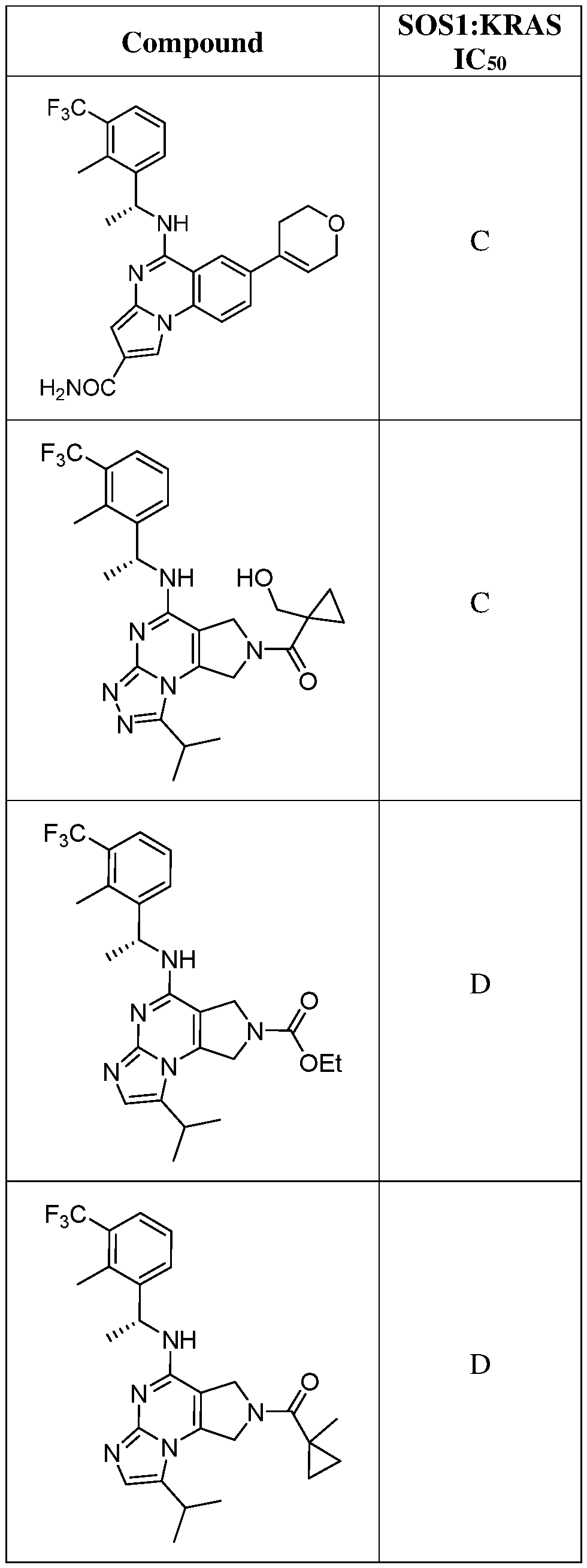


Claims
WHAT IS CLAIMED IS: 1. A compound of Formula (I), or a pharmaceutically acceptable salt thereof, having the structure I) wherein:
 ---------- are each independently a single or a double bond; wherein the bond between X3 and X4 is a double bond; X4 and X5 is a single bond; X5 and X6 is a double bond; and X2 and X6 is a single bond; wherein the bond between X3 and X4 is a single bond; X4 and X5 is a double bond; X5 and X6 is a single bond; and X2 and X6 is a double bond; or wherein the bond between X3 and X4 is a single bond; X4 and X5 is a single bond; X5 and X6 is a single bond; and X2 and X6 is a double bond; X1 is N or C, provided that when X1 is N, then R1 is absent; X2, X3, X4, X5 and X6 are each independently N or C, provide that at least one of X2, X3, X4, X5 and X6 is C; and provided that R2, R3 and R4 are chosen such that X2, X3, X4, X5 and X6 are uncharged; R1 is absent or hydrogen; R2, R3 and R4 are each independently absent, hydrogen, halogen, hydroxy, amino, cyano, an unsubstituted C1-4 alkyl, an unsubstituted C1-4 haloalkyl, an unsubstituted or a substituted acyl, an unsubstituted or a substituted C-carboxy, an unsubstituted or a substituted C-amido, an unsubstituted or a substituted urea, an unsubstituted C1-4 alkoxy, an unsubstituted or a substituted N-carbamyl, an unsubstituted or a substituted cycloalkyl, an unsubstituted or a substituted aryl, an unsubstituted or a substituted heteroaryl or an unsubstituted or a substituted heterocyclyl, wherein the substituted acyl, the substituted C-
carboxy, the substituted C-amido, the substituted urea, the substituted N-carbamyl, the substituted cycloalkyl, the substituted aryl, the substituted heteroaryl and the optionally substituted heterocyclyl is substituted with one or more substituents independently selected from the group consisting of halogen, OH, CN, an unsubstituted C1-4 alkyl, an unsubstituted C1-4 alkoxy, an unsubstituted C1-4 haloalkyl, an unsubstituted C1-4 hydroxyalkyl and an unsubstituted C-carboxy; Ring A and Ring B are each independently an unsubstituted or a substituted C6-8 cycloalkyl, an unsubstituted or a substituted aryl, an unsubstituted or a substituted heteroaryl or an unsubstituted or a substituted heterocyclyl, wherein the substituted C6-8 cycloalkyl, the substituted aryl, the substituted heteroaryl and the substituted heterocyclyl is substituted with one or more moieties independently selected from the group consisting of halogen, hydroxy, amino, cyano, an unsubstituted C1-4 alkyl, an unsubstituted C1-4 haloalkyl, an unsubstituted or a substituted acyl, an unsubstituted or a substituted C-carboxy, an unsubstituted or a substituted C-amido, an unsubstituted or a substituted urea, an unsubstituted alkoxy, an unsubstituted or a substituted N-carbamyl, an unsubstituted or a substituted cycloalkyl, an unsubstituted or a substituted aryl, an unsubstituted or a substituted heteroaryl, an unsubstituted or a substituted heterocyclyl and an unsubstituted or a substituted heterocyclyl(C1-4 alkyl), wherein the substituted acyl, the substituted C-carboxy, the substituted C-amido, the substituted urea, the substituted N-carbamyl, the substituted cycloalkyl, the substituted aryl, the substituted heteroaryl and the substituted heterocyclyl is substituted with one or more substituents independently selected from the group consisting of halogen, OH, CN, an unsubstituted C1-4 alkyl, an unsubstituted alkoxy, an unsubstituted C1-4 haloalkyl, an unsubstituted C1-4 hydroxyalkyl, an unsubstituted acyl and an unsubstituted C- carboxy.
---------- are each independently a single or a double bond; wherein the bond between X3 and X4 is a double bond; X4 and X5 is a single bond; X5 and X6 is a double bond; and X2 and X6 is a single bond; wherein the bond between X3 and X4 is a single bond; X4 and X5 is a double bond; X5 and X6 is a single bond; and X2 and X6 is a double bond; or wherein the bond between X3 and X4 is a single bond; X4 and X5 is a single bond; X5 and X6 is a single bond; and X2 and X6 is a double bond; X1 is N or C, provided that when X1 is N, then R1 is absent; X2, X3, X4, X5 and X6 are each independently N or C, provide that at least one of X2, X3, X4, X5 and X6 is C; and provided that R2, R3 and R4 are chosen such that X2, X3, X4, X5 and X6 are uncharged; R1 is absent or hydrogen; R2, R3 and R4 are each independently absent, hydrogen, halogen, hydroxy, amino, cyano, an unsubstituted C1-4 alkyl, an unsubstituted C1-4 haloalkyl, an unsubstituted or a substituted acyl, an unsubstituted or a substituted C-carboxy, an unsubstituted or a substituted C-amido, an unsubstituted or a substituted urea, an unsubstituted C1-4 alkoxy, an unsubstituted or a substituted N-carbamyl, an unsubstituted or a substituted cycloalkyl, an unsubstituted or a substituted aryl, an unsubstituted or a substituted heteroaryl or an unsubstituted or a substituted heterocyclyl, wherein the substituted acyl, the substituted C-
carboxy, the substituted C-amido, the substituted urea, the substituted N-carbamyl, the substituted cycloalkyl, the substituted aryl, the substituted heteroaryl and the optionally substituted heterocyclyl is substituted with one or more substituents independently selected from the group consisting of halogen, OH, CN, an unsubstituted C1-4 alkyl, an unsubstituted C1-4 alkoxy, an unsubstituted C1-4 haloalkyl, an unsubstituted C1-4 hydroxyalkyl and an unsubstituted C-carboxy; Ring A and Ring B are each independently an unsubstituted or a substituted C6-8 cycloalkyl, an unsubstituted or a substituted aryl, an unsubstituted or a substituted heteroaryl or an unsubstituted or a substituted heterocyclyl, wherein the substituted C6-8 cycloalkyl, the substituted aryl, the substituted heteroaryl and the substituted heterocyclyl is substituted with one or more moieties independently selected from the group consisting of halogen, hydroxy, amino, cyano, an unsubstituted C1-4 alkyl, an unsubstituted C1-4 haloalkyl, an unsubstituted or a substituted acyl, an unsubstituted or a substituted C-carboxy, an unsubstituted or a substituted C-amido, an unsubstituted or a substituted urea, an unsubstituted alkoxy, an unsubstituted or a substituted N-carbamyl, an unsubstituted or a substituted cycloalkyl, an unsubstituted or a substituted aryl, an unsubstituted or a substituted heteroaryl, an unsubstituted or a substituted heterocyclyl and an unsubstituted or a substituted heterocyclyl(C1-4 alkyl), wherein the substituted acyl, the substituted C-carboxy, the substituted C-amido, the substituted urea, the substituted N-carbamyl, the substituted cycloalkyl, the substituted aryl, the substituted heteroaryl and the substituted heterocyclyl is substituted with one or more substituents independently selected from the group consisting of halogen, OH, CN, an unsubstituted C1-4 alkyl, an unsubstituted alkoxy, an unsubstituted C1-4 haloalkyl, an unsubstituted C1-4 hydroxyalkyl, an unsubstituted acyl and an unsubstituted C- carboxy.
2. The compound of Claim 1, wherein the bond between X3 and X4 is a double bond; X4 and X5 is a single bond; X5 and X6 is a double bond; and X2 and X6 is a single bond.
3. The compound of Claim 2, wherein X1, X2, X4 and X5 are each N; X3 and X6 are each C.
4. The compound of Claim 3, wherein R4 is hydrogen.
5. The compound of Claim 3, wherein R4 is an unsubstituted C1-4 alkyl.
6. The compound of Claim 3, wherein R4 is an unsubstituted Ci4 haloalkyl.
7. The compound of Claim 2, wherein X1, X2, X4, X5 and X6 are each N; X3 is C.
8. The compound of Claim 1, wherein the bond between X3 and X4 is a single bond; X4 and X5 is a double bond; X5 and X6 is a single bond; and X2 and X6 is a double bond.
9. The compound of Claim 8, wherein X2 and X4 are each C; and X1, X3, X5 and X6 are each N.
10. The compound of Claim 9, wherein R2 is hydrogen.
11. The compound of Claim 9, wherein R2 is an unsubstituted Ci4 alkyl.
12. The compound of Claim 9, wherein R2 is an unsubstituted Ci4 haloalkyl.
13. The compound of Claim 8, wherein X2, X4 and X5 are each C; and X1, X3 and X6 are each N.
14. The compound of Claim 13, wherein R2 is hydrogen.
15. The compound of Claim 13, wherein R2 is cyano.
16. The compound of Claim 13, wherein R2 is an unsubstituted Ci alkyl.
17. The compound of Claim 13, wherein R2 is an unsubstituted Ci haloalkyl.
18. The compound of Claim 13, wherein R2 is an unsubstituted or a substituted aryl.
19. The compound of Claim 13, wherein R2 is an unsubstituted or a substituted C- carboxy.
20. The compound of any one of Claims 13-19, wherein R3 is hydrogen.
21. The compound of any one of Claims 13-19, wherein R3 is cyano.
22. The compound of any one of Claims 13-19, wherein R3 is an unsubstituted Ci-
4 alkyl.
23. The compound of any one of Claims 13-19, wherein R3 is an unsubstituted Ci-
4 haloalkyl.
24. The compound of any one of Claims 13-19, wherein R3 is an unsubstituted or a substituted aryl.
25. The compound of any one of Claims 13-19, wherein R3 is an unsubstituted or a substituted C-carboxy.
26. The compound of Claim 8, wherein X2, X4, X5 and X6 are each C; and X1 and X3 are each N.
27. The compound of Claim 26, wherein R2 is hydrogen.
28. The compound of Claim 26, wherein R2 is cyano.
29. The compound of Claim 26, wherein R2 is an unsubstituted C1-4 alkyl.
30. The compound of Claim 26, wherein R2 is an unsubstituted C1-4 haloalkyl.
31. The compound of Claim 26, wherein R2 is an unsubstituted or a substituted aryl.
32. The compound of Claim 26, wherein R2 is an unsubstituted or a substituted C- carboxy.
33. The compound of any one of Claims 26-32, wherein R3 is hydrogen.
34. The compound of any one of Claims 26-32, wherein R3 is cyano.
35. The compound of any one of Claims 26-32, wherein R3 is an unsubstituted C1- 4 alkyl.
36. The compound of any one of Claims 26-32, wherein R3 is an unsubstituted C1- 4 haloalkyl.
37. The compound of any one of Claims 26-32, wherein R3 is an unsubstituted or a substituted aryl.
38. The compound of any one of Claims 26-32, wherein R3 is an unsubstituted or a substituted C-carboxy.
39. The compound of any one of Claims 26-38, wherein R4 is hydrogen.
40. The compound of Claim 8, wherein X2, X5 and X6 are each C; and X1, X3 and X4 are each N.
41. The compound of Claim 40, wherein R3 is hydrogen.
42. The compound of Claim 40, wherein R3 is cyano.
43. The compound of Claim 40, wherein R3 is an unsubstituted C1-4 alkyl.
44. The compound of Claim 40, wherein R3 is an unsubstituted C1-4 haloalkyl.
45. The compound of any one of Claims 40-44, wherein R3 is an unsubstituted or a substituted aryl.
46. The compound of any one of Claims 40-44, wherein R3 is an unsubstituted or a substituted C-carboxy.
47. The compound of any one of Claims 40-46, wherein R4 is hydrogen.
48. The compound of Claim 1, wherein the bond between X3 and X4 is a single bond; X4 and X5 is a single bond; X5 and X6 is a single bond; and X2 and X6 is a double bond.
49. The compound of Claim 48, wherein X2 and X4 are each C; and X1, X3, X5 and X6 are each N.
50. The compound of Claim 49, wherein R2 is hydrogen.
51. The compound of Claim 49, wherein R2 is cyano.
52. The compound of Claim 49, wherein R2 is an unsubstituted Ci alkyl.
53. The compound of Claim 49, wherein R2 is an unsubstituted Ci haloalkyl.
54. The compound of any one of Claims 49-53, wherein R3 is hydrogen.
55. The compound of any one of Claims 49-53, wherein R3 is an unsubstituted Ci-
4 alkyl.
56. The compound of any one of Claims 1-55, wherein Ring B is an unsubstituted or a substituted aryl.
57. The compound of Claim 56, wherein Ring B is an unsubstituted phenyl.
58. The compound of Claim 56, wherein Ring B is a substituted phenyl.
59. The compound of Claim 58, wherein Ring B is a mono-substituted phenyl.
60. The compound of Claim 58, wherein Ring B is a di-substituted phenyl.
61. The compound of any one of Claims 1-55, wherein Ring B is an unsubstituted or a substituted C6-8 cycloalkyl.
62. The compound of any one of Claims 1-55, wherein Ring B is an unsubstituted or a substituted heteroaryl.
63. The compound of any one of Claims 1-55, wherein Ring B is an unsubstituted or a substituted heterocyclyl.
64. The compound of any one of Claims 1-63, wherein Ring A is an unsubstituted or a substituted aryl.
65. The compound of Claim 64, wherein Ring A is an unsubstituted phenyl.
66. The compound of Claim 64, wherein Ring A is a substituted phenyl.
67. The compound of Claim 66, wherein Ring A is a mono-substituted phenyl.
68. The compound of Claim 66, wherein Ring A is a di-substituted phenyl.
69. The compound of any one of Claims 1-63, wherein Ring A is an unsubstituted or a substituted C6-8 cycloalkyl.
70. The compound of any one of Claims 1-63, wherein Ring A is an unsubstituted or a substituted heteroaryl.
71. The compound of any one of Claims 1-63, wherein Ring A is an unsubstituted or a substituted heterocyclyl.
72. The compound of Claim 71, wherein Ring A is an unsubstituted or a substituted 4-6 membered monocyclic heterocyclyl.
73. The compound of Claim 72, wherein Ring A is an unsubstituted or a substituted azetidine.
74. The compound of Claim 72, wherein Ring A is an unsubstituted or a substituted pyrrolidine.
75. The compound of Claim 72, wherein Ring A an unsubstituted or a substituted a piperidine.
76. The compound of any one of Claims 64 or 66-75, wherein Ring A is mono- substituted.
77. The compound of any one of Claims 64 or 66-75, wherein Ring A is di- substituted.
78. The compound of any one of Claims 64 or 66-77, wherein Ring A is substituted with substituted with one or more substituents independently selected from the group consisting of hydroxy, amino, cyano, an unsubstituted C1-4 alkyl, an unsubstituted C1-4 haloalkyl and an unsubstituted alkoxy.
79. The compound of any one of Claims 64 or 66-77, wherein Ring A is substituted with one or more substituents independently selected from the group consisting of an unsubstituted or a substituted acyl, an unsubstituted or a substituted C-carboxy, an unsubstituted or a substituted C-amido, an unsubstituted or a substituted urea and an unsubstituted or a substituted N-carbamyl.
80. The compound of any one of Claims 64 or 66-77, wherein Ring A is substituted with one or more substituents independently selected from the group consisting of an unsubstituted or a substituted aryl, an unsubstituted or a substituted cycloalkyl, an unsubstituted or a substituted heteroaryl and an unsubstituted or a substituted heterocyclyl.
81. The compound of any one of Claims 64 or 66-77, wherein Ring A is substituted with one or more substituents independently selected from the group consisting of an unsubstituted alkoxy and an unsubstituted or a substituted acyl.
82. The compound of Claim 1, wherein the compound is selected from the group consisting of: , , ,
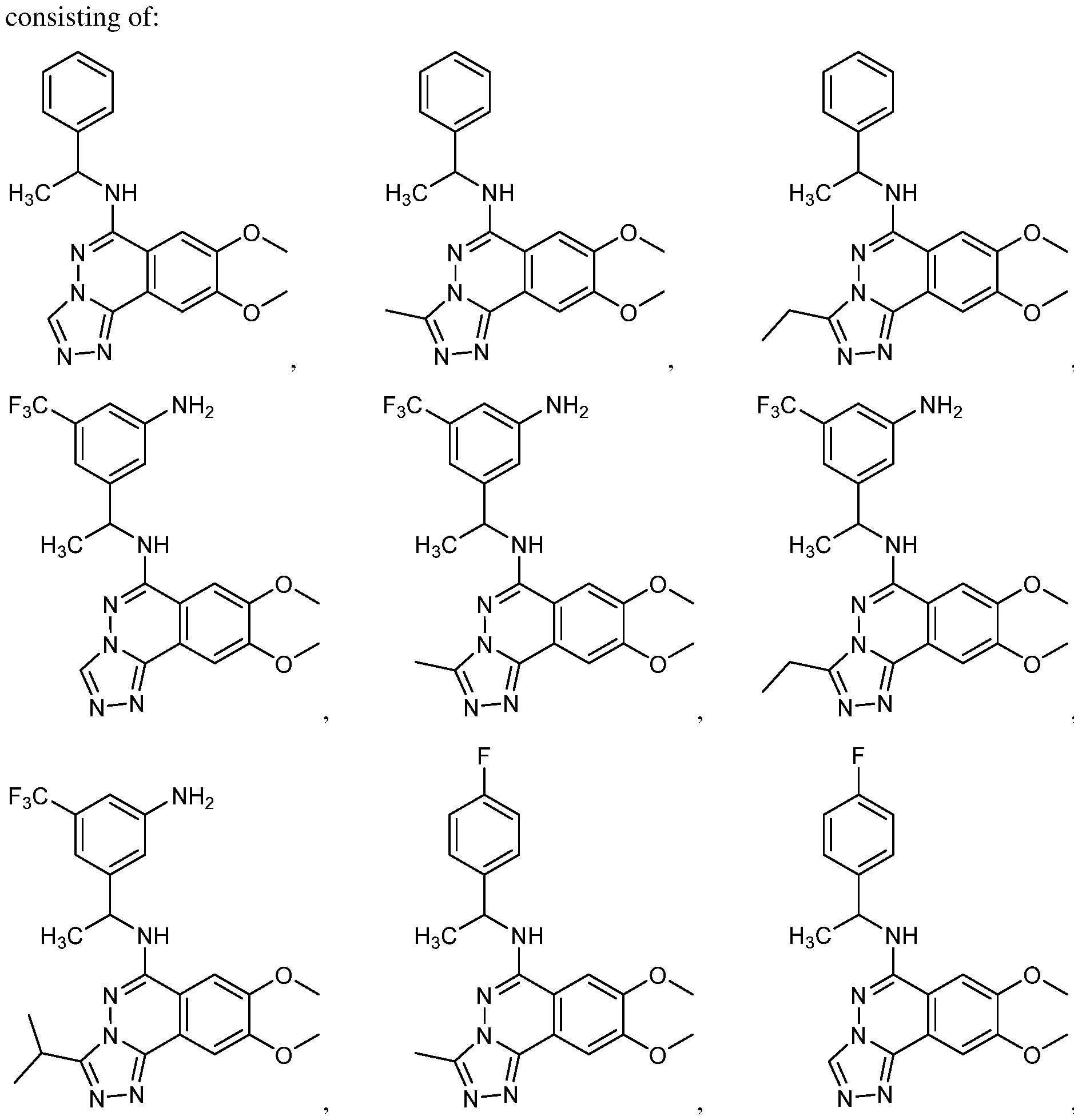

83. The compound of Claim 1, wherein the compound is selected from the group consisting of:


84. The compound of Claim 1, wherein the compound is selected from the group consisting of:


85. The compound of Claim 1, wherein the compound is selected from the group consisting of:
 pharmaceutically acceptable salt thereof.
86. A compound having the structure:
 pharmaceutically acceptable salt thereof.
87. A pharmaceutical composition comprising an effective amount of the compound of any one of any one of Claims 1-86, or a pharmaceutically acceptable salt thereof, and a pharmaceutically acceptable carrier, diluent, excipient or combination thereof.
88. A method for treating cancer comprising administering an effective amount of a compound of any one of Claims 1-86, or a pharmaceutically acceptable salt thereof, or a pharmaceutical composition of Claim 87, to a subject having the cancer.
89. The method of Claim 88, wherein the cancer is selected from the group consisting of lung cancer, colorectal cancer and pancreatic cancer.
90. The method of Claim 89, wherein the lung cancer is non-small cell lung cancer.
91. The method of Claim 89 or 90, wherein the cancer is associated with a KRAS mutation.
92. Use a compound of any one of Claims 1-86, or a pharmaceutically acceptable salt thereof, or a pharmaceutical composition of Claim 87, in the preparation of a medicament for treating cancer.
93. The use of Claim 92, wherein the cancer is selected from the group consisting of lung cancer, colorectal cancer and pancreatic cancer.
94. The use of Claim 93, wherein the lung cancer is non-small cell lung cancer.
95. The use of Claim 93 or 94, wherein the cancer is associated with a KRAS mutation.
Applications Claiming Priority (2)
| Application Number | Priority Date | Filing Date | Title |
|---|---|---|---|
| US202163221362P | 2021-07-13 | 2021-07-13 | |
| US63/221,362 | 2021-07-13 |
Publications (2)
| Publication Number | Publication Date |
|---|---|
| WO2023287730A1 true WO2023287730A1 (en) | 2023-01-19 |
| WO2023287730A8 WO2023287730A8 (en) | 2023-02-23 |
Family
ID=84919619
Family Applications (1)
| Application Number | Title | Priority Date | Filing Date |
|---|---|---|---|
| PCT/US2022/036733 Ceased WO2023287730A1 (en) | 2021-07-13 | 2022-07-11 | Tricyclic compounds |
Country Status (2)
| Country | Link |
|---|---|
| TW (1) | TW202317570A (en) |
| WO (1) | WO2023287730A1 (en) |
Cited By (26)
| Publication number | Priority date | Publication date | Assignee | Title |
|---|---|---|---|---|
| WO2023172940A1 (en) | 2022-03-08 | 2023-09-14 | Revolution Medicines, Inc. | Methods for treating immune refractory lung cancer |
| CN116969944A (en) * | 2022-08-02 | 2023-10-31 | 北京福元医药股份有限公司 | Ethylamino-substituted tricyclic heterocyclic compounds and compositions, formulations and uses thereof |
| WO2023240263A1 (en) | 2022-06-10 | 2023-12-14 | Revolution Medicines, Inc. | Macrocyclic ras inhibitors |
| WO2024155706A1 (en) * | 2023-01-18 | 2024-07-25 | Zeno Management, Inc. | Tricyclic compounds |
| WO2024206858A1 (en) | 2023-03-30 | 2024-10-03 | Revolution Medicines, Inc. | Compositions for inducing ras gtp hydrolysis and uses thereof |
| WO2024211712A1 (en) | 2023-04-07 | 2024-10-10 | Revolution Medicines, Inc. | Condensed macrocyclic compounds as ras inhibitors |
| WO2024211663A1 (en) | 2023-04-07 | 2024-10-10 | Revolution Medicines, Inc. | Condensed macrocyclic compounds as ras inhibitors |
| WO2024216048A1 (en) | 2023-04-14 | 2024-10-17 | Revolution Medicines, Inc. | Crystalline forms of ras inhibitors, compositions containing the same, and methods of use thereof |
| WO2024216016A1 (en) | 2023-04-14 | 2024-10-17 | Revolution Medicines, Inc. | Crystalline forms of a ras inhibitor |
| WO2024229406A1 (en) | 2023-05-04 | 2024-11-07 | Revolution Medicines, Inc. | Combination therapy for a ras related disease or disorder |
| WO2025034702A1 (en) | 2023-08-07 | 2025-02-13 | Revolution Medicines, Inc. | Rmc-6291 for use in the treatment of ras protein-related disease or disorder |
| WO2025080946A2 (en) | 2023-10-12 | 2025-04-17 | Revolution Medicines, Inc. | Ras inhibitors |
| WO2025103475A1 (en) * | 2023-11-17 | 2025-05-22 | 上海翰森生物医药科技有限公司 | Heterocyclic carbonyl derivative modulator, preparation method therefor, and use thereof |
| WO2025122695A1 (en) * | 2023-12-06 | 2025-06-12 | Incyte Corporation | Combination therapy comprising dgk inhibitors and pd-1/pd-l1 inhibitors |
| WO2025171296A1 (en) | 2024-02-09 | 2025-08-14 | Revolution Medicines, Inc. | Ras inhibitors |
| WO2025240847A1 (en) | 2024-05-17 | 2025-11-20 | Revolution Medicines, Inc. | Ras inhibitors |
| WO2025255438A1 (en) | 2024-06-07 | 2025-12-11 | Revolution Medicines, Inc. | Methods of treating a ras protein-related disease or disorder |
| WO2025265060A1 (en) | 2024-06-21 | 2025-12-26 | Revolution Medicines, Inc. | Therapeutic compositions and methods for managing treatment-related effects |
| WO2026006747A1 (en) | 2024-06-28 | 2026-01-02 | Revolution Medicines, Inc. | Ras inhibitors |
| WO2026015790A1 (en) | 2024-07-12 | 2026-01-15 | Revolution Medicines, Inc. | Methods of treating a ras related disease or disorder |
| WO2026015801A1 (en) | 2024-07-12 | 2026-01-15 | Revolution Medicines, Inc. | Methods of treating a ras related disease or disorder |
| WO2026015796A1 (en) | 2024-07-12 | 2026-01-15 | Revolution Medicines, Inc. | Methods of treating a ras related disease or disorder |
| WO2026015825A1 (en) | 2024-07-12 | 2026-01-15 | Revolution Medicines, Inc. | Use of ras inhibitor for treating pancreatic cancer |
| WO2026050446A1 (en) | 2024-08-29 | 2026-03-05 | Revolution Medicines, Inc. | Ras inhibitors |
| WO2026072904A2 (en) | 2024-09-26 | 2026-04-02 | Revolution Medicines, Inc. | Compositions and methods for treating lung cancer |
| EP4518867A4 (en) * | 2022-05-03 | 2026-04-08 | Univ Notre Dame Du Lac | CYTOCHROM BD OXIDASE HIBITORS AND THEIR USES |
Citations (5)
| Publication number | Priority date | Publication date | Assignee | Title |
|---|---|---|---|---|
| WO1997042192A1 (en) * | 1996-05-07 | 1997-11-13 | Basf Aktiengesellschaft | Imidazoquinazolines, agents containing them and their use to combat fungi and animal pests |
| WO2020180770A1 (en) * | 2019-03-01 | 2020-09-10 | Revolution Medicines, Inc. | Bicyclic heterocyclyl compounds and uses thereof |
| WO2021105960A1 (en) * | 2019-11-29 | 2021-06-03 | Lupin Limited | Substituted tricyclic compounds |
| CN113354651A (en) * | 2020-07-30 | 2021-09-07 | 四川大学 | Pyrazolo [1,5-a ] quinazoline derivative and application thereof in preparation of medicines |
| WO2022156792A1 (en) * | 2021-01-25 | 2022-07-28 | Guangdong Newopp Biopharmaceuticals Co., Ltd. | Heterocyclic compounds as sos1 inhibitors |
-
2022
- 2022-07-11 WO PCT/US2022/036733 patent/WO2023287730A1/en not_active Ceased
- 2022-07-12 TW TW111126126A patent/TW202317570A/en unknown
Patent Citations (5)
| Publication number | Priority date | Publication date | Assignee | Title |
|---|---|---|---|---|
| WO1997042192A1 (en) * | 1996-05-07 | 1997-11-13 | Basf Aktiengesellschaft | Imidazoquinazolines, agents containing them and their use to combat fungi and animal pests |
| WO2020180770A1 (en) * | 2019-03-01 | 2020-09-10 | Revolution Medicines, Inc. | Bicyclic heterocyclyl compounds and uses thereof |
| WO2021105960A1 (en) * | 2019-11-29 | 2021-06-03 | Lupin Limited | Substituted tricyclic compounds |
| CN113354651A (en) * | 2020-07-30 | 2021-09-07 | 四川大学 | Pyrazolo [1,5-a ] quinazoline derivative and application thereof in preparation of medicines |
| WO2022156792A1 (en) * | 2021-01-25 | 2022-07-28 | Guangdong Newopp Biopharmaceuticals Co., Ltd. | Heterocyclic compounds as sos1 inhibitors |
Non-Patent Citations (14)
Cited By (26)
| Publication number | Priority date | Publication date | Assignee | Title |
|---|---|---|---|---|
| WO2023172940A1 (en) | 2022-03-08 | 2023-09-14 | Revolution Medicines, Inc. | Methods for treating immune refractory lung cancer |
| EP4518867A4 (en) * | 2022-05-03 | 2026-04-08 | Univ Notre Dame Du Lac | CYTOCHROM BD OXIDASE HIBITORS AND THEIR USES |
| WO2023240263A1 (en) | 2022-06-10 | 2023-12-14 | Revolution Medicines, Inc. | Macrocyclic ras inhibitors |
| CN116969944A (en) * | 2022-08-02 | 2023-10-31 | 北京福元医药股份有限公司 | Ethylamino-substituted tricyclic heterocyclic compounds and compositions, formulations and uses thereof |
| WO2024155706A1 (en) * | 2023-01-18 | 2024-07-25 | Zeno Management, Inc. | Tricyclic compounds |
| WO2024206858A1 (en) | 2023-03-30 | 2024-10-03 | Revolution Medicines, Inc. | Compositions for inducing ras gtp hydrolysis and uses thereof |
| WO2024211663A1 (en) | 2023-04-07 | 2024-10-10 | Revolution Medicines, Inc. | Condensed macrocyclic compounds as ras inhibitors |
| WO2024211712A1 (en) | 2023-04-07 | 2024-10-10 | Revolution Medicines, Inc. | Condensed macrocyclic compounds as ras inhibitors |
| WO2024216048A1 (en) | 2023-04-14 | 2024-10-17 | Revolution Medicines, Inc. | Crystalline forms of ras inhibitors, compositions containing the same, and methods of use thereof |
| WO2024216016A1 (en) | 2023-04-14 | 2024-10-17 | Revolution Medicines, Inc. | Crystalline forms of a ras inhibitor |
| WO2024229406A1 (en) | 2023-05-04 | 2024-11-07 | Revolution Medicines, Inc. | Combination therapy for a ras related disease or disorder |
| WO2025034702A1 (en) | 2023-08-07 | 2025-02-13 | Revolution Medicines, Inc. | Rmc-6291 for use in the treatment of ras protein-related disease or disorder |
| WO2025080946A2 (en) | 2023-10-12 | 2025-04-17 | Revolution Medicines, Inc. | Ras inhibitors |
| WO2025103475A1 (en) * | 2023-11-17 | 2025-05-22 | 上海翰森生物医药科技有限公司 | Heterocyclic carbonyl derivative modulator, preparation method therefor, and use thereof |
| WO2025122695A1 (en) * | 2023-12-06 | 2025-06-12 | Incyte Corporation | Combination therapy comprising dgk inhibitors and pd-1/pd-l1 inhibitors |
| WO2025171296A1 (en) | 2024-02-09 | 2025-08-14 | Revolution Medicines, Inc. | Ras inhibitors |
| WO2025240847A1 (en) | 2024-05-17 | 2025-11-20 | Revolution Medicines, Inc. | Ras inhibitors |
| WO2025255438A1 (en) | 2024-06-07 | 2025-12-11 | Revolution Medicines, Inc. | Methods of treating a ras protein-related disease or disorder |
| WO2025265060A1 (en) | 2024-06-21 | 2025-12-26 | Revolution Medicines, Inc. | Therapeutic compositions and methods for managing treatment-related effects |
| WO2026006747A1 (en) | 2024-06-28 | 2026-01-02 | Revolution Medicines, Inc. | Ras inhibitors |
| WO2026015790A1 (en) | 2024-07-12 | 2026-01-15 | Revolution Medicines, Inc. | Methods of treating a ras related disease or disorder |
| WO2026015801A1 (en) | 2024-07-12 | 2026-01-15 | Revolution Medicines, Inc. | Methods of treating a ras related disease or disorder |
| WO2026015796A1 (en) | 2024-07-12 | 2026-01-15 | Revolution Medicines, Inc. | Methods of treating a ras related disease or disorder |
| WO2026015825A1 (en) | 2024-07-12 | 2026-01-15 | Revolution Medicines, Inc. | Use of ras inhibitor for treating pancreatic cancer |
| WO2026050446A1 (en) | 2024-08-29 | 2026-03-05 | Revolution Medicines, Inc. | Ras inhibitors |
| WO2026072904A2 (en) | 2024-09-26 | 2026-04-02 | Revolution Medicines, Inc. | Compositions and methods for treating lung cancer |
Also Published As
| Publication number | Publication date |
|---|---|
| TW202317570A (en) | 2023-05-01 |
| WO2023287730A8 (en) | 2023-02-23 |
Similar Documents
| Publication | Publication Date | Title |
|---|---|---|
| WO2023287730A1 (en) | Tricyclic compounds | |
| JP7726563B2 (en) | Substituted 1,2-dihydro-3H-pyrazolo[3,4-d]pyrimidin-3-ones | |
| US11555036B2 (en) | FGFR4 inhibitor, preparation method therefor and pharmaceutical use thereof | |
| JP7198811B2 (en) | COMBINATION MEDICINES AS RSV INHIBITORS | |
| TW202321242A (en) | Heterocyclic compounds and methods of use | |
| AU2018312448A1 (en) | 1, 2 - dihydro- 3h- pyrazolo [3, 4 - d] pyrimidin -3 - one analogs | |
| AU2009276420A1 (en) | Piperidine derivatives as JAK3 inhibitors | |
| US20230406860A1 (en) | Heterocyclic spiro compounds and methods of use | |
| KR20190045381A (en) | Heterocyclylamines as pi3k inhibitors | |
| EP3277690A1 (en) | Spirocyclic compounds | |
| WO2024155706A1 (en) | Tricyclic compounds | |
| JP2023548031A (en) | Bicyclic compound | |
| JP7681116B6 (en) | Carbonyl-substituted diazaspiro compounds and uses thereof | |
| JP2025504495A (en) | Fused heterocyclic compounds as modulators of RAS signaling | |
| WO2023049691A1 (en) | Cdk7 inhibitors and methods of treating cancer | |
| KR20220133874A (en) | macrocyclic compounds | |
| US20240238425A1 (en) | HSD17B13 Inhibitors and/or Degraders | |
| HK40043303A (en) | Substituted 1,2-dihydro-3h-pyrazolo[3,4-d]pyrimidin-3-ones | |
| HK40043303B (en) | Substituted 1,2-dihydro-3h-pyrazolo[3,4-d]pyrimidin-3-ones |
Legal Events
| Date | Code | Title | Description |
|---|---|---|---|
| 121 | Ep: the epo has been informed by wipo that ep was designated in this application |
Ref document number: 22842725 Country of ref document: EP Kind code of ref document: A1 |
|
| NENP | Non-entry into the national phase |
Ref country code: DE |
|
| 122 | Ep: pct application non-entry in european phase |
Ref document number: 22842725 Country of ref document: EP Kind code of ref document: A1 |