WO2023163921A1 - METHOD FOR THE PREPARATION OF PRE-LITHIATED LiMn2O4 - Google Patents

METHOD FOR THE PREPARATION OF PRE-LITHIATED LiMn2O4 Download PDF

Info

Publication number
WO2023163921A1
WO2023163921A1 PCT/US2023/013467 US2023013467W WO2023163921A1 WO 2023163921 A1 WO2023163921 A1 WO 2023163921A1 US 2023013467 W US2023013467 W US 2023013467W WO 2023163921 A1 WO2023163921 A1 WO 2023163921A1
Authority
WO
WIPO (PCT)
Prior art keywords
process according
lii
product
mn2o4
slurry
Prior art date
Legal status (The legal status is an assumption and is not a legal conclusion. Google has not performed a legal analysis and makes no representation as to the accuracy of the status listed.)
Ceased
Application number
PCT/US2023/013467
Other languages
French (fr)
Other versions
WO2023163921A8 (en
Inventor
Bing Tan
Yuhao Liao
Current Assignee (The listed assignees may be inaccurate. Google has not performed a legal analysis and makes no representation or warranty as to the accuracy of the list.)
Pacific Industrial Development Corp
Original Assignee
Pacific Industrial Development Corp
Priority date (The priority date is an assumption and is not a legal conclusion. Google has not performed a legal analysis and makes no representation as to the accuracy of the date listed.)
Filing date
Publication date
Application filed by Pacific Industrial Development Corp filed Critical Pacific Industrial Development Corp
Priority to US18/835,414 priority Critical patent/US20250140829A1/en
Priority to EP23711308.9A priority patent/EP4483433A1/en
Publication of WO2023163921A1 publication Critical patent/WO2023163921A1/en
Publication of WO2023163921A8 publication Critical patent/WO2023163921A8/en
Anticipated expiration legal-status Critical
Ceased legal-status Critical Current

Links

Classifications

    • HELECTRICITY
    • H01ELECTRIC ELEMENTS
    • H01MPROCESSES OR MEANS, e.g. BATTERIES, FOR THE DIRECT CONVERSION OF CHEMICAL ENERGY INTO ELECTRICAL ENERGY
    • H01M4/00Electrodes
    • H01M4/02Electrodes composed of, or comprising, active material
    • H01M4/36Selection of substances as active materials, active masses, active liquids
    • H01M4/48Selection of substances as active materials, active masses, active liquids of inorganic oxides or hydroxides
    • H01M4/50Selection of substances as active materials, active masses, active liquids of inorganic oxides or hydroxides of manganese
    • H01M4/505Selection of substances as active materials, active masses, active liquids of inorganic oxides or hydroxides of manganese of mixed oxides or hydroxides containing manganese for inserting or intercalating light metals, e.g. LiMn2O4 or LiMn2OxFy
    • CCHEMISTRY; METALLURGY
    • C01INORGANIC CHEMISTRY
    • C01GCOMPOUNDS CONTAINING METALS NOT COVERED BY SUBCLASSES C01D OR C01F
    • C01G45/00Compounds of manganese
    • C01G45/12Complex oxides containing manganese and at least one other metal element
    • C01G45/1221Manganates or manganites with trivalent manganese, tetravalent manganese or mixtures thereof
    • C01G45/1242Manganates or manganites with trivalent manganese, tetravalent manganese or mixtures thereof of the type (Mn2O4)-, e.g. LiMn2O4 or Li(MxMn2-x)O4
    • HELECTRICITY
    • H01ELECTRIC ELEMENTS
    • H01MPROCESSES OR MEANS, e.g. BATTERIES, FOR THE DIRECT CONVERSION OF CHEMICAL ENERGY INTO ELECTRICAL ENERGY
    • H01M10/00Secondary cells; Manufacture thereof
    • H01M10/05Accumulators with non-aqueous electrolyte
    • H01M10/052Li-accumulators
    • HELECTRICITY
    • H01ELECTRIC ELEMENTS
    • H01MPROCESSES OR MEANS, e.g. BATTERIES, FOR THE DIRECT CONVERSION OF CHEMICAL ENERGY INTO ELECTRICAL ENERGY
    • H01M4/00Electrodes
    • H01M4/02Electrodes composed of, or comprising, active material
    • H01M4/36Selection of substances as active materials, active masses, active liquids
    • H01M4/362Composites
    • H01M4/364Composites as mixtures
    • HELECTRICITY
    • H01ELECTRIC ELEMENTS
    • H01MPROCESSES OR MEANS, e.g. BATTERIES, FOR THE DIRECT CONVERSION OF CHEMICAL ENERGY INTO ELECTRICAL ENERGY
    • H01M4/00Electrodes
    • H01M4/02Electrodes composed of, or comprising, active material
    • H01M4/36Selection of substances as active materials, active masses, active liquids
    • H01M4/48Selection of substances as active materials, active masses, active liquids of inorganic oxides or hydroxides
    • H01M4/52Selection of substances as active materials, active masses, active liquids of inorganic oxides or hydroxides of nickel, cobalt or iron
    • H01M4/525Selection of substances as active materials, active masses, active liquids of inorganic oxides or hydroxides of nickel, cobalt or iron of mixed oxides or hydroxides containing iron, cobalt or nickel for inserting or intercalating light metals, e.g. LiNiO2, LiCoO2 or LiCoOxFy
    • CCHEMISTRY; METALLURGY
    • C01INORGANIC CHEMISTRY
    • C01PINDEXING SCHEME RELATING TO STRUCTURAL AND PHYSICAL ASPECTS OF SOLID INORGANIC COMPOUNDS
    • C01P2002/00Crystal-structural characteristics
    • C01P2002/50Solid solutions
    • C01P2002/52Solid solutions containing elements as dopants
    • CCHEMISTRY; METALLURGY
    • C01INORGANIC CHEMISTRY
    • C01PINDEXING SCHEME RELATING TO STRUCTURAL AND PHYSICAL ASPECTS OF SOLID INORGANIC COMPOUNDS
    • C01P2002/00Crystal-structural characteristics
    • C01P2002/70Crystal-structural characteristics defined by measured X-ray, neutron or electron diffraction data
    • C01P2002/72Crystal-structural characteristics defined by measured X-ray, neutron or electron diffraction data by d-values or two theta-values, e.g. as X-ray diagram
    • CCHEMISTRY; METALLURGY
    • C01INORGANIC CHEMISTRY
    • C01PINDEXING SCHEME RELATING TO STRUCTURAL AND PHYSICAL ASPECTS OF SOLID INORGANIC COMPOUNDS
    • C01P2006/00Physical properties of inorganic compounds
    • C01P2006/40Electric properties
    • HELECTRICITY
    • H01ELECTRIC ELEMENTS
    • H01MPROCESSES OR MEANS, e.g. BATTERIES, FOR THE DIRECT CONVERSION OF CHEMICAL ENERGY INTO ELECTRICAL ENERGY
    • H01M4/00Electrodes
    • H01M4/02Electrodes composed of, or comprising, active material
    • H01M2004/026Electrodes composed of, or comprising, active material characterised by the polarity
    • H01M2004/028Positive electrodes
    • YGENERAL TAGGING OF NEW TECHNOLOGICAL DEVELOPMENTS; GENERAL TAGGING OF CROSS-SECTIONAL TECHNOLOGIES SPANNING OVER SEVERAL SECTIONS OF THE IPC; TECHNICAL SUBJECTS COVERED BY FORMER USPC CROSS-REFERENCE ART COLLECTIONS [XRACs] AND DIGESTS
    • Y02TECHNOLOGIES OR APPLICATIONS FOR MITIGATION OR ADAPTATION AGAINST CLIMATE CHANGE
    • Y02EREDUCTION OF GREENHOUSE GAS [GHG] EMISSIONS, RELATED TO ENERGY GENERATION, TRANSMISSION OR DISTRIBUTION
    • Y02E60/00Enabling technologies; Technologies with a potential or indirect contribution to GHG emissions mitigation
    • Y02E60/10Energy storage using batteries

Definitions

  • This invention generally relates to energy storage devices, such as rechargeable batteries. More specifically, the present disclosure provides a method of preparing pre-lithiated LiM ⁇ C for use as a cathode active material in an energy storage device.
  • Pre-lithiated LiMr ⁇ C (i.e., Lii+ x Mn2O4 with 0 ⁇ x ⁇ 1) may be used as an cathode active material to pair with an anode active material having low Coulombic Efficiency at the 1 st cycle.
  • anode active material such as Si and SiO
  • pre-lithiated LiM ⁇ C Three processes are available for the preparation of pre-lithiated LiM ⁇ C .
  • pre-lithiated LiM ⁇ C may be prepared through chemical lithiation in an organic solvent using highly reactive butyllithium dissolved in an ether solvent.
  • highly reactive butyllithium with a highly flammable, ether solvent makes this process extremely challenging for commercial utilization.
  • a solid state process using Lil as a reducing agent at a temperature of about 460°C may be used to prepare pre- lithiated LiMn2O4.
  • the by-product(s) of this reaction i.e., I2 or UI3, have low boiling points and can easily be deposited onto the internal surface of the reactor.
  • this reaction requires the use of frequent washing and extensive cleaning protocols, typically using excessive amounts of acetonitrile to wash/remove the byproducts) from contaminating the product and for cleaning the reactor.
  • a microwave process may be used to reduce LiMn 2 O4 with tetraethylene glycol.
  • this process needs substantial capital investment in large microwave equipment suitable for large-scale production, which is challenging with respect to technology, cost, and integration considerations. Therefore, there is a need to find an alternative process for the preparation of pre-lithiated LiM ⁇ C or Lii+ x Mn2O4 that is less challenging with respect to commercial viability.
  • This disclosure generally provides a process for the preparation of a Lii+ x Mn2O4 product, wherein 0 ⁇ x ⁇ 1.
  • This process comprises the steps of stirring together LiMn2O4, a lithium (Li) precursor, and an organic compound having at least two hydroxyl (-OH) groups to form a slurry; placing the slurry into a container that is subsequently sealed, such that the sealed container is configured to generate its’ own autogeneous pressure; exposing the slurry in the sealed container to a temperature in the range of about 80°C to about 250°C for a period of time that ranges from about 1 hour to about 48 hours to form the Lii +x Mn 2 O4 product; and collecting the Lii +x Mn 2 O4 product from the sealed container.
  • the organic compound may comprise one or more vicinal diols or glycols, germinal diols, 1 ,3-diols, triols, phenols, and/or polyols.
  • the organic compound is a glycol, glycerol, or a combination thereof.
  • the organic compound is ethylene glycol, propylene glycol, tetraethylene glycol, or a mixture thereof.
  • the lithium precursor may be LiOH and/or a hydrate thereof (UOI H2O).
  • the lithium (Li) precursor and the LiMn2O4 used in forming the mixture may be present in a molar ratio of Li precursor : LiMn2O4 that is in range of about 0.05 to about 3.00; alternatively, the .molar ratio of Li precursor to LiMn2O4 is in range of about 0.20 to about 1 .20; alternatively, the molar ratio of Li precursor : LiMn2O4 is in range of about 0.30 to 1 .00.
  • the slurry includes an additional solvent, which in combination with the organic compound forms a liquid component in the slurry.
  • the slurry may have a mass ratio of solids to liquids that is greater than 1/50 and less than 100/1 .
  • the slurry has a mass ratio of solids I liquids that is greater than 1/10; alternatively, the slurry has a mass ratio of solids I liquids that is greater than 1/1 ; alternatively, the mass ratio of solids to liquids that is greater than 2/1 and less than 50/1 .
  • the LiMn2O4 may be doped with at least one additional metal element or non-metal element in an amount that ranges from 0.1 wt.% to 1.0 wt.% relative to the overall weight of the LiM ⁇ C .
  • This at least one additional metal element or non-metal element may be selected from the group consisting of aluminum (Al), magnesium (Mg), calcium (Ca), boron (B), nitrogen (N), fluorine (F), nickel (Ni), and cobalt (Co).
  • the temperature may alternatively, be in the range from 100°C to 250°C; alternatively, the temperature is in the range of 110°C to 200°C; alternatively, the temperature is in the range of 130°C to 170°C.
  • the Lii+ x Mn2O4 product may be collected by removing the Lii+ x Mn2O4 product from the sealed container followed by filtering, washing, and drying the Lii+ x Mn2O4 product.
  • the Lii+ x Mn2O4 product may be dried at a temperature that ranges from about 110°C to about 250°C.
  • the Lii+ x Mn2O4 product may be dried in air, an inert atmosphere, or under vacuum.
  • an energy storage device comprising a positive electrode having a cathode active material that is at least partially formed of a Lii+ x Mn2O4 product prepared according to the process described above and further defined herein.
  • the cathode active material may be comprised entirely of the Lii+ x Mn2O4 product.
  • the cathode active material may include one or more conventional cathode active materials selected from the group consisting of pristine LiMn2O4, LiFePC , LiFe x Mn y PO4 (i.e.
  • the cathode active material comprises a mass ratio of the Lii+ x Mn2O4 to the conventional cathode active material that is in the range from about 99:1 to about 1 :99.
  • Figure 1 is a flowchart of a method of forming a prelithiated LiMn2O4 or Lii+ x Mn2O4 (0 ⁇ x ⁇ 1 ) product according to the teachings of the present disclosure.
  • Figure 2 is a graphical comparison of the x-ray diffraction (XRD) patterns for several samples (R-1 , R-4) of Lii+ x Mn2O4 prepared according to the teachings of the present disclosure against a sample (R-2) prepared using a different reducing agent.
  • Figure 3 is a graphical comparison of the x-ray diffraction (XRD) patterns for a pristine LiMn2O4 sample (C-1) against a sample (R-8) of Lii+ x Mn2O4 prepared according to the teachings of the present disclousre.
  • Figure 4 is a graphical plot of voltage as a function of specific capacity for the 1 st charge/discharge cycle fora cell containing pristine LiMn2O4 (C-1) as the active cathode material against cells containing pre-lithiated Lii+ x Mn2O4 (R-1 , R-8) cathode active materials prepared according to the teachings of the present disclosure.
  • Figures 5A/5B are schematic representatons of a cell of an “anode-free” design incorporating the prelithiated Lii+ x Mn2O4 product formed according to the process of Figure 1 as an active cathode material.
  • the present disclosure generally provides a method of synthesizing pre-lithiated LiMn2O4 through the use of a hydrothermal process involving LiMn2O4, a lithium precursor, and an organic compound as the reducing agent with the optional presence of an additional solvent.
  • this method 1 comprises mixing 5 LiMn2O4 with a lithium precursor and an organic compound that has at least two hydroxyl (-OH) groups to form a slurry. This slurry is then placed 10 into a container, e.g., an autoclave, which is subsequently sealed.
  • the container is configured to generate its’ own autogeneous pressure.
  • the slurry in the sealed container is then exposed 15 to an elevated temperature, for example, 80°C to 250°C for one or more hours, e.g., up to 48 hours.
  • a brownish powder is collected 20 by various routes, such as for example, without limitation, drying the product in air with or without washing. Since there is no highly flammable, organic solvent used in this process, the process may be considered safe.
  • autoclave processes are widely utilized in the industrial production of zeolites and other inorganic materials, the practicability of industrial scale-up for such a process has been established.
  • the pre-lithiated LiMn2O4 prepared according to the process of the present disclosure comprises the chemical formula shown in F-1 ,
  • This pre-lithiated LiM ⁇ C may be used as a pre-lithiated active cathode material in an energy storage device.
  • the lithium content in the pre-lithiated active cathode material is too high (i.e., x > 1.0 in formula F-1 ), a non-tetragonal crystal phase will be formed that cannot be easily converted back to a spinel crystal phase during charging and the reversible capacity of the energy storage device or cell will be reduced.
  • the hydrothermal process that is used for the preparation of pre-lithiated LiMn2O4 utilizes a process temperature that ranges from about 80°C to about 250°C, alternatively, from about 110°C to about 200°C, alternatively, from about 130°C to about 170°C.
  • the period of time that the slurry is exposed to the process temperature may range from a few hours to tens of hours, alternatively, from 1 hour to about 48 hours, alternatively from about 2 hours to about 24 hours, alternatively, from about 4 hours to about 20 hours.
  • the time-period will be shorter with the use of a higher temperature. For example, when a temperature above 200°C is used, the reaction may be completed in 1 to 4 hours. When a temperature below 200°C is used, the time period will take longer, for example, greater than 4 hours; alternatively, greater than 8 hours.
  • the terms "at least one” and “one or more of” an element are used interchangeably and may have the same meaning. These terms, which refer to the inclusion of a single element or a plurality of the elements, may also be represented by the suffix "(s)" at the end of the element. For example, “at least one glycol”, “one or more glycols”, and “glycol(s)” may be used interchangeably and are intended to have the same meaning.
  • the LiMn 2 O4 that is utilized as a starting material in the reaction process according to the present disclosure may be prepared according to one or more separate processes.
  • the LiMri2O4 may exhibit various morphologies, properties, and variations in overall composition.
  • the LiMn2O4 without limitation, may exhibit a spherical shape with an average particle size (D50) that is in the range of about 0.1 micrometer (pm) to about 100 micrometers (pm), alternatively, about 1 pm to about 30 pm.
  • the LiMn2O4 may exhibit an irregular shape with an average particle size (D50) that is in a similar range as described above without exceeding the scope of the present disclosure.
  • the LiMn2O4 may also be doped with one or more additional metal and/or nonmetal elements or coated with various compositions containing such additional metal and/or nonmetal elements. More specifically, the LiM ⁇ C may be doped or coated with at least one element selected from a group comprising all metals and non-metals, including, without limitation, or consisting of aluminum (Al), magnesium (Mg), calcium (Ca), boron (B), nitrogen (N), fluorine (F), nickel (Ni), and cobalt (Co).
  • the additional metal or nonmetal elements may be present in an amount ranging from 0.1 wt.% to about 10 wt.%, alternatively, from about 1 wt.% to about 5 wt.% relative to the overall weight of the LiMn 2 O4.
  • the lithium precursor is a lithium salt that is capable of lithiating LiM ⁇ C , e.g., forming a brownish powder, in the process of the present disclosure under the conditions defined above and as further described herein.
  • the lithium precursor may include, but not be limited to, LiOH and/or the hydrate thereof, i.e., LiOH*H2O.
  • salts such as lithium acetate, lithium nitrate, and lithium carbonate, are excluded from the definition of the lithium precursor because in the process and under the conditions described in the present disclosure, the LiM ⁇ C is not lithiated, e.g., these as-made powders appear to remain black in color.
  • the molar ratio between the lithium precursor and LiMn2O4 (e.g., LiOH:LiMn2O4) used in the process of the present disclosure is in the range of 0.05 to 3. Since the lithium salt (e.g., LiOH) may react with the solvent (e.g., glycols, etc.) at high temperature, an excess amount of lithium precursor may be necessary to fully lithiate the LiMn2O4. In addition, the amount of the lithium precursor needed to fully lithiate the LiMn2O4 will also be higher, when a lower mass ratio of solid to reducing agent is present in the slurry formed during the process.
  • the lithium salt e.g., LiOH
  • solvent e.g., glycols, etc.
  • the molar ratio of the lithium precursorto LiMn2O4 may alternatively, range from about 0.1 to about 2.5, alternatively, from about 0.2 to about 1.2, alternatively, from about 0.3 to about 1 .0.
  • the reducing agent utilized in the process of the present disclosure is an organic compound that will be reduced under hydrothermal conditions.
  • the process preferably utilizes an organic compound that has at least two hydroxyl (- OH) groups.
  • the organic compound may be selected to comprise one or more vicinal diols or glycols, germinal diols, 1 ,3-diols, triols, phenols, and/or polyols.
  • organic compounds include, without limitation, ethylene glycol, propylene glycol, tetraethylene glycol, 2-methyl-2-propyl-1 ,3-propanediol, neopentyl glycol, glycerol, glycerin, 2-deoxyribose, dihydroxybenzene, sorbitol, mannitol, xylitol, maltitol, maltitol syrup, lactitol, erythritol, and isomalt.
  • the organic compound is a glycol, a glycerol, or a combination thereof.
  • the organic compound is ethylene glycol, propylene glycol, tetraethylene glycol, or a combination thereof.
  • an organic amine as the organic compound, but is not preferred, due to the resulting odor that would be need to be addressed and hinder the success of a production process.
  • the reducing agent or organic compound may act as a solvent itself.
  • a glycol or glycerol may both act as a solvent and as the reducing agent in the process.
  • more than one organic compound be utilized, such that one of the organic compounds may act as a solvent, while the other organic compound acts as the reducing agent.
  • a combination of a glycol and glycerol may function in this capacity.
  • an additional solvent that cannot act as a reducing agent may be utilized in combination with the organic compound.
  • the solid to the liquid ratio in the slurry formed during the process should be as large as possible in order to increase the overall production yield since the volume of the sealed container, e.g., autoclave, is limited.
  • the solid to liquid ratio also limited because it is necessary for the surface of the solid to wet by the liquid in order to ensure the formation of a homogenous Lii+ x Mn2O4 product.
  • the mass ratio between the solids (i.e., LiM ⁇ C and LiOH*H2O) and the liquid i.e.
  • reducing agent or reducing agent and solvent should be greater than 1/100, alternatively, greater than 1/10, alternatively, greater than 1/1 , or alternatively, greater than 2/1 , but less than 100/1 , alternatively, less than 50/1 , alternatively less than 20/1 , or alternatively less than 10/1 .
  • the pre-lithiated LiMn2O4, i.e., the Lii+ x Mn2O4 (with 0 ⁇ x ⁇ 1) product may be collected via various or different routes.
  • the product may be collected by filtering and washing the as- collected wet material with an organic solvent or water. The washed material is then dried in air to remove any liquid.
  • the product may be collected by heating the as-collected wet material in an oven.
  • the product may be collected by heating the as-collected wet material in air at a temperature >110°C, alternatively, about 200°C.
  • the product may be collected by heating the as-collected wet material in an inert gas environment at a temperature that is in the range of 100°C to 250°C, alternatively, about 200°C.
  • the as-prepared pre-lithiated LiM ⁇ C is relatively stable in the presence of water or moisture.
  • organic solvents having a relatively high moisture level may be used for the synthesis and the washing of the pre-lithiated product. All of the collection processes may be performed in air without the need to restrict or control humidity.
  • the pre-lithiated LiMn 2 O4 may be used alone as the active cathode material or it may be used in combination with another active cathode material.
  • the mass ratio of the pre-lithiated material to the other, e.g., conventional, material may range from about 99:1 to about 10:90 depending on the application requirements.
  • the mass ratio for pre- lithiated material to the conventional or other active material is greater than 100:0 and less than or equal to 10:90; alternatively, between about 90:10 and 20:80; alternatively, in the range of about 80:20 to about 30:70; alternatively, 70:30 to 40:60; alternatively, about 60:40 to about 50:50; alternatively between greater than 100:0 and less than or equal to 51 :49.
  • a composition comprising 97 wt.% of pre-lithiated active cathode powders (Lii+ x Mn2O4, 1.5 wt.% carbon nanotubes (CNT), and 1.5 wt.% polyvinylidene fluoride (PVDF) was coated onto an aluminum foil and calendared.
  • a similar electrode was prepared using pristine LiMn 2 O4 powder in place of the pre-lithiated active cathode powder for use as a control or reference electrode (see sample C-1).
  • each of the electrodes were then tested in an “anode-free” single-layer pouch cell against a Cu foil wherein the voltage ranged from 3.0 V to 4.25 V at about C/10.
  • the cell was clamped together with two clips.
  • the charge/discharge curves at the 1 st cycle for the cells containing the pre-lithiated electrodes (see samples R-1 to R-8) and the reference electrode (see sample C-1 ) were measured and the 1 st Coulombic Efficiency (CE), as well as the 1 st discharge capacity determined.
  • CE Coulombic Efficiency
  • the Coulombic efficiency describes the charge efficiency by which electrons are transferred within the battery.
  • the discharge capacity represents the amount of charge that may be extracted from a battery.
  • Coulombic Efficiency is defined as the ratio of the discharge capacity (mAh/g) to the charge capacity (mAh/g).
  • the CE is generally less than 100%, in particular, for the 1 st charge/discharge cycle because of irreversible capacity loss that occurs due to the occurrence of side reactions.
  • the 1 st cycle CE of an “anode-free” cell using these pre- lithiated cathode active materials may be ⁇ 100%, alternatively, ⁇ 90%; alternatively, ⁇ 80%; alternatively, ⁇ 70%; and alternatively, ⁇ 60% as controlled by the amount of the lithium incorporated into the active cathode materials via the use of the pre- lithiation reaction.
  • a lower 1 st cycle CE corresponds to an increase in the amount of lithium added or deposited within the structure of the active cathode material.
  • a control sample (C-1 ) that comprised only the starting material, LiM ⁇ C was utilized.
  • the difference between samples R-1 and R-2 is the composition of the organic compound used as the reducing agent.
  • Sample R-1 used propylene glycol as the reducing agent, while sample R-2 used isopropyl alcohol.
  • a brownish powder was obtained from the reaction in R-1 , suggesting that the LiM ⁇ C was reduced to Lii+ x Mn2O4 product (0 ⁇ x ⁇ 1), which was then confirmed by measurement of an x-ray diffraction (XRD) pattern for the sample and by the electrochemical performance achieved.
  • XRD x-ray diffraction
  • sample R-2 The powder obtained as sample R-2 after performing the hydrothermal process remained black in color (see Tables 1 or 2).
  • the color of sample R-2 is the same color as the pristine LiMn2O4 starting material (sample C-1 ), thereby, suggesting that the LiMn2O4 was not reduced by the isopropyl alcohol.
  • sample R-2 confirms that the organic compound should have at least two hydroxyl groups.
  • the first Coulombic Efficiency (1 st CE) of sample R-1 was 54%, which was much lower than the 96% exhibited by the pristine LiMn2O4 (see sample C-1), thereby, confirming that sample R-1 was reduced (e.g., lithiated) during the reaction.
  • Sample R-6 confirms that the Lii+ x Mn2O4 product (0 ⁇ x ⁇ 1) has relatively good stability in the presence of water or moisture, since water was used to wash the collected powder prior to being dried in an oven. In addition, even after such exposure to water/moisture, sample R-5 still exhibited a specific capacity of 92 mAh/g when used as an active cathode material.
  • Samples R-6 and R-7 demonstrate that the amount of the organic compound may be substantially reduced (e.g., to as little as 1 to 2 grams) in comparison to the amount of LiMn 2 O4 present (e.g., 4.75 grams) in the reaction slurry.
  • the specific capacity of the sample formed using 1 gram of propylene glycol is very low (68 mAh/g). This result is most likely due to inhomogeneous mixing of the LiMn2O4 and LiOH.
  • the specific capacity exhibited by the active cathode material formed from the use of 2 grams of propylene glycol (see sample R-7)) was found to be much higher (95 mAh/g).
  • the molar ratio between the Li precursor (e.g., LiOH or LiOH*H2O) and LiMn2O4 used in the reaction can range from 0.1 to 2, alternatively, from about 0.2 to about 1.2, alternatively, from about 0.3 to about 1.0.
  • Samples R-1 and R-3 to R-7 demonstrate a molar ratio of 1 :1
  • sample R-8 demonstrates a molar ratio of 0.3.
  • Sample R-8 when used as an active cathode material exhibits a low 1 st CE of 66% with a specific capacity of 94 mAh/g.
  • Figure 3 provides the x-ray diffraction (XRD) pattern measured for sample R-8 in comparison to sample C-1.
  • the XRD pattern demonstrates that sample R-8 is comprised of both a spinel Li 2 Mn2O4 phase (see sample C-1) and a tetragonal Lii+ x Mn2O4 phase.
  • an energy storage device such as a rechargeable battery cell
  • a rechargeable lithium cell that utilizes the pre-lithiated LiMnO2 prepared according to the process described above as a cathode active material.
  • an energy storage device is a rechargeable lithium cell that includes an “anode-free” design as shown in Figures 5A and 5B.
  • the rechargeable lithium cell 50 is made with a positive electrode 55 comprising a current collector 57 and an active material (cathode) 60, i.e., the pre- lithiated LiMn 2 O4, while the negative electrode 65 side of the cell 50 generally includes only a current collector 67.
  • a main benefit associated with an “anode-fee” cell is that it eliminates or at least significantly reduces the electrode volume and/or mass by not incorporating any pre-deposited anode active layer onto the current collector during the fabrication of the cell.
  • the “anode-free” cell further includes a separator 80 and an electrolyte 75 that supports the reversible flow of lithium ions between the positive electrode 55 and the negative electrode 65.
  • the separator 80 is placed between the positive electrode 55 and negative electrode 65, such that the separator 80 separates the electrodes.
  • the separator 80 is permeable to the reversible flow of lithium ions there through. The flow of ions may be conducted by the separator (i.e. , via a solid-state mechanism) or by the presence of a liquid electrolyte 75 that permeates through the porosity of the separator 80 (e.g., a membrane).
  • the current collector 57 in the positive 55 electrode may be made of any metal known in the art for use in an electrode of a lithium battery, such as for example, without limitation, aluminum, titanium, stainless steel, nickel, copper, carbon, zinc, gallium, silver, and combinations or alloys formed therefrom.
  • the current collector 67 used in the negative electrode 65 may be a metallic foil that does not react with lithium ions.
  • metallic foils may include, but not be limited to, Cu, Fe, Ti, Ni, Mo, W, Zr, Mn, carbon, and lithium metal alloys.
  • the metallic foil for the current collector 67 of the negative electrode 65 comprises Cu, Fe, Ni, or a mixture or alloy thereof.
  • a “battery cell” or “cell” refers to the basic electrochemical unit of a battery.
  • a “battery” or “battery pack” refers to a collection of cell(s), e.g., one or more cells, and includes a housing, electrical connections, and possibly electronics for control and protection.
  • one or more of the anode-free cells comprising the pre-lithiated active cathode material prepared according to the process of the present disclosure may be combined to form a larger capacity battery or battery pack, such as a lithium-ion secondary battery used in an electric vehicle (EV).
  • the one or more cells may be incorporated in series, in parallel, or in a combination thereof in order to form the battery or battery pack.
  • a lithium-ion secondary battery used in an electric vehicle (EV).
  • EV electric vehicle
  • the one or more cells may be incorporated in series, in parallel, or in a combination thereof in order to form the battery or battery pack.
  • the same principles may be used to encompass or encase one or more cells into a housing for use in another application.
  • the housing may be constructed of any material known for such use in the art and be of any desired geometry required or desired for a specific application.
  • lithium-ion batteries generally are housed in three different main form factors or geometries, namely, cylindrical, prismatic, or soft pouch.
  • the housing for a cylindrical battery may be made of aluminum, steel, or the like.
  • Prismatic batteries generally comprise a housing that is rectangular shaped rather than cylindrical.
  • Soft pouch housings may be made in a variety of shapes and sizes. These soft housings may be comprised of an aluminum foil pouch coated with a plastic on the inside, outside, or both.
  • the soft housing may also be a polymeric-type encasing.
  • the polymer composition used for the housing may be any known polymeric materials that are conventionally used in lithium-ion secondary batteries.
  • One specific example, among many, include the use of a laminate pouch that comprises a polyolefin layer on the inside and a polyamide layer on the outside.
  • a soft housing needs to be designed such that the housing provides mechanical protection for the “anode-free” cells present in the battery.

Landscapes

  • Chemical & Material Sciences (AREA)
  • Chemical Kinetics & Catalysis (AREA)
  • Electrochemistry (AREA)
  • General Chemical & Material Sciences (AREA)
  • Inorganic Chemistry (AREA)
  • Composite Materials (AREA)
  • Organic Chemistry (AREA)
  • Engineering & Computer Science (AREA)
  • Manufacturing & Machinery (AREA)
  • Battery Electrode And Active Subsutance (AREA)

Abstract

A process of preparing a Li1+xMn2O4 product (wherein, 0 < x≤1) for use as a cathode active material in an energy storage device. The process including stirring together LiMn2O4, a lithium (Li) precursor, and an organic compound to form a slurry, wherein the organic compound has at least two hydroxyl (-OH) groups. Placing the slurry into a container that is subsequently sealed, such that the sealed container is configured to generate its' own autogeneous pressure. Exposing the slurry in the sealed container to a temperature in the range of about 80°C to about 250°C for a period of time that ranges from about 1 hour to about 48 hours to form the Li1+xMn2O4 product. Collecting the Li1+xMn2O4 product from the sealed container. Using the Li1+xMn2O4 product as a cathode active material in an energy storage device.

Description

Method for the Preparation of Pre-Lithiated LiMn2O4
FIELD
[0001] This invention generally relates to energy storage devices, such as rechargeable batteries. More specifically, the present disclosure provides a method of preparing pre-lithiated LiM^C for use as a cathode active material in an energy storage device.
BACKGROUND
[0002] The statements in this section merely provide background information related to the present disclosure and may not constitute prior art.
[0003] Conventional lithium ion cells used in electric vehicles generally incorporate an anode (e.g., graphite, etc.) a cathode (e.g., lithium metal oxide/phosphate, etc.) and an organic electrolyte containing LiPFe. One issue with these conventional cells is that they may cause a fire during a thermal runaway situation, mainly resulting from the interaction between the organic electrolyte and the graphite anode. In addition, since the active graphite material used in the anode exhibits a limited amount of specific capacity (i.e., theoretical = 372 mAh/g), the energy density of the cell becomes restricted. In order to improve overall safety and increase energy density, the battery industry has been interested in the development of lithium metal cells that use nonflammable electrolytes, including solid-state electrolytes. However, there are many challenges associated with the commercialization of this type of cell.
[0004] One of these challenges is the increased cost of using thin lithium foil as the anode in order to compensate for the lithium lost on the anode-side of the cell during cycling. These thin lithium foils, which are generally < 20 micrometers (pm), are difficult and expensive to produce because of their softness and the high reactivity of lithium metal.
[0005] In order to reduce the cost of production, it is necessary to avoid using thin lithium metal foil and instead use an “anode-free” design. However, cells with an “anode-free” design generally lack good cycling capacity because there is not any or at least insufficient lithium to continually replenish the lithium lost on the anode-side of the cell. Therefore, a continual need exists for the development of a low-cost, “anode- free” battery that can provide lithium to the anode current collector similar to the use of thin lithium foils in order to compensate for the lithium loss that occurs during cycling. [0006] Pre-lithiated LiMr^C (i.e., Lii+xMn2O4 with 0 < x < 1) may be used as an cathode active material to pair with an anode active material having low Coulombic Efficiency at the 1st cycle. With the recent emergence of new anode active materials, such as Si and SiO, there is an urgent need to use such pre-lithiated cathode active materials.
[0007] Three processes are available for the preparation of pre-lithiated LiM^C . First, pre-lithiated LiM^C may be prepared through chemical lithiation in an organic solvent using highly reactive butyllithium dissolved in an ether solvent. The use of highly reactive butyllithium with a highly flammable, ether solvent makes this process extremely challenging for commercial utilization. Second, a solid state process using Lil as a reducing agent at a temperature of about 460°C may be used to prepare pre- lithiated LiMn2O4. However, the by-product(s) of this reaction, i.e., I2 or UI3, have low boiling points and can easily be deposited onto the internal surface of the reactor. Thus, this reaction requires the use of frequent washing and extensive cleaning protocols, typically using excessive amounts of acetonitrile to wash/remove the byproducts) from contaminating the product and for cleaning the reactor. Third, a microwave process may be used to reduce LiMn2O4 with tetraethylene glycol. However, this process needs substantial capital investment in large microwave equipment suitable for large-scale production, which is challenging with respect to technology, cost, and integration considerations. Therefore, there is a need to find an alternative process for the preparation of pre-lithiated LiM^C or Lii+xMn2O4 that is less challenging with respect to commercial viability.
SUMMARY
[0008] This disclosure generally provides a process for the preparation of a Lii+xMn2O4 product, wherein 0 < x<1. This process comprises the steps of stirring together LiMn2O4, a lithium (Li) precursor, and an organic compound having at least two hydroxyl (-OH) groups to form a slurry; placing the slurry into a container that is subsequently sealed, such that the sealed container is configured to generate its’ own autogeneous pressure; exposing the slurry in the sealed container to a temperature in the range of about 80°C to about 250°C for a period of time that ranges from about 1 hour to about 48 hours to form the Lii+xMn2O4 product; and collecting the Lii+xMn2O4 product from the sealed container. [0009] According to another aspect of the present disclosure, the organic compound may comprise one or more vicinal diols or glycols, germinal diols, 1 ,3-diols, triols, phenols, and/or polyols. Alternatively, the organic compound is a glycol, glycerol, or a combination thereof. Alternatively, the organic compound is ethylene glycol, propylene glycol, tetraethylene glycol, or a mixture thereof.
[0010] According to one aspect of the present disclosure the lithium precursor may be LiOH and/or a hydrate thereof (UOI H2O). The lithium (Li) precursor and the LiMn2O4 used in forming the mixture may be present in a molar ratio of Li precursor : LiMn2O4 that is in range of about 0.05 to about 3.00; alternatively, the .molar ratio of Li precursor to LiMn2O4 is in range of about 0.20 to about 1 .20; alternatively, the molar ratio of Li precursor : LiMn2O4 is in range of about 0.30 to 1 .00.
[0011] When desirable, the slurry includes an additional solvent, which in combination with the organic compound forms a liquid component in the slurry. The slurry may have a mass ratio of solids to liquids that is greater than 1/50 and less than 100/1 . Alternatively, the slurry has a mass ratio of solids I liquids that is greater than 1/10; alternatively, the slurry has a mass ratio of solids I liquids that is greater than 1/1 ; alternatively, the mass ratio of solids to liquids that is greater than 2/1 and less than 50/1 .
[0012] According to another aspect of the present disclosure, the LiMn2O4 may be doped with at least one additional metal element or non-metal element in an amount that ranges from 0.1 wt.% to 1.0 wt.% relative to the overall weight of the LiM^C . This at least one additional metal element or non-metal element may be selected from the group consisting of aluminum (Al), magnesium (Mg), calcium (Ca), boron (B), nitrogen (N), fluorine (F), nickel (Ni), and cobalt (Co).
[0013] According to yet another aspect of the present disclosure, the temperature may alternatively, be in the range from 100°C to 250°C; alternatively, the temperature is in the range of 110°C to 200°C; alternatively, the temperature is in the range of 130°C to 170°C.
[0014] In yet another aspect of the present disclosure, the Lii+xMn2O4 product may be collected by removing the Lii+xMn2O4 product from the sealed container followed by filtering, washing, and drying the Lii+xMn2O4 product. The Lii+xMn2O4 product may be dried at a temperature that ranges from about 110°C to about 250°C. The Lii+xMn2O4 product may be dried in air, an inert atmosphere, or under vacuum. [0015] According to another aspect of the present disclosure, an energy storage device is provided that comprises a positive electrode having a cathode active material that is at least partially formed of a Lii+xMn2O4 product prepared according to the process described above and further defined herein. When desirable, the cathode active material may be comprised entirely of the Lii+xMn2O4 product. The cathode active material may include one or more conventional cathode active materials selected from the group consisting of pristine LiMn2O4, LiFePC , LiFexMnyPO4 (i.e. , x + y = 1.0, 0.1 > x < 0.5, and 0.5 > y < 0.9), lithium nickel manganese cobalt oxides (NCM or Li-NCM), LiCoC , LiNio.5Mn1.5O4, and sulfur. When a conventional cathode active material is present, the cathode active material comprises a mass ratio of the Lii+xMn2O4 to the conventional cathode active material that is in the range from about 99:1 to about 1 :99.
[0016] Further areas of applicability will become apparent from the description provided herein. It should be understood that the description and specific examples are intended for purposes of illustration only and are not intended to limit the scope of the present disclosure.
DESCRIPTION OF THE DRAWINGS
[0017] In order that the disclosure may be well understood, there will now be described various forms thereof, given by way of example, reference being made to the accompanying drawings. The components in each of the drawings may not necessarily be drawn to scale, but rather emphasis is placed upon illustrating the principles of the invention.
[0018] Figure 1 is a flowchart of a method of forming a prelithiated LiMn2O4 or Lii+xMn2O4 (0 < x < 1 ) product according to the teachings of the present disclosure.
[0019] Figure 2 is a graphical comparison of the x-ray diffraction (XRD) patterns for several samples (R-1 , R-4) of Lii+xMn2O4 prepared according to the teachings of the present disclosure against a sample (R-2) prepared using a different reducing agent. [0020] Figure 3 is a graphical comparison of the x-ray diffraction (XRD) patterns for a pristine LiMn2O4 sample (C-1) against a sample (R-8) of Lii+xMn2O4 prepared according to the teachings of the present disclousre.
[0021] Figure 4 is a graphical plot of voltage as a function of specific capacity for the 1st charge/discharge cycle fora cell containing pristine LiMn2O4 (C-1) as the active cathode material against cells containing pre-lithiated Lii+xMn2O4 (R-1 , R-8) cathode active materials prepared according to the teachings of the present disclosure.
[0022] Figures 5A/5B are schematic representatons of a cell of an “anode-free” design incorporating the prelithiated Lii+xMn2O4 product formed according to the process of Figure 1 as an active cathode material.
[0023] The drawings described herein are for illustration purposes only and are not intended to limit the scope of the present disclosure in any way. It should be understood that throughout the description and drawings, corresponding reference numerals indicate like or corresponding parts and features.
DETAILED DESCRIPTION
[0024] The following description is merely exemplary in nature and is in no way intended to limit the present disclosure or its application or uses. The present disclosure generally provides a method of synthesizing pre-lithiated LiMn2O4 through the use of a hydrothermal process involving LiMn2O4, a lithium precursor, and an organic compound as the reducing agent with the optional presence of an additional solvent. Referring now to Figure 1 , this method 1 comprises mixing 5 LiMn2O4 with a lithium precursor and an organic compound that has at least two hydroxyl (-OH) groups to form a slurry. This slurry is then placed 10 into a container, e.g., an autoclave, which is subsequently sealed. Once sealed, the container is configured to generate its’ own autogeneous pressure. The slurry in the sealed container is then exposed 15 to an elevated temperature, for example, 80°C to 250°C for one or more hours, e.g., up to 48 hours. A brownish powder is collected 20 by various routes, such as for example, without limitation, drying the product in air with or without washing. Since there is no highly flammable, organic solvent used in this process, the process may be considered safe. In addition, since autoclave processes are widely utilized in the industrial production of zeolites and other inorganic materials, the practicability of industrial scale-up for such a process has been established.
[0025] The pre-lithiated LiMn2O4 prepared according to the process of the present disclosure comprises the chemical formula shown in F-1 ,
Lii+xMri2O4, (F-1) wherein x is within the range of 0 < x < 1 .0; alternatively, x is within the rage of 0.1 < x < 1.0. This pre-lithiated LiM^C may be used as a pre-lithiated active cathode material in an energy storage device. The incorporation of greater than 0% up to 100% of an excess amount of lithium in the pre-lithiated active cathode material, alternatively, between 10% to 100%, changes the crystal structure of the LiMn2O4 from spinel to tetragonal, which can be converted back to spinel during cycling. If the lithium content in the pre-lithiated active cathode material is too high (i.e., x > 1.0 in formula F-1 ), a non-tetragonal crystal phase will be formed that cannot be easily converted back to a spinel crystal phase during charging and the reversible capacity of the energy storage device or cell will be reduced.
[0026] The hydrothermal process that is used for the preparation of pre-lithiated LiMn2O4 utilizes a process temperature that ranges from about 80°C to about 250°C, alternatively, from about 110°C to about 200°C, alternatively, from about 130°C to about 170°C. The period of time that the slurry is exposed to the process temperature may range from a few hours to tens of hours, alternatively, from 1 hour to about 48 hours, alternatively from about 2 hours to about 24 hours, alternatively, from about 4 hours to about 20 hours. Generally, the time-period will be shorter with the use of a higher temperature. For example, when a temperature above 200°C is used, the reaction may be completed in 1 to 4 hours. When a temperature below 200°C is used, the time period will take longer, for example, greater than 4 hours; alternatively, greater than 8 hours.
[0027] For the purpose of this disclosure, the terms "about" and "substantially" as used herein with respect to measurable values and ranges refer to the expected variations known to those skilled in the art (e.g., limitations and variability in measurements).
[0028] For the purpose of this disclosure, the terms "at least one" and "one or more of” an element are used interchangeably and may have the same meaning. These terms, which refer to the inclusion of a single element or a plurality of the elements, may also be represented by the suffix "(s)" at the end of the element. For example, "at least one glycol", "one or more glycols", and "glycol(s)" may be used interchangeably and are intended to have the same meaning.
[0029] The LiMn2O4 that is utilized as a starting material in the reaction process according to the present disclosure may be prepared according to one or more separate processes. Thus, the LiMri2O4 may exhibit various morphologies, properties, and variations in overall composition. For example, the LiMn2O4, without limitation, may exhibit a spherical shape with an average particle size (D50) that is in the range of about 0.1 micrometer (pm) to about 100 micrometers (pm), alternatively, about 1 pm to about 30 pm. Alternatively, the LiMn2O4 may exhibit an irregular shape with an average particle size (D50) that is in a similar range as described above without exceeding the scope of the present disclosure.
[0030] When desirable, the LiMn2O4 may also be doped with one or more additional metal and/or nonmetal elements or coated with various compositions containing such additional metal and/or nonmetal elements. More specifically, the LiM^C may be doped or coated with at least one element selected from a group comprising all metals and non-metals, including, without limitation, or consisting of aluminum (Al), magnesium (Mg), calcium (Ca), boron (B), nitrogen (N), fluorine (F), nickel (Ni), and cobalt (Co). The additional metal or nonmetal elements may be present in an amount ranging from 0.1 wt.% to about 10 wt.%, alternatively, from about 1 wt.% to about 5 wt.% relative to the overall weight of the LiMn2O4.
[0031] The lithium precursor is a lithium salt that is capable of lithiating LiM^C , e.g., forming a brownish powder, in the process of the present disclosure under the conditions defined above and as further described herein. For example, the lithium precursor may include, but not be limited to, LiOH and/or the hydrate thereof, i.e., LiOH*H2O. Several salts, such as lithium acetate, lithium nitrate, and lithium carbonate, are excluded from the definition of the lithium precursor because in the process and under the conditions described in the present disclosure, the LiM^C is not lithiated, e.g., these as-made powders appear to remain black in color.
[0032] In general, the molar ratio between the lithium precursor and LiMn2O4 (e.g., LiOH:LiMn2O4) used in the process of the present disclosure is in the range of 0.05 to 3. Since the lithium salt (e.g., LiOH) may react with the solvent (e.g., glycols, etc.) at high temperature, an excess amount of lithium precursor may be necessary to fully lithiate the LiMn2O4. In addition, the amount of the lithium precursor needed to fully lithiate the LiMn2O4 will also be higher, when a lower mass ratio of solid to reducing agent is present in the slurry formed during the process. The molar ratio of the lithium precursorto LiMn2O4 (e.g., LiOH : LiMn2O4) may alternatively, range from about 0.1 to about 2.5, alternatively, from about 0.2 to about 1.2, alternatively, from about 0.3 to about 1 .0.
[0033] The reducing agent utilized in the process of the present disclosure is an organic compound that will be reduced under hydrothermal conditions. In this sense, the process preferably utilizes an organic compound that has at least two hydroxyl (- OH) groups. Thus, the organic compound may be selected to comprise one or more vicinal diols or glycols, germinal diols, 1 ,3-diols, triols, phenols, and/or polyols. Several specific examples of such organic compounds, include, without limitation, ethylene glycol, propylene glycol, tetraethylene glycol, 2-methyl-2-propyl-1 ,3-propanediol, neopentyl glycol, glycerol, glycerin, 2-deoxyribose, dihydroxybenzene, sorbitol, mannitol, xylitol, maltitol, maltitol syrup, lactitol, erythritol, and isomalt. Alternatively, the organic compound is a glycol, a glycerol, or a combination thereof. Alternatively, the organic compound is ethylene glycol, propylene glycol, tetraethylene glycol, or a combination thereof. One skilled in the art will understand that it may be possible to use an organic amine as the organic compound, but is not preferred, due to the resulting odor that would be need to be addressed and hinder the success of a production process.
[0034] According to another aspect of the present disclosure, the reducing agent or organic compound may act as a solvent itself. For example, a glycol or glycerol may both act as a solvent and as the reducing agent in the process. It is also possible that more than one organic compound be utilized, such that one of the organic compounds may act as a solvent, while the other organic compound acts as the reducing agent. For example, a combination of a glycol and glycerol may function in this capacity. When desirable, an additional solvent that cannot act as a reducing agent may be utilized in combination with the organic compound.
[0035] The solid to the liquid ratio in the slurry formed during the process should be as large as possible in order to increase the overall production yield since the volume of the sealed container, e.g., autoclave, is limited. However, the solid to liquid ratio also limited because it is necessary for the surface of the solid to wet by the liquid in order to ensure the formation of a homogenous Lii+xMn2O4 product. The mass ratio between the solids (i.e., LiM^C and LiOH*H2O) and the liquid (i.e. reducing agent or reducing agent and solvent) should be greater than 1/100, alternatively, greater than 1/10, alternatively, greater than 1/1 , or alternatively, greater than 2/1 , but less than 100/1 , alternatively, less than 50/1 , alternatively less than 20/1 , or alternatively less than 10/1 .
[0036] Once the reaction is completed, the pre-lithiated LiMn2O4, i.e., the Lii+xMn2O4 (with 0 < x < 1) product may be collected via various or different routes. According to one route, the product may be collected by filtering and washing the as- collected wet material with an organic solvent or water. The washed material is then dried in air to remove any liquid. According to another route, the product may be collected by heating the as-collected wet material in an oven. According to yet another route, the product may be collected by heating the as-collected wet material in air at a temperature >110°C, alternatively, about 200°C. In yet another route, the product may be collected by heating the as-collected wet material in an inert gas environment at a temperature that is in the range of 100°C to 250°C, alternatively, about 200°C. The as-prepared pre-lithiated LiM^C is relatively stable in the presence of water or moisture. Thus, organic solvents having a relatively high moisture level may be used for the synthesis and the washing of the pre-lithiated product. All of the collection processes may be performed in air without the need to restrict or control humidity.
[0037] The pre-lithiated LiMn2O4 may be used alone as the active cathode material or it may be used in combination with another active cathode material. Several examples of such conventional active cathode materials include, without limitation, pristine LiM^C , LiFePC , LiFexMnyPO4 (i.e., x + y = 1 .0, 0.1 > x < 0.5, and 0.5 > y < 0.9), lithium nickel manganese cobalt oxides (NCM or Li-NCM), LiCoC , LiNio.5Mn1.5O4, and sulfur. When the pre-lithiated cathode material is used in combination with another active cathode material, the mass ratio of the pre-lithiated material to the other, e.g., conventional, material may range from about 99:1 to about 10:90 depending on the application requirements. Alternatively, the mass ratio for pre- lithiated material to the conventional or other active material is greater than 100:0 and less than or equal to 10:90; alternatively, between about 90:10 and 20:80; alternatively, in the range of about 80:20 to about 30:70; alternatively, 70:30 to 40:60; alternatively, about 60:40 to about 50:50; alternatively between greater than 100:0 and less than or equal to 51 :49.
[0038] The specific examples provided in this disclosure are given to illustrate various embodiments of the invention and should not be construed to limit the scope of the disclosure. The embodiments have been described in a way which enables a clear and concise specification to be written, but it is intended and will be appreciated that embodiments may be variously combined or separated without parting from the invention. For example, it will be appreciated that all preferred features described herein are applicable to all aspects of the invention described herein.
[0039] General Test Parameters for Pre-Lithiated Cathode Active Materials
[0040] To make a pre-lithiated electrode (see samples R-2 through R-8), a composition comprising 97 wt.% of pre-lithiated active cathode powders (Lii+xMn2O4, 1.5 wt.% carbon nanotubes (CNT), and 1.5 wt.% polyvinylidene fluoride (PVDF) was coated onto an aluminum foil and calendared. A similar electrode was prepared using pristine LiMn2O4 powder in place of the pre-lithiated active cathode powder for use as a control or reference electrode (see sample C-1).
[0041] Each of the electrodes (see samples R-1 to R-8 and C-1) were then tested in an “anode-free” single-layer pouch cell against a Cu foil wherein the voltage ranged from 3.0 V to 4.25 V at about C/10. The cell was clamped together with two clips. The charge/discharge curves at the 1st cycle for the cells containing the pre-lithiated electrodes (see samples R-1 to R-8) and the reference electrode (see sample C-1 ) were measured and the 1st Coulombic Efficiency (CE), as well as the 1st discharge capacity determined.
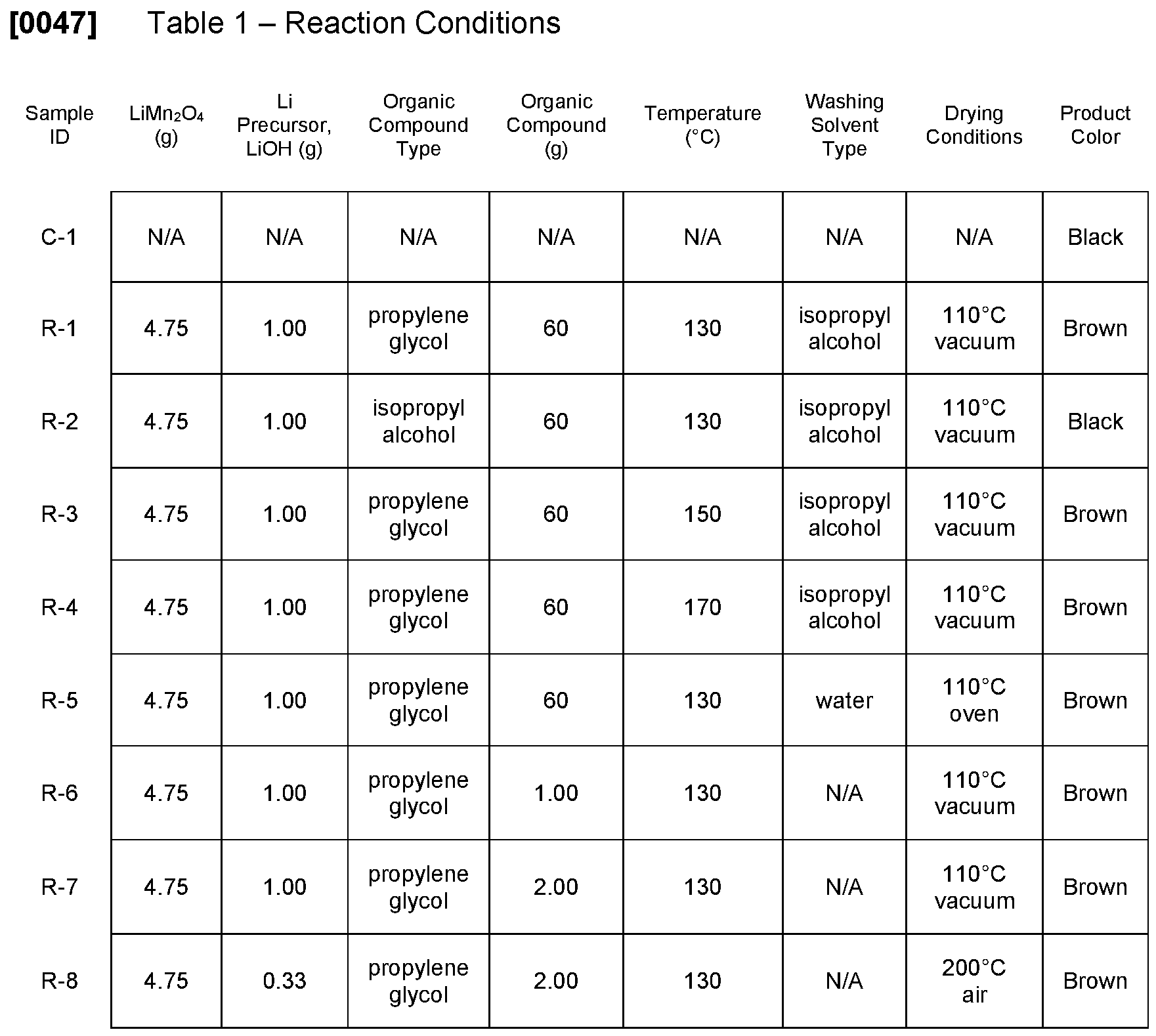
[0042] During operation, it is desirable that the Coulombic or current efficiency and the discharge capacity exhibited by the battery remains relatively constant. The Coulombic efficiency describes the charge efficiency by which electrons are transferred within the battery. The discharge capacity represents the amount of charge that may be extracted from a battery. As used herein, Coulombic Efficiency (CE) is defined as the ratio of the discharge capacity (mAh/g) to the charge capacity (mAh/g). For each electrode, the CE is generally less than 100%, in particular, for the 1st charge/discharge cycle because of irreversible capacity loss that occurs due to the occurrence of side reactions. The 1st cycle CE of an “anode-free” cell using these pre- lithiated cathode active materials may be < 100%, alternatively, < 90%; alternatively, < 80%; alternatively, < 70%; and alternatively, < 60% as controlled by the amount of the lithium incorporated into the active cathode materials via the use of the pre- lithiation reaction. In this present disclosure, a lower 1st cycle CE, corresponds to an increase in the amount of lithium added or deposited within the structure of the active cathode material. [0043] Examples - Synthesis and Test Results for Samples (R-1 to R-8 and C-1 ) [0044] A series of samples were prepared using the hydrothermal process according to the reaction conditions set forth in Table 1. A control sample (C-1 ) that comprised only the starting material, LiM^C was utilized. The difference between samples R-1 and R-2 is the composition of the organic compound used as the reducing agent. Sample R-1 used propylene glycol as the reducing agent, while sample R-2 used isopropyl alcohol. A brownish powder was obtained from the reaction in R-1 , suggesting that the LiM^C was reduced to Lii+xMn2O4 product (0 < x < 1), which was then confirmed by measurement of an x-ray diffraction (XRD) pattern for the sample and by the electrochemical performance achieved. The electrochemical performance exhibited by each sample (R-1 to R-8 and C-1 ) when used as an active cathode material is provided in Table 2.
[0045] The powder obtained as sample R-2 after performing the hydrothermal process remained black in color (see Tables 1 or 2). The color of sample R-2 is the same color as the pristine LiMn2O4 starting material (sample C-1 ), thereby, suggesting that the LiMn2O4 was not reduced by the isopropyl alcohol. Thus, sample R-2 confirms that the organic compound should have at least two hydroxyl groups.
[0046] The x-ray diffraction (XRD) patterns for R-1 and R-2 are compared in Figure 2. No peaks associated with a Lii+xMn2O4 productwere observed forsample R-2, while sample R-1 showed a mixture of tetragonal Lii+xMn2O4 product (0 < x < 1) and spinel LiMn2O4. A pure Lii+xMn2O4 product can be prepared by increasing the lithium precursor (i.e., LiOH) content that is present in the reaction slurry. The first Coulombic Efficiency (1st CE) of sample R-1 was 54%, which was much lower than the 96% exhibited by the pristine LiMn2O4 (see sample C-1), thereby, confirming that sample R-1 was reduced (e.g., lithiated) during the reaction.
Figure imgf000013_0001
[0048] The difference between samples R-1 , R-3, and R-4 is the temperature at which each reaction was conducted. All three of the products produced in these reactions were brownish in color and when used as an active cathode material exhibited a low Coulombic Efficiency at the 1st cycle (1st CE), which is consistent with the expectation for the lithiation of LiMn2O4 to form a Lii+xMn2O4 product (0 < x < 1). A comparison of the x-ray diffraction (XRD) patterns for samples R-1 and R-4 is also shown in Figure 2. Both of these samples were found by the measured XRD pattern to comprise a mixture of a tetragonal Lii+xMn2O4 product (0 < x < 1) and spinel LiMn2O4. [0049] Table 2 - Properties and Test Results
Figure imgf000014_0001
[0050] Sample R-6 confirms that the Lii+xMn2O4 product (0 < x < 1) has relatively good stability in the presence of water or moisture, since water was used to wash the collected powder prior to being dried in an oven. In addition, even after such exposure to water/moisture, sample R-5 still exhibited a specific capacity of 92 mAh/g when used as an active cathode material.
[0051] Samples R-6 and R-7 demonstrate that the amount of the organic compound may be substantially reduced (e.g., to as little as 1 to 2 grams) in comparison to the amount of LiMn2O4 present (e.g., 4.75 grams) in the reaction slurry. When used as an active cathode material, the specific capacity of the sample formed using 1 gram of propylene glycol (see sample R-6) is very low (68 mAh/g). This result is most likely due to inhomogeneous mixing of the LiMn2O4 and LiOH. However, the specific capacity exhibited by the active cathode material formed from the use of 2 grams of propylene glycol (see sample R-7)) was found to be much higher (95 mAh/g). [0052] The molar ratio between the Li precursor (e.g., LiOH or LiOH*H2O) and LiMn2O4 used in the reaction can range from 0.1 to 2, alternatively, from about 0.2 to about 1.2, alternatively, from about 0.3 to about 1.0. Samples R-1 and R-3 to R-7 demonstrate a molar ratio of 1 :1 , while sample R-8 demonstrates a molar ratio of 0.3. Sample R-8 when used as an active cathode material exhibits a low 1st CE of 66% with a specific capacity of 94 mAh/g. Figure 3 provides the x-ray diffraction (XRD) pattern measured for sample R-8 in comparison to sample C-1. The XRD pattern demonstrates that sample R-8 is comprised of both a spinel Li2Mn2O4 phase (see sample C-1) and a tetragonal Lii+xMn2O4 phase.
[0053] Referring now to Figure 4 graphs of the 1st cycle charge/discharge voltage curves measured for samples C-1 (pristine LiMn2O4), sample R-1 (Lii+xMn2O4 prepared using a 1 :1 ratio of Li precursor to LiMn2O4), and sample R-8 (Lii+xMn2O4 prepared using a 0.3:1 ratio) are provided. Figure 4 demonstrates that both samples R-1 and R-8 exhibit much higher charge capacities than their discharge capacities. The difference in the capacity (i.e., charge capacity minus discharge capacity) can be used to provide the lithium for the anode during the 1st cycle.
[0054] According to another aspect of the present disclosure, an energy storage device, such as a rechargeable battery cell, is provided that utilizes the pre-lithiated LiMnO2 prepared according to the process described above as a cathode active material. One example of an energy storage device is a rechargeable lithium cell that includes an “anode-free” design as shown in Figures 5A and 5B. In an anode-free design, the rechargeable lithium cell 50 is made with a positive electrode 55 comprising a current collector 57 and an active material (cathode) 60, i.e., the pre- lithiated LiMn2O4, while the negative electrode 65 side of the cell 50 generally includes only a current collector 67. A main benefit associated with an “anode-fee” cell is that it eliminates or at least significantly reduces the electrode volume and/or mass by not incorporating any pre-deposited anode active layer onto the current collector during the fabrication of the cell.
[0055] Still referring to Figures 5A and 5B, the “anode-free” cell further includes a separator 80 and an electrolyte 75 that supports the reversible flow of lithium ions between the positive electrode 55 and the negative electrode 65. The separator 80 is placed between the positive electrode 55 and negative electrode 65, such that the separator 80 separates the electrodes. The separator 80 is permeable to the reversible flow of lithium ions there through. The flow of ions may be conducted by the separator (i.e. , via a solid-state mechanism) or by the presence of a liquid electrolyte 75 that permeates through the porosity of the separator 80 (e.g., a membrane).
[0056] The current collector 57 in the positive 55 electrode may be made of any metal known in the art for use in an electrode of a lithium battery, such as for example, without limitation, aluminum, titanium, stainless steel, nickel, copper, carbon, zinc, gallium, silver, and combinations or alloys formed therefrom. The current collector 67 used in the negative electrode 65 may be a metallic foil that does not react with lithium ions. Several examples of such metallic foils may include, but not be limited to, Cu, Fe, Ti, Ni, Mo, W, Zr, Mn, carbon, and lithium metal alloys. Alternatively, the metallic foil for the current collector 67 of the negative electrode 65 comprises Cu, Fe, Ni, or a mixture or alloy thereof.
[0057] As used herein a “battery cell” or “cell” refers to the basic electrochemical unit of a battery. In comparison, a “battery” or “battery pack” refers to a collection of cell(s), e.g., one or more cells, and includes a housing, electrical connections, and possibly electronics for control and protection.
[0058] According to yet another aspect of the present disclosure, one or more of the anode-free cells comprising the pre-lithiated active cathode material prepared according to the process of the present disclosure may be combined to form a larger capacity battery or battery pack, such as a lithium-ion secondary battery used in an electric vehicle (EV). The one or more cells may be incorporated in series, in parallel, or in a combination thereof in order to form the battery or battery pack. One skilled in the art will also appreciate that in addition to using the “anode-free” cells in a lithium- ion secondary battery, the same principles may be used to encompass or encase one or more cells into a housing for use in another application.
[0059] The housing may be constructed of any material known for such use in the art and be of any desired geometry required or desired for a specific application. For example, lithium-ion batteries generally are housed in three different main form factors or geometries, namely, cylindrical, prismatic, or soft pouch. The housing for a cylindrical battery may be made of aluminum, steel, or the like. Prismatic batteries generally comprise a housing that is rectangular shaped rather than cylindrical. Soft pouch housings may be made in a variety of shapes and sizes. These soft housings may be comprised of an aluminum foil pouch coated with a plastic on the inside, outside, or both. The soft housing may also be a polymeric-type encasing. The polymer composition used for the housing may be any known polymeric materials that are conventionally used in lithium-ion secondary batteries. One specific example, among many, include the use of a laminate pouch that comprises a polyolefin layer on the inside and a polyamide layer on the outside. A soft housing needs to be designed such that the housing provides mechanical protection for the “anode-free” cells present in the battery.
[0060] Within this specification, embodiments have been described in a way which enables a clear and concise specification to be written, but it is intended and will be appreciated that embodiments may be variously combined or separated without parting from the invention. For example, it will be appreciated that all preferred features described herein are applicable to all aspects of the invention described herein.
[0061 ] Those ski 11 ed-i n-the-art, in light of the present disclosure, will appreciate that many changes can be made in the specific embodiments which are disclosed herein and still obtain alike or similar result without departing from or exceeding the spirit or scope of the disclosure. One skilled in the art will further understand that any properties reported herein represent properties that are routinely measured and can be obtained by multiple different methods. The methods described herein represent one such method and other methods may be utilized without exceeding the scope of the present disclosure.
[0062] The foregoing description of various forms of the invention has been presented for purposes of illustration and description. It is not intended to be exhaustive or to limit the invention to the precise forms disclosed. Numerous modifications or variations are possible in light of the above teachings. The forms discussed were chosen and described to provide the best illustration of the principles of the invention and its practical application to thereby enable one of ordinary skill in the art to utilize the invention in various forms and with various modifications as are suited to the particular use contemplated. All such modifications and variations are within the scope of the invention as determined by the appended claims when interpreted in accordance with the breadth to which they are fairly, legally, and equitably entitled.

Claims

CLAIMS What is claimed is:
1. A process for the preparation of a Lii+xMn2O4 product, wherein 0 < x<1 , the process comprising: a. stirring together LiM^C , a lithium (Li) precursor, and an organic compound to form a slurry, wherein the organic compound has at least two hydroxyl (-OH) groups; b. placing the slurry into a container that is subsequently sealed, such that the sealed container is configured to generate its’ own autogeneous pressure; c. exposing the slurry in the sealed container to a temperature in the range of about 80°C to about 250°C for a period of time that ranges from about 1 hour to about 48 hours to form the Lii+xMn2O4 product; and d. collecting the Lii+xMn2O4 product from the sealed container.
2. The process according to Claim 1 , wherein the lithium precursor is LiOH and/or a hydrate thereof (LiOH*H2O).
3. The process according to Claims 1 or 2, wherein the organic compound comprises one or more vicinal diols or glycols, germinal diols, 1 ,3-diols, triols, phenols, and/or polyols.
4. The process according to any of Claims 1 to 3, wherein the organic compound is a glycol, glycerol, or a combination thereof.
5. The process according to any of Claims 1 to 4, wherein the organic compound is ethylene glycol, propylene glycol, tetraethylene glycol, or a mixture thereof.
6. The process according to any of Claims 1 to 4, wherein the lithium (Li) precursor and the LiMn2O4 used in forming the mixture are present in a molar ratio of Li precursor : LiMn2O4 that is in range of about 0.05 to about 3.00.
7. The process according to any of Claims 1 to 6, wherein the molar ratio of Li precursor : LiM^C is in range of about 0.20 to about 1 .20.
8. The process according to any of Claims 1 to 7, wherein the molar ratio of Li precursor : LiMn2O4 is in range of about 0.30 to 1 .00
9. The process according to any of Claims 1 to 8, wherein the slurry includes an additional solvent, which in combination with the organic compound forms a liquid component in the slurry.
10. The process according to any of Claims 1 to 9, wherein the slurry has a mass ratio of solids I liquids that is greater than 1 150 and less than 100 / 1.
11 . The process according to Claim 10, wherein the slurry has a mass ratio of solids I liquids that is greater than 1 / 10.
12. The process according to any of Claim 11 , wherein the slurry has a mass ratio of solids I liquids that is greater than 1 / 1 .
13. The process according to any of Claims 1 to 12, wherein the slurry has a mass ratio of solids I liquids that is greater than 2 1 1 and less than 50 / 1 .
14. The process according to any of Claims 1 to 13, wherein the LiMn2O4 is doped with at least one additional metal element or non-metal element in an amount that ranges from 0.1 wt.% to 1 .0 wt.% relative to the overall weight of the LiMn2O4.
15. The process according to Claim 14, wherein the at least one additional metal element or non-metal element is selected from the group consisting of aluminum (Al), magnesium (Mg), calcium (Ca), boron (B), nitrogen (N), fluorine (F), nickel (Ni), and cobalt (Co).
16. The process according to any of Claims 1 to 15, wherein the temperature is in the range from 100°C to 250°C.
17. The process according to any of Claims 1 to 16, wherein the temperature is in the range of 1 10°C to 200°C.
18. The process according to any of Claims 1 to 17, wherein the temperature is in the range of 130°C to 170°C.
19. The process according to any of Claims 1 to 18, wherein the Lii+xMn2O4 product is collected by removing the Lii+xMn2O4 product from the sealed container followed by filtering, washing, and drying the Lii+xMn2O4 product.
20. The process according to Claim 19, wherein the Lii+xMn2O4 product is dried at a temperature that ranges from about 110°C to about 250°C.
21 . The process according to Claims 19 or 20, wherein the Lii+xMn2O4 product is dried in air, an inert atmosphere, or under vacuum.
22. An energy storage device having a positive electrode comprising a cathode active material that is at least partially formed of a Lii+xMn2O4 product prepared according to any of Claims 1 to 21 .
23. The energy storage device according to Claim 22, wherein the cathode active material is comprised entirely of the Lii+xMn2O4 product.
24. The energy storage device according to Claim 22, wherein the cathode active material further comprises one or more conventional cathode active materials selected from the group consisting of pristine LiMn2O4, LiFePO4, LiFexMnyPO4 (i .e. , x + y = 1 .0, 0.1 > x < 0.5, and 0.5 > y < 0.9), lithium nickel manganese cobalt oxides (NCM or Li- NCM), LiCoO2, LiNio.5Mn1.5O4, and sulfur.
25. The energy storage device according to Claim 24, wherein cathode active material comprises a mass ratio of the Lii+xMn2O4 to the conventional cathode active material that ranges from about 99:1 to about 1 :99.
PCT/US2023/013467 2022-02-25 2023-02-21 METHOD FOR THE PREPARATION OF PRE-LITHIATED LiMn2O4 Ceased WO2023163921A1 (en)

Priority Applications (2)

Application Number Priority Date Filing Date Title
US18/835,414 US20250140829A1 (en) 2022-02-25 2023-02-21 Method for the preparation of pre-lithiated limn2o4
EP23711308.9A EP4483433A1 (en) 2022-02-25 2023-02-21 METHOD FOR THE PREPARATION OF PRE-LITHIATED LiMn2O4

Applications Claiming Priority (2)

Application Number Priority Date Filing Date Title
US202263313759P 2022-02-25 2022-02-25
US63/313,759 2022-02-25

Publications (2)

Publication Number Publication Date
WO2023163921A1 true WO2023163921A1 (en) 2023-08-31
WO2023163921A8 WO2023163921A8 (en) 2024-04-11

Family

ID=85641174

Family Applications (1)

Application Number Title Priority Date Filing Date
PCT/US2023/013467 Ceased WO2023163921A1 (en) 2022-02-25 2023-02-21 METHOD FOR THE PREPARATION OF PRE-LITHIATED LiMn2O4

Country Status (3)

Country Link
US (1) US20250140829A1 (en)
EP (1) EP4483433A1 (en)
WO (1) WO2023163921A1 (en)

Citations (3)

* Cited by examiner, † Cited by third party
Publication number Priority date Publication date Assignee Title
KR101352836B1 (en) * 2010-10-27 2014-01-20 전남대학교산학협력단 Process for Preparing Lithium Manganese-Based Oxide of Li-excess Content and Lithium Secondary Battery Comprising the Same
JP6330184B2 (en) * 2013-01-22 2018-05-30 国立大学法人茨城大学 Method for producing lithium manganese composite oxide
CN109734133B (en) * 2019-03-19 2021-04-02 浙江中金格派锂电产业股份有限公司 Preparation method of volumetric lithium manganate

Patent Citations (3)

* Cited by examiner, † Cited by third party
Publication number Priority date Publication date Assignee Title
KR101352836B1 (en) * 2010-10-27 2014-01-20 전남대학교산학협력단 Process for Preparing Lithium Manganese-Based Oxide of Li-excess Content and Lithium Secondary Battery Comprising the Same
JP6330184B2 (en) * 2013-01-22 2018-05-30 国立大学法人茨城大学 Method for producing lithium manganese composite oxide
CN109734133B (en) * 2019-03-19 2021-04-02 浙江中金格派锂电产业股份有限公司 Preparation method of volumetric lithium manganate

Also Published As

Publication number Publication date
US20250140829A1 (en) 2025-05-01
EP4483433A1 (en) 2025-01-01
WO2023163921A8 (en) 2024-04-11

Similar Documents

Publication Publication Date Title
JP5206758B2 (en) Negative electrode material, metal secondary battery, and negative electrode material manufacturing method
Zhao et al. High-capacity full lithium-ion cells based on nanoarchitectured ternary manganese–nickel–cobalt carbonate and its lithiated derivative
JP5641650B2 (en) Secondary particle and lithium battery including the same
JP6257066B2 (en) Lithium manganese oxide positive electrode active material for lithium ion secondary battery and lithium ion secondary battery including the same
KR20120010211A (en) Porous silicon-based compound or porous silicon, a method of manufacturing the same, and a negative electrode active material and a lithium secondary battery for a lithium secondary battery comprising the same
Lei et al. Effect of flower-like Ni (OH) 2 precursors on Li+/Ni2+ cation mixing and electrochemical performance of nickel-rich layered cathode
JP7634789B2 (en) Positive electrode active material, method for producing positive electrode active material, positive electrode plate, secondary battery, battery module, battery pack, and power consumption device
WO2013151209A1 (en) Cathode active material for lithium ion capacitor and method for manufacturing same
JPWO2012169331A1 (en) Lithium titanate primary particles, lithium titanate aggregates, lithium ion secondary battery and lithium ion capacitor using them
JP5665896B2 (en) Active material and lithium ion battery
JP7833039B2 (en) Positive electrode material composition, method for manufacturing the same, positive electrode sheet containing the same, secondary battery, and power consumption device
KR102324691B1 (en) Cathode active material method for manufacturing the same, and lithium ion battery including the same
JP2012174535A (en) Electrode active material, and metal secondary battery comprising negative electrode containing the electrode active material
US12206091B2 (en) Lithium molybdate anode material
CN118431459B (en) Secondary battery, power consumption device and positive electrode active material
US20250140829A1 (en) Method for the preparation of pre-lithiated limn2o4
EP4723239A1 (en) Positive electrode active material and preparation method therefor, positive electrode sheet, battery and electric device
JP2024540357A (en) Rechargeable lithium cell having a prelithiated cathode
KR101645406B1 (en) NASICON structred vanadium phosphate as cathode material for Mg rechargeable batteries
US20250210641A1 (en) A molten salt process for the preparation of pre-lithiated lithium manganese-based oxides
CN121460667A (en) Secondary battery, power utilization device, positive electrode active material and preparation method thereof
JP2025166825A (en) Positive electrode active material for lithium secondary battery and positive electrode containing the same
JP2025168327A (en) Method for producing positive electrode active material
WO2024147953A1 (en) Coating for a separator in an electrochemical cell and a method of manufacturing thereof
CN120784462A (en) Secondary battery, manufacturing method and electricity utilization device

Legal Events

Date Code Title Description
121 Ep: the epo has been informed by wipo that ep was designated in this application

Ref document number: 23711308

Country of ref document: EP

Kind code of ref document: A1

WWE Wipo information: entry into national phase

Ref document number: 18835414

Country of ref document: US

WWE Wipo information: entry into national phase

Ref document number: 2023711308

Country of ref document: EP

NENP Non-entry into the national phase

Ref country code: DE

ENP Entry into the national phase

Ref document number: 2023711308

Country of ref document: EP

Effective date: 20240925

WWP Wipo information: published in national office

Ref document number: 18835414

Country of ref document: US