WO2023157297A1 - Steel pipe, component for vehicles, method for producing steel pipe, and method for producing component for vehicles - Google Patents
Steel pipe, component for vehicles, method for producing steel pipe, and method for producing component for vehicles Download PDFInfo
- Publication number
- WO2023157297A1 WO2023157297A1 PCT/JP2022/006953 JP2022006953W WO2023157297A1 WO 2023157297 A1 WO2023157297 A1 WO 2023157297A1 JP 2022006953 W JP2022006953 W JP 2022006953W WO 2023157297 A1 WO2023157297 A1 WO 2023157297A1
- Authority
- WO
- WIPO (PCT)
- Prior art keywords
- content
- steel pipe
- still
- less
- oxide film
- Prior art date
- Legal status (The legal status is an assumption and is not a legal conclusion. Google has not performed a legal analysis and makes no representation as to the accuracy of the status listed.)
- Ceased
Links
Images


Classifications
-
- C—CHEMISTRY; METALLURGY
- C22—METALLURGY; FERROUS OR NON-FERROUS ALLOYS; TREATMENT OF ALLOYS OR NON-FERROUS METALS
- C22C—ALLOYS
- C22C38/00—Ferrous alloys, e.g. steel alloys
- C22C38/04—Ferrous alloys, e.g. steel alloys containing manganese
-
- B—PERFORMING OPERATIONS; TRANSPORTING
- B21—MECHANICAL METAL-WORKING WITHOUT ESSENTIALLY REMOVING MATERIAL; PUNCHING METAL
- B21D—WORKING OR PROCESSING OF SHEET METAL OR METAL TUBES, RODS OR PROFILES WITHOUT ESSENTIALLY REMOVING MATERIAL; PUNCHING METAL
- B21D53/00—Making other particular articles
- B21D53/88—Making other particular articles other parts for vehicles, e.g. cowlings, mudguards
-
- C—CHEMISTRY; METALLURGY
- C21—METALLURGY OF IRON
- C21D—MODIFYING THE PHYSICAL STRUCTURE OF FERROUS METALS; GENERAL DEVICES FOR HEAT TREATMENT OF FERROUS OR NON-FERROUS METALS OR ALLOYS; MAKING METAL MALLEABLE, e.g. BY DECARBURISATION OR TEMPERING
- C21D1/00—General methods or devices for heat treatment, e.g. annealing, hardening, quenching or tempering
- C21D1/18—Hardening; Quenching with or without subsequent tempering
-
- C—CHEMISTRY; METALLURGY
- C21—METALLURGY OF IRON
- C21D—MODIFYING THE PHYSICAL STRUCTURE OF FERROUS METALS; GENERAL DEVICES FOR HEAT TREATMENT OF FERROUS OR NON-FERROUS METALS OR ALLOYS; MAKING METAL MALLEABLE, e.g. BY DECARBURISATION OR TEMPERING
- C21D1/00—General methods or devices for heat treatment, e.g. annealing, hardening, quenching or tempering
- C21D1/18—Hardening; Quenching with or without subsequent tempering
- C21D1/25—Hardening, combined with annealing between 300 degrees Celsius and 600 degrees Celsius, i.e. heat refining ("Vergüten")
-
- C—CHEMISTRY; METALLURGY
- C21—METALLURGY OF IRON
- C21D—MODIFYING THE PHYSICAL STRUCTURE OF FERROUS METALS; GENERAL DEVICES FOR HEAT TREATMENT OF FERROUS OR NON-FERROUS METALS OR ALLOYS; MAKING METAL MALLEABLE, e.g. BY DECARBURISATION OR TEMPERING
- C21D1/00—General methods or devices for heat treatment, e.g. annealing, hardening, quenching or tempering
- C21D1/26—Methods of annealing
-
- C—CHEMISTRY; METALLURGY
- C21—METALLURGY OF IRON
- C21D—MODIFYING THE PHYSICAL STRUCTURE OF FERROUS METALS; GENERAL DEVICES FOR HEAT TREATMENT OF FERROUS OR NON-FERROUS METALS OR ALLOYS; MAKING METAL MALLEABLE, e.g. BY DECARBURISATION OR TEMPERING
- C21D6/00—Heat treatment of ferrous alloys
- C21D6/005—Heat treatment of ferrous alloys containing Mn
-
- C—CHEMISTRY; METALLURGY
- C21—METALLURGY OF IRON
- C21D—MODIFYING THE PHYSICAL STRUCTURE OF FERROUS METALS; GENERAL DEVICES FOR HEAT TREATMENT OF FERROUS OR NON-FERROUS METALS OR ALLOYS; MAKING METAL MALLEABLE, e.g. BY DECARBURISATION OR TEMPERING
- C21D8/00—Modifying the physical properties of ferrous metals or ferrous alloys by deformation combined with, or followed by, heat treatment
- C21D8/10—Modifying the physical properties of ferrous metals or ferrous alloys by deformation combined with, or followed by, heat treatment during manufacturing of tubular bodies
-
- C—CHEMISTRY; METALLURGY
- C21—METALLURGY OF IRON
- C21D—MODIFYING THE PHYSICAL STRUCTURE OF FERROUS METALS; GENERAL DEVICES FOR HEAT TREATMENT OF FERROUS OR NON-FERROUS METALS OR ALLOYS; MAKING METAL MALLEABLE, e.g. BY DECARBURISATION OR TEMPERING
- C21D9/00—Heat treatment, e.g. annealing, hardening, quenching or tempering, adapted for particular articles; Furnaces therefor
- C21D9/08—Heat treatment, e.g. annealing, hardening, quenching or tempering, adapted for particular articles; Furnaces therefor for tubular bodies or pipes
-
- C—CHEMISTRY; METALLURGY
- C21—METALLURGY OF IRON
- C21D—MODIFYING THE PHYSICAL STRUCTURE OF FERROUS METALS; GENERAL DEVICES FOR HEAT TREATMENT OF FERROUS OR NON-FERROUS METALS OR ALLOYS; MAKING METAL MALLEABLE, e.g. BY DECARBURISATION OR TEMPERING
- C21D9/00—Heat treatment, e.g. annealing, hardening, quenching or tempering, adapted for particular articles; Furnaces therefor
- C21D9/08—Heat treatment, e.g. annealing, hardening, quenching or tempering, adapted for particular articles; Furnaces therefor for tubular bodies or pipes
- C21D9/085—Cooling or quenching
-
- C—CHEMISTRY; METALLURGY
- C21—METALLURGY OF IRON
- C21D—MODIFYING THE PHYSICAL STRUCTURE OF FERROUS METALS; GENERAL DEVICES FOR HEAT TREATMENT OF FERROUS OR NON-FERROUS METALS OR ALLOYS; MAKING METAL MALLEABLE, e.g. BY DECARBURISATION OR TEMPERING
- C21D9/00—Heat treatment, e.g. annealing, hardening, quenching or tempering, adapted for particular articles; Furnaces therefor
- C21D9/50—Heat treatment, e.g. annealing, hardening, quenching or tempering, adapted for particular articles; Furnaces therefor for welded joints
-
- C—CHEMISTRY; METALLURGY
- C21—METALLURGY OF IRON
- C21D—MODIFYING THE PHYSICAL STRUCTURE OF FERROUS METALS; GENERAL DEVICES FOR HEAT TREATMENT OF FERROUS OR NON-FERROUS METALS OR ALLOYS; MAKING METAL MALLEABLE, e.g. BY DECARBURISATION OR TEMPERING
- C21D9/00—Heat treatment, e.g. annealing, hardening, quenching or tempering, adapted for particular articles; Furnaces therefor
- C21D9/50—Heat treatment, e.g. annealing, hardening, quenching or tempering, adapted for particular articles; Furnaces therefor for welded joints
- C21D9/505—Cooling thereof
-
- C—CHEMISTRY; METALLURGY
- C22—METALLURGY; FERROUS OR NON-FERROUS ALLOYS; TREATMENT OF ALLOYS OR NON-FERROUS METALS
- C22C—ALLOYS
- C22C38/00—Ferrous alloys, e.g. steel alloys
- C22C38/02—Ferrous alloys, e.g. steel alloys containing silicon
-
- C—CHEMISTRY; METALLURGY
- C23—COATING METALLIC MATERIAL; COATING MATERIAL WITH METALLIC MATERIAL; CHEMICAL SURFACE TREATMENT; DIFFUSION TREATMENT OF METALLIC MATERIAL; COATING BY VACUUM EVAPORATION, BY SPUTTERING, BY ION IMPLANTATION OR BY CHEMICAL VAPOUR DEPOSITION, IN GENERAL; INHIBITING CORROSION OF METALLIC MATERIAL OR INCRUSTATION IN GENERAL
- C23C—COATING METALLIC MATERIAL; COATING MATERIAL WITH METALLIC MATERIAL; SURFACE TREATMENT OF METALLIC MATERIAL BY DIFFUSION INTO THE SURFACE, BY CHEMICAL CONVERSION OR SUBSTITUTION; COATING BY VACUUM EVAPORATION, BY SPUTTERING, BY ION IMPLANTATION OR BY CHEMICAL VAPOUR DEPOSITION, IN GENERAL
- C23C2/00—Hot-dipping or immersion processes for applying the coating material in the molten state without affecting the shape; Apparatus therefor
- C23C2/04—Hot-dipping or immersion processes for applying the coating material in the molten state without affecting the shape; Apparatus therefor characterised by the coating material
- C23C2/12—Aluminium or alloys based thereon
-
- C—CHEMISTRY; METALLURGY
- C23—COATING METALLIC MATERIAL; COATING MATERIAL WITH METALLIC MATERIAL; CHEMICAL SURFACE TREATMENT; DIFFUSION TREATMENT OF METALLIC MATERIAL; COATING BY VACUUM EVAPORATION, BY SPUTTERING, BY ION IMPLANTATION OR BY CHEMICAL VAPOUR DEPOSITION, IN GENERAL; INHIBITING CORROSION OF METALLIC MATERIAL OR INCRUSTATION IN GENERAL
- C23C—COATING METALLIC MATERIAL; COATING MATERIAL WITH METALLIC MATERIAL; SURFACE TREATMENT OF METALLIC MATERIAL BY DIFFUSION INTO THE SURFACE, BY CHEMICAL CONVERSION OR SUBSTITUTION; COATING BY VACUUM EVAPORATION, BY SPUTTERING, BY ION IMPLANTATION OR BY CHEMICAL VAPOUR DEPOSITION, IN GENERAL
- C23C8/00—Solid state diffusion of only non-metal elements into metallic material surfaces; Chemical surface treatment of metallic material by reaction of the surface with a reactive gas, leaving reaction products of surface material in the coating, e.g. conversion coatings, passivation of metals
- C23C8/06—Solid state diffusion of only non-metal elements into metallic material surfaces; Chemical surface treatment of metallic material by reaction of the surface with a reactive gas, leaving reaction products of surface material in the coating, e.g. conversion coatings, passivation of metals using gases
- C23C8/08—Solid state diffusion of only non-metal elements into metallic material surfaces; Chemical surface treatment of metallic material by reaction of the surface with a reactive gas, leaving reaction products of surface material in the coating, e.g. conversion coatings, passivation of metals using gases only one element being applied
- C23C8/10—Oxidising
-
- C—CHEMISTRY; METALLURGY
- C21—METALLURGY OF IRON
- C21D—MODIFYING THE PHYSICAL STRUCTURE OF FERROUS METALS; GENERAL DEVICES FOR HEAT TREATMENT OF FERROUS OR NON-FERROUS METALS OR ALLOYS; MAKING METAL MALLEABLE, e.g. BY DECARBURISATION OR TEMPERING
- C21D2211/00—Microstructure comprising significant phases
- C21D2211/005—Ferrite
-
- C—CHEMISTRY; METALLURGY
- C21—METALLURGY OF IRON
- C21D—MODIFYING THE PHYSICAL STRUCTURE OF FERROUS METALS; GENERAL DEVICES FOR HEAT TREATMENT OF FERROUS OR NON-FERROUS METALS OR ALLOYS; MAKING METAL MALLEABLE, e.g. BY DECARBURISATION OR TEMPERING
- C21D2211/00—Microstructure comprising significant phases
- C21D2211/009—Pearlite
-
- C—CHEMISTRY; METALLURGY
- C21—METALLURGY OF IRON
- C21D—MODIFYING THE PHYSICAL STRUCTURE OF FERROUS METALS; GENERAL DEVICES FOR HEAT TREATMENT OF FERROUS OR NON-FERROUS METALS OR ALLOYS; MAKING METAL MALLEABLE, e.g. BY DECARBURISATION OR TEMPERING
- C21D8/00—Modifying the physical properties of ferrous metals or ferrous alloys by deformation combined with, or followed by, heat treatment
- C21D8/02—Modifying the physical properties of ferrous metals or ferrous alloys by deformation combined with, or followed by, heat treatment during manufacturing of plates or strips
- C21D8/0247—Modifying the physical properties of ferrous metals or ferrous alloys by deformation combined with, or followed by, heat treatment during manufacturing of plates or strips characterised by the heat treatment
- C21D8/0257—Modifying the physical properties of ferrous metals or ferrous alloys by deformation combined with, or followed by, heat treatment during manufacturing of plates or strips characterised by the heat treatment with diffusion of elements, e.g. decarburising, nitriding
-
- C—CHEMISTRY; METALLURGY
- C21—METALLURGY OF IRON
- C21D—MODIFYING THE PHYSICAL STRUCTURE OF FERROUS METALS; GENERAL DEVICES FOR HEAT TREATMENT OF FERROUS OR NON-FERROUS METALS OR ALLOYS; MAKING METAL MALLEABLE, e.g. BY DECARBURISATION OR TEMPERING
- C21D9/00—Heat treatment, e.g. annealing, hardening, quenching or tempering, adapted for particular articles; Furnaces therefor
- C21D9/46—Heat treatment, e.g. annealing, hardening, quenching or tempering, adapted for particular articles; Furnaces therefor for sheet metals
-
- C—CHEMISTRY; METALLURGY
- C22—METALLURGY; FERROUS OR NON-FERROUS ALLOYS; TREATMENT OF ALLOYS OR NON-FERROUS METALS
- C22C—ALLOYS
- C22C38/00—Ferrous alloys, e.g. steel alloys
- C22C38/002—Ferrous alloys, e.g. steel alloys containing In, Mg, or other elements not provided for in one single group C22C38/001 - C22C38/60
-
- C—CHEMISTRY; METALLURGY
- C22—METALLURGY; FERROUS OR NON-FERROUS ALLOYS; TREATMENT OF ALLOYS OR NON-FERROUS METALS
- C22C—ALLOYS
- C22C38/00—Ferrous alloys, e.g. steel alloys
- C22C38/08—Ferrous alloys, e.g. steel alloys containing nickel
-
- C—CHEMISTRY; METALLURGY
- C22—METALLURGY; FERROUS OR NON-FERROUS ALLOYS; TREATMENT OF ALLOYS OR NON-FERROUS METALS
- C22C—ALLOYS
- C22C38/00—Ferrous alloys, e.g. steel alloys
- C22C38/12—Ferrous alloys, e.g. steel alloys containing tungsten, tantalum, molybdenum, vanadium, or niobium
-
- C—CHEMISTRY; METALLURGY
- C22—METALLURGY; FERROUS OR NON-FERROUS ALLOYS; TREATMENT OF ALLOYS OR NON-FERROUS METALS
- C22C—ALLOYS
- C22C38/00—Ferrous alloys, e.g. steel alloys
- C22C38/14—Ferrous alloys, e.g. steel alloys containing titanium or zirconium
-
- C—CHEMISTRY; METALLURGY
- C22—METALLURGY; FERROUS OR NON-FERROUS ALLOYS; TREATMENT OF ALLOYS OR NON-FERROUS METALS
- C22C—ALLOYS
- C22C38/00—Ferrous alloys, e.g. steel alloys
- C22C38/16—Ferrous alloys, e.g. steel alloys containing copper
-
- C—CHEMISTRY; METALLURGY
- C22—METALLURGY; FERROUS OR NON-FERROUS ALLOYS; TREATMENT OF ALLOYS OR NON-FERROUS METALS
- C22C—ALLOYS
- C22C38/00—Ferrous alloys, e.g. steel alloys
- C22C38/18—Ferrous alloys, e.g. steel alloys containing chromium
Definitions
- the present disclosure relates to steel pipes, vehicle parts, and methods of manufacturing steel pipes and vehicle parts.
- Vehicles such as automobiles are equipped with vehicle parts.
- Vehicle parts are, for example, stabilizers, inner tie rods, drive shafts and upper arms. Vehicle components are subjected to repetitive stress due to vibrations that occur during vehicle travel. Therefore, vehicle parts are required to have excellent fatigue strength.
- stabilizers include solid stabilizers made from steel bars and the like, and hollow stabilizers made from steel pipes and the like.
- the use of hollow stabilizers has increased.
- Patent Document 1 International Publication No. 2020/230795
- Patent Document 2 International Publication No. 2013/175821
- the electric resistance welded steel pipe for a hollow stabilizer disclosed in Patent Document 1 has C: 0.20 to 0.40%, Si: 0.1 to 1.0%, and Mn: 0.1 to 2.0% by mass. %, P: 0.1% or less, S: 0.01% or less, Al: 0.01 to 0.10%, Cr: 0.01 to 0.50%, Ti: 0.010 to 0.050% , B: 0.0005 to 0.0050%, Ca: 0.0001 to 0.0050%, N: 0.0050% or less, and Sn: 0.010 to 0.050%, the balance being Fe and unavoidable It has a chemical composition consisting of organic impurities, and the total decarburized layer depth on the inner and outer surfaces is 100 ⁇ m or less.
- Patent Document 1 by containing 0.010% or more of Sn in the electric resistance welded steel pipe for hollow stabilizers, the formation of a decarburized layer is suppressed and the fatigue strength is increased.
- the hollow stabilizer disclosed in Patent Document 2 has, as chemical components, C: 0.26 to 0.30%, Si: 0.05 to 0.35%, and Mn: 0.5 to 1.0% by mass. %, Cr: 0.05 to 1.0%, Ti: 0.005 to 0.05%, B: 0.0005 to 0.005%, Ca: 0.0005 to 0.005%, Al : 0.08% or less, P: 0.05% or less, S: less than 0.0030%, N: 0.006% or less, O: 0.004% or less, the balance being Fe and unavoidable impurities, Mn It has a component composition in which the product of the content and the S content is 0.0025 or less, and the critical cooling rate Vc90 represented by (Equation 1) is 40° C./s or less.
- the metallographic structure of the hollow stabilizer consists of tempered martensite.
- the length of the stretched MnS present in the thickness central portion of the hollow stabilizer is 150 ⁇ m or less.
- the hollow stabilizer has a Rockwell C scale hardness (HRC) of 40 to 50, a wall thickness/outer diameter ratio of 0.14 or more, and a decarburized layer depth of 20 ⁇ m or less from the inner surface.
- HRC Rockwell C scale hardness
- the fatigue strength of the hollow stabilizer is improved by suppressing the formation of stretched MnS and controlling the Rockwell C scale hardness, the wall thickness/outer diameter ratio, and the depth of the decarburized layer on the inner surface. increasing.
- Patent Documents 1 and 2 can increase the fatigue strength of vehicle parts.
- a vehicle component having excellent fatigue strength may be obtained by means different from those disclosed in Patent Documents 1 and 2.
- An object of the present disclosure is to provide a vehicle part with excellent fatigue strength, a steel pipe from which the vehicle part with excellent fatigue strength can be manufactured, and a method of manufacturing the steel pipe and the vehicle part.
- the steel pipe of the present disclosure has the following configuration.
- the vehicle component of the present disclosure has the following configuration.
- the steel pipe manufacturing method of the present disclosure has the following steps.
- the manufacturing method of the vehicle component of the present disclosure has the following steps.
- a method for manufacturing a vehicle part comprising: a step of preparing the steel pipe as described above; a step of bending the steel pipe; a step of holding the bent steel pipe at a temperature of Ac 3 +50° C. or higher and 1150° C. or lower for 10 seconds or longer and then quenching; a step of holding and tempering the steel pipe after the quenching at 150 to 350° C. for 10 minutes or longer; A method for manufacturing vehicle parts.
- the vehicle component of the present disclosure has excellent fatigue strength.
- the steel pipe of the present disclosure can be used to manufacture vehicle parts with excellent fatigue strength.
- the vehicle component manufacturing method of the present disclosure can manufacture a vehicle component having excellent fatigue strength.
- the method for manufacturing a steel pipe according to the present disclosure can manufacture a steel pipe from which vehicle parts having excellent fatigue strength can be manufactured.
- FIG. 1 is a perspective view of the end of the steel pipe of this embodiment.
- FIG. 2 is a perspective view of an end portion of the vehicle component of this embodiment.
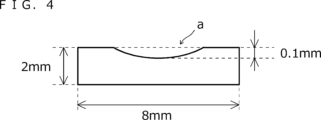
- FIG. 3 is a front view of a torsional fatigue test piece.
- FIG. 4 is a longitudinal side view of the torsional fatigue test piece.
- the inventors have studied vehicle parts with excellent fatigue strength, and steel pipes from which vehicle parts with excellent fatigue strength can be manufactured. As a result, the following findings were obtained.
- hollow vehicle parts are manufactured by cold bending a steel pipe and then quenching and tempering it.
- Patent Document 1 "In particular, surface decarburization is considered to be an important factor among surface properties. If surface decarburization occurs during the heating stage of quenching, it is possible to improve the surface hardness even if quenching is performed. As a result, sufficient fatigue properties cannot be obtained” (paragraph [0005] of Patent Document 1).
- Patent Literature 2 states, “Fatigue fracture may occur from the inner surface of the hollow stabilizer, which does not exist in the solid stabilizer. This is because even if the fatigue strength of the outer surface is improved by increasing the strength of the steel pipe, This is because the decarburized layer becomes the starting point of fatigue fracture" (paragraph [0005] of Patent Document 2). It is known that the formation of a decarburized layer in this way lowers the fatigue strength of a vehicle component including a hollow stabilizer.
- Patent Document 1 "The surface decarburization reaction when steel is heated progresses by outward diffusion of carbon atoms in the steel toward the surface and reaction with oxygen. This outward diffusion of carbon It is effective to increase the lattice constant of iron to suppress the "(paragraph [0017] of Patent Document 1). Therefore, in Patent Document 1, 0.010% or more of Sn, which is effective for increasing the lattice constant of iron, is contained to suppress the formation of a decarburized layer.
- Patent Document 2 states that "a decarburized layer is likely to be formed on the inner surface of the hollow stabilizer steel pipe when it is cooled from a high temperature at which the metal structure becomes an austenitic single phase and passes through a two-phase temperature range.” (Paragraph [0053] of Patent Document 2). Patent Document 2 describes that the formation of a decarburized layer can be suppressed by increasing the cooling rate when passing through the two-phase temperature (paragraph [0054] of Patent Document 2).
- the inventors have studied means for suppressing the formation of decarburized layers other than the means disclosed in Patent Documents 1 and 2.
- the decarburized layer is formed by quenching during manufacturing of vehicle parts. During heating and/or cooling for quenching, carbon in the steel out-diffuses to the surface and reacts with oxygen. This forms a decarburized layer.
- the present inventors paid attention to the behavior of oxygen during quenching. The present inventors thought that formation of a decarburized layer could be suppressed by suppressing contact between the surface of a steel pipe for manufacturing vehicle parts and oxygen during quenching.
- the present inventors paid attention to the oxide film before quenching.
- An oxide film that suppresses contact between the steel pipe surface and oxygen is formed before quenching. It is believed that this suppresses contact between the surface of the steel pipe and oxygen during quenching, thereby suppressing the formation of a decarburized layer.
- the X-ray diffraction peak intensity ratio is 70% or more.
- Fe 3 O 4 , 20% or more Fe 2 O 3 , 10% or less FeO, and the balance consisting of impurities, the thickness is 0.80 to 2.50 ⁇ m, and the standard deviation of the thickness is 0.90 ⁇ m or less It has been found that the formation of an oxide film extends the rupture life of steel pipes after quenching.
- Heating during quenching thermally expands steel pipes for manufacturing vehicle parts. If the difference between the coefficient of linear expansion of the steel pipe and the coefficient of linear expansion of the oxide film on the surface of the steel pipe is small, the difference between the amount of change in the surface area of the steel pipe due to heating during quenching and the amount of change in the volume of the oxide film is small. In this case, the oxide film is less likely to separate from the steel pipe surface, and the oxide film tends to remain on the steel pipe surface until just before quenching. In this case, contact between the steel pipe surface and oxygen is suppressed. It is conceivable that the coefficient of linear expansion of the oxide film having the composition described above is close to the coefficient of linear expansion of the steel pipe.
- the oxide film remaining on the steel pipe surface until just before quenching suppresses the contact between the steel pipe surface and oxygen and suppresses the formation of a decarburized layer, increasing the fatigue strength of the steel pipe and extending the rupture life. be done.
- the oxide film in order to obtain the effect of suppressing contact between the steel pipe surface and oxygen, the oxide film must have a certain thickness or more. On the other hand, if the oxide film is too thick, the oxide film tends to peel off. Therefore, it is necessary to control the thickness of the oxide film within a certain range.
- the contact between the steel pipe surface and oxygen cannot be suppressed in the part where the oxide film is thin.
- intergranular oxidation occurs locally on the surface of the steel pipe.
- a dent occurs locally.
- the fatigue strength of the vehicle component decreases due to the concentration of stress on the recess. Therefore, it is considered that local intergranular oxidation of the steel pipe surface can be suppressed by reducing the deviation of the thickness of the oxide film.
- the inventors have found the following matter.
- a vehicle part is manufactured by quenching the steel pipe provided with the oxide film described above, when the sum of the X-ray diffraction peak intensities of Fe 3 O 4 , FeO, and Fe 2 O 3 is taken as 100%, the X-ray Formation of an oxide film having a diffraction peak intensity ratio of 80% or more , FeO of 15% or less, Fe 2 O 3 of 5 % or less, and the balance being impurities, and having a thickness of 3.50 ⁇ m or less. It turns out that it will be.
- This vehicle component has a long rupture life and excellent fatigue strength.
- the steel pipe, steel pipe manufacturing method, vehicle component, and vehicle component manufacturing method of the present embodiment completed based on the above findings have the following configurations.
- the vehicle component according to [3], The chemical composition, in mass %, Sol. Al: 0.001 to 0.080%, Cr: 0.01 to 1.50%, Mo: 0.01 to 1.00%, Ni: 0.01 to 1.00%, Cu: 0.01 to 1.00%, Ti: 0.001 to 0.100%, Nb: 0.001 to 0.100%, V: 0.001 to 0.100%, B: 0.0001 to 0.0050%, and Ca: 0.0001 to 0.0050%, containing one or more elements selected from the group consisting of vehicle parts.
- a method for manufacturing a vehicle part comprising: A step of preparing the steel pipe according to [1] or [2]; a step of bending the steel pipe; a step of holding the bent steel pipe at a temperature of Ac 3 +50° C. or higher and 1150° C. or lower for 10 seconds or longer and then quenching; a step of holding and tempering the steel pipe after the quenching at 150 to 350° C. for 10 minutes or longer; A method for manufacturing vehicle parts.
- FIG. 1 is a perspective view of the end of the steel pipe of this embodiment.
- steel pipe 1 includes base material 2 and oxide film 3 on base material 2 .
- Steel pipe 1 includes an outer surface 4 and an inner surface 5 .
- the oxide film 3 may be formed only on the outer surface 4 of the steel pipe 1, may be formed only on the inner surface 5, or may be formed on both the outer surface 4 and the inner surface 5.
- a decarburized layer on the outer surface of the vehicle component can be removed by shot peening, for example. On the other hand, the decarburized layer on the inner surface of the vehicle component may be difficult to remove.
- Steel pipe 1 is therefore preferably provided with an oxide layer 3 on at least the inner surface 5 .
- the steel pipe 1 may be a seamless steel pipe or an electric resistance welded steel pipe.
- the steel pipe 1 is an electric resistance welded steel pipe.
- the outer diameter of steel pipe 1 is not particularly limited, but is, for example, 10 to 100 mm.
- the thickness of steel pipe 1 is not particularly limited, but is, for example, 2 to 10 mm.
- the steel pipe 1 of this embodiment has the following features.
- the content of each element in the chemical composition of the base material 2 is within the range shown in this specification.
- the microstructure of the base material 2 consists of 20% to 60% ferrite and 40% to 80% pearlite in area ratio.
- the X-ray diffraction peak intensity ratio is 70% or more.
- An oxide film 3 composed of Fe 3 O 4 , 20% or more Fe 2 O 3 , 10% or less FeO, and the balance of impurities is disposed.
- the oxide film 3 has a thickness of 0.80 to 2.50 ⁇ m.
- the standard deviation of the thickness of the oxide film 3 is 0.90 ⁇ m or less.
- C 0.23-0.50% Carbon (C) enhances the hardenability of steel. C further dissolves in steel. Thereby, C increases the strength of steel. If the C content is less than 0.23%, the above effect cannot be sufficiently obtained even if the content of other elements is within the range of the present embodiment. On the other hand, if the C content exceeds 0.50%, the hot workability of the steel deteriorates even if the content of other elements is within the range of the present embodiment. If the C content exceeds 0.50%, the toughness of the vehicle component after quenching decreases even if the content of other elements is within the range of the present embodiment. Therefore, the C content is 0.23-0.50%.
- the lower limit of the C content is preferably 0.25%, more preferably 0.27%, still more preferably 0.30%, still more preferably 0.33%, still more preferably 0.33%. It is 35%, more preferably 0.38%, and still more preferably 0.40%.
- the upper limit of the C content is preferably 0.48%, more preferably 0.46%, still more preferably 0.44%, still more preferably 0.42%, still more preferably 0.42%. 40%, more preferably 0.38%.
- Si 0.01-0.50% Silicon (Si) deoxidizes steel. Si also forms a solid solution in steel to increase the strength of the steel. If the Si content is less than 0.01%, the above effect cannot be sufficiently obtained even if the content of other elements is within the range of the present embodiment. On the other hand, if the Si content exceeds 0.50%, the ductility and toughness of the steel pipe 1 are lowered even if the content of other elements is within the range of the present embodiment. Therefore, the Si content is 0.01-0.50%.
- the lower limit of the Si content is preferably 0.05%, more preferably 0.10%, still more preferably 0.15%, still more preferably 0.20%, still more preferably 0 .25%.
- the upper limit of the Si content is preferably 0.45%, more preferably 0.40%, still more preferably 0.35%, still more preferably 0.30%.
- Mn 0.50-2.50%
- Manganese (Mn) increases the hardenability of steel. Mn further dissolves in steel. Thereby, Mn increases the strength of steel. If the Mn content is less than 0.50%, the above effect cannot be sufficiently obtained even if the content of other elements is within the range of the present embodiment. On the other hand, if the Mn content exceeds 2.50%, the toughness and ductility of the vehicle component after quenching are lowered even if the content of other elements is within the range of the present embodiment. Therefore, the Mn content is 0.50-2.50%.
- the lower limit of the Mn content is preferably 0.60%, more preferably 0.70%, still more preferably 0.75%, still more preferably 0.80%, still more preferably 0.80%.
- the upper limit of the Mn content is preferably 2.40%, more preferably 2.30%, still more preferably 2.20%, still more preferably 2.10%, still more preferably 2.10%. 00%, more preferably 1.90%, more preferably 1.80%, still more preferably 1.70%, still more preferably 1.60%, still more preferably 1.0%. 50%.
- P 0.050% or less Phosphorus (P) is an impurity. Therefore, the P content is over 0%. If the P content exceeds 0.050%, P segregates at the grain boundaries and reduces the ductility of the steel even if the content of other elements is within the range of the present embodiment. Therefore, the P content is 0.050% or less. The lower the P content, the better. However, drastic reduction of the P content greatly increases manufacturing costs. Therefore, when considering industrial production, the lower limit of the P content is preferably 0.001%, more preferably 0.002%, still more preferably 0.003%, still more preferably 0.005 %. The upper limit of the P content is preferably 0.040%, more preferably 0.030%, still more preferably 0.020%, still more preferably 0.010%.
- S 0.0100% or less Sulfur (S) is an impurity. Therefore, the S content is over 0%. If the S content exceeds 0.0100%, the hot workability, toughness and fatigue strength of the steel are lowered even if the contents of other elements are within the range of the present embodiment. Therefore, the S content is 0.0100% or less. The lower the S content, the better. However, drastic reduction of the S content greatly increases manufacturing costs. Therefore, when considering industrial production, the lower limit of the S content is preferably 0.0001%, more preferably 0.0002%, still more preferably 0.0003%, still more preferably 0.0005 %. The upper limit of the S content is preferably 0.0080%, more preferably 0.0070%, still more preferably 0.0060%, still more preferably 0.0050%, still more preferably 0.0050%. 0040%.
- N 0.0100% or less Nitrogen (N) is an impurity. Therefore, the N content is over 0%. If the N content exceeds 0.0100%, the toughness of the steel is lowered even if the content of other elements is within the range of the present embodiment. Therefore, the N content is 0.0100% or less.
- N forms nitrides and/or carbonitrides to increase the strength of steel.
- the preferred lower limit of the N content is 0.0001%, more preferably 0.0002%, still more preferably 0.0003%, still more preferably 0.0005%, still more preferably 0.0010 %, more preferably 0.0020%, more preferably 0.0030%.
- the upper limit of the N content is preferably 0.0080%, more preferably 0.0070%, still more preferably 0.0060%, still more preferably 0.0050%, still more preferably 0.0050%. 0040%.
- Oxygen (O) is an impurity. Therefore, the O content is over 0%. If the O content exceeds 0.0100%, the toughness of the steel is lowered even if the content of other elements is within the range of the present embodiment. Therefore, the O content is 0.0100% or less. The lower the O content, the better. However, drastic reduction of O content greatly increases manufacturing cost. Therefore, when considering industrial production, the preferred lower limit of the O content is 0.0001%, more preferably 0.0002%, still more preferably 0.0003%, still more preferably 0.0005% is. The upper limit of the O content is preferably 0.0080%, more preferably 0.0070%, still more preferably 0.0060%, still more preferably 0.0050%, still more preferably 0.0050%. 0040%, more preferably 0.0030%.
- the rest of the chemical composition of the steel pipe 1 of this embodiment consists of Fe and impurities.
- the impurities in the chemical composition are those that are mixed from ore, scrap, or the manufacturing environment as raw materials when the steel pipe 1 is industrially manufactured, and have an adverse effect on the steel pipe 1 of the present embodiment. It means what is permissible within the range not given.
- the chemical composition of the base material 2 of the steel pipe 1 according to this embodiment may further contain Al instead of part of Fe.
- Al is an optional element and may not be contained. That is, the Al content may be 0%.
- Al deoxidizes the steel.
- Al further combines with nitrogen (N) to produce AlN.
- AlN suppresses coarsening of crystal grains during quenching. If even a small amount of Al is contained, the above effect can be obtained to some extent.
- Al content exceeds 0.080%, even if the content of other elements is within the range of the present embodiment, Al combines with oxygen (O) to excessively generate inclusions. This reduces the fatigue strength of the vehicle component. Therefore, the Al content is 0-0.080%.
- the lower limit of the Al content is preferably more than 0%, more preferably 0.001%, still more preferably 0.005%, still more preferably 0.010%, still more preferably 0.015 %.
- the upper limit of the Al content is preferably 0.070%, more preferably 0.060%, still more preferably 0.050%, still more preferably 0.040%, still more preferably 0.040%. 030%.
- the chemical composition of the base material 2 of the steel pipe 1 according to this embodiment may further contain one or more elements selected from the group consisting of Cr, Mo, Ni and Cu instead of part of Fe. All of these elements are optional elements and may not be contained. All of these elements increase the strength of the steel pipe 1 when included.
- Chromium (Cr) is an optional element and may not be contained. That is, the Cr content may be 0%. When Cr is contained, that is, when the Cr content is over 0%, Cr increases the strength of the steel pipe 1 . If even a little Cr is contained, the above effect can be obtained to some extent. On the other hand, if the Cr content exceeds 1.50%, the ductility of the steel pipe 1 is lowered even if the contents of other elements are within the range of the present embodiment. Therefore, the Cr content is 0-1.50%.
- the lower limit of the Cr content is preferably 0.01%, more preferably 0.05%, still more preferably 0.10%, still more preferably 0.20%, still more preferably 0.20%. 30%.
- the upper limit of the Cr content is preferably 1.20%, more preferably 1.00%, still more preferably 0.80%, still more preferably 0.60%, still more preferably 0.60%. 40%.
- Mo Molybdenum
- Mo is an optional element and may not be contained. That is, the Mo content may be 0%.
- Mo When Mo is contained, that is, when the Mo content exceeds 0%, Mo enhances the strength of the steel pipe 1 . If even a little Mo is contained, the above effect can be obtained to some extent.
- the Mo content exceeds 1.00%, the ductility of the steel pipe 1 is lowered even if the content of other elements is within the range of the present embodiment. Therefore, the Mo content is 0-1.00%.
- the lower limit of the Mo content is preferably 0.01%, more preferably 0.02%, still more preferably 0.03%, still more preferably 0.04%, still more preferably 0.04%. 05%.
- the upper limit of the Mo content is preferably 0.80%, more preferably 0.60%, still more preferably 0.40%, still more preferably 0.20%, still more preferably 0.20%. 10%.
- Nickel (Ni) is an optional element and may not be contained. That is, the Ni content may be 0%. When Ni is contained, that is, when the Ni content exceeds 0%, Ni enhances the strength of the steel pipe 1 . If Ni is contained even in a small amount, the above effect can be obtained to some extent. On the other hand, if the Ni content exceeds 1.00%, the ductility of the steel pipe 1 is lowered even if the content of other elements is within the range of the present embodiment. Therefore, the Ni content is 0-1.00%.
- the lower limit of the Ni content is preferably 0.01%, more preferably 0.02%, still more preferably 0.05%, still more preferably 0.10%, still more preferably 0.05%. 15%.
- the upper limit of the Ni content is preferably 0.80%, more preferably 0.60%, still more preferably 0.40%, still more preferably 0.20%.
- Cu Copper (Cu) is an optional element and may not be contained. That is, the Cu content may be 0%. When Cu is contained, that is, when the Cu content is over 0%, Cu increases the strength of the steel pipe 1 . If even a small amount of Cu is contained, the above effects can be obtained to some extent. On the other hand, if the Cu content exceeds 1.00%, the ductility of the steel pipe 1 is lowered even if the content of other elements is within the range of the present embodiment. Therefore, the Cu content is 0-1.00%.
- the lower limit of the Cu content is preferably 0.01%, more preferably 0.02%, still more preferably 0.03%, still more preferably 0.04%, still more preferably 0.04%. 05%.
- the upper limit of the Cu content is preferably 0.80%, more preferably 0.60%, still more preferably 0.40%, still more preferably 0.20%.
- the chemical composition of the base material 2 of the steel pipe 1 according to the present embodiment may further contain one or more elements selected from the group consisting of Ti, Nb and V instead of part of Fe. All of these elements are optional elements and may not be contained. When contained, all of these elements enhance the strength and workability of the steel pipe 1 .
- Titanium (Ti) is an optional element and may not be contained. That is, the Ti content may be 0%. When Ti is contained, ie when the Ti content is greater than 0%, Ti forms carbides, nitrides and/or carbonitrides. This enhances the strength and workability of the steel pipe 1 . If even a small amount of Ti is contained, the above effect can be obtained to some extent. On the other hand, if the Ti content exceeds 0.100%, the ductility of the steel pipe 1 is lowered even if the content of other elements is within the range of the present embodiment. Therefore, the Ti content is 0-0.100%.
- the lower limit of the Ti content is preferably 0.001%, more preferably 0.005%, still more preferably 0.010%, still more preferably 0.020%, still more preferably 0.020%. 030%.
- the upper limit of the Ti content is preferably 0.090%, more preferably 0.080%, still more preferably 0.070%, still more preferably 0.060%.
- Niobium (Nb) is an optional element and may not be contained. That is, the Nb content may be 0%. If Nb is included, ie if the Nb content is greater than 0%, Nb forms carbides, nitrides and/or carbonitrides. This enhances the strength and workability of the steel pipe 1 . If even a small amount of Nb is contained, the above effect can be obtained to some extent. On the other hand, if the Nb content exceeds 0.100%, the ductility of the steel pipe 1 is lowered even if the content of other elements is within the range of the present embodiment. Therefore, the Nb content is 0-0.100%.
- the lower limit of the Nb content is preferably 0.001%, more preferably 0.002%, still more preferably 0.005%, still more preferably 0.010%, still more preferably 0.01%. 015%.
- the upper limit of the Nb content is preferably 0.090%, more preferably 0.070%, still more preferably 0.050%, still more preferably 0.030%, still more preferably 0.030%. 020%.
- V 0-0.100%
- Vanadium (V) is an optional element and may not be contained. That is, the V content may be 0%. When V is included, ie when the V content is greater than 0%, V forms carbides, nitrides and/or carbonitrides. This enhances the strength and workability of the steel pipe 1 . If even a small amount of V is contained, the above effect can be obtained to some extent. On the other hand, if the V content exceeds 0.100%, the ductility of the steel pipe 1 is lowered even if the content of other elements is within the range of the present embodiment. Therefore, the V content is 0-0.100%.
- the lower limit of the V content is preferably 0.001%, more preferably 0.005%, still more preferably 0.010%, still more preferably 0.015%, still more preferably 0.01%. 020%.
- the upper limit of the V content is preferably 0.090%, more preferably 0.080%, still more preferably 0.070%, still more preferably 0.060%, still more preferably 0.060%. 050%, more preferably 0.040%.
- the chemical composition of the base material 2 of the steel pipe 1 according to this embodiment may further contain B instead of part of Fe.
- B 0 to 0.0050% Boron (B) is an optional element and may not be contained. That is, the B content may be 0%. When B is contained, that is, when the B content is over 0%, B enhances the hardenability of the steel. If even a small amount of B is contained, the above effect can be obtained to some extent. On the other hand, if the B content exceeds 0.0050%, the steel pipe 1 is likely to become embrittled even if the contents of other elements are within the ranges of the present embodiment. Therefore, the B content is 0-0.0050%.
- the lower limit of the B content is preferably 0.0001%, more preferably 0.0002%, still more preferably 0.0003%, still more preferably 0.0005%, still more preferably 0.0005%. 0010%.
- the upper limit of the B content is preferably 0.0040%, more preferably 0.0030%, still more preferably 0.0020%.
- the chemical composition of the base material 2 of the steel pipe 1 according to this embodiment may further contain Ca instead of part of Fe.
- Ca 0-0.0050% Calcium (Ca) is an optional element and may not be contained. That is, the Ca content may be 0%. When Ca is contained, that is, when the Ca content is over 0%, Ca enhances the hot workability of the steel. If even a little Ca is contained, the above effect can be obtained to some extent. On the other hand, if the Ca content exceeds 0.0050%, the toughness of the steel pipe 1 is lowered even if the contents of other elements are within the range of the present embodiment. Therefore, the Ca content is 0-0.0050%.
- the lower limit of the Ca content is preferably 0.0001%, more preferably 0.0002%, still more preferably 0.0003%, still more preferably 0.0005%, still more preferably 0.0005%. 0010%, more preferably 0.0015%.
- the upper limit of the Ca content is preferably 0.0040%, more preferably 0.0030%, still more preferably 0.0025%.
- the chemical composition of the base material 2 of the steel pipe 1 of this embodiment can be measured by a known component analysis method.
- a steel pipe 1 is cut into lengths of 10 cm in the axial direction of the steel pipe 1 .
- the oxide film 3 on the outer surface 4 and the inner surface 5 of the cut steel pipe 1 is removed by cutting.
- the steel pipe 1 from which the oxide film 3 has been removed is finely pulverized and dissolved in acid to obtain a solution.
- ICP-AES Inductively Coupled Plasma Atomic Emission Spectrometry
- the C content and S content are obtained by a well-known high-frequency combustion method (combustion-infrared absorption method).
- the N content is determined using the well-known inert gas fusion-thermal conductivity method.
- each element content based on the significant digits defined in this embodiment, rounded off the measured numerical value, the numerical value up to the minimum digit of each element content defined in this embodiment do.
- the C content of the steel pipe 1 of the present embodiment is specified by a numerical value up to the second decimal place. Therefore, the C content is a numerical value to the second decimal place obtained by rounding the measured numerical value to the third decimal place.
- the contents of elements other than the C content of the steel pipe 1 of the present embodiment are obtained by rounding the measured values to the minimum digit specified in the present embodiment.
- the value is taken as the elemental content. Rounding means rounding down if the fraction is less than 5, and rounding up if the fraction is 5 or more.
- the base material 2 of the steel pipe 1 of this embodiment has a microstructure composed of 20% to 60% ferrite and 40% to 80% pearlite in area ratio.
- a vehicle component can be manufactured by quenching and tempering the steel pipe 1 after cold bending. Therefore, the steel pipe 1 is required to have excellent workability.
- the base material 2 has a microstructure consisting of 20% to 60% ferrite and 40% to 80% pearlite in area ratio, the steel pipe 1 has excellent workability.
- the lower limit of the area ratio of ferrite is preferably 25%, more preferably 30%, still more preferably 35%, still more preferably 40%.
- the upper limit of the ferrite area ratio is preferably 55%, more preferably 50%, and still more preferably 45%.
- the lower limit of the area ratio of pearlite is preferably 45%, more preferably 50%, and still more preferably 55%.
- the upper limit of the area ratio of pearlite is preferably 75%, more preferably 70%, still more preferably 65%, still more preferably 60%.
- the area ratios of ferrite and pearlite in the base material 2 of the steel pipe 1 are obtained by the following method. Three arbitrary points of the steel pipe 1 are cut to a length of 10 cm in the axial direction of the steel pipe 1 .
- the oxide film 3 on the outer surface 4 and the inner surface 5 of the cut steel pipe 1 is removed by cutting.
- the outer surface 4 or the inner surface 5 of the steel pipe 1 from which the oxide film 3 has been removed is defined as an observation surface.
- the observation surface of the steel pipe 1 is mirror-polished. Etching is performed on the mirror-polished observation surface using 3% nitric acid alcohol (nital etchant). Among the etched observation surfaces, an observation field (200 ⁇ m ⁇ 200 ⁇ m) at a depth of 0.5 mm from the outer surface 4 or inner surface 5 of the steel pipe 1 is observed with a 500-fold optical microscope.
- pearlite and ferrite can be easily distinguished by contrast. Ferrite is observed as white areas. Pearlite is observed as a phase with a lamellar structure that is less bright than ferrite. Based on the area of ferrite in the observation field of view and the total area of the observation field of view, the area ratio (%) of ferrite is obtained. Based on the pearlite area in the observation field of view and the total area of the observation field of view, the pearlite area ratio (%) is determined. Let the arithmetic average value of three places of a steel pipe be the area ratio of a ferrite, and the area ratio of a pearlite.
- a steel pipe 1 of this embodiment has an oxide film 3 on a base material 2 .
- the oxide film 3 has an X-ray diffraction peak intensity ratio of 70% or more when the sum of the X-ray diffraction peak intensities of Fe 3 O 4 , Fe 2 O 3 and FeO is 100%. 20% or more of Fe 2 O 3 , 10% or less of FeO, and the balance consists of impurities.
- An oxide film 3 having the composition described above is formed on a steel pipe 1 before quenching. This increases the fatigue strength of the vehicle component.
- the lower limit of the peak intensity ratio of Fe 3 O 4 is preferably 72%, more preferably 74%, still more preferably 75%.
- the upper limit of the peak intensity ratio of Fe 3 O 4 is not particularly limited, it is, for example, 80%.
- the upper limit of the peak intensity ratio of Fe 3 O 4 is preferably 78%, more preferably 76%, still more preferably 75%.
- the lower limit of the peak intensity ratio of Fe 2 O 3 is preferably 21%, more preferably 22%, still more preferably 23%, still more preferably 25%.
- the upper limit of the peak intensity ratio of Fe 2 O 3 is not particularly limited, it is, for example, 30%.
- the upper limit of the peak intensity ratio of Fe 2 O 3 is preferably 29%, more preferably 28%, still more preferably 27%.
- the lower limit of the FeO peak intensity ratio is not particularly limited, and may be 0%.
- the upper limit of the peak intensity ratio of FeO is preferably 8%, more preferably 6%, still more preferably 4%, still more preferably 2%.
- composition of the oxide film 3 of the steel pipe 1 is obtained by the following method.
- X-ray diffraction measurement is performed on the surface of oxide film 3 to obtain an X-ray diffraction profile. Measurement is performed at three arbitrary points on the surface of oxide film 3 .
- the measurement conditions for the X-ray diffraction measurement are as follows.
- X-ray tube Cu-K ⁇ ray (assumed to be Cu-K ⁇ 1 ray by using a monochromator)
- X-ray output 45kV, 200mA
- Measurement range: 2 ⁇ 10 to 120°
- Scan method Continuous scan speed: 2.0°/min
- the X-ray diffraction peak intensities of Fe 3 O 4 , Fe 2 O 3 and FeO are obtained.
- the sum of the X-ray diffraction peak intensities of Fe 3 O 4 , Fe 2 O 3 and FeO is taken as 100%.
- the peak intensity ratio of Fe 3 O 4 , Fe 2 O 3 and FeO is determined from the sum of the peak intensities and the X-ray diffraction peak intensities of Fe 3 O 4 , Fe 2 O 3 and FeO.
- the thickness of the oxide film 3 is less than 0.80 ⁇ m, the effect of suppressing contact between the surfaces 4 and 5 of the steel pipe 1 and oxygen cannot be obtained. On the other hand, if the thickness of the oxide film 3 exceeds 2.50 ⁇ m, the adhesion of the oxide film 3 is lowered, and the oxide film 3 is peeled off from the surfaces 4 and 5 of the steel pipe 1 . Therefore, the thickness of oxide film 3 is preferably 0.80 to 2.50 ⁇ m.
- the lower limit of the thickness of oxide film 3 is more preferably 0.84 ⁇ m, more preferably 0.88 ⁇ m, still more preferably 1.00 ⁇ m, still more preferably 1.20 ⁇ m.
- the upper limit of the thickness of the oxide film 3 is more preferably 2.40 ⁇ m, more preferably 2.30 ⁇ m, still more preferably 2.20 ⁇ m, still more preferably 2.00 ⁇ m, still more preferably 1.0 ⁇ m. 80 ⁇ m.
- the thickness of the oxide film 3 of the steel pipe 1 is obtained by the following method.
- a steel pipe 1 is cut perpendicular to the axial direction.
- Scanning electron microscopy (SEM)-energy dispersive X-ray spectroscopy (EDS) analysis is performed on the cut surface.
- the oxide film 3 is identified from the contrast and the Fe and O concentrations.
- the shortest radial distance of the steel pipe 1 is measured. Observation and measurement are performed at 30 arbitrary points on the steel pipe 1 .
- the arithmetic average value of the thicknesses of the oxide film 3 at 30 locations is taken as the thickness of the oxide film 3 .
- the lower limit of the standard deviation of the thickness of the oxide film 3 is preferably 0.01 ⁇ m, more preferably 0.03 ⁇ m, More preferably, it is 0.05 ⁇ m.
- the upper limit of the thickness of oxide film 3 is more preferably 0.80 ⁇ m, more preferably 0.70 ⁇ m, still more preferably 0.60 ⁇ m, still more preferably 0.50 ⁇ m.
- the thickness of the oxide film 3 is measured by the method using the SEM-EDS described above. Let the standard deviation of the thickness of 30 points be the standard deviation of the thickness of the oxide film 3 . In the present disclosure, standard deviation is sample standard deviation (JIS Z8101-1).
- An example of the method for manufacturing the steel pipe 1 of this embodiment includes the following steps.
- (Step 1) Steel plate preparation step (Step 2) Low temperature heat treatment step (Step 3) Pipe making step
- Step 2) Steel plate preparation step (Step 2) Low temperature heat treatment step (Step 3) Pipe making step
- Step 1 Steel plate preparation step
- a steel plate for manufacturing the steel pipe 1 of the present embodiment is prepared.
- the steel plate may be obtained from a third party or manufactured.
- molten steel is produced in which the content of each element in the chemical composition is within the range of the present embodiment.
- a refining method is not particularly limited, and a well-known method may be used.
- molten steel a material is manufactured by a well-known casting method.
- an ingot may be manufactured by an ingot casting method using molten steel.
- a raw material (ingot or bloom) is manufactured by the above method. The raw material is heated and subjected to rough rolling and finish rolling by well-known methods.
- a hot-rolled steel sheet is manufactured.
- the coiling temperature of the hot-rolled steel sheet is, for example, over 600 to 700°C.
- Step 2 Low temperature heat treatment step
- the hot-rolled steel sheet is subjected to low-temperature heat treatment under the following conditions.
- (Manufacturing condition 1) Heat treatment temperature: 450-600°C (Manufacturing condition 2) Heat treatment time: 0.5 to 3.0 minutes
- the manufactured hot-rolled steel sheet is in a state of being wound into a coil.
- the steel sheet is unwound and subjected to low-temperature heat treatment while the surface of the steel sheet is exposed to the atmosphere.
- the low temperature heat treatment conditions are as described above.
- the surface of the steel sheet has an X-ray diffraction peak intensity ratio of 70% or more Fe 3 O 4 , 20% or more Fe 2 O 3 , 10% or less FeO, and the balance is impurities, and the thickness is An oxide film 3 having a thickness of 0.80 to 2.50 ⁇ m and a standard deviation of thickness of 0.90 ⁇ m or less is formed. Formation of the oxide film described above increases the fatigue strength of the vehicle component.
- Step 3 Electric resistance welded steel pipes are manufactured using hot-rolled steel sheets subjected to low-temperature heat treatment.
- a forming roll is used to form a hot-rolled steel sheet into a cylindrical blank pipe (open pipe).
- the formed blank tube is formed so that the width direction of the hot-rolled steel sheet coincides with the circumferential direction of the blank tube.
- Electric resistance welding is performed on butt portions extending in the longitudinal direction of the tube.
- An electric resistance welded steel pipe is manufactured by the pipe manufacturing process described above.
- the steel pipe 1 of the present embodiment can be manufactured through the above steps.
- the method for manufacturing the steel pipe 1 of this embodiment may further include other steps.
- Another process is, for example, a diameter reduction rolling process.
- diameter-reducing rolling step for example, diameter-reducing rolling may be performed under known conditions.
- the steel pipe 1 of the present disclosure is suitable as a stabilizer steel pipe.
- the use of the steel pipe 1 of the present disclosure is not limited to steel pipes for stabilizers.
- the steel pipe 1 of the present disclosure can be used for inner tie rods, drive shafts and upper arms, for example.
- the steel pipe 1 of this embodiment has the following features.
- the content of each element in the chemical composition of the base material 2 is within the range shown in this specification.
- the microstructure of the base material 2 consists of 20% to 60% ferrite and 40% to 80% pearlite in area ratio.
- (Feature 3) When the sum of the X-ray diffraction peak intensities of Fe 3 O 4 , Fe 2 O 3 and FeO on the base material 2 is 100%, the X-ray diffraction peak intensity ratio is 70% or more.
- An oxide film 3 composed of Fe 3 O 4 , 20% or more Fe 2 O 3 , 10% or less FeO, and the balance of impurities is disposed.
- the oxide film 3 has a thickness of 0.80 to 2.50 ⁇ m.
- the standard deviation of the thickness of the oxide film 3 is 0.90 ⁇ m or less.
- the steel pipe 1 of this embodiment having features 1 to 5 can be used to manufacture vehicle parts with excellent fatigue strength.
- FIG. 2 is a perspective view of an end portion of the vehicle component of this embodiment.
- vehicle component 10 includes hollow base material 20 and oxide film 30 on base material 20 .
- Vehicle component 10 includes an outer surface 40 and an inner surface 50 .
- the oxide film 30 may be formed only on the outer surface 40 of the vehicle component 10, may be formed only on the inner surface 50, or may be formed on both the outer surface 40 and the inner surface 50.
- the decarburized layer on outer surface 40 of vehicle component 10 can be removed by shot peening, for example. On the other hand, the decarburized layer on the inner surface 50 of the vehicle component 10 may be difficult to remove. Therefore, vehicle component 10 preferably comprises oxide layer 30 at least on inner surface 50 .
- the vehicle parts 10 are, for example, stabilizers, inner tie rods, drive shafts, and upper arms.
- the vehicle component 10 of this embodiment has the following features.
- the content of each element in the chemical composition of the base material 20 is within the range shown in this specification.
- the microstructure of the base material 20 consists of tempered martensite.
- the X-ray diffraction peak intensity ratio is 80% or more.
- An oxide film 30 composed of Fe 3 O 4 , 15% or less FeO, 5% or less Fe 2 O 3 , and the balance being impurities is disposed.
- the thickness of the oxide film 30 is 3.50 ⁇ m or less. Characteristics 6 to 9 will be described below.
- the chemical composition of the base material 20 of the vehicle component 10 of this embodiment contains the following elements.
- C 0.23-0.50% Carbon (C) enhances the hardenability of steel. C further dissolves in steel. Thereby, C increases the strength of steel. If the C content is less than 0.23%, the above effect cannot be sufficiently obtained even if the content of other elements is within the range of the present embodiment. On the other hand, if the C content exceeds 0.50%, the hot workability of the steel deteriorates even if the content of other elements is within the range of the present embodiment. If the C content exceeds 0.50%, the toughness of the vehicle component 10 after quenching is lowered even if the content of other elements is within the range of the present embodiment. Therefore, the C content is 0.23-0.50%.
- the lower limit of the C content is preferably 0.25%, more preferably 0.27%, still more preferably 0.30%, still more preferably 0.33%, still more preferably 0.33%. It is 35%, more preferably 0.38%, and still more preferably 0.40%.
- the upper limit of the C content is preferably 0.48%, more preferably 0.46%, still more preferably 0.44%, still more preferably 0.42%, still more preferably 0.42%. 40%, more preferably 0.38%.
- Si 0.01-0.50% Silicon (Si) deoxidizes steel. Si also forms a solid solution in steel to increase the strength of the steel. If the Si content is less than 0.01%, the above effect cannot be sufficiently obtained even if the content of other elements is within the range of the present embodiment. On the other hand, if the Si content exceeds 0.50%, the ductility and toughness of the vehicle component 10 are lowered even if the content of other elements is within the range of the present embodiment. Therefore, the Si content is 0.01-0.50%.
- the lower limit of the Si content is preferably 0.05%, more preferably 0.10%, still more preferably 0.15%, still more preferably 0.20%, still more preferably 0 .25%.
- the upper limit of the Si content is preferably 0.45%, more preferably 0.40%, still more preferably 0.35%, still more preferably 0.30%.
- Mn 0.50-2.50%
- Manganese (Mn) increases the hardenability of steel. Mn further dissolves in steel. Thereby, Mn increases the strength of steel. If the Mn content is less than 0.50%, the above effect cannot be sufficiently obtained even if the content of other elements is within the range of the present embodiment. On the other hand, if the Mn content exceeds 2.50%, the toughness and ductility of the vehicle component 10 after quenching decrease even if the contents of other elements are within the ranges of the present embodiment. Therefore, the Mn content is 0.50-2.50%.
- the lower limit of the Mn content is preferably 0.60%, more preferably 0.70%, still more preferably 0.75%, still more preferably 0.80%, still more preferably 0.80%.
- the upper limit of the Mn content is preferably 2.40%, more preferably 2.30%, still more preferably 2.20%, still more preferably 2.10%, still more preferably 2.10%. 00%, more preferably 1.90%, more preferably 1.80%, still more preferably 1.70%, still more preferably 1.60%, still more preferably 1.0%. 50%.
- P 0.050% or less Phosphorus (P) is an impurity. Therefore, the P content is over 0%. If the P content exceeds 0.050%, P segregates at the grain boundaries and reduces the ductility of the steel even if the content of other elements is within the range of the present embodiment. Therefore, the P content is 0.050% or less. The lower the P content, the better. However, drastic reduction of the P content greatly increases manufacturing costs. Therefore, when considering industrial production, the lower limit of the P content is preferably 0.001%, more preferably 0.002%, still more preferably 0.003%, still more preferably 0.005 %. The upper limit of the P content is preferably 0.040%, more preferably 0.030%, still more preferably 0.020%, still more preferably 0.010%.
- S 0.0100% or less Sulfur (S) is an impurity. Therefore, the S content is over 0%. If the S content exceeds 0.0100%, the hot workability, toughness and fatigue strength of the steel are lowered even if the contents of other elements are within the range of the present embodiment. Therefore, the S content is 0.0100% or less. The lower the S content, the better. However, drastic reduction of the S content greatly increases manufacturing costs. Therefore, when considering industrial production, the lower limit of the S content is preferably 0.0001%, more preferably 0.0002%, still more preferably 0.0003%, still more preferably 0.0005 %. The upper limit of the S content is preferably 0.0080%, more preferably 0.0070%, still more preferably 0.0060%, still more preferably 0.0050%, still more preferably 0.0050%. 0040%.
- N 0.0100% or less Nitrogen (N) is an impurity. Therefore, the N content is over 0%. If the N content exceeds 0.0100%, the toughness of the steel is lowered even if the content of other elements is within the range of the present embodiment. Therefore, the N content is 0.0100% or less.
- N forms nitrides and/or carbonitrides to increase the strength of steel.
- the preferred lower limit of the N content is 0.0001%, more preferably 0.0002%, still more preferably 0.0003%, still more preferably 0.0005%, still more preferably 0.0010 %, more preferably 0.0020%, more preferably 0.0030%.
- the upper limit of the N content is preferably 0.0080%, more preferably 0.0070%, still more preferably 0.0060%, still more preferably 0.0050%, still more preferably 0.0050%. 0040%.
- Oxygen (O) is an impurity. Therefore, the O content is over 0%. If the O content exceeds 0.0100%, the toughness of the steel is lowered even if the content of other elements is within the range of the present embodiment. Therefore, the O content is 0.0100% or less. The lower the O content, the better. However, drastic reduction of O content greatly increases manufacturing cost. Therefore, when considering industrial production, the preferred lower limit of the O content is 0.0001%, more preferably 0.0002%, still more preferably 0.0003%, still more preferably 0.0005% is. The upper limit of the O content is preferably 0.0080%, more preferably 0.0070%, still more preferably 0.0060%, still more preferably 0.0050%, still more preferably 0.0050%. 0040%, more preferably 0.0030%.
- the rest of the chemical composition of the base material 20 of the vehicle component 10 of the present embodiment consists of Fe and impurities.
- the impurities in the chemical composition are those that are mixed from ore, scrap, or the manufacturing environment as raw materials when the vehicle component 10 is industrially manufactured. It means that it is permissible within a range that does not have an adverse effect.
- the chemical composition of the base material 20 of the vehicle component 10 according to the present embodiment may further contain Al instead of part of Fe.
- Al is an optional element and may not be contained. That is, the Al content may be 0%.
- Al deoxidizes the steel.
- Al further combines with nitrogen (N) to produce AlN.
- AlN suppresses coarsening of crystal grains during quenching. If even a small amount of Al is contained, the above effect can be obtained to some extent.
- Al content exceeds 0.080%, even if the content of other elements is within the range of the present embodiment, Al combines with oxygen (O) to excessively generate inclusions. This reduces the fatigue strength of the vehicle component 10 . Therefore, the Al content is 0-0.080%.
- the lower limit of the Al content is preferably more than 0%, more preferably 0.001%, still more preferably 0.005%, still more preferably 0.010%, still more preferably 0.015 %.
- the upper limit of the Al content is preferably 0.070%, more preferably 0.060%, still more preferably 0.050%, still more preferably 0.040%, still more preferably 0.040%. 030%.
- the chemical composition of the base material 20 of the vehicle component 10 according to the present embodiment may further contain one or more elements selected from the group consisting of Cr, Mo, Ni and Cu instead of part of Fe. All of these elements are optional elements and may not be contained. When included, both of these elements increase the strength of vehicle component 10 .
- Chromium (Cr) is an optional element and may not be contained. That is, the Cr content may be 0%. When Cr is contained, that is, when the Cr content is over 0%, Cr enhances the strength of the vehicle component 10 . If even a little Cr is contained, the above effect can be obtained to some extent. On the other hand, if the Cr content exceeds 1.50%, the ductility of the vehicle component 10 is lowered even if the content of other elements is within the range of the present embodiment. Therefore, the Cr content is 0-1.50%.
- the lower limit of the Cr content is preferably 0.01%, more preferably 0.05%, still more preferably 0.10%, still more preferably 0.20%, still more preferably 0.20%. 30%.
- the upper limit of the Cr content is preferably 1.20%, more preferably 1.00%, still more preferably 0.80%, still more preferably 0.60%, still more preferably 0.60%. 40%.
- Mo Molybdenum
- Mo is an optional element and may not be contained. That is, the Mo content may be 0%. When Mo is contained, that is, when the Mo content is over 0%, Mo enhances the strength of the vehicle component 10 . If even a little Mo is contained, the above effect can be obtained to some extent. On the other hand, if the Mo content exceeds 1.00%, the ductility of the vehicle component 10 is lowered even if the content of other elements is within the range of the present embodiment. Therefore, the Mo content is 0-1.00%.
- the lower limit of the Mo content is preferably 0.01%, more preferably 0.02%, still more preferably 0.03%, still more preferably 0.04%, still more preferably 0.04%. 05%.
- the upper limit of the Mo content is preferably 0.80%, more preferably 0.60%, still more preferably 0.40%, still more preferably 0.20%, still more preferably 0.20%. 10%.
- Nickel (Ni) is an optional element and may not be contained. That is, the Ni content may be 0%. When Ni is contained, that is, when the Ni content is over 0%, Ni enhances the strength of the vehicle component 10 . If Ni is contained even in a small amount, the above effect can be obtained to some extent. On the other hand, if the Ni content exceeds 1.00%, the ductility of the vehicle component 10 is lowered even if the content of other elements is within the range of the present embodiment. Therefore, the Ni content is 0-1.00%.
- the lower limit of the Ni content is preferably 0.01%, more preferably 0.02%, still more preferably 0.05%, still more preferably 0.10%, still more preferably 0.05%. 15%.
- the upper limit of the Ni content is preferably 0.80%, more preferably 0.60%, still more preferably 0.40%, still more preferably 0.20%.
- Cu Copper (Cu) is an optional element and may not be contained. That is, the Cu content may be 0%. When Cu is contained, that is, when the Cu content is over 0%, Cu enhances the strength of the vehicle component 10 . If even a small amount of Cu is contained, the above effects can be obtained to some extent. On the other hand, if the Cu content exceeds 1.00%, the ductility of the vehicle component 10 is lowered even if the content of other elements is within the range of the present embodiment. Therefore, the Cu content is 0-1.00%.
- the lower limit of the Cu content is preferably 0.01%, more preferably 0.02%, still more preferably 0.03%, still more preferably 0.04%, still more preferably 0.04%. 05%.
- the upper limit of the Cu content is preferably 0.80%, more preferably 0.60%, still more preferably 0.40%, still more preferably 0.20%.
- the chemical composition of the base material 20 of the vehicle component 10 according to this embodiment may further contain one or more elements selected from the group consisting of Ti, Nb and V instead of part of Fe. All of these elements are optional elements and may not be contained. Both of these elements, when included, enhance the strength and workability of the vehicle component 10 .
- Titanium (Ti) is an optional element and may not be contained. That is, the Ti content may be 0%. When Ti is contained, ie when the Ti content is greater than 0%, Ti forms carbides, nitrides and/or carbonitrides. This enhances the strength and workability of the vehicle component 10 . If even a small amount of Ti is contained, the above effect can be obtained to some extent. On the other hand, if the Ti content exceeds 0.100%, the ductility of the vehicle component 10 is lowered even if the content of other elements is within the range of the present embodiment. Therefore, the Ti content is 0-0.100%.
- the lower limit of the Ti content is preferably 0.001%, more preferably 0.005%, still more preferably 0.010%, still more preferably 0.020%, still more preferably 0.020%. 030%.
- the upper limit of the Ti content is preferably 0.090%, more preferably 0.080%, still more preferably 0.070%, still more preferably 0.060%.
- Niobium (Nb) is an optional element and may not be contained. That is, the Nb content may be 0%. If Nb is included, ie if the Nb content is greater than 0%, Nb forms carbides, nitrides and/or carbonitrides. This enhances the strength and workability of the vehicle component 10 . If even a small amount of Nb is contained, the above effect can be obtained to some extent. On the other hand, if the Nb content exceeds 0.100%, the ductility of the vehicle component 10 is lowered even if the content of other elements is within the range of the present embodiment. Therefore, the Nb content is 0-0.100%.
- the lower limit of the Nb content is preferably 0.001%, more preferably 0.002%, still more preferably 0.005%, still more preferably 0.010%, still more preferably 0.01%. 015%.
- the upper limit of the Nb content is preferably 0.090%, more preferably 0.070%, still more preferably 0.050%, still more preferably 0.030%, still more preferably 0.030%. 020%.
- V 0-0.100%
- Vanadium (V) is an optional element and may not be contained. That is, the V content may be 0%. When V is included, ie when the V content is greater than 0%, V forms carbides, nitrides and/or carbonitrides. This enhances the strength and workability of the vehicle component 10 . If even a small amount of V is contained, the above effect can be obtained to some extent. On the other hand, if the V content exceeds 0.100%, the ductility of the vehicle component 10 is lowered even if the content of other elements is within the range of the present embodiment. Therefore, the V content is 0-0.100%.
- the lower limit of the V content is preferably 0.001%, more preferably 0.005%, still more preferably 0.010%, still more preferably 0.015%, still more preferably 0.01%. 020%.
- the upper limit of the V content is preferably 0.090%, more preferably 0.080%, still more preferably 0.070%, still more preferably 0.060%, still more preferably 0.060%. 050%, more preferably 0.040%.
- the chemical composition of the base material 20 of the vehicle component 10 according to this embodiment may further contain B instead of part of Fe.
- B 0 to 0.0050% Boron (B) is an optional element and may not be contained. That is, the B content may be 0%. When B is contained, that is, when the B content is over 0%, B enhances the hardenability of the steel. If even a small amount of B is contained, the above effect can be obtained to some extent. On the other hand, if the B content exceeds 0.0050%, the vehicle component 10 tends to become embrittled even if the content of other elements is within the range of the present embodiment. Therefore, the B content is 0-0.0050%.
- the lower limit of the B content is preferably 0.0001%, more preferably 0.0002%, still more preferably 0.0003%, still more preferably 0.0005%, still more preferably 0.0005%. 0010%.
- the upper limit of the B content is preferably 0.0040%, more preferably 0.0030%, still more preferably 0.0020%.
- the chemical composition of the base material 20 of the vehicle component 10 according to this embodiment may further contain Ca instead of part of Fe.
- Ca 0-0.0050% Calcium (Ca) is an optional element and may not be contained. That is, the Ca content may be 0%. When Ca is contained, that is, when the Ca content is over 0%, Ca enhances the hot workability of the steel. If even a little Ca is contained, the above effect can be obtained to some extent. On the other hand, if the Ca content exceeds 0.0050%, the toughness of the vehicle component 10 is lowered even if the content of other elements is within the range of the present embodiment. Therefore, the Ca content is 0-0.0050%.
- the lower limit of the Ca content is preferably 0.0001%, more preferably 0.0002%, still more preferably 0.0003%, still more preferably 0.0005%, still more preferably 0.0005%. 0010%, more preferably 0.0015%.
- the upper limit of the Ca content is preferably 0.0040%, more preferably 0.0030%, still more preferably 0.0025%.
- the chemical composition of the base material 20 of the vehicle component 10 of this embodiment is determined by the same method as the chemical composition of the base material 2 of the steel pipe 1 .
- the vehicle component 10 is cut into lengths of 10 cm in the axial direction of the vehicle component 10 .
- the oxide film 30 on the outer surface 40 and the inner surface 50 of the cut vehicle component 10 is removed by cutting.
- the vehicle component 10 from which the oxide film 30 has been removed is finely pulverized and dissolved in acid to obtain a solution.
- ICP-AES is performed on the solution to perform elemental analysis for chemical composition.
- the C content and S content are obtained by a well-known high-frequency combustion method (combustion-infrared absorption method).
- the N content is determined using the well-known inert gas fusion-thermal conductivity method.
- the content of each element is defined in this embodiment by rounding off the fractions of the measured numerical values based on the significant digits defined in this embodiment. It is a numerical value to the lowest digit of each element content.
- the base material 20 of the vehicle component 10 of this embodiment has a microstructure composed of tempered martensite.
- the area ratio of phases other than tempered martensite is so small that it can be ignored.
- the microstructure of the base material 20 of the vehicle component 10 is observed and identified by the observation method described in [Method for measuring area ratio of ferrite and pearlite] above.
- the vehicle component 10 of this embodiment has an oxide film 30 on the base material 20 .
- the oxide film 30 is Fe 3 O 4 having an X-ray diffraction peak intensity ratio of 80% or more when the sum of the X-ray diffraction peak intensities of Fe 3 O 4 , FeO, and Fe 2 O 3 is 100%. , up to 15% FeO, up to 5% Fe 2 O 3 , and the balance consisting of impurities.
- the lower limit of the peak intensity ratio of Fe 3 O 4 is preferably 81%, more preferably 85%, still more preferably 90%.
- the upper limit of the peak intensity ratio of Fe 3 O 4 may be 100%.
- the upper limit of the peak intensity ratio of Fe 3 O 4 is preferably 99%, more preferably 98%, still more preferably 97%, still more preferably 96%.
- the lower limit of the FeO peak intensity ratio may be 0%.
- the lower limit of the FeO peak intensity ratio is preferably 1%, more preferably 2%, and still more preferably 3%.
- the upper limit of the peak intensity ratio of FeO is preferably 14%, more preferably 13%, still more preferably 12%, still more preferably 11%.
- the lower limit of the peak intensity ratio of Fe 2 O 3 may be 0%.
- the lower limit of the peak intensity ratio of Fe 2 O 3 is preferably 0.1%, more preferably 0.2%.
- the upper limit of the peak intensity ratio of Fe 2 O 3 is preferably 4%, more preferably 3%.
- composition of the oxide film 30 of the vehicle component 10 is obtained by the following method.
- X-ray diffraction measurement is performed on the surface of the oxide film 30 to obtain an X-ray diffraction profile.
- the measurement is performed at three arbitrary points on the surface of the oxide film 30 .
- the measurement conditions for the X-ray diffraction measurement are the same as those for the X-ray diffraction measurement of the oxide film 3 of the steel pipe 1 described above. From the obtained X-ray diffraction profile, the X-ray diffraction peak intensities of Fe 3 O 4 , FeO and Fe 2 O 3 are determined.
- the sum of X-ray diffraction peak intensities of Fe 3 O 4 , FeO and Fe 2 O 3 is taken as 100%.
- the peak intensity ratio of Fe 3 O 4 , FeO and Fe 2 O 3 is determined from the sum of the peak intensities and the X-ray diffraction peak intensities of Fe 3 O 4 , FeO and Fe 2 O 3 .
- oxide film 30 has a thickness of 3.50 ⁇ m or less.
- the lower limit of the thickness of oxide film 30 is not particularly limited, it is, for example, 0.01 ⁇ m.
- the lower limit of the thickness of the oxide film 30 is preferably 0.50 ⁇ m, more preferably 1.00 ⁇ m, still more preferably 1.50 ⁇ m, still more preferably 2.00 ⁇ m.
- the upper limit of the thickness of the oxide film 30 is more preferably 3.40 ⁇ m, more preferably 3.20 ⁇ m, still more preferably 3.00 ⁇ m, still more preferably 2.90 ⁇ m, still more preferably 2.90 ⁇ m. 80 ⁇ m, more preferably 2.50 ⁇ m.
- the method for measuring the thickness of the oxide film 30 of the vehicle component 10 is the same as the method for measuring the thickness of the oxide film 3 of the steel pipe 1 . Observation and measurement are performed at any three locations of the vehicle component 10 .
- An example of a method for manufacturing the vehicle component 10 of this embodiment includes the following steps.
- (Step 4) Steel pipe preparation step (Step 5) Bending step (Step 6) Quenching step (Step 7) Tempering step
- Step 4 Steel pipe preparation step
- Step 5 Bending step
- Step 6 Quenching step
- Step 7 Tempering step
- Step 4 Steel pipe preparation step
- a steel pipe for manufacturing the vehicle component 10 of the present embodiment is prepared.
- the steel pipe to be prepared may be a seamless steel pipe or an electric resistance welded steel pipe.
- the steel pipe may be obtained from a third party or manufactured. When manufacturing a steel pipe, it may be manufactured by the method for manufacturing the steel pipe 1 of the present embodiment described above.
- Step 6 Quenching Step
- the cooling method is a well-known cooling method.
- (Manufacturing condition 3) Quenching temperature: Ac 3 +50°C or higher and 1150°C or lower (manufacturing condition 4) Holding time: 10 seconds or longer
- Step 7) Tempering step In the tempering step, the quenched steel pipe is tempered under the following conditions. (Manufacturing condition 5) Tempering temperature: 150-350°C (Manufacturing condition 6) Holding time: 10 minutes or longer
- the vehicle component 10 of the present embodiment can be manufactured through the above steps.
- the method for manufacturing the vehicle component 10 of this embodiment may further include other steps.
- Another process is, for example, a surface treatment process.
- the surface treatment step for example, shot peening may be performed on the outer surface 40 of the obtained vehicle component 10 .
- the outer surface 40 of the obtained vehicle component 10 may be subjected to dustproof treatment.
- the vehicle component 10 of the present disclosure is suitable as a stabilizer.
- the application of the vehicle component 10 of the present disclosure is not limited to stabilizers.
- the vehicle component 10 of the present disclosure can be used for inner tie rods, drive shafts, and upper arms, for example.
- the vehicle component 10 of this embodiment has the following features.
- the content of each element in the chemical composition of the base material 20 is within the range shown in this specification.
- the microstructure of the base material 20 consists of tempered martensite.
- the X-ray diffraction peak intensity ratio is 90% or more.
- An oxide layer 30 consisting of Fe 3 O 4 , less than 10% FeO, less than 5% Fe 2 O 3 and the balance of impurities is disposed.
- the thickness of the oxide film 30 is 3.50 ⁇ m or less.
- the vehicle component 10 of this embodiment having features 6 to 9 is excellent in fatigue strength.
- the effects of the steel pipe 1 and the vehicle component 10 of this embodiment will be explained more specifically by way of examples.
- the conditions in the following examples are examples of conditions adopted for confirming the feasibility and effects of the steel pipe 1 and the vehicle component 10 of this embodiment. Therefore, the steel pipe 1 and the vehicle component 10 of this embodiment are not limited to this one condition example.
- “-" in Table 1 means that the content of the corresponding element is 0% in significant figures (values up to the least significant digit) specified in the embodiment. In other words, it means that the corresponding element content is 0% when rounded off to the specified significant digits (values up to the least significant digit) in the above embodiment.
- the Cr content specified in this embodiment is specified by a numerical value up to the second decimal place. Thus, for test number 1 in Table 1, this means that the measured Cr content was 0% when rounded to the third decimal place.
- a bloom was prepared from the molten steel of each test number.
- the bloom was subjected to rough rolling and finish rolling to prepare a steel plate having a length of 1000 cm, a width of 300 cm and a thickness of 4 mm.
- the steel sheets of each test number were subjected to low-temperature heat treatment at the heat treatment temperature and heat treatment time shown in Table 2 using a heat treatment furnace in an air atmosphere.
- the thickness of the oxide film formed on the steel sheet before quenching after low-temperature heat treatment and its standard deviation are measured according to the above [Method for measuring thickness of oxide film] and [Method for measuring standard deviation of thickness of oxide film]. measured based on Observation and measurement were performed on three steel plates for each test number. The arithmetic mean value of the oxide film thicknesses of the three steel sheets was taken as the oxide film thickness for each test number. Table 2 shows the results. The standard deviation of the thickness of the oxide film of the three steel sheets used for the measurement was taken as the standard deviation of the thickness of the oxide film. Table 2 shows the results.
- the steel sheets of each test number were quenched by holding at 850°C for 15 minutes and then quenching.
- the steel plate after quenching was tempered at 200° C. for 60 minutes.
- the microstructure of the base material of the steel sheet of each test number was observed and identified under the observation conditions described in the above [Measuring method of area ratio of ferrite and pearlite].
- the base metals of the steel sheets of all test numbers had a microstructure composed of tempered martensite.
- FIG. 3 is a front view of a torsional fatigue test piece.
- FIG. 4 is a longitudinal side view of the torsional fatigue test piece.
- the torsional fatigue test piece had a groove a with a depth of 0.1 mm, which simulated the inner surface of a steel pipe, in the central portion in the width direction of the surface.
- a torsional fatigue test was performed in the air at a set stress of 400 MPa, and the number of times until the torsional fatigue test piece fractured was measured. Table 2 shows the results.
- test number 13 the oxide film before quenching was too thick. Therefore, in test number 13, the oxide film after quenching was too thick. As a result, in Test No. 13, excellent fatigue strength was not obtained.
- test number 14 the oxide film before quenching was too thin. Therefore, in test number 14, the oxide film after quenching was too thick. As a result, in Test No. 14, excellent fatigue strength was not obtained.
- test number 15 the standard deviation of the thickness of the oxide film before quenching was too large. Therefore, in test number 15, the oxide film after quenching was too thick. As a result, in Test No. 15, excellent fatigue strength was not obtained.
- test Nos. 16, 17 and 20 the composition of the oxide film before quenching was inappropriate, the oxide film was too thick, and the standard deviation of the thickness was too large. Therefore, in test numbers 16, 17 and 20, the composition of the oxide film after quenching was inappropriate and the oxide film was too thick. As a result, in test numbers 16, 17 and 20, excellent fatigue strength was not obtained.
- test numbers 18 and 19 the composition of the oxide film before quenching was inappropriate, and the oxide film was too thin. Therefore, in test numbers 18 and 19, the oxide film after quenching was too thick. As a result, in test numbers 18 and 19, excellent fatigue strength was not obtained.
- test number 21 the C content of the base material was too low. As a result, in Test No. 21, excellent fatigue strength was not obtained.
- test number 22 the C content in the base material was too high. As a result, in Test No. 22, excellent fatigue strength was not obtained.
Landscapes
- Chemical & Material Sciences (AREA)
- Engineering & Computer Science (AREA)
- Mechanical Engineering (AREA)
- Organic Chemistry (AREA)
- Materials Engineering (AREA)
- Metallurgy (AREA)
- Thermal Sciences (AREA)
- Crystallography & Structural Chemistry (AREA)
- Physics & Mathematics (AREA)
- Chemical Kinetics & Catalysis (AREA)
- Manufacturing & Machinery (AREA)
- Heat Treatment Of Articles (AREA)
- Heat Treatment Of Steel (AREA)
Abstract
Description
本開示は鋼管、車両用部品、及び、鋼管及び車両用部品の製造方法に関する。 The present disclosure relates to steel pipes, vehicle parts, and methods of manufacturing steel pipes and vehicle parts.
自動車等の車両には、車両用部品が備えられる。車両用部品はたとえば、スタビライザー、インナータイロッド、ドライブシャフト、及び、アッパーアームである。車両用部品には、車両の走行で生じる振動に起因して、繰り返し応力が与えられる。したがって、車両用部品には優れた疲労強度が求められる。 Vehicles such as automobiles are equipped with vehicle parts. Vehicle parts are, for example, stabilizers, inner tie rods, drive shafts and upper arms. Vehicle components are subjected to repetitive stress due to vibrations that occur during vehicle travel. Therefore, vehicle parts are required to have excellent fatigue strength.
近年、車体の軽量化を目的として、中空の車両用部品が使用されている。たとえば、スタビライザーは、棒鋼等から製造される中実スタビライザーと、鋼管等から製造される中空スタビライザーとを含む。近年、中空スタビライザーの使用が増加している。 In recent years, hollow vehicle parts have been used for the purpose of reducing the weight of the vehicle body. For example, stabilizers include solid stabilizers made from steel bars and the like, and hollow stabilizers made from steel pipes and the like. In recent years, the use of hollow stabilizers has increased.
中空スタビライザーに代表される車両用部品の疲労強度を高める技術が、国際公開第2020/230795号(特許文献1)及び国際公開第2013/175821号(特許文献2)に開示されている。 Techniques for increasing the fatigue strength of vehicle parts represented by hollow stabilizers are disclosed in International Publication No. 2020/230795 (Patent Document 1) and International Publication No. 2013/175821 (Patent Document 2).
特許文献1に開示された中空スタビライザー用電縫鋼管は、質量%で、C:0.20~0.40%、Si:0.1~1.0%、Mn:0.1~2.0%、P:0.1%以下、S:0.01%以下、Al:0.01~0.10%、Cr:0.01~0.50%、Ti:0.010~0.050%、B:0.0005~0.0050%、Ca:0.0001~0.0050%、N:0.0050%以下、およびSn:0.010~0.050%、を含み、残部Feおよび不可避的不純物からなる成分組成を有し、内表面および外表面における全脱炭層深さが100μm以下である。
The electric resistance welded steel pipe for a hollow stabilizer disclosed in
特許文献1では、中空スタビライザー用電縫鋼管にSnを0.010%以上含有させることにより、脱炭層の形成を抑制し、疲労強度を高めている。
In
特許文献2に開示された中空スタビライザーは、化学成分として、質量%で、C:0.26~0.30%、Si:0.05~0.35%、Mn:0.5~1.0%、Cr:0.05~1.0%、Ti:0.005~0.05%、B:0.0005~0.005%、Ca:0.0005~0.005%を含有し、Al:0.08%以下、P:0.05%以下、S:0.0030%未満、N:0.006%以下、O:0.004%以下、残部がFe及び不可避的不純物からなり、Mn含有量とS含有量の積の値が0.0025以下であり、(式1)で表される臨界冷却速度Vc90が40℃/s以下となる成分組成を有する。中空スタビライザーの金属組織は焼戻しマルテンサイトからなる。中空スタビライザーの肉厚中央部に存在する延伸したMnSの長さが150μm以下である。中空スタビライザーのロックウェルCスケールの硬さ(HRC)は40~50、肉厚/外径比は0.14以上であり、内表面部の脱炭層深さが、内表面から20μm以下である。
logVc90=2.94-0.75β・・・(式1)
ただし、β=2.7C+0.4Si+Mn+0.8Crである。
The hollow stabilizer disclosed in
logVc90=2.94−0.75β (Formula 1)
However, β=2.7C+0.4Si+Mn+0.8Cr.
特許文献2では、延伸したMnSの生成を抑制し、ロックウェルCスケール硬さ、肉厚/外径比、及び、内表面部の脱炭層深さを制御することで、中空スタビライザーの疲労強度を高めている。
In
特許文献1及び特許文献2に開示された技術により、車両用部品の疲労強度を高めることができる。しかしながら、特許文献1及び特許文献2に開示された手段と異なる手段により、疲労強度に優れる車両用部品が得られてもよい。
The technologies disclosed in
本開示の目的は、疲労強度に優れる車両用部品、疲労強度に優れる車両用部品を製造可能な鋼管、及び、その鋼管及び車両用部品の製造方法を提供することである。 An object of the present disclosure is to provide a vehicle part with excellent fatigue strength, a steel pipe from which the vehicle part with excellent fatigue strength can be manufactured, and a method of manufacturing the steel pipe and the vehicle part.
本開示の鋼管は、次の構成を有する。 The steel pipe of the present disclosure has the following configuration.
質量%で、
C:0.23~0.50%、
Si:0.01~0.50%、
Mn:0.50~2.50%、
P:0.050%以下、
S:0.0100%以下、
N:0.0100%以下、
O:0.0100%以下、
Sol.Al:0~0.080%、
Cr:0~1.50%、
Mo:0~1.00%、
Ni:0~1.00%、
Cu:0~1.00%、
Ti:0~0.100%、
Nb:0~0.100%、
V:0~0.100%、
B:0~0.0050%、
Ca:0~0.0050%、及び、
残部はFe及び不純物からなる化学組成と、
面積率で、20%~60%のフェライト及び40%~80%のパーライトからなるミクロ組織とを有する母材と、
前記母材上に、
Fe3O4、Fe2O3及びFeOのX線回折のピーク強度の合計を100%としたときに、前記X線回折の前記ピーク強度比で70%以上のFe3O4、20%以上のFe2O3、10%以下のFeO、及び残部は不純物からなり、
厚さが0.80~2.50μmであり、前記厚さの標準偏差が0.90μm以下である酸化被膜とを備える、
鋼管。
in % by mass,
C: 0.23 to 0.50%,
Si: 0.01 to 0.50%,
Mn: 0.50-2.50%,
P: 0.050% or less,
S: 0.0100% or less,
N: 0.0100% or less,
O: 0.0100% or less,
Sol. Al: 0 to 0.080%,
Cr: 0 to 1.50%,
Mo: 0 to 1.00%,
Ni: 0 to 1.00%,
Cu: 0 to 1.00%,
Ti: 0 to 0.100%,
Nb: 0 to 0.100%,
V: 0 to 0.100%,
B: 0 to 0.0050%,
Ca: 0 to 0.0050%, and
a chemical composition with the balance being Fe and impurities;
A base material having a microstructure consisting of 20% to 60% ferrite and 40% to 80% pearlite in area ratio;
on the base material,
When the sum of the X-ray diffraction peak intensities of Fe 3 O 4 , Fe 2 O 3 and FeO is taken as 100%, the peak intensity ratio of the X-ray diffraction is 70 % or more, and 20% or more. of Fe 2 O 3 , up to 10% FeO, and the balance consisting of impurities,
an oxide film having a thickness of 0.80 to 2.50 μm and a standard deviation of the thickness of 0.90 μm or less;
steel pipe.
本開示の車両用部品は、次の構成を有する。 The vehicle component of the present disclosure has the following configuration.
質量%で、
C:0.23~0.50%、
Si:0.01~0.50%、
Mn:0.50~2.50%、
P:0.050%以下、
S:0.0100%以下、
N:0.0100%以下、
O:0.0100%以下、
Sol.Al:0~0.080%、
Cr:0~1.50%、
Mo:0~1.00%、
Ni:0~1.00%、
Cu:0~1.00%、
Ti:0~0.100%、
Nb:0~0.100%、
V:0~0.100%、
B:0~0.0050%、
Ca:0~0.0050%、及び、
残部はFe及び不純物からなる化学組成と、
焼戻しマルテンサイトからなるミクロ組織とを有する中空の母材と、
前記母材上に、
Fe3O4、FeO、及びFe2O3のX線回折のピーク強度の合計を100%としたときに、前記X線回折の前記ピーク強度比で80%以上のFe3O4、15%以下のFeO、5%以下のFe2O3、及び残部は不純物からなり、
厚さが3.50μm以下である酸化被膜とを備える、
車両用部品。
in % by mass,
C: 0.23 to 0.50%,
Si: 0.01 to 0.50%,
Mn: 0.50-2.50%,
P: 0.050% or less,
S: 0.0100% or less,
N: 0.0100% or less,
O: 0.0100% or less,
Sol. Al: 0 to 0.080%,
Cr: 0 to 1.50%,
Mo: 0 to 1.00%,
Ni: 0 to 1.00%,
Cu: 0 to 1.00%,
Ti: 0 to 0.100%,
Nb: 0 to 0.100%,
V: 0 to 0.100%,
B: 0 to 0.0050%,
Ca: 0 to 0.0050%, and
a chemical composition with the balance being Fe and impurities;
a hollow base material having a microstructure consisting of tempered martensite;
on the base material,
When the sum of the X-ray diffraction peak intensities of Fe 3 O 4 , FeO, and Fe 2 O 3 is taken as 100%, the peak intensity ratio of the X-ray diffraction is 80% or more , and 15% FeO below, Fe 2 O 3 below 5%, and the balance consisting of impurities,
an oxide film having a thickness of 3.50 μm or less,
vehicle parts.
本開示の鋼管の製造方法は、次の工程を有する。 The steel pipe manufacturing method of the present disclosure has the following steps.
質量%で、
C:0.23~0.50%、
Si:0.01~0.50%、
Mn:0.50~2.50%、
P:0.050%以下、
S:0.0100%以下、
N:0.0100%以下、
O:0.0100%以下、
Sol.Al:0~0.080%、
Cr:0~1.50%、
Mo:0~1.00%、
Ni:0~1.00%、
Cu:0~1.00%、
Ti:0~0.100%、
Nb:0~0.100%、
V:0~0.100%、
B:0~0.0050%、
Ca:0~0.0050%、及び、
残部はFe及び不純物からなる化学組成を有する鋼板を準備する工程と、
前記鋼板を450~600℃で0.5~3.0分熱処理する工程と、
前記熱処理後の前記鋼板を電縫溶接して鋼管を製造する工程とを備える、
鋼管の製造方法。
in % by mass,
C: 0.23 to 0.50%,
Si: 0.01 to 0.50%,
Mn: 0.50-2.50%,
P: 0.050% or less,
S: 0.0100% or less,
N: 0.0100% or less,
O: 0.0100% or less,
Sol. Al: 0 to 0.080%,
Cr: 0 to 1.50%,
Mo: 0 to 1.00%,
Ni: 0 to 1.00%,
Cu: 0 to 1.00%,
Ti: 0 to 0.100%,
Nb: 0 to 0.100%,
V: 0 to 0.100%,
B: 0 to 0.0050%,
Ca: 0 to 0.0050%, and
Preparing a steel sheet having a chemical composition with the balance being Fe and impurities;
a step of heat-treating the steel plate at 450-600° C. for 0.5-3.0 minutes;
A step of manufacturing a steel pipe by electric resistance welding the steel plate after the heat treatment.
A method of manufacturing steel pipes.
本開示の車両用部品の製造方法は、次の工程を有する。 The manufacturing method of the vehicle component of the present disclosure has the following steps.
車両用部品の製造方法であって、
上述の鋼管を準備する工程と、
前記鋼管に対して曲げ加工する工程と、
前記曲げ加工後の鋼管を、Ac3+50℃以上1150℃以下で10秒以上保持した後、急冷する工程と、
前記急冷後の前記鋼管を150~350℃で、10分以上保持して焼戻しする工程とを備える、
車両用部品の製造方法。
A method for manufacturing a vehicle part, comprising:
a step of preparing the steel pipe as described above;
a step of bending the steel pipe;
a step of holding the bent steel pipe at a temperature of Ac 3 +50° C. or higher and 1150° C. or lower for 10 seconds or longer and then quenching;
a step of holding and tempering the steel pipe after the quenching at 150 to 350° C. for 10 minutes or longer;
A method for manufacturing vehicle parts.
本開示の車両用部品は、疲労強度に優れる。本開示の鋼管は、疲労強度に優れる車両用部品を製造可能である。本開示の車両用部品の製造方法は、疲労強度に優れる車両用部品を製造できる。本開示の鋼管の製造方法は、疲労強度に優れる車両用部品を製造可能な鋼管を製造できる。 The vehicle component of the present disclosure has excellent fatigue strength. The steel pipe of the present disclosure can be used to manufacture vehicle parts with excellent fatigue strength. The vehicle component manufacturing method of the present disclosure can manufacture a vehicle component having excellent fatigue strength. The method for manufacturing a steel pipe according to the present disclosure can manufacture a steel pipe from which vehicle parts having excellent fatigue strength can be manufactured.
本発明者らは、疲労強度に優れる車両用部品、疲労強度に優れる車両用部品を製造可能な鋼管について、検討を行った。その結果、以下の知見を得た。 The inventors have studied vehicle parts with excellent fatigue strength, and steel pipes from which vehicle parts with excellent fatigue strength can be manufactured. As a result, the following findings were obtained.
中空の車両用部品はたとえば、鋼管を冷間で曲げ加工した後、焼入れ焼戻しを行うことにより製造される。 For example, hollow vehicle parts are manufactured by cold bending a steel pipe and then quenching and tempering it.
特許文献1には、「特に表面脱炭は、表面性状の中でも重要な因子であると考えられる。焼入れの加熱段階で表面脱炭が生じると、焼入れを行っても表面硬度を向上させることができず、その結果、十分な疲労特性を得ることができない」と記載されている(特許文献1の段落[0005])。特許文献2には、「中空スタビライザは、中実スタビライザには存在しない内面から疲労破壊が発生することがある。これは、鋼管の高強度化によって外面の疲労強度を向上させても、内面の脱炭層が疲労破壊の起点となるためである」と記載されている(特許文献2の段落[0005])。このように、脱炭層の形成により、中空スタビライザーを含む車両用部品の疲労強度が低下することが知られている。
In
特許文献1には、「鋼材が加熱される際の表面脱炭反応は、鋼中の炭素原子が表面に向かって外方拡散し、酸素と反応することで進行する。この炭素の外方拡散を抑制するには、鉄の格子定数を増加させることが有効である」ことが記載されている(特許文献1の段落[0017])。そこで特許文献1では、鉄の格子定数を増加させるために有効なSnを0.010%以上含有させて脱炭層の形成を抑制している。
In
特許文献2には、「金属組織がオーステナイト単相となる高温から冷却され、2相温度域を通過する際に、中空スタビライザ用鋼管の内表面に脱炭層が形成されやすい」ことが記載されている(特許文献2の段落[0053])。特許文献2では、2相温度を通過する際の冷却速度を高めることで、脱炭層の形成が抑制できることが記載されている(特許文献2の段落[0054])。
本発明者らは、特許文献1及び特許文献2に開示された手段以外の、脱炭層の形成を抑制する手段を検討した。
The inventors have studied means for suppressing the formation of decarburized layers other than the means disclosed in
脱炭層は、車両用部品の製造時の焼入れで形成される。焼入れの加熱時及び/又は冷却時に、鋼中の炭素が表面に外方拡散し、酸素と反応する。これにより、脱炭層が形成される。本発明者らは、焼入れ時の酸素の挙動に着目した。本発明者らは、焼入れ時において、車両用部品を製造するための鋼管の表面と、酸素との接触を抑制すれば、脱炭層の形成が抑制できると考えた。 The decarburized layer is formed by quenching during manufacturing of vehicle parts. During heating and/or cooling for quenching, carbon in the steel out-diffuses to the surface and reacts with oxygen. This forms a decarburized layer. The present inventors paid attention to the behavior of oxygen during quenching. The present inventors thought that formation of a decarburized layer could be suppressed by suppressing contact between the surface of a steel pipe for manufacturing vehicle parts and oxygen during quenching.
そこで、本発明者らは、焼入れ時の鋼管表面と酸素との接触を抑制する手段を検討した。本発明者らは、焼入れ前の酸化被膜に着目した。鋼管表面と酸素との接触を抑制する酸化被膜を、焼入れ前に形成する。これにより、焼入れ時の鋼管表面と酸素との接触が抑制され、脱炭層の形成が抑制されると考えられる。 Therefore, the inventors investigated means for suppressing contact between the steel pipe surface and oxygen during quenching. The present inventors paid attention to the oxide film before quenching. An oxide film that suppresses contact between the steel pipe surface and oxygen is formed before quenching. It is believed that this suppresses contact between the surface of the steel pipe and oxygen during quenching, thereby suppressing the formation of a decarburized layer.
本発明者らの鋭意検討の結果、Fe3O4、Fe2O3及びFeOのX線回折のピーク強度の合計を100%としたときに、X線回折のピーク強度比で70%以上のFe3O4、20%以上のFe2O3、10%以下のFeO、及び残部は不純物からなり、厚さが0.80~2.50μm、厚さの標準偏差が0.90μm以下である酸化被膜を形成すれば、焼入れ後の鋼管の破断寿命が延びることが分かった。 As a result of diligent studies by the present inventors, when the sum of the X-ray diffraction peak intensities of Fe 3 O 4 , Fe 2 O 3 and FeO is taken as 100%, the X-ray diffraction peak intensity ratio is 70% or more. Fe 3 O 4 , 20% or more Fe 2 O 3 , 10% or less FeO, and the balance consisting of impurities, the thickness is 0.80 to 2.50 μm, and the standard deviation of the thickness is 0.90 μm or less It has been found that the formation of an oxide film extends the rupture life of steel pipes after quenching.
この理由は定かではないが、本発明者らは次のように考えている。焼入れ時の加熱により、車両用部品を製造するための鋼管は熱膨張する。鋼管の線膨張係数と、鋼管表面の酸化被膜の線膨張係数との差が小さければ、焼入れ時の加熱による鋼管の表面積の変化量と、酸化被膜の体積変化量の差が小さくなる。この場合、酸化被膜が鋼管表面から剥離しにくく、焼入れされる直前まで酸化被膜が鋼管表面に残りやすい。この場合、鋼管表面と酸素との接触が抑制される。上述の組成を有する酸化被膜の線膨張係数は、鋼管の線膨張係数と近い可能性が考えられる。焼入れの直前まで酸化被膜が鋼管表面に残存することにより、鋼管表面と酸素との接触が抑制され、脱炭層の形成が抑制されることで、鋼管の疲労強度が高まり、破断寿命が延びると考えられる。 The reason for this is not clear, but the inventors believe as follows. Heating during quenching thermally expands steel pipes for manufacturing vehicle parts. If the difference between the coefficient of linear expansion of the steel pipe and the coefficient of linear expansion of the oxide film on the surface of the steel pipe is small, the difference between the amount of change in the surface area of the steel pipe due to heating during quenching and the amount of change in the volume of the oxide film is small. In this case, the oxide film is less likely to separate from the steel pipe surface, and the oxide film tends to remain on the steel pipe surface until just before quenching. In this case, contact between the steel pipe surface and oxygen is suppressed. It is conceivable that the coefficient of linear expansion of the oxide film having the composition described above is close to the coefficient of linear expansion of the steel pipe. It is believed that the oxide film remaining on the steel pipe surface until just before quenching suppresses the contact between the steel pipe surface and oxygen and suppresses the formation of a decarburized layer, increasing the fatigue strength of the steel pipe and extending the rupture life. be done.
さらに、鋼管表面と酸素との接触を抑制する効果を得るためには、酸化被膜が一定以上の厚さを有する必要がある。一方で、酸化被膜が厚すぎれば、酸化被膜が剥離しやすくなる。そのため、酸化皮膜の厚さを一定範囲内に制御する必要がある。 Furthermore, in order to obtain the effect of suppressing contact between the steel pipe surface and oxygen, the oxide film must have a certain thickness or more. On the other hand, if the oxide film is too thick, the oxide film tends to peel off. Therefore, it is necessary to control the thickness of the oxide film within a certain range.
酸化皮膜の厚さの偏差が大きければ、酸化被膜が薄い部分において鋼管表面と酸素との接触が抑制できない。この場合、鋼管表面において、局所的に粒界酸化が生じる。粒界酸化が生じた部分では局所的に凹みが生じる。この凹みに応力が集中することで、車両用部品の疲労強度が低下する。そのため、酸化被膜の厚さの偏差を小さくすることで、鋼管表面の局所的な粒界酸化が抑制できると考えられる。 If the deviation of the thickness of the oxide film is large, the contact between the steel pipe surface and oxygen cannot be suppressed in the part where the oxide film is thin. In this case, intergranular oxidation occurs locally on the surface of the steel pipe. In the part where the grain boundary oxidation occurs, a dent occurs locally. The fatigue strength of the vehicle component decreases due to the concentration of stress on the recess. Therefore, it is considered that local intergranular oxidation of the steel pipe surface can be suppressed by reducing the deviation of the thickness of the oxide film.
さらに、本発明者らは次の事項を知見した。上述の酸化被膜を備える鋼管を焼入れして車両用部品を製造した場合、Fe3O4、FeO、及びFe2O3のX線回折のピーク強度の合計を100%としたときに、X線回折のピーク強度比で80%以上のFe3O4、15%以下のFeO、5%以下のFe2O3、及び残部は不純物からなり、厚さが3.50μm以下である酸化被膜が形成されることが分かった。この車両用部品は、破断寿命が長く、疲労強度に優れる。 Furthermore, the inventors have found the following matter. When a vehicle part is manufactured by quenching the steel pipe provided with the oxide film described above, when the sum of the X-ray diffraction peak intensities of Fe 3 O 4 , FeO, and Fe 2 O 3 is taken as 100%, the X-ray Formation of an oxide film having a diffraction peak intensity ratio of 80% or more , FeO of 15% or less, Fe 2 O 3 of 5 % or less, and the balance being impurities, and having a thickness of 3.50 μm or less. It turns out that it will be. This vehicle component has a long rupture life and excellent fatigue strength.
以上の知見に基づいて完成した本実施形態の鋼管、鋼管の製造方法、車両用部品及び車両用部品の製造方法は、次の構成を有する。 The steel pipe, steel pipe manufacturing method, vehicle component, and vehicle component manufacturing method of the present embodiment completed based on the above findings have the following configurations.
[1]
質量%で、
C:0.23~0.50%、
Si:0.01~0.50%、
Mn:0.50~2.50%、
P:0.050%以下、
S:0.0100%以下、
N:0.0100%以下、
O:0.0100%以下、
Sol.Al:0~0.080%、
Cr:0~1.50%、
Mo:0~1.00%、
Ni:0~1.00%、
Cu:0~1.00%、
Ti:0~0.100%、
Nb:0~0.100%、
V:0~0.100%、
B:0~0.0050%、
Ca:0~0.0050%、及び、
残部はFe及び不純物からなる化学組成と、
面積率で、20%~60%のフェライト及び40%~80%のパーライトからなるミクロ組織とを有する母材と、
前記母材上に、
Fe3O4、Fe2O3及びFeOのX線回折のピーク強度の合計を100%としたときに、前記X線回折の前記ピーク強度比で70%以上のFe3O4、20%以上のFe2O3、10%以下のFeO、及び残部は不純物からなり、
厚さが0.80~2.50μmであり、前記厚さの標準偏差が0.90μm以下である酸化被膜とを備える、
鋼管。
[1]
in % by mass,
C: 0.23 to 0.50%,
Si: 0.01 to 0.50%,
Mn: 0.50-2.50%,
P: 0.050% or less,
S: 0.0100% or less,
N: 0.0100% or less,
O: 0.0100% or less,
Sol. Al: 0 to 0.080%,
Cr: 0 to 1.50%,
Mo: 0 to 1.00%,
Ni: 0 to 1.00%,
Cu: 0 to 1.00%,
Ti: 0 to 0.100%,
Nb: 0 to 0.100%,
V: 0 to 0.100%,
B: 0 to 0.0050%,
Ca: 0 to 0.0050%, and
a chemical composition with the balance being Fe and impurities;
A base material having a microstructure consisting of 20% to 60% ferrite and 40% to 80% pearlite in area ratio;
on the base material,
When the sum of the X-ray diffraction peak intensities of Fe 3 O 4 , Fe 2 O 3 and FeO is taken as 100%, the peak intensity ratio of the X-ray diffraction is 70 % or more, and 20% or more. of Fe 2 O 3 , up to 10% FeO, and the balance consisting of impurities,
an oxide film having a thickness of 0.80 to 2.50 μm and a standard deviation of the thickness of 0.90 μm or less;
steel pipe.
[2]
[1]に記載の鋼管であって、
前記化学組成は、質量%で、
Sol.Al:0.001~0.080%、
Cr:0.01~1.50%、
Mo:0.01~1.00%、
Ni:0.01~1.00%、
Cu:0.01~1.00%、
Ti:0.001~0.100%、
Nb:0.001~0.100%、
V:0.001~0.100%、
B:0.0001~0.0050%、及び、
Ca:0.0001~0.0050%、
からなる群から選択される1元素以上を含有する、
鋼管。
[2]
The steel pipe according to [1],
The chemical composition, in mass %,
Sol. Al: 0.001 to 0.080%,
Cr: 0.01 to 1.50%,
Mo: 0.01 to 1.00%,
Ni: 0.01 to 1.00%,
Cu: 0.01 to 1.00%,
Ti: 0.001 to 0.100%,
Nb: 0.001 to 0.100%,
V: 0.001 to 0.100%,
B: 0.0001 to 0.0050%, and
Ca: 0.0001 to 0.0050%,
containing one or more elements selected from the group consisting of
steel pipe.
[3]
質量%で、
C:0.23~0.50%、
Si:0.01~0.50%、
Mn:0.50~2.50%、
P:0.050%以下、
S:0.0100%以下、
N:0.0100%以下、
O:0.0100%以下、
Sol.Al:0~0.080%、
Cr:0~1.50%、
Mo:0~1.00%、
Ni:0~1.00%、
Cu:0~1.00%、
Ti:0~0.100%、
Nb:0~0.100%、
V:0~0.100%、
B:0~0.0050%、
Ca:0~0.0050%、及び、
残部はFe及び不純物からなる化学組成と、
焼戻しマルテンサイトからなるミクロ組織とを有する中空の母材と、
前記母材上に、
Fe3O4、FeO、及びFe2O3のX線回折のピーク強度の合計を100%としたときに、前記X線回折の前記ピーク強度比で80%以上のFe3O4、15%以下のFeO、5%以下のFe2O3、及び残部は不純物からなり、
厚さが3.50μm以下である酸化被膜とを備える、
車両用部品。
[3]
in % by mass,
C: 0.23 to 0.50%,
Si: 0.01 to 0.50%,
Mn: 0.50-2.50%,
P: 0.050% or less,
S: 0.0100% or less,
N: 0.0100% or less,
O: 0.0100% or less,
Sol. Al: 0 to 0.080%,
Cr: 0 to 1.50%,
Mo: 0 to 1.00%,
Ni: 0 to 1.00%,
Cu: 0 to 1.00%,
Ti: 0 to 0.100%,
Nb: 0 to 0.100%,
V: 0 to 0.100%,
B: 0 to 0.0050%,
Ca: 0 to 0.0050%, and
a chemical composition with the balance being Fe and impurities;
a hollow base material having a microstructure consisting of tempered martensite;
on the base material,
When the sum of the X-ray diffraction peak intensities of Fe 3 O 4 , FeO, and Fe 2 O 3 is taken as 100%, the peak intensity ratio of the X-ray diffraction is 80% or more , and 15% FeO below, Fe 2 O 3 below 5%, and the balance consisting of impurities,
an oxide film having a thickness of 3.50 μm or less,
vehicle parts.
[4]
[3]に記載の車両用部品であって、
前記化学組成は、質量%で、
Sol.Al:0.001~0.080%、
Cr:0.01~1.50%、
Mo:0.01~1.00%、
Ni:0.01~1.00%、
Cu:0.01~1.00%、
Ti:0.001~0.100%、
Nb:0.001~0.100%、
V:0.001~0.100%、
B:0.0001~0.0050%、及び、
Ca:0.0001~0.0050%、
からなる群から選択される1元素以上を含有する、
車両用部品。
[4]
The vehicle component according to [3],
The chemical composition, in mass %,
Sol. Al: 0.001 to 0.080%,
Cr: 0.01 to 1.50%,
Mo: 0.01 to 1.00%,
Ni: 0.01 to 1.00%,
Cu: 0.01 to 1.00%,
Ti: 0.001 to 0.100%,
Nb: 0.001 to 0.100%,
V: 0.001 to 0.100%,
B: 0.0001 to 0.0050%, and
Ca: 0.0001 to 0.0050%,
containing one or more elements selected from the group consisting of
vehicle parts.
[5]
質量%で、
C:0.23~0.50%、
Si:0.01~0.50%、
Mn:0.50~2.50%、
P:0.050%以下、
S:0.0100%以下、
N:0.0100%以下、
O:0.0100%以下、
Sol.Al:0~0.080%、
Cr:0~1.50%、
Mo:0~1.00%、
Ni:0~1.00%、
Cu:0~1.00%、
Ti:0~0.100%、
Nb:0~0.100%、
V:0~0.100%、
B:0~0.0050%、
Ca:0~0.0050%、及び、
残部はFe及び不純物からなる化学組成を有する鋼板を準備する工程と、
前記鋼板を450~600℃で0.5~3.0分熱処理する工程と、
前記熱処理後の前記鋼板を電縫溶接して鋼管を製造する工程とを備える、
鋼管の製造方法。
[5]
in % by mass,
C: 0.23 to 0.50%,
Si: 0.01 to 0.50%,
Mn: 0.50-2.50%,
P: 0.050% or less,
S: 0.0100% or less,
N: 0.0100% or less,
O: 0.0100% or less,
Sol. Al: 0 to 0.080%,
Cr: 0 to 1.50%,
Mo: 0 to 1.00%,
Ni: 0 to 1.00%,
Cu: 0 to 1.00%,
Ti: 0 to 0.100%,
Nb: 0 to 0.100%,
V: 0 to 0.100%,
B: 0 to 0.0050%,
Ca: 0 to 0.0050%, and
Preparing a steel sheet having a chemical composition with the balance being Fe and impurities;
a step of heat-treating the steel plate at 450-600° C. for 0.5-3.0 minutes;
A step of manufacturing a steel pipe by electric resistance welding the steel plate after the heat treatment.
A method of manufacturing steel pipes.
[6]
車両用部品の製造方法であって、
[1]又は[2]に記載の鋼管を準備する工程と、
前記鋼管に対して曲げ加工する工程と、
前記曲げ加工後の鋼管を、Ac3+50℃以上1150℃以下で10秒以上保持した後、急冷する工程と、
前記急冷後の前記鋼管を150~350℃で、10分以上保持して焼戻しする工程とを備える、
車両用部品の製造方法。
[6]
A method for manufacturing a vehicle part, comprising:
A step of preparing the steel pipe according to [1] or [2];
a step of bending the steel pipe;
a step of holding the bent steel pipe at a temperature of Ac 3 +50° C. or higher and 1150° C. or lower for 10 seconds or longer and then quenching;
a step of holding and tempering the steel pipe after the quenching at 150 to 350° C. for 10 minutes or longer;
A method for manufacturing vehicle parts.
以下、本実施形態の鋼管について詳述する。なお、元素に関する「%」は、特に断りがない限り、質量%を意味する。 The steel pipe of this embodiment will be described in detail below. In addition, "%" regarding an element means the mass % unless there is particular notice.
[本実施形態の鋼管の構成]
図1は、本実施形態の鋼管の端部の斜視図である。図1を参照して、鋼管1は、母材2と、母材2上に酸化被膜3とを備える。鋼管1は、外表面4と、内表面5とを含む。酸化被膜3は、鋼管1の外表面4上のみに形成されてもよいし、内表面5上のみに形成されてもよいし、外表面4及び内表面5の両方の上に形成されてもよい。車両用部品の外表面の脱炭層は、たとえばショットピーニングで除去可能である。一方、車両用部品の内表面の脱炭層は、除去が困難な場合がある。そのため、好ましくは、鋼管1は、少なくとも内表面5上に酸化被膜3を備える。
[Structure of steel pipe of the present embodiment]
FIG. 1 is a perspective view of the end of the steel pipe of this embodiment. Referring to FIG. 1,
鋼管1は継目無鋼管であってもよいし、電縫鋼管であってもよい。好ましくは、鋼管1は電縫鋼管である。鋼管1の外径は特に限定されないが、たとえば10~100mmである。鋼管1の肉厚は特に限定されないが、たとえば2~10mmである。
The
[本実施形態の鋼管の特徴]
本実施形態の鋼管1は、次の特徴を有する。
(特徴1)母材2の化学組成中の各元素含有量が本明細書に示す範囲内である。
(特徴2)母材2のミクロ組織が、面積率で、20%~60%のフェライト及び40%~80%のパーライトからなる。
(特徴3)母材2上に、Fe3O4、Fe2O3及びFeOのX線回折のピーク強度の合計を100%としたときに、X線回折のピーク強度比で70%以上のFe3O4、20%以上のFe2O3、10%以下のFeO、及び残部は不純物からなる酸化被膜3が配置されている。
(特徴4)酸化被膜3の厚さが0.80~2.50μmである。
(特徴5)酸化被膜3の厚さの標準偏差が0.90μm以下である。
以下、各特徴1~5について説明する。
[Characteristics of the steel pipe of the present embodiment]
The
(Feature 1) The content of each element in the chemical composition of the
(Feature 2) The microstructure of the
(Feature 3) When the sum of the X-ray diffraction peak intensities of Fe 3 O 4 , Fe 2 O 3 and FeO on the
(Feature 4) The
(Feature 5) The standard deviation of the thickness of the
[(特徴1)母材の化学組成]
本実施形態の鋼管1の母材2の化学組成は、次の元素を含有する。
[(Feature 1) Chemical composition of base material]
The chemical composition of the
C:0.23~0.50%
炭素(C)は鋼の焼入れ性を高める。Cはさらに、鋼中に固溶する。これにより、Cは鋼の強度を高める。C含有量が0.23%未満では、他の元素含有量が本実施形態の範囲内であっても、上記効果を十分に得られない。一方、C含有量が0.50%を超えれば、他の元素含有量が本実施形態の範囲内であっても、鋼の熱間加工性が低下する。C含有量が0.50%を超えれば、他の元素含有量が本実施形態の範囲内であっても、焼入れ後の車両用部品の靭性が低下する。したがって、C含有量は0.23~0.50%である。C含有量の下限は好ましくは0.25%であり、さらに好ましくは0.27%であり、さらに好ましくは0.30%であり、さらに好ましくは0.33%であり、さらに好ましくは0.35%であり、さらに好ましくは0.38%であり、さらに好ましくは0.40%である。C含有量の上限は好ましくは0.48%であり、さらに好ましくは0.46%であり、さらに好ましくは0.44%であり、さらに好ましくは0.42%であり、さらに好ましくは0.40%であり、さらに好ましくは0.38%である。
C: 0.23-0.50%
Carbon (C) enhances the hardenability of steel. C further dissolves in steel. Thereby, C increases the strength of steel. If the C content is less than 0.23%, the above effect cannot be sufficiently obtained even if the content of other elements is within the range of the present embodiment. On the other hand, if the C content exceeds 0.50%, the hot workability of the steel deteriorates even if the content of other elements is within the range of the present embodiment. If the C content exceeds 0.50%, the toughness of the vehicle component after quenching decreases even if the content of other elements is within the range of the present embodiment. Therefore, the C content is 0.23-0.50%. The lower limit of the C content is preferably 0.25%, more preferably 0.27%, still more preferably 0.30%, still more preferably 0.33%, still more preferably 0.33%. It is 35%, more preferably 0.38%, and still more preferably 0.40%. The upper limit of the C content is preferably 0.48%, more preferably 0.46%, still more preferably 0.44%, still more preferably 0.42%, still more preferably 0.42%. 40%, more preferably 0.38%.
Si:0.01~0.50%
ケイ素(Si)は鋼を脱酸する。Siはさらに、鋼中に固溶して鋼の強度を高める。Si含有量が0.01%未満では、他の元素含有量が本実施形態の範囲内であっても、上記効果を十分に得られない。一方、Si含有量が0.50%を超えれば、他の元素含有量が本実施形態の範囲内であっても、鋼管1の延性及び靭性が低下する。したがって、Si含有量は0.01~0.50%である。Si含有量の下限は、好ましくは0.05%であり、さらに好ましくは0.10%であり、さらに好ましくは0.15%であり、さらに好ましくは0.20%であり、さらに好ましくは0.25%である。Si含有量の上限は、好ましくは0.45%であり、さらに好ましくは0.40%であり、さらに好ましくは0.35%であり、さらに好ましくは0.30%である。
Si: 0.01-0.50%
Silicon (Si) deoxidizes steel. Si also forms a solid solution in steel to increase the strength of the steel. If the Si content is less than 0.01%, the above effect cannot be sufficiently obtained even if the content of other elements is within the range of the present embodiment. On the other hand, if the Si content exceeds 0.50%, the ductility and toughness of the
Mn:0.50~2.50%
マンガン(Mn)は鋼の焼入れ性を高める。Mnはさらに、鋼中に固溶する。これにより、Mnは鋼の強度を高める。Mn含有量が0.50%未満では、他の元素含有量が本実施形態の範囲内であっても、上記効果を十分に得られない。一方、Mn含有量が2.50%を超えれば、他の元素含有量が本実施形態の範囲内であっても、焼入れ後の車両用部品の靭性及び延性が低下する。したがって、Mn含有量は0.50~2.50%である。Mn含有量の下限は好ましくは0.60%であり、さらに好ましくは0.70%であり、さらに好ましくは0.75%であり、さらに好ましくは0.80%であり、さらに好ましくは0.90%であり、さらに好ましくは1.00%であり、さらに好ましくは1.10%である。Mn含有量の上限は好ましくは2.40%であり、さらに好ましくは2.30%であり、さらに好ましくは2.20%であり、さらに好ましくは2.10%であり、さらに好ましくは2.00%であり、さらに好ましくは1.90%であり、さらに好ましくは1.80%であり、さらに好ましくは1.70%であり、さらに好ましくは1.60%であり、さらに好ましくは1.50%である。
Mn: 0.50-2.50%
Manganese (Mn) increases the hardenability of steel. Mn further dissolves in steel. Thereby, Mn increases the strength of steel. If the Mn content is less than 0.50%, the above effect cannot be sufficiently obtained even if the content of other elements is within the range of the present embodiment. On the other hand, if the Mn content exceeds 2.50%, the toughness and ductility of the vehicle component after quenching are lowered even if the content of other elements is within the range of the present embodiment. Therefore, the Mn content is 0.50-2.50%. The lower limit of the Mn content is preferably 0.60%, more preferably 0.70%, still more preferably 0.75%, still more preferably 0.80%, still more preferably 0.80%. It is 90%, more preferably 1.00%, more preferably 1.10%. The upper limit of the Mn content is preferably 2.40%, more preferably 2.30%, still more preferably 2.20%, still more preferably 2.10%, still more preferably 2.10%. 00%, more preferably 1.90%, more preferably 1.80%, still more preferably 1.70%, still more preferably 1.60%, still more preferably 1.0%. 50%.
P:0.050%以下
リン(P)は不純物である。したがって、P含有量は0%超である。P含有量が0.050%を超えれば、他の元素含有量が本実施形態の範囲内であっても、Pが粒界に偏析して、鋼の延性を低下させる。したがって、P含有量は0.050%以下である。P含有量は低い程好ましい。しかしながら、P含有量の極端な低減は、製造コストを大幅に高める。したがって、工業生産を考慮した場合、P含有量の下限は好ましくは0.001%であり、さらに好ましくは0.002%であり、さらに好ましくは0.003%であり、さらに好ましくは0.005%である。P含有量の上限は好ましくは0.040%であり、さらに好ましくは0.030%であり、さらに好ましくは0.020%であり、さらに好ましくは0.010%である。
P: 0.050% or less Phosphorus (P) is an impurity. Therefore, the P content is over 0%. If the P content exceeds 0.050%, P segregates at the grain boundaries and reduces the ductility of the steel even if the content of other elements is within the range of the present embodiment. Therefore, the P content is 0.050% or less. The lower the P content, the better. However, drastic reduction of the P content greatly increases manufacturing costs. Therefore, when considering industrial production, the lower limit of the P content is preferably 0.001%, more preferably 0.002%, still more preferably 0.003%, still more preferably 0.005 %. The upper limit of the P content is preferably 0.040%, more preferably 0.030%, still more preferably 0.020%, still more preferably 0.010%.
S:0.0100%以下
硫黄(S)は不純物である。したがって、S含有量は0%超である。S含有量が0.0100%を超えれば、他の元素含有量が本実施形態の範囲内であっても、鋼の熱間加工性、靭性及び疲労強度が低下する。したがって、S含有量は0.0100%以下である。S含有量は低い程好ましい。しかしながら、S含有量の極端な低減は、製造コストを大幅に高める。したがって、工業生産を考慮した場合、S含有量の下限は好ましくは0.0001%であり、さらに好ましくは0.0002%であり、さらに好ましくは0.0003%であり、さらに好ましくは0.0005%である。S含有量の上限は好ましくは0.0080%であり、さらに好ましくは0.0070%であり、さらに好ましくは0.0060%であり、さらに好ましくは0.0050%であり、さらに好ましくは0.0040%である。
S: 0.0100% or less Sulfur (S) is an impurity. Therefore, the S content is over 0%. If the S content exceeds 0.0100%, the hot workability, toughness and fatigue strength of the steel are lowered even if the contents of other elements are within the range of the present embodiment. Therefore, the S content is 0.0100% or less. The lower the S content, the better. However, drastic reduction of the S content greatly increases manufacturing costs. Therefore, when considering industrial production, the lower limit of the S content is preferably 0.0001%, more preferably 0.0002%, still more preferably 0.0003%, still more preferably 0.0005 %. The upper limit of the S content is preferably 0.0080%, more preferably 0.0070%, still more preferably 0.0060%, still more preferably 0.0050%, still more preferably 0.0050%. 0040%.
N:0.0100%以下
窒素(N)は不純物である。したがって、N含有量は0%超である。N含有量が0.0100%を超えれば、他の元素含有量が本実施形態の範囲内であっても、鋼の靭性が低下する。したがって、N含有量は0.0100%以下である。一方で、Nは窒化物及び/又は炭窒化物を形成し、鋼の強度を高める。N含有量の好ましい下限は0.0001%であり、さらに好ましくは0.0002%であり、さらに好ましくは0.0003%であり、さらに好ましくは0.0005%であり、さらに好ましくは0.0010%であり、さらに好ましくは0.0020%であり、さらに好ましくは0.0030%である。N含有量の上限は好ましくは0.0080%であり、さらに好ましくは0.0070%であり、さらに好ましくは0.0060%であり、さらに好ましくは0.0050%であり、さらに好ましくは0.0040%である。
N: 0.0100% or less Nitrogen (N) is an impurity. Therefore, the N content is over 0%. If the N content exceeds 0.0100%, the toughness of the steel is lowered even if the content of other elements is within the range of the present embodiment. Therefore, the N content is 0.0100% or less. On the one hand, N forms nitrides and/or carbonitrides to increase the strength of steel. The preferred lower limit of the N content is 0.0001%, more preferably 0.0002%, still more preferably 0.0003%, still more preferably 0.0005%, still more preferably 0.0010 %, more preferably 0.0020%, more preferably 0.0030%. The upper limit of the N content is preferably 0.0080%, more preferably 0.0070%, still more preferably 0.0060%, still more preferably 0.0050%, still more preferably 0.0050%. 0040%.
O:0.0100%以下
酸素(O)は不純物である。したがって、O含有量は0%超である。O含有量が0.0100%を超えれば、他の元素含有量が本実施形態の範囲内であっても、鋼の靭性が低下する。したがって、O含有量は0.0100%以下である。O含有量は低い程好ましい。しかしながら、O含有量の極端な低減は、製造コストを大幅に高める。したがって、工業生産を考慮した場合、O含有量の好ましい下限は0.0001%であり、さらに好ましくは0.0002%であり、さらに好ましくは0.0003%であり、さらに好ましくは0.0005%である。O含有量の上限は好ましくは0.0080%であり、さらに好ましくは0.0070%であり、さらに好ましくは0.0060%であり、さらに好ましくは0.0050%であり、さらに好ましくは0.0040%であり、さらに好ましくは0.0030%である。
O: 0.0100% or less Oxygen (O) is an impurity. Therefore, the O content is over 0%. If the O content exceeds 0.0100%, the toughness of the steel is lowered even if the content of other elements is within the range of the present embodiment. Therefore, the O content is 0.0100% or less. The lower the O content, the better. However, drastic reduction of O content greatly increases manufacturing cost. Therefore, when considering industrial production, the preferred lower limit of the O content is 0.0001%, more preferably 0.0002%, still more preferably 0.0003%, still more preferably 0.0005% is. The upper limit of the O content is preferably 0.0080%, more preferably 0.0070%, still more preferably 0.0060%, still more preferably 0.0050%, still more preferably 0.0050%. 0040%, more preferably 0.0030%.
本実施形態の鋼管1の化学組成の残部は、Fe及び不純物からなる。ここで、化学組成における不純物とは、鋼管1を工業的に製造する際に、原料としての鉱石、スクラップ、又は製造環境などから混入されるものであって、本実施形態の鋼管1に悪影響を与えない範囲で許容されるものを意味する。
The rest of the chemical composition of the
[任意元素(Optional Elements)]
本実施形態の鋼管1の母材2の化学組成はさらに、Feの一部に代えて、
Sol.Al:0~0.080%、
Cr:0~1.50%、
Mo:0~1.00%、
Ni:0~1.00%、
Cu:0~1.00%、
Ti:0~0.100%、
Nb:0~0.100%、
V:0~0.100%、
B:0~0.0050%、及び、
Ca:0~0.0050%、
からなる群から選択される1元素以上を含有してもよい。
以下、これらの任意元素について説明する。
[Optional Elements]
In the chemical composition of the
Sol. Al: 0 to 0.080%,
Cr: 0 to 1.50%,
Mo: 0 to 1.00%,
Ni: 0 to 1.00%,
Cu: 0 to 1.00%,
Ti: 0 to 0.100%,
Nb: 0 to 0.100%,
V: 0 to 0.100%,
B: 0 to 0.0050%, and
Ca: 0 to 0.0050%,
It may contain one or more elements selected from the group consisting of
These arbitrary elements are described below.
[第1群:Al]
本実施形態による鋼管1の母材2の化学組成はさらに、Feの一部に代えて、Alを含有してもよい。
[Group 1: Al]
The chemical composition of the
Sol.Al:0~0.080%
アルミニウム(Al)は任意元素であり、含有されなくてもよい。つまり、Al含有量は0%であってもよい。Alが含有される場合、つまり、Al含有量が0%超である場合、Alは鋼を脱酸する。Alはさらに、窒素(N)と結合して、AlNを生成する。AlNは、焼入れ時の結晶粒の粗大化を抑制する。Alが少しでも含有されれば、上記効果がある程度得られる。一方、Al含有量が0.080%を超えれば、他の元素含有量が本実施形態の範囲内であっても、Alが酸素(O)と結合して介在物が過剰に生成される。これにより、車両用部品の疲労強度が低下する。したがって、Al含有量は0~0.080%である。Al含有量の下限は好ましくは0%超であり、さらに好ましくは0.001%であり、さらに好ましくは0.005%であり、さらに好ましくは0.010%であり、さらに好ましくは0.015%である。Al含有量の上限は好ましくは0.070%であり、さらに好ましくは0.060%であり、さらに好ましくは0.050%であり、さらに好ましくは0.040%であり、さらに好ましくは0.030%である。
Sol. Al: 0-0.080%
Aluminum (Al) is an optional element and may not be contained. That is, the Al content may be 0%. When Al is contained, that is, when the Al content is greater than 0%, Al deoxidizes the steel. Al further combines with nitrogen (N) to produce AlN. AlN suppresses coarsening of crystal grains during quenching. If even a small amount of Al is contained, the above effect can be obtained to some extent. On the other hand, if the Al content exceeds 0.080%, even if the content of other elements is within the range of the present embodiment, Al combines with oxygen (O) to excessively generate inclusions. This reduces the fatigue strength of the vehicle component. Therefore, the Al content is 0-0.080%. The lower limit of the Al content is preferably more than 0%, more preferably 0.001%, still more preferably 0.005%, still more preferably 0.010%, still more preferably 0.015 %. The upper limit of the Al content is preferably 0.070%, more preferably 0.060%, still more preferably 0.050%, still more preferably 0.040%, still more preferably 0.040%. 030%.
[第2群:Cr、Mo、Ni及びCu]
本実施形態による鋼管1の母材2の化学組成はさらに、Feの一部に代えて、Cr、Mo、Ni及びCuからなる群から選択される1元素以上を含有してもよい。これらの元素はいずれも任意元素であり、含有されなくてもよい。含有される場合、これらの元素はいずれも、鋼管1の強度を高める。
[Group 2: Cr, Mo, Ni and Cu]
The chemical composition of the
Cr:0~1.50%
クロム(Cr)は任意元素であり、含有されなくてもよい。つまり、Cr含有量は0%であってもよい。Crが含有される場合、つまり、Cr含有量が0%超である場合、Crは鋼管1の強度を高める。Crが少しでも含有されれば、上記効果がある程度得られる。一方、Cr含有量が1.50%を超えれば、他の元素含有量が本実施形態の範囲内であっても、鋼管1の延性が低下する。したがって、Cr含有量は0~1.50%である。Cr含有量の下限は好ましくは0.01%であり、さらに好ましくは0.05%であり、さらに好ましくは0.10%であり、さらに好ましくは0.20%であり、さらに好ましくは0.30%である。Cr含有量の上限は好ましくは1.20%であり、さらに好ましくは1.00%であり、さらに好ましくは0.80%であり、さらに好ましくは0.60%であり、さらに好ましくは0.40%である。
Cr: 0-1.50%
Chromium (Cr) is an optional element and may not be contained. That is, the Cr content may be 0%. When Cr is contained, that is, when the Cr content is over 0%, Cr increases the strength of the
Mo:0~1.00%
モリブデン(Mo)は任意元素であり、含有されなくてもよい。つまり、Mo含有量は0%であってもよい。Moが含有される場合、つまり、Mo含有量が0%超である場合、Moは鋼管1の強度を高める。Moが少しでも含有されれば、上記効果がある程度得られる。一方、Mo含有量が1.00%を超えれば、他の元素含有量が本実施形態の範囲内であっても、鋼管1の延性が低下する。したがって、Mo含有量は0~1.00%である。Mo含有量の下限は好ましくは0.01%であり、さらに好ましくは0.02%であり、さらに好ましくは0.03%であり、さらに好ましくは0.04%であり、さらに好ましくは0.05%である。Mo含有量の上限は好ましくは0.80%であり、さらに好ましくは0.60%であり、さらに好ましくは0.40%であり、さらに好ましくは0.20%であり、さらに好ましくは0.10%である。
Mo: 0-1.00%
Molybdenum (Mo) is an optional element and may not be contained. That is, the Mo content may be 0%. When Mo is contained, that is, when the Mo content exceeds 0%, Mo enhances the strength of the
Ni:0~1.00%
ニッケル(Ni)は任意元素であり、含有されなくてもよい。つまり、Ni含有量は0%であってもよい。Niが含有される場合、つまり、Ni含有量が0%超である場合、Niは鋼管1の強度を高める。Niが少しでも含有されれば、上記効果がある程度得られる。一方、Ni含有量が1.00%を超えれば、他の元素含有量が本実施形態の範囲内であっても、鋼管1の延性が低下する。したがって、Ni含有量は0~1.00%である。Ni含有量の下限は好ましくは0.01%であり、さらに好ましくは0.02%であり、さらに好ましくは0.05%であり、さらに好ましくは0.10%であり、さらに好ましくは0.15%である。Ni含有量の上限は好ましくは0.80%であり、さらに好ましくは0.60%であり、さらに好ましくは0.40%であり、さらに好ましくは0.20%である。
Ni: 0-1.00%
Nickel (Ni) is an optional element and may not be contained. That is, the Ni content may be 0%. When Ni is contained, that is, when the Ni content exceeds 0%, Ni enhances the strength of the
Cu:0~1.00%
銅(Cu)は任意元素であり、含有されなくてもよい。つまり、Cu含有量は0%であってもよい。Cuが含有される場合、つまり、Cu含有量が0%超である場合、Cuは鋼管1の強度を高める。Cuが少しでも含有されれば、上記効果がある程度得られる。一方、Cu含有量が1.00%を超えれば、他の元素含有量が本実施形態の範囲内であっても、鋼管1の延性が低下する。したがって、Cu含有量は0~1.00%である。Cu含有量の下限は好ましくは0.01%であり、さらに好ましくは0.02%であり、さらに好ましくは0.03%であり、さらに好ましくは0.04%であり、さらに好ましくは0.05%である。Cu含有量の上限は好ましくは0.80%であり、さらに好ましくは0.60%であり、さらに好ましくは0.40%であり、さらに好ましくは0.20%である。
Cu: 0-1.00%
Copper (Cu) is an optional element and may not be contained. That is, the Cu content may be 0%. When Cu is contained, that is, when the Cu content is over 0%, Cu increases the strength of the
[第3群:Ti、Nb及びV]
本実施形態による鋼管1の母材2の化学組成はさらに、Feの一部に代えて、Ti、Nb及びVからなる群から選択される1元素以上を含有してもよい。これらの元素はいずれも任意元素であり、含有されなくてもよい。含有される場合、これらの元素はいずれも、鋼管1の強度及び加工性を高める。
[Third group: Ti, Nb and V]
The chemical composition of the
Ti:0~0.100%
チタン(Ti)は任意元素であり、含有されなくてもよい。つまり、Ti含有量は0%であってもよい。Tiが含有される場合、つまり、Ti含有量が0%超である場合、Tiは、炭化物、窒化物及び/又は炭窒化物を形成する。これにより、鋼管1の強度及び加工性を高める。Tiが少しでも含有されれば、上記効果がある程度得られる。一方、Ti含有量が0.100%を超えれば、他の元素含有量が本実施形態の範囲内であっても、鋼管1の延性が低下する。したがって、Ti含有量は0~0.100%である。Ti含有量の下限は好ましくは0.001%であり、さらに好ましくは0.005%であり、さらに好ましくは0.010%であり、さらに好ましくは0.020%であり、さらに好ましくは0.030%である。Ti含有量の上限は好ましくは0.090%であり、さらに好ましくは0.080%であり、さらに好ましくは0.070%であり、さらに好ましくは0.060%である。
Ti: 0-0.100%
Titanium (Ti) is an optional element and may not be contained. That is, the Ti content may be 0%. When Ti is contained, ie when the Ti content is greater than 0%, Ti forms carbides, nitrides and/or carbonitrides. This enhances the strength and workability of the
Nb:0~0.100%
ニオブ(Nb)は任意元素であり、含有されなくてもよい。つまり、Nb含有量は0%であってもよい。Nbが含有される場合、つまり、Nb含有量が0%超である場合、Nbは、炭化物、窒化物及び/又は炭窒化物を形成する。これにより、鋼管1の強度及び加工性を高める。Nbが少しでも含有されれば、上記効果がある程度得られる。一方、Nb含有量が0.100%を超えれば、他の元素含有量が本実施形態の範囲内であっても、鋼管1の延性が低下する。したがって、Nb含有量は0~0.100%である。Nb含有量の下限は好ましくは0.001%であり、さらに好ましくは0.002%であり、さらに好ましくは0.005%であり、さらに好ましくは0.010%であり、さらに好ましくは0.015%である。Nb含有量の上限は好ましくは0.090%であり、さらに好ましくは0.070%であり、さらに好ましくは0.050%であり、さらに好ましくは0.030%であり、さらに好ましくは0.020%である。
Nb: 0-0.100%
Niobium (Nb) is an optional element and may not be contained. That is, the Nb content may be 0%. If Nb is included, ie if the Nb content is greater than 0%, Nb forms carbides, nitrides and/or carbonitrides. This enhances the strength and workability of the
V:0~0.100%
バナジウム(V)は任意元素であり、含有されなくてもよい。つまり、V含有量は0%であってもよい。Vが含有される場合、つまり、V含有量が0%超である場合、Vは、炭化物、窒化物及び/又は炭窒化物を形成する。これにより、鋼管1の強度及び加工性を高める。Vが少しでも含有されれば、上記効果がある程度得られる。一方、V含有量が0.100%を超えれば、他の元素含有量が本実施形態の範囲内であっても、鋼管1の延性が低下する。したがって、V含有量は0~0.100%である。V含有量の下限は好ましくは0.001%であり、さらに好ましくは0.005%であり、さらに好ましくは0.010%であり、さらに好ましくは0.015%であり、さらに好ましくは0.020%である。V含有量の上限は好ましくは0.090%であり、さらに好ましくは0.080%であり、さらに好ましくは0.070%であり、さらに好ましくは0.060%であり、さらに好ましくは0.050%であり、さらに好ましくは0.040%である。
V: 0-0.100%
Vanadium (V) is an optional element and may not be contained. That is, the V content may be 0%. When V is included, ie when the V content is greater than 0%, V forms carbides, nitrides and/or carbonitrides. This enhances the strength and workability of the
[第4群:B]
本実施形態による鋼管1の母材2の化学組成はさらに、Feの一部に代えて、Bを含有してもよい。
[Fourth group: B]
The chemical composition of the
B:0~0.0050%
ボロン(B)は任意元素であり、含有されなくてもよい。つまり、B含有量は0%であってもよい。Bが含有される場合、つまり、B含有量が0%超である場合、Bは鋼の焼入れ性を高める。Bが少しでも含有されれば、上記効果がある程度得られる。一方、B含有量が0.0050%を超えれば、他の元素含有量が本実施形態の範囲内であっても、鋼管1が脆化し易くなる。したがって、B含有量は0~0.0050%である。B含有量の下限は好ましくは0.0001%であり、さらに好ましくは0.0002%であり、さらに好ましくは0.0003%であり、さらに好ましくは0.0005%であり、さらに好ましくは0.0010%である。B含有量の上限は好ましくは0.0040%であり、さらに好ましくは0.0030%であり、さらに好ましくは0.0020%である。
B: 0 to 0.0050%
Boron (B) is an optional element and may not be contained. That is, the B content may be 0%. When B is contained, that is, when the B content is over 0%, B enhances the hardenability of the steel. If even a small amount of B is contained, the above effect can be obtained to some extent. On the other hand, if the B content exceeds 0.0050%, the
[第5群:Ca]
本実施形態による鋼管1の母材2の化学組成はさらに、Feの一部に代えて、Caを含有してもよい。
[Group 5: Ca]
The chemical composition of the
Ca:0~0.0050%
カルシウム(Ca)は任意元素であり、含有されなくてもよい。つまり、Ca含有量は0%であってもよい。Caが含有される場合、つまり、Ca含有量が0%超である場合、Caは鋼の熱間加工性を高める。Caが少しでも含有されれば、上記効果がある程度得られる。一方、Ca含有量が0.0050%を超えれば、他の元素含有量が本実施形態の範囲内であっても、鋼管1の靭性が低下する。したがって、Ca含有量は0~0.0050%である。Ca含有量の下限は好ましくは0.0001%であり、さらに好ましくは0.0002%であり、さらに好ましくは0.0003%であり、さらに好ましくは0.0005%であり、さらに好ましくは0.0010%であり、さらに好ましくは0.0015%である。Ca含有量の上限は好ましくは0.0040%であり、さらに好ましくは0.0030%であり、さらに好ましくは0.0025%である。
Ca: 0-0.0050%
Calcium (Ca) is an optional element and may not be contained. That is, the Ca content may be 0%. When Ca is contained, that is, when the Ca content is over 0%, Ca enhances the hot workability of the steel. If even a little Ca is contained, the above effect can be obtained to some extent. On the other hand, if the Ca content exceeds 0.0050%, the toughness of the
[鋼管の母材の化学組成の測定方法]
本実施形態の鋼管1の母材2の化学組成は、周知の成分分析法で測定できる。鋼管1を、鋼管1の軸方向に10cmの長さに切断する。切断した鋼管1の外表面4及び内表面5の酸化被膜3を切削により除去する。酸化被膜3を除去した鋼管1を細かく粉砕して、酸に溶解させて溶液を得る。溶液に対して、ICP-AES(Inductively Coupled Plasma Atomic Emission Spectrometry)を実施して、化学組成の元素分析を実施する。C含有量及びS含有量については、周知の高周波燃焼法(燃焼-赤外線吸収法)により求める。N含有量については、周知の不活性ガス溶融-熱伝導度法を用いて求める。
[Method for measuring chemical composition of steel pipe base material]
The chemical composition of the
なお、各元素含有量は、本実施形態で規定された有効数字に基づいて、測定された数値の端数を四捨五入して、本実施形態で規定された各元素含有量の最小桁までの数値とする。たとえば、本実施形態の鋼管1のC含有量は小数第二位までの数値で規定される。したがって、C含有量は、測定された数値の小数第三位を四捨五入して得られた小数第二位までの数値とする。
It should be noted that each element content, based on the significant digits defined in this embodiment, rounded off the measured numerical value, the numerical value up to the minimum digit of each element content defined in this embodiment do. For example, the C content of the
本実施形態の鋼管1のC含有量以外の他の元素含有量も同様に、測定された値に対して、本実施形態で規定された最小桁までの数値の端数を四捨五入して得られた値を、当該元素含有量とする。四捨五入とは、端数が5未満であれば切り捨て、端数が5以上であれば切り上げることを意味する。
Similarly, the contents of elements other than the C content of the
[(特徴2)鋼管の母材のミクロ組織]
本実施形態の鋼管1の母材2は、面積率で、20%~60%のフェライト及び40%~80%のパーライトからなるミクロ組織を有する。上述のとおり、たとえば、鋼管1を冷間で曲げ加工した後、焼入れ焼き戻しすることで車両用部品が製造できる。したがって、鋼管1は優れた加工性を有することが求められる。母材2が、面積率で、20%~60%のフェライト及び40%~80%のパーライトからなるミクロ組織を有する場合、鋼管1は優れた加工性を有する。
[(Feature 2) Microstructure of base material of steel pipe]
The
フェライトの面積率の下限は好ましくは25%であり、さらに好ましくは30%であり、さらに好ましくは35%であり、さらに好ましくは40%である。フェライトの面積率の上限は好ましくは55%であり、さらに好ましくは50%であり、さらに好ましくは45%である。パーライトの面積率の下限は好ましくは45%であり、さらに好ましくは50%であり、さらに好ましくは55%である。パーライトの面積率の上限は好ましくは75%であり、さらに好ましくは70%であり、さらに好ましくは65%であり、さらに好ましくは60%である。 The lower limit of the area ratio of ferrite is preferably 25%, more preferably 30%, still more preferably 35%, still more preferably 40%. The upper limit of the ferrite area ratio is preferably 55%, more preferably 50%, and still more preferably 45%. The lower limit of the area ratio of pearlite is preferably 45%, more preferably 50%, and still more preferably 55%. The upper limit of the area ratio of pearlite is preferably 75%, more preferably 70%, still more preferably 65%, still more preferably 60%.
[フェライト及びパーライト面積率の測定方法]
鋼管1の母材2のフェライト及びパーライトの面積率は、次の方法で求める。鋼管1の任意の3か所を、鋼管1の軸方向に10cmの長さに切断する。切断した鋼管1の外表面4及び内表面5の酸化被膜3を切削により除去する。酸化被膜3を除去した鋼管1の外表面4又は内表面5を、観察面と定義する。鋼管1の観察面を鏡面研磨する。鏡面研磨された観察面に対して、3%硝酸アルコール(ナイタール腐食液)を用いてエッチングを行う。エッチングされた観察面のうち、鋼管1の外表面4又は内表面5から0.5mm深さ位置の観察視野(200μm×200μm)を、500倍の光学顕微鏡で観察する。
[Measuring method of ferrite and pearlite area ratio]
The area ratios of ferrite and pearlite in the
観察視野において、パーライトとフェライトとは、コントラストにより容易に区別できる。フェライトは白色の領域として観察される。パーライトは、フェライトよりも明度が低い、ラメラー組織を有する相として観察される。観察視野でのフェライトの面積と、観察視野の総面積とに基づいて、フェライトの面積率(%)を求める。観察視野でのパーライトの面積と、観察視野の総面積とに基づいて、パーライトの面積率(%)を求める。鋼管の3か所の算術平均値を、フェライトの面積率、及び、パーライトの面積率とする。 In the observation field, pearlite and ferrite can be easily distinguished by contrast. Ferrite is observed as white areas. Pearlite is observed as a phase with a lamellar structure that is less bright than ferrite. Based on the area of ferrite in the observation field of view and the total area of the observation field of view, the area ratio (%) of ferrite is obtained. Based on the pearlite area in the observation field of view and the total area of the observation field of view, the pearlite area ratio (%) is determined. Let the arithmetic average value of three places of a steel pipe be the area ratio of a ferrite, and the area ratio of a pearlite.
[(特徴3)鋼管の酸化被膜の組成]
本実施形態の鋼管1は、母材2上に酸化被膜3を備える。酸化被膜3は、Fe3O4、Fe2O3及びFeOのX線回折のピーク強度の合計を100%としたときに、X線回折のピーク強度比で70%以上のFe3O4、20%以上のFe2O3、10%以下のFeO、及び残部は不純物からなる。焼入れ前の鋼管1に、上述の組成の酸化被膜3を形成する。これにより、車両用部品の疲労強度が高まる。
[(Feature 3) Composition of Oxide Film of Steel Pipe]
A
Fe3O4のピーク強度比の下限は好ましくは72%であり、さらに好ましくは74%であり、さらに好ましくは75%である。Fe3O4のピーク強度比の上限は特に限定されないが、たとえば80%である。Fe3O4のピーク強度比の上限は好ましくは78%であり、さらに好ましくは76%であり、さらに好ましくは75%である。 The lower limit of the peak intensity ratio of Fe 3 O 4 is preferably 72%, more preferably 74%, still more preferably 75%. Although the upper limit of the peak intensity ratio of Fe 3 O 4 is not particularly limited, it is, for example, 80%. The upper limit of the peak intensity ratio of Fe 3 O 4 is preferably 78%, more preferably 76%, still more preferably 75%.
Fe2O3のピーク強度比の下限は好ましくは21%であり、さらに好ましくは22%であり、さらに好ましくは23%であり、さらに好ましくは25%である。Fe2O3のピーク強度比の上限は特に限定されないが、たとえば30%である。Fe2O3のピーク強度比の上限は好ましくは29%であり、さらに好ましくは28%であり、さらに好ましくは27%である。 The lower limit of the peak intensity ratio of Fe 2 O 3 is preferably 21%, more preferably 22%, still more preferably 23%, still more preferably 25%. Although the upper limit of the peak intensity ratio of Fe 2 O 3 is not particularly limited, it is, for example, 30%. The upper limit of the peak intensity ratio of Fe 2 O 3 is preferably 29%, more preferably 28%, still more preferably 27%.
FeOのピーク強度比の下限は特に限定されず、0%であってもよい。FeOのピーク強度比の上限は好ましくは8%であり、さらに好ましくは6%であり、さらに好ましくは4%であり、さらに好ましくは2%である。 The lower limit of the FeO peak intensity ratio is not particularly limited, and may be 0%. The upper limit of the peak intensity ratio of FeO is preferably 8%, more preferably 6%, still more preferably 4%, still more preferably 2%.
[酸化皮膜の組成の測定方法]
鋼管1の酸化被膜3の組成は、次の方法で求める。酸化被膜3の表面に対して、X線回折測定を行い、X線回折プロファイルを得る。測定は、酸化被膜3の表面の任意の3箇所で行う。X線回折測定の測定条件は、次のとおりである。
X線管球:Cu-Kα線(モノクロメータの使用により、Cu-Kα1線とする)
X線出力:45kV、200mA
測定範囲:2θ=10~120°
スキャン方法:連続
スキャン速度:2.0°/分
[Method for measuring composition of oxide film]
The composition of the
X-ray tube: Cu-Kα ray (assumed to be Cu-Kα1 ray by using a monochromator)
X-ray output: 45kV, 200mA
Measurement range: 2θ = 10 to 120°
Scan method: Continuous scan speed: 2.0°/min
得られたX線回折プロファイルから、Fe3O4、Fe2O3及びFeOのX線回折のピーク強度を求める。Fe3O4、Fe2O3及びFeOのX線回折のピーク強度の合計を100%とする。ピーク強度の合計と、Fe3O4、Fe2O3及びFeOのX線回折のピーク強度とから、Fe3O4、Fe2O3及びFeOのピーク強度比を求める。3箇所の数値の算術平均値を、各ピーク強度比とする。なお、各ピークの強度比と、各ピークの面積比又は定量分析により求めた質量%とは必ずしも一致しない。 From the obtained X-ray diffraction profile, the X-ray diffraction peak intensities of Fe 3 O 4 , Fe 2 O 3 and FeO are obtained. The sum of the X-ray diffraction peak intensities of Fe 3 O 4 , Fe 2 O 3 and FeO is taken as 100%. The peak intensity ratio of Fe 3 O 4 , Fe 2 O 3 and FeO is determined from the sum of the peak intensities and the X-ray diffraction peak intensities of Fe 3 O 4 , Fe 2 O 3 and FeO. Let the arithmetic mean value of the numerical value of three places be each peak intensity ratio. Note that the intensity ratio of each peak does not necessarily match the area ratio of each peak or the mass % determined by quantitative analysis.
[(特徴4)鋼管の酸化被膜の厚さ]
酸化被膜3の厚さが0.80μm未満では、鋼管1の表面4,5と、酸素との接触を抑制する効果が得られない。一方、酸化被膜3の厚さが2.50μm超であれば、酸化被膜3の密着力が低下し、酸化被膜3が鋼管1の表面4,5から剥離する。したがって、好ましくは酸化被膜3の厚さは0.80~2.50μmである。酸化被膜3の厚さの下限はさらに好ましくは0.84μmであり、さらに好ましくは0.88μmであり、さらに好ましくは1.00μmであり、さらに好ましくは1.20μmである。酸化被膜3の厚さの上限はさらに好ましくは2.40μmであり、さらに好ましくは2.30μmであり、さらに好ましくは2.20μmであり、さらに好ましくは2.00μmであり、さらに好ましくは1.80μmである。
[(Feature 4) Thickness of oxide film on steel pipe]
If the thickness of the
[酸化被膜の厚さの測定方法]
鋼管1の酸化被膜3の厚さは、次の方法で求める。鋼管1を軸方向に対して垂直に切断する。切断面に対して走査型電子顕微鏡(SEM)-エネルギー分散型X線分析装置(EDS)による分析を行う。コントラスト及び、Fe及びOの濃度から、酸化被膜3を特定する。鋼管1の径方向の最短距離を測定する。観察及び測定は、鋼管1の任意の30箇所で行う。30箇所の酸化被膜3の厚さの算術平均値を、酸化被膜3の厚さとする。
[Method for measuring thickness of oxide film]
The thickness of the
[(特徴5)鋼管の酸化被膜の厚さの標準偏差]
酸化皮膜3の厚さの標準偏差が0.90μm超であれば、酸化被膜3が薄い部分において鋼管1の表面4,5と酸素との接触が抑制できない。この場合、鋼管1の表面4,5において、局所的に粒界酸化が生じる。粒界酸化が生じた部分では局所的に凹みが生じる。この凹みに応力が集中することで、車両用部品の疲労強度が低下する。したがって、酸化被膜3の厚さの標準偏差は0.90μm以下である。酸化被膜3の厚さの標準偏差の下限は0μmであってもよい。しかしながら、製造過程で酸化被膜3の厚さに偏りが発生する場合があるため、酸化被膜3の厚さの標準偏差の下限は好ましくは0.01μmであり、さらに好ましくは0.03μmであり、さらに好ましくは0.05μmである。酸化被膜3の厚さの上限はさらに好ましくは0.80μmであり、さらに好ましくは0.70μmであり、さらに好ましくは0.60μmであり、さらに好ましくは0.50μmである。
[(Feature 5) Standard deviation of oxide film thickness of steel pipe]
If the standard deviation of the thickness of
[酸化被膜の厚さの標準偏差の測定方法]
上述のSEM-EDSを用いる方法で、酸化被膜3の厚さを測定する。30箇所の厚さの標準偏差を、酸化被膜3の厚さの標準偏差とする。本開示において、標準偏差とは、標本標準偏差である(JIS Z8101-1)。
[Method for measuring standard deviation of thickness of oxide film]
The thickness of the
[鋼管の製造方法]
本実施形態の鋼管1の製造方法の一例を説明する。以下の例では、電縫鋼管を製造する方法について説明する。以降に説明する鋼管1の製造方法は、本実施形態の鋼管1を製造するための一例である。したがって、上述の構成を有する鋼管1は、以降に説明する製造方法以外の他の製造方法により製造されてもよい。しかしながら、以降に説明する製造方法は、本実施形態の鋼管1の製造方法の好ましい一例である。
[Manufacturing method of steel pipe]
An example of a method for manufacturing the
本実施形態の鋼管1の製造方法の一例は、次の工程を含む。
(工程1)鋼板準備工程
(工程2)低温熱処理工程
(工程3)製管工程
以下、各工程について説明する。
An example of the method for manufacturing the
(Step 1) Steel plate preparation step (Step 2) Low temperature heat treatment step (Step 3) Pipe making step Each step will be described below.
[(工程1)鋼板準備工程]
鋼板準備工程では、本実施形態の鋼管1を製造するための鋼板を準備する。鋼板は、第三者から入手してもよいし、製造してもよい。製造する場合には、化学組成中の各元素含有量が本実施形態の範囲内である溶鋼を製造する。精錬方法は特に限定されず、周知の方法を用いればよい。溶鋼を用いて、周知の鋳造法により素材を製造する。たとえば、溶鋼を用いて造塊法によりインゴットを製造してもよい。また、溶鋼を用いて連続鋳造法によりブルームを製造してもよい。以上の方法により、素材(インゴット又はブルーム)を製造する。素材を加熱して、周知の方法により粗圧延及び仕上げ圧延を行う。これにより、熱延鋼板を製造する。熱延鋼板の巻取り温度はたとえば600超~700℃である。
[(Step 1) Steel plate preparation step]
In the steel plate preparation step, a steel plate for manufacturing the
[(工程2)低温熱処理工程]
低温熱処理工程では、熱延鋼板を以下の条件で低温熱処理する。
(製造条件1)
熱処理温度:450~600℃
(製造条件2)
熱処理時間:0.5~3.0分
[(Step 2) Low temperature heat treatment step]
In the low-temperature heat treatment step, the hot-rolled steel sheet is subjected to low-temperature heat treatment under the following conditions.
(Manufacturing condition 1)
Heat treatment temperature: 450-600°C
(Manufacturing condition 2)
Heat treatment time: 0.5 to 3.0 minutes
製造された熱延鋼板は、コイルに巻き取られた状態である。低温熱処理工程では、鋼板を巻き戻して、鋼板の表面が大気雰囲気に曝された状態で低温熱処理を行う。低温熱処理条件は上記のとおりである。低温熱処理により、鋼板の表面にX線回折のピーク強度比で70%以上のFe3O4、20%以上のFe2O3、10%以下のFeO、及び残部は不純物からなり、厚さが0.80~2.50μm、厚さの標準偏差が0.90μm以下である酸化被膜3が形成される。上述の酸化被膜が形成されれば、車両用部品の疲労強度が高まる。
The manufactured hot-rolled steel sheet is in a state of being wound into a coil. In the low-temperature heat treatment step, the steel sheet is unwound and subjected to low-temperature heat treatment while the surface of the steel sheet is exposed to the atmosphere. The low temperature heat treatment conditions are as described above. By low-temperature heat treatment, the surface of the steel sheet has an X-ray diffraction peak intensity ratio of 70% or more Fe 3 O 4 , 20% or more Fe 2 O 3 , 10% or less FeO, and the balance is impurities, and the thickness is An
[(工程3)製管工程]
低温熱処理の熱延鋼板を用いて電縫鋼管を製造する。製管工程では、成形ロールを用いて熱延鋼板を円筒状の素管(オープンパイプ)に成形する。成形された素管では、熱延鋼板の板幅方向が、素管の周方向となるように成形されている。素管の長手方向に延びる突合せ部を電縫溶接する。以上の製管工程により、電縫鋼管を製造する。
[(Step 3) Pipe making step]
Electric resistance welded steel pipes are manufactured using hot-rolled steel sheets subjected to low-temperature heat treatment. In the pipe-making process, a forming roll is used to form a hot-rolled steel sheet into a cylindrical blank pipe (open pipe). The formed blank tube is formed so that the width direction of the hot-rolled steel sheet coincides with the circumferential direction of the blank tube. Electric resistance welding is performed on butt portions extending in the longitudinal direction of the tube. An electric resistance welded steel pipe is manufactured by the pipe manufacturing process described above.
以上の工程により、本実施形態の鋼管1が製造できる。
The
本実施形態の鋼管1の製造方法は、さらに他の工程を含んでもよい。他の工程とはたとえば、縮径圧延工程である。縮径圧延工程ではたとえば、周知の条件で縮径圧延を実施してもよい。
The method for manufacturing the
[本実施形態の鋼管の用途]
本開示の鋼管1はスタビライザー用鋼管として好適である。しかしながら、本開示の鋼管1の用途は、スタビライザー用鋼管に限定されない。本開示の鋼管1はたとえば、インナータイロッド、ドライブシャフト、及び、アッパーアームに使用できる。
[Use of the steel pipe of the present embodiment]
The
[本実施形態の鋼管の効果]
本実施形態の鋼管1は、次の特徴を有する。
(特徴1)母材2の化学組成中の各元素含有量が本明細書に示す範囲内である。
(特徴2)母材2のミクロ組織が、面積率で、20%~60%のフェライト及び40%~80%のパーライトからなる。
(特徴3)母材2上に、Fe3O4、Fe2O3及びFeOのX線回折のピーク強度の合計を100%としたときに、X線回折のピーク強度比で70%以上のFe3O4、20%以上のFe2O3、10%以下のFeO、及び残部は不純物からなる酸化被膜3が配置されている。
(特徴4)酸化被膜3の厚さが0.80~2.50μmである。
(特徴5)酸化被膜3の厚さの標準偏差が0.90μm以下である。
特徴1~5を有する本実施形態の鋼管1は、疲労強度に優れる車両用部品を製造可能である。
[Effects of the steel pipe of the present embodiment]
The
(Feature 1) The content of each element in the chemical composition of the
(Feature 2) The microstructure of the
(Feature 3) When the sum of the X-ray diffraction peak intensities of Fe 3 O 4 , Fe 2 O 3 and FeO on the
(Feature 4) The
(Feature 5) The standard deviation of the thickness of the
The
[本実施形態の車両用部品の構成]
図2は、本実施形態の車両用部品の端部の斜視図である。図2を参照して、車両用部品10は、中空の母材20と、母材20上に酸化被膜30とを備える。車両用部品10は、外表面40と、内表面50とを含む。酸化被膜30は、車両用部品10の外表面40上のみに形成されてもよいし、内表面50上のみに形成されてもよいし、外表面40及び内表面50の両方の上に形成されてもよい。車両用部品10の外表面40の脱炭層は、たとえばショットピーニングで除去可能である。一方、車両用部品10の内表面50の脱炭層は、除去が困難な場合がある。そのため、好ましくは、車両用部品10は、少なくとも内表面50上に酸化被膜30を備える。
[Configuration of vehicle component of the present embodiment]
FIG. 2 is a perspective view of an end portion of the vehicle component of this embodiment. Referring to FIG. 2 ,
車両用部品10はたとえば、スタビライザー、インナータイロッド、ドライブシャフト、及び、アッパーアームである。
The
[本実施形態の車両用部品の特徴]
本実施形態の車両用部品10は、次の特徴を有する。
(特徴6)母材20の化学組成中の各元素含有量が本明細書に示す範囲内である。
(特徴7)母材20のミクロ組織が、焼戻しマルテンサイトからなる。
(特徴8)母材20上にFe3O4、FeO、及びFe2O3のX線回折のピーク強度の合計を100%としたときに、X線回折のピーク強度比で80%以上のFe3O4、15%以下のFeO、5%以下のFe2O3、及び残部は不純物からなる酸化被膜30が配置されている。
(特徴9)酸化皮膜30の厚さが3.50μm以下である。
以下、特徴6~9について説明する。
[Characteristics of the vehicle component of the present embodiment]
The
(Feature 6) The content of each element in the chemical composition of the
(Feature 7) The microstructure of the
(Feature 8) When the sum of the X-ray diffraction peak intensities of Fe 3 O 4 , FeO, and Fe 2 O 3 on the
(Feature 9) The thickness of the
Characteristics 6 to 9 will be described below.
[(特徴6)母材の化学組成]
本実施形態の車両用部品10の母材20の化学組成は、次の元素を含有する。
[(Feature 6) Chemical composition of base material]
The chemical composition of the
C:0.23~0.50%
炭素(C)は鋼の焼入れ性を高める。Cはさらに、鋼中に固溶する。これにより、Cは鋼の強度を高める。C含有量が0.23%未満では、他の元素含有量が本実施形態の範囲内であっても、上記効果を十分に得られない。一方、C含有量が0.50%を超えれば、他の元素含有量が本実施形態の範囲内であっても、鋼の熱間加工性が低下する。C含有量が0.50%を超えれば、他の元素含有量が本実施形態の範囲内であっても、焼入れ後の車両用部品10の靭性が低下する。したがって、C含有量は0.23~0.50%である。C含有量の下限は好ましくは0.25%であり、さらに好ましくは0.27%であり、さらに好ましくは0.30%であり、さらに好ましくは0.33%であり、さらに好ましくは0.35%であり、さらに好ましくは0.38%であり、さらに好ましくは0.40%である。C含有量の上限は好ましくは0.48%であり、さらに好ましくは0.46%であり、さらに好ましくは0.44%であり、さらに好ましくは0.42%であり、さらに好ましくは0.40%であり、さらに好ましくは0.38%である。
C: 0.23-0.50%
Carbon (C) enhances the hardenability of steel. C further dissolves in steel. Thereby, C increases the strength of steel. If the C content is less than 0.23%, the above effect cannot be sufficiently obtained even if the content of other elements is within the range of the present embodiment. On the other hand, if the C content exceeds 0.50%, the hot workability of the steel deteriorates even if the content of other elements is within the range of the present embodiment. If the C content exceeds 0.50%, the toughness of the
Si:0.01~0.50%
ケイ素(Si)は鋼を脱酸する。Siはさらに、鋼中に固溶して鋼の強度を高める。Si含有量が0.01%未満では、他の元素含有量が本実施形態の範囲内であっても、上記効果を十分に得られない。一方、Si含有量が0.50%を超えれば、他の元素含有量が本実施形態の範囲内であっても、車両用部品10の延性及び靭性が低下する。したがって、Si含有量は0.01~0.50%である。Si含有量の下限は、好ましくは0.05%であり、さらに好ましくは0.10%であり、さらに好ましくは0.15%であり、さらに好ましくは0.20%であり、さらに好ましくは0.25%である。Si含有量の上限は、好ましくは0.45%であり、さらに好ましくは0.40%であり、さらに好ましくは0.35%であり、さらに好ましくは0.30%である。
Si: 0.01-0.50%
Silicon (Si) deoxidizes steel. Si also forms a solid solution in steel to increase the strength of the steel. If the Si content is less than 0.01%, the above effect cannot be sufficiently obtained even if the content of other elements is within the range of the present embodiment. On the other hand, if the Si content exceeds 0.50%, the ductility and toughness of the
Mn:0.50~2.50%
マンガン(Mn)は鋼の焼入れ性を高める。Mnはさらに、鋼中に固溶する。これにより、Mnは鋼の強度を高める。Mn含有量が0.50%未満では、他の元素含有量が本実施形態の範囲内であっても、上記効果を十分に得られない。一方、Mn含有量が2.50%を超えれば、他の元素含有量が本実施形態の範囲内であっても、焼入れ後の車両用部品10の靭性及び延性が低下する。したがって、Mn含有量は0.50~2.50%である。Mn含有量の下限は好ましくは0.60%であり、さらに好ましくは0.70%であり、さらに好ましくは0.75%であり、さらに好ましくは0.80%であり、さらに好ましくは0.90%であり、さらに好ましくは1.00%であり、さらに好ましくは1.10%である。Mn含有量の上限は好ましくは2.40%であり、さらに好ましくは2.30%であり、さらに好ましくは2.20%であり、さらに好ましくは2.10%であり、さらに好ましくは2.00%であり、さらに好ましくは1.90%であり、さらに好ましくは1.80%であり、さらに好ましくは1.70%であり、さらに好ましくは1.60%であり、さらに好ましくは1.50%である。
Mn: 0.50-2.50%
Manganese (Mn) increases the hardenability of steel. Mn further dissolves in steel. Thereby, Mn increases the strength of steel. If the Mn content is less than 0.50%, the above effect cannot be sufficiently obtained even if the content of other elements is within the range of the present embodiment. On the other hand, if the Mn content exceeds 2.50%, the toughness and ductility of the
P:0.050%以下
リン(P)は不純物である。したがって、P含有量は0%超である。P含有量が0.050%を超えれば、他の元素含有量が本実施形態の範囲内であっても、Pが粒界に偏析して、鋼の延性を低下させる。したがって、P含有量は0.050%以下である。P含有量は低い程好ましい。しかしながら、P含有量の極端な低減は、製造コストを大幅に高める。したがって、工業生産を考慮した場合、P含有量の下限は好ましくは0.001%であり、さらに好ましくは0.002%であり、さらに好ましくは0.003%であり、さらに好ましくは0.005%である。P含有量の上限は好ましくは0.040%であり、さらに好ましくは0.030%であり、さらに好ましくは0.020%であり、さらに好ましくは0.010%である。
P: 0.050% or less Phosphorus (P) is an impurity. Therefore, the P content is over 0%. If the P content exceeds 0.050%, P segregates at the grain boundaries and reduces the ductility of the steel even if the content of other elements is within the range of the present embodiment. Therefore, the P content is 0.050% or less. The lower the P content, the better. However, drastic reduction of the P content greatly increases manufacturing costs. Therefore, when considering industrial production, the lower limit of the P content is preferably 0.001%, more preferably 0.002%, still more preferably 0.003%, still more preferably 0.005 %. The upper limit of the P content is preferably 0.040%, more preferably 0.030%, still more preferably 0.020%, still more preferably 0.010%.
S:0.0100%以下
硫黄(S)は不純物である。したがって、S含有量は0%超である。S含有量が0.0100%を超えれば、他の元素含有量が本実施形態の範囲内であっても、鋼の熱間加工性、靭性及び疲労強度が低下する。したがって、S含有量は0.0100%以下である。S含有量は低い程好ましい。しかしながら、S含有量の極端な低減は、製造コストを大幅に高める。したがって、工業生産を考慮した場合、S含有量の下限は好ましくは0.0001%であり、さらに好ましくは0.0002%であり、さらに好ましくは0.0003%であり、さらに好ましくは0.0005%である。S含有量の上限は好ましくは0.0080%であり、さらに好ましくは0.0070%であり、さらに好ましくは0.0060%であり、さらに好ましくは0.0050%であり、さらに好ましくは0.0040%である。
S: 0.0100% or less Sulfur (S) is an impurity. Therefore, the S content is over 0%. If the S content exceeds 0.0100%, the hot workability, toughness and fatigue strength of the steel are lowered even if the contents of other elements are within the range of the present embodiment. Therefore, the S content is 0.0100% or less. The lower the S content, the better. However, drastic reduction of the S content greatly increases manufacturing costs. Therefore, when considering industrial production, the lower limit of the S content is preferably 0.0001%, more preferably 0.0002%, still more preferably 0.0003%, still more preferably 0.0005 %. The upper limit of the S content is preferably 0.0080%, more preferably 0.0070%, still more preferably 0.0060%, still more preferably 0.0050%, still more preferably 0.0050%. 0040%.
N:0.0100%以下
窒素(N)は不純物である。したがって、N含有量は0%超である。N含有量が0.0100%を超えれば、他の元素含有量が本実施形態の範囲内であっても、鋼の靭性が低下する。したがって、N含有量は0.0100%以下である。一方で、Nは窒化物及び/又は炭窒化物を形成し、鋼の強度を高める。N含有量の好ましい下限は0.0001%であり、さらに好ましくは0.0002%であり、さらに好ましくは0.0003%であり、さらに好ましくは0.0005%であり、さらに好ましくは0.0010%であり、さらに好ましくは0.0020%であり、さらに好ましくは0.0030%である。N含有量の上限は好ましくは0.0080%であり、さらに好ましくは0.0070%であり、さらに好ましくは0.0060%であり、さらに好ましくは0.0050%であり、さらに好ましくは0.0040%である。
N: 0.0100% or less Nitrogen (N) is an impurity. Therefore, the N content is over 0%. If the N content exceeds 0.0100%, the toughness of the steel is lowered even if the content of other elements is within the range of the present embodiment. Therefore, the N content is 0.0100% or less. On the one hand, N forms nitrides and/or carbonitrides to increase the strength of steel. The preferred lower limit of the N content is 0.0001%, more preferably 0.0002%, still more preferably 0.0003%, still more preferably 0.0005%, still more preferably 0.0010 %, more preferably 0.0020%, more preferably 0.0030%. The upper limit of the N content is preferably 0.0080%, more preferably 0.0070%, still more preferably 0.0060%, still more preferably 0.0050%, still more preferably 0.0050%. 0040%.
O:0.0100%以下
酸素(O)は不純物である。したがって、O含有量は0%超である。O含有量が0.0100%を超えれば、他の元素含有量が本実施形態の範囲内であっても、鋼の靭性が低下する。したがって、O含有量は0.0100%以下である。O含有量は低い程好ましい。しかしながら、O含有量の極端な低減は、製造コストを大幅に高める。したがって、工業生産を考慮した場合、O含有量の好ましい下限は0.0001%であり、さらに好ましくは0.0002%であり、さらに好ましくは0.0003%であり、さらに好ましくは0.0005%である。O含有量の上限は好ましくは0.0080%であり、さらに好ましくは0.0070%であり、さらに好ましくは0.0060%であり、さらに好ましくは0.0050%であり、さらに好ましくは0.0040%であり、さらに好ましくは0.0030%である。
O: 0.0100% or less Oxygen (O) is an impurity. Therefore, the O content is over 0%. If the O content exceeds 0.0100%, the toughness of the steel is lowered even if the content of other elements is within the range of the present embodiment. Therefore, the O content is 0.0100% or less. The lower the O content, the better. However, drastic reduction of O content greatly increases manufacturing cost. Therefore, when considering industrial production, the preferred lower limit of the O content is 0.0001%, more preferably 0.0002%, still more preferably 0.0003%, still more preferably 0.0005% is. The upper limit of the O content is preferably 0.0080%, more preferably 0.0070%, still more preferably 0.0060%, still more preferably 0.0050%, still more preferably 0.0050%. 0040%, more preferably 0.0030%.
本実施形態の車両用部品10の母材20の化学組成の残部は、Fe及び不純物からなる。ここで、化学組成における不純物とは、車両用部品10を工業的に製造する際に、原料としての鉱石、スクラップ、又は製造環境などから混入されるものであって、本実施形態の鋼管10に悪影響を与えない範囲で許容されるものを意味する。
The rest of the chemical composition of the
[任意元素(Optional Elements)]
本実施形態の車両用部品10の母材20の化学組成はさらに、Feの一部に代えて、
Sol.Al:0~0.080%、
Cr:0~1.50%、
Mo:0~1.00%、
Ni:0~1.00%、
Cu:0~1.00%、
Ti:0~0.100%、
Nb:0~0.100%、
V:0~0.100%、
B:0~0.0050%、及び、
Ca:0~0.0050%、
からなる群から選択される1元素以上を含有してもよい。
以下、これらの任意元素について説明する。
[Optional Elements]
In the chemical composition of the
Sol. Al: 0 to 0.080%,
Cr: 0 to 1.50%,
Mo: 0 to 1.00%,
Ni: 0 to 1.00%,
Cu: 0 to 1.00%,
Ti: 0 to 0.100%,
Nb: 0 to 0.100%,
V: 0 to 0.100%,
B: 0 to 0.0050%, and
Ca: 0 to 0.0050%,
It may contain one or more elements selected from the group consisting of
These arbitrary elements are described below.
[第1群:Al]
本実施形態による車両用部品10の母材20の化学組成はさらに、Feの一部に代えて、Alを含有してもよい。
[Group 1: Al]
The chemical composition of the
Sol.Al:0~0.080%
アルミニウム(Al)は任意元素であり、含有されなくてもよい。つまり、Al含有量は0%であってもよい。Alが含有される場合、つまり、Al含有量が0%超である場合、Alは鋼を脱酸する。Alはさらに、窒素(N)と結合して、AlNを生成する。AlNは、焼入れ時の結晶粒の粗大化を抑制する。Alが少しでも含有されれば、上記効果がある程度得られる。一方、Al含有量が0.080%を超えれば、他の元素含有量が本実施形態の範囲内であっても、Alが酸素(O)と結合して介在物が過剰に生成される。これにより、車両用部品10の疲労強度が低下する。したがって、Al含有量は0~0.080%である。Al含有量の下限は好ましくは0%超であり、さらに好ましくは0.001%であり、さらに好ましくは0.005%であり、さらに好ましくは0.010%であり、さらに好ましくは0.015%である。Al含有量の上限は好ましくは0.070%であり、さらに好ましくは0.060%であり、さらに好ましくは0.050%であり、さらに好ましくは0.040%であり、さらに好ましくは0.030%である。
Sol. Al: 0-0.080%
Aluminum (Al) is an optional element and may not be contained. That is, the Al content may be 0%. When Al is contained, that is, when the Al content is greater than 0%, Al deoxidizes the steel. Al further combines with nitrogen (N) to produce AlN. AlN suppresses coarsening of crystal grains during quenching. If even a small amount of Al is contained, the above effect can be obtained to some extent. On the other hand, if the Al content exceeds 0.080%, even if the content of other elements is within the range of the present embodiment, Al combines with oxygen (O) to excessively generate inclusions. This reduces the fatigue strength of the
[第2群:Cr、Mo、Ni及びCu]
本実施形態による車両用部品10の母材20の化学組成はさらに、Feの一部に代えて、Cr、Mo、Ni及びCuからなる群から選択される1元素以上を含有してもよい。これらの元素はいずれも任意元素であり、含有されなくてもよい。含有される場合、これらの元素はいずれも、車両用部品10の強度を高める。
[Group 2: Cr, Mo, Ni and Cu]
The chemical composition of the
Cr:0~1.50%
クロム(Cr)は任意元素であり、含有されなくてもよい。つまり、Cr含有量は0%であってもよい。Crが含有される場合、つまり、Cr含有量が0%超である場合、Crは車両用部品10の強度を高める。Crが少しでも含有されれば、上記効果がある程度得られる。一方、Cr含有量が1.50%を超えれば、他の元素含有量が本実施形態の範囲内であっても、車両用部品10の延性が低下する。したがって、Cr含有量は0~1.50%である。Cr含有量の下限は好ましくは0.01%であり、さらに好ましくは0.05%であり、さらに好ましくは0.10%であり、さらに好ましくは0.20%であり、さらに好ましくは0.30%である。Cr含有量の上限は好ましくは1.20%であり、さらに好ましくは1.00%であり、さらに好ましくは0.80%であり、さらに好ましくは0.60%であり、さらに好ましくは0.40%である。
Cr: 0-1.50%
Chromium (Cr) is an optional element and may not be contained. That is, the Cr content may be 0%. When Cr is contained, that is, when the Cr content is over 0%, Cr enhances the strength of the
Mo:0~1.00%
モリブデン(Mo)は任意元素であり、含有されなくてもよい。つまり、Mo含有量は0%であってもよい。Moが含有される場合、つまり、Mo含有量が0%超である場合、Moは車両用部品10の強度を高める。Moが少しでも含有されれば、上記効果がある程度得られる。一方、Mo含有量が1.00%を超えれば、他の元素含有量が本実施形態の範囲内であっても、車両用部品10の延性が低下する。したがって、Mo含有量は0~1.00%である。Mo含有量の下限は好ましくは0.01%であり、さらに好ましくは0.02%であり、さらに好ましくは0.03%であり、さらに好ましくは0.04%であり、さらに好ましくは0.05%である。Mo含有量の上限は好ましくは0.80%であり、さらに好ましくは0.60%であり、さらに好ましくは0.40%であり、さらに好ましくは0.20%であり、さらに好ましくは0.10%である。
Mo: 0-1.00%
Molybdenum (Mo) is an optional element and may not be contained. That is, the Mo content may be 0%. When Mo is contained, that is, when the Mo content is over 0%, Mo enhances the strength of the
Ni:0~1.00%
ニッケル(Ni)は任意元素であり、含有されなくてもよい。つまり、Ni含有量は0%であってもよい。Niが含有される場合、つまり、Ni含有量が0%超である場合、Niは車両用部品10の強度を高める。Niが少しでも含有されれば、上記効果がある程度得られる。一方、Ni含有量が1.00%を超えれば、他の元素含有量が本実施形態の範囲内であっても、車両用部品10の延性が低下する。したがって、Ni含有量は0~1.00%である。Ni含有量の下限は好ましくは0.01%であり、さらに好ましくは0.02%であり、さらに好ましくは0.05%であり、さらに好ましくは0.10%であり、さらに好ましくは0.15%である。Ni含有量の上限は好ましくは0.80%であり、さらに好ましくは0.60%であり、さらに好ましくは0.40%であり、さらに好ましくは0.20%である。
Ni: 0-1.00%
Nickel (Ni) is an optional element and may not be contained. That is, the Ni content may be 0%. When Ni is contained, that is, when the Ni content is over 0%, Ni enhances the strength of the
Cu:0~1.00%
銅(Cu)は任意元素であり、含有されなくてもよい。つまり、Cu含有量は0%であってもよい。Cuが含有される場合、つまり、Cu含有量が0%超である場合、Cuは車両用部品10の強度を高める。Cuが少しでも含有されれば、上記効果がある程度得られる。一方、Cu含有量が1.00%を超えれば、他の元素含有量が本実施形態の範囲内であっても、車両用部品10の延性が低下する。したがって、Cu含有量は0~1.00%である。Cu含有量の下限は好ましくは0.01%であり、さらに好ましくは0.02%であり、さらに好ましくは0.03%であり、さらに好ましくは0.04%であり、さらに好ましくは0.05%である。Cu含有量の上限は好ましくは0.80%であり、さらに好ましくは0.60%であり、さらに好ましくは0.40%であり、さらに好ましくは0.20%である。
Cu: 0-1.00%
Copper (Cu) is an optional element and may not be contained. That is, the Cu content may be 0%. When Cu is contained, that is, when the Cu content is over 0%, Cu enhances the strength of the
[第3群:Ti、Nb及びV]
本実施形態による車両用部品10の母材20の化学組成はさらに、Feの一部に代えて、Ti、Nb及びVからなる群から選択される1元素以上を含有してもよい。これらの元素はいずれも任意元素であり、含有されなくてもよい。含有される場合、これらの元素はいずれも、車両用部品10の強度及び加工性を高める。
[Third group: Ti, Nb and V]
The chemical composition of the
Ti:0~0.100%
チタン(Ti)は任意元素であり、含有されなくてもよい。つまり、Ti含有量は0%であってもよい。Tiが含有される場合、つまり、Ti含有量が0%超である場合、Tiは、炭化物、窒化物及び/又は炭窒化物を形成する。これにより、車両用部品10の強度及び加工性を高める。Tiが少しでも含有されれば、上記効果がある程度得られる。一方、Ti含有量が0.100%を超えれば、他の元素含有量が本実施形態の範囲内であっても、車両用部品10の延性が低下する。したがって、Ti含有量は0~0.100%である。Ti含有量の下限は好ましくは0.001%であり、さらに好ましくは0.005%であり、さらに好ましくは0.010%であり、さらに好ましくは0.020%であり、さらに好ましくは0.030%である。Ti含有量の上限は好ましくは0.090%であり、さらに好ましくは0.080%であり、さらに好ましくは0.070%であり、さらに好ましくは0.060%である。
Ti: 0-0.100%
Titanium (Ti) is an optional element and may not be contained. That is, the Ti content may be 0%. When Ti is contained, ie when the Ti content is greater than 0%, Ti forms carbides, nitrides and/or carbonitrides. This enhances the strength and workability of the
Nb:0~0.100%
ニオブ(Nb)は任意元素であり、含有されなくてもよい。つまり、Nb含有量は0%であってもよい。Nbが含有される場合、つまり、Nb含有量が0%超である場合、Nbは、炭化物、窒化物及び/又は炭窒化物を形成する。これにより、車両用部品10の強度及び加工性を高める。Nbが少しでも含有されれば、上記効果がある程度得られる。一方、Nb含有量が0.100%を超えれば、他の元素含有量が本実施形態の範囲内であっても、車両用部品10の延性が低下する。したがって、Nb含有量は0~0.100%である。Nb含有量の下限は好ましくは0.001%であり、さらに好ましくは0.002%であり、さらに好ましくは0.005%であり、さらに好ましくは0.010%であり、さらに好ましくは0.015%である。Nb含有量の上限は好ましくは0.090%であり、さらに好ましくは0.070%であり、さらに好ましくは0.050%であり、さらに好ましくは0.030%であり、さらに好ましくは0.020%である。
Nb: 0-0.100%
Niobium (Nb) is an optional element and may not be contained. That is, the Nb content may be 0%. If Nb is included, ie if the Nb content is greater than 0%, Nb forms carbides, nitrides and/or carbonitrides. This enhances the strength and workability of the
V:0~0.100%
バナジウム(V)は任意元素であり、含有されなくてもよい。つまり、V含有量は0%であってもよい。Vが含有される場合、つまり、V含有量が0%超である場合、Vは、炭化物、窒化物及び/又は炭窒化物を形成する。これにより、車両用部品10の強度及び加工性を高める。Vが少しでも含有されれば、上記効果がある程度得られる。一方、V含有量が0.100%を超えれば、他の元素含有量が本実施形態の範囲内であっても、車両用部品10の延性が低下する。したがって、V含有量は0~0.100%である。V含有量の下限は好ましくは0.001%であり、さらに好ましくは0.005%であり、さらに好ましくは0.010%であり、さらに好ましくは0.015%であり、さらに好ましくは0.020%である。V含有量の上限は好ましくは0.090%であり、さらに好ましくは0.080%であり、さらに好ましくは0.070%であり、さらに好ましくは0.060%であり、さらに好ましくは0.050%であり、さらに好ましくは0.040%である。
V: 0-0.100%
Vanadium (V) is an optional element and may not be contained. That is, the V content may be 0%. When V is included, ie when the V content is greater than 0%, V forms carbides, nitrides and/or carbonitrides. This enhances the strength and workability of the
[第4群:B]
本実施形態による車両用部品10の母材20の化学組成はさらに、Feの一部に代えて、Bを含有してもよい。
[Fourth group: B]
The chemical composition of the
B:0~0.0050%
ボロン(B)は任意元素であり、含有されなくてもよい。つまり、B含有量は0%であってもよい。Bが含有される場合、つまり、B含有量が0%超である場合、Bは鋼の焼入れ性を高める。Bが少しでも含有されれば、上記効果がある程度得られる。一方、B含有量が0.0050%を超えれば、他の元素含有量が本実施形態の範囲内であっても、車両用部品10が脆化し易くなる。したがって、B含有量は0~0.0050%である。B含有量の下限は好ましくは0.0001%であり、さらに好ましくは0.0002%であり、さらに好ましくは0.0003%であり、さらに好ましくは0.0005%であり、さらに好ましくは0.0010%である。B含有量の上限は好ましくは0.0040%であり、さらに好ましくは0.0030%であり、さらに好ましくは0.0020%である。
B: 0 to 0.0050%
Boron (B) is an optional element and may not be contained. That is, the B content may be 0%. When B is contained, that is, when the B content is over 0%, B enhances the hardenability of the steel. If even a small amount of B is contained, the above effect can be obtained to some extent. On the other hand, if the B content exceeds 0.0050%, the
[第5群:Ca]
本実施形態による車両用部品10の母材20の化学組成はさらに、Feの一部に代えて、Caを含有してもよい。
[Group 5: Ca]
The chemical composition of the
Ca:0~0.0050%
カルシウム(Ca)は任意元素であり、含有されなくてもよい。つまり、Ca含有量は0%であってもよい。Caが含有される場合、つまり、Ca含有量が0%超である場合、Caは鋼の熱間加工性を高める。Caが少しでも含有されれば、上記効果がある程度得られる。一方、Ca含有量が0.0050%を超えれば、他の元素含有量が本実施形態の範囲内であっても、車両用部品10の靭性が低下する。したがって、Ca含有量は0~0.0050%である。Ca含有量の下限は好ましくは0.0001%であり、さらに好ましくは0.0002%であり、さらに好ましくは0.0003%であり、さらに好ましくは0.0005%であり、さらに好ましくは0.0010%であり、さらに好ましくは0.0015%である。Ca含有量の上限は好ましくは0.0040%であり、さらに好ましくは0.0030%であり、さらに好ましくは0.0025%である。
Ca: 0-0.0050%
Calcium (Ca) is an optional element and may not be contained. That is, the Ca content may be 0%. When Ca is contained, that is, when the Ca content is over 0%, Ca enhances the hot workability of the steel. If even a little Ca is contained, the above effect can be obtained to some extent. On the other hand, if the Ca content exceeds 0.0050%, the toughness of the
[車両用部品の母材の化学組成の測定方法]
本実施形態の車両用部品10の母材20の化学組成は、鋼管1の母材2の化学組成と同じ方法で求める。車両用部品10を、車両用部品10の軸方向に10cmの長さに切断する。切断した車両用部品10の外表面40及び内表面50の酸化被膜30を切削により除去する。酸化被膜30を除去した車両用部品10を細かく粉砕して、酸に溶解させて溶液を得る。溶液に対して、ICP-AESを実施して、化学組成の元素分析を実施する。C含有量及びS含有量については、周知の高周波燃焼法(燃焼-赤外線吸収法)により求める。N含有量については、周知の不活性ガス溶融-熱伝導度法を用いて求める。
[Method for measuring chemical composition of base material of vehicle parts]
The chemical composition of the
鋼管1の母材2の各元素含有量と同様に、各元素含有量は、本実施形態で規定された有効数字に基づいて、測定された数値の端数を四捨五入して、本実施形態で規定された各元素含有量の最小桁までの数値とする。
As with the content of each element in the
[(特徴7)車両用部品の母材のミクロ組織]
本実施形態の車両用部品10の母材20は、焼戻しマルテンサイトからなるミクロ組織を有する。車両用部品10の母材20のミクロ組織において、焼戻しマルテンサイト以外の相の面積率は、無視できるほど小さい。車両用部品10の母材20のミクロ組織は、上述の[フェライト及びパーライト面積率の測定方法]に記載された観察方法で観察し、同定する。
[(Feature 7) Microstructure of Base Material of Vehicle Parts]
The
[(特徴8)車両用部品の酸化被膜の組成]
本実施形態の車両用部品10は、母材20上に酸化被膜30を備える。酸化被膜30は、Fe3O4、FeO、及びFe2O3のX線回折のピーク強度の合計を100%としたときに、X線回折のピーク強度比で80%以上のFe3O4、15%以下のFeO、5%以下のFe2O3、及び残部は不純物からなる。
[(Feature 8) Composition of Oxide Film of Vehicle Parts]
The
Fe3O4のピーク強度比の下限は好ましくは81%であり、さらに好ましくは85%であり、さらに好ましくは90%である。Fe3O4のピーク強度比の上限は100%であってもよい。Fe3O4のピーク強度比の上限は好ましくは99%であり、さらに好ましくは98%であり、さらに好ましくは97%であり、さらに好ましくは96%である。 The lower limit of the peak intensity ratio of Fe 3 O 4 is preferably 81%, more preferably 85%, still more preferably 90%. The upper limit of the peak intensity ratio of Fe 3 O 4 may be 100%. The upper limit of the peak intensity ratio of Fe 3 O 4 is preferably 99%, more preferably 98%, still more preferably 97%, still more preferably 96%.
FeOのピーク強度比の下限は0%であってもよい。FeOのピーク強度比の下限は好ましくは1%であり、さらに好ましくは2%であり、さらに好ましくは3%である。FeOのピーク強度比の上限は好ましくは14%であり、さらに好ましくは13%であり、さらに好ましくは12%であり、さらに好ましくは11%である。 The lower limit of the FeO peak intensity ratio may be 0%. The lower limit of the FeO peak intensity ratio is preferably 1%, more preferably 2%, and still more preferably 3%. The upper limit of the peak intensity ratio of FeO is preferably 14%, more preferably 13%, still more preferably 12%, still more preferably 11%.
Fe2O3のピーク強度比の下限は0%であってもよい。Fe2O3のピーク強度比の下限は好ましくは0.1%であり、さらに好ましくは0.2%である。Fe2O3のピーク強度比の上限は好ましくは4%であり、さらに好ましくは3%である。 The lower limit of the peak intensity ratio of Fe 2 O 3 may be 0%. The lower limit of the peak intensity ratio of Fe 2 O 3 is preferably 0.1%, more preferably 0.2%. The upper limit of the peak intensity ratio of Fe 2 O 3 is preferably 4%, more preferably 3%.
[酸化皮膜の組成の測定方法]
車両用部品10の酸化被膜30の組成は、次の方法で求める。酸化被膜30の表面に対して、X線回折測定を行い、X線回折プロファイルを得る。測定は、酸化被膜30の表面の任意の3箇所で行う。X線回折測定の測定条件は、上述の鋼管1の酸化被膜3をX線回折測定する際の測定条件と同じである。得られたX線回折プロファイルから、Fe3O4、FeO及びFe2O3のX線回折のピーク強度を求める。Fe3O4、FeO及びFe2O3のX線回折のピーク強度の合計を100%とする。ピーク強度の合計と、Fe3O4、FeO及びFe2O3のX線回折のピーク強度とから、Fe3O4、FeO及びFe2O3のピーク強度比を求める。3箇所の数値の算術平均値を、各ピーク強度比とする。なお、各ピークの強度比と、各ピークの面積比又は定量分析により求めた質量%とは必ずしも一致しない。
[Method for measuring composition of oxide film]
The composition of the
[(特徴9)車両用部品の酸化被膜の厚さ]
酸化被膜30の厚さが3.50μm超であれば、酸化被膜30の密着力が低下する。したがって、酸化被膜30の厚さは3.50μm以下である。酸化被膜30の厚さの下限は特に限定されないが、たとえば0.01μmである。酸化被膜30の厚さの下限は好ましくは0.50μmであり、さらに好ましくは1.00μmであり、さらに好ましくは1.50μmであり、さらに好ましくは2.00μmである。酸化被膜30の厚さの上限はさらに好ましくは3.40μmであり、さらに好ましくは3.20μmであり、さらに好ましくは3.00μmであり、さらに好ましくは2.90μmであり、さらに好ましくは2.80μmであり、さらに好ましくは2.50μmである。
[(Feature 9) Thickness of oxide film of vehicle parts]
If the thickness of
[酸化被膜の厚さの測定方法]
車両用部品10の酸化被膜30の厚さの測定方法は、鋼管1の酸化被膜3の厚さの測定方法と同じである。観察及び測定は、車両用部品10の任意の3箇所で行う。
[Method for measuring thickness of oxide film]
The method for measuring the thickness of the
[車両用部品の製造方法]
本実施形態の車両用部品10の製造方法の一例を説明する。以下の例では、スタビライザーの製造方法について説明する。以降に説明する車両用部品10の製造方法は、本実施形態の車両用部品10を製造するための一例である。したがって、上述の構成を有する車両用部品10は、以降に説明する製造方法以外の他の製造方法により製造されてもよい。しかしながら、以降に説明する製造方法は、本実施形態の車両用部品10の製造方法の好ましい一例である。
[Method for manufacturing vehicle parts]
An example of a method for manufacturing the
本実施形態の車両用部品10の製造方法の一例は、次の工程を含む。
(工程4)鋼管準備工程
(工程5)曲げ加工工程
(工程6)焼入れ工程
(工程7)焼戻し工程
以下、各工程について説明する。
An example of a method for manufacturing the
(Step 4) Steel pipe preparation step (Step 5) Bending step (Step 6) Quenching step (Step 7) Tempering step Each step will be described below.
[(工程4)鋼管準備工程]
鋼管準備工程では、本実施形態の車両用部品10を製造するための鋼管を準備する。準備する鋼管は、継目無鋼管であってもよいし、電縫鋼管であってもよい。鋼管は、第三者から入手してもよいし、製造してもよい。鋼管を製造する場合は、上述の本実施形態の鋼管1の製造方法により製造してもよい。
[(Step 4) Steel pipe preparation step]
In the steel pipe preparing step, a steel pipe for manufacturing the
[(工程5)曲げ加工工程]
曲げ加工工程では、鋼管を所定の長さに切断する。切断された鋼管を、所定の形状に冷間で曲げ加工する。
[(Process 5) Bending process]
In the bending process, the steel pipe is cut to a predetermined length. The cut steel pipe is cold-bent into a predetermined shape.
[(工程6)焼入れ工程]
焼入れ工程では、曲げ加工した鋼管を、以下の条件で加熱した後急冷する。冷却方法は、周知の冷却方法である。
(製造条件3)
焼入れ温度:Ac3+50℃以上1150℃以下
(製造条件4)
保持時間:10秒以上
[(Step 6) Quenching Step]
In the quenching process, the bent steel pipe is heated under the following conditions and then quenched. The cooling method is a well-known cooling method.
(Manufacturing condition 3)
Quenching temperature: Ac 3 +50°C or higher and 1150°C or lower (manufacturing condition 4)
Holding time: 10 seconds or longer
[(工程7)焼戻し工程]
焼戻し工程では、焼入れ後の鋼管を、以下の条件で焼戻しする。
(製造条件5)
焼戻し温度:150~350℃
(製造条件6)
保持時間:10分以上
[(Step 7) Tempering step]
In the tempering step, the quenched steel pipe is tempered under the following conditions.
(Manufacturing condition 5)
Tempering temperature: 150-350°C
(Manufacturing condition 6)
Holding time: 10 minutes or longer
以上の工程により、本実施形態の車両用部品10が製造できる。
The
本実施形態の車両用部品10の製造方法は、さらに他の工程を含んでもよい。他の工程とはたとえば、表面処理工程である。表面処理工程ではたとえば、得られた車両用部品10の外表面40に対して、ショットピーニングを実施してもよい。得られた車両用部品10の外表面40に対して、防塵処理を実施してもよい。
The method for manufacturing the
[本実施形態の車両用部品の用途]
本開示の車両用部品10は、スタビライザーとして好適である。しかしながら、本開示の車両用部品10の用途は、スタビライザーに限定されない。本開示の車両用部品10はたとえば、インナータイロッド、ドライブシャフト、及び、アッパーアームに使用できる。
[Usage of vehicle component according to the present embodiment]
The
[本実施形態の車両用部品の効果]
本実施形態の車両用部品10は、次の特徴を有する。
(特徴6)母材20の化学組成中の各元素含有量が本明細書に示す範囲内である。
(特徴7)母材20のミクロ組織が、焼戻しマルテンサイトからなる。
(特徴8)母材20上にFe3O4、FeO、及びFe2O3のX線回折のピーク強度の合計を100%としたときに、X線回折のピーク強度比で90%以上のFe3O4、10%以下のFeO、5%未満のFe2O3、及び残部は不純物からなる酸化被膜30が配置されている。
(特徴9)酸化皮膜30の厚さが3.50μm以下である。
特徴6~9を有する本実施形態の車両用部品10は、疲労強度に優れる。
[Effects of the vehicle component of the present embodiment]
The
(Feature 6) The content of each element in the chemical composition of the
(Feature 7) The microstructure of the
(Feature 8) When the sum of the X-ray diffraction peak intensities of Fe 3 O 4 , FeO, and Fe 2 O 3 on the
(Feature 9) The thickness of the
The
実施例により本実施形態の鋼管1及び車両用部品10の効果をさらに具体的に説明する。以下の実施例での条件は、本実施形態の鋼管1及び車両用部品10の実施可能性及び効果を確認するために採用した一条件例である。したがって、本実施形態の鋼管1及び車両用部品10はこの一条件例に限定されない。
The effects of the
表1に示す化学組成を有する、溶鋼を製造した。 A molten steel having the chemical composition shown in Table 1 was produced.

表1中の「-」は、対応する元素含有量が、実施形態に規定の有効数字(最小桁までの数値)において、0%であることを意味する。換言すれば、対応する元素含有量において、上述の実施形態で規定の有効数字(最小桁までの数値)での端数を四捨五入した場合に0%であることを意味する。たとえば、本実施形態で規定されたCr含有量は小数第二位までの数値で規定されている。したがって、表1中の試験番号1では、測定されたCr含有量が、小数第三位で四捨五入した場合に、0%であったことを意味する。
"-" in Table 1 means that the content of the corresponding element is 0% in significant figures (values up to the least significant digit) specified in the embodiment. In other words, it means that the corresponding element content is 0% when rounded off to the specified significant digits (values up to the least significant digit) in the above embodiment. For example, the Cr content specified in this embodiment is specified by a numerical value up to the second decimal place. Thus, for
各試験番号の溶鋼からブルームを準備した。ブルームに対して粗圧延及び仕上げ圧延を行い、長さ1000cm、幅300cm、厚さ4mmの鋼板を作成した。各試験番号の鋼板に対して、大気雰囲気の熱処理炉を用いて、表2に示す熱処理温度及び熱処理時間で、低温熱処理を実施した。 A bloom was prepared from the molten steel of each test number. The bloom was subjected to rough rolling and finish rolling to prepare a steel plate having a length of 1000 cm, a width of 300 cm and a thickness of 4 mm. The steel sheets of each test number were subjected to low-temperature heat treatment at the heat treatment temperature and heat treatment time shown in Table 2 using a heat treatment furnace in an air atmosphere.
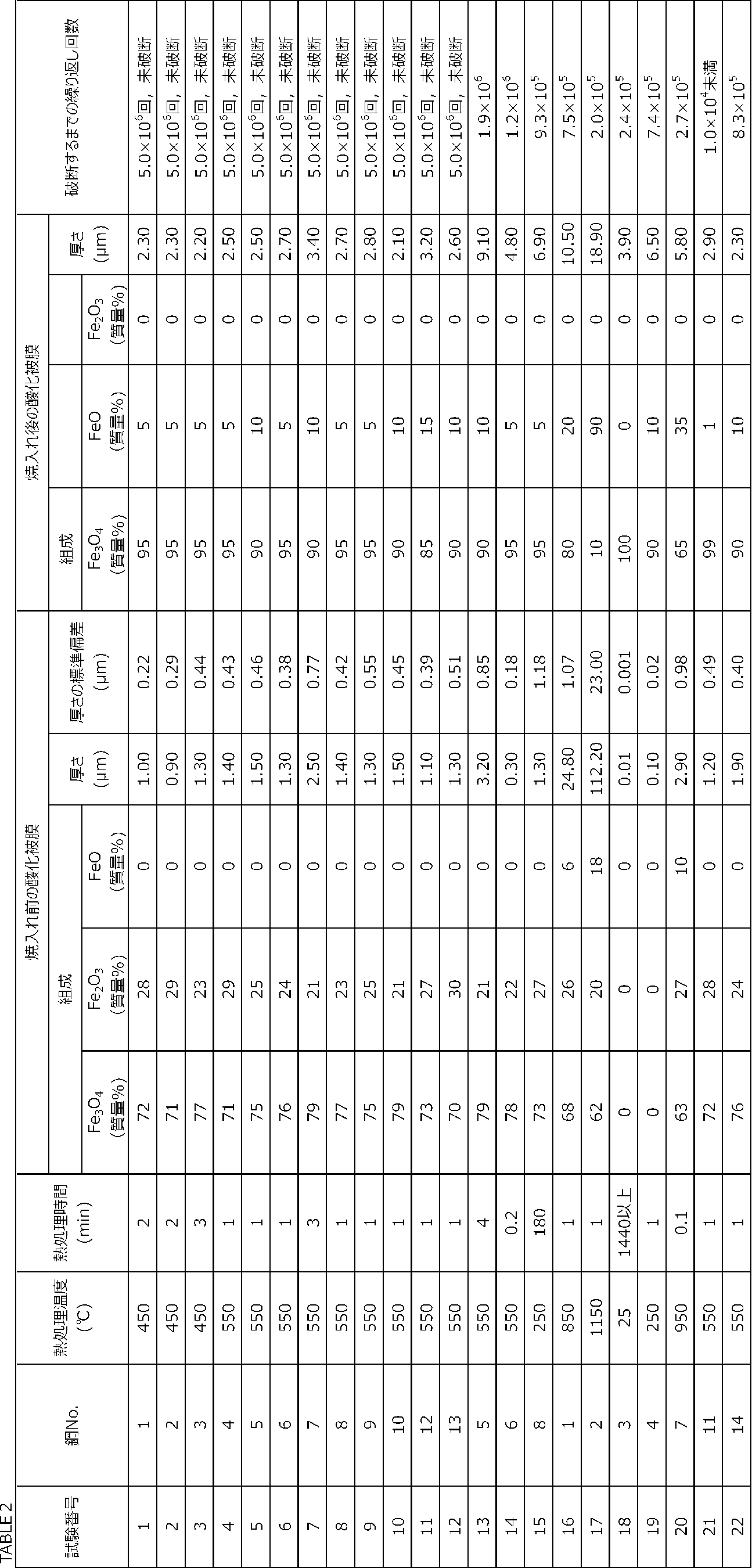
[焼入れ前の酸化被膜の組成の測定試験]
低温熱処理後焼入れ前の鋼板上に形成された酸化被膜の組成を、上述の[酸化被膜の厚さの測定方法]に基づいて測定した。結果を表2に示す。
[Measurement test of composition of oxide film before quenching]
The composition of the oxide film formed on the steel sheet before quenching after the low-temperature heat treatment was measured based on the above [Method for measuring thickness of oxide film]. Table 2 shows the results.
[焼入れ前の酸化被膜の厚さ、及び、厚さの標準偏差の測定試験]
低温熱処理後焼入れ前の鋼板上に形成された酸化被膜の厚さ及びその標準偏差を、上述の[酸化被膜の厚さの測定方法]及び[酸化被膜の厚さの標準偏差の測定方法]に基づいて測定した。観察及び測定は、各試験番号につき3枚の鋼板に対して行った。3枚の鋼板の酸化被膜の厚さの算術平均値を、各試験番号の酸化被膜の厚さとした。結果を表2に示す。測定に用いた、3枚の鋼板の酸化被膜の厚さの標準偏差を、酸化被膜の厚さの標準偏差とした。結果を表2に示す。
[Thickness of oxide film before quenching and measurement test of standard deviation of thickness]
The thickness of the oxide film formed on the steel sheet before quenching after low-temperature heat treatment and its standard deviation are measured according to the above [Method for measuring thickness of oxide film] and [Method for measuring standard deviation of thickness of oxide film]. measured based on Observation and measurement were performed on three steel plates for each test number. The arithmetic mean value of the oxide film thicknesses of the three steel sheets was taken as the oxide film thickness for each test number. Table 2 shows the results. The standard deviation of the thickness of the oxide film of the three steel sheets used for the measurement was taken as the standard deviation of the thickness of the oxide film. Table 2 shows the results.
[焼入れ前の母材のフェライト及びパーライト面積率の測定試験]
低温熱処理後焼入れ前の鋼板片の母材のフェライト及びパーライトの面積率を、上述の[フェライト及びパーライトの面積率の測定方法]に基づいて測定した。その結果、いずれの試験番号の鋼板の母材も、面積率で、20%~60%のフェライト及び40%~80%のパーライトからなるミクロ組織を有した。
[Measurement test of ferrite and pearlite area ratio of base material before quenching]
The area ratios of ferrite and pearlite in the base material of the steel plate pieces before quenching after the low-temperature heat treatment were measured based on the above-described [Method for measuring area ratios of ferrite and pearlite]. As a result, the base metals of the steel sheets of all test numbers had a microstructure composed of 20% to 60% ferrite and 40% to 80% pearlite in terms of area ratio.
各試験番号の鋼板に対して、850℃で15分保持した後急冷する焼入れを行った。焼入れ後の鋼板に対して、200℃で60分焼戻しした。焼入れ焼戻し後の各試験番号の鋼板の母材のミクロ組織を、上述の[フェライト及びパーライトの面積率の測定方法]に記載した観察条件で観察及び同定した。その結果、いずれの試験番号の鋼板の母材も、焼戻しマルテンサイトからなるミクロ組織を有した。 The steel sheets of each test number were quenched by holding at 850°C for 15 minutes and then quenching. The steel plate after quenching was tempered at 200° C. for 60 minutes. After quenching and tempering, the microstructure of the base material of the steel sheet of each test number was observed and identified under the observation conditions described in the above [Measuring method of area ratio of ferrite and pearlite]. As a result, the base metals of the steel sheets of all test numbers had a microstructure composed of tempered martensite.
[焼入れ後の酸化被膜の組成の測定試験]
焼入れ後の鋼板上に形成された酸化被膜の組成を、上述の[酸化被膜の厚さの測定方法]に基づいて測定した。結果を表2に示す。
[Measurement test of composition of oxide film after quenching]
The composition of the oxide film formed on the steel plate after quenching was measured based on the above [Method for measuring thickness of oxide film]. Table 2 shows the results.
[焼入れ後の酸化被膜の厚さの測定試験]
焼入れ後の鋼板上に形成された酸化被膜の厚さを、上述の[酸化被膜の厚さの測定方法]に基づいて測定した。観察及び測定は、各試験番号につき3枚の鋼板に対して行った。3枚の鋼板の酸化被膜の厚さの算術平均値を、各試験番号の酸化被膜の厚さとした。結果を表2に示す。
[Measurement test of thickness of oxide film after quenching]
The thickness of the oxide film formed on the steel plate after quenching was measured based on the above [Method for measuring thickness of oxide film]. Observation and measurement were performed on three steel plates for each test number. The arithmetic mean value of the oxide film thicknesses of the three steel sheets was taken as the oxide film thickness for each test number. Table 2 shows the results.
[疲労試験]
焼入れ後の鋼板の破断寿命を測定した。各試験番号の鋼板から、厚さ2mm、幅8mm、長さ60mm、平行部の長さ9.5mmの板状のねじり疲労試験片を得た。図3は、ねじり疲労試験片の正面図である。図4は、ねじり疲労試験片を長手方向から見た側面図である。ねじり疲労試験片は、その表面の幅方向中央部に鋼管内表面を模擬した、深さ0.1mmの溝aを有した。設定応力400MPaで、大気中でねじり疲労試験を実施し、ねじり疲労試験片が破断するまでの回数を測定した。結果を表2に示す。
[Fatigue test]
The rupture life of the steel plate after quenching was measured. A plate-shaped torsional fatigue test piece having a thickness of 2 mm, a width of 8 mm, a length of 60 mm, and a parallel portion of 9.5 mm was obtained from the steel plate of each test number. FIG. 3 is a front view of a torsional fatigue test piece. FIG. 4 is a longitudinal side view of the torsional fatigue test piece. The torsional fatigue test piece had a groove a with a depth of 0.1 mm, which simulated the inner surface of a steel pipe, in the central portion in the width direction of the surface. A torsional fatigue test was performed in the air at a set stress of 400 MPa, and the number of times until the torsional fatigue test piece fractured was measured. Table 2 shows the results.
[評価試験]
表1及び表2を参照して、試験番号1~12では、焼入れ前の酸化被膜の組成、厚さ及び厚さの標準偏差が適切であった。試験番号1~12では、焼入れ後の酸化皮膜の組成及び厚さが適切であった。その結果、試験番号1~12では、優れた疲労強度が得られた。
[Evaluation test]
With reference to Tables 1 and 2, in
一方、試験番号13では、焼入れ前の酸化被膜が厚すぎた。そのため、試験番号13では、焼入れ後の酸化被膜が厚すぎた。その結果、試験番号13では、優れた疲労強度が得られなかった。 On the other hand, in test number 13, the oxide film before quenching was too thick. Therefore, in test number 13, the oxide film after quenching was too thick. As a result, in Test No. 13, excellent fatigue strength was not obtained.
試験番号14では、焼入れ前の酸化被膜が薄すぎた。そのため、試験番号14では、焼入れ後の酸化被膜が厚すぎた。その結果、試験番号14では、優れた疲労強度が得られなかった。 In test number 14, the oxide film before quenching was too thin. Therefore, in test number 14, the oxide film after quenching was too thick. As a result, in Test No. 14, excellent fatigue strength was not obtained.
試験番号15では、焼入れ前の酸化被膜の厚さの標準偏差が大きすぎた。そのため、試験番号15では、焼入れ後の酸化被膜が厚すぎた。その結果、試験番号15では、優れた疲労強度が得られなかった。 In test number 15, the standard deviation of the thickness of the oxide film before quenching was too large. Therefore, in test number 15, the oxide film after quenching was too thick. As a result, in Test No. 15, excellent fatigue strength was not obtained.
試験番号16、17及び20では、焼入れ前の酸化被膜の組成が不適切であり、さらに、酸化被膜が厚すぎ、厚さの標準偏差が大きすぎた。そのため、試験番号16、17及び20では、焼入れ後の酸化皮膜の組成が不適切であり、さらに、酸化被膜が厚すぎた。その結果、試験番号16、17及び20では、優れた疲労強度が得られなかった。
In Test Nos. 16, 17 and 20, the composition of the oxide film before quenching was inappropriate, the oxide film was too thick, and the standard deviation of the thickness was too large. Therefore, in
試験番号18及び19では、焼入れ前の酸化被膜の組成が不適切であり、さらに、酸化被膜が薄すぎた。そのため、試験番号18及び19では、焼入れ後の酸化皮膜が厚すぎた。その結果、試験番号18及び19では、優れた疲労強度が得られなかった。 In test numbers 18 and 19, the composition of the oxide film before quenching was inappropriate, and the oxide film was too thin. Therefore, in test numbers 18 and 19, the oxide film after quenching was too thick. As a result, in test numbers 18 and 19, excellent fatigue strength was not obtained.
試験番号21では、母材のC含有量が低すぎた。その結果、試験番号21では、優れた疲労強度が得られなかった。 In test number 21, the C content of the base material was too low. As a result, in Test No. 21, excellent fatigue strength was not obtained.
試験番号22では、母材のC含有量が高すぎた。その結果、試験番号22では、優れた疲労強度が得られなかった。 In test number 22, the C content in the base material was too high. As a result, in Test No. 22, excellent fatigue strength was not obtained.
以上、本開示の実施の形態を説明した。しかしながら、上述した実施の形態は本開示を実施するための例示に過ぎない。したがって、本開示は上述した実施の形態に限定されることなく、その趣旨を逸脱しない範囲内で上述した実施の形態を適宜変更して実施することができる。 The embodiment of the present disclosure has been described above. However, the above-described embodiments are merely examples for implementing the present disclosure. Therefore, the present disclosure is not limited to the above-described embodiments, and the above-described embodiments can be modified as appropriate without departing from the scope of the present disclosure.
1 鋼管
2 母材
3 酸化被膜
10 車両用部品
20 母材
30 酸化被膜
REFERENCE SIGNS
Claims (6)
C:0.23~0.50%、
Si:0.01~0.50%、
Mn:0.50~2.50%、
P:0.050%以下、
S:0.0100%以下、
N:0.0100%以下、
O:0.0100%以下、
Sol.Al:0~0.080%、
Cr:0~1.50%、
Mo:0~1.00%、
Ni:0~1.00%、
Cu:0~1.00%、
Ti:0~0.100%、
Nb:0~0.100%、
V:0~0.100%、
B:0~0.0050%、
Ca:0~0.0050%、及び、
残部はFe及び不純物からなる化学組成と、
面積率で、20%~60%のフェライト及び40%~80%のパーライトからなるミクロ組織とを有する母材と、
前記母材上に、
Fe3O4、Fe2O3及びFeOのX線回折のピーク強度の合計を100%としたときに、前記X線回折の前記ピーク強度比で70%以上のFe3O4、20%以上のFe2O3、10%以下のFeO、及び残部は不純物からなり、
厚さが0.80~2.50μmであり、前記厚さの標準偏差が0.90μm以下である酸化被膜とを備える、
鋼管。 in % by mass,
C: 0.23 to 0.50%,
Si: 0.01 to 0.50%,
Mn: 0.50-2.50%,
P: 0.050% or less,
S: 0.0100% or less,
N: 0.0100% or less,
O: 0.0100% or less,
Sol. Al: 0 to 0.080%,
Cr: 0 to 1.50%,
Mo: 0 to 1.00%,
Ni: 0 to 1.00%,
Cu: 0 to 1.00%,
Ti: 0 to 0.100%,
Nb: 0 to 0.100%,
V: 0 to 0.100%,
B: 0 to 0.0050%,
Ca: 0 to 0.0050%, and
a chemical composition with the balance being Fe and impurities;
A base material having a microstructure consisting of 20% to 60% ferrite and 40% to 80% pearlite in area ratio;
on the base material,
When the sum of the X-ray diffraction peak intensities of Fe 3 O 4 , Fe 2 O 3 and FeO is taken as 100%, Fe 3 O 4 having a peak intensity ratio of 70% or more and 20% or more in the X-ray diffraction of Fe 2 O 3 , up to 10% FeO, and the balance consisting of impurities,
an oxide film having a thickness of 0.80 to 2.50 μm and a standard deviation of the thickness of 0.90 μm or less;
steel pipe.
前記化学組成は、質量%で、
Sol.Al:0.001~0.080%、
Cr:0.01~1.50%、
Mo:0.01~1.00%、
Ni:0.01~1.00%、
Cu:0.01~1.00%、
Ti:0.001~0.100%、
Nb:0.001~0.100%、
V:0.001~0.100%、
B:0.0001~0.0050%、及び、
Ca:0.0001~0.0050%、
からなる群から選択される1元素以上を含有する、
鋼管。 The steel pipe according to claim 1,
The chemical composition, in mass %,
Sol. Al: 0.001 to 0.080%,
Cr: 0.01 to 1.50%,
Mo: 0.01 to 1.00%,
Ni: 0.01 to 1.00%,
Cu: 0.01 to 1.00%,
Ti: 0.001 to 0.100%,
Nb: 0.001 to 0.100%,
V: 0.001 to 0.100%,
B: 0.0001 to 0.0050%, and
Ca: 0.0001 to 0.0050%,
containing one or more elements selected from the group consisting of
steel pipe.
C:0.23~0.50%、
Si:0.01~0.50%、
Mn:0.50~2.50%、
P:0.050%以下、
S:0.0100%以下、
N:0.0100%以下、
O:0.0100%以下、
Sol.Al:0~0.080%、
Cr:0~1.50%、
Mo:0~1.00%、
Ni:0~1.00%、
Cu:0~1.00%、
Ti:0~0.100%、
Nb:0~0.100%、
V:0~0.100%、
B:0~0.0050%、
Ca:0~0.0050%、及び、
残部はFe及び不純物からなる化学組成と、
焼戻しマルテンサイトからなるミクロ組織とを有する中空の母材と、
前記母材上に、
Fe3O4、FeO、及びFe2O3のX線回折のピーク強度の合計を100%としたときに、前記X線回折の前記ピーク強度比で80%以上のFe3O4、15%以下のFeO、5%以下のFe2O3、及び残部は不純物からなり、
厚さが3.50μm以下である酸化被膜とを備える、
車両用部品。 in % by mass,
C: 0.23 to 0.50%,
Si: 0.01 to 0.50%,
Mn: 0.50-2.50%,
P: 0.050% or less,
S: 0.0100% or less,
N: 0.0100% or less,
O: 0.0100% or less,
Sol. Al: 0 to 0.080%,
Cr: 0 to 1.50%,
Mo: 0 to 1.00%,
Ni: 0 to 1.00%,
Cu: 0 to 1.00%,
Ti: 0 to 0.100%,
Nb: 0 to 0.100%,
V: 0 to 0.100%,
B: 0 to 0.0050%,
Ca: 0 to 0.0050%, and
a chemical composition with the balance being Fe and impurities;
a hollow base material having a microstructure consisting of tempered martensite;
on the base material,
When the sum of the X-ray diffraction peak intensities of Fe 3 O 4 , FeO, and Fe 2 O 3 is taken as 100%, the peak intensity ratio of the X-ray diffraction is 80% or more , and 15% FeO below, Fe 2 O 3 below 5%, and the balance consisting of impurities,
an oxide film having a thickness of 3.50 μm or less,
vehicle parts.
前記化学組成は、質量%で、
Sol.Al:0.001~0.080%、
Cr:0.01~1.50%、
Mo:0.01~1.00%、
Ni:0.01~1.00%、
Cu:0.01~1.00%、
Ti:0.001~0.100%、
Nb:0.001~0.100%、
V:0.001~0.100%、
B:0.0001~0.0050%、及び、
Ca:0.0001~0.0050%、
からなる群から選択される1元素以上を含有する、
車両用部品。 The vehicle component according to claim 3,
The chemical composition, in mass %,
Sol. Al: 0.001 to 0.080%,
Cr: 0.01 to 1.50%,
Mo: 0.01 to 1.00%,
Ni: 0.01 to 1.00%,
Cu: 0.01 to 1.00%,
Ti: 0.001 to 0.100%,
Nb: 0.001 to 0.100%,
V: 0.001 to 0.100%,
B: 0.0001 to 0.0050%, and
Ca: 0.0001 to 0.0050%,
containing one or more elements selected from the group consisting of
vehicle parts.
C:0.23~0.50%、
Si:0.01~0.50%、
Mn:0.50~2.50%、
P:0.050%以下、
S:0.0100%以下、
N:0.0100%以下、
O:0.0100%以下、
Sol.Al:0~0.080%、
Cr:0~1.50%、
Mo:0~1.00%、
Ni:0~1.00%、
Cu:0~1.00%、
Ti:0~0.100%、
Nb:0~0.100%、
V:0~0.100%、
B:0~0.0050%、
Ca:0~0.0050%、及び、
残部はFe及び不純物からなる化学組成を有する鋼板を準備する工程と、
前記鋼板を450~600℃で0.5~3.0分熱処理する工程と、
前記熱処理後の前記鋼板を電縫溶接して鋼管を製造する工程とを備える、
鋼管の製造方法。 in % by mass,
C: 0.23 to 0.50%,
Si: 0.01 to 0.50%,
Mn: 0.50-2.50%,
P: 0.050% or less,
S: 0.0100% or less,
N: 0.0100% or less,
O: 0.0100% or less,
Sol. Al: 0 to 0.080%,
Cr: 0 to 1.50%,
Mo: 0 to 1.00%,
Ni: 0 to 1.00%,
Cu: 0 to 1.00%,
Ti: 0 to 0.100%,
Nb: 0 to 0.100%,
V: 0 to 0.100%,
B: 0 to 0.0050%,
Ca: 0 to 0.0050%, and
Preparing a steel sheet having a chemical composition with the balance being Fe and impurities;
a step of heat-treating the steel plate at 450-600° C. for 0.5-3.0 minutes;
A step of manufacturing a steel pipe by electric resistance welding the steel plate after the heat treatment.
A method of manufacturing steel pipes.
請求項1又は請求項2に記載の鋼管を準備する工程と、
前記鋼管に対して曲げ加工する工程と、
前記曲げ加工後の鋼管を、Ac3+50℃以上1150℃以下で10秒以上保持した後、急冷する工程と、
前記急冷後の前記鋼管を150~350℃で、10分以上保持して焼戻しする工程とを備える、
車両用部品の製造方法。
A method for manufacturing a vehicle part, comprising:
A step of preparing the steel pipe according to claim 1 or claim 2;
a step of bending the steel pipe;
a step of holding the bent steel pipe at a temperature of Ac 3 +50° C. or higher and 1150° C. or lower for 10 seconds or longer and then quenching;
a step of holding and tempering the steel pipe after the quenching at 150 to 350° C. for 10 minutes or longer;
A method for manufacturing vehicle parts.
Priority Applications (7)
| Application Number | Priority Date | Filing Date | Title |
|---|---|---|---|
| PCT/JP2022/006953 WO2023157297A1 (en) | 2022-02-21 | 2022-02-21 | Steel pipe, component for vehicles, method for producing steel pipe, and method for producing component for vehicles |
| PCT/JP2023/006173 WO2023157975A1 (en) | 2022-02-21 | 2023-02-21 | Steel pipe, component for vehicles, method for producing steel pipe and method for producing component for vehicles |
| JP2024501469A JP7839426B2 (en) | 2022-02-21 | 2023-02-21 | Steel pipes, vehicle parts, method for manufacturing steel pipes, and method for manufacturing vehicle parts |
| US18/835,275 US20250215539A1 (en) | 2022-02-21 | 2023-02-21 | Steel tube, vehicle component, method for producing steel tube, and method for producing vehicle component |
| EP23756499.2A EP4484587A4 (en) | 2022-02-21 | 2023-02-21 | STEEL PIPE, VEHICLE COMPONENT, METHOD FOR PRODUCING STEEL PIPE AND METHOD FOR PRODUCING VEHICLE COMPONENT |
| CN202380021944.4A CN118696143A (en) | 2022-02-21 | 2023-02-21 | Steel pipe, vehicle component, method for producing steel pipe, and method for producing vehicle component |
| MX2024010168A MX2024010168A (en) | 2022-02-21 | 2024-08-19 | Steel pipe, component for vehicles, method for producing steel pipe and method for producing component for vehicles |
Applications Claiming Priority (1)
| Application Number | Priority Date | Filing Date | Title |
|---|---|---|---|
| PCT/JP2022/006953 WO2023157297A1 (en) | 2022-02-21 | 2022-02-21 | Steel pipe, component for vehicles, method for producing steel pipe, and method for producing component for vehicles |
Publications (1)
| Publication Number | Publication Date |
|---|---|
| WO2023157297A1 true WO2023157297A1 (en) | 2023-08-24 |
Family
ID=87578171
Family Applications (2)
| Application Number | Title | Priority Date | Filing Date |
|---|---|---|---|
| PCT/JP2022/006953 Ceased WO2023157297A1 (en) | 2022-02-21 | 2022-02-21 | Steel pipe, component for vehicles, method for producing steel pipe, and method for producing component for vehicles |
| PCT/JP2023/006173 Ceased WO2023157975A1 (en) | 2022-02-21 | 2023-02-21 | Steel pipe, component for vehicles, method for producing steel pipe and method for producing component for vehicles |
Family Applications After (1)
| Application Number | Title | Priority Date | Filing Date |
|---|---|---|---|
| PCT/JP2023/006173 Ceased WO2023157975A1 (en) | 2022-02-21 | 2023-02-21 | Steel pipe, component for vehicles, method for producing steel pipe and method for producing component for vehicles |
Country Status (6)
| Country | Link |
|---|---|
| US (1) | US20250215539A1 (en) |
| EP (1) | EP4484587A4 (en) |
| JP (1) | JP7839426B2 (en) |
| CN (1) | CN118696143A (en) |
| MX (1) | MX2024010168A (en) |
| WO (2) | WO2023157297A1 (en) |
Citations (6)
| Publication number | Priority date | Publication date | Assignee | Title |
|---|---|---|---|---|
| JPH04268016A (en) * | 1991-02-20 | 1992-09-24 | Kobe Steel Ltd | Production of high tensile strength steel sheet for door guide bar having excellent crushing characteristic |
| JP2013007105A (en) * | 2011-06-24 | 2013-01-10 | Kobe Steel Ltd | Method for manufacturing bar steel |
| WO2018079398A1 (en) * | 2016-10-24 | 2018-05-03 | Jfeスチール株式会社 | Electric resistance welded steel pipe for high-strength thin hollow stabilizer and manufacturing method therefor |
| JP2019183267A (en) * | 2018-04-03 | 2019-10-24 | Jfeスチール株式会社 | Hot rolled steel sheet excellent in scale adhesion and manufacturing method therefor |
| WO2020129337A1 (en) * | 2018-12-19 | 2020-06-25 | Jfeスチール株式会社 | Electric resistance welded steel pipe |
| KR20200076797A (en) * | 2018-12-19 | 2020-06-30 | 주식회사 포스코 | Hot rolled and annealed steel sheet having low strength-deviation, formed member, and manufacturing method of therefor |
Family Cites Families (6)
| Publication number | Priority date | Publication date | Assignee | Title |
|---|---|---|---|---|
| JP2005105341A (en) | 2003-09-30 | 2005-04-21 | Nisshin Steel Co Ltd | Square-shaped electric-resistance-welded steel pipe material having superior high-temperature strength for frame of color-picture tube |
| BR112014028915B1 (en) | 2012-05-25 | 2019-05-14 | Nippon Steel & Sumitomo Metal Corporation | HOLLOW STABILIZER, AND STEEL PIPE FOR HOLLOW STABILIZERS AND METHOD OF PRODUCTION |
| KR101665819B1 (en) * | 2014-12-24 | 2016-10-13 | 주식회사 포스코 | Steel material for heat treating, formed component having extra high strength and high fatigue resistance and method for manufacturing the formed component |
| KR102043524B1 (en) * | 2017-12-26 | 2019-11-12 | 주식회사 포스코 | Ultra high strength hot rolled steel, steel tube, steel member, and method for manufacturing thereof |
| CA3139909C (en) | 2019-05-13 | 2023-07-11 | Jfe Steel Corporation | Electric-resistance-welded steel pipe or tube for hollow stabilizer |
| WO2021201159A1 (en) * | 2020-03-31 | 2021-10-07 | 日本製鉄株式会社 | Steel material |
-
2022
- 2022-02-21 WO PCT/JP2022/006953 patent/WO2023157297A1/en not_active Ceased
-
2023
- 2023-02-21 WO PCT/JP2023/006173 patent/WO2023157975A1/en not_active Ceased
- 2023-02-21 EP EP23756499.2A patent/EP4484587A4/en active Pending
- 2023-02-21 JP JP2024501469A patent/JP7839426B2/en active Active
- 2023-02-21 CN CN202380021944.4A patent/CN118696143A/en active Pending
- 2023-02-21 US US18/835,275 patent/US20250215539A1/en active Pending
-
2024
- 2024-08-19 MX MX2024010168A patent/MX2024010168A/en unknown
Patent Citations (6)
| Publication number | Priority date | Publication date | Assignee | Title |
|---|---|---|---|---|
| JPH04268016A (en) * | 1991-02-20 | 1992-09-24 | Kobe Steel Ltd | Production of high tensile strength steel sheet for door guide bar having excellent crushing characteristic |
| JP2013007105A (en) * | 2011-06-24 | 2013-01-10 | Kobe Steel Ltd | Method for manufacturing bar steel |
| WO2018079398A1 (en) * | 2016-10-24 | 2018-05-03 | Jfeスチール株式会社 | Electric resistance welded steel pipe for high-strength thin hollow stabilizer and manufacturing method therefor |
| JP2019183267A (en) * | 2018-04-03 | 2019-10-24 | Jfeスチール株式会社 | Hot rolled steel sheet excellent in scale adhesion and manufacturing method therefor |
| WO2020129337A1 (en) * | 2018-12-19 | 2020-06-25 | Jfeスチール株式会社 | Electric resistance welded steel pipe |
| KR20200076797A (en) * | 2018-12-19 | 2020-06-30 | 주식회사 포스코 | Hot rolled and annealed steel sheet having low strength-deviation, formed member, and manufacturing method of therefor |
Also Published As
| Publication number | Publication date |
|---|---|
| WO2023157975A1 (en) | 2023-08-24 |
| JP7839426B2 (en) | 2026-04-02 |
| EP4484587A1 (en) | 2025-01-01 |
| MX2024010168A (en) | 2024-11-08 |
| CN118696143A (en) | 2024-09-24 |
| EP4484587A4 (en) | 2025-06-11 |
| US20250215539A1 (en) | 2025-07-03 |
| JPWO2023157975A1 (en) | 2023-08-24 |
Similar Documents
| Publication | Publication Date | Title |
|---|---|---|
| RU2583194C2 (en) | High-strength dip-galvanised steel sheet and high-strength alloyed and dip-galvanised steel sheet of fine mouldability and low material anisotropy with rupture strength of 980 mpa or higher, and method of their production | |
| CN109983145B (en) | Steel plate for carburizing and method for manufacturing steel plate for carburizing | |
| JP5707671B2 (en) | Nb-added ferritic stainless steel sheet excellent in workability and manufacturability and method for producing the same | |
| WO2013102986A1 (en) | High carbon hot-rolled steel sheet and method for producing same | |
| CN115989326B (en) | Wear-resistant steel | |
| US20260078473A1 (en) | Austenitic alloy material | |
| WO2015146173A1 (en) | High-carbon hot-rolled steel sheet and method for producing same | |
| WO2018003823A1 (en) | Austenitic stainless steel | |
| JP2021127517A (en) | Austenitic stainless steel material | |
| KR20160010579A (en) | High-carbon hot-rolled steel sheet and production method for same | |
| WO2024128287A1 (en) | Steel sheet | |
| WO2024085155A1 (en) | Duplex stainless steel material | |
| WO2019131099A1 (en) | Hot-rolled steel sheet and method for manufacturing same | |
| CN115210400A (en) | Steel material, method for producing same, and tank | |
| JP7417180B1 (en) | steel material | |
| WO2023157297A1 (en) | Steel pipe, component for vehicles, method for producing steel pipe, and method for producing component for vehicles | |
| JP7799189B2 (en) | seamless steel pipe | |
| JP7799188B2 (en) | seamless steel pipe | |
| WO2024128284A1 (en) | Steel sheet | |
| JP2024543182A (en) | Ultra-high strength cold-rolled steel sheet with excellent elongation ratio and its manufacturing method | |
| JP5565532B2 (en) | High carbon hot rolled steel sheet and manufacturing method thereof | |
| JP2015017285A (en) | High carbon hot rolled steel sheet excellent in hardenability and workability and method for producing the same | |
| JP7417181B1 (en) | steel material | |
| JP7733348B1 (en) | Hollow steel parts | |
| JP7799191B2 (en) | case hardened steel |
Legal Events
| Date | Code | Title | Description |
|---|---|---|---|
| 121 | Ep: the epo has been informed by wipo that ep was designated in this application |
Ref document number: 22927196 Country of ref document: EP Kind code of ref document: A1 |
|
| NENP | Non-entry into the national phase |
Ref country code: DE |
|
| 122 | Ep: pct application non-entry in european phase |
Ref document number: 22927196 Country of ref document: EP Kind code of ref document: A1 |
|
| NENP | Non-entry into the national phase |
Ref country code: JP |