WO2023152346A1 - Materialien für elektronische vorrichtungen - Google Patents
Materialien für elektronische vorrichtungen Download PDFInfo
- Publication number
- WO2023152346A1 WO2023152346A1 PCT/EP2023/053406 EP2023053406W WO2023152346A1 WO 2023152346 A1 WO2023152346 A1 WO 2023152346A1 EP 2023053406 W EP2023053406 W EP 2023053406W WO 2023152346 A1 WO2023152346 A1 WO 2023152346A1
- Authority
- WO
- WIPO (PCT)
- Prior art keywords
- aromatic
- radicals
- substituted
- carbon atoms
- groups
- Prior art date
- Legal status (The legal status is an assumption and is not a legal conclusion. Google has not performed a legal analysis and makes no representation as to the accuracy of the status listed.)
- Ceased
Links
Classifications
-
- H—ELECTRICITY
- H10—SEMICONDUCTOR DEVICES; ELECTRIC SOLID-STATE DEVICES NOT OTHERWISE PROVIDED FOR
- H10K—ORGANIC ELECTRIC SOLID-STATE DEVICES
- H10K85/00—Organic materials used in the body or electrodes of devices covered by this subclass
- H10K85/60—Organic compounds having low molecular weight
- H10K85/649—Aromatic compounds comprising a hetero atom
- H10K85/657—Polycyclic condensed heteroaromatic hydrocarbons
- H10K85/6572—Polycyclic condensed heteroaromatic hydrocarbons comprising only nitrogen in the heteroaromatic polycondensed ring system, e.g. phenanthroline or carbazole
-
- C—CHEMISTRY; METALLURGY
- C07—ORGANIC CHEMISTRY
- C07D—HETEROCYCLIC COMPOUNDS
- C07D409/00—Heterocyclic compounds containing two or more hetero rings, at least one ring having sulfur atoms as the only ring hetero atoms
- C07D409/02—Heterocyclic compounds containing two or more hetero rings, at least one ring having sulfur atoms as the only ring hetero atoms containing two hetero rings
- C07D409/10—Heterocyclic compounds containing two or more hetero rings, at least one ring having sulfur atoms as the only ring hetero atoms containing two hetero rings linked by a carbon chain containing aromatic rings
-
- C—CHEMISTRY; METALLURGY
- C07—ORGANIC CHEMISTRY
- C07D—HETEROCYCLIC COMPOUNDS
- C07D221/00—Heterocyclic compounds containing six-membered rings having one nitrogen atom as the only ring hetero atom, not provided for by groups C07D211/00 - C07D219/00
- C07D221/02—Heterocyclic compounds containing six-membered rings having one nitrogen atom as the only ring hetero atom, not provided for by groups C07D211/00 - C07D219/00 condensed with carbocyclic rings or ring systems
- C07D221/04—Ortho- or peri-condensed ring systems
- C07D221/18—Ring systems of four or more rings
-
- C—CHEMISTRY; METALLURGY
- C07—ORGANIC CHEMISTRY
- C07D—HETEROCYCLIC COMPOUNDS
- C07D221/00—Heterocyclic compounds containing six-membered rings having one nitrogen atom as the only ring hetero atom, not provided for by groups C07D211/00 - C07D219/00
- C07D221/02—Heterocyclic compounds containing six-membered rings having one nitrogen atom as the only ring hetero atom, not provided for by groups C07D211/00 - C07D219/00 condensed with carbocyclic rings or ring systems
- C07D221/22—Bridged ring systems
-
- C—CHEMISTRY; METALLURGY
- C07—ORGANIC CHEMISTRY
- C07D—HETEROCYCLIC COMPOUNDS
- C07D265/00—Heterocyclic compounds containing six-membered rings having one nitrogen atom and one oxygen atom as the only ring hetero atoms
- C07D265/28—1,4-Oxazines; Hydrogenated 1,4-oxazines
- C07D265/34—1,4-Oxazines; Hydrogenated 1,4-oxazines condensed with carbocyclic rings
-
- C—CHEMISTRY; METALLURGY
- C07—ORGANIC CHEMISTRY
- C07D—HETEROCYCLIC COMPOUNDS
- C07D401/00—Heterocyclic compounds containing two or more hetero rings, having nitrogen atoms as the only ring hetero atoms, at least one ring being a six-membered ring with only one nitrogen atom
- C07D401/02—Heterocyclic compounds containing two or more hetero rings, having nitrogen atoms as the only ring hetero atoms, at least one ring being a six-membered ring with only one nitrogen atom containing two hetero rings
- C07D401/04—Heterocyclic compounds containing two or more hetero rings, having nitrogen atoms as the only ring hetero atoms, at least one ring being a six-membered ring with only one nitrogen atom containing two hetero rings directly linked by a ring-member-to-ring-member bond
-
- C—CHEMISTRY; METALLURGY
- C07—ORGANIC CHEMISTRY
- C07D—HETEROCYCLIC COMPOUNDS
- C07D401/00—Heterocyclic compounds containing two or more hetero rings, having nitrogen atoms as the only ring hetero atoms, at least one ring being a six-membered ring with only one nitrogen atom
- C07D401/02—Heterocyclic compounds containing two or more hetero rings, having nitrogen atoms as the only ring hetero atoms, at least one ring being a six-membered ring with only one nitrogen atom containing two hetero rings
- C07D401/10—Heterocyclic compounds containing two or more hetero rings, having nitrogen atoms as the only ring hetero atoms, at least one ring being a six-membered ring with only one nitrogen atom containing two hetero rings linked by a carbon chain containing aromatic rings
-
- C—CHEMISTRY; METALLURGY
- C07—ORGANIC CHEMISTRY
- C07D—HETEROCYCLIC COMPOUNDS
- C07D401/00—Heterocyclic compounds containing two or more hetero rings, having nitrogen atoms as the only ring hetero atoms, at least one ring being a six-membered ring with only one nitrogen atom
- C07D401/14—Heterocyclic compounds containing two or more hetero rings, having nitrogen atoms as the only ring hetero atoms, at least one ring being a six-membered ring with only one nitrogen atom containing three or more hetero rings
-
- C—CHEMISTRY; METALLURGY
- C07—ORGANIC CHEMISTRY
- C07D—HETEROCYCLIC COMPOUNDS
- C07D405/00—Heterocyclic compounds containing both one or more hetero rings having oxygen atoms as the only ring hetero atoms, and one or more rings having nitrogen as the only ring hetero atom
- C07D405/02—Heterocyclic compounds containing both one or more hetero rings having oxygen atoms as the only ring hetero atoms, and one or more rings having nitrogen as the only ring hetero atom containing two hetero rings
- C07D405/04—Heterocyclic compounds containing both one or more hetero rings having oxygen atoms as the only ring hetero atoms, and one or more rings having nitrogen as the only ring hetero atom containing two hetero rings directly linked by a ring-member-to-ring-member bond
-
- C—CHEMISTRY; METALLURGY
- C07—ORGANIC CHEMISTRY
- C07D—HETEROCYCLIC COMPOUNDS
- C07D405/00—Heterocyclic compounds containing both one or more hetero rings having oxygen atoms as the only ring hetero atoms, and one or more rings having nitrogen as the only ring hetero atom
- C07D405/02—Heterocyclic compounds containing both one or more hetero rings having oxygen atoms as the only ring hetero atoms, and one or more rings having nitrogen as the only ring hetero atom containing two hetero rings
- C07D405/10—Heterocyclic compounds containing both one or more hetero rings having oxygen atoms as the only ring hetero atoms, and one or more rings having nitrogen as the only ring hetero atom containing two hetero rings linked by a carbon chain containing aromatic rings
-
- C—CHEMISTRY; METALLURGY
- C07—ORGANIC CHEMISTRY
- C07D—HETEROCYCLIC COMPOUNDS
- C07D405/00—Heterocyclic compounds containing both one or more hetero rings having oxygen atoms as the only ring hetero atoms, and one or more rings having nitrogen as the only ring hetero atom
- C07D405/14—Heterocyclic compounds containing both one or more hetero rings having oxygen atoms as the only ring hetero atoms, and one or more rings having nitrogen as the only ring hetero atom containing three or more hetero rings
-
- C—CHEMISTRY; METALLURGY
- C07—ORGANIC CHEMISTRY
- C07D—HETEROCYCLIC COMPOUNDS
- C07D409/00—Heterocyclic compounds containing two or more hetero rings, at least one ring having sulfur atoms as the only ring hetero atoms
- C07D409/02—Heterocyclic compounds containing two or more hetero rings, at least one ring having sulfur atoms as the only ring hetero atoms containing two hetero rings
- C07D409/04—Heterocyclic compounds containing two or more hetero rings, at least one ring having sulfur atoms as the only ring hetero atoms containing two hetero rings directly linked by a ring-member-to-ring-member bond
-
- C—CHEMISTRY; METALLURGY
- C07—ORGANIC CHEMISTRY
- C07D—HETEROCYCLIC COMPOUNDS
- C07D471/00—Heterocyclic compounds containing nitrogen atoms as the only ring hetero atoms in the condensed system, at least one ring being a six-membered ring with one nitrogen atom, not provided for by groups C07D451/00 - C07D463/00
- C07D471/02—Heterocyclic compounds containing nitrogen atoms as the only ring hetero atoms in the condensed system, at least one ring being a six-membered ring with one nitrogen atom, not provided for by groups C07D451/00 - C07D463/00 in which the condensed system contains two hetero rings
- C07D471/08—Bridged systems
-
- C—CHEMISTRY; METALLURGY
- C07—ORGANIC CHEMISTRY
- C07D—HETEROCYCLIC COMPOUNDS
- C07D471/00—Heterocyclic compounds containing nitrogen atoms as the only ring hetero atoms in the condensed system, at least one ring being a six-membered ring with one nitrogen atom, not provided for by groups C07D451/00 - C07D463/00
- C07D471/22—Heterocyclic compounds containing nitrogen atoms as the only ring hetero atoms in the condensed system, at least one ring being a six-membered ring with one nitrogen atom, not provided for by groups C07D451/00 - C07D463/00 in which the condensed systems contains four or more hetero rings
-
- C—CHEMISTRY; METALLURGY
- C07—ORGANIC CHEMISTRY
- C07D—HETEROCYCLIC COMPOUNDS
- C07D487/00—Heterocyclic compounds containing nitrogen atoms as the only ring hetero atoms in the condensed system, not provided for by groups C07D451/00 - C07D477/00
- C07D487/02—Heterocyclic compounds containing nitrogen atoms as the only ring hetero atoms in the condensed system, not provided for by groups C07D451/00 - C07D477/00 in which the condensed system contains two hetero rings
- C07D487/04—Ortho-condensed systems
-
- C—CHEMISTRY; METALLURGY
- C07—ORGANIC CHEMISTRY
- C07D—HETEROCYCLIC COMPOUNDS
- C07D491/00—Heterocyclic compounds containing in the condensed ring system both one or more rings having oxygen atoms as the only ring hetero atoms and one or more rings having nitrogen atoms as the only ring hetero atoms, not provided for by groups C07D451/00 - C07D459/00, C07D463/00, C07D477/00 or C07D489/00
- C07D491/02—Heterocyclic compounds containing in the condensed ring system both one or more rings having oxygen atoms as the only ring hetero atoms and one or more rings having nitrogen atoms as the only ring hetero atoms, not provided for by groups C07D451/00 - C07D459/00, C07D463/00, C07D477/00 or C07D489/00 in which the condensed system contains two hetero rings
- C07D491/04—Ortho-condensed systems
-
- C—CHEMISTRY; METALLURGY
- C07—ORGANIC CHEMISTRY
- C07D—HETEROCYCLIC COMPOUNDS
- C07D491/00—Heterocyclic compounds containing in the condensed ring system both one or more rings having oxygen atoms as the only ring hetero atoms and one or more rings having nitrogen atoms as the only ring hetero atoms, not provided for by groups C07D451/00 - C07D459/00, C07D463/00, C07D477/00 or C07D489/00
- C07D491/02—Heterocyclic compounds containing in the condensed ring system both one or more rings having oxygen atoms as the only ring hetero atoms and one or more rings having nitrogen atoms as the only ring hetero atoms, not provided for by groups C07D451/00 - C07D459/00, C07D463/00, C07D477/00 or C07D489/00 in which the condensed system contains two hetero rings
- C07D491/04—Ortho-condensed systems
- C07D491/044—Ortho-condensed systems with only one oxygen atom as ring hetero atom in the oxygen-containing ring
- C07D491/048—Ortho-condensed systems with only one oxygen atom as ring hetero atom in the oxygen-containing ring the oxygen-containing ring being five-membered
-
- C—CHEMISTRY; METALLURGY
- C07—ORGANIC CHEMISTRY
- C07D—HETEROCYCLIC COMPOUNDS
- C07D491/00—Heterocyclic compounds containing in the condensed ring system both one or more rings having oxygen atoms as the only ring hetero atoms and one or more rings having nitrogen atoms as the only ring hetero atoms, not provided for by groups C07D451/00 - C07D459/00, C07D463/00, C07D477/00 or C07D489/00
- C07D491/02—Heterocyclic compounds containing in the condensed ring system both one or more rings having oxygen atoms as the only ring hetero atoms and one or more rings having nitrogen atoms as the only ring hetero atoms, not provided for by groups C07D451/00 - C07D459/00, C07D463/00, C07D477/00 or C07D489/00 in which the condensed system contains two hetero rings
- C07D491/08—Bridged systems
-
- C—CHEMISTRY; METALLURGY
- C07—ORGANIC CHEMISTRY
- C07D—HETEROCYCLIC COMPOUNDS
- C07D491/00—Heterocyclic compounds containing in the condensed ring system both one or more rings having oxygen atoms as the only ring hetero atoms and one or more rings having nitrogen atoms as the only ring hetero atoms, not provided for by groups C07D451/00 - C07D459/00, C07D463/00, C07D477/00 or C07D489/00
- C07D491/02—Heterocyclic compounds containing in the condensed ring system both one or more rings having oxygen atoms as the only ring hetero atoms and one or more rings having nitrogen atoms as the only ring hetero atoms, not provided for by groups C07D451/00 - C07D459/00, C07D463/00, C07D477/00 or C07D489/00 in which the condensed system contains two hetero rings
- C07D491/10—Spiro-condensed systems
- C07D491/107—Spiro-condensed systems with only one oxygen atom as ring hetero atom in the oxygen-containing ring
-
- C—CHEMISTRY; METALLURGY
- C07—ORGANIC CHEMISTRY
- C07D—HETEROCYCLIC COMPOUNDS
- C07D495/00—Heterocyclic compounds containing in the condensed system at least one hetero ring having sulfur atoms as the only ring hetero atoms
- C07D495/02—Heterocyclic compounds containing in the condensed system at least one hetero ring having sulfur atoms as the only ring hetero atoms in which the condensed system contains two hetero rings
- C07D495/04—Ortho-condensed systems
-
- C—CHEMISTRY; METALLURGY
- C07—ORGANIC CHEMISTRY
- C07D—HETEROCYCLIC COMPOUNDS
- C07D498/00—Heterocyclic compounds containing in the condensed system at least one hetero ring having nitrogen and oxygen atoms as the only ring hetero atoms
- C07D498/02—Heterocyclic compounds containing in the condensed system at least one hetero ring having nitrogen and oxygen atoms as the only ring hetero atoms in which the condensed system contains two hetero rings
- C07D498/08—Bridged systems
-
- C—CHEMISTRY; METALLURGY
- C07—ORGANIC CHEMISTRY
- C07D—HETEROCYCLIC COMPOUNDS
- C07D513/00—Heterocyclic compounds containing in the condensed system at least one hetero ring having nitrogen and sulfur atoms as the only ring hetero atoms, not provided for in groups C07D463/00, C07D477/00 or C07D499/00 - C07D507/00
- C07D513/02—Heterocyclic compounds containing in the condensed system at least one hetero ring having nitrogen and sulfur atoms as the only ring hetero atoms, not provided for in groups C07D463/00, C07D477/00 or C07D499/00 - C07D507/00 in which the condensed system contains two hetero rings
- C07D513/08—Bridged systems
-
- C—CHEMISTRY; METALLURGY
- C07—ORGANIC CHEMISTRY
- C07D—HETEROCYCLIC COMPOUNDS
- C07D513/00—Heterocyclic compounds containing in the condensed system at least one hetero ring having nitrogen and sulfur atoms as the only ring hetero atoms, not provided for in groups C07D463/00, C07D477/00 or C07D499/00 - C07D507/00
- C07D513/12—Heterocyclic compounds containing in the condensed system at least one hetero ring having nitrogen and sulfur atoms as the only ring hetero atoms, not provided for in groups C07D463/00, C07D477/00 or C07D499/00 - C07D507/00 in which the condensed system contains three hetero rings
- C07D513/16—Peri-condensed systems
-
- C—CHEMISTRY; METALLURGY
- C07—ORGANIC CHEMISTRY
- C07F—ACYCLIC, CARBOCYCLIC OR HETEROCYCLIC COMPOUNDS CONTAINING ELEMENTS OTHER THAN CARBON, HYDROGEN, HALOGEN, OXYGEN, NITROGEN, SULFUR, SELENIUM OR TELLURIUM
- C07F5/00—Compounds containing elements of Groups 3 or 13 of the Periodic Table
- C07F5/02—Boron compounds
-
- C—CHEMISTRY; METALLURGY
- C07—ORGANIC CHEMISTRY
- C07F—ACYCLIC, CARBOCYCLIC OR HETEROCYCLIC COMPOUNDS CONTAINING ELEMENTS OTHER THAN CARBON, HYDROGEN, HALOGEN, OXYGEN, NITROGEN, SULFUR, SELENIUM OR TELLURIUM
- C07F5/00—Compounds containing elements of Groups 3 or 13 of the Periodic Table
- C07F5/02—Boron compounds
- C07F5/027—Organoboranes and organoborohydrides
-
- C—CHEMISTRY; METALLURGY
- C07—ORGANIC CHEMISTRY
- C07F—ACYCLIC, CARBOCYCLIC OR HETEROCYCLIC COMPOUNDS CONTAINING ELEMENTS OTHER THAN CARBON, HYDROGEN, HALOGEN, OXYGEN, NITROGEN, SULFUR, SELENIUM OR TELLURIUM
- C07F7/00—Compounds containing elements of Groups 4 or 14 of the Periodic Table
- C07F7/02—Silicon compounds
- C07F7/08—Compounds having one or more C—Si linkages
- C07F7/0803—Compounds with Si-C or Si-Si linkages
- C07F7/081—Compounds with Si-C or Si-Si linkages comprising at least one atom selected from the elements N, O, halogen, S, Se or Te
- C07F7/0812—Compounds with Si-C or Si-Si linkages comprising at least one atom selected from the elements N, O, halogen, S, Se or Te comprising a heterocyclic ring
-
- C—CHEMISTRY; METALLURGY
- C07—ORGANIC CHEMISTRY
- C07F—ACYCLIC, CARBOCYCLIC OR HETEROCYCLIC COMPOUNDS CONTAINING ELEMENTS OTHER THAN CARBON, HYDROGEN, HALOGEN, OXYGEN, NITROGEN, SULFUR, SELENIUM OR TELLURIUM
- C07F7/00—Compounds containing elements of Groups 4 or 14 of the Periodic Table
- C07F7/02—Silicon compounds
- C07F7/08—Compounds having one or more C—Si linkages
- C07F7/0803—Compounds with Si-C or Si-Si linkages
- C07F7/081—Compounds with Si-C or Si-Si linkages comprising at least one atom selected from the elements N, O, halogen, S, Se or Te
- C07F7/0812—Compounds with Si-C or Si-Si linkages comprising at least one atom selected from the elements N, O, halogen, S, Se or Te comprising a heterocyclic ring
- C07F7/0816—Compounds with Si-C or Si-Si linkages comprising at least one atom selected from the elements N, O, halogen, S, Se or Te comprising a heterocyclic ring said ring comprising Si as a ring atom
-
- C—CHEMISTRY; METALLURGY
- C07—ORGANIC CHEMISTRY
- C07F—ACYCLIC, CARBOCYCLIC OR HETEROCYCLIC COMPOUNDS CONTAINING ELEMENTS OTHER THAN CARBON, HYDROGEN, HALOGEN, OXYGEN, NITROGEN, SULFUR, SELENIUM OR TELLURIUM
- C07F9/00—Compounds containing elements of Groups 5 or 15 of the Periodic Table
- C07F9/02—Phosphorus compounds
- C07F9/547—Heterocyclic compounds, e.g. containing phosphorus as a ring hetero atom
- C07F9/6564—Heterocyclic compounds, e.g. containing phosphorus as a ring hetero atom having phosphorus atoms, with or without nitrogen, oxygen, sulfur, selenium or tellurium atoms, as ring hetero atoms
- C07F9/6581—Heterocyclic compounds, e.g. containing phosphorus as a ring hetero atom having phosphorus atoms, with or without nitrogen, oxygen, sulfur, selenium or tellurium atoms, as ring hetero atoms having phosphorus and nitrogen atoms with or without oxygen or sulfur atoms, as ring hetero atoms
-
- C—CHEMISTRY; METALLURGY
- C07—ORGANIC CHEMISTRY
- C07F—ACYCLIC, CARBOCYCLIC OR HETEROCYCLIC COMPOUNDS CONTAINING ELEMENTS OTHER THAN CARBON, HYDROGEN, HALOGEN, OXYGEN, NITROGEN, SULFUR, SELENIUM OR TELLURIUM
- C07F9/00—Compounds containing elements of Groups 5 or 15 of the Periodic Table
- C07F9/02—Phosphorus compounds
- C07F9/547—Heterocyclic compounds, e.g. containing phosphorus as a ring hetero atom
- C07F9/6564—Heterocyclic compounds, e.g. containing phosphorus as a ring hetero atom having phosphorus atoms, with or without nitrogen, oxygen, sulfur, selenium or tellurium atoms, as ring hetero atoms
- C07F9/6581—Heterocyclic compounds, e.g. containing phosphorus as a ring hetero atom having phosphorus atoms, with or without nitrogen, oxygen, sulfur, selenium or tellurium atoms, as ring hetero atoms having phosphorus and nitrogen atoms with or without oxygen or sulfur atoms, as ring hetero atoms
- C07F9/6584—Heterocyclic compounds, e.g. containing phosphorus as a ring hetero atom having phosphorus atoms, with or without nitrogen, oxygen, sulfur, selenium or tellurium atoms, as ring hetero atoms having phosphorus and nitrogen atoms with or without oxygen or sulfur atoms, as ring hetero atoms having one phosphorus atom as ring hetero atom
- C07F9/65842—Cyclic amide derivatives of acids of phosphorus, in which one nitrogen atom belongs to the ring
- C07F9/65846—Cyclic amide derivatives of acids of phosphorus, in which one nitrogen atom belongs to the ring the phosphorus atom being part of a six-membered ring which may be condensed with another ring system
-
- C—CHEMISTRY; METALLURGY
- C09—DYES; PAINTS; POLISHES; NATURAL RESINS; ADHESIVES; COMPOSITIONS NOT OTHERWISE PROVIDED FOR; APPLICATIONS OF MATERIALS NOT OTHERWISE PROVIDED FOR
- C09K—MATERIALS FOR MISCELLANEOUS APPLICATIONS, NOT PROVIDED FOR ELSEWHERE
- C09K11/00—Luminescent materials, e.g. electroluminescent or chemiluminescent
- C09K11/02—Use of particular materials as binders, particle coatings or suspension media therefor
-
- H—ELECTRICITY
- H10—SEMICONDUCTOR DEVICES; ELECTRIC SOLID-STATE DEVICES NOT OTHERWISE PROVIDED FOR
- H10K—ORGANIC ELECTRIC SOLID-STATE DEVICES
- H10K50/00—Organic light-emitting devices
- H10K50/10—OLEDs or polymer light-emitting diodes [PLED]
-
- H—ELECTRICITY
- H10—SEMICONDUCTOR DEVICES; ELECTRIC SOLID-STATE DEVICES NOT OTHERWISE PROVIDED FOR
- H10K—ORGANIC ELECTRIC SOLID-STATE DEVICES
- H10K85/00—Organic materials used in the body or electrodes of devices covered by this subclass
- H10K85/40—Organosilicon compounds, e.g. TIPS pentacene
-
- H—ELECTRICITY
- H10—SEMICONDUCTOR DEVICES; ELECTRIC SOLID-STATE DEVICES NOT OTHERWISE PROVIDED FOR
- H10K—ORGANIC ELECTRIC SOLID-STATE DEVICES
- H10K85/00—Organic materials used in the body or electrodes of devices covered by this subclass
- H10K85/60—Organic compounds having low molecular weight
- H10K85/615—Polycyclic condensed aromatic hydrocarbons, e.g. anthracene
-
- H—ELECTRICITY
- H10—SEMICONDUCTOR DEVICES; ELECTRIC SOLID-STATE DEVICES NOT OTHERWISE PROVIDED FOR
- H10K—ORGANIC ELECTRIC SOLID-STATE DEVICES
- H10K85/00—Organic materials used in the body or electrodes of devices covered by this subclass
- H10K85/60—Organic compounds having low molecular weight
- H10K85/615—Polycyclic condensed aromatic hydrocarbons, e.g. anthracene
- H10K85/622—Polycyclic condensed aromatic hydrocarbons, e.g. anthracene containing four rings, e.g. pyrene
-
- H—ELECTRICITY
- H10—SEMICONDUCTOR DEVICES; ELECTRIC SOLID-STATE DEVICES NOT OTHERWISE PROVIDED FOR
- H10K—ORGANIC ELECTRIC SOLID-STATE DEVICES
- H10K85/00—Organic materials used in the body or electrodes of devices covered by this subclass
- H10K85/60—Organic compounds having low molecular weight
- H10K85/615—Polycyclic condensed aromatic hydrocarbons, e.g. anthracene
- H10K85/626—Polycyclic condensed aromatic hydrocarbons, e.g. anthracene containing more than one polycyclic condensed aromatic rings, e.g. bis-anthracene
-
- H—ELECTRICITY
- H10—SEMICONDUCTOR DEVICES; ELECTRIC SOLID-STATE DEVICES NOT OTHERWISE PROVIDED FOR
- H10K—ORGANIC ELECTRIC SOLID-STATE DEVICES
- H10K85/00—Organic materials used in the body or electrodes of devices covered by this subclass
- H10K85/60—Organic compounds having low molecular weight
- H10K85/649—Aromatic compounds comprising a hetero atom
- H10K85/654—Aromatic compounds comprising a hetero atom comprising only nitrogen as heteroatom
-
- H—ELECTRICITY
- H10—SEMICONDUCTOR DEVICES; ELECTRIC SOLID-STATE DEVICES NOT OTHERWISE PROVIDED FOR
- H10K—ORGANIC ELECTRIC SOLID-STATE DEVICES
- H10K85/00—Organic materials used in the body or electrodes of devices covered by this subclass
- H10K85/60—Organic compounds having low molecular weight
- H10K85/649—Aromatic compounds comprising a hetero atom
- H10K85/656—Aromatic compounds comprising a hetero atom comprising two or more different heteroatoms per ring
-
- H—ELECTRICITY
- H10—SEMICONDUCTOR DEVICES; ELECTRIC SOLID-STATE DEVICES NOT OTHERWISE PROVIDED FOR
- H10K—ORGANIC ELECTRIC SOLID-STATE DEVICES
- H10K85/00—Organic materials used in the body or electrodes of devices covered by this subclass
- H10K85/60—Organic compounds having low molecular weight
- H10K85/649—Aromatic compounds comprising a hetero atom
- H10K85/657—Polycyclic condensed heteroaromatic hydrocarbons
-
- H—ELECTRICITY
- H10—SEMICONDUCTOR DEVICES; ELECTRIC SOLID-STATE DEVICES NOT OTHERWISE PROVIDED FOR
- H10K—ORGANIC ELECTRIC SOLID-STATE DEVICES
- H10K85/00—Organic materials used in the body or electrodes of devices covered by this subclass
- H10K85/60—Organic compounds having low molecular weight
- H10K85/649—Aromatic compounds comprising a hetero atom
- H10K85/657—Polycyclic condensed heteroaromatic hydrocarbons
- H10K85/6574—Polycyclic condensed heteroaromatic hydrocarbons comprising only oxygen in the heteroaromatic polycondensed ring system, e.g. cumarine dyes
-
- H—ELECTRICITY
- H10—SEMICONDUCTOR DEVICES; ELECTRIC SOLID-STATE DEVICES NOT OTHERWISE PROVIDED FOR
- H10K—ORGANIC ELECTRIC SOLID-STATE DEVICES
- H10K85/00—Organic materials used in the body or electrodes of devices covered by this subclass
- H10K85/60—Organic compounds having low molecular weight
- H10K85/658—Organoboranes
-
- H—ELECTRICITY
- H10—SEMICONDUCTOR DEVICES; ELECTRIC SOLID-STATE DEVICES NOT OTHERWISE PROVIDED FOR
- H10K—ORGANIC ELECTRIC SOLID-STATE DEVICES
- H10K50/00—Organic light-emitting devices
- H10K50/10—OLEDs or polymer light-emitting diodes [PLED]
- H10K50/11—OLEDs or polymer light-emitting diodes [PLED] characterised by the electroluminescent [EL] layers
-
- H—ELECTRICITY
- H10—SEMICONDUCTOR DEVICES; ELECTRIC SOLID-STATE DEVICES NOT OTHERWISE PROVIDED FOR
- H10K—ORGANIC ELECTRIC SOLID-STATE DEVICES
- H10K50/00—Organic light-emitting devices
- H10K50/10—OLEDs or polymer light-emitting diodes [PLED]
- H10K50/14—Carrier transporting layers
- H10K50/15—Hole transporting layers
-
- H—ELECTRICITY
- H10—SEMICONDUCTOR DEVICES; ELECTRIC SOLID-STATE DEVICES NOT OTHERWISE PROVIDED FOR
- H10K—ORGANIC ELECTRIC SOLID-STATE DEVICES
- H10K50/00—Organic light-emitting devices
- H10K50/10—OLEDs or polymer light-emitting diodes [PLED]
- H10K50/14—Carrier transporting layers
- H10K50/16—Electron transporting layers
-
- H—ELECTRICITY
- H10—SEMICONDUCTOR DEVICES; ELECTRIC SOLID-STATE DEVICES NOT OTHERWISE PROVIDED FOR
- H10K—ORGANIC ELECTRIC SOLID-STATE DEVICES
- H10K50/00—Organic light-emitting devices
- H10K50/10—OLEDs or polymer light-emitting diodes [PLED]
- H10K50/18—Carrier blocking layers
-
- H—ELECTRICITY
- H10—SEMICONDUCTOR DEVICES; ELECTRIC SOLID-STATE DEVICES NOT OTHERWISE PROVIDED FOR
- H10K—ORGANIC ELECTRIC SOLID-STATE DEVICES
- H10K50/00—Organic light-emitting devices
- H10K50/10—OLEDs or polymer light-emitting diodes [PLED]
- H10K50/18—Carrier blocking layers
- H10K50/181—Electron blocking layers
Definitions
- the present invention relates to materials for use in electronic devices, in particular in organic electroluminescent devices, and electronic devices, in particular organic electroluminescent devices containing these materials.
- Electronic devices containing organic, organometallic and/or polymeric semiconductors are becoming increasingly important and are used in many commercial products for cost reasons and because of their performance. Examples which may be mentioned here are organic-based charge transport materials (for example triarylamine-based hole transporters) in copiers, organic or polymer light-emitting diodes (OLEDs or PLEDs) in display devices or organic photoreceptors in copiers.
- organic-based charge transport materials for example triarylamine-based hole transporters
- OLEDs or PLEDs organic or polymer light-emitting diodes
- Organic solar cells O-SC
- organic field effect transistors O-FET
- organic thin-film transistors O-TFT
- organic switching elements O-IC
- organic optical amplifiers O-lasers
- O-lasers organic laser diodes
- Electronic devices usually comprise a cathode, an anode and at least one functional, preferably emissive, layer. In addition to these layers, they can also contain further layers, for example one or more hole injection layers, hole transport layers, hole blocking layers, electron transport layers, electron injection layers, exciton blocking layers, electron blocking layers and/or charge generation layers.
- the hole transport layers and electron transport layers have a major influence on the performance data of electronic devices.
- the object of the present invention is to provide compounds which are suitable for use in an electronic device, in particular an OLED, in particular as material for hole transport layers or material for electron transport layers, and lead to good properties there.
- Ar 1 , Ar 2 are identical or different on each occurrence, an aromatic or heteroaromatic ring system having 5 to 60 aromatic ring atoms, which can be substituted by one or more radicals R, where Ar 1 and/or Ar 2 each R' may be linked via an R group or a single bond;
- a 1 , A 2 on each occurrence are identical or different for a divalent alkylene group having 1 to 4 carbon atoms, a divalent alkenylene group having 2 to 4 carbon atoms or a divalent arylene or heteroarylene group having 5 to 60 ring atoms, the alkylene, alkenylene , Arylene or heteroarylene groups may be substituted by one or more R groups.
- An aryl group within the meaning of this invention contains 6 to 40 carbon atoms; a heteroaryl group within the meaning of this invention contains 5 to 40 carbon atoms and at least one heteroatom, with the proviso that the sum of carbon atoms and heteroatoms is at least 5.
- the heteroatoms are preferably selected from N, O and/or S.
- An aryl group or heteroaryl group is either a simple aromatic cycle, i.e. benzene, or a simple heteroaromatic cycle, for example pyridine, pyrimidine, thiophene, etc.
- aromatics linked to one another by a single bond such as biphenyl, are not referred to as aryl or heteroaryl groups, but as aromatic ring systems.
- An aromatic ring system within the meaning of this invention contains 6 to 60 carbon atoms, preferably 6 to 40 carbon atoms in the ring system.
- a heteroaromatic ring system within the meaning of this invention contains 1 to 60 carbon atoms, preferably 1 to 40 carbon atoms and at least one heteroatom in the ring system, with the proviso that the sum of carbon atoms and heteroatoms is at least 5 results.
- the heteroatoms are preferably selected from N, O and/or S.
- An aromatic or heteroaromatic ring system in the context of this invention is to be understood as meaning a system which does not necessarily only contain aryl or heteroaryl groups, but also in which several aryl or heteroaryl groups a non-aromatic moiety (preferably less than 10% of the non-H atoms), such as e.g. B. a C, N or O atom or carbonyl group can be connected.
- systems are to be understood here, in which two or more aryl or heteroaryl groups are linked directly to one another, such as, for. B. biphenyl, terphenyl, bipyridine or phenylpyridine.
- systems such as fluorene, 9,9'-spirobifluorene, 9,9-diarylfluorene, triarylamine, diaryl ether, stilbene, etc. should also be understood as aromatic ring systems for the purposes of this invention, and also systems in which two or more Aryl groups are linked, for example, by a linear or cyclic alkyl group or by a silyl group.
- Preferred aromatic or heteroaromatic ring systems are simple aryl or heteroaryl groups and groups in which two or more aryl or heteroaryl groups are linked directly to one another, for example biphenyl, terphenyl, quaterphenyl or bipyridine, and fluorene or spirobifluorene .
- An electron-rich heteroaromatic ring system is characterized in that it is a heteroaromatic ring system that does not contain any electron-deficient heteroaryl groups.
- One electron-deficient heteroaryl group is a six-membered-membered heteroaryl group having at least one nitrogen atom or a five-membered-membered heteroaryl group having at least two heteroatoms, one of which is a nitrogen atom and the other is oxygen, sulfur or a substituted nitrogen atom, further aryl or heteroaryl groups being attached to these groups in each case groups can be condensed.
- electron-rich heteroaryl groups are five-membered-membered heteroaryl groups with exactly one heteroatom selected from oxygen, sulfur or substituted nitrogen, to which further aryl groups and/or further electron-rich five-membered-membered heteroaryl groups can be fused.
- examples of electron-rich heteroaryl groups are pyrrole, furan, thiophene, indole, benzofuran, benzothiophene, carbazole, dibenzofuran, dibenzothiophene or indenocarbazole.
- An electron-rich heteroaryl group is also referred to as an electron-rich heteroaromatic radical.
- An electron-poor heteroaromatic ring system is characterized in that it contains at least one electron-poor heteroaryl group, and more preferably no electron-rich heteroaryl groups.
- alkyl group is used as a generic term both for linear or branched alkyl groups and for cyclic alkyl groups.
- alkenyl group and alkynyl group are used as generic terms both for linear or branched alkenyl or alkynyl groups and for cyclic alkenyl or alkynyl groups.
- a cyclic alkyl, alkoxy or thioalkoxy group in the context of this invention is understood as meaning a monocyclic, a bicyclic or a polycyclic group.
- the term “bivalent” in a divalent alkylene, alkenylene, arylene or heteroarylene group as defined for A 1 and A 2 is intended to clarify that these groups are attached to the two explicitly drawn carbon atoms in formula (1 ) or formula (2) are bound.
- these groups can still one or more radicals R may be substituted. Even if such a substitution with R is present, these groups are still referred to as bivalent groups for the purposes of the present invention.
- an aliphatic hydrocarbon radical or an alkyl group or an alkenyl or alkynyl group which can contain 1 to 40 carbon atoms, and which also includes individual H atoms or CH 2 groups, are represented by the groups mentioned above can be substituted, preferably the radicals methyl, ethyl, n-propyl, i-propyl, n-butyl, i-butyl, s-butyl, t-butyl, 2-methylbutyl, n-pentyl, s-pentyl, t-pentyl , 2-pentyl, neo-pentyl, cyclopentyl, n-hexyl, s-hex
- An alkoxy group OR 1 having 1 to 40 carbon atoms is preferably methoxy, trifluoromethoxy, ethoxy, n-propoxy, i-propoxy, n-butoxy, i-butoxy, s-butoxy, t-butoxy, n-pentoxy, s- Pentoxy, 2-methylbutoxy, n-hexoxy, cyclohexyloxy, n-heptoxy, cycloheptyloxy, n-octyloxy, cyclooctyloxy, 2-ethylhexyloxy, pentafluoroethoxy and 2,2,2-trifluoroethoxy understood.
- a thioalkyl group SR 1 having 1 to 40 carbon atoms is, in particular, methylthio, ethylthio, n-propylthio, i-propylthio, n-butylthio, i-butylthio, s-butylthio, t-butylthio, n-pentylthio, s-pentylthio, n-hexylthio, cyclohexylthio, n-heptylthio, cycloheptylthio, n-octylthio, cyclooctylthio, 2-ethylhexylthio, trifluoromethylthio, Pentafluoroethylthio, 2,2,2-trifluoroethylthio, ethenylthio, propenylthio, butenylthio, pentenylthio, cyclopenten
- alkyl, alkoxy or thioalkyl groups according to the present invention can be straight-chain, branched or cyclic, it being possible for one or more non-adjacent CH 2 groups to be replaced by the groups mentioned above; furthermore, one or more H atoms can also be replaced by D, F, Cl, Br, I, CN or NO 2 , preferably F, Cl or CN, particularly preferably F or CN.
- An aromatic or heteroaromatic ring system with 5-60 aromatic ring atoms, preferably 5-40 aromatic ring atoms, which can be substituted in each case with the above-mentioned radicals or a hydrocarbon radical and which can be linked via any positions on the aromatic or heteroaromatic, are understood in particular groups derived from benzene, naphthalene, anthracene, benzanthracene, phenanthrene, pyrene, chrysene, perylene, fluoranthene, naphthacene, pentacene, benzopyrene, biphenyl, biphenylene, terphenyl, triphenylene, fluorene, spirobifluorene, dihydrophenanthrene, dihydropyrene, tetrahydropyrene , cis or trans indenofluorene, cis or trans indenocarbazole, cis or trans indolocarbazole, c
- the wording that two or more radicals can form a ring system with one another is to be understood, inter alia, as meaning that the two radicals are linked to one another by a chemical bond with formal splitting off of two hydrogen atoms.
- This is illustrated by the following scheme:
- the above formulation should also be understood to mean that if one of the two radicals is hydrogen, the second radical binds to the position to which the hydrogen atom was bonded, forming a ring.
- the compound is a compound of formula (3) or (4):
- Formulas (5) and (6) show further preferred embodiments of the invention: where the symbols used have the meanings given above for formula (3) or formula (4) and the following also applies: X is the same or different on each occurrence of C if Z or Y is bonded there, CR, CH, CD or N with the Provided that a maximum of three groups X per cycle are N; Preferred embodiments of the formulas (5) and (6) show the formulas (5-1) to (5-4) and (6-1) to (6-4):
- X is the same or different on each occurrence CR, CH, CD or N with the proviso that a maximum of three groups X per cycle for stand N;
- Q is the same or different on each occurrence CH, CD or CR.
- Further preferred embodiments show the following formulas (7-1-1) to (7-4-1), (7-1-2) to (7-4-2), (8-1-1) to (8- 4-1), (8-1-2) to (8-4-2), (9-1-1) to (9-4-1), (9-1-2) to (9-4- 2),
- X is the same or different on each occurrence: CH, CD, CF or N, with the proviso that a maximum of three X groups per cycle are N, the N's not being adjacent.
- a maximum of two groups X are N, particularly preferably a maximum of one group X is N, and very particularly preferably no group X is N.
- Y 1 is identical or different on each occurrence, BR, BAr′, C ⁇ O, C(R) 2 , NR, NAr′, PR, SO 2 , SiR 2 , SiAr′ 2 , P(O)R , P(O)Ar', O or S, particularly preferably BAr', C ⁇ O, C(R) 2 , NAr', PR, SO 2 , SiR 2 , SiAr' 2 , P(O)Ar', O or S, in particular BAr', C ⁇ O, C(R) 2 , NAr', PR, SO 2 , SiR 2 , SiAr' 2 , P(O)R, P(O)Ar', O or S.
- p is 0, 1 or 2, preferably 0 or 1.
- p is 0, 1 or 2, preferably 0 or 1
- R if present, does not represent an aromatic or heteroaromatic ring system
- R is then preferably identical or different on each occurrence for H, D, F, CN or a straight-chain alkyl group having 1 to 20 carbon atoms.
- the suitability of the compound for different uses can be controlled by the presence or absence of Y or Z.
- m, n are equal to 0 for use as HTM (hole transport material).
- the compounds are preferably suitable for hTMMs (hole-transporting triplet matrix materials).
- hTMMs hole-transporting triplet matrix materials
- FE fluorescence emitter
- n and/or m is or are equal to 1 and Z and/or Y is BR, preferably BAr′ (CABNA type).
- Y and/or Z are the same or different on each occurrence, a single bond, BAr', C ⁇ O, C(R) 2 , NAr', PR, SO 2 , SiR 2 , SiAr' 2 , P( O)Ar′, O or S, particularly preferably single bond, BAr′, C ⁇ O, C(R) 2 , SiR 2 , SiAr′ 2 , P(O)Ar′, O or S, particularly single bond, BAr ', or O.
- the following embodiments are particularly preferred:
- the compounds based on formula (2) and its preferred embodiments are symmetrical, in particular C2-symmetrical.
- At least one group R is an aromatic or heteroaromatic ring system having 5 to 60 aromatic ring atoms, preferably with 5 to 40 aromatic ring atoms, each of which may be substituted by one or more R 1 radicals, it being possible for two or more R radicals preferably bonded to the same cycle to form an aliphatic, heteroaliphatic, aromatic or heteroaromatic ring system , which may be substituted by one or more R 1 radicals.
- Preferred substituents R, R', Ar', R 1 and R 2 are described below. In a particularly preferred embodiment of the invention, the preferences given below for R, R′, Ar′, R 1 and R 2 occur simultaneously and apply to the structures of the formula (1) and to all preferred embodiments listed above.
- R is selected identically or differently on each occurrence from the group consisting of D, F, OR 1 , a straight-chain alkyl group having 1 to 10 carbon atoms or an alkenyl group having 2 to 10 carbon atoms or a branched or cyclic alkyl group having 3 to 10 carbon atoms, where the alkyl or alkenyl group can be substituted by one or more radicals R 1 , but is preferably unsubstituted, and where one or more non-adjacent CH 2 groups are replaced by O can be replaced, or an aromatic or heteroaromatic ring system having 6 to 30 aromatic ring atoms, which can each be substituted by one or more radicals R 1 ; two R radicals can also form an aliphatic, aromatic or heteroaromatic ring system with one another.
- R is particularly preferably selected identically or differently on each occurrence from the group consisting of D, CN, F, a straight-chain alkyl group having 1 to 6 carbon atoms, in particular having 1, 2, 3 or 4 carbon atoms, or a branched or cyclic alkyl group having 3 to 6 carbon atoms, where each alkyl group may be substituted by one or more radicals R 1 , but is preferably unsubstituted, or an aromatic or heteroaromatic ring system having 6 to 24 aromatic ring atoms, each of which is substituted by one or more radicals R 1 , preferably non-aromatic radicals R 1 , can be substituted.
- R is very particularly preferably selected identically or differently on each occurrence from the group consisting of H or an aromatic or heteroaromatic ring system having 6 to 24 aromatic ring atoms, each of which can be substituted by one or more radicals R 1 , preferably non-aromatic radicals R 1 .
- R' is selected identically or differently on each occurrence from the group consisting of H, D, F, OR 1 , a straight-chain alkyl group having 1 to 10 carbon atoms or an alkenyl group having 2 to 10 carbon atoms -Atoms or a branched or cyclic alkyl group having 3 to 10 carbon atoms, where the alkyl or alkenyl group may be substituted by one or more radicals R, but is preferably unsubstituted, and where one or more non-adjacent CH 2 groups can be replaced by O, or an aromatic or heteroaromatic ring system having 6 to 30 aromatic ring atoms, which can each be substituted by one or more radicals R; two radicals R can also form an aliphatic, aromatic or heteroaromatic ring system with one another.
- R' is particularly preferably selected identically or differently on each occurrence from the group consisting of H, D, F or an aromatic or heteroaromatic ring system having 6 to 24 aromatic ring atoms, which is in each case replaced by one or more radicals R, preferably non-aromatic R radicals may be substituted.
- R' is very particularly preferably selected on each occurrence, identically or differently, from the group consisting of H, D or from an aromatic or heteroaromatic ring system having 6 to 24 aromatic ring atoms, which can be substituted by one or more R radicals.
- Suitable aromatic or heteroaromatic ring systems R and R' are selected from phenyl, biphenyl, in particular ortho-, meta- or para-biphenyl, terphenyl, in particular ortho-, meta-, para- or branched terphenyl, quaterphenyl, in particular ortho- , meta-, para- or branched quaterphenyl, fluorene, which can be linked via the 1-, 2-, 3- or 4-position, spirobifluorene, which can be linked via the 1-, 2-, 3- or 4-position can, naphthalene, which can be linked via the 1- or 2-position, indole, benzofuran, benzothiophene, which can be linked via the 1-, 2-, 3- or 4-position, dibenzofuran, carbazole, which via be linked in the 1-, 2-, 3- or 4-position can, dibenzothiophene, which can be linked via the 1-, 2-, 3- or 4-position, indenocarbazole, indoloc
- R and/or R' represents a heteroaryl group, in particular triazine, pyrimidine or quinazoline, preference may also be given to aromatic or heteroaromatic radicals R 1 on this heteroaryl group.
- the groups R and R' if they stand for an aromatic or heteroaromatic ring system, are preferably selected from the groups of the following formulas R-1 to R-163, where in the case of R', R 1 stands for R:
- R 1 has the meanings given above, the dashed bond represents the bond to formula (1) or formula (2) and the following also applies:
- Ar 5 is identical or different on each occurrence and is a bivalent aromatic or heteroaromatic ring system having 6 to 18 aromatic ring atoms, which can each be substituted by one or more R 1 radicals;
- a 3 is identical or different on each occurrence, BR 1 , C(R 1 ) 2 , NR 1 , PR 1 , O or S, preferably C(R 1 ) 2 , BR 1 , NR 1 , O or S;
- a 4 is, identically or differently, on each occurrence C(R 1 ) 2 , NR 1 , O or S;
- Ar 5 comprises divalent aromatic or heteroaromatic ring systems based on the groups of R-1 to R-163, where s is 0 and the dashed bond and an R 1 for the bond to the aromatic or heteroaromatic group after R-1 until R-163 stands. If the groups R-1 to R-163 mentioned above have several groups A 3 for R, then all combinations from the definition of A 3 are suitable for this. Preferred embodiments are then those in which one group A 3 is C(R 1 ) 2 , BR 1 , NR 1 , O or S and the other group A 3 is C(R 1 ) 2 or in which both groups A 3 stand for S or O or in which both groups A 3 stand for O or S.
- the substituent R 1 which is bonded to the nitrogen atom is preferably an aromatic or heteroaromatic ring system having 5 to 24 aromatic ring atoms, which can also be substituted by one or more R 2 radicals.
- this substituent R 1 is identical or different on each occurrence for an aromatic or heteroaromatic ring system having 6 to 24 aromatic ring atoms, preferably having 6 to 12 aromatic ring atoms, which no fused aryl groups or heteroaryl groups in which two or more aromatic or heteroaromatic 6-ring groups are fused directly to one another, and which can each also be substituted by one or more radicals R 2 .
- phenyl, biphenyl, terphenyl and quaterphenyl with linkage patterns as listed above for R-1 to R-35 it being possible for these structures to be substituted by one or more radicals R 1 , but they are preferably unsubstituted.
- a 3 is C(R 1 ) 2
- the substituents R 1 bonded to this carbon atom are preferably identical or different on each occurrence and are a linear alkyl group having 1 to 10 carbon atoms or a branched or cyclic alkyl group with 3 to 10 carbon atoms or for an aromatic or heteroaromatic ring system with 5 to 24 aromatic ring atoms, which can also be substituted by one or more radicals R 2 .
- R 1 very particularly preferably represents a methyl group or a phenyl group.
- the radicals R 1 can also form a ring system with one another, which leads to a spiro system.
- R 1 is selected identically or differently on each occurrence from the group consisting of H, D, F, OR 2 , a straight-chain alkyl group having 1 to 10 carbon atoms or an alkenyl group having 2 to 10 C atoms or a branched or cyclic alkyl group having 3 to 10 C atoms, it being possible for the alkyl or alkenyl group to be substituted by one or more R 2 radicals and for one or more non-adjacent CH 2 groups to be replaced by O can, or an aromatic or heteroaromatic ring system having 6 to 30 aromatic ring atoms, which can each be substituted by one or more radicals R 2 ; two or more radicals R 1 can form an aliphatic ring system with one another.
- R 1 is the same or different on each occurrence selected from the group consisting of H, a straight-chain alkyl group with 1 up to 6 carbon atoms, in particular with 1, 2, 3 or 4 carbon atoms, or a branched or cyclic alkyl group with 3 to 6 carbon atoms, where the alkyl group can be substituted with one or more radicals R 2 , but is preferably unsubstituted is, or an aromatic or heteroaromatic ring system having 6 to 24 aromatic ring atoms, each of which may be substituted by one or more radicals R 2 , but is preferably unsubstituted.
- R 2 is the same or different on each occurrence of H, F, an alkyl group having 1 to 4 carbon atoms or an aryl group having 6 to 10 carbon atoms which is linked to an alkyl group having 1 to 4 carbon atoms. Atoms may be substituted, but is preferably unsubstituted.
- all radicals R 1 if they are an aromatic or heteroaromatic ring system, or R 2 if they are aromatic or heteroaromatic groups, are selected from the groups R-1 to R-163, which however, are then each correspondingly substituted with R 2 or the groups mentioned for R 2 .
- the radicals R do not form any further aromatic or heteroaromatic groups fused onto the basic structure of the formula (1), unless explicitly stated in the preferred embodiments.
- the alkyl groups in compounds according to the invention which are processed by vacuum evaporation preferably have no more than five carbon atoms, particularly preferably no more than 4 carbon atoms, very particularly preferably no more than 1 carbon atom.
- Also suitable for compounds which are processed from solution are compounds which are substituted with alkyl groups, in particular branched alkyl groups, having up to 10 carbon atoms or which are substituted with oligoarylene groups, for example ortho-, meta-, para- or branched terphenyl - or quaterphenyl groups, are substituted.
- the preferred embodiments mentioned above can be combined with one another at will within the limitations defined in claim 1. In a particularly preferred embodiment of the invention, the preferences mentioned above occur simultaneously. Examples of preferred compounds according to the embodiments listed above are the compounds listed in the table below.
- the compounds according to the invention can be prepared by synthesis steps known to those skilled in the art, such as, for. B. bromination, Suzuki coupling, Ullmann coupling, Heck reaction, Hartwig-Buchwald coupling, cyanation, etc., are shown.
- a further subject of the present invention is therefore a process for preparing the compounds according to the invention, characterized by the following steps: (A) Synthesis of the compound according to formula (1) comprising A 1 A 2 -Ar 1 or formula (2) comprising Ar 1 A 2 Ar 1 ; (B) introducing the group Ar 2 on A 1 A 2 -Ar 1 or Ar 1 A 2 Ar 1 ; (C) Ring closure between Ar 2 and Ar 1 introducing NR'; (D) Optional further functionalization and/or replacement of R'.
- the introduction of the group Ar 2 is preferably at carbon with a covalent bond to A 1 , A 2 and Ar 1 for formula (1), or with a covalent bond to both Ar 1 and A 2 for formula (2).
- An example of a synthesis is shown in Scheme 1.
- the basic structure of A 1 A 2 -Ar 1 is provided, which has a group capable of coupling with X 2 , for example Br, Cl or I.
- a compatible coupling group is correspondingly attached to this X 3 and a nitrate modified group Ar 2 coupled.
- the groups Ar 1 and Ar 2 are connected via a Cadogan-type ring closure.
- the compound of formula (1) with R' equal to H is then obtained.
- R' can then be exchanged for another group not equal to H, preferably Ar 3 , by further coupling reactions.
- the groups Y and/or Z can then be introduced in further ring-closure reactions.
- the compounds of formula (2) can be prepared analogously.
- the compounds according to the invention can be prepared starting from compounds known from the literature which are brominated or iodinated at the bridgehead carbon atom according to M. Oi et al., Chem. Sci., 2019, 10, 6107.
- step 1 the bridgehead carbon atom is lithiated by reacting the bromide with n-BuLi, followed by transmetalation with copper(I) chloride and subsequent palladium-catalyzed CC coupling with a 2-nitro-iodo- aromatics.
- step 2 the Cadogan-type reductive cyclization, eg according to AW Freeman et al., J. Org.
- halogen functions introduced in this way can be used in CC coupling reactions of the Suzuki, Negishi, Sonogashira, Heck type, etc. or in CN coupling reactions of the Buchwald-Hartwig type or Ullmann type can be further functionalized, see step 2, scheme 3.
- step 3 o-halogen-substituted aromatics are introduced by using 1,2-Cl,Br- or -Cl,I- or -Br,I-aromatics, these can, e.g. B. according to PB Tiruveedhula, et al., Org. & Biomol. Chem., 2015, 13(43), 10705 or F. Chen et al., RSC Adv., 2015, 5, 51512 or T. Kader et al., Chem. Europ. J., 2019, 25(17), 4412 or analogously to US Pat / or electronic influences of the substituents R are specifically controlled.
- BN-heterocycles according to the invention can be prepared starting from the 9,10-dihydro-acridan intermediates from step 2, scheme 2, see scheme 5.
- an o,o ⁇ -bischloro-arylene function is prepared via Sn2-Ar reaction according to Step 1a or alternatively via Buchwald-Hartwig- Coupling introduced according to step 1b, see Scheme 5.
- Formulations of the compounds according to the invention are required for the processing of the compounds according to the invention from the liquid phase, for example by spin coating or by printing processes. These formulations can be, for example, solutions, dispersions or emulsions. It may be preferable to use mixtures of two or more solvents for this.
- Suitable and preferred solvents are toluene, anisole, o-, m- or p-xylene, methyl benzoate, mesitylene, tetralin, veratrol, THF, methyl THF, THP, chlorobenzene, dioxane, phenoxytoluene, especially 3-phenoxytoluene , (-)-fenchone, 1,2,3,5-tetramethylbenzene, 1,2,4,5-tetramethylbenzene, 1-methylnaphthalene, 2-methylbenzothiazole, 2-phenoxyethanol, 2-pyrrolidinone, 3-methylanisole, 4 -Methylanisole, 3,4-dimethylanisole, 3,5-dimethylanisole, acetophenone, ⁇ -terpineol, benzothiazole, butyl benzoate, cumene, cyclohexanol, cyclohexanone, cyclohexylbenzene, decalin, do
- a further subject matter of the present invention is therefore a formulation, in particular a solution, dispersion or emulsion, comprising at least one compound according to the invention and at least one further compound.
- the further connection can be, for example, a solvent, in particular one of the solvents mentioned above or a mixture of these solvents. The preparation of such solutions is known to the person skilled in the art and is described, for example, in WO 2002/072714, WO 2003/019694 and the literature cited therein.
- the further compound can also be at least one further organic or inorganic compound which is also used in the electronic device, for example an emitting compound and/or a matrix material.
- This further connection can also be polymeric.
- the compounds according to the invention are suitable for use in an electronic device, in particular in an organic electroluminescent device (OLED). Depending on the substitution, the compounds can be used in different functions and layers.
- a further object of the present invention is therefore the use of a connection according to the invention in an electronic device.
- Yet another subject matter of the present invention is an electronic device containing at least one connection according to the invention.
- the compounds according to the invention can be present as a racemate or as a pure enantiomer, in particular when they are used.
- An electronic device within the meaning of the present invention is a device which contains at least one layer which contains at least one organic compound.
- the component can also contain inorganic materials or also layers that are made up entirely of inorganic materials.
- the electronic device is preferably selected from the group consisting of organic electroluminescent devices (OLEDs), organic integrated circuits (O-ICs), organic field effect transistors (O-FETs), organic thin-film transistors (O-TFTs), organic light-emitting transistors ( O-LETs), organic solar cells (O-SCs), dye-sensitized organic solar cells (DSSCs), organic optical detectors, organic photoreceptors, organic field quench devices (O-FQDs), light-emitting electrochemical cells (LECs). ), organic laser diodes (O-lasers) and organic plasmon emitting devices, but preferably organic electroluminescent devices (OLEDs).
- O-ICs organic integrated circuits
- O-FETs organic field effect transistors
- OF-TFTs organic thin-film transistors
- O-LETs organic light-emitting transistors
- O-SCs organic solar cells
- DSSCs dye-sensitized organic solar cells
- organic optical detectors organic photo
- the device is particularly preferably an organic electroluminescent device comprising cathode, anode and at least one emitting layer, wherein at least one organic layer, which can be an emitting layer, hole transport layer, electron transport layer, hole blocking layer, electron blocking layer or another functional layer, at least one compound of the invention includes.
- the layer depends on the substitution of the compound.
- the organic electroluminescent device can contain further layers, for example one or more hole injection layers, hole transport layers, hole blocking layers, electron transport layers, electron injection layers, exciton blocking layers, electron blocking layers, charge generation layers (charge generation layers) and/or organic or inorganic layers p/n transitions.
- interlayers can be introduced between two emitting layers, which have an exciton-blocking function, for example.
- the organic electroluminescence device can contain an emitting layer, or it can contain a plurality of emitting layers. If a plurality of emission layers are present, these preferably have a total of a plurality of emission maxima between 380 nm and 750 nm, resulting overall in white emission, ie different emitting compounds which can fluoresce or phosphorescence are used in the emitting layers. Systems with three emitting layers are particularly preferred, with the three layers exhibiting blue, green and orange or red emission (the basic structure is described, for example, in WO 2005/011013).
- the organic electroluminescence device according to the invention can also be a tandem OLED, in particular for white-emitting OLEDs.
- the compound of the formula (1) is preferably used in an organic electroluminescent device which comprises one or more phosphorescent emitters.
- the connection according to the invention according to the embodiments listed above can be used in different layers, depending on the precise structure.
- the organic electroluminescence device can contain an emitting layer or it can contain a plurality of emitting layers, with at least one layer containing at least one compound according to the invention.
- the compound according to the invention can also be used in an electron transport layer and/or in a hole blocking layer and/or in a hole transport layer and/or in an exciton blocking layer.
- phosphorescent compound typically refers to compounds in which the emission of light occurs through a spin-forbidden transition, e.g. B. a transition from a triplet excited state or a state with a higher spin quantum number, e.g. B. a quintet state.
- Suitable phosphorescent compounds are in particular compounds which, when suitably excited, emit light, preferably in the visible range, and also at least one atom with an atomic number greater than 20, preferably greater than 38 and less than 84, particularly preferably greater than 56 and less than 80 included.
- luminescent complexes with transition metals or lanthanides are considered to be preferred as phosphorescent compounds, particularly if they contain copper, molybdenum, tungsten, rhenium, ruthenium, osmium, rhodium, iridium, palladium, platinum, silver, gold or europium, particularly compounds containing iridium, contain platinum or copper.
- all luminescent iridium, platinum or copper complexes are considered to be phosphorescent emitting compounds.
- Examples of the emitters described above can be found in applications WO 00/70655, WO 2001/41512, WO 2002/02714, WO 2002/15645, EP 1191613, EP 1191612, EP 1191614, WO 05/033244, WO 05/019373, US 2005/0258742, WO 2009/146770, WO 2010/015307, WO 2010/031485, WO 2010/05473 1, WO 2010/054728, WO 2010 /086089, WO 2010/099852, WO 2010/102709, WO 2011/032626, WO 2011/066898, WO 2011/157339, WO 2012/007086, WO 2014/008982, WO 2014/023377, WO 2014/094961, WO 2014 /094960, WO 2015/036074, WO 2015/104045, WO 2015/117718, WO 2016/015815, WO 2016/124304, WO 2017/032439
- all phosphorescent complexes are suitable as are used according to the prior art for phosphorescent OLEDs and as are known to the person skilled in the field of organic electroluminescence, and the person skilled in the art can use further phosphorescent complexes without any inventive step. It is also possible for a person skilled in the art, without any inventive activity, to use further phosphorescent complexes in combination with the compounds of the formula (1) in organic electroluminescent devices. Further examples are listed in a table below. According to the invention, it is also possible to use the compound of formula (1) in an electronic device containing one or more fluorescent emitting compounds. In a preferred embodiment of the invention, the compounds of the formula (1) are used as hole-transporting material.
- the compounds are preferably contained in a hole-transport layer, an electron-blocking layer or a hole-injection layer.
- Use in an electron blocking layer is particularly preferred.
- a hole-transporting layer within the meaning of the present application is a layer with a hole-transporting function between the anode and the emitting layer.
- hole-injection layers and electron-blocking layers are understood as meaning specific embodiments of hole-transport layers.
- a hole-injection layer is a hole-transport layer which is directly adjacent to the anode or is only separated from the anode by a single coating.
- an electron blocking layer is that hole transport layer which is directly adjacent to the emitting layer on the anode side.
- the OLED according to the invention preferably comprises two, three or four hole-transporting layers between the anode and the emitting layer, of which preferably at least one, particularly preferably exactly one or two, contain a compound of the formula (1).
- the compound of the formula (1) is used as a hole-transporting material in a hole-transporting layer, a hole-injecting layer or an electron-blocking layer, the compound can be used as a pure material, ie in a proportion of 100%, in the hole-transporting layer, or they can be used in combination be used with one or more other compounds.
- the organic layer containing the compound of formula (1) then additionally contains one or more p-type dopants.
- P-type dopants used in accordance with the present invention are preferably those organic electron-accepting compounds capable of oxidizing one or more of the other compounds in the mixture.
- Particularly preferred embodiments of p-dopants are those in WO 2011/073149, EP 1968131, EP 2276085, EP 2213662, EP 1722602, EP 2045848, DE 102007031220, US 8044390, US 8057712, WO 2009/003 455, WO 2010/094378, WO 2011/120709, US 2010/0096600, WO 2012/095143 and DE 102012209523.
- Particularly preferred p-dopants are quinodimethane compounds, azaindenofluorenediones, azaphenylenes, azatriphenylenes, I2, metal halides, preferably transition metal halides, metal oxides, preferably metal oxides, containing at least one transition metal or one Contain metal of the 3rd main group, and transition metal complexes, preferably complexes of Cu, Co, Ni, Pd and Pt with ligands containing at least one oxygen atom as a binding site.
- Transition metal oxides are also preferred as dopants, preferably oxides of rhenium, molybdenum and tungsten, particularly preferably Re 2 O 7 , MoO 3 , WO 3 and ReO 3 .
- the p-type dopants are preferably present in a substantially homogeneous distribution in the p-type layers. This can e.g. B. be achieved by co-evaporation of the p-dopant and the hole transport material matrix.
- Preferred p-dopants are in particular the following compounds:
- the compound of the formula (1) is used as hole transport material in combination with a hexaazatriphenylene derivative, as described in US 2007/0092755.
- the hexaazatriphenylene derivative is particularly preferably used here in a separate layer.
- the compound of the formula (1) is used in an emitting layer as matrix material in combination with one or more emitting compounds, preferably phosphorescent compounds.
- the proportion of the matrix material in the emitting layer is between 50.0 and 99.9% by volume, preferably between 80.0 and 99.5% by volume, particularly preferably between 92.0 and 99.5% by volume -%.
- an emitting layer of an organic electroluminescence device can also comprise systems that contain a large number of matrix materials (mixed matrix systems) and/or a large number of emitting compounds. In this case, too, the emitting compounds are usually those that have the smaller proportion in the system and the matrix materials are those that have the larger proportion in the system.
- the compounds of the formula (1) are preferably used as a component of mixed matrix systems.
- the mixed matrix systems preferably consist of two or three different matrix materials, particularly preferably two different matrix materials.
- one of the two materials is preferably a material with hole-transporting properties and the other material is a material with electron-transporting properties.
- the compound of formula (1) is preferably the matrix material with hole-transporting properties.
- the desired electron-transporting and hole-transporting properties of the mixed matrix components can also be predominantly or completely combined in a single mixed matrix component, the further mixed matrix component(s) fulfilling (fulfilling) other functions.
- the two different matrix materials can be present in a ratio of 1:50 to 1:1, preferably 1:20 to 1:1, more preferably 1:10 to 1:1 and most preferably 1:4 to 1:1.
- Mixed matrix systems are preferably used in phosphorescent organic electroluminescent devices.
- a source for more detailed information on mixed matrix systems is the application WO 2010/108579.
- the mixed matrix systems can contain one or more emitting compounds, preferably one or more phosphorescent ornamental connections. In general, mixed matrix systems are preferably used in phosphorescent organic electroluminescent devices.
- Particularly suitable matrix materials that can be used in combination with the compounds according to the invention as matrix components of a mixed matrix system are selected from the preferred matrix materials for phosphorescent compounds mentioned below or the preferred matrix materials for fluorescent compounds, depending on the type of emitting compound used in the mixed matrix system.
- Preferred phosphorescent compounds for use in mixed matrix systems are the same as described above as generally preferred phosphorescent emitter materials.
- Preferred embodiments of the various functional materials in the electronic device are listed below. Examples of phosphorescent compounds are listed below.
- Preferred fluorescent emitting compounds are selected from the class of arylamines.
- an arylamine or an aromatic amine is understood as meaning a compound which contains three substituted or unsubstituted aromatic or heteroaromatic ring systems which are bonded directly to the nitrogen.
- at least one of these aromatic or heteroaromatic ring systems is a fused ring system, more preferably having at least 14 aromatic ring atoms.
- Preferred examples are aromatic anthracene amines, aromatic anthracenediamines, aromatic pyreneamines, aromatic pyrenediamines, aromatic chrysenamines or aromatic chrysenediamines.
- An anthracene aromatic amine is understood to mean a compound in which a diarylamino group is attached directly to an anthracene group, preferably in the 9-position.
- An aromatic anthracenediamine is a compound in which two diarylamino groups are bonded directly to an anthracene group, preferably in the 9, 10 positions -position or 1,6-position are attached to the pyrene.
- Further preferred emitting compounds are indenofluorenamines or fluorenediamines, for example according to WO 2006/108497 or WO 2006/122630, benzoindenofluorenamines or -fluorenediamines, for example according to WO 2008/006449, and dibenzoindenofluorenamines or -diamines, for example according to WO 2007/140847, and the indenofluorene derivatives with fused aryl groups disclosed in WO 2010/012328.
- the pyrenearylamines disclosed in WO 2012/048780 and in WO 2013/185871 are also preferred.
- benzoindenofluorenamines disclosed in WO 2014/037077 include materials from different classes of substances.
- Preferred matrix materials are selected from the classes of oligoaryls (e.g.
- 2,2',7,7'-tetraphenylspirobifluorene according to EP 676461 or dinaphthylanthracene
- oligoaryls with fused aromatic groups oligoarylenevinylenes (e.g. DPVBi or spiro-DPVBi according to EP 676461), the polypodal metal complexes (e.g. according to WO 2004/081017), the hole-conducting compounds (e.g. according to WO 2004/058911), the electron-conducting compounds, in particular ketones, phosphine oxides, sulfoxides etc. (e.g.
- Particularly preferred matrix materials are selected from the classes of oligoarylenes with naphthalene, anthracene, benzanthracene and/or pyrene or atropisomers of these compounds, oligoarylenevinylenes, ketones, phosphine oxides and sulfoxides.
- Very particularly preferred matrix materials are selected from the classes of oligoarylenes, anthracene, benzanthracene, benzophenanthrene and/or pyrene or atropisomers of these compounds.
- an oligoarylene is a compound in which at least three aryl or arylene groups are connected to one another.
- WO 2006/097208, WO 2006/131192, WO 2007/065550, WO 2007/110129, WO 2007/065678, WO 2008/145239, WO 2009/100925, WO 2011/054442 and EP 155 3154 disclosed anthracene derivatives, the pyrene compounds disclosed in EP 1749809, EP 1905754 and US 2012/0187826, the benzanthracenylanthracene compounds disclosed in WO 2015/158409, the indenobenzofurans disclosed in WO 2017/025165 and the phenanthrylanthracenes disclosed in WO 2017/036573.
- Preferred matrix materials for phosphorescent compounds are, as are compounds according to formula (1), aromatic ketones, aromatic phosphine oxides or aromatic sulfoxides or sulfones, e.g. B. according to WO 2004/013080, WO 2004/093207, WO 2006/005627 or WO 2010/006680, triarylamines, carbazole derivatives, z. B. CBP (N, N-bis carbazolylbiphenyl) or WO 2005/039246, US 2005/0069729, JP 2004/288381, EP 1205527, WO 2008/086851 or WO 2013/041176, indolocarbazole derivatives, z. B.
- CBP N, N-bis carbazolylbiphenyl
- WO 2005/039246 US 2005/0069729, JP 2004/288381
- WO 2012/048781 lactams, z. B. according to WO 2011/116865 or WO 2011/137951, or dibenzofuran derivatives, z. according to WO 2015/169412, WO 2016/015810, WO 2016/023608, WO 2017/148564 or WO 2017/148565.
- another phosphorescent emitter which emits at a shorter wavelength than the actual emitter, can be present as a co-host in the mixture, or a compound that does not participate, or does not participate to a significant extent, in charge transport, as for example in WO 2010/108579 described.
- Suitable charge transport materials such as can be used in the hole injection or hole transport layer or in the electron blocking layer or in the electron transport layer of the electronic component according to the invention, in addition to the compounds of formula (1), for example those in Y. Shirota et al., Chem. Rev .2007, 107(4), 953-1010, or other materials used in these prior art layers.
- the OLED according to the invention preferably comprises two or more different hole-transporting layers.
- the compound of the formula (1) can be used in one or more or in all of the hole-transporting layers.
- the compound of the formula (1) is used in exactly one or exactly two hole-transporting layers, and other compounds, preferably aromatic amine compounds, are used in the other hole-transporting layers present.
- indenofluorenamine derivatives eg according to WO 06/122630 or WO 06/100896
- EP 1661888 amine derivatives eg according to WO 06/122630 or WO 06/100896
- hexaazatriphenylene derivatives eg according to WO 01/049806
- amine derivatives with fused aromatics for example according to US Pat. No.
- spirobifluorenes substituted by diarylamino groups in the 4-position is very particularly preferred, in particular the use of those compounds which are claimed and disclosed in WO 2013/120577, and the use of by diarylamino groups in 2 - Position substituted spirobifluorenes as hole-transporting compounds, in particular the use of those compounds which are claimed and disclosed in WO 2012/034627. All materials which are used as electron transport materials in the electron transport layer according to the prior art can be used as materials for the electron transport layer.
- Aluminum complexes eg Alq3, zirconium complexes, eg Zrq4, lithium complexes, eg Liq, benzimidazole derivatives, triazine derivatives, pyrimidine derivatives, pyridine derivatives, pyrazine derivatives, quinoxaline derivatives, quinoline derivatives, oxadiazole Derivatives, aromatic ketones, lactams, boranes, diazaphosphole derivatives and phosphine oxide derivatives.
- Other suitable materials are derivatives of the aforementioned compounds, as disclosed in JP 2000/053957, WO 2003/060956, WO 2004/028217, WO 2004/080975 and WO 2010/072300.
- organic electroluminescent device characterized in that one or more layers are coated using a sublimation process.
- the materials are vapour-deposited in vacuum sublimation systems at an initial pressure of less than 10 -5 mbar, preferably less than 10 -6 mbar. However, it is also possible for the initial pressure to be even lower, for example less than 10 -7 mbar.
- An organic electroluminescent device is also preferred, characterized in that one or more layers are coated using the OVPD (organic vapor phase deposition) method or with the aid of carrier gas sublimation. The materials are applied at a pressure between 10 -5 mbar and 1 bar.
- OVPD organic vapor phase deposition
- a special case of this process is the OVJP (Organic Vapor Jet Printing) process, in which the materials are applied directly through a nozzle and thus structured.
- an organic electroluminescent device characterized in that one or more layers of solution, such as. B. by spin coating, or with any printing method, such as. B. screen printing, flexographic printing, offset printing, LITI (Light Induced Thermal Imaging, thermal transfer printing), ink-jet printing (ink jet printing) or nozzle printing.
- the electronic devices containing one or more compounds of the formula (1) can be used in displays, as light sources in lighting applications and as light sources in medical and/or cosmetic applications (eg light therapy).
- the compounds according to the invention and the organic electroluminescent devices according to the invention are distinguished by one or more of the following properties: 1. The compounds according to the invention result in long lifetimes. 2.
- Example S1 Step1: Preparation analogous to M. Oi et al., Chem. Sci., 2019, 10, 6107, Example 9. Mixture: 33.3 g (100 mmol) 9-bromotriptycene, instead of methyl 2-iodobenzoate, 27.4 g (110 mmol ) 2-iodo-nitrobenzene used. Purification by means of flash chromatography (automated column from A. Semrau, silica gel, eluent n-heptane:ethyl acetate, gradient). Yield: 23.0 g (61 mmol), 61%; Purity: 97% after 1 H-NMR. Level 2:
- Example S100 Representation analogous to Y. Hu et al., ACS Appl. Polymer Mat.2019, 1(2), 221. 1.05 eq NBS are used per CH function para to NH. Preparation: 34.4 g (100 mmol) S1. Yield: 44.8 g (89 mmol) 89%. Purity: 97% nn 1 H-NMR. The following compounds can be obtained analogously:
- Example S200 Representation analogous to B. van Veller et al., J. Am. Chem. Soc., 2012, 134(17), 7282. Preparation: 50.1 g (100 mmol) S100. Yield: 43.4 g (88 mmol) 88%. Purity: 97% nn 1 H-NMR. The following compounds can be obtained analogously:
- Example B1 Representation analogous to a) SS Reddy et al., Dyes and Pigments, (2016), 134, 315, or b) X. Liu et al., Angew. Chem. IE, 2021, 60(5), 2455 or c) W.- L. Tsai et al., Chem. Commun, 2015, 51(71), 13662. After a), batch: 34.4 g (100 mmol) S1.
- the cleaning is carried out in each case by repeated Hot extraction crystallization (usual organic solvents or their combinations, preferably acetonitrile-DCM, 1:3 to 3:1 vv) or chromatography and fractionated sublimation or tempering in a high vacuum. Yield: 38.2 g (91 mmol) 91%; Purity: > 99.9% after HPLC.
- Hot extraction crystallization usual organic solvents or their combinations, preferably acetonitrile-DCM, 1:3 to 3:1 vv
- Example B100A & B100B Procedure analogous to a) T. Kader et al., Chem. Europ. J., 2019, 25(17), 4412 or analogously b) US Pat. 6-diisopropylphenyl)imidazol-2-ylidene]chloropalladium(II). After a), approach: 45.4 g (100 mmol) S300. The regioisomers are separated by flash chromatography (torrent automatic column, A. Semrau).
- Example dopant D1A and D1B Steps 1 to 3 of the following sequence are carried out as a three-step one-pot reaction. The processing in step 3 takes place under protective gas.
- Step 1 Lithiation of S300 45.4 g (100 mmol) of S300 in 1400 ml of tert-butylbenzene are placed in a four-necked flask which has been heated and rendered inert with argon and has a magnetic stirring bar, dropping funnel, water separator, reflux condenser and an argon blanket. The reaction mixture is cooled to ⁇ 40 °C and then treated dropwise over 30 min with 110.5 ml (210 mmol) tert-butyllithium, 1.9 M in n-pentane.
- Step 2 Transmetalation and Cyclization
- the reaction mixture is again cooled to ⁇ 40 °C. Over a period of about 10 minutes, 10.4 ml (110 mmol) of boron tribromide dripped. After the addition is complete, the reaction mixture is stirred at RT for 1 h. The reaction mixture is then cooled to 0° C., and 19.2 ml (110 mmol) of diisopropylethylamine are added dropwise over a period of about 30 minutes.
- Step 3 Arylation 29.9 g (150 mmol) of 2-bromo-1,3,5-trimethylbenzene [576-83-0] in 1000 ml of diethyl ether are placed in a second Schlenk flask that has been heated and made inert with argon and has a magnetic stirrer bar and the mixture is heated to ⁇ 78 ° C cooled.
- OLEDs according to the invention and OLEDs according to the prior art are produced according to a general method according to WO 2004/058911, which is adapted to the conditions described here (layer thickness variation, materials used).
- the results of various OLEDs are presented in the following examples. Cleaned glass plates (cleaned in a Miele laboratory dishwasher, Merck Extran cleaner), which are coated with structured ITO (indium tin oxide) with a thickness of 50 nm, are pretreated with UV ozone for 25 minutes (UV ozone generator PR-100, UVP company ). These coated glass flakes form the substrates on which the OLEDs are applied.
- Blue fluorescent OLED devices - BF The compounds of the invention can be used in the hole injection layer (HIL), hole transport layer (HTL) and the electron blocking layer (EBL). All materials are thermally evaporated in a vacuum chamber.
- the emission layer (EML) always consists of at least one matrix material (host material, host material) SMB (see Table 1) and an emitting dopant (dopant, emitter) D, which co-evaporates the matrix material or materials in one certain volume proportion is added.
- SMB:D 97:3%
- the electron transport layer consist of a mixture of two materials, see Table 1.
- the materials used to manufacture the OLEDs are shown in Table 5.
- the OLEDs are characterized by default.
- the EQE is given in (%) and the voltage in (V) at a luminance of 1000 cd/m 2 .
- the service life is determined at an initial luminance of 10,000 cd/m 2 .
- the measured time in which the brightness of the reference has fallen to 80% of the initial brightness is set to 100%.
- the service life of the OLED components containing the compounds according to the invention is given as a percentage for reference.
- the OLEDs have the following layer structure: substrate hole injection layer (HIL) made of HTM1 doped with 5% NDP-9 (commercially available from Novaled), 20 nm hole transport layer (HTL), see Table 1 electron blocking layer (EBL), see Table 1 Emission layer (EML), see Table 1 Electron transport layer (ETL), made of ETM1:ETM2 (50%:50%), 30 nm Electron injection layer (EIL) made of ETM2, 1 nm Aluminum cathode, 100 nm Table 1: Structure of blue fluorescent OLED components
- the compounds B according to the invention can be in the hole injection layer (HIL); the hole transport layer (HTL), the electron blocking layer (EBL) and in the emission layer (EML) as matrix material (host material, host material).
- HIL hole injection layer
- HTL hole transport layer
- EBL electron blocking layer
- EML emission layer
- all materials are thermally vapor-deposited in a vacuum chamber.
- the emission layer always consists of at least one or more matrix materials M and a phosphorescent dopant Ir, which is admixed to the matrix material or matrix materials by co-evaporation in a certain proportion by volume.
- a specification such as M1:M2:Ir (55%:35%:10%) means that the material M1 accounts for 55% by volume, M2 for 35% by volume and Ir for 10% by volume in the layer present.
- the electron transport layer can also consist of a mixture of two materials.
- the exact structure of the OLEDs can be found in Table 3.
- the materials used to fabricate the OLEDs are shown in Table 5.
- the OLEDs are characterized by default.
- the EQE is given in (%) and the voltage in (V) at a luminance of 1000 cd/m 2 .
- the service life is determined at an initial luminance of 1000 cd/m 2 (blue, red) or 10000 cd/m 2 (green, yellow). The measured time in which the brightness of the reference has fallen to 80% of the initial brightness becomes 100% set. The service life of the OLED components containing the compounds according to the invention is given as a percentage for reference.
- the OLEDs have the following layer structure: substrate hole injection layer (HIL) made of HTM1 doped with 5% NDP-9 (commercially available from Novaled), 20 nm hole transport layer (HTL), see Table 3 electron blocking layer (EBL), see Table 3 Emission layer (EML), see Table 3 Hole blocking layer (HBL), see Table 3 Electron transport layer (ETL), made of ETM1:ETM2 (50%:50%), 30 nm electron injection layer (EIL) made of ETM2, 1 nm aluminum cathode, 100 nm Table 3: Structure of phosphorescence OLED components
Landscapes
- Chemical & Material Sciences (AREA)
- Organic Chemistry (AREA)
- Engineering & Computer Science (AREA)
- Materials Engineering (AREA)
- Physics & Mathematics (AREA)
- Spectroscopy & Molecular Physics (AREA)
- Optics & Photonics (AREA)
- Health & Medical Sciences (AREA)
- Life Sciences & Earth Sciences (AREA)
- Biochemistry (AREA)
- General Health & Medical Sciences (AREA)
- Molecular Biology (AREA)
- Electroluminescent Light Sources (AREA)
- Heterocyclic Carbon Compounds Containing A Hetero Ring Having Oxygen Or Sulfur (AREA)
Abstract
Description


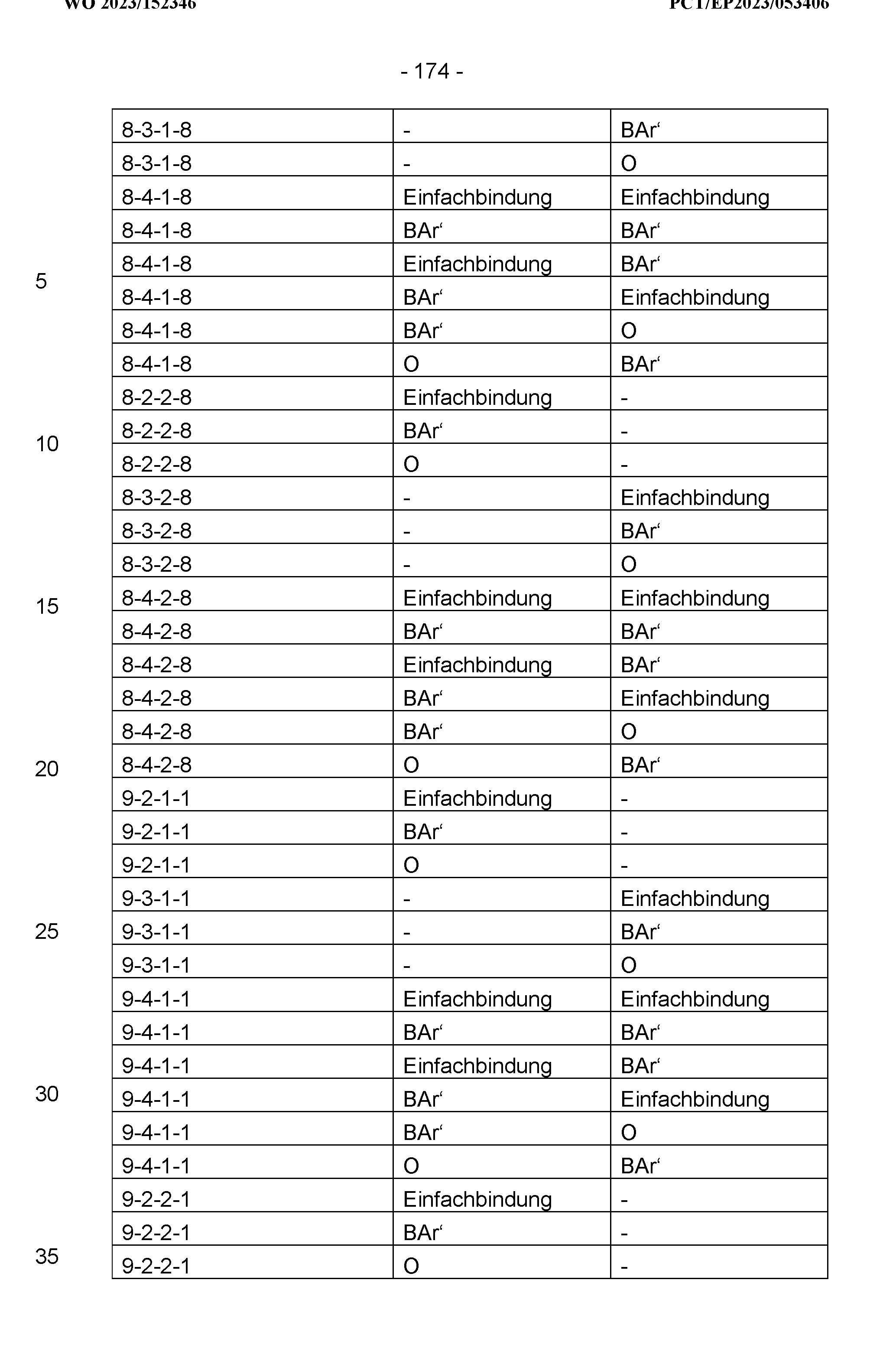


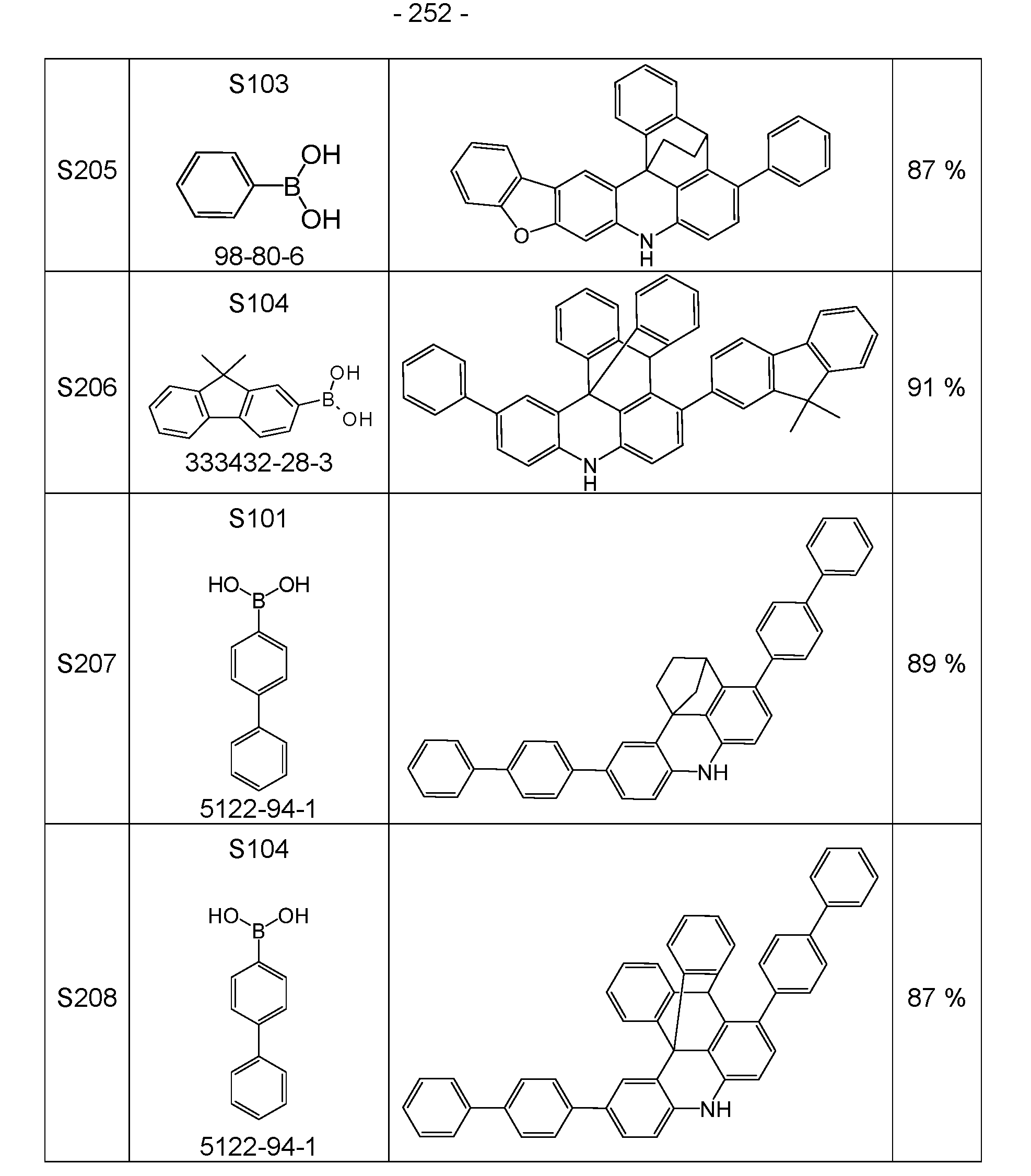


Claims


Priority Applications (4)
| Application Number | Priority Date | Filing Date | Title |
|---|---|---|---|
| EP23703600.9A EP4479385A1 (de) | 2022-02-14 | 2023-02-13 | Materialien für elektronische vorrichtungen |
| CN202380021522.7A CN118647604A (zh) | 2022-02-14 | 2023-02-13 | 用于电子器件的材料 |
| KR1020247031086A KR20240150795A (ko) | 2022-02-14 | 2023-02-13 | 전자 디바이스용 재료 |
| US18/838,008 US20250160204A1 (en) | 2022-02-14 | 2023-02-13 | Materials for electronic devices |
Applications Claiming Priority (2)
| Application Number | Priority Date | Filing Date | Title |
|---|---|---|---|
| EP22156647 | 2022-02-14 | ||
| EP22156647.4 | 2022-02-14 |
Publications (1)
| Publication Number | Publication Date |
|---|---|
| WO2023152346A1 true WO2023152346A1 (de) | 2023-08-17 |
Family
ID=81326227
Family Applications (1)
| Application Number | Title | Priority Date | Filing Date |
|---|---|---|---|
| PCT/EP2023/053406 Ceased WO2023152346A1 (de) | 2022-02-14 | 2023-02-13 | Materialien für elektronische vorrichtungen |
Country Status (5)
| Country | Link |
|---|---|
| US (1) | US20250160204A1 (de) |
| EP (1) | EP4479385A1 (de) |
| KR (1) | KR20240150795A (de) |
| CN (1) | CN118647604A (de) |
| WO (1) | WO2023152346A1 (de) |
Citations (162)
| Publication number | Priority date | Publication date | Assignee | Title |
|---|---|---|---|---|
| US5061569A (en) | 1990-07-26 | 1991-10-29 | Eastman Kodak Company | Electroluminescent device with organic electroluminescent medium |
| WO1995009147A1 (en) | 1993-09-29 | 1995-04-06 | Idemitsu Kosan Co., Ltd. | Organic electroluminescent element and arylenediamine derivative |
| EP0652273A1 (de) | 1993-11-09 | 1995-05-10 | Shinko Electric Industries Co. Ltd. | Organisches Material für elektrolumineszente Vorrichtung und elektrolumineszente Vorrichtung |
| EP0676461A2 (de) | 1994-04-07 | 1995-10-11 | Hoechst Aktiengesellschaft | Spiroverbindungen und ihre Verwendung als Elektrolumineszenzmaterialien |
| JP2000053957A (ja) | 1998-06-23 | 2000-02-22 | Koto Gijutsu Kenkyuin Kenkyu Kumiai | 新規な有機金属発光物質およびそれを含む有機電気発光素子 |
| WO2000070655A2 (en) | 1999-05-13 | 2000-11-23 | The Trustees Of Princeton University | Very high efficiency organic light emitting devices based on electrophosphorescence |
| WO2001041512A1 (en) | 1999-12-01 | 2001-06-07 | The Trustees Of Princeton University | Complexes of form l2mx as phosphorescent dopants for organic leds |
| WO2001049806A1 (en) | 1999-12-31 | 2001-07-12 | Lg Chemical Co., Ltd | Electronic device comprising organic compound having p-type semiconducting characteristics |
| WO2002002714A2 (en) | 2000-06-30 | 2002-01-10 | E.I. Du Pont De Nemours And Company | Electroluminescent iridium compounds with fluorinated phenylpyridines, phenylpyrimidines, and phenylquinolines and devices made with such compounds |
| WO2002015645A1 (en) | 2000-08-11 | 2002-02-21 | The Trustees Of Princeton University | Organometallic compounds and emission-shifting organic electrophosphorescence |
| EP1191614A2 (de) | 2000-09-26 | 2002-03-27 | Canon Kabushiki Kaisha | Lumineszente Vorrichtung und dafür verwendete Metallkoordinationsverbindung |
| EP1191612A2 (de) | 2000-09-26 | 2002-03-27 | Canon Kabushiki Kaisha | Lumineszente Vorrichtung, Bildanzeigevorrichtung und Metallkoordinationsverbindung |
| EP1191613A2 (de) | 2000-09-26 | 2002-03-27 | Canon Kabushiki Kaisha | Lumineszente Vorrichtung, Bildanzeigevorrichtung und Metallkoordinationsverbindung |
| EP1205527A1 (de) | 2000-03-27 | 2002-05-15 | Idemitsu Kosan Co., Ltd. | Organische elektrolumineszierende vorrichtung |
| WO2002072714A1 (de) | 2001-03-10 | 2002-09-19 | Covion Organic Semiconductors Gmbh | Lösung und dispersionen organischer halbleiter |
| WO2003019694A2 (de) | 2001-08-24 | 2003-03-06 | Covion Organic Semiconductors Gmbh | Lösungen polymerer halbleiter |
| WO2003060956A2 (en) | 2002-01-18 | 2003-07-24 | Lg Chem, Ltd. | New material for transporting electrons and organic electroluminescent display using the same |
| WO2004013080A1 (en) | 2002-08-01 | 2004-02-12 | Covion Organic Semiconductors Gmbh | Spirobifluorene derivatives, their preparation and uses thereof |
| WO2004028217A1 (ja) | 2002-09-20 | 2004-04-01 | Idemitsu Kosan Co., Ltd. | 有機エレクトロルミネッセンス素子 |
| WO2004058911A2 (de) | 2002-12-23 | 2004-07-15 | Covion Organic Semiconductors Gmbh | Organisches elektrolumineszenzelement |
| WO2004081017A1 (de) | 2003-03-11 | 2004-09-23 | Covion Organic Semiconductors Gmbh | Metallkomplexe |
| WO2004080975A1 (ja) | 2003-03-13 | 2004-09-23 | Idemitsu Kosan Co., Ltd. | 新規含窒素複素環誘導体及びそれを用いた有機エレクトロルミネッセンス素子 |
| JP2004288381A (ja) | 2003-03-19 | 2004-10-14 | Konica Minolta Holdings Inc | 有機エレクトロルミネッセンス素子 |
| WO2004093207A2 (de) | 2003-04-15 | 2004-10-28 | Covion Organic Semiconductors Gmbh | Mischungen von organischen zur emission befähigten halbleitern und matrixmaterialien, deren verwendung und elektronikbauteile enthaltend diese mischungen |
| WO2005011013A1 (de) | 2003-07-21 | 2005-02-03 | Covion Organic Semiconductors Gmbh | Organisches elektrolumineszenzelement |
| WO2005019373A2 (de) | 2003-08-19 | 2005-03-03 | Basf Aktiengesellschaft | Übergangsmetallkomplexe mit carbenliganden als emitter für organische licht-emittierende dioden (oleds) |
| US20050069729A1 (en) | 2003-09-30 | 2005-03-31 | Konica Minolta Holdings, Inc. | Organic electroluminescent element, illuminator, display and compound |
| WO2005033244A1 (de) | 2003-09-29 | 2005-04-14 | Covion Organic Semiconductors Gmbh | Metallkomplexe |
| EP1553154A1 (de) | 2002-08-23 | 2005-07-13 | Idemitsu Kosan Co., Ltd. | Organische elektrolumineszenzvorrichtung und anthracenderivat |
| WO2005084082A1 (de) | 2004-02-20 | 2005-09-09 | Merck Patent Gmbh | Organische elektronische vorrichtungen |
| WO2005111172A2 (de) | 2004-05-11 | 2005-11-24 | Merck Patent Gmbh | Neue materialmischungen für die elektrolumineszenz |
| US20050258742A1 (en) | 2004-05-18 | 2005-11-24 | Yui-Yi Tsai | Carbene containing metal complexes as OLEDs |
| JP2005347160A (ja) | 2004-06-04 | 2005-12-15 | Konica Minolta Holdings Inc | 有機エレクトロルミネッセンス素子、照明装置及び表示装置 |
| EP1617710A1 (de) | 2003-04-23 | 2006-01-18 | Konica Minolta Holdings, Inc. | Material für ein organisches elektrolumineszenzgerät, organisches elektrolumineszenzgerät, beleuchtungsvorrichtung und anzeige |
| WO2006005627A1 (en) | 2004-07-15 | 2006-01-19 | Merck Patent Gmbh | Oligomeric derivatives of spirobifluorene, their preparation and use |
| WO2006048268A1 (de) | 2004-11-06 | 2006-05-11 | Merck Patent Gmbh | Organische elektrolumineszenzvorrichtung |
| EP1661888A1 (de) | 2004-11-29 | 2006-05-31 | Samsung SDI Co., Ltd. | Phenylcarbazole basierte Verbindungen und deren Verwendung als organische Elektroluminiszierende Vorrichtung |
| WO2006097208A1 (de) | 2005-03-16 | 2006-09-21 | Merck Patent Gmbh | Neue materialien für organische elektrolumineszenzvorrichtungen |
| WO2006100896A1 (ja) | 2005-03-18 | 2006-09-28 | Idemitsu Kosan Co., Ltd. | 芳香族アミン誘導体及びそれを用いた有機エレクトロルミネッセンス素子 |
| WO2006108497A1 (de) | 2005-04-14 | 2006-10-19 | Merck Patent Gmbh | Verbindungen für organische elektronische vorrichtungen |
| WO2006117052A1 (de) | 2005-05-03 | 2006-11-09 | Merck Patent Gmbh | Organische elektrolumineszenzvorrichtung und in deren herstellung verwendete boronsäure- und borinsäure-derivate |
| EP1722602A1 (de) | 2004-03-05 | 2006-11-15 | Idemitsu Kosan Co., Ltd. | Organische elektrolumineszenzeinrichtung und organisches elektrolumineszenzdisplay |
| WO2006122630A1 (de) | 2005-05-20 | 2006-11-23 | Merck Patent Gmbh | Verbindungen für organische elektronische vorrichtungen |
| EP1731584A1 (de) | 2004-03-31 | 2006-12-13 | Konica Minolta Holdings, Inc. | Organischer elektrolumineszenzvorrichtungsstoff, organische elektrolumineszenzvorrichtung, display und beleuchtungsvorrichtung |
| WO2006131192A1 (de) | 2005-06-09 | 2006-12-14 | Merck Patent Gmbh | Neue materialien für organische elektrolumineszenzvorrichtungen |
| EP1749809A1 (de) | 2004-05-27 | 2007-02-07 | Idemitsu Kosan Co., Ltd. | Asymmetrisches pyrenderivat und organische elektrolumineszente vorrichtung, bei der dieses verwendet wird |
| US20070092755A1 (en) | 2005-10-26 | 2007-04-26 | Eastman Kodak Company | Organic element for low voltage electroluminescent devices |
| WO2007063754A1 (ja) | 2005-12-01 | 2007-06-07 | Nippon Steel Chemical Co., Ltd. | 有機電界発光素子用化合物及び有機電界発光素子 |
| WO2007065678A1 (de) | 2005-12-08 | 2007-06-14 | Merck Patent Gmbh | Neue materialien für organische elektroluminieszenzvorrichtungen |
| WO2007065550A1 (de) | 2005-12-08 | 2007-06-14 | Merck Patent Gmbh | Neue materialien für organische elektrolumineszenzvorrichtungen |
| WO2007110129A1 (de) | 2006-03-24 | 2007-10-04 | Merck Patent Gmbh | Neue materialien für organische elektrolumineszenzvorrichtungen |
| WO2007137725A1 (de) | 2006-05-31 | 2007-12-06 | Merck Patent Gmbh | Neue materialien für organische elektrolumineszenzvorrichtungen |
| WO2007140847A1 (de) | 2006-06-02 | 2007-12-13 | Merck Patent Gmbh | Materialien für organische elektrolumineszenzvorrichtungen |
| WO2008006449A1 (de) | 2006-07-11 | 2008-01-17 | Merck Patent Gmbh | Neue materialien für organische elektrolumineszenzvorrichtungen |
| EP1905754A1 (de) | 2005-07-06 | 2008-04-02 | Idemitsu Kosan Co., Ltd. | Pyrenderivat und gerät mit organischer elektrolumineszenz, bei dem dieses verwendet wird |
| WO2008056746A1 (en) | 2006-11-09 | 2008-05-15 | Nippon Steel Chemical Co., Ltd. | Compound for organic electroluminescent device and organic electroluminescent device |
| WO2008086851A1 (de) | 2007-01-18 | 2008-07-24 | Merck Patent Gmbh | Carbazol-derivate für organische elektrolumineszenzvorrichtungen |
| EP1968131A1 (de) | 2005-12-27 | 2008-09-10 | Idemitsu Kosan Co., Ltd. | Material für ein organisches elektrolumineszenzgerät und organisches elektrolumineszenzgerät |
| WO2008145239A2 (de) | 2007-05-29 | 2008-12-04 | Merck Patent Gmbh | Benzanthracen-derivate für organische elektrolumineszenzvorrichtungen |
| DE102007031220A1 (de) | 2007-07-04 | 2009-01-08 | Novaled Ag | Chinoide Verbindungen und deren Verwendung in halbleitenden Matrixmaterialien, elektronischen und optoelektronischen Bauelementen |
| EP2045848A1 (de) | 2007-07-18 | 2009-04-08 | Idemitsu Kosan Co., Ltd. | Material für ein organisches elektrolumineszenzgerät und organisches elektrolumineszenzgerät |
| WO2009062578A1 (de) | 2007-11-12 | 2009-05-22 | Merck Patent Gmbh | Organische elektrolumineszenzvorrichtungen enthaltend azomethin-metall-komplexe |
| WO2009100925A1 (de) | 2008-02-13 | 2009-08-20 | Merck Patent Gmbh | Neue materialien für organische elektrolumineszenzvorrichtungen |
| WO2009146770A2 (de) | 2008-06-05 | 2009-12-10 | Merck Patent Gmbh | Elektronische vorrichtung enthaltend metallkomplexe |
| WO2010006680A1 (de) | 2008-07-18 | 2010-01-21 | Merck Patent Gmbh | Materialien für organische elektrolumineszenzvorrichtungen |
| WO2010012328A1 (de) | 2008-07-29 | 2010-02-04 | Merck Patent Gmbh | Verbindungen für elektronische vorrichtungen |
| WO2010015306A1 (de) | 2008-08-08 | 2010-02-11 | Merck Patent Gmbh, | Organische elektrolumineszenzvorrichtung |
| WO2010015307A1 (de) | 2008-08-04 | 2010-02-11 | Merck Patent Gmbh | Elektronische vorrichtung enthaltend metallkomplexe mit isonitrilliganden |
| WO2010031485A1 (de) | 2008-09-22 | 2010-03-25 | Merck Patent Gmbh | Materialien für organische elektrolumineszenzvorrichtungen |
| US20100096600A1 (en) | 2008-10-16 | 2010-04-22 | Novaled Ag | Square Planar Transition Metal Complexes and Organic Semiconductive Materials Using Them as Well as Electronic or Optoelectric Components |
| WO2010054730A1 (de) | 2008-11-11 | 2010-05-20 | Merck Patent Gmbh | Organische elektrolumineszenzvorrichtungen |
| WO2010054728A1 (de) | 2008-11-13 | 2010-05-20 | Merck Patent Gmbh | Materialien für organische elektrolumineszenzvorrichtungen |
| WO2010054729A2 (de) | 2008-11-11 | 2010-05-20 | Merck Patent Gmbh | Materialien für organische elektrolumineszenzvorrichtungen |
| WO2010054731A1 (de) | 2008-11-13 | 2010-05-20 | Merck Patent Gmbh | Materialien für organische elektrolumineszenzvorrichtungen |
| WO2010072300A1 (de) | 2008-12-22 | 2010-07-01 | Merck Patent Gmbh | Organische elektrolumineszenzvorrichtung mit triazinderivaten |
| EP2213662A1 (de) | 2007-11-30 | 2010-08-04 | Idemitsu Kosan Co., Ltd. | Azaindenofluorendionderivat, material für ein organisches elektrolumineszierendes gerät und organisches lumineszierendes gerät |
| WO2010086089A1 (de) | 2009-02-02 | 2010-08-05 | Merck Patent Gmbh | Metallkomplexe |
| WO2010094378A1 (de) | 2009-02-17 | 2010-08-26 | Merck Patent Gmbh | Organische elektronische vorrichtung |
| WO2010099852A1 (de) | 2009-03-02 | 2010-09-10 | Merck Patent Gmbh | Metallkomplexe mit azaborol-liganden und elektronische vorrichtung damit |
| WO2010102709A1 (de) | 2009-03-13 | 2010-09-16 | Merck Patent Gmbh | Materialien für organische elektrolumineszenzvorrichtungen |
| WO2010108579A1 (de) | 2009-03-23 | 2010-09-30 | Merck Patent Gmbh | Organische elektrolumineszenzvorrichtung |
| WO2010136109A1 (de) | 2009-05-29 | 2010-12-02 | Merck Patent Gmbh | Materialien für organische elektrolumineszenzvorrichtungen |
| WO2011000455A1 (de) | 2009-06-30 | 2011-01-06 | Merck Patent Gmbh | Materialien für organische elektrolumineszenzvorrichtungen |
| EP2276085A1 (de) | 2008-03-27 | 2011-01-19 | Nippon Steel Chemical Co., Ltd. | Organisches elektrolumineszenzbauelement |
| WO2011032626A1 (de) | 2009-09-16 | 2011-03-24 | Merck Patent Gmbh | Metallkomplexe |
| WO2011042107A2 (de) | 2009-10-08 | 2011-04-14 | Merck Patent Gmbh | Materialien für organische elektrolumineszenzvorrichtungen |
| WO2011054442A2 (de) | 2009-11-06 | 2011-05-12 | Merck Patent Gmbh | Materialien für elektronische vorrichtungen |
| WO2011057706A2 (de) | 2009-11-14 | 2011-05-19 | Merck Patent Gmbh | Materialien für elektronische vorrichtungen |
| WO2011060877A2 (de) | 2009-11-17 | 2011-05-26 | Merck Patent Gmbh | Materialien für organische elektrolumineszenzvorrichtungen |
| WO2011060859A1 (de) | 2009-11-17 | 2011-05-26 | Merck Patent Gmbh | Materialien für organische elektrolumineszenzvorrichtungen |
| WO2011060867A1 (de) | 2009-11-18 | 2011-05-26 | Merck Patent Gmbh | Stickstoffhaltige kondensierte heterozyklen für oleds |
| WO2011066898A1 (de) | 2009-12-05 | 2011-06-09 | Merck Patent Gmbh | Elektronische vorrichtung enthaltend metallkomplexe |
| WO2011073149A1 (de) | 2009-12-14 | 2011-06-23 | Basf Se | Metallkomplexe, enthaltend diazabenzimidazolcarben-liganden und deren verwendung in oleds |
| WO2011088877A1 (de) | 2010-01-25 | 2011-07-28 | Merck Patent Gmbh | Verbindungen für elektronische vorrichtungen |
| WO2011116865A1 (de) | 2010-03-25 | 2011-09-29 | Merck Patent Gmbh | Materialien für organische elektrolumineszenzvorrichtungen |
| WO2011120709A1 (de) | 2010-03-31 | 2011-10-06 | Osram Opto Semiconductors Gmbh | Dotierstoff für eine lochleiterschicht für organische halbleiterbauelemente und verwendung dazu |
| US8044390B2 (en) | 2007-05-25 | 2011-10-25 | Idemitsu Kosan Co., Ltd. | Material for organic electroluminescent device, organic electroluminescent device, and organic electroluminescent display |
| WO2011137951A1 (de) | 2010-05-04 | 2011-11-10 | Merck Patent Gmbh | Organische elektrolumineszenzvorrichtungen |
| US8057712B2 (en) | 2008-04-29 | 2011-11-15 | Novaled Ag | Radialene compounds and their use |
| WO2011157339A1 (de) | 2010-06-15 | 2011-12-22 | Merck Patent Gmbh | Metallkomplexe |
| WO2012007086A1 (de) | 2010-07-16 | 2012-01-19 | Merck Patent Gmbh | Metallkomplexe |
| WO2012034627A1 (de) | 2010-09-15 | 2012-03-22 | Merck Patent Gmbh | Materialien für organische elektrolumineszenzvorrichtungen |
| WO2012048780A1 (de) | 2010-10-15 | 2012-04-19 | Merck Patent Gmbh | Verbindungen für elektronische vorrichtungen |
| WO2012048781A1 (de) | 2010-10-15 | 2012-04-19 | Merck Patent Gmbh | Materialien auf basis von triphenylen für organische elektrolumineszenzvorrichtungen |
| WO2012095143A1 (de) | 2011-01-13 | 2012-07-19 | Merck Patent Gmbh | Verbindungen für organische elektrolumineszenzvorrichtungen |
| US20120187826A1 (en) | 2009-12-21 | 2012-07-26 | Idemitsu Kosan Co., Ltd. | Organic electroluminescent element using pyrene derivative |
| WO2012143080A2 (de) | 2011-04-18 | 2012-10-26 | Merck Patent Gmbh | Materialien für organische elektrolumineszenzvorrichtungen |
| WO2012150001A1 (de) | 2011-05-05 | 2012-11-08 | Merck Patent Gmbh | Verbindungen für elektronische vorrichtungen |
| WO2013041176A1 (de) | 2011-09-21 | 2013-03-28 | Merck Patent Gmbh | Carbazolderivate für organische elektrolumineszenzvorrichtungen |
| WO2013056776A1 (de) | 2011-10-20 | 2013-04-25 | Merck Patent Gmbh | Materialien für organische elektrolumineszenzvorrichtungen |
| WO2013083216A1 (de) | 2011-11-17 | 2013-06-13 | Merck Patent Gmbh | Spiro -dihydroacridinderivate und ihre verwendung als materialien für organische elektrolumineszenzvorrichtungen |
| WO2013120577A1 (en) | 2012-02-14 | 2013-08-22 | Merck Patent Gmbh | Spirobifluorene compounds for organic electroluminescent devices |
| DE102012209523A1 (de) | 2012-06-06 | 2013-12-12 | Osram Opto Semiconductors Gmbh | Hauptgruppenmetallkomplexe als p-Dotanden für organische elektronische Matrixmaterialien |
| WO2013185871A1 (en) | 2012-06-12 | 2013-12-19 | Merck Patent Gmbh | Compounds for electronic devices |
| WO2014008982A1 (de) | 2012-07-13 | 2014-01-16 | Merck Patent Gmbh | Metallkomplexe |
| WO2014015935A2 (de) | 2012-07-23 | 2014-01-30 | Merck Patent Gmbh | Verbindungen und organische elektronische vorrichtungen |
| WO2014015938A1 (de) | 2012-07-23 | 2014-01-30 | Merck Patent Gmbh | Derivate von 2-diarylaminofluoren und diese enthaltnde organische elektronische verbindungen |
| WO2014015937A1 (de) | 2012-07-23 | 2014-01-30 | Merck Patent Gmbh | Verbindungen und organische elektrolumineszierende vorrichtungen |
| WO2014023377A2 (de) | 2012-08-07 | 2014-02-13 | Merck Patent Gmbh | Metallkomplexe |
| WO2014037077A1 (de) | 2012-09-04 | 2014-03-13 | Merck Patent Gmbh | Verbindungen für elektronische vorrichtungen |
| WO2014072017A1 (de) | 2012-11-12 | 2014-05-15 | Merck Patent Gmbh | Materialien für elektronische vorrichtungen |
| WO2014094961A1 (de) | 2012-12-21 | 2014-06-26 | Merck Patent Gmbh | Metallkomplexe |
| WO2014094960A1 (de) | 2012-12-21 | 2014-06-26 | Merck Patent Gmbh | Metallkomplexe |
| WO2014106522A1 (de) | 2013-01-03 | 2014-07-10 | Merck Patent Gmbh | Materialien für elektronische vorrichtungen |
| WO2014111269A2 (de) | 2013-10-14 | 2014-07-24 | Merck Patent Gmbh | Materialien für elektronische vorrichtungen |
| WO2015022051A1 (de) | 2013-08-15 | 2015-02-19 | Merck Patent Gmbh | Materialien für elektronische vorrichtungen |
| WO2015036074A1 (de) | 2013-09-11 | 2015-03-19 | Merck Patent Gmbh | Metallkomplexe |
| US9000421B2 (en) | 2012-03-01 | 2015-04-07 | Udc Ireland Limited | Organic electroluminescent element, materials for organic electroluminescent element, and light emitting device, display device, or illumination device, each using the element, and compounds used in the element |
| WO2015082056A1 (de) | 2013-12-06 | 2015-06-11 | Merck Patent Gmbh | Verbindungen und organische elektronische vorrichtungen |
| WO2015086108A1 (de) | 2013-12-12 | 2015-06-18 | Merck Patent Gmbh | Materialien für elektronische vorrichtungen |
| WO2015104045A1 (de) | 2014-01-13 | 2015-07-16 | Merck Patent Gmbh | Metallkomplexe |
| WO2015117718A1 (de) | 2014-02-05 | 2015-08-13 | Merck Patent Gmbh | Metallkomplexe |
| WO2015131976A1 (de) | 2014-03-07 | 2015-09-11 | Merck Patent Gmbh | Materialien für elektronische vorrichtungen |
| WO2015158411A1 (de) | 2014-04-14 | 2015-10-22 | Merck Patent Gmbh | Materialien für elektronische vorrichtungen |
| WO2015158409A1 (de) | 2014-04-16 | 2015-10-22 | Merck Patent Gmbh | Materialien für elektronische vorrichtungen |
| WO2015169412A1 (de) | 2014-05-05 | 2015-11-12 | Merck Patent Gmbh | Materialien für organische elektrolumineszenzvorrichtungen |
| WO2016015810A1 (de) | 2014-07-29 | 2016-02-04 | Merck Patent Gmbh | Materialien f?r organische elektrolumineszenzvorrichtungen |
| WO2016015815A1 (de) | 2014-07-28 | 2016-02-04 | Merck Patent Gmbh | Metallkomplexe |
| WO2016023608A1 (de) | 2014-08-13 | 2016-02-18 | Merck Patent Gmbh | Materialien für organische elektrolumineszenzvorrichtungen |
| WO2016078738A1 (en) | 2014-11-18 | 2016-05-26 | Merck Patent Gmbh | Materials for organic electroluminescent devices |
| WO2016087017A1 (de) | 2014-12-01 | 2016-06-09 | Merck Patent Gmbh | Materialien für organische elektrolumineszenzvorrichtungen |
| WO2016102048A1 (de) | 2014-12-22 | 2016-06-30 | Merck Patent Gmbh | Materialien für elektronische vorrichtungen |
| WO2016124304A1 (de) | 2015-02-03 | 2016-08-11 | Merck Patent Gmbh | Metallkomplexe |
| WO2016131521A1 (de) | 2015-02-16 | 2016-08-25 | Merck Patent Gmbh | Materialien auf basis von spirobifluorenderivaten für elektronische vorrichtungen |
| WO2016150544A1 (en) | 2015-03-25 | 2016-09-29 | Merck Patent Gmbh | Materials for organic electroluminescent devices |
| CN106220619A (zh) * | 2016-04-25 | 2016-12-14 | 中节能万润股份有限公司 | 一种含有氧杂蒽结构的有机化合物及其应用 |
| WO2017025165A1 (de) | 2015-08-12 | 2017-02-16 | Merck Patent Gmbh | Materialien für elektronische vorrichtungen |
| WO2017028941A1 (en) | 2015-08-14 | 2017-02-23 | Merck Patent Gmbh | Phenoxazine derivatives for organic electroluminescent devices |
| WO2017028940A1 (en) | 2015-08-14 | 2017-02-23 | Merck Patent Gmbh | Phenoxazine derivatives for organic electroluminescent devices |
| WO2017032439A1 (de) | 2015-08-25 | 2017-03-02 | Merck Patent Gmbh | Metallkomplexe |
| WO2017036574A1 (de) | 2015-08-28 | 2017-03-09 | Merck Patent Gmbh | 6,9,15,18-tetrahydro-s-indaceno[1,2-b:5,6-b']difluoren- derivate und ihre verwendung in elektronischen vorrichtungen |
| WO2017036573A1 (en) | 2015-08-28 | 2017-03-09 | Merck Patent Gmbh | Compounds for electronic devices |
| WO2017148565A1 (de) | 2016-03-03 | 2017-09-08 | Merck Patent Gmbh | Materialien für organische elektrolumineszenzvorrichtungen |
| WO2018011186A1 (de) | 2016-07-14 | 2018-01-18 | Merck Patent Gmbh | Metallkomplexe |
| WO2018041769A1 (de) | 2016-08-30 | 2018-03-08 | Merck Patent Gmbh | Bl- und trinukleare metallkomplexe aufgebaut aus zwei miteinander verknüpften tripodalen hexadentaten liganden zur verwendung in elektrolumineszenzvorrichtungen |
| CN107868048A (zh) * | 2016-09-28 | 2018-04-03 | 江苏三月光电科技有限公司 | 一种含有芴的化合物及其应用 |
| WO2018178001A1 (de) | 2017-03-29 | 2018-10-04 | Merck Patent Gmbh | Metallkomplexe |
| WO2019020538A1 (de) | 2017-07-25 | 2019-01-31 | Merck Patent Gmbh | Metallkomplexe |
| WO2019115423A1 (de) | 2017-12-13 | 2019-06-20 | Merck Patent Gmbh | Metallkomplexe |
| WO2019158453A1 (de) | 2018-02-13 | 2019-08-22 | Merck Patent Gmbh | Metallkomplexe |
| CN110845508A (zh) | 2018-08-21 | 2020-02-28 | 江苏三月光电科技有限公司 | 一种以螺芴蒽酮为核心的化合物、制备方法及其应用 |
| CN111995562A (zh) * | 2020-09-14 | 2020-11-27 | 深圳大学 | 三蝶烯类d-a型热活化延迟荧光材料、电子器件及应用 |
-
2023
- 2023-02-13 US US18/838,008 patent/US20250160204A1/en active Pending
- 2023-02-13 EP EP23703600.9A patent/EP4479385A1/de active Pending
- 2023-02-13 CN CN202380021522.7A patent/CN118647604A/zh active Pending
- 2023-02-13 WO PCT/EP2023/053406 patent/WO2023152346A1/de not_active Ceased
- 2023-02-13 KR KR1020247031086A patent/KR20240150795A/ko active Pending
Patent Citations (167)
| Publication number | Priority date | Publication date | Assignee | Title |
|---|---|---|---|---|
| US5061569A (en) | 1990-07-26 | 1991-10-29 | Eastman Kodak Company | Electroluminescent device with organic electroluminescent medium |
| WO1995009147A1 (en) | 1993-09-29 | 1995-04-06 | Idemitsu Kosan Co., Ltd. | Organic electroluminescent element and arylenediamine derivative |
| EP0652273A1 (de) | 1993-11-09 | 1995-05-10 | Shinko Electric Industries Co. Ltd. | Organisches Material für elektrolumineszente Vorrichtung und elektrolumineszente Vorrichtung |
| EP0676461A2 (de) | 1994-04-07 | 1995-10-11 | Hoechst Aktiengesellschaft | Spiroverbindungen und ihre Verwendung als Elektrolumineszenzmaterialien |
| JP2000053957A (ja) | 1998-06-23 | 2000-02-22 | Koto Gijutsu Kenkyuin Kenkyu Kumiai | 新規な有機金属発光物質およびそれを含む有機電気発光素子 |
| WO2000070655A2 (en) | 1999-05-13 | 2000-11-23 | The Trustees Of Princeton University | Very high efficiency organic light emitting devices based on electrophosphorescence |
| WO2001041512A1 (en) | 1999-12-01 | 2001-06-07 | The Trustees Of Princeton University | Complexes of form l2mx as phosphorescent dopants for organic leds |
| WO2001049806A1 (en) | 1999-12-31 | 2001-07-12 | Lg Chemical Co., Ltd | Electronic device comprising organic compound having p-type semiconducting characteristics |
| EP1205527A1 (de) | 2000-03-27 | 2002-05-15 | Idemitsu Kosan Co., Ltd. | Organische elektrolumineszierende vorrichtung |
| WO2002002714A2 (en) | 2000-06-30 | 2002-01-10 | E.I. Du Pont De Nemours And Company | Electroluminescent iridium compounds with fluorinated phenylpyridines, phenylpyrimidines, and phenylquinolines and devices made with such compounds |
| WO2002015645A1 (en) | 2000-08-11 | 2002-02-21 | The Trustees Of Princeton University | Organometallic compounds and emission-shifting organic electrophosphorescence |
| EP1191614A2 (de) | 2000-09-26 | 2002-03-27 | Canon Kabushiki Kaisha | Lumineszente Vorrichtung und dafür verwendete Metallkoordinationsverbindung |
| EP1191612A2 (de) | 2000-09-26 | 2002-03-27 | Canon Kabushiki Kaisha | Lumineszente Vorrichtung, Bildanzeigevorrichtung und Metallkoordinationsverbindung |
| EP1191613A2 (de) | 2000-09-26 | 2002-03-27 | Canon Kabushiki Kaisha | Lumineszente Vorrichtung, Bildanzeigevorrichtung und Metallkoordinationsverbindung |
| WO2002072714A1 (de) | 2001-03-10 | 2002-09-19 | Covion Organic Semiconductors Gmbh | Lösung und dispersionen organischer halbleiter |
| WO2003019694A2 (de) | 2001-08-24 | 2003-03-06 | Covion Organic Semiconductors Gmbh | Lösungen polymerer halbleiter |
| WO2003060956A2 (en) | 2002-01-18 | 2003-07-24 | Lg Chem, Ltd. | New material for transporting electrons and organic electroluminescent display using the same |
| WO2004013080A1 (en) | 2002-08-01 | 2004-02-12 | Covion Organic Semiconductors Gmbh | Spirobifluorene derivatives, their preparation and uses thereof |
| EP1553154A1 (de) | 2002-08-23 | 2005-07-13 | Idemitsu Kosan Co., Ltd. | Organische elektrolumineszenzvorrichtung und anthracenderivat |
| WO2004028217A1 (ja) | 2002-09-20 | 2004-04-01 | Idemitsu Kosan Co., Ltd. | 有機エレクトロルミネッセンス素子 |
| WO2004058911A2 (de) | 2002-12-23 | 2004-07-15 | Covion Organic Semiconductors Gmbh | Organisches elektrolumineszenzelement |
| WO2004081017A1 (de) | 2003-03-11 | 2004-09-23 | Covion Organic Semiconductors Gmbh | Metallkomplexe |
| WO2004080975A1 (ja) | 2003-03-13 | 2004-09-23 | Idemitsu Kosan Co., Ltd. | 新規含窒素複素環誘導体及びそれを用いた有機エレクトロルミネッセンス素子 |
| JP2004288381A (ja) | 2003-03-19 | 2004-10-14 | Konica Minolta Holdings Inc | 有機エレクトロルミネッセンス素子 |
| WO2004093207A2 (de) | 2003-04-15 | 2004-10-28 | Covion Organic Semiconductors Gmbh | Mischungen von organischen zur emission befähigten halbleitern und matrixmaterialien, deren verwendung und elektronikbauteile enthaltend diese mischungen |
| EP1617710A1 (de) | 2003-04-23 | 2006-01-18 | Konica Minolta Holdings, Inc. | Material für ein organisches elektrolumineszenzgerät, organisches elektrolumineszenzgerät, beleuchtungsvorrichtung und anzeige |
| EP1617711A1 (de) | 2003-04-23 | 2006-01-18 | Konica Minolta Holdings, Inc. | Organisches elektrolumineszenzbauelement und anzeige |
| WO2005011013A1 (de) | 2003-07-21 | 2005-02-03 | Covion Organic Semiconductors Gmbh | Organisches elektrolumineszenzelement |
| WO2005019373A2 (de) | 2003-08-19 | 2005-03-03 | Basf Aktiengesellschaft | Übergangsmetallkomplexe mit carbenliganden als emitter für organische licht-emittierende dioden (oleds) |
| WO2005033244A1 (de) | 2003-09-29 | 2005-04-14 | Covion Organic Semiconductors Gmbh | Metallkomplexe |
| US20050069729A1 (en) | 2003-09-30 | 2005-03-31 | Konica Minolta Holdings, Inc. | Organic electroluminescent element, illuminator, display and compound |
| WO2005039246A1 (ja) | 2003-09-30 | 2005-04-28 | Konica Minolta Holdings, Inc. | 有機エレクトロルミネッセンス素子、照明装置、表示装置 |
| WO2005084081A1 (de) | 2004-02-20 | 2005-09-09 | Merck Patent Gmbh | Organische elektronische vorrichtungen |
| WO2005084082A1 (de) | 2004-02-20 | 2005-09-09 | Merck Patent Gmbh | Organische elektronische vorrichtungen |
| EP1722602A1 (de) | 2004-03-05 | 2006-11-15 | Idemitsu Kosan Co., Ltd. | Organische elektrolumineszenzeinrichtung und organisches elektrolumineszenzdisplay |
| EP1731584A1 (de) | 2004-03-31 | 2006-12-13 | Konica Minolta Holdings, Inc. | Organischer elektrolumineszenzvorrichtungsstoff, organische elektrolumineszenzvorrichtung, display und beleuchtungsvorrichtung |
| WO2005111172A2 (de) | 2004-05-11 | 2005-11-24 | Merck Patent Gmbh | Neue materialmischungen für die elektrolumineszenz |
| US20050258742A1 (en) | 2004-05-18 | 2005-11-24 | Yui-Yi Tsai | Carbene containing metal complexes as OLEDs |
| EP1749809A1 (de) | 2004-05-27 | 2007-02-07 | Idemitsu Kosan Co., Ltd. | Asymmetrisches pyrenderivat und organische elektrolumineszente vorrichtung, bei der dieses verwendet wird |
| JP2005347160A (ja) | 2004-06-04 | 2005-12-15 | Konica Minolta Holdings Inc | 有機エレクトロルミネッセンス素子、照明装置及び表示装置 |
| WO2006005627A1 (en) | 2004-07-15 | 2006-01-19 | Merck Patent Gmbh | Oligomeric derivatives of spirobifluorene, their preparation and use |
| WO2006048268A1 (de) | 2004-11-06 | 2006-05-11 | Merck Patent Gmbh | Organische elektrolumineszenzvorrichtung |
| EP1661888A1 (de) | 2004-11-29 | 2006-05-31 | Samsung SDI Co., Ltd. | Phenylcarbazole basierte Verbindungen und deren Verwendung als organische Elektroluminiszierende Vorrichtung |
| WO2006097208A1 (de) | 2005-03-16 | 2006-09-21 | Merck Patent Gmbh | Neue materialien für organische elektrolumineszenzvorrichtungen |
| WO2006100896A1 (ja) | 2005-03-18 | 2006-09-28 | Idemitsu Kosan Co., Ltd. | 芳香族アミン誘導体及びそれを用いた有機エレクトロルミネッセンス素子 |
| WO2006108497A1 (de) | 2005-04-14 | 2006-10-19 | Merck Patent Gmbh | Verbindungen für organische elektronische vorrichtungen |
| WO2006117052A1 (de) | 2005-05-03 | 2006-11-09 | Merck Patent Gmbh | Organische elektrolumineszenzvorrichtung und in deren herstellung verwendete boronsäure- und borinsäure-derivate |
| WO2006122630A1 (de) | 2005-05-20 | 2006-11-23 | Merck Patent Gmbh | Verbindungen für organische elektronische vorrichtungen |
| WO2006131192A1 (de) | 2005-06-09 | 2006-12-14 | Merck Patent Gmbh | Neue materialien für organische elektrolumineszenzvorrichtungen |
| EP1905754A1 (de) | 2005-07-06 | 2008-04-02 | Idemitsu Kosan Co., Ltd. | Pyrenderivat und gerät mit organischer elektrolumineszenz, bei dem dieses verwendet wird |
| US20070092755A1 (en) | 2005-10-26 | 2007-04-26 | Eastman Kodak Company | Organic element for low voltage electroluminescent devices |
| WO2007063754A1 (ja) | 2005-12-01 | 2007-06-07 | Nippon Steel Chemical Co., Ltd. | 有機電界発光素子用化合物及び有機電界発光素子 |
| WO2007065678A1 (de) | 2005-12-08 | 2007-06-14 | Merck Patent Gmbh | Neue materialien für organische elektroluminieszenzvorrichtungen |
| WO2007065550A1 (de) | 2005-12-08 | 2007-06-14 | Merck Patent Gmbh | Neue materialien für organische elektrolumineszenzvorrichtungen |
| EP1968131A1 (de) | 2005-12-27 | 2008-09-10 | Idemitsu Kosan Co., Ltd. | Material für ein organisches elektrolumineszenzgerät und organisches elektrolumineszenzgerät |
| WO2007110129A1 (de) | 2006-03-24 | 2007-10-04 | Merck Patent Gmbh | Neue materialien für organische elektrolumineszenzvorrichtungen |
| WO2007137725A1 (de) | 2006-05-31 | 2007-12-06 | Merck Patent Gmbh | Neue materialien für organische elektrolumineszenzvorrichtungen |
| WO2007140847A1 (de) | 2006-06-02 | 2007-12-13 | Merck Patent Gmbh | Materialien für organische elektrolumineszenzvorrichtungen |
| WO2008006449A1 (de) | 2006-07-11 | 2008-01-17 | Merck Patent Gmbh | Neue materialien für organische elektrolumineszenzvorrichtungen |
| WO2008056746A1 (en) | 2006-11-09 | 2008-05-15 | Nippon Steel Chemical Co., Ltd. | Compound for organic electroluminescent device and organic electroluminescent device |
| WO2008086851A1 (de) | 2007-01-18 | 2008-07-24 | Merck Patent Gmbh | Carbazol-derivate für organische elektrolumineszenzvorrichtungen |
| US8044390B2 (en) | 2007-05-25 | 2011-10-25 | Idemitsu Kosan Co., Ltd. | Material for organic electroluminescent device, organic electroluminescent device, and organic electroluminescent display |
| WO2008145239A2 (de) | 2007-05-29 | 2008-12-04 | Merck Patent Gmbh | Benzanthracen-derivate für organische elektrolumineszenzvorrichtungen |
| DE102007031220A1 (de) | 2007-07-04 | 2009-01-08 | Novaled Ag | Chinoide Verbindungen und deren Verwendung in halbleitenden Matrixmaterialien, elektronischen und optoelektronischen Bauelementen |
| WO2009003455A1 (de) | 2007-07-04 | 2009-01-08 | Novaled Ag | Chinoide verbindungen und deren verwendung in halbleitenden matrixmaterialien, elektronischen und optoelektronischen bauelementen |
| EP2045848A1 (de) | 2007-07-18 | 2009-04-08 | Idemitsu Kosan Co., Ltd. | Material für ein organisches elektrolumineszenzgerät und organisches elektrolumineszenzgerät |
| WO2009062578A1 (de) | 2007-11-12 | 2009-05-22 | Merck Patent Gmbh | Organische elektrolumineszenzvorrichtungen enthaltend azomethin-metall-komplexe |
| EP2213662A1 (de) | 2007-11-30 | 2010-08-04 | Idemitsu Kosan Co., Ltd. | Azaindenofluorendionderivat, material für ein organisches elektrolumineszierendes gerät und organisches lumineszierendes gerät |
| WO2009100925A1 (de) | 2008-02-13 | 2009-08-20 | Merck Patent Gmbh | Neue materialien für organische elektrolumineszenzvorrichtungen |
| EP2276085A1 (de) | 2008-03-27 | 2011-01-19 | Nippon Steel Chemical Co., Ltd. | Organisches elektrolumineszenzbauelement |
| US8057712B2 (en) | 2008-04-29 | 2011-11-15 | Novaled Ag | Radialene compounds and their use |
| WO2009146770A2 (de) | 2008-06-05 | 2009-12-10 | Merck Patent Gmbh | Elektronische vorrichtung enthaltend metallkomplexe |
| WO2010006680A1 (de) | 2008-07-18 | 2010-01-21 | Merck Patent Gmbh | Materialien für organische elektrolumineszenzvorrichtungen |
| WO2010012328A1 (de) | 2008-07-29 | 2010-02-04 | Merck Patent Gmbh | Verbindungen für elektronische vorrichtungen |
| WO2010015307A1 (de) | 2008-08-04 | 2010-02-11 | Merck Patent Gmbh | Elektronische vorrichtung enthaltend metallkomplexe mit isonitrilliganden |
| WO2010015306A1 (de) | 2008-08-08 | 2010-02-11 | Merck Patent Gmbh, | Organische elektrolumineszenzvorrichtung |
| WO2010031485A1 (de) | 2008-09-22 | 2010-03-25 | Merck Patent Gmbh | Materialien für organische elektrolumineszenzvorrichtungen |
| US20100096600A1 (en) | 2008-10-16 | 2010-04-22 | Novaled Ag | Square Planar Transition Metal Complexes and Organic Semiconductive Materials Using Them as Well as Electronic or Optoelectric Components |
| WO2010054730A1 (de) | 2008-11-11 | 2010-05-20 | Merck Patent Gmbh | Organische elektrolumineszenzvorrichtungen |
| WO2010054729A2 (de) | 2008-11-11 | 2010-05-20 | Merck Patent Gmbh | Materialien für organische elektrolumineszenzvorrichtungen |
| WO2010054731A1 (de) | 2008-11-13 | 2010-05-20 | Merck Patent Gmbh | Materialien für organische elektrolumineszenzvorrichtungen |
| WO2010054728A1 (de) | 2008-11-13 | 2010-05-20 | Merck Patent Gmbh | Materialien für organische elektrolumineszenzvorrichtungen |
| WO2010072300A1 (de) | 2008-12-22 | 2010-07-01 | Merck Patent Gmbh | Organische elektrolumineszenzvorrichtung mit triazinderivaten |
| WO2010086089A1 (de) | 2009-02-02 | 2010-08-05 | Merck Patent Gmbh | Metallkomplexe |
| WO2010094378A1 (de) | 2009-02-17 | 2010-08-26 | Merck Patent Gmbh | Organische elektronische vorrichtung |
| WO2010099852A1 (de) | 2009-03-02 | 2010-09-10 | Merck Patent Gmbh | Metallkomplexe mit azaborol-liganden und elektronische vorrichtung damit |
| WO2010102709A1 (de) | 2009-03-13 | 2010-09-16 | Merck Patent Gmbh | Materialien für organische elektrolumineszenzvorrichtungen |
| WO2010108579A1 (de) | 2009-03-23 | 2010-09-30 | Merck Patent Gmbh | Organische elektrolumineszenzvorrichtung |
| WO2010136109A1 (de) | 2009-05-29 | 2010-12-02 | Merck Patent Gmbh | Materialien für organische elektrolumineszenzvorrichtungen |
| WO2011000455A1 (de) | 2009-06-30 | 2011-01-06 | Merck Patent Gmbh | Materialien für organische elektrolumineszenzvorrichtungen |
| WO2011032626A1 (de) | 2009-09-16 | 2011-03-24 | Merck Patent Gmbh | Metallkomplexe |
| WO2011042107A2 (de) | 2009-10-08 | 2011-04-14 | Merck Patent Gmbh | Materialien für organische elektrolumineszenzvorrichtungen |
| WO2011054442A2 (de) | 2009-11-06 | 2011-05-12 | Merck Patent Gmbh | Materialien für elektronische vorrichtungen |
| WO2011057706A2 (de) | 2009-11-14 | 2011-05-19 | Merck Patent Gmbh | Materialien für elektronische vorrichtungen |
| WO2011060877A2 (de) | 2009-11-17 | 2011-05-26 | Merck Patent Gmbh | Materialien für organische elektrolumineszenzvorrichtungen |
| WO2011060859A1 (de) | 2009-11-17 | 2011-05-26 | Merck Patent Gmbh | Materialien für organische elektrolumineszenzvorrichtungen |
| WO2011060867A1 (de) | 2009-11-18 | 2011-05-26 | Merck Patent Gmbh | Stickstoffhaltige kondensierte heterozyklen für oleds |
| WO2011066898A1 (de) | 2009-12-05 | 2011-06-09 | Merck Patent Gmbh | Elektronische vorrichtung enthaltend metallkomplexe |
| WO2011073149A1 (de) | 2009-12-14 | 2011-06-23 | Basf Se | Metallkomplexe, enthaltend diazabenzimidazolcarben-liganden und deren verwendung in oleds |
| US20120187826A1 (en) | 2009-12-21 | 2012-07-26 | Idemitsu Kosan Co., Ltd. | Organic electroluminescent element using pyrene derivative |
| WO2011088877A1 (de) | 2010-01-25 | 2011-07-28 | Merck Patent Gmbh | Verbindungen für elektronische vorrichtungen |
| WO2011116865A1 (de) | 2010-03-25 | 2011-09-29 | Merck Patent Gmbh | Materialien für organische elektrolumineszenzvorrichtungen |
| WO2011120709A1 (de) | 2010-03-31 | 2011-10-06 | Osram Opto Semiconductors Gmbh | Dotierstoff für eine lochleiterschicht für organische halbleiterbauelemente und verwendung dazu |
| WO2011137951A1 (de) | 2010-05-04 | 2011-11-10 | Merck Patent Gmbh | Organische elektrolumineszenzvorrichtungen |
| WO2011157339A1 (de) | 2010-06-15 | 2011-12-22 | Merck Patent Gmbh | Metallkomplexe |
| WO2012007086A1 (de) | 2010-07-16 | 2012-01-19 | Merck Patent Gmbh | Metallkomplexe |
| WO2012034627A1 (de) | 2010-09-15 | 2012-03-22 | Merck Patent Gmbh | Materialien für organische elektrolumineszenzvorrichtungen |
| WO2012048780A1 (de) | 2010-10-15 | 2012-04-19 | Merck Patent Gmbh | Verbindungen für elektronische vorrichtungen |
| WO2012048781A1 (de) | 2010-10-15 | 2012-04-19 | Merck Patent Gmbh | Materialien auf basis von triphenylen für organische elektrolumineszenzvorrichtungen |
| WO2012095143A1 (de) | 2011-01-13 | 2012-07-19 | Merck Patent Gmbh | Verbindungen für organische elektrolumineszenzvorrichtungen |
| WO2012143080A2 (de) | 2011-04-18 | 2012-10-26 | Merck Patent Gmbh | Materialien für organische elektrolumineszenzvorrichtungen |
| WO2012150001A1 (de) | 2011-05-05 | 2012-11-08 | Merck Patent Gmbh | Verbindungen für elektronische vorrichtungen |
| WO2013041176A1 (de) | 2011-09-21 | 2013-03-28 | Merck Patent Gmbh | Carbazolderivate für organische elektrolumineszenzvorrichtungen |
| WO2013056776A1 (de) | 2011-10-20 | 2013-04-25 | Merck Patent Gmbh | Materialien für organische elektrolumineszenzvorrichtungen |
| WO2013083216A1 (de) | 2011-11-17 | 2013-06-13 | Merck Patent Gmbh | Spiro -dihydroacridinderivate und ihre verwendung als materialien für organische elektrolumineszenzvorrichtungen |
| WO2013120577A1 (en) | 2012-02-14 | 2013-08-22 | Merck Patent Gmbh | Spirobifluorene compounds for organic electroluminescent devices |
| US9000421B2 (en) | 2012-03-01 | 2015-04-07 | Udc Ireland Limited | Organic electroluminescent element, materials for organic electroluminescent element, and light emitting device, display device, or illumination device, each using the element, and compounds used in the element |
| DE102012209523A1 (de) | 2012-06-06 | 2013-12-12 | Osram Opto Semiconductors Gmbh | Hauptgruppenmetallkomplexe als p-Dotanden für organische elektronische Matrixmaterialien |
| WO2013185871A1 (en) | 2012-06-12 | 2013-12-19 | Merck Patent Gmbh | Compounds for electronic devices |
| WO2014008982A1 (de) | 2012-07-13 | 2014-01-16 | Merck Patent Gmbh | Metallkomplexe |
| WO2014015935A2 (de) | 2012-07-23 | 2014-01-30 | Merck Patent Gmbh | Verbindungen und organische elektronische vorrichtungen |
| WO2014015938A1 (de) | 2012-07-23 | 2014-01-30 | Merck Patent Gmbh | Derivate von 2-diarylaminofluoren und diese enthaltnde organische elektronische verbindungen |
| WO2014015937A1 (de) | 2012-07-23 | 2014-01-30 | Merck Patent Gmbh | Verbindungen und organische elektrolumineszierende vorrichtungen |
| WO2014023377A2 (de) | 2012-08-07 | 2014-02-13 | Merck Patent Gmbh | Metallkomplexe |
| WO2014037077A1 (de) | 2012-09-04 | 2014-03-13 | Merck Patent Gmbh | Verbindungen für elektronische vorrichtungen |
| WO2014072017A1 (de) | 2012-11-12 | 2014-05-15 | Merck Patent Gmbh | Materialien für elektronische vorrichtungen |
| WO2014094960A1 (de) | 2012-12-21 | 2014-06-26 | Merck Patent Gmbh | Metallkomplexe |
| WO2014094961A1 (de) | 2012-12-21 | 2014-06-26 | Merck Patent Gmbh | Metallkomplexe |
| WO2014106522A1 (de) | 2013-01-03 | 2014-07-10 | Merck Patent Gmbh | Materialien für elektronische vorrichtungen |
| WO2015022051A1 (de) | 2013-08-15 | 2015-02-19 | Merck Patent Gmbh | Materialien für elektronische vorrichtungen |
| WO2015036074A1 (de) | 2013-09-11 | 2015-03-19 | Merck Patent Gmbh | Metallkomplexe |
| WO2014111269A2 (de) | 2013-10-14 | 2014-07-24 | Merck Patent Gmbh | Materialien für elektronische vorrichtungen |
| WO2015082056A1 (de) | 2013-12-06 | 2015-06-11 | Merck Patent Gmbh | Verbindungen und organische elektronische vorrichtungen |
| WO2015086108A1 (de) | 2013-12-12 | 2015-06-18 | Merck Patent Gmbh | Materialien für elektronische vorrichtungen |
| WO2015104045A1 (de) | 2014-01-13 | 2015-07-16 | Merck Patent Gmbh | Metallkomplexe |
| WO2015117718A1 (de) | 2014-02-05 | 2015-08-13 | Merck Patent Gmbh | Metallkomplexe |
| WO2015131976A1 (de) | 2014-03-07 | 2015-09-11 | Merck Patent Gmbh | Materialien für elektronische vorrichtungen |
| WO2015158411A1 (de) | 2014-04-14 | 2015-10-22 | Merck Patent Gmbh | Materialien für elektronische vorrichtungen |
| WO2015158409A1 (de) | 2014-04-16 | 2015-10-22 | Merck Patent Gmbh | Materialien für elektronische vorrichtungen |
| WO2015169412A1 (de) | 2014-05-05 | 2015-11-12 | Merck Patent Gmbh | Materialien für organische elektrolumineszenzvorrichtungen |
| WO2016015815A1 (de) | 2014-07-28 | 2016-02-04 | Merck Patent Gmbh | Metallkomplexe |
| WO2016015810A1 (de) | 2014-07-29 | 2016-02-04 | Merck Patent Gmbh | Materialien f?r organische elektrolumineszenzvorrichtungen |
| WO2016023608A1 (de) | 2014-08-13 | 2016-02-18 | Merck Patent Gmbh | Materialien für organische elektrolumineszenzvorrichtungen |
| WO2016078738A1 (en) | 2014-11-18 | 2016-05-26 | Merck Patent Gmbh | Materials for organic electroluminescent devices |
| WO2016087017A1 (de) | 2014-12-01 | 2016-06-09 | Merck Patent Gmbh | Materialien für organische elektrolumineszenzvorrichtungen |
| WO2016102048A1 (de) | 2014-12-22 | 2016-06-30 | Merck Patent Gmbh | Materialien für elektronische vorrichtungen |
| WO2016124304A1 (de) | 2015-02-03 | 2016-08-11 | Merck Patent Gmbh | Metallkomplexe |
| WO2016131521A1 (de) | 2015-02-16 | 2016-08-25 | Merck Patent Gmbh | Materialien auf basis von spirobifluorenderivaten für elektronische vorrichtungen |
| WO2016150544A1 (en) | 2015-03-25 | 2016-09-29 | Merck Patent Gmbh | Materials for organic electroluminescent devices |
| WO2017025165A1 (de) | 2015-08-12 | 2017-02-16 | Merck Patent Gmbh | Materialien für elektronische vorrichtungen |
| WO2017028941A1 (en) | 2015-08-14 | 2017-02-23 | Merck Patent Gmbh | Phenoxazine derivatives for organic electroluminescent devices |
| WO2017028940A1 (en) | 2015-08-14 | 2017-02-23 | Merck Patent Gmbh | Phenoxazine derivatives for organic electroluminescent devices |
| WO2017032439A1 (de) | 2015-08-25 | 2017-03-02 | Merck Patent Gmbh | Metallkomplexe |
| WO2017036573A1 (en) | 2015-08-28 | 2017-03-09 | Merck Patent Gmbh | Compounds for electronic devices |
| WO2017036574A1 (de) | 2015-08-28 | 2017-03-09 | Merck Patent Gmbh | 6,9,15,18-tetrahydro-s-indaceno[1,2-b:5,6-b']difluoren- derivate und ihre verwendung in elektronischen vorrichtungen |
| WO2017148565A1 (de) | 2016-03-03 | 2017-09-08 | Merck Patent Gmbh | Materialien für organische elektrolumineszenzvorrichtungen |
| WO2017148564A1 (de) | 2016-03-03 | 2017-09-08 | Merck Patent Gmbh | Materialien für organische elektrolumineszenzvorrichtungen |
| CN106220619A (zh) * | 2016-04-25 | 2016-12-14 | 中节能万润股份有限公司 | 一种含有氧杂蒽结构的有机化合物及其应用 |
| WO2018011186A1 (de) | 2016-07-14 | 2018-01-18 | Merck Patent Gmbh | Metallkomplexe |
| WO2018041769A1 (de) | 2016-08-30 | 2018-03-08 | Merck Patent Gmbh | Bl- und trinukleare metallkomplexe aufgebaut aus zwei miteinander verknüpften tripodalen hexadentaten liganden zur verwendung in elektrolumineszenzvorrichtungen |
| CN107868048A (zh) * | 2016-09-28 | 2018-04-03 | 江苏三月光电科技有限公司 | 一种含有芴的化合物及其应用 |
| WO2018178001A1 (de) | 2017-03-29 | 2018-10-04 | Merck Patent Gmbh | Metallkomplexe |
| WO2019020538A1 (de) | 2017-07-25 | 2019-01-31 | Merck Patent Gmbh | Metallkomplexe |
| WO2019115423A1 (de) | 2017-12-13 | 2019-06-20 | Merck Patent Gmbh | Metallkomplexe |
| WO2019158453A1 (de) | 2018-02-13 | 2019-08-22 | Merck Patent Gmbh | Metallkomplexe |
| CN110845508A (zh) | 2018-08-21 | 2020-02-28 | 江苏三月光电科技有限公司 | 一种以螺芴蒽酮为核心的化合物、制备方法及其应用 |
| CN111995562A (zh) * | 2020-09-14 | 2020-11-27 | 深圳大学 | 三蝶烯类d-a型热活化延迟荧光材料、电子器件及应用 |
Non-Patent Citations (13)
| Title |
|---|
| A. W. FREEMAN ET AL., J. ORG. CHEM., vol. 70, 2005, pages 5014 - 5019 |
| B. VAN VELLER ET AL., J. AM. CHEM. SOC., vol. 134, no. 17, 2012, pages 7282 |
| C. M. TONGE ET AL., J. AM. CHEM. SOC., vol. 141, no. 35, 2019, pages 13970 |
| F. CHEN ET AL., RSC ADV., vol. 5, 2015, pages 51512 |
| M. OI ET AL., CHEM. SCI., vol. 10, 2019, pages 6107 |
| P. B. TIRUVEEDHULA ET AL., ORG. & BIOMOL. CHEM., vol. 13, no. 43, 2015, pages 10705 |
| RAJU ET AL.: "Iptycenes with an acridinone motif developed through [4+2] cycloaddition of tethered naphthalene and iminoquinone via a radical reaction", CHEM. COMMUN., vol. 53, no. 46, 17 May 2017 (2017-05-17), UK, pages 6247 - 6250, XP093027393, ISSN: 1359-7345, DOI: 10.1039/C7CC03030D * |
| S.S. REDDY ET AL., DYES AND PIGMENTS, vol. 134, 2016, pages 315 |
| T. KADER ET AL., CHEM. EUROP. J., vol. 25, no. 17, 2019, pages 4412 |
| W.-L. TSAI ET AL., CHEM. COMMUN, vol. 51, no. 71, 2015, pages 13662 |
| X. LIU ET AL., ANGEW. CHEM. IE, vol. 60, no. 5, 2021, pages 2455 |
| Y. HU ET AL., ACS APPL. POLYMER MAT., vol. 1, no. 2, 2019, pages 221 |
| Y. SHIROTA ET AL., CHEM. REV., vol. 107, no. 4, 2007, pages 953 - 1010 |
Also Published As
| Publication number | Publication date |
|---|---|
| KR20240150795A (ko) | 2024-10-16 |
| US20250160204A1 (en) | 2025-05-15 |
| EP4479385A1 (de) | 2024-12-25 |
| CN118647604A (zh) | 2024-09-13 |
Similar Documents
| Publication | Publication Date | Title |
|---|---|---|
| EP3160954A1 (de) | Materialien für organische elektrolumineszenzvorrichtungen | |
| WO2019052933A1 (de) | Materialien für organische elektrolumineszenzvorrichtungen | |
| EP4229064A1 (de) | Heterocyclische verbindungen für organische elektrolumineszenzvorrichtungen | |
| EP4244228A1 (de) | Schwefelhaltige verbindungen für organische elektrolumineszenzvorrichtungen | |
| WO2023094412A1 (de) | Materialien für elektronische vorrichtungen | |
| WO2023052272A1 (de) | Materialien für elektronische vorrichtungen | |
| EP4229145B1 (de) | Verbindungen mit heteroatomen für organische elektrolumineszenzvorrichtungen | |
| EP4132939B1 (de) | Polycyclische verbindungen für organische elektrolumineszenzvorrichtungen | |
| WO2011160758A1 (de) | Materialien für organische elektrolumineszenzvorrichtungen | |
| WO2025021855A1 (de) | Materialien für organische lichtemittierende vorrichtungen und organische sensoren | |
| WO2024132993A1 (de) | Materialien für elektronische vorrichtungen | |
| WO2024013004A1 (de) | Materialien für elektronische vorrichtungen | |
| WO2023052314A1 (de) | Materialien für elektronische vorrichtungen | |
| EP4410074A1 (de) | Materialien für elektronische vorrichtungen | |
| WO2022200638A1 (de) | Materialien für organische elektrolumineszenzvorrichtungen | |
| EP4192832A1 (de) | Materialien für organische elektrolumineszenzvorrichtungen | |
| WO2023152346A1 (de) | Materialien für elektronische vorrichtungen | |
| WO2024240725A1 (de) | Tris[1,2,4]triazolo[1,5-a:1',5'-c:1'',5''-e][1,3,5]triazin-derivate zur verwendung in organischen elektrolumineszenzvorrichtungen | |
| WO2025045842A1 (de) | Materialien für organische lichtemittierende vorrichtungen | |
| WO2025045851A1 (de) | Materialien für organische lichtemittierende vorrichtungen | |
| WO2023052275A1 (de) | Materialien für elektronische vorrichtungen | |
| WO2025045843A1 (de) | Materialien für organische lichtemittierende vorrichtungen | |
| WO2024218109A1 (de) | Materialien für elektronische vorrichtungen | |
| WO2025132551A1 (de) | Materialien für elektronische vorrichtungen | |
| EP4683925A1 (de) | Materialien für organische elektrolumineszenzvorrichtungen |
Legal Events
| Date | Code | Title | Description |
|---|---|---|---|
| 121 | Ep: the epo has been informed by wipo that ep was designated in this application |
Ref document number: 23703600 Country of ref document: EP Kind code of ref document: A1 |
|
| WWE | Wipo information: entry into national phase |
Ref document number: 18838008 Country of ref document: US Ref document number: 202380021522.7 Country of ref document: CN |
|
| ENP | Entry into the national phase |
Ref document number: 20247031086 Country of ref document: KR Kind code of ref document: A |
|
| WWE | Wipo information: entry into national phase |
Ref document number: 1020247031086 Country of ref document: KR |
|
| WWE | Wipo information: entry into national phase |
Ref document number: 2023703600 Country of ref document: EP |
|
| NENP | Non-entry into the national phase |
Ref country code: DE |
|
| ENP | Entry into the national phase |
Ref document number: 2023703600 Country of ref document: EP Effective date: 20240916 |
|
| WWP | Wipo information: published in national office |
Ref document number: 18838008 Country of ref document: US |