WO2023120714A1 - Compound, material for organic electroluminescent element, organic electroluminescent element, and electronic device - Google Patents
Compound, material for organic electroluminescent element, organic electroluminescent element, and electronic device Download PDFInfo
- Publication number
- WO2023120714A1 WO2023120714A1 PCT/JP2022/047680 JP2022047680W WO2023120714A1 WO 2023120714 A1 WO2023120714 A1 WO 2023120714A1 JP 2022047680 W JP2022047680 W JP 2022047680W WO 2023120714 A1 WO2023120714 A1 WO 2023120714A1
- Authority
- WO
- WIPO (PCT)
- Prior art keywords
- group
- substituted
- unsubstituted
- ring
- bonded
- Prior art date
- Legal status (The legal status is an assumption and is not a legal conclusion. Google has not performed a legal analysis and makes no representation as to the accuracy of the status listed.)
- Ceased
Links
Images


Classifications
-
- C—CHEMISTRY; METALLURGY
- C07—ORGANIC CHEMISTRY
- C07D—HETEROCYCLIC COMPOUNDS
- C07D311/00—Heterocyclic compounds containing six-membered rings having one oxygen atom as the only hetero atom, condensed with other rings
- C07D311/02—Heterocyclic compounds containing six-membered rings having one oxygen atom as the only hetero atom, condensed with other rings ortho- or peri-condensed with carbocyclic rings or ring systems
- C07D311/78—Ring systems having three or more relevant rings
- C07D311/92—Naphthopyrans; Hydrogenated naphthopyrans
-
- C—CHEMISTRY; METALLURGY
- C07—ORGANIC CHEMISTRY
- C07D—HETEROCYCLIC COMPOUNDS
- C07D311/00—Heterocyclic compounds containing six-membered rings having one oxygen atom as the only hetero atom, condensed with other rings
- C07D311/02—Heterocyclic compounds containing six-membered rings having one oxygen atom as the only hetero atom, condensed with other rings ortho- or peri-condensed with carbocyclic rings or ring systems
- C07D311/78—Ring systems having three or more relevant rings
-
- C—CHEMISTRY; METALLURGY
- C07—ORGANIC CHEMISTRY
- C07B—GENERAL METHODS OF ORGANIC CHEMISTRY; APPARATUS THEREFOR
- C07B59/00—Introduction of isotopes of elements into organic compounds ; Labelled organic compounds per se
- C07B59/004—Acyclic, carbocyclic or heterocyclic compounds containing elements other than carbon, hydrogen, halogen, oxygen, nitrogen, sulfur, selenium or tellurium
-
- C—CHEMISTRY; METALLURGY
- C07—ORGANIC CHEMISTRY
- C07D—HETEROCYCLIC COMPOUNDS
- C07D311/00—Heterocyclic compounds containing six-membered rings having one oxygen atom as the only hetero atom, condensed with other rings
- C07D311/96—Heterocyclic compounds containing six-membered rings having one oxygen atom as the only hetero atom, condensed with other rings spiro-condensed with carbocyclic rings or ring systems
-
- C—CHEMISTRY; METALLURGY
- C07—ORGANIC CHEMISTRY
- C07D—HETEROCYCLIC COMPOUNDS
- C07D335/00—Heterocyclic compounds containing six-membered rings having one sulfur atom as the only ring hetero atom
- C07D335/04—Heterocyclic compounds containing six-membered rings having one sulfur atom as the only ring hetero atom condensed with carbocyclic rings or ring systems
-
- C—CHEMISTRY; METALLURGY
- C07—ORGANIC CHEMISTRY
- C07D—HETEROCYCLIC COMPOUNDS
- C07D335/00—Heterocyclic compounds containing six-membered rings having one sulfur atom as the only ring hetero atom
- C07D335/04—Heterocyclic compounds containing six-membered rings having one sulfur atom as the only ring hetero atom condensed with carbocyclic rings or ring systems
- C07D335/08—Naphthothiopyrans; Hydrogenated naphthothiopyrans
-
- C—CHEMISTRY; METALLURGY
- C07—ORGANIC CHEMISTRY
- C07D—HETEROCYCLIC COMPOUNDS
- C07D405/00—Heterocyclic compounds containing both one or more hetero rings having oxygen atoms as the only ring hetero atoms, and one or more rings having nitrogen as the only ring hetero atom
- C07D405/02—Heterocyclic compounds containing both one or more hetero rings having oxygen atoms as the only ring hetero atoms, and one or more rings having nitrogen as the only ring hetero atom containing two hetero rings
- C07D405/04—Heterocyclic compounds containing both one or more hetero rings having oxygen atoms as the only ring hetero atoms, and one or more rings having nitrogen as the only ring hetero atom containing two hetero rings directly linked by a ring-member-to-ring-member bond
-
- C—CHEMISTRY; METALLURGY
- C07—ORGANIC CHEMISTRY
- C07D—HETEROCYCLIC COMPOUNDS
- C07D405/00—Heterocyclic compounds containing both one or more hetero rings having oxygen atoms as the only ring hetero atoms, and one or more rings having nitrogen as the only ring hetero atom
- C07D405/02—Heterocyclic compounds containing both one or more hetero rings having oxygen atoms as the only ring hetero atoms, and one or more rings having nitrogen as the only ring hetero atom containing two hetero rings
- C07D405/10—Heterocyclic compounds containing both one or more hetero rings having oxygen atoms as the only ring hetero atoms, and one or more rings having nitrogen as the only ring hetero atom containing two hetero rings linked by a carbon chain containing aromatic rings
-
- C—CHEMISTRY; METALLURGY
- C07—ORGANIC CHEMISTRY
- C07D—HETEROCYCLIC COMPOUNDS
- C07D405/00—Heterocyclic compounds containing both one or more hetero rings having oxygen atoms as the only ring hetero atoms, and one or more rings having nitrogen as the only ring hetero atom
- C07D405/14—Heterocyclic compounds containing both one or more hetero rings having oxygen atoms as the only ring hetero atoms, and one or more rings having nitrogen as the only ring hetero atom containing three or more hetero rings
-
- C—CHEMISTRY; METALLURGY
- C07—ORGANIC CHEMISTRY
- C07D—HETEROCYCLIC COMPOUNDS
- C07D407/00—Heterocyclic compounds containing two or more hetero rings, at least one ring having oxygen atoms as the only ring hetero atoms, not provided for by group C07D405/00
- C07D407/02—Heterocyclic compounds containing two or more hetero rings, at least one ring having oxygen atoms as the only ring hetero atoms, not provided for by group C07D405/00 containing two hetero rings
- C07D407/04—Heterocyclic compounds containing two or more hetero rings, at least one ring having oxygen atoms as the only ring hetero atoms, not provided for by group C07D405/00 containing two hetero rings directly linked by a ring-member-to-ring-member bond
-
- C—CHEMISTRY; METALLURGY
- C07—ORGANIC CHEMISTRY
- C07D—HETEROCYCLIC COMPOUNDS
- C07D409/00—Heterocyclic compounds containing two or more hetero rings, at least one ring having sulfur atoms as the only ring hetero atoms
- C07D409/02—Heterocyclic compounds containing two or more hetero rings, at least one ring having sulfur atoms as the only ring hetero atoms containing two hetero rings
- C07D409/04—Heterocyclic compounds containing two or more hetero rings, at least one ring having sulfur atoms as the only ring hetero atoms containing two hetero rings directly linked by a ring-member-to-ring-member bond
-
- C—CHEMISTRY; METALLURGY
- C07—ORGANIC CHEMISTRY
- C07D—HETEROCYCLIC COMPOUNDS
- C07D409/00—Heterocyclic compounds containing two or more hetero rings, at least one ring having sulfur atoms as the only ring hetero atoms
- C07D409/02—Heterocyclic compounds containing two or more hetero rings, at least one ring having sulfur atoms as the only ring hetero atoms containing two hetero rings
- C07D409/10—Heterocyclic compounds containing two or more hetero rings, at least one ring having sulfur atoms as the only ring hetero atoms containing two hetero rings linked by a carbon chain containing aromatic rings
-
- H—ELECTRICITY
- H05—ELECTRIC TECHNIQUES NOT OTHERWISE PROVIDED FOR
- H05B—ELECTRIC HEATING; ELECTRIC LIGHT SOURCES NOT OTHERWISE PROVIDED FOR; CIRCUIT ARRANGEMENTS FOR ELECTRIC LIGHT SOURCES, IN GENERAL
- H05B33/00—Electroluminescent light sources
- H05B33/12—Light sources with substantially two-dimensional [2D] radiating surfaces
-
- H—ELECTRICITY
- H10—SEMICONDUCTOR DEVICES; ELECTRIC SOLID-STATE DEVICES NOT OTHERWISE PROVIDED FOR
- H10K—ORGANIC ELECTRIC SOLID-STATE DEVICES
- H10K50/00—Organic light-emitting devices
-
- H—ELECTRICITY
- H10—SEMICONDUCTOR DEVICES; ELECTRIC SOLID-STATE DEVICES NOT OTHERWISE PROVIDED FOR
- H10K—ORGANIC ELECTRIC SOLID-STATE DEVICES
- H10K50/00—Organic light-emitting devices
- H10K50/10—OLEDs or polymer light-emitting diodes [PLED]
- H10K50/14—Carrier transporting layers
- H10K50/15—Hole transporting layers
-
- H—ELECTRICITY
- H10—SEMICONDUCTOR DEVICES; ELECTRIC SOLID-STATE DEVICES NOT OTHERWISE PROVIDED FOR
- H10K—ORGANIC ELECTRIC SOLID-STATE DEVICES
- H10K50/00—Organic light-emitting devices
- H10K50/10—OLEDs or polymer light-emitting diodes [PLED]
- H10K50/14—Carrier transporting layers
- H10K50/15—Hole transporting layers
- H10K50/156—Hole transporting layers comprising a multilayered structure
-
- H—ELECTRICITY
- H10—SEMICONDUCTOR DEVICES; ELECTRIC SOLID-STATE DEVICES NOT OTHERWISE PROVIDED FOR
- H10K—ORGANIC ELECTRIC SOLID-STATE DEVICES
- H10K50/00—Organic light-emitting devices
- H10K50/10—OLEDs or polymer light-emitting diodes [PLED]
- H10K50/14—Carrier transporting layers
- H10K50/16—Electron transporting layers
-
- H—ELECTRICITY
- H10—SEMICONDUCTOR DEVICES; ELECTRIC SOLID-STATE DEVICES NOT OTHERWISE PROVIDED FOR
- H10K—ORGANIC ELECTRIC SOLID-STATE DEVICES
- H10K85/00—Organic materials used in the body or electrodes of devices covered by this subclass
- H10K85/20—Carbon compounds, e.g. carbon nanotubes or fullerenes
-
- H—ELECTRICITY
- H10—SEMICONDUCTOR DEVICES; ELECTRIC SOLID-STATE DEVICES NOT OTHERWISE PROVIDED FOR
- H10K—ORGANIC ELECTRIC SOLID-STATE DEVICES
- H10K85/00—Organic materials used in the body or electrodes of devices covered by this subclass
- H10K85/60—Organic compounds having low molecular weight
- H10K85/615—Polycyclic condensed aromatic hydrocarbons, e.g. anthracene
-
- H—ELECTRICITY
- H10—SEMICONDUCTOR DEVICES; ELECTRIC SOLID-STATE DEVICES NOT OTHERWISE PROVIDED FOR
- H10K—ORGANIC ELECTRIC SOLID-STATE DEVICES
- H10K85/00—Organic materials used in the body or electrodes of devices covered by this subclass
- H10K85/60—Organic compounds having low molecular weight
- H10K85/615—Polycyclic condensed aromatic hydrocarbons, e.g. anthracene
- H10K85/622—Polycyclic condensed aromatic hydrocarbons, e.g. anthracene containing four rings, e.g. pyrene
-
- H—ELECTRICITY
- H10—SEMICONDUCTOR DEVICES; ELECTRIC SOLID-STATE DEVICES NOT OTHERWISE PROVIDED FOR
- H10K—ORGANIC ELECTRIC SOLID-STATE DEVICES
- H10K85/00—Organic materials used in the body or electrodes of devices covered by this subclass
- H10K85/60—Organic compounds having low molecular weight
- H10K85/615—Polycyclic condensed aromatic hydrocarbons, e.g. anthracene
- H10K85/624—Polycyclic condensed aromatic hydrocarbons, e.g. anthracene containing six or more rings
-
- H—ELECTRICITY
- H10—SEMICONDUCTOR DEVICES; ELECTRIC SOLID-STATE DEVICES NOT OTHERWISE PROVIDED FOR
- H10K—ORGANIC ELECTRIC SOLID-STATE DEVICES
- H10K85/00—Organic materials used in the body or electrodes of devices covered by this subclass
- H10K85/60—Organic compounds having low molecular weight
- H10K85/649—Aromatic compounds comprising a hetero atom
- H10K85/653—Aromatic compounds comprising a hetero atom comprising only oxygen as heteroatom
-
- H—ELECTRICITY
- H10—SEMICONDUCTOR DEVICES; ELECTRIC SOLID-STATE DEVICES NOT OTHERWISE PROVIDED FOR
- H10K—ORGANIC ELECTRIC SOLID-STATE DEVICES
- H10K85/00—Organic materials used in the body or electrodes of devices covered by this subclass
- H10K85/60—Organic compounds having low molecular weight
- H10K85/649—Aromatic compounds comprising a hetero atom
- H10K85/655—Aromatic compounds comprising a hetero atom comprising only sulfur as heteroatom
-
- H—ELECTRICITY
- H10—SEMICONDUCTOR DEVICES; ELECTRIC SOLID-STATE DEVICES NOT OTHERWISE PROVIDED FOR
- H10K—ORGANIC ELECTRIC SOLID-STATE DEVICES
- H10K85/00—Organic materials used in the body or electrodes of devices covered by this subclass
- H10K85/60—Organic compounds having low molecular weight
- H10K85/649—Aromatic compounds comprising a hetero atom
- H10K85/657—Polycyclic condensed heteroaromatic hydrocarbons
- H10K85/6572—Polycyclic condensed heteroaromatic hydrocarbons comprising only nitrogen in the heteroaromatic polycondensed ring system, e.g. phenanthroline or carbazole
-
- H—ELECTRICITY
- H10—SEMICONDUCTOR DEVICES; ELECTRIC SOLID-STATE DEVICES NOT OTHERWISE PROVIDED FOR
- H10K—ORGANIC ELECTRIC SOLID-STATE DEVICES
- H10K85/00—Organic materials used in the body or electrodes of devices covered by this subclass
- H10K85/60—Organic compounds having low molecular weight
- H10K85/649—Aromatic compounds comprising a hetero atom
- H10K85/657—Polycyclic condensed heteroaromatic hydrocarbons
- H10K85/6574—Polycyclic condensed heteroaromatic hydrocarbons comprising only oxygen in the heteroaromatic polycondensed ring system, e.g. cumarine dyes
-
- H—ELECTRICITY
- H10—SEMICONDUCTOR DEVICES; ELECTRIC SOLID-STATE DEVICES NOT OTHERWISE PROVIDED FOR
- H10K—ORGANIC ELECTRIC SOLID-STATE DEVICES
- H10K85/00—Organic materials used in the body or electrodes of devices covered by this subclass
- H10K85/60—Organic compounds having low molecular weight
- H10K85/649—Aromatic compounds comprising a hetero atom
- H10K85/657—Polycyclic condensed heteroaromatic hydrocarbons
- H10K85/6576—Polycyclic condensed heteroaromatic hydrocarbons comprising only sulfur in the heteroaromatic polycondensed ring system, e.g. benzothiophene
-
- C—CHEMISTRY; METALLURGY
- C07—ORGANIC CHEMISTRY
- C07B—GENERAL METHODS OF ORGANIC CHEMISTRY; APPARATUS THEREFOR
- C07B2200/00—Indexing scheme relating to specific properties of organic compounds
- C07B2200/05—Isotopically modified compounds, e.g. labelled
-
- H—ELECTRICITY
- H10—SEMICONDUCTOR DEVICES; ELECTRIC SOLID-STATE DEVICES NOT OTHERWISE PROVIDED FOR
- H10K—ORGANIC ELECTRIC SOLID-STATE DEVICES
- H10K2101/00—Properties of the organic materials covered by group H10K85/00
- H10K2101/10—Triplet emission
-
- H—ELECTRICITY
- H10—SEMICONDUCTOR DEVICES; ELECTRIC SOLID-STATE DEVICES NOT OTHERWISE PROVIDED FOR
- H10K—ORGANIC ELECTRIC SOLID-STATE DEVICES
- H10K2101/00—Properties of the organic materials covered by group H10K85/00
- H10K2101/27—Combination of fluorescent and phosphorescent emission
-
- H—ELECTRICITY
- H10—SEMICONDUCTOR DEVICES; ELECTRIC SOLID-STATE DEVICES NOT OTHERWISE PROVIDED FOR
- H10K—ORGANIC ELECTRIC SOLID-STATE DEVICES
- H10K2101/00—Properties of the organic materials covered by group H10K85/00
- H10K2101/30—Highest occupied molecular orbital [HOMO], lowest unoccupied molecular orbital [LUMO] or Fermi energy values
Definitions
- the present invention relates to a compound, a material for an organic electroluminescence device, an organic electroluminescence device, and an electronic device including the organic electroluminescence device.
- an organic electroluminescence element (hereinafter sometimes referred to as an "organic EL element") is composed of an anode, a cathode, and an organic layer sandwiched between the anode and the cathode.
- an organic EL element When a voltage is applied between the two electrodes, electrons are injected from the cathode side and holes from the anode side into the light-emitting region. It emits light when the state returns to the ground state. Therefore, development of a material that efficiently transports electrons or holes to the light-emitting region and facilitates recombination of electrons and holes is important for obtaining high-performance organic EL devices.
- Patent Documents 1 to 9 disclose compounds used as materials for organic electroluminescence elements.
- the present invention has been made to solve the above-mentioned problems, and includes a compound and a material for an organic electroluminescence device that further improve the performance of an organic EL device, an organic EL device with improved device performance, and such
- An object of the present invention is to provide an electronic device including an organic EL element.
- the present inventors have extensively studied the performance of an organic EL device containing a novel compound, and found that the performance of an organic EL device containing a compound represented by the following formula (1) is further improved. rice field. In addition, it was found that an organic EL device containing a compound having specific physical properties is more improved in performance.
- the present invention provides a compound represented by formula (1) below.
- Ar 1 is represented by the following formula (1Aa), (1Ab), or (1B).
- *X 1 is an oxygen atom or a sulfur atom.
- ⁇ R 1 to R 6 and R 8 to R 11 are each independently a hydrogen atom, a substituted or unsubstituted alkyl group having 1 to 6 carbon atoms, or a substituted or unsubstituted aryl group having 6 to 12 ring carbon atoms , or a substituted or unsubstituted heteroaryl group having 5 to 13 ring atoms.
- R 1 to R 6 and R 8 to R 11 that is not a hydrogen atom is a single bond that binds to Ar 2 or a group that binds to Ar 2 .
- a pair of adjacent groups among R 1 to R 6 and R 8 to R 11 which are not hydrogen atoms and are not the single bond, are bonded to each other to form a substituted or unsubstituted monocyclic ring, or are bonded to each other together to form a substituted or unsubstituted condensed ring, or not combined to form a ring.
- * X2 is an oxygen atom or a sulfur atom.
- R 21 to R 28 are each independently a hydrogen atom, a substituted or unsubstituted alkyl group having 1 to 6 carbon atoms, a substituted or unsubstituted aryl group having 6 to 12 ring carbon atoms, or a substituted or unsubstituted is a heteroaryl group having 5 to 13 ring atoms.
- ⁇ R A and R B are each independently a hydrogen atom, a substituted or unsubstituted alkyl group having 1 to 30 carbon atoms, a substituted or unsubstituted aryl group having 6 to 30 ring-forming carbon atoms, or a substituted or unsubstituted is a heteroaryl group having 5 to 30 ring atoms.
- R 21 to R 28 , R A and R B is a single bond that binds to Ar 2 or a group that binds to Ar 2 .
- a pair of adjacent groups among R 21 to R 24 and R 25 to R 28 which are not single bonds are bonded to each other to form a substituted or unsubstituted monocyclic ring, or bonded to each other to form a substituted or unsubstituted They either form a substituted fused ring or are not joined together to form a ring.
- Ar 2 is represented by the following formulas (2A), (2B), (2C), (2D), (2E), or (2F). * However, when Ar 1 is represented by the formula (1Aa), Ar 2 is represented by the following formula (2C), (2D), (2E), or (2F). When Ar 1 is represented by formula (1Ab), Ar 2 is represented by the following formula (2A) or (2B).
- Ar 1 is represented by Formula (1B)
- Ar 2 is represented by Formula (2A), (2B), (2C), (2D), (2E), or (2F) below.
- ⁇ L 1 is a substituted or unsubstituted arylene group having 6 to 30 ring-forming carbon atoms or a substituted or unsubstituted divalent heterocyclic group having 5 to 30 ring-forming atoms.
- * represents L1 or one end of a single bond bound to Ar1
- ** represents L1 or the other end of the single bond.
- R C and R D are each independently a substituted or unsubstituted alkyl group having 1 to 30 carbon atoms, a substituted or unsubstituted aryl group having 6 to 30 ring-forming carbon atoms, or a substituted or unsubstituted ring-forming group It is a heteroaryl group having 5 to 30 atoms.
- R 31 to R 38 , R C and R D is a single bond that binds to ** or a group that binds to **.
- R 31 to R 38 which are not single bonds are bonded to each other to form a substituted or unsubstituted monocyclic ring, or bonded to each other to form a substituted or unsubstituted condensed ring. or not bonded together to form a ring.
- R C and R D which are not single bonds are bonded to each other to form a substituted or unsubstituted monocyclic ring, are bonded to each other to form a substituted or unsubstituted condensed ring, or are not bonded to each other. do not form a ring.
- ⁇ L 2 is a substituted or unsubstituted arylene group having 6 to 30 ring-forming carbon atoms or a substituted or unsubstituted divalent heterocyclic group having 5 to 30 ring-forming atoms.
- * represents L2 or one end of a single bond bound to Ar1
- ** represents L2 or the other end of the single bond.
- ⁇ R 41 to R 48 , R 51 to R 54 and R 55 to R 58 are each independently a hydrogen atom, a substituted or unsubstituted alkyl group having 1 to 6 carbon atoms, or a substituted or unsubstituted ring-forming carbon It is an aryl group having 6 to 12 atoms, or a substituted or unsubstituted heteroaryl group having 5 to 13 ring atoms.
- R 45 and R 46 , R 46 and R 47 , or R 47 and R 48 is a single bond that bonds to *a, and the other is a single bond that bonds to *b.
- ⁇ R X is a hydrogen atom, a substituted or unsubstituted alkyl group having 1 to 30 carbon atoms, a substituted or unsubstituted aryl group having 6 to 30 ring-forming carbon atoms, or a substituted or unsubstituted 5 to 5 ring-forming atoms 30 heteroaryl groups.
- ** is a single bond or a group that bonds to **.
- R 41 to R 44 which are not single bonds which are not bonded to *c and *d but are bonded to the above **, R 45 to R 48 which are not single bonds which are not bonded to *a and *b but are bonded to the above **, R 51 to R 54 , and R 55 to R 58 , a pair of adjacent groups are bonded to each other to form a substituted or unsubstituted monocyclic ring, or bonded to each other to form a substituted or unsubstituted condensed ring. form or are not joined together to form a ring.
- ⁇ L 3 is a substituted or unsubstituted arylene group having 6 to 30 ring carbon atoms or a substituted or unsubstituted divalent heterocyclic group having 5 to 30 ring atoms.
- * represents one end of L3 that binds to Ar1
- ** represents the other end of L3 .
- R 61 to R 68 are each independently a hydrogen atom, a substituted or unsubstituted alkyl group having 1 to 6 carbon atoms, a substituted or unsubstituted aryl group having 6 to 12 ring carbon atoms, or a substituted or unsubstituted is a heteroaryl group having 5 to 13 ring atoms.
- R 61 to R 68 do not combine with each other to form a ring.
- ⁇ R Y is a hydrogen atom, a substituted or unsubstituted alkyl group having 1 to 30 carbon atoms, a substituted or unsubstituted aryl group having 6 to 30 ring-forming carbon atoms, or a substituted or unsubstituted 5 to 5 ring-forming atoms 30 heteroaryl groups.
- R 61 to R 68 and R Y is a single bond that binds to ** or a group that binds to **.
- ⁇ L 4 is a substituted or unsubstituted arylene group having 6 to 30 ring-forming carbon atoms or a substituted or unsubstituted divalent heterocyclic group having 5 to 30 ring-forming atoms.
- * represents one end of L4 bound to Ar1
- ** represents the other end of L4 .
- R 71 to R 78 are each independently a hydrogen atom, a substituted or unsubstituted alkyl group having 1 to 6 carbon atoms, an aryl group having 6 to 12 ring carbon atoms, or a hetero ring having 5 to 13 ring atoms It is an aryl group.
- R E and R F are each independently a substituted or unsubstituted alkyl group having 1 to 30 carbon atoms, a substituted or unsubstituted aryl group having 6 to 30 ring-forming carbon atoms, or a substituted or unsubstituted ring-forming group It is a heteroaryl group having 5 to 30 atoms.
- R 71 to R 78 , R E and R F is a single bond that binds to ** or a group that binds to **.
- R E and R F which are not single bonds are bonded to each other to form a substituted or unsubstituted single ring, are bonded to each other to form a substituted or unsubstituted condensed ring, or are not bonded to each other. do not form a ring.
- * represents one end of the single bond bound to Ar 1
- ** represents the other end of the single bond.
- R 81 , R 82 , R 84 , R 85 , R 87 , R 88 , Y A and Y B are each independently a hydrogen atom, a substituted or unsubstituted alkyl group having 1 to 6 carbon atoms, a substituted or It is an unsubstituted aryl group having 6 to 12 ring carbon atoms or a substituted or unsubstituted heteroaryl group having 5 to 13 ring atoms.
- - R 81 , R 82 , R 84 , R 85 , R 87 , R 88 , Y A and Y B are not combined with each other to form a ring.
- R Z is a hydrogen atom, a substituted or unsubstituted alkyl group having 1 to 30 carbon atoms, a substituted or unsubstituted aryl group having 6 to 30 ring-forming carbon atoms, or a substituted or unsubstituted 5 to 5 ring-forming atoms 30 heteroaryl groups.
- R 81 , R 82 , R 84 , R 85 , R 87 , R 88 and R Z is a single bond that binds to ** or a group that binds to **.
- * represents one end of the single bond bound to Ar 1
- ** represents the other end of the single bond.
- R 91 , R 93 to R 96 , R 98 , Y C and Y D are each independently a hydrogen atom, a substituted or unsubstituted alkyl group having 1 to 6 carbon atoms, or a substituted or unsubstituted ring-forming carbon It is an aryl group having 6 to 12 atoms, or a substituted or unsubstituted heteroaryl group having 5 to 13 ring atoms.
- One selected from R 91 , R 93 to R 96 , R 98 , R G and R J is a single bond that binds to ** or a group that binds to **.
- R G and R J are each independently a substituted or unsubstituted alkyl group having 1 to 30 carbon atoms, a substituted or unsubstituted aryl group having 6 to 30 ring-forming carbon atoms, or a substituted or unsubstituted ring-forming group It is a heteroaryl group having 5 to 30 atoms.
- R 91 , R 93 to R 96 , R 98 , Y C and Y D which are not single bonds are bonded to each other to form a substituted or unsubstituted monocyclic ring, or joined to form a substituted or unsubstituted fused ring, or not joined to each other to form a ring;
- R G and R J which are not single bonds, are bonded to each other to form a substituted or unsubstituted single ring, are bonded to each other to form a substituted or unsubstituted condensed ring, or are not bonded to each other. do not form a ring.
- the present invention provides a material for an organic electroluminescence device containing the compound represented by formula (1).
- the present invention is an organic electroluminescent device having a cathode, an anode, and an organic layer between the cathode and the anode, the organic layer comprising a light-emitting layer, and at least one of the organic layers
- an organic electroluminescence device in which the layer contains the compound represented by the formula (1).
- the invention comprises an anode, a hole-transporting zone, a light-emitting layer, and a cathode, in that order, Provided is an organic electroluminescence device in which the hole-transporting zone contains a compound A that satisfies the following conditions (A) to (C).
- A) The energy level HOMO of the highest occupied orbital is -6.00 to -5.50 eV.
- the triplet energy T1 is 2.10 eV or more.
- the 80% attenuation time t of the photoluminescence intensity PL is 0.10 h or longer.
- PL is the intensity of the photoluminescence emission spectrum when a measurement material formed by forming a film of the compound to be measured to a thickness of 100 nm is irradiated with ultraviolet rays of 365 nm at an irradiation intensity of I1
- t is the time from the start of irradiation of the ultraviolet rays until the PL is attenuated to 80%
- I 1 is defined by the following formula (Equation 1)
- I 1 I 0 ⁇ (A 0 /A 1 ) (Equation 1)
- I 0 is the irradiation intensity during PL measurement of a reference material formed by forming a film of a compound represented by the following chemical formula to a thickness of 100 nm
- a 0 is the absorption rate of the reference material
- a 1 is the absorption rate of the measurement material
- the present invention provides an electronic device including the organic electroluminescence element.
- An organic EL device containing the compound represented by formula (1) exhibits improved device performance.
- the organic EL device in which the compound A that satisfies the above conditions is contained in the hole transport zone exhibits improved device performance.
- FIG. 1 is a schematic diagram showing an example of a layer structure of an organic EL element according to one aspect of the present invention
- FIG. FIG. 4 is a schematic diagram showing another example of the layer structure of the organic EL element according to one aspect of the present invention
- FIG. 4 is a schematic diagram showing still another example of the layer structure of the organic EL element according to one aspect of the present invention
- a hydrogen atom includes isotopes with different numbers of neutrons, ie, protium, deuterium, and tritium.
- a hydrogen atom that is, a hydrogen atom, a deuterium atom, or Assume that the tritium atoms are bonded.
- the number of ring-forming carbon atoms refers to the ring itself of a compound having a structure in which atoms are bonded in a ring (e.g., monocyclic compounds, condensed ring compounds, bridged compounds, carbocyclic compounds, and heterocyclic compounds). represents the number of carbon atoms among the atoms that When the ring is substituted with a substituent, carbon atoms contained in the substituent are not included in the number of ring-forming carbon atoms. The same applies to the "number of ring-forming carbon atoms" described below unless otherwise specified.
- a benzene ring has 6 ring carbon atoms
- a naphthalene ring has 10 ring carbon atoms
- a pyridine ring has 5 ring carbon atoms
- a furan ring has 4 ring carbon atoms.
- the 9,9-diphenylfluorenyl group has 13 ring-forming carbon atoms
- the 9,9′-spirobifluorenyl group has 25 ring-forming carbon atoms.
- the number of ring-forming carbon atoms in the benzene ring substituted with the alkyl group is 6.
- the naphthalene ring substituted with an alkyl group has 10 ring-forming carbon atoms.
- the number of ring-forming atoms refers to compounds (e.g., monocyclic compounds, condensed ring compounds, bridged compounds, carbocyclic compound, and heterocyclic compound) represents the number of atoms constituting the ring itself. Atoms that do not constitute a ring (e.g., a hydrogen atom that terminates the bond of an atom that constitutes a ring) and atoms contained in substituents when the ring is substituted by substituents are not included in the number of ring-forming atoms. The same applies to the "number of ring-forming atoms" described below unless otherwise specified.
- the pyridine ring has 6 ring-forming atoms
- the quinazoline ring has 10 ring-forming atoms
- the furan ring has 5 ring-forming atoms.
- hydrogen atoms bonded to the pyridine ring or atoms constituting substituents are not included in the number of atoms forming the pyridine ring. Therefore, the number of ring-forming atoms of the pyridine ring to which hydrogen atoms or substituents are bonded is 6.
- the expression "substituted or unsubstituted XX to YY carbon number ZZ group” represents the number of carbon atoms when the ZZ group is unsubstituted, and is substituted. Do not include the number of carbon atoms in the substituents.
- "YY” is greater than “XX", “XX” means an integer of 1 or more, and “YY” means an integer of 2 or more.
- "YY" is greater than "XX", “XX” means an integer of 1 or more, and "YY” means an integer of 2 or more.
- an unsubstituted ZZ group represents a case where a "substituted or unsubstituted ZZ group" is an "unsubstituted ZZ group", and a substituted ZZ group is a "substituted or unsubstituted ZZ group”. is a "substituted ZZ group”.
- "unsubstituted” in the case of "substituted or unsubstituted ZZ group” means that a hydrogen atom in the ZZ group is not replaced with a substituent.
- a hydrogen atom in the "unsubstituted ZZ group” is a protium atom, a deuterium atom, or a tritium atom.
- substituted in the case of “substituted or unsubstituted ZZ group” means that one or more hydrogen atoms in the ZZ group are replaced with a substituent.
- substituted in the case of "a BB group substituted with an AA group” similarly means that one or more hydrogen atoms in the BB group are replaced with an AA group.
- the number of ring-forming carbon atoms in the "unsubstituted aryl group” described herein is 6 to 50, preferably 6 to 30, more preferably 6 to 18, unless otherwise specified. .
- the number of ring-forming atoms of the "unsubstituted heterocyclic group” described herein is 5 to 50, preferably 5 to 30, more preferably 5 to 18, unless otherwise specified. be.
- the number of carbon atoms in the "unsubstituted alkyl group” described herein is 1-50, preferably 1-20, more preferably 1-6, unless otherwise specified.
- the number of carbon atoms in the "unsubstituted alkenyl group” described herein is 2-50, preferably 2-20, more preferably 2-6, unless otherwise specified in the specification.
- the number of carbon atoms in the "unsubstituted alkynyl group” described herein is 2-50, preferably 2-20, more preferably 2-6, unless otherwise specified in the specification.
- the number of ring-forming carbon atoms in the "unsubstituted cycloalkyl group” described herein is 3 to 50, preferably 3 to 20, more preferably 3 to 6, unless otherwise specified. be.
- the number of ring-forming carbon atoms of the "unsubstituted arylene group” described herein is 6 to 50, preferably 6 to 30, more preferably 6 to 18, unless otherwise specified. .
- the number of ring-forming atoms of the "unsubstituted divalent heterocyclic group” described herein is 5 to 50, preferably 5 to 30, more preferably 5, unless otherwise specified herein. ⁇ 18.
- the number of carbon atoms in the "unsubstituted alkylene group” described herein is 1-50, preferably 1-20, more preferably 1-6, unless otherwise specified.
- unsubstituted aryl group refers to the case where "substituted or unsubstituted aryl group” is “unsubstituted aryl group", and substituted aryl group is “substituted or unsubstituted aryl group” It refers to a "substituted aryl group”.
- aryl group includes both "unsubstituted aryl group” and “substituted aryl group”.
- a "substituted aryl group” means a group in which one or more hydrogen atoms of an "unsubstituted aryl group” are replaced with a substituent.
- substituted aryl group examples include, for example, a group in which one or more hydrogen atoms of the "unsubstituted aryl group” of Specific Example Group G1A below is replaced with a substituent, and a substituted aryl group of Specific Example Group G1B below.
- Examples include:
- the examples of the "unsubstituted aryl group” and the examples of the “substituted aryl group” listed here are only examples, and the “substituted aryl group” described herein includes the following specific examples A group in which the hydrogen atom bonded to the carbon atom of the aryl group itself in the "substituted aryl group” of Group G1B is further replaced with a substituent, and the hydrogen atom of the substituent in the "substituted aryl group” of Specific Example Group G1B below Furthermore, groups substituted with substituents are also included.
- aryl group (specific example group G1A): phenyl group, a p-biphenyl group, m-biphenyl group, an o-biphenyl group, p-terphenyl-4-yl group, p-terphenyl-3-yl group, p-terphenyl-2-yl group, m-terphenyl-4-yl group, m-terphenyl-3-yl group, m-terphenyl-2-yl group, m-terphenyl-3'-yl group, o-terphenyl-4-yl group, o-terphenyl-3-yl group, o-terphenyl-2-yl group, 1-naphthyl group, 2-naphthyl group, anthryl group, benzoanthryl group, a phenanthryl group, benzophenanthryl group, phenalenyl group, a pyrenyl
- Substituted aryl group (specific example group G1B): an o-tolyl group, m-tolyl group, p-tolyl group, para-xylyl group, meta-xylyl group, an ortho-xylyl group, para-isopropylphenyl group, meta-isopropylphenyl group, an ortho-isopropylphenyl group, para-t-butylphenyl group, meta-t-butylphenyl group, ortho-t-butylphenyl group, 3,4,5-trimethylphenyl group, 9,9-dimethylfluorenyl group, 9,9-diphenylfluorenyl group 9,9-bis(4-methylphenyl)fluorenyl group, 9,9-bis(4-isopropylphenyl)fluorenyl group, 9,9-bis(4-t-butylphenyl) fluorenyl group, a cyanophenyl group, a
- heterocyclic group is a cyclic group containing at least one heteroatom as a ring-forming atom. Specific examples of heteroatoms include nitrogen, oxygen, sulfur, silicon, phosphorus, and boron atoms.
- a “heterocyclic group” as described herein is a monocyclic group or a condensed ring group.
- a “heterocyclic group” as described herein is either an aromatic heterocyclic group or a non-aromatic heterocyclic group.
- specific examples of the "substituted or unsubstituted heterocyclic group" described herein include the following unsubstituted heterocyclic groups (specific example group G2A), and substituted heterocyclic groups ( Specific example group G2B) and the like can be mentioned.
- unsubstituted heterocyclic group refers to the case where “substituted or unsubstituted heterocyclic group” is “unsubstituted heterocyclic group”, and substituted heterocyclic group refers to “substituted or unsubstituted "Heterocyclic group” refers to a "substituted heterocyclic group”.
- heterocyclic group refers to a "substituted heterocyclic group”.
- a “substituted heterocyclic group” means a group in which one or more hydrogen atoms of an "unsubstituted heterocyclic group” are replaced with a substituent.
- Specific examples of the "substituted heterocyclic group” include groups in which the hydrogen atoms of the "unsubstituted heterocyclic group” of the following specific example group G2A are replaced, and examples of the substituted heterocyclic groups of the following specific example group G2B. mentioned.
- the examples of the "unsubstituted heterocyclic group” and the examples of the “substituted heterocyclic group” listed here are only examples, and the "substituted heterocyclic group” described herein specifically includes A group in which the hydrogen atom bonded to the ring-forming atom of the heterocyclic group itself in the "substituted heterocyclic group" of Example Group G2B is further replaced with a substituent, and a substituent in the "substituted heterocyclic group" of Specific Example Group G2B A group in which the hydrogen atom of is further replaced with a substituent is also included.
- Specific example group G2A includes, for example, the following nitrogen atom-containing unsubstituted heterocyclic groups (specific example group G2A1), oxygen atom-containing unsubstituted heterocyclic groups (specific example group G2A2), sulfur atom-containing unsubstituted (specific example group G2A3), and a monovalent heterocyclic group derived by removing one hydrogen atom from the ring structures represented by the following general formulas (TEMP-16) to (TEMP-33) (specific example group G2A4).
- nitrogen atom-containing unsubstituted heterocyclic groups specifically example group G2A1
- oxygen atom-containing unsubstituted heterocyclic groups specifically example group G2A2
- sulfur atom-containing unsubstituted specifically example group G2A3
- a monovalent heterocyclic group derived by removing one hydrogen atom from the ring structures represented by the following general formulas (TEMP-16) to (TEMP-33) (specific example group G2A4).
- Specific example group G2B includes, for example, the following substituted heterocyclic group containing a nitrogen atom (specific example group G2B1), substituted heterocyclic group containing an oxygen atom (specific example group G2B2), substituted heterocyclic ring containing a sulfur atom group (specific example group G2B3), and one or more hydrogen atoms of a monovalent heterocyclic group derived from a ring structure represented by the following general formulas (TEMP-16) to (TEMP-33) as a substituent Including substituted groups (example group G2B4).
- an unsubstituted heterocyclic group containing a nitrogen atom (specific example group G2A1): pyrrolyl group, an imidazolyl group, a pyrazolyl group, a triazolyl group, a tetrazolyl group, an oxazolyl group, an isoxazolyl group, an oxadiazolyl group, a thiazolyl group, an isothiazolyl group, a thiadiazolyl group, a pyridyl group, a pyridazinyl group, a pyrimidinyl group, pyrazinyl group, a triazinyl group, an indolyl group, an isoindolyl group, an indolizinyl group, a quinolidinyl group, quinolyl group, an isoquinolyl group, cinnolyl group, a phthalazinyl group, a quinazolinyl
- an unsubstituted heterocyclic group containing an oxygen atom (specific example group G2A2): furyl group, an oxazolyl group, an isoxazolyl group, an oxadiazolyl group, xanthenyl group, benzofuranyl group, an isobenzofuranyl group, a dibenzofuranyl group, a naphthobenzofuranyl group, a benzoxazolyl group, a benzisoxazolyl group, a phenoxazinyl group, a morpholino group, a dinaphthofuranyl group, an azadibenzofuranyl group, a diazadibenzofuranyl group, azanaphthobenzofuranyl group and diazanaphthobenzofuranyl group;
- thienyl group an unsubstituted heterocyclic group containing a sulfur atom
- thienyl group a thiazolyl group, an isothiazolyl group, a thiadiazolyl group
- benzothiophenyl group benzothienyl group
- isobenzothiophenyl group isobenzothienyl group
- dibenzothiophenyl group dibenzothiophenyl group
- naphthobenzothiophenyl group naphthobenzothienyl group
- benzothiazolyl group benzoisothiazolyl group, a phenothiazinyl group, a dinaphthothiophenyl group (dinaphthothienyl group), azadibenzothiophenyl group (azadibenzothienyl group), diazadibenzothiophenyl group (diazadibenzothienyl group)
- X A and Y A are each independently an oxygen atom, a sulfur atom, NH, or CH 2 . However, at least one of X A and Y A is an oxygen atom, a sulfur atom, or NH.
- the monovalent heterocyclic groups derived from the represented ring structures include monovalent groups obtained by removing one hydrogen atom from these NH or CH2 .
- a substituted heterocyclic group containing a nitrogen atom (specific example group G2B1): (9-phenyl)carbazolyl group, (9-biphenylyl)carbazolyl group, (9-phenyl) phenylcarbazolyl group, (9-naphthyl)carbazolyl group, diphenylcarbazol-9-yl group, a phenylcarbazol-9-yl group, a methylbenzimidazolyl group, ethylbenzimidazolyl group, a phenyltriazinyl group, a biphenylyltriazinyl group, a diphenyltriazinyl group, a phenylquinazolinyl group and a biphenylylquinazolinyl group;
- a substituted heterocyclic group containing an oxygen atom (specific example group G2B2): phenyldibenzofuranyl group, methyldibenzofuranyl group, A t-butyldibenzofuranyl group and a monovalent residue of spiro[9H-xanthene-9,9′-[9H]fluorene].
- a substituted heterocyclic group containing a sulfur atom (specific example group G2B3): phenyldibenzothiophenyl group, a methyldibenzothiophenyl group, A t-butyldibenzothiophenyl group and a monovalent residue of spiro[9H-thioxanthene-9,9′-[9H]fluorene].
- the "one or more hydrogen atoms of the monovalent heterocyclic group” means that at least one of the hydrogen atoms bonded to the ring-forming carbon atoms of the monovalent heterocyclic group, XA and YA is NH.
- an unsubstituted alkyl group refers to a case where a "substituted or unsubstituted alkyl group” is an "unsubstituted alkyl group", and a substituted alkyl group is a case where a "substituted or unsubstituted alkyl group” is It refers to a "substituted alkyl group”.
- an alkyl group includes both an "unsubstituted alkyl group” and a "substituted alkyl group”.
- a “substituted alkyl group” means a group in which one or more hydrogen atoms in an "unsubstituted alkyl group” are replaced with a substituent.
- Specific examples of the "substituted alkyl group” include groups in which one or more hydrogen atoms in the following "unsubstituted alkyl group” (specific example group G3A) are replaced with substituents, and substituted alkyl groups (specific examples Examples of group G3B) and the like can be mentioned.
- the alkyl group in the "unsubstituted alkyl group” means a chain alkyl group.
- the "unsubstituted alkyl group” includes a linear “unsubstituted alkyl group” and a branched “unsubstituted alkyl group”.
- the examples of the "unsubstituted alkyl group” and the examples of the “substituted alkyl group” listed here are only examples, and the "substituted alkyl group” described herein includes specific example group G3B A group in which the hydrogen atom of the alkyl group itself in the "substituted alkyl group” of Specific Example Group G3B is further replaced with a substituent, and a group in which the hydrogen atom of the substituent in the "substituted alkyl group” of Specific Example Group G3B is further replaced by a substituent included.
- Unsubstituted alkyl group (specific example group G3A): methyl group, ethyl group, n-propyl group, isopropyl group, n-butyl group, isobutyl group, s-butyl group and t-butyl group.
- Substituted alkyl group (specific example group G3B): a heptafluoropropyl group (including isomers), pentafluoroethyl group, 2,2,2-trifluoroethyl group and trifluoromethyl group;
- Substituted or unsubstituted alkenyl group Specific examples of the "substituted or unsubstituted alkenyl group" described in the specification (specific example group G4) include the following unsubstituted alkenyl groups (specific example group G4A) and substituted alkenyl groups (specific example group G4B) and the like.
- unsubstituted alkenyl group refers to the case where "substituted or unsubstituted alkenyl group” is “unsubstituted alkenyl group", and "substituted alkenyl group” means "substituted or unsubstituted alkenyl group ” is a “substituted alkenyl group”.
- alkenyl group simply referring to an “alkenyl group” includes both an “unsubstituted alkenyl group” and a “substituted alkenyl group”.
- a “substituted alkenyl group” means a group in which one or more hydrogen atoms in an "unsubstituted alkenyl group” are replaced with a substituent.
- Specific examples of the "substituted alkenyl group” include groups in which the following "unsubstituted alkenyl group” (specific example group G4A) has a substituent, and substituted alkenyl groups (specific example group G4B). be done.
- Unsubstituted alkenyl group (specific example group G4A): a vinyl group, allyl group, 1-butenyl group, 2-butenyl group, and 3-butenyl group.
- Substituted alkenyl group (specific example group G4B): 1,3-butandienyl group, 1-methylvinyl group, 1-methylallyl group, 1,1-dimethylallyl group, a 2-methylallyl group and a 1,2-dimethylallyl group;
- Substituted or unsubstituted alkynyl group Specific examples of the "substituted or unsubstituted alkynyl group" described in the specification (specific example group G5) include the following unsubstituted alkynyl groups (specific example group G5A).
- the unsubstituted alkynyl group refers to the case where a "substituted or unsubstituted alkynyl group" is an "unsubstituted alkynyl group”.
- alkynyl group simply referred to as an "alkynyl group” means "unsubstituted includes both "alkynyl group” and "substituted alkynyl group”.
- a “substituted alkynyl group” means a group in which one or more hydrogen atoms in an "unsubstituted alkynyl group” are replaced with a substituent.
- Specific examples of the "substituted alkynyl group” include groups in which one or more hydrogen atoms in the following "unsubstituted alkynyl group” (specific example group G5A) are replaced with substituents.
- Substituted or unsubstituted cycloalkyl group Specific examples of the "substituted or unsubstituted cycloalkyl group” described in the specification (specific example group G6) include the following unsubstituted cycloalkyl groups (specific example group G6A), and substituted cycloalkyl groups ( Specific example group G6B) and the like can be mentioned.
- unsubstituted cycloalkyl group refers to the case where "substituted or unsubstituted cycloalkyl group” is “unsubstituted cycloalkyl group", and substituted cycloalkyl group refers to "substituted or unsubstituted It refers to the case where "cycloalkyl group” is “substituted cycloalkyl group”.
- cycloalkyl group means "unsubstituted cycloalkyl group” and “substituted cycloalkyl group”. including both.
- a “substituted cycloalkyl group” means a group in which one or more hydrogen atoms in an "unsubstituted cycloalkyl group” are replaced with a substituent.
- Specific examples of the "substituted cycloalkyl group” include groups in which one or more hydrogen atoms in the following "unsubstituted cycloalkyl group” (specific example group G6A) are replaced with substituents, and substituted cycloalkyl groups (Specific example group G6B) and the like.
- the examples of the "unsubstituted cycloalkyl group” and the examples of the “substituted cycloalkyl group” listed here are only examples, and the "substituted cycloalkyl group” described herein specifically includes A group in which one or more hydrogen atoms bonded to a carbon atom of the cycloalkyl group itself in the “substituted cycloalkyl group” of Example Group G6B is replaced with a substituent, and in the “substituted cycloalkyl group” of Specific Example Group G6B A group in which a hydrogen atom of a substituent is further replaced with a substituent is also included.
- cycloalkyl group (specific example group G6A): a cyclopropyl group, cyclobutyl group, a cyclopentyl group, a cyclohexyl group, 1-adamantyl group, 2-adamantyl group, 1-norbornyl group and 2-norbornyl group.
- cycloalkyl group (specific example group G6B): 4-methylcyclohexyl group;
- G7 A group represented by -Si (R 901 ) (R 902 ) (R 903 )
- Specific examples of the group represented by —Si(R 901 )(R 902 )(R 903 ) described in the specification include: -Si(G1)(G1)(G1), - Si (G1) (G2) (G2), - Si (G1) (G1) (G2), -Si(G2)(G2)(G2), -Si(G3)(G3)(G3) and -Si(G6)(G6)(G6) is mentioned.
- G1 is a "substituted or unsubstituted aryl group" described in specific example group G1.
- G2 is a "substituted or unsubstituted heterocyclic group” described in Specific Example Group G2.
- G3 is a "substituted or unsubstituted alkyl group” described in specific example group G3.
- G6 is a "substituted or unsubstituted cycloalkyl group” described in specific example group G6.
- a plurality of G1's in -Si(G1)(G1)(G1) are the same or different from each other.
- a plurality of G2 in -Si (G1) (G2) (G2) are the same or different from each other.
- a plurality of G1's in -Si(G1)(G1)(G2) are the same or different from each other.
- a plurality of G2 in -Si(G2)(G2)(G2) are the same or different from each other.
- a plurality of G3 in -Si(G3)(G3)(G3) are the same or different from each other.
- a plurality of G6 in -Si(G6)(G6)(G6) are the same or different from each other.
- G1 is a "substituted or unsubstituted aryl group” described in specific example group G1.
- G2 is a "substituted or unsubstituted heterocyclic group” described in Specific Example Group G2.
- G3 is a "substituted or unsubstituted alkyl group” described in specific example group G3.
- G6 is a "substituted or unsubstituted cycloalkyl group” described in specific example group G6.
- G9 A group represented by -S- (R 905 )
- Specific examples of the group represented by -S-(R 905 ) described in the specification include: -S(G1), -S(G2), -S (G3) and -S (G6) is mentioned.
- G1 is a "substituted or unsubstituted aryl group” described in specific example group G1.
- G2 is a "substituted or unsubstituted heterocyclic group” described in Specific Example Group G2.
- G3 is a "substituted or unsubstituted alkyl group” described in specific example group G3.
- G6 is a "substituted or unsubstituted cycloalkyl group” described in specific example group G6.
- G1 is a "substituted or unsubstituted aryl group” described in specific example group G1.
- G2 is a "substituted or unsubstituted heterocyclic group” described in Specific Example Group G2.
- G3 is a "substituted or unsubstituted alkyl group” described in specific example group G3.
- G6 is a "substituted or unsubstituted cycloalkyl group” described in specific example group G6.
- a plurality of G1's in -N(G1)(G1) are the same or different from each other.
- a plurality of G2 in -N(G2)(G2) are the same or different from each other.
- a plurality of G3s in -N(G3)(G3) are the same or different from each other.
- - the plurality of G6 in N (G6) (G6) are the same or different from each other
- halogen atom described in this specification (specific example group G11) include a fluorine atom, a chlorine atom, a bromine atom, an iodine atom, and the like.
- the "substituted or unsubstituted fluoroalkyl group” described in this specification means that at least one hydrogen atom bonded to a carbon atom constituting the alkyl group in the "substituted or unsubstituted alkyl group” is replaced with a fluorine atom. Also includes a group (perfluoro group) in which all hydrogen atoms bonded to carbon atoms constituting the alkyl group in the "substituted or unsubstituted alkyl group” are replaced with fluorine atoms.
- the carbon number of the “unsubstituted fluoroalkyl group” is 1-50, preferably 1-30, more preferably 1-18, unless otherwise specified in the specification.
- a "substituted fluoroalkyl group” means a group in which one or more hydrogen atoms of a “fluoroalkyl group” are replaced with a substituent.
- substituted fluoroalkyl group described in this specification includes a group in which one or more hydrogen atoms bonded to the carbon atoms of the alkyl chain in the "substituted fluoroalkyl group” are further replaced with a substituent, and A group in which one or more hydrogen atoms of a substituent in a "substituted fluoroalkyl group” is further replaced with a substituent is also included.
- Specific examples of the "unsubstituted fluoroalkyl group” include groups in which one or more hydrogen atoms in the above “alkyl group” (specific example group G3) are replaced with fluorine atoms.
- Substituted or unsubstituted haloalkyl group "Substituted or unsubstituted haloalkyl group” described herein means that at least one hydrogen atom bonded to a carbon atom constituting the alkyl group in the "substituted or unsubstituted alkyl group" is replaced with a halogen atom Also includes a group in which all hydrogen atoms bonded to carbon atoms constituting the alkyl group in the "substituted or unsubstituted alkyl group” are replaced with halogen atoms.
- the carbon number of the “unsubstituted haloalkyl group” is 1-50, preferably 1-30, more preferably 1-18, unless otherwise specified in the specification.
- a "substituted haloalkyl group” means a group in which one or more hydrogen atoms of a “haloalkyl group” are replaced with a substituent.
- the "substituted haloalkyl group" described in this specification includes a group in which one or more hydrogen atoms bonded to the carbon atoms of the alkyl chain in the "substituted haloalkyl group” are further replaced with a substituent group, and a “substituted A group in which one or more hydrogen atoms of the substituent in the "haloalkyl group of" is further replaced with a substituent is also included.
- Specific examples of the "unsubstituted haloalkyl group” include groups in which one or more hydrogen atoms in the above “alkyl group” (specific example group G3) are replaced with halogen atoms.
- a haloalkyl group may be referred to as a halogenated alkyl group.
- Substituted or unsubstituted alkoxy group A specific example of the "substituted or unsubstituted alkoxy group" described in this specification is a group represented by -O(G3), where G3 is the "substituted or unsubstituted alkyl group".
- the carbon number of the "unsubstituted alkoxy group” is 1-50, preferably 1-30, more preferably 1-18, unless otherwise specified in the specification.
- Substituted or unsubstituted alkylthio group A specific example of the "substituted or unsubstituted alkylthio group” described in this specification is a group represented by -S(G3), wherein G3 is the "substituted or unsubstituted alkyl group".
- the carbon number of the "unsubstituted alkylthio group” is 1-50, preferably 1-30, more preferably 1-18, unless otherwise specified in the specification.
- Substituted or unsubstituted aryloxy group Specific examples of the “substituted or unsubstituted aryloxy group” described in this specification are groups represented by —O(G1), where G1 is the “substituted or an unsubstituted aryl group”.
- the number of ring-forming carbon atoms in the "unsubstituted aryloxy group” is 6-50, preferably 6-30, more preferably 6-18, unless otherwise specified in the specification.
- a specific example of the "substituted or unsubstituted arylthio group” described in this specification is a group represented by -S(G1), where G1 is the "substituted or unsubstituted unsubstituted aryl group”.
- the number of ring-forming carbon atoms in the "unsubstituted arylthio group” is 6-50, preferably 6-30, more preferably 6-18, unless otherwise specified in the specification.
- ⁇ "Substituted or unsubstituted trialkylsilyl group” Specific examples of the "trialkylsilyl group” described in this specification are groups represented by -Si(G3)(G3)(G3), where G3 is the group described in Specific Example Group G3. It is a "substituted or unsubstituted alkyl group”. A plurality of G3 in -Si(G3)(G3)(G3) are the same or different from each other. The number of carbon atoms in each alkyl group of the "trialkylsilyl group” is 1-50, preferably 1-20, more preferably 1-6, unless otherwise specified in the specification.
- a specific example of the "substituted or unsubstituted aralkyl group” described in this specification is a group represented by -(G3)-(G1), wherein G3 is the group described in Specific Example Group G3. It is a "substituted or unsubstituted alkyl group", and G1 is a "substituted or unsubstituted aryl group” described in specific example group G1.
- an "aralkyl group” is a group in which a hydrogen atom of an "alkyl group” is replaced with an "aryl group” as a substituent, and is one aspect of a “substituted alkyl group”.
- An “unsubstituted aralkyl group” is an "unsubstituted alkyl group” substituted with an "unsubstituted aryl group", and the number of carbon atoms in the "unsubstituted aralkyl group” is unless otherwise specified herein. , 7-50, preferably 7-30, more preferably 7-18.
- substituted or unsubstituted aralkyl group include a benzyl group, 1-phenylethyl group, 2-phenylethyl group, 1-phenylisopropyl group, 2-phenylisopropyl group, phenyl-t-butyl group, ⁇ -naphthylmethyl group, 1- ⁇ -naphthylethyl group, 2- ⁇ -naphthylethyl group, 1- ⁇ -naphthylisopropyl group, 2- ⁇ -naphthylisopropyl group, ⁇ -naphthylmethyl group, 1- ⁇ -naphthylethyl group , 2- ⁇ -naphthylethyl group, 1- ⁇ -naphthylisopropyl group, and 2- ⁇ -naphthylisopropyl group.
- a substituted or unsubstituted aryl group described herein is preferably a phenyl group, p-biphenyl group, m-biphenyl group, o-biphenyl group, p-terphenyl- 4-yl group, p-terphenyl-3-yl group, p-terphenyl-2-yl group, m-terphenyl-4-yl group, m-terphenyl-3-yl group, m-terphenyl- 2-yl group, o-terphenyl-4-yl group, o-terphenyl-3-yl group, o-terphenyl-2-yl group, 1-naphthyl group, 2-naphthyl group, anthryl group, phenanthryl group , pyrenyl group, chrysenyl group, triphenylenyl group, fluorenyl group, 9,9′-spirobifluorenyl group,
- substituted or unsubstituted heterocyclic groups described herein are preferably pyridyl, pyrimidinyl, triazinyl, quinolyl, isoquinolyl, quinazolinyl, benzimidazolyl, phenyl, unless otherwise stated herein.
- nantholinyl group carbazolyl group (1-carbazolyl group, 2-carbazolyl group, 3-carbazolyl group, 4-carbazolyl group, or 9-carbazolyl group), benzocarbazolyl group, azacarbazolyl group, diazacarbazolyl group , dibenzofuranyl group, naphthobenzofuranyl group, azadibenzofuranyl group, diazadibenzofuranyl group, dibenzothiophenyl group, naphthobenzothiophenyl group, azadibenzothiophenyl group, diazadibenzothiophenyl group, ( 9-phenyl)carbazolyl group ((9-phenyl)carbazol-1-yl group, (9-phenyl)carbazol-2-yl group, (9-phenyl)carbazol-3-yl group, or (9-phenyl)carbazole -4-yl group), (9-
- a carbazolyl group is specifically any one of the following groups unless otherwise specified in the specification.
- the (9-phenyl)carbazolyl group is specifically any of the following groups unless otherwise specified in the specification.
- a dibenzofuranyl group and a dibenzothiophenyl group are specifically any of the following groups, unless otherwise specified.
- substituted or unsubstituted alkyl groups described herein are preferably methyl, ethyl, propyl, isopropyl, n-butyl, isobutyl, and t- butyl group and the like.
- the "substituted or unsubstituted arylene group” described herein is derived from the above "substituted or unsubstituted aryl group” by removing one hydrogen atom on the aryl ring. is the base of the valence.
- Specific examples of the “substituted or unsubstituted arylene group” include the “substituted or unsubstituted aryl group” described in specific example group G1 by removing one hydrogen atom on the aryl ring. Induced divalent groups and the like can be mentioned.
- Substituted or unsubstituted divalent heterocyclic group Unless otherwise specified, the "substituted or unsubstituted divalent heterocyclic group” described herein is the above “substituted or unsubstituted heterocyclic group” except that one hydrogen atom on the heterocyclic ring is removed. is a divalent group derived from Specific examples of the "substituted or unsubstituted divalent heterocyclic group" (specific example group G13) include one hydrogen on the heterocyclic ring from the "substituted or unsubstituted heterocyclic group” described in specific example group G2. Examples include divalent groups derived by removing atoms.
- Substituted or unsubstituted alkylene group Unless otherwise specified, the "substituted or unsubstituted alkylene group” described herein is derived from the above “substituted or unsubstituted alkyl group” by removing one hydrogen atom on the alkyl chain. is the base of the valence. Specific examples of the “substituted or unsubstituted alkylene group” (specific example group G14) include the “substituted or unsubstituted alkyl group” described in specific example group G3 by removing one hydrogen atom on the alkyl chain. Induced divalent groups and the like can be mentioned.
- the substituted or unsubstituted arylene group described in this specification is preferably any group of the following general formulas (TEMP-42) to (TEMP-68), unless otherwise specified in this specification.
- Q 1 to Q 10 each independently represent a hydrogen atom or a substituent.
- * represents a binding position.
- Q 1 to Q 10 each independently represent a hydrogen atom or a substituent.
- Formulas Q9 and Q10 may be linked together through a single bond to form a ring.
- * represents a binding position.
- Q 1 to Q 8 are each independently a hydrogen atom or a substituent.
- * represents a binding position.
- the substituted or unsubstituted divalent heterocyclic group described herein is preferably any group of the following general formulas (TEMP-69) to (TEMP-102), unless otherwise specified herein is.
- Q 1 to Q 9 are each independently a hydrogen atom or a substituent.
- Q 1 to Q 8 are each independently a hydrogen atom or a substituent.
- R 921 and R 922 when “one or more pairs of two or more adjacent pairs of R 921 to R 930 are combined to form a ring", is a pair of R 921 and R 922 , a pair of R 922 and R 923 , a pair of R 923 and R 924 , a pair of R 924 and R 930 , a pair of R 930 and R 925 , R 925 and R 926 , R 926 and R 927 , R 927 and R 928 , R 928 and R 929 , and R 929 and R 921 .
- one or more pairs means that two or more of the groups consisting of two or more adjacent groups may form a ring at the same time.
- R 921 and R 922 are bonded together to form ring Q A
- R 925 and R 926 are bonded together to form ring Q B
- the general formula (TEMP-103) The represented anthracene compound is represented by the following general formula (TEMP-104).
- a group consisting of two or more adjacent pairs forms a ring is not limited to the case where a group consisting of two adjacent "two” is combined as in the above example, but It also includes the case where a pair is combined.
- R 921 and R 922 are bonded together to form ring Q A
- R 922 and R 923 are bonded together to form ring Q C
- the adjacent three R 921 , R 922 and R 923
- the anthracene compound represented by the general formula (TEMP-103) has It is represented by the general formula (TEMP-105).
- ring Q A and ring Q C share R 922 .
- the "monocyclic ring” or “condensed ring” to be formed may be a saturated ring or an unsaturated ring as the structure of only the formed ring. Even when “one pair of adjacent pairs" forms a “single ring” or a “fused ring", the “single ring” or “fused ring” is a saturated ring, or Unsaturated rings can be formed.
- ring Q A and ring Q B formed in the general formula (TEMP-104) are each a “monocyclic ring” or a "fused ring”.
- the ring Q A and the ring Q C formed in the general formula (TEMP-105) are “fused rings”.
- the ring Q A and the ring Q C in the general formula (TEMP-105) form a condensed ring by condensing the ring Q A and the ring Q C. If ring Q A in the general formula (TMEP-104) is a benzene ring, ring Q A is monocyclic. When the ring Q A of the general formula (TMEP-104) is a naphthalene ring, the ring Q A is a condensed ring.
- Unsaturated ring means an aromatic hydrocarbon ring or an aromatic heterocyclic ring.
- a “saturated ring” means an aliphatic hydrocarbon ring or a non-aromatic heterocyclic ring.
- Specific examples of the aromatic hydrocarbon ring include structures in which the groups listed as specific examples in the specific example group G1 are terminated with a hydrogen atom.
- Specific examples of the aromatic heterocyclic ring include structures in which the aromatic heterocyclic groups listed as specific examples in the specific example group G2 are terminated with a hydrogen atom.
- Specific examples of the aliphatic hydrocarbon ring include structures in which the groups listed as specific examples in the specific example group G6 are terminated with a hydrogen atom.
- Forming a ring means forming a ring only with a plurality of atoms of the mother skeleton, or with a plurality of atoms of the mother skeleton and one or more arbitrary elements.
- the ring Q A formed by combining R 921 and R 922 shown in the general formula (TEMP-104) has the carbon atom of the anthracene skeleton to which R 921 is bonded and the anthracene skeleton to which R 922 is bonded. It means a ring formed by a skeleton carbon atom and one or more arbitrary elements.
- R 921 and R 922 form a ring Q A , the carbon atom of the anthracene skeleton to which R 921 is bound, the carbon atom of the anthracene skeleton to which R 922 is bound, and four carbon atoms and form a monocyclic unsaturated ring, the ring formed by R 921 and R 922 is a benzene ring.
- the "arbitrary element” is preferably at least one element selected from the group consisting of carbon element, nitrogen element, oxygen element, and sulfur element, unless otherwise specified in this specification.
- a bond that does not form a ring may be terminated with a hydrogen atom or the like, or may be substituted with an “optional substituent” described later.
- the ring formed is a heterocycle.
- “One or more arbitrary elements” constituting a single ring or condensed ring are preferably 2 or more and 15 or less, more preferably 3 or more and 12 or less, unless otherwise specified in the present specification. , more preferably 3 or more and 5 or less.
- “monocyclic ring” and “condensed ring” “monocyclic ring” is preferred, unless otherwise stated in the present specification.
- the “saturated ring” and the “unsaturated ring” the “unsaturated ring” is preferred, unless otherwise specified in the present specification.
- “monocyclic” is preferably a benzene ring.
- the “unsaturated ring” is preferably a benzene ring.
- the substituent is, for example, the “optional substituent” described later.
- substituents in the case where the above “monocyclic ring” or “condensed ring” has a substituent are the substituents described in the section “Substituents described herein” above.
- the substituent is, for example, the “optional substituent” described later.
- substituents in the case where the above "monocyclic ring” or “condensed ring” has a substituent are the substituents described in the section "Substituents described herein" above. The above is the case where “one or more pairs of two or more adjacent pairs are bonded to each other to form a substituted or unsubstituted monocyclic ring", and “one or more pairs of two or more adjacent pairs are combined with each other to form a substituted or unsubstituted condensed ring"("combine to form a ring").
- the substituent in the case of “substituted or unsubstituted” is, for example, an unsubstituted alkyl group having 1 to 50 carbon atoms, an unsubstituted alkenyl group having 2 to 50 carbon atoms, an unsubstituted alkynyl group having 2 to 50 carbon atoms, an unsubstituted cycloalkyl group having 3 to 50 ring carbon atoms, —Si(R 901 ) (R 902 ) (R 903 ), —O—(R 904 ), -S-(R 905 ), -N(R 906 )(R 907 ), halogen atom, cyano group, nitro group, a group selected from the group consisting of an unsubstituted aryl group
- the two or more R 901 are the same or different from each other, when two or more R 902 are present, the two or more R 902 are the same or different from each other; when two or more R 903 are present, the two or more R 903 are the same or different from each other, when two or more R 904 are present, the two or more R 904 are the same or different from each other; when two or more R 905 are present, the two or more R 905 are the same or different from each other, when two or more R 906 are present, the two or more R 906 are the same or different from each other; When two or more R 907 are present, the two or more R 907 are the same or different from each other.
- the substituents referred to above as "substituted or unsubstituted” are an alkyl group having 1 to 50 carbon atoms, It is a group selected from the group consisting of an aryl group having 6 to 50 ring carbon atoms and a heterocyclic group having 5 to 50 ring atoms.
- the substituents referred to above as "substituted or unsubstituted” are an alkyl group having 1 to 18 carbon atoms, It is a group selected from the group consisting of an aryl group having 6 to 18 ring carbon atoms and a heterocyclic group having 5 to 18 ring atoms.
- any adjacent substituents may form a “saturated ring” or an “unsaturated ring”, preferably a substituted or unsubstituted saturated 5 forming a membered ring, a substituted or unsubstituted saturated 6-membered ring, a substituted or unsubstituted unsaturated 5-membered ring, or a substituted or unsubstituted unsaturated 6-membered ring, more preferably a benzene ring do.
- any substituent may have further substituents. Substituents further possessed by the optional substituents are the same as the above optional substituents.
- the numerical range represented using “AA to BB” has the numerical value AA described before “AA to BB” as the lower limit, and the numerical value BB described after “AA to BB” as the upper limit.
- Ar 1 is represented by the following formula (1Aa), (1Ab), or (1B).
- X1 is an oxygen atom or a sulfur atom, preferably an oxygen atom.
- R 1 to R 6 and R 8 to R 11 are each independently a hydrogen atom, a substituted or unsubstituted alkyl group having 1 to 6 carbon atoms, a substituted or unsubstituted ring an aryl group having 6 to 12 carbon atoms, or a substituted or unsubstituted heteroaryl group having 5 to 13 ring atoms, preferably each independently a hydrogen atom or a substituted or unsubstituted 1 to 6 carbon atoms or a substituted or unsubstituted aryl group having 6 to 12 ring-forming carbon atoms.
- one selected from R 1 to R 6 and R 8 to R 11 that is not a hydrogen atom is a single bond that binds to Ar 2 or a group that binds to Ar 2 .
- R 10 is preferably a single bond to Ar 2 or a group to Ar 2 .
- a pair of adjacent groups among R 1 to R 6 and R 8 to R 11 which are not hydrogen atoms but are not single bonds are bonded to each other to form a substituted or unsubstituted single bond. They form a ring, combine with each other to form a substituted or unsubstituted fused ring, or do not combine without forming a ring.
- the unsubstituted monocyclic ring formed by R 1 to R 6 which is neither a hydrogen atom nor a single bond and R 8 to R 11 is preferably a monocyclic ring having 3 or more and 6 or less ring atoms.
- X2 is an oxygen atom or a sulfur atom, preferably an oxygen atom.
- R 21 to R 28 are each independently a hydrogen atom, a substituted or unsubstituted alkyl group having 1 to 6 carbon atoms, a substituted or unsubstituted aryl group having 6 to 12 ring carbon atoms, or a heteroaryl group having 5 to 13 ring atoms.
- R A and R B are each independently a hydrogen atom, a substituted or unsubstituted alkyl group having 1 to 30 carbon atoms, a substituted or unsubstituted aryl group having 6 to 30 ring carbon atoms, or a substituted or unsubstituted heteroaryl group having 5 to 30 ring atoms, preferably a substituted or unsubstituted alkyl group having 1 to 30 carbon atoms, or a substituted or unsubstituted aryl having 6 to 30 ring atoms is the base.
- one selected from R 21 to R 28 , R A and R B is a single bond that binds to Ar 2 or a group that binds to Ar 2 .
- adjacent pairs of groups of R 21 to R 24 and R 25 to R 28 which are not single bonds are bonded to each other to form a substituted or unsubstituted monocyclic ring, or bonded to each other together to form a substituted or unsubstituted condensed ring, or not combined to form a ring.
- the unsubstituted monocyclic ring formed by R 21 to R 24 and R 25 to R 28 which are neither hydrogen atoms nor single bonds is preferably a monocyclic ring having 3 or more and 6 or less ring atoms.
- R A and R B which are not single bonds are bonded to each other to form a substituted or unsubstituted monocyclic ring, or bonded to each other to form a substituted or unsubstituted condensed ring, Alternatively, they are not bonded to each other to form a ring.
- the unsubstituted alkyl groups represented by R 1 to R 6 , R 8 to R 11 and R 21 to R 28 are preferably methyl group, ethyl group, n-propyl group, isopropyl group, n-butyl group, isobutyl group, s-butyl group or t-butyl group, more preferably methyl group, ethyl group, isopropyl group or t-butyl group, still more preferably methyl group or t-butyl group.
- the unsubstituted aryl group represented by R 1 to R 6 , R 8 to R 11 and R 21 to R 28 is preferably a phenyl group, a biphenyl group or a naphthyl group, more preferably a phenyl group.
- the unsubstituted heterocyclic group represented by R 1 to R 6 , R 8 to R 11 and R 21 to R 28 is preferably a pyridyl group or a quinazolinyl group.
- Examples of the unsubstituted single ring formed by R C and R D which are not single bonds are benzene ring, cyclopentane ring, and cyclohexane ring.
- the unsubstituted condensed ring formed by RJ is, for example, a naphthalene ring or anthracene ring.
- the unsubstituted alkyl group represented by R A and R B is preferably a methyl group, ethyl group, n-propyl group, isopropyl group, n-butyl group, isobutyl group, s-butyl group, or t-butyl group. , more preferably a methyl group, an ethyl group, an isopropyl group, or a t-butyl group, and still more preferably a methyl group or a t-butyl group.
- the unsubstituted aryl group represented by R A and R B is preferably a phenyl group, a biphenyl group, a naphthyl group, a terphenyl group, a phenanthrenyl group, a triphenylenyl group, or a fluorenyl group, more preferably a phenyl group or a biphenyl group.
- naphthyl group or phenanthrenyl group more preferably phenyl group, naphthyl group or phenanthrenyl group, still more preferably phenyl group or naphthyl group.
- the unsubstituted heterocyclic group represented by R A and R B is preferably a dibenzofuranyl group, a dibenzothiophenyl group or a pyridyl group, more preferably a dibenzofuranyl group or a dibenzothiophenyl group.
- any one of R 1 to R 11 that is not a hydrogen atom is a single bond that binds to Ar 2 , or R 1 to R It is preferred that a single ring or condensed ring formed by a pair of adjacent groups among 11 is bound to Ar 2
- Ar 1 is represented by formula (1B)
- any one of R 21 to R 28 , R A , and R B that is not a hydrogen atom is a single bond bonding to Ar 2 , or R 21 to R It is preferable that a monocyclic or condensed ring formed by a pair of adjacent groups among 28 is bonded to Ar 2 , or a monocyclic or condensed ring formed by R A and R B is bonded to Ar 2 . .
- Ar 2 is represented by formula (2A), (2B), (2C), (2D), (2E), or (2F) below.
- Ar 1 is represented by Formula (1Aa
- Ar 2 is represented by Formula (2C), (2D), (2E), or (2F) below.
- Ar 1 is represented by formula (1Ab
- Ar 2 is represented by the following formula (2A) or (2B).
- Ar 1 is represented by Formula (1B)
- Ar 2 is represented by Formula (2A), (2B), (2C), (2D), (2E), or (2F) below.
- L 1 is a substituted or unsubstituted arylene group having 6 to 30 ring carbon atoms or a substituted or unsubstituted divalent heterocyclic group having 5 to 30 ring atoms.
- m is 0 or 1.
- R 31 to R 38 are each independently a hydrogen atom, a substituted or unsubstituted alkyl group having 1 to 6 carbon atoms, a substituted or unsubstituted aryl group having 6 to 12 ring carbon atoms, or a substituted or unsubstituted heteroaryl group having 5 to 13 ring atoms.
- R C and R D are each independently a substituted or unsubstituted alkyl group having 1 to 30 carbon atoms, a substituted or unsubstituted aryl group having 6 to 30 ring carbon atoms, or a substituted or It is an unsubstituted heteroaryl group having 5 to 30 ring atoms.
- one selected from R 31 to R 38 , R C and R D is a single bond that bonds to ** or a group that bonds to **.
- a pair of adjacent groups among R 31 to R 38 which are not single bonds are bonded to each other to form a substituted or unsubstituted monocyclic ring, or bonded to each other to form a substituted or unsubstituted They either form a fused ring or are not joined together to form a ring.
- R C and R D which are not single bonds are bonded to each other to form a substituted or unsubstituted monocyclic ring, or bonded to each other to form a substituted or unsubstituted condensed ring, Alternatively, they are not bonded to each other to form a ring.
- L 2 is a substituted or unsubstituted arylene group having 6 to 30 ring carbon atoms or a substituted or unsubstituted divalent heterocyclic group having 5 to 30 ring atoms.
- n 0 or 1.
- R 41 to R 48 , R 51 to R 54 and R 55 to R 58 are each independently a hydrogen atom, a substituted or unsubstituted alkyl group having 1 to 6 carbon atoms, a substituted or unsubstituted It is a substituted aryl group having 6 to 12 ring-forming carbon atoms or a substituted or unsubstituted heteroaryl group having 5 to 13 ring-forming atoms.
- One of R 45 and R 46 , R 46 and R 47 , or R 47 and R 48 is a single bond that bonds to *a, and the other is a single bond that bonds to *b.
- k is 0 or 1.
- one of R 41 and R 42 , R 42 and R 43 , or R 43 and R 44 is a single bond that bonds to *c, and the other is a single bond that bonds to *d.
- R X is a hydrogen atom, a substituted or unsubstituted alkyl group having 1 to 30 carbon atoms, a substituted or unsubstituted aryl group having 6 to 30 ring-forming carbon atoms, or a substituted or unsubstituted ring It is a heteroaryl group having 5 to 30 forming atoms.
- R 41 to R 44 that are not single bonds that bond to ** without bonding to *c and *d, and are not single bonds that bond to ** without bonding to *a and *b
- a pair of adjacent groups among R 45 to R 48 , R 51 to R 54 , and R 55 to R 58 are bonded to each other to form a substituted or unsubstituted monocyclic ring, or bonded to each other to form a substituted or unsubstituted They either form a substituted fused ring or are not joined together to form a ring.
- L 3 is a substituted or unsubstituted arylene group having 6 to 30 ring carbon atoms or a substituted or unsubstituted divalent heterocyclic group having 5 to 30 ring atoms.
- R 61 to R 68 are each independently a hydrogen atom, a substituted or unsubstituted alkyl group having 1 to 6 carbon atoms, a substituted or unsubstituted aryl group having 6 to 12 ring carbon atoms, or a substituted or unsubstituted heteroaryl group having 5 to 13 ring atoms.
- R 61 to R 68 do not combine with each other to form a ring.
- R Y is a hydrogen atom, a substituted or unsubstituted alkyl group having 1 to 30 carbon atoms, a substituted or unsubstituted aryl group having 6 to 30 ring-forming carbon atoms, or a substituted or unsubstituted ring It is a heteroaryl group having 5 to 30 forming atoms.
- one selected from R 61 to R 68 and R Y is a single bond that bonds to ** or a group that bonds to **.
- L 4 is a substituted or unsubstituted arylene group having 6 to 30 ring carbon atoms or a substituted or unsubstituted divalent heterocyclic group having 5 to 30 ring atoms.
- R 71 to R 78 are each independently a hydrogen atom, a substituted or unsubstituted alkyl group having 1 to 6 carbon atoms, a substituted or unsubstituted aryl group having 6 to 12 ring carbon atoms, or a substituted or unsubstituted heteroaryl group having 5 to 13 ring atoms.
- R E and R F are each independently a substituted or unsubstituted alkyl group having 1 to 30 carbon atoms, a substituted or unsubstituted aryl group having 6 to 30 ring carbon atoms, or a substituted or It is an unsubstituted heteroaryl group having 5 to 30 ring atoms.
- one selected from R 71 to R 78 , R E and R F is a single bond that bonds to ** or a group that bonds to **.
- a pair of adjacent groups among R 71 to R 78 which are not single bonds are bonded to each other to form a substituted or unsubstituted monocyclic ring, or bonded to each other to form a substituted or unsubstituted condensed ring. , or do not combine with each other to form a ring.
- R E and R F which are not single bonds are bonded to each other to form a substituted or unsubstituted monocyclic ring, bonded to each other to form a substituted or unsubstituted condensed ring, or are not bonded to each other. does not form a ring.
- R 81 , R 82 , R 84 , R 85 , R 87 , R 88 , Y A and Y B are each independently a hydrogen atom, a substituted or unsubstituted C 1-6 It is an alkyl group, a substituted or unsubstituted aryl group having 6 to 12 ring-forming carbon atoms, or a substituted or unsubstituted heteroaryl group having 5 to 13 ring-forming atoms.
- R 81 , R 82 , R 84 , R 85 , R 87 , R 88 , Y A and Y B are not combined with each other to form a ring.
- R Z is a hydrogen atom, a substituted or unsubstituted alkyl group having 1 to 30 carbon atoms, a substituted or unsubstituted aryl group having 6 to 30 ring-forming carbon atoms, or a substituted or unsubstituted ring It is a heteroaryl group having 5 to 30 forming atoms.
- one selected from R 81 , R 82 , R 84 , R 85 , R 87 , R 88 , and R Z is a single bond that binds to **, or a group that binds to ** is.
- R 91 , R 93 to R 96 , R 98 , Y C , and Y D are each independently a hydrogen atom, a substituted or unsubstituted alkyl group having 1 to 6 carbon atoms, a substituted or unsubstituted It is a substituted aryl group having 6 to 12 ring-forming carbon atoms or a substituted or unsubstituted heteroaryl group having 5 to 13 ring-forming atoms.
- R G and R J are each independently a substituted or unsubstituted alkyl group having 1 to 30 carbon atoms, a substituted or unsubstituted aryl group having 6 to 30 ring carbon atoms, or a substituted or It is an unsubstituted heteroaryl group having 5 to 30 ring atoms.
- one selected from R 91 , R 93 to R 96 , R 98 , R G and R J is a single bond that binds to ** or a group that binds to **.
- R G and R J which are not single bonds are bonded to each other to form a substituted or unsubstituted monocyclic ring, or bonded to each other to form a substituted or unsubstituted condensed ring, Alternatively, they are not bonded to each other to form a ring.
- the unsubstituted alkyl groups represented by 87 , R 88 , R 91 , R 92 , R 94 , R 95 , R 97 , Y A , Y B , Y C and Y D are preferably methyl group, ethyl group, n -propyl group, isopropyl group, n-butyl group, isobutyl group, s-butyl group or t-butyl group, more preferably methyl group, ethyl group, isopropyl group or t-butyl group, still more preferably is a methyl group or a t-butyl group.
- the unsubstituted aryl group represented by 87 , R 88 , R 91 , R 92 , R 94 , R 95 , R 97 , Y A , Y B , Y C and Y D is preferably a phenyl group, a biphenyl group, or It is a naphthyl group, more preferably a phenyl group.
- the unsubstituted heterocyclic group represented by 87 , R 88 , R 91 , R 92 , R 94 , R 95 , R 97 , Y A , Y B , Y C and Y D is preferably a pyridyl group or a quinazolinyl group is.
- the unsubstituted alkyl groups represented by R C , R D , R E , R F , R G and R J are preferably methyl, ethyl, n-propyl, isopropyl, n-butyl, isobutyl group, s-butyl group or t-butyl group, more preferably methyl group, ethyl group, isopropyl group or t-butyl group, still more preferably methyl group or t-butyl group.
- the unsubstituted aryl group represented by R C , R D , R E , R F , R G and R J is preferably a phenyl group, a biphenyl group, a naphthyl group, a terphenyl group, a phenanthrenyl group, a triphenylenyl group, or It is a fluorenyl group, more preferably a phenyl group, a biphenyl group, a naphthyl group or a phenanthrenyl group, still more preferably a phenyl group, a naphthyl group or a phenanthrenyl group, still more preferably a phenyl group or a naphthyl group.
- the unsubstituted heteroaryl group represented by R C , R D , R E , R F , R G and R J is preferably a dibenzofuranyl group, a dibenzothiophenyl group, or a pyridyl group, more preferably It is a dibenzofuranyl group or a dibenzothiophenyl group.
- the unsubstituted alkyl group represented by R X , R Y and R Z is preferably methyl group, ethyl group, n-propyl group, isopropyl group, n-butyl group, isobutyl group, s-butyl group, or t -butyl group, more preferably methyl group, ethyl group, isopropyl group or t-butyl group, still more preferably methyl group or t-butyl group.
- the unsubstituted aryl group represented by R X , R Y and R Z is preferably a phenyl group, a biphenyl group, a naphthyl group, a terphenyl group, a phenanthrenyl group, a triphenylenyl group, or a fluorenyl group, more preferably a phenyl group, biphenyl group, naphthyl group or phenanthrenyl group, more preferably phenyl group, naphthyl group or phenanthrenyl group, still more preferably phenyl group or naphthyl group.
- the unsubstituted heteroaryl group represented by R X , R Y and R Z is preferably a dibenzofuranyl group, a dibenzothiophenyl group, or a pyridyl group, more preferably a dibenzofuranyl group or a dibenzothiophenyl group. is.
- the details of the substituted or unsubstituted arylene groups having 6 to 30 ring carbon atoms represented by L 1 to L 4 are as described above in the section “Substituents described herein”.
- the substituted or unsubstituted arylene groups represented by L 1 to L 4 are preferably each independently a substituted or unsubstituted phenylene group, a substituted or unsubstituted biphenylene group, or a substituted or unsubstituted naphthylene group.
- the phenylene group is o-phenylene group, m-phenylene group or p-phenylene group, and p-phenylene group is particularly preferred.
- the biphenylene group is preferably 4,2′-biphenylene group, 4,3′-biphenylene group, 4,4′-biphenylene group or 3,3′-biphenylene group, more preferably 4,3′- It is a biphenylene group, a 4,4'-biphenylene group, or a 3,3'-biphenylene group, and more preferably a 4,4'-biphenylene group.
- the naphthylene group is preferably a 1,4-naphthylene group, a 2,6-naphthylene group, a 1,5-naphthylene group, or a 1,8-naphthylene group.
- any one of R 31 to R 38 , R C and R D is a single bond that binds to **, or R 31 to R 38 It is preferable that a monocyclic ring or condensed ring formed by a pair of adjacent groups is bonded to **, or a monocyclic ring or condensed ring formed by R C and R D is bonded to **,
- Ar 2 is represented by formula (2B)
- R 41 to R 44 not bonded to *c and *d, R 45 to R 48 , R 51 to R 54 and R 55 not bonded to *a and *b to R 58 and one selected from R X is a single bond that bonds to **, or R 41 to R 44 that do not bond to *c and *d, R 45 to that that does not bond to *a and *b
- a monocyclic or condensed ring formed by a pair of adjacent groups among R 48 , R 51 to R 54 , and R 55 to R 58 is preferably bonded to **, - when
- compound (1) is represented by any combination of the formulas [a] to [l] below.
- [a] to [h] are preferred, and [e] to [h] are more preferred.
- compound (1) is represented by any one of the following formulas (1-1) to (1-4).
- X 1 , X 2 , L 1 , L 2 , R A , R B , R C , R D , R X , R 1 to R 6 , R 8 to R 11 , R 21 to R 28 , R 31 to R 38 , R 41 to R 48 , R 51 to R 54 , R 55 to R 58 , k, m, n, *, **, *a, *b, *c and *d are as defined in formula (1) above.
- the compound (1) is preferably represented by the formula (1-1) or (1-2).
- compound (1) is represented by any one of the following formulas (1-5) to (1-8).
- X 1 , X 2 , L 3 , L 4 , R A , R B , R E , R F , R Y , R 1 to R 6 , R 8 to R 11 , R 21 to R 28 , R 61 to R 68 , R 71 to R 78 , * and ** are as defined in formula (1) above.
- the compound (1) is preferably represented by the formula (1-5) or (1-6).
- one selected from R 61 , R 62 , R 64 , R 65 , R 67 , R 68 and R Y is ** is a single bond that binds to or a group that binds to **.
- compound (1) is represented by any of the following formulas (1-5a) to (1-5d) and (1-7a) to (1-7d).
- X 1 , X 2 , L 3 , R A , R B , R Y , R 1 to R 6 , R 8 to R 11 , R 21 to R 28 , R 61 to R 68 and * are as defined in formula (1) above.
- one selected from R 71 , R 73 to R 76 , R 78 , R E , and R F is ** It is a single bond that binds or a group that binds to **.
- compound (1) is represented by any of the following formulas (1-6a) to (1-6c) and (1-8a) to (1-8c).
- X 1 , X 2 , L 4 , R A , R B , R E , R F , R 1 to R 6 , R 8 -R 11 , R 21 -R 28 , R 61 -R 68 , and * are as defined in formula (1) above.
- compound (1) is represented by any one of the following formulas (1-9) to (1-12).
- X 1 , X 2 , R A , R B , R G , R J , R Z , R 1 to R 6 , R 8 to R 11 , R 21 to R 28 , R 81 , R 82 , R 84 , R 85 , R 87 , R 88 , R 91 , R 93 to R 96 , R 98 , Y A , Y B , Y C , Y D , *, and ** is as defined in formula (1) above.
- the compound (1) is preferably represented by the formula (1-9) or (1-10).
- compound (1) is represented by any of the following formulas (1-9a) to (1-9d) and (1-11a) to (1-11d).
- compound (1) is represented by any one of the following formulas (1-10a) to (1-10c) and (1-12a) to (1-12c).
- compound (1) is represented by the following formulas (1-1-1), (1-2-1), (1-5-1), (1-6-1), (1-9-1) , and (1-10-1).
- m is 0 or m is 1, and L 1 is a phenylene group or a biphenylene group.
- n is 0 or n is 1, and L 2 is a phenylene group or a biphenylene group.
- one selected from R 32 , R 34 , R 35 and R 37 in formula (2A) above is a single bond that binds to ** or a group that binds to **
- one selected from R 72 , R 74 , R 75 and R 77 in the above formula (2D) is a single bond that binds to ** or a group that binds to **
- One selected from R 94 and R 95 in the above formula (2F) is a single bond that bonds to ** or a group that bonds to **.
- the 2- or 4-position on the fluorene skeleton in formulas (2A) and (2D) above is bound to **
- the 4-position on the fluorene skeleton in formula (2F) above is attached to **. Join.
- the above formula (1Aa) is represented by the following formulas (1Aa-1) to (1Aa-10).
- the above formula (1Aa) is represented by the following formulas (1Aa-11) to (1Aa-20).
- the above formula (1Ab) is represented by the following formulas (1Ab-1) to (1Ab-9).
- the above formula (1Ab) is represented by the following formulas (1Ab-11) to (1Ab-19).
- R A and R B are each independently a substituted or unsubstituted aryl group having 6 to 30 ring carbon atoms, for example, each independently a substituted or unsubstituted , phenyl, naphthyl, and phenanthryl groups.
- R 1 A and R 2 B are bonded together to form a substituted or unsubstituted monocyclic ring, or bonded together to form a substituted or unsubstituted condensed ring.
- the unsubstituted single ring formed by R A and R B is, for example, a benzene ring, a cyclopentane ring, or a cyclohexane ring.
- the unsubstituted condensed ring formed by R A and R B is, for example, a naphthalene ring or anthracene ring.
- R A and R B when R A and R B are bonded to each other to form an unsubstituted monocyclic ring or an unsubstituted condensed ring, R A and R B form a ring together with the xanthene skeleton to which they are bonded, for example A spirobixanthene skeleton or a spiro[fluorene-9,9'-xanthene] skeleton may be formed.
- the above formula (1B) is represented by the following formulas (1B-1) to (1B-5).
- R 101 to R 108 are each independently a hydrogen atom, a substituted or unsubstituted alkyl group having 1 to 6 carbon atoms, or a substituted or unsubstituted aryl having 6 to 12 ring-forming carbon atoms. or a substituted or unsubstituted heteroaryl group having 5 to 13 ring atoms.
- one selected from R 21 to R 28 and R 101 to R 108 is a single bond that binds to Ar 2 or a group that binds to Ar 2 .
- R C and R D each independently represent a substituted or unsubstituted ring-forming An aryl group having 6 to 30 carbon atoms, for example, each independently selected from substituted or unsubstituted phenyl, naphthyl and phenanthryl groups.
- R C and R D are phenyl groups, one of R C and R D is a phenyl group, and the other is a naphthyl group.
- R E and R F are each independently a substituted or unsubstituted ring-forming An aryl group having 6 to 30 carbon atoms, for example, each independently selected from substituted or unsubstituted phenyl, naphthyl and phenanthryl groups.
- R E and R F are phenyl groups, one of R E and R F is a phenyl group, and the other is a naphthyl group.
- R G and R J are each independently a substituted or unsubstituted aryl group having 6 to 30 ring carbon atoms, for example, each independently a substituted or unsubstituted phenyl group, selected from naphthyl and phenanthryl groups;
- RG and RJ are phenyl groups, one of RG and RJ is a phenyl group, and the other is a naphthyl group.
- R C and R D are bonded to each other to form a substituted or unsubstituted monocyclic ring. or combine with each other to form a substituted or unsubstituted fused ring.
- R E and R F are bonded to each other to form a substituted or unsubstituted monocyclic ring or combine with each other to form a substituted or unsubstituted fused ring.
- R 1 G and R 2 J are bonded to each other to form a substituted or unsubstituted monocyclic ring, or are bonded to each other to form a substituted or unsubstituted condensed ring.
- the unsubstituted monocyclic ring formed by R C and R D , the unsubstituted monocyclic ring formed by R E and RF , and the unsubstituted monocyclic ring formed by R G and R J are Examples are benzene ring, cyclopentane ring and cyclohexane ring.
- the unsubstituted condensed ring formed by R C and R D , the unsubstituted condensed ring formed by R E and RF , and the unsubstituted condensed ring formed by R G and R J are Examples are naphthalene ring and anthracene ring.
- R C and R D are bonded to each other to form an unsubstituted monocyclic ring or an unsubstituted condensed ring
- R E and R F are bonded to each other to form an unsubstituted monocyclic ring or an unsubstituted condensed ring.
- R C and R D , R E and RF , R G and R J are , together with the fluorene skeleton to which they are bound, form a ring, for example, a spirobifluorene skeleton, a spiro[9H-fluorene-9,1′-cyclopentane] skeleton, a spiro[cyclohexane-1,9′-[9H]fluorene ] skeleton and spiro[9H-fluorene-9,2′-tricyclo[3.3.1.1 3,7 ]decane] skeleton may be formed.
- Ar 2 represented by formula (2A) above is represented by any one of formulas (2Aa) to (2Ag) below.
- R 201 to R 208 are each independently a hydrogen atom, a substituted or unsubstituted alkyl group having 1 to 6 carbon atoms, a substituted or unsubstituted aryl group having 6 to 12 ring carbon atoms, or a substituted or unsubstituted heteroaryl group having 5 to 13 ring atoms.
- one selected from R 31 to R 38 and R 201 to R 210 is a single bond to ** or a group to Ar 2 .
- R 301 to R 310 are each independently a hydrogen atom, a substituted or unsubstituted alkyl group having 1 to 6 carbon atoms, a substituted or unsubstituted aryl group having 6 to 12 ring carbon atoms, or a substituted or unsubstituted heteroaryl group having 5 to 13 ring atoms.
- one selected from R 31 to R 38 and R 301 to R 310 is a single bond to ** or a group to Ar 2 .
- Preferred alkyl groups, aryl groups and heteroaryl groups represented by R 201 to R 208 and R 301 to R 310 are the same as those described for R 1 .
- Ar 2 represented by formula (2B) above is represented by any one of formulas (2Ba) to (2Bi) below.
- Ar 2 represented by formula (2D) above is represented by any one of formulas (2Da) to (2Dj) below.
- R 401 to R 408 are each independently a hydrogen atom, a substituted or unsubstituted alkyl group having 1 to 6 carbon atoms, a substituted or unsubstituted aryl group having 6 to 12 ring carbon atoms, or a substituted or unsubstituted heteroaryl group having 5 to 13 ring atoms.
- one selected from R 71 to R 78 and R 401 to R 410 is a single bond that binds to ** or a group that binds to Ar 2 .
- R 501 to R 510 are each independently a hydrogen atom, a substituted or unsubstituted alkyl group having 1 to 6 carbon atoms, a substituted or unsubstituted aryl group having 6 to 12 ring carbon atoms, or a substituted or unsubstituted heteroaryl group having 5 to 13 ring atoms.
- one selected from R 71 to R 78 and R 501 to R 510 is a single bond to ** or a group to Ar 2 .
- Preferred alkyl groups, aryl groups and heteroaryl groups represented by R 401 to R 408 and R 501 to R 510 are the same as those described for R 1 .
- Ar 2 represented by formula (2E) above is represented by any one of formulas (2Ea) to (2Ej) below.
- R 91 , R 92 , R 94 , R 95 , R 97 , R 98 , Y C , Y D , *, and ** are as defined in formula (1) above.
- R 601 to R 608 are each independently a hydrogen atom, a substituted or unsubstituted alkyl group having 1 to 6 carbon atoms, a substituted or unsubstituted aryl group having 6 to 12 ring carbon atoms, or a substituted or unsubstituted heteroaryl group having 5 to 13 ring atoms.
- R 701 to R 710 are each independently a hydrogen atom, a substituted or unsubstituted alkyl group having 1 to 6 carbon atoms, a substituted or unsubstituted alkyl group having 6 to 12 ring-forming carbon atoms, or a substituted or unsubstituted heteroaryl group having 5 to 13 ring atoms.
- one selected from R 91 , R 92 , R 94 , R 95 , R 97 , R 98 , Y C , Y D , and R 701 to R 710 is a single A bond or a group that binds to Ar2 .
- Preferred alkyl groups, aryl groups and heteroaryl groups represented by R 601 to R 608 and R 701 to R 710 are the same as those described for R 1 .
- compound (1) contains at least one deuterium atom.
- the deuterium atom contained in the invention compound (1) will be described later in detail.
- At least one of the following (1) to (19) is a deuterium atom.
- hydrogen atom as used herein includes protium, deuterium, and tritium atoms.
- Invention compounds may contain naturally occurring deuterium atoms.
- deuterium atoms may be intentionally introduced into the invention compound by using a deuterated compound as part or all of the raw material compound.
- the deuteration rate of the invention compound depends on the deuteration rate of the starting compound used. Even if a raw material with a given deuteration rate is used, it may still contain a certain proportion of natural proton isotopes. Therefore, the aspect of the deuteration rate of the compound of the invention shown below is the ratio obtained by simply counting the number of deuterium atoms represented by the chemical formula, and the ratio in consideration of trace isotopes derived from nature. included.
- the deuteration rate of the compound of the invention is preferably 1% or more, more preferably 3% or more, still more preferably 5% or more, still more preferably 10% or more, and even more preferably 50% or more.
- the invention compound may be a deuterium in which all hydrogen atoms are deuterium atoms (that is, the invention compound has a deuteration rate of 100%).
- Invention compounds may be mixtures containing deuterated and non-deuterated compounds, mixtures of two or more compounds having different deuteration rates.
- the deuteration rate of such a mixture is preferably 1% or more, more preferably 3% or more, still more preferably 5% or more, even more preferably 10% or more, even more preferably 50% or more, and 100 %.
- the ratio of each number of deuterium atoms to the total number of hydrogen atoms in the compound of the invention is preferably 1% or more, more preferably 3% or more, still more preferably 5% or more, and even more preferably 10% or more, and , 100% or less.
- D represents a deuterium atom.
- a material for an organic EL device which is one aspect of the present invention, contains an invention compound.
- the content of the invention compound in the organic EL device material is 1% by mass or more (including 100%), preferably 10% by mass or more (including 100%), and 50% by mass or more (including 100% more preferably 80% by mass or more (including 100%), and particularly preferably 90% by mass or more (including 100%).
- the organic EL device material which is one aspect of the present invention, is useful for manufacturing organic EL devices.
- the invention compound is preferably a hole transport layer material.
- the compound of the present invention is preferably a host material used in the light-emitting layer.
- the material for an organic EL device preferably further contains a light hydrogen form of the compound of the invention.
- the light hydrogen compound is a compound in which all hydrogen atoms in the compound of the invention are light hydrogen atoms.
- the mixing molar ratio of the invention compound and the hydrogen compound of the invention compound is preferably from 10:90 to 90:10, more preferably from 20:80 to 80:20. , 30:70 to 70:30, and particularly preferably 40:60 to 60:40.
- a material for an organic electroluminescence device is a hole transport layer material.
- a material for an organic electroluminescence device is a host material used in a light-emitting layer.
- the content of the invention compound in the organic electroluminescence element material is preferably 1% by mass or more (including 100%), more preferably 10% by mass or more (including 100%), and 50% by mass. It is more preferably 80% by mass or more (including 100%), even more preferably 90% by mass or more (including 100%).
- a first organic EL device includes an anode, a cathode, and an organic layer disposed between the anode and the cathode.
- the organic layers comprise a light-emitting layer, and at least one layer of the organic layers comprises an invention compound.
- the organic layer containing the compound of the invention include a hole-transporting zone provided between the anode and the light-emitting layer (hole-injection layer, hole-transporting layer, electron-blocking layer, exciton-blocking layer, etc.), light-emitting layer .
- the compound of the invention is preferably used as a material for the hole-transporting zone or the light-emitting layer of a fluorescent or phosphorescent EL device, more preferably as a material for the hole-transporting zone or as a host material used in the light-emitting layer, and even more preferably as a hole-injecting layer or a hole-transporting layer.
- a second organic EL device comprises an anode, a hole-transporting zone, a light-emitting layer, and a cathode in this order, and the hole-transporting zone satisfies the following conditions (A) to (C): It contains compound A that satisfies (A) The energy level HOMO of the highest occupied orbital is -6.00 to -5.50 eV. (B) The triplet energy T1 is 2.10 eV or more. (C) The 80% attenuation time t of the photoluminescence intensity PL is 0.10 h or longer.
- the energy level HOMO of the highest occupied molecular orbital of compound A is measured in the atmosphere using a photoelectron spectrometer. Specifically, the energy level HOMO of the highest occupied molecular orbital of Compound A can be measured by the method described in Examples.
- the method for measuring the triplet energy T1 includes the following method.
- the phosphorescence spectrum vertical axis: phosphorescent emission intensity, horizontal axis: wavelength
- a tangent line is drawn to the rise on the short wavelength side of this phosphorescent spectrum.
- the energy amount calculated from the following conversion formula (F1) based on the wavelength value ⁇ edge [nm] at the intersection of the tangent line and the horizontal axis is defined as the triplet energy T1 .
- Conversion formula (F1): T 1 [eV] 1239.85/ ⁇ edge
- a tangent line to the rise on the short wavelength side of the phosphorescence spectrum is drawn as follows.
- This tangent line increases in slope as the curve rises (ie as the vertical axis increases).
- the tangent line drawn at the point where the value of this slope takes the maximum value is taken as the tangent line to the rise on the short wavelength side of the phosphorescence spectrum.
- the maximum point with a peak intensity of 15% or less of the maximum peak intensity of the spectrum is not included in the maximum value on the shortest wavelength side described above, and is closest to the maximum value on the short wavelength side.
- the tangent line drawn at the point where the value is taken is taken as the tangent line to the rise on the short wavelength side of the phosphorescence spectrum.
- an F-4500 spectrofluorophotometer body manufactured by Hitachi High-Tech Co., Ltd. can be used for measurement of phosphorescence.
- the measuring device is not limited to this, and measurement may be performed by combining a cooling device, a cryogenic container, an excitation light source, and a light receiving device.
- the photoluminescence intensity PL is the intensity of the photoluminescence emission spectrum when the measurement material in which the compound to be measured is formed into a film with a thickness of 100 nm is irradiated with ultraviolet rays of 365 nm at an irradiation intensity of I1 .
- the 80% attenuation time t of the photoluminescence intensity PL is the time from the start of irradiation of the ultraviolet rays until the photoluminescence intensity PL is attenuated to 80%.
- the irradiation intensity I1 is defined by the following formula (Equation 1).
- I 1 I 0 ⁇ (A 0 /A 1 ) (Equation 1)
- I0 is the irradiation intensity during PL measurement of a reference material formed by forming a film of a compound represented by the following chemical formula to a film thickness of 100 nm.
- A0 is the absorption rate of the reference material
- A1 is the absorption rate of the measurement material.
- Each absorptance is defined by the following formula (Equation 2).
- the extinction coefficient ko is measured by the following procedure.
- a sample to be measured is prepared by vacuum-depositing the material to be measured in a film thickness of about 50 nm on a glass substrate, and the sample is analyzed by a spectroscopic ellipsometry device (M-2000UI manufactured by JA Woollam (USA)).
- Incident light (ultraviolet to visible light to near-infrared light) is irradiated every 5° within a range of measurement angles from 45° to 75°, and changes in the polarization state of the light reflected from the sample surface are measured.
- the transmission spectrum in the direction normal to the substrate is also measured with the apparatus.
- the glass substrate on which the material to be measured is not vapor-deposited is also subjected to similar measurements.
- J. Am. A. Fitting is performed with analysis software (Complete EASE) manufactured by Woollam.
- an anisotropic model with uniaxial rotational symmetry is used, and the parameter MSE, which indicates the root mean square error in the software, is set to 3.0 or less, and the in-plane of the organic film formed on the substrate is Calculate the refractive index in the direction and the normal direction, the extinction coefficient in the in-plane direction and the normal direction, and the order parameter.
- the order parameter is calculated from the peak wavelength of S1, where S1 is the peak on the longer wavelength side of the extinction coefficient (in-plane direction).
- An isotropic model is used as the fitting condition for the glass substrate.
- a film of a low-molecular-weight material vacuum-deposited on a substrate usually exhibits uniaxial rotational symmetry with the substrate normal direction as the axis of rotation symmetry.
- the angle formed by the molecular axis in the thin film formed on the substrate and the normal direction of the substrate is ⁇ , and the direction parallel to the substrate (ordinary direction) and the direction perpendicular to the substrate (extra-ordinary direction) obtained by multi-incidence angle spectroscopic ellipsometry measurement of the thin film
- S' represented by the following formulas (Formula 3) and (Formula 4) is an order parameter.
- the organic EL element according to one aspect of the present invention exhibits high element performance by having the above configuration. Specifically, it is possible to provide an organic EL device that can achieve both high external quantum efficiency and long life.
- the reason why the organic EL device according to the embodiment of the present invention has the above characteristics is not limited to this, but the compound A satisfying the above conditions (A) to (C) is included in the hole transport zone. , the compound A has a high excitation resistance, a large triplet energy, and an appropriate energy level of the highest occupied molecular orbital, which facilitates an increase in efficiency. As a result, it is considered that the organic EL device can achieve both high external quantum efficiency and long life.
- FIG. 1 is a schematic diagram showing an example of the configuration of the first and second organic EL elements.
- the organic EL element 1 shown in FIG. 1 has a substrate 2 , an anode 3 , a cathode 4 , and a light emitting unit 10 arranged between the anode 3 and the cathode 4 .
- the light-emitting unit 10 has a light-emitting layer 5 .
- a hole transport zone 6 (a hole injection layer, a hole transport layer, etc.) is provided between the light emitting layer 5 and the anode 3
- an electron transport zone 7 an electron injection layer, an electron transport layer, etc. is provided between the light emitting layer 5 and the cathode 4. etc.).
- an electron blocking layer (not shown) and a hole blocking layer (not shown) may be provided on the anode 3 side of the light emitting layer 5 and the cathode 4 side of the light emitting layer 5, respectively.
- electrons and holes can be confined in the light-emitting layer 5, and the exciton generation efficiency in the light-emitting layer 5 can be further increased.
- FIG. 2 is a schematic diagram showing another configuration of the organic EL element.
- the organic EL element 11 shown in FIG. 2 has a substrate 2 , an anode 3 , a cathode 4 , and a light emitting unit 20 arranged between the anode 3 and the cathode 4 .
- the light-emitting unit 20 has a light-emitting layer 5 .
- a hole-transporting zone located between the anode 3 and the light-emitting layer 5 is formed from a first hole-transporting layer 6a and a second hole-transporting layer 6b.
- the electron-transporting zone disposed between the light-emitting layer 5 and the cathode 4 is formed from a first electron-transporting layer 7a and a second electron-transporting layer 7b.
- FIG. 3 is a schematic diagram showing still another configuration of the organic EL element according to one aspect of the present invention.
- the organic EL element 12 has a substrate 2 , an anode 3 , a cathode 4 , and a light emitting unit 30 arranged between the anode 3 and the cathode 4 .
- the light-emitting unit 30 has a light-emitting layer 5 .
- a hole-transporting zone located between the anode 3 and the light-emitting layer 5 is formed from a hole-injecting layer 6a, a first hole-transporting layer 6b, a second hole-transporting layer 6c and a third hole-transporting layer 6d.
- the electron-transporting zone disposed between the light-emitting layer 5 and the cathode 4 is formed from a first electron-transporting layer 7a and a second electron-transporting layer 7b.
- the light-emitting layer 5 includes at least one light-emitting layer.
- the light-emitting layer 5 may be a single layer, or may include a plurality of layers (for example, a plurality of light-emitting layers, a plurality of light-emitting layers and a space layer).
- the light-emitting unit 10 in the organic EL element 1 in FIG. 1, the light-emitting unit 20 in the organic EL element 11 in FIG. 2, and the light-emitting unit 30 in the organic EL element 12 in FIG. sometimes referred to as
- the organic EL device of one embodiment of the present invention may be a fluorescent or phosphorescent monochromatic light emitting device, a fluorescent/phosphorescent hybrid white light emitting device, or a simple type having a single light emitting unit. However, it may be of a tandem type having a plurality of light-emitting units, and among these, it is preferably a fluorescent light-emitting device.
- the term “light-emitting unit” refers to a minimum unit that includes organic layers, at least one layer of which is a light-emitting layer, and emits light by recombination of injected holes and electrons.
- the light-emitting unit may be of a multilayer type having a plurality of phosphorescent-emitting layers or fluorescent-emitting layers.
- a space layer may be provided for the purpose of preventing the excitons from diffusing into the fluorescence-emitting layer.
- a typical layer structure of a simple light-emitting unit is shown below. Layers in brackets are optional.
- Each of the phosphorescent or fluorescent light-emitting layers may exhibit different emission colors.
- An electron blocking layer may be appropriately provided between each light-emitting layer and the hole transport layer or space layer.
- a hole-blocking layer may be appropriately provided between each light-emitting layer and the electron-transporting layer.
- an electron-blocking layer or a hole-blocking layer By providing an electron-blocking layer or a hole-blocking layer, electrons or holes can be confined in the light-emitting layer, the probability of charge recombination in the light-emitting layer can be increased, and the light-emitting efficiency can be improved.
- the first light-emitting unit and the second light-emitting unit can be selected independently from the light-emitting units described above, for example.
- the intermediate layer is also generally called an intermediate electrode, an intermediate conductive layer, a charge generation layer, an electron extraction layer, a connection layer, or an intermediate insulating layer, and provides electrons to the first light-emitting unit and holes to the second light-emitting unit.
- Known material configurations can be used to supply.
- a host combined with a fluorescent dopant material is called a fluorescent host
- a host combined with a phosphorescent dopant material is called a phosphorescent host.
- Fluorescent hosts and phosphorescent hosts are not distinguished only by molecular structure. That is, the phosphorescent host means a material that contains a phosphorescent dopant and forms a phosphorescent light-emitting layer, and does not mean that it cannot be used as a material for forming a fluorescent light-emitting layer. The same is true for fluorescent hosts.
- Compound A contained in the second organic EL device will be described below.
- Compound A contained in the hole-transporting zone satisfies the conditions (A) to (C) described above.
- an amine compound as a hole-transporting material, but the amine compound has low photodegradation resistance, which is one of the factors that shorten the life of the organic EL device.
- a benzoxanthene compound or a benzothioxanthene compound in an organic EL device it is known to use a benzoxanthene compound or a benzothioxanthene compound in an organic EL device.
- these compounds are mainly intended to be used as host materials for light-emitting layers, and the actual situation is that they have not been sufficiently studied as hole-transporting materials.
- compounds having a structure in which pyrene or anthracene is bonded directly or via a bonding group to a benzoxanthene compound or benzothioxanthene compound generally have a small triplet energy T1 , and therefore exhibit good performance as host materials. , there is a problem that it is difficult to improve the efficiency as a hole transport material.
- a compound having a specific structure having a benzoxanthene skeleton or a benzothioxanthene skeleton has high excitation resistance and efficiency and can satisfy the above conditions (A) to (C), and By using such a compound, it was found that an organic EL device capable of achieving both high external quantum efficiency and long life can be obtained, leading to the present invention.
- the energy level HOMO of the highest occupied orbital of compound A is preferably -5.95 to -5.60 eV, more preferably -5.90 to -5.70 eV.
- the triplet energy T1 of compound A is preferably 2.15 eV or more, more preferably 2.20 eV or more.
- T 1 is preferably 2.70 eV. It is below.
- the triplet energy T1 of compound A is preferably 2.10 eV or more and 2.70 eV or less.
- the energy level LUMO of the lowest unoccupied molecular orbital of compound A is preferably ⁇ 1.85 to ⁇ 1.30 eV, more preferably ⁇ 1.80 to ⁇ 1.45 eV.
- LUMO is measured by cyclic voltammetry, specifically by the method described in the Examples.
- the 80% decay time t of PL of compound A is preferably 0.25 h or longer, more preferably 0.5 h or longer, and still more preferably 1 h or longer.
- Compound A according to one embodiment of the present invention is represented by the following formula (1′).
- the compound A represented by formulas (1′) and formulas (1′) to be described later may be simply referred to as “compound (1′)”.
- the partial structure A is represented by the following formula (1Aa') or (1Ab').
- X is an oxygen atom or a sulfur atom, preferably an oxygen atom.
- p is 1, 2, or 3, preferably 1 or 2, and more preferably 1.
- R 1′ to R 6 ′ and R 8′ to R 11′ are each independently a hydrogen atom; 30 alkyl groups; substituted or unsubstituted phenyl groups, substituted or unsubstituted naphthyl groups, substituted or unsubstituted biphenyl groups, substituted or unsubstituted phenanthryl groups, substituted or unsubstituted fluorenyl groups, or substituted or unsubstituted A triphenyl group, preferably each independently, a hydrogen atom; a substituted or unsubstituted alkyl group having 1 to 6 carbon atoms; a substituted or unsubstituted phenyl group, a substituted or unsubstituted naphthyl group, a substituted or unsubstituted It is a substituted biphenyl group or a substituted or unsubstituted phenanthryl group.
- R 1′ to R 6′ and R 8′ to R 11′ are a single bond that binds to * or a group that binds to *
- R 1′ to R 6′ and R 8′ to R 11′ are a single bond that binds to * or a group that binds to *
- R 1′ to R 6 ' and three selected from R 8' to R 11' are a single bond that binds to * or a group that binds to *.
- the unsubstituted alkyl groups represented by R 1′ to R 6 ′ and R 8′ to R 11′ are preferably methyl group, ethyl group, n-propyl group, isopropyl group, n-butyl group, isobutyl group, s -butyl group or t-butyl group, more preferably methyl group, ethyl group, isopropyl group or t-butyl group, still more preferably methyl group or t-butyl group.
- the unsubstituted aryl group represented by R 1′ to R 6 ′ and R 8′ to R 11′ is preferably a phenyl group, a biphenyl group or a naphthyl group, more preferably a phenyl group.
- Ar is - A substituted or unsubstituted phenyl group, a substituted or unsubstituted naphthyl group , a substituted or unsubstituted biphenyl group , a substituted or unsubstituted unsubstituted phenanthryl group, substituted or unsubstituted fluorenyl group, or substituted or unsubstituted triphenyl group; or substituted or unsubstituted heteroaryl group having 5 to 30 ring atoms (aromatic heterocyclic group) mosquito, - A substituted or unsubstituted phenylene group, a substituted or unsubstituted naphthylene group , a substituted or unsubstituted biphenylene group , a substituted or unsubstituted A substituted or unsubstituted phenyl bonded to a substituted phenanthrenylene group, a substituted or unsubsti
- the unsubstituted heteroaryl group having 5 to 30 ring atoms represented by Ar is a dibenzofuranyl group, naphthobenzofuranyl group, dinaphthofuranyl group, dibenzothiophenyl group, naphthobenzothiophenyl group, di a naphthothiophenyl group, a carbazolyl group, a benzocarbazolyl group, a dibenzocarbazolyl group, a xanthenyl group, or a benzoxanthenyl group;
- the partial structure B (that is, *-Ar) in formula (1′) above is represented by formula (2A′) or (2B′) below.
- L 1′ is a substituted or unsubstituted phenylene group, a substituted or unsubstituted naphthylene group, a substituted or unsubstituted biphenylene group, a substituted or unsubstituted phenanthrenylene group, a substituted or unsubstituted It is a substituted fluorenylene group, a substituted or unsubstituted triphenylene group, or a divalent group combining a plurality of groups selected from these groups.
- m1 is 0 or 1.
- R 31′ to R 38′ are each independently a hydrogen atom, a substituted or unsubstituted alkyl group having 1 to 6 carbon atoms, a substituted or unsubstituted ring-forming carbon atom of 6 to 12 It is an aryl group or a substituted or unsubstituted heteroaryl group having 5 to 13 ring atoms.
- R C′ and R D′ are each independently a substituted or unsubstituted alkyl group having 1 to 30 carbon atoms, a substituted or unsubstituted aryl group having 6 to 30 ring carbon atoms, or a substituted or unsubstituted heteroaryl group having 5 to 30 ring atoms.
- R 31′ to R 38′ , R C′ and R D′ is a single bond that bonds to ** or a group that bonds to **.
- a pair of adjacent groups among R 31′ to R 38′ that are not single bonds are bonded to each other to form a substituted or unsubstituted monocyclic ring, or bonded to each other to form a substituted or unsubstituted condensed ring. or not bonded together to form a ring.
- R C' and R D' which are not single bonds are bonded to each other to form a substituted or unsubstituted single ring, bonded to each other to form a substituted or unsubstituted condensed ring, or bonded to each other do not form a ring.
- L 2′ is a substituted or unsubstituted phenylene group, a substituted or unsubstituted naphthylene group, a substituted or unsubstituted biphenylene group, a substituted or unsubstituted phenanthrenylene group, a substituted or unsubstituted It is a substituted fluorenylene group, a substituted or unsubstituted triphenylene group, or a divalent group combining a plurality of groups selected from these groups.
- n1 is 0 or 1.
- R 41′ to R 48′ , R 51′ to R 54′ , and R 55′ to R 58′ are each independently a hydrogen atom, substituted or unsubstituted is an alkyl group having 1 to 6 carbon atoms, a substituted or unsubstituted aryl group having 6 to 12 ring atoms, or a substituted or unsubstituted heteroaryl group having 5 to 13 ring atoms.
- R 45′ and R 46′ , R 46′ and R 47′ , or R 47′ and R 48′ is a single bond that binds to *a1, and the other is a single bond that binds to *b.
- k1 is 0 or 1.
- R 41′ and R 42′ , R 42′ and R 43′ , or R 43′ and R 44′ is a single bond that binds to *c1; , the other is a single bond attached to *d1.
- R X' is a hydrogen atom, a substituted or unsubstituted alkyl group having 1 to 30 carbon atoms, a substituted or unsubstituted aryl group having 6 to 30 ring carbon atoms, or a substituted or unsubstituted is a heteroaryl group having 5 to 30 ring atoms.
- R 41′ to R 44 ′ not bound to *c1 and *d1
- R 45′ to R 48′ R 51′ to R 54 ′
- R 55′ to R 58′ not bound to *a1 and *b1
- R One selected from X' is a single bond bonded to ** or a group bonded to **.
- R 41′ to R 44′ that are not single bonds that bond to ** without bonding to c1 and *d1
- R 45 to R that are not single bonds that bond to ** without bonding to *a1 and *b1 48
- the partial structure B (that is, *-Ar) in formula (1) above is represented by any one of formulas (2C') to (2F') below.
- L 3′ is a substituted or unsubstituted phenylene group, a substituted or unsubstituted naphthylene group, a substituted or unsubstituted biphenylene group, a substituted or unsubstituted phenanthrenylene group, a substituted or unsubstituted It is a substituted fluorenylene group, a substituted or unsubstituted triphenylene group, or a divalent group combining a plurality of groups selected from these groups.
- R 61′ to R 68′ are each independently a hydrogen atom, a substituted or unsubstituted alkyl group having 1 to 6 carbon atoms, a substituted or unsubstituted ring-forming carbon atom of 6 to 12 It is an aryl group or a substituted or unsubstituted heteroaryl group having 5 to 13 ring atoms. R 61′ to R 68′ do not combine with each other to form a ring.
- R Y is a hydrogen atom, a substituted or unsubstituted alkyl group having 1 to 30 carbon atoms, a substituted or unsubstituted aryl group having 6 to 30 ring carbon atoms, or a substituted or unsubstituted It is a heteroaryl group having 5 to 30 ring atoms.
- one selected from R 61' to R 68' and R Y is a single bond that bonds to ** or a group that bonds to **.
- L 4′ is a substituted or unsubstituted phenylene group, a substituted or unsubstituted naphthylene group, a substituted or unsubstituted biphenylene group, a substituted or unsubstituted phenanthrenylene group, a substituted or unsubstituted It is a substituted fluorenylene group, a substituted or unsubstituted triphenylene group, or a divalent group combining a plurality of groups selected from these groups.
- R 71′ to R 78′ are each independently a hydrogen atom, a substituted or unsubstituted alkyl group having 1 to 6 carbon atoms, a substituted or unsubstituted ring-forming carbon atom of 6 to 12 It is an aryl group or a substituted or unsubstituted heteroaryl group having 5 to 13 ring atoms.
- R E' and R F' are each independently a substituted or unsubstituted alkyl group having 1 to 30 carbon atoms, a substituted or unsubstituted aryl group having 6 to 30 ring carbon atoms, or a substituted or unsubstituted heteroaryl group having 5 to 30 ring atoms.
- one selected from R 71' to R 78' , R E' and R F' is a single bond that binds to ** or a group that binds to **.
- a pair of adjacent groups among R 71′ to R 78′ which are not single bonds are bonded to each other to form a substituted or unsubstituted monocyclic ring, or bonded to each other to form a substituted or unsubstituted condensed ring. or not bonded together to form a ring.
- R E' and R F' which are not single bonds are bonded to each other to form a substituted or unsubstituted single ring, bonded to each other to form a substituted or unsubstituted condensed ring, or bonded to each other do not form a ring.
- R 81' , R 82' , R 84' , R 85' , R 87' , R 88' , Y A' and Y B' are each independently a hydrogen atom, substituted or It is an unsubstituted alkyl group having 1 to 6 carbon atoms, a substituted or unsubstituted aryl group having 6 to 12 ring atoms, or a substituted or unsubstituted heteroaryl group having 5 to 13 ring atoms.
- R 81′ , R 82′ , R 84′ , R 85′ , R 87′ , R 88′ , Y A′ and Y B′ are not combined with each other to form a ring.
- R Z' is a hydrogen atom, a substituted or unsubstituted alkyl group having 1 to 30 carbon atoms, a substituted or unsubstituted aryl group having 6 to 30 ring carbon atoms, or a substituted or unsubstituted is a heteroaryl group having 5 to 30 ring atoms.
- one selected from R 81' , R 82' , R 84' , R 85' , R 87' , R 8'8 and R Z' is a single A bond or a group that binds to **.
- R 91′ , R 93′ to R 96 ′ , R 98′ , Y C′ , and Y D′ are each independently a hydrogen atom, substituted or unsubstituted C 1-6 , a substituted or unsubstituted aryl group having 6 to 12 ring-forming carbon atoms, or a substituted or unsubstituted heteroaryl group having 5 to 13 ring-forming atoms.
- R G' and R J' are each independently a substituted or unsubstituted alkyl group having 1 to 30 carbon atoms, a substituted or unsubstituted aryl group having 6 to 30 ring carbon atoms, or a substituted or unsubstituted heteroaryl group having 5 to 30 ring atoms.
- one selected from R 91′ , R 93′ to R 96′ , R 98′ , R G′ , and R J′ is a single bond bonded to **, or ** is a group that binds to
- R 91' , R 93' to R 96' , R 98' , and Y C' and Y D' which are not single bonds are bonded to each other. They form a substituted or unsubstituted monocyclic ring, combine with each other to form a substituted or unsubstituted condensed ring, or do not combine with each other to form a ring.
- R G and R J which are not single bonds are bonded to each other to form a substituted or unsubstituted monocyclic ring, or bonded to each other to form a substituted or unsubstituted condensed ring. , or do not combine with each other to form a ring.
- the unsubstituted alkyl group represented by ' , Y C' and Y D' is preferably methyl group, ethyl group, n-propyl group, isopropyl group, n-butyl group, isobutyl group, s-butyl group, or t -butyl group, more preferably methyl group, ethyl group, isopropyl group or t-butyl group, still more preferably
- the unsubstituted aryl group represented by , Y C ′ and Y D′ is preferably a phenyl group, a biphenyl group or a naphthyl group, more preferably a phenyl group.
- R 31′ to R 38′ , R 41′ to R 48′ , R 51′ to R 54′ , R 55′ to R 58′ , R 61′ to R 68′ , R 71′ to R 78′ , R 81′ , R 82′ , R 84′ , R 85′ , R 87′ , R 88 ′ , R 91′ , R 92′ , R 94 ′ , R 95′ , R 97′ , Y A′ , Y B′ , Y C′ and Y D′ are preferably pyridyl groups or quinazolinyl groups.
- the unsubstituted alkyl groups represented by R C' , R D' , R E' , R F' , R G' and R J' are preferably methyl group, ethyl group, n-propyl group, isopropyl group, n-butyl group, isobutyl group, s-butyl group or t-butyl group, more preferably methyl group, ethyl group, isopropyl group or t-butyl group, still more preferably methyl group or t-butyl group is the base.
- the unsubstituted aryl groups represented by R C′ , R D′ , R E′ , R F′ , R G′ and R J′ are preferably phenyl, biphenyl, naphthyl, terphenyl, phenanthrenyl group, triphenylenyl group or fluorenyl group, more preferably phenyl group, biphenyl group, naphthyl group or phenanthrenyl group, still more preferably phenyl group, naphthyl group or phenanthrenyl group, still more preferably phenyl group or a naphthyl group.
- the unsubstituted heteroaryl group represented by R C' , R D' , R E' , R F' , R G' and R J' is preferably a dibenzofuranyl group, a dibenzothiophenyl group, or a pyridyl group. and more preferably a dibenzofuranyl group or a dibenzothiophenyl group.
- the unsubstituted alkyl groups represented by R X' , R Y' and R Z' are preferably methyl group, ethyl group, n-propyl group, isopropyl group, n-butyl group, isobutyl group and s-butyl group. , or a t-butyl group, more preferably a methyl group, an ethyl group, an isopropyl group, or a t-butyl group, still more preferably a methyl group or a t-butyl group.
- the unsubstituted aryl group represented by R X' , R Y' and R Z' is preferably a phenyl group, a biphenyl group, a naphthyl group, a terphenyl group, a phenanthrenyl group, a triphenylenyl group, or a fluorenyl group, and more
- a phenyl group, a biphenyl group, a naphthyl group or a phenanthrenyl group is preferred, a phenyl group, a naphthyl group or a phenanthrenyl group is more preferred, and a phenyl group or a naphthyl group is even more preferred.
- the unsubstituted heteroaryl group represented by R X' , R Y' and R Z' is preferably a dibenzofuranyl group, a dibenzothiophenyl group, or a pyridyl group, more preferably a dibenzofuranyl group or a dibenzo It is a thiophenyl group.
- L 1′ to L 4′ are preferably each independently a substituted or unsubstituted phenylene group, a substituted or unsubstituted biphenylene group, or a substituted or unsubstituted naphthylene group.
- the unsubstituted phenylene groups represented by L 1′ to L 4′ are o-phenylene group, m-phenylene group, or p-phenylene group, and p-phenylene group is particularly preferred.
- the unsubstituted biphenylene group represented by L 1′ to L 4′ is preferably 4,2′-biphenylene group, 4,3′-biphenylene group, 4,4′-biphenylene group or 3,3′-biphenylene group.
- the unsubstituted naphthylene group represented by L 1′ to L 4′ is preferably a 1,4-naphthylene group, a 2,6-naphthylene group, a 1,5-naphthylene group or a 1,8-naphthylene group.
- L 1′ to L 4′ are divalent groups in which a plurality of groups selected from the groups described above are combined include the following. ⁇ Substituted or unsubstituted phenylene group and substituted or unsubstituted naphthylene group ⁇ Multiple substituted or unsubstituted naphthylene groups ⁇ Substituted or unsubstituted naphthylene group and multiple substituted or unsubstituted phenylene groups ⁇ Substituted or unsubstituted Phenylene groups and multiple substituted or unsubstituted naphthylene groups ⁇ Multiple substituted or unsubstituted phenylene groups and multiple substituted or unsubstituted naphthylene groups
- any one of R 31' to R 38' , R C' , and R D' is a single bond that binds to **, or R A monocyclic or condensed ring formed by a pair of adjacent groups among 31′ to R 38′ is bonded to **, or a monocyclic or condensed ring formed by R C′ and R D ′ is * * is preferably attached to -
- R 41' to R 44 ' not bonded to *c and *d, R 45' to R 48' and R 51 not bonded to *a1 and *b1 one selected from ' to R 54' , R 55' to R 58' and R X' is a single bond bonded to **, or R 41' to R 44 not bonded to *c1 and *d1 monocyclic or condensed ring formed by a pair of adjacent groups among R 45' to R 48' , R 51' to R 54'
- compound (1′) is represented by any combination of formulas shown in [a′] to [l′] below.
- compound (1′) is represented by the following formula (1-1′) or (1-2′).
- X, L 1 ', L 2 ', R C ', R D ', R X ', R 1 ' to R 6 ', R 8 ' to R 11 ', R 31 ' to R 38 ', R 41 ' to R 48 ', R 51 ' to R 54 ', R 55 ' to R 58 ', j1, k1, m1, n1, *, **, * a1, *b1, *c1 and *d1 are as defined in formulas (1′), (2A′) and (2B′) above.
- the compound (1') is represented by the following formula (1-5') or (1-6').
- X, L 3 ', L 4 ', RE ', RF ' , R Y ', R 1 ' to R 6 ', R 8 ' to R 11 ', R 61 ' to R 68 ', R 71 ' to R 78 ', *, and ** are as defined in formulas (1'), (2C'), and (2D') above. .
- one selected from R 61 ′, R 62 ′, R 64 ′, R 65 ′, R 67 ′, R 68 ′, and R Y ′ is It is a single bond that bonds to ** or a group that bonds to **.
- compound (1′) is represented by any one of the following formulas (1-5a′) to (1-5d′).
- one selected from R 71 ′, R 73 ′ to R 76 ′, R 78 ′, R E ′, and R F ′ is ** is a single bond that binds to or a group that binds to **.
- compound (1′) is represented by any one of the following formulas (1-6a′) to (1-6c′).
- compound (1') is represented by the following formula (1-9') or (1-10').
- compound (1′) is represented by any one of the following formulas (1-9a′) to (1-9d′).
- compound (1′) is represented by any one of the following formulas (1-10a′) to (1-10c′).
- compound (1′) is represented by the following formulas (1-1-1′), (1-2-1′), (1-5-1′), (1-6-1′), (1 -9-1′) and (1-10-1′).
- the above compound A has *-Ar represented by formula (2A′), (1-1′), (1-3′), or (1-1-1′), m1 is 0, Alternatively, m1 is 1 and L 1 ′ is a substituted or unsubstituted phenylene group or a substituted or unsubstituted biphenylene group.
- *-Ar is represented by formula (2B′), (1-2′), (1-4′), or (1-2-1′), n1 is 0, Alternatively, n1 is 1 and L 2 ' is a substituted or unsubstituted phenylene group or a substituted or unsubstituted biphenylene group.
- X in the above compound A is an oxygen atom.
- the compound A is represented by formulas (1′), (1-1′), (1-2′), (1-5′), (1-6′), (1 -9'), (1-10'), (1-9a') ⁇ (1-9d'), (1-10a') ⁇ (1-10c'), (1-1-1'), ( 1-2-1′), (1-5-1′), (1-6-1′), (1-9-1′), or (1-10-1′), and X is It is an oxygen atom.
- one selected from R 32 ', R 34 ', R 35 ', and R 37 ' in the above formula (2A') is a single bond that binds to ** or a group that binds to ** can be,
- One selected from R 72 ', R 74 ', R 75 ', and R 77 ' in the above formula (2D') is a single bond that binds to ** or a group that binds to **,
- One selected from R 92 ′ , R 94 ′, R 95 ′ and R 97 ′ in the above formula (2F′) is a single bond that binds to ** or a group that binds to **.
- the partial structure B of compound (1′) is represented by formula (2A′), (2D′), or (2F′), and the 2-position on the fluorene skeleton in these formulas or 4-position binds to **.
- the partial structure A is represented by R 1 to R 6 and R 8 to R 11 in the formulas (1Aa-1) to (1Aa-10) described for the compound (1).
- ' and R 8' to R 11' are represented by formulas (1Aa-1') to (1Aa-10').
- the partial structure A has R 1 to R 6 and R 8 to R 11 in the formulas (1Aa-11) to ( 1Aa -20) described for the compound (1), in which R 1 to R 1′ to R 6 ' and R 8' to R 11' are represented by formulas (1Aa-11') to (1Aa-20').
- the partial structure A has R 1 , R 2 to R 4 and R 8 to R 11 in formulas ( 1Ab-1) to (1Ab-9) described for the compound (1).
- R 1 , R 2 to R 4 and R 8' to R 11' are represented by formulas (1Ab-1') to (1Ab-9').
- the partial structure A has R 1 , R 2 to R 4 and R 8 to R 11 in formulas (1Ab-11) to (1Ab-19) described for compound ( 1 ).
- ' , R 2' to R 4' , and R 8' to R 11' are represented by formulas (1Ab-11') to (1Ab-19').
- R C′ and R D′ are each independently is a substituted or unsubstituted aryl group having 6 to 30 ring-forming carbon atoms, for example, each independently substituted or unsubstituted phenyl group, substituted or unsubstituted naphthyl group, and substituted or unsubstituted phenanthryl group is selected from
- R C' and R D' are substituted or unsubstituted phenyl groups, one of R C' and R D' is a substituted or unsubstituted phenyl group, and the other is a substituted or unsubstituted naphthyl group.
- R E′ and R F′ are each independently a substituted or unsubstituted ring-forming carbon 6 to 30 aryl groups, each independently selected from substituted or unsubstituted phenyl groups, substituted or unsubstituted naphthyl groups, and substituted or unsubstituted phenanthryl groups.
- R E' and R F' are substituted or unsubstituted phenyl groups, one of R E' and R F' is a substituted or unsubstituted phenyl group, and the other is a substituted or unsubstituted naphthyl group.
- R G′ and R J′ are each independently a substituted or unsubstituted aryl group having 6 to 30 ring-forming carbon atoms, for example, each independently a substituted or unsubstituted phenyl group, a substituted or unsubstituted naphthyl group, and a substituted or unsubstituted is selected from substituted phenanthryl groups;
- R G' and R J' are substituted or unsubstituted phenyl groups, one of R G' and R J' is a substituted or unsubstituted phenyl group, and the other is a substituted or unsubstituted naphthyl group.
- R C′ and R D′ are bonded to each other together to form a substituted or unsubstituted single ring, or combined with each other to form a substituted or unsubstituted condensed ring.
- R E' and R F' are bonded to each other to form a substituted or unsubstituted monocyclic ring. formed or joined together to form a substituted or unsubstituted fused ring.
- the unsubstituted monocyclic ring formed by R C′ and R D′ , the unsubstituted monocyclic ring formed by R E′ and RF′ , and the unsubstituted monocyclic ring formed by R G′ and R J′ A substituted monocyclic ring is, for example, a benzene ring, a cyclopentane ring, or a cyclohexane ring.
- the unsubstituted condensed ring formed by R C′ and R D′ , the unsubstituted condensed ring formed by R E′ and RF′ , and the unsubstituted condensed ring formed by R G′ and R J′ The substituted condensed ring is, for example, a naphthalene ring or an anthracene ring. Further, when R C' and R D' are bonded to each other to form an unsubstituted monocyclic ring or an unsubstituted condensed ring, R E' and R F' are bonded to each other to form an unsubstituted monocyclic or unsubstituted ring.
- R G' and R J' when R G' and R J' combine with each other to form an unsubstituted monocyclic ring or an unsubstituted condensed ring, R C' and R D' , R E and R F' , R G' and R J' form a ring together with the fluorene skeleton to which they are bonded, for example, a spirobifluorene skeleton, a spiro[9H-fluorene-9,1'-cyclopentane] skeleton, a spiro[ A cyclohexane-1,9′-[9H]fluorene] skeleton and a spiro[9H-fluorene-9,2′-tricyclo[3.3.1.1 3,7 ]decane] skeleton may be formed.
- a spirobifluorene skeleton a spiro[9H-fluorene-9,1'-cyclopentane]
Landscapes
- Chemical & Material Sciences (AREA)
- Organic Chemistry (AREA)
- Physics & Mathematics (AREA)
- Engineering & Computer Science (AREA)
- Materials Engineering (AREA)
- Spectroscopy & Molecular Physics (AREA)
- Optics & Photonics (AREA)
- Nanotechnology (AREA)
- Electroluminescent Light Sources (AREA)
Abstract
Description
本発明は、化合物、有機エレクトロルミネッセンス素子用材料、有機エレクトロルミネッセンス素子及び該有機エレクトロルミネッセンス素子を含む電子機器に関する。 The present invention relates to a compound, a material for an organic electroluminescence device, an organic electroluminescence device, and an electronic device including the organic electroluminescence device.
一般に有機エレクトロルミネッセンス素子(以下、“有機EL素子”と記載することもある)は陽極、陰極、及び陽極と陰極に挟まれた有機層から構成されている。両電極間に電圧が印加されると、陰極側から電子、陽極側から正孔が発光領域に注入され、注入された電子と正孔は発光領域において再結合して励起状態を生成し、励起状態が基底状態に戻る際に光を放出する。従って、電子又は正孔を発光領域に効率よく輸送し、電子と正孔との再結合を容易にする材料の開発は高性能有機EL素子を得る上で重要である。 Generally, an organic electroluminescence element (hereinafter sometimes referred to as an "organic EL element") is composed of an anode, a cathode, and an organic layer sandwiched between the anode and the cathode. When a voltage is applied between the two electrodes, electrons are injected from the cathode side and holes from the anode side into the light-emitting region. It emits light when the state returns to the ground state. Therefore, development of a material that efficiently transports electrons or holes to the light-emitting region and facilitates recombination of electrons and holes is important for obtaining high-performance organic EL devices.
特許文献1~9には、有機エレクトロルミネッセンス素子用材料として使用する化合物が開示されている。
従来、多くの有機EL素子用の化合物が報告されているが、有機EL素子の性能を更に向上させる化合物が依然として求められている。 Although many compounds for organic EL devices have been reported in the past, there is still a demand for compounds that further improve the performance of organic EL devices.
本発明は、前記の課題を解決するためになされたもので、有機EL素子の性能をより改善する化合物及び有機エレクトロルミネッセンス素子用材料、素子性能がより改善された有機EL素子、並びに、そのような有機EL素子を含む電子機器を提供することを目的とする。 The present invention has been made to solve the above-mentioned problems, and includes a compound and a material for an organic electroluminescence device that further improve the performance of an organic EL device, an organic EL device with improved device performance, and such An object of the present invention is to provide an electronic device including an organic EL element.
本発明者らは、新規な化合物を含む有機EL素子の性能について鋭意研究を重ねた結果、下記式(1)で表される化合物を含む有機EL素子は、性能がより改善されることを見出した。また、特定の物性を有する化合物を含む有機EL素子は、性能がより改善されることを見出した。 The present inventors have extensively studied the performance of an organic EL device containing a novel compound, and found that the performance of an organic EL device containing a compound represented by the following formula (1) is further improved. rice field. In addition, it was found that an organic EL device containing a compound having specific physical properties is more improved in performance.
一態様において、本発明は、下記式(1)で表される化合物を提供する。

[式(1)中、
Ar1は、下記式(1Aa)、(1Ab)、又は(1B)で表される。
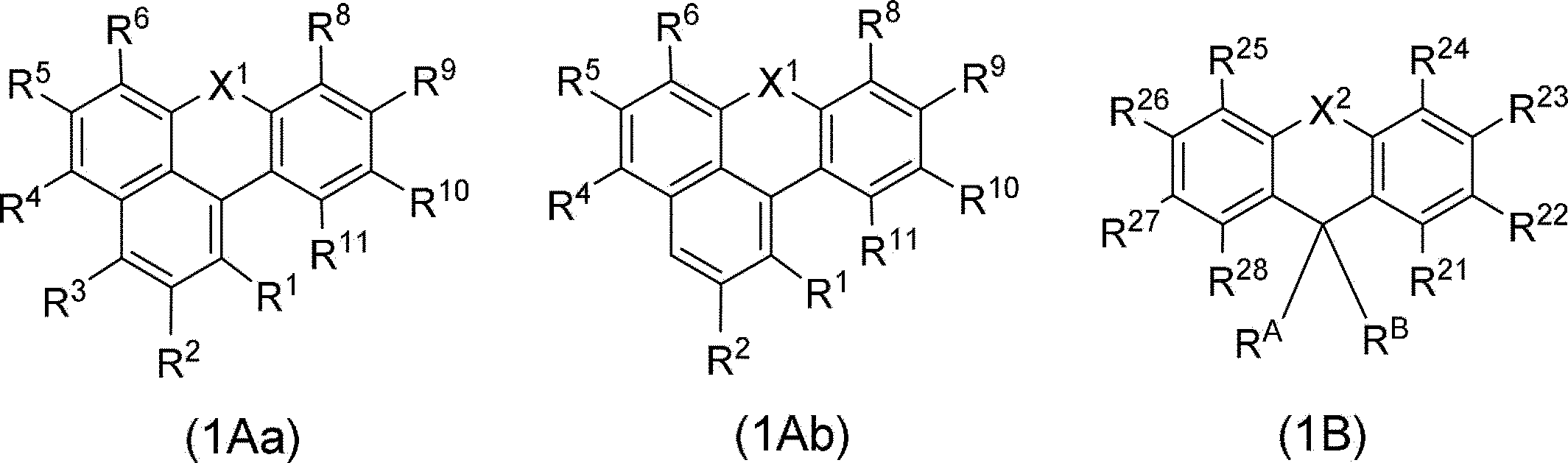
式(1Aa)及び(1Ab)中、
・X1は、酸素原子又は硫黄原子である。
・R1~R6及びR8~R11は、それぞれ独立に、水素原子、置換もしくは無置換の炭素数1~6のアルキル基、置換もしくは無置換の環形成炭素数6~12のアリール基、又は置換もしくは無置換の環形成原子数5~13のヘテロアリール基である。
・水素原子ではないR1~R6、及びR8~R11から選択される一つは、Ar2に結合する単結合又はAr2に結合する基である。
・水素原子ではなく前記単結合ではないR1~R6、及びR8~R11のうち隣り合う一対の基は、互いに結合して、置換もしくは無置換の単環を形成するか、互いに結合して置換もしくは無置換の縮合環を形成するか、又は、互いに結合せず環を形成しない。
式(1B)中、
・X2は、酸素原子又は硫黄原子である。
・R21~R28は、それぞれ独立に、水素原子、置換もしくは無置換の炭素数1~6のアルキル基、置換もしくは無置換の環形成炭素数6~12のアリール基、又は置換もしくは無置換の環形成原子数5~13のヘテロアリール基である。
・RA及びRBは、それぞれ独立に、水素原子、置換もしくは無置換の炭素数1~30のアルキル基、置換もしくは無置換の環形成炭素数6~30のアリール基、又は置換もしくは無置換の環形成原子数5~30のヘテロアリール基である。
・R21~R28、RA、及びRBから選択される一つは、Ar2に結合する単結合又はAr2に結合する基である。
・前記単結合ではないR21~R24、及びR25~R28のうち隣り合う一対の基は、互いに結合して置換もしくは無置換の単環を形成するか、互いに結合して置換もしくは無置換の縮合環を形成するか、又は、互いに結合せず環を形成しない。
・RAとRBは、互いに結合して置換もしくは無置換の単環を形成するか、互いに結合して置換もしくは無置換の縮合環を形成するか、又は、互いに結合せず環を形成しない。
Ar2は、下記式(2A)、(2B)、(2C)、(2D)、(2E)、又は(2F)で表される。
・但し、Ar1が式(1Aa)で表される場合、Ar2は下記式(2C)、(2D)、(2E)、又は(2F)で表される。Ar1が式(1Ab)で表される場合、Ar2は下記式(2A)又は(2B)で表される。Ar1が式(1B)で表される場合、Ar2は下記式(2A)、(2B)、(2C)、(2D)、(2E)、又は(2F)で表される。


式(2A)中、
・L1は、置換もしくは無置換の環形成炭素数6~30のアリーレン基、又は置換もしくは無置換の環形成原子数5~30の2価の複素環基である。
・*はAr1に結合するL1又は単結合の一端を表し、**はL1又は前記単結合の他端を表す。
・mは0又は1である。
・R31~R38は、それぞれ独立に、水素原子、置換もしくは無置換の炭素数1~6のアルキル基、置換もしくは無置換の環形成炭素数6~12のアリール基、又は置換もしくは無置換の環形成原子数5~13のヘテロアリール基である。
・RC及びRDは、それぞれ独立に、置換もしくは無置換の炭素数1~30のアルキル基、置換もしくは無置換の環形成炭素数6~30のアリール基、又は置換もしくは無置換の環形成原子数5~30のヘテロアリール基である。
・R31~R38、RC、及びRDから選択される一つは、**に結合する単結合又は**に結合する基である。
・前記単結合ではないR31~R38のうち隣り合う一対の基は、互いに結合して置換もしくは無置換の単環を形成するか、互いに結合して置換もしくは無置換の縮合環を形成するか、又は、互いに結合せず環を形成しない。
・前記単結合ではないRCとRDは、互いに結合して置換もしくは無置換の単環を形成するか、互いに結合して置換もしくは無置換の縮合環を形成するか、又は、互いに結合せず環を形成しない。
式(2B)中、
・L2は、置換もしくは無置換の環形成炭素数6~30のアリーレン基、又は置換もしくは無置換の環形成原子数5~30の2価の複素環基である。
・*はAr1に結合するL2又は単結合の一端を表し、**はL2又は前記単結合の他端を表す。
・nは0又は1である。
・R41~R48、R51~R54、及びR55~R58は、それぞれ独立に、水素原子、置換もしくは無置換の炭素数1~6のアルキル基、置換もしくは無置換の環形成炭素数6~12のアリール基、又は置換もしくは無置換の環形成原子数5~13のヘテロアリール基である。
・R45とR46、R46とR47、又はR47とR48のうち一方は*aに結合する単結合であり、他方は*bに結合する単結合である。
・kは0又は1である。
・kが1のとき、R41とR42、R42とR43、又はR43とR44のうち一方は*cに結合する単結合であり、他方は*dに結合する単結合である。
・RXは、水素原子、置換もしくは無置換の炭素数1~30のアルキル基、置換もしくは無置換の環形成炭素数6~30のアリール基、又は置換もしくは無置換の環形成原子数5~30のヘテロアリール基である。
・*c及び*dに結合しないR41~R44、*a及び*bに結合しないR45~R48、R51~R54、R55~R58、及びRXから選ばれる一つは、**に結合する単結合又は**に結合する基である。
・*c及び*dに結合せず前記**に結合する単結合ではないR41~R44、*a及び*bに結合せず前記**に結合する単結合ではないR45~R48、R51~R54、及びR55~R58のうち隣り合う一対の基は、互いに結合して置換もしくは無置換の単環を形成するか、互いに結合して置換もしくは無置換の縮合環を形成するか、又は、互いに結合せず環を形成しない。
式(2C)中、
・L3は、置換もしくは無置換の環形成炭素数6~30のアリーレン基、又は置換もしくは無置換の環形成原子数5~30の2価の複素環基である。
・*はAr1に結合するL3の一端を表し、**はL3の他端を表す。
・R61~R68は、それぞれ独立に、水素原子、置換もしくは無置換の炭素数1~6のアルキル基、置換もしくは無置換の環形成炭素数6~12のアリール基、又は置換もしくは無置換の環形成原子数5~13のヘテロアリール基である。
・R61~R68は、互いに結合して環を形成しない。
・RYは、水素原子、置換もしくは無置換の炭素数1~30のアルキル基、置換もしくは無置換の環形成炭素数6~30のアリール基、又は置換もしくは無置換の環形成原子数5~30のヘテロアリール基である。
・R61~R68及びRYから選択される一つは、**に結合する単結合又は**に結合する基である。
式(2D)中、
・L4は、置換もしくは無置換の環形成炭素数6~30のアリーレン基、又は置換もしくは無置換の環形成原子数5~30の2価の複素環基である。
・*はAr1に結合するL4の一端を表し、**はL4の他端を表す。
・R71~R78は、それぞれ独立に、水素原子、置換もしくは無置換の炭素数1~6のアルキル基、環形成炭素数6~12のアリール基、又は環形成原子数5~13のヘテロアリール基である。
・RE及びRFは、それぞれ独立に、置換もしくは無置換の炭素数1~30のアルキル基、置換もしくは無置換の環形成炭素数6~30のアリール基、又は置換もしくは無置換の環形成原子数5~30のヘテロアリール基である。
・R71~R78、RE、及びRFから選択される一つは、**に結合する単結合又は**に結合する基である。
・前記単結合ではないR71~R78のうち隣り合う一対の基は、互いに結合して置換もしくは無置換の単環を形成するか、互いに結合して置換もしくは無置換の縮合環を形成するか、又は、互いに結合せず環を形成しない。
・前記単結合ではないREとRFは、互いに結合して置換もしくは無置換の単環を形成するか、互いに結合して置換もしくは無置換の縮合環を形成するか、又は、互いに結合せず環を形成しない。
式(2E)中、
・*はAr1に結合する単結合の一端を表し、**は前記単結合の他端を表す。
・R81、R82、R84、R85、R87、R88、YA、及びYBは、それぞれ独立に、水素原子、置換もしくは無置換の炭素数1~6のアルキル基、置換もしくは無置換の環形成炭素数6~12のアリール基、又は置換もしくは無置換の環形成原子数5~13のヘテロアリール基である。
・R81、R82、R84、R85、R87、R88、YA、及びYBは、互いに結合して環を形成しない。
・RZは、水素原子、置換もしくは無置換の炭素数1~30のアルキル基、置換もしくは無置換の環形成炭素数6~30のアリール基、又は置換もしくは無置換の環形成原子数5~30のヘテロアリール基である。
・R81、R82、R84、R85、R87、R88、及びRZから選択される一つは、**に結合する単結合、又は**に結合する基である。
式(2F)中、
・*はAr1に結合する単結合の一端を表し、**は前記単結合の他端を表す。
・R91、R93~R96、R98、YC、及びYDは、それぞれ独立に、水素原子、置換もしくは無置換の炭素数1~6のアルキル基、置換もしくは無置換の環形成炭素数6~12のアリール基、又は置換もしくは無置換の環形成原子数5~13のヘテロアリール基である。
・R91、R93~R96、R98、RG、及びRJから選択される一つは、**に結合する単結合、又は**に結合する基である。
・RG及びRJは、それぞれ独立に、置換もしくは無置換の炭素数1~30のアルキル基、置換もしくは無置換の環形成炭素数6~30のアリール基、又は置換もしくは無置換の環形成原子数5~30のヘテロアリール基である。
・前記単結合ではないR91、R93~R96、R98、YC、及びYDのうち隣り合う一対の基は、互いに結合して置換もしくは無置換の単環を形成するか、互いに結合して置換もしくは無置換の縮合環を形成するか、又は、互いに結合せず環を形成しない。
・前記単結合ではないRGとRJは、互いに結合して置換もしくは無置換の単環を形成するか、互いに結合して置換もしくは無置換の縮合環を形成するか、又は、互いに結合せず環を形成しない。]
In one aspect, the present invention provides a compound represented by formula (1) below.
[In formula (1),
Ar 1 is represented by the following formula (1Aa), (1Ab), or (1B).
In formulas (1Aa) and (1Ab),
*X 1 is an oxygen atom or a sulfur atom.
・R 1 to R 6 and R 8 to R 11 are each independently a hydrogen atom, a substituted or unsubstituted alkyl group having 1 to 6 carbon atoms, or a substituted or unsubstituted aryl group having 6 to 12 ring carbon atoms , or a substituted or unsubstituted heteroaryl group having 5 to 13 ring atoms.
- One selected from R 1 to R 6 and R 8 to R 11 that is not a hydrogen atom is a single bond that binds to Ar 2 or a group that binds to Ar 2 .
- A pair of adjacent groups among R 1 to R 6 and R 8 to R 11 which are not hydrogen atoms and are not the single bond, are bonded to each other to form a substituted or unsubstituted monocyclic ring, or are bonded to each other together to form a substituted or unsubstituted condensed ring, or not combined to form a ring.
In formula (1B),
* X2 is an oxygen atom or a sulfur atom.
- R 21 to R 28 are each independently a hydrogen atom, a substituted or unsubstituted alkyl group having 1 to 6 carbon atoms, a substituted or unsubstituted aryl group having 6 to 12 ring carbon atoms, or a substituted or unsubstituted is a heteroaryl group having 5 to 13 ring atoms.
・R A and R B are each independently a hydrogen atom, a substituted or unsubstituted alkyl group having 1 to 30 carbon atoms, a substituted or unsubstituted aryl group having 6 to 30 ring-forming carbon atoms, or a substituted or unsubstituted is a heteroaryl group having 5 to 30 ring atoms.
* One selected from R 21 to R 28 , R A and R B is a single bond that binds to Ar 2 or a group that binds to Ar 2 .
- A pair of adjacent groups among R 21 to R 24 and R 25 to R 28 which are not single bonds are bonded to each other to form a substituted or unsubstituted monocyclic ring, or bonded to each other to form a substituted or unsubstituted They either form a substituted fused ring or are not joined together to form a ring.
- RA and RB are bonded to each other to form a substituted or unsubstituted monocyclic ring, bonded to each other to form a substituted or unsubstituted condensed ring, or are not bonded to form a ring .
Ar 2 is represented by the following formulas (2A), (2B), (2C), (2D), (2E), or (2F).
* However, when Ar 1 is represented by the formula (1Aa), Ar 2 is represented by the following formula (2C), (2D), (2E), or (2F). When Ar 1 is represented by formula (1Ab), Ar 2 is represented by the following formula (2A) or (2B). When Ar 1 is represented by Formula (1B), Ar 2 is represented by Formula (2A), (2B), (2C), (2D), (2E), or (2F) below.
In formula (2A),
·L 1 is a substituted or unsubstituted arylene group having 6 to 30 ring-forming carbon atoms or a substituted or unsubstituted divalent heterocyclic group having 5 to 30 ring-forming atoms.
* represents L1 or one end of a single bond bound to Ar1 , and ** represents L1 or the other end of the single bond.
- m is 0 or 1;
- R 31 to R 38 are each independently a hydrogen atom, a substituted or unsubstituted alkyl group having 1 to 6 carbon atoms, a substituted or unsubstituted aryl group having 6 to 12 ring carbon atoms, or a substituted or unsubstituted is a heteroaryl group having 5 to 13 ring atoms.
- R C and R D are each independently a substituted or unsubstituted alkyl group having 1 to 30 carbon atoms, a substituted or unsubstituted aryl group having 6 to 30 ring-forming carbon atoms, or a substituted or unsubstituted ring-forming group It is a heteroaryl group having 5 to 30 atoms.
* One selected from R 31 to R 38 , R C and R D is a single bond that binds to ** or a group that binds to **.
- A pair of adjacent groups among R 31 to R 38 which are not single bonds are bonded to each other to form a substituted or unsubstituted monocyclic ring, or bonded to each other to form a substituted or unsubstituted condensed ring. or not bonded together to form a ring.
- R C and R D which are not single bonds are bonded to each other to form a substituted or unsubstituted monocyclic ring, are bonded to each other to form a substituted or unsubstituted condensed ring, or are not bonded to each other. do not form a ring.
In formula (2B),
·L 2 is a substituted or unsubstituted arylene group having 6 to 30 ring-forming carbon atoms or a substituted or unsubstituted divalent heterocyclic group having 5 to 30 ring-forming atoms.
* represents L2 or one end of a single bond bound to Ar1 , and ** represents L2 or the other end of the single bond.
- n is 0 or 1;
・R 41 to R 48 , R 51 to R 54 and R 55 to R 58 are each independently a hydrogen atom, a substituted or unsubstituted alkyl group having 1 to 6 carbon atoms, or a substituted or unsubstituted ring-forming carbon It is an aryl group having 6 to 12 atoms, or a substituted or unsubstituted heteroaryl group having 5 to 13 ring atoms.
- One of R 45 and R 46 , R 46 and R 47 , or R 47 and R 48 is a single bond that bonds to *a, and the other is a single bond that bonds to *b.
- k is 0 or 1;
・when k is 1, one of R 41 and R 42 , R 42 and R 43 , or R 43 and R 44 is a single bond that bonds to *c, and the other is a single bond that bonds to *d .
・R X is a hydrogen atom, a substituted or unsubstituted alkyl group having 1 to 30 carbon atoms, a substituted or unsubstituted aryl group having 6 to 30 ring-forming carbon atoms, or a substituted or unsubstituted 5 to 5 ring-forming
one selected from R 41 to R 44 not bonded to *c and *d, R 45 to R 48 not bonded to *a and *b, R 51 to R 54 , R 55 to R 58 , and R X , ** is a single bond or a group that bonds to **.
· R 41 to R 44 which are not single bonds which are not bonded to *c and *d but are bonded to the above **, R 45 to R 48 which are not single bonds which are not bonded to *a and *b but are bonded to the above ** , R 51 to R 54 , and R 55 to R 58 , a pair of adjacent groups are bonded to each other to form a substituted or unsubstituted monocyclic ring, or bonded to each other to form a substituted or unsubstituted condensed ring. form or are not joined together to form a ring.
In formula (2C),
·L 3 is a substituted or unsubstituted arylene group having 6 to 30 ring carbon atoms or a substituted or unsubstituted divalent heterocyclic group having 5 to 30 ring atoms.
* represents one end of L3 that binds to Ar1 , and ** represents the other end of L3 .
- R 61 to R 68 are each independently a hydrogen atom, a substituted or unsubstituted alkyl group having 1 to 6 carbon atoms, a substituted or unsubstituted aryl group having 6 to 12 ring carbon atoms, or a substituted or unsubstituted is a heteroaryl group having 5 to 13 ring atoms.
* R 61 to R 68 do not combine with each other to form a ring.
・R Y is a hydrogen atom, a substituted or unsubstituted alkyl group having 1 to 30 carbon atoms, a substituted or unsubstituted aryl group having 6 to 30 ring-forming carbon atoms, or a substituted or unsubstituted 5 to 5 ring-forming
* One selected from R 61 to R 68 and R Y is a single bond that binds to ** or a group that binds to **.
In formula (2D),
·L 4 is a substituted or unsubstituted arylene group having 6 to 30 ring-forming carbon atoms or a substituted or unsubstituted divalent heterocyclic group having 5 to 30 ring-forming atoms.
* represents one end of L4 bound to Ar1 , and ** represents the other end of L4 .
- R 71 to R 78 are each independently a hydrogen atom, a substituted or unsubstituted alkyl group having 1 to 6 carbon atoms, an aryl group having 6 to 12 ring carbon atoms, or a hetero ring having 5 to 13 ring atoms It is an aryl group.
- R E and R F are each independently a substituted or unsubstituted alkyl group having 1 to 30 carbon atoms, a substituted or unsubstituted aryl group having 6 to 30 ring-forming carbon atoms, or a substituted or unsubstituted ring-forming group It is a heteroaryl group having 5 to 30 atoms.
* One selected from R 71 to R 78 , R E and R F is a single bond that binds to ** or a group that binds to **.
- A pair of adjacent groups among R 71 to R 78 which are not single bonds are bonded to each other to form a substituted or unsubstituted monocyclic ring, or bonded to each other to form a substituted or unsubstituted condensed ring. or not bonded together to form a ring.
- R E and R F which are not single bonds are bonded to each other to form a substituted or unsubstituted single ring, are bonded to each other to form a substituted or unsubstituted condensed ring, or are not bonded to each other. do not form a ring.
In formula (2E),
* represents one end of the single bond bound to Ar 1 , and ** represents the other end of the single bond.
- R 81 , R 82 , R 84 , R 85 , R 87 , R 88 , Y A and Y B are each independently a hydrogen atom, a substituted or unsubstituted alkyl group having 1 to 6 carbon atoms, a substituted or It is an unsubstituted aryl group having 6 to 12 ring carbon atoms or a substituted or unsubstituted heteroaryl group having 5 to 13 ring atoms.
- R 81 , R 82 , R 84 , R 85 , R 87 , R 88 , Y A and Y B are not combined with each other to form a ring.
- R Z is a hydrogen atom, a substituted or unsubstituted alkyl group having 1 to 30 carbon atoms, a substituted or unsubstituted aryl group having 6 to 30 ring-forming carbon atoms, or a substituted or unsubstituted 5 to 5 ring-forming
- One selected from R 81 , R 82 , R 84 , R 85 , R 87 , R 88 and R Z is a single bond that binds to ** or a group that binds to **.
In formula (2F),
* represents one end of the single bond bound to Ar 1 , and ** represents the other end of the single bond.
・R 91 , R 93 to R 96 , R 98 , Y C and Y D are each independently a hydrogen atom, a substituted or unsubstituted alkyl group having 1 to 6 carbon atoms, or a substituted or unsubstituted ring-forming carbon It is an aryl group having 6 to 12 atoms, or a substituted or unsubstituted heteroaryl group having 5 to 13 ring atoms.
- One selected from R 91 , R 93 to R 96 , R 98 , R G and R J is a single bond that binds to ** or a group that binds to **.
- R G and R J are each independently a substituted or unsubstituted alkyl group having 1 to 30 carbon atoms, a substituted or unsubstituted aryl group having 6 to 30 ring-forming carbon atoms, or a substituted or unsubstituted ring-forming group It is a heteroaryl group having 5 to 30 atoms.
- A pair of adjacent groups among R 91 , R 93 to R 96 , R 98 , Y C and Y D which are not single bonds are bonded to each other to form a substituted or unsubstituted monocyclic ring, or joined to form a substituted or unsubstituted fused ring, or not joined to each other to form a ring;
- R G and R J , which are not single bonds, are bonded to each other to form a substituted or unsubstituted single ring, are bonded to each other to form a substituted or unsubstituted condensed ring, or are not bonded to each other. do not form a ring. ]
他の態様において、本発明は、前記式(1)で表される化合物を含む有機エレクトロルミネッセンス素子用材料を提供する。 In another aspect, the present invention provides a material for an organic electroluminescence device containing the compound represented by formula (1).
さらに他の態様において、本発明は、陰極、陽極、及び該陰極と該陽極の間に有機層を有する有機エレクトロルミネッセンス素子であって、該有機層が発光層を含み、該有機層の少なくとも1層が、前記式(1)で表される化合物を含む有機エレクトロルミネッセンス素子を提供する。 In yet another aspect, the present invention is an organic electroluminescent device having a cathode, an anode, and an organic layer between the cathode and the anode, the organic layer comprising a light-emitting layer, and at least one of the organic layers Provided is an organic electroluminescence device in which the layer contains the compound represented by the formula (1).
さらに他の態様において、本発明は、陽極、正孔輸送帯域、発光層、及び陰極をこの順に備え、
前記正孔輸送帯域が、下記の条件(A)~(C)を満たす化合物Aを含有する、有機エレクトロルミネッセンス素子を提供する。
(A)最高被占軌道のエネルギー準位HOMOが-6.00~-5.50eVである。
(B)三重項エネルギーT1が2.10eV以上である。
(C)フォトルミネッセンス強度PLの80%減衰時間tが0.10h以上である。
但し、条件(C)中、
PLは、測定対象の化合物を膜厚100nmに成膜した測定材に対して、照射強度I1で365nmの紫外線を照射したときのフォトルミネッセンス発光スペクトルの強度であり、
tは、前記紫外線の照射開始時からPLが80%に減衰するまでの時間であり、
I1は、下記数式(数1)で規定され、
I1=I0×(A0/A1)・・・(数1)
数式(数1)中、
I0は、下記化学式で表される化合物を膜厚100nmに成膜した基準材のPL測定時の照射強度、

A0は前記基準材の吸収率、
A1は前記測定材の吸収率であり、
前記各吸収率は、下記数式(数2)で規定され、
吸収率=1-EXP(-4×3.1416×ko×d/w)・・・(数2)
数式(数2)中、
koは測定対象の化合物を成膜した測定材又は基準材の面内方向の消衰係数、
dは測定対象の化合物を成膜した測定材又は基準材の膜厚、
wは照射光の波長である。
In yet another aspect, the invention comprises an anode, a hole-transporting zone, a light-emitting layer, and a cathode, in that order,
Provided is an organic electroluminescence device in which the hole-transporting zone contains a compound A that satisfies the following conditions (A) to (C).
(A) The energy level HOMO of the highest occupied orbital is -6.00 to -5.50 eV.
(B) The triplet energy T1 is 2.10 eV or more.
(C) The 80% attenuation time t of the photoluminescence intensity PL is 0.10 h or longer.
However, in condition (C),
PL is the intensity of the photoluminescence emission spectrum when a measurement material formed by forming a film of the compound to be measured to a thickness of 100 nm is irradiated with ultraviolet rays of 365 nm at an irradiation intensity of I1 ,
t is the time from the start of irradiation of the ultraviolet rays until the PL is attenuated to 80%,
I 1 is defined by the following formula (Equation 1),
I 1 =I 0 ×(A 0 /A 1 ) (Equation 1)
In the formula (number 1),
I 0 is the irradiation intensity during PL measurement of a reference material formed by forming a film of a compound represented by the following chemical formula to a thickness of 100 nm,
A 0 is the absorption rate of the reference material,
A 1 is the absorption rate of the measurement material,
Each absorption rate is defined by the following formula (Equation 2),
Absorption rate = 1-EXP (-4 x 3.1416 x ko x d/w) (Equation 2)
In the formula (number 2),
ko is the extinction coefficient in the in-plane direction of the measurement material or reference material on which the compound to be measured is deposited,
d is the film thickness of the measurement material or reference material on which the compound to be measured is deposited,
w is the wavelength of the illuminating light.
さらに他の態様において、本発明は、前記有機エレクトロルミネッセンス素子を含む電子機器を提供する。 In still another aspect, the present invention provides an electronic device including the organic electroluminescence element.
前記式(1)で表される化合物を含む有機EL素子は改善された素子性能を示す。また、前記各条件を満たす化合物Aが正孔輸送帯域に含まれる有機EL素子は、改善された素子性能を示す。 An organic EL device containing the compound represented by formula (1) exhibits improved device performance. In addition, the organic EL device in which the compound A that satisfies the above conditions is contained in the hole transport zone exhibits improved device performance.
[定義]
本明細書において、水素原子とは、中性子数が異なる同位体、即ち、軽水素(protium)、重水素(deuterium)、及び三重水素(tritium)を包含する。
[definition]
As used herein, a hydrogen atom includes isotopes with different numbers of neutrons, ie, protium, deuterium, and tritium.
本明細書において、化学構造式中、「R」等の記号や重水素原子を表す「D」が明示されていない結合可能位置には、水素原子、即ち、軽水素原子、重水素原子、又は三重水素原子が結合しているものとする。 In the present specification, in the chemical structural formula, a hydrogen atom, that is, a hydrogen atom, a deuterium atom, or Assume that the tritium atoms are bonded.
本明細書において、環形成炭素数とは、原子が環状に結合した構造の化合物(例えば、単環化合物、縮合環化合物、架橋化合物、炭素環化合物、及び複素環化合物)の当該環自体を構成する原子のうちの炭素原子の数を表す。当該環が置換基によって置換される場合、置換基に含まれる炭素は環形成炭素数には含まない。以下で記される「環形成炭素数」については、別途記載のない限り同様とする。例えば、ベンゼン環は環形成炭素数が6であり、ナフタレン環は環形成炭素数が10であり、ピリジン環は環形成炭素数5であり、フラン環は環形成炭素数4である。また、例えば、9,9-ジフェニルフルオレニル基の環形成炭素数は13であり、9,9’-スピロビフルオレニル基の環形成炭素数は25である。
また、ベンゼン環に置換基として、例えば、アルキル基が置換している場合、当該アルキル基の炭素数は、ベンゼン環の環形成炭素数に含めない。そのため、アルキル基が置換しているベンゼン環の環形成炭素数は、6である。また、ナフタレン環に置換基として、例えば、アルキル基が置換している場合、当該アルキル基の炭素数は、ナフタレン環の環形成炭素数に含めない。そのため、アルキル基が置換しているナフタレン環の環形成炭素数は、10である。
As used herein, the number of ring-forming carbon atoms refers to the ring itself of a compound having a structure in which atoms are bonded in a ring (e.g., monocyclic compounds, condensed ring compounds, bridged compounds, carbocyclic compounds, and heterocyclic compounds). represents the number of carbon atoms among the atoms that When the ring is substituted with a substituent, carbon atoms contained in the substituent are not included in the number of ring-forming carbon atoms. The same applies to the "number of ring-forming carbon atoms" described below unless otherwise specified. For example, a benzene ring has 6 ring carbon atoms, a naphthalene ring has 10 ring carbon atoms, a pyridine ring has 5 ring carbon atoms, and a furan ring has 4 ring carbon atoms. Further, for example, the 9,9-diphenylfluorenyl group has 13 ring-forming carbon atoms, and the 9,9′-spirobifluorenyl group has 25 ring-forming carbon atoms.
When the benzene ring is substituted with, for example, an alkyl group as a substituent, the number of carbon atoms in the alkyl group is not included in the number of ring-forming carbon atoms in the benzene ring. Therefore, the number of ring-forming carbon atoms in the benzene ring substituted with the alkyl group is 6. When the naphthalene ring is substituted with, for example, an alkyl group as a substituent, the number of carbon atoms in the alkyl group is not included in the number of carbon atoms in the naphthalene ring. Therefore, the naphthalene ring substituted with an alkyl group has 10 ring-forming carbon atoms.
本明細書において、環形成原子数とは、原子が環状に結合した構造(例えば、単環、縮合環、及び環集合)の化合物(例えば、単環化合物、縮合環化合物、架橋化合物、炭素環化合物、及び複素環化合物)の当該環自体を構成する原子の数を表す。環を構成しない原子(例えば、環を構成する原子の結合を終端する水素原子)や、当該環が置換基によって置換される場合の置換基に含まれる原子は環形成原子数には含まない。以下で記される「環形成原子数」については、別途記載のない限り同様とする。例えば、ピリジン環の環形成原子数は6であり、キナゾリン環の環形成原子数は10であり、フラン環の環形成原子数は5である。例えば、ピリジン環に結合している水素原子、又は置換基を構成する原子の数は、ピリジン環形成原子数の数に含めない。そのため、水素原子、又は置換基が結合しているピリジン環の環形成原子数は、6である。また、例えば、キナゾリン環の炭素原子に結合している水素原子、又は置換基を構成する原子については、キナゾリン環の環形成原子数の数に含めない。そのため、水素原子、又は置換基が結合しているキナゾリン環の環形成原子数は10である。 In the present specification, the number of ring-forming atoms refers to compounds (e.g., monocyclic compounds, condensed ring compounds, bridged compounds, carbocyclic compound, and heterocyclic compound) represents the number of atoms constituting the ring itself. Atoms that do not constitute a ring (e.g., a hydrogen atom that terminates the bond of an atom that constitutes a ring) and atoms contained in substituents when the ring is substituted by substituents are not included in the number of ring-forming atoms. The same applies to the "number of ring-forming atoms" described below unless otherwise specified. For example, the pyridine ring has 6 ring-forming atoms, the quinazoline ring has 10 ring-forming atoms, and the furan ring has 5 ring-forming atoms. For example, hydrogen atoms bonded to the pyridine ring or atoms constituting substituents are not included in the number of atoms forming the pyridine ring. Therefore, the number of ring-forming atoms of the pyridine ring to which hydrogen atoms or substituents are bonded is 6. Further, for example, hydrogen atoms bonded to carbon atoms of the quinazoline ring or atoms constituting substituents are not included in the number of ring-forming atoms of the quinazoline ring. Therefore, the number of ring-forming atoms of the quinazoline ring to which hydrogen atoms or substituents are bonded is 10.
本明細書において、「置換もしくは無置換の炭素数XX~YYのZZ基」という表現における「炭素数XX~YY」は、ZZ基が無置換である場合の炭素数を表し、置換されている場合の置換基の炭素数を含めない。ここで、「YY」は、「XX」よりも大きく、「XX」は、1以上の整数を意味し、「YY」は、2以上の整数を意味する。 In the present specification, the expression "substituted or unsubstituted XX to YY carbon number ZZ group" represents the number of carbon atoms when the ZZ group is unsubstituted, and is substituted. Do not include the number of carbon atoms in the substituents. Here, "YY" is greater than "XX", "XX" means an integer of 1 or more, and "YY" means an integer of 2 or more.
本明細書において、「置換もしくは無置換の原子数XX~YYのZZ基」という表現における「原子数XX~YY」は、ZZ基が無置換である場合の原子数を表し、置換されている場合の置換基の原子数を含めない。ここで、「YY」は、「XX」よりも大きく、「XX」は、1以上の整数を意味し、「YY」は、2以上の整数を意味する。 In the present specification, the term “substituted or unsubstituted ZZ group having an atomic number of XX to YY”, “the atomic number of XX to YY” represents the number of atoms when the ZZ group is unsubstituted, and is substituted. Do not include the number of atoms of the substituents in the case. Here, "YY" is greater than "XX", "XX" means an integer of 1 or more, and "YY" means an integer of 2 or more.
本明細書において、無置換のZZ基とは「置換もしくは無置換のZZ基」が「無置換のZZ基」である場合を表し、置換のZZ基とは「置換もしくは無置換のZZ基」が「置換のZZ基」である場合を表す。
本明細書において、「置換もしくは無置換のZZ基」という場合における「無置換」とは、ZZ基における水素原子が置換基と置き換わっていないことを意味する。「無置換のZZ基」における水素原子は、軽水素原子、重水素原子、又は三重水素原子である。
また、本明細書において、「置換もしくは無置換のZZ基」という場合における「置換」とは、ZZ基における1つ以上の水素原子が、置換基と置き換わっていることを意味する。「AA基で置換されたBB基」という場合における「置換」も同様に、BB基における1つ以上の水素原子が、AA基と置き換わっていることを意味する。
In the present specification, an unsubstituted ZZ group represents a case where a "substituted or unsubstituted ZZ group" is an "unsubstituted ZZ group", and a substituted ZZ group is a "substituted or unsubstituted ZZ group". is a "substituted ZZ group".
As used herein, "unsubstituted" in the case of "substituted or unsubstituted ZZ group" means that a hydrogen atom in the ZZ group is not replaced with a substituent. A hydrogen atom in the "unsubstituted ZZ group" is a protium atom, a deuterium atom, or a tritium atom.
Further, in the present specification, "substituted" in the case of "substituted or unsubstituted ZZ group" means that one or more hydrogen atoms in the ZZ group are replaced with a substituent. "Substituted" in the case of "a BB group substituted with an AA group" similarly means that one or more hydrogen atoms in the BB group are replaced with an AA group.
「本明細書に記載の置換基」
以下、本明細書に記載の置換基について説明する。別途記載のない限り、本明細書に記載の各置換基は以下のように定義される。
"substituents described herein"
The substituents described in this specification are described below. Unless otherwise stated, each substituent described herein is defined as follows.
本明細書に記載の「無置換のアリール基」の環形成炭素数は、本明細書に別途記載のない限り、6~50であり、好ましくは6~30、より好ましくは6~18である。
本明細書に記載の「無置換の複素環基」の環形成原子数は、本明細書に別途記載のない限り、5~50であり、好ましくは5~30、より好ましくは5~18である。
本明細書に記載の「無置換のアルキル基」の炭素数は、本明細書に別途記載のない限り、1~50であり、好ましくは1~20、より好ましくは1~6である。
本明細書に記載の「無置換のアルケニル基」の炭素数は、本明細書に別途記載のない限り、2~50であり、好ましくは2~20、より好ましくは2~6である。
本明細書に記載の「無置換のアルキニル基」の炭素数は、本明細書に別途記載のない限り、2~50であり、好ましくは2~20、より好ましくは2~6である。
本明細書に記載の「無置換のシクロアルキル基」の環形成炭素数は、本明細書に別途記載のない限り、3~50であり、好ましくは3~20、より好ましくは3~6である。
本明細書に記載の「無置換のアリーレン基」の環形成炭素数は、本明細書に別途記載のない限り、6~50であり、好ましくは6~30、より好ましくは6~18である。
本明細書に記載の「無置換の2価の複素環基」の環形成原子数は、本明細書に別途記載のない限り、5~50であり、好ましくは5~30、より好ましくは5~18である。
本明細書に記載の「無置換のアルキレン基」の炭素数は、本明細書に別途記載のない限り、1~50であり、好ましくは1~20、より好ましくは1~6である。
The number of ring-forming carbon atoms in the "unsubstituted aryl group" described herein is 6 to 50, preferably 6 to 30, more preferably 6 to 18, unless otherwise specified. .
The number of ring-forming atoms of the "unsubstituted heterocyclic group" described herein is 5 to 50, preferably 5 to 30, more preferably 5 to 18, unless otherwise specified. be.
The number of carbon atoms in the "unsubstituted alkyl group" described herein is 1-50, preferably 1-20, more preferably 1-6, unless otherwise specified.
The number of carbon atoms in the "unsubstituted alkenyl group" described herein is 2-50, preferably 2-20, more preferably 2-6, unless otherwise specified in the specification.
The number of carbon atoms in the "unsubstituted alkynyl group" described herein is 2-50, preferably 2-20, more preferably 2-6, unless otherwise specified in the specification.
The number of ring-forming carbon atoms in the "unsubstituted cycloalkyl group" described herein is 3 to 50, preferably 3 to 20, more preferably 3 to 6, unless otherwise specified. be.
The number of ring-forming carbon atoms of the "unsubstituted arylene group" described herein is 6 to 50, preferably 6 to 30, more preferably 6 to 18, unless otherwise specified. .
The number of ring-forming atoms of the "unsubstituted divalent heterocyclic group" described herein is 5 to 50, preferably 5 to 30, more preferably 5, unless otherwise specified herein. ~18.
The number of carbon atoms in the "unsubstituted alkylene group" described herein is 1-50, preferably 1-20, more preferably 1-6, unless otherwise specified.
・「置換もしくは無置換のアリール基」
本明細書に記載の「置換もしくは無置換のアリール基」の具体例(具体例群G1)としては、以下の無置換のアリール基(具体例群G1A)及び置換のアリール基(具体例群G1B)等が挙げられる。(ここで、無置換のアリール基とは「置換もしくは無置換のアリール基」が「無置換のアリール基」である場合を指し、置換のアリール基とは「置換もしくは無置換のアリール基」が「置換のアリール基」である場合を指す。)本明細書において、単に「アリール基」という場合は、「無置換のアリール基」と「置換のアリール基」の両方を含む。
「置換のアリール基」は、「無置換のアリール基」の1つ以上の水素原子が置換基と置き換わった基を意味する。「置換のアリール基」としては、例えば、下記具体例群G1Aの「無置換のアリール基」の1つ以上の水素原子が置換基と置き換わった基、及び下記具体例群G1Bの置換のアリール基の例等が挙げられる。尚、ここに列挙した「無置換のアリール基」の例、及び「置換のアリール基」の例は、一例に過ぎず、本明細書に記載の「置換のアリール基」には、下記具体例群G1Bの「置換のアリール基」におけるアリール基自体の炭素原子に結合する水素原子がさらに置換基と置き換わった基、及び下記具体例群G1Bの「置換のアリール基」における置換基の水素原子がさらに置換基と置き換わった基も含まれる。
・"Substituted or unsubstituted aryl group"
Specific examples of the "substituted or unsubstituted aryl group" described in the specification (specific example group G1) include the following unsubstituted aryl groups (specific example group G1A) and substituted aryl groups (specific example group G1B ) and the like. (Here, unsubstituted aryl group refers to the case where "substituted or unsubstituted aryl group" is "unsubstituted aryl group", and substituted aryl group is "substituted or unsubstituted aryl group" It refers to a "substituted aryl group".) In the present specification, the term "aryl group" includes both "unsubstituted aryl group" and "substituted aryl group".
A "substituted aryl group" means a group in which one or more hydrogen atoms of an "unsubstituted aryl group" are replaced with a substituent. Examples of the "substituted aryl group" include, for example, a group in which one or more hydrogen atoms of the "unsubstituted aryl group" of Specific Example Group G1A below is replaced with a substituent, and a substituted aryl group of Specific Example Group G1B below. Examples include: The examples of the "unsubstituted aryl group" and the examples of the "substituted aryl group" listed here are only examples, and the "substituted aryl group" described herein includes the following specific examples A group in which the hydrogen atom bonded to the carbon atom of the aryl group itself in the "substituted aryl group" of Group G1B is further replaced with a substituent, and the hydrogen atom of the substituent in the "substituted aryl group" of Specific Example Group G1B below Furthermore, groups substituted with substituents are also included.
・無置換のアリール基(具体例群G1A):
フェニル基、
p-ビフェニル基、
m-ビフェニル基、
o-ビフェニル基、
p-ターフェニル-4-イル基、
p-ターフェニル-3-イル基、
p-ターフェニル-2-イル基、
m-ターフェニル-4-イル基、
m-ターフェニル-3-イル基、
m-ターフェニル-2-イル基、
m-ターフェニル-3’-イル基、
o-ターフェニル-4-イル基、
o-ターフェニル-3-イル基、
o-ターフェニル-2-イル基、
1-ナフチル基、
2-ナフチル基、
アントリル基、
ベンゾアントリル基、
フェナントリル基、
ベンゾフェナントリル基、フェナレニル基、
ピレニル基、
クリセニル基、
ベンゾクリセニル基、
トリフェニレニル基、
ベンゾトリフェニレニル基、
テトラセニル基、
ペンタセニル基、
フルオレニル基、
9,9’-スピロビフルオレニル基、
ベンゾフルオレニル基、
ジベンゾフルオレニル基、
フルオランテニル基、
ベンゾフルオランテニル基、
ペリレニル基、及び
下記一般式(TEMP-1)~(TEMP-15)で表される環構造から1つの水素原子を除くことにより誘導される1価のアリール基。
- Unsubstituted aryl group (specific example group G1A):
phenyl group,
a p-biphenyl group,
m-biphenyl group,
an o-biphenyl group,
p-terphenyl-4-yl group,
p-terphenyl-3-yl group,
p-terphenyl-2-yl group,
m-terphenyl-4-yl group,
m-terphenyl-3-yl group,
m-terphenyl-2-yl group,
m-terphenyl-3'-yl group,
o-terphenyl-4-yl group,
o-terphenyl-3-yl group,
o-terphenyl-2-yl group,
1-naphthyl group,
2-naphthyl group,
anthryl group,
benzoanthryl group,
a phenanthryl group,
benzophenanthryl group, phenalenyl group,
a pyrenyl group,
a chrysenyl group,
a benzochrysenyl group,
a triphenylenyl group,
a benzotriphenylenyl group,
a tetracenyl group,
pentacenyl group,
fluorenyl group,
9,9′-spirobifluorenyl group,
benzofluorenyl group,
a dibenzofluorenyl group,
a fluoranthenyl group,
a benzofluoranthenyl group,
A perylenyl group and a monovalent aryl group derived by removing one hydrogen atom from the ring structures represented by the following general formulas (TEMP-1) to (TEMP-15).


・置換のアリール基(具体例群G1B):
o-トリル基、
m-トリル基、
p-トリル基、
パラ-キシリル基、
メタ-キシリル基、
オルト-キシリル基、
パラ-イソプロピルフェニル基、
メタ-イソプロピルフェニル基、
オルト-イソプロピルフェニル基、
パラ-t-ブチルフェニル基、
メタ-t-ブチルフェニル基、
オルト-t-ブチルフェニル基、
3,4,5-トリメチルフェニル基、
9,9-ジメチルフルオレニル基、
9,9-ジフェニルフルオレニル基
9,9-ビス(4-メチルフェニル)フルオレニル基、
9,9-ビス(4-イソプロピルフェニル)フルオレニル基、
9,9-ビス(4-t-ブチルフェニル)フルオレニル基、
シアノフェニル基、
トリフェニルシリルフェニル基、
トリメチルシリルフェニル基、
フェニルナフチル基、
ナフチルフェニル基、及び
前記一般式(TEMP-1)~(TEMP-15)で表される環構造から誘導される1価の基の1つ以上の水素原子が置換基と置き換わった基。
- Substituted aryl group (specific example group G1B):
an o-tolyl group,
m-tolyl group,
p-tolyl group,
para-xylyl group,
meta-xylyl group,
an ortho-xylyl group,
para-isopropylphenyl group,
meta-isopropylphenyl group,
an ortho-isopropylphenyl group,
para-t-butylphenyl group,
meta-t-butylphenyl group,
ortho-t-butylphenyl group,
3,4,5-trimethylphenyl group,
9,9-dimethylfluorenyl group,
9,9-diphenylfluorenyl group 9,9-bis(4-methylphenyl)fluorenyl group,
9,9-bis(4-isopropylphenyl)fluorenyl group,
9,9-bis(4-t-butylphenyl) fluorenyl group,
a cyanophenyl group,
a triphenylsilylphenyl group,
a trimethylsilylphenyl group,
a phenylnaphthyl group,
A naphthylphenyl group and a group in which one or more hydrogen atoms of a monovalent group derived from a ring structure represented by the general formulas (TEMP-1) to (TEMP-15) is replaced with a substituent.
・「置換もしくは無置換の複素環基」
本明細書に記載の「複素環基」は、環形成原子にヘテロ原子を少なくとも1つ含む環状の基である。ヘテロ原子の具体例としては、窒素原子、酸素原子、硫黄原子、ケイ素原子、リン原子、及びホウ素原子が挙げられる。本明細書に記載の「複素環基」は、単環の基であるか、又は縮合環の基である。
本明細書に記載の「複素環基」は、芳香族複素環基であるか、又は非芳香族複素環基である。
本明細書に記載の「置換もしくは無置換の複素環基」の具体例(具体例群G2)としては、以下の無置換の複素環基(具体例群G2A)、及び置換の複素環基(具体例群G2B)等が挙げられる。(ここで、無置換の複素環基とは「置換もしくは無置換の複素環基」が「無置換の複素環基」である場合を指し、置換の複素環基とは「置換もしくは無置換の複素環基」が「置換の複素環基」である場合を指す。)本明細書において、単に「複素環基」という場合は、「無置換の複素環基」と「置換の複素環基」の両方を含む。
「置換の複素環基」は、「無置換の複素環基」の1つ以上の水素原子が置換基と置き換わった基を意味する。「置換の複素環基」の具体例は、下記具体例群G2Aの「無置換の複素環基」の水素原子が置き換わった基、及び下記具体例群G2Bの置換の複素環基の例等が挙げられる。尚、ここに列挙した「無置換の複素環基」の例や「置換の複素環基」の例は、一例に過ぎず、本明細書に記載の「置換の複素環基」には、具体例群G2Bの「置換の複素環基」における複素環基自体の環形成原子に結合する水素原子がさらに置換基と置き換わった基、及び具体例群G2Bの「置換の複素環基」における置換基の水素原子がさらに置換基と置き換わった基も含まれる。
・"Substituted or unsubstituted heterocyclic group"
As used herein, a "heterocyclic group" is a cyclic group containing at least one heteroatom as a ring-forming atom. Specific examples of heteroatoms include nitrogen, oxygen, sulfur, silicon, phosphorus, and boron atoms. A "heterocyclic group" as described herein is a monocyclic group or a condensed ring group.
A "heterocyclic group" as described herein is either an aromatic heterocyclic group or a non-aromatic heterocyclic group.
Specific examples of the "substituted or unsubstituted heterocyclic group" described herein (specific example group G2) include the following unsubstituted heterocyclic groups (specific example group G2A), and substituted heterocyclic groups ( Specific example group G2B) and the like can be mentioned. (Here, unsubstituted heterocyclic group refers to the case where “substituted or unsubstituted heterocyclic group” is “unsubstituted heterocyclic group”, and substituted heterocyclic group refers to “substituted or unsubstituted "Heterocyclic group" refers to a "substituted heterocyclic group".) In the present specification, simply referring to a "heterocyclic group" means "unsubstituted heterocyclic group" and "substituted heterocyclic group". including both.
A "substituted heterocyclic group" means a group in which one or more hydrogen atoms of an "unsubstituted heterocyclic group" are replaced with a substituent. Specific examples of the "substituted heterocyclic group" include groups in which the hydrogen atoms of the "unsubstituted heterocyclic group" of the following specific example group G2A are replaced, and examples of the substituted heterocyclic groups of the following specific example group G2B. mentioned. The examples of the "unsubstituted heterocyclic group" and the examples of the "substituted heterocyclic group" listed here are only examples, and the "substituted heterocyclic group" described herein specifically includes A group in which the hydrogen atom bonded to the ring-forming atom of the heterocyclic group itself in the "substituted heterocyclic group" of Example Group G2B is further replaced with a substituent, and a substituent in the "substituted heterocyclic group" of Specific Example Group G2B A group in which the hydrogen atom of is further replaced with a substituent is also included.
具体例群G2Aは、例えば、以下の窒素原子を含む無置換の複素環基(具体例群G2A1)、酸素原子を含む無置換の複素環基(具体例群G2A2)、硫黄原子を含む無置換の複素環基(具体例群G2A3)、及び下記一般式(TEMP-16)~(TEMP-33)で表される環構造から1つの水素原子を除くことにより誘導される1価の複素環基(具体例群G2A4)を含む。 Specific example group G2A includes, for example, the following nitrogen atom-containing unsubstituted heterocyclic groups (specific example group G2A1), oxygen atom-containing unsubstituted heterocyclic groups (specific example group G2A2), sulfur atom-containing unsubstituted (specific example group G2A3), and a monovalent heterocyclic group derived by removing one hydrogen atom from the ring structures represented by the following general formulas (TEMP-16) to (TEMP-33) (specific example group G2A4).
具体例群G2Bは、例えば、以下の窒素原子を含む置換の複素環基(具体例群G2B1)、酸素原子を含む置換の複素環基(具体例群G2B2)、硫黄原子を含む置換の複素環基(具体例群G2B3)、及び下記一般式(TEMP-16)~(TEMP-33)で表される環構造から誘導される1価の複素環基の1つ以上の水素原子が置換基と置き換わった基(具体例群G2B4)を含む。 Specific example group G2B includes, for example, the following substituted heterocyclic group containing a nitrogen atom (specific example group G2B1), substituted heterocyclic group containing an oxygen atom (specific example group G2B2), substituted heterocyclic ring containing a sulfur atom group (specific example group G2B3), and one or more hydrogen atoms of a monovalent heterocyclic group derived from a ring structure represented by the following general formulas (TEMP-16) to (TEMP-33) as a substituent Including substituted groups (example group G2B4).
・窒素原子を含む無置換の複素環基(具体例群G2A1):
ピロリル基、
イミダゾリル基、
ピラゾリル基、
トリアゾリル基、
テトラゾリル基、
オキサゾリル基、
イソオキサゾリル基、
オキサジアゾリル基、
チアゾリル基、
イソチアゾリル基、
チアジアゾリル基、
ピリジル基、
ピリダジニル基、
ピリミジニル基、
ピラジニル基、
トリアジニル基、
インドリル基、
イソインドリル基、
インドリジニル基、キノリジニル基、
キノリル基、
イソキノリル基、
シンノリル基、
フタラジニル基、
キナゾリニル基、
キノキサリニル基、
ベンゾイミダゾリル基、
インダゾリル基、
フェナントロリニル基、
フェナントリジニル基、
アクリジニル基、
フェナジニル基、
カルバゾリル基、
ベンゾカルバゾリル基、
モルホリノ基、
フェノキサジニル基、
フェノチアジニル基、
アザカルバゾリル基、及びジアザカルバゾリル基。
- an unsubstituted heterocyclic group containing a nitrogen atom (specific example group G2A1):
pyrrolyl group,
an imidazolyl group,
a pyrazolyl group,
a triazolyl group,
a tetrazolyl group,
an oxazolyl group,
an isoxazolyl group,
an oxadiazolyl group,
a thiazolyl group,
an isothiazolyl group,
a thiadiazolyl group,
a pyridyl group,
a pyridazinyl group,
a pyrimidinyl group,
pyrazinyl group,
a triazinyl group,
an indolyl group,
an isoindolyl group,
an indolizinyl group, a quinolidinyl group,
quinolyl group,
an isoquinolyl group,
cinnolyl group,
a phthalazinyl group,
a quinazolinyl group,
a quinoxalinyl group,
a benzimidazolyl group,
an indazolyl group,
a phenanthrolinyl group,
a phenanthridinyl group,
acridinyl group,
phenazinyl group,
a carbazolyl group,
a benzocarbazolyl group,
a morpholino group,
a phenoxazinyl group,
a phenothiazinyl group,
an azacarbazolyl group and a diazacarbazolyl group;
・酸素原子を含む無置換の複素環基(具体例群G2A2):
フリル基、
オキサゾリル基、
イソオキサゾリル基、
オキサジアゾリル基、
キサンテニル基、
ベンゾフラニル基、
イソベンゾフラニル基、
ジベンゾフラニル基、
ナフトベンゾフラニル基、
ベンゾオキサゾリル基、
ベンゾイソキサゾリル基、
フェノキサジニル基、
モルホリノ基、
ジナフトフラニル基、
アザジベンゾフラニル基、
ジアザジベンゾフラニル基、
アザナフトベンゾフラニル基、及び
ジアザナフトベンゾフラニル基。
- an unsubstituted heterocyclic group containing an oxygen atom (specific example group G2A2):
furyl group,
an oxazolyl group,
an isoxazolyl group,
an oxadiazolyl group,
xanthenyl group,
benzofuranyl group,
an isobenzofuranyl group,
a dibenzofuranyl group,
a naphthobenzofuranyl group,
a benzoxazolyl group,
a benzisoxazolyl group,
a phenoxazinyl group,
a morpholino group,
a dinaphthofuranyl group,
an azadibenzofuranyl group,
a diazadibenzofuranyl group,
azanaphthobenzofuranyl group and diazanaphthobenzofuranyl group;
・硫黄原子を含む無置換の複素環基(具体例群G2A3):
チエニル基、
チアゾリル基、
イソチアゾリル基、
チアジアゾリル基、
ベンゾチオフェニル基(ベンゾチエニル基)、
イソベンゾチオフェニル基(イソベンゾチエニル基)、
ジベンゾチオフェニル基(ジベンゾチエニル基)、
ナフトベンゾチオフェニル基(ナフトベンゾチエニル基)、
ベンゾチアゾリル基、ベンゾイソチアゾリル基、
フェノチアジニル基、
ジナフトチオフェニル基(ジナフトチエニル基)、
アザジベンゾチオフェニル基(アザジベンゾチエニル基)、
ジアザジベンゾチオフェニル基(ジアザジベンゾチエニル基)、
アザナフトベンゾチオフェニル基(アザナフトベンゾチエニル基)、及び
ジアザナフトベンゾチオフェニル基(ジアザナフトベンゾチエニル基)。
- an unsubstituted heterocyclic group containing a sulfur atom (specific example group G2A3):
thienyl group,
a thiazolyl group,
an isothiazolyl group,
a thiadiazolyl group,
benzothiophenyl group (benzothienyl group),
isobenzothiophenyl group (isobenzothienyl group),
dibenzothiophenyl group (dibenzothienyl group),
naphthobenzothiophenyl group (naphthobenzothienyl group),
benzothiazolyl group, benzoisothiazolyl group,
a phenothiazinyl group,
a dinaphthothiophenyl group (dinaphthothienyl group),
azadibenzothiophenyl group (azadibenzothienyl group),
diazadibenzothiophenyl group (diazadibenzothienyl group),
Azanaphthobenzothiophenyl group (azanaphthobenzothienyl group) and diazanaphthobenzothiophenyl group (diazanaphthobenzothienyl group).
・下記一般式(TEMP-16)~(TEMP-33)で表される環構造から1つの水素原子を除くことにより誘導される1価の複素環基(具体例群G2A4): - A monovalent heterocyclic group derived by removing one hydrogen atom from the ring structures represented by the following general formulas (TEMP-16) to (TEMP-33) (specific example group G2A4):


前記一般式(TEMP-16)~(TEMP-33)において、XA及びYAは、それぞれ独立に、酸素原子、硫黄原子、NH、又はCH2である。ただし、XA及びYAのうち少なくとも1つは、酸素原子、硫黄原子、又はNHである。
前記一般式(TEMP-16)~(TEMP-33)において、XA及びYAの少なくともいずれかがNH、又はCH2である場合、前記一般式(TEMP-16)~(TEMP-33)で表される環構造から誘導される1価の複素環基には、これらNH、又はCH2から1つの水素原子を除いて得られる1価の基が含まれる。
In general formulas (TEMP-16) to (TEMP-33), X A and Y A are each independently an oxygen atom, a sulfur atom, NH, or CH 2 . However, at least one of X A and Y A is an oxygen atom, a sulfur atom, or NH.
In the general formulas (TEMP-16) to (TEMP-33), when at least one of X A and Y A is NH or CH 2 , in the general formulas (TEMP-16) to (TEMP-33) The monovalent heterocyclic groups derived from the represented ring structures include monovalent groups obtained by removing one hydrogen atom from these NH or CH2 .
・窒素原子を含む置換の複素環基(具体例群G2B1):
(9-フェニル)カルバゾリル基、
(9-ビフェニリル)カルバゾリル基、
(9-フェニル)フェニルカルバゾリル基、
(9-ナフチル)カルバゾリル基、
ジフェニルカルバゾール-9-イル基、
フェニルカルバゾール-9-イル基、
メチルベンゾイミダゾリル基、
エチルベンゾイミダゾリル基、
フェニルトリアジニル基、
ビフェニリルトリアジニル基、
ジフェニルトリアジニル基、
フェニルキナゾリニル基、及びビフェニリルキナゾリニル基。
- A substituted heterocyclic group containing a nitrogen atom (specific example group G2B1):
(9-phenyl)carbazolyl group,
(9-biphenylyl)carbazolyl group,
(9-phenyl) phenylcarbazolyl group,
(9-naphthyl)carbazolyl group,
diphenylcarbazol-9-yl group,
a phenylcarbazol-9-yl group,
a methylbenzimidazolyl group,
ethylbenzimidazolyl group,
a phenyltriazinyl group,
a biphenylyltriazinyl group,
a diphenyltriazinyl group,
a phenylquinazolinyl group and a biphenylylquinazolinyl group;
・酸素原子を含む置換の複素環基(具体例群G2B2):
フェニルジベンゾフラニル基、
メチルジベンゾフラニル基、
t-ブチルジベンゾフラニル基、及び
スピロ[9H-キサンテン-9,9’-[9H]フルオレン]の1価の残基。
- A substituted heterocyclic group containing an oxygen atom (specific example group G2B2):
phenyldibenzofuranyl group,
methyldibenzofuranyl group,
A t-butyldibenzofuranyl group and a monovalent residue of spiro[9H-xanthene-9,9′-[9H]fluorene].
・硫黄原子を含む置換の複素環基(具体例群G2B3):
フェニルジベンゾチオフェニル基、
メチルジベンゾチオフェニル基、
t-ブチルジベンゾチオフェニル基、及び
スピロ[9H-チオキサンテン-9,9’-[9H]フルオレン]の1価の残基。
- A substituted heterocyclic group containing a sulfur atom (specific example group G2B3):
phenyldibenzothiophenyl group,
a methyldibenzothiophenyl group,
A t-butyldibenzothiophenyl group and a monovalent residue of spiro[9H-thioxanthene-9,9′-[9H]fluorene].
・前記一般式(TEMP-16)~(TEMP-33)で表される環構造から誘導される1価の複素環基の1つ以上の水素原子が置換基と置き換わった基(具体例群G2B4): - A group in which one or more hydrogen atoms of a monovalent heterocyclic group derived from a ring structure represented by the general formulas (TEMP-16) to (TEMP-33) is replaced with a substituent (specific example group G2B4 ):
前記「1価の複素環基の1つ以上の水素原子」とは、該1価の複素環基の環形成炭素原子に結合している水素原子、XA及びYAの少なくともいずれかがNHである場合の窒素原子に結合している水素原子、及びXA及びYAの一方がCH2である場合のメチレン基の水素原子から選ばれる1つ以上の水素原子を意味する。 The "one or more hydrogen atoms of the monovalent heterocyclic group" means that at least one of the hydrogen atoms bonded to the ring-forming carbon atoms of the monovalent heterocyclic group, XA and YA is NH. one or more hydrogen atoms selected from a hydrogen atom bonded to a nitrogen atom when one of XA and YA is CH2, and a hydrogen atom of a methylene group when one of XA and YA is CH2.
・「置換もしくは無置換のアルキル基」
本明細書に記載の「置換もしくは無置換のアルキル基」の具体例(具体例群G3)としては、以下の無置換のアルキル基(具体例群G3A)及び置換のアルキル基(具体例群G3B)が挙げられる。(ここで、無置換のアルキル基とは「置換もしくは無置換のアルキル基」が「無置換のアルキル基」である場合を指し、置換のアルキル基とは「置換もしくは無置換のアルキル基」が「置換のアルキル基」である場合を指す。)以下、単に「アルキル基」という場合は、「無置換のアルキル基」と「置換のアルキル基」の両方を含む。
「置換のアルキル基」は、「無置換のアルキル基」における1つ以上の水素原子が置換基と置き換わった基を意味する。「置換のアルキル基」の具体例としては、下記の「無置換のアルキル基」(具体例群G3A)における1つ以上の水素原子が置換基と置き換わった基、及び置換のアルキル基(具体例群G3B)の例等が挙げられる。本明細書において、「無置換のアルキル基」におけるアルキル基は、鎖状のアルキル基を意味する。そのため、「無置換のアルキル基」は、直鎖である「無置換のアルキル基」、及び分岐状である「無置換のアルキル基」が含まれる。尚、ここに列挙した「無置換のアルキル基」の例や「置換のアルキル基」の例は、一例に過ぎず、本明細書に記載の「置換のアルキル基」には、具体例群G3Bの「置換のアルキル基」におけるアルキル基自体の水素原子がさらに置換基と置き換わった基、及び具体例群G3Bの「置換のアルキル基」における置換基の水素原子がさらに置換基と置き換わった基も含まれる。
・"Substituted or unsubstituted alkyl group"
Specific examples of the "substituted or unsubstituted alkyl group" described in the specification (specific example group G3) include the following unsubstituted alkyl groups (specific example group G3A) and substituted alkyl groups (specific example group G3B ). (Here, an unsubstituted alkyl group refers to a case where a "substituted or unsubstituted alkyl group" is an "unsubstituted alkyl group", and a substituted alkyl group is a case where a "substituted or unsubstituted alkyl group" is It refers to a "substituted alkyl group".) Hereinafter, simply referred to as an "alkyl group" includes both an "unsubstituted alkyl group" and a "substituted alkyl group".
A "substituted alkyl group" means a group in which one or more hydrogen atoms in an "unsubstituted alkyl group" are replaced with a substituent. Specific examples of the "substituted alkyl group" include groups in which one or more hydrogen atoms in the following "unsubstituted alkyl group" (specific example group G3A) are replaced with substituents, and substituted alkyl groups (specific examples Examples of group G3B) and the like can be mentioned. As used herein, the alkyl group in the "unsubstituted alkyl group" means a chain alkyl group. Therefore, the "unsubstituted alkyl group" includes a linear "unsubstituted alkyl group" and a branched "unsubstituted alkyl group". The examples of the "unsubstituted alkyl group" and the examples of the "substituted alkyl group" listed here are only examples, and the "substituted alkyl group" described herein includes specific example group G3B A group in which the hydrogen atom of the alkyl group itself in the "substituted alkyl group" of Specific Example Group G3B is further replaced with a substituent, and a group in which the hydrogen atom of the substituent in the "substituted alkyl group" of Specific Example Group G3B is further replaced by a substituent included.
・無置換のアルキル基(具体例群G3A):
メチル基、
エチル基、
n-プロピル基、
イソプロピル基、
n-ブチル基、
イソブチル基、
s-ブチル基、及び
t-ブチル基。
- Unsubstituted alkyl group (specific example group G3A):
methyl group,
ethyl group,
n-propyl group,
isopropyl group,
n-butyl group,
isobutyl group,
s-butyl group and t-butyl group.
・置換のアルキル基(具体例群G3B):
ヘプタフルオロプロピル基(異性体を含む)、
ペンタフルオロエチル基、
2,2,2-トリフルオロエチル基、及び
トリフルオロメチル基。
- Substituted alkyl group (specific example group G3B):
a heptafluoropropyl group (including isomers),
pentafluoroethyl group,
2,2,2-trifluoroethyl group and trifluoromethyl group;
・「置換もしくは無置換のアルケニル基」
本明細書に記載の「置換もしくは無置換のアルケニル基」の具体例(具体例群G4)としては、以下の無置換のアルケニル基(具体例群G4A)、及び置換のアルケニル基(具体例群G4B)等が挙げられる。(ここで、無置換のアルケニル基とは「置換もしくは無置換のアルケニル基」が「無置換のアルケニル基」である場合を指し、「置換のアルケニル基」とは「置換もしくは無置換のアルケニル基」が「置換のアルケニル基」である場合を指す。)本明細書において、単に「アルケニル基」という場合は、「無置換のアルケニル基」と「置換のアルケニル基」の両方を含む。
「置換のアルケニル基」は、「無置換のアルケニル基」における1つ以上の水素原子が置換基と置き換わった基を意味する。「置換のアルケニル基」の具体例としては、下記の「無置換のアルケニル基」(具体例群G4A)が置換基を有する基、及び置換のアルケニル基(具体例群G4B)の例等が挙げられる。尚、ここに列挙した「無置換のアルケニル基」の例や「置換のアルケニル基」の例は、一例に過ぎず、本明細書に記載の「置換のアルケニル基」には、具体例群G4Bの「置換のアルケニル基」におけるアルケニル基自体の水素原子がさらに置換基と置き換わった基、及び具体例群G4Bの「置換のアルケニル基」における置換基の水素原子がさらに置換基と置き換わった基も含まれる。
・ "Substituted or unsubstituted alkenyl group"
Specific examples of the "substituted or unsubstituted alkenyl group" described in the specification (specific example group G4) include the following unsubstituted alkenyl groups (specific example group G4A) and substituted alkenyl groups (specific example group G4B) and the like. (Here, unsubstituted alkenyl group refers to the case where "substituted or unsubstituted alkenyl group" is "unsubstituted alkenyl group", and "substituted alkenyl group" means "substituted or unsubstituted alkenyl group ” is a “substituted alkenyl group”.) In the present specification, simply referring to an “alkenyl group” includes both an “unsubstituted alkenyl group” and a “substituted alkenyl group”.
A "substituted alkenyl group" means a group in which one or more hydrogen atoms in an "unsubstituted alkenyl group" are replaced with a substituent. Specific examples of the "substituted alkenyl group" include groups in which the following "unsubstituted alkenyl group" (specific example group G4A) has a substituent, and substituted alkenyl groups (specific example group G4B). be done. The examples of the "unsubstituted alkenyl group" and the examples of the "substituted alkenyl group" listed here are only examples, and the "substituted alkenyl group" described herein includes specific example group G4B A group in which the hydrogen atom of the alkenyl group itself in the "substituted alkenyl group" of Specific Example Group G4B is further replaced with a substituent, and a group in which the hydrogen atom of the substituent in the "substituted alkenyl group" of Specific Example Group G4B is further replaced by a substituent included.
・無置換のアルケニル基(具体例群G4A):
ビニル基、
アリル基、
1-ブテニル基、
2-ブテニル基、及び
3-ブテニル基。
- Unsubstituted alkenyl group (specific example group G4A):
a vinyl group,
allyl group,
1-butenyl group,
2-butenyl group, and 3-butenyl group.
・置換のアルケニル基(具体例群G4B):
1,3-ブタンジエニル基、
1-メチルビニル基、
1-メチルアリル基、
1,1-ジメチルアリル基、
2-メチルアリル基、及び
1,2-ジメチルアリル基。
- Substituted alkenyl group (specific example group G4B):
1,3-butandienyl group,
1-methylvinyl group,
1-methylallyl group,
1,1-dimethylallyl group,
a 2-methylallyl group and a 1,2-dimethylallyl group;
・「置換もしくは無置換のアルキニル基」
本明細書に記載の「置換もしくは無置換のアルキニル基」の具体例(具体例群G5)としては、以下の無置換のアルキニル基(具体例群G5A)等が挙げられる。(ここで、無置換のアルキニル基とは、「置換もしくは無置換のアルキニル基」が「無置換のアルキニル基」である場合を指す。)以下、単に「アルキニル基」という場合は、「無置換のアルキニル基」と「置換のアルキニル基」の両方を含む。
「置換のアルキニル基」は、「無置換のアルキニル基」における1つ以上の水素原子が置換基と置き換わった基を意味する。「置換のアルキニル基」の具体例としては、下記の「無置換のアルキニル基」(具体例群G5A)における1つ以上の水素原子が置換基と置き換わった基等が挙げられる。
・ "Substituted or unsubstituted alkynyl group"
Specific examples of the "substituted or unsubstituted alkynyl group" described in the specification (specific example group G5) include the following unsubstituted alkynyl groups (specific example group G5A). (Here, the unsubstituted alkynyl group refers to the case where a "substituted or unsubstituted alkynyl group" is an "unsubstituted alkynyl group".) Hereinafter, simply referred to as an "alkynyl group" means "unsubstituted includes both "alkynyl group" and "substituted alkynyl group".
A "substituted alkynyl group" means a group in which one or more hydrogen atoms in an "unsubstituted alkynyl group" are replaced with a substituent. Specific examples of the "substituted alkynyl group" include groups in which one or more hydrogen atoms in the following "unsubstituted alkynyl group" (specific example group G5A) are replaced with substituents.
・無置換のアルキニル基(具体例群G5A):
エチニル基
- Unsubstituted alkynyl group (specific example group G5A):
ethynyl group
・「置換もしくは無置換のシクロアルキル基」
本明細書に記載の「置換もしくは無置換のシクロアルキル基」の具体例(具体例群G6)としては、以下の無置換のシクロアルキル基(具体例群G6A)、及び置換のシクロアルキル基(具体例群G6B)等が挙げられる。(ここで、無置換のシクロアルキル基とは「置換もしくは無置換のシクロアルキル基」が「無置換のシクロアルキル基」である場合を指し、置換のシクロアルキル基とは「置換もしくは無置換のシクロアルキル基」が「置換のシクロアルキル基」である場合を指す。)本明細書において、単に「シクロアルキル基」という場合は、「無置換のシクロアルキル基」と「置換のシクロアルキル基」の両方を含む。
「置換のシクロアルキル基」は、「無置換のシクロアルキル基」における1つ以上の水素原子が置換基と置き換わった基を意味する。「置換のシクロアルキル基」の具体例としては、下記の「無置換のシクロアルキル基」(具体例群G6A)における1つ以上の水素原子が置換基と置き換わった基、及び置換のシクロアルキル基(具体例群G6B)の例等が挙げられる。尚、ここに列挙した「無置換のシクロアルキル基」の例や「置換のシクロアルキル基」の例は、一例に過ぎず、本明細書に記載の「置換のシクロアルキル基」には、具体例群G6Bの「置換のシクロアルキル基」におけるシクロアルキル基自体の炭素原子に結合する1つ以上の水素原子が置換基と置き換わった基、及び具体例群G6Bの「置換のシクロアルキル基」における置換基の水素原子がさらに置換基と置き換わった基も含まれる。
・ "Substituted or unsubstituted cycloalkyl group"
Specific examples of the "substituted or unsubstituted cycloalkyl group" described in the specification (specific example group G6) include the following unsubstituted cycloalkyl groups (specific example group G6A), and substituted cycloalkyl groups ( Specific example group G6B) and the like can be mentioned. (Here, unsubstituted cycloalkyl group refers to the case where "substituted or unsubstituted cycloalkyl group" is "unsubstituted cycloalkyl group", and substituted cycloalkyl group refers to "substituted or unsubstituted It refers to the case where "cycloalkyl group" is "substituted cycloalkyl group".) In the present specification, simply referring to "cycloalkyl group" means "unsubstituted cycloalkyl group" and "substituted cycloalkyl group". including both.
A "substituted cycloalkyl group" means a group in which one or more hydrogen atoms in an "unsubstituted cycloalkyl group" are replaced with a substituent. Specific examples of the "substituted cycloalkyl group" include groups in which one or more hydrogen atoms in the following "unsubstituted cycloalkyl group" (specific example group G6A) are replaced with substituents, and substituted cycloalkyl groups (Specific example group G6B) and the like. The examples of the "unsubstituted cycloalkyl group" and the examples of the "substituted cycloalkyl group" listed here are only examples, and the "substituted cycloalkyl group" described herein specifically includes A group in which one or more hydrogen atoms bonded to a carbon atom of the cycloalkyl group itself in the “substituted cycloalkyl group” of Example Group G6B is replaced with a substituent, and in the “substituted cycloalkyl group” of Specific Example Group G6B A group in which a hydrogen atom of a substituent is further replaced with a substituent is also included.
・無置換のシクロアルキル基(具体例群G6A):
シクロプロピル基、
シクロブチル基、
シクロペンチル基、
シクロヘキシル基、
1-アダマンチル基、
2-アダマンチル基、
1-ノルボルニル基、及び
2-ノルボルニル基。
- Unsubstituted cycloalkyl group (specific example group G6A):
a cyclopropyl group,
cyclobutyl group,
a cyclopentyl group,
a cyclohexyl group,
1-adamantyl group,
2-adamantyl group,
1-norbornyl group and 2-norbornyl group.
・置換のシクロアルキル基(具体例群G6B):
4-メチルシクロヘキシル基。
- Substituted cycloalkyl group (specific example group G6B):
4-methylcyclohexyl group;
・「-Si(R901)(R902)(R903)で表される基」
本明細書に記載の-Si(R901)(R902)(R903)で表される基の具体例(具体例群G7)としては、
-Si(G1)(G1)(G1)、
-Si(G1)(G2)(G2)、
-Si(G1)(G1)(G2)、
-Si(G2)(G2)(G2)、
-Si(G3)(G3)(G3)、及び
-Si(G6)(G6)(G6)
が挙げられる。ここで、
G1は、具体例群G1に記載の「置換もしくは無置換のアリール基」である。
G2は、具体例群G2に記載の「置換もしくは無置換の複素環基」である。
G3は、具体例群G3に記載の「置換もしくは無置換のアルキル基」である。
G6は、具体例群G6に記載の「置換もしくは無置換のシクロアルキル基」である。 -Si(G1)(G1)(G1)における複数のG1は、互いに同一であるか、又は異なる。
-Si(G1)(G2)(G2)における複数のG2は、互いに同一であるか、又は異なる。
-Si(G1)(G1)(G2)における複数のG1は、互いに同一であるか、又は異なる。
-Si(G2)(G2)(G2)における複数のG2は、互いに同一であるか、又は異なる。
-Si(G3)(G3)(G3)における複数のG3は、互いに同一であるか、又は異なる。
-Si(G6)(G6)(G6)における複数のG6は、互いに同一であるか、又は異なる。
- "A group represented by -Si (R 901 ) (R 902 ) (R 903 )"
Specific examples of the group represented by —Si(R 901 )(R 902 )(R 903 ) described in the specification (specific example group G7) include:
-Si(G1)(G1)(G1),
- Si (G1) (G2) (G2),
- Si (G1) (G1) (G2),
-Si(G2)(G2)(G2),
-Si(G3)(G3)(G3) and -Si(G6)(G6)(G6)
is mentioned. here,
G1 is a "substituted or unsubstituted aryl group" described in specific example group G1.
G2 is a "substituted or unsubstituted heterocyclic group" described in Specific Example Group G2.
G3 is a "substituted or unsubstituted alkyl group" described in specific example group G3.
G6 is a "substituted or unsubstituted cycloalkyl group" described in specific example group G6. A plurality of G1's in -Si(G1)(G1)(G1) are the same or different from each other.
A plurality of G2 in -Si (G1) (G2) (G2) are the same or different from each other.
A plurality of G1's in -Si(G1)(G1)(G2) are the same or different from each other.
A plurality of G2 in -Si(G2)(G2)(G2) are the same or different from each other.
A plurality of G3 in -Si(G3)(G3)(G3) are the same or different from each other.
A plurality of G6 in -Si(G6)(G6)(G6) are the same or different from each other.
・「-O-(R904)で表される基」
本明細書に記載の-O-(R904)で表される基の具体例(具体例群G8)としては、
-O(G1)、
-O(G2)、
-O(G3)、及び
-O(G6)
が挙げられる。
ここで、
G1は、具体例群G1に記載の「置換もしくは無置換のアリール基」である。
G2は、具体例群G2に記載の「置換もしくは無置換の複素環基」である。
G3は、具体例群G3に記載の「置換もしくは無置換のアルキル基」である。
G6は、具体例群G6に記載の「置換もしくは無置換のシクロアルキル基」である。
- "A group represented by -O- (R 904 )"
Specific examples of the group represented by —O—(R 904 ) described in the specification (specific example group G8) include:
-O(G1),
-O(G2),
-O (G3), and -O (G6)
is mentioned.
here,
G1 is a "substituted or unsubstituted aryl group" described in specific example group G1.
G2 is a "substituted or unsubstituted heterocyclic group" described in Specific Example Group G2.
G3 is a "substituted or unsubstituted alkyl group" described in specific example group G3.
G6 is a "substituted or unsubstituted cycloalkyl group" described in specific example group G6.
・「-S-(R905)で表される基」
本明細書に記載の-S-(R905)で表される基の具体例(具体例群G9)としては、
-S(G1)、
-S(G2)、
-S(G3)、及び
-S(G6)
が挙げられる。
ここで、
G1は、具体例群G1に記載の「置換もしくは無置換のアリール基」である。
G2は、具体例群G2に記載の「置換もしくは無置換の複素環基」である。
G3は、具体例群G3に記載の「置換もしくは無置換のアルキル基」である。
G6は、具体例群G6に記載の「置換もしくは無置換のシクロアルキル基」である。
- "A group represented by -S- (R 905 )"
Specific examples of the group represented by -S-(R 905 ) described in the specification (specific example group G9) include:
-S(G1),
-S(G2),
-S (G3) and -S (G6)
is mentioned.
here,
G1 is a "substituted or unsubstituted aryl group" described in specific example group G1.
G2 is a "substituted or unsubstituted heterocyclic group" described in Specific Example Group G2.
G3 is a "substituted or unsubstituted alkyl group" described in specific example group G3.
G6 is a "substituted or unsubstituted cycloalkyl group" described in specific example group G6.
・「-N(R906)(R907)で表される基」
本明細書に記載の-N(R906)(R907)で表される基の具体例(具体例群G10)としては、
-N(G1)(G1)、
-N(G2)(G2)、
-N(G1)(G2)、
-N(G3)(G3)、及び
-N(G6)(G6)
が挙げられる。 ここで、
G1は、具体例群G1に記載の「置換もしくは無置換のアリール基」である。
G2は、具体例群G2に記載の「置換もしくは無置換の複素環基」である。
G3は、具体例群G3に記載の「置換もしくは無置換のアルキル基」である。
G6は、具体例群G6に記載の「置換もしくは無置換のシクロアルキル基」である。
-N(G1)(G1)における複数のG1は、互いに同一であるか、又は異なる。
-N(G2)(G2)における複数のG2は、互いに同一であるか、又は異なる。
-N(G3)(G3)における複数のG3は、互いに同一であるか、又は異なる。
-N(G6)(G6)における複数のG6は、互いに同一であるか、又は異なる
- "A group represented by -N (R 906 ) (R 907 )"
Specific examples of the group represented by —N(R 906 )(R 907 ) described in the specification (specific example group G10) include:
- N (G1) (G1),
-N(G2)(G2),
- N (G1) (G2),
-N (G3) (G3) and -N (G6) (G6)
is mentioned. here,
G1 is a "substituted or unsubstituted aryl group" described in specific example group G1.
G2 is a "substituted or unsubstituted heterocyclic group" described in Specific Example Group G2.
G3 is a "substituted or unsubstituted alkyl group" described in specific example group G3.
G6 is a "substituted or unsubstituted cycloalkyl group" described in specific example group G6.
A plurality of G1's in -N(G1)(G1) are the same or different from each other.
A plurality of G2 in -N(G2)(G2) are the same or different from each other.
A plurality of G3s in -N(G3)(G3) are the same or different from each other.
- the plurality of G6 in N (G6) (G6) are the same or different from each other
・「ハロゲン原子」
本明細書に記載の「ハロゲン原子」の具体例(具体例群G11)としては、フッ素原子、塩素原子、臭素原子、及びヨウ素原子等が挙げられる。
・"Halogen atom"
Specific examples of the "halogen atom" described in this specification (specific example group G11) include a fluorine atom, a chlorine atom, a bromine atom, an iodine atom, and the like.
・「置換もしくは無置換のフルオロアルキル基」
本明細書に記載の「置換もしくは無置換のフルオロアルキル基」は、「置換もしくは無置換のアルキル基」におけるアルキル基を構成する炭素原子に結合している少なくとも1つの水素原子がフッ素原子と置き換わった基を意味し、「置換もしくは無置換のアルキル基」におけるアルキル基を構成する炭素原子に結合しているすべての水素原子がフッ素原子で置き換わった基(パーフルオロ基)も含む。「無置換のフルオロアルキル基」の炭素数は、本明細書に別途記載のない限り、1~50であり、好ましくは1~30であり、より好ましくは1~18である。「置換のフルオロアルキル基」は、「フルオロアルキル基」の1つ以上の水素原子が置換基と置き換わった基を意味する。尚、本明細書に記載の「置換のフルオロアルキル基」には、「置換のフルオロアルキル基」におけるアルキル鎖の炭素原子に結合する1つ以上の水素原子がさらに置換基と置き換わった基、及び「置換のフルオロアルキル基」における置換基の1つ以上の水素原子がさらに置換基と置き換わった基も含まれる。「無置換のフルオロアルキル基」の具体例としては、前記「アルキル基」(具体例群G3)における1つ以上の水素原子がフッ素原子と置き換わった基の例等が挙げられる。
・"Substituted or unsubstituted fluoroalkyl group"
The "substituted or unsubstituted fluoroalkyl group" described in this specification means that at least one hydrogen atom bonded to a carbon atom constituting the alkyl group in the "substituted or unsubstituted alkyl group" is replaced with a fluorine atom. Also includes a group (perfluoro group) in which all hydrogen atoms bonded to carbon atoms constituting the alkyl group in the "substituted or unsubstituted alkyl group" are replaced with fluorine atoms. The carbon number of the “unsubstituted fluoroalkyl group” is 1-50, preferably 1-30, more preferably 1-18, unless otherwise specified in the specification. A "substituted fluoroalkyl group" means a group in which one or more hydrogen atoms of a "fluoroalkyl group" are replaced with a substituent. In addition, the "substituted fluoroalkyl group" described in this specification includes a group in which one or more hydrogen atoms bonded to the carbon atoms of the alkyl chain in the "substituted fluoroalkyl group" are further replaced with a substituent, and A group in which one or more hydrogen atoms of a substituent in a "substituted fluoroalkyl group" is further replaced with a substituent is also included. Specific examples of the "unsubstituted fluoroalkyl group" include groups in which one or more hydrogen atoms in the above "alkyl group" (specific example group G3) are replaced with fluorine atoms.
・「置換もしくは無置換のハロアルキル基」
本明細書に記載の「置換もしくは無置換のハロアルキル基」は、「置換もしくは無置換のアルキル基」におけるアルキル基を構成する炭素原子に結合している少なくとも1つの水素原子がハロゲン原子と置き換わった基を意味し、「置換もしくは無置換のアルキル基」におけるアルキル基を構成する炭素原子に結合しているすべての水素原子がハロゲン原子で置き換わった基も含む。「無置換のハロアルキル基」の炭素数は、本明細書に別途記載のない限り、1~50であり、好ましくは1~30であり、より好ましくは1~18である。「置換のハロアルキル基」は、「ハロアルキル基」の1つ以上の水素原子が置換基と置き換わった基を意味する。尚、本明細書に記載の「置換のハロアルキル基」には、「置換のハロアルキル基」におけるアルキル鎖の炭素原子に結合する1つ以上の水素原子がさらに置換基と置き換わった基、及び「置換のハロアルキル基」における置換基の1つ以上の水素原子がさらに置換基と置き換わった基も含まれる。「無置換のハロアルキル基」の具体例としては、前記「アルキル基」(具体例群G3)における1つ以上の水素原子がハロゲン原子と置き換わった基の例等が挙げられる。ハロアルキル基をハロゲン化アルキル基と称する場合がある。
- "substituted or unsubstituted haloalkyl group"
"Substituted or unsubstituted haloalkyl group" described herein means that at least one hydrogen atom bonded to a carbon atom constituting the alkyl group in the "substituted or unsubstituted alkyl group" is replaced with a halogen atom Also includes a group in which all hydrogen atoms bonded to carbon atoms constituting the alkyl group in the "substituted or unsubstituted alkyl group" are replaced with halogen atoms. The carbon number of the “unsubstituted haloalkyl group” is 1-50, preferably 1-30, more preferably 1-18, unless otherwise specified in the specification. A "substituted haloalkyl group" means a group in which one or more hydrogen atoms of a "haloalkyl group" are replaced with a substituent. In addition, the "substituted haloalkyl group" described in this specification includes a group in which one or more hydrogen atoms bonded to the carbon atoms of the alkyl chain in the "substituted haloalkyl group" are further replaced with a substituent group, and a "substituted A group in which one or more hydrogen atoms of the substituent in the "haloalkyl group of" is further replaced with a substituent is also included. Specific examples of the "unsubstituted haloalkyl group" include groups in which one or more hydrogen atoms in the above "alkyl group" (specific example group G3) are replaced with halogen atoms. A haloalkyl group may be referred to as a halogenated alkyl group.
・「置換もしくは無置換のアルコキシ基」
本明細書に記載の「置換もしくは無置換のアルコキシ基」の具体例としては、-O(G3)で表される基であり、ここで、G3は、具体例群G3に記載の「置換もしくは無置換のアルキル基」である。「無置換のアルコキシ基」の炭素数は、本明細書に別途記載のない限り、1~50であり、好ましくは1~30であり、より好ましくは1~18である。
・ "Substituted or unsubstituted alkoxy group"
A specific example of the "substituted or unsubstituted alkoxy group" described in this specification is a group represented by -O(G3), where G3 is the "substituted or unsubstituted alkyl group". The carbon number of the "unsubstituted alkoxy group" is 1-50, preferably 1-30, more preferably 1-18, unless otherwise specified in the specification.
・「置換もしくは無置換のアルキルチオ基」
本明細書に記載の「置換もしくは無置換のアルキルチオ基」の具体例としては、-S(G3)で表される基であり、ここで、G3は、具体例群G3に記載の「置換もしくは無置換のアルキル基」である。「無置換のアルキルチオ基」の炭素数は、本明細書に別途記載のない限り、1~50であり、好ましくは1~30であり、より好ましくは1~18である。
・ "Substituted or unsubstituted alkylthio group"
A specific example of the "substituted or unsubstituted alkylthio group" described in this specification is a group represented by -S(G3), wherein G3 is the "substituted or unsubstituted alkyl group". The carbon number of the "unsubstituted alkylthio group" is 1-50, preferably 1-30, more preferably 1-18, unless otherwise specified in the specification.
・「置換もしくは無置換のアリールオキシ基」
本明細書に記載の「置換もしくは無置換のアリールオキシ基」の具体例としては、-O(G1)で表される基であり、ここで、G1は、具体例群G1に記載の「置換もしくは無置換のアリール基」である。「無置換のアリールオキシ基」の環形成炭素数は、本明細書に別途記載のない限り、6~50であり、好ましくは6~30であり、より好ましくは6~18である。
・ "Substituted or unsubstituted aryloxy group"
Specific examples of the “substituted or unsubstituted aryloxy group” described in this specification are groups represented by —O(G1), where G1 is the “substituted or an unsubstituted aryl group". The number of ring-forming carbon atoms in the "unsubstituted aryloxy group" is 6-50, preferably 6-30, more preferably 6-18, unless otherwise specified in the specification.
・「置換もしくは無置換のアリールチオ基」
本明細書に記載の「置換もしくは無置換のアリールチオ基」の具体例としては、-S(G1)で表される基であり、ここで、G1は、具体例群G1に記載の「置換もしくは無置換のアリール基」である。「無置換のアリールチオ基」の環形成炭素数は、本明細書に別途記載のない限り、6~50であり、好ましくは6~30であり、より好ましくは6~18である。
・"Substituted or unsubstituted arylthio group"
A specific example of the "substituted or unsubstituted arylthio group" described in this specification is a group represented by -S(G1), where G1 is the "substituted or unsubstituted unsubstituted aryl group". The number of ring-forming carbon atoms in the "unsubstituted arylthio group" is 6-50, preferably 6-30, more preferably 6-18, unless otherwise specified in the specification.
・「置換もしくは無置換のトリアルキルシリル基」
本明細書に記載の「トリアルキルシリル基」の具体例としては、-Si(G3)(G3)(G3)で表される基であり、ここで、G3は、具体例群G3に記載の「置換もしくは無置換のアルキル基」である。-Si(G3)(G3)(G3)における複数のG3は、互いに同一であるか、又は異なる。「トリアルキルシリル基」の各アルキル基の炭素数は、本明細書に別途記載のない限り、1~50であり、好ましくは1~20であり、より好ましくは1~6である。
・"Substituted or unsubstituted trialkylsilyl group"
Specific examples of the "trialkylsilyl group" described in this specification are groups represented by -Si(G3)(G3)(G3), where G3 is the group described in Specific Example Group G3. It is a "substituted or unsubstituted alkyl group". A plurality of G3 in -Si(G3)(G3)(G3) are the same or different from each other. The number of carbon atoms in each alkyl group of the "trialkylsilyl group" is 1-50, preferably 1-20, more preferably 1-6, unless otherwise specified in the specification.
・「置換もしくは無置換のアラルキル基」
本明細書に記載の「置換もしくは無置換のアラルキル基」の具体例としては、-(G3)-(G1)で表される基であり、ここで、G3は、具体例群G3に記載の「置換もしくは無置換のアルキル基」であり、G1は、具体例群G1に記載の「置換もしくは無置換のアリール基」である。従って、「アラルキル基」は、「アルキル基」の水素原子が置換基としての「アリール基」と置き換わった基であり、「置換のアルキル基」の一態様である。「無置換のアラルキル基」は、「無置換のアリール基」が置換した「無置換のアルキル基」であり、「無置換のアラルキル基」の炭素数は、本明細書に別途記載のない限り、7~50であり、好ましくは7~30であり、より好ましくは7~18である。
「置換もしくは無置換のアラルキル基」の具体例としては、ベンジル基、1-フェニルエチル基、2-フェニルエチル基、1-フェニルイソプロピル基、2-フェニルイソプロピル基、フェニル-t-ブチル基、α-ナフチルメチル基、1-α-ナフチルエチル基、2-α-ナフチルエチル基、1-α-ナフチルイソプロピル基、2-α-ナフチルイソプロピル基、β-ナフチルメチル基、1-β-ナフチルエチル基、2-β-ナフチルエチル基、1-β-ナフチルイソプロピル基、及び2-β-ナフチルイソプロピル基等が挙げられる。
・"Substituted or unsubstituted aralkyl group"
A specific example of the "substituted or unsubstituted aralkyl group" described in this specification is a group represented by -(G3)-(G1), wherein G3 is the group described in Specific Example Group G3. It is a "substituted or unsubstituted alkyl group", and G1 is a "substituted or unsubstituted aryl group" described in specific example group G1. Therefore, an "aralkyl group" is a group in which a hydrogen atom of an "alkyl group" is replaced with an "aryl group" as a substituent, and is one aspect of a "substituted alkyl group". An "unsubstituted aralkyl group" is an "unsubstituted alkyl group" substituted with an "unsubstituted aryl group", and the number of carbon atoms in the "unsubstituted aralkyl group" is unless otherwise specified herein. , 7-50, preferably 7-30, more preferably 7-18.
Specific examples of the "substituted or unsubstituted aralkyl group" include a benzyl group, 1-phenylethyl group, 2-phenylethyl group, 1-phenylisopropyl group, 2-phenylisopropyl group, phenyl-t-butyl group, α -naphthylmethyl group, 1-α-naphthylethyl group, 2-α-naphthylethyl group, 1-α-naphthylisopropyl group, 2-α-naphthylisopropyl group, β-naphthylmethyl group, 1-β-naphthylethyl group , 2-β-naphthylethyl group, 1-β-naphthylisopropyl group, and 2-β-naphthylisopropyl group.
本明細書に記載の置換もしくは無置換のアリール基は、本明細書に別途記載のない限り、好ましくはフェニル基、p-ビフェニル基、m-ビフェニル基、o-ビフェニル基、p-ターフェニル-4-イル基、p-ターフェニル-3-イル基、p-ターフェニル-2-イル基、m-ターフェニル-4-イル基、m-ターフェニル-3-イル基、m-ターフェニル-2-イル基、o-ターフェニル-4-イル基、o-ターフェニル-3-イル基、o-ターフェニル-2-イル基、1-ナフチル基、2-ナフチル基、アントリル基、フェナントリル基、ピレニル基、クリセニル基、トリフェニレニル基、フルオレニル基、9,9’-スピロビフルオレニル基、9,9-ジメチルフルオレニル基、及び9,9-ジフェニルフルオレニル基等である。 A substituted or unsubstituted aryl group described herein is preferably a phenyl group, p-biphenyl group, m-biphenyl group, o-biphenyl group, p-terphenyl- 4-yl group, p-terphenyl-3-yl group, p-terphenyl-2-yl group, m-terphenyl-4-yl group, m-terphenyl-3-yl group, m-terphenyl- 2-yl group, o-terphenyl-4-yl group, o-terphenyl-3-yl group, o-terphenyl-2-yl group, 1-naphthyl group, 2-naphthyl group, anthryl group, phenanthryl group , pyrenyl group, chrysenyl group, triphenylenyl group, fluorenyl group, 9,9′-spirobifluorenyl group, 9,9-dimethylfluorenyl group, and 9,9-diphenylfluorenyl group.
本明細書に記載の置換もしくは無置換の複素環基は、本明細書に別途記載のない限り、好ましくはピリジル基、ピリミジニル基、トリアジニル基、キノリル基、イソキノリル基、キナゾリニル基、ベンゾイミダゾリル基、フェナントロリニル基、カルバゾリル基(1-カルバゾリル基、2-カルバゾリル基、3-カルバゾリル基、4-カルバゾリル基、又は9-カルバゾリル基)、ベンゾカルバゾリル基、アザカルバゾリル基、ジアザカルバゾリル基、ジベンゾフラニル基、ナフトベンゾフラニル基、アザジベンゾフラニル基、ジアザジベンゾフラニル基、ジベンゾチオフェニル基、ナフトベンゾチオフェニル基、アザジベンゾチオフェニル基、ジアザジベンゾチオフェニル基、(9-フェニル)カルバゾリル基((9-フェニル)カルバゾール-1-イル基、(9-フェニル)カルバゾール-2-イル基、(9-フェニル)カルバゾール-3-イル基、又は(9-フェニル)カルバゾール-4-イル基)、(9-ビフェニリル)カルバゾリル基、(9-フェニル)フェニルカルバゾリル基、ジフェニルカルバゾール-9-イル基、フェニルカルバゾール-9-イル基、フェニルトリアジニル基、ビフェニリルトリアジニル基、ジフェニルトリアジニル基、フェニルジベンゾフラニル基、及びフェニルジベンゾチオフェニル基等である。 The substituted or unsubstituted heterocyclic groups described herein are preferably pyridyl, pyrimidinyl, triazinyl, quinolyl, isoquinolyl, quinazolinyl, benzimidazolyl, phenyl, unless otherwise stated herein. nantholinyl group, carbazolyl group (1-carbazolyl group, 2-carbazolyl group, 3-carbazolyl group, 4-carbazolyl group, or 9-carbazolyl group), benzocarbazolyl group, azacarbazolyl group, diazacarbazolyl group , dibenzofuranyl group, naphthobenzofuranyl group, azadibenzofuranyl group, diazadibenzofuranyl group, dibenzothiophenyl group, naphthobenzothiophenyl group, azadibenzothiophenyl group, diazadibenzothiophenyl group, ( 9-phenyl)carbazolyl group ((9-phenyl)carbazol-1-yl group, (9-phenyl)carbazol-2-yl group, (9-phenyl)carbazol-3-yl group, or (9-phenyl)carbazole -4-yl group), (9-biphenylyl)carbazolyl group, (9-phenyl)phenylcarbazolyl group, diphenylcarbazol-9-yl group, phenylcarbazol-9-yl group, phenyltriazinyl group, biphenylyl group riazinyl group, diphenyltriazinyl group, phenyldibenzofuranyl group, phenyldibenzothiophenyl group and the like.
本明細書において、カルバゾリル基は、本明細書に別途記載のない限り、具体的には以下のいずれかの基である。 In the present specification, a carbazolyl group is specifically any one of the following groups unless otherwise specified in the specification.

本明細書において、(9-フェニル)カルバゾリル基は、本明細書に別途記載のない限り、具体的には以下のいずれかの基である。 As used herein, the (9-phenyl)carbazolyl group is specifically any of the following groups unless otherwise specified in the specification.

前記一般式(TEMP-Cz1)~(TEMP-Cz9)中、*は、結合位置を表す。 In the general formulas (TEMP-Cz1) to (TEMP-Cz9), * represents a binding position.
本明細書において、ジベンゾフラニル基、及びジベンゾチオフェニル基は、本明細書に別途記載のない限り、具体的には以下のいずれかの基である。 As used herein, a dibenzofuranyl group and a dibenzothiophenyl group are specifically any of the following groups, unless otherwise specified.

前記一般式(TEMP-34)~(TEMP-41)中、*は、結合位置を表す。 In the general formulas (TEMP-34) to (TEMP-41), * represents the binding position.
本明細書に記載の置換もしくは無置換のアルキル基は、本明細書に別途記載のない限り、好ましくはメチル基、エチル基、プロピル基、イソプロピル基、n-ブチル基、イソブチル基、及びt-ブチル基等である。 The substituted or unsubstituted alkyl groups described herein are preferably methyl, ethyl, propyl, isopropyl, n-butyl, isobutyl, and t- butyl group and the like.
・「置換もしくは無置換のアリーレン基」
本明細書に記載の「置換もしくは無置換のアリーレン基」は、別途記載のない限り、上記「置換もしくは無置換のアリール基」からアリール環上の1つの水素原子を除くことにより誘導される2価の基である。「置換もしくは無置換のアリーレン基」の具体例(具体例群G12)としては、具体例群G1に記載の「置換もしくは無置換のアリール基」からアリール環上の1つの水素原子を除くことにより誘導される2価の基等が挙げられる。
・"Substituted or unsubstituted arylene group"
Unless otherwise specified, the "substituted or unsubstituted arylene group" described herein is derived from the above "substituted or unsubstituted aryl group" by removing one hydrogen atom on the aryl ring. is the base of the valence. Specific examples of the “substituted or unsubstituted arylene group” (specific example group G12) include the “substituted or unsubstituted aryl group” described in specific example group G1 by removing one hydrogen atom on the aryl ring. Induced divalent groups and the like can be mentioned.
・「置換もしくは無置換の2価の複素環基」
本明細書に記載の「置換もしくは無置換の2価の複素環基」は、別途記載のない限り、上記「置換もしくは無置換の複素環基」から複素環上の1つの水素原子を除くことにより誘導される2価の基である。「置換もしくは無置換の2価の複素環基」の具体例(具体例群G13)としては、具体例群G2に記載の「置換もしくは無置換の複素環基」から複素環上の1つの水素原子を除くことにより誘導される2価の基等が挙げられる。
・ "Substituted or unsubstituted divalent heterocyclic group"
Unless otherwise specified, the "substituted or unsubstituted divalent heterocyclic group" described herein is the above "substituted or unsubstituted heterocyclic group" except that one hydrogen atom on the heterocyclic ring is removed. is a divalent group derived from Specific examples of the "substituted or unsubstituted divalent heterocyclic group" (specific example group G13) include one hydrogen on the heterocyclic ring from the "substituted or unsubstituted heterocyclic group" described in specific example group G2. Examples include divalent groups derived by removing atoms.
・「置換もしくは無置換のアルキレン基」
本明細書に記載の「置換もしくは無置換のアルキレン基」は、別途記載のない限り、上記「置換もしくは無置換のアルキル基」からアルキル鎖上の1つの水素原子を除くことにより誘導される2価の基である。「置換もしくは無置換のアルキレン基」の具体例(具体例群G14)としては、具体例群G3に記載の「置換もしくは無置換のアルキル基」からアルキル鎖上の1つの水素原子を除くことにより誘導される2価の基等が挙げられる。
・ "Substituted or unsubstituted alkylene group"
Unless otherwise specified, the "substituted or unsubstituted alkylene group" described herein is derived from the above "substituted or unsubstituted alkyl group" by removing one hydrogen atom on the alkyl chain. is the base of the valence. Specific examples of the “substituted or unsubstituted alkylene group” (specific example group G14) include the “substituted or unsubstituted alkyl group” described in specific example group G3 by removing one hydrogen atom on the alkyl chain. Induced divalent groups and the like can be mentioned.
本明細書に記載の置換もしくは無置換のアリーレン基は、本明細書に別途記載のない限り、好ましくは下記一般式(TEMP-42)~(TEMP-68)のいずれかの基である。 The substituted or unsubstituted arylene group described in this specification is preferably any group of the following general formulas (TEMP-42) to (TEMP-68), unless otherwise specified in this specification.


前記一般式(TEMP-42)~(TEMP-52)中、Q1~Q10は、それぞれ独立に、水素原子、又は置換基である。
前記一般式(TEMP-42)~(TEMP-52)中、*は、結合位置を表す。
In general formulas (TEMP-42) to (TEMP-52), Q 1 to Q 10 each independently represent a hydrogen atom or a substituent.
In the general formulas (TEMP-42) to (TEMP-52), * represents a binding position.

前記一般式(TEMP-53)~(TEMP-62)中、Q1~Q10は、それぞれ独立に、水素原子、又は置換基である。
式Q9及びQ10は、単結合を介して互いに結合して環を形成してもよい。
前記一般式(TEMP-53)~(TEMP-62)中、*は、結合位置を表す。
In general formulas (TEMP-53) to (TEMP-62), Q 1 to Q 10 each independently represent a hydrogen atom or a substituent.
Formulas Q9 and Q10 may be linked together through a single bond to form a ring.
In the general formulas (TEMP-53) to (TEMP-62), * represents a binding position.

前記一般式(TEMP-63)~(TEMP-68)中、Q1~Q8は、それぞれ独立に、水素原子、又は置換基である。
前記一般式(TEMP-63)~(TEMP-68)中、*は、結合位置を表す。
In general formulas (TEMP-63) to (TEMP-68), Q 1 to Q 8 are each independently a hydrogen atom or a substituent.
In the general formulas (TEMP-63) to (TEMP-68), * represents a binding position.
本明細書に記載の置換もしくは無置換の2価の複素環基は、本明細書に別途記載のない限り、好ましくは下記一般式(TEMP-69)~(TEMP-102)のいずれかの基である。 The substituted or unsubstituted divalent heterocyclic group described herein is preferably any group of the following general formulas (TEMP-69) to (TEMP-102), unless otherwise specified herein is.
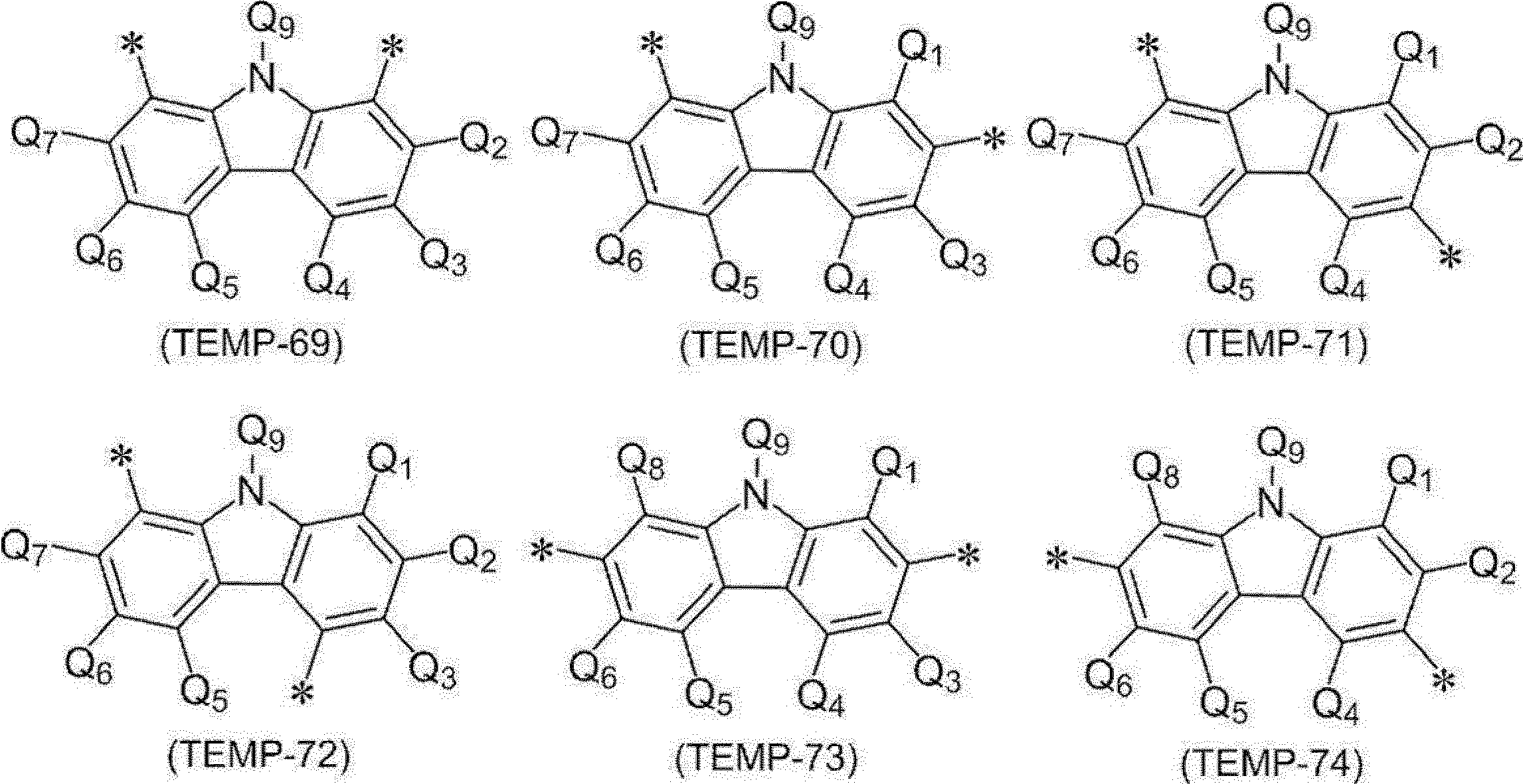


前記一般式(TEMP-69)~(TEMP-82)中、Q1~Q9は、それぞれ独立に、水素原子、又は置換基である。 In general formulas (TEMP-69) to (TEMP-82), Q 1 to Q 9 are each independently a hydrogen atom or a substituent.


前記一般式(TEMP-83)~(TEMP-102)中、Q1~Q8は、それぞれ独立に、水素原子、又は置換基である。 In general formulas (TEMP-83) to (TEMP-102), Q 1 to Q 8 are each independently a hydrogen atom or a substituent.
以上が、「本明細書に記載の置換基」についての説明である。 The above is the description of the "substituents described in this specification".
・「結合して環を形成する場合」
本明細書において、「隣接する2つ以上からなる組の1組以上が、互いに結合して、置換もしくは無置換の単環を形成するか、互いに結合して、置換もしくは無置換の縮合環を形成するか、又は互いに結合せず」という場合は、「隣接する2つ以上からなる組の1組以上が、互いに結合して、置換もしくは無置換の単環を形成する」場合と、「隣接する2つ以上からなる組の1組以上が、互いに結合して、置換もしくは無置換の縮合環を形成する」場合と、「隣接する2つ以上からなる組の1組以上が、互いに結合しない」場合と、を意味する。
本明細書における、「隣接する2つ以上からなる組の1組以上が、互いに結合して、置換もしくは無置換の単環を形成する」場合、及び「隣接する2つ以上からなる組の1組以上が、互いに結合して、置換もしくは無置換の縮合環を形成する」場合(以下、これらの場合をまとめて「結合して環を形成する場合」と称する場合がある。)について、以下、説明する。母骨格がアントラセン環である下記一般式(TEMP-103)で表されるアントラセン化合物の場合を例として説明する。
・"When combining to form a ring"
In the present specification, "one or more pairs of two or more adjacent pairs are bonded to each other to form a substituted or unsubstituted monocyclic ring, or bonded to each other to form a substituted or unsubstituted condensed ring The phrases "form or are not bonded to each other" refer to "at least one pair of two or more adjacent pairs bonded together to form a substituted or unsubstituted monocyclic ring" and "adjacent are bonded to each other to form a substituted or unsubstituted condensed ring" and "one or more adjacent pairs of two or more are not bonded to each other. ' means if.
In the present specification, when "one or more pairs of two or more adjacent pairs are bonded to each other to form a substituted or unsubstituted monocyclic ring", and "one of two or more adjacent pairs In the case where two or more groups combine with each other to form a substituted or unsubstituted condensed ring (hereinafter, these cases may be collectively referred to as "the case where they combine to form a ring"), the following ,explain. An anthracene compound represented by the following general formula (TEMP-103) having an anthracene ring as a base skeleton will be described as an example.

例えば、R921~R930のうちの「隣接する2つ以上からなる組の1組以上が、互いに結合して、環を形成する」場合において、1組となる隣接する2つからなる組とは、R921とR922との組、R922とR923との組、R923とR924との組、R924とR930との組、R930とR925との組、R925とR926との組、R926とR927との組、R927とR928との組、R928とR929との組、並びにR929とR921との組である。 For example, when "one or more pairs of two or more adjacent pairs of R 921 to R 930 are combined to form a ring", is a pair of R 921 and R 922 , a pair of R 922 and R 923 , a pair of R 923 and R 924 , a pair of R 924 and R 930 , a pair of R 930 and R 925 , R 925 and R 926 , R 926 and R 927 , R 927 and R 928 , R 928 and R 929 , and R 929 and R 921 .
上記「1組以上」とは、上記隣接する2つ以上からなる組の2組以上が同時に環を形成してもよいことを意味する。例えば、R921とR922とが互いに結合して環QAを形成し、同時にR925とR926とが互いに結合して環QBを形成した場合は、前記一般式(TEMP-103)で表されるアントラセン化合物は、下記一般式(TEMP-104)で表される。 The above-mentioned "one or more pairs" means that two or more of the groups consisting of two or more adjacent groups may form a ring at the same time. For example, when R 921 and R 922 are bonded together to form ring Q A , and R 925 and R 926 are bonded together to form ring Q B , the general formula (TEMP-103) The represented anthracene compound is represented by the following general formula (TEMP-104).

「隣接する2つ以上からなる組」が環を形成する場合とは、前述の例のように隣接する「2つ」からなる組が結合する場合だけではなく、隣接する「3つ以上」からなる組が結合する場合も含む。例えば、R921とR922とが互いに結合して環QAを形成し、かつ、R922とR923とが互いに結合して環QCを形成し、互いに隣接する3つ(R921、R922及びR923)からなる組が互いに結合して環を形成して、アントラセン母骨格に縮合する場合を意味し、この場合、前記一般式(TEMP-103)で表されるアントラセン化合物は、下記一般式(TEMP-105)で表される。下記一般式(TEMP-105)において、環QA及び環QCは、R922を共有する。 The case where "a group consisting of two or more adjacent pairs" forms a ring is not limited to the case where a group consisting of two adjacent "two" is combined as in the above example, but It also includes the case where a pair is combined. For example, R 921 and R 922 are bonded together to form ring Q A , and R 922 and R 923 are bonded together to form ring Q C , and the adjacent three (R 921 , R 922 and R 923 ) are combined to form a ring and condensed to the anthracene base skeleton. In this case, the anthracene compound represented by the general formula (TEMP-103) has It is represented by the general formula (TEMP-105). In the general formula (TEMP-105) below, ring Q A and ring Q C share R 922 .

形成される「単環」、又は「縮合環」は、形成された環のみの構造として、飽和の環であっても不飽和の環であってもよい。「隣接する2つからなる組の1組」が「単環」、又は「縮合環」を形成する場合であっても、当該「単環」、又は「縮合環」は、飽和の環、又は不飽和の環を形成することができる。例えば、前記一般式(TEMP-104)において形成された環QA及び環QBは、それぞれ、「単環」又は「縮合環」である。また、前記一般式(TEMP-105)において形成された環QA、及び環QCは、「縮合環」である。前記一般式(TEMP-105)の環QAと環QCとは、環QAと環QCとが縮合することによって縮合環となっている。前記一般式(TMEP-104)の環QAがベンゼン環であれば、環QAは、単環である。前記一般式(TMEP-104)の環QAがナフタレン環であれば、環QAは、縮合環である。 The "monocyclic ring" or "condensed ring" to be formed may be a saturated ring or an unsaturated ring as the structure of only the formed ring. Even when "one pair of adjacent pairs" forms a "single ring" or a "fused ring", the "single ring" or "fused ring" is a saturated ring, or Unsaturated rings can be formed. For example, ring Q A and ring Q B formed in the general formula (TEMP-104) are each a "monocyclic ring" or a "fused ring". Moreover, the ring Q A and the ring Q C formed in the general formula (TEMP-105) are “fused rings”. The ring Q A and the ring Q C in the general formula (TEMP-105) form a condensed ring by condensing the ring Q A and the ring Q C. If ring Q A in the general formula (TMEP-104) is a benzene ring, ring Q A is monocyclic. When the ring Q A of the general formula (TMEP-104) is a naphthalene ring, the ring Q A is a condensed ring.
「不飽和の環」とは、芳香族炭化水素環、又は芳香族複素環を意味する。「飽和の環」とは、脂肪族炭化水素環、又は非芳香族複素環を意味する。
芳香族炭化水素環の具体例としては、具体例群G1において具体例として挙げられた基が水素原子によって終端された構造が挙げられる。
芳香族複素環の具体例としては、具体例群G2において具体例として挙げられた芳香族複素環基が水素原子によって終端された構造が挙げられる。
脂肪族炭化水素環の具体例としては、具体例群G6において具体例として挙げられた基が水素原子によって終端された構造が挙げられる。
「環を形成する」とは、母骨格の複数の原子のみ、あるいは母骨格の複数の原子とさらに1以上の任意の元素で環を形成することを意味する。例えば、前記一般式(TEMP-104)に示す、R921とR922とが互いに結合して形成された環QAは、R921が結合するアントラセン骨格の炭素原子と、R922が結合するアントラセン骨格の炭素原子と、1以上の任意の元素とで形成する環を意味する。具体例としては、R921とR922とで環QAを形成する場合において、R921が結合するアントラセン骨格の炭素原子と、R922とが結合するアントラセン骨格の炭素原子と、4つの炭素原子とで単環の不飽和の環を形成する場合、R921とR922とで形成する環は、ベンゼン環である。
"Unsaturated ring" means an aromatic hydrocarbon ring or an aromatic heterocyclic ring. A "saturated ring" means an aliphatic hydrocarbon ring or a non-aromatic heterocyclic ring.
Specific examples of the aromatic hydrocarbon ring include structures in which the groups listed as specific examples in the specific example group G1 are terminated with a hydrogen atom.
Specific examples of the aromatic heterocyclic ring include structures in which the aromatic heterocyclic groups listed as specific examples in the specific example group G2 are terminated with a hydrogen atom.
Specific examples of the aliphatic hydrocarbon ring include structures in which the groups listed as specific examples in the specific example group G6 are terminated with a hydrogen atom.
"Forming a ring" means forming a ring only with a plurality of atoms of the mother skeleton, or with a plurality of atoms of the mother skeleton and one or more arbitrary elements. For example, the ring Q A formed by combining R 921 and R 922 shown in the general formula (TEMP-104) has the carbon atom of the anthracene skeleton to which R 921 is bonded and the anthracene skeleton to which R 922 is bonded. It means a ring formed by a skeleton carbon atom and one or more arbitrary elements. As a specific example, when R 921 and R 922 form a ring Q A , the carbon atom of the anthracene skeleton to which R 921 is bound, the carbon atom of the anthracene skeleton to which R 922 is bound, and four carbon atoms and form a monocyclic unsaturated ring, the ring formed by R 921 and R 922 is a benzene ring.
ここで、「任意の元素」は、本明細書に別途記載のない限り、好ましくは、炭素元素、窒素元素、酸素元素、及び硫黄元素からなる群から選択される少なくとも1種の元素である。任意の元素において(例えば、炭素元素、又は窒素元素の場合)、環を形成しない結合は、水素原子等で終端されてもよいし、後述する「任意の置換基」で置換されてもよい。炭素元素以外の任意の元素を含む場合、形成される環は複素環である。
単環または縮合環を構成する「1以上の任意の元素」は、本明細書に別途記載のない限り、好ましくは2個以上15個以下であり、より好ましくは3個以上12個以下であり、さらに好ましくは3個以上5個以下である。
本明細書に別途記載のない限り、「単環」、及び「縮合環」のうち、好ましくは「単環」である。
本明細書に別途記載のない限り、「飽和の環」、及び「不飽和の環」のうち、好ましくは「不飽和の環」である。
本明細書に別途記載のない限り、「単環」は、好ましくはベンゼン環である。
本明細書に別途記載のない限り、「不飽和の環」は、好ましくはベンゼン環である。
「隣接する2つ以上からなる組の1組以上」が、「互いに結合して、置換もしくは無置換の単環を形成する」場合、又は「互いに結合して、置換もしくは無置換の縮合環を形成する」場合、本明細書に別途記載のない限り、好ましくは、隣接する2つ以上からなる組の1組以上が、互いに結合して、母骨格の複数の原子と、1個以上15個以下の炭素元素、窒素元素、酸素元素、及び硫黄元素からなる群から選択される少なくとも1種の元素とからなる置換もしくは無置換の「不飽和の環」を形成する。
Here, the "arbitrary element" is preferably at least one element selected from the group consisting of carbon element, nitrogen element, oxygen element, and sulfur element, unless otherwise specified in this specification. In any element (for example, in the case of a carbon element or a nitrogen element), a bond that does not form a ring may be terminated with a hydrogen atom or the like, or may be substituted with an "optional substituent" described later. When it contains any element other than the carbon atom, the ring formed is a heterocycle.
"One or more arbitrary elements" constituting a single ring or condensed ring are preferably 2 or more and 15 or less, more preferably 3 or more and 12 or less, unless otherwise specified in the present specification. , more preferably 3 or more and 5 or less.
Among "monocyclic ring" and "condensed ring", "monocyclic ring" is preferred, unless otherwise stated in the present specification.
Of the "saturated ring" and the "unsaturated ring", the "unsaturated ring" is preferred, unless otherwise specified in the present specification.
Unless otherwise stated herein, "monocyclic" is preferably a benzene ring.
Unless otherwise stated herein, the "unsaturated ring" is preferably a benzene ring.
When "one or more pairs of two or more adjacent pairs" are "bonded to each other to form a substituted or unsubstituted monocyclic ring", or "bonded to each other to form a substituted or unsubstituted condensed ring When forming, unless otherwise stated herein, preferably one or more sets of two or more adjacent groups are bonded together to form a plurality of atoms of the backbone and 1 or more 15 It forms a substituted or unsubstituted "unsaturated ring" with at least one element selected from the group consisting of the following carbon, nitrogen, oxygen and sulfur elements.
上記の「単環」、又は「縮合環」が置換基を有する場合の置換基は、例えば後述する「任意の置換基」である。上記の「単環」、又は「縮合環」が置換基を有する場合の置換基の具体例は、上述した「本明細書に記載の置換基」の項で説明した置換基である。
上記の「飽和の環」、又は「不飽和の環」が置換基を有する場合の置換基は、例えば後述する「任意の置換基」である。上記の「単環」、又は「縮合環」が置換基を有する場合の置換基の具体例は、上述した「本明細書に記載の置換基」の項で説明した置換基である。
以上が、「隣接する2つ以上からなる組の1組以上が、互いに結合して、置換もしくは無置換の単環を形成する」場合、及び「隣接する2つ以上からなる組の1組以上が、互いに結合して、置換もしくは無置換の縮合環を形成する」場合(「結合して環を形成する場合」)についての説明である。
When the above "monocyclic ring" or "condensed ring" has a substituent, the substituent is, for example, the "optional substituent" described later. Specific examples of substituents in the case where the above "monocyclic ring" or "condensed ring" has a substituent are the substituents described in the section "Substituents described herein" above.
When the above "saturated ring" or "unsaturated ring" has a substituent, the substituent is, for example, the "optional substituent" described later. Specific examples of substituents in the case where the above "monocyclic ring" or "condensed ring" has a substituent are the substituents described in the section "Substituents described herein" above.
The above is the case where "one or more pairs of two or more adjacent pairs are bonded to each other to form a substituted or unsubstituted monocyclic ring", and "one or more pairs of two or more adjacent pairs are combined with each other to form a substituted or unsubstituted condensed ring"("combine to form a ring").
・「置換もしくは無置換の」という場合の置換基
本明細書における一実施形態においては、前記「置換もしくは無置換の」という場合の置換基(本明細書において、「任意の置換基」と呼ぶことがある。)は、例えば、
無置換の炭素数1~50のアルキル基、
無置換の炭素数2~50のアルケニル基、
無置換の炭素数2~50のアルキニル基、
無置換の環形成炭素数3~50のシクロアルキル基、
-Si(R901)(R902)(R903)、
-O-(R904)、
-S-(R905)、
-N(R906)(R907)、
ハロゲン原子、シアノ基、ニトロ基、
無置換の環形成炭素数6~50のアリール基、及び
無置換の環形成原子数5~50の複素環基
からなる群から選択される基等であり、
ここで、R901~R907は、それぞれ独立に、
水素原子、
置換もしくは無置換の炭素数1~50のアルキル基、
置換もしくは無置換の環形成炭素数3~50のシクロアルキル基、
置換もしくは無置換の環形成炭素数6~50のアリール基、又は置換もしくは無置換の環形成原子数5~50の複素環基である。
R901が2個以上存在する場合、2個以上のR901は、互いに同一であるか、又は異なり、
R902が2個以上存在する場合、2個以上のR902は、互いに同一であるか、又は異なり、
R903が2個以上存在する場合、2個以上のR903は、互いに同一であるか、又は異なり、
R904が2個以上存在する場合、2個以上のR904は、互いに同一であるか、又は異なり、
R905が2個以上存在する場合、2個以上のR905は、互いに同一であるか、又は異なり、
R906が2個以上存在する場合、2個以上のR906は、互いに同一であるか、又は異なり、
R907が2個以上存在する場合、2個以上のR907は、互いに同一であるか又は異なる。
- Substituent in the case of "substituted or unsubstituted" In one embodiment of the present specification, the substituent in the case of "substituted or unsubstituted" (herein referred to as "optional substituent") ) is, for example,
an unsubstituted alkyl group having 1 to 50 carbon atoms,
an unsubstituted alkenyl group having 2 to 50 carbon atoms,
an unsubstituted alkynyl group having 2 to 50 carbon atoms,
an unsubstituted cycloalkyl group having 3 to 50 ring carbon atoms,
—Si(R 901 ) (R 902 ) (R 903 ),
—O—(R 904 ),
-S-(R 905 ),
-N(R 906 )(R 907 ),
halogen atom, cyano group, nitro group,
a group selected from the group consisting of an unsubstituted aryl group having 6 to 50 ring-forming carbon atoms and an unsubstituted heterocyclic group having 5 to 50 ring-forming atoms;
Here, R 901 to R 907 are each independently
hydrogen atom,
a substituted or unsubstituted alkyl group having 1 to 50 carbon atoms,
a substituted or unsubstituted cycloalkyl group having 3 to 50 ring carbon atoms,
It is a substituted or unsubstituted aryl group having 6 to 50 ring carbon atoms or a substituted or unsubstituted heterocyclic group having 5 to 50 ring atoms.
when two or more R 901 are present, the two or more R 901 are the same or different from each other,
when two or more R 902 are present, the two or more R 902 are the same or different from each other;
when two or more R 903 are present, the two or more R 903 are the same or different from each other,
when two or more R 904 are present, the two or more R 904 are the same or different from each other;
when two or more R 905 are present, the two or more R 905 are the same or different from each other,
when two or more R 906 are present, the two or more R 906 are the same or different from each other;
When two or more R 907 are present, the two or more R 907 are the same or different from each other.
一実施形態においては、前記「置換もしくは無置換の」という場合の置換基は、
炭素数1~50のアルキル基、
環形成炭素数6~50のアリール基、及び
環形成原子数5~50の複素環基
からなる群から選択される基である。
In one embodiment, the substituents referred to above as "substituted or unsubstituted" are
an alkyl group having 1 to 50 carbon atoms,
It is a group selected from the group consisting of an aryl group having 6 to 50 ring carbon atoms and a heterocyclic group having 5 to 50 ring atoms.
一実施形態においては、前記「置換もしくは無置換の」という場合の置換基は、
炭素数1~18のアルキル基、
環形成炭素数6~18のアリール基、及び
環形成原子数5~18の複素環基
からなる群から選択される基である。
In one embodiment, the substituents referred to above as "substituted or unsubstituted" are
an alkyl group having 1 to 18 carbon atoms,
It is a group selected from the group consisting of an aryl group having 6 to 18 ring carbon atoms and a heterocyclic group having 5 to 18 ring atoms.
上記任意の置換基の各基の具体例は、上述した「本明細書に記載の置換基」の項で説明した置換基の具体例である。 Specific examples of each group of the above optional substituents are specific examples of the substituents described in the section "Substituents described in the specification" above.
本明細書において別途記載のない限り、隣接する任意の置換基同士で、「飽和の環」、又は「不飽和の環」を形成してもよく、好ましくは、置換もしくは無置換の飽和の5員環、置換もしくは無置換の飽和の6員環、置換もしくは無置換の不飽和の5員環、又は置換もしくは無置換の不飽和の6員環を形成し、より好ましくは、ベンゼン環を形成する。
本明細書において別途記載のない限り、任意の置換基は、さらに置換基を有してもよい。任意の置換基がさらに有する置換基としては、上記任意の置換基と同様である。
Unless otherwise stated in this specification, any adjacent substituents may form a “saturated ring” or an “unsaturated ring”, preferably a substituted or unsubstituted saturated 5 forming a membered ring, a substituted or unsubstituted saturated 6-membered ring, a substituted or unsubstituted unsaturated 5-membered ring, or a substituted or unsubstituted unsaturated 6-membered ring, more preferably a benzene ring do.
Unless stated otherwise herein, any substituent may have further substituents. Substituents further possessed by the optional substituents are the same as the above optional substituents.
本明細書において、「AA~BB」を用いて表される数値範囲は、「AA~BB」の前に記載される数値AAを下限値とし、「AA~BB」の後に記載される数値BBを上限値として含む範囲を意味する。 In this specification, the numerical range represented using "AA to BB" has the numerical value AA described before "AA to BB" as the lower limit, and the numerical value BB described after "AA to BB" as the upper limit.
以下、本発明の化合物を説明する。
本発明の一態様に係る化合物は下記式(1)で表される。
ただし、以下、式(1)及び後述する式(1)に含まれる各式で表される本発明の化合物を単に“化合物(1)”、“発明化合物(1)”又は“発明化合物”と称することがある。

A compound according to one embodiment of the present invention is represented by the following formula (1).
However, hereinafter, the compound of the present invention represented by formula (1) and each formula contained in formula (1) described later is simply referred to as "compound (1)", "invention compound (1)" or "invention compound". sometimes referred to as
以下、式(1)及び後述する式(1)に含まれる各式中の記号を説明する。なお、同じ記号は同じ意味を有する。 The symbols in each formula included in formula (1) and formula (1) described later will be described below. The same symbols have the same meanings.
式(1)中、Ar1は、下記式(1Aa)、(1Ab)、又は(1B)で表される。

式(1Aa)及び(1Ab)中、X1は、酸素原子又は硫黄原子であり、好ましくは酸素原子である。 In formulas (1Aa) and (1Ab), X1 is an oxygen atom or a sulfur atom, preferably an oxygen atom.
式(1Aa)及び(1Ab)中、R1~R6及びR8~R11は、それぞれ独立に、水素原子、置換もしくは無置換の炭素数1~6のアルキル基、置換もしくは無置換の環形成炭素数6~12のアリール基、又は置換もしくは無置換の環形成原子数5~13のヘテロアリール基であり、好ましくは、それぞれ独立に、水素原子、置換もしくは無置換の炭素数1~6のアルキル基、置換もしくは無置換の環形成炭素数6~12のアリール基である。 In formulas (1Aa) and (1Ab), R 1 to R 6 and R 8 to R 11 are each independently a hydrogen atom, a substituted or unsubstituted alkyl group having 1 to 6 carbon atoms, a substituted or unsubstituted ring an aryl group having 6 to 12 carbon atoms, or a substituted or unsubstituted heteroaryl group having 5 to 13 ring atoms, preferably each independently a hydrogen atom or a substituted or unsubstituted 1 to 6 carbon atoms or a substituted or unsubstituted aryl group having 6 to 12 ring-forming carbon atoms.
式(1Aa)及び(1Ab)中、水素原子ではないR1~R6、及びR8~R11から選択される一つは、Ar2に結合する単結合又はAr2に結合する基である。好ましくはR10がAr2に結合する単結合又はAr2に結合する基である。 In formulas (1Aa) and (1Ab), one selected from R 1 to R 6 and R 8 to R 11 that is not a hydrogen atom is a single bond that binds to Ar 2 or a group that binds to Ar 2 . R 10 is preferably a single bond to Ar 2 or a group to Ar 2 .
式(1Aa)及び(1Ab)中、水素原子ではなく前記単結合ではないR1~R6、及びR8~R11のうち隣り合う一対の基は、互いに結合して置換もしくは無置換の単環を形成するか、互いに結合して置換もしくは無置換の縮合環を形成するか、又は、互いに結合せず環を形成しない。 In formulas (1Aa) and (1Ab), a pair of adjacent groups among R 1 to R 6 and R 8 to R 11 which are not hydrogen atoms but are not single bonds are bonded to each other to form a substituted or unsubstituted single bond. They form a ring, combine with each other to form a substituted or unsubstituted fused ring, or do not combine without forming a ring.
上記水素原子ではなく単結合ではないR1~R6、及びR8~R11によって形成される無置換の単環は、好ましくは環形成原子数3以上6以下の単環であり、例えば、ベンゼン環、フラン環、チオフェン環であり、好ましくはベンゼン環である。 The unsubstituted monocyclic ring formed by R 1 to R 6 which is neither a hydrogen atom nor a single bond and R 8 to R 11 is preferably a monocyclic ring having 3 or more and 6 or less ring atoms. A benzene ring, a furan ring or a thiophene ring, preferably a benzene ring.
式(1B)中、X2は、酸素原子又は硫黄原子であり、好ましくは酸素原子である。 In formula (1B), X2 is an oxygen atom or a sulfur atom, preferably an oxygen atom.
式(1B)中、R21~R28は、それぞれ独立に、水素原子、置換もしくは無置換の炭素数1~6のアルキル基、置換もしくは無置換の環形成炭素数6~12のアリール基、又は環形成原子数5~13のヘテロアリール基である。 In formula (1B), R 21 to R 28 are each independently a hydrogen atom, a substituted or unsubstituted alkyl group having 1 to 6 carbon atoms, a substituted or unsubstituted aryl group having 6 to 12 ring carbon atoms, or a heteroaryl group having 5 to 13 ring atoms.
式(1B)中、RA及びRBは、それぞれ独立に、水素原子、置換もしくは無置換の炭素数1~30のアルキル基、置換もしくは無置換の環形成炭素数6~30のアリール基、又は置換もしくは無置換の環形成原子数5~30のヘテロアリール基であり、好ましくは置換もしくは無置換の炭素数1~30のアルキル基、置換もしくは無置換の環形成炭素数6~30のアリール基である。 In formula (1B), R A and R B are each independently a hydrogen atom, a substituted or unsubstituted alkyl group having 1 to 30 carbon atoms, a substituted or unsubstituted aryl group having 6 to 30 ring carbon atoms, or a substituted or unsubstituted heteroaryl group having 5 to 30 ring atoms, preferably a substituted or unsubstituted alkyl group having 1 to 30 carbon atoms, or a substituted or unsubstituted aryl having 6 to 30 ring atoms is the base.
式(1B)中、R21~R28、RA、及びRBから選択される一つは、Ar2に結合する単結合又はAr2に結合する基である。 In formula (1B), one selected from R 21 to R 28 , R A and R B is a single bond that binds to Ar 2 or a group that binds to Ar 2 .
式(1B)中、前記単結合ではないR21~R24、及びR25~R28のうち隣り合う一対の基は、互いに結合して置換もしくは無置換の単環を形成するか、互いに結合して置換もしくは無置換の縮合環を形成するか、又は、互いに結合せず環を形成しない。 In formula (1B), adjacent pairs of groups of R 21 to R 24 and R 25 to R 28 which are not single bonds are bonded to each other to form a substituted or unsubstituted monocyclic ring, or bonded to each other together to form a substituted or unsubstituted condensed ring, or not combined to form a ring.
上記水素原子ではなく単結合ではないR21~R24、及びR25~R28によって形成される無置換の単環は、好ましくは環形成原子数3以上6以下の単環であり、例えば、ベンゼン環、フラン環、チオフェン環であり、好ましくはベンゼン環である。 The unsubstituted monocyclic ring formed by R 21 to R 24 and R 25 to R 28 which are neither hydrogen atoms nor single bonds is preferably a monocyclic ring having 3 or more and 6 or less ring atoms. A benzene ring, a furan ring or a thiophene ring, preferably a benzene ring.
式(1B)中、前記単結合ではないRAとRBは、互いに結合して置換もしくは無置換の単環を形成するか、互いに結合して置換もしくは無置換の縮合環を形成するか、又は、互いに結合せず環を形成しない。 In formula (1B), R A and R B which are not single bonds are bonded to each other to form a substituted or unsubstituted monocyclic ring, or bonded to each other to form a substituted or unsubstituted condensed ring, Alternatively, they are not bonded to each other to form a ring.
上記R1~R6、R8~R11、及びR21~R28が表す無置換のアルキル基は、好ましくはメチル基、エチル基、n-プロピル基、イソプロピル基、n-ブチル基、イソブチル基、s-ブチル基、又はt-ブチル基であり、より好ましくはメチル基、エチル基、イソプロピル基、又はt-ブチル基であり、更に好ましくはメチル基又はt-ブチル基である。 The unsubstituted alkyl groups represented by R 1 to R 6 , R 8 to R 11 and R 21 to R 28 are preferably methyl group, ethyl group, n-propyl group, isopropyl group, n-butyl group, isobutyl group, s-butyl group or t-butyl group, more preferably methyl group, ethyl group, isopropyl group or t-butyl group, still more preferably methyl group or t-butyl group.
上記R1~R6、R8~R11、及びR21~R28が表す無置換のアリール基は、好ましくはフェニル基、ビフェニル基、又はナフチル基であり、より好ましくはフェニル基である。 The unsubstituted aryl group represented by R 1 to R 6 , R 8 to R 11 and R 21 to R 28 is preferably a phenyl group, a biphenyl group or a naphthyl group, more preferably a phenyl group.
上記R1~R6、R8~R11、及びR21~R28が表す無置換の複素環基は、好ましくはピリジル基、又はキナゾリニル基である。 The unsubstituted heterocyclic group represented by R 1 to R 6 , R 8 to R 11 and R 21 to R 28 is preferably a pyridyl group or a quinazolinyl group.
上記単結合ではないRCとRDによって形成される無置換の単環は、例えば、ベンゼン環、シクロペンタン環、シクロヘキサン環である。 Examples of the unsubstituted single ring formed by R C and R D which are not single bonds are benzene ring, cyclopentane ring, and cyclohexane ring.
上記単結合ではないRCとRDによって形成される無置換の縮合環、上記単結合ではないREとRFによって形成される無置換の縮合環、及び、上記単結合ではないRGとRJによって形成される無置換の縮合環は、例えば、ナフタレン環、アントラセン環である。 The unsubstituted condensed ring formed by R C and R D which are not single bonds, the unsubstituted condensed ring formed by R E and RF which are not single bonds, and R G which is not single bond The unsubstituted condensed ring formed by RJ is, for example, a naphthalene ring or anthracene ring.
上記RA及びRBが表す無置換のアルキル基は、好ましくはメチル基、エチル基、n-プロピル基、イソプロピル基、n-ブチル基、イソブチル基、s-ブチル基、又はt-ブチル基であり、より好ましくはメチル基、エチル基、イソプロピル基、又はt-ブチル基であり、更に好ましくはメチル基又はt-ブチル基である。 The unsubstituted alkyl group represented by R A and R B is preferably a methyl group, ethyl group, n-propyl group, isopropyl group, n-butyl group, isobutyl group, s-butyl group, or t-butyl group. , more preferably a methyl group, an ethyl group, an isopropyl group, or a t-butyl group, and still more preferably a methyl group or a t-butyl group.
上記RA及びRBが表す無置換のアリール基は、好ましくはフェニル基、ビフェニル基、ナフチル基、ターフェニル基、フェナントレニル基、トリフェニレニル基、又はフルオレニル基であり、より好ましくはフェニル基、ビフェニル基、ナフチル基、又はフェナントレニル基であり、さらに好ましくはフェニル基、ナフチル基、又はフェナントレニル基であり、よりさらに好ましくはフェニル基又はナフチル基である。 The unsubstituted aryl group represented by R A and R B is preferably a phenyl group, a biphenyl group, a naphthyl group, a terphenyl group, a phenanthrenyl group, a triphenylenyl group, or a fluorenyl group, more preferably a phenyl group or a biphenyl group. , naphthyl group or phenanthrenyl group, more preferably phenyl group, naphthyl group or phenanthrenyl group, still more preferably phenyl group or naphthyl group.
上記RA及びRBが表す無置換の複素環基は、好ましくはジベンゾフラニル基、ジベンゾチオフェニル基、又はピリジル基であり、より好ましくはジベンゾフラニル基又はジベンゾチオフェニル基である。 The unsubstituted heterocyclic group represented by R A and R B is preferably a dibenzofuranyl group, a dibenzothiophenyl group or a pyridyl group, more preferably a dibenzofuranyl group or a dibenzothiophenyl group.
式(1)において、
・Ar1が式(1Aa)又は(1Ab)で表される場合、水素原子ではないR1~R11のうちいずれか一つがAr2に結合する単結合であるか、又は、R1~R11のうち隣り合う一対の基で形成される単環又は縮合環がAr2に結合することが好ましく、
・Ar1が式(1B)で表される場合、水素原子ではないR21~R28、RA、RBのうちいずれか一つがAr2に結合する単結合であるか、R21~R28のうち隣り合う一対の基で形成される単環又は縮合環がAr2に結合するか、又は、RA及びRBで形成される単環又は縮合環がAr2に結合することが好ましい。
In formula (1),
When Ar 1 is represented by formula (1Aa) or (1Ab), any one of R 1 to R 11 that is not a hydrogen atom is a single bond that binds to Ar 2 , or R 1 to R It is preferred that a single ring or condensed ring formed by a pair of adjacent groups among 11 is bound to Ar 2 ,
When Ar 1 is represented by formula (1B), any one of R 21 to R 28 , R A , and R B that is not a hydrogen atom is a single bond bonding to Ar 2 , or R 21 to R It is preferable that a monocyclic or condensed ring formed by a pair of adjacent groups among 28 is bonded to Ar 2 , or a monocyclic or condensed ring formed by R A and R B is bonded to Ar 2 . .
式(1)中、Ar2は、下記式(2A)、(2B)、(2C)、(2D)、(2E)、又は(2F)で表される。
但し、Ar1が式(1Aa)で表される場合、Ar2は下記式(2C)、(2D)、(2E)、又は(2F)で表される。Ar1が式(1Ab)で表される場合、Ar2は下記式(2A)又は(2B)で表される。Ar1が式(1B)で表される場合、Ar2は下記式(2A)、(2B)、(2C)、(2D)、(2E)、又は(2F)で表される。


However, when Ar 1 is represented by Formula (1Aa), Ar 2 is represented by Formula (2C), (2D), (2E), or (2F) below. When Ar 1 is represented by formula (1Ab), Ar 2 is represented by the following formula (2A) or (2B). When Ar 1 is represented by Formula (1B), Ar 2 is represented by Formula (2A), (2B), (2C), (2D), (2E), or (2F) below.
式(2A)中、L1は、置換もしくは無置換の環形成炭素数6~30のアリーレン基、又は置換もしくは無置換の環形成原子数5~30の2価の複素環基である。 In formula (2A), L 1 is a substituted or unsubstituted arylene group having 6 to 30 ring carbon atoms or a substituted or unsubstituted divalent heterocyclic group having 5 to 30 ring atoms.
式(2A)中、*はAr1に結合するL1又は単結合の一端を表し、**はL1又は前記単結合の他端を表す。 In formula (2A), * represents L1 bonded to Ar1 or one end of a single bond, and ** represents L1 or the other end of the single bond.
式(2A)中、mは0又は1である。 In formula (2A), m is 0 or 1.
式(2A)中、R31~R38は、それぞれ独立に、水素原子、置換もしくは無置換の炭素数1~6のアルキル基、置換もしくは無置換の環形成炭素数6~12のアリール基、又は置換もしくは無置換の環形成原子数5~13のヘテロアリール基である。 In formula (2A), R 31 to R 38 are each independently a hydrogen atom, a substituted or unsubstituted alkyl group having 1 to 6 carbon atoms, a substituted or unsubstituted aryl group having 6 to 12 ring carbon atoms, or a substituted or unsubstituted heteroaryl group having 5 to 13 ring atoms.
式(2A)中、RC及びRDは、それぞれ独立に、置換もしくは無置換の炭素数1~30のアルキル基、置換もしくは無置換の環形成炭素数6~30のアリール基、又は置換もしくは無置換の環形成原子数5~30のヘテロアリール基である。 In formula (2A), R C and R D are each independently a substituted or unsubstituted alkyl group having 1 to 30 carbon atoms, a substituted or unsubstituted aryl group having 6 to 30 ring carbon atoms, or a substituted or It is an unsubstituted heteroaryl group having 5 to 30 ring atoms.
式(2A)中、R31~R38、RC、及びRDから選択される一つは、**に結合する単結合又は**に結合する基である。 In formula (2A), one selected from R 31 to R 38 , R C and R D is a single bond that bonds to ** or a group that bonds to **.
式(2A)中、前記単結合ではないR31~R38のうち隣り合う一対の基は、互いに結合して置換もしくは無置換の単環を形成するか、互いに結合して置換もしくは無置換の縮合環を形成するか、又は、互いに結合せず環を形成しない。 In formula (2A), a pair of adjacent groups among R 31 to R 38 which are not single bonds are bonded to each other to form a substituted or unsubstituted monocyclic ring, or bonded to each other to form a substituted or unsubstituted They either form a fused ring or are not joined together to form a ring.
式(2A)中、前記単結合ではないRCとRDは、互いに結合して置換もしくは無置換の単環を形成するか、互いに結合して置換もしくは無置換の縮合環を形成するか、又は、互いに結合せず環を形成しない。 In formula (2A), R C and R D which are not single bonds are bonded to each other to form a substituted or unsubstituted monocyclic ring, or bonded to each other to form a substituted or unsubstituted condensed ring, Alternatively, they are not bonded to each other to form a ring.
式(2B)中、L2は、置換もしくは無置換の環形成炭素数6~30のアリーレン基、又は置換もしくは無置換の環形成原子数5~30の2価の複素環基である。 In formula (2B), L 2 is a substituted or unsubstituted arylene group having 6 to 30 ring carbon atoms or a substituted or unsubstituted divalent heterocyclic group having 5 to 30 ring atoms.
式(2B)中、*はAr1に結合するL2又は単結合の一端を表し、**はL2又は前記単結合の他端を表す。 In formula (2B), * represents L2 bonded to Ar1 or one end of a single bond, and ** represents L2 or the other end of the single bond.
式(2B)中、nは0又は1である。 In formula (2B), n is 0 or 1.
式(2B)中、R41~R48、R51~R54、及びR55~R58は、それぞれ独立に、水素原子、置換もしくは無置換の炭素数1~6のアルキル基、置換もしくは無置換の環形成炭素数6~12のアリール基、又は置換もしくは無置換の環形成原子数5~13のヘテロアリール基である。
R45とR46、R46とR47、又はR47とR48のうち一方は*aに結合する単結合であり、他方は*bに結合する単結合である。
In formula (2B), R 41 to R 48 , R 51 to R 54 and R 55 to R 58 are each independently a hydrogen atom, a substituted or unsubstituted alkyl group having 1 to 6 carbon atoms, a substituted or unsubstituted It is a substituted aryl group having 6 to 12 ring-forming carbon atoms or a substituted or unsubstituted heteroaryl group having 5 to 13 ring-forming atoms.
One of R 45 and R 46 , R 46 and R 47 , or R 47 and R 48 is a single bond that bonds to *a, and the other is a single bond that bonds to *b.
式(2B)中、kは0又は1である。
kが1のとき、R41とR42、R42とR43、又はR43とR44のうち一方は*cに結合する単結合であり、他方は*dに結合する単結合である。
In formula (2B), k is 0 or 1.
When k is 1, one of R 41 and R 42 , R 42 and R 43 , or R 43 and R 44 is a single bond that bonds to *c, and the other is a single bond that bonds to *d.
式(2B)中、RXは、水素原子、置換もしくは無置換の炭素数1~30のアルキル基、置換もしくは無置換の環形成炭素数6~30のアリール基、又は置換もしくは無置換の環形成原子数5~30のヘテロアリール基である。 In formula (2B), R X is a hydrogen atom, a substituted or unsubstituted alkyl group having 1 to 30 carbon atoms, a substituted or unsubstituted aryl group having 6 to 30 ring-forming carbon atoms, or a substituted or unsubstituted ring It is a heteroaryl group having 5 to 30 forming atoms.
式(2B)中、*c及び*dに結合しないR41~R44、*a及び*bに結合しないR45~R48、R51~R54、R55~R58、及びRXから選ばれる一つは、**に結合する単結合又は**に結合する基である。 In formula (2B), from R 41 to R 44 not bonded to *c and *d, R 45 to R 48 , R 51 to R 54 , R 55 to R 58 not bonded to *a and *b, and R X One of the choices is a single bond that binds to ** or a group that binds to **.
式(2B)中、*c及び*dに結合せず前記**に結合する単結合ではないR41~R44、*a及び*bに結合せず前記**に結合する単結合ではないR45~R48、R51~R54、及びR55~R58のうち隣り合う一対の基は、互いに結合して置換もしくは無置換の単環を形成するか、互いに結合して置換もしくは無置換の縮合環を形成するか、又は、互いに結合せず環を形成しない。 In formula (2B), R 41 to R 44 that are not single bonds that bond to ** without bonding to *c and *d, and are not single bonds that bond to ** without bonding to *a and *b A pair of adjacent groups among R 45 to R 48 , R 51 to R 54 , and R 55 to R 58 are bonded to each other to form a substituted or unsubstituted monocyclic ring, or bonded to each other to form a substituted or unsubstituted They either form a substituted fused ring or are not joined together to form a ring.
式(2C)中、L3は、置換もしくは無置換の環形成炭素数6~30のアリーレン基、又は置換もしくは無置換の環形成原子数5~30の2価の複素環基である。 In formula (2C), L 3 is a substituted or unsubstituted arylene group having 6 to 30 ring carbon atoms or a substituted or unsubstituted divalent heterocyclic group having 5 to 30 ring atoms.
式(2C)中、*はAr1に結合するL3の一端を表し、**はL3の他端を表す。 In formula (2C), * represents one end of L3 bonded to Ar1 , and ** represents the other end of L3 .
式(2C)中、R61~R68は、それぞれ独立に、水素原子、置換もしくは無置換の炭素数1~6のアルキル基、置換もしくは無置換の環形成炭素数6~12のアリール基、又は置換もしくは無置換の環形成原子数5~13のヘテロアリール基である。
R61~R68は、互いに結合して環を形成しない。
In formula (2C), R 61 to R 68 are each independently a hydrogen atom, a substituted or unsubstituted alkyl group having 1 to 6 carbon atoms, a substituted or unsubstituted aryl group having 6 to 12 ring carbon atoms, or a substituted or unsubstituted heteroaryl group having 5 to 13 ring atoms.
R 61 to R 68 do not combine with each other to form a ring.
式(2C)中、RYは、水素原子、置換もしくは無置換の炭素数1~30のアルキル基、置換もしくは無置換の環形成炭素数6~30のアリール基、又は置換もしくは無置換の環形成原子数5~30のヘテロアリール基である。 In formula (2C), R Y is a hydrogen atom, a substituted or unsubstituted alkyl group having 1 to 30 carbon atoms, a substituted or unsubstituted aryl group having 6 to 30 ring-forming carbon atoms, or a substituted or unsubstituted ring It is a heteroaryl group having 5 to 30 forming atoms.
式(2C)中、R61~R68及びRYから選択される一つは、**に結合する単結合又は**に結合する基である。 In formula (2C), one selected from R 61 to R 68 and R Y is a single bond that bonds to ** or a group that bonds to **.
式(2D)中、L4は、置換もしくは無置換の環形成炭素数6~30のアリーレン基、又は置換もしくは無置換の環形成原子数5~30の2価の複素環基である。 In formula (2D), L 4 is a substituted or unsubstituted arylene group having 6 to 30 ring carbon atoms or a substituted or unsubstituted divalent heterocyclic group having 5 to 30 ring atoms.
式(2D)中、*はAr1に結合するL4の一端を表し、**はL4の他端を表す。 In formula (2D), * represents one end of L4 bound to Ar1 , and ** represents the other end of L4 .
式(2D)中、R71~R78は、それぞれ独立に、水素原子、置換もしくは無置換の炭素数1~6のアルキル基、置換もしくは無置換の環形成炭素数6~12のアリール基、又は置換もしくは無置換の環形成原子数5~13のヘテロアリール基である。 In formula (2D), R 71 to R 78 are each independently a hydrogen atom, a substituted or unsubstituted alkyl group having 1 to 6 carbon atoms, a substituted or unsubstituted aryl group having 6 to 12 ring carbon atoms, or a substituted or unsubstituted heteroaryl group having 5 to 13 ring atoms.
式(2D)中、RE及びRFは、それぞれ独立に、置換もしくは無置換の炭素数1~30のアルキル基、置換もしくは無置換の環形成炭素数6~30のアリール基、又は置換もしくは無置換の環形成原子数5~30のヘテロアリール基である。 In formula (2D), R E and R F are each independently a substituted or unsubstituted alkyl group having 1 to 30 carbon atoms, a substituted or unsubstituted aryl group having 6 to 30 ring carbon atoms, or a substituted or It is an unsubstituted heteroaryl group having 5 to 30 ring atoms.
式(2D)中、R71~R78、RE、及びRFから選択される一つは、**に結合する単結合又は**に結合する基である。 In formula (2D), one selected from R 71 to R 78 , R E and R F is a single bond that bonds to ** or a group that bonds to **.
前記単結合ではないR71~R78のうち隣り合う一対の基は、互いに結合して置換もしくは無置換の単環を形成するか、互いに結合して置換もしくは無置換の縮合環を形成するか、又は、互いに結合せず環を形成しない。 A pair of adjacent groups among R 71 to R 78 which are not single bonds are bonded to each other to form a substituted or unsubstituted monocyclic ring, or bonded to each other to form a substituted or unsubstituted condensed ring. , or do not combine with each other to form a ring.
前記単結合ではないREとRFは、互いに結合して置換もしくは無置換の単環を形成するか、互いに結合して置換もしくは無置換の縮合環を形成するか、又は、互いに結合せず環を形成しない。 R E and R F which are not single bonds are bonded to each other to form a substituted or unsubstituted monocyclic ring, bonded to each other to form a substituted or unsubstituted condensed ring, or are not bonded to each other. does not form a ring.
式(2E)中、*はAr1に結合する単結合の一端を表し、**は前記単結合の他端を表す。 In formula (2E), * represents one end of the single bond bound to Ar 1 , and ** represents the other end of the single bond.
式(2E)中、*はAr1に結合する単結合の一端を表し、**は前記単結合の他端を表す。 In formula (2E), * represents one end of the single bond bound to Ar 1 , and ** represents the other end of the single bond.
式(2E)中、R81、R82、R84、R85、R87、R88、YA、及びYBは、それぞれ独立に、水素原子、置換もしくは無置換の炭素数1~6のアルキル基、置換もしくは無置換の環形成炭素数6~12のアリール基、又は置換もしくは無置換の環形成原子数5~13のヘテロアリール基である。
R81、R82、R84、R85、R87、R88、YA、及びYBは、互いに結合して環を形成しない。
In formula (2E), R 81 , R 82 , R 84 , R 85 , R 87 , R 88 , Y A and Y B are each independently a hydrogen atom, a substituted or unsubstituted C 1-6 It is an alkyl group, a substituted or unsubstituted aryl group having 6 to 12 ring-forming carbon atoms, or a substituted or unsubstituted heteroaryl group having 5 to 13 ring-forming atoms.
R 81 , R 82 , R 84 , R 85 , R 87 , R 88 , Y A and Y B are not combined with each other to form a ring.
式(2E)中、RZは、水素原子、置換もしくは無置換の炭素数1~30のアルキル基、置換もしくは無置換の環形成炭素数6~30のアリール基、又は置換もしくは無置換の環形成原子数5~30のヘテロアリール基である。 In formula (2E), R Z is a hydrogen atom, a substituted or unsubstituted alkyl group having 1 to 30 carbon atoms, a substituted or unsubstituted aryl group having 6 to 30 ring-forming carbon atoms, or a substituted or unsubstituted ring It is a heteroaryl group having 5 to 30 forming atoms.
式(2E)中、R81、R82、R84、R85、R87、R88、及びRZから選択される一つは、**に結合する単結合、又は**に結合する基である。 In formula (2E), one selected from R 81 , R 82 , R 84 , R 85 , R 87 , R 88 , and R Z is a single bond that binds to **, or a group that binds to ** is.
式(2F)中、*はAr1に結合する単結合の一端を表し、**は前記単結合の他端を表す。 In formula (2F), * represents one end of the single bond bound to Ar 1 , and ** represents the other end of the single bond.
式(2F)中、R91、R93~R96、R98、YC、及びYDは、それぞれ独立に、水素原子、置換もしくは無置換の炭素数1~6のアルキル基、置換もしくは無置換の環形成炭素数6~12のアリール基、又は置換もしくは無置換の環形成原子数5~13のヘテロアリール基である。 In formula (2F), R 91 , R 93 to R 96 , R 98 , Y C , and Y D are each independently a hydrogen atom, a substituted or unsubstituted alkyl group having 1 to 6 carbon atoms, a substituted or unsubstituted It is a substituted aryl group having 6 to 12 ring-forming carbon atoms or a substituted or unsubstituted heteroaryl group having 5 to 13 ring-forming atoms.
式(2F)中、RG及びRJは、それぞれ独立に、置換もしくは無置換の炭素数1~30のアルキル基、置換もしくは無置換の環形成炭素数6~30のアリール基、又は置換もしくは無置換の環形成原子数5~30のヘテロアリール基である。 In formula (2F), R G and R J are each independently a substituted or unsubstituted alkyl group having 1 to 30 carbon atoms, a substituted or unsubstituted aryl group having 6 to 30 ring carbon atoms, or a substituted or It is an unsubstituted heteroaryl group having 5 to 30 ring atoms.
式(2F)中、R91、R93~R96、R98、RG、及びRJから選択される一つは、**に結合する単結合、又は**に結合する基である。 In formula (2F), one selected from R 91 , R 93 to R 96 , R 98 , R G and R J is a single bond that binds to ** or a group that binds to **.
式(2F)中、前記単結合ではないR91、R93~R96、R98、YC、及びYDのうち隣り合う一対の基は、互いに結合して置換もしくは無置換の単環を形成するか、互いに結合して置換もしくは無置換の縮合環を形成するか、又は、互いに結合せず環を形成しない。 In formula (2F), a pair of adjacent groups among R 91 , R 93 to R 96 , R 98 , Y C , and Y D which are not single bonds are bonded to each other to form a substituted or unsubstituted monocyclic ring. or joined together to form a substituted or unsubstituted fused ring, or not joined together to form a ring.
式(2F)中、前記単結合ではないRGとRJは、互いに結合して置換もしくは無置換の単環を形成するか、互いに結合して置換もしくは無置換の縮合環を形成するか、又は、互いに結合せず環を形成しない。 In formula (2F), R G and R J which are not single bonds are bonded to each other to form a substituted or unsubstituted monocyclic ring, or bonded to each other to form a substituted or unsubstituted condensed ring, Alternatively, they are not bonded to each other to form a ring.
上記R31~R38、R41~R48、R51~R54、R55~R58、R61~R68、R71~R78、R81、R82、R84、R85、R87、R88、R91、R92、R94、R95、R97、YA、YB、YC、及びYDが表す無置換のアルキル基は、好ましくはメチル基、エチル基、n-プロピル基、イソプロピル基、n-ブチル基、イソブチル基、s-ブチル基、又はt-ブチル基であり、より好ましくはメチル基、エチル基、イソプロピル基、又はt-ブチル基であり、更に好ましくはメチル基又はt-ブチル基である。 R 31 to R 38 , R 41 to R 48 , R 51 to R 54 , R 55 to R 58 , R 61 to R 68 , R 71 to R 78 , R 81 , R 82 , R 84 , R 85 , R The unsubstituted alkyl groups represented by 87 , R 88 , R 91 , R 92 , R 94 , R 95 , R 97 , Y A , Y B , Y C and Y D are preferably methyl group, ethyl group, n -propyl group, isopropyl group, n-butyl group, isobutyl group, s-butyl group or t-butyl group, more preferably methyl group, ethyl group, isopropyl group or t-butyl group, still more preferably is a methyl group or a t-butyl group.
上記R31~R38、R41~R48、R51~R54、R55~R58、R61~R68、R71~R78、R81、R82、R84、R85、R87、R88、R91、R92、R94、R95、R97、YA、YB、YC、及びYDが表す無置換のアリール基は、好ましくはフェニル基、ビフェニル基、又はナフチル基であり、より好ましくはフェニル基である。 R 31 to R 38 , R 41 to R 48 , R 51 to R 54 , R 55 to R 58 , R 61 to R 68 , R 71 to R 78 , R 81 , R 82 , R 84 , R 85 , R The unsubstituted aryl group represented by 87 , R 88 , R 91 , R 92 , R 94 , R 95 , R 97 , Y A , Y B , Y C and Y D is preferably a phenyl group, a biphenyl group, or It is a naphthyl group, more preferably a phenyl group.
上記R31~R38、R41~R48、R51~R54、R55~R58、R61~R68、R71~R78、R81、R82、R84、R85、R87、R88、R91、R92、R94、R95、R97、YA、YB、YC、及びYDが表す無置換の複素環基は、好ましくはピリジル基、又はキナゾリニル基である。 R 31 to R 38 , R 41 to R 48 , R 51 to R 54 , R 55 to R 58 , R 61 to R 68 , R 71 to R 78 , R 81 , R 82 , R 84 , R 85 , R The unsubstituted heterocyclic group represented by 87 , R 88 , R 91 , R 92 , R 94 , R 95 , R 97 , Y A , Y B , Y C and Y D is preferably a pyridyl group or a quinazolinyl group is.
上記RC、RD、RE、RF、RG、及びRJが表す無置換のアルキル基は、好ましくはメチル基、エチル基、n-プロピル基、イソプロピル基、n-ブチル基、イソブチル基、s-ブチル基、又はt-ブチル基であり、より好ましくはメチル基、エチル基、イソプロピル基、又はt-ブチル基であり、更に好ましくはメチル基又はt-ブチル基である。 The unsubstituted alkyl groups represented by R C , R D , R E , R F , R G and R J are preferably methyl, ethyl, n-propyl, isopropyl, n-butyl, isobutyl group, s-butyl group or t-butyl group, more preferably methyl group, ethyl group, isopropyl group or t-butyl group, still more preferably methyl group or t-butyl group.
上記RC、RD、RE、RF、RG、及びRJが表す無置換のアリール基は、好ましくはフェニル基、ビフェニル基、ナフチル基、ターフェニル基、フェナントレニル基、トリフェニレニル基、又はフルオレニル基であり、より好ましくはフェニル基、ビフェニル基、ナフチル基、又はフェナントレニル基であり、さらに好ましくはフェニル基、ナフチル基、又はフェナントレニル基であり、よりさらに好ましくはフェニル基又はナフチル基である。 The unsubstituted aryl group represented by R C , R D , R E , R F , R G and R J is preferably a phenyl group, a biphenyl group, a naphthyl group, a terphenyl group, a phenanthrenyl group, a triphenylenyl group, or It is a fluorenyl group, more preferably a phenyl group, a biphenyl group, a naphthyl group or a phenanthrenyl group, still more preferably a phenyl group, a naphthyl group or a phenanthrenyl group, still more preferably a phenyl group or a naphthyl group.
上記RC、RD、RE、RF、RG、及びRJが表す無置換のヘテロアリール基は、好ましくはジベンゾフラニル基、ジベンゾチオフェニル基、又はピリジル基であり、より好ましくはジベンゾフラニル基又はジベンゾチオフェニル基である。 The unsubstituted heteroaryl group represented by R C , R D , R E , R F , R G and R J is preferably a dibenzofuranyl group, a dibenzothiophenyl group, or a pyridyl group, more preferably It is a dibenzofuranyl group or a dibenzothiophenyl group.
上記RX、RY、及びRZが表す無置換のアルキル基は、好ましくはメチル基、エチル基、n-プロピル基、イソプロピル基、n-ブチル基、イソブチル基、s-ブチル基、又はt-ブチル基であり、より好ましくはメチル基、エチル基、イソプロピル基、又はt-ブチル基であり、更に好ましくはメチル基又はt-ブチル基である。 The unsubstituted alkyl group represented by R X , R Y and R Z is preferably methyl group, ethyl group, n-propyl group, isopropyl group, n-butyl group, isobutyl group, s-butyl group, or t -butyl group, more preferably methyl group, ethyl group, isopropyl group or t-butyl group, still more preferably methyl group or t-butyl group.
上記RX、RY、及びRZが表す無置換のアリール基は、好ましくはフェニル基、ビフェニル基、ナフチル基、ターフェニル基、フェナントレニル基、トリフェニレニル基、又はフルオレニル基であり、より好ましくはフェニル基、ビフェニル基、ナフチル基、又はフェナントレニル基であり、さらに好ましくはフェニル基、ナフチル基、又はフェナントレニル基であり、よりさらに好ましくはフェニル基又はナフチル基である。 The unsubstituted aryl group represented by R X , R Y and R Z is preferably a phenyl group, a biphenyl group, a naphthyl group, a terphenyl group, a phenanthrenyl group, a triphenylenyl group, or a fluorenyl group, more preferably a phenyl group, biphenyl group, naphthyl group or phenanthrenyl group, more preferably phenyl group, naphthyl group or phenanthrenyl group, still more preferably phenyl group or naphthyl group.
上記RX、RY、及びRZが表す無置換のヘテロアリール基は、好ましくはジベンゾフラニル基、ジベンゾチオフェニル基、又はピリジル基であり、より好ましくはジベンゾフラニル基又はジベンゾチオフェニル基である。 The unsubstituted heteroaryl group represented by R X , R Y and R Z is preferably a dibenzofuranyl group, a dibenzothiophenyl group, or a pyridyl group, more preferably a dibenzofuranyl group or a dibenzothiophenyl group. is.
L1~L4が表す置換もしくは無置換の環形成炭素数6~30のアリーレン基の詳細は「本明細書に記載の置換基」の項において上記したとおりである。L1~L4が表す上記置換もしくは無置換のアリーレン基は、好ましくは、それぞれ独立に、置換もしくは無置換のフェニレン基、置換もしくは無置換のビフェニレン基、置換もしくは無置換のナフチレン基である。
前記フェニレン基は、o-フェニレン基、m-フェニレン基、又はp-フェニレン基であり、p-フェニレン基が特に好ましい。
前記ビフェニレン基は、好ましくは4,2’-ビフェニレン基、4,3’-ビフェニレン基、4,4’-ビフェニレン基、又は3,3’-ビフェニレン基であり、より好ましくは4,3’-ビフェニレン基、4,4’-ビフェニレン基、又は3,3’-ビフェニレン基であり、4,4’-ビフェニレン基がさらに好ましい。
前記ナフチレン基は、好ましくは1,4-ナフチレン基、2,6-ナフチレン基、1,5-ナフチレン基、又は1,8ナフチレン基である。
The details of the substituted or unsubstituted arylene groups having 6 to 30 ring carbon atoms represented by L 1 to L 4 are as described above in the section “Substituents described herein”. The substituted or unsubstituted arylene groups represented by L 1 to L 4 are preferably each independently a substituted or unsubstituted phenylene group, a substituted or unsubstituted biphenylene group, or a substituted or unsubstituted naphthylene group.
The phenylene group is o-phenylene group, m-phenylene group or p-phenylene group, and p-phenylene group is particularly preferred.
The biphenylene group is preferably 4,2′-biphenylene group, 4,3′-biphenylene group, 4,4′-biphenylene group or 3,3′-biphenylene group, more preferably 4,3′- It is a biphenylene group, a 4,4'-biphenylene group, or a 3,3'-biphenylene group, and more preferably a 4,4'-biphenylene group.
The naphthylene group is preferably a 1,4-naphthylene group, a 2,6-naphthylene group, a 1,5-naphthylene group, or a 1,8-naphthylene group.
L1~L4が表す置換もしくは無置換の環形成原子数5~30の2価の複素環基の詳細は「本明細書に記載の置換基」の項において上記したとおりである。 The details of the substituted or unsubstituted divalent heterocyclic group having 5 to 30 ring atoms represented by L 1 to L 4 are as described above in the section “Substituents described herein”.
式(1)において、
・Ar2が式(2A)で表される場合、R31~R38、RC、及びRDのうちいずれか一つが**に結合する単結合であるか、R31~R38のうち隣り合う一対の基で形成される単環又は縮合環が**に結合するか、又は、RC及びRDで形成される単環又は縮合環が**に結合することが好ましく、
・Ar2が式(2B)で表される場合、*c及び*dに結合しないR41~R44、*a及び*bに結合しないR45~R48、R51~R54、R55~R58、及びRXから選ばれる一つが**に結合する単結合であるか、又は、*c及び*dに結合しないR41~R44、*a及び*bに結合しないR45~R48、R51~R54、及びR55~R58のうち隣り合う一対の基で形成される単環又は縮合環が**に結合することが好ましく、
・Ar2が式(2C)で表される場合、R61~R68、及びRYから選ばれる一つが**に結合する単結合であることが好ましく、
・Ar2が式(2D)で表される場合、水素原子ではないR71~R78、RE、及びRFのうちいずれか一つが**に結合する単結合であるか、R71~R78のうち互いに隣り合う一対の基で形成される単環又は縮合環が**に結合するか、又は、RE及びRFで形成される単環又は縮合環が**に結合することが好ましく、
・Ar2が式(2E)で表される場合、R81、R82、R84、R85、R87、R88、及びRZのうちいずれか一つが**に結合する単結合であることが好ましく、
・Ar2が式(2F)で表される場合、水素原子ではないR91、R93~R96、R98、RG、及びRJのうちいずれか一つがAr1に結合する単結合であるか、R91、R93~R96、R98、YC、及びYDのうち互いに隣り合う一対の基で形成される単環又は縮合環がAr1に結合するか、又は、RG及びRJで形成される単環又は縮合環がAr1に結合することが好ましい。
In formula (1),
When Ar 2 is represented by formula (2A), any one of R 31 to R 38 , R C and R D is a single bond that binds to **, or R 31 to R 38 It is preferable that a monocyclic ring or condensed ring formed by a pair of adjacent groups is bonded to **, or a monocyclic ring or condensed ring formed by R C and R D is bonded to **,
When Ar 2 is represented by formula (2B), R 41 to R 44 not bonded to *c and *d, R 45 to R 48 , R 51 to R 54 and R 55 not bonded to *a and *b to R 58 and one selected from R X is a single bond that bonds to **, or R 41 to R 44 that do not bond to *c and *d, R 45 to that that does not bond to *a and *b A monocyclic or condensed ring formed by a pair of adjacent groups among R 48 , R 51 to R 54 , and R 55 to R 58 is preferably bonded to **,
- when Ar 2 is represented by formula (2C), one selected from R 61 to R 68 and R Y is preferably a single bond that binds to **;
When Ar 2 is represented by formula (2D), any one of R 71 to R 78 , R E , and R F that is not a hydrogen atom is a single bond bonded to **, or R 71 to A monocyclic or condensed ring formed by a pair of groups adjacent to each other among R 78 is bonded to **, or a monocyclic or condensed ring formed by R E and RF is bonded to ** is preferred,
- when Ar 2 is represented by formula (2E), any one of R 81 , R 82 , R 84 , R 85 , R 87 , R 88 and R Z is a single bond that binds to ** preferably
- when Ar 2 is represented by formula (2F), any one of R 91 , R 93 to R 96 , R 98 , R G , and R J that is not a hydrogen atom is a single bond bonded to Ar 1 ; or a monocyclic or condensed ring formed by a pair of groups adjacent to each other among R 91 , R 93 to R 96 , R 98 , Y C and Y D is bonded to Ar 1 , or R G and a monocyclic ring or condensed ring formed by RJ is preferably attached to Ar1 .
別言すると、化合物(1)は、下記[a]~[l]に示す式の組合せのいずれかで表される。
・[a]:(1Aa)-(2C)
・[b]:(1Aa)-(2D)
・[c]:(1Aa)-(2E)
・[d]:(1Aa)-(2F)
・[e]:(1Ab)-(2A)
・[f]:(1Ab)-(2B)
・[g]:(1B)-(2A)
・[h]:(1B)-(2B)
・[i]:(1B)-(2C)
・[j]:(1B)-(2D)
・[k]:(1B)-(2E)
・[l]:(1B)-(2F)
このうち、[a]~[h]が好ましく、[e]~[h]がより好ましい。
In other words, compound (1) is represented by any combination of the formulas [a] to [l] below.
・[a]: (1Aa) - (2C)
・[b]: (1Aa) - (2D)
· [c]: (1Aa) - (2E)
・[d]: (1Aa) - (2F)
· [e]: (1Ab) - (2A)
・[f]: (1Ab) - (2B)
・[g]: (1B) - (2A)
・[h]: (1B) - (2B)
・[i]: (1B) - (2C)
・[j]: (1B)-(2D)
・[k]: (1B) - (2E)
・[l]: (1B)-(2F)
Among these, [a] to [h] are preferred, and [e] to [h] are more preferred.
一態様において、化合物(1)は下記式(1-1)~(1-4)のいずれかで表される。

式(1-1)~(1-4)中、X1、X2、L1、L2、RA、RB、RC、RD、RX、R1~R6、R8~R11、R21~R28、R31~R38、R41~R48、R51~R54、R55~R58、k、m、n、*、**、*a、*b、*c、及び*dは、前記式(1)において定義したとおりである。 In formulas (1-1) to (1-4), X 1 , X 2 , L 1 , L 2 , R A , R B , R C , R D , R X , R 1 to R 6 , R 8 to R 11 , R 21 to R 28 , R 31 to R 38 , R 41 to R 48 , R 51 to R 54 , R 55 to R 58 , k, m, n, *, **, *a, *b, *c and *d are as defined in formula (1) above.
化合物(1)は、好ましくは前記式(1-1)又は(1-2)で表される。 The compound (1) is preferably represented by the formula (1-1) or (1-2).
また、一態様において、化合物(1)は下記式(1-5)~(1-8)のいずれかで表される。

式(1-5)~(1-8)中、X1、X2、L3、L4、RA、RB、RE、RF、RY、R1~R6、R8~R11、R21~R28、R61~R68、R71~R78、*、及び**は、前記式(1)において定義したとおりである。 In formulas (1-5) to (1-8), X 1 , X 2 , L 3 , L 4 , R A , R B , R E , R F , R Y , R 1 to R 6 , R 8 to R 11 , R 21 to R 28 , R 61 to R 68 , R 71 to R 78 , * and ** are as defined in formula (1) above.
化合物(1)は、好ましくは前記式(1-5)又は(1-6)で表される。 The compound (1) is preferably represented by the formula (1-5) or (1-6).
一態様においては、上記式(1-5)及び(1-7)において、R61、R62、R64、R65、R67、R68、及びRYから選択される一つが、**に結合する単結合、又は**に結合する基である。 In one aspect, in formulas (1-5) and (1-7) above, one selected from R 61 , R 62 , R 64 , R 65 , R 67 , R 68 and R Y is ** is a single bond that binds to or a group that binds to **.
一態様において、化合物(1)は下記式(1-5a)~(1-5d)、及び(1-7a)~(1-7d)のいずれかで表される。


式(1-5a)~(1-5d)及び(1-7a)~(1-7d)中、X1、X2、L3、RA、RB、RY、R1~R6、R8~R11、R21~R28、R61~R68、及び*は、前記式(1)において定義したとおりである。 In formulas (1-5a) to (1-5d) and (1-7a) to (1-7d), X 1 , X 2 , L 3 , R A , R B , R Y , R 1 to R 6 , R 8 to R 11 , R 21 to R 28 , R 61 to R 68 and * are as defined in formula (1) above.
また、一態様においては、上記式(1-6)及び(1-8)において、R71、R73~R76、R78、RE、及びRFから選択される一つが、**に結合する単結合、又は**に結合する基である。 In one aspect, in formulas (1-6) and (1-8), one selected from R 71 , R 73 to R 76 , R 78 , R E , and R F is ** It is a single bond that binds or a group that binds to **.
一態様において、化合物(1)は下記式(1-6a)~(1-6c)、及び(1-8a)~(1-8c)のいずれかで表される。


式(1-6a)~(1-6c)及び(1-8a)~(1-8c)中、X1、X2、L4、RA、RB、RE、RF、R1~R6、R8~R11、R21~R28、R61~R68、及び*は、前記式(1)において定義したとおりである。 In formulas (1-6a) to (1-6c) and (1-8a) to (1-8c), X 1 , X 2 , L 4 , R A , R B , R E , R F , R 1 to R 6 , R 8 -R 11 , R 21 -R 28 , R 61 -R 68 , and * are as defined in formula (1) above.
また、一態様において、化合物(1)は下記式(1-9)~(1-12)のいずれかで表される。

式(1-9)~(1-12)中、X1、X2、RA、RB、RG、RJ、RZ、R1~R6、R8~R11、R21~R28、R81、R82、R84、R85、R87、R88、R91、R93~R96、R98、YA、YB、YC、YD、*、及び**は、前記式(1)において定義したとおりである。 In formulas (1-9) to (1-12), X 1 , X 2 , R A , R B , R G , R J , R Z , R 1 to R 6 , R 8 to R 11 , R 21 to R 28 , R 81 , R 82 , R 84 , R 85 , R 87 , R 88 , R 91 , R 93 to R 96 , R 98 , Y A , Y B , Y C , Y D , *, and ** is as defined in formula (1) above.
化合物(1)は、好ましくは前記式(1-9)又は(1-10)で表される。 The compound (1) is preferably represented by the formula (1-9) or (1-10).
一態様において、化合物(1)は下記式(1-9a)~(1-9d)、及び(1-11a)~(1-11d)のいずれかで表される。


式(1-9a)~(1-9d)及び(1-11a)~(1-11d)、中、X1、X2、RA、RB、RZ、R1~R6、R8~R11、R21~R28、R81、R82、R84、R85、R87、R88、YA、YB、及び*は、前記式(1)において定義したとおりである。 Formulas (1-9a) to (1-9d) and (1-11a) to (1-11d), in which X 1 , X 2 , R A , R B , R Z , R 1 to R 6 , R 8 ~ R 11 , R 21 ~ R 28 , R 81 , R 82 , R 84 , R 85 , R 87 , R 88 , Y A , Y B and * are as defined in formula (1) above.
一態様において、化合物(1)は下記式(1-10a)~(1-10c)、及び(1-12a)~(1-12c)のいずれかで表される。


式(1-10a)~(1-10c)及び(1-12a)~(1-12c)、中、X1、X2、RG、RJ、R1~R6、R8~R11、R21~R28、R91、R93~R96、R98、YC、YD、及び*は、前記式(1)において定義したとおりである。 Formulas (1-10a) to (1-10c) and (1-12a) to (1-12c), in which X 1 , X 2 , R G , R J , R 1 to R 6 , R 8 to R 11 , R 21 to R 28 , R 91 , R 93 to R 96 , R 98 , Y C , Y D , and * are as defined in formula (1) above.
一態様において、化合物(1)は下記式(1-1-1)、(1-2-1)、(1-5-1)、(1-6-1)、(1-9-1)、及び(1-10-1)のいずれかで表される。


式(1-1-1)、(1-2-1)、(1-5-1)、(1-6-1)、(1-9-1)、及び(1-10-1)中、X1、L1、L2、L3、L4、RC、RD、RE、RF、RG、RJ、RX、RY、RZ、R1~R6、R8~R11、R31~R38、R41~R48、R51~R54、R55~R58、R61~R68、R71~R78、R81、R82、R84、R85、R87、R88、R91、R93~R96、R98、YA、YB、YC、YD、k、m、n、**、*a、*b、*c、及び*dは、前記式(1)において定義したとおりである。 In formulas (1-1-1), (1-2-1), (1-5-1), (1-6-1), (1-9-1), and (1-10-1) , X 1 , L 1 , L 2 , L 3 , L 4 , R C , R D , R E , R F , R G , R J , R X , R Y , R Z , R 1 to R 6 , R 8 to R 11 , R 31 to R 38 , R 41 to R 48 , R 51 to R 54 , R 55 to R 58 , R 61 to R 68 , R 71 to R 78 , R 81 , R 82 , R 84 , R 85 , R 87 , R 88 , R 91 , R 93 to R 96 , R 98 , Y A , Y B , Y C , Y D , k, m , n, **, *a, *b, *c , and *d are as defined in formula (1) above.
一態様において、上記式(2A)、(1-1)、(1-3)、及び(1-1-1)中、mが0、もしくは、mが1で、かつ、L1がフェニレン基又はビフェニレン基である。 In one embodiment, in formulas (2A), (1-1), (1-3), and (1-1-1), m is 0 or m is 1, and L 1 is a phenylene group or a biphenylene group.
一態様において、上記式(2B)、(1-2)、(1-4)、及び(1-2-1)中、nが0、もしくは、nが1で、かつ、L2がフェニレン基又はビフェニレン基である。 In one embodiment, in the above formulas (2B), (1-2), (1-4), and (1-2-1), n is 0 or n is 1, and L 2 is a phenylene group or a biphenylene group.
一態様において、上記式(1Aa)、(1Ab)、(1-1)、(1-2)、(1-5)、(1-6)、(1-9)、(1-10)、(1-9a)~(1-9d)、(1-10a)~(1-10c)、(1-1-1)、(1-2-1)、(1-5-1)、(1-6-1)、(1-9-1)、及び(1-10-1)中、X1が酸素原子である。 In one aspect, the above formulas (1Aa), (1Ab), (1-1), (1-2), (1-5), (1-6), (1-9), (1-10), (1-9a) ~ (1-9d), (1-10a) ~ (1-10c), (1-1-1), (1-2-1), (1-5-1), (1 -6-1), (1-9-1) and (1-10-1), X 1 is an oxygen atom.
一態様において、上記式(1B)、(1-3)、(1-4)、(1-4)、(1-7)、(1-8)、(1-11)、(1-12)、(1-11a)~(1-11d)、及び(1-12a)~(1-12c)中、X2が酸素原子である。 In one aspect, the above formulas (1B), (1-3), (1-4), (1-4), (1-7), (1-8), (1-11), (1-12) ), (1-11a) to (1-11d), and (1-12a) to (1-12c), X2 is an oxygen atom.
一態様において、上記式(2A)における、R32、R34、R35、及びR37から選択される一つが、**に結合する単結合又は**に結合する基であり、
上記式(2D)における、R72、R74、R75、及びR77から選択される一つが、**に結合する単結合又は**に結合する基であり、
上記式(2F)における、R94及びR95から選択される一つが、**に結合する単結合又は**に結合する基である。
換言すれば、一態様において、上記式(2A)及び(2D)におけるフルオレン骨格上の2位又は4位が**に結合し、上記式(2F)におけるフルオレン骨格上の4位が**に結合する。
In one embodiment, one selected from R 32 , R 34 , R 35 and R 37 in formula (2A) above is a single bond that binds to ** or a group that binds to **,
one selected from R 72 , R 74 , R 75 and R 77 in the above formula (2D) is a single bond that binds to ** or a group that binds to **,
One selected from R 94 and R 95 in the above formula (2F) is a single bond that bonds to ** or a group that bonds to **.
In other words, in one aspect, the 2- or 4-position on the fluorene skeleton in formulas (2A) and (2D) above is bound to **, and the 4-position on the fluorene skeleton in formula (2F) above is attached to **. Join.
一態様において、上記式(1Aa)は、下記式(1Aa-1)~(1Aa-10)で表される。

式(1Aa-1)~(1Aa-10)中、***はAr2への結合位置を示す。R1~R6、R8~R11は、前記式(1)において定義したとおりである。 In formulas (1Aa-1) to (1Aa-10), *** indicates the binding position to Ar2 . R 1 to R 6 and R 8 to R 11 are as defined in formula (1) above.
一態様において、上記式(1Aa)は、下記式(1Aa-11)~(1Aa-20)で表される。

式(1Aa-11)~(1Aa-20)中、***はAr2への結合位置を示す。R1~R6、R8~R11は、前記式(1)において定義したとおりである。 In formulas (1Aa-11) to (1Aa-20), *** indicates the binding position to Ar2 . R 1 to R 6 and R 8 to R 11 are as defined in formula (1) above.
一態様において、上記式(1Ab)は、以下の式(1Ab-1)~(1Ab-9)で表される。

式(1Ab-1)~(1Ab-9)中、***はAr2への結合位置を示す。R1、R2、R4~R6、R8~R11は、前記式(1)において定義したとおりである。 In formulas (1Ab-1) to (1Ab-9), *** indicates the binding position to Ar2 . R 1 , R 2 , R 4 to R 6 , R 8 to R 11 are as defined in formula (1) above.
一態様において、上記式(1Ab)は、以下の式(1Ab-11)~(1Ab-19)で表される。

式(1Ab-1)~(1Ab-9)中、***はAr2への結合位置を示す。R1、R2、R4~R6、R8~R11は、前記式(1)において定義したとおりである。 In formulas (1Ab-1) to (1Ab-9), *** indicates the binding position to Ar2 . R 1 , R 2 , R 4 to R 6 , R 8 to R 11 are as defined in formula (1) above.
一態様において、上記式(1B)、(1-3)、(1-4)、(1-7)、(1-8)、(1-11)、(1-12)、及び(1-11a)~(1-11d)中、RA及びRBは、それぞれ独立に、置換もしくは無置換の環形成炭素数6~30のアリール基であり、例えば、それぞれ独立に、置換もしくは無置換の、フェニル基、ナフチル基、及びフェナントリル基から選択される。 In one aspect, the above formulas (1B), (1-3), (1-4), (1-7), (1-8), (1-11), (1-12), and 11a) to (1-11d), R A and R B are each independently a substituted or unsubstituted aryl group having 6 to 30 ring carbon atoms, for example, each independently a substituted or unsubstituted , phenyl, naphthyl, and phenanthryl groups.
一態様において、上記式(1B)、(1-3)、(1-4)、(1-7)、(1-8)、(1-11)、(1-12)、及び(1-11a)~(1-11d)中、RAとRBが、互いに結合して置換もしくは無置換の単環を形成するか、互いに結合して置換もしくは無置換の縮合環を形成する。
In one aspect, the above formulas (1B), (1-3), (1-4), (1-7), (1-8), (1-11), (1-12), and In 11a) to (1-11d), R 1 A and
上記RAとRBによって形成される無置換の単環は、例えば、ベンゼン環、シクロペンタン環、シクロヘキサン環である。
上記RAとRBによって形成される無置換の縮合環は、例えば、ナフタレン環、アントラセン環である。
また、RA及びRBが互いに結合して無置換の単環又は無置換の縮合環を形成する場合、RA及びRBは、これらが結合しているキサンテン骨格とともに環形成し、例えば、スピロビキサンテン骨格や、スピロ[フルオレン-9,9’-キサンテン]骨格を形成してもよい。
The unsubstituted single ring formed by R A and R B is, for example, a benzene ring, a cyclopentane ring, or a cyclohexane ring.
The unsubstituted condensed ring formed by R A and R B is, for example, a naphthalene ring or anthracene ring.
Further, when R A and R B are bonded to each other to form an unsubstituted monocyclic ring or an unsubstituted condensed ring, R A and R B form a ring together with the xanthene skeleton to which they are bonded, for example A spirobixanthene skeleton or a spiro[fluorene-9,9'-xanthene] skeleton may be formed.
一態様において、上記式(1B)は、以下の式(1B-1)~(1B-5)で表される。

式(1B-1)~(1B-5)中、X2、及びR21~R28は、前記式(1)において定義したとおりである。
式(1B-5)中、R101~R108は、それぞれ独立に、水素原子、置換もしくは無置換の炭素数1~6のアルキル基、置換もしくは無置換の環形成炭素数6~12のアリール基、又は置換もしくは無置換の環形成原子数5~13のヘテロアリール基である。
式(1B-5)中、R21~R28及びR101~R108から選択される一つは、Ar2に結合する単結合又はAr2に結合する基である。
In formulas (1B-1) to (1B-5), X 2 and R 21 to R 28 are as defined in formula (1) above.
In formula (1B-5), R 101 to R 108 are each independently a hydrogen atom, a substituted or unsubstituted alkyl group having 1 to 6 carbon atoms, or a substituted or unsubstituted aryl having 6 to 12 ring-forming carbon atoms. or a substituted or unsubstituted heteroaryl group having 5 to 13 ring atoms.
In formula (1B-5), one selected from R 21 to R 28 and R 101 to R 108 is a single bond that binds to Ar 2 or a group that binds to Ar 2 .
一態様において、上記式(2A)、(1-1)、(1-3)、及び(1-1-1)中、RC及びRDは、それぞれ独立に、置換もしくは無置換の環形成炭素数6~30のアリール基であり、例えば、それぞれ独立に、置換もしくは無置換の、フェニル基、ナフチル基、及びフェナントリル基から選択される。好ましくは、RC及びRDがフェニル基、RC及びRDの一方がフェニル基、他方がナフチル基である。 In one embodiment, in formulas (2A), (1-1), (1-3), and (1-1-1) above, R C and R D each independently represent a substituted or unsubstituted ring-forming An aryl group having 6 to 30 carbon atoms, for example, each independently selected from substituted or unsubstituted phenyl, naphthyl and phenanthryl groups. Preferably, R C and R D are phenyl groups, one of R C and R D is a phenyl group, and the other is a naphthyl group.
一態様において、上記式(2D)、(1-6)、(1-8)、及び(1-6-1)中、RE及びRFは、それぞれ独立に、置換もしくは無置換の環形成炭素数6~30のアリール基であり、例えば、それぞれ独立に、置換もしくは無置換の、フェニル基、ナフチル基、及びフェナントリル基から選択される。好ましくは、RE及びRFがフェニル基、RE及びRFの一方がフェニル基、他方がナフチル基である。 In one embodiment, in formulas (2D), (1-6), (1-8), and (1-6-1) above, R E and R F are each independently a substituted or unsubstituted ring-forming An aryl group having 6 to 30 carbon atoms, for example, each independently selected from substituted or unsubstituted phenyl, naphthyl and phenanthryl groups. Preferably, R E and R F are phenyl groups, one of R E and R F is a phenyl group, and the other is a naphthyl group.
一態様において、上記式(2F)、(1-10)、(1-12)、(1-10a)~(1-10c)、(1-12a)~(1-12c)、及び(1-10-1)中、RG及びRJは、それぞれ独立に、置換もしくは無置換の環形成炭素数6~30のアリール基であり、例えば、それぞれ独立に、置換もしくは無置換の、フェニル基、ナフチル基、及びフェナントリル基から選択される。好ましくは、RG及びRJがフェニル基、RG及びRJの一方がフェニル基、他方がナフチル基である。 In one aspect, In 10-1), R G and R J are each independently a substituted or unsubstituted aryl group having 6 to 30 ring carbon atoms, for example, each independently a substituted or unsubstituted phenyl group, selected from naphthyl and phenanthryl groups; Preferably, RG and RJ are phenyl groups, one of RG and RJ is a phenyl group, and the other is a naphthyl group.
一態様において、上記式(2A)、(1-1)、(1-3)、及び(1-1-1)中、RCとRDが、互いに結合して置換もしくは無置換の単環を形成するか、互いに結合して置換もしくは無置換の縮合環を形成する。 In one embodiment, in formulas (2A), (1-1), (1-3), and (1-1-1) above, R C and R D are bonded to each other to form a substituted or unsubstituted monocyclic ring. or combine with each other to form a substituted or unsubstituted fused ring.
一態様において、上記式(2D)、(1-6)、(1-8)、及び(1-6-1)中、REとRFが、互いに結合して置換もしくは無置換の単環を形成するか、互いに結合して置換もしくは無置換の縮合環を形成する。 In one embodiment, in formulas (2D), (1-6), (1-8), and (1-6-1) above, R E and R F are bonded to each other to form a substituted or unsubstituted monocyclic ring or combine with each other to form a substituted or unsubstituted fused ring.
一態様において、上記式(2F)、(1-10)、(1-12)、(1-10a)~(1-10c)、(1-12a)~(1-12c)、及び(1-10-1)中、RGとRJが、互いに結合して置換もしくは無置換の単環を形成するか、互いに結合して置換もしくは無置換の縮合環を形成する。
In one aspect, In 10-1), R 1 G and
上記RCとRDによって形成される無置換の単環、上記REとRFによって形成される無置換の単環、及び、RGとRJによって形成される無置換の単環は、例えば、ベンゼン環、シクロペンタン環、シクロヘキサン環である。 The unsubstituted monocyclic ring formed by R C and R D , the unsubstituted monocyclic ring formed by R E and RF , and the unsubstituted monocyclic ring formed by R G and R J are Examples are benzene ring, cyclopentane ring and cyclohexane ring.
上記RCとRDによって形成される無置換の縮合環、上記REとRFによって形成される無置換の縮合環、及び、RGとRJによって形成される無置換の縮合環は、例えば、ナフタレン環、アントラセン環である。
また、RC及びRDが互いに結合して無置換の単環又は無置換の縮合環を形成する場合、RE及びRFが互いに結合して無置換の単環又は無置換の縮合環を形成する場合、及び、RG及びRJが互いに結合して無置換の単環又は無置換の縮合環を形成する場合、RC及びRD、RE及びRF、RG及びRJは、これらが結合しているフルオレン骨格とともに環形成し、例えば、スピロビフルオレン骨格、スピロ[9H-フルオレン-9,1’-シクロペンタン]骨格、スピロ[シクロヘキサン-1,9’-[9H]フルオレン]骨格、及び、スピロ[9H-フルオレン-9,2’-トリシクロ[3.3.1.13,7]デカン]骨格を形成してもよい。
The unsubstituted condensed ring formed by R C and R D , the unsubstituted condensed ring formed by R E and RF , and the unsubstituted condensed ring formed by R G and R J are Examples are naphthalene ring and anthracene ring.
In addition, when R C and R D are bonded to each other to form an unsubstituted monocyclic ring or an unsubstituted condensed ring, R E and R F are bonded to each other to form an unsubstituted monocyclic ring or an unsubstituted condensed ring. R C and R D , R E and RF , R G and R J are , together with the fluorene skeleton to which they are bound, form a ring, for example, a spirobifluorene skeleton, a spiro[9H-fluorene-9,1′-cyclopentane] skeleton, a spiro[cyclohexane-1,9′-[9H]fluorene ] skeleton and spiro[9H-fluorene-9,2′-tricyclo[3.3.1.1 3,7 ]decane] skeleton may be formed.
一態様において、上記式(2A)で表されるAr2は、下記式(2Aa)~(2Ag)のいずれかで表される。


式(2Aa)~(2Ag)中、L1、R31~R38、m、*、及び**は、前記式(1)において定義したとおりである。
式(2Ae)中、R201~R208は、それぞれ独立に、水素原子、置換もしくは無置換の炭素数1~6のアルキル基、置換もしくは無置換の環形成炭素数6~12のアリール基、又は置換もしくは無置換の環形成原子数5~13のヘテロアリール基である。
式(2Ae)中、R31~R38及びR201~R210から選択される一つは、**に結合する単結合又はAr2に結合する基である。
式(2Ag)中、R301~R310は、それぞれ独立に、水素原子、置換もしくは無置換の炭素数1~6のアルキル基、置換もしくは無置換の環形成炭素数6~12のアリール基、又は置換もしくは無置換の環形成原子数5~13のヘテロアリール基である。
式(2Ag)中、R31~R38及びR301~R310から選択される一つは、**に結合する単結合又はAr2に結合する基である。
In formulas (2Aa) to (2Ag), L 1 , R 31 to R 38 , m, *, and ** are as defined in formula (1) above.
In formula (2Ae), R 201 to R 208 are each independently a hydrogen atom, a substituted or unsubstituted alkyl group having 1 to 6 carbon atoms, a substituted or unsubstituted aryl group having 6 to 12 ring carbon atoms, or a substituted or unsubstituted heteroaryl group having 5 to 13 ring atoms.
In formula (2Ae), one selected from R 31 to R 38 and R 201 to R 210 is a single bond to ** or a group to Ar 2 .
In formula (2Ag), R 301 to R 310 are each independently a hydrogen atom, a substituted or unsubstituted alkyl group having 1 to 6 carbon atoms, a substituted or unsubstituted aryl group having 6 to 12 ring carbon atoms, or a substituted or unsubstituted heteroaryl group having 5 to 13 ring atoms.
In formula (2Ag), one selected from R 31 to R 38 and R 301 to R 310 is a single bond to ** or a group to Ar 2 .
R201~R208及びR301~R310が表す、アルキル基、アリール基、及びヘテロアリール基のうち好ましいものは、R1について説明したものと同様である。 Preferred alkyl groups, aryl groups and heteroaryl groups represented by R 201 to R 208 and R 301 to R 310 are the same as those described for R 1 .
一態様において、上記式(2B)で表されるAr2は、下記式(2Ba)~(2Bi)のいずれかで表される。


式(2Ba)~(2Bi)中、L2、RX、R41~R48、R51~R54、R55~R58、n、*、及び**は、上記式(1)において定義したとおりである。 In formulas (2Ba) to (2Bi), L 2 , R X , R 41 to R 48 , R 51 to R 54 , R 55 to R 58 , n, *, and ** are defined in formula (1) above. As I did.
一態様において、上記式(2D)で表されるAr2は、下記式(2Da)~(2Dj)のいずれかで表される。


式(2Da)~(2Dj)中、L4、R71~R78、*、及び**は、前記式(1)において定義したとおりである。
式(2De)中、R401~R408は、それぞれ独立に、水素原子、置換もしくは無置換の炭素数1~6のアルキル基、置換もしくは無置換の環形成炭素数6~12のアリール基、又は置換もしくは無置換の環形成原子数5~13のヘテロアリール基である。
式(2De)中、R71~R78及びR401~R410から選択される一つは、**に結合する単結合又はAr2に結合する基である。
式(2Dg)中、R501~R510は、それぞれ独立に、水素原子、置換もしくは無置換の炭素数1~6のアルキル基、置換もしくは無置換の環形成炭素数6~12のアリール基、又は置換もしくは無置換の環形成原子数5~13のヘテロアリール基である。
式(2Dg)中、R71~R78及びR501~R510から選択される一つは、**に結合する単結合又はAr2に結合する基である。
In formulas (2Da) to (2Dj), L 4 , R 71 to R 78 , *, and ** are as defined in formula (1) above.
In formula (2De), R 401 to R 408 are each independently a hydrogen atom, a substituted or unsubstituted alkyl group having 1 to 6 carbon atoms, a substituted or unsubstituted aryl group having 6 to 12 ring carbon atoms, or a substituted or unsubstituted heteroaryl group having 5 to 13 ring atoms.
In formula (2De), one selected from R 71 to R 78 and R 401 to R 410 is a single bond that binds to ** or a group that binds to Ar 2 .
In formula (2Dg), R 501 to R 510 are each independently a hydrogen atom, a substituted or unsubstituted alkyl group having 1 to 6 carbon atoms, a substituted or unsubstituted aryl group having 6 to 12 ring carbon atoms, or a substituted or unsubstituted heteroaryl group having 5 to 13 ring atoms.
In formula (2Dg), one selected from R 71 to R 78 and R 501 to R 510 is a single bond to ** or a group to Ar 2 .
R401~R408及びR501~R510が表す、アルキル基、アリール基、及びヘテロアリール基のうち好ましいものは、R1について説明したものと同様である。 Preferred alkyl groups, aryl groups and heteroaryl groups represented by R 401 to R 408 and R 501 to R 510 are the same as those described for R 1 .
一態様において、上記式(2E)で表されるAr2は、下記式(2Ea)~(2Ej)のいずれかで表される。


式(2Fa)~(2Fj)中、R91、R92、R94、R95、R97、R98、YC、YD、*、及び**は、前記式(1)において定義したとおりである。
式(2Fe)中、R601~R608は、それぞれ独立に、水素原子、置換もしくは無置換の炭素数1~6のアルキル基、置換もしくは無置換の環形成炭素数6~12のアリール基、又は置換もしくは無置換の環形成原子数5~13のヘテロアリール基である。
式(2Fe)中、R91、R92、R94、R95、R97、R98、YC、YD、及びR601~R610から選択される一つは、**に結合する単結合又はAr2に結合する基である。
式(2Fg)中、R701~R710は、それぞれ独立に、水素原子、置換もしくは無置換の炭素数1~6のアルキル基、置換もしくは無置換の環形成炭素数6~12のアルキル基、又は置換もしくは無置換の環形成原子数5~13のヘテロアリール基である。
式(2Fg)中、R91、R92、R94、R95、R97、R98、YC、YD、及びR701~R710から選択される一つは、**に結合する単結合又はAr2に結合する基である。
In formulas (2Fa) to (2Fj), R 91 , R 92 , R 94 , R 95 , R 97 , R 98 , Y C , Y D , *, and ** are as defined in formula (1) above. is.
In formula (2Fe), R 601 to R 608 are each independently a hydrogen atom, a substituted or unsubstituted alkyl group having 1 to 6 carbon atoms, a substituted or unsubstituted aryl group having 6 to 12 ring carbon atoms, or a substituted or unsubstituted heteroaryl group having 5 to 13 ring atoms.
In formula (2Fe), one selected from R 91 , R 92 , R 94 , R 95 , R 97 , R 98 , Y C , Y D , and R 601 to R 610 is a single A bond or a group that binds to Ar2 .
In formula (2Fg), R 701 to R 710 are each independently a hydrogen atom, a substituted or unsubstituted alkyl group having 1 to 6 carbon atoms, a substituted or unsubstituted alkyl group having 6 to 12 ring-forming carbon atoms, or a substituted or unsubstituted heteroaryl group having 5 to 13 ring atoms.
In formula (2Fg), one selected from R 91 , R 92 , R 94 , R 95 , R 97 , R 98 , Y C , Y D , and R 701 to R 710 is a single A bond or a group that binds to Ar2 .
R601~R608及びR701~R710が表す、アルキル基、アリール基、及びヘテロアリール基のうち好ましいものは、R1について説明したものと同様である。 Preferred alkyl groups, aryl groups and heteroaryl groups represented by R 601 to R 608 and R 701 to R 710 are the same as those described for R 1 .
一態様において、化合物(1)が少なくとも1個の重水素原子を含む。
発明化合物(1)に含まれる重水素原子については後ほど詳しく説明する。
In one embodiment, compound (1) contains at least one deuterium atom.
The deuterium atom contained in the invention compound (1) will be described later in detail.
発明化合物(1)の一態様において、下記(1)~(19)のうち少なくとも1つが重水素原子である。
(1)R1~R6、R8~R11、R21~R28、R31~R38、R41~R48、R51~R54、R55~R58、R61~R68、R71~R78、R81、R82、R84、R85、R87、R88、R91、R92、R94、R95、R97、R98、R101~R108、R201~R208、R301~R310、R71~R78、R401~R408、R501~R510、R601~R608、R701~R710、YA、YB、YC、及びYDが表す水素原子;
(2)式(1Ab)のベンソキサンテン骨格の3位の水素原子;
(3)R1~R6、R8~R11、R21~R28、R31~R38、R41~R48、R51~R54、R55~R58、R61~R68、R71~R78、R81、R82、R84、R85、R87、R88、R91、R92、R94、R95、R97、R98、R101~R108、R201~R208、R301~R310、R71~R78、R401~R408、R501~R510、R601~R608、R701~R710、YA、YB、YC、及びYDが表すアルキル基に直結する水素原子;
(4)R1~R6、R8~R11、R21~R28、R31~R38、R41~R48、R51~R54、R55~R58、R61~R68、R71~R78、R81、R82、R84、R85、R87、R88、R91、R92、R94、R95、R97、R98、R101~R108、R201~R208、R301~R310、R71~R78、R401~R408、R501~R510、R601~R608、R701~R710、YA、YB、YC、及びYDが表すアリール基に直結する水素原子;
(5)R1~R6、R8~R11、R21~R28、R31~R38、R41~R48、R51~R54、R55~R58、R61~R68、R71~R78、R81、R82、R84、R85、R87、R88、R91、R92、R94、R95、R97、R98、R101~R108、R201~R208、R301~R310、R71~R78、R401~R408、R501~R510、R601~R608、R701~R710、YA、YB、YC、及びYDが表すヘテロアリール基に直結する水素原子;
(6)R1~R6、R8~R11、R21~R28、R31~R38、R41~R48、R51~R54、R55~R58、R61~R68、R71~R78、R81、R82、R84、R85、R87、R88、R91、R92、R94、R95、R97、R98、R101~R108、R201~R208、R301~R310、R71~R78、R401~R408、R501~R510、R601~R608、R701~R710、YA、YB、YC、及びYDが表すアルキル基が有する置換基に直結する水素原子;
(7)R1~R6、R8~R11、R21~R28、R31~R38、R41~R48、R51~R54、R55~R58、R61~R68、R71~R78、R81、R82、R84、R85、R87、R88、R91、R92、R94、R95、R97、R98、R101~R108、R201~R208、R301~R310、R71~R78、R401~R408、R501~R510、R601~R608、R701~R710、YA、YB、YC、及びYDが表すアリール基が有する置換基に直結する水素原子;
(8)R1~R6、R8~R11、R21~R28、R31~R38、R41~R48、R51~R54、R55~R58、R61~R68、R71~R78、R81、R82、R84、R85、R87、R88、R91、R92、R94、R95、R97、R98、R101~R108、R201~R208、R301~R310、R71~R78、R401~R408、R501~R510、R601~R608、R701~R710、YA、YB、YC、及びYDが表すヘテロアリール基が有する置換基に直結する水素原子;
(9)RA、RB、RC、RD、RE、RF、RG、RJ、RX、RY、及びRZが表す水素原子;
(10)RA、RB、RC、RD、RE、RF、RG、RJ、RX、RY、及びRZが表すアルキル基に直結する水素原子;
(11)RA、RB、RC、RD、RE、RF、RG、RJ、RX、RY、及びRZが表すアリール基に直結する水素原子;
(12)RA、RB、RC、RD、RE、RF、RG、RJ、RX、RY、及びRZが表すヘテロアリール基に直結する水素原子;
(13)RA、RB、RC、RD、RE、RF、RG、RJ、RX、RY、及びRZが表すアルキル基が有する置換基に直結する水素原子;
(14)RA、RB、RC、RD、RE、RF、RG、RJ、RX、RY、及びRZが表すアリール基が有する置換基に直結する水素原子;
(15)RA、RB、RC、RD、RE、RF、RG、RJ、RX、RY、及びRZが表すヘテロアリール基が有する置換基に直結する水素原子;
(16)L1、L2、L3、及びL4が表すアリーレン基に直結する水素原子;
(17)L1、L2、L3、及びL4が表す2価の複素環基に直結する水素原子;
(18)L1、L2、L3、及びL4が表すアリーレン基が有する置換基に直結する水素原子;
(19)L1、L2、L3、及びL4が表す2価の複素環基が有する置換基に直結する水素原子。
In one aspect of the invention compound (1), at least one of the following (1) to (19) is a deuterium atom.
(1) R 1 to R 6 , R 8 to R 11 , R 21 to R 28 , R 31 to R 38 , R 41 to R 48 , R 51 to R 54 , R 55 to R 58 , R 61 to R 68 , R 71 to R 78 , R 81 , R 82 , R 84 , R 85 , R 87 , R 88 , R 91 , R 92 , R 94 , R 95 , R 97 , R 98 , R 101 to R 108 , R 201 to R 208 , R 301 to R 310 , R 71 to R 78 , R 401 to R 408 , R 501 to R 510 , R 601 to R 608 , R 701 to R 710 , Y A , Y B , Y C , and a hydrogen atom represented by Y D ;
(2) a hydrogen atom at the 3-position of the benzoxanthene skeleton of formula (1Ab);
(3) R 1 to R 6 , R 8 to R 11 , R 21 to R 28 , R 31 to R 38 , R 41 to R 48 , R 51 to R 54 , R 55 to R 58 , R 61 to R 68 , R 71 to R 78 , R 81 , R 82 , R 84 , R 85 , R 87 , R 88 , R 91 , R 92 , R 94 , R 95 , R 97 , R 98 , R 101 to R 108 , R 201 to R 208 , R 301 to R 310 , R 71 to R 78 , R 401 to R 408 , R 501 to R 510 , R 601 to R 608 , R 701 to R 710 , Y A , Y B , Y C , and a hydrogen atom directly connected to the alkyl group represented by Y D ;
(4) R 1 to R 6 , R 8 to R 11 , R 21 to R 28 , R 31 to R 38 , R 41 to R 48 , R 51 to R 54 , R 55 to R 58 , R 61 to R 68 , R 71 to R 78 , R 81 , R 82 , R 84 , R 85 , R 87 , R 88 , R 91 , R 92 , R 94 , R 95 , R 97 , R 98 , R 101 to R 108 , R 201 to R 208 , R 301 to R 310 , R 71 to R 78 , R 401 to R 408 , R 501 to R 510 , R 601 to R 608 , R 701 to R 710 , Y A , Y B , Y C , and a hydrogen atom directly connected to the aryl group represented by Y D ;
(5) R 1 to R 6 , R 8 to R 11 , R 21 to R 28 , R 31 to R 38 , R 41 to R 48 , R 51 to R 54 , R 55 to R 58 , R 61 to R 68 , R 71 to R 78 , R 81 , R 82 , R 84 , R 85 , R 87 , R 88 , R 91 , R 92 , R 94 , R 95 , R 97 , R 98 , R 101 to R 108 , R 201 to R 208 , R 301 to R 310 , R 71 to R 78 , R 401 to R 408 , R 501 to R 510 , R 601 to R 608 , R 701 to R 710 , Y A , Y B , Y C , and a hydrogen atom directly connected to the heteroaryl group represented by Y D ;
(6) R 1 to R 6 , R 8 to R 11 , R 21 to R 28 , R 31 to R 38 , R 41 to R 48 , R 51 to R 54 , R 55 to R 58 , R 61 to R 68 , R 71 to R 78 , R 81 , R 82 , R 84 , R 85 , R 87 , R 88 , R 91 , R 92 , R 94 , R 95 , R 97 , R 98 , R 101 to R 108 , R 201 to R 208 , R 301 to R 310 , R 71 to R 78 , R 401 to R 408 , R 501 to R 510 , R 601 to R 608 , R 701 to R 710 , Y A , Y B , Y C , and a hydrogen atom directly connected to the substituent of the alkyl group represented by Y D ;
(7) R 1 to R 6 , R 8 to R 11 , R 21 to R 28 , R 31 to R 38 , R 41 to R 48 , R 51 to R 54 , R 55 to R 58 , R 61 to R 68 , R 71 to R 78 , R 81 , R 82 , R 84 , R 85 , R 87 , R 88 , R 91 , R 92 , R 94 , R 95 , R 97 , R 98 , R 101 to R 108 , R 201 to R 208 , R 301 to R 310 , R 71 to R 78 , R 401 to R 408 , R 501 to R 510 , R 601 to R 608 , R 701 to R 710 , Y A , Y B , Y C , and a hydrogen atom directly linked to the substituent of the aryl group represented by Y D ;
(8) R 1 to R 6 , R 8 to R 11 , R 21 to R 28 , R 31 to R 38 , R 41 to R 48 , R 51 to R 54 , R 55 to R 58 , R 61 to R 68 , R 71 to R 78 , R 81 , R 82 , R 84 , R 85 , R 87 , R 88 , R 91 , R 92 , R 94 , R 95 , R 97 , R 98 , R 101 to R 108 , R 201 to R 208 , R 301 to R 310 , R 71 to R 78 , R 401 to R 408 , R 501 to R 510 , R 601 to R 608 , R 701 to R 710 , Y A , Y B , Y C , and a hydrogen atom directly linked to the substituent of the heteroaryl group represented by Y D ;
(9) hydrogen atoms represented by RA , RB , RC , RD , RE , RF, RG , RJ , RX , RY , and RZ ;
(10) A hydrogen atom directly connected to an alkyl group represented by RA , RB , RC , RD , RE, RF, RG , RJ , RX , RY , and RZ ;
(11) A hydrogen atom directly connected to an aryl group represented by RA, RB, RC, RD, RE, RF, RG, RJ , RX , RY , and RZ ;
(12) A hydrogen atom directly connected to a heteroaryl group represented by RA, RB , RC , RD , RE , RF , RG, RJ , RX , RY , and RZ ;
(13) A hydrogen atom directly connected to a substituent of an alkyl group represented by RA, RB , RC , RD , RE , RF , RG , RJ, RX , RY , and RZ ;
(14) A hydrogen atom directly connected to a substituent of an aryl group represented by RA, RB , RC , RD , RE , RF , RG , RJ, RX , RY , and RZ ;
( 15 ) A hydrogen atom directly connected to a substituent of a heteroaryl group represented by RA , RB , RC , RD , RE , RF , RG, RJ , RX , RY , and RZ ;
(16) hydrogen atoms directly linked to arylene groups represented by L 1 , L 2 , L 3 and L 4 ;
(17) A hydrogen atom directly bonded to the divalent heterocyclic group represented by L 1 , L 2 , L 3 and L 4 ;
(18) hydrogen atoms directly linked to substituents of arylene groups represented by L 1 , L 2 , L 3 and L 4 ;
(19) A hydrogen atom directly linked to a substituent of the divalent heterocyclic group represented by L 1 , L 2 , L 3 and L 4 .
上記したように、本明細書において使用する「水素原子」は軽水素原子、重水素原子、及び三重水素原子を包含する。発明化合物は天然由来の重水素原子を含んでいてもよい。
また、原料化合物の一部又はすべてに重水素化した化合物を使用することにより、発明化合物に重水素原子を意図的に導入してもよい。
As noted above, "hydrogen atom" as used herein includes protium, deuterium, and tritium atoms. Invention compounds may contain naturally occurring deuterium atoms.
Also, deuterium atoms may be intentionally introduced into the invention compound by using a deuterated compound as part or all of the raw material compound.
発明化合物の重水素化率は使用する原料化合物の重水素化率に依存する。所定の重水素化率の原料を用いたとしても、天然由来の一定の割合で軽水素同位体が含まれ得る。従って、下記で示される発明化合物の重水素化率の態様は、単に化学式で表される重水素原子の数をカウントして求められる割合に対し、天然由来の微量の同位体を考慮した比率が含まれる。
発明化合物の重水素化率は、好ましくは1%以上、より好ましくは3%以上、更に好ましくは5%以上、より更に好ましくは10%以上、より更に好ましくは50%以上である。
発明化合物は、全ての水素原子が重水素原子である(すなわち、発明化合物の重水素化率が100%である)重水素体であってもよい。
The deuteration rate of the invention compound depends on the deuteration rate of the starting compound used. Even if a raw material with a given deuteration rate is used, it may still contain a certain proportion of natural proton isotopes. Therefore, the aspect of the deuteration rate of the compound of the invention shown below is the ratio obtained by simply counting the number of deuterium atoms represented by the chemical formula, and the ratio in consideration of trace isotopes derived from nature. included.
The deuteration rate of the compound of the invention is preferably 1% or more, more preferably 3% or more, still more preferably 5% or more, still more preferably 10% or more, and even more preferably 50% or more.
The invention compound may be a deuterium in which all hydrogen atoms are deuterium atoms (that is, the invention compound has a deuteration rate of 100%).
発明化合物は、重水素化された化合物と重水素化されていない化合物を含む混合物、異なる重水素化率を有する2以上の化合物の混合物であってもよい。このような混合物の重水素化率は、好ましくは1%以上、より好ましくは3%以上、更に好ましくは5%以上、より更に好ましくは10%以上、より更に好ましくは50%以上、かつ、100%未満である。
また、発明化合物中の全水素原子数に対する重水素原子数のそれぞれの割合は、好ましくは1%以上、より好ましくは3%以上、更に好ましくは5%以上、より更に好ましくは10%以上、かつ、100%以下である。
Invention compounds may be mixtures containing deuterated and non-deuterated compounds, mixtures of two or more compounds having different deuteration rates. The deuteration rate of such a mixture is preferably 1% or more, more preferably 3% or more, still more preferably 5% or more, even more preferably 10% or more, even more preferably 50% or more, and 100 %.
Further, the ratio of each number of deuterium atoms to the total number of hydrogen atoms in the compound of the invention is preferably 1% or more, more preferably 3% or more, still more preferably 5% or more, and even more preferably 10% or more, and , 100% or less.
上記各式の定義に含まれる「置換もしくは無置換の」という場合の置換基(任意の置換基)の詳細は、「「置換もしくは無置換の」という場合の置換基」において記載したとおりである。後述する「化合物A」に関する各式においても同様である。 Details of the substituents (optional substituents) in the case of “substituted or unsubstituted” included in the definition of each formula above are as described in “Substituents in the case of “substituted or unsubstituted””. . The same applies to each formula relating to "Compound A" described later.
発明化合物及び後述する「化合物A」は、当業者であれば、後述する合成例及び公知の合成方法を参考にして容易に製造することができる。 The invention compound and "Compound A" described below can be easily produced by those skilled in the art by referring to the synthesis examples and known synthesis methods described below.
以下に発明化合物の具体例を示すが、以下の例示化合物に限定されるものではない。
下記具体例中、Dは重水素原子を示す。
Specific examples of the compounds of the invention are shown below, but are not limited to the following exemplary compounds.
In the following specific examples, D represents a deuterium atom.


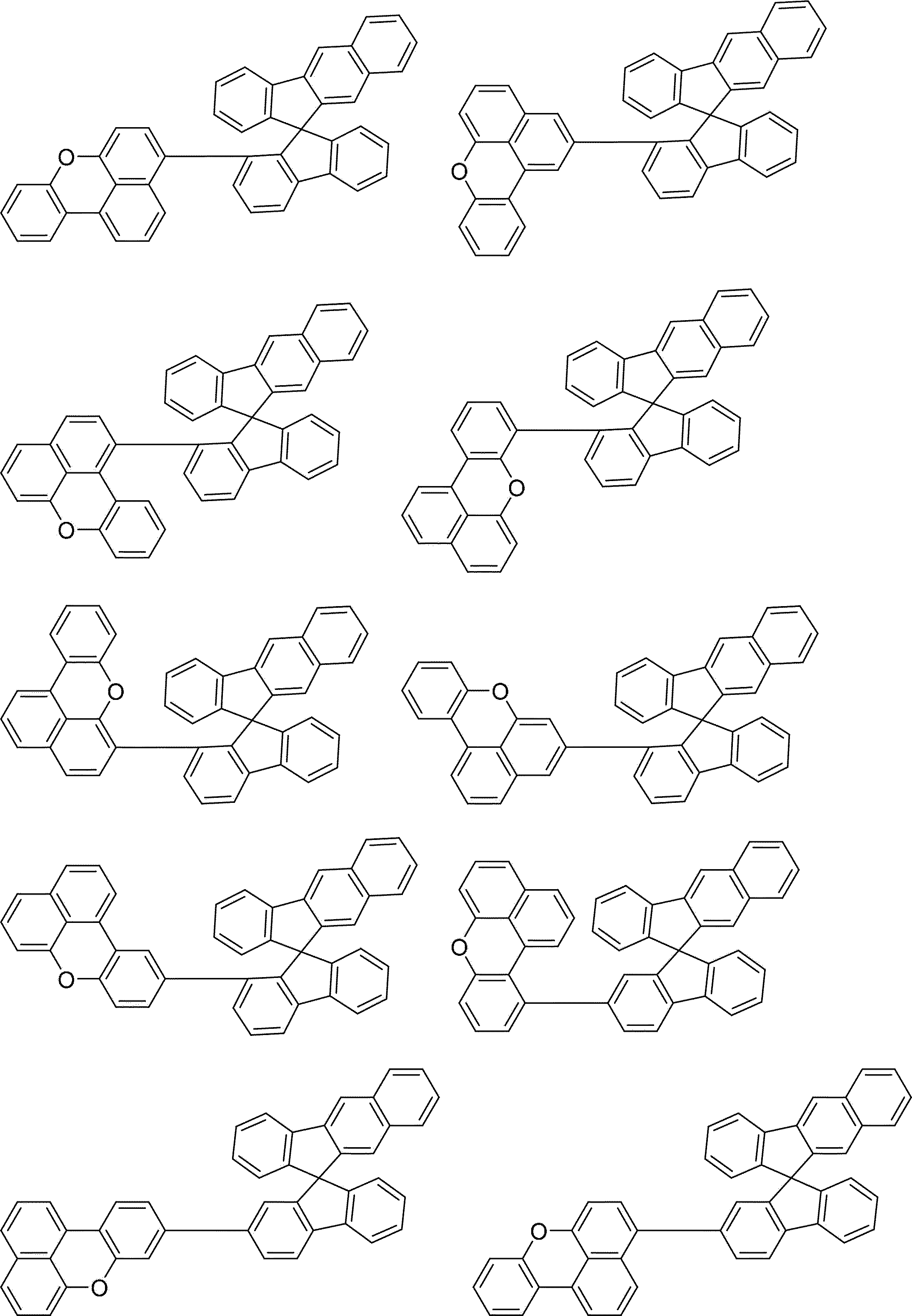


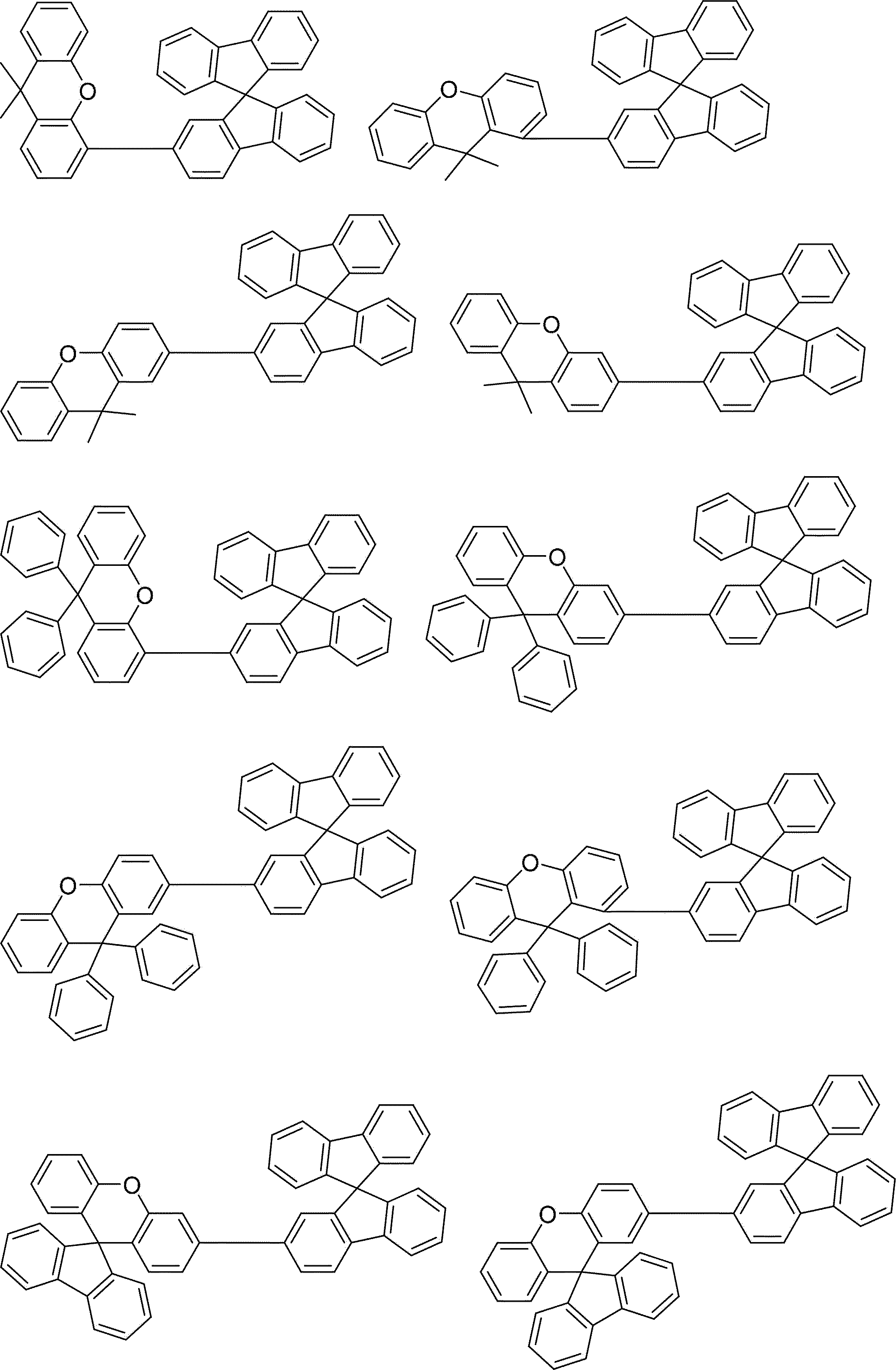


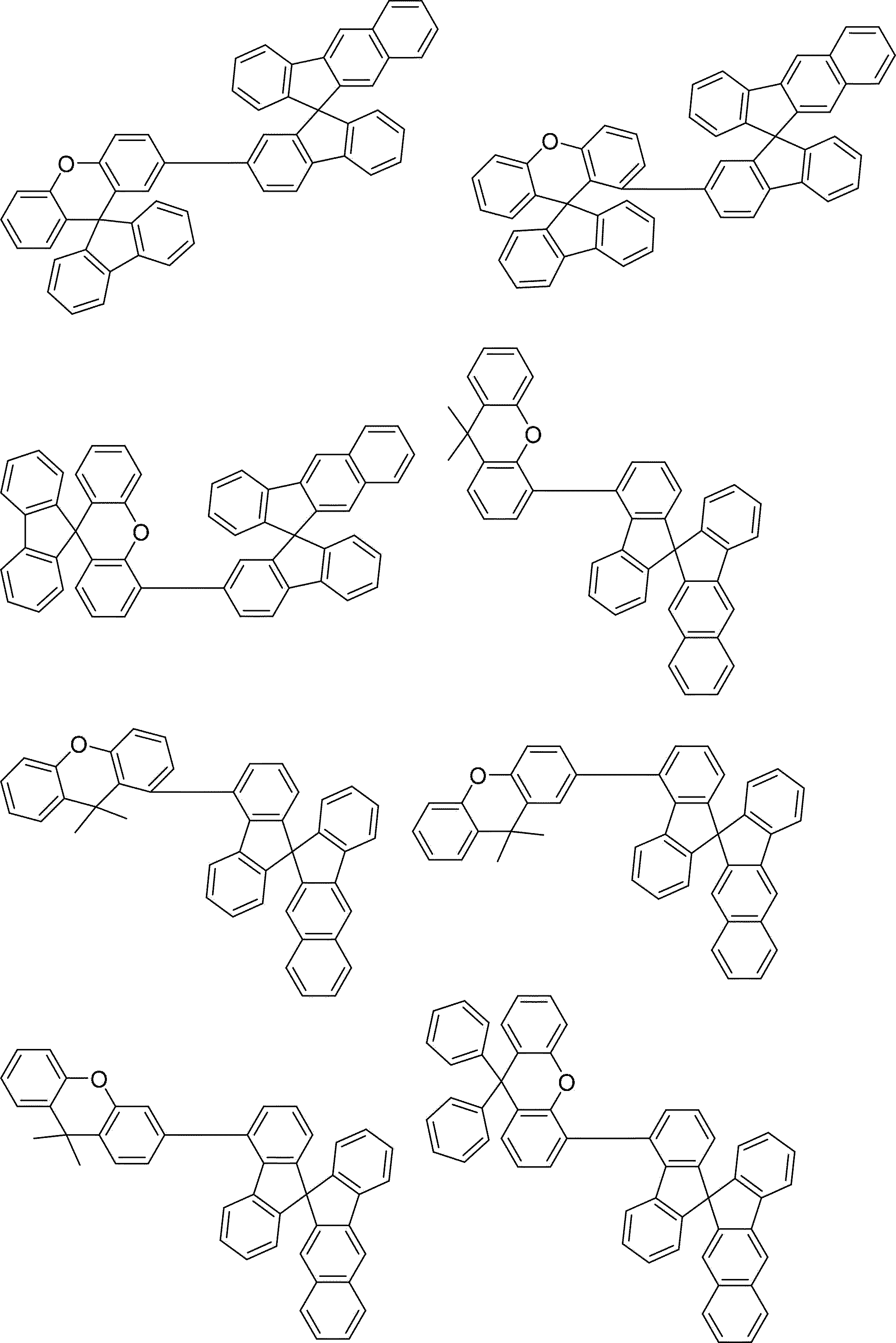


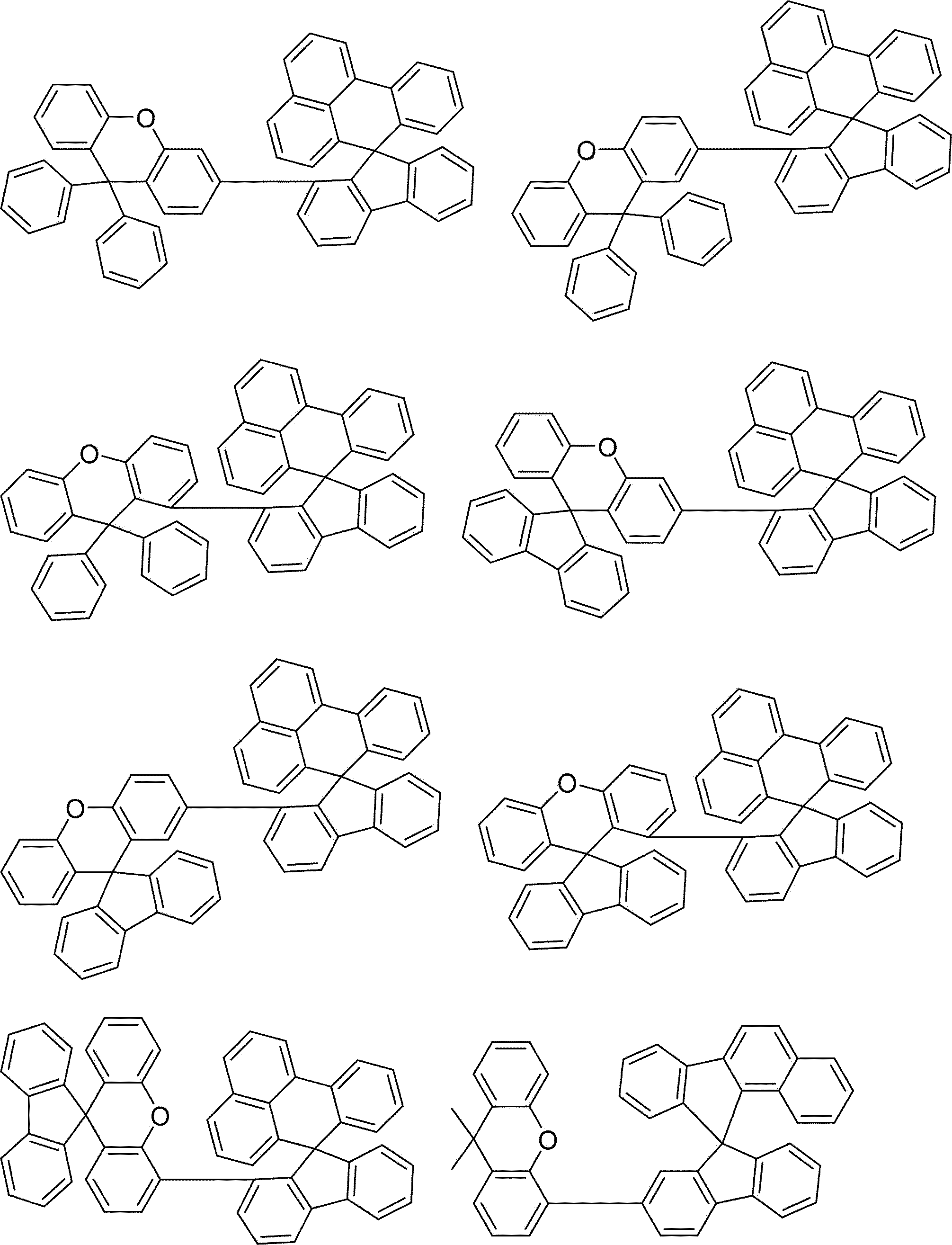


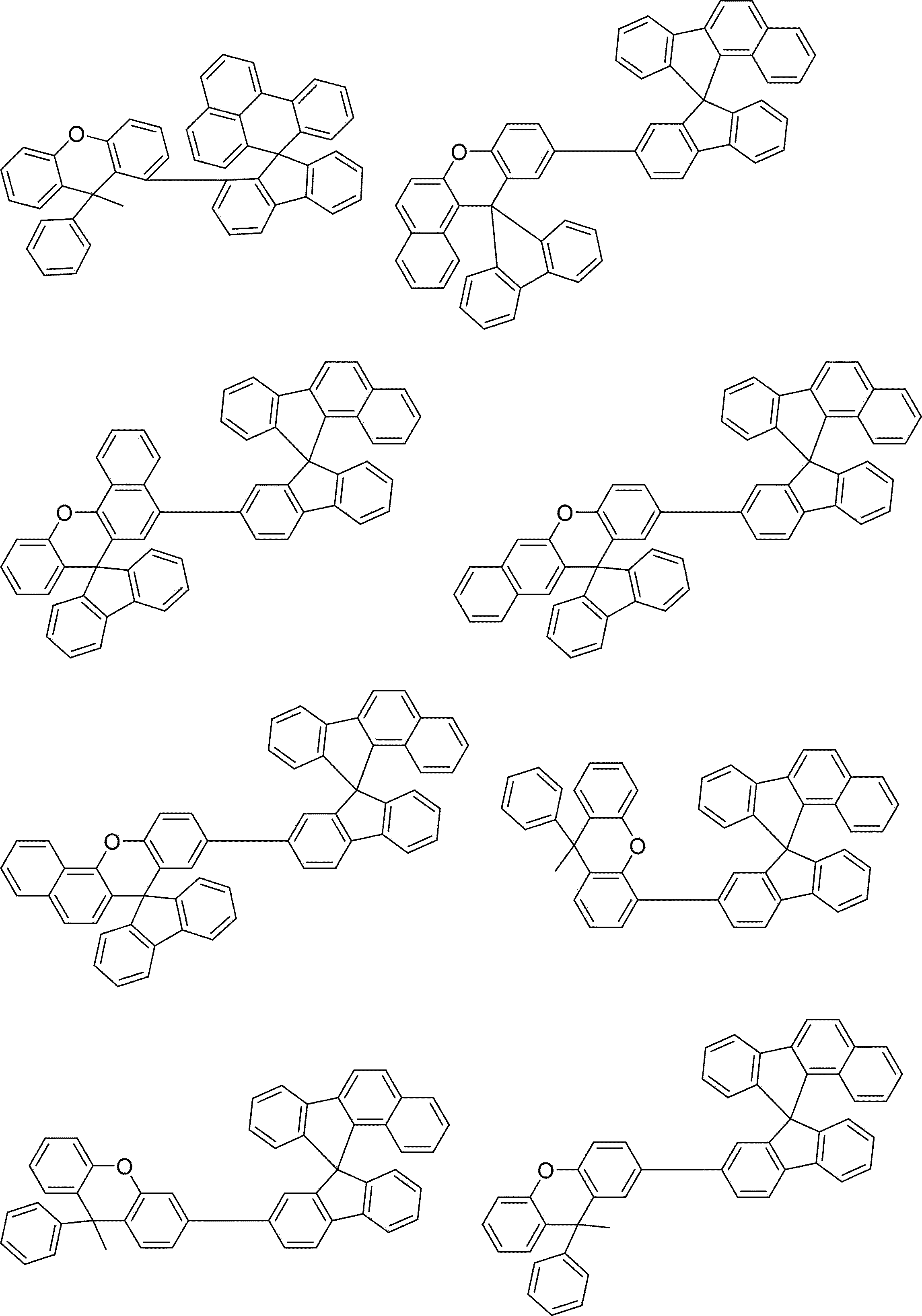


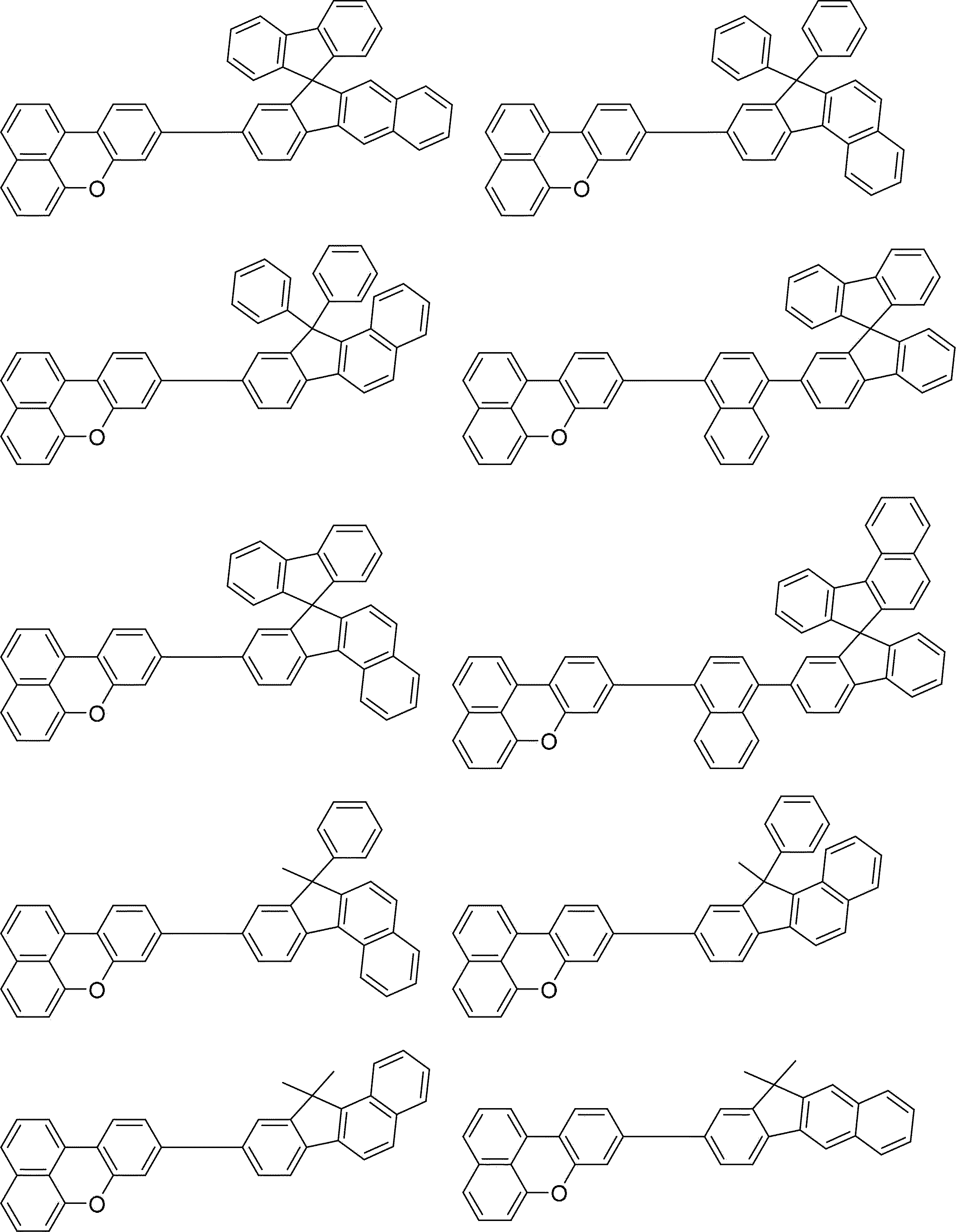


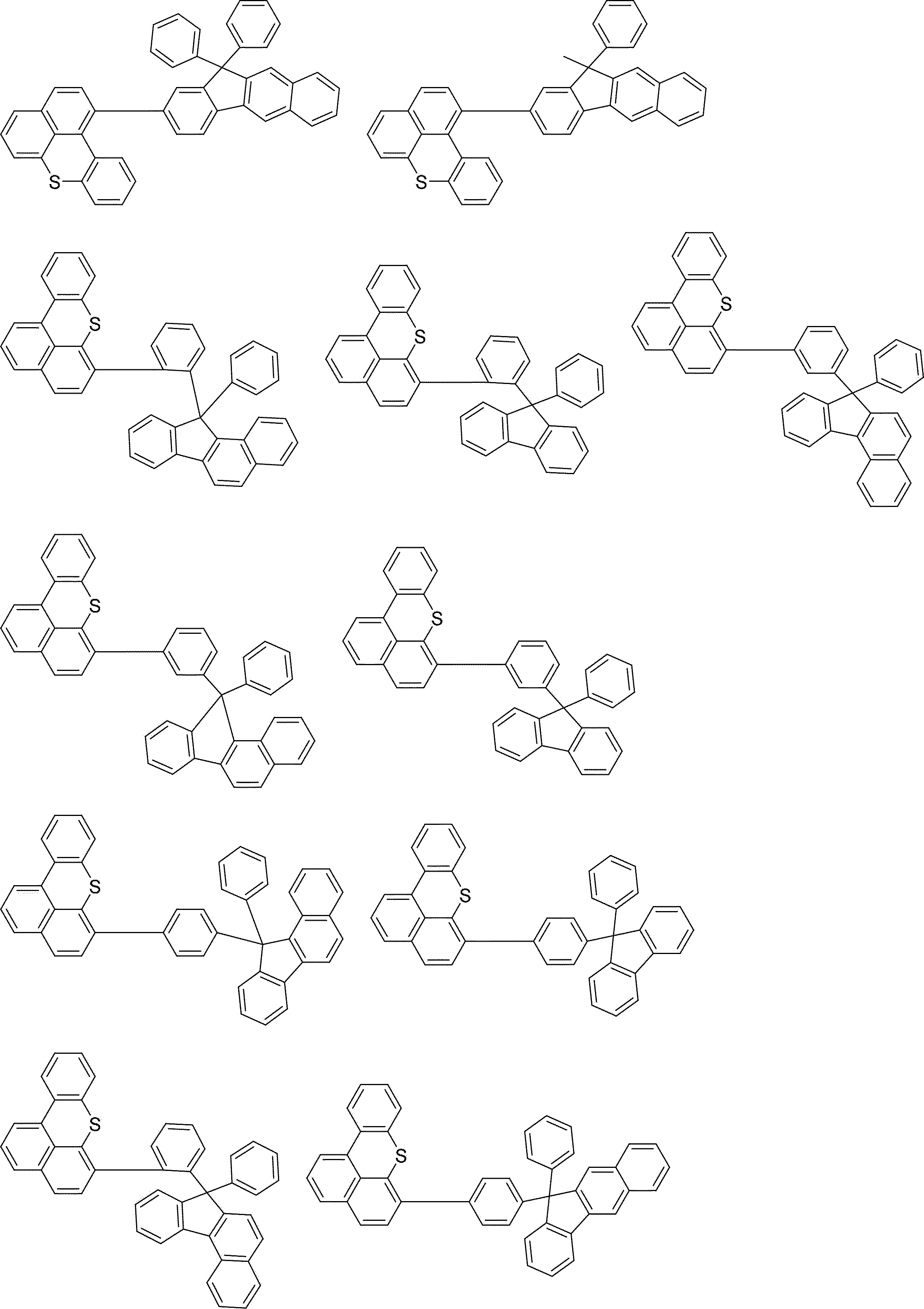


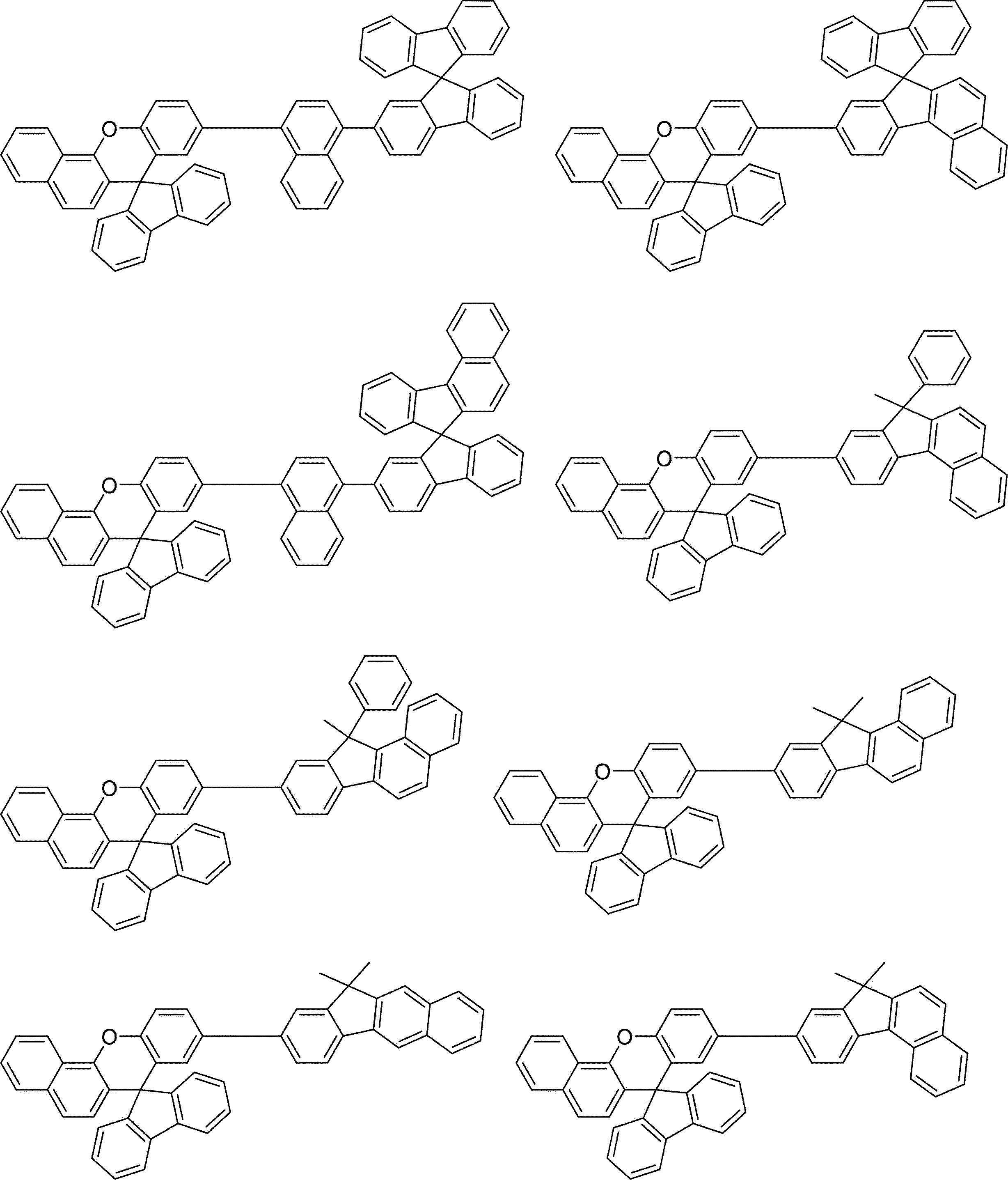


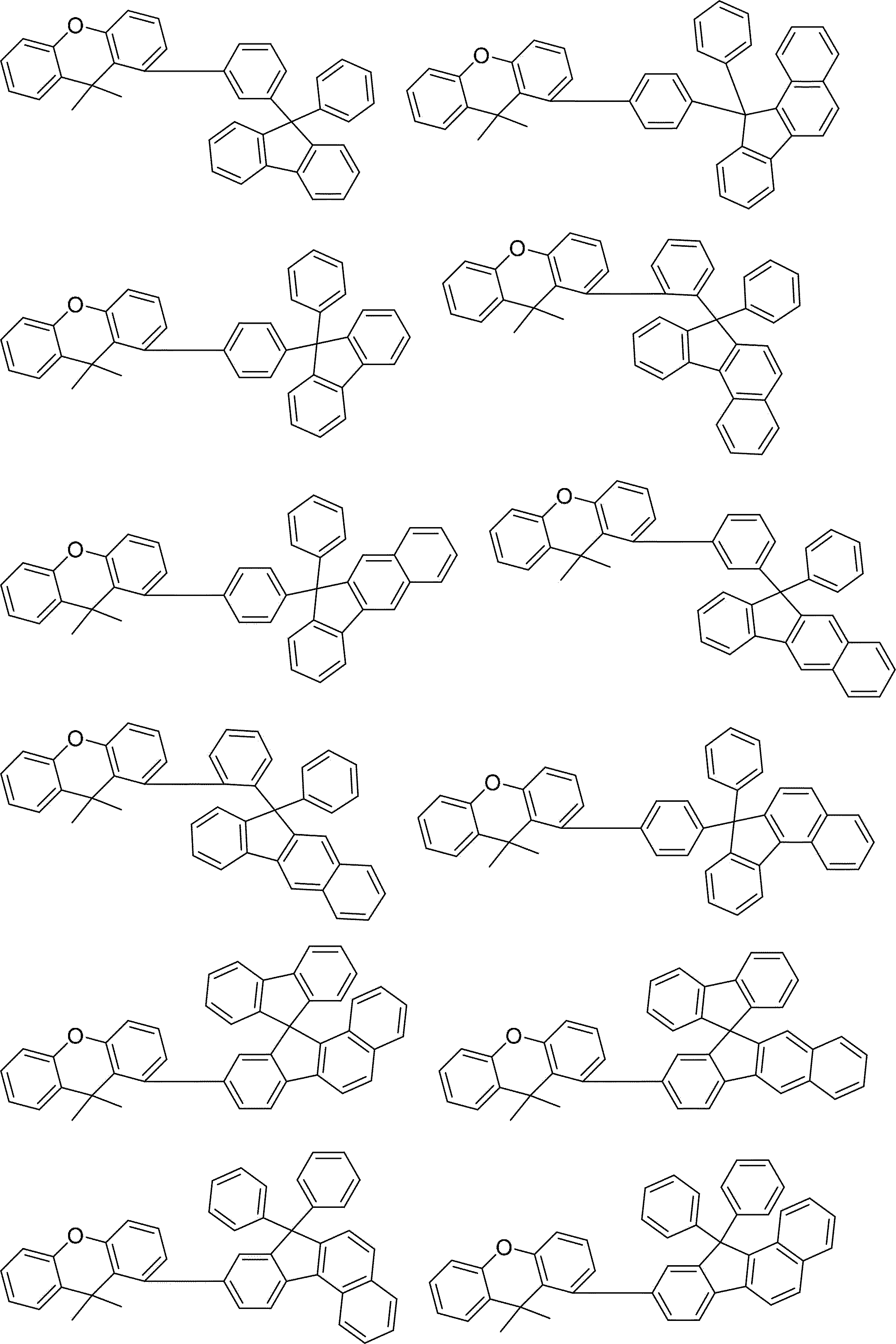


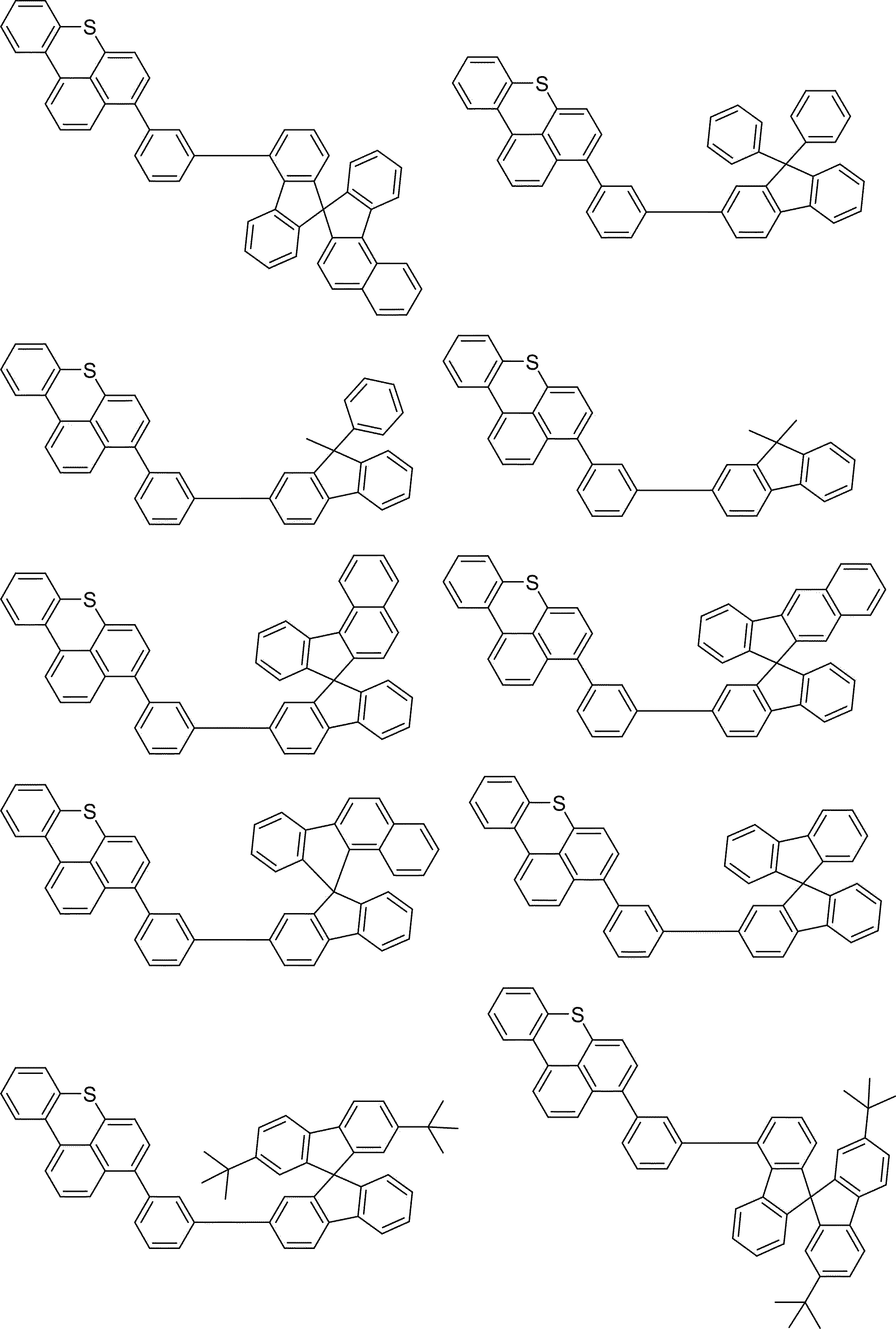


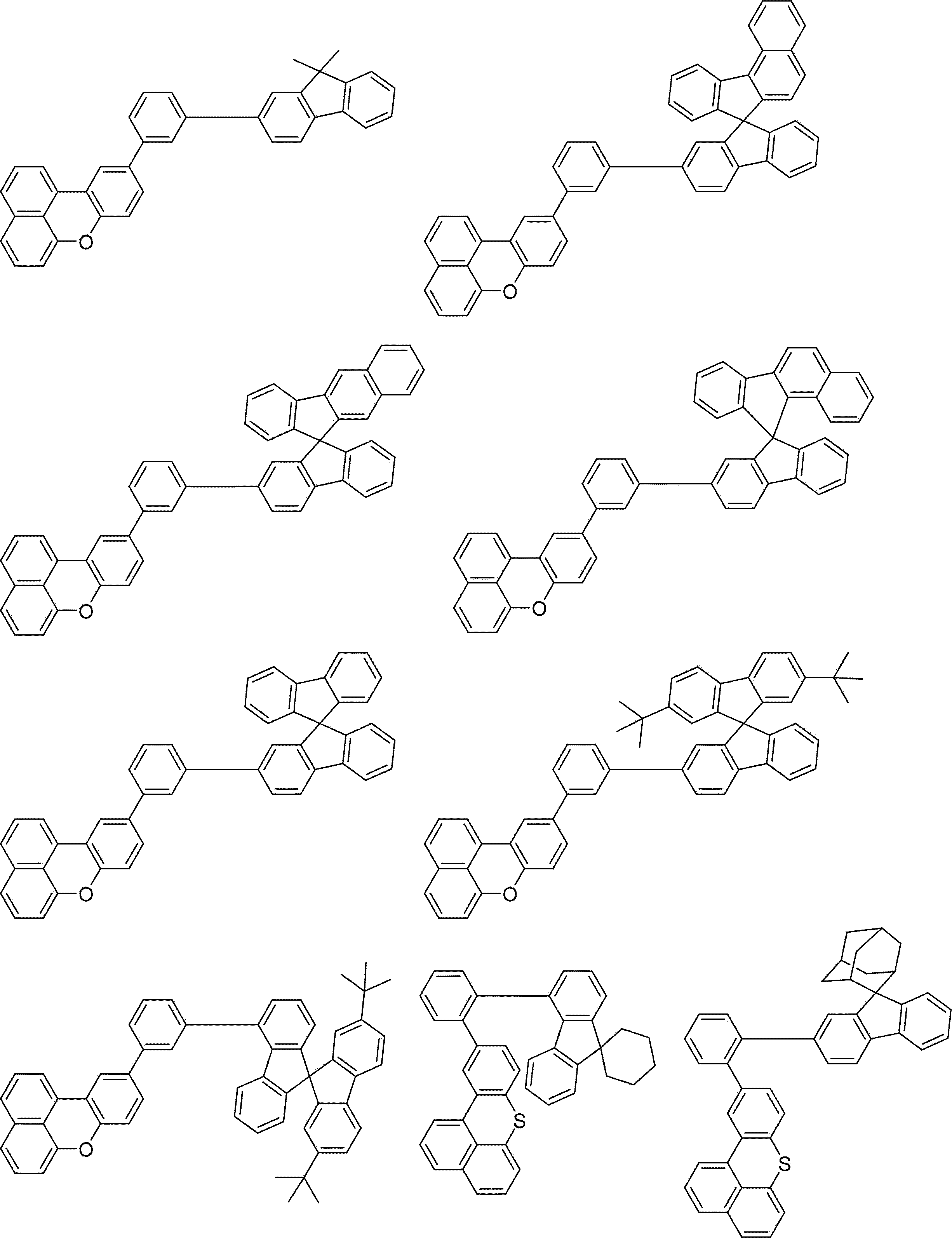


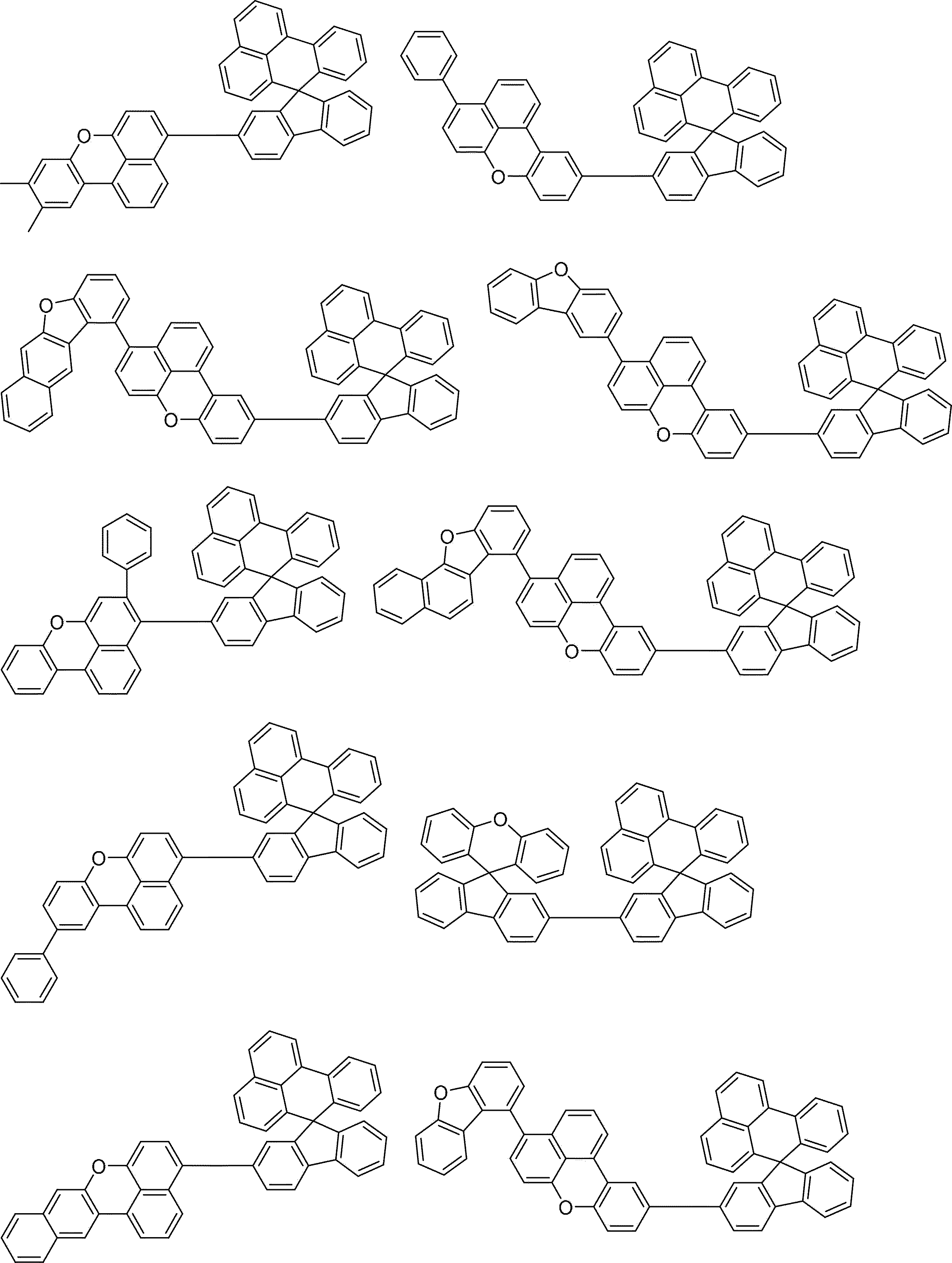


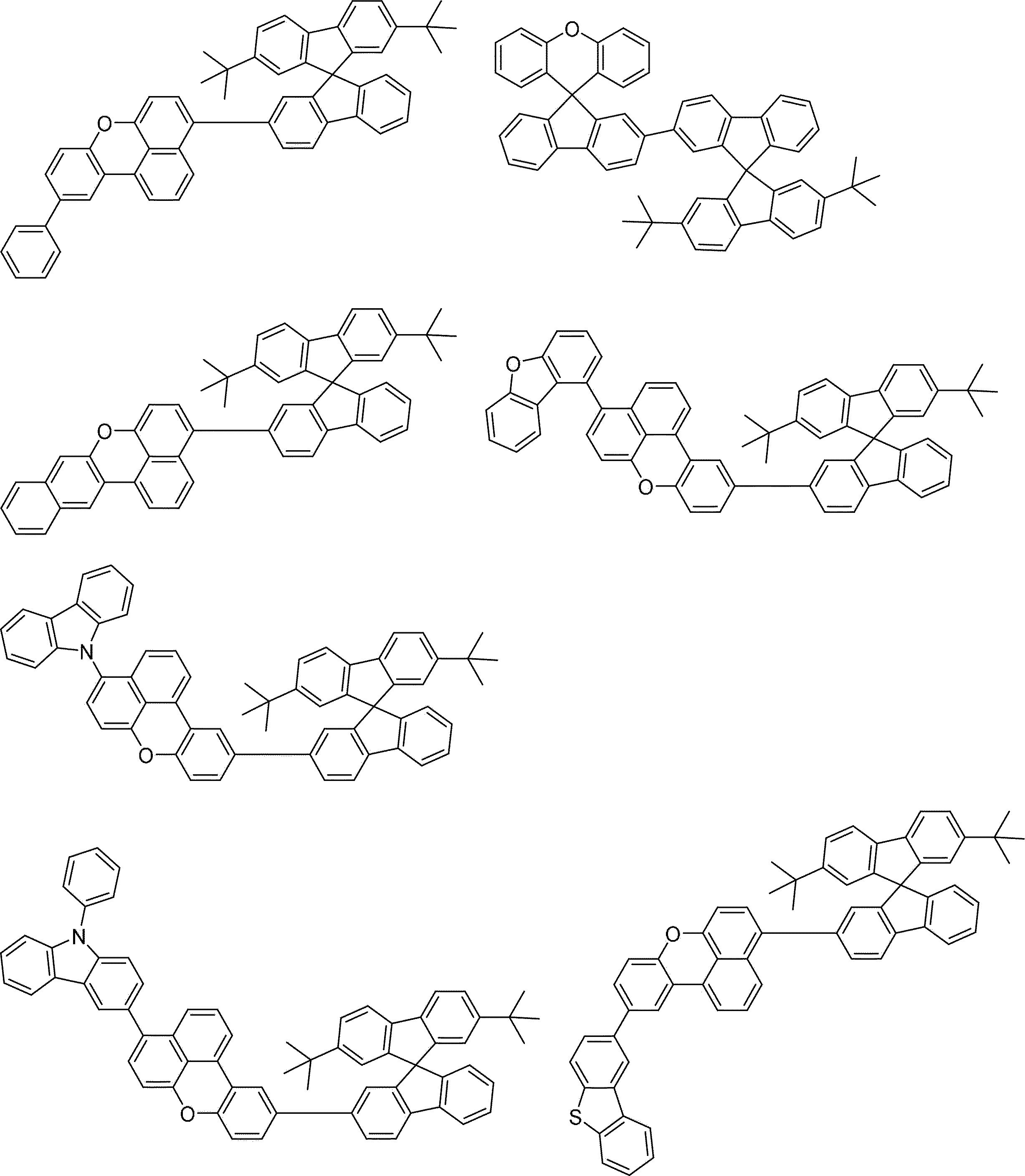


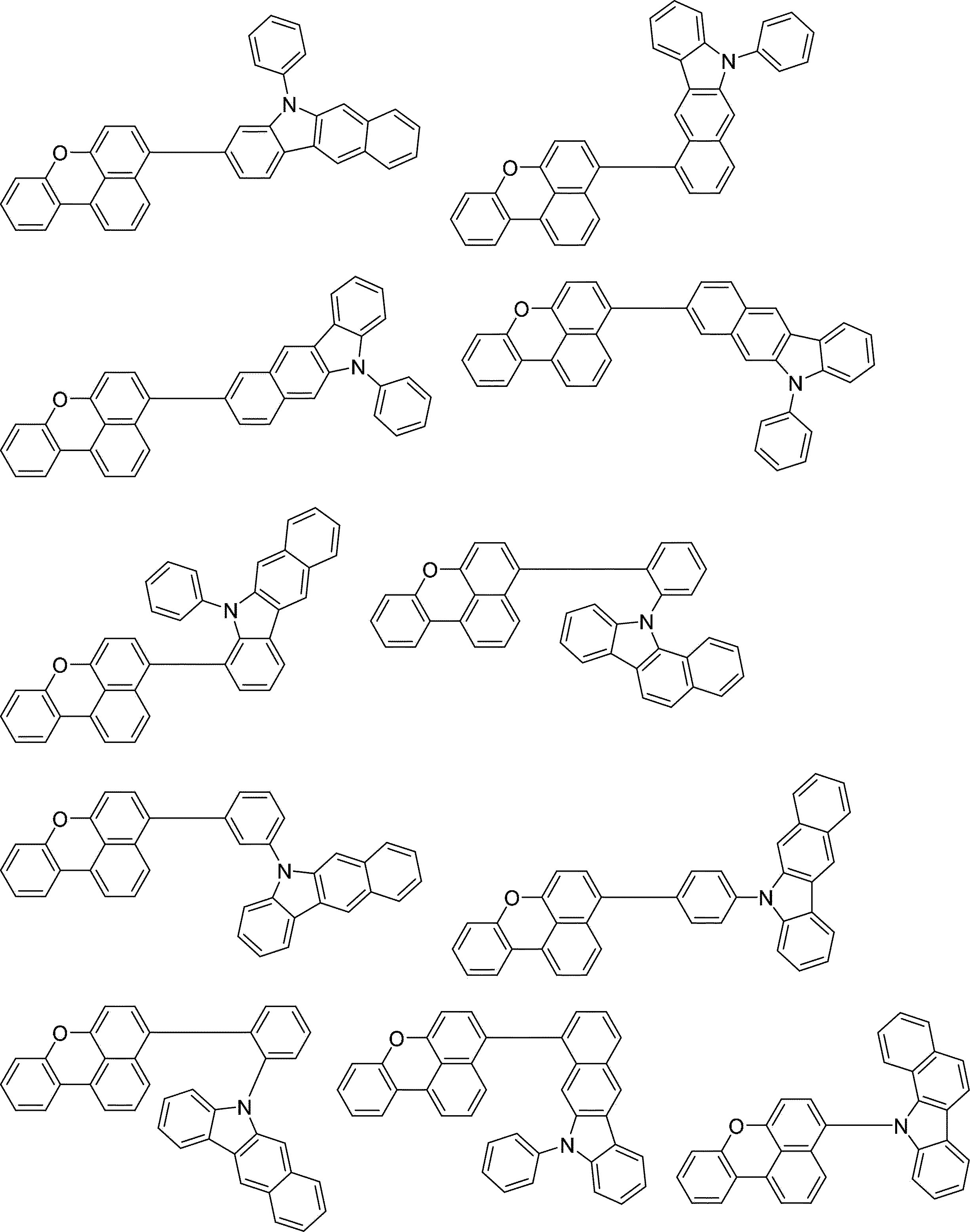

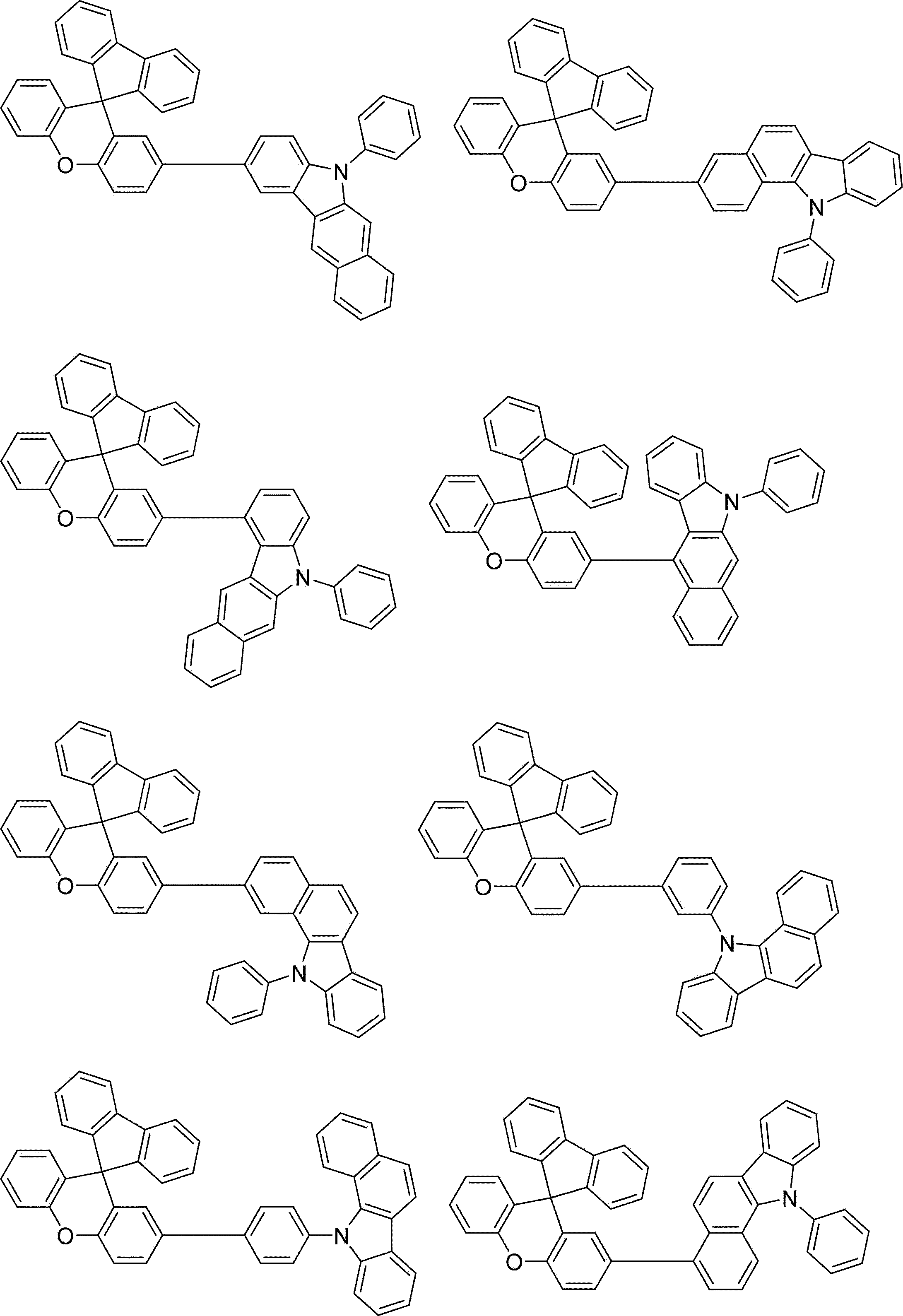


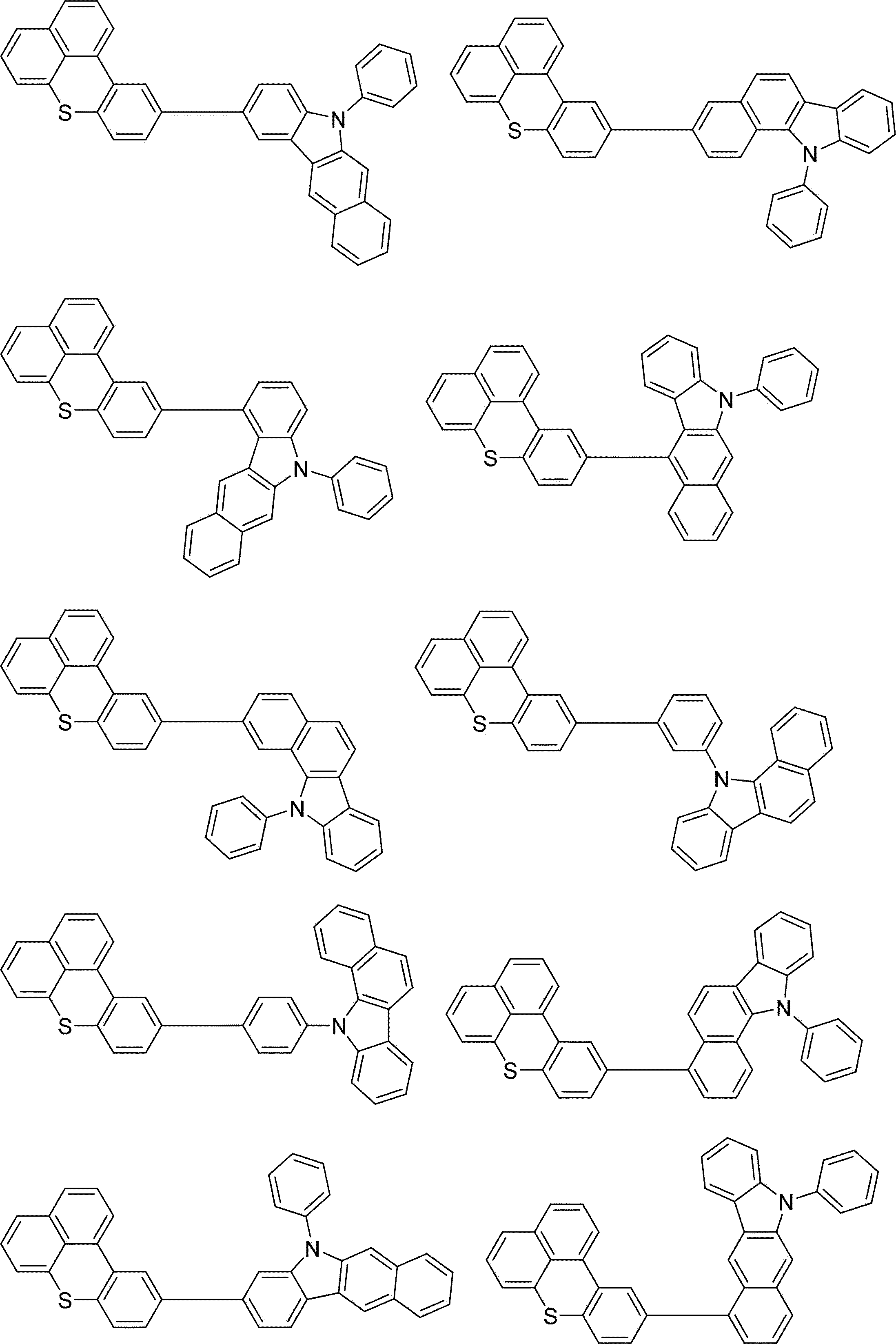


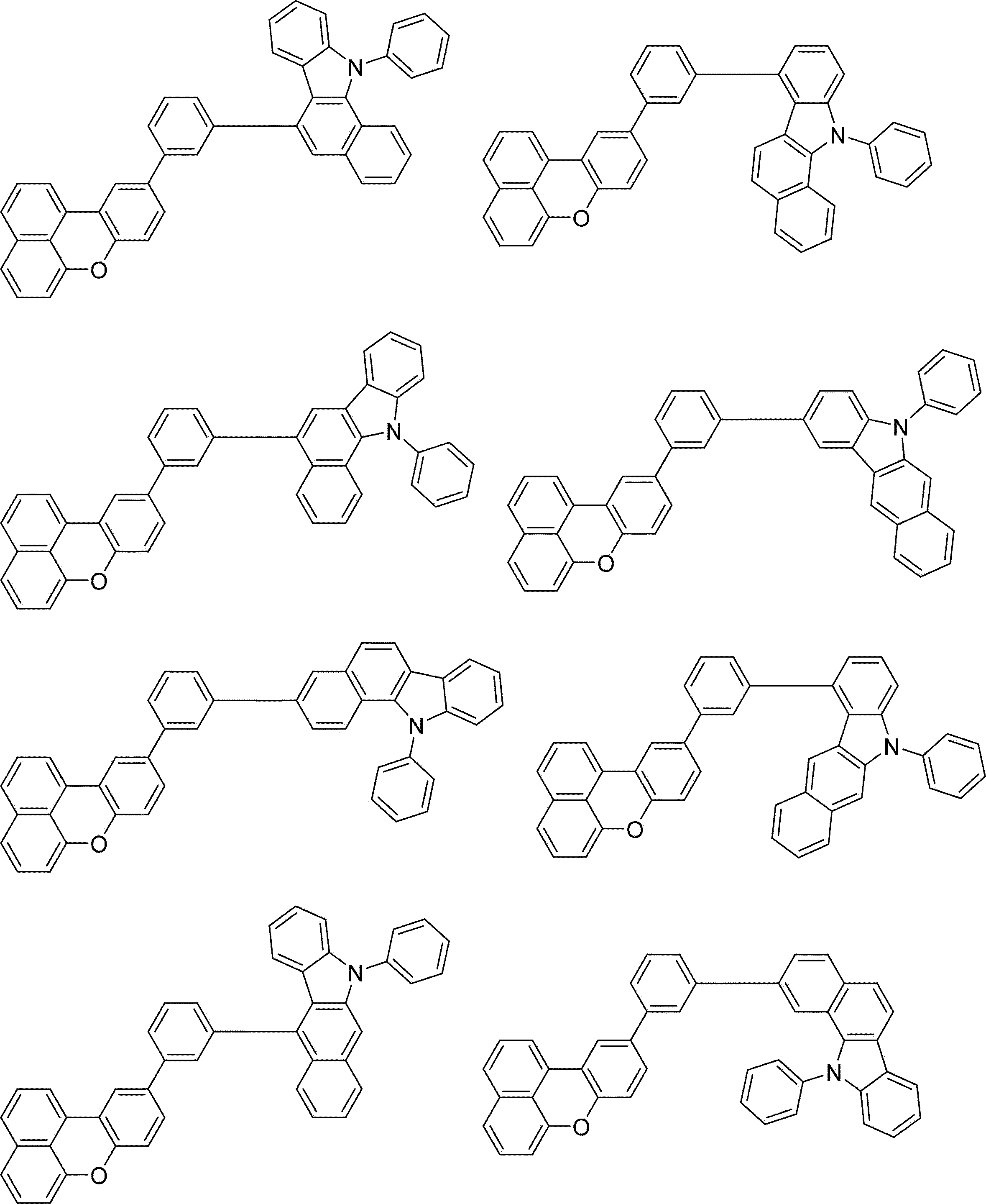


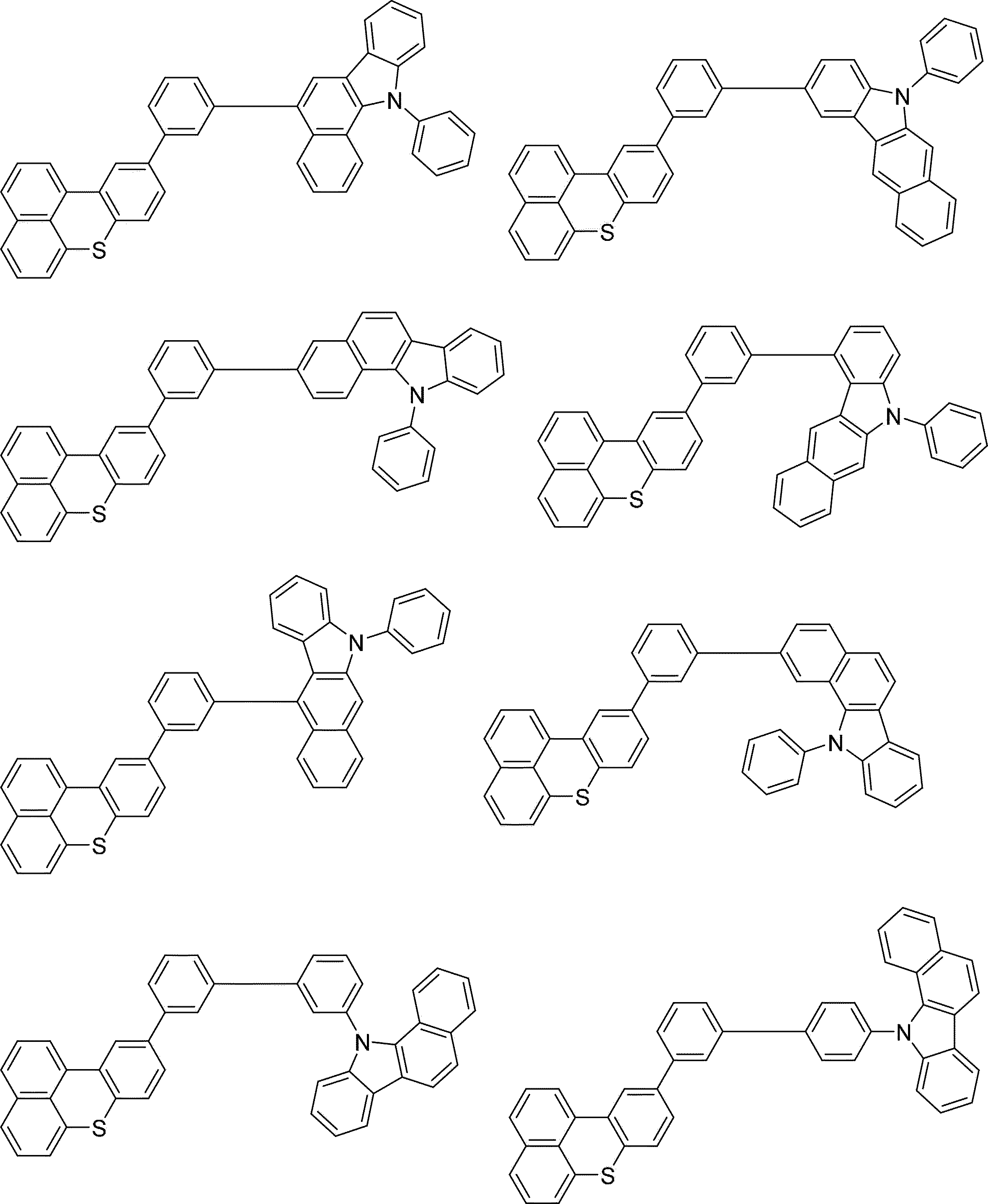


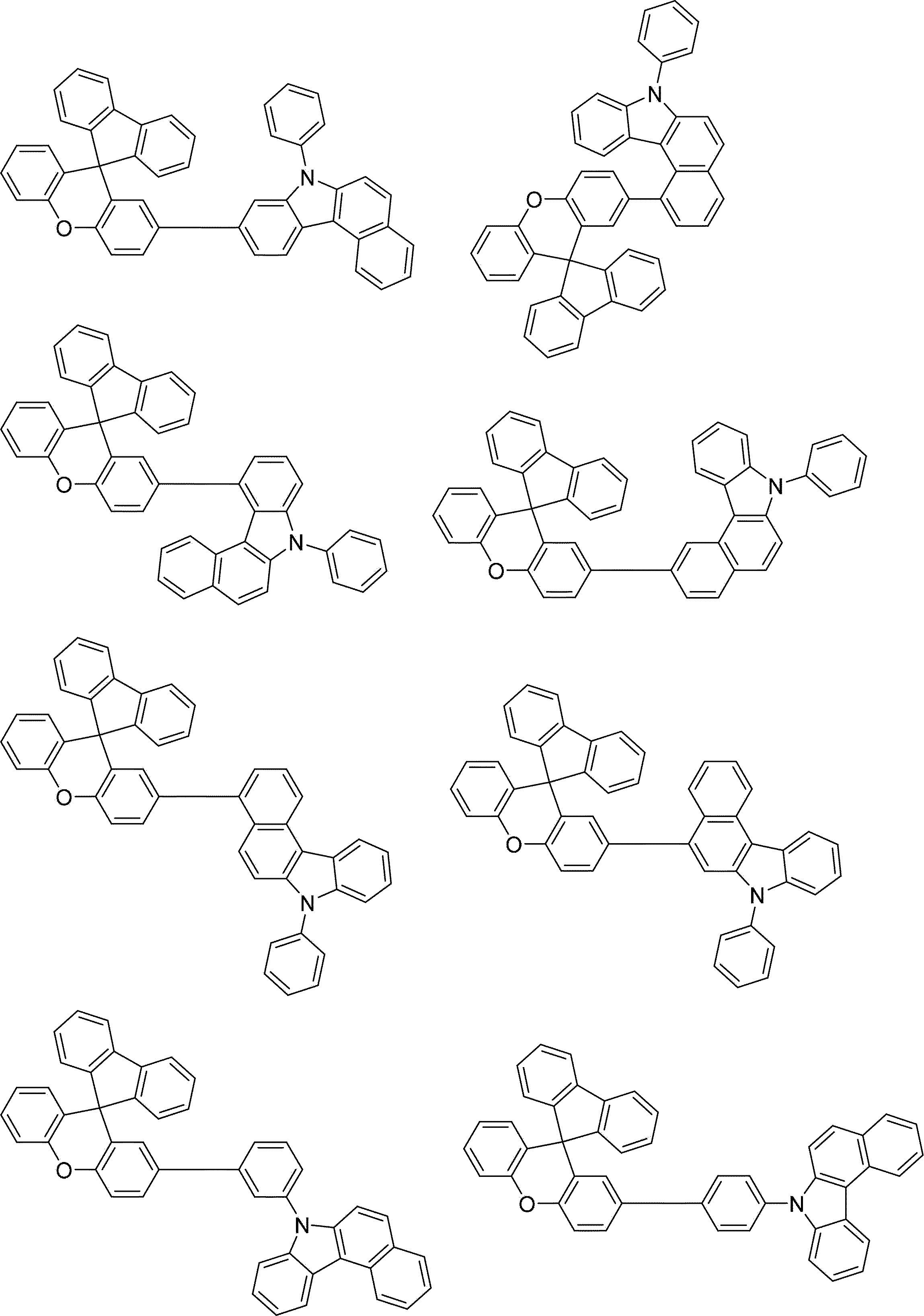


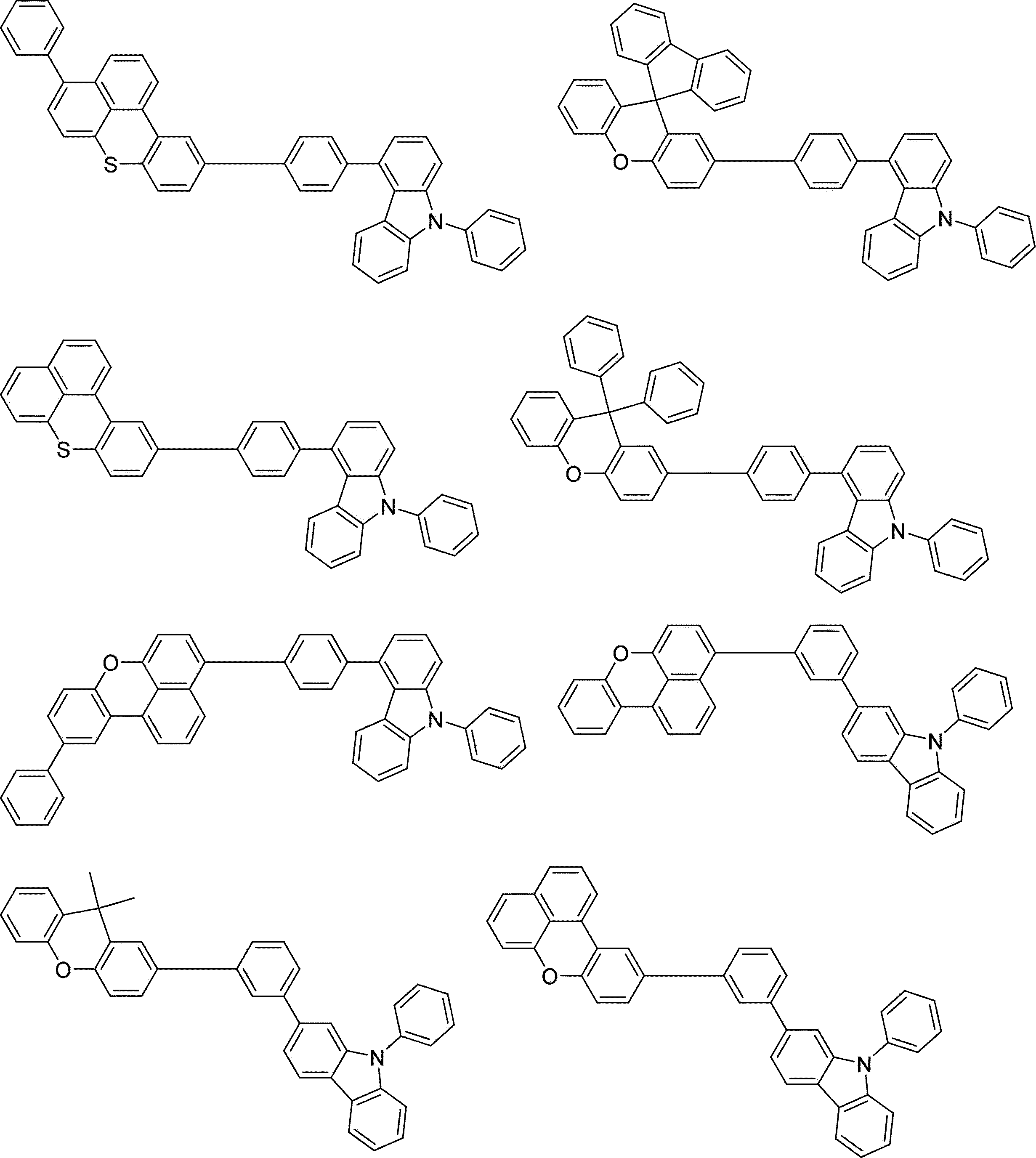


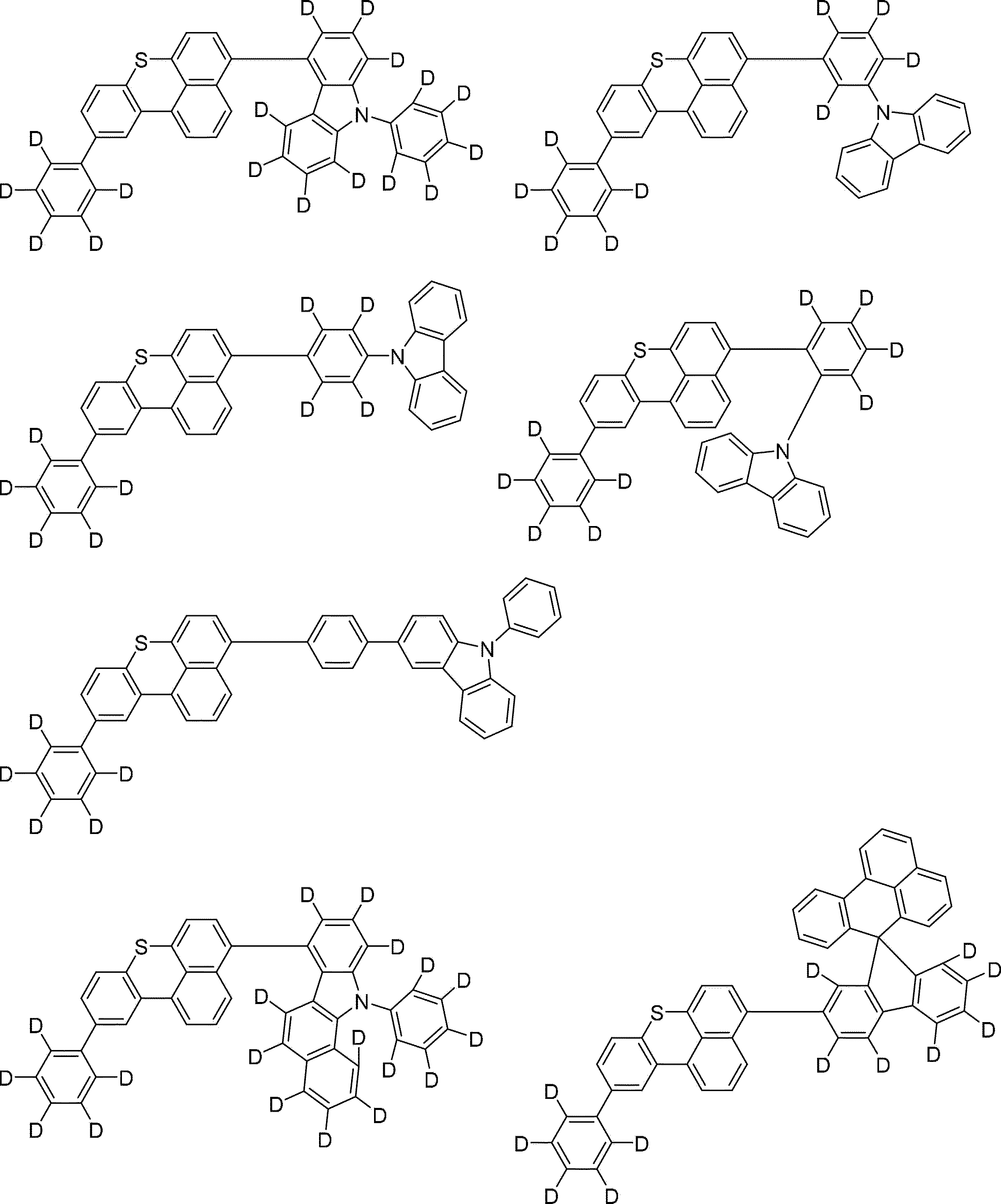


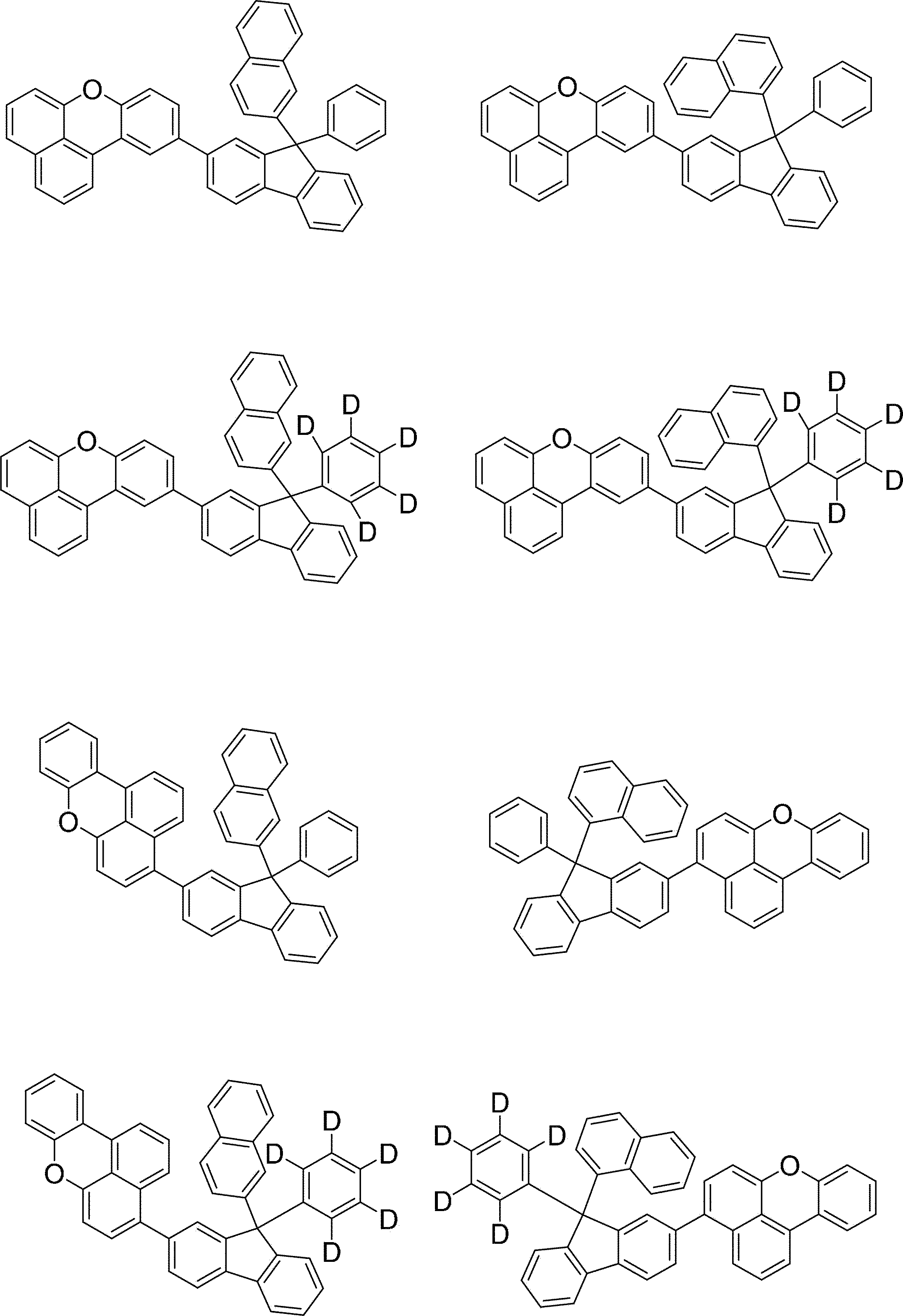


[有機EL素子用材料]
本発明の一態様である有機EL素子用材料は発明化合物を含む。有機EL素子用材料における発明化合物の含有量は、1質量%以上(100%を含む)であり、10質量%以上(100%を含む)であることが好ましく、50質量%以上(100%を含む)であることがより好ましく、80質量%以上(100%を含む)であることがさらに好ましく、90質量%以上(100%を含む)であることが特に好ましい。本発明の一態様である有機EL素子用材料は、有機EL素子の製造に有用である。
本発明の一態様において、発明化合物が正孔輸送層材料であることが好ましい。
また、本発明の他の態様において、発明化合物が発光層に用いられるホスト材料であることが好ましい。
[Materials for organic EL devices]
A material for an organic EL device, which is one aspect of the present invention, contains an invention compound. The content of the invention compound in the organic EL device material is 1% by mass or more (including 100%), preferably 10% by mass or more (including 100%), and 50% by mass or more (including 100% more preferably 80% by mass or more (including 100%), and particularly preferably 90% by mass or more (including 100%). The organic EL device material, which is one aspect of the present invention, is useful for manufacturing organic EL devices.
In one aspect of the present invention, the invention compound is preferably a hole transport layer material.
Moreover, in another aspect of the present invention, the compound of the present invention is preferably a host material used in the light-emitting layer.
本発明の一態様において、有機EL素子用材料は、発明化合物の軽水素体をさらに含むことが好ましい。前記軽水素体とは、発明化合物中の全ての水素原子が軽水素原子である化合物のことである。
発明化合物と発明化合物の軽水素体との混合モル比率(発明化合物:軽水素体)は、10:90~90:10であることが好ましく、20:80~80:20であることがより好ましく、30:70~70:30であることが更に好ましく、40:60~60:40であることが特に好ましい。
In one aspect of the present invention, the material for an organic EL device preferably further contains a light hydrogen form of the compound of the invention. The light hydrogen compound is a compound in which all hydrogen atoms in the compound of the invention are light hydrogen atoms.
The mixing molar ratio of the invention compound and the hydrogen compound of the invention compound (invention compound: hydrogen compound) is preferably from 10:90 to 90:10, more preferably from 20:80 to 80:20. , 30:70 to 70:30, and particularly preferably 40:60 to 60:40.
本発明の一態様に係る有機エレクトロルミネッセンス素子用材料は、正孔輸送層材料である。
また、本発明の他の態様に係る有機エレクトロルミネッセンス素子用材料は、発光層に用いられるホスト材料である。
有機エレクトロルミネッセンス素子用材料における発明化合物の含有量は、1質量%以上(100%を含む)であることが好ましく、10質量%以上(100%を含む)であることがより好ましく、50質量%以上(100%を含む)であることが更に好ましく、80質量%以上(100%を含む)であることがより更に好ましく、90質量%以上(100%を含む)であることが特に好ましい。
A material for an organic electroluminescence device according to one aspect of the present invention is a hole transport layer material.
A material for an organic electroluminescence device according to another aspect of the present invention is a host material used in a light-emitting layer.
The content of the invention compound in the organic electroluminescence element material is preferably 1% by mass or more (including 100%), more preferably 10% by mass or more (including 100%), and 50% by mass. It is more preferably 80% by mass or more (including 100%), even more preferably 90% by mass or more (including 100%).
[有機EL素子]
<第1の有機EL素子>
本発明の実施形態に係る第1の有機EL素子は、陽極、陰極、及び該陽極と陰極の間に配置された有機層を含む。該有機層は発光層を含み、該有機層の少なくとも一層が発明化合物を含む。
発明化合物が含まれる有機層の例としては、陽極と発光層との間に設けられる正孔輸送帯域(正孔注入層、正孔輸送層、電子阻止層、励起子阻止層等)、発光層、スペース層、陰極と発光層との間に設けられる電子輸送帯域(電子注入層、電子輸送層、正孔阻止層等)等が挙げられるが、これらに限定されるものではない。発明化合物は好ましくは蛍光又は燐光EL素子の正孔輸送帯域又は発光層の材料、より好ましくは正孔輸送帯域の材料又は発光層に用いられるホスト材料、更に好ましくは正孔注入層、正孔輸送層、電子阻止層、又は励起子阻止層の材料、もしくはホスト材料、特に好ましくは正孔注入層又は正孔輸送層の材料もしくはホスト材料、最も好ましくは正孔注入層又は正孔輸送層の材料として用いられる。
[Organic EL element]
<First organic EL element>
A first organic EL device according to an embodiment of the invention includes an anode, a cathode, and an organic layer disposed between the anode and the cathode. The organic layers comprise a light-emitting layer, and at least one layer of the organic layers comprises an invention compound.
Examples of the organic layer containing the compound of the invention include a hole-transporting zone provided between the anode and the light-emitting layer (hole-injection layer, hole-transporting layer, electron-blocking layer, exciton-blocking layer, etc.), light-emitting layer . The compound of the invention is preferably used as a material for the hole-transporting zone or the light-emitting layer of a fluorescent or phosphorescent EL device, more preferably as a material for the hole-transporting zone or as a host material used in the light-emitting layer, and even more preferably as a hole-injecting layer or a hole-transporting layer. layer, electron blocking layer or exciton blocking layer material or host material, particularly preferably hole injection layer or hole transport layer material or host material, most preferably hole injection layer or hole transport layer material used as
<第2の有機EL素子>
本発明の実施形態に係る第2の有機EL素子は、陽極、正孔輸送帯域、発光層、及び陰極をこの順に備え、上記正孔輸送帯域が、下記の条件(A)~(C)を満たす化合物Aを含有する。
(A)最高被占軌道のエネルギー準位HOMOが-6.00~-5.50eVである。
(B)三重項エネルギーT1が2.10eV以上である。
(C)フォトルミネッセンス強度PLの80%減衰時間tが0.10h以上である。
<Second organic EL element>
A second organic EL device according to an embodiment of the present invention comprises an anode, a hole-transporting zone, a light-emitting layer, and a cathode in this order, and the hole-transporting zone satisfies the following conditions (A) to (C): It contains compound A that satisfies
(A) The energy level HOMO of the highest occupied orbital is -6.00 to -5.50 eV.
(B) The triplet energy T1 is 2.10 eV or more.
(C) The 80% attenuation time t of the photoluminescence intensity PL is 0.10 h or longer.
上記条件(A)に関して、本明細書において、化合物Aの最高被占軌道のエネルギー準位HOMOは、大気下で、光電子分光装置を用いて測定する。具体的には、実施例に記載の方法により化合物Aの最高被占軌道のエネルギー準位HOMOを測定できる。 Regarding the above condition (A), in this specification, the energy level HOMO of the highest occupied molecular orbital of compound A is measured in the atmosphere using a photoelectron spectrometer. Specifically, the energy level HOMO of the highest occupied molecular orbital of Compound A can be measured by the method described in Examples.
上記条件(B)に関して、三重項エネルギーT1の測定方法としては、下記の方法が挙げられる。
測定対象となる化合物をEPA(ジエチルエーテル:イソペンタン:エタノール=5:5:2(容積比))中に、10-5mol/L以上10-4mol/L以下となるように溶解して溶液を作製し、この溶液を石英セル中に入れて測定試料とする。この測定試料について、低温(77[K])で燐光スペクトル(縦軸:燐光発光強度、横軸:波長とする。)を測定し、この燐光スペクトルの短波長側の立ち上がりに対して接線を引き、その接線と横軸との交点の波長値λedge[nm]に基づいて、次の換算式(F1)から算出されるエネルギー量を三重項エネルギーT1とする。
換算式(F1):T1[eV]=1239.85/λedge
Regarding the above condition (B), the method for measuring the triplet energy T1 includes the following method.
A compound to be measured is dissolved in EPA (diethyl ether: isopentane: ethanol = 5:5:2 (volume ratio)) so that the concentration is 10 -5 mol/L or more and 10 -4 mol/L or less. is prepared, and this solution is placed in a quartz cell to be used as a measurement sample. For this measurement sample, the phosphorescence spectrum (vertical axis: phosphorescent emission intensity, horizontal axis: wavelength) is measured at a low temperature (77 [K]), and a tangent line is drawn to the rise on the short wavelength side of this phosphorescent spectrum. , the energy amount calculated from the following conversion formula (F1) based on the wavelength value λ edge [nm] at the intersection of the tangent line and the horizontal axis is defined as the triplet energy T1 .
Conversion formula (F1): T 1 [eV]=1239.85/λ edge
燐光スペクトルの短波長側の立ち上がりに対する接線は以下のように引く。燐光スペクトルの短波長側から、スペクトルの極大値のうち、最も短波長側の極大値までスペクトル曲線上を移動する際に、長波長側に向けて曲線上の各点における接線を考える。この接線は、曲線が立ち上がるにつれ(つまり縦軸が増加するにつれ)、傾きが増加する。この傾きの値が極大値をとる点において引いた接線(すなわち変曲点における接線)が、当該燐光スペクトルの短波長側の立ち上がりに対する接線とする。
なお、スペクトルの最大ピーク強度の15%以下のピーク強度をもつ極大点は、上述の最も短波長側の極大値には含めず、最も短波長側の極大値に最も近い、傾きの値が極大値をとる点において引いた接線を当該燐光スペクトルの短波長側の立ち上がりに対する接線とする。
燐光の測定には、株式会社日立ハイテク製のF-4500形分光蛍光光度計本体を用いることができる。なお、測定装置はこの限りではなく、冷却装置、及び低温用容器と、励起光源と、受光装置とを組み合わせることにより、測定してもよい。
A tangent line to the rise on the short wavelength side of the phosphorescence spectrum is drawn as follows. When moving on the spectrum curve from the short wavelength side of the phosphorescence spectrum to the maximum value on the shortest wavelength side among the maximum values of the spectrum, consider the tangent line at each point on the curve toward the long wavelength side. This tangent line increases in slope as the curve rises (ie as the vertical axis increases). The tangent line drawn at the point where the value of this slope takes the maximum value (that is, the tangent line at the point of inflection) is taken as the tangent line to the rise on the short wavelength side of the phosphorescence spectrum.
In addition, the maximum point with a peak intensity of 15% or less of the maximum peak intensity of the spectrum is not included in the maximum value on the shortest wavelength side described above, and is closest to the maximum value on the short wavelength side. The tangent line drawn at the point where the value is taken is taken as the tangent line to the rise on the short wavelength side of the phosphorescence spectrum.
For measurement of phosphorescence, an F-4500 spectrofluorophotometer body manufactured by Hitachi High-Tech Co., Ltd. can be used. Note that the measuring device is not limited to this, and measurement may be performed by combining a cooling device, a cryogenic container, an excitation light source, and a light receiving device.
上記条件(C)中、フォトルミネッセンス強度PLは、測定対象の化合物を膜厚100nmに成膜した測定材に対して、照射強度I1で365nmの紫外線を照射したときのフォトルミネッセンス発光スペクトルの強度である。
上記条件(C)中、フォトルミネッセンス強度PLの80%減衰時間tは、上記紫外線の照射開始時からフォトルミネッセンス強度PLが80%に減衰するまでの時間である。
上記照射強度I1は、下記数式(数1)で規定される。
I1=I0×(A0/A1)・・・(数1)
上記数式(数1)中、I0は、下記化学式で表される化合物を膜厚100nmに成膜した基準材のPL測定時の照射強度である。

上記数式(数1)中、A0は前記基準材の吸収率であり、A1は前記測定材の吸収率である。そして、各吸収率は、下記数式(数2)で規定される。
吸収率=1-EXP(-4×3.1416×ko×d/w)・・・(数2)
上記数式(数2)中、koは測定対象の化合物を成膜した測定材又は基準材の面内方向の消衰係数、dは測定対象の化合物を成膜した測定材又は基準材の膜厚、wは照射光の波長である。
In the above condition (C), the photoluminescence intensity PL is the intensity of the photoluminescence emission spectrum when the measurement material in which the compound to be measured is formed into a film with a thickness of 100 nm is irradiated with ultraviolet rays of 365 nm at an irradiation intensity of I1 . is.
In the above condition (C), the 80% attenuation time t of the photoluminescence intensity PL is the time from the start of irradiation of the ultraviolet rays until the photoluminescence intensity PL is attenuated to 80%.
The irradiation intensity I1 is defined by the following formula (Equation 1).
I 1 =I 0 ×(A 0 /A 1 ) (Equation 1)
In the above formula (Equation 1), I0 is the irradiation intensity during PL measurement of a reference material formed by forming a film of a compound represented by the following chemical formula to a film thickness of 100 nm.
In the above formula (Equation 1), A0 is the absorption rate of the reference material, and A1 is the absorption rate of the measurement material. Each absorptance is defined by the following formula (Equation 2).
Absorption rate = 1-EXP (-4 x 3.1416 x ko x d/w) (Equation 2)
In the above formula (Equation 2), ko is the extinction coefficient in the in-plane direction of the measurement material or reference material on which the compound to be measured is formed, and d is the thickness of the measurement material or reference material on which the compound to be measured is formed. , w is the wavelength of the illuminating light.
ここで、上記消衰係数koは以下の手順で測定される。
ガラス基板上に、測定対象材料を50nm程度の膜厚で真空蒸着して測定対象のサンプルを作製し、分光エリプソメトリー装置(J.A.Woollam社製(米国)M-2000UI)により、上記サンプルに対して測定角45°~75°の範囲で5°おきに入射光(紫外~可視光~近赤外)を照射し、サンプル表面から反射された光の偏向状態の変化を測定する。消衰係数の測定精度を高めるために、あわせて基板法線方向(有機EL素子基板の面に対し垂直方向)の透過スペクトルを当該装置で測定する。これと同様に、測定対象材料を蒸着していないガラス基板のみについても、同様の測定を行う。得られる測定情報について、J.A.Woollam社製解析ソフトウェア(Complete EASE)でフィッティングを行う。
フィッティングの条件としては、一軸回転対称の異方性モデルを用い、当該ソフトウェアにおいて二乗平均誤差を示すパラメータMSEが3.0以下となるようにして、基板上に成膜された有機膜の面内方向と法線方向の屈折率、面内方向と法線方向の消衰係数、オーダーパラメーターを算出する。オーダーパラメーターは、消衰係数(面内方向)の長波長側のピークをS1とし、S1のピーク波長によって算出する。ガラス基板についてのフィッティングの条件としては、等方性モデルを用いる。
基板上に真空蒸着された低分子材料の膜は、通常、基板法線方向を回転対象軸とした一軸回転対称性となる。基板上に形成した薄膜内における分子軸と基板法線方向のなす角をθ、薄膜の多入射角分光エリプソメトリー測定により得られる基板平行方向(Ordinary方向)及び垂直方向(Extra-Ordinary方向)の消衰係数をそれぞれko及びkeとした場合、下記数式(数3)及び(数4)で表されるS’がオーダーパラメーターである。
S’=1-<cos2θ>=2ko/(ke+2ko)=2/3(1-S)・・・(数3)
S=(1/2)<3cos2θ-1>=(ke-ko)/(ke+2ko)・・・(数4)
当該分子配向の評価方法は公知の手法であり、詳細はOrganic Electronics誌、2009年、第10巻、127頁に記載されている。また、薄膜を形成する方法は、真空蒸着法とする。
多入射角分光エリプソメトリー測定から得られるオーダーパラメーターS’は、全ての分子が基板と平行方向に配向した場合に1.0となる。また、分子が配向せずにランダムである場合は0.66となる。
Here, the extinction coefficient ko is measured by the following procedure.
A sample to be measured is prepared by vacuum-depositing the material to be measured in a film thickness of about 50 nm on a glass substrate, and the sample is analyzed by a spectroscopic ellipsometry device (M-2000UI manufactured by JA Woollam (USA)). Incident light (ultraviolet to visible light to near-infrared light) is irradiated every 5° within a range of measurement angles from 45° to 75°, and changes in the polarization state of the light reflected from the sample surface are measured. In order to improve the measurement accuracy of the extinction coefficient, the transmission spectrum in the direction normal to the substrate (perpendicular to the surface of the organic EL element substrate) is also measured with the apparatus. Similarly, only the glass substrate on which the material to be measured is not vapor-deposited is also subjected to similar measurements. Regarding the obtained measurement information, see J. Am. A. Fitting is performed with analysis software (Complete EASE) manufactured by Woollam.
As the fitting condition, an anisotropic model with uniaxial rotational symmetry is used, and the parameter MSE, which indicates the root mean square error in the software, is set to 3.0 or less, and the in-plane of the organic film formed on the substrate is Calculate the refractive index in the direction and the normal direction, the extinction coefficient in the in-plane direction and the normal direction, and the order parameter. The order parameter is calculated from the peak wavelength of S1, where S1 is the peak on the longer wavelength side of the extinction coefficient (in-plane direction). An isotropic model is used as the fitting condition for the glass substrate.
A film of a low-molecular-weight material vacuum-deposited on a substrate usually exhibits uniaxial rotational symmetry with the substrate normal direction as the axis of rotation symmetry. The angle formed by the molecular axis in the thin film formed on the substrate and the normal direction of the substrate is θ, and the direction parallel to the substrate (ordinary direction) and the direction perpendicular to the substrate (extra-ordinary direction) obtained by multi-incidence angle spectroscopic ellipsometry measurement of the thin film When the extinction coefficients are ko and ke, respectively, S' represented by the following formulas (Formula 3) and (Formula 4) is an order parameter.
S′=1−<cos2θ>=2ko/(ke+2ko)=2/3(1−S) (Equation 3)
S=(1/2)<3cos2θ−1>=(ke−ko)/(ke+2ko) (equation 4)
The method for evaluating the molecular orientation is a known technique, and details are described in Organic Electronics, 2009, Vol. 10, p.127. Moreover, the method of forming a thin film shall be a vacuum deposition method.
The order parameter S' obtained from multi-incidence angle spectroscopic ellipsometry measurement is 1.0 when all the molecules are oriented parallel to the substrate. Also, when the molecules are not oriented and are random, the value is 0.66.
本発明の一態様に係る有機EL素子は、上記の構成を有することによって高い素子性能を示す。具体的には、高い外部量子効率と長寿命とを両立し得る有機EL素子が提供可能となる。
本発明の実施形態に係る有機EL素子が上記特性を有するのは、これに限るものではないが、上記の条件(A)~(C)を満たす化合物Aが正孔輸送帯域に含まれることにより、化合物Aが、高い励起耐性を備えるとともに、大きな三重項エネルギー及び適度な最高被占軌道のエネルギー準位を有することにより、効率を高めやすくなる。この結果、有機EL素子が高い外部量子効率と長寿命とを両立し得るようになるものと考えられる。
The organic EL element according to one aspect of the present invention exhibits high element performance by having the above configuration. Specifically, it is possible to provide an organic EL device that can achieve both high external quantum efficiency and long life.
The reason why the organic EL device according to the embodiment of the present invention has the above characteristics is not limited to this, but the compound A satisfying the above conditions (A) to (C) is included in the hole transport zone. , the compound A has a high excitation resistance, a large triplet energy, and an appropriate energy level of the highest occupied molecular orbital, which facilitates an increase in efficiency. As a result, it is considered that the organic EL device can achieve both high external quantum efficiency and long life.
<有機EL素子の構成>
本発明の一態様に係る有機EL素子の概略構成を、図を参照して説明する。
<Structure of Organic EL Element>
A schematic configuration of an organic EL element according to one aspect of the present invention will be described with reference to the drawings.
図1は、上記第1及び第2の有機EL素子の構成の一例を示す概略図である。図1に示す有機EL素子1は、基板2、陽極3、陰極4、及び該陽極3と陰極4との間に配置された発光ユニット10とを有する。発光ユニット10は、発光層5を有する。発光層5と陽極3との間に正孔輸送帯域6(正孔注入層、正孔輸送層等)、発光層5と陰極4との間に電子輸送帯域7(電子注入層、電子輸送層等)を有する。また、発光層5の陽極3側に電子阻止層(図示せず)を、発光層5の陰極4側に正孔阻止層(図示せず)を、それぞれ設けてもよい。これにより、電子や正孔を発光層5に閉じ込めて、発光層5における励起子の生成効率をさらに高めることができる。
FIG. 1 is a schematic diagram showing an example of the configuration of the first and second organic EL elements. The
図2は、上記有機EL素子の他の構成を示す概略図である。図2に示す有機EL素子11は、基板2、陽極3、陰極4、及び該陽極3と陰極4との間に配置された発光ユニット20とを有する。発光ユニット20は、発光層5を有する。陽極3と発光層5の間に配置された正孔輸送帯域は、第1正孔輸送層6a及び第2正孔輸送層6bから形成されている。また、発光層5と陰極4の間に配置された電子輸送帯域は、第1電子輸送層7a及び第2電子輸送層7bから形成されている。
FIG. 2 is a schematic diagram showing another configuration of the organic EL element. The
図3は、本発明の一態様に係る有機EL素子の更に他の構成を示す概略図である。有機EL素子12は、基板2、陽極3、陰極4、及び該陽極3と陰極4との間に配置された発光ユニット30とを有する。発光ユニット30は、発光層5を有する。陽極3と発光層5の間に配置された正孔輸送帯域は、正孔注入層6a、第1正孔輸送層6b、第2正孔輸送層6c、及び第3正孔輸送層6dから形成されている。また、発光層5と陰極4の間に配置された電子輸送帯域は、第1電子輸送層7a及び第2電子輸送層7bから形成されている。
FIG. 3 is a schematic diagram showing still another configuration of the organic EL element according to one aspect of the present invention. The
図1~図3において、発光層5は少なくとも1層の発光層を含む。発光層5は、単独の層であってもよいし、複数の層(例えば、複数の発光層、複数の発光層とスペース層)を含むものであってもよい。
1 to 3, the light-emitting
本明細書において、図1の有機EL素子1における発光ユニット10、図2の有機EL素子11における発光ユニット20、図3の有機EL素子12における発光ユニット30を「発光層を含む有機層」と称する場合がある。
In this specification, the light-emitting
本発明の一態様である有機EL素子は、蛍光又は燐光発光型の単色発光素子であっても、蛍光/燐光ハイブリッド型の白色発光素子であってもよいし、単独の発光ユニットを有するシンプル型であっても、複数の発光ユニットを有するタンデム型であってもよく、中でも、蛍光発光型の素子であることが好ましい。ここで、「発光ユニット」とは、有機層を含み、そのうちの少なくとも一層が発光層であり、注入された正孔と電子が再結合することにより発光する最小単位をいう。 The organic EL device of one embodiment of the present invention may be a fluorescent or phosphorescent monochromatic light emitting device, a fluorescent/phosphorescent hybrid white light emitting device, or a simple type having a single light emitting unit. However, it may be of a tandem type having a plurality of light-emitting units, and among these, it is preferably a fluorescent light-emitting device. Here, the term “light-emitting unit” refers to a minimum unit that includes organic layers, at least one layer of which is a light-emitting layer, and emits light by recombination of injected holes and electrons.
例えば、シンプル型有機EL素子の代表的な素子構成としては、以下の素子構成を挙げることができる。
(1)陽極/発光ユニット/陰極
また、上記発光ユニットは、燐光発光層や蛍光発光層を複数有する多層型であってもよく、その場合、各発光層の間に、燐光発光層で生成された励起子が蛍光発光層に拡散することを防ぐ目的で、スペース層を有していてもよい。シンプル型発光ユニットの代表的な層構成を以下に示す。括弧内の層は任意である。
(a)(正孔注入層/)正孔輸送層/蛍光発光層/電子輸送層(/電子注入層)
(b)(正孔注入層/)正孔輸送層/第1蛍光発光層/第2蛍光発光層/電子輸送層(/電子注入層)
(c)(正孔注入層/)正孔輸送層/燐光発光層/スペース層/蛍光発光層/電子輸送層(/電子注入層)
(d)(正孔注入層/)正孔輸送層/第1燐光発光層/第2燐光発光層/スペース層/蛍光発光層/電子輸送層(/電子注入層)
(e)(正孔注入層/)正孔輸送層/燐光発光層/スペース層/第1蛍光発光層/第2蛍光発光層/電子輸送層(/電子注入層)
(f)(正孔注入層/)正孔輸送層/電子阻止層/蛍光発光層/電子輸送層(/電子注入層)
(g)(正孔注入層/)正孔輸送層/励起子阻止層/蛍光発光層/電子輸送層(/電子注入層)
(h)(正孔注入層/)第1正孔輸送層/第2正孔輸送層/蛍光発光層/電子輸送層(/電子注入層)
(i)(正孔注入層/)第1正孔輸送層/第2正孔輸送層/蛍光発光層/第1電子輸送層/第2電子輸送層(/電子注入層)
(j)(正孔注入層/)正孔輸送層/蛍光発光層/正孔阻止層/電子輸送層(/電子注入層)
(k)(正孔注入層/)正孔輸送層/蛍光発光層/励起子阻止層/電子輸送層(/電子注入層)
For example, as a representative device configuration of the simple type organic EL device, the following device configuration can be mentioned.
(1) Anode/light-emitting unit/cathode The light-emitting unit may be of a multilayer type having a plurality of phosphorescent-emitting layers or fluorescent-emitting layers. A space layer may be provided for the purpose of preventing the excitons from diffusing into the fluorescence-emitting layer. A typical layer structure of a simple light-emitting unit is shown below. Layers in brackets are optional.
(a) (Hole Injection Layer/) Hole Transport Layer/Fluorescent Emitting Layer/Electron Transport Layer (/Electron Injection Layer)
(b) (Hole Injection Layer/) Hole Transport Layer/First Fluorescent Layer/Second Fluorescent Layer/Electron Transport Layer (/Electron Injection Layer)
(c) (Hole injection layer/) Hole transport layer/Phosphorescent layer/Space layer/Fluorescent layer/Electron transport layer (/Electron injection layer)
(d) (hole injection layer/) hole transport layer/first phosphorescence-emitting layer/second phosphorescence-emitting layer/space layer/fluorescence-emitting layer/electron transport layer (/electron injection layer)
(e) (Hole Injection Layer/) Hole Transport Layer/Phosphorescent Layer/Space Layer/First Fluorescent Layer/Second Fluorescent Layer/Electron Transport Layer (/Electron Injection Layer)
(f) (Hole Injection Layer/) Hole Transport Layer/Electron Blocking Layer/Fluorescent Emitting Layer/Electron Transport Layer (/Electron Injection Layer)
(g) (Hole Injection Layer/) Hole Transport Layer/Exciton Blocking Layer/Fluorescent Emitting Layer/Electron Transport Layer (/Electron Injection Layer)
(h) (Hole Injection Layer/) First Hole Transport Layer/Second Hole Transport Layer/Fluorescent Emitting Layer/Electron Transport Layer (/Electron Injection Layer)
(i) (Hole Injection Layer/) First Hole Transport Layer/Second Hole Transport Layer/Fluorescence Emitting Layer/First Electron Transport Layer/Second Electron Transport Layer (/Electron Injection Layer)
(j) (Hole Injection Layer/) Hole Transport Layer/Fluorescent Emitting Layer/Hole Blocking Layer/Electron Transport Layer (/Electron Injection Layer)
(k) (Hole Injection Layer/) Hole Transport Layer/Fluorescence Emitting Layer/Exciton Blocking Layer/Electron Transport Layer (/Electron Injection Layer)
上記各燐光又は蛍光発光層は、それぞれ互いに異なる発光色を示すものとすることができる。具体的には、上記発光ユニット(d)において、(正孔注入層/)正孔輸送層/第1燐光発光層(赤色発光)/第2燐光発光層(緑色発光)/スペース層/蛍光発光層(青色発光)/電子輸送層といった層構成等が挙げられる。
なお、各発光層と正孔輸送層あるいはスペース層との間には、適宜、電子阻止層を設けてもよい。また、各発光層と電子輸送層との間には、適宜、正孔阻止層を設けてもよい。電子阻止層や正孔阻止層を設けることで、電子又は正孔を発光層内に閉じ込めて、発光層における電荷の再結合確率を高め、発光効率を向上させることができる。
Each of the phosphorescent or fluorescent light-emitting layers may exhibit different emission colors. Specifically, in the light-emitting unit (d), (hole injection layer/) hole transport layer/first phosphorescent-emitting layer (red emission)/second phosphorescent-emitting layer (green emission)/space layer/fluorescence emission Examples thereof include a layer structure such as layer (blue light emitting)/electron transport layer.
An electron blocking layer may be appropriately provided between each light-emitting layer and the hole transport layer or space layer. A hole-blocking layer may be appropriately provided between each light-emitting layer and the electron-transporting layer. By providing an electron-blocking layer or a hole-blocking layer, electrons or holes can be confined in the light-emitting layer, the probability of charge recombination in the light-emitting layer can be increased, and the light-emitting efficiency can be improved.
タンデム型有機EL素子の代表的な素子構成としては、以下の素子構成を挙げることができる。
(2)陽極/第1発光ユニット/中間層/第2発光ユニット/陰極
ここで、上記第1発光ユニット及び第2発光ユニットとしては、例えば、それぞれ独立に上述の発光ユニットから選択することができる。
上記中間層は、一般的に、中間電極、中間導電層、電荷発生層、電子引抜層、接続層、中間絶縁層とも呼ばれ、第1発光ユニットに電子を、第2発光ユニットに正孔を供給する、公知の材料構成を用いることができる。
As a representative device configuration of the tandem-type organic EL device, the following device configuration can be mentioned.
(2) Anode/first light-emitting unit/intermediate layer/second light-emitting unit/cathode Here, the first light-emitting unit and the second light-emitting unit can be selected independently from the light-emitting units described above, for example. .
The intermediate layer is also generally called an intermediate electrode, an intermediate conductive layer, a charge generation layer, an electron extraction layer, a connection layer, or an intermediate insulating layer, and provides electrons to the first light-emitting unit and holes to the second light-emitting unit. Known material configurations can be used to supply.
なお、本発明において、蛍光ドーパント材料(蛍光発光材料)と組み合わされたホストを蛍光ホストと称し、燐光ドーパント材料と組み合わされたホストを燐光ホストと称する。蛍光ホストと燐光ホストは分子構造のみにより区分されるものではない。すなわち、燐光ホストとは、燐光ドーパントを含有する燐光発光層を形成する材料を意味し、蛍光発光層を形成する材料として利用できないことを意味しているわけではない。蛍光ホストについても同様である。 In the present invention, a host combined with a fluorescent dopant material (fluorescent light-emitting material) is called a fluorescent host, and a host combined with a phosphorescent dopant material is called a phosphorescent host. Fluorescent hosts and phosphorescent hosts are not distinguished only by molecular structure. That is, the phosphorescent host means a material that contains a phosphorescent dopant and forms a phosphorescent light-emitting layer, and does not mean that it cannot be used as a material for forming a fluorescent light-emitting layer. The same is true for fluorescent hosts.
<化合物A>
以下、上記第2の有機EL素子に含まれる化合物Aについて説明する。
上記正孔輸送帯域に含まれる化合物Aは、上述した条件(A)~(C)を満たす。
一般に、正孔輸送材料としてアミン化合物を用いることが知られているが、アミン化合物は光劣化耐性が低く、有機EL素子の短寿命化の要因の一つとなっている。
また、有機EL素子において、ベンゾキサンテン化合物やベンゾチオキサンテン化合物を用いることが知られている。しかしながら、これらの化合物は主として、発光層のホスト材料として用いることが意図されたものであり、正孔輸送材料としての具体的な検討は十分に行われていないのが実情である。
特に、ベンゾキサンテン化合物やベンゾチオキサンテン化合物にピレンやアントラセンが直接又は結合基を介して結合した構造を有する化合物は、三重項エネルギーT1が概して小さいため、ホスト材料として良好な性能を示しても、正孔輸送材料としては効率を高めにくいという問題がある。
本発明者らは種々検討した結果、例えば、ベンゾキサンテン骨格やベンゾチオキサンテン骨格を有する特定構造の化合物は、励起耐性及び効率が高く上記条件(A)~(C)を満たし得ること、及び、このような化合物を用いることにより、高い外部量子効率と長寿命とを両立できる有機EL素子が得られることを見出し、本発明に至った。
<Compound A>
The compound A contained in the second organic EL device will be described below.
Compound A contained in the hole-transporting zone satisfies the conditions (A) to (C) described above.
Generally, it is known to use an amine compound as a hole-transporting material, but the amine compound has low photodegradation resistance, which is one of the factors that shorten the life of the organic EL device.
Also, it is known to use a benzoxanthene compound or a benzothioxanthene compound in an organic EL device. However, these compounds are mainly intended to be used as host materials for light-emitting layers, and the actual situation is that they have not been sufficiently studied as hole-transporting materials.
In particular, compounds having a structure in which pyrene or anthracene is bonded directly or via a bonding group to a benzoxanthene compound or benzothioxanthene compound generally have a small triplet energy T1 , and therefore exhibit good performance as host materials. , there is a problem that it is difficult to improve the efficiency as a hole transport material.
As a result of various investigations by the present inventors, for example, a compound having a specific structure having a benzoxanthene skeleton or a benzothioxanthene skeleton has high excitation resistance and efficiency and can satisfy the above conditions (A) to (C), and By using such a compound, it was found that an organic EL device capable of achieving both high external quantum efficiency and long life can be obtained, leading to the present invention.
上記化合物Aの最高被占軌道のエネルギー準位HOMOは、好ましくは-5.95~-5.60eVであり、より好ましくは-5.90~-5.70eVである。 The energy level HOMO of the highest occupied orbital of compound A is preferably -5.95 to -5.60 eV, more preferably -5.90 to -5.70 eV.
上記化合物Aの三重項エネルギーT1は、好ましくは2.15eV以上であり、より好ましくは2.20eV以上である。また、上記HOMO及び上記化合物Aの最低空軌道のエネルギー準位LUMOのうち少なくとも一方の値が正の値に近づきすぎることを回避しやすくする等の観点から、T1は、好ましくは2.70eV以下である。換言すれば、上記化合物Aの三重項エネルギーT1は、好ましくは2.10eV以上2.70eV以下である。 The triplet energy T1 of compound A is preferably 2.15 eV or more, more preferably 2.20 eV or more. In addition, from the viewpoint of making it easier to avoid the value of at least one of the HOMO and the energy level LUMO of the lowest unoccupied molecular orbital of the compound A becoming too close to a positive value, T 1 is preferably 2.70 eV. It is below. In other words, the triplet energy T1 of compound A is preferably 2.10 eV or more and 2.70 eV or less.
上記化合物Aの最低空軌道のエネルギー準位LUMOは、好ましくは-1.85~-1.30eVであり、より好ましくは-1.80~-1.45eVである。
本明細書において、LUMOはサイクリックボルタンメトリーによって測定され、具体的には実施例に記載の方法で測定される。
The energy level LUMO of the lowest unoccupied molecular orbital of compound A is preferably −1.85 to −1.30 eV, more preferably −1.80 to −1.45 eV.
As used herein, LUMO is measured by cyclic voltammetry, specifically by the method described in the Examples.
上記化合物AのPLの80%減衰時間tは、好ましくは0.25h以上であり、より好ましくは0.5h以上であり、さらに好ましくは1h以上である。 The 80% decay time t of PL of compound A is preferably 0.25 h or longer, more preferably 0.5 h or longer, and still more preferably 1 h or longer.
本発明の一態様に係る化合物Aは下記式(1’)で表される。
以下、式(1’)及び式(1’)に含まれる後述する各式で表される化合物Aを単に“化合物(1’)”と称することがある。

Hereinafter, the compound A represented by formulas (1′) and formulas (1′) to be described later may be simply referred to as “compound (1′)”.
以下、式(1’)及び式(1’)に含まれる後述する各式中の記号を説明する。なお、同じ記号は同じ意味を有する。また、本明細書において、以下に示すように、式(1’)において、*に結合する部分構造を「部分構造A」、「*-Ar」で表される部分構造を「部分構造B」又は単に「Ar」と称することがある。

上記部分構造Aは下記式(1Aa’)又は(1Ab’)で表される。

式(1’)、(1Aa’)、(1Ab’)中、Xは、酸素原子又は硫黄原子であり、好ましくは酸素原子である。 In formulas (1'), (1Aa') and (1Ab'), X is an oxygen atom or a sulfur atom, preferably an oxygen atom.
式(1’)中、pは1、2、又は3であり、好ましくは1又は2であり、より好ましくは1である。 In formula (1'), p is 1, 2, or 3, preferably 1 or 2, and more preferably 1.
式(1’)、(1Aa’)、(1Ab’)中、R1’~R6’及びR8’~R11’は、それぞれ独立に、水素原子;置換もしくは無置換の炭素数1~30のアルキル基;置換もしくは無置換のフェニル基、置換もしくは無置換のナフチル基、置換もしくは無置換のビフェニル基、置換もしくは無置換のフェナントリル基、置換もしくは無置換のフルオレニル基、又は置換もしくは無置換のトリフェニル基であり、好ましくは、それぞれ独立に、水素原子;置換もしくは無置換の炭素数1~6のアルキル基;置換もしくは無置換のフェニル基、置換もしくは無置換のナフチル基、置換もしくは無置換のビフェニル基、又は置換もしくは無置換のフェナントリル基である。
但し、pが1のとき、R1’~R6’及びR8’~R11’から選択される一つは*に結合する単結合又は*に結合する基であり、pが2のとき、R1’~R6’及びR8’~R11’から選択される二つは*に結合する単結合又は*に結合する基であり、pが3のとき、R1’~R6’及びR8’~R11’から選択される三つは*に結合する単結合又は*に結合する基である。
In formulas (1′), (1Aa′) and (1Ab′), R 1′ to R 6 ′ and R 8′ to R 11′ are each independently a hydrogen atom; 30 alkyl groups; substituted or unsubstituted phenyl groups, substituted or unsubstituted naphthyl groups, substituted or unsubstituted biphenyl groups, substituted or unsubstituted phenanthryl groups, substituted or unsubstituted fluorenyl groups, or substituted or unsubstituted A triphenyl group, preferably each independently, a hydrogen atom; a substituted or unsubstituted alkyl group having 1 to 6 carbon atoms; a substituted or unsubstituted phenyl group, a substituted or unsubstituted naphthyl group, a substituted or unsubstituted It is a substituted biphenyl group or a substituted or unsubstituted phenanthryl group.
provided that when p is 1, one selected from R 1′ to R 6′ and R 8′ to R 11′ is a single bond that binds to * or a group that binds to *, and when p is 2 , R 1′ to R 6′ and R 8′ to R 11′ are a single bond that binds to * or a group that binds to *, and when p is 3, R 1′ to R 6 ' and three selected from R 8' to R 11' are a single bond that binds to * or a group that binds to *.
式(1’)、(1Aa’)、(1Ab’)中、水素原子ではなく前記単結合ではないR1’~R6’、及びR8’~R11’のうち隣り合う一対の基は、互いに結合せず環を形成しない。 In formulas (1′), (1Aa′), and (1Ab′), a pair of adjacent groups among R 1′ to R 6 ′ and R 8′ to R 11′ which are neither hydrogen atoms nor single bonds are , do not bond with each other to form a ring.
上記R1’~R6’及びR8’~R11’が表す無置換のアルキル基は、好ましくはメチル基、エチル基、n-プロピル基、イソプロピル基、n-ブチル基、イソブチル基、s-ブチル基、又はt-ブチル基であり、より好ましくはメチル基、エチル基、イソプロピル基、又はt-ブチル基であり、更に好ましくはメチル基又はt-ブチル基である。 The unsubstituted alkyl groups represented by R 1′ to R 6 ′ and R 8′ to R 11′ are preferably methyl group, ethyl group, n-propyl group, isopropyl group, n-butyl group, isobutyl group, s -butyl group or t-butyl group, more preferably methyl group, ethyl group, isopropyl group or t-butyl group, still more preferably methyl group or t-butyl group.
上記R1’~R6’及びR8’~R11’が表す無置換のアリール基は、好ましくはフェニル基、ビフェニル基、又はナフチル基であり、より好ましくはフェニル基である。 The unsubstituted aryl group represented by R 1′ to R 6 ′ and R 8′ to R 11′ is preferably a phenyl group, a biphenyl group or a naphthyl group, more preferably a phenyl group.
式(1’)中、Arは、
・R1’~R6’及びR8’~R11’のいずれかに直接結合する、置換もしくは無置換のフェニル基、置換もしくは無置換のナフチル基、置換もしくは無置換のビフェニル基、置換もしくは無置換のフェナントリル基、置換もしくは無置換のフルオレニル基、又は置換もしくは無置換のトリフェニル基;又は置換もしくは無置換の環形成原子数5~30のヘテロアリール基(芳香族複素環基)であるか、
・R1’~R6’及びR8’~R11’のいずれかに結合する、置換もしくは無置換のフェニレン基、置換もしくは無置換のナフチレン基、置換もしくは無置換のビフェニレン基、置換もしくは無置換のフェナントレニレン基、置換もしくは無置換のフルオレニレン基、置換もしくは無置換のトリフェニレン基、又はこれらの基から選択される複数を組み合わせた2価の基に結合した、置換もしくは無置換のフェニル基、置換もしくは無置換のナフチル基、置換もしくは無置換のビフェニル基、置換もしくは無置換のフェナントリル基、置換もしくは無置換のフルオレニル基、又は置換もしくは無置換のトリフェニレニル基;又は置換もしくは無置換の環形成原子数5~30のヘテロアリール基である。
In formula (1′), Ar is
- A substituted or unsubstituted phenyl group, a substituted or unsubstituted naphthyl group , a substituted or unsubstituted biphenyl group , a substituted or unsubstituted unsubstituted phenanthryl group, substituted or unsubstituted fluorenyl group, or substituted or unsubstituted triphenyl group; or substituted or unsubstituted heteroaryl group having 5 to 30 ring atoms (aromatic heterocyclic group) mosquito,
- A substituted or unsubstituted phenylene group, a substituted or unsubstituted naphthylene group , a substituted or unsubstituted biphenylene group , a substituted or unsubstituted A substituted or unsubstituted phenyl bonded to a substituted phenanthrenylene group, a substituted or unsubstituted fluorenylene group, a substituted or unsubstituted triphenylene group, or a divalent group combining a plurality of groups selected from these groups a substituted or unsubstituted naphthyl group, a substituted or unsubstituted biphenyl group, a substituted or unsubstituted phenanthryl group, a substituted or unsubstituted fluorenyl group, or a substituted or unsubstituted triphenylenyl group; or a substituted or unsubstituted ring It is a heteroaryl group having 5 to 30 forming atoms.
一態様において、上記Arが表す無置換の環形成原子数5~30のヘテロアリール基は、ジベンゾフラニル基、ナフトベンゾフラニル基、ジナフトフラニル基、ジベンゾチオフェニル基、ナフトベンゾチオフェニル基、ジナフトチオフェニル基、カルバゾリル基、ベンゾカルバゾリル基、ジベンゾカルバゾリル基、キサンテニル基、又はベンゾキサンテニル基である。 In one embodiment, the unsubstituted heteroaryl group having 5 to 30 ring atoms represented by Ar is a dibenzofuranyl group, naphthobenzofuranyl group, dinaphthofuranyl group, dibenzothiophenyl group, naphthobenzothiophenyl group, di a naphthothiophenyl group, a carbazolyl group, a benzocarbazolyl group, a dibenzocarbazolyl group, a xanthenyl group, or a benzoxanthenyl group;
式(1’)中、pが2又は3のとき、複数存在する*-Arは、互いに同一であるか、又は互いに異なる。 In formula (1'), when p is 2 or 3, multiple *-Ars are the same or different.
一態様において、上記式(1’)における部分構造B(つまり、*-Ar)が、下記式(2A’)又は(2B’)で表される。

式(2A’)中、L1’は、置換もしくは無置換のフェニレン基、置換もしくは無置換のナフチレン基、置換もしくは無置換のビフェニレン基、置換もしくは無置換のフェナントレニレン基、置換もしくは無置換のフルオレニレン基、置換もしくは無置換のトリフェニレン基、又はこれらの基から選択される複数を組み合わせた2価の基である。 In formula (2A′), L 1′ is a substituted or unsubstituted phenylene group, a substituted or unsubstituted naphthylene group, a substituted or unsubstituted biphenylene group, a substituted or unsubstituted phenanthrenylene group, a substituted or unsubstituted It is a substituted fluorenylene group, a substituted or unsubstituted triphenylene group, or a divalent group combining a plurality of groups selected from these groups.
式(2A’)中、m1は0又は1である。 In formula (2A'), m1 is 0 or 1.
式(2A’)中、R31’~R38’は、それぞれ独立に、水素原子、置換もしくは無置換の炭素数1~6のアルキル基、置換もしくは無置換の環形成炭素数6~12のアリール基、又は置換もしくは無置換の環形成原子数5~13のヘテロアリール基である。 In formula (2A′), R 31′ to R 38′ are each independently a hydrogen atom, a substituted or unsubstituted alkyl group having 1 to 6 carbon atoms, a substituted or unsubstituted ring-forming carbon atom of 6 to 12 It is an aryl group or a substituted or unsubstituted heteroaryl group having 5 to 13 ring atoms.
式(2A’)中、RC’及びRD’は、それぞれ独立に、置換もしくは無置換の炭素数1~30のアルキル基、置換もしくは無置換の環形成炭素数6~30のアリール基、又は置換もしくは無置換の環形成原子数5~30のヘテロアリール基である。 In formula (2A′), R C′ and R D′ are each independently a substituted or unsubstituted alkyl group having 1 to 30 carbon atoms, a substituted or unsubstituted aryl group having 6 to 30 ring carbon atoms, or a substituted or unsubstituted heteroaryl group having 5 to 30 ring atoms.
R31’~R38’、RC’、及びRD’から選択される一つは、**に結合する単結合又は**に結合する基である。
上記単結合ではないR31’~R38’のうち隣り合う一対の基は、互いに結合して置換もしくは無置換の単環を形成するか、互いに結合して置換もしくは無置換の縮合環を形成するか、又は、互いに結合せず環を形成しない。
上記単結合ではないRC’とRD’は、互いに結合して置換もしくは無置換の単環を形成するか、互いに結合して置換もしくは無置換の縮合環を形成するか、又は、互いに結合せず環を形成しない。
One selected from R 31′ to R 38′ , R C′ and R D′ is a single bond that bonds to ** or a group that bonds to **.
A pair of adjacent groups among R 31′ to R 38′ that are not single bonds are bonded to each other to form a substituted or unsubstituted monocyclic ring, or bonded to each other to form a substituted or unsubstituted condensed ring. or not bonded together to form a ring.
R C' and R D' which are not single bonds are bonded to each other to form a substituted or unsubstituted single ring, bonded to each other to form a substituted or unsubstituted condensed ring, or bonded to each other do not form a ring.

式(2B’)中、L2’は、置換もしくは無置換のフェニレン基、置換もしくは無置換のナフチレン基、置換もしくは無置換のビフェニレン基、置換もしくは無置換のフェナントレニレン基、置換もしくは無置換のフルオレニレン基、置換もしくは無置換のトリフェニレン基、又はこれらの基から選択される複数を組み合わせた2価の基である。 In formula (2B′), L 2′ is a substituted or unsubstituted phenylene group, a substituted or unsubstituted naphthylene group, a substituted or unsubstituted biphenylene group, a substituted or unsubstituted phenanthrenylene group, a substituted or unsubstituted It is a substituted fluorenylene group, a substituted or unsubstituted triphenylene group, or a divalent group combining a plurality of groups selected from these groups.
式(2B’)中、n1は0又は1である。 In formula (2B'), n1 is 0 or 1.
式(2B’)中、j1は0又は1である。
式(2B’)中、j1が1のとき、R41’~R48’、R51’~R54’、及びR55’~R58’は、それぞれ独立に、水素原子、置換もしくは無置換の炭素数1~6のアルキル基、置換もしくは無置換の環形成炭素数6~12のアリール基、又は置換もしくは無置換の環形成原子数5~13のヘテロアリール基である。
R45’とR46’、R46’とR47’、又はR47’とR48’のうち一方は*a1に結合する単結合であり、他方は*bに結合する単結合である。
In formula (2B'), j1 is 0 or 1.
In formula (2B′), when j1 is 1, R 41′ to R 48′ , R 51′ to R 54′ , and R 55′ to R 58′ are each independently a hydrogen atom, substituted or unsubstituted is an alkyl group having 1 to 6 carbon atoms, a substituted or unsubstituted aryl group having 6 to 12 ring atoms, or a substituted or unsubstituted heteroaryl group having 5 to 13 ring atoms.
One of R 45′ and R 46′ , R 46′ and R 47′ , or R 47′ and R 48′ is a single bond that binds to *a1, and the other is a single bond that binds to *b.
式(2B’)中、k1は0又は1である。
式(2B’)中、k1が1のとき、R41’とR42’、R42’とR43’、又はR43’とR44’のうち一方は*c1に結合する単結合であり、他方は*d1に結合する単結合である。
In formula (2B'), k1 is 0 or 1.
In formula (2B′), when k1 is 1, one of R 41′ and R 42′ , R 42′ and R 43′ , or R 43′ and R 44′ is a single bond that binds to *c1; , the other is a single bond attached to *d1.
式(2B’)中、RX’は、水素原子、置換もしくは無置換の炭素数1~30のアルキル基、置換もしくは無置換の環形成炭素数6~30のアリール基、又は置換もしくは無置換の環形成原子数5~30のヘテロアリール基である。 In formula (2B'), R X' is a hydrogen atom, a substituted or unsubstituted alkyl group having 1 to 30 carbon atoms, a substituted or unsubstituted aryl group having 6 to 30 ring carbon atoms, or a substituted or unsubstituted is a heteroaryl group having 5 to 30 ring atoms.
*c1及び*d1に結合しないR41’~R44’、*a1及び*b1に結合しないR45’~R48 ’、R51’~R54’、R55’~R58’、及びRX’から選ばれる一つは、**に結合する単結合又は**に結合する基である。
*c1及び*d1に結合せず前記**に結合する単結合ではないR41’~R44’、*a1及び*b1に結合せず前記**に結合する単結合ではないR45~R48、前記**に結合する単結合ではないR51’~R54’、及び前記**に結合する単結合ではないR55’~R58’のうち隣り合う一対の基は、互いに結合して置換もしくは無置換の単環を形成するか、互いに結合して置換もしくは無置換の縮合環を形成するか、又は、互いに結合せず環を形成しない。
R 41′ to R 44 ′ not bound to *c1 and *d1, R 45′ to R 48′ , R 51′ to R 54 ′ , R 55′ to R 58′ not bound to *a1 and *b1, and R One selected from X' is a single bond bonded to ** or a group bonded to **.
* R 41′ to R 44′ that are not single bonds that bond to ** without bonding to c1 and *d1, R 45 to R that are not single bonds that bond to ** without bonding to *a1 and *b1 48 , a pair of adjacent groups among R 51′ to R 54′ which are not single bonds bonded to ** and R 55′ to R 58′ which are not single bonds bonded to ** are bonded to each other; together form a substituted or unsubstituted monocyclic ring, combine with each other to form a substituted or unsubstituted condensed ring, or do not combine with each other to form a ring.
一態様において、上記式(1)における部分構造B(つまり、*-Ar)が、下記式(2C’)~(2F’)のいずれかで表される。 In one aspect, the partial structure B (that is, *-Ar) in formula (1) above is represented by any one of formulas (2C') to (2F') below.


式(2C’)中、L3’は、置換もしくは無置換のフェニレン基、置換もしくは無置換のナフチレン基、置換もしくは無置換のビフェニレン基、置換もしくは無置換のフェナントレニレン基、置換もしくは無置換のフルオレニレン基、置換もしくは無置換のトリフェニレン基、又はこれらの基から選択される複数を組み合わせた2価の基である。 In formula (2C′), L 3′ is a substituted or unsubstituted phenylene group, a substituted or unsubstituted naphthylene group, a substituted or unsubstituted biphenylene group, a substituted or unsubstituted phenanthrenylene group, a substituted or unsubstituted It is a substituted fluorenylene group, a substituted or unsubstituted triphenylene group, or a divalent group combining a plurality of groups selected from these groups.
式(2C’)中、R61’~R68’は、それぞれ独立に、水素原子、置換もしくは無置換の炭素数1~6のアルキル基、置換もしくは無置換の環形成炭素数6~12のアリール基、又は置換もしくは無置換の環形成原子数5~13のヘテロアリール基である。
R61’~R68’は、互いに結合して環を形成しない。
In formula (2C′), R 61′ to R 68′ are each independently a hydrogen atom, a substituted or unsubstituted alkyl group having 1 to 6 carbon atoms, a substituted or unsubstituted ring-forming carbon atom of 6 to 12 It is an aryl group or a substituted or unsubstituted heteroaryl group having 5 to 13 ring atoms.
R 61′ to R 68′ do not combine with each other to form a ring.
式(2C’)中、RYは、水素原子、置換もしくは無置換の炭素数1~30のアルキル基、置換もしくは無置換の環形成炭素数6~30のアリール基、又は置換もしくは無置換の環形成原子数5~30のヘテロアリール基である。 In formula (2C′), R Y is a hydrogen atom, a substituted or unsubstituted alkyl group having 1 to 30 carbon atoms, a substituted or unsubstituted aryl group having 6 to 30 ring carbon atoms, or a substituted or unsubstituted It is a heteroaryl group having 5 to 30 ring atoms.
式(2C’)中、R61’~R68’及びRYから選択される一つは、**に結合する単結合又は**に結合する基である。 In formula (2C'), one selected from R 61' to R 68' and R Y is a single bond that bonds to ** or a group that bonds to **.
式(2D’)中、L4’は、置換もしくは無置換のフェニレン基、置換もしくは無置換のナフチレン基、置換もしくは無置換のビフェニレン基、置換もしくは無置換のフェナントレニレン基、置換もしくは無置換のフルオレニレン基、置換もしくは無置換のトリフェニレン基、又はこれらの基から選択される複数を組み合わせた2価の基である。 In formula (2D′), L 4′ is a substituted or unsubstituted phenylene group, a substituted or unsubstituted naphthylene group, a substituted or unsubstituted biphenylene group, a substituted or unsubstituted phenanthrenylene group, a substituted or unsubstituted It is a substituted fluorenylene group, a substituted or unsubstituted triphenylene group, or a divalent group combining a plurality of groups selected from these groups.
式(2D’)中、R71’~R78’は、それぞれ独立に、水素原子、置換もしくは無置換の炭素数1~6のアルキル基、置換もしくは無置換の環形成炭素数6~12のアリール基、又は置換もしくは無置換の環形成原子数5~13のヘテロアリール基である。 In formula (2D′), R 71′ to R 78′ are each independently a hydrogen atom, a substituted or unsubstituted alkyl group having 1 to 6 carbon atoms, a substituted or unsubstituted ring-forming carbon atom of 6 to 12 It is an aryl group or a substituted or unsubstituted heteroaryl group having 5 to 13 ring atoms.
式(2D’)中、RE’及びRF’は、それぞれ独立に、置換もしくは無置換の炭素数1~30のアルキル基、置換もしくは無置換の環形成炭素数6~30のアリール基、又は置換もしくは無置換の環形成原子数5~30のヘテロアリール基である。 In formula (2D'), R E' and R F' are each independently a substituted or unsubstituted alkyl group having 1 to 30 carbon atoms, a substituted or unsubstituted aryl group having 6 to 30 ring carbon atoms, or a substituted or unsubstituted heteroaryl group having 5 to 30 ring atoms.
式(2D’)中、R71’~R78’、RE’、及びRF’から選択される一つは、**に結合する単結合又は**に結合する基である。 In formula (2D'), one selected from R 71' to R 78' , R E' and R F' is a single bond that binds to ** or a group that binds to **.
前記単結合ではないR71’~R78’のうち隣り合う一対の基は、互いに結合して置換もしくは無置換の単環を形成するか、互いに結合して置換もしくは無置換の縮合環を形成するか、又は、互いに結合せず環を形成しない。 A pair of adjacent groups among R 71′ to R 78′ which are not single bonds are bonded to each other to form a substituted or unsubstituted monocyclic ring, or bonded to each other to form a substituted or unsubstituted condensed ring. or not bonded together to form a ring.
前記単結合ではないRE’とRF’は、互いに結合して置換もしくは無置換の単環を形成するか、互いに結合して置換もしくは無置換の縮合環を形成するか、又は、互いに結合せず環を形成しない。 R E' and R F' which are not single bonds are bonded to each other to form a substituted or unsubstituted single ring, bonded to each other to form a substituted or unsubstituted condensed ring, or bonded to each other do not form a ring.
式(2E’)中、R81’、R82’、R84’、R85’、R87’、R88’、YA’、及びYB’は、それぞれ独立に、水素原子、置換もしくは無置換の炭素数1~6のアルキル基、置換もしくは無置換の環形成炭素数6~12のアリール基、又は置換もしくは無置換の環形成原子数5~13のヘテロアリール基である。
R81’、R82’、R84’、R85’、R87’、R88’、YA’、及びYB’は、互いに結合して環を形成しない。
In formula (2E'), R 81' , R 82' , R 84' , R 85' , R 87' , R 88' , Y A' and Y B' are each independently a hydrogen atom, substituted or It is an unsubstituted alkyl group having 1 to 6 carbon atoms, a substituted or unsubstituted aryl group having 6 to 12 ring atoms, or a substituted or unsubstituted heteroaryl group having 5 to 13 ring atoms.
R 81′ , R 82′ , R 84′ , R 85′ , R 87′ , R 88′ , Y A′ and Y B′ are not combined with each other to form a ring.
式(2E’)中、RZ’は、水素原子、置換もしくは無置換の炭素数1~30のアルキル基、置換もしくは無置換の環形成炭素数6~30のアリール基、又は置換もしくは無置換の環形成原子数5~30のヘテロアリール基である。 In formula (2E'), R Z' is a hydrogen atom, a substituted or unsubstituted alkyl group having 1 to 30 carbon atoms, a substituted or unsubstituted aryl group having 6 to 30 ring carbon atoms, or a substituted or unsubstituted is a heteroaryl group having 5 to 30 ring atoms.
式(2E’)中、R81’、R82’、R84’、R85’、R87’、R8’8、及びRZ’から選択される一つは、**に結合する単結合、又は**に結合する基である。 In formula (2E'), one selected from R 81' , R 82' , R 84' , R 85' , R 87' , R 8'8 and R Z' is a single A bond or a group that binds to **.
式(2F’)中、R91’、R93’~R96’、R98’、YC’、及びYD’は、それぞれ独立に、水素原子、置換もしくは無置換の炭素数1~6のアルキル基、置換もしくは無置換の環形成炭素数6~12のアリール基、又は置換もしくは無置換の環形成原子数5~13のヘテロアリール基である。 In formula (2F′), R 91′ , R 93′ to R 96 ′ , R 98′ , Y C′ , and Y D′ are each independently a hydrogen atom, substituted or unsubstituted C 1-6 , a substituted or unsubstituted aryl group having 6 to 12 ring-forming carbon atoms, or a substituted or unsubstituted heteroaryl group having 5 to 13 ring-forming atoms.
式(2F’)中、RG’及びRJ’は、それぞれ独立に、置換もしくは無置換の炭素数1~30のアルキル基、置換もしくは無置換の環形成炭素数6~30のアリール基、又は置換もしくは無置換の環形成原子数5~30のヘテロアリール基である。 In formula (2F'), R G' and R J' are each independently a substituted or unsubstituted alkyl group having 1 to 30 carbon atoms, a substituted or unsubstituted aryl group having 6 to 30 ring carbon atoms, or a substituted or unsubstituted heteroaryl group having 5 to 30 ring atoms.
式(2F’)中、R91’、R93’~R96’、R98’、RG’、及びRJ’から選択される一つは、**に結合する単結合、又は**に結合する基である。 In formula (2F′), one selected from R 91′ , R 93′ to R 96′ , R 98′ , R G′ , and R J′ is a single bond bonded to **, or ** is a group that binds to
式(2F’)中、前記単結合ではないR91’、R93’~R96’、R98’、及び、YC’及びYD’のうち隣り合う一対の基は、互いに結合して置換もしくは無置換の単環を形成するか、互いに結合して置換もしくは無置換の縮合環を形成するか、又は、互いに結合せず環を形成しない。 In formula (2F'), adjacent pairs of R 91' , R 93' to R 96' , R 98' , and Y C' and Y D' which are not single bonds are bonded to each other. They form a substituted or unsubstituted monocyclic ring, combine with each other to form a substituted or unsubstituted condensed ring, or do not combine with each other to form a ring.
式(2F’)中、前記単結合ではないRGとRJは、互いに結合して置換もしくは無置換の単環を形成するか、互いに結合して置換もしくは無置換の縮合環を形成するか、又は、互いに結合せず環を形成しない。 In formula (2F'), R G and R J which are not single bonds are bonded to each other to form a substituted or unsubstituted monocyclic ring, or bonded to each other to form a substituted or unsubstituted condensed ring. , or do not combine with each other to form a ring.
上記R31’~R38’、R41’~R48’、R51’~R54’、R5’5~R58’、R61’~R68’、R71’~R78’、R81’、R82’、R84’、R85’、R87’、R88’、R91’、R92’、R94’、R95’、R97’、YA’、YB’、YC’、及びYD’が表す無置換のアルキル基は、好ましくはメチル基、エチル基、n-プロピル基、イソプロピル基、n-ブチル基、イソブチル基、s-ブチル基、又はt-ブチル基であり、より好ましくはメチル基、エチル基、イソプロピル基、又はt-ブチル基であり、更に好ましくはメチル基又はt-ブチル基である。 R 31′ to R 38′ , R 41′ to R 48′ , R 51′ to R 54′ , R 5′5 to R 58′ , R 61′ to R 68′ , R 71′ to R 78′ , R 81′ , R 82′ , R 84′ , R 85′ , R 87′ , R 88′ , R 91′ , R 92′ , R 94′ , R 95′ , R 97′ , Y A′ , Y B The unsubstituted alkyl group represented by ' , Y C' and Y D' is preferably methyl group, ethyl group, n-propyl group, isopropyl group, n-butyl group, isobutyl group, s-butyl group, or t -butyl group, more preferably methyl group, ethyl group, isopropyl group or t-butyl group, still more preferably methyl group or t-butyl group.
上記R31’~R38’、R41’~R48’、R51’~R54’、R55’~R58’、R61’~R68’、R71’~R78’、R81’、R82’、R84’、R85’、R87’、R88’、R91’、R92’、R94’、R95’、R97’、YA’、YB’、YC’、及びYD’が表す無置換のアリール基は、好ましくはフェニル基、ビフェニル基、又はナフチル基であり、より好ましくはフェニル基である。
R 31′ to R 38′ , R 41′ to R 48′ , R 51′ to R 54′ , R 55′ to R 58′ , R 61′ to R 68′ , R 71′ to R 78′ , R 81′ , R 82′ , R 84′ , R 85′ , R 87′ ,
上記R31’~R38’、R41’~R48’、R51’~R54’、R55’~R58’、R61’~R68’、R71’~R78’、R81’、R82’、R84’、R85’、R87’、R88’、R91’、R92’、R94’、R95’、R97’、YA’、YB’、YC’、及びYD’が表す無置換のヘテロアリール基は、好ましくはピリジル基、又はキナゾリニル基である。
R 31′ to R 38′ , R 41′ to R 48′ , R 51′ to R 54′ , R 55′ to R 58′ , R 61′ to R 68′ , R 71′ to R 78′ , R 81′ , R 82′ , R 84′ , R 85′ , R 87′ ,
上記RC’、RD’、RE’、RF’、RG’、及びRJ’が表す無置換のアルキル基は、好ましくはメチル基、エチル基、n-プロピル基、イソプロピル基、n-ブチル基、イソブチル基、s-ブチル基、又はt-ブチル基であり、より好ましくはメチル基、エチル基、イソプロピル基、又はt-ブチル基であり、更に好ましくはメチル基又はt-ブチル基である。 The unsubstituted alkyl groups represented by R C' , R D' , R E' , R F' , R G' and R J' are preferably methyl group, ethyl group, n-propyl group, isopropyl group, n-butyl group, isobutyl group, s-butyl group or t-butyl group, more preferably methyl group, ethyl group, isopropyl group or t-butyl group, still more preferably methyl group or t-butyl group is the base.
上記RC’、RD’、RE’、RF’、RG’、及びRJ’が表す無置換のアリール基は、好ましくはフェニル基、ビフェニル基、ナフチル基、ターフェニル基、フェナントレニル基、トリフェニレニル基、又はフルオレニル基であり、より好ましくはフェニル基、ビフェニル基、ナフチル基、又はフェナントレニル基であり、さらに好ましくはフェニル基、ナフチル基、又はフェナントレニル基であり、よりさらに好ましくはフェニル基又はナフチル基である。 The unsubstituted aryl groups represented by R C′ , R D′ , R E′ , R F′ , R G′ and R J′ are preferably phenyl, biphenyl, naphthyl, terphenyl, phenanthrenyl group, triphenylenyl group or fluorenyl group, more preferably phenyl group, biphenyl group, naphthyl group or phenanthrenyl group, still more preferably phenyl group, naphthyl group or phenanthrenyl group, still more preferably phenyl group or a naphthyl group.
上記RC’、RD’、RE’、RF’、RG’、及びRJ’が表す無置換のヘテロアリール基は、好ましくはジベンゾフラニル基、ジベンゾチオフェニル基、又はピリジル基であり、より好ましくはジベンゾフラニル基又はジベンゾチオフェニル基である。 The unsubstituted heteroaryl group represented by R C' , R D' , R E' , R F' , R G' and R J' is preferably a dibenzofuranyl group, a dibenzothiophenyl group, or a pyridyl group. and more preferably a dibenzofuranyl group or a dibenzothiophenyl group.
上記RX’、RY’、及びRZ’が表す無置換のアルキル基は、好ましくはメチル基、エチル基、n-プロピル基、イソプロピル基、n-ブチル基、イソブチル基、s-ブチル基、又はt-ブチル基であり、より好ましくはメチル基、エチル基、イソプロピル基、又はt-ブチル基であり、更に好ましくはメチル基又はt-ブチル基である。 The unsubstituted alkyl groups represented by R X' , R Y' and R Z' are preferably methyl group, ethyl group, n-propyl group, isopropyl group, n-butyl group, isobutyl group and s-butyl group. , or a t-butyl group, more preferably a methyl group, an ethyl group, an isopropyl group, or a t-butyl group, still more preferably a methyl group or a t-butyl group.
上記RX’、RY’、及びRZ’が表す無置換のアリール基は、好ましくはフェニル基、ビフェニル基、ナフチル基、ターフェニル基、フェナントレニル基、トリフェニレニル基、又はフルオレニル基であり、より好ましくはフェニル基、ビフェニル基、ナフチル基、又はフェナントレニル基であり、さらに好ましくはフェニル基、ナフチル基、又はフェナントレニル基であり、よりさらに好ましくはフェニル基又はナフチル基である。 The unsubstituted aryl group represented by R X' , R Y' and R Z' is preferably a phenyl group, a biphenyl group, a naphthyl group, a terphenyl group, a phenanthrenyl group, a triphenylenyl group, or a fluorenyl group, and more A phenyl group, a biphenyl group, a naphthyl group or a phenanthrenyl group is preferred, a phenyl group, a naphthyl group or a phenanthrenyl group is more preferred, and a phenyl group or a naphthyl group is even more preferred.
上記RX’、RY’、及びRZ’が表す無置換のヘテロアリール基は、好ましくはジベンゾフラニル基、ジベンゾチオフェニル基、又はピリジル基であり、より好ましくはジベンゾフラニル基又はジベンゾチオフェニル基である。 The unsubstituted heteroaryl group represented by R X' , R Y' and R Z' is preferably a dibenzofuranyl group, a dibenzothiophenyl group, or a pyridyl group, more preferably a dibenzofuranyl group or a dibenzo It is a thiophenyl group.
L1’~L4’は、好ましくは、それぞれ独立に、置換もしくは無置換のフェニレン基、置換もしくは無置換のビフェニレン基、置換もしくは無置換のナフチレン基である。
前記L1’~L4’が表す無置換のフェニレン基は、o-フェニレン基、m-フェニレン基、又はp-フェニレン基であり、p-フェニレン基が特に好ましい。
前記L1’~L4’が表す無置換のビフェニレン基は、好ましくは4,2’-ビフェニレン基、4,3’-ビフェニレン基、4,4’-ビフェニレン基、又は3,3’-ビフェニレン基であり、より好ましくは4,3’-ビフェニレン基、4,4’-ビフェニレン基、又は3,3’-ビフェニレン基であり、4,4’-ビフェニレン基がさらに好ましい。
前記L1’~L4’が表す無置換のナフチレン基は、好ましくは1,4-ナフチレン基、2,6-ナフチレン基、1,5-ナフチレン基、又は1,8ナフチレン基である。
L 1′ to L 4′ are preferably each independently a substituted or unsubstituted phenylene group, a substituted or unsubstituted biphenylene group, or a substituted or unsubstituted naphthylene group.
The unsubstituted phenylene groups represented by L 1′ to L 4′ are o-phenylene group, m-phenylene group, or p-phenylene group, and p-phenylene group is particularly preferred.
The unsubstituted biphenylene group represented by L 1′ to L 4′ is preferably 4,2′-biphenylene group, 4,3′-biphenylene group, 4,4′-biphenylene group or 3,3′-biphenylene group. group, more preferably 4,3'-biphenylene group, 4,4'-biphenylene group or 3,3'-biphenylene group, and more preferably 4,4'-biphenylene group.
The unsubstituted naphthylene group represented by L 1′ to L 4′ is preferably a 1,4-naphthylene group, a 2,6-naphthylene group, a 1,5-naphthylene group or a 1,8-naphthylene group.
L1’~L4’が、上述した基から選択される複数を組み合わせた2価の基である場合の例としては、以下のものが挙げられる。
・置換もしくは無置換のフェニレン基と置換もしくは無置換のナフチレン基
・複数の置換もしくは無置換のナフチレン基
・置換もしくは無置換のナフチレン基と複数の置換もしくは無置換のフェニレン基
・置換もしくは無置換のフェニレン基と複数の置換もしくは無置換のナフチレン基
・複数の置換もしくは無置換のフェニレン基と複数の置換もしくは無置換のナフチレン基
Examples of the case where L 1′ to L 4′ are divalent groups in which a plurality of groups selected from the groups described above are combined include the following.
・Substituted or unsubstituted phenylene group and substituted or unsubstituted naphthylene group ・Multiple substituted or unsubstituted naphthylene groups ・Substituted or unsubstituted naphthylene group and multiple substituted or unsubstituted phenylene groups ・Substituted or unsubstituted Phenylene groups and multiple substituted or unsubstituted naphthylene groups ・Multiple substituted or unsubstituted phenylene groups and multiple substituted or unsubstituted naphthylene groups
式(1’)において、
・部分構造Bが式(2A’)で表される場合、R31’~R38’、RC’、及びRD’のうちいずれか一つが**に結合する単結合であるか、R31’~R38’のうち隣り合う一対の基で形成される単環又は縮合環が**に結合するか、又は、RC’及びRD’で形成される単環又は縮合環が**に結合することが好ましく、
・部分構造Bが式(2B’)で表される場合、*c及び*dに結合しないR41’~R44’、*a1及び*b1に結合しないR45’~R48’、R51’~R54’、R55’~R58’、及びRX’から選ばれる一つが**に結合する単結合であるか、又は、*c1及び*d1に結合しないR41’~R44’、*a1及び*b1に結合しないR45’~R48’、R51’~R54’、及びR55’~R58’のうち隣り合う一対の基で形成される単環又は縮合環が**に結合することが好ましく、
・部分構造Bが式(2C’)で表される場合、R61’~R68’、及びRY’から選ばれる一つが**に結合する単結合であることが好ましく、
・部分構造Bが式(2D’)で表される場合、水素原子ではないR71’~R78’、RE’、及びRF’のうちいずれか一つが**に結合する単結合であるか、R71’~R78’のうち互いに隣り合う一対の基で形成される単環又は縮合環が**に結合するか、又は、RE’及びRF’で形成される単環又は縮合環が**に結合することが好ましく、
・部分構造Bが式(2E’)で表される場合、R81’、R82’、R84’、R85’、R87’、R88’、及びRZ’のうちいずれか一つが**に結合する単結合であることが好ましく、
・*-Arが式(2F’)で表される場合、水素原子ではないR91’、R93’~R96’、R98’、RG’、及びRJ’のうちいずれか一つが部分構造Aに結合する単結合であるか、R91’、R93’~R96’、R98’、YC’、及びYD’のうち互いに隣り合う一対の基で形成される単環又は縮合環が部分構造Aに結合するか、又は、RG’及びRJ’で形成される単環又は縮合環が部分構造Aに結合することが好ましい。
In formula (1'),
- When partial structure B is represented by formula (2A'), any one of R 31' to R 38' , R C' , and R D' is a single bond that binds to **, or R A monocyclic or condensed ring formed by a pair of adjacent groups among 31′ to R 38′ is bonded to **, or a monocyclic or condensed ring formed by R C′ and R D ′ is * * is preferably attached to
- When partial structure B is represented by formula (2B'), R 41' to R 44 ' not bonded to *c and *d, R 45' to R 48' and R 51 not bonded to *a1 and *b1 one selected from ' to R 54' , R 55' to R 58' and R X' is a single bond bonded to **, or R 41' to R 44 not bonded to *c1 and *d1 monocyclic or condensed ring formed by a pair of adjacent groups among R 45' to R 48' , R 51' to R 54' , and R 55' to R 58' not bonded to ' , * a1 and *b1 is preferably bound to **,
- when partial structure B is represented by formula (2C'), one selected from R 61' to R 68' and R Y' is preferably a single bond that binds to **;
- When the partial structure B is represented by formula (2D'), any one of R 71' to R 78' , R E' , and R F' that is not a hydrogen atom is a single bond that binds to ** or a monocyclic ring or condensed ring formed by a pair of groups adjacent to each other among R 71′ to R 78′ is bonded to **, or a monocyclic ring formed by R E′ and R F′ Or preferably the condensed ring is bound to **,
- when the partial structure B is represented by formula (2E'), any one of R 81' , R 82' , R 84' , R 85' , R 87' , R 88' and R Z' is It is preferably a single bond that binds to **,
* When *-Ar is represented by formula (2F'), any one of R 91' , R 93' to R 96' , R 98' , R G' and R J' that is not a hydrogen atom is a single bond that binds to the partial structure A, or a monocyclic ring formed by a pair of adjacent groups selected from R 91′ , R 93′ to R 96′ , R 98′ , Y C′ , and Y D′ Alternatively, it is preferable that a condensed ring is bonded to the partial structure A, or a monocyclic or condensed ring formed by RG ' and RJ ' is bonded to the partial structure A.
別言すると、一態様において、化合物(1’)は、下記[a’]~[l’]に示す式の組合せのいずれかで表される。
・[a’]:(1Aa’)-(2A’)
・[b’]:(1Aa’)-(2B’)
・[c’]:(1Aa’)-(2C’)
・[d’]:(1Aa’)-(2D’)
・[e’]:(1Aa’)-(2E’)
・[f’]:(1Aa’)-(2F’)
・[g’]:(1Ab’)-(2A’)
・[h’]:(1Ab’)-(2B’)
・[i’]:(1Ab’)-(2C’)
・[j’]:(1Ab’)-(2D’)
・[k’]:(1Ab’)-(2E’)
・[l’]:(1Ab’)-(2F’)
これらのうち、[c’]~[h’]が好ましく、[g’]及び[h’]がより好ましい。
In other words, in one aspect, compound (1′) is represented by any combination of formulas shown in [a′] to [l′] below.
· [a']: (1Aa') - (2A')
· [b']: (1Aa') - (2B')
· [c']: (1Aa') - (2C')
· [d']: (1Aa') - (2D')
· [e']: (1Aa') - (2E')
・[f']: (1Aa')-(2F')
· [g']: (1Ab') - (2A')
· [h']: (1Ab') - (2B')
· [i']: (1Ab') - (2C')
· [j']: (1Ab') - (2D')
· [k']: (1Ab') - (2E')
· [l']: (1Ab') - (2F')
Among these, [c'] to [h'] are preferred, and [g'] and [h'] are more preferred.
一態様において、化合物(1’)は下記式(1-1’)又は(1-2’)で表される。

式(1-1’)及び(1-2’)中、X、L1’、L2’、RC’、RD’、RX’、R1’~R6’、R8’~R11’、R31’~R38’、R41’~R48’、R51’~R54’、R55’~R58’、j1、k1、m1、n1、*、**、*a1、*b1、*c1、及び*d1は、前記式(1’)、(2A’)、及び(2B’)において定義したとおりである。 In formulas (1-1') and (1-2'), X, L 1 ', L 2 ', R C ', R D ', R X ', R 1 ' to R 6 ', R 8 ' to R 11 ', R 31 ' to R 38 ', R 41 ' to R 48 ', R 51 ' to R 54 ', R 55 ' to R 58 ', j1, k1, m1, n1, *, **, * a1, *b1, *c1 and *d1 are as defined in formulas (1′), (2A′) and (2B′) above.
また、一態様において、化合物(1’)は下記式(1-5’)又は(1-6’)で表される。

式(1-5’)及び(1-6’)中、X、L3’、L4’、RE’、RF’、RY’、R1’~R6’、R8’~R11’、R61’~R68’、R71’~R78’、*、及び**は、前記式(1’)、(2C’)、及び(2D’)において定義したとおりである。 In formulas (1-5') and (1-6'), X, L 3 ', L 4 ', RE ', RF ' , R Y ', R 1 ' to R 6 ', R 8 ' to R 11 ', R 61 ' to R 68 ', R 71 ' to R 78 ', *, and ** are as defined in formulas (1'), (2C'), and (2D') above. .
一態様においては、上記式(1-5’)において、R61’、R62’、R64’、R65’、R67’、R68’、及びRY’から選択される一つが、**に結合する単結合、又は**に結合する基である。 In one embodiment, in formula (1-5′) above, one selected from R 61 ′, R 62 ′, R 64 ′, R 65 ′, R 67 ′, R 68 ′, and R Y ′ is It is a single bond that bonds to ** or a group that bonds to **.
一態様において、化合物(1’)は下記式(1-5a’)~(1-5d’)のいずれかで表される。
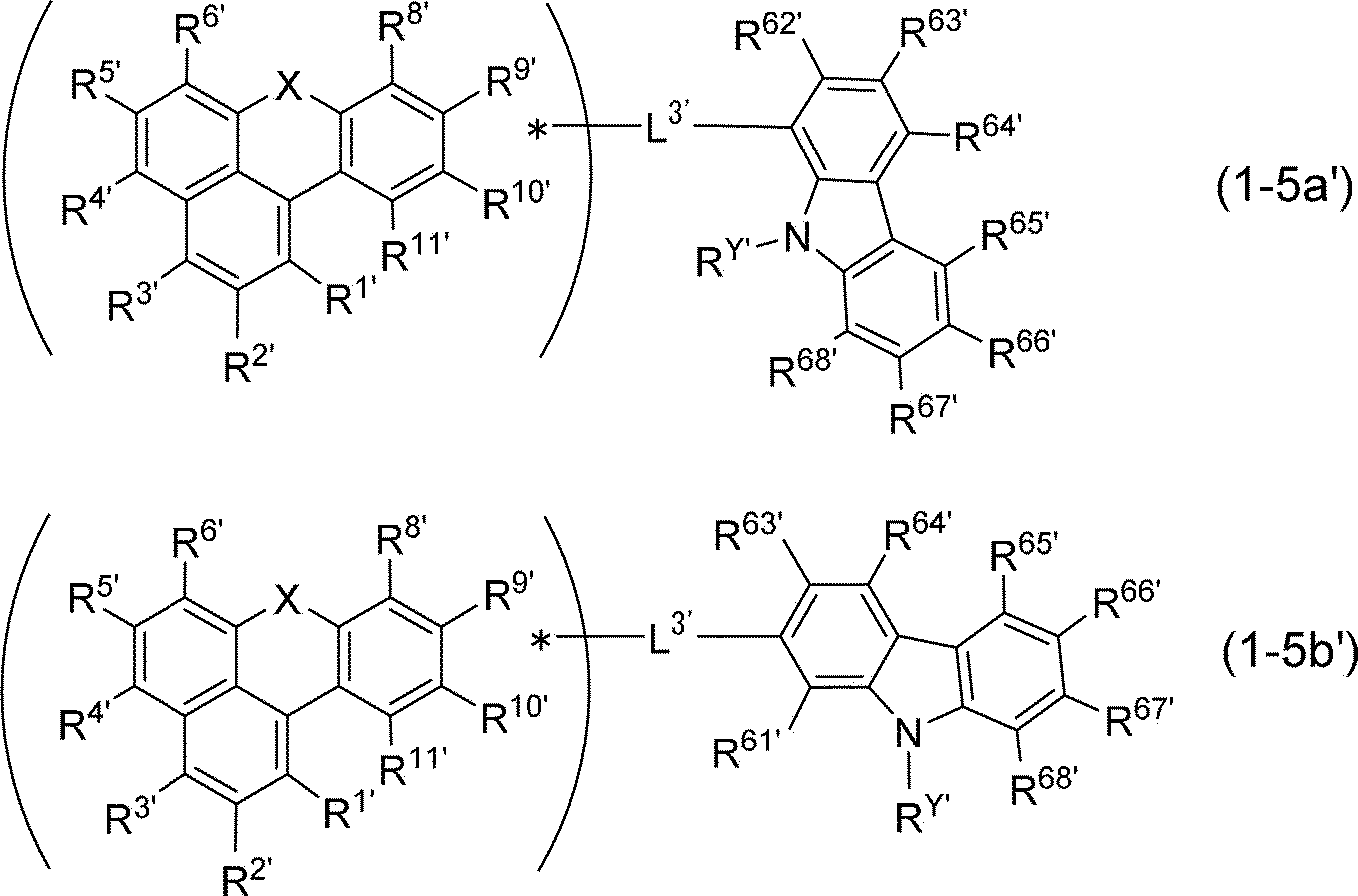

式(1-5a’)~(1-5d’)中、X、L3’、RY’、R1’~R6’、R8’~R11’、R61’~R68’、及び*は、前記式(1’)及び(2C’)において定義したとおりである。 In formulas (1-5a') to (1-5d'), X, L 3 ', R Y ', R 1 ' to R 6 ', R 8 ' to R 11 ', R 61 ' to R 68 ', and * are as defined in formulas (1′) and (2C′) above.
また、一態様においては、上記式(1-6’)において、R71’、R73’~R76’、R78’、RE’、及びRF’から選択される一つが、**に結合する単結合、又は**に結合する基である。 In one aspect, in the formula (1-6′), one selected from R 71 ′, R 73 ′ to R 76 ′, R 78 ′, R E ′, and R F ′ is ** is a single bond that binds to or a group that binds to **.
一態様において、化合物(1’)は下記式(1-6a’)~(1-6c’)のいずれかで表される。

式(1-6a’)~(1-6c’)中、X、L4’、RE’、RF’、R1’~R6’、R8’~R11’、R71’~R78’、及び*は、前記式(1’)及び(2D’)において定義したとおりである。 In formulas (1-6a') to (1-6c'), X, L 4 ', R E ', R F ', R 1 ' to R 6 ', R 8 ' to R 11 ', R 71 ' to R 78 ′ and * are as defined in formulas (1′) and (2D′) above.
また、一態様において、化合物(1’)は下記式(1-9’)又は(1-10’)で表される。

式(1-9’)及び(1-10’)中、X、RG’、RJ’、RZ’、R1’~R6’、R8’~R11’、R81’、R82’、R84’、R85’、R87’、R88’、R91’、R93’~R96’、R98’、YA’、YB’、YC’、YD’、*、及び**は、前記式(1’)及び(2F’)において定義したとおりである。 In formulas (1-9') and (1-10'), X, R G ', R J ', R Z ', R 1 ' to R 6 ', R 8 ' to R 11 ', R 81 ', R 82 ', R 84 ', R 85 ', R 87 ', R 88 ', R 91 ', R 93 ' to R 96 ', R 98 ' , Y A ', Y B ', Y C ', Y D ', *, and ** are as defined in formulas (1') and (2F') above.
一態様において、化合物(1’)は下記式(1-9a’)~(1-9d’)のいずれかで表される。


式(1-9a’)~(1-9d’)中、X、RZ’、R1’~R6’、R8’~R11’、R81’、R82’、R84’、R85’、R87’、R88’、YA’、YB’、及び*は、前記式(1’)及び(2E’)において定義したとおりである。 In formulas (1-9a') to (1-9d'), X, R Z ', R 1 ' to R 6 ', R 8 ' to R 11 ', R 81 ', R 82 ', R 84 ', R 85 ', R 87 ', R 88 ', Y A ', Y B ', and * are as defined in formulas (1') and (2E') above.
一態様において、化合物(1’)は下記式(1-10a’)~(1-10c’)のいずれかで表される。

式(1-10a’)~(1-10c’)中、X、RG’、RJ’、R1’~R6’、R8’~R11’、R91’、R93’~R96’、R98’、YC’、YD’、及び*は、前記式(1’)及び(2F’)において定義したとおりである。 In formulas (1-10a') to (1-10c'), X, R G ', R J ', R 1 ' to R 6 ', R 8 ' to R 11 ', R 91 ', R 93 ' to R 96 ', R 98 ', Y C ', Y D ', and * are as defined in formulas (1') and (2F') above.
一態様において、化合物(1’)は下記式(1-1-1’)、(1-2-1’)、(1-5-1’)、(1-6-1’)、(1-9-1’)、及び(1-10-1’)のいずれかで表される。


式(1-1-1’)、(1-2-1’)、(1-5-1’)、(1-6-1’)、(1-9-1)、及び(1-10-1’)中、X、L1’、L2’、L3’、L4’、RC’、RD’、RE’、RF’、RG’、RJ’、RX’、RY’、RZ’、R1’~R6’、R8’~R11’、R31’~R38’、R41’~R48’、R51’~R54’、R55’~R58’、R61’~R68’、R71’~R78’、R81’、R82’、R84’、R85’、R87’、R88’、R91’、R93’~R96’、R98’、YA’、YB’、YC’、YD’、j1、k1、m1、n1、**、*a1、*b1、*c1、及び*d1は、前記式(1’)及び(2A’)~(2F’)において定義したとおりである。 Formulas (1-1-1 '), (1-2-1 '), (1-5-1 '), (1-6-1 '), (1-9-1), and (1-10 -1') in X, L 1 ', L 2 ', L 3 ', L 4 ', R C ', RD ', RE ', RF ', RG ', R J ', R X ', R Y ', R Z ', R 1 ' to R 6 ', R 8 ' to R 11 ', R 31 ' to R 38 ', R 41 ' to R 48 ', R 51 ' to R 54 ', R 55 ' to R 58 ', R 61 ' to R 68 ', R 71 ' to R 78 ', R 81 ', R 82 ', R 84 ', R 85 ', R 87 ' , R 88 ', R 91 ', R 93 ' to R 96 ', R 98 ', Y A ', Y B ', Y C ', Y D ', j1, k1, m1, n1, **, *a1, *b1, *c1, and *d1 are as defined in formulas (1′) and (2A′) to (2F′) above.
一態様において、上記化合物Aは、*-Arが式(2A’)、(1-1’)、(1-3’)、又は(1-1-1’)で表され、m1が0、もしくは、m1が1で、かつ、L1’が置換もしくは無置換のフェニレン基又は置換もしくは無置換のビフェニレン基である。 In one embodiment, the above compound A has *-Ar represented by formula (2A′), (1-1′), (1-3′), or (1-1-1′), m1 is 0, Alternatively, m1 is 1 and L 1 ′ is a substituted or unsubstituted phenylene group or a substituted or unsubstituted biphenylene group.
一態様において、上記化合物Aは、*-Arが式(2B’)、(1-2’)、(1-4’)、又は(1-2-1’)で表され、n1が0、もしくは、n1が1で、かつ、L2’が置換もしくは無置換のフェニレン基又は置換もしくは無置換のビフェニレン基である。 In one embodiment, in the compound A, *-Ar is represented by formula (2B′), (1-2′), (1-4′), or (1-2-1′), n1 is 0, Alternatively, n1 is 1 and L 2 ' is a substituted or unsubstituted phenylene group or a substituted or unsubstituted biphenylene group.
一態様において、上記化合物AにおけるXが酸素原子である。具体的には、一態様において、上記化合物Aが、式(1’)、(1-1’)、(1-2’)、(1-5’)、(1-6’)、(1-9’)、(1-10’)、(1-9a’)~(1-9d’)、(1-10a’)~(1-10c’)、(1-1-1’)、(1-2-1’)、(1-5-1’)、(1-6-1’)、(1-9-1’)、又は(1-10-1’)で表され、Xが酸素原子である。 In one aspect, X in the above compound A is an oxygen atom. Specifically, in one aspect, the compound A is represented by formulas (1′), (1-1′), (1-2′), (1-5′), (1-6′), (1 -9'), (1-10'), (1-9a') ~ (1-9d'), (1-10a') ~ (1-10c'), (1-1-1'), ( 1-2-1′), (1-5-1′), (1-6-1′), (1-9-1′), or (1-10-1′), and X is It is an oxygen atom.
一態様において、上記式(2A’)における、R32’、R34’、R35’、及びR37’から選択される一つが、**に結合する単結合又は**に結合する基であり、
上記式(2D’)における、R72’、R74’、R75’、及びR77’から選択される一つが、**に結合する単結合又は**に結合する基であり、
上記式(2F’)における、R92’、R94’、R95’、及びR97’から選択される一つが、**に結合する単結合又は**に結合する基である。
換言すれば、一態様において、化合物(1’)の部分構造Bが式(2A’)、(2D’)、又は(2F’)で表され、これらの式中のフルオレン骨格上の2位又は4位が**に結合する。
In one embodiment, one selected from R 32 ', R 34 ', R 35 ', and R 37 ' in the above formula (2A') is a single bond that binds to ** or a group that binds to ** can be,
One selected from R 72 ', R 74 ', R 75 ', and R 77 ' in the above formula (2D') is a single bond that binds to ** or a group that binds to **,
One selected from R 92 ′ , R 94 ′, R 95 ′ and R 97 ′ in the above formula (2F′) is a single bond that binds to ** or a group that binds to **.
In other words, in one aspect, the partial structure B of compound (1′) is represented by formula (2A′), (2D′), or (2F′), and the 2-position on the fluorene skeleton in these formulas or 4-position binds to **.
一態様において、上記部分構造Aは、上記化合物(1)について説明した式(1Aa-1)~(1Aa-10)において、R1~R6及びR8~R11をR1’~R6’及びR8’~R11’に置き換えた式(1Aa-1’)~(1Aa-10’)で表される。 In one aspect, the partial structure A is represented by R 1 to R 6 and R 8 to R 11 in the formulas (1Aa-1) to (1Aa-10) described for the compound (1). ' and R 8' to R 11' are represented by formulas (1Aa-1') to (1Aa-10').
一態様において、上記部分構造Aは、上記化合物(1)について説明した式(1Aa-11)~(1Aa-20)において、R1~R6及びR8~R11をR1’~R6’及びR8’~R11’に置き換えた式(1Aa-11’)~(1Aa-20’)で表される。
In one aspect, the partial structure A has
一態様において、上記部分構造Aは、上記化合物(1)について説明した式(1Ab-1)~(1Ab-9)において、R1、R2~R4、及びR8~R11をR1’、R2’~R4’、及びR8’~R11’に置き換えた式(1Ab-1’)~(1Ab-9’)で表される。 In one embodiment, the partial structure A has R 1 , R 2 to R 4 and R 8 to R 11 in formulas ( 1Ab-1) to (1Ab-9) described for the compound (1). ' , R 2' to R 4' , and R 8' to R 11' are represented by formulas (1Ab-1') to (1Ab-9').
一態様において、上記部分構造Aは、上記化合物(1)について説明した式(1Ab-11)~(1Ab-19)において、R1、R2~R4、及びR8~R11をR1’、R2’~R4’、及びR8’~R11’に置き換えた式(1Ab-11’)~(1Ab-19’)で表される。 In one embodiment, the partial structure A has R 1 , R 2 to R 4 and R 8 to R 11 in formulas (1Ab-11) to (1Ab-19) described for compound ( 1 ). ' , R 2' to R 4' , and R 8' to R 11' are represented by formulas (1Ab-11') to (1Ab-19').
上記式(1Aa-1’)~(1Aa-20’)、式(1Ab-1’)~(1Ab-9’)、及び式(1Ab-11’)~(1Ab-19’)中、***はArへの結合位置を示す。R1’~R6’、R8’~R11’は、前記式(1’)において定義したとおりである。なお、式(1Aa-1’)~(1Aa-20’)、式(1Ab-1’)~(1Ab-9’)、及び式(1Ab-11’)~(1Ab-19’)の具体的な構造式は記載を省略する。 In the above formulas (1Aa-1′) to (1Aa-20′), formulas (1Ab-1′) to (1Ab-9′), and formulas (1Ab-11′) to (1Ab-19′), ** * indicates the binding position to Ar. R 1′ to R 6′ and R 8′ to R 11′ are as defined in formula (1′) above. In addition, the specific Structural formulas are omitted.
一態様において、上記化合物Aにおける(換言すれば、上記式(2A’)、(1-1’)、及び(1-1-1’)中)、RC’及びRD’は、それぞれ独立に、置換もしくは無置換の環形成炭素数6~30のアリール基であり、例えば、それぞれ独立に、置換もしくは無置換のフェニル基、置換もしくは無置換のナフチル基、及び置換もしくは無置換のフェナントリル基から選択される。好ましくは、RC’及びRD’が置換もしくは無置換のフェニル基、RC’及びRD’の一方が置換もしくは無置換のフェニル基、他方が置換もしくは無置換のナフチル基である。 In one aspect, in compound A above (in other words, in formulas (2A′), (1-1′), and (1-1-1′) above), R C′ and R D′ are each independently is a substituted or unsubstituted aryl group having 6 to 30 ring-forming carbon atoms, for example, each independently substituted or unsubstituted phenyl group, substituted or unsubstituted naphthyl group, and substituted or unsubstituted phenanthryl group is selected from Preferably, R C' and R D' are substituted or unsubstituted phenyl groups, one of R C' and R D' is a substituted or unsubstituted phenyl group, and the other is a substituted or unsubstituted naphthyl group.
一態様において、上記式(2D’)、(1-6’)、及び(1-6-1’)中、RE’及びRF’は、それぞれ独立に、置換もしくは無置換の環形成炭素数6~30のアリール基であり、例えば、それぞれ独立に、置換もしくは無置換のフェニル基、置換もしくは無置換のナフチル基、及び置換もしくは無置換のフェナントリル基から選択される。好ましくは、RE’及びRF’が置換もしくは無置換のフェニル基、RE’及びRF’の一方が置換もしくは無置換のフェニル基、他方が置換もしくは無置換のナフチル基である。
In one embodiment, in formulas (2D′), (1-6′), and (1-6-1′) above, R E′ and R F′ are each independently a substituted or unsubstituted ring-forming
一態様において、上記式(2F’)、(1-10’)、(1-10a’)~(1-10c’)、及び(1-10-1’)中、RG’及びRJ’は、それぞれ独立に、置換もしくは無置換の環形成炭素数6~30のアリール基であり、例えば、それぞれ独立に、置換もしくは無置換のフェニル基、置換もしくは無置換のナフチル基、及び置換もしくは無置換のフェナントリル基から選択される。好ましくは、RG’及びRJ’が置換もしくは無置換のフェニル基、RG’及びRJ’の一方が置換もしくは無置換のフェニル基、他方が置換もしくは無置換のナフチル基である。 In one aspect, in formulas (2F′), (1-10′), (1-10a′) to (1-10c′), and (1-10-1′), R G′ and R J′ are each independently a substituted or unsubstituted aryl group having 6 to 30 ring-forming carbon atoms, for example, each independently a substituted or unsubstituted phenyl group, a substituted or unsubstituted naphthyl group, and a substituted or unsubstituted is selected from substituted phenanthryl groups; Preferably, R G' and R J' are substituted or unsubstituted phenyl groups, one of R G' and R J' is a substituted or unsubstituted phenyl group, and the other is a substituted or unsubstituted naphthyl group.
一態様において、上記化合物Aにおける(換言すれば、上記式(2A’)、(1-1’)、及び(1-1-1’)中)、RC’とRD’が、互いに結合して置換もしくは無置換の単環を形成するか、互いに結合して置換もしくは無置換の縮合環を形成する。 In one aspect, in compound A above (in other words, in formulas (2A′), (1-1′), and (1-1-1′) above), R C′ and R D′ are bonded to each other together to form a substituted or unsubstituted single ring, or combined with each other to form a substituted or unsubstituted condensed ring.
一態様において、上記式(2D’)、(1-6’)、及び(1-6-1’)中、RE’とRF’が、互いに結合して置換もしくは無置換の単環を形成するか、互いに結合して置換もしくは無置換の縮合環を形成する。 In one embodiment, in the above formulas (2D'), (1-6'), and (1-6-1'), R E' and R F' are bonded to each other to form a substituted or unsubstituted monocyclic ring. formed or joined together to form a substituted or unsubstituted fused ring.
一態様において、上記式(2F’)、(1-10’)、(1-10a’)~(1-10c’)、及び(1-10-1’)中、RG’とRJ’が、互いに結合して置換もしくは無置換の単環を形成するか、互いに結合して置換もしくは無置換の縮合環を形成する。 In one aspect, in the above formulas (2F′), (1-10′ ) , (1-10a′) to (1-10c′), and (1-10-1 ′ ), are combined with each other to form a substituted or unsubstituted monocyclic ring, or combined with each other to form a substituted or unsubstituted condensed ring.
上記RC’とRD’によって形成される無置換の単環、上記RE’とRF’によって形成される無置換の単環、及び、RG’とRJ’によって形成される無置換の単環は、例えば、ベンゼン環、シクロペンタン環、シクロヘキサン環である。 The unsubstituted monocyclic ring formed by R C′ and R D′ , the unsubstituted monocyclic ring formed by R E′ and RF′ , and the unsubstituted monocyclic ring formed by R G′ and R J′ A substituted monocyclic ring is, for example, a benzene ring, a cyclopentane ring, or a cyclohexane ring.
上記RC’とRD’によって形成される無置換の縮合環、上記RE’とRF’によって形成される無置換の縮合環、及び、RG’とRJ’によって形成される無置換の縮合環は、例えば、ナフタレン環、アントラセン環である。
また、RC’及びRD’が互いに結合して無置換の単環又は無置換の縮合環を形成する場合、RE’及びRF’が互いに結合して無置換の単環又は無置換の縮合環を形成する場合、及び、RG’及びRJ’が互いに結合して無置換の単環又は無置換の縮合環を形成する場合、RC’及びRD’、RE及びRF’、RG’及びRJ’は、これらが結合しているフルオレン骨格とともに環形成し、例えば、スピロビフルオレン骨格、スピロ[9H-フルオレン-9,1’-シクロペンタン]骨格、スピロ[シクロヘキサン-1,9’-[9H]フルオレン]骨格、及び、スピロ[9H-フルオレン-9,2’-トリシクロ[3.3.1.13,7]デカン]骨格を形成してもよい。
The unsubstituted condensed ring formed by R C′ and R D′ , the unsubstituted condensed ring formed by R E′ and RF′ , and the unsubstituted condensed ring formed by R G′ and R J′ The substituted condensed ring is, for example, a naphthalene ring or an anthracene ring.
Further, when R C' and R D' are bonded to each other to form an unsubstituted monocyclic ring or an unsubstituted condensed ring, R E' and R F' are bonded to each other to form an unsubstituted monocyclic or unsubstituted ring. and when R G' and R J' combine with each other to form an unsubstituted monocyclic ring or an unsubstituted condensed ring, R C' and R D' , R E and R F' , R G' and R J' form a ring together with the fluorene skeleton to which they are bonded, for example, a spirobifluorene skeleton, a spiro[9H-fluorene-9,1'-cyclopentane] skeleton, a spiro[ A cyclohexane-1,9′-[9H]fluorene] skeleton and a spiro[9H-fluorene-9,2′-tricyclo[3.3.1.1 3,7 ]decane] skeleton may be formed.
一態様において、上記式(2A’)で表される部分構造B(*-Ar)は、上記化合物(1)について説明した式(2Aa)~(2Ag)において、R31~R38、L1、及びmを、R31’~R38’、L1’、及びm1に置き換えた式(2Aa’)~(2Ag’)のいずれかで表される。 In one embodiment, the partial structure B (*-Ar) represented by formula (2A′) is represented by R 31 to R 38 , L 1 in formulas (2Aa) to (2Ag) described for compound (1). , and m are represented by any one of formulas (2Aa') to (2Ag') in which R 31′ to R 38′ , L 1′ and m1 are substituted.
一態様において、上記式(2B’)で表される部分構造B(*-Ar)は、上記化合物(1)について説明した式(2Ba)~(2Bi)において、R41~R48、R51~R54、L2、及びnを、R41’~R48’、R51’~R54’、L2’、及びn1に置き換えた式(2Ba’)~(2Bg’)、及び下記式(2Bj’)のいずれかで表される。

式(2Bj’)中、L2’、RX’、R41’~R48’、n1、*、及び**は、上記式(1’)及び式(2B’)において定義したとおりである。 In formula (2Bj'), L 2' , R X' , R 41' to R 48' , n1, *, and ** are as defined in formula (1') and formula (2B') above. .
一態様において、上記式(2D’)で表される部分構造B(*-Ar)は、上記化合物(1)について説明した式(2Da)~(2Dg)において、R71~R78、R401~R408、R501~R510、及びL4を、R71’~R78’、R401’~R408’、R501’~R510’、及びL4’に置き換えた式(2Da’)~(2Dg’)のいずれかで表される。 In one embodiment, the partial structure B (*-Ar) represented by the formula (2D′) is represented by R 71 to R 78 , R 401 in the formulas (2Da) to (2Dg) described for the compound (1). ~ R 408 , R 501 ~ R 510 and L 4 are replaced with R 71' ~ R 78' , R 401' ~ R 408' , R 501' ~ R 510' and L 4' (2Da' ) to (2Dg′).
一態様において、上記式(2F’)で表される部分構造B(*-Ar)は、上記化合物(1)について説明した式(2Fa)~(2Fg)において、R91、R93~R96、R98、R601~R608、R701~R710、YC、及びYDを、R91’、R93’~R96’、R98’、R601’~R608’、R701’~R710’、YC’、及びYD’に置き換えた式(2Fa’)~(2Fg’)のいずれかで表される。 In one embodiment, the partial structure B (*-Ar) represented by the formula (2F′) is represented by R 91 , R 93 to R 96 in the formulas (2Fa) to (2Fg) described for the compound (1). , R 98 , R 601 to R 608 , R 701 to R 710 , Y C , and Y D , R 91′ , R 93′ to R 96′ , R 98′ , R 601′ to R 608′ , R 701 ' to R 710' , Y C' and Y D' are represented by any one of the formulas (2Fa') to (2Fg').
上記式(2Aa’)~(2Ag’)、式(2Ba’)~(2Bj‘)、式(2Da’)~(2Dg’)、及び式(2Fa’)~(2Fg’)中、R41’~R48’、R51’~R54’、R55’~R58’、R71’~R78’、R91’~R98’、RX、L2、L4、及びnは、前記式(2A’)、(2B’)、(2D’)~(2F’)において定義したとおりである。各基の好ましいものについても式(2A’)、(2B’)、(2D’)~(2F’)で述べたとおりである。なお、式(2Aa’)~(2Ag’)、式(2Ba’)~(2Bj‘)、式(2Da’)~(2Dg’)、及び式(2Fa’)~(2Fg’)の具体的な構造式は記載を省略する。 R 41 ' ˜R 48′ , R 51′ ˜R 54′ , R 55′ ˜R 58 ′ , R 71′ ˜R 78′ , R 91′ ˜R 98′ , R X , L 2 , L 4 , and n are It is as defined in formulas (2A'), (2B'), (2D') to (2F') above. Preferred groups are also as described for formulas (2A'), (2B'), (2D') to (2F'). In addition, specific formulas (2Aa') ~ (2Ag'), formulas (2Ba') ~ (2Bj'), formulas (2Da') ~ (2Dg'), and formulas (2Fa') ~ (2Fg') Structural formulas are omitted.
上記化合物Aは、ピレン骨格、アントラセン骨格、フルオランテン骨格、ベンゾトリフェニレン骨格、ベンゾアントラセン骨格、ベンゾピレン骨格、ベンゾフルオランテン骨格、クリセン骨格、及びベンゾフェナントレン骨格を含まないことが好ましい。 The above compound A preferably does not contain a pyrene skeleton, anthracene skeleton, fluoranthene skeleton, benzotriphenylene skeleton, benzoanthracene skeleton, benzopyrene skeleton, benzofluoranthene skeleton, chrysene skeleton, and benzophenanthrene skeleton.
上記化合物Aの一態様において、下記(1’)~(19’)のうち少なくとも1つが重水素原子である。
(1’)R1’~R6’、R8’~R11’、R31’~R38’、R41’~R48’、R51’~R54’、R55’~R58’、R61’~R68’、R71’~R78’、R81’、R82’、R84’、R85’、R87’、R88’、R91’、R92’、R94’、R95’、R97’、R98’、R201’~R208’、R301’~R310’、R71’~R78’、R401’~R408’、R501’~R510’、R601’~R608’、R701’~R710’、YA’、YB’、YC’、及びYD’が表す水素原子;
(2’)式(1Ab’)のベンソキサンテン骨格の3位の水素原子;
(3’)R1’~R6’、R8’~R11’、R31’~R38’、R41’~R48’、R51’~R54’、R55’~R58’、R61’~R68’、R71’~R78’、R81’、R82’、R84’、R85’、R87’、R88’、R91’、R92’、R94’、R95’、R97’、R98’、R201’~R208’、R301’~R310’、R71’~R78’、R401’~R408’、R501’~R510’、R601’~R608’、R701’~R710’、YA’、YB’、YC’、及びYD’が表すアルキル基に直結する水素原子;
(4’)R1’~R6’、R8’~R11’、R31’~R38’、R41’~R48’、R51’~R54’、R55’~R58’、R61’~R68’、R71’~R78’、R81’、R82’、R84’、R85’、R87’、R88’、R91’、R92’、R94’、R95’、R97’、R98’、R201’~R208’、R301’~R310’、R71’~R78’、R401’~R408’、R501’~R510’、R601’~R608’、R701’~R710’、YA’、YB’、YC’、及びYD’が表すアリール基に直結する水素原子;
(5’)R1’~R6’、R8’~R11’、R31’~R38’、R41’~R48’、R51’~R54’、R55’~R58’、R61’~R68’、R71’~R78’、R81’、R82’、R84’、R85’、R87’、R88’、R91’、R92’、R94’、R95’、R97’、R98’、R201’~R208’、R301’~R310’、R71’~R78’、R401’~R408’、R501’~R510’、R601’~R608’、R701’~R710’、YA’、YB’、YC’、及びYD’が表すヘテロアリール基に直結する水素原子;
(6’)R1’~R6’、R8’~R11’、R31’~R38’、R41’~R48’、R51’~R54’、R55’~R58’、R61’~R68’、R71’~R78’、R81’、R82’、R84’、R85’、R87’、R88’、R91’、R92’、R94’、R95’、R97’、R98’、R201’~R208’、R301’~R310’、R71’~R78’、R401’~R408’、R501’~R510’、R601’~R608’、R701’~R710’、YA’、YB’、YC’、及びYD’が表すアルキル基が有する置換基に直結する水素原子;
(7’)R1’~R6’、R8’~R11’、R31’~R38’、R41’~R48’、R51’~R54’、R55’~R58’、R61’~R68’、R71’~R78’、R81’、R82’、R84’、R85’、R87’、R88’、R91’、R92’、R94’、R95’、R97’、R98’、R201’~R208’、R301’~R310’、R71~R78’、R401~R408’、R501~R510’、R601’~R608’、R701’~R710’、YA’、YB’、YC’、及びYD’が表すアリール基が有する置換基に直結する水素原子;
(8’)R1’~R6’、R8’~R11’、R31’~R38’、R41’~R48’、R51’~R54’、R55’~R58’、R61’~R68’、R71’~R78’、R81’、R82’、R84’、R85’、R87’、R88’、R91’、R92’、R94’、R95’、R97’、R98’、R201’~R208’、R301’~R310’、R71’~R78’、R401’~R408’、R501’~R510’、R601’~R608’、R701’~R710’、YA’、YB’、YC’、及びYD’が表すヘテロアリール基が有する置換基に直結する水素原子;
(9’)RC’、RD’、RE’、RF’、RG’、RJ’、RX’、RY’、及びRZ’が表す水素原子;
(10’)RC’、RD’、RE’、RF’、RG’、RJ’、RX’、RY’、及びRZ’が表すアルキル基に直結する水素原子;
(11’)RC’、RD’、RE’、RF’、RG’、RJ’、RX’、RY’、及びRZ’が表すアリール基に直結する水素原子;
(12’)RC’、RD’、RE’、RF’、RG’、RJ’、RX’、RY’、及びRZ’が表すヘテロアリール基に直結する水素原子;
(13’)RC’、RD’、RE’、RF’、RG’、RJ’、RX’、RY’、及びRZ’が表すアルキル基が有する置換基に直結する水素原子;
(14’)RC’、RD’、RE’、RF’、RG’、RJ’、RX’、RY’、及びRZ’が表すアリール基が有する置換基に直結する水素原子;
(15’)RC’、RD’、RE’、RF’、RG’、RJ’、RX’、RY’、及びRZ’が表すヘテロアリール基が有する置換基に直結する水素原子;
(16’)L1’、L2’、L3’、及びL4’が表すアリーレン基に直結する水素原子;
(17’)L1’、L2’、L3’、及びL4’が表す2価の複素環基に直結する水素原子;
(18’)L1’、L2’、L3’、及びL4’が表すアリーレン基が有する置換基に直結する水素原子;
(19’)L1’、L2’、L3’、及びL4’が表す2価の複素環基が有する置換基に直結する水素原子。
In one aspect of compound A, at least one of the following (1') to (19') is a deuterium atom.
(1') R 1 ' to R 6 ', R 8 ' to R 11 ', R 31 ' to R 38 ', R 41 ' to R 48 ', R 51 ' to R 54 ', R 55 ' to R 58 ', R 61 ' to R 68 ', R 71 ' to R 78 ', R 81 ', R 82 ', R 84 ', R 85 ', R 87 ', R 88 ', R 91 ', R 92 ', R 94 ', R 95 ', R 97 ', R 98 ', R 201 ' to R 208 ', R 301 ' to R 310 ', R 71 ' to R 78 ', R 401 ' to R 408 ', R 501 hydrogen atoms represented by ' to R 510 ', R 601 ' to R 608 ', R 701 ' to R 710 ', Y A ', Y B ', Y C ', and Y D ';
(2') a hydrogen atom at the 3-position of the benzoxanthene skeleton of formula (1Ab');
(3') R 1 ' to R 6 ', R 8 ' to R 11 ', R 31 ' to R 38 ', R 41 ' to R 48 ', R 51 ' to R 54 ', R 55 ' to R 58 ', R 61 ' to R 68 ', R 71 ' to R 78 ', R 81 ', R 82 ', R 84 ', R 85 ', R 87 ', R 88 ', R 91 ', R 92 ', R 94 ', R 95 ', R 97 ', R 98 ', R 201 ' to R 208 ', R 301 ' to R 310 ', R 71 ' to R 78 ', R 401 ' to R 408 ', R 501 Hydrogen atoms directly connected to alkyl groups represented by ' to R 510 ', R 601 ' to R 608 ', R 701 ' to R 710 ', Y A ', Y B ', Y C ', and Y D ';
(4') R 1 ' to R 6 ', R 8 ' to R 11 ', R 31 ' to R 38 ', R 41 ' to R 48 ', R 51 ' to R 54 ', R 55 ' to R 58 ', R 61 ' to R 68 ', R 71 ' to R 78 ', R 81 ', R 82 ', R 84 ', R 85 ', R 87 ', R 88 ', R 91 ', R 92 ', R 94 ', R 95 ', R 97 ', R 98 ', R 201 ' to R 208 ', R 301 ' to R 310 ', R 71 ' to R 78 ', R 401 ' to R 408 ', R 501 hydrogen atoms directly connected to aryl groups represented by ' to R 510 ', R 601 ' to R 608 ', R 701 ' to R 710 ', Y A ', Y B ', Y C ', and Y D ';
(5') R 1 ' to R 6 ', R 8 ' to R 11 ', R 31 ' to R 38 ', R 41 ' to R 48 ', R 51 ' to R 54 ', R 55 ' to R 58 ', R 61 ' to R 68 ', R 71 ' to R 78 ', R 81 ', R 82 ', R 84 ', R 85 ', R 87 ', R 88 ', R 91 ', R 92 ', R 94 ', R 95 ', R 97 ', R 98 ', R 201 ' to R 208 ', R 301 ' to R 310 ', R 71 ' to R 78 ', R 401 ' to R 408 ', R 501 Hydrogen atoms directly connected to heteroaryl groups represented by ' to R 510 ', R 601 ' to R 608 ', R 701 ' to R 710 ', Y A ', Y B ', Y C ', and Y D ';
(6') R 1 ' to R 6 ', R 8 ' to R 11 ', R 31 ' to R 38 ', R 41 ' to R 48 ', R 51 ' to R 54 ', R 55 ' to R 58 ', R 61 ' to R 68 ', R 71 ' to R 78 ', R 81 ', R 82 ', R 84 ', R 85 ', R 87 ', R 88 ', R 91 ', R 92 ', R 94 ', R 95 ', R 97 ', R 98 ', R 201 ' to R 208 ', R 301 ' to R 310 ', R 71 ' to R 78 ', R 401 ' to R 408 ', R 501 ' to R 510 ', R 601 ' to R 608 ', R 701 ' to R 710 ', Y A ', Y B ', Y C ', and Y D ' are hydrogen atoms directly connected to the substituents of the alkyl groups. atom;
(7') R 1 ' to R 6 ', R 8 ' to R 11 ', R 31 ' to R 38 ', R 41 ' to R 48 ', R 51 ' to R 54 ', R 55 ' to R 58 ', R 61 ' to R 68 ', R 71 ' to R 78 ', R 81 ', R 82 ', R 84 ', R 85 ', R 87 ', R 88 ', R 91 ', R 92 ', R 94 ', R 95 ', R 97 ', R 98 ', R 201 ' to R 208 ', R 301 ' to R 310 ', R 71 to R 78 ', R 401 to R 408 ', R 501 to R 510 ', R 601 ' to R 608 ', R 701 ' to R 710 ', Y A ', Y B ', Y C ', and a hydrogen atom directly connected to the substituent of the aryl group represented by Y D ';
(8') R 1 ' to R 6 ', R 8 ' to R 11 ', R 31 ' to R 38 ', R 41 ' to R 48 ', R 51 ' to R 54 ', R 55 ' to R 58 ', R 61 ' to R 68 ', R 71 ' to R 78 ', R 81 ', R 82 ', R 84 ', R 85 ', R 87 ', R 88 ', R 91 ', R 92 ', R 94 ', R 95 ', R 97 ', R 98 ', R 201 ' to R 208 ', R 301 ' to R 310 ', R 71 ' to R 78 ', R 401 ' to R 408 ', R 501 ' to R 510 ', R 601 ' to R 608 ', R 701 ' to R 710 ', Y A ', Y B ', Y C ' and Y D ' are directly linked to the substituents of the heteroaryl groups represented by hydrogen atom;
(9') hydrogen atoms represented by R C ', R D ', R E ', R F ', R G ', R J ', R X ', R Y ', and R Z ';
(10') Hydrogen atoms directly connected to alkyl groups represented by R C ', R D ', R E ', R F ', R G ', R J ', R X ', R Y ', and R Z ';
(11′) hydrogen atoms directly connected to aryl groups represented by RC ′ , RD ′ , RE ′ , RF ′, RG ′ , RJ′, RX ′, RY ′, and RZ ′ ;
(12') A hydrogen atom directly connected to a heteroaryl group represented by R C ', R D ', R E ', R F ', R G ', R J ', R X ', R Y ', and R Z ';
(13') Directly connected to the substituents of the alkyl groups represented by R C ', R D ', R E ', R F ', R G ', R J ', R X ', R Y ', and R Z ' a hydrogen atom;
(14') Directly connected to the substituents of the aryl groups represented by R C ', R D ', R E ', R F ', R G ', R J ', R X ', R Y ', and R Z ' a hydrogen atom;
(15') substituents possessed by heteroaryl groups represented by R C ', R D ', R E ', R F ', R G ', R J ', R X ', R Y ', and R Z ' directly linked hydrogen atoms;
(16') a hydrogen atom directly bonded to the arylene group represented by L 1 ', L 2 ', L 3 ', and L 4 ';
(17') a hydrogen atom directly connected to the divalent heterocyclic group represented by L 1 ', L 2 ', L 3 ', and L 4 ';
(18') a hydrogen atom directly connected to the substituent of the arylene group represented by L 1 ', L 2 ', L 3 ', and L 4 ';
(19') A hydrogen atom directly linked to a substituent of the divalent heterocyclic group represented by L 1 ', L 2 ', L 3 ' and L 4 '.
一態様において、上記化合物Aが少なくとも1個の重水素原子を含む。
上記化合物Aは天然由来の重水素原子を含んでいてもよいし、原料化合物の一部又はすべてに重水素化した化合物を使用することにより、上記化合物Aに重水素原子を意図的に導入してもよい。
化合物Aの好ましい重水素化率は、上記発明化合物について説明したのと同様である。
また、化合物Aが、重水素化された化合物と重水素化されていない化合物を含む混合物、あるいは、異なる重水素化率を有する2以上の化合物の混合物であってもよいこと、及び、この場合の混合物の重水素化率の好ましい数値範囲についても上記発明化合物について説明したのと同様である。
また、化合物A中の全水素原子数に対する重水素原子数のそれぞれの割合も、上記発明化合物について説明したのと同様である。
In one embodiment, compound A above contains at least one deuterium atom.
The above compound A may contain a naturally occurring deuterium atom, or a deuterium atom is intentionally introduced into the above compound A by using a deuterated compound as part or all of the raw material compound. may
The preferred deuteration rate of compound A is the same as explained for the invention compound above.
Also, compound A may be a mixture containing deuterated and non-deuterated compounds, or a mixture of two or more compounds having different deuteration rates, and in this case The preferable numerical range of the deuteration rate of the mixture of is the same as explained for the above invention compounds.
The ratio of the number of deuterium atoms to the total number of hydrogen atoms in compound A is also the same as explained for the compounds of the present invention.
上記化合物Aの重水素化率は使用する原料化合物の重水素化率に依存する。所定の重水素化率の原料を用いたとしても、天然由来の一定の割合で軽水素同位体が含まれ得る。従って、下記で示される化合物Aの重水素化率の態様は、単に化学式で表される重水素原子の数をカウントして求められる割合に対し、天然由来の微量の同位体を考慮した比率が含まれる。
上記化合物Aの重水素化率は、好ましくは1%以上、より好ましくは3%以上、更に好ましくは5%以上、より更に好ましくは10%以上、より更に好ましくは50%以上である。
上記化合物Aは、全ての水素原子が重水素原子である(すなわち、化合物Aの重水素化率が100%である)重水素体であってもよい。
The deuteration rate of compound A depends on the deuteration rate of the starting compound used. Even if a raw material with a given deuteration rate is used, it may still contain a certain proportion of natural proton isotopes. Therefore, the aspect of the deuteration rate of compound A shown below is the ratio obtained by simply counting the number of deuterium atoms represented by the chemical formula, and the ratio in consideration of trace isotopes derived from nature. included.
The deuteration rate of compound A is preferably 1% or more, more preferably 3% or more, still more preferably 5% or more, still more preferably 10% or more, and even more preferably 50% or more.
The above compound A may be a deuterium in which all hydrogen atoms are deuterium atoms (that is, the deuteration rate of compound A is 100%).
上記化合物Aは、重水素化された化合物と重水素化されていない化合物を含む混合物、異なる重水素化率を有する2以上の化合物の混合物であってもよい。このような混合物の重水素化率は、好ましくは1%以上、より好ましくは3%以上、更に好ましくは5%以上、より更に好ましくは10%以上、より更に好ましくは50%以上、かつ、100%未満である。
また、上記化合物A中の全水素原子数に対する重水素原子数のそれぞれの割合は、好ましくは1%以上、より好ましくは3%以上、更に好ましくは5%以上、より更に好ましくは10%以上、かつ、100%以下である。
The above compound A may be a mixture containing deuterated compounds and non-deuterated compounds, or a mixture of two or more compounds having different deuteration rates. The deuteration rate of such a mixture is preferably 1% or more, more preferably 3% or more, still more preferably 5% or more, even more preferably 10% or more, even more preferably 50% or more, and 100 %.
In addition, the ratio of each number of deuterium atoms to the total number of hydrogen atoms in the compound A is preferably 1% or more, more preferably 3% or more, still more preferably 5% or more, and even more preferably 10% or more, And it is 100% or less.
以下に上記化合物Aの具体例を示すが、以下の例示化合物に限定されるものではない。
下記具体例中、Dは重水素原子を示す。
Specific examples of compound A are shown below, but are not limited to the following exemplary compounds.
In the following specific examples, D represents a deuterium atom.
上記化合物(1)の例示化合物のうち、上記式(1B)で表される構造を有する化合物を除いた化合物。 A compound other than the compound having the structure represented by the above formula (1B) among the exemplary compounds of the above compound (1).


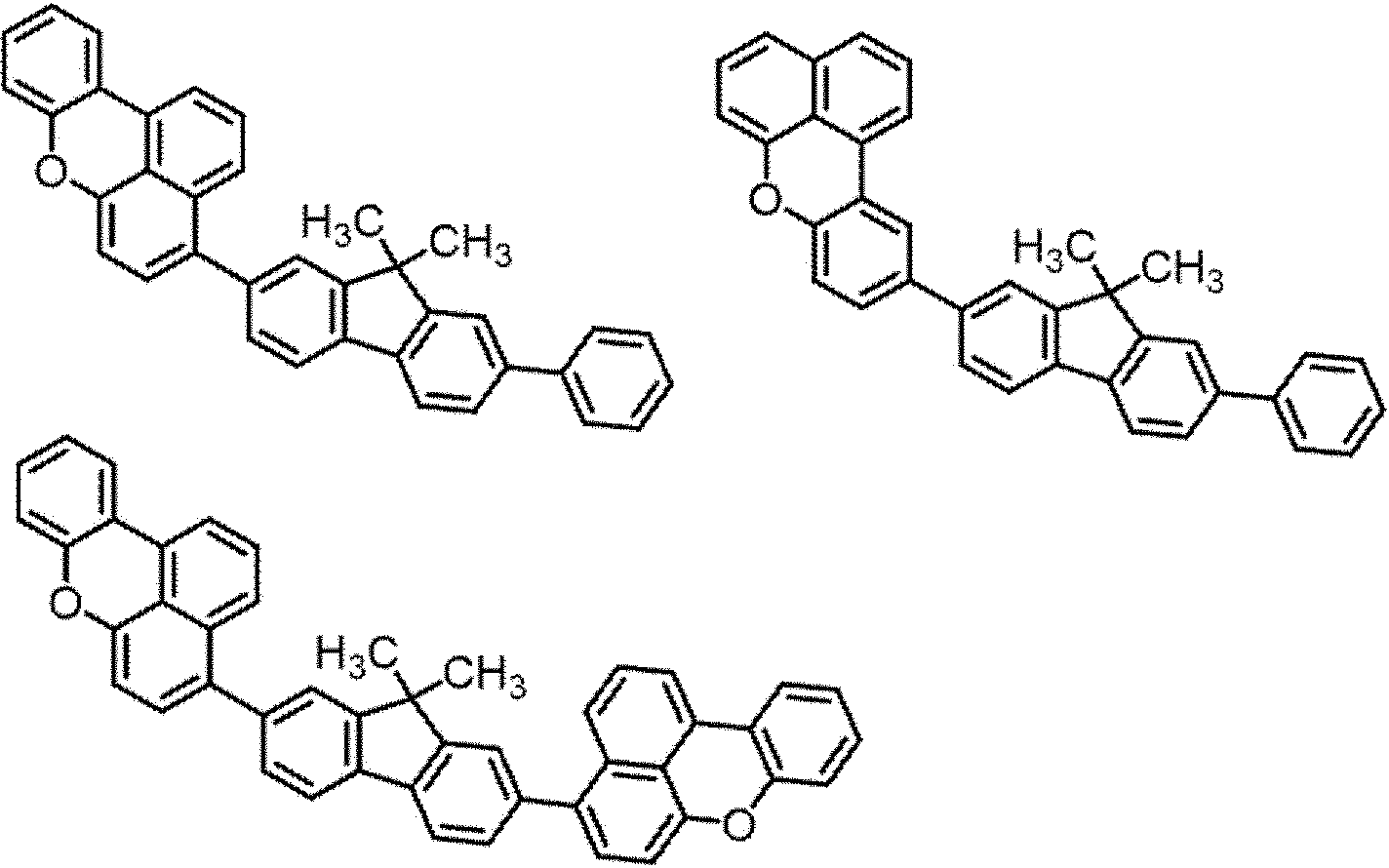


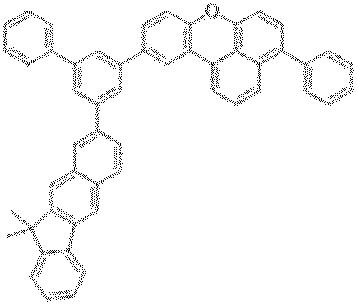


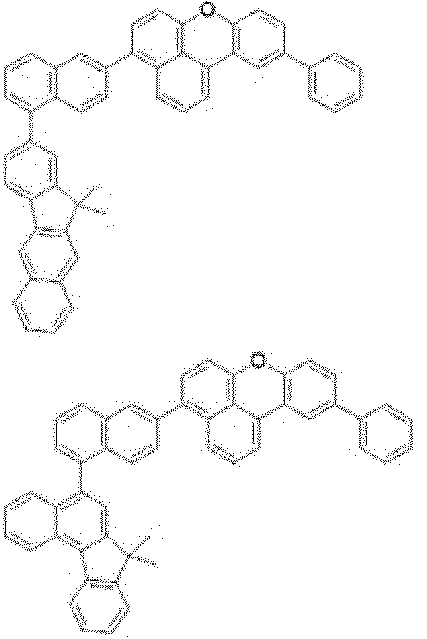


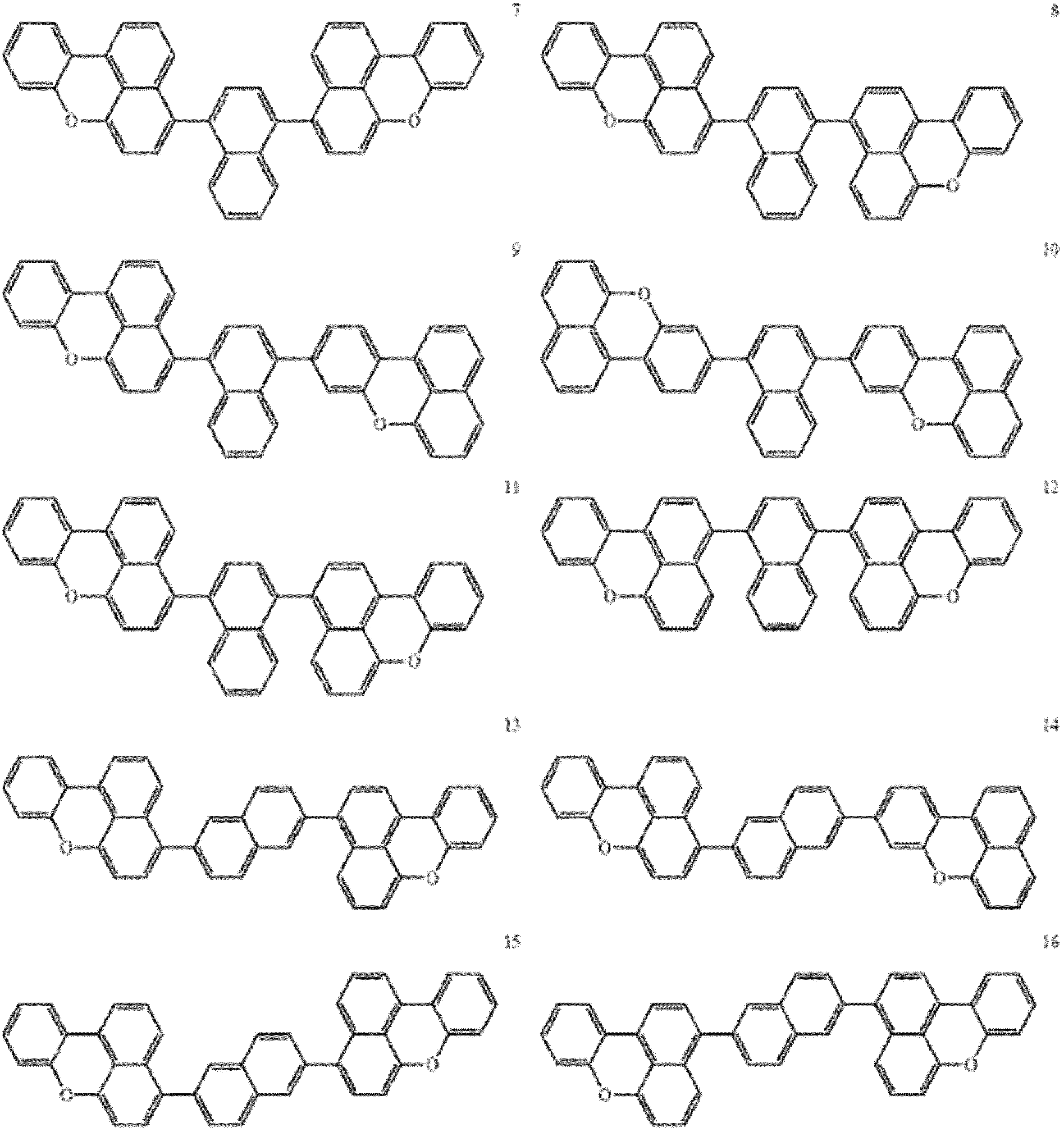


<有機EL素子の層構成>
本発明の実施形態に係る有機EL素子は、陽極、陰極、及び該陽極と陰極の間に配置された有機層を含み、該有機層は発光層を含む。
そして、上記第1の有機EL素子は上記有機層の少なくとも一層が発明化合物を含む。上述したように、発明化合物は、正孔輸送帯域(正孔注入層、正孔輸送層、電子阻止層、励起子阻止層等)、発光層、スペース層、陰極と発光層との間に設けられる電子輸送帯域(電子注入層、電子輸送層、正孔阻止層等)等に含まれる。
また、上記第2の有機EL素子は、上述したように、陽極、正孔輸送帯域、発光層、及び陰極をこの順に備え、上記正孔輸送帯域が、上記条件(A)~(C)を満たす化合物Aを含有する。そして、これ以外は、本発明の効果を損なわない限りにおいて、従来公知の材料及び素子構成を上記有機EL素子に適用することができる。
<Layer structure of organic EL element>
An organic EL device according to an embodiment of the invention includes an anode, a cathode, and an organic layer disposed between the anode and the cathode, the organic layer including a light-emitting layer.
At least one of the organic layers of the first organic EL device contains the compound of the invention. As described above, the compounds of the invention are provided between the hole transport zone (hole injection layer, hole transport layer, electron blocking layer, exciton blocking layer, etc.), light emitting layer, space layer, and cathode and light emitting layer. It is included in the electron transport zone (electron injection layer, electron transport layer, hole blocking layer, etc.).
In addition, the second organic EL element includes an anode, a hole-transporting zone, a light-emitting layer, and a cathode in this order as described above, and the hole-transporting zone satisfies the above conditions (A) to (C). It contains compound A that satisfies Other than this, conventionally known materials and device configurations can be applied to the organic EL device as long as the effects of the present invention are not impaired.
上記正孔輸送帯域は、正孔輸送機能を有する少なくとも1層以上の層からなる。上記正孔輸送帯域を構成する層としては、正孔注入層、正孔輸送層、電子阻止層、励起子阻止層等が挙げられる。上記正孔輸送帯域は複数の層で構成されていてもよいし、単一の層であってもよい。
上記第2の有機EL素子の好ましい態様において、上記正孔輸送帯域は、正孔輸送層を含む複数の層から構成されるか、又は単一の正孔輸送層から構成され、上記化合物Aが上記正孔輸送層に含まれる。換言すれば、上記化合物Aは、好ましくは正孔輸送層の材料として用いられる。
The hole-transporting zone is composed of at least one layer having a hole-transporting function. Examples of the layer forming the hole transport zone include a hole injection layer, a hole transport layer, an electron blocking layer, an exciton blocking layer, and the like. The hole transport zone may be composed of multiple layers or may be a single layer.
In a preferred embodiment of the second organic EL device, the hole-transporting zone is composed of a plurality of layers including a hole-transporting layer, or composed of a single hole-transporting layer, and the compound A is Included in the hole transport layer. In other words, the above compound A is preferably used as a material for the hole transport layer.
本発明の一実施態様において、上記正孔輸送帯域は、正孔輸送層とそれ以外の第2の層を含む。この場合、上記第2の層は上記発明化合物を含んでいてもよいし、含まないものであってもよい。また、上記第2の層は上記化合物Aを含んでいてもよいし、含まないものであってもよい。上記第2の層は、上記陽極と上記正孔輸送層との間に配置されていてもよいし、上記正孔輸送層と上記発光層との間に配置されていてもよい。 In one embodiment of the present invention, the hole-transporting zone includes a hole-transporting layer and a second layer other than the hole-transporting layer. In this case, the second layer may or may not contain the invention compound. The second layer may or may not contain the compound A. The second layer may be arranged between the anode and the hole transport layer, or may be arranged between the hole transport layer and the light emitting layer.
本発明の好ましい実施態様において、後述するように正孔輸送層が2以上の層を含む多層構造であって、正孔輸送層が、第1正孔輸送層(陽極側)と第2正孔輸送層(陰極側)を含む2層構造である。この場合、上記発明化合物は、第1正孔輸送層のみに含まれていてもよいし、第2正孔輸送層のみに含まれていてもよいし、第1及び第2正孔輸送層に含まれてもよい。また、上記化合物Aは、第1正孔輸送層のみに含まれていてもよいし、第2正孔輸送層のみに含まれていてもよいし、第1及び第2正孔輸送層に含まれてもよい。 In a preferred embodiment of the present invention, the hole-transporting layer has a multi-layered structure including two or more layers as described later, wherein the hole-transporting layer comprises a first hole-transporting layer (on the anode side) and a second hole-transporting layer. It has a two-layer structure including a transport layer (cathode side). In this case, the compound of the invention may be contained only in the first hole-transporting layer, may be contained only in the second hole-transporting layer, or may be contained in the first and second hole-transporting layers. may be included. Further, the compound A may be contained only in the first hole-transporting layer, may be contained only in the second hole-transporting layer, or may be contained in the first and second hole-transporting layers. may be
上記有機EL素子は、正孔輸送帯域及び発光層以外の他の有機層を備えていてもよく、上記他の有機層に上記発明化合物及び化合物Aのうち少なくとも一方が含まれていてもよい。
発明化合物及び化合物Aのうち少なくとも一方が含まれる有機層の例としては、スペース層、陰極と発光層との間に設けられる電子輸送帯域(電子注入層、電子輸送層、正孔阻止層等)等が挙げられるが、これらに限定されるものではない。
上記発光層に上記発明化合物及び化合物Aのうち少なくとも一方が含まれていてもよい。
The organic EL device may comprise an organic layer other than the hole-transporting zone and the light-emitting layer, and at least one of the invention compound and compound A may be contained in the other organic layer.
Examples of the organic layer containing at least one of the compound of the invention and compound A include a space layer and an electron-transporting zone (electron-injecting layer, electron-transporting layer, hole-blocking layer, etc.) provided between the cathode and the light-emitting layer. etc., but not limited to these.
At least one of the invention compound and compound A may be contained in the light-emitting layer.
本発明の一実施態様において、上記正孔輸送帯域を構成する正孔輸送層が、第1正孔輸送層(陽極側)と第2正孔輸送層(陰極側)を含む2層構造であり、上記第2正孔輸送層と上記発光層との間には他の層が含まれない。換言すれば、本発明の一実施態様において、上記第2正孔輸送層と上記発光層とが直接接している。 In one embodiment of the present invention, the hole-transporting layer constituting the hole-transporting zone has a two-layer structure including a first hole-transporting layer (on the anode side) and a second hole-transporting layer (on the cathode side). , no other layer is included between the second hole-transporting layer and the light-emitting layer. In other words, in one embodiment of the present invention, the second hole-transporting layer and the light-emitting layer are in direct contact.
上記化合物Aは、好ましくは蛍光又は燐光EL素子の正孔輸送帯域の材料、より好ましくは正孔注入層、正孔輸送層、電子阻止層、又は励起子阻止層の材料、特に好ましくは正孔注入層又は正孔輸送層の材料として用いられる。 The compound A is preferably a material for the hole-transporting zone of a fluorescent or phosphorescent EL device, more preferably a material for a hole-injecting layer, a hole-transporting layer, an electron-blocking layer, or an exciton-blocking layer, particularly preferably a hole It is used as a material for injection layers or hole transport layers.
本発明の一実施態様において、前記発光層が蛍光ドーパント材料を含む。 In one embodiment of the present invention, the light-emitting layer contains a fluorescent dopant material.
本発明の一実施態様において、前記発光層が燐光ドーパント材料を含む。 In one embodiment of the present invention, the light-emitting layer contains a phosphorescent dopant material.
以下、上記第1及び第2の有機EL素子に用いられる部材、及び、各層を構成する、上記発明化合物及び化合物A以外の材料等について説明する。 The members used in the first and second organic EL elements and the materials other than the invention compound and compound A that constitute each layer will be described below.
(基板)
基板は、有機EL素子の支持体として用いられる。基板としては、例えば、ガラス、石英、プラスチックなどの板を用いることができる。また、可撓性基板を用いてもよい。可撓性基板としては、例えば、ポリカーボネート、ポリアリレート、ポリエーテルスルフォン、ポリプロピレン、ポリエステル、ポリフッ化ビニル、ポリ塩化ビニルからなるプラスチック基板等が挙げられる。また、無機蒸着フィルムを用いることもできる。
(substrate)
The substrate is used as a support for organic EL elements. As the substrate, for example, a plate of glass, quartz, plastic, or the like can be used. Alternatively, a flexible substrate may be used. Examples of flexible substrates include plastic substrates made of polycarbonate, polyarylate, polyethersulfone, polypropylene, polyester, polyvinyl fluoride, and polyvinyl chloride. Inorganic deposition films can also be used.
(陽極)
基板上に形成される陽極には、仕事関数の大きい(具体的には4.0eV以上)金属、合金、電気伝導性化合物、およびこれらの混合物などを用いることが好ましい。具体的には、例えば、酸化インジウム-酸化スズ(ITO:Indium Tin Oxide)、珪素もしくは酸化珪素を含有した酸化インジウム-酸化スズ、酸化インジウム-酸化亜鉛、酸化タングステンおよび酸化亜鉛を含有した酸化インジウム、グラフェン等が挙げられる。この他、金(Au)、白金(Pt)、ニッケル(Ni)、タングステン(W)、クロム(Cr)、モリブデン(Mo)、鉄(Fe)、コバルト(Co)、銅(Cu)、パラジウム(Pd)、チタン(Ti)、または前記金属の窒化物(例えば、窒化チタン)等が挙げられる。
(anode)
For the anode formed on the substrate, it is preferable to use a metal, an alloy, an electrically conductive compound, a mixture thereof, or the like having a large work function (specifically, 4.0 eV or more). Specifically, for example, indium oxide-tin oxide (ITO: Indium Tin Oxide), indium oxide-tin oxide containing silicon or silicon oxide, indium oxide-zinc oxide, indium oxide containing tungsten oxide and zinc oxide, Graphene etc. are mentioned. In addition, gold (Au), platinum (Pt), nickel (Ni), tungsten (W), chromium (Cr), molybdenum (Mo), iron (Fe), cobalt (Co), copper (Cu), palladium ( Pd), titanium (Ti), or nitrides of the above metals (for example, titanium nitride).
これらの材料は、通常、スパッタリング法により成膜される。例えば、酸化インジウム-酸化亜鉛は、酸化インジウムに対し1~10wt%の酸化亜鉛を加えたターゲットを、酸化タングステンおよび酸化亜鉛を含有した酸化インジウムは、酸化インジウムに対し酸化タングステンを0.5~5wt%、酸化亜鉛を0.1~1wt%含有したターゲットを用いることにより、スパッタリング法で形成することができる。その他、真空蒸着法、塗布法、インクジェット法、スピンコート法などにより作製してもよい。 These materials are usually deposited by a sputtering method. For example, indium oxide-zinc oxide is a target in which 1 to 10 wt% of zinc oxide is added to indium oxide, and indium oxide containing tungsten oxide and zinc oxide is a target in which 0.5 to 5 wt% of tungsten oxide is added to indium oxide. %, and 0.1 to 1 wt % of zinc oxide, it can be formed by a sputtering method. In addition, it may be produced by a vacuum vapor deposition method, a coating method, an inkjet method, a spin coating method, or the like.
(正孔輸送帯域)
上述したように、前記有機層が前記陽極と前記発光層の間に正孔輸送帯域を含んでいてもよい。正孔輸送帯域は、正孔注入層、正孔輸送層、電子阻止層等から構成される。正孔輸送帯域が発明化合物及び化合物Aのうち少なくとも一方を含むことが好ましい。正孔輸送層を構成するこれらの層のうち少なくとも一つの層に発明化合物及び化合物Aのうち少なくとも一方を含むことが好ましく、特に正孔輸送層に発明化合物及び化合物Aのうち少なくとも一方を含むことがより好ましい。
(hole transport zone)
As noted above, the organic layer may contain a hole-transporting zone between the anode and the light-emitting layer. The hole-transporting zone is composed of a hole-injecting layer, a hole-transporting layer, an electron-blocking layer, and the like. Preferably, the hole-transporting zone contains at least one of the invention compound and compound A. At least one of these layers constituting the hole-transporting layer preferably contains at least one of the compound of the invention and compound A, and in particular, the hole-transporting layer contains at least one of the compound of the invention and compound A. is more preferred.
陽極に接して形成される正孔注入層は、陽極の仕事関数に関係なく正孔注入が容易である材料を用いて形成されるため、電極材料として一般的に使用される材料(例えば、金属、合金、電気伝導性化合物、およびこれらの混合物、元素周期表の第1族または第2族に属する元素)を用いることができる。
仕事関数の小さい材料である、元素周期表の第1族または第2族に属する元素、すなわちリチウム(Li)やセシウム(Cs)等のアルカリ金属、およびマグネシウム(Mg)、カルシウム(Ca)、ストロンチウム(Sr)等のアルカリ土類金属、およびこれらを含む合金(例えば、MgAg、AlLi)、ユーロピウム(Eu)、イッテルビウム(Yb)等の希土類金属およびこれらを含む合金等を用いることもできる。なお、アルカリ金属、アルカリ土類金属、およびこれらを含む合金を用いて陽極を形成する場合には、真空蒸着法やスパッタリング法を用いることができる。さらに、銀ペーストなどを用いる場合には、塗布法やインクジェット法などを用いることができる。
The hole injection layer formed in contact with the anode is formed using a material that facilitates hole injection regardless of the work function of the anode. , alloys, electrically conductive compounds, and mixtures thereof, elements belonging to
Elements belonging to
(正孔注入層)
正孔注入層は、正孔注入性の高い材料(正孔注入性材料)を含む層であり、陽極と発光層の間、又は、存在する場合には、正孔輸送層と陽極の間に形成される。
(hole injection layer)
The hole-injecting layer is a layer containing a material with high hole-injecting properties (hole-injecting material), and is provided between the anode and the light-emitting layer, or, if present, between the hole-transporting layer and the anode. It is formed.
発明化合物以外の正孔注入性材料としては、モリブデン酸化物、チタン酸化物、バナジウム酸化物、レニウム酸化物、ルテニウム酸化物、クロム酸化物、ジルコニウム酸化物、ハフニウム酸化物、タンタル酸化物、銀酸化物、タングステン酸化物、マンガン酸化物等を用いることができる。 Hole-injecting materials other than invention compounds include molybdenum oxide, titanium oxide, vanadium oxide, rhenium oxide, ruthenium oxide, chromium oxide, zirconium oxide, hafnium oxide, tantalum oxide, and silver oxide. material, tungsten oxide, manganese oxide, or the like can be used.
低分子の有機化合物である4,4’,4’’-トリス(N,N-ジフェニルアミノ)トリフェニルアミン(略称:TDATA)、4,4’,4’’-トリス[N-(3-メチルフェニル)-N-フェニルアミノ]トリフェニルアミン(略称:MTDATA)、4,4’-ビス[N-(4-ジフェニルアミノフェニル)-N-フェニルアミノ]ビフェニル(略称:DPAB)、4,4’-ビス(N-{4-[N’-(3-メチルフェニル)-N’-フェニルアミノ]フェニル}-N-フェニルアミノ)ビフェニル(略称:DNTPD)、1,3,5-トリス[N-(4-ジフェニルアミノフェニル)-N-フェニルアミノ]ベンゼン(略称:DPA3B)、3-[N-(9-フェニルカルバゾール-3-イル)-N-フェニルアミノ]-9-フェニルカルバゾール(略称:PCzPCA1)、3,6-ビス[N-(9-フェニルカルバゾール-3-イル)-N-フェニルアミノ]-9-フェニルカルバゾール(略称:PCzPCA2)、3-[N-(1-ナフチル)-N-(9-フェニルカルバゾール-3-イル)アミノ]-9-フェニルカルバゾール(略称:PCzPCN1)等の芳香族アミン化合物等も正孔注入層材料として挙げられる。 4,4′,4″-tris(N,N-diphenylamino)triphenylamine (abbreviation: TDATA), 4,4′,4″-tris[N-(3- methylphenyl)-N-phenylamino]triphenylamine (abbreviation: MTDATA), 4,4′-bis[N-(4-diphenylaminophenyl)-N-phenylamino]biphenyl (abbreviation: DPAB), 4,4 '-bis(N-{4-[N'-(3-methylphenyl)-N'-phenylamino]phenyl}-N-phenylamino)biphenyl (abbreviation: DNTPD), 1,3,5-tris[N -(4-diphenylaminophenyl)-N-phenylamino]benzene (abbreviation: DPA3B), 3-[N-(9-phenylcarbazol-3-yl)-N-phenylamino]-9-phenylcarbazole (abbreviation: PCzPCA1), 3,6-bis[N-(9-phenylcarbazol-3-yl)-N-phenylamino]-9-phenylcarbazole (abbreviation: PCzPCA2), 3-[N-(1-naphthyl)-N Aromatic amine compounds such as -(9-phenylcarbazol-3-yl)amino]-9-phenylcarbazole (abbreviation: PCzPCN1) can also be used as hole injection layer materials.
高分子化合物(オリゴマー、デンドリマー、ポリマー等)を用いることもできる。例えば、ポリ(N-ビニルカルバゾール)(略称:PVK)、ポリ(4-ビニルトリフェニルアミン)(略称:PVTPA)、ポリ[N-(4-{N’-[4-(4-ジフェニルアミノ)フェニル]フェニル-N’-フェニルアミノ}フェニル)メタクリルアミド](略称:PTPDMA)、ポリ[N,N’-ビス(4-ブチルフェニル)-N,N’-ビス(フェニル)ベンジジン](略称:Poly-TPD)などの高分子化合物が挙げられる。また、ポリ(3,4-エチレンジオキシチオフェン)/ポリ(スチレンスルホン酸)(PEDOT/PSS)、ポリアニリン/ポリ(スチレンスルホン酸)(PAni/PSS)等の酸を添加した高分子化合物を用いることもできる。 Polymer compounds (oligomers, dendrimers, polymers, etc.) can also be used. For example, poly(N-vinylcarbazole) (abbreviation: PVK), poly(4-vinyltriphenylamine) (abbreviation: PVTPA), poly[N-(4-{N'-[4-(4-diphenylamino) phenyl]phenyl-N'-phenylamino}phenyl)methacrylamide] (abbreviation: PTPDMA), poly[N,N'-bis(4-butylphenyl)-N,N'-bis(phenyl)benzidine] (abbreviation: polymer compounds such as Poly-TPD). In addition, polymer compounds added with acids such as poly(3,4-ethylenedioxythiophene)/poly(styrenesulfonic acid) (PEDOT/PSS) and polyaniline/poly(styrenesulfonic acid) (PAni/PSS) are used. can also
さらに、下記式(K)で表されるヘキサアザトリフェニレン(HAT)化合物などのアクセプター材料を用いることも好ましい。

(上記式中、R221~R226は、それぞれ独立にシアノ基、-CONH2、カルボキシル基、又は-COOR227(R227は炭素数1~20のアルキル基又は炭素数3~20のシクロアルキル基を表す)を表す。また、R221及びR222、R223及びR224、及びR225及びR226から選ばれる隣接する2つが互いに結合して-CO-O-CO-で示される基を形成してもよい。)
R227としては、メチル基、エチル基、n-プロピル基、イソプロピル基、n-ブチル基、イソブチル基、t-ブチル基、シクロペンチル基、シクロヘキシル基等が挙げられる。
(wherein R 221 to R 226 are each independently a cyano group, —CONH 2 , a carboxyl group, or —COOR 227 (R 227 is an alkyl group having 1 to 20 carbon atoms or a cycloalkyl group having 3 to 20 carbon atoms) In addition, adjacent two selected from R 221 and R 222 , R 223 and R 224 , and R 225 and R 226 are bonded to each other to form a group represented by —CO—O—CO— may form.)
Examples of R 227 include methyl group, ethyl group, n-propyl group, isopropyl group, n-butyl group, isobutyl group, t-butyl group, cyclopentyl group and cyclohexyl group.
(正孔輸送層)
正孔輸送層は、正孔輸送性の高い材料(正孔輸送性材料)を含む層であり、陽極と発光層の間、又は、存在する場合には、正孔注入層と発光層の間に形成される。発明化合物を単独で又は下記の化合物と組み合わせて正孔輸送層に用いてもよい。
(Hole transport layer)
The hole-transporting layer is a layer containing a highly hole-transporting material (hole-transporting material), and is between the anode and the light-emitting layer, or, if present, between the hole-injecting layer and the light-emitting layer. formed in Invention compounds may be used in the hole transport layer either alone or in combination with the following compounds.
正孔輸送層は、単層構造でもよく、2以上の層を含む多層構造でもよい。例えば、正孔輸送層は第1正孔輸送層(陽極側)と第2正孔輸送層(陰極側)を含む2層構造であってもよい。つまり、上記正孔輸送帯域が陽極側の第1正孔輸送層と陰極側の第2正孔輸送層を含んでいてもよい。また、正孔輸送層は陽極側から順に第1正孔輸送層と第2正孔輸送層と第3正孔輸送層を含む3層構造であってもよい。つまり、第2正孔輸送層と発光層との間に、第3正孔輸送層が配置されていてもよい。
本発明の一態様において、前記単層構造の正孔輸送層は発光層に隣接していることが好ましく、又、前記多層構造中の最も陰極に近い正孔輸送層、例えば、上記2層構造の第2正孔輸送層や上記3層構造の第3正孔輸送層は発光層に隣接していることが好ましい。本発明の他の態様において、前記単層構造の正孔輸送層と発光層の間に、又は、前記多層構造中の最も発光層に近い正孔輸送層と発光層の間に、後述する電子阻止層などを介在させてもよい。
本発明に係る有機エレクトロルミネッセンス素子の一態様において、前記第1正孔輸送層及び前記第2正孔輸送層の少なくとも一方が、発明化合物及び化合物Aのうち少なくとも一方を含む。具体的には、前記2層構造の正孔輸送層において、発明化合物及び化合物Aのうち少なくとも一方は第1正孔輸送層と第2正孔輸送層の一方に含まれていてもよいし、双方に含まれていてもよい。また、他の態様において、上記第1~第3正孔輸送層のうち少なくとも一つが発明化合物及び化合物Aのうち少なくとも一方を含む。具体的には、上記3層構造の正孔輸送層において、発明化合物及び化合物Aのうち少なくとも一方は第1~第3正孔輸送層のうち一つのみに含まれていてもよいし、いずれか2つのみに含まれていてもよいし、全てに含まれていてもよい。
本発明の一態様においては、発明化合物及び化合物Aのうち少なくとも一方が第2正孔輸送層に含まれるのが好ましく、具体的には、発明化合物及び化合物Aのうち少なくとも一方が第2正孔輸送層のみに含まれるか、発明化合物及び化合物Aのうち少なくとも一方が第1正孔輸送層と第2正孔輸送層に含まれるのが好ましい。
本発明の一態様において、前記第1正孔輸送層と前記第2正孔輸送層の一方又は双方に含まれる発明化合物もしくは化合物A、又は、前記第1~第3正孔輸送層のうち少なくとも一つ又は複数に含まれる発明化合物もしくは化合物Aは、製造コストの観点から、軽水素体であることが好ましい。
前記軽水素体とは、発明化合物中のすべての水素原子が軽水素原子である発明化合物のことである。
従って、本発明は、前記第1正孔輸送層と前記第2正孔輸送層の一方又は双方や、前記第1~第3正孔輸送層のうち少なくとも一つ又は複数が実質的に軽水素体のみからなる発明化合物及び化合物Aのうち少なくとも一方を含む有機EL素子を含む。「実質的に軽水素体のみからなる発明化合物」とは、発明化合物の総量に対する軽水素体の含有割合が、90モル%以上、好ましくは95モル%以上、より好ましくは99モル%以上(それぞれ100%を含む)であることを意味する。「実質的に軽水素体のみからなる化合物A」についても同様である。
The hole transport layer may have a single layer structure or a multilayer structure including two or more layers. For example, the hole transport layer may have a two-layer structure including a first hole transport layer (anode side) and a second hole transport layer (cathode side). That is, the hole-transporting zone may include a first hole-transporting layer on the anode side and a second hole-transporting layer on the cathode side. Also, the hole transport layer may have a three-layer structure including a first hole transport layer, a second hole transport layer and a third hole transport layer in order from the anode side. That is, the third hole-transporting layer may be arranged between the second hole-transporting layer and the light-emitting layer.
In one aspect of the present invention, the hole-transporting layer having the single-layer structure is preferably adjacent to the light-emitting layer, and the hole-transporting layer closest to the cathode in the multilayer structure, for example, the two-layer structure It is preferable that the second hole-transporting layer of (1) and the third hole-transporting layer of the three-layer structure are adjacent to the light-emitting layer. In another aspect of the present invention, between the hole-transporting layer and the light-emitting layer in the single-layer structure, or between the hole-transporting layer closest to the light-emitting layer in the multilayer structure and the light-emitting layer, an electron A blocking layer or the like may be interposed.
In one aspect of the organic electroluminescence device according to the present invention, at least one of the first hole-transporting layer and the second hole-transporting layer contains at least one of the invention compound and compound A. Specifically, in the hole-transporting layer having the two-layer structure, at least one of the compound of the present invention and compound A may be contained in one of the first hole-transporting layer and the second hole-transporting layer, It may be included in both. In another aspect, at least one of the first to third hole transport layers contains at least one of the compound of the present invention and compound A. Specifically, in the hole-transport layer having the three-layer structure, at least one of the compound of the present invention and compound A may be contained in only one of the first to third hole-transport layers. may be included in only two or may be included in all.
In one aspect of the present invention, at least one of the compound of the invention and compound A is preferably contained in the second hole transport layer. Specifically, at least one of the compound of the invention and compound A contains the second hole It is preferably contained only in the transport layer, or at least one of the invention compound and compound A is contained in the first hole transport layer and the second hole transport layer.
In one aspect of the present invention, the invention compound or compound A contained in one or both of the first hole-transport layer and the second hole-transport layer, or at least one of the first to third hole-transport layers From the viewpoint of production cost, the invention compound or compound A contained in one or more is preferably a hydrogen compound.
The aforementioned light hydrogen compound means an invention compound in which all hydrogen atoms in the invention compound are hydrogen atoms.
Therefore, in the present invention, one or both of the first hole transport layer and the second hole transport layer, and at least one or more of the first to third hole transport layers are substantially hydrogen-containing An organic EL device containing at least one of the compound A and the invention compound consisting only of the compound A is included. The term "invention compound consisting essentially of a light hydrogen body" means that the content of the light hydrogen body in the total amount of the invention compounds is 90 mol% or more, preferably 95 mol% or more, more preferably 99 mol% or more (each including 100%). The same applies to the "compound A consisting essentially of a light hydrogen compound".
発明化合物及び化合物A以外の正孔輸送層材料としては、例えば、芳香族アミン化合物、カルバゾール誘導体、アントラセン誘導体等を使用することができる。
芳香族アミン化合物としては、例えば、4,4’-ビス[N-(1-ナフチル)-N-フェニルアミノ]ビフェニル(略称:NPB)やN,N’-ビス(3-メチルフェニル)-N,N’-ジフェニル-[1,1’-ビフェニル]-4,4’-ジアミン(略称:TPD)、4-フェニル-4’-(9-フェニルフルオレン-9-イル)トリフェニルアミン(略称:BAFLP)、4,4’-ビス[N-(9,9-ジメチルフルオレン-2-イル)-N-フェニルアミノ]ビフェニル(略称:DFLDPBi)、4,4’,4”-トリス(N,N-ジフェニルアミノ)トリフェニルアミン(略称:TDATA)、4,4’,4”-トリス[N-(3-メチルフェニル)-N-フェニルアミノ]トリフェニルアミン(略称:MTDATA)、及び、4,4’-ビス[N-(スピロ-9,9’-ビフルオレン-2-イル)-N―フェニルアミノ]ビフェニル(略称:BSPB)が挙げられる。上記化合物は、10-6cm2/Vs以上の正孔移動度を有する。
As hole transport layer materials other than the invention compound and compound A, for example, aromatic amine compounds, carbazole derivatives, anthracene derivatives and the like can be used.
Examples of aromatic amine compounds include 4,4'-bis[N-(1-naphthyl)-N-phenylamino]biphenyl (abbreviation: NPB) and N,N'-bis(3-methylphenyl)-N , N′-diphenyl-[1,1′-biphenyl]-4,4′-diamine (abbreviation: TPD), 4-phenyl-4′-(9-phenylfluoren-9-yl)triphenylamine (abbreviation: BAFLP), 4,4′-bis[N-(9,9-dimethylfluoren-2-yl)-N-phenylamino]biphenyl (abbreviation: DFLDPBi), 4,4′,4″-tris(N,N -diphenylamino)triphenylamine (abbreviation: TDATA), 4,4′,4″-tris[N-(3-methylphenyl)-N-phenylamino]triphenylamine (abbreviation: MTDATA), and 4, 4′-bis[N-(spiro-9,9′-bifluoren-2-yl)-N-phenylamino]biphenyl (abbreviation: BSPB). The compound has a hole mobility of 10 −6 cm 2 /Vs or higher.
カルバゾール誘導体としては、例えば、4,4’-ジ(9-カルバゾリル)ビフェニル(略称:CBP)、9-[4-(9-カルバゾリル)フェニル]-10-フェニルアントラセン(略称:CzPA)、及び、9-フェニル-3-[4-(10-フェニル-9-アントリル)フェニル]-9H-カルバゾール(略称:PCzPA)が挙げられる。
アントラセン誘導体としては、例えば、2-t-ブチル-9,10-ジ(2-ナフチル)アントラセン(略称:t-BuDNA)、9,10-ジ(2-ナフチル)アントラセン(略称:DNA)、及び、9,10-ジフェニルアントラセン(略称:DPAnth)が挙げられる。
ポリ(N-ビニルカルバゾール)(略称:PVK)やポリ(4-ビニルトリフェニルアミン)(略称:PVTPA)等の高分子化合物を用いることもできる。
ただし、電子輸送性よりも正孔輸送性の方が高い化合物であれば、上記以外の化合物を用いてもよい。
Examples of carbazole derivatives include 4,4′-di(9-carbazolyl)biphenyl (abbreviation: CBP), 9-[4-(9-carbazolyl)phenyl]-10-phenylanthracene (abbreviation: CzPA), and 9-phenyl-3-[4-(10-phenyl-9-anthryl)phenyl]-9H-carbazole (abbreviation: PCzPA).
Examples of anthracene derivatives include 2-t-butyl-9,10-di(2-naphthyl)anthracene (abbreviation: t-BuDNA), 9,10-di(2-naphthyl)anthracene (abbreviation: DNA), and , 9,10-diphenylanthracene (abbreviation: DAnth).
Polymer compounds such as poly(N-vinylcarbazole) (abbreviation: PVK) and poly(4-vinyltriphenylamine) (abbreviation: PVTPA) can also be used.
However, a compound other than the above may be used as long as the compound has higher hole-transporting property than electron-transporting property.
本発明に係る有機EL素子の一態様において、前記第1正孔輸送層が、下記の式(21)又は式(22)で表される化合物を含む。

[前記式(21)及び式(22)中、
LA1、LB1、LC1、LA2、LB2、LC2及びLD2は、それぞれ独立に、単結合、置換もしくは無置換の環形成炭素数6~50のアリーレン基、又は置換もしくは無置換の環形成原子数5~50の2価の複素環基であり、
kは、1、2、3又は4であり、
kが1の場合、LE2は、置換もしくは無置換の環形成炭素数6~50のアリーレン基、又は置換もしくは無置換の環形成原子数5~50の2価の複素環基であり、
kが2、3又は4の場合、複数のLE2は、互いに同一であるか、又は異なり、
kが2、3又は4の場合、複数のLE2は、互いに結合して置換もしくは無置換の単環を形成するか、互いに結合して置換もしくは無置換の縮合環を形成するか、又は互いに結合せず、
前記単環を形成せず、かつ前記縮合環を形成しないLE2は、置換もしくは無置換の環形成炭素数6~50のアリーレン基、又は置換もしくは無置換の環形成原子数5~50の2価の複素環基であり、
A1、B1、C1、A2、B2、C2、及びD2は、それぞれ独立に、置換もしくは無置換の環形成炭素数6~50のアリール基、置換もしくは無置換の環形成原子数5~50の複素環基、又は-Si(R’901)(R’902)(R’903)であり、
R’901、R’902及びR’903は、それぞれ独立に、置換もしくは無置換の環形成炭素数6~50のアリール基であり、
R’901が複数存在する場合、複数のR’901は、互いに同一であるか、又は異なり、
R’902が複数存在する場合、複数のR’902は、互いに同一であるか、又は異なり、
R’903が複数存在する場合、複数のR’903は、互いに同一であるか、又は異なる。
R901~R907は、それぞれ独立に、水素原子、
置換もしくは無置換の炭素数1~50のアルキル基、
置換もしくは無置換の環形成炭素数3~50のシクロアルキル基、
置換もしくは無置換の環形成炭素数6~50のアリール基、又は
置換もしくは無置換の環形成原子数5~50の複素環基であり、
R901が複数ある場合、複数のR901は、互いに同一であるか、又は異なり、
R902が複数ある場合、複数のR902は、互いに同一であるか、又は異なり、
R903が複数ある場合、複数のR903は、互いに同一であるか、又は異なり、
R904が複数ある場合、複数のR904は、互いに同一であるか、又は異なり、
R905が複数ある場合、複数のR905は、互いに同一であるか、又は異なり、
R906が複数ある場合、複数のR906は、互いに同一であるか、又は異なり、
R907が複数ある場合、複数のR907は、互いに同一であるか、又は異なる。]
In one aspect of the organic EL device according to the present invention, the first hole transport layer contains a compound represented by the following formula (21) or (22).
[In the above formulas (21) and (22),
L A1 , L B1 , L C1 , L A2 , L B2 , L C2 and L D2 are each independently a single bond, a substituted or unsubstituted arylene group having 6 to 50 ring carbon atoms, or a substituted or unsubstituted is a divalent heterocyclic group having 5 to 50 ring-forming atoms,
k is 1, 2, 3 or 4;
when k is 1, L E2 is a substituted or unsubstituted arylene group having 6 to 50 ring-forming carbon atoms or a substituted or unsubstituted divalent heterocyclic group having 5 to 50 ring-forming atoms;
When k is 2, 3 or 4, the plurality of L E2 are the same or different from each other,
When k is 2, 3 or 4, a plurality of L E2 are bonded to each other to form a substituted or unsubstituted monocyclic ring, bonded to each other to form a substituted or unsubstituted condensed ring, or do not combine
L E2 that does not form a single ring and does not form a condensed ring is a substituted or unsubstituted arylene group having 6 to 50 ring-forming carbon atoms, or a substituted or unsubstituted 2 having 5 to 50 ring-forming atoms is a valent heterocyclic group,
A 1 , B 1 , C 1 , A 2 , B 2 , C 2 and D 2 are each independently a substituted or unsubstituted aryl group having 6 to 50 ring-forming carbon atoms, a substituted or unsubstituted ring-forming a heterocyclic group having 5 to 50 atoms, or -Si(R' 901 ) (R' 902 ) (R' 903 );
R' 901 , R' 902 and R' 903 are each independently a substituted or unsubstituted aryl group having 6 to 50 ring carbon atoms,
When multiple R' 901 are present, the multiple R' 901 are the same or different from each other,
When there are multiple R' 902 , the multiple R' 902 are the same or different from each other,
When multiple R' 903 are present, the multiple R' 903 are the same or different from each other.
R 901 to R 907 each independently represent a hydrogen atom,
a substituted or unsubstituted alkyl group having 1 to 50 carbon atoms,
a substituted or unsubstituted cycloalkyl group having 3 to 50 ring carbon atoms,
a substituted or unsubstituted aryl group having 6 to 50 ring-forming carbon atoms, or a substituted or unsubstituted heterocyclic group having 5 to 50 ring-forming atoms,
When there is a plurality of R 901 , the plurality of R 901 are the same or different from each other,
When there are multiple R 902 , the multiple R 902 are the same or different from each other,
When there are multiple R 903 , the multiple R 903 are the same or different from each other,
When there are multiple R 904 , the multiple R 904 are the same or different from each other,
When there are multiple R 905 , the multiple R 905 are the same or different from each other,
When there are multiple R 906 , the multiple R 906 are the same or different from each other,
When there is a plurality of R 907 , the plurality of R 907 are the same or different from each other. ]
なお、前記第1正孔輸送層は、式(21)及び式(22)で表される化合物を1種含有していてもよいし、式(21)及び式(22)で表される化合物を複数種含有していてもよい。 The first hole transport layer may contain one compound represented by formulas (21) and (22), or the compounds represented by formulas (21) and (22) may contain a plurality of types.
式(21)及び式(22)において、A1、B1、C1、A2、B2、C2、及びD2は、好ましくは、それぞれ独立に、置換もしくは無置換のフェニレン基、置換もしくは無置換のビフェニル基、置換もしくは無置換のターフェニル基、置換もしくは無置換のナフチル基、置換もしくは無置換のフルオレニル基、置換もしくは無置換のジベンソフラニル基、置換もしくは無置換のジベンゾチオフェニル基、及び、置換もしくは無置換のカルバゾリル基から選択される。
また、より好ましくは、式(21)において、A1、B1及びC1のうち少なくとも一つ、及び、式(22)において、A2、B2、C2及びD2のうち少なくとも一つが、置換もしくは無置換のビフェニル基、置換もしくは無置換のターフェニル基、置換もしくは無置換のナフチル基、置換もしくは無置換のフルオレニル基、置換もしくは無置換のジベンソフラニル基、又は、置換もしくは無置換のジベンゾチオフェニル基、置換もしくは無置換のカルバゾリル基である。
In formulas (21) and (22), A1, B1, C1, A2, B2, C2, and D2 are preferably each independently a substituted or unsubstituted phenylene group, a substituted or unsubstituted biphenyl group, substituted or unsubstituted terphenyl group, substituted or unsubstituted naphthyl group, substituted or unsubstituted fluorenyl group, substituted or unsubstituted dibenzofuranyl group, substituted or unsubstituted dibenzothiophenyl group, and substituted or unsubstituted selected from carbazolyl groups;
More preferably, at least one of A1, B1 and C1 in formula (21) and at least one of A2, B2, C2 and D2 in formula (22) are substituted or unsubstituted biphenyl substituted or unsubstituted terphenyl group, substituted or unsubstituted naphthyl group, substituted or unsubstituted fluorenyl group, substituted or unsubstituted dibenzofuranyl group, or substituted or unsubstituted dibenzothiophenyl group, substituted or unsubstituted It is a substituted carbazolyl group.
A1、B1、C1、A2、B2、C2、及びD2がとり得るフルオレニル基は、9位に置換基を有していてもよく、例えば、9,9-ジメチルフルオレニル基、9,9-ジフェニルフルオレニル基であってもよい。また、9位の置換基同士で環を形成していてもよく、例えば、9位の置換基同士でフルオレン骨格やキサンテン骨格を形成してもよい。 The fluorenyl group that A1, B1, C1, A2, B2, C2, and D2 can take may have a substituent at the 9-position, for example, a 9,9-dimethylfluorenyl group, a 9,9- It may be a diphenylfluorenyl group. Moreover, the substituents at the 9-position may form a ring together, for example, the substituents at the 9-position may form a fluorene skeleton or a xanthene skeleton.
LA1、LB1、LC1、LA2、LB2、LC2及びLD2は、好ましくは、それぞれ独立に、単結合、置換もしくは無置換の環形成炭素数6~12のアリーレン基である。 L A1 , L B1 , L C1 , L A2 , L B2 , L C2 and L D2 are preferably each independently a single bond or a substituted or unsubstituted arylene group having 6 to 12 ring carbon atoms.
式(21)及び式(22)で表される化合物の具体例としては、例えば、以下の化合物が挙げられる。


発光層のドーパント材料
発光層は、発光性の高い材料(ドーパント材料)を含む層であり、種々の材料を用いることができる。例えば、蛍光発光材料や燐光発光材料をドーパント材料として用いることができる。蛍光発光材料は一重項励起状態から発光する化合物であり、燐光発光材料は三重項励起状態から発光する化合物である。
本発明に係る有機EL素子の一態様において、発光層は単一の層である。
また、本発明に係る有機EL素子の他の一態様において、発光層は第1の発光層と第2の発光層とを含む。
Dopant Material of Light-Emitting Layer The light-emitting layer is a layer containing a highly luminescent material (dopant material), and various materials can be used. For example, a fluorescent light-emitting material or a phosphorescent light-emitting material can be used as the dopant material. A fluorescent light-emitting material is a compound that emits light from a singlet excited state, and a phosphorescent light-emitting material is a compound that emits light from a triplet excited state.
In one aspect of the organic EL device according to the present invention, the light-emitting layer is a single layer.
Also, in another aspect of the organic EL device according to the present invention, the light-emitting layer includes a first light-emitting layer and a second light-emitting layer.
発光層に用いることができる青色系の蛍光発光材料として、ピレン誘導体、スチリルアミン誘導体、クリセン誘導体、フルオランテン誘導体、フルオレン誘導体、ジアミン誘導体、トリアリールアミン誘導体等が使用できる。具体的には、N,N’-ビス[4-(9H-カルバゾール-9-イル)フェニル]-N,N’-ジフェニルスチルベン-4,4’-ジアミン(略称:YGA2S)、4-(9H-カルバゾール-9-イル)-4’-(10-フェニル-9-アントリル)トリフェニルアミン(略称:YGAPA)、4-(10-フェニル-9-アントリル)-4’-(9-フェニル-9H-カルバゾール-3-イル)トリフェニルアミン(略称:PCBAPA)などが挙げられる。 A pyrene derivative, a styrylamine derivative, a chrysene derivative, a fluoranthene derivative, a fluorene derivative, a diamine derivative, a triarylamine derivative, or the like can be used as a blue fluorescent light-emitting material that can be used in the light-emitting layer. Specifically, N,N′-bis[4-(9H-carbazol-9-yl)phenyl]-N,N′-diphenylstilbene-4,4′-diamine (abbreviation: YGA2S), 4-(9H -carbazol-9-yl)-4'-(10-phenyl-9-anthryl)triphenylamine (abbreviation: YGAPA), 4-(10-phenyl-9-anthryl)-4'-(9-phenyl-9H -carbazol-3-yl)triphenylamine (abbreviation: PCBAPA) and the like.
発光層に用いることができる緑色系の蛍光発光材料として、芳香族アミン誘導体等を使用できる。具体的には、N-(9,10-ジフェニル-2-アントリル)-N,9-ジフェニル-9H-カルバゾール-3-アミン(略称:2PCAPA)、N-[9,10-ビス(1,1’-ビフェニル-2-イル)-2-アントリル]-N,9-ジフェニル-9H-カルバゾール-3-アミン(略称:2PCABPhA)、N-(9,10-ジフェニル-2-アントリル)-N,N’,N’-トリフェニル-1,4-フェニレンジアミン(略称:2DPAPA)、N-[9,10-ビス(1,1’-ビフェニル-2-イル)-2-アントリル]-N,N’,N’-トリフェニル-1,4-フェニレンジアミン(略称:2DPABPhA)、N-[9,10-ビス(1,1’-ビフェニル-2-イル)]-N-[4-(9H-カルバゾール-9-イル)フェニル]-N-フェニルアントラセン-2-アミン(略称:2YGABPhA)、N,N,9-トリフェニルアントラセン-9-アミン(略称:DPhAPhA)などが挙げられる。 An aromatic amine derivative or the like can be used as a greenish fluorescent light-emitting material that can be used in the light-emitting layer. Specifically, N-(9,10-diphenyl-2-anthryl)-N,9-diphenyl-9H-carbazol-3-amine (abbreviation: 2PCAPA), N-[9,10-bis(1,1 '-biphenyl-2-yl)-2-anthryl]-N,9-diphenyl-9H-carbazol-3-amine (abbreviation: 2PCABPhA), N-(9,10-diphenyl-2-anthryl)-N,N ',N'-triphenyl-1,4-phenylenediamine (abbreviation: 2DPAPA), N-[9,10-bis(1,1'-biphenyl-2-yl)-2-anthryl]-N,N' , N′-triphenyl-1,4-phenylenediamine (abbreviation: 2DPABPhA), N-[9,10-bis(1,1′-biphenyl-2-yl)]-N-[4-(9H-carbazole -9-yl)phenyl]-N-phenylanthracen-2-amine (abbreviation: 2YGABPhA), N,N,9-triphenylanthracen-9-amine (abbreviation: DPhAPhA), and the like.
発光層に用いることができる赤色系の蛍光発光材料として、テトラセン誘導体、ジアミン誘導体等が使用できる。具体的には、N,N,N’,N’-テトラキス(4-メチルフェニル)テトラセン-5,11-ジアミン(略称:p-mPhTD)、7,14-ジフェニル-N,N,N’,N’-テトラキス(4-メチルフェニル)アセナフト[1,2-a]フルオランテン-3,10-ジアミン(略称:p-mPhAFD)などが挙げられる。 A tetracene derivative, a diamine derivative, or the like can be used as a red fluorescent light-emitting material that can be used in the light-emitting layer. Specifically, N,N,N',N'-tetrakis(4-methylphenyl)tetracene-5,11-diamine (abbreviation: p-mPhTD), 7,14-diphenyl-N,N,N', and N'-tetrakis(4-methylphenyl)acenaphtho[1,2-a]fluoranthene-3,10-diamine (abbreviation: p-mPhAFD).
本発明の一態様において、発光層が蛍光発光材料(蛍光ドーパント材料)を含むことが好ましい。 In one aspect of the present invention, the light-emitting layer preferably contains a fluorescent light-emitting material (fluorescent dopant material).
発光層に用いることができる青色系の燐光発光材料として、イリジウム錯体、オスミウム錯体、白金錯体等の金属錯体が使用される。具体的には、ビス[2-(4’,6’-ジフルオロフェニル)ピリジナト-N,C2’]イリジウム(III)テトラキス(1-ピラゾリル)ボラート(略称:FIr6)、ビス[2-(4’,6’-ジフルオロフェニル)ピリジナト-N,C2’]イリジウム(III)ピコリナート(略称:FIrpic)、ビス[2-(3’,5’ビストリフルオロメチルフェニル)ピリジナト-N,C2’]イリジウム(III)ピコリナート(略称:Ir(CF3ppy)2(pic))、ビス[2-(4’,6’-ジフルオロフェニル)ピリジナト-N,C2’]イリジウム(III)アセチルアセトナート(略称:FIracac)などが挙げられる。 Metal complexes such as iridium complexes, osmium complexes, and platinum complexes are used as blue phosphorescent materials that can be used in the light-emitting layer. Specifically, bis[2-(4′,6′-difluorophenyl)pyridinato-N,C2′]iridium(III) tetrakis(1-pyrazolyl)borate (abbreviation: FIr6), bis[2-(4′ ,6′-difluorophenyl)pyridinato-N,C2′]iridium (III) picolinate (abbreviation: FIrpic), bis[2-(3′,5′bistrifluoromethylphenyl)pyridinato-N,C2′]iridium (III ) picolinate (abbreviation: Ir(CF3ppy)2(pic)), bis[2-(4′,6′-difluorophenyl)pyridinato-N,C2′]iridium(III) acetylacetonate (abbreviation: FIracac), etc. mentioned.
発光層に用いることができる緑色系の燐光発光材料として、イリジウム錯体等が使用される。トリス(2-フェニルピリジナト-N,C2’)イリジウム(III)(略称:Ir(ppy)3)、ビス(2-フェニルピリジナト-N,C2’)イリジウム(III)アセチルアセトナート(略称:Ir(ppy)2(acac))、ビス(1,2-ジフェニル-1H-ベンゾイミダゾラト)イリジウム(III)アセチルアセトナート(略称:Ir(pbi)2(acac))、ビス(ベンゾ[h]キノリナト)イリジウム(III)アセチルアセトナート(略称:Ir(bzq)2(acac))などが挙げられる。 An iridium complex or the like is used as a greenish phosphorescent material that can be used in the light-emitting layer. Tris (2-phenylpyridinato-N, C2') iridium (III) (abbreviation: Ir (ppy) 3), bis (2-phenylpyridinato-N, C2') iridium (III) acetylacetonate ( Abbreviations: Ir (ppy) 2 (acac)), bis (1,2-diphenyl-1H-benzimidazolato) iridium (III) acetylacetonate (abbreviation: Ir (pbi) 2 (acac)), bis (benzo [ h]quinolinato)iridium(III) acetylacetonate (abbreviation: Ir(bzq)2(acac)) and the like.
発光層に用いることができる赤色系の燐光発光材料として、イリジウム錯体、白金錯体、テルビウム錯体、ユーロピウム錯体等の金属錯体が使用される。具体的には、ビス[2-(2’-ベンゾ[4,5-α]チエニル)ピリジナト-N,C3’]イリジウム(III)アセチルアセトナート(略称:Ir(btp)2(acac))、ビス(1-フェニルイソキノリナト-N,C2’)イリジウム(III)アセチルアセトナート(略称:Ir(piq)2(acac))、(アセチルアセトナート)ビス[2,3-ビス(4-フルオロフェニル)キノキサリナト]イリジウム(III)(略称:Ir(Fdpq)2(acac))、2,3,7,8,12,13,17,18-オクタエチル-21H,23H-ポルフィリン白金(II)(略称:PtOEP)等の有機金属錯体が挙げられる。 Metal complexes such as iridium complexes, platinum complexes, terbium complexes, and europium complexes are used as red phosphorescent materials that can be used in the light-emitting layer. Specifically, bis[2-(2′-benzo[4,5-α]thienyl)pyridinato-N,C3′]iridium(III) acetylacetonate (abbreviation: Ir(btp)2(acac)), Bis(1-phenylisoquinolinato-N,C2′)iridium(III) acetylacetonate (abbreviation: Ir(piq)2(acac)), (acetylacetonato)bis[2,3-bis(4-fluoro Phenyl)quinoxalinato]iridium (III) (abbreviation: Ir(Fdpq)2(acac)), 2,3,7,8,12,13,17,18-octaethyl-21H,23H-porphyrinplatinum (II) (abbreviation: : PtOEP) and other organometallic complexes.
また、トリス(アセチルアセトナート)(モノフェナントロリン)テルビウム(III)(略称:Tb(acac)3(Phen))、トリス(1,3-ジフェニル-1,3-プロパンジオナト)(モノフェナントロリン)ユーロピウム(III)(略称:Eu(DBM)3(Phen))、トリス[1-(2-テノイル)-3,3,3-トリフルオロアセトナト](モノフェナントロリン)ユーロピウム(III)(略称:Eu(TTA)3(Phen))等の希土類金属錯体は、希土類金属イオンからの発光(異なる多重度間の電子遷移)であるため、燐光発光材料として用いることができる。 In addition, tris (acetylacetonate) (monophenanthroline) terbium (III) (abbreviation: Tb (acac) 3 (Phen)), tris (1,3-diphenyl-1,3-propanedionato) (monophenanthroline) europium (III) (abbreviation: Eu (DBM) 3 (Phen)), tris[1-(2-thenoyl)-3,3,3-trifluoroacetonato] (monophenanthroline) europium (III) (abbreviation: Eu ( Rare-earth metal complexes such as TTA)3(Phen)) can be used as phosphorescent light-emitting materials because they emit light from rare-earth metal ions (electronic transitions between different multiplicities).
発光層のホスト材料
発光層は、上述したドーパント材料を他の材料(ホスト材料)に分散させた構成としてもよい。ドーパント材料よりも最低空軌道準位(LUMO準位)が高く、最高占有軌道準位(HOMO準位)が低い材料を用いることが好ましい。
Host Material of Light-Emitting Layer The light-emitting layer may have a structure in which the above-described dopant material is dispersed in another material (host material). It is preferable to use a material whose lowest unoccupied molecular orbital level (LUMO level) is higher and whose highest occupied molecular orbital level (HOMO level) is lower than that of the dopant material.
ホスト材料としては、例えば
(1)上記発明化合物
(2)アルミニウム錯体、ベリリウム錯体、又は亜鉛錯体等の金属錯体、
(3)オキサジアゾール誘導体、ベンゾイミダゾール誘導体、又はフェナントロリン誘導体等の複素環化合物、
(4)カルバゾール誘導体、アントラセン誘導体、フェナントレン誘導体、ピレン誘導体、又はクリセン誘導体等の縮合芳香族化合物、
(5)トリアリールアミン誘導体又は縮合多環芳香族アミン誘導体等の芳香族アミン化合物が使用される。
As the host material, for example, (1) the compound of the present invention, (2) a metal complex such as an aluminum complex, a beryllium complex, or a zinc complex,
(3) heterocyclic compounds such as oxadiazole derivatives, benzimidazole derivatives, or phenanthroline derivatives;
(4) condensed aromatic compounds such as carbazole derivatives, anthracene derivatives, phenanthrene derivatives, pyrene derivatives, or chrysene derivatives;
(5) Aromatic amine compounds such as triarylamine derivatives or condensed polycyclic aromatic amine derivatives are used.
例えば、トリス(8-キノリノラト)アルミニウム(III)(略称:Alq)、トリス(4-メチル-8-キノリノラト)アルミニウム(III)(略称:Almq3)、ビス(10-ヒドロキシベンゾ[h]キノリナト)ベリリウム(II)(略称:BeBq2)、ビス(2-メチル-8-キノリノラト)(4-フェニルフェノラト)アルミニウム(III)(略称:BAlq)、ビス(8-キノリノラト)亜鉛(II)(略称:Znq)、ビス[2-(2-ベンゾオキサゾリル)フェノラト]亜鉛(II)(略称:ZnPBO)、ビス[2-(2-ベンゾチアゾリル)フェノラト]亜鉛(II)(略称:ZnBTZ)などの金属錯体;
2-(4-ビフェニリル)-5-(4-tert-ブチルフェニル)-1,3,4-オキサジアゾール(略称:PBD)、1,3-ビス[5-(p-tert-ブチルフェニル)-1,3,4-オキサジアゾール-2-イル]ベンゼン(略称:OXD-7)、3-(4-ビフェニリル)-4-フェニル-5-(4-tert-ブチルフェニル)-1,2,4-トリアゾール(略称:TAZ)、2,2’,2’’-(1,3,5-ベンゼントリイル)トリス(1-フェニル-1H-ベンゾイミダゾール)(略称:TPBI)、バソフェナントロリン(略称:BPhen)、バソキュプロイン(略称:BCP)などの複素環化合物;
9-[4-(10-フェニル-9-アントリル)フェニル]-9H-カルバゾール(略称:CzPA)、3,6-ジフェニル-9-[4-(10-フェニル-9-アントリル)フェニル]-9H-カルバゾール(略称:DPCzPA)、9,10-ビス(3,5-ジフェニルフェニル)アントラセン(略称:DPPA)、9,10-ジ(2-ナフチル)アントラセン(略称:DNA)、2-tert-ブチル-9,10-ジ(2-ナフチル)アントラセン(略称:t-BuDNA)、9,9’-ビアントリル(略称:BANT)、9,9’-(スチルベン-3,3’-ジイル)ジフェナントレン(略称:DPNS)、9,9’-(スチルベン-4,4’-ジイル)ジフェナントレン(略称:DPNS2)、3,3’,3’’-(ベンゼン-1,3,5-トリイル)トリピレン(略称:TPB3)、9,10-ジフェニルアントラセン(略称:DPAnth)、6,12-ジメトキシ-5,11-ジフェニルクリセンなどの縮合芳香族化合物;及び
N,N-ジフェニル-9-[4-(10-フェニル-9-アントリル)フェニル]-9H-カルバゾール-3-アミン(略称:CzA1PA)、4-(10-フェニル-9-アントリル)トリフェニルアミン(略称:DPhPA)、N,9-ジフェニル-N-[4-(10-フェニル-9-アントリル)フェニル]-9H-カルバゾール-3-アミン(略称:PCAPA)、N,9-ジフェニル-N-{4-[4-(10-フェニル-9-アントリル)フェニル]フェニル}-9H-カルバゾール-3-アミン(略称:PCAPBA)、N-(9,10-ジフェニル-2-アントリル)-N,9-ジフェニル-9H-カルバゾール-3-アミン(略称:2PCAPA)、4,4’-ビス[N-(1-ナフチル)-N-フェニルアミノ]ビフェニル(略称:NPBまたはα-NPD)、N,N’-ビス(3-メチルフェニル)-N,N’-ジフェニル-[1,1’-ビフェニル]-4,4’-ジアミン(略称:TPD)、4,4’-ビス[N-(9,9-ジメチルフルオレン-2-イル)-N-フェニルアミノ]ビフェニル(略称:DFLDPBi)、4,4’-ビス[N-(スピロ-9,9’-ビフルオレン-2-イル)-N―フェニルアミノ]ビフェニル(略称:BSPB)などの芳香族アミン化合物を用いることができる。ホスト材料は複数種用いてもよい。
For example, tris(8-quinolinolato)aluminum (III) (abbreviation: Alq), tris(4-methyl-8-quinolinolato)aluminum (III) (abbreviation: Almq3), bis(10-hydroxybenzo[h]quinolinato)beryllium (II) (abbreviation: BeBq2), bis(2-methyl-8-quinolinolato)(4-phenylphenolato)aluminum (III) (abbreviation: BAlq), bis(8-quinolinolato)zinc (II) (abbreviation: Znq) ), bis[2-(2-benzoxazolyl)phenolato]zinc(II) (abbreviation: ZnPBO), bis[2-(2-benzothiazolyl)phenolato]zinc(II) (abbreviation: ZnBTZ), and other metal complexes ;
2-(4-biphenylyl)-5-(4-tert-butylphenyl)-1,3,4-oxadiazole (abbreviation: PBD), 1,3-bis[5-(p-tert-butylphenyl) -1,3,4-oxadiazol-2-yl]benzene (abbreviation: OXD-7), 3-(4-biphenylyl)-4-phenyl-5-(4-tert-butylphenyl)-1,2 ,4-triazole (abbreviation: TAZ), 2,2′,2″-(1,3,5-benzenetriyl)tris(1-phenyl-1H-benzimidazole) (abbreviation: TPBI), bathophenanthroline ( Heterocyclic compounds such as abbreviation: BPhen) and bathocuproine (abbreviation: BCP);
9-[4-(10-phenyl-9-anthryl)phenyl]-9H-carbazole (abbreviation: CzPA), 3,6-diphenyl-9-[4-(10-phenyl-9-anthryl)phenyl]-9H -carbazole (abbreviation: DPCzPA), 9,10-bis(3,5-diphenylphenyl)anthracene (abbreviation: DPPA), 9,10-di(2-naphthyl)anthracene (abbreviation: DNA), 2-tert-butyl -9,10-di(2-naphthyl)anthracene (abbreviation: t-BuDNA), 9,9′-bianthryl (abbreviation: BANT), 9,9′-(stilbene-3,3′-diyl)diphenanthrene ( DPNS), 9,9′-(stilbene-4,4′-diyl)diphenanthrene (abbreviation: DPNS2), 3,3′,3″-(benzene-1,3,5-triyl)tripylene ( abbreviation: TPB3), 9,10-diphenylanthracene (abbreviation: DPAnth), condensed aromatic compounds such as 6,12-dimethoxy-5,11-diphenylchrysene; and N,N-diphenyl-9-[4-(10 -Phenyl-9-anthryl)phenyl]-9H-carbazol-3-amine (abbreviation: CzA1PA), 4-(10-phenyl-9-anthryl)triphenylamine (abbreviation: DPhPA), N,9-diphenyl-N -[4-(10-phenyl-9-anthryl)phenyl]-9H-carbazol-3-amine (abbreviation: PCAPA), N,9-diphenyl-N-{4-[4-(10-phenyl-9- anthryl)phenyl]phenyl}-9H-carbazol-3-amine (abbreviation: PCAPBA), N-(9,10-diphenyl-2-anthryl)-N,9-diphenyl-9H-carbazol-3-amine (abbreviation: 2PCAPA), 4,4′-bis[N-(1-naphthyl)-N-phenylamino]biphenyl (abbreviation: NPB or α-NPD), N,N′-bis(3-methylphenyl)-N,N '-diphenyl-[1,1'-biphenyl]-4,4'-diamine (abbreviation: TPD), 4,4'-bis[N-(9,9-dimethylfluoren-2-yl)-N-phenyl Aromatic amine compounds such as amino]biphenyl (abbreviation: DFLDPBi), 4,4′-bis[N-(spiro-9,9′-bifluoren-2-yl)-N-phenylamino]biphenyl (abbreviation: BSPB) can be used. A plurality of host materials may be used.
特に、青色蛍光素子の場合には、下記のアントラセン化合物をホスト材料として用いることが好ましい。 Especially in the case of a blue fluorescent device, it is preferable to use the following anthracene compound as the host material.


本発明に係る有機EL素子の一態様において、発光層が第1の発光層と第2の発光層とを含む場合、第1の発光層を構成する成分の少なくとも一つが第2の発光層を構成する成分とは異なる。例えば、第1の発光層に含まれるドーパント材料が第2の発光層に含まれるドーパント材料と異なる態様や、第1の発光層に含まれるホスト材料が第2の発光層に含まれるホスト材料と異なる態様が挙げられる。 In one aspect of the organic EL device according to the present invention, when the light-emitting layer includes a first light-emitting layer and a second light-emitting layer, at least one of the components constituting the first light-emitting layer includes the second light-emitting layer. It is different from the constituent ingredients. For example, the dopant material contained in the first light-emitting layer is different from the dopant material contained in the second light-emitting layer, and the host material contained in the first light-emitting layer is different from the host material contained in the second light-emitting layer. Different aspects are included.
本実施形態に係る有機EL素子において、発光層は、主ピーク波長が500nm以下の蛍光発光を示す発光性化合物を含有していてもよい。 In the organic EL device according to this embodiment, the light-emitting layer may contain a light-emitting compound that emits fluorescent light with a main peak wavelength of 500 nm or less.
化合物の主ピーク波長の測定方法は、次の通りである。測定対象となる化合物の5μmol/Lトルエン溶液を調製して石英セルに入れ、常温(300K)でこの試料の発光スペクトル(縦軸:発光強度、横軸:波長とする。)を測定する。発光スペクトルは、株式会社日立ハイテクサイエンス製の分光蛍光光度計(装置名:F-7000)により測定できる。なお、発光スペクトル測定装置は、ここで用いた装置に限定されない。
発光スペクトルにおいて、発光強度が最大となる発光スペクトルのピーク波長を主ピーク波長とする。なお、本明細書において、主ピーク波長を蛍光発光主ピーク波長(FL-peak)と称する場合がある。
A method for measuring the main peak wavelength of a compound is as follows. A 5 μmol/L toluene solution of the compound to be measured is prepared and placed in a quartz cell, and the emission spectrum (vertical axis: emission intensity, horizontal axis: wavelength) of this sample is measured at room temperature (300K). The emission spectrum can be measured with a spectrofluorophotometer (device name: F-7000) manufactured by Hitachi High-Tech Science Co., Ltd. Note that the emission spectrum measuring device is not limited to the device used here.
In the emission spectrum, the peak wavelength of the emission spectrum at which the emission intensity is maximum is defined as the main peak wavelength. In this specification, the main peak wavelength may be referred to as fluorescence emission main peak wavelength (FL-peak).
主ピーク波長が500nm以下の蛍光発光を示す発光性化合物は、上記ドーパント材料であってもよいし、上記ホスト材料であってもよい。 The luminescent compound that emits fluorescence with a main peak wavelength of 500 nm or less may be the dopant material or the host material.
発光層が単一の層である場合、ドーパント材料とホスト材料のうち一方のみが主ピーク波長が500nm以下の蛍光発光を示す発光性化合物であってもよいし、両方の材料の主ピーク波長が500nm以下の蛍光発光を示す発光性化合物であってもよい。
また、発光層が第1の発光層と第2の発光層とを含む場合、第1の発光層と第2の発光層のうち一方のみが、主ピーク波長が500nm以下の蛍光発光を示す発光性化合物を含んでいてもよいし、両方の発光層が、主ピーク波長が500nm以下の蛍光発光を示す発光性化合物を含んでいてもよい。そして、第1の発光層が、主ピーク波長が500nm以下の蛍光発光を示す発光性化合物を含む場合、第1の発光層に含まれるドーパント材料とホスト材料のうち一方のみが、主ピーク波長が500nm以下の蛍光発光を示す発光性化合物であってもよいし、両方の材料が、主ピーク波長が500nm以下の蛍光発光を示す発光性化合物であってもよい。また、第2の発光層が、主ピーク波長が500nm以下の蛍光発光を示す発光性化合物を含む場合、第2の発光層に含まれるドーパント材料とホスト材料のうち一方のみが、主ピーク波長が500nm以下の蛍光発光を示す発光性化合物であってもよいし、両方の材料が、主ピーク波長が500nm以下の蛍光発光を示す発光性化合物であってもよい。
When the light-emitting layer is a single layer, only one of the dopant material and the host material may be a light-emitting compound that emits fluorescence with a main peak wavelength of 500 nm or less, or both materials have a main peak wavelength of A light-emitting compound that emits fluorescence at 500 nm or less may also be used.
Further, when the light-emitting layer includes the first light-emitting layer and the second light-emitting layer, only one of the first light-emitting layer and the second light-emitting layer emits fluorescence having a main peak wavelength of 500 nm or less. Alternatively, both light-emitting layers may contain a light-emitting compound that emits fluorescence with a main peak wavelength of 500 nm or less. When the first light-emitting layer contains a light-emitting compound that emits fluorescence with a main peak wavelength of 500 nm or less, only one of the dopant material and the host material contained in the first light-emitting layer has a main peak wavelength of It may be a luminescent compound that emits fluorescence at 500 nm or less, or both materials may be luminescent compounds that emit fluorescence with a main peak wavelength of 500 nm or less. Further, when the second light-emitting layer contains a light-emitting compound exhibiting fluorescence emission with a main peak wavelength of 500 nm or less, only one of the dopant material and the host material contained in the second light-emitting layer has a main peak wavelength of It may be a luminescent compound that emits fluorescence at 500 nm or less, or both materials may be luminescent compounds that emit fluorescence with a main peak wavelength of 500 nm or less.
(電子輸送層)
電子輸送層は電子輸送性の高い材料(電子輸送性材料)を含む層であり、発光層と陰極の間、又は、存在する場合は、電子注入層と発光層の間に形成される。
電子輸送層は、単層構造でもよく、2以上の層を含む多層構造でもよい。例えば、電子輸送層は第1電子輸送層(陽極側)と第2電子輸送層(陰極側)を含む2層構造であってもよい。本発明の一態様において、前記単層構造の電子輸送層は発光層に隣接していることが好ましく、又、前記多層構造中の最も陽極に近い電子輸送層、例えば、上記2層構造の第1電子輸送層、は発光層に隣接していることが好ましい。本発明の他の態様において、前記単層構造の電子輸送層と発光層の間に、又は、前記多層構造中の最も発光層に近い電子輸送層と発光層の間に、後述する正孔阻止層などを介在させてもよい。
(Electron transport layer)
The electron-transporting layer is a layer containing a material having a high electron-transporting property (electron-transporting material), and is formed between the light-emitting layer and the cathode, or, if present, between the electron-injecting layer and the light-emitting layer.
The electron transport layer may have a single layer structure or a multilayer structure including two or more layers. For example, the electron transport layer may have a two-layer structure including a first electron transport layer (anode side) and a second electron transport layer (cathode side). In one aspect of the present invention, the single-layer electron-transporting layer is preferably adjacent to the light-emitting layer, and the electron-transporting layer closest to the anode in the multilayer structure, for example, the second electron-transporting layer of the two-layer structure. 1 The electron-transporting layer is preferably adjacent to the light-emitting layer. In another aspect of the present invention, between the electron-transporting layer and the light-emitting layer in the single-layer structure, or between the electron-transporting layer closest to the light-emitting layer in the multilayer structure and the light-emitting layer, a hole-blocking layer as described below is provided. A layer or the like may be interposed.
電子輸送層には、例えば、
(1)アルミニウム錯体、ベリリウム錯体、亜鉛錯体等の金属錯体、
(2)イミダゾール誘導体、ベンゾイミダゾール誘導体、アジン誘導体、カルバゾール誘導体、フェナントロリン誘導体等の複素芳香族化合物、
(3)高分子化合物を使用することができる。
For the electron transport layer, for example,
(1) metal complexes such as aluminum complexes, beryllium complexes and zinc complexes;
(2) heteroaromatic compounds such as imidazole derivatives, benzimidazole derivatives, azine derivatives, carbazole derivatives, phenanthroline derivatives;
(3) Polymer compounds can be used.
金属錯体としては、例えば、トリス(8-キノリノラト)アルミニウム(III)(略称:Alq)、トリス(4-メチル-8-キノリノラト)アルミニウム(略称:Almq3)、ビス(10-ヒドロキシベンゾ[h]キノリナト)ベリリウム(略称:BeBq2)、ビス(2-メチル-8-キノリノラト)(4-フェニルフェノラト)アルミニウム(III)(略称:BAlq)、ビス(8-キノリノラト)亜鉛(II)(略称:Znq)、ビス[2-(2-ベンゾオキサゾリル)フェノラト]亜鉛(II)(略称:ZnPBO)、ビス[2-(2-ベンゾチアゾリル)フェノラト]亜鉛(II)(略称:ZnBTZ)が挙げられる。 Examples of metal complexes include tris(8-quinolinolato)aluminum (III) (abbreviation: Alq), tris(4-methyl-8-quinolinolato)aluminum (abbreviation: Almq3), bis(10-hydroxybenzo[h]quinolinato ) beryllium (abbreviation: BeBq 2 ), bis(2-methyl-8-quinolinolato)(4-phenylphenolato)aluminum (III) (abbreviation: BAlq), bis(8-quinolinolato)zinc (II) (abbreviation: Znq ), bis[2-(2-benzoxazolyl)phenolato]zinc(II) (abbreviation: ZnPBO), and bis[2-(2-benzothiazolyl)phenolato]zinc(II) (abbreviation: ZnBTZ).
複素芳香族化合物としては、例えば、2-(4-ビフェニリル)-5-(4-tert-ブチルフェニル)-1,3,4-オキサジアゾール(略称:PBD)、1,3-ビス[5-(ptert-ブチルフェニル)-1,3,4-オキサジアゾール-2-イル]ベンゼン(略称:OXD-7)、3-(4-tert-ブチルフェニル)-4-フェニル-5-(4-ビフェニリル)-1,2,4-トリアゾール(略称:TAZ)、3-(4-tert-ブチルフェニル)-4-(4-エチルフェニル)-5-(4-ビフェニリル)-1,2,4-トリアゾール(略称:p-EtTAZ)、バソフェナントロリン(略称:BPhen)、バソキュプロイン(略称:BCP)、4,4’-ビス(5-メチルベンゾオキサゾール-2-イル)スチルベン(略称:BzOs)が挙げられる。 Examples of heteroaromatic compounds include 2-(4-biphenylyl)-5-(4-tert-butylphenyl)-1,3,4-oxadiazole (abbreviation: PBD), 1,3-bis[5 -(ptert-butylphenyl)-1,3,4-oxadiazol-2-yl]benzene (abbreviation: OXD-7), 3-(4-tert-butylphenyl)-4-phenyl-5-(4 -biphenylyl)-1,2,4-triazole (abbreviation: TAZ), 3-(4-tert-butylphenyl)-4-(4-ethylphenyl)-5-(4-biphenylyl)-1,2,4 -triazole (abbreviation: p-EtTAZ), bathophenanthroline (abbreviation: BPhen), bathocuproine (abbreviation: BCP), 4,4'-bis(5-methylbenzoxazol-2-yl)stilbene (abbreviation: BzOs) be done.
高分子化合物としては、例えば、ポリ[(9,9-ジヘキシルフルオレン-2,7-ジイル)-co-(ピリジン-3,5-ジイル)](略称:PF-Py)、ポリ[(9,9-ジオクチルフルオレン-2,7-ジイル)-co-(2,2’-ビピリジン-6,6’-ジイル)](略称:PF-BPy)が挙げられる。 Examples of polymer compounds include poly[(9,9-dihexylfluorene-2,7-diyl)-co-(pyridine-3,5-diyl)] (abbreviation: PF-Py), poly[(9, 9-dioctylfluorene-2,7-diyl)-co-(2,2′-bipyridine-6,6′-diyl)] (abbreviation: PF-BPy).
上記材料は、10-6cm2/Vs以上の電子移動度を有する材料である。なお、正孔輸送性よりも電子輸送性の高い材料であれば、上記以外の材料を電子輸送層に用いてもよい。 The above material is a material having an electron mobility of 10 −6 cm 2 /Vs or more. Materials other than those described above may be used for the electron transport layer as long as the material has higher electron transport properties than hole transport properties.
(電子注入層)
電子注入層は、電子注入性の高い材料を含む層である。電子注入層には、リチウム(Li)、セシウム(Cs)等のアルカリ金属、マグネシウム(Mg)、カルシウム(Ca)、ストロンチウム(Sr)等のアルカリ土類金属、ユーロピウム(Eu)、イッテルビウム(Yb)等の希土類金属、及びこれらの金属を含む化合物を用いることができる。そのような化合物としては、例えば、アルカリ金属酸化物、アルカリ金属ハロゲン化物、アルカリ金属含有有機錯体、アルカリ土類金属酸化物、アルカリ土類金属ハロゲン化物、アルカリ土類金属含有有機錯体、希土類金属酸化物、希土類金属ハロゲン化物、及び希土類金属含有有機錯体が挙げられる。また、これらの化合物を複数混合して用いることもできる。
その他、電子輸送性を有する材料にアルカリ金属、アルカリ土類金属、またはそれらの化合物を含有させたもの、具体的にはAlq中にマグネシウム(Mg)を含有させたもの等を用いてもよい。なお、この場合には、陰極からの電子注入をより効率良く行うことができる。
あるいは、電子注入層に、有機化合物と電子供与体(ドナー)とを混合してなる複合材料を用いてもよい。このような複合材料は、有機化合物が電子供与体から電子を受け取るため、電子注入性および電子輸送性に優れている。この場合、有機化合物としては、受け取った電子の輸送に優れた材料であることが好ましく、具体的には、例えば上述した電子輸送層を構成する材料(金属錯体や複素芳香族化合物等)を用いることができる。電子供与体としては、有機化合物に対し電子供与性を示す材料であればよい。具体的には、アルカリ金属、アルカリ土類金属及び希土類金属が好ましく、リチウム、セシウム、マグネシウム、カルシウム、エルビウム、イッテルビウム等が挙げられる。また、アルカリ金属酸化物やアルカリ土類金属酸化物が好ましく、リチウム酸化物、カルシウム酸化物、バリウム酸化物等が挙げられる。また、酸化マグネシウムのようなルイス塩基を用いることもできる。また、テトラチアフルバレン(略称:TTF)等の有機化合物を用いることもできる。
(Electron injection layer)
The electron injection layer is a layer containing a material with high electron injection properties. The electron injection layer contains alkali metals such as lithium (Li) and cesium (Cs), alkaline earth metals such as magnesium (Mg), calcium (Ca) and strontium (Sr), europium (Eu) and ytterbium (Yb). Rare earth metals such as and compounds containing these metals can be used. Examples of such compounds include alkali metal oxides, alkali metal halides, alkali metal-containing organic complexes, alkaline earth metal oxides, alkaline earth metal halides, alkaline earth metal-containing organic complexes, and rare earth metal oxides. compounds, rare earth metal halides, and rare earth metal-containing organic complexes. Also, a plurality of these compounds can be mixed and used.
In addition, a material having an electron-transporting property containing an alkali metal, an alkaline earth metal, or a compound thereof, specifically, a material containing magnesium (Mg) in Alq may be used. In this case, electron injection from the cathode can be performed more efficiently.
Alternatively, a composite material obtained by mixing an organic compound and an electron donor (donor) may be used for the electron injection layer. Such a composite material has excellent electron injection and electron transport properties because the organic compound receives electrons from the electron donor. In this case, the organic compound is preferably a material that is excellent in transporting the received electrons. Specifically, for example, the material (metal complex, heteroaromatic compound, etc.) constituting the electron transport layer described above is used. be able to. As the electron donor, any material can be used as long as it exhibits an electron donating property with respect to the organic compound. Specifically, alkali metals, alkaline earth metals and rare earth metals are preferred, and examples include lithium, cesium, magnesium, calcium, erbium and ytterbium. Further, alkali metal oxides and alkaline earth metal oxides are preferred, and examples thereof include lithium oxide, calcium oxide and barium oxide. Lewis bases such as magnesium oxide can also be used. An organic compound such as tetrathiafulvalene (abbreviation: TTF) can also be used.
(陰極)
陰極には、仕事関数の小さい(具体的には3.8eV以下)金属、合金、電気伝導性化合物、およびこれらの混合物などを用いることが好ましい。このような陰極材料の具体例としては、元素周期表の第1族または第2族に属する元素、すなわちリチウム(Li)やセシウム(Cs)等のアルカリ金属、およびマグネシウム(Mg)、カルシウム(Ca)、ストロンチウム(Sr)等のアルカリ土類金属、およびこれらを含む合金(例えば、MgAg、AlLi)、ユーロピウム(Eu)、イッテルビウム(Yb)等の希土類金属およびこれらを含む合金等が挙げられる。
なお、アルカリ金属、アルカリ土類金属、これらを含む合金を用いて陰極を形成する場合には、真空蒸着法やスパッタリング法を用いることができる。また、銀ペーストなどを用いる場合には、塗布法やインクジェット法などを用いることができる。
なお、電子注入層を設けることにより、仕事関数の大小に関わらず、Al、Ag、ITO、グラフェン、珪素もしくは酸化珪素を含有した酸化インジウム-酸化スズ等様々な導電性材料を用いて陰極を形成することができる。これらの導電性材料は、スパッタリング法やインクジェット法、スピンコート法等を用いて成膜することができる。
(cathode)
For the cathode, it is preferable to use a metal, an alloy, an electrically conductive compound, a mixture thereof, or the like having a small work function (specifically, 3.8 eV or less). Specific examples of such cathode materials include elements belonging to
In addition, when forming a cathode using an alkali metal, an alkaline-earth metal, and the alloy containing these, a vacuum deposition method and a sputtering method can be used. Moreover, when silver paste or the like is used, a coating method, an inkjet method, or the like can be used.
By providing an electron injection layer, a cathode is formed using various conductive materials such as Al, Ag, ITO, graphene, silicon, or indium oxide-tin oxide containing silicon oxide, regardless of the magnitude of the work function. can do. These conductive materials can be deposited using a sputtering method, an inkjet method, a spin coating method, or the like.
(絶縁層)
有機EL素子は、超薄膜に電界を印加するために、リークやショートによる画素欠陥が生じやすい。これを防止するために、一対の電極間に絶縁性の薄膜層からなる絶縁層を挿入してもよい。
絶縁層に用いられる材料としては、例えば、酸化アルミニウム、弗化リチウム、酸化リチウム、弗化セシウム、酸化セシウム、酸化マグネシウム、弗化マグネシウム、酸化カルシウム、弗化カルシウム、窒化アルミニウム、酸化チタン、酸化珪素、酸化ゲルマニウム、窒化珪素、窒化ホウ素、酸化モリブデン、酸化ルテニウム、酸化バナジウム等が挙げられる。なお、これらの混合物や積層物を用いてもよい。
(insulating layer)
Since an organic EL element applies an electric field to an ultra-thin film, pixel defects due to leaks and shorts are likely to occur. In order to prevent this, an insulating layer made of an insulating thin film layer may be inserted between the pair of electrodes.
Examples of materials used for the insulating layer include aluminum oxide, lithium fluoride, lithium oxide, cesium fluoride, cesium oxide, magnesium oxide, magnesium fluoride, calcium oxide, calcium fluoride, aluminum nitride, titanium oxide, and silicon oxide. , germanium oxide, silicon nitride, boron nitride, molybdenum oxide, ruthenium oxide, vanadium oxide and the like. A mixture or laminate of these materials may also be used.
(スペース層)
上記スペース層とは、例えば、蛍光発光層と燐光発光層とを積層する場合に、燐光発光層で生成する励起子を蛍光発光層に拡散させない、あるいは、キャリアバランスを調整する目的で、蛍光発光層と燐光発光層との間に設けられる層である。また、スペース層は、複数の燐光発光層の間に設けることもできる。
スペース層は発光層間に設けられるため、電子輸送性と正孔輸送性を兼ね備える材料であることが好ましい。また、隣接する燐光発光層内の三重項エネルギーの拡散を防ぐため、三重項エネルギーが2.6eV以上であることが好ましい。スペース層に用いられる材料としては、上述の正孔輸送層に用いられるものと同様のものが挙げられる。
(space layer)
The space layer is, for example, when the fluorescent-emitting layer and the phosphorescent-emitting layer are laminated, the excitons generated in the phosphorescent-emitting layer are not diffused into the fluorescent-emitting layer, or the fluorescent emission is performed for the purpose of adjusting the carrier balance. It is a layer provided between the layer and the phosphorescent layer. A space layer can also be provided between a plurality of phosphorescent-emitting layers.
Since the space layer is provided between the light-emitting layers, it is preferably made of a material having both electron-transporting properties and hole-transporting properties. Moreover, the triplet energy is preferably 2.6 eV or more in order to prevent diffusion of the triplet energy in the adjacent phosphorescent-emitting layer. Materials used for the space layer include those similar to those used for the above-described hole transport layer.
(阻止層)
電子阻止層、正孔阻止層、励起子阻止層などの阻止層を発光層に隣接して設けてもいい。電子阻止層とは発光層から正孔輸送層へ電子が漏れることを防ぐ層であり、正孔阻止層とは発光層から電子輸送層へ正孔が漏れることを防ぐ層である。励起子阻止層は発光層で生成した励起子が周辺の層へ拡散することを防止し、励起子を発光層内に閉じ込める機能を有する。
(blocking layer)
A blocking layer, such as an electron blocking layer, a hole blocking layer, an exciton blocking layer, or the like, may be provided adjacent to the light-emitting layer. The electron-blocking layer is a layer that prevents electrons from leaking from the light-emitting layer to the hole-transporting layer, and the hole-blocking layer is a layer that prevents holes from leaking from the light-emitting layer to the electron-transporting layer. The exciton-blocking layer has the function of preventing the excitons generated in the light-emitting layer from diffusing to surrounding layers and confining the excitons within the light-emitting layer.
前記有機EL素子の各層は従来公知の蒸着法、塗布法等により形成することができる。例えば、真空蒸着法、分子線蒸着法(MBE法)などの蒸着法、あるいは、層を形成する化合物の溶液を用いた、ディッピング法、スピンコーティング法、キャスティング法、バーコート法、ロールコート法等の塗布法による公知の方法で形成することができる。 Each layer of the organic EL element can be formed by a conventionally known vapor deposition method, coating method, or the like. For example, a vapor deposition method such as a vacuum vapor deposition method or a molecular beam vapor deposition method (MBE method), or a dipping method, a spin coating method, a casting method, a bar coating method, a roll coating method, or the like using a solution of a compound forming a layer. can be formed by a known method by the coating method of .
各層の膜厚は特に制限されないが、一般に膜厚が薄すぎるとピンホール等の欠陥が生じやすく、逆に厚すぎると高い駆動電圧が必要となり効率が悪くなるため、通常5nm~10μmであり、10nm~0.2μmがより好ましい。 The film thickness of each layer is not particularly limited, but in general, if the film thickness is too thin, defects such as pinholes are likely to occur. 10 nm to 0.2 μm is more preferred.
本発明の有機EL素子の一態様において、第1正孔輸送層の厚さと第2正孔輸送層の厚さの合計が、30nm以上、150nm以下である。この場合、好ましくは、40nm以上、130nm以下である。
また、本発明の有機EL素子の一態様において、第2正孔輸送層の厚さは20nm以上である。好ましくは25nm以上であり、より好ましくは35nm以上であり、また、好ましくは100nm以下である。
また、本発明の有機EL素子の一態様において、発光層と隣接する正孔輸送層が20nm以上である。好ましくは25nm以上であり、より好ましくは30nm以上であり、また、好ましくは100nm以下である。
また、本発明の有機EL素子の一態様において、第1正孔輸送層の膜厚D1と第2正孔輸送層膜厚D2は、0.3<D2/D1<4.0の関係を満たす。好ましくは0.5<D2/D1<3.5の関係を満たし、より好ましくは0.75<D2/D1<3.0の関係を満たす。
In one aspect of the organic EL device of the present invention, the total thickness of the first hole transport layer and the second hole transport layer is 30 nm or more and 150 nm or less. In this case, it is preferably 40 nm or more and 130 nm or less.
Moreover, in one aspect of the organic EL device of the present invention, the thickness of the second hole transport layer is 20 nm or more. It is preferably 25 nm or more, more preferably 35 nm or more, and preferably 100 nm or less.
In one aspect of the organic EL device of the present invention, the hole-transporting layer adjacent to the light-emitting layer has a thickness of 20 nm or more. It is preferably 25 nm or more, more preferably 30 nm or more, and preferably 100 nm or less.
In one aspect of the organic EL device of the present invention, the film thickness D1 of the first hole transport layer and the film thickness D2 of the second hole transport layer satisfy the relationship 0.3<D2/D1<4.0. . It preferably satisfies the relationship 0.5<D2/D1<3.5, and more preferably satisfies the relationship 0.75<D2/D1<3.0.
本発明の有機EL素子の実施態様としては、例えば、
上記2層構成の正孔輸送層を有する有機EL素子であって、
・第2正孔輸送層が本発明の化合物及び上記化合物Aのうち少なくとも一方を含み、第1正孔輸送層が本発明の化合物及び上記化合物Aを含まない第1の実施態様;
・第1正孔輸送層及び第2正孔輸送層の双方が本発明の化合物及び上記化合物Aのうち少なくとも一方を含む第2の実施態様;
・第1正孔輸送層が本発明の化合物及び上記化合物Aのうち少なくとも一方を含み、第2正孔輸送層が本発明の化合物及び上記化合物Aを含まない第3の実施態様;
上記3層構成の正孔輸送層を有する有機EL素子であって、
・第1正孔輸送層が本発明の化合物及び上記化合物Aのうち少なくとも一方を含み、第2及び第3正孔輸送層が本発明の化合物及び上記化合物Aを含まない第4の実施態様;
・第2正孔輸送層が本発明の化合物及び上記化合物Aのうち少なくとも一方を含み、第1及び第3正孔輸送層が本発明の化合物及び上記化合物Aを含まない第5の実施態様;
・第3正孔輸送層が本発明の化合物及び上記化合物Aのうち少なくとも一方を含み、第1及び第2正孔輸送層が本発明の化合物及び上記化合物Aを含まない第6の実施態様;
・第1及び第2正孔輸送層が本発明の化合物及び上記化合物Aのうち少なくとも一方を含み、第3正孔輸送層が本発明の化合物及び上記化合物Aを含まない第7の実施態様;
・第1及び第3正孔輸送層が本発明の化合物及び上記化合物Aのうち少なくとも一方を含み、第2正孔輸送層が本発明の化合物及び上記化合物Aを含まない第8の実施態様;
・第2及び第3正孔輸送層が本発明の化合物及び上記化合物Aのうち少なくとも一方を含み、第1正孔輸送層が本発明の化合物及び上記化合物Aを含まない第10の実施態様;
・第1~第3正孔輸送層の全てが本発明の化合物及び上記化合物Aのうち少なくとも一方を含む第10の実施態様;などが挙げられる。
Embodiments of the organic EL element of the present invention include, for example,
The organic EL device having the two-layered hole transport layer,
- A first embodiment in which the second hole-transporting layer contains at least one of the compound of the present invention and the compound A, and the first hole-transporting layer does not contain the compound of the present invention and the compound A;
- a second embodiment in which both the first hole-transporting layer and the second hole-transporting layer comprise at least one of the compound of the present invention and compound A above;
- A third embodiment in which the first hole-transporting layer contains at least one of the compound of the present invention and the compound A, and the second hole-transporting layer does not contain the compound of the present invention and the compound A;
An organic EL device having a hole transport layer having a three-layer structure,
- a fourth embodiment, wherein the first hole-transporting layer contains at least one of the compound of the present invention and compound A above, and the second and third hole-transporting layers do not contain the compound of the present invention and compound A above;
a fifth embodiment, wherein the second hole-transporting layer contains at least one of the compound of the present invention and compound A above, and the first and third hole-transporting layers do not contain the compound of the present invention and compound A above;
- a sixth embodiment, wherein the third hole-transporting layer comprises at least one of the compound of the present invention and compound A above, and the first and second hole-transporting layers do not comprise the compound of the present invention and compound A above;
- A seventh embodiment, wherein the first and second hole-transporting layers comprise at least one of the compound of the present invention and compound A above, and the third hole-transporting layer does not comprise the compound of the present invention and compound A above;
- an eighth embodiment, wherein the first and third hole-transporting layers contain at least one of the compound of the present invention and compound A above, and the second hole-transporting layer does not contain the compound of the present invention and compound A above;
- A tenth embodiment, wherein the second and third hole-transporting layers comprise at least one of the compound of the present invention and compound A above, and the first hole-transporting layer does not comprise the compound of the present invention and compound A above;
- A tenth embodiment in which all of the first to third hole transport layers contain at least one of the compound of the present invention and the compound A;
[電子機器]
前記有機EL素子は、有機ELパネルモジュール等の表示部品、テレビ、携帯電話、パーソナルコンピュータ等の表示装置、及び、照明、車両用灯具の発光装置等の電子機器に使用できる。
[Electronics]
The organic EL elements can be used for display parts such as organic EL panel modules, display devices such as televisions, mobile phones, and personal computers, and electronic devices such as light-emitting devices for illumination and vehicle lamps.
以下、実施例を用いて本発明をさらに詳細に説明するが、本発明は以下に限定されるものではない。 The present invention will be described in more detail below using examples, but the present invention is not limited to the following.
実施例1~5の有機EL素子の製造に用いた化合物

比較例1~3の有機EL素子の製造に用いた比較化合物

実施例1~5及び比較例1~3の有機EL素子の製造に用いた他の化合物

有機EL素子の作製1
実施例1
25mm×75mm×1.1mmのITO透明電極(陽極)付きガラス基板(ジオマテック株式会社製)を、イソプロピルアルコール中で5分間超音波洗浄した後、30分間UVオゾン洗浄した。ITOの膜厚は、130nmとした。
洗浄後の透明電極付き前記ガラス基板を真空蒸着装置の基板ホルダーに装着し、まず透明電極が形成されている側の面上に透明電極を覆うようにして化合物HT-1と化合物HAを共蒸着し、膜厚10nmの正孔注入層を形成した。化合物HT-1と化合物HAの質量比(HT-1:HA)は85:15であった。
次に、正孔注入層上に化合物HT-1を蒸着し、膜厚80nmの第1正孔輸送層を形成した。
次に、この第1正孔輸送層上に化合物HT-2(第2正孔輸送材料)として化合物1を蒸着し、膜厚10nmの第2正孔輸送層を形成した。
次に、この第2正孔輸送層上に、化合物BH-1(ホスト材料)とドーパント材料BDである化合物BD-1とを共蒸着し、膜厚25nmの発光層を形成した。化合物BH-1と化合物BD-1の質量比(BH-1:BD-1)は98:2であった。
次に、この発光層の上に、化合物ET-1と化合物ET-2を共蒸着して膜厚20nmの電子輸送層を形成した。化合物ET-1と化合物ET-2の質量比(ET-1:ET-2)は50:50であった。
次に、この電子輸送層上に、LiFを蒸着して膜厚1nmの電子注入性電極を形成した。
そして、この電子注入性電極上に金属Alを蒸着して膜厚50nmの金属陰極を形成した。
このようにして得られた実施例1の有機EL素子の層構成を以下に示す。
ITO(130)/HT-1:HA=85:15(10)/HT-1(80)/HT-2(10)/BH-1:BD=98:2(25)/ET-1:ET-2=50:50(20)/LiF(1)/Al(50)
なお、上記層構成において、括弧内の数字は膜厚(nm)であり、比は質量比である。
Preparation of
Example 1
A 25 mm×75 mm×1.1 mm glass substrate with an ITO transparent electrode (anode) (manufactured by Geomatec Co., Ltd.) was ultrasonically cleaned in isopropyl alcohol for 5 minutes and then UV ozone cleaned for 30 minutes. The film thickness of ITO was set to 130 nm.
After washing, the glass substrate with the transparent electrode is mounted on a substrate holder of a vacuum vapor deposition apparatus. First, the compound HT-1 and the compound HA are co-deposited on the surface on which the transparent electrode is formed so as to cover the transparent electrode. Then, a hole injection layer having a thickness of 10 nm was formed. The mass ratio of compound HT-1 to compound HA (HT-1:HA) was 85:15.
Next, compound HT-1 was deposited on the hole injection layer to form a first hole transport layer with a thickness of 80 nm.
Next,
Next, a compound BH-1 (host material) and a compound BD-1 as a dopant material BD were co-deposited on the second hole transport layer to form a light emitting layer with a thickness of 25 nm. The mass ratio of compound BH-1 to compound BD-1 (BH-1:BD-1) was 98:2.
Next, compound ET-1 and compound ET-2 were co-deposited on the light emitting layer to form an electron transport layer having a thickness of 20 nm. The mass ratio of compound ET-1 and compound ET-2 (ET-1:ET-2) was 50:50.
Next, LiF was vapor-deposited on this electron transport layer to form an electron injecting electrode with a film thickness of 1 nm.
Then, metal Al was vapor-deposited on this electron-injecting electrode to form a metal cathode with a film thickness of 50 nm.
The layer structure of the organic EL device of Example 1 thus obtained is shown below.
ITO(130)/HT-1:HA=85:15(10)/HT-1(80)/HT-2(10)/BH-1:BD=98:2(25)/ET-1:ET −2=50:50(20)/LiF(1)/Al(50)
In the above layer structure, numbers in parentheses are film thicknesses (nm), and ratios are mass ratios.
実施例2~4
第2正孔輸送層材料HT-2を、下記表1に示すとおり、化合物1から、それぞれ、化合物2、3、4に代えたこと以外は実施例1と同様にして有機EL素子を作製した。
Examples 2-4
An organic EL device was fabricated in the same manner as in Example 1, except that the second hole transport layer material HT-2 was changed from
実施例5
第2正孔輸送層材料HT-2を、下記表1に示すとおり、化合物1から化合物5に代えたこと、及び、ドーパント材料BDを化合物BD-1から化合物BD-2に代えたこと以外は実施例1と同様にして有機EL素子を作製した。
Example 5
Except that the second hole transport layer material HT-2 was changed from
比較例1~3
第2正孔輸送層材料HT-2を、下記表1に示すとおり、化合物1から、それぞれ、比較化合物1、2、3に代えたこと以外は実施例1と同様にして有機EL素子を作製した。
Comparative Examples 1-3
An organic EL device was fabricated in the same manner as in Example 1, except that the second hole-transporting layer material HT-2 was replaced with
有機EL素子の評価1
実施例1~5、及び、比較例1~3で作製した有機EL素子について、電流密度が10mA/cm2となるように有機EL素子に電圧を印加し、外部量子効率(EQE)の評価を行った。
また、上記各有機EL素子について、電流密度が50mA/cm2となるように有機EL素子に電圧を印加し、95%寿命(LT95)の評価を行った。ここで95%寿命(LT95)とは、定電流駆動時において、輝度が初期輝度の95%に低下するまでの時間(hr)をいう。
結果を表1に示す。
Evaluation of
For the organic EL elements produced in Examples 1 to 5 and Comparative Examples 1 to 3, a voltage was applied to the organic EL elements so that the current density was 10 mA/cm 2 , and the external quantum efficiency (EQE) was evaluated. gone.
Also, for each of the above organic EL elements, a voltage was applied to the organic EL element so that the current density was 50 mA/cm 2 , and 95% lifetime (LT95) was evaluated. Here, the 95% life (LT95) means the time (hr) until the luminance drops to 95% of the initial luminance during constant current driving.
Table 1 shows the results.

表1の結果から明らかなように、本発明の規定を満たしており上記式(1)に含まれる化合物(実施例1~5の化合物1~5)が、本発明の規定を満たさず上記式(1)に含まれないモノアミン(比較例1~3の比較化合物1~3)に比べて、著しく改善されたEQE及びLT95の値を示すことが判る。
As is clear from the results in Table 1, the compounds (
<化合物1及び比較化合物3の物性の測定>
(最高被占軌道のエネルギー準位HOMO)
化合物1及び比較化合物3のイオン化ポテンシャル及び最高被占軌道のエネルギー準位HOMOは、大気下で、光電子分光装置(理研計器株式会社製、「AC-3」)を用いて測定した。具体的には、膜厚50nmに成膜した材料に光を照射し、その際に電荷分離によって生じる電子量を測定することにより、化合物1及び比較化合物3のイオン化ポテンシャル及び最高被占軌道のエネルギー準位HOMOを測定した。イオン化ポテンシャルをIpと表記する場合がある。なお、最高被占軌道のエネルギー準位HOMOの値は、イオン化ポテンシャルの値に負の符号を付した値に相当し、例えば、表2に示す化合物1のイオン化ポテンシャルの値が5.75eVであるので、化合物1の最高被占軌道のエネルギー準位HOMOの値は、-5.75eVである。
<Measurement of physical properties of
(Highest occupied orbital energy level HOMO)
The ionization potential and the energy level HOMO of the highest occupied molecular orbital of
(電子親和力Af及び最低空軌道のエネルギー準位LUMO)
電子親和力Afは下記数式(数5)により算出した。
Af=-1.19×(Ere-Efc)-4.78eV・・・(数5)
ここで、各符号は以下を意味する。
Ere:第一還元電位(DPV,Negative scan)
Efc:フェロセンの第一酸化電位(DPV,Positive scan),(ca.+0.55V vs Ag/AgCl)
酸化還元電位は、電気化学アナライザー(ALS社製:CHI630B)を用いて下記の参考文献に基づいて微分パルスボルタンメトリー(DPV)法で測定した。
溶媒としてN,N-dimethylformamide(DMF)を用い、サンプル濃度は1.0mmol/Lとした。支持電解質はtetrabuthylammmonium hexafluorophosphate(TBHP)(100mmol/L)を用いた。作用電極、対向電極としては、それぞれglassy carbon,Ptを用いた。
(参考文献)M. E. Thompson,et.al.,Organic Electronics,6(2005),p.11-20,Organic Electronics,10(2009),p.515-520
上記電子親和力Afの値に負の符号を付した値を最低空軌道のエネルギー準位LUMOとした。
(Electron affinity Af and lowest unoccupied molecular orbital energy level LUMO)
The electron affinity Af was calculated by the following formula (Equation 5).
Af=−1.19×(Ere−Efc)−4.78 eV (Equation 5)
Here, each code means the following.
Ere: first reduction potential (DPV, negative scan)
Efc: first oxidation potential of ferrocene (DPV, positive scan), (ca. +0.55 V vs Ag/AgCl)
The oxidation-reduction potential was measured by differential pulse voltammetry (DPV) using an electrochemical analyzer (manufactured by ALS: CHI630B) based on the following references.
N,N-dimethylformamide (DMF) was used as a solvent, and the sample concentration was 1.0 mmol/L. Tetrabutylammmonium hexafluorophosphate (TBHP) (100 mmol/L) was used as the supporting electrolyte. Glassy carbon and Pt were used as the working electrode and the counter electrode, respectively.
(Reference) M. E. Thompson, et. al. , Organic Electronics, 6 (2005), p. 11-20, Organic Electronics, 10 (2009), p. 515-520
The energy level LUMO of the lowest unoccupied molecular orbital was obtained by assigning a negative sign to the value of the electron affinity Af.
(三重項エネルギーT1)
三重項エネルギーT1は、下記の方法により測定した。
測定対象となる化合物をEPA(ジエチルエーテル:イソペンタン:エタノール=5:5:2(容積比))中に、10-5mol/L以上10-4mol/L以下となるように溶解して溶液を作製し、この溶液を石英セル中に入れて測定試料とした。この測定試料について、低温(77[K])で燐光スペクトル(縦軸:燐光発光強度、横軸:波長とする。)を測定し、この燐光スペクトルの短波長側の立ち上がりに対して接線を引き、その接線と横軸との交点の波長値λedge[nm]に基づいて、次の換算式(F1)から算出されるエネルギー量を三重項エネルギーT1とした。
換算式(F1):T1[eV]=1239.85/λedge
(triplet energy T 1 )
Triplet energy T1 was measured by the following method.
A compound to be measured is dissolved in EPA (diethyl ether: isopentane: ethanol = 5:5:2 (volume ratio)) so that the concentration becomes 10 -5 mol/L or more and 10 -4 mol/L or less. was prepared, and this solution was placed in a quartz cell and used as a measurement sample. For this measurement sample, the phosphorescence spectrum (vertical axis: phosphorescent emission intensity, horizontal axis: wavelength) is measured at a low temperature (77 [K]), and a tangent line is drawn to the rise on the short wavelength side of this phosphorescent spectrum. , the energy amount calculated from the following conversion formula (F1) based on the wavelength value λ edge [nm] at the intersection of the tangent line and the horizontal axis was defined as the triplet energy T1 .
Conversion formula (F1): T 1 [eV]=1239.85/λ edge
燐光スペクトルの短波長側の立ち上がりに対する接線は以下のように引いた。燐光スペクトルの短波長側から、スペクトルの極大値のうち、最も短波長側の極大値までスペクトル曲線上を移動する際に、長波長側に向けて曲線上の各点における接線を考える。この接線は、曲線が立ち上がるにつれ(つまり縦軸が増加するにつれ)、傾きが増加する。この傾きの値が極大値をとる点において引いた接線(すなわち変曲点における接線)を、当該燐光スペクトルの短波長側の立ち上がりに対する接線とした。
なお、スペクトルの最大ピーク強度の15%以下のピーク強度をもつ極大点は、上述の最も短波長側の極大値には含めず、最も短波長側の極大値に最も近い、傾きの値が極大値をとる点において引いた接線を当該燐光スペクトルの短波長側の立ち上がりに対する接線とした。
燐光の測定には、株式会社日立ハイテク製のF-4500形分光蛍光光度計本体を用いた。
A tangent line to the rise on the short wavelength side of the phosphorescence spectrum was drawn as follows. When moving on the spectrum curve from the short wavelength side of the phosphorescence spectrum to the maximum value on the shortest wavelength side among the maximum values of the spectrum, consider the tangent line at each point on the curve toward the long wavelength side. This tangent line increases in slope as the curve rises (ie as the vertical axis increases). The tangent line drawn at the point where the value of this slope takes the maximum value (that is, the tangent line at the point of inflection) was taken as the tangent line to the rise on the short wavelength side of the phosphorescence spectrum.
In addition, the maximum point with a peak intensity of 15% or less of the maximum peak intensity of the spectrum is not included in the maximum value on the shortest wavelength side described above, and is closest to the maximum value on the short wavelength side. The tangent line drawn at the point where the value was taken was taken as the tangent line to the rise on the short wavelength side of the phosphorescence spectrum.
A F-4500 type spectrofluorophotometer body manufactured by Hitachi High-Tech Co., Ltd. was used for the measurement of phosphorescence.
(屈折率、消衰係数、オーダーパラメーター)
有機層を構成する構成材料(化合物又は組成物)及び基準材となる化合物の屈折率、消衰係数、オーダーパラメーターは、次のようにして測定・算出した。
ガラス基板上に、測定対象材料を50nm程度の膜厚で真空蒸着して測定対象のサンプルを作製し、分光エリプソメトリー装置(J.A.Woollam社製(米国)M-2000UI)により、上記サンプルに対して測定角45°~75°の範囲で5°おきに入射光(紫外~可視光~近赤外)を照射し、サンプル表面から反射された光の偏向状態の変化を測定した。消衰係数の測定精度を高めるために、あわせて基板法線方向(有機EL素子基板の面に対し垂直方向)の透過スペクトルを当該装置で測定した。これと同様に、測定対象材料を蒸着していないガラス基板のみについても、同様の測定を行った。得られた測定情報について、J.A.Woollam社製解析ソフトウェア(Complete EASE)でフィッティングを行った。
フィッティングの条件としては、一軸回転対称の異方性モデルを用い、当該ソフトウェアにおいて二乗平均誤差を示すパラメータMSEが3.0以下となるようにして、基板上に成膜された有機膜の面内方向と法線方向の屈折率、面内方向と法線方向の消衰係数、オーダーパラメーターを算出した。オーダーパラメーターは、消衰係数(面内方向)の長波長側のピークをS1とし、S1のピーク波長によって算出した。ガラス基板についてのフィッティングの条件としては、等方性モデルを用いた。
基板上に真空蒸着された低分子材料の膜は、通常、基板法線方向を回転対象軸とした一軸回転対称性となる。基板上に形成した薄膜内における分子軸と基板法線方向のなす角をθ、薄膜の多入射角分光エリプソメトリー測定により得られる基板平行方向(Ordinary方向)及び垂直方向(Extra-Ordinary方向)の消衰係数をそれぞれko及びkeとした場合、下記式で表されるS’がオーダーパラメーターである。
S’=1-<cos2θ>=2ko/(ke+2ko)=2/3(1-S)
S=(1/2)<3cos2θ-1>=(ke-ko)/(ke+2ko)
薄膜を形成する方法は、真空蒸着法を用いた。
なお、多入射角分光エリプソメトリー測定から得られるオーダーパラメーターS’は、全ての分子が基板と平行方向に配向した場合に1.0となる。また、分子が配向せずにランダムである場合は0.66となる。
(refractive index, extinction coefficient, order parameter)
The refractive index, extinction coefficient, and order parameter of the constituent material (compound or composition) constituting the organic layer and the reference material compound were measured and calculated as follows.
A sample to be measured is prepared by vacuum-depositing the material to be measured in a film thickness of about 50 nm on a glass substrate, and the sample is analyzed by a spectroscopic ellipsometry device (M-2000UI manufactured by JA Woollam (USA)). Incident light (ultraviolet to visible light to near-infrared) was applied to the sample at intervals of 5° within a range of measurement angles of 45° to 75°, and changes in the polarization state of the light reflected from the sample surface were measured. In order to improve the measurement accuracy of the extinction coefficient, the transmission spectrum in the direction normal to the substrate (perpendicular to the surface of the organic EL element substrate) was also measured with the apparatus. Similarly, the same measurement was performed only for the glass substrate on which the material to be measured was not vapor-deposited. Regarding the obtained measurement information, J.P. A. Fitting was performed using analysis software (Complete EASE) manufactured by Woollam.
As the fitting condition, an anisotropic model with uniaxial rotational symmetry is used, and the parameter MSE, which indicates the root mean square error in the software, is set to 3.0 or less, and the in-plane of the organic film formed on the substrate is The directional and normal refractive indices, in-plane and normal extinction coefficients, and order parameters were calculated. The order parameter was calculated from the peak wavelength of S1, where S1 is the peak on the long wavelength side of the extinction coefficient (in-plane direction). An isotropic model was used as the fitting condition for the glass substrate.
A film of a low-molecular-weight material vacuum-deposited on a substrate usually exhibits uniaxial rotational symmetry with the substrate normal direction as the axis of rotation symmetry. The angle formed by the molecular axis in the thin film formed on the substrate and the normal direction of the substrate is θ, and the direction parallel to the substrate (ordinary direction) and the direction perpendicular to the substrate (extra-ordinary direction) obtained by multi-incidence angle spectroscopic ellipsometry measurement of the thin film When the extinction coefficients are ko and ke, respectively, S' represented by the following equation is an order parameter.
S′=1−<cos2θ>=2ko/(ke+2ko)=2/3(1−S)
S=(1/2)<3cos2θ−1>=(ke−ko)/(ke+2ko)
A vacuum deposition method was used to form the thin film.
The order parameter S' obtained from multi-incidence angle spectroscopic ellipsometry measurement is 1.0 when all the molecules are oriented parallel to the substrate. Also, when the molecules are not oriented and are random, the value is 0.66.
表2に、化合物1及び比較化合物1~3についての測定結果を示す。
Table 2 shows the measurement results for

表2に示されるように、化合物1に関しては、最高被占軌道のエネルギー準位HOMOが条件(A)を満たし、三重項エネルギーT1が条件(B)を満たし、フォトルミネッセンス強度PLの80%減衰時間tが条件(C)を満たしている。
一方、比較化合物1については、最高被占軌道のエネルギー準位HOMOが条件(A)を満たし、三重項エネルギーT1が条件(B)を満たすが、フォトルミネッセンス強度PLの80%減衰時間tが極めて短く、条件(C)を満たしていない。
また、比較化合物2は、最高被占軌道のエネルギー準位HOMOが条件(A)を満たし、フォトルミネッセンス強度PLの80%減衰時間tが条件(C)を満たすが、T1が非常に小さく、上記(B)を満たしていない。
さらに、比較化合物3は、最高被占軌道のエネルギー準位HOMOが条件(A)を満たすが、フォトルミネッセンス強度PLの80%減衰時間tが極めて短く、条件(C)を満たしていない。
As shown in Table 2, for
On the other hand, for
In
Further,
実施例6~11の有機EL素子の製造に用いた化合物

比較例4、5の有機EL素子の製造に用いた比較化合物

実施例6~11及び比較例4、5の有機EL素子の製造に用いた他の化合物

有機EL素子の作製2
実施例6
25mm×75mm×1.1mmのITO透明電極(陽極)付きガラス基板(ジオマテック株式会社製)を、イソプロピルアルコール中で5分間超音波洗浄した後、30分間UVオゾン洗浄した。ITOの膜厚は、130nmとした。
洗浄後の透明電極付き前記ガラス基板を真空蒸着装置の基板ホルダーに装着し、まず透明電極が形成されている側の面上に透明電極を覆うようにして化合物HA-2を蒸着し、膜厚5nmの正孔注入層を形成した。
次に、正孔注入層上に化合物HT-3を蒸着し、膜厚80nmの第1正孔輸送層を形成した。
次に、この第1正孔輸送層上に化合物HT-2(第2正孔輸送材料)として化合物4を蒸着し、膜厚10nmの第2正孔輸送層を形成した。
次に、この第2正孔輸送層上に、化合物BH-1(ホスト材料)と化合物BD-1(ドーパント材料)とを共蒸着し、膜厚25nmの発光層を形成した。化合物BH-1と化合物BD-1の質量比(BH-1:BD-1)は98:2であった。
次に、この発光層の上に、化合物ET-3を蒸着して膜厚10nmの第1電子輸送層を形成した。
次に、この第1電子輸送層上に、化合物ET-1を蒸着して第2電子輸送層を形成した。
次に、この第2電子輸送層上に、LiFを蒸着して膜厚1nmの電子注入性電極を形成した。
そして、この電子注入性電極上に金属Alを蒸着して膜厚50nmの金属陰極を形成した。
このようにして得られた実施例6の有機EL素子の層構成を以下に示す。
ITO(130)/HA-2(5)/HT-3(80)/HT-2(10)/BH-1:BD-1=98:2(25)/ET-3(10)/ET-1(15)/LiF(1)/Al(80)
なお、上記層構成において、括弧内の数字は膜厚(nm)であり、比は質量比である。
Preparation of
Example 6
A 25 mm×75 mm×1.1 mm glass substrate with an ITO transparent electrode (anode) (manufactured by Geomatec Co., Ltd.) was ultrasonically cleaned in isopropyl alcohol for 5 minutes and then UV ozone cleaned for 30 minutes. The film thickness of ITO was set to 130 nm.
After washing, the glass substrate with the transparent electrode is mounted on a substrate holder of a vacuum vapor deposition apparatus, and compound HA-2 is vapor-deposited on the surface on which the transparent electrode is formed so as to cover the transparent electrode, thereby forming a film thickness. A hole injection layer of 5 nm was formed.
Next, compound HT-3 was deposited on the hole injection layer to form a first hole transport layer with a thickness of 80 nm.
Next,
Next, a compound BH-1 (host material) and a compound BD-1 (dopant material) were co-deposited on the second hole transport layer to form a light-emitting layer with a thickness of 25 nm. The mass ratio of compound BH-1 to compound BD-1 (BH-1:BD-1) was 98:2.
Next, the compound ET-3 was vapor-deposited on the light-emitting layer to form a first electron-transporting layer with a thickness of 10 nm.
Next, the compound ET-1 was deposited on the first electron transport layer to form a second electron transport layer.
Next, LiF was vapor-deposited on the second electron-transporting layer to form an electron-injecting electrode with a film thickness of 1 nm.
Then, metal Al was vapor-deposited on this electron-injecting electrode to form a metal cathode with a film thickness of 50 nm.
The layer structure of the organic EL element of Example 6 thus obtained is shown below.
ITO(130)/HA-2(5)/HT-3(80)/HT-2(10)/BH-1:BD-1=98:2(25)/ET-3(10)/ET- 1(15)/LiF(1)/Al(80)
In the above layer structure, numbers in parentheses are film thicknesses (nm), and ratios are mass ratios.
実施例6~11
第2正孔輸送層材料HT-2を、下記表3に示すとおり、化合物4から、それぞれ、化合物6~10に代えたこと以外は実施例6と同様にして有機EL素子を作製した。
Examples 6-11
An organic EL device was fabricated in the same manner as in Example 6, except that
比較例4、5
第2正孔輸送層材料HT-2を、下記表3に示すとおり、化合物4から、それぞれ、比較化合物4、5に代えたこと以外は実施例6と同様にして有機EL素子を作製した。
Comparative Examples 4 and 5
An organic EL device was fabricated in the same manner as in Example 6, except that the second hole transport layer material HT-2 was changed from
有機EL素子の評価2
実施例6~11、及び、比較例4、5で作製した有機EL素子について、電流密度が10mA/cm2となるように有機EL素子に電圧を印加し、外部量子効率(EQE)の評価を行った。
また、上記各有機EL素子について、電流密度が50mA/cm2となるように有機EL素子に電圧を印加し、LT95(hr)の評価を行った。
結果を表3に示す。
Evaluation of
For the organic EL elements produced in Examples 6 to 11 and Comparative Examples 4 and 5, a voltage was applied to the organic EL elements so that the current density was 10 mA/cm 2 , and the external quantum efficiency (EQE) was evaluated. gone.
Also, for each of the above organic EL elements, a voltage was applied to the organic EL element so that the current density was 50 mA/cm 2 , and LT95 (hr) was evaluated.
Table 3 shows the results.

表3の結果から明らかなように、本発明の規定を満たしており上記式(1)に含まれる化合物(実施例6~11の化合物4、6~10)が、本発明の規定を満たさず上記式(1)に含まれないモノアミン(比較例4、5の比較化合物4、5)に比べて、著しく改善されたEQE及びLT95の値を示すことが判る。
As is clear from the results in Table 3, the compounds (
実施例12、13の有機EL素子の製造に用いた化合物

比較例6の有機EL素子の製造に用いた比較化合物

実施例12、13及び比較例6の有機EL素子の製造に用いた他の化合物

有機EL素子の作製3
実施例12
25mm×75mm×1.1mmのITO透明電極(陽極)付きガラス基板(ジオマテック株式会社製)を、イソプロピルアルコール中で5分間超音波洗浄した後、30分間UVオゾン洗浄した。ITOの膜厚は、130nmとした。
洗浄後の透明電極付き前記ガラス基板を真空蒸着装置の基板ホルダーに装着し、まず透明電極が形成されている側の面上に透明電極を覆うようにして化合物HA-3を蒸着し、膜厚5nmの正孔注入層を形成した。
次に、正孔注入層上に化合物HT-3を蒸着し、膜厚75nmの第1正孔輸送層を形成した。
次に、この第1正孔輸送層上に第2正孔輸送材料として化合物HT-4を蒸着し、膜厚10nmの第2正孔輸送層を形成した。
次に、この第2正孔輸送層上に、第1ホスト材料BHとして化合物2を用い、この化合物2と化合物BD-3(第1ドーパント材料)とを共蒸着し、膜厚6nmの第1発光層を形成した。第1ホスト材料BHと化合物BD-3の質量比(BH:BD-3)は98:2であった。
次に、この第1発光層上に、化合物BH-2(第2ホスト材料)と化合物BD-3(第2ドーパント材料)とを共蒸着し、膜厚14nmの第2発光層を形成した。化合物BH-2と化合物BD-3の質量比(BH-2:BD-3)は98:2であった。
次に、この第2発光層の上に、化合物ET-3を蒸着し、膜厚10nmの電子輸送層を形成した。
次に、この電子輸送層上に、化合物ET-4と金属Liとを共蒸着して膜厚15nmの電子注入層を形成した。化合物ET-4とLiの質量比(ET-4:Li)は96:4であった。
次に、この電子注入層上に金属Alを蒸着して膜厚50nmの金属陰極を形成した。
このようにして得られた実施例12の有機EL素子の層構成を以下に示す。
ITO(130)/HA-3(5)/HT-3(75)/HT-4(10)/BH:BD-3=98:2(6)/BH-2:BD-3=98:2(14)/ET-3(10)/ET-4:Li=96:4(15)/Al(50)
なお、上記層構成において、括弧内の数字は膜厚(nm)であり、比は質量比である。
Preparation of
Example 12
A 25 mm×75 mm×1.1 mm glass substrate with an ITO transparent electrode (anode) (manufactured by Geomatec Co., Ltd.) was ultrasonically cleaned in isopropyl alcohol for 5 minutes and then UV ozone cleaned for 30 minutes. The film thickness of ITO was set to 130 nm.
After washing, the glass substrate with the transparent electrode is mounted on a substrate holder of a vacuum vapor deposition apparatus, and compound HA-3 is vapor-deposited on the surface on which the transparent electrode is formed so as to cover the transparent electrode, thereby forming a film thickness. A hole injection layer of 5 nm was formed.
Next, compound HT-3 was deposited on the hole injection layer to form a first hole transport layer with a thickness of 75 nm.
Next, compound HT-4 was vapor-deposited as a second hole-transporting material on the first hole-transporting layer to form a second hole-transporting layer having a thickness of 10 nm.
Next, on this second hole transport layer, using
Next, a compound BH-2 (second host material) and a compound BD-3 (second dopant material) were co-deposited on the first light emitting layer to form a second light emitting layer with a thickness of 14 nm. The mass ratio of compound BH-2 to compound BD-3 (BH-2:BD-3) was 98:2.
Next, compound ET-3 was vapor-deposited on the second light-emitting layer to form an electron-transporting layer with a thickness of 10 nm.
Next, the compound ET-4 and metal Li were co-deposited on the electron transport layer to form an electron injection layer with a thickness of 15 nm. The mass ratio of compound ET-4 to Li (ET-4:Li) was 96:4.
Next, metal Al was vapor-deposited on this electron injection layer to form a metal cathode with a film thickness of 50 nm.
The layer structure of the organic EL device of Example 12 thus obtained is shown below.
ITO(130)/HA-3(5)/HT-3(75)/HT-4(10)/BH:BD-3=98:2(6)/BH-2:BD-3=98:2 (14)/ET-3(10)/ET-4: Li=96:4(15)/Al(50)
In the above layer structure, numbers in parentheses are film thicknesses (nm), and ratios are mass ratios.
実施例13
第1ホスト材料BHを、下記表4に示すとおり、化合物2から化合物3に代えたこと以外は実施例12と同様にして有機EL素子を作製した。
Example 13
An organic EL device was fabricated in the same manner as in Example 12, except that
比較例6
第1ホスト材料BHを、下記表4に示すとおり、化合物2から比較化合物2に代えたこと以外は実施例12と同様にして有機EL素子を作製した。
Comparative example 6
An organic EL device was fabricated in the same manner as in Example 12, except that the first host material BH was changed from
有機EL素子の評価3
実施例12、13、及び、比較例6で作製した有機EL素子について、電流密度が10mA/cm2となるように有機EL素子に電圧を印加し、外部量子効率(EQE)の評価を行った。
また、上記各有機EL素子について、電流密度が50mA/cm2となるように有機EL素子に電圧を印加し、LT95(hr)の評価を行った。
結果を表4に示す。
Evaluation of
For the organic EL elements produced in Examples 12 and 13 and Comparative Example 6, a voltage was applied to the organic EL elements so that the current density was 10 mA/cm 2 , and the external quantum efficiency (EQE) was evaluated. .
Also, for each of the above organic EL elements, a voltage was applied to the organic EL element so that the current density was 50 mA/cm 2 , and LT95 (hr) was evaluated.
Table 4 shows the results.

表4の結果から明らかなように、本発明の規定を満たしており上記式(1)に含まれる化合物(実施例12、13、14の化合物2、3)を発光層のホスト材料として用いた場合も、本発明の規定を満たさず上記式(1)に含まれないモノアミン(比較例6の比較化合物2)を用いた有機EL素子に比べて、著しく改善されたEQE及びLT95の値を示すことが判る。
As is clear from the results in Table 4, the compounds (
<化合物の合成>
合成例1:化合物1の合成

Synthesis Example 1: Synthesis of
アルゴン雰囲気下、10-(4,4,5,5-テトラメチル-1,3,2-ジオキサボラン-2-イル)ベンゾ[kl]キサンテン 2.17g(6.30mmol)、2’-ブロモスピロ[ベンゾ[c]フルオレン-7,9’-フルオレン] 2.67g(6.0mmol)、ビス(ジ-tert-ブチル(4-ジメチルアミノフェニル)ホスフィン)ジクロロパラジウム(II) 0.085g(0.120mmol)、2M炭酸ナトリウム水溶液 9.0mL、DME 30mLの混合物を80℃にて3時間撹拌した。反応液を室温に冷却したのち、ろ過し、減圧濃縮した。得られた残渣をシリカゲルカラムクロマトグラフィーおよび再結晶にて精製し、1.92gの白色固体を得た。収率55%であった。
得られたものは、マススペクトル分析の結果化合物1であり、分子量582.70に対しm/e=583であった。
Under an argon atmosphere, 10-(4,4,5,5-tetramethyl-1,3,2-dioxaboran-2-yl)benzo[kl]xanthene 2.17 g (6.30 mmol), 2′-bromospiro[benzo [c]fluorene-7,9′-fluorene] 2.67 g (6.0 mmol), bis(di-tert-butyl(4-dimethylaminophenyl)phosphine)dichloropalladium(II) 0.085 g (0.120 mmol) , 2M sodium carbonate aqueous solution 9.0 mL, and
The obtained product was
合成例2:化合物2の合成

合成例1において、2’-ブロモスピロ[ベンゾ[c]フルオレン-7,9’-フルオレン]の代わりに2-ブロモ-9,9’-スピロビ[9H-フルオレン]を用いる他は同様の操作を行い、白色固体を得た。
得られたものは、マススペクトル分析の結果化合物2であり、分子量532.64に対しm/e=533であった。
In Synthesis Example 1, the same operation is performed except that 2-bromo-9,9'-spirobi[9H-fluorene] is used instead of 2'-bromospiro[benzo[c]fluorene-7,9'-fluorene]. , to give a white solid.
The obtained product was
合成例3:化合物3の合成

合成例1において、10-(4,4,5,5-テトラメチル-1,3,2-ジオキサボラン-2-イル)ベンゾ[kl]キサンテンの代わりに4-(4,4,5,5-テトラメチル-1,3,2-ジオキサボラン-2-イル)ベンゾ[kl]キサンテンを用いる他は同様の操作を行い、白色固体を得た。
得られたものは、マススペクトル分析の結果化合物3であり、分子量582.70に対しm/e=583であった。
In Synthesis Example 1, 4-(4,4,5,5- A white solid was obtained in the same manner except that tetramethyl-1,3,2-dioxaboran-2-yl)benzo[kl]xanthene was used.
The obtained product was
合成例4:化合物4の合成

合成例1において、10-(4,4,5,5-テトラメチル-1,3,2-ジオキサボラン-2-イル)ベンゾ[kl]キサンテンの代わりに4-(4,4,5,5-テトラメチル-1,3,2-ジオキサボラン-2-イル)ベンゾ[kl]キサンテンを用い、2’-ブロモスピロ[ベンゾ[c]フルオレン-7,9’-フルオレン]の代わりに2-ブロモ-9,9’-スピロビ[9H-フルオレン]を用いる他は同様の操作を行い、白色固体を得た。
得られたものは、マススペクトル分析の結果化合物4であり、分子量532.64に対しm/e=533であった。
In Synthesis Example 1, 4-(4,4,5,5- 2-bromo-9, instead of 2′-bromospiro[benzo[c]fluorene-7,9′-fluorene] with tetramethyl-1,3,2-dioxaboran-2-yl)benzo[kl]xanthene A white solid was obtained in the same manner except that 9'-spirobi[9H-fluorene] was used.
The obtained product was
合成例5:化合物5の合成

合成例1において、10-(4,4,5,5-テトラメチル-1,3,2-ジオキサボラン-2-イル)ベンゾ[kl]キサンテンの代わりに2-(4,4,5,5-テトラメチル-1,3,2-ジオキサボラン-2-イル)ベンゾ[kl]キサンテンを用い、2’-ブロモスピロ[ベンゾ[c]フルオレン-7,9’-フルオレン]の代わりに2-ブロモ-9,9’-スピロビ[9H-フルオレン]を用いる他は同様の操作を行い、白色固体を得た。
得られたものは、マススペクトル分析の結果化合物5であり、分子量532.64に対しm/e=533であった。
In Synthesis Example 1, 2-(4,4,5,5- 2-bromo-9, instead of 2′-bromospiro[benzo[c]fluorene-7,9′-fluorene] with tetramethyl-1,3,2-dioxaboran-2-yl)benzo[kl]xanthene A white solid was obtained in the same manner except that 9'-spirobi[9H-fluorene] was used.
The obtained product was
合成例6:化合物6の合成

合成例1において、10-(4,4,5,5-テトラメチル-1,3,2-ジオキサボラン-2-イル)ベンゾ[kl]キサンテンの代わりに4-(4,4,5,5-テトラメチル-1,3,2-ジオキサボラン-2-イル)ベンゾ[kl]キサンテンを用い、2’-ブロモスピロ[ベンゾ[c]フルオレン-7,9’-フルオレン]の代わりに8-ブロモ-11-フェニル-11H-ベンゾ[a]カルバゾールを用いる他は同様の操作を行い、白色固体を得た。
得られたものは、マススペクトル分析の結果化合物6であり、分子量509.61に対しm/e=510であった。
In Synthesis Example 1, 4-(4,4,5,5- Tetramethyl-1,3,2-dioxaboran-2-yl)benzo[kl]xanthene and 8-bromo-11- in place of 2′-bromospiro[benzo[c]fluorene-7,9′-fluorene] A white solid was obtained by the same procedure except that phenyl-11H-benzo[a]carbazole was used.
The obtained product was
合成例7:化合物7の合成

合成例1において、10-(4,4,5,5-テトラメチル-1,3,2-ジオキサボラン-2-イル)ベンゾ[kl]キサンテンの代わりに4-(4,4,5,5-テトラメチル-1,3,2-ジオキサボラン-2-イル)ベンゾ[kl]キサンテンを用い、2’-ブロモスピロ[ベンゾ[c]フルオレン-7,9’-フルオレン]の代わりに3-(4-ブロモフェニル)-9-フェニル-9H-カルバゾールを用いる他は同様の操作を行い、白色固体を得た。
得られたものは、マススペクトル分析の結果化合物7であり、分子量535.65に対しm/e=536であった。
In Synthesis Example 1, 4-(4,4,5,5- tetramethyl-1,3,2-dioxaboran-2-yl)benzo[kl]xanthene and 3-(4-bromo Phenyl)-9-phenyl-9H-carbazole was used, but a white solid was obtained in the same manner.
The obtained product was
合成例8:化合物8の合成

合成例1において、10-(4,4,5,5-テトラメチル-1,3,2-ジオキサボラン-2-イル)ベンゾ[kl]キサンテンの代わりに4-(4,4,5,5-テトラメチル-1,3,2-ジオキサボラン-2-イル)ベンゾ[kl]キサンテンを用い、2’-ブロモスピロ[ベンゾ[c]フルオレン-7,9’-フルオレン]の代わりに9-(3-ブロモフェニル)-9-フェニル-9H-フルオレンを用いる他は同様の操作を行い、白色固体を得た。
得られたものは、マススペクトル分析の結果化合物8であり、分子量534.66に対しm/e=535であった。
In Synthesis Example 1, 4-(4,4,5,5- 9-(3-bromo Phenyl)-9-phenyl-9H-fluorene was used, but a white solid was obtained in the same manner.
The obtained product was compound 8 as a result of mass spectroscopic analysis, and m/e=535 with a molecular weight of 534.66.
合成例9:化合物9の合成

合成例1において、10-(4,4,5,5-テトラメチル-1,3,2-ジオキサボラン-2-イル)ベンゾ[kl]キサンテンの代わりに4-(4,4,5,5-テトラメチル-1,3,2-ジオキサボラン-2-イル)ベンゾ[kl]キサンテンを用い、2’-ブロモスピロ[ベンゾ[c]フルオレン-7,9’-フルオレン]の代わりに2-ブロモ-9,9-ジフェニル-9H-フルオレンを用いる他は同様の操作を行い、白色固体を得た。
得られたものは、マススペクトル分析の結果化合物9であり、分子量534.66に対しm/e=535であった。
In Synthesis Example 1, 4-(4,4,5,5- 2-bromo-9, instead of 2′-bromospiro[benzo[c]fluorene-7,9′-fluorene] with tetramethyl-1,3,2-dioxaboran-2-yl)benzo[kl]xanthene A white solid was obtained by the same procedure except that 9-diphenyl-9H-fluorene was used.
The obtained product was compound 9 as a result of mass spectroscopic analysis, and m/e=535 with a molecular weight of 534.66.
合成例10:化合物10の合成

合成例1において、2’-ブロモスピロ[ベンゾ[c]フルオレン-7,9’-フルオレン]の代わりに3-(4-ブロモフェニル)-9-フェニル-9H-カルバゾールを用いる他は同様の操作を行い、白色固体を得た。
得られたものは、マススペクトル分析の結果化合物10であり、分子量535.65に対しm/e=536であった。
In Synthesis Example 1, the same procedure was performed except that 3-(4-bromophenyl)-9-phenyl-9H-carbazole was used instead of 2'-bromospiro[benzo[c]fluorene-7,9'-fluorene]. to give a white solid.
The obtained product was
合成例11:化合物HT-5の合成

アルゴン雰囲気下、4’-ブロモ-3-(ナフタレン-1-イル)(2’,3’,5’,6’-d4)-1,1’-ビフェニル 3.63g(10.0mmol)、N-[4-(ジベンゾ[b,d]フラン-4-イル)(2,3,5,6-d4)フェニル](2,3,5,6-d4)[1,1’-ビフェニル]-4-アミン 4.20g(10.0mmol)、トリス(ジベンジリデンアセトン)ジパラジウム(0) 0.183g(0.200mmol)、トリ-t-ブチルホスホニウムテトラフルオロボラート 0.232g(0.800mmol)、ナトリウム-t-ブトキシド 1.35g(14.0mmol)、キシレン 67mLの混合物を7時間沸点還流した。反応液を室温に冷却したのち、減圧濃縮した。得られた残渣をシリカゲルカラムクロマトグラフィー及び再結晶にて精製し、3.59gの白色固体を得た。収率は51%であった。
得られたものは、マススペクトル分析の結果、化合物HT-5であり、分子量701.93に対しm/e=702であった。
Under an argon atmosphere, 4′-bromo-3-(naphthalen-1-yl)(2′,3′,5′,6′-d4)-1,1′-biphenyl 3.63 g (10.0 mmol), N -[4-(dibenzo[b,d]furan-4-yl)(2,3,5,6-d4)phenyl](2,3,5,6-d4)[1,1′-biphenyl]- 4-amine 4.20 g (10.0 mmol), tris (dibenzylideneacetone) dipalladium (0) 0.183 g (0.200 mmol), tri-t-butylphosphonium tetrafluoroborate 0.232 g (0.800 mmol) , sodium-t-butoxide 1.35 g (14.0 mmol) and xylene 67 mL were refluxed for 7 hours. After the reaction solution was cooled to room temperature, it was concentrated under reduced pressure. The resulting residue was purified by silica gel column chromatography and recrystallization to obtain 3.59 g of white solid. Yield was 51%.
The mass spectroscopic analysis of the obtained product revealed that it was compound HT-5, and had a molecular weight of 701.93 and m/e=702.
1、11、12 有機EL素子
2 基板
3 陽極
4 陰極
5 発光層
6 正孔輸送帯域(正孔輸送層)
6a 正孔注入層
6b 第1正孔輸送層
6c 第2正孔輸送層
6d 第3正孔輸送層
7 電子輸送帯域(電子輸送層)
7a 第1電子輸送層
7b 第2電子輸送層
10、20、30 発光ユニット
6a
7a first
Claims (62)

[式(1)中、
Ar1は、下記式(1Aa)、(1Ab)、又は(1B)で表される。

式(1Aa)及び(1Ab)中、
・X1は、酸素原子又は硫黄原子である。
・R1~R6及びR8~R11は、それぞれ独立に、水素原子、置換もしくは無置換の炭素数1~6のアルキル基、置換もしくは無置換の環形成炭素数6~12のアリール基、又は置換もしくは無置換の環形成原子数5~13のヘテロアリール基である。
・水素原子ではないR1~R6、及びR8~R11から選択される一つは、Ar2に結合する単結合又はAr2に結合する基である。
・水素原子ではなく前記単結合ではないR1~R6、及びR8~R11のうち隣り合う一対の基は、互いに結合して置換もしくは無置換の単環を形成するか、互いに結合して置換もしくは無置換の縮合環を形成するか、又は、互いに結合せず環を形成しない。
式(1B)中、
・X2は、酸素原子又は硫黄原子である。
・R21~R28は、それぞれ独立に、水素原子、置換もしくは無置換の炭素数1~6のアルキル基、置換もしくは無置換の環形成炭素数6~12のアリール基、又は環形成原子数5~13のヘテロアリール基である。
・RA及びRBは、それぞれ独立に、水素原子、置換もしくは無置換の炭素数1~30のアルキル基、置換もしくは無置換の環形成炭素数6~30のアリール基、又は置換もしくは無置換の環形成原子数5~30のヘテロアリール基である。
・R21~R28、RA、及びRBから選択される一つは、Ar2に結合する単結合又はAr2に結合する基である。
・前記単結合ではないR21~R24、及びR25~R28のうち隣り合う一対の基は、互いに結合して置換もしくは無置換の単環を形成するか、互いに結合して置換もしくは無置換の縮合環を形成するか、又は、互いに結合せず環を形成しない。
・前記単結合ではないRAとRBは、互いに結合して置換もしくは無置換の単環を形成するか、互いに結合して置換もしくは無置換の縮合環を形成するか、又は、互いに結合せず環を形成しない。
Ar2は、下記式(2A)、(2B)、(2C)、(2D)、(2E)、又は(2F)で表される。
・但し、Ar1が式(1Aa)で表される場合、Ar2は下記式(2C)、(2D)、(2E)、又は(2F)で表される。Ar1が式(1Ab)で表される場合、Ar2は下記式(2A)又は(2B)で表される。Ar1が式(1B)で表される場合、Ar2は下記式(2A)、(2B)、(2C)、(2D)、(2E)、又は(2F)で表される。


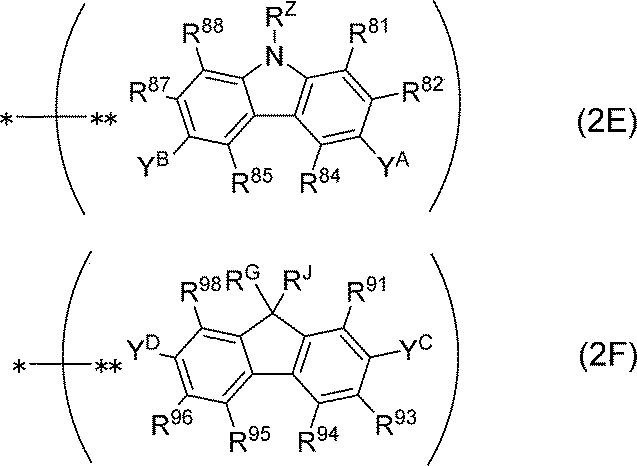
式(2A)中、
・L1は、置換もしくは無置換の環形成炭素数6~30のアリーレン基、又は置換もしくは無置換の環形成原子数5~30の2価の複素環基である。
・*はAr1に結合するL1又は単結合の一端を表し、**はL1又は前記単結合の他端を表す。
・mは0又は1である。
・R31~R38は、それぞれ独立に、水素原子、置換もしくは無置換の炭素数1~6のアルキル基、置換もしくは無置換の環形成炭素数6~12のアリール基、又は置換もしくは無置換の環形成原子数5~13のヘテロアリール基である。
・RC及びRDは、それぞれ独立に、置換もしくは無置換の炭素数1~30のアルキル基、置換もしくは無置換の環形成炭素数6~30のアリール基、又は置換もしくは無置換の環形成原子数5~30のヘテロアリール基である。
・R31~R38、RC、及びRDから選択される一つは、**に結合する単結合又は**に結合する基である。
・前記単結合ではないR31~R38のうち隣り合う一対の基は、互いに結合して置換もしくは無置換の単環を形成するか、互いに結合して置換もしくは無置換の縮合環を形成するか、又は、互いに結合せず環を形成しない。
・前記単結合ではないRCとRDは、互いに結合して置換もしくは無置換の単環を形成するか、互いに結合して置換もしくは無置換の縮合環を形成するか、又は、互いに結合せず環を形成しない。
式(2B)中、
・L2は、置換もしくは無置換の環形成炭素数6~30のアリーレン基、又は置換もしくは無置換の環形成原子数5~30の2価の複素環基である。
・*はAr1に結合するL2又は単結合の一端を表し、**はL2又は前記単結合の他端を表す。
・nは0又は1である。
・R41~R48、R51~R54、及びR55~R58は、それぞれ独立に、水素原子、置換もしくは無置換の炭素数1~6のアルキル基、置換もしくは無置換の環形成炭素数6~12のアリール基、又は置換もしくは無置換の環形成原子数5~13のヘテロアリール基である。
・R45とR46、R46とR47、又はR47とR48のうち一方は*aに結合する単結合であり、他方は*bに結合する単結合である。
・kは0又は1である。
・kが1のとき、R41とR42、R42とR43、又はR43とR44のうち一方は*cに結合する単結合であり、他方は*dに結合する単結合である。
・RXは、水素原子、置換もしくは無置換の炭素数1~30のアルキル基、置換もしくは無置換の環形成炭素数6~30のアリール基、又は置換もしくは無置換の環形成原子数5~30のヘテロアリール基である。
・*c及び*dに結合しないR41~R44、*a及び*bに結合しないR45~R48、R51~R54、R55~R58、及びRXから選ばれる一つは、**に結合する単結合又は**に結合する基である。
・*c及び*dに結合せず前記**に結合する単結合ではないR41~R44、*a及び*bに結合せず前記**に結合する単結合ではないR45~R48、R51~R54、及びR55~R58のうち隣り合う一対の基は、互いに結合して置換もしくは無置換の単環を形成するか、互いに結合して置換もしくは無置換の縮合環を形成するか、又は、互いに結合せず環を形成しない。
式(2C)中、
・L3は、置換もしくは無置換の環形成炭素数6~30のアリーレン基、又は置換もしくは無置換の環形成原子数5~30の2価の複素環基である。
・*はAr1に結合するL3の一端を表し、**はL3の他端を表す。
・R61~R68は、それぞれ独立に、水素原子、置換もしくは無置換の炭素数1~6のアルキル基、置換もしくは無置換の環形成炭素数6~12のアリール基、又は置換もしくは無置換の環形成原子数5~13のヘテロアリール基である。
・R61~R68は、互いに結合して環を形成しない。
・RYは、水素原子、置換もしくは無置換の炭素数1~30のアルキル基、置換もしくは無置換の環形成炭素数6~30のアリール基、又は置換もしくは無置換の環形成原子数5~30のヘテロアリール基である。
・R61~R68及びRYから選択される一つは、**に結合する単結合又は**に結合する基である。
式(2D)中、
・L4は、置換もしくは無置換の環形成炭素数6~30のアリーレン基、又は置換もしくは無置換の環形成原子数5~30の2価の複素環基である。
・*はAr1に結合するL4の一端を表し、**はL4の他端を表す。
・R71~R78は、それぞれ独立に、水素原子、置換もしくは無置換の炭素数1~6のアルキル基、置換もしくは無置換の環形成炭素数6~12のアリール基、又は置換もしくは無置換の環形成原子数5~13のヘテロアリール基である。
・RE及びRFは、それぞれ独立に、置換もしくは無置換の炭素数1~30のアルキル基、置換もしくは無置換の環形成炭素数6~30のアリール基、又は置換もしくは無置換の環形成原子数5~30のヘテロアリール基である。
・R71~R78、RE、及びRFから選択される一つは、**に結合する単結合又は**に結合する基である。
・前記単結合ではないR71~R78のうち隣り合う一対の基は、互いに結合して置換もしくは無置換の単環を形成するか、互いに結合して置換もしくは無置換の縮合環を形成するか、又は、互いに結合せず環を形成しない。
・前記単結合ではないREとRFは、互いに結合して置換もしくは無置換の単環を形成するか、互いに結合して置換もしくは無置換の縮合環を形成するか、又は、互いに結合せず環を形成しない。
式(2E)中、
・*はAr1に結合する単結合の一端を表し、**は前記単結合の他端を表す。
・R81、R82、R84、R85、R87、R88、YA、及びYBは、それぞれ独立に、水素原子、置換もしくは無置換の炭素数1~6のアルキル基、置換もしくは無置換の環形成炭素数6~12のアリール基、又は置換もしくは無置換の環形成原子数5~13のヘテロアリール基である。
・R81、R82、R84、R85、R87、R88、YA、及びYBは、互いに結合して環を形成しない。
・RZは、水素原子、置換もしくは無置換の炭素数1~30のアルキル基、置換もしくは無置換の環形成炭素数6~30のアリール基、又は置換もしくは無置換の環形成原子数5~30のヘテロアリール基である。
・R81、R82、R84、R85、R87、R88、及びRZから選択される一つは、**に結合する単結合、又は**に結合する基である。
式(2F)中、
・*はAr1に結合する単結合の一端を表し、**は前記単結合の他端を表す。
・R91、R93~R96、R98、YC、及びYDは、それぞれ独立に、水素原子、置換もしくは無置換の炭素数1~6のアルキル基、置換もしくは無置換の環形成炭素数6~12のアリール基、又は置換もしくは無置換の環形成原子数5~13のヘテロアリール基である。
・RG及びRJは、それぞれ独立に、置換もしくは無置換の炭素数1~30のアルキル基、置換もしくは無置換の環形成炭素数6~30のアリール基、又は置換もしくは無置換の環形成原子数5~30のヘテロアリール基である。
・R91、R93~R96、R98、RG、及びRJから選択される一つは、**に結合する単結合、又は**に結合する基である。
・前記単結合ではないR91、R93~R96、R98、及び、YC及びYDのうち隣り合う一対の基は、互いに結合して置換もしくは無置換の単環を形成するか、互いに結合して置換もしくは無置換の縮合環を形成するか、又は、互いに結合せず環を形成しない。
・前記単結合ではないRGとRJは、互いに結合して置換もしくは無置換の単環を形成するか、互いに結合して置換もしくは無置換の縮合環を形成するか、又は、互いに結合せず環を形成しない。] A compound represented by the following formula (1).
[In formula (1),
Ar 1 is represented by the following formula (1Aa), (1Ab), or (1B).
In formulas (1Aa) and (1Ab),
*X 1 is an oxygen atom or a sulfur atom.
・R 1 to R 6 and R 8 to R 11 are each independently a hydrogen atom, a substituted or unsubstituted alkyl group having 1 to 6 carbon atoms, or a substituted or unsubstituted aryl group having 6 to 12 ring carbon atoms , or a substituted or unsubstituted heteroaryl group having 5 to 13 ring atoms.
- One selected from R 1 to R 6 and R 8 to R 11 that is not a hydrogen atom is a single bond that binds to Ar 2 or a group that binds to Ar 2 .
- A pair of adjacent groups among R 1 to R 6 and R 8 to R 11 which are not hydrogen atoms but are not single bonds are bonded to each other to form a substituted or unsubstituted monocyclic ring, or together form a substituted or unsubstituted condensed ring, or they are not bonded together to form a ring.
In formula (1B),
* X2 is an oxygen atom or a sulfur atom.
・R 21 to R 28 are each independently a hydrogen atom, a substituted or unsubstituted alkyl group having 1 to 6 carbon atoms, a substituted or unsubstituted aryl group having 6 to 12 ring carbon atoms, or the number of ring atoms 5 to 13 heteroaryl groups.
・R A and R B are each independently a hydrogen atom, a substituted or unsubstituted alkyl group having 1 to 30 carbon atoms, a substituted or unsubstituted aryl group having 6 to 30 ring-forming carbon atoms, or a substituted or unsubstituted is a heteroaryl group having 5 to 30 ring atoms.
* One selected from R 21 to R 28 , R A and R B is a single bond that binds to Ar 2 or a group that binds to Ar 2 .
- A pair of adjacent groups among R 21 to R 24 and R 25 to R 28 which are not single bonds are bonded to each other to form a substituted or unsubstituted monocyclic ring, or bonded to each other to form a substituted or unsubstituted They either form a substituted fused ring or are not joined together to form a ring.
- R A and R B which are not single bonds are bonded to each other to form a substituted or unsubstituted single ring, are bonded to each other to form a substituted or unsubstituted condensed ring, or are not bonded to each other. do not form a ring.
Ar 2 is represented by the following formulas (2A), (2B), (2C), (2D), (2E), or (2F).
* However, when Ar 1 is represented by the formula (1Aa), Ar 2 is represented by the following formula (2C), (2D), (2E), or (2F). When Ar 1 is represented by formula (1Ab), Ar 2 is represented by the following formula (2A) or (2B). When Ar 1 is represented by Formula (1B), Ar 2 is represented by Formula (2A), (2B), (2C), (2D), (2E), or (2F) below.
In formula (2A),
·L 1 is a substituted or unsubstituted arylene group having 6 to 30 ring-forming carbon atoms or a substituted or unsubstituted divalent heterocyclic group having 5 to 30 ring-forming atoms.
* represents L1 or one end of a single bond bound to Ar1 , and ** represents L1 or the other end of the single bond.
- m is 0 or 1;
- R 31 to R 38 are each independently a hydrogen atom, a substituted or unsubstituted alkyl group having 1 to 6 carbon atoms, a substituted or unsubstituted aryl group having 6 to 12 ring carbon atoms, or a substituted or unsubstituted is a heteroaryl group having 5 to 13 ring atoms.
- R C and R D are each independently a substituted or unsubstituted alkyl group having 1 to 30 carbon atoms, a substituted or unsubstituted aryl group having 6 to 30 ring-forming carbon atoms, or a substituted or unsubstituted ring-forming group It is a heteroaryl group having 5 to 30 atoms.
* One selected from R 31 to R 38 , R C and R D is a single bond that binds to ** or a group that binds to **.
- A pair of adjacent groups among R 31 to R 38 which are not single bonds are bonded to each other to form a substituted or unsubstituted monocyclic ring, or bonded to each other to form a substituted or unsubstituted condensed ring. or not bonded together to form a ring.
- R C and R D which are not single bonds are bonded to each other to form a substituted or unsubstituted monocyclic ring, are bonded to each other to form a substituted or unsubstituted condensed ring, or are not bonded to each other. do not form a ring.
In formula (2B),
·L 2 is a substituted or unsubstituted arylene group having 6 to 30 ring-forming carbon atoms or a substituted or unsubstituted divalent heterocyclic group having 5 to 30 ring-forming atoms.
* represents L2 or one end of a single bond bound to Ar1 , and ** represents L2 or the other end of the single bond.
- n is 0 or 1;
・R 41 to R 48 , R 51 to R 54 and R 55 to R 58 are each independently a hydrogen atom, a substituted or unsubstituted alkyl group having 1 to 6 carbon atoms, or a substituted or unsubstituted ring-forming carbon It is an aryl group having 6 to 12 atoms, or a substituted or unsubstituted heteroaryl group having 5 to 13 ring atoms.
- One of R 45 and R 46 , R 46 and R 47 , or R 47 and R 48 is a single bond that bonds to *a, and the other is a single bond that bonds to *b.
- k is 0 or 1;
・when k is 1, one of R 41 and R 42 , R 42 and R 43 , or R 43 and R 44 is a single bond that bonds to *c, and the other is a single bond that bonds to *d .
・R X is a hydrogen atom, a substituted or unsubstituted alkyl group having 1 to 30 carbon atoms, a substituted or unsubstituted aryl group having 6 to 30 ring-forming carbon atoms, or a substituted or unsubstituted 5 to 5 ring-forming atoms 30 heteroaryl groups.
one selected from R 41 to R 44 not bonded to *c and *d, R 45 to R 48 not bonded to *a and *b, R 51 to R 54 , R 55 to R 58 , and R X , ** is a single bond or a group that bonds to **.
· R 41 to R 44 which are not single bonds which are not bonded to *c and *d but are bonded to the above **, R 45 to R 48 which are not single bonds which are not bonded to *a and *b but are bonded to the above ** , R 51 to R 54 , and R 55 to R 58 , a pair of adjacent groups are bonded to each other to form a substituted or unsubstituted monocyclic ring, or bonded to each other to form a substituted or unsubstituted condensed ring. form or are not joined together to form a ring.
In formula (2C),
·L 3 is a substituted or unsubstituted arylene group having 6 to 30 ring carbon atoms or a substituted or unsubstituted divalent heterocyclic group having 5 to 30 ring atoms.
* represents one end of L3 that binds to Ar1 , and ** represents the other end of L3 .
- R 61 to R 68 are each independently a hydrogen atom, a substituted or unsubstituted alkyl group having 1 to 6 carbon atoms, a substituted or unsubstituted aryl group having 6 to 12 ring carbon atoms, or a substituted or unsubstituted is a heteroaryl group having 5 to 13 ring atoms.
* R 61 to R 68 do not combine with each other to form a ring.
・R Y is a hydrogen atom, a substituted or unsubstituted alkyl group having 1 to 30 carbon atoms, a substituted or unsubstituted aryl group having 6 to 30 ring-forming carbon atoms, or a substituted or unsubstituted 5 to 5 ring-forming atoms 30 heteroaryl groups.
* One selected from R 61 to R 68 and R Y is a single bond that binds to ** or a group that binds to **.
In formula (2D),
·L 4 is a substituted or unsubstituted arylene group having 6 to 30 ring-forming carbon atoms or a substituted or unsubstituted divalent heterocyclic group having 5 to 30 ring-forming atoms.
* represents one end of L4 bound to Ar1 , and ** represents the other end of L4 .
- R 71 to R 78 are each independently a hydrogen atom, a substituted or unsubstituted alkyl group having 1 to 6 carbon atoms, a substituted or unsubstituted aryl group having 6 to 12 ring carbon atoms, or a substituted or unsubstituted is a heteroaryl group having 5 to 13 ring atoms.
- R E and R F are each independently a substituted or unsubstituted alkyl group having 1 to 30 carbon atoms, a substituted or unsubstituted aryl group having 6 to 30 ring-forming carbon atoms, or a substituted or unsubstituted ring-forming group It is a heteroaryl group having 5 to 30 atoms.
* One selected from R 71 to R 78 , R E and R F is a single bond that binds to ** or a group that binds to **.
- A pair of adjacent groups among R 71 to R 78 which are not single bonds are bonded to each other to form a substituted or unsubstituted monocyclic ring, or bonded to each other to form a substituted or unsubstituted condensed ring. or not bonded together to form a ring.
- R E and R F which are not single bonds are bonded to each other to form a substituted or unsubstituted single ring, are bonded to each other to form a substituted or unsubstituted condensed ring, or are not bonded to each other. do not form a ring.
In formula (2E),
* represents one end of the single bond bound to Ar 1 , and ** represents the other end of the single bond.
- R 81 , R 82 , R 84 , R 85 , R 87 , R 88 , Y A and Y B are each independently a hydrogen atom, a substituted or unsubstituted alkyl group having 1 to 6 carbon atoms, a substituted or It is an unsubstituted aryl group having 6 to 12 ring carbon atoms or a substituted or unsubstituted heteroaryl group having 5 to 13 ring atoms.
- R 81 , R 82 , R 84 , R 85 , R 87 , R 88 , Y A and Y B are not combined with each other to form a ring.
- R Z is a hydrogen atom, a substituted or unsubstituted alkyl group having 1 to 30 carbon atoms, a substituted or unsubstituted aryl group having 6 to 30 ring-forming carbon atoms, or a substituted or unsubstituted 5 to 5 ring-forming atoms 30 heteroaryl groups.
- One selected from R 81 , R 82 , R 84 , R 85 , R 87 , R 88 and R Z is a single bond that binds to ** or a group that binds to **.
In formula (2F),
* represents one end of the single bond bound to Ar 1 , and ** represents the other end of the single bond.
・R 91 , R 93 to R 96 , R 98 , Y C and Y D are each independently a hydrogen atom, a substituted or unsubstituted alkyl group having 1 to 6 carbon atoms, or a substituted or unsubstituted ring-forming carbon It is an aryl group having 6 to 12 atoms, or a substituted or unsubstituted heteroaryl group having 5 to 13 ring atoms.
- R G and R J are each independently a substituted or unsubstituted alkyl group having 1 to 30 carbon atoms, a substituted or unsubstituted aryl group having 6 to 30 ring-forming carbon atoms, or a substituted or unsubstituted ring-forming group It is a heteroaryl group having 5 to 30 atoms.
- One selected from R 91 , R 93 to R 96 , R 98 , R G and R J is a single bond that binds to ** or a group that binds to **.
a pair of adjacent groups among R 91 , R 93 to R 96 , R 98 , and Y C and Y D which are not single bonds are bonded to each other to form a substituted or unsubstituted monocyclic ring; They are joined together to form a substituted or unsubstituted condensed ring, or they are not joined together to form a ring.
- R G and R J , which are not single bonds, are bonded to each other to form a substituted or unsubstituted single ring, are bonded to each other to form a substituted or unsubstituted condensed ring, or are not bonded to each other; do not form a ring. ]

[式(1-1)~(1-4)中、X1、X2、L1、L2、RA、RB、RC、RD、RX、R1~R6、R8~R11、R21~R28、R31~R38、R41~R48、R51~R54、R55~R58、k、m、n、*、**、*a、*b、*c、及び*dは、前記式(1)において定義したとおりである。] The compound according to claim 1, represented by any one of the following formulas (1-1) to (1-4).
[In formulas (1-1) to (1-4), X 1 , X 2 , L 1 , L 2 , R A , R B , R C , R D , R X , R 1 to R 6 , R 8 to R 11 , R 21 to R 28 , R 31 to R 38 , R 41 to R 48 , R 51 to R 54 , R 55 to R 58 , k, m, n, *, **, *a, *b , *c, and *d are as defined in formula (1) above. ]

[式(1-5)~(1-8)中、X1、X2、L3、L4、RA、RB、RE、RF、RY、R1~R6、R8~R11、R21~R28、R61~R68、R71~R78、*、及び**は、前記式(1)において定義したとおりである。] The compound according to claim 1, represented by any one of the following formulas (1-5) to (1-8).
[In formulas ( 1-5 ) to (1-8), X 1 , X 2 , L 3 , L 4 , RA , RB , RE , RF , RY , R 1 to R 6 , R 8 to R 11 , R 21 to R 28 , R 61 to R 68 , R 71 to R 78 , *, and ** are as defined in formula (1) above. ]

[式(1-9)~(1-12)中、X1、X2、RA、RB、RG、RJ、RZ、R1~R6、R8~R11、R21~R28、R81、R82、R84、R85、R87、R88、R91、R93~R96、R98、YA、YB、YC、YD、*、及び**は、前記式(1)において定義したとおりである。] The compound according to claim 1, represented by any one of the following formulas (1-9) to (1-12).
[In formulas (1-9) to ( 1-12 ), X 1 , X 2 , RA , RB , RG , R J , R Z , R 1 to R 6 , R 8 to R 11 , R 21 to R 28 , R 81 , R 82 , R 84 , R 85 , R 87 , R 88 , R 91 , R 93 to R 96 , R 98 , Y A , Y B , Y C , Y D , *, and * * is as defined in formula (1) above. ]


[式(1-9a)~(1-9d)及び(1-11a)~(1-11d)、中、X1、X2、RA、RB、RZ、R1~R6、R8~R11、R21~R28、R81、R82、R84、R85、R87、R88、YA、YB、及び*は、前記式(1)において定義したとおりである。] The compound according to claim 1, represented by any one of the following formulas (1-9a) to (1-9d) and (1-11a) to (1-11d).
[Formulas (1-9a) to (1-9d) and (1-11a) to (1-11d), in which X 1 , X 2 , R A , R B , R Z , R 1 to R 6 , R 8 to R 11 , R 21 to R 28 , R 81 , R 82 , R 84 , R 85 , R 87 , R 88 , Y A , Y B and * are as defined in formula (1) above. . ]


[式(1-10a)~(1-10c)及び(1-12a)~(1-12c)、中、X1、X2、RG、RJ、R1~R6、R8~R11、R21~R28、R91、R93~R96、R98、YC、YD、及び*は、前記式(1)において定義したとおりである。] The compound according to claim 1, represented by any one of the following formulas (1-10a) to (1-10c) and (1-12a) to (1-12c).
[Formulas (1-10a) to (1-10c) and (1-12a) to (1-12c), in which X 1 , X 2 , R G , R J , R 1 to R 6 , R 8 to R 11 , R 21 to R 28 , R 91 , R 93 to R 96 , R 98 , Y C , Y D and * are as defined in formula (1) above. ]


[式(1-1-1)、(1-2-1)、(1-5-1)、(1-6-1)、(1-9-1)、及び(1-10-1)中、X1、L1、L2、L3、L4、RC、RD、RE、RF、RG、RJ、RX、RY、RZ、R1~R6、R8~R11、R31~R38、R41~R48、R51~R54、R55~R58、R61~R68、R71~R78、R81、R82、R84、R85、R87、R88、R91、R93~R96、R98、YA、YB、YC、YD、k、m、n、**、*a、*b、*c、及び*dは、前記式(1)において定義したとおりである。] The following formulas (1-1-1), (1-2-1), (1-5-1), (1-6-1), (1-9-1), and (1-10-1) The compound according to claim 1, represented by any of
[Formulas (1-1-1), (1-2-1), (1-5-1), (1-6-1), (1-9-1), and (1-10-1) middle, X 1 , L 1 , L 2 , L 3 , L 4 , R C , R D , R E , R F , R G , R J , R X , R Y , R Z , R 1 to R 6 , R 8 to R 11 , R 31 to R 38 , R 41 to R 48 , R 51 to R 54 , R 55 to R 58 , R 61 to R 68 , R 71 to R 78 , R 81 , R 82 , R 84 , R 85 , R 87 , R 88 , R 91 , R 93 to R 96 , R 98 , Y A , Y B , Y C , Y D , k, m , n, **, *a, *b, * c and *d are as defined in formula (1) above. ]
前記式(2D)における、R72、R74、R75、及びR77から選択される一つが、**に結合する単結合又は**に結合する基であり、
前記式(2F)における、R94及びR95から選択される一つが、**に結合する単結合又は**に結合する基である、請求項1に記載の化合物。 One selected from R 32 , R 34 , R 35 and R 37 in the formula (2A) is a single bond that binds to ** or a group that binds to **,
One selected from R 72 , R 74 , R 75 and R 77 in the formula (2D) is a single bond that binds to ** or a group that binds to **,
2. The compound according to claim 1, wherein one selected from R94 and R95 in the formula (2F) is a single bond bonded to ** or a group bonded to **.


[式(2Ba)~(2Bi)中、L2、RX、R41~R48、R51~R54、R55~R58、n、*、及び**は、前記式(1)において定義したとおりである。] 2. The compound according to claim 1, wherein Ar 2 represented by the formula (2B) is represented by any one of the following formulas (2Ba) to (2Bi).
[In formulas (2Ba) to (2Bi), L 2 , R X , R 41 to R 48 , R 51 to R 54 , R 55 to R 58 , n, *, and ** are As defined. ]
前記第1正孔輸送層及び前記第2正孔輸送層の少なくとも一方が請求項1~28のいずれか1項に記載の化合物を含む、請求項32に記載の有機エレクトロルミネッセンス素子。 wherein the hole transport zone comprises a first hole transport layer on the anode side and a second hole transport layer on the cathode side;
[33] The organic electroluminescence device according to [32], wherein at least one of the first hole transport layer and the second hole transport layer contains the compound according to any one of [1] to [28].
前記正孔輸送帯域が、下記の条件(A)~(C)を満たす化合物Aを含有する、有機エレクトロルミネッセンス素子。
(A)最高被占軌道のエネルギー準位HOMOが-6.00~-5.50eVである。
(B)三重項エネルギーT1が2.10eV以上である。
(C)フォトルミネッセンス強度PLの80%減衰時間tが0.10h以上である。
但し、条件(C)中、
PLは、測定対象の化合物を膜厚100nmに成膜した測定材に対して、照射強度I1で365nmの紫外線を照射したときのフォトルミネッセンス発光スペクトルの強度であり、
tは、前記紫外線の照射開始時からPLが80%に減衰するまでの時間であり、
I1は、下記数式(数1)で規定され、
I1=I0×(A0/A1)・・・(数1)
数式(数1)中、
I0は、下記化学式で表される化合物を膜厚100nmに成膜した基準材のPL測定時の照射強度、

A0は前記基準材の吸収率、
A1は前記測定材の吸収率であり、
前記各吸収率は、下記数式(数2)で規定され、
吸収率=1-EXP(-4×3.1416×ko×d/w)・・・(数2)
数式(数2)中、
koは測定対象の化合物を成膜した測定材又は基準材の面内方向の消衰係数、
dは測定対象の化合物を成膜した測定材又は基準材の膜厚、
wは照射光の波長である。 comprising, in order, an anode, a hole transport zone, a light-emitting layer, and a cathode;
The organic electroluminescence device, wherein the hole-transporting zone contains a compound A that satisfies the following conditions (A) to (C).
(A) The energy level HOMO of the highest occupied orbital is -6.00 to -5.50 eV.
(B) The triplet energy T1 is 2.10 eV or more.
(C) The 80% attenuation time t of the photoluminescence intensity PL is 0.10 h or longer.
However, in condition (C),
PL is the intensity of the photoluminescence emission spectrum when a measurement material formed by forming a film of the compound to be measured to a thickness of 100 nm is irradiated with ultraviolet rays of 365 nm at an irradiation intensity of I1 ,
t is the time from the start of irradiation of the ultraviolet rays until the PL is attenuated to 80%,
I 1 is defined by the following formula (Equation 1),
I 1 =I 0 ×(A 0 /A 1 ) (Equation 1)
In the formula (number 1),
I 0 is the irradiation intensity during PL measurement of a reference material formed by forming a film of a compound represented by the following chemical formula to a thickness of 100 nm,
A 0 is the absorption rate of the reference material,
A 1 is the absorption rate of the measurement material,
Each absorption rate is defined by the following formula (Equation 2),
Absorption rate = 1-EXP (-4 x 3.1416 x ko x d/w) (Equation 2)
In the formula (number 2),
ko is the extinction coefficient in the in-plane direction of the measurement material or reference material on which the compound to be measured is deposited,
d is the film thickness of the measurement material or reference material on which the compound to be measured is deposited,
w is the wavelength of the illuminating light.

[式(1’)中、
Xは、酸素原子又は硫黄原子である。
pは1、2、又は3である。
R1’~R6’及びR8’~R11’は、それぞれ独立に、水素原子;置換もしくは無置換の炭素数1~30のアルキル基;置換もしくは無置換のフェニル基、置換もしくは無置換のナフチル基、置換もしくは無置換のビフェニル基、置換もしくは無置換のフェナントリル基、置換もしくは無置換のフルオレニル基、又は置換もしくは無置換のトリフェニル基である。但し、pが1のとき、R1’~R6’及びR8’~R11’から選択される一つは*に結合する単結合又は*に結合する基であり、pが2のとき、R1’~R6’及びR8’~R11’から選択される二つは*に結合する単結合又は*に結合する基であり、pが3のとき、R1’~R6’及びR8’~R11’から選択される三つは*に結合する単結合又は*に結合する基である。
水素原子ではなく前記単結合ではないR1’~R6’、及びR8’~R11’のうち隣り合う一対の基は、互いに結合せず環を形成しない。
Arは、
・R1’~R6’及びR8’~R11’のいずれかに直接結合する、置換もしくは無置換のフェニル基、置換もしくは無置換のナフチル基、置換もしくは無置換のビフェニル基、置換もしくは無置換のフェナントリル基、置換もしくは無置換のフルオレニル基、又は置換もしくは無置換のトリフェニル基;又は置換もしくは無置換の環形成原子数5~30のヘテロアリール基であるか、
・R1’~R6’及びR8’~R11’のいずれかに結合する、置換もしくは無置換のフェニレン基、置換もしくは無置換のナフチレン基、置換もしくは無置換のビフェニレン基、置換もしくは無置換のフェナントレニレン基、置換もしくは無置換のフルオレニレン基、置換もしくは無置換のトリフェニレン基、又はこれらの2価の基から選択される複数を組み合わせた基に結合した、置換もしくは無置換のフェニル基、置換もしくは無置換のナフチル基、置換もしくは無置換のビフェニル基、置換もしくは無置換のフェナントリル基、置換もしくは無置換のフルオレニル基、又は置換もしくは無置換のトリフェニレニル基;又は置換もしくは無置換の環形成原子数5~30のヘテロアリール基である。
pが2又は3のとき、複数存在する*-Arは、互いに同一であるか、又は互いに異なる。] 41. The organic electroluminescence device according to any one of claims 35 to 40, wherein said compound A is represented by the following formula (1).
[In formula (1′),
X is an oxygen atom or a sulfur atom.
p is 1, 2, or 3;
R 1′ to R 6′ and R 8′ to R 11′ are each independently a hydrogen atom; a substituted or unsubstituted alkyl group having 1 to 30 carbon atoms; a substituted or unsubstituted phenyl group; a substituted or unsubstituted a naphthyl group, a substituted or unsubstituted biphenyl group, a substituted or unsubstituted phenanthryl group, a substituted or unsubstituted fluorenyl group, or a substituted or unsubstituted triphenyl group. provided that when p is 1, one selected from R 1′ to R 6′ and R 8′ to R 11′ is a single bond that binds to * or a group that binds to *, and when p is 2 , R 1′ to R 6′ and R 8′ to R 11′ are a single bond that binds to * or a group that binds to *, and when p is 3, R 1′ to R 6 ' and three selected from R 8' to R 11' are a single bond that binds to * or a group that binds to *.
A pair of adjacent groups among R 1′ to R 6 ′ and R 8′ to R 11′ which are not hydrogen atoms and are not single bonds do not bond to form a ring.
Ar is
- A substituted or unsubstituted phenyl group, a substituted or unsubstituted naphthyl group , a substituted or unsubstituted biphenyl group , a substituted or unsubstituted unsubstituted phenanthryl group, substituted or unsubstituted fluorenyl group, or substituted or unsubstituted triphenyl group; or substituted or unsubstituted heteroaryl group having 5 to 30 ring atoms,
- A substituted or unsubstituted phenylene group, a substituted or unsubstituted naphthylene group , a substituted or unsubstituted biphenylene group , a substituted or unsubstituted substituted or unsubstituted phenyl bonded to a substituted phenanthrenylene group, a substituted or unsubstituted fluorenylene group, a substituted or unsubstituted triphenylene group, or a group combining a plurality of these divalent groups; a substituted or unsubstituted naphthyl group, a substituted or unsubstituted biphenyl group, a substituted or unsubstituted phenanthryl group, a substituted or unsubstituted fluorenyl group, or a substituted or unsubstituted triphenylenyl group; or a substituted or unsubstituted ring It is a heteroaryl group having 5 to 30 forming atoms.
When p is 2 or 3, multiple *-Ars are the same or different. ]

[式(2A’)中、
・L1’は、置換もしくは無置換のフェニレン基、置換もしくは無置換のナフチレン基、置換もしくは無置換のビフェニレン基、置換もしくは無置換のフェナントレニレン基、置換もしくは無置換のフルオレニレン基、置換もしくは無置換のトリフェニレン基、又はこれらの基から選択される複数を組み合わせた2価の基である。
・m1は0又は1である。
・R31’~R38’は、それぞれ独立に、水素原子、置換もしくは無置換の炭素数1~6のアルキル基、置換もしくは無置換の環形成炭素数6~12のアリール基、又は置換もしくは無置換の環形成原子数5~13のヘテロアリール基である。
・RC’及びRD’は、それぞれ独立に、置換もしくは無置換の炭素数1~30のアルキル基、置換もしくは無置換の環形成炭素数6~30のアリール基、又は置換もしくは無置換の環形成原子数5~30のヘテロアリール基である。
・R31’~R38’、RC’、及びRD’から選択される一つは、**に結合する単結合又は**に結合する基である。
・前記単結合ではないR31’~R38’のうち隣り合う一対の基は、互いに結合して置換もしくは無置換の単環を形成するか、互いに結合して置換もしくは無置換の縮合環を形成するか、又は、互いに結合せず環を形成しない。
・前記単結合ではないRC’とRD’は、互いに結合して置換もしくは無置換の単環を形成するか、互いに結合して置換もしくは無置換の縮合環を形成するか、又は、互いに結合せず環を形成しない。]

[式(2B’)中、
・L2’は、置換もしくは無置換のフェニレン基、置換もしくは無置換のナフチレン基、置換もしくは無置換のビフェニレン基、置換もしくは無置換のフェナントレニレン基、置換もしくは無置換のフルオレニレン基、置換もしくは無置換のトリフェニレン基、又はこれらの基から選択される複数を組み合わせた2価の基である。
・n1は0又は1である。
・R41’~R48’、R51’~R54’、及びR55’~R58’は、それぞれ独立に、水素原子、置換もしくは無置換の炭素数1~6のアルキル基、置換もしくは無置換の環形成炭素数6~12のアリール基、又は置換もしくは無置換の環形成原子数5~13のヘテロアリール基である。
・j1は0又は1である。
・j1が1のとき、R45’とR46’、R46’とR47’、又はR47’とR48’のうち一方は*a1に結合する単結合であり、他方は*b1に結合する単結合である。
・k1は0又は1である。
・k1が1のとき、R41’とR42’、R42’とR43’、又はR43’とR44’のうち一方は*c1に結合する単結合であり、他方は*d1に結合する単結合である。
・RX’は、水素原子、置換もしくは無置換の炭素数1~30のアルキル基、置換もしくは無置換の環形成炭素数6~30のアリール基、又は置換もしくは無置換の環形成原子数5~30のヘテロアリール基である。
・*c1及び*d1に結合しないR41’~R44’、*a1及び*b1に結合しないR45’~R48’、R51’~R54’、R55’~R58’、及びRX’から選ばれる一つは、**に結合する単結合又は**に結合する基である。
・*c1及び*d1に結合せず前記**に結合する単結合ではないR41’~R44’、*a1及び*b1に結合せず前記**に結合する単結合ではないR45’~R48’、前記**に結合する単結合ではないR51’~R54’、及び前記**に結合する単結合ではないR55’~R58’のうち隣り合う一対の基は、互いに結合して置換もしくは無置換の単環を形成するか、互いに結合して置換もしくは無置換の縮合環を形成するか、又は、互いに結合せず環を形成しない。] 42. The organic electroluminescence device according to claim 41, wherein *-Ar in formula (1) is represented by formula (2A') or (2B') below.
[In formula (2A′),
・L 1′ is a substituted or unsubstituted phenylene group, a substituted or unsubstituted naphthylene group, a substituted or unsubstituted biphenylene group, a substituted or unsubstituted phenanthrenylene group, a substituted or unsubstituted fluorenylene group, a substituted Alternatively, it is an unsubstituted triphenylene group, or a divalent group combining a plurality of groups selected from these groups.
- m1 is 0 or 1;
・R 31′ to R 38′ are each independently a hydrogen atom, a substituted or unsubstituted alkyl group having 1 to 6 carbon atoms, a substituted or unsubstituted aryl group having 6 to 12 ring carbon atoms, or a substituted or It is an unsubstituted heteroaryl group having 5 to 13 ring atoms.
- R C' and R D' are each independently a substituted or unsubstituted alkyl group having 1 to 30 carbon atoms, a substituted or unsubstituted aryl group having 6 to 30 ring carbon atoms, or a substituted or unsubstituted It is a heteroaryl group having 5 to 30 ring atoms.
- One selected from R 31' to R 38' , R C' and R D' is a single bond that binds to ** or a group that binds to **.
A pair of adjacent groups among R 31′ to R 38′ that are not single bonds are bonded to each other to form a substituted or unsubstituted monocyclic ring, or bonded to each other to form a substituted or unsubstituted condensed ring. form or are not joined together to form a ring.
- R C' and R D' which are not single bonds are bonded to each other to form a substituted or unsubstituted monocyclic ring, bonded to each other to form a substituted or unsubstituted condensed ring, or Does not combine to form a ring. ]
[In formula (2B′),
・L 2′ is a substituted or unsubstituted phenylene group, a substituted or unsubstituted naphthylene group, a substituted or unsubstituted biphenylene group, a substituted or unsubstituted phenanthrenylene group, a substituted or unsubstituted fluorenylene group, a substituted Alternatively, it is an unsubstituted triphenylene group, or a divalent group combining a plurality of groups selected from these groups.
- n1 is 0 or 1;
・R 41′ to R 48′ , R 51′ to R 54′ , and R 55′ to R 58′ are each independently a hydrogen atom, a substituted or unsubstituted alkyl group having 1 to 6 carbon atoms, a substituted or It is an unsubstituted aryl group having 6 to 12 ring carbon atoms or a substituted or unsubstituted heteroaryl group having 5 to 13 ring atoms.
- j1 is 0 or 1;
・when j1 is 1, one of R 45′ and R 46′ , R 46′ and R 47′ , or R 47′ and R 48′ is a single bond that binds to *a1, and the other is a single bond that binds to *b1 It is a single bond that joins.
- k1 is 0 or 1;
・when k1 is 1, one of R 41′ and R 42′ , R 42′ and R 43′ , or R 43′ and R 44′ is a single bond that binds to *c1, and the other is a single bond that binds to *d1; It is a single bond that joins.
・R X′ is a hydrogen atom, a substituted or unsubstituted alkyl group having 1 to 30 carbon atoms, a substituted or unsubstituted aryl group having 6 to 30 ring-forming carbon atoms, or a substituted or unsubstituted 5 ring-forming atoms ~30 heteroaryl groups.
· R 41′ to R 44 ′ not bonded to *c1 and *d1, R 45′ to R 48′ , R 51′ to R 54 ′ , R 55′ to R 58′ not bonded to *a1 and *b1, and One selected from R X' is a single bond that bonds to ** or a group that bonds to **.
· R 41′ to R 44′ that are not single bonds that are not bonded to *c1 and *d1 but are bonded to the above **, R 45 ′ that is not a single bond that is not bonded to *a1 and *b1 but is bonded to the above ** ∼R 48′ , R 51′ to R 54 ′ which are not single bonds bonded to **, and R 55′ to R 58′ which are not single bonds bonded to **, a pair of adjacent groups are They are bonded to each other to form a substituted or unsubstituted monocyclic ring, bonded to each other to form a substituted or unsubstituted condensed ring, or are not bonded to form a ring. ]


[式(2Ba’)~(2Bj’)中、L2’、RX’、R41’~R48’、R51’~R54’、R55’~R58’、n1、*、及び**は、前記式(1’)及び式(2B’)において定義したとおりである。] 43. The organic electroluminescence device according to claim 42, wherein the formula (2B') is represented by any one of the following formulas (2Ba') to (2Bj').
[In the formulas (2Ba′) to (2Bj′), L 2′ , R X′ , R 41′ to R 48′ , R 51′ to R 54 ′ , R 55′ to R 58′ , n1, *, and ** is as defined in formulas (1′) and (2B′) above. ]
前記第1正孔輸送層及び前記第2正孔輸送層の少なくとも一方が前記化合物Aを含む、請求項52に記載の有機エレクトロルミネッセンス素子。 wherein the hole transport zone comprises a first hole transport layer on the anode side and a second hole transport layer on the cathode side;
53. The organic electroluminescence device according to claim 52, wherein at least one of said first hole transport layer and said second hole transport layer contains said compound A.
前記電子輸送帯域が発光層側の第1電子輸送層と陰極側の第2電子輸送層とを含む、請求項31~56のいずれか1項に記載の有機エレクトロルミネッセンス素子。 further comprising an electron-transporting zone between the light-emitting layer and the cathode;
57. The organic electroluminescent device according to any one of claims 31 to 56, wherein said electron-transporting zone comprises a first electron-transporting layer on the light-emitting layer side and a second electron-transporting layer on the cathode side.
前記電子輸送帯域が発光層側に位置する電子輸送層と陰極側に位置する電子注入層とを含む、請求項31~56のいずれか1項に記載の有機エレクトロルミネッセンス素子。 further comprising an electron-transporting zone between the light-emitting layer and the cathode;
57. The organic electroluminescence device according to any one of claims 31 to 56, wherein said electron transport zone comprises an electron transport layer located on the light emitting layer side and an electron injection layer located on the cathode side.
Priority Applications (3)
| Application Number | Priority Date | Filing Date | Title |
|---|---|---|---|
| CN202280083639.3A CN118475566A (en) | 2021-12-24 | 2022-12-23 | Compound, material for organic electroluminescent element, and electronic device |
| KR1020247020272A KR20240128838A (en) | 2021-12-24 | 2022-12-23 | Compounds, materials for organic electroluminescent devices, organic electroluminescent devices and electronic devices |
| US18/718,576 US20250136569A1 (en) | 2021-12-24 | 2022-12-23 | Compound, material for organic electroluminescent element, organic electroluminescent element, and electronic device |
Applications Claiming Priority (4)
| Application Number | Priority Date | Filing Date | Title |
|---|---|---|---|
| JP2021-211424 | 2021-12-24 | ||
| JP2021211424 | 2021-12-24 | ||
| JP2022075172 | 2022-04-28 | ||
| JP2022-075172 | 2022-04-28 |
Publications (1)
| Publication Number | Publication Date |
|---|---|
| WO2023120714A1 true WO2023120714A1 (en) | 2023-06-29 |
Family
ID=86902817
Family Applications (1)
| Application Number | Title | Priority Date | Filing Date |
|---|---|---|---|
| PCT/JP2022/047680 Ceased WO2023120714A1 (en) | 2021-12-24 | 2022-12-23 | Compound, material for organic electroluminescent element, organic electroluminescent element, and electronic device |
Country Status (3)
| Country | Link |
|---|---|
| US (1) | US20250136569A1 (en) |
| KR (1) | KR20240128838A (en) |
| WO (1) | WO2023120714A1 (en) |
Citations (1)
| Publication number | Priority date | Publication date | Assignee | Title |
|---|---|---|---|---|
| CN108148037A (en) * | 2017-11-15 | 2018-06-12 | 南京高光半导体材料有限公司 | Blue light-emitting compound, organic electroluminescence device and its application |
Family Cites Families (16)
| Publication number | Priority date | Publication date | Assignee | Title |
|---|---|---|---|---|
| KR20180126629A (en) | 2011-12-12 | 2018-11-27 | 메르크 파텐트 게엠베하 | Compounds for electronic devices |
| KR102269131B1 (en) | 2013-07-01 | 2021-06-25 | 삼성디스플레이 주식회사 | Compound and organic light emitting device comprising same |
| KR102191990B1 (en) | 2013-09-10 | 2020-12-17 | 삼성디스플레이 주식회사 | Condensed compound and organic light emitting diode comprising the same |
| KR101622821B1 (en) | 2014-02-14 | 2016-05-19 | 주식회사 두산 | Organic compounds and organic electro luminescence device comprising the same |
| WO2015178585A1 (en) | 2014-05-22 | 2015-11-26 | 덕산네오룩스 주식회사 | Compound for electro-organic device, electro-organic device using same, and electronic device therefor |
| JP2017022194A (en) | 2015-07-08 | 2017-01-26 | 三星ディスプレイ株式會社Samsung Display Co.,Ltd. | Material for organic electroluminescence device and organic electroluminescence device using the same |
| KR102603864B1 (en) | 2016-05-13 | 2023-11-21 | 삼성디스플레이 주식회사 | Compound and Organic light emitting device comprising same |
| JP7104686B2 (en) | 2017-03-15 | 2022-07-21 | 保土谷化学工業株式会社 | Organic electroluminescence device |
| CN111051291A (en) | 2017-10-20 | 2020-04-21 | 株式会社Lg化学 | Novel compound and organic light emitting device comprising same |
| WO2020004235A1 (en) | 2018-06-25 | 2020-01-02 | 保土谷化学工業株式会社 | Compound having triarylamine structure and electroluminescence device |
| KR102288034B1 (en) | 2018-11-23 | 2021-08-10 | 주식회사 엘지화학 | Compound and organic light emitting device comprising the same |
| KR102542200B1 (en) | 2018-12-21 | 2023-06-09 | 주식회사 엘지화학 | Compound and organic light emitting device comprising the same |
| KR102041137B1 (en) | 2019-04-02 | 2019-11-07 | 머티어리얼사이언스 주식회사 | Organic compound and organic electroluminescent device comprising the same |
| US20220289704A1 (en) | 2019-08-08 | 2022-09-15 | Idemitsu Kosan Co.,Ltd. | Organic electroluminescent element and electronic device using same |
| JP2023011954A (en) | 2019-11-08 | 2023-01-25 | 出光興産株式会社 | Organic electroluminescence element and electronic device |
| KR20230006841A (en) | 2020-04-15 | 2023-01-11 | 이데미쓰 고산 가부시키가이샤 | Organic electroluminescent elements and electronic devices |
-
2022
- 2022-12-23 WO PCT/JP2022/047680 patent/WO2023120714A1/en not_active Ceased
- 2022-12-23 KR KR1020247020272A patent/KR20240128838A/en active Pending
- 2022-12-23 US US18/718,576 patent/US20250136569A1/en active Pending
Patent Citations (1)
| Publication number | Priority date | Publication date | Assignee | Title |
|---|---|---|---|---|
| CN108148037A (en) * | 2017-11-15 | 2018-06-12 | 南京高光半导体材料有限公司 | Blue light-emitting compound, organic electroluminescence device and its application |
Non-Patent Citations (2)
| Title |
|---|
| GAO KUO, LIU KUNKUN, LI XIANG-LONG, CAI XINYI, CHEN DONGJUN, XU ZHIDA, HE ZUOZHENG, LI BINBIN, QIAO ZHENYANG, CHEN DONGCHENG, CAO : "An ideal universal host for highly efficient full-color, white phosphorescent and TADF OLEDs with a simple and unified structure", JOURNAL OF MATERIALS CHEMISTRY C, ROYAL SOCIETY OF CHEMISTRY, GB, vol. 5, no. 39, 1 January 2017 (2017-01-01), GB , pages 10406 - 10416, XP093074614, ISSN: 2050-7526, DOI: 10.1039/C7TC04149G * |
| YAN QIAN, GUOHUA XIE, SHUFEN CHEN, ZHENGDONG LIU, YEREN NI, XINHUI ZHOU, LINGHAI XIE, JING LIANG, YUEZHI ZHAO, MINGHONG YI, YI ZHA: "A new spiro[fluorene-9,9′-xanthene]-based host material possessing no conventional hole- and electron-transporting units for efficient and low voltage blue PHOLED via simple two-step synthesis", ORGANIC ELECTRONICS, NORTH-HOLLAND, vol. 13, no. 11, 1 November 2012 (2012-11-01), pages 2741 - 2746, XP055130231, ISSN: 15661199, DOI: 10.1016/j.orgel.2012.07.047 * |
Also Published As
| Publication number | Publication date |
|---|---|
| US20250136569A1 (en) | 2025-05-01 |
| KR20240128838A (en) | 2024-08-27 |
Similar Documents
| Publication | Publication Date | Title |
|---|---|---|
| JP7671733B2 (en) | Compound, material for organic electroluminescence device, organic electroluminescence device and electronic device | |
| JP7538360B2 (en) | Compound, material for organic electroluminescence device, organic electroluminescence device, and electronic device | |
| JP2025148398A (en) | Compound, material for organic electroluminescence device, organic electroluminescence device, and electronic device | |
| WO2022250103A1 (en) | Compound, organic electroluminescent element material, organic electroluminescent element, and electronic device | |
| JP2025084790A (en) | Compound, material for organic electroluminescence device, organic electroluminescence device and electronic device | |
| WO2024034659A1 (en) | Organic electroluminescent element and electronic appliance | |
| KR20240137576A (en) | Compounds, materials for organic electroluminescent devices, organic electroluminescent devices, and electronic devices | |
| WO2022259886A1 (en) | Compound, material for organic electroluminescent elements, organic electroluminescent element and electronic device | |
| WO2023120714A1 (en) | Compound, material for organic electroluminescent element, organic electroluminescent element, and electronic device | |
| WO2024157890A1 (en) | Compound, material for organic electroluminescent element, organic electroluminescent element, and electronic device | |
| WO2025074962A1 (en) | Compound, material for organic electroluminescent element, organic electroluminescent element, and electronic device | |
| WO2024171783A1 (en) | Compound, material for organic electroluminescent element, organic electroluminescent element, and electronic device | |
| WO2025100228A1 (en) | Compound, material for organic electroluminescent element, organic electroluminescent element, and electronic device | |
| WO2023182323A1 (en) | Compound, material for organic electroluminescent element, organic electroluminescent element, and electronic device | |
| WO2024085036A1 (en) | Compound, material for organic electroluminescent element, organic electroluminescent element, and electronic appliance | |
| WO2025142879A1 (en) | Compound, material for organic electroluminescent element, organic electroluminescent element, and electronic device | |
| WO2022270296A1 (en) | Compound, organic electroluminescent element material, organic electroluminescent element, and electronic device | |
| WO2023190987A1 (en) | Compound, material for organic electroluminescent element, organic electroluminescent element, and electronic device | |
| JP2023137769A (en) | Organic electroluminescencent elements and electronic devices | |
| WO2022270638A1 (en) | Compound, organic electroluminescent element material, organic electroluminescent element, and electronic device | |
| WO2023210698A1 (en) | Compound, material for organic electroluminescent element, organic electroluminescent element, and electronic device | |
| JP2025002721A (en) | Compound, material for organic electroluminescence device, organic electroluminescence device and electronic device | |
| WO2023223855A1 (en) | Compound, material for organic electroluminescent elements, organic electroluminescent element, and electronic device | |
| WO2023162947A1 (en) | Compound, organic electroluminescent element material, organic electroluminescent element, and electronic device | |
| WO2025079668A1 (en) | Compound, material for organic electroluminescent elements, organic electroluminescent element, and electronic device |
Legal Events
| Date | Code | Title | Description |
|---|---|---|---|
| 121 | Ep: the epo has been informed by wipo that ep was designated in this application |
Ref document number: 22911415 Country of ref document: EP Kind code of ref document: A1 |
|
| WWE | Wipo information: entry into national phase |
Ref document number: 18718576 Country of ref document: US |
|
| WWE | Wipo information: entry into national phase |
Ref document number: 202280083639.3 Country of ref document: CN |
|
| NENP | Non-entry into the national phase |
Ref country code: DE |
|
| 122 | Ep: pct application non-entry in european phase |
Ref document number: 22911415 Country of ref document: EP Kind code of ref document: A1 |
|
| NENP | Non-entry into the national phase |
Ref country code: JP |
|
| WWP | Wipo information: published in national office |
Ref document number: 18718576 Country of ref document: US |