WO2023098352A1 - 脱网检测方法、脱网检测设备及存储介质 - Google Patents
脱网检测方法、脱网检测设备及存储介质 Download PDFInfo
- Publication number
- WO2023098352A1 WO2023098352A1 PCT/CN2022/127857 CN2022127857W WO2023098352A1 WO 2023098352 A1 WO2023098352 A1 WO 2023098352A1 CN 2022127857 W CN2022127857 W CN 2022127857W WO 2023098352 A1 WO2023098352 A1 WO 2023098352A1
- Authority
- WO
- WIPO (PCT)
- Prior art keywords
- terminal
- network
- interface
- core network
- release
- Prior art date
- Legal status (The legal status is an assumption and is not a legal conclusion. Google has not performed a legal analysis and makes no representation as to the accuracy of the status listed.)
- Ceased
Links
Images


Classifications
-
- H—ELECTRICITY
- H04—ELECTRIC COMMUNICATION TECHNIQUE
- H04L—TRANSMISSION OF DIGITAL INFORMATION, e.g. TELEGRAPHIC COMMUNICATION
- H04L43/00—Arrangements for monitoring or testing data switching networks
- H04L43/08—Monitoring or testing based on specific metrics, e.g. QoS, energy consumption or environmental parameters
- H04L43/0805—Monitoring or testing based on specific metrics, e.g. QoS, energy consumption or environmental parameters by checking availability
- H04L43/0811—Monitoring or testing based on specific metrics, e.g. QoS, energy consumption or environmental parameters by checking availability by checking connectivity
-
- H—ELECTRICITY
- H04—ELECTRIC COMMUNICATION TECHNIQUE
- H04W—WIRELESS COMMUNICATION NETWORKS
- H04W16/00—Network planning, e.g. coverage or traffic planning tools; Network deployment, e.g. resource partitioning or cells structures
- H04W16/18—Network planning tools
-
- H—ELECTRICITY
- H04—ELECTRIC COMMUNICATION TECHNIQUE
- H04W—WIRELESS COMMUNICATION NETWORKS
- H04W24/00—Supervisory, monitoring or testing arrangements
- H04W24/02—Arrangements for optimising operational condition
-
- H—ELECTRICITY
- H04—ELECTRIC COMMUNICATION TECHNIQUE
- H04W—WIRELESS COMMUNICATION NETWORKS
- H04W24/00—Supervisory, monitoring or testing arrangements
- H04W24/08—Testing, supervising or monitoring using real traffic
Definitions
- the present disclosure relates to the field of mobile Internet, and in particular to an off-network detection method, an off-network detection device and a storage medium.
- Abnormal disconnection of terminals has a great impact on user perception.
- Accurate identification of abnormal terminal disconnection helps to optimize the network and improve user perception. Therefore, identifying abnormal terminal disconnection has always been paid attention to.
- the main purpose of the embodiments of the present disclosure is to provide an off-network detection method, an off-network detection device, and a storage medium.
- an embodiment of the present disclosure provides an off-network detection method, including: receiving a related signaling link establishment request from the terminal within a preset time before the core network initiates an abnormal terminal context release for the terminal In the case of , it is determined that the terminal is disconnected from the network.
- an embodiment of the present disclosure further provides an off-network detection device, the off-network detection device includes a processor, a memory, a computer program stored on the memory and executable by the processor, and used to implement A data bus connecting and communicating between the processor and the memory, wherein when the computer program is executed by the processor, the steps of any one of the off-network detection methods provided in this disclosure are implemented.
- an embodiment of the present disclosure further provides a storage medium for computer-readable storage, the storage medium stores one or more programs, and the one or more programs can be executed by one or more processors , so as to realize the steps of any offline detection method provided in the present disclosure.
- FIG. 1 is a schematic flow diagram of an off-network detection method provided by an embodiment of the present disclosure
- Fig. 2 is a schematic flow chart of the sub-steps of the off-grid detection method in Fig. 1;
- FIG. 3a and FIG. 3b are schematic network diagrams of a terminal context release process provided by an embodiment of the present disclosure
- FIG. 4 is a schematic flowchart of applying the off-network detection method provided by the present disclosure in a 4G network according to Embodiment 1 of the present disclosure;
- FIG. 5 is a schematic flowchart of applying the off-network detection method provided by the present disclosure in a 5G network according to Embodiment 2 of the present disclosure.
- Fig. 6 is a schematic structural block diagram of an off-network detection device provided by an embodiment of the present disclosure.
- the main reason for the abnormal disconnection of the terminal is the abnormality of the wireless link, so the abnormal disconnection of the terminal and the abnormality of the wireless link are often interchangeable.
- the 2G or 3G network is mainly for voice services, the terminal transmits continuously, and the terminal transmits continuously within a scheduling time.
- the quality of the uplink message can be used to accurately determine whether the terminal has been disconnected from the network.
- 4G, including the current 5G, is oriented to For packet data services, the time allocated for one scheduling is very short, which has caused the base station in 2G and 3G networks to detect off-network based on the quality of uplink transmission to fail in 4G and 5G.
- the relevant network optimization methods for 4G and 5G are all limited to the interior of the wireless network, and are limited by the base station, the function realization of the terminal and whether it is enabled or not. Therefore, there is an urgent need for an abnormal off-network detection method that does not depend on base stations and terminals.
- the 2G or 3G network is mainly for voice services, and the terminal transmits continuously.
- the quality of the received uplink message can be detected on the base station side to accurately determine whether the terminal is off-net. Even for data services, the time allocated for one scheduling is relatively long, and the terminal sends continuously within one scheduling time. Therefore, the quality of uplink packets can also be used to accurately determine whether the terminal is offline. Therefore, in the 2/3G era, it is relatively easy to identify abnormal terminal disconnection.
- the terminal judges whether it is in an out-of-sync state by periodically detecting the quality of the downlink signal.
- 3GPP 36.213 4.2.1 defines that the terminal must perform periodic signal measurement, and report to the upper layer based on the signal quality whether it is in-sync (in-sync) or out-of-sync (out-of-sync) indication. If the number of consecutive out-of-synchronization status indications exceeds N310, it will enter the out-of-synchronization confirmation state.
- the base station configures three counters or timers N310, T310, and N311 to control the degree of difficulty for the terminal to detect air interface link failure.
- N310 represents the maximum number of continuous "out-of-synchronization state" indications
- T310 represents the duration of confirming the out-of-synchronization state
- N311 represents the maximum number of continuous "synchronization state” indications exiting the failed state.
- SIB2 system message 2
- the terminal After the wireless link fails, the terminal will initiate a cell selection process to search for a new camping cell again. If a new resident cell is found within T311 and the security context is activated before the radio link failure occurs, the terminal will initiate an RRC (Radio Resource Control) reconstruction process to try to restore communication with the base station. If no new cell is found after the T311 timer expires, or the RRC re-establishment fails, or the security context is not activated when the link fails, the terminal will release the RRC connection and enter the idle (IDLE) state.
- the base station finds that the network quality is poor according to the frequency and density of the RRC re-establishment process, which is a means to optimize the wireless network. However, whether to initiate the RRC re-establishment process is limited by the time to find the new resident cell, and the new resident cell may be inconsistent with the cell where the radio link failed, which affects the judgment of poor network quality.
- SON Self Organization Network, self-organizing network
- RLF Radio Link Failure
- the RRC re-establishment completion signaling, the RRC connection establishment completion signaling, and the RRC reconfiguration completion signaling all include the rlf-InfoAvailable flag bit.
- the base station can initiate the ueInformationRequest/ueInformationResponse process to collect the signal information from the UE when the radio link fails, as auxiliary information for network optimization, thus providing a basis for network optimization based on radio link failure Rich information.
- this function is optional.
- the terminal may not support the collection and reporting of wireless link information, the base station may not support the extraction of wireless link information, or the wireless link information may not be processed after extraction.
- the above network optimization methods are all limited to the interior of the wireless network, and are limited by the base station, the function realization of the terminal and whether it is enabled or not. If this function is not supported in the 5G NR R15 protocol, this function cannot be used. Therefore, there is an urgent need to provide a method for detecting terminal off-network that does not depend on the base station and the network.
- Embodiments of the present disclosure provide an off-network detection method, an off-network detection device, and a storage medium.
- the offline detection method can be applied to mobile terminals, and the mobile terminals can be electronic devices such as mobile phones, tablet computers, notebook computers, desktop computers, personal digital assistants and wearable devices.
- FIG. 1 is a schematic flow chart of an off-network detection method provided by an embodiment of the present disclosure.
- the off-network detection method can be applied to off-network detection equipment.
- the offline detection method includes step S101.
- Step S101 if the core network receives a related signaling link establishment request from the terminal within a preset time before the release of the abnormal terminal context initiated by the terminal, determine that the terminal is offline.
- the air interface link of the mobile Internet (including 4G LTE, 5G NR) is established on demand.
- a new RRC connection establishment request will be initiated. If the terminal T311 does not find a new resident cell after the timeout, or releases the RRC connection after RRC re-establishment fails, enters the IDLE state, and does not notify the base station, the base station is still in the RRC connection state, and the core network call control network element still considers that During communication. At this time, if the terminal has uplink data to send but finds that there is no RRC connection, the terminal will initiate an RRC establishment process to resume communication.
- the terminal communication link includes two parts, one part is the RRC connection between the terminal and the base station, and the other part is the terminal signaling-related link between the base station and the core network and an optional media plane tunnel connection.
- the last signaling rrcConnectionSetupComplete of the RRC connection establishment process between the terminal and the base station includes the NAS (Non-Access Stratum) signaling sent by the terminal to the core network call control network element, and the base station forwards this NAS signaling to the core network call control network element. Control network elements to establish terminal-related signaling links.
- NAS Non-Access Stratum
- the present disclosure realizes the discovery of air interface link failure or terminal off-network based on the signaling between the base station and the core network.
- step S101 includes: sub-step S1011 to sub-step S1013.
- Sub-step S1011 collect the signaling data of each interface around the core network call control network element, analyze the signaling data to generate XDR; wherein, the XDR includes at least: the record of the release of the terminal context initiated by the core network, the terminal identification, A record of the terminal's signaling link establishment request.
- XDR Extended Data Record
- CDR Call Data Record
- TDR Transaction Data Record
- SDR Service Data Record
- TDR is a basic session process record, which is used to describe a basic signaling process between two signaling points.
- the CDR is a signaling process that represents a relay call connection process.
- SDR is a record of the whole service process, which is used to describe the complete signaling coordination process that occurs when a user uses a network service.
- Each interface around the core network call control network element includes: a first interface and a second interface, the first interface is the interface between the core network call control network element and the base station, and the second interface is the core network call control network element.
- An interface between a network element and other network elements of the core network, and the second interface carries a terminal identifier.
- the core network call control network element is an MME (Mobility Management Entity), and its surrounding interfaces include: the S1MME interface between the MME and the base station, and the S11 interface between the MME and the XGW.
- XDR such as the XDR definition in China Mobile's unified DPI specification.
- the core network call control network element is AMF (Access and Mobility Management Function).
- the surrounding interfaces include: N2 interface between AMF and base station, N11 interface between AMF and SMF (Session Management Function), N12 interface between AMF and AUSF (Authentication Server Function), among them, N11 interface carries terminal logo. Collect the original signaling data on each interface and analyze the signaling to extract key information to generate XDR, such as the definition of XDR in China Mobile's 5G Internet Log Retention System Specification.
- the interface between the core network call control network element and the base station generally does not carry a permanent identifier of the terminal, such as IMSI (International Mobile Subscriber Identity).
- IMSI International Mobile Subscriber Identity
- the interface between the core network call control network element and other core network elements, such as the S11 or N11 interface may carry the permanent user identification of the terminal.
- the tunnel identifier TEID tunnel Endpoint Identifier
- the terminal permanent user identifier of the S11/N11 interface belonging to the same session is used to backfill to XDR.
- the signaling data of each interface around the core network call control network element can be collected, and the signaling data can be analyzed according to the technical specifications of the industry to generate XDR.
- XDR extracts the key information of each piece of information belonging to the same signaling interaction process and saves it in the form of records.
- Sub-step S1012 screen out abnormal terminal context release records initiated by the core network.
- UE Context Release includes three situations: a context release request initiated by the terminal, a context release initiated by the base station, and a context release initiated by the core network.
- FIG. 3 it is a schematic diagram of a UE context release process initiated by a base station and a core network in an LTE network.
- FIG. 3a shows that the base station eNB (evolved NodeB) sends a terminal context release request to the core network MME (Mobility Management Entity).
- Figure 3b shows the MME (Mobility Management Entity) of the core network sending a terminal context release command to the base station eNB.
- the terminal context release process initiated by the base station includes two parts a and b, that is, first the base station sends a terminal context release request to the core network, and then the core network sends a terminal context release command to the base station.
- the process of releasing the terminal context initiated by the core network only includes part b, and the core network directly sends a terminal context release command to the base station.
- the screening method is: according to the record of the terminal context release initiated by the core network including the reason for initiating the terminal context release, to exclude the terminal context release initiated by the core network due to normal service requirements.
- the UE CONTEXT RELEASE COMMAND signaling sent by the core network contains the Cause field indicating the reason for initiating the context release.
- the Cause carried by the terminal context on the release source base station side is Successful Handover (successful handover), Handover Canceled (cancel handover).
- successful handover successful handover
- Handover Canceled cancel handover
- there is a corresponding call flow switching process cooperation which is a normal business requirement. Therefore, after excluding the case where the core network initiates the release of the terminal context based on normal services based on the reasons, the remaining records are the abnormal terminal context release records.
- the release of the terminal context initiated by the core network is an abnormal terminal context release. Further, it is also necessary to judge whether the same terminal has a signaling link establishment request.
- Sub-step S1013 according to the release time of each abnormal terminal context release record and the terminal identification of the targeted terminal, when within the preset time before the release time, it is determined that there is an error message from the same terminal When the relevant signaling link establishment request is made, it can be determined that the terminal is disconnected from the network.
- search forward Starting from the time when the core network initiates the release of the abnormal terminal context, search forward for a preset period of time. If there is a related signaling link establishment request for the same terminal sent by the base station within this preset period of time, it means that the terminal has previously A disconnection has occurred.
- the base station determines the base station where the terminal is abnormally disconnected from the network, and according to the cell information contained in the terminal-related signaling link establishment request sent by the base station to the core network, determine the disconnection The terminal re-connects to the new camping cell of the network.
- the preset time is generally not If it exceeds 100 milliseconds, the value is determined according to different services of the network, which is not limited in the present disclosure.
- the preset time may be set to 30 milliseconds.
- the off-network detection method provided by the present disclosure can detect the off-network situation based on the signaling between the base station and the core network, so it is not limited by the functions of the base station, network and terminal, has good versatility, and can be used in a wide range. It has been used for a long time to detect the scene where the terminal is abnormally disconnected from the network in the wireless network, which improves the efficiency of finding poor wireless network quality, and can provide basis and auxiliary information for wireless network optimization and user experience improvement.
- the present disclosure also provides an embodiment of applying the method to a network.
- the method of the present disclosure is applied to detect off-network conditions in a 4G LTE network, and the entire processing flow is divided into four steps.
- the core network call control network element is MME (Mobility Management Entity).
- Step 1 collect the original signaling of each interface around the MME, and extract key information to generate an XDR.
- the interfaces around the MME include the S1MME interface between the MME and the base station, the S11 interface between the MME and the XGW, and the S6a interface between the MME and the HSS.
- Step 1 can be completed based on a common signaling monitoring and collection platform.
- XDR extracts the key information of each piece of information belonging to the same signaling interaction process and saves it in the form of records.
- the call process of 4G S1MME interface includes:
- the XDR record corresponding to the 4G network is as follows:
- Step 2 Backfill the permanent identifier of the terminal for XDR.
- the interface between the MME and the base station generally does not carry a permanent identifier of the terminal, such as IMSI (International Mobile Subscriber Identity).
- IMSI International Mobile Subscriber Identity
- the interface between the MME and other network elements of the core network, such as the S11 interface can carry the permanent user identification of the terminal.
- the tunnel identifier TEID tunnel Endpoint Identifier
- TEID tunnel Endpoint Identifier
- the terminal permanent identification determined from some XDRs within the same call can be extended to all XDRs of the same call. Since the collection part of the signaling monitoring platform usually includes the backfill function of the terminal permanent identification, the synthesis server of the signaling monitoring platform completes the second step.
- Step 3 Analyze the XDR, and filter out records of abnormal terminal context release initiated by the core network.
- the abnormal terminal context release records that need to be generated for abnormal services initiated by the core network are selected.
- the release of the terminal context can be initiated by the base station or by the core network.
- the terminal context release initiated by the base station is that the base station first sends a request message to the core, and then the core network sends a terminal context release signaling to the base station.
- the release of the terminal context initiated by the core network means that the core network directly sends the signaling of the release of the terminal context to the base station.
- the cause field included in the UE CONTEXT RELEASE COMMAND signaling sent by the core network gives the reason for initiating the release. For some reasons, for example, when the handover between stations is completed, the cause carried by the terminal context on the release source base station side is Successful Handover, the handover between stations fails, and the terminal context on the target base station side is released as Handover Canceled, and the corresponding process cooperation is required for normal business. Excluding the case of releasing the terminal context required by the normal business of the core network according to the cause value, the remaining release records required by the abnormal business.
- Step 4 Judging whether the core network has received a related signaling link establishment request from the same terminal within a preset time before initiating the context release of the abnormal terminal, so as to determine whether the terminal is disconnected from the network.
- the time interval between the two is very short.
- the preset time can be set to 30ms .
- the base station sends the terminal-related signaling link establishment request to carry the NAS signaling received from the terminal, generally Service Request, 4G TAU (Tracking Area Updating), 4G ATTACH request. Therefore, the base station where the terminal is abnormally disconnected from the network can be determined according to the base station corresponding to the abnormal terminal context release record initiated by the core network, and the cell corresponding to the terminal-related signaling link establishment request sent by the base station is the terminal re-accessing the network new residence area.
- 4G TAU Track Area Updating
- the off-network detection method provided by the embodiments of the present disclosure can detect the off-network situation of the 4G network based on the signaling between the base station and the core network, and is not limited by the functions of the base station, network, and terminal, and has good versatility. It can be used in a wide range and for a long time to detect the scene where the terminal is abnormally disconnected from the network in the wireless network. It can improve the efficiency of finding poor wireless network quality, and provide basis and auxiliary information for wireless network optimization and user experience improvement.
- the method disclosed in the present disclosure is applied to detect off-network conditions in a 5G NR network, and the entire processing flow is divided into four steps.
- the core network call control network element is AMF (Access and Mobility Management Function).
- Step 1 Collect the original signaling of each interface around the AMF, and extract key information to generate XDR.
- the interfaces around the AMF include the N2 interface between the AMF and the base station, and the N11 interface between the AMF and the SMF (Session Management Function). N12 interface between AMF and AUSF (Authentication Server Function). Collect the original signaling on each interface and analyze the signaling to generate XDR, such as the XDR definition in China Mobile's 5G Internet Log Retention System Specification.
- XDR extracts the key information of each piece of information belonging to the same signaling interaction process and saves it in the form of records.
- the call process of 5G N1N2 interface includes:
- the collection platform for signaling monitoring can complete this step.
- the generated XDR records are as follows:
- Step 2 Backfill the permanent identifier of the terminal for XDR.
- the interface between the AMF and the base station generally does not carry the permanent identification of the terminal, such as IMSI (International Mobile Subscriber Identity).
- the interface between the call control network element of the core network and other network elements of the core network, such as the N11 interface may carry the permanent user identification of the terminal.
- the tunnel identifier TEID tunnel Endpoint Identifier
- Each XDR in the N2 interface is identified according to the NgAPID and other labels to combine the XDRs belonging to the same call.
- the terminal permanent identification determined from some XDRs within the same call can be extended to all XDRs of the same call.
- the collection part of the signaling monitoring platform usually includes the backfill function of the permanent identification of the terminal. Usually done by compositing servers.
- Step 3 Analyze the XDR, and filter out records of abnormal terminal context release initiated by the core network.
- the release of the terminal context can be initiated by the base station or by the core network.
- the terminal context release initiated by the base station is that the base station first sends a request message to the core, and then the core network sends a terminal context release signaling to the base station.
- the release of the terminal context initiated by the core network means that the core network directly sends the signaling of the release of the terminal context to the base station.
- the cause field included in the UE CONTEXT RELEASE COMMAND signaling sent by the core network gives the reason for initiating the release. For some reasons, such as the completion of inter-station handover, release the Cause carried by the terminal context on the source base station side is Successful Handover, if the inter-station handover fails, release the terminal context Handover Canceled on the target base station side. According to the cause value, the remaining abnormal release records are excluded when the core network normally releases the terminal context.
- Step 4 Judging whether the core network has received a related signaling link establishment request from the same terminal within a preset time before initiating the context release of the abnormal terminal, so as to determine whether the terminal is disconnected from the network.
- the core network Since the core network detects the existence of the legacy terminal context and initiates the abnormal release after receiving the terminal-related signaling link establishment request sent by the base station, this time should be very short and should not exceed 100ms. It is recommended to choose 30ms.
- the base station sends the terminal-related signaling link establishment request to carry the NAS signaling received from the terminal, which is generally Service Request, 5G Registration.
- the base station corresponding to releasing the terminal context is the base station where the terminal is abnormally disconnected from the network, and the cell where the base station sends the terminal-related signaling link establishment request is the new resident cell where the terminal reconnects to the network.
- the off-network detection method provided by the embodiments of the present disclosure can detect the off-network situation of the 5G network based on the signaling between the base station and the core network, and is not limited by the functions of the base station, network, and terminal, and has good versatility. It can be used in a wide range and for a long time to detect the scene where the terminal is abnormally disconnected from the network in the wireless network. It can improve the efficiency of finding poor wireless network quality, and provide basis and auxiliary information for wireless network optimization and user experience improvement.
- FIG. 6 is a schematic structural block diagram of an off-network detection device provided by an embodiment of the present disclosure.
- the offline detection device 300 includes a processor 301 and a memory 302, and the processor 301 and the memory 302 are connected through a bus 303, such as an I2C (Inter-integrated Circuit) bus.
- a bus 303 such as an I2C (Inter-integrated Circuit) bus.
- the processor 301 is used to provide computing and control capabilities to support the operation of the entire offline detection device.
- the processor 301 can be a central processing unit (Central Processing Unit, CPU), and the processor 301 can also be other general processors, digital signal processors (Digital Signal Processor, DSP), application specific integrated circuits (Application Specific Integrated Circuit, ASIC) ), Field-Programmable Gate Array (Field-Programmable Gate Array, FPGA) or other programmable logic devices, discrete gate or transistor logic devices, discrete hardware components, etc.
- the general-purpose processor may be a microprocessor or the processor may be any conventional processor or the like.
- the memory 302 can be a Flash chip, a read-only memory (ROM, Read-Only Memory) disk, an optical disk, a U disk, or a mobile hard disk.
- the structure shown in Figure 6 is only a block diagram of a partial structure related to the embodiment of the present disclosure, and does not constitute a limitation on the off-network detection device to which the embodiment of the present disclosure is applied.
- the server may include more or fewer components than shown in the figures, or combine certain components, or have a different arrangement of components.
- the processor is configured to run a computer program stored in the memory, and implement any one of the off-network detection methods provided in the embodiments of the present disclosure when the computer program is executed.
- the processor is configured to run a computer program stored in a memory, and implement the following steps when executing the computer program:
- the core network If the core network receives a related signaling link establishment request from the terminal within a preset time before initiating an abnormal terminal context release for the terminal, it determines that the terminal is disconnected from the network.
- the processor when the processor implements the offline detection method, it is configured to: obtain the abnormal terminal context release record initiated by the core network; according to the release time of each abnormal terminal context release record and For the terminal identifier of the terminal, when it is determined that there is a related signaling link establishment request from the same terminal within the preset time before the release time, it is determined that the terminal is offline.
- the processor when it obtains the abnormal terminal context release record initiated by the core network, it is used to: collect signaling data of interfaces around the call control network element of the core network, and analyze the signaling data. Make the data generate XDR; wherein, the XDR includes at least: the record of the terminal context release initiated by the core network, the terminal identifier, and the record of the relevant signaling link establishment request of the terminal; Initiated exception terminal context release records.
- the processor when the processor screens out abnormal terminal context release records initiated by the core network according to the XDR, the processor is configured to: include in the record of the terminal context release initiated by the core network An indication of the reason for initiating the release of the terminal context; when it is determined that the cause indication is not either Successful Handover or Handover Cancelled, the release of the terminal context initiated by the core network is an abnormal terminal context release.
- the surrounding interfaces include: a first interface and a second interface, the first interface is the interface between the core network call control network element and the base station, and the second interface is the interface between the core network The interface between the call control network element and other network elements of the core network, and the second interface carries the terminal identifier; when the processor implements parsing the signaling data to generate XDR, it is used to implement: according to the parsing The XDR is generated from the analysis result obtained from the signaling data of the first interface and the terminal identifier obtained from the parameters of the second interface.
- the processor when the processor implements the off-network detection method, it is used to implement: for a 4G network, the core network call control network element is an MME, and the first interface is between the MME and the base station The S1MME interface; the second interface is an S11 interface between the MME and the XGW, where the S11 interface carries the terminal identifier.
- the processor when the processor implements the off-network detection method, it is used to implement: for a 5G network, the core network call control network element is an AMF, and the first interface is the AMF and the base station An N2 interface between them; the second interface is an N11 interface between the AMF and the SMF, where the N11 interface carries the terminal identifier.
- the core network call control network element is an AMF
- the first interface is the AMF and the base station An N2 interface between them
- the second interface is an N11 interface between the AMF and the SMF, where the N11 interface carries the terminal identifier.
- the processor when the processor implements the offline detection method, it is configured to implement: after determining that the terminal is offline, according to the abnormal terminal context release initiated by the core network for the terminal, The base station information of the base station is determined to determine the base station that has been disconnected from the network; according to the cell information corresponding to the relevant signaling link establishment request from the terminal, the new camping cell of the terminal re-accessing the network is determined.
- An embodiment of the present disclosure also provides a storage medium for computer-readable storage, the storage medium stores one or more programs, and the one or more programs can be executed by one or more processors to implement the following: The steps of any one of the off-network detection methods provided in the description of the embodiments of the present disclosure.
- the storage medium may be an internal storage unit of the off-network detection device described in the foregoing embodiments, such as a hard disk or a memory of the off-network detection device.
- the storage medium can also be an external storage device of the off-network detection device, such as a plug-in hard disk equipped on the off-network detection device, a smart memory card (Smart Media Card, SMC), a secure digital (Secure Digital, SD) card, flash memory card (Flash Card), etc.
- Embodiments of the present disclosure provide an off-network detection method, an off-network detection device, and a storage medium.
- the off-network detection method provided by the embodiments of the present disclosure does not rely on the data provided by the base station to find out the poor quality of the off-network in the wireless network.
- Based on the signaling between the base station and the core network to detect the off-network situation so it is not limited by the functions of the base station, network and terminal, has good versatility, and can be used in a wide range and for a long time to detect terminal occurrences in the wireless network
- the scene of abnormal disconnection improves the efficiency of finding poor wireless network quality, and can provide basis and auxiliary information for wireless network optimization and user experience improvement.
- the functional modules/units in the system, and the device can be implemented as software, firmware, hardware, and an appropriate combination thereof.
- the division between functional modules/units mentioned in the above description does not necessarily correspond to the division of physical components; for example, one physical component may have multiple functions, or one function or step may be composed of several physical components. Components cooperate to execute.
- Some or all of the physical components may be implemented as software executed by a processor, such as a central processing unit, digital signal processor, or microprocessor, or as hardware, or as an integrated circuit, such as an application-specific integrated circuit .
- Such software may be distributed on computer readable media, which may include computer storage media (or non-transitory media) and communication media (or transitory media).
- computer storage media includes both volatile and nonvolatile media implemented in any method or technology for storage of information, such as computer readable instructions, data structures, program modules, or other data. permanent, removable and non-removable media.
- Computer storage media includes, but is not limited to, RAM, ROM, EEPROM, flash memory or other memory technology, CD-ROM, digital versatile disk (DVD) or other optical disk storage, magnetic cartridges, tape, magnetic disk storage or other magnetic storage devices, or can Any other medium used to store desired information and which can be accessed by a computer.
- communication media typically embodies computer readable instructions, data structures, program modules, or other data in a modulated data signal such as a carrier wave or other transport mechanism, and may include any information delivery media .
Landscapes
- Engineering & Computer Science (AREA)
- Computer Networks & Wireless Communication (AREA)
- Signal Processing (AREA)
- Environmental & Geological Engineering (AREA)
- Mobile Radio Communication Systems (AREA)
Abstract
本公开实施例提供一种脱网检测方法、脱网检测设备及存储介质,属于移动互联网领域。方法包括:在核心网在针对终端发起的异常终端上下文释放之前的预设时间内,收到来自所述终端的相关信令链路建立请求的情况下,确定所述终端发生了脱网。
Description
相关申请的交叉引用
本公开要求享有2021年12月03日提交的名称为“脱网检测方法、脱网检测设备及存储介质”的中国专利申请CN202111470425.5的优先权,其全部内容通过引用并入本公开中。
本公开涉及移动互联网领域,尤其涉及一种脱网检测方法、脱网检测设备及存储介质。
终端异常脱网对用户感知影响很大。准确识别出终端异常脱网有助于优化网络,提升用户感知,因此识别终端异常脱网一直倍受重视。
发明内容
本公开实施例的主要目的在于提供一种脱网检测方法、脱网检测设备及存储介质。
第一方面,本公开实施例提供一种脱网检测方法,包括:在核心网在针对终端发起异常终端上下文释放之前的预设时间内,收到来自所述终端的相关信令链路建立请求的情况下,确定所述终端发生了脱网。
第二方面,本公开实施例还提供一种脱网检测设备,所述脱网检测设备包括处理器、存储器、存储在所述存储器上并可被所述处理器执行的计算机程序以及用于实现所述处理器和所述存储器之间的连接通信的数据总线,其中所述计算机程序被所述处理器执行时,实现如本公开说明书提供的任一项脱网检测方法的步骤。
第三方面,本公开实施例还提供一种存储介质,用于计算机可读存储,所述存储介质存储有一个或者多个程序,所述一个或者多个程序可被一个或者多个处理器执行,以实现如本公开说明书提供的任一项脱网检测方法的步骤。
为了更清楚地说明本公开实施例技术方案,下面将对实施例描述中所需要使用的附图作简单地介绍,显而易见地,下面描述中的附图是本公开的一些实施例,对于本领域普通技术人员来讲,在不付出创造性劳动的前提下,还可以根据这些附图获得其他的附图。
图1为本公开实施例提供的一种脱网检测方法的流程示意图;
图2为图1中的脱网检测方法的子步骤流程示意图;
图3a和图3b为本公开实施例提供的终端上下文释放流程的网络示意图;
图4为本公开实施例一提供的在4G网络中应用本公开提供的脱网检测方法的流程示意图;
图5为本公开实施例二提供的在5G网络中应用本公开提供的脱网检测方法的流程示意图;以及
图6为本公开实施例提供的一种脱网检测设备的结构示意框图。
下面将结合本公开实施例中的附图,对本公开实施例中的技术方案进行清楚、完整地描述,显然,所描述的实施例是本公开一部分实施例,而不是全部的实施例。基于本公开中的实施例,本领域普通技术人员在没有做出创造性劳动前提下所获得的所有其他实施例,都属于本公开保护的范围。
附图中所示的流程图仅是示例说明,不是必须包括所有的内容和操作/步骤,也不是必须按所描述的顺序执行。例如,有的操作/步骤还可以分解、组合或部分合并,因此实际执行的顺序有可能根据实际情况改变。
应当理解,在此本公开说明书中所使用的术语仅仅是出于描述特定实施例的目的而并不意在限制本公开。如在本公开说明书和所附权利要求书中所使用的那样,除非上下文清楚地指明其它情况,否则单数形式的“一”、“一个”及“该”意在包括复数形式。
终端异常脱网的主要原因是无线链路存在异常,因此终端异常脱网和无线链路异常在很多时候是可以互换的。由于2G或者3G网络主要面向语音业务,终端发送是连续的,在一次调度时间内终端连续发送,可以使用上行报文质量来准确判断终端是否发生了脱网,而4G开始包括当前的5G是面向分组数据业务,一次调度分配的时间很短,导致了2G、3G网络中的基站根据检测上行传输质量来检测脱网的方法在4G、5G中失效了。而相关的关于4G、5G的网络优化方法都局限于无线网络内部,受限于基站,终端的功能实现以及是否启用。因此急需一种不依赖于基站和终端的异常脱网检测方法。
2G或者3G网络主要面向语音业务,终端发送是连续的,可以在基站侧通过检测收到的上行报文质量来准确地判断终端是否脱网。即使是数据业务,一次调度分配的时间也比较长,在一次调度时间内终端连续发送,因此也可以使用上行报文质量来准确判断终端是否发生了脱网。因此在2/3G时代,识别终端异常脱网相对比较容易。
然而从4G开始包括当前的5G是面向分组数据业务,一次调度分配的时间很短,4G LTE(Long Time Evolution长期演进技术)网络中一次调度持续时间只有1ms,另外还需要依据实际数据包的缓存情况来决定是否调度,长时间不调度也是正常的,这导致了2/3G网络中基站检测上行传输质量脱网检测方法失效了。
4G LTE(Long Time Evolution长期演进技术)和5G NR(New Radio新无线)中终端通过周期检测下行信号质量的方法来判断是否处于失步状态。3GPP 36.213 4.2.1定义了终端必须进行周期的信号测量,基于信号质量向上层上报是处于同步状态(in-sync)指示或者失步状态(out-of-sync)指示。如果连续出现的失步状态指示的次数超过N310,就进入失步确认状态。开启定期器T310,在T310有效期间,连续出现的同步状态指示的次数超过N311,认为前面的失步是误判。如果T310定时器超时后,也没有出现连续N311个同步状态指示,就认为前面失步状态的判断是正确,记录无线链路失败(或者终端脱网)的信号信息。基站通过配置N310,T310,N311三个计数器或者定时器来控制终端检测空口链路失败的难易程度。这三个计数器或者定时器的含义是:N310表示连续“失步状态”指示的最大数目,T310表示确认失步状态的时长,N311表示退出失败状态最大连续“同步状态”指示的数目。基站这些参数的配置通过广播发送给终端,例如,LTE网络中的SIB2(系统消息2)中包括:
“ue-TimersAndConstants
T300=7(ms2000)
T301=7(ms2000)
T310=5(ms1000)
N310=7(n20)
T311=2(ms5000)
N311=0(n1)”
终端在发生无线链路失败后会发起小区选择流程重新搜索新的驻留小区。如果在T311时间内找到新的驻留小区,并且在发生无线链路失败前激活了安全上下文,终端会发起RRC(Radio Resource Control)重建的流程来尝试恢复与基站的通信。如在T311定时器超时后还没有找到新的驻留小区,或者RRC重建立失败,或者发生链路失败时没有激活安全上下文,终端会释放RRC连接进入空闲(IDLE)状态。基站依据RRC重建立流程的频次和密度发现网络质差点是优化无线网络的一种手段。但是否发起RRC重建立流程受重新找到新驻留小区的时间限制,并且新驻留小区与发生无线链路失败的小区可能不一致,影响网络质差点的判断。
随着网络规模扩大网络的维护成本越来越高,为了降低网络维护成本,SON(Self Organization Network,自组织网络)越来越成熟。SON中包含了无线链路失败(RLF:Radio Link Failure),也就是终端脱网时的信号上报作为无线网络优化的参考信息。终端发生无线链路失败(或称为脱网)后,终端再次接入网络的时候,会给基站发送一个指示位。
RRC重建立完成信令、RRC连接建立完成信令、RRC重配完成信令都包含rlf-InfoAvailable标志位。基站在发现rlf-InfoAvailable标志位后,可以发起ueInformationRequest/ueInformationResponse流程从UE中收取发生无线链路失败时的信号信息,以作为网络优化的辅助信息,从而为基于无线链路失败的网络优化提供了丰富的信息。但该功能是可选的,终端可能不支持无线链路信息的采集和上报,基站可能不支持无线链路信息的提取,或者无线链路信息提取后不处理等都有可能发生。
以上的网络优化方法都局限于无线网络内部,受限于基站,终端的功能实现以及是否启用。如5G NR R15版本的协议中还不支持这个功能,这个功能就无法使用。因此急需要提供一个不依赖于基站和网络的终端脱网的检测方法。
本公开实施例提供一种脱网检测方法、脱网检测设备及存储介质。其中,该脱网检测方法可应用于移动终端中,该移动终端可以手机、平板电脑、笔记本电脑、台式电脑、个人数字助理和穿戴式设备等电子设备。
下面结合附图,对本公开的一些实施例作详细说明。在不冲突的情况下,下述的实施例及实施例中的特征可以相互组合。
请参照图1,图1为本公开实施例提供的一种脱网检测方法的流程示意图。该脱网检测方法可以应用于脱网检测设备中。
如图1所示,该脱网检测方法包括步骤S101。
步骤S101、若核心网在针对终端发起的异常终端上下文释放之前的预设时间内,收到来自所述终端的相关信令链路建立请求时,确定所述终端发生了脱网。
移动互联网(包括4G LTE,5G NR)的空口链路是按需建立的,当有数据要发送但空口链路没有RRC连接,会发起新的RRC连接建立请求。终端T311超时后若没有搜索到新的驻留小区,或者RRC重建立失败后释放RRC连接,进入IDLE状态,并没有通知到基站,基站仍然处于RRC连接状态,核心网呼叫控制网元仍然认为在通信过程中。这时候如果终端有上行数据需要发送但发现无RRC连接,终端会发起RRC建立流程来恢复通信。终端通信链路包括两部分,一部分是终端与基站之间的RRC连接,另一部分是基站与核心网之间终端信令相关链路及可选的媒体面隧道连接。终端与基站之间的RRC连接建立流程的最后一条信令rrcConnectionSetupComplete包含了终端发送给核心网呼叫控制网元的NAS(Non-Access Stratum)信令,基站将这条NAS信令转发给核心网呼叫控制网元以建立终端相关信令链路。
当终端没有通知网络就释放呼叫,终端和网络维护的状态会出现不一致,核心网收到基站转发过来的NAS信令请求建立终端相关信令链接时会发现对应的终端仍然在通信过程中,因而会发起异常终端上下文释放。因此,如果在异常终端上下文释放之前的短时间内,网络侧收到了基站发送的来自同一个终端的相关信令链路建立连接请求,说明在之前发生了未通知网络侧的呼叫释放,也即表明之前终端发生了脱网。本公开正是基于这一点来实现基于基站与核心网的信令来发现空口链路失败或者终端脱网情况。
通过判断核心网在针对终端发起异常终端上下文释放之前的预设时间内,是否收到来自所述终端的相关信令链路建立请求,若收到来自所述终端的相关信令链路建立请求时,即可确定该终端发生了脱网。
在一实施例中,参照图2,步骤S101包括:子步骤S1011至子步骤S1013。
子步骤S1011,采集核心网呼叫控制网元周围各接口的信令数据,解析所述信令数据生成XDR;其中,所述XDR至少包括:由核心网发起的终端上下文释放的记录、终端标 识、终端的信令链路建立请求的记录。
XDR(Extended Data Record)包括:CDR(Call Data Record)呼叫详细记录、TDR(Transaction Data Record)事务详细记录和SDR(Service Data Record)业务详细记录。其中,TDR为基本会话过程记录,用以描述在两个信令点之间的一次基本信令过程。CDR为信令过程表示一次中继呼叫接续过程。SDR为全程业务过程记录,用以描述用户使用一次网络业务时所发生的完整信令配合过程。
核心网呼叫控制网元周围各接口包括:第一接口和第二接口,所述第一接口为核心网呼叫控制网元与基站之间的接口,所述第二接口为所述核心网呼叫控制网元与核心网其他网元之间的接口,且所述第二接口携带了终端标识。
示例性地,对于4G LTE网络,核心网呼叫控制网元就是MME(Mobility Management Entity),其周围各接口包括:MME与基站之间的S1MME接口,MME与XGW之间的S11接口。MME与HSS之间的S6a接口,其中,S11接口携带了终端标识。采集各个接口上的原始信令数据并解析信令生成XDR,如中国移动统一DPI规范中的XDR定义。
示例性地,对于5G NR网络,核心网呼叫控制网元就是AMF(Access and Mobility Management Function)。其周围各接口包括:AMF与基站之间的N2接口,AMF与SMF(Session Management Function)之间的N11接口,AMF与AUSF(Authentication Server Function)之间的N12接口,其中,N11接口携带了终端标识。采集各个接口上的原始信令数据并解析信令抽取关键信息生成XDR,如中国移动5G上网日志留存系统规范中的XDR定义。
核心网呼叫控制网元与基站之间的接口一般是不携带终端的永久标识,如IMSI(International Mobile Subscriber Identity)。但核心网呼叫控制网元与核心网其他网元的接口,如S11或者N11接口,可以携带终端的用户永久标识。通过两个接口之间同有的一些通信参数,如基站和XGW之间媒体面的隧道标识TEID(Tunnel Endpoint Identifier),将属于同一次会话的S11/N11口的终端永久用户标识用于回填到XDR中。
基于相关的信令监控技术即可实现采集核心网呼叫控制网元周围各接口的信令数据,并根据业内技术规范解析信令数据生成XDR。XDR将属于同一信令交互流程各条信息的关键信息抽取出来,以记录形式保存下来。
子步骤S1012、根据所述XDR,筛选出由所述核心网发起的异常终端上下文释放记录。
终端上下文释放(UE Context Release)包括三种情况:由终端发起的上下文释放请求、由基站发起的上下文释放以及由核心网发起的上下文释放。如图3所示,是LTE网络中由基站和核心网发起的终端上下文释放流程的示意图。
其中,图3a是基站eNB(evolved NodeB)向核心网MME(Mobility Management Entity)发送终端上下文释放请求。图3b是核心网MME(Mobility Management Entity)向基站eNB发送终端上下文释放的命令。由基站发起的终端上下文释放流程包括a和b两个部分,也即首先由基站向核心网发送终端上下文释放请求,再由核心网向基站发送终端上下文释放的命令。而由核心网发起的终端上下文释放的过程只包括b部分,由核心网直接给基站发送终端上下文释放的命令。
首先根据对XDR的分析,从记录中筛选出所有由核心网发起的终端上下文释放的记录,并进一步从中筛选出异常的终端上下文释放记录。筛选办法为:根据所述核心网发起的终端上下文释放的记录中包含发起所述终端上下文释放的原因,来排除由于正常业务需求的情况下由核心网发起的终端上下文释放。
核心网发送的终端上下文释放信令UE CONTEXT RELEASE COMMAND信令的包含Cause字段给出了发起上下文释放的原因。

某些业务原因,例如站间切换完成,释放源基站侧的终端上下文携带的Cause就是Successful Handover(成功切换),Handover Cancelled(取消切换)。对于这些应用场景,有对应的呼叫流程切换流程配合,是正常业务需要。因此首先根据原因排除核心网基于正常业务发起释放终端上下文的情况后,剩余的记录就是异常终端上下文释放记录。
由于当前核心网发起的大部分业务对应的上下文释放的原因是Successful Handover或Handover Cancelled,虽然还存在少数其他和核心网发起的终端上下文释放的场景,通过排除法来排除大部分的正常上下文释放记录用于下一步的判断。
当确定所述发起所述终端上下文释放的原因不是Successful Handover或Handover Cancelled中的任一个时,所述核心网发起的终端上下文释放为异常终端上下文释放。进一步地,还需要对同一终端是否有信令链路建立请求进行判断。
子步骤S1013、根据每一条所述异常终端上下文释放记录的释放时间以及所针对的终端的终端标识,当在所述释放时间之前的所述预设时间内,确定存在来自同一个所述终端的相关信令链路建立请求时,即可确定所述终端发生了脱网。
从核心网发起异常终端上下文释放的时间出发,向前搜索一段预设时间,在这一段预设时间内若存在基站发送的针对同一终端的相关信令链路建立请求时,即说明该终端之前发生了脱网。
进一步地,可根据异常终端上下文释放记录中对应的基站信息,确定发生了终端异常脱网的基站,根据基站发送给核心网的终端相关信令链路建立请求中包含的小区信息,确定脱网终端重新接入网络的新驻留小区。
由于核心网是收到基站发送的终端相关信令链路建立请求后检测到针对同一终端存在遗留终端上下文才发起的异常释放,中间相隔的时间应该很短,因此,所述预设时间一般不超过100毫秒,数值根据网络的业务的不同确定,本公开对此不作限定。
示例性地,可将预设时间设置为30毫秒。
通过本公开提供的脱网检测方法,可以基于基站与核心网之间的信令来检测脱网情况,因此不受基站、网络和终端功能的限制,具有很好的通用性,可大范围,长时间地用于检测无线网络中发生终端异常脱网的场景,提高了发现无线网络质差的效率,能够为无线网络优化,提升用户体验提供依据和辅助信息。
为了更好地说明本公开提供的脱网检测方法,本公开还提供了将所述方法应用于网络的实施例。
实施例一
如图4所示,在4G LTE网络中应用本公开的方法检测脱网情况,整个处理流程分为四个步骤。
对于4G LTE网络,核心网呼叫控制网元就是MME(Mobility Management Entity)。
步骤一、采集MME周围各接口的原始信令,抽取关键信息生成XDR。
MME周围各接口包括MME与基站之间的S1MME接口,MME与XGW之间的S11接口,MME与HSS之间的S6a接口。采集各个接口上的原始信令数据并解析信令生成XDR,如中国移动统一DPI规范中的XDR定义。基于通用的信令监控采集平台可完成步骤一。
XDR将属于同一信令交互流程各条信息的关键信息抽取出来,以记录形式保存下来,如4G S1MME接口呼叫流程包括:
1:Attach
2:Sevice request
3:Extended service request
4:Paging
5:TAU
6:Detach
7:PDN connectivity
8:PDN disconnection
9:EPS bearer resource allocation
10:EPS bearer resource modification
11:EPS bearer context deactivation
12:EPS bearer context modification
13:Dedicated EPS bearer context activation
14:X2 handover
15:S1 handover in
16:S1 handover out
17:S1 handover cancel
18:Initial context setup
19:UE context modification
20:UE context release
21:E-RAB release
22:Reset
23:Error indication
4G网络对应的XDR记录如下:


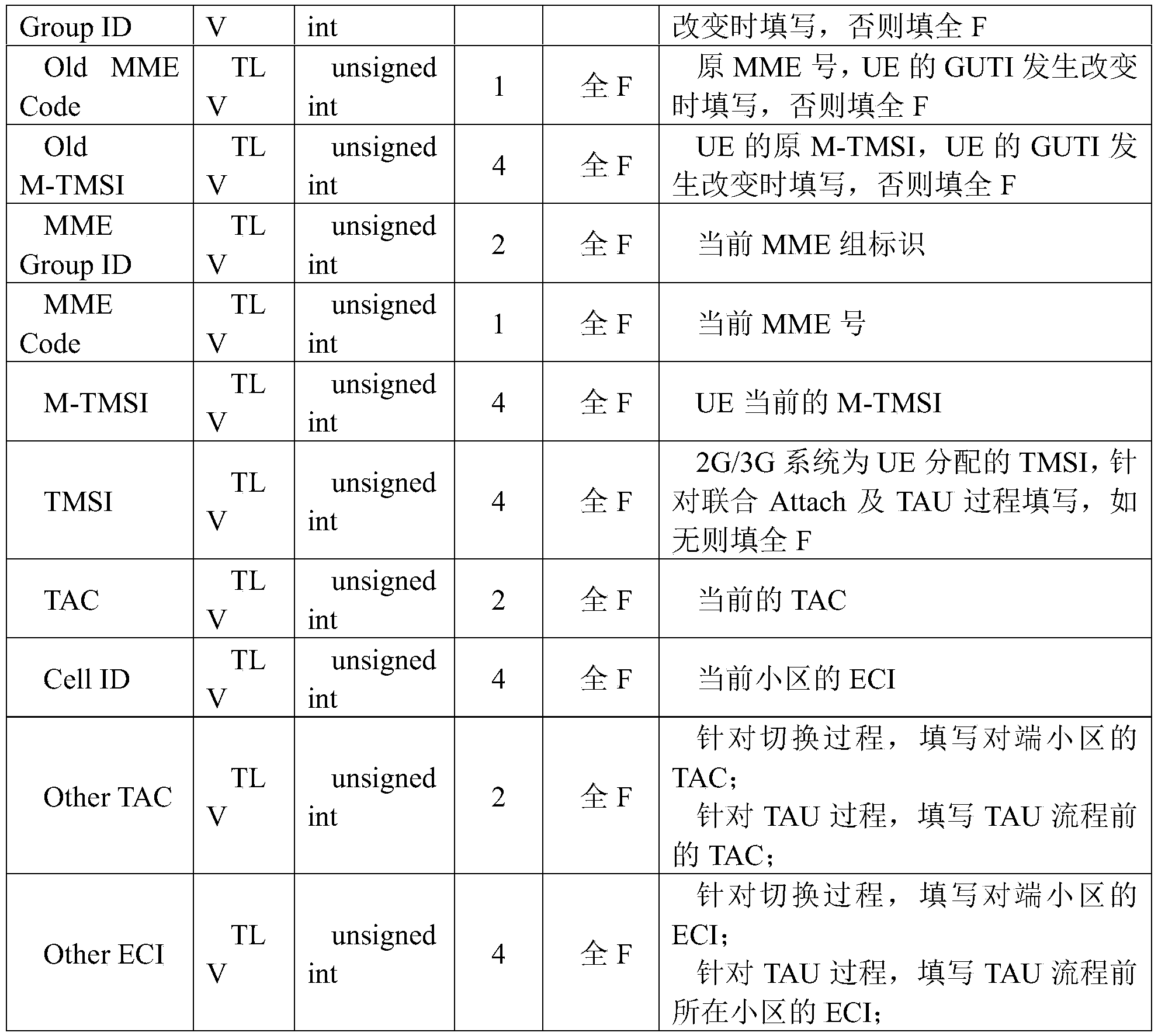
步骤二、为XDR回填终端的永久标识。
MME与基站之间的接口一般是不携带终端的永久标识,如IMSI(International Mobile Subscriber Identity)。但MME与核心网其他网元之间的接口,如S11接口可以携带终端的用户永久标识。通过两个接口之间同有的一些通信参数,如基站和XGW之间媒体面的隧道标识TEID(Tunnel Endpoint Identifier),将属于同一次会话的S11口的终端永久用户标识回填到S1接口的XDR中。S1接口内各XDR依据S1APID等标识别将属于同一呼叫的XDR组合在一起。依据同一呼叫内部分XDR确定的终端永久标识可以扩展到同一呼叫的所有XDR。由于信令监控平台的采集部分通常包含了终端永久标识的回填功能,由信令监控平台的合成服务器来完成步骤二。
步骤三、分析XDR,筛选出由核心网发起的异常终端上下文释放的记录。
根据分析XDR,从中挑选核心网发起的非正常业务需要产生的异常终端上下文释放记录。
释放终端上下文可以由基站发起,也可以由核心网发起。基站发起的终端上下文释放是基站先发送一个请求消息给核心,然后核心网再给基站发送一个终端上下文释放信令。而核心网发起的终端上下文释放就是核心网直接给基站发送终端上下文释放的信令。
核心网发送的终端上下文释放信令UE CONTEXT RELEASE COMMAND信令的包含cause字段给出了发起释放原因。某些原因,如站间切换完成,释放源基站侧的终端上下文携带的Cause原因就是Successful Handover,站间切换失败,释放目标基站侧的终端上下文 Handover Cancelled,有对应的流程配合就是正常业务需要。根据原因值排除核心网正常业务需要的释放终端上下文的情况剩余的非正常业务需要的释放记录。
步骤四、判断核心网在发起异常终端上下文释放之前的预设时间内是否收到来自同一终端的相关信令链路建立请求,来确定所述终端是否发生了脱网。
筛选出核心网在发起异常终端上下文释放之前的预设时间内,收到了来自基站发起的同一个终端的相关信令链路建立请求的记录,即可判断为终端发生了异常脱网。
考虑到核心网是收到基站发送的终端相关信令链路建立请求后检测到存在遗留终端上下文才发起的异常释放,两者时间间隔很短,示例性地,可将预设时间设为30ms。
基站发送终端相关信令链路建立请求携带从终端收到的NAS信令一般为Service Request,4G TAU(Tracking Area Updating),4G ATTACH request。因此可根据由核心网发起的异常终端上下文释放记录中所对应的基站确定发生了终端异常脱网的基站,而基站发送的终端相关信令链路建立请求所对应的小区为终端重新接入网络的新驻留小区。
本公开实施例提供的脱网检测方法,可以基于基站与核心网之间的信令来检测4G网络的脱网情况,且不受基站、网络和终端功能的限制,具有很好的通用性,可大范围,长时间地用于检测无线网络中发生终端异常脱网的场景。能够提高发现无线网络质差的效率,为无线网络优化和提升用户体验提供依据和辅助信息。
实施例二
如图5所示,在5G NR网络中应用本公开的方法检测脱网情况,整个处理流程分为四个步骤。
对于5G NR网络,核心网呼叫控制网元就是AMF(Access and Mobility Management Function)。
步骤一、采集AMF周围各接口的原始信令,抽取关键信息生成XDR。
AMF周围的接口包括AMF与基站之间的N2接口,AMF与SMF(Session Management Function)之间的N11接口。AMF与AUSF(Authentication Server Function)之间的N12接口。采集各个接口上的原始信令并解析信令生成XDR,如中国移动5G上网日志留存系统规范中的XDR定义。
XDR将属于同一信令交互流程各条信息的关键信息抽取出来,以记录形式保存下来,如5G N1N2接口呼叫流程包括:
Registration
De-registration
Service Request
Paging
Notification
Primary Authentication
Security Activation
Identification Acquisition
UE Configuration Update
5GMM Status
PDU Session Establishment
Secondary Authentication
PDU Session Modification
PDU Session Release
5GSM Status
N2 HO Out
N2 HO In
N2 HO Cancel
Xn HO
Initial Context Setup
UE Context Modification
UE Context Release
PDU Session Resource Setup
PDU Session Resource Modify
通常信令监控的采集平台都可以完成这一步的工作。
PDU Session Resource Release
PDU Session Resource Notify
PDU Session Resource Modify Indication
SMS
UE Capability Info Indication
生成的XDR记录如下:


步骤二、为XDR回填终端的永久标识。
AMF与基站之间的接口一般是不携带终端的永久标识,如IMSI(International Mobile Subscriber Identity)。但核心网呼叫控制网元与核心网其他网元之间的接口,如N11接口,可以携带终端的用户永久标识。通过两个接口之间同有的一些通信参数,如基站和XGW之间媒体面的隧道标识TEID(Tunnel Endpoint Identifier),将属于同一次会话的N11口的终端永久用户标识回填到S1/N2接口的XDR中。N2接口内各XDR依据NgAPID等标识别将属于同一呼叫的XDR组合在一起。依据同一呼叫内部分XDR确定的终端永久标识可以扩展到同一呼叫的所有XDR。信令监控平台的采集部分通常包含了终端永久标识的回填功能。通常由合成服务器来完成。
步骤三、分析XDR,筛选出由核心网发起的异常终端上下文释放的记录。
释放终端上下文可以由基站发起,也可以由核心网发起。基站发起的终端上下文释放是基站先发送一个请求消息给核心,然后核心网再給基站发送一个终端上下文释放信令。而核心网发起的终端上下文释放就是核心网直接給基站发送终端上下文释放的信令。
核心网发送的终端上下文释放信令UE CONTEXT RELEASE COMMAND信令的包含cause字段给出了发起释放原因。如某些原因,如站间切换完成,释放源基站侧的终端上下文携带的Cause原因就是Successful Handover,站间切换失败,释放目标基站侧的终端上下文Handover Cancelled。根据原因值排除核心网正常释放终端上下文的情况剩余的异常释放记录。
步骤四、判断核心网在发起异常终端上下文释放之前的预设时间内是否收到来自同一终端的相关信令链路建立请求,来确定所述终端是否发生了脱网。
由于核心网是收到基站发送的终端相关信令链路建立请求后检测到存在遗留终端上下文才发起的异常释放,这个时间应该很短,不应该超过100ms,建议选择为30ms。
基站发送终端相关信令链路建立请求携带从终端收到的NAS信令一般为Service Request,5G的Registration。其中释放终端上下文对应的基站为发生终端异常脱网基站,基站发送终端相关信令链路建立请求的小区为终端重新接入网络的新驻留小区。
本公开实施例提供的脱网检测方法,可以基于基站与核心网之间的信令来检测5G网络的脱网情况,且不受基站、网络和终端功能的限制,具有很好的通用性,可大范围,长时间地用于检测无线网络中发生终端异常脱网的场景。能够提高发现无线网络质差的效率,为无线网络优化和提升用户体验提供依据和辅助信息。
请参阅图6,图6为本公开实施例提供的一种脱网检测设备的结构示意性框图。
如图6所示,脱网检测设备300包括处理器301和存储器302,处理器301和存储器302通过总线303连接,该总线比如为I2C(Inter-integrated Circuit)总线。
处理器301用于提供计算和控制能力,支撑整个脱网检测设备的运行。处理器301可以是中央处理单元(Central Processing Unit,CPU),该处理器301还可以是其他通用处理器、数字信号处理器(Digital Signal Processor,DSP)、专用集成电路(Application Specific Integrated Circuit,ASIC)、现场可编程门阵列(Field-Programmable Gate Array,FPGA)或者其他可编程逻辑器件、分立门或者晶体管逻辑器件、分立硬件组件等。其中,通用处理器可以是微处理器或者该处理器也可以是任何常规的处理器等。
存储器302可以是Flash芯片、只读存储器(ROM,Read-Only Memory)磁盘、光盘、U盘或移动硬盘等。
本领域技术人员可以理解,图6中示出的结构,仅仅是与本公开实施例方案相关的部分结构的框图,并不构成对本公开实施例方案所应用于其上的脱网检测设备的限定,服务器可以包括比图中所示更多或更少的部件,或者组合某些部件,或者具有不同的部件布置。
其中,所述处理器用于运行存储在存储器中的计算机程序,并在执行所述计算机程序时实现本公开实施例提供的任意一种所述的脱网检测方法。
在一实施例中,所述处理器用于运行存储在存储器中的计算机程序,并在执行所述计算机程序时实现如下步骤:
若核心网在针对终端发起异常终端上下文释放之前的预设时间内,收到来自所述终端的相关信令链路建立请求时,确定所述终端发生了脱网。
在一实施例中,所述处理器在实现脱网检测方法时,用于实现;获取由所述核心网发起的异常终端上下文释放记录;根据每一条所述异常终端上下文释放记录的释放时间以及所针对的终端的终端标识,当在所述释放时间之前的所述预设时间内,确定存在来自同一个所述终端的相关信令链路建立请求时,确定所述终端发生了脱网。
在一实施例中,所述处理器在实现获取由所述核心网发起的异常终端上下文释放记录时,用于实现:采集核心网呼叫控制网元周围各接口的信令数据,解析所述信令数据生成XDR;其中,所述XDR至少包括:由核心网发起的终端上下文释放的记录、终端标识、终端的相关信令链路建立请求的记录;根据所述XDR筛选出由所述核心网发起的异常终端上下文释放记录。
在一实施例中,所述处理器在实现根据所述XDR筛选出由所述核心网发起的异常终端上下文释放记录时,用于实现:根据所述核心网发起的终端上下文释放的记录中包含的发起所述终端上下文释放的原因指示;当确定所述原因指示不是Successful Handover或Handover Cancelled中的任一个时,所述核心网发起的终端上下文释放为异常终端上下文释放。
在一实施例中,所述周围各接口包括:第一接口和第二接口,所述第一接口为核心网呼叫控制网元与基站之间的接口,所述第二接口为所述核心网呼叫控制网元与核心网其他 网元之间的接口,且所述第二接口携带了所述终端标识;所述处理器在实现解析所述信令数据生成XDR时,用于实现:根据解析所述第一接口的信令数据得到的解析结果以及所述第二接口的参数得到的终端标识,生成所述XDR。
在一实施例中,所述处理器在实现脱网检测方法时,用于实现:对于4G网络,所述核心网呼叫控制网元为MME,所述第一接口为MME与所述基站之间的S1MME接口;所述第二接口为所述MME与XGW之间的S11接口,其中,所述S11接口携带了所述终端标识。
在一实施例中,所述处理器在实现脱网检测方法时,用于实现:对于5G网络,所述核心网呼叫控制网元为AMF,所述第一接口为所述AMF与所述基站之间的N2接口;所述第二接口为所述AMF与SMF之间的N11接口,其中,所述N11接口携带了所述终端标识。
在一实施例中,所述处理器在实现脱网检测方法时,用于实现:在确定所述终端发生了脱网之后,根据所述核心网针对所述终端发起的异常终端上下文释放所对应的基站信息,确定发生了脱网的基站;根据来自所述终端的相关信令链路建立请求所对应的小区信息,确定所述终端重新接入网络的新驻留小区。
需要说明的是,所属领域的技术人员可以清楚地了解到,为了描述的方便和简洁,上述描述的脱网检测设备的工作过程,可以参考前述脱网检测方法实施例中的对应过程,在此不再赘述。
本公开实施例还提供一种存储介质,用于计算机可读存储,所述存储介质存储有一个或者多个程序,所述一个或者多个程序可被一个或者多个处理器执行,以实现如本公开实施例说明书提供的任一项脱网检测方法的步骤。
其中,所述存储介质可以是前述实施例所述的脱网检测设备的内部存储单元,例如所述脱网检测设备的硬盘或内存。所述存储介质也可以是所述脱网检测设备的外部存储设备,例如所述脱网检测设备上配备的插接式硬盘,智能存储卡(Smart Media Card,SMC),安全数字(Secure Digital,SD)卡,闪存卡(Flash Card)等。
本公开实施例提供一种脱网检测方法、脱网检测设备及存储介质,本公开实施例提供的脱网检测方法,不依赖于基站提供的数据来发现无线网络中发生脱网的质差点,基于基站与核心网之间的信令来检测脱网情况,因此不受基站、网络和终端功能的限制,具有很好的通用性,可大范围,长时间地用于检测无线网络中发生终端异常脱网的场景,提高了发现无线网络质差的效率,能够为无线网络优化,提升用户体验提供依据和辅助信息。
本领域普通技术人员可以理解,上文中所公开方法中的全部或某些步骤、系统、装置中的功能模块/单元可以被实施为软件、固件、硬件及其适当的组合。在硬件实施例中,在以上描述中提及的功能模块/单元之间的划分不一定对应于物理组件的划分;例如,一个物理组件可以具有多个功能,或者一个功能或步骤可以由若干物理组件合作执行。某些物理组件或所有物理组件可以被实施为由处理器,如中央处理器、数字信号处理器或微处理器执行的软件,或者被实施为硬件,或者被实施为集成电路,如专用集成电路。这样的软件可以分布在计算机可读介质上,计算机可读介质可以包括计算机存储介质(或非暂时性介质)和通信介质(或暂时性介质)。如本领域普通技术人员公知的,术语计算机存储介质包括在用于存储信息(诸如计算机可读指令、数据结构、程序模块或其他数据)的任何方法或技术中实施的易失性和非易失性、可移除和不可移除介质。计算机存储介质包括但不限于RAM、ROM、EEPROM、闪存或其他存储器技术、CD-ROM、数字多功能盘(DVD)或其他光盘存储、磁盒、磁带、磁盘存储或其他磁存储装置、或者可以用于存储期望的信息并且可以被计算机访问的任何其他的介质。此外,本领域普通技术人员公知的是,通信介质通常包含计算机可读指令、数据结构、程序模块或者诸如载波或其他传输机制之类的调制数据信号中的其他数据,并且可包括任何信息递送介质。
应当理解,在本公开说明书和所附权利要求书中使用的术语“和/或”是指相关联列出的项中的一个或多个的任何组合以及所有可能组合,并且包括这些组合。需要说明的是,在本文中,术语“包括”、“包含”或者其任何其他变体意在涵盖非排他性的包含,从而使得包括一系列要素的过程、方法、物品或者系统不仅包括那些要素,而且还包括没有明确列出的其他要素,或者是还包括为这种过程、方法、物品或者系统所固有的要素。在没有更多限制的情况下,由语句“包括一个……”限定的要素,并不排除在包括该要素的过程、方法、物品或者系统中还存在另外的相同要素。
上述本公开实施例序号仅仅为了描述,不代表实施例的优劣。以上所述,仅为本公开的具体实施例,但本公开的保护范围并不局限于此,任何熟悉本技术领域的技术人员在本公开揭露的技术范围内,可轻易想到各种等效的修改或替换,这些修改或替换都应涵盖在本公开的保护范围之内。因此,本公开的保护范围应以权利要求的保护范围为准。
Claims (10)
- 一种脱网检测方法,包括:在核心网在针对终端发起异常终端上下文释放之前的预设时间内,收到来自所述终端的相关信令链路建立请求的情况下,确定所述终端发生了脱网。
- 根据权利要求1所述的脱网检测方法,还包括:获取由所述核心网发起的异常终端上下文释放记录;以及根据每一条所述异常终端上下文释放记录的释放时间以及所针对的终端的终端标识,当在所述释放时间之前的所述预设时间内,确定存在来自同一个所述终端的相关信令链路建立请求的情况下,确定所述终端发生了脱网。
- 根据权利要求2所述的脱网检测方法,其中,所述获取由所述核心网发起的异常终端上下文释放记录,包括:采集核心网呼叫控制网元周围各接口的信令数据,解析所述信令数据生成XDR;其中,所述XDR至少包括:由核心网发起的终端上下文释放的记录、终端标识、终端的相关信令链路建立请求的记录;以及根据所述XDR筛选出由所述核心网发起的异常终端上下文释放记录。
- 根据权利要求3所述的脱网检测方法,其中,所述根据所述XDR筛选出由所述核心网发起的异常终端上下文释放记录,包括:根据所述核心网发起的终端上下文释放的记录中包含的发起所述终端上下文释放的原因指示;以及在确定所述原因指示不是成功切换或取消切换中的任一个的情况下,确定所述由核心网发起的终端上下文释放为异常终端上下文释放。
- 根据权利要求3所述的脱网检测方法,其中,所述周围各接口包括:第一接口和第二接口,所述第一接口为核心网呼叫控制网元与基站之间的接口,所述第二接口为所述核心网呼叫控制网元与核心网其他网元之间的接口,且所述第二接口携带了所述终端标识;所述解析所述信令数据生成XDR,包括:根据解析所述第一接口的信令数据得到的解析结果以及所述第二接口的参数得到的终端标识,生成所述XDR。
- 根据权利要求5所述的脱网检测方法,其中,对于4G网络,所述核心网呼叫控制网元为MME,所述第一接口为MME与所述基站之间的S1MME接口;所述第二接口为所述MME与XGW之间的S11接口,其中,所述S11接口携带了所述终端标识。
- 根据权利要求5所述的脱网检测方法,其中,对于5G网络,所述核心网呼叫控制网元为AMF,所述第一接口为所述AMF与所述基站之间的N2接口;所述第二接口为所述AMF与SMF之间的N11接口,其中,所述N11接口携带了所述终端标识。
- 根据权利要求1-7中任一项所述的脱网检测方法,其中,在确定所述终端发生了脱网之后,还包括:根据所述核心网针对所述终端发起的异常终端上下文释放所对应的基站信息,确定发生了脱网的基站;以及根据来自所述终端的相关信令链路建立请求所对应的小区信息,确定所述终端重新接入网络的新驻留小区。
- 一种脱网检测设备,所述脱网检测设备包括处理器、存储器、存储在所述存储器上并可被所述处理器执行的计算机程序以及用于实现所述处理器和所述存储器之间的连接通信的数据总线,其中所述计算机程序被所述处理器执行时,实现如权利要求1至8中任一项所述的脱网检测方法的步骤。
- 一种存储介质,用于计算机可读存储,所述存储介质存储有一个或者多个程序,所述一个或者多个程序可被一个或者多个处理器执行,以实现权利要求1至8中任一项所述的脱网检测方法的步骤。
Applications Claiming Priority (2)
| Application Number | Priority Date | Filing Date | Title |
|---|---|---|---|
| CN202111470425.5A CN116233876A (zh) | 2021-12-03 | 2021-12-03 | 脱网检测方法、脱网检测设备及存储介质 |
| CN202111470425.5 | 2021-12-03 |
Publications (1)
| Publication Number | Publication Date |
|---|---|
| WO2023098352A1 true WO2023098352A1 (zh) | 2023-06-08 |
Family
ID=86587790
Family Applications (1)
| Application Number | Title | Priority Date | Filing Date |
|---|---|---|---|
| PCT/CN2022/127857 Ceased WO2023098352A1 (zh) | 2021-12-03 | 2022-10-27 | 脱网检测方法、脱网检测设备及存储介质 |
Country Status (2)
| Country | Link |
|---|---|
| CN (1) | CN116233876A (zh) |
| WO (1) | WO2023098352A1 (zh) |
Cited By (2)
| Publication number | Priority date | Publication date | Assignee | Title |
|---|---|---|---|---|
| CN118488448A (zh) * | 2024-06-04 | 2024-08-13 | 北京九栖科技有限责任公司 | 一种基于多维统计分析的5g专网信令攻击检测方法 |
| CN119134509A (zh) * | 2024-11-11 | 2024-12-13 | 广东电网有限责任公司茂名供电局 | 一种大规模逆变型接口分布式电源脱网可能性评价方法及系统 |
Citations (4)
| Publication number | Priority date | Publication date | Assignee | Title |
|---|---|---|---|---|
| WO2009135410A1 (zh) * | 2008-05-07 | 2009-11-12 | 华为技术有限公司 | 多主机系统的退网方法、网络侧管理装置及网络系统 |
| CN108271195A (zh) * | 2016-12-31 | 2018-07-10 | 中国移动通信集团福建有限公司 | 基于软硬采的信令关联分析方法和设备 |
| CN108377502A (zh) * | 2017-02-07 | 2018-08-07 | 中国移动通信集团福建有限公司 | 基于用户信令的弱覆盖小区识别方法和系统 |
| CN109168137A (zh) * | 2018-11-02 | 2019-01-08 | 中国联合网络通信集团有限公司 | 异常脱网的识别方法及装置 |
-
2021
- 2021-12-03 CN CN202111470425.5A patent/CN116233876A/zh active Pending
-
2022
- 2022-10-27 WO PCT/CN2022/127857 patent/WO2023098352A1/zh not_active Ceased
Patent Citations (4)
| Publication number | Priority date | Publication date | Assignee | Title |
|---|---|---|---|---|
| WO2009135410A1 (zh) * | 2008-05-07 | 2009-11-12 | 华为技术有限公司 | 多主机系统的退网方法、网络侧管理装置及网络系统 |
| CN108271195A (zh) * | 2016-12-31 | 2018-07-10 | 中国移动通信集团福建有限公司 | 基于软硬采的信令关联分析方法和设备 |
| CN108377502A (zh) * | 2017-02-07 | 2018-08-07 | 中国移动通信集团福建有限公司 | 基于用户信令的弱覆盖小区识别方法和系统 |
| CN109168137A (zh) * | 2018-11-02 | 2019-01-08 | 中国联合网络通信集团有限公司 | 异常脱网的识别方法及装置 |
Non-Patent Citations (1)
| Title |
|---|
| WANG XI: "LTE Coverage Evaluation Method Based on Signaling of S1-MME Interface and its Application", DIANXIN-JISHU = TELECOMMUNICATION TECHNOLOGY, BEIJING : RENMIN YOUDIAN CHUBANSHE, CN, vol. 2017, no. 4, 1 January 2017 (2017-01-01), CN , pages 68 - 70, XP093069176, ISSN: 1000-1247, DOI: 10.3969/j.issn.1000-1247.2017.04.019 * |
Cited By (3)
| Publication number | Priority date | Publication date | Assignee | Title |
|---|---|---|---|---|
| CN118488448A (zh) * | 2024-06-04 | 2024-08-13 | 北京九栖科技有限责任公司 | 一种基于多维统计分析的5g专网信令攻击检测方法 |
| CN119134509A (zh) * | 2024-11-11 | 2024-12-13 | 广东电网有限责任公司茂名供电局 | 一种大规模逆变型接口分布式电源脱网可能性评价方法及系统 |
| CN119134509B (zh) * | 2024-11-11 | 2025-02-28 | 广东电网有限责任公司茂名供电局 | 一种大规模逆变型接口分布式电源脱网可能性评价方法及系统 |
Also Published As
| Publication number | Publication date |
|---|---|
| CN116233876A (zh) | 2023-06-06 |
Similar Documents
| Publication | Publication Date | Title |
|---|---|---|
| JP7548375B2 (ja) | 無線端末、無線局、及びこれらの方法 | |
| US11070967B2 (en) | Network nodes and methods performed therein for enabling communication in a communication network | |
| US10506552B2 (en) | Core network node, radio network node, wireless device and methods performed therein | |
| CN103384382B (zh) | 无线链路管理的方法、用户设备和基站 | |
| US9326167B2 (en) | Radio link failure report filtering | |
| CN110430594B (zh) | 非授权频率的测量方法和设备 | |
| CN107333311B (zh) | 一种防止lte终端在空闲态反复发起跟踪区更新流程的方法 | |
| US8768305B1 (en) | Reestablishing a mobile device radio resource control connection | |
| US20200044915A1 (en) | Radio resource configuration method and device, user equipment and network element | |
| TW202123767A (zh) | 用於在通訊網路中管理無線電承載相容性之系統和方法 | |
| EP3378254B1 (en) | Network node, radio access node and methods performed therein | |
| JP7607139B2 (ja) | 情報処理方法、情報処理装置、ネットワーク側機器及び可読記憶媒体 | |
| WO2023098352A1 (zh) | 脱网检测方法、脱网检测设备及存储介质 | |
| CN106162692A (zh) | 一种连接态下最小化路测方法和装置 | |
| CN103298023A (zh) | 一种检测终端心跳的方法和装置 | |
| US9591689B2 (en) | System and method for detachment in wireless communication system | |
| CN108347725A (zh) | 通信方法和设备 | |
| CN109640275B (zh) | 小区重选方法、装置及宽带集群系统 | |
| CN106507399B (zh) | 寻呼失败处理方法及装置 | |
| US20230319937A1 (en) | Methods and Apparatuses for a Remote UE to Communicate with Via a Relay UE | |
| CN111526536A (zh) | 信息上报方法、装置、终端及网络侧设备 | |
| CN101534530B (zh) | 对用户设备进行小区重配的方法、系统和控制设备 | |
| WO2013143437A1 (zh) | 邻区关系配置方法、装置与系统 | |
| CN102833781B (zh) | 一种终端业务的处理方法及系统 | |
| CN104811967B (zh) | 一种多覆盖场景下的移动鲁棒性优化方法、基站和终端 |
Legal Events
| Date | Code | Title | Description |
|---|---|---|---|
| 121 | Ep: the epo has been informed by wipo that ep was designated in this application |
Ref document number: 22900157 Country of ref document: EP Kind code of ref document: A1 |
|
| NENP | Non-entry into the national phase |
Ref country code: DE |
|
| 122 | Ep: pct application non-entry in european phase |
Ref document number: 22900157 Country of ref document: EP Kind code of ref document: A1 |