WO2022267702A1 - Bispecific antibody binding to bcma and cd3, and preparation method therefor and use thereof - Google Patents
Bispecific antibody binding to bcma and cd3, and preparation method therefor and use thereof Download PDFInfo
- Publication number
- WO2022267702A1 WO2022267702A1 PCT/CN2022/090931 CN2022090931W WO2022267702A1 WO 2022267702 A1 WO2022267702 A1 WO 2022267702A1 CN 2022090931 W CN2022090931 W CN 2022090931W WO 2022267702 A1 WO2022267702 A1 WO 2022267702A1
- Authority
- WO
- WIPO (PCT)
- Prior art keywords
- amino acid
- seq
- acid sequence
- sequence shown
- variable region
- Prior art date
- Legal status (The legal status is an assumption and is not a legal conclusion. Google has not performed a legal analysis and makes no representation as to the accuracy of the status listed.)
- Ceased
Links
Images





Classifications
-
- C—CHEMISTRY; METALLURGY
- C07—ORGANIC CHEMISTRY
- C07K—PEPTIDES
- C07K16/00—Immunoglobulins [IG], e.g. monoclonal or polyclonal antibodies
- C07K16/18—Immunoglobulins [IG], e.g. monoclonal or polyclonal antibodies against material from animals or humans
- C07K16/28—Immunoglobulins [IG], e.g. monoclonal or polyclonal antibodies against material from animals or humans against receptors, cell surface antigens or cell surface determinants
- C07K16/2878—Immunoglobulins [IG], e.g. monoclonal or polyclonal antibodies against material from animals or humans against receptors, cell surface antigens or cell surface determinants against the NGF-receptor/TNF-receptor superfamily, e.g. CD27, CD30, CD40, CD95
-
- A—HUMAN NECESSITIES
- A61—MEDICAL OR VETERINARY SCIENCE; HYGIENE
- A61P—SPECIFIC THERAPEUTIC ACTIVITY OF CHEMICAL COMPOUNDS OR MEDICINAL PREPARATIONS
- A61P35/00—Antineoplastic agents
-
- A—HUMAN NECESSITIES
- A61—MEDICAL OR VETERINARY SCIENCE; HYGIENE
- A61P—SPECIFIC THERAPEUTIC ACTIVITY OF CHEMICAL COMPOUNDS OR MEDICINAL PREPARATIONS
- A61P37/00—Drugs for immunological or allergic disorders
- A61P37/02—Immunomodulators
-
- C—CHEMISTRY; METALLURGY
- C07—ORGANIC CHEMISTRY
- C07K—PEPTIDES
- C07K16/00—Immunoglobulins [IG], e.g. monoclonal or polyclonal antibodies
- C07K16/18—Immunoglobulins [IG], e.g. monoclonal or polyclonal antibodies against material from animals or humans
- C07K16/28—Immunoglobulins [IG], e.g. monoclonal or polyclonal antibodies against material from animals or humans against receptors, cell surface antigens or cell surface determinants
- C07K16/2803—Immunoglobulins [IG], e.g. monoclonal or polyclonal antibodies against material from animals or humans against receptors, cell surface antigens or cell surface determinants against the immunoglobulin superfamily
- C07K16/2809—Immunoglobulins [IG], e.g. monoclonal or polyclonal antibodies against material from animals or humans against receptors, cell surface antigens or cell surface determinants against the immunoglobulin superfamily against the T-cell receptor (TcR)-CD3 complex
-
- G—PHYSICS
- G01—MEASURING; TESTING
- G01N—INVESTIGATING OR ANALYSING MATERIALS BY DETERMINING THEIR CHEMICAL OR PHYSICAL PROPERTIES
- G01N33/00—Investigating or analysing materials by specific methods not covered by groups G01N1/00 - G01N31/00
- G01N33/48—Biological material, e.g. blood, urine; Haemocytometers
- G01N33/50—Chemical analysis of biological material, e.g. blood, urine; Testing involving biospecific ligand binding methods; Immunological testing
- G01N33/53—Immunoassay; Biospecific binding assay; Materials therefor
- G01N33/575—Immunoassay; Biospecific binding assay; Materials therefor for cancer
- G01N33/5758—Immunoassay; Biospecific binding assay; Materials therefor for cancer involving compounds serving as markers for tumours, cancers or neoplasias, e.g. cellular determinants, receptors, heat shock/stress proteins, A-protein, oligosaccharides or metabolites
-
- G—PHYSICS
- G01—MEASURING; TESTING
- G01N—INVESTIGATING OR ANALYSING MATERIALS BY DETERMINING THEIR CHEMICAL OR PHYSICAL PROPERTIES
- G01N33/00—Investigating or analysing materials by specific methods not covered by groups G01N1/00 - G01N31/00
- G01N33/48—Biological material, e.g. blood, urine; Haemocytometers
- G01N33/50—Chemical analysis of biological material, e.g. blood, urine; Testing involving biospecific ligand binding methods; Immunological testing
- G01N33/68—Chemical analysis of biological material, e.g. blood, urine; Testing involving biospecific ligand binding methods; Immunological testing involving proteins, peptides or amino acids
- G01N33/6872—Intracellular protein regulatory factors and their receptors, e.g. including ion channels
-
- G—PHYSICS
- G01—MEASURING; TESTING
- G01N—INVESTIGATING OR ANALYSING MATERIALS BY DETERMINING THEIR CHEMICAL OR PHYSICAL PROPERTIES
- G01N33/00—Investigating or analysing materials by specific methods not covered by groups G01N1/00 - G01N31/00
- G01N33/48—Biological material, e.g. blood, urine; Haemocytometers
- G01N33/50—Chemical analysis of biological material, e.g. blood, urine; Testing involving biospecific ligand binding methods; Immunological testing
- G01N33/68—Chemical analysis of biological material, e.g. blood, urine; Testing involving biospecific ligand binding methods; Immunological testing involving proteins, peptides or amino acids
- G01N33/6893—Chemical analysis of biological material, e.g. blood, urine; Testing involving biospecific ligand binding methods; Immunological testing involving proteins, peptides or amino acids related to diseases not provided for elsewhere
-
- A—HUMAN NECESSITIES
- A61—MEDICAL OR VETERINARY SCIENCE; HYGIENE
- A61K—PREPARATIONS FOR MEDICAL, DENTAL OR TOILETRY PURPOSES
- A61K39/00—Medicinal preparations containing antigens or antibodies
- A61K2039/505—Medicinal preparations containing antigens or antibodies comprising antibodies
-
- C—CHEMISTRY; METALLURGY
- C07—ORGANIC CHEMISTRY
- C07K—PEPTIDES
- C07K2317/00—Immunoglobulins specific features
- C07K2317/20—Immunoglobulins specific features characterized by taxonomic origin
- C07K2317/21—Immunoglobulins specific features characterized by taxonomic origin from primates, e.g. man
-
- C—CHEMISTRY; METALLURGY
- C07—ORGANIC CHEMISTRY
- C07K—PEPTIDES
- C07K2317/00—Immunoglobulins specific features
- C07K2317/30—Immunoglobulins specific features characterized by aspects of specificity or valency
- C07K2317/31—Immunoglobulins specific features characterized by aspects of specificity or valency multispecific
-
- C—CHEMISTRY; METALLURGY
- C07—ORGANIC CHEMISTRY
- C07K—PEPTIDES
- C07K2317/00—Immunoglobulins specific features
- C07K2317/50—Immunoglobulins specific features characterized by immunoglobulin fragments
- C07K2317/52—Constant or Fc region; Isotype
-
- C—CHEMISTRY; METALLURGY
- C07—ORGANIC CHEMISTRY
- C07K—PEPTIDES
- C07K2317/00—Immunoglobulins specific features
- C07K2317/50—Immunoglobulins specific features characterized by immunoglobulin fragments
- C07K2317/56—Immunoglobulins specific features characterized by immunoglobulin fragments variable (Fv) region, i.e. VH and/or VL
-
- C—CHEMISTRY; METALLURGY
- C07—ORGANIC CHEMISTRY
- C07K—PEPTIDES
- C07K2317/00—Immunoglobulins specific features
- C07K2317/50—Immunoglobulins specific features characterized by immunoglobulin fragments
- C07K2317/56—Immunoglobulins specific features characterized by immunoglobulin fragments variable (Fv) region, i.e. VH and/or VL
- C07K2317/565—Complementarity determining region [CDR]
-
- C—CHEMISTRY; METALLURGY
- C07—ORGANIC CHEMISTRY
- C07K—PEPTIDES
- C07K2317/00—Immunoglobulins specific features
- C07K2317/60—Immunoglobulins specific features characterized by non-natural combinations of immunoglobulin fragments
- C07K2317/62—Immunoglobulins specific features characterized by non-natural combinations of immunoglobulin fragments comprising only variable region components
- C07K2317/622—Single chain antibody (scFv)
-
- C—CHEMISTRY; METALLURGY
- C07—ORGANIC CHEMISTRY
- C07K—PEPTIDES
- C07K2317/00—Immunoglobulins specific features
- C07K2317/70—Immunoglobulins specific features characterized by effect upon binding to a cell or to an antigen
- C07K2317/73—Inducing cell death, e.g. apoptosis, necrosis or inhibition of cell proliferation
-
- C—CHEMISTRY; METALLURGY
- C07—ORGANIC CHEMISTRY
- C07K—PEPTIDES
- C07K2317/00—Immunoglobulins specific features
- C07K2317/90—Immunoglobulins specific features characterized by (pharmaco)kinetic aspects or by stability of the immunoglobulin
- C07K2317/92—Affinity (KD), association rate (Ka), dissociation rate (Kd) or EC50 value
-
- G—PHYSICS
- G01—MEASURING; TESTING
- G01N—INVESTIGATING OR ANALYSING MATERIALS BY DETERMINING THEIR CHEMICAL OR PHYSICAL PROPERTIES
- G01N2333/00—Assays involving biological materials from specific organisms or of a specific nature
- G01N2333/435—Assays involving biological materials from specific organisms or of a specific nature from animals; from humans
- G01N2333/705—Assays involving receptors, cell surface antigens or cell surface determinants
- G01N2333/70503—Immunoglobulin superfamily, e.g. VCAMs, PECAM, LFA-3
- G01N2333/7051—T-cell receptor (TcR)-CD3 complex
-
- G—PHYSICS
- G01—MEASURING; TESTING
- G01N—INVESTIGATING OR ANALYSING MATERIALS BY DETERMINING THEIR CHEMICAL OR PHYSICAL PROPERTIES
- G01N2333/00—Assays involving biological materials from specific organisms or of a specific nature
- G01N2333/435—Assays involving biological materials from specific organisms or of a specific nature from animals; from humans
- G01N2333/705—Assays involving receptors, cell surface antigens or cell surface determinants
- G01N2333/70578—NGF-receptor/TNF-receptor superfamily, e.g. CD27, CD30 CD40 or CD95
-
- G—PHYSICS
- G01—MEASURING; TESTING
- G01N—INVESTIGATING OR ANALYSING MATERIALS BY DETERMINING THEIR CHEMICAL OR PHYSICAL PROPERTIES
- G01N2800/00—Detection or diagnosis of diseases
- G01N2800/24—Immunology or allergic disorders
Definitions
- the invention relates to the technical field of genetic engineering antibodies, in particular to a bispecific antibody binding to BCMA and CD3 and its preparation method and application.
- the cell-bridging double antibody based on bispecificity has significantly improved the killing activity and specificity due to its ability to connect immune T cells and cancer target cells, and has breakthrough clinical value. Extra attention.
- the cell-bridged double antibody targeting BCMA with the above properties is one of the development directions to improve the effect of antibody therapy, and has become a hot spot in the field of antibody engineering research.
- the phosphorylation of ITAM and the combination with ZAP-70 is one of the important biochemical reactions in the early stage of T cell activation signal transduction process. Therefore, the function of the CD3 molecule is to transduce the activation signal generated by the recognition of the antigen by the TCR.
- BCMA (i.e., B-cell maturation antigen, TNFRSF17, CD269) is an aglycosylated type I transmembrane protein that is preferentially expressed in differentiated plasma cells and belongs to the tumor necrosis (TNF) receptor superfamily member, which is involved in B Cells mature, grow and survive.
- TNF tumor necrosis
- BCMA expression is restricted to the B-cell lineage and is predominantly present on plasma cells and plasmablasts (Figure 1, B), and to some extent on memory B-cells, but is virtually absent on peripheral B-cells . BCMA is also expressed on multiple myeloma (MM) cells. Together with its family members the transmembrane activator and cyclophilin ligand interacting factor (TACI) and the B-cell activator of the TNF family receptor (BAFF-R), BCMA regulates different aspects of humoral immunity, B-cell development and homeostasis.
- TACI transmembrane activator and cyclophilin ligand interacting factor
- BAFF-R B-cell activator of the TNF family receptor
- Coordinated binding of APRIL and BAFF to BCMA and/or TACI activates the transcription factor NF- ⁇ B and increases prosurvival Bcl-2 family members (e.g., Bcl-2, Bcl-xL, Bcl-w, Mcl-1, A1) Expresses and down-regulates the expression of pro-apoptotic factors (eg, Bid, Bad, Bik, Bim, etc.), thereby inhibiting apoptosis and promoting survival. This combined action promotes B cell differentiation, proliferation, survival and antibody production. Expression of BCMA occurs at later stages of B-cell differentiation and favors the long-term survival of plasmablasts and plasma cells in the bone marrow.
- prosurvival Bcl-2 family members e.g., Bcl-2, Bcl-xL, Bcl-w, Mcl-1, A1
- pro-apoptotic factors eg, Bid, Bad, Bik, Bim, etc.
- BCMA is an extremely important B-cell biomarker that is widely present on the surface of MM cells and is a popular immunotherapy target for MM and other hematologic malignancies. In the three consecutive ASCO annual meetings, BCMA has always been the focus of the industry. BCMA has become the second most popular target for anticancer therapy after CD19, according to a new analysis by the American Cancer Institute (CRI).
- MM is a heterogeneous disease and is mostly caused by chromosomal predispositions of t(11;14), t(4;14), t(8;14), del(13), del(17) (among others) caused by the bit. Affected patients with MM may experience a variety of disease-related symptoms due to bone marrow infiltration, bone destruction, renal failure, immunodeficiency, and the psychological burden of a cancer diagnosis.
- MM For MM, treatments such as chemotherapy and stem cell transplantation, while improving survival, are often associated with deleterious side effects, and MM remains difficult to treat.
- proteasome inhibitors, immunomodulators thalidomide derivatives, and CD38-targeting antibodies almost all patients eventually relapse. Therefore, there is still an urgent need for new drugs in this field.
- the two most common treatment options for multiple myeloma patients are steroids, thalidomide, lenalidomide, bortezomib, or a combination of cytotoxic agents, and in younger patients
- the concept of high-dose chemotherapy combined with autologous stem cell transplantation. Most transplants are autologous, using the patient's own cells.
- Antagonistic BCMA-specific antibodies prevent NF- ⁇ B activation associated with a potent pro-survival signaling pathway in normal and malignant B-cells.
- acetcept TACI-Ig
- BAFF and APRIL i.e., ligands of the TNF ligand superfamily
- TACI-Ig ligands of the TNF ligand superfamily
- TACI-Ig acetcept
- BCMA-specific antibodies that cross-react with TACI have been described (WO02/066516).
- the first object of the present invention is to provide a bispecific antibody binding to BCMA and CD3 and its active fragment.
- the third object of the present invention is to provide the use of the above-mentioned antibody or its active fragment.
- the present invention provides the following technical solutions:
- the present invention provides a bispecific antibody binding to BCMA and CD3, the bispecific antibody comprising:
- the first domain which binds the B-cell maturation antigen BCMA
- first structural domain and the second structural domain are connected by a connecting peptide
- the first structural domain includes a heavy chain variable region and a light chain variable region, and CDR1, CDR2, and CDR3 of the heavy chain variable region have the amino acid sequences shown in SEQ ID NO.4-6 respectively, or they have the amino acid sequences shown in SEQ ID NO.4-6 respectively.
- the amino acid sequence shown in ID NO.4-6 is a reference sequence, an amino acid sequence containing a combination of one or more mutations in the following mutations:
- the first S of the amino acid sequence shown in SEQ ID NO.4 is mutated to P or K;
- CDR1, CDR2 and CDR3 of the light chain variable region of the first structural domain respectively have the amino acid sequence shown in SEQ ID NO.1-3, or it has the amino acid sequence shown in SEQ ID NO.1-3 respectively:
- the 11th V mutation of the amino acid sequence shown in SEQ ID NO.3 is L or Q.
- the present invention screens the anti-BCMA genetically engineered single-chain antibody from a fully synthetic single-chain human antibody library, obtains the variable region gene sequence of the antibody, constructs a mutation library through a point mutation kit, and obtains clones with high affinity.
- the cloned DNA is mixed, and the single-chain antibody combinatorial library is assembled in a recombinant way, and the BCMA antibody with high affinity to human BCMA is obtained after screening.
- the amino acid sequence pattern of the antibody variable region provided by the present invention is FR1-CDR1-FR2-CDR2-FR3-CDR3-FR4.
- FR1-4 represent four framework regions
- CDR1-3 represent three hypervariable regions.
- FR1-4 can be isolated from the constant region sequence (such as the most commonly used amino acids of human immunoglobulin light and heavy chain class, subclass or subfamily), or can be isolated from a single human antibody framework region or from different Combination of framework region genes.
- the present invention provides the following bispecific antibodies, the first domain of which exhibits higher affinity to BCMA:
- the first domain which binds the B-cell maturation antigen BCMA
- first structural domain and the second structural domain are connected by a connecting peptide
- the first structural domain comprises a heavy chain variable region and a light chain variable region
- the CDR1 of the heavy chain variable region has the amino acid sequence shown in any one of SEQ ID NO.4, 7, 8, 9, and the CDR2 has the SEQ ID NO. 5.
- CDR3 has the amino acid sequence shown in any one of SEQ ID NO.6, 11;
- the CDR1 of the light chain variable region has the amino acid sequence shown in any one of SEQ ID NO.1, 12, the CDR2 has the amino acid sequence shown in SEQ ID NO.2, and the CDR3 has the amino acid sequence shown in SEQ ID NO.3, 13, 14, 15, Any of 16 amino acid sequences shown.
- the CDR region sequence of the heavy chain variable region is any of the following:
- CDR1 has the amino acid sequence shown in SEQ ID NO.4, CDR2 has the amino acid sequence shown in SEQ ID NO.5, and CDR3 has the amino acid sequence shown in SEQ ID NO.6;
- CDR1 has the amino acid sequence shown in SEQ ID NO.7
- CDR2 has the amino acid sequence shown in SEQ ID NO.10
- CDR3 has the amino acid sequence shown in SEQ ID NO.11;
- CDR1 has the amino acid sequence shown in SEQ ID NO.8
- CDR2 has the amino acid sequence shown in SEQ ID NO.10
- CDR3 has the amino acid sequence shown in SEQ ID NO.11;
- CDR1 has the amino acid sequence shown in SEQ ID NO.9
- CDR2 has the amino acid sequence shown in SEQ ID NO.10
- CDR3 has the amino acid sequence shown in SEQ ID NO.11;
- the CDR region sequence of the light chain variable region is any of the following:
- CDR1 has the amino acid sequence shown in SEQ ID NO.1
- CDR2 has the amino acid sequence shown in SEQ ID NO.2
- CDR3 has the amino acid sequence shown in SEQ ID NO.3;
- CDR1 has the amino acid sequence shown in SEQ ID NO.12
- CDR2 has the amino acid sequence shown in SEQ ID NO.2
- CDR3 has the amino acid sequence shown in SEQ ID NO.13;
- CDR1 has the amino acid sequence shown in SEQ ID NO.12
- CDR2 has the amino acid sequence shown in SEQ ID NO.2
- CDR3 has the amino acid sequence shown in SEQ ID NO.14;
- CDR1 has the amino acid sequence shown in SEQ ID NO.12
- CDR2 has the amino acid sequence shown in SEQ ID NO.2
- CDR3 has the amino acid sequence shown in SEQ ID NO.15;
- CDR1 has the amino acid sequence shown in SEQ ID NO.12
- CDR2 has the amino acid sequence shown in SEQ ID NO.2
- CDR3 has the amino acid sequence shown in SEQ ID NO.16;
- the CDRs of the heavy chain variable region and the CDRs of the light chain variable region are any of the following:
- CDR1 of the heavy chain variable region has the amino acid sequence shown in SEQ ID NO.4, CDR2 has the amino acid sequence shown in SEQ ID NO.5, and CDR3 has the amino acid sequence shown in SEQ ID NO.6; light chain CDR1 of the variable region has the amino acid sequence shown in SEQ ID NO.1, CDR2 has the amino acid sequence shown in SEQ ID NO.2, and CDR3 has the amino acid sequence shown in SEQ ID NO.3;
- CDR1 of the heavy chain variable region has the amino acid sequence shown in SEQ ID NO.8, CDR2 has the amino acid sequence shown in SEQ ID NO.10, and CDR3 has the amino acid sequence shown in SEQ ID NO.11; light chain CDR1 of the variable region has the amino acid sequence shown in SEQ ID NO.12, CDR2 has the amino acid sequence shown in SEQ ID NO.2, and CDR3 has the amino acid sequence shown in SEQ ID NO.13;
- CDR1 of the heavy chain variable region has the amino acid sequence shown in SEQ ID NO.9
- CDR2 has the amino acid sequence shown in SEQ ID NO.10
- CDR3 has the amino acid sequence shown in SEQ ID NO.11
- light chain CDR1 of the variable region has the amino acid sequence shown in SEQ ID NO.1
- CDR2 has the amino acid sequence shown in SEQ ID NO.2
- CDR3 has the amino acid sequence shown in SEQ ID NO.3;
- CDR1 of the heavy chain variable region has the amino acid sequence shown in SEQ ID NO.8, CDR2 has the amino acid sequence shown in SEQ ID NO.10, and CDR3 has the amino acid sequence shown in SEQ ID NO.11; light chain CDR1 of the variable region has the amino acid sequence shown in SEQ ID NO.12, CDR2 has the amino acid sequence shown in SEQ ID NO.2, and CDR3 has the amino acid sequence shown in SEQ ID NO.16.
- the heavy chain variable region has the amino acid sequence shown in any one of SEQ ID NO.17, 19-21, and the light chain variable region has the amino acid sequence shown in any one of SEQ ID NO.18, 22-27;
- heavy chain variable region and light chain variable region compared with its sequence, it has at least one of the following two requirements: a) binding to the same antigenic epitope; b) sequence identity greater than 70%, 80%, Amino acid sequences of 85%, 90%, 97%, 98% or 99% are also within the protection scope of the present invention.
- antibodies (first domain) with the following variable region sequences exhibited better affinity for BCMA:
- the heavy chain variable region has the amino acid sequence shown in SEQ ID NO.17, and the light chain variable region has the amino acid sequence shown in SEQ ID NO.18;
- the heavy chain variable region has the amino acid sequence shown in SEQ ID NO.20, and the light chain variable region has the amino acid sequence shown in SEQ ID NO.22;
- the heavy chain variable region has the amino acid sequence shown in SEQ ID NO.19, and the light chain variable region has the amino acid sequence shown in SEQ ID NO.27;
- the heavy chain variable region has the amino acid sequence shown in SEQ ID NO.21, and the light chain variable region has the amino acid sequence shown in SEQ ID NO.25;
- the heavy chain variable region has the amino acid sequence shown in SEQ ID NO.20
- the light chain variable region has the amino acid sequence shown in SEQ ID NO.26.
- the first domain is an antibody capable of binding BCMA, comprising two complete heavy chain-light chain pairs, wherein each pair of light chain and heavy chain is connected by a disulfide bond.
- the Fc fragment of the heavy chain of the first domain may be the Fc fragment of a human or humanized antibody (IgG1, IgG2, IgA, IgE, IgM, IgG4 or IgD).
- the Fc fragment of the heavy chain of the first domain is the Fc fragment of a human or humanized IgG4 antibody.
- the heavy chain of the first structural domain has the amino acid sequence shown in SEQ ID NO.32, and the light chain has the amino acid sequence shown in SEQ ID NO.33,
- the heavy chain has the amino acid sequence shown in SEQ ID NO.49
- the light chain has the amino acid sequence shown in SEQ ID NO.42
- the heavy chain has the amino acid sequence shown in SEQ ID NO.50
- the light chain has the amino acid sequence shown in SEQ ID NO.44
- the heavy chain has the amino acid sequence shown in SEQ ID NO.51
- the light chain has the amino acid sequence shown in SEQ ID NO.46
- the heavy chain has the amino acid sequence shown in SEQ ID NO.52
- the light chain has the amino acid sequence shown in SEQ ID NO.48.
- BCMA-binding antibodies have high BCMA affinity, and can ensure that when bispecific antibodies are formed with CD3-binding antibodies, the functions of both can be fully exerted.
- the above human anti-human BCMA antibody provided by the present invention binds to human BCMA with an affinity of 0.2nM-10nM. This antibody inhibits BCMA ligand binding to human BCMA.
- the antibody binds to cells expressing BCMA, which may be human multiple myeloma cells or lymphoma cells.
- the second structural domain binding CD3 antigen For the second structural domain binding CD3 antigen, its heavy chain variable region has the amino acid sequence shown in SEQ ID NO.28, and the light chain variable region has the amino acid sequence shown in SEQ ID NO.29.
- the light chain variable region and the heavy chain variable region of the second structural domain are connected into a single-chain antibody through a connecting peptide, and the single-chain antibody has the amino acid sequence shown in SEQ ID NO.31.
- the bispecific antibody of the present invention is preferably designed with the following structure: the first domain contains two complete light chain-heavy chain pairs, and the second domain contains two single-chain antibodies, which are connected by any of the following methods Symmetrical structure:
- the present invention finds that for the sequences of the above-mentioned first domain and the second domain, the bispecific antibody with the above-mentioned symmetrical structure can better retain the first domain and the second domain than bispecific antibodies with other structures.
- the specific antigen-binding ability of the original antibody of the structural domain, and the excellent biological function of binding BCMA and CD3, have obvious advantages in production technology and pharmaceutical performance.
- the present invention has developed a bispecific antibody that binds to BCMA and CD3 and has the above antibody molecular structure.
- the bispecific antibody has a specific targeting effect and can efficiently stimulate a oriented immune response to kill tumor cells.
- the amino acid sequence of the connecting peptide used to connect the first domain and the second domain is preferably (GGGGX)n, wherein X is Gly or Ser, and n is a natural number of 1-4.
- amino acid sequence of the connecting peptide is shown in SEQ ID NO.30.
- the present invention provides a bispecific antibody against human CD3 and BCMA, which has the heavy chain variable region of the above-mentioned single-chain antibody, the light chain variable region and the heavy chain variable region of the monoclonal antibody.
- the present invention has constructed two bispecific antibodies that can simultaneously bind CD3 and BMCA, and its structure and sequence are as follows:
- the heavy chain of the first structural domain is connected with the second structural domain to form a fusion protein with the amino acid sequence shown in SEQ ID NO.34, and the light chain of the first structural domain has the amino acid sequence shown in SEQ ID NO.33 ;
- the heavy chain of the first structural domain is connected with the second structural domain to form a fusion protein with the amino acid sequence shown in SEQ ID NO.35, and the light chain of the first structural domain has the amino acid sequence shown in SEQ ID NO.33 ;
- the heavy chain of the first structural domain and the second structural domain have the amino acid sequence shown in SEQ ID NO.41 after connecting the peptide, and the light chain has the amino acid sequence shown in SEQ ID NO.42;
- the heavy chain of the first structural domain and the second structural domain have the amino acid sequence shown in SEQ ID NO.43 after connecting the peptide, and the light chain has the amino acid sequence shown in SEQ ID NO.44;
- the heavy chain of the first structural domain and the second structural domain have the amino acid sequence shown in SEQ ID NO.47 after being connected by a connecting peptide, and the light chain has the amino acid sequence shown in SEQ ID NO.48.
- sequences shown in SEQ ID NO.1-52 disclosed and claimed above include “conservative sequence modifications", that is, nucleotide and amino acid sequences that do not significantly affect and change the binding characteristics of the antibody or the antibody containing the amino acid sequence grooming.
- conservative sequence modifications include nucleotide or amino acid substitutions, additions or deletions.
- Modifications can be introduced into SEQ ID NO.1-52 by standard techniques in the art, such as site-directed mutagenesis and PCR-mediated mutagenesis.
- Conservative amino acid substitutions include amino acid residues being replaced by amino acid residues with similar side chains or other amino acid residue substitution. In the art, families of amino acid residues having similar side chains have been defined.
- amino acids with basic side chains such as lysine, arginine, histidine
- amino acids with acidic side chains such as aspartic acid, glutamic acid
- uncharged polar side chains such as chain amino acids (such as glycine, asparagine, glutamine, serine, threonine, tyrosine, cysteine, tryptophan)
- amino acids with non-polar side chains such as alanine, valine amino acid, leucine, isoleucine, proline, phenylalanine, methionine
- amino acids with ⁇ -branched side chains such as threonine, valine, isoleucine
- Amino acids with aromatic side chains eg, tyrosine, phenylalanine, tryptophan, histidine. Therefore, it is preferred to replace a non-essential amino acid residue in a human anti-BCMA antibody with another amino acid residue from the same side chain family.
- the antibody having the amino acid sequence disclosed above and/or the antibody comprising the amino acid sequence disclosed above includes antibodies substantially encoded by similar sequences modified by conservative sequences, or antibodies containing similar sequences modified by conservative sequences, both should be regarded as the scope of the present invention.
- the present invention also provides nucleic acid encoding the bispecific antibody binding to BCMA and CD3.
- the gene encoding the antibody of the present invention can be modified in its coding region without changing the amino acid sequence to obtain the gene encoding the same antibody.
- Those skilled in the art can artificially synthesize and modify the gene according to the codon preference of the host expressing the antibody to improve the expression efficiency of the antibody.
- the present invention also provides a biological material containing the nucleic acid encoding the bispecific antibody that binds to BCMA and CD3, and the biological material includes recombinant DNA, expression cassette, vector, host cell, engineering bacteria or cell line.
- the vectors include but are not limited to cloning vectors and expression vectors, and may be vectors such as plasmid vectors, viral vectors, and transposons.
- the host cell or cell line may be a cell or cell line derived from microorganisms or animals.
- the present invention also provides a method for preparing a bispecific antibody that binds to BCMA and CD3, the method comprising: constructing an expression vector containing the coding genes of the first domain and the second domain; introducing the expression vector into a host cells, to obtain host cells expressing the bispecific antibody; to culture the host cells, and obtain the bispecific antibody through separation and purification.
- bispecific antibody When preparing the bispecific antibody, those skilled in the art can select conventional host cells, expression vectors, methods for introducing expression vectors into host cells, and antibody isolation and purification methods as required.
- the present invention provides any of the following applications of the bispecific antibody binding to BCMA and CD3 or its encoding nucleic acid or biological material containing the nucleic acid:
- B-cell-related diseases expressed by BCMA include B-cell-related tumors (including but not limited to multiple myeloma or Lymphoma), autoimmune diseases caused by B cells;
- the above-mentioned B cell-related diseases with BCMA expression are preferably malignant tumors and autoimmune diseases with high expression/overexpression of BCMA.
- the bispecific antibodies provided by the invention are useful in therapy and diagnosis per se.
- Antibodies can be labeled, cross-linked or conjugated and fused with other proteins or polypeptide molecules to form complexes (such as cytotoxic substances, radioactive toxins and/or chemical molecules, etc.) for diagnosis and treatment.
- the present invention also provides multispecific antibodies, fusion proteins, immunotoxins, drugs or detection reagents comprising the bispecific antibodies that bind to BCMA and CD3.
- the immunotoxins described above comprise such bispecific antibodies linked to cytotoxic agents in various forms.
- the various linking forms are antibody labeling, in vitro cross-linking or molecular coupling.
- the cytotoxic agents include chemical molecules, radioactive isotopes, polypeptides, toxins and other substances that can kill or induce cell death.
- the above-mentioned fusion protein comprises the complex of the above-mentioned bispecific antibody provided by the present invention and other proteins or polypeptide molecules with certain functions.
- the fusion protein can be a recombinant expression vector constructed by linking antibody genes with immunotoxin or cytokine genes, and the recombinant fusion protein molecule can be obtained through mammalian cells or other expression systems.
- the above-mentioned drugs and detection reagents may also contain other active ingredients or adjuvants allowed in the field of pharmacy and detection reagents (such as: antibody components and pharmacologically acceptable delivery molecules or solutions. Among them, the therapeutic group Divided into sterile, can be freeze-dried at low temperature).
- the bispecific antibody of the present invention can inhibit one or more biological activities induced by BCMA. It acts by blocking the binding of BCMA to its ligand, or by killing cells with high expression of BCMA, or by internalizing the complex after binding to BCMA to consume BCMA on the cell surface. All interfering functions possessed by BCMA antagonists are equally considered as objects of the present invention.
- the invention uses genetic engineering and phage surface display library technology to screen the specific antibody against human B cell surface antigen BCMA from the single-chain antibody library of natural full human sequence. Multiple clones with significantly improved binding ability were obtained through affinity maturation engineering, and their affinity to human BCMA was between 0.26nM-0.31nM. The apparent affinity determined by flow cytometry is 61-97 times higher than that of the parental antibody, which proves that the anti-human BCMA antibody of the present invention and the optimized mutant have a good ability to bind BCMA.
- the present invention provides a bispecific antibody that can simultaneously bind BCMA and CD3, has a specific targeting effect, and can efficiently stimulate a directed immune response.
- the bispecific antibody better retains the biological functions of anti-CD3 antibody and anti-BCMA antibody, and realizes a bispecific antibody molecule that has excellent biological functions of binding BCMA and CD3 at the same time, and can inhibit tumor cells and immune effects. It builds bridges between cells, effectively activates immune effector cells and oriented immune responses, significantly enhances the efficacy of immune cells in killing tumor cells, and at the same time minimizes the ADCC effect, which has high safety.
- the bispecific antibody provided by the present invention has a good prospect for therapeutic application, mainly exhibiting specific binding activity with human BCMA and CD3.
- the antibody was detected by ELISA and flow cytometry, and it can specifically bind to BCMA on the surface of H929 and RPMI8226 cells and T cells, indicating good target specificity.
- In vitro cell killing efficiency test shows that the bispecific antibody has high target cell killing efficiency.
- the bispecific antibody provided by the present invention has a completely symmetrical structure, and will not produce protein isomers of other structures when expressed by the host, thereby greatly reducing the difficulty of extraction and purification processes, and has the advantages of simple preparation and high yield. It has high advantages and has broad application prospects in tumor immunotherapy.
- the present invention provides bispecific antibody candidate molecules for the development of anti-tumor antibody drugs targeting BCMA targets, the development of CAR-T reagents, and the prevention and treatment of other diseases such as B cell-related inflammation and autoimmune diseases.
- the bispecific antibody of the present invention can simultaneously bind immune cells and tumor cells, guide T immune response, specifically and effectively kill tumor cells, and can be developed as an antibody drug for multiple myeloma.
- FIG. 1 is a schematic diagram of the expression and TCR structure of BCMA in the background technology of the present invention, wherein, A is the expression of BCMA antigen in the developmental stage of B cells; B is the ligand action signal channel of BCMA antigen, source: fimmu-09-01821-g001 .jpg(1050 ⁇ 762)(frontiersin.org); C is the structure of T cell receptor (TCR) complex and the composition of CD3 in it, source: https://www.researchgate.net/publication/299549376.
- A is the expression of BCMA antigen in the developmental stage of B cells
- B is the ligand action signal channel of BCMA antigen, source: fimmu-09-01821-g001 .jpg(1050 ⁇ 762)(frontiersin.org)
- C is the structure of T cell receptor (TCR) complex and the composition of CD3 in it, source: https://www.researchgate.net/publication/299549376.
- Figure 3 is the analysis of the binding of B10 and its affinity matured mutants by flow cytometry in Example 3 of the present invention, wherein A, B, C, D, and E are B10, B10.3, B10.4, and B10.5 in sequence , B10.9 binding to H929 cells, F, G, H, I, J are sequentially B10, B10.3, B10.4, B10.5, B10.9 binding to RPMI8226 cells.
- Fig. 4 is the comparison of the binding of J6, B10 and their mutants by ELISA and flow cytometry in Example 3 of the present invention, wherein, A is ELISA, and B is FACS.
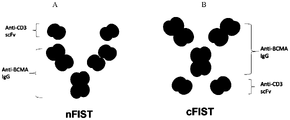
- Figure 5 is a schematic diagram of the structure of the anti-BCMA ⁇ CD3 bispecific antibody constructed based on the FIST platform in Example 4 of the present invention, wherein, A is the double antibody constructed by N-terminal fusion (nFIST): the anti-CD3 single chain antibody is fused to the anti- - the N-terminus of BCMA antibody VH, B is the double antibody constructed by C-terminal fusion (cFIST): anti-CD3 single-chain antibody is fused to the C-terminus of anti-BCMA antibody Fc.
- nFIST N-terminal fusion
- cFIST C-terminal fusion
- Figure 6 is the SDS-PAGE electrophoresis of bispecific antibodies K3B10.3 and B10.3K3 in Example 5 of the present invention, wherein A and C are reducing SDS-PAGE electrophoresis; B and D are non-reducing SDS-PAGE electrophoresis; A and B are the SDS-PAGE electrophoresis results of the K3B10.3 bispecific antibody; C and D are the SDS-PAGE electrophoresis results of the B10.3K3 bispecific antibody; lane M represents the protein molecular weight standard, and lane 1 is the target protein.
- Fig. 7 is a peak profile of the HPLC-SEC purity analysis of the purified bispecific antibodies K3B10.3 and B10.3K3 in Example 5 of the present invention, wherein A is the bispecific antibody K3B10.3; B is the bispecific antibody B10.3K3.
- Figure 8 shows the flow cytometry analysis of the binding of K3B10.3 and B10.3K3 to human Jurkat T cells and RPMI cells in Example 6 of the present invention, wherein A is the secondary antibody control; B is K3B10.3; C is B10.3K3 Binding to CD3; D is the secondary antibody control; E is K3B10.3; F is the binding of B10.3K3 to BCMA.
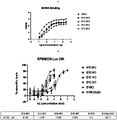
- Figure 9 shows the binding of the cFIST double antibody to BCMA antigen in Example 7 of the present invention. They mediate the killing of BCMA-expressing cell RPMI8226 by T cells.
- A is the ELISA binding of the B10 affinity-improved mutant double antibody to BCMA antigen.
- Antibody coating is 200ng/well, biotin-BCMA starts at 250ng/ml and is half-diluted.
- B is the mediated killing of BCMA-expressing cells by the B10 affinity-improved mutant double antibody.
- B10K3 is treated with high and low concentrations
- low concentration (B10K3) could not obtain the standard S-curve
- high concentration (B10(high)K3) could obtain the standard S-curve
- the EC50 value was calculated according to the curve.
- Fig. 10 is a diagram of BCMA double antibody-mediated T cells killing BCMA cells at different expression levels in Example 7 of the present invention, wherein A is H929 cells and B is RPMI8226 cells.
- Antibody library technology is a method of cloning all antibody variable region genes of a certain animal (including humans) into plasmids or phages. After the latter infects E. coli, antibody fragments are expressed on the surface of phage particles, or the periplasm of E. coli, including in the pulp. Then use the target antigen to screen the clones carrying specific antibody genes from the antibody library, so as to obtain the corresponding specific antibody technology.
- Various antibodies needed in basic research and clinical development have been screened from the antibody library, such as tumor-associated membrane protein antigens, autoantigens related to autoimmune diseases, and antibodies against viral antigens of viral diseases. These show the great application potential of antibody library technology in basic research and antibody drug development.
- obtaining fully human monoclonal antibodies from the human antibody library overcomes the difficulty of obtaining human monoclonal antibodies using mouse hybridoma technology; due to the highly conserved sequence of human antibodies, these antibodies have no effect on the human immune system.
- the immunogenicity of the antibody is much lower than that of animal-derived antibodies, so it is safer.
- RNA extraction kit such as QIAGEN's RNeasy Mini Kit, catalog number 74104
- PBMC peripheral blood mononuclear cells
- reverse transcription kit such as ThermoFisher Scientific's cDNA synthesis kit (SuperScript TM IV Reverse Transcriptase) to synthesize the light and heavy chain gene cDNA.
- the heavy chain with the bridge can be The variable region (VH) 3'-end primer set and the light chain variable region (VL) 5'-end primer set with a bridge were respectively combined with the other end primer (containing a specific restriction endonuclease site ) coordination, so that the obtained VH and VL can take the head link to form a single-chain antibody (scFv) gene.
- VH variable region
- VL light chain variable region
- scFv scFv genes
- the gene is cloned into a lysogenic phagemid (phagemid, such as M13phagemid) vector to construct an antibody library.
- phagemid phagemid, such as M13phagemid
- the size of the library reaches 5 billion colony-forming units (cfu).
- Biopanning refers to the process of screening antibodies with specific targets to obtain specific clones.
- panning was performed by liquid phase screening.
- the general steps of the liquid phase panning method are as follows: first, the commercialized BCMA antigen (BCMA-Fc fusion protein, Acrobiosystems, catalog number BC7-H5254) is modified with biotin, so that each molecule is cross-linked with 3-5 biotin molecule, removes free biotin.
- An appropriate amount of biotin-labeled BCMA antigen is bound to streptavidin-coupled magnetic beads (eg, Dynabeads TM M-280 Streptavidin, ThermoFisher Scientific, Cat# 11205D).
- the blocked antibody library solution and magnetic beads (total volume ⁇ 1ml) were added to a 1.5ml Eppendorf tube, and incubated for 2 hours at room temperature with rotation and mixing to allow BCMA-specific phage antibodies to bind. After the incubation, place the Eppendorf tube on the magnetic stand for 1 minute to separate the magnetic beads and the solution.
- washing solution PBST add Tween 20 with a final concentration of 0.05% to the phosphate buffer solution (PBS) solution
- PBS phosphate buffer solution
- the phage antibody solution eluted from the first round of panning was used to infect logarithmic Escherichia coli (such as TG1 strain) that can be infected by M13 phage to obtain an infection solution, and a small amount was taken for a series of 10-fold gradient dilutions ( Usually diluted to one millionth of the stock solution, and the last three gradients are taken for coating) to determine the titer of the first round of output eluate (output), which is also called the first round of maximum Diversity, usually the output titer after the first round of panning is below 10E6 cfu.
- helper phage M13K07 to make the multiplicity of infection 20:1, and keep it at 37°C for 30 minutes (this stage is called for phage rescue).
- Centrifuge resuspend the cells with 50ml expression medium (2YT-AK, add Carbenicillin and Kanamycin to 2YT medium, the final concentrations are 100 ⁇ g/ml and 30 ⁇ g/ml, respectively), and culture overnight at 30°C and 200rpm.
- the culture supernatant was harvested by centrifugation, and 1/5 volume of PEG8000/NaCl (PEG-8000 20%, NaCl 2.5M) was added, mixed well, and incubated on ice for 1 hour. High-speed centrifugation (11500 ⁇ g) for 30 minutes to harvest phage antibody particles. Resuspend the pellet with 1ml of PBS solution and centrifuge again at high speed to remove bacterial debris. The supernatant is the amplification solution after the first round of panning, and each antibody clone contained in it has been amplified more than ten thousand times. This amplification solution can be used for the second round of panning experiments.
- the operation of the second round of panning is exactly the same as that of the first round except that it is increased to 6 times (6/6) in PBST/PBS.
- the number of washes can be further increased to 10/10.
- Multiple rounds of panning usually effectively enrich specific clones, and their diversity is significantly reduced but their affinity is relatively high, which is convenient for subsequent monoclonal screening.
- a monoclonal phage enzyme-linked assay (Monophage ELISA) is required.
- Monophage ELISA monoclonal phage enzyme-linked assay
- single colonies that would be well-separated in the second and/or third round of dilution series were individually inoculated into 96-well culture plates containing 2YT-AG (93 colonies per plate, Leave three wells as negative control), cultivate overnight, this is the master plate (master plate). Inoculate the bacterial solution in each well of the master plate into a new culture plate and grow to the logarithmic phase, perform the above-mentioned phage rescue, and express the antibody of each clone on the surface of the phage.
- BCMA antigen (1 ⁇ g/ml) was coated on a common 96-well enzyme-linked plate, and another enzyme-linked plate was coated with the same concentration of human Fc.
- Each individually expressed monoclonal phage antibody bacterial solution was added to the corresponding wells of the BCMA plate and the Fc plate, followed by the appropriate secondary antibody and horseradish peroxidase (HRP)-coupled tertiary antibody, the substrate was colored, and read Take the absorbance value (450nM).
- HRP horseradish peroxidase
- BCMA-positive clones The judgment method of BCMA-positive clones is: negative on the Fc plate (not more than 1.5 times the absorption value of the negative well of the plate where it is located), positive on the BCMA plate (more than 3 times the absorption value of the negative well of the plate where it is located), and its Clones with wells with higher absorbance than corresponding wells on the Fc plate. After analysis, the clones corresponding to 10 wells were only positive for BCMA antigen, but negative for Fc, and these clones were collectively called hit.
- the amino acid sequences of CDR1, CDR2 and CDR3 of the heavy chain variable region of B10 are shown in SEQ ID NO.4-6 respectively, and the amino acid sequences of CDR1, CDR2 and CDR3 of the light chain variable region are shown in SEQ ID NO.1- 3, the amino acid sequence of the heavy chain variable region is shown in SEQ ID NO.17, and the amino acid sequence of the light chain variable region is shown in SEQ ID NO.18.
- the amino acid sequence of the single-chain antibody composed of the light chain and heavy chain variable regions of B10 is shown in SEQ ID NO.36.
- the gene of the B10 single-chain antibody was cloned into the eukaryotic expression vector pFH (manufactured by Ekest) to obtain the plasmid pFH-B10.
- the scFv gene is fused with the Fc gene of human IgG4 to express the protein in the form of scFv-Fc, which can be affinity purified with Potein-A or labeled with (HRP or fluorescein) anti-human Fc antibody detection.
- B10 was detected by flow cytometry on the BCMA-expressing cell line H929 (NCI-H929, CRL-9068 TM ), indicating that B10 specifically binds to the BCMA antigen on the cell membrane surface (see Figure 2).
- the percentage in the upper left corner of the quadrant represents the binding strength of each single chain antibody to the cell surface antigen.
- the positive percentage of clone B10 was 48.96%, thus verifying the binding ability of the antibody against human BCMA antigen.
- In vitro affinity maturation is a rapid directed molecular evolution operation: mutations are introduced at the DNA level and screened at the protein binding level.
- the mutation site is limited to the sequence of the CDR region, and each position is subjected to saturation mutations, and each mutation is expressed separately. Tested separately.
- the operation process of affinity maturation is as follows: firstly, the light and heavy chain variable region genes of B10 are respectively cloned into the pUFL vector (pUFL is a plasmid capable of expressing antibody Fab in Escherichia coli, prepared by Ecosite Company), to obtain Fab form of B10. Design a full set of single-point random mutation primers in the CDR region, and perform PCR mutations on each CDR position with the point mutation kit (QuikChange Lightning Multi Site-Directed Mutagenesis Kit, Agilent catalog number 210515), respectively, and transform BL21 (DE3) competent bacteria, Plates of monoclonal colonies are prepared separately and these mutants are collectively referred to as single point mutation libraries.
- point mutation kit QuantikChange Lightning Multi Site-Directed Mutagenesis Kit, Agilent catalog number 210515
- the Fab vector of the parental B10 was also transformed.
- pick 92 colonies according to the mutation of each CDR position to a 96-well culture plate containing the corresponding culture medium (containing 100 ⁇ g/ml Carbenicillin+0.1% glucose in 2YT), and pick in addition Take 3 parental colonies and leave 3 wells as blank controls.
- the plate was placed at 37°C, cultured at 300 rpm for 6 hours, added IPTG to a final concentration of 1mM, transferred to 30°C, cultured at 300 rpm overnight, and Fab fragments were expressed and secreted into the medium.
- the conditions of the enzyme-linked reaction were optimized so that the A450 absorption value of the parental antibody Fab of B10 to the antigen BCMA-Fc was slightly higher than the background signal by about 3 times.
- the top 5 clones with the highest affinity in the light chain variable region combinatorial library were obtained, and their light chain variable region amino acid sequences contained five mutant sequences, as shown in SEQ ID NO.22-26, and their light chain variable region CDR1 has the amino acid sequence shown in any one of SEQ ID NO.1 and 12, CDR2 has the amino acid sequence shown in SEQ ID NO.2, and CDR3 has the amino acid sequence shown in any of SEQ ID NO.3, 13, 14, 15, or 16 amino acid sequence.
- Enzyme-linked screening was performed in the heavy chain variable region combinatorial library, and the amino acid sequences of the top three clones with the highest affinity in the heavy chain variable region combinatorial library were obtained, and the amino acid sequences of their heavy chain variable region contained three mutations Sequences, respectively as shown in the sequence SEQ ID NO.19-21, the CDR1 of the heavy chain variable region has the amino acid sequence shown in any one of SEQ ID NO.7, 8, and 9, and the CDR2 has the amino acid sequence shown in SEQ ID NO.10 The amino acid sequence of CDR3 has the amino acid sequence shown in SEQ ID NO.11.
- the DNAs of the top 5 clones with the highest affinity for the variable region of the light and heavy chains were mixed respectively, and assembled into the final single-chain antibody combinatorial library by enzyme digestion and linking recombination.
- the library was screened, and the top 10 positions with the highest signal were selected, and their DNA sequences were analyzed to obtain four different single-chain antibody clones, the corresponding amino acid sequences of which were shown in SEQ ID NO.37-40.
- the affinity of B10.3 is about 0.26nM
- the affinity of B10.4 is about 0.31nM
- the affinity of B10.5 is about 0.27nM
- the affinity of B10.9 is about 0.29nM.
- the B10 parental antibody and the finally obtained 4 mutants were compared with J6 by flow cytometry in combination with the BCMA-expressing cell line RPMI8226 (see Fig. 4B, Table 4).
- the results showed that at the cellular level, the EC50 of the parent B10 was about 1.5 times higher than that of J6 (EC50 was 2.741 ⁇ g/ml), which was 1.575 ⁇ g/ml.
- the EC50 of B10.3, B10.4, B10.5 and B10.9 were 0.02822 ⁇ g/ml, 0.03429 ⁇ g/ml, 0.04063 ⁇ g/ml and 0.04514 ⁇ g/ml, respectively.
- the EC50-fold increase of these mutants with improved affinity were 97.13, 79.94, 67.46 and 60.72, respectively.
- a bispecific antibody was designed using the tumor cell surface antigen BCMA and the immune cell surface antigen CD3 as targets.
- the present invention screened and determined bispecific antibodies with symmetrical structures including single-chain antibody units and monoclonal antibody units in a variety of bispecific antibody structures that bind to BCMA and CD3 structure.
- the present invention refers to this technical platform as FIST (fusion of IgG and scFv technology).
- anti-BCMA monoclonal antibody units can be used as IgG antibodies, including 2 complete light chain-heavy chain pairs (i.e., containing complete Fab and Fc domains, and the heavy chain and light chain are connected by disulfide bonds)
- Anti-CD3 can be used as a single chain antibody unit, including 2 single chain antibodies (ScFv).
- a connecting peptide (SEQ ID NO.30) is used to connect the single-chain antibody and the monoclonal antibody.
- the following connection method is designed to obtain a bispecific antibody with a symmetrical structure ( Figure 5):
- the C-terminus of the single-chain antibody was linked to the N-terminus of the heavy chain variable region (VH) of the monoclonal antibody to obtain nFIST (A of FIG. 5 ).
- the single-chain antibody can also be fused to the C-terminus of IgG-Fc via a linker peptide to obtain cFIST (Fig. 5B).
- variable region sequence of the anti-CD3 single chain antibody UCHT1 is from the literature (Beverley, P.C. & Callard, R.E. Distinctive functional characteristics of human "T" lymphocytes defined by E rosetting or a monoclonal anti-T cell antibody (1981) Eur.J.Immunol.11,329-334) and transformed by humanization (Shalaby et.al., Development of humanized bispecific antibodies reactive with cytotoxic lymphocytes and tumor cells overexpressing the HER2protooncogene. (1992) J Exp Med. Jan 1; 175 (1):217-25).
- the single-chain antibody thus constructed is named K3 (SEQ ID NO.31), which contains two cysteines (Cys) inserted in the variable region of the heavy chain and the variable region of the light chain respectively, and is formed after folding A pair of interchain disulfide bonds, the amino acid sequence of the heavy chain variable region is shown in SEQ ID NO.28, and the amino acid sequence of the light chain variable region is shown in SEQ ID NO.29.
- the nFIST and cFIST bispecific antibody coding genes were designed according to Example 4 and cloned into the expression vector pG4HK to obtain two bispecific antibodies K3B10.3 and B10.3K3.
- Their heavy chain amino acid sequences are shown in SEQ ID NO.34 and 35 respectively (the fusion peptide formed by linking the heavy chain of the monoclonal antibody and the single chain antibody through a connecting peptide); the light chain amino acid sequence is shown in SEQ ID NO.33 .
- the expression plasmids corresponding to K3B10.3 and B10.3K3 were stably transfected into CHO-K1, respectively, and expressed to prepare double antibody protein.
- More anti-BCMA ⁇ CD3 bispecific antibodies were constructed using the cFIST format.
- the heavy chain variable region of the BCMA-binding IgG unit is derived from SEQ ID NO.17-21; the light chain variable region of the BCMA-binding IgG unit is derived from SEQ ID NO.18, 22, 25-27.
- Feed liquid pretreatment the supernatant of the fermentation culture was centrifuged at 2000 rpm for 10 min, and then filtered through a 0.22 ⁇ M filter membrane.
- Affinity chromatography Use Mabselect SuRe affinity chromatography column (purchased from GE Company, Cat. No.
- K3B10.3 and B10.3K3 were detected by SDS-PAGE and HPLC-SEC, and the results of SDS-PAGE are shown in Figure 6.
- the reduced SDS-PAGE electrophoresis detection result of K3B10.3 is shown in Figure 6 A
- the non-reducing SDS-PAGE electrophoresis detection result is shown in Figure 6 B
- the reduced SDS-PAGE electrophoresis detection result of B10.3K3 is shown in Figure 6
- the detection results of non-reducing SDS-PAGE electrophoresis are shown in D of Figure 6.
- the results of HPLC-SEC detection are shown in FIG. 7 .
- H929-luc and RPMI8226-Luc were used as target cells, and PBMC were used as immune effector cells to detect bispecific antibodies B10K3, B10.3K3, B10.4K3, B10.5K3, B10.9K3 and K3B10.3 mediated killing of target cells.
- the specific experimental steps are as follows:
- Target cell preparation culture H929-luc and RPMI8226-Luc (luciferase-labeled H929 and RPMI8226 cells, prepared in our laboratory) cells, count the target cells after blowing, centrifuge at 1000 rpm for 5 min, and wash once with PBS. After the target cells were centrifuged and washed, the density was adjusted to 0.2 ⁇ 10 6 /ml with GT-T551 medium, and 50 ⁇ l was added to each well, so the number of cells in each well was 10,000.
- PBMC preparation use PBMC as effector cells. Take out the PBMC frozen in the liquid nitrogen tank (refer to cell freezing and recovery), thaw, add to a 15ml centrifuge tube containing PBS or GT-T551 medium, centrifuge at 1000rpm for 5min, and wash twice with PBS or GT-T551 medium. Count the number of cells, activity and density, adjust the density of viable cells to 2 ⁇ 10 6 /ml, add 50 ⁇ l to each well, then there are 100,000 cells in each well.
- Antibody dilution use GT-T551 medium to dilute bispecific B10K3, B10.3K3, B10.4K3, B10.5K3, B10.9K3 and K3B10.3 and B10.3K3 respectively, and adjust the initial antibody concentration to 10nM. Dilute in a ratio of 1:5. Add 100 ⁇ l of the diluted antibody to the prepared cells above, mix well, put the 96-well plate back into the incubator, and detect the killing effect after 18 hours.
- Steady-GLO Promega
- the buffer in the kit thaw the buffer in the kit and add it to the substrate powder, mix well, and divide into 5ml or 10ml each tube to complete the reconstruction of the Steady-GLO substrate.
- 100 ⁇ l was transferred to an opaque white plate, then 100 ⁇ l of reconstituted Steady-GLO substrate was added, patted to mix, and the plate was read after standing for 5 minutes.
- the detection instrument was Synergy HT.
- Target cell killing ratio 100 ⁇ (only target cell hole value - detection hole value) / only target cell hole value
- the antibody concentration corresponding to the killing ratio of target cells in all detection wells was transformed into log10, which was used as the abscissa and the killing ratio was used as the vertical axis to make a graph.
- B10K3, B10.3K3, B10.4K3, B10.5K3, B10.9K3 in the form of cFIST against the sensitive cell line RPMI8226 The killing concentration-gradient curve is shown in Figure 9 B; the killing percentage of each gradient is shown in Table 5 .
- K3B10.3 and B10.3K3 are shown in FIG. 10 ; their killing percentages to RPMI8226 are shown in Table 6. Their killing percentages to H929 are shown in Table 7.
- the results showed that the bispecific antibody B10.3K3 could effectively mediate the killing of tumor cell lines H929 or RPMI8226 by PBMC, and a single molecule of B10.3K3 had the biological functions of both anti-BCMA and anti-CD3 monoclonal antibodies.
- the efficacy of K3B10.3-mediated killing of target cells RPMI8226 was significantly weaker than that of B10.3K3, especially on H929 cells, which showed almost no killing effect.
- the EC50 of target cell killing mediated by B10.9K3, B10.5K3, B10.4K3, B10.3K3, and B10K3 were 8.759pM, 12.87pM, 7.839pM, 5.833pM, and 281.7pM, respectively.
- the invention relates to a bispecific antibody binding to BCMA and CD3, a preparation method and application thereof.
- the invention provides a bispecific antibody capable of simultaneously binding BCMA and CD3, having a specific targeting effect, and capable of efficiently stimulating directed immune responses.
- the bispecific antibody well retains the biological functions of anti-CD3 antibody and anti-BCMA antibody, and realizes a bispecific antibody molecule with excellent biological functions of BCMA and CD3 targeting binding at the same time.
- Build bridges between immune effector cells effectively activate immune effector cells and oriented immune responses, significantly enhance the efficacy of immune cells in killing tumor cells, have high killing efficiency of target cells, and at the same time minimize the ADCC effect. With high safety, it has a good application prospect in tumor immunotherapy.
Landscapes
- Health & Medical Sciences (AREA)
- Immunology (AREA)
- Chemical & Material Sciences (AREA)
- Life Sciences & Earth Sciences (AREA)
- Organic Chemistry (AREA)
- General Health & Medical Sciences (AREA)
- Medicinal Chemistry (AREA)
- Molecular Biology (AREA)
- Engineering & Computer Science (AREA)
- Biochemistry (AREA)
- Proteomics, Peptides & Aminoacids (AREA)
- Genetics & Genomics (AREA)
- Biophysics (AREA)
- Urology & Nephrology (AREA)
- Hematology (AREA)
- Biomedical Technology (AREA)
- Pharmacology & Pharmacy (AREA)
- Chemical Kinetics & Catalysis (AREA)
- Veterinary Medicine (AREA)
- Public Health (AREA)
- Animal Behavior & Ethology (AREA)
- Nuclear Medicine, Radiotherapy & Molecular Imaging (AREA)
- General Chemical & Material Sciences (AREA)
- Cell Biology (AREA)
- Biotechnology (AREA)
- Microbiology (AREA)
- Food Science & Technology (AREA)
- Analytical Chemistry (AREA)
- Physics & Mathematics (AREA)
- Pathology (AREA)
- General Physics & Mathematics (AREA)
- Bioinformatics & Cheminformatics (AREA)
- Peptides Or Proteins (AREA)
- Medicines Containing Antibodies Or Antigens For Use As Internal Diagnostic Agents (AREA)
- Preparation Of Compounds By Using Micro-Organisms (AREA)
- Micro-Organisms Or Cultivation Processes Thereof (AREA)
- Medicinal Preparation (AREA)
- Medicines Containing Material From Animals Or Micro-Organisms (AREA)
Abstract
Description
交叉引用cross reference
本申请要求2021年6月24日提交的专利名称为“结合BCMA和CD3的双特异性抗体及其制备方法与应用”的第202110704255.6号中国专利申请的优先权,其全部公开内容通过引用整体并入本文。This application claims the priority of the Chinese patent application No. 202110704255.6 filed on June 24, 2021 with the title of "Bispecific antibody binding to BCMA and CD3 and its preparation method and application", the entire disclosure content of which is incorporated by reference in its entirety into this article.
本发明涉及基因工程抗体技术领域,具体涉及结合BCMA和CD3的双特异性抗体及其制备方法与应用。The invention relates to the technical field of genetic engineering antibodies, in particular to a bispecific antibody binding to BCMA and CD3 and its preparation method and application.
单克隆抗体在临床上可用于肿瘤治疗、免疫性疾病治疗以及抗感染治疗。其中,肿瘤治疗是目前单克隆抗体应用最为广泛的领域,单克隆抗体治疗肿瘤是一种针对病变细胞特异靶点刺激免疫系统杀伤靶细胞的免疫疗法。在单克隆抗体的基础上,为了进一步提高药效和减少毒副作用,以单克隆抗体为基础的新的抗体药物,包括抗体药物偶联物(Antibody drug conjugate,ADC)、双特异性抗体(bispecific antibody,bsAb)以及CAR-T(chimeric antigen receptor T cells)等新型蛋白和细胞药物的发展极为迅速。其中,基于双特异性性构建的细胞桥(cell-bridging)双抗,由于其连接免疫T细胞和癌靶细胞的能力,显著提高了杀伤活性和特异性,具有突破性的临床价值,受到了格外的关注。对于多发性骨髓瘤而言,靶向BCMA的具有上述性质的细胞桥双抗是改善抗体治疗效果的发展方向之一,现已成为抗体工程研究领域的热点。Monoclonal antibodies can be used clinically for tumor treatment, immune disease treatment and anti-infection treatment. Among them, tumor treatment is currently the most widely used field of monoclonal antibodies. Monoclonal antibody treatment of tumors is an immunotherapy that stimulates the immune system to kill target cells against specific targets of diseased cells. On the basis of monoclonal antibodies, in order to further improve drug efficacy and reduce side effects, new antibody drugs based on monoclonal antibodies include antibody drug conjugates (Antibody drug conjugate, ADC), bispecific antibody (bispecific Antibody, bsAb) and CAR-T (chimeric antigen receptor T cells) and other new protein and cell drugs are developing very rapidly. Among them, the cell-bridging double antibody based on bispecificity has significantly improved the killing activity and specificity due to its ability to connect immune T cells and cancer target cells, and has breakthrough clinical value. Extra attention. For multiple myeloma, the cell-bridged double antibody targeting BCMA with the above properties is one of the development directions to improve the effect of antibody therapy, and has become a hot spot in the field of antibody engineering research.
T细胞表面的CD3分子由4个亚基组成:δ、ε、γ、ζ,其分子质量分别为18.9k Da,23.1kDa,20.5kDa和18.7kDa,其长度分别为171、207、182、164个氨基酸残基。它们共同组成6条肽链,常与T细胞受体(T cell receptor,TCR)紧密结合形成含有8条肽链的TCR-CD3复合体,其结构示意图见图1的A。该复合体具有T细胞活化、信号转导以及稳定TCR结构的功能。CD3胞质段含有免疫受体酪氨酸活化基序(immunoreceptor tyrosine-based activation motif,ITAM),TCR识别并结合由MHC(major histo-compatibility complex)分子提呈的抗原肽,导致CD3的ITAM的保守序列中的酪氨酸残基被T细胞内的酪氨酸蛋白激酶p56lck磷酸化,然后募集其它含有SH2(Scr homology 2)结构域的酪氨酸蛋白激酶(如ZAP-70)。ITAM的磷酸化以及与ZAP-70的结合是T细胞活化信号传导过程早期阶段的重要生化反应之一。因此,CD3分子的功能是转导TCR识别抗原所产生的活化信号。The CD3 molecule on the surface of T cells is composed of four subunits: δ, ε, γ, and ζ, with molecular masses of 18.9kDa, 23.1kDa, 20.5kDa, and 18.7kDa, and lengths of 171, 207, 182, and 164, respectively. amino acid residues. Together, they form 6 peptide chains, which are often tightly combined with T cell receptor (TCR) to form a TCR-CD3 complex containing 8 peptide chains. This complex has the functions of T cell activation, signal transduction and stable TCR structure. CD3 cytoplasm contains immunoreceptor tyrosine-based activation motif (immunoreceptor tyrosine-based activation motif, ITAM), TCR recognizes and binds the antigenic peptide presented by MHC (major histo-compatibility complex) molecules, resulting in the activation of CD3 ITAM The tyrosine residues in the conserved sequence are phosphorylated by the tyrosine protein kinase p56lck in T cells, and then recruit other tyrosine protein kinases (such as ZAP-70) containing the SH2 (Scr homology 2) domain. The phosphorylation of ITAM and the combination with ZAP-70 is one of the important biochemical reactions in the early stage of T cell activation signal transduction process. Therefore, the function of the CD3 molecule is to transduce the activation signal generated by the recognition of the antigen by the TCR.
BCMA(即B-细胞成熟抗原,TNFRSF17,CD269)是一种优先在分化的浆细胞中表达的属于肿瘤坏死(TNF)受体超家族成员的非糖基化I型跨膜蛋白,其参与B细胞成熟、生长和存活。BCMA最初报道为人成熟B淋巴细胞的高尔基体内的整合膜蛋白,即作为细胞内蛋白,其表明BCMA看起来在B-细胞发育和稳态中具有重要作用。BCMA (i.e., B-cell maturation antigen, TNFRSF17, CD269) is an aglycosylated type I transmembrane protein that is preferentially expressed in differentiated plasma cells and belongs to the tumor necrosis (TNF) receptor superfamily member, which is involved in B Cells mature, grow and survive. BCMA was originally reported as an integral membrane protein in the Golgi body of human mature B lymphocytes, ie as an intracellular protein, suggesting that BCMA appears to have an important role in B-cell development and homeostasis.
BCMA的表达限于B-细胞谱系且主要存在于浆细胞和浆母细胞上(图1的B),并在一定程度上存在于记忆B-细胞上,但是实际上不存在于外周B-细胞上。BCMA也在多发性骨髓瘤(MM)细胞上表达。BCMA与其家族成员跨膜激活剂及亲环蛋白配体作用因子(TACI)和TNF家族受体 (BAFF-R)的B细胞活化因子一起调节体液免疫、B-细胞发育和稳态的不同方面。BCMA是TNF超家族的两种配体的受体(图1的C):APRIL(增殖诱导配体,CD256,TNFSF13),BCMA的高亲和力配体,以及B细胞活化因子BAFF(THANK,BlyS,B淋巴细胞刺激因子,TALL-1和zTNF4),BCMA的低亲和力配体。APRIL和BAFF显示出结构相似性以及重叠但不同的受体结合特异性。负调控因子TACI也结合至BAFF和APRIL两者。APRIL和BAFF与BCMA和/或TACI的配位结合激活转录因子NF-κB并增加促存活Bcl-2家族成员(例如,Bcl-2、Bcl-xL、Bcl-w、Mcl-1、A1)的表达并下调促凋亡因子(例如,Bid、Bad、Bik、Bim等)的表达,从而抑制细胞凋亡并促进存活。该组合作用促进B细胞分化、增殖、存活和抗体产生。BCMA的表达出现在B-细胞分化作用的较后期并有利于浆母细胞和浆细胞在骨髓中的长期存活。BCMA expression is restricted to the B-cell lineage and is predominantly present on plasma cells and plasmablasts (Figure 1, B), and to some extent on memory B-cells, but is virtually absent on peripheral B-cells . BCMA is also expressed on multiple myeloma (MM) cells. Together with its family members the transmembrane activator and cyclophilin ligand interacting factor (TACI) and the B-cell activator of the TNF family receptor (BAFF-R), BCMA regulates different aspects of humoral immunity, B-cell development and homeostasis. BCMA is the receptor for two ligands of the TNF superfamily (C in Figure 1): APRIL (proliferation-inducing ligand, CD256, TNFSF13), a high-affinity ligand of BCMA, and the B-cell activating factor BAFF (THANK, BlyS, B lymphocyte stimulator, TALL-1 and zTNF4), a low-affinity ligand of BCMA. APRIL and BAFF display structural similarities as well as overlapping but distinct receptor-binding specificities. The negative regulator TACI also binds to both BAFF and APRIL. Coordinated binding of APRIL and BAFF to BCMA and/or TACI activates the transcription factor NF-κB and increases prosurvival Bcl-2 family members (e.g., Bcl-2, Bcl-xL, Bcl-w, Mcl-1, A1) Expresses and down-regulates the expression of pro-apoptotic factors (eg, Bid, Bad, Bik, Bim, etc.), thereby inhibiting apoptosis and promoting survival. This combined action promotes B cell differentiation, proliferation, survival and antibody production. Expression of BCMA occurs at later stages of B-cell differentiation and favors the long-term survival of plasmablasts and plasma cells in the bone marrow.
BCMA是一个极其重要的B细胞生物标志物,广泛存在于MM细胞表面,是MM和其他血液系统恶性肿瘤的热门免疫治疗靶点。在连续3届ASCO年会上,BCMA都是行业瞩目的焦点。美国癌症研究所(CRI)的最新分析显示,BCMA已成为继CD19之后第二大最受欢迎的抗癌细胞疗法靶点。MM是一种异质性疾病并且多数是由t(11;14)、t(4;14)、t(8;14)、del(13)、del(17)(除其他外)的染色体易位引起的。MM受累患者可能经历因骨髓浸润、骨质破坏、肾衰竭、免疫缺陷以及癌症诊断的心理负担而经历多种与疾病相关的症状。BCMA is an extremely important B-cell biomarker that is widely present on the surface of MM cells and is a popular immunotherapy target for MM and other hematologic malignancies. In the three consecutive ASCO annual meetings, BCMA has always been the focus of the industry. BCMA has become the second most popular target for anticancer therapy after CD19, according to a new analysis by the American Cancer Institute (CRI). MM is a heterogeneous disease and is mostly caused by chromosomal predispositions of t(11;14), t(4;14), t(8;14), del(13), del(17) (among others) caused by the bit. Affected patients with MM may experience a variety of disease-related symptoms due to bone marrow infiltration, bone destruction, renal failure, immunodeficiency, and the psychological burden of a cancer diagnosis.
对于MM,化疗和干细胞移植的治疗方法虽然能够提高生存率,但是常常伴有有害的副作用,因此MM仍然难以治疗。尽管在化疗、蛋白酶体抑制剂、免疫调节剂沙利度胺衍生物和CD38靶向抗体方面取得了很大进展,但几乎所有患者最终仍会复发。因此,该领域对新药的需求仍然迫切。迄今为止,对于多发性骨髓瘤患者而言两种最常用的治疗选择是类固醇、沙利度胺、来那度胺、硼替佐米或多种细胞毒素试剂的组合,以及对于较年轻的患者采用高剂量化疗理念配合自体干细胞移植。多数的移植为自体型,即使用患者自身的细胞。这种移植,尽管不具有治愈性,但其显示延长选定患者的生命。其可在新诊断的患者中作为初始疗法或在复发时进行。有时为了适当的控制疾病,可能会建议选定患者采用一种以上的移植。用于治疗该疾病的化疗试剂是环磷酰胺、多柔比星、长春新碱和美法仑,与免疫调节剂如沙利度胺来那度胺硼替佐米和皮质类固醇(如地塞米松)的组合疗法已经成为用于治疗新确诊患者和化疗或移植均失败的疾病晚期患者中骨髓瘤的重要选择。For MM, treatments such as chemotherapy and stem cell transplantation, while improving survival, are often associated with deleterious side effects, and MM remains difficult to treat. Despite great advances in chemotherapy, proteasome inhibitors, immunomodulators thalidomide derivatives, and CD38-targeting antibodies, almost all patients eventually relapse. Therefore, there is still an urgent need for new drugs in this field. To date, the two most common treatment options for multiple myeloma patients are steroids, thalidomide, lenalidomide, bortezomib, or a combination of cytotoxic agents, and in younger patients The concept of high-dose chemotherapy combined with autologous stem cell transplantation. Most transplants are autologous, using the patient's own cells. This transplant, although not curative, has been shown to prolong the life of selected patients. It can be performed as initial therapy in newly diagnosed patients or at the time of relapse. Sometimes more than one transplant may be recommended for selected patients for adequate disease control. Chemotherapy agents used to treat this disease are cyclophosphamide, doxorubicin, vincristine, and melphalan, in combination with immunomodulators such as thalidomide, lenalidomide, bortezomib, and corticosteroids (such as dexamethasone) combination therapy has become an important option for the treatment of myeloma in newly diagnosed patients and in patients with advanced disease who have failed chemotherapy or transplantation.
目前对于MM所用疗法是通常非治愈性的。因为高龄、其它严重疾病的存在或其它身体上的限制,干细胞移植可能不适用于多数患者的选择。化疗仅能部分控制多发性骨髓瘤,且极少达到完全缓解。因此,迫切需要新的创新疗法。Currently used therapies for MM are generally non-curative. Because of advanced age, the presence of other serious medical conditions, or other physical limitations, stem cell transplantation may not be an option for most patients. Chemotherapy can only partially control multiple myeloma, and complete remission is rarely achieved. Therefore, new innovative therapies are urgently needed.
拮抗型BCMA-特异性抗体可阻止与在正常和恶性B-细胞中强效促存活信号转导通路有关的NF-κB活化。Antagonistic BCMA-specific antibodies prevent NF-κB activation associated with a potent pro-survival signaling pathway in normal and malignant B-cells.
在对抗血源性肿瘤或自身免疫性障碍方面的其它方法专注于BAFF和APRIL(即TNF配体超家族的配体)与其由BAFF和/或APRIL活化的受体TACI、BAFF-R和BCMA之间的相互作用。例如,通过将人免疫球蛋白的Fc-结构域与Zymogenetics公司的TACI融合产生了阿塞西普(TACI-Ig),来中和这两种配体并阻止受体的活化。阿塞西普目前正处于用于治疗系统性红斑狼疮(SLE,第III期)多发性硬化症(MS,第II期)及类风湿性关节炎(RA,第II期)的临床试验中,以及处于用于治疗B细胞恶性肿瘤慢性淋巴细胞白血病(CLL)、非霍奇金氏淋巴瘤(NHL)及MM的第I期临床试验中。在临床前研究中,阿塞西普在体外和体内降低了初始MM细胞和MM细胞系 的生长和存活,这表明了TACI配体对于MM细胞的相关性。由于多数MM细胞及其衍生的细胞系都表达BCMA和TACI,两者的受体可能有利于配体介导的生长与存活。这些数据表明,对BCMA和TACI的拮抗作用可能有益于浆细胞障碍的治疗。另外,已经描述了与TACI交叉反应的BCMA-特异性抗体(WO02/066516)。Other approaches in the fight against hematogenous neoplasms or autoimmune disorders focus on the relationship between BAFF and APRIL (i.e., ligands of the TNF ligand superfamily) and their receptors TACI, BAFF-R, and BCMA activated by BAFF and/or APRIL. interaction between. For example, acetcept (TACI-Ig) was created by fusing the Fc-domain of a human immunoglobulin to TACI from Zymogenetics to neutralize both ligands and prevent activation of the receptor. Acecept is currently in clinical trials for the treatment of systemic lupus erythematosus (SLE, phase III), multiple sclerosis (MS, phase II) and rheumatoid arthritis (RA, phase II), and in Phase I clinical trials for the treatment of B-cell malignancies chronic lymphocytic leukemia (CLL), non-Hodgkin's lymphoma (NHL) and MM. In preclinical studies, acetcept reduced the growth and survival of naïve MM cells and MM cell lines in vitro and in vivo, suggesting the relevance of TACI ligands for MM cells. Since most MM cells and derived cell lines express both BCMA and TACI, their receptors may favor ligand-mediated growth and survival. These data suggest that antagonism of BCMA and TACI may be beneficial in the treatment of plasma cell disorders. In addition, BCMA-specific antibodies that cross-react with TACI have been described (WO02/066516).
人类基因组科学公司和葛兰素史克已经开发出一种称为贝利木单抗的靶向BAFF的抗体。贝利木单抗阻断可溶性BAFF与其受体BAFF-R、BCMA及TACI在B细胞上的结合。贝利木单抗不直接结合B细胞,但是通过结合BAFF,贝利木单抗抑制包括自体反应性B细胞的B细胞的存活,并减少B细胞分化为产生免疫球蛋白的浆细胞。Human Genome Sciences and GlaxoSmithKline have developed an antibody that targets BAFF called belimumab. Belimumab blocks the binding of soluble BAFF to its receptors BAFF-R, BCMA, and TACI on B cells. Belimumab does not directly bind B cells, but by binding to BAFF, belimumab inhibits the survival of B cells, including autoreactive B cells, and reduces the differentiation of B cells into immunoglobulin-producing plasma cells.
然而,尽管存在BCMA、BAFF-R和TACI(即属于TNF受体超家族的B细胞受体)及其配体BAFF和APRIL服从在对抗癌症和/或自身免疫性障碍中的治疗方案这一事实,仍然需要可用于治疗这种医学病症的其它可用选择。However, despite the fact that BCMA, BAFF-R and TACI (i.e. B cell receptors belonging to the TNF receptor superfamily) and their ligands BAFF and APRIL are amenable to therapeutic regimens in the fight against cancer and/or autoimmune disorders , there remains a need for other available options for the treatment of this medical condition.
发明内容Contents of the invention
本发明的第一目的在于提供一种结合BCMA和CD3的双特异性抗体及其活性片段。The first object of the present invention is to provide a bispecific antibody binding to BCMA and CD3 and its active fragment.
本发明的第二目的在于提供编码上述抗体或其活性片段的核酸。The second object of the present invention is to provide nucleic acid encoding the above-mentioned antibody or its active fragment.
本发明的第三目的在于提供上述抗体或其活性片段的用途。The third object of the present invention is to provide the use of the above-mentioned antibody or its active fragment.
具体地,本发明提供以下技术方案:Specifically, the present invention provides the following technical solutions:
首先,本发明提供结合BCMA和CD3的双特异性抗体,该双特异性抗体包括:First, the present invention provides a bispecific antibody binding to BCMA and CD3, the bispecific antibody comprising:
第一结构域,结合B细胞成熟抗原BCMA,The first domain, which binds the B-cell maturation antigen BCMA,
以及,第二结构域,结合T细胞表面抗原CD3,and, the second domain, which binds the T cell surface antigen CD3,
其中,第一结构域和第二结构域之间通过连接肽连接,Wherein, the first structural domain and the second structural domain are connected by a connecting peptide,
第一结构域包括重链可变区和轻链可变区,重链可变区的CDR1、CDR2、CDR3分别具有SEQ ID NO.4-6所示的氨基酸序列,或者,其分别具有以SEQ ID NO.4-6所示的氨基酸序列为参考序列、含有如下突变中的一种或多种突变的组合的氨基酸序列:The first structural domain includes a heavy chain variable region and a light chain variable region, and CDR1, CDR2, and CDR3 of the heavy chain variable region have the amino acid sequences shown in SEQ ID NO.4-6 respectively, or they have the amino acid sequences shown in SEQ ID NO.4-6 respectively. The amino acid sequence shown in ID NO.4-6 is a reference sequence, an amino acid sequence containing a combination of one or more mutations in the following mutations:
(1)SEQ ID NO.4所示的氨基酸序列的第1位S突变为P或K;(1) The first S of the amino acid sequence shown in SEQ ID NO.4 is mutated to P or K;
(2)SEQ ID NO.4所示的氨基酸序列的第2位Y突变为H、D、G、M或S;(2) The second Y of the amino acid sequence shown in SEQ ID NO.4 is mutated to H, D, G, M or S;
(3)SEQ ID NO.4所示的氨基酸序列的第3位A突变为N;(3) The third A of the amino acid sequence shown in SEQ ID NO.4 is mutated to N;
(4)SEQ ID NO.4所示的氨基酸序列的第5位S突变为H、N、A或M;(4) The fifth position S of the amino acid sequence shown in SEQ ID NO.4 is mutated to H, N, A or M;
(5)SEQ ID NO.5所示的氨基酸序列的第1位G突变为V或T;(5) The first G of the amino acid sequence shown in SEQ ID NO.5 is mutated to V or T;
(6)SEQ ID NO.5所示的氨基酸序列的第3位I突变为H;(6) The third I mutation of the amino acid sequence shown in SEQ ID NO.5 is H;
(7)SEQ ID NO.5所示的氨基酸序列的第4位I突变为D或A;(7) The fourth position I of the amino acid sequence shown in SEQ ID NO.5 is mutated to D or A;
(8)SEQ ID NO.5所示的氨基酸序列的第5位F突变为H;(8) The fifth F of the amino acid sequence shown in SEQ ID NO.5 is mutated to H;
(9)SEQ ID NO.5所示的氨基酸序列的第7位T突变为K;(9) The 7th T mutation of the amino acid sequence shown in SEQ ID NO.5 is K;
(10)SEQ ID NO.6所示的氨基酸序列的第4位F突变为L;(10) The fourth F of the amino acid sequence shown in SEQ ID NO.6 is mutated to L;
第一结构域的轻链可变区的CDR1、CDR2和CDR3分别具有SEQ ID NO.1-3所示的氨基酸序列,或者,其分别具有以SEQ ID NO.1-3所示的氨基酸序列为参考序列,含有如下突变中的一种或多种的组合得到的氨基酸序列:CDR1, CDR2 and CDR3 of the light chain variable region of the first structural domain respectively have the amino acid sequence shown in SEQ ID NO.1-3, or it has the amino acid sequence shown in SEQ ID NO.1-3 respectively: Reference sequence, containing the amino acid sequence obtained by a combination of one or more of the following mutations:
(1)SEQ ID NO.1所示的氨基酸序列的第5位S突变为N、R或T;(1) The fifth position S of the amino acid sequence shown in SEQ ID NO.1 is mutated to N, R or T;
(2)SEQ ID NO.3所示的氨基酸序列的第7位L突变为Q、V或A;(2) The 7th L mutation of the amino acid sequence shown in SEQ ID NO.3 is Q, V or A;
(3)SEQ ID NO.3所示的氨基酸序列的第8位I突变为S、A、R或P;(3) The 8th I mutation of the amino acid sequence shown in SEQ ID NO.3 is S, A, R or P;
(4)SEQ ID NO.3所示的氨基酸序列的第10位Y突变为M、L、W或T;(4) The 10th Y in the amino acid sequence shown in SEQ ID NO.3 is mutated to M, L, W or T;
(5)SEQ ID NO.3所示的氨基酸序列的第11位V突变为L或Q。(5) The 11th V mutation of the amino acid sequence shown in SEQ ID NO.3 is L or Q.
本发明从全合成单链人抗体库中筛选出抗BCMA的基因工程单链抗体,并获得其抗体的可变区基因序列,通过点突变试剂盒构建突变文库,获得亲和力高的克隆,将这些克隆的DNA混合,以重组方式组装单链抗体组合文库,筛选后获得与人BCMA结合的亲和力高的BCMA抗体。The present invention screens the anti-BCMA genetically engineered single-chain antibody from a fully synthetic single-chain human antibody library, obtains the variable region gene sequence of the antibody, constructs a mutation library through a point mutation kit, and obtains clones with high affinity. The cloned DNA is mixed, and the single-chain antibody combinatorial library is assembled in a recombinant way, and the BCMA antibody with high affinity to human BCMA is obtained after screening.
本发明提供的抗体可变区氨基酸序列模式为FR1-CDR1-FR2-CDR2-FR3-CDR3-FR4。在本申请中,FR和CDR的区域划分基于Kabat命名系统。在此,FR1~4代表4个框架区域,CDR1~3代表3个高变区。FR1~4可以是从恒定区序列分离而来(比如人免疫球蛋白轻重链类、亚类或亚家族最常用的氨基酸),也可以是从单独的人抗体框架区分离而来或从不同的框架区基因组合而来。The amino acid sequence pattern of the antibody variable region provided by the present invention is FR1-CDR1-FR2-CDR2-FR3-CDR3-FR4. In this application, the division of regions of FR and CDR is based on the Kabat nomenclature system. Here, FR1-4 represent four framework regions, and CDR1-3 represent three hypervariable regions. FR1-4 can be isolated from the constant region sequence (such as the most commonly used amino acids of human immunoglobulin light and heavy chain class, subclass or subfamily), or can be isolated from a single human antibody framework region or from different Combination of framework region genes.
经进一步筛选,本发明提供以下双特异性抗体,其第一结构域与BCMA表现出更高的亲和力:After further screening, the present invention provides the following bispecific antibodies, the first domain of which exhibits higher affinity to BCMA:
结合BCMA和CD3的双特异性抗体,其包括:Bispecific antibodies that bind BCMA and CD3, including:
第一结构域,结合B细胞成熟抗原BCMA,The first domain, which binds the B-cell maturation antigen BCMA,
以及,第二结构域,结合T细胞表面抗原CD3,and, the second domain, which binds the T cell surface antigen CD3,
其中,第一结构域和第二结构域之间通过连接肽连接,Wherein, the first structural domain and the second structural domain are connected by a connecting peptide,
第一结构域包括重链可变区和轻链可变区,重链可变区的CDR1具有SEQ ID NO.4、7、8、9任一所示的氨基酸序列,CDR2具有SEQ ID NO.5、10任一所示的氨基酸序列,CDR3具有SEQ ID NO.6、11任一所示的氨基酸序列;The first structural domain comprises a heavy chain variable region and a light chain variable region, the CDR1 of the heavy chain variable region has the amino acid sequence shown in any one of SEQ ID NO.4, 7, 8, 9, and the CDR2 has the SEQ ID NO. 5. The amino acid sequence shown in any one of 10, CDR3 has the amino acid sequence shown in any one of SEQ ID NO.6, 11;
轻链可变区的CDR1具有SEQ ID NO.1、12任一所示的氨基酸序列,CDR2具有SEQ ID NO.2所示的氨基酸序列,CDR3具有SEQ ID NO.3、13、14、15、16任一所示的氨基酸序列。The CDR1 of the light chain variable region has the amino acid sequence shown in any one of SEQ ID NO.1, 12, the CDR2 has the amino acid sequence shown in SEQ ID NO.2, and the CDR3 has the amino acid sequence shown in SEQ ID NO.3, 13, 14, 15, Any of 16 amino acid sequences shown.
进一步地,在上述结合BCMA的抗体中,以下抗体与BCMA表现出更高的亲和力:Further, among the above-mentioned antibodies that bind to BCMA, the following antibodies exhibit higher affinity to BCMA:
重链可变区的CDR区序列为如下任一种:The CDR region sequence of the heavy chain variable region is any of the following:
(1)CDR1具有SEQ ID NO.4所示的氨基酸序列,CDR2具有SEQ ID NO.5所示的氨基酸序列,CDR3具有SEQ ID NO.6所示的氨基酸序列;(1) CDR1 has the amino acid sequence shown in SEQ ID NO.4, CDR2 has the amino acid sequence shown in SEQ ID NO.5, and CDR3 has the amino acid sequence shown in SEQ ID NO.6;
(2)CDR1具有SEQ ID NO.7所示的氨基酸序列,CDR2具有SEQ ID NO.10所示的氨基酸序列,CDR3具有SEQ ID NO.11所示的氨基酸序列;(2) CDR1 has the amino acid sequence shown in SEQ ID NO.7, CDR2 has the amino acid sequence shown in SEQ ID NO.10, and CDR3 has the amino acid sequence shown in SEQ ID NO.11;
(3)CDR1具有SEQ ID NO.8所示的氨基酸序列,CDR2具有SEQ ID NO.10所示的氨基酸序列,CDR3具有SEQ ID NO.11所示的氨基酸序列;(3) CDR1 has the amino acid sequence shown in SEQ ID NO.8, CDR2 has the amino acid sequence shown in SEQ ID NO.10, and CDR3 has the amino acid sequence shown in SEQ ID NO.11;
(4)CDR1具有SEQ ID NO.9所示的氨基酸序列,CDR2具有SEQ ID NO.10所示的氨基酸序列,CDR3具有SEQ ID NO.11所示的氨基酸序列;(4) CDR1 has the amino acid sequence shown in SEQ ID NO.9, CDR2 has the amino acid sequence shown in SEQ ID NO.10, and CDR3 has the amino acid sequence shown in SEQ ID NO.11;
轻链可变区的CDR区序列为如下任一种:The CDR region sequence of the light chain variable region is any of the following:
(1)CDR1具有SEQ ID NO.1所示的氨基酸序列,CDR2具有SEQ ID NO.2所示的氨基酸序列,CDR3具有SEQ ID NO.3所示的氨基酸序列;(1) CDR1 has the amino acid sequence shown in SEQ ID NO.1, CDR2 has the amino acid sequence shown in SEQ ID NO.2, and CDR3 has the amino acid sequence shown in SEQ ID NO.3;
(2)CDR1具有SEQ ID NO.12所示的氨基酸序列,CDR2具有SEQ ID NO.2所示的氨基酸 序列,CDR3具有SEQ ID NO.13所示的氨基酸序列;(2) CDR1 has the amino acid sequence shown in SEQ ID NO.12, CDR2 has the amino acid sequence shown in SEQ ID NO.2, and CDR3 has the amino acid sequence shown in SEQ ID NO.13;
(3)CDR1具有SEQ ID NO.12所示的氨基酸序列,CDR2具有SEQ ID NO.2所示的氨基酸序列,CDR3具有SEQ ID NO.14所示的氨基酸序列;(3) CDR1 has the amino acid sequence shown in SEQ ID NO.12, CDR2 has the amino acid sequence shown in SEQ ID NO.2, and CDR3 has the amino acid sequence shown in SEQ ID NO.14;
(4)CDR1具有SEQ ID NO.12所示的氨基酸序列,CDR2具有SEQ ID NO.2所示的氨基酸序列,CDR3具有SEQ ID NO.15所示的氨基酸序列;(4) CDR1 has the amino acid sequence shown in SEQ ID NO.12, CDR2 has the amino acid sequence shown in SEQ ID NO.2, and CDR3 has the amino acid sequence shown in SEQ ID NO.15;
(5)CDR1具有SEQ ID NO.12所示的氨基酸序列,CDR2具有SEQ ID NO.2所示的氨基酸序列,CDR3具有SEQ ID NO.16所示的氨基酸序列;(5) CDR1 has the amino acid sequence shown in SEQ ID NO.12, CDR2 has the amino acid sequence shown in SEQ ID NO.2, and CDR3 has the amino acid sequence shown in SEQ ID NO.16;
更进一步地,在上述结合BCMA的抗体中,以下抗体与BCMA表现出更高的亲和力:Furthermore, among the above-mentioned antibodies binding to BCMA, the following antibodies showed higher affinity to BCMA:
重链可变区的CDR和轻链可变区的CDR为如下任一种:The CDRs of the heavy chain variable region and the CDRs of the light chain variable region are any of the following:
(1)重链可变区的CDR1具有SEQ ID NO.4所示的氨基酸序列,CDR2具有SEQ ID NO.5所示的氨基酸序列,CDR3具有SEQ ID NO.6所示的氨基酸序列;轻链可变区的CDR1具有SEQ ID NO.1所示的氨基酸序列,CDR2具有SEQ ID NO.2所示的氨基酸序列,CDR3具有SEQ ID NO.3所示的氨基酸序列;(1) CDR1 of the heavy chain variable region has the amino acid sequence shown in SEQ ID NO.4, CDR2 has the amino acid sequence shown in SEQ ID NO.5, and CDR3 has the amino acid sequence shown in SEQ ID NO.6; light chain CDR1 of the variable region has the amino acid sequence shown in SEQ ID NO.1, CDR2 has the amino acid sequence shown in SEQ ID NO.2, and CDR3 has the amino acid sequence shown in SEQ ID NO.3;
(2)重链可变区的CDR1具有SEQ ID NO.8所示的氨基酸序列,CDR2具有SEQ ID NO.10所示的氨基酸序列,CDR3具有SEQ ID NO.11所示的氨基酸序列;轻链可变区的CDR1具有SEQ ID NO.12所示的氨基酸序列,CDR2具有SEQ ID NO.2所示的氨基酸序列,CDR3具有SEQ ID NO.13所示的氨基酸序列;(2) CDR1 of the heavy chain variable region has the amino acid sequence shown in SEQ ID NO.8, CDR2 has the amino acid sequence shown in SEQ ID NO.10, and CDR3 has the amino acid sequence shown in SEQ ID NO.11; light chain CDR1 of the variable region has the amino acid sequence shown in SEQ ID NO.12, CDR2 has the amino acid sequence shown in SEQ ID NO.2, and CDR3 has the amino acid sequence shown in SEQ ID NO.13;
(3)重链可变区的CDR1具有SEQ ID NO.9所示的氨基酸序列,CDR2具有SEQ ID NO.10所示的氨基酸序列,CDR3具有SEQ ID NO.11所示的氨基酸序列;轻链可变区的CDR1具有SEQ ID NO.1所示的氨基酸序列,CDR2具有SEQ ID NO.2所示的氨基酸序列,CDR3具有SEQ ID NO.3所示的氨基酸序列;(3) CDR1 of the heavy chain variable region has the amino acid sequence shown in SEQ ID NO.9, CDR2 has the amino acid sequence shown in SEQ ID NO.10, and CDR3 has the amino acid sequence shown in SEQ ID NO.11; light chain CDR1 of the variable region has the amino acid sequence shown in SEQ ID NO.1, CDR2 has the amino acid sequence shown in SEQ ID NO.2, and CDR3 has the amino acid sequence shown in SEQ ID NO.3;
(4)重链可变区的CDR1具有SEQ ID NO.8所示的氨基酸序列,CDR2具有SEQ ID NO.10所示的氨基酸序列,CDR3具有SEQ ID NO.11所示的氨基酸序列;轻链可变区的CDR1具有SEQ ID NO.12所示的氨基酸序列,CDR2具有SEQ ID NO.2所示的氨基酸序列,CDR3具有SEQ ID NO.16所示的氨基酸序列。(4) CDR1 of the heavy chain variable region has the amino acid sequence shown in SEQ ID NO.8, CDR2 has the amino acid sequence shown in SEQ ID NO.10, and CDR3 has the amino acid sequence shown in SEQ ID NO.11; light chain CDR1 of the variable region has the amino acid sequence shown in SEQ ID NO.12, CDR2 has the amino acid sequence shown in SEQ ID NO.2, and CDR3 has the amino acid sequence shown in SEQ ID NO.16.
基于上述CDR的序列,具有如下可变区序列的抗体(第一结构域)表现出较高的BCMA的亲和力:Based on the sequences of the above CDRs, antibodies (first domain) with the following variable region sequences exhibited higher affinity for BCMA:
重链可变区具有SEQ ID NO.17、19-21任一所示的氨基酸序列,轻链可变区具有SEQ ID NO.18、22-27任一所示的氨基酸序列;The heavy chain variable region has the amino acid sequence shown in any one of SEQ ID NO.17, 19-21, and the light chain variable region has the amino acid sequence shown in any one of SEQ ID NO.18, 22-27;
在上述重链可变区、轻链可变区的基础上,与其序列相比具有满足以下二者中至少一个:a)结合相同抗原表位;b)序列同一性大于70%、80%、85%、90%、97%、98%或99%的氨基酸序列也在本发明的保护范围内。On the basis of the above heavy chain variable region and light chain variable region, compared with its sequence, it has at least one of the following two requirements: a) binding to the same antigenic epitope; b) sequence identity greater than 70%, 80%, Amino acid sequences of 85%, 90%, 97%, 98% or 99% are also within the protection scope of the present invention.
进一步而言,具有如下可变区序列的抗体(第一结构域)表现出更为优异的BCMA的亲和力:Furthermore, antibodies (first domain) with the following variable region sequences exhibited better affinity for BCMA:
重链可变区具有SEQ ID NO.17所示的氨基酸序列,轻链可变区具有SEQ ID NO.18所示的氨基酸序列;The heavy chain variable region has the amino acid sequence shown in SEQ ID NO.17, and the light chain variable region has the amino acid sequence shown in SEQ ID NO.18;
或者,重链可变区具有SEQ ID NO.20所示的氨基酸序列,轻链可变区具有SEQ ID NO.22所示的氨基酸序列;Alternatively, the heavy chain variable region has the amino acid sequence shown in SEQ ID NO.20, and the light chain variable region has the amino acid sequence shown in SEQ ID NO.22;
或者,重链可变区具有SEQ ID NO.19所示的氨基酸序列,轻链可变区具有SEQ ID NO.27所示的氨基酸序列;Alternatively, the heavy chain variable region has the amino acid sequence shown in SEQ ID NO.19, and the light chain variable region has the amino acid sequence shown in SEQ ID NO.27;
或者,重链可变区具有SEQ ID NO.21所示的氨基酸序列,轻链可变区具有SEQ ID NO.25所示的氨基酸序列;Alternatively, the heavy chain variable region has the amino acid sequence shown in SEQ ID NO.21, and the light chain variable region has the amino acid sequence shown in SEQ ID NO.25;
或者,重链可变区具有SEQ ID NO.20所示的氨基酸序列,轻链可变区具有SEQ ID NO.26所示的氨基酸序列。Alternatively, the heavy chain variable region has the amino acid sequence shown in SEQ ID NO.20, and the light chain variable region has the amino acid sequence shown in SEQ ID NO.26.
本发明的双特异性抗体中,第一结构域为能够结合BCMA的抗体,包含2个完整的重链-轻链对,其中,每对轻链和重链之间通过二硫键连接。In the bispecific antibody of the present invention, the first domain is an antibody capable of binding BCMA, comprising two complete heavy chain-light chain pairs, wherein each pair of light chain and heavy chain is connected by a disulfide bond.
第一结构域的重链的Fc片段可为人或人源化抗体(IgG1、IgG2、IgA、IgE、IgM、IgG4或IgD)的Fc片段。The Fc fragment of the heavy chain of the first domain may be the Fc fragment of a human or humanized antibody (IgG1, IgG2, IgA, IgE, IgM, IgG4 or IgD).
作为本发明的一种实施方式,第一结构域的重链的Fc片段为人或人源化IgG4抗体的Fc片段。As one embodiment of the present invention, the Fc fragment of the heavy chain of the first domain is the Fc fragment of a human or humanized IgG4 antibody.
作为本发明的优选实施方式,第一结构域的重链具有SEQ ID NO.32所示的氨基酸序列,轻链具有SEQ ID NO.33所示的氨基酸序列,As a preferred embodiment of the present invention, the heavy chain of the first structural domain has the amino acid sequence shown in SEQ ID NO.32, and the light chain has the amino acid sequence shown in SEQ ID NO.33,
或者,重链具有SEQ ID NO.49所示的氨基酸序列,轻链具有SEQ ID NO.42所示的氨基酸序列,Alternatively, the heavy chain has the amino acid sequence shown in SEQ ID NO.49, and the light chain has the amino acid sequence shown in SEQ ID NO.42,
或者,重链具有SEQ ID NO.50所示的氨基酸序列,轻链具有SEQ ID NO.44所示的氨基酸序列,Alternatively, the heavy chain has the amino acid sequence shown in SEQ ID NO.50, and the light chain has the amino acid sequence shown in SEQ ID NO.44,
或者,重链具有SEQ ID NO.51所示的氨基酸序列,轻链具有SEQ ID NO.46所示的氨基酸序列,Alternatively, the heavy chain has the amino acid sequence shown in SEQ ID NO.51, and the light chain has the amino acid sequence shown in SEQ ID NO.46,
或者,重链具有SEQ ID NO.52所示的氨基酸序列,轻链具有SEQ ID NO.48所示的氨基酸序列。Alternatively, the heavy chain has the amino acid sequence shown in SEQ ID NO.52, and the light chain has the amino acid sequence shown in SEQ ID NO.48.
这些结合BCMA的抗体具有较高的BCMA的亲和力,且能够保证与结合CD3的抗体在形成双特异性抗体时,两者的功能均得到充分发挥。These BCMA-binding antibodies have high BCMA affinity, and can ensure that when bispecific antibodies are formed with CD3-binding antibodies, the functions of both can be fully exerted.
在上述重链、轻链序列的基础上,与该序列相比具有满足以下二者中至少一个:a)结合相同抗原表位;b)序列同一性大于70%、80%、85%、90%、97%、98%或99%的氨基酸序列也在本发明的保护范围内。On the basis of the above heavy chain and light chain sequences, compared with the sequence, it has at least one of the following two requirements: a) binding to the same antigenic epitope; b) sequence identity greater than 70%, 80%, 85%, 90% %, 97%, 98% or 99% of the amino acid sequences are also within the protection scope of the present invention.
本发明提供的上述人源抗人BCMA抗体以0.2nM-10nM的亲和力结合于人BCMA。该抗体抑制BCMA配体结合人BCMA。该抗体结合于表达BCMA的细胞,所述的细胞可以是人多发性骨髓瘤细胞或淋巴瘤细胞。The above human anti-human BCMA antibody provided by the present invention binds to human BCMA with an affinity of 0.2nM-10nM. This antibody inhibits BCMA ligand binding to human BCMA. The antibody binds to cells expressing BCMA, which may be human multiple myeloma cells or lymphoma cells.
对于结合CD3抗原的第二结构域,其重链可变区具有SEQ ID NO.28所示的氨基酸序列,轻链可变区具有SEQ ID NO.29所示的氨基酸序列。For the second structural domain binding CD3 antigen, its heavy chain variable region has the amino acid sequence shown in SEQ ID NO.28, and the light chain variable region has the amino acid sequence shown in SEQ ID NO.29.
优选第二结构域的轻链可变区和重链可变区通过连接肽连接为单链抗体,该单链抗体具有SEQ ID NO.31所示的氨基酸序列。Preferably, the light chain variable region and the heavy chain variable region of the second structural domain are connected into a single-chain antibody through a connecting peptide, and the single-chain antibody has the amino acid sequence shown in SEQ ID NO.31.
本发明的双特异性抗体优选设计为以下结构:第一结构域包含2个完整的轻链-重链对,第二结构域包含2个单链抗体,通过如下任意一种方式连接而成的对称结构:The bispecific antibody of the present invention is preferably designed with the following structure: the first domain contains two complete light chain-heavy chain pairs, and the second domain contains two single-chain antibodies, which are connected by any of the following methods Symmetrical structure:
(1)第二结构域的2个单链抗体的C端分别通过连接肽与第一结构域的2条重链的N端连接;(1) The C-terminals of the two single-chain antibodies of the second domain are connected to the N-terminals of the two heavy chains of the first domain through linking peptides;
(2)第二结构域的2个单链抗体的N端分别通过连接肽与第一结构域的2条重链的C端连接。(2) The N-terminals of the two single-chain antibodies of the second domain are respectively connected to the C-terminis of the two heavy chains of the first domain through linking peptides.
本发明发现,针对上述第一结构域和第二结构域的序列,具有上述对称结构的双特异性抗体与其它结构的双特异性抗体相比,能够更好地保留第一结构域和第二结构域的原抗体的特异性抗原结合能力,同时具有优异的结合BCMA和CD3的生物学功能,在生产工艺和药用性能等方面具有明显优势。本发明开发了具有上述抗体分子结构的结合BCMA和CD3的双特异性抗体,该双特异性抗体具有特异性的靶向作用,并能够高效激发具有导向性的免疫反应,杀伤肿瘤细胞。The present invention finds that for the sequences of the above-mentioned first domain and the second domain, the bispecific antibody with the above-mentioned symmetrical structure can better retain the first domain and the second domain than bispecific antibodies with other structures. The specific antigen-binding ability of the original antibody of the structural domain, and the excellent biological function of binding BCMA and CD3, have obvious advantages in production technology and pharmaceutical performance. The present invention has developed a bispecific antibody that binds to BCMA and CD3 and has the above antibody molecular structure. The bispecific antibody has a specific targeting effect and can efficiently stimulate a oriented immune response to kill tumor cells.
用于第一结构域和第二结构域连接的连接肽的氨基酸序列优选为(GGGGX)n,其中,X为Gly或Ser,n为1-4的自然数。The amino acid sequence of the connecting peptide used to connect the first domain and the second domain is preferably (GGGGX)n, wherein X is Gly or Ser, and n is a natural number of 1-4.
作为本发明的一种优选实施方式,连接肽的氨基酸序列如SEQ ID NO.30所示。As a preferred embodiment of the present invention, the amino acid sequence of the connecting peptide is shown in SEQ ID NO.30.
作为具有上述结构的双特异性抗体的示例,本发明提供针对人的CD3和BCMA的双特异性抗体,在具有上述单链抗体重链可变区、轻链可变区以及单克隆抗体的重链和轻链的结构和序列中,本发明构建了2个能同时结合CD3和BMCA的双特异性抗体,其结构和序列如下:As an example of the bispecific antibody with the above-mentioned structure, the present invention provides a bispecific antibody against human CD3 and BCMA, which has the heavy chain variable region of the above-mentioned single-chain antibody, the light chain variable region and the heavy chain variable region of the monoclonal antibody. In the structure and sequence of the chain and the light chain, the present invention has constructed two bispecific antibodies that can simultaneously bind CD3 and BMCA, and its structure and sequence are as follows:
(1)第一结构域的重链与第二结构域连接形成具有SEQ ID NO.34所示的氨基酸序列的融合蛋白,第一结构域的轻链具有SEQ ID NO.33所示的氨基酸序列;(1) The heavy chain of the first structural domain is connected with the second structural domain to form a fusion protein with the amino acid sequence shown in SEQ ID NO.34, and the light chain of the first structural domain has the amino acid sequence shown in SEQ ID NO.33 ;
(2)第一结构域的重链与第二结构域连接形成具有SEQ ID NO.35所示的氨基酸序列的融合蛋白,第一结构域的轻链具有SEQ ID NO.33所示的氨基酸序列;(2) The heavy chain of the first structural domain is connected with the second structural domain to form a fusion protein with the amino acid sequence shown in SEQ ID NO.35, and the light chain of the first structural domain has the amino acid sequence shown in SEQ ID NO.33 ;
(3)第一结构域的重链与第二结构域经连接肽连接后具有SEQ ID NO.41所示的氨基酸序列,轻链具有SEQ ID NO.42所示的氨基酸序列;(3) The heavy chain of the first structural domain and the second structural domain have the amino acid sequence shown in SEQ ID NO.41 after connecting the peptide, and the light chain has the amino acid sequence shown in SEQ ID NO.42;
(4)第一结构域的重链与第二结构域经连接肽连接后具有SEQ ID NO.43所示的氨基酸序列,轻链具有如SEQ ID NO.44所示的氨基酸序列;(4) The heavy chain of the first structural domain and the second structural domain have the amino acid sequence shown in SEQ ID NO.43 after connecting the peptide, and the light chain has the amino acid sequence shown in SEQ ID NO.44;
(5)第一结构域的重链与第二结构域经连接肽连接后具有SEQ ID NO.45所示的氨基酸序列,轻链具有SEQ ID NO.46所示的氨基酸序列;(5) The heavy chain of the first structural domain and the second structural domain have the amino acid sequence shown in SEQ ID NO.45 after connecting the peptide, and the light chain has the amino acid sequence shown in SEQ ID NO.46;
(6)第一结构域的重链与第二结构域经连接肽连接后具有SEQ ID NO.47所示的氨基酸序列,轻链具有SEQ ID NO.48所示的氨基酸序列。(6) The heavy chain of the first structural domain and the second structural domain have the amino acid sequence shown in SEQ ID NO.47 after being connected by a connecting peptide, and the light chain has the amino acid sequence shown in SEQ ID NO.48.
以上所公开和要求保护的SEQ ID NO.1-52所示序列包括“保守序列修饰”,即不明显影响和改变所述抗体或含有所述氨基酸序列抗体的结合特征的核苷酸和氨基酸序列修饰。所述保守序列修饰包括核苷酸或氨基酸替换、添加或缺失。可以通过本领域的标准技术,如定点诱变和PCR介导的诱变等将修饰导入SEQ ID NO.1-52中,保守氨基酸替换包括氨基酸残基被具有相似侧链的氨基酸残基或其他氨基酸残基代替。本领域中,已经定义了具有相似侧链的氨基酸残基的家族。这些家族包括具有碱性侧链的氨基酸(如赖氨酸、精氨酸、组氨酸),具有酸性侧链的氨基酸(如天冬氨酸、谷氨酸),具有不带电的极性侧链的氨基酸(如甘氨酸、天冬酰胺、谷氨酰胺、丝氨酸、苏氨酸、酪氨酸、半胱氨酸、色氨酸),具有非极性侧链的氨基酸(如丙氨酸、缬氨酸、亮氨酸、异亮氨酸、脯氨酸、苯丙氨酸、甲硫氨酸),具有β分支侧链的氨基酸(如苏氨酸、缬氨酸、异亮氨酸)和具有芳香侧链的氨基酸(如酪氨酸、苯丙氨酸、色氨酸、组氨酸)。因此,优选用来自于同一侧链家族的另一种氨基酸残基代替人抗BCMA抗体中的非必须氨基酸残基。The sequences shown in SEQ ID NO.1-52 disclosed and claimed above include "conservative sequence modifications", that is, nucleotide and amino acid sequences that do not significantly affect and change the binding characteristics of the antibody or the antibody containing the amino acid sequence grooming. Such conservative sequence modifications include nucleotide or amino acid substitutions, additions or deletions. Modifications can be introduced into SEQ ID NO.1-52 by standard techniques in the art, such as site-directed mutagenesis and PCR-mediated mutagenesis. Conservative amino acid substitutions include amino acid residues being replaced by amino acid residues with similar side chains or other amino acid residue substitution. In the art, families of amino acid residues having similar side chains have been defined. These families include amino acids with basic side chains (such as lysine, arginine, histidine), amino acids with acidic side chains (such as aspartic acid, glutamic acid), and uncharged polar side chains. Chain amino acids (such as glycine, asparagine, glutamine, serine, threonine, tyrosine, cysteine, tryptophan), amino acids with non-polar side chains (such as alanine, valine amino acid, leucine, isoleucine, proline, phenylalanine, methionine), amino acids with β-branched side chains (such as threonine, valine, isoleucine) and Amino acids with aromatic side chains (eg, tyrosine, phenylalanine, tryptophan, histidine). Therefore, it is preferred to replace a non-essential amino acid residue in a human anti-BCMA antibody with another amino acid residue from the same side chain family.
因此,以上公开的具有所述氨基酸序列的抗体和/或含有以上公开的氨基酸序列的抗体包括基本上由经保守序列修饰的相似序列编码的,或含有经保守序列修饰的相似序列的抗体,均应视为本发明的范畴。Therefore, the antibody having the amino acid sequence disclosed above and/or the antibody comprising the amino acid sequence disclosed above includes antibodies substantially encoded by similar sequences modified by conservative sequences, or antibodies containing similar sequences modified by conservative sequences, both should be regarded as the scope of the present invention.
本发明还提供编码所述结合BCMA和CD3的双特异性抗体的核酸。The present invention also provides nucleic acid encoding the bispecific antibody binding to BCMA and CD3.
考虑到密码子的简并性,编码本发明所述抗体的基因可在其编码区,在不改变氨基酸序列的条件下,对编码上述抗体的基因序列进行修改,获得编码相同抗体的基因。本领域技术人员可以根据表达抗体宿主的密码子偏爱性,人工合成改造基因,以提高抗体的表达效率。Considering the degeneracy of codons, the gene encoding the antibody of the present invention can be modified in its coding region without changing the amino acid sequence to obtain the gene encoding the same antibody. Those skilled in the art can artificially synthesize and modify the gene according to the codon preference of the host expressing the antibody to improve the expression efficiency of the antibody.
本发明还提供含有编码所述结合BCMA和CD3的双特异性抗体的核酸的生物材料,所述生物材料包括重组DNA、表达盒、载体、宿主细胞、工程菌或细胞系。The present invention also provides a biological material containing the nucleic acid encoding the bispecific antibody that binds to BCMA and CD3, and the biological material includes recombinant DNA, expression cassette, vector, host cell, engineering bacteria or cell line.
其中,所述载体包括但不限于克隆载体、表达载体,可为质粒载体、病毒载体、转座子等载体。Wherein, the vectors include but are not limited to cloning vectors and expression vectors, and may be vectors such as plasmid vectors, viral vectors, and transposons.
所述宿主细胞或细胞系可以为来源于微生物或动物的细胞或细胞系。The host cell or cell line may be a cell or cell line derived from microorganisms or animals.
本发明还提供结合BCMA和CD3的双特异性抗体的制备方法,该方法包括:构建含有所述第一结构域和所述第二结构域的编码基因的表达载体;将所述表达载体导入宿主细胞,获得表达所述双特异性抗体的宿主细胞;培养宿主细胞,经分离纯化获得所述双特异性抗体。The present invention also provides a method for preparing a bispecific antibody that binds to BCMA and CD3, the method comprising: constructing an expression vector containing the coding genes of the first domain and the second domain; introducing the expression vector into a host cells, to obtain host cells expressing the bispecific antibody; to culture the host cells, and obtain the bispecific antibody through separation and purification.
在制备所述双特异性抗体时,本领域技术人员可根据需要选择本领域常规的宿主细胞、表达载体、将表达载体导入宿主细胞的方法以及抗体的分离纯化方法。When preparing the bispecific antibody, those skilled in the art can select conventional host cells, expression vectors, methods for introducing expression vectors into host cells, and antibody isolation and purification methods as required.
基于本发明提供的结合BCMA和CD3的双特异性抗体的功能,本发明提供结合BCMA和CD3的双特异性抗体或其编码核酸或含有该核酸的生物材料的如下任一种应用:Based on the function of the bispecific antibody binding to BCMA and CD3 provided by the present invention, the present invention provides any of the following applications of the bispecific antibody binding to BCMA and CD3 or its encoding nucleic acid or biological material containing the nucleic acid:
(1)在制备用于诊断、预防或治疗BCMA表达的B细胞相关疾病的药物中的应用;优选所述BCMA表达的B细胞相关疾病包括B细胞相关肿瘤(包括但不限于多发性骨髓瘤或淋巴瘤)、B细胞引起的自身免疫病;(1) Application in the preparation of medicines for diagnosing, preventing or treating B-cell-related diseases expressed by BCMA; preferably, the B-cell-related diseases expressed by BCMA include B-cell-related tumors (including but not limited to multiple myeloma or Lymphoma), autoimmune diseases caused by B cells;
(2)在制备用于诊断、预防或治疗以BCMA为靶标的疾病的药物中的应用,优选所述的药物为抗肿瘤药或治疗自身免疫性疾病的药物;(2) Application in the preparation of medicines for diagnosing, preventing or treating diseases targeting BCMA, preferably the medicines are antineoplastic medicines or medicines for treating autoimmune diseases;
(3)在制备用于杀伤BCMA表达的细胞的药物中的应用;(3) Application in the preparation of drugs for killing cells expressing BCMA;
(4)在制备BCMA和/或CD3的检测试剂中的应用;(4) Application in the preparation of detection reagents for BCMA and/or CD3;
(5)在制备适用于CAR-T疗法的相关试剂中的应用。(5) Application in the preparation of related reagents suitable for CAR-T therapy.
以上所述的BCMA表达的B细胞相关疾病优选为高表达/过度表达BCMA的恶性肿瘤和自身免疫性疾病。The above-mentioned B cell-related diseases with BCMA expression are preferably malignant tumors and autoimmune diseases with high expression/overexpression of BCMA.
本发明提供的双特异性抗体本身可用于治疗和诊断。抗体可以被标记、交联或偶联及与其他蛋白或多肽分子融合表达形成复合物(如细胞毒性物质、放射性毒素和/或化学分子等)用于诊断和治疗。The bispecific antibodies provided by the invention are useful in therapy and diagnosis per se. Antibodies can be labeled, cross-linked or conjugated and fused with other proteins or polypeptide molecules to form complexes (such as cytotoxic substances, radioactive toxins and/or chemical molecules, etc.) for diagnosis and treatment.
本发明还提供包含所述结合BCMA和CD3的双特异性抗体的多特异性抗体、融合蛋白、免疫毒素、药物或检测试剂。The present invention also provides multispecific antibodies, fusion proteins, immunotoxins, drugs or detection reagents comprising the bispecific antibodies that bind to BCMA and CD3.
以上所述的免疫毒素包含以各种形式连接于细胞毒性剂的所述双特异性抗体。The immunotoxins described above comprise such bispecific antibodies linked to cytotoxic agents in various forms.
所述的各种连接形式为抗体被标记、体外交联或分子偶联。所述细胞毒性剂包括化学分子、放射性同位素、多肽、毒素及其他对细胞具有杀伤或诱导细胞死亡特性的物质。The various linking forms are antibody labeling, in vitro cross-linking or molecular coupling. The cytotoxic agents include chemical molecules, radioactive isotopes, polypeptides, toxins and other substances that can kill or induce cell death.
以上所述的融合蛋白,包含本发明提供的上述双特异性抗体和具有某种功能的其他蛋白或 多肽分子的复合物。The above-mentioned fusion protein comprises the complex of the above-mentioned bispecific antibody provided by the present invention and other proteins or polypeptide molecules with certain functions.
具体地,所述的融合蛋白可为将抗体基因与免疫毒素或细胞因子基因连接构建重组表达载体,通过哺乳动物细胞或其他表达系统获得重组融合蛋白分子。Specifically, the fusion protein can be a recombinant expression vector constructed by linking antibody genes with immunotoxin or cytokine genes, and the recombinant fusion protein molecule can be obtained through mammalian cells or other expression systems.
以上所述的所述药物、检测试剂还可包含药学领域和检测试剂领域允许的其它有效成分或辅料(例如:抗体的组分和药理学上可接受的递送分子或溶液。其中,治疗用组分为无菌,可低温冻干)。The above-mentioned drugs and detection reagents may also contain other active ingredients or adjuvants allowed in the field of pharmacy and detection reagents (such as: antibody components and pharmacologically acceptable delivery molecules or solutions. Among them, the therapeutic group Divided into sterile, can be freeze-dried at low temperature).
本发明的双特异性抗体可以抑制BCMA所诱导的一种或多种生物学活性。通过阻碍BCMA与其配体结合发挥作用,也可以通过杀伤BCMA高表达的细胞发挥作用,或者通过与BCMA结合后复合物被内化从而消耗细胞表面的BCMA而发挥作用。BCMA拮抗剂所具有的所有干扰功能均应平等地视为本发明的目的。The bispecific antibody of the present invention can inhibit one or more biological activities induced by BCMA. It acts by blocking the binding of BCMA to its ligand, or by killing cells with high expression of BCMA, or by internalizing the complex after binding to BCMA to consume BCMA on the cell surface. All interfering functions possessed by BCMA antagonists are equally considered as objects of the present invention.
本发明的有益效果在于:The beneficial effects of the present invention are:
本发明通过基因工程和噬菌体表面展示文库技术,从天然全人序列的单链抗体库中筛选出抗人B细胞表面抗原BCMA的特异性抗体。通过亲和力成熟改造获得结合能力显著提高的多株克隆,它们与人BCMA的亲和力在0.26nM-0.31nM之间。流式细胞仪测定的表观亲和力相对于亲本抗体提高了61-97倍,证实了本发明的抗人BCMA抗体及优化的突变体都具有良好的结合BCMA的能力。The invention uses genetic engineering and phage surface display library technology to screen the specific antibody against human B cell surface antigen BCMA from the single-chain antibody library of natural full human sequence. Multiple clones with significantly improved binding ability were obtained through affinity maturation engineering, and their affinity to human BCMA was between 0.26nM-0.31nM. The apparent affinity determined by flow cytometry is 61-97 times higher than that of the parental antibody, which proves that the anti-human BCMA antibody of the present invention and the optimized mutant have a good ability to bind BCMA.
在此基础上,本发明提供一种能够同时结合BCMA和CD3、具有特异的靶向作用、能够高效激发导向性免疫反应的双特异性抗体。该双特异性抗体更好地保留了抗CD3抗体和抗BCMA抗体的生物学功能,实现了一个双特异性抗体分子同时具有优异的结合BCMA和CD3的生物学功能,能够在肿瘤细胞和免疫效应细胞之间搭建桥梁,有效激活免疫效应细胞和导向性免疫反应,显著增强了免疫细胞杀伤肿瘤细胞的功效,同时最大程度地降低了ADCC效应,具有较高的安全性。On this basis, the present invention provides a bispecific antibody that can simultaneously bind BCMA and CD3, has a specific targeting effect, and can efficiently stimulate a directed immune response. The bispecific antibody better retains the biological functions of anti-CD3 antibody and anti-BCMA antibody, and realizes a bispecific antibody molecule that has excellent biological functions of binding BCMA and CD3 at the same time, and can inhibit tumor cells and immune effects. It builds bridges between cells, effectively activates immune effector cells and oriented immune responses, significantly enhances the efficacy of immune cells in killing tumor cells, and at the same time minimizes the ADCC effect, which has high safety.
本发明提供的双特异性抗体具有良好的治疗应用前景,主要表现为与人BCMA和CD3具有特异性结合活性。该抗体经ELISA检测及流式细胞仪检测,与H929、RPMI8226细胞表面的BCMA以及T细胞均能够特异性结合,表明靶标特异性良好。经体外细胞杀伤效率检测,该双特异性抗体具有较高的靶细胞杀伤效率。The bispecific antibody provided by the present invention has a good prospect for therapeutic application, mainly exhibiting specific binding activity with human BCMA and CD3. The antibody was detected by ELISA and flow cytometry, and it can specifically bind to BCMA on the surface of H929 and RPMI8226 cells and T cells, indicating good target specificity. In vitro cell killing efficiency test shows that the bispecific antibody has high target cell killing efficiency.
此外,本发明提供的双特异性抗体具有结构完全对称的特点,在进行宿主表达时,不会产生其它结构的蛋白异构体,从而大大降低了提取和纯化工艺的难度,具有制备简单、产量高的优势,在肿瘤的免疫治疗中具有广阔的应用前景。In addition, the bispecific antibody provided by the present invention has a completely symmetrical structure, and will not produce protein isomers of other structures when expressed by the host, thereby greatly reducing the difficulty of extraction and purification processes, and has the advantages of simple preparation and high yield. It has high advantages and has broad application prospects in tumor immunotherapy.
本发明为研发针对BCMA靶标的抗肿瘤抗体药物、CAR-T试剂开发、其它疾病如B细胞相关的炎症和自身免疫性疾病的预防和治疗提供了双特异性抗体候选分子。本发明的双特异性抗体能够同时结合免疫细胞和肿瘤细胞,导向T免疫反应,特异性有效杀伤肿瘤细胞,可研发为多发性骨髓瘤的抗体药物。The present invention provides bispecific antibody candidate molecules for the development of anti-tumor antibody drugs targeting BCMA targets, the development of CAR-T reagents, and the prevention and treatment of other diseases such as B cell-related inflammation and autoimmune diseases. The bispecific antibody of the present invention can simultaneously bind immune cells and tumor cells, guide T immune response, specifically and effectively kill tumor cells, and can be developed as an antibody drug for multiple myeloma.
图1为本发明背景技术中BCMA的表达及TCR结构示意图,其中,A为BCMA抗原在B细胞发育期的表达;B为BCMA抗原的配体作用信号通道,来源:fimmu-09-01821-g001.jpg(1050×762)(frontiersin.org);C为T细胞受体(TCR)复合体结构及其中CD3的组成,来源: https://www.researchgate.net/publication/299549376。Figure 1 is a schematic diagram of the expression and TCR structure of BCMA in the background technology of the present invention, wherein, A is the expression of BCMA antigen in the developmental stage of B cells; B is the ligand action signal channel of BCMA antigen, source: fimmu-09-01821-g001 .jpg(1050×762)(frontiersin.org); C is the structure of T cell receptor (TCR) complex and the composition of CD3 in it, source: https://www.researchgate.net/publication/299549376.
图2为本发明实施例2中流式细胞仪(FACS)分析BCMA先导克隆B10的结合,其中,上方两个图片:阴性对照(NC);中间两个图片:阳性对照(PC);下方两个图片:候选克隆B10(B10)。Fig. 2 is the combination of flow cytometer (FACS) analysis of BCMA lead clone B10 in Example 2 of the present invention, wherein, the top two pictures: negative control (NC); the middle two pictures: positive control (PC); the bottom two Image: Candidate clone B10 (B10).
图3为本发明实施例3中流式细胞仪分析B10及其亲和力成熟的突变体的结合,其中,A、B、C、D、E依次为B10、B10.3、B10.4、B10.5、B10.9对H929细胞的结合,F、G、H、I、J依次为B10、B10.3、B10.4、B10.5、B10.9对RPMI8226细胞的结合。Figure 3 is the analysis of the binding of B10 and its affinity matured mutants by flow cytometry in Example 3 of the present invention, wherein A, B, C, D, and E are B10, B10.3, B10.4, and B10.5 in sequence , B10.9 binding to H929 cells, F, G, H, I, J are sequentially B10, B10.3, B10.4, B10.5, B10.9 binding to RPMI8226 cells.
图4为本发明实施例3中ELISA及流式细胞仪分析分别比较J6,B10及其突变体的结合,其中,A为ELISA,B为FACS。Fig. 4 is the comparison of the binding of J6, B10 and their mutants by ELISA and flow cytometry in Example 3 of the present invention, wherein, A is ELISA, and B is FACS.
图5为本发明实施例4中基于FIST平台构建的抗BCMA×CD3双特异性抗体结构示意图,其中,A为以N端融合(nFIST)构建的双抗:抗-CD3单链抗体融合于抗-BCMA抗体VH的N端,B为以C端融合(cFIST)构建的双抗:抗-CD3单链抗体融合于抗-BCMA抗体Fc的C端。Figure 5 is a schematic diagram of the structure of the anti-BCMA×CD3 bispecific antibody constructed based on the FIST platform in Example 4 of the present invention, wherein, A is the double antibody constructed by N-terminal fusion (nFIST): the anti-CD3 single chain antibody is fused to the anti- - the N-terminus of BCMA antibody VH, B is the double antibody constructed by C-terminal fusion (cFIST): anti-CD3 single-chain antibody is fused to the C-terminus of anti-BCMA antibody Fc.
图6为本发明实施例5中双特异抗体K3B10.3和B10.3K3的SDS-PAGE电泳图,其中,A和C为还原SDS-PAGE电泳;B和D为非还原SDS-PAGE电泳;A和B为K3B10.3双特异抗体SDS-PAGE电泳结果;C和D为B10.3K3双特异抗体SDS-PAGE电泳结果;泳道M代表蛋白分子量标准,泳道1为目的蛋白。Figure 6 is the SDS-PAGE electrophoresis of bispecific antibodies K3B10.3 and B10.3K3 in Example 5 of the present invention, wherein A and C are reducing SDS-PAGE electrophoresis; B and D are non-reducing SDS-PAGE electrophoresis; A and B are the SDS-PAGE electrophoresis results of the K3B10.3 bispecific antibody; C and D are the SDS-PAGE electrophoresis results of the B10.3K3 bispecific antibody; lane M represents the protein molecular weight standard, and
图7为本发明实施例5中纯化的双特异抗体K3B10.3和B10.3K3的HPLC-SEC纯度分析峰形图,其中A为双特异抗体K3B10.3;B为双特异抗体B10.3K3。Fig. 7 is a peak profile of the HPLC-SEC purity analysis of the purified bispecific antibodies K3B10.3 and B10.3K3 in Example 5 of the present invention, wherein A is the bispecific antibody K3B10.3; B is the bispecific antibody B10.3K3.
图8为本发明实施例6中流式细胞仪分析K3B10.3和B10.3K3对人Jurkat T细胞、RPMI细胞的结合,其中,A为二抗对照;B为K3B10.3;C为B10.3K3对CD3的结合;D为二抗对照;E为K3B10.3;F为B10.3K3对BCMA的结合。Figure 8 shows the flow cytometry analysis of the binding of K3B10.3 and B10.3K3 to human Jurkat T cells and RPMI cells in Example 6 of the present invention, wherein A is the secondary antibody control; B is K3B10.3; C is B10.3K3 Binding to CD3; D is the secondary antibody control; E is K3B10.3; F is the binding of B10.3K3 to BCMA.
图9为本发明实施例7中cFIST双抗对BCMA抗原的结合它们介导T细胞对BCMA表达细胞RPMI8226的杀伤,其中,A为B10亲和力提高突变体双抗对BCMA抗原的ELISA结合,其中,抗体包被为200ng/well,biotin-BCMA以250ng/ml起始倍半稀释,B为B10亲和力提高突变体双抗对BCMA表达细胞的介导杀伤,其中,B10K3分别进行了高、低浓度的实验,低浓度(B10K3)无法获得标准的S曲线,高浓度(B10(high)K3)能够获得标准的S曲线,并根据该曲线计算EC50值。Figure 9 shows the binding of the cFIST double antibody to BCMA antigen in Example 7 of the present invention. They mediate the killing of BCMA-expressing cell RPMI8226 by T cells. A is the ELISA binding of the B10 affinity-improved mutant double antibody to BCMA antigen. Antibody coating is 200ng/well, biotin-BCMA starts at 250ng/ml and is half-diluted. B is the mediated killing of BCMA-expressing cells by the B10 affinity-improved mutant double antibody. Among them, B10K3 is treated with high and low concentrations In the experiment, low concentration (B10K3) could not obtain the standard S-curve, but high concentration (B10(high)K3) could obtain the standard S-curve, and the EC50 value was calculated according to the curve.
图10为本发明实施例7中BCMA双抗介导T细胞对不同表达水平的BCMA细胞杀伤图,其中,A为H929细胞,B为RPMI8226细胞。Fig. 10 is a diagram of BCMA double antibody-mediated T cells killing BCMA cells at different expression levels in Example 7 of the present invention, wherein A is H929 cells and B is RPMI8226 cells.
以下实施例用于说明本发明,但不用来限制本发明的范围。The following examples are used to illustrate the present invention, but are not intended to limit the scope of the present invention.
实施例1从天然人抗体噬菌体表面呈现文库中筛选抗人BCMA抗体Example 1 Screening of anti-human BCMA antibody from natural human antibody phage surface display library
抗体库技术是一种将某种动物(包括人)的所有抗体可变区基因克隆到质粒或噬菌体中,后者感染大肠杆菌后,抗体片段表达于噬菌体颗粒表面,或者大肠杆菌周质、包浆中。然后用靶标抗原从抗体库中筛选出携带特异抗体基因的克隆,从而获得相应的特异性抗体的技术。从抗体库中已经筛选多种基础研究和临床研发中需要的抗体,如肿瘤相关的膜蛋白抗原、与自身免疫病相关的自身抗原、抵抗病毒性疾病的病毒抗原的抗体。这些显示出抗体库技术在 基础研究和抗体药物研发中的巨大应用潜力。特别的,从人的抗体库中得到全人源的单克隆抗体,克服了难以用鼠杂交瘤技术获得人源单抗的障碍;由于人抗体序列的高度保守性,这些抗体对人体自身免疫系统的免疫原性远低于来源于动物的抗体,因此更安全。Antibody library technology is a method of cloning all antibody variable region genes of a certain animal (including humans) into plasmids or phages. After the latter infects E. coli, antibody fragments are expressed on the surface of phage particles, or the periplasm of E. coli, including in the pulp. Then use the target antigen to screen the clones carrying specific antibody genes from the antibody library, so as to obtain the corresponding specific antibody technology. Various antibodies needed in basic research and clinical development have been screened from the antibody library, such as tumor-associated membrane protein antigens, autoantigens related to autoimmune diseases, and antibodies against viral antigens of viral diseases. These show the great application potential of antibody library technology in basic research and antibody drug development. In particular, obtaining fully human monoclonal antibodies from the human antibody library overcomes the difficulty of obtaining human monoclonal antibodies using mouse hybridoma technology; due to the highly conserved sequence of human antibodies, these antibodies have no effect on the human immune system. The immunogenicity of the antibody is much lower than that of animal-derived antibodies, so it is safer.
非免疫的人天然抗体库以健康人为抗体基因来源,这些人称之为供体。由于使用全天然人抗体序列,获得的抗体对人体免疫系统具有极低的免疫原性。采用分子生物学和DNA操作技术,以RNA抽提试剂盒(例如QIAGEN的RNeasy Mini Kit,目录号74104),把全部RNA从供体的外周血单核细胞(PBMC)中提取出来以后,从每一份RNA样品中取等量后合并,以反转录试剂盒(例如ThermoFisher Scientific的cDNA合成试剂盒(SuperScript TMIV Reverse Transcriptase)进行轻重链基因cDNA的合成。以这些抗体cDNA为模板,在第一轮扩增中,在以各个亚组特异性的上游引物和恒定区引物配合下进行PCR扩增,获得各个亚组的全部成员基因。在第二轮PCR中,带有搭桥的重链可变区(VH)3’-端引物组和带有搭桥的轻链可变区(VL)5’-端引物组分别与各自的另一端引物(包含有特异性的限制性内切酶位点)配合,使得获得的VH和VL能够搭头链接,形成单链抗体(scFv)基因。利用这些单链抗体的基因在5’-端和3’-端的特异性酶切位点,将这些scFv基因克隆至溶源性的噬菌粒(phagemid,如M13phagemid)载体中,构建抗体文库。该文库的大小达到了50亿个集落形成单位(cfu)。 The natural antibody repertoire of non-immune people uses healthy people as the source of antibody genes, and these people are called donors. Due to the use of all natural human antibody sequences, the antibodies obtained have very low immunogenicity to the human immune system. Using molecular biology and DNA manipulation techniques, use an RNA extraction kit (such as QIAGEN's RNeasy Mini Kit, catalog number 74104) to extract all the RNA from the donor's peripheral blood mononuclear cells (PBMC), and extract from each Take equal amounts from one RNA sample and combine them, and use a reverse transcription kit (such as ThermoFisher Scientific's cDNA synthesis kit (SuperScript TM IV Reverse Transcriptase) to synthesize the light and heavy chain gene cDNA. Using these antibody cDNAs as templates, in In one round of amplification, carry out PCR amplification under the cooperation of each subgroup-specific upstream primer and constant region primer, and obtain all member genes of each subgroup.In the second round of PCR, the heavy chain with the bridge can be The variable region (VH) 3'-end primer set and the light chain variable region (VL) 5'-end primer set with a bridge were respectively combined with the other end primer (containing a specific restriction endonuclease site ) coordination, so that the obtained VH and VL can take the head link to form a single-chain antibody (scFv) gene. Utilize the specific enzyme cleavage sites of these scFv genes at the 5'-end and 3'-end, these scFv The gene is cloned into a lysogenic phagemid (phagemid, such as M13phagemid) vector to construct an antibody library. The size of the library reaches 5 billion colony-forming units (cfu).
生物淘选指的是用特异性靶标从抗体中筛选获得特异性克隆的过程。为了获得人BCMA抗原特异性的人抗体,用液相筛选法进行淘选。液相淘选法的一般步骤是:首先把商品化的BCMA抗原(BCMA-Fc融合蛋白,Acrobiosystems,目录号BC7-H5254)经生物素修饰,让每个分子交联上3-5个生物素分子,去除游离的生物素。合适量的生物素标记的BCMA抗原结合到链亲和素偶联的磁珠上(例如Dynabeads
TM M-280 Streptavidin,ThermoFisher Scientific,目录号11205D)。解冻一份人抗体库,其中包含100亿个表达有不同抗体的噬菌体颗粒。磁珠和抗体库都以4%的脱脂奶粉溶液(4%MPBS)封闭,以消除非特异性作用位点。由于磁珠上可能还有未被亲和素结合的链亲和素,同时由于BCMA抗原分子是由人Fc构成的融合蛋白,因此需要在解冻的抗体库中同时添加足量(50-100倍过量于所用的靶标蛋白的量)的链亲和素和人抗体Fc,以去除结合它们的抗体克隆。封闭好的抗体库溶液与磁珠一起(总体积<1ml)加到1.5ml的Eppendorf管中,在室温旋转混合孵育2小时,以便让BCMA特异性的噬菌体抗体结合。孵育完成后把Eppendorf管置于磁力架上静置1分钟,分离磁珠和溶液。用移液枪尽量完全去除溶液部分,换上新的枪头(tip),加入1ml洗涤液PBST(磷酸缓冲液(PBS)溶液中加入终浓度为0.05%的Tween 20)至Eppendorf管中,远离磁力架,以移液枪轻轻悬浮磁珠,重新置于磁力架上分离磁珠和溶液。去除溶液,如此重复三次。然后把洗涤液改成PBS,洗涤磁珠3次。经过洗涤,非特异性和低亲和力的噬菌体抗体被大部分去除,特异性的噬菌体抗体就留在磁珠上。向磁珠中加入洗脱液(10mM Glycine,pH2.0),重悬磁珠,室温静置10分钟,以磁力架分离磁珠和溶液,吸取溶液至一个干净的Eppendorf管中,加入1/10 1M Tris溶液(pH8.0)以中和溶液,这就是洗脱液,其中包含了成千上万的不同的结合BCMA抗原的噬菌体抗体,如此就完成了第一轮淘选。
Biopanning refers to the process of screening antibodies with specific targets to obtain specific clones. In order to obtain human antibodies specific for human BCMA antigen, panning was performed by liquid phase screening. The general steps of the liquid phase panning method are as follows: first, the commercialized BCMA antigen (BCMA-Fc fusion protein, Acrobiosystems, catalog number BC7-H5254) is modified with biotin, so that each molecule is cross-linked with 3-5 biotin molecule, removes free biotin. An appropriate amount of biotin-labeled BCMA antigen is bound to streptavidin-coupled magnetic beads (eg, Dynabeads ™ M-280 Streptavidin, ThermoFisher Scientific, Cat# 11205D). Thaw a human antibody library containing 10 billion phage particles expressing different antibodies. Both magnetic beads and antibody libraries were blocked with 4% non-fat dry milk solution (4% MPBS) to eliminate non-specific interaction sites. Since there may be streptavidin that has not been bound by avidin on the magnetic beads, and because the BCMA antigen molecule is a fusion protein composed of human Fc, it is necessary to add a sufficient amount (50-100 times) to the thawed antibody library at the same time. streptavidin and human antibody Fc in excess of the amount of target protein used) to remove antibody clones that bind them. The blocked antibody library solution and magnetic beads (total volume <1ml) were added to a 1.5ml Eppendorf tube, and incubated for 2 hours at room temperature with rotation and mixing to allow BCMA-specific phage antibodies to bind. After the incubation, place the Eppendorf tube on the magnetic stand for 1 minute to separate the magnetic beads and the solution. Use a pipette gun to completely remove the solution part as much as possible, replace with a new tip (tip), add 1ml of washing solution PBST (add
为了进一步收获亲和力比较高的特异性抗体克隆,需要进行更多轮淘选。为此,以第一轮淘选洗脱的噬菌体抗体溶液感染对数期的、能被M13噬菌体侵染的大肠杆菌(如TG1菌株),得到感染液,取少量进行一系列10倍梯度稀释(通常稀释至原液的百万分之一,并取最后三个梯度进行涂布)以测定第一轮产出洗脱液(output)的滴度(titer),该titer又称为第一轮最大多样性,通常第一轮淘选后的产出滴度在10E6个cfu以下。把其余感染液全部涂布于含有相应抗生素的细菌培养板上过夜培养,以获取菌落;刮下菌落层并以培基重悬,取足量包含第一轮output多样性的重悬液至含足量液体培基(2YT-CG,2YT培基中加入Carbenicillin和葡萄糖,终浓度分别是100μg/ml和2%)的摇瓶中,使重悬液稀释至0.1OD600以下并开始培养,直到对数期,即OD600达到0.5左右。为使第一轮淘选获取的这些抗体再次呈现于噬菌体颗粒表面,取10ml菌液,加入辅助噬菌体M13K07,使感染复数为20:1,静置于37℃,保持30分钟(这个阶段称之为噬菌体拯救)。离心,以50ml表达培养基(2YT-AK,2YT培基中加入Carbenicillin和Kanamycin,终浓度分别是100μg/ml和30μg/ml)重悬菌体,置于30℃,200转/分培养过夜。次日离心收获培养上清,加入1/5体积的PEG8000/NaCl(PEG-8000 20%,NaCl 2.5M),充分混匀,置于冰上孵育1小时。高速离心(11500×g)30分钟以收获噬菌体抗体颗粒。以1ml PBS溶液重悬沉淀,再次置于高速离心以去除细菌碎片。上清液即为第一轮淘选后的扩增液,其中包含的每个抗体克隆都被扩增了上万倍以上。这个扩增液即可用于第二轮的淘选实验。第二轮淘选的操作除了在PBST/PBS时,增加至各做6次(6/6)之外,其余和第一轮操作方法完全相同。在第三轮中,可以进一步增加洗涤次数至10/10。多轮淘选通常会有效地富集特异性的克隆,多样明显减少但它们的亲和力比较高,便于后续的单克隆筛选。In order to further harvest specific antibody clones with relatively high affinity, more rounds of panning are required. To this end, the phage antibody solution eluted from the first round of panning was used to infect logarithmic Escherichia coli (such as TG1 strain) that can be infected by M13 phage to obtain an infection solution, and a small amount was taken for a series of 10-fold gradient dilutions ( Usually diluted to one millionth of the stock solution, and the last three gradients are taken for coating) to determine the titer of the first round of output eluate (output), which is also called the first round of maximum Diversity, usually the output titer after the first round of panning is below 10E6 cfu. Spread the rest of the infection solution on a bacterial culture plate containing the corresponding antibiotics and culture overnight to obtain colonies; scrape off the colony layer and resuspend it with culture medium, take enough resuspension liquid containing the diversity of the first round of output to contain Sufficient liquid culture medium (2YT-CG, add Carbenicillin and glucose to 2YT culture medium, the final concentration is 100μg/ml and 2% respectively) shake flask, dilute the resuspension to below 0.1OD600 and start culturing, until the right Several periods, that is, OD600 reaches about 0.5. In order to make these antibodies obtained in the first round of panning reappear on the surface of phage particles, take 10ml of bacterial liquid, add helper phage M13K07 to make the multiplicity of infection 20:1, and keep it at 37°C for 30 minutes (this stage is called for phage rescue). Centrifuge, resuspend the cells with 50ml expression medium (2YT-AK, add Carbenicillin and Kanamycin to 2YT medium, the final concentrations are 100μg/ml and 30μg/ml, respectively), and culture overnight at 30°C and 200rpm. The next day, the culture supernatant was harvested by centrifugation, and 1/5 volume of PEG8000/NaCl (PEG-8000 20%, NaCl 2.5M) was added, mixed well, and incubated on ice for 1 hour. High-speed centrifugation (11500×g) for 30 minutes to harvest phage antibody particles. Resuspend the pellet with 1ml of PBS solution and centrifuge again at high speed to remove bacterial debris. The supernatant is the amplification solution after the first round of panning, and each antibody clone contained in it has been amplified more than ten thousand times. This amplification solution can be used for the second round of panning experiments. The operation of the second round of panning is exactly the same as that of the first round except that it is increased to 6 times (6/6) in PBST/PBS. In the third round, the number of washes can be further increased to 10/10. Multiple rounds of panning usually effectively enrich specific clones, and their diversity is significantly reduced but their affinity is relatively high, which is convenient for subsequent monoclonal screening.
为了获取特异性的单克隆抗体,需要进行单克隆噬菌体酶联实验(Monophage ELISA)。为此,把在第二轮和/或第三轮的梯度稀释中会得到分离良好的单菌落单独地接种这些菌落至含2YT-AG的96-孔培养板中(每板接种93个菌落,留下三个孔作为阴性对照),过夜培养,这就是母板(master plate)。将母板中每孔的菌液接种至新的培养板中生长至对数期,进行上述的噬菌体拯救,使每个克隆的抗体表达于噬菌体表面。在普通的96-孔酶联板上包被BCMA抗原(1μg/ml),同时以同样浓度的人Fc包被另一块酶联板。每个单独表达的单克隆噬菌体抗体菌液分别加入到BCMA板和Fc板对应孔,后接合适的二抗及辣根过氧化物酶(HRP)偶联的三抗,底物显色,读取吸光值(450nM)。BCMA阳性克隆的判断方法是:在Fc板上为阴性(不超过其所在板阴性孔吸收值1.5倍),在BCMA板上为阳性(高于所在板阴性孔吸收值3倍以上),并且其孔吸收值高于Fc板上对应孔之吸收值上的克隆。经过分析,10个孔对应的克隆显示仅对BCMA抗原阳性,而对Fc为阴性,这些克隆统称为hit。In order to obtain specific monoclonal antibodies, a monoclonal phage enzyme-linked assay (Monophage ELISA) is required. For this purpose, single colonies that would be well-separated in the second and/or third round of dilution series were individually inoculated into 96-well culture plates containing 2YT-AG (93 colonies per plate, Leave three wells as negative control), cultivate overnight, this is the master plate (master plate). Inoculate the bacterial solution in each well of the master plate into a new culture plate and grow to the logarithmic phase, perform the above-mentioned phage rescue, and express the antibody of each clone on the surface of the phage. BCMA antigen (1μg/ml) was coated on a common 96-well enzyme-linked plate, and another enzyme-linked plate was coated with the same concentration of human Fc. Each individually expressed monoclonal phage antibody bacterial solution was added to the corresponding wells of the BCMA plate and the Fc plate, followed by the appropriate secondary antibody and horseradish peroxidase (HRP)-coupled tertiary antibody, the substrate was colored, and read Take the absorbance value (450nM). The judgment method of BCMA-positive clones is: negative on the Fc plate (not more than 1.5 times the absorption value of the negative well of the plate where it is located), positive on the BCMA plate (more than 3 times the absorption value of the negative well of the plate where it is located), and its Clones with wells with higher absorbance than corresponding wells on the Fc plate. After analysis, the clones corresponding to 10 wells were only positive for BCMA antigen, but negative for Fc, and these clones were collectively called hit.
从母板对应孔上将这些hit菌液分别接种至3ml 2YT-CG,置于37℃,200转/分培养过夜。次日抽提噬菌粒DNA,以特异性引物测定包含每个hit的单链抗体区的序列。取编码区DNA序列翻译成氨基酸序列,对它们进行多重序列比较(CLUSTALW,网站链接https://www.genome.jp/tools-bin/clustalw)以判断克隆特异性。经过分析,这十个hit在序列上属于两个不同的克隆,其中一个命名为B10,由此获得 了抗人BCMA抗原的全人抗体可变区序列。B10的重链可变区的CDR1、CDR2和CDR3的氨基酸序列分别如SEQ ID NO.4-6所示,轻链可变区的CDR1、CDR2和CDR3的氨基酸序列分别如SEQ ID NO.1-3所示,重链可变区的氨基酸序列如SEQ ID NO.17所示,轻链可变区的氨基酸序列如SEQ ID NO.18所示。由B10的轻链和重链可变区构成的单链抗体氨基酸序列如SEQ ID NO.36所示。Inoculate these hit bacteria liquids into 3ml 2YT-CG from the corresponding wells of the motherboard, and culture them overnight at 37°C and 200 rpm. The next day, the phagemid DNA was extracted, and the sequence of the single-chain antibody region containing each hit was determined with specific primers. The DNA sequences of the coding regions were translated into amino acid sequences, and multiple sequence comparisons (CLUSTALW, website link https://www.genome.jp/tools-bin/clustalw) were performed on them to determine the clone specificity. After analysis, these ten hits belonged to two different clones in sequence, one of which was named B10, thus obtaining the variable region sequence of a fully human antibody against human BCMA antigen. The amino acid sequences of CDR1, CDR2 and CDR3 of the heavy chain variable region of B10 are shown in SEQ ID NO.4-6 respectively, and the amino acid sequences of CDR1, CDR2 and CDR3 of the light chain variable region are shown in SEQ ID NO.1- 3, the amino acid sequence of the heavy chain variable region is shown in SEQ ID NO.17, and the amino acid sequence of the light chain variable region is shown in SEQ ID NO.18. The amino acid sequence of the single-chain antibody composed of the light chain and heavy chain variable regions of B10 is shown in SEQ ID NO.36.
实施例2抗体功能验证Example 2 Antibody function verification
为了验证获得的BCMA抗体克隆是否结合纯化的BCMA抗原以及细胞膜表面表达的BCMA,B10单链抗体的基因被克隆至真核表达载体pFH(益科思特公司制备),得到质粒pFH-B10。在该载体中,scFv基因和人IgG4的Fc基因融合,表达出scFv-Fc形式的蛋白,它可以用Potein-A进行亲和纯化,也可以用(HRP或荧光素)标记抗人Fc抗体进行检测。In order to verify whether the obtained BCMA antibody clone binds to the purified BCMA antigen and BCMA expressed on the cell membrane surface, the gene of the B10 single-chain antibody was cloned into the eukaryotic expression vector pFH (manufactured by Ekest) to obtain the plasmid pFH-B10. In this vector, the scFv gene is fused with the Fc gene of human IgG4 to express the protein in the form of scFv-Fc, which can be affinity purified with Potein-A or labeled with (HRP or fluorescein) anti-human Fc antibody detection.
获得了B10的scFv-Fc蛋白后,以Octet RED检测了这株抗体对BCMA的结合情况,证实了B10对BCMA的特异性结合。After obtaining the scFv-Fc protein of B10, the binding of this antibody to BCMA was detected by Octet RED, which confirmed the specific binding of B10 to BCMA.
以流式细胞仪检测了B10对表达BCMA的细胞系H929(NCI-H929,

实施例3抗体亲和力成熟Example 3 Antibody affinity maturation
体外亲和力成熟是一种快速的定向分子进化操作:在DNA水平上引入突变,在蛋白结合的水平上进行筛选。对于B10抗体而言,为了避免引入可能增强免疫原性的突变或者明显改变抗体的结构,突变位点局限于CDR区的序列,而且每个位置都分别进行饱和突变,每一种突变分别表达,分别检测。In vitro affinity maturation is a rapid directed molecular evolution operation: mutations are introduced at the DNA level and screened at the protein binding level. For the B10 antibody, in order to avoid introducing mutations that may enhance immunogenicity or significantly change the structure of the antibody, the mutation site is limited to the sequence of the CDR region, and each position is subjected to saturation mutations, and each mutation is expressed separately. Tested separately.
亲和力成熟的操作过程是:首先把由B10的轻重链可变区基因分别克隆至pUFL载体上(pUFL是一种可以在大肠杆菌中表达抗体Fab的质粒,由益科思特公司制备),得到B10的Fab形式。设计全套CDR区单点随机突变引物,以点突变试剂盒(QuikChange Lightning Multi Site-Directed Mutagenesis Kit,Agilent目录号210515)分别对每个CDR位置进行PCR突变,分别转化BL21(DE3)感受态细菌,分别制备单克隆菌落平板,这些突变体统称为单点突变文库。同时把亲本B10的Fab载体也进行转化。挑取>30个菌落制备DNA对突变区进行序列分析以评估突变效率。当突变效率合适时(大于80%)按每个CDR位置的突变挑取92个菌落至含有相应培基(2YT中含100μg/ml Carbenicillin+0.1%葡萄糖)的96-孔培养板中,另外挑取3个亲本菌落,留下三个孔为空白对照。平板置于37℃中,300转/分培养6小时,加入IPTG至终浓度1mM,转入30℃中,300转/分培养过夜,Fab片段表达并分泌至培养基中。The operation process of affinity maturation is as follows: firstly, the light and heavy chain variable region genes of B10 are respectively cloned into the pUFL vector (pUFL is a plasmid capable of expressing antibody Fab in Escherichia coli, prepared by Ecosite Company), to obtain Fab form of B10. Design a full set of single-point random mutation primers in the CDR region, and perform PCR mutations on each CDR position with the point mutation kit (QuikChange Lightning Multi Site-Directed Mutagenesis Kit, Agilent catalog number 210515), respectively, and transform BL21 (DE3) competent bacteria, Plates of monoclonal colonies are prepared separately and these mutants are collectively referred to as single point mutation libraries. At the same time, the Fab vector of the parental B10 was also transformed. Pick >30 colonies to prepare DNA for sequence analysis of the mutation region to evaluate the mutation efficiency. When the mutation efficiency is appropriate (greater than 80%), pick 92 colonies according to the mutation of each CDR position to a 96-well culture plate containing the corresponding culture medium (containing 100 μg/ml Carbenicillin+0.1% glucose in 2YT), and pick in addition Take 3 parental colonies and leave 3 wells as blank controls. The plate was placed at 37°C, cultured at 300 rpm for 6 hours, added IPTG to a final concentration of 1mM, transferred to 30°C, cultured at 300 rpm overnight, and Fab fragments were expressed and secreted into the medium.
通过预实验,优化酶联反应条件,使得B10亲本抗体Fab对抗原BCMA-Fc的结合A450吸收值略高于本底信号的3倍左右。提前一天在酶联板上按0.25μg/ml包被BCMA-Fc抗原,次日按孔加入分泌表达的突变Fab,以HRP偶联的抗人Fab作为二抗,底物显色,读取A450,获得信号高于亲本孔最高值1.5倍的孔对应的克隆,这些克隆称之为hit。收集轻重链可变区所有的hit,重新进行诱导表达以及酶联实验以验证它们确实具有高于亲本抗体的亲和力。对重复阳性的克隆的质粒进行突变区序列分析,获取CDR氨基酸的突变信息,这个过程称之为初级筛选(primary screening)。由此获取了CDR区所有有益于亲和力提高的突变信息:重链可变区CDR中对亲和 力有提供的突变位点见表1,轻链可变区CDR中对亲和力有提供的突变位点见表2。Through preliminary experiments, the conditions of the enzyme-linked reaction were optimized so that the A450 absorption value of the parental antibody Fab of B10 to the antigen BCMA-Fc was slightly higher than the background signal by about 3 times. Coat the BCMA-Fc antigen at 0.25 μg/ml on the enzyme-linked plate one day in advance, add the secreted mutant Fab to the wells the next day, use HRP-coupled anti-human Fab as the secondary antibody, develop color with the substrate, and read A450 , obtain the clones corresponding to the wells whose signals are 1.5 times higher than the highest value of the parental wells, and these clones are called hits. Collect all the hits in the variable regions of the light and heavy chains, re-induce expression and enzyme-linked experiments to verify that they do have higher affinity than the parental antibody. Sequence analysis of the mutant region of the plasmid of the repeat-positive clone is performed to obtain the mutation information of the CDR amino acid. This process is called primary screening. In this way, all the mutation information in the CDR region that is beneficial to the improvement of affinity is obtained: the mutation sites that provide affinity in the heavy chain variable region CDR are shown in Table 1, and the mutation sites that provide affinity in the light chain variable region CDR are shown in Table 1. Table 2.
表1 B10重链可变区CDR中对亲和力提高有益的突变Table 1 The beneficial mutations in the CDR of the heavy chain variable region of B10 for improving the affinity
表2 B10轻链可变区CDR中对亲和力提高有益的突变Table 2 Mutations in the CDR of the B10 light chain variable region that are beneficial to the improvement of affinity
从初级文库中通过酶联实验筛选获得了整个CDR区有益于亲和力提高的所有单个突变信息后,重新设计新的多点突变引物,使其包含主要的有益突变,再次以点突变试剂盒构建突变文库,这个文库称为组合文库。为了尽可能筛选轻重链可变区中所有的突变组合,分别构建及筛选包含各自多个突变的轻重链可变区的组合文库。获得了轻链可变区组合文库中亲和力最高的前5个克隆,它们的轻链可变区氨基酸序列包含5种突变序列,如SEQ ID NO.22-26所示,其轻链可变区的CDR1具有SEQ ID NO.1、12任一所示的氨基酸序列,CDR2具有SEQ ID NO.2所示的氨基酸序列,CDR3具有SEQ ID NO.3、13、14、15、16任一所示的氨基酸序列。After obtaining all the single mutation information in the entire CDR region that is beneficial to the improvement of affinity from the primary library through enzyme-linked assay screening, redesign new multi-point mutation primers to include the main beneficial mutations, and construct mutations again with the point mutation kit library, this library is called a combinatorial library. In order to screen all the combinations of mutations in the variable regions of the light and heavy chains as much as possible, combinatorial libraries containing multiple mutations in the variable regions of the light and heavy chains were respectively constructed and screened. The top 5 clones with the highest affinity in the light chain variable region combinatorial library were obtained, and their light chain variable region amino acid sequences contained five mutant sequences, as shown in SEQ ID NO.22-26, and their light chain variable region CDR1 has the amino acid sequence shown in any one of SEQ ID NO.1 and 12, CDR2 has the amino acid sequence shown in SEQ ID NO.2, and CDR3 has the amino acid sequence shown in any of SEQ ID NO.3, 13, 14, 15, or 16 amino acid sequence.
在重链可变区组合文库中进行酶联筛选,获得了重链可变区组合文库中亲和力最高的前3个克隆的氨基酸序列,它们的重链可变区的氨基酸序列包含了3种突变序列,分别如序列SEQ ID NO.19-21所示,其重链可变区的CDR1具有SEQ ID NO.7、8、9任一所示的氨基酸序列,CDR2具有SEQ ID NO.10所示的氨基酸序列,CDR3具有SEQ ID NO.11所示的氨基酸序列。Enzyme-linked screening was performed in the heavy chain variable region combinatorial library, and the amino acid sequences of the top three clones with the highest affinity in the heavy chain variable region combinatorial library were obtained, and the amino acid sequences of their heavy chain variable region contained three mutations Sequences, respectively as shown in the sequence SEQ ID NO.19-21, the CDR1 of the heavy chain variable region has the amino acid sequence shown in any one of SEQ ID NO.7, 8, and 9, and the CDR2 has the amino acid sequence shown in SEQ ID NO.10 The amino acid sequence of CDR3 has the amino acid sequence shown in SEQ ID NO.11.
分别将上述轻重链可变区亲和力最高的前5个克隆的DNA混合,以酶切、链接的重组方式组装成最终的单链抗体组合文库。对这个文库进行筛选,挑取信号最高的前10位,分析其DNA序列,得到四株不同的单链抗体克隆,对应的氨基酸序列如SEQ ID NO.37-40所示。The DNAs of the top 5 clones with the highest affinity for the variable region of the light and heavy chains were mixed respectively, and assembled into the final single-chain antibody combinatorial library by enzyme digestion and linking recombination. The library was screened, and the top 10 positions with the highest signal were selected, and their DNA sequences were analyzed to obtain four different single-chain antibody clones, the corresponding amino acid sequences of which were shown in SEQ ID NO.37-40.
为了检验获得的突变体的亲和力是否得到了提高,分别表达并纯化B10亲本抗体以及最后获得的4个突变体B10.3、B10.4、B10.5、B10.9(氨基酸序列分别如SEQ ID NO.37-40所示)与Fc的融合蛋白(即scFv-Fc)。纯化产物在两株不同表达水平的BCMA阳性细胞系H929和RPMI8226上进行流式细胞仪检测。它们与H929细胞结合百分率分别是:亲本B10为75.31%, 突变体B10.3提高到97.96%,突变体B10.4提高到97.89%,突变体B10.5提高到97.17%,突变体B10.9提高到91.61%;与RPMI8226细胞结合百分率分别是:亲本B10为5.54%,突变体B10.3提高到54.89%,突变体B10.4提高到57.51%,突变体B10.5提高到58.18%,突变体B10.9提高到42.89%。结果表明所有四个突变体对BCMA的结合相比于B10均有显著的提高(见图3)。In order to check whether the affinity of the obtained mutants has been improved, respectively express and purify the B10 parental antibody and the finally obtained 4 mutants B10.3, B10.4, B10.5, B10.9 (amino acid sequences are shown in SEQ ID NO.37-40) and Fc fusion protein (ie scFv-Fc). The purified product was detected by flow cytometry on two BCMA-positive cell lines H929 and RPMI8226 with different expression levels. Their combined percentages with H929 cells were: parental B10 was 75.31%, mutant B10.3 was increased to 97.96%, mutant B10.4 was increased to 97.89%, mutant B10.5 was increased to 97.17%, mutant B10.9 increased to 91.61%; the percentages of binding to RPMI8226 cells were: parental B10 was 5.54%, mutant B10.3 was increased to 54.89%, mutant B10.4 was increased to 57.51%, mutant B10.5 was increased to 58.18%, and mutant Body B10.9 increased to 42.89%. The results showed that all four mutants had significantly improved binding to BCMA compared to B10 (see FIG. 3 ).
为了了解获得B10及其衍生抗体的亲和力,将B10亲本抗体以及最后获得的4个突变体与已知亲和力的BCMA抗体J6(即克隆J6M0,根据专利[WO2012163805A1]记录,其亲和力约为0.2nM)分别通过ELISA进行比较实验。不同浓度的抗体包被酶联板后,按步骤加入生物素化的BCMA抗原,链亲和素偶联的辣根过氧化物酶(HRP)和显色底物。获得其信号-抗体梯度曲线见图4的A,相对亲和力改变倍数见表3。In order to understand the affinity of B10 and its derived antibodies, the parent antibody of B10 and the 4 mutants finally obtained were combined with the known affinity BCMA antibody J6 (that is, clone J6M0, according to the patent [WO2012163805A1] record, its affinity is about 0.2nM) Comparative experiments were carried out by ELISA respectively. After coating the enzyme-linked plate with different concentrations of antibodies, biotinylated BCMA antigen, streptavidin-coupled horseradish peroxidase (HRP) and chromogenic substrate were added step by step. The obtained signal-antibody gradient curve is shown in Figure 4A, and the relative affinity change fold is shown in Table 3.
表3 ELISA检测B10及其亲和力成熟突变体对BCMA的结合Table 3 ELISA detection of binding of B10 and its affinity matured mutants to BCMA
结果表明,就内在亲和力而言,由于亲本B10对人BCMA的结合显著弱于J6,S行曲线未能获得,故其亲和力数值无法产生。其它,B10.3亲和力约为0.26nM,B10.4亲和力约为0.31nM,B10.5亲和力约为0.27nM,B10.9亲和力约为0.29nM。The results showed that in terms of intrinsic affinity, since the binding of parental B10 to human BCMA was significantly weaker than that of J6, the S-line curve could not be obtained, so its affinity value could not be generated. In addition, the affinity of B10.3 is about 0.26nM, the affinity of B10.4 is about 0.31nM, the affinity of B10.5 is about 0.27nM, and the affinity of B10.9 is about 0.29nM.
为了了解获得这些抗体对细胞表面的BCMA的表观亲和力,将B10亲本抗体以及最后获得的4个突变体与J6分别通过与表达BCMA的细胞系RPMI8226结合的流式细胞术进行比较实验(见图4的B,表4)。结果表明,在细胞水平上,亲本B10的EC50比J6(EC50为2.741μg/ml)提高约1.5倍,为1.575μg/ml。B10.3、B10.4、B10.5以及B10.9的EC50分别是0.02822μg/ml、0.03429μg/ml、0.04063μg/ml及0.04514μg/ml。相对于J6,这些亲和力提高的突变体的EC50提高倍数分别为97.13、79.94、67.46及60.72。In order to understand the apparent affinity of these antibodies to BCMA on the cell surface, the B10 parental antibody and the finally obtained 4 mutants were compared with J6 by flow cytometry in combination with the BCMA-expressing cell line RPMI8226 (see Fig. 4B, Table 4). The results showed that at the cellular level, the EC50 of the parent B10 was about 1.5 times higher than that of J6 (EC50 was 2.741 μg/ml), which was 1.575 μg/ml. The EC50 of B10.3, B10.4, B10.5 and B10.9 were 0.02822 μg/ml, 0.03429 μg/ml, 0.04063 μg/ml and 0.04514 μg/ml, respectively. Compared with J6, the EC50-fold increase of these mutants with improved affinity were 97.13, 79.94, 67.46 and 60.72, respectively.
表4 FACS检测B10及其亲和力成熟突变体对RPMI8226细胞系的结合Table 4 FACS detection of binding of B10 and its affinity matured mutants to RPMI8226 cell line

实施例4 BCMA×CD3双特异性抗体设计Example 4 Design of BCMA×CD3 bispecific antibody
本实施例以肿瘤细胞表面抗原BCMA和免疫细胞表面抗原CD3作为靶点,设计双特异性抗体。In this example, a bispecific antibody was designed using the tumor cell surface antigen BCMA and the immune cell surface antigen CD3 as targets.
结合蛋白质结构设计软件和大量的人工实验筛选,本发明在多种结合BCMA和CD3的双特异性抗体结构中筛选确定了包括单链抗体单元和单克隆抗体单元的具有对称结构的双特异性抗体结构。本发明将这种技术平台称之为FIST(fusion of IgG and scFv technology)。例如,抗-BCMA单克隆抗体单元可以作为IgG抗体,包括2个完整的轻链-重链对(即含有完整的Fab和Fc结构域,重链和轻链之间通过二硫键连接),抗-CD3可以作为单链抗体单元,包括2个单链抗体(ScFv)。单链抗体和单克隆抗体之间采用连接肽(SEQ ID NO.30)连接,对于单链抗体和单克隆抗体的连接方式,设计下述连接方式,由此获得对称结构的双特异性抗体(图5):Combining protein structure design software and a large number of manual experimental screening, the present invention screened and determined bispecific antibodies with symmetrical structures including single-chain antibody units and monoclonal antibody units in a variety of bispecific antibody structures that bind to BCMA and CD3 structure. The present invention refers to this technical platform as FIST (fusion of IgG and scFv technology). For example, anti-BCMA monoclonal antibody units can be used as IgG antibodies, including 2 complete light chain-heavy chain pairs (i.e., containing complete Fab and Fc domains, and the heavy chain and light chain are connected by disulfide bonds), Anti-CD3 can be used as a single chain antibody unit, including 2 single chain antibodies (ScFv). A connecting peptide (SEQ ID NO.30) is used to connect the single-chain antibody and the monoclonal antibody. For the connection method of the single-chain antibody and the monoclonal antibody, the following connection method is designed to obtain a bispecific antibody with a symmetrical structure ( Figure 5):
将单链抗体的C端与单克隆抗体的重链可变区(VH)N端通过连接,得到nFIST(图5的A)。单链抗体也可与IgG-Fc的C端通过连接肽融合,得到cFIST(图5的B)。The C-terminus of the single-chain antibody was linked to the N-terminus of the heavy chain variable region (VH) of the monoclonal antibody to obtain nFIST (A of FIG. 5 ). The single-chain antibody can also be fused to the C-terminus of IgG-Fc via a linker peptide to obtain cFIST (Fig. 5B).
本实施例中,抗-CD3单链抗体UCHT1的可变区序列来自文献(Beverley,P.C.&Callard,R.E.Distinctive functional characteristics of human"T"lymphocytes defined by E rosetting or a monoclonal anti-T cell antibody(1981)Eur.J.Immunol.11,329-334)并经人源化改造(Shalaby et.al.,Development of humanized bispecific antibodies reactive with cytotoxic lymphocytes and tumor cells overexpressing the HER2protooncogene.(1992)J Exp Med.Jan 1;175(1):217-25)。由此构建的单链抗体命名为K3(SEQ ID NO.31),包含了分别安插在重链可变区和轻链可变区里面的两个半胱氨酸(Cys),在折叠之后形成一对链间二硫键,其重链可变区的氨基酸序列如SEQ ID NO.28所示,轻链可变区的氨基酸序列如SEQ ID NO.29所示。In this example, the variable region sequence of the anti-CD3 single chain antibody UCHT1 is from the literature (Beverley, P.C. & Callard, R.E. Distinctive functional characteristics of human "T" lymphocytes defined by E rosetting or a monoclonal anti-T cell antibody (1981) Eur.J.Immunol.11,329-334) and transformed by humanization (Shalaby et.al., Development of humanized bispecific antibodies reactive with cytotoxic lymphocytes and tumor cells overexpressing the HER2protooncogene. (1992) J Exp Med.
实施例5 BCMA×CD3双特异性抗体的制备Example 5 Preparation of BCMA×CD3 bispecific antibody
根据实施例4中设计nFIST及cFIST形式的双特异性抗体编码基因并克隆至表达载体pG4HK,得到的2个双特异性抗体K3B10.3和B10.3K3。它们的重链氨基酸序列分别如SEQ ID NO.34和35所示(单克隆抗体的重链与单链抗体经连接肽连接形成的融合肽);轻链氨基酸序列如SEQ ID NO.33所示。将K3B10.3和B10.3K3对应的表达质粒分别稳定转染CHO-K1,表达制备双抗蛋白。The nFIST and cFIST bispecific antibody coding genes were designed according to Example 4 and cloned into the expression vector pG4HK to obtain two bispecific antibodies K3B10.3 and B10.3K3. Their heavy chain amino acid sequences are shown in SEQ ID NO.34 and 35 respectively (the fusion peptide formed by linking the heavy chain of the monoclonal antibody and the single chain antibody through a connecting peptide); the light chain amino acid sequence is shown in SEQ ID NO.33 . The expression plasmids corresponding to K3B10.3 and B10.3K3 were stably transfected into CHO-K1, respectively, and expressed to prepare double antibody protein.
采用cFIST形式构建了更多的抗BCMA×CD3双特异性抗体。其中结合BCMA的IgG单元重链可变区来源于SEQ ID NO.17-21;结合BCMA的IgG单元的轻链可变区来源于SEQ ID NO.18、22、25-27。这些抗体的质粒转染293F细胞,以瞬时表达及protein-A一步纯化进行制备,获得B10K3(重链氨基酸序列如SEQ ID NO.41所示;轻链氨基酸序列如SEQ ID NO.42所示)、B10.3K3、B10.4K3(重链氨基酸序列如SEQ ID NO.43所示;轻链氨基酸序列如SEQ ID NO.44所示)、B10.5K3(重链氨基酸序列如SEQ ID NO.45所示;轻链氨基酸序列如SEQ ID NO.46所示)、B10.9K3(重链氨基酸序列如SEQ ID NO.47所示;轻链氨基酸序列如SEQ ID NO.48所示)双抗。SDS-PAGE纯度分析表明单体在90%以上。它们对BCMA抗原的结合检测见图9的A。More anti-BCMA×CD3 bispecific antibodies were constructed using the cFIST format. The heavy chain variable region of the BCMA-binding IgG unit is derived from SEQ ID NO.17-21; the light chain variable region of the BCMA-binding IgG unit is derived from SEQ ID NO.18, 22, 25-27. The plasmids of these antibodies were transfected into 293F cells, and prepared by transient expression and one-step purification of protein-A to obtain B10K3 (the amino acid sequence of the heavy chain is shown in SEQ ID NO.41; the amino acid sequence of the light chain is shown in SEQ ID NO.42) , B10.3K3, B10.4K3 (heavy chain amino acid sequence as shown in SEQ ID NO.43; light chain amino acid sequence as shown in SEQ ID NO.44), B10.5K3 (heavy chain amino acid sequence as shown in SEQ ID NO.45 Shown; light chain amino acid sequence shown in SEQ ID NO.46), B10.9K3 (heavy chain amino acid sequence shown in SEQ ID NO.47; light chain amino acid sequence shown in SEQ ID NO.48) double antibody. SDS-PAGE purity analysis showed that the monomer was above 90%. Their binding assay to BCMA antigen is shown in Figure 9A.
对于上述双特异性抗体,为获得高纯度的双特异性抗体,按照以下步骤进行。(1)料液预处理:发酵培养的上清液通过2000rpm离心,10min,然后用0.22μM滤膜过滤处理。(2)亲和层析:用Mabselect SuRe亲和层析柱(购自GE公司,货号18-5438-02)捕获经过预处理的发酵液中的抗体,用平衡缓冲液(10mM PB,0.1M NaCl,pH7.0)充分平衡层析柱后,过亲和层析柱,用洗脱缓冲液(0.1M柠檬酸酸,pH 3.0)洗脱。(3)阳离子交换层析:经亲和层析制备的样品,进一步通过分子筛交换层析纯化,缓冲液(50mM PBS,0.2Man Na 2SO 4,pH 6.7)。 For the above-mentioned bispecific antibody, in order to obtain a high-purity bispecific antibody, follow the steps below. (1) Feed liquid pretreatment: the supernatant of the fermentation culture was centrifuged at 2000 rpm for 10 min, and then filtered through a 0.22 μM filter membrane. (2) Affinity chromatography: Use Mabselect SuRe affinity chromatography column (purchased from GE Company, Cat. No. 18-5438-02) to capture the antibody in the pretreated fermentation broth, and equilibrate buffer (10mM PB, 0.1M NaCl, pH 7.0) to fully equilibrate the chromatography column, pass through the affinity chromatography column, and elute with elution buffer (0.1M citric acid, pH 3.0). (3) Cation exchange chromatography: The sample prepared by affinity chromatography was further purified by molecular sieve exchange chromatography, buffer (50 mM PBS, 0.2 Man Na 2 SO 4 , pH 6.7).
K3B10.3和B10.3K3进行SDS-PAGE和HPLC-SEC检测,SDS-PAGE的结果如图6所示。其中,K3B10.3的还原SDS-PAGE电泳检测结果如图6的A所示,非还原SDS-PAGE电泳检测结果如图6的B所示;B10.3K3的还原SDS-PAGE电泳检测结果如图6的C所示,非还原SDS-PAGE电泳检测结果如图6的D所示。HPLC-SEC检测结果如图7所示。其中,K3B10.3的SEC检测结果如图7的A所示,B10.3K3的SEC检测结果如图7的B所示。检测结果表明,经表达和纯化成功制备得到了双特异性抗体K3B10.3和B10.3K3,经纯化后的双特异性抗体的单体纯度在95%以上。K3B10.3 and B10.3K3 were detected by SDS-PAGE and HPLC-SEC, and the results of SDS-PAGE are shown in Figure 6. Among them, the reduced SDS-PAGE electrophoresis detection result of K3B10.3 is shown in Figure 6 A, and the non-reducing SDS-PAGE electrophoresis detection result is shown in Figure 6 B; the reduced SDS-PAGE electrophoresis detection result of B10.3K3 is shown in Figure 6 As shown in C of Figure 6, the detection results of non-reducing SDS-PAGE electrophoresis are shown in D of Figure 6. The results of HPLC-SEC detection are shown in FIG. 7 . Among them, the SEC detection result of K3B10.3 is shown in Figure 7 A, and the SEC detection result of B10.3K3 is shown in Figure 7 B. The test results showed that bispecific antibodies K3B10.3 and B10.3K3 were successfully prepared through expression and purification, and the monomer purity of the purified bispecific antibodies was above 95%.
实施例6流式分析法检测双特异性抗体与T细胞的结合活性Example 6 Detection of the Binding Activity of Bispecific Antibodies and T Cells by Flow Cytometry
收集健康人供体PBMC细胞并纯化T细胞,按1×10 6细胞/反应管重悬于PBS中,以1ml结 合缓冲液(含有0.5%w/v BSA+2mM EDTA的PBS)漂洗细胞一次,离心(350×g,4℃,5min),后用200μl结合缓冲液重悬细胞。分别加入双特异抗体K3B10.3和B10.3K3至5μg/ml,冰上孵育45min。如上漂洗细胞一次后用100μl结合缓冲液重悬细胞。样品管加入5μl荧光标记二抗抗体(PE anti-human IgG Fc Antibody,Biolegend,409304),同型对照管加入同型对照(PE Mouse IgG2a,κIsotype Ctrl(FC)Antibody,Biolegend,400213),冰上避光孵育15min。如上漂洗细胞一次。用200μl PBS重悬细胞后,上机(Beckman)检测。 Collect healthy human donor PBMC cells and purify T cells, resuspend in PBS at 1×10 6 cells/reaction tube, rinse the cells once with 1ml binding buffer (PBS containing 0.5% w/v BSA+2mM EDTA), After centrifugation (350×g, 4° C., 5 min), the cells were resuspended with 200 μl of binding buffer. Add bispecific antibodies K3B10.3 and B10.3K3 to 5 μg/ml respectively, and incubate on ice for 45 minutes. Cells were washed once as above and resuspended in 100 μl of binding buffer. Add 5 μl fluorescently labeled secondary antibody (PE anti-human IgG Fc Antibody, Biolegend, 409304) to the sample tube, add isotype control (PE Mouse IgG2a, κIsotype Ctrl (FC) Antibody, Biolegend, 400213) to the isotype control tube, and keep it on ice in the dark Incubate for 15min. Cells were rinsed once as above. After the cells were resuspended in 200 μl of PBS, they were tested on a machine (Beckman).
流式细胞检测K3B10.3和B10.3K3对人T细胞的结合结果如图8所示,其中,对照的检测结果如图8的A,K3B10.3结合T细胞的检测结果如图8的B所示,B10.3K3结合T细胞的检测结果如图8的C所示。结果表明,双特异抗体K3B10.3和B10.3K3均能够特异性结合T细胞,即双特异抗体融合蛋白保留了单链抗体Anti-CD3的结合功能。The results of flow cytometry detection of the binding of K3B10.3 and B10.3K3 to human T cells are shown in Figure 8, wherein the detection results of the control are shown in Figure 8 A, and the detection results of K3B10.3 binding to T cells are shown in Figure 8 B As shown, the detection results of B10.3K3 binding to T cells are shown in Figure 8C. The results showed that both the bispecific antibodies K3B10.3 and B10.3K3 could specifically bind T cells, that is, the bispecific antibody fusion protein retained the binding function of the single-chain antibody Anti-CD3.
为检测抗BCMA单元对BCMA的结合,将此实验中的T细胞换成RPMI8226(

实施例7双特异性抗体介导的体外细胞杀伤效率检测Example 7 Detection of Bispecific Antibody-Mediated In Vitro Cell Killing Efficiency
本实施例以分别以H929-luc和RPMI8226-Luc为靶细胞,以PBMC为免疫效应细胞,检测双特异性抗体B10K3、B10.3K3、B10.4K3、B10.5K3、B10.9K3以及K3B10.3介导的靶细胞的杀伤作用。具体实验步骤如下:In this example, H929-luc and RPMI8226-Luc were used as target cells, and PBMC were used as immune effector cells to detect bispecific antibodies B10K3, B10.3K3, B10.4K3, B10.5K3, B10.9K3 and K3B10.3 mediated killing of target cells. The specific experimental steps are as follows:
1)、靶细胞准备:培养H929-luc和RPMI8226-Luc(荧光素酶标记的H929和RPMI8226细胞,本实验室制备)细胞,靶细胞吹匀后计数,1000rpm,离心5min,PBS洗涤一次。靶细胞离心洗涤后用GT-T551培养基调整密度为0.2×10 6/ml,每孔加入50μl,则每孔中细胞为10000个。 1) Target cell preparation: culture H929-luc and RPMI8226-Luc (luciferase-labeled H929 and RPMI8226 cells, prepared in our laboratory) cells, count the target cells after blowing, centrifuge at 1000 rpm for 5 min, and wash once with PBS. After the target cells were centrifuged and washed, the density was adjusted to 0.2×10 6 /ml with GT-T551 medium, and 50 μl was added to each well, so the number of cells in each well was 10,000.
2)、PBMC准备:以PBMC为效应细胞。将冻存在液氮罐中的PBMC取出(参考细胞冻存与复苏)解冻,加入含有PBS或GT-T551培养基的15ml离心管中,1000rpm,离心5min,用PBS或GT-T551培养基洗涤两次,计细胞数、活度与密度,并调整活细胞密度为2×10 6/ml,每孔加入50μl,则每孔中细胞为100000个。 2), PBMC preparation: use PBMC as effector cells. Take out the PBMC frozen in the liquid nitrogen tank (refer to cell freezing and recovery), thaw, add to a 15ml centrifuge tube containing PBS or GT-T551 medium, centrifuge at 1000rpm for 5min, and wash twice with PBS or GT-T551 medium. Count the number of cells, activity and density, adjust the density of viable cells to 2×10 6 /ml, add 50 μl to each well, then there are 100,000 cells in each well.
3)、抗体稀释:采用GT-T551培养基分别稀释双特异性B10K3、B10.3K3、B10.4K3、B10.5K3、B10.9K3以及K3B10.3和B10.3K3,将抗体起始浓度调整到10nM。依次以1:5的比例稀释。将稀释好的抗体取100μl加入上述准备的细胞中,混匀,将96孔板放回培养箱,18小时后检测杀伤效果。3) Antibody dilution: use GT-T551 medium to dilute bispecific B10K3, B10.3K3, B10.4K3, B10.5K3, B10.9K3 and K3B10.3 and B10.3K3 respectively, and adjust the initial antibody concentration to 10nM. Dilute in a ratio of 1:5. Add 100 μl of the diluted antibody to the prepared cells above, mix well, put the 96-well plate back into the incubator, and detect the killing effect after 18 hours.
4)、检测:由于H929或RPMI8226靶细胞携带Luciferase基因,故采用LUMINEX方法检测靶细胞杀伤效率。4) Detection: Since the H929 or RPMI8226 target cells carry the Luciferase gene, the LUMINEX method was used to detect the killing efficiency of the target cells.
以Steady-GLO(Promega公司)为底物,将试剂盒中的缓冲液解冻融化后加入底物粉末中,混匀,分装为每支5ml或10ml,完成Steady-GLO底物重建。将共培养的细胞吹匀后取100μl转移到不透明白板中,再加入100μl重建的Steady-GLO底物,轻拍混匀,放置5min后读板,检测仪器为Synergy HT。Using Steady-GLO (Promega) as the substrate, thaw the buffer in the kit and add it to the substrate powder, mix well, and divide into 5ml or 10ml each tube to complete the reconstruction of the Steady-GLO substrate. After the co-cultured cells were blown evenly, 100 μl was transferred to an opaque white plate, then 100 μl of reconstituted Steady-GLO substrate was added, patted to mix, and the plate was read after standing for 5 minutes. The detection instrument was Synergy HT.
5)、数据处理:靶细胞杀伤比例的计算公式如下:5), data processing: the calculation formula of target cell killing ratio is as follows:
靶细胞杀伤比例(百分数)=100×(只有靶细胞孔数值-检测孔数值)/只有靶细胞孔数值Target cell killing ratio (percentage) = 100 × (only target cell hole value - detection hole value) / only target cell hole value
将所有检测孔的靶细胞杀伤比例对应的抗体浓度转变为log10,以此作为横坐标、以杀伤比例作为纵坐标制作曲线图。cFIST形式的双抗B10K3、B10.3K3、B10.4K3、B10.5K3、B10.9K3 对敏感细胞株RPMI8226的杀伤浓度-梯度曲线如图9的B所示;各梯度杀伤百分数如表5所示。The antibody concentration corresponding to the killing ratio of target cells in all detection wells was transformed into log10, which was used as the abscissa and the killing ratio was used as the vertical axis to make a graph. B10K3, B10.3K3, B10.4K3, B10.5K3, B10.9K3 in the form of cFIST against the sensitive cell line RPMI8226 The killing concentration-gradient curve is shown in Figure 9 B; the killing percentage of each gradient is shown in Table 5 .
K3B10.3和B10.3K3的结果如图10所示;它们对RPMI8226的杀伤百分数如表6所示。它们对H929的杀伤百分数如表7所示。结果表明,双特异抗体B10.3K3均能够有效地介导PBMC杀伤肿瘤细胞系H929或RPMI8226,B10.3K3单个分子都同时具有抗BCMA和抗CD3单克隆抗体的生物学功能。K3B10.3介导杀伤靶细胞RPMI8226的效力显著弱于B10.3K3,尤其在H929细胞上几乎没有表现出杀伤效果。B10.9K3、B10.5K3、B10.4K3、B10.3K3、B10K3介导的靶细胞杀伤的EC50依次为8.759pM、12.87pM、7.839pM、5.833pM、281.7pM。The results of K3B10.3 and B10.3K3 are shown in FIG. 10 ; their killing percentages to RPMI8226 are shown in Table 6. Their killing percentages to H929 are shown in Table 7. The results showed that the bispecific antibody B10.3K3 could effectively mediate the killing of tumor cell lines H929 or RPMI8226 by PBMC, and a single molecule of B10.3K3 had the biological functions of both anti-BCMA and anti-CD3 monoclonal antibodies. The efficacy of K3B10.3-mediated killing of target cells RPMI8226 was significantly weaker than that of B10.3K3, especially on H929 cells, which showed almost no killing effect. The EC50 of target cell killing mediated by B10.9K3, B10.5K3, B10.4K3, B10.3K3, and B10K3 were 8.759pM, 12.87pM, 7.839pM, 5.833pM, and 281.7pM, respectively.
表5不同剂量的双特异性抗体介导的靶细胞杀伤RPMI8226的靶细胞杀伤比例Table 5 Different doses of bispecific antibody-mediated target cell killing RPMI8226 target cell killing ratio
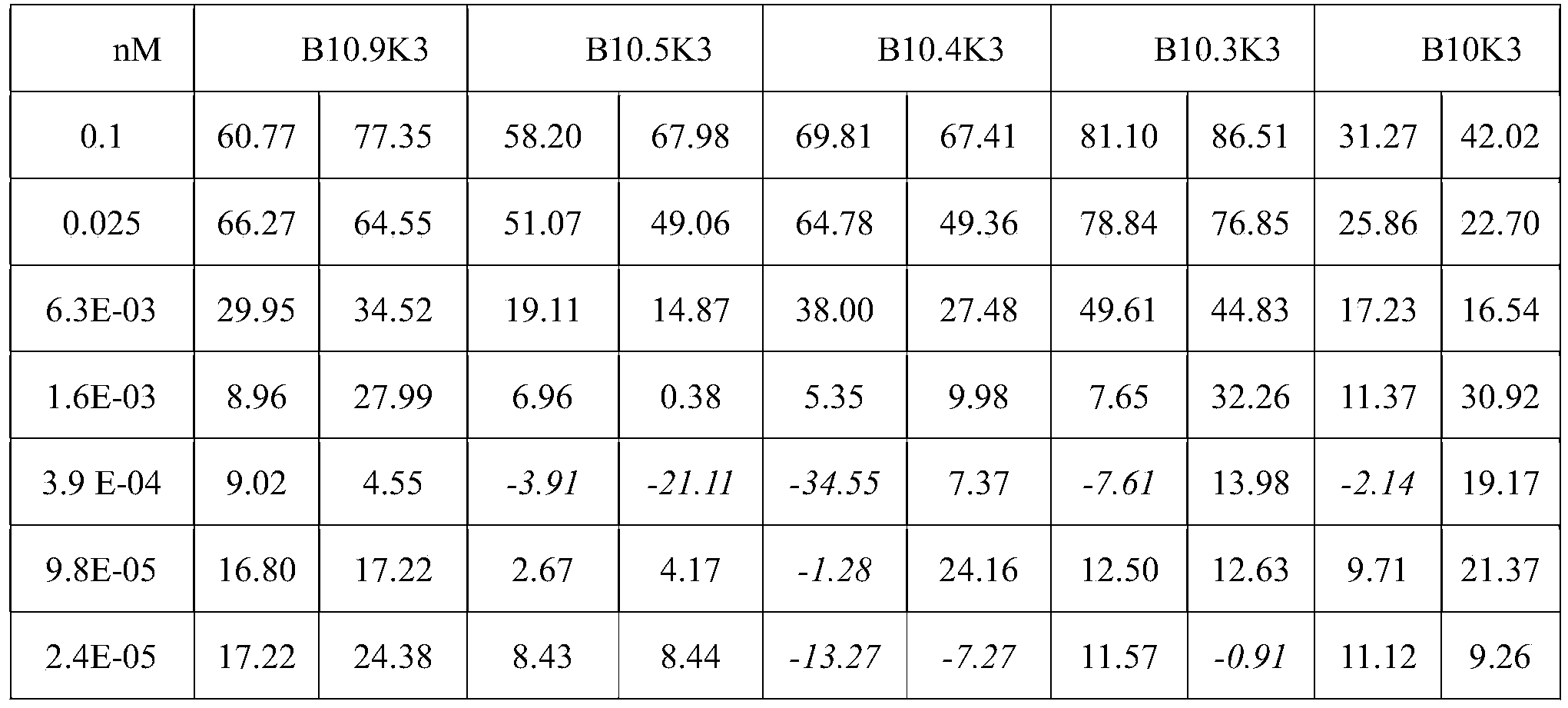
表6不同剂量的双特异性抗体K3B10.3和B10.3K3介导的靶细胞杀伤RPMI8226的靶细胞杀伤比例Table 6 Different doses of bispecific antibodies K3B10.3 and B10.3K3 mediated target cell killing ratio of target cell killing RPMI8226

表7不同剂量的双特异性抗体K3B10.3和B10.3K3介导的靶细胞杀伤H929的靶细胞杀伤比例Table 7 Target cell killing ratio of target cell killing H929 mediated by bispecific antibodies K3B10.3 and B10.3K3 at different doses
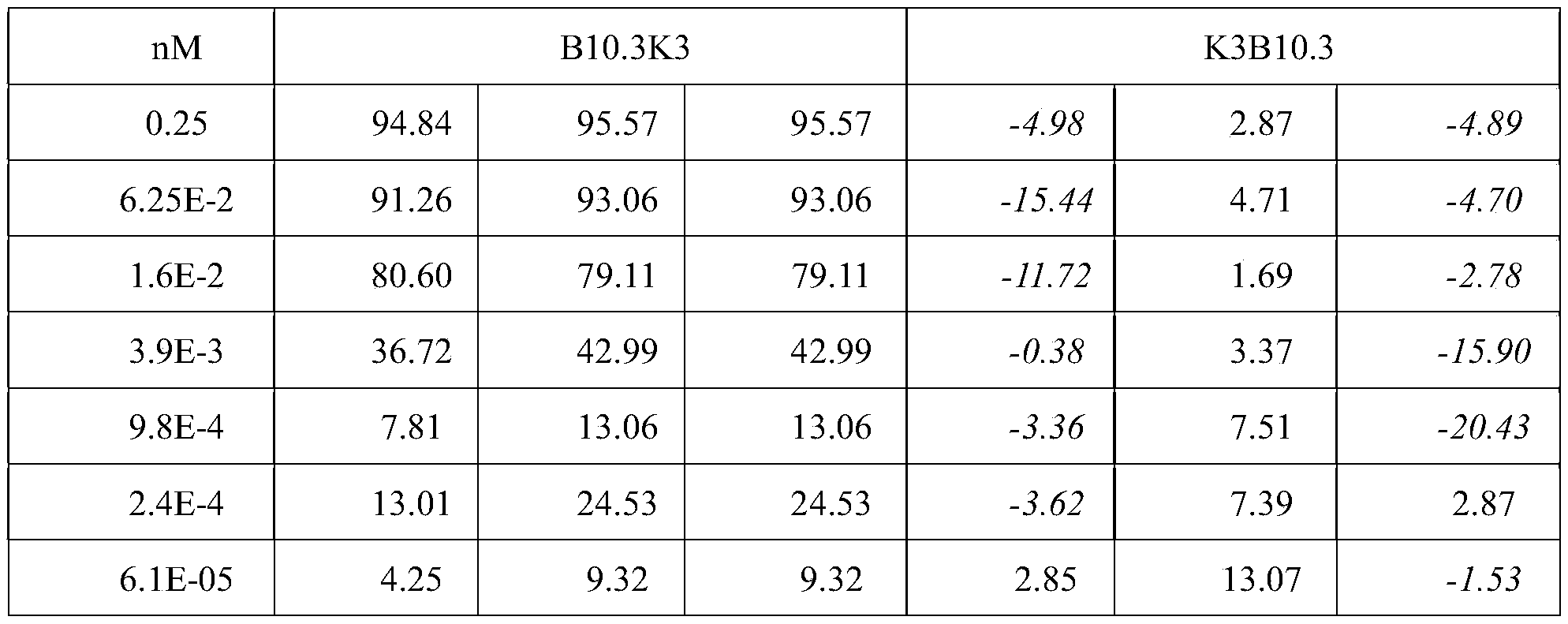
以上表5、表6、表7中,各双特异性抗体的两列数值为两个重复实验(duplicate)的结果。In Table 5, Table 6, and Table 7 above, the two columns of values for each bispecific antibody are the results of two repeated experiments (duplicate).
虽然,上文中已经用一般性说明及具体实施方案对本发明作了详尽的描述,但在本发明基础上,可以对之作一些修改或改进,这对本领域技术人员而言是显而易见的。因此,在不偏离本发明精神的基础上所做的这些修改或改进,均属于本发明要求保护的范围。Although the present invention has been described in detail with general descriptions and specific embodiments above, it is obvious to those skilled in the art that some modifications or improvements can be made on the basis of the present invention. Therefore, the modifications or improvements made on the basis of not departing from the spirit of the present invention all belong to the protection scope of the present invention.
本发明涉及结合BCMA和CD3的双特异性抗体及其制备方法与应用。本发明提供一种能够同时结合BCMA和CD3、具有特异的靶向作用、能够高效激发导向性免疫反应的双特异性抗体。该双特异性抗体很好地保留了抗CD3抗体和抗BCMA抗体的生物学功能,实现了一个双特异性抗体分子同时具有优异的BCMA和CD3靶向结合的生物学功能,能够在肿瘤细胞和免疫效应细胞之间搭建桥梁,有效激活免疫效应细胞和导向性免疫反应,显著增强了免疫细胞杀伤肿瘤细胞的功效,具有较高的靶细胞杀伤效率,同时最大程度地降低了ADCC效应,具有较高的安全性,在肿瘤的免疫治疗中具有较好的应用前景。The invention relates to a bispecific antibody binding to BCMA and CD3, a preparation method and application thereof. The invention provides a bispecific antibody capable of simultaneously binding BCMA and CD3, having a specific targeting effect, and capable of efficiently stimulating directed immune responses. The bispecific antibody well retains the biological functions of anti-CD3 antibody and anti-BCMA antibody, and realizes a bispecific antibody molecule with excellent biological functions of BCMA and CD3 targeting binding at the same time. Build bridges between immune effector cells, effectively activate immune effector cells and oriented immune responses, significantly enhance the efficacy of immune cells in killing tumor cells, have high killing efficiency of target cells, and at the same time minimize the ADCC effect. With high safety, it has a good application prospect in tumor immunotherapy.
Claims (13)
Priority Applications (6)
| Application Number | Priority Date | Filing Date | Title |
|---|---|---|---|
| CA3222339A CA3222339A1 (en) | 2021-06-24 | 2022-05-05 | Bispecific antibody binding to bcma and cd3, and preparation method therefor and use thereof |
| KR1020247001350A KR20240021289A (en) | 2021-06-24 | 2022-05-05 | Bispecific antibody binding to BCMA and CD3 and its production method and application |
| US18/256,316 US20250011447A1 (en) | 2021-06-24 | 2022-05-05 | Bispecific antibody binding to bcma and cd3, and preparation method therefor and use thereof |
| EP22827200.1A EP4261229A4 (en) | 2021-06-24 | 2022-05-05 | Bispecific antibody binding to bcma and cd3, and preparation method therefor and use thereof |
| JP2023546445A JP7686760B2 (en) | 2021-06-24 | 2022-05-05 | Bispecific antibodies that bind BCMA and CD3, and methods for making and using same |
| AU2022298402A AU2022298402A1 (en) | 2021-06-24 | 2022-05-05 | Bispecific antibody binding to bcma and cd3, and preparation method therefor and use thereof |
Applications Claiming Priority (2)
| Application Number | Priority Date | Filing Date | Title |
|---|---|---|---|
| CN202110704255.6 | 2021-06-24 | ||
| CN202110704255.6A CN115521381B (en) | 2021-06-24 | 2021-06-24 | Bispecific antibody combining BCMA and CD3 and preparation method and application thereof |
Publications (1)
| Publication Number | Publication Date |
|---|---|
| WO2022267702A1 true WO2022267702A1 (en) | 2022-12-29 |
Family
ID=84545223
Family Applications (1)
| Application Number | Title | Priority Date | Filing Date |
|---|---|---|---|
| PCT/CN2022/090931 Ceased WO2022267702A1 (en) | 2021-06-24 | 2022-05-05 | Bispecific antibody binding to bcma and cd3, and preparation method therefor and use thereof |
Country Status (8)
| Country | Link |
|---|---|
| US (1) | US20250011447A1 (en) |
| EP (1) | EP4261229A4 (en) |
| JP (1) | JP7686760B2 (en) |
| KR (1) | KR20240021289A (en) |
| CN (2) | CN115521381B (en) |
| AU (1) | AU2022298402A1 (en) |
| CA (1) | CA3222339A1 (en) |
| WO (1) | WO2022267702A1 (en) |
Cited By (1)
| Publication number | Priority date | Publication date | Assignee | Title |
|---|---|---|---|---|
| WO2026037514A1 (en) * | 2024-08-13 | 2026-02-19 | Friedrich-Alexander-Universität Erlangen-Nürnberg, in Vertretung des Freistaates Bayern | A bispecific binding agent targeting cd3 and bcma for the treatment of autoimmune diseases |
Families Citing this family (1)
| Publication number | Priority date | Publication date | Assignee | Title |
|---|---|---|---|---|
| CN116874606B (en) * | 2023-09-08 | 2023-11-24 | 益科思特(北京)医药科技发展有限公司 | Bispecific antibody targeting TROP2 and CD3 as well as preparation method and application thereof |
Citations (7)
| Publication number | Priority date | Publication date | Assignee | Title |
|---|---|---|---|---|
| WO2002066516A2 (en) | 2001-02-20 | 2002-08-29 | Zymogenetics, Inc. | Antibodies that bind both bcma and taci |
| WO2012163805A1 (en) | 2011-05-27 | 2012-12-06 | Glaxo Group Limited | Bcma (cd269/tnfrsf17) -binding proteins |
| CN109843325A (en) * | 2016-09-14 | 2019-06-04 | 特尼奥生物股份有限公司 | CD3 binding antibody |
| CN110431151A (en) * | 2016-12-21 | 2019-11-08 | 特尼奥生物股份有限公司 | Heavy chain-only anti-BCMA antibodies |
| WO2020186974A1 (en) * | 2019-03-19 | 2020-09-24 | 益科思特(北京)医药科技发展有限公司 | Bispecific antibody, preparation method therefor and application thereof |
| WO2021063349A1 (en) * | 2019-09-30 | 2021-04-08 | 和铂医药(苏州)有限公司 | Antibody targeting bcma, bispecific antibody, and use thereof |
| CN113061185A (en) * | 2020-01-02 | 2021-07-02 | 益科思特(北京)医药科技发展有限公司 | Preparation method and application of BCMA antibody |
Family Cites Families (13)
| Publication number | Priority date | Publication date | Assignee | Title |
|---|---|---|---|---|
| EP3974453A3 (en) * | 2010-11-16 | 2022-08-03 | Amgen Inc. | Agents and methods for treating diseases that correlate with bcma expression |
| TWI679212B (en) * | 2011-11-15 | 2019-12-11 | 美商安進股份有限公司 | Binding molecules for e3 of bcma and cd3 |
| EP2982692A1 (en) * | 2014-08-04 | 2016-02-10 | EngMab AG | Bispecific antibodies against CD3epsilon and BCMA |
| EP3023437A1 (en) * | 2014-11-20 | 2016-05-25 | EngMab AG | Bispecific antibodies against CD3epsilon and BCMA |
| EP3029068A1 (en) * | 2014-12-03 | 2016-06-08 | EngMab AG | Bispecific antibodies against CD3epsilon and BCMA for use in the treatment of diseases |
| MX2018002043A (en) | 2015-08-17 | 2018-07-06 | Janssen Pharmaceutica Nv | ANTI-BCMA ANTIBODIES, BSPECIFIC ANTIGEN-BINDING MOLLICULES THAT BIND BCMA AND CD3, AND USES THEREOF. |
| JP7267914B2 (en) * | 2016-11-02 | 2023-05-02 | エンクマフ エスアーエールエル | Bispecific antibodies to BCMA and CD3 and immunotherapeutic agents used in combination to treat multiple myeloma |
| TW202430218A (en) | 2018-02-27 | 2024-08-01 | 美商輝瑞大藥廠 | Antibody purification |
| UA130542C2 (en) * | 2018-05-16 | 2026-03-18 | Янссен Байотек, Інк. | Methods of treating cancers and enhancing efficacy of t cell redirecting therapeutics |
| CA3132587A1 (en) | 2019-03-21 | 2020-09-24 | Regeneron Pharmaceuticals, Inc. | Combination of il-4/il-13 pathway inhibitors and plasma cell ablation for treating allergy |
| CN119679936A (en) | 2019-06-24 | 2025-03-25 | 诺华股份有限公司 | Dosing regimens and combination therapies for multispecific antibodies targeting B cell maturation antigens |
| CN115279459A (en) | 2019-11-05 | 2022-11-01 | 百时美施贵宝公司 | Therapeutic methods using antibodies against BCMA and CD3 |
| WO2021121250A1 (en) * | 2019-12-17 | 2021-06-24 | 深圳市菲鹏生物治疗股份有限公司 | Bcma binding antibody and use thereof |
-
2021
- 2021-06-24 CN CN202110704255.6A patent/CN115521381B/en active Active
- 2021-06-24 CN CN202411344920.5A patent/CN119569887A/en active Pending
-
2022
- 2022-05-05 JP JP2023546445A patent/JP7686760B2/en active Active
- 2022-05-05 US US18/256,316 patent/US20250011447A1/en active Pending
- 2022-05-05 EP EP22827200.1A patent/EP4261229A4/en active Pending
- 2022-05-05 WO PCT/CN2022/090931 patent/WO2022267702A1/en not_active Ceased
- 2022-05-05 KR KR1020247001350A patent/KR20240021289A/en active Pending
- 2022-05-05 AU AU2022298402A patent/AU2022298402A1/en active Pending
- 2022-05-05 CA CA3222339A patent/CA3222339A1/en active Pending
Patent Citations (7)
| Publication number | Priority date | Publication date | Assignee | Title |
|---|---|---|---|---|
| WO2002066516A2 (en) | 2001-02-20 | 2002-08-29 | Zymogenetics, Inc. | Antibodies that bind both bcma and taci |
| WO2012163805A1 (en) | 2011-05-27 | 2012-12-06 | Glaxo Group Limited | Bcma (cd269/tnfrsf17) -binding proteins |
| CN109843325A (en) * | 2016-09-14 | 2019-06-04 | 特尼奥生物股份有限公司 | CD3 binding antibody |
| CN110431151A (en) * | 2016-12-21 | 2019-11-08 | 特尼奥生物股份有限公司 | Heavy chain-only anti-BCMA antibodies |
| WO2020186974A1 (en) * | 2019-03-19 | 2020-09-24 | 益科思特(北京)医药科技发展有限公司 | Bispecific antibody, preparation method therefor and application thereof |
| WO2021063349A1 (en) * | 2019-09-30 | 2021-04-08 | 和铂医药(苏州)有限公司 | Antibody targeting bcma, bispecific antibody, and use thereof |
| CN113061185A (en) * | 2020-01-02 | 2021-07-02 | 益科思特(北京)医药科技发展有限公司 | Preparation method and application of BCMA antibody |
Non-Patent Citations (5)
| Title |
|---|
| BEVERLEY, P. C.CALLARD, R. E.: "Distinctive functional characteristics of human ''T'' lymphocytes defined by E rosetting or a monoclonal anti-T cell antibody", EUR. J. IMMUNOL., vol. 11, 1981, pages 329 - 334 |
| CARACCIO, C. ET AL.: "Bispecific Antibodies for Multiple Myeloma: A Review of Targets, Drugs, Clinical Trials, and Future Directions.", FRONTIERS IN IMMUNOLOGY, vol. 11, 24 April 2020 (2020-04-24), XP055860851, DOI: 10.3389/fimmu.2020.00501 * |
| DILILLO DAVID J., OLSON KARA, MOHRS KATJA, MEAGHER THOMAS CRAIG, BRAY KEVIN, SINESHCHEKOVA OLGA, STARTZ THOMAS, KUHNERT JESSICA, R: "Abstract", BLOOD ADVANCES, vol. 5, no. 5, 9 March 2021 (2021-03-09), pages 1291 - 1304, XP055821790, ISSN: 2473-9529, DOI: 10.1182/bloodadvances.2020002736 * |
| See also references of EP4261229A4 |
| SHALABY: "Development of humanized bispecific antibodies reactive with cytotoxic lymphocytes and tumor cells overexpressing the HER2 protooncogene", J EXP MED., vol. 175, no. 1, 1992, pages 217 - 25, XP002975222, DOI: 10.1084/jem.175.1.217 |
Cited By (1)
| Publication number | Priority date | Publication date | Assignee | Title |
|---|---|---|---|---|
| WO2026037514A1 (en) * | 2024-08-13 | 2026-02-19 | Friedrich-Alexander-Universität Erlangen-Nürnberg, in Vertretung des Freistaates Bayern | A bispecific binding agent targeting cd3 and bcma for the treatment of autoimmune diseases |
Also Published As
| Publication number | Publication date |
|---|---|
| JP2024505966A (en) | 2024-02-08 |
| CA3222339A1 (en) | 2022-12-29 |
| CN115521381B (en) | 2024-10-29 |
| CN115521381A (en) | 2022-12-27 |
| CN119569887A (en) | 2025-03-07 |
| EP4261229A1 (en) | 2023-10-18 |
| EP4261229A4 (en) | 2024-08-28 |
| US20250011447A1 (en) | 2025-01-09 |
| JP7686760B2 (en) | 2025-06-02 |
| KR20240021289A (en) | 2024-02-16 |
| AU2022298402A1 (en) | 2024-01-18 |
Similar Documents
| Publication | Publication Date | Title |
|---|---|---|
| JP6708635B2 (en) | Bispecific antibodies to CD3ε and ROR1 | |
| JP6305332B2 (en) | Multispecific antibody | |
| JP7397882B2 (en) | Bispecific antibodies and their preparation and use | |
| JP7262597B2 (en) | Bispecific antibodies and methods of making and using the same | |
| JP2021521784A (en) | PD-1 targeted heterodimer fusion proteins containing IL-15 / IL-15RaFc fusion proteins and PD-1 antigen binding domains and their use | |
| JP7728185B2 (en) | Covalent multispecific antibodies | |
| CN114981301B (en) | PD1 and VEGFR2 dual binding agents | |
| WO2023273595A1 (en) | Antibody binding to trop2, bispecific antibody targeting trop2 and cd3, preparation methods therefor and uses thereof | |
| WO2023020537A1 (en) | Bispecific antibody and use thereof | |
| WO2022267702A1 (en) | Bispecific antibody binding to bcma and cd3, and preparation method therefor and use thereof | |
| CN117355540A (en) | Anti-CD137 antibodies and methods of use | |
| CN113061185B (en) | Preparation method and application of BCMA antibody | |
| CN117222672A (en) | anti-CLDN 4-anti-CD 137 bispecific antibodies | |
| CN110156895A (en) | An anti-PD-L1 antibody or its functional fragment and use thereof | |
| CN113004416B (en) | Construction and application of HER2-CD137 targeted bispecific antibody | |
| CN107880131A (en) | A kind of anti-IL 13R α 2 and CD3 bispecific antibodies and its application | |
| KR20240150713A (en) | Fc variants with enhanced binding affinity to human C1q | |
| TW202438529A (en) | Nanobodies that bind to gprc5d and uses thereof | |
| CN122003442A (en) | Anti-IL-4Rα/TSLP antibodies and their uses | |
| CN118063613A (en) | Bispecific antibody targeting TROP2 and CD3 as well as preparation method and application thereof | |
| Zhu | Dual-targeting bispecific antibodies as new therapeutic modalities for cancer |
Legal Events
| Date | Code | Title | Description |
|---|---|---|---|
| 121 | Ep: the epo has been informed by wipo that ep was designated in this application |
Ref document number: 22827200 Country of ref document: EP Kind code of ref document: A1 |
|
| WWE | Wipo information: entry into national phase |
Ref document number: 18256316 Country of ref document: US |
|
| ENP | Entry into the national phase |
Ref document number: 2022827200 Country of ref document: EP Effective date: 20230710 |
|
| WWE | Wipo information: entry into national phase |
Ref document number: 2023546445 Country of ref document: JP |
|
| WWE | Wipo information: entry into national phase |
Ref document number: 3222339 Country of ref document: CA |
|
| WWE | Wipo information: entry into national phase |
Ref document number: 2022298402 Country of ref document: AU Ref document number: AU2022298402 Country of ref document: AU |
|
| ENP | Entry into the national phase |
Ref document number: 20247001350 Country of ref document: KR Kind code of ref document: A |
|
| WWE | Wipo information: entry into national phase |
Ref document number: 1020247001350 Country of ref document: KR |
|
| ENP | Entry into the national phase |
Ref document number: 2022298402 Country of ref document: AU Date of ref document: 20220505 Kind code of ref document: A |
|
| NENP | Non-entry into the national phase |
Ref country code: DE |