WO2022199419A1 - Facial detection method and apparatus, and terminal device and computer-readable storage medium - Google Patents
Facial detection method and apparatus, and terminal device and computer-readable storage medium Download PDFInfo
- Publication number
- WO2022199419A1 WO2022199419A1 PCT/CN2022/080800 CN2022080800W WO2022199419A1 WO 2022199419 A1 WO2022199419 A1 WO 2022199419A1 CN 2022080800 W CN2022080800 W CN 2022080800W WO 2022199419 A1 WO2022199419 A1 WO 2022199419A1
- Authority
- WO
- WIPO (PCT)
- Prior art keywords
- face
- detection
- image
- tested
- result
- Prior art date
- Legal status (The legal status is an assumption and is not a legal conclusion. Google has not performed a legal analysis and makes no representation as to the accuracy of the status listed.)
- Ceased
Links
Images


Classifications
-
- G—PHYSICS
- G06—COMPUTING OR CALCULATING; COUNTING
- G06V—IMAGE OR VIDEO RECOGNITION OR UNDERSTANDING
- G06V40/00—Recognition of biometric, human-related or animal-related patterns in image or video data
- G06V40/10—Human or animal bodies, e.g. vehicle occupants or pedestrians; Body parts, e.g. hands
- G06V40/16—Human faces, e.g. facial parts, sketches or expressions
- G06V40/161—Detection; Localisation; Normalisation
- G06V40/165—Detection; Localisation; Normalisation using facial parts and geometric relationships
-
- G—PHYSICS
- G06—COMPUTING OR CALCULATING; COUNTING
- G06V—IMAGE OR VIDEO RECOGNITION OR UNDERSTANDING
- G06V40/00—Recognition of biometric, human-related or animal-related patterns in image or video data
- G06V40/10—Human or animal bodies, e.g. vehicle occupants or pedestrians; Body parts, e.g. hands
- G06V40/16—Human faces, e.g. facial parts, sketches or expressions
- G06V40/161—Detection; Localisation; Normalisation
-
- G—PHYSICS
- G06—COMPUTING OR CALCULATING; COUNTING
- G06F—ELECTRIC DIGITAL DATA PROCESSING
- G06F18/00—Pattern recognition
- G06F18/20—Analysing
- G06F18/24—Classification techniques
- G06F18/241—Classification techniques relating to the classification model, e.g. parametric or non-parametric approaches
- G06F18/2415—Classification techniques relating to the classification model, e.g. parametric or non-parametric approaches based on parametric or probabilistic models, e.g. based on likelihood ratio or false acceptance rate versus a false rejection rate
-
- G—PHYSICS
- G06—COMPUTING OR CALCULATING; COUNTING
- G06N—COMPUTING ARRANGEMENTS BASED ON SPECIFIC COMPUTATIONAL MODELS
- G06N3/00—Computing arrangements based on biological models
- G06N3/02—Neural networks
- G06N3/04—Architecture, e.g. interconnection topology
- G06N3/045—Combinations of networks
-
- G—PHYSICS
- G06—COMPUTING OR CALCULATING; COUNTING
- G06N—COMPUTING ARRANGEMENTS BASED ON SPECIFIC COMPUTATIONAL MODELS
- G06N3/00—Computing arrangements based on biological models
- G06N3/02—Neural networks
- G06N3/04—Architecture, e.g. interconnection topology
- G06N3/047—Probabilistic or stochastic networks
-
- G—PHYSICS
- G06—COMPUTING OR CALCULATING; COUNTING
- G06N—COMPUTING ARRANGEMENTS BASED ON SPECIFIC COMPUTATIONAL MODELS
- G06N3/00—Computing arrangements based on biological models
- G06N3/02—Neural networks
- G06N3/08—Learning methods
-
- G—PHYSICS
- G06—COMPUTING OR CALCULATING; COUNTING
- G06V—IMAGE OR VIDEO RECOGNITION OR UNDERSTANDING
- G06V10/00—Arrangements for image or video recognition or understanding
- G06V10/40—Extraction of image or video features
- G06V10/46—Descriptors for shape, contour or point-related descriptors, e.g. scale invariant feature transform [SIFT] or bags of words [BoW]; Salient regional features
- G06V10/462—Salient features, e.g. scale invariant feature transforms [SIFT]
-
- G—PHYSICS
- G06—COMPUTING OR CALCULATING; COUNTING
- G06V—IMAGE OR VIDEO RECOGNITION OR UNDERSTANDING
- G06V10/00—Arrangements for image or video recognition or understanding
- G06V10/40—Extraction of image or video features
- G06V10/56—Extraction of image or video features relating to colour
-
- G—PHYSICS
- G06—COMPUTING OR CALCULATING; COUNTING
- G06V—IMAGE OR VIDEO RECOGNITION OR UNDERSTANDING
- G06V10/00—Arrangements for image or video recognition or understanding
- G06V10/70—Arrangements for image or video recognition or understanding using pattern recognition or machine learning
- G06V10/74—Image or video pattern matching; Proximity measures in feature spaces
- G06V10/75—Organisation of the matching processes, e.g. simultaneous or sequential comparisons of image or video features; Coarse-fine approaches, e.g. multi-scale approaches; using context analysis; Selection of dictionaries
- G06V10/751—Comparing pixel values or logical combinations thereof, or feature values having positional relevance, e.g. template matching
-
- G—PHYSICS
- G06—COMPUTING OR CALCULATING; COUNTING
- G06V—IMAGE OR VIDEO RECOGNITION OR UNDERSTANDING
- G06V10/00—Arrangements for image or video recognition or understanding
- G06V10/70—Arrangements for image or video recognition or understanding using pattern recognition or machine learning
- G06V10/82—Arrangements for image or video recognition or understanding using pattern recognition or machine learning using neural networks
-
- G—PHYSICS
- G06—COMPUTING OR CALCULATING; COUNTING
- G06V—IMAGE OR VIDEO RECOGNITION OR UNDERSTANDING
- G06V40/00—Recognition of biometric, human-related or animal-related patterns in image or video data
- G06V40/10—Human or animal bodies, e.g. vehicle occupants or pedestrians; Body parts, e.g. hands
- G06V40/16—Human faces, e.g. facial parts, sketches or expressions
- G06V40/168—Feature extraction; Face representation
- G06V40/171—Local features and components; Facial parts ; Occluding parts, e.g. glasses; Geometrical relationships
-
- G—PHYSICS
- G06—COMPUTING OR CALCULATING; COUNTING
- G06V—IMAGE OR VIDEO RECOGNITION OR UNDERSTANDING
- G06V40/00—Recognition of biometric, human-related or animal-related patterns in image or video data
- G06V40/10—Human or animal bodies, e.g. vehicle occupants or pedestrians; Body parts, e.g. hands
- G06V40/16—Human faces, e.g. facial parts, sketches or expressions
- G06V40/172—Classification, e.g. identification
-
- G—PHYSICS
- G06—COMPUTING OR CALCULATING; COUNTING
- G06V—IMAGE OR VIDEO RECOGNITION OR UNDERSTANDING
- G06V40/00—Recognition of biometric, human-related or animal-related patterns in image or video data
- G06V40/40—Spoof detection, e.g. liveness detection
- G06V40/45—Detection of the body part being alive
Definitions
- the present application belongs to the technical field of image processing, and in particular, relates to a face detection method, apparatus, terminal device and computer-readable storage medium.
- the collected face image itself may have "blemishes", thus affecting the accuracy of face detection.
- the image is dimly lit, or the face area in the image is occluded, so that the key feature information in the image cannot be detected, thereby affecting the detection result.
- the embodiments of the present application provide a face detection method, apparatus, terminal device, and computer-readable storage medium, which can effectively improve the accuracy of face detection.
- an embodiment of the present application provides a face detection method, including:
- the initial detection result indicates that the detection is passed, then compare the first face image in the image to be tested with the target face image to obtain a comparison result;
- the final inspection result of the image to be tested is determined according to the comparison result.
- the image to be tested is initially detected, so that the image to be tested with "defects" can be filtered out; if the image to be tested passes the preliminary detection, the first face image in the image to be tested is then Compare with the target face image, and determine the final inspection result according to the comparison result.
- the acquiring the image to be tested includes:
- the RGB image is determined as the image to be tested.
- the performing living body detection on the first face image existing in the infrared image to obtain a living body detection result includes:
- the first face image existing in the infrared image is input into the trained living body detection model, and the living body detection result is output.
- the preliminary detection includes at least one of the following detection items: face pose detection, face occlusion detection, face brightness detection, and face ambiguity detection;
- the preliminary detection of the image to be tested to obtain a preliminary detection result includes:
- the preliminary test result indicates that the test is passed.
- the face gesture detection is performed on the image to be tested to obtain the face gesture detection item Results, including:
- the project result of the face gesture detection is determined according to the face three-dimensional angle information and the preset angle range.
- the face occlusion detection is performed on the image to be tested to obtain the face occlusion detection item Results, including:
- the item result of the face occlusion detection is determined according to the occlusion detection results corresponding to the N face regions.
- the face brightness detection is performed on the image to be tested, and the face brightness detection item is obtained Results, including:
- the project result of the face brightness detection is determined according to the ratio and the preset threshold.
- the face blur degree detection is performed on the image to be tested to obtain the face blur degree Tested project results, including:
- An item result of the face blurriness detection is determined according to the blurriness and a preset value range.
- an embodiment of the present application provides a face detection device, including:
- an acquisition unit configured to acquire an image to be tested, where a first face image exists in the image to be tested
- an initial inspection unit configured to perform a preliminary inspection on the image to be inspected to obtain an initial inspection result
- a comparison unit configured to compare the first face image in the image to be tested with the target face image to obtain a comparison result if the initial inspection result indicates that the detection is passed;
- a final inspection unit configured to determine a final inspection result of the image to be tested according to the comparison result.
- an embodiment of the present application provides a terminal device, including a memory, a processor, and a computer program stored in the memory and executable on the processor, wherein the processor executes all When the computer program is used, the face detection method according to any one of the above-mentioned first aspects is realized.
- an embodiment of the present application provides a computer-readable storage medium, and an embodiment of the present application provides a computer-readable storage medium, where a computer program is stored in the computer-readable storage medium, wherein the When the computer program is executed by the processor, the face detection method according to any one of the above-mentioned first aspects is implemented.
- an embodiment of the present application provides a computer program product that, when the computer program product runs on a terminal device, enables the terminal device to execute the face detection method described in any one of the first aspects above.
- FIG. 1 is a schematic flowchart of a face detection method provided by an embodiment of the present application.
- FIG. 2 is a schematic diagram of a face feature key point provided by an embodiment of the present application.
- FIG. 3 is a schematic diagram of a face contour key point provided by an embodiment of the present application.
- FIG. 4 is a schematic diagram of a background removal process provided by an embodiment of the present application.
- FIG. 5 is a schematic structural diagram of a first feature extraction module provided by an embodiment of the present application.
- FIG. 6 is a schematic structural diagram of a living body detection model provided by an embodiment of the present application.
- FIG. 7 is a schematic diagram of an F-Net model provided by an embodiment of the present application.
- FIG. 8 is a structural block diagram of a face detection apparatus provided by an embodiment of the present application.
- FIG. 9 is a schematic structural diagram of a terminal device provided by an embodiment of the present application.
- the term “if” may be contextually interpreted as “when” or “once” or “in response to determining” or “in response to detecting ".
- references in this specification to "one embodiment” or “some embodiments” and the like mean that a particular feature, structure or characteristic described in connection with the embodiment is included in one or more embodiments of the present application.
- appearances of the phrases “in one embodiment,” “in some embodiments,” “in other embodiments,” “in other embodiments,” etc. in various places in this specification are not necessarily All refer to the same embodiment, but mean “one or more but not all embodiments” unless specifically emphasized otherwise.
- FIG. 1 it is a schematic flowchart of a face detection method provided by an embodiment of the present application.
- the method may include the following steps:
- S101 Acquire an image to be tested, where a first face image exists in the image to be tested.
- the RGB image of the target face is collected by the photographing device, and the RGB image is recorded as the image to be measured.
- the image to be tested includes a first face image and a background image corresponding to the target face.
- face liveness detection needs to be performed. details as follows.
- An implementation manner of S101 may include: acquiring an RGB image of the target face, and then performing in vivo detection on the first face image existing in the RGB image to obtain the in vivo detection result; If the face image is a real face, the RGB image is determined as the image to be tested.
- the embodiment of the present application provides another implementation manner of S101, including: acquiring an RGB image and an infrared image, and the first face image exists in both the RGB image and the infrared image; The first face image of the infrared image is subjected to living body detection to obtain a living body detection result; if the living body detection result indicates that the first face image existing in the infrared image is a real face, the RGB image is determined as the image to be tested.
- the RGB image and the infrared image may be obtained by simultaneously photographing the same photographing object by the same photographing device, or by successively photographing the same photographing object by the same photographing device.
- the first photographing device can photograph RGB images and infrared images, and the first photographing device simultaneously photographs the target face to obtain RGB images and infrared images of the target face; the first photographing device can also first photograph the target person The RGB image of the face, and then the infrared image of the target face is captured.
- the interval between two shots needs to be short to ensure that the angle of the target face relative to the shooting device and the background do not change significantly.
- the RGB image and the infrared image may also be obtained by simultaneously photographing the same photographing object by different photographing devices, or by successively photographing the same photographing object by different photographing devices.
- the second photographing device can take RGB images
- the third photographing device can take infrared images
- the second photographing device and the third photographing device can take pictures of the target face at the same time
- the obtained RGB images and infrared images both include the target person The first face image corresponding to the face.
- an implementation method of performing live detection on the first face image existing in the infrared image includes: detecting the key points of the face contour in the infrared image; The first face image; the first face image existing in the infrared image is input into the trained living body detection model, and the living body detection result is output.
- the infrared image includes a first face image and a background image.
- the infrared image is first subjected to background removal processing (that is, the key points of the face contour in the infrared image are detected; the first face image existing in the infrared image is intercepted according to the key points of the face contour. ) to obtain the first face image in the infrared image, and then perform liveness detection on the first face image.
- background removal processing that is, the key points of the face contour in the infrared image are detected; the first face image existing in the infrared image is intercepted according to the key points of the face contour.
- an implementation manner of detecting the face contour key points in the infrared image may include: acquiring multiple face feature key points on the first face image in the infrared image; determining from the multiple face feature key points; Face contour key points.
- the infrared image can be input into the trained face detection model, and multiple face feature key points can be output.
- a face detection model with 68 key points can be used.
- FIG. 2 it is a schematic diagram of a face feature key point provided by an embodiment of the present application. Input the to-be-processed image into the trained face detection model, and the position markers of the key points 1-68 of the face feature as shown in Figure 2 can be output.
- an implementation manner of determining a face contour key point from a plurality of face feature key points may include: determining a boundary point among the multiple face feature key points; and determining a face contour key point according to the boundary point.
- boundary points 1-17 and 18-27 are determined as face contour key points.
- boundary points 1, 9, 16 and 25 are determined as face contour key points.
- FIG. 3 it is a schematic diagram of a face contour key point provided by an embodiment of the present application.
- the first vertex key point is a (see the upper left corner in Figure 3)
- the second vertex key point is b, consisting of a, b and 1-17
- face contour key points can determine the contour of the face image.
- the contour of the face image determined by the first method is small, and part of the face feature information is lost.
- the contour of the face image determined in the second method is the smallest rectangle containing the face image, and the contour includes more background images.
- the contour of the face image determined by the third method is more suitable, which not only ensures the integrity of the face image, but also filters out the background pattern more completely.
- an implementation manner of intercepting the first face image existing in the infrared image according to the key points of the face contour may include: on the preset layer filled with the first preset color, according to the key points of the face contour. Outline the first area; fill the first area in the preset layer with the second preset color to obtain the target layer; superimpose the target layer and the image to be processed to obtain the face image.
- the first area outlined by the face contour key points is the second preset color
- the second area other than the first area is the first preset color.
- first create a black (that is, the second preset color) preset layer such as a mask, which can be stored in the form of program data
- draw the face contour key points as a curve through the polylines function in OpenCV the area enclosed by the curve is recorded as the first area
- the first area is filled with white (ie, the first preset color) through the fillpoly function to obtain the target layer
- the target layer and the image to be processed are executed pixel by pixel bitwise And processing (that is, performing superposition processing) to obtain a face image.
- FIG. 4 it is a schematic diagram of a background removal process provided by an embodiment of the present application.
- the image on the left in Figure 4 is the infrared image before background removal, and the image on the right in Figure 4 is the first face image after background removal.
- the background image can be filtered out while retaining the complete first face image.
- the first face image After acquiring the first face image from the infrared image, the first face image is input into the trained living body detection model, and the living body detection result is output.
- the living body detection model includes a first feature extraction module and an attention mechanism module. Both the first feature extraction module and the attention mechanism module are used to extract features, wherein the attention mechanism module can enhance the learning ability of discriminative features (such as human eye reflective features, skin texture features, etc.).
- the attention mechanism module can adopt the SENet module.
- FIG. 5 it is a schematic structural diagram of a first feature extraction module provided by an embodiment of the present application.
- the structure of the first feature extraction module in the prior art is shown in (a) of Figure 5, including an inverted residual network (including a second convolutional layer (1 ⁇ 1Conv) for dimension enhancement, a third convolutional layer (3 ⁇ 3 DW Conv) and a fourth convolutional layer (1 ⁇ 1 Conv) for dimensionality reduction.
- the structure of the first feature extraction module in the embodiment of the present application is shown in (b) in FIG. 5 , including a parallel first network and an inverted residual network; wherein, the first network includes a first average pooling layer (2 ⁇ 2 AVG Pool) and the first convolutional layer (1 ⁇ 1Conv).
- FIG. 6 it is a schematic structural diagram of a living body detection model provided by an embodiment of the present application.
- the Block A module in FIG. 6 is the first feature extraction module shown in (a) in FIG. 5
- the Block B module in FIG. 6 is the first feature extraction module shown in (b) in FIG. 5 .
- the first feature extraction module and the attention mechanism module alternately perform feature extraction tasks, and finally the extracted feature vectors are fully connected to the output layer through FC (fully connected layers).
- the output feature vector is converted into a probability value through a classification layer (such as softmax), and whether it is a living body can be judged by the probability value.
- the living body detection model shown in Figure 6 has strong defense capability and security for both 2D and 3D face images, and the accuracy of living body detection is high.
- the collected RGB image is determined as the image to be tested for subsequent steps.
- the collected images to be tested may have "blemishes", thus affecting the accuracy of face detection.
- the image is dimly lit, or the face area in the image is occluded, so that the key feature information in the image cannot be detected, thereby affecting the detection result.
- the image to be tested is initially detected, in order to filter out the image to be tested with "defects".
- the preliminary detection may include at least one of the following detection items: face pose detection, face occlusion detection, face brightness detection, and face ambiguity detection. Each test item is described below.
- the image to be tested is carried out face pose detection, obtains the project result of face pose detection, can comprise the following steps: the image to be tested is input in the face pose estimation model after training, output face three-dimensional angle information; The face three-dimensional angle information and the preset angle range determine the project result of face pose detection.
- the face pose estimation model can use the FSA-Net model.
- the model consists of two branches, Stream one and Steam two.
- the algorithm first extracts three features on layers of different depths (there are multiple layers, just take three layers), then fuses the fine-grained structural features, and then passes SSR (The sum of squares due to regression, the sum of squares of the difference between the predicted value and the mean value of the true value) module regression prediction to obtain the three-dimensional angle information (Roll, Pitch and Yaw) of the face.
- SSR The sum of squares due to regression, the sum of squares of the difference between the predicted value and the mean value of the true value
- FIG. 7 it is a schematic diagram of an FSA-Net model provided by an embodiment of the present application.
- the model can process data faster, which helps to improve the efficiency of face detection.
- the project result of the face pose detection indicates that the detection is passed; if the three-dimensional angle information of the face is not within the preset angle range, the project result of the face pose detection Indicates that the test failed.
- Perform face occlusion detection on the image to be tested, and obtain the project result of face occlusion detection which may include the following steps: dividing the first face image existing in the image to be tested into N face regions, where N is a positive integer; The N facial regions are input into the corresponding occlusion detection models, and the corresponding occlusion detection results of the N facial regions are output; the project results of face occlusion detection are determined according to the corresponding occlusion detection results of the N facial regions.
- the first face image can be divided into 7 regions, such as left eye, right eye, nose, mouth, chin, left face, right Face. These 7 regions are then input into their corresponding occlusion detection models, for example, the left eye image is input into the left eye occlusion detection model, and the nose image is input into the nose occlusion detection model.
- the seven occlusion detection models output occlusion probability values respectively, and then determine whether the occlusion probability value is within the preset probability range; if it is, it means that the current area is not blocked; if it is not, it means that the current area is blocked. It should be noted that the above is only an example of dividing regions, and does not specifically limit the dividing rules and the number of regions.
- the project result of the face occlusion detection may be determined according to the preset rule and the N occlusion detection results.
- the preset rule may be: the N occlusion detection results are all unoccluded; correspondingly, if the N occlusion detection results are all unoccluded, the item result of the face occlusion detection indicates that the detection is passed; if N There are occlusion detection results that are not occluded in each occlusion detection result, and the item result of face occlusion detection indicates that the detection fails.
- the preset rule can also be that the occlusion ratio is greater than the preset ratio, where the occlusion ratio is the ratio of the number of occlusion detection results that are not occluded to the number of occlusion detection results that are occluded; correspondingly, if the occlusion ratio in the N occlusion detection results If the ratio is greater than the preset ratio, the item result of face occlusion detection indicates that the detection has passed; if the occlusion ratio in the N occlusion detection results is less than or equal to the preset ratio, the item result of face occlusion detection indicates that the detection has failed.
- preset rules are only examples of preset rules, and in practical applications, preset rules may be formulated according to actual needs.
- the grayscale histogram of the image to be tested can be pre-calculated, and then a preset grayscale range can be set according to the grayscale histogram.
- a pixel with a pixel value within (0,30) is regarded as an underexposed point, and the underexposed point is determined as a target pixel; then the difference between the number of target pixels and the number of all pixels in the image to be measured is calculated. Ratio; if the ratio is greater than the preset threshold, the project result of face brightness detection. It is also possible to consider the pixels with pixel values within (220, 255) as the explosion point, and determine the explosion point as the target pixel point; then calculate the ratio of the number of target pixels to the number of all pixels in the image to be measured; if the ratio If it is greater than the preset threshold, the project result of face brightness detection.
- an implementation manner of calculating the ambiguity of the image to be tested is: using a Laplace function to calculate the ambiguity value of each pixel in the image to be tested; and then calculating the variance of the ambiguity value to obtain the ambiguity.
- an implementation manner of calculating the ambiguity of the image to be tested is: calculating the grayscale difference value of each pixel in the image to be tested; then calculating the sum of the squares of the grayscale difference values; determining the sum of the squares as the ambiguity.
- the result of the face blur degree detection item is the detection pass; if the blur degree is not within the preset value range, then The result of the face blurriness detection item is that the detection fails.
- the above detection items can be processed serially or in parallel. Exemplarily, during serial processing, if the item result of the first test item is that the test is passed, the second test item is executed; if the item result of the second test item is that the test is passed, then the third test is executed. Item; and so on; if the item result of any test item fails the test, the preliminary test result indicates that the test fails.
- each inspection item can be executed simultaneously or sequentially.
- the preliminary test result indicates that the test fails, and M is a positive integer; or the item result of a specified test item is that the test fails, then the preliminary test The result indicates that the test failed.
- the comparison result can be determined by calculating the Euclidean distance, as follows:
- xi represents the eigenvalues of the pixels in the first face image
- yi represents the eigenvalues of the pixels in the target face image
- the calculation method of the eigenvalue can use the Insightface algorithm, and the specific steps of the algorithm are as follows:
- S104 Determine the final inspection result of the image to be tested according to the comparison result.
- the comparison result is the distance value between the first face image and the target face image
- the final inspection result indicates a match
- Within the preset distance range the final inspection result indicates a mismatch
- the image to be tested is initially detected, so that the image to be tested with "defects" can be filtered out; if the image to be tested passes the preliminary detection, the first face image in the image to be tested is then Compare with the target face image, and determine the final inspection result according to the comparison result.
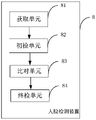
- FIG. 8 is a structural block diagram of the face detection apparatus provided by the embodiment of the present application. For convenience of description, only the part related to the embodiment of the present application is shown.
- the device includes:
- the acquiring unit 81 is configured to acquire an image to be tested, where a first face image exists in the image to be tested.
- the initial inspection unit 82 is configured to perform a preliminary inspection on the image to be inspected to obtain an initial inspection result.
- the comparison unit 83 is configured to compare the first face image in the image to be tested with the target face image to obtain a comparison result if the initial detection result indicates that the detection is passed.
- the final inspection unit 84 is configured to determine the final inspection result of the image to be inspected according to the comparison result.
- the obtaining unit 81 is also used for:
- the obtaining unit 81 is also used for:
- Detecting face contour key points in the infrared image intercepting the first face image existing in the infrared image according to the face contour key points;
- the face image is input to the trained living body detection model, and the living body detection result is output.
- the preliminary detection includes at least one of the following detection items: face pose detection, face occlusion detection, face brightness detection, and face ambiguity detection.
- the initial inspection unit 82 is also used for:
- the initial detection unit 82 is also used for:
- the image to be tested is input into the trained face pose estimation model, and the three-dimensional angle information of the face is output; the project result of the face pose detection is determined according to the three-dimensional angle information of the face and a preset angle range.
- the initial detection unit 82 is also used for:
- the initial detection unit 82 is also used for:
- the initial detection unit 82 is also used for:
- the face detection device shown in FIG. 8 may be a software unit, a hardware unit, or a unit combining software and hardware built into the existing terminal equipment, or may be integrated into the terminal equipment as an independent pendant, and also Can exist as an independent terminal device.
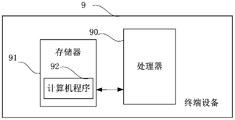
- FIG. 9 is a schematic structural diagram of a terminal device provided by an embodiment of the present application.
- the terminal device 9 of this embodiment includes: at least one processor 90 (only one is shown in FIG. 9 ), a processor, a memory 91 , and a processor stored in the memory 91 and can be processed in the at least one processor
- the computer program 92 running on the processor 90 when the processor 90 executes the computer program 92, implements the steps in any of the above-mentioned embodiments of the face detection method.
- the terminal device may be a computing device such as a desktop computer, a notebook, a palmtop computer, and a cloud server.
- the terminal device may include, but is not limited to, a processor and a memory.
- FIG. 9 is only an example of the terminal device 9, and does not constitute a limitation on the terminal device 9. It may include more or less components than the one shown, or combine some components, or different components , for example, may also include input and output devices, network access devices, and the like.
- the so-called processor 90 may be a central processing unit (Central Processing Unit, CPU), and the processor 90 may also be other general-purpose processors, digital signal processors (Digital Signal Processor, DSP), application specific integrated circuits (Application Specific Integrated Circuits) , ASIC), off-the-shelf programmable gate array (Field-Programmable Gate Array, FPGA) or other programmable logic devices, discrete gate or transistor logic devices, discrete hardware components, etc.
- a general purpose processor may be a microprocessor or the processor may be any conventional processor or the like.
- the memory 91 may be an internal storage unit of the terminal device 9 in some embodiments, such as a hard disk or a memory of the terminal device 9 . In other embodiments, the memory 91 may also be an external storage device of the terminal device 9, such as a plug-in hard disk equipped on the terminal device 9, a smart memory card (Smart Media Card, SMC), a secure digital (Secure Digital, SD) card, flash memory card (Flash Card), etc. Further, the memory 91 may also include both an internal storage unit of the terminal device 9 and an external storage device. The memory 91 is used to store an operating system, an application program, a boot loader (Boot Loader), data, and other programs, such as program codes of the computer program, and the like. The memory 91 can also be used to temporarily store data that has been output or will be output.
- a boot loader Boot Loader
- Embodiments of the present application further provide a computer-readable storage medium, where a computer program is stored in the computer-readable storage medium, and when the computer program is executed by a processor, the steps in the foregoing method embodiments can be implemented.
- the embodiments of the present application provide a computer program product, when the computer program product runs on a terminal device, so that the terminal device can implement the steps in the foregoing method embodiments when executed.
- the integrated unit if implemented in the form of a software functional unit and sold or used as an independent product, may be stored in a computer-readable storage medium.
- the present application realizes all or part of the processes in the methods of the above embodiments, which can be completed by instructing the relevant hardware through a computer program, and the computer program can be stored in a computer-readable storage medium.
- the computer program includes computer program code
- the computer program code may be in the form of source code, object code, executable file or some intermediate form, and the like.
- the computer-readable medium may include at least: any entity or device capable of carrying computer program codes to the device/terminal device, recording medium, computer memory, read-only memory (ROM, Read-Only Memory), random access memory (RAM, Random Access Memory), electrical carrier signals, telecommunication signals, and software distribution media.
- ROM read-only memory
- RAM random access memory
- electrical carrier signals telecommunication signals
- software distribution media For example, U disk, mobile hard disk, disk or CD, etc.
- computer readable media may not be electrical carrier signals and telecommunications signals.
- the disclosed apparatus/terminal device and method may be implemented in other manners.
- the apparatus/terminal device embodiments described above are only illustrative.
- the division of the modules or units is only a logical function division. In actual implementation, there may be other division methods, such as multiple units. Or components may be combined or may be integrated into another system, or some features may be omitted, or not implemented.
- the shown or discussed mutual coupling or direct coupling or communication connection may be through some interfaces, indirect coupling or communication connection of devices or units, and may be in electrical, mechanical or other forms.
- the units described as separate components may or may not be physically separated, and components displayed as units may or may not be physical units, that is, may be located in one place, or may be distributed to multiple network units. Some or all of the units may be selected according to actual needs to achieve the purpose of the solution in this embodiment.
Landscapes
- Engineering & Computer Science (AREA)
- Theoretical Computer Science (AREA)
- Physics & Mathematics (AREA)
- Health & Medical Sciences (AREA)
- General Physics & Mathematics (AREA)
- General Health & Medical Sciences (AREA)
- Multimedia (AREA)
- Oral & Maxillofacial Surgery (AREA)
- Computer Vision & Pattern Recognition (AREA)
- Evolutionary Computation (AREA)
- Human Computer Interaction (AREA)
- Artificial Intelligence (AREA)
- Software Systems (AREA)
- Computing Systems (AREA)
- Data Mining & Analysis (AREA)
- General Engineering & Computer Science (AREA)
- Life Sciences & Earth Sciences (AREA)
- Molecular Biology (AREA)
- Computational Linguistics (AREA)
- Mathematical Physics (AREA)
- Biophysics (AREA)
- Biomedical Technology (AREA)
- Medical Informatics (AREA)
- Databases & Information Systems (AREA)
- Probability & Statistics with Applications (AREA)
- Bioinformatics & Cheminformatics (AREA)
- Geometry (AREA)
- Evolutionary Biology (AREA)
- Bioinformatics & Computational Biology (AREA)
- Image Analysis (AREA)
- Image Processing (AREA)
Abstract
Description
本申请要求于2021年3月22日在中国专利局提交的、申请号为202110302180.9的中国专利申请的优先权,其全部内容通过引用结合在本申请中。This application claims the priority of the Chinese Patent Application No. 202110302180.9 filed with the Chinese Patent Office on March 22, 2021, the entire contents of which are incorporated herein by reference.
本申请属于图像处理技术领域,尤其涉及人脸检测方法、装置、终端设备及计算机可读存储介质。The present application belongs to the technical field of image processing, and in particular, relates to a face detection method, apparatus, terminal device and computer-readable storage medium.
随着图像处理技术的发展,人脸检测逐渐成为最有潜力的生物身份验证方式,其被广泛应用于金融支付、安全防控和媒体娱乐等领域。现有人脸检测技术中,需要将采集到的人脸图像与用户注册的人脸图像进行比对,以确定采集到的人脸图像是否为用户本人。With the development of image processing technology, face detection has gradually become the most potential biometric authentication method, which is widely used in financial payment, security prevention and control and media entertainment and other fields. In the existing face detection technology, the collected face image needs to be compared with the face image registered by the user to determine whether the collected face image is the user himself.
实际应用中,采集到的人脸图像本身可能存在“瑕疵”,从而影响人脸检测的准确率。例如:图像光线较暗,或图像中的人脸区域存在遮挡,以至于无法检测出图像中的关键特征信息,进而影响检测结果。In practical applications, the collected face image itself may have "blemishes", thus affecting the accuracy of face detection. For example, the image is dimly lit, or the face area in the image is occluded, so that the key feature information in the image cannot be detected, thereby affecting the detection result.
本申请实施例提供了一种人脸检测方法、装置、终端设备及计算机可读存储介质,可以有效提高人脸检测的准确率。The embodiments of the present application provide a face detection method, apparatus, terminal device, and computer-readable storage medium, which can effectively improve the accuracy of face detection.
第一方面,本申请实施例提供了一种人脸检测方法,包括:In a first aspect, an embodiment of the present application provides a face detection method, including:
获取待测图像,所述待测图像中存在第一人脸图像;acquiring an image to be tested, where a first face image exists in the image to be tested;
对所述待测图像进行初步检测,获得初检结果;Perform preliminary detection on the image to be tested to obtain a preliminary detection result;
若所述初检结果表示检测通过,则将所述待测图像中的所述第一人脸图像与目标人脸图像进行比对,获得比对结果;If the initial detection result indicates that the detection is passed, then compare the first face image in the image to be tested with the target face image to obtain a comparison result;
根据所述比对结果确定所述待测图像的终检结果。The final inspection result of the image to be tested is determined according to the comparison result.
在本申请实施例中,首先对待测图像进行初步检测,这样可以滤除掉有“瑕疵”的待测图像;若待测图像通过了初步检测,再将待测图像中的第一人脸图像与目标人脸图像进行比对,根据比对结果确定终检结果。通过上述方法,能够有效提高人脸检测的准确率。In the embodiment of the present application, the image to be tested is initially detected, so that the image to be tested with "defects" can be filtered out; if the image to be tested passes the preliminary detection, the first face image in the image to be tested is then Compare with the target face image, and determine the final inspection result according to the comparison result. Through the above method, the accuracy of face detection can be effectively improved.
在第一方面的一种可能的实现方式中,所述获取待测图像,包括:In a possible implementation manner of the first aspect, the acquiring the image to be tested includes:
获取RGB图像和红外图像,所述RGB图像和所述红外图像中均存在所述第一人脸图像;acquiring an RGB image and an infrared image, where the first face image exists in both the RGB image and the infrared image;
对所述红外图像中存在的所述第一人脸图像进行活体检测,获得活体检测结果;performing living body detection on the first face image existing in the infrared image to obtain a living body detection result;
若所述活体检测结果表示所述红外图像中存在的所述第一人脸图像为真实人脸,则将所述RGB图像确定为所述待测图像。If the living body detection result indicates that the first face image existing in the infrared image is a real face, the RGB image is determined as the image to be tested.
在第一方面的一种可能的实现方式中,所述对所述红外图像中存在的所述第一人脸图像进行活体检测,获得活体检测结果,包括:In a possible implementation manner of the first aspect, the performing living body detection on the first face image existing in the infrared image to obtain a living body detection result includes:
检测所述红外图像中的人脸轮廓关键点;Detecting face contour key points in the infrared image;
根据所述人脸轮廓关键点截取所述红外图像中存在的所述第一人脸图像;Intercepting the first face image existing in the infrared image according to the face contour key points;
将所述红外图像中存在的所述第一人脸图像输入到训练后的活体检测模型,输出所述活体检测结果。The first face image existing in the infrared image is input into the trained living body detection model, and the living body detection result is output.
在第一方面的一种可能的实现方式中,所述初步检测包括以下至少一个检测项目:人脸姿态检测、人脸遮挡检测、人脸亮度检测和人脸模糊度检测;In a possible implementation manner of the first aspect, the preliminary detection includes at least one of the following detection items: face pose detection, face occlusion detection, face brightness detection, and face ambiguity detection;
所述对所述待测图像进行初步检测,获得初检结果,包括:The preliminary detection of the image to be tested to obtain a preliminary detection result includes:
对所述待测图像分别执行所述初步检测中的每个所述检测项目,获得每个所述检测项目的项目结果;Performing each of the detection items in the preliminary detection on the image to be tested, respectively, to obtain an item result of each of the detection items;
若所述初步检测中每个所述检测项目的项目结果均表示检测通过,则所述初检结果表示检测通过。If the item result of each of the test items in the preliminary test indicates that the test is passed, the preliminary test result indicates that the test is passed.
在第一方面的一种可能的实现方式中,当所述检测项目为所述人脸姿态检测时,对所述待测图像执行所述人脸姿态检测,获得所述人脸姿态检测的项目结果,包括:In a possible implementation manner of the first aspect, when the detection item is the face gesture detection, the face gesture detection is performed on the image to be tested to obtain the face gesture detection item Results, including:
将所述待测图像输入到训练后的人脸姿态估计模型中,输出人脸三维角度信息;Input the image to be tested into the trained face pose estimation model, and output the three-dimensional angle information of the face;
根据所述人脸三维角度信息和预设角度范围确定所述人脸姿态检测的项目结果。The project result of the face gesture detection is determined according to the face three-dimensional angle information and the preset angle range.
在第一方面的一种可能的实现方式中,当所述检测项目为所述人脸遮挡检测时,对所述待测图像执行所述人脸遮挡检测,获得所述人脸遮挡检测的项目结果,包括:In a possible implementation manner of the first aspect, when the detection item is the face occlusion detection, the face occlusion detection is performed on the image to be tested to obtain the face occlusion detection item Results, including:
将所述待测图像中存在的所述第一人脸图像划分为N个面部区域,所述N为正整数;dividing the first face image existing in the image to be tested into N face regions, where N is a positive integer;
将所述N个面部区域输入到各自对应的遮挡检测模型中,输出所述N个面部区域各自对应的遮挡检测结果;Inputting the N face regions into the respective corresponding occlusion detection models, and outputting the respective occlusion detection results corresponding to the N face regions;
根据所述N个面部区域各自对应的遮挡检测结果确定所述人脸遮挡检测的项目结果。The item result of the face occlusion detection is determined according to the occlusion detection results corresponding to the N face regions.
在第一方面的一种可能的实现方式中,当所述检测项目为所述人脸亮度检测时,对所述待测图像执行所述人脸亮度检测,获得所述人脸亮度检测的项目结果,包括:In a possible implementation manner of the first aspect, when the detection item is the face brightness detection, the face brightness detection is performed on the image to be tested, and the face brightness detection item is obtained Results, including:
计算所述待测图像中目标像素点的数量与所述待测图像中所有像素点的数量的比值,其中,所述目标像素点的像素值在预设灰度值范围内;Calculate the ratio of the number of target pixel points in the image to be tested to the number of all pixel points in the image to be tested, wherein the pixel value of the target pixel point is within a preset gray value range;
根据所述比值和预设阈值确定所述人脸亮度检测的项目结果。The project result of the face brightness detection is determined according to the ratio and the preset threshold.
在第一方面的一种可能的实现方式中,当所述检测项目为所述人脸模糊度检测时,对所述待测图像执行所述人脸模糊度检测,获得所述人脸模糊度检测的项目结果,包括:In a possible implementation manner of the first aspect, when the detection item is the face blur degree detection, the face blur degree detection is performed on the image to be tested to obtain the face blur degree Tested project results, including:
计算所述待测图像的模糊度;calculating the ambiguity of the image to be tested;
根据所述模糊度和预设数值范围确定所述人脸模糊度检测的项目结果。An item result of the face blurriness detection is determined according to the blurriness and a preset value range.
第二方面,本申请实施例提供了一种人脸检测装置,包括:In a second aspect, an embodiment of the present application provides a face detection device, including:
获取单元,用于获取待测图像,所述待测图像中存在第一人脸图像;an acquisition unit, configured to acquire an image to be tested, where a first face image exists in the image to be tested;
初检单元,用于对所述待测图像进行初步检测,获得初检结果;an initial inspection unit, configured to perform a preliminary inspection on the image to be inspected to obtain an initial inspection result;
比对单元,用于若所述初检结果表示检测通过,则将所述待测图像中的所述第一人脸图像与目标人脸图像进行比对,获得比对结果;a comparison unit, configured to compare the first face image in the image to be tested with the target face image to obtain a comparison result if the initial inspection result indicates that the detection is passed;
终检单元,用于根据所述比对结果确定所述待测图像的终检结果。A final inspection unit, configured to determine a final inspection result of the image to be tested according to the comparison result.
第三方面,本申请实施例提供了一种终端设备,包括存储器、处理器以及存储在所述存储器中并可在所述处理器上运行的计算机程序,其特征在于,所述处理器执行所述计算机程序时实现如上述第一方面中任一项所述的人脸检测方法。In a third aspect, an embodiment of the present application provides a terminal device, including a memory, a processor, and a computer program stored in the memory and executable on the processor, wherein the processor executes all When the computer program is used, the face detection method according to any one of the above-mentioned first aspects is realized.
第四方面,本申请实施例提供了一种计算机可读存储介质,本申请实施例提供了一种计算机可读存储介质,所述计算机可读存储介质存储有计算机程序,其特征在于,所述计算机程序被处理器执行时实现如上述第一方面中任一项所述的人脸检测方法。In a fourth aspect, an embodiment of the present application provides a computer-readable storage medium, and an embodiment of the present application provides a computer-readable storage medium, where a computer program is stored in the computer-readable storage medium, wherein the When the computer program is executed by the processor, the face detection method according to any one of the above-mentioned first aspects is implemented.
第五方面,本申请实施例提供了一种计算机程序产品,当计算机程序产品在终端设备上运行时,使得终端设备执行上述第一方面中任一项所述的人脸检测方法。In a fifth aspect, an embodiment of the present application provides a computer program product that, when the computer program product runs on a terminal device, enables the terminal device to execute the face detection method described in any one of the first aspects above.
可以理解的是,上述第二方面至第五方面的有益效果可以参见上述第一方面中的相关描述,在此不再赘述。It can be understood that, for the beneficial effects of the second aspect to the fifth aspect, reference may be made to the relevant description in the first aspect, which is not repeated here.
为了更清楚地说明本申请实施例中的技术方案,下面将对实施例或现有技术描述中所需要使用的附图作简单地介绍,显而易见地,下面描述中的附图仅仅是本申请的一些实施例,对于本领域普通技术人员来讲,在不付出创造性劳动性的前提下,还可以根据这些附图获得其他的附图。In order to illustrate the technical solutions in the embodiments of the present application more clearly, the following briefly introduces the accompanying drawings that need to be used in the description of the embodiments or the prior art. Obviously, the drawings in the following description are only for the present application. In some embodiments, for those of ordinary skill in the art, other drawings can also be obtained according to these drawings without any creative effort.
图1是本申请实施例提供的人脸检测方法的流程示意图;1 is a schematic flowchart of a face detection method provided by an embodiment of the present application;
图2是本申请实施例提供的人脸特征关键点的示意图;2 is a schematic diagram of a face feature key point provided by an embodiment of the present application;
图3是本申请实施例提供的人脸轮廓关键点的示意图;3 is a schematic diagram of a face contour key point provided by an embodiment of the present application;
图4是本申请实施例提供的去背景过程示意图;4 is a schematic diagram of a background removal process provided by an embodiment of the present application;
图5是本申请实施例提供的第一特征提取模块的结构示意图;5 is a schematic structural diagram of a first feature extraction module provided by an embodiment of the present application;
图6是本申请实施例提供的活体检测模型的结构示意图;6 is a schematic structural diagram of a living body detection model provided by an embodiment of the present application;
图7是本申请实施例提供的F-Net模型的示意图;7 is a schematic diagram of an F-Net model provided by an embodiment of the present application;
图8是本申请实施例提供的人脸检测装置的结构框图;8 is a structural block diagram of a face detection apparatus provided by an embodiment of the present application;
图9是本申请实施例提供的终端设备的结构示意图。FIG. 9 is a schematic structural diagram of a terminal device provided by an embodiment of the present application.
以下描述中,为了说明而不是为了限定,提出了诸如特定系统结构、技术之类的具体细节,以便透彻理解本申请实施例。然而,本领域的技术人员应当清楚,在没有这些具体细节的其它实施例中也可以实现本申请。在其它情况中,省略对众所周知的系统、装置、电路以及方法的详细说明,以免不必要的细节妨碍本申请的描述。In the following description, for the purpose of illustration rather than limitation, specific details such as a specific system structure and technology are set forth in order to provide a thorough understanding of the embodiments of the present application. However, it will be apparent to those skilled in the art that the present application may be practiced in other embodiments without these specific details. In other instances, detailed descriptions of well-known systems, devices, circuits, and methods are omitted so as not to obscure the description of the present application with unnecessary detail.
应当理解,当在本申请说明书和所附权利要求书中使用时,术语“包括”指示所描述特征、整体、步骤、操作、元素和/或组件的存在,但并不排除一个或多个其它特征、整体、步骤、操作、元素、组件和/或其集合的存在或添加。It is to be understood that, when used in this specification and the appended claims, the term "comprising" indicates the presence of the described feature, integer, step, operation, element and/or component, but does not exclude one or more other The presence or addition of features, integers, steps, operations, elements, components and/or sets thereof.
如在本申请说明书和所附权利要求书中所使用的那样,术语“若”可以依据上下文被解释为“当...时”或“一旦”或“响应于确定”或“响应于检测到”。As used in the specification of this application and the appended claims, the term "if" may be contextually interpreted as "when" or "once" or "in response to determining" or "in response to detecting ".
另外,在本申请说明书和所附权利要求书的描述中,术语“第一”、“第二”、“第三”等仅用于区分描述,而不能理解为指示或暗示相对重要性。In addition, in the description of the specification of the present application and the appended claims, the terms "first", "second", "third", etc. are only used to distinguish the description, and should not be construed as indicating or implying relative importance.
在本申请说明书中描述的参考“一个实施例”或“一些实施例”等意味着在本申请的一个或多个实施例中包括结合该实施例描述的特定特征、结构或特点。由此,在本说明书中的不同之处出现的语句“在一个实施例中”、“在一些实施例中”、“在其他一些实施例中”、“在另外一些实施例中”等不是必然都参考相同的实施例,而是意味着“一个或多个但不是所有的实施例”,除非是以其他方式另外特别强调。References in this specification to "one embodiment" or "some embodiments" and the like mean that a particular feature, structure or characteristic described in connection with the embodiment is included in one or more embodiments of the present application. Thus, appearances of the phrases "in one embodiment," "in some embodiments," "in other embodiments," "in other embodiments," etc. in various places in this specification are not necessarily All refer to the same embodiment, but mean "one or more but not all embodiments" unless specifically emphasized otherwise.
参见图1,是本申请实施例提供的人脸检测方法的流程示意图,作为示例而非限定,所述方法可以包括以下步骤:Referring to FIG. 1, it is a schematic flowchart of a face detection method provided by an embodiment of the present application. As an example and not a limitation, the method may include the following steps:
S101,获取待测图像,待测图像中存在第一人脸图像。S101: Acquire an image to be tested, where a first face image exists in the image to be tested.
在一个实施例中,通过拍摄装置采集目标人脸的RGB图像,将该RGB图像记为待测图像。待测图像中包括目标人脸所对应的第一人脸图像和背景图像。In one embodiment, the RGB image of the target face is collected by the photographing device, and the RGB image is recorded as the image to be measured. The image to be tested includes a first face image and a background image corresponding to the target face.
实际应用中,可能存在仿造人脸图像的情况,如打印的人脸图像、人脸面具或电子设备屏幕中的人脸图像等。为了防止上述情况的发生,在另一个实施例中,需要进行人脸活体检测。具体如下。In practical applications, there may be situations in which face images are faked, such as printed face images, face masks, or face images on the screen of an electronic device. In order to prevent the above situation from happening, in another embodiment, face liveness detection needs to be performed. details as follows.
S101的一种实现方式可以包括:获取目标人脸的RGB图像,然后对RGB图像中存在的第一人脸图像进行活体检测,获得活体检测结果;若活体检测结果表示RGB图像中存在的第一人脸图像为真实人脸,则将RGB图像确定为待测图像。An implementation manner of S101 may include: acquiring an RGB image of the target face, and then performing in vivo detection on the first face image existing in the RGB image to obtain the in vivo detection result; If the face image is a real face, the RGB image is determined as the image to be tested.
但是,RGB图像用于活体检测时,效果较差。为了提高活体检测的准确度,本申请实施例提供S101的另一种实现方式,包括:获取RGB图像和红外图像,RGB图像和所红外图像中均存在第一人脸图像;对红外图像中存在的第一人脸图像进行活体检测,获得活体检测结果;若活体检测结果表示红外图像中存在的第一人脸图像为真实人脸,则将RGB图像确定为待测图像。However, RGB images are less effective when used for liveness detection. In order to improve the accuracy of living body detection, the embodiment of the present application provides another implementation manner of S101, including: acquiring an RGB image and an infrared image, and the first face image exists in both the RGB image and the infrared image; The first face image of the infrared image is subjected to living body detection to obtain a living body detection result; if the living body detection result indicates that the first face image existing in the infrared image is a real face, the RGB image is determined as the image to be tested.
RGB图像和红外图像可以是由同一个拍摄装置同时对同一个拍摄对象拍摄得到,或者由同一个拍摄装置先后对同一个拍摄对象拍摄得到。例如:第一拍摄装置能够拍摄RGB图像和红外图像,由第一拍摄装置同时对目标人脸进行拍摄,获得目标人脸的RGB图像和红外图像;还可以由第一拍摄装置先拍摄出目标人脸的RGB图像,再拍摄出目标人脸的红外图像,这种情况下,需要两次拍摄间隔时间较短,以保证目标人脸相对于拍摄装置的角度以及背景未发生较大变化。The RGB image and the infrared image may be obtained by simultaneously photographing the same photographing object by the same photographing device, or by successively photographing the same photographing object by the same photographing device. For example: the first photographing device can photograph RGB images and infrared images, and the first photographing device simultaneously photographs the target face to obtain RGB images and infrared images of the target face; the first photographing device can also first photograph the target person The RGB image of the face, and then the infrared image of the target face is captured. In this case, the interval between two shots needs to be short to ensure that the angle of the target face relative to the shooting device and the background do not change significantly.
RGB图像和红外图像也可以是由不同的拍摄装置对同一个拍摄对象同时拍摄得到,或者由不同的拍摄装置先后对同一个拍摄对象拍摄得到。例如:第二拍摄装置能够拍摄RGB图像,第三拍摄装置能够拍摄红外图像,令第二拍摄装置和第三拍摄装置同时对目标人脸进行拍摄,获得的RGB图像和红外图像中均包括目标人脸对应的第一人脸图像。还可以先由第二拍摄装置对目标人脸进行拍摄,获得RGB图像;再由第三拍摄装置对目标人脸进行拍摄,获得红外图像;这种情况下,需要两次拍摄间隔时间较短,以保证目标人脸相对于拍摄装置的角度以及背景未发生较大变化。The RGB image and the infrared image may also be obtained by simultaneously photographing the same photographing object by different photographing devices, or by successively photographing the same photographing object by different photographing devices. For example: the second photographing device can take RGB images, the third photographing device can take infrared images, the second photographing device and the third photographing device can take pictures of the target face at the same time, and the obtained RGB images and infrared images both include the target person The first face image corresponding to the face. It is also possible to first photograph the target face by the second photographing device to obtain an RGB image; and then use the third photographing device to photograph the target face to obtain an infrared image; in this case, the interval between two shots needs to be shorter, In order to ensure that the angle of the target face relative to the shooting device and the background do not change greatly.
在一个实施例中,对红外图像中存在的第一人脸图像进行活体检测的一种实现方式包括:检测红外图像中的人脸轮廓关键点;根据人脸轮廓关键点截取红外图像中存在的第一人脸图像;将红外图像中存在的第一人脸图像输入到训练后的活体检测模型,输出活体检测结果。In one embodiment, an implementation method of performing live detection on the first face image existing in the infrared image includes: detecting the key points of the face contour in the infrared image; The first face image; the first face image existing in the infrared image is input into the trained living body detection model, and the living body detection result is output.
红外图像中包括第一人脸图像和背景图像。实际应用中,采集的红外图像的背景图像中可能存在活体/非活体的图像,若将红外图像输入到活体检测模型中(即综合考虑背景图像和第一人脸图像的特征信息),那么红外图像中的背景图像对应的特征信息将会对第一人脸图像对应的特征信息造成干扰,影响活体检测结果的准确性。为了解决上述问题,在本申请实施例中,先对红外图像进行去背景处理(即检测红外图像中的人脸轮廓关键点;根据人脸轮廓关键点截取红外图像中存在的第一人脸图像),获得红外图像中的第一人脸图像,然后对第一人脸图像进行活体检测。The infrared image includes a first face image and a background image. In practical applications, there may be living/non-living images in the background image of the collected infrared image. If the infrared image is input into the living detection model (that is, the feature information of the background image and the first face image is comprehensively considered), then the infrared image The feature information corresponding to the background image in the image will interfere with the feature information corresponding to the first face image and affect the accuracy of the living body detection result. In order to solve the above problems, in the embodiment of the present application, the infrared image is first subjected to background removal processing (that is, the key points of the face contour in the infrared image are detected; the first face image existing in the infrared image is intercepted according to the key points of the face contour. ) to obtain the first face image in the infrared image, and then perform liveness detection on the first face image.
可选的,检测红外图像中的人脸轮廓关键点的一种实现方式可以包括:获取红外图像中第一人脸图像上的多个人脸特征关键点;从多个人脸特征关键点中确定出人脸轮廓关键点。Optionally, an implementation manner of detecting the face contour key points in the infrared image may include: acquiring multiple face feature key points on the first face image in the infrared image; determining from the multiple face feature key points; Face contour key points.
可以将红外图像输入到训练后的人脸检测模型中,输出多个人脸特征关键点。优选的,可以采用68个关键点的人脸检测模型。参见图2,是本申请实施例提供的人脸特征关键点的示意图。将待处理图像输入到训练后的人脸检测模型中,即可输出如图2所示的人脸特征关键点1-68的位置标记。The infrared image can be input into the trained face detection model, and multiple face feature key points can be output. Preferably, a face detection model with 68 key points can be used. Referring to FIG. 2 , it is a schematic diagram of a face feature key point provided by an embodiment of the present application. Input the to-be-processed image into the trained face detection model, and the position markers of the key points 1-68 of the face feature as shown in Figure 2 can be output.
进一步的,从多个人脸特征关键点中确定出人脸轮廓关键点的一种实现方式可以包括:确定多个人脸特征关键点中的边界点;根据边界点确定人脸轮廓关键点。Further, an implementation manner of determining a face contour key point from a plurality of face feature key points may include: determining a boundary point among the multiple face feature key points; and determining a face contour key point according to the boundary point.
示例性的,如图2所示,人脸特征关键点1-68中,1-17和18-27为边界点。Exemplarily, as shown in FIG. 2, among the face feature key points 1-68, 1-17 and 18-27 are boundary points.
根据边界点确定人脸轮廓关键点的实现方式可以有以下几种:The implementation of determining the key points of the face contour according to the boundary points can be as follows:
1、将边界点确定为人脸轮廓关键点。1. Determine the boundary points as the key points of the face contour.
例如,如图2所示,将边界点1-17和18-27确定为人脸轮廓关键点。For example, as shown in Fig. 2, boundary points 1-17 and 18-27 are determined as face contour key points.
2、将横坐标最大的边界点、横坐标最小的边界点、纵坐标最大的边界点和纵坐标最小的边界点确定为人脸轮廓边界点。2. Determine the boundary point with the largest abscissa, the boundary point with the smallest abscissa, the boundary point with the largest ordinate and the boundary point with the smallest ordinate as the boundary point of the face contour.
例如,如图2所示,将边界点1、9、16和25确定为人脸轮廓关键点。For example, as shown in Fig. 2, boundary points 1, 9, 16 and 25 are determined as face contour key points.
3、计算边界点中的横坐标最大值、横坐标最小值和纵坐标最小值;根据横坐标最大值和纵坐标最小值确定第一顶点关键点,根据横坐标最小值和纵坐标最小值确定第二顶点关键点;将边界点1-17、第一顶点关键点和第二顶点关键点确定为人脸轮廓关键点。3. Calculate the maximum abscissa, minimum abscissa and minimum ordinate in the boundary point; determine the key point of the first vertex according to the maximum abscissa and minimum ordinate, and determine according to the minimum value of the abscissa and the minimum ordinate The second vertex key point; the boundary points 1-17, the first vertex key point and the second vertex key point are determined as the face contour key points.
参见图3,是本申请实施例提供的人脸轮廓关键点的示意图。如图3所示,第一顶点关键点为a(见图3中的左上角处),第二顶点关键点(见图3中的右上角处)为b,由a、b和1-17这几个人脸轮廓关键点能够确定出人脸图像的轮廓。Referring to FIG. 3 , it is a schematic diagram of a face contour key point provided by an embodiment of the present application. As shown in Figure 3, the first vertex key point is a (see the upper left corner in Figure 3), and the second vertex key point (see the upper right corner in Figure 3) is b, consisting of a, b and 1-17 These face contour key points can determine the contour of the face image.
第一种方式确定出的人脸图像的轮廓较小,失去了部分人脸特征信息。第二种方式确定出的人脸图像的轮廓为包含人脸图像的最小矩形,该轮廓中包括了较多的背景图像。而第三种方式确定出的人脸图像的轮廓较为合适,既保证了人脸图像的完整性,又较完全地滤除了背景图案。The contour of the face image determined by the first method is small, and part of the face feature information is lost. The contour of the face image determined in the second method is the smallest rectangle containing the face image, and the contour includes more background images. The contour of the face image determined by the third method is more suitable, which not only ensures the integrity of the face image, but also filters out the background pattern more completely.
可选的,根据人脸轮廓关键点截取红外图像中存在的第一人脸图像的一种实现方式可以包括:在由第一预设颜色填充的预设图层上,根据人脸轮廓关键点勾勒出第一区域;将预设图层中的第一区域填充为第二预设颜色,得到目标图层;将目标图层和待处理图像进行 叠加处理,获得人脸图像。Optionally, an implementation manner of intercepting the first face image existing in the infrared image according to the key points of the face contour may include: on the preset layer filled with the first preset color, according to the key points of the face contour. Outline the first area; fill the first area in the preset layer with the second preset color to obtain the target layer; superimpose the target layer and the image to be processed to obtain the face image.
这样目标图层上,由人脸轮廓关键点勾勒出的第一区域内为第二预设颜色,除第一区域外的第二区域内为第一预设颜色。示例性的,先创建一个黑色(即第二预设颜色)的预设图层(如掩膜,可以以程序数据的形式存储);通过OpenCV中的polylines函数将人脸轮廓关键点绘制为曲线,该曲线围成的区域记为第一区域;通过fillpoly函数将第一区域填充为白色(即第一预设颜色),得到目标图层;将目标图层与待处理图像执行逐像素按位与处理(即进行叠加处理),得到人脸图像。In this way, on the target layer, the first area outlined by the face contour key points is the second preset color, and the second area other than the first area is the first preset color. Exemplarily, first create a black (that is, the second preset color) preset layer (such as a mask, which can be stored in the form of program data); draw the face contour key points as a curve through the polylines function in OpenCV , the area enclosed by the curve is recorded as the first area; the first area is filled with white (ie, the first preset color) through the fillpoly function to obtain the target layer; the target layer and the image to be processed are executed pixel by pixel bitwise And processing (that is, performing superposition processing) to obtain a face image.
参见图4,是本申请实施例提供的去背景过程示意图。图4中左边的图像为去背景处理之前的红外图像,图4中右边的图像为去背景处理后的第一人脸图像。如图4所示,经过上述去背景处理过程,能够在保留完整的第一人脸图像的同时,滤除掉背景图像。Referring to FIG. 4 , it is a schematic diagram of a background removal process provided by an embodiment of the present application. The image on the left in Figure 4 is the infrared image before background removal, and the image on the right in Figure 4 is the first face image after background removal. As shown in FIG. 4 , through the above background removal processing process, the background image can be filtered out while retaining the complete first face image.
在从红外图像中获取第一人脸图像后,将第一人脸图像输入到训练后的活体检测模型,输出活体检测结果。After acquiring the first face image from the infrared image, the first face image is input into the trained living body detection model, and the living body detection result is output.
为了提高活体检测模型的特征提取能力,在本申请实施例中,活体检测模型包括第一特征提取模块和注意力机制模块。第一特征提取模块和注意力机制模块均用于提取特征,其中,注意力机制模块能够加强对具有鉴别力特征(如人眼的反光特征、皮肤纹理特征等)的学习能力。可选的,注意力机制模块可以采用SENet模块。In order to improve the feature extraction capability of the living body detection model, in this embodiment of the present application, the living body detection model includes a first feature extraction module and an attention mechanism module. Both the first feature extraction module and the attention mechanism module are used to extract features, wherein the attention mechanism module can enhance the learning ability of discriminative features (such as human eye reflective features, skin texture features, etc.). Optionally, the attention mechanism module can adopt the SENet module.
另外,与现有技术不同的是,本申请实施例的第一特征提取模块中,加入了并行的特征提取网络。具体的,参见图5,是本申请实施例提供的第一特征提取模块的结构示意图。现有技术中的第一特征提取模块结构如图5中的(a)所示,包括倒残差网络(包括用于升维的第二卷积层(1×1Conv)、第三卷积层(3×3 DW Conv)和用于降维的第四卷积层(1×1Conv))。本申请实施例中的第一特征提取模块结构如图5中的(b)所示,包括并联的第一网络和倒残差网络;其中,第一网络包括第一平均池化层(2×2 AVG Pool)和第一卷积层(1×1Conv)。In addition, different from the prior art, a parallel feature extraction network is added to the first feature extraction module of the embodiment of the present application. Specifically, referring to FIG. 5 , it is a schematic structural diagram of a first feature extraction module provided by an embodiment of the present application. The structure of the first feature extraction module in the prior art is shown in (a) of Figure 5, including an inverted residual network (including a second convolutional layer (1×1Conv) for dimension enhancement, a third convolutional layer (3×3 DW Conv) and a fourth convolutional layer (1×1 Conv) for dimensionality reduction. The structure of the first feature extraction module in the embodiment of the present application is shown in (b) in FIG. 5 , including a parallel first network and an inverted residual network; wherein, the first network includes a first average pooling layer (2× 2 AVG Pool) and the first convolutional layer (1×1Conv).
示例性的,参见图6,是本申请实施例提供的活体检测模型的结构示意图。图6中的Block A模块为图5中的(a)所示的第一特征提取模块,图6中的Block B模块为图5中的(b)所示的第一特征提取模块。如图6所示的活体检测模型中,第一特征提取模块和注意力机制模块交替执行特征提取任务,最后通过FC(fully connected layers,全连接层)将提取出的特征向量全连接到输出层。在活体检测过程中,将输出的特征向量通过分类层(如softmax)转换为概率值,通过概率值即可判断是否为活体。图6中所示的活体检测模型对2D和3D的人脸图像均具有较强的防御能力和安全性,活体检测的准确度较高。For example, referring to FIG. 6 , it is a schematic structural diagram of a living body detection model provided by an embodiment of the present application. The Block A module in FIG. 6 is the first feature extraction module shown in (a) in FIG. 5 , and the Block B module in FIG. 6 is the first feature extraction module shown in (b) in FIG. 5 . In the living detection model shown in Figure 6, the first feature extraction module and the attention mechanism module alternately perform feature extraction tasks, and finally the extracted feature vectors are fully connected to the output layer through FC (fully connected layers). . In the process of living body detection, the output feature vector is converted into a probability value through a classification layer (such as softmax), and whether it is a living body can be judged by the probability value. The living body detection model shown in Figure 6 has strong defense capability and security for both 2D and 3D face images, and the accuracy of living body detection is high.
上述实施例中,相当于先进行了活体检测的过程,在确定采集到的人脸图像为真实人脸后,再将采集到的RGB图像确定为待测图像,以进行后续步骤。通过上述方法,有效避免了伪造人脸的情况,有助于提高人脸检测的准确度。In the above-mentioned embodiment, it is equivalent to performing the process of living body detection first, and after determining that the collected face image is a real face, the collected RGB image is determined as the image to be tested for subsequent steps. Through the above method, the situation of forging a face is effectively avoided, which is helpful to improve the accuracy of face detection.
S102,对待测图像进行初步检测,获得初检结果。S102, perform a preliminary test on the image to be tested to obtain a preliminary test result.
实际应用中,采集到的待测图像本身可能存在“瑕疵”,从而影响人脸检测的准确率。例如:图像光线较暗,或图像中的人脸区域存在遮挡,以至于无法检测出图像中的关键特征信息,进而影响检测结果。In practical applications, the collected images to be tested may have "blemishes", thus affecting the accuracy of face detection. For example, the image is dimly lit, or the face area in the image is occluded, so that the key feature information in the image cannot be detected, thereby affecting the detection result.
为了提高人脸检测结果,本申请实施例中,对待测图像进行初步检测,目的是过滤掉存在“瑕疵”的待测图像。初步检测可以包括以下至少一个检测项目:人脸姿态检测、人脸遮挡检测、人脸亮度检测和人脸模糊度检测。下面分别介绍每种检测项目。In order to improve the result of face detection, in the embodiment of the present application, the image to be tested is initially detected, in order to filter out the image to be tested with "defects". The preliminary detection may include at least one of the following detection items: face pose detection, face occlusion detection, face brightness detection, and face ambiguity detection. Each test item is described below.
I、对待测图像执行人脸姿态检测,获得人脸姿态检测的项目结果,可以包括以下步骤:将待测图像输入到训练后的人脸姿态估计模型中,输出人脸三维角度信息;根据人脸三维角度信息和预设角度范围确定人脸姿态检测的项目结果。1, the image to be tested is carried out face pose detection, obtains the project result of face pose detection, can comprise the following steps: the image to be tested is input in the face pose estimation model after training, output face three-dimensional angle information; The face three-dimensional angle information and the preset angle range determine the project result of face pose detection.
可选的,人脸姿态估计模型可以采用FSA-Net模型。该模型由Stream one和Steam two两个分支组成,算法先在不同深度的层(有多层,只是取三层)上提取三个特征,然后对细粒度结构特征融合,再通过SSR(The sum of squares due to regression,预测值与真 实值的均值之间差的平方和)模块回归预测得到人脸三维角度信息(Roll、Pitch和Yaw)。参见图7,是本申请实施例提供的FSA-Net模型的示意图。该模型对数据的处理速度较快,有助于提高人脸检测的效率。Optionally, the face pose estimation model can use the FSA-Net model. The model consists of two branches, Stream one and Steam two. The algorithm first extracts three features on layers of different depths (there are multiple layers, just take three layers), then fuses the fine-grained structural features, and then passes SSR (The sum of squares due to regression, the sum of squares of the difference between the predicted value and the mean value of the true value) module regression prediction to obtain the three-dimensional angle information (Roll, Pitch and Yaw) of the face. Referring to FIG. 7 , it is a schematic diagram of an FSA-Net model provided by an embodiment of the present application. The model can process data faster, which helps to improve the efficiency of face detection.
可选的,若人脸三维角度信息在预设角度范围内,则人脸姿态检测的项目结果表示检测通过;若人脸三维角度信息不在预设角度范围内,则人脸姿态检测的项目结果表示检测未通过。Optionally, if the three-dimensional angle information of the face is within the preset angle range, the project result of the face pose detection indicates that the detection is passed; if the three-dimensional angle information of the face is not within the preset angle range, the project result of the face pose detection Indicates that the test failed.
II、对待测图像执行人脸遮挡检测,获得人脸遮挡检测的项目结果,可以包括以下步骤:将待测图像中存在的第一人脸图像划分为N个面部区域,N为正整数;将N个面部区域输入到各自对应的遮挡检测模型中,输出N个面部区域各自对应的遮挡检测结果;根据N个面部区域各自对应的遮挡检测结果确定人脸遮挡检测的项目结果。II. Perform face occlusion detection on the image to be tested, and obtain the project result of face occlusion detection, which may include the following steps: dividing the first face image existing in the image to be tested into N face regions, where N is a positive integer; The N facial regions are input into the corresponding occlusion detection models, and the corresponding occlusion detection results of the N facial regions are output; the project results of face occlusion detection are determined according to the corresponding occlusion detection results of the N facial regions.
示例性的,可以根据检测出的第一人脸图像上的68个关键点,把第一人脸图像划分为7个区域,如左眼、右眼、鼻子、嘴巴、下巴、左脸、右脸。然后将这7个区域输入到各自对应的遮挡检测模型中,例如,将左眼图像输入到左眼遮挡检测模型中、将鼻子图像输入到鼻子遮挡检测模型中。7个遮挡检测模型分别输出遮挡概率值,然后判断遮挡概率值是否在预设概率范围内;若在,则表示当前区域未被遮挡;若不在,则表示当前区域存在遮挡。需要说明的是,上述只是划分区域的示例,并不对划分规则和区域数量等做具体限定。Exemplarily, according to the detected 68 key points on the first face image, the first face image can be divided into 7 regions, such as left eye, right eye, nose, mouth, chin, left face, right Face. These 7 regions are then input into their corresponding occlusion detection models, for example, the left eye image is input into the left eye occlusion detection model, and the nose image is input into the nose occlusion detection model. The seven occlusion detection models output occlusion probability values respectively, and then determine whether the occlusion probability value is within the preset probability range; if it is, it means that the current area is not blocked; if it is not, it means that the current area is blocked. It should be noted that the above is only an example of dividing regions, and does not specifically limit the dividing rules and the number of regions.
当获取到N个面部区域对应的遮挡检测结果后,可选的,可以根据预设规则和N个遮挡检测结果确定人脸遮挡检测的项目结果。After obtaining the occlusion detection results corresponding to the N face regions, optionally, the project result of the face occlusion detection may be determined according to the preset rule and the N occlusion detection results.
示例性的,预设规则可以为:N个遮挡检测结果均为未被遮挡;相应的,若N个遮挡检测结果均为未被遮挡,则人脸遮挡检测的项目结果表示检测通过;若N个遮挡检测结果中存在未被遮挡的遮挡检测结果,则人脸遮挡检测的项目结果表示检测未通过。Exemplarily, the preset rule may be: the N occlusion detection results are all unoccluded; correspondingly, if the N occlusion detection results are all unoccluded, the item result of the face occlusion detection indicates that the detection is passed; if N There are occlusion detection results that are not occluded in each occlusion detection result, and the item result of face occlusion detection indicates that the detection fails.
预设规则还可以遮挡比例大于预设比例,其中,遮挡比例为未被遮挡的遮挡检测结果的数量与存在遮挡的遮挡检测结果的数量的比值;相应的,若N个遮挡检测结果中遮挡比例大于预设比例,则人脸遮挡检测的项目结果表示检测通过;若N个遮挡检测结果中遮挡比例小于或等于预设比例,则人脸遮挡检测的项目结果表示检测未通过。The preset rule can also be that the occlusion ratio is greater than the preset ratio, where the occlusion ratio is the ratio of the number of occlusion detection results that are not occluded to the number of occlusion detection results that are occluded; correspondingly, if the occlusion ratio in the N occlusion detection results If the ratio is greater than the preset ratio, the item result of face occlusion detection indicates that the detection has passed; if the occlusion ratio in the N occlusion detection results is less than or equal to the preset ratio, the item result of face occlusion detection indicates that the detection has failed.
需要说明的是,上述只是预设规则的示例,实际应用中,可以根据实际需要制定预设规则。It should be noted that the above are only examples of preset rules, and in practical applications, preset rules may be formulated according to actual needs.
III、对待测图像执行人脸亮度检测,获得人脸亮度检测的项目结果,可以包括以下步骤:计算待测图像中目标像素点的数量与待测图像中所有像素点的数量的比值,其中,目标像素点的像素值在预设灰度值范围内;根据比值和预设阈值确定人脸亮度检测的项目结果。III, perform face brightness detection on the image to be tested, and obtain the project result of the face brightness detection, which may include the following steps: calculating the ratio of the number of target pixels in the image to be tested to the number of all pixels in the image to be tested, wherein, The pixel value of the target pixel is within the preset gray value range; the project result of face brightness detection is determined according to the ratio and the preset threshold.
可以预先计算待测图像的灰度直方图,然后根据灰度直方图设置预设灰度范围。The grayscale histogram of the image to be tested can be pre-calculated, and then a preset grayscale range can be set according to the grayscale histogram.
示例性的,将像素值在(0,30)内的像素点认为欠曝点,将欠曝点确定为目标像素点;然后计算目标像素点的数量与待测图像中所有像素点的数量的比值;若比值大于预设阈值,则人脸亮度检测的项目结果。还可以将像素值在(220,255)内的像素点认为过爆点,将过爆点确定为目标像素点;然后计算目标像素点的数量与待测图像中所有像素点的数量的比值;若比值大于预设阈值,则人脸亮度检测的项目结果。Exemplarily, a pixel with a pixel value within (0,30) is regarded as an underexposed point, and the underexposed point is determined as a target pixel; then the difference between the number of target pixels and the number of all pixels in the image to be measured is calculated. Ratio; if the ratio is greater than the preset threshold, the project result of face brightness detection. It is also possible to consider the pixels with pixel values within (220, 255) as the explosion point, and determine the explosion point as the target pixel point; then calculate the ratio of the number of target pixels to the number of all pixels in the image to be measured; if the ratio If it is greater than the preset threshold, the project result of face brightness detection.
IV、对待测图像执行人脸模糊度检测,获得人脸模糊度检测的项目结果,可以包括以下步骤:计算待测图像的模糊度;根据模糊度和预设数值范围确定人脸模糊度检测的项目结果。IV. Execute face blur degree detection on the image to be tested, and obtain the project result of face blur degree detection, which may include the following steps: calculating the blur degree of the image to be tested; Project results.
可选的,计算待测图像的模糊度的一种实现方式为:利用拉普拉斯函数计算待测图像中每个像素点的模糊值;然后计算模糊值的方差,得到模糊度。Optionally, an implementation manner of calculating the ambiguity of the image to be tested is: using a Laplace function to calculate the ambiguity value of each pixel in the image to be tested; and then calculating the variance of the ambiguity value to obtain the ambiguity.
可选的,计算待测图像的模糊度的一种实现方式为:计算待测图像中每个像素点的灰度差值;然后计算灰度差值的平方和;将平方和确定为模糊度。Optionally, an implementation manner of calculating the ambiguity of the image to be tested is: calculating the grayscale difference value of each pixel in the image to be tested; then calculating the sum of the squares of the grayscale difference values; determining the sum of the squares as the ambiguity. .
当然,也可以采用其他方式计算待测图像的模糊度,在此不做具体限定。Of course, other methods can also be used to calculate the blur degree of the image to be tested, which is not specifically limited here.
在计算得到待测图像的模糊度之后,可选的,若模糊度在预设数值范围内,则人脸模糊度检测的项目结果为检测通过;若模糊度未在预设数值范围内,则人脸模糊度检测的项目结果为检测未通过。After calculating the blur degree of the image to be tested, optionally, if the blur degree is within the preset value range, the result of the face blur degree detection item is the detection pass; if the blur degree is not within the preset value range, then The result of the face blurriness detection item is that the detection fails.
上述各个检测项目可以串行处理,也可以并行处理。示例性的,当串行处理时,若第一个检测项目的项目结果为检测通过,则执行第二个检测项目;若第二个检测项目的项目结果为检测通过,则执行第三个检测项目;依次类推;若任意一个检测项目的项目结果未检测未通过,则初步检测结果表示检测未通过。The above detection items can be processed serially or in parallel. Exemplarily, during serial processing, if the item result of the first test item is that the test is passed, the second test item is executed; if the item result of the second test item is that the test is passed, then the third test is executed. Item; and so on; if the item result of any test item fails the test, the preliminary test result indicates that the test fails.
当并行处理时,可以同时或先后分别执行每个检测项目。可选的,若任意M个检测项目的项目结果为检测未通过,则初步检测结果表示检测未通过,M为正整数;或指定的某个检测项目的项目结果为检测未通过,则初步检测结果表示检测未通过。When processed in parallel, each inspection item can be executed simultaneously or sequentially. Optionally, if the item result of any M test items is that the test fails, the preliminary test result indicates that the test fails, and M is a positive integer; or the item result of a specified test item is that the test fails, then the preliminary test The result indicates that the test failed.
S103,若初检结果表示检测通过,则将待测图像中的所述第一人脸图像与目标人脸图像进行比对,获得比对结果。S103, if the initial detection result indicates that the detection is passed, compare the first face image in the image to be tested with the target face image to obtain a comparison result.
可选的,可以通过计算欧氏距离确定比对结果,如下式:Optionally, the comparison result can be determined by calculating the Euclidean distance, as follows:

其中,xi表示第一人脸图像中的像素点的特征值,yi表示目标人脸图像中的像素点的特征值。Among them, xi represents the eigenvalues of the pixels in the first face image, and yi represents the eigenvalues of the pixels in the target face image.
当然,也可以采用其他距离计算方法(如马氏距离等)确定比对结果,在此不做具体限定。Of course, other distance calculation methods (such as Mahalanobis distance, etc.) can also be used to determine the comparison result, which is not specifically limited here.
可选的,特征值的计算方法可以采用Insightface算法,该算法具体步骤如下:Optionally, the calculation method of the eigenvalue can use the Insightface algorithm, and the specific steps of the algorithm are as follows:
使用mobilefacenet作为神经网络的主架构来提取待测图像的人脸特征,得到人脸特征向量。Use mobilefacenet as the main architecture of the neural network to extract the face features of the image to be tested, and obtain the face feature vector.
对人脸特征向量xi执行L2正则化得到


令

对输出中对应真实标签值


因为mobilefacenet模型中的SphereFace、ArcFace和CosFace都有m参数,这里分别用m1、m2和m3表示,因此这三个算法整合在一起得到整合数值

对得到的整合数值乘以一个尺度参数来放大,得到输出

S104,根据比对结果确定待测图像的终检结果。S104: Determine the final inspection result of the image to be tested according to the comparison result.
可选的,当比对结果为第一人脸图像和目标人脸图像之间的距离值时,若比对结果在预设距离范围内,则终检结果表示匹配;若比对结果未在预设距离范围内,则终检结果表示不匹配。Optionally, when the comparison result is the distance value between the first face image and the target face image, if the comparison result is within the preset distance range, the final inspection result indicates a match; Within the preset distance range, the final inspection result indicates a mismatch.
S105,若初检结果表示检测未通过,则重新获取待测图像。S105, if the initial inspection result indicates that the inspection fails, re-acquire the image to be inspected.
在本申请实施例中,首先对待测图像进行初步检测,这样可以滤除掉有“瑕疵”的待测图像;若待测图像通过了初步检测,再将待测图像中的第一人脸图像与目标人脸图像进行比对,根据比对结果确定终检结果。通过上述方法,能够有效提高人脸检测的准确率。In the embodiment of the present application, the image to be tested is initially detected, so that the image to be tested with "defects" can be filtered out; if the image to be tested passes the preliminary detection, the first face image in the image to be tested is then Compare with the target face image, and determine the final inspection result according to the comparison result. Through the above method, the accuracy of face detection can be effectively improved.
应理解,上述实施例中各步骤的序号的大小并不意味着执行顺序的先后,各过程的执行顺序应以其功能和内在逻辑确定,而不应对本申请实施例的实施过程构成任何限定。It should be understood that the size of the sequence numbers of the steps in the above embodiments does not mean the sequence of execution, and the execution sequence of each process should be determined by its function and internal logic, and should not constitute any limitation to the implementation process of the embodiments of the present application.
对应于上文实施例所述的人脸检测方法,图8是本申请实施例提供的人脸检测装置的结构框图,为了便于说明,仅示出了与本申请实施例相关的部分。Corresponding to the face detection method described in the above embodiment, FIG. 8 is a structural block diagram of the face detection apparatus provided by the embodiment of the present application. For convenience of description, only the part related to the embodiment of the present application is shown.
参照图8,该装置包括:Referring to Figure 8, the device includes:
获取单元81,用于获取待测图像,所述待测图像中存在第一人脸图像。The acquiring
初检单元82,用于对所述待测图像进行初步检测,获得初检结果。The
比对单元83,用于若所述初检结果表示检测通过,则将所述待测图像中的所述第一人脸图像与目标人脸图像进行比对,获得比对结果。The
终检单元84,用于根据所述比对结果确定所述待测图像的终检结果。The
可选的,获取单元81还用于:Optionally, the obtaining
获取RGB图像和红外图像,所述RGB图像和所述红外图像中均存在所述第一人脸图像;对所述红外图像中存在的所述第一人脸图像进行活体检测,获得活体检测结果;若所述活体检测结果表示所述红外图像中存在的所述第一人脸图像为真实人脸,则将所述RGB图像确定为所述待测图像。Acquire an RGB image and an infrared image, where the first face image exists in both the RGB image and the infrared image; perform living body detection on the first face image existing in the infrared image to obtain a living body detection result ; If the living body detection result indicates that the first face image existing in the infrared image is a real face, then the RGB image is determined as the image to be tested.
可选的,获取单元81还用于:Optionally, the obtaining
检测所述红外图像中的人脸轮廓关键点;根据所述人脸轮廓关键点截取所述红外图像中存在的所述第一人脸图像;将所述红外图像中存在的所述第一人脸图像输入到训练后的活体检测模型,输出所述活体检测结果。Detecting face contour key points in the infrared image; intercepting the first face image existing in the infrared image according to the face contour key points; The face image is input to the trained living body detection model, and the living body detection result is output.
可选的,所述初步检测包括以下至少一个检测项目:人脸姿态检测、人脸遮挡检测、人脸亮度检测和人脸模糊度检测。Optionally, the preliminary detection includes at least one of the following detection items: face pose detection, face occlusion detection, face brightness detection, and face ambiguity detection.
可选的,初检单元82还用于:Optionally, the
对所述待测图像分别执行所述初步检测中的每个所述检测项目,获得每个所述检测项目的项目结果;若所述初步检测中每个所述检测项目的项目结果均表示检测通过,则所述初检结果表示检测通过。Execute each of the detection items in the preliminary detection on the image to be tested, and obtain the item results of each of the detection items; if the item results of each of the detection items in the preliminary detection indicate detection If the test is passed, the initial test result indicates that the test is passed.
可选的,当所述检测项目为所述人脸姿态检测时,初检单元82还用于:Optionally, when the detection item is the face gesture detection, the
将所述待测图像输入到训练后的人脸姿态估计模型中,输出人脸三维角度信息;根据所述人脸三维角度信息和预设角度范围确定所述人脸姿态检测的项目结果。The image to be tested is input into the trained face pose estimation model, and the three-dimensional angle information of the face is output; the project result of the face pose detection is determined according to the three-dimensional angle information of the face and a preset angle range.
可选的,当所述检测项目为所述人脸遮挡检测时,初检单元82还用于:Optionally, when the detection item is the face occlusion detection, the
将所述待测图像中存在的所述第一人脸图像划分为N个面部区域,所述N为正整数;将所述N个面部区域输入到各自对应的遮挡检测模型中,输出所述N个面部区域各自对应的遮挡检测结果;根据所述N个面部区域各自对应的遮挡检测结果确定所述人脸遮挡检测的项目结果。Divide the first face image existing in the image to be tested into N face regions, where N is a positive integer; input the N face regions into their corresponding occlusion detection models, and output the The occlusion detection results corresponding to each of the N face regions; the item result of the face occlusion detection is determined according to the occlusion detection results corresponding to the N face regions.
可选的,当所述检测项目为所述人脸亮度检测时,初检单元82还用于:Optionally, when the detection item is the detection of the brightness of the face, the
计算所述待测图像中目标像素点的数量与所述待测图像中所有像素点的数量的比值,其中,所述目标像素点的像素值在预设灰度值范围内;根据所述比值和预设阈值确定所述人脸亮度检测的项目结果。Calculate the ratio of the number of target pixels in the image to be tested to the number of all pixels in the image to be tested, wherein the pixel value of the target pixel is within a preset gray value range; according to the ratio and a preset threshold value to determine the project result of the face brightness detection.
可选的,当所述检测项目为所述人脸模糊度检测时,初检单元82还用于:Optionally, when the detection item is the facial ambiguity detection, the
计算所述待测图像的模糊度;根据所述模糊度和预设数值范围确定所述人脸模糊度检测的项目结果。Calculate the blur degree of the image to be tested; determine the project result of the face blur degree detection according to the blur degree and a preset value range.
需要说明的是,上述装置/单元之间的信息交互、执行过程等内容,由于与本申请方法实施例基于同一构思,其具体功能及带来的技术效果,具体可参见方法实施例部分,此处不再赘述。It should be noted that the information exchange, execution process and other contents between the above-mentioned devices/units are based on the same concept as the method embodiments of the present application. For specific functions and technical effects, please refer to the method embodiments section. It is not repeated here.
另外,图8所示的人脸检测装置可以是内置于现有的终端设备内的软件单元、硬件单元、或软硬结合的单元,也可以作为独立的挂件集成到所述终端设备中,还可以作为独立的终端设备存在。In addition, the face detection device shown in FIG. 8 may be a software unit, a hardware unit, or a unit combining software and hardware built into the existing terminal equipment, or may be integrated into the terminal equipment as an independent pendant, and also Can exist as an independent terminal device.
所属领域的技术人员可以清楚地了解到,为了描述的方便和简洁,仅以上述各功能单元、模块的划分进行举例说明,实际应用中,可以根据需要而将上述功能分配由不同的功能单元、模块完成,即将所述装置的内部结构划分成不同的功能单元或模块,以完成以上描述的全部或者部分功能。实施例中的各功能单元、模块可以集成在一个处理单元中,也可以是各个单元单独物理存在,也可以两个或两个以上单元集成在一个单元中,上述集成的单元既可以采用硬件的形式实现,也可以采用软件功能单元的形式实现。另外,各功能单元、模块的具体名称也只是为了便于相互区分,并不用于限制本申请的保护范围。上述系统中单元、模块的具体工作过程,可以参考前述方法实施例中的对应过程,在此不再赘述。Those skilled in the art can clearly understand that, for the convenience and simplicity of description, only the division of the above-mentioned functional units and modules is used as an example. Module completion, that is, dividing the internal structure of the device into different functional units or modules to complete all or part of the functions described above. Each functional unit and module in the embodiment may be integrated in one processing unit, or each unit may exist physically alone, or two or more units may be integrated in one unit, and the above-mentioned integrated units may adopt hardware. It can also be realized in the form of software functional units. In addition, the specific names of the functional units and modules are only for the convenience of distinguishing from each other, and are not used to limit the protection scope of the present application. For the specific working processes of the units and modules in the above-mentioned system, reference may be made to the corresponding processes in the foregoing method embodiments, which will not be repeated here.
图9是本申请实施例提供的终端设备的结构示意图。如图9所示,该实施例的终端设备9包括:至少一个处理器90(图9中仅示出一个)处理器、存储器91以及存储在所述存储器91中并可在所述至少一个处理器90上运行的计算机程序92,所述处理器90执行所述计算机程序92时实现上述任意各个人脸检测方法实施例中的步骤。FIG. 9 is a schematic structural diagram of a terminal device provided by an embodiment of the present application. As shown in FIG. 9 , the
所述终端设备可以是桌上型计算机、笔记本、掌上电脑及云端服务器等计算设备。该终端设备可包括,但不仅限于,处理器、存储器。本领域技术人员可以理解,图9仅仅是终端设备9的举例,并不构成对终端设备9的限定,可以包括比图示更多或更少的部件,或者组合某些部件,或者不同的部件,例如还可以包括输入输出设备、网络接入设备等。The terminal device may be a computing device such as a desktop computer, a notebook, a palmtop computer, and a cloud server. The terminal device may include, but is not limited to, a processor and a memory. Those skilled in the art can understand that FIG. 9 is only an example of the
所称处理器90可以是中央处理单元(Central Processing Unit,CPU),该处理器90还可以是其他通用处理器、数字信号处理器(Digital Signal Processor,DSP)、专用集成电路(Application Specific Integrated Circuit,ASIC)、现成可编程门阵列(Field-Programmable Gate Array,FPGA)或者其他可编程逻辑器件、分立门或者晶体管逻辑器件、分立硬件组件等。通用处理器可以是微处理器或者该处理器也可以是任何常规的处理器等。The so-called
所述存储器91在一些实施例中可以是所述终端设备9的内部存储单元,例如终端设备9的硬盘或内存。所述存储器91在另一些实施例中也可以是所述终端设备9的外部存储设备,例如所述终端设备9上配备的插接式硬盘,智能存储卡(Smart Media Card,SMC),安全数字(Secure Digital,SD)卡,闪存卡(Flash Card)等。进一步地,所述存储器91还可以既包括所述终端设备9的内部存储单元也包括外部存储设备。所述存储器91用于存储操作系统、应用程序、引导装载程序(Boot Loader)、数据以及其他程序等,例如所述计算机程序的程序代码等。所述存储器91还可以用于暂时地存储已经输出或者将要输出的数据。The
本申请实施例还提供了一种计算机可读存储介质,所述计算机可读存储介质存储有计算机程序,所述计算机程序被处理器执行时实现可实现上述各个方法实施例中的步骤。Embodiments of the present application further provide a computer-readable storage medium, where a computer program is stored in the computer-readable storage medium, and when the computer program is executed by a processor, the steps in the foregoing method embodiments can be implemented.
本申请实施例提供了一种计算机程序产品,当计算机程序产品在终端设备上运行时,使得终端设备执行时实现可实现上述各个方法实施例中的步骤。The embodiments of the present application provide a computer program product, when the computer program product runs on a terminal device, so that the terminal device can implement the steps in the foregoing method embodiments when executed.
所述集成的单元如果以软件功能单元的形式实现并作为独立的产品销售或使用时,可以存储在一个计算机可读取存储介质中。基于这样的理解,本申请实现上述实施例方法中的全部或部分流程,可以通过计算机程序来指令相关的硬件来完成,所述的计算机程序可存储于一计算机可读存储介质中,该计算机程序在被处理器执行时,可实现上述各个方法实施例的步骤。其中,所述计算机程序包括计算机程序代码,所述计算机程序代码可以为源代码形式、对象代码形式、可执行文件或某些中间形式等。所述计算机可读介质至少可以包括:能够将计算机程序代码携带到装置/终端设备的任何实体或装置、记录介质、计算机存储器、只读存储器(ROM,Read-Only Memory)、随机存取存储器(RAM,Random Access Memory)、电载波信号、电信信号以及软件分发介质。例如U盘、移动硬盘、磁碟或者光盘等。在某些司法管辖区,根据立法和专利实践,计算机可读介质不可以是电载波信号和电信信号。The integrated unit, if implemented in the form of a software functional unit and sold or used as an independent product, may be stored in a computer-readable storage medium. Based on this understanding, the present application realizes all or part of the processes in the methods of the above embodiments, which can be completed by instructing the relevant hardware through a computer program, and the computer program can be stored in a computer-readable storage medium. When executed by a processor, the steps of each of the above method embodiments can be implemented. Wherein, the computer program includes computer program code, and the computer program code may be in the form of source code, object code, executable file or some intermediate form, and the like. The computer-readable medium may include at least: any entity or device capable of carrying computer program codes to the device/terminal device, recording medium, computer memory, read-only memory (ROM, Read-Only Memory), random access memory ( RAM, Random Access Memory), electrical carrier signals, telecommunication signals, and software distribution media. For example, U disk, mobile hard disk, disk or CD, etc. In some jurisdictions, under legislation and patent practice, computer readable media may not be electrical carrier signals and telecommunications signals.
在上述实施例中,对各个实施例的描述都各有侧重,某个实施例中没有详述或记载的部 分,可以参见其它实施例的相关描述。In the above-mentioned embodiments, the description of each embodiment has its own emphasis. For the parts that are not described or recorded in detail in a certain embodiment, reference may be made to the relevant descriptions of other embodiments.
本领域普通技术人员可以意识到,结合本文中所公开的实施例描述的各示例的单元及算法步骤,能够以电子硬件、或者计算机软件和电子硬件的结合来实现。这些功能究竟以硬件还是软件方式来执行,取决于技术方案的特定应用和设计约束条件。专业技术人员可以对每个特定的应用来使用不同方法来实现所描述的功能,但是这种实现不应认为超出本申请的范围。Those of ordinary skill in the art can realize that the units and algorithm steps of each example described in conjunction with the embodiments disclosed herein can be implemented in electronic hardware, or a combination of computer software and electronic hardware. Whether these functions are performed in hardware or software depends on the specific application and design constraints of the technical solution. Skilled artisans may implement the described functionality using different methods for each particular application, but such implementations should not be considered beyond the scope of this application.
在本申请所提供的实施例中,应该理解到,所揭露的装置/终端设备和方法,可以通过其它的方式实现。例如,以上所描述的装置/终端设备实施例仅仅是示意性的,例如,所述模块或单元的划分,仅仅为一种逻辑功能划分,实际实现时可以有另外的划分方式,例如多个单元或组件可以结合或者可以集成到另一个系统,或一些特征可以忽略,或不执行。另一点,所显示或讨论的相互之间的耦合或直接耦合或通讯连接可以是通过一些接口,装置或单元的间接耦合或通讯连接,可以是电性,机械或其它的形式。In the embodiments provided in this application, it should be understood that the disclosed apparatus/terminal device and method may be implemented in other manners. For example, the apparatus/terminal device embodiments described above are only illustrative. For example, the division of the modules or units is only a logical function division. In actual implementation, there may be other division methods, such as multiple units. Or components may be combined or may be integrated into another system, or some features may be omitted, or not implemented. On the other hand, the shown or discussed mutual coupling or direct coupling or communication connection may be through some interfaces, indirect coupling or communication connection of devices or units, and may be in electrical, mechanical or other forms.
所述作为分离部件说明的单元可以是或者也可以不是物理上分开的,作为单元显示的部件可以是或者也可以不是物理单元,即可以位于一个地方,或者也可以分布到多个网络单元上。可以根据实际的需要选择其中的部分或者全部单元来实现本实施例方案的目的。The units described as separate components may or may not be physically separated, and components displayed as units may or may not be physical units, that is, may be located in one place, or may be distributed to multiple network units. Some or all of the units may be selected according to actual needs to achieve the purpose of the solution in this embodiment.
以上所述实施例仅用以说明本申请的技术方案,而非对其限制;尽管参照前述实施例对本申请进行了详细的说明,本领域的普通技术人员应当理解:其依然可以对前述各实施例所记载的技术方案进行修改,或者对其中部分技术特征进行等同替换;而这些修改或者替换,并不使相应技术方案的本质脱离本申请各实施例技术方案的精神和范围,均应包含在本申请的保护范围之内。The above-mentioned embodiments are only used to illustrate the technical solutions of the present application, but not to limit them; although the present application has been described in detail with reference to the above-mentioned embodiments, those of ordinary skill in the art should understand that: it can still be used for the above-mentioned implementations. The technical solutions described in the examples are modified, or some technical features thereof are equivalently replaced; and these modifications or replacements do not make the essence of the corresponding technical solutions deviate from the spirit and scope of the technical solutions in the embodiments of the application, and should be included in the within the scope of protection of this application.
Claims (10)
Priority Applications (1)
| Application Number | Priority Date | Filing Date | Title |
|---|---|---|---|
| US18/370,177 US20240013572A1 (en) | 2021-03-22 | 2023-09-19 | Method for face detection, terminal device and non-transitory computer-readable storage medium |
Applications Claiming Priority (2)
| Application Number | Priority Date | Filing Date | Title |
|---|---|---|---|
| CN202110302180.9A CN112883918B (en) | 2021-03-22 | 2021-03-22 | Face detection method, device, terminal equipment and computer-readable storage medium |
| CN202110302180.9 | 2021-03-22 |
Related Child Applications (1)
| Application Number | Title | Priority Date | Filing Date |
|---|---|---|---|
| US18/370,177 Continuation-In-Part US20240013572A1 (en) | 2021-03-22 | 2023-09-19 | Method for face detection, terminal device and non-transitory computer-readable storage medium |
Publications (1)
| Publication Number | Publication Date |
|---|---|
| WO2022199419A1 true WO2022199419A1 (en) | 2022-09-29 |
Family
ID=76041636
Family Applications (1)
| Application Number | Title | Priority Date | Filing Date |
|---|---|---|---|
| PCT/CN2022/080800 Ceased WO2022199419A1 (en) | 2021-03-22 | 2022-03-15 | Facial detection method and apparatus, and terminal device and computer-readable storage medium |
Country Status (3)
| Country | Link |
|---|---|
| US (1) | US20240013572A1 (en) |
| CN (1) | CN112883918B (en) |
| WO (1) | WO2022199419A1 (en) |
Families Citing this family (8)
| Publication number | Priority date | Publication date | Assignee | Title |
|---|---|---|---|---|
| CN113191189A (en) * | 2021-03-22 | 2021-07-30 | 深圳市百富智能新技术有限公司 | Face living body detection method, terminal device and computer readable storage medium |
| CN112883918B (en) * | 2021-03-22 | 2024-03-19 | 深圳市百富智能新技术有限公司 | Face detection method, device, terminal equipment and computer-readable storage medium |
| US12288413B2 (en) | 2021-05-21 | 2025-04-29 | Ford Global Technologies, Llc | Camera tampering detection |
| US11967184B2 (en) * | 2021-05-21 | 2024-04-23 | Ford Global Technologies, Llc | Counterfeit image detection |
| CN114663345B (en) * | 2022-01-13 | 2023-09-01 | 北京众禾三石科技有限责任公司 | Fixed point measurement method, fixed point measurement device, electronic equipment and storage medium |
| US12142046B2 (en) * | 2022-02-28 | 2024-11-12 | Motorola Solutions, Inc. | Method and system for enhancing authenticity detail of captured video |
| CN117197853B (en) * | 2022-05-31 | 2025-10-10 | 青岛云天励飞科技有限公司 | Face angle prediction method, device, equipment and readable storage medium |
| CN116883366A (en) * | 2023-07-17 | 2023-10-13 | 平安科技(深圳)有限公司 | Image detection method, device, storage medium and computer equipment |
Citations (8)
| Publication number | Priority date | Publication date | Assignee | Title |
|---|---|---|---|---|
| CN109948420A (en) * | 2019-01-04 | 2019-06-28 | 平安科技(深圳)有限公司 | Face comparison method, device and terminal device |
| CN110826519A (en) * | 2019-11-14 | 2020-02-21 | 深圳市华付信息技术有限公司 | Face occlusion detection method and device, computer equipment and storage medium |
| CN110909611A (en) * | 2019-10-29 | 2020-03-24 | 深圳云天励飞技术有限公司 | A method, device, readable storage medium and terminal device for detecting an area of interest |
| CN112069887A (en) * | 2020-07-31 | 2020-12-11 | 深圳市优必选科技股份有限公司 | A face recognition method, device, terminal device and storage medium |
| CN112085701A (en) * | 2020-08-05 | 2020-12-15 | 深圳市优必选科技股份有限公司 | Face ambiguity detection method and device, terminal equipment and storage medium |
| CN112084856A (en) * | 2020-08-05 | 2020-12-15 | 深圳市优必选科技股份有限公司 | Face posture detection method and device, terminal equipment and storage medium |
| CN112329720A (en) * | 2020-11-26 | 2021-02-05 | 杭州海康威视数字技术股份有限公司 | Face living body detection method, device and equipment |
| CN112883918A (en) * | 2021-03-22 | 2021-06-01 | 深圳市百富智能新技术有限公司 | Face detection method and device, terminal equipment and computer readable storage medium |
Family Cites Families (8)
| Publication number | Priority date | Publication date | Assignee | Title |
|---|---|---|---|---|
| JP4517633B2 (en) * | 2003-11-25 | 2010-08-04 | ソニー株式会社 | Object detection apparatus and method |
| US10977351B2 (en) * | 2018-07-19 | 2021-04-13 | Motorola Mobility Llc | Electronic device and corresponding methods for selecting initiation of a user authentication process |
| CN109086718A (en) * | 2018-08-02 | 2018-12-25 | 深圳市华付信息技术有限公司 | Biopsy method, device, computer equipment and storage medium |
| CN109034102B (en) * | 2018-08-14 | 2023-06-16 | 腾讯科技(深圳)有限公司 | Face living body detection method, device, equipment and storage medium |
| CN111191616A (en) * | 2020-01-02 | 2020-05-22 | 广州织点智能科技有限公司 | Face shielding detection method, device, equipment and storage medium |
| CN112329612A (en) * | 2020-11-03 | 2021-02-05 | 北京百度网讯科技有限公司 | Living body detection method and device and electronic equipment |
| CN112487921B (en) * | 2020-11-25 | 2023-09-08 | 奥比中光科技集团股份有限公司 | Face image preprocessing method and system for living body detection |
| CN112232323B (en) * | 2020-12-15 | 2021-04-16 | 杭州宇泛智能科技有限公司 | Face verification method, device, computer equipment and storage medium |
-
2021
- 2021-03-22 CN CN202110302180.9A patent/CN112883918B/en active Active
-
2022
- 2022-03-15 WO PCT/CN2022/080800 patent/WO2022199419A1/en not_active Ceased
-
2023
- 2023-09-19 US US18/370,177 patent/US20240013572A1/en active Pending
Patent Citations (8)
| Publication number | Priority date | Publication date | Assignee | Title |
|---|---|---|---|---|
| CN109948420A (en) * | 2019-01-04 | 2019-06-28 | 平安科技(深圳)有限公司 | Face comparison method, device and terminal device |
| CN110909611A (en) * | 2019-10-29 | 2020-03-24 | 深圳云天励飞技术有限公司 | A method, device, readable storage medium and terminal device for detecting an area of interest |
| CN110826519A (en) * | 2019-11-14 | 2020-02-21 | 深圳市华付信息技术有限公司 | Face occlusion detection method and device, computer equipment and storage medium |
| CN112069887A (en) * | 2020-07-31 | 2020-12-11 | 深圳市优必选科技股份有限公司 | A face recognition method, device, terminal device and storage medium |
| CN112085701A (en) * | 2020-08-05 | 2020-12-15 | 深圳市优必选科技股份有限公司 | Face ambiguity detection method and device, terminal equipment and storage medium |
| CN112084856A (en) * | 2020-08-05 | 2020-12-15 | 深圳市优必选科技股份有限公司 | Face posture detection method and device, terminal equipment and storage medium |
| CN112329720A (en) * | 2020-11-26 | 2021-02-05 | 杭州海康威视数字技术股份有限公司 | Face living body detection method, device and equipment |
| CN112883918A (en) * | 2021-03-22 | 2021-06-01 | 深圳市百富智能新技术有限公司 | Face detection method and device, terminal equipment and computer readable storage medium |
Also Published As
| Publication number | Publication date |
|---|---|
| CN112883918A (en) | 2021-06-01 |
| CN112883918B (en) | 2024-03-19 |
| US20240013572A1 (en) | 2024-01-11 |
Similar Documents
| Publication | Publication Date | Title |
|---|---|---|
| WO2022199419A1 (en) | Facial detection method and apparatus, and terminal device and computer-readable storage medium | |
| CN110569756B (en) | Face recognition model construction method, recognition method, equipment and storage medium | |
| US11232286B2 (en) | Method and apparatus for generating face rotation image | |
| Jourabloo et al. | Face de-spoofing: Anti-spoofing via noise modeling | |
| CN110163111B (en) | Face recognition-based number calling method and device, electronic equipment and storage medium | |
| CN111652082B (en) | Face living body detection method and device | |
| CN112651380B (en) | Face recognition method, face recognition device, terminal equipment and storage medium | |
| WO2022199395A1 (en) | Facial liveness detection method, terminal device and computer-readable storage medium | |
| CN113869282A (en) | Face recognition method, super-score model training method and related equipment | |
| CN111860055A (en) | Face silent living detection method, device, readable storage medium and device | |
| CN112434576A (en) | Face recognition method and system based on depth camera | |
| CN110147708B (en) | Image data processing method and related device | |
| CN113723310A (en) | Image identification method based on neural network and related device | |
| CN113012030A (en) | Image splicing method, device and equipment | |
| CN116129504A (en) | Living body detection model training method and living body detection method | |
| CN112016495A (en) | Face recognition method and device and electronic equipment | |
| CN116266419A (en) | A living body detection method, device and computer equipment | |
| CN113284253A (en) | AR target tracking method for improving Kernel Correlation Filtering (KCF) algorithm | |
| CN110889894A (en) | Three-dimensional face reconstruction method and device and terminal equipment | |
| CN113158838B (en) | Face Representation Attack Detection Method Based on Full-Size Depth Map Supervision | |
| CN114118412A (en) | Method, system, device and medium for certificate recognition model training and certificate recognition | |
| CN113971671A (en) | Instance partitioning method, instance partitioning device, electronic equipment and storage medium | |
| CN115035572B (en) | Face recognition method and device | |
| CN113743194B (en) | Face silent liveness detection method, device, electronic equipment and storage medium | |
| CN114529958B (en) | Living body detection method, device, electronic device and computer readable storage medium |
Legal Events
| Date | Code | Title | Description |
|---|---|---|---|
| 121 | Ep: the epo has been informed by wipo that ep was designated in this application |
Ref document number: 22774080 Country of ref document: EP Kind code of ref document: A1 |
|
| NENP | Non-entry into the national phase |
Ref country code: DE |
|
| 32PN | Ep: public notification in the ep bulletin as address of the adressee cannot be established |
Free format text: NOTING OF LOSS OF RIGHTS PURSUANT TO RULE 112(1) EPC (EPO FORM 1205A DATED 30/01/2024) |
|
| 122 | Ep: pct application non-entry in european phase |
Ref document number: 22774080 Country of ref document: EP Kind code of ref document: A1 |