WO2022138329A1 - Monomer composition and method for producing same, and cosmetic or cosmetic raw material including monomer composition - Google Patents
Monomer composition and method for producing same, and cosmetic or cosmetic raw material including monomer composition Download PDFInfo
- Publication number
- WO2022138329A1 WO2022138329A1 PCT/JP2021/046061 JP2021046061W WO2022138329A1 WO 2022138329 A1 WO2022138329 A1 WO 2022138329A1 JP 2021046061 W JP2021046061 W JP 2021046061W WO 2022138329 A1 WO2022138329 A1 WO 2022138329A1
- Authority
- WO
- WIPO (PCT)
- Prior art keywords
- group
- monomer composition
- radically polymerizable
- polymerization inhibitor
- monomer
- Prior art date
- Legal status (The legal status is an assumption and is not a legal conclusion. Google has not performed a legal analysis and makes no representation as to the accuracy of the status listed.)
- Ceased
Links
Images
Classifications
-
- C—CHEMISTRY; METALLURGY
- C08—ORGANIC MACROMOLECULAR COMPOUNDS; THEIR PREPARATION OR CHEMICAL WORKING-UP; COMPOSITIONS BASED THEREON
- C08F—MACROMOLECULAR COMPOUNDS OBTAINED BY REACTIONS ONLY INVOLVING CARBON-TO-CARBON UNSATURATED BONDS
- C08F30/00—Homopolymers or copolymers of compounds having one or more unsaturated aliphatic radicals, each having only one carbon-to-carbon double bond, and containing phosphorus, selenium, tellurium or a metal
- C08F30/04—Homopolymers or copolymers of compounds having one or more unsaturated aliphatic radicals, each having only one carbon-to-carbon double bond, and containing phosphorus, selenium, tellurium or a metal containing a metal
- C08F30/08—Homopolymers or copolymers of compounds having one or more unsaturated aliphatic radicals, each having only one carbon-to-carbon double bond, and containing phosphorus, selenium, tellurium or a metal containing a metal containing silicon
-
- A—HUMAN NECESSITIES
- A61—MEDICAL OR VETERINARY SCIENCE; HYGIENE
- A61K—PREPARATIONS FOR MEDICAL, DENTAL OR TOILETRY PURPOSES
- A61K8/00—Cosmetics or similar toiletry preparations
- A61K8/18—Cosmetics or similar toiletry preparations characterised by the composition
- A61K8/30—Cosmetics or similar toiletry preparations characterised by the composition containing organic compounds
- A61K8/58—Cosmetics or similar toiletry preparations characterised by the composition containing organic compounds containing atoms other than carbon, hydrogen, halogen, oxygen, nitrogen, sulfur or phosphorus
- A61K8/585—Organosilicon compounds
-
- A—HUMAN NECESSITIES
- A61—MEDICAL OR VETERINARY SCIENCE; HYGIENE
- A61K—PREPARATIONS FOR MEDICAL, DENTAL OR TOILETRY PURPOSES
- A61K8/00—Cosmetics or similar toiletry preparations
- A61K8/18—Cosmetics or similar toiletry preparations characterised by the composition
- A61K8/72—Cosmetics or similar toiletry preparations characterised by the composition containing organic macromolecular compounds
- A61K8/84—Cosmetics or similar toiletry preparations characterised by the composition containing organic macromolecular compounds obtained by reactions otherwise than those involving only carbon-carbon unsaturated bonds
- A61K8/89—Polysiloxanes
- A61K8/891—Polysiloxanes saturated, e.g. dimethicone, phenyl trimethicone, C24-C28 methicone or stearyl dimethicone
- A61K8/893—Polysiloxanes saturated, e.g. dimethicone, phenyl trimethicone, C24-C28 methicone or stearyl dimethicone modified by an alkoxy or aryloxy group, e.g. behenoxy dimethicone or stearoxy dimethicone
-
- A—HUMAN NECESSITIES
- A61—MEDICAL OR VETERINARY SCIENCE; HYGIENE
- A61Q—SPECIFIC USE OF COSMETICS OR SIMILAR TOILETRY PREPARATIONS
- A61Q19/00—Preparations for care of the skin
-
- C—CHEMISTRY; METALLURGY
- C07—ORGANIC CHEMISTRY
- C07F—ACYCLIC, CARBOCYCLIC OR HETEROCYCLIC COMPOUNDS CONTAINING ELEMENTS OTHER THAN CARBON, HYDROGEN, HALOGEN, OXYGEN, NITROGEN, SULFUR, SELENIUM OR TELLURIUM
- C07F7/00—Compounds containing elements of Groups 4 or 14 of the Periodic Table
- C07F7/02—Silicon compounds
- C07F7/08—Compounds having one or more C—Si linkages
- C07F7/0834—Compounds having one or more O-Si linkage
- C07F7/0838—Compounds with one or more Si-O-Si sequences
-
- C—CHEMISTRY; METALLURGY
- C07—ORGANIC CHEMISTRY
- C07F—ACYCLIC, CARBOCYCLIC OR HETEROCYCLIC COMPOUNDS CONTAINING ELEMENTS OTHER THAN CARBON, HYDROGEN, HALOGEN, OXYGEN, NITROGEN, SULFUR, SELENIUM OR TELLURIUM
- C07F7/00—Compounds containing elements of Groups 4 or 14 of the Periodic Table
- C07F7/02—Silicon compounds
- C07F7/08—Compounds having one or more C—Si linkages
- C07F7/0834—Compounds having one or more O-Si linkage
- C07F7/0838—Compounds with one or more Si-O-Si sequences
- C07F7/0872—Preparation and treatment thereof
- C07F7/089—Treatments not covered by a preceding group
-
- C—CHEMISTRY; METALLURGY
- C08—ORGANIC MACROMOLECULAR COMPOUNDS; THEIR PREPARATION OR CHEMICAL WORKING-UP; COMPOSITIONS BASED THEREON
- C08F—MACROMOLECULAR COMPOUNDS OBTAINED BY REACTIONS ONLY INVOLVING CARBON-TO-CARBON UNSATURATED BONDS
- C08F130/00—Homopolymers of compounds having one or more unsaturated aliphatic radicals, each having only one carbon-to-carbon double bond, and containing phosphorus, selenium, tellurium or a metal
- C08F130/04—Homopolymers of compounds having one or more unsaturated aliphatic radicals, each having only one carbon-to-carbon double bond, and containing phosphorus, selenium, tellurium or a metal containing a metal
- C08F130/08—Homopolymers of compounds having one or more unsaturated aliphatic radicals, each having only one carbon-to-carbon double bond, and containing phosphorus, selenium, tellurium or a metal containing a metal containing silicon
-
- A—HUMAN NECESSITIES
- A61—MEDICAL OR VETERINARY SCIENCE; HYGIENE
- A61K—PREPARATIONS FOR MEDICAL, DENTAL OR TOILETRY PURPOSES
- A61K2800/00—Properties of cosmetic compositions or active ingredients thereof or formulation aids used therein and process related aspects
- A61K2800/10—General cosmetic use
-
- A—HUMAN NECESSITIES
- A61—MEDICAL OR VETERINARY SCIENCE; HYGIENE
- A61K—PREPARATIONS FOR MEDICAL, DENTAL OR TOILETRY PURPOSES
- A61K2800/00—Properties of cosmetic compositions or active ingredients thereof or formulation aids used therein and process related aspects
- A61K2800/40—Chemical, physico-chemical or functional or structural properties of particular ingredients
- A61K2800/54—Polymers characterized by specific structures/properties
- A61K2800/544—Dendrimers, Hyperbranched polymers
-
- C—CHEMISTRY; METALLURGY
- C08—ORGANIC MACROMOLECULAR COMPOUNDS; THEIR PREPARATION OR CHEMICAL WORKING-UP; COMPOSITIONS BASED THEREON
- C08G—MACROMOLECULAR COMPOUNDS OBTAINED OTHERWISE THAN BY REACTIONS ONLY INVOLVING UNSATURATED CARBON-TO-CARBON BONDS
- C08G77/00—Macromolecular compounds obtained by reactions forming a linkage containing silicon with or without sulfur, nitrogen, oxygen or carbon in the main chain of the macromolecule
- C08G77/04—Polysiloxanes
- C08G77/14—Polysiloxanes containing silicon bound to oxygen-containing groups
-
- C—CHEMISTRY; METALLURGY
- C08—ORGANIC MACROMOLECULAR COMPOUNDS; THEIR PREPARATION OR CHEMICAL WORKING-UP; COMPOSITIONS BASED THEREON
- C08G—MACROMOLECULAR COMPOUNDS OBTAINED OTHERWISE THAN BY REACTIONS ONLY INVOLVING UNSATURATED CARBON-TO-CARBON BONDS
- C08G77/00—Macromolecular compounds obtained by reactions forming a linkage containing silicon with or without sulfur, nitrogen, oxygen or carbon in the main chain of the macromolecule
- C08G77/04—Polysiloxanes
- C08G77/20—Polysiloxanes containing silicon bound to unsaturated aliphatic groups
Definitions
- the present invention relates to a monomer composition and a method for producing the same, and a cosmetic or a cosmetic raw material containing the monomer composition.
- a polymer prepared from a monomer composition containing a radically polymerizable group is used as a film-forming agent. It has been known.
- organopolysiloxane containing an organic group capable of radical polymerization can impart water repellency and slipperiness to cosmetics.
- compatibility with the cosmetic raw material to be blended there may be a problem in compatibility with the cosmetic raw material to be blended.
- Patent Document 1 proposes a copolymer based on an unsaturated monomer having a specific carbosiloxane dendrimer structure, which has excellent compounding stability with a cosmetic raw material such as an ultraviolet absorber, and has excellent water resistance and water resistance. It has been shown that it can be used as a film-forming agent having excellent skin oil resistance.
- Patent Document 2 describes a silicone monomer composition containing a silicone monomer containing a polymerizable group and a polymerization inhibitor having a specific structure of 5 to 400 ppm with respect to the silicone monomer.
- Patent Document 3 describes that a polymerization inhibitor is contained in an amount of 10 ppm to 20% by mass based on the total mass of the composition in order to increase the stability over time of the cosmetic composition.
- the present invention has been made to solve the above-mentioned problems of the prior art, and there is no concern about safety when used as a raw material for cosmetics, and a monomer that does not cause deterioration of quality such as gelation. It is an object of the present invention to provide a composition and a method for producing the same.
- an object of the present invention is a monomer composition containing a radically polymerizable monomer having a radically polymerizable organic group and an organic silicon-containing organic group in the molecule, and the total mass of the radically polymerizable monomer and the polymerization inhibitor. It is achieved by a monomer composition in which the total concentration of the polymerization inhibitor with respect to the above is 130% by mass ppm or less.
- the present invention also relates to a method for producing a monomer composition of the present invention, which comprises a step of contacting an adsorbent selected from the group consisting of activated carbon and alumina with a liquid containing a radically polymerizable monomer.
- the present invention also relates to cosmetics or cosmetic ingredients containing the monomeric compositions of the present invention.
- the content of the polymerization inhibitor is extremely low and reduced, so that even when it is used as a raw material for applications such as cosmetics that come into direct contact with the human body, There are no safety concerns.
- the method for producing the monomer composition of the present invention does not include a heating step by distillation or the like, it does not cause gelation or the like due to an unintended reaction even though the content of the polymerization inhibitor is low. High quality monomer compositions can be provided.
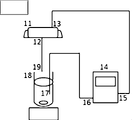
- the separation apparatus of the polymerization inhibitor in the method for producing a monomer composition of an Example is schematically shown.
- the monomer composition of the present invention contains a radically polymerizable monomer having an organic group capable of radical polymerization and an organic silicon-containing organic group in the molecule.
- Examples of the organic silicon-containing organic group contained in the radically polymerizable monomer include a carbosiloxane dendrimer structure and a branched or linear siloxane structure. It preferably has a carbosiloxane dendrimer structure.
- the carbosiloxane dendrimer structure is a chemical structure that is highly branched radially from one silicon atom, and the radically polymerizable monomer having a carbosiloxane dendrimer structure has the following general formula (1):
- Y is a radically polymerizable organic group.
- R 1 is an alkyl group, an aryl group or a trimethylsiloxy group.
- R 1 is the same group as the group defined for the general formula (1).
- R 2 is an alkylene group having 2 to 10 carbon atoms.
- R 3 is a group selected from the group consisting of an alkoxy group, a hydroxyl group, an alkyl group, an aryl group and a trimethylsiloxy group.
- X i + 1 is a group selected from the group consisting of a hydrogen atom, an alkyl group having 1 to 10 carbon atoms, an aryl group and the above-mentioned silyl alkyl group, and i is a group of 1 to 10 indicating the hierarchy of the silyl alkyl group. It is an integer a is an integer from 0 to 3 and b and c are 0 or 1. ) Is. ⁇ Is preferred.
- the radically polymerizable organic group is not particularly limited as long as it is a radically reactive organic group, but is a (meth) acryloxy group-containing organic group, a (meth) acrylamide group-containing organic group, a styryl group-containing organic group, and the number of carbon atoms. Included are 2-10 alkenyl groups. It is preferably an organic group containing a (meth) acryloyl group. Examples of the organic group capable of radical polymerization include an organic group represented by the following general formula.
- R 4 and R 6 are hydrogen atoms or methyl groups
- R 5 and R 8 are alkylene groups having 1 to 10 carbon atoms
- R 7 is an alkyl group having 1 to 10 carbon atoms.
- .B is an integer from 0 to 4, and c is 0 or 1.
- Examples of such a radically polymerizable organic group include an acryloxymethyl group, a 3-acryloxypropyl group, a methaloxymethyl group, a 3-methacryloxypropyl group, a 4-vinylphenyl group, and a 3-vinylphenyl group.
- R 1 is an alkyl group, an aryl group or a trimethylsiloxy group, preferably a methyl group and a phenyl group, and a methyl group is particularly preferable.
- R 2 is an alkylene group having 2 to 10 carbon atoms, and an ethylene group, a methylethylene group, a hexylene group, a 1-methylpentylene group, and a 1,4-dimethylbutylene group are preferable.
- R 3 is a group selected from the group consisting of an alkoxy group, a hydroxyl group, an alkyl group, an aryl group and a trimethylsiloxy group, and examples of the alkyl group include an alkyl group having 1 to 10 carbon atoms. Will be done.
- Xi + 1 is a group selected from the group consisting of a hydrogen atom, an alkyl group having 1 to 10 carbon atoms, an aryl group and the above-mentioned silyl alkyl group.
- i is an integer of 1 to 10, which indicates the number of layers of the silylalkyl group, that is, the number of repetitions of the silylalkyl group. Therefore, when the number of layers is 1, the radically polymerizable monomer has the general formula:
- Y, R 1 , R 2 and R 3 are the same groups as the groups defined for the general formulas (1) and (2), and R 12 is the hydrogen atom or the same group as R 1 above.
- .A is the same number as the number defined for the general formula (1), but the average total number of a in one molecule is 0 to 7).
- the radically polymerizable monomer has a general formula:
- Y, R 1 , R 2 , R 3 and R 12 are the same groups as defined for the general formulas (1) and (2).
- a and a 1 are in the general formula (1). It is the same number as the number defined for it, but the average total number of a and a1 in one molecule is 0 to 25).
- Examples of the radically polymerizable monomer having a carbosiloxane dendrimer structure of this component include a monomer represented by the following average composition formula.
- Such a carbosiloxane dendrimer can be produced according to the method for producing a branched siloxane / silalkylene copolymer described in JP-A-11-1530.
- R1 and Y are the same groups as the groups defined for the general formula (1).
- the silicon atom-bonded hydrogen atom-containing silicon compound represented by the general formula (1) and the alkenyl group-containing organosilicon compound are hydrosilylated. It can be produced by reacting.
- the silicon compound represented by the above formula for example, 3-methacryloxypropyltris (dimethylsiloxy) silane, 3-acryloxypropyltris (dimethylsiloxy) silane, and 4-vinylphenyltris (dimethylsiloxy) silane are used.
- alkenyl group-containing organosilicon compound vinyltris (trimethylsiloxy) silane, vinyltris (dimethylphenylsiloxy) silane, and 5-hexenyltris (trimethylsiloxy) silane are used.
- the hydrosilylation reaction is preferably carried out in the presence of a transition metal catalyst such as chloroplatinic acid or a platinum vinylsiloxane complex.
- Examples of the radically polymerizable monomer having a branched or linear siloxane structure include M units represented by Ra 3 SiO 1/2 or Ra 2 R b SiO 1/2 , Ra 2 SiO 2/2 or Arbitrary ratio of D unit represented by R a R b SiO 2/2 , T unit represented by R a SiO 3/2 or R b SiO 3/2 , and Q unit represented by SiO 4/2 .
- Ra is an alkyl group, an aryl group, an aralkyl group, or a group in which a part or all of the hydrogen atom of these groups is replaced with a halogen atom
- R b is a radically polymerizable organic group.
- the radically polymerizable monomer having a branched or linear siloxane structure is preferably a macromonomer having a relatively large weight average molecular weight.
- Ra is an alkyl group, an aryl group, an aralkyl group, or a group in which a part or all of the hydrogen atoms of these groups is substituted with a halogen atom
- the alkyl group is preferably an alkyl group having 1 to 10 carbon atoms. Examples thereof include a methyl group, an ethyl group, a propyl group, a butyl group, a pentyl group, an isopropyl group, an isobutyl group, a cyclopentyl group, and a cyclohexyl group.
- the aryl group include a phenyl group and a naphthyl group.
- Examples of the aralkyl group include a benzyl group and a phenethyl group.
- Examples of the group in which a part or all of the hydrogen atom is substituted with a halogen atom include a fluorine-substituted alkyl group such as a trifluoropropyl group and a heptadecafluorodecyl group.
- R b is an organic group capable of radical polymerization, and is not particularly limited as long as it is an organic group capable of radical reaction, and can be a group similar to the group defined for the carbosiloxane dendrimer structure. That is, examples thereof include a (meth) acryloxy group-containing organic group, a (meth) acrylamide group-containing organic group, a styryl group-containing organic group, and an alkenyl group having 2 to 10 carbon atoms.
- a radically polymerizable monomer having such a branched or linear siloxane structure can be synthesized by a raw material and a method well known to those skilled in the art.
- an organosiloxane having a silanol group in the molecule can be synthesized in the presence of a base.
- the organic chlorosilane compound is not particularly limited as long as it has an organic group capable of radical polymerization, and examples thereof include 3-methacryloxypropyldimethylchlorosilane and 3-methacryloxypropyldichloromethylsilane.
- the monomer composition of the present invention contains a polymerization inhibitor at a concentration such that the total concentration of the polymerization inhibitor with respect to the total mass of the radically polymerizable monomer and the polymerization inhibitor is 130 mass ppm or less.
- the total concentration of the polymerization inhibitor with respect to the total mass of the radically polymerizable monomer and the polymerization inhibitor is 110% by mass or less, more preferably 90% by mass or less, still more preferably 70% by mass or less.
- the polymerization inhibitor includes one or more selected from hindered phenol-based polymerization inhibitors, hydroquinone-based polymerization inhibitors, and catechol-based polymerization inhibitors.
- hindered phenol-based polymerization inhibitors include dibutylhydroxytoluene, 2,6-di-tert-butylphenol, 2,4-di-tert-butylphenol, 2-tert-butyl-4,6-dimethylphenol, 2, Examples thereof include 6-di-tert-butyl-4-methylphenol and 2,4,6-tri-tert-butylphenol.
- Hydroquinone-based polymerization inhibitors include methylhydroquinone, ethylhydroquinone, propylhydroquinone, tert-butylhydroquinone, 2,5-di-tert-butylhydroquinone, hydroquinone monomethyl ether, p-benzoquinone, and 2,5-diphenylparabenzoquinone.
- Examples of the catechol-based polymerization inhibitor include catechol, 2-methylcatechol, 3-methylcatechol, 4-methylcatechol, 2-ethylcatechol, 3-ethylcatechol, 4-ethylcatechol, 2-propylcatechol, and 3-propylcatechol.
- the monomer composition of the present invention contains, in particular, one or more selected from dibutylhydroxytoluene (BHT), methylhydroquinone (MEHQ) and 4-tert-butylcatechol (TBC).
- BHT dibutylhydroxytoluene
- MEHQ methylhydroquinone
- TBC 4-tert-butylcatechol
- the present invention relates to a method for producing a monomer composition, which comprises a step of contacting a liquid containing a radically polymerizable monomer with an adsorbent selected from the group consisting of activated carbon and alumina.
- an adsorbent selected from the group consisting of activated carbon and alumina.
- the obtained crude monomer composition is purified by distillation or the like, but in that case, unintended polymerization and gelation may occur, and there may be a problem in the quality of the monomer composition. .. Therefore, the polymerization inhibitor has been used without sufficiently reducing its concentration.
- the activated carbon used in the method for producing the monomer composition of the present invention is not particularly limited, and is produced by activating a carbon substance by reacting it with a gas or a chemical substance at a high temperature.
- the adsorbent can be used alone, but it can also be used in combination with an adsorbent other than alumina and activated carbon, such as zeolite, silica, and aluminum silicate. It is preferable to use activated carbon as the adsorbent.
- the contact between the adsorbent and the liquid containing the radically polymerizable monomer can be performed without a solvent, or can be performed in the presence of a solvent.
- the temperature and pressure at which the step of bringing the liquid containing the adsorbent and the radically polymerizable monomer into contact is not particularly limited, but are 0 ° C. to 200 ° C., preferably 5 ° C. to 150 ° C., more preferably 10 ° C. to 100 under atmospheric pressure. Can be done at ° C.
- the method of bringing the adsorbent into contact with the liquid containing the radically polymerizable monomer is not particularly limited, but a fixed bed method in which the adsorbent is filled in a container and the liquid containing the radically polymerizable monomer is continuously supplied, stirring and mixing and solid liquid.
- the step of bringing the adsorbent into contact with the liquid containing the radically polymerizable monomer is particularly preferably performed by a fixed bed method, and it is more preferable to continuously supply the liquid containing the radically polymerizable monomer to the fixed bed of activated carbon.
- the supply flow rate of the liquid containing the radically polymerizable monomer can be appropriately determined according to the type and concentration of the polymerization inhibitor and the adsorbent.
- the supply flow rate of the liquid containing the radically polymerizable monomer is not particularly limited, but the supply flow rate of the liquid divided by the mass of the adsorbent (g-AD) is 0.1 g / (minute ⁇ g-AD) to 100 g / (. Minutes / g-AD), preferably 0.5 g / (minutes / g-AD) to 50 g / (minutes / g-AD), more preferably 1.0 g / (minutes / g-AD) to 10 g / (minutes). It can be supplied in an amount of g-AD).
- a sufficient contact time with the adsorbent can be sufficiently secured, and the polymerization inhibitor can be appropriately removed, which is preferable.
- the number of circulations when a liquid containing a radically polymerizable monomer is circulated can also be appropriately determined according to the type and concentration of the polymerization inhibitor and the adsorbent.
- the number of circulations is not particularly limited, but is 0.1 to 20 times / h, preferably 0.5 to 15 times / h, and more preferably 1 to 10 times / h. By setting the number of circulations in the above range, the concentration of the polymerization inhibitor in the liquid becomes more uniform, and the polymerization inhibitor can be appropriately removed, which is preferable.
- the stirring and mixing time of the liquid containing the radically polymerizable monomer can be appropriately determined according to the type and concentration of the polymerization inhibitor and the adsorbent.
- the stirring and mixing time of the liquid containing the radically polymerizable monomer is not particularly limited, but may be 0.5 to 30 hours, preferably 1 to 20 hours, and more preferably 3 to 10 hours.
- the method for producing a monomer composition of the present invention is a polymerization inhibitor having no risk of mutagenicity or the like after contacting an adsorbent with a liquid containing a radically polymerizable monomer, preferably other than BHT, MEHQ and TBC. It may include a step of adding a polymerization inhibitor, for example, a silicic acid derivative such as tetra (di-t-butylhydroxyhydrosilicic acid) pentaerythrityl, an alpha-tocopherol, a polymerization inhibitor such as propyl gallate.
- a polymerization inhibitor for example, a silicic acid derivative such as tetra (di-t-butylhydroxyhydrosilicic acid) pentaerythrityl, an alpha-tocopherol, a polymerization inhibitor such as propyl gallate.
- the monomer composition of the present invention can be used as a raw material for cosmetics or for cosmetics, and is contained in the raw material for cosmetics or cosmetics as a copolymer polymerized with another radically polymerizable monomer. It may be.
- Cosmetic raw materials and cosmetics are (A) oil agent, (B) alcohol, (C) surfactant, (D) powder or colorant, (E) gelling agent or thickener, (F) organic modification. Selected from the group consisting of clay minerals, (G) silicone resins, (H) silicone gums, (I) silicone elastomers, (J) organically modified silicones, (K) UV protection components, and (L) water-soluble polymers. It may be a composition containing at least one kind. In addition, these specific examples are common with the component disclosed in the said Patent Document 1 (Japanese Patent Laid-Open No. 2014-40512) and the like.
- Oil agent examples include animal oil, vegetable oil, synthetic oil and the like which are generally used in cosmetics.
- the oil agent may be solid, semi-solid or liquid, and may be non-volatile, semi-volatile or volatile.
- the oil agent is used to impart lubricity to the skin and hair, soften the skin, and impart a moist feeling.
- the oil agent can also be used for the purpose of diluting the copolymer to obtain a copolymer composition, and in particular, it is liquid at 5 to 100 ° C., and is (A1) a silicone-based oil agent and (A2) an organic-based agent.
- the oil is at least one selected from the oils, and the type, viscosity and the like of these oils can be appropriately selected according to the type and use of the cosmetic. These oils are blended with the above-mentioned monomer composition for cosmetic raw materials or cosmetics of the present invention at the same time.
- Alcohol As the alcohol, one kind or two or more kinds of polyhydric alcohols and / or lower monohydric alcohols can be used.
- the lower alcohol include ethanol, isopropanol, n-propanol, t-butanol, sec-butanol and the like, and ethanol is preferable.
- polyhydric alcohol examples include 1,3-propanediol, 1,3-butylene glycol, 1,2-butylene glycol, propylene glycol, trimethylene glycol, tetramethylene glycol, 2,3-butylene glycol, pentamethylene glycol, 2 -Divalent alcohols such as butene-1,4-diol, dibutylene glycol, pentyl glycol, hexylene glycol, and octylene glycol, trihydric alcohols such as glycerin, trimethylolpropane, and 1,2,6-hexanetriol.
- Pentaerythritol, xylitol and other tetravalent polyhydric alcohols sorbitol, mannitol, martitol, maltotriose, sucrose, erythritol, glucose, fructose, starch degradation products, maltose, xylitol, starch-degrading sugar-reduced alcohol, etc.
- Glycol alcohol can be mentioned.
- polyhydric alcohol weights such as diethylene glycol, dipropylene glycol, triethylene glycol, polypropylene glycol, tetraethylene glycol, diglycerin, polyethylene glycol, triglycerin, tetraglycerin, and polyglycerin. Coalescence and the like are exemplified. Of these, ethanol, 1,3-propanediol, 1,3-butylene glycol, sorbitol, dipropylene glycol, glycerin, and polyethylene glycol are particularly preferable.
- the cosmetic raw material or cosmetic containing the monomer composition of the present invention or the copolymer obtained from the monomer composition can contain (C) a surfactant as an optional component.
- the (C) surfactant may be (C1) a silicone-based surfactant, (C2) an anionic surfactant, (C3) a cationic surfactant, or (C4) a nonionic surfactant, depending on the purpose thereof.
- One or more types of surfactants selected from the group consisting of (C5) amphoteric surfactants and (C6) semipolar surfactants can be used in combination.
- Examples of the (C1) silicone-based surfactant include polyglyceryl-modified silicone, diglycerin-modified silicone, glyceryl-modified silicone, sugar-modified silicone, fluoropolyether-modified silicone, polyether-modified silicone, carboxylic acid-modified silicone, and linear silicone.
- Examples thereof include polyether block copolymers (polysilicone-13 and the like), long-chain alkyl-polyether co-modified silicones, polyglyceryl-modified silicone elastomers, diglyceryl-modified elastomers, glyceryl-modified elastomers, and polyether-modified elastomers.
- silicones and elastomers those having an alkyl branch, a linear silicone branch, a siloxane dendrimer branch or the like at the same time as a hydrophilic group can be preferably used.
- Commercially available products include SH 3771 M, SH 3772 M, SH 3773 M, SH 3775 M, BY 22-008M, BY 11-030, ES-5373 FORMUpartion AID, ES-5612 FORMULATION AID, ES-5300 FORM. -5600 SILICONE GLYCEROL EMULSIFIER (both manufactured by Dow Toray Co., Ltd.) can be mentioned.
- the blending amount of the (C) surfactant in the cosmetic raw material or the cosmetic containing the monomer composition of the present invention or the copolymer obtained from the same is not particularly limited, but stabilizes the emulsion or dispersion.
- it can be blended in the range of 0.05 to 90% by mass in the emulsified composition or the dispersion composition, preferably 0.1 to 50% by mass per mass of the composition, more preferably. Is 0.5 to 25% by mass.
- the cosmetic raw material or cosmetic containing the monomer composition of the present invention or the copolymer obtained from the powder or colorant is further a powder or colorant, particularly any powder (coloring) used in cosmetics. (Including powders and pigments used as agents) can be blended.
- the powder or colorant is used in ordinary cosmetics, its shape (spherical, rod-shaped, needle-shaped, plate-shaped, sheet-shaped, indefinite-shaped, spindle-shaped, bowl-shaped, raspberry-shaped, etc.) and particles Any of them can be used regardless of the diameter (foam-like, fine particles, pigment grade, etc.) and particle structure (porous, non-porous, secondary aggregation, etc.), but these powders and / or coloring can be used.
- the agent is blended as a pigment, it is preferable to blend one or more selected from inorganic pigment powder, organic pigment powder, and resin powder having an average particle size in the range of 1 nm to 20 ⁇ m.
- the powder or colorant examples include inorganic powder, organic powder, surfactant metal salt powder (metal soap), colored pigment, pearl pigment, metal powder pigment, silicone elastomer powder and the like. Further, a composite of these can also be used. In addition, these powders or colorants include those which function as an ultraviolet protection component.
- these powders or colorants are treated to be water repellent. As a result, it can be stably blended in the oil phase. Further, those obtained by compounding these powders or colorants with each other, or those having been surface-treated with a general oil agent, a silicone compound, a fluorine compound, a surfactant or the like can also be used.
- these powders or colorants can be hydrophilized in part or in whole. Thereby, the powder or the colorant related to the aqueous phase can be blended.
- these powders or colorants can be hydrophobized and / or hydrophilized. This makes it possible to impart emulsifying properties to the powder itself.
- examples of commercially available products include MZY-500SHE manufactured by TAYCA Corporation.
- the (D) powder or colorant in the cosmetic raw material or cosmetic containing the monomer composition of the present invention or the copolymer obtained from the same can be used alone or in combination of two or more as required, and the blending amount thereof. Is not particularly limited, but can be blended in the range of 0.1 to 99.5% by mass in the composition or the total amount of the cosmetic, and is preferably 1 to 99% by mass. In particular, in the case of powdered solid cosmetics, the blending amount is preferably in the range of 80 to 99% by mass of the entire cosmetics.
- the gelling agent is preferably oil-soluble, and specifically, metal slakes such as aluminum esterate, magnesium esterate, and zinc millistate, N-lauroyl-L-glutamic acid, and the like.
- Amino acid derivatives such as ⁇ , ⁇ -di-n-butylamine, dextrin fatty acid esters such as dextrin luminic acid ester, dextrin stearic acid ester, and dextrin 2-ethylhexanoic acid palmitate ester, sucrose palmitate and sucrose stearic acid.
- sucrose fatty acid esters such as esters, benziliden derivatives of sorbitol such as monobenziliden sorbitol and divendilidene sorbitol. These may be used alone or in combination of two or more as required.
- organically modified clay mineral examples include dimethylbenzyldodecylammonium montmorillonite clay, dimethyldioctadecylammonium montmorillonite clay, dimethylalkylammonium hectorite, benzyldimethylstearylammonium hectorite, and distearyldimethylammonium chloride treatment.
- examples thereof include aluminum magnesium silicate and magnesium silicate.
- Benton 27 benzyldimethylstearyl ammonium chloride-treated hectorite: manufactured by National Red
- Benton 38 disearyldimethylammonium chloride-treated hectorite: manufactured by National Red
- Silicone resin is an organopolysiloxane having a highly branched structure, a network structure or a cage structure, and is liquid or solid at room temperature, and is usually used as a cosmetic unless contrary to the object of the present invention. Any silicone resin used in the above may be used. Solid silicone resins include, for example, triorganosyloxy units (M units) (organo groups are only methyl groups, methyl groups and vinyl groups or phenyl groups), diorganosiloxy units (D units) (organo groups).
- M units triorganosyloxy units
- D units diorganosiloxy units
- MQ resin, MDQ resin, MTQ resin, MDTQ resin, TD resin, TQ resin, and TDQ resin composed of a combination.
- trimethylsiloxysilicic acid, polyalkylsiloxysilicic acid, dimethylsiloxy unit-containing trimethylsiloxysilicic acid, and alkyl (perfluoroalkyl) siloxysilicic acid are exemplified.
- These silicone resins are oil-soluble, and those that can be dissolved in (A) are particularly preferable.
- Silicone resin forms a uniform film when applied to skin, hair, etc., and provides a protective effect against drying and low temperatures. Further, the silicone resin having these branching units firmly adheres to the skin, hair, etc., and can give gloss and transparency to the skin, hair, etc.
- silicone gum having a thickness of 1,000,000 mm 2 / s or more can also be used as the silicone oil.
- Silicone gum is a linear diorganopolysiloxane having an ultra-high degree of polymerization, and is also called silicone raw rubber or organopolysiloxane gum.
- Silicone gum is distinguished from the above-mentioned silicone-based oil agent in that it has a measurable degree of plasticity because of its high degree of polymerization.
- the silicone gum can be used alone or in combination of two or more, if necessary.
- silicone gums are cosmetic raw materials or cosmetics containing the monomer composition of the present invention or a copolymer obtained from the monomer composition of the present invention as it is or as a liquid gum dispersion (oil dispersion of silicone gum) dispersed in oily silicone. Can be added to the ingredients.
- Silicone gum has an ultra-high degree of polymerization, so it has excellent persistence on the skin and hair and forms a protective film with excellent breathability. Therefore, it is a component that can give luster and luster to the skin and hair in particular, and can give a firm and firm texture to the skin and the entire hair during and after use.
- the blending amount of the silicone gum is, for example, in the range of 0.05 to 30% by mass, preferably in the range of 1 to 15% by mass, based on the total amount of the cosmetic. If the silicone gum is used as an emulsified composition prepared in advance through an emulsification step (including emulsion polymerization), it is easy to blend, and the monomer composition of the present invention or a cosmetic raw material containing a copolymer obtained from the same can be used as a raw material for cosmetics. It can be stably blended in cosmetics. If the blending amount of the silicone gum is less than the above lower limit, the effect of imparting gloss to the skin and hair may be insufficient.
- the silicone elastomer can be blended into a cosmetic raw material or a cosmetic in any form depending on its purpose, and in particular, the silicone described in "(D) Powder" above. In addition to the elastomer powder, it is preferably blended as a crosslinkable organopolysiloxane.
- the silicone elastomer powder can be used in the form of an aqueous dispersion as a cosmetic raw material or cosmetic containing the monomer composition of the present invention or a copolymer obtained from the monomer composition. Examples of commercially available products of such an aqueous dispersion include BY 29-129 and PF-2001 PIF Emulsion manufactured by Dow Toray Co., Ltd.
- the crosslinkable organopolysiloxane has a structure in which the organopolysiloxane chain is three-dimensionally crosslinked by reaction with a crosslinkable component or the like, and has no hydrophilic part such as a polyoxyalkylene unit, and is non-emulsifying. preferable.
- a crosslinkable organopolysiloxane can be used without limitation regardless of the physical form such as dilution and properties, the manufacturing method, etc., but a particularly preferable one is ⁇ , described in US Pat. No. 5,654,362.
- ⁇ -diene crosslinked silicone elastomer (Commercial products include DOWNSIL 9040 Silicone Elastomer Blend, DOWNSIL 9041 Silicone Elastomer Blend, DOWNSIL 9045 Silicone Elastomer Blend, DOWNSIL 9045 Silicone Elastomer Blend, DOWNSIL 9041, USA.
- a crosslinkable organopolysiloxane having fluidity at room temperature can also be preferably used, and DOWNSIL 3901 LIQUID SATIN BLEND (manufactured by Dow Chemical Co., Ltd., USA) is exemplified.
- the organically modified silicone is preferably lipophilic.
- amino-modified silicone, aminopolyether-modified silicone, epoxy-modified silicone, carboxyl-modified silicone, amino acid-modified silicone, carbinol-modified silicone, acrylic-modified silicone, phenol-modified silicone, amidoalkyl-modified silicone, amino Glycol-modified silicone and alkoxy-modified silicone can be mentioned.
- a higher alkyl-modified silicone, an alkyl-modified silicone resin, and a polyamide-modified silicone resin, which are particularly preferable as the organically modified silicone can be used.
- the UV protection component includes an inorganic UV protection component and an organic UV protection component. If the cosmetic raw material or cosmetic containing the monomer composition of the present invention or the copolymer obtained from the same is for sunscreen, it shall contain at least one inorganic or organic system, particularly an organic UV protection component. Is preferable. In particular, it is preferable to use an inorganic and organic UV protection component in combination, and it is more preferable to use a UV-A-compatible UV protection component and a UV-B-compatible UV protection component in combination.
- the cosmetic raw material or cosmetic containing the monomer composition of the present invention or the copolymer obtained from the monomer composition may be an aqueous or emulsion-type composition containing a large amount of water-soluble components. It is preferable that the (L) water-soluble polymer can be blended depending on the dosage form.
- the water-soluble polymer one kind or two or more kinds of water-soluble polymers can be used.
- a natural plant extract component, a seaweed extract component, and a crude drug component can be added to the cosmetic raw material or cosmetic containing the monomer composition of the present invention or the copolymer obtained from the present invention, depending on the purpose. Two or more of these components may be blended. These specific examples are the same as those specifically disclosed in paragraph 0115 of Japanese Patent Application Laid-Open No. 2011-149017, but are not limited thereto.
- the monomer composition of the present invention or a cosmetic raw material or cosmetic containing a copolymer obtained from the present invention may contain, for example, light isoparaffin, ethers, LPG, in addition to water such as purified water and mineral water, depending on the purpose thereof. , N-Methylpyrrolidone, next-generation Freon and the like may be blended.
- the cosmetic raw material or cosmetic containing the monomer composition of the present invention or the copolymer obtained from the monomer composition at least one selected from the group consisting of acrylic silicone dendrimer copolymers and alkyl-modified silicone resin waxes may be used.
- acrylic silicone dendrimer copolymers and alkyl-modified silicone resin waxes may be used.
- can. These are film-forming components like the copolymer obtained from the monomer composition of the present invention, but are not components having detergency, so they should be blended within a range that does not impair the technical effects of the present invention. Is preferable.
- acrylic silicone dendrimer copolymer for example, a vinyl-based polymer having a carbosiloxane dendrimer structure in a side chain described in Japanese Patent No. 4909382 (Japanese Patent Laid-Open No. 2000-063225) is particularly preferably exemplified. ..
- Examples of commercially available products include FA 4001 CM Silicone Acrylate and FA 4002 ID Silicone Acrylate manufactured by Dow Toray.
- the alkyl-modified silicone resin wax for example, the silsesquioxane resin wax described in JP-A-2007-532754 is preferable.
- the cosmetic raw material or cosmetic containing the monomer composition of the present invention or the copolymer obtained from the same is liquid, milky, creamy, solid, paste-like, gel-like, powdery, multilayer, mousse-like, spray. It may be in any form.
- the copolymer obtained from the monomer composition of the present invention can form a film having excellent detergency on the skin or hair while having water resistance and sebum resistance, and a cosmetic that gives these functional films. Can be designed.
- the cosmetics containing the monomer composition of the present invention or the copolymer obtained from the same can be used as specific products for the skin such as skin cleaning products, skin care products, makeup products, antiperspirant products, and UV protection products.
- Cosmetics; Hair cleaning products, Hair conditioning products, Hair coloring products, Hair nourishing products, Hair rinse products, Hair conditioner products, Hair treatment products, and other hair cosmetics; Bath cosmetics; Hair growth agents, Hair growth agents, Pain relief Examples include, but are not limited to, agents, bactericides, anti-inflammatory agents, refreshing agents, and skin anti-aging agents.
- the monomer composition of the present invention or a copolymer obtained from the same comes into direct contact with the human body.
- the monomer composition of the present invention meets such a requirement, and the content of the polymerization inhibitor can be significantly reduced as compared with the conventional one.
- Specific examples of cosmetics for skin and cosmetics for hair are common to various cosmetics disclosed in Patent Document 1 (Japanese Unexamined Patent Publication No. 2014-40512) and the like.
- the monomer composition according to the present invention or the copolymer obtained from the monomer composition is an acrylic copolymer having an organic silicon-containing organic selected from a known carbosiloxane dendrimer structure and a branched or linear siloxane structure. In the composition of the containing cosmetic, a part or all thereof can be replaced and used.
- the apparatus shown in FIG. 1 was used as an apparatus for separating the polymerization inhibitor for producing the monomer compositions of Examples 1 to 5.
- the end 17 of the first resin tube was put into the beaker 18 containing the magnetic stirrer, and the other end 16 was connected to the suction port of the diaphragm pump 14.
- the end 15 of the second resin tube was connected to the discharge port of the diaphragm pump, and the other end 13 was connected to the inlet of the activated carbon immobilization filter 11 (Osaka Gas Chemical Co., Ltd. SC050X AKJ: activated carbon carrier amount 1.45 g). ..
- the end 12 of the third resin tube was connected to the outlet of the filter and the other end 19 was placed above the beaker 18.
- Example 1 In the apparatus shown in FIG. 1, 145 g of the radically polymerizable monomer produced according to the production example was placed in a beaker and stirred at room temperature using a magnetic stirrer. The ratio of the mass of activated carbon to the mass of liquid was 0.01. The liquid in the beaker was supplied to the filter at a flow rate of 5.6 g / min (3.86 g / (min / g-AD)), and the discharged liquid was returned to the beaker and circulated. The number of circulations, which is the value obtained by dividing the circulation flow rate by the total liquid volume, was 2.3 times / h. After circulating for 3 hours, 1 g of a sample was taken from a beaker and the BHT concentration was analyzed. The BHT concentration was 61.6 mass ppm.
- Example 2 The method was the same as in Example 1 except that 290 g of the radically polymerizable monomer was used. That is, the ratio of the mass of activated carbon to the mass of liquid was 0.005, and the number of circulations was 1.2 times / h. The BHT concentration was 128.6 mass ppm.
- Example 3 The procedure was the same as in Example 2 except that the circulation flow rate was 11.0 g / min (7.59 g / (min g-AD)). That is, the ratio of the mass of activated carbon to the mass of liquid was 0.005, and the number of circulations was 2.3 times / h. The BHT concentration was 57.7 mass ppm.
- Example 4 It was carried out by the same method as in Example 3 except that the circulation time was set to 8 hours. That is, the ratio of the mass of activated carbon to the mass of liquid was 0.005, and the number of circulations was 2.3 times / h. The BHT concentration was 31.1 mass ppm.
- Example 5 The same method as in Example 4 was carried out except that the temperature of the liquid in the beaker was maintained at 40 ° C. using a constant temperature bath. That is, the ratio of the mass of activated carbon to the mass of liquid was 0.005, and the number of circulations was 2.3 times / h. The BHT concentration was 41.1 mass ppm.
- Example 6 40 g of the radically polymerizable monomer and 8.1 g of activated alumina particles (ST-1000 manufactured by Union Showa Co., Ltd.) produced according to the production example were placed in a beaker and stirred at room temperature for 6 hours using a magnetic stirrer. The ratio of the mass of activated alumina to the mass of liquid was 0.20. When 1 g of the liquid in the beaker was sampled and the BHT concentration was measured, the BHT concentration was 49.9 mass ppm.
- Example 7 40 g of the radically polymerizable monomer and 4.0 g of activated alumina particles (ST-1000 manufactured by Union Showa Co., Ltd.) produced according to the production example were placed in a beaker and stirred at room temperature for 6 hours using a magnetic stirrer. The ratio of the mass of activated alumina to the mass of liquid was 0.10. When 1 g of the liquid in the beaker was sampled and the BHT concentration was measured, the BHT concentration was 104.4 mass ppm.
- Comparative Example 2 It was carried out in the same manner as in Comparative Example 1 except that the simple distillation time was set to 6 hours.
- the BHT concentration was 139.2 parts by mass.
- Comparative Example 3 The method was the same as in Comparative Example 1 except that the simple distillation time was 9 hours.
- the BHT concentration was 134.2 mass ppm.
- the total concentration of the polymerization inhibitor with respect to the total mass of the radically polymerizable monomer and the polymerization inhibitor is 130 mass ppm or less. It was found that the composition could be obtained. On the other hand, in the simple distillation method used in the comparative example, it was found that the BHT concentration exceeded 130 mass ppm even after long-term treatment.
Landscapes
- Health & Medical Sciences (AREA)
- Chemical & Material Sciences (AREA)
- Life Sciences & Earth Sciences (AREA)
- Organic Chemistry (AREA)
- Animal Behavior & Ethology (AREA)
- General Health & Medical Sciences (AREA)
- Public Health (AREA)
- Veterinary Medicine (AREA)
- Birds (AREA)
- Epidemiology (AREA)
- Polymers & Plastics (AREA)
- Medicinal Chemistry (AREA)
- Chemical Kinetics & Catalysis (AREA)
- Dermatology (AREA)
- Cosmetics (AREA)
Abstract
Description
本発明は、モノマー組成物及びその製造方法、並びにモノマー組成物を含む化粧料又は化粧料原料に関する。 The present invention relates to a monomer composition and a method for producing the same, and a cosmetic or a cosmetic raw material containing the monomer composition.
化粧料、特にメーキャップ化粧料の耐水性及び耐皮脂性を向上して化粧持ちを改善するために、皮膜形成剤としてラジカル重合性基を含有するモノマー組成物から調製された重合体を使用することが知られている。特にラジカル重合可能な有機基を含有するオルガノポリシロキサンは、化粧料に撥水性及び滑り性を付与することができる。しかしながら、配合する化粧料原料との相溶性などに問題がある場合があった。 In order to improve the water resistance and skin oil resistance of cosmetics, especially make-up cosmetics, and to improve the longevity of makeup, a polymer prepared from a monomer composition containing a radically polymerizable group is used as a film-forming agent. It has been known. In particular, organopolysiloxane containing an organic group capable of radical polymerization can impart water repellency and slipperiness to cosmetics. However, there may be a problem in compatibility with the cosmetic raw material to be blended.
このような問題を解決するため、カルボシロキサンデンドリマー構造又はシロキサンマクロモノマー構造を有する共重合体が提案されている。例えば特許文献1には、特定のカルボシロキサンデンドリマー構造を有する不飽和単量体に基づく共重合体が提案されており、紫外線吸収剤などの化粧料原料との配合安定性に優れ、耐水性及び耐皮脂性にも優れる皮膜形成剤として使用できることが示されている。 In order to solve such a problem, a copolymer having a carbosiloxane dendrimer structure or a siloxane macromonomer structure has been proposed. For example, Patent Document 1 proposes a copolymer based on an unsaturated monomer having a specific carbosiloxane dendrimer structure, which has excellent compounding stability with a cosmetic raw material such as an ultraviolet absorber, and has excellent water resistance and water resistance. It has been shown that it can be used as a film-forming agent having excellent skin oil resistance.
一方、カルボシロキサンデンドリマー構造及びシロキサンマクロモノマー構造などの複雑な構造を有するモノマーを製造するためには、多段階の工程を経る必要がある。特に上流工程の原料には高い反応性を有するものがあるため、一般的に、重合禁止剤を加えることによって原料を保存する間、及び工程中で原料が反応してしまい、ゲル化することを防ぐ等の措置が講じられている。 On the other hand, in order to produce a monomer having a complicated structure such as a carbosiloxane dendrimer structure and a siloxane macromonomer structure, it is necessary to go through a multi-step process. In particular, since some raw materials in the upstream process have high reactivity, generally, the raw materials react during storage of the raw materials by adding a polymerization inhibitor and during the process to cause gelation. Measures such as prevention have been taken.
例えば、特許文献2には、重合性基を含有するシリコーンモノマーと、シリコーンモノマーに対して5~400ppmの特定の構造を有する重合禁止剤を含むシリコーンモノマー組成物が記載されている。また、特許文献3には、化粧組成物の経時安定性を増大するために、組成物の合計質量に対して10ppmから20質量%の重合禁止剤を含むことが記載されている。 For example, Patent Document 2 describes a silicone monomer composition containing a silicone monomer containing a polymerizable group and a polymerization inhibitor having a specific structure of 5 to 400 ppm with respect to the silicone monomer. Further, Patent Document 3 describes that a polymerization inhibitor is contained in an amount of 10 ppm to 20% by mass based on the total mass of the composition in order to increase the stability over time of the cosmetic composition.
しかしながら、重合禁止剤は一部で変異原性の疑いなどが指摘されており、化粧料のようにヒトの体に直接接触する場合には、安全性の見地からその含有量は可能な限り低減されていることが好ましい。そのため、モノマー組成物から重合禁止剤を分離することが望ましいが、特にラジカル重合可能な有機基を含有するオルガノポリシロキサンなどの原料では、蒸留等の手段で重合禁止剤を除去することが困難であった。具体的には、蒸留するためにはモノマー組成物を加熱する必要があるが、意図せぬ重合及びゲル化が生じることがあり、重合禁止剤の量を一定量以下まで低減することはできないという問題があった。 However, it has been pointed out that some polymerization inhibitors are suspected to be mutagenic, and when they come into direct contact with the human body like cosmetics, their content is reduced as much as possible from the viewpoint of safety. It is preferable that it is. Therefore, it is desirable to separate the polymerization inhibitor from the monomer composition, but it is difficult to remove the polymerization inhibitor by means such as distillation, especially for raw materials such as organopolysiloxane containing an organic group capable of radical polymerization. there were. Specifically, it is necessary to heat the monomer composition for distillation, but unintended polymerization and gelation may occur, and the amount of the polymerization inhibitor cannot be reduced to a certain amount or less. There was a problem.
本発明は上記従来技術の課題を解決すべくなされたものであり、化粧料の原料等に使用される場合の安全性についての懸念がなく、かつゲル化等の品質の低下を引き起こしていないモノマー組成物及びその製造方法を提供することを目的とする。 The present invention has been made to solve the above-mentioned problems of the prior art, and there is no concern about safety when used as a raw material for cosmetics, and a monomer that does not cause deterioration of quality such as gelation. It is an object of the present invention to provide a composition and a method for producing the same.
本発明者らは上記課題について鋭意検討した結果、本発明に到達した。すなわち、本発明の目的は、分子内にラジカル重合可能な有機基及び有機ケイ素含有有機基を有するラジカル重合性モノマーを含むモノマー組成物であって、前記ラジカル重合性モノマーと重合禁止剤の総質量に対する重合禁止剤の合計濃度が130質量ppm以下である、モノマー組成物によって達成される。本発明はまた、活性炭及びアルミナからなる群から選択される吸着剤と、ラジカル重合性モノマーを含む液を接触させる工程を含む、本発明のモノマー組成物の製造方法にも関する。本発明はまた、本発明のモノマー組成物を含む、化粧料又は化粧料原料にも関する。 The present inventors have reached the present invention as a result of diligent studies on the above problems. That is, an object of the present invention is a monomer composition containing a radically polymerizable monomer having a radically polymerizable organic group and an organic silicon-containing organic group in the molecule, and the total mass of the radically polymerizable monomer and the polymerization inhibitor. It is achieved by a monomer composition in which the total concentration of the polymerization inhibitor with respect to the above is 130% by mass ppm or less. The present invention also relates to a method for producing a monomer composition of the present invention, which comprises a step of contacting an adsorbent selected from the group consisting of activated carbon and alumina with a liquid containing a radically polymerizable monomer. The present invention also relates to cosmetics or cosmetic ingredients containing the monomeric compositions of the present invention.
本発明のモノマー組成物によれば、重合禁止剤の含有量が極めて低く低減されているため、化粧料等のヒトの体に直接接触する用途のための原料として使用した場合であっても、安全性についての懸念がない。 According to the monomer composition of the present invention, the content of the polymerization inhibitor is extremely low and reduced, so that even when it is used as a raw material for applications such as cosmetics that come into direct contact with the human body, There are no safety concerns.
また、本発明のモノマー組成物の製造方法は、蒸留などによる加熱工程を含まないため、重合禁止剤の含有量が低いにもかかわらず、意図せぬ反応によるゲル化等を引き起こすことがなく、高い品質のモノマー組成物を提供することができる。 Further, since the method for producing the monomer composition of the present invention does not include a heating step by distillation or the like, it does not cause gelation or the like due to an unintended reaction even though the content of the polymerization inhibitor is low. High quality monomer compositions can be provided.
[分子内にラジカル重合可能な有機基及び有機ケイ素含有有機基を有するラジカル重合性モノマー]
本発明のモノマー組成物は、分子内にラジカル重合可能な有機基及び有機ケイ素含有有機基を有するラジカル重合性モノマーを含む。
[Radical polymerizable monomer having an organic group capable of radical polymerization and an organic silicon-containing organic group in the molecule]
The monomer composition of the present invention contains a radically polymerizable monomer having an organic group capable of radical polymerization and an organic silicon-containing organic group in the molecule.
ラジカル重合性モノマーに含有される有機ケイ素含有有機基としては、カルボシロキサンデンドリマー構造及び分岐状又は直鎖状のシロキサン構造が挙げられる。カルボシロキサンデンドリマー構造であることが好ましい。 Examples of the organic silicon-containing organic group contained in the radically polymerizable monomer include a carbosiloxane dendrimer structure and a branched or linear siloxane structure. It preferably has a carbosiloxane dendrimer structure.
カルボシロキサンデンドリマー構造は、1つのケイ素原子から放射状に高度に枝分かれした化学構造であり、カルボシロキサンデンドリマー構造を有するラジカル重合性モノマーとしては、以下の一般式(1): The carbosiloxane dendrimer structure is a chemical structure that is highly branched radially from one silicon atom, and the radically polymerizable monomer having a carbosiloxane dendrimer structure has the following general formula (1):

{式中、
Yはラジカル重合可能な有機基であり、
R1はアルキル基、アリール基又はトリメチルシロキシ基であり、
X1はi=1とした場合の以下の一般式(2)で表されるシリルアルキル基:
{In the ceremony,
Y is a radically polymerizable organic group.
R 1 is an alkyl group, an aryl group or a trimethylsiloxy group.
X 1 is a silylalkyl group represented by the following general formula (2) when i = 1.

(式中、
R1は一般式(1)に対して定義した基と同じ基であり、
R2は炭素原子数2~10のアルキレン基であり、
R3はアルコキシ基、水酸基、アルキル基、アリール基及びトリメチルシロキシ基からなる群から選択される基であり、
Xi+1は水素原子、炭素原子数1~10のアルキル基、アリール基及び上記シリルアルキル基からなる群から選択される基であり、iは該シリルアルキル基の階層を示している1~10の整数であり、
aは0~3の整数であり、
b及びcは0又は1である。)
である。}で表されるモノマーが好ましい。
(During the ceremony,
R 1 is the same group as the group defined for the general formula (1).
R 2 is an alkylene group having 2 to 10 carbon atoms.
R 3 is a group selected from the group consisting of an alkoxy group, a hydroxyl group, an alkyl group, an aryl group and a trimethylsiloxy group.
X i + 1 is a group selected from the group consisting of a hydrogen atom, an alkyl group having 1 to 10 carbon atoms, an aryl group and the above-mentioned silyl alkyl group, and i is a group of 1 to 10 indicating the hierarchy of the silyl alkyl group. It is an integer
a is an integer from 0 to 3 and
b and c are 0 or 1. )
Is. } Is preferred.
ラジカル重合可能な有機基としては、ラジカル反応可能な有機基であれば特に限定されないが、(メタ)アクリロキシ基含有有機基、(メタ)アクリルアミド基含有有機基、スチリル基含有有機基及び炭素原子数2~10のアルケニル基が挙げられる。(メタ)アクリロイル基を含有する有機基であることが好ましい。ラジカル重合可能な有機基としては、例えば下記一般式で表される有機基が挙げられる。 The radically polymerizable organic group is not particularly limited as long as it is a radically reactive organic group, but is a (meth) acryloxy group-containing organic group, a (meth) acrylamide group-containing organic group, a styryl group-containing organic group, and the number of carbon atoms. Included are 2-10 alkenyl groups. It is preferably an organic group containing a (meth) acryloyl group. Examples of the organic group capable of radical polymerization include an organic group represented by the following general formula.

(式中、R4及びR6は水素原子又はメチル基であり、R5及びR8は炭素原子数1~10のアルキレン基であり、R7は炭素原子数1~10のアルキル基である。bは0~4の整数であり、cは0又は1である。)。 (In the formula, R 4 and R 6 are hydrogen atoms or methyl groups, R 5 and R 8 are alkylene groups having 1 to 10 carbon atoms, and R 7 is an alkyl group having 1 to 10 carbon atoms. .B is an integer from 0 to 4, and c is 0 or 1.).
このようなラジカル重合可能な有機基としては、例えば、アクリロキシメチル基、3-アクリロキシプロピル基、メタクリロキシメチル基、3-メタクリロキシプロピル基、4-ビニルフェニル基、3-ビニルフェニル基、4-(2-プロペニル)フェニル基、3-(2-プロペニル)フェニル基、2-(4-ビニルフェニル)エチル基、2-(3-ビニルフェニル)エチル基、ビニル基、アリル基、メタリル基、ソルビル基、及び5-ヘセニル基が挙げられる。 Examples of such a radically polymerizable organic group include an acryloxymethyl group, a 3-acryloxypropyl group, a methaloxymethyl group, a 3-methacryloxypropyl group, a 4-vinylphenyl group, and a 3-vinylphenyl group. 4- (2-propenyl) phenyl group, 3- (2-propenyl) phenyl group, 2- (4-vinylphenyl) ethyl group, 2- (3-vinylphenyl) ethyl group, vinyl group, allyl group, methallyl group , Solvir group, and 5-hesenyl group.
一般式(1)及び(2)において、R1はアルキル基、アリール基又はトリメチルシロキシ基であり、メチル基及びフェニル基が好ましく、メチル基が特に好ましい。 In the general formulas (1) and (2), R 1 is an alkyl group, an aryl group or a trimethylsiloxy group, preferably a methyl group and a phenyl group, and a methyl group is particularly preferable.
一般式(2)において、R2は炭素原子数2~10のアルキレン基であり、エチレン基、メチルエチレン基、ヘキシレン基、1-メチルペンチレン基、及び1,4-ジメチルブチレン基が好ましい。 In the general formula (2), R 2 is an alkylene group having 2 to 10 carbon atoms, and an ethylene group, a methylethylene group, a hexylene group, a 1-methylpentylene group, and a 1,4-dimethylbutylene group are preferable.
一般式(2)において、R3はアルコキシ基、水酸基、アルキル基、アリール基及びトリメチルシロキシ基からなる群から選択される基であり、アルキル基としては炭素原子数1~10のアルキル基が例示される。 In the general formula (2), R 3 is a group selected from the group consisting of an alkoxy group, a hydroxyl group, an alkyl group, an aryl group and a trimethylsiloxy group, and examples of the alkyl group include an alkyl group having 1 to 10 carbon atoms. Will be done.
一般式(2)において、Xi+1は水素原子、炭素原子数1~10のアルキル基、アリール基及び上記シリルアルキル基からなる群から選択される基である。iは1~10の整数であり、これは該シリルアルキル基の階層数、すなわち、該シリルアルキル基の繰り返し数を示している。従って、階層数が1である場合には、ラジカル重合性モノマーは、一般式: In the general formula (2), Xi + 1 is a group selected from the group consisting of a hydrogen atom, an alkyl group having 1 to 10 carbon atoms, an aryl group and the above-mentioned silyl alkyl group. i is an integer of 1 to 10, which indicates the number of layers of the silylalkyl group, that is, the number of repetitions of the silylalkyl group. Therefore, when the number of layers is 1, the radically polymerizable monomer has the general formula:

(式中、Y、R1、R2及びR3は一般式(1)及び(2)に対して定義した基と同じ基であり、R12は水素原子又は前記R1と同じ基である。aは一般式(1)に対して定義した数と同じ数であるが、1分子中のaの平均合計数は0~7である。)で示される。階層数が2である場合には、ラジカル重合性モノマーは、一般式: (In the formula, Y, R 1 , R 2 and R 3 are the same groups as the groups defined for the general formulas (1) and (2), and R 12 is the hydrogen atom or the same group as R 1 above. .A is the same number as the number defined for the general formula (1), but the average total number of a in one molecule is 0 to 7). When the number of layers is 2, the radically polymerizable monomer has a general formula:

(式中、Y、R1、R2、R3及びR12は一般式(1)及び(2)に対して定義した基と同じ基である。a及びa1は一般式(1)に対して定義した数と同じ数であるが、1分子中のaとa1の平均合計数は0~25である。)で示される。 (In the formula, Y, R 1 , R 2 , R 3 and R 12 are the same groups as defined for the general formulas (1) and (2). A and a 1 are in the general formula (1). It is the same number as the number defined for it, but the average total number of a and a1 in one molecule is 0 to 25).
本成分のカルボシロキサンデンドリマー構造を有するラジカル重合性モノマーとしては、下記平均組成式で示されるモノマーが例示される。 Examples of the radically polymerizable monomer having a carbosiloxane dendrimer structure of this component include a monomer represented by the following average composition formula.


このようなカルボシロキサンデンドリマーは、特開平11-1530号公報に記載された分岐状シロキサン・シルアルキレン共重合体の製造方法に従って製造できる。例えば、一般式: Such a carbosiloxane dendrimer can be produced according to the method for producing a branched siloxane / silalkylene copolymer described in JP-A-11-1530. For example, the general formula:

(式中、R1及びYは一般式(1)に対して定義した基と同じ基である。)で示されるケイ素原子結合水素原子含有ケイ素化合物と、アルケニル基含有有機ケイ素化合物とをヒドロシリル化反応させることにより製造することができる。上式で示されるケイ素化合物としては、例えば、3-メタクリロキシプロピルトリス(ジメチルシロキシ)シラン、3-アクリロキシプロピルトリス(ジメチルシロキシ)シラン、4-ビニルフェニルトリス(ジメチルシロキシ)シランが用いられる。アルケニル基含有有機ケイ素化合物としては、ビニルトリス(トリメチルシロキシ)シラン、ビニルトリス(ジメチルフェニルシロキシ)シラン、5-ヘキセニルトリス(トリメチルシロキシ)シランが用いられる。尚、このヒドロシリル化反応は、塩化白金酸や白金ビニルシロキサン錯体などの遷移金属触媒の存在下で行うことが好ましい。 (In the formula, R1 and Y are the same groups as the groups defined for the general formula (1).) The silicon atom-bonded hydrogen atom-containing silicon compound represented by the general formula (1) and the alkenyl group-containing organosilicon compound are hydrosilylated. It can be produced by reacting. As the silicon compound represented by the above formula, for example, 3-methacryloxypropyltris (dimethylsiloxy) silane, 3-acryloxypropyltris (dimethylsiloxy) silane, and 4-vinylphenyltris (dimethylsiloxy) silane are used. As the alkenyl group-containing organosilicon compound, vinyltris (trimethylsiloxy) silane, vinyltris (dimethylphenylsiloxy) silane, and 5-hexenyltris (trimethylsiloxy) silane are used. The hydrosilylation reaction is preferably carried out in the presence of a transition metal catalyst such as chloroplatinic acid or a platinum vinylsiloxane complex.
分岐状又は直鎖状のシロキサン構造を有するラジカル重合性モノマーとしては、Ra 3SiO1/2又はRa 2RbSiO1/2で表されるM単位、Ra 2SiO2/2又はRaRbSiO2/2で表されるD単位、RaSiO3/2又はRbSiO3/2で表されるT単位、及びSiO4/2で表されるQ単位を任意の割合で含むオルガノポリシロキサンが挙げられる。ここで、Raはアルキル基、アリール基、アラルキル基、又はこれらの基の水素原子の一部若しくは全部をハロゲン原子で置換した基であり、Rbはラジカル重合可能な有機基である。分岐状又は直鎖状のシロキサン構造を有するラジカル重合性モノマーは、重量平均分子量が比較的大きいマクロモノマーであることが好ましい。 Examples of the radically polymerizable monomer having a branched or linear siloxane structure include M units represented by Ra 3 SiO 1/2 or Ra 2 R b SiO 1/2 , Ra 2 SiO 2/2 or Arbitrary ratio of D unit represented by R a R b SiO 2/2 , T unit represented by R a SiO 3/2 or R b SiO 3/2 , and Q unit represented by SiO 4/2 . Organopolysiloxanes included in. Here, Ra is an alkyl group, an aryl group, an aralkyl group, or a group in which a part or all of the hydrogen atom of these groups is replaced with a halogen atom, and R b is a radically polymerizable organic group. The radically polymerizable monomer having a branched or linear siloxane structure is preferably a macromonomer having a relatively large weight average molecular weight.
Raはアルキル基、アリール基、アラルキル基、又はこれらの基の水素原子の一部若しくは全部をハロゲン原子で置換した基であり、アルキル基としては炭素原子数1~10のアルキル基が好ましく、メチル基、エチル基、プロピル基、ブチル基、ペンチル基、イソプロピル基、イソブチル基、シクロペンチル基、及びシクロヘキシル基が例示される。アリール基としては、フェニル基及びナフチル基が例示される。アラルキル基としてはベンジル基及びフェネチル基が例示される。水素原子の一部若しくは全部をハロゲン原子で置換した基としては、トリフロロプロピル基及びヘプタデカフロロデシル基等のフッ素置換アルキル基が例示される。 Ra is an alkyl group, an aryl group, an aralkyl group, or a group in which a part or all of the hydrogen atoms of these groups is substituted with a halogen atom, and the alkyl group is preferably an alkyl group having 1 to 10 carbon atoms. Examples thereof include a methyl group, an ethyl group, a propyl group, a butyl group, a pentyl group, an isopropyl group, an isobutyl group, a cyclopentyl group, and a cyclohexyl group. Examples of the aryl group include a phenyl group and a naphthyl group. Examples of the aralkyl group include a benzyl group and a phenethyl group. Examples of the group in which a part or all of the hydrogen atom is substituted with a halogen atom include a fluorine-substituted alkyl group such as a trifluoropropyl group and a heptadecafluorodecyl group.
Rbはラジカル重合可能な有機基であり、ラジカル反応可能な有機基であれば特に限定されず、カルボシロキサンデンドリマー構造に対して定義した基と同様の基であることができる。すなわち、(メタ)アクリロキシ基含有有機基、(メタ)アクリルアミド基含有有機基、スチリル基含有有機基及び炭素原子数2~10のアルケニル基が挙げられる。 R b is an organic group capable of radical polymerization, and is not particularly limited as long as it is an organic group capable of radical reaction, and can be a group similar to the group defined for the carbosiloxane dendrimer structure. That is, examples thereof include a (meth) acryloxy group-containing organic group, a (meth) acrylamide group-containing organic group, a styryl group-containing organic group, and an alkenyl group having 2 to 10 carbon atoms.
このような分岐状又は直鎖状のシロキサン構造を有するラジカル重合性モノマーは当業者に周知の原料及び方法によって合成することができ、例えば分子中にシラノール基を有するオルガノシロキサンを、塩基の存在下、有機クロロシラン化合物と反応させることで得ることができる。有機クロロシラン化合物としては、ラジカル重合可能な有機基を有していれば特に限定されず、3-メタクリロキシプロピルジメチルクロロシラン及び3-メタクリロキシプロピルジクロロメチルシランが挙げられる。 A radically polymerizable monomer having such a branched or linear siloxane structure can be synthesized by a raw material and a method well known to those skilled in the art. For example, an organosiloxane having a silanol group in the molecule can be synthesized in the presence of a base. , Can be obtained by reacting with an organic chlorosilane compound. The organic chlorosilane compound is not particularly limited as long as it has an organic group capable of radical polymerization, and examples thereof include 3-methacryloxypropyldimethylchlorosilane and 3-methacryloxypropyldichloromethylsilane.
[重合禁止剤]
本発明のモノマー組成物は、ラジカル重合性モノマーと重合禁止剤の総質量に対する重合禁止剤の合計濃度が130質量ppm以下となる濃度で、重合禁止剤を含む。好ましくは、ラジカル重合性モノマーと重合禁止剤の総質量に対する重合禁止剤の合計濃度は、110質量ppm以下であり、より好ましくは90質量ppm以下であり、さらに好ましくは70質量ppm以下である。
[Polymerization inhibitor]
The monomer composition of the present invention contains a polymerization inhibitor at a concentration such that the total concentration of the polymerization inhibitor with respect to the total mass of the radically polymerizable monomer and the polymerization inhibitor is 130 mass ppm or less. Preferably, the total concentration of the polymerization inhibitor with respect to the total mass of the radically polymerizable monomer and the polymerization inhibitor is 110% by mass or less, more preferably 90% by mass or less, still more preferably 70% by mass or less.
重合禁止剤は、ヒンダードフェノール系の重合禁止剤、ヒドロキノン系の重合禁止剤及びカテコール系の重合禁止剤から選択される1種類以上を含む。ヒンダードフェノール系の重合禁止剤としては、ジブチルヒドロキシトルエン、2,6-ジ-tert-ブチルフェノール、2,4-ジ-tert-ブチルフェノール、2-tert-ブチル-4,6-ジメチルフェノール、2,6-ジ-tert-ブチル-4-メチルフェノール、及び2,4,6-トリ-tert-ブチルフェノールが挙げられる。ヒドロキノン系の重合禁止剤としては、メチルヒドロキノン、エチルヒドロキノン、プロピルヒドロキノン、tert-ブチルヒドロキノン、2,5-ジ-tert-ブチルヒドロキノン、ヒドロキノンモノメチルエーテル、p-ベンゾキノン、及び2,5-ジフェニルパラベンゾキノンが挙げられる。カテコール系の重合禁止剤としては、カテコール、2-メチルカテコール、3-メチルカテコール、4-メチルカテコール、2-エチルカテコール、3-エチルカテコール、4-エチルカテコール、2-プロピルカテコール、3-プロピルカテコール、4-プロピルカテコール、2-n-ブチルカテコール、3-n-ブチルカテコール、4-n-ブチルカテコール、2-tert-ブチルカテコール、3-tert-ブチルカテコール、4-tert-ブチルカテコール、及び3,5-ジ-tert-ブチルカテコールが挙げられる。本発明のモノマー組成物は、特に、ジブチルヒドロキシトルエン(BHT)、メチルヒドロキノン(MEHQ)及び4-tert-ブチルカテコール(TBC)から選択される1種類以上を含む。これらのヒンダードフェノール系の重合禁止剤、ヒドロキノン系の重合禁止剤及びカテコール系の重合禁止剤は一部で変異原性の疑いが報告されており、潜在的なリスク低減のためにその含有量を低減しておくことが望まれている。 The polymerization inhibitor includes one or more selected from hindered phenol-based polymerization inhibitors, hydroquinone-based polymerization inhibitors, and catechol-based polymerization inhibitors. Examples of hindered phenol-based polymerization inhibitors include dibutylhydroxytoluene, 2,6-di-tert-butylphenol, 2,4-di-tert-butylphenol, 2-tert-butyl-4,6-dimethylphenol, 2, Examples thereof include 6-di-tert-butyl-4-methylphenol and 2,4,6-tri-tert-butylphenol. Hydroquinone-based polymerization inhibitors include methylhydroquinone, ethylhydroquinone, propylhydroquinone, tert-butylhydroquinone, 2,5-di-tert-butylhydroquinone, hydroquinone monomethyl ether, p-benzoquinone, and 2,5-diphenylparabenzoquinone. Can be mentioned. Examples of the catechol-based polymerization inhibitor include catechol, 2-methylcatechol, 3-methylcatechol, 4-methylcatechol, 2-ethylcatechol, 3-ethylcatechol, 4-ethylcatechol, 2-propylcatechol, and 3-propylcatechol. , 4-propylcatechol, 2-n-butylcatechol, 3-n-butylcatechol, 4-n-butylcatechol, 2-tert-butylcatechol, 3-tert-butylcatechol, 4-tert-butylcatechol, and 3 , 5-Di-tert-butylcatechol. The monomer composition of the present invention contains, in particular, one or more selected from dibutylhydroxytoluene (BHT), methylhydroquinone (MEHQ) and 4-tert-butylcatechol (TBC). Some of these hindered phenol-based polymerization inhibitors, hydroquinone-based polymerization inhibitors, and catechol-based polymerization inhibitors have been reported to be mutagenic, and their contents have been reported to reduce potential risks. Is desired to be reduced.
[モノマー組成物の製造方法]
一実施形態において、本発明は、活性炭及びアルミナからなる群から選択される吸着剤と、ラジカル重合性モノマーを含む液を接触させる工程を含む、モノマー組成物の製造方法に関する。一般的に得られた粗モノマー組成物は蒸留等によって精製されるが、その場合には意図せぬ重合及びゲル化が生じることがあり、モノマー組成物としての品質に問題がある場合があった。そのため、重合禁止剤についてはその濃度を十分に低減させることがないまま使用されていた。
[Manufacturing method of monomer composition]
In one embodiment, the present invention relates to a method for producing a monomer composition, which comprises a step of contacting a liquid containing a radically polymerizable monomer with an adsorbent selected from the group consisting of activated carbon and alumina. Generally, the obtained crude monomer composition is purified by distillation or the like, but in that case, unintended polymerization and gelation may occur, and there may be a problem in the quality of the monomer composition. .. Therefore, the polymerization inhibitor has been used without sufficiently reducing its concentration.
本発明のモノマー組成物の製造方法に用いられる活性炭は特に限定されず、炭素物質を高温でガスや化学物質と反応させることによって活性化して製造される。吸着剤は単独で使用することもできるが、アルミナ及び活性炭以外の吸着剤、例えばゼオライト、シリカ、及びアルミニウムシリケート等と組み合わせて使用することもできる。吸着剤として、活性炭を使用することが好ましい。 The activated carbon used in the method for producing the monomer composition of the present invention is not particularly limited, and is produced by activating a carbon substance by reacting it with a gas or a chemical substance at a high temperature. The adsorbent can be used alone, but it can also be used in combination with an adsorbent other than alumina and activated carbon, such as zeolite, silica, and aluminum silicate. It is preferable to use activated carbon as the adsorbent.
吸着剤とラジカル重合性モノマーを含む液との接触は、無溶剤で行うこともでき、或いは溶剤の存在下で行うこともできる。吸着剤とラジカル重合性モノマーを含む液を接触させる工程を行う温度及び圧力は特に限定されないが、大気圧下で0℃~200℃、好ましくは5℃~150℃、より好ましくは10℃~100℃で行うことができる。 The contact between the adsorbent and the liquid containing the radically polymerizable monomer can be performed without a solvent, or can be performed in the presence of a solvent. The temperature and pressure at which the step of bringing the liquid containing the adsorbent and the radically polymerizable monomer into contact is not particularly limited, but are 0 ° C. to 200 ° C., preferably 5 ° C. to 150 ° C., more preferably 10 ° C. to 100 under atmospheric pressure. Can be done at ° C.
吸着剤とラジカル重合性モノマーを含む液を接触させる方法は特に限定されないが、吸着剤を容器に充填してラジカル重合性モノマーを含む液を連続的に供給する固定床方式、攪拌混合と固液分離をそれぞれ回分操作で行う回分式、吸着剤を移動層としてラジカル重合性モノマーを含む液を通過させる移動層方式、又は吸着材の固層をラジカル重合性モノマーを含む液で流動化させる流動層方式で行うことができる。吸着剤とラジカル重合性モノマーを含む液を接触させる工程は、特に固定床方式で行うことが好ましく、活性炭の固定床にラジカル重合性モノマーを含む液を連続的に供給することがより好ましい。 The method of bringing the adsorbent into contact with the liquid containing the radically polymerizable monomer is not particularly limited, but a fixed bed method in which the adsorbent is filled in a container and the liquid containing the radically polymerizable monomer is continuously supplied, stirring and mixing and solid liquid. A batch type in which separation is performed by batch operation, a mobile layer method in which a liquid containing a radically polymerizable monomer is passed through using an adsorbent as a moving layer, or a fluidized layer in which a solid layer of an adsorbent is fluidized with a liquid containing a radically polymerizable monomer. It can be done by the method. The step of bringing the adsorbent into contact with the liquid containing the radically polymerizable monomer is particularly preferably performed by a fixed bed method, and it is more preferable to continuously supply the liquid containing the radically polymerizable monomer to the fixed bed of activated carbon.
固定床方式で行う場合には、ラジカル重合性モノマーを含む液を吸着剤の固定床に1回だけ通液する方式、或いは吸着剤の固定床の出口液を再度入口に供給することで、ラジカル重合性モノマーを含む液を循環させる方式のいずれかで行うことができるが、循環させる方式の方が液と吸着剤との接触時間を容易に確保することができ、好ましい。 In the case of the fixed bed method, a method in which a liquid containing a radically polymerizable monomer is passed through the fixed bed of the adsorbent only once, or a method in which the outlet liquid of the fixed bed of the adsorbent is supplied to the inlet again causes radicals. It can be carried out by any of the methods of circulating the liquid containing the polymerizable monomer, but the method of circulating is preferable because the contact time between the liquid and the adsorbent can be easily secured.
固定床方式において、ラジカル重合性モノマーを含む液の供給流量は、重合禁止剤及び吸着剤の種類及び濃度に応じて適切に決定することができる。ラジカル重合性モノマーを含む液の供給流量は、特に限定されないが、吸着剤の質量(g-AD)で除した液の供給流量として、0.1g/(分・g-AD)~100g/(分・g-AD)、好ましくは0.5g/(分・g-AD)~50g/(分・g-AD)、より好ましくは1.0g/(分・g-AD)~10g/(分・g-AD)の量で供給することができる。供給流量を適切な範囲とすることで、吸着剤との接触時間が十分確保され、重合禁止剤を適切に除去することができ好ましい。 In the fixed bed method, the supply flow rate of the liquid containing the radically polymerizable monomer can be appropriately determined according to the type and concentration of the polymerization inhibitor and the adsorbent. The supply flow rate of the liquid containing the radically polymerizable monomer is not particularly limited, but the supply flow rate of the liquid divided by the mass of the adsorbent (g-AD) is 0.1 g / (minute · g-AD) to 100 g / (. Minutes / g-AD), preferably 0.5 g / (minutes / g-AD) to 50 g / (minutes / g-AD), more preferably 1.0 g / (minutes / g-AD) to 10 g / (minutes). It can be supplied in an amount of g-AD). By setting the supply flow rate within an appropriate range, a sufficient contact time with the adsorbent can be sufficiently secured, and the polymerization inhibitor can be appropriately removed, which is preferable.
固定床方式において、ラジカル重合性モノマーを含む液を循環させる場合の循環回数も重合禁止剤及び吸着剤の種類及び濃度に応じて適切に決定することができる。循環回数は、特に限定されないが、0.1~20回/h、好ましくは0.5~15回/h、より好ましくは1~10回/hである。循環回数を上記範囲とすることで、液中の重合禁止剤濃度がより均一となり、重合禁止剤を適切に除去することができ好ましい。 In the fixed bed method, the number of circulations when a liquid containing a radically polymerizable monomer is circulated can also be appropriately determined according to the type and concentration of the polymerization inhibitor and the adsorbent. The number of circulations is not particularly limited, but is 0.1 to 20 times / h, preferably 0.5 to 15 times / h, and more preferably 1 to 10 times / h. By setting the number of circulations in the above range, the concentration of the polymerization inhibitor in the liquid becomes more uniform, and the polymerization inhibitor can be appropriately removed, which is preferable.
回分式において、ラジカル重合性モノマーを含む液の攪拌混合の時間は、重合禁止剤及び吸着剤の種類及び濃度に応じて適切に決定することができる。ラジカル重合性モノマーを含む液の攪拌混合の時間は、特に限定されないが、0.5~30時間、好ましくは1~20時間、より好ましくは3~10時間とすることができる。 In the batch formula, the stirring and mixing time of the liquid containing the radically polymerizable monomer can be appropriately determined according to the type and concentration of the polymerization inhibitor and the adsorbent. The stirring and mixing time of the liquid containing the radically polymerizable monomer is not particularly limited, but may be 0.5 to 30 hours, preferably 1 to 20 hours, and more preferably 3 to 10 hours.
本発明のモノマー組成物の製造方法は、吸着剤とラジカル重合性モノマーを含む液とを接触させた後に、変異原性等のリスクを有しない重合禁止剤、好ましくはBHT、MEHQ及びTBC以外の重合禁止剤、例えばテトラ(ジ-t-ブチルヒドロキシヒドロケイヒ酸)ペンタエリスリチルなどのケイ皮酸誘導体、アルファ-トコフェロール、没食子酸プロピル等の重合禁止剤を加える工程を含んでもよい。 The method for producing a monomer composition of the present invention is a polymerization inhibitor having no risk of mutagenicity or the like after contacting an adsorbent with a liquid containing a radically polymerizable monomer, preferably other than BHT, MEHQ and TBC. It may include a step of adding a polymerization inhibitor, for example, a silicic acid derivative such as tetra (di-t-butylhydroxyhydrosilicic acid) pentaerythrityl, an alpha-tocopherol, a polymerization inhibitor such as propyl gallate.
[化粧料]
一実施形態において、本発明のモノマー組成物は化粧料原料用又は化粧料用として使用することができ、他のラジカル重合性モノマーと重合された共重合体として、化粧料原料又は化粧料に含まれてもよい。化粧料原料及び化粧料は、(A)油剤、(B)アルコール、(C)界面活性剤、(D)粉体又は着色剤、(E)ゲル化剤又は増粘剤、(F)有機変性粘土鉱物、(G)シリコーン樹脂、(H)シリコーンガム、(I)シリコーンエラストマー、(J)有機変性シリコーン、(K)紫外線防御成分、及び(L)水溶性高分子からなる群から選択される少なくとも一種を含む組成物であってもよい。なお、これらの具体例は、前記の特許文献1(特開2014-40512号公報)等に開示された成分と共通である。
[Cosmetics]
In one embodiment, the monomer composition of the present invention can be used as a raw material for cosmetics or for cosmetics, and is contained in the raw material for cosmetics or cosmetics as a copolymer polymerized with another radically polymerizable monomer. It may be. Cosmetic raw materials and cosmetics are (A) oil agent, (B) alcohol, (C) surfactant, (D) powder or colorant, (E) gelling agent or thickener, (F) organic modification. Selected from the group consisting of clay minerals, (G) silicone resins, (H) silicone gums, (I) silicone elastomers, (J) organically modified silicones, (K) UV protection components, and (L) water-soluble polymers. It may be a composition containing at least one kind. In addition, these specific examples are common with the component disclosed in the said Patent Document 1 (Japanese Patent Laid-Open No. 2014-40512) and the like.
(A)油剤
油剤としては、化粧料一般に使用される動物油、植物油、及び合成油等が挙げられる。油剤は固体、半固形、液体のいずれでもよく、不揮発性、半揮発性、揮発性のいずれでもよい。油剤は、肌や毛髪に潤滑性を付与し、肌を柔軟にし、しっとり感を付与するために用いられる。また、油剤は、共重合体を希釈して共重合体組成物を得る目的でも使用することができ、特に、5~100℃で液状であり、(A1)シリコーン系油剤及び(A2)有機系油剤から選択される少なくとも1種であることが好ましく、これらの油剤の種類、粘度等は化粧料の種類、用途に応じて、適宜選択することができる。これらの油剤は、上記モノマー組成物と同時に、本発明の化粧料原料用又は化粧料に配合されるものである。
(A) Oil agent Examples of the oil agent include animal oil, vegetable oil, synthetic oil and the like which are generally used in cosmetics. The oil agent may be solid, semi-solid or liquid, and may be non-volatile, semi-volatile or volatile. The oil agent is used to impart lubricity to the skin and hair, soften the skin, and impart a moist feeling. The oil agent can also be used for the purpose of diluting the copolymer to obtain a copolymer composition, and in particular, it is liquid at 5 to 100 ° C., and is (A1) a silicone-based oil agent and (A2) an organic-based agent. It is preferable that the oil is at least one selected from the oils, and the type, viscosity and the like of these oils can be appropriately selected according to the type and use of the cosmetic. These oils are blended with the above-mentioned monomer composition for cosmetic raw materials or cosmetics of the present invention at the same time.
(B)アルコール
アルコールとしては、1種又は2種以上の多価アルコール及び/又は低級一価アルコールを用いることができる。低級アルコールとしては、エタノール、イソプロパノール、n-プロパノール、t-ブタノール、及びsec-ブタノール等が例示され、エタノールが好ましい。多価アルコールとしては、1,3-プロパンジオール、1,3-ブチレングリコール、1,2-ブチレングリコール、プロピレングリコール、トリメチレングリコール、テトラメチレングリコール、2,3-ブチレングリコール、ペンタメチレングリコール、2-ブテン-1,4-ジオール、ジブチレングリコール、ペンチルグリコール、ヘキシレングリコール、及びオクチレングリコール等の2価アルコール、グリセリン、トリメチロールプロパン、及び1,2,6-ヘキサントリオール等の3価アルコール、ペンタエリスリトール及びキシリトール等の4価以上の多価アルコール、ソルビトール、マンニトール、マルチトール、マルトトリオース、ショ糖、エリトリトール、グルコース、フルクトース、デンプン分解物、マルトース、キシリトース、及びデンプン分解糖還元アルコール等の糖アルコールが挙げられる。更に、これら低分子多価アルコールのほかに、ジエチレングリコール、ジプロピレングリコール、トリエチレングリコール、ポリプロピレングリコール、テトラエチレングリコール、ジグリセリン、ポリエチレングリコール、トリグリセリン、テトラグリセリン、及びポリグリセリン等の多価アルコール重合体等が例示される。中でも、エタノール、1,3-プロパンジオール、1,3-ブチレングリコール、ソルビトール、ジプロピレングリコール、グリセリン、及びポリエチレングリコールが特に好ましい。
(B) Alcohol As the alcohol, one kind or two or more kinds of polyhydric alcohols and / or lower monohydric alcohols can be used. Examples of the lower alcohol include ethanol, isopropanol, n-propanol, t-butanol, sec-butanol and the like, and ethanol is preferable. Examples of the polyhydric alcohol include 1,3-propanediol, 1,3-butylene glycol, 1,2-butylene glycol, propylene glycol, trimethylene glycol, tetramethylene glycol, 2,3-butylene glycol, pentamethylene glycol, 2 -Divalent alcohols such as butene-1,4-diol, dibutylene glycol, pentyl glycol, hexylene glycol, and octylene glycol, trihydric alcohols such as glycerin, trimethylolpropane, and 1,2,6-hexanetriol. , Pentaerythritol, xylitol and other tetravalent polyhydric alcohols, sorbitol, mannitol, martitol, maltotriose, sucrose, erythritol, glucose, fructose, starch degradation products, maltose, xylitol, starch-degrading sugar-reduced alcohol, etc. Glycol alcohol can be mentioned. Further, in addition to these low molecular weight polyhydric alcohols, polyhydric alcohol weights such as diethylene glycol, dipropylene glycol, triethylene glycol, polypropylene glycol, tetraethylene glycol, diglycerin, polyethylene glycol, triglycerin, tetraglycerin, and polyglycerin. Coalescence and the like are exemplified. Of these, ethanol, 1,3-propanediol, 1,3-butylene glycol, sorbitol, dipropylene glycol, glycerin, and polyethylene glycol are particularly preferable.
本発明のモノマー組成物又はそれから得られる共重合体を含む化粧料原料又は化粧料は、任意成分として(C)界面活性剤を含有することができる。(C)界面活性剤は、その目的に応じて、(C1)シリコーン系界面活性剤、(C2)アニオン性界面活性剤、(C3)カチオン性界面活性剤、(C4)ノニオン性界面活性剤、(C5)両性界面活性剤、及び(C6)半極性界面活性剤からなる群より選ばれる1種又は2種類以上の界面活性剤を併用することができる。 The cosmetic raw material or cosmetic containing the monomer composition of the present invention or the copolymer obtained from the monomer composition can contain (C) a surfactant as an optional component. The (C) surfactant may be (C1) a silicone-based surfactant, (C2) an anionic surfactant, (C3) a cationic surfactant, or (C4) a nonionic surfactant, depending on the purpose thereof. One or more types of surfactants selected from the group consisting of (C5) amphoteric surfactants and (C6) semipolar surfactants can be used in combination.
なお、(C1)シリコーン系界面活性剤としては、ポリグリセリル変性シリコーン、ジグリセル変性シリコーン、グリセリル変性シリコーン、糖変性シリコーン、フッ素ポリエーテル変性シリコーン、ポリエーテル変性シリコーン、カルボン酸変性シリコーン、直鎖状シリコーン・ポリエーテルブロック共重合体(ポリシリコーン-13等)、長鎖アルキル・ポリエーテル共変性シリコーン、ポリグリセリル変性シリコーンエラストマー、ジグリセリル変性エラストマー、グリセリル変性エラストマー、及びポリエーテル変性エラストマー等が例示される。さらに、前出のシリコーン類やエラストマー類には、アルキル分岐、直鎖シリコーン分岐、シロキサンデンドリマー分岐等が親水性基と同時に必要に応じ施されていているものも好適に用いることができる。市販品としては、SH 3771 M、SH 3772 M、SH 3773 M、SH 3775 M、BY 22-008M、BY 11-030、ES-5373 FORMULATION AID、ES-5612 FORMULATION AID、ES-5300 FORMULATION AID、ES-5600 SILICONE GLYCEROL EMULSIFIER(いずれもダウ・東レ社製)が挙げられる。 Examples of the (C1) silicone-based surfactant include polyglyceryl-modified silicone, diglycerin-modified silicone, glyceryl-modified silicone, sugar-modified silicone, fluoropolyether-modified silicone, polyether-modified silicone, carboxylic acid-modified silicone, and linear silicone. Examples thereof include polyether block copolymers (polysilicone-13 and the like), long-chain alkyl-polyether co-modified silicones, polyglyceryl-modified silicone elastomers, diglyceryl-modified elastomers, glyceryl-modified elastomers, and polyether-modified elastomers. Further, as the above-mentioned silicones and elastomers, those having an alkyl branch, a linear silicone branch, a siloxane dendrimer branch or the like at the same time as a hydrophilic group can be preferably used. Commercially available products include SH 3771 M, SH 3772 M, SH 3773 M, SH 3775 M, BY 22-008M, BY 11-030, ES-5373 FORMUpartion AID, ES-5612 FORMULATION AID, ES-5300 FORM. -5600 SILICONE GLYCEROL EMULSIFIER (both manufactured by Dow Toray Co., Ltd.) can be mentioned.
本発明のモノマー組成物又はそれから得られる共重合体を含む化粧料原料又は化粧料中の(C)界面活性剤の配合量は特に限定されるものではないが、乳化物や分散体を安定化させるため、例えば、乳化組成物中又は分散体組成物中の0.05~90質量%の範囲内で配合することができ、好ましくは組成物の質量あたり0.1~50質量%、さらに好ましくは0.5~25質量%である。 The blending amount of the (C) surfactant in the cosmetic raw material or the cosmetic containing the monomer composition of the present invention or the copolymer obtained from the same is not particularly limited, but stabilizes the emulsion or dispersion. For example, it can be blended in the range of 0.05 to 90% by mass in the emulsified composition or the dispersion composition, preferably 0.1 to 50% by mass per mass of the composition, more preferably. Is 0.5 to 25% by mass.
(D)粉体又は着色剤
本発明のモノマー組成物又はそれから得られる共重合体を含む化粧料原料又は化粧料は、さらに、粉体又は着色剤、特に化粧品に用いられる任意の粉体(着色剤として用いられる粉体・顔料を含む)を配合することができる。粉体又は着色剤は通常の化粧料に使用されるものであれば、その形状(球状、棒状、針状、板状、シート状、不定形状、紡錘状、お椀状、ラズベリー状等)や粒子径(煙霧状、微粒子、顔料級等)、粒子構造(多孔質、無孔質、二次凝集等)を問わず、いずれのものも使用することができるが、これらの粉体及び/又は着色剤を顔料として配合する場合、平均粒子径が1nm~20μmの範囲にある無機顔料粉体、有機顔料粉体、樹脂粉体から選択される1種類又は2種類以上を配合することが好ましい。
(D) Powder or Colorant The cosmetic raw material or cosmetic containing the monomer composition of the present invention or the copolymer obtained from the powder or colorant is further a powder or colorant, particularly any powder (coloring) used in cosmetics. (Including powders and pigments used as agents) can be blended. If the powder or colorant is used in ordinary cosmetics, its shape (spherical, rod-shaped, needle-shaped, plate-shaped, sheet-shaped, indefinite-shaped, spindle-shaped, bowl-shaped, raspberry-shaped, etc.) and particles Any of them can be used regardless of the diameter (foam-like, fine particles, pigment grade, etc.) and particle structure (porous, non-porous, secondary aggregation, etc.), but these powders and / or coloring can be used. When the agent is blended as a pigment, it is preferable to blend one or more selected from inorganic pigment powder, organic pigment powder, and resin powder having an average particle size in the range of 1 nm to 20 μm.
粉体又は着色剤は、具体的には、無機粉体、有機粉体、界面活性剤金属塩粉体(金属石鹸)、有色顔料、パール顔料、金属粉末顔料、及びシリコーンエラストマー粉体等が挙げられ、更に、これらを複合化したものも使用することができる。なお、これらの粉体又は着色剤は、紫外線防御成分として機能するものを含む。 Specific examples of the powder or colorant include inorganic powder, organic powder, surfactant metal salt powder (metal soap), colored pigment, pearl pigment, metal powder pigment, silicone elastomer powder and the like. Further, a composite of these can also be used. In addition, these powders or colorants include those which function as an ultraviolet protection component.
さらに、これらの粉体又は着色剤には、その一部又は全部に撥水化処理がされていることが特に好ましい。これにより、油相に安定に配合することができる。また、これらの粉体又は着色剤同士を複合化したり、一般油剤や、シリコーン化合物、又はフッ素化合物、界面活性剤等で表面処理が行われたものも使用することができる。 Further, it is particularly preferable that some or all of these powders or colorants are treated to be water repellent. As a result, it can be stably blended in the oil phase. Further, those obtained by compounding these powders or colorants with each other, or those having been surface-treated with a general oil agent, a silicone compound, a fluorine compound, a surfactant or the like can also be used.
さらに、これらの粉体又は着色剤には、その一部又は全部に親水化処理をすることができる。これにより、水相に係る粉体又は着色剤を配合することができる。 Further, these powders or colorants can be hydrophilized in part or in whole. Thereby, the powder or the colorant related to the aqueous phase can be blended.
またさらに、これらの粉体又は着色剤には、その一部又は全部に疎水化及び/又は親水化処理をすることができる。これにより、粉体自体に乳化特性を付与することができる。市販品としては、例えばテイカ社製のMZY-500SHE等が挙げられる。 Furthermore, some or all of these powders or colorants can be hydrophobized and / or hydrophilized. This makes it possible to impart emulsifying properties to the powder itself. Examples of commercially available products include MZY-500SHE manufactured by TAYCA Corporation.
本発明のモノマー組成物又はそれから得られる共重合体を含む化粧料原料又は化粧料中の(D)粉体又は着色剤は必要に応じて一種、又は二種以上用いることができ、その配合量は特に限定されるものではないが、組成物中又は化粧料全体の0.1~99.5質量%の範囲内で配合することができ、好ましくは1~99質量%である。特に、粉末固形化粧料の場合の配合量としては、化粧料全体の80~99質量%の範囲が好適である。 The (D) powder or colorant in the cosmetic raw material or cosmetic containing the monomer composition of the present invention or the copolymer obtained from the same can be used alone or in combination of two or more as required, and the blending amount thereof. Is not particularly limited, but can be blended in the range of 0.1 to 99.5% by mass in the composition or the total amount of the cosmetic, and is preferably 1 to 99% by mass. In particular, in the case of powdered solid cosmetics, the blending amount is preferably in the range of 80 to 99% by mass of the entire cosmetics.
(E)ゲル化剤又は増粘剤
ゲル化剤としては油溶性のものが好ましく、具体的にはアルミニウムステアレート、マグネシウムステアレート、ジンクミリステート等の金属セッケン、N-ラウロイル-L-グルタミン酸、α,γ-ジ-n-ブチルアミン等のアミノ酸誘導体、デキストリンパルミチン酸エステル、デキストリンステアリン酸エステル、及びデキストリン2-エチルヘキサン酸パルミチン酸エステル等のデキストリン脂肪酸エステル、ショ糖パルミチン酸エステル及びショ糖ステアリン酸エステル等のショ糖脂肪酸エステル、モノベンジリデンソルビトール及びジベンジリデンソルビトール等のソルビトールのベンジリデン誘導体等が挙げられる。これらは必要に応じて一種、又は二種以上用いることができる。
(E) Gelling agent or thickener The gelling agent is preferably oil-soluble, and specifically, metal slakes such as aluminum esterate, magnesium esterate, and zinc millistate, N-lauroyl-L-glutamic acid, and the like. Amino acid derivatives such as α, γ-di-n-butylamine, dextrin fatty acid esters such as dextrin luminic acid ester, dextrin stearic acid ester, and dextrin 2-ethylhexanoic acid palmitate ester, sucrose palmitate and sucrose stearic acid. Examples thereof include sucrose fatty acid esters such as esters, benziliden derivatives of sorbitol such as monobenziliden sorbitol and divendilidene sorbitol. These may be used alone or in combination of two or more as required.
(F)有機変性粘土鉱物
有機変性粘土鉱物としては、例えば、ジメチルベンジルドデシルアンモニウムモンモリロナイトクレー、ジメチルジオクタデシルアンモニウムモンモリナイトクレー、ジメチルアルキルアンモニウムヘクトライト、ベンジルジメチルステアリルアンモニウムヘクトライト、及び塩化ジステアリルジメチルアンモニウム処理ケイ酸アルミニウムマグネシウム等が挙げられる。これらの市販品としては、ベントン27(ベンジルジメチルステアリルアンモニウムクロライド処理ヘクトライト:ナショナルレッド社製)、及びベントン38(ジステアリルジメチルアンモニウムクロライド処理ヘクトライト:ナショナルレッド社製)等がある。
(F) Organically Modified Clay Mineral Examples of the organically modified clay mineral include dimethylbenzyldodecylammonium montmorillonite clay, dimethyldioctadecylammonium montmorillonite clay, dimethylalkylammonium hectorite, benzyldimethylstearylammonium hectorite, and distearyldimethylammonium chloride treatment. Examples thereof include aluminum magnesium silicate and magnesium silicate. Examples of these commercially available products include Benton 27 (benzyldimethylstearyl ammonium chloride-treated hectorite: manufactured by National Red), Benton 38 (distearyldimethylammonium chloride-treated hectorite: manufactured by National Red) and the like.
(G)シリコーン樹脂
シリコーン樹脂は、高度の分岐状構造、網状構造又は籠状構造を有するオルガノポリシロキサンであり、常温で液状又は固形状であり、本発明の目的に反しない限り、通常化粧料に用いられるシリコーン樹脂であればいずれのものでもよい。固形状のシリコーン樹脂には、例えば、トリオルガノシロキシ単位(M単位)(オルガノ基はメチル基のみ、メチル基とビニル基若しくはフェニル基である)、ジオルガノシロキシ単位(D単位)(オルガノ基はメチル基のみ、メチル基とビニル基若しくはフェニル基である)、モノオルガノシロキシ単位(T単位)(オルガノ基はメチル基、ビニル基、又はフェニル基である)及びシロキシ単位(Q単位)の任意の組み合わせからなるMQ樹脂、MDQ樹脂、MTQ樹脂、MDTQ樹脂、TD樹脂、TQ樹脂、TDQ樹脂がある。さらには、トリメチルシロキシケイ酸、ポリアルキルシロキシケイ酸、ジメチルシロキシ単位含有トリメチルシロキシケイ酸、及びアルキル(パーフルオロアルキル)シロキシケイ酸が例示される。これらのシリコーン樹脂は油溶性であり、(A)に溶解しうるものが特に好ましい。
(G) Silicone Resin Silicone resin is an organopolysiloxane having a highly branched structure, a network structure or a cage structure, and is liquid or solid at room temperature, and is usually used as a cosmetic unless contrary to the object of the present invention. Any silicone resin used in the above may be used. Solid silicone resins include, for example, triorganosyloxy units (M units) (organo groups are only methyl groups, methyl groups and vinyl groups or phenyl groups), diorganosiloxy units (D units) (organo groups). Methyl group only, methyl group and vinyl group or phenyl group), monoorganosiloxy unit (T unit) (organo group is methyl group, vinyl group, or phenyl group) and any of siroxy unit (Q unit) There are MQ resin, MDQ resin, MTQ resin, MDTQ resin, TD resin, TQ resin, and TDQ resin composed of a combination. Further, trimethylsiloxysilicic acid, polyalkylsiloxysilicic acid, dimethylsiloxy unit-containing trimethylsiloxysilicic acid, and alkyl (perfluoroalkyl) siloxysilicic acid are exemplified. These silicone resins are oil-soluble, and those that can be dissolved in (A) are particularly preferable.
シリコーン樹脂は、皮膚、髪等に塗布した場合に均一な皮膜を形成し、乾燥及び低温に対する保護効果を与える。更に、これらの分岐単位を有するシリコーン樹脂は、皮膚、髪等にしっかりと密着し、皮膚、髪等に艶と透明感を与えることができる。 Silicone resin forms a uniform film when applied to skin, hair, etc., and provides a protective effect against drying and low temperatures. Further, the silicone resin having these branching units firmly adheres to the skin, hair, etc., and can give gloss and transparency to the skin, hair, etc.
(H)シリコーンガム
本発明においては、1,000,000mm2/s以上の、シリコーンガムと称される、超高粘度のオルガノポリシロキサンもシリコーン油として使用することができる。シリコーンガムは、超高重合度の直鎖状ジオルガノポリシロキサンであり、シリコーン生ゴムやオルガノポリシロキサンガムとも称されている。シリコーンガムは、その重合度が高いため、測定可能な程度の可塑度を有する点で、前記のシリコーン系油剤と区別される。本発明において、シリコーンガムは必要に応じて1種又は2種以上組み合わせて用いることができる。これらのシリコーンガムは、そのまま、或いは油状シリコーンに分散させた液状のガムディスパージョン(シリコーンガムのオイル分散物)として、本発明のモノマー組成物又はそれから得られる共重合体を含む化粧料原料又は化粧料に配合することができる。
(H) Silicone Gum In the present invention, an ultrahigh-viscosity organopolysiloxane called silicone gum having a thickness of 1,000,000 mm 2 / s or more can also be used as the silicone oil. Silicone gum is a linear diorganopolysiloxane having an ultra-high degree of polymerization, and is also called silicone raw rubber or organopolysiloxane gum. Silicone gum is distinguished from the above-mentioned silicone-based oil agent in that it has a measurable degree of plasticity because of its high degree of polymerization. In the present invention, the silicone gum can be used alone or in combination of two or more, if necessary. These silicone gums are cosmetic raw materials or cosmetics containing the monomer composition of the present invention or a copolymer obtained from the monomer composition of the present invention as it is or as a liquid gum dispersion (oil dispersion of silicone gum) dispersed in oily silicone. Can be added to the ingredients.
シリコーンガムは、超高重合度であるため、皮膚及び毛髪に対する残留性に優れ、通気性に優れた保護膜を形成する。このため、特に皮膚及び毛髪に艶と光沢を与え、使用中及び使用後に皮膚及び髪全体に張りとコシのある質感を付与することができる成分である。 Silicone gum has an ultra-high degree of polymerization, so it has excellent persistence on the skin and hair and forms a protective film with excellent breathability. Therefore, it is a component that can give luster and luster to the skin and hair in particular, and can give a firm and firm texture to the skin and the entire hair during and after use.
シリコーンガムの配合量は、例えば、化粧料全体の0.05~30質量%の範囲であり、好適には1~15質量%の範囲である。なお、シリコーンガムは予め乳化工程(乳化重合も含む)を経て調製された乳化組成物として使用すれば配合がしやすく、本発明のモノマー組成物又はそれから得られる共重合体を含む化粧料原料又は化粧料に安定に配合することができる。シリコーンガムの配合量が前記下限未満では皮膚及び毛髪に対する光沢付与効果が不十分となるおそれがある。 The blending amount of the silicone gum is, for example, in the range of 0.05 to 30% by mass, preferably in the range of 1 to 15% by mass, based on the total amount of the cosmetic. If the silicone gum is used as an emulsified composition prepared in advance through an emulsification step (including emulsion polymerization), it is easy to blend, and the monomer composition of the present invention or a cosmetic raw material containing a copolymer obtained from the same can be used as a raw material for cosmetics. It can be stably blended in cosmetics. If the blending amount of the silicone gum is less than the above lower limit, the effect of imparting gloss to the skin and hair may be insufficient.
(I)シリコーンエラストマー
シリコーンエラストマーは、その目的に応じて任意の形態で化粧料原料又は化粧料に配合することが可能であるが、特に、前記の「(D)粉体」にて説明したシリコーンエラストマー粉体のほか、架橋性オルガノポリシロキサンとして配合することが好ましい。シリコーンエラストマー粉体は水分散液の形態としても、本発明のモノマー組成物又はそれから得られる共重合体を含む化粧料原料又は化粧料で使用することができる。このような水分散液の市販品としては、例えばダウ・東レ社製のBY 29-129、PF-2001 PIF Emulsion等が挙げられる。これらのシリコーンエラストマー粉末の水系分散体(=サスペンジョン)を配合することにより、本発明のモノマー組成物又はそれから得られる共重合体を含む化粧料原料又は化粧料の使用感をさらに改善することができる点で極めて有用である。
(I) Silicone Elastomer The silicone elastomer can be blended into a cosmetic raw material or a cosmetic in any form depending on its purpose, and in particular, the silicone described in "(D) Powder" above. In addition to the elastomer powder, it is preferably blended as a crosslinkable organopolysiloxane. The silicone elastomer powder can be used in the form of an aqueous dispersion as a cosmetic raw material or cosmetic containing the monomer composition of the present invention or a copolymer obtained from the monomer composition. Examples of commercially available products of such an aqueous dispersion include BY 29-129 and PF-2001 PIF Emulsion manufactured by Dow Toray Co., Ltd. By blending an aqueous dispersion (= suspension) of these silicone elastomer powders, it is possible to further improve the usability of the cosmetic raw material or cosmetic containing the monomer composition of the present invention or the copolymer obtained from the monomer composition. Very useful in that respect.
架橋性オルガノポリシロキサンとしては、オルガノポリシロキサン鎖が架橋性成分等との反応により3次元架橋した構造のものであってポリオキシアルキレン単位等の親水性部を有しない、非乳化性のものが好ましい。このような架橋性オルガノポリシロキサンであれば、希釈・性状等の物理的形態や製法等によらず制限なく使用できるが、特に好ましいものとしては米国特許第5654362号中に記載されているα,ω-ジエン架橋シリコーンエラストマー(市販品としては、DOWSIL 9040 Silicone Elastomer Blend、DOWSIL 9041 Silicone Elastomer Blend、DOWSIL 9045 Silicone Elastomer Blend、DOWSIL 9046 Silicone Elastomer Blend、米国ダウケミカル社製)が例示される。また、架橋性オルガノポリシロキサンであって、室温で流動性を有するものも好適に用いることができ、DOWSIL 3901 LIQUID SATIN BLEND(米国ダウケミカル社製)などが例示される。 The crosslinkable organopolysiloxane has a structure in which the organopolysiloxane chain is three-dimensionally crosslinked by reaction with a crosslinkable component or the like, and has no hydrophilic part such as a polyoxyalkylene unit, and is non-emulsifying. preferable. Such a crosslinkable organopolysiloxane can be used without limitation regardless of the physical form such as dilution and properties, the manufacturing method, etc., but a particularly preferable one is α, described in US Pat. No. 5,654,362. ω-diene crosslinked silicone elastomer (Commercial products include DOWNSIL 9040 Silicone Elastomer Blend, DOWNSIL 9041 Silicone Elastomer Blend, DOWNSIL 9045 Silicone Elastomer Blend, DOWNSIL 9045 Silicone Elastomer Blend, DOWNSIL 9041, USA. Further, a crosslinkable organopolysiloxane having fluidity at room temperature can also be preferably used, and DOWNSIL 3901 LIQUID SATIN BLEND (manufactured by Dow Chemical Co., Ltd., USA) is exemplified.
(J)有機変性シリコーン
有機変性シリコーンは、親油性であるものが好ましい。具体的には、前記の他、アミノ変性シリコーン、アミノポリエーテル変性シリコーン、エポキシ変性シリコーン、カルボキシル変性シリコーン、アミノ酸変性シリコーン、カルビノール変性シリコーン、アクリル変性シリコーン、フェノール変性シリコーン、アミドアルキル変性シリコーン、アミノグリコール変性シリコーン、及びアルコキシ変性シリコーンを挙げることができる。また、有機変性シリコーンとして特に好ましい高級アルキル変性シリコーン、アルキル変性シリコーン樹脂、及びポリアミド変性シリコーン樹脂を使用することができる。
(J) Organically Modified Silicone The organically modified silicone is preferably lipophilic. Specifically, in addition to the above, amino-modified silicone, aminopolyether-modified silicone, epoxy-modified silicone, carboxyl-modified silicone, amino acid-modified silicone, carbinol-modified silicone, acrylic-modified silicone, phenol-modified silicone, amidoalkyl-modified silicone, amino Glycol-modified silicone and alkoxy-modified silicone can be mentioned. Further, a higher alkyl-modified silicone, an alkyl-modified silicone resin, and a polyamide-modified silicone resin, which are particularly preferable as the organically modified silicone, can be used.
(K)紫外線防御成分
紫外線防御成分には、無機系の紫外線防御成分と有機系の紫外線防御成分がある。本発明のモノマー組成物又はそれから得られる共重合体を含む化粧料原料又は化粧料が日焼け止め用であれば、少なくとも1種の無機系又は有機系、特に有機系の紫外線防御成分を含有することが好ましい。特に、無機系と有機系の紫外線防御成分を併用することが好ましく、UV-Aに対応した紫外線防御成分とUV-Bに対応した紫外線防御成分を併用することがさらに好ましい。
(K) UV protection component The UV protection component includes an inorganic UV protection component and an organic UV protection component. If the cosmetic raw material or cosmetic containing the monomer composition of the present invention or the copolymer obtained from the same is for sunscreen, it shall contain at least one inorganic or organic system, particularly an organic UV protection component. Is preferable. In particular, it is preferable to use an inorganic and organic UV protection component in combination, and it is more preferable to use a UV-A-compatible UV protection component and a UV-B-compatible UV protection component in combination.
(L)水溶性高分子
一方、本発明のモノマー組成物又はそれから得られる共重合体を含む化粧料原料又は化粧料は、水溶性の成分を多く含む水性又はエマルジョン型の組成物であってもよく、その剤形に応じて(L)水溶性高分子を配合することもでき、かつ好ましい。水溶性高分子としては、1種又は2種以上の水溶性高分子を用いることができる。
(L) Water-soluble polymer On the other hand, the cosmetic raw material or cosmetic containing the monomer composition of the present invention or the copolymer obtained from the monomer composition may be an aqueous or emulsion-type composition containing a large amount of water-soluble components. It is preferable that the (L) water-soluble polymer can be blended depending on the dosage form. As the water-soluble polymer, one kind or two or more kinds of water-soluble polymers can be used.
本発明のモノマー組成物又はそれから得られる共重合体を含む化粧料原料又は化粧料には、本発明の効果を妨げない範囲で通常の化粧料に使用されるその他の成分:有機樹脂、保湿剤、防腐剤、抗菌剤、香料、塩類、酸化防止剤、pH調整剤、キレート剤、清涼剤、抗炎症剤、美肌用成分(美白剤、細胞賦活剤、肌荒れ改善剤、血行促進剤、皮膚収斂剤、抗脂漏剤等)、ビタミン類、アミノ酸類、核酸、ホルモン、包接化合物等を添加することができる。これらの具体例は、特開2011-149017号公報の段落0100~0113等に具体的に開示されているものと共通であるが、これに限定されない。 In the cosmetic raw material or cosmetic containing the monomer composition of the present invention or the copolymer obtained from the same, other components used in ordinary cosmetics as long as the effects of the present invention are not impaired: organic resin, moisturizer. , Preservatives, antibacterial agents, fragrances, salts, antioxidants, pH regulators, chelating agents, refreshing agents, anti-inflammatory agents, skin-beautifying ingredients (whitening agents, cell activators, rough skin improving agents, blood circulation promoters, skin convergence Agents, anti-lipids, etc.), vitamins, amino acids, nucleic acids, hormones, inclusion compounds, etc. can be added. These specific examples are the same as those specifically disclosed in paragraphs 0100 to 0113 of JP-A-2011-149017, but are not limited thereto.
本発明のモノマー組成物又はそれから得られる共重合体を含む化粧料原料又は化粧料には、その目的に応じて天然系の植物抽出成分、海藻抽出成分、生薬成分を配合することができる。これらの成分を2種以上配合してもよい。これらの具体例は、特開2011-149017号公報の段落0115等に具体的に開示されているものと共通であるが、これに限定されない。 A natural plant extract component, a seaweed extract component, and a crude drug component can be added to the cosmetic raw material or cosmetic containing the monomer composition of the present invention or the copolymer obtained from the present invention, depending on the purpose. Two or more of these components may be blended. These specific examples are the same as those specifically disclosed in paragraph 0115 of Japanese Patent Application Laid-Open No. 2011-149017, but are not limited thereto.
本発明のモノマー組成物又はそれから得られる共重合体を含む化粧料原料又は化粧料には、その目的に応じて、例えば、精製水、ミネラルウォーター等の水以外に、軽質イソパラフィン、エーテル類、LPG、N-メチルピロリドン、次世代フロン等の溶媒を配合してもよい。 The monomer composition of the present invention or a cosmetic raw material or cosmetic containing a copolymer obtained from the present invention may contain, for example, light isoparaffin, ethers, LPG, in addition to water such as purified water and mineral water, depending on the purpose thereof. , N-Methylpyrrolidone, next-generation Freon and the like may be blended.
また、本発明のモノマー組成物又はそれから得られる共重合体を含む化粧料原料又は化粧料には、アクリルシリコーンデンドリマーコポリマー、アルキル変性シリコーンレジンワックスからなる群から選択される少なくとも1種を用いることができる。これらは、本発明のモノマー組成物から得られる共重合体同様に皮膜形成性の成分であるが、洗浄性を併有する成分ではないので、本発明の技術的効果を損なわない範囲で配合することが好ましい。 Further, for the cosmetic raw material or cosmetic containing the monomer composition of the present invention or the copolymer obtained from the monomer composition, at least one selected from the group consisting of acrylic silicone dendrimer copolymers and alkyl-modified silicone resin waxes may be used. can. These are film-forming components like the copolymer obtained from the monomer composition of the present invention, but are not components having detergency, so they should be blended within a range that does not impair the technical effects of the present invention. Is preferable.
アクリルシリコーンデンドリマーコポリマーとしては、例えば、特許第4009382号公報(特開2000-063225号公報)中に記載されている、カルボシロキサンデンドリマー構造を側鎖に有するビニル系重合体が、特に好ましく例示される。市販品としては、ダウ・東レ社製のFA 4001 CM Silicone Acrylate、 FA 4002 ID Silicone Acrylate等が挙げられる。 As the acrylic silicone dendrimer copolymer, for example, a vinyl-based polymer having a carbosiloxane dendrimer structure in a side chain described in Japanese Patent No. 4909382 (Japanese Patent Laid-Open No. 2000-063225) is particularly preferably exemplified. .. Examples of commercially available products include FA 4001 CM Silicone Acrylate and FA 4002 ID Silicone Acrylate manufactured by Dow Toray.
アルキル変性シリコーンレジンワックスとしては、例えば、特表2007-532754号公報に記載されているシルセスキオキサン樹脂ワックスが好ましく挙げられる。 As the alkyl-modified silicone resin wax, for example, the silsesquioxane resin wax described in JP-A-2007-532754 is preferable.
本発明のモノマー組成物又はそれから得られる共重合体を含む化粧料原料又は化粧料は、液状、乳液状、クリーム状、固形状、ペースト状、ゲル状、粉末状、多層状、ムース状、スプレー状のいずれの形態であってもよい。 The cosmetic raw material or cosmetic containing the monomer composition of the present invention or the copolymer obtained from the same is liquid, milky, creamy, solid, paste-like, gel-like, powdery, multilayer, mousse-like, spray. It may be in any form.
本発明のモノマー組成物から得られる共重合体は耐水性及び耐皮脂性を有しながら、洗浄性にも優れる皮膜を肌又は髪上に形成可能であり、これらの機能性皮膜を与える化粧料を設計可能である。 The copolymer obtained from the monomer composition of the present invention can form a film having excellent detergency on the skin or hair while having water resistance and sebum resistance, and a cosmetic that gives these functional films. Can be designed.
本発明のモノマー組成物又はそれから得られる共重合体を含む化粧料は、具体的な製品として、皮膚洗浄剤製品、スキンケア製品、メイクアップ製品、制汗剤製品、及び紫外線防御製品などの皮膚用化粧品;毛髪用洗浄剤製品、整髪料製品、毛髪用着色料製品、養毛料製品、ヘアリンス製品、ヘアコンディショナー製品、及びヘアトリートメント製品等の頭髪用化粧品;浴用化粧品;発毛剤、育毛剤、鎮痛剤、殺菌剤、抗炎症剤、清涼剤、及び皮膚老化防止剤が例示されるが、これらに限定されない。特に皮膚用化粧品及び頭髪用化粧品として使用される場合、本発明のモノマー組成物又はそれから得られる共重合体が直接ヒトの体に触れることとなる。そのため、変異原性などのおそれがある重合禁止剤などの健康リスクがある成分は、極力取り除いておくことが求められていた。本発明のモノマー組成物はこのような要求に応えるものであり、従来に比べて重合禁止剤の含有量を大きく低減することができたものである。なお、皮膚用化粧品、頭髪用化粧品の具体例は、前記の特許文献1(特開2014-40512号公報)等に開示された各種の化粧品と共通である。また、本発明に係るモノマー組成物又はそれから得られる共重合体は、公知のカルボシロキサンデンドリマー構造及び分岐状又は直鎖状のシロキサン構造から選択される有機ケイ素含有有機を有するアクリル系共重合体を含む化粧料の組成において、その一部又は全部を置き換えて使用することができる。 The cosmetics containing the monomer composition of the present invention or the copolymer obtained from the same can be used as specific products for the skin such as skin cleaning products, skin care products, makeup products, antiperspirant products, and UV protection products. Cosmetics; Hair cleaning products, Hair conditioning products, Hair coloring products, Hair nourishing products, Hair rinse products, Hair conditioner products, Hair treatment products, and other hair cosmetics; Bath cosmetics; Hair growth agents, Hair growth agents, Pain relief Examples include, but are not limited to, agents, bactericides, anti-inflammatory agents, refreshing agents, and skin anti-aging agents. In particular, when used as cosmetics for skin and cosmetics for hair, the monomer composition of the present invention or a copolymer obtained from the same comes into direct contact with the human body. Therefore, it has been required to remove as much as possible the components having a health risk such as a polymerization inhibitor which may have mutagenicity. The monomer composition of the present invention meets such a requirement, and the content of the polymerization inhibitor can be significantly reduced as compared with the conventional one. Specific examples of cosmetics for skin and cosmetics for hair are common to various cosmetics disclosed in Patent Document 1 (Japanese Unexamined Patent Publication No. 2014-40512) and the like. Further, the monomer composition according to the present invention or the copolymer obtained from the monomer composition is an acrylic copolymer having an organic silicon-containing organic selected from a known carbosiloxane dendrimer structure and a branched or linear siloxane structure. In the composition of the containing cosmetic, a part or all thereof can be replaced and used.
以下、本発明を実施例により詳細に説明するが、本発明は以下の実施例に限定されるものではない。 Hereinafter, the present invention will be described in detail with reference to Examples, but the present invention is not limited to the following Examples.
[重合禁止剤の濃度の測定]
0.25gのサンプルをテトラヒドロフラン(富士フイルム和光純薬株式会社、高速液体クロマトグラフィー用、安定剤不含)に20倍希釈し、逆相カラム(Waters、Atlantis T3-3μm(3.0×100mm))を備えた高速液体クロマトグラフィー(SHIMAZU Prominence-iLC-2030C3D)に20μL注入した。カラムオーブンの設定温度は40℃とした。移動相には水/メタノール/テトラヒドロフランの混合溶媒を用いて、流量は0.45mL/分とした。サンプル中のBHT濃度は濃度が既知である標準サンプルのピーク面積値から作成した検量線と測定サンプルのピーク面積値及び希釈倍率を用いて算出した。
[Measurement of concentration of polymerization inhibitor]
A 0.25 g sample was diluted 20-fold in tetrahydrofuran (Fujifilm Wako Pure Chemical Co., Ltd., for high performance liquid chromatography, no stabilizer), and a reverse phase column (Waters, Atlantis T3-3 μm (3.0 × 100 mm)). ) Was injected into high performance liquid chromatography (SHIMAZU Province-iLC-2030C3D). The set temperature of the column oven was 40 ° C. A mixed solvent of water / methanol / tetrahydrofuran was used for the mobile phase, and the flow rate was 0.45 mL / min. The BHT concentration in the sample was calculated using the calibration curve prepared from the peak area value of the standard sample whose concentration is known, the peak area value of the measurement sample, and the dilution ratio.
[製造例]
実施例で使用する下記の構造を有するラジカル重合性モノマーを以下の方法で製造した。なお、図中のМeはメチル基を表す。
[Manufacturing example]
The radically polymerizable monomer having the following structure used in the examples was produced by the following method. In addition, Мe in the figure represents a methyl group.

1,1,1,5,5,5-ヘキサメチル-3-[(トリメチルシリル)オキシ]-3-ビニルトリシロキサン688g及び5質量%の1,3-ジエテニル-1,1,3,3-テトラメチルジシロキサン白金錯体を含むトルエン溶液(以下、白金触媒)0.12gをフラスコに入れた。液温が70℃になるまで加熱した後、液温を70℃で保持しながら、500質量ppmのBHTを含むメタクリルオキシプロピルトリス(ジメチルシロキシ)シラン溶液136gを2時間かけて滴下した。液温を70℃で2時間保持した後、120℃で2時間保持した。次に、120℃、1kPaにおいて5時間単蒸留を行った後、フラスコ内の液を回収した。得られた溶液中のBHT濃度を測定したところ、160質量ppmであった。 1,1,1,5,5,5-hexamethyl-3-[(trimethylsilyl) oxy] -3-vinyltrisiloxane 688 g and 5% by mass of 1,3-diethenyl-1,1,3,3-tetramethyl 0.12 g of a toluene solution containing a disiloxane platinum complex (hereinafter, platinum catalyst) was placed in a flask. After heating to a liquid temperature of 70 ° C., 136 g of a methacryloxypropyltris (dimethylsiloxy) silane solution containing 500 mass ppm of BHT was added dropwise over 2 hours while maintaining the liquid temperature at 70 ° C. The liquid temperature was maintained at 70 ° C. for 2 hours and then at 120 ° C. for 2 hours. Next, after performing simple distillation at 120 ° C. and 1 kPa for 5 hours, the liquid in the flask was recovered. The BHT concentration in the obtained solution was measured and found to be 160 mass ppm.
[モノマー組成物の製造]
実施例1~5におけるモノマー組成物を製造するための重合禁止剤の分離装置として、図1に記載の装置を用いた。
[Manufacturing of monomer composition]
The apparatus shown in FIG. 1 was used as an apparatus for separating the polymerization inhibitor for producing the monomer compositions of Examples 1 to 5.
マグネチックスターラーを入れたビーカー18に第1の樹脂製チューブの末端17を入れ、もう一方の末端16をダイヤフラムポンプ14の吸引口に接続した。ダイヤフラムポンプの吐出口に第2の樹脂製チューブの末端15を接続し、もう一方の末端13を活性炭固定化フィルター11(大阪ガスケミカル社SC050X AKJ:活性炭担持量1.45g)の入口に接続した。フィルターの出口に第3の樹脂製チューブの末端12を接続し、もう一方の末端19をビーカー18の上方に配置した。
The end 17 of the first resin tube was put into the
[実施例1]
図1に示す装置において、製造例により製造したラジカル重合性モノマー145gをビーカーに入れ、マグネチックスターラーを用いて室温で攪拌した。液質量に対する活性炭質量の割合は0.01であった。ビーカー内の液をフィルターに5.6g/分(3.86g/(分・g-AD))の流量で供給し、吐出液はビーカーに戻し、循環させた。循環流量を総液量で除した値である循環回数は2.3回/hであった。3時間循環させた後、ビーカーからサンプル1gを採取し、BHT濃度を分析した。BHT濃度は61.6質量ppmであった。
[Example 1]
In the apparatus shown in FIG. 1, 145 g of the radically polymerizable monomer produced according to the production example was placed in a beaker and stirred at room temperature using a magnetic stirrer. The ratio of the mass of activated carbon to the mass of liquid was 0.01. The liquid in the beaker was supplied to the filter at a flow rate of 5.6 g / min (3.86 g / (min / g-AD)), and the discharged liquid was returned to the beaker and circulated. The number of circulations, which is the value obtained by dividing the circulation flow rate by the total liquid volume, was 2.3 times / h. After circulating for 3 hours, 1 g of a sample was taken from a beaker and the BHT concentration was analyzed. The BHT concentration was 61.6 mass ppm.
[実施例2]
ラジカル重合性モノマー290gを用いた以外は、実施例1と同じ方法で実施した。すなわち、液質量に対する活性炭質量の割合は0.005、循環回数は1.2回/hであった。BHT濃度は128.6質量ppmであった。
[Example 2]
The method was the same as in Example 1 except that 290 g of the radically polymerizable monomer was used. That is, the ratio of the mass of activated carbon to the mass of liquid was 0.005, and the number of circulations was 1.2 times / h. The BHT concentration was 128.6 mass ppm.
[実施例3]
循環流量を11.0g/分(7.59g/(分・g-AD))とした以外は、実施例2と同じ方法で実施した。すなわち、液質量に対する活性炭質量の割合は0.005、循環回数は2.3回/hであった。BHT濃度は57.7質量ppmであった。
[Example 3]
The procedure was the same as in Example 2 except that the circulation flow rate was 11.0 g / min (7.59 g / (min g-AD)). That is, the ratio of the mass of activated carbon to the mass of liquid was 0.005, and the number of circulations was 2.3 times / h. The BHT concentration was 57.7 mass ppm.
[実施例4]
循環時間を8時間とした以外は、実施例3と同じ方法で実施した。すなわち、液質量に対する活性炭質量の割合は0.005、循環回数は2.3回/hであった。BHT濃度は31.1質量ppmであった。
[Example 4]
It was carried out by the same method as in Example 3 except that the circulation time was set to 8 hours. That is, the ratio of the mass of activated carbon to the mass of liquid was 0.005, and the number of circulations was 2.3 times / h. The BHT concentration was 31.1 mass ppm.
[実施例5]
恒温槽を用いてビーカー内の液の温度を40℃に保持した以外は、実施例4と同じ方法で実施した。すなわち、液質量に対する活性炭質量の割合は0.005、循環回数は2.3回/hであった。BHT濃度は41.1質量ppmであった。
[Example 5]
The same method as in Example 4 was carried out except that the temperature of the liquid in the beaker was maintained at 40 ° C. using a constant temperature bath. That is, the ratio of the mass of activated carbon to the mass of liquid was 0.005, and the number of circulations was 2.3 times / h. The BHT concentration was 41.1 mass ppm.
[実施例6]
製造例により製造したラジカル重合性モノマー40g及び活性アルミナ粒子(ユニオン昭和社製ST-1000)8.1gをビーカーに入れ、マグネチックスターラーを用いて室温で6時間攪拌した。液質量に対する活性アルミナ質量の割合は0.20であった。ビーカー内の液を1g採取してBHT濃度を測定したところ、BHT濃度は49.9質量ppmであった。
[Example 6]
40 g of the radically polymerizable monomer and 8.1 g of activated alumina particles (ST-1000 manufactured by Union Showa Co., Ltd.) produced according to the production example were placed in a beaker and stirred at room temperature for 6 hours using a magnetic stirrer. The ratio of the mass of activated alumina to the mass of liquid was 0.20. When 1 g of the liquid in the beaker was sampled and the BHT concentration was measured, the BHT concentration was 49.9 mass ppm.
[実施例7]
製造例により製造したラジカル重合性モノマー40g及び活性アルミナ粒子(ユニオン昭和社製ST-1000)4.0gをビーカーに入れ、マグネチックスターラーを用いて室温で6時間攪拌した。液質量に対する活性アルミナ質量の割合は0.10であった。ビーカー内の液を1g採取してBHT濃度を測定したところ、BHT濃度は104.4質量ppmであった。
[Example 7]
40 g of the radically polymerizable monomer and 4.0 g of activated alumina particles (ST-1000 manufactured by Union Showa Co., Ltd.) produced according to the production example were placed in a beaker and stirred at room temperature for 6 hours using a magnetic stirrer. The ratio of the mass of activated alumina to the mass of liquid was 0.10. When 1 g of the liquid in the beaker was sampled and the BHT concentration was measured, the BHT concentration was 104.4 mass ppm.
[比較例1]
製造例により製造したラジカル重合性モノマー300gをフラスコに入れ、真空ポンプで2.0kPaまで減圧した後、マントルヒーターで液温が125℃になるまで加熱した。この条件で3時間単蒸留した後、フラスコ内の液を1g採取してBHT濃度を測定したところ、BHT濃度は145.2質量ppmであった。
[Comparative Example 1]
300 g of the radically polymerizable monomer produced according to the production example was placed in a flask, reduced to 2.0 kPa with a vacuum pump, and then heated with a mantle heater until the liquid temperature reached 125 ° C. After simple distillation for 3 hours under these conditions, 1 g of the liquid in the flask was sampled and the BHT concentration was measured. As a result, the BHT concentration was 145.2 mass ppm.
[比較例2]
単蒸留の時間を6時間とした以外は、比較例1と同様の方法で実施した。BHT濃度は139.2質量ppmであった。
[Comparative Example 2]
It was carried out in the same manner as in Comparative Example 1 except that the simple distillation time was set to 6 hours. The BHT concentration was 139.2 parts by mass.
[比較例3]
単蒸留の時間を9時間とした以外は、比較例1と同様の方法で実施した。BHT濃度は134.2質量ppmであった。
[Comparative Example 3]
The method was the same as in Comparative Example 1 except that the simple distillation time was 9 hours. The BHT concentration was 134.2 mass ppm.
表1 実施例1から5の実験条件及びBHT濃度

表2 実施例6及び7の実験条件及びBHT濃度

Table 2 Experimental conditions and BHT concentration of Examples 6 and 7
表3 比較例1から3の実験条件及びBHT濃度

各実施例の結果をまとめた表1から3から分かるとおり、本発明の方法によれば、ラジカル重合性モノマーと重合禁止剤の総質量に対する重合禁止剤の合計濃度が130質量ppm以下であるモノマー組成物を得ることができることが分かった。一方、比較例で使用した単蒸留法では、長時間処理を行ってもBHT濃度は130質量ppmを超過してしまうことが分かった。 As can be seen from Tables 1 to 3 summarizing the results of each example, according to the method of the present invention, the total concentration of the polymerization inhibitor with respect to the total mass of the radically polymerizable monomer and the polymerization inhibitor is 130 mass ppm or less. It was found that the composition could be obtained. On the other hand, in the simple distillation method used in the comparative example, it was found that the BHT concentration exceeded 130 mass ppm even after long-term treatment.
11 活性炭固定化フィルター
12 第3の樹脂製チューブの末端
13 第2の樹脂製チューブのもう一方の末端
14 ダイヤフラムポンプ
15 第2の樹脂製チューブの末端
16 第1の樹脂製チューブのもう一方の末端
17 第1の樹脂製チューブの末端
18 ビーカー
19 第3の樹脂製チューブのもう一方の末端
11 Activated
Claims (13)

{式中、
Yはラジカル重合可能な有機基であり、
R1はアルキル基、アリール基又はトリメチルシロキシ基であり、
X1はi=1とした場合の以下の一般式(2)で表されるシリルアルキル基:

(式中、
R1は一般式(1)に対して定義した基と同じ基であり、
R2は炭素原子数2~10のアルキレン基であり、
R3はアルコキシ基、水酸基、アルキル基、アリール基及びトリメチルシロキシ基からなる群から選択される基であり、
Xi+1は水素原子、炭素原子数1~10のアルキル基、アリール基及び上記シリルアルキル基からなる群から選択される基であり、iは該シリルアルキル基の階層を示している1~10の整数であり、
aは0~3の整数であり、
b及びcは0又は1である。)
である。}で表される、請求項1又は2に記載のモノマー組成物。 The radically polymerizable monomer has the following general formula (1):
{In the ceremony,
Y is a radically polymerizable organic group.
R 1 is an alkyl group, an aryl group or a trimethylsiloxy group.
X 1 is a silylalkyl group represented by the following general formula (2) when i = 1.
(During the ceremony,
R 1 is the same group as the group defined for the general formula (1).
R 2 is an alkylene group having 2 to 10 carbon atoms.
R 3 is a group selected from the group consisting of an alkoxy group, a hydroxyl group, an alkyl group, an aryl group and a trimethylsiloxy group.
X i + 1 is a group selected from the group consisting of a hydrogen atom, an alkyl group having 1 to 10 carbon atoms, an aryl group and the above-mentioned silyl alkyl group, and i is a group of 1 to 10 indicating the hierarchy of the silyl alkyl group. It is an integer
a is an integer from 0 to 3 and
b and c are 0 or 1. )
Is. }, The monomer composition according to claim 1 or 2.
Priority Applications (5)
| Application Number | Priority Date | Filing Date | Title |
|---|---|---|---|
| EP21910478.3A EP4265652A4 (en) | 2020-12-21 | 2021-12-14 | Monomer composition and method for producing same, and cosmetic or cosmetic raw material including monomer composition |
| JP2022572193A JPWO2022138329A1 (en) | 2020-12-21 | 2021-12-14 | |
| US18/267,811 US20240059811A1 (en) | 2020-12-21 | 2021-12-14 | Monomer composition and method for producing same, and cosmetic or cosmetic raw material including monomer composition |
| CN202180077345.5A CN116940607A (en) | 2020-12-21 | 2021-12-14 | Monomer composition, method for producing same, and cosmetic or cosmetic raw material containing monomer composition |
| KR1020237023682A KR20230122068A (en) | 2020-12-21 | 2021-12-14 | Monomer composition, manufacturing method thereof, and cosmetics or cosmetic raw materials comprising the monomer composition |
Applications Claiming Priority (2)
| Application Number | Priority Date | Filing Date | Title |
|---|---|---|---|
| JP2020211245 | 2020-12-21 | ||
| JP2020-211245 | 2020-12-21 |
Publications (1)
| Publication Number | Publication Date |
|---|---|
| WO2022138329A1 true WO2022138329A1 (en) | 2022-06-30 |
Family
ID=82159160
Family Applications (1)
| Application Number | Title | Priority Date | Filing Date |
|---|---|---|---|
| PCT/JP2021/046061 Ceased WO2022138329A1 (en) | 2020-12-21 | 2021-12-14 | Monomer composition and method for producing same, and cosmetic or cosmetic raw material including monomer composition |
Country Status (6)
| Country | Link |
|---|---|
| US (1) | US20240059811A1 (en) |
| EP (1) | EP4265652A4 (en) |
| JP (1) | JPWO2022138329A1 (en) |
| KR (1) | KR20230122068A (en) |
| CN (1) | CN116940607A (en) |
| WO (1) | WO2022138329A1 (en) |
Citations (10)
| Publication number | Priority date | Publication date | Assignee | Title |
|---|---|---|---|---|
| JPH0525188A (en) * | 1991-07-20 | 1993-02-02 | Nippon Oil & Fats Co Ltd | Production of polymerizable monomer |
| US5654362A (en) | 1996-03-20 | 1997-08-05 | Dow Corning Corporation | Silicone oils and solvents thickened by silicone elastomers |
| JP2000063225A (en) | 1998-06-12 | 2000-02-29 | Dow Corning Toray Silicone Co Ltd | Cosmetic raw material, cosmetic and production of cosmetic |
| JP2004115790A (en) | 2002-09-06 | 2004-04-15 | Toray Ind Inc | Silicone monomer composition and method for producing the same |
| JP2005239889A (en) * | 2004-02-26 | 2005-09-08 | Nitto Denko Corp | Rolled wafer processing adhesive sheet |
| JP2006169234A (en) | 2004-10-13 | 2006-06-29 | L'oreal Sa | Compositions comprising electrophilic monomers and acids in cosmetically acceptable anhydrous media and their use for cosmetic treatment of hair |
| JP2011149017A (en) | 2009-12-24 | 2011-08-04 | Dow Corning Toray Co Ltd | Copolymer having carbosiloxane dendrimer structure, and composition and cosmetic containing the same |
| WO2013118766A1 (en) * | 2012-02-09 | 2013-08-15 | 富士フイルム株式会社 | Ink composition for inkjet recording, inkjet recording method, and printed matter |
| JP2014040512A (en) | 2012-08-22 | 2014-03-06 | Dow Corning Toray Co Ltd | Copolymer having a carbosiloxane dendrimer structure, and composition and cosmetic containing the same |
| JP2020145328A (en) * | 2019-03-07 | 2020-09-10 | 株式会社日立産機システム | Molding equipment |
Family Cites Families (18)
| Publication number | Priority date | Publication date | Assignee | Title |
|---|---|---|---|---|
| US5103032A (en) * | 1991-06-27 | 1992-04-07 | Union Carbide Chemicals & Plastics Technology Corporation | Inhibited acryloxysilanes and methacryloxysilanes |
| US5616638A (en) * | 1995-03-20 | 1997-04-01 | Rohm And Haas Company | Cured composite and process therefor |
| JP3950197B2 (en) * | 1997-06-12 | 2007-07-25 | 東レ・ダウコーニング株式会社 | Method for producing silicone-containing organic polymer |
| JP4693330B2 (en) * | 2001-11-28 | 2011-06-01 | 東レ・ダウコーニング株式会社 | Cosmetic raw materials, cosmetics and methods for producing cosmetics |
| DE10257397A1 (en) * | 2002-12-06 | 2004-06-24 | Basf Ag | Concentration reduction of methoxyhydroquinone in partially neutralized acrylic acid comprises continuous adsorption on activated carbon |
| GB2400555A (en) * | 2003-04-17 | 2004-10-20 | Dow Corning | Emulsions having a fragrance or perfume in the oil phase, their preparation and products containing them |
| JP4826150B2 (en) * | 2004-06-22 | 2011-11-30 | 東レ株式会社 | Method for producing silicone monomer |
| JP2006056861A (en) * | 2004-08-24 | 2006-03-02 | Shiseido Co Ltd | Skin cosmetic |
| DE602005027762D1 (en) * | 2004-10-07 | 2011-06-09 | Shiseido Co Ltd | Surface treated powders and cosmetics containing them |
| JP2008013487A (en) * | 2006-07-06 | 2008-01-24 | Pola Chem Ind Inc | Colored external preparation for skin |
| JP5577637B2 (en) * | 2008-07-18 | 2014-08-27 | 三菱化学株式会社 | Amine oxide group-containing resin solution and hair cosmetic resin composition using the same |
| DE102009026822A1 (en) * | 2009-06-08 | 2010-12-09 | Basf Se | Process for the re-stabilization of (meth) acrylic monomers |
| US8784787B2 (en) * | 2009-10-23 | 2014-07-22 | Dow Corning Toray Co., Ltd. | Co-modified organopolysiloxane |
| JP2012162599A (en) * | 2011-02-03 | 2012-08-30 | Asahi Kasei Chemicals Corp | Organic-inorganic complex and manufacturing method thereof |
| US9266985B2 (en) | 2013-11-14 | 2016-02-23 | Shin-Etsu Chemical Co., Ltd. | Silicone compound and a use thereof |
| JP6247657B2 (en) * | 2015-04-06 | 2017-12-13 | 株式会社メニコン | Method and apparatus for purifying polymerizable unsaturated monomer |
| JP6434388B2 (en) | 2015-10-09 | 2018-12-05 | 信越化学工業株式会社 | Monofunctional branched organosiloxane compound and method for producing the same |
| WO2019142567A1 (en) * | 2018-01-19 | 2019-07-25 | 信越化学工業株式会社 | Fluorine-containing active energy ray-curable composition and article |
-
2021
- 2021-12-14 WO PCT/JP2021/046061 patent/WO2022138329A1/en not_active Ceased
- 2021-12-14 CN CN202180077345.5A patent/CN116940607A/en active Pending
- 2021-12-14 EP EP21910478.3A patent/EP4265652A4/en active Pending
- 2021-12-14 US US18/267,811 patent/US20240059811A1/en active Pending
- 2021-12-14 JP JP2022572193A patent/JPWO2022138329A1/ja active Pending
- 2021-12-14 KR KR1020237023682A patent/KR20230122068A/en active Pending
Patent Citations (11)
| Publication number | Priority date | Publication date | Assignee | Title |
|---|---|---|---|---|
| JPH0525188A (en) * | 1991-07-20 | 1993-02-02 | Nippon Oil & Fats Co Ltd | Production of polymerizable monomer |
| US5654362A (en) | 1996-03-20 | 1997-08-05 | Dow Corning Corporation | Silicone oils and solvents thickened by silicone elastomers |
| JP2000063225A (en) | 1998-06-12 | 2000-02-29 | Dow Corning Toray Silicone Co Ltd | Cosmetic raw material, cosmetic and production of cosmetic |
| JP4009382B2 (en) | 1998-06-12 | 2007-11-14 | 東レ・ダウコーニング株式会社 | Cosmetic raw materials, cosmetics and methods for producing cosmetics |
| JP2004115790A (en) | 2002-09-06 | 2004-04-15 | Toray Ind Inc | Silicone monomer composition and method for producing the same |
| JP2005239889A (en) * | 2004-02-26 | 2005-09-08 | Nitto Denko Corp | Rolled wafer processing adhesive sheet |
| JP2006169234A (en) | 2004-10-13 | 2006-06-29 | L'oreal Sa | Compositions comprising electrophilic monomers and acids in cosmetically acceptable anhydrous media and their use for cosmetic treatment of hair |
| JP2011149017A (en) | 2009-12-24 | 2011-08-04 | Dow Corning Toray Co Ltd | Copolymer having carbosiloxane dendrimer structure, and composition and cosmetic containing the same |
| WO2013118766A1 (en) * | 2012-02-09 | 2013-08-15 | 富士フイルム株式会社 | Ink composition for inkjet recording, inkjet recording method, and printed matter |
| JP2014040512A (en) | 2012-08-22 | 2014-03-06 | Dow Corning Toray Co Ltd | Copolymer having a carbosiloxane dendrimer structure, and composition and cosmetic containing the same |
| JP2020145328A (en) * | 2019-03-07 | 2020-09-10 | 株式会社日立産機システム | Molding equipment |
Non-Patent Citations (1)
| Title |
|---|
| See also references of EP4265652A1 |
Also Published As
| Publication number | Publication date |
|---|---|
| EP4265652A1 (en) | 2023-10-25 |
| KR20230122068A (en) | 2023-08-22 |
| EP4265652A4 (en) | 2024-12-11 |
| CN116940607A (en) | 2023-10-24 |
| JPWO2022138329A1 (en) | 2022-06-30 |
| US20240059811A1 (en) | 2024-02-22 |
Similar Documents
| Publication | Publication Date | Title |
|---|---|---|
| JP6313540B2 (en) | Diglycerin derivative-modified silicone, emulsifier for water-in-oil emulsion containing the same, external preparation and cosmetic | |
| CN101686901B (en) | Silicone-organic gels with polyalkyloxylene crosslinked silicone elastomers | |
| EP2473552B1 (en) | Pituitous silicone fluids | |
| RU2205624C2 (en) | Polyorganosiloxane gel for using in cosmetics | |
| JP6341670B2 (en) | Water-in-oil emulsified cosmetic | |
| EP2197411B1 (en) | Boron nitride-containing silicone gel composition | |
| CN105452342B (en) | The derivative modified organosilicon of diglycerol containing long chain hydrocarbon groups and its application | |
| JP4371480B2 (en) | Organic cross-linked particles, their suspensions, and methods for their production | |
| CN101808611A (en) | silicone organic elastomer gels from organopolysiloxane resins | |
| CN103403067B (en) | Amphipathic high index of refraction organopolysiloxane | |
| JP2017509589A (en) | Surfactant-free organopolysiloxane inverse emulsion | |
| JP6392669B2 (en) | Method for producing transparent or translucent liquid glycerin derivative-modified silicone composition | |
| CN109310891B (en) | Crosslinked polyorganosiloxane and personal care compositions comprising the same | |
| WO2022138330A1 (en) | Radical copolymer composition, production method therefor, and cosmetic or cosmetic ingredient containing radical copolymer composition | |
| CN116096787B (en) | Co-modified organopolysiloxane and its use | |
| WO2022138329A1 (en) | Monomer composition and method for producing same, and cosmetic or cosmetic raw material including monomer composition | |
| JPH07767B2 (en) | Polish | |
| JP2021105150A (en) | Silicone elastic body particle and silicone elastomer particle having cavity, and method for producing the same | |
| JP6189593B2 (en) | Method for producing transparent or translucent liquid glycerin derivative-modified crosslinked silicone composition | |
| JP6395448B2 (en) | Water-in-oil emulsified cosmetic | |
| JP2024010917A (en) | Aqueous dispersion of silica-containing silicone rubber particles, silica-containing silicone rubber particles, and manufacturing method thereof |
Legal Events
| Date | Code | Title | Description |
|---|---|---|---|
| 121 | Ep: the epo has been informed by wipo that ep was designated in this application |
Ref document number: 21910478 Country of ref document: EP Kind code of ref document: A1 |
|
| ENP | Entry into the national phase |
Ref document number: 2022572193 Country of ref document: JP Kind code of ref document: A |
|
| WWE | Wipo information: entry into national phase |
Ref document number: 202180077345.5 Country of ref document: CN |
|
| WWE | Wipo information: entry into national phase |
Ref document number: 18267811 Country of ref document: US |
|
| ENP | Entry into the national phase |
Ref document number: 20237023682 Country of ref document: KR Kind code of ref document: A |
|
| WWE | Wipo information: entry into national phase |
Ref document number: 2021910478 Country of ref document: EP |
|
| NENP | Non-entry into the national phase |
Ref country code: DE |
|
| ENP | Entry into the national phase |
Ref document number: 2021910478 Country of ref document: EP Effective date: 20230721 |