WO2022111573A1 - Pharmaceutical composition for enhancing cell killing, and use thereof - Google Patents
Pharmaceutical composition for enhancing cell killing, and use thereof Download PDFInfo
- Publication number
- WO2022111573A1 WO2022111573A1 PCT/CN2021/133065 CN2021133065W WO2022111573A1 WO 2022111573 A1 WO2022111573 A1 WO 2022111573A1 CN 2021133065 W CN2021133065 W CN 2021133065W WO 2022111573 A1 WO2022111573 A1 WO 2022111573A1
- Authority
- WO
- WIPO (PCT)
- Prior art keywords
- antibody
- cancer
- serum
- tumor
- cell
- Prior art date
- Legal status (The legal status is an assumption and is not a legal conclusion. Google has not performed a legal analysis and makes no representation as to the accuracy of the status listed.)
- Ceased
Links
Images


Classifications
-
- A—HUMAN NECESSITIES
- A61—MEDICAL OR VETERINARY SCIENCE; HYGIENE
- A61K—PREPARATIONS FOR MEDICAL, DENTAL OR TOILETRY PURPOSES
- A61K31/00—Medicinal preparations containing organic active ingredients
- A61K31/33—Heterocyclic compounds
- A61K31/395—Heterocyclic compounds having nitrogen as a ring hetero atom, e.g. guanethidine or rifamycins
- A61K31/435—Heterocyclic compounds having nitrogen as a ring hetero atom, e.g. guanethidine or rifamycins having six-membered rings with one nitrogen as the only ring hetero atom
- A61K31/47—Quinolines; Isoquinolines
- A61K31/4706—4-Aminoquinolines; 8-Aminoquinolines, e.g. chloroquine, primaquine
-
- A—HUMAN NECESSITIES
- A61—MEDICAL OR VETERINARY SCIENCE; HYGIENE
- A61K—PREPARATIONS FOR MEDICAL, DENTAL OR TOILETRY PURPOSES
- A61K45/00—Medicinal preparations containing active ingredients not provided for in groups A61K31/00 - A61K41/00
- A61K45/06—Mixtures of active ingredients without chemical characterisation, e.g. antiphlogistics and cardiaca
-
- A—HUMAN NECESSITIES
- A61—MEDICAL OR VETERINARY SCIENCE; HYGIENE
- A61K—PREPARATIONS FOR MEDICAL, DENTAL OR TOILETRY PURPOSES
- A61K9/00—Medicinal preparations characterised by special physical form
- A61K9/0012—Galenical forms characterised by the site of application
- A61K9/0019—Injectable compositions; Intramuscular, intravenous, arterial, subcutaneous administration; Compositions to be administered through the skin in an invasive manner
-
- A—HUMAN NECESSITIES
- A61—MEDICAL OR VETERINARY SCIENCE; HYGIENE
- A61P—SPECIFIC THERAPEUTIC ACTIVITY OF CHEMICAL COMPOUNDS OR MEDICINAL PREPARATIONS
- A61P35/00—Antineoplastic agents
Definitions
- the present invention relates to the field of biotechnology, in particular to a pharmaceutical composition for enhancing cell killing by increasing the expression of HLA in tumor cells and use thereof.
- the immune system provides the body with protection against cancer through immune surveillance.
- Immune surveillance is the main way the body clears cancer cells.
- Cancer cells employ multiple molecular mechanisms to block immune-mediated killing by inactivating multiple cellular components.
- human leukocyte antigen (HLA) is an indispensable element for the immune system's immune recognition and subsequent killing of cancer cells.
- Tumor antigens must be presented in an HLA-restricted manner and then recognized by T cell receptors.
- the reduction or deletion of HLA molecule expression is very common in malignant tumor cells, indicating that the reduction or deletion of HLA is an important means of tumor immune escape.
- Tumor immune escape has been shown to negatively impact the clinical outcome of cancer immunotherapy, including immune checkpoint inhibitors and cell therapy that relies on activated T cells.
- HLA-I HLA type I
- the main reasons for the decrease or deletion of HLA-I expression in tumor cells are known to include at least two categories: 1) mutation or deletion of HLA-I heterozygosity, 2) HLA-I is degraded in tumor cells by lysosomes .
- the expression level can be increased again, it will effectively enhance the presentation of tumor antigens and enhance the killing effect of T cells on tumors.
- the present invention provides a pharmaceutical composition
- a pharmaceutical composition comprising a tumor cell killing agent, a compound of formula (I) or a pharmaceutically acceptable salt, isomer, racemate, solvate, hydrate or prodrug thereof, and a pharmacy acceptable excipients
- R1-R4 are each independently selected from H, alkyl, halogen, hydroxyl, and amino, and the alkyl is optionally substituted by a group selected from H, C1-C6 alkyl, halogen, hydroxyl, amino, and carboxyl.
- R1 is selected from C1-C6 alkyl, halogen.
- R1 is selected from F, Cl, Br.
- R2 is selected from H, C1-C6 alkyl.
- R3 is selected from C1-C6 alkyl, halogen, hydroxy.
- R3 is selected from C1-C4 alkyl, hydroxy.
- R4 is selected from C1-C6 alkyl, halogen, hydroxy.
- R4 is selected from C1-C4 alkyl, hydroxy.
- R1 is Cl
- R2 is selected from C1-C4 alkyl
- R3 is selected from C1-C4 alkyl
- hydroxy is selected from C1-C4 alkyl.
- the pharmaceutically acceptable salt is selected from the group consisting of hydrochloride, sulfate, nitrate, phosphate.
- the tumor cell killing agent is an immune cell with anti-tumor activity.
- the number of immune cells contained in the tumor cell killing agent is at least 10 8 , such as 10 8 -10 11 , preferably 10 9 -10 11 .
- the tumor cell killing agent is an immune cell with anti-tumor activity in the form of a cryopreserved preparation.
- the cell cryopreservation preparation includes a cryopreservation solution.
- the cryopreservation solution is a serum-free cryopreservation solution, preferably CryoStor CS10 cryopreservation solution from BioLife Solutions.
- the cell density of the cell cryopreservation preparation is 1.0 ⁇ 10 8 /mL to 2.0 ⁇ 10 8 /mL.
- the immune cells with anti-tumor activity are selected from one or more of the following: LAK, DC, CIK, DC-CIK, CAR-T, TCR-T, NK, CAR- NK, TIL.
- the immune cells with anti-tumor activity are TILs.
- the TIL is prepared by a method comprising:
- the method has one or more features selected from the group consisting of:
- the tumor tissue is pretreated, preferably, the pretreatment comprises fragmenting and/or dissociating the tumor tissue,
- the tumor cell-containing tissue is a tumor tissue or body fluid of a cancer subject
- the TIL seed cell culture medium described in step (1) includes any one of the following combinations of components: 1) IL-2, IL-6, IL-21, IFN- ⁇ , TIGIT antibody, PD-1 Antibody, TNF- ⁇ , serum, double antibody and basal medium; 2) IL-2, IL-4, IL-10, IL-21, CD137 antibody, LAG3 antibody, PD-1 antibody, TNF- ⁇ , serum, Double antibody and basal medium; 3) IL-2, IL-7, IL-12, IL-21, CD137 antibody, CD28 antibody, PD-1 antibody, serum, double antibody and basal medium; 4) IL-1 ⁇ , IL-2, IL-7, G-CSF, GM-CSF, IFN- ⁇ , LAG3 antibody, PD-1 antibody, TNF- ⁇ , serum, double antibody and basal medium; 5) IL-2, IL- 4.
- step (1) the incubation of step (1) lasts at least 5 days
- step (3) the incubation in step (3) lasts up to 20 days
- step (3) the incubation temperature of step (3) is 30-42 °C, preferably, it is 37 °C,
- the present invention also provides the use of the compound of formula (I) or a pharmaceutically acceptable salt, isomer, racemate, solvate, hydrate or prodrug thereof in the preparation of a medicament for treating tumors.
- the tumor cell killing agent is administered intravenously, arterially, aerosol, enterally, nasally, ocularly, bucally, parenterally, rectally, transdermally, or vaginally.
- the tumor cell killing agent is administered by intravenous infusion.
- the present invention also provides a method of treating a solid tumor, comprising administering the aforementioned pharmaceutical composition to a patient with a solid tumor.
- the autologous TIL cells are prepared by any of the methods described above.
- the hydroxychloroquine is administered at a dose of 400 mg/day to 800 mg/day. Preferably, it is 500 mg/day to 800 mg/day. More preferably, it is 600 mg/day to 800 mg/day.
- the hydroxychloroquine is administered on any one, 2, or 3 days of day 6 prior to reinfusion of the autologous TIL cells to day 3 prior to reinfusion. Preferably, it is performed on day 5, day 4 and/or day 3 before the infusion of autologous TIL cells.
- the hydroxychloroquine is administered intravenously and/or orally.
- the cell cryopreservation preparation includes a cryopreservation solution.
- the cryopreservation solution is a serum-free cryopreservation solution, preferably CryoStor CS10 cryopreservation solution from BioLife Solutions.
- the number of said autologous TIL cells reinfused is 1.0 ⁇ 10 10 to 1.2 ⁇ 10 11 TIL cells.
- the cell density of the cell cryopreservation preparation is 1.0 ⁇ 10 8 /mL to 2.0 ⁇ 10 8 /mL.
- the autologous TIL cells are reinfused in a cryopreserved preparation in a volume of 200 mL-600 mL.
- the solid tumor comprises squamous cell carcinoma, basal cell carcinoma, adenoma, adenocarcinoma, papillary adenoma, papillary adenocarcinoma, cystadenoma, pancreatic cancer, cystadenocarcinoma, Pleomorphic adenoma, malignant pleomorphic adenoma, papilloma, transitional carcinoma, fibroma, fibrosarcoma, fibrous histiocytoma, malignant fibrous histiocytoma, lipoma, liposarcoma, leiomyoma, leiomyosarcoma, rhabdoid tumor, rhabdomyosarcoma, hemangioma, angiosarcoma, lymphangioma, lymphangiosarcoma, osteoma, osteosarcoma, chondroma, chondrosarcoma, synovial tumor, synovial tumor, synovial tumor,
- the method of treating a solid tumor may further comprise conducting an efficacy assessment.
- the tumor marker expression level is detected by immunohistochemistry, blood index detection and/or high-throughput sequencing detection.
- the pharmaceutical composition of the present invention has a larger potential audience range.
- Figure 1 In vivo tumor killing effect of T008 tissue-derived mouse PDX model drug composition
- Figure 2 In vivo tumor killing effect of T018 tissue-derived mouse PDX model drug composition
- Figure 3 The results of changes in HLA type I on the surface of tumor cells after hydroxychloroquine treatment in T008 tissue-derived PDX model mice;
- Figure 4 The results of changes in HLA type I on the surface of tumor cells in T018 tissue-derived PDX model mice treated with hydroxychloroquine;
- Figure 5 Imaging assessment results of T009 patients after administration of the pharmaceutical composition.
- R1 is selected from C1-C6 alkyl, halogen. In one or more embodiments, R1 is selected from F, Cl, Br. In one or more embodiments, R2 is selected from H, C1-C6 alkyl. In one or more embodiments, R2 is selected from C1-C4 alkyl. In one or more embodiments, R3 is selected from C1-C6 alkyl, halogen, hydroxy. In one or more embodiments, R3 is selected from C1-C4 alkyl, hydroxy. In one or more embodiments, R4 is selected from C1-C6 alkyl, halogen, hydroxy. In one or more embodiments, R4 is selected from C1-C4 alkyl, hydroxy. In one or more embodiments, R1 is Cl, R2 is selected from C1-C4 alkyl, R3 is selected from C1-C4 alkyl, hydroxy, and R4 is selected from C1-C4 alkyl.
- Cyclic groups may be monocyclic or polycyclic, and preferably have 3 to 10 ring carbon atoms.
- Exemplary cyclic groups include cyclopropyl, cyclopropylmethyl, cyclopentyl, cyclohexyl, adamantyl, and substituted and unsubstituted bornyl, norbornyl, and norbornenyl groups.
- Alkyl groups may or may not be substituted.
- the number of substituents is 1 or more, preferably 1-3, more preferably 1 or 2, and the substituents are independently selected from the group consisting of halogen, carboxyl, hydroxyl, lower alkoxy, aryl base.
- Carboxyl-substituted C1-C4 alkyl groups include carboxyl-substituted methyl, carboxyl-substituted ethyl, carboxyl-substituted propyl, carboxyl-substituted n-butyl, and carboxyl-substituted isobutyl.
- halogen refers to F, Cl, Br, or I.
- haloalkyl includes groups substituted with one or more halogen atoms, including perfluoro groups. The same is true for other groups containing the prefix "halo-". Examples of suitable haloalkyl groups are difluoromethyl, trifluoromethyl, and the like.
- isomers as used herein includes: geometric isomers, enantiomers, diastereomers (eg, cis-trans isomers, conformational isomers).
- the compounds disclosed herein or salts thereof may contain one or more asymmetric centers and thus exist in enantiomers, diastereomers, and other stereoisomeric forms which may be defined, and which may be separated according to stereochemistry is (R)- or (S)-, (D)- or (L)- for amino acids.
- the present invention is meant to include all such possible isomers, as well as racemic and optically pure forms.
- Optically active (+) and (-), (R)- and (S)- or (D)- and (L)-isomers can be prepared by chiral synthons or chiral reagents, or by conventional techniques Such as the use of chiral columns for high-performance liquid separation preparation.
- the compounds described herein contain olefinic double bonds or other centers of geometric asymmetry, unless otherwise stated, it is meant that the compounds include both E and Z geometric isomers. Likewise, all tautomers are included.
- a "pharmaceutically acceptable” ingredient is one that is suitable for use in humans and/or animals without undue adverse side effects (eg, toxicity, irritation, and allergy), ie, with a reasonable benefit/risk ratio.
- "Pharmaceutically acceptable salts” as used herein include acid salts and base salts.
- “Pharmaceutically acceptable acid salts” refers to salts that retain the biological activity and properties of the free base without exhibiting undesirable biological activity or other changes. Such salts may be composed of inorganic acids such as, but not limited to, hydrochloric, hydrobromic, sulfuric, nitric, phosphoric, and similar acids.
- Such salts may also be composed of organic acids such as, but not limited to, acetic acid, dichloroacetic acid, adipic acid, alginic acid, ascorbic acid, aspartic acid, benzenesulfonic acid, benzoic acid, 4-acetamidobenzoic acid, camphoric acid, Camphorsulfonic acid, capric acid, caproic acid, caprylic acid, carbonic acid, cinnamic acid, citric acid, cyclonic acid, dodecylsulfonic acid, 1,2-ethanedisulfonic acid, ethanesulfonic acid, isethionic acid , formic acid, fumaric acid, galactaric acid, gentisic acid, glucoheptonic acid, gluconic acid, glucuronic acid, glutamic acid, glutaric acid, 2-oxoglutaric acid, glycerophosphoric acid , glycolic acid, hippuric acid, isobutyric acid, lactic
- Salts obtained from organic bases include, but are not limited to, primary, secondary, and tertiary ammonium salts, and substituted amines include natural substituted amines, cyclic amines, and basic ion exchange resins such as ammonia, isopropylamine, trimethylamine, dimethine Ethylamine, Triethylamine, Tripropylamine, Diethanolamine, Ethanolamine, Danol, 2-Dimethylaminoethanol, 2-Diethylaminoethanol, Dicyclohexylamine, Lysine, Arginine, Histidine, Coffee In, Procaine, Haramine, Choline, Betaine, Phenylbenzylamine, N,N'-Bisbenzylethylenediamine, Ethylenediamine, Glucosamine, Meglucamine, Theobromine, Tris Ethanolamine, Tromethamine, Purine, Piperazine, Piperidine, N-Ethylpiperidine, Polyamide Res
- solvate refers to a polymer comprising one or more molecules of a compound disclosed in this patent and one or more molecules of a solvent.
- the solvent may be water, in which case the solvate may be a hydrate.
- the solvent may also be an organic solvent.
- the compounds disclosed in this patent may exist as hydrates, including monohydrates, dihydrates, hemihydrates, sesquihydrates, trihydrates, tetrahydrates, and similar structures, and also as corresponding solvated products exist.
- the compounds disclosed herein may be true solvates, while in other cases the compounds disclosed herein may retain only a portion of water, or a mixture of water and some solvent.
- prodrug of a compound refers to a compound of formula (I), or a compound of formula (I), which undergoes metabolism or chemical reaction in the patient's body after being taken by an appropriate method.
- a salt or solution of a compound refers to a compound of formula (I), or a compound of formula (I), which undergoes metabolism or chemical reaction in the patient's body after being taken by an appropriate method.
- LAK lymphokine activated killer cells, lymphokine-activated killer cells
- LAK cells are killer cells formed by NK cells or T cells induced by high doses of IL-2 and other cytokines in vitro, which can kill NK-insensitive tumor cells. It is a killer cell with broad-spectrum anti-tumor effect.
- LAK cell adoptive immunotherapy can be combined with direct injection of cytokines such as IL-2 to treat tumors.
- DC (dendritic cell, dendritic cell) therapy uses the patient's autologous monocytes to induce the generation of DCs in vitro, and then loads the corresponding tumor antigens to make dendritic cells loaded with tumor antigens, and then inject these dendritic cells into the body After stimulating the proliferation of tumor-killing lymphocytes in the body, it exerts long-term tumor surveillance and tumor-killing effects to achieve the purpose of eliminating tumors.
- CTL cytotoxic T lymphocyte, cytotoxic T lymphocyte
- CTLs are CD8+ T lymphocyte with the ability to directly kill other cells. Through direct contact with target cells, CTLs induce apoptosis of target cells that are antigen-specific relative to CTLs in an MHC-restricted manner.
- CTLs play an important role in tumor immunity and antiviral infection in the body.
- CTLs are considered to be a key defense mechanism in clinically important viral infections such as HIV-1.
- CTLs are also considered to be important components of antitumor immunity.
- CAR-T Chimeric Antigen Receptor T-Cell, chimeric antigen receptor T cells expresses chimeric antigen receptors on the surface of T cells.
- Chimeric antigen receptors comprise a polypeptide that recognizes tumor antigens extracellularly, a hinge region, a transmembrane region, and one or more intracellular signaling regions.
- CAR-T activates the ITAM signaling of intracellular signals CD3 ⁇ or Fc ⁇ RI ⁇ through extracellular single-chain antibody fragments that specifically recognize tumor antigens.
- the first generation of CAR receptors lacked the co-stimulatory signal of T cells, resulting in T cells only able to exert transient effects, with a short existence time in the body and less cytokine secretion.
- the second-generation and third-generation CARs combine the two signals required for T cell activation, and directly connect the second signal (such as CD28 or/and the 4-1BB intracellular signaling region) to the CD3 ⁇ molecule.
- TCR-T T Cell Receptor T-Cell
- TCR-T T Cell Receptor T-Cell
- TCR-T can be used in solid tumors to target some targets that normal cells generally do not express, but tumor cells may express.
- TCR-T recognizes target antigen peptides presented by MHC proteins of tumor cells through a new artificial TCR.
- specific MHC HLA typing
- TCR-T is MHC restricted.
- TCR-T can target any "non-self" protein, including intracellular proteins.
- the mechanism of TCR-T is closer to the natural mechanism of T cells, and the side effects are relatively low.
- NK (natural killer) cells can directly kill tumor cells non-specifically. This natural killer activity is not restricted by MHC, does not depend on antibodies, and does not require antigen sensitization.
- Therapeutic NK cells can be used for adoptive transfer to treat cancer. Unlike T cells, NKs do not release large amounts of inflammatory proteins that lead to cytokine storms. Another advantage of NK cells is their versatility. NK cells from healthy people or from umbilical cord blood can be used, thereby reducing patient waiting time and treatment costs.
- CAR-NK is similar to CAR-T, using NK cells to replace T cells, which has the high affinity and targeting of CAR and the safety and generality of NK cells.
- the objective response rate of CAR-NK cell therapy was reported to be 73%, and it did not trigger similar complications of CAR-T therapy.
- the tumor cell killing agents described herein may include one or more of different types of immune cells described above, and different types of immune cells may have different anti-tumor activities (eg, killing tumor cells of different types and/or origins), and may also have The same or similar anti-tumor activity (eg killing the same tumor cells).
- the same kind of immune cells can also have different antitumor activities.
- pharmaceutically acceptable adjuvants include, but are not limited to, pharmaceutically acceptable diluents, carriers, solubilizers, emulsifiers, preservatives and/or adjuvants.
- the excipients are preferably nontoxic to recipients at the doses and concentrations employed.
- pharmaceutical compositions may contain ingredients for improving, maintaining or preserving, for example, the pH, osmolarity, viscosity, clarity, color, isotonicity, odor, sterility, stability, dissolution or The rate of release, absorption or penetration of such substances. These substances are known in the art, see, for example, REMINGTON'S PHARMACEUTICAL SCIENCES, 18th edition, ed. A.R. Genrmo, 1990, Mack Publishing Company.
- the optimal pharmaceutical composition may be determined by the intended route of administration, mode of delivery, and desired dosage.
- compositions of the present invention may be selected for parenteral delivery, for inhalation or for delivery through the digestive tract (such as orally), eg, for intravenous infusion delivery.
- parenteral delivery for inhalation or for delivery through the digestive tract (such as orally), eg, for intravenous infusion delivery.
- the preparation of such compositions is within the skill in the art.
- Other pharmaceutical compositions will also be apparent to those skilled in the art, including formulations comprising a compound of formula (I) and a tumor cell killing agent in sustained or controlled release delivery formulations. Techniques for formulating a variety of other sustained or controlled delivery modes, such as liposomal vehicles, bioerodible microparticles or porous beads, and depot injections, are also known to those of skill in the art.
- Pharmaceutical compositions for in vivo administration are usually provided in the form of sterile formulations. Sterilization can be achieved by filtration through sterile filtration membranes. When the composition is lyophilized, it can be sterilized using this
- kits of the present invention may each contain a first container with a dry drug and a second container with an aqueous formulation.
- kits are provided containing single-lumen and multi-lumen pre-filled syringes (eg, liquid syringes and lyophilized syringes).
- Dosage unit formulations for oral administration can be microencapsulated, as appropriate.
- Compositions can also be prepared for prolonged or slow release, for example, by coating or entrapping the particulate material in polymers, waxes, and the like.
- the compounds of the present invention can also be coupled with soluble polymers as targetable drug carriers.
- soluble polymers may include polyvinylpyrrolidone, pyran copolymers, polyhydroxypropylmethacrylamidephenol, polyhydroxyethylaspartamidephenol, or polyethylene oxide polylysine (substituted with palmitoyl residues).
- the compounds of the present invention can be coupled with classes of biodegradable polymers that can be used to achieve controlled release of drugs, such as polylactic acid, poly-epsilon caprolactone, polyhydroxybutyric acid, polyorthoesters, poly Cross-linked or amphiphilic block copolymers of acetals, polydihydropyrans, polycyanoacrylates and hydrogels.
- the present invention relates to liquid oral dosage forms.
- Oral liquids such as solutions, syrups and elixirs can be prepared in dosage unit form so that a given amount contains a predetermined amount of a compound of the invention.
- Syrups can be prepared by dissolving a compound of this invention in a suitable aqueous solution; elixirs are prepared by employing a non-toxic alcoholic vehicle.
- Suspensions can be formulated by dispersing the compounds of this invention in a non-toxic vehicle.
- Solubilizers and emulsifiers such as ethoxylated isostearyl alcohols and polyoxyethylene sorbitol ethers, preservatives, flavor additives such as peppermint oil or other natural sweeteners or saccharin or other artificial sweeteners, and the like may also be added.
- compositions suitable for parenteral administration include aqueous and non-aqueous sterile injectable solutions, which may contain antioxidants, buffers, bacteriostatic agents, and solutes that render the formulation isotonic with the blood of the intended recipient; and aqueous and Non-aqueous sterile suspensions, which may contain suspending and thickening agents.
- the compositions can be presented in unit-dose or multi-dose containers such as sealed ampoules and vials, and can be stored in a freeze-dried (lyophilized) condition requiring only the addition of a sterile liquid carrier, such as water for injection, before use.
- Extemporaneous injection solutions and suspensions can be prepared from sterile powders, granules and tablets.
- Parenteral compositions are usually presented in containers with sterile access ports, such as intravenous solution strips or vials with a hypodermic needle pierceable stopper.
- the present invention relates to intravenous infusion administration.
- the cryopreservation solution can be separated from the cells and/or the cell culture pretreatment can be used for intravenous infusion, or it can be administered without
- the thawed cryopreserved formulation is administered by intravenous infusion directly after any treatment.
- TILs are obtained from tumor samples of pancreatic cancer patients with reference to the methods disclosed in CN110785486A, which is incorporated herein by reference in its entirety.
- Primary tumor cells such as pancreatic tumor cells are treated with the TIL alone (control group) or in combination with a compound of formula (I) (eg, hydroxychloroquine) (compound group).
- Cells of the compound group were treated with various concentrations of a compound of formula (I) (eg, hydroxychloroquine) over 12 hours (eg, 24 hours).
- the killing effect of TIL on target cells in the control group and the compound group was detected by different effect-to-target ratios.
- the present invention also provides a method of treating a patient, particularly a tumor in a patient, by administering the pharmaceutical composition of any of the embodiments of the present invention.
- the pharmaceutical composition comprises a compound of formula (I) described herein or a pharmaceutically acceptable salt, isomer, racemate, solvate, hydrate or prodrug thereof and a tumor cell killing described herein reagents.
- tumor cell killing agents are immune cells with anti-tumor activity, such as LAK, DC, CIK, CTL, DC-CIK, DC-CTL, CAR-T, TCR-T, NK, CAR-NK, TIL .
- the number of immune cells contained in the tumor cell killing reagent is at least 10 8 , for example, 10 8 -10 11 , preferably 10 9 -10 11 .
- the pharmaceutical composition may be conjugated or associated with one or more additional substances described herein, such as unconjugated diagnostic agents, contrast fluids, carrier lipids, or nanoparticles.
- the terms "patient”, “subject”, “individual”, and “subject” are used interchangeably herein to include any organism, preferably an animal, more preferably a mammal (eg, rat, mouse, dog , cats, rabbits, etc.), and most preferably humans.
- “Treatment” refers to the administration of a therapeutic regimen described herein to a subject to achieve at least one positive therapeutic effect (eg, reduction in cancer cell number, reduction in tumor volume, reduction in the rate of cancer cell infiltration into surrounding organs, or reduction in tumor metastasis or tumor growth). rate decreases).
- Treatment regimens that effectively treat a patient can vary depending on a variety of factors, such as the patient's disease state, age, weight, and the ability of the therapy to elicit an anticancer response in the subject.
- the tumors described herein are tumors that are responsive to tumor cell killing agents.
- the tumor is selected from the group consisting of squamous cell carcinoma, basal cell carcinoma, adenoma, adenocarcinoma, papillary adenoma, papillary adenocarcinoma, cystadenoma, pancreatic carcinoma, cystadenocarcinoma, pleomorphic adenoma, malignant Pleomorphic adenoma, papilloma, transitional epithelial carcinoma, fibroma, fibrosarcoma, fibrous histiocytoma, malignant fibrous histiocytoma, lipoma, liposarcoma, leiomyoma, leiomyosarcoma, rhabdomyosarcoma, rhabdomyosarcoma, vascular tumor, hemangiosarcoma, lymphangioma, lymphangiosarcoma, osteoma, osteom
- the present invention provides a product comprising a compound of formula (I), a tumor cell killing agent and at least one other therapeutic agent as a combined preparation for simultaneous, separate or sequential use in therapy.
- Products provided as combined preparations include compositions comprising the compound of formula (I), tumor cell killing agent, and other therapeutic agents together in the same pharmaceutical composition or comprising the compound of formula (I), tumor Compositions of cell killing agents and other therapeutic agents.
- Chemotherapeutic agents are often cytotoxic or cytostatic in nature and can include alkylating agents, antimetabolites, antineoplastic antibiotics, topoisomerase inhibitors, mitotic inhibitor hormone therapy, targeted therapeutics, and immunotherapeutics.
- chemotherapeutic agents useful herein include, but are not limited to: 13-cis-retinoic acid, 2-chlorodeoxyadenosine, 5-azacitidine, 5-fluorouracil, 6-mercaptopurine, 6- Thioguanine, Actinomycin-D, Doxorubicin, Ades Leukocytes, Alemtuzumab, Aliretinic Acid, All-Trans Retinoic Acid, Alpha Interferon, Hexamelamine, Methotrexate, Adderall Mifostin, anagrelide, anastrozole, cytarabine, arsenic trioxide, acridine aniline, aminocamptothecin, aminoglutamine, asparaginase, a
- antibodies and functional fragments thereof useful as therapeutic agents include, but are not limited to, alemtuzumab, bevacizumab, cetuximab, edrolizumab, gemtuzumab, Tilimumab, panitumumab, rituximab, tositumumab, and trastuzumab.
- toxins that can be used as therapeutic agents include, but are not limited to, thorn toxin, abrin toxin, ribonuclease (RNase), deoxyribonuclease (DNase) I, staphylococcal enterotoxin-A, pokeweed Antiviral proteins, gelonin, diphtheria toxin, Pseudomonas exotoxin and Pseudomonas endotoxin.
- a “therapeutically effective amount” is that amount of a compound, therapeutic cell, or pharmaceutical composition that produces a desired therapeutic effect in an individual, such as preventing or treating a target disorder or alleviating symptoms associated with a disorder.
- the precise therapeutically effective amount is that amount of the composition that produces the most effective effect in terms of therapeutic efficacy in a given individual. This amount will vary depending on a variety of factors including, but not limited to, the characteristics of the therapeutic compound (including activity, pharmacokinetics, pharmacodynamics and bioavailability), the individual's physiological condition (including age, sex, type and stage of disease) , general physical condition, response to a given dose and type of drug), the nature and route of administration of the pharmaceutically acceptable excipient or excipients in the formulation.
- the compounds or compositions of the present invention may be administered in one administration or according to a dosing regimen in which the number of doses is administered at different time intervals for a given period of time.
- doses can be administered once, twice, three times or four times per day.
- the frequency of dosing will depend on the pharmacokinetics of the compound of formula (I) or a pharmaceutically acceptable salt, isomer, racemate, solvate, hydrate or prodrug and tumor cell killing agent thereof in the formulation used parameter.
- Doses can be administered until the desired therapeutic effect is achieved or maintained indefinitely. Clinicians typically administer the compositions until a dosage is reached that achieves the desired effect.
- composition may thus be administered as a single dose, or as two or more doses (which may or may not contain the same amount of the desired molecule) over time, or as a continuous infusion through an implanted device or catheter.
- the compound of formula (I), or a pharmaceutically acceptable salt, isomer, racemate, solvate, hydrate or prodrug thereof is administered concurrently or sequentially with a tumor cell killing agent .
- a tumor cell killing agent is administered at 18h, 1 day, 2 days, 3 days, 1 week, 2 weeks, 3 weeks or 4 weeks.
- Dosage regimens suitable for a compound or composition of the present invention depend on the pharmacokinetic properties of the compound, such as absorption, distribution, and half-life, which can be determined by those skilled in the art.
- dosage regimens suitable for the compounds of the present invention including the duration of administration of such dosage regimens, depend on the disease or condition being treated, the severity of the disease or condition, the age and physical condition of the individual being treated, the individual being treated medical history, nature of existing treatments, expected therapeutic effects, and similar factors within the knowledge and experience of those skilled in the art.
- adjustments to the appropriate dose administered may be required in view of the individual patient's response to the dosing regimen or changes in individual patient requirements over time.
- the typical daily dose may vary depending upon the particular route chosen.
- a typical daily dose for oral administration to a human weighing about 70 kg will be about 5 mg to about 500 mg of a compound of formula (I).
- Parenter refers to routes of administration generally associated with injection, including infraorbital, infusion, intraarterial, intracapsular, intracardiac, intradermal, intramuscular, intraperitoneal, intrapulmonary, intraspinal, intrasternal, intrathecal Intra, intrauterine, intravenous, subarachnoid, subcapsular, subcutaneous, transmucosal or transtracheal routes.
- tumors mainly refer to tumors that are responsive to tumor cell killing agents.
- Tumor cell killing reagents are immune cells with anti-tumor activity, including but not limited to: LAK, DC, CIK, CTL, DC-CIK, DC-CTL, CAR-T, TCR-T, NK, CAR-NK, TIL.
- the above-mentioned immune cells with antitumor activity can be prepared by any method known in the art.
- the immune cells with anti-tumor activity are preferably tumor-infiltrating lymphocytes (TILs).
- TIL can be prepared by any method known in the art.
- it can be prepared by the following methods one and two.
- the method one has one or more features selected from the group consisting of:
- the tumor tissue is pretreated, preferably, the pretreatment comprises fragmenting and/or dissociating the tumor tissue,
- the tumor cell-containing tissue is a tumor tissue or body fluid of a cancer subject
- the TIL seed cell culture medium described in step (1) includes any one of the following combinations of components: 1) IL-2, IL-6, IL-21, IFN- ⁇ , TIGIT antibody, PD-1 Antibody, TNF- ⁇ , serum, double antibody and basal medium; 2) IL-2, IL-4, IL-10, IL-21, CD137 antibody, LAG3 antibody, PD-1 antibody, TNF- ⁇ , serum, Double antibody and basal medium; 3) IL-2, IL-7, IL-12, IL-21, CD137 antibody, CD28 antibody, PD-1 antibody, serum, double antibody and basal medium; 4) IL-1 ⁇ , IL-2, IL-7, G-CSF, GM-CSF, IFN- ⁇ , LAG3 antibody, PD-1 antibody, TNF- ⁇ , serum, double antibody and basal medium; 5) IL-2, IL- 4.
- IL-12 GM-CSF, M-CSF, IFN- ⁇ , IFN- ⁇ , TIGIT antibody, CTLA-4 antibody, serum, double antibody and basal medium; 6) IL-2, IL-7, IL -15, GM-CSF, CD137 antibody, PD-1 antibody, TNF- ⁇ , serum, double antibody and basal medium; 7) IL-2, IL-4, IL-10, IL-15, G-CSF, M-CSF, CD28 antibody, OX-40 antibody, PD-1 antibody, serum, double antibody and basal medium; 8) IL-2, IL-7, IL-15, IFN- ⁇ , CD137 antibody, CD40 antibody, OX-40 antibody, TIGIT antibody, PD-1 antibody, serum, double antibody and basal medium; 9) IL-2, IL-7, IL-15, GM-CSF, IFN- ⁇ , CD137 antibody, CD28 antibody, PD-1 antibody, TNF- ⁇ , serum, double antibody and basal medium; 10) IL-2, IL-7, IL-12
- step (1) the incubation of step (1) lasts up to 20 days
- step (1) the incubation temperature of step (1) is 30-42°C, preferably, 37°C,
- the CO concentration of the incubation in step (1) is 5%
- the TIL cell expansion medium described in step (2) includes any one of the following combinations of components: 1) 200-6000 IU/mL IL-2, 5-100 ng/mL IL-7, 5- 100ng/mL of IL-15, and 3-100 ⁇ g/mL of PD-1 antibody, serum, double antibody and basal medium or equivalent concentrates of these components; 2) 200-6000IU/mL of IL-2, 5-100ng/mL of IL-7, 5-100ng/mL of IL-15, and 1-100 ⁇ g/mL of PD-1 antibody, serum, double antibody and basal medium or equivalent concentrates of these components; 3) 200-6000IU/mL IL-2, 5-100ng/mL IL-7, 5-100ng/mL IL-15, 3-100 ⁇ g/mL PD-1 antibody, 5-100ng/mL IL -21, 5-100 ng/mL IL-12, 1-10 ⁇ g/mL CD3 antibody, 1-10 ⁇ g/mL CD28 antibody and 200-5000 U/mL GM-C
- APTT Activated partial thromboplastin time
- ILR International Normalized Ratio
- the patient has human immunodeficiency virus (HIV) infection or HIV antibody test;
- Adverse events Adverse medical events that occurred between the time the subjects signed the informed consent and were enrolled in the trial to the last medical follow-up, which can be manifested as symptoms and signs, disease or abnormal laboratory tests, but are not necessarily related to The treatment or investigational drug is causally related.
- Grade 3 Severe or medically significant but not immediately life-threatening; leading to or prolonging hospitalization; disabling; limiting personal activities of daily living.
- TIL cell reinfusion was performed on day 0.
- the patients were reinfused on the 0th day after the completion of the pretreatment before the 4 reinfusions. Each patient received a single reinfusion.
- the cell density of the cell preparation is 1.0 ⁇ 10 8 /mL ⁇ 2.0 ⁇ 10 8 /mL, and the volume of the reinfused cell preparation is 200mL-600mL.
- Patients underwent TIL cell reinfusion on day 0 without any cytokine administration after reinfusion. After the reinfusion, the patient needs to be observed in the hospital for 5-8 days, and the condition of the patient after the reinfusion is observed and recorded. On the premise of the patients' informed consent, the peripheral blood of the patients was drawn at different time points to detect the composition and changes of PBMC, and the effects were evaluated by imaging 1-3 months after the reinfusion.
- adverse events included grade 1 chills in 5 cases (33.3%), grade 1 fever in 7 cases (46.7%), and grade 2 fever in 6 cases (40%). All symptoms disappeared with time. Other than this, no other adverse events were observed.
- Figure 5 shows the results of imaging assessment of T009 patients after administration of the pharmaceutical composition.
- MRI results showed that the size of the tumor lesions before reinfusion was about 3 cm.
- the patient's tumor lesions had shrunk significantly at 6 weeks after TIL infusion (at that time, it was judged as a partial response, PR).
- PR partial response
Landscapes
- Health & Medical Sciences (AREA)
- Veterinary Medicine (AREA)
- Chemical & Material Sciences (AREA)
- Medicinal Chemistry (AREA)
- Pharmacology & Pharmacy (AREA)
- Life Sciences & Earth Sciences (AREA)
- Animal Behavior & Ethology (AREA)
- General Health & Medical Sciences (AREA)
- Public Health (AREA)
- Epidemiology (AREA)
- Chemical Kinetics & Catalysis (AREA)
- General Chemical & Material Sciences (AREA)
- Nuclear Medicine, Radiotherapy & Molecular Imaging (AREA)
- Organic Chemistry (AREA)
- Dermatology (AREA)
- Medicines That Contain Protein Lipid Enzymes And Other Medicines (AREA)
- Pharmaceuticals Containing Other Organic And Inorganic Compounds (AREA)
- Medicines Containing Antibodies Or Antigens For Use As Internal Diagnostic Agents (AREA)
Abstract
Description
本发明涉及生物技术领域,具体地涉及一种通过提升肿瘤细胞HLA表达来增强细胞杀伤的药物组合物及其用途。The present invention relates to the field of biotechnology, in particular to a pharmaceutical composition for enhancing cell killing by increasing the expression of HLA in tumor cells and use thereof.
免疫系统通过免疫监控来为肌体提供针对癌症的防护。免疫监控是肌体清除癌细胞的主要方式。但该方式可能导致癌细胞进行免疫编辑,降低自身的免疫源性。癌细胞通过失活多种细胞组件进而采用多种分子机制来阻断免疫介导的杀伤作用。其中,人白细胞抗原(HLA)是免疫系统对癌细胞进行免疫识别以及后续杀伤所不可或缺的原件。肿瘤抗原必须以HLA限制性的方式进行呈递,然后被T细胞受体所识别。而HLA分子表达的降低或缺失在恶性肿瘤细胞中非常常见,表明降低或缺失HLA是肿瘤免疫逃逸的重要手段。肿瘤免疫逃逸已被证明对癌症免疫治疗的临床结果具有负面影响,包括免疫检查点抑制剂和依赖激活T细胞的细胞治疗。The immune system provides the body with protection against cancer through immune surveillance. Immune surveillance is the main way the body clears cancer cells. However, this approach may lead to immune editing of cancer cells, reducing their own immunogenicity. Cancer cells employ multiple molecular mechanisms to block immune-mediated killing by inactivating multiple cellular components. Among them, human leukocyte antigen (HLA) is an indispensable element for the immune system's immune recognition and subsequent killing of cancer cells. Tumor antigens must be presented in an HLA-restricted manner and then recognized by T cell receptors. The reduction or deletion of HLA molecule expression is very common in malignant tumor cells, indicating that the reduction or deletion of HLA is an important means of tumor immune escape. Tumor immune escape has been shown to negatively impact the clinical outcome of cancer immunotherapy, including immune checkpoint inhibitors and cell therapy that relies on activated T cells.
I型HLA(HLA-I)的表达受损导致依赖细胞毒性的免疫机制无法激活。在肿瘤细胞中HLA-I的表达下降或缺失的主要原因已知至少包括两类:1)HLA-I杂合性的突变或缺失,2)HLA-I在肿瘤细胞内通过溶酶体被降解。对于第二类原因产生的HLA-I表达下降或缺失,如果能够使其表达水平重新上升,将能够有效地提升肿瘤抗原的呈递,增强T细胞对肿瘤的杀伤效果。在目前临床免疫细胞回输治疗实践中,例如肿瘤浸润淋巴细胞回输中,在对患者实施细胞治疗前通常需要采用高剂量的氟达拉滨+高剂量的环磷酰胺进行清除淋巴预处理操作,但该方案的两种药物均具有较大毒副作用。Impaired expression of HLA type I (HLA-I) prevents activation of cytotoxicity-dependent immune mechanisms. The main reasons for the decrease or deletion of HLA-I expression in tumor cells are known to include at least two categories: 1) mutation or deletion of HLA-I heterozygosity, 2) HLA-I is degraded in tumor cells by lysosomes . For the decrease or deletion of HLA-I expression caused by the second type of reasons, if the expression level can be increased again, it will effectively enhance the presentation of tumor antigens and enhance the killing effect of T cells on tumors. In the current practice of clinical immune cell reinfusion therapy, such as tumor-infiltrating lymphocyte reinfusion, high-dose fludarabine + high-dose cyclophosphamide is usually required for lymphatic clearance preconditioning before cell therapy is performed on patients , but the two drugs in this program have large toxic and side effects.
发明内容SUMMARY OF THE INVENTION
本发明提供一种药物组合物,包括肿瘤细胞杀伤试剂,式(I)化合物或其药学上可接受的盐、异构体、外消旋物、溶剂合物、水合物或前药,和药学 上可接受的辅料The present invention provides a pharmaceutical composition comprising a tumor cell killing agent, a compound of formula (I) or a pharmaceutically acceptable salt, isomer, racemate, solvate, hydrate or prodrug thereof, and a pharmacy acceptable excipients

其中,R1-R4各自独立选自H、烷基、卤素、羟基、氨基,所述烷基任选被选自H、C1-C6烷基、卤素、羟基、氨基、羧基的基团取代。Wherein, R1-R4 are each independently selected from H, alkyl, halogen, hydroxyl, and amino, and the alkyl is optionally substituted by a group selected from H, C1-C6 alkyl, halogen, hydroxyl, amino, and carboxyl.
在一个或多个实施方案中,R1-R4各自独立选自H、C1-C6烷基、卤素、羟基,所述C1-C6烷基任选被选自H、C1-C6烷基、卤素、羟基的基团取代。In one or more embodiments, R1-R4 are each independently selected from H, C1-C6 alkyl, halogen, hydroxy, said C1-C6 alkyl optionally being selected from H, C1-C6 alkyl, halogen, Hydroxyl group substitution.
在一个或多个实施方案中,R1选自C1-C6烷基、卤素。In one or more embodiments, R1 is selected from C1-C6 alkyl, halogen.
在一个或多个实施方案中,R1选自F、Cl、Br。In one or more embodiments, R1 is selected from F, Cl, Br.
在一个或多个实施方案中,R2选自H、C1-C6烷基。In one or more embodiments, R2 is selected from H, C1-C6 alkyl.
在一个或多个实施方案中,R2选自C1-C4烷基。In one or more embodiments, R2 is selected from C1-C4 alkyl.
在一个或多个实施方案中,R3选自C1-C6烷基、卤素、羟基。In one or more embodiments, R3 is selected from C1-C6 alkyl, halogen, hydroxy.
在一个或多个实施方案中,R3选自C1-C4烷基、羟基。In one or more embodiments, R3 is selected from C1-C4 alkyl, hydroxy.
在一个或多个实施方案中,R4选自C1-C6烷基、卤素、羟基。In one or more embodiments, R4 is selected from C1-C6 alkyl, halogen, hydroxy.
在一个或多个实施方案中,R4选自C1-C4烷基、羟基。In one or more embodiments, R4 is selected from C1-C4 alkyl, hydroxy.
在一个或多个实施方案中,R1是Cl,R2选自C1-C4烷基,R3选自C1-C4烷基、羟基,R4选自C1-C4烷基。In one or more embodiments, R1 is Cl, R2 is selected from C1-C4 alkyl, R3 is selected from C1-C4 alkyl, hydroxy, and R4 is selected from C1-C4 alkyl.
在一个或多个实施方案中,R1是Cl,R2是甲基,R3是甲基或羟基,R4是甲基。In one or more embodiments, R1 is Cl, R2 is methyl, R3 is methyl or hydroxy, and R4 is methyl.
在一个或多个实施方案中,式(I)化合物是:In one or more embodiments, the compound of formula (I) is:

在一个或多个实施方案中,所述药学上可接受的盐选自盐酸盐、硫酸盐、硝酸盐、磷酸盐。In one or more embodiments, the pharmaceutically acceptable salt is selected from the group consisting of hydrochloride, sulfate, nitrate, phosphate.
在一个或多个实施方案中,肿瘤细胞杀伤试剂是具有抗肿瘤活性的免疫细 胞。In one or more embodiments, the tumor cell killing agent is an immune cell with anti-tumor activity.
在一个或多个实施方案中,所述肿瘤细胞杀伤试剂中含有的免疫细胞数量为至少10 8个,例如为10 8-10 11,优选地为10 9-10 11。 In one or more embodiments, the number of immune cells contained in the tumor cell killing agent is at least 10 8 , such as 10 8 -10 11 , preferably 10 9 -10 11 .
在一个或多个实施方案中,所述肿瘤细胞杀伤试剂是具有抗肿瘤活性的免疫细胞,其以细胞冻存制剂的形式存在。In one or more embodiments, the tumor cell killing agent is an immune cell with anti-tumor activity in the form of a cryopreserved preparation.
在一个或多个实施方案中,所述细胞冻存制剂包括冻存液。In one or more embodiments, the cell cryopreservation preparation includes a cryopreservation solution.
在一个或多个实施方案中,所述冻存液为无血清冻存液,优选地,为BioLife Solutions的CryoStor CS10冻存液。In one or more embodiments, the cryopreservation solution is a serum-free cryopreservation solution, preferably CryoStor CS10 cryopreservation solution from BioLife Solutions.
在一个或多个实施方案中,所述细胞冻存制剂的细胞密度为1.0×10 8/mL~2.0×10 8/mL。 In one or more embodiments, the cell density of the cell cryopreservation preparation is 1.0×10 8 /mL to 2.0×10 8 /mL.
在一个或多个实施方案中,所述具有抗肿瘤活性的免疫细胞选自以下的一种或多种:LAK、DC、CIK、DC-CIK、CAR-T、TCR-T、NK、CAR-NK、TIL。优选地,所述具有抗肿瘤活性的免疫细胞是TIL。In one or more embodiments, the immune cells with anti-tumor activity are selected from one or more of the following: LAK, DC, CIK, DC-CIK, CAR-T, TCR-T, NK, CAR- NK, TIL. Preferably, the immune cells with anti-tumor activity are TILs.
在一个或多个实施方案中,所述TIL通过以下方法制备,包括:In one or more embodiments, the TIL is prepared by a method comprising:
(1)用TIL种子细胞培养基孵育含肿瘤细胞的组织,获得第一TIL细胞群,(1) Incubation of tissue containing tumor cells with TIL seed cell culture medium to obtain the first TIL cell population,
(2)用TIL细胞扩大培养基孵育第一TIL细胞群,获得第二TIL细胞群,(2) incubating the first TIL cell population with the TIL cell expansion medium to obtain the second TIL cell population,
优选地,所述方法具有选自以下的一个或多个特征:Preferably, the method has one or more features selected from the group consisting of:
a)所述肿瘤组织经预处理,优选地,所述预处理包括碎片化和/或解离肿瘤组织,a) the tumor tissue is pretreated, preferably, the pretreatment comprises fragmenting and/or dissociating the tumor tissue,
b)所述含肿瘤细胞的组织是癌症对象的肿瘤组织或体液,b) the tumor cell-containing tissue is a tumor tissue or body fluid of a cancer subject,
c)步骤(1)中所述TIL种子细胞培养基包括以下组分的组合中的任一种:1)IL-2、IL-6、IL-21、IFN-γ、TIGIT抗体、PD-1抗体、TNF-α、血清、双抗和基础培养基;2)IL-2、IL-4、IL-10、IL-21、CD137抗体、LAG3抗体、PD-1抗体、TNF-α、血清、双抗和基础培养基;3)IL-2、IL-7、IL-12、IL-21、CD137抗体、CD28抗体、PD-1抗体、血清、双抗和基础培养基;4)IL-1β、IL-2、IL-7、G-CSF、GM-CSF、IFN-γ、LAG3抗体、PD-1抗体、TNF-α、血清、双抗和基础培养基;5)IL-2、IL-4、IL-12、GM-CSF、M-CSF、IFN-β、IFN-γ、TIGIT抗体、CTLA-4抗体、血清、双抗和基础培养基;6)IL-2、IL-7、IL-15、 GM-CSF、CD137抗体、PD-1抗体、TNF-α、血清、双抗和基础培养基;7)IL-2、IL-4、IL-10、IL-15、G-CSF、M-CSF、CD28抗体、OX-40抗体、PD-1抗体、血清、双抗和基础培养基;8)IL-2、IL-7、IL-15、IFN-γ、CD137抗体、CD40抗体、OX-40抗体、TIGIT抗体、PD-1抗体、血清、双抗和基础培养基;9)IL-2、IL-7、IL-15、GM-CSF、IFN-γ、CD137抗体、CD28抗体、PD-1抗体、TNF-α、血清、双抗和基础培养基;10)IL-2、IL-7、IL-12、G-CSF、GM-CSF、IFN-α、IFN-γ、CD28抗体、CD40抗体、TIGIT抗体、PD-1抗体、TNF-α、血清、双抗和基础培养基;11)IL-2、IL-7、IL-15、GM-CSF、PD-1抗体、RRx-001、CAL-101、血清、双抗和基础培养基;12)IL-2、IL-7、IL-15、GM-CSF、M-CSF、PD-1抗体、CNI-1493、血清、双抗和基础培养基;13)IL-2、IL-7、IL-15、CD137抗体、CD28抗体、LAG3抗体、PD-1抗体、达沙替尼、血清、双抗和基础培养基;14)IL-2、IL-6、IL-12、G-CSF、M-CSF、IFN-β、IFN-γ、CTLA-4抗体、PD-1抗体、达沙替尼、LYC-55716、GENE-1858、血清、双抗和基础培养基;15)IL-1α、IL-2、IL-9、IL-15、GM-CSF、CD137抗体、CD28抗体、LAG3抗体、TIGIT抗体、CNI-1493、血清、双抗和基础培养基;16)IL-2、IL-7、IL-12、IL-15、IL-21、G-CSF、M-CSF、IFN-γ、CD28抗体、CD40抗体、LAG3抗体、PD-1抗体、CNI-1493、达沙替尼、GNE-1858、血清、双抗和基础培养基,c) The TIL seed cell culture medium described in step (1) includes any one of the following combinations of components: 1) IL-2, IL-6, IL-21, IFN-γ, TIGIT antibody, PD-1 Antibody, TNF-α, serum, double antibody and basal medium; 2) IL-2, IL-4, IL-10, IL-21, CD137 antibody, LAG3 antibody, PD-1 antibody, TNF-α, serum, Double antibody and basal medium; 3) IL-2, IL-7, IL-12, IL-21, CD137 antibody, CD28 antibody, PD-1 antibody, serum, double antibody and basal medium; 4) IL-1β , IL-2, IL-7, G-CSF, GM-CSF, IFN-γ, LAG3 antibody, PD-1 antibody, TNF-α, serum, double antibody and basal medium; 5) IL-2, IL- 4. IL-12, GM-CSF, M-CSF, IFN-β, IFN-γ, TIGIT antibody, CTLA-4 antibody, serum, double antibody and basal medium; 6) IL-2, IL-7, IL -15, GM-CSF, CD137 antibody, PD-1 antibody, TNF-α, serum, double antibody and basal medium; 7) IL-2, IL-4, IL-10, IL-15, G-CSF, M-CSF, CD28 antibody, OX-40 antibody, PD-1 antibody, serum, double antibody and basal medium; 8) IL-2, IL-7, IL-15, IFN-γ, CD137 antibody, CD40 antibody, OX-40 antibody, TIGIT antibody, PD-1 antibody, serum, double antibody and basal medium; 9) IL-2, IL-7, IL-15, GM-CSF, IFN-γ, CD137 antibody, CD28 antibody, PD-1 antibody, TNF-α, serum, double antibody and basal medium; 10) IL-2, IL-7, IL-12, G-CSF, GM-CSF, IFN-α, IFN-γ, CD28 antibody , CD40 antibody, TIGIT antibody, PD-1 antibody, TNF-α, serum, double antibody and basal medium; 11) IL-2, IL-7, IL-15, GM-CSF, PD-1 antibody, RRx- 001, CAL-101, serum, double antibody and basal medium; 12) IL-2, IL-7, IL-15, GM-CSF, M-CSF, PD-1 antibody, CNI-1493, serum, double antibody and basal medium; 13) IL-2, IL-7, IL-15, CD137 antibody, CD28 antibody, LAG3 antibody, PD-1 antibody, dasatinib, serum, double antibody and basal medium; 14) IL -2, IL-6, IL-12, G-CSF, M-CSF, IFN-β, IFN-γ, CTLA-4 antibody, PD-1 antibody, Dasatinib, LYC-55716, GENE-1858, Serum, double antibody and basal culture base; 15) IL-1α, IL-2, IL-9, IL-15, GM-CSF, CD137 antibody, CD28 antibody, LAG3 antibody, TIGIT antibody, CNI-1493, serum, double antibody and basal medium; 16 )IL-2, IL-7, IL-12, IL-15, IL-21, G-CSF, M-CSF, IFN-γ, CD28 antibody, CD40 antibody, LAG3 antibody, PD-1 antibody, CNI-1493 , Dasatinib, GNE-1858, serum, double antibody and basal medium,
d)步骤(1)的孵育持续至少5天,d) the incubation of step (1) lasts at least 5 days,
e)步骤(1)的孵育持续至多20天,e) the incubation of step (1) lasts up to 20 days,
f)步骤(1)的孵育的温度为30-42℃,优选地,为37℃,f) the incubation temperature of step (1) is 30-42°C, preferably, 37°C,
g)步骤(1)的孵育的CO 2浓度为5%, g) the CO concentration of the incubation in step (1) is 5%,
h)步骤(2)中所述TIL细胞扩大培养基包括以下组分的组合中的任一种:1)200-6000IU/mL的IL-2、5-100ng/mL的IL-7、5-100ng/mL的IL-15、和3-100μg/mL的PD-1抗体、血清、双抗和基础培养基或这些组分的等比浓缩物;2)200-6000IU/mL的IL-2、5-100ng/mL的IL-7、5-100ng/mL的IL-15、和1-100μg/mL的PD-1抗体、血清、双抗和基础培养基或这些组分的等比浓缩物;3)200-6000IU/mL的IL-2、5-100ng/mL的IL-7、5-100ng/mL的IL-15、3-100μg/mL的PD-1抗体、5-100ng/mL的IL-21、5-100ng/mL的IL-12、1-10μg/mL的CD3 抗体、1-10μg/mL的CD28抗体和200-5000U/mL的GM-CSF、血清、双抗和基础培养基或所述组分的等比浓缩物;4)200-6000IU/mL的IL-2、5-100ng/mL的IL-7、5-100ng/mL的IL-15、3-100μg/mL的PD-1抗体、5-100ng/mL的IL-21、5-100ng/mL的IL-12、1-10μg/mL的CD3抗体、0.5-10μg/mL的CD28抗体和200-5000U/mL的GM-CSF、血清、双抗和基础培养基或所述组分的等比浓缩物;5)200-6000IU/mL的IL-2、5-100ng/mL的IL-7、5-100ng/mL的IL-15、3-100μg/mL的PD-1抗体、5-100ng/mL的IL-21、5-100ng/mL的IL-12、1-10μg/mL的CD3抗体、1-10μg/mL的CD28抗体、1-100μg/mL的CD137抗体和1-100μg/mL的GITR抗体、血清、双抗和基础培养基或这些组分的等比浓缩物;6)200-6000IU/mL的IL-2、5-100ng/mL的IL-7、5-100ng/mL的IL-15、1-100μg/mL的PD-1抗体、5-100ng/mL的IL-21、5-100ng/mL的IL-12、0.5-10μg/mL的CD3抗体、1-10μg/mL的CD28抗体、1-100μg/mL的CD137抗体和1-100μg/mL的GITR抗体、血清、双抗和基础培养基或这些组分的等比浓缩物;7)200-6000IU/mL的IL-2、5-100ng/mL的IL-7、5-100ng/mL的IL-15、3-100μg/mL的PD-1抗体、1-10μg/mL的CD3抗体、1-10μg/mL的CD28抗体、1-100μg/mL的CD137抗体、1-100μg/mL的GITR抗体、200-5000U/mL的GM-CSF和1-500μM的TWS119、血清、双抗和基础培养基或这些组分的等比浓缩物;8)200-6000IU/mL的IL-2、5-100ng/mL的IL-7、5-100ng/mL的IL-15、1-100μg/mL的LAG-3抗体、5-100ng/mL的IL-21、5-100ng/mL的IL-12、0.5-10μg/mL的CD3抗体、0.5-10μg/mL的CD28抗体、1-100μg/mL的CD137抗体和1-100μg/mL的GITR抗体、血清、双抗和基础培养基或这些组分的等比浓缩物;h) The TIL cell expansion medium described in step (2) includes any one of the following combinations of components: 1) 200-6000 IU/mL IL-2, 5-100 ng/mL IL-7, 5- 100ng/mL of IL-15, and 3-100μg/mL of PD-1 antibody, serum, double antibody and basal medium or equivalent concentrates of these components; 2) 200-6000IU/mL of IL-2, 5-100ng/mL of IL-7, 5-100ng/mL of IL-15, and 1-100μg/mL of PD-1 antibody, serum, double antibody and basal medium or equivalent concentrates of these components; 3) 200-6000IU/mL IL-2, 5-100ng/mL IL-7, 5-100ng/mL IL-15, 3-100μg/mL PD-1 antibody, 5-100ng/mL IL -21, 5-100ng/mL IL-12, 1-10μg/mL CD3 antibody, 1-10μg/mL CD28 antibody and 200-5000U/mL GM-CSF, serum, double antibody and basal medium or Equivalent concentrates of the components; 4) 200-6000 IU/mL IL-2, 5-100 ng/mL IL-7, 5-100 ng/mL IL-15, 3-100 μg/mL PD- 1 Antibody, 5-100ng/mL IL-21, 5-100ng/mL IL-12, 1-10μg/mL CD3 Antibody, 0.5-10μg/mL CD28 Antibody, and 200-5000U/mL GM-CSF , serum, double antibody and basal medium or equal concentration of said components; 5) 200-6000 IU/mL IL-2, 5-100 ng/mL IL-7, 5-100 ng/mL IL- 15. 3-100μg/mL PD-1 antibody, 5-100ng/mL IL-21, 5-100ng/mL IL-12, 1-10μg/mL CD3 antibody, 1-10μg/mL CD28 antibody , 1-100 μg/mL of CD137 antibody and 1-100 μg/mL of GITR antibody, serum, double antibody and basal medium or equivalent concentrates of these components; 6) 200-6000 IU/mL of IL-2, 5 -100ng/mL IL-7, 5-100ng/mL IL-15, 1-100μg/mL PD-1 antibody, 5-100ng/mL IL-21, 5-100ng/mL IL-12, 0.5-10 μg/mL CD3 antibody, 1-10 μg/mL CD28 antibody, 1-100 μg/mL CD137 antibody and 1-100 μg/mL GITR antibody, serum, double antibody and basal medium or other components of these than concentrate; 7) 200- 6000IU/mL IL-2, 5-100ng/mL IL-7, 5-100ng/mL IL-15, 3-100μg/mL PD-1 antibody, 1-10μg/mL CD3 antibody, 1- 10 μg/mL CD28 antibody, 1-100 μg/mL CD137 antibody, 1-100 μg/mL GITR antibody, 200-5000 U/mL GM-CSF and 1-500 μM TWS119, serum, diabodies and basal medium or Equivalent concentrates of these components; 8) 200-6000 IU/mL IL-2, 5-100 ng/mL IL-7, 5-100 ng/mL IL-15, 1-100 μg/mL LAG-3 Antibodies, 5-100 ng/mL IL-21, 5-100 ng/mL IL-12, 0.5-10 μg/mL CD3 antibody, 0.5-10 μg/mL CD28 antibody, 1-100 μg/mL CD137 antibody and 1 - 100 μg/mL of GITR antibody, serum, double antibody and basal medium or equivalent concentrates of these components;
h)步骤(2)的孵育持续至少5天,h) the incubation of step (2) lasts at least 5 days,
i)步骤(2)的孵育持续至多20天,i) the incubation of step (2) lasts up to 20 days,
j)步骤(2)的孵育的温度为30-42℃,优选地,为37℃,j) The temperature of the incubation in step (2) is 30-42°C, preferably 37°C,
k)步骤(2)的孵育的CO 2浓度为5%, k) the CO concentration of the incubation in step (2) is 5%,
1)所述含肿瘤细胞的组织是患有胃癌、甲状腺肿瘤、胆囊癌、胆管癌、肺癌、黑色素瘤、头颈癌、乳腺癌、卵巢癌、宫颈癌、肝癌、结直肠癌、脑胶质瘤、胰腺癌、膀胱癌、前列腺癌、肾癌、骨肉瘤等癌症的对象的肿瘤组织或体液。1) The tissue containing tumor cells is suffering from gastric cancer, thyroid tumor, gallbladder cancer, bile duct cancer, lung cancer, melanoma, head and neck cancer, breast cancer, ovarian cancer, cervical cancer, liver cancer, colorectal cancer, brain glioma , tumor tissues or body fluids of subjects with cancers such as pancreatic cancer, bladder cancer, prostate cancer, kidney cancer, and osteosarcoma.
在一个或多个实施方案中,所述基础培养基选自AIM-V、X-VIVO、DMEM、RPMI1640、OpTmizer TM和FUJIFILM Irvin MHM-C中的任一种。 In one or more embodiments, the basal medium is selected from any of AIM-V, X-VIVO, DMEM, RPMI1640, OpTmizer ™ and FUJIFILM Irvin MHM-C.
在一个或多个实施方案中,所述血清选自人AB血清、对象自体血清或动物源血清。优选地,所述血清的浓度为v/v1-10%,In one or more embodiments, the serum is selected from human AB serum, the subject's autologous serum, or animal-derived serum. Preferably, the concentration of the serum is v/v1-10%,
在一个或多个实施方案中,所述TIL通过以下方法制备,包括:In one or more embodiments, the TIL is prepared by a method comprising:
(1)用TIL种子细胞培养基孵育含肿瘤细胞的组织,获得第一TIL细胞群,(1) Incubation of tissue containing tumor cells with TIL seed cell culture medium to obtain the first TIL cell population,
(2)将(1)中所述第一TIL细胞群接触与基质偶联的激活型抗体中的任一种或几种,获得第二TIL细胞群,(2) contacting the first TIL cell population described in (1) with any one or more of the activating antibodies coupled to the matrix to obtain a second TIL cell population,
(3)将(2)中所述第二TIL细胞群转移至含有TIL细胞扩大培养基中培养,获得第三TIL细胞群,(3) transferring the second TIL cell population described in (2) to a culture medium containing TIL cell expansion to obtain a third TIL cell population,
优选地,所述方法具有选自以下的一个或多个特征:Preferably, the method has one or more features selected from the group consisting of:
a)所述肿瘤组织经预处理,优选地,所述预处理包括碎片化和/或解离肿瘤组织,a) the tumor tissue is pretreated, preferably, the pretreatment comprises fragmenting and/or dissociating the tumor tissue,
b)所述含肿瘤细胞的组织是癌症对象的肿瘤组织或体液,b) the tumor cell-containing tissue is a tumor tissue or body fluid of a cancer subject,
c)步骤(1)中所述TIL种子细胞培养基包括以下组分的组合中的任一种:1)IL-2、IL-6、IL-21、IFN-γ、TIGIT抗体、PD-1抗体、TNF-α、血清、双抗和基础培养基;2)IL-2、IL-4、IL-10、IL-21、CD137抗体、LAG3抗体、PD-1抗体、TNF-α、血清、双抗和基础培养基;3)IL-2、IL-7、IL-12、IL-21、CD137抗体、CD28抗体、PD-1抗体、血清、双抗和基础培养基;4)IL-1β、IL-2、IL-7、G-CSF、GM-CSF、IFN-γ、LAG3抗体、PD-1抗体、TNF-α、血清、双抗和基础培养基;5)IL-2、IL-4、IL-12、GM-CSF、M-CSF、IFN-β、IFN-γ、TIGIT抗体、CTLA-4抗体、血清、双抗和基础培养基;6)IL-2、IL-7、IL-15、GM-CSF、CD137抗体、PD-1抗体、TNF-α、血清、双抗和基础培养基;7)IL-2、IL-4、IL-10、IL-15、G-CSF、M-CSF、CD28抗体、OX-40抗体、PD-1抗体、血清、双抗和基础培养基;8)IL-2、IL-7、IL-15、IFN-γ、CD137抗体、CD40抗体、OX-40抗体、TIGIT抗体、PD-1抗体、血清、双抗和基础培养基;9)IL-2、IL-7、IL-15、GM-CSF、IFN-γ、CD137抗体、CD28抗体、PD-1抗体、TNF-α、血清、双抗和基础培养基;10)IL-2、IL-7、IL-12、G-CSF、GM-CSF、 IFN-α、IFN-γ、CD28抗体、CD40抗体、TIGIT抗体、PD-1抗体、TNF-α、血清、双抗和基础培养基;11)IL-2、IL-7、IL-15、GM-CSF、PD-1抗体、RRx-001、CAL-101、血清、双抗和基础培养基;12)IL-2、IL-7、IL-15、GM-CSF、M-CSF、PD-1抗体、CNI-1493、血清、双抗和基础培养基;13)IL-2、IL-7、IL-15、CD137抗体、CD28抗体、LAG3抗体、PD-1抗体、达沙替尼、血清、双抗和基础培养基;14)IL-2、IL-6、IL-12、G-CSF、M-CSF、IFN-β、IFN-γ、CTLA-4抗体、PD-1抗体、达沙替尼、LYC-55716、GENE-1858、血清、双抗和基础培养基;15)IL-1α、IL-2、IL-9、IL-15、GM-CSF、CD137抗体、CD28抗体、LAG3抗体、TIGIT抗体、CNI-1493、血清、双抗和基础培养基;16)IL-2、IL-7、IL-12、IL-15、IL-21、G-CSF、M-CSF、IFN-γ、CD28抗体、CD40抗体、LAG3抗体、PD-1抗体、CNI-1493、达沙替尼、GNE-1858、血清、双抗和基础培养基,c) The TIL seed cell culture medium described in step (1) includes any one of the following combinations of components: 1) IL-2, IL-6, IL-21, IFN-γ, TIGIT antibody, PD-1 Antibody, TNF-α, serum, double antibody and basal medium; 2) IL-2, IL-4, IL-10, IL-21, CD137 antibody, LAG3 antibody, PD-1 antibody, TNF-α, serum, Double antibody and basal medium; 3) IL-2, IL-7, IL-12, IL-21, CD137 antibody, CD28 antibody, PD-1 antibody, serum, double antibody and basal medium; 4) IL-1β , IL-2, IL-7, G-CSF, GM-CSF, IFN-γ, LAG3 antibody, PD-1 antibody, TNF-α, serum, double antibody and basal medium; 5) IL-2, IL- 4. IL-12, GM-CSF, M-CSF, IFN-β, IFN-γ, TIGIT antibody, CTLA-4 antibody, serum, double antibody and basal medium; 6) IL-2, IL-7, IL -15, GM-CSF, CD137 antibody, PD-1 antibody, TNF-α, serum, double antibody and basal medium; 7) IL-2, IL-4, IL-10, IL-15, G-CSF, M-CSF, CD28 antibody, OX-40 antibody, PD-1 antibody, serum, double antibody and basal medium; 8) IL-2, IL-7, IL-15, IFN-γ, CD137 antibody, CD40 antibody, OX-40 antibody, TIGIT antibody, PD-1 antibody, serum, double antibody and basal medium; 9) IL-2, IL-7, IL-15, GM-CSF, IFN-γ, CD137 antibody, CD28 antibody, PD-1 antibody, TNF-α, serum, double antibody and basal medium; 10) IL-2, IL-7, IL-12, G-CSF, GM-CSF, IFN-α, IFN-γ, CD28 antibody , CD40 antibody, TIGIT antibody, PD-1 antibody, TNF-α, serum, double antibody and basal medium; 11) IL-2, IL-7, IL-15, GM-CSF, PD-1 antibody, RRx- 001, CAL-101, serum, double antibody and basal medium; 12) IL-2, IL-7, IL-15, GM-CSF, M-CSF, PD-1 antibody, CNI-1493, serum, double antibody and basal medium; 13) IL-2, IL-7, IL-15, CD137 antibody, CD28 antibody, LAG3 antibody, PD-1 antibody, dasatinib, serum, double antibody and basal medium; 14) IL -2, IL-6, IL-12, G-CSF, M-CSF, IFN-β, IFN-γ, CTLA-4 antibody, PD-1 antibody, Dasatinib, LYC-55716, GENE-1858, Serum, double antibody and basal culture base; 15) IL-1α, IL-2, IL-9, IL-15, GM-CSF, CD137 antibody, CD28 antibody, LAG3 antibody, TIGIT antibody, CNI-1493, serum, double antibody and basal medium; 16 )IL-2, IL-7, IL-12, IL-15, IL-21, G-CSF, M-CSF, IFN-γ, CD28 antibody, CD40 antibody, LAG3 antibody, PD-1 antibody, CNI-1493 , Dasatinib, GNE-1858, serum, double antibody and basal medium,
d)步骤(1)中孵育持续至少5天,d) incubation in step (1) for at least 5 days,
e)步骤(1)中孵育持续至多20天,e) the incubation in step (1) lasts up to 20 days,
f)步骤(1)的孵育的温度为30-42℃,优选地,为37℃,f) the incubation temperature of step (1) is 30-42°C, preferably, 37°C,
g)步骤(1)的孵育的CO 2浓度为5%, g) the CO concentration of the incubation in step (1) is 5%,
h)步骤(2)中所述基质为多孔板、细胞培养皿或细胞培养袋,h) the matrix described in step (2) is a porous plate, a cell culture dish or a cell culture bag,
i)步骤(2)中所述偶联为共价偶联或非共价偶联,i) the coupling described in step (2) is covalent coupling or non-covalent coupling,
j)步骤(2)中所述与基质偶联的激活型抗体包括CD3抗体、CD28抗体和CD137抗体中的任一种或几种;优选地,包括CD3抗体和CD28抗体;更优选地,包括CD3抗体、CD28抗体和CD137抗体,j) The activating antibody conjugated to the matrix in step (2) includes any one or more of CD3 antibody, CD28 antibody and CD137 antibody; preferably, it includes CD3 antibody and CD28 antibody; more preferably, it includes CD3 antibody, CD28 antibody and CD137 antibody,
k)步骤(2)中所述接触为将步骤(1)所述第一TIL细胞群同与基质偶联的抗体一起孵育;优选地,所述孵育的温度为30-42℃,优选地,为37℃;优选地,所述孵育的CO 2浓度为5%, k) The contacting in step (2) is to incubate the first TIL cell population in step (1) with the antibody coupled to the matrix; preferably, the incubation temperature is 30-42°C, preferably, is 37°C; preferably, the CO concentration of the incubation is 5%,
l)步骤(2)中,所述孵育在含有以下组分的组合中任一种的培养基中进行:1) In step (2), the incubation is carried out in a medium containing any one of the combinations of the following components:
1)200-500IU/mL的IL-2、5-50ng/mL的IL-7、5-50ng/mL的IL-15、1-50μg/mL的PD-1抗体、200-1000U/mL的GM-CSF、血清、双抗和基础培养基或这些组分的等比浓缩物;2)200-6000IU/mL的IL-2、5-100ng/mL的IL-7、 5-100ng/mL的IL-15、1-100μg/mL的PD-1抗体、5-100ng/mL的IL-21、5-100ng/mL的IL-12、1-100μg/mL的CD137抗体和1-100μg/mL的GITR抗体、血清、双抗和基础培养基或这些组分的等比浓缩物;3)200-6000IU/mL的IL-2、5-100ng/mL的IL-7、5-100ng/mL的IL-15、1-100μg/mL的PD-1抗体、血清、双抗和基础培养基或这些组分的等比浓缩物;4)200-6000IU/mL的IL-2、5-100ng/mL的IL-7、5-100ng/mL的IL-15、1-100μg/mL的PD-1抗体、1-100μg/mL的GITR抗体和1-500μM的TWS119、血清、双抗和基础培养基或这些组分的等比浓缩物;5)200-6000IU/mL的IL-2、5-100ng/mL的IL-7、5-100ng/mL的IL-15、1-100μg/mL的PD-1抗体、1-100μg/mL的TIGIT抗体和200-5000U/mL的GM-CSF、血清、双抗和基础培养基或这些组分的等比浓缩物;6)200-6000IU/mL的IL-2、5-100ng/mL的IL-7、5-100ng/mL的IL-15、1-100μg/mL的PD-1抗体、1-100μg/mL的TIGIT抗体、1-100μg/mL的CD40抗体、1-100μg/mL的OX-40抗体和1×10 8-5×10 8/mL的自体血小板、血清、双抗和基础培养基或这些组分的等比浓缩物;7)200-6000IU/mL的IL-2、5-100ng/mL的IL-7、5-100ng/mL的IL-15、1-100μg/mL的PD-1抗体、1-100μg/mL的CTLA-4抗体、1-100μg/mL的CD137抗体、1-100μg/mL的GITR抗体、200-5000U/mL的GM-CSF和1×10 8-5×10 8/mL的异体血小板、血清、双抗和基础培养基或这些组分的等比浓缩物, 1) 200-500IU/mL IL-2, 5-50ng/mL IL-7, 5-50ng/mL IL-15, 1-50μg/mL PD-1 antibody, 200-1000U/mL GM - CSF, serum, dual antibodies and basal medium or equal concentrations of these components; 2) 200-6000 IU/mL IL-2, 5-100 ng/mL IL-7, 5-100 ng/mL IL -15, 1-100 μg/mL PD-1 antibody, 5-100 ng/mL IL-21, 5-100 ng/mL IL-12, 1-100 μg/mL CD137 antibody and 1-100 μg/mL GITR Antibody, serum, double antibody and basal medium or equal ratio concentrates of these components; 3) 200-6000 IU/mL IL-2, 5-100 ng/mL IL-7, 5-100 ng/mL IL- 15. 1-100 μg/mL PD-1 antibody, serum, double antibody and basal medium or equivalent concentrates of these components; 4) 200-6000 IU/mL IL-2, 5-100 ng/mL IL -7, 5-100 ng/mL IL-15, 1-100 μg/mL PD-1 antibody, 1-100 μg/mL GITR antibody and 1-500 μM TWS119, serum, double antibody and basal medium or groups of these 5) 200-6000IU/mL IL-2, 5-100ng/mL IL-7, 5-100ng/mL IL-15, 1-100μg/mL PD-1 antibody, 1-100μg/mL of TIGIT antibody and 200-5000U/mL of GM-CSF, serum, double antibody and basal medium or equivalent concentrates of these components; 6) 200-6000IU/mL of IL-2, 5 -100ng/mL IL-7, 5-100ng/mL IL-15, 1-100 μg/mL PD-1 antibody, 1-100 μg/mL TIGIT antibody, 1-100 μg/mL CD40 antibody, 1- 100 μg/mL of OX-40 antibody and 1×10 8 -5×10 8 /mL of autologous platelets, serum, double antibody and basal medium or equivalent concentrates of these components; 7) 200-6000IU/mL IL-2, 5-100ng/mL IL-7, 5-100ng/mL IL-15, 1-100μg/mL PD-1 antibody, 1-100μg/mL CTLA-4 antibody, 1-100μg/mL mL of CD137 antibody, 1-100 μg/mL of GITR antibody, 200-5000 U/mL of GM-CSF, and 1 x 10 8 -5 x 10 8 /mL of allogeneic platelets, serum, double antibody, and basal medium or groups of these divided equal proportion concentrates,
m)步骤(2)中所述第一TIL细胞群的密度为1.0×10 5/mL~1.0×10 6/mL;优选地,为2.0×10 5/mL~1.0×10 6/mL;更优选地,为2.5×10 5/mL~3.5×10 6/mL, m) The density of the first TIL cell population in step (2) is 1.0×10 5 /mL~1.0×10 6 /mL; preferably, it is 2.0×10 5 /mL~1.0×10 6 /mL; more Preferably, it is 2.5×10 5 /mL~3.5×10 6 /mL,
n)步骤(2)中所述接触持续1-3天;优选地,持续2-3天,n) the contact described in step (2) lasts for 1-3 days; preferably, for 2-3 days,
o)步骤(3)中所述TIL细胞扩大培养基包括以下组分的组合中的任一种:o) TIL cell expansion medium described in step (3) comprises any one in the combination of the following components:
1)200-500IU/mL的IL-2、5-50ng/mL的IL-7、5-50ng/mL的IL-15、1-50μg/mL的PD-1抗体、200-1000U/mL的GM-CSF、血清、双抗和基础培养基或这些组分的等比浓缩物;2)200-6000IU/mL的IL-2、5-100ng/mL的IL-7、5-100ng/mL的IL-15、1-100μg/mL的PD-1抗体、5-100ng/mL的IL-21、5-100ng/mL的IL-12、1-100μg/mL的CD137抗体和1-100μg/mL的GITR抗体、血清、双抗和基础培养基或这些组分的等比浓缩物;3)200-6000IU/mL的IL-2、5-100ng/mL的IL-7、5-100ng/mL的IL-15、1-100μg/mL的PD-1抗体、血清、 双抗和基础培养基或这些组分的等比浓缩物;4)200-6000IU/mL的IL-2、5-100ng/mL的IL-7、5-100ng/mL的IL-15、1-100μg/mL的PD-1抗体、1-100μg/mL的GITR抗体和1-500μM的TWS119、血清、双抗和基础培养基或这些组分的等比浓缩物;5)200-6000IU/mL的IL-2、5-100ng/mL的IL-7、5-100ng/mL的IL-15、1-100μg/mL的PD-1抗体、1-100μg/mL的TIGIT抗体和200-5000U/mL的GM-CSF、血清、双抗和基础培养基或这些组分的等比浓缩物;6)200-6000IU/mL的IL-2、5-100ng/mL的IL-7、5-100ng/mL的IL-15、1-100μg/mL的PD-1抗体、1-100μg/mL的TIGIT抗体、1-100μg/mL的CD40抗体、1-100μg/mL的OX-40抗体和1×10 8-5×10 8/mL的自体血小板、血清、双抗和基础培养基或这些组分的等比浓缩物;7)200-6000IU/mL的IL-2、5-100ng/mL的IL-7、5-100ng/mL的IL-15、1-100μg/mL的PD-1抗体、1-100μg/mL的CTLA-4抗体、1-100μg/mL的CD137抗体、1-100μg/mL的GITR抗体、200-5000U/mL的GM-CSF和1×10 8-5×10 8/mL的异体血小板、血清、双抗和基础培养基或这些组分的等比浓缩物, 1) 200-500IU/mL IL-2, 5-50ng/mL IL-7, 5-50ng/mL IL-15, 1-50μg/mL PD-1 antibody, 200-1000U/mL GM - CSF, serum, dual antibodies and basal medium or equal concentrations of these components; 2) 200-6000 IU/mL IL-2, 5-100 ng/mL IL-7, 5-100 ng/mL IL -15, 1-100 μg/mL PD-1 antibody, 5-100 ng/mL IL-21, 5-100 ng/mL IL-12, 1-100 μg/mL CD137 antibody and 1-100 μg/mL GITR Antibody, serum, double antibody and basal medium or equal ratio concentrates of these components; 3) 200-6000 IU/mL IL-2, 5-100 ng/mL IL-7, 5-100 ng/mL IL- 15. 1-100 μg/mL PD-1 antibody, serum, double antibody and basal medium or equivalent concentrates of these components; 4) 200-6000 IU/mL IL-2, 5-100 ng/mL IL -7, 5-100 ng/mL IL-15, 1-100 μg/mL PD-1 antibody, 1-100 μg/mL GITR antibody and 1-500 μM TWS119, serum, double antibody and basal medium or groups of these 5) 200-6000IU/mL IL-2, 5-100ng/mL IL-7, 5-100ng/mL IL-15, 1-100μg/mL PD-1 antibody, 1-100μg/mL of TIGIT antibody and 200-5000U/mL of GM-CSF, serum, double antibody and basal medium or equivalent concentrates of these components; 6) 200-6000IU/mL of IL-2, 5 -100ng/mL IL-7, 5-100ng/mL IL-15, 1-100 μg/mL PD-1 antibody, 1-100 μg/mL TIGIT antibody, 1-100 μg/mL CD40 antibody, 1- 100 μg/mL of OX-40 antibody and 1×10 8 -5×10 8 /mL of autologous platelets, serum, double antibody and basal medium or equivalent concentrates of these components; 7) 200-6000IU/mL IL-2, 5-100ng/mL IL-7, 5-100ng/mL IL-15, 1-100μg/mL PD-1 antibody, 1-100μg/mL CTLA-4 antibody, 1-100μg/mL mL of CD137 antibody, 1-100 μg/mL of GITR antibody, 200-5000 U/mL of GM-CSF, and 1 x 10 8 -5 x 10 8 /mL of allogeneic platelets, serum, double antibody, and basal medium or groups of these divided equal proportion concentrates,
p)步骤(3)中孵育持续至少5天,p) the incubation in step (3) lasts at least 5 days,
q)步骤(3)中孵育持续至多20天,q) the incubation in step (3) lasts up to 20 days,
r)步骤(3)的孵育的温度为30-42℃,优选地,为37℃,r) the incubation temperature of step (3) is 30-42 ℃, preferably, it is 37 ℃,
s)步骤(3)的孵育的CO 2浓度为5%, s) the CO concentration of the incubation in step (3) is 5%,
t)所述含肿瘤细胞的组织是患有胃癌、甲状腺肿瘤、胆囊癌、胆管癌、肺癌、黑色素瘤、头颈癌、乳腺癌、卵巢癌、宫颈癌、肝癌、结直肠癌、脑胶质瘤、胰腺癌、膀胱癌、前列腺癌、肾癌、骨肉瘤等癌症的对象的肿瘤组织或体液。t) The tissue containing tumor cells is suffering from gastric cancer, thyroid tumor, gallbladder cancer, bile duct cancer, lung cancer, melanoma, head and neck cancer, breast cancer, ovarian cancer, cervical cancer, liver cancer, colorectal cancer, brain glioma , tumor tissues or body fluids of subjects with cancers such as pancreatic cancer, bladder cancer, prostate cancer, kidney cancer, and osteosarcoma.
在一个或多个实施方案中,所述基础培养基选自AIM-V、X-VIVO、DMEM、RPMI1640、OpTmizer TM和FUJIFILM Irvin MHM-C中的任一种。 In one or more embodiments, the basal medium is selected from any of AIM-V, X-VIVO, DMEM, RPMI1640, OpTmizer ™ and FUJIFILM Irvin MHM-C.
在一个或多个实施方案中,所述血清选自人AB血清、对象自体血清或动物源血清。优选地,所述血清的浓度为v/v 1-10%,In one or more embodiments, the serum is selected from human AB serum, the subject's autologous serum, or animal-derived serum. Preferably, the concentration of the serum is v/v 1-10%,
本发明还提供式(I)化合物或其药学上可接受的盐、异构体、外消旋物、溶剂合物、水合物或前药在制备治疗肿瘤的药物中的用途。The present invention also provides the use of the compound of formula (I) or a pharmaceutically acceptable salt, isomer, racemate, solvate, hydrate or prodrug thereof in the preparation of a medicament for treating tumors.
在一个或多个实施方案中,所述肿瘤是对肿瘤细胞杀伤试剂有响应的肿瘤。 优选地,所述肿瘤选自鳞状细胞癌、基底细胞癌、腺瘤、腺癌、乳头状腺瘤、乳头状腺癌、囊腺瘤、胰腺癌、囊腺癌、多形性腺瘤、恶性多形性腺瘤、乳头状瘤、移行上皮癌、纤维瘤、纤维肉瘤、纤维组织细胞瘤、恶性纤维组织细胞瘤、脂肪瘤、脂肪肉瘤、平滑肌瘤、平滑肌肉瘤、横纹肌瘤、横纹肌肉瘤、血管瘤、血管肉瘤、淋巴管瘤、淋巴管肉瘤、骨瘤、骨肉瘤、软骨瘤、软骨肉瘤、滑膜瘤、滑膜肉瘤、淋巴瘤、白血病、神经纤维瘤、神经纤维肉瘤、神经鞘瘤、恶性神经鞘瘤、胶质细胞瘤、恶性胶质细胞瘤、髓母细胞瘤、脑膜瘤、恶性脑膜瘤、节细胞神经瘤、神经母细胞瘤、色素痣、黑色素瘤、葡萄胎、绒毛膜上皮癌、精原细胞瘤、无性细胞瘤、胚胎性癌、畸胎瘤、恶性畸胎瘤、鼻腔癌、鼻咽癌、鼻窦癌、伯基特淋巴瘤、垂体瘤、唇癌、多发性骨髓瘤/浆细胞瘤、胆囊癌、胆管癌、肺癌、非小细胞肺癌、非霍奇金淋巴瘤、腹膜癌、肝癌、宫颈癌、肛门癌、睾丸癌、骨髓增生异常、骨癌、喉癌、霍奇金淋巴瘤、华氏巨球蛋白血症、结直肠癌、甲状腺癌、甲状旁腺癌、间皮瘤、恶性间皮瘤、急性淋巴细胞白血病、急性髓细胞白血病、巨大淋巴结增生症、基底细胞瘤、口腔癌、口咽癌、卡波济肉瘤、卵巢癌、朗格罕细胞组织细胞增生症、阑尾癌、隆突性皮肤纤维肉瘤、慢性淋巴细胞白血病、慢性髓细胞白血病、默克尔细胞癌、脑瘤、尿道癌、男性乳腺癌、膀胱癌、皮肤癌、皮肤性T细胞淋巴瘤、前列腺癌、乳腺癌、妊娠滋养细胞疾病、软组织肉瘤、卵巢生殖细胞肿瘤、肾癌、食管癌、嗜铬细胞瘤/副神经节瘤、塞泽里综合征、输卵管癌、头颈部癌、唾液腺、尤文肉瘤、胃癌、胃肠道类癌、外阴癌、胃肠道间质瘤、小肠癌、性腺外生殖细胞肿瘤、胸腺瘤、下咽癌、小细胞肺癌、蕈样肉芽肿、胰岛细胞瘤、眼内黑色素瘤、阴道癌、阴茎癌、隐匿性原发鳞状颈癌、原发性中枢神经系统淋巴瘤、子宫癌、子宫内膜癌、子宫肉瘤。In one or more embodiments, the tumor is a tumor responsive to a tumor cell killing agent. Preferably, the tumor is selected from the group consisting of squamous cell carcinoma, basal cell carcinoma, adenoma, adenocarcinoma, papillary adenoma, papillary adenocarcinoma, cystadenoma, pancreatic carcinoma, cystadenocarcinoma, pleomorphic adenoma, malignant Pleomorphic adenoma, papilloma, transitional epithelial carcinoma, fibroma, fibrosarcoma, fibrous histiocytoma, malignant fibrous histiocytoma, lipoma, liposarcoma, leiomyoma, leiomyosarcoma, rhabdomyosarcoma, rhabdomyosarcoma, vascular tumor, hemangiosarcoma, lymphangioma, lymphangiosarcoma, osteoma, osteosarcoma, chondroma, chondrosarcoma, synovial tumor, synovial sarcoma, lymphoma, leukemia, neurofibroma, neurofibrosarcoma, schwannoma, Malignant schwannoma, glioblastoma, glioblastoma, medulloblastoma, meningioma, malignant meningioma, ganglioneuroma, neuroblastoma, pigmented nevi, melanoma, mole, chorionic epithelium Carcinoma, seminoma, dysgerminoma, embryonal carcinoma, teratoma, malignant teratoma, nasal cavity cancer, nasopharyngeal cancer, sinus cancer, Burkitt lymphoma, pituitary tumor, lip cancer, multiple myeloma / Plasmacytoma, Gallbladder, Cholangiocarcinoma, Lung Cancer, Non-Small Cell Lung Cancer, Non-Hodgkin Lymphoma, Peritoneal Cancer, Liver Cancer, Cervical Cancer, Anal Cancer, Testicular Cancer, Myelodysplasia, Bone Cancer, Laryngeal Cancer, Hormone Cancer Chikin's lymphoma, Waldenstrom's macroglobulinemia, colorectal cancer, thyroid cancer, parathyroid cancer, mesothelioma, malignant mesothelioma, acute lymphoblastic leukemia, acute myeloid leukemia, giant lymph node hyperplasia, basal cell tumor, oral cancer, oropharyngeal cancer, Kaposi's sarcoma, ovarian cancer, Langerhans cell histiocytosis, appendix cancer, dermatofibrosarcoma protuberans, chronic lymphocytic leukemia, chronic myeloid leukemia, Merkel cells cancer, brain tumor, urethral cancer, male breast cancer, bladder cancer, skin cancer, cutaneous T-cell lymphoma, prostate cancer, breast cancer, gestational trophoblastic disease, soft tissue sarcoma, ovarian germ cell tumor, kidney cancer, esophageal cancer, Pheochromocytoma/paraganglioma, Sezerry syndrome, fallopian tube cancer, head and neck cancer, salivary gland, Ewing sarcoma, gastric cancer, gastrointestinal carcinoid, vulvar cancer, gastrointestinal stromal tumor, small bowel cancer, Extragonadal germ cell tumor, thymoma, hypopharyngeal carcinoma, small cell lung cancer, mycosis fungoides, islet cell tumor, intraocular melanoma, vaginal cancer, penile cancer, occult primary squamous neck cancer, primary central Nervous system lymphoma, uterine cancer, endometrial cancer, uterine sarcoma.
在一个或多个实施方案中,所述药物包含肿瘤细胞杀伤试剂。In one or more embodiments, the medicament comprises a tumor cell killing agent.
在一个或多个实施方案中,肿瘤细胞杀伤试剂是具有抗肿瘤活性的免疫细胞。In one or more embodiments, the tumor cell killing agent is an immune cell with anti-tumor activity.
在一个或多个实施方案中,所述肿瘤细胞杀伤试剂中含有的具有抗肿瘤活性的免疫细胞数量为至少10 8个,例如为10 8-10 11,优选地为10 9-10 11。 In one or more embodiments, the number of immune cells with anti-tumor activity contained in the tumor cell killing agent is at least 10 8 , such as 10 8 -10 11 , preferably 10 9 -10 11 .
在一个或多个实施方案中,所述肿瘤细胞杀伤试剂选自以下的一种或多种: LAK、DC、CIK、CTL、DC-CIK、DC-CTL、CAR-T、TCR-T、NK、CAR-NK、TIL。优选地,所述肿瘤细胞杀伤试剂是TIL。In one or more embodiments, the tumor cell killing agent is selected from one or more of the following: LAK, DC, CIK, CTL, DC-CIK, DC-CTL, CAR-T, TCR-T, NK , CAR-NK, TIL. Preferably, the tumor cell killing agent is TIL.
在一个或多个实施方案中,所述TIL通过前述方法中的任一种制备。In one or more embodiments, the TIL is prepared by any of the aforementioned methods.
本发明还提供治疗肿瘤的方法,包括向有需要的对象施用式(I)化合物或其药学上可接受的盐、异构体、外消旋物、溶剂合物、水合物或前药和肿瘤细胞杀伤试剂。The present invention also provides a method of treating a tumor comprising administering to a subject in need thereof a compound of formula (I) or a pharmaceutically acceptable salt, isomer, racemate, solvate, hydrate or prodrug thereof and the tumor Cell Killing Reagents.
在一个或多个实施方案中,所述式(I)化合物或其药学上可接受的盐、异构体、外消旋物、溶剂合物、水合物或前药与肿瘤细胞杀伤试剂同时或依次施用。In one or more embodiments, the compound of formula (I), or a pharmaceutically acceptable salt, isomer, racemate, solvate, hydrate or prodrug thereof, is concomitantly with a tumor cell killing agent or Apply sequentially.
在一个或多个实施方案中,在施用所述式(I)化合物或其药学上可接受的盐、异构体、外消旋物、溶剂合物、水合物或前药之后0.5h、1h、6h、12h、18h、1天、2天、3天、4天、5天、6天、1周、2周、3周或4周施用所述肿瘤细胞杀伤试剂。In one or more embodiments, 0.5h, 1h after administration of the compound of formula (I) or a pharmaceutically acceptable salt, isomer, racemate, solvate, hydrate or prodrug thereof , 6h, 12h, 18h, 1 day, 2 days, 3 days, 4 days, 5 days, 6 days, 1 week, 2 weeks, 3 weeks, or 4 weeks to administer the tumor cell killing agent.
在一个或多个实施方案中,肿瘤细胞杀伤试剂是具有抗肿瘤活性的免疫细胞。In one or more embodiments, the tumor cell killing agent is an immune cell with anti-tumor activity.
在一个或多个实施方案中,所述肿瘤细胞杀伤试剂中含有的免疫细胞数量为至少10 8个,例如为10 8-10 11,优选地为10 9-10 11。 In one or more embodiments, the number of immune cells contained in the tumor cell killing agent is at least 10 8 , such as 10 8 -10 11 , preferably 10 9 -10 11 .
在一个或多个实施方案中,所述肿瘤细胞杀伤试剂选自以下的一种或多种:LAK、DC、CIK、CTL、DC-CIK、DC-CTL、CAR-T、TCR-T、NK、CAR-NK、TIL。优选地,所述肿瘤细胞杀伤试剂是TIL。In one or more embodiments, the tumor cell killing agent is selected from one or more of the following: LAK, DC, CIK, CTL, DC-CIK, DC-CTL, CAR-T, TCR-T, NK , CAR-NK, TIL. Preferably, the tumor cell killing agent is TIL.
在一个或多个实施方案中,所述基础培养基选自AIM-V、X-VIVO、DMEM、RPMI1640、OpTmizer TM和FUJIFILM Irvin MHM-C中的任一种。 In one or more embodiments, the basal medium is selected from any of AIM-V, X-VIVO, DMEM, RPMI1640, OpTmizer ™ and FUJIFILM Irvin MHM-C.
在一个或多个实施方案中,所述血清选自人AB血清、对象自体血清或动物源血清。优选地,所述血清的浓度为v/v 1-10%。In one or more embodiments, the serum is selected from human AB serum, the subject's autologous serum, or animal-derived serum. Preferably, the concentration of the serum is 1-10% v/v.
在一个或多个实施方案中,所述式(I)化合物或其药学上可接受的盐、异构体、外消旋物、溶剂合物、水合物或前药经气溶胶、肠内、鼻腔、眼部、口腔、胃肠外、直肠、经皮或阴道施用。In one or more embodiments, the compound of formula (I), or a pharmaceutically acceptable salt, isomer, racemate, solvate, hydrate or prodrug thereof, is administered by aerosol, enteral, Nasal, ocular, buccal, parenteral, rectal, transdermal or vaginal administration.
在一个或多个实施方案中,所述肿瘤细胞杀伤试剂经静脉、动脉、气溶胶、肠内、鼻腔、眼部、口腔、胃肠外、直肠、经皮或阴道施用。优选地,所述肿 瘤细胞杀伤试剂经静脉回输施用。In one or more embodiments, the tumor cell killing agent is administered intravenously, arterially, aerosol, enterally, nasally, ocularly, bucally, parenterally, rectally, transdermally, or vaginally. Preferably, the tumor cell killing agent is administered by intravenous infusion.
本发明还提供一种治疗实体肿瘤的方法,包括对实体瘤患者施用前述药物组合物。The present invention also provides a method of treating a solid tumor, comprising administering the aforementioned pharmaceutical composition to a patient with a solid tumor.
在一个或多个实施方案中,所述药物组合物包括所述实体瘤患者自体肿瘤浸润淋巴细胞(TIL)和式(I)所示化合物。In one or more embodiments, the pharmaceutical composition comprises autologous tumor-infiltrating lymphocytes (TIL) of the solid tumor patient and the compound of formula (I).
在一个或多个实施方案中,所述方法包括:(1)先对所述实体瘤患者施用式(I)所示化合物;(2)对所述实体瘤患者回输自体TIL细胞。In one or more embodiments, the method comprises: (1) administering the compound represented by formula (I) to the solid tumor patient first; (2) reinfusing autologous TIL cells to the solid tumor patient.
在一个或多个实施方案中,式(I)所示化合物为羟氯喹。In one or more embodiments, the compound of formula (I) is hydroxychloroquine.
在一个或多个实施方案中,所述自体TIL细胞通过前文所述方法中的任一种制备。In one or more embodiments, the autologous TIL cells are prepared by any of the methods described above.
在一个或多个实施方案中,所述羟氯喹的施用剂量为400mg/天-800mg/天。优选地,为500mg/天-800mg/天。更优选地,为600mg/天-800mg/天。In one or more embodiments, the hydroxychloroquine is administered at a dose of 400 mg/day to 800 mg/day. Preferably, it is 500 mg/day to 800 mg/day. More preferably, it is 600 mg/day to 800 mg/day.
在一个或多个实施方案中,施用所述羟氯喹在所述自体TIL细胞回输前第6天-回输前第3天中的任意1天、2天或3天进行。优选地,在自体TIL细胞回输前第5天、第4天和/或第3天进行。In one or more embodiments, the hydroxychloroquine is administered on any one, 2, or 3 days of day 6 prior to reinfusion of the autologous TIL cells to day 3 prior to reinfusion. Preferably, it is performed on day 5, day 4 and/or day 3 before the infusion of autologous TIL cells.
在一个或多个实施方案中,所述方法包括:在所述实体瘤患者的自体TIL细胞回输前第5天对所述实体瘤患者通过口服施用400-800mg羟氯喹和/或通过静脉注射施用5-50mg/kg环磷酰胺,在回输前第4天和第3天分别对所述实体瘤患者通过静脉注射施用5-50mg/kg环磷酰胺。In one or more embodiments, the method comprises: administering to the solid tumor patient 400-800 mg of hydroxychloroquine by oral administration and/or by intravenous injection on day 5 prior to the reinfusion of autologous TIL cells in the solid tumor patient 5-50 mg/kg cyclophosphamide was administered, and 5-50 mg/kg cyclophosphamide was administered to the solid tumor patient by intravenous injection on days 4 and 3, respectively, before reinfusion.
在一个或多个实施方案中,所述环磷酰胺通过静脉注射和/或口服施用。In one or more embodiments, the cyclophosphamide is administered intravenously and/or orally.
在一个或多个实施方案中,所述羟氯喹通过静脉注射和/或口服施用。In one or more embodiments, the hydroxychloroquine is administered intravenously and/or orally.
在一个或多个实施方案中,所述自体TIL细胞以细胞冻存制剂的形式存在。In one or more embodiments, the autologous TIL cells are in the form of a cryopreserved preparation.
在一个或多个实施方案中,所述自体TIL细胞通过静脉滴注回输。In one or more embodiments, the autologous TIL cells are reinfused by intravenous infusion.
在一个或多个实施方案中,所述细胞冻存制剂包括冻存液。In one or more embodiments, the cell cryopreservation preparation includes a cryopreservation solution.
在一个或多个实施方案中,所述回输通过静脉滴注进行。In one or more embodiments, the reinfusion is by intravenous drip.
在一个或多个实施方案中,所述冻存液为无血清冻存液,优选地,为BioLife Solutions的CryoStor CS10冻存液。In one or more embodiments, the cryopreservation solution is a serum-free cryopreservation solution, preferably CryoStor CS10 cryopreservation solution from BioLife Solutions.
在一个或多个实施方案中,回输的所述自体TIL细胞的数量为1.0×10 10 -1.2×10 11个TIL细胞。优选地,为2.0×10 10-8.0×10 10个TIL细胞。更优选地,为2.0×10 10-5.0×10 10个TIL细胞。进一步更优选地,为2.0×10 10-4.0×10 10个TIL细胞。 In one or more embodiments, the number of said autologous TIL cells reinfused is 1.0×10 10 to 1.2×10 11 TIL cells. Preferably, 2.0×10 10 -8.0×10 10 TIL cells. More preferably, 2.0×10 10 to 5.0×10 10 TIL cells. More preferably, it is 2.0×10 10 to 4.0×10 10 TIL cells.
在一个或多个实施方案中,所述自体TIL细胞回输的数量为1.0×10 10个TIL细胞、1.5×10 10个TIL细胞、2.0×10 10个TIL细胞、2.5×10 10个TIL细胞、3.0×10 10个TIL细胞、3.5×10 10个TIL细胞、4.0×10 10个TIL细胞、4.5×10 10个TIL细胞、5.0×10 10个TIL细胞、5.5×10 10个TIL细胞、6.0×10 10个TIL细胞、6.5×10 10个TIL细胞、7.0×10 10个TIL细胞、7.5×10 10个TIL细胞、8.0×10 10个TIL细胞、8.5×10 10个TIL细胞、9.0×10 10个TIL细胞、9.5×10 10个TIL细胞、1.0×10 11个TIL细胞、1.2×10 11个TIL细胞。 In one or more embodiments, the number of autologous TIL cells reinfused is 1.0×10 10 TIL cells, 1.5×10 10 TIL cells, 2.0×10 10 TIL cells, 2.5×10 10 TIL cells , 3.0×10 10 TIL cells, 3.5×10 10 TIL cells, 4.0×10 10 TIL cells, 4.5×10 10 TIL cells, 5.0×10 10 TIL cells, 5.5×10 10 TIL cells, 6.0 ×10 10 TIL cells, 6.5 × 10 10 TIL cells, 7.0 × 10 10 TIL cells, 7.5 × 10 10 TIL cells, 8.0 × 10 10 TIL cells, 8.5 × 10 10 TIL cells, 9.0 × 10 10 TIL cells, 9.5×10 10 TIL cells, 1.0×10 11 TIL cells, 1.2×10 11 TIL cells.
在一个或多个实施方案中,所述细胞冻存制剂的细胞密度为1.0×10 8/mL~2.0×10 8/mL。 In one or more embodiments, the cell density of the cell cryopreservation preparation is 1.0×10 8 /mL to 2.0×10 8 /mL.
在一个或多个实施方案中,所述自体TIL细胞以冻存制剂的形式回输,回输的体积为200mL-600mL。In one or more embodiments, the autologous TIL cells are reinfused in a cryopreserved preparation in a volume of 200 mL-600 mL.
在一个或多个实施方案中,所述实体瘤包括鳞状细胞癌、基底细胞癌、腺瘤、腺癌、乳头状腺瘤、乳头状腺癌、囊腺瘤、胰腺癌、囊腺癌、多形性腺瘤、恶性多形性腺瘤、乳头状瘤、移行上皮癌、纤维瘤、纤维肉瘤、纤维组织细胞瘤、恶性纤维组织细胞瘤、脂肪瘤、脂肪肉瘤、平滑肌瘤、平滑肌肉瘤、横纹肌瘤、横纹肌肉瘤、血管瘤、血管肉瘤、淋巴管瘤、淋巴管肉瘤、骨瘤、骨肉瘤、软骨瘤、软骨肉瘤、滑膜瘤、滑膜肉瘤、淋巴瘤、白血病、神经纤维瘤、神经纤维肉瘤、神经鞘瘤、恶性神经鞘瘤、胶质细胞瘤、恶性胶质细胞瘤、髓母细胞瘤、脑膜瘤、恶性脑膜瘤、节细胞神经瘤、神经母细胞瘤、色素痣、黑色素瘤、葡萄胎、绒毛膜上皮癌、精原细胞瘤、无性细胞瘤、胚胎性癌、畸胎瘤、恶性畸胎瘤、鼻腔癌、鼻咽癌、鼻窦癌、伯基特淋巴瘤、垂体瘤、唇癌、多发性骨髓瘤/浆细胞瘤、胆囊癌、胆管癌、肺癌、非小细胞肺癌、非霍奇金淋巴瘤、腹膜癌、肝癌、宫颈癌、肛门癌、睾丸癌、骨髓增生异常、骨癌、喉癌、霍奇金淋巴瘤、华氏巨球蛋白血症、结直肠癌、甲状腺癌、甲状旁腺癌、间皮瘤、恶性间皮瘤、急性淋巴细胞白血病、急性髓细胞白血病、巨大淋巴结增生症、基底细胞瘤、口腔癌、口咽癌、卡波济肉瘤、卵巢癌、朗格罕细胞组织细 胞增生症、阑尾癌、隆突性皮肤纤维肉瘤、慢性淋巴细胞白血病、慢性髓细胞白血病、默克尔细胞癌、脑瘤、尿道癌、男性乳腺癌、膀胱癌、皮肤癌、皮肤性T细胞淋巴瘤、前列腺癌、乳腺癌、妊娠滋养细胞疾病、软组织肉瘤、卵巢生殖细胞肿瘤、肾癌、食管癌、嗜铬细胞瘤/副神经节瘤、塞泽里综合征、输卵管癌、头颈部癌、唾液腺、尤文肉瘤、胃癌、胃肠道类癌、外阴癌、胃肠道间质瘤、小肠癌、性腺外生殖细胞肿瘤、胸腺瘤、下咽癌、小细胞肺癌、蕈样肉芽肿、胰岛细胞瘤、眼内黑色素瘤、阴道癌、阴茎癌、隐匿性原发鳞状颈癌、原发性中枢神经系统淋巴瘤、子宫癌、子宫内膜癌、子宫肉瘤。In one or more embodiments, the solid tumor comprises squamous cell carcinoma, basal cell carcinoma, adenoma, adenocarcinoma, papillary adenoma, papillary adenocarcinoma, cystadenoma, pancreatic cancer, cystadenocarcinoma, Pleomorphic adenoma, malignant pleomorphic adenoma, papilloma, transitional carcinoma, fibroma, fibrosarcoma, fibrous histiocytoma, malignant fibrous histiocytoma, lipoma, liposarcoma, leiomyoma, leiomyosarcoma, rhabdoid tumor, rhabdomyosarcoma, hemangioma, angiosarcoma, lymphangioma, lymphangiosarcoma, osteoma, osteosarcoma, chondroma, chondrosarcoma, synovial tumor, synovial sarcoma, lymphoma, leukemia, neurofibromas, nerve fibers Sarcoma, Schwannoma, Malignant Schwannoma, Gliocytoma, Malignant Gliocytoma, Medulloblastoma, Meningioma, Malignant Meningioma, Ganglioneuroma, Neuroblastoma, Pigmented Nevus, Melanoma, Mole, choriocarcinoma, seminoma, dysgerminoma, embryonal carcinoma, teratoma, malignant teratoma, nasal cavity cancer, nasopharyngeal cancer, sinus cancer, Burkitt lymphoma, pituitary tumor, lip Cancer, Multiple Myeloma/Plasmacytoma, Gallbladder Cancer, Cholangiocarcinoma, Lung Cancer, Non-Small Cell Lung Cancer, Non-Hodgkin Lymphoma, Peritoneal Cancer, Liver Cancer, Cervical Cancer, Anal Cancer, Testicular Cancer, Myelodysplasia, Bone carcinoma, laryngeal cancer, Hodgkin lymphoma, Waldenström's macroglobulinemia, colorectal cancer, thyroid cancer, parathyroid cancer, mesothelioma, malignant mesothelioma, acute lymphoblastic leukemia, acute myeloid leukemia, giant Lymphadenopathy, Basal Cell Tumor, Oral Cancer, Oropharyngeal Cancer, Kaposi's Sarcoma, Ovarian Cancer, Langerhans Cell Histiocytosis, Appendiceal Cancer, Dermatofibrosarcoma Protuberans, Chronic Lymphocytic Leukemia, Chronic Myeloid Leukemia, Merkel cell carcinoma, brain tumor, urethral cancer, male breast cancer, bladder cancer, skin cancer, cutaneous T-cell lymphoma, prostate cancer, breast cancer, gestational trophoblastic disease, soft tissue sarcoma, ovarian germ cell tumor, Kidney cancer, esophageal cancer, pheochromocytoma/paraganglioma, Sezerry syndrome, fallopian tube cancer, head and neck cancer, salivary gland, Ewing sarcoma, gastric cancer, gastrointestinal carcinoid, vulvar cancer, intergastrointestinal stromal tumor, small bowel cancer, extragonadal germ cell tumor, thymoma, hypopharyngeal cancer, small cell lung cancer, mycosis fungoides, islet cell tumor, intraocular melanoma, vaginal cancer, penile cancer, occult primary squamous neck Carcinoma, primary central nervous system lymphoma, uterine cancer, endometrial cancer, uterine sarcoma.
在一个或多个实施方案中,所述治疗实体瘤的方法还可以包括进行疗效评估。In one or more embodiments, the method of treating a solid tumor may further comprise conducting an efficacy assessment.
在一个或多个实施方案中,所述疗效评估包括肿瘤影像学评估和肿瘤标志物表达水平评估。In one or more embodiments, the efficacy assessment includes tumor imaging assessment and tumor marker expression level assessment.
在一个或多个实施方案中,所述肿瘤影像学评估通过CT和/或MRI进行。优选地,所述肿瘤影像学评估标准为RECIST v1.1。In one or more embodiments, the tumor imaging assessment is performed by CT and/or MRI. Preferably, the tumor imaging evaluation standard is RECIST v1.1.
在一个或多个实施方案中,所述肿瘤标志物表达水平通过免疫组化、血液指标检测和/或高通量测序检测进行。In one or more embodiments, the tumor marker expression level is detected by immunohistochemistry, blood index detection and/or high-throughput sequencing detection.
本发明优点:Advantages of the present invention:
1)将式(I)化合物或其药学上可接受的盐、异构体、外消旋物、溶剂合物、水合物或前药与肿瘤的细胞治疗联用,明显提升MHC限制性依赖的肿瘤细胞治疗的疗效;1) The compound of formula (I) or a pharmaceutically acceptable salt, isomer, racemate, solvate, hydrate or prodrug thereof is used in combination with tumor cell therapy, which significantly improves MHC-restricted dependence. The efficacy of tumor cell therapy;
2)相比于目前行业内通常采用的TIL回输前使用高剂量的氟达拉滨+环磷酰胺预处理操作,使用本发明的药物组合物和肿瘤治疗方法,可以完全不再使用氟达拉滨,同时可以大幅减少对环磷酰胺的用量。羟氯喹为已上市多年的药物,用于治疗自身免疫疾病,副作用较轻,加之环磷酰胺的用量减低,能够显著减轻患者治疗过程的痛苦,减少治疗带来的毒副作用;2) Compared with the pretreatment operation of using high-dose fludarabine + cyclophosphamide before TIL reinfusion commonly used in the industry, using the pharmaceutical composition and tumor treatment method of the present invention, the use of fludarabine can be completely eliminated. Labine, while significantly reducing the dosage of cyclophosphamide. Hydroxychloroquine is a drug that has been on the market for many years. It is used to treat autoimmune diseases with mild side effects. In addition, the dosage of cyclophosphamide is reduced, which can significantly reduce the pain of patients during the treatment process and reduce the toxic and side effects caused by treatment;
3)本发明的药物组合物对多种实体瘤具有非常优异的临床效果,并且在施用本发明药物组合物后,与目前行业内常规的对受试者在回输TIL细胞后需要注射高剂量的IL-2以维持TIL在体内的增殖的操作不同,施用本发明药物 组合物的受试者在用药后无需再注射任何IL-2即能在临床上产生非常显著的肿瘤杀伤和肿瘤抑制效果,大大降低了对患者产生的毒副作用。此外,由于施用本发明药物组合物后无需注射IL-2,部分本来因为体征状况较差无法承受IL-2注射带来的副作用进而被排除在治疗以外的患者也可以受益于本发明药物组合物,因此本发明药物组合物具有更大的潜在受众范围。3) The pharmaceutical composition of the present invention has very excellent clinical effects on various solid tumors, and after administration of the pharmaceutical composition of the present invention, it is different from the current routine in the industry that subjects need to be injected with high doses of TIL cells after reinfusion. The operation of IL-2 to maintain the proliferation of TIL in the body is different, and the subjects who are administered the pharmaceutical composition of the present invention do not need to inject any IL-2 after the drug. , greatly reducing the toxic and side effects to patients. In addition, since there is no need to inject IL-2 after administration of the pharmaceutical composition of the present invention, some patients who were originally excluded from the treatment because of poor physical condition and could not bear the side effects of IL-2 injection can also benefit from the pharmaceutical composition of the present invention Therefore, the pharmaceutical composition of the present invention has a larger potential audience range.
图1:T008组织来源的小鼠PDX模型药物组合物体内肿瘤杀伤效果图;Figure 1: In vivo tumor killing effect of T008 tissue-derived mouse PDX model drug composition;
图2:T018组织来源的小鼠PDX模型药物组合物体内肿瘤杀伤效果图;Figure 2: In vivo tumor killing effect of T018 tissue-derived mouse PDX model drug composition;
图3:T008组织来源的PDX模型小鼠羟氯喹处理后肿瘤细胞表面I型HLA变化结果图;Figure 3: The results of changes in HLA type I on the surface of tumor cells after hydroxychloroquine treatment in T008 tissue-derived PDX model mice;
图4:T018组织来源的PDX模型小鼠羟氯喹处理后肿瘤细胞表面I型HLA变化结果图;Figure 4: The results of changes in HLA type I on the surface of tumor cells in T018 tissue-derived PDX model mice treated with hydroxychloroquine;
图5:T009患者在被施用药物组合物后的影像学评估结果。Figure 5: Imaging assessment results of T009 patients after administration of the pharmaceutical composition.
发明人发现,通过在细胞水平或个体水平施用式(I)化合物或其药学上可接受的盐、异构体、外消旋物、溶剂合物、水合物或前药,例如羟氯喹(hydroxychloroquine,HCQ),可以提升肿瘤细胞中I型HLA的表达水平,进而提升肿瘤细胞的致敏性,提高肿瘤抗原的呈递效率,提升T细胞对肿瘤细胞的杀伤效果。The inventors have discovered that by administering a compound of formula (I) or a pharmaceutically acceptable salt, isomer, racemate, solvate, hydrate or prodrug thereof, such as hydroxychloroquine, at the cellular or individual level , HCQ), can increase the expression level of type I HLA in tumor cells, thereby enhancing the sensitization of tumor cells, improving the efficiency of tumor antigen presentation, and enhancing the killing effect of T cells on tumor cells.
本发明首先提供一种药物组合物,包括治疗有效量的式(I)化合物或其药学上可接受的盐、异构体、外消旋物、溶剂合物、水合物或前药和肿瘤细胞杀伤试剂,和药学上可接受的辅料。将式(I)化合物或其药学上可接受的盐、异构体、外消旋物、溶剂合物、水合物或前药与肿瘤细胞杀伤试剂,明显提升肿瘤细胞治疗的疗效。The present invention first provides a pharmaceutical composition comprising a therapeutically effective amount of a compound of formula (I) or a pharmaceutically acceptable salt, isomer, racemate, solvate, hydrate or prodrug thereof and tumor cells Killing reagents, and pharmaceutically acceptable excipients. Combining the compound of formula (I) or a pharmaceutically acceptable salt, isomer, racemate, solvate, hydrate or prodrug thereof with a tumor cell killing agent can significantly improve the therapeutic effect of tumor cells.
化合物compound
式(I)化合物如下所示:Compounds of formula (I) are shown below:

其中,R1-R4各自独立选自H、C1-C6烷基、卤素、羟基,所述C1-C6烷基任选被选自H、C1-C6烷基、卤素、羟基的基团取代。Wherein, R1-R4 are each independently selected from H, C1-C6 alkyl, halogen, and hydroxyl, and the C1-C6 alkyl is optionally substituted with a group selected from H, C1-C6 alkyl, halogen, and hydroxyl.
在一个或多个实施方案中,R1选自C1-C6烷基、卤素。在一个或多个实施方案中,R1选自F、Cl、Br。在一个或多个实施方案中,R2选自H、C1-C6烷基。在一个或多个实施方案中,R2选自C1-C4烷基。在一个或多个实施方案中,R3选自C1-C6烷基、卤素、羟基。在一个或多个实施方案中,R3选自C1-C4烷基、羟基。在一个或多个实施方案中,R4选自C1-C6烷基、卤素、羟基。在一个或多个实施方案中,R4选自C1-C4烷基、羟基。在一个或多个实施方案中,R1是Cl,R2选自C1-C4烷基,R3选自C1-C4烷基、羟基,R4选自C1-C4烷基。In one or more embodiments, R1 is selected from C1-C6 alkyl, halogen. In one or more embodiments, R1 is selected from F, Cl, Br. In one or more embodiments, R2 is selected from H, C1-C6 alkyl. In one or more embodiments, R2 is selected from C1-C4 alkyl. In one or more embodiments, R3 is selected from C1-C6 alkyl, halogen, hydroxy. In one or more embodiments, R3 is selected from C1-C4 alkyl, hydroxy. In one or more embodiments, R4 is selected from C1-C6 alkyl, halogen, hydroxy. In one or more embodiments, R4 is selected from C1-C4 alkyl, hydroxy. In one or more embodiments, R1 is Cl, R2 is selected from C1-C4 alkyl, R3 is selected from C1-C4 alkyl, hydroxy, and R4 is selected from C1-C4 alkyl.
如本文所用,术语“烷基”单独或与其它术语组合使用,是指饱和脂肪族烷基,包括1-20个碳原子的直链或支链烷基以及环状基团。优选地,烷基是指含有1-10个碳原子的中等烷基,如甲基、乙基、丙基、2-异丙基、正丁基、异丁基、叔丁基、戊基及类似烷基。更优选地,是指含有1-4个碳原子的低级烷基,例如甲基、乙基、丙基、2-异丙基、正丁基、异丁基、叔丁基及类似烷基。环状基团可以是单环或多环,并且优选具有3-10个环碳原子。示例性的环状基团包括环丙基、环丙基甲基、环戊基、环己基、金刚烷基、以及取代的和未取代的冰片基、降冰片基和降冰片烯基。烷基可以被取代也可不被取代。当被取代时,取代基个数为1个或多个,优选1-3个,更优选1个或2个,取代基团独立地选自包括卤素、羧基、羟基、低级烷氧基、芳基。羧基取代的C1-C4烷基包括羧基取代的甲基、羧基取代的乙基、羧基取代的丙基、羧基取代的正丁基、羧基取代的异丁基。As used herein, the term "alkyl", alone or in combination with other terms, refers to saturated aliphatic alkyl groups, including straight or branched chain alkyl groups of 1-20 carbon atoms, as well as cyclic groups. Preferably, alkyl refers to moderate alkyl groups containing 1-10 carbon atoms, such as methyl, ethyl, propyl, 2-isopropyl, n-butyl, isobutyl, tert-butyl, pentyl and Similar to alkyl. More preferably, it refers to lower alkyl groups containing 1-4 carbon atoms, such as methyl, ethyl, propyl, 2-isopropyl, n-butyl, isobutyl, tert-butyl and the like. Cyclic groups may be monocyclic or polycyclic, and preferably have 3 to 10 ring carbon atoms. Exemplary cyclic groups include cyclopropyl, cyclopropylmethyl, cyclopentyl, cyclohexyl, adamantyl, and substituted and unsubstituted bornyl, norbornyl, and norbornenyl groups. Alkyl groups may or may not be substituted. When substituted, the number of substituents is 1 or more, preferably 1-3, more preferably 1 or 2, and the substituents are independently selected from the group consisting of halogen, carboxyl, hydroxyl, lower alkoxy, aryl base. Carboxyl-substituted C1-C4 alkyl groups include carboxyl-substituted methyl, carboxyl-substituted ethyl, carboxyl-substituted propyl, carboxyl-substituted n-butyl, and carboxyl-substituted isobutyl.
本文所用术语“卤素”指F、Cl、Br、或I。术语“卤代烷基”包括被一个或多个卤原子取代的基团,包括全氟基团。这对于包含前缀“卤-”的其他基团也是一样的。合适的卤代烷基基团的示例是二氟甲基、三氟甲基等。The term "halogen" as used herein refers to F, Cl, Br, or I. The term "haloalkyl" includes groups substituted with one or more halogen atoms, including perfluoro groups. The same is true for other groups containing the prefix "halo-". Examples of suitable haloalkyl groups are difluoromethyl, trifluoromethyl, and the like.
术语“羟基”表示-OH基团。The term "hydroxyl" refers to the -OH group.
术语“氧代”或基团“氧”表示=O基团。The term "oxo" or the group "oxy" refers to the =O group.
术语“氨基”指-NH 2基团。 The term "amino" refers to the -NH2 group.
本文所用术语“羧基”是指-COOH。The term "carboxy" as used herein refers to -COOH.
作为简化讨论和限制本申请通篇使用的特定术语的方式,使用术语“基团”和“部分(moiety)”以区分允许取代或可被取代的化学物质与本发明的具体实施方式中不允许如此取代或可不被如此取代的那些化学物质。由此,使用术语“基团”来描述化学取代基,所述的化学物质包括例如在链中未取代的基团和含非过氧化的O、N、S、Si或F原子的基团,以及羰基或其他常规取代基。在使用术语“部分”来描述化学化合物或取代基的情况中,旨在仅包括未取代的化学物质。例如,术语“烷基基团”应不仅包括纯开链饱和烃类烷基取代基,如甲基、乙基、丙基、叔丁基等,还包括携带本领域已知的其它取代基如羟基、烷氧基、烷基磺酰基、卤原子、氰基、硝基、氨基、羧基等的烷基取代基。因此,“烷基基团”包括醚基基团、卤代烷基、硝基烷基、羧基烷基、羟基烷基、磺烷基等。另一方面,短语“烷基部分”仅限于包括纯开链饱和烃类烷基取代基,如甲基、乙基、丙基、叔丁基等。As a way of simplifying the discussion and limiting the specific terms used throughout this application, the terms "group" and "moiety" are used to distinguish chemical species that are permissible or substitutable from those that are not permissible in particular embodiments of the present invention. Those chemicals which may or may not be so substituted. Thus, the term "group" is used to describe chemical substituents including, for example, unsubstituted groups in the chain and groups containing non-peroxygenated O, N, S, Si or F atoms, and carbonyl or other conventional substituents. Where the term "moiety" is used to describe a chemical compound or substituent, it is intended to include only unsubstituted chemical species. For example, the term "alkyl group" shall include not only pure open chain saturated hydrocarbon alkyl substituents such as methyl, ethyl, propyl, tert-butyl, etc., but also include other substituents known in the art such as An alkyl substituent of a hydroxyl group, an alkoxy group, an alkylsulfonyl group, a halogen atom, a cyano group, a nitro group, an amino group, a carboxyl group, and the like. Thus, "alkyl groups" include ether groups, haloalkyl groups, nitroalkyl groups, carboxyalkyl groups, hydroxyalkyl groups, sulfoalkyl groups, and the like. On the other hand, the phrase "alkyl moiety" is limited to include pure open chain saturated hydrocarbon alkyl substituents such as methyl, ethyl, propyl, t-butyl, and the like.
如本文所用,术语“取代”,是指一个化合物具有取代基,该取代基至少包含一个带有一个或多个氢原子的碳原子、氮原子、氧原子或硫原子。如果一个取代基被描述为被“取代”,是指一个非氢取代基占据了一个碳、氮、氧、或硫上的一个氢的位置。本发明中,所述的烷基、链烯基、链炔基可被取代;例如,取代或未取代的烷基,取代或未取代的链烯基,取代或未取代的链炔基。除非另有定义,否则经取代的基团在一个或多个适当位置具有取代基,且当超过一个位置经取代时,每一取代位置的取代基可为相同或不同。本文的取代基可包括C1-C6烷基、羟基、氧、卤素。As used herein, the term "substituted" means that a compound has a substituent containing at least one carbon, nitrogen, oxygen or sulfur atom with one or more hydrogen atoms. If a substituent is described as being "substituted," it means that a non-hydrogen substituent occupies a carbon, nitrogen, oxygen, or sulfur position on a hydrogen. In the present invention, the alkyl, alkenyl, and alkynyl groups can be substituted; for example, substituted or unsubstituted alkyl groups, substituted or unsubstituted alkenyl groups, and substituted or unsubstituted alkynyl groups. Unless otherwise defined, substituted groups have substituents at one or more appropriate positions, and when more than one position is substituted, the substituents at each substitution position may be the same or different. Substituents herein may include C1-C6 alkyl, hydroxy, oxygen, halogen.
本文所用的术语“异构体”包括:几何异构体、对映异构体、非对映异构体(如顺反异构体,构象异构体)。本发明公开的化合物或其盐可以包括一个或多个非对称中心,因此会存在对映异构体、非对映异构体以及其它可以被定义的立体异构体形式,根据立体化学可分为(R)-或(S)-、用于氨基酸的(D)-或(L)-。本发明意为包括所有这些可能的异构体,以及外消旋形式和光学纯 形式。光学活性的(+)和(-)、(R)-和(S)-或(D)-和(L)-异构体可以通过手性合成子或手性试剂制备,或用通常的技术如使用手性柱的高效液相来分离制备。当本发明所述的化合物含有烯族双键或其它几何不对称中心时,除非另有说明,则其意为该化合物包括E和Z几何异构体。同样地,所有的互变异构体也包括在内。The term "isomer" as used herein includes: geometric isomers, enantiomers, diastereomers (eg, cis-trans isomers, conformational isomers). The compounds disclosed herein or salts thereof may contain one or more asymmetric centers and thus exist in enantiomers, diastereomers, and other stereoisomeric forms which may be defined, and which may be separated according to stereochemistry is (R)- or (S)-, (D)- or (L)- for amino acids. The present invention is meant to include all such possible isomers, as well as racemic and optically pure forms. Optically active (+) and (-), (R)- and (S)- or (D)- and (L)-isomers can be prepared by chiral synthons or chiral reagents, or by conventional techniques Such as the use of chiral columns for high-performance liquid separation preparation. When the compounds described herein contain olefinic double bonds or other centers of geometric asymmetry, unless otherwise stated, it is meant that the compounds include both E and Z geometric isomers. Likewise, all tautomers are included.
本发明中,“药学上可接受的”成分是适用于人和/或动物而无过度不良副反应(如毒性、刺激和变态反应)即有合理的效益/风险比的物质。本文所述“药学上可接受的盐”包括酸式盐和碱式盐。In the present invention, a "pharmaceutically acceptable" ingredient is one that is suitable for use in humans and/or animals without undue adverse side effects (eg, toxicity, irritation, and allergy), ie, with a reasonable benefit/risk ratio. "Pharmaceutically acceptable salts" as used herein include acid salts and base salts.
“药学上可接受的酸式盐”是指可保持游离碱的生物活性和性质的盐,该类盐不会出现不理想的生物活性或其它方面的变化。该类盐可由无机酸构成,例如但不限于盐酸、氢溴酸、硫酸、硝酸、磷酸及类似的酸。该类盐还可由有机酸构成,例如但不限于乙酸、二氯乙酸、己二酸、褐藻酸、抗坏血酸、天冬氨酸、苯磺酸、苯甲酸、4-乙酰氨基苯甲酸、樟脑酸、樟脑磺酸、癸酸、己酸、辛酸、碳酸、肉桂酸、柠檬酸、环拉酸、十二烷基磺酸、1,2-乙二磺酸、乙烷磺酸、羟乙基磺酸、蚁酸、延胡索酸(fumaric acid)、半乳糖二酸、龙胆酸、葡庚糖酸、葡萄糖酸、葡糖醛酸、谷氨酸、戊二酸、2-氧代戊二酸、甘油磷酸、羟基乙酸、马尿酸、异丁酸、乳酸、乳糖酸、月桂酸、顺丁烯二酸、苹果酸、丙二酸、苦杏仁酸、甲烷磺酸、粘酸、萘-1,5-二磺酸、2-萘磺酸、1-萘酚-2-甲酸、烟酸、油酸、乳清酸、草酸、棕榈酸、双羟萘酸、丙酸、焦谷氨酸、丙酮酸、水杨酸、4-氨基水杨酸、癸二酸、硬脂酸、琥珀酸、酒石酸、硫氰酸、对甲苯磺酸、三氟乙酸、十一烯酸及类似酸。"Pharmaceutically acceptable acid salts" refers to salts that retain the biological activity and properties of the free base without exhibiting undesirable biological activity or other changes. Such salts may be composed of inorganic acids such as, but not limited to, hydrochloric, hydrobromic, sulfuric, nitric, phosphoric, and similar acids. Such salts may also be composed of organic acids such as, but not limited to, acetic acid, dichloroacetic acid, adipic acid, alginic acid, ascorbic acid, aspartic acid, benzenesulfonic acid, benzoic acid, 4-acetamidobenzoic acid, camphoric acid, Camphorsulfonic acid, capric acid, caproic acid, caprylic acid, carbonic acid, cinnamic acid, citric acid, cyclonic acid, dodecylsulfonic acid, 1,2-ethanedisulfonic acid, ethanesulfonic acid, isethionic acid , formic acid, fumaric acid, galactaric acid, gentisic acid, glucoheptonic acid, gluconic acid, glucuronic acid, glutamic acid, glutaric acid, 2-oxoglutaric acid, glycerophosphoric acid , glycolic acid, hippuric acid, isobutyric acid, lactic acid, lactobionic acid, lauric acid, maleic acid, malic acid, malonic acid, mandelic acid, methanesulfonic acid, mucic acid, naphthalene-1,5-di Sulfonic acid, 2-naphthalenesulfonic acid, 1-naphthol-2-carboxylic acid, niacin, oleic acid, orotic acid, oxalic acid, palmitic acid, pamoic acid, propionic acid, pyroglutamic acid, pyruvic acid, water Cylic acid, 4-aminosalicylic acid, sebacic acid, stearic acid, succinic acid, tartaric acid, thiocyanic acid, p-toluenesulfonic acid, trifluoroacetic acid, undecylenic acid and similar acids.
“药学上可接受的碱式盐”是指可保持游离酸的生物活性和性质的盐,该类盐不会出现不理想的生物活性或其它方面的变化。这些盐通过向游离酸中加入无机碱或有机碱制成。通过无机碱得到的盐包括但不限于钠盐、钾盐、锂盐、铵盐、钙盐、镁盐、铁盐、锌盐、铜盐、锰盐、铝盐及类似盐。优选的无机盐为铵盐、钠盐、钾盐、钙盐以及镁盐。通过有机碱得到的盐包括但不限于一级、二级、三级铵盐,取代的胺包括天然取代的胺、环胺以及碱性离子交换树脂,例如氨气、异丙胺、三甲胺、二乙胺、三乙胺、三丙胺、二乙醇胺、乙醇胺、丹醇、2-二甲氨基乙醇、2-二乙氨基乙醇、二环己胺、赖氨酸、精氨酸、组氨 酸、咖啡因、普鲁卡因、哈胺、胆碱、甜菜碱、苯乙苄胺、N,N′-双苄基乙撑二胺、乙二胺、葡萄糖胺、甲葡糖胺、可可碱、三乙醇胺、缓血酸胺、嘌呤、哌嗪、哌啶、N-乙基哌啶、聚酰胺树脂以及类似结构。优选的有机碱为异丙胺、二乙胺、乙醇胺、三甲胺、二环己胺、胆碱和咖啡因。"Pharmaceutically acceptable base salts" refers to salts that retain the biological activity and properties of the free acid without exhibiting undesirable biological activity or other changes. These salts are prepared by adding an inorganic or organic base to the free acid. Salts obtained with inorganic bases include, but are not limited to, sodium, potassium, lithium, ammonium, calcium, magnesium, iron, zinc, copper, manganese, aluminum, and the like. Preferred inorganic salts are ammonium, sodium, potassium, calcium and magnesium salts. Salts obtained from organic bases include, but are not limited to, primary, secondary, and tertiary ammonium salts, and substituted amines include natural substituted amines, cyclic amines, and basic ion exchange resins such as ammonia, isopropylamine, trimethylamine, dimethine Ethylamine, Triethylamine, Tripropylamine, Diethanolamine, Ethanolamine, Danol, 2-Dimethylaminoethanol, 2-Diethylaminoethanol, Dicyclohexylamine, Lysine, Arginine, Histidine, Coffee In, Procaine, Haramine, Choline, Betaine, Phenylbenzylamine, N,N'-Bisbenzylethylenediamine, Ethylenediamine, Glucosamine, Meglucamine, Theobromine, Tris Ethanolamine, Tromethamine, Purine, Piperazine, Piperidine, N-Ethylpiperidine, Polyamide Resins, and Similar Structures. Preferred organic bases are isopropylamine, diethylamine, ethanolamine, trimethylamine, dicyclohexylamine, choline and caffeine.
通常结晶会产生所公开化合物的溶剂化产物。当在本文中使用时,术语“溶剂化物”是指一种包含了一种或多种本专利公开的化合物分子与一种或多种溶剂分子的聚合物。溶剂可能是水,此时溶剂化物可能是水合物。可选地,溶剂还可能是有机溶剂。因此,本专利公开的化合物可以作为水合物存在,包括单水合物、二水合物、半水合物、倍半水合物、三水合物、四水合物及类似结构,还可作为相应的溶剂化产物存在。本发明公开的化合物可以是真正的溶剂化物,而在其它情况下,本发明公开的化合物也可以是仅保有一部分水,或者是保有水与一些溶剂的混合物。Crystallization generally results in solvated products of the disclosed compounds. As used herein, the term "solvate" refers to a polymer comprising one or more molecules of a compound disclosed in this patent and one or more molecules of a solvent. The solvent may be water, in which case the solvate may be a hydrate. Alternatively, the solvent may also be an organic solvent. Accordingly, the compounds disclosed in this patent may exist as hydrates, including monohydrates, dihydrates, hemihydrates, sesquihydrates, trihydrates, tetrahydrates, and similar structures, and also as corresponding solvated products exist. The compounds disclosed herein may be true solvates, while in other cases the compounds disclosed herein may retain only a portion of water, or a mixture of water and some solvent.
所述的“化合物的前药”指当用适当的方法服用后,该化合物的前药在病人体内进行代谢或化学反应而转变成结构式(I)的一种化合物,或化学结构式(I)的一个化合物所组成的盐或溶液。The "prodrug of a compound" refers to a compound of formula (I), or a compound of formula (I), which undergoes metabolism or chemical reaction in the patient's body after being taken by an appropriate method. A salt or solution of a compound.
本发明中,术语“含有”表示各种成分可一起应用于本发明的混合物或组合物中。因此,术语“主要由...组成”和“由...组成”包含在术语“含有”中。In the present invention, the term "comprising" means that the various ingredients can be used together in the mixture or composition of the present invention. Thus, the terms "consisting essentially of" and "consisting of" are encompassed by the term "comprising".
肿瘤细胞杀伤试剂Tumor Cell Killing Reagent
本文所述肿瘤细胞杀伤试剂具体指就有抗肿瘤活性的免疫细胞,包括但不限于:LAK、DC、CIK、CTL、DC-CIK、DC-CTL、CAR-T、TCR-T、CAR-NK、TIL。如实施例所示,给予式(I)化合物或其药学上可接受的盐、异构体、外消旋物、溶剂合物、水合物或前药的同时或之后0.5h、1h、6h、12h、18h、1天、2天、3天、1周、2周、3周或4周给予肿瘤细胞杀伤试剂(例如TIL细胞)的个体,抗原呈递效率和肿瘤细胞杀伤效果均有显著提升。The tumor cell killing agent described herein specifically refers to immune cells with anti-tumor activity, including but not limited to: LAK, DC, CIK, CTL, DC-CIK, DC-CTL, CAR-T, TCR-T, CAR-NK , TIL. As shown in the examples, the compound of formula (I) or a pharmaceutically acceptable salt, isomer, racemate, solvate, hydrate or prodrug thereof is administered at the same time or 0.5h, 1h, 6h, 12h, 18h, 1 day, 2 days, 3 days, 1 week, 2 weeks, 3 weeks or 4 weeks for individuals who were given tumor cell killing agents (such as TIL cells), the antigen presentation efficiency and tumor cell killing effect were significantly improved.
LAK(lymphokine activated killer cells,淋巴因子激活的杀伤细胞)LAK细胞是NK细胞或T细胞在体外培养时经高剂量IL-2等细胞因子诱导后形成的能够杀伤NK不敏感肿瘤细胞的杀伤细胞,是具有广谱抗瘤作用的杀伤细胞。LAK细胞过继免疫疗法可以与直接注射IL-2等细胞因子联合治疗肿瘤。LAK (lymphokine activated killer cells, lymphokine-activated killer cells) LAK cells are killer cells formed by NK cells or T cells induced by high doses of IL-2 and other cytokines in vitro, which can kill NK-insensitive tumor cells. It is a killer cell with broad-spectrum anti-tumor effect. LAK cell adoptive immunotherapy can be combined with direct injection of cytokines such as IL-2 to treat tumors.
DC(dendritic cell,树突细胞)治疗通过采用病人自体的单核细胞在体外 培养诱导生成DC,然后负载相应的肿瘤抗原,制成负载肿瘤抗原的树突细胞,再将这些树突细胞注入体内后刺激体内的肿瘤杀伤性淋巴细胞增殖,发挥长期肿瘤监视作用和肿瘤杀伤作用,达到消灭肿瘤的目的。DC (dendritic cell, dendritic cell) therapy uses the patient's autologous monocytes to induce the generation of DCs in vitro, and then loads the corresponding tumor antigens to make dendritic cells loaded with tumor antigens, and then inject these dendritic cells into the body After stimulating the proliferation of tumor-killing lymphocytes in the body, it exerts long-term tumor surveillance and tumor-killing effects to achieve the purpose of eliminating tumors.
CIK(cytokine-induced killer)或NK细胞样T淋巴细胞是由多种细胞因子诱导的杀伤细胞,其兼具T淋巴细胞强大的抗瘤活性和NK细胞的非MHC限制性杀瘤优点。CIK (cytokine-induced killer) or NK cell-like T lymphocytes are killer cells induced by a variety of cytokines, which have both the strong anti-tumor activity of T lymphocytes and the non-MHC-restricted tumor killing advantages of NK cells.
CTL(cytotoxic T lymphocyte,细胞毒性T淋巴细胞)是CD8+T淋巴细胞,具有直接杀伤其他细胞的能力。CTL通过与靶细胞的直接接触,以MHC限制性的方式使相对CTL而言具有抗原特异性的靶细胞产生凋亡。CTL在肌体的肿瘤免疫和抗病毒感染中扮演重要的功能。在HIV-1等临床上重要的病毒感染中CTL被认为是关键的防御机制。CTL也同样被认为是抗肿瘤免疫的重要组件。CTL (cytotoxic T lymphocyte, cytotoxic T lymphocyte) is a CD8+ T lymphocyte with the ability to directly kill other cells. Through direct contact with target cells, CTLs induce apoptosis of target cells that are antigen-specific relative to CTLs in an MHC-restricted manner. CTLs play an important role in tumor immunity and antiviral infection in the body. CTLs are considered to be a key defense mechanism in clinically important viral infections such as HIV-1. CTLs are also considered to be important components of antitumor immunity.
CAR-T(Chimeric Antigen Receptor T-Cell,嵌合抗原受体T细胞)在T细胞表面表达嵌合抗原受体。嵌合抗原受体包含胞外识别肿瘤抗原的多肽、铰链区、跨膜区和一个或多个胞内信号区。CAR-T通过胞外特异性识别肿瘤抗原的单链抗体片段,激活胞内信号CD3ζ或FcεRIγ的ITAM信号传递。但是第一代CAR受体缺乏T细胞的共刺激信号,导致T细胞只能发挥瞬间效应,在体内存在时间短、细胞因子分泌少。第二代与第三代的CAR是将T细胞激活所需的两个信号进行了合并,将第二信号(例如CD28或/和4-1BB细胞内信号区域)直接连接到CD3ζ分子。CAR-T (Chimeric Antigen Receptor T-Cell, chimeric antigen receptor T cells) expresses chimeric antigen receptors on the surface of T cells. Chimeric antigen receptors comprise a polypeptide that recognizes tumor antigens extracellularly, a hinge region, a transmembrane region, and one or more intracellular signaling regions. CAR-T activates the ITAM signaling of intracellular signals CD3ζ or FcεRIγ through extracellular single-chain antibody fragments that specifically recognize tumor antigens. However, the first generation of CAR receptors lacked the co-stimulatory signal of T cells, resulting in T cells only able to exert transient effects, with a short existence time in the body and less cytokine secretion. The second-generation and third-generation CARs combine the two signals required for T cell activation, and directly connect the second signal (such as CD28 or/and the 4-1BB intracellular signaling region) to the CD3ζ molecule.
TCR-T(T Cell Receptor T-Cell)细胞疗法和CAR-T细胞疗法类似,通过使T细胞表达新的能识别癌细胞的T细胞受体(TCR),从而激活并引导T细胞杀死癌细胞。TCR-T可以用于实体瘤,靶向一些正常细胞一般不表达,而肿瘤细胞可能会表达的靶标。TCR-T通过新的人工TCR,识别肿瘤细胞的MHC蛋白提呈的靶标抗原肽。对于某种靶点特异的TCR,还需要特定的MHC(HLA分型)才能适配。所以TCR-T是MHC限制性的。但是,不同于CAR-T靶标受限于肿瘤膜蛋白,TCR-T可以靶向任何一种“非己”的蛋白,包括胞内的蛋白。TCR-T的机制更接近T细胞的天然机制,毒副作用相对较低。Similar to CAR-T cell therapy, TCR-T (T Cell Receptor T-Cell) cell therapy activates and guides T cells to kill cancer by making T cells express a new T cell receptor (TCR) that can recognize cancer cells cell. TCR-T can be used in solid tumors to target some targets that normal cells generally do not express, but tumor cells may express. TCR-T recognizes target antigen peptides presented by MHC proteins of tumor cells through a new artificial TCR. For a certain target-specific TCR, specific MHC (HLA typing) is also required for adaptation. So TCR-T is MHC restricted. However, unlike CAR-T targeting limited to tumor membrane proteins, TCR-T can target any "non-self" protein, including intracellular proteins. The mechanism of TCR-T is closer to the natural mechanism of T cells, and the side effects are relatively low.
NK(natural killer,自然杀伤)细胞,可非特异性直接杀伤肿瘤细胞,这 种天然杀伤活性无MHC限制,不依赖抗体,也不需要抗原致敏。治疗性NK细胞可用于过继转移治疗癌症。NK与T细胞不同,它们不会释放大量的炎症蛋白,导致细胞因子风暴。NK细胞另一个优点是通用性,可以使用健康人或者脐带血中的NK细胞,从而减少患者的等待时间和治疗费用。NK (natural killer) cells can directly kill tumor cells non-specifically. This natural killer activity is not restricted by MHC, does not depend on antibodies, and does not require antigen sensitization. Therapeutic NK cells can be used for adoptive transfer to treat cancer. Unlike T cells, NKs do not release large amounts of inflammatory proteins that lead to cytokine storms. Another advantage of NK cells is their versatility. NK cells from healthy people or from umbilical cord blood can be used, thereby reducing patient waiting time and treatment costs.
CAR-NK与CAR-T类似,使用NK细胞替代T细胞,其具有CAR的高亲和性和靶向性以及NK细胞的安全性和通用性。据报道,CAR-NK细胞疗法的客观缓解率达到了73%,并且没有引发CAR-T疗法的类似并发症。CAR-NK is similar to CAR-T, using NK cells to replace T cells, which has the high affinity and targeting of CAR and the safety and generality of NK cells. The objective response rate of CAR-NK cell therapy was reported to be 73%, and it did not trigger similar complications of CAR-T therapy.
TIL(tumor infiltrating lymphocyte,肿瘤浸润淋巴细胞)是肿瘤的形成过程中一些浸润的T细胞。TIL是肿瘤细胞免疫治疗中的重要组成部分。TIL细胞的制备包括:从患者的肿瘤组织中分离少量TIL细胞,任选地筛选肿瘤特异性TIL细胞,扩增TIL细胞至一定水平(例如10 10以上),回输肿瘤患者体内。 TIL (tumor infiltrating lymphocyte, tumor infiltrating lymphocyte) is some infiltrating T cells in the process of tumor formation. TIL is an important part of tumor cell immunotherapy. The preparation of TIL cells includes: isolating a small amount of TIL cells from a patient's tumor tissue, optionally screening tumor-specific TIL cells, expanding the TIL cells to a certain level (eg, 10 10 or more), and returning them to the tumor patient.
上述具有抗肿瘤活性的免疫细胞可联合使用,例如DC-CIK免疫治疗。因此,本文所述肿瘤细胞杀伤试剂可以包括一种或多种不同的上述免疫细胞,不同种类的免疫细胞可以具有不同抗肿瘤活性(例如杀伤不同类型和/或来源的肿瘤细胞),也可以具有相同或相似的抗肿瘤活性(例如杀伤相同的肿瘤细胞)。此外,相同种类的免疫细胞也可以具有不同的抗肿瘤活性。The above-mentioned immune cells with antitumor activity can be used in combination, such as DC-CIK immunotherapy. Therefore, the tumor cell killing agents described herein may include one or more of different types of immune cells described above, and different types of immune cells may have different anti-tumor activities (eg, killing tumor cells of different types and/or origins), and may also have The same or similar anti-tumor activity (eg killing the same tumor cells). In addition, the same kind of immune cells can also have different antitumor activities.
药物组合物pharmaceutical composition
本文中,药学上可接受的辅料包括但不限于药学上可接受的稀释剂、载剂、增溶剂、乳化剂、防腐剂和/或佐剂。辅料优选地在所采用的剂量和浓度下对接受者无毒。在某些实施方案中,药物组合物可含有用于改善、维持或保留例如组合物的pH、渗透性、粘度、澄清度、颜色、等渗性、气味、无菌性、稳定性、溶解或释放速率、吸收或渗透的这类物质。这些物质为现有技术已知,例如可参见REMINGTON′S PHARMACEUTICAL SCIENCES,第18版,A.R.Genrmo编,1990,Mack Publishing Company。可视预期的施用途径、递送方式和所需的剂量来确定最佳的药物组合物。Herein, pharmaceutically acceptable adjuvants include, but are not limited to, pharmaceutically acceptable diluents, carriers, solubilizers, emulsifiers, preservatives and/or adjuvants. The excipients are preferably nontoxic to recipients at the doses and concentrations employed. In certain embodiments, pharmaceutical compositions may contain ingredients for improving, maintaining or preserving, for example, the pH, osmolarity, viscosity, clarity, color, isotonicity, odor, sterility, stability, dissolution or The rate of release, absorption or penetration of such substances. These substances are known in the art, see, for example, REMINGTON'S PHARMACEUTICAL SCIENCES, 18th edition, ed. A.R. Genrmo, 1990, Mack Publishing Company. The optimal pharmaceutical composition may be determined by the intended route of administration, mode of delivery, and desired dosage.
可选择本发明的药物组合物用于肠胃外递送、用于吸入或通过消化道(诸如经口)递送,例如用于静脉输注递送。所述组合物的制备在本领域的技术内。其它药物组合物也是本领域技术人员显而易见,包括在持续或控制释放递送配制物中包含式(I)化合物和肿瘤细胞杀伤试剂的配制物。用于配制多种其它 持续或可控传递方式的技术(诸如脂质体载剂、生物易蚀微粒或多孔珠粒和积存注射)也为本领域技术人员所知。用于体内施用的药物组合物通常以无菌制剂的形式提供。灭菌可通过经无菌过滤膜过滤来实现。在组合物冻干时,可在冻干和复水之前或之后使用此方法进行灭菌。The pharmaceutical compositions of the present invention may be selected for parenteral delivery, for inhalation or for delivery through the digestive tract (such as orally), eg, for intravenous infusion delivery. The preparation of such compositions is within the skill in the art. Other pharmaceutical compositions will also be apparent to those skilled in the art, including formulations comprising a compound of formula (I) and a tumor cell killing agent in sustained or controlled release delivery formulations. Techniques for formulating a variety of other sustained or controlled delivery modes, such as liposomal vehicles, bioerodible microparticles or porous beads, and depot injections, are also known to those of skill in the art. Pharmaceutical compositions for in vivo administration are usually provided in the form of sterile formulations. Sterilization can be achieved by filtration through sterile filtration membranes. When the composition is lyophilized, it can be sterilized using this method before or after lyophilization and reconstitution.
药物组合物一经配制,就以溶液、悬浮液、凝胶、乳液、固体、晶体或以脱水或冻干粉末的形式储存在无菌小瓶中。所述配制物可储存成即用形式或在施用前复水的形式(例如,冻干)。本发明药物组合物的所述肿瘤细胞杀伤试剂可以单独配制为细胞冻存制剂。所述细胞冻存制剂包括所述肿瘤细胞杀伤试剂和冻存液。所述细胞冻存制剂在低温条件下保存,如在干冰中保存或在液氮中保存。所述冻存液优选地使用无血清冻存液。本发明还提供用于产生单剂量施用单位的试剂盒。本发明的试剂盒可各自含有具有干燥药物的第一容器和具有含水配制物的第二容器。在本发明的某些实施方案中,提供含有单腔和多腔预填充注射器(例如,液体注射器和冻干注射器)的试剂盒。Once formulated, pharmaceutical compositions are stored in sterile vials as solutions, suspensions, gels, emulsions, solids, crystals, or as dehydrated or lyophilized powders. The formulations can be stored in ready-to-use form or reconstituted (eg, lyophilized) prior to administration. The tumor cell killing agent of the pharmaceutical composition of the present invention can be separately formulated as a cell cryopreservation preparation. The cell cryopreservation preparation includes the tumor cell killing agent and a cryopreservation solution. The cell cryopreserved preparation is stored under low temperature conditions, such as in dry ice or in liquid nitrogen. The freezing medium is preferably a serum-free freezing medium. The present invention also provides kits for producing single-dose administration units. The kits of the present invention may each contain a first container with a dry drug and a second container with an aqueous formulation. In certain embodiments of the present invention, kits are provided containing single-lumen and multi-lumen pre-filled syringes (eg, liquid syringes and lyophilized syringes).
在适当时,可将用于口服施用的剂量单位制剂进行微囊包封。例如还可以通过包衣或将微粒原料包埋在聚合物、蜡等中来制备组合物以延长释放或缓慢释放。Dosage unit formulations for oral administration can be microencapsulated, as appropriate. Compositions can also be prepared for prolonged or slow release, for example, by coating or entrapping the particulate material in polymers, waxes, and the like.
本发明的化合物也可以与作为可靶标药物载体的可溶性聚合物偶联。这类聚合物可以包括聚乙烯吡咯烷酮、吡喃共聚物、聚羟基丙基甲基丙烯酰胺苯酚、聚羟基乙基天冬酰胺苯酚或聚环氧乙烷聚赖氨酸(被棕榈酰残基取代)。而且,本发明的化合物可以与可用于实现药物控制释放的生物可降解聚合物类别偶联,所述聚合物例如是聚乳酸、聚ε己内酯、聚羟基丁酸、聚原酸酯、聚缩醛、聚二氢吡喃、聚氰基丙烯酸盐和水凝胶的交联或两性嵌段共聚物。The compounds of the present invention can also be coupled with soluble polymers as targetable drug carriers. Such polymers may include polyvinylpyrrolidone, pyran copolymers, polyhydroxypropylmethacrylamidephenol, polyhydroxyethylaspartamidephenol, or polyethylene oxide polylysine (substituted with palmitoyl residues). ). Furthermore, the compounds of the present invention can be coupled with classes of biodegradable polymers that can be used to achieve controlled release of drugs, such as polylactic acid, poly-epsilon caprolactone, polyhydroxybutyric acid, polyorthoesters, poly Cross-linked or amphiphilic block copolymers of acetals, polydihydropyrans, polycyanoacrylates and hydrogels.
在另一方面,本发明涉及液体口服剂量形式。可以制备剂量单位形式的口服液体如溶液剂、糖浆剂和酏剂,以使给出的量含有预定量的本发明的化合物。可以通过将本发明的化合物溶于适宜的水溶液中来制备糖浆剂;而酏剂通过采用无毒的醇性溶媒来制备。通过将本发明的化合物分散在无毒溶媒中可以配制混悬剂。也可以加入增溶剂和乳化剂如乙氧基化异硬脂醇和聚氧乙烯山梨醇醚、防腐剂、香味添加剂如薄荷油或其它天然甜味剂或糖精或其它人工甜味剂等。In another aspect, the present invention relates to liquid oral dosage forms. Oral liquids such as solutions, syrups and elixirs can be prepared in dosage unit form so that a given amount contains a predetermined amount of a compound of the invention. Syrups can be prepared by dissolving a compound of this invention in a suitable aqueous solution; elixirs are prepared by employing a non-toxic alcoholic vehicle. Suspensions can be formulated by dispersing the compounds of this invention in a non-toxic vehicle. Solubilizers and emulsifiers such as ethoxylated isostearyl alcohols and polyoxyethylene sorbitol ethers, preservatives, flavor additives such as peppermint oil or other natural sweeteners or saccharin or other artificial sweeteners, and the like may also be added.
在另一方面,本发明涉及胃肠外施用。适于胃肠外施用的药物组合物包括 水性和非水性无菌注射溶液,其可以含有抗氧化剂、缓冲剂、抑菌剂和使制剂与预期接受者的血液等张性的溶质;和水性和非水性无菌混悬剂,其可以包含助悬剂和增稠剂。组合物可以呈现在单位剂量或多剂量容器如密封安瓿和小瓶中,并且可以储存于冷冻干燥(冻干)条件中,在临用前仅需要加入无菌液体载体如注射用水。可以由无菌粉末剂、颗粒剂和片剂制备即用型注射溶液剂和混悬剂。肠胃外组合物通常放在具有无菌进入孔的容器中,例如具有皮下注射针可刺穿的塞子的静脉内溶液带或小瓶。In another aspect, the present invention relates to parenteral administration. Pharmaceutical compositions suitable for parenteral administration include aqueous and non-aqueous sterile injectable solutions, which may contain antioxidants, buffers, bacteriostatic agents, and solutes that render the formulation isotonic with the blood of the intended recipient; and aqueous and Non-aqueous sterile suspensions, which may contain suspending and thickening agents. The compositions can be presented in unit-dose or multi-dose containers such as sealed ampoules and vials, and can be stored in a freeze-dried (lyophilized) condition requiring only the addition of a sterile liquid carrier, such as water for injection, before use. Extemporaneous injection solutions and suspensions can be prepared from sterile powders, granules and tablets. Parenteral compositions are usually presented in containers with sterile access ports, such as intravenous solution strips or vials with a hypodermic needle pierceable stopper.
在另一方面,本发明涉及静脉回输施用。前述本发明药物组合物中的肿瘤杀伤试剂的细胞冻存制剂在从低温中取出复苏解冻后,可以将冻存液与细胞分离和/或细胞培养预处理后进行静脉回输施用,也可以不经任何处理直接将解冻的冻存制剂进行静脉回输施用。In another aspect, the present invention relates to intravenous infusion administration. After the cell cryopreservation preparation of the tumor killing agent in the pharmaceutical composition of the present invention is taken out from low temperature, thawed and thawed, the cryopreservation solution can be separated from the cells and/or the cell culture pretreatment can be used for intravenous infusion, or it can be administered without The thawed cryopreserved formulation is administered by intravenous infusion directly after any treatment.
在具体实施方案中,从胰腺癌患者的肿瘤样本中参照CN110785486A(该文献通过引用全文纳入本文)公开的方法获得TIL。用该TIL单独(对照组)或与式(I)化合物(例如羟氯喹)联用(化合物组)处理原代肿瘤细胞如胰腺肿瘤细胞。化合物组的细胞用不同浓度的式(I)化合物(例如羟氯喹)处理12小时以上(例如24小时)。不同效靶比检测TIL对对照组与化合物组靶细胞的杀伤效果。结果显示化合物组细胞能够更有效地被TIL杀伤,并且在羟氯喹浓度在20μM以上时效果更为明显;化合物组组细胞阳性率明显高于对照组细胞。以上结果表明,羟氯喹对肿瘤细胞的处理能够提升肿瘤细胞HLA的表达水平,并能显著促进免疫效应细胞的杀伤效果。In specific embodiments, TILs are obtained from tumor samples of pancreatic cancer patients with reference to the methods disclosed in CN110785486A, which is incorporated herein by reference in its entirety. Primary tumor cells such as pancreatic tumor cells are treated with the TIL alone (control group) or in combination with a compound of formula (I) (eg, hydroxychloroquine) (compound group). Cells of the compound group were treated with various concentrations of a compound of formula (I) (eg, hydroxychloroquine) over 12 hours (eg, 24 hours). The killing effect of TIL on target cells in the control group and the compound group was detected by different effect-to-target ratios. The results showed that the cells in the compound group were more effectively killed by TIL, and the effect was more obvious when the concentration of hydroxychloroquine was above 20 μM; the positive rate of the cells in the compound group was significantly higher than that in the control group. The above results show that the treatment of tumor cells with hydroxychloroquine can increase the expression level of HLA in tumor cells, and can significantly promote the killing effect of immune effector cells.
治疗癌症的方法Methods of treating cancer
本发明也提供通过施用本发明任一实施方案所述的药物组合物来治疗患者(尤其是患者的肿瘤)的方法。所述药物组合物包含本文所述的式(I)化合物或其药学上可接受的盐、异构体、外消旋物、溶剂合物、水合物或前药和本文所述的肿瘤细胞杀伤试剂。如前所述,肿瘤细胞杀伤试剂是具有抗肿瘤活性的免疫细胞,例如LAK、DC、CIK、CTL、DC-CIK、DC-CTL、CAR-T、TCR-T、NK、CAR-NK、TIL。为了达到治疗目的,所述肿瘤细胞杀伤试剂中含有的免疫细胞数量为至少10 8个,例如为10 8-10 11,优选地为10 9-10 11。所述药物组合物可与本文所述一种或多种另外的物质结合或缔合,如未结合的诊断 剂、造影液、载体脂质或纳米颗粒。 The present invention also provides a method of treating a patient, particularly a tumor in a patient, by administering the pharmaceutical composition of any of the embodiments of the present invention. The pharmaceutical composition comprises a compound of formula (I) described herein or a pharmaceutically acceptable salt, isomer, racemate, solvate, hydrate or prodrug thereof and a tumor cell killing described herein reagents. As mentioned earlier, tumor cell killing agents are immune cells with anti-tumor activity, such as LAK, DC, CIK, CTL, DC-CIK, DC-CTL, CAR-T, TCR-T, NK, CAR-NK, TIL . In order to achieve the therapeutic purpose, the number of immune cells contained in the tumor cell killing reagent is at least 10 8 , for example, 10 8 -10 11 , preferably 10 9 -10 11 . The pharmaceutical composition may be conjugated or associated with one or more additional substances described herein, such as unconjugated diagnostic agents, contrast fluids, carrier lipids, or nanoparticles.
本文中,术语“患者”、“受试者”、“个体”、“对象”在本文中可互换使用,包括任何生物体,优选动物,更优选哺乳动物(例如大鼠、小鼠、狗、猫、兔等),且最优选的是人。“治疗”指向受试者采用本文所述治疗方案以达到至少一种阳性治疗效果(比如,癌症细胞数目减少、肿瘤体积减小、癌细胞浸润至周边器官的速率降低或肿瘤转移或肿瘤生长的速率降低)。有效治疗患者的治疗方案可根据多种因素(比如患者的疾病状态、年龄、体重及疗法激发受试者的抗癌反应的能力)而变。As used herein, the terms "patient", "subject", "individual", and "subject" are used interchangeably herein to include any organism, preferably an animal, more preferably a mammal (eg, rat, mouse, dog , cats, rabbits, etc.), and most preferably humans. "Treatment" refers to the administration of a therapeutic regimen described herein to a subject to achieve at least one positive therapeutic effect (eg, reduction in cancer cell number, reduction in tumor volume, reduction in the rate of cancer cell infiltration into surrounding organs, or reduction in tumor metastasis or tumor growth). rate decreases). Treatment regimens that effectively treat a patient can vary depending on a variety of factors, such as the patient's disease state, age, weight, and the ability of the therapy to elicit an anticancer response in the subject.
本文所述肿瘤是对肿瘤细胞杀伤试剂有响应的肿瘤。优选地,所述肿瘤选自鳞状细胞癌、基底细胞癌、腺瘤、腺癌、乳头状腺瘤、乳头状腺癌、囊腺瘤、胰腺癌、囊腺癌、多形性腺瘤、恶性多形性腺瘤、乳头状瘤、移行上皮癌、纤维瘤、纤维肉瘤、纤维组织细胞瘤、恶性纤维组织细胞瘤、脂肪瘤、脂肪肉瘤、平滑肌瘤、平滑肌肉瘤、横纹肌瘤、横纹肌肉瘤、血管瘤、血管肉瘤、淋巴管瘤、淋巴管肉瘤、骨瘤、骨肉瘤、软骨瘤、软骨肉瘤、滑膜瘤、滑膜肉瘤、淋巴瘤、白血病、神经纤维瘤、神经纤维肉瘤、神经鞘瘤、恶性神经鞘瘤、胶质细胞瘤、恶性胶质细胞瘤、髓母细胞瘤、脑膜瘤、恶性脑膜瘤、节细胞神经瘤、神经母细胞瘤、色素痣、黑色素瘤、葡萄胎、绒毛膜上皮癌、精原细胞瘤、无性细胞瘤、胚胎性癌、畸胎瘤、恶性畸胎瘤、鼻腔癌、鼻咽癌、鼻窦癌、伯基特淋巴瘤、垂体瘤、唇癌、多发性骨髓瘤/浆细胞瘤、胆囊癌、胆管癌、肺癌、非小细胞肺癌、非霍奇金淋巴瘤、腹膜癌、肝癌、宫颈癌、肛门癌、睾丸癌、骨髓增生异常、骨癌、喉癌、霍奇金淋巴瘤、华氏巨球蛋白血症、结直肠癌、甲状腺癌、甲状旁腺癌、间皮瘤、恶性间皮瘤、急性淋巴细胞白血病、急性髓细胞白血病、巨大淋巴结增生症、基底细胞瘤、口腔癌、口咽癌、卡波济肉瘤、卵巢癌、朗格罕细胞组织细胞增生症、阑尾癌、隆突性皮肤纤维肉瘤、慢性淋巴细胞白血病、慢性髓细胞白血病、默克尔细胞癌、脑瘤、尿道癌、男性乳腺癌、膀胱癌、皮肤癌、皮肤性T细胞淋巴瘤、前列腺癌、乳腺癌、妊娠滋养细胞疾病、软组织肉瘤、卵巢生殖细胞肿瘤、肾癌、食管癌、嗜铬细胞瘤/副神经节瘤、塞泽里综合征、输卵管癌、头颈部癌、唾液腺、尤文肉瘤、胃癌、胃肠道类癌、外阴癌、胃肠道间质瘤、小肠癌、性腺外生殖细胞肿瘤、胸腺瘤、下 咽癌、小细胞肺癌、蕈样肉芽肿、胰岛细胞瘤、眼内黑色素瘤、阴道癌、阴茎癌、隐匿性原发鳞状颈癌、原发性中枢神经系统淋巴瘤、子宫癌、子宫内膜癌、子宫肉瘤。The tumors described herein are tumors that are responsive to tumor cell killing agents. Preferably, the tumor is selected from the group consisting of squamous cell carcinoma, basal cell carcinoma, adenoma, adenocarcinoma, papillary adenoma, papillary adenocarcinoma, cystadenoma, pancreatic carcinoma, cystadenocarcinoma, pleomorphic adenoma, malignant Pleomorphic adenoma, papilloma, transitional epithelial carcinoma, fibroma, fibrosarcoma, fibrous histiocytoma, malignant fibrous histiocytoma, lipoma, liposarcoma, leiomyoma, leiomyosarcoma, rhabdomyosarcoma, rhabdomyosarcoma, vascular tumor, hemangiosarcoma, lymphangioma, lymphangiosarcoma, osteoma, osteosarcoma, chondroma, chondrosarcoma, synovial tumor, synovial sarcoma, lymphoma, leukemia, neurofibroma, neurofibrosarcoma, schwannoma, Malignant schwannoma, glioblastoma, glioblastoma, medulloblastoma, meningioma, malignant meningioma, ganglioneuroma, neuroblastoma, pigmented nevi, melanoma, mole, chorionic epithelium Carcinoma, seminoma, dysgerminoma, embryonal carcinoma, teratoma, malignant teratoma, nasal cavity cancer, nasopharyngeal cancer, sinus cancer, Burkitt lymphoma, pituitary tumor, lip cancer, multiple myeloma / Plasmacytoma, Gallbladder, Cholangiocarcinoma, Lung Cancer, Non-Small Cell Lung Cancer, Non-Hodgkin Lymphoma, Peritoneal Cancer, Liver Cancer, Cervical Cancer, Anal Cancer, Testicular Cancer, Myelodysplasia, Bone Cancer, Laryngeal Cancer, Hormone Cancer Chikin's lymphoma, Waldenstrom's macroglobulinemia, colorectal cancer, thyroid cancer, parathyroid cancer, mesothelioma, malignant mesothelioma, acute lymphoblastic leukemia, acute myeloid leukemia, giant lymph node hyperplasia, basal cell tumor, oral cancer, oropharyngeal cancer, Kaposi's sarcoma, ovarian cancer, Langerhans cell histiocytosis, appendix cancer, dermatofibrosarcoma protuberans, chronic lymphocytic leukemia, chronic myeloid leukemia, Merkel cells cancer, brain tumor, urethral cancer, male breast cancer, bladder cancer, skin cancer, cutaneous T-cell lymphoma, prostate cancer, breast cancer, gestational trophoblastic disease, soft tissue sarcoma, ovarian germ cell tumor, kidney cancer, esophageal cancer, Pheochromocytoma/paraganglioma, Sezerry syndrome, fallopian tube cancer, head and neck cancer, salivary gland, Ewing sarcoma, gastric cancer, gastrointestinal carcinoid, vulvar cancer, gastrointestinal stromal tumor, small bowel cancer, Extragonadal germ cell tumor, thymoma, hypopharyngeal carcinoma, small cell lung cancer, mycosis fungoides, islet cell tumor, intraocular melanoma, vaginal cancer, penile cancer, occult primary squamous neck cancer, primary central Nervous system lymphoma, uterine cancer, endometrial cancer, uterine sarcoma.
本文所述化合物、治疗性细胞或药物组合物可以与其他治疗剂联用。在一项实施方案中,本发明提供了包含式(I)化合物、肿瘤细胞杀伤试剂和至少一种其它治疗剂的产品作为组合制剂用于在治疗中同时、分别或依次使用。作为组合制剂提供的产品包括包含一起处于相同药物组合物中的式(I)化合物、肿瘤细胞杀伤试剂和其它治疗剂的组合物或者包含单独形式、例如药盒形式的式(I)化合物、肿瘤细胞杀伤试剂和其它治疗剂的组合物。The compounds, therapeutic cells or pharmaceutical compositions described herein can be used in combination with other therapeutic agents. In one embodiment, the present invention provides a product comprising a compound of formula (I), a tumor cell killing agent and at least one other therapeutic agent as a combined preparation for simultaneous, separate or sequential use in therapy. Products provided as combined preparations include compositions comprising the compound of formula (I), tumor cell killing agent, and other therapeutic agents together in the same pharmaceutical composition or comprising the compound of formula (I), tumor Compositions of cell killing agents and other therapeutic agents.
本文所用“治疗剂”是可用于治疗癌症或其他状况的原子、分子或化合物。治疗剂的实例包括但不限于药物、化疗剂、治疗性抗体和抗体片段、毒素、放射性同位素、酶(例如,在肿瘤部位将前体药物分解为细胞毒性剂的酶)、核酸酶、激素、免疫调节剂、反义寡核苷酸、螯合剂、硼化合物、光活性剂和染料。As used herein, a "therapeutic agent" is an atom, molecule or compound that can be used to treat cancer or other conditions. Examples of therapeutic agents include, but are not limited to, drugs, chemotherapeutic agents, therapeutic antibodies and antibody fragments, toxins, radioisotopes, enzymes (eg, enzymes that break down prodrugs into cytotoxic agents at the tumor site), nucleases, hormones, Immunomodulators, antisense oligonucleotides, chelators, boron compounds, photoactive agents and dyes.
化疗剂本质上通常具有细胞毒性或细胞抑制性,并可包括烷化剂、抗代谢物、抗肿瘤抗生素、拓扑异构酶抑制剂、有丝分裂抑制剂激素治疗、靶向治疗剂和免疫治疗剂。在一些实施方式中,可用于本文的化疗剂包括但不限于:13-顺式-维甲酸、2-氯脱氧腺苷、5-阿扎胞苷、5-氟尿嘧啶、6-巯基嘌呤、6-硫鸟嘌呤、放线菌素-D、阿霉素、阿德斯白细胞、阿仑珠单抗、阿利维甲酸、全反式维甲酸、α干扰素、六甲蜜胺、氨甲蝶呤、阿米福汀、阿那格雷、阿那曲唑、阿糖胞苷、三氧化二砷、苯胺吖啶、氨基喜树碱、氨基格鲁米特、天冬酰胺酶、氮杂胞苷、卡介苗(BCG)、苯达莫司汀、贝伐单抗、蓓萨罗丁、比卡鲁胺、硼替佐米、博莱霉素、白消安、四氢叶酸钙、嗜橙菌因子、卡培他滨、卡奈替尼、卡波铂、卡莫司汀、西妥昔单抗、苯丁酸氮芥、顺铂、克拉屈滨、可的松、环磷酰胺、阿糖胞苷、达贝泊汀alpha、达沙替尼、道诺霉素、地西他滨、地尼白介素、地塞米松、dexasone、右雷佐生、放线菌素D、柔红霉素、氨烯咪胺、多西他奇、亚德里亚霉素、脱氧氟尿苷、恩尿嘧啶、表柔比星、依泊汀alpha、厄洛替尼、依维莫司、依西美坦、雌氮芥、依托泊甙、非格司亭、氟甲睾酮、氟维司群、黄酮吡醇、氟尿苷、氟达拉滨、氟尿嘧啶、氟他胺、 吉非替尼、吉西他滨、奥吉妥珠单抗、戈舍瑞林、粒细胞集落刺激因子、粒细胞巨噬细胞集落刺激因子、六甲基三聚氰胺、氢化可的松羟基脲、替伊莫单抗、干扰素α、白细胞介素-2、白细胞介素-11、异维甲酸、伊沙匹隆、伊达比星、甲磺酸伊马替尼、异环磷酰胺、依立替康、拉帕替尼、来那度胺、来曲唑、亚叶酸、亮脯利特、脂质体Ara-C、洛莫司汀、氮芥、甲地孕酮、美法仑、巯基嘌呤、美司钠、氨甲喋呤、甲基泼尼松龙、丝裂霉素C、米托坦、米托蒽醌、奈拉滨、尼鲁米特、奥曲肽、奥普瑞白介素、奥沙利铂、紫杉醇、帕米膦酸钠、培美曲塞、帕尼单抗、PEG干扰素、培加帕酶、聚乙二醇非格司亭、PEG-L-天冬酰胺酶、喷司他丁、光辉霉素、泼尼松龙、泼尼松、甲基苄肼、雷洛昔芬、利妥昔单抗、罗米司亭、雷替曲塞、沙帕他滨、沙莫司亭、沙铂、索拉非尼、舒尼替尼、司莫司汀、链脲霉素、它莫西芬、替加氟、替加氟-尿嘧啶、坦西莫司、替莫唑胺、替尼泊甙、萨立多胺、硫鸟嘌呤、噻替派、托泊替康、托瑞米芬、托西莫单抗、曲妥珠单抗、维甲酸、三甲曲沙、alrubi cin、长春新碱、长春碱、长春碱酰胺、长春瑞滨、伏立诺他或唑来膦酸。 Chemotherapeutic agents are often cytotoxic or cytostatic in nature and can include alkylating agents, antimetabolites, antineoplastic antibiotics, topoisomerase inhibitors, mitotic inhibitor hormone therapy, targeted therapeutics, and immunotherapeutics. In some embodiments, chemotherapeutic agents useful herein include, but are not limited to: 13-cis-retinoic acid, 2-chlorodeoxyadenosine, 5-azacitidine, 5-fluorouracil, 6-mercaptopurine, 6- Thioguanine, Actinomycin-D, Doxorubicin, Ades Leukocytes, Alemtuzumab, Aliretinic Acid, All-Trans Retinoic Acid, Alpha Interferon, Hexamelamine, Methotrexate, Adderall Mifostin, anagrelide, anastrozole, cytarabine, arsenic trioxide, acridine aniline, aminocamptothecin, aminoglutamine, asparaginase, azacytidine, bacillus Calmette-Guerin (BCG), benzene Damustine, bevacizumab, bexarotene, bicalutamide, bortezomib, bleomycin, busulfan, calcium tetrahydrofolate, orange factor, capecitabine, cane tinib, carboplatin, carmustine, cetuximab, chlorambucil, cisplatin, cladribine, cortisone, cyclophosphamide, cytarabine, darbepoetin alpha, Dasatinib, daunorubicin, decitabine, denileukin, dexamethasone, dexasone, dexrazoxane, actinomycin D, daunorubicin, diminamide, docetaxel, Adriamycin, Deoxyfluridine, Eniluracil, Epirubicin, Epoetin alpha, Erlotinib, Everolimus, Exemestane, Estrogen, Etoposide, Filga Crustim, fluoxymesterone, fulvestrant, flavonoids, floxuridine, fludarabine, fluorouracil, flutamide, gefitinib, gemcitabine, ogiltuzumab, goserelin, granules Colony-stimulating factor, granulocyte-macrophage colony-stimulating factor, hexamethylmelamine, hydrocortisone hydroxyurea, tiimumab, interferon alpha, interleukin-2, interleukin-11, isotretinoin Formic acid, ixabepilone, idarubicin, imatinib mesylate, ifosfamide, irinotecan, lapatinib, lenalidomide, letrozole, leucovorin, leuprolide , liposomal Ara-C, lomustine, nitrogen mustard, megestrol, melphalan, mercaptopurine, mesna, methotrexate, methylprednisolone, mitomycin C, mitotane , mitoxantrone, nerabine, nilutamide, octreotide, opreleukin, oxaliplatin, paclitaxel, pamidronate, pemetrexed, panitumumab, PEG interferon, Jappazyme, PEG-filgrastim, PEG-L-asparaginase, pentostatin, glareomycin, prednisolone, prednisone, procarbazine, raloxifene, Rituximab, Romigrastim, Raltitrexed, Sapacitabine, Samostim, Saplatin, Sorafenib, Sunitinib, Semustine, Streptozotocin, Others Moxifen, tegafur, tegafur-uracil, temsirolimus, temozolomide, teniposide, thalidomide, thioguanine, tiotepa, topotecan, toremifene, Tosilimumab, trastuzumab, retinoic acid, trimetrexate, alrubicin , vincristine, vinblastine, vinblastine amide, vinorelbine, vorinostat, or zoledronic acid.
在一些实施方式中,可用做治疗剂的抗体及其功能性片段包括但不限于,阿仑珠单抗、贝伐单抗、西妥昔单抗、依决可单抗、吉姆珠单抗、替伊莫单抗、帕尼单抗、利妥昔单抗、托西莫单抗和曲妥珠单抗。In some embodiments, antibodies and functional fragments thereof useful as therapeutic agents include, but are not limited to, alemtuzumab, bevacizumab, cetuximab, edrolizumab, gemtuzumab, Tilimumab, panitumumab, rituximab, tositumumab, and trastuzumab.
在一些实施方式中,可用做治疗剂的毒素包括但不限于篦麻毒素、相思子毒素、核糖核酸酶(RNase)、脱氧核糖核酸酶(DNase)I、葡萄球菌肠毒素-A、美洲商陆抗病毒蛋白、白树毒素、白喉毒素、假单胞菌外毒素和假单胞菌内毒素。In some embodiments, toxins that can be used as therapeutic agents include, but are not limited to, thorn toxin, abrin toxin, ribonuclease (RNase), deoxyribonuclease (DNase) I, staphylococcal enterotoxin-A, pokeweed Antiviral proteins, gelonin, diphtheria toxin, Pseudomonas exotoxin and Pseudomonas endotoxin.
在一些实施方式中,可用做治疗剂的放射性同位素包括但不限于 32P、 89Sr、 90Y、 99mTe、 99Mo、 131I、 153Sm、 177Lu、 186Re、 213Bi、 223Ra和 225Ac。 In some embodiments, radioisotopes useful as therapeutic agents include, but are not limited to, 32P , 89Sr ,90Y, 99mTe,99Mo , 131I , 153Sm , 177Lu , 186Re , 213Bi , 223Ra , and 225 Ac.
“治疗有效量”是化合物、治疗用细胞或药物组合物在个体中产生期望治疗效果如预防或治疗目标病症或减轻与病症有关的症状的量。精确的治疗有效量是组合物在给定个体中在治疗效力方面产生最大有效效果的量。该量将取决于多种因素而改变,包括但不限于治疗性化合物的特性(包括活性、药物动力学、药效学和生物利用度)、个体生理条件(包括年龄、性别、疾病类型和阶段、总体身体状况、对给定剂量的应答和药物类型)、制剂中药学可接受的辅 料或多种辅料的性质和给药途径。临床和药理学领域的技术人员将能够通过常规实验法——即通过监测个体对化合物给予的应答和由此调整剂量——确定治疗有效量。在某些实施方案中,临床医生可滴定剂量并改变施用途径来获得最佳的治疗效果。其他指导参见Remington:The Science and Practice of Pharmacy,第21版,Univ.of Sciences in Philadelphia(USIP),Lippincott Williams&Wilkins,Philadelphia,PA,2005。A "therapeutically effective amount" is that amount of a compound, therapeutic cell, or pharmaceutical composition that produces a desired therapeutic effect in an individual, such as preventing or treating a target disorder or alleviating symptoms associated with a disorder. The precise therapeutically effective amount is that amount of the composition that produces the most effective effect in terms of therapeutic efficacy in a given individual. This amount will vary depending on a variety of factors including, but not limited to, the characteristics of the therapeutic compound (including activity, pharmacokinetics, pharmacodynamics and bioavailability), the individual's physiological condition (including age, sex, type and stage of disease) , general physical condition, response to a given dose and type of drug), the nature and route of administration of the pharmaceutically acceptable excipient or excipients in the formulation. Those skilled in the clinical and pharmacological arts will be able to determine a therapeutically effective amount by routine experimentation, ie, by monitoring an individual's response to compound administration and adjusting the dosage accordingly. In certain embodiments, the clinician can titrate the dose and alter the route of administration to obtain optimal therapeutic effect. For additional guidance see Remington: The Science and Practice of Pharmacy, 21st Edition, Univ. of Sciences in Philadelphia (USIP), Lippincott Williams & Wilkins, Philadelphia, PA, 2005.
本发明的化合物或组合物可以一次施用或者按照其中在不同的时间间隔施用剂量数目达到给定的时间段的给药方案进行施用。例如,剂量可以每天施用一次、两次、三次或四次。给药频率将取决于所用配制物中式(I)化合物或其药学上可接受的盐、异构体、外消旋物、溶剂合物、水合物或前药和肿瘤细胞杀伤试剂的药物动力学参数。可以施用剂量直到获得预期的治疗作用或者不确定地维持预期治疗作用。临床医生典型地施用组合物直到达到实现所需效果的剂量。组合物因此可作为单次剂量施用,或随时间以作为两次或多次剂量(可含有或不含有相同量的所需分子)施用,或通过植入装置或导管以连续输液的方式施用。在某些实施方案中,所述式(I)化合物或其药学上可接受的盐、异构体、外消旋物、溶剂合物、水合物或前药与肿瘤细胞杀伤试剂同时或依次施用。示例性地,在施用所述式(I)化合物或其药学上可接受的盐、异构体、外消旋物、溶剂合物、水合物或前药之后0.5h、1h、6h、12h、18h、1天、2天、3天、1周、2周、3周或4周施用所述肿瘤细胞杀伤试剂。The compounds or compositions of the present invention may be administered in one administration or according to a dosing regimen in which the number of doses is administered at different time intervals for a given period of time. For example, doses can be administered once, twice, three times or four times per day. The frequency of dosing will depend on the pharmacokinetics of the compound of formula (I) or a pharmaceutically acceptable salt, isomer, racemate, solvate, hydrate or prodrug and tumor cell killing agent thereof in the formulation used parameter. Doses can be administered until the desired therapeutic effect is achieved or maintained indefinitely. Clinicians typically administer the compositions until a dosage is reached that achieves the desired effect. The composition may thus be administered as a single dose, or as two or more doses (which may or may not contain the same amount of the desired molecule) over time, or as a continuous infusion through an implanted device or catheter. In certain embodiments, the compound of formula (I), or a pharmaceutically acceptable salt, isomer, racemate, solvate, hydrate or prodrug thereof, is administered concurrently or sequentially with a tumor cell killing agent . Illustratively, 0.5h, 1h, 6h, 12h, 0.5h, 1h, 6h, 12h, or The tumor cell killing agent is administered at 18h, 1 day, 2 days, 3 days, 1 week, 2 weeks, 3 weeks or 4 weeks.
适于本发明的化合物或组合物的给药方案取决于化合物的药物动力学性质,例如吸收、分布和半衰期,它们可以由本领域技术人员确定。另外,适于本发明的化合物的给药方案、包括该给药方案施用的持续时间取决于所治疗的疾病或病症、疾病或病症的严重性、所治疗个体的年龄和身体状况、所治疗个体的医疗史、现有治疗的性质、预期治疗作用和本领域技术人员知识和经验范围内的类似因素。本领域技术人员还将理解:鉴于个体患者对给药方案的响应或者随时间推移个体患者要求改变,可能要求调整适宜给药剂量。典型的日剂量可以根据所选择的特定途径而改变。给体重约70kg的人口服施用的典型日剂量将为约5mg至约500mg式(I)化合物。Dosage regimens suitable for a compound or composition of the present invention depend on the pharmacokinetic properties of the compound, such as absorption, distribution, and half-life, which can be determined by those skilled in the art. In addition, dosage regimens suitable for the compounds of the present invention, including the duration of administration of such dosage regimens, depend on the disease or condition being treated, the severity of the disease or condition, the age and physical condition of the individual being treated, the individual being treated medical history, nature of existing treatments, expected therapeutic effects, and similar factors within the knowledge and experience of those skilled in the art. Those skilled in the art will also appreciate that adjustments to the appropriate dose administered may be required in view of the individual patient's response to the dosing regimen or changes in individual patient requirements over time. The typical daily dose may vary depending upon the particular route chosen. A typical daily dose for oral administration to a human weighing about 70 kg will be about 5 mg to about 500 mg of a compound of formula (I).
本文所述式(I)化合物、肿瘤细胞杀伤试剂或药物组合物可通过任何适 当的给药途径给予。给药途径可指本领域中已知的任何给药途径,包括但不限于气溶胶、肠内、鼻腔、眼部、口腔、胃肠外、直肠、经皮(例如、局部霜剂或膏剂、贴剂)或阴道。“经皮”给予可用局部霜剂或膏剂或借助于经皮贴剂实现。“胃肠外”指一般与注射相关的给药途径,包括眶下、输注、动脉内、囊内、心脏内、皮内、肌内、腹膜内、肺内、脊柱内、胸骨内、鞘内、子宫内、静脉内、蛛网膜下、囊下、皮下、经粘膜或经气管途径。The compounds of formula (I), tumor cell killing agents or pharmaceutical compositions described herein may be administered by any suitable route of administration. The route of administration may refer to any route of administration known in the art, including but not limited to aerosol, enteral, nasal, ocular, buccal, parenteral, rectal, transdermal (eg, topical cream or ointment, patch) or vaginal. "Transdermal" administration can be accomplished with topical creams or ointments or by means of transdermal patches. "Parenteral" refers to routes of administration generally associated with injection, including infraorbital, infusion, intraarterial, intracapsular, intracardiac, intradermal, intramuscular, intraperitoneal, intrapulmonary, intraspinal, intrasternal, intrathecal Intra, intrauterine, intravenous, subarachnoid, subcapsular, subcutaneous, transmucosal or transtracheal routes.
本发明还提供上述式(I)化合物或其药学上可接受的盐、异构体、外消旋物、溶剂合物、水合物或前药和/或本文所述肿瘤细胞杀伤试剂在制备治疗肿瘤的药物中的用途。本文中,肿瘤主要是指对肿瘤细胞杀伤试剂有响应的肿瘤。肿瘤细胞杀伤试剂是具有抗肿瘤活性的免疫细胞,包括但不限于:LAK、DC、CIK、CTL、DC-CIK、DC-CTL、CAR-T、TCR-T、NK、CAR-NK、TIL。The present invention also provides the above-mentioned compound of formula (I) or a pharmaceutically acceptable salt, isomer, racemate, solvate, hydrate or prodrug thereof and/or the tumor cell killing agent described herein in the preparation of treatment Use in cancer medicine. Herein, tumors mainly refer to tumors that are responsive to tumor cell killing agents. Tumor cell killing reagents are immune cells with anti-tumor activity, including but not limited to: LAK, DC, CIK, CTL, DC-CIK, DC-CTL, CAR-T, TCR-T, NK, CAR-NK, TIL.
本发明中,上述具有抗肿瘤活性的免疫细胞均可通过本领域已知的任何方法制备的到。所述具有抗肿瘤活性的免疫细胞优选地为肿瘤浸润淋巴细胞(TIL)。所述TIL能够通过本领域已知的任何方法制得。任选地,可以通过如下方法一和方法二制得。In the present invention, the above-mentioned immune cells with antitumor activity can be prepared by any method known in the art. The immune cells with anti-tumor activity are preferably tumor-infiltrating lymphocytes (TILs). The TIL can be prepared by any method known in the art. Optionally, it can be prepared by the following methods one and two.
方法一:method one:
(1)用TIL种子细胞培养基孵育含肿瘤细胞的组织,获得第一TIL细胞群,(1) Incubation of tissue containing tumor cells with TIL seed cell culture medium to obtain the first TIL cell population,
(2)用TIL细胞扩大培养基孵育第一TIL细胞群,获得第二TIL细胞群,(2) incubating the first TIL cell population with the TIL cell expansion medium to obtain the second TIL cell population,
优选地,所述方法一具有选自以下的一个或多个特征:Preferably, the method one has one or more features selected from the group consisting of:
a)所述肿瘤组织经预处理,优选地,所述预处理包括碎片化和/或解离肿瘤组织,a) the tumor tissue is pretreated, preferably, the pretreatment comprises fragmenting and/or dissociating the tumor tissue,
b)所述含肿瘤细胞的组织是癌症对象的肿瘤组织或体液,b) the tumor cell-containing tissue is a tumor tissue or body fluid of a cancer subject,
c)步骤(1)中所述TIL种子细胞培养基包括以下组分的组合中的任一种:1)IL-2、IL-6、IL-21、IFN-γ、TIGIT抗体、PD-1抗体、TNF-α、血清、双抗和基础培养基;2)IL-2、IL-4、IL-10、IL-21、CD137抗体、LAG3抗体、PD-1抗体、TNF-α、血清、双抗和基础培养基;3)IL-2、IL-7、IL-12、IL-21、CD137抗体、CD28抗体、PD-1抗体、血清、双抗和基础培养基;4)IL-1β、IL-2、IL-7、G-CSF、GM-CSF、IFN-γ、LAG3抗体、PD-1抗体、TNF-α、血清、双 抗和基础培养基;5)IL-2、IL-4、IL-12、GM-CSF、M-CSF、IFN-β、IFN-γ、TIGIT抗体、CTLA-4抗体、血清、双抗和基础培养基;6)IL-2、IL-7、IL-15、GM-CSF、CD137抗体、PD-1抗体、TNF-α、血清、双抗和基础培养基;7)IL-2、IL-4、IL-10、IL-15、G-CSF、M-CSF、CD28抗体、OX-40抗体、PD-1抗体、血清、双抗和基础培养基;8)IL-2、IL-7、IL-15、IFN-γ、CD137抗体、CD40抗体、OX-40抗体、TIGIT抗体、PD-1抗体、血清、双抗和基础培养基;9)IL-2、IL-7、IL-15、GM-CSF、IFN-γ、CD137抗体、CD28抗体、PD-1抗体、TNF-α、血清、双抗和基础培养基;10)IL-2、IL-7、IL-12、G-CSF、GM-CSF、IFN-α、IFN-γ、CD28抗体、CD40抗体、TIGIT抗体、PD-1抗体、TNF-α、血清、双抗和基础培养基;11)IL-2、IL-7、IL-15、GM-CSF、PD-1抗体、RRx-001、CAL-101、血清、双抗和基础培养基;12)IL-2、IL-7、IL-15、GM-CSF、M-CSF、PD-1抗体、CNI-1493、血清、双抗和基础培养基;13)IL-2、IL-7、IL-15、CD137抗体、CD28抗体、LAG3抗体、PD-1抗体、达沙替尼、血清、双抗和基础培养基;14)IL-2、IL-6、IL-12、G-CSF、M-CSF、IFN-β、IFN-γ、CTLA-4抗体、PD-1抗体、达沙替尼、LYC-55716、GENE-1858、血清、双抗和基础培养基;15)IL-1α、IL-2、IL-9、IL-15、GM-CSF、CD137抗体、CD28抗体、LAG3抗体、TIGIT抗体、CNI-1493、血清、双抗和基础培养基;16)IL-2、IL-7、IL-12、IL-15、IL-21、G-CSF、M-CSF、IFN-γ、CD28抗体、CD40抗体、LAG3抗体、PD-1抗体、CNI-1493、达沙替尼、GNE-1858、血清、双抗和基础培养基,c) The TIL seed cell culture medium described in step (1) includes any one of the following combinations of components: 1) IL-2, IL-6, IL-21, IFN-γ, TIGIT antibody, PD-1 Antibody, TNF-α, serum, double antibody and basal medium; 2) IL-2, IL-4, IL-10, IL-21, CD137 antibody, LAG3 antibody, PD-1 antibody, TNF-α, serum, Double antibody and basal medium; 3) IL-2, IL-7, IL-12, IL-21, CD137 antibody, CD28 antibody, PD-1 antibody, serum, double antibody and basal medium; 4) IL-1β , IL-2, IL-7, G-CSF, GM-CSF, IFN-γ, LAG3 antibody, PD-1 antibody, TNF-α, serum, double antibody and basal medium; 5) IL-2, IL- 4. IL-12, GM-CSF, M-CSF, IFN-β, IFN-γ, TIGIT antibody, CTLA-4 antibody, serum, double antibody and basal medium; 6) IL-2, IL-7, IL -15, GM-CSF, CD137 antibody, PD-1 antibody, TNF-α, serum, double antibody and basal medium; 7) IL-2, IL-4, IL-10, IL-15, G-CSF, M-CSF, CD28 antibody, OX-40 antibody, PD-1 antibody, serum, double antibody and basal medium; 8) IL-2, IL-7, IL-15, IFN-γ, CD137 antibody, CD40 antibody, OX-40 antibody, TIGIT antibody, PD-1 antibody, serum, double antibody and basal medium; 9) IL-2, IL-7, IL-15, GM-CSF, IFN-γ, CD137 antibody, CD28 antibody, PD-1 antibody, TNF-α, serum, double antibody and basal medium; 10) IL-2, IL-7, IL-12, G-CSF, GM-CSF, IFN-α, IFN-γ, CD28 antibody , CD40 antibody, TIGIT antibody, PD-1 antibody, TNF-α, serum, double antibody and basal medium; 11) IL-2, IL-7, IL-15, GM-CSF, PD-1 antibody, RRx- 001, CAL-101, serum, double antibody and basal medium; 12) IL-2, IL-7, IL-15, GM-CSF, M-CSF, PD-1 antibody, CNI-1493, serum, double antibody and basal medium; 13) IL-2, IL-7, IL-15, CD137 antibody, CD28 antibody, LAG3 antibody, PD-1 antibody, dasatinib, serum, double antibody and basal medium; 14) IL -2, IL-6, IL-12, G-CSF, M-CSF, IFN-β, IFN-γ, CTLA-4 antibody, PD-1 antibody, Dasatinib, LYC-55716, GENE-1858, Serum, double antibody and basal culture base; 15) IL-1α, IL-2, IL-9, IL-15, GM-CSF, CD137 antibody, CD28 antibody, LAG3 antibody, TIGIT antibody, CNI-1493, serum, double antibody and basal medium; 16 )IL-2, IL-7, IL-12, IL-15, IL-21, G-CSF, M-CSF, IFN-γ, CD28 antibody, CD40 antibody, LAG3 antibody, PD-1 antibody, CNI-1493 , Dasatinib, GNE-1858, serum, double antibody and basal medium,
d)步骤(1)的孵育持续至少5天,d) the incubation of step (1) lasts at least 5 days,
e)步骤(1)的孵育持续至多20天,e) the incubation of step (1) lasts up to 20 days,
f)步骤(1)的孵育的温度为30-42℃,优选地,为37℃,f) the incubation temperature of step (1) is 30-42°C, preferably, 37°C,
g)步骤(1)的孵育的CO 2浓度为5%, g) the CO concentration of the incubation in step (1) is 5%,
h)步骤(2)中所述TIL细胞扩大培养基包括以下组分的组合中的任一种:1)200-6000IU/mL的IL-2、5-100ng/mL的IL-7、5-100ng/mL的IL-15、和3-100μg/mL的PD-1抗体、血清、双抗和基础培养基或这些组分的等比浓缩物;2)200-6000IU/mL的IL-2、5-100ng/mL的IL-7、5-100ng/mL的IL-15、和1-100μg/mL的PD-1抗体、血清、双抗和基础培养基或这些组分的等比浓缩物;3) 200-6000IU/mL的IL-2、5-100ng/mL的IL-7、5-100ng/mL的IL-15、3-100μg/mL的PD-1抗体、5-100ng/mL的IL-21、5-100ng/mL的IL-12、1-10μg/mL的CD3抗体、1-10μg/mL的CD28抗体和200-5000U/mL的GM-CSF、血清、双抗和基础培养基或所述组分的等比浓缩物;4)200-6000IU/mL的IL-2、5-100ng/mL的IL-7、5-100ng/mL的IL-15、3-100μg/mL的PD-1抗体、5-100ng/mL的IL-21、5-100ng/mL的IL-12、1-10μg/mL的CD3抗体、0.5-10μg/mL的CD28抗体和200-5000U/mL的GM-CSF、血清、双抗和基础培养基或所述组分的等比浓缩物;5)200-6000IU/mL的IL-2、5-100ng/mL的IL-7、5-100ng/mL的IL-15、3-100μg/mL的PD-1抗体、5-100ng/mL的IL-21、5-100ng/mL的IL-12、1-10μg/mL的CD3抗体、1-10μg/mL的CD28抗体、1-100μg/mL的CD137抗体和1-100μg/mL的GITR抗体、血清、双抗和基础培养基或这些组分的等比浓缩物;6)200-6000IU/mL的IL-2、5-100ng/mL的IL-7、5-100ng/mL的IL-15、1-100μg/mL的PD-1抗体、5-100ng/mL的IL-21、5-100ng/mL的IL-12、0.5-10μg/mL的CD3抗体、1-10μg/mL的CD28抗体、1-100μg/mL的CD137抗体和1-100μg/mL的GITR抗体、血清、双抗和基础培养基或这些组分的等比浓缩物;7)200-6000IU/mL的IL-2、5-100ng/mL的IL-7、5-100ng/mL的IL-15、3-100μg/mL的PD-1抗体、1-10μg/mL的CD3抗体、1-10μg/mL的CD28抗体、1-100μg/mL的CD137抗体、1-100μg/mL的GITR抗体、200-5000U/mL的GM-CSF和1-500μM的TWS119、血清、双抗和基础培养基或这些组分的等比浓缩物;8)200-6000IU/mL的IL-2、5-100ng/mL的IL-7、5-100ng/mL的IL-15、1-100μg/mL的LAG-3抗体、5-100ng/mL的IL-21、5-100ng/mL的IL-12、0.5-10μg/mL的CD3抗体、0.5-10μg/mL的CD28抗体、1-100μg/mL的CD137抗体和1-100μg/mL的GITR抗体、血清、双抗和基础培养基或这些组分的等比浓缩物;h) The TIL cell expansion medium described in step (2) includes any one of the following combinations of components: 1) 200-6000 IU/mL IL-2, 5-100 ng/mL IL-7, 5- 100ng/mL of IL-15, and 3-100μg/mL of PD-1 antibody, serum, double antibody and basal medium or equivalent concentrates of these components; 2) 200-6000IU/mL of IL-2, 5-100ng/mL of IL-7, 5-100ng/mL of IL-15, and 1-100μg/mL of PD-1 antibody, serum, double antibody and basal medium or equivalent concentrates of these components; 3) 200-6000IU/mL IL-2, 5-100ng/mL IL-7, 5-100ng/mL IL-15, 3-100μg/mL PD-1 antibody, 5-100ng/mL IL -21, 5-100 ng/mL IL-12, 1-10 μg/mL CD3 antibody, 1-10 μg/mL CD28 antibody and 200-5000 U/mL GM-CSF, serum, double antibody and basal medium or Equivalent concentrates of the components; 4) 200-6000 IU/mL IL-2, 5-100 ng/mL IL-7, 5-100 ng/mL IL-15, 3-100 μg/mL PD- 1 Antibody, 5-100ng/mL IL-21, 5-100ng/mL IL-12, 1-10μg/mL CD3 Antibody, 0.5-10μg/mL CD28 Antibody, and 200-5000U/mL GM-CSF , serum, double antibody and basal medium or equal concentration of said components; 5) 200-6000 IU/mL IL-2, 5-100 ng/mL IL-7, 5-100 ng/mL IL- 15. 3-100μg/mL PD-1 antibody, 5-100ng/mL IL-21, 5-100ng/mL IL-12, 1-10μg/mL CD3 antibody, 1-10μg/mL CD28 antibody , 1-100 μg/mL of CD137 antibody and 1-100 μg/mL of GITR antibody, serum, double antibody and basal medium or equivalent concentrates of these components; 6) 200-6000 IU/mL of IL-2, 5 -100ng/mL IL-7, 5-100ng/mL IL-15, 1-100μg/mL PD-1 antibody, 5-100ng/mL IL-21, 5-100ng/mL IL-12, 0.5-10 μg/mL CD3 antibody, 1-10 μg/mL CD28 antibody, 1-100 μg/mL CD137 antibody and 1-100 μg/mL GITR antibody, serum, double antibody and basal medium or other components of these than concentrate; 7) 200- 6000IU/mL IL-2, 5-100ng/mL IL-7, 5-100ng/mL IL-15, 3-100μg/mL PD-1 antibody, 1-10μg/mL CD3 antibody, 1- 10 μg/mL CD28 antibody, 1-100 μg/mL CD137 antibody, 1-100 μg/mL GITR antibody, 200-5000 U/mL GM-CSF and 1-500 μM TWS119, serum, diabodies and basal medium or Equivalent concentrates of these components; 8) 200-6000 IU/mL IL-2, 5-100 ng/mL IL-7, 5-100 ng/mL IL-15, 1-100 μg/mL LAG-3 Antibodies, 5-100 ng/mL IL-21, 5-100 ng/mL IL-12, 0.5-10 μg/mL CD3 antibody, 0.5-10 μg/mL CD28 antibody, 1-100 μg/mL CD137 antibody and 1 - 100 μg/mL of GITR antibody, serum, double antibody and basal medium or equivalent concentrates of these components;
h)步骤(2)的孵育持续至少5天,h) the incubation of step (2) lasts at least 5 days,
i)步骤(2)的孵育持续至多20天,i) the incubation of step (2) lasts up to 20 days,
j)步骤(2)的孵育的温度为30-42℃,优选地,为37℃,j) The temperature of the incubation in step (2) is 30-42°C, preferably 37°C,
k)步骤(2)的孵育的CO 2浓度为5%, k) the CO concentration of the incubation in step (2) is 5%,
l)所述含肿瘤细胞的组织是患有胃癌、甲状腺肿瘤、胆囊癌、胆管癌、肺癌、黑色素瘤、头颈癌、乳腺癌、卵巢癌、宫颈癌、肝癌、结直肠癌、脑胶 质瘤、胰腺癌、膀胱癌、前列腺癌、肾癌、骨肉瘤等癌症的对象的肿瘤组织或体液。1) The tissue containing tumor cells is suffering from gastric cancer, thyroid tumor, gallbladder cancer, bile duct cancer, lung cancer, melanoma, head and neck cancer, breast cancer, ovarian cancer, cervical cancer, liver cancer, colorectal cancer, brain glioma , tumor tissues or body fluids of subjects with cancers such as pancreatic cancer, bladder cancer, prostate cancer, kidney cancer, and osteosarcoma.
方法二:Method Two:
(1)用TIL种子细胞培养基孵育含肿瘤细胞的组织,获得第一TIL细胞群,(1) Incubation of tissue containing tumor cells with TIL seed cell culture medium to obtain the first TIL cell population,
(2)将(1)中所述第一TIL细胞群接触与基质偶联的激活型抗体中的任一种或几种,获得第二TIL细胞群,(2) contacting the first TIL cell population described in (1) with any one or more of the activating antibodies coupled to the matrix to obtain a second TIL cell population,
(3)将(2)中所述第二TIL细胞群转移至含有TIL细胞扩大培养基中培养,获得第三TIL细胞群,(3) transferring the second TIL cell population described in (2) to a culture medium containing TIL cell expansion to obtain a third TIL cell population,
优选地,所述方法二具有选自以下的一个或多个特征:Preferably, the second method has one or more features selected from the following:
a)所述肿瘤组织经预处理,优选地,所述预处理包括碎片化和/或解离肿瘤组织,a) the tumor tissue is pretreated, preferably, the pretreatment comprises fragmenting and/or dissociating the tumor tissue,
b)所述含肿瘤细胞的组织是癌症对象的肿瘤组织或体液,b) the tumor cell-containing tissue is a tumor tissue or body fluid of a cancer subject,
c)步骤(1)中所述TIL种子细胞培养基包括以下组分的组合中的任一种:1)IL-2、IL-6、IL-21、IFN-γ、TIGIT抗体、PD-1抗体、TNF-α、血清、双抗和基础培养基;2)IL-2、IL-4、IL-10、IL-21、CD137抗体、LAG3抗体、PD-1抗体、TNF-α、血清、双抗和基础培养基;3)IL-2、IL-7、IL-12、IL-21、CD137抗体、CD28抗体、PD-1抗体、血清、双抗和基础培养基;4)IL-1β、IL-2、IL-7、G-CSF、GM-CSF、IFN-γ、LAG3抗体、PD-1抗体、TNF-α、血清、双抗和基础培养基;5)IL-2、IL-4、IL-12、GM-CSF、M-CSF、IFN-β、IFN-γ、TIGIT抗体、CTLA-4抗体、血清、双抗和基础培养基;6)IL-2、IL-7、IL-15、GM-CSF、CD137抗体、PD-1抗体、TNF-α、血清、双抗和基础培养基;7)IL-2、IL-4、IL-10、IL-15、G-CSF、M-CSF、CD28抗体、OX-40抗体、PD-1抗体、血清、双抗和基础培养基;8)IL-2、IL-7、IL-15、IFN-γ、CD137抗体、CD40抗体、OX-40抗体、TIGIT抗体、PD-1抗体、血清、双抗和基础培养基;9)IL-2、IL-7、IL-15、GM-CSF、IFN-γ、CD137抗体、CD28抗体、PD-1抗体、TNF-α、血清、双抗和基础培养基;10)IL-2、IL-7、IL-12、G-CSF、GM-CSF、IFN-α、IFN-γ、CD28抗体、CD40抗体、TIGIT抗体、PD-1抗体、TNF-α、血清、双抗和基础培养基;11)IL-2、IL-7、IL-15、GM-CSF、PD-1抗体、RRx-001、 CAL-101、血清、双抗和基础培养基;12)IL-2、IL-7、IL-15、GM-CSF、M-CSF、PD-1抗体、CNI-1493、血清、双抗和基础培养基;13)IL-2、IL-7、IL-15、CD137抗体、CD28抗体、LAG3抗体、PD-1抗体、达沙替尼、血清、双抗和基础培养基;14)IL-2、IL-6、IL-12、G-CSF、M-CSF、IFN-β、IFN-γ、CTLA-4抗体、PD-1抗体、达沙替尼、LYC-55716、GENE-1858、血清、双抗和基础培养基;15)IL-1α、IL-2、IL-9、IL-15、GM-CSF、CD137抗体、CD28抗体、LAG3抗体、TIGIT抗体、CNI-1493、血清、双抗和基础培养基;16)IL-2、IL-7、IL-12、IL-15、IL-21、G-CSF、M-CSF、IFN-γ、CD28抗体、CD40抗体、LAG3抗体、PD-1抗体、CNI-1493、达沙替尼、GNE-1858、血清、双抗和基础培养基,c) The TIL seed cell culture medium described in step (1) includes any one of the following combinations of components: 1) IL-2, IL-6, IL-21, IFN-γ, TIGIT antibody, PD-1 Antibody, TNF-α, serum, double antibody and basal medium; 2) IL-2, IL-4, IL-10, IL-21, CD137 antibody, LAG3 antibody, PD-1 antibody, TNF-α, serum, Double antibody and basal medium; 3) IL-2, IL-7, IL-12, IL-21, CD137 antibody, CD28 antibody, PD-1 antibody, serum, double antibody and basal medium; 4) IL-1β , IL-2, IL-7, G-CSF, GM-CSF, IFN-γ, LAG3 antibody, PD-1 antibody, TNF-α, serum, double antibody and basal medium; 5) IL-2, IL- 4. IL-12, GM-CSF, M-CSF, IFN-β, IFN-γ, TIGIT antibody, CTLA-4 antibody, serum, double antibody and basal medium; 6) IL-2, IL-7, IL -15, GM-CSF, CD137 antibody, PD-1 antibody, TNF-α, serum, double antibody and basal medium; 7) IL-2, IL-4, IL-10, IL-15, G-CSF, M-CSF, CD28 antibody, OX-40 antibody, PD-1 antibody, serum, double antibody and basal medium; 8) IL-2, IL-7, IL-15, IFN-γ, CD137 antibody, CD40 antibody, OX-40 antibody, TIGIT antibody, PD-1 antibody, serum, double antibody and basal medium; 9) IL-2, IL-7, IL-15, GM-CSF, IFN-γ, CD137 antibody, CD28 antibody, PD-1 antibody, TNF-α, serum, double antibody and basal medium; 10) IL-2, IL-7, IL-12, G-CSF, GM-CSF, IFN-α, IFN-γ, CD28 antibody , CD40 antibody, TIGIT antibody, PD-1 antibody, TNF-α, serum, double antibody and basal medium; 11) IL-2, IL-7, IL-15, GM-CSF, PD-1 antibody, RRx- 001, CAL-101, serum, double antibody and basal medium; 12) IL-2, IL-7, IL-15, GM-CSF, M-CSF, PD-1 antibody, CNI-1493, serum, double antibody and basal medium; 13) IL-2, IL-7, IL-15, CD137 antibody, CD28 antibody, LAG3 antibody, PD-1 antibody, dasatinib, serum, double antibody and basal medium; 14) IL -2, IL-6, IL-12, G-CSF, M-CSF, IFN-β, IFN-γ, CTLA-4 antibody, PD-1 antibody, Dasatinib, LYC-55716, GENE-1858, Serum, double antibody and basal culture base; 15) IL-1α, IL-2, IL-9, IL-15, GM-CSF, CD137 antibody, CD28 antibody, LAG3 antibody, TIGIT antibody, CNI-1493, serum, double antibody and basal medium; 16 )IL-2, IL-7, IL-12, IL-15, IL-21, G-CSF, M-CSF, IFN-γ, CD28 antibody, CD40 antibody, LAG3 antibody, PD-1 antibody, CNI-1493 , Dasatinib, GNE-1858, serum, double antibody and basal medium,
d)步骤(1)中孵育持续至少5天,d) incubation in step (1) for at least 5 days,
e)步骤(1)中孵育持续至多20天,e) the incubation in step (1) lasts up to 20 days,
f)步骤(1)的孵育的温度为30-42℃,优选地,为37℃,f) the incubation temperature of step (1) is 30-42°C, preferably, 37°C,
g)步骤(1)的孵育的CO 2浓度为5%, g) the CO concentration of the incubation in step (1) is 5%,
h)步骤(2)中所述基质为多孔板、细胞培养皿或细胞培养袋,h) the matrix described in step (2) is a porous plate, a cell culture dish or a cell culture bag,
i)步骤(2)中所述偶联为共价偶联或非共价偶联,i) the coupling described in step (2) is covalent coupling or non-covalent coupling,
j)步骤(2)中所述与基质偶联的激活型抗体包括CD3抗体、CD28抗体和CD137抗体中的任一种或几种;优选地,包括CD3抗体和CD28抗体;更优选地,包括CD3抗体、CD28抗体和CD137抗体,j) The activating antibody conjugated to the matrix in step (2) includes any one or more of CD3 antibody, CD28 antibody and CD137 antibody; preferably, it includes CD3 antibody and CD28 antibody; more preferably, it includes CD3 antibody, CD28 antibody and CD137 antibody,
k)步骤(2)中所述接触为将步骤(1)所述第一TIL细胞群同与基质偶联的抗体一起孵育;优选地,所述孵育的温度为30-42℃,优选地,为37℃;优选地,所述孵育的CO 2浓度为5%, k) The contacting in step (2) is to incubate the first TIL cell population in step (1) with the antibody coupled to the matrix; preferably, the incubation temperature is 30-42°C, preferably, is 37°C; preferably, the CO concentration of the incubation is 5%,
l)步骤(2)中,所述孵育在含有前述培养组合物中除与基质偶联的抗体以外的组分中的任一种或多种的培养基中进行,1) In step (2), the incubation is carried out in a medium containing any one or more of the components in the aforementioned culture composition except the antibody coupled to the matrix,
m)步骤(2)中所述第一TIL细胞群的密度为1.0×10 5/mL~1.0×10 6/mL;优选地,为2.0×10 5/mL~1.0×10 6/mL;更优选地,为2.5×10 5/mL~3.5×10 6/mL, m) The density of the first TIL cell population in step (2) is 1.0×10 5 /mL~1.0×10 6 /mL; preferably, it is 2.0×10 5 /mL~1.0×10 6 /mL; more Preferably, it is 2.5×10 5 /mL~3.5×10 6 /mL,
n)步骤(2)中所述接触持续1-3天;优选地,持续2-3天,n) the contact described in step (2) lasts for 1-3 days; preferably, for 2-3 days,
o)步骤(3)中所述TIL细胞扩大培养基包括以下组分的组合中的任一种:o) TIL cell expansion medium described in step (3) comprises any one in the combination of the following components:
1)200-500IU/mL的IL-2、5-50ng/mL的IL-7、5-50ng/mL的IL-15、 1-50μg/mL的PD-1抗体、200-1000U/mL的GM-CSF、血清、双抗和基础培养基或这些组分的等比浓缩物;2)200-6000IU/mL的IL-2、5-100ng/mL的IL-7、5-100ng/mL的IL-15、1-100μg/mL的PD-1抗体、5-100ng/mL的IL-21、5-100ng/mL的IL-12、1-100μg/mL的CD137抗体和1-100μg/mL的GITR抗体、血清、双抗和基础培养基或这些组分的等比浓缩物;3)200-6000IU/mL的IL-2、5-100ng/mL的IL-7、5-100ng/mL的IL-15、1-100μg/mL的PD-1抗体、血清、双抗和基础培养基或这些组分的等比浓缩物;4)200-6000IU/mL的IL-2、5-100ng/mL的IL-7、5-100ng/mL的IL-15、1-100μg/mL的PD-1抗体、1-100μg/mL的GITR抗体和1-500μM的TWS119、血清、双抗和基础培养基或这些组分的等比浓缩物;5)200-6000IU/mL的IL-2、5-100ng/mL的IL-7、5-100ng/mL的IL-15、1-100μg/mL的PD-1抗体、1-100μg/mL的TIGIT抗体和200-5000U/mL的GM-CSF、血清、双抗和基础培养基或这些组分的等比浓缩物;6)200-6000IU/mL的IL-2、5-100ng/mL的IL-7、5-100ng/mL的IL-15、1-100μg/mL的PD-1抗体、1-100μg/mL的TIGIT抗体、1-100μg/mL的CD40抗体、1-100μg/mL的OX-40抗体和1×10 8-5×10 8/mL的自体血小板、血清、双抗和基础培养基或这些组分的等比浓缩物;7)200-6000IU/mL的IL-2、5-100ng/mL的IL-7、5-100ng/mL的IL-15、1-100μg/mL的PD-1抗体、1-100μg/mL的CTLA-4抗体、1-100μg/mL的CD137抗体、1-100μg/mL的GITR抗体、200-5000U/mL的GM-CSF和1×10 8-5×10 8/mL的异体血小板、血清、双抗和基础培养基或这些组分的等比浓缩物, 1) 200-500IU/mL IL-2, 5-50ng/mL IL-7, 5-50ng/mL IL-15, 1-50μg/mL PD-1 antibody, 200-1000U/mL GM - CSF, serum, dual antibodies and basal medium or equal concentrations of these components; 2) 200-6000 IU/mL IL-2, 5-100 ng/mL IL-7, 5-100 ng/mL IL -15, 1-100 μg/mL PD-1 antibody, 5-100 ng/mL IL-21, 5-100 ng/mL IL-12, 1-100 μg/mL CD137 antibody and 1-100 μg/mL GITR Antibody, serum, double antibody and basal medium or equal ratio concentrates of these components; 3) 200-6000 IU/mL IL-2, 5-100 ng/mL IL-7, 5-100 ng/mL IL- 15. 1-100 μg/mL PD-1 antibody, serum, double antibody and basal medium or equivalent concentrates of these components; 4) 200-6000 IU/mL IL-2, 5-100 ng/mL IL -7, 5-100 ng/mL IL-15, 1-100 μg/mL PD-1 antibody, 1-100 μg/mL GITR antibody and 1-500 μM TWS119, serum, double antibody and basal medium or groups of these 5) 200-6000IU/mL IL-2, 5-100ng/mL IL-7, 5-100ng/mL IL-15, 1-100μg/mL PD-1 antibody, 1-100μg/mL of TIGIT antibody and 200-5000U/mL of GM-CSF, serum, double antibody and basal medium or equivalent concentrates of these components; 6) 200-6000IU/mL of IL-2, 5 -100ng/mL IL-7, 5-100ng/mL IL-15, 1-100 μg/mL PD-1 antibody, 1-100 μg/mL TIGIT antibody, 1-100 μg/mL CD40 antibody, 1- 100 μg/mL of OX-40 antibody and 1×10 8 -5×10 8 /mL of autologous platelets, serum, double antibody and basal medium or equivalent concentrates of these components; 7) 200-6000IU/mL IL-2, 5-100ng/mL IL-7, 5-100ng/mL IL-15, 1-100μg/mL PD-1 antibody, 1-100μg/mL CTLA-4 antibody, 1-100μg/mL mL of CD137 antibody, 1-100 μg/mL of GITR antibody, 200-5000 U/mL of GM-CSF, and 1 x 10 8 -5 x 10 8 /mL of allogeneic platelets, serum, double antibody, and basal medium or groups of these divided equal proportion concentrates,
p)步骤(3)中孵育持续至少5天,p) the incubation in step (3) lasts at least 5 days,
q)步骤(3)中孵育持续至多20天,q) the incubation in step (3) lasts up to 20 days,
r)步骤(3)的孵育的温度为30-42℃,优选地,为37℃,r) the incubation temperature of step (3) is 30-42 ℃, preferably, it is 37 ℃,
s)步骤(3)的孵育的CO 2浓度为5%, s) the CO concentration of the incubation in step (3) is 5%,
t)所述含肿瘤细胞的组织是患有胃癌、甲状腺肿瘤、胆囊癌、胆管癌、肺癌、黑色素瘤、头颈癌、乳腺癌、卵巢癌、宫颈癌、肝癌、结直肠癌、脑胶质瘤、胰腺癌、膀胱癌、前列腺癌、肾癌、骨肉瘤等癌症的对象的肿瘤组织或体液。t) The tissue containing tumor cells is suffering from gastric cancer, thyroid tumor, gallbladder cancer, bile duct cancer, lung cancer, melanoma, head and neck cancer, breast cancer, ovarian cancer, cervical cancer, liver cancer, colorectal cancer, brain glioma , tumor tissues or body fluids of subjects with cancers such as pancreatic cancer, bladder cancer, prostate cancer, kidney cancer, and osteosarcoma.
在方法一和方法二中,所述基础培养基可以选自AIM-V、X-VIVO、DMEM、 RPMI1640、OpTmizer TM和FUJIFILM Irvin MHM-C中的任一种。 In method one and method two, the basal medium can be selected from any one of AIM-V, X-VIVO, DMEM, RPMI1640, OpTmizer ™ and FUJIFILM Irvin MHM-C.
在方法一和方法二中,所述血清选自人AB血清、对象自体血清或动物源血清。优选地,所述血清的浓度为1-10%。In the first method and the second method, the serum is selected from human AB serum, the subject's autologous serum or animal-derived serum. Preferably, the concentration of the serum is 1-10%.
本发明还提供治疗装置,包括存储器、处理器以及存储在存储器上并可在处理器上运行的计算机程序,其特征在于,所述处理器执行所述程序时实现以下步骤:1)将式(I)化合物或其药学上可接受的盐、异构体、外消旋物、溶剂合物、水合物或前药给予患者,2)0小时-4周内,将肿瘤细胞杀伤试剂给予患者。The present invention also provides a treatment device, comprising a memory, a processor, and a computer program stored in the memory and running on the processor, wherein the processor implements the following steps when executing the program: 1) converting formula ( 1) The compound or a pharmaceutically acceptable salt, isomer, racemate, solvate, hydrate or prodrug thereof is administered to the patient, and 2) the tumor cell killing agent is administered to the patient within 0 hours to 4 weeks.
下文将以具体实施例的方式阐述本发明。应理解,这些实施例仅仅是阐述性的,并非意图限制本发明的范围。实施例中所用到的方法和材料,除非另有说明,否则均为本领域常规的材料和方法。The invention will hereinafter be illustrated by way of specific examples. It should be understood that these examples are illustrative only and are not intended to limit the scope of the invention. The methods and materials used in the examples, unless otherwise specified, are conventional materials and methods in the art.
实施例Example
实施例1,配制培养基Example 1, preparation of culture medium
使用如下的组分制备TIL种子细胞培养基。TIL seed cell medium was prepared using the following components.
GITR抗体由金斯瑞合成(序列来自CN103951753B中SEQ ID NO:104和SEQ ID NO:105)。The GITR antibody was synthesized by GenScript (sequences from SEQ ID NO: 104 and SEQ ID NO: 105 in CN103951753B).
按表1-表3配制不同TIL细胞培养基。基础培养基按中按比例加入血清和双抗后可以放置于4℃储存不超过1个月。使用前培养基先从4℃取出,放置于37℃水浴预热,然后在使用前加入其他组分(各类白细胞介素、集落刺激因子、干扰素、TNF-α、各类抗体及其他分子)至工作浓度后用于TIL细胞培养。表3中“包被”所对应的组分(CD3 mAb、CD28 mAb和CD137 mAb)不以溶液组分的形式存在于培养基中,而是在细胞培养开始前将含有这些组分的母液对细胞培养器皿,如多孔板、平皿或细胞培养袋的底部或内壁进行孵育,经过包被预处理后,形成附着于培养器皿底部的固定在基质上的组分。所述包被预处理的方式可以为本领域内所公知的常规蛋白包被操作。例如,一种具体处理方式为,将待包被组分CD3 mAb、CD28 mAb和/或CD137 mAb用PBS配制成包被母液,其中所包含的每种组分的浓度均为5μg/mL,将包被母液加入到上述细胞培养器皿中,保证细胞培养器皿的底部或内壁被包被母液完全覆盖后,4℃孵育过夜,然后弃去包被母液,PBS洗涤5遍后待用。表3中的自体血小板的血液来源为患者自身血液,异体血小板的血液来源为健康成年人血液,血小板的制备根据CN105107233B公开的制备方法进行,此处通过引用全文纳入本申请。以下培养基中所用到的部分细胞因子的质量-活性换算关系为IL-7:1mg=1.21×10 7U;IL-15:1mg=1.14×10 7U;IL-12:1mg=1.02×10 7U;IL-21:1mg=1.07×10 7U Prepare different TIL cell culture media according to Table 1-Table 3. The basal medium can be stored at 4°C for no more than 1 month after adding serum and double antibody according to the proportion. Before use, the medium was taken out from 4°C, placed in a 37°C water bath to preheat, and then other components (various interleukins, colony-stimulating factors, interferon, TNF-α, various antibodies and other molecules) were added before use. ) to the working concentration for TIL cell culture. The components corresponding to "coating" in Table 3 (CD3 mAb, CD28 mAb, and CD137 mAb) are not present in the medium as solution components, but the stock solutions containing these components are combined with The bottom or inner wall of a cell culture vessel, such as a multi-well plate, dish, or cell culture bag, is incubated and pretreated with a coating to form a matrix-immobilized component that adheres to the bottom of the culture vessel. The manner of the coating pretreatment can be conventional protein coating operations known in the art. For example, a specific treatment method is to prepare the components to be coated CD3 mAb, CD28 mAb and/or CD137 mAb with PBS to prepare a coating mother solution, wherein the concentration of each component contained is 5 μg/mL, and the The coating mother solution was added to the above cell culture vessel to ensure that the bottom or inner wall of the cell culture vessel was completely covered with the coating mother solution, incubated at 4°C overnight, then discarded the coating mother solution, and washed with PBS for 5 times before use. The blood source of autologous platelets in Table 3 is the patient's own blood, and the blood source of allogeneic platelets is the blood of healthy adults. The mass-activity conversion relationship of some cytokines used in the following medium is IL-7: 1 mg=1.21×10 7 U; IL-15: 1 mg=1.14×10 7 U; IL-12: 1 mg=1.02×10 7 U; IL-21: 1 mg=1.07×10 7 U
表1:TIL细胞培养基1-9Table 1: TIL Cell Culture Medium 1-9


表2:TIL细胞培养基10-18Table 2: TIL Cell Culture Medium 10-18


表3:TIL细胞培养基19-24Table 3: TIL Cell Culture Medium 19-24


实施例2,患者实体肿瘤样本处理与TIL细胞培养Example 2. Treatment of patient solid tumor samples and TIL cell culture
1)配制含有终浓度100U/mL青霉素、100μg/mL链霉素和50μg/mL庆大霉素的生理盐水待用;1) Prepare normal saline containing final concentrations of 100 U/mL penicillin, 100 μg/mL streptomycin and 50 μg/mL gentamicin for use;
2)在二级生物安全柜中无菌环境下将获得的新鲜分离的肿瘤患者的肿瘤组织样本置于已加入30mL步骤1)配制的生理盐水的10cm培养皿中洗涤,再转移至新的加入30mL步骤1)配制的生理盐水的10cm皿中洗涤,共重复洗3次;2) In a sterile environment in a secondary biological safety cabinet, the obtained tumor tissue samples from freshly isolated tumor patients were placed in a 10cm petri dish to which 30mL of the physiological saline prepared in step 1) had been added, and then transferred to a new addition Wash in a 10 cm dish with 30 mL of physiological saline prepared in step 1), and repeat the washing 3 times in total;
3)用无菌手术刀片剔除脂肪组织与坏死组织,将肿瘤组织切割成为直径3×3×3mm 3的小块,取2个G-REX100培养罐(购自Wilsonwolf),每个G-REX100培养罐中放置42块随机选取的肿瘤组织块,培养罐中加入实施例1所制备的TIL培养基中的一种作为种子细胞培养基;多余的肿瘤组织块用CryoStor10(购自BioLifeSolutions)冻存液通过程序降温仪液氮冻存; 3) Use a sterile surgical blade to remove adipose tissue and necrotic tissue, cut the tumor tissue into small pieces with a diameter of 3 × 3 × 3 mm, and take 2 G-REX100 culture jars (purchased from Wilsonwolf), each G-REX100 cultured 42 randomly selected tumor tissue blocks were placed in the tank, and one of the TIL media prepared in Example 1 was added to the culture tank as a seed cell culture medium; the excess tumor tissue blocks were frozen with CryoStor10 (purchased from BioLife Solutions). Cryopreservation in liquid nitrogen by programmed cooler;
4)3)中含有肿瘤组织块的G-REX100培养罐中加入1L种子细胞培养基后,对肿瘤组织块37℃5%CO 2进行培养,每隔4天移除一半体积的旧种子细胞培养基,补加一半体积的新鲜种子细胞培养基,第11-15天离心收获TIL种子细胞后统计细胞总数与活率; 4) After adding 1 L of seed cell culture medium to the G-REX100 culture tank containing the tumor tissue block in 3), culture the tumor tissue block at 37°C with 5% CO 2 , and remove half the volume of the old seed cell culture every 4 days. base, add half volume of fresh seed cell culture medium, and count the total number of cells and viability after harvesting TIL seed cells by centrifugation on the 11th-15th day;
5)a:对于所有组分均为培养基溶液组分的扩大培养基(对应表2-表3中编号18和22的培养基),向G-REX500M培养罐(购自Wilsonwolf)中加入5L预热好的扩大培养基,将步骤4)获得的种子细胞按照2.0×10 5/cm 2~5.0×10 5/cm 2的接种密度接种,37℃5%CO 2进行培养,每隔4天进行细胞计数后,移除一半体积的旧扩大培养基,补加一半体积的新鲜扩大培养基,待每个G-REX500M罐中的细胞总数达到1.0×10 10后,按1∶2比例进行分瓶,每瓶补加新鲜扩大培养基至5L后继续培养。在扩大培养基中前后总共培养12-15天后收获细胞,获得TIL产品细胞; 5) a: For the expansion medium (corresponding to the medium numbered 18 and 22 in Table 2-Table 3) whose all components are medium solution components, add 5L to the G-REX500M culture tank (purchased from Wilsonwolf) The preheated expansion medium was inoculated with the seed cells obtained in step 4) at a seeding density of 2.0×10 5 /cm 2 to 5.0×10 5 /cm 2 , and cultured at 37°C with 5% CO 2 every 4 days. After cell counting, remove half the volume of the old expansion medium and add half the volume of fresh expansion medium. When the total number of cells in each G-REX500M tank reaches 1.0 × 10 10 , the cells are divided at a ratio of 1:2. Bottles, each bottle was supplemented with fresh expansion medium to 5L and continued to culture. Harvest cells after a total of 12-15 days before and after culture in expansion medium to obtain TIL product cells;
b:对于部分组分如前所述采取事先包被处理的扩大培养基(对应于表2-表3中编号17、19、20、21、23、24的培养基),取4)中收获的种子细胞,用含有除包被组分外的所有其他相应溶液中组分的扩大培养基重悬至1.0×10 5/mL~1.0×10 6/mL,加入到经过包被组分包被预处理的细胞培养器皿中,37℃5%CO 2激活2-3天,然后将激活后的细胞离心收集,接种至加入有已事先预热的扩大培养基的G-REX500M培养罐中,G-REX500M培养罐中的扩大培养基 同为含有除包被组分外的所有其他相应溶液中组分的扩大培养基。每个G-REX500M中扩大培养基体积为5L。激活后的种子细胞按照2.0×10 5/cm 2~5.0×10 5/cm 2的接种密度接种,37℃5%CO 2进行培养,每隔4天进行细胞计数后,移除一半体积的旧扩大培养基,补加一半体积的新鲜扩大培养基,待每个G-REX500M罐中的细胞总数达到1.0×10 10后,按1∶2比例进行分瓶,每瓶补加新鲜扩大培养基至5L后继续培养。在G-REX500M培养罐的扩大培养基中前后总共培养10-12天后收获细胞,获得TIL产品细胞; b: For some of the components, the expansion medium (corresponding to the medium numbered 17, 19, 20, 21, 23, and 24 in Table 2-Table 3) that was pre-coated as described above was taken, and harvested from 4). The seeded cells were resuspended to 1.0 x 10 5 /mL to 1.0 x 10 6 /mL in expansion medium containing all other components in the corresponding solution except the coating component, and added to the coated component. The pretreated cell culture vessel was activated for 2-3 days at 37°C with 5% CO 2 . The activated cells were then collected by centrifugation, and inoculated into a G-REX500M culture tank with pre-warmed expansion medium. G - The expansion medium in the REX500M culture tank is the same as the expansion medium containing all other components in the corresponding solution except the coating components. The volume of expansion medium in each G-REX500M is 5L. The activated seed cells were seeded at a seeding density of 2.0×10 5 /cm 2 to 5.0×10 5 /cm 2 , cultured at 37°C with 5% CO 2 , and after cell counting every 4 days, half of the old cells were removed. The expansion medium was supplemented with half volume of fresh expansion medium. After the total number of cells in each G-REX500M tank reached 1.0 × 10 10 , the flasks were divided at a ratio of 1:2, and fresh expansion medium was added to each bottle to 1.0 × 10. Continue to culture after 5L. Harvest the cells after culturing them in the expansion medium of the G-REX500M culture tank for a total of 10-12 days to obtain TIL product cells;
6)取5)中收获的流式细胞仪检测收获的产品细胞的表型,并用HTRF IFN-γ检测试剂盒(Cisbio Human IFN gamma kit货号:62HIFNGPET)根据说明书记载的方法检测IFN-γ分泌水平。6) Take the flow cytometer harvested in 5) to detect the phenotype of the harvested product cells, and use the HTRF IFN-γ detection kit (Cisbio Human IFN gamma kit product number: 62HIFNGPET) to detect the IFN-γ secretion level according to the method described in the instructions. .
以下表4所示为肿瘤组织样本编号、癌种、培养过程中所使用的种子细胞培养基和扩大培养基对应于表1-表3中的编号、每个组织样本种子细胞培养基和扩大培养基各自的培养时长以及G-REX500M细胞接种密度;表5所示为步骤5)b中,相应肿瘤组织样本的包被器皿类型、包被激活重悬细胞密度和包被激活时长。Table 4 below shows the tumor tissue sample number, cancer type, seed cell culture medium and expansion medium used in the culture process. The respective culture time of the base and the seeding density of G-REX500M cells; Table 5 shows the type of coating vessel, the density of coated and activated resuspended cells, and the duration of coating activation of the corresponding tumor tissue samples in step 5) b.
表4:TIL细胞来源组织样本信息及使用培养基对应编号Table 4: TIL cell source tissue sample information and the corresponding number of the medium used


表5:部分样本TIL种子细胞包被刺激条件Table 5: Some samples of TIL-seeded cells were coated with stimulation conditions

245mm细胞培养皿购自Corning(Cat.431111),细胞培养袋购自Takara(CultiLife TM 215 Culture Bag,Cat.FU0005)。上述TIL产品细胞的制备全过程均在GMP级生产车间中按照相关法规要求进行。收获细胞后离心,D-PBS洗涤,重悬于生理盐水,经过质控检测(CD3+比例、CD4+及CD8+比例、IFN-γ分泌水平、无菌、内毒素、渗透压等)各项指标符合《中华人民共和国药典》要求或国内外已上市免疫细胞治疗产品的相对应一般标准后放行。 245mm cell culture dishes were purchased from Corning (Cat. 431111) and cell culture bags were purchased from Takara (CultiLife ™ 215 Culture Bag, Cat. FU0005). The whole process of preparing the above-mentioned TIL product cells is carried out in a GMP-level production workshop in accordance with relevant regulations. The cells were harvested and centrifuged, washed with D-PBS, and resuspended in normal saline. After quality control testing (CD3+ ratio, CD4+ and CD8+ ratio, IFN-γ secretion level, sterility, endotoxin, osmotic pressure, etc.) Pharmacopoeia of the People's Republic of China or the corresponding general standards for immune cell therapy products that have been marketed at home and abroad are released.
实施例3,药物组合物对病人来源肿瘤移植物(Patient-derived xenograft,Embodiment 3, pharmaceutical composition to patient-derived tumor graft (Patient-derived xenograft, PDX)肿瘤组织的杀伤效果The killing effect of PDX) on tumor tissue
实验动物laboratory animals
选用免疫缺陷B-NDG小鼠(购自百奥赛图)作为PDX模型构建实验动物。实验所用羟氯喹购自MCE(Cat.No.:HY-W031727)。Immune deficient B-NDG mice (purchased from Biositu) were used as PDX model to construct experimental animals. Hydroxychloroquine used in the experiment was purchased from MCE (Cat. No.: HY-W031727).
实验设计和分组:如下表6所示:Experimental design and grouping: as shown in Table 6 below:
表6:PDX小鼠给药方案及分组Table 6: PDX mice dosing schedule and grouping

TIL细胞为实施例2制备的来源于组织样本T008的TIL产品细胞,尾静脉注射给药前将细胞离心重悬于PBS,制成细胞密度为1×10 8/mL PBS细胞悬液。 TIL cells were TIL product cells derived from tissue sample T008 prepared in Example 2. Before administration by tail vein injection, the cells were centrifuged and resuspended in PBS to prepare a cell suspension with a cell density of 1×10 8 /mL in PBS.
动物饲养animal feeding
采购所需用量的B-NDG小鼠后,饲养于SPF级实验动物房,适应期7-10天。After purchasing the required amount of B-NDG mice, they were raised in the SPF experimental animal room for 7-10 days for the adaptation period.
环境:小鼠将被安置于动物房的透明树脂塑料笼中。鼠笼垫料为经高压灭菌的木屑和玉米芯垫料,定期更换。动物房间配备高效空气过滤器,温度将保持在20-26℃(68-79°F)之间,相对湿度为40-70%。持续观测并记录温度和湿度。照明条件为每天12小时日光灯照射和12小时无照明。Environment: Mice will be housed in clear resin plastic cages in the animal room. Squirrel cage litter is autoclaved sawdust and corncob litter, which is changed regularly. The animal room is equipped with a high efficiency air filter and the temperature will be maintained between 20-26°C (68-79°F) with a relative humidity of 40-70%. Continuously observe and record temperature and humidity. Lighting conditions were 12 hours of daylight and 12 hours of no lighting per day.
食物和饮水:实验用小鼠可无限量获取专用鼠粮(经辐照消毒,上海斯莱克实验动物责任有限公司,中国),可无障碍在任何时间接近灭菌的洁净饮水。Food and drinking water: The experimental mice can obtain unlimited access to special rat food (sterilized by irradiation, Shanghai Slack Laboratory Animal Co., Ltd., China), and can access sterilized clean drinking water at any time without barriers.
PDX模型的构建Construction of the PDX model
1)患者肿瘤组织样本处理:取肿瘤组织一部分,无菌条件下剔除坏死部分组织、脂肪组织、结缔组织等,冲洗干净后用手术刀分割成若干5×5×5mm 3组织块,置于含肿瘤样本运输保存液UW中,准备用瘤块接种B-NDG小鼠; 1) Treatment of patient tumor tissue samples: Take a part of the tumor tissue, remove the necrotic tissue, adipose tissue, connective tissue, etc. under sterile conditions, rinse it, and divide it into several 5 × 5 × 5mm3 tissue pieces with a scalpel, and place them in the containing tissue. Tumor samples are transported in UW preservation solution, ready to inoculate B-NDG mice with tumor mass;
2)肿瘤组织样本接种:取若干B-NDG小鼠,小鼠肩胛部备皮后用小鼠 皮下肿瘤接种固定器固定小鼠,碘伏消毒,利多卡因局麻后用PDX模型瘤块接种套管针将1)中瘤块接种至右侧腹股沟部。接种当天记为P0,每周量瘤2次,肿瘤体积计算公式为:V=0.5×a×b 2,其中a和b分别为肿瘤的长径和短径; 2) Inoculation of tumor tissue samples: Take several B-NDG mice, prepare the skin of the scapula of the mice, fix the mice with a mouse subcutaneous tumor inoculation fixture, sterilize with iodophor, and inoculate with PDX model tumor mass after local anesthesia with lidocaine A trocar was used to inoculate the tumor mass in 1) into the right groin. The day of inoculation was recorded as P0, and the tumor was measured twice a week. The tumor volume was calculated as: V=0.5×a×b 2 , where a and b were the long and short diameters of the tumor, respectively;
3)PDX组织传代:观察各接种小鼠肿瘤组织生长情况,等到有肿瘤组织体积长到超过300mm 3后,麻醉小鼠,取出瘤块,无菌条件下手术刀切割成5×5×5mm 3组织块后重复步骤2),接种到新的小鼠右侧腹股沟部,等待PDX肿瘤的下一代生长; 3) PDX tissue passage: observe the growth of tumor tissue in each inoculated mouse, wait until the tumor tissue grows to more than 300mm 3 , anesthetize the mouse, take out the tumor mass, and cut it into 5×5×5mm 3 with a scalpel under sterile conditions Repeat step 2) after the tissue block, inoculate into the right groin of new mice, and wait for the next generation of PDX tumors to grow;
4)重复步骤3),继续传代2-3代后,取部分小鼠体内PDX组织进行组织切片病理分析,确定PDX组织仍然为人源组织(而非鼠源组织)后,按表9的实验计划中使用的小鼠数量的1.5倍继续用PDX组织接种小鼠(即PDX组织块接种36只鼠),观察小鼠成瘤情况,每周量瘤2次,等待成瘤。4) Repeat step 3), continue to pass 2-3 generations, take part of the PDX tissue in the mouse for histopathological analysis, after confirming that the PDX tissue is still human tissue (not mouse tissue), follow the experimental plan in Table 9. Continue to inoculate mice with PDX tissue 1.5 times the number of mice used (ie, inoculate 36 mice with PDX tissue blocks), observe the tumor formation in mice, measure tumors twice a week, and wait for tumor formation.
动物分组及给药Animal grouping and dosing
等PDX接种小鼠的肿瘤体积达到~50mm 3左右时,从36只动物中选取24只肿瘤体积合适的动物,按肿瘤体积进行随机分组,n=8,确保所有组在基线上具有可比性。分组当天记为D0,按表6方案进行给药。实验期间每周3次测定动物体重和肿瘤体积,每日进行观察动物的临床症状。肿瘤体积用mm 3表示,肿瘤测量公式同上述。 When the tumor volume of the PDX-inoculated mice reached ~50 mm3 , 24 animals with appropriate tumor volume were selected from 36 animals and randomly grouped by tumor volume, n=8, to ensure that all groups were comparable at baseline. The day of grouping was recorded as D0, and the drugs were administered according to the schedule in Table 6. During the experiment, the body weight and tumor volume of the animals were measured three times a week, and the clinical symptoms of the animals were observed every day. The tumor volume was expressed in mm 3 , and the tumor measurement formula was the same as above.
取与T008和T018两个样本的肿瘤组织,分别按照上述方案进行建模和给药,所施用的药物组合物中的TIL细胞为实施例2中制备的与2个组织各自同源配对的TIL细胞,40天后观察结果。Take the tumor tissues of T008 and T018 samples, respectively model and administer according to the above scheme, and the TIL cells in the administered pharmaceutical composition are the TILs prepared in Example 2 that are homologously paired with each of the two tissues cells, and the results were observed after 40 days.
结果分别如图1和图2所示。结果统计采用双因素方差分析(Two-way ANNOVA)。*:p<0.05;**:p<0.01。图1和图2分别为本发明药物组合物对T008和T018的肿瘤组织PDX小鼠模型的体内药效。结果显示,在对T008和T018两个不同癌种组织来源的PDX小鼠模型单独施用各自同源的TIL细胞或本申请药物组合物后,与PBS组相比肿瘤增长均能够被显著抑制。T008组织来源的PDX模型小鼠各组之间的组间差异与T018模型各组的组间差异在统计学上均显著。T008模型的TIL细胞组与TIL细胞+羟氯喹(即本发明药物组合物)之间的差异大于T018模型的TIL细胞组与TIL细胞+羟氯喹之间的差异。 以上结果表明本发明药物组合物的对T008组织来源的和T018组织来源的PDX肿瘤模型均具有优异的肿瘤杀伤效果。The results are shown in Figure 1 and Figure 2, respectively. The results were analyzed by two-way analysis of variance (Two-way ANNOVA). *: p<0.05; **: p<0.01. Figure 1 and Figure 2 show the in vivo efficacy of the pharmaceutical composition of the present invention on the tumor tissue PDX mouse models of T008 and T018, respectively. The results showed that after administration of the respective homologous TIL cells or the pharmaceutical composition of the present application to PDX mouse models derived from two different cancer tissues, T008 and T018, the tumor growth was significantly inhibited compared with the PBS group. The differences between the groups of the T008 tissue-derived PDX model mice and the groups of the T018 model were statistically significant. The difference between the TIL cell group of the T008 model and the TIL cells + hydroxychloroquine (ie, the pharmaceutical composition of the present invention) is greater than the difference between the TIL cell group of the T018 model and the TIL cells + hydroxychloroquine. The above results show that the pharmaceutical composition of the present invention has excellent tumor killing effect on both T008 tissue-derived and T018 tissue-derived PDX tumor models.
实施例4,羟氯喹处理对小鼠PDX模型肿瘤细胞MHC-I表达的改变Example 4. Changes of MHC-I expression in mouse PDX model tumor cells treated with hydroxychloroquine
参照实施例3的方法构建T008组织来源和T018组织来源的PDX小鼠模型,各自模型构建完成后按照如下表7进行分组,单独使用羟氯喹对小鼠进行处理。实验所用羟氯喹购自MCE(Cat.No.:HY-W031727)。The T008 tissue-derived and T018 tissue-derived PDX mouse models were constructed with reference to the method in Example 3. After the respective models were constructed, they were grouped according to Table 7 below, and the mice were treated with hydroxychloroquine alone. Hydroxychloroquine used in the experiment was purchased from MCE (Cat. No.: HY-W031727).
表7:PDX小鼠羟氯喹单独给药方案及分组Table 7: Hydroxychloroquine single dosing schedule and grouping in PDX mice

处理30天后,处死小鼠,取出肿瘤组织,用分散酶(dispase)消化成单细胞悬液,用分型通用的HLA-A、B、C流式抗体(Biolegend,PE-anti-human HLA-A,B,C Antibody Cat.NO.311406)进行染色后,流式细胞仪检测表型和荧光强度(MFI),对不同组别的I型HLA阳性细胞的MFI值进行统计和比较。After 30 days of treatment, the mice were sacrificed, and the tumor tissue was removed, digested with dispase to form a single-cell suspension, and used for typing universal HLA-A, B, C flow antibodies (Biolegend, PE-anti-human HLA- A, B, C Antibody Cat. NO.311406) was stained, flow cytometry was used to detect the phenotype and fluorescence intensity (MFI), and the MFI values of HLA-positive cells in different groups were counted and compared.
结果如图3和图4所示。T008和T018来源的PDX组织的小鼠在用羟氯喹处理后,与用PBS处理的对照组相比肿瘤细胞表面的I型HLA表达水平均有了明显提升,并具有统计学上差异。以上结果表明,羟氯喹处理肿瘤组织对于T008和T018组织来源的肿瘤细胞表面的I型HLA的提升有明显的效果。The results are shown in Figures 3 and 4. Compared with the control group treated with PBS, the expression levels of type I HLA on the tumor cell surface of mice with PDX tissues derived from T008 and T018 were significantly increased after treatment with hydroxychloroquine, and there was a statistical difference. The above results show that hydroxychloroquine treatment of tumor tissue has a significant effect on the enhancement of type I HLA on the surface of tumor cells derived from T008 and T018 tissue.
实施例5,含有TIL和羟氯喹的药物组合物的临床使用Embodiment 5, the clinical use of the pharmaceutical composition containing TIL and hydroxychloroquine
为了验证本申请的培养方法所获得的含有TIL和羟氯喹的药物组合物在临床上的安全性与有效性,开展了针对实体肿瘤的回输治疗临床试验。本项临床试验已获得上海市第十人民医院伦理委员会批准通过,具体参见http://www.chictr.org.cn/,注册号:ChiCTR2100044705;或参见www.clinicaltrials.gov,注册号为NCT04766320。另外本项试验还与上海交通大学医学院附属同仁医院和苏州大学附属第二医院开展合作,www.clinicaltrials.gov注册号分别为NCT04967833和NCT04943913。In order to verify the clinical safety and efficacy of the pharmaceutical composition containing TIL and hydroxychloroquine obtained by the culture method of the present application, a clinical trial of reinfusion therapy for solid tumors was carried out. This clinical trial has been approved by the Ethics Committee of Shanghai Tenth People's Hospital. For details, please refer to http://www.chictr.org.cn/, registration number: ChiCTR2100044705; or www.clinicaltrials.gov, registration number NCT04766320. In addition, this trial also cooperates with Tongren Hospital Affiliated to Shanghai Jiaotong University School of Medicine and the Second Affiliated Hospital of Soochow University. The registration numbers of www.clinicaltrials.gov are NCT04967833 and NCT04943913, respectively.
研究方案research proposal
1、受试者纳入、排除标准和分配入组方法1. Subject inclusion, exclusion criteria and allocation method
纳入标准:Inclusion criteria:
1)18岁≤年龄≤75岁;1) 18 years old ≤ age ≤ 75 years old;
2)经病理诊断为恶性肿瘤原发/复发/转移的患者;2) Patients with primary/recurrence/metastasis of malignant tumor diagnosed by pathology;
3)预期寿命>3个月;3) Life expectancy > 3 months;
4)Kamofsky≥60%或ECOG评分0-2分;4) Kamofsky≥60% or ECOG score 0-2;
5)受试者目前经标准治疗失败,或无标准治疗方案;5) The subject currently fails standard treatment, or has no standard treatment plan;
6)受试者必须具有适用于穿刺或切除活组织的肿瘤区域或恶性积液可分离出TILs;6) The subject must have a tumor area or malignant effusion that is suitable for puncturing or excision of biopsies to isolate TILs;
7)至少有1个可评估的肿瘤病灶;7) At least 1 evaluable tumor lesion;
8)白细胞计数≥2.5×10^9/L,中性粒细胞绝对计数≥1.5×10^9/L,血小板计数≥100×10^9;血红蛋白≥90g/L;8) White blood cell count ≥2.5×10^9/L, absolute neutrophil count ≥1.5×10^9/L, platelet count ≥100×10^9; hemoglobin ≥90g/L;
9)血清肌酐清除率为50mL/min或更高;肌酐≤1.5×ULN;ALT(谷丙转氨酶)/AST(谷草转氨酶)<正常组的3倍,有肝转移者<正常组的5倍;总胆红素≤1.5×ULN;9) Serum creatinine clearance rate is 50 mL/min or higher; creatinine ≤ 1.5×ULN; ALT (alanine aminotransferase)/AST (aspartate aminotransferase) < 3 times that of the normal group, and those with liver metastases < 5 times that of the normal group; Total bilirubin≤1.5×ULN;
10)活化部分凝血活酶时间(APTT)≤1.5×ULN;国际标准化比值(INR)≤1.5×ULN;10) Activated partial thromboplastin time (APTT)≤1.5×ULN; International Normalized Ratio (INR)≤1.5×ULN;
11)足够的静脉通道,无手术或穿刺术绝对或相对禁忌证;11) Adequate venous access, no absolute or relative contraindications to surgery or puncture;
12)具有生育潜力的受试者必须愿意在知情同意时开始实施经批准的高效避孕方法,并在淋巴清除方案完成后1年内持续实施;12) Subjects with reproductive potential must be willing to implement an approved high-efficiency contraceptive method at the time of informed consent and continue to implement it within 1 year after the completion of the lymphatic clearance program;
13)任何针对恶性肿瘤的治疗方法,包括放疗、化疗及生物制剂,必须在取得TILs的28天前停止;13) Any treatment for malignant tumors, including radiotherapy, chemotherapy and biological agents, must be stopped 28 days before TILs are obtained;
14)有足够的理解能力和自愿签署知情同意书;14) Have sufficient understanding ability and voluntarily sign the informed consent;
15)具有良好的依从性,能够坚持研究访问计划和其他协议要求。15) Have good compliance and be able to adhere to the study visit plan and other protocol requirements.
排除标准:Exclusion criteria:
1)需要使用糖皮质激素治疗,每天剂量大于15毫克的泼尼松(或相当剂量的激素);1) Glucocorticoid treatment is required, with a daily dose of more than 15 mg of prednisone (or an equivalent dose of hormones);
2)自身免疫性疾病需要免疫抑制治疗;2) Autoimmune diseases require immunosuppressive therapy;
3)血清肌酐>1.5×ULN;血清谷草转氨酶(SGOT)>5倍正常值上限;总胆红素>1.5×ULN;3) Serum creatinine>1.5×ULN; Serum aspartate aminotransferase (SGOT)>5 times the upper limit of normal; Total bilirubin>1.5×ULN;
4)第1秒用力呼气容积(FEV1)的<2L,肺一氧化碳弥散量(DLCO)(校正)<40%4) Forced expiratory volume in 1 second (FEV1) <2L, diffusing capacity of lung carbon monoxide (DLCO) (corrected) <40%
5)显著的心血管异常的下列任何一个定义:纽约心脏协会(NYHA)分级III或IV级充血性心脏衰竭,临床上显著的低血压,临床无法控制的高血压,不能控制的症状性冠状动脉疾病,或射血分数<35%;严重的心脏节律或传导异常,如需要临床干预的室性心律失常、II-III度房室传导阻滞等;5) Any of the following definitions of significant cardiovascular abnormalities: New York Heart Association (NYHA) class III or IV congestive heart failure, clinically significant hypotension, clinically uncontrolled hypertension, uncontrolled symptomatic coronary artery Disease, or ejection fraction <35%; severe cardiac rhythm or conduction abnormalities, such as ventricular arrhythmia, II-III degree atrioventricular block requiring clinical intervention;
6)患者有人类免疫缺陷病毒(HIV)感染或HIV抗体检;6) The patient has human immunodeficiency virus (HIV) infection or HIV antibody test;
测阳性,活动性乙型肝炎或丙型肝炎病毒感染(HBsAg阳性和/或抗-HCV阳性),梅毒感染或梅毒螺旋体抗体阳性;Positive test, active hepatitis B or C virus infection (HBsAg positive and/or anti-HCV positive), syphilis infection or Treponema pallidum antibody positive;
7)严重的躯体或精神疾病;7) Serious physical or mental illness;
8)血培养阳性或感染的影像学证据;8) Imaging evidence of positive blood culture or infection;
9)1个月内或正在接受其他药物,或其他的生物、化疗或放射治疗;9) Within 1 month or receiving other drugs, or other biological, chemotherapy or radiation therapy;
10)有由于和细胞治疗相似的化学或生物组成的化合物的过敏反应史;10) History of allergic reactions to compounds with similar chemical or biological compositions as cell therapy;
11)曾接受免疫治疗并出现irAE等级≥3级;11) Received immunotherapy and had irAE grade ≥3;
12)既往抗肿瘤治疗的不良反应尚未恢复到CTCAE5.0版本等级评价≤1级(脱发等研究者判断无安全风险的毒性除外);12) The adverse reactions of previous anti-tumor therapy have not recovered to CTCAE 5.0 grade evaluation ≤ grade 1 (except for toxicities such as hair loss that the researchers judged to have no safety risk);
13)妊娠期或哺乳期女性;13) Women who are pregnant or breastfeeding;
14)研究者认为受试者存在其他严重的系统性疾病史,或其他原因不适合参加本临床研究。14) The investigator believes that the subjects have a history of other serious systemic diseases, or are not suitable to participate in this clinical study for other reasons.
2、疗效评定标准2. Efficacy evaluation standard
主要疗效指标:MAIN OUTCOME MEASURES:
1)客观缓解率(ORR);1) Objective response rate (ORR);
2)疾病控制率(DCR);2) Disease control rate (DCR);
3)缓解持续时间(DOR);3) Duration of remission (DOR);
4)无进展生存期(PFS);4) Progression-free survival (PFS);
5)总生存期(OS)。5) Overall survival (OS).
次要疗效指标:Secondary efficacy indicators:
1)临床疗效评价:完全缓解(CR)、部分缓解(PR)、疾病控制(SD)、疾病进展(PD)等;1) Clinical efficacy evaluation: complete remission (CR), partial remission (PR), disease control (SD), disease progression (PD), etc.;
2)治疗前后的生活质量变化。2) Changes in quality of life before and after treatment.
疗效定义为研究者可以观察到的ORR,其按照RECIST1.1的标准。Efficacy was defined as the investigator-observable ORR according to RECIST 1.1.
3、不良事件的记录以及处理措施3. Recording and handling of adverse events
3.1不良事件的定义3.1 Definition of Adverse Events
不良事件(AE):自受试者签署知情同意书并入选试验开始,至最后一次医学随访之间出现的不良医学事件,可以表现为症状体征、疾病或实验室检查异常,但并不一定与治疗或试验药物有因果关系。Adverse events (AE): Adverse medical events that occurred between the time the subjects signed the informed consent and were enrolled in the trial to the last medical follow-up, which can be manifested as symptoms and signs, disease or abnormal laboratory tests, but are not necessarily related to The treatment or investigational drug is causally related.
新的状况或原有状况的恶化视为AE。入选研究前原有的,并且在研究期间没有恶化的稳定慢性疾病,例如关节炎不视为AE。异常实验室检查结果、临床症状或体征经由研究者判断具有临床意义则视为AE。A new condition or deterioration of an existing condition is considered an AE. Stable chronic disease that was pre-existing prior to study entry and did not worsen during the study period, such as arthritis, was not considered an AE. Abnormal laboratory test results, clinical symptoms or signs deemed clinically significant by the investigator were considered as AEs.
严重不良事件(SAE):指试验过程中出现的满足以下情形中一条或多条的不良事件:(1)导致死亡;(2)危及生命,指严重病人即刻存在死亡的风险,并非是指假设将来发展严重时可能出现死亡;(3)导致住院或住院时间延长;(4)永久或显著的功能丧失;(5)致畸、致出生缺陷;(6)其他重要医学事件。Serious adverse event (SAE): refers to an adverse event that meets one or more of the following conditions during the trial: (1) leads to death; (2) is life-threatening, which means that there is an immediate risk of death in severe patients, not hypothetical Death may occur when severe development in the future; (3) lead to hospitalization or prolonged hospitalization; (4) permanent or significant loss of function; (5) teratogenicity, cause birth defects; (6) other important medical events.
3.2、不良事件严重程度判定标准3.2. Criteria for determining the severity of adverse events
研究过程中发生的所有不良事件严重程度根据NCI-CTCAE 5.0版进行评价,分为1至5级:All adverse events that occurred during the study were assessed for severity according to NCI-CTCAE version 5.0 and were graded 1 to 5:
1级:轻度;无症状或轻微;仅为临床或诊断所见;无需治疗。Grade 1: Mild; asymptomatic or mild; clinical or diagnostic only; no treatment required.
2级:中度;需要较小、局部或非侵入性治疗;与年龄相当的工具性日常生活活动受限。Grade 2: Moderate; requires minor, topical, or non-invasive treatment; age-appropriate instrumental ADL.
3级:严重或医学上有重要意义但不会立即危及生命;导致住院或者延长住院时间;致残;个人日常生活活动受限。Grade 3: Severe or medically significant but not immediately life-threatening; leading to or prolonging hospitalization; disabling; limiting personal activities of daily living.
4级:危及生命;需要紧急治疗。Grade 4: Life-threatening consequences; urgent medical attention required.
5级:与AE相关的死亡。Grade 5: AE-related death.
4、回输前预处理4. Preprocessing before returning
在进行TIL细胞回输前,患者接受淋巴细胞预处理方案(羟氯喹600-800mg ×1天,环磷酰胺20-25mg/kg/天×3天),预处理方案使用的药物、剂量、天数(给药频次),研究者会根据受试者的实际情况进行判断调整。对受试者所施用的环磷酰胺和羟氯喹药物由医院提供。Before reinfusion of TIL cells, the patient received a lymphocyte conditioning regimen (hydroxychloroquine 600-800 mg × 1 day, cyclophosphamide 20-25 mg/kg/day × 3 days), the drugs used in the conditioning regimen, the dose, the number of days (Frequency of administration), the researcher will make judgments and adjustments based on the actual situation of the subjects. The cyclophosphamide and hydroxychloroquine drugs administered to the subjects were provided by the hospital.
定义回输当天为第0天。TIL细胞回输前,研究者需对患者进行如下化疗预处理(预处理后患者会出现白细胞减少,需要注意预防感染,如避免病房不必要的人员流动,患者佩戴口罩等):Define the return day as
-5天静脉注射环磷酰胺(Cy)20-25mg/kg+口服羟氯喹(HCQ)600-800mg-5 days intravenous cyclophosphamide (Cy) 20-25mg/kg + oral hydroxychloroquine (HCQ) 600-800mg
-4天静脉注射环磷酰胺20-25mg/kg-4 days IV cyclophosphamide 20-25mg/kg
-3天静脉注射环磷酰胺20-25mg/kg-3 days IV cyclophosphamide 20-25mg/kg
-2、-1天患者休息-2, -1 day patient rest
0天进行TIL细胞回输。TIL cell reinfusion was performed on
5、TIL细胞回输及疗效评估5. TIL cell reinfusion and efficacy evaluation
在前述4回输前预处理完成后的第0天对患者进行回输,每位患者均进行单次回输,一次回输剂量为2.0×10
10-5.0×10
10个TIL细胞,回输的细胞制剂的细胞密度为1.0×10
8/mL~2.0×10
8/mL,回输的细胞制剂的体积为200mL-600mL。患者在第0天进行TIL细胞回输,回输后不施用任何细胞因子。回输后患者需要在院观察5-8天,观测并记录回输后患者的状况。在患者知情同意的前提下不同时间点抽取患者外周血检测PBMC的组成及变化,回输后1-3个月影像学进行效果评估。
The patients were reinfused on the 0th day after the completion of the pretreatment before the 4 reinfusions. Each patient received a single reinfusion. The cell density of the cell preparation is 1.0×10 8 /mL~2.0×10 8 /mL, and the volume of the reinfused cell preparation is 200mL-600mL. Patients underwent TIL cell reinfusion on
6、TIL临床回输结果6. TIL clinical reinfusion results
目前为止共入组16例受试者。如下所示的表8记载了经过临床疗效评估的其中11例患者的基本情况(评估时间在回输后1-3个月内不等):A total of 16 subjects have been enrolled so far. The following table 8 records the basic situation of 11 patients after clinical efficacy evaluation (the evaluation time varies from 1-3 months after reinfusion):
表8:部分肿瘤患者临床用药综合信息Table 8: Comprehensive information on clinical medication for some cancer patients
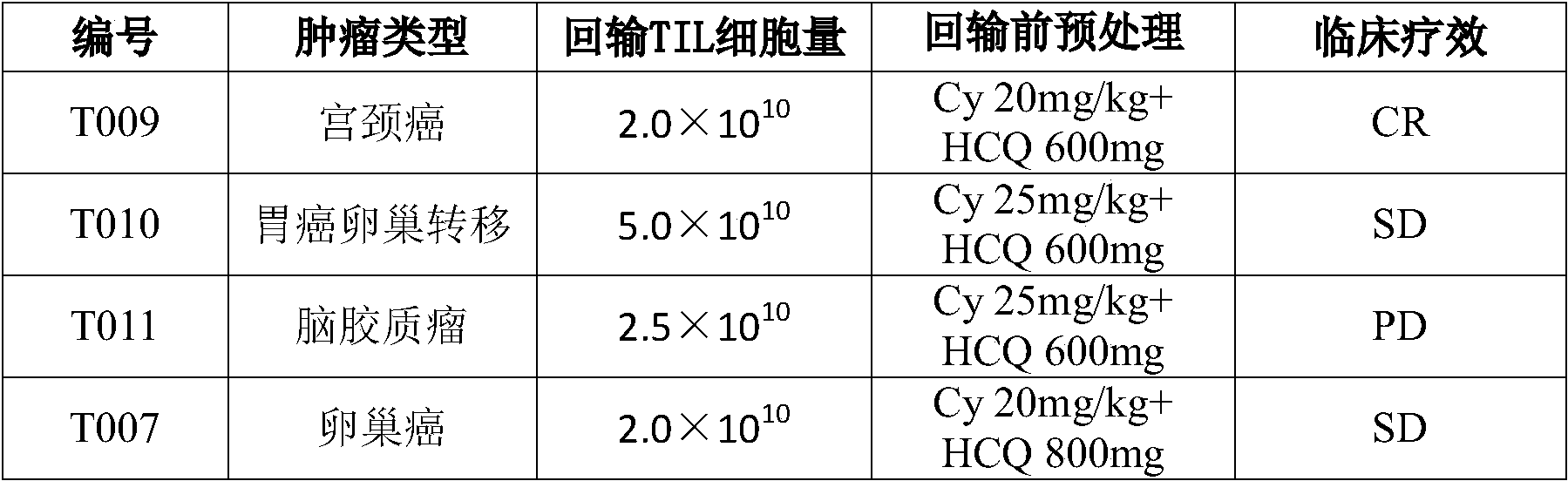

16例受试者中,不良事件包括有1级寒战5例(33.3%),1级发热7例(46.7%),2级发热6例(40%),所有症状均随时间延长而消失。除此以外未观察到其他不良事件。Among the 16 subjects, adverse events included grade 1 chills in 5 cases (33.3%), grade 1 fever in 7 cases (46.7%), and grade 2 fever in 6 cases (40%). All symptoms disappeared with time. Other than this, no other adverse events were observed.
T017患者经过影像学评估显示为肿瘤明显缩小,判定为部分缓解(PR)。对该名患者在TIL细胞回输前后的分别抽取外周血,检测部分肿瘤标志物的水平,对比结果如下表9所示。Patients with T017 showed significant tumor shrinkage after imaging evaluation, and were judged to be in partial response (PR). The peripheral blood was drawn from the patient before and after the TIL cell reinfusion, and the levels of some tumor markers were detected. The comparison results are shown in Table 9 below.
表9:T017患者用药前后部分肿瘤标志物数值对比Table 9: Comparison of some tumor markers before and after treatment in T017 patients

表9的结果显示,T017患者在回输前,上述几项肿瘤标志物中除甲胎蛋白和CA199在正常范围外,其余各项均远超正常范围。在TIL回输后30天再次检测该名患者外周血中上述肿瘤标志物,可以发现超标的几项中除人附睾蛋白4略高于正常范围外,其余均已回归到或维持在正常范围。The results in Table 9 show that before the reinfusion of T017 patients, except for alpha-fetoprotein and CA199, the above tumor markers were far beyond the normal range. The above-mentioned tumor markers in the patient's peripheral blood were detected again 30 days after TIL reinfusion, and it was found that, except for human epididymal protein 4, which was slightly higher than the normal range, the rest had returned to or remained in the normal range.
图5显示了T009患者在被施用药物组合物后的影像学评估结果。核磁成像结果显示,回输前的肿瘤病灶大小约3cm。与回输前相比,该名患者在TIL回输后6周时肿瘤病灶即已明显缩小(当时判定为部分缓解,PR)。用药10周后,肿瘤通过影像学已无法检测到,根据RECIST 1.1指针标准判定为完全缓解(CR)。Figure 5 shows the results of imaging assessment of T009 patients after administration of the pharmaceutical composition. MRI results showed that the size of the tumor lesions before reinfusion was about 3 cm. Compared with before the infusion, the patient's tumor lesions had shrunk significantly at 6 weeks after TIL infusion (at that time, it was judged as a partial response, PR). After 10 weeks of treatment, the tumor could no longer be detected by imaging, and it was judged as a complete response (CR) according to the RECIST 1.1 index criteria.
以上结果显示,本发明的包含TIL细胞和羟氯喹的药物组合物在临床上针对多种不同的实体瘤均具有非常优异的效果。The above results show that the pharmaceutical composition comprising TIL cells and hydroxychloroquine of the present invention has excellent clinical effects on various solid tumors.
尽管本发明的具体实施方式已经得到详细的描述,本领域技术人员将会理解。根据已经公开的所有教导,可以对那些细节进行各种修改和替换,这些改变均在本发明的保护范围之内。本发明的全部范围由所附权利要求及其任何等同物给出。Although specific embodiments of the present invention have been described in detail, those skilled in the art will understand. Various modifications and substitutions of those details may be made within the scope of the present invention in light of all the teachings disclosed. The full scope of the invention is given by the appended claims and any equivalents thereof.
Claims (18)


Priority Applications (3)
| Application Number | Priority Date | Filing Date | Title |
|---|---|---|---|
| CN202180079125.6A CN116761606A (en) | 2020-11-25 | 2021-11-25 | Pharmaceutical compositions for enhancing cell killing and uses thereof |
| US18/254,171 US20240238271A1 (en) | 2020-11-25 | 2021-11-25 | Pharmaceutical composition for enhancing cell killing, and use thereof |
| EP21897073.9A EP4252754A4 (en) | 2020-11-25 | 2021-11-25 | PHARMACEUTICAL COMPOSITION FOR ENHANCING CELL KILLING AND ITS USE |
Applications Claiming Priority (2)
| Application Number | Priority Date | Filing Date | Title |
|---|---|---|---|
| CN202011339237 | 2020-11-25 | ||
| CN202011339237.4 | 2020-11-25 |
Publications (1)
| Publication Number | Publication Date |
|---|---|
| WO2022111573A1 true WO2022111573A1 (en) | 2022-06-02 |
Family
ID=81755306
Family Applications (1)
| Application Number | Title | Priority Date | Filing Date |
|---|---|---|---|
| PCT/CN2021/133065 Ceased WO2022111573A1 (en) | 2020-11-25 | 2021-11-25 | Pharmaceutical composition for enhancing cell killing, and use thereof |
Country Status (4)
| Country | Link |
|---|---|
| US (1) | US20240238271A1 (en) |
| EP (1) | EP4252754A4 (en) |
| CN (1) | CN116761606A (en) |
| WO (1) | WO2022111573A1 (en) |
Cited By (4)
| Publication number | Priority date | Publication date | Assignee | Title |
|---|---|---|---|---|
| CN115558641A (en) * | 2022-11-14 | 2023-01-03 | 四川新生命干细胞科技股份有限公司 | High-purity effector immune cell population, and culture method, reagent composition and application thereof |
| CN115651903A (en) * | 2022-11-14 | 2023-01-31 | 四川新生命干细胞科技股份有限公司 | High-lethality immune cell population and culture method, reagent composition and application thereof |
| CN115948338A (en) * | 2023-01-18 | 2023-04-11 | 上海交通大学医学院附属第九人民医院 | Malignant pleomorphic adenoma tissue block MPA9H-1 and application thereof |
| CN116102468A (en) * | 2023-02-22 | 2023-05-12 | 中国科学技术大学 | Lead compound or pharmaceutically acceptable salt thereof targeting human lipocalin 2, preparation method and application thereof |
Families Citing this family (1)
| Publication number | Priority date | Publication date | Assignee | Title |
|---|---|---|---|---|
| CN119432734A (en) * | 2025-01-10 | 2025-02-14 | 云南精准检验有限公司 | Cell composition, preparation method and application thereof |
Citations (7)
| Publication number | Priority date | Publication date | Assignee | Title |
|---|---|---|---|---|
| CN102648910A (en) * | 2011-02-23 | 2012-08-29 | 优普生物科技股份有限公司 | Immunopotentiating composition, kit and use |
| CN103951753A (en) | 2009-09-03 | 2014-07-30 | 默沙东公司 | Anti-GITR antibodies |
| CN104946589A (en) * | 2015-07-07 | 2015-09-30 | 英普乐孚生物技术(上海)有限公司 | Isolated culturing method for tumor-specific TIL cells |
| CN105107233A (en) | 2015-07-24 | 2015-12-02 | 上海市第六人民医院 | Preparation method and device for leukocyte-depleted platelet rich plasma |
| CN108588021A (en) * | 2018-05-02 | 2018-09-28 | 深圳市因诺转化医学研究院 | The method of separation and purifying TIL, acquisition CD4+CD25+ cell subsets |
| CN110785486A (en) | 2017-03-29 | 2020-02-11 | 艾欧凡斯生物治疗公司 | Production method of tumor-infiltrating lymphocytes and use in immunotherapy |
| CN110938594A (en) * | 2019-09-12 | 2020-03-31 | 夏建川 | A method for culturing function-enhanced TIL cells |
Family Cites Families (3)
| Publication number | Priority date | Publication date | Assignee | Title |
|---|---|---|---|---|
| CA2804914A1 (en) * | 2010-07-22 | 2012-01-26 | Nadir Askenasy | Regulatory immune cells with enhanced targeted cell death effect |
| US11285143B2 (en) * | 2017-03-08 | 2022-03-29 | Johnpro Biotech Inc. | Use of mTOR inhibitor and chloroquine for treating cancer |
| US12233094B2 (en) * | 2017-11-29 | 2025-02-25 | Spinalcyte, Llc | Interaction of fibroblasts and immune cells for activation and uses thereof |
-
2021
- 2021-11-25 WO PCT/CN2021/133065 patent/WO2022111573A1/en not_active Ceased
- 2021-11-25 US US18/254,171 patent/US20240238271A1/en active Pending
- 2021-11-25 CN CN202180079125.6A patent/CN116761606A/en active Pending
- 2021-11-25 EP EP21897073.9A patent/EP4252754A4/en active Pending
Patent Citations (7)
| Publication number | Priority date | Publication date | Assignee | Title |
|---|---|---|---|---|
| CN103951753A (en) | 2009-09-03 | 2014-07-30 | 默沙东公司 | Anti-GITR antibodies |
| CN102648910A (en) * | 2011-02-23 | 2012-08-29 | 优普生物科技股份有限公司 | Immunopotentiating composition, kit and use |
| CN104946589A (en) * | 2015-07-07 | 2015-09-30 | 英普乐孚生物技术(上海)有限公司 | Isolated culturing method for tumor-specific TIL cells |
| CN105107233A (en) | 2015-07-24 | 2015-12-02 | 上海市第六人民医院 | Preparation method and device for leukocyte-depleted platelet rich plasma |
| CN110785486A (en) | 2017-03-29 | 2020-02-11 | 艾欧凡斯生物治疗公司 | Production method of tumor-infiltrating lymphocytes and use in immunotherapy |
| CN108588021A (en) * | 2018-05-02 | 2018-09-28 | 深圳市因诺转化医学研究院 | The method of separation and purifying TIL, acquisition CD4+CD25+ cell subsets |
| CN110938594A (en) * | 2019-09-12 | 2020-03-31 | 夏建川 | A method for culturing function-enhanced TIL cells |
Non-Patent Citations (7)
| Title |
|---|
| "REMINGTON'S PHARMACEUTICAL SCIENCES", 1990, MACK PUBLISHING COMPANY |
| CHEN DEGAO, XIE JING, FISKESUND ROLAND, DONG WENQIAN, LIANG XIAOYU, LV JIADI, JIN XUN, LIU JINYAN, MO SIQI, ZHANG TIANZHEN, CHENG : "Chloroquine modulates antitumor immune response by resetting tumor-associated macrophages toward M1 phenotype", NATURE COMMUNICATIONS, vol. 9, no. 1, 1 December 2018 (2018-12-01), pages 1 - 15, XP055933683, DOI: 10.1038/s41467-018-03225-9 * |
| LI, QIAN ET AL.: "Efficacy of Chloroquine in Cancer Therapy", MEDICAL RECAPITULATE, vol. 22, no. 13, 31 July 2016 (2016-07-31), pages 2541 - 2543, XP055933589 * |
| LIU JIALE, LIU XIAOXUAN, HAN YANFENG, ZHANG JING, LIU DAN, MA GUILEI, LI CHEN, LIU LANXIA, KONG DELING: "Nanovaccine Incorporated with Hydroxychloroquine Enhances Antigen Cross-Presentation and Promotes Antitumor Immune Responses", APPLIED MATERIALS & INTERFACES, vol. 10, no. 37, 19 September 2018 (2018-09-19), US , pages 30983 - 30993, XP055933675, ISSN: 1944-8244, DOI: 10.1021/acsami.8b09348 * |
| REMINGTON: "The Science and Practice of Pharmacy", 2005, LIPPINCOTT WILLIAMS & WILKINS |
| See also references of EP4252754A4 |
| SHI TING-TING; YU XIAO-XU; YAN LI-JUN; XIAO HONG-TAO: "Research progress of hydroxychloroquine and autophagy inhibitors on cancer", CANCER CHEMOTHERAPY AND PHARMACOLOGY, vol. 79, no. 2, 26 November 2016 (2016-11-26), DE , pages 287 - 294, XP036149297, ISSN: 0344-5704, DOI: 10.1007/s00280-016-3197-1 * |
Cited By (6)
| Publication number | Priority date | Publication date | Assignee | Title |
|---|---|---|---|---|
| CN115558641A (en) * | 2022-11-14 | 2023-01-03 | 四川新生命干细胞科技股份有限公司 | High-purity effector immune cell population, and culture method, reagent composition and application thereof |
| CN115651903A (en) * | 2022-11-14 | 2023-01-31 | 四川新生命干细胞科技股份有限公司 | High-lethality immune cell population and culture method, reagent composition and application thereof |
| CN115651903B (en) * | 2022-11-14 | 2023-03-17 | 四川新生命干细胞科技股份有限公司 | High-lethality immune cell population, and culture method, reagent composition and application thereof |
| CN115558641B (en) * | 2022-11-14 | 2023-05-12 | 四川新生命干细胞科技股份有限公司 | High-purity effector immune cell population, culture method, reagent composition and application thereof |
| CN115948338A (en) * | 2023-01-18 | 2023-04-11 | 上海交通大学医学院附属第九人民医院 | Malignant pleomorphic adenoma tissue block MPA9H-1 and application thereof |
| CN116102468A (en) * | 2023-02-22 | 2023-05-12 | 中国科学技术大学 | Lead compound or pharmaceutically acceptable salt thereof targeting human lipocalin 2, preparation method and application thereof |
Also Published As
| Publication number | Publication date |
|---|---|
| CN116761606A (en) | 2023-09-15 |
| EP4252754A4 (en) | 2024-11-13 |
| US20240238271A1 (en) | 2024-07-18 |
| EP4252754A1 (en) | 2023-10-04 |
Similar Documents
| Publication | Publication Date | Title |
|---|---|---|
| WO2022111573A1 (en) | Pharmaceutical composition for enhancing cell killing, and use thereof | |
| ES2946179T3 (en) | Antineoplastic effects of JAK2 inhibitors in combination with thalidomide derivatives and glucocorticoids | |
| AU2004294842B2 (en) | Medicine containing genetically modified antibody against chemokine receptor CCR4 | |
| US11413338B2 (en) | Methods and compositions using recombinant dendritic cells for cancer therapy | |
| ES2809805T3 (en) | Dactinomycin compositions and methods for the treatment of acute myeloid leukemia | |
| KR20190043162A (en) | Drug delivery compositions and uses thereof | |
| US20150024008A1 (en) | Methods and Compositions Involving Induced Senescent Cells for Cancer Treatment | |
| CN114340680A (en) | Trans-cyclooctene bioorthogonal agents and uses in cancer and immunotherapy | |
| JP7551110B2 (en) | Cell population-mediated delivery of checkpoint inhibitors for cancer immunotherapy | |
| EP4295917A2 (en) | Trans-cyclooctene bioorthogonal agents and uses in cancer and immunotherapy | |
| WO2022111571A1 (en) | Tumor infiltration lymphocyte culture medium and application thereof | |
| JP2024531258A (en) | Microtubule inhibitor-based antibody-drug conjugates | |
| BR112021010043A2 (en) | SUSTAINED LOCAL DRUG LEVELS FOR INNATE IMMUNE AGONISTS | |
| JP5667640B2 (en) | Use of saturated amine compounds in the production of peripheral blood hematopoietic stem cell mobilizers | |
| CN113116895B (en) | Quinoline derivatives for the treatment of neuroblastoma | |
| TWI764896B (en) | Efficient NKT cell activation technology | |
| CN108815188A (en) | Oncotherapy composition, kit comprising mescenchymal stem cell preparation and immunologic test point inhibitor and application thereof | |
| US20100129339A1 (en) | Nkt cell-stimulating agent for administration through upper respiratory tract mucous membrane | |
| US10988429B2 (en) | Quinochalcone compound and uses thereof for treating cancer or inflammation | |
| WO2023005992A1 (en) | Pharmaceutical combination and application thereof | |
| WO2023103854A1 (en) | Antibody-drug conjugate having improved affinity, and preparation method therefor and application thereof | |
| US9101558B2 (en) | Use of anti-cancer cell composition for treatment of head and neck cancer, which is intended to be administered to nutrient artery of tumor | |
| CN120897922A (en) | Porphyrin compound and medical application thereof | |
| WO2024217532A1 (en) | Use of carboprost in preparation of antitumor drugs | |
| HK40104832A (en) | Trans-cyclooctene bioorthogonal agents and uses in cancer and immunotherapy |
Legal Events
| Date | Code | Title | Description |
|---|---|---|---|
| 121 | Ep: the epo has been informed by wipo that ep was designated in this application |
Ref document number: 21897073 Country of ref document: EP Kind code of ref document: A1 |
|
| WWE | Wipo information: entry into national phase |
Ref document number: 202180079125.6 Country of ref document: CN |
|
| NENP | Non-entry into the national phase |
Ref country code: DE |
|
| ENP | Entry into the national phase |
Ref document number: 2021897073 Country of ref document: EP Effective date: 20230626 |