WO2021216312A1 - Method for preparing coating composition with improved color retention - Google Patents
Method for preparing coating composition with improved color retention Download PDFInfo
- Publication number
- WO2021216312A1 WO2021216312A1 PCT/US2021/026856 US2021026856W WO2021216312A1 WO 2021216312 A1 WO2021216312 A1 WO 2021216312A1 US 2021026856 W US2021026856 W US 2021026856W WO 2021216312 A1 WO2021216312 A1 WO 2021216312A1
- Authority
- WO
- WIPO (PCT)
- Prior art keywords
- extender
- pigment
- pmhs
- mixing
- aqueous dispersion
- Prior art date
- Legal status (The legal status is an assumption and is not a legal conclusion. Google has not performed a legal analysis and makes no representation as to the accuracy of the status listed.)
- Ceased
Links
Classifications
-
- C—CHEMISTRY; METALLURGY
- C09—DYES; PAINTS; POLISHES; NATURAL RESINS; ADHESIVES; COMPOSITIONS NOT OTHERWISE PROVIDED FOR; APPLICATIONS OF MATERIALS NOT OTHERWISE PROVIDED FOR
- C09D—COATING COMPOSITIONS, e.g. PAINTS, VARNISHES OR LACQUERS; FILLING PASTES; CHEMICAL PAINT OR INK REMOVERS; INKS; CORRECTING FLUIDS; WOODSTAINS; PASTES OR SOLIDS FOR COLOURING OR PRINTING; USE OF MATERIALS THEREFOR
- C09D133/00—Coating compositions based on homopolymers or copolymers of compounds having one or more unsaturated aliphatic radicals, each having only one carbon-to-carbon double bond, and at least one being terminated by only one carboxyl radical, or of salts, anhydrides, esters, amides, imides, or nitriles thereof; Coating compositions based on derivatives of such polymers
- C09D133/04—Homopolymers or copolymers of esters
-
- C—CHEMISTRY; METALLURGY
- C09—DYES; PAINTS; POLISHES; NATURAL RESINS; ADHESIVES; COMPOSITIONS NOT OTHERWISE PROVIDED FOR; APPLICATIONS OF MATERIALS NOT OTHERWISE PROVIDED FOR
- C09D—COATING COMPOSITIONS, e.g. PAINTS, VARNISHES OR LACQUERS; FILLING PASTES; CHEMICAL PAINT OR INK REMOVERS; INKS; CORRECTING FLUIDS; WOODSTAINS; PASTES OR SOLIDS FOR COLOURING OR PRINTING; USE OF MATERIALS THEREFOR
- C09D133/00—Coating compositions based on homopolymers or copolymers of compounds having one or more unsaturated aliphatic radicals, each having only one carbon-to-carbon double bond, and at least one being terminated by only one carboxyl radical, or of salts, anhydrides, esters, amides, imides, or nitriles thereof; Coating compositions based on derivatives of such polymers
-
- C—CHEMISTRY; METALLURGY
- C09—DYES; PAINTS; POLISHES; NATURAL RESINS; ADHESIVES; COMPOSITIONS NOT OTHERWISE PROVIDED FOR; APPLICATIONS OF MATERIALS NOT OTHERWISE PROVIDED FOR
- C09D—COATING COMPOSITIONS, e.g. PAINTS, VARNISHES OR LACQUERS; FILLING PASTES; CHEMICAL PAINT OR INK REMOVERS; INKS; CORRECTING FLUIDS; WOODSTAINS; PASTES OR SOLIDS FOR COLOURING OR PRINTING; USE OF MATERIALS THEREFOR
- C09D5/00—Coating compositions, e.g. paints, varnishes or lacquers, characterised by their physical nature or the effects produced; Filling pastes
-
- C—CHEMISTRY; METALLURGY
- C08—ORGANIC MACROMOLECULAR COMPOUNDS; THEIR PREPARATION OR CHEMICAL WORKING-UP; COMPOSITIONS BASED THEREON
- C08K—Use of inorganic or non-macromolecular organic substances as compounding ingredients
- C08K3/00—Use of inorganic substances as compounding ingredients
- C08K3/18—Oxygen-containing compounds, e.g. metal carbonyls
- C08K3/20—Oxides; Hydroxides
- C08K3/22—Oxides; Hydroxides of metals
-
- C—CHEMISTRY; METALLURGY
- C08—ORGANIC MACROMOLECULAR COMPOUNDS; THEIR PREPARATION OR CHEMICAL WORKING-UP; COMPOSITIONS BASED THEREON
- C08K—Use of inorganic or non-macromolecular organic substances as compounding ingredients
- C08K3/00—Use of inorganic substances as compounding ingredients
- C08K3/34—Silicon-containing compounds
-
- C—CHEMISTRY; METALLURGY
- C08—ORGANIC MACROMOLECULAR COMPOUNDS; THEIR PREPARATION OR CHEMICAL WORKING-UP; COMPOSITIONS BASED THEREON
- C08K—Use of inorganic or non-macromolecular organic substances as compounding ingredients
- C08K3/00—Use of inorganic substances as compounding ingredients
- C08K3/34—Silicon-containing compounds
- C08K3/346—Clay
-
- C—CHEMISTRY; METALLURGY
- C08—ORGANIC MACROMOLECULAR COMPOUNDS; THEIR PREPARATION OR CHEMICAL WORKING-UP; COMPOSITIONS BASED THEREON
- C08K—Use of inorganic or non-macromolecular organic substances as compounding ingredients
- C08K3/00—Use of inorganic substances as compounding ingredients
- C08K3/34—Silicon-containing compounds
- C08K3/36—Silica
-
- C—CHEMISTRY; METALLURGY
- C08—ORGANIC MACROMOLECULAR COMPOUNDS; THEIR PREPARATION OR CHEMICAL WORKING-UP; COMPOSITIONS BASED THEREON
- C08L—COMPOSITIONS OF MACROMOLECULAR COMPOUNDS
- C08L83/00—Compositions of macromolecular compounds obtained by reactions forming in the main chain of the macromolecule a linkage containing silicon with or without sulfur, nitrogen, oxygen or carbon only; Compositions of derivatives of such polymers
- C08L83/04—Polysiloxanes
-
- C—CHEMISTRY; METALLURGY
- C09—DYES; PAINTS; POLISHES; NATURAL RESINS; ADHESIVES; COMPOSITIONS NOT OTHERWISE PROVIDED FOR; APPLICATIONS OF MATERIALS NOT OTHERWISE PROVIDED FOR
- C09D—COATING COMPOSITIONS, e.g. PAINTS, VARNISHES OR LACQUERS; FILLING PASTES; CHEMICAL PAINT OR INK REMOVERS; INKS; CORRECTING FLUIDS; WOODSTAINS; PASTES OR SOLIDS FOR COLOURING OR PRINTING; USE OF MATERIALS THEREFOR
- C09D5/00—Coating compositions, e.g. paints, varnishes or lacquers, characterised by their physical nature or the effects produced; Filling pastes
- C09D5/02—Emulsion paints including aerosols
- C09D5/024—Emulsion paints including aerosols characterised by the additives
-
- C—CHEMISTRY; METALLURGY
- C09—DYES; PAINTS; POLISHES; NATURAL RESINS; ADHESIVES; COMPOSITIONS NOT OTHERWISE PROVIDED FOR; APPLICATIONS OF MATERIALS NOT OTHERWISE PROVIDED FOR
- C09D—COATING COMPOSITIONS, e.g. PAINTS, VARNISHES OR LACQUERS; FILLING PASTES; CHEMICAL PAINT OR INK REMOVERS; INKS; CORRECTING FLUIDS; WOODSTAINS; PASTES OR SOLIDS FOR COLOURING OR PRINTING; USE OF MATERIALS THEREFOR
- C09D7/00—Features of coating compositions, not provided for in group C09D5/00; Processes for incorporating ingredients in coating compositions
- C09D7/40—Additives
- C09D7/60—Additives non-macromolecular
- C09D7/61—Additives non-macromolecular inorganic
-
- C—CHEMISTRY; METALLURGY
- C09—DYES; PAINTS; POLISHES; NATURAL RESINS; ADHESIVES; COMPOSITIONS NOT OTHERWISE PROVIDED FOR; APPLICATIONS OF MATERIALS NOT OTHERWISE PROVIDED FOR
- C09D—COATING COMPOSITIONS, e.g. PAINTS, VARNISHES OR LACQUERS; FILLING PASTES; CHEMICAL PAINT OR INK REMOVERS; INKS; CORRECTING FLUIDS; WOODSTAINS; PASTES OR SOLIDS FOR COLOURING OR PRINTING; USE OF MATERIALS THEREFOR
- C09D7/00—Features of coating compositions, not provided for in group C09D5/00; Processes for incorporating ingredients in coating compositions
- C09D7/40—Additives
- C09D7/65—Additives macromolecular
-
- C—CHEMISTRY; METALLURGY
- C09—DYES; PAINTS; POLISHES; NATURAL RESINS; ADHESIVES; COMPOSITIONS NOT OTHERWISE PROVIDED FOR; APPLICATIONS OF MATERIALS NOT OTHERWISE PROVIDED FOR
- C09D—COATING COMPOSITIONS, e.g. PAINTS, VARNISHES OR LACQUERS; FILLING PASTES; CHEMICAL PAINT OR INK REMOVERS; INKS; CORRECTING FLUIDS; WOODSTAINS; PASTES OR SOLIDS FOR COLOURING OR PRINTING; USE OF MATERIALS THEREFOR
- C09D7/00—Features of coating compositions, not provided for in group C09D5/00; Processes for incorporating ingredients in coating compositions
- C09D7/80—Processes for incorporating ingredients
-
- C—CHEMISTRY; METALLURGY
- C08—ORGANIC MACROMOLECULAR COMPOUNDS; THEIR PREPARATION OR CHEMICAL WORKING-UP; COMPOSITIONS BASED THEREON
- C08K—Use of inorganic or non-macromolecular organic substances as compounding ingredients
- C08K3/00—Use of inorganic substances as compounding ingredients
- C08K3/18—Oxygen-containing compounds, e.g. metal carbonyls
- C08K3/20—Oxides; Hydroxides
- C08K3/22—Oxides; Hydroxides of metals
- C08K2003/2237—Oxides; Hydroxides of metals of titanium
- C08K2003/2241—Titanium dioxide
Definitions
- the present invention relates to a method of preparing a coating composition that exhibits improved color retention when coated on a substrate.
- Color retention which is defined by the color loss (or fading) of organic coatings on substrates arising from photodegradation, is highly desirable for exterior coatings. Premature and excessive fading typically occurs on surfaces with excessive exposure to sunlight, which can also exacerbate chalking of the coating. Color loss arises mechanistically from UV degradation, which accelerates chemical changes in the coloring agents by way of hydroxy and peroxy radical generation, which in turn lead to the onset of photo-oxidation (or photochemical degradation) in most polymers.
- T1O2 pigment particles which are invariably present in paints, while providing excellent hiding, strongly absorb UV radiation, leading to the formation of the oxidative hydroxyl radicals.
- Techniques used to mitigate the adverse effects of T1O2 include pretreatment of the surface with S1O2, ZrCk, or both, which minimizes, but does not eliminate the formation of hydroxy radicals.
- the present invention addresses a need in the art by providing, in one aspect, a method for forming a blend comprising an aqueous dispersion of polymer particles, a polymethylhydrosiloxane (PMHS), an opacifying pigment, and an extender; wherein the order of addition comprises the steps of either: a) mixing the polymethylhydrosiloxane with the aqueous dispersion of polymer particles to form a polymethylhydrogensiloxane/polymer particle blend; then mixing the polymethylhydrogensiloxane/polymer particle blend with the opacifying pigment and the extender in any order; or b) mixing the opacifying pigment with the aqueous dispersion of polymer particles to form an opacifying pigment/polymer particle blend; then mixing the opacifying pigment/polymer particle blend with polymethylhydrosiloxane and the extender in any order; or c) mixing the extender with the aqueous dispersion of poly
- the process of the present invention is useful for preparing pigmented paint formulations that exhibit excellent color retention when applied to substrates.
- the present invention is a method for forming a blend comprising an aqueous dispersion of polymer particles, a PMHS, an opacifying pigment, and an extender; wherein the order of addition comprises the steps of either: a) mixing the PMHS with the aqueous dispersion of polymer particles to form a polymethylhydrogensiloxane/polymer particle blend; then mixing the polymethylhydrogensiloxane/polymer particle blend with the opacifying pigment and the extender in any order; or b) mixing the opacifying pigment with the aqueous dispersion of polymer particles to form an opacifying pigment/polymer particle blend; then mixing the opacifying pigment/polymer particle blend with PMHS and the extender in any order; or c) mixing the extender with the aqueous dispersion of polymer particles to form an extender/polymer particle blend; then mixing the extender/polymer particle blend with PMHS and the opacifying pigment
- the PMHS is blended in a first step with an aqueous dispersion of polymer particles (a latex), examples of which include polyacrylic, poly(styrene-acrylic), polyvinyl acetate, and polyurethane based latexes.
- a latex examples of which include polyacrylic, poly(styrene-acrylic), polyvinyl acetate, and polyurethane based latexes.
- the PMHS/polymer particle blend is mixed with pigment and extender, either together or separately, and in any order.
- opacifying pigment refers to a metal oxide having a refractive index of greater than 2.0.
- Suitable opacifying pigments include T1O2 and ZnCk.
- Suitable extenders include carbonates, silica, silicates, aluminosilicates, phosphates, and non-hollow organic microspheres. More particular examples of extenders include talc, clay, mica, sericite, CaCC>3, nepheline syenite, feldspar, wollastonite, kaolinite, dicalcium phosphate, and diatomaceous earth.
- the concentration of the PMHS is preferably in the range of 0.1 to 5 weight percent, based on the weight of the blend (composition).
- the weight-to-weight ratio of the PMHS to the total of the opacifying pigment and the extender is preferably in the range of from 0.5:1, more preferably from 0.2:1, and most preferably from 0.1:1, to 0.001:1, more preferably to 0.005:1, and most preferably to 0.01:1.
- the preferred ratio of PMHS to opacifying pigment is in the range of from 0.8:1, more preferably from 0.4:1, and most preferably from 0.2:1, to 0.002:1, more preferably to 0.01:1, and most preferably to 0.05:1.
- TiC is a preferred opacifying pigment.
- opacifying pigment is mixed with the aqueous dispersion of polymer particles to form an opacifying pigment/polymer particle blend, followed by mixing the opacifying pigment/polymer particle blend with the PMHS and the extender, either together or separately, and in any order.
- extender is mixed with the aqueous dispersion of polymer particles to form an extender/polymer particle blend; followed by mixing the extender/polymer particle blend with the PMHS and the opacifying pigment, either together or separately, and in any order.
- the PMHS is added to a blend comprising the aqueous dispersion of polymer particles, the pigment, and the extender.
- the process of the present invention excludes contact of the PMHS with extender or pigment without the presence of the aqueous dispersion of polymer particles.
- the total amounts of pigment and extender used in the process of the present invention are such that the composition has a pigment volume concentration (PVC) above a critical PVC.
- PVC pigment volume concentration
- CPVC critical pigment volume concentration
- the process of the present invention forms a composition with a PVC of at least 60%, alternatively at least 65% and, in one aspect, not greater than 90%.
- the total amounts of pigment and extender used in the process of the present invention are such that the composition has a pigment volume concentration (PVC) below a critical PVC.
- PVC pigment volume concentration
- CPVC Crohn's disease bacterium carbonate
- the process of the present invention forms a composition with a PVC not greater than 60%, or not greater than 50%, and, in one aspect, at least 10%, or at least 25%, or at least 35%.
- the CPVC of a coating can be conveniently determined using reflectance (integrated sphere, spectral reflectance included, 10 degree observer/D65), as follows: The difference in reflectance of a coated film in the dry state is compared to the same film that has been rewetted with a penetrating solvent that has refractive index similar to that of the polymer (such as Isopar L solvent) that fills the air voids of the dry coating.
- a coating is above CPVC, the Y-reflectance of the re- wetted coating will decrease by at least 2% from the initial Y-reflectance value of the dry coating.
- PVC is defined by the following formula: 100 where binder solids refers to the contribution of polymer from the aqueous dispersion of the polymer particles that bind the pigment and extender particles together.
- the process of the present invention preferably further includes the addition of any or all of solvents, rheology modifiers, defoamers, dispersants, preservatives, coalescents, neutralizing agents, colorants, and additional water.
- solvents rheology modifiers, defoamers, dispersants, preservatives, coalescents, neutralizing agents, colorants, and additional water.
- exterior paints prepared using the process of the present invention provide coatings with exceptional color retention when subjected to accelerated UV exposure.
- PRIMAL, METHOCEL, TAMOL, and DOWANOL are
- XIAMETER is a Trademark of The Dow Chemical Company or Its affiliates.
- the paint formulations were pigmented with Colortrend Blue 888-7214 dye (1 wt%) and applied to an aluminum panel (3.2 mm thickness).
- the coated panels were allowed to dry at 25 °C at 50% relative humidity, then subjected to accelerated UV exposure for 5000 h using a Ci 5000 xenon arc Weather-O-Meter (Atlas Corp.) set at ASTM G-155 cycle 1 (102 min daylight followed by 18 min water spray on the coated surface.)
- the radiance was set at 0.35 W/m 2 .
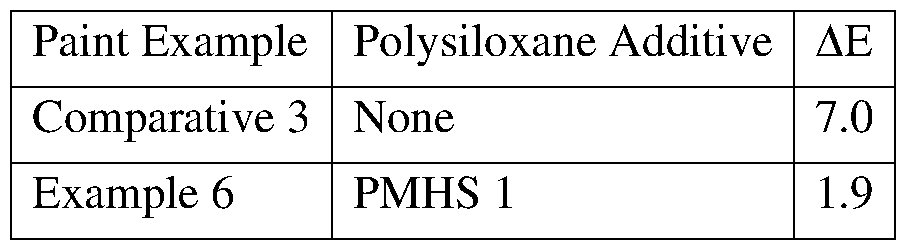
- DE was measured using a Byk-Gardner Spectro-Guide Colorimeter in accordance with ASTM D-1925. The greater the DE, the poorer the color retention. In general a DE of greater than 1 is perceptible to the human eye.
- Table 4 illustrates the components and amounts of a below-critical paint formulation.
- Rocima 63 refers to Rocima 63 Microbicide
- TERGITOLTM 15-S-9 refers to TERGITOLTM 15-S-9 Secondary Alcohol Ethoxylate
- Bioban IPBC 40-LE refers to Bioban IPBC 40-LE Antimicrobial
- Foamstar A-34 refers to Foamstar A-34 Defoamer
- RHOPLEXTM VSR-50 refers to RHOPLEXTM VSR-50 Acrylic Latex
- ACRYSOLTM RM- 8W and ACRYSOLTM RM-2020 NPR refer to ACRYSOLTM RM-8W and ACRYSOLTM RM-2020 NPR Rheology Modifier.
- TERGITOL, RHOPLEX, and ACRYSOL are all Trademarks of The Dow Chemical Company or Its affiliates.
- the paint formulations were pigmented with Colortrend Blue 808-7214 dye (3 wt%) and applied to an aluminum panel (0.25 mm thickness).
- the accelerated UV testing was carried out as described hereinabove.
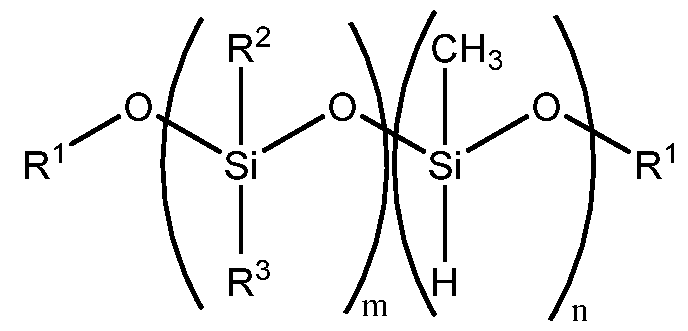
- the color retention data support the significance of methylhydrosiloxane functionality in the siloxane additive. Though not bound by theory, it is believed that hydrosilane groups, unlike the methylsilane groups, can chemically bind to extender and pigment particles, thereby limiting the migration of the PMHS, which acts to mitigate the effects of UV degradation during the accelerated weathering test.
Landscapes
- Chemical & Material Sciences (AREA)
- Organic Chemistry (AREA)
- Life Sciences & Earth Sciences (AREA)
- Engineering & Computer Science (AREA)
- Materials Engineering (AREA)
- Wood Science & Technology (AREA)
- Medicinal Chemistry (AREA)
- Health & Medical Sciences (AREA)
- Chemical Kinetics & Catalysis (AREA)
- Polymers & Plastics (AREA)
- Inorganic Chemistry (AREA)
- Dispersion Chemistry (AREA)
- Paints Or Removers (AREA)
Abstract
Description



Claims

Priority Applications (8)
| Application Number | Priority Date | Filing Date | Title |
|---|---|---|---|
| ES21723502T ES3040839T3 (en) | 2020-04-24 | 2021-04-12 | Method for preparing coating composition with improved color retention |
| AU2021260494A AU2021260494A1 (en) | 2020-04-24 | 2021-04-12 | Method for preparing coating composition with improved color retention |
| KR1020227040268A KR20230002840A (en) | 2020-04-24 | 2021-04-12 | Methods of Making Coating Compositions with Improved Color Retention |
| BR112022020685A BR112022020685A2 (en) | 2020-04-24 | 2021-04-12 | METHOD FOR FORMING A BLEND |
| CA3173728A CA3173728C (en) | 2020-04-24 | 2021-04-12 | Method for preparing coating composition with improved color retention |
| EP21723502.7A EP4139404B1 (en) | 2020-04-24 | 2021-04-12 | Method for preparing coating composition with improved color retention |
| US17/919,797 US12344757B2 (en) | 2020-04-24 | 2021-04-12 | Method for preparing coating composition with improved color retention |
| CN202180025788.XA CN115362223B (en) | 2020-04-24 | 2021-04-12 | Process for preparing a coating composition having improved color retention |
Applications Claiming Priority (2)
| Application Number | Priority Date | Filing Date | Title |
|---|---|---|---|
| US202063014860P | 2020-04-24 | 2020-04-24 | |
| US63/014,860 | 2020-04-24 |
Publications (1)
| Publication Number | Publication Date |
|---|---|
| WO2021216312A1 true WO2021216312A1 (en) | 2021-10-28 |
Family
ID=75787249
Family Applications (1)
| Application Number | Title | Priority Date | Filing Date |
|---|---|---|---|
| PCT/US2021/026856 Ceased WO2021216312A1 (en) | 2020-04-24 | 2021-04-12 | Method for preparing coating composition with improved color retention |
Country Status (8)
| Country | Link |
|---|---|
| US (1) | US12344757B2 (en) |
| EP (1) | EP4139404B1 (en) |
| KR (1) | KR20230002840A (en) |
| CN (1) | CN115362223B (en) |
| AU (1) | AU2021260494A1 (en) |
| BR (1) | BR112022020685A2 (en) |
| ES (1) | ES3040839T3 (en) |
| WO (1) | WO2021216312A1 (en) |
Citations (2)
| Publication number | Priority date | Publication date | Assignee | Title |
|---|---|---|---|---|
| WO2013023174A1 (en) * | 2011-08-10 | 2013-02-14 | University Of Virginia Patent Foundation | Viscoelastic silicone rubber compositions |
| WO2020198490A1 (en) * | 2019-03-28 | 2020-10-01 | Lawrence Livermore National Security, Llc | Three-dimensional porous siloxanes using leachable porogen particles |
Family Cites Families (16)
| Publication number | Priority date | Publication date | Assignee | Title |
|---|---|---|---|---|
| US5074912A (en) | 1990-09-07 | 1991-12-24 | Dow Corning Corporation | Siloxane masonry water repellent emulsions |
| US5110684A (en) | 1990-11-07 | 1992-05-05 | Dow Corning Corporation | Masonry water repellent |
| US5366810A (en) | 1992-10-09 | 1994-11-22 | General Electric Company | Water-repellent wallboard |
| GB9605706D0 (en) | 1996-03-19 | 1996-05-22 | Dow Corning | Method for hydrophobing gypsum |
| DE19833917A1 (en) | 1998-07-28 | 2000-02-03 | Basf Ag | Aqueous compositions containing film forming polymer and sulfonic acid half ester salt, useful in coating mineral molded bodies, e.g. fibre-cement slabs, curbstones, stairs, plinths, form low water uptake coatings on such bodies |
| JP2001040339A (en) * | 1999-08-03 | 2001-02-13 | Nichiei-Yoshida Co Ltd | Permeable water absorption prevention material for exposed concrete |
| US20070240614A1 (en) | 2004-06-30 | 2007-10-18 | Lynch Thomas J | Film forming coating composition |
| US7531242B2 (en) | 2005-09-30 | 2009-05-12 | Industrial Control Development, Inc. | Silicone-coated architectural glass |
| US8088853B2 (en) * | 2006-12-21 | 2012-01-03 | Millennium Inorganic Chemicals, Inc. | Polysiloxane modified titanium dioxide |
| AU2009296281A1 (en) * | 2008-09-29 | 2010-04-01 | E. I. Du Pont De Nemours And Company | Coating compositions having improved solar reflectivity and UV protection |
| CN103813999A (en) | 2011-09-19 | 2014-05-21 | 道康宁公司 | concrete waterproofing agent |
| WO2014169343A1 (en) | 2013-04-18 | 2014-10-23 | Bluedot Innovations Pty Ltd | Reactive hybrid location determination method and apparatus |
| DE102013226798A1 (en) * | 2013-12-20 | 2015-06-25 | Evonik Industries Ag | Surface treatment of particles and their use |
| MX382777B (en) * | 2015-07-23 | 2025-03-13 | Dow Global Technologies Llc | AQUEOUS DISPERSION OF HYDROPHOBICALLY MODIFIED PIGMENT PARTICLES. |
| FR3075626B1 (en) * | 2017-12-21 | 2022-06-17 | Oreal | COMPOSITION COMPRISING AN AQUEOUS DISPERSION OF POLYURETHANE PARTICLES AND A PARTICULAR SILICONE COMPOUND |
| WO2020068649A1 (en) * | 2018-09-27 | 2020-04-02 | Dow Global Technologies Llc | Coating composition for controlling efflorescence |
-
2021
- 2021-04-12 WO PCT/US2021/026856 patent/WO2021216312A1/en not_active Ceased
- 2021-04-12 US US17/919,797 patent/US12344757B2/en active Active
- 2021-04-12 CN CN202180025788.XA patent/CN115362223B/en active Active
- 2021-04-12 BR BR112022020685A patent/BR112022020685A2/en unknown
- 2021-04-12 ES ES21723502T patent/ES3040839T3/en active Active
- 2021-04-12 KR KR1020227040268A patent/KR20230002840A/en active Pending
- 2021-04-12 AU AU2021260494A patent/AU2021260494A1/en active Pending
- 2021-04-12 EP EP21723502.7A patent/EP4139404B1/en active Active
Patent Citations (2)
| Publication number | Priority date | Publication date | Assignee | Title |
|---|---|---|---|---|
| WO2013023174A1 (en) * | 2011-08-10 | 2013-02-14 | University Of Virginia Patent Foundation | Viscoelastic silicone rubber compositions |
| WO2020198490A1 (en) * | 2019-03-28 | 2020-10-01 | Lawrence Livermore National Security, Llc | Three-dimensional porous siloxanes using leachable porogen particles |
Also Published As
| Publication number | Publication date |
|---|---|
| US12344757B2 (en) | 2025-07-01 |
| BR112022020685A2 (en) | 2022-11-29 |
| CN115362223A (en) | 2022-11-18 |
| ES3040839T3 (en) | 2025-11-05 |
| CA3173728A1 (en) | 2021-10-28 |
| AU2021260494A1 (en) | 2022-11-24 |
| EP4139404B1 (en) | 2025-07-16 |
| US20230145320A1 (en) | 2023-05-11 |
| EP4139404A1 (en) | 2023-03-01 |
| CN115362223B (en) | 2025-04-29 |
| KR20230002840A (en) | 2023-01-05 |
Similar Documents
| Publication | Publication Date | Title |
|---|---|---|
| CA2903724C (en) | Water-based compositions that resist dirt pick-up | |
| US10301477B2 (en) | Superhydrophilic coating composition | |
| EP3256535A1 (en) | Elastomeric silicone emulsion for coating applications | |
| US10364196B2 (en) | Multi-functional coating system for cementitious composite materials | |
| US11390762B2 (en) | Tri-carboxylic compounds as low-VOC coalescing agents and plasticizing agents | |
| AU2018242148B2 (en) | Coating composition and use thereof | |
| CN101161737A (en) | Aqueous curtain-imitating metallic luster paint | |
| CA3173728C (en) | Method for preparing coating composition with improved color retention | |
| US12344757B2 (en) | Method for preparing coating composition with improved color retention | |
| US20230075575A1 (en) | Aqueous coating compositions | |
| US7582157B2 (en) | Pigment composition for paint | |
| CA2982058C (en) | Hiding by using air voids encapsulated in hollow glass spheres | |
| CN118389008A (en) | Water-based organic-inorganic high-performance coating and preparation method and application thereof | |
| AU2020218784B2 (en) | Peelable swatches | |
| CN118339238A (en) | Coating composition with cerium (III) carbonate and photoinitiator | |
| CN114163852A (en) | Inorganic coating with bright color and no discoloration and preparation method thereof | |
| WO2024057233A1 (en) | Multi-functional coating composition | |
| WO2022093573A1 (en) | Low sheen deep base coating composition |
Legal Events
| Date | Code | Title | Description |
|---|---|---|---|
| 121 | Ep: the epo has been informed by wipo that ep was designated in this application |
Ref document number: 21723502 Country of ref document: EP Kind code of ref document: A1 |
|
| ENP | Entry into the national phase |
Ref document number: 3173728 Country of ref document: CA |
|
| REG | Reference to national code |
Ref country code: BR Ref legal event code: B01A Ref document number: 112022020685 Country of ref document: BR |
|
| WWE | Wipo information: entry into national phase |
Ref document number: 202217061277 Country of ref document: IN |
|
| ENP | Entry into the national phase |
Ref document number: 20227040268 Country of ref document: KR Kind code of ref document: A |
|
| ENP | Entry into the national phase |
Ref document number: 2021260494 Country of ref document: AU Date of ref document: 20210412 Kind code of ref document: A |
|
| ENP | Entry into the national phase |
Ref document number: 2021723502 Country of ref document: EP Effective date: 20221124 |
|
| NENP | Non-entry into the national phase |
Ref country code: DE |
|
| ENP | Entry into the national phase |
Ref document number: 112022020685 Country of ref document: BR Kind code of ref document: A2 Effective date: 20221011 |
|
| WWG | Wipo information: grant in national office |
Ref document number: 202180025788.X Country of ref document: CN |
|
| WWG | Wipo information: grant in national office |
Ref document number: 17919797 Country of ref document: US |
|
| WWG | Wipo information: grant in national office |
Ref document number: 2021723502 Country of ref document: EP |