WO2020208472A1 - New phosphinimide catalysts for olefin polymerization - Google Patents
New phosphinimide catalysts for olefin polymerization Download PDFInfo
- Publication number
- WO2020208472A1 WO2020208472A1 PCT/IB2020/053058 IB2020053058W WO2020208472A1 WO 2020208472 A1 WO2020208472 A1 WO 2020208472A1 IB 2020053058 W IB2020053058 W IB 2020053058W WO 2020208472 A1 WO2020208472 A1 WO 2020208472A1
- Authority
- WO
- WIPO (PCT)
- Prior art keywords
- group
- phosphinimide
- hydrocarbyl group
- cyclic
- polymerization catalyst
- Prior art date
- Legal status (The legal status is an assumption and is not a legal conclusion. Google has not performed a legal analysis and makes no representation as to the accuracy of the status listed.)
- Ceased
Links
- 0 CN=C1N(*)C(*)C(*)N1* Chemical compound CN=C1N(*)C(*)C(*)N1* 0.000 description 2
- YYKKBIRETOCLKW-UHFFFAOYSA-N CC(C)N(C1)c2ccccc2N1C(C)C Chemical compound CC(C)N(C1)c2ccccc2N1C(C)C YYKKBIRETOCLKW-UHFFFAOYSA-N 0.000 description 1
Classifications
-
- C—CHEMISTRY; METALLURGY
- C08—ORGANIC MACROMOLECULAR COMPOUNDS; THEIR PREPARATION OR CHEMICAL WORKING-UP; COMPOSITIONS BASED THEREON
- C08F—MACROMOLECULAR COMPOUNDS OBTAINED BY REACTIONS ONLY INVOLVING CARBON-TO-CARBON UNSATURATED BONDS
- C08F10/00—Homopolymers and copolymers of unsaturated aliphatic hydrocarbons having only one carbon-to-carbon double bond
-
- C—CHEMISTRY; METALLURGY
- C07—ORGANIC CHEMISTRY
- C07F—ACYCLIC, CARBOCYCLIC OR HETEROCYCLIC COMPOUNDS CONTAINING ELEMENTS OTHER THAN CARBON, HYDROGEN, HALOGEN, OXYGEN, NITROGEN, SULFUR, SELENIUM OR TELLURIUM
- C07F9/00—Compounds containing elements of Groups 5 or 15 of the Periodic Table
- C07F9/02—Phosphorus compounds
- C07F9/547—Heterocyclic compounds, e.g. containing phosphorus as a ring hetero atom
- C07F9/645—Heterocyclic compounds, e.g. containing phosphorus as a ring hetero atom having two nitrogen atoms as the only ring hetero atoms
- C07F9/6503—Five-membered rings
- C07F9/6506—Five-membered rings having the nitrogen atoms in positions 1 and 3
- C07F9/65068—Five-membered rings having the nitrogen atoms in positions 1 and 3 condensed with carbocyclic rings or carbocyclic ring systems
-
- C—CHEMISTRY; METALLURGY
- C07—ORGANIC CHEMISTRY
- C07F—ACYCLIC, CARBOCYCLIC OR HETEROCYCLIC COMPOUNDS CONTAINING ELEMENTS OTHER THAN CARBON, HYDROGEN, HALOGEN, OXYGEN, NITROGEN, SULFUR, SELENIUM OR TELLURIUM
- C07F17/00—Metallocenes
-
- C—CHEMISTRY; METALLURGY
- C08—ORGANIC MACROMOLECULAR COMPOUNDS; THEIR PREPARATION OR CHEMICAL WORKING-UP; COMPOSITIONS BASED THEREON
- C08F—MACROMOLECULAR COMPOUNDS OBTAINED BY REACTIONS ONLY INVOLVING CARBON-TO-CARBON UNSATURATED BONDS
- C08F210/00—Copolymers of unsaturated aliphatic hydrocarbons having only one carbon-to-carbon double bond
- C08F210/16—Copolymers of ethene with alpha-alkenes, e.g. EP rubbers
-
- C—CHEMISTRY; METALLURGY
- C08—ORGANIC MACROMOLECULAR COMPOUNDS; THEIR PREPARATION OR CHEMICAL WORKING-UP; COMPOSITIONS BASED THEREON
- C08F—MACROMOLECULAR COMPOUNDS OBTAINED BY REACTIONS ONLY INVOLVING CARBON-TO-CARBON UNSATURATED BONDS
- C08F2420/00—Metallocene catalysts
- C08F2420/04—Cp or analog not bridged to a non-Cp X ancillary anionic donor
-
- C—CHEMISTRY; METALLURGY
- C08—ORGANIC MACROMOLECULAR COMPOUNDS; THEIR PREPARATION OR CHEMICAL WORKING-UP; COMPOSITIONS BASED THEREON
- C08F—MACROMOLECULAR COMPOUNDS OBTAINED BY REACTIONS ONLY INVOLVING CARBON-TO-CARBON UNSATURATED BONDS
- C08F4/00—Polymerisation catalysts
- C08F4/42—Metals; Metal hydrides; Metallo-organic compounds; Use thereof as catalyst precursors
- C08F4/44—Metals; Metal hydrides; Metallo-organic compounds; Use thereof as catalyst precursors selected from light metals, zinc, cadmium, mercury, copper, silver, gold, boron, gallium, indium, thallium, rare earths or actinides
- C08F4/60—Metals; Metal hydrides; Metallo-organic compounds; Use thereof as catalyst precursors selected from light metals, zinc, cadmium, mercury, copper, silver, gold, boron, gallium, indium, thallium, rare earths or actinides together with refractory metals, iron group metals, platinum group metals, manganese, rhenium technetium or compounds thereof
- C08F4/62—Refractory metals or compounds thereof
- C08F4/64—Titanium, zirconium, hafnium or compounds thereof
- C08F4/659—Component covered by group C08F4/64 containing a transition metal-carbon bond
- C08F4/65908—Component covered by group C08F4/64 containing a transition metal-carbon bond in combination with an ionising compound other than alumoxane, e.g. (C6F5)4B-X+
-
- Y—GENERAL TAGGING OF NEW TECHNOLOGICAL DEVELOPMENTS; GENERAL TAGGING OF CROSS-SECTIONAL TECHNOLOGIES SPANNING OVER SEVERAL SECTIONS OF THE IPC; TECHNICAL SUBJECTS COVERED BY FORMER USPC CROSS-REFERENCE ART COLLECTIONS [XRACs] AND DIGESTS
- Y02—TECHNOLOGIES OR APPLICATIONS FOR MITIGATION OR ADAPTATION AGAINST CLIMATE CHANGE
- Y02P—CLIMATE CHANGE MITIGATION TECHNOLOGIES IN THE PRODUCTION OR PROCESSING OF GOODS
- Y02P20/00—Technologies relating to chemical industry
- Y02P20/50—Improvements relating to the production of bulk chemicals
- Y02P20/52—Improvements relating to the production of bulk chemicals using catalysts, e.g. selective catalysts
Definitions
- a new group 4 transition metal polymerization catalyst one which bears a cyclopentadienyl type ligand and a phosphinimide ligand substituted with a guanidinate type group, polymerizes ethylene with an alpha-olefin to produce ethylene copolymers having high molecular weight.
- [Ti] is catalyst concentration in the reactor (in mmol/L), and HUT is hold-up time of the catalyst in the reactor.
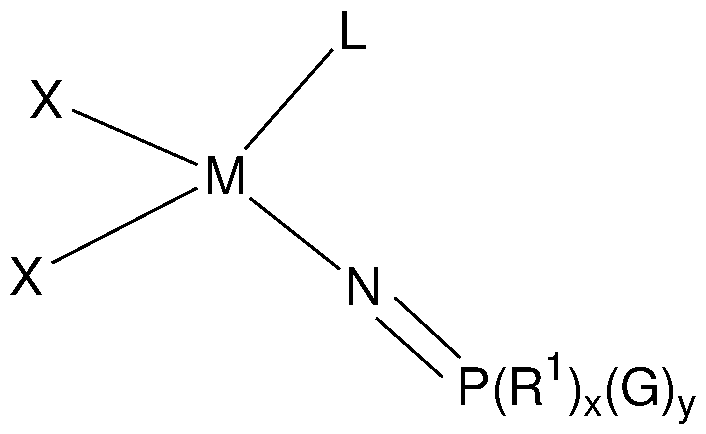
- M is Ti, Zr or Hf; P is phosphorus; N is nitrogen; L is a cyclopentadienyl type ligand; each X is independently an activatable ligand; R 1 is independently selected from a hydrogen atom, a hydrocarbyl group which is unsubstituted or substituted with one or more halogen atom, an alkoxy group, an aryl group, an aryloxy group, an amido group, a silyl group, and a germanyl group; G is a guanidinate type group having the following structure:
- L is a cyclopentadienyl ligand.
- G is a guanidinate type group selected from the following structures:
- a 5 , A 6 , A 7 , and A 8 are independently a hydrogen, an acyclic or a cyclic hydrocarbyl group, or an acyclic or a cyclic heteroatom containing hydrocarbyl group, and where any of A 5 , A 6 , A 7 , and A 8 may be part of a cyclic hydrocarbyl group or a cyclic heteroatom containing hydrocarbyl group.
- a 5 and A 8 are alkyl groups.
- a 6 and A 7 are part of a cyclic hydrocarbyl group.
- G is a guanidinate type group having the following structure:
- a 9 and A 10 are independently a hydrogen, an acyclic or a cyclic hydrocarbyl group or an acyclic or a cyclic heteroatom containing hydrocarbyl group.
- a 9 and A 10 are each alkyl groups.
- a 9 and A 10 are isopropyl groups.
- R 1 is independently a hydrocarbyl group which is unsubstituted or substituted with one or more halogen atom.
- R 1 is a tert-butyl group.
- M is Ti
- An embodiment of the disclosure is a polymerization catalyst system comprising: i) a phosphinimide pre-polymerization catalyst having the following structure:
- M is Ti, Zr or Hf; P is phosphorus; N is nitrogen; L is a cyclopentadienyl type ligand; each X is independently an activatable ligand; R 1 is independently selected from a hydrogen atom, a hydrocarbyl group which is unsubstituted or substituted with one or more halogen atom, an alkoxy group, an aryl group, an aryloxy group, an amido group, a silyl group, and a germanyl group; G is a guanidinate type group having the following structure:
- An embodiment of the disclosure is a polymerization process comprising polymerizing ethylene optionally with one or more C3-12 alpha olefins in the presence of a polymerization catalyst system comprising: i) a phosphinimide pre polymerization catalyst having the following structure:
- M is Ti, Zr or Hf; P is phosphorus; N is nitrogen; L is a cyclopentadienyl type ligand; each X is independently an activatable ligand; R 1 is independently selected from a hydrogen atom, a hydrocarbyl group which is unsubstituted or substituted with one or more halogen atom, an alkoxy group, an aryl group, an aryloxy group, an amido group, a silyl group, and a germanyl group; G is a guanidinate type group having the following structure:
- a polymerization process is a solution phase polymerization process carried out in a solvent.
- a polymerization process comprises polymerizing ethylene with one or more C3-12 alpha olefins.
- a polymerization process comprises polymerizing ethylene with 1 -octene.
- phosphinimide catalyst or complex described herein usually require activation by one or more cocatalytic or activator species in order to provide polymer from olefins.
- an un-activated phosphinimide catalyst or complex may be described as a“pre-polymerization catalyst”.
- a phosphinimide catalyst is a compound (typically an organometallic compound) based on a group 3, 4 or 5 metal and which is characterized as having at least one phosphinimide ligand. Any compounds/complexes having a
- the phosphinimide catalyst employed in the present disclosure is one having a cyclopentadienyl type ligand and a phosphinimide ligand which is further substituted by a guanidinate type group or moiety.
- the phosphinimide pre-polymerization catalyst may be used in combination with further catalyst components such as but not limited to one or more than one support, one or more than one catalyst activator and one or more than one catalyst modifier.
- M is Ti, Zr or Hf; P is phosphorus; N is nitrogen; L is a cyclopentadienyl type ligand; each X is independently an activatable ligand; R 1 is independently selected from a hydrogen atom, a hydrocarbyl group which is unsubstituted or substituted with one or more halogen atom, an alkoxy group, an aryl group, an aryloxy group, an amido group, a silyl group, and a germanyl group; G is a guanidinate type group having the following structure:
- M is Ti, Zr or Hf; P is phosphorus; N is nitrogen; L is a cyclopentadienyl type ligand; each X is independently an activatable ligand; R 1 is independently selected from a hydrogen atom; a C1 -30 hydrocarbyl group which is unsubstituted or substituted with one or more halogen atom; a C1 -8 alkoxy group; a C6-10 aryl group; a C6-10 aryloxy group; an amido group of formula -N(R A )2, wherein the R A groups are independently selected from a hydrogen atom, a C1 -30 alkyl group, a C6-10 aryl group; a silyl radical of formula -Si(R s )3, wherein the R s groups are independently selected from a hydrogen atom, a C1 -8 alkyl or alkoxy group, a C6-10 aryl group, a C6-10 aryloxy group; or
- M is Ti, Zr or Hf; P is phosphorus; N is nitrogen; L is a cyclopentadienyl type ligand; each X is independently an activatable ligand; R 1 is independently selected from a hydrogen atom, a hydrocarbyl group which is unsubstituted or substituted with one or more halogen atom, an alkoxy group, an aryl group, an aryloxy group, an amido group, a silyl group, and a germanyl group; G is a guanidinate type group selected from the group comprising:
- M is Ti, Zr or Hf; P is phosphorus; N is nitrogen; L is a cyclopentadienyl type ligand; each X is independently an activatable ligand; R 1 is independently selected from a hydrogen atom; a C1 -30 hydrocarbyl group which is unsubstituted or substituted with one or more halogen atom; a C1 -8 alkoxy group; a C6-10 aryl group; a C6-10 aryloxy group; an amido group of formula -N(R A )2, wherein the R A groups are independently selected from a hydrogen atom, a C1 -30 alkyl group, a C6-10 aryl group; a silyl radical of formula -Si(R s )3, wherein the R s groups are independently selected from a hydrogen atom, a C1 -8 alkyl or alkoxy group, a C6-10 aryl group, a C6-10 aryloxy group; or
- M is Ti, Zr or Hf; P is phosphorus; N is nitrogen; L is a cyclopentadienyl type ligand; each X is independently an activatable ligand; R 1 is independently selected from a hydrogen atom, a hydrocarbyl group which is unsubstituted or substituted with one or more halogen atom, an alkoxy group, an aryl group, an aryloxy group, an amido group, a silyl group, and a germanyl group; G is a guanidinate type group selected from the group comprising:
- the phosphinimide pre-polymerization catalyst used in an embodiment of the disclosure is defined by the following structure:
- M is Ti, Zr or Hf; P is phosphorus; N is nitrogen; L is a cyclopentadienyl type ligand; each X is independently an activatable ligand; R 1 is independently selected from a hydrogen atom; a C1 -30 hydrocarbyl group which is unsubstituted or substituted with one or more halogen atom; a C1 -8 alkoxy group; a C6-10 aryl group; a C6-10 aryloxy group; an amido group of formula -N(R A )2, wherein the R A groups are independently selected from a hydrogen atom, a C1 -30 alkyl group, a C6-10 aryl group; a silyl radical of formula -Si(R s )3, wherein the R s groups are independently selected from a hydrogen atom, a C1 -8 alkyl or alkoxy group, a C6-10 aryl group, a C6-10 aryloxy group; or
- hydrocarbyl group refers to linear or branched, aliphatic, olefinic, acetylenic and aryl (aromatic) radicals comprising hydrogen and carbon that are deficient by one hydrogen.
- cyclic hydrocarbyl group connotes hydrocarbyl groups that comprise cyclic moieties and which may have one or more than one cyclic aromatic ring, and/or one or more than one non-aromatic ring.
- acyclic hydrocarbyl group connotes hydrocarbyl groups that do not have cyclic moieties such as aromatic or non-aromatic ring structures present within them.
- heteroatom includes any atom other than carbon and hydrogen that can be bound to carbon.
- the term“heteroatom containing” or“heteroatom containing hydrocarbyl group” means that one or more than one non carbon atom(s) may be present in the hydrocarbyl groups.
- Some non-limiting examples of non-carbon atoms that may be present is a heteroatom containing hydrocarbyl group are N, O, S, P and Si as well as halides such as for example Br and metals such as Sn.
- heteroatom containing hydrocarbyl groups include for example imines, amine moieties, oxide moieties, phosphine moieties, ethers, ketones, heterocyclics, oxazolines, thioethers, and the like.
- a heteroatom containing hydrocarbyl group is a hydrocarbyl group containing from 1 to 3 atoms selected from the group consisting of boron, aluminum, silicon, germanium, nitrogen, phosphorous, oxygen and sulfur.
- cyclic heteroatom containing hydrocarbyl or“heterocyclic” refer to ring systems having a carbon backbone that further comprises at least one heteroatom selected from the group consisting of for example boron, aluminum, silicon, germanium, nitrogen, phosphorous, oxygen and sulfur.
- a cyclic heteroatom containing hydrocarbyl group is a cyclic hydrocarbyl group containing from 1 to 3 atoms selected from the group consisting of boron, aluminum, silicon, germanium, nitrogen, phosphorous, oxygen and sulfur.
- an“alkyl radical” or“alkyl group” includes linear, branched and cyclic paraffin radicals that are deficient by one hydrogen radical; non-limiting examples include methyl (-CH3) and ethyl (-CH2CH3) radicals.
- the term“alkenyl radical” or“alkenyl group” refers to linear, branched and cyclic hydrocarbons containing at least one carbon-carbon double bond that is deficient by one hydrogen radical.
- the term“alkynyl radical” or“alkynyl group” refers to linear, branched and cyclic hydrocarbons containing at least one carbon-carbon triple bond that is deficient by one hydrogen radical.
- aryl group includes phenyl, naphthyl, pyridyl and other radicals whose molecules have an aromatic ring structure; non-limiting examples include naphthylene, phenanthrene and anthracene.
- An“alkylaryl” group is an alkyl group having an aryl group pendant there from; non-limiting examples include benzyl, phenethyl and tolylmethyl.
- An“arylalkyl” is an aryl group having one or more alkyl groups pendant there from; non-limiting examples include tolyl, xylyl, mesityl and cumyl.
- An“alkoxy” group is an oxy group having an alkyl group pendant there from; and includes for example a methoxy group, an ethoxy group, an iso-propoxy group, and the like.
- An“aryloxy” group is an oxy group having an aryl group pendant there from; and includes for example a phenoxy group and the like.
- unsubstituted means that hydrogen radicals are bounded to the molecular group that is referred to by the term unsubstituted.
- substituted means that the group referred to by this term possesses one or more moieties that have replaced one or more hydrogen radicals in any position within the group; non-limiting examples of moieties include halogen radicals (F, Cl, Br), an alkyl group, an alkylaryl group, an arylalkyl group, an alkoxy group, an aryl group, an aryloxy group, an amido group, a silyl group or a germanyl group, hydroxyl groups, carbonyl groups, carboxyl groups, amine groups, phosphine groups, phenyl groups, naphthyl groups, Ci to C10 alkyl groups, C2 to C10 alkenyl groups, and combinations thereof.
- a 1 , A 2 , A 3 , and A 4 are independently hydrogen, an acyclic or a cyclic hydrocarbyl group, or an acyclic or a cyclic heteroatom containing hydrocarbyl group, and where any of A 1 to A 4 may be part of a cyclic hydrocarbyl group or a cyclic heteroatom containing hydrocarbyl group.
- G is a guanidinate type group having the following structure:
- a 1 , A 2 , A 3 , and A 4 are independently a hydrogen, a substituted or
- a 1 to A 4 may be part of a cyclic hydrocarbyl group or a cyclic heteroatom containing hydrocarbyl group.
- a 1 , A 2 , A 3 and A 4 are independently selected from the group comprising a straight chain alkyl group having 1 to 30 carbon atoms, a branched alkyl group having at least 3 carbon atoms, a cyclic alkyl group having at least 3 carbon atoms, an alkylaryl group having at least 7 carbons, or an aryl group having at least 6 carbons.
- a 1 , A 2 , A 3 and A 4 are independently an alkyl group.
- a 1 , A 2 , A 3 and A 4 are independently an alkyl group having 1 to 30 carbon atoms.
- a 1 , A 2 , A 3 and A 4 are independently a straight chain alkyl group having 1 to 30 carbon atoms.
- a 1 , A 2 , A 3 and A 4 are independently a branched alkyl group having at least 3 carbon atoms.
- a 1 , A 2 , A 3 and A 4 are independently a cyclic alkyl group having at least 3 carbon atoms.
- a 1 , A 2 , A 3 and A 4 are independently an aryl group having at least 6 carbon atoms.
- a 5 , A 6 , A 7 , and A 8 are independently a hydrogen, an acyclic or a cyclic hydrocarbyl group, or an acyclic or a cyclic heteroatom containing hydrocarbyl group, and where any of A 5 , A 6 , A 7 , and A 8 may be part of a cyclic hydrocarbyl group or a cyclic heteroatom containing hydrocarbyl group.
- a 5 , A 6 , A 7 , and A 8 are independently a hydrogen, a substituted or
- a 5 , A 6 , A 7 , and A 8 may be part of a cyclic hydrocarbyl group or a cyclic heteroatom containing hydrocarbyl group.
- a 5 , A 6 , A 7 , and A 8 are independently selected from the group comprising hydrogen, a straight chain alkyl group having 1 to 30 carbon atoms, a branched alkyl group having at least 3 carbon atoms, a cyclic alkyl group having at least 3 carbon atoms, an alkylaryl group having at least 7 carbons, or an aryl group having at least 6 carbons.
- a 5 and A 8 are independently an alkyl group.
- a 5 and A 8 are independently an alkyl group having 1 to 30 carbon atoms.
- a 5 and A 8 are independently a straight chain alkyl group having 1 to 30 carbon atoms. In an embodiment of the disclosure, A 5 and A 8 are independently a branched alkyl group having at least 3 carbon atoms.
- a 5 and A 8 are a are independently a cyclic alkyl group having at least 3 carbon atoms.
- a 5 and A 8 are independently an aryl group having at least 6 carbon atoms.
- a 5 and A 8 are hydrogen.
- a 6 and A 7 are independently an alkyl group.
- a 6 and A 7 are independently an alkyl group having 1 to 30 carbon atoms.
- a 6 and A 7 are a straight chain alkyl group having 1 to 30 carbon atoms.
- a 6 and A 7 are a branched alkyl group having at least 3 carbon atoms.
- a 6 and A 7 are independently an aryl group having at least 6 carbon atoms.
- a 6 and A 7 are part of a cyclic
- a 6 and A 7 are hydrogen.
- G is a guanidinate type group having the following structure:
- a 9 and A 10 are independently a hydrogen, an acyclic or a cyclic hydrocarbyl group, or an acyclic or a cyclic heteroatom containing hydrocarbyl group.
- G is a guanidinate type group having the following structure:
- a 9 and A 10 are independently a hydrogen, a substituted or unsubstituted acyclic or cyclic hydrocarbyl group, or a substituted or unsubstituted acyclic or a cyclic heteroatom containing hydrocarbyl group.
- a 9 and A 10 are independently selected from the group comprising hydrogen, a straight chain alkyl group having 1 to 30 carbon atoms, a branched alkyl group having at least 3 carbon atoms, a cyclic alkyl group having at least 3 carbon atoms, an alkylaryl group having at least 7 carbons, or an aryl group having at least 6 carbons.
- a 9 and A 10 are independently an alkyl group.
- a 9 and A 10 are independently an alkyl group having 1 to 30 carbon atoms.
- a 9 and A 10 are independently a straight chain alkyl group having 1 to 30 carbon atoms.
- a 9 and A 10 are independently a branched alkyl group having at least 3 carbon atoms.
- a 9 and A 10 are isopropyl groups.
- a 9 and A 10 are tert-butyl groups.
- a 9 and A 10 are a are independently a cyclic alkyl group having at least 3 carbon atoms.
- a 9 and A 10 are independently an aryl group having at least 6 carbon atoms.
- a 9 and A 10 are hydrogen.
- M is titanium, Ti.
- R 1 is a hydrocarbyl group which is unsubstituted or substituted with one or more halogen atom.
- R 1 is an alkyl group. In an embodiment of the disclosure, R 1 is an alkyl group having 1 to 30 carbon atoms.
- R 1 is an aryl group.
- R 1 is an isopropyl group.
- R 1 is a tert-butyl group.
- R 1 is a phenyl group.
- R 1 is a hydrogen atom.
- x is 2 and y is 1.
- the term“cyclopentadienyl-type” ligand is meant to include ligands which contain at least one five-carbon ring which is bonded to the metal via eta-5 (or in some cases eta-3) bonding.
- the term“cyclopentadienyl-type” includes, for example, unsubstituted cyclopentadienyl, singly or multiply substituted cyclopentadienyl, unsubstituted indenyl, singly or multiply substituted indenyl, unsubstituted fluorenyl and singly or multiply substituted fluorenyl.
- cyclopentadienyl ligand, an indenyl ligand (or hydrogenated version thereof) and a fluorenyl ligand (or hydrogenated version thereof) may be selected from the group consisting of a C1 -30 hydrocarbyl radical (which hydrocarbyl radical may be unsubstituted or further substituted by for example a halide and/or a hydrocarbyl group; for example a suitable substituted C1 -30 hydrocarbyl radical is a
- pentafluorobenzyl group such as -CH2C6F5) ; a halogen atom; a C1 -8 alkoxy radical; a C6-10 aryl or aryloxy radical (each of which may be further substituted by for example a halide and/or a hydrocarbyl group); an amido radical which is
- L is a ligand selected from the group consisting of cyclopentadienyl, substituted cyclopentadienyl, indenyl, substituted indenyl, fluorenyl, and substituted fluorenyl.
- L is an unsubstituted cyclopentadienyl ligand (i.e. Cp).
- the term“activatable”, means that the ligand X may be cleaved from the metal center M via a protonolysis reaction or abstracted from the metal center M by suitable acidic or electrophilic catalyst activator compounds (also known as“co-catalyst” compounds) respectively, examples of which are described below.
- the activatable ligand X may also be transformed into another ligand which is cleaved or abstracted from the metal center M (e.g. a halide may be converted to an alkyl group).
- protonolysis or abstraction reactions generate an active“cationic” metal center which can polymerize olefins.
- the activatable ligand, X is independently selected from the group consisting of a hydrogen atom; a halogen atom, a C1 -10 hydrocarbyl radical; a C1 -10 alkoxy radical; and a C6-io aryl or aryloxy radical, where each of the hydrocarbyl, alkoxy, aryl, or aryl oxide radicals may be un-substituted or further substituted by one or more halogen or other group; a Ci-e alkyl; a Ci-e alkoxy, a C6-10 aryl or aryloxy; an amido or a phosphido radical, but where X is not a cyclopentadienyl.
- Two X ligands may also be joined to one another and form for example, a substituted or unsubstituted diene ligand (i.e. 1 ,3- butadiene); or a delocalized heteroatom containing group such as an acetate or acetamidinate group.
- each X is independently selected from the group consisting of a halide atom, a C-i-4 alkyl radical and a benzyl radical.
- activatable ligands are monoanionic such as a halide (e.g. chloride) or a hydrocarbyl (e.g. methyl, benzyl).
- a halide e.g. chloride
- a hydrocarbyl e.g. methyl, benzyl
- the catalyst activator used to activate the phosphinimide catalyst can be any suitable activator including one or more activators selected from the group consisting of alkylaluminoxanes and ionic activators, optionally together with an alkylating agent.
- alkylaluminoxanes are thought to be complex aluminum compounds of the formula: R 3 2AI 1 0(R 3 AI 1 0)mAI 1 R 3 2, wherein each R 3 is independently selected from the group consisting of C1 -20 hydrocarbyl radicals and m is from 3 to 50.
- a hindered phenol can be added to the alkylaluminoxane to provide a molar ratio of
- Al 1 :hindered phenol of from 2:1 to 5:1 when the hindered phenol is present.
- R 3 of the alkylaluminoxane is a methyl radical and m is from 10 to 40.
- alkylaluminoxanes are typically used in substantial molar excess compared to the amount of group 4 transition metal in the phosphinimide
- the AI 1 :group 4 transition metal molar ratios may be from about 10:1 to about 10,000:1 , preferably from about 30:1 to about 500:1 .
- the catalyst activator comprises methylaluminoxane (MAO).
- the catalyst activator comprises modified methylaluminoxane (MMAO).
- MMAO modified methylaluminoxane
- alkylaluminoxane can serve dual roles as both an alkylator and an activator.
- an alkylaluminoxane activator is often used in combination with activatable ligands such as halogens.
- the catalyst activator of the present disclosure may be a combination of an alkylating agent (which may also serve as a scavenger) with an activator capable of ionizing the group 4 of the transition metal catalyst (i.e. an ionic activator).
- an alkylating agent which may also serve as a scavenger
- an activator capable of ionizing the group 4 of the transition metal catalyst i.e. an ionic activator.
- the activator can be chosen from one or more
- alkylaluminoxane and/or an ionic activator since an alkylaluminoxane may serve as both an activator and an alkylating agent.
- the alkylating agent may be selected from the group consisting of (R 4 ) MgX3 ⁇ 4- P wherein X 2 is a halide and each R 4 is independently selected from the group consisting of C1 -10 alkyl radicals and p is 1 or 2; R 4 Li wherein in R 4 is as defined above, (R 4 ) q ZnX3 ⁇ 4- q wherein R 4 is as defined above, X 2 is halogen and q is 1 or 2; and (R 4 ) s AI 2 X 2 3- S wherein R 4 is as defined above, X 2 is halogen and s is an integer from 1 to 3.
- R 4 is a C1 -4 alkyl radical
- X 2 is chlorine.
- Commercially available compounds include triethyl aluminum (TEAL), trimethylaluminum, triisobutyl aluminum, tributyl aluminum, diethyl aluminum chloride (DEAC), dibutyl magnesium ((Bu)2Mg), and butyl ethyl magnesium (BuEtMg or BuMgEt).
- Alkylaluminoxanes can also be used as alkylating agents.
- the ionic activator may be selected from the group consisting of: (i) compounds of the formula [R 5 ] + [B(R 6 )4 ] wherein B is a boron atom, R 5 is a cyclic C5-7 aromatic cation or a triphenyl methyl cation and each R 6 is independently selected from the group consisting of phenyl radicals which are unsubstituted or substituted with from 3 to 5 substituents selected from the group consisting of a fluorine atom, a C1 -4 alkyl or alkoxy radical which is unsubstituted or substituted by a fluorine atom; and a silyl radical of the formula --Si--(R 7 )3; wherein each R 7 is independently selected from the group consisting of a hydrogen atom and a C1 -4 alkyl radical; and (ii) compounds of the formula [(R 8 )t ZH] + [B(R 6 )4 ] wherein B is a
- R 6 is a pentafluorophenyl radical
- R 5 is a triphenylmethyl cation
- Z is a nitrogen atom
- R 8 is a C1 -4 alkyl radical or R 8 taken together with the nitrogen atom forms an anilinium radical which is
- Examples of compounds capable of ionizing the phosphinimide catalyst include the following compounds: triethylammonium tetra(phenyl)boron,
- tripropylammonium tetra(phenyl)boron tri(n-butyl)ammonium tetra(phenyl)boron, trimethylammonium tetra(p-tolyl)boron, trimethylammonium tetra(o-tolyl)boron, tributylammonium tetra(pentafluorophenyl)boron, tripropylammonium tetra (o,p- dimethylphenyl)boron, tributylammonium tetra(m,m-dimethylphenyl)boron, tributylammonium tetra(p-trifluoromethylphenyl)boron, tributylammonium
- tetra(pentafluorophenyl)boron tri(n-butyl)ammonium tetra (o-tolyl)boron, N,N- dimethylanilinium tetra(phenyl)boron, N,N-diethylanilinium tetra(phenyl)boron, N,N- diethylanilinium tetra(phenyl)n-butylboron, N,N-2,4,6-pentamethylanilinium tetra(phenyl)boron, di-(isopropyl)ammonium tetra(pentafluorophenyl)boron, dicyclohexylammonium tetra (phenyl)boron, triphenylphosphonium
- tetrakispentafluorophenyl borate triphenylmethylium tetrakispentafluorophenyl borate, benzene (diazonium) tetrakispentafluorophenyl borate, tropillium phenyltris- pentafluorophenyl borate, triphenylmethylium phenyl-trispentafluorophenyl borate, benzene (diazonium) phenyltrispentafluorophenyl borate, tropillium tetrakis (2, 3,5,6- tetrafluorophenyl) borate, triphenylmethylium tetrakis (2,3,5,6-tetrafluorophenyl) borate, benzene (diazonium) tetrakis (3,4,5-trifluorophenyl) borate, tropillium tetrakis (3,4,5-trifluor
- trophenylmethylium tetrakis (1 ,2,2-trifluoroethenyl ) borate 1,2,2-trifluoroethenyl ) borate
- benzene (diazonium) tetrakis (1 ,2,2-trifluoroethenyl) borate tropillium tetrakis (2,3,4,5-tetrafluorophenyl) borate, triphenylmethylium tetrakis (2,3,4,5-tetrafluorophenyl) borate, and benzene (diazonium) tetrakis (2,3,4,5-tetrafluorophenyl) borate.
- activators which are capable of ionizing the phosphinimide catalyst include: N,N-dimethylaniliniumtetrakispentafluorophenyl borate (“[Me2NHPh][B(C6F5)4 ]”); triphenylmethylium tetrakispentafluorophenyl borate (“[Ph3C][B(C6F5) 4]”); and trispentafluorophenyl boron.
- the ionic activator compounds may be used in amounts which provide a molar ratio of group 4 transition metal to boron that will be from 1 :1 to 1 :6.
- mixtures of alkylaluminoxanes and ionic activators can be used as activators for the phosphinimide pre-polymerization catalyst.
- the phosphinimide pre-polymerization catalysts of the present disclosure may be used in any conventional olefin polymerization process, such as gas phase polymerization, slurry phase polymerization or solution phase polymerization.
- a“heterogeneized” catalyst system is preferred for use in gas phase and slurry phase polymerization while a homogeneous catalyst is preferred for us in a solution phase polymerization.
- a heterogenized catalyst system may be formed by supporting a pre-polymerization catalyst, optionally along with an activator on a support, such as for example, a silica support, as is well known to persons skilled in the art.
- Solution polymerization processes for the polymerization or copolymerization of ethylene are well known in the art (see for example U.S. Patent Nos. 6,372,864 and 6,777,509). These processes are conducted in the presence of an inert hydrocarbon solvent, typically, a C5-12 hydrocarbon which may be unsubstituted or substituted by C1 -4 alkyl group such as pentane, methyl pentane, hexane, heptane, octane, cyclohexane, methylcyclohexane and hydrogenated naphtha.
- an inert hydrocarbon solvent typically, a C5-12 hydrocarbon which may be unsubstituted or substituted by C1 -4 alkyl group
- pentane typically, a C5-12 hydrocarbon which may be unsubstituted or substituted by C1 -4 alkyl group
- pentane methyl pentane, hexane, heptane, o
- the polymerization temperature in a conventional solution process is from about 80°C to about 300°C. In an embodiment of the disclosure the polymerization temperature in a solution process is from about 120°C to about 250°C.
- the polymerization pressure in a solution process may be a“medium pressure process”, meaning that the pressure in the reactor is less than about 6,000 psi (about 42,000 kiloPascals or kPa). In an embodiment of the disclosure, the polymerization pressure in a solution process may be from about 10,000 to about 40,000 kPa, or from about 14,000 to about 22,000 kPa (i.e. from about 2,000 psi to about 3,000 psi).
- Suitable monomers for copolymerization with ethylene include C3-20 mono- and di-olefins.
- Preferred comonomers include C3-12 alpha olefins which are unsubstituted or substituted by up to two C1 -6 alkyl radicals, C8-12 vinyl aromatic monomers which are unsubstituted or substituted by up to two substituents selected from the group consisting of C1 -4 alkyl radicals, C4-12 straight chained or cyclic diolefins which are unsubstituted or substituted by a C1 -4 alkyl radical.
- alpha-olefins are one or more of propylene, 1 -butene, 1 -pentene, 1 -hexene, 1 -octene and 1 -decene, styrene, alpha methyl styrene, and the constrained-ring cyclic olefins such as cyclobutene, cyclopentene, dicyclopentadiene norbornene, alkyl-substituted norbornenes, alkenyl-substituted norbornenes and the like (e.g. 5-methylene-2-norbornene and 5-ethylidene-2-norbornene, bicyclo-(2,2,1 )-hepta-2, 5-diene).
- the polyethylene polymers which may be prepared in accordance with the present disclosure are LLDPE's which typically comprise not less than 60, preferably not less than 75 weight % of ethylene and the balance one or more C4-10 alpha olefins, preferably selected from the group consisting of 1 -butene, 1 -hexene and 1 -octene.
- the polyethylene prepared in accordance with the present disclosure may be LLDPE having a density from about 0.910 to 0.935 g/cm 3 or (linear) high density polyethylene having a density above 0.935 g/cm 3 .
- the present disclosure might also be useful to prepare polyethylene having a density below 0.910 g/cm 3 - the so-called very low and ultra-low density polyethylenes.
- the alpha olefin may be present in an amount from about 3 to 30 weight %, preferably from about 4 to 25 weight %.
- the present disclosure may also be used to prepare co-and ter-polymers of ethylene, propylene and optionally one or more diene monomers.
- such polymers will contain about 50 to about 75 weight % ethylene, preferably about 50 to 60 weight % ethylene and correspondingly from 50 to 25 weight % of propylene.
- a portion of the monomers, typically the propylene monomer, may be replaced by a conjugated diolefin.
- the diolefin may be present in amounts up to 10 weight % of the polymer although typically is present in amounts from about 3 to 5 weight %.
- the resulting polymer may have a composition comprising from 40 to 75 weight % of ethylene, from 50 to 15 weight % of propylene and up to 10 weight % of a diene monomer to provide 100 weight % of the polymer.
- Preferred but not limiting examples of the dienes are dicyclopentadiene, 1 ,4-hexadiene, 5-methylene-2- norbornene, 5-ethylidene-2-norbornene and 5-vinyl-2-norbornene, especially 5- ethylidene-2-norbornene and 1 ,4-hexadiene.
- the monomers are dissolved/dispersed in the solvent either prior to being fed to the reactor (or for gaseous monomers the monomer may be fed to the reactor so that it will dissolve in the reaction mixture).
- the solvent and monomers Prior to mixing, are generally purified to remove potential catalyst poisons such as water, oxygen or metal impurities.
- the feedstock purification follows standard practices in the art, e.g. molecular sieves, alumina beds and oxygen removal catalysts are used for the purification of monomers.
- the solvent itself as well e.g. methyl pentane, cyclohexane, hexane or toluene is preferably treated in a similar manner.
- the feedstock may be heated or cooled prior to feeding to the reactor.
- the catalyst components may be premixed in the solvent for the reaction or fed as separate streams to the reactor. In some instances premixing it may be desirable to provide a reaction time for the catalyst components prior to entering the reaction.
- premixing it may be desirable to provide a reaction time for the catalyst components prior to entering the reaction.
- An“in line mixing” technique is described in a number of patents in the name of DuPont Canada Inc. (e.g. U.S. Patent No. 5,589,555 issued Dec. 31 , 1996).
- An embodiment of the disclosure is a polymerization process comprising polymerizing ethylene optionally with one or more C3-12 alpha olefins in the presence of a polymerization catalyst system comprising:
- phosphinimide pre-polymerization catalyst having the following structure:
- An embodiment of the disclosure is a polymerization process comprising polymerizing ethylene optionally with one or more C3-12 alpha olefins in the presence of a polymerization catalyst system comprising:
- phosphinimide pre-polymerization catalyst having the following structure:
- M is Ti, Zr or Hf; P is phosphorus; N is nitrogen; L is a cyclopentadienyl type ligand; each X is independently an activatable ligand; R 1 is independently selected from a hydrogen atom, a hydrocarbyl group which is unsubstituted or substituted with one or more halogen atom, an alkoxy group, an aryl group, an aryloxy group, an amido group, a silyl group, and a germanyl group; G is a guanidinate type group having the following structure:
- An embodiment of the disclosure is a polymerization process comprising polymerizing ethylene optionally with one or more C3-12 alpha olefins in the presence of a polymerization catalyst system comprising:
- phosphinimide pre-polymerization catalyst having the following structure:
- M is Ti, Zr or Hf; P is phosphorus; N is nitrogen; L is a cyclopentadienyl type ligand; each X is independently an activatable ligand; R 1 is independently selected from a hydrogen atom, a hydrocarbyl group which is unsubstituted or substituted with one or more halogen atom, an alkoxy group, an aryl group, an aryloxy group, an amido group, a silyl group, and a germanyl group; G is a guanidinate type group selected from the group comprising:
- An embodiment of the disclosure is a polymerization process comprising polymerizing ethylene optionally with one or more C3-12 alpha olefins in the presence of a polymerization catalyst system comprising:
- phosphinimide pre-polymerization catalyst having the following structure:
- M is Ti, Zr or Hf; P is phosphorus; N is nitrogen; L is a cyclopentadienyl type ligand; each X is independently an activatable ligand; R 1 is independently selected from a hydrogen atom, a hydrocarbyl group which is unsubstituted or substituted with one or more halogen atom, an alkoxy group, an aryl group, an aryloxy group, an amido group, a silyl group, and a germanyl group; G is a guanidinate type group selected from the group comprising:
- the polymerization process is a solution phase polymerization process carried out in a solvent.
- the polymerization process comprises polymerizing ethylene with one or more C3-12 alpha olefins.
- the polymerization process comprises polymerizing ethylene with 1 -octene.
- BHEB 2,6-di-te/t-butyl-4-ethylphenol
- MMAO-7 (7 wt% solution in Isopar-E) was purchase from Akzo Nobel and used as received.
- Triphenylcarbenium tetrakis(pentafluorophenyl)borate was purchased from
- Polymer sample solutions (1 to 2 mg/mL) were prepared by heating the polymer in 1 ,2,4-trichlorobenzene (TCB) and rotating on a wheel for 4 hours at 150°C in an oven.
- the antioxidant 2,6-di-tert-butyl-4-methylphenol (BHT) was added to the mixture in order to stabilize the polymer against oxidative degradation.
- the BHT concentration was 250 ppm.
- Sample solutions were chromatographed at 140°C on a PL 220 high-temperature chromatography unit equipped with four Shodex columns (HT803, HT804, HT805 and HT806) using TCB as the mobile phase with a flow rate of 1.0 mL/minute, with a differential refractive index (DRI) as the concentration detector.
- BHT was added to the mobile phase at a concentration of 250 ppm to protect the columns from oxidative degradation.
- the sample injection volume was 200 mL.
- the raw data were processed with CIRRUS ® GPC software.
- the columns were calibrated with narrow distribution polystyrene standards.
- the polystyrene molecular weights were converted to polyethylene molecular weights using the Mark-Houwink equation, as described in the ASTM standard test method D6474.
- the branch frequency of copolymer samples i.e. the short chain branching, SCB per 1000 backbone carbon atoms
- the Cs comonomer content in wt% was determined by Fourier Transform Infrared Spectroscopy (FTIR) as per the ASTM D6645-01 method.
- FTIR Fourier Transform Infrared Spectroscopy
- branch frequency as a function of molecular weight (and hence the comonomer distribution) was carried out using high temperature Gel Permeation Chromatography (GPC) and FT-IR of the eluent. Polyethylene standards with a known branch content, polystyrene and hydrocarbons with a known molecular weight were used for calibration.
- nBuLi 13.87 mL, 22.19 mmol, 1 .6 M in hexane
- 1 ,3-diisopropyl-1 ,3-dihydro-2/-/-benzo[c/]imidazol-2-imine 4.82 g, 22.18 mmol
- THF 100ml_
- Trimethylsilyl azide (2.6 g, 22.6 mmol, 3 mL) was added into a solution of 1 ,3-diisopropylbenzimidazolin-2-ylidenamino-(di-te/?-butyl)phosphine (1 .88 g, mmol) in toluene (5 mL). The mixture was stirred at room temperature for 3 hours, and then heated at 100°C overnight. The product was obtained after all volatiles were removed under vacuum. Yield: 2.26 g, 97%. 31 P ⁇ H ⁇ (toluene-c/8): d 16.1 . 1 H NMR (toluen e-d8): d 6.94 (m, 4H), 2.13 (m, 2H), 1 .34 (d, 18H), 1 .30 (d, 12H), 0.44 (s, 9H).
- Continuous solution polymerizations were conducted on a continuous polymerization unit (CPU) using cyclohexane as the solvent.
- the CPU contained a 71 .5 ml_ stirred reactor and was operated at a temperature of 140°C for the polymerization experiments.
- An upstream mixing reactor having a 20 ml_ volume was operated at 5°C lower than the polymerization reactor. The mixing reactor was used to pre-heat the ethylene, 1 -octene and some of the solvent streams.
- Catalyst feeds (xylene or cyclohexane solutions of titanium phosphinimide complex and (Ph 3 C)[B(C 6 F 5 )4] as a catalyst activator) and additional solvent were added directly to the polymerization reactor in a continuous process. A total continuous flow of 27 mL/min into the polymerization reactor was maintained.
- Copolymers were made at a 1 -octene / ethylene weight ratio of 0.15, 0.3, or 0.5.
- the ethylene was fed at a 10 wt% ethylene concentration in the
- the polymerization activity, k (expressed in rnM 1 ⁇ min 1 ), is defined as:
- Copolymer samples were collected at 90+1 % ethylene conversion (Q), dried in a vacuum oven, ground, and then analyzed using FTIR (for short-chain branch frequency) and GPC-RI (for molecular weight and distribution). Polymerization conditions are listed in Table 1 and copolymer properties are listed in Table 2. Inventive copolymerzations of ethylene with 1 -octene with the catalyst of Example No 1 were carried out in polymerization Run Nos 1 -3 under increasing ratios of comonomer.
- Catalyst feeds xylene solutions of (cyclopentadienyl)((t-Bu)3PN)TiCl2, (Ph3C)[B(C6Fs)4] and MMAO-7/BHEB) and additional solvent were added directly to the polymerization reactor in a continuous process.
- MMAO-7 and BHEB solution flows were combined prior to the reactor to ensure that all of the phenolic OH had been passivated through reaction with MMAO-7 prior to reaching the reactor.
- the catalyst of Inventive Example 1 provides similar higher molecular ethylene copolymers as the comparative catalyst system, while also incorporating a similar amount of comonomer (i.e. 1 -octene) as indicated by the amount of short chain branching per thousand backbone carbon atoms.
- the new phosphinimide catalyst of Inventive Example 1 then, provides ethylene 1 -octene copolymers with good comonomer incorporation and good molecular weight, when used in a solution phase polymerization process.
- Group 4 transition metal catalysts may be used to facilitate the
- the present disclosure provides a new group 4 transition metal polymerization catalyst which polymerizes ethylene with an alpha-olefin to produce ethylene copolymers having high molecular weight.
Landscapes
- Chemical & Material Sciences (AREA)
- Organic Chemistry (AREA)
- Health & Medical Sciences (AREA)
- Chemical Kinetics & Catalysis (AREA)
- Medicinal Chemistry (AREA)
- Polymers & Plastics (AREA)
- Life Sciences & Earth Sciences (AREA)
- Biochemistry (AREA)
- General Health & Medical Sciences (AREA)
- Molecular Biology (AREA)
- Transition And Organic Metals Composition Catalysts For Addition Polymerization (AREA)
Abstract
Description


Claims


Priority Applications (5)
| Application Number | Priority Date | Filing Date | Title |
|---|---|---|---|
| EP20719222.0A EP3953363B1 (en) | 2019-04-08 | 2020-03-31 | New phosphinimide catalysts for olefin polymerization |
| US17/601,650 US12145958B2 (en) | 2019-04-08 | 2020-03-31 | Phosphinimide catalysts for olefin polymerization |
| MX2021011904A MX2021011904A (en) | 2019-04-08 | 2020-03-31 | New phosphinimide catalysts for olefin polymerization. |
| BR112021020149-1A BR112021020149B1 (en) | 2019-04-08 | 2020-03-31 | PHOSPHINIMIDE PREPOLYMERIZATION CATALYST, POLYMERIZATION CATALYST SYSTEM AND POLYMERIZATION PROCESS |
| ES20719222T ES2955057T3 (en) | 2019-04-08 | 2020-03-31 | New phosphinimide catalysts for olefin polymerization |
Applications Claiming Priority (2)
| Application Number | Priority Date | Filing Date | Title |
|---|---|---|---|
| CA3039379A CA3039379A1 (en) | 2019-04-08 | 2019-04-08 | New phosphinimide catalysts for olefin polymerization |
| CA3039379 | 2019-04-08 |
Publications (1)
| Publication Number | Publication Date |
|---|---|
| WO2020208472A1 true WO2020208472A1 (en) | 2020-10-15 |
Family
ID=70289422
Family Applications (1)
| Application Number | Title | Priority Date | Filing Date |
|---|---|---|---|
| PCT/IB2020/053058 Ceased WO2020208472A1 (en) | 2019-04-08 | 2020-03-31 | New phosphinimide catalysts for olefin polymerization |
Country Status (6)
| Country | Link |
|---|---|
| US (1) | US12145958B2 (en) |
| EP (1) | EP3953363B1 (en) |
| CA (1) | CA3039379A1 (en) |
| ES (1) | ES2955057T3 (en) |
| MX (1) | MX2021011904A (en) |
| WO (1) | WO2020208472A1 (en) |
Families Citing this family (1)
| Publication number | Priority date | Publication date | Assignee | Title |
|---|---|---|---|---|
| CN115043965B (en) * | 2022-07-27 | 2023-04-21 | 中国科学技术大学 | Single metallocene catalyst containing phosphinimine ligand skeleton and preparation method and application thereof |
Citations (5)
| Publication number | Priority date | Publication date | Assignee | Title |
|---|---|---|---|---|
| US5589555A (en) | 1991-10-03 | 1996-12-31 | Novacor Chemicals (International) S.A. | Control of a solution process for polymerization of ethylene |
| US6234950B1 (en) | 1998-11-26 | 2001-05-22 | Nova Chemicals (International) S.A. | Nitrogen substituted phosphinimine ligand |
| US6372864B1 (en) | 1998-08-19 | 2002-04-16 | Nova Chemicals (International) S.A. | Dual reactor polyethylene process using a phosphinimine catalyst |
| US6777509B2 (en) | 2001-05-11 | 2004-08-17 | Nova Chemicals (International) S.A | Solution polymerization process |
| EP1651691A2 (en) * | 2003-08-04 | 2006-05-03 | DSM IP Assets B.V. | Process for the preparation of a polyolefin |
Family Cites Families (4)
| Publication number | Priority date | Publication date | Assignee | Title |
|---|---|---|---|---|
| EP2319874A1 (en) * | 2009-11-06 | 2011-05-11 | DSM IP Assets B.V. | Catalyst component for the polymerization of olefins having a guanidinate ligand |
| EP2508539A1 (en) * | 2011-04-01 | 2012-10-10 | Lanxess Elastomers B.V. | Titanium-catalyst system comprising substituted cyclopentadienyl, guanidine and diene ligands |
| CA2820501C (en) * | 2013-06-27 | 2021-01-26 | Nova Chemicals Corporation | Synthesis of phosphinimide coordination compounds |
| US9441063B2 (en) * | 2014-10-09 | 2016-09-13 | Chevron Phillips Chemical Company Lp | Titanium phosphinimide and titanium iminoimidazolidide catalyst systems with activator-supports |
-
2019
- 2019-04-08 CA CA3039379A patent/CA3039379A1/en active Pending
-
2020
- 2020-03-31 US US17/601,650 patent/US12145958B2/en active Active
- 2020-03-31 ES ES20719222T patent/ES2955057T3/en active Active
- 2020-03-31 MX MX2021011904A patent/MX2021011904A/en unknown
- 2020-03-31 WO PCT/IB2020/053058 patent/WO2020208472A1/en not_active Ceased
- 2020-03-31 EP EP20719222.0A patent/EP3953363B1/en active Active
Patent Citations (6)
| Publication number | Priority date | Publication date | Assignee | Title |
|---|---|---|---|---|
| US5589555A (en) | 1991-10-03 | 1996-12-31 | Novacor Chemicals (International) S.A. | Control of a solution process for polymerization of ethylene |
| US6372864B1 (en) | 1998-08-19 | 2002-04-16 | Nova Chemicals (International) S.A. | Dual reactor polyethylene process using a phosphinimine catalyst |
| US6234950B1 (en) | 1998-11-26 | 2001-05-22 | Nova Chemicals (International) S.A. | Nitrogen substituted phosphinimine ligand |
| EP1135421A1 (en) * | 1998-11-26 | 2001-09-26 | Nova Chemicals (International) S.A. | Nitrogen substituted phosphinimine ligand |
| US6777509B2 (en) | 2001-05-11 | 2004-08-17 | Nova Chemicals (International) S.A | Solution polymerization process |
| EP1651691A2 (en) * | 2003-08-04 | 2006-05-03 | DSM IP Assets B.V. | Process for the preparation of a polyolefin |
Non-Patent Citations (1)
| Title |
|---|
| PANGBORN, A. B.GIARDELLO, M. A.GRUBBS, R. H.ROSEN R. K.TIMMERS, F. J., ORGANOMETALLICS, vol. 15, 1996, pages 1518 - 1520 |
Also Published As
| Publication number | Publication date |
|---|---|
| EP3953363C0 (en) | 2023-06-07 |
| EP3953363A1 (en) | 2022-02-16 |
| MX2021011904A (en) | 2021-10-26 |
| CA3039379A1 (en) | 2020-10-08 |
| BR112021020149A2 (en) | 2021-12-14 |
| EP3953363B1 (en) | 2023-06-07 |
| US20220162242A1 (en) | 2022-05-26 |
| US12145958B2 (en) | 2024-11-19 |
| ES2955057T3 (en) | 2023-11-28 |
Similar Documents
| Publication | Publication Date | Title |
|---|---|---|
| JP4576049B2 (en) | Two-stage reactor ethylene polymerization | |
| JPH10338706A (en) | Polymerization of high-temperature solution | |
| US6234950B1 (en) | Nitrogen substituted phosphinimine ligand | |
| US12146012B2 (en) | Bis-phosphinimide catalysts for olefin polymerization | |
| AU1836200A (en) | Haloaryl containing group 13 substituents on bridged metallocene polyolefin catalysts | |
| EP4139371B1 (en) | Cyclopentadienyl/adamantyl phosphinimine titanium complexes | |
| EP3953363B1 (en) | New phosphinimide catalysts for olefin polymerization | |
| EP3529283B1 (en) | Thermally tunable phosphinimine catalysts | |
| US11180581B2 (en) | Phosphinimine amido-ether complexes | |
| US9321859B2 (en) | Modified phosphinimine catalysts for olefin polymerization | |
| BR112021020149B1 (en) | PHOSPHINIMIDE PREPOLYMERIZATION CATALYST, POLYMERIZATION CATALYST SYSTEM AND POLYMERIZATION PROCESS | |
| WO2025172887A1 (en) | Solution phase polymerization process | |
| BR112021020191B1 (en) | PHOSPHINIMIDE PREPOLYMERIZATION CATALYST, POLYMERIZATION CATALYST SYSTEM AND POLYMERIZATION PROCESS | |
| US20230148294A1 (en) | Polymerization catalyst having a tetradentate ligand | |
| US20160159949A1 (en) | Solution polymerization process | |
| WO2017141130A1 (en) | Solution polymerization process | |
| CA2955533A1 (en) | Solution polymerization process |
Legal Events
| Date | Code | Title | Description |
|---|---|---|---|
| 121 | Ep: the epo has been informed by wipo that ep was designated in this application |
Ref document number: 20719222 Country of ref document: EP Kind code of ref document: A1 |
|
| WWE | Wipo information: entry into national phase |
Ref document number: MX/A/2021/011904 Country of ref document: MX |
|
| NENP | Non-entry into the national phase |
Ref country code: DE |
|
| REG | Reference to national code |
Ref country code: BR Ref legal event code: B01A Ref document number: 112021020149 Country of ref document: BR |
|
| WWP | Wipo information: published in national office |
Ref document number: MX/A/2021/011904 Country of ref document: MX |
|
| ENP | Entry into the national phase |
Ref document number: 2020719222 Country of ref document: EP Effective date: 20211108 |
|
| ENP | Entry into the national phase |
Ref document number: 112021020149 Country of ref document: BR Kind code of ref document: A2 Effective date: 20211007 |
|
| WWG | Wipo information: grant in national office |
Ref document number: MX/A/2021/011904 Country of ref document: MX |