WO2020179313A1 - Ink composition, ink set, and image forming method - Google Patents
Ink composition, ink set, and image forming method Download PDFInfo
- Publication number
- WO2020179313A1 WO2020179313A1 PCT/JP2020/004026 JP2020004026W WO2020179313A1 WO 2020179313 A1 WO2020179313 A1 WO 2020179313A1 JP 2020004026 W JP2020004026 W JP 2020004026W WO 2020179313 A1 WO2020179313 A1 WO 2020179313A1
- Authority
- WO
- WIPO (PCT)
- Prior art keywords
- ink
- group
- resin
- mass
- pigment
- Prior art date
- Legal status (The legal status is an assumption and is not a legal conclusion. Google has not performed a legal analysis and makes no representation as to the accuracy of the status listed.)
- Ceased
Links
Classifications
-
- C—CHEMISTRY; METALLURGY
- C09—DYES; PAINTS; POLISHES; NATURAL RESINS; ADHESIVES; COMPOSITIONS NOT OTHERWISE PROVIDED FOR; APPLICATIONS OF MATERIALS NOT OTHERWISE PROVIDED FOR
- C09D—COATING COMPOSITIONS, e.g. PAINTS, VARNISHES OR LACQUERS; FILLING PASTES; CHEMICAL PAINT OR INK REMOVERS; INKS; CORRECTING FLUIDS; WOODSTAINS; PASTES OR SOLIDS FOR COLOURING OR PRINTING; USE OF MATERIALS THEREFOR
- C09D11/00—Inks
- C09D11/30—Inkjet printing inks
- C09D11/38—Inkjet printing inks characterised by non-macromolecular additives other than solvents, pigments or dyes
-
- B—PERFORMING OPERATIONS; TRANSPORTING
- B41—PRINTING; LINING MACHINES; TYPEWRITERS; STAMPS
- B41J—TYPEWRITERS; SELECTIVE PRINTING MECHANISMS, i.e. MECHANISMS PRINTING OTHERWISE THAN FROM A FORME; CORRECTION OF TYPOGRAPHICAL ERRORS
- B41J2/00—Typewriters or selective printing mechanisms characterised by the printing or marking process for which they are designed
- B41J2/005—Typewriters or selective printing mechanisms characterised by the printing or marking process for which they are designed characterised by bringing liquid or particles selectively into contact with a printing material
- B41J2/01—Ink jet
-
- B—PERFORMING OPERATIONS; TRANSPORTING
- B41—PRINTING; LINING MACHINES; TYPEWRITERS; STAMPS
- B41M—PRINTING, DUPLICATING, MARKING, OR COPYING PROCESSES; COLOUR PRINTING
- B41M5/00—Duplicating or marking methods; Sheet materials for use therein
- B41M5/0011—Pre-treatment or treatment during printing of the recording material, e.g. heating, irradiating
- B41M5/0017—Application of ink-fixing material, e.g. mordant, precipitating agent, on the substrate prior to printing, e.g. by ink-jet printing, coating or spraying
-
- C—CHEMISTRY; METALLURGY
- C08—ORGANIC MACROMOLECULAR COMPOUNDS; THEIR PREPARATION OR CHEMICAL WORKING-UP; COMPOSITIONS BASED THEREON
- C08K—Use of inorganic or non-macromolecular organic substances as compounding ingredients
- C08K5/00—Use of organic ingredients
- C08K5/04—Oxygen-containing compounds
- C08K5/05—Alcohols; Metal alcoholates
- C08K5/053—Polyhydroxylic alcohols
-
- C—CHEMISTRY; METALLURGY
- C08—ORGANIC MACROMOLECULAR COMPOUNDS; THEIR PREPARATION OR CHEMICAL WORKING-UP; COMPOSITIONS BASED THEREON
- C08K—Use of inorganic or non-macromolecular organic substances as compounding ingredients
- C08K5/00—Use of organic ingredients
- C08K5/16—Nitrogen-containing compounds
- C08K5/17—Amines; Quaternary ammonium compounds
- C08K5/19—Quaternary ammonium compounds
-
- C—CHEMISTRY; METALLURGY
- C08—ORGANIC MACROMOLECULAR COMPOUNDS; THEIR PREPARATION OR CHEMICAL WORKING-UP; COMPOSITIONS BASED THEREON
- C08K—Use of inorganic or non-macromolecular organic substances as compounding ingredients
- C08K9/00—Use of pretreated ingredients
- C08K9/08—Ingredients agglomerated by treatment with a binding agent
-
- C—CHEMISTRY; METALLURGY
- C09—DYES; PAINTS; POLISHES; NATURAL RESINS; ADHESIVES; COMPOSITIONS NOT OTHERWISE PROVIDED FOR; APPLICATIONS OF MATERIALS NOT OTHERWISE PROVIDED FOR
- C09D—COATING COMPOSITIONS, e.g. PAINTS, VARNISHES OR LACQUERS; FILLING PASTES; CHEMICAL PAINT OR INK REMOVERS; INKS; CORRECTING FLUIDS; WOODSTAINS; PASTES OR SOLIDS FOR COLOURING OR PRINTING; USE OF MATERIALS THEREFOR
- C09D11/00—Inks
- C09D11/02—Printing inks
- C09D11/03—Printing inks characterised by features other than the chemical nature of the binder
- C09D11/033—Printing inks characterised by features other than the chemical nature of the binder characterised by the solvent
-
- C—CHEMISTRY; METALLURGY
- C09—DYES; PAINTS; POLISHES; NATURAL RESINS; ADHESIVES; COMPOSITIONS NOT OTHERWISE PROVIDED FOR; APPLICATIONS OF MATERIALS NOT OTHERWISE PROVIDED FOR
- C09D—COATING COMPOSITIONS, e.g. PAINTS, VARNISHES OR LACQUERS; FILLING PASTES; CHEMICAL PAINT OR INK REMOVERS; INKS; CORRECTING FLUIDS; WOODSTAINS; PASTES OR SOLIDS FOR COLOURING OR PRINTING; USE OF MATERIALS THEREFOR
- C09D11/00—Inks
- C09D11/02—Printing inks
- C09D11/03—Printing inks characterised by features other than the chemical nature of the binder
- C09D11/037—Printing inks characterised by features other than the chemical nature of the binder characterised by the pigment
-
- C—CHEMISTRY; METALLURGY
- C09—DYES; PAINTS; POLISHES; NATURAL RESINS; ADHESIVES; COMPOSITIONS NOT OTHERWISE PROVIDED FOR; APPLICATIONS OF MATERIALS NOT OTHERWISE PROVIDED FOR
- C09D—COATING COMPOSITIONS, e.g. PAINTS, VARNISHES OR LACQUERS; FILLING PASTES; CHEMICAL PAINT OR INK REMOVERS; INKS; CORRECTING FLUIDS; WOODSTAINS; PASTES OR SOLIDS FOR COLOURING OR PRINTING; USE OF MATERIALS THEREFOR
- C09D11/00—Inks
- C09D11/02—Printing inks
- C09D11/10—Printing inks based on artificial resins
- C09D11/106—Printing inks based on artificial resins containing macromolecular compounds obtained by reactions only involving carbon-to-carbon unsaturated bonds
-
- C—CHEMISTRY; METALLURGY
- C09—DYES; PAINTS; POLISHES; NATURAL RESINS; ADHESIVES; COMPOSITIONS NOT OTHERWISE PROVIDED FOR; APPLICATIONS OF MATERIALS NOT OTHERWISE PROVIDED FOR
- C09D—COATING COMPOSITIONS, e.g. PAINTS, VARNISHES OR LACQUERS; FILLING PASTES; CHEMICAL PAINT OR INK REMOVERS; INKS; CORRECTING FLUIDS; WOODSTAINS; PASTES OR SOLIDS FOR COLOURING OR PRINTING; USE OF MATERIALS THEREFOR
- C09D11/00—Inks
- C09D11/30—Inkjet printing inks
- C09D11/32—Inkjet printing inks characterised by colouring agents
- C09D11/322—Pigment inks
-
- C—CHEMISTRY; METALLURGY
- C09—DYES; PAINTS; POLISHES; NATURAL RESINS; ADHESIVES; COMPOSITIONS NOT OTHERWISE PROVIDED FOR; APPLICATIONS OF MATERIALS NOT OTHERWISE PROVIDED FOR
- C09D—COATING COMPOSITIONS, e.g. PAINTS, VARNISHES OR LACQUERS; FILLING PASTES; CHEMICAL PAINT OR INK REMOVERS; INKS; CORRECTING FLUIDS; WOODSTAINS; PASTES OR SOLIDS FOR COLOURING OR PRINTING; USE OF MATERIALS THEREFOR
- C09D11/00—Inks
- C09D11/30—Inkjet printing inks
- C09D11/40—Ink-sets specially adapted for multi-colour inkjet printing
-
- C—CHEMISTRY; METALLURGY
- C09—DYES; PAINTS; POLISHES; NATURAL RESINS; ADHESIVES; COMPOSITIONS NOT OTHERWISE PROVIDED FOR; APPLICATIONS OF MATERIALS NOT OTHERWISE PROVIDED FOR
- C09D—COATING COMPOSITIONS, e.g. PAINTS, VARNISHES OR LACQUERS; FILLING PASTES; CHEMICAL PAINT OR INK REMOVERS; INKS; CORRECTING FLUIDS; WOODSTAINS; PASTES OR SOLIDS FOR COLOURING OR PRINTING; USE OF MATERIALS THEREFOR
- C09D11/00—Inks
- C09D11/54—Inks based on two liquids, one liquid being the ink, the other liquid being a reaction solution, a fixer or a treatment solution for the ink
-
- C—CHEMISTRY; METALLURGY
- C08—ORGANIC MACROMOLECULAR COMPOUNDS; THEIR PREPARATION OR CHEMICAL WORKING-UP; COMPOSITIONS BASED THEREON
- C08K—Use of inorganic or non-macromolecular organic substances as compounding ingredients
- C08K5/00—Use of organic ingredients
- C08K5/36—Sulfur-, selenium-, or tellurium-containing compounds
- C08K5/41—Compounds containing sulfur bound to oxygen
- C08K5/42—Sulfonic acids; Derivatives thereof
Definitions
- the present disclosure relates to an ink composition, an ink set, and an image forming method.
- Patent Document 1 describes at least a coloring material, an anionic resin emulsion, and a water-soluble organic solvent as an inkjet recording method capable of printing an image without color bleeding or color bleeding regardless of the absorbency of the recording medium. Recording using an ink set in which an aqueous ink composition composed of water and a reaction solution containing a reactant that causes agglomerates when in contact with the aqueous ink composition and a cationic resin emulsion are combined. A method is disclosed, and further, it is disclosed that the ink composition contains an anionic surfactant or an amphoteric surfactant.
- Patent Document 2 as an aqueous pigment ink composition set capable of preventing color bleeding even at a boundary between a high-lightness color and a low-lightness color, two types of aqueous ink compositions containing a disperse pigment and a surfactant.
- the surface tension of the ink composition having the lowest brightness is made higher than the surface tension of other ink compositions
- the surface tension of the ink composition having the highest brightness is set.
- Both (3a) the dispersed pigment in the ink composition having the lowest lightness and the dispersed pigment in the ink composition having the highest lightness, which are lower than the surface tension of the other ink composition are anionic dispersed pigments.
- the ink composition having the lowest lightness contains an anionic surfactant and the ink composition having the highest lightness contains an amphoteric surfactant, or (b) the ink composition having the lowest lightness. Contains an amphoteric surfactant and the ink composition having the highest lightness contains an anionic surfactant, or (3b) a dispersed pigment in the ink composition having the lowest lightness, and an ink composition having the highest lightness.
- both of the dispersion pigments of (1) are cationic dispersion pigments
- the ink composition having the lowest lightness contains a cationic surfactant
- the ink composition having the highest lightness contains an amphoteric surfactant
- an ink set in which the ink composition having the lowest brightness contains an amphoteric surfactant and the ink composition having the highest brightness contains a cationic surfactant is disclosed.
- Patent Document 3 as a pigment ink for inkjet recording, which is excellent in ejection stability and storage stability and can give a good recorded image even when printed on plain paper at high speed by using an inkjet recording method.
- An ink for ink jet recording containing a polymer emulsion comprising fine polymer particles containing a water-insoluble or sparingly soluble coloring material, glycerin, 1,3-butanediol, triethylene glycol, 1,6-hexanediol, propylene glycol Containing at least one or more wetting agents (first type of hydroxy compound) selected from 1,5-pentanediol, diethylene glycol, dipropylene glycol, trimethylolpropane, and trimethylolethane, and having 8 or more carbon atoms.
- wetting agents first type of hydroxy compound
- Ink for ink-jet recording containing 11 or less polyol (second type hydroxy compound) or glycol ether, amphoteric surfactant, water-soluble organic solvent and water, and has an ink viscosity at 25° C. of 5 mPa ⁇ sec or more. Is disclosed.
- Patent Document 4 describes an inkjet ink containing at least a pigment, a water-soluble solvent, at least two or more types of surfactants, and water as an inkjet ink having excellent high-temperature storage stability.
- surfactant As the above-mentioned surfactant, at least one kind of nonionic surfactant and at least one kind of anionic surfactant and an amphoteric surfactant are further contained.
- the weight average molecular weight of the nonionic surfactant is 1000 or less, the SP value is 9.2 to 13, and the sum of the number of carbon atoms and the number of oxygen atoms in the unit constituting the hydrophilic base is 10 or more,
- An inkjet ink having a weight average molecular weight of 175 or more and 1500 or less of the anionic surfactant and the amphoteric surfactant is disclosed.
- a water-based ink composition suitable for an inkjet recording ink that has no gloss and is excellent in glossiness, and contains at least a coloring component, a humectant, a nonionic surfactant having an HLB value of 8 or less, water, and an amphoteric surfactant.
- a water-based ink composition comprising, wherein the coloring component is a dispersion in which a colorant is included in a dispersed polymer and can be dispersed in water, and the dispersed polymer is composed of a hydrophobic portion and a hydrophilic portion.
- a neutralizing group obtained by neutralizing an unneutralized group in which at least a part of the hydrophilic part is a part of the hydrophobic part, wherein the abundance of the neutralizing group is equal to that of the unneutralized group and the neutralizing group.
- a water-based ink composition is disclosed which comprises a molar ratio of 20% or more and less than 60% with respect to the sum of
- Patent Document 6 describes polymerizable as an active energy ray-curable inkjet ink which has high photocuring sensitivity, has little fluctuation in photocuring sensitivity even when stored for a long period of time, and can obtain high emission stability.
- the active energy ray-curable inkjet ink containing at least two kinds of polymerizable compounds having unsaturated bonds the difference in charge of carbon atoms constituting the respective polymerizable unsaturated bonds of the above-mentioned at least two kinds of polymerizable compounds.
- the ink has an acid value of 0.2 mgKOH/g or more and an amine value of 0.2 mgKOH/g or more.
- Inks are disclosed.
- a multicolor image may be formed by superimposing two or more kinds of inks having different hues on a recording medium.
- the ink applied to the upper layer may bleed, or bleeding between colors may occur.
- at least the lower layer ink (for example, the first color ink) contains a betaine compound having an alkyl group having 6 to 20 carbon atoms, which is one of the amphoteric surfactants. It was found that bleeding between colors can be suppressed.
- the ink contains a betaine compound having an alkyl group having 6 to 20 carbon atoms, the storage stability of the ink may decrease.
- the problem to be solved by one aspect of the present disclosure is an ink composition capable of suppressing intercolor bleeding when two or more kinds of inks having different hues are applied in an overlapping manner, and suppressing a decrease in storage stability, It is an object to provide an ink set including this ink composition, and an image forming method using the above ink composition.
- R 1 represents an alkyl group having 6 to 20 carbon atoms
- R 2 and R 3 independently represent a chain hydrocarbon group having 1 to 5 carbon atoms
- L 1 represents a chain hydrocarbon group having 1 to 5 carbon atoms. It represents a single bond or a divalent linking group
- L 2 represents a divalent linking group
- a ⁇ represents a —SO 3 — group or a —COO ⁇ group.
- RA11 represents a chain hydrocarbon group having 4 to 9 carbon atoms or an aryl group having 6 to 10 carbon atoms
- RA12 represents a hydrogen atom or a methyl group
- n represents 1 to 1 to Represents an integer of 3.
- R A21 represents a chain hydrocarbon group having 4 to 9 carbon atoms or an aryl group having 6 to 10 carbon atoms.
- ⁇ 5> The ink composition according to ⁇ 4>, wherein the ratio of the content mass of the organic solvent A to the content mass of the betaine compound (1) is 0.5 to 100.
- ⁇ 6> The ink composition according to any one of ⁇ 1> to ⁇ 5>, which further contains resin particles.
- ⁇ 7> The ink composition according to ⁇ 6>, wherein the resin particles contain resin particles P made of a resin containing a structural unit p-1 represented by the following formula (p-1).
- R 31 represents a hydrogen atom or an alkyl group having 1 to 4 carbon atoms
- X 1 represents a divalent linking group
- Y 1 represents an anionic group
- X 1 And Y 1 the atom farthest from the main chain is 4 to 27 atoms away from the main chain.
- ⁇ 8> The ink composition according to ⁇ 7>, wherein the ratio of the structural unit p-1 in the resin containing the structural unit p-1 is 1% by mass to 20% by mass.
- Two or more types of ink are provided, An ink set in which at least one of the two or more inks is the ink composition according to any one of ⁇ 1> to ⁇ 8>.
- An image forming method including a step of applying a second ink containing a coloring material and water on the first ink applied on a recording medium and having a hue different from that of the first ink.
- an ink composition capable of suppressing intercolor bleeding when two or more kinds of inks having different hues are applied in an overlapping manner and suppressing a decrease in storage stability, and the ink composition.
- An ink set containing the ink composition and an image forming method using the ink composition are provided.
- the numerical range indicated by using “to” indicates the range including the numerical values before and after “to” as the minimum value and the maximum value, respectively.
- the amount of each component in the composition means the total amount of the plurality of substances present in the composition, unless otherwise specified, when there are a plurality of substances corresponding to each component in the composition.
- the upper limit value or the lower limit value described in a certain numerical range may be replaced with the upper limit value or the lower limit value of another stepwise described numerical range, or , May be replaced with the values shown in the examples.
- the term “process” is included in this term as long as the intended purpose of the process is achieved not only as an independent process but also when it cannot be clearly distinguished from other processes. ..
- the “image” means all films (including coating film) formed using the ink composition.
- the concept of "image” in the present disclosure also includes a solid image.
- (meth)acrylic acid is a concept that includes both acrylic acid and methacrylic acid
- (meth)acrylate is a concept that includes both acrylate and methacrylate
- Acrylamide is a concept that includes both acrylamide and methacrylamide.
- the ink composition (hereinafter, also simply referred to as “ink”) of the present disclosure includes a resin-coated pigment in which at least a part of the pigment is coated with a crosslinked resin, and a betaine compound represented by the following formula (1) ( 1) and water.
- R 1 represents an alkyl group having 6 to 20 carbon atoms
- R 2 and R 3 independently represent a chain hydrocarbon group having 1 to 5 carbon atoms
- L 1 represents a chain hydrocarbon group having 1 to 5 carbon atoms. It represents a single bond or a divalent linking group
- L 2 represents a divalent linking group
- a ⁇ represents a —SO 3 — group or a —COO ⁇ group.
- the ink of the present disclosure it is possible to suppress intercolor bleeding when two or more types of ink having different hues are applied in an overlapping manner. Furthermore, the ink of the present disclosure suppresses deterioration of storage stability.
- bleeding between colors means a phenomenon in which the ink applied to the upper layer side bleeds when two or more kinds of inks having different hues are applied on a recording medium in an overlapping manner.
- first ink the ink of the present disclosure
- a film hereinafter, also referred to as “ink film”
- the betaine compound (1) contained in the first ink is considered to move near the surface of the ink film (that is, the gas-liquid interface) and unevenly distributed near the surface of the ink film.
- the hydrophobic group R 1 that is, an alkyl group having 6 to 20 carbon atoms
- the hydrophobic group R 1 faces the gas-liquid interface side, and the remaining portion is in the ink film. It is thought that it is oriented so as to face. In this way, the surface of the ink film (interface with the gas phase) is considered to be hydrophobic. It is a component of the ink film when another water-based ink (for example, the second or later water-based ink; hereinafter also referred to as the second ink) is applied onto the ink film having the above-described hydrophobic surface.
- another water-based ink for example, the second or later water-based ink; hereinafter also referred to as the second ink
- the ink of the present disclosure that is, the first ink
- the second ink applied on the ink film is suppressed. Therefore, when two or more kinds of inks having different hues are applied in layers, by using the ink of the present disclosure as at least the ink on the lower layer side (for example, the ink of the first color), two or more kinds of inks having different hues are overlapped. It is considered that intercolor bleeding can be suppressed when the ink is applied.
- the ink applied to the upper layer side (for example, the ink of the second color or later) may be the ink of the present disclosure, or may be an aqueous ink other than the ink of the present disclosure.
- an ink containing a resin-coated pigment in which at least a part of the pigment is coated with a resin was allowed to contain the betaine compound (1).
- the storage stability of the ink may decrease.
- the betaine compound (1) interacts with the resin in the resin-coated pigment, the resin is stripped from the pigment and the pigment is exposed, and as a result, the dispersion stability of the pigment is improved. It is thought that this is because the sex is reduced.
- the resin in the resin-coated pigment is crosslinked, so that the phenomenon of the resin being peeled off from the pigment is suppressed.
- the ink of the present disclosure although it is an ink containing the betaine compound (1), the decrease in the dispersion stability of the pigment is suppressed, and thus the decrease in the storage stability of the ink is suppressed. it is conceivable that.
- the ink of the present disclosure can be used as various inks without particular limitation, and is particularly preferably used as an inkjet ink.
- the ink of the present disclosure is used as an inkjet ink
- the ejection property from the inkjet head (hereinafter, also referred to as “ink ejection property”) is excellent.
- the reason why such an effect is exhibited is considered to be the same as the reason why the deterioration of the storage stability of the ink is suppressed.
- the ink of the present disclosure contains at least one betaine compound (1).
- the betaine compound (1) is a betaine compound represented by the following formula (1).
- R 1 represents an alkyl group having 6 to 20 carbon atoms
- R 2 and R 3 independently represent a chain hydrocarbon group having 1 to 5 carbon atoms
- L 1 represents a chain hydrocarbon group having 1 to 5 carbon atoms.
- L 2 represents a divalent linking group
- a - is -SO 3 - group (i.e., a sulfonate group) or -COO - group (i.e., carboxylate groups) Represents.
- an alkyl group having 6 to 20 carbon atoms represented by R 1 may be a straight-chain alkyl group may be a branched alkyl group.
- the number of carbon atoms of alkyl group having 6 to 20 carbon atoms represented by R 1 is preferably 8-18, more preferably 10-16.
- R 2 and R 3 each independently represent a chain hydrocarbon group having 1 to 5 carbon atoms.
- the chain hydrocarbon group having 1 to 5 carbon atoms represented by R 2 or R 3 may be substituted with a hydroxy group.
- the chain hydrocarbon group having 1 to 5 carbon atoms represented by R 2 or R 3 may be any of an alkyl group, an alkenyl group and an alkynyl group, but is preferably an alkyl group or an alkenyl group, More preferably, it is an alkyl group.
- the chain hydrocarbon group having 1 to 5 carbon atoms represented by R 2 or R 3 preferably has 1 to 3 carbon atoms, more preferably 1 or 2 carbon atoms, and further preferably 1.
- the chain hydrocarbon group having 1 to 5 carbon atoms represented by R 2 or R 3 is preferably a methyl group, an ethyl group, a propyl group, or a butyl group, more preferably a methyl group, an ethyl group, Or a propyl group, more preferably a methyl group or an ethyl group, and further preferably a methyl group.
- L 1 represents a single bond or a divalent linking group.
- the divalent linking group represented by L 1 is preferably the following groups (L-1) to (L-5).
- R L11 in the group (L-1), R L21 in the group (L-2), R L31 in the group (L-3), R L41 in the group (L-4), and the group (L-5 R L51 in) each independently represents an alkylene group having 1-6 carbon atoms 1 be substituted with a hydroxy group.
- R L22 in group (L-1) R L12 and groups in (L-2) are each independently a hydrogen atom, or an alkyl group of 1 to 6 carbon atoms which may be substituted with a hydroxy group Represent.
- R L22 in R L12 and groups in group (L-1) (L- 2) each independently, a hydrogen atom, preferably a methyl group, or ethyl group, more preferably a hydrogen atom or a methyl group, hydrogen Atoms are more preferred.
- L 1 is preferably a single bond, a group (L-1) or a group (L-2), more preferably a single bond or a group (L-1).
- L 2 represents a divalent linking group.
- the divalent linking group represented by L 2 is preferably an alkylene group having 1 to 6 carbon atoms which may be substituted with a hydroxy group, and more preferably a carbon which may be substituted with a hydroxy group. It is an alkylene group having 1 to 4 carbon atoms, and more preferably an alkylene group having 1 to 3 carbon atoms, which may be substituted with a hydroxy group.
- a ⁇ represents a —SO 3 — group (ie, sulfonate group) or a —COO ⁇ group (ie, carboxylate group). From the viewpoint that the effect of suppressing intercolor bleeding is more effectively exhibited, A ⁇ is preferably a —SO 3 — group.
- the molecular weight of the betaine compound (1) is preferably 1000 or less. When the molecular weight of the betaine compound (1) is 1000 or less, the betaine compound (1) is more easily transferred in the ink film, so that the effect of suppressing intercolor bleeding is more effectively exhibited.
- the molecular weight of the betaine compound (1) is more preferably 800 or less, still more preferably 600 or less.
- betaine compound (1) examples include compounds (1-1) to (1-7) shown in Examples described later.
- the content of the betaine compound (1) in the ink of the present disclosure is preferably 0.01% by mass to 10% by mass, more preferably 0.1% by mass to 3% by mass, based on the total amount of the ink. More preferably, it is 0.1% by mass to 2% by mass.
- the ink of the present disclosure contains at least one resin-coated pigment (hereinafter, also referred to as “crosslinked resin-coated pigment”) in which at least a part of the pigment is coated with a crosslinked resin.
- the crosslinked resin-coated pigment includes, for example, at least a part of the pigment coated with the uncrosslinked resin by dispersing the pigment using a non-crosslinked resin (hereinafter, also referred to as “uncrosslinked resin”) as a dispersant.
- the uncrosslinked resin-coated pigment is obtained, and the uncrosslinked resin (that is, the uncrosslinked resin covering at least a part of the pigment) in the obtained uncrosslinked resin-coated pigment is crosslinked with a crosslinking agent. ..
- pigments and inorganic pigments known in the field of ink can be used without particular limitation.
- the pigment for example, polycyclic such as azo lake pigment, azo pigment, phthalocyanine pigment, perylene pigment, perinone pigment, anthraquinone pigment, quinacridone pigment, dioxazine pigment, diketopyrrolopyrrole pigment, thioindigo pigment, isoindolinone pigment, and quinophthalone pigment.
- the pigment is preferably an azo pigment, a phthalocyanine pigment, an anthraquinone pigment, a quinacridone pigment, or a carbon black pigment.
- the description in known documents such as Japanese Patent No. 5404669 may be appropriately referred to.
- the pigment concentration in the ink of the present disclosure (that is, the pigment content relative to the total amount of the ink) is preferably 1% by mass to 20% by mass, more preferably 1% by mass to 15% by mass, and 1% by mass to 10% by mass. Is more preferable.
- the crosslinked resin in the crosslinked resin-coated pigment is formed by crosslinking the uncrosslinked resin.
- the uncrosslinked resin is preferably a water-soluble resin. That is, the crosslinked resin in the crosslinked resin-coated pigment is preferably a crosslinked water-soluble resin.
- water-soluble in “water-soluble resin” means a property of being dissolved in distilled water at 25° C. in an amount of 2% by mass or more.
- the water-soluble resin is preferably dissolved in distilled water at 25° C. in an amount of 5% by mass or more, more preferably 10% by mass or more.
- the uncrosslinked water-soluble resin has water solubility, but the “crosslinked water-soluble resin” does not necessarily have water solubility.
- the uncrosslinked water-soluble resin examples include polyvinyls, polyurethanes, polyesters and the like, and among them, polyvinyls are preferable.
- the uncrosslinked water-soluble resin is preferably a water-soluble resin having a functional group that can be crosslinked with a crosslinking agent.
- the crosslinkable functional group examples include a carboxy group or a salt thereof, an isocyanato group, an epoxy group and the like. From the viewpoint of improving dispersibility, a carboxy group or a salt thereof is preferable, and a carboxy group is particularly preferable.
- the water-soluble resin having a carboxy group which is a preferred embodiment of the uncrosslinked water-soluble resin
- a structural unit derived from a carboxy group-containing monomer that is, a structural unit formed by polymerization of a carboxy group-containing monomer
- Copolymers containing are more preferred.
- the structural unit derived from the carboxy group-containing monomer contained in the copolymer may be only one type, or may be two or more types.
- Examples of the carboxy group-containing monomer include (meth)acrylic acid, ⁇ -carboxyethyl acrylate, fumaric acid, itaconic acid, maleic acid and crotonic acid.
- the carboxy group-containing monomer is preferably (meth)acrylic acid or ⁇ -carboxyethyl acrylate, and more preferably (meth)acrylic acid, from the viewpoint of crosslinkability and dispersion stability.
- (meth) acrylic acid is a concept that includes acrylic acid and methacrylic acid.
- the copolymer containing a structural unit derived from a carboxy group-containing monomer preferably further contains a structural unit derived from a hydrophobic monomer (that is, a structural unit formed by polymerizing a hydrophobic monomer).
- the structural unit derived from the hydrophobic monomer contained in the copolymer may be only one kind or two or more kinds.
- the hydrophobic monomer include (meth) acrylate having an alkyl group having 1 to 20 carbon atoms, (meth) acrylate having an aromatic ring group (for example, benzyl (meth) acrylate, phenoxyethyl (meth) acrylate, etc.), styrene, and the like. Examples thereof include styrene derivatives.
- the method for synthesizing the copolymer is not particularly limited, but a method in which vinyl monomers are randomly copolymerized is preferable in terms of dispersion stability.
- the acid value of the uncrosslinked resin is preferably 67 mgKOH / g to 200 mgKOH / g, more preferably 67 mgKOH / g to 150 mgKOH / g, from the viewpoint of pigment dispersibility.
- the acid value of the crosslinked resin is preferably 55 to 100 mgKOH/g from the viewpoint of dispersibility of the pigment.
- the weight average molecular weight (Mw) of the uncrosslinked resin is not particularly limited, but is preferably 3,000 to 100,000, more preferably 5,000 to 80,000 from the viewpoint of pigment dispersibility. It is preferable, and more preferably 10,000 to 60,000.
- the preferable range of the weight average molecular weight of the crosslinked resin is the same as the preferable range of the weight average molecular weight of the uncrosslinked resin.
- the weight average molecular weight (Mw) is measured by gel permeation chromatography (GPC).
- GPC gel permeation chromatography
- HLC-8220GPC manufactured by Tosoh Corp.
- TSKgeL SuperHZM-H, TSKgeL SuperHZ4000, TSKgel were used as columns.
- SuperHZ2000 all are trade names of Tosoh Corporation
- THF tetrahydrofuran
- the calibration curve is “standard sample TSK standard, polystyrene” manufactured by Tosoh Corporation: “F-40”, “F-20”, “F-4”, “F-1”, “A-5000”, It is prepared from 8 samples of "A-2500”, “A-1000", and "n-propylbenzene”.
- the crosslinked resin is preferably a resin crosslinked with a crosslinking agent.
- the resin crosslinked with the crosslinking agent is formed by crosslinking the uncrosslinked resin with the crosslinking agent.
- the crosslinking agent may be used alone or in combination of two or more.
- a compound having two or more reaction sites with an uncross-linked resin for example, a water-soluble resin having a carboxy group
- a preferable combination of the cross-linking agent and the non-cross-linking resin has a compound having two or more epoxy groups as the cross-linking agent (that is, a bifunctional or higher functional epoxy compound) and the above-mentioned carboxy group as the non-cross-linking resin. It is a combination with a water-soluble resin.
- a crosslinked structure is formed by the reaction between the carboxy group in the water-soluble resin having a carboxy group and the epoxy group in the compound having two or more epoxy groups, thereby forming a crosslinked resin.
- the formation of such a crosslinked structure is preferably carried out after dispersing the pigment with a water-soluble resin having a carboxy group (that is, after forming an uncrosslinked resin-coated pigment).
- examples thereof include glycidyl ether, dipropylene glycol diglycidyl ether, polypropylene glycol diglycidyl ether, and trimethylolpropane triglycidyl ether.
- polyethylene glycol diglycidyl ether, diethylene glycol diglycidyl ether, or trimethylolpropane triglycidyl ether is preferable.
- a commercial item can also be used as a crosslinking agent.
- As commercially available products for example, Denacol EX-321, EX-821, EX-830, EX-850, EX-851 (manufactured by Nagase Chemtex Co., Ltd.) and the like can be used.
- Molar ratio of cross-linking site in cross-linking agent (eg epoxy group) to cross-linking site in non-cross-linking resin (eg carboxy group) [cross-linking site in cross-linking agent (eg epoxy group): cross-linking site in non-cross-linking resin (eg [Carboxyl group]] is preferably 1:1.1 to 1:10, more preferably 1:1.1 to 1:5, and 1: from the viewpoint of the crosslinking reaction rate and/or the dispersion stability after crosslinking. 1.1 to 1:3 are more preferable.
- the mass ratio of the pigment to the crosslinked resin (hereinafter, mass ratio [pigment / crosslinked resin]) is preferably 0.1 to 1.5, and more preferably 0. It is 2 to 1.0.
- the volume average particle diameter of the crosslinked resin-coated pigment is preferably 10 nm to 200 nm, more preferably 10 nm to 150 nm, further preferably 40 nm to 150 nm, further preferably 50 nm to 150 nm.
- the volume average particle size refers to a value obtained by a dynamic light scattering method.
- the volume average particle size is measured, for example, by using a nanotrack particle size distribution measuring device UPA-EX150 (manufactured by Nikkiso Co., Ltd.).
- the content of the crosslinked resin-coated pigment is preferably 1.5% by mass to 25% by mass, more preferably 2% by mass to 20% by mass, and further preferably 2% by mass to 15% by mass with respect to the total amount of the ink. Mass% is more preferable.
- the ink of the present disclosure contains water.
- the water content in the ink of the present disclosure is, for example, 40% by mass or more, preferably 50% by mass or more, and more preferably 60% by mass or more with respect to the total amount of the ink.
- the upper limit of water content depends on the amount of other ingredients.
- the upper limit of the water content is, for example, 95% by mass, preferably 90% by mass, based on the total amount of the ink.
- the ink of the present disclosure may further contain an organic solvent A which is a compound represented by the following formula (A1) or the following formula (A2).
- organic solvent A contained in the ink of the present disclosure may be only one kind or two or more kinds.
- RA11 represents a chain hydrocarbon group having 4 to 9 carbon atoms or an aryl group having 6 to 10 carbon atoms
- RA12 represents a hydrogen atom or a methyl group
- n represents 1 to 1 to Represents an integer of 3.
- RA21 represents a chain hydrocarbon group having 4 to 9 carbon atoms or an aryl group having 6 to 10 carbon atoms.
- the ink of the present disclosure contains the organic solvent A, the surface tension of the ink can be further reduced. Therefore, it is advantageous in terms of improving the image quality formed by the ink.
- the ink containing the crosslinked resin-coated pigment when the ink containing no crosslinked resin-coated pigment (for example, the ink containing an uncrosslinked resin-coated pigment instead of the crosslinker resin-coated pigment) further contains the organic solvent A, the ink containing the crosslinked resin-coated pigment is Further, as compared with the case where the organic solvent A is contained, the storage stability of the ink tends to decrease.
- the organic solvent A and the uncrosslinked resin (preferably a water-soluble resin) in the uncrosslinked resin-coated pigment have high affinity, so that the uncrosslinked resin peels from the pigment in the uncrosslinked resin-coated pigment. It is considered that the dispersion stability of the pigment is apt to decrease as a result.
- the storage stability of the ink is excellent even when the organic solvent A is contained. Therefore, when the ink of the present disclosure contains the organic solvent A, the improvement width (improvement width of storage stability) due to the cross-linking of the resin becomes larger.
- the chain hydrocarbon group having 4 to 9 carbon atoms represented by RA11 in the formula (A1) and the chain hydrocarbon group having 4 to 9 carbon atoms represented by RA21 in the formula (A2) are each. It may be a straight chain hydrocarbon group or a branched hydrocarbon group.
- Each chain hydrocarbon group which chain hydrocarbon group and 4 carbon atoms represented by R A21 ⁇ 9 carbon atoms 4-9 represented by R A11 is preferably an alkyl group having 4 to 9 carbon atoms Is.
- Each of the carbon atoms of chain hydrocarbon group which chain hydrocarbon 4 carbon atoms represented by group and R A21 ⁇ 9 carbon atoms 4-9 represented by R A11 is preferably 6-8.
- Each of the aryl group having 6 to 10 carbon atoms represented by R A11 in the formula (A1) and the aryl group having 6 to 10 carbon atoms represented by R A21 in the formula (A2) is a phenyl group or naphthyl. A group is preferable, and a phenyl group is more preferable.
- n represents an integer of 1 to 3. From the viewpoint of further reducing the surface tension of the ink, n is preferably 1 or 2, and more preferably 1.
- the ClogP value of the organic solvent A is preferably 0.5 to 3.5, more preferably 1.5 to 3.0, and further preferably 1.7 to 3.0.
- the ClogP value of the organic solvent A is 0.5 or more, the image quality of the formed image is further improved.
- the ClogP value of the organic solvent A is 3.5 or less, the storage stability of the ink is further improved.
- the ClogP value is a value indicating the degree of hydrophobicity. The larger the ClogP value, the higher the hydrophobicity.
- the ClogP value in the present disclosure is calculated using ChemBioDrawUltra 13.0 (manufactured by PerkinElmer).
- examples of the compound represented by the formula (A1) include ethylene glycol monobutyl ether, ethylene glycol monopentyl ether, ethylene glycol monohexyl ether, ethylene glycol monoheptyl ether, ethylene glycol monooctyl ether, and ethylene.
- Ethylene glycol monoalkyl ethers such as glycol monononyl ether and ethylene glycol mono-2-ethylhexyl ether; diethylene glycol monobutyl ether, diethylene glycol monopentyl ether, diethylene glycol monohexyl ether, diethylene glycol monoheptyl ether, diethylene glycol monooctyl ether, diethylene glycol monononyl ether, Diethylene glycol monoalkyl ethers such as diethylene glycol mono-2-ethylhexyl ether; triethylene glycol monobutyl ether, triethylene glycol monopentyl ether, triethylene glycol monohexyl ether, triethylene glycol monoheptyl ether, triethylene glycol monooctyl ether, triethylene Triethylene glycol monoalkyl ethers such as glycol monononyl ether and triethylene glycol mono-2-ethylhexyl ether; propylene glycol
- examples of the compound represented by the formula (A2) include 1,2-hexanediol, 1,2-heptanediol, 1,2-octanediol, 1,2-nonanediol, and 1, Examples thereof include alkanediol such as 2-decanediol.
- organic solvent A ethylene glycol monohexyl ether, diethylene glycol monohexyl ether, diethylene glycol mono-2-ethylhexyl ether, or 1,2-octanediol is preferable.
- the content of the organic solvent A is preferably 0.1% by mass to 15% by mass, more preferably 0.5% by mass or more, based on the total amount of the ink. It is 10% by mass, more preferably 1.0% by mass to 5.0% by mass.
- the content of the organic solvent A is 0.1% by mass or more, it is advantageous in terms of image quality of an image formed.
- the content of the organic solvent A is 15% by mass or less, it is advantageous in terms of storage stability of the ink.
- the ratio of the content mass of the organic solvent A to the content mass of the betaine compound (1) (hereinafter, also referred to as “content mass ratio [organic solvent A / betaine compound (1)]]. ) Is preferably 0.5 to 100, more preferably 1 to 50, and further preferably 2 to 10.
- content mass ratio [organic solvent A/betaine compound (1)] is 0.5 or more, it is advantageous in terms of the image quality of the formed image.
- content mass ratio [organic solvent A / betaine compound (1)] is 100 or less, it is advantageous in terms of suppressing intercolor bleeding.
- the ink of the present disclosure may contain another organic solvent other than the organic solvent A.
- examples of other organic solvents include organic solvents B other than organic solvent A and having a vapor pressure of 1.0 Pa or more at 20 ° C. from the viewpoint of ink drying property. Even if the vapor pressure at 20 ° C. is 1.0 Pa or more, the organic solvent corresponding to the organic solvent A is not included in the organic solvent B.
- the vapor pressure of the organic solvent B at 20° C. is preferably 1.0 Pa or higher, more preferably 2.0 Pa or higher, and even more preferably 10 Pa or higher.
- the static method is a method of directly or indirectly measuring the pressure of vapor in equilibrium with the solid of a sample, and is performed according to the OECD guideline 104.
- the ClogP value of the organic solvent B is preferably ⁇ 3.0 to 0, and more preferably ⁇ 2.0 to 0.
- the content of the organic solvent B is preferably 1% by mass to 30% by mass with respect to the total amount of the ink from the viewpoint of ink ejection property and dryness. It is preferably 5% by mass to 25% by mass, and more preferably 10% by mass to 20% by mass.
- the total content of the organic solvent A and the organic solvent B is, with respect to the ejection amount and the drying property of the ink, the total amount of the ink, It is preferably 6% by mass to 40% by mass, more preferably 10% by mass to 30% by mass, and further preferably 15% by mass to 25% by mass.
- the content mass ratio of the organic solvent A to the organic solvent B is preferably 1 to 15 from the viewpoint of ink ejection property and dryness. It is more preferably 2 to 10, and even more preferably 3 to 8.
- organic solvent B diethylene glycol (vapor pressure at 20° C.: 2.7 Pa, ClogP value: ⁇ 1.30), dipropylene glycol (vapor pressure at 20° C.: 1.3 Pa, ClogP value: ⁇ 0.69), Propylene glycol (vapor pressure at 20°C: 10.6 Pa, ClogP value: -1.06), 1,2-butanediol (vapor pressure at 20°C: 2.7 Pa, ClogP value: -0.53), etc.
- diethylene glycol vapor pressure at 20° C.: 2.7 Pa, ClogP value: ⁇ 1.30
- dipropylene glycol vapor pressure at 20° C.: 1.3 Pa, ClogP value: ⁇ 0.69
- Propylene glycol vapor pressure at 20°C: 10.6 Pa, ClogP value: -1.06
- 1,2-butanediol vapor pressure at 20°C: 2.7 Pa, ClogP value: -0.53
- the ink of the present disclosure preferably contains resin particles.
- the resin particles are distinguished from the above-mentioned crosslinked resin-coated pigments and uncrosslinked resin-coated pigments in that they are particles made of resin.
- the resin forming the resin particles examples include acrylic resin, urethane resin, polyester resin and the like.
- acrylic resin is preferable.
- the acrylic resin is at least one selected from the group consisting of acrylic acid, acrylic acid derivatives (eg, acrylic acid ester), methacrylic acid, and methacrylic acid derivatives (eg, methacrylic acid ester). It means a polymer (monopolymer or copolymer) of a raw material monomer containing.
- the resin constituting the resin particles preferably has an anionic group from the viewpoint of dispersibility of the resin particles.
- the anionic group refers to a group that forms an anion in the ink.
- At least one selected from the group consisting of carboxy groups is more preferable, and at least one selected from the group consisting of carboxy groups and salts of carboxy groups is even more preferable.
- the above-mentioned "salt" in the salt of carboxy group, the salt of sulfo group, the salt of sulfuric acid group, the salt of phosphonic acid group, and the salt of phosphoric acid group is an alkali metal salt, an alkaline earth metal salt, or an organic amine. Salts are preferred and alkali metal salts are more preferred.
- the acid value of the resin is 0 from the viewpoint of dispersibility of the resin particles. It is preferably from 0.05 mmol/g to 0.7 mmol/g, more preferably from 0.1 mmol/g to 0.4 mmol/g.
- the weight average molecular weight (Mw) of the resin constituting the resin particles is preferably 10,000 to 1,000,000, more preferably 20,000 to 500,000.
- the glass transition temperature (Tg) of the resin constituting the resin particles is preferably 30° C. to 120° C., more preferably 50° C. to 100° C., and further preferably 70° C. to 100° C. from the viewpoint of the abrasion resistance of the image obtained. preferable.
- the measured Tg As the glass transition temperature (Tg), the measured Tg obtained by actual measurement is applied.
- the measured Tg means a value measured using a differential scanning calorimeter (DSC).
- DSC differential scanning calorimeter
- a differential scanning calorimeter (DSC) EXSTAR6220 manufactured by SII Nanotechnology Co., Ltd. can be used.
- the calculated Tg calculated by the following formula is applied.
- the calculated Tg is a value calculated by the following formula (F1).
- 1/Tg ⁇ (Xi/Tgi) (F1)
- Tgi is the glass transition temperature (absolute temperature) of the homopolymer of the i-th monomer.
- the value (Tgi) of the homopolymer glass transition temperature of each monomer the value of Polymer Handbook (3rd Edition) (written by J. Brandrup, E. H. Immergut (Wiley-Interscience, 1989)) is adopted.
- the volume average particle diameter of the resin particles is preferably 1 nm to 200 nm, more preferably 5 nm to 100 nm, and further preferably 10 nm to 50 nm, from the viewpoint of dispersion stability of the resin particles.
- the content of the resin particles is 1% by mass to 20% by mass with respect to the total amount of the ink, from the viewpoint of storage stability of the ink and abrasion resistance of the obtained image. It is preferable that the amount is 1% by mass to 10% by mass, more preferably 2% by mass to 10% by mass.
- the contained resin particles are a resin containing a structural unit p-1 (hereinafter, also referred to as “unit p-1”) represented by the following formula (p-1). It is preferable to contain the resin particles P made of.
- the resin forming the resin particles P may include only one type of the unit p-1 or may include two or more types of the unit p-1.
- R 31 represents a hydrogen atom or an alkyl group having 1 to 4 carbon atoms
- X 1 represents a divalent linking group
- Y 1 represents an anionic group
- X 1 And Y 1 the atom farthest from the main chain is 4 to 27 atoms away from the main chain.
- R 31 is preferably a hydrogen atom or a methyl group.
- the divalent linking group represented by X 1 is —C( ⁇ O)O—, —C( ⁇ O)NR 34 —, an alkylene group, an arylene group, or a group thereof. It is preferably a group represented by a bond, —C( ⁇ O)O—, —C( ⁇ O)NR 34 —, an alkylene group having 6 to 22 carbon atoms, an arylene group having 6 to 20 carbon atoms, or , More preferably the group represented by these bonds.
- R 34 represents a hydrogen atom or an alkyl group having 1 to 4 carbon atoms, and is preferably a hydrogen atom or a methyl group, and more preferably a hydrogen atom.
- M represents a proton, an alkali metal ion or an ammonium ion. M may be bound or dissociated with respect to O.
- n-th the main chain number from the (hereinafter referred to as n-th) examines whether the atoms of the atoms in the X 1 and Y 1, the The atom with the largest n is the atom farthest from the main chain.
- n in the atom farthest from the main chain is 4 to 27, it is said that “of X 1 and Y 1 , the atom farthest from the main chain is 4 to 27 atoms away from the main chain”. Satisfy the conditions of.
- the divalent linking group represented by X 1 is particularly preferably the following group (X1-1) or the following group (X1-2).
- * 1 represents the bond position with the main chain (carbon atom) in the formula (p-1), and * 2 is the formula (p-1).
- L X1 represents a divalent linking group having 6 to 22 carbon atoms.
- L X1 is preferably an alkylene group having 6 to 22 carbon atoms (more preferably 8 to 22, more preferably 8 to 16 and further preferably 10 to 22).
- the alkylene group represented by L X1 in group (X1-1) from the viewpoint of the stability of the resin particles P, a straight-chain alkylene groups are preferred.
- L X1 is preferably a divalent linking group having 6 to 20 carbon atoms, and —C( ⁇ O)NR 35 —(CH 2 ) n — or —C( ⁇ O)O —(CH 2 ) n — is more preferred, and —C( ⁇ O)NR 35 —(CH 2 ) n — is even more preferred.
- R 35 represents a hydrogen atom or an alkyl group having 1 to 4 carbon atoms, and preferably a hydrogen atom.
- n is an integer of 5 to 18, preferably 7 to 15, and more preferably 10 to 12.
- n represents a repeating number
- R represents a hydrogen atom or an alkyl group having 1 to 4 carbon atoms (preferably a hydrogen atom or a methyl group).
- the ClogP value of the unit p-1 (that is, the structural unit p-1 represented by the formula (p-1)) is preferably larger than the ClogP value of the organic solvent A. This further improves the storage stability of the ink.
- the ClogP value of the unit p-1 is calculated using ChemBioDrawUltra 13.0 as the ClogP value of the structure in the polymer. In the above calculation, the counter ion of the anionic group is calculated as H + .
- the difference between the ClogP value of the organic solvent A and the ClogP value of the unit p-1 ((ClogP value of the organic solvent A)-(ClogP value of the unit p-1)) is from the viewpoint of ink dischargeability and storage stability. , 0.2 or more, preferably 0.8 or more, and more preferably 1.5 or more.
- the content of the unit p-1 in the resin forming the resin particles P is the resin forming the resin particles P from the viewpoint of further improving the storage stability of the ink. Is preferably 1% by mass to 20% by mass, more preferably 1.5% by mass to 18% by mass, and further preferably 2% by mass to 12% by mass.
- the ratio of the content mass of the unit p-1 to the content mass of the betaine compound (1) (hereinafter, referred to as “containing The mass ratio [unit: p-1 / betaine compound (1) "or" content mass ratio [p-1 / (1)] ”) is preferably 0.05 to 6.00, more preferably 0. 10 to 5.00, and more preferably 0.20 to 4.00.
- the resin constituting the resin particles P further contains at least one structural unit p-2 (hereinafter, also referred to as “unit p-2”) derived from an ethylenically unsaturated compound having an aromatic ring structure or an alicyclic structure. It is preferable to include it.
- Examples of the aromatic ring structure or the alicyclic structure contained in the unit p-2 include a benzene ring, a naphthalene ring, an anthracene ring, and an aliphatic hydrocarbon ring having 5 to 20 carbon atoms. An aliphatic hydrocarbon ring having 6 to 10 carbon atoms is preferable. These aromatic ring structures or alicyclic structures may have substituents on the ring structure.
- an ethylenically unsaturated compound having an aromatic ring structure or an alicyclic structure which is a monomer for forming the unit p-2 an ethylenically unsaturated compound having an ethylenically unsaturated group at the end of the compound is preferable, and a substituent is used.
- a styrene or (meth) acrylate compound or (meth) acrylamide compound which may have a substituent is more preferable, and a styrene or (meth) acrylate compound which may have a substituent is further preferable. ..
- Examples of the ethylenically unsaturated compound having an aromatic ring structure or an alicyclic structure include styrene, benzyl (meth) acrylate, isobornyl (meth) acrylate, cyclohexyl (meth) acrylate, and dicyclopentanyl (meth) acrylate. ..
- the content of the unit p-2 is 5% by mass to 90% with respect to the total amount of the resin forming the resin particles P from the viewpoint of ink ejection property. It is preferably by mass%, more preferably 10% by mass to 50% by mass.
- the resin constituting the resin particles P further has a structural unit p-3 represented by any one of the following formulas A to E (hereinafter, referred to as “ Unit p-3”).
- Unit p-3 a structural unit represented by the formula A is preferable from the viewpoint of further improving the ink ejection property.
- R 11 and R 12 each independently represent a methyl group or a hydrogen atom
- R 13 each independently represents an alkyl group having 1 to 10 carbon atoms
- n is an integer of 0 to 5.
- R 11 is preferably a hydrogen atom.
- R 12 is preferably a methyl group.
- each R 13 is independently preferably an alkyl group having 1 to 4 carbon atoms, more preferably a methyl group or an ethyl group.
- n is preferably an integer of 0 to 2, more preferably 0 or 1, and even more preferably 0.
- L 11 is preferably a divalent linking group containing —O— that binds to the carbonyl group described in formula B or —NH— that binds to the carbonyl group, and is preferably —O— or ⁇ .
- L 11 is preferably a divalent linking group containing —O— that binds to the carbonyl group described in formulas C to E or —NH— that binds to the carbonyl group. O- or -NH- is more preferred, and -O- is even more preferred.
- the unit p-3 is preferably a structural unit derived from styrene.
- the unit p-3 is preferably a structural unit derived from benzyl (meth) acrylate.
- the unit p-3 is preferably a structural unit derived from cyclohexyl (meth) acrylate.
- the unit p-3 is preferably a structural unit derived from isobornyl (meth) acrylate.
- the unit p-3 is dicyclopentanyl (meth). It is preferably a structural unit derived from acrylate.
- the content of the unit p-3 is based on the total amount of the resin forming the resin particles P. It is preferably 1% by mass to 20% by mass. From the viewpoint of further improving the ejectability of the ink, the content of the unit p-3 is preferably 5% by mass to 90% by mass with respect to the total amount of the resin constituting the resin particles P, and is 10% by mass. More preferably, it is ⁇ 50% by mass.
- the resin constituting the resin particles P contains a structural unit p-4 (hereinafter, also referred to as “unit p-4”) which is a structural unit other than the above-mentioned units p-1 to p-3. May be.
- unit p-4 a structural unit derived from a (meth)acrylamide compound or a (meth)acrylate compound is preferable, and a structural unit derived from a (meth)acrylate compound is more preferable.
- the unit p-4 preferably does not contain an anionic group.
- the monomer unit p-4 is preferably an alkyl (meth)acrylate compound having an alkyl group with 1 to 10 carbon atoms.
- the content of the resin constituting the resin particles P in the unit p-4 may be 0% by mass to 90% by mass with respect to the total amount of the resin constituting the resin particles P from the viewpoint of ejection property and abrasion resistance. It is more preferably 0% by mass to 70% by mass.
- the preferable physical properties of the resin particles P are the same as the preferable physical properties of the resin particles described above.
- the content of the resin particles P is 1% by mass to 20% by mass with respect to the total amount of the ink from the viewpoint of storage stability of the ink and scratch resistance of the obtained image. Is more preferable, 1% by mass to 10% by mass is more preferable, and 2% by mass to 10% by mass is still more preferable.
- the ink of the present disclosure contains the resin particles P, it is contained in the ink from the viewpoint of more effectively exerting the effect of the resin particles P (specifically, the effect of improving the storage stability of the ink).
- the proportion of the resin particles P in all the resin particles is preferably 50% by mass or more, more preferably 60% by mass or more, and further preferably 80% by mass or more.
- the resin particles (for example, the resin particles P) can be manufactured by a known method. Regarding the production method, publicly known documents such as WO2018/062212 can be appropriately referred to.
- the resin particles are preferably self-dispersing resin particles.
- the self-dispersible resin particles when in a dispersed state by the phase inversion emulsification method in the absence of a surfactant, by the functional group (especially hydrophilic group such as an acidic group or a salt thereof) of the resin itself.
- the dispersed state is an emulsified state (emulsion) in which a water-insoluble resin is dispersed in a liquid state in an aqueous medium, and a dispersed state (suspension) in which a water-insoluble resin is dispersed in a solid state in an aqueous medium. It includes both states.
- water-insoluble means that the amount dissolved in 100 parts by mass of water at 25° C. is 5.0 parts by mass or less.
- the resin particles do not function as a dispersant for the pigment and therefore do not contain the pigment inside the particles.
- the ink of the present disclosure may contain other components other than the above-mentioned components.
- other components that may be contained in the ink of the present disclosure other than the betaine compound (1), a surfactant, an ultraviolet absorber, an anti-fading agent, an antifungal agent, a pH adjusting agent, a rust preventive, an antioxidant , Emulsification stabilizers, preservatives, antifoaming agents, viscosity regulators, dispersion stabilizers, chelating agents, solid wetting agents and the like.
- publicly known documents such as International Publication No. 2018/0621212 can be referred to as appropriate.
- the viscosity of the ink of the present disclosure at 30 ° C. is preferably 1.2 mPa ⁇ s or more and 15.0 mPa ⁇ s or less, and more preferably 2.0 mPa ⁇ s or more and 13.0 mPa ⁇ s or less. It is more preferably 5 mPa ⁇ s or more and 10.0 mPa ⁇ s or less.
- the viscosity of the ink means a value measured using a viscometer.
- the viscometer for example, VISCOMETER TV-22 (manufactured by TOKI SANGYO CO. LTD) is used.
- the pH of the ink of the present disclosure at 25 ° C. is preferably 6.0 to 11.0, more preferably 7.0 to 10.0, and 7.0 from the viewpoint of storage stability of the ink. It is more preferably ⁇ 9.0.
- the pH of the ink means a value measured using a pH meter.
- As the pH meter for example, WM-50EG (manufactured by Toa DKK) is used.
- the ink set of the present disclosure includes two or more types of ink, and at least one of the two or more types of ink is an ink set that is the ink of the present disclosure.
- the ink set of the present disclosure may consist of two or more types (for example, two or more colors) of the inks of the present disclosure, or one or more types (for example, one or more colors) of the inks of the present disclosure and one or more types.
- An ink other than the ink of the present disclosure (for example, one or more colors) may be provided.
- the ink set of the present disclosure is suitable for image formation in a mode in which the second ink is applied in an overlapping manner on the ink film of the first ink that is the ink of the present disclosure.
- the second ink may be the ink of the present disclosure or an aqueous ink other than the ink of the present disclosure.
- an image in which intercolor bleeding is suppressed can be formed.
- the ink of the present disclosure in the ink set of the present disclosure is an ink containing a resin-coated pigment and the betaine compound (1), the storage stability of the ink is deteriorated due to the betaine compound (1). It is suppressed.
- the ink set of the present disclosure it is preferable that at least two of the two or more types of ink are the inks of the present disclosure.
- the ink set of the present disclosure is suitable for image formation in a mode in which the second ink, which is the ink of the present disclosure, is superposed on the ink film of the first ink, which is the ink of the present disclosure. According to the image formation in this aspect, the effect of suppressing intercolor bleeding is more effectively exhibited.
- an ink set including a black ink, a yellow ink, a magenta ink, and a cyan ink, wherein at least one type (preferably at least two types) of the ink set is Embodiments that are the disclosed inks are included.
- the image forming method of the present disclosure includes a step of applying a first ink, which is the ink of the present disclosure, onto a recording medium (hereinafter, also referred to as “first ink applying step”), A step of applying a second ink containing a coloring material and water on the first ink applied on a recording medium and having a hue different from that of the first ink (hereinafter, also referred to as "second ink applying process”). , including.
- the second ink is applied on the first ink applied on the recording medium. Therefore, for the reasons described above, it is possible to form a multicolor image in which bleeding between colors is suppressed.
- the first ink is an ink containing a resin coating pigment and the betaine compound (1), the deterioration of the storage stability of the ink due to the betaine compound (1) is suppressed.
- each of the first ink and the second ink may be only one type, or may be two or more types.
- the first ink is only one type and the second ink is only one type, it is possible to form a two-color image in which intercolor bleeding is suppressed.
- the first ink is only one kind and the second ink is two kinds, it is possible to form a three-color image in which intercolor bleeding is suppressed.
- the second ink may be the ink of the present disclosure or may be an aqueous ink other than the ink of the present disclosure.
- the second ink is preferably the ink of the present disclosure from the viewpoint of more effectively exerting the effect of suppressing intercolor bleeding.
- the recording medium used in the image forming method of the present disclosure is not particularly limited, and for example, so-called coated paper used in general offset printing can be used.
- the coated paper is one in which a coating material is applied to the surface of a high-quality paper or a neutral paper, which is mainly composed of cellulose and which is not generally surface-treated, to form a coating layer.
- coated paper those that are generally on the market can be obtained and used.
- coated paper for general printing can be used. Specifically, “OK Top Coat +” manufactured by Oji Paper, “Aurora Coat”, “Eurite” manufactured by Nippon Paper Industries, etc. Coated paper (A2, B2), art paper (A1) such as “Tokuryo Art” manufactured by Mitsubishi Paper Mills, and the like.
- the low water absorption recording medium refers to a medium having an absorption coefficient Ka of water of 0.05 mL/m 2 ⁇ ms 1/2 to 0.5 mL/m 2 ⁇ ms 1/2 , and 0.1 mL. /M 2 ⁇ ms 1/2 to 0.4 mL/m 2 ⁇ ms 1/2 is preferable, and 0.2 mL/m 2 ⁇ ms 1/2 to 0.3 mL/m 2 ⁇ ms 1/2 More preferably.
- the non-water-absorbent recording medium means a medium having a water absorption coefficient Ka of less than 0.05 mL / m 2 ⁇ ms 1/2 .
- the water absorption coefficient Ka is determined by the Japan TAPPI pulp and paper test method No. It is synonymous with the one described in 51: 2000 (published by Pulp and Paper Technology Association).
- the absorption coefficient Ka is the contact time using an automatic scanning liquid absorption meter KM500Win (manufactured by Kumagai Riki Co., Ltd.). It is calculated from the difference in the amount of water transfer between 100 ms and 900 ms contact time.
- a resin base material is preferable as the non-absorbent recording medium.
- the resin base material include a base material obtained by molding a thermoplastic resin into a sheet shape.
- the resin base material preferably contains polypropylene, polyethylene terephthalate, nylon, polyethylene, or polyimide.
- the resin base material may be a transparent resin base material, a colored resin base material, or a resin base material at least a part of which is subjected to metal vapor deposition treatment.
- the shape of the resin base material is not particularly limited, but a sheet-shaped resin base material is preferable. From the viewpoint of productivity in the image forming method, a sheet-shaped resin base material wound in a roll shape may be used.
- the first ink applying step is a step of applying the first ink, which is the ink of the present disclosure, onto the recording medium.
- a pretreatment may be performed in advance on a recording medium before applying the ink.
- the pretreatment referred to here is a treatment of applying a treatment liquid containing a coagulant (for example, an organic acid, a polyvalent metal salt, a cationic polymer, etc.) that agglomerates the components in the ink to the recording medium.
- a treatment liquid containing a coagulant (for example, an organic acid, a polyvalent metal salt, a cationic polymer, etc.) that agglomerates the components in the ink to the recording medium.
- the reaction liquid in Patent Document 1 described above can be mentioned.
- the first ink is directly applied onto the recording medium which is not subjected to the pretreatment (that is, the treatment liquid containing the aggregating agent for aggregating the components in the ink is not applied).
- the first ink contains the betaine compound (1), so that the first ink is directly applied to the recording medium which has not been pretreated. Even if there is, the effect of suppressing intercolor bleeding can be obtained. That is, in the first ink application step, when the first ink is directly applied to the recording medium that has not been pretreated, the effect of suppressing intercolor bleeding by the inks of the present disclosure is more effectively exhibited. ..
- the application of the first ink in the first ink application step is preferably performed by an inkjet method.
- the inkjet method a known method of ejecting ink from an inkjet head can be applied without particular limitation.
- a preferable inkjet method the method described in paragraph Nos. 0093 to 0105 of JP-A-2003-306623 can be mentioned, but the inkjet method is not limited to this example.
- the ink ejection method by the inkjet method is not particularly limited, and a known method can be applied.
- an ink ejection method by the inkjet method for example; a charge control method that ejects ink by using an electrostatic attraction force; a drop-on-demand method (pressure pulse method) that utilizes the vibration pressure of a piezo element; an acoustic beam for an electric signal.
- Acoustic inkjet method that irradiates ink with ink and ejects ink using radiation pressure; thermal inkjet method (bubble jet (registered trademark)) method that heats ink to form bubbles and uses the generated pressure, etc. Is mentioned.
- ink ejection method by the inkjet method the ink subjected to the action of thermal energy causes a rapid volume change by the method described in JP-A-54-59936, and the acting force due to this state change causes the ink to change in volume.
- a method in which ink is ejected from nozzles can also be used.
- an inkjet head used in the inkjet method As an inkjet head used in the inkjet method; a shuttle method in which a short serial head is used and recording is performed while scanning the head in the width direction of the recording medium; recording elements are arranged corresponding to the entire area of one side of the recording medium.
- a line method using a line head; etc. images can be recorded on the entire surface of the recording medium by scanning the recording medium in a direction intersecting the arrangement direction of the recording elements, and a transport system such as a carriage that scans a short head becomes unnecessary. Further, in the line method, the movement of the carriage and the complicated scanning control with the recording medium become unnecessary, and only the recording medium moves, so that the recording speed can be increased as compared with the shuttle method.
- the image forming method of the present disclosure can be applied to any of these, but in general, when applied to a line method in which a dummy jet is not performed, the effect of improving ejection accuracy and image abrasion resistance is large.
- the amount of ink ejected from the inkjet head is preferably 1 pL or more and 10 pL (picolitre) or less, and more preferably 1.5 pL or more and 6 pL or less, from the viewpoint of obtaining a high-definition image. Further, from the viewpoint of improving the unevenness of images and the connection of continuous gradations, it is effective to combine different ejection amounts for ejection.
- the first ink applying step may include heating and drying the first ink applied on the recording medium, if necessary.
- the first ink applying step may include heating and fixing the first ink applied on the recording medium, if necessary.
- Known methods and conditions can be appropriately applied to the heat drying and the heat fixing.
- the second ink applying step is a step of applying a second ink containing a coloring material and water on the first ink applied on the recording medium and having a hue different from that of the first ink.
- the second ink applying step is the same as the first ink applying step, except that the second ink is applied onto the first ink applied on the recording medium, and the preferred embodiment is also the same.
- the image forming method of the present disclosure may include other steps than the above steps, if necessary. Examples of other steps include a step of heat-fixing the multicolor image obtained by the first ink applying step and the second ink applying step.
- Example 1 ⁇ Preparation of Aqueous Dispersion of Resin Particles P1> Water (250 g), 12-methacrylamide dodecanoic acid (7.0 g), potassium hydrogen carbonate (0.17 g) and isopropanol (0.17 g) in a three-necked flask equipped with a stirrer, thermometer, reflux condenser, and nitrogen gas introduction tube. 20 g) was charged and the temperature was raised to 85 ° C. under a nitrogen stream.
- V-501 radioactive polymerization initiator, manufactured by Fujifilm Wako Pure Chemical Industries, Ltd.
- potassium hydrogen carbonate (0.08 g)
- water 9 g
- a monomer solution consisting of styrene (30 g) and methyl methacrylate (63 g) was added dropwise to the three-necked flask at a constant velocity so that the addition was completed in 3 hours, and then V-501 (0.06 g) and hydrogen carbonate were added.
- a mixed solution of potassium (0.04 g) and water (6 g) was added in two portions immediately after the start of the monomer solution dropping and 1.5 hours after the start of the monomer solution dropping. After the dropping of the above monomer solution was completed, the mixture was stirred for 1 hour. Subsequently, a mixed solution consisting of V-501 (0.06 g), potassium hydrogen carbonate (0.04 g) and water (6 g) was added to the obtained reaction mixture, and the mixture was further stirred for 3 hours. The obtained reaction mixture was filtered through a mesh having a mesh of 50 ⁇ m to obtain an aqueous dispersion of resin particles P1.
- the obtained aqueous dispersion of the resin particles P1 has a pH of 8.5, a solid content concentration (that is, the content of the resin particles P1) of 25% by mass, and a volume average particle size of 30 nm (volume average particle size is Microtrac UPA EX-150 (the volume average particle size is Microtrack UPA EX-150). (Measured by Nikkiso Co., Ltd.), weight average molecular weight (Mw) was 250,000, and Tg was 96 ° C.
- the resin particle P1 is an example of the resin particle P, and includes the structural unit derived from 12-methacrylamidododecanoic acid as the structural unit p-1. The details of the resin particles P1 are as described above.
- ion-exchanged water was added to the obtained crosslinked dispersion, and ultrafiltration was performed using a stirring type ultra holder (manufactured by ADVANTEC) and an ultrafiltration filter (manufactured by ADVANTEC, molecular weight cut-off 50,000, Q0500076E ultrafilter). It was filtered. After purifying so that the concentration of dipropylene glycol in the crosslinked dispersion is 0.1% by mass or less, the mixture is concentrated until the pigment concentration becomes 15% by mass to obtain the cyan pigment dispersion QC1 (cyan pigment concentration 15% by mass). ) Got.
- the obtained cyan pigment dispersion QC1 contains a crosslinked resin-coated cyan pigment having a structure in which at least a part of the cyan pigment is coated with the water-soluble resin dispersant Q-1 crosslinked by the crosslinking agent. ..
- magenta pigment dispersion QM1 contains a crosslinked resin-coated magenta pigment having a structure in which at least a part of the magenta pigment is coated with the water-soluble resin dispersant Q-1 crosslinked by the crosslinking agent. ..
- cyan (C) ink (Preparation of cyan (C) ink) The cyan ink having the following composition was obtained by mixing the following components and then removing coarse particles using a 1 ⁇ m filter.
- Cyan pigment concentration is 3 mass% (crosslinking resin-coated cyan pigment content is 5.1 mass%) -Ethylene glycol monohexyl ether (EGmHE) [organic solvent A] ... 2 mass% -Diethylene glycol (DEG) [organic solvent B] ... 15% by mass -Aqueous dispersion of resin particles P1... 6% by mass as the amount of the resin particles P1 -Lauryl sulfobetaine [manufactured by Tokyo Chemical Industry Co.; compound (1-1) described below as betaine compound (1)] 0.5 mass% ⁇ Water: The remaining amount that makes the total 100% by mass
- the line width of the magenta line width image formed on the cyan solid image was measured by a microscope.
- the difference (hereinafter, also referred to as "line width difference M") between the measurement result of the line width of the magenta line width image and the theoretical line width 529.2 ⁇ m of 1200 dpi and 25 pixels was obtained, and based on the obtained line width difference M.
- Intercolor bleeding (line width difference M) was evaluated according to the following evaluation criteria. In the following evaluation criteria, A is the best score for the effect of suppressing intercolor bleeding.
- line width difference M The line width difference M was less than 200 ⁇ m.
- B The line width difference M was 200 or more and less than 300 ⁇ m.
- C The line width difference M was 300 or more and less than 500 ⁇ m.
- D The line width difference M was 500 ⁇ m or more.
- the line width of the cyan line width image below the magenta solid image was measured by a microscope.
- the difference (hereinafter, also referred to as "line width difference C") between the measurement result of the line width of the cyan line width image and the theoretical line width 529.2 ⁇ m of 1200 dpi / 25 pixel was obtained, and based on the obtained line width difference C.
- Intercolor bleeding (line width difference C) was evaluated according to the following evaluation criteria. In the following evaluation criteria, A is the best score for the effect of suppressing intercolor bleeding (line width difference C).
- Line width difference C -Evaluation criteria for intercolor bleeding (line width difference C)- A: The line width difference C was less than 200 ⁇ m. B: The line width difference C was 200 or more and less than 300 ⁇ m. C: The line width difference C was 300 or more and less than 500 ⁇ m. D: The line width difference C was 500 ⁇ m or more.
- the sealed state is a state in which the contents are sealed in a container, and the amount of decrease in the mass of the contents is less than 1% by mass when the contents are heated at 50 ° C. for 24 hours. Refers to the state of being.
- a value obtained by subtracting the viscosity before storage from the viscosity after storage was obtained, and the storage stability of the ink was evaluated according to the following evaluation criteria. In the evaluation criteria below, A is the best rating for the storage stability of the ink.
- C, M -Evaluation criteria for ink storage stability (C, M)-
- A The value obtained by subtracting the viscosity before storage from the viscosity after storage was less than 0.3 mPa ⁇ s.
- B The value obtained by subtracting the viscosity before storage from the viscosity after storage was 0.3 mPa ⁇ s or more and less than 0.5 mPa ⁇ s.
- C The value obtained by subtracting the viscosity before storage from the viscosity after storage was 0.5 mPa ⁇ s or more and less than 1.0 mPa ⁇ s.
- D The value obtained by subtracting the viscosity before storage from the viscosity after storage was 1.0 mPa ⁇ s or more.
- Example 2 In each of the preparation of the cyan ink and the preparation of the magenta ink, the same operation as in Example 1 was performed except that the organic solvent A was not used (specifically, the organic solvent A was changed to the same mass of water). It was The results are shown in Table 1.
- Examples 3 to 6 In each of the preparation of the cyan ink and the preparation of the magenta ink, the same operation as in Example 1 was performed except that the type of betaine compound was changed as shown in Table 1. The results are shown in Table 1.
- the compounds (1-1) to (1-5) in Table 1 are as follows.
- Example 7 In each of the preparation of the cyan ink and the preparation of the magenta ink, the aqueous dispersion of the resin particles P1 is changed to the aqueous dispersion of the resin particles X1 having no structural unit p-1, and is contained in each ink. The same operation as in Example 1 was performed except that the resin particles P1 were changed to the resin particles X1. The results are shown in Table 1.
- the aqueous dispersion of the resin particles X1 was prepared as follows.
- aqueous dispersion of resin particles X1 was prepared in the same manner as the preparation of the aqueous dispersion of the resin particles P1 except that 12-methacrylamide dodecanoic acid was changed to methacrylic acid having the same mass.
- Example 8 and 9 In each of the preparation of the cyan ink and the preparation of the magenta ink, the same operation as in Example 1 was performed except that the content mass of the betaine compound (1) was changed as shown in Table 1.
- Example 1 Example 1 and Example 1 except that the betaine compound (1) was not used in each of the preparation of the cyan ink and the preparation of the magenta ink (specifically, the compound (1-1) was changed to the same mass of water). The same operation was performed. The results are shown in Table 1.
- the compound (CX3) is a polymer having a betaine structure, and the Mw and the composition ratio (a/b) are as follows.
- the composition ratio (a/b) is based on mass.
- Example 7 the case of containing the resin particles P1 having the unit p-1 (Example 1) is the case of containing the resin particles X1 having the unit p-1 (Example 7). It can be seen that the storage stability of the ink is further improved as compared with. The reason is that the betaine compound (1) is trapped in the resin particles P1 due to the interaction between the unit p-1 in the resin particles P1 and the betaine compound (1), and as a result, the betaine to the resin in the resin-coated pigment is It is considered that the influence of the compound (1) is further reduced.
Landscapes
- Chemical & Material Sciences (AREA)
- Organic Chemistry (AREA)
- Wood Science & Technology (AREA)
- Life Sciences & Earth Sciences (AREA)
- Engineering & Computer Science (AREA)
- Materials Engineering (AREA)
- Chemical Kinetics & Catalysis (AREA)
- Health & Medical Sciences (AREA)
- Medicinal Chemistry (AREA)
- Polymers & Plastics (AREA)
- General Chemical & Material Sciences (AREA)
- Inks, Pencil-Leads, Or Crayons (AREA)
- Ink Jet Recording Methods And Recording Media Thereof (AREA)
- Ink Jet (AREA)
Abstract
Description
本開示は、インク組成物、インクセット、及び画像形成方法に関する。 The present disclosure relates to an ink composition, an ink set, and an image forming method.
従来より、両性界面活性剤を含有するインク組成物が知られている。 Conventionally, ink compositions containing an amphoteric surfactant have been known.
例えば、特許文献1には、記録媒体の吸収性にかかわらず、色滲みやカラーブリードの無い画像を印刷する事が可能なインクジェット記録方法として、少なくとも色材、アニオン性樹脂エマルジョン、水溶性有機溶媒、水から構成される水性インク組成物と、上記水性インク組成物と接触したときに凝集物を生じさせる反応剤及びカチオン性樹脂エマルジョンを含んでなる反応液とを組み合わせたインクセットを用いた記録方法が開示されており、更に、インク組成物がアニオン性界面活性剤又は両性界面活性剤を含有することが開示されている。 For example, Patent Document 1 describes at least a coloring material, an anionic resin emulsion, and a water-soluble organic solvent as an inkjet recording method capable of printing an image without color bleeding or color bleeding regardless of the absorbency of the recording medium. Recording using an ink set in which an aqueous ink composition composed of water and a reaction solution containing a reactant that causes agglomerates when in contact with the aqueous ink composition and a cationic resin emulsion are combined. A method is disclosed, and further, it is disclosed that the ink composition contains an anionic surfactant or an amphoteric surfactant.
また、特許文献2には、高明度色と低明度色との境界でも、色滲みなどを防止可能な水性顔料インク組成物セットとして、分散顔料と界面活性剤とを含む水性インク組成物2種以上からなるインクセットであって、(1)明度が最も低いインク組成物の表面張力を他のインク組成物の表面張力よりも高くし、(2)明度が最も高いインク組成物の表面張力を他のインク組成物の表面張力よりも低くし、更に(3a)明度が最も低いインク組成物中の分散顔料、及び明度が最も高いインク組成物中の分散顔料が、共にアニオン性分散顔料である場合には、(イ)明度が最も低いインク組成物がアニオン性界面活性剤を含み、明度が最も高いインク組成物が両性界面活性剤を含むか、若しくは(ロ)明度が最も低いインク組成物が両性界面活性剤を含み、明度が最も高いインク組成物がアニオン性界面活性剤を含むか、あるいは(3b)明度が最も低いインク組成物中の分散顔料、及び明度が最も高いインク組成物中の分散顔料が、共にカチオン性分散顔料である場合に、(イ)明度が最も低いインク組成物がカチオン性界面活性剤を含み、明度が最も高いインク組成物が両性界面活性剤を含むか、若しくは(ロ)明度が最も低いインク組成物が両性界面活性剤を含み、明度が最も高いインク組成物がカチオン性界面活性剤を含むインクセットが開示されている。 Further, in Patent Document 2, as an aqueous pigment ink composition set capable of preventing color bleeding even at a boundary between a high-lightness color and a low-lightness color, two types of aqueous ink compositions containing a disperse pigment and a surfactant. In the ink set consisting of the above, (1) the surface tension of the ink composition having the lowest brightness is made higher than the surface tension of other ink compositions, and (2) the surface tension of the ink composition having the highest brightness is set. Both (3a) the dispersed pigment in the ink composition having the lowest lightness and the dispersed pigment in the ink composition having the highest lightness, which are lower than the surface tension of the other ink composition, are anionic dispersed pigments. In this case, (a) the ink composition having the lowest lightness contains an anionic surfactant and the ink composition having the highest lightness contains an amphoteric surfactant, or (b) the ink composition having the lowest lightness. Contains an amphoteric surfactant and the ink composition having the highest lightness contains an anionic surfactant, or (3b) a dispersed pigment in the ink composition having the lowest lightness, and an ink composition having the highest lightness. In the case where both of the dispersion pigments of (1) are cationic dispersion pigments, (a) the ink composition having the lowest lightness contains a cationic surfactant, and the ink composition having the highest lightness contains an amphoteric surfactant, Alternatively, (b) an ink set in which the ink composition having the lowest brightness contains an amphoteric surfactant and the ink composition having the highest brightness contains a cationic surfactant is disclosed.
また、特許文献3には、インクジェット記録方法を用いて普通紙に高速で印字した際にも、吐出安定性や保存安定性に優れ、かつ良好な記録画像与えることのできるインクジェット記録用顔料インクとして、ポリマー微粒子に水不溶性または難溶性の色材を含有させてなるポリマーエマルジョンを含有するインクジェット記録用インクにおいて、グリセリン、1,3-ブタンジオール、トリエチレングリコール、1,6-ヘキサンジオール、プロピレングリコール、1,5-ペンタンジオール、ジエチレングリコール、ジプロピレングリコール、トリメチロールプロパン、およびトリメチロールエタンから選ばれた少なくとも1種類以上の湿潤剤(第1の種類のヒドロキシ化合物)を含有し、炭素数8以上で11以下のポリオール(第2の種類のヒドロキシ化合物)またはグリコールエーテル、両性界面活性剤、水溶性有機溶剤、水を少なくとも含有し、25℃におけるインク粘度が5mPa・sec以上であるインクジェット記録用インクが開示されている。 Further, in Patent Document 3, as a pigment ink for inkjet recording, which is excellent in ejection stability and storage stability and can give a good recorded image even when printed on plain paper at high speed by using an inkjet recording method. An ink for ink jet recording containing a polymer emulsion comprising fine polymer particles containing a water-insoluble or sparingly soluble coloring material, glycerin, 1,3-butanediol, triethylene glycol, 1,6-hexanediol, propylene glycol Containing at least one or more wetting agents (first type of hydroxy compound) selected from 1,5-pentanediol, diethylene glycol, dipropylene glycol, trimethylolpropane, and trimethylolethane, and having 8 or more carbon atoms. Ink for ink-jet recording containing 11 or less polyol (second type hydroxy compound) or glycol ether, amphoteric surfactant, water-soluble organic solvent and water, and has an ink viscosity at 25° C. of 5 mPa·sec or more. Is disclosed.
また、特許文献4には、高温保存安定性に優れたインクジェット用インクとして、少なくとも、顔料、水溶性溶媒、少なくとも2種類以上の界面活性剤、及び水を含有するインクジェット用インクであって、
(I)上記界面活性剤として、ノニオン性界面活性剤の少なくとも1種類以上と、アニオン性界面活性剤及び両性界面活性剤の少なくとも1種類以上と、を更に含有し、
(II)上記ノニオン性界面活性剤の重量平均分子量が1000以下であり、SP値が9.2~13であり、かつ、親水基部を構成するユニット中の炭素原子数と酸素原子数の和が10以上であり、
(III)上記アニオン性界面活性剤及び両性界面活性剤の重量平均分子量が175以上1500以下であるインクジェット用インクが開示されている。
Further, Patent Document 4 describes an inkjet ink containing at least a pigment, a water-soluble solvent, at least two or more types of surfactants, and water as an inkjet ink having excellent high-temperature storage stability.
(I) As the above-mentioned surfactant, at least one kind of nonionic surfactant and at least one kind of anionic surfactant and an amphoteric surfactant are further contained.
(II) The weight average molecular weight of the nonionic surfactant is 1000 or less, the SP value is 9.2 to 13, and the sum of the number of carbon atoms and the number of oxygen atoms in the unit constituting the hydrophilic base is 10 or more,
(III) An inkjet ink having a weight average molecular weight of 175 or more and 1500 or less of the anionic surfactant and the amphoteric surfactant is disclosed.
また、特許文献5には、保存安定性、吐出安定性が高く、かつ普通紙・再生紙等においては滲み・濃淡ムラ・裏抜けが少なくて画像濃度が高く、光沢メディアにおいては滲み・濃淡ムラが無く光沢性に優れた、インクジェット記録用インクとして好適な水性インク組成物として、着色成分、保湿剤、HLB値が8以下の非イオン系界面活性剤、水、及び両性界面活性剤を少なくとも含んでなる水性インク組成物であって、該着色成分が着色剤を分散ポリマーで包含して水に分散可能となる分散体であり、かつ該分散ポリマーが疎水性部分と親水性部分とから成り、該親水性部分の少なくとも一部分が該疎水性部分の一部分である未中和基を中和して得られる中和基であって、中和基の存在量が未中和基と中和基との和に対してモル比で20%以上60%未満の範囲であるものからなる水性インク組成物が開示されている。 Further, in Patent Document 5, storage stability and ejection stability are high, and bleeding/lightness unevenness is small on plain paper/recycled paper or the like and image density is high, and bleeding/lightness unevenness is on glossy media. A water-based ink composition suitable for an inkjet recording ink that has no gloss and is excellent in glossiness, and contains at least a coloring component, a humectant, a nonionic surfactant having an HLB value of 8 or less, water, and an amphoteric surfactant. A water-based ink composition comprising, wherein the coloring component is a dispersion in which a colorant is included in a dispersed polymer and can be dispersed in water, and the dispersed polymer is composed of a hydrophobic portion and a hydrophilic portion. A neutralizing group obtained by neutralizing an unneutralized group in which at least a part of the hydrophilic part is a part of the hydrophobic part, wherein the abundance of the neutralizing group is equal to that of the unneutralized group and the neutralizing group. A water-based ink composition is disclosed which comprises a molar ratio of 20% or more and less than 60% with respect to the sum of
また、特許文献6には、高い光硬化感度を有し、長期に保存しても、光硬化感度の変動が少なく、高い出射安定性が得られる活性エネルギー線硬化型インクジェットインクとして、それぞれ重合性不飽和結合を有する少なくとも2種の重合性化合物を含有する活性エネルギー線硬化型インクジェットインクにおいて、上記少なくとも2種の重合性化合物が有するそれぞれの重合性不飽和結合を構成する炭素原子の電荷の差の最大値が、0.24以上、0.40以下であり、更に該インクが、0.2mgKOH/g以上の酸価、および0.2mgKOH/g以上のアミン価を有する活性エネルギー線硬化型インクジェットインクが開示されている。 Further, Patent Document 6 describes polymerizable as an active energy ray-curable inkjet ink which has high photocuring sensitivity, has little fluctuation in photocuring sensitivity even when stored for a long period of time, and can obtain high emission stability. In the active energy ray-curable inkjet ink containing at least two kinds of polymerizable compounds having unsaturated bonds, the difference in charge of carbon atoms constituting the respective polymerizable unsaturated bonds of the above-mentioned at least two kinds of polymerizable compounds. Has a maximum value of 0.24 or more and 0.40 or less, and the ink has an acid value of 0.2 mgKOH/g or more and an amine value of 0.2 mgKOH/g or more. Inks are disclosed.
ところで、記録媒体上に、色相が異なる2種以上のインクを重ねて付与することにより多色画像を形成する場合がある。この場合において、上層側に付与されたインクが滲む、色間滲みを生じる場合がある。
本発明者の検討により、少なくとも下層側のインク(例えば1色目のインク)に対し、両性界面活性剤の1種である、炭素数6~20のアルキル基を有するベタイン化合物を含有させることにより、色間滲みを抑制できることが判明した。しかし、本発明者の検討により、インクに対し、炭素数6~20のアルキル基を有するベタイン化合物を含有させた場合には、インクの保存安定性が低下する場合があることも判明した。
By the way, a multicolor image may be formed by superimposing two or more kinds of inks having different hues on a recording medium. In this case, the ink applied to the upper layer may bleed, or bleeding between colors may occur.
According to the study of the present inventor, at least the lower layer ink (for example, the first color ink) contains a betaine compound having an alkyl group having 6 to 20 carbon atoms, which is one of the amphoteric surfactants. It was found that bleeding between colors can be suppressed. However, according to the study by the present inventor, it has been found that when the ink contains a betaine compound having an alkyl group having 6 to 20 carbon atoms, the storage stability of the ink may decrease.
本開示の一態様が解決しようとする課題は、色相が異なる2種以上のインクを重ねて付与した場合の色間滲みを抑制でき、かつ、保存安定性の低下が抑制されたインク組成物、このインク組成物を含むインクセット、及び、上記インク組成物を用いた画像形成方法を提供することである。 The problem to be solved by one aspect of the present disclosure is an ink composition capable of suppressing intercolor bleeding when two or more kinds of inks having different hues are applied in an overlapping manner, and suppressing a decrease in storage stability, It is an object to provide an ink set including this ink composition, and an image forming method using the above ink composition.
課題を解決するための具体的手段には、以下の態様が含まれる。
<1> 架橋された樹脂によって顔料の少なくとも一部が被覆されている樹脂被覆顔料と、下記式(1)で表されるベタイン化合物(1)と、水と、を含有するインク組成物。
Specific means for solving the problems include the following aspects.
<1> An ink composition containing a resin-coated pigment in which at least a part of the pigment is coated with a crosslinked resin, a betaine compound (1) represented by the following formula (1), and water.

式(1)中、R1は、炭素数6~20のアルキル基を表し、R2及びR3は、それぞれ独立に、炭素数1~5の鎖状炭化水素基を表し、L1は、単結合又は二価の連結基を表し、L2は、二価の連結基を表し、A-は、-SO3
-基又は-COO-基を表す。
<2> ベタイン化合物(1)の分子量が、1000以下である<1>に記載のインク組成物。
<3> A-が、-SO3
-基である<1>又は<2>に記載のインク組成物。
<4> 更に、下記式(A1)又は下記式(A2)で表される化合物である有機溶剤Aを含有する<1>~<3>のいずれか1つに記載のインク組成物。
In the formula (1), R 1 represents an alkyl group having 6 to 20 carbon atoms, R 2 and R 3 independently represent a chain hydrocarbon group having 1 to 5 carbon atoms, and L 1 represents a chain hydrocarbon group having 1 to 5 carbon atoms. It represents a single bond or a divalent linking group, L 2 represents a divalent linking group, and A − represents a —SO 3 — group or a —COO − group.
<2> The ink composition according to <1>, wherein the betaine compound (1) has a molecular weight of 1,000 or less.
<3> The ink composition according to <1> or <2>, wherein A − is a —SO 3 — group.
<4> The ink composition according to any one of <1> to <3>, which further contains an organic solvent A which is a compound represented by the following formula (A1) or the following formula (A2).

式(A1)中、RA11は、炭素数4~9の鎖状炭化水素基又は炭素数6~10のアリール基を表し、RA12は、水素原子又はメチル基を表し、nは、1~3の整数を表す。
式(A2)中、RA21は、炭素数4~9の鎖状炭化水素基又は炭素数6~10のアリール基を表す。
In the formula (A1), RA11 represents a chain hydrocarbon group having 4 to 9 carbon atoms or an aryl group having 6 to 10 carbon atoms, RA12 represents a hydrogen atom or a methyl group, and n represents 1 to 1 to Represents an integer of 3.
In formula (A2), R A21 represents a chain hydrocarbon group having 4 to 9 carbon atoms or an aryl group having 6 to 10 carbon atoms.
<5> ベタイン化合物(1)の含有質量に対する有機溶剤Aの含有質量の比が、0.5~100である<4>に記載のインク組成物。
<6> 更に、樹脂粒子を含有する<1>~<5>のいずれか1つに記載のインク組成物。
<7> 樹脂粒子が、下記式(p-1)で表される構造単位p-1を含む樹脂からなる樹脂粒子Pを含む<6>に記載のインク組成物。
<5> The ink composition according to <4>, wherein the ratio of the content mass of the organic solvent A to the content mass of the betaine compound (1) is 0.5 to 100.
<6> The ink composition according to any one of <1> to <5>, which further contains resin particles.
<7> The ink composition according to <6>, wherein the resin particles contain resin particles P made of a resin containing a structural unit p-1 represented by the following formula (p-1).

式(p-1)中、R31は、水素原子又は炭素数1~4のアルキル基を表し、X1は、2価の連結基を表し、Y1は、アニオン性基を表し、X1及びY1のうち、主鎖から最も離れた原子は、主鎖から4原子~27原子離れている。 In formula (p-1), R 31 represents a hydrogen atom or an alkyl group having 1 to 4 carbon atoms, X 1 represents a divalent linking group, Y 1 represents an anionic group, and X 1 And Y 1 , the atom farthest from the main chain is 4 to 27 atoms away from the main chain.
<8> 構造単位p-1を含む樹脂中に占める構造単位p-1の割合が、1質量%~20質量%である<7>に記載のインク組成物。
<9> 2種以上のインクを備え、
2種以上のインクのうちの少なくとも1種が、<1>~<8>のいずれか1つに記載のインク組成物であるインクセット。
<10> 記録媒体上に、<1>~<8>のいずれか1つに記載のインク組成物である第1インクを付与する工程と、
記録媒体上に付与された第1インク上に、色材及び水を含有し、第1インクとは色相が異なる第2インクを付与する工程と、を含む画像形成方法。
<8> The ink composition according to <7>, wherein the ratio of the structural unit p-1 in the resin containing the structural unit p-1 is 1% by mass to 20% by mass.
<9> Two or more types of ink are provided,
An ink set in which at least one of the two or more inks is the ink composition according to any one of <1> to <8>.
<10> A step of applying a first ink, which is the ink composition according to any one of <1> to <8>, onto a recording medium,
An image forming method including a step of applying a second ink containing a coloring material and water on the first ink applied on a recording medium and having a hue different from that of the first ink.
本開示の一態様によれば、色相が異なる2種以上のインクを重ねて付与した場合の色間滲みを抑制でき、かつ、保存安定性の低下が抑制されたインク組成物、このインク組成物を含むインクセット、及び、上記インク組成物を用いた画像形成方法が提供される。 According to an aspect of the present disclosure, an ink composition capable of suppressing intercolor bleeding when two or more kinds of inks having different hues are applied in an overlapping manner and suppressing a decrease in storage stability, and the ink composition. An ink set containing the ink composition and an image forming method using the ink composition are provided.
本開示において、「~」を用いて示された数値範囲は、「~」の前後に記載される数値をそれぞれ最小値及び最大値として含む範囲を示す。
本開示において、組成物中の各成分の量は、組成物中に各成分に該当する物質が複数存在する場合は、特に断らない限り、組成物中に存在する複数の物質の合計量を意味する。
本開示に段階的に記載されている数値範囲において、ある数値範囲で記載された上限値又は下限値は、他の段階的な記載の数値範囲の上限値又は下限値に置き換えてもよく、また、実施例に示されている値に置き換えてもよい。
本開示において、「工程」との用語は、独立した工程だけではなく、他の工程と明確に区別できない場合であってもその工程の所期の目的が達成されれば、本用語に含まれる。
In the present disclosure, the numerical range indicated by using “to” indicates the range including the numerical values before and after “to” as the minimum value and the maximum value, respectively.
In the present disclosure, the amount of each component in the composition means the total amount of the plurality of substances present in the composition, unless otherwise specified, when there are a plurality of substances corresponding to each component in the composition. To do.
In the numerical range described stepwise in the present disclosure, the upper limit value or the lower limit value described in a certain numerical range may be replaced with the upper limit value or the lower limit value of another stepwise described numerical range, or , May be replaced with the values shown in the examples.
In the present disclosure, the term “process” is included in this term as long as the intended purpose of the process is achieved not only as an independent process but also when it cannot be clearly distinguished from other processes. ..
本開示において、「画像」とは、インク組成物を用いて形成される膜全般(塗膜を含む)を意味する。
本開示における「画像」の概念には、ベタ画像(solid image)も包含される。
In the present disclosure, the “image” means all films (including coating film) formed using the ink composition.
The concept of "image" in the present disclosure also includes a solid image.
本開示において、「(メタ)アクリル酸」は、アクリル酸及びメタクリル酸の両方を包含する概念であり、「(メタ)アクリレート」は、アクリレート及びメタクリレートの両方を包含する概念であり、「(メタ)アクリルアミド」は、アクリルアミド及びメタクリルアミドの両方を包含する概念である。 In the present disclosure, “(meth)acrylic acid” is a concept that includes both acrylic acid and methacrylic acid, and “(meth)acrylate” is a concept that includes both acrylate and methacrylate. ) Acrylamide is a concept that includes both acrylamide and methacrylamide.
本開示のインク組成物(以下、単に「インク」ともいう)は、架橋された樹脂によって顔料の少なくとも一部が被覆されている樹脂被覆顔料と、下記式(1)で表されるベタイン化合物(1)と、水と、を含有する。 The ink composition (hereinafter, also simply referred to as “ink”) of the present disclosure includes a resin-coated pigment in which at least a part of the pigment is coated with a crosslinked resin, and a betaine compound represented by the following formula (1) ( 1) and water.

式(1)中、R1は、炭素数6~20のアルキル基を表し、R2及びR3は、それぞれ独立に、炭素数1~5の鎖状炭化水素基を表し、L1は、単結合又は二価の連結基を表し、L2は、二価の連結基を表し、A-は、-SO3 -基又は-COO-基を表す。 In the formula (1), R 1 represents an alkyl group having 6 to 20 carbon atoms, R 2 and R 3 independently represent a chain hydrocarbon group having 1 to 5 carbon atoms, and L 1 represents a chain hydrocarbon group having 1 to 5 carbon atoms. It represents a single bond or a divalent linking group, L 2 represents a divalent linking group, and A − represents a —SO 3 — group or a —COO − group.
本開示のインクによれば、色相が異なる2種以上のインクを重ねて付与した場合の色間滲みを抑制できる。
更に、本開示のインクは、保存安定性の低下が抑制されている。
According to the ink of the present disclosure, it is possible to suppress intercolor bleeding when two or more types of ink having different hues are applied in an overlapping manner.
Furthermore, the ink of the present disclosure suppresses deterioration of storage stability.
本開示において、色間滲みとは、記録媒体上に、色相が異なる2種以上のインクを重ねて付与した場合において、上層側に付与されたインクが滲む現象を意味する。 In the present disclosure, bleeding between colors means a phenomenon in which the ink applied to the upper layer side bleeds when two or more kinds of inks having different hues are applied on a recording medium in an overlapping manner.
色間滲み抑制の効果が奏される理由は、以下のように推測される。
本開示のインク(以下、「第1インク」ともいう)を記録媒体上に付与した場合、記録媒体上に、第1インクによる膜(以下、「インク膜」ともいう)が形成される。記録媒体上のインク膜において、第1インクに含有されるベタイン化合物(1)は、インク膜の表面(即ち、気液界面)近傍に移動し、このインク膜の表面近傍に偏在すると考えられる。このインク膜の表面近傍において、ベタイン化合物(1)は、疎水的な基であるR1(即ち、炭素数6~20のアルキル基)が気液界面側を向き、残りの部分がインク膜中を向くように配向すると考えられる。このようにして、インク膜の表面(気相との界面)が疎水的になると考えられる。
上述した疎水的な表面を有する上記インク膜上に、別の水系インク(例えば、2色目以降の水系インク;以下、第2インクともいう)が付与された場合には、インク膜の成分である本開示のインク(即ち、第1インク)と、上記インク膜上に付与された第2インクと、の間での混合が抑制されると考えられる。
従って、色相が異なる2種以上のインクを重ねて付与する際、本開示のインクを、少なくとも下層側のインク(例えば1色目のインク)として用いることにより、色相が異なる2種以上のインクを重ねて付与した場合の色間滲みを抑制できると考えられる。
ここで、上層側に付与されるインク(例えば、2色目以降のインク)は、本開示のインクであってもよいし、本開示のインク以外の水系インクであってもよい。
The reason why the effect of suppressing intercolor bleeding is achieved is presumed as follows.
When the ink of the present disclosure (hereinafter, also referred to as “first ink”) is applied onto a recording medium, a film (hereinafter, also referred to as “ink film”) formed by the first ink is formed on the recording medium. In the ink film on the recording medium, the betaine compound (1) contained in the first ink is considered to move near the surface of the ink film (that is, the gas-liquid interface) and unevenly distributed near the surface of the ink film. In the vicinity of the surface of this ink film, in the betaine compound (1), the hydrophobic group R 1 (that is, an alkyl group having 6 to 20 carbon atoms) faces the gas-liquid interface side, and the remaining portion is in the ink film. It is thought that it is oriented so as to face. In this way, the surface of the ink film (interface with the gas phase) is considered to be hydrophobic.
It is a component of the ink film when another water-based ink (for example, the second or later water-based ink; hereinafter also referred to as the second ink) is applied onto the ink film having the above-described hydrophobic surface. It is considered that mixing between the ink of the present disclosure (that is, the first ink) and the second ink applied on the ink film is suppressed.
Therefore, when two or more kinds of inks having different hues are applied in layers, by using the ink of the present disclosure as at least the ink on the lower layer side (for example, the ink of the first color), two or more kinds of inks having different hues are overlapped. It is considered that intercolor bleeding can be suppressed when the ink is applied.
Here, the ink applied to the upper layer side (for example, the ink of the second color or later) may be the ink of the present disclosure, or may be an aqueous ink other than the ink of the present disclosure.
本発明者の検討により、樹脂によって顔料の少なくとも一部が被覆されている樹脂被覆顔料(詳細には、後述の未架橋樹脂被覆顔料)を含有するインクに、ベタイン化合物(1)を含有させた場合には、インクの保存安定性が低下する場合があることが判明した。
インクの保存安定性の低下の理由は、ベタイン化合物(1)が樹脂被覆顔料における樹脂と相互作用することにより、顔料から樹脂が剥ぎ取られて顔料が剥き出しになり、その結果、顔料の分散安定性が低下するためと考えられる。
According to a study by the present inventors, an ink containing a resin-coated pigment in which at least a part of the pigment is coated with a resin (specifically, an uncrosslinked resin-coated pigment described below) was allowed to contain the betaine compound (1). In some cases, it has been found that the storage stability of the ink may decrease.
The reason for the decrease in the storage stability of the ink is that the betaine compound (1) interacts with the resin in the resin-coated pigment, the resin is stripped from the pigment and the pigment is exposed, and as a result, the dispersion stability of the pigment is improved. It is thought that this is because the sex is reduced.
上述した保存安定性の問題に関し、本開示のインクでは、樹脂被覆顔料における樹脂が架橋されていることにより、顔料から樹脂が剥ぎ取られる現象が抑制されると考えられる。
このようにして、本開示のインクでは、ベタイン化合物(1)を含有するインクであるにもかかわらず、顔料の分散安定性の低下が抑制され、ひいてはインクの保存安定性の低下が抑制されると考えられる。
Regarding the above-mentioned problem of storage stability, it is considered that in the ink of the present disclosure, the resin in the resin-coated pigment is crosslinked, so that the phenomenon of the resin being peeled off from the pigment is suppressed.
In this way, in the ink of the present disclosure, although it is an ink containing the betaine compound (1), the decrease in the dispersion stability of the pigment is suppressed, and thus the decrease in the storage stability of the ink is suppressed. it is conceivable that.
本開示のインクは、各種のインクとして特に制限なく用いることができるが、特に、インクジェットインクとして好適に用いることができる。
本開示のインクをインクジェットインクとして用いた場合には、インクジェットヘッドからの吐出性(以下、「インクの吐出性」ともいう)に優れる。かかる効果が奏される理由は、インクの保存安定性の低下が抑制される理由と同様の理由が考えられる。
The ink of the present disclosure can be used as various inks without particular limitation, and is particularly preferably used as an inkjet ink.
When the ink of the present disclosure is used as an inkjet ink, the ejection property from the inkjet head (hereinafter, also referred to as “ink ejection property”) is excellent. The reason why such an effect is exhibited is considered to be the same as the reason why the deterioration of the storage stability of the ink is suppressed.
以下、本開示のインクに含有され得る各成分について説明する。 Hereinafter, each component that can be contained in the ink of the present disclosure will be described.
<ベタイン化合物(1)>
本開示のインクは、ベタイン化合物(1)を少なくとも1種含有する。
ベタイン化合物(1)は、下記式(1)で表されるベタイン化合物である。
<Betaine compound (1)>
The ink of the present disclosure contains at least one betaine compound (1).
The betaine compound (1) is a betaine compound represented by the following formula (1).

式(1)中、R1は、炭素数6~20のアルキル基を表し、R2及びR3は、それぞれ独立に、炭素数1~5の鎖状炭化水素基を表し、L1は、単結合又は二価の連結基を表し、L2は、二価の連結基を表し、A-は、-SO3 -基(即ち、スルホネート基)又は-COO-基(即ち、カルボキシレート基)を表す。 In the formula (1), R 1 represents an alkyl group having 6 to 20 carbon atoms, R 2 and R 3 independently represent a chain hydrocarbon group having 1 to 5 carbon atoms, and L 1 represents a chain hydrocarbon group having 1 to 5 carbon atoms. represents a single bond or a divalent linking group, L 2 represents a divalent linking group, a - is -SO 3 - group (i.e., a sulfonate group) or -COO - group (i.e., carboxylate groups) Represents.
式(1)中、R1で表される炭素数6~20のアルキル基は、直鎖アルキル基であってもよいし、分岐アルキル基であってもよい。
R1で表される炭素数6~20のアルキル基の炭素数は、好ましくは8~18であり、より好ましくは10~16である。
In the formula (1), an alkyl group having 6 to 20 carbon atoms represented by R 1 may be a straight-chain alkyl group may be a branched alkyl group.
The number of carbon atoms of alkyl group having 6 to 20 carbon atoms represented by R 1 is preferably 8-18, more preferably 10-16.
式(1)中、R2及びR3は、それぞれ独立に、炭素数1~5の鎖状炭化水素基を表す。
R2又はR3で表される炭素数1~5の鎖状炭化水素基は、ヒドロキシ基によって置換されていてもよい。
R2又はR3で表される炭素数1~5の鎖状炭化水素基は、アルキル基、アルケニル基、及びアルキニル基のいずれであってもよいが、好ましくはアルキル基又はアルケニル基であり、より好ましくはアルキル基である。
R2又はR3で表される炭素数1~5の鎖状炭化水素基の炭素数は、好ましくは1~3であり、より好ましくは1又は2であり、更に好ましくは1である。
R2又はR3で表される炭素数1~5の鎖状炭化水素基として、好ましくは、メチル基、エチル基、プロピル基、又はブチル基であり、より好ましくは、メチル基、エチル基、又はプロピル基であり、更に好ましくは、メチル基又はエチル基であり、更に好ましくはメチル基である。
In formula (1), R 2 and R 3 each independently represent a chain hydrocarbon group having 1 to 5 carbon atoms.
The chain hydrocarbon group having 1 to 5 carbon atoms represented by R 2 or R 3 may be substituted with a hydroxy group.
The chain hydrocarbon group having 1 to 5 carbon atoms represented by R 2 or R 3 may be any of an alkyl group, an alkenyl group and an alkynyl group, but is preferably an alkyl group or an alkenyl group, More preferably, it is an alkyl group.
The chain hydrocarbon group having 1 to 5 carbon atoms represented by R 2 or R 3 preferably has 1 to 3 carbon atoms, more preferably 1 or 2 carbon atoms, and further preferably 1.
The chain hydrocarbon group having 1 to 5 carbon atoms represented by R 2 or R 3 is preferably a methyl group, an ethyl group, a propyl group, or a butyl group, more preferably a methyl group, an ethyl group, Or a propyl group, more preferably a methyl group or an ethyl group, and further preferably a methyl group.
式(1)中、L1は、単結合又は二価の連結基を表す。
L1で表される二価の連結基として、好ましくは、以下の基(L-1)~基(L-5)である。
In formula (1), L 1 represents a single bond or a divalent linking group.
The divalent linking group represented by L 1 is preferably the following groups (L-1) to (L-5).

基(L-1)~基(L-5)中、*1は、式(1)中のR1との結合位置を表し、*2は、式(1)中のN+との結合位置を表す。
基(L-1)中のRL11、基(L-2)中のRL21、基(L-3)中のRL31、基(L-4)中のRL41、及び基(L-5)中のRL51は、それぞれ独立に、ヒドロキシ基で置換されていてもよい炭素数1~6のアルキレン基を表す。
基(L-1)中のRL12及び基(L-2)中のRL22は、それぞれ独立に、水素原子、又は、ヒドロキシ基で置換されていてもよい炭素数1~6のアルキル基を表す。
Among the groups (L-1) to (L-5), * 1 represents the bonding position with R 1 in the formula (1), and * 2 represents the bonding position with N + in the formula (1). Represents.
R L11 in the group (L-1), R L21 in the group (L-2), R L31 in the group (L-3), R L41 in the group (L-4), and the group (L-5 R L51 in) each independently represents an alkylene group having 1-6 carbon atoms 1 be substituted with a hydroxy group.
R L22 in group (L-1) R L12 and groups in (L-2) are each independently a hydrogen atom, or an alkyl group of 1 to 6 carbon atoms which may be substituted with a hydroxy group Represent.
基(L-1)中のRL11、基(L-2)中のRL21、基(L-3)中のRL31、基(L-4)中のRL41、及び基(L-5)中のRL51は、それぞれ独立に、無置換の炭素数1~6のアルキレン基が好ましく、無置換の炭素数1~4のアルキレン基がより好ましく、無置換の炭素数1~3のアルキレン基が更に好ましい。 R L11 in the group (L-1), R L21 in the group (L-2), R L31 in the group (L-3), R L41 in the group (L-4), and the group (L-5 ) R L51 in each independently an alkylene group of unsubstituted C 1-6 is preferable, an unsubstituted alkylene group having 1 to 4 carbon atoms are more preferable, an unsubstituted alkylene of 1-3 carbon atoms More preferred are groups.
基(L-1)中のRL12及び基(L-2)中のRL22としては、それぞれ独立に、水素原子、メチル基、又はエチル基が好ましく、水素原子又はメチル基がより好ましく、水素原子が更に好ましい。 The R L22 in R L12 and groups in group (L-1) (L- 2), each independently, a hydrogen atom, preferably a methyl group, or ethyl group, more preferably a hydrogen atom or a methyl group, hydrogen Atoms are more preferred.
式(1)中、L1としては、単結合、基(L-1)、又は基(L-2)が好ましく、単結合又は基(L-1)がより好ましい。 In formula (1), L 1 is preferably a single bond, a group (L-1) or a group (L-2), more preferably a single bond or a group (L-1).
式(1)中、L2は、二価の連結基を表す。
L2で表される二価の連結基として、好ましくは、ヒドロキシ基で置換されていてもよい炭素数1~6のアルキレン基であり、より好ましくは、ヒドロキシ基で置換されていてもよい炭素数1~4のアルキレン基であり、更に好ましくは、ヒドロキシ基で置換されていてもよい炭素数1~3のアルキレン基である。
In formula (1), L 2 represents a divalent linking group.
The divalent linking group represented by L 2 is preferably an alkylene group having 1 to 6 carbon atoms which may be substituted with a hydroxy group, and more preferably a carbon which may be substituted with a hydroxy group. It is an alkylene group having 1 to 4 carbon atoms, and more preferably an alkylene group having 1 to 3 carbon atoms, which may be substituted with a hydroxy group.
式(1)中、A-は、-SO3
-基(即ち、スルホネート基)又は-COO-基(即ち、カルボキシレート基)を表す。
色間滲み抑制の効果がより効果的に奏される観点から、A-としては、-SO3
-基が好ましい。
In formula (1), A − represents a —SO 3 — group (ie, sulfonate group) or a —COO − group (ie, carboxylate group).
From the viewpoint that the effect of suppressing intercolor bleeding is more effectively exhibited, A − is preferably a —SO 3 — group.
ベタイン化合物(1)の分子量は、1000以下であることが好ましい。
ベタイン化合物(1)の分子量が1000以下である場合には、インク膜中において、ベタイン化合物(1)がより移動し易いので、色間滲み抑制の効果がより効果的に奏される。
ベタイン化合物(1)の分子量は、より好ましくは800以下であり、更に好ましくは600以下である。
The molecular weight of the betaine compound (1) is preferably 1000 or less.
When the molecular weight of the betaine compound (1) is 1000 or less, the betaine compound (1) is more easily transferred in the ink film, so that the effect of suppressing intercolor bleeding is more effectively exhibited.
The molecular weight of the betaine compound (1) is more preferably 800 or less, still more preferably 600 or less.
ベタイン化合物(1)の具体例としては、後述の実施例に示す、化合物(1-1)~(1-7)が挙げられる。 Specific examples of the betaine compound (1) include compounds (1-1) to (1-7) shown in Examples described later.
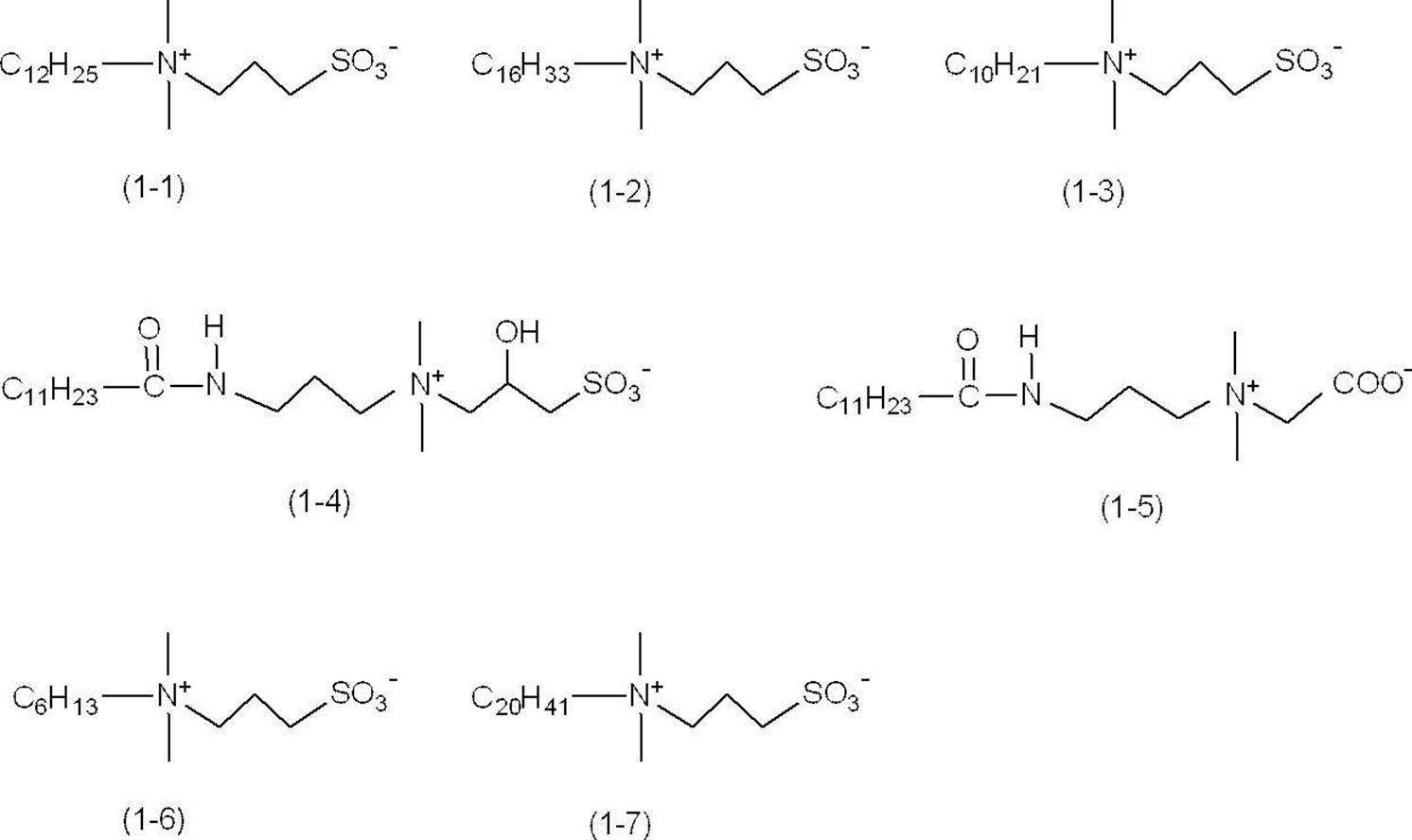
本開示のインクにおけるベタイン化合物(1)の含有量は、インクの全量に対し、好ましくは0.01質量%~10質量%であり、より好ましくは0.1質量%~3質量%であり、更に好ましくは0.1質量%~2質量%である。 The content of the betaine compound (1) in the ink of the present disclosure is preferably 0.01% by mass to 10% by mass, more preferably 0.1% by mass to 3% by mass, based on the total amount of the ink. More preferably, it is 0.1% by mass to 2% by mass.
<架橋された樹脂によって顔料の少なくとも一部が被覆されている樹脂被覆顔料>
本開示のインクは、架橋された樹脂によって顔料の少なくとも一部が被覆されている樹脂被覆顔料(以下、「架橋樹脂被覆顔料」ともいう)を少なくとも1種含有する。
架橋樹脂被覆顔料は、例えば、架橋されていない樹脂(以下、「未架橋樹脂」ともいう)を分散剤として用いて顔料を分散させることにより、未架橋樹脂によって顔料の少なくとも一部が被覆されている未架橋樹脂被覆顔料を得、得られた未架橋樹脂被覆顔料における未架橋樹脂(即ち、顔料の少なくとも一部を被覆している未架橋樹脂)を、架橋剤によって架橋することによって形成される。
<Resin-coated pigment in which at least a part of the pigment is coated with a crosslinked resin>
The ink of the present disclosure contains at least one resin-coated pigment (hereinafter, also referred to as “crosslinked resin-coated pigment”) in which at least a part of the pigment is coated with a crosslinked resin.
The crosslinked resin-coated pigment includes, for example, at least a part of the pigment coated with the uncrosslinked resin by dispersing the pigment using a non-crosslinked resin (hereinafter, also referred to as “uncrosslinked resin”) as a dispersant. The uncrosslinked resin-coated pigment is obtained, and the uncrosslinked resin (that is, the uncrosslinked resin covering at least a part of the pigment) in the obtained uncrosslinked resin-coated pigment is crosslinked with a crosslinking agent. ..
(顔料)
架橋樹脂被覆顔料における顔料としては、インクの分野において公知の有機顔料及び無機顔料を特に制限なく用いることができる。
顔料としては、例えば、アゾレーキ顔料、アゾ顔料、フタロシアニン顔料、ペリレン顔料、ペリノン顔料、アントラキノン顔料、キナクリドン顔料、ジオキサジン顔料、ジケトピロロピロール顔料、チオインジゴ顔料、イソインドリノン顔料、キノフタロン顔料等の多環式顔料;ニトロ顔料、ニトロソ顔料、アニリンブラック、昼光蛍光顔料等の有機顔料;酸化チタン、酸化鉄系、カーボンブラック系等の無機顔料;等が挙げられる。
顔料として、好ましくは、アゾ顔料、フタロシアニン顔料、アントラキノン顔料、キナクリドン顔料、又はカーボンブラック顔料である。
顔料については、特許第5404669号公報等の公知文献の記載を適宜参照してもよい。
(Pigment)
As the pigment in the crosslinked resin-coated pigment, organic pigments and inorganic pigments known in the field of ink can be used without particular limitation.
As the pigment, for example, polycyclic such as azo lake pigment, azo pigment, phthalocyanine pigment, perylene pigment, perinone pigment, anthraquinone pigment, quinacridone pigment, dioxazine pigment, diketopyrrolopyrrole pigment, thioindigo pigment, isoindolinone pigment, and quinophthalone pigment. Formula pigments; nitro pigments, nitroso pigments, aniline black, daylight fluorescent pigments and other organic pigments; titanium oxide, iron oxide-based, carbon black-based inorganic pigments and the like.
The pigment is preferably an azo pigment, a phthalocyanine pigment, an anthraquinone pigment, a quinacridone pigment, or a carbon black pigment.
Regarding the pigment, the description in known documents such as Japanese Patent No. 5404669 may be appropriately referred to.
本開示のインクにおける顔料濃度(即ち、インクの全量に対する顔料の含有量)としては、1質量%~20質量%が好ましく、1質量%~15質量%がより好ましく、1質量%~10質量%が更に好ましい。 The pigment concentration in the ink of the present disclosure (that is, the pigment content relative to the total amount of the ink) is preferably 1% by mass to 20% by mass, more preferably 1% by mass to 15% by mass, and 1% by mass to 10% by mass. Is more preferable.
(架橋された樹脂、及び、未架橋樹脂)
架橋樹脂被覆顔料における架橋された樹脂は、未架橋樹脂が架橋されることによって形成される。
未架橋樹脂として、好ましくは、水溶性樹脂である。
即ち、架橋樹脂被覆顔料における架橋された樹脂として、好ましくは、架橋された水溶性樹脂である。
(Crosslinked resin and uncrosslinked resin)
The crosslinked resin in the crosslinked resin-coated pigment is formed by crosslinking the uncrosslinked resin.
The uncrosslinked resin is preferably a water-soluble resin.
That is, the crosslinked resin in the crosslinked resin-coated pigment is preferably a crosslinked water-soluble resin.
本開示において、「水溶性樹脂」における「水溶性」とは、25℃の蒸留水に2質量%以上溶解する性質を意味する。
水溶性樹脂は、25℃の蒸留水に、5質量%以上溶解することが好ましく、10質量%以上溶解することがより好ましい。
なお、未架橋の水溶性樹脂が水溶性を有することは言うまでもないが、「架橋された水溶性樹脂」は、必ずしも水溶性を有している必要はない。
In the present disclosure, “water-soluble” in “water-soluble resin” means a property of being dissolved in distilled water at 25° C. in an amount of 2% by mass or more.
The water-soluble resin is preferably dissolved in distilled water at 25° C. in an amount of 5% by mass or more, more preferably 10% by mass or more.
Needless to say, the uncrosslinked water-soluble resin has water solubility, but the “crosslinked water-soluble resin” does not necessarily have water solubility.
未架橋の水溶性樹脂としては、ポリビニル類、ポリウレタン類、ポリエステル類等が挙げられるが、その中でもポリビニル類が好ましい。
未架橋の水溶性樹脂としては、架橋剤により架橋可能な官能基を有する水溶性樹脂が好ましい。
架橋可能な官能基としては、カルボキシ基又はその塩、イソシアナート基、エポキシ基等が挙げられるが、分散性向上の観点からカルボキシ基又はその塩が好ましく、カルボキシ基が特に好ましい。
Examples of the uncrosslinked water-soluble resin include polyvinyls, polyurethanes, polyesters and the like, and among them, polyvinyls are preferable.
The uncrosslinked water-soluble resin is preferably a water-soluble resin having a functional group that can be crosslinked with a crosslinking agent.
Examples of the crosslinkable functional group include a carboxy group or a salt thereof, an isocyanato group, an epoxy group and the like. From the viewpoint of improving dispersibility, a carboxy group or a salt thereof is preferable, and a carboxy group is particularly preferable.
未架橋の水溶性樹脂の好ましい態様である、カルボキシ基を有する水溶性樹脂としては、カルボキシ基含有モノマーに由来する構造単位(即ち、カルボキシ基含有モノマーが重合することによって形成される構造単位)を含む共重合体がより好ましい。
共重合体に含まれるカルボキシ基含有モノマーに由来する構造単位は、1種のみであってもよいし、2種以上であってもよい。
As the water-soluble resin having a carboxy group, which is a preferred embodiment of the uncrosslinked water-soluble resin, a structural unit derived from a carboxy group-containing monomer (that is, a structural unit formed by polymerization of a carboxy group-containing monomer) is used. Copolymers containing are more preferred.
The structural unit derived from the carboxy group-containing monomer contained in the copolymer may be only one type, or may be two or more types.
カルボキシ基含有モノマーとしては、(メタ)アクリル酸、β-カルボキシエチルアクリレート、フマル酸、イタコン酸、マレイン酸、クロトン酸等が挙げられる。
カルボキシ基含有モノマーとしては、架橋性および分散安定性の観点から、(メタ)アクリル酸又はβ-カルボキシエチルアクリレートが好ましく、(メタ)アクリル酸がより好ましい。
ここで、(メタ)アクリル酸は、アクリル酸及びメタクリル酸を包含する概念である。
Examples of the carboxy group-containing monomer include (meth)acrylic acid, β-carboxyethyl acrylate, fumaric acid, itaconic acid, maleic acid and crotonic acid.
The carboxy group-containing monomer is preferably (meth)acrylic acid or β-carboxyethyl acrylate, and more preferably (meth)acrylic acid, from the viewpoint of crosslinkability and dispersion stability.
Here, (meth) acrylic acid is a concept that includes acrylic acid and methacrylic acid.
カルボキシ基含有モノマーに由来する構造単位を含む共重合体は、更に、疎水性モノマーに由来する構造単位(即ち、疎水性モノマーが重合することによって形成される構造単位)を含むことが好ましい。
この場合、共重合体に含まれる疎水性モノマーに由来する構造単位は、1種のみであってもよいし、2種以上であってもよい。
疎水性モノマーとしては、炭素数1~20のアルキル基を有する(メタ)アクリレート、芳香環基を有する(メタ)アクリレート(例えば、ベンジル(メタ)アクリレート、フェノキシエチル(メタ)アクリレート等)、スチレン、スチレン誘導体、等が挙げられる。
The copolymer containing a structural unit derived from a carboxy group-containing monomer preferably further contains a structural unit derived from a hydrophobic monomer (that is, a structural unit formed by polymerizing a hydrophobic monomer).
In this case, the structural unit derived from the hydrophobic monomer contained in the copolymer may be only one kind or two or more kinds.
Examples of the hydrophobic monomer include (meth) acrylate having an alkyl group having 1 to 20 carbon atoms, (meth) acrylate having an aromatic ring group (for example, benzyl (meth) acrylate, phenoxyethyl (meth) acrylate, etc.), styrene, and the like. Examples thereof include styrene derivatives.
共重合体の合成方法は特に限定されないが、ビニルモノマーをランダム共重合させる方法が、分散安定性の点で好ましい。 The method for synthesizing the copolymer is not particularly limited, but a method in which vinyl monomers are randomly copolymerized is preferable in terms of dispersion stability.
未架橋樹脂の好ましい態様である、カルボキシ基を有する水溶性樹脂としては、
カルボキシル基含有モノマーに由来する構造単位と、炭素数1~20のアルキル基を有する(メタ)アクリレートに由来する構造単位及び芳香環基を有する(メタ)アクリレートに由来する構造単位の少なくとも一方と、を含む共重合体がより好ましく、
(メタ)アクリル酸に由来する構造単位と、芳香環基を有する(メタ)アクリレートに由来する構造単位と、を含む共重合体が更に好ましく、
(メタ)アクリル酸に由来する構造単位と、ベンジル(メタ)アクリレートに由来する構造単位と、を含む共重合体が更に好ましい。
As a water-soluble resin having a carboxy group, which is a preferred embodiment of the uncrosslinked resin,
A structural unit derived from a carboxyl group-containing monomer, at least one of a structural unit derived from a (meth)acrylate having an alkyl group having 1 to 20 carbon atoms and a structural unit derived from a (meth)acrylate having an aromatic ring group, Copolymers containing are more preferred,
A copolymer containing a structural unit derived from (meth) acrylic acid and a structural unit derived from (meth) acrylate having an aromatic ring group is more preferable.
A copolymer containing a structural unit derived from (meth) acrylic acid and a structural unit derived from benzyl (meth) acrylate is more preferable.
未架橋樹脂の酸価は、顔料の分散性の観点から、67mgKOH/g~200mgKOH/gが好ましく、67mgKOH/g~150mgKOH/gがより好ましい。
また、架橋された樹脂の酸価は、顔料の分散性の観点から、55~100mgKOH/gが好ましい。
The acid value of the uncrosslinked resin is preferably 67 mgKOH / g to 200 mgKOH / g, more preferably 67 mgKOH / g to 150 mgKOH / g, from the viewpoint of pigment dispersibility.
The acid value of the crosslinked resin is preferably 55 to 100 mgKOH/g from the viewpoint of dispersibility of the pigment.
未架橋樹脂の重量平均分子量(Mw)は、特に制限されないが、顔料の分散性の観点から、3,000~100,000であることが好ましく、5,000~80,000であることがより好ましく、10,000~60,000が更に好ましい。
架橋された樹脂の重量平均分子量の好ましい範囲も、未架橋樹脂の重量平均分子量の好ましい範囲と同様である。
The weight average molecular weight (Mw) of the uncrosslinked resin is not particularly limited, but is preferably 3,000 to 100,000, more preferably 5,000 to 80,000 from the viewpoint of pigment dispersibility. It is preferable, and more preferably 10,000 to 60,000.
The preferable range of the weight average molecular weight of the crosslinked resin is the same as the preferable range of the weight average molecular weight of the uncrosslinked resin.
本開示において、重量平均分子量(Mw)は、ゲルパーミエーションクロマトグラフィ(GPC)により測定される。GPCは、HLC-8220GPC(東ソー(株)製)を用い、カラムとして、TSKgeL SuperHZM-H、TSKgeL SuperHZ4000、TSKgel
SuperHZ2000(いずれも東ソー(株)製の商品名)を用いて3本直列につなぎ、溶離液としてTHF(テトラヒドロフラン)を用いる。また、条件としては、試料濃度を0.45質量%、流速を0.35ml/min、サンプル注入量を10μl、測定温度を40℃とし、示差屈折率検出器を用いて行なう。また、検量線は、東ソー(株)製「標準試料TSK standard,polystyrene」:「F-40」、「F-20」、「F-4」、「F-1」、「A-5000」、「A-2500」、「A-1000」、「n-プロピルベンゼン」の8サンプルから作成する。
In the present disclosure, the weight average molecular weight (Mw) is measured by gel permeation chromatography (GPC). HLC-8220GPC (manufactured by Tosoh Corp.) was used as the GPC, and TSKgeL SuperHZM-H, TSKgeL SuperHZ4000, TSKgel were used as columns.
SuperHZ2000 (all are trade names of Tosoh Corporation) are connected in series, and THF (tetrahydrofuran) is used as an eluent. The conditions are as follows: the sample concentration is 0.45% by mass, the flow rate is 0.35 ml / min, the sample injection amount is 10 μl, the measurement temperature is 40 ° C., and a differential refractive index detector is used. Further, the calibration curve is “standard sample TSK standard, polystyrene” manufactured by Tosoh Corporation: “F-40”, “F-20”, “F-4”, “F-1”, “A-5000”, It is prepared from 8 samples of "A-2500", "A-1000", and "n-propylbenzene".
(架橋剤)
架橋された樹脂として、好ましくは、架橋剤によって架橋された樹脂である。
架橋剤によって架橋された樹脂は、未架橋樹脂を架橋剤によって架橋することによって形成される。
架橋された樹脂の形成において、架橋剤は、1種のみ用いてもよいし、2種以上用いてもよい。
(Crosslinking agent)
The crosslinked resin is preferably a resin crosslinked with a crosslinking agent.
The resin crosslinked with the crosslinking agent is formed by crosslinking the uncrosslinked resin with the crosslinking agent.
In the formation of the crosslinked resin, the crosslinking agent may be used alone or in combination of two or more.
架橋剤としては、未架橋樹脂(例えば、カルボキシ基を有する水溶性樹脂)との反応部位を2つ以上有する化合物が好ましい。
架橋剤と未架橋樹脂との好ましい組み合わせは、架橋剤としての、2つ以上のエポキシ基を有する化合物(即ち、2官能以上のエポキシ化合物)と、未架橋樹脂としての、前述のカルボキシ基を有する水溶性樹脂と、の組み合わせである。この組み合わせでは、カルボキシ基を有する水溶性樹脂におけるカルボキシ基と、2つ以上のエポキシ基を有する化合物におけるエポキシ基と、の反応により、架橋構造が形成され、これにより、架橋された樹脂が形成される。かかる架橋構造の形成は、好ましくは、カルボキシ基を有する水溶性樹脂によって顔料を分散させた後(即ち、未架橋樹脂被覆顔料を形成した後)に行われる。
As the cross-linking agent, a compound having two or more reaction sites with an uncross-linked resin (for example, a water-soluble resin having a carboxy group) is preferable.
A preferable combination of the cross-linking agent and the non-cross-linking resin has a compound having two or more epoxy groups as the cross-linking agent (that is, a bifunctional or higher functional epoxy compound) and the above-mentioned carboxy group as the non-cross-linking resin. It is a combination with a water-soluble resin. In this combination, a crosslinked structure is formed by the reaction between the carboxy group in the water-soluble resin having a carboxy group and the epoxy group in the compound having two or more epoxy groups, thereby forming a crosslinked resin. To. The formation of such a crosslinked structure is preferably carried out after dispersing the pigment with a water-soluble resin having a carboxy group (that is, after forming an uncrosslinked resin-coated pigment).
架橋剤の好ましい態様である2官能以上のエポキシ化合物の具体例としては、エチレングリコールジグリシジルエーテル、ポリエチレングリコールジグリシジルエーテル、1,6-へキサンジオールジグリシジルエーテル、ジエチレングリコールジグリシジルエーテル、ポリエチレングリコールジグリシジルエーテル、ジプロピレングリコールジグリシジルエーテル、ポリプロピレングリコールジグリシジルエーテル、トリメチロールプロパントリグリシジルエーテル等が挙げられる。
中でも、ポリエチレングリコールジグリシジルエーテル、ジエチレングリコールジグリシジルエーテル、又はトリメチロールプロパントリグリシジルエーテルが好ましい。
Specific examples of the bifunctional or higher functional epoxy compound which is a preferable embodiment of the crosslinking agent include ethylene glycol diglycidyl ether, polyethylene glycol diglycidyl ether, 1,6-hexanediol diglycidyl ether, diethylene glycol diglycidyl ether, and polyethylene glycol diglyceride. Examples thereof include glycidyl ether, dipropylene glycol diglycidyl ether, polypropylene glycol diglycidyl ether, and trimethylolpropane triglycidyl ether.
Of these, polyethylene glycol diglycidyl ether, diethylene glycol diglycidyl ether, or trimethylolpropane triglycidyl ether is preferable.
架橋剤としては、市販品を用いることもできる。
市販品としては、例えば、Denacol EX-321、EX-821、EX-830、EX-850、EX-851(ナガセケムテックス(株)製)等を用いることができる。
A commercial item can also be used as a crosslinking agent.
As commercially available products, for example, Denacol EX-321, EX-821, EX-830, EX-850, EX-851 (manufactured by Nagase Chemtex Co., Ltd.) and the like can be used.
架橋剤における架橋部位(例えばエポキシ基)と、未架橋樹脂における被架橋部位(例えばカルボキシ基)と、のモル比〔架橋剤における架橋部位(例えばエポキシ基):未架橋樹脂における被架橋部位(例えばカルボキシ基)〕は、架橋反応速度及び/又は架橋後の分散液安定性の観点から、1:1.1~1:10が好ましく、1:1.1~1:5がより好ましく、1:1.1~1:3が更に好ましい。 Molar ratio of cross-linking site in cross-linking agent (eg epoxy group) to cross-linking site in non-cross-linking resin (eg carboxy group) [cross-linking site in cross-linking agent (eg epoxy group): cross-linking site in non-cross-linking resin (eg [Carboxyl group]] is preferably 1:1.1 to 1:10, more preferably 1:1.1 to 1:5, and 1: from the viewpoint of the crosslinking reaction rate and/or the dispersion stability after crosslinking. 1.1 to 1:3 are more preferable.
また、架橋樹脂被覆顔料において、架橋された樹脂に対する顔料の質量比(以下、質量比〔顔料/架橋された樹脂〕)は、好ましくは0.1~1.5であり、より好ましくは0.2~1.0である。 Further, in the crosslinked resin-coated pigment, the mass ratio of the pigment to the crosslinked resin (hereinafter, mass ratio [pigment / crosslinked resin]) is preferably 0.1 to 1.5, and more preferably 0. It is 2 to 1.0.
架橋樹脂被覆顔料の体積平均粒径としては、10nm~200nmが好ましく、10nm~150nmがより好ましく、40nm~150nmが更に好ましく、50nm~150nmが更に好ましい。 The volume average particle diameter of the crosslinked resin-coated pigment is preferably 10 nm to 200 nm, more preferably 10 nm to 150 nm, further preferably 40 nm to 150 nm, further preferably 50 nm to 150 nm.
本開示において、体積平均粒径は、動的光散乱法によって求められた値を指す。
体積平均粒径の測定は、例えば、ナノトラック粒度分布測定装置UPA-EX150(日機装社製)を用いて行う。
In the present disclosure, the volume average particle size refers to a value obtained by a dynamic light scattering method.
The volume average particle size is measured, for example, by using a nanotrack particle size distribution measuring device UPA-EX150 (manufactured by Nikkiso Co., Ltd.).
本開示のインクにおいて、架橋樹脂被覆顔料の含有量としては、インクの全量に対し、1.5質量%~25質量%が好ましく、2質量%~20質量%がより好ましく、2質量%~15質量%が更に好ましい。 In the ink of the present disclosure, the content of the crosslinked resin-coated pigment is preferably 1.5% by mass to 25% by mass, more preferably 2% by mass to 20% by mass, and further preferably 2% by mass to 15% by mass with respect to the total amount of the ink. Mass% is more preferable.
<水>
本開示のインクは、水を含有する。
本開示のインクにおける水の含有量は、インクの全量に対し、例えば40質量%以上であり、好ましくは50質量%以上であり、更に好ましくは60質量%以上である。
水の含有量の上限は、他の成分の量による。水の含有量の上限は、インクの全量に対し、例えば95質量%であり、好ましくは90質量%である。
<Water>
The ink of the present disclosure contains water.
The water content in the ink of the present disclosure is, for example, 40% by mass or more, preferably 50% by mass or more, and more preferably 60% by mass or more with respect to the total amount of the ink.
The upper limit of water content depends on the amount of other ingredients. The upper limit of the water content is, for example, 95% by mass, preferably 90% by mass, based on the total amount of the ink.
<有機溶剤A>
本開示のインクは、更に、下記式(A1)又は下記式(A2)で表される化合物である有機溶剤Aを含有してもよい。
本開示のインクが有機溶剤Aを含有する場合、本開示のインクに含有される有機溶剤Aは1種のみであってもよいし2種以上であってもよい。
<Organic solvent A>
The ink of the present disclosure may further contain an organic solvent A which is a compound represented by the following formula (A1) or the following formula (A2).
When the ink of the present disclosure contains the organic solvent A, the organic solvent A contained in the ink of the present disclosure may be only one kind or two or more kinds.

式(A1)中、RA11は、炭素数4~9の鎖状炭化水素基又は炭素数6~10のアリール基を表し、RA12は、水素原子又はメチル基を表し、nは、1~3の整数を表す。
式(A2)中、RA21は、炭素数4~9の鎖状炭化水素基又は炭素数6~10のアリール基を表す。
In the formula (A1), RA11 represents a chain hydrocarbon group having 4 to 9 carbon atoms or an aryl group having 6 to 10 carbon atoms, RA12 represents a hydrogen atom or a methyl group, and n represents 1 to 1 to Represents an integer of 3.
In the formula (A2), RA21 represents a chain hydrocarbon group having 4 to 9 carbon atoms or an aryl group having 6 to 10 carbon atoms.
本開示のインクが有機溶剤Aを含有する場合には、インクの表面張力をより低減できる。このため、インクによって形成される画質の向上の面で有利である。 When the ink of the present disclosure contains the organic solvent A, the surface tension of the ink can be further reduced. Therefore, it is advantageous in terms of improving the image quality formed by the ink.
架橋樹脂被覆顔料を含有しないインク(例えば、架橋剤樹脂被覆顔料の代わりに未架橋樹脂被覆顔料を含有するインク)が更に有機溶剤Aを含有する場合には、架橋樹脂被覆顔料を含有するインクが更に有機溶剤Aを含有する場合と比較して、インクの保存安定性が低下しやすい傾向がある。この理由は、有機溶剤Aと、未架橋樹脂被覆顔料中の未架橋樹脂(好ましくは水溶性樹脂)と、の親和性が高いことから、未架橋樹脂被覆顔料における顔料から未架橋樹脂が剥れやすくなり、その結果、顔料の分散安定性が低下しやすくなるためと考えられる。
樹脂被覆顔料における樹脂が架橋されていることにより、上記有機溶剤Aを含有する場合においても、インクの保存安定性に優れる。
従って、本開示のインクが有機溶剤Aを含有する場合には、樹脂を架橋したことによる改善幅(保存安定性の改善幅)がより大きくなる。
When the ink containing no crosslinked resin-coated pigment (for example, the ink containing an uncrosslinked resin-coated pigment instead of the crosslinker resin-coated pigment) further contains the organic solvent A, the ink containing the crosslinked resin-coated pigment is Further, as compared with the case where the organic solvent A is contained, the storage stability of the ink tends to decrease. The reason for this is that the organic solvent A and the uncrosslinked resin (preferably a water-soluble resin) in the uncrosslinked resin-coated pigment have high affinity, so that the uncrosslinked resin peels from the pigment in the uncrosslinked resin-coated pigment. It is considered that the dispersion stability of the pigment is apt to decrease as a result.
Since the resin in the resin coating pigment is crosslinked, the storage stability of the ink is excellent even when the organic solvent A is contained.
Therefore, when the ink of the present disclosure contains the organic solvent A, the improvement width (improvement width of storage stability) due to the cross-linking of the resin becomes larger.
式(A1)中のRA11で表される炭素数4~9の鎖状炭化水素基及び式(A2)中のRA21で表される炭素数4~9の鎖状炭化水素基は、それぞれ、直鎖の炭化水素基であってもよいし、分岐を有する炭化水素基であってもよい。
RA11で表される炭素数4~9の鎖状炭化水素基及びRA21で表される炭素数4~9の鎖状炭化水素基の各々は、好ましくは、炭素数4~9のアルキル基である。
RA11で表される炭素数4~9の鎖状炭化水素基及びRA21で表される炭素数4~9の鎖状炭化水素基の各々の炭素数は、好ましくは6~8である。
The chain hydrocarbon group having 4 to 9 carbon atoms represented by RA11 in the formula (A1) and the chain hydrocarbon group having 4 to 9 carbon atoms represented by RA21 in the formula (A2) are each. It may be a straight chain hydrocarbon group or a branched hydrocarbon group.
Each chain hydrocarbon group which chain hydrocarbon group and 4 carbon atoms represented by R A21 ~ 9 carbon atoms 4-9 represented by R A11 is preferably an alkyl group having 4 to 9 carbon atoms Is.
Each of the carbon atoms of chain hydrocarbon group which chain hydrocarbon 4 carbon atoms represented by group and R A21 ~ 9 carbon atoms 4-9 represented by R A11 is preferably 6-8.
式(A1)中のRA11で表される炭素数6~10のアリール基及び式(A2)中のRA21で表される炭素数6~10のアリール基の各々としては、フェニル基又はナフチル基が好ましく、フェニル基がより好ましい。 Each of the aryl group having 6 to 10 carbon atoms represented by R A11 in the formula (A1) and the aryl group having 6 to 10 carbon atoms represented by R A21 in the formula (A2) is a phenyl group or naphthyl. A group is preferable, and a phenyl group is more preferable.
式(A1)中、nは、1~3の整数を表す。
nは、インクの表面張力をより低減させる観点から、1又は2であることが好ましく、1であることがより好ましい。
In formula (A1), n represents an integer of 1 to 3.
From the viewpoint of further reducing the surface tension of the ink, n is preferably 1 or 2, and more preferably 1.
有機溶剤Aは、ClogP値が0.5~3.5であることが好ましく、1.5~3.0であることがより好ましく、1.7~3.0であることが更に好ましい。
有機溶剤AのClogP値が、0.5以上である場合には、形成画像の画質がより向上する。
有機溶剤AのClogP値が、3.5以下である場合には、インクの保存安定性がより向上する。
The ClogP value of the organic solvent A is preferably 0.5 to 3.5, more preferably 1.5 to 3.0, and further preferably 1.7 to 3.0.
When the ClogP value of the organic solvent A is 0.5 or more, the image quality of the formed image is further improved.
When the ClogP value of the organic solvent A is 3.5 or less, the storage stability of the ink is further improved.
本開示において、ClogP値は、疎水性の程度を示す値である。ClogP値が大きい程、疎水性が高いことを示す。
本開示におけるClogP値は、ChemBioDrawUltra 13.0(パーキンエルマー社製)を用いて計算される。
In the present disclosure, the ClogP value is a value indicating the degree of hydrophobicity. The larger the ClogP value, the higher the hydrophobicity.
The ClogP value in the present disclosure is calculated using ChemBioDrawUltra 13.0 (manufactured by PerkinElmer).
有機溶剤Aのうち、式(A1)で表される化合物としては、例えば、エチレングリコールモノブチルエーテル、エチレングリコールモノペンチルエーテル、エチレングリコールモノヘキシルエーテル、エチレングリコールモノヘプチルエーテル、エチレングリコールモノオクチルエーテル、エチレングリコールモノノニルエーテル、エチレングリコールモノ-2-エチルヘキシルエーテル等のエチレングリコールモノアルキルエーテル;ジエチレングリコールモノブチルエーテル、ジエチレングリコールモノペンチルエーテル、ジエチレングリコールモノヘキシルエーテル、ジエチレングリコールモノヘプチルエーテル、ジエチレングリコールモノオクチルエーテル、ジエチレングリコールモノノニルエーテル、ジエチレングリコールモノ-2-エチルヘキシルエーテル等のジエチレングリコールモノアルキルエーテル;トリエチレングリコールモノブチルエーテル、トリエチレングリコールモノペンチルエーテル、トリエチレングリコールモノヘキシルエーテル、トリエチレングリコールモノヘプチルエーテル、トリエチレングリコールモノオクチルエーテル、トリエチレングリコールモノノニルエーテル、トリエチレングリコールモノ-2-エチルヘキシルエーテル等のトリエチレングリコールモノアルキルエーテル;プロピレングリコールモノブチルエーテル、プロピレングリコールモノペンチルエーテル、プロピレングリコールモノヘキシルエーテル、プロピレングリコールモノヘプチルエーテル、プロピレングリコールモノオクチルエーテル、プロピレングリコールモノ-2-エチルヘキシルエーテル等のプロピレングリコールモノアルキルエーテル;ジプロピレングリコールモノブチルエーテル、ジプロピレングリコールモノペンチルエーテル、ジプロピレングリコールモノヘキシルエーテル、ジプロピレングリコールモノヘプチルエーテル、ジプロピレングリコールモノオクチルエーテル、ジプロピレングリコールモノ-2-エチルヘキシルエーテル等のジプロピレングリコールモノアルキルエーテル;、トリプロピレングリコールモノブチルエーテル、トリプロピレングリコールモノペンチルエーテル、トリプロピレングリコールモノヘキシルエーテル、トリプロピレングリコールモノヘプチルエーテル、トリプロピレングリコールモノオクチルエーテル、トリプロピレングリコールモノ-2-エチルヘキシルエーテル等のトリプロピレングリコールモノアルキルエーテル;等が挙げられる。 Among the organic solvents A, examples of the compound represented by the formula (A1) include ethylene glycol monobutyl ether, ethylene glycol monopentyl ether, ethylene glycol monohexyl ether, ethylene glycol monoheptyl ether, ethylene glycol monooctyl ether, and ethylene. Ethylene glycol monoalkyl ethers such as glycol monononyl ether and ethylene glycol mono-2-ethylhexyl ether; diethylene glycol monobutyl ether, diethylene glycol monopentyl ether, diethylene glycol monohexyl ether, diethylene glycol monoheptyl ether, diethylene glycol monooctyl ether, diethylene glycol monononyl ether, Diethylene glycol monoalkyl ethers such as diethylene glycol mono-2-ethylhexyl ether; triethylene glycol monobutyl ether, triethylene glycol monopentyl ether, triethylene glycol monohexyl ether, triethylene glycol monoheptyl ether, triethylene glycol monooctyl ether, triethylene Triethylene glycol monoalkyl ethers such as glycol monononyl ether and triethylene glycol mono-2-ethylhexyl ether; propylene glycol monobutyl ether, propylene glycol monopentyl ether, propylene glycol monohexyl ether, propylene glycol monoheptyl ether, propylene glycol monooctyl Ether, propylene glycol monoalkyl ether such as propylene glycol mono-2-ethylhexyl ether; dipropylene glycol monobutyl ether, dipropylene glycol monopentyl ether, dipropylene glycol monohexyl ether, dipropylene glycol monoheptyl ether, dipropylene glycol monooctyl Ether, dipropylene glycol monoalkyl ether such as dipropylene glycol mono-2-ethylhexyl ether; tripropylene glycol monobutyl ether, tripropylene glycol monopentyl ether, tripropylene glycol monohexyl ether, tripropylene glycol monoheptyl ether, tripropylene Glycol monooctyl ether, tripropylene glycol mono-2-ethyl Tripropylene glycol monoalkyl ether such as xyl ether; and the like.
有機溶剤Aのうち、式(A2)で表される化合物としては、例えば、1,2-ヘキサンジオール、1,2-ヘプタンジオール、1,2-オクタンジオール、1,2-ノナンジオール、1,2-デカンジオール等のアルカンジオールが挙げられる。 Among the organic solvents A, examples of the compound represented by the formula (A2) include 1,2-hexanediol, 1,2-heptanediol, 1,2-octanediol, 1,2-nonanediol, and 1, Examples thereof include alkanediol such as 2-decanediol.
有機溶剤Aとしては、エチレングリコールモノヘキシルエーテル、ジエチレングリコールモノヘキシルエーテル、ジエチレングリコールモノ-2-エチルヘキシルエーテル、又は1,2-オクタンジオールが好ましい。 As the organic solvent A, ethylene glycol monohexyl ether, diethylene glycol monohexyl ether, diethylene glycol mono-2-ethylhexyl ether, or 1,2-octanediol is preferable.
本開示のインクが有機溶剤Aを含有する場合、有機溶剤Aの含有量は、インクの全量に対し、好ましくは0.1質量%~15質量%であり、より好ましくは0.5質量%~10質量%であり、更に好ましくは1.0質量%~5.0質量%である。
有機溶剤Aの含有量が0.1質量%以上である場合には、形成される画像の画質の面で有利である。
有機溶剤Aの含有量が15質量%以下である場合には、インクの保存安定性の面で有利である。
When the ink of the present disclosure contains the organic solvent A, the content of the organic solvent A is preferably 0.1% by mass to 15% by mass, more preferably 0.5% by mass or more, based on the total amount of the ink. It is 10% by mass, more preferably 1.0% by mass to 5.0% by mass.
When the content of the organic solvent A is 0.1% by mass or more, it is advantageous in terms of image quality of an image formed.
When the content of the organic solvent A is 15% by mass or less, it is advantageous in terms of storage stability of the ink.
本開示のインクが有機溶剤Aを含有する場合、ベタイン化合物(1)の含有質量に対する有機溶剤Aの含有質量の比(以下、「含有質量比〔有機溶剤A/ベタイン化合物(1)〕ともいう)は、好ましくは0.5~100であり、より好ましくは1~50であり、更に好ましくは2~10である。
含有質量比〔有機溶剤A/ベタイン化合物(1)〕が0.5以上である場合、形成される画像の画質の面で有利である。
含有質量比〔有機溶剤A/ベタイン化合物(1)〕が100以下である場合、色間滲み抑制の面で有利である。
When the ink of the present disclosure contains the organic solvent A, the ratio of the content mass of the organic solvent A to the content mass of the betaine compound (1) (hereinafter, also referred to as “content mass ratio [organic solvent A / betaine compound (1)]]. ) Is preferably 0.5 to 100, more preferably 1 to 50, and further preferably 2 to 10.
When the content mass ratio [organic solvent A/betaine compound (1)] is 0.5 or more, it is advantageous in terms of the image quality of the formed image.
When the content mass ratio [organic solvent A / betaine compound (1)] is 100 or less, it is advantageous in terms of suppressing intercolor bleeding.
<その他の有機溶剤>
本開示のインクは、有機溶剤A以外のその他の有機溶剤を含有していてもよい。
その他の有機溶剤としては、例えば、インクの乾燥性の観点から、有機溶剤A以外の有機溶剤であって、かつ、20℃における蒸気圧が1.0Pa以上である有機溶剤Bが挙げられる。
なお、20℃における蒸気圧が1.0Pa以上である有機溶剤であっても、有機溶剤Aに該当するものは、有機溶剤Bには含まれないものとする。
<Other organic solvents>
The ink of the present disclosure may contain another organic solvent other than the organic solvent A.
Examples of other organic solvents include organic solvents B other than organic solvent A and having a vapor pressure of 1.0 Pa or more at 20 ° C. from the viewpoint of ink drying property.
Even if the vapor pressure at 20 ° C. is 1.0 Pa or more, the organic solvent corresponding to the organic solvent A is not included in the organic solvent B.
有機溶剤Bの20℃における蒸気圧は、1.0Pa以上であることが好ましく、2.0Pa以上であることがより好ましく、10Pa以上であることが更に好ましい。
有機溶剤Bの20℃における蒸気圧は、公知の方法により測定されるが、例えば、静止法によって求めることができる。静止法は、試料の固体と平衡にある蒸気の圧力を直接又は間接的に測定する方法であり、OECDガイドライン104に従って実施される。
The vapor pressure of the organic solvent B at 20° C. is preferably 1.0 Pa or higher, more preferably 2.0 Pa or higher, and even more preferably 10 Pa or higher.
Although the vapor pressure of the organic solvent B at 20° C. is measured by a known method, it can be determined by, for example, the static method. The static method is a method of directly or indirectly measuring the pressure of vapor in equilibrium with the solid of a sample, and is performed according to the OECD guideline 104.
有機溶剤BのClogP値は、-3.0~0であることが好ましく、-2.0~0であることがより好ましい。 The ClogP value of the organic solvent B is preferably −3.0 to 0, and more preferably −2.0 to 0.
本開示のインクが有機溶剤Bを含有する場合、有機溶剤Bの含有量は、インクの吐出性及び乾燥性の観点から、インクの全量に対し、1質量%~30質量%であることが好ましく、5質量%~25質量%であることが好ましく、10質量%~20質量%であることがより好ましい。 When the ink of the present disclosure contains an organic solvent B, the content of the organic solvent B is preferably 1% by mass to 30% by mass with respect to the total amount of the ink from the viewpoint of ink ejection property and dryness. It is preferably 5% by mass to 25% by mass, and more preferably 10% by mass to 20% by mass.
また、本開示のインクが有機溶剤A及び有機溶剤Bを含有する場合、有機溶剤Aと有機溶剤Bとの合計含有量は、インクの吐出性及び乾燥性の観点から、インクの全量に対し、6質量%~40質量%であることが好ましく、10質量%~30質量%であることがより好ましく、15質量%~25質量%であることが更に好ましい。
また、有機溶剤Aに対する有機溶剤Bとの含有質量比(含有質量比〔有機溶剤B/有機溶剤A〕)は、インクの吐出性及び乾燥性の観点から、1~15であることが好ましく、2~10であることがより好ましく、3~8であることが更に好ましい。
When the ink of the present disclosure contains the organic solvent A and the organic solvent B, the total content of the organic solvent A and the organic solvent B is, with respect to the ejection amount and the drying property of the ink, the total amount of the ink, It is preferably 6% by mass to 40% by mass, more preferably 10% by mass to 30% by mass, and further preferably 15% by mass to 25% by mass.
Further, the content mass ratio of the organic solvent A to the organic solvent B (content mass ratio [organic solvent B / organic solvent A]) is preferably 1 to 15 from the viewpoint of ink ejection property and dryness. It is more preferably 2 to 10, and even more preferably 3 to 8.
有機溶剤Bとしては、ジエチレングリコール(20℃における蒸気圧:2.7Pa、ClogP値:-1.30)、ジプロピレングリコール(20℃における蒸気圧:1.3Pa、ClogP値:-0.69)、プロピレングリコール(20℃における蒸気圧:10.6Pa、ClogP値:-1.06)、1,2-ブタンジオール(20℃における蒸気圧:2.7Pa、ClogP値:-0.53)等が挙げられる。 As the organic solvent B, diethylene glycol (vapor pressure at 20° C.: 2.7 Pa, ClogP value: −1.30), dipropylene glycol (vapor pressure at 20° C.: 1.3 Pa, ClogP value: −0.69), Propylene glycol (vapor pressure at 20°C: 10.6 Pa, ClogP value: -1.06), 1,2-butanediol (vapor pressure at 20°C: 2.7 Pa, ClogP value: -0.53), etc. To be
<樹脂粒子>
本開示のインクは、樹脂粒子を含有することが好ましい。
これにより、形成される画像の強度及び耐擦性がより向上する。
本開示において、樹脂粒子は、樹脂からなる粒子である点で、前述の架橋樹脂被覆顔料及び未架橋樹脂被覆顔料と区別される。
<Resin particles>
The ink of the present disclosure preferably contains resin particles.
As a result, the strength and abrasion resistance of the formed image are further improved.
In the present disclosure, the resin particles are distinguished from the above-mentioned crosslinked resin-coated pigments and uncrosslinked resin-coated pigments in that they are particles made of resin.
樹脂粒子を構成する樹脂としては、アクリル樹脂、ウレタン樹脂、ポリエステル樹脂、等が挙げられる。中でも、アクリル樹脂が好ましい。
ここで、アクリル樹脂とは、アクリル酸、アクリル酸の誘導体(例えば、アクリル酸エステル等)、メタクリル酸、及びメタクリル酸の誘導体(例えば、メタクリル酸エステル等)からなる群から選択される少なくとも1種を含む原料モノマーの重合体(単独重合体又は共重合体)を意味する。
Examples of the resin forming the resin particles include acrylic resin, urethane resin, polyester resin and the like. Among them, acrylic resin is preferable.
Here, the acrylic resin is at least one selected from the group consisting of acrylic acid, acrylic acid derivatives (eg, acrylic acid ester), methacrylic acid, and methacrylic acid derivatives (eg, methacrylic acid ester). It means a polymer (monopolymer or copolymer) of a raw material monomer containing.
樹脂粒子を構成する樹脂は、樹脂粒子の分散性の観点から、アニオン性基を有することが好ましい。
ここで、アニオン性基とは、インク中でアニオンを形成する基を指す。
アニオン性基としては、カルボキシ基、カルボキシ基の塩、スルホ基、スルホ基の塩、硫酸基、硫酸基の塩、ホスホン酸基、ホスホン酸基の塩、リン酸基、及びリン酸基の塩からなる群から選択される少なくとも1種がより好ましく、カルボキシ基及びカルボキシ基の塩からなる群から選択される少なくとも1種が更に好ましい。
上述した、カルボキシ基の塩、スルホ基の塩、硫酸基の塩、ホスホン酸基の塩、及びリン酸基の塩における「塩」としては、アルカリ金属塩、アルカリ土類金属塩、又は有機アミン塩が好ましく、アルカリ金属塩がより好ましい。
The resin constituting the resin particles preferably has an anionic group from the viewpoint of dispersibility of the resin particles.
Here, the anionic group refers to a group that forms an anion in the ink.
As the anionic group, a carboxy group, a salt of a carboxy group, a sulfo group, a salt of a sulfo group, a sulfuric acid group, a salt of a sulfuric acid group, a phosphonic acid group, a salt of a phosphonic acid group, a phosphoric acid group, and a salt of a phosphoric acid group. At least one selected from the group consisting of carboxy groups is more preferable, and at least one selected from the group consisting of carboxy groups and salts of carboxy groups is even more preferable.
The above-mentioned "salt" in the salt of carboxy group, the salt of sulfo group, the salt of sulfuric acid group, the salt of phosphonic acid group, and the salt of phosphoric acid group is an alkali metal salt, an alkaline earth metal salt, or an organic amine. Salts are preferred and alkali metal salts are more preferred.
樹脂粒子を構成する樹脂がアニオン性基を有する場合において、樹脂1g当たりのアニオン性基のミリモル数を樹脂の酸価とした場合、樹脂の酸価は、樹脂粒子の分散性の観点から、0.05mmol/g~0.7mmol/gであることが好ましく、0.1mmol/g~0.4mmol/gであることがより好ましい。 When the resin constituting the resin particles has an anionic group and the acid number of the resin is the number of millimoles of the anionic group per 1 g of the resin, the acid value of the resin is 0 from the viewpoint of dispersibility of the resin particles. It is preferably from 0.05 mmol/g to 0.7 mmol/g, more preferably from 0.1 mmol/g to 0.4 mmol/g.
樹脂粒子を構成する樹脂の重量平均分子量(Mw)としては、10,000~1,000,000が好ましく、20,000~500,000がより好ましい。 The weight average molecular weight (Mw) of the resin constituting the resin particles is preferably 10,000 to 1,000,000, more preferably 20,000 to 500,000.
樹脂粒子を構成する樹脂のガラス転移温度(Tg)は、得られる画像の耐擦性の観点から、30℃~120℃が好ましく、50℃~100℃がより好ましく、70℃~100℃が更に好ましい。 The glass transition temperature (Tg) of the resin constituting the resin particles is preferably 30° C. to 120° C., more preferably 50° C. to 100° C., and further preferably 70° C. to 100° C. from the viewpoint of the abrasion resistance of the image obtained. preferable.
上記ガラス転移温度(Tg)としては、実測によって得られる測定Tgを適用する。
測定Tgは、示差走査熱量計(DSC)を用いて測定された値を意味する。示差走査熱量計(DSC)としては、例えば、エスアイアイ・ナノテクノロジー(株)製の示差走査熱量計(DSC)EXSTAR6220を用いることができる。
ただし、材料の分解等により測定Tgの測定が困難な場合には、下記の計算式で算出される計算Tgを適用する。計算Tgは下記の式(F1)で計算される値である。
1/Tg=Σ(Xi/Tgi) …(F1)
式(F1)では、計算対象となるポリマーが、i=1からnまでのn種のモノマーの共重合体であることを前提としている。
式(F1)中、Xiはi番目のモノマーの質量分率(ΣXi=1)であり、Tgiはi番目のモノマーの単独重合体のガラス転移温度(絶対温度)である。ただし、Σはi=1からnまでの和をとる。
なお、各モノマーの単独重合体ガラス転移温度の値(Tgi)は、Polymer Handbook (3rd Edition) (J.Brandrup, E.H.Immergut著(Wiley-Interscience、1989))の値を採用する。
As the glass transition temperature (Tg), the measured Tg obtained by actual measurement is applied.
The measured Tg means a value measured using a differential scanning calorimeter (DSC). As the differential scanning calorimeter (DSC), for example, a differential scanning calorimeter (DSC) EXSTAR6220 manufactured by SII Nanotechnology Co., Ltd. can be used.
However, when it is difficult to measure the measured Tg due to decomposition of the material or the like, the calculated Tg calculated by the following formula is applied. The calculated Tg is a value calculated by the following formula (F1).
1/Tg=Σ(Xi/Tgi) (F1)
The formula (F1) is based on the premise that the polymer to be calculated is a copolymer of n kinds of monomers from i = 1 to n.
In the formula (F1), Xi is the mass fraction of the i-th monomer (ΣXi=1), and Tgi is the glass transition temperature (absolute temperature) of the homopolymer of the i-th monomer. However, Σ is the sum of i = 1 to n.
As the value (Tgi) of the homopolymer glass transition temperature of each monomer, the value of Polymer Handbook (3rd Edition) (written by J. Brandrup, E. H. Immergut (Wiley-Interscience, 1989)) is adopted.
樹脂粒子の体積平均粒径は、樹脂粒子の分散安定性の観点から、1nm~200nmであることが好ましく、5nm~100nmであることがより好ましく、10nm~50nmであることが更に好ましい。 The volume average particle diameter of the resin particles is preferably 1 nm to 200 nm, more preferably 5 nm to 100 nm, and further preferably 10 nm to 50 nm, from the viewpoint of dispersion stability of the resin particles.
本開示のインクが樹脂粒子を含有する場合、インクの保存安定性及び得られる画像の耐擦性の観点から、樹脂粒子の含有量は、インクの全量に対し、1質量%~20質量%であることが好ましく、1質量%~10質量%であることがより好ましく、2質量%~10質量%であることが更に好ましい。 When the ink of the present disclosure contains resin particles, the content of the resin particles is 1% by mass to 20% by mass with respect to the total amount of the ink, from the viewpoint of storage stability of the ink and abrasion resistance of the obtained image. It is preferable that the amount is 1% by mass to 10% by mass, more preferably 2% by mass to 10% by mass.
(樹脂粒子P)
本開示のインクが樹脂粒子を含有する場合、含有される樹脂粒子は、下記式(p-1)で表される構造単位p-1(以下、「単位p-1」ともいう)を含む樹脂からなる樹脂粒子Pを含むことが好ましい。
樹脂粒子Pを構成する樹脂は、単位p-1を1種のみ含んでいてもよいし、2種以上含んでいてもよい。
(Resin particles P)
When the ink of the present disclosure contains resin particles, the contained resin particles are a resin containing a structural unit p-1 (hereinafter, also referred to as “unit p-1”) represented by the following formula (p-1). It is preferable to contain the resin particles P made of.
The resin forming the resin particles P may include only one type of the unit p-1 or may include two or more types of the unit p-1.
(構造単位p-1) (Structural unit p-1)

式(p-1)中、R31は、水素原子又は炭素数1~4のアルキル基を表し、X1は、2価の連結基を表し、Y1は、アニオン性基を表し、X1及びY1のうち、主鎖から最も離れた原子は、主鎖から4原子~27原子離れている。 In formula (p-1), R 31 represents a hydrogen atom or an alkyl group having 1 to 4 carbon atoms, X 1 represents a divalent linking group, Y 1 represents an anionic group, and X 1 And Y 1 , the atom farthest from the main chain is 4 to 27 atoms away from the main chain.
式(p-1)中、R31は、水素原子又はメチル基であることが好ましい。 In formula (p-1), R 31 is preferably a hydrogen atom or a methyl group.
式(p-1)中、X1で表される2価の連結基は、-C(=O)O-、-C(=O)NR34-、アルキレン基、アリーレン基、又は、これらの結合により表される基であることが好ましく、-C(=O)O-、-C(=O)NR34-、炭素数6~22のアルキレン基、炭素数6~20のアリーレン基、又は、これらの結合により表される基であることがより好ましい。R34は、水素原子又は炭素数1~4のアルキル基を表し、水素原子又はメチル基であることが好ましく、水素原子であることがより好ましい。
X1が、-C(=O)O-又は-C(=O)NR34-を含む場合、式(p-1)中のR31が結合した炭素原子と、-C(=O)O-又は-C(=O)NR34-中の炭素原子(但し、R34に含まれる炭素原子は除く)と、が直接結合することが好ましい。
In the formula (p-1), the divalent linking group represented by X 1 is —C(═O)O—, —C(═O)NR 34 —, an alkylene group, an arylene group, or a group thereof. It is preferably a group represented by a bond, —C(═O)O—, —C(═O)NR 34 —, an alkylene group having 6 to 22 carbon atoms, an arylene group having 6 to 20 carbon atoms, or , More preferably the group represented by these bonds. R 34 represents a hydrogen atom or an alkyl group having 1 to 4 carbon atoms, and is preferably a hydrogen atom or a methyl group, and more preferably a hydrogen atom.
X 1 is, -C (= O) O- or -C (= O) NR 34 - in the case including the carbon atom R 31 in the formula (p-1) is bonded, -C (= O) O It is preferable that —or —the carbon atom in C(═O)NR 34 — (excluding the carbon atom contained in R 34 ) is directly bonded.
式(p-1)中、Y1は、-C(=O)OM、-S(=O)2OM、又は、-OP(=O)(OM)2であることが好ましく、-C(=O)OMであることがより好ましい。
ここで、Mは、プロトン、アルカリ金属イオン又はアンモニウムイオンを表す。Mは、Oに対し、結合していても解離していてもよい。
In formula (p-1), Y 1 is preferably -C (= O) OM, -S (= O) 2 OM, or -OP (= O) (OM) 2 , preferably -C ( More preferably, ═O)OM.
Here, M represents a proton, an alkali metal ion or an ammonium ion. M may be bound or dissociated with respect to O.
式(p-1)中、X1及びY1のうち、主鎖から最も離れた原子は、主鎖から4原子~27原子離れている。 In formula (p-1), among X 1 and Y 1 , the atom farthest from the main chain is 4 to 27 atoms away from the main chain.
本開示において、「X1及びY1のうち、主鎖から最も離れた原子は、主鎖から4原子~27原子離れている」との条件を満足するかどうかは、以下のようにして確認する。
式(p-1)中の主鎖(即ち、炭素原子)を0番目とし、この主鎖に(他の原子を介さずに)直接結合している原子を1番目として、X1及びY1中の各原子について、主鎖から何番目の原子であるかを、主鎖から延びる結合に沿って数える。この際、複数の経路が存在する場合には、最短の経路を採用する。このようにして、X1及びY1中の全ての原子について、主鎖から何番目(以下、n番目とする)の原子であるかを調べ、X1及びY1中の原子のうち、上記nが最も大きい原子を、主鎖から最も離れた原子とする。主鎖から最も離れた原子における上記nが4~27である場合を、「X1及びY1のうち、主鎖から最も離れた原子は、主鎖から4原子~27原子離れている」との条件を満足するものとする。
In the present disclosure, whether or not the condition that “the atom farthest from the main chain among X 1 and Y 1 is 4 to 27 atoms from the main chain” is satisfied is confirmed as follows. To do.
In the formula (p-1), the main chain (that is, carbon atom) is the 0th, and the atom directly bonded to this main chain (without interposing other atoms) is the 1st, X 1 and Y 1 For each atom in, count the number of atoms from the main chain along the bonds extending from the main chain. At this time, when there are a plurality of routes, the shortest route is adopted. Thus, for all the atoms in X 1 and Y 1, the main chain number from the (hereinafter referred to as n-th) examines whether the atoms of the atoms in the X 1 and Y 1, the The atom with the largest n is the atom farthest from the main chain. When n in the atom farthest from the main chain is 4 to 27, it is said that “of X 1 and Y 1 , the atom farthest from the main chain is 4 to 27 atoms away from the main chain”. Satisfy the conditions of.
式(p-1)中、X1及びY1のうち、主鎖から最も離れた原子は、主鎖から10原子~23原子離れていることが好ましく、主鎖から12原子~20原子離れていることがより好ましい。 Wherein (p-1), of X 1 and Y 1, farthest atoms from the main chain, it is preferable, apart from the main chain 12 atoms to 20 atoms away from the backbone 10 atoms to 23 atoms Is more preferable.
式(p-1)中、X1で表される2価の連結基としては、下記基(X1-1)又は下記基(X1-2)が特に好ましい。 In the formula (p-1), the divalent linking group represented by X 1 is particularly preferably the following group (X1-1) or the following group (X1-2).

基(X1-1)又は基(X1-2)中、*1は、式(p-1)中の主鎖(炭素原子)との結合位置を表し、*2は、式(p-1)中のY1との結合位置を表す。
基(X1-1)又は基(X1-2)中、AX1は、単結合、-C(=O)O-、又は-C(=O)NR34-を表し、R34は、水素原子又は炭素数1~4のアルキル基(好ましくは水素原子又はメチル基、より好ましくは水素原子)を表す。
基(X1-1)又は基(X1-2)中、LX1は、炭素数6~22の2価の連結基を表す。
In the group (X1-1) or the group (X1-2), * 1 represents the bond position with the main chain (carbon atom) in the formula (p-1), and * 2 is the formula (p-1). Represents the bonding position with Y 1 .
In group (X1-1) or a group (Xl-2), A X1 is a single bond, -C (= O) O-, or -C (= O) NR 34 - represents, R 34 is a hydrogen atom Alternatively, it represents an alkyl group having 1 to 4 carbon atoms (preferably a hydrogen atom or a methyl group, more preferably a hydrogen atom).
In group (X1-1) or a group (Xl-2), L X1 represents a divalent linking group having 6 to 22 carbon atoms.
基(X1-1)中、LX1としては、炭素数6~22(より好ましくは8~22、更に好ましくは8~16、更に好ましくは10~22)のアルキレン基が好ましい。
基(X1-1)中のLX1で表されるアルキレン基としては、樹脂粒子Pの安定性の観点から、直鎖アルキレン基が好ましい。
In the group (X1-1), L X1 is preferably an alkylene group having 6 to 22 carbon atoms (more preferably 8 to 22, more preferably 8 to 16 and further preferably 10 to 22).
The alkylene group represented by L X1 in group (X1-1), from the viewpoint of the stability of the resin particles P, a straight-chain alkylene groups are preferred.
基(X1-2)中、LX1としては、炭素数6~20の2価の連結基が好ましく、-C(=O)NR35-(CH2)n-又は-C(=O)O-(CH2)n-がより好ましく、-C(=O)NR35-(CH2)n-が更に好ましい。ここで、R35は、水素原子又は炭素数1~4のアルキル基を表し、水素原子が好ましい。また、nは、5~18の整数であり、7~15が更に好ましく、10~12が更に好ましい。 In group (X1-2), L X1 is preferably a divalent linking group having 6 to 20 carbon atoms, and —C(═O)NR 35 —(CH 2 ) n — or —C(═O)O —(CH 2 ) n — is more preferred, and —C(═O)NR 35 —(CH 2 ) n — is even more preferred. Here, R 35 represents a hydrogen atom or an alkyl group having 1 to 4 carbon atoms, and preferably a hydrogen atom. Further, n is an integer of 5 to 18, preferably 7 to 15, and more preferably 10 to 12.
以下、単位p-1の好ましい具体例を示すが、これに限定されるものではない。
下記具体例中、nは繰り返し数を表し、Rは水素原子又は炭素数1~4のアルキル基を
(好ましくは、水素原子又はメチル基)表す。
Hereinafter, preferred specific examples of the unit p-1 will be shown, but the present invention is not limited thereto.
In the following specific examples, n represents a repeating number, and R represents a hydrogen atom or an alkyl group having 1 to 4 carbon atoms (preferably a hydrogen atom or a methyl group).

単位p-1(即ち、式(p-1)で表される構造単位p-1)のClogP値は、有機溶剤AのClogP値より大きいことが好ましい。
これにより、インクの保存安定性がより向上する。
ここで、単位p-1のClogP値は、ポリマー中の構造のClogP値として、ChemBioDrawUltra 13.0を用いて計算される。
上記計算において、アニオン性基の対イオンはH+として計算する。
有機溶剤AのClogP値と単位p-1のClogP値との差((有機溶剤AのClogP値)-(単位p-1のClogP値))は、インクの吐出性及び保存安定性の観点から、0.2以上であることが好ましく、0.8以上であることがより好ましく、1.5以上であることが更に好ましい。
The ClogP value of the unit p-1 (that is, the structural unit p-1 represented by the formula (p-1)) is preferably larger than the ClogP value of the organic solvent A.
This further improves the storage stability of the ink.
Here, the ClogP value of the unit p-1 is calculated using ChemBioDrawUltra 13.0 as the ClogP value of the structure in the polymer.
In the above calculation, the counter ion of the anionic group is calculated as H + .
The difference between the ClogP value of the organic solvent A and the ClogP value of the unit p-1 ((ClogP value of the organic solvent A)-(ClogP value of the unit p-1)) is from the viewpoint of ink dischargeability and storage stability. , 0.2 or more, preferably 0.8 or more, and more preferably 1.5 or more.
本開示のインクが樹脂粒子Pを含有する場合、インクの保存安定性をより向上させる観点から、樹脂粒子Pを構成する樹脂中の単位p-1の含有量は、樹脂粒子Pを構成する樹脂の全量に対し、好ましくは1質量%~20質量%であり、より好ましくは1.5質量%~18質量%であり、更に好ましくは2質量%~12質量%である。 When the ink of the present disclosure contains the resin particles P, the content of the unit p-1 in the resin forming the resin particles P is the resin forming the resin particles P from the viewpoint of further improving the storage stability of the ink. Is preferably 1% by mass to 20% by mass, more preferably 1.5% by mass to 18% by mass, and further preferably 2% by mass to 12% by mass.
また、本開示のインクが樹脂粒子Pを含有する場合、インクの保存安定性をより向上させる観点から、ベタイン化合物(1)の含有質量に対する単位p-1の含有質量の比(以下、「含有質量比〔単位p-1/ベタイン化合物(1)」又は「含有質量比〔p-1/(1)〕」ともいう)は、好ましくは0.05~6.00であり、より好ましくは0.10~5.00であり、更に好ましくは0.20~4.00である。 When the ink of the present disclosure contains the resin particles P, the ratio of the content mass of the unit p-1 to the content mass of the betaine compound (1) (hereinafter, referred to as “containing The mass ratio [unit: p-1 / betaine compound (1) "or" content mass ratio [p-1 / (1)] ") is preferably 0.05 to 6.00, more preferably 0. 10 to 5.00, and more preferably 0.20 to 4.00.
(構造単位p-2)
樹脂粒子Pを構成する樹脂は、更に、芳香環構造又は脂環式構造を有するエチレン性不飽和化合物由来の構造単位p-2(以下、「単位p-2」ともいう。)を少なくとも1種含むことが好ましい。
(Structural unit p-2)
The resin constituting the resin particles P further contains at least one structural unit p-2 (hereinafter, also referred to as “unit p-2”) derived from an ethylenically unsaturated compound having an aromatic ring structure or an alicyclic structure. It is preferable to include it.
単位p-2に含まれる芳香環構造又は脂環式構造としては、ベンゼン環、ナフタレン環、アントラセン環、及び、炭素数5~20の脂肪族炭化水素環、が挙げられ、ベンゼン環、及び、炭素数6~10の脂肪族炭化水素環が好ましい。
これらの芳香環構造又は脂環式構造は、環構造上に置換基を有していてもよい。
Examples of the aromatic ring structure or the alicyclic structure contained in the unit p-2 include a benzene ring, a naphthalene ring, an anthracene ring, and an aliphatic hydrocarbon ring having 5 to 20 carbon atoms. An aliphatic hydrocarbon ring having 6 to 10 carbon atoms is preferable.
These aromatic ring structures or alicyclic structures may have substituents on the ring structure.
単位p-2を形成するためのモノマーである芳香環構造又は脂環式構造を有するエチレン性不飽和化合物としては、化合物末端にエチレン性不飽和基を有するエチレン性不飽和化合物が好ましく、置換基を有していてもよいスチレン、又は、(メタ)アクリレート化合物、又は、(メタ)アクリルアミド化合物がより好ましく、置換基を有していてもよいスチレン、又は、(メタ)アクリレート化合物、が更に好ましい。
芳香環構造又は脂環式構造を有するエチレン性不飽和化合物としては、スチレン、ベンジル(メタ)アクリレート、イソボルニル(メタ)アクリレート、シクロヘキシル(メタ)アクリレート、ジシクロペンタニル(メタ)アクリレート等が挙げられる。
As the ethylenically unsaturated compound having an aromatic ring structure or an alicyclic structure which is a monomer for forming the unit p-2, an ethylenically unsaturated compound having an ethylenically unsaturated group at the end of the compound is preferable, and a substituent is used. A styrene or (meth) acrylate compound or (meth) acrylamide compound which may have a substituent is more preferable, and a styrene or (meth) acrylate compound which may have a substituent is further preferable. ..
Examples of the ethylenically unsaturated compound having an aromatic ring structure or an alicyclic structure include styrene, benzyl (meth) acrylate, isobornyl (meth) acrylate, cyclohexyl (meth) acrylate, and dicyclopentanyl (meth) acrylate. ..
樹脂粒子Pを構成する樹脂が単位p-2を含む場合、単位p-2の含有量は、樹脂粒子Pを構成する樹脂の全量に対し、インクの吐出性の観点から、5質量%~90質量%であることが好ましく、10質量%~50質量%であることがより好ましい。 When the resin forming the resin particles P includes the unit p-2, the content of the unit p-2 is 5% by mass to 90% with respect to the total amount of the resin forming the resin particles P from the viewpoint of ink ejection property. It is preferably by mass%, more preferably 10% by mass to 50% by mass.
(構造単位p-3)
樹脂粒子Pを構成する樹脂は、得られる画像の耐擦性をより向上させる観点から、更に、下記式A~式Eのいずれか1つの式により表される構造単位p-3(以下、「単位p-3」ともいう)を含有してもよい。
単位p-3としては、インクの吐出性をより向上させる観点からみて、式Aで表される構造単位が好ましい。
(Structural unit p-3)
From the viewpoint of further improving the abrasion resistance of the obtained image, the resin constituting the resin particles P further has a structural unit p-3 represented by any one of the following formulas A to E (hereinafter, referred to as “ Unit p-3”).
As the unit p-3, a structural unit represented by the formula A is preferable from the viewpoint of further improving the ink ejection property.
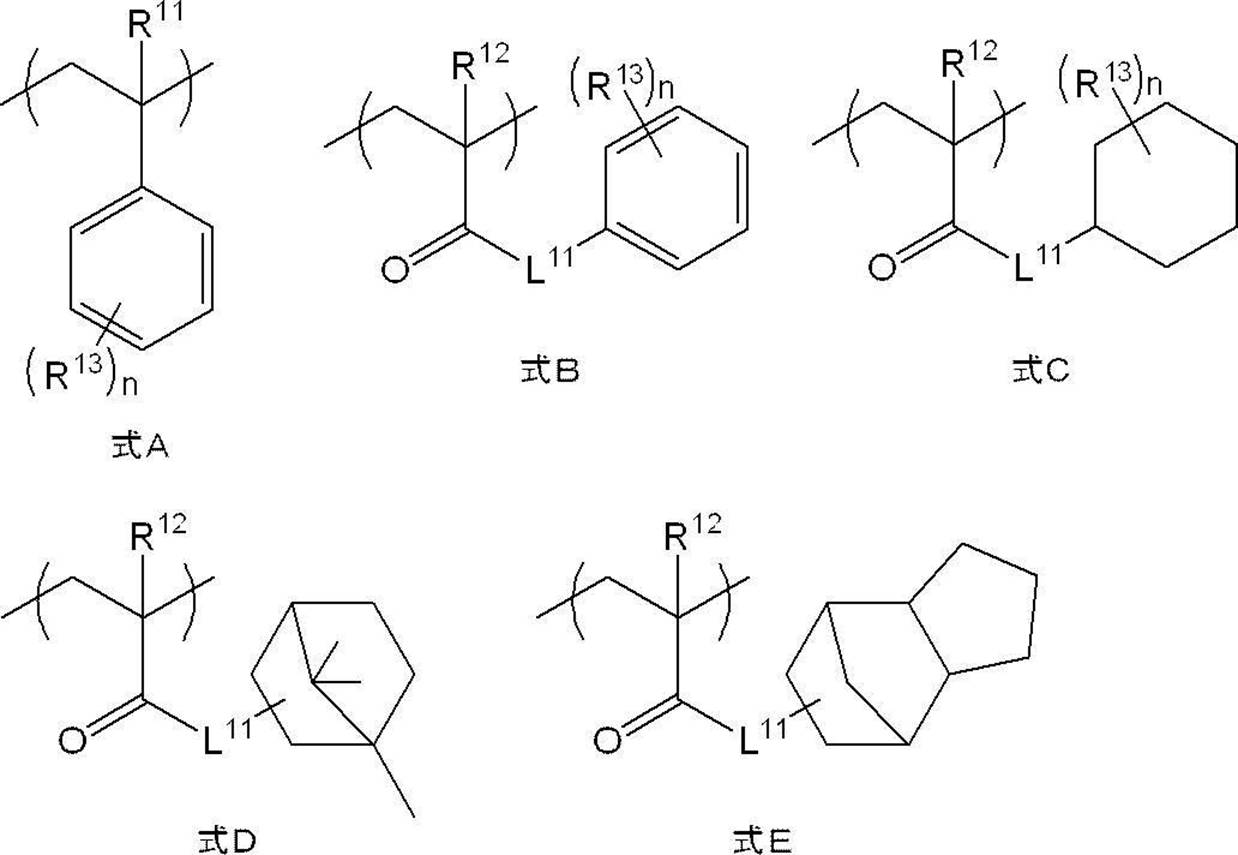
式A~式E中、R11及びR12はそれぞれ独立に、メチル基又は水素原子を表し、R13はそれぞれ独立に、炭素数1~10のアルキル基を表し、nは0~5の整数であり、L11は単結合又は炭素数1~18のアルキレン基、炭素数6~18のアリーレン基、-O-、-NH-、-S-、-C(=O)-、又は、これらを2個以上連結して形成される2価の連結基を表す。 In formulas A to E, R 11 and R 12 each independently represent a methyl group or a hydrogen atom, R 13 each independently represents an alkyl group having 1 to 10 carbon atoms, and n is an integer of 0 to 5. L 11 is a single bond or an alkylene group having 1 to 18 carbon atoms, an arylene group having 6 to 18 carbon atoms, -O-, -NH-, -S-, -C (= O)-, or these. Represents a divalent linking group formed by linking two or more of.
式A中、R11は水素原子であることが好ましい。
式B~式E中、R12はメチル基であることが好ましい。
式A~式C中、R13はそれぞれ独立に、炭素数1~4のアルキル基が好ましく、メチル基又はエチル基がより好ましい。
式A~式C中、nは0~2の整数であることが好ましく、0又は1であることがより好ましく、0であることが更に好ましい。
式B中、L11は、式B中に記載されたカルボニル基に結合する-O-又は上記カルボニル基に結合する-NH-を含む2価の連結基が好ましく、上記-O-又は上記-NH-と、炭素数1~18のアルキレン基と、を含む2価の連結基がより好ましく、-OCH2-又は-NHCH2-が更に好ましく、-OCH2-が特に好ましい。
式C~式E中、L11は、式C~式E中に記載されたカルボニル基に結合する-O-又は上記カルボニル基に結合する-NH-を含む2価の連結基が好ましく、-O-又は-NH-がより好ましく、-O-が更に好ましい。
In formula A, R 11 is preferably a hydrogen atom.
In formulas B to E, R 12 is preferably a methyl group.
In formulas A to C, each R 13 is independently preferably an alkyl group having 1 to 4 carbon atoms, more preferably a methyl group or an ethyl group.
In formulas A to C, n is preferably an integer of 0 to 2, more preferably 0 or 1, and even more preferably 0.
In formula B, L 11 is preferably a divalent linking group containing —O— that binds to the carbonyl group described in formula B or —NH— that binds to the carbonyl group, and is preferably —O— or −. NH- and, more preferably a divalent linking group containing a an alkylene group having 1 to 18 carbon atoms, -OCH 2 - or -NHCH 2 - are more preferable, -OCH 2 - is especially preferred.
In formulas C to E, L 11 is preferably a divalent linking group containing —O— that binds to the carbonyl group described in formulas C to E or —NH— that binds to the carbonyl group. O- or -NH- is more preferred, and -O- is even more preferred.
式Aにより表される構造単位である場合の単位p-3は、スチレンに由来する構造単位であることが好ましい。
式Bにより表される構造単位である場合の単位p-3は、ベンジル(メタ)アクリレートに由来する構造単位であることが好ましい。
式Cにより表される構造単位である場合の単位p-3は、シクロヘキシル(メタ)アクリレートに由来する構造単位であることが好ましい。
式Dにより表される構造単位である場合の単位p-3は、イソボルニル(メタ)アクリレートに由来する構造単位であることが好ましい。
式Eにより表される構造単位である場合の単位p-3は、ジシクロペンタニル(メタ)
アクリレートに由来する構造単位であることが好ましい。
When the structural unit is represented by the formula A, the unit p-3 is preferably a structural unit derived from styrene.
When the structural unit is represented by the formula B, the unit p-3 is preferably a structural unit derived from benzyl (meth) acrylate.
When the structural unit is represented by the formula C, the unit p-3 is preferably a structural unit derived from cyclohexyl (meth) acrylate.
When the structural unit is represented by the formula D, the unit p-3 is preferably a structural unit derived from isobornyl (meth) acrylate.
When the structural unit is represented by the formula E, the unit p-3 is dicyclopentanyl (meth).
It is preferably a structural unit derived from acrylate.
樹脂粒子Pを構成する樹脂が単位p-3を含む場合、画像の耐擦性をより向上させる観点からみると、単位p-3の含有量は、樹脂粒子Pを構成する樹脂の全量に対し、1質量%~20質量%であることが好ましい。
インクの吐出性をより向上させる観点からみると、単位p-3の含有量は、樹脂粒子Pを構成する樹脂の全量に対し、5質量%~90質量%であることが好ましく、10質量%~50質量%であることがより好ましい。
When the resin forming the resin particles P contains the unit p-3, from the viewpoint of further improving the abrasion resistance of the image, the content of the unit p-3 is based on the total amount of the resin forming the resin particles P. It is preferably 1% by mass to 20% by mass.
From the viewpoint of further improving the ejectability of the ink, the content of the unit p-3 is preferably 5% by mass to 90% by mass with respect to the total amount of the resin constituting the resin particles P, and is 10% by mass. More preferably, it is ~ 50% by mass.
(その他の構造単位(構造単位p-4))
樹脂粒子Pを構成する樹脂は、上述の単位p-1~単位p-3以外のその他の構造単位である構造単位p-4(以下、「単位p-4」ともいう。)を含有していてもよい。
単位p-4としては、(メタ)アクリルアミド化合物又は(メタ)アクリレート化合物に由来する構造単位が好ましく、(メタ)アクリレート化合物に由来する構造単位がより好ましい。
また、単位p-4は、アニオン性基を含まないことが好ましい。
(Other structural units (structural unit p-4))
The resin constituting the resin particles P contains a structural unit p-4 (hereinafter, also referred to as “unit p-4”) which is a structural unit other than the above-mentioned units p-1 to p-3. May be.
As the unit p-4, a structural unit derived from a (meth)acrylamide compound or a (meth)acrylate compound is preferable, and a structural unit derived from a (meth)acrylate compound is more preferable.
Further, the unit p-4 preferably does not contain an anionic group.
モノマー単位p-4は、アルキル基の炭素数が1~10であるアルキル(メタ)アクリレート化合物であることが好ましい。 The monomer unit p-4 is preferably an alkyl (meth)acrylate compound having an alkyl group with 1 to 10 carbon atoms.
樹脂粒子Pを構成する樹脂が単位p-4の含有量は、吐出性及び耐擦性の観点から、樹脂粒子Pを構成する樹脂の全量に対し、0質量%~90質量%であることが好ましく、0質量%~70質量%であることがより好ましい。 The content of the resin constituting the resin particles P in the unit p-4 may be 0% by mass to 90% by mass with respect to the total amount of the resin constituting the resin particles P from the viewpoint of ejection property and abrasion resistance. It is more preferably 0% by mass to 70% by mass.
(樹脂粒子Pを構成する樹脂の具体例)
樹脂粒子Pを構成する樹脂の具体例を下記に示すが、樹脂粒子Pを構成する樹脂は、これらの具体例に限定されるものではない。
下記具体例中、nは繰り返し数を表し、質量%の記載は、各構造単位の含有質量%を意味し、Mwの欄の数値は、重量平均分子量を表す。
(Specific Example of Resin Constituting Resin Particles P)
Specific examples of the resin forming the resin particles P are shown below, but the resin forming the resin particles P is not limited to these specific examples.
In the following specific examples, n represents the number of repetitions, the description of mass% means the content mass% of each structural unit, and the numerical value in the column of Mw represents the weight average molecular weight.


樹脂粒子Pの好ましい物性(例えば、Mw、Tg、体積平均粒径)については、前述した樹脂粒子の好ましい物性と同様である。 The preferable physical properties of the resin particles P (for example, Mw, Tg, volume average particle size) are the same as the preferable physical properties of the resin particles described above.
本開示のインクが樹脂粒子Pを含む場合、インクの保存安定性及び得られる画像の耐擦性の観点から、樹脂粒子Pの含有量は、インクの全量に対し、1質量%~20質量%であることが好ましく、1質量%~10質量%であることがより好ましく、2質量%~10質量%であることが更に好ましい。 When the ink of the present disclosure contains resin particles P, the content of the resin particles P is 1% by mass to 20% by mass with respect to the total amount of the ink from the viewpoint of storage stability of the ink and scratch resistance of the obtained image. Is more preferable, 1% by mass to 10% by mass is more preferable, and 2% by mass to 10% by mass is still more preferable.
また、本開示のインクが樹脂粒子Pを含む場合において、樹脂粒子Pによる効果(具体的には、インクの保存安定性を向上させる効果)をより効果的に発揮させる観点から、インクに含有される全ての樹脂粒子中に占める樹脂粒子Pの割合は、好ましくは50質量%以上であり、より好ましくは60質量%以上であり、更に好ましくは80質量%以上である。 Further, when the ink of the present disclosure contains the resin particles P, it is contained in the ink from the viewpoint of more effectively exerting the effect of the resin particles P (specifically, the effect of improving the storage stability of the ink). The proportion of the resin particles P in all the resin particles is preferably 50% by mass or more, more preferably 60% by mass or more, and further preferably 80% by mass or more.
樹脂粒子(例えば樹脂粒子P)は、公知の方法によって製造できる。
製造方法については、国際公開第2018/062212号等の公知文献を適宜参照できる。
The resin particles (for example, the resin particles P) can be manufactured by a known method.
Regarding the production method, publicly known documents such as WO2018/062212 can be appropriately referred to.
樹脂粒子(例えば樹脂粒子P)は、自己分散性樹脂粒子であることが好ましい。
ここで、自己分散性樹脂粒子とは、界面活性剤の不存在下、転相乳化法により分散状態とした場合、樹脂自身が有する官能基(特に酸性基又はその塩等の親水性基)によって、水性媒体中で分散状態となり得る、水不溶性樹脂からなる樹脂粒子を意味する。
ここで、分散状態とは、水性媒体中に水不溶性樹脂が液体状態で分散された乳化状態(エマルジョン)、及び、水性媒体中に水不溶性樹脂が固体状態で分散された分散状態(サスペンジョン)の両方の状態を含むものである。
また、「水不溶性」とは、25℃の水100質量部に対する溶解量が5.0質量部以下であることを指す。
樹脂粒子は、顔料の分散剤として機能するものではなく、従って、粒子の内部に顔料を含まない。
The resin particles (for example, resin particles P) are preferably self-dispersing resin particles.
Here, the self-dispersible resin particles, when in a dispersed state by the phase inversion emulsification method in the absence of a surfactant, by the functional group (especially hydrophilic group such as an acidic group or a salt thereof) of the resin itself. , Means resin particles made of a water-insoluble resin that can be dispersed in an aqueous medium.
Here, the dispersed state is an emulsified state (emulsion) in which a water-insoluble resin is dispersed in a liquid state in an aqueous medium, and a dispersed state (suspension) in which a water-insoluble resin is dispersed in a solid state in an aqueous medium. It includes both states.
In addition, “water-insoluble” means that the amount dissolved in 100 parts by mass of water at 25° C. is 5.0 parts by mass or less.
The resin particles do not function as a dispersant for the pigment and therefore do not contain the pigment inside the particles.
<その他の成分>
本開示のインクは、上述した成分以外のその他の成分を含有していてもよい。
本開示のインクに含有され得るその他の成分としては、上記ベタイン化合物(1)以外の、界面活性剤、紫外線吸収剤、褪色防止剤、防黴剤、pH調整剤、防錆剤、酸化防止剤、乳化安定剤、防腐剤、消泡剤、粘度調整剤、分散安定剤、キレート剤、固体湿潤剤等が挙げられる。
本開示のインクに含有され得るその他の成分についても、国際公開第2018/062212号等の公知文献を適宜参照できる。
<Other ingredients>
The ink of the present disclosure may contain other components other than the above-mentioned components.
As other components that may be contained in the ink of the present disclosure, other than the betaine compound (1), a surfactant, an ultraviolet absorber, an anti-fading agent, an antifungal agent, a pH adjusting agent, a rust preventive, an antioxidant , Emulsification stabilizers, preservatives, antifoaming agents, viscosity regulators, dispersion stabilizers, chelating agents, solid wetting agents and the like.
For other components that may be contained in the ink of the present disclosure, publicly known documents such as International Publication No. 2018/0621212 can be referred to as appropriate.
<インクの好ましい物性>
〔粘度〕
本開示のインクの30℃における粘度は、1.2mPa・s以上15.0mPa・s以下であることが好ましく、2.0mPa・s以上13.0mPa・s以下であることがより好ましく、2.5mPa・s以上10.0mPa・s以下であることが更に好ましい。
ここで、インクの粘度は、粘度計を用いて測定された値を意味する。粘度計としては、例えば、VISCOMETER TV-22(TOKI SANGYO CO.LTD製)を用いる。
<Preferable physical properties of ink>
〔viscosity〕
The viscosity of the ink of the present disclosure at 30 ° C. is preferably 1.2 mPa · s or more and 15.0 mPa · s or less, and more preferably 2.0 mPa · s or more and 13.0 mPa · s or less. It is more preferably 5 mPa · s or more and 10.0 mPa · s or less.
Here, the viscosity of the ink means a value measured using a viscometer. As the viscometer, for example, VISCOMETER TV-22 (manufactured by TOKI SANGYO CO. LTD) is used.
〔pH〕
本開示のインクの25℃におけるpHは、インクの保存安定性の観点から、6.0~11.0であることが好ましく、7.0~10.0であることがより好ましく、7.0~9.0であることが更に好ましい。
ここで、インクのpHは、pHメーターを用いて測定された値を意味する。
pHメーターとしては、例えば、WM-50EG(東亜DKK(株)製)を用いる。
[PH]
The pH of the ink of the present disclosure at 25 ° C. is preferably 6.0 to 11.0, more preferably 7.0 to 10.0, and 7.0 from the viewpoint of storage stability of the ink. It is more preferably ~ 9.0.
Here, the pH of the ink means a value measured using a pH meter.
As the pH meter, for example, WM-50EG (manufactured by Toa DKK) is used.
〔インクセット〕
本開示のインクセットは、2種以上のインクを備え、2種以上のインクのうちの少なくとも1種が、本開示のインクであるインクセットである。
本開示のインクセットは、2種以上(例えば2色以上)の本開示のインクからなるものであってもよいし、1種以上(例えば1色以上)の本開示のインクと、1種以上(例えば1色以上)の本開示のインク以外のインクと、を備えるものであってもよい。
本開示のインクセットは、本開示のインクである第1インクによるインク膜上に、第2インクを重ねて付与する態様の画像形成に好適である。第2インクは、本開示のインクであってもよいし、本開示のインク以外の水系インクであってもよい。
本開示のインクセットを用いて上記態様の画像形成を行うことにより、色間滲みが抑制された画像を形成できる。
また、本開示のインクセットにおける本開示のインクは、樹脂被覆顔料及びベタイン化合物(1)を含有するインクであるにもかかわらず、ベタイン化合物(1)に起因するインクの保存安定性の低下が抑制される。
[Ink set]
The ink set of the present disclosure includes two or more types of ink, and at least one of the two or more types of ink is an ink set that is the ink of the present disclosure.
The ink set of the present disclosure may consist of two or more types (for example, two or more colors) of the inks of the present disclosure, or one or more types (for example, one or more colors) of the inks of the present disclosure and one or more types. An ink other than the ink of the present disclosure (for example, one or more colors) may be provided.
The ink set of the present disclosure is suitable for image formation in a mode in which the second ink is applied in an overlapping manner on the ink film of the first ink that is the ink of the present disclosure. The second ink may be the ink of the present disclosure or an aqueous ink other than the ink of the present disclosure.
By performing the image formation in the above mode using the ink set of the present disclosure, an image in which intercolor bleeding is suppressed can be formed.
Further, although the ink of the present disclosure in the ink set of the present disclosure is an ink containing a resin-coated pigment and the betaine compound (1), the storage stability of the ink is deteriorated due to the betaine compound (1). It is suppressed.
本開示のインクセットにおいて、2種以上のインクのうちの少なくとも2種が、本開示のインクであることが好ましい。
この場合の本開示のインクセットは、本開示のインクである第1インクによるインク膜上に、本開示のインクである第2インクを重ねて付与する態様の画像形成に好適である。この態様の画像形成によれば、色間滲み抑制の効果がより効果的に発揮される。
In the ink set of the present disclosure, it is preferable that at least two of the two or more types of ink are the inks of the present disclosure.
In this case, the ink set of the present disclosure is suitable for image formation in a mode in which the second ink, which is the ink of the present disclosure, is superposed on the ink film of the first ink, which is the ink of the present disclosure. According to the image formation in this aspect, the effect of suppressing intercolor bleeding is more effectively exhibited.
本開示のインクセットの一例として、ブラックインク、イエローインク、マゼンタインク、及びシアンインクを含むインクセットであって、インクセットのうちの少なくとも1種(好ましくは、少なくとも2種)のインクが、本開示のインクである態様が挙げられる。 As an example of the ink set of the present disclosure, an ink set including a black ink, a yellow ink, a magenta ink, and a cyan ink, wherein at least one type (preferably at least two types) of the ink set is Embodiments that are the disclosed inks are included.
〔画像形成方法〕
本開示の画像形成方法は、記録媒体上に、本開示のインクである第1インクを付与する工程(以下、「第1インク付与工程」ともいう)と、
記録媒体上に付与された第1インク上に、色材及び水を含有し、第1インクとは色相が異なる第2インクを付与する工程(以下、「第2インク付与工程」ともいう)と、を含む。
[Image forming method]
The image forming method of the present disclosure includes a step of applying a first ink, which is the ink of the present disclosure, onto a recording medium (hereinafter, also referred to as “first ink applying step”),
A step of applying a second ink containing a coloring material and water on the first ink applied on a recording medium and having a hue different from that of the first ink (hereinafter, also referred to as "second ink applying process"). ,including.
本開示の画像形成方法では、上記のとおり、記録媒体上に付与された第1インク上に第2インクを付与する。このため、前述した理由により、色間滲みが抑制された多色画像を形成できる。
また、第1インクは、樹脂被覆顔料及びベタイン化合物(1)を含有するインクであるにもかかわらず、ベタイン化合物(1)に起因するインクの保存安定性の低下が抑制される。
In the image forming method of the present disclosure, as described above, the second ink is applied on the first ink applied on the recording medium. Therefore, for the reasons described above, it is possible to form a multicolor image in which bleeding between colors is suppressed.
Further, although the first ink is an ink containing a resin coating pigment and the betaine compound (1), the deterioration of the storage stability of the ink due to the betaine compound (1) is suppressed.
本開示の画像形成方法において、第1インク及び第2インクは、それぞれ、1種のみであってもよいし、2種以上であってもよい。
例えば、第1インクが1種のみであり、かつ、第2インクが1種のみである場合には、色間滲みが抑制された二色の画像を形成できる。
また、第1インクが1種のみであり、かつ、第2インクが2種である場合には、色間滲みが抑制された三色の画像を形成できる。
In the image forming method of the present disclosure, each of the first ink and the second ink may be only one type, or may be two or more types.
For example, when the first ink is only one type and the second ink is only one type, it is possible to form a two-color image in which intercolor bleeding is suppressed.
Further, when the first ink is only one kind and the second ink is two kinds, it is possible to form a three-color image in which intercolor bleeding is suppressed.
また、第2インクは、本開示のインクであってもよいし、本開示のインク以外の水系インクであってもよい。色間滲み抑制の効果をより効果的に発揮する観点から、第2インクは、本開示のインクであることが好ましい。 The second ink may be the ink of the present disclosure or may be an aqueous ink other than the ink of the present disclosure. The second ink is preferably the ink of the present disclosure from the viewpoint of more effectively exerting the effect of suppressing intercolor bleeding.
<記録媒体>
本開示の画像形成方法に用いられる記録媒体としては、特に制限はなく、例えば、一般のオフセット印刷などに用いられるいわゆる塗工紙を用いることができる。
塗工紙は、セルロースを主体とした一般に表面処理されていない上質紙や中性紙等の表面にコート材を塗布してコート層を設けたものである。
<Recording medium>
The recording medium used in the image forming method of the present disclosure is not particularly limited, and for example, so-called coated paper used in general offset printing can be used.
The coated paper is one in which a coating material is applied to the surface of a high-quality paper or a neutral paper, which is mainly composed of cellulose and which is not generally surface-treated, to form a coating layer.
塗工紙としては、一般に上市されているものを入手して使用できる。
塗工紙として、例えば、一般印刷用塗工紙を用いることができ、具体的には、王子製紙製の「OKトップコート+」、日本製紙社製の「オーロラコート」、「ユーライト」等のコート紙(A2、B2)、三菱製紙社製の「特菱アート」等のアート紙(A1)などを挙げることができる。
As the coated paper, those that are generally on the market can be obtained and used.
As the coated paper, for example, coated paper for general printing can be used. Specifically, "OK Top Coat +" manufactured by Oji Paper, "Aurora Coat", "Eurite" manufactured by Nippon Paper Industries, etc. Coated paper (A2, B2), art paper (A1) such as “Tokuryo Art” manufactured by Mitsubishi Paper Mills, and the like.
記録媒体としては、低吸水性記録媒体又は非吸水性記録媒体を用いることもできる。
本開示において、低吸水性記録媒体とは、水の吸収係数Kaが0.05mL/m2・ms1/2~0.5mL/m2・ms1/2であるものをいい、0.1mL/m2・ms1/2~0.4mL/m2・ms1/2であることが好ましく、0.2mL/m2・ms1/2~0.3mL/m2・ms1/2であることがより好ましい。
また、非吸水性記録媒体とは、水の吸収係数Kaが0.05mL/m2・ms1/2未満であるものをいう。
水の吸収係数Kaは、JAPAN TAPPI 紙パルプ試験方法No.51:2000(発行:紙パルプ技術協会)に記載されているものと同義であり、具体的には、吸収係数Kaは、自動走査吸液計KM500Win(熊谷理機社製)を用いて接触時間100msと接触時間900msにおける水の転移量の差から算出されるものである。
As the recording medium, a low water absorption recording medium or a non-water absorption recording medium can also be used.
In the present disclosure, the low water absorption recording medium refers to a medium having an absorption coefficient Ka of water of 0.05 mL/m 2 ·ms 1/2 to 0.5 mL/m 2 ·ms 1/2 , and 0.1 mL. /M 2 ·ms 1/2 to 0.4 mL/m 2 ·ms 1/2 is preferable, and 0.2 mL/m 2 ·ms 1/2 to 0.3 mL/m 2 ·ms 1/2 More preferably.
The non-water-absorbent recording medium means a medium having a water absorption coefficient Ka of less than 0.05 mL / m 2 · ms 1/2 .
The water absorption coefficient Ka is determined by the Japan TAPPI pulp and paper test method No. It is synonymous with the one described in 51: 2000 (published by Pulp and Paper Technology Association). Specifically, the absorption coefficient Ka is the contact time using an automatic scanning liquid absorption meter KM500Win (manufactured by Kumagai Riki Co., Ltd.). It is calculated from the difference in the amount of water transfer between 100 ms and 900 ms contact time.
非吸収性記録媒体としては樹脂基材が好ましい。
樹脂基材としては、例えば、熱可塑性樹脂をシート状に成形した基材が挙げられる。
上記樹脂基材は、ポリプロピレン、ポリエチレンテレフタレート、ナイロン、ポリエチレン、又は、ポリイミドを含むことが好ましい。
樹脂基材は、透明な樹脂基材であっても、着色された樹脂基材であってもよいし、少なくとも一部に金属蒸着処理等がなされた樹脂基材であってもよい。
樹脂基材の形状は、特に限定されないが、シート状の樹脂基材であることが好ましい。
画像形成方法における生産性の観点から、ロール状に巻き取られたシート状の樹脂基材を用いてもよい。
A resin base material is preferable as the non-absorbent recording medium.
Examples of the resin base material include a base material obtained by molding a thermoplastic resin into a sheet shape.
The resin base material preferably contains polypropylene, polyethylene terephthalate, nylon, polyethylene, or polyimide.
The resin base material may be a transparent resin base material, a colored resin base material, or a resin base material at least a part of which is subjected to metal vapor deposition treatment.
The shape of the resin base material is not particularly limited, but a sheet-shaped resin base material is preferable.
From the viewpoint of productivity in the image forming method, a sheet-shaped resin base material wound in a roll shape may be used.
<第1インク付与工程>
第1インク付与工程は、記録媒体上に、本開示のインクである第1インクを付与する工程である。
<First ink applying step>
The first ink applying step is a step of applying the first ink, which is the ink of the present disclosure, onto the recording medium.
第1インク付与工程において、記録媒体上に第1インクを直接付与した場合には、本開示のインクによる色間滲み抑制の効果がより効果的に発揮される。以下、この点について補足する。
水性インクを用いた画像形成の分野では、インクを付与する前に、記録媒体に対し、予め前処理を施す場合がある。ここでいう前処理は、記録媒体に対し、インク中の成分を凝集させる凝集剤(例えば、有機酸、多価金属塩、カチオン性ポリマー等)を含む処理液を付与する処理である。処理液の一例として、前述の特許文献1における反応液が挙げられる。
かかる態様の画像形成とは異なり、前処理が施されていない(即ち、インク中の成分を凝集させる凝集剤を含む処理液が付与されていない)記録媒体上に第1インクを直接付与する態様の画像形成では、一般的には、色間滲みがより発生し易くなる傾向がある。
しかし、本開示の画像形成方法の場合は、第1インクがベタイン化合物(1)を含有することにより、前処理が施されていない記録媒体上に第1インクを直接付与する態様の画像形成であっても、色間滲み抑制の効果を得ることができる。即ち、第1インク付与工程において、前処理が施されていない記録媒体上に第1インクを直接付与した場合には、本開示のインクによる色間滲み抑制の効果がより効果的に発揮される。
In the first ink applying step, when the first ink is directly applied onto the recording medium, the effect of suppressing intercolor bleeding by the ink of the present disclosure is more effectively exhibited. Hereinafter, this point will be supplemented.
In the field of image formation using a water-based ink, a pretreatment may be performed in advance on a recording medium before applying the ink. The pretreatment referred to here is a treatment of applying a treatment liquid containing a coagulant (for example, an organic acid, a polyvalent metal salt, a cationic polymer, etc.) that agglomerates the components in the ink to the recording medium. As an example of the treatment liquid, the reaction liquid in Patent Document 1 described above can be mentioned.
Unlike the image formation of such an aspect, an aspect in which the first ink is directly applied onto the recording medium which is not subjected to the pretreatment (that is, the treatment liquid containing the aggregating agent for aggregating the components in the ink is not applied). In the image formation, generally, intercolor bleeding tends to occur more easily.
However, in the case of the image forming method of the present disclosure, the first ink contains the betaine compound (1), so that the first ink is directly applied to the recording medium which has not been pretreated. Even if there is, the effect of suppressing intercolor bleeding can be obtained. That is, in the first ink application step, when the first ink is directly applied to the recording medium that has not been pretreated, the effect of suppressing intercolor bleeding by the inks of the present disclosure is more effectively exhibited. ..
第1インク付与工程における第1インクの付与は、好ましくはインクジェット法によって行う。
インクジェット法としては、インクジェットヘッドからインクを吐出する公知の方法を特に制限なく適用できる。
好ましいインクジェット法の一例として、特開2003-306623号公報の段落番号0093~0105に記載の方法が挙げられるが、インクジェット法は、この一例には限定されない。
The application of the first ink in the first ink application step is preferably performed by an inkjet method.
As the inkjet method, a known method of ejecting ink from an inkjet head can be applied without particular limitation.
As an example of a preferable inkjet method, the method described in paragraph Nos. 0093 to 0105 of JP-A-2003-306623 can be mentioned, but the inkjet method is not limited to this example.
インクジェット法によるインクの吐出方式には、特に制限はなく、公知の方式を適用できる。
インクジェット法によるインクの吐出方式として、例えば;静電誘引力を利用してインクを吐出させる電荷制御方式;ピエゾ素子の振動圧力を利用するドロップオンデマンド方式(圧力パルス方式);電気信号を音響ビームに変えインクに照射して放射圧を利用してインクを吐出させる音響インクジェット方式;インクを加熱して気泡を形成し、生じた圧力を利用するサーマルインクジェット(バブルジェット(登録商標))方式;等が挙げられる。
また、インクジェット法によるインクの吐出方式としては、特開昭54-59936号公報に記載の方法により、熱エネルギーの作用を受けたインクが急激な体積変化を生じ、この状態変化による作用力によって、インクをノズルから吐出させる方式も挙げられる。
The ink ejection method by the inkjet method is not particularly limited, and a known method can be applied.
As an ink ejection method by the inkjet method, for example; a charge control method that ejects ink by using an electrostatic attraction force; a drop-on-demand method (pressure pulse method) that utilizes the vibration pressure of a piezo element; an acoustic beam for an electric signal. Acoustic inkjet method that irradiates ink with ink and ejects ink using radiation pressure; thermal inkjet method (bubble jet (registered trademark)) method that heats ink to form bubbles and uses the generated pressure, etc. Is mentioned.
Further, as an ink ejection method by the inkjet method, the ink subjected to the action of thermal energy causes a rapid volume change by the method described in JP-A-54-59936, and the acting force due to this state change causes the ink to change in volume. A method in which ink is ejected from nozzles can also be used.
インクジェット法に用いられるインクジェットヘッドとしては;短尺のシリアルヘッドを用い、ヘッドを記録媒体の幅方向に走査させながら記録を行なうシャトル方式;記録媒体の1辺の全域に対応して記録素子が配列されているラインヘッドを用いたライン方式;等が挙げられる。
ライン方式では、記録素子の配列方向と交差する方向に記録媒体を走査させることで記録媒体の全面に画像記録を行なうことができ、短尺ヘッドを走査するキャリッジ等の搬送系が不要となる。
また、ライン方式では、キャリッジの移動と記録媒体との複雑な走査制御が不要になり、記録媒体だけが移動するので、シャトル方式に比べて記録速度の高速化が実現できる。
本開示の画像形成方法は、これらのいずれにも適用可能であるが、一般にダミージェットを行なわないライン方式に適用した場合に、吐出精度及び画像の耐擦性の向上効果が大きい。
As an inkjet head used in the inkjet method; a shuttle method in which a short serial head is used and recording is performed while scanning the head in the width direction of the recording medium; recording elements are arranged corresponding to the entire area of one side of the recording medium. A line method using a line head; etc.
In the line method, images can be recorded on the entire surface of the recording medium by scanning the recording medium in a direction intersecting the arrangement direction of the recording elements, and a transport system such as a carriage that scans a short head becomes unnecessary.
Further, in the line method, the movement of the carriage and the complicated scanning control with the recording medium become unnecessary, and only the recording medium moves, so that the recording speed can be increased as compared with the shuttle method.
The image forming method of the present disclosure can be applied to any of these, but in general, when applied to a line method in which a dummy jet is not performed, the effect of improving ejection accuracy and image abrasion resistance is large.
インクジェットヘッドから吐出されるインクの吐出量としては、高精細な画像を得る観点で、1pL以上10pL(ピコリットル)以下が好ましく、1.5pL以上6pL以下がより好ましい。また、画像のムラ、連続諧調のつながりを改良する観点で、異なる吐出量を組み合わせて吐出することも有効である。 The amount of ink ejected from the inkjet head is preferably 1 pL or more and 10 pL (picolitre) or less, and more preferably 1.5 pL or more and 6 pL or less, from the viewpoint of obtaining a high-definition image. Further, from the viewpoint of improving the unevenness of images and the connection of continuous gradations, it is effective to combine different ejection amounts for ejection.
第1インク付与工程は、必要に応じ、記録媒体上に付与された第1インクを加熱乾燥させることを含んでもよい。
第1インク付与工程は、必要に応じ、記録媒体上に付与された第1インクを加熱定着させることを含んでもよい。
加熱乾燥及び加熱定着については、公知の方法及び条件を適宜適用できる。
The first ink applying step may include heating and drying the first ink applied on the recording medium, if necessary.
The first ink applying step may include heating and fixing the first ink applied on the recording medium, if necessary.
Known methods and conditions can be appropriately applied to the heat drying and the heat fixing.
<第2インク付与工程>
第2インク付与工程は、記録媒体上に付与された第1インク上に、色材及び水を含有し、第1インクとは色相が異なる第2インクを付与する工程である。
第2インク付与工程は、記録媒体上に付与された第1インク上に第2インクを付与することを除けば、第1インク付与工程と同様であり、好ましい態様も同様である。
<Second ink applying step>
The second ink applying step is a step of applying a second ink containing a coloring material and water on the first ink applied on the recording medium and having a hue different from that of the first ink.
The second ink applying step is the same as the first ink applying step, except that the second ink is applied onto the first ink applied on the recording medium, and the preferred embodiment is also the same.
<その他の工程>
本開示の画像形成方法は、必要に応じ、上記の工程以外のその他の工程を含んでもよい。その他の工程としては、第1インク付与工程及び第2インク付与工程によって得られた多色画像を熱定着させる工程等が挙げられる。
<Other processes>
The image forming method of the present disclosure may include other steps than the above steps, if necessary. Examples of other steps include a step of heat-fixing the multicolor image obtained by the first ink applying step and the second ink applying step.
以下、本開示の実施例を示すが、本開示は以下の実施例には限定されない。
以下の実施例において、量を示す「部」及び「%」は、特に断りが無い限り、それぞれ、質量部及び質量%を意味する。
Hereinafter, examples of the present disclosure will be shown, but the present disclosure is not limited to the following examples.
In the following examples, “parts” and “%” indicating amounts mean parts by mass and% by mass, respectively, unless otherwise specified.
〔実施例1〕
<樹脂粒子P1の水性分散物の調製>
撹拌機、温度計、還流冷却管、及び窒素ガス導入管を備えた三口フラスコに、水(250g)、12-メタクリルアミドドデカン酸(7.0g)、炭酸水素カリウム(0.17g)及びイソプロパノール(20g)を仕込んで、窒素気流下で85℃まで昇温した。ここにV-501(ラジカル重合開始剤、富士フイルム和光純薬(株)製)(0.11g)、炭酸水素カリウム(0.08g)及び水(9g)からなる混合溶液を加え、10分間撹拌した。次いで、上記三口フラスコに、スチレン(30g)とメタクリル酸メチル(63g)からなるモノマー溶液を3時間で滴下が完了するように等速で滴下し、更にV-501(0.06g)、炭酸水素カリウム(0.04g)及び水(6g)からなる混合溶液を、上記モノマー溶液滴下開始直後とモノマー溶液滴下開始1.5時間後の2回に分けて加えた。上記モノマー溶液の滴下完了後、1時間撹拌した。続いて、得られた反応混合物にV-501(0.06g)、炭酸水素カリウム(0.04g)及び水(6g)からなる混合溶液を加え、更に3時間撹拌した。得られた反応混合物を網目50μmのメッシュでろ過し、樹脂粒子P1の水性分散物を得た。得られた樹脂粒子P1の水性分散物はpH8.5、固形分濃度(即ち、樹脂粒子P1の含有量)25質量%、体積平均粒径30nm(体積平均粒径はマイクロトラックUPA EX-150(日機装社製)で測定した)、重量平均分子量(Mw)25万、Tg96℃であった。
樹脂粒子P1は樹脂粒子Pの一例であり、構造単位p-1として、12-メタクリルアミドドデカン酸に由来する構造単位を含んでいる。樹脂粒子P1の詳細は前述のとおりである。
[Example 1]
<Preparation of Aqueous Dispersion of Resin Particles P1>
Water (250 g), 12-methacrylamide dodecanoic acid (7.0 g), potassium hydrogen carbonate (0.17 g) and isopropanol (0.17 g) in a three-necked flask equipped with a stirrer, thermometer, reflux condenser, and nitrogen gas introduction tube. 20 g) was charged and the temperature was raised to 85 ° C. under a nitrogen stream. A mixed solution consisting of V-501 (radical polymerization initiator, manufactured by Fujifilm Wako Pure Chemical Industries, Ltd.) (0.11 g), potassium hydrogen carbonate (0.08 g) and water (9 g) was added thereto, and the mixture was stirred for 10 minutes. did. Next, a monomer solution consisting of styrene (30 g) and methyl methacrylate (63 g) was added dropwise to the three-necked flask at a constant velocity so that the addition was completed in 3 hours, and then V-501 (0.06 g) and hydrogen carbonate were added. A mixed solution of potassium (0.04 g) and water (6 g) was added in two portions immediately after the start of the monomer solution dropping and 1.5 hours after the start of the monomer solution dropping. After the dropping of the above monomer solution was completed, the mixture was stirred for 1 hour. Subsequently, a mixed solution consisting of V-501 (0.06 g), potassium hydrogen carbonate (0.04 g) and water (6 g) was added to the obtained reaction mixture, and the mixture was further stirred for 3 hours. The obtained reaction mixture was filtered through a mesh having a mesh of 50 μm to obtain an aqueous dispersion of resin particles P1. The obtained aqueous dispersion of the resin particles P1 has a pH of 8.5, a solid content concentration (that is, the content of the resin particles P1) of 25% by mass, and a volume average particle size of 30 nm (volume average particle size is Microtrac UPA EX-150 (the volume average particle size is Microtrack UPA EX-150). (Measured by Nikkiso Co., Ltd.), weight average molecular weight (Mw) was 250,000, and Tg was 96 ° C.
The resin particle P1 is an example of the resin particle P, and includes the structural unit derived from 12-methacrylamidododecanoic acid as the structural unit p-1. The details of the resin particles P1 are as described above.
<インクの調製>
(顔料分散物の調製)
-水溶性樹脂分散剤Q-1の合成-
メタクリル酸(172部)と、メタクリル酸ベンジル(828部)と、イソプロパノール(375部)とを混合することにより、モノマー供給組成物を調製した。また、2,2-アゾビス(2-メチルブチロニトリル)(22.05部)と、イソプロパノール(187.5部)とを混合することにより、開始剤供給組成物を調製した。
次に、イソプロパノール(187.5部)を窒素雰囲気下、80℃に加温し、そこに、上記モノマー供給組成物及び上記開始剤供給組成物の混合物を2時間かけて滴下した。滴下終了後、得られた溶液を更に4時間、80℃に保った後、25℃まで冷却した。
冷却後、溶媒を減圧除去することにより、重量平均分子量約30,000、酸価112mgKOH/gの水溶性樹脂分散剤Q-1を得た。
<Preparation of ink>
(Preparation of pigment dispersion)
-Synthesis of water-soluble resin dispersant Q-1-
A monomer feed composition was prepared by mixing methacrylic acid (172 parts), benzyl methacrylate (828 parts), and isopropanol (375 parts). In addition, an initiator feed composition was prepared by mixing 2,2-azobis (2-methylbutyronitrile) (22.05 parts) and isopropanol (187.5 parts).
Next, isopropanol (187.5 parts) was heated to 80° C. under a nitrogen atmosphere, and the mixture of the monomer supply composition and the initiator supply composition was added dropwise thereto over 2 hours. After the dropping was completed, the obtained solution was kept at 80° C. for another 4 hours and then cooled to 25° C.
After cooling, the solvent was removed under reduced pressure to obtain a water-soluble resin dispersant Q-1 having a weight average molecular weight of about 30,000 and an acid value of 112 mgKOH/g.
-シアン顔料分散物QC1の調製-
上記で得られた水溶性樹脂分散剤Q-1(150部)中のメタクリル酸量の0.8当量を、水酸化カリウム水溶液を用いて中和した後、水溶性樹脂分散剤濃度が25質量%となるように、更にイオン交換水を加えて調整し、水溶性樹脂分散剤水溶液を得た。
この水溶性樹脂分散剤水溶液(124部)と、ピグメントブルー15:3(シアン顔料)(48部)と、水(75部)と、ジプロピレングリコール(30部)とを混合し、ビーズミル(ビーズ径0.1mmφ、ジルコニアビーズ)で分散し、シアン顔料濃度15質量%の樹脂被覆シアン顔料粒子の未架橋分散物を得た。
この未架橋分散物(136部)に、Denacol EX-321(ナガセケムテックス社製、架橋剤)(1.3部)と、ホウ酸水溶液(ホウ酸濃度:4質量%)(14.3部)とを添加し、50℃にて6時間半反応させた後、25℃に冷却し、架橋分散物を得た。次に、得られた架橋分散物にイオン交換水を加え、撹拌型ウルトラホルダー(ADVANTEC社製)及び限外ろ過フィルター(ADVANTEC社製、分画分子量5万、Q0500076Eウルトラフィルター)を用いて限外ろ過を行った。架橋分散物中のジプロピレングリコール濃度が0.1質量%以下となるように精製した後、顔料濃度が15質量%となるまで濃縮することにより、シアン顔料分散物QC1(シアン顔料濃度15質量%)を得た。
得られたシアン顔料分散物QC1には、架橋剤によって架橋された水溶性樹脂分散剤Q-1によってシアン顔料の少なくとも一部が被覆されている構造を有する架橋樹脂被覆シアン顔料が含有されている。
—Preparation of Cyan Pigment Dispersion QC1—
After neutralizing 0.8 equivalents of the amount of methacrylic acid in the water-soluble resin dispersant Q-1 (150 parts) obtained above with an aqueous potassium hydroxide solution, the concentration of the water-soluble resin dispersant was 25 mass by mass. The concentration was adjusted by further adding ion-exchanged water to obtain an aqueous solution of a water-soluble resin dispersant.
This water-soluble resin dispersant aqueous solution (124 parts), Pigment Blue 15: 3 (cyan pigment) (48 parts), water (75 parts), and dipropylene glycol (30 parts) are mixed and bead mill (beads). (Diameter: 0.1 mmφ, zirconia beads) to obtain an uncrosslinked dispersion of resin-coated cyan pigment particles having a cyan pigment concentration of 15% by mass.
Denacol EX-321 (manufactured by Nagase ChemteX Corporation, cross-linking agent) (1.3 parts) and boric acid aqueous solution (boric acid concentration: 4% by mass) (14.3 parts) were added to this uncrosslinked dispersion (136 parts). ) Was added, and the mixture was reacted at 50 ° C. for 6 and a half hours and then cooled to 25 ° C. to obtain a crosslinked dispersion. Next, ion-exchanged water was added to the obtained crosslinked dispersion, and ultrafiltration was performed using a stirring type ultra holder (manufactured by ADVANTEC) and an ultrafiltration filter (manufactured by ADVANTEC, molecular weight cut-off 50,000, Q0500076E ultrafilter). It was filtered. After purifying so that the concentration of dipropylene glycol in the crosslinked dispersion is 0.1% by mass or less, the mixture is concentrated until the pigment concentration becomes 15% by mass to obtain the cyan pigment dispersion QC1 (cyan pigment concentration 15% by mass). ) Got.
The obtained cyan pigment dispersion QC1 contains a crosslinked resin-coated cyan pigment having a structure in which at least a part of the cyan pigment is coated with the water-soluble resin dispersant Q-1 crosslinked by the crosslinking agent. ..
-マゼンタ顔料分散物QM1の調製-
ピグメントブルー15:3(シアン顔料)を、同質量のピグメントレッド122(マゼンタ顔料)に変更したこと以外はシアン顔料分散物の調製と同様の操作を行い、マゼンタ顔料分散物QM1(顔料濃度15質量%)を得た。
得られたマゼンタ顔料分散物QM1には、架橋剤によって架橋された水溶性樹脂分散剤Q-1によってマゼンタ顔料の少なくとも一部が被覆されている構造を有する架橋樹脂被覆マゼンタ顔料が含有されている。
-Preparation of magenta pigment dispersion QM1-
The same operation as the preparation of the cyan pigment dispersion was carried out except that Pigment Blue 15: 3 (cyan pigment) was changed to Pigment Red 122 (magenta pigment) having the same mass, and magenta pigment dispersion QM1 (pigment concentration 15 mass) was performed. %) was obtained.
The obtained magenta pigment dispersion QM1 contains a crosslinked resin-coated magenta pigment having a structure in which at least a part of the magenta pigment is coated with the water-soluble resin dispersant Q-1 crosslinked by the crosslinking agent. ..
(シアン(C)インクの調製)
以下の各成分を混合し、次いで1μmフィルターを用いて粗大粒子を除去することにより、以下の組成を有するシアンインクを得た。
(Preparation of cyan (C) ink)
The cyan ink having the following composition was obtained by mixing the following components and then removing coarse particles using a 1 μm filter.
-シアンインクの組成-
・シアン顔料分散液QC1 … シアン顔料濃度として3質量%(架橋樹脂被覆シアン顔料の含有量として5.1質量%)
・エチレングリコールモノヘキシルエーテル(EGmHE)〔有機溶剤A〕 … 2質量%
・ジエチレングリコール(DEG)〔有機溶剤B〕 … 15質量%
・樹脂粒子P1の水性分散物 … 樹脂粒子P1の量として6質量%
・ラウリルスルホベタイン〔東京化成工業社製;ベタイン化合物(1)としての後述の化合物(1-1)〕 … 0.5質量%
・水 … 合計が100質量%となる残量
-Composition of cyan ink-
Cyan pigment dispersion liquid QC1... Cyan pigment concentration is 3 mass% (crosslinking resin-coated cyan pigment content is 5.1 mass%)
-Ethylene glycol monohexyl ether (EGmHE) [organic solvent A] ... 2 mass%
-Diethylene glycol (DEG) [organic solvent B] ... 15% by mass
-Aqueous dispersion of resin particles P1... 6% by mass as the amount of the resin particles P1
-Lauryl sulfobetaine [manufactured by Tokyo Chemical Industry Co.; compound (1-1) described below as betaine compound (1)] 0.5 mass%
・ Water: The remaining amount that makes the total 100% by mass
(マゼンタ(M)インクの調製)
以下の各成分を混合し、次いで1μmフィルターを用いて粗大粒子を除去することにより、以下の組成を有するマゼンタインクを得た。
(Preparation of magenta (M) ink)
The following components were mixed, and then coarse particles were removed using a 1 μm filter to obtain a magenta ink having the following composition.
-マゼンタインクの組成-
・マゼンタ顔料分散液QM1 … マゼンタ顔料濃度として5質量%(架橋樹脂被覆マゼンタ顔料の含有量として8.5質量%)
・ヘキシルグリコール(富士フイルム和光純薬社製)〔有機溶剤A〕 … 2質量%
・ジエチレングリコール(DEG) … 15質量%
・樹脂粒子P1の樹脂粒子分散物 … 樹脂粒子P1の量として6質量%
・ラウリルスルホベタイン〔東京化成工業 社製;ベタイン化合物(1)としての後述の化合物(1-1)〕 … 0.5質量%
・水 … 合計が100質量%となる残量
-Composition of magenta ink-
Magenta pigment dispersion QM1... Magenta pigment concentration of 5% by mass (crosslinking resin-coated magenta pigment content of 8.5% by mass)
Hexyl glycol (manufactured by FUJIFILM Wako Pure Chemical Industries, Ltd.) [organic solvent A]...
・Diethylene glycol (DEG)... 15% by mass
Resin particle dispersion of resin particles P1... 6% by mass as the amount of resin particles P1
-Lauryl sulfobetaine [manufactured by Tokyo Chemical Industry Co.; compound (1-1) described below as betaine compound (1)] 0.5 mass%
・ Water: The remaining amount that makes the total 100% by mass
<評価>
上記シアンインク及びマゼンタインクを用い、以下の評価を行った。
結果を表1に示す。
<Evaluation>
The following evaluation was performed using the above cyan ink and magenta ink.
The results are shown in Table 1.
(色間滲み(線幅差M))
シアンベタ画像上にマゼンタ線幅画像を形成した場合の色間滲み抑制効果を評価するために、以下で説明する色間滲み(線幅差M)の評価を行った。
記録媒体としてのコート紙(商品名「OKトップコート+」、王子製紙社製)上に、シアンインクを付与してシアンベタ画像を形成し、得られたシアンベタ画像上に、マゼンタインクを25pixelの線幅画像状に付与してマゼンタ線幅画像を形成した。
シアンインク及びマゼンタインクは、それぞれ、シングルパス方式により、下記吐出条件で吐出することによって付与した。
(Blur between colors (line width difference M))
In order to evaluate the effect of suppressing intercolor bleeding when a magenta line width image is formed on a cyan solid image, the intercolor bleeding (line width difference M) described below was evaluated.
Cyan ink is applied to a coated paper as a recording medium (trade name "OK Top Coat +", manufactured by Oji Paper Co., Ltd.) to form a cyan solid image, and magenta ink is applied to a 25pixel line on the obtained cyan solid image. A magenta line width image was formed by applying the width image.
The cyan ink and the magenta ink were applied by ejecting under the following ejection conditions by a single pass method.
-吐出条件-
・ヘッド:1,200dpi(dot per inch、1inch = 2.54cm)/20inch幅ピエゾフルラインヘッド
・吐出量:2.4pL
・駆動周波数:30kHz(記録媒体搬送速度635mm/sec)
・ヘッド間距離:120mm
-Discharge conditions-
・ Head: 1,200 dpi (dot per inch, 1 inch = 2.54 cm) / 20 inch width piezo full line head ・ Discharge rate: 2.4 pL
-Drive frequency: 30 kHz (recording medium transport speed 635 mm / sec)
・Distance between heads: 120 mm
シアンベタ画像上に形成されたマゼンタ線幅画像の線幅を、マイクロスコープによって測定した。
マゼンタ線幅画像の線幅の測定結果と、1200dpi・25pixelの理論上線幅529.2μmと、の差(以下、「線幅差M」ともいう)を求め、得られた線幅差Mに基づき、下記評価基準にて、色間滲み(線幅差M)を評価した。
下記評価基準において、色間滲みの抑制効果に最も優れる評点は、Aである。
The line width of the magenta line width image formed on the cyan solid image was measured by a microscope.
The difference (hereinafter, also referred to as "line width difference M") between the measurement result of the line width of the magenta line width image and the theoretical line width 529.2 μm of 1200 dpi and 25 pixels was obtained, and based on the obtained line width difference M. , Intercolor bleeding (line width difference M) was evaluated according to the following evaluation criteria.
In the following evaluation criteria, A is the best score for the effect of suppressing intercolor bleeding.
-色間滲み(線幅差M)の評価基準-
A:線幅差Mが200μm未満であった。
B:線幅差Mが200以上300μm未満であった。
C:線幅差Mが300以上500μm未満であった。
D:線幅差Mが500μm以上であった。
-Evaluation criteria for intercolor bleed (line width difference M)-
A: The line width difference M was less than 200 μm.
B: The line width difference M was 200 or more and less than 300 μm.
C: The line width difference M was 300 or more and less than 500 μm.
D: The line width difference M was 500 μm or more.
(色間滲み(線幅差C))
シアン線幅画像上にマゼンタベタ画像を形成した場合の色間滲み抑制効果を評価するために、以下で説明する色間滲み(線幅差C)の評価を行った。
記録媒体上に、シアンインクを25pixelの線幅画像状に付与してシアン線幅画像を形成し、次いで、上記シアン線幅画像及びその周囲を覆うようにマゼンタインクを付与してマゼンタベタ画像を形成した。
記録媒体及び吐出条件は、それぞれ、「色間滲み(線幅差M)」における記録媒体及び吐出条件と同様とした。
(Blur between colors (line width difference C))
In order to evaluate the effect of suppressing intercolor bleeding when a magenta solid image is formed on the cyan line width image, the intercolor bleeding (line width difference C) described below was evaluated.
Cyan ink is applied to a recording medium in the form of a 25pixel line width image to form a cyan line width image, and then magenta ink is applied so as to cover the cyan line width image and its surroundings to obtain a magenta solid image. Formed.
The recording medium and the ejection conditions were the same as the recording medium and the ejection conditions in the “between colors (line width difference M)”.
マゼンタベタ画像の下のシアン線幅画像の線幅を、マイクロスコープによって測定した。
シアン線幅画像の線幅の測定結果と、1200dpi・25pixelの理論上線幅529.2μmと、の差(以下、「線幅差C」ともいう)を求め、得られた線幅差Cに基づき、下記評価基準にて、色間滲み(線幅差C)を評価した。
下記評価基準において、色間滲み(線幅差C)の抑制効果に最も優れる評点は、Aである。
The line width of the cyan line width image below the magenta solid image was measured by a microscope.
The difference (hereinafter, also referred to as "line width difference C") between the measurement result of the line width of the cyan line width image and the theoretical line width 529.2 μm of 1200 dpi / 25 pixel was obtained, and based on the obtained line width difference C. , Intercolor bleeding (line width difference C) was evaluated according to the following evaluation criteria.
In the following evaluation criteria, A is the best score for the effect of suppressing intercolor bleeding (line width difference C).
-色間滲み(線幅差C)の評価基準-
A:線幅差Cが200μm未満であった。
B:線幅差Cが200以上300μm未満であった。
C:線幅差Cが300以上500μm未満であった。
D:線幅差Cが500μm以上であった。
-Evaluation criteria for intercolor bleeding (line width difference C)-
A: The line width difference C was less than 200 μm.
B: The line width difference C was 200 or more and less than 300 μm.
C: The line width difference C was 300 or more and less than 500 μm.
D: The line width difference C was 500 μm or more.
(インクの保存安定性(C、M))
上記シアン(C)インク及び上記マゼンタ(M)インクのそれぞれについて、以下のようにして、インクの保存安定性を評価した。
インク調合後、25℃下で1時間静置したインクの粘度(以下、「保存前粘度」とする)、及び、インク調合後密封した状態で50℃、24時間の条件下、保存したインクの粘度(以下、「保存後粘度」とする)を測定した。保存前粘度及び保存後粘度は、いずれも、VISCOMETER TV-22(TOKI SANGYO CO.LTD製)を用いて、30℃、100rpm(revolutions per minute)の条件で測定した。ここで、密封した状態とは、内容物を容器内に封入した状態であって、内容物を50℃、24時間の条件で加熱した場合の、内容物の質量の減少量が1質量%未満である状態を指す。
保存後粘度から保存前粘度を差し引いた値を求め、下記評価基準に従い、インクの保存安定性を評価した。
下記評価基準において、インクの保存安定性に最も優れる評点は、Aである。
(Ink storage stability (C, M))
The storage stability of each of the cyan (C) ink and the magenta (M) ink was evaluated as follows.
Viscosity of ink that has been allowed to stand at 25 ° C for 1 hour after ink preparation (hereinafter referred to as "viscosity before storage"), and ink that has been stored under the conditions of 50 ° C for 24 hours in a sealed state after ink preparation. The viscosity (hereinafter referred to as "viscosity after storage") was measured. Both the pre-storing viscosity and the post-storing viscosity were measured using VISCOMETER TV-22 (manufactured by TOKI SANGYO CO. LTD) at 30 ° C. and 100 rpm (revolutions per minute). Here, the sealed state is a state in which the contents are sealed in a container, and the amount of decrease in the mass of the contents is less than 1% by mass when the contents are heated at 50 ° C. for 24 hours. Refers to the state of being.
A value obtained by subtracting the viscosity before storage from the viscosity after storage was obtained, and the storage stability of the ink was evaluated according to the following evaluation criteria.
In the evaluation criteria below, A is the best rating for the storage stability of the ink.
-インクの保存安定性(C、M)の評価基準-
A:保存後粘度から保存前粘度を差し引いた値が、0.3mPa・s未満であった。
B:保存後粘度から保存前粘度を差し引いた値が、0.3mPa・s以上0.5mPa・s未満であった。
C:保存後粘度から保存前粘度を差し引いた値が、0.5mPa・s以上1.0mPa・s未満であった。
D:保存後粘度から保存前粘度を差し引いた値が、1.0mPa・s以上であった。
-Evaluation criteria for ink storage stability (C, M)-
A: The value obtained by subtracting the viscosity before storage from the viscosity after storage was less than 0.3 mPa·s.
B: The value obtained by subtracting the viscosity before storage from the viscosity after storage was 0.3 mPa·s or more and less than 0.5 mPa·s.
C: The value obtained by subtracting the viscosity before storage from the viscosity after storage was 0.5 mPa·s or more and less than 1.0 mPa·s.
D: The value obtained by subtracting the viscosity before storage from the viscosity after storage was 1.0 mPa·s or more.
〔実施例2〕
シアンインクの調製及びマゼンタインクの調製の各々において、有機溶剤Aを用いなかったこと(詳細には、有機溶剤Aを同質量の水に変更したこと)以外は実施例1と同様の操作を行った。
結果を表1に示す。
[Example 2]
In each of the preparation of the cyan ink and the preparation of the magenta ink, the same operation as in Example 1 was performed except that the organic solvent A was not used (specifically, the organic solvent A was changed to the same mass of water). It was
The results are shown in Table 1.
〔実施例3~6〕
シアンインクの調製及びマゼンタインクの調製の各々において、ベタイン化合物の種類を、表1に示すように変更したこと以外は実施例1と同様の操作を行った。
結果を表1に示す。
[Examples 3 to 6]
In each of the preparation of the cyan ink and the preparation of the magenta ink, the same operation as in Example 1 was performed except that the type of betaine compound was changed as shown in Table 1.
The results are shown in Table 1.
表1中の化合物(1-1)~(1-5)は、以下のとおりである。
化合物(1-1)としては、東京化成工業社製のラウリルスルホベタインを用いた。
化合物(1-2)としては、東京化成工業社製のパルミチルスルホベタインを用いた。
化合物(1-3)としては、東京化成工業社製のカプリリルスルホベタインを用いた。
化合物(1-4)としては、川研ファインケミカル社製のソフタゾリン(登録商標)LSB-Rを用いた。
化合物(1-5)としては、川研ファインケミカル社製のソフタゾリン(登録商標)LPB-Rを用いた。
The compounds (1-1) to (1-5) in Table 1 are as follows.
As the compound (1-1), lauryl sulfobetaine manufactured by Tokyo Chemical Industry Co., Ltd. was used.
As the compound (1-2), palmityl sulfobetaine manufactured by Tokyo Chemical Industry Co., Ltd. was used.
As the compound (1-3), caprylyl sulfobetaine manufactured by Tokyo Chemical Industry Co., Ltd. was used.
As the compound (1-4), Sofazoline (registered trademark) LSB-R manufactured by Kawaken Fine Chemicals Co., Ltd. was used.
As the compound (1-5), Sofazoline (registered trademark) LPB-R manufactured by Kawaken Fine Chemicals Co., Ltd. was used.

〔実施例7〕
シアンインクの調製及びマゼンタインクの調製の各々において、樹脂粒子P1の水性分散物を、構造単位p-1を有しない樹脂粒子X1の水性分散物に変更することにより、各々のインクに含有される樹脂粒子P1を樹脂粒子X1に変更したこと以外は実施例1と同様の操作を行った。
結果を表1に示す。
樹脂粒子X1の水性分散物は、以下のようにして調製した。
[Example 7]
In each of the preparation of the cyan ink and the preparation of the magenta ink, the aqueous dispersion of the resin particles P1 is changed to the aqueous dispersion of the resin particles X1 having no structural unit p-1, and is contained in each ink. The same operation as in Example 1 was performed except that the resin particles P1 were changed to the resin particles X1.
The results are shown in Table 1.
The aqueous dispersion of the resin particles X1 was prepared as follows.
(樹脂粒子X1の水性分散物の調製)
12-メタクリルアミドドデカン酸を、同質量のメタクリル酸に変更したこと以外は樹脂粒子P1の水性分散物の調製と同様にして、樹脂粒子X1の水性分散物を調製した。
(Preparation of aqueous dispersion of resin particles X1)
An aqueous dispersion of the resin particles X1 was prepared in the same manner as the preparation of the aqueous dispersion of the resin particles P1 except that 12-methacrylamide dodecanoic acid was changed to methacrylic acid having the same mass.
〔実施例8及び9〕
シアンインクの調製及びマゼンタインクの調製の各々において、ベタイン化合物(1)を表1の含有質量としたこと以外は実施例1と同様の操作を行った。
[Examples 8 and 9]
In each of the preparation of the cyan ink and the preparation of the magenta ink, the same operation as in Example 1 was performed except that the content mass of the betaine compound (1) was changed as shown in Table 1.
〔比較例1〕
シアンインクの調製及びマゼンタインクの調製の各々において、ベタイン化合物(1)を用いなかったこと(詳細には、化合物(1-1)を同質量の水に変更したこと)以外は実施例1と同様の操作を行った。
結果を表1に示す。
[Comparative Example 1]
Example 1 and Example 1 except that the betaine compound (1) was not used in each of the preparation of the cyan ink and the preparation of the magenta ink (specifically, the compound (1-1) was changed to the same mass of water). The same operation was performed.
The results are shown in Table 1.
〔比較例2〕
シアンインクの調製に用いたシアン顔料分散物QC1を、同質量の未架橋分散物(詳細には、シアン顔料分散物QC1の調製に用いた未架橋分散物)に変更し、かつ、マゼンタインクの調製に用いたマゼンタ顔料分散物QM1を、未架橋分散物(マゼンタ顔料分散物QM1の調製に用いた未架橋分散物)に変更したこと以外は実施例1と同様の操作を行った。
結果を表1に示す。
この比較例2は、樹脂被覆顔料における樹脂が架橋されていない例である。
[Comparative Example 2]
The cyan pigment dispersion QC1 used for the preparation of the cyan ink was changed to an uncrosslinked dispersion having the same mass (specifically, the uncrosslinked dispersion used for the preparation of the cyan pigment dispersion QC1), and the magenta ink was used. The same operation as in Example 1 was carried out except that the magenta pigment dispersion QM1 used for the preparation was changed to an uncrosslinked dispersion (the uncrosslinked dispersion used for the preparation of the magenta pigment dispersion QM1).
The results are shown in Table 1.
This Comparative Example 2 is an example in which the resin in the resin coating pigment is not crosslinked.
〔比較例3〕
シアンインクの調製に用いたシアン顔料分散物QC1を、同質量の未架橋分散物(詳細には、シアン顔料分散物QC1の調製に用いた未架橋分散物)に変更し、かつ、マゼンタインクの調製に用いたマゼンタ顔料分散物QM1を、未架橋分散物(マゼンタ顔料分散物QM1の調製に用いた未架橋分散物)に変更したこと以外は実施例2と同様の操作を行った。
結果を表1に示す。
この比較例3は、樹脂被覆顔料における樹脂が架橋されていない例である。
[Comparative Example 3]
The cyan pigment dispersion QC1 used for the preparation of the cyan ink was changed to an uncrosslinked dispersion having the same mass (specifically, the uncrosslinked dispersion used for the preparation of the cyan pigment dispersion QC1), and the magenta ink was used. The same operation as in Example 2 was carried out except that the magenta pigment dispersion QM1 used for the preparation was changed to an uncrosslinked dispersion (the uncrosslinked dispersion used for the preparation of the magenta pigment dispersion QM1).
The results are shown in Table 1.
This Comparative Example 3 is an example in which the resin in the resin coating pigment is not crosslinked.
〔比較例4〕
シアンインクの調製及びマゼンタインクの調製の各々において、ベタイン化合物(1)を用いなかったこと(詳細には、化合物(1-1)を同質量の水に変更したこと)以外は比較例2と同様の操作を行った。
結果を表1に示す。
[Comparative Example 4]
Compared with Comparative Example 2 except that the betaine compound (1) was not used in each of the preparation of the cyan ink and the preparation of the magenta ink (specifically, the compound (1-1) was changed to the same mass of water). The same operation was performed.
The results are shown in Table 1.
〔比較例5、7、及び8〕
シアンインクの調製及びマゼンタインクの調製の各々において、ベタイン化合物(1)としての化合物(1-1)を、比較用ベタイン化合物である、下記化合物(CX1)、下記化合物(CX2)、及び下記化合物(CX3)のいずれかに変更したこと以外は実施例1と同様の操作を行った。
結果を表1に示す。
[Comparative Examples 5, 7, and 8]
In each of the preparation of cyan ink and the preparation of magenta ink, the compound (1-1) as the betaine compound (1) is used as the comparative betaine compound, the following compound (CX1), the following compound (CX2), and the following compound. The same operation as in Example 1 was performed except that any of (CX3) was changed.
The results are shown in Table 1.
下記化合物(CX1)としては、東京化成工業社製のスルホベタインを用いた。
化合物(CX2)としては、東京化成工業社製のベタインを用いた。
化合物(CX3)としては、特開2014-65840号公報の段落0206に記載された「C-2」を用いた。化合物(CX3)は、ベタイン構造を有するポリマーであり、Mw及び組成比(a/b)は、以下のとおりである。ここで、組成比(a/b)は質量基準である。
As the compound (CX1) below, sulfobetaine manufactured by Tokyo Chemical Industry Co., Ltd. was used.
As the compound (CX2), betaine manufactured by Tokyo Chemical Industry Co., Ltd. was used.
As the compound (CX3), "C-2" described in paragraph 0206 of JP-A-2014-65840 was used. The compound (CX3) is a polymer having a betaine structure, and the Mw and the composition ratio (a/b) are as follows. Here, the composition ratio (a/b) is based on mass.

〔比較例6〕
シアンインクの調製に用いたシアン顔料分散物QC1を、同質量の未架橋分散物(詳細には、シアン顔料分散物QC1の調製に用いた未架橋分散物)に変更し、かつ、マゼンタインクの調製に用いたマゼンタ顔料分散物QM1を、未架橋分散物(マゼンタ顔料分散物QM1の調製に用いた未架橋分散物)に変更したこと以外は比較例5と同様の操作を行った。
結果を表1に示す。
[Comparative Example 6]
The cyan pigment dispersion QC1 used for the preparation of the cyan ink was changed to an uncrosslinked dispersion having the same mass (specifically, the uncrosslinked dispersion used for the preparation of the cyan pigment dispersion QC1), and the magenta ink was used. The same operation as in Comparative Example 5 was carried out except that the magenta pigment dispersion QM1 used for the preparation was changed to an uncrosslinked dispersion (the uncrosslinked dispersion used for the preparation of the magenta pigment dispersion QM1).
The results are shown in Table 1.

表1に示すように、架橋された樹脂によって顔料の少なくとも一部が被覆されている樹脂被覆顔料と、ベタイン化合物(1)と、水と、を含有するインクを用いた実施例1~9では、画像の色間滲みが抑制されており、インクの保存安定性に優れていた。
これに対し、ベタイン化合物(1)を含有しない比較例1及び4では、画像の色間滲みが劣化した。
また、ベタイン化合物(1)を含有するが、樹脂被覆顔料における樹脂が架橋されていない比較例2及び3では、インクの保存安定性が低下した。この理由は、樹脂被覆顔料中の樹脂とベタイン化合物(1)とが相互作用することにより、樹脂被覆顔料中の顔料から樹脂が剥がれ、その結果、顔料の分散安定性が低下したためと考えられる。これら比較例2及び3に対し、実施例1~9では、樹脂被覆顔料中の樹脂が架橋されていることにより、樹脂被覆顔料中の顔料からの樹脂の剥がれを抑制でき、その結果、インクの保存安定性の低下が抑制されたと考えられる。
また、ベタイン化合物(1)に代えて比較用ベタイン化合物を用いた比較例5~8では、画像の色間滲みが劣化した。
As shown in Table 1, in Examples 1 to 9 using inks containing a resin-coated pigment in which at least a part of the pigment is coated with a crosslinked resin, a betaine compound (1), and water. In addition, bleeding between colors of the image was suppressed, and the storage stability of the ink was excellent.
On the other hand, in Comparative Examples 1 and 4 which did not contain the betaine compound (1), the intercolor bleeding of the image was deteriorated.
Further, in Comparative Examples 2 and 3, which contained the betaine compound (1), but the resin in the resin-coated pigment was not crosslinked, the storage stability of the ink decreased. It is considered that the reason for this is that the resin in the resin-coated pigment and the betaine compound (1) interact with each other, so that the resin is peeled off from the pigment in the resin-coated pigment, and as a result, the dispersion stability of the pigment is lowered. In contrast to Comparative Examples 2 and 3, in Examples 1 to 9, the resin in the resin-coated pigment was crosslinked, so that peeling of the resin from the pigment in the resin-coated pigment could be suppressed, and as a result, the ink It is considered that the decrease in storage stability was suppressed.
Further, in Comparative Examples 5 to 8 in which the comparative betaine compound was used instead of the betaine compound (1), the intercolor bleeding of the image was deteriorated.
樹脂被覆顔料における樹脂が架橋されていない、比較例2、3、及び6の結果から、R1の炭素数が6~20であるベタイン化合物(1)を用いた場合(比較例2及び3)には、R1の炭素数が6未満又は20超である場合(比較例6)と比較して、色間滲み抑制効果に優れる一方で、インクの保存安定性が低下し易いことがわかる。
比較例2及び3に対し、樹脂被覆顔料における樹脂が架橋されている実施例1~9では、R1の炭素数が6~20であるベタイン化合物(1)を用いているにもかかわらず、インクの保存安定性に優れる。
このように、樹脂被覆顔料における樹脂が架橋されている場合には、R1の炭素数が6~20であるベタイン化合物(1)を用いた場合の特有の問題(インクの保存安定性の低下)が解決されることがわかる。
Is not crosslinked resin in the resin-coated pigment, if the results of Comparative Examples 2 and 3, and 6, using betaine compound the carbon number of R 1 is 6 to 20 (1) (Comparative Examples 2 and 3) It can be seen that, as compared with the case where the number of carbon atoms of R 1 is less than 6 or more than 20 (Comparative Example 6), the effect of suppressing intercolor bleeding is excellent, but the storage stability of the ink tends to decrease.
To Comparative Examples 2 and 3, the resin coating to Example 1 in which the resin is crosslinked in the pigment 9, despite the use betaine compound the carbon number of R 1 is 6 to 20 (1), Excellent storage stability of ink.
Thus, when the resin in the resin-coated pigment is crosslinked, a reduction in storage stability of specific problems (ink in the case of using betaine compound the carbon number of R 1 is 6 to 20 (1) ) Is solved.
また、比較例2及び3の結果から、インクが有機溶剤Aを含有する場合(比較例2)には、インクの保存安定性が特に低下し易いことがわかる。この理由は、有機溶剤Aと樹脂被覆顔料中の樹脂(樹脂分散剤)との親和性が高いことから、樹脂被覆顔料における顔料(樹脂分散剤)から樹脂が剥れやすくなるためと考えられる。
この比較例2に対し、樹脂被覆顔料における樹脂が架橋されている実施例1及び3~9では、有機溶剤Aが含有されているにもかかわらず、インクの保存安定性に優れる。
従って、樹脂被覆顔料における樹脂が架橋されている場合には、有機溶剤Aを用いた場合の特有の問題(インクの保存安定性の低下)も解決されることがわかる。
Further, from the results of Comparative Examples 2 and 3, it can be seen that when the ink contains the organic solvent A (Comparative Example 2), the storage stability of the ink is particularly likely to decrease. It is considered that the reason for this is that the organic solvent A has a high affinity with the resin (resin dispersant) in the resin coating pigment, so that the resin is easily peeled off from the pigment (resin dispersant) in the resin coating pigment.
In contrast to Comparative Example 2, in Examples 1 and 3 to 9 in which the resin in the resin-coated pigment is crosslinked, the storage stability of the ink is excellent even though the organic solvent A is contained.
Therefore, it can be seen that when the resin in the resin-coated pigment is crosslinked, the problem peculiar to the use of the organic solvent A (decrease in storage stability of ink) can be solved.
また、実施例1及び7の結果から、単位p-1を有する樹脂粒子P1を含有する場合(実施例1)は、単位p-1を有しない樹脂粒子X1を含有する場合(実施例7)と比較して、インクの保存安定性がより向上することがわかる。この理由は、樹脂粒子P1中の単位p-1とベタイン化合物(1)とが相互作用することによりベタイン化合物(1)が樹脂粒子P1にトラップされ、その結果、樹脂被覆顔料中の樹脂に対するベタイン化合物(1)の影響がより低減されるためと考えられる。 Further, from the results of Examples 1 and 7, the case of containing the resin particles P1 having the unit p-1 (Example 1) is the case of containing the resin particles X1 having the unit p-1 (Example 7). It can be seen that the storage stability of the ink is further improved as compared with. The reason is that the betaine compound (1) is trapped in the resin particles P1 due to the interaction between the unit p-1 in the resin particles P1 and the betaine compound (1), and as a result, the betaine to the resin in the resin-coated pigment is It is considered that the influence of the compound (1) is further reduced.
Claims (10)


式(A2)中、RA21は、炭素数4~9の鎖状炭化水素基又は炭素数6~10のアリール基を表す。 The ink composition according to any one of claims 1 to 3, further comprising an organic solvent A which is a compound represented by the following formula (A1) or the following formula (A2).
In the formula (A2), RA21 represents a chain hydrocarbon group having 4 to 9 carbon atoms or an aryl group having 6 to 10 carbon atoms.

前記2種以上のインクのうちの少なくとも1種が、請求項1~請求項8のいずれか1項に記載のインク組成物であるインクセット。 With two or more types of ink,
An ink set in which at least one of the two or more inks is the ink composition according to any one of claims 1 to 8.
前記記録媒体上に付与された前記第1インク上に、色材及び水を含有し、第1インクとは色相が異なる第2インクを付与する工程と、を含む画像形成方法。 Applying a first ink, which is the ink composition according to any one of claims 1 to 8, onto a recording medium;
A step of applying a second ink containing a coloring material and water and having a hue different from that of the first ink onto the first ink applied onto the recording medium.
Priority Applications (4)
| Application Number | Priority Date | Filing Date | Title |
|---|---|---|---|
| CN202080016861.2A CN113490601B (en) | 2019-03-05 | 2020-02-04 | Ink composition, ink set, and image forming method |
| JP2021503470A JP7185012B2 (en) | 2019-03-05 | 2020-02-04 | Ink composition, ink set, and image forming method |
| EP20767104.1A EP3936341B1 (en) | 2019-03-05 | 2020-02-04 | Ink composition, ink set, and image forming method |
| US17/396,777 US20210363365A1 (en) | 2019-03-05 | 2021-08-09 | Ink composition, ink set, and image forming method |
Applications Claiming Priority (2)
| Application Number | Priority Date | Filing Date | Title |
|---|---|---|---|
| JP2019-039672 | 2019-03-05 | ||
| JP2019039672 | 2019-03-05 |
Related Child Applications (1)
| Application Number | Title | Priority Date | Filing Date |
|---|---|---|---|
| US17/396,777 Continuation US20210363365A1 (en) | 2019-03-05 | 2021-08-09 | Ink composition, ink set, and image forming method |
Publications (1)
| Publication Number | Publication Date |
|---|---|
| WO2020179313A1 true WO2020179313A1 (en) | 2020-09-10 |
Family
ID=72337537
Family Applications (1)
| Application Number | Title | Priority Date | Filing Date |
|---|---|---|---|
| PCT/JP2020/004026 Ceased WO2020179313A1 (en) | 2019-03-05 | 2020-02-04 | Ink composition, ink set, and image forming method |
Country Status (5)
| Country | Link |
|---|---|
| US (1) | US20210363365A1 (en) |
| EP (1) | EP3936341B1 (en) |
| JP (1) | JP7185012B2 (en) |
| CN (1) | CN113490601B (en) |
| WO (1) | WO2020179313A1 (en) |
Families Citing this family (1)
| Publication number | Priority date | Publication date | Assignee | Title |
|---|---|---|---|---|
| WO2020179313A1 (en) * | 2019-03-05 | 2020-09-10 | 富士フイルム株式会社 | Ink composition, ink set, and image forming method |
Citations (19)
| Publication number | Priority date | Publication date | Assignee | Title |
|---|---|---|---|---|
| JPS544669B2 (en) | 1976-01-14 | 1979-03-08 | ||
| JPS5459936A (en) | 1977-10-03 | 1979-05-15 | Canon Inc | Recording method and device therefor |
| JPH09249769A (en) * | 1996-03-18 | 1997-09-22 | Hitachi Maxell Ltd | Organic resin fine particles and ink composition containing the same |
| JPH11263930A (en) * | 1997-12-18 | 1999-09-28 | E I Du Pont De Nemours & Co | Improvement of spot in aqueous ink jet ink colored with pigment |
| JP2002155225A (en) | 2000-11-21 | 2002-05-28 | Seiko Epson Corp | Aqueous pigment ink set |
| JP2003201429A (en) | 2002-01-09 | 2003-07-18 | Ricoh Co Ltd | Ink jet recording ink, ink set, ink cartridge, recording device, recording method |
| JP2003306623A (en) | 2002-04-16 | 2003-10-31 | Fuji Photo Film Co Ltd | Aqueous ink |
| JP2006241279A (en) | 2005-03-02 | 2006-09-14 | Fuji Xerox Co Ltd | Ink for inkjet, ink set for inkjet, ink tank for inkjet, inkjet recording method, and inkjet recording device |
| JP2006274128A (en) | 2005-03-30 | 2006-10-12 | Seiko Epson Corp | Aqueous ink composition, ink jet recording method using the same, and recorded matter |
| JP2007302804A (en) * | 2006-05-12 | 2007-11-22 | Seiko Epson Corp | Ink composition, ink cartridge, recording method using these, and recorded matter |
| JP2012153754A (en) * | 2011-01-24 | 2012-08-16 | Konica Minolta Ij Technologies Inc | Inkjet ink set for textile printing and inkjet textile printing method |
| JP2013076028A (en) * | 2011-09-30 | 2013-04-25 | Brother Industries Ltd | Inkjet-recording aqueous ink, ink cartridge, inkjet-recording method, and inkjet-recording apparatus |
| JP2014065840A (en) | 2012-09-26 | 2014-04-17 | Fujifilm Corp | Ink compositions, image-forming methods and printed matter |
| JP2014111374A (en) | 2013-12-06 | 2014-06-19 | Seiko Epson Corp | Inkjet recording method |
| JP2016132758A (en) * | 2015-01-21 | 2016-07-25 | セイコーエプソン株式会社 | Ink set and recording device |
| WO2018062212A1 (en) | 2016-09-29 | 2018-04-05 | 富士フイルム株式会社 | Aqueous ink composition for ink-jet recording, and image formation method |
| JP2018100341A (en) * | 2016-12-20 | 2018-06-28 | 京セラドキュメントソリューションズ株式会社 | Ink set for ink-jet recording, cartridge and image formation method |
| WO2018173901A1 (en) * | 2017-03-24 | 2018-09-27 | 東洋インキScホールディングス株式会社 | Coated pigment, aqueous pigment dispersion, use thereof, and production method therefor |
| WO2018181992A1 (en) * | 2017-03-31 | 2018-10-04 | 富士フイルム株式会社 | Image forming method |
Family Cites Families (10)
| Publication number | Priority date | Publication date | Assignee | Title |
|---|---|---|---|---|
| US7030174B2 (en) * | 2000-09-27 | 2006-04-18 | Seiko Epson Corporation | Ink set for ink jet-jet recording, method for ink-jet recording and recorded matter |
| JP2002302627A (en) * | 2001-04-05 | 2002-10-18 | Seiko Epson Corp | Two-part reaction type recording liquid, recording method and recorded matter using the same |
| WO2005030888A1 (en) * | 2003-09-29 | 2005-04-07 | Fuji Photo Film Co., Ltd. | Ink for inkjet printing, ink set for inkjet printing, inkjet recording material and producing method for inkjet recording material, and inkjet recording method. |
| JP2010234779A (en) * | 2009-03-31 | 2010-10-21 | Fujifilm Corp | Inkjet recording method |
| JP5676091B2 (en) * | 2009-08-24 | 2015-02-25 | 富士フイルム株式会社 | Ink composition, ink set, and image forming method |
| JP2012246460A (en) * | 2011-05-31 | 2012-12-13 | Seiko Epson Corp | Ink composition and inkjet recording method |
| JP5554290B2 (en) * | 2011-06-17 | 2014-07-23 | 富士フイルム株式会社 | Ink set and image forming method |
| JP6194116B2 (en) * | 2013-08-16 | 2017-09-06 | キャボット コーポレイションCabot Corporation | Ink composition comprising a surfactant having limited solubility |
| EP3279277B1 (en) * | 2015-03-31 | 2019-09-11 | FUJIFILM Corporation | Aqueous ink composition, ink set, image formation method, and resin microparticles |
| WO2020179313A1 (en) * | 2019-03-05 | 2020-09-10 | 富士フイルム株式会社 | Ink composition, ink set, and image forming method |
-
2020
- 2020-02-04 WO PCT/JP2020/004026 patent/WO2020179313A1/en not_active Ceased
- 2020-02-04 EP EP20767104.1A patent/EP3936341B1/en active Active
- 2020-02-04 JP JP2021503470A patent/JP7185012B2/en active Active
- 2020-02-04 CN CN202080016861.2A patent/CN113490601B/en active Active
-
2021
- 2021-08-09 US US17/396,777 patent/US20210363365A1/en active Pending
Patent Citations (19)
| Publication number | Priority date | Publication date | Assignee | Title |
|---|---|---|---|---|
| JPS544669B2 (en) | 1976-01-14 | 1979-03-08 | ||
| JPS5459936A (en) | 1977-10-03 | 1979-05-15 | Canon Inc | Recording method and device therefor |
| JPH09249769A (en) * | 1996-03-18 | 1997-09-22 | Hitachi Maxell Ltd | Organic resin fine particles and ink composition containing the same |
| JPH11263930A (en) * | 1997-12-18 | 1999-09-28 | E I Du Pont De Nemours & Co | Improvement of spot in aqueous ink jet ink colored with pigment |
| JP2002155225A (en) | 2000-11-21 | 2002-05-28 | Seiko Epson Corp | Aqueous pigment ink set |
| JP2003201429A (en) | 2002-01-09 | 2003-07-18 | Ricoh Co Ltd | Ink jet recording ink, ink set, ink cartridge, recording device, recording method |
| JP2003306623A (en) | 2002-04-16 | 2003-10-31 | Fuji Photo Film Co Ltd | Aqueous ink |
| JP2006241279A (en) | 2005-03-02 | 2006-09-14 | Fuji Xerox Co Ltd | Ink for inkjet, ink set for inkjet, ink tank for inkjet, inkjet recording method, and inkjet recording device |
| JP2006274128A (en) | 2005-03-30 | 2006-10-12 | Seiko Epson Corp | Aqueous ink composition, ink jet recording method using the same, and recorded matter |
| JP2007302804A (en) * | 2006-05-12 | 2007-11-22 | Seiko Epson Corp | Ink composition, ink cartridge, recording method using these, and recorded matter |
| JP2012153754A (en) * | 2011-01-24 | 2012-08-16 | Konica Minolta Ij Technologies Inc | Inkjet ink set for textile printing and inkjet textile printing method |
| JP2013076028A (en) * | 2011-09-30 | 2013-04-25 | Brother Industries Ltd | Inkjet-recording aqueous ink, ink cartridge, inkjet-recording method, and inkjet-recording apparatus |
| JP2014065840A (en) | 2012-09-26 | 2014-04-17 | Fujifilm Corp | Ink compositions, image-forming methods and printed matter |
| JP2014111374A (en) | 2013-12-06 | 2014-06-19 | Seiko Epson Corp | Inkjet recording method |
| JP2016132758A (en) * | 2015-01-21 | 2016-07-25 | セイコーエプソン株式会社 | Ink set and recording device |
| WO2018062212A1 (en) | 2016-09-29 | 2018-04-05 | 富士フイルム株式会社 | Aqueous ink composition for ink-jet recording, and image formation method |
| JP2018100341A (en) * | 2016-12-20 | 2018-06-28 | 京セラドキュメントソリューションズ株式会社 | Ink set for ink-jet recording, cartridge and image formation method |
| WO2018173901A1 (en) * | 2017-03-24 | 2018-09-27 | 東洋インキScホールディングス株式会社 | Coated pigment, aqueous pigment dispersion, use thereof, and production method therefor |
| WO2018181992A1 (en) * | 2017-03-31 | 2018-10-04 | 富士フイルム株式会社 | Image forming method |
Non-Patent Citations (1)
| Title |
|---|
| J. BRANDRUPE. H. IMMERGUT: "Polymer Homopolymer", 1989, WILEY-INTERSCIENCE |
Also Published As
| Publication number | Publication date |
|---|---|
| US20210363365A1 (en) | 2021-11-25 |
| CN113490601A (en) | 2021-10-08 |
| CN113490601B (en) | 2022-09-20 |
| JPWO2020179313A1 (en) | 2021-12-02 |
| EP3936341A1 (en) | 2022-01-12 |
| EP3936341B1 (en) | 2023-10-25 |
| EP3936341A4 (en) | 2022-04-20 |
| JP7185012B2 (en) | 2022-12-06 |
Similar Documents
| Publication | Publication Date | Title |
|---|---|---|
| JP6375019B1 (en) | Water-based ink for inkjet and method for producing printed matter | |
| JP5554302B2 (en) | Black ink composition, ink set, and image forming method | |
| JP6222636B2 (en) | Ink composition, ink set, and ink jet recording method | |
| JP5490419B2 (en) | Ink set and inkjet image forming method | |
| EP3521385B1 (en) | Ink-jet recording aqueous ink composition and image forming method | |
| EP2902212B1 (en) | Image formation method | |
| JP2013018951A (en) | Ink composition, ink set, and image forming method | |
| JP6388245B1 (en) | Water-based ink for inkjet and method for producing printed matter | |
| CN112399997A (en) | Ink set and image recording method and ink composition | |
| JP2011235632A (en) | Ink set and image forming method | |
| JP5489490B2 (en) | Inkjet ink composition, ink set, and image forming method | |
| JPWO2018180284A1 (en) | Aqueous ink composition for inkjet recording, image forming method, and resin fine particles | |
| CN111148803A (en) | Ink composition for inkjet recording and inkjet recording method | |
| US12215239B2 (en) | Ink composition, ink set, and image recording method | |
| JP7185012B2 (en) | Ink composition, ink set, and image forming method | |
| JP2010179519A (en) | Inkjet recording method | |
| WO2022097503A1 (en) | Ink set for permeable substrates, and image recording method | |
| CN111201291B (en) | Ink set for inkjet recording | |
| JP5885968B2 (en) | Black ink composition, ink set, and image forming method | |
| EP2487210B1 (en) | Ink composition, ink set and image forming method | |
| JP2025042501A (en) | Pigment dispersions and inks | |
| WO2019058920A1 (en) | Aqueous ink composition for inkjet recording, image forming method, and resin fine particles |
Legal Events
| Date | Code | Title | Description |
|---|---|---|---|
| 121 | Ep: the epo has been informed by wipo that ep was designated in this application |
Ref document number: 20767104 Country of ref document: EP Kind code of ref document: A1 |
|
| ENP | Entry into the national phase |
Ref document number: 2021503470 Country of ref document: JP Kind code of ref document: A |
|
| NENP | Non-entry into the national phase |
Ref country code: DE |
|
| ENP | Entry into the national phase |
Ref document number: 2020767104 Country of ref document: EP Effective date: 20211005 |