WO2020160300A2 - Bioelectronic circuits, systems and methods for preparing and using them - Google Patents

Bioelectronic circuits, systems and methods for preparing and using them Download PDF

Info

Publication number
WO2020160300A2
WO2020160300A2 PCT/US2020/015931 US2020015931W WO2020160300A2 WO 2020160300 A2 WO2020160300 A2 WO 2020160300A2 US 2020015931 W US2020015931 W US 2020015931W WO 2020160300 A2 WO2020160300 A2 WO 2020160300A2
Authority
WO
WIPO (PCT)
Prior art keywords
protein
electrode
ligand
streptavidin
bioelectronic
Prior art date
Legal status (The legal status is an assumption and is not a legal conclusion. Google has not performed a legal analysis and makes no representation as to the accuracy of the status listed.)
Ceased
Application number
PCT/US2020/015931
Other languages
French (fr)
Other versions
WO2020160300A3 (en
WO2020160300A9 (en
Inventor
Stuart Lindsay
Bintian ZHANG
Hanqing DENG
Current Assignee (The listed assignees may be inaccurate. Google has not performed a legal analysis and makes no representation or warranty as to the accuracy of the list.)
Individual
Original Assignee
Individual
Priority date (The priority date is an assumption and is not a legal conclusion. Google has not performed a legal analysis and makes no representation as to the accuracy of the date listed.)
Filing date
Publication date
Priority to CA3128358A priority Critical patent/CA3128358A1/en
Priority to CN202080017643.0A priority patent/CN113874728B/en
Priority to AU2020214334A priority patent/AU2020214334A1/en
Priority to EP20749683.7A priority patent/EP3918329A4/en
Priority to MX2021009150A priority patent/MX2021009150A/en
Priority to KR1020217027199A priority patent/KR20210126028A/en
Priority to SG11202107947RA priority patent/SG11202107947RA/en
Priority to US17/426,893 priority patent/US12351855B2/en
Priority to EP23188136.8A priority patent/EP4269604A3/en
Application filed by Individual filed Critical Individual
Priority to JP2021543394A priority patent/JP2022523691A/en
Priority to BR112021014800A priority patent/BR112021014800A2/en
Publication of WO2020160300A2 publication Critical patent/WO2020160300A2/en
Publication of WO2020160300A3 publication Critical patent/WO2020160300A3/en
Publication of WO2020160300A9 publication Critical patent/WO2020160300A9/en
Priority to IL285075A priority patent/IL285075A/en
Anticipated expiration legal-status Critical
Ceased legal-status Critical Current

Links

Classifications

    • CCHEMISTRY; METALLURGY
    • C12BIOCHEMISTRY; BEER; SPIRITS; WINE; VINEGAR; MICROBIOLOGY; ENZYMOLOGY; MUTATION OR GENETIC ENGINEERING
    • C12QMEASURING OR TESTING PROCESSES INVOLVING ENZYMES, NUCLEIC ACIDS OR MICROORGANISMS; COMPOSITIONS OR TEST PAPERS THEREFOR; PROCESSES OF PREPARING SUCH COMPOSITIONS; CONDITION-RESPONSIVE CONTROL IN MICROBIOLOGICAL OR ENZYMOLOGICAL PROCESSES
    • C12Q1/00Measuring or testing processes involving enzymes, nucleic acids or microorganisms; Compositions therefor; Processes of preparing such compositions
    • C12Q1/25Measuring or testing processes involving enzymes, nucleic acids or microorganisms; Compositions therefor; Processes of preparing such compositions involving enzymes not classifiable in groups C12Q1/26 - C12Q1/66
    • CCHEMISTRY; METALLURGY
    • C12BIOCHEMISTRY; BEER; SPIRITS; WINE; VINEGAR; MICROBIOLOGY; ENZYMOLOGY; MUTATION OR GENETIC ENGINEERING
    • C12QMEASURING OR TESTING PROCESSES INVOLVING ENZYMES, NUCLEIC ACIDS OR MICROORGANISMS; COMPOSITIONS OR TEST PAPERS THEREFOR; PROCESSES OF PREPARING SUCH COMPOSITIONS; CONDITION-RESPONSIVE CONTROL IN MICROBIOLOGICAL OR ENZYMOLOGICAL PROCESSES
    • C12Q1/00Measuring or testing processes involving enzymes, nucleic acids or microorganisms; Compositions therefor; Processes of preparing such compositions
    • C12Q1/001Enzyme electrodes
    • CCHEMISTRY; METALLURGY
    • C12BIOCHEMISTRY; BEER; SPIRITS; WINE; VINEGAR; MICROBIOLOGY; ENZYMOLOGY; MUTATION OR GENETIC ENGINEERING
    • C12QMEASURING OR TESTING PROCESSES INVOLVING ENZYMES, NUCLEIC ACIDS OR MICROORGANISMS; COMPOSITIONS OR TEST PAPERS THEREFOR; PROCESSES OF PREPARING SUCH COMPOSITIONS; CONDITION-RESPONSIVE CONTROL IN MICROBIOLOGICAL OR ENZYMOLOGICAL PROCESSES
    • C12Q1/00Measuring or testing processes involving enzymes, nucleic acids or microorganisms; Compositions therefor; Processes of preparing such compositions
    • C12Q1/001Enzyme electrodes
    • C12Q1/004Enzyme electrodes mediator-assisted
    • CCHEMISTRY; METALLURGY
    • C12BIOCHEMISTRY; BEER; SPIRITS; WINE; VINEGAR; MICROBIOLOGY; ENZYMOLOGY; MUTATION OR GENETIC ENGINEERING
    • C12QMEASURING OR TESTING PROCESSES INVOLVING ENZYMES, NUCLEIC ACIDS OR MICROORGANISMS; COMPOSITIONS OR TEST PAPERS THEREFOR; PROCESSES OF PREPARING SUCH COMPOSITIONS; CONDITION-RESPONSIVE CONTROL IN MICROBIOLOGICAL OR ENZYMOLOGICAL PROCESSES
    • C12Q1/00Measuring or testing processes involving enzymes, nucleic acids or microorganisms; Compositions therefor; Processes of preparing such compositions
    • C12Q1/34Measuring or testing processes involving enzymes, nucleic acids or microorganisms; Compositions therefor; Processes of preparing such compositions involving hydrolase
    • C12Q1/37Measuring or testing processes involving enzymes, nucleic acids or microorganisms; Compositions therefor; Processes of preparing such compositions involving hydrolase involving peptidase or proteinase
    • CCHEMISTRY; METALLURGY
    • C12BIOCHEMISTRY; BEER; SPIRITS; WINE; VINEGAR; MICROBIOLOGY; ENZYMOLOGY; MUTATION OR GENETIC ENGINEERING
    • C12QMEASURING OR TESTING PROCESSES INVOLVING ENZYMES, NUCLEIC ACIDS OR MICROORGANISMS; COMPOSITIONS OR TEST PAPERS THEREFOR; PROCESSES OF PREPARING SUCH COMPOSITIONS; CONDITION-RESPONSIVE CONTROL IN MICROBIOLOGICAL OR ENZYMOLOGICAL PROCESSES
    • C12Q1/00Measuring or testing processes involving enzymes, nucleic acids or microorganisms; Compositions therefor; Processes of preparing such compositions
    • C12Q1/68Measuring or testing processes involving enzymes, nucleic acids or microorganisms; Compositions therefor; Processes of preparing such compositions involving nucleic acids
    • C12Q1/6813Hybridisation assays
    • C12Q1/6816Hybridisation assays characterised by the detection means
    • C12Q1/6825Nucleic acid detection involving sensors
    • CCHEMISTRY; METALLURGY
    • C12BIOCHEMISTRY; BEER; SPIRITS; WINE; VINEGAR; MICROBIOLOGY; ENZYMOLOGY; MUTATION OR GENETIC ENGINEERING
    • C12QMEASURING OR TESTING PROCESSES INVOLVING ENZYMES, NUCLEIC ACIDS OR MICROORGANISMS; COMPOSITIONS OR TEST PAPERS THEREFOR; PROCESSES OF PREPARING SUCH COMPOSITIONS; CONDITION-RESPONSIVE CONTROL IN MICROBIOLOGICAL OR ENZYMOLOGICAL PROCESSES
    • C12Q1/00Measuring or testing processes involving enzymes, nucleic acids or microorganisms; Compositions therefor; Processes of preparing such compositions
    • C12Q1/68Measuring or testing processes involving enzymes, nucleic acids or microorganisms; Compositions therefor; Processes of preparing such compositions involving nucleic acids
    • C12Q1/6869Methods for sequencing
    • GPHYSICS
    • G01MEASURING; TESTING
    • G01NINVESTIGATING OR ANALYSING MATERIALS BY DETERMINING THEIR CHEMICAL OR PHYSICAL PROPERTIES
    • G01N27/00Investigating or analysing materials by the use of electric, electrochemical, or magnetic means
    • G01N27/26Investigating or analysing materials by the use of electric, electrochemical, or magnetic means by investigating electrochemical variables; by using electrolysis or electrophoresis
    • G01N27/28Electrolytic cell components
    • G01N27/30Electrodes, e.g. test electrodes; Half-cells
    • G01N27/327Biochemical electrodes, e.g. electrical or mechanical details for in vitro measurements
    • G01N27/3271Amperometric enzyme electrodes for analytes in body fluids, e.g. glucose in blood
    • G01N27/3272Test elements therefor, i.e. disposable laminated substrates with electrodes, reagent and channels
    • GPHYSICS
    • G01MEASURING; TESTING
    • G01NINVESTIGATING OR ANALYSING MATERIALS BY DETERMINING THEIR CHEMICAL OR PHYSICAL PROPERTIES
    • G01N33/00Investigating or analysing materials by specific methods not covered by groups G01N1/00 - G01N31/00
    • G01N33/48Biological material, e.g. blood, urine; Haemocytometers
    • G01N33/50Chemical analysis of biological material, e.g. blood, urine; Testing involving biospecific ligand binding methods; Immunological testing
    • G01N33/53Immunoassay; Biospecific binding assay; Materials therefor
    • G01N33/543Immunoassay; Biospecific binding assay; Materials therefor with an insoluble carrier for immobilising immunochemicals
    • G01N33/54366Apparatus specially adapted for solid-phase testing
    • G01N33/54373Apparatus specially adapted for solid-phase testing involving physiochemical end-point determination, e.g. wave-guides, FETS, gratings
    • G01N33/5438Electrodes
    • GPHYSICS
    • G01MEASURING; TESTING
    • G01NINVESTIGATING OR ANALYSING MATERIALS BY DETERMINING THEIR CHEMICAL OR PHYSICAL PROPERTIES
    • G01N33/00Investigating or analysing materials by specific methods not covered by groups G01N1/00 - G01N31/00
    • G01N33/48Biological material, e.g. blood, urine; Haemocytometers
    • G01N33/50Chemical analysis of biological material, e.g. blood, urine; Testing involving biospecific ligand binding methods; Immunological testing
    • G01N33/68Chemical analysis of biological material, e.g. blood, urine; Testing involving biospecific ligand binding methods; Immunological testing involving proteins, peptides or amino acids
    • G01N33/6803General methods of protein analysis not limited to specific proteins or families of proteins
    • GPHYSICS
    • G01MEASURING; TESTING
    • G01NINVESTIGATING OR ANALYSING MATERIALS BY DETERMINING THEIR CHEMICAL OR PHYSICAL PROPERTIES
    • G01N2333/00Assays involving biological materials from specific organisms or of a specific nature
    • G01N2333/90Enzymes; Proenzymes
    • G01N2333/91Transferases (2.)
    • G01N2333/912Transferases (2.) transferring phosphorus containing groups, e.g. kinases (2.7)
    • G01N2333/91205Phosphotransferases in general
    • G01N2333/91245Nucleotidyltransferases (2.7.7)
    • G01N2333/9125Nucleotidyltransferases (2.7.7) with a definite EC number (2.7.7.-)

Definitions

  • streptavidin-biotin linkages for building molecular assemblies is well-known in the art with many reagents commercially available. It is also well-know that chemical coupling of proteins to electrodes enhances electron transfer between a metal electrode and a protein. This can take the form of a specific covalent linkage 1 or, alternately, functionalization of the electrode with a small molecule (such as an amino acid) that renders the electrode hydrophilic and thus capable of forming hydrogen bonds with a protein. 2
  • the present disclosure provides bioelectronic circuits, systems and methods for preparing and using them.
  • bioelectronic circuits are provided.
  • the bioelectronic circuit comprises (a) at least one electrode, (b) at least one ligand that is specific for a protein, wherein the ligand is modified so that it attaches to the at least one electrode, and (c) at least one protein that binds the ligand, thereby forming an electronic contact between the electrode and the protein.
  • the bioelectronic circuit comprises (a) a first and a second electrode, (b) a first and a second ligand that are specific for a protein, wherein the ligands are modified so that the first ligand attaches to the first electrode and the second ligand attaches to the second electrode, and (c) a protein that is modified to bind the first and the second ligands, wherein the binding of the protein to the first and the second ligands forms an electronic contact between the electrode and the protein.
  • the bioelectronic circuit comprises (a) a first and a second electrode, (b) a first ligand that is specific for a protein, wherein the first ligand is modified so that it attaches to the first electrode,
  • the bioelectronic circuit comprises (a) a first and a second electrode, (b) a first protein, wherein the first protein is attached to the first electrode via biotin-streptavidin interactions, (c) a second protein, wherein the second protein is attached to the first protein via biotin-streptavidin interactions and is modified to bind a ligand, (d) a ligand that binds the second protein and is modified so that it attaches to the second electrode, thereby forming an electronic contact between the first and second electrodes and the first and second protein.
  • the bioelectronic circuit comprises (a) a first and a second electrode, (b) a first and a second protein, wherein one of, or both, the first and the second proteins are attached to the first and second electrodes through biotin-streptavidin interactions, thereby forming an electronic contact between the first and the second electrodes and one of, or both, the first and the second proteins.
  • the bioelectronic circuit comprises (a) a first and a second electrode, (b) a first protein, wherein the first protein is attached to the first electrode via biotin-streptavidin interactions, (c) a second protein, wherein the second protein is attached to the first protein via biotin-streptavidin interactions and is attached to the second electrode via biotin-streptavidin interactions, (d) a third protein, wherein the third protein is attached to the first and the second proteins via biotin-streptavidin interactions, thereby forming an electronic contact between the first and second electrodes and the first, second and third proteins.
  • the bioelectronic circuit comprises (a) a first electrode, (b) a first protein, wherein the first protein is attached to the first electrode via biotin-streptavidin interactions, (c) a second protein, wherein the second protein is attached to the first protein via biotin-streptavidin interactions and is attached to the second electrode via biotin-streptavidin interactions, (d) a second electrode in contact with an electrolyte and connected to the first electrode, (e) a means for applying a voltage bias, (f) a means for sensing current, thereby forming an electronic contact between the first and second electrodes and the first and second proteins.
  • the bioelectronic circuit is as herein described wherein the protein comprises two or more Avitag sequences placed at the surface of the protein and no more than 10 amino acid residues from tyrosines, tryptophans or histidines within the protein.
  • the bioelectronic circuit comprises (a) a first and a second electrode, (b) a first and a second ligand that are specific for a protein, wherein the ligands are modified so that the first ligand attaches to the first electrode and the second ligand attaches to the second electrode, (c) a first protein and a second protein that bind the first ligand and the second ligand and (d) a third protein that is modified to bind the first and the second proteins, wherein the binding of the third protein to the first and the second proteins forms an electronic contact between the electrode and the protein.
  • the bioelectronic circuit comprises (a) a first and a second electrode, (b) a first and a second ligand that are specific for a protein, wherein the ligands are modified so that the first ligand attaches to the first electrode and the second ligand attaches to the second electrode, (c) at least a first protein and a second protein that bind the first ligand and the second ligand, and may be coupled to further proteins via ligands, extending the range over which conduction is obtained.
  • systems for electrical measurement of protein activity comprise (a) a bioelectronic circuit as herein described, (b) a means for applying a bias between the first and second electrode, and (c) a means for detecting the current through the bioelectronic circuit.
  • methods of preparing bioelectronic circuits are provided. In one aspect, the method comprises (a) attaching at least one streptavidin molecule to at least one electrode, (b) introducing a biotinylated protein to the streptavidin-electrode from step (a) to form a complex comprising the at least one electrode, the at least one streptavidin molecule and the biotinylated protein.
  • methods for detecting the activity of a polymerase comprising introducing a solution of DNA template and nucleotriphosphates to any of the bioelectronic circuits as herein described, wherein polymerized product indicates that the polymerase is active.
  • methods for detecting the activity of protein comprises introducing a substrate of the protein to any of the bioelectronic circuit herein described and detecting electrical changes.
  • FIG. 1 shows the chemical structure of the molecule bis-biotin cystamine.
  • FIG. 2 shows the chemical structure of the reduced version of the molecule shown in FIG. 1.
  • FIG. 3 shows a schematic diagram of a bioelectronic circuit using streptavidin wires to wire a biotin- modified polymerase into the circuit.
  • FIG. 4 shows a gel assay demonstrating that biotinylated polymerase bound to two streptavidin molecules is active and capable of efficient enzyme action.
  • FIG. 5A and FIG. 5B show a comparison of the measured conductance distributions for mono- biotinylated and bis-biotinylated polymerases.
  • FIG. 6A and FIG. 6B show a recording of current vs time for a polymerase molecule wired into a bioelectronic circuit with streptavidin.
  • FIG. 7A and FIG. 7B show a comparison of measured conductance distributions for thiolated streptavidin bound with biotin and directly coupled to electrodes with that for wild-type streptavidin bound to electrodes with the thiolated biotin shown in FIG. 2.
  • the biotin is shown exaggerated in size for clarity.
  • FIG. 8 shows a schematic diagram of orienting circuit elements using more than one selective ligand to form a biomolecular AND gate.
  • FIG. 9A and FIG. 9B show cloning constraints on the choice of protein sequence modification.
  • FIG. 10A and FIB. 10B shows examples of protein sequences for phi29 polymerase modified to contain two Avitag linkers showing how the incorporation of charged residues can cause misfolding.
  • FIG. 11A and FIG. 11B show conductance distributions measured for two polymerases with and without a flexible linker sequence as wired into a circuit with biotin-streptavidin linkers.
  • FIG. 12 shows a schematic diagram of a biomolecular OR gate.
  • FIG. 13 shows a schematic diagram of a biomolecular three-state gate.
  • FIG. 14 shows a schematic diagram of a single electrode circuit in which the second contact is formed by a redox-active protein immersed in an electrolyte solution.
  • FIG. 15 shows a bioelectronic circuit in which an unmodified streptavidin is tethered to an electrode by the thio-biotin of FIG. 2
  • FIG. 16 shows a bioelectronic circuit in which the coupling is extended in distance by incorporating a second streptavidin and the bis-biotin molecule of FIG. 1.
  • the invention includes the following:
  • a bioelectronic circuit comprising:
  • CHNTPVYKLDISEATQV (SEQ ID NO: 2), cyclic RGDfC, thiolated-streptavidin, and HSCH 2 CH 2 - biotin.
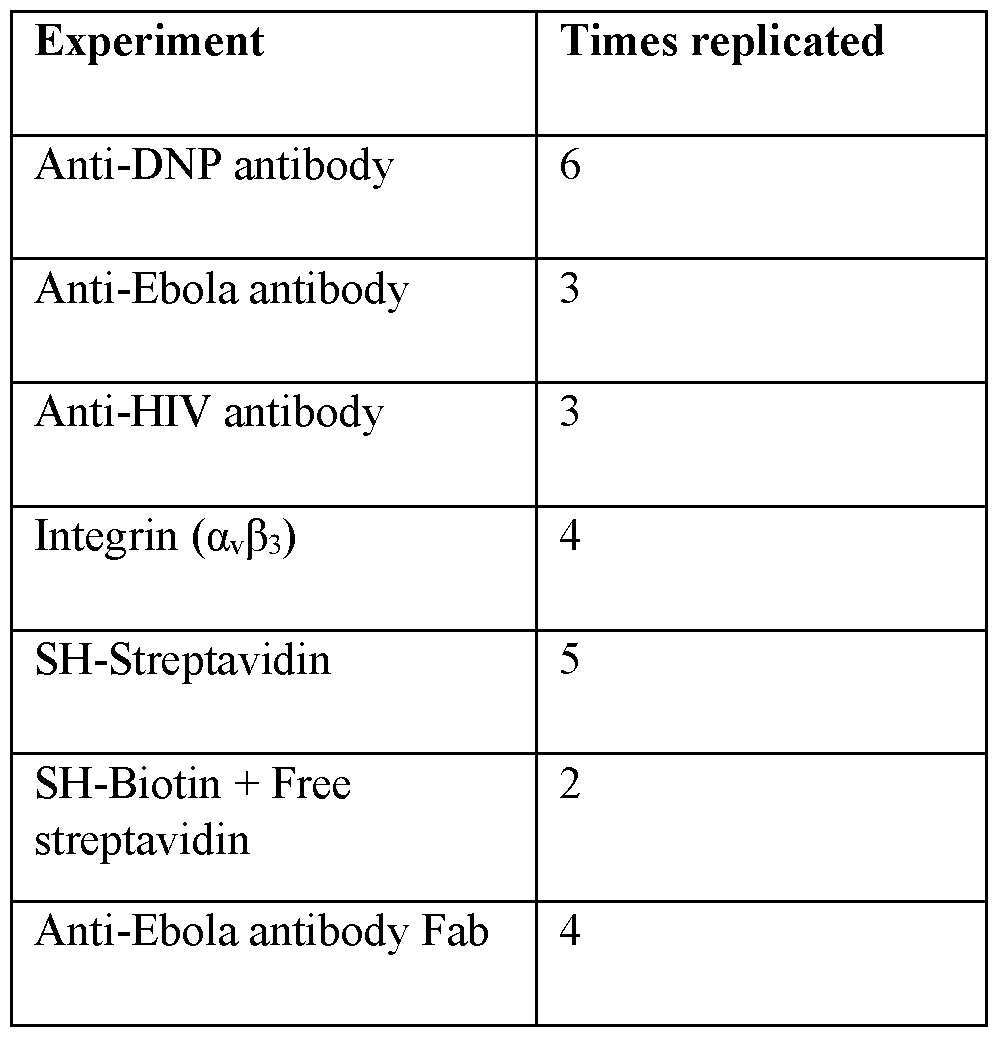
  • bioelectronic circuit according to any of the above 4 to 6, wherein the protein is selected from the group consisting of IgE Anti-DNP, IgG Anti -HIV, IgG Anti -Ebola, Fab Anti -Ebola, a. ⁇ ⁇ b 2 Integrin, and streptavidin.
  • bioelectronic circuit according to any of the above 4 to 6, further comprising wherein the protein is a polymerase, endonuclease, helicase or a proteosome.
  • a bioelectronic circuit comprising:
  • a bioelectronic circuit comprising: (a) a first and a second electrode,
  • a bioelectronic circuit comprising:
  • a bioelectronic circuit comprising: (a) a first and a second electrode,
  • a bioelectronic circuit comprising:
  • a bioelectronic circuit comprising:
  • a method of preparing a bioelectronic circuit comprising:
  • step (b) introducing a biotinylated protein to the streptavidin-electrode from step (a) to form a complex comprising the at least one electrode, the at least one streptavidin molecule and the biotinylated protein.
  • a method for detecting the activity of a polymerase comprising introducing a solution of DNA template and nucleotriphosphates to the bioelectronic circuit of the above 4, wherein polymerized product indicates that the polymerase is active.
  • a method for detecting the activity of protein comprising introducing a substrate of the protein to the bioelectronic circuit of the above 4 and detecting electrical changes.
  • a system for electrical measurement of protein activity comprising:
  • a bioelectronic circuit comprising:
  • a bioelectronic circuit comprising:
  • the present disclosure provides a bioelectronic circuit.
  • the bioelectronic circuit comprises (a) at least one electrode, (b) at least one ligand that is specific for a protein, wherein said ligand is modified so that it attaches to the at least one electrode, and (c) at least one protein that binds the at least one ligand, thereby forming an electronic contact between the electrode and the protein.
  • the bioelectronic circuit comprises one or two electrodes in direct contact with proteins. In the case where only one electrode is in contact with the proteins, the circuit is completed by means of ion currents that flow between a redox-active protein and a remote electrode.
  • the bioelectronic circuit comprises one electrode. In another embodiment, bioelectronic circuit comprises two electrodes. In some aspects of this embodiment, the second electrode is not separated from the first electrode by an electrolyte.
  • the at least one electrode comprises a noble metal.
  • the at least one electrode comprises a noble metal selected from the group consisting of palladium, gold, and platinum.
  • the at least one electrode is palladium.
  • the at least one electrode is gold.
  • the at least one electrode is platinum.
  • the bioelectronic circuit comprises a ligand that is specific for a protein and is modified so that it attaches to the at least one electrode.
  • the ligand can be modified to contain a thiol termination at one end for coupling to metals, as described by Zhang et al. 5
  • ligands are peptide epitopes for antibodies comprising a cysteine residue at one end, recognition peptides (such as the RGD peptide for binding integrin comprising a cysteine) and small molecules to which proteins have been selected to bind (such as an IgE molecule that binds dintitrophenyl and comprising a thiol).
  • Exemplary ligands that are specific for a protein and modified to attach to an electrode include, but are not limited to, HSCEECEE-dinitrophenol (target protein IgE Anti-DNP), CALDRWEKIRLR (target protein IgG Anti-HIV) (SEQ ID NO: 1), CHNTPVYKLDISEATQV (target protein IgG Anti-Ebola)
  • the cysteine or thiol used for electrode attachment is in bold.
  • Linear dimensions are from the RSCB PDB, either across a minor diameter or, for the antibodies, binding head to binding head: 1 IgE structure 4GRG, 2 IgG, structure 4NHH, Fab fragment structure 1YUH, 4 Integrin structure 1L5G, 5 streptavidin structure 1VWA.
  • the bioelectronic circuit also comprises at least one protein that binds the at least one ligand.
  • the protein can be any protein that can be expressed in a medium that allows for modification of the native protein sequence.
  • any protein function can be incorporated into an electrical circuit so that changes induced by ligand or substrate binding, or enzyme activity can then be measured electrically.
  • the bioelectronic circuit comprises (a) two palladium electrodes, (b) thiolated streptavidin attached to the palladium electrode, and (c) biotinylated polymerase, thereby forming an electronic contact between the electrode and the polymerase.
  • bioelectronic circuit described below comprises palladium electrodes, thioloated streptavidin, and a biotinylated polymerase, this embodiment is illustrative of the present disclosure and the scope of the present disclosure is not limited to this one embodiment.
  • thiolated streptavidin with an average of 2.5 thiols per tetramer was obtained from ProteinMods (Madison, Wisconsin).
  • the streptavidin (31 in FIG. 3) was incubated in a 1 mM aqueous solution with a pair of noble metal (palladium) electrodes (the pair forming a nano-scale junction approximately 5 nm gap, 32, 33 in FIG. 3). Incubation overnight produced a dense coating of the streptavidin attached to the metal electrodes by means of a surface thiol (34).
  • a bis-biotinylated f29 polymerase was constructed (35 in Fig 3).
  • the Avitag peptide sequence, GLNDIFEAQKIEWHE (SEQ ID NO: 4) was inserted between residues Gi l l and K112, and a second Avitag peptide sequence was inserted between E279 and D280 in the f29 polymerase sequence (the exonuclease activity of which was deleted by mutating D12 and E14 to alanine).
  • the Avitags were biotinylated using the BirA enzyme, as is well known in the art.
  • the resulting molecule (35) therefore contained two biotin molecules (36 in FIG. 3).
  • the biotinylated polymerase was incubated with the streptavidin functionalized junction for two hours (in 1 mM aqueous solution of f29 polymerase).
  • the electrical properties of the bioelectronic circuit were measured by applying a voltage bias V across it (37) and recording the current (38) through the circuit. As noted by Zhang et al., 5 this bias must be less than 100 mV to avoid contact-generated noise, and 50 mV bias was used to collect the data shown here.
  • a monobiotinylated f29 polymerase was prepared. To do this, the following sequence was added to the N-terminus of the WT (but exonuclease inactivated) enzyme: MGSSHHHHHHSSGLVPRGSGLNDIFEAQKIEWHEGASS (SEQ ID NO: 5), in which five histidines are a his-tag for purification of the protein and GLNDIFEAQKIEWHE (SEQ ID NO: 4) is the Avitag.
  • FIG. 5 shows such distributions for the mono-biotinylated polymerase (51) and the bis-biotinylated polymerase (52).
  • the bis-biotinylated molecule shows a new, high conductance feature (53) not present in the distribution measured for the mono-biotinylated molecule.
  • This feature corresponds to about 4 nS conductance, a substantial increase over the highest conductance feature observed for the mono-biotinylated molecule (about 0.7 nS). This is a similar increase to that observed for molecules like antibodies connected by one or two specific contacts, as described by Zhang et al. 5 Note that these very high conductivities are obtained with the streptavidin molecules forming part of the circuit, showing that assemblies of several proteins in sequence maintain their quasi-metallic properties if they are properly connected.
  • FIG. 6 shows electrical signals obtained from a bis-biotinylated polymerase molecule in its resting state 61 and its active state 62 where it is actively polymerizing a DNA template in the presence of dNTPs and Mg.
  • current data were recorded for about 90 s after an electrode was moved into contact with the complex.
  • Formation of the streptavidin- f29 polymerase contact takes about 20 s, after which the current (at 50 mV bias) jumps from zero to about 60 pA.
  • the control molecule 61 the current remains fairly quiet and constant for the remainder of the run.
  • bursts of noise 63 are observed, each lasting for a few seconds.
  • bursts themselves consist of sub-bursts (65), the duration and spacing of which are consistent with the interpretation that each sub-burst (65) signals the incorporation of a single nucleotide (given the known kinetics of f29 polymerase). This illustrates the use of the current invention in building circuits that can monitor enzyme activity electrically.
  • the Avitag should be placed as close as possible to tyrosines, tryptophans or histidines that are near the surface of the protein.
  • the bioelectronic circuit comprises (a) two palladium electrodes, (b) thiolated biotin attached to the palladium electrode, and (c) streptavidin. This embodiment allows for a uniform coating of small molecules on the electrode.
  • biotinylated cystamine was used as the thiolated biotin.
  • N,N’- bisbiotinyl-cystamine 11 (chemical structure shown in FIG. 1) was synthesized as described in the Examples. Because of the S-S linkage (12 in FIG. 1), 11 is stable in oxidizing environments (like air). It can be reduced to the monothiol 20 (chemical shown in FIG. 2) in the presence of a strong reducing agent. Reducing agents are known in the art and any can be used.
  • the reducing agent is an immobilized TCEP (Tris[2-carboxyethyl] phosphine hydrochloride) disulfide reducing gel from Thermo Scientific (cat # 77712).
  • electrodes are functionalized with thio-biotin, and the junction is then exposed to wild type (i.e., lacking surface thiols) streptavidin.
  • wild type streptavidin i.e., lacking surface thiols
  • the result is a strongly conducting bridge. This is illustrated in FIG. 7.
  • the gap is bridged by a thiolated streptavidin molecule which has been incubated with biotin (this is because biotin binding changes the conductance of streptavidin as described by Zhang et al. 5 so it is necessary to compare biotin-bound streptavidin molecules to see the intrinsic contact differences in these experiments).
  • the electrodes are first functionalized with the mono-thiolated biotin (20) and then wild type streptavidin is introduced to bind and complete the circuit.
  • the current distribution for the thiolated streptavidin (as biotin bound) directly attached to the electrodes is shown in 73.
  • the distribution for the wild type streptavidin captured between biotinylated electrodes is shown in 74.
  • a new, high conductance feature is observed at nearly 7nS (75) in the case where the thio-biotin molecule (20) is used to attach the streptavidin to the electrodes.
  • connection via a specifically-binding ligand (biotin) that is, itself, attached to the electrode via a thiol can form a better contact than a direct attachment of the protein itself via a surface thiol on the protein.
  • the protein contains one contact for a ligand. In the embodiments described in the following paragraph, the protein contains a second contact for a ligand.
  • the integrin molecule listed in Table 1 has one binding site for a small ligand that makes an excellent electrical contact (the cyclic RGD peptide incorporating a cysteine as listed in Table 1). But contact to a second point cannot be made via another ligand, because this integrin only has one RGD binding site.
  • a well-defined circuit can be completed by incorporating an Avitag sequence into a region near the N terminus of the integrin, so that now it has two specific binding sites: (1) the RGD peptide binding site and (2) the biotin binding site.
  • Heterogeneous contacts like this have the advantage that the protein can be oriented in an assembly by exploiting the selective attachment now incorporated into the protein.
  • one electrode might be functionalized with the streptavidin, and a second with the peptide (i.e., cyclic RGD), so that the modified protein would then always be bound in a well-defined orientation with respect to both electrodes.
  • the same technology enables sequential assembly of protein circuits. This is illustrated with the protein“AND” gate shown in FIG. 8.
  • the pair comprise a chemical AND gate because the high conductance state is only obtained when both ligand A and ligand B are present.
  • the first electrode, 84 is modified with the thio-biotin molecule 86 that binds a streptavidin molecule 87. This in turn binds protein A 81 that has been modified so as to have incorporated two biotinylated Avitag sequences 83.
  • additional useful building blocks can be created by linking one ligand to another. For example, by concatenating a peptide ligand (such as one of those shown in Table 1) to a biotin molecule, so that a first protein with a specific binding site to the peptide could be linked to streptavidin, for example, for subsequent incorporation into a circuit via the remaining unoccupied biotin binding sites on the streptavidin.
  • a peptide ligand such as one of those shown in Table 1
  • streptavidin for example, for subsequent incorporation into a circuit via the remaining unoccupied biotin binding sites on the streptavidin.
  • the first consideration is that the incorporated sequence should not consist of short repeats, as this complicates cloning.
  • the corresponding DNA template is shown in FIG. 9A, which also shows the dimer that can be formed between primer sequences.
  • FIG. 9B shows the sequence of the resulting plasmid with the products of the undesired primer dimers labeled.
  • the second consideration is that the isoelectric point of the new protein should not be altered
  • the residues in the inserted linker should be chosen to be neutral or nearly so.
  • This is illustrated by the synthesis of a phi29 polymerase containing two Avitags for wiring into a circuit.
  • the flexible linker was placed next to the Avitag sequence located near the N terminus.
  • the flexible linker (circled, 103) has the sequence GDSTDGTSDGSS (SEQ ID NO: 7) with the result that the protein product has a calculated pi of 7.25. This small shift from the pi of the native protein (which is a pi of about 8) is enough to cause misfolding resulting in the protein appearing as a shorter product 105 in a gel 106.
  • the third consideration arises when two identical sequences (i.e., two Avitag sequences) are to be inserted into the same clone expression system, as the corresponding repeated DNA sequence results in primer- dimers.
  • the cloning proceeds in two steps. A clone with one Avitag sequence is first produced, and then a second clone is generated from this first clone with the second Avitag sequence inserted.
  • FIG. 11 shows the reference conductance distribution 1101 for the two-Avitag polymerase previously shown as 52 in FIG. 5 (lacking a flexible linker sequence).
  • the high conductance feature owing to binding the two biotinylated sites is labeled 1103.
  • 1102 shows the conductance distribution for the phi29 incorporating a flexible linker (protein sequence 102 in FIG. 10). The high conductance feature is preserved (1104) showing that flexible peptide linkers can be incorporated while maintaining the quasi- metallic state of the protein.
  • FIG. 12 shows an“OR” gate based on the same assembly principles (the numbered components are as described for FIG. 8). This will enter the high conductance state if either ligand A or ligand B is present.
  • FIG. 13 where, again, numbering is as in FIG. 8.
  • a third protein“C” (1300) is attached to the junction of protein A and protein B at an unoccupied site of the coupling streptavidin 87.
  • protein C is an electrochemically active protein that changes its oxidation state in the presence of oxidizing molecules, for example, then the change of charge on protein C will modulate electron transport through the A-B chain.
  • the“A” AND“B” function can give rise to a third state that depends on the electronic state of“C”.
  • protein D 1400 is a redox active protein (for, example, glucose oxidase) immersed in an electrolyte 1401 containing a redox couple 1402, 1403 (for example, oxidized and reduced glucose) with a second (remote) electrode 1404 in contact with the electrolyte 1401 also, and connected to the first electrode 84 with a means for applying a voltage bias 1405 and a means for sensing the current 1406 that flows between the first electrode 84 and the second electrode 1404.
  • a redox active protein for, example, glucose oxidase
  • 1403 for example, oxidized and reduced glucose
  • second (remote) electrode 1404 in contact with the electrolyte 1401 also, and connected to the first electrode 84 with a means for applying a voltage bias 1405 and a means for sensing the current 1406 that flows between the first electrode 84 and the second electrode 1404.
  • the bioelectronic circuit of FIG 3 requires direct attachment of the modified coupling proteins to the electrodes.
  • coupling is more efficient if it is made via a small ligand attached to the electrode using an unmodified coupling protein. This has the advantage that the electrodes can be functionalized with a small ligand with which it is easier to obtain uniform coverage.
  • FIG. 15 shows a first electrode 1532 modified with the thiobiotin of FIG. 2 1534 binding and unmodified streptavidin 1531 that in turn binds the protein 1535 that has been biotinylated at the tow sites 1536. Similar functionalization completes the coupling to the second electrode 1533.
  • the size of the gap over which protein conduction is monitored can be increased substantially at very little cost in conductivity by forming a daisy-chain of coupled proteins with each electrode as shown in FIG. 16.
  • a second coupling protein 1602 is added into the circuit, coupled to the first 1531 by means of a bivalent linker 1601 such as the bis-biotin shown in FIG. 1.
  • RGD peptide (cyclo(Arg-Gly-Asp-D-Phe-Cys)) was purchased from Peptides International (Louisville, Kentucky). Peptide ligands for the anti -HIV antibody and the anti -Ebola antibody were synthesized by CPC Scientific (Sunnyvale, California) with a purity >95%. DNP and biotin disulfides were synthesized in our lab (SI Appendix Figs. S10 and SI 3) and reduced for 2 h before use by an immobilized TCEP (Tris[2-carboxyethyl] phosphine hydrochloride) disulfide reducing gel from Thermo Scientific (cat # 77712) following the manufacturer’s instructions.
  • TCEP Tris[2-carboxyethyl] phosphine hydrochloride
  • Anti-DNP antibody mouse monoclonal IgE antibody
  • wild-type streptavidin and all other chemicals were purchased from Sigma Aldrich (Saint Louis, Missouri).
  • Anti- HIV antibody Anti -HIV 1 pl7 antibody [32/1.24.89]
  • Anti-Ebola antibody was cultured from plants as described below. Binding affinities of all the three antibodies were measured by surface plasmon resonance (SPR). Thiolated streptavidin with an average of 2.5 thiols per tetramer was from ProteinMods (Madison, Wisconsin).
  • Ag/AgCl reference electrodes salt-bridged by 3 M KC1 or 10 mM KC1 were prepared as described previously.
  • the anti-Ebola antibody and the corresponding monomeric Fab fragment were prepared and purified as described in the Example 7.
  • Cystamine dihydrochloride (60 mg, 0.27 mmol) was added into DMF (2mL), followed by the addition of triethyl amine (0.44 mL, 3.19 mmol). The mixture was stirred for 30 min, to which biotin NHS ester (0.27g, 0.80 mmol) was added, and stirred at room temperature for 16 h. TLC indicted that cystamine was consumed and a product produced with an R f value of 0.63 in 20% methanol in DCM. The mixture was co-evaporated with dichloromethane until most of DMF and TEA was removed.
  • Compound 20 was produced by exposing N,N’-bis-biotinyl-cystamine 11 for 2 h (immediately before use in devices) to an immobilized TCEP (Tris[2-carboxyethyl] phosphine hydrochloride) disulfide reducing gel from Thermo Scientific (cat # 77712) following the manufacturer’s instructions.
  • TCEP Tris[2-carboxyethyl] phosphine hydrochloride
  • Palladium substrates for STM measurement were prepared by evaporating a 200 nm palladium film onto a silicon wafer using an electron-beam evaporator (Lesker PVD 75), with a 10 nm titanium adhesion layer.
  • the substrates were treated with a hydrogen flame immediately before functionalizing and then immersed in solutions of thiolated DNP, biotin, streptavidin or peptides containing a cysteine residue, overnight.
  • Substrate functionalization with small ligands was characterized by Fourier transform infrared (FTIR) spectroscopy (Fig. S9) and ellipsometry. Coverage of the substrate was monitored by STM and AFM imaging.
  • FTIR Fourier transform infrared
  • STM probes were etched from a 0.25mm Pd wire (California Fine Wires) by an AC electrochemical method. To avoid current leakage, probes were insulated with high-density polyethylene following the method described earlier for gold probes. M. Tuchband et ah, Rev Sci Instrum 83, 015102 (2012). Each probe was tested by STM in 1 mM PB buffer at +0.5 V bias to ensure the leakage current was ⁇ lpA. For functionalization, the probe was immersed in ligand solutions for 4 h or overnight. After that, it was taken out, rinsed with water, gently blown dry with nitrogen gas, and used immediately. Further details of the STM measurements are given in Example 4.
  • MCE 2-mercaptoethanol
  • Pd substrates were cut into 0.5 cm x 4.0 cm in size and used as the working electrode, with an active cell area of about 0.5 cm x 1.0 cm.
  • the substrate was treated with a hydrogen flame before functionalization.
  • Cyclic voltammetry was performed on a potentiostat (Model AFCBP1, Pine Instruments), using a Pt wire as the counter electrode and an Ag/AgCl (3M KC1) as the reference electrode.
  • the sweep range is from -0.5 V to +0.5 V, with a sweep rate of 10 mV/s unless stated otherwise.
  • Example 7 Expression and purification of anti-Ebola (EBOV) mAb 6D8 from Nicotiana benthamiana plants
  • 6D8 mAb was isolated and purified to > 95% homogeneity from N. benthamiana leaves by protein A affinity chromatography. Fulton, A. el al. , J ChromatogrA 1389, 128-132, doi: 10.1016/j.chroma.2015.02.013 (2015).
  • Monomeric Fab fragments were prepared from 6D8 by using the Pierce Fab Preparation Kit (Thermo Scientific) according to the manufacturer’s instructions (Thermos Scientific Pub. No. MAN0011651). Briefly, purified 6D8 was first incubated with papain immobilized to agarose beads at 37°C for 6-12 hr. The digested mAb mixture was then recovered by centrifugation at 5000xg for 1 min and separated on a protein A chromatography column. The Fab fragment was recovered in the flow through fraction, while the Fc fragment and undigested mAb were trapped in the protein A column. The successful production of monomeric Fab was verified by SDS-PAGE analysis under both reducing and non-reducing conditions.
  • each IV trace can be characterized by a single conductance value, G.
  • Measured distributions of G follow the log-normal distribution usually observed in single molecule measurements (data not shown).
  • the distributions are similar to distributions of current values obtained by recording current vs. time at a fixed gap and bias (data not shown) so the distribution was ascribed to different kinds of contact between the electrodes and the molecule.
  • Bare metal electrodes were used to capture the thiolated streptavidin, where the thiol mediated contacts displace the contamination on the electrode surfaces, (11) forming direct metal- molecule contacts.
  • the integrin was captured by the cyclic RGD peptide at only one of the two electrodes, and no signals were observed unless both electrodes were functionalized. Functionalization with peptides allows for non-specific contacts with hydrophilic sites on the protein at the electrode that is not specifically coupled.
  • the three antibodies yielded two conductance peaks (-0.3 nS and -2 nS), suggesting two binding modes: NS-S as for the integrin, and the desired S-S when both antigen-binding sites bind specifically (data not shown).
  • the contact point changes over the (-minute) course of a measurement, a reflection of the angstrom-scale change in the position of the STM probe. It is these various contact geometries that generate the overall shape of the conductance distributions (data not shown). Since the distributions retain the same peak positions and shapes at the different gap sizes, the data show no indications of proteins being“squeezed” at the smaller gap sizes.
  • FIG. 7A Biotin complexation in a thiolated-streptavidin sample changes the conductance distribution significantly (FIG. 7A).
  • a streptavidin molecule has four biotin binding sites, (16) so that the unthiolated apo-protein can be crosslinked by two biotins.
  • a thiolated biotin was synthesized and functionalized both the probe and substrate with it (FIG. 7B), subsequently flowing apo- streptavidin into the sample cell.
  • a tunneling conductance can be estimated from G ⁇ Go exp (-bc) where Go is 77pS and b ⁇ lA 1 . (24) For a small protein with x ⁇ 4 nm, this yields G ⁇ 10 21 S, 12 orders of magnitude smaller than observed. To account for the observation of nS conductance over 10 nm distances would require a b ⁇ 0. lA 1 .
  • Similar transport via readily oxidized amino acids has been observed in peptides.
  • this 0.25V barrier is similar to the charge injection barrier deduced from the redox potentials of the amino acids, as discussed above. If the charge injection rate was limited by thermally activated hopping over a 0.22 to 0.47V barrier, and it is this rate that determines the conductance, then we would expect to observe a conductance of « G exp where 0.22 ⁇ V ⁇ 0.47 volts, yielding from 12 nS to 0.5 pS, a range which encompasses the values reported here.

Landscapes

  • Chemical & Material Sciences (AREA)
  • Life Sciences & Earth Sciences (AREA)
  • Health & Medical Sciences (AREA)
  • Organic Chemistry (AREA)
  • Engineering & Computer Science (AREA)
  • Proteomics, Peptides & Aminoacids (AREA)
  • Zoology (AREA)
  • Wood Science & Technology (AREA)
  • Immunology (AREA)
  • Molecular Biology (AREA)
  • Physics & Mathematics (AREA)
  • Analytical Chemistry (AREA)
  • General Health & Medical Sciences (AREA)
  • Biochemistry (AREA)
  • Biophysics (AREA)
  • Microbiology (AREA)
  • Biotechnology (AREA)
  • Bioinformatics & Cheminformatics (AREA)
  • General Engineering & Computer Science (AREA)
  • Genetics & Genomics (AREA)
  • Hematology (AREA)
  • Biomedical Technology (AREA)
  • Urology & Nephrology (AREA)
  • Pathology (AREA)
  • General Physics & Mathematics (AREA)
  • Medicinal Chemistry (AREA)
  • Food Science & Technology (AREA)
  • Cell Biology (AREA)
  • Bioinformatics & Computational Biology (AREA)
  • Chemical Kinetics & Catalysis (AREA)
  • Electrochemistry (AREA)
  • Measuring Or Testing Involving Enzymes Or Micro-Organisms (AREA)
  • Investigating Or Analyzing Materials By The Use Of Electric Means (AREA)
  • Measuring And Recording Apparatus For Diagnosis (AREA)
  • Peptides Or Proteins (AREA)
  • Light Receiving Elements (AREA)
  • Inorganic Insulating Materials (AREA)
  • Apparatus Associated With Microorganisms And Enzymes (AREA)

Abstract

A universal connection system for assembling and electrically connecting proteins to make bioelectronic detectors and logic circuits, exploiting the electronic properties of ligand-receptor interactions and the quasi metallic properties of protein interiors.

Description

BIOELECTRONIC CIRCUITS, SYSTEMS AND METHODS FOR PREPARING AND USING THEM
FEDERALLY SPONSORED RESEARCH OR DEVELOPMENT
This invention was made with government support under R01 HG009180 awarded by the National Institutes of Health. The government has certain rights in the invention.
BACKGROUND
The use of streptavidin-biotin linkages for building molecular assemblies is well-known in the art with many reagents commercially available. It is also well-know that chemical coupling of proteins to electrodes enhances electron transfer between a metal electrode and a protein. This can take the form of a specific covalent linkage1 or, alternately, functionalization of the electrode with a small molecule (such as an amino acid) that renders the electrode hydrophilic and thus capable of forming hydrogen bonds with a protein.2
While it is known that some proteins are electrically conductive over extraordinarily long distances2 4 it has recently become clear that this conductivity is only apparent when specific chemical contacts are made between electrodes and proteins, and, in particular, connections based on the interactions of cognate ligands that interact with the hydrophobic interior of the protein that has evolved to interact with them.5 Furthermore, this recent work showed that high electronic conductivity (nS over distances of many - 2 to 20 - nm) appears to be a common property of proteins, not just proteins that have evolved to carry out electron transfer functions. Such behavior is referred to herein as quasi-metallic conduction. Finally, this work also showed that the binding of a specific ligand molecule (itself bound to an electrode by a thiol linkage) to a protein, produced a better contact to the protein than direct attachment of the protein itself to the electrode via a surface thiol modification of the protein. Thus, ligands that may bind via weak and reversible bonds, but that, in doing so contact the hydrophobic interior of the protein, are better electrical connectors than strong, irreversible covalent bonds to residues on the hydrophilic exterior of the protein. The most robust recipe for making an electrical contact between a protein and an electrode, or between one protein and another, is to use the specific chemical contact that the protein has evolved to make: that is the ligand-receptor interactions. Furthermore, there are theoretical grounds6 for believing that the interior of proteins manifests quasi metallic properties as an electronic transport material. This is consistent with Zhang et al.’s findings of conductance that is too high to measure (i.e., contact limited) in a series of proteins that are not electron transfer proteins.5 The same properties exist in electron transfer proteins (where they might be expected on the basis of biological need). Interestingly, all the functional proteins examined have this quasi-metallic property, even though there is not, at present, known evolutionary role for it in the proteins that do not carry out electron transport functions.
SUMMARY
The present disclosure provides bioelectronic circuits, systems and methods for preparing and using them.
In one embodiment, bioelectronic circuits are provided. In one aspect of this embodiment, the bioelectronic circuit comprises (a) at least one electrode, (b) at least one ligand that is specific for a protein, wherein the ligand is modified so that it attaches to the at least one electrode, and (c) at least one protein that binds the ligand, thereby forming an electronic contact between the electrode and the protein.
In a second aspect, the bioelectronic circuit comprises (a) a first and a second electrode, (b) a first and a second ligand that are specific for a protein, wherein the ligands are modified so that the first ligand attaches to the first electrode and the second ligand attaches to the second electrode, and (c) a protein that is modified to bind the first and the second ligands, wherein the binding of the protein to the first and the second ligands forms an electronic contact between the electrode and the protein.
In a third aspect, the bioelectronic circuit comprises (a) a first and a second electrode, (b) a first ligand that is specific for a protein, wherein the first ligand is modified so that it attaches to the first electrode,
(c) a protein that binds the first ligand and is modified to bind a second ligand, and (d) a second ligand that binds the protein and is modified so that it attaches to the second electrode, thereby forming an electronic contact between the first and second electrodes and the protein.
In a fourth aspect, the bioelectronic circuit comprises (a) a first and a second electrode, (b) a first protein, wherein the first protein is attached to the first electrode via biotin-streptavidin interactions, (c) a second protein, wherein the second protein is attached to the first protein via biotin-streptavidin interactions and is modified to bind a ligand, (d) a ligand that binds the second protein and is modified so that it attaches to the second electrode, thereby forming an electronic contact between the first and second electrodes and the first and second protein.
In a fifth aspect, the bioelectronic circuit comprises (a) a first and a second electrode, (b) a first and a second protein, wherein one of, or both, the first and the second proteins are attached to the first and second electrodes through biotin-streptavidin interactions, thereby forming an electronic contact between the first and the second electrodes and one of, or both, the first and the second proteins. In a sixth aspect, the bioelectronic circuit comprises (a) a first and a second electrode, (b) a first protein, wherein the first protein is attached to the first electrode via biotin-streptavidin interactions, (c) a second protein, wherein the second protein is attached to the first protein via biotin-streptavidin interactions and is attached to the second electrode via biotin-streptavidin interactions, (d) a third protein, wherein the third protein is attached to the first and the second proteins via biotin-streptavidin interactions, thereby forming an electronic contact between the first and second electrodes and the first, second and third proteins.
In a seventh aspect, the bioelectronic circuit comprises (a) a first electrode, (b) a first protein, wherein the first protein is attached to the first electrode via biotin-streptavidin interactions, (c) a second protein, wherein the second protein is attached to the first protein via biotin-streptavidin interactions and is attached to the second electrode via biotin-streptavidin interactions, (d) a second electrode in contact with an electrolyte and connected to the first electrode, (e) a means for applying a voltage bias, (f) a means for sensing current, thereby forming an electronic contact between the first and second electrodes and the first and second proteins.
In an eighth aspect, the bioelectronic circuit is as herein described wherein the protein comprises two or more Avitag sequences placed at the surface of the protein and no more than 10 amino acid residues from tyrosines, tryptophans or histidines within the protein.
In a ninth aspect, the bioelectronic circuit comprises (a) a first and a second electrode, (b) a first and a second ligand that are specific for a protein, wherein the ligands are modified so that the first ligand attaches to the first electrode and the second ligand attaches to the second electrode, (c) a first protein and a second protein that bind the first ligand and the second ligand and (d) a third protein that is modified to bind the first and the second proteins, wherein the binding of the third protein to the first and the second proteins forms an electronic contact between the electrode and the protein.
In a tenth aspect, the bioelectronic circuit comprises (a) a first and a second electrode, (b) a first and a second ligand that are specific for a protein, wherein the ligands are modified so that the first ligand attaches to the first electrode and the second ligand attaches to the second electrode, (c) at least a first protein and a second protein that bind the first ligand and the second ligand, and may be coupled to further proteins via ligands, extending the range over which conduction is obtained.
In another embodiment, systems for electrical measurement of protein activity are provided. The system comprises (a) a bioelectronic circuit as herein described, (b) a means for applying a bias between the first and second electrode, and (c) a means for detecting the current through the bioelectronic circuit. In another embodiment, methods of preparing bioelectronic circuits are provided. In one aspect, the method comprises (a) attaching at least one streptavidin molecule to at least one electrode, (b) introducing a biotinylated protein to the streptavidin-electrode from step (a) to form a complex comprising the at least one electrode, the at least one streptavidin molecule and the biotinylated protein.
In another embodiment, methods for detecting the activity of a polymerase, the method comprising introducing a solution of DNA template and nucleotriphosphates to any of the bioelectronic circuits as herein described, wherein polymerized product indicates that the polymerase is active.
In another embodiment, methods for detecting the activity of protein. The method comprises introducing a substrate of the protein to any of the bioelectronic circuit herein described and detecting electrical changes.
BRIEF DESCRIPTION OF THE FIGURES
FIG. 1 shows the chemical structure of the molecule bis-biotin cystamine.
FIG. 2 shows the chemical structure of the reduced version of the molecule shown in FIG. 1.
FIG. 3 shows a schematic diagram of a bioelectronic circuit using streptavidin wires to wire a biotin- modified polymerase into the circuit.
FIG. 4 shows a gel assay demonstrating that biotinylated polymerase bound to two streptavidin molecules is active and capable of efficient enzyme action.
FIG. 5A and FIG. 5B show a comparison of the measured conductance distributions for mono- biotinylated and bis-biotinylated polymerases.
FIG. 6A and FIG. 6B show a recording of current vs time for a polymerase molecule wired into a bioelectronic circuit with streptavidin.
FIG. 7A and FIG. 7B show a comparison of measured conductance distributions for thiolated streptavidin bound with biotin and directly coupled to electrodes with that for wild-type streptavidin bound to electrodes with the thiolated biotin shown in FIG. 2. Here, the biotin is shown exaggerated in size for clarity.
FIG. 8 shows a schematic diagram of orienting circuit elements using more than one selective ligand to form a biomolecular AND gate. FIG. 9A and FIG. 9B show cloning constraints on the choice of protein sequence modification.
FIG. 10A and FIB. 10B shows examples of protein sequences for phi29 polymerase modified to contain two Avitag linkers showing how the incorporation of charged residues can cause misfolding.
FIG. 11A and FIG. 11B show conductance distributions measured for two polymerases with and without a flexible linker sequence as wired into a circuit with biotin-streptavidin linkers.
FIG. 12 shows a schematic diagram of a biomolecular OR gate.
FIG. 13 shows a schematic diagram of a biomolecular three-state gate.
FIG. 14 shows a schematic diagram of a single electrode circuit in which the second contact is formed by a redox-active protein immersed in an electrolyte solution.
FIG. 15 shows a bioelectronic circuit in which an unmodified streptavidin is tethered to an electrode by the thio-biotin of FIG. 2
FIG. 16 shows a bioelectronic circuit in which the coupling is extended in distance by incorporating a second streptavidin and the bis-biotin molecule of FIG. 1.
DETAILED DESCRIPTION OF THE INVENTION
The invention includes the following:
1. A bioelectronic circuit as shown and described.
2. A system for electrical measurement of protein activity as shown and described.
3. A method for detecting the activity of a protein as shown and described.
4. A bioelectronic circuit comprising:
(a) at least one electrode,
(b) at least one ligand that is specific for a protein, wherein the ligand is modified so that it attaches to the at least one electrode, and
(c) at least one protein that binds the ligand, thereby forming an electronic contact between the electrode and the protein. 5. The bioelectronic circuit according to the above 4, wherein the electrode comprises a metal selected from the group consisting of palladium, platinum or gold.
6. The bioelectronic circuit according to the above 4 or 5, wherein the ligand is selected from the group consisting of HSCH2CH2-dinitrophenol, CALDRWEKIRLR (SEQ ID NO: 1),
CHNTPVYKLDISEATQV (SEQ ID NO: 2), cyclic RGDfC, thiolated-streptavidin, and HSCH2CH2- biotin.
7. The bioelectronic circuit according to any of the above 4 to 6, wherein the protein is selected from the group consisting of IgE Anti-DNP, IgG Anti -HIV, IgG Anti -Ebola, Fab Anti -Ebola, a.\·b2 Integrin, and streptavidin.
8. The bioelectronic circuit according to any of the above 4 to 6, further comprising wherein the protein is a polymerase, endonuclease, helicase or a proteosome.
9. The bioelectronic circuit according to the above 4, wherein the at least one ligand is modified to comprise a thiol, amine, disulfide or cyanide moeity.
10. A bioelectronic circuit comprising:
(a) a first and a second electrode,
(b) a first and a second ligand that are specific for a protein, wherein the ligands are modified so that the first ligand attaches to the first electrode and the second ligand attaches to the second electrode, and
(c) a protein that is modified to bind the first and the second ligands, wherein the binding of the protein to the first and the second ligands forms an electronic contact between the electrode and the protein.
11. The bioelectronic circuit of the above 10, wherein the ligand is a thiolated streptavidin.
12. The bioelectronic circuit of the above 10 or 11, wherein the protein is modified to contain biotin.
13. The bioelectronic circuit of any of the above 10 to 12, wherein the protein is bis-biotinylated polymerase.
14. A bioelectronic circuit comprising: (a) a first and a second electrode,
(b) a first ligand that is specific for a protein, wherein the first ligand is modified so that it attaches to the first electrode,
(c) a protein that binds the first ligand and is modified to bind a second ligand, and
(d) a second ligand that binds the protein and is modified so that it attaches to the second electrode, thereby forming an electronic contact between the first and second electrodes and the protein.
15. The bioelectronic circuit of the above 14, wherein the binding site on the protein to the first ligand is in proximity to a flexible linker sequence.
16. The bioelectronic circuit of the above 14, wherein the second binding site on the protein to the second ligand is in proximity to a flexible linker sequence.
17. The bioelectronic circuit of the above 15 or 16, wherein the flexible linker sequence comprises GNSTNGTSNGSS (SEQ ID NO: 3).
18. A bioelectronic circuit comprising:
(a) a first and a second electrode,
(b) a first protein, wherein the first protein is attached to the first electrode via biotin-streptavidin interactions,
(c) a second protein, wherein the second protein is attached to the first protein via biotin- streptavidin interactions and is modified to bind a ligand,
(d) a ligand that binds the second protein and is modified so that it attaches to the second electrode, thereby forming an electronic contact between the first and second electrodes and the first and second protein.
19. The bioelectronic circuit according to the above 18, wherein the first protein comprises two biotins.
20. The bioelectronic circuit of the above 19, wherein the second protein comprises two biotinylated Avitag sequences.
21. A bioelectronic circuit comprising: (a) a first and a second electrode,
(b) a first and a second protein, wherein one of, or both, the first and the second proteins are attached to the first and second electrodes through biotin-streptavidin interactions, thereby forming an electronic contact between the first and the second electrodes and one of, or both, the first and the second proteins.
22. The bioelectronic circuit of the above 21, wherein the first binding site comprises one or more residues that can be biotinylated.
23. A bioelectronic circuit comprising:
(a) a first and a second electrode,
(b) a first protein, wherein the first protein is attached to the first electrode via biotin-streptavidin interactions,
(c) a second protein, wherein the second protein is attached to the first protein via biotin- streptavidin interactions and is attached to the second electrode via biotin-streptavidin interactions,
(d) a third protein, wherein the third protein is attached to the first and the second proteins via biotin-streptavidin interactions, thereby forming an electronic contact between the first and second electrodes and the first, second and third proteins.
24. A bioelectronic circuit comprising:
(a) a first electrode,
(b) a first protein, wherein the first protein is attached to the first electrode via biotin-streptavidin interactions,
(c) a second protein, wherein the second protein is attached to the first protein via biotin- streptavidin interactions and is attached to the second electrode via biotin-streptavidin interactions,
(d) a second electrode in contact with an electrolyte and connected to the first electrode,
(e) a means for applying a voltage bias, (f) a means for sensing current, thereby forming an electronic contact between the first and second electrodes and the first and second proteins.
25. A method of preparing a bioelectronic circuit, the method comprising:
(a) attaching at least one streptavidin molecule to at least one electrode,
(b) introducing a biotinylated protein to the streptavidin-electrode from step (a) to form a complex comprising the at least one electrode, the at least one streptavidin molecule and the biotinylated protein.
26. A method for detecting the activity of a polymerase, the method comprising introducing a solution of DNA template and nucleotriphosphates to the bioelectronic circuit of the above 4, wherein polymerized product indicates that the polymerase is active.
27. A method for detecting the activity of protein, the method comprising introducing a substrate of the protein to the bioelectronic circuit of the above 4 and detecting electrical changes.
28. A system for electrical measurement of protein activity comprising:
(a) a bioelectronic circuit as herein described,
(b) a means for applying a bias between the first and second electrode, and
(c) a means for detecting the current through the bioelectronic circuit.
29. A bioelectronic circuit as herein described wherein the protein comprises two or more Avitag sequences placed at the surface of the protein and no more than 10 amino acid residues from tyrosines, tryptophans or histidines within the protein.
30. A bioelectronic circuit comprising:
(a) a first and a second electrode,
(b) a first and a second ligand that are specific for a protein, wherein the ligands are modified so that the first ligand attaches to the first electrode and the second ligand attaches to the second electrode,
(c) a first protein and a second protein that bind the first ligand and the second ligand, and (d) a third protein that is modified to bind the first and the second proteins, wherein the binding of the third protein to the first and the second proteins forms an electronic contact between the electrode and the protein.
31. The bioelectronic circuit of the above 30, wherein the first and second proteins are streptavidin
32. The bioelectronic circuit of the above 30, wherein the first and second ligands are biotin.
33. The bioelectronic circuit of the above 30, wherein the third protein is biotinylated.
34. A bioelectronic circuit comprising:
(a) a first and a second electrode,
(b) a first and a second ligand that are specific for a protein, wherein the ligands are modified so that the first ligand attaches to the first electrode and the second ligand attaches to the second electrode, and
(c) at least a first protein and a second protein that bind the first ligand and the second ligand, and may be coupled to further proteins via ligands, extending the range over which conduction is obtained.
DEFINITIONS
Unless defined otherwise, all technical and scientific terms used herein have the same meaning as those commonly understood by one of ordinary skill in the art to which this invention belongs. Although methods and materials similar or equivalent to those described herein can be used in the practice or testing of the present disclosure, suitable methods and materials are described below. The materials, methods and examples are illustrative only, and are not intended to be limiting. All publications, patents and other documents mentioned herein are incorporated by reference in their entirety.
Throughout this specification, the word“comprise” or variations such as“comprises” or“comprising” will be understood to imply the inclusion of a stated integer or groups of integers but not the exclusion of any other integer or group of integers.
The term“a” or“an” may mean more than one of an item.
The terms“and” and“or” may refer to either the conjunctive or disjunctive and mean“and/or”. The term“about” means within plus or minus 10% of a stated value. For example,“about 100” would refer to any number between 90 and 110.
BIOELECTRONIC CIRCUITS
The present disclosure provides a bioelectronic circuit. The bioelectronic circuit comprises (a) at least one electrode, (b) at least one ligand that is specific for a protein, wherein said ligand is modified so that it attaches to the at least one electrode, and (c) at least one protein that binds the at least one ligand, thereby forming an electronic contact between the electrode and the protein.
Depending on the application, the bioelectronic circuit comprises one or two electrodes in direct contact with proteins. In the case where only one electrode is in contact with the proteins, the circuit is completed by means of ion currents that flow between a redox-active protein and a remote electrode. In one embodiment, the bioelectronic circuit comprises one electrode. In another embodiment, bioelectronic circuit comprises two electrodes. In some aspects of this embodiment, the second electrode is not separated from the first electrode by an electrolyte.
The at least one electrode comprises a noble metal. In one embodiment, the at least one electrode comprises a noble metal selected from the group consisting of palladium, gold, and platinum. In another embodiment, the at least one electrode is palladium. In another embodiment, the at least one electrode is gold. In another embodiment, the at least one electrode is platinum. In addition to the at least one electrode, the bioelectronic circuit comprises a ligand that is specific for a protein and is modified so that it attaches to the at least one electrode.
The ligand can be modified to contain a thiol termination at one end for coupling to metals, as described by Zhang et al.5 Examples of ligands are peptide epitopes for antibodies comprising a cysteine residue at one end, recognition peptides (such as the RGD peptide for binding integrin comprising a cysteine) and small molecules to which proteins have been selected to bind (such as an IgE molecule that binds dintitrophenyl and comprising a thiol).
Exemplary ligands that are specific for a protein and modified to attach to an electrode include, but are not limited to, HSCEECEE-dinitrophenol (target protein IgE Anti-DNP), CALDRWEKIRLR (target protein IgG Anti-HIV) (SEQ ID NO: 1), CHNTPVYKLDISEATQV (target protein IgG Anti-Ebola)
(SEQ ID NO: 2), CHNTPVYKLDISEATQV (target protein Fab Anti-Ebola) (SEQ ID NO: 2), cyclic RGDfC (target protein a.\·b’, Integrin), thiolated-streptavidin (target Biotin), and HSCH CH -biotin (target Streptavidin). A summary of these various binding arrangements is given in Table 1 below, adapted from Zhang et al.5
Table 1.
Figure imgf000013_0001
Proteins and ligands used in this study. The cysteine or thiol used for electrode attachment is in bold. Linear dimensions are from the RSCB PDB, either across a minor diameter or, for the antibodies, binding head to binding head: 1 IgE structure 4GRG, 2IgG, structure 4NHH, Fab fragment structure 1YUH, 4 Integrin structure 1L5G, 5streptavidin structure 1VWA.
The bioelectronic circuit also comprises at least one protein that binds the at least one ligand. The protein can be any protein that can be expressed in a medium that allows for modification of the native protein sequence. Thus, any protein function can be incorporated into an electrical circuit so that changes induced by ligand or substrate binding, or enzyme activity can then be measured electrically.
In one embodiment, the bioelectronic circuit comprises (a) two palladium electrodes, (b) thiolated streptavidin attached to the palladium electrode, and (c) biotinylated polymerase, thereby forming an electronic contact between the electrode and the polymerase. It should be understood that while the bioelectronic circuit described below comprises palladium electrodes, thioloated streptavidin, and a biotinylated polymerase, this embodiment is illustrative of the present disclosure and the scope of the present disclosure is not limited to this one embodiment.
In one aspect of this embodiment, thiolated streptavidin with an average of 2.5 thiols per tetramer was obtained from ProteinMods (Madison, Wisconsin). The streptavidin (31 in FIG. 3) was incubated in a 1 mM aqueous solution with a pair of noble metal (palladium) electrodes (the pair forming a nano-scale junction approximately 5 nm gap, 32, 33 in FIG. 3). Incubation overnight produced a dense coating of the streptavidin attached to the metal electrodes by means of a surface thiol (34).
In order to complete the bioelectronic circuit, a bis-biotinylated f29 polymerase was constructed (35 in Fig 3). The Avitag peptide sequence, GLNDIFEAQKIEWHE (SEQ ID NO: 4), was inserted between residues Gi l l and K112, and a second Avitag peptide sequence was inserted between E279 and D280 in the f29 polymerase sequence (the exonuclease activity of which was deleted by mutating D12 and E14 to alanine). This produced a polymerase with two Avitags separated by about 5 nm. The Avitags were biotinylated using the BirA enzyme, as is well known in the art. The resulting molecule (35) therefore contained two biotin molecules (36 in FIG. 3). The biotinylated polymerase was incubated with the streptavidin functionalized junction for two hours (in 1 mM aqueous solution of f29 polymerase). The electrical properties of the bioelectronic circuit were measured by applying a voltage bias V across it (37) and recording the current (38) through the circuit. As noted by Zhang et al., 5 this bias must be less than 100 mV to avoid contact-generated noise, and 50 mV bias was used to collect the data shown here.
To confirm that the modified polymerase was still active, rolling-circle amplification of a DNA template was carried out with the molecule 35 as bound by two streptavidin molecules. The polymerase activity, as monitored by a DNA gel of the polymerization product (42 in FIG. 4) is comparable to that of the native enzyme with exonuclease activity deleted (41 in FIG. 4).
In order to confirm that the bis-biotinylated molecule 35 bridged the junction, a monobiotinylated f29 polymerase was prepared. To do this, the following sequence was added to the N-terminus of the WT (but exonuclease inactivated) enzyme: MGSSHHHHHHSSGLVPRGSGLNDIFEAQKIEWHEGASS (SEQ ID NO: 5), in which five histidines are a his-tag for purification of the protein and GLNDIFEAQKIEWHE (SEQ ID NO: 4) is the Avitag.
In order to characterize the conductance of the molecular circuits in all its possible binding geometries, repeated measurements were made on different molecular junctions, and the frequency with which particular values of conductance are recorded on a logarithmic conductance scale were plotted (as described in Zhang et al.5). FIG. 5 shows such distributions for the mono-biotinylated polymerase (51) and the bis-biotinylated polymerase (52). The bis-biotinylated molecule shows a new, high conductance feature (53) not present in the distribution measured for the mono-biotinylated molecule. This feature corresponds to about 4 nS conductance, a substantial increase over the highest conductance feature observed for the mono-biotinylated molecule (about 0.7 nS). This is a similar increase to that observed for molecules like antibodies connected by one or two specific contacts, as described by Zhang et al. 5 Note that these very high conductivities are obtained with the streptavidin molecules forming part of the circuit, showing that assemblies of several proteins in sequence maintain their quasi-metallic properties if they are properly connected.
FIG. 6 shows electrical signals obtained from a bis-biotinylated polymerase molecule in its resting state 61 and its active state 62 where it is actively polymerizing a DNA template in the presence of dNTPs and Mg. In each case, current data were recorded for about 90 s after an electrode was moved into contact with the complex. Formation of the streptavidin- f29 polymerase contact takes about 20 s, after which the current (at 50 mV bias) jumps from zero to about 60 pA. In the case of the control molecule 61 the current remains fairly quiet and constant for the remainder of the run. For the active molecule 62, bursts of noise 63 are observed, each lasting for a few seconds. A 50 ms portion of one of these bursts is also shown (64) - the bursts themselves consist of sub-bursts (65), the duration and spacing of which are consistent with the interpretation that each sub-burst (65) signals the incorporation of a single nucleotide (given the known kinetics of f29 polymerase). This illustrates the use of the current invention in building circuits that can monitor enzyme activity electrically.
Recognizing the importance of placing a contact as close to the hydrophobic interior of a protein as possible, while still having the contact point itself appear on the surface of the protein, sites for insertion of the Avitags should be placed as close aromatic residues as possible while still exposing the site for biotinylation at the exterior of the protein. Therefore, the Avitag should be placed as close as possible to tyrosines, tryptophans or histidines that are near the surface of the protein.
In a second embodiment, the bioelectronic circuit comprises (a) two palladium electrodes, (b) thiolated biotin attached to the palladium electrode, and (c) streptavidin. This embodiment allows for a uniform coating of small molecules on the electrode.
In one aspect of this embodiment, biotinylated cystamine was used as the thiolated biotin. N,N’- bisbiotinyl-cystamine 11 (chemical structure shown in FIG. 1) was synthesized as described in the Examples. Because of the S-S linkage (12 in FIG. 1), 11 is stable in oxidizing environments (like air). It can be reduced to the monothiol 20 (chemical shown in FIG. 2) in the presence of a strong reducing agent. Reducing agents are known in the art and any can be used. In some embodiments, the reducing agent is an immobilized TCEP (Tris[2-carboxyethyl] phosphine hydrochloride) disulfide reducing gel from Thermo Scientific (cat # 77712).
In this second embodiment, electrodes are functionalized with thio-biotin, and the junction is then exposed to wild type (i.e., lacking surface thiols) streptavidin. The result is a strongly conducting bridge. This is illustrated in FIG. 7. In a control experiment (71) the gap is bridged by a thiolated streptavidin molecule which has been incubated with biotin (this is because biotin binding changes the conductance of streptavidin as described by Zhang et al. 5 so it is necessary to compare biotin-bound streptavidin molecules to see the intrinsic contact differences in these experiments). In the second measurement (72) the electrodes are first functionalized with the mono-thiolated biotin (20) and then wild type streptavidin is introduced to bind and complete the circuit. The current distribution for the thiolated streptavidin (as biotin bound) directly attached to the electrodes is shown in 73. The distribution for the wild type streptavidin captured between biotinylated electrodes is shown in 74. A new, high conductance feature is observed at nearly 7nS (75) in the case where the thio-biotin molecule (20) is used to attach the streptavidin to the electrodes. Remarkably, connection via a specifically-binding ligand (biotin) that is, itself, attached to the electrode via a thiol, can form a better contact than a direct attachment of the protein itself via a surface thiol on the protein.
In the embodiments described above, the protein contains one contact for a ligand. In the embodiments described in the following paragraph, the protein contains a second contact for a ligand.
For example, the integrin molecule listed in Table 1 has one binding site for a small ligand that makes an excellent electrical contact (the cyclic RGD peptide incorporating a cysteine as listed in Table 1). But contact to a second point cannot be made via another ligand, because this integrin only has one RGD binding site. However, a well-defined circuit can be completed by incorporating an Avitag sequence into a region near the N terminus of the integrin, so that now it has two specific binding sites: (1) the RGD peptide binding site and (2) the biotin binding site. Heterogeneous contacts like this (peptide binding at one site, biotinylation at another) have the advantage that the protein can be oriented in an assembly by exploiting the selective attachment now incorporated into the protein. For example, one electrode might be functionalized with the streptavidin, and a second with the peptide (i.e., cyclic RGD), so that the modified protein would then always be bound in a well-defined orientation with respect to both electrodes. The same technology enables sequential assembly of protein circuits. This is illustrated with the protein“AND” gate shown in FIG. 8. More specifically, with protein A (81) designed or chosen such that binding of ligand A causes an increase in conductivity and protein B (82) designed or chosen such that binding of ligand B causes an increase in conductivity, wired in series, and connected between electrodes, the pair comprise a chemical AND gate because the high conductance state is only obtained when both ligand A and ligand B are present. Clearly one way to guarantee that the proteins are wired in the desired order is the use of selective contacts. Thus, the first electrode, 84, is modified with the thio-biotin molecule 86 that binds a streptavidin molecule 87. This in turn binds protein A 81 that has been modified so as to have incorporated two biotinylated Avitag sequences 83. Further incubation with streptavidin places a second streptavidin 84 on protein A. At this point, protein B 82 can be bound using a biotinylated Avitag sequence 83. If the same biotin-streptavidin coupling were to be used to complete the circuit contact to the second electrode 85, the undesirable possibility arises that a protein A could become incorporated at the second position where a protein B is desired. In order to overcome this possibility, a heterogeneous linkage is used, in this case exploiting a peptide binding site 88 on protein B. The corresponding peptide ligand 89 bound to the second electrode 85 completes the circuit by binding to its cognate site on protein B. It will be recognized that additional useful building blocks can be created by linking one ligand to another. For example, by concatenating a peptide ligand (such as one of those shown in Table 1) to a biotin molecule, so that a first protein with a specific binding site to the peptide could be linked to streptavidin, for example, for subsequent incorporation into a circuit via the remaining unoccupied biotin binding sites on the streptavidin.
Another consideration that arises in connecting functional proteins into a circuit with two contact points is the possible disruption of function caused by the mechanical constraints imposed by tethering the protein at two points. While connection at one point leaves the protein free to move much as though it were in solution, a second attachment point, especially one chosen to be distant from the first (so as to sense protein motion) could clearly disrupt protein function. Thus, it is highly desirable to incorporate a flexible linker into the region where a second contact site is incorporated. This could, of course be at either one of the two contact sites.
Sequences of amino acids that form flexible linkers are well known in the art and examples are listed on the world wide web at bmrb.wisc.edu/referenc/choufas.shtml. When selecting a particular flexible linker, there are three important design considerations.
The first consideration is that the incorporated sequence should not consist of short repeats, as this complicates cloning. To illustrate this, consider the well-known flexible linker amino acid sequence: GGSGGSGGSGGS (SEQ ID NO: 6). The corresponding DNA template is shown in FIG. 9A, which also shows the dimer that can be formed between primer sequences. The result, when cloned into an expression vector, is shown in FIG. 9B which shows the sequence of the resulting plasmid with the products of the undesired primer dimers labeled.
The second consideration is that the isoelectric point of the new protein should not be altered
significantly, so that the residues in the inserted linker should be chosen to be neutral or nearly so. This is illustrated by the synthesis of a phi29 polymerase containing two Avitags for wiring into a circuit. In this case, the flexible linker was placed next to the Avitag sequence located near the N terminus. In the first case (sequence 101 in FIG. 10) the flexible linker (circled, 103) has the sequence GDSTDGTSDGSS (SEQ ID NO: 7) with the result that the protein product has a calculated pi of 7.25. This small shift from the pi of the native protein (which is a pi of about 8) is enough to cause misfolding resulting in the protein appearing as a shorter product 105 in a gel 106. When aspartic acid (D) is changed to asparagine (N) in the linker sequence (now GNSTNGTSNGSS (SEQ ID NO: 3) - 104 in sequence 102) the native pi is restored (pl=8.13) and the product now runs at the position of the correctly folded native protein (107 in gel 108).
The third consideration arises when two identical sequences (i.e., two Avitag sequences) are to be inserted into the same clone expression system, as the corresponding repeated DNA sequence results in primer- dimers. To overcome this, the cloning proceeds in two steps. A clone with one Avitag sequence is first produced, and then a second clone is generated from this first clone with the second Avitag sequence inserted.
Given the flexibility of the GNSTNGTSNGSS (SEQ ID NO: 3) linker and the concern that a particular protein folding may be required to support this quasi-metallic state of the protein interior, a key question is whether the conductive properties of the protein are maintained when the linker is inserted. FIG. 11 shows the reference conductance distribution 1101 for the two-Avitag polymerase previously shown as 52 in FIG. 5 (lacking a flexible linker sequence). Here, the high conductance feature owing to binding the two biotinylated sites is labeled 1103. 1102 shows the conductance distribution for the phi29 incorporating a flexible linker (protein sequence 102 in FIG. 10). The high conductance feature is preserved (1104) showing that flexible peptide linkers can be incorporated while maintaining the quasi- metallic state of the protein.
Streptavidin is tetravalent (it binds up to four biotins) so, taken together with these remarkable and unexpected electronic properties, both of the coupling scheme and of the proteins themselves, completely new avenues for building bioelectronic circuits become available. FIG. 12 shows an“OR” gate based on the same assembly principles (the numbered components are as described for FIG. 8). This will enter the high conductance state if either ligand A or ligand B is present.
The tetravalent nature of streptavidin allows for even more complex circuits to be assembled. One version of this possibility is shown in FIG. 13 where, again, numbering is as in FIG. 8. Here, a third protein“C” (1300) is attached to the junction of protein A and protein B at an unoccupied site of the coupling streptavidin 87. If, for example, protein C is an electrochemically active protein that changes its oxidation state in the presence of oxidizing molecules, for example, then the change of charge on protein C will modulate electron transport through the A-B chain. Thus, the“A” AND“B” function can give rise to a third state that depends on the electronic state of“C”.
The embodiments described thus far have all utilized both a first and a second electrode. However, the quasi-metallic conductance of protein interiors, coupled with the ligand-based linkages described here would allow for very efficient electron transfer at the surface of a sensor electrode immersed in a solution containing molecules that generate redox activity in a sensor protein (for example, the glucose sensor1). Thus, the protein or proteins of interest would be only linked directly to one electrode as illustrated in FIG. 14. Here, protein D 1400 is a redox active protein (for, example, glucose oxidase) immersed in an electrolyte 1401 containing a redox couple 1402, 1403 (for example, oxidized and reduced glucose) with a second (remote) electrode 1404 in contact with the electrolyte 1401 also, and connected to the first electrode 84 with a means for applying a voltage bias 1405 and a means for sensing the current 1406 that flows between the first electrode 84 and the second electrode 1404. This is an example of the use of the linkages of the present invention as applied to improve a currently existing electrochemical sensor technology.
The bioelectronic circuit of FIG 3 requires direct attachment of the modified coupling proteins to the electrodes. However, as shown in Zhang et al, coupling is more efficient if it is made via a small ligand attached to the electrode using an unmodified coupling protein. This has the advantage that the electrodes can be functionalized with a small ligand with which it is easier to obtain uniform coverage.
Accordingly, FIG. 15 shows a first electrode 1532 modified with the thiobiotin of FIG. 2 1534 binding and unmodified streptavidin 1531 that in turn binds the protein 1535 that has been biotinylated at the tow sites 1536. Similar functionalization completes the coupling to the second electrode 1533.
The size of the gap over which protein conduction is monitored can be increased substantially at very little cost in conductivity by forming a daisy-chain of coupled proteins with each electrode as shown in FIG. 16. Here, a second coupling protein 1602 is added into the circuit, coupled to the first 1531 by means of a bivalent linker 1601 such as the bis-biotin shown in FIG. 1.
EXAMPLES
The following examples are presented for illustrative purposes and should not serve to limit the scope of the disclosed subject matter.
Sources of materials
RGD peptide (cyclo(Arg-Gly-Asp-D-Phe-Cys)) was purchased from Peptides International (Louisville, Kentucky). Peptide ligands for the anti -HIV antibody and the anti -Ebola antibody were synthesized by CPC Scientific (Sunnyvale, California) with a purity >95%. DNP and biotin disulfides were synthesized in our lab (SI Appendix Figs. S10 and SI 3) and reduced for 2 h before use by an immobilized TCEP (Tris[2-carboxyethyl] phosphine hydrochloride) disulfide reducing gel from Thermo Scientific (cat # 77712) following the manufacturer’s instructions. Preparation of the solutions used in this disclosure is described in the SI Appendix. Anti-DNP antibody (mouse monoclonal IgE antibody), wild-type streptavidin and all other chemicals were purchased from Sigma Aldrich (Saint Louis, Missouri). Anti- HIV antibody (Anti -HIV 1 pl7 antibody [32/1.24.89]) and all the isotype controls were obtained from Abeam (Cambridge, MA). Anti-Ebola antibody was cultured from plants as described below. Binding affinities of all the three antibodies were measured by surface plasmon resonance (SPR). Thiolated streptavidin with an average of 2.5 thiols per tetramer was from ProteinMods (Madison, Wisconsin). Ag/AgCl reference electrodes salt-bridged by 3 M KC1 or 10 mM KC1 were prepared as described previously. B. Zhang et al, Nano Futures 1 (2017). Full details of the cyclic voltammetry are provided in the SI Appendix. The anti-Ebola antibody and the corresponding monomeric Fab fragment were prepared and purified as described in the Example 7.
Example 1. Synthesis ofN,N’-bis-biotinyl-cystamine 11 (chemical structure shown in FIG. 1).
Cystamine dihydrochloride (60 mg, 0.27 mmol) was added into DMF (2mL), followed by the addition of triethyl amine (0.44 mL, 3.19 mmol). The mixture was stirred for 30 min, to which biotin NHS ester (0.27g, 0.80 mmol) was added, and stirred at room temperature for 16 h. TLC indicted that cystamine was consumed and a product produced with an Rf value of 0.63 in 20% methanol in DCM. The mixture was co-evaporated with dichloromethane until most of DMF and TEA was removed. The residue was separated on a column with a gradient of 0-20% methanol in DCM over 120 mins at a flow rate of 3 mL/min in an automated flash chromatography instrument Teledyne Isco. The product was obtained as a white solid (0.11 g and 67.1 %). ^NMR ^OO MHz, DMSO-d6): d 1.20-1.60 (m, 12 H), 2.07 (t, 7.6 Hz, 4H), 2.57 (d, 12.4 Hz, 2H), 2.77 (t, 6.6 Hz, 4H), 2.83 (dd, 5.1 and 12.6, 2H), 3.07-3.12 (m, 2H), 3.31 (t, 6.4 Hz, 4H), 4.11-4.15 (m, 2H), 4.31 (t, 5.2 Hz, 2H); 13CNMR (100 MHz, DMSO-d6): d 25.70, 28.50, 28.65, 35.62, 37.83, 38.37, 40.32, 55.92, 59.68, 61.52, 163.18, 172.69.
Example 2. Synthesis of Compound 20
Compound 20 was produced by exposing N,N’-bis-biotinyl-cystamine 11 for 2 h (immediately before use in devices) to an immobilized TCEP (Tris[2-carboxyethyl] phosphine hydrochloride) disulfide reducing gel from Thermo Scientific (cat # 77712) following the manufacturer’s instructions. The product (chemical structure shown in FIG. 2) was dissolved in 20% methanol in DCM, the solution that was subsequently used to modify electrodes.
Example 3. Functionalizing substrates and STM probes
Palladium substrates for STM measurement were prepared by evaporating a 200 nm palladium film onto a silicon wafer using an electron-beam evaporator (Lesker PVD 75), with a 10 nm titanium adhesion layer. The substrates were treated with a hydrogen flame immediately before functionalizing and then immersed in solutions of thiolated DNP, biotin, streptavidin or peptides containing a cysteine residue, overnight. Substrate functionalization with small ligands was characterized by Fourier transform infrared (FTIR) spectroscopy (Fig. S9) and ellipsometry. Coverage of the substrate was monitored by STM and AFM imaging.
STM probes were etched from a 0.25mm Pd wire (California Fine Wires) by an AC electrochemical method. To avoid current leakage, probes were insulated with high-density polyethylene following the method described earlier for gold probes. M. Tuchband et ah, Rev Sci Instrum 83, 015102 (2012). Each probe was tested by STM in 1 mM PB buffer at +0.5 V bias to ensure the leakage current was <lpA. For functionalization, the probe was immersed in ligand solutions for 4 h or overnight. After that, it was taken out, rinsed with water, gently blown dry with nitrogen gas, and used immediately. Further details of the STM measurements are given in Example 4.
Example 4. STM Measurement
STM measurements were carried out on a PicoSPM scanning probe microscope (Agilent Technologies), coupled with a DAQ card (PCI-6821 or PCIE-7842R, National Instruments) for data acquisition. The Teflon cell, in which buffer solution and analytes were added, was cleaned with Piranha solution and then sonicated in Milli-Q water three times to remove residues (Note that Piranha solution is highly corrosive and must be handed with extreme care). In order to better control the surface potential, an Ag/AgCl reference electrode with 10 mM KC1 salt bridge was connected onto the substrate. The probe was firstly engaged to 4 pA setpoint current with a bias of -0.2 V and then left to stabilize for 2 h before
measurement. For STM IV sweep measurements, the servo system was first turned off and the probe was retracted by DZ nm with a speed of 1 nm/s. After that, the probe was suspended at that height for 1 minute, during which a custom Labview program was used to monitor the current change. Once the current exceeded a threshold of 50 pA, it was considered as a binding event and IV sweeps were started from -0.2 V to +0.2 V and then back, with a sweep rate of 1 V/s, followed by a 0.2 s resting.
Subsequently, the current was checked again. If the current was still more than twice the noise level (6 pA), IV curves were continuously recorded until the bound protein molecule escaped. After one-minute of measurement, the servo system was turned on to re-engage the probe and then the whole process repeated. In each measurement, at least 1000 IV curves were collected, from which curves with overlapping up sweep and down sweep were selected (80% of the total) to construct the conductance distribution histogram. Current vs. time traces were recorded by another Labview program with a similar procedure except that the bias was held constant during the probe holding process. The analog -to-digital sampling rate is 50 KHz. Conductance measurement procedures for all the analytes were identical but with different efficiencies because of binding affinity and functionalization efficiency differences (Table SI).
Table SI. Frequency with which sweeps yielded an IV curve as a function of gap size and
functionalization. Zo~ 2.5 nm. No curves were obtained with control samples (Table 1).
Figure imgf000022_0001
Replicated measurements for each analyte were conducted with newly functionalized substrates and probes (Table S4). Potential relative to the reference electrode was set using a battery-powered voltage source connected between the substrate and reference electrode.
Table S4. Number of replications of each experiment
Figure imgf000023_0001
Example 5. Preparation of solutions
Thiolated DNP and biotin were prepared in freshly degassed pure ethanol to a final concentration of 0.1 mM. Peptides were firstly dissolved in degassed water as received and then aliquoted and frozen at -80 °C. Each time before use, one aliquot was taken out and diluted by degassed water to the desired concentration, usually 0.1 mM for substrate and probe functionalization. To lower the functionalizing density of DNP and peptides on the substrates, 2-mercaptoethanol (MCE) was added at 2 mM concentrations. Antibodies and isotype controls were aliquoted and stored at -80 °C and then diluted in 1 mM PB buffer (pH = 7.4) before use. For STM and solid-state chip measurements, 100 nM antibodies or isotype controls in ImM phosphate buffer (PB) were used. Thiolated streptavidin of 1 mM in 1 mM PB buffer was prepared for substrate functionalization. Free biotin of 1 mM and wild-type streptavidin of 100 nM in 1 mM PB buffer were employed for the conductance measurements by STM. All the buffers and solutions were prepared in Milli-Q water with a conductivity of 18.2 MW. For all measurements, the 1 mM PB buffer (pH 7.4) was degassed with argon to avoid interference from oxygen. Example 6. Cyclic voltammetry
Pd substrates were cut into 0.5 cm x 4.0 cm in size and used as the working electrode, with an active cell area of about 0.5 cm x 1.0 cm. The substrate was treated with a hydrogen flame before functionalization. Cyclic voltammetry was performed on a potentiostat (Model AFCBP1, Pine Instruments), using a Pt wire as the counter electrode and an Ag/AgCl (3M KC1) as the reference electrode. The sweep range is from -0.5 V to +0.5 V, with a sweep rate of 10 mV/s unless stated otherwise.
Example 7. Expression and purification of anti-Ebola (EBOV) mAb 6D8 from Nicotiana benthamiana plants
The coding sequences of heavy and light chain of 6D8 (Lai, H., el a/.. Plant Biotechnol J 10, 95-104, doi: 10.1111/j.1467-7652.2011.00649.x (2012) were cloned into MagnICON-based expression vectors. Lai, H. et al. Proc Natl Acad Sci USA 107, 2419-2424, doi: 10.1073/pnas.0914503107 (2010). 6D8 was then transiently expressed in N. benthamiana plants as described previously. Yang, M., el al, Plant Biotechnol J 16, 572-580, doi: 10. I l l 1/pbi.12796 (2018). 6D8 mAb was isolated and purified to > 95% homogeneity from N. benthamiana leaves by protein A affinity chromatography. Fulton, A. el al. , J ChromatogrA 1389, 128-132, doi: 10.1016/j.chroma.2015.02.013 (2015).
Example 8. Generation of monomeric Fab of 6D8
Monomeric Fab fragments were prepared from 6D8 by using the Pierce Fab Preparation Kit (Thermo Scientific) according to the manufacturer’s instructions (Thermos Scientific Pub. No. MAN0011651). Briefly, purified 6D8 was first incubated with papain immobilized to agarose beads at 37°C for 6-12 hr. The digested mAb mixture was then recovered by centrifugation at 5000xg for 1 min and separated on a protein A chromatography column. The Fab fragment was recovered in the flow through fraction, while the Fc fragment and undigested mAb were trapped in the protein A column. The successful production of monomeric Fab was verified by SDS-PAGE analysis under both reducing and non-reducing conditions.
Single-Molecule Conductance Measurements
Reproducible two-point measurements of the conductance of molecules require reproducible contacts, (7) so the reproducible observation of large (nS scale) conductance fluctuations in single integrin molecules (bound to just one of two electrodes by their cognate ligands) was a surprising finding. (8) This prior work did not probe the low bias region (where fluctuations were absent) owing to leakage currents that obscured any DC current through the protein. Here, a scanning tunneling microscope (STM) was used to make single-molecule measurements in solution, systematically exploring the role of contacts, both specific and non-specific. With suitably insulated STM probes, (9) and potential control of the electrodes the background leakage current was reduced to less than IpA over the entire bias range. With adequate stabilization, the STM gap remained constant over periods of a minute so it was possible to disable the gap control servo, retract the tip, and record current-voltage (IV) curves. Up to 60 such curves (sweeping both up and down) were recorded before re-engaging the servo and repeating the process on another area of the substrate. In order to make two specific contacts, bivalent antibodies (an IgE and two IgG's) were used, each of which presents two binding sites, as well as streptavidin which binds up to four biotin molecules, so that epitope- or biotin-functionalized electrodes could be bridged by specific bonds. In the cases where bare metal electrodes were used, contacts were made to surface thiols on streptavidin modified with an average of 2.5 surface thiols per molecule. In addition, measurements were repeated using integrin, which can form a specific bond with only one of the two peptide -functionalized electrodes. Proteins and ligands are listed in Table 1.
Measured Conductances Depend On Contacts
Currents were only observed when the protein was bound specifically to at least one of the two electrodes Typically, no current was recorded for several seconds after retraction, after which the current jumped to a large (and variable) value in the presence of bound protein. Although the current fluctuates over minute time-scales, it is usually stable over a few seconds, so that 80% of the recorded curves on the sweep up are reproduced on the sweep down (data not shown). Controls (buffer alone or non-cognate proteins in solution) gave no signals. The rapidly fluctuating (ms-timescale) telegraph noise (TN) reported (8) for integrin was also observed for anti-DNP (data not shown), and all the other proteins studied above 0.1V. It is a ubiquitous signal of protein capture, showing the same two-level switching in all cases. These fluctuations were originally observed for a protein captured in a fixed-junction chip (8) and though the present work uses an STM, measurements of TN were replicated for one of the proteins studied here (anti-DNP) in a chip as well as in the STM to show that these are not some artifact of the measurement method (data not shown). The voltage threshold for TN does not depend on gap until the contact is almost broken (data not shown) implying that it is associated with fluctuations of the contacts driven by a potential drop that occurs mostly at the contacts, as previously proposed (8) and discussed in more detail below.
With the exception of the TN, the response is linear, so that each IV trace can be characterized by a single conductance value, G. Measured distributions of G follow the log-normal distribution usually observed in single molecule measurements (data not shown). (10) The distributions are similar to distributions of current values obtained by recording current vs. time at a fixed gap and bias (data not shown) so the distribution was ascribed to different kinds of contact between the electrodes and the molecule. The distributions for integrin (gap = 4.5 nm) and thio- streptavidin (gap = 2.5 nm) have a single peak at about 0.3 nS (data not shown). Bare metal electrodes were used to capture the thiolated streptavidin, where the thiol mediated contacts displace the contamination on the electrode surfaces, (11) forming direct metal- molecule contacts. The integrin was captured by the cyclic RGD peptide at only one of the two electrodes, and no signals were observed unless both electrodes were functionalized. Functionalization with peptides allows for non-specific contacts with hydrophilic sites on the protein at the electrode that is not specifically coupled. The three antibodies yielded two conductance peaks (-0.3 nS and -2 nS), suggesting two binding modes: NS-S as for the integrin, and the desired S-S when both antigen-binding sites bind specifically (data not shown). This interpretation was tested by replacing the peptides on one electrode with mercaptoethanol, making it hydrophilic and capable of forming an NS-S bridge. Only a single peak was observed (data not shown). As a further test, a Fab fragment from the anti-Ebola IgG was prepared with only a monovalent binding head. The fragment was too small to bridge the 4.5 nm gap, so the data were recorded in a 2.5 nm gap. There is only a single peak in the conductance distribution, reflecting the single NS-S contact (data not shown). Thus, the higher conductance peak must correspond to conduction via the two antigen binding sites. In order for this effect to be seen, the data set must be dominated by single molecule contacts. It is striking that the conductance of a single Fab fragment across a 2.5 nm gap is much smaller than the conductance of an antibody across a 4.5 nm gap (data not shown). This suggests that the intrinsic internal conductances of the proteins are much higher than the measured (contact-limited) values. This finding accounts for the previous reports of similar conductances measured for proteins of very different sizes. (12, 13)
Conductances Do Not Depend On Gap Size
The existence of an internal (through-molecule (14)) high-conductance path is illustrated by a series of measurements taken at different gap sizes, using the technique described above, but increasing the amount of the initial tip retraction (data not shown). Strikingly, the peak conductance values do not change with the gap size though the frequency with which data are accumulated falls (data not shown). This effect reflects the area of the probe available for contacts at a given height. Very few sites are available when the gap is comparable to the protein height (listed for similar structures found in the protein data base in Table 1). Gap-independent conductance has been reported before for azurin (see the SI of Ruiz et al.
(15)) and a rod-like molecule trapped between a probe and a substrate. (14) As pointed out above, the contact point changes over the (-minute) course of a measurement, a reflection of the angstrom-scale change in the position of the STM probe. It is these various contact geometries that generate the overall shape of the conductance distributions (data not shown). Since the distributions retain the same peak positions and shapes at the different gap sizes, the data show no indications of proteins being“squeezed” at the smaller gap sizes.
Plots of the voltage thresholds for the turn on of TN as a function of gap size show that the voltage thresholds do not change significantly with the gap size. Thus, TN fluctuations must be driven by the local field at the metal-molecule interface, with relatively little potential dropped across the interior of the protein. This is also consistent with our finding that the lifetime of the TN is exponentially related to the peak current value, an observation that can be accounted for by a single "weak link" tunneling junction in the circuit that dominates the conductance. (8)
Conductance Is Sensitive To Changes Of Protein Structure
Since the conductance path follows the protein geometry, either internally, or along a surface contour, changes in protein geometry, and thus in the conduction path, could affect which contact points control the conductance. This would enable direct electrical sensing of structural changes of the proteinThis effect is demonstrated in FIG. 7A. Biotin complexation in a thiolated-streptavidin sample changes the conductance distribution significantly (FIG. 7A). A streptavidin molecule has four biotin binding sites, (16) so that the unthiolated apo-protein can be crosslinked by two biotins. A thiolated biotin was synthesized and functionalized both the probe and substrate with it (FIG. 7B), subsequently flowing apo- streptavidin into the sample cell. The consequent G distribution had three peaks, with the highest at nearly 7 nS. Thus, the measured conductance is sensitive to both local changes in protein structure and the chemical nature of the contact, showing how contacts are affected by structural changes of the protein. Thiolated streptavidin was attached to the substrate and probed with a biotinylated probe with similar results (data not shown) demonstrating that a single biotin-mediated contact is sufficient to generate the high conductance state at ~ 7nS.
Possible Mechanisms
Electron tunneling decays far too rapidly to account for long-range transport. A tunneling conductance can be estimated from G~Go exp (-bc) where Go is 77pS and b ~ lA 1. (24) For a small protein with x~4 nm, this yields G<10 21 S, 12 orders of magnitude smaller than observed. To account for the observation of nS conductance over 10 nm distances would require a b < 0. lA 1. In the well-studied case of DNA, thermally-activated hopping (17) leads to nearly-distance independent transport when the distance between the readily-ionized guanines exceeds three nucleotides. (18) Similar transport (via readily oxidized amino acids) has been observed in peptides. (19) In these cases, transport was limited by charge injection, and the ~1.5 eV barrier to charge injection was overcome using a chromophore excited with 630 nm (~2eV) light. If a similar transport mechanism operates in the case of charge injection from electrodes, the barrier would be determined by the energy gap between the Fermi energy of Pd (work function 5.2 eV) and the absolute redox potential of the readily oxidized residues tyrosine and tryptophan. These potentials are ~+l to + 1.2 V vs. NHE (20) (21) so using 4.4 eV for the work function of the NHE
(22) gives absolute potentials around 5.4-5.6 eV below the vacuum or a barrier of +0.2 to 0.4 eV with respect to the Fermi energy of Pd. Thus, a barrier of this magnitude must be overcome by the bond polarization associated with the binding of the protein to the electrode. This is well within the range of work-function changes observed for small molecules attached to a noble-metal surface by a thiol linkage.
(23) Significant currents were obtained in three situations: (a) when contacts to both electrodes are via direct, thiol-mediated bonding; (b) when one bond is formed by specific binding to an epitope or ligand and another is formed by non-specific interactions between hydrophilic molecules attached to the electrode and the hydrophilic exterior of a protein and (c) the largest currents are observed when the protein is bound by recognition ligands at both electrodes (the ligand being linked via thiols to the electrodes in all cases). Weak, non-specific bonds do not result in significant current flow: at least one attachment must be via a covalent or ligand-mediated linkage. Thus, the barrier to charge injection is overcome by the binding of at least one specific ligand if the protein itself is not covalently modified to bind directly to the electrode.
Small changes in interfacial charge at a contact have been shown to affect transport strongly (24) and this is a variable we can change using potential control, albeit only over a small range if Faradaic currents are to be avoided. Presumably, small changes are dominated by a much larger field owing to bond polarization at the interface. In addition to the redox potentials of amino acid residues, the three- dimensional folding of the protein must play an important role. This is because small peptides that are stretched in a break junction do not conduct (25) whereas similar small peptides, folded on an electrode surface, do conduct. (26) This could be a consequence of some special geometry (27) or arrangement of hydrogen bonds. (28)
We turn finally to the fluctuations that set in above ±100 mV applied bias. The small dependence of this threshold voltage on gap size (data not shown) is consistent with the hypothesis that the internal conductance of the proteins is much higher than the conductance at the contacts, implying that these signals arise from voltage-driven fluctuations of the contacts themselves. We proposed such a mechanism in our earlier study of integrin (8) where we showed that the lifetime of the“on” states, t, was related to the peak current, ip, of the telegraph noise peaks via t oc In (ip). a relationship that can be explained by means of a single barrier determining both current and bonding strength. Once turned on, the current grows linearly with voltage, indicating that a new Ohmic conductance channel opens (data not shown). The tum-on process is described by an exponential of the form exp where Vc i is an
Figure imgf000029_0001
activation voltage. Fits yield Vc ~ 0.25 V, a value characteristic of hydrogen bond strengths in water (29) suggesting that a hydrogen bond may be the‘weak link’ in the circuit.
It is interesting to note that this 0.25V barrier is similar to the charge injection barrier deduced from the redox potentials of the amino acids, as discussed above. If the charge injection rate was limited by thermally activated hopping over a 0.22 to 0.47V barrier, and it is this rate that determines the conductance, then we would expect to observe a conductance of « G exp
Figure imgf000029_0002
where 0.22 <V< 0.47 volts, yielding from 12 nS to 0.5 pS, a range which encompasses the values reported here.
Role Of Specific Binding In Electronic Conductance
We conclude that specific ligand-receptor interactions form good electrical connections to proteins. This is illustrated by the data shown in FIG. 7A and FIG. 7B. Connections made via covalent (thiol) modification of surface lysines directly bonded to the metal electrodes yield a lower maximum conductance (0.56 nS) than the non-covalent streptavidin-biotin coupling linked to the electrodes via a thiol-terminated ethane linkage (6.8 nS). This conductance is barely altered when only one biotinylated linker is used (data not shown). Thus, a weaker coupling to the hydrophobic interior of a protein is more effective that a stronger coupling to the hydrophilic exterior, even if only one such coupling is made. If, once injected, electrons move readily in the interior of the protein, then a second (non-specific) contact will act only as a barrier at the hydrophilic surface of the protein. Such a mechanism would account for the high conductance of integrin when bound by a ligand at only one site, and also for the complete lack of conductance when both contacts are non-covalent and non-specific.
REFERENCES
The following references are hereby incorporated by reference in their entireties:
US patent application 62/673, 080 (fried May 17, 2018).
US patent application 62, 682,991 (fried June 10, 2018).
1. Wilner, I., E. Katz, A. Riklin, and R. Kasher, Mediated electron transfer in glutathione reductase organized in self-assembled monolayers on Au electrodes. J. Am. Chem. Soc., 1992. 114: p. 10965-10966. Bostick, C.D., S. Mukhopadhyay, I. Pecht, M. Sheves, D. Cahen, and D. Lederman, Protein bioelectronics: a review of what we do and do not know. Reports on Progress in Physics, 2018.
81: p. 026601.
Adhikari, R.Y., N.S. Malvankar, M.T. Tuominen, and D.R. Lovley, Conductivity of individual Geobacter pili. RSC Advances, 2016. 6: p. 8354-8357.
Malvankar, N.S., M. Vargas, K.P. Nevin, A.E. Franks, C. Leang, B.C. Kim, K. Inoue, T. Mester,
S.F. Covalla, J.P. Johnson, V.M. Rotello, M.T. Tuominen, and D.R. Fovley, Tunable metallic- like conductivity in microbial nanowire networks. Nat Nanotechnol, 2011. 6(9): p. 573-9.
Zhang, B., W. Song, P. Pang, H. Fai, Q. Chen, P. Zhang, and S. Findsay, The Role of Contacts in Long-Range Protein Conductance. Proc Natl Acad Sci U S A, 2019. submitted.
Vattay, G.a., D. Salahub, I.a. Csabai, A. Nassimi, and S.A. Kaufmann, Quantum Criticality at the Origin of Life. Journal of Physics: Conference Series 2015. 626: p. 012023.
Cui XD, et al. (2001) Reproducible measurement of single-molecule conductivity. Science (New York, N Y.) 294(5542):571-574.
Nitzan A (2006) Chemical dynamics in condensed phases ( Oxford University Press., Oxford). Tuchband M, He J, Huang S, & Findsay S (2012) Insulated gold scanning tunneling microscopy probes for recognition tunneling in an aqueous environment. Rev Sci Instrum 83(1):015102. Chang S, et al. (2012) Chemical recognition and binding kinetics in a functionalized tunnel junction. Nanotechnology 23(23):235101
Smith T (1980) The hydrophilic nature of a clean gold surface. J. Colloid Interface Science 75:51-55.
Bostick CD, et al. (2018) Protein bioelectronics: a review of what we do and do not know. Reports on Progress in Physics 81 : 026601.
Nadav Amdursky, et al. (2014) Electronic Transport via Proteins . Advanced Materials 26:7142- 7161.
Feary E, et al. (2011) Unambiguous one-molecule conductance measurements under ambient conditions. Nano letters 11(6):2236-2241.
Ruiz MP, et al. (2017) Bioengineering a Single-Protein Junction. Journal of the American Chemical Society 139(43): 15337-15346.
Sano T & Cantor CR (1990) Cooperative biotin binding by streptavidin. Journal of Biological Chemistry 25:3369-3373.
Giese B & Spichty M (2000) Fong distance charge transport through DNA: quantification and extension of the hopping model. Chemphyschem 1(4): 195-198.
Giese B, Amaudrut J, Kohler AK, Spormann M, & Wessely S (2001) Direct observation of hole transfer through DNA by hopping between adenine bases and by tunnelling. Nature
412(6844):318-320. 19. Aubert C, Vos MH, Mathis P, Eker AP, & Brettel K (2000) Intraprotein radical transfer during photoactivation of DNA photolyase. Nature 405(6786):586-590.
20. Harriman A (1987) Further comments on the redox potentials of tryptophan and tyrosine. Journal of Physical Chemistry 91:6102-6104.
21. Odella E, el al. (2018) Controlling Proton-Coupled Electron Transfer in Bioinspired Artificial Photosynthetic Relays. Journal of the American Chemical Society 140(45): 15450-15460.
22. Tripkovic V, Bjorketun ME, Skhlason E, & Rossmeisl J (2011) Standard hydrogen electrode and potential of zero charge in density functional calculations. Phys. Rev. B 84: 115452.
23. Alloway DM, et al. (2003) Interface Dipoles Arising from Self-Assembled Monolayers on Gold:
UV-Photoemission Studies of Alkanethiols and Partially Fhiorinated Alkanethiols. J. Phys.
Chem. B 107: 11690-11699.
24. Garg K, et al. (2018) Interface Electrostatics Dictates the Electron Transport via Bioelectronic Junctions. ACS Appl Mater Interfaces.
25. Xiao X, Xu B, & Tao N (2004) Conductance titration of single-peptide molecules. Journal of the American Chemical Society 126(17):5370-5371.
26. Guo C, et al. (2016) Tuning electronic transport via hepta-alanine peptides junction by tryptophan doping. Proc Natl Acad Sci USA 113(39): 10785-10790.
27. Vattay Ga, Salahub D, Csabai la, Nassimi A, & Kaufmann SA (2015) Quantum Criticality at the Origin of Life. Journal of Physics: Conference Series 626:012023.
28. Lagunas A, et al. (2018) Long distance electron transfer through the aqueous solution between redox partner proteins. Nat Commun. 9:5157.
29. Jeffrey GA (1997) An Introduction to Hydrogen Bonding (Oxford University Press New York).
It will be apparent to those in the art that specific embodiments of the present disclosure may be directed to one or more of the above- and below-indicated embodiments in any combination.
While particular materials, formulations, operational sequences, process parameters, and end products have been set forth to describe and exemplify this invention, they are not intended to be limiting. Rather, it should be noted by those ordinarily skilled in the art that the written disclosures are exemplary only and that various other alternatives, adaptations, and modifications may be made within the scope of the present disclosure. Accordingly, the present disclosure is not limited to the specific embodiments illustrated herein but is limited only by the following claims.

Claims

What is Claimed is:
1. A bioelectronic circuit comprising:
(a) a first and a second electrode,
(b) a first and a second ligand that are specific for a protein, wherein the ligands are modified so that the first ligand attaches to the first electrode and the second ligand attaches to the second electrode, and
(c) a protein that is modified to bind the first and the second ligands, wherein the binding of the protein to the first and the second ligands forms an electronic contact between the electrode and the protein.
2. The bioelectronic circuit according to claim 1, wherein the electrode comprises a metal selected from the group consisting of palladium, platinum or gold.
3. The bioelectronic circuit according to claim 1 or claim 2, wherein the ligand is selected from the group consisting of HSCH2CH2-dinitrophenol, CALDRWEKIRLR (SEQ ID NO: 1),
CHNTPVYKLDISEATQV (SEQ ID NO: 2), cyclic RGDfC, thiolated-streptavidin, and HSCH2CH2- biotin.
4. The bioelectronic circuit according to claim 1 or claim 2, wherein the protein is selected from the group consisting of IgE Anti-DNP, IgG Anti -HIV, IgG Anti -Ebola, Fab Anti -Ebola, anb3 Integrin, and streptavidin.
5. The bioelectronic circuit according to claim 1 or claim 2, further comprising wherein the protein is a polymerase, endonuclease, helicase or a proteosome.
6. The bioelectronic circuit according to claim 1, wherein the at least one ligand is modified to comprise a thiol, amine, disulfide or cyanide moiety.
7. The bioelectronic circuit of claim 1, wherein the ligand is a thiolated streptavidin.
8. The bioelectronic circuit of claim 1 or claim 7, wherein the protein is modified to contain biotin.
9. The bioelectronic circuit of claim 1 or claim 2, wherein the protein is bis-biotinylated polymerase.
10. A bioelectronic circuit comprising: (a) a first and a second electrode,
(b) a first ligand that is specific for a protein, wherein the first ligand is modified so that it attaches to the first electrode,
(c) a protein that binds the first ligand and is modified to bind a second ligand, and
(d) a second ligand that binds the protein and is modified so that it attaches to the second electrode, thereby forming an electronic contact between the first and second electrodes and the protein.
11. The bioelectronic circuit of claim 10, wherein the binding site on the protein to the first ligand is in proximity to a flexible linker sequence.
12. The bioelectronic circuit of claim 10, wherein the second binding site on the protein to the second ligand is in proximity to a flexible linker sequence.
13. The bioelectronic circuit of claim 11 or 12, wherein the flexible linker sequence comprises
GNSTNGTSNGSS (SEQ ID NO: 3).
14. A bioelectronic circuit comprising:
(a) a first and a second electrode,
(b) a first protein, wherein the first protein is attached to the first electrode via biotin-streptavidin interactions,
(c) a second protein, wherein the second protein is attached to the first protein via biotin- streptavidin interactions and is modified to bind a ligand,
(d) a ligand that binds the second protein and is modified so that it attaches to the second electrode, thereby forming an electronic contact between the first and second electrodes and the first and second protein.
15. The bioelectronic circuit according to claim 14, wherein the first protein comprises two biotins.
16. The bioelectronic circuit of claim 15, wherein the second protein comprises two biotinylated Avitag sequences.
17. A bioelectronic circuit comprising: (a) a first and a second electrode,
(b) a first and a second protein, wherein one of, or both, the first and the second proteins are attached to the first and second electrodes through biotin-streptavidin interactions, thereby forming an electronic contact between the first and the second electrodes and one of, or both, the first and the second proteins.
18. The bioelectronic circuit of claim 17, wherein the first binding site comprises one or more residues that can be biotinylated.
19. A bioelectronic circuit comprising:
(a) a first and a second electrode,
(b) a first protein, wherein the first protein is attached to the first electrode via biotin-streptavidin interactions,
(c) a second protein, wherein the second protein is attached to the first protein via biotin- streptavidin interactions and is attached to the second electrode via biotin-streptavidin interactions,
(d) a third protein, wherein the third protein is attached to the first and the second proteins via biotin-streptavidin interactions, thereby forming an electronic contact between the first and second electrodes and the first, second and third proteins.
20. A bioelectronic circuit comprising:
(a) a first electrode,
(b) a first protein, wherein the first protein is attached to the first electrode via biotin-streptavidin interactions,
(c) a second protein, wherein the second protein is attached to the first protein via biotin- streptavidin interactions and is attached to the second electrode via biotin-streptavidin interactions,
(d) a second electrode in contact with an electrolyte and connected to the first electrode,
(e) a means for applying a voltage bias, (f) a means for sensing current, thereby forming an electronic contact between the first and second electrodes and the first and second proteins.
21. A method of preparing a bioelectronic circuit, the method comprising:
(a) attaching at least one streptavidin molecule to at least one electrode,
(b) introducing a biotinylated protein to the streptavidin-electrode from step (a) to form a complex comprising the at least one electrode, the at least one streptavidin molecule and the biotinylated protein.
22. A method for detecting the activity of a polymerase, the method comprising introducing a solution of DNA template and nucleotriphosphates to the bioelectronic circuit of claim 1, wherein polymerized product indicates that the polymerase is active.
23. A method for detecting the activity of protein, the method comprising introducing a substrate of the protein to the bioelectronic circuit of claim 1 and detecting electrical changes.
24. A system for electrical measurement of protein activity comprising:
(a) a bioelectronic circuit of claim 1,
(b) a means for applying a bias between the first and second electrode, and
(c) a means for detecting the current through the bioelectronic circuit.
25. A bioelectronic circuit comprising:
(a) a first and a second electrode,
(b) a first and a second ligand that are specific for a protein, wherein the ligands are modified so that the first ligand attaches to the first electrode and the second ligand attaches to the second electrode,
(c) a first protein and a second protein that bind the first ligand and the second ligand, and
(d) a third protein that is modified to bind the first and the second proteins, wherein the binding of the third protein to the first and the second proteins forms an electronic contact between the electrode and the protein.
26. The bioelectronic circuit of claim 25, wherein the first and second proteins are streptavidin
27. The bioelectronic circuit of claim 25, wherein the first and second ligands are biotin.
28. The bioelectronic circuit of claim 25, wherein the third protein is biotinylated.
29. A bioelectronic circuit comprising:
(a) a first and a second electrode,
(b) a first and a second ligand that are specific for a protein, wherein the ligands are modified so that the first ligand attaches to the first electrode and the second ligand attaches to the second electrode, and
(c) at least a first protein and a second protein that bind the first ligand and the second ligand, and may be coupled to further proteins via ligands, extending the range over which conduction is obtained.
PCT/US2020/015931 2019-01-30 2020-01-30 Bioelectronic circuits, systems and methods for preparing and using them Ceased WO2020160300A2 (en)

Priority Applications (12)

Application Number Priority Date Filing Date Title
EP23188136.8A EP4269604A3 (en) 2019-01-30 2020-01-30 Bioelectronic circuits, systems and methods for preparing and using them
AU2020214334A AU2020214334A1 (en) 2019-01-30 2020-01-30 Bioelectronic circuits, systems and methods for preparing and using them
EP20749683.7A EP3918329A4 (en) 2019-01-30 2020-01-30 BIOELECTRONIC CIRCUITS, SYSTEMS AND METHODS FOR THEIR MANUFACTURE AND USE
MX2021009150A MX2021009150A (en) 2019-01-30 2020-01-30 Bioelectronic circuits, systems and methods for preparing and using them.
KR1020217027199A KR20210126028A (en) 2019-01-30 2020-01-30 Bioelectronic circuits, systems and methods for making and using them
SG11202107947RA SG11202107947RA (en) 2019-01-30 2020-01-30 Bioelectronic circuits, systems and methods for preparing and using them
US17/426,893 US12351855B2 (en) 2019-01-30 2020-01-30 Bioelectronic circuits, systems and methods for preparing and using them
CA3128358A CA3128358A1 (en) 2019-01-30 2020-01-30 Bioelectronic circuits, systems and methods for preparing and using them
JP2021543394A JP2022523691A (en) 2019-01-30 2020-01-30 Bioelectric circuits, systems and methods for manufacturing and using them
CN202080017643.0A CN113874728B (en) 2019-01-30 2020-01-30 Bioelectronic circuits, systems, and methods of making and using the same
BR112021014800A BR112021014800A2 (en) 2019-01-30 2020-01-30 Bioelectronic circuits, systems and methods for their preparation
IL285075A IL285075A (en) 2019-01-30 2021-07-22 Bioelectronic circuits, systems and methods for preparing and using them

Applications Claiming Priority (2)

Application Number Priority Date Filing Date Title
US201962799006P 2019-01-30 2019-01-30
US62/799,006 2019-01-30

Publications (3)

Publication Number Publication Date
WO2020160300A2 true WO2020160300A2 (en) 2020-08-06
WO2020160300A3 WO2020160300A3 (en) 2020-09-10
WO2020160300A9 WO2020160300A9 (en) 2020-10-29

Family

ID=71841943

Family Applications (1)

Application Number Title Priority Date Filing Date
PCT/US2020/015931 Ceased WO2020160300A2 (en) 2019-01-30 2020-01-30 Bioelectronic circuits, systems and methods for preparing and using them

Country Status (12)

Country Link
US (1) US12351855B2 (en)
EP (2) EP4269604A3 (en)
JP (1) JP2022523691A (en)
KR (1) KR20210126028A (en)
CN (1) CN113874728B (en)
AU (1) AU2020214334A1 (en)
BR (1) BR112021014800A2 (en)
CA (1) CA3128358A1 (en)
IL (1) IL285075A (en)
MX (1) MX2021009150A (en)
SG (1) SG11202107947RA (en)
WO (1) WO2020160300A2 (en)

Cited By (10)

* Cited by examiner, † Cited by third party
Publication number Priority date Publication date Assignee Title
WO2022133113A1 (en) * 2020-12-18 2022-06-23 Arizona Board Of Regents On Behalf Of Arizona State University Method for manufacturing protein bioelectronic devices
US20220389502A1 (en) * 2021-06-07 2022-12-08 Arizona Board Of Regents On Behalf Of Arizona State University Methods for sequencing biopolymers
US11808755B2 (en) 2018-05-17 2023-11-07 Recognition AnalytiX, Inc. Device, system and method for direct electrical measurement of enzyme activity
US11913070B2 (en) 2020-02-28 2024-02-27 Arizona Board Of Regents On Behalf Of Arizona State University Methods for sequencing biopolymers
US12031981B2 (en) 2018-05-09 2024-07-09 Arizona Board Of Regents On Behalf Of Arizona State University Method for electronic detection and quantification of antibodies
US12276653B2 (en) 2020-05-29 2025-04-15 Arizona Board Of Regents On Behalf Of Arizona State University Bioelectronic devices with programmable adaptors
US12298300B2 (en) 2020-04-17 2025-05-13 Arizona Board Of Regents On Behalf Of Arizona State University Single-molecule electronic sequence detector and methods of use
US12351855B2 (en) 2019-01-30 2025-07-08 Arizona Board Of Regents On Behalf Of Arizona State University Bioelectronic circuits, systems and methods for preparing and using them
EP4267950A4 (en) * 2020-12-22 2025-07-30 Recognition Analytix Inc DEVICES, METHODS AND SYSTEMS FOR MANIPULATING PROTEINS IN BIOELECTRONIC CIRCUITS
US12509720B2 (en) 2020-04-30 2025-12-30 Arizona Board Of Regents On Behalf Of Arizona State University Methods for sequencing biopolymers

Families Citing this family (1)

* Cited by examiner, † Cited by third party
Publication number Priority date Publication date Assignee Title
WO2025080785A1 (en) * 2023-10-10 2025-04-17 Arizona Board Of Regents On Behalf Of Arizona State University Methods and molecular constructs for incorporating molecules into electrical circuits

Family Cites Families (130)

* Cited by examiner, † Cited by third party
Publication number Priority date Publication date Assignee Title
JPH0719927B2 (en) 1988-03-30 1995-03-06 工業技術院長 Photoelectric conversion device using avidin-biotin system and manufacturing method thereof
US5198543A (en) 1989-03-24 1993-03-30 Consejo Superior Investigaciones Cientificas PHI29 DNA polymerase
US6391558B1 (en) 1997-03-18 2002-05-21 Andcare, Inc. Electrochemical detection of nucleic acid sequences
US6758961B1 (en) 1997-12-17 2004-07-06 Ecole Polytechnique Federale De Lausanne Positioning and electrophysiological characterization of individual cells and reconstituted membrane systems on microstructured carriers
US7244349B2 (en) 1997-12-17 2007-07-17 Molecular Devices Corporation Multiaperture sample positioning and analysis system
IL124322A (en) 1998-05-04 2002-05-23 Technion Res & Dev Foundation Detection of an entity in a sample
RU2161653C2 (en) * 1998-08-24 2001-01-10 ФАРМАКОВСКИЙ Дмитрий Александрович Method of quantitative electrochemical analysis of biological molecules
DE19960076C2 (en) 1999-12-13 2002-12-05 November Ag Molekulare Medizin Method and device for the detection and quantification of biomolecules
US7015047B2 (en) 2001-01-26 2006-03-21 Aviva Biosciences Corporation Microdevices having a preferential axis of magnetization and uses thereof
US6824974B2 (en) 2001-06-11 2004-11-30 Genorx, Inc. Electronic detection of biological molecules using thin layers
AU2002365119A1 (en) 2001-07-30 2003-09-04 Meso Scale Technologies, Llc. Assay electrodes having immobilized lipid/protein layers and methods of making and using the same
DE60237373D1 (en) 2001-08-07 2010-09-30 Medestea Internaz S R L ISOLATED POLYPEPTIDES BASED ON THE NEUTRALIZING EPITOPS OF P17 PROTEIN OF HIV SUITABLE AS VACCINES AND NEUTRALIZING ANTI-P17 ANTIBODIES SPECIFICALLY RECOGNIZING SPECIFIC EPITOP
US7632671B2 (en) 2001-11-29 2009-12-15 Sun-Wing Tong Molecular detection and assay by electrobiochip micro-array
DE10247679A1 (en) 2002-10-12 2004-04-22 Fujitsu Ltd., Kawasaki Semiconductor body structure, as a biosensor, has two thick layers of one material separated by a thin different intermediate layer forming a nano gap, with organic wire structures as the contacts
EP1654533B1 (en) 2003-08-06 2016-03-23 Bridger Technologies, Inc. Bridged element for detection of a target substance
US7462452B2 (en) 2004-04-30 2008-12-09 Pacific Biosciences Of California, Inc. Field-switch sequencing
US7385295B2 (en) 2004-06-24 2008-06-10 California Institute Of Technology Fabrication of nano-gap electrode arrays by the construction and selective chemical etching of nano-crosswire stacks
US7785785B2 (en) 2004-11-12 2010-08-31 The Board Of Trustees Of The Leland Stanford Junior University Charge perturbation detection system for DNA and other molecules
US20070292855A1 (en) 2005-08-19 2007-12-20 Intel Corporation Method and CMOS-based device to analyze molecules and nanomaterials based on the electrical readout of specific binding events on functionalized electrodes
US20070231794A1 (en) 2005-09-21 2007-10-04 Combimatrix Corporation Process to detect binding events on an electrode microarray using enzymes
US8855955B2 (en) 2005-09-29 2014-10-07 Custom Array, Inc. Process and apparatus for measuring binding events on a microarray of electrodes
KR100849384B1 (en) 2005-10-21 2008-07-31 한국생명공학연구원 A method for fabricating nanogap and nanogap sensor
WO2007102839A2 (en) 2005-10-27 2007-09-13 Applera Corporation Optoelectronic separation of biomolecules
WO2007120312A2 (en) 2005-12-15 2007-10-25 The Trustees Of Columbia University In The City Of New York Sensing devices from molecular electronic devices
US7777505B2 (en) 2006-05-05 2010-08-17 University Of Utah Research Foundation Nanopore platforms for ion channel recordings and single molecule detection and analysis
US8394590B2 (en) 2006-08-02 2013-03-12 California Institute Of Technology Capture agents and related methods and systems for detecting and/or sorting targets
WO2008124706A2 (en) 2007-04-06 2008-10-16 Arizona Board Of Regents Acting For And On Behalf Of Arizona State University Devices and methods for target molecule characterization
AT505495A1 (en) 2007-07-04 2009-01-15 Arc Austrian Res Centers Gmbh METHOD FOR IDENTIFYING AND QUANTIFYING ORGANIC AND BIOCHEMICAL SUBSTANCES
US8183648B2 (en) 2008-01-25 2012-05-22 Ut-Battelle, Llc Nanoscopic electrode molecular probes
US8865179B2 (en) 2008-01-26 2014-10-21 Swey-Shen Alexchen Aptameric IgE peptides in a protein scaffold as an allergy vaccine
WO2009117517A2 (en) 2008-03-18 2009-09-24 Arizona Board Of Regents Acting For And On Behalf Of Arizona State University Nanopore and carbon nanotube based dna sequencer
US8628649B2 (en) 2008-03-18 2014-01-14 Arizona Board Of Regents Acting For And On Behalf Of Arizona State University Nanopore and carbon nanotube based DNA sequencer and a serial recognition sequencer
US8753893B2 (en) 2008-06-19 2014-06-17 Ben H. Liu Multi-dimensional fluid sensors and related detectors and methods
EP2304444A4 (en) 2008-06-19 2012-04-25 Agency Science Tech & Res MODULATORS OF THE INTERACTION BETWEEN STAT3 AND SP1
US8968540B2 (en) 2008-10-06 2015-03-03 Arizona Board Of Regents, A Body Corporate Of The State Of Arizona Acting For And On Behalf Of Arizona State University Trans-base tunnel reader for sequencing
US8669079B2 (en) 2008-11-12 2014-03-11 Cara Therapeutics, Inc. Methods for genetic analysis of textiles made of Gossypium barbadense and Gossypium hirsutum cotton
US8715981B2 (en) 2009-01-27 2014-05-06 Purdue Research Foundation Electrochemical biosensor
US20100219085A1 (en) 2009-02-27 2010-09-02 Edwards Lifesciences Corporation Analyte Sensor Offset Normalization
US9376713B2 (en) 2009-09-23 2016-06-28 The Board Of Trustees Of The University Of Illinois Label free detection of nucleic acid amplification
JP5838474B2 (en) 2010-02-02 2016-01-06 アリゾナ ボード オブ リージェンツ オン ビハーフ オブ アリゾナ ステート ユニバーシティ Controlled tunnel gap device for determining polymer alignment
JP4963000B2 (en) 2010-06-15 2012-06-27 株式会社第一興商 Rapid and sensitive molecular detection and quantification method using power-generating enzyme by charge measurement, and detection unit and apparatus for use in the method
WO2011159942A1 (en) 2010-06-18 2011-12-22 Illumina, Inc. Conformational probes and methods for sequencing nucleic acids
SG189157A1 (en) 2010-10-15 2013-05-31 Univ Nanyang Tech A memristor comprising a protein and a method of manufacturing thereof
US20130123121A1 (en) 2010-11-22 2013-05-16 The University Of Chicago Methods and/or Use of Oligonucleotide-Bead Conjugates for Assays and Detections
US9926596B2 (en) 2011-05-27 2018-03-27 Genapsys, Inc. Systems and methods for genetic and biological analysis
WO2013038272A2 (en) 2011-09-13 2013-03-21 Uti Limited Partnership Streptavidin mutein exhibiting reversible binding for biotin and streptavidin binding peptide tagged proteins
US9347900B2 (en) 2011-10-14 2016-05-24 Pacific Biosciences Of California, Inc. Real-time redox sequencing
JP6082996B2 (en) 2011-11-22 2017-02-22 パナソニックIpマネジメント株式会社 Biomolecule single molecule detection method, single molecule detection apparatus, and disease marker inspection apparatus
US10093975B2 (en) 2011-12-01 2018-10-09 Genapsys, Inc. Systems and methods for high efficiency electronic sequencing and detection
WO2013116509A1 (en) 2012-02-01 2013-08-08 Arizona Board Of Regents Acting For And On Behalf Of Arizona State University Systems, apparatuses and methods for reading an amino acid sequence
WO2013126906A1 (en) 2012-02-24 2013-08-29 University Of Washington Through Its Center For Commercialization Method and system for concentrating particles from a solution
US20150142327A1 (en) 2012-03-28 2015-05-21 Arizona Board Of Regents On Behalf Of Arizona State University Method for improving the accuracy of chemical identification in a recognition-tunneling junction
US20130302901A1 (en) 2012-04-04 2013-11-14 Stuart Lindsay Electrodes for Sensing Chemical Composition
WO2013154999A2 (en) 2012-04-09 2013-10-17 The Trustees Of Columbia University In The City Of New York Method of preparation of nanopore and uses thereof
WO2013180819A1 (en) 2012-06-01 2013-12-05 Arizona Board Of Regents Acting For And On Behalf Of Arizona State University System, method and device for analysis of carbohydrates
US20150204873A1 (en) 2012-06-18 2015-07-23 Electonic Biosciences, Inc. Cell-free assay device and methods of use
EP3674412A1 (en) 2012-06-20 2020-07-01 The Trustees of Columbia University in the City of New York Nucleic acid sequencing by nanopore detection of tag molecules
TWI492384B (en) 2012-08-17 2015-07-11 國立交通大學 Protein crystal device
EP2900830B1 (en) 2012-09-27 2016-11-09 Technische Universiteit Eindhoven Switchable reporter enzymes for homogenous antibody detection
EP2906720A4 (en) 2012-10-10 2016-06-01 Univ Arizona SYSTEMS AND DEVICES FOR DETECTING MOLECULES AND METHOD FOR THE PRODUCTION THEREOF
US9605309B2 (en) 2012-11-09 2017-03-28 Genia Technologies, Inc. Nucleic acid sequencing using tags
EP2965073B1 (en) 2013-03-05 2018-10-31 Arizona Board Of Regents Acting For And On Behalf Of State Arizona University Translocation of a polymer through a nanopore
EP2971180A4 (en) 2013-03-13 2016-11-23 Univ Arizona State SYSTEMS, DEVICES AND METHODS FOR TRANSLOCATION CONTROL
EP2994544B1 (en) 2013-05-06 2019-10-02 Pacific Biosciences Of California, Inc. Real-time electronic sequencing
US9766248B2 (en) 2013-05-23 2017-09-19 Arizona Board of Regents of behalf of Arizona State University Chemistry, systems and methods of translocation of a polymer through a nanopore
WO2014190322A2 (en) 2013-05-24 2014-11-27 Quantapore, Inc. Nanopore-based nucleic acid analysis with mixed fret detection
US20160108002A1 (en) 2013-05-30 2016-04-21 Arizona Board Of Regents Acting For And On Behalf Of Arizona State University Universal reader molecule for recognition tunneling
TW201502276A (en) 2013-07-09 2015-01-16 Univ Nat Chiao Tung Sequencing method for label-free single molecular nucleic acid
WO2015065985A1 (en) 2013-10-31 2015-05-07 Arizona Board Of Regents On Behalf Of Arizona State University Chemical reagents for attaching affinity molecules on surfaces
WO2015126963A1 (en) 2014-02-18 2015-08-27 Arizona Board Of Regents Acting For And On Behalf Of Arizona State University A three arm y-shaped bisbiotin ligand
WO2015127387A1 (en) 2014-02-21 2015-08-27 Northeastern University Fluorescence-based analysis of biopolymers using nanopores
US20170016852A1 (en) 2014-02-25 2017-01-19 Arizona Board Of Regents Acting For And On Behalf Of Arizona State University Methods, apparatuses, and systems for stabilizing nano-electronic devices in contact with solutions
WO2015131073A1 (en) 2014-02-27 2015-09-03 Arizona Board Of Regents Acting For And On Behalf Of Arizona State University Triazole-based reader molecules and methods for synthesizing and use thereof
US10145846B2 (en) 2014-04-16 2018-12-04 Arizona Board Of Regents On Behalf Of Arizona State University Digital protein sensing chip and methods for detection of low concentrations of molecules
US10287257B2 (en) 2014-05-07 2019-05-14 Arizona Board Of Regents On Behalf Of Arizona State University Linker molecule for multiplex recognition by atomic force microscopy (AFM)
WO2015170784A1 (en) 2014-05-08 2015-11-12 Osaka University Nanogap electrodes with dissimilar materials
CN106687574B (en) 2014-06-03 2021-06-29 亿明达股份有限公司 Compositions, systems and methods for detecting events using tethers anchored to or near nanoparticles
JP6337719B2 (en) 2014-09-24 2018-06-06 ブラザー工業株式会社 Printing device
CN104359946B (en) 2014-10-23 2017-05-31 北京大学 It is a kind of that device is sequenced to the monomolecular nucleic acid of electrode based on nanometer
US20160194698A1 (en) 2014-12-16 2016-07-07 Arizona Board Of Regents On Behalf Of Arizona State University Systems, apparatuses and methods for reading polymer sequence
US20160177383A1 (en) 2014-12-16 2016-06-23 Arizona Board Of Regents On Behalf Of Arizona State University Nanochannel with integrated tunnel gap
JP2018500905A (en) 2014-12-18 2018-01-18 ザ リージェンツ オブ ザ ユニバーシティ オブ カリフォルニア Detection of conformational change of nucleic acid polymerase using nanotubes
US11137394B2 (en) 2015-02-16 2021-10-05 The Regents Of The University Of Michigan Systems and methods for performing immunoassays
WO2016135877A1 (en) 2015-02-25 2016-09-01 三菱電機株式会社 Injector system for cyclotron and operation method for drift tube linear accelerator
TWI534426B (en) 2015-03-27 2016-05-21 國立清華大學 A method for biological detection
JP6487251B2 (en) 2015-03-30 2019-03-20 シーシーアイホールディングス株式会社 Biosensor
BR112017021256A2 (en) 2015-04-03 2018-06-26 Abbott Laboratories devices and methods for sample analysis
WO2016161402A1 (en) 2015-04-03 2016-10-06 Abbott Laboratories Devices and methods for sample analysis
US10787704B2 (en) 2015-05-12 2020-09-29 Illumina, Inc. Field-effect apparatus and methods for sequencing nucleic acids
EP3315461B1 (en) 2015-06-23 2021-07-07 BGI Shenzhen Micro-porous electrode and method for analysis of chemical substances
KR102713216B1 (en) 2015-06-25 2024-10-02 로스웰 엠이 아이엔씨. Biomolecular sensors and methods
EP3332033B1 (en) 2015-08-06 2021-04-21 Pacific Biosciences of California, Inc. Single-molecule nanofet sequencing systems and methods
WO2017084998A1 (en) 2015-11-16 2017-05-26 Qiagen Instruments Ag Calibration probe and method for calibrating an electronic device
US10422787B2 (en) * 2015-12-11 2019-09-24 Arizona Board Of Regents On Behalf Of Arizona State University System and method for single molecule detection
US10379102B2 (en) 2015-12-11 2019-08-13 Arizona Board Of Regents On Behalf Of Arizona State University System and method for single molecule detection
CN113985017A (en) 2016-01-14 2022-01-28 罗斯韦尔生物技术股份有限公司 Molecular sensors and related methods
KR102763291B1 (en) 2016-01-28 2025-02-04 로스웰 엠이 아이엔씨. Massively parallel DNA sequencing device
CN109071212A (en) 2016-01-28 2018-12-21 罗斯韦尔生物技术股份有限公司 Use the method and apparatus of large-scale molecular electronic sensor array measurement analyte
CA3053103A1 (en) 2016-02-09 2017-08-17 Roswell Biotechnologies, Inc. Electronic label-free dna and genome sequencing
US10597767B2 (en) 2016-02-22 2020-03-24 Roswell Biotechnologies, Inc. Nanoparticle fabrication
ES2877193T3 (en) 2016-04-27 2021-11-16 Quantum Biosystems Inc Systems and methods for the measurement and sequencing of biomolecules
CA3022431C (en) 2016-04-29 2023-03-21 Omniome, Inc. Method of nucleic acid sequence determination
US9829456B1 (en) 2016-07-26 2017-11-28 Roswell Biotechnologies, Inc. Method of making a multi-electrode structure usable in molecular sensing devices
EP3491150A4 (en) 2016-08-01 2020-03-11 Roswell Biotechnologies, Inc MODIFIED NUCLEOTIDE TRIPHOSPHATES FOR MOLECULAR ELECTRONIC SENSORS
CN106244712B (en) 2016-08-31 2019-11-19 北京大学 DNA sequencing methods
TWI658139B (en) 2016-11-01 2019-05-01 體學生物科技股份有限公司 Recombinant dna polymerase for improved incorporation of nucleotide analogues
EP3545076A4 (en) 2016-11-22 2020-07-29 Roswell Biotechnologies, Inc NUCLEIC ACID SEQUENCING DEVICE WITH GRAPHEN
CN110431148A (en) * 2017-01-10 2019-11-08 罗斯威尔生命技术公司 Method and system for DNA data storage
EP3615685B1 (en) 2017-04-25 2025-02-19 Roswell Biotechnologies, Inc Enzymatic circuits for molecular sensors
US10508296B2 (en) 2017-04-25 2019-12-17 Roswell Biotechnologies, Inc. Enzymatic circuits for molecular sensors
EP3622086A4 (en) 2017-05-09 2021-04-21 Roswell Biotechnologies, Inc LINK PROBE CIRCUITS FOR MOLECULAR SENSORS
US11129661B2 (en) 2017-05-22 2021-09-28 Cilag Gmbh International Combination ultrasonic and electrosurgical system having EEPROM and ASIC components
US11905552B2 (en) 2017-08-04 2024-02-20 Keck Graduate Institute Of Applied Life Sciences Immobilized RNPs for sequence-specific nucleic acid capture and digital detection
CN111373049A (en) 2017-08-30 2020-07-03 罗斯威尔生命技术公司 Progressive enzyme molecular electronic sensor for DNA data storage
US11131646B2 (en) 2017-11-03 2021-09-28 Robert Bosch Gmbh Electrochemical sequencing of DNA using an edge electrode
US20190234902A1 (en) 2018-01-26 2019-08-01 Ndsu Research Foundation Method for detecting analytes using dielectrophoresis related applications
GB2573323A (en) 2018-05-03 2019-11-06 Mursia Ltd Biosensor method and system
CA3135743A1 (en) * 2018-05-09 2019-11-14 Arizona Board Of Regents On Behalf Of Arizona State University Method for electronic detection and quantification of antibodies
SG11202011394WA (en) 2018-05-17 2020-12-30 Stuart Lindsay Device, system and method for direct electrical measurement of enzyme activity
WO2020160300A2 (en) 2019-01-30 2020-08-06 Stuart Lindsay Bioelectronic circuits, systems and methods for preparing and using them
US20220251638A1 (en) 2019-05-27 2022-08-11 Universal Sequencing Technology Corporation Methods to Identify Components in Nucleic Acid Sequences
AU2020294800A1 (en) 2019-06-20 2022-02-10 Arizona Board Of Regents On Behalf Of Arizona State University Direct electrical readout of nucleic acid sequences
CA3167752A1 (en) 2020-02-12 2021-08-19 Stuart Lindsay Electronic conductance in bioelectronic devices and systems
KR20220147602A (en) 2020-02-28 2022-11-03 아리조나 보드 오브 리젠츠 온 비하프 오브 아리조나 스테이트 유니버시티 How to sequence biopolymers
WO2021211950A1 (en) 2020-04-17 2021-10-21 Arizona Board Of Regents On Behalf Of Arizona State University Single-molecule electronic sequence detector and methods of use
KR20230005866A (en) 2020-04-30 2023-01-10 아리조나 보드 오브 리젠츠 온 비하프 오브 아리조나 스테이트 유니버시티 Biopolymer sequencing methods
EP4158063A4 (en) 2020-05-29 2024-05-29 Arizona Board of Regents on behalf of Arizona State University BIOELECTRONIC DEVICES WITH PROGRAMMABLE ADAPTERS
US20220252542A1 (en) 2020-09-02 2022-08-11 Roswell Biotechnologies, Inc. Single molecule nanoparticle nanowire for molecular electronic sensing
US20220196646A1 (en) 2020-12-18 2022-06-23 Arizona Board Of Regents On Behalf Of Arizona State University Method for manufacturing protein bioelectronic devices
US20220389502A1 (en) 2021-06-07 2022-12-08 Arizona Board Of Regents On Behalf Of Arizona State University Methods for sequencing biopolymers

Cited By (12)

* Cited by examiner, † Cited by third party
Publication number Priority date Publication date Assignee Title
US12031981B2 (en) 2018-05-09 2024-07-09 Arizona Board Of Regents On Behalf Of Arizona State University Method for electronic detection and quantification of antibodies
US11808755B2 (en) 2018-05-17 2023-11-07 Recognition AnalytiX, Inc. Device, system and method for direct electrical measurement of enzyme activity
US12480937B2 (en) 2018-05-17 2025-11-25 Recognition AnalytiX, Inc. Device, system and method for direct electrical measurement of enzyme activity
US12351855B2 (en) 2019-01-30 2025-07-08 Arizona Board Of Regents On Behalf Of Arizona State University Bioelectronic circuits, systems and methods for preparing and using them
US11913070B2 (en) 2020-02-28 2024-02-27 Arizona Board Of Regents On Behalf Of Arizona State University Methods for sequencing biopolymers
US12298300B2 (en) 2020-04-17 2025-05-13 Arizona Board Of Regents On Behalf Of Arizona State University Single-molecule electronic sequence detector and methods of use
US12509720B2 (en) 2020-04-30 2025-12-30 Arizona Board Of Regents On Behalf Of Arizona State University Methods for sequencing biopolymers
US12276653B2 (en) 2020-05-29 2025-04-15 Arizona Board Of Regents On Behalf Of Arizona State University Bioelectronic devices with programmable adaptors
WO2022133113A1 (en) * 2020-12-18 2022-06-23 Arizona Board Of Regents On Behalf Of Arizona State University Method for manufacturing protein bioelectronic devices
EP4264246A4 (en) * 2020-12-18 2024-11-13 Arizona Board of Regents on behalf of Arizona State University METHOD FOR PRODUCING BIOELECTRONIC PROTEIN DEVICES
EP4267950A4 (en) * 2020-12-22 2025-07-30 Recognition Analytix Inc DEVICES, METHODS AND SYSTEMS FOR MANIPULATING PROTEINS IN BIOELECTRONIC CIRCUITS
US20220389502A1 (en) * 2021-06-07 2022-12-08 Arizona Board Of Regents On Behalf Of Arizona State University Methods for sequencing biopolymers

Also Published As

Publication number Publication date
US20220098635A1 (en) 2022-03-31
IL285075A (en) 2021-09-30
CA3128358A1 (en) 2020-08-06
WO2020160300A3 (en) 2020-09-10
BR112021014800A2 (en) 2022-01-04
EP4269604A2 (en) 2023-11-01
WO2020160300A9 (en) 2020-10-29
US12351855B2 (en) 2025-07-08
CN113874728A (en) 2021-12-31
SG11202107947RA (en) 2021-08-30
KR20210126028A (en) 2021-10-19
EP4269604A3 (en) 2024-03-20
EP3918329A2 (en) 2021-12-08
AU2020214334A1 (en) 2021-08-12
MX2021009150A (en) 2021-12-10
EP3918329A4 (en) 2023-02-08
JP2022523691A (en) 2022-04-26
CN113874728B (en) 2024-09-17

Similar Documents

Publication Publication Date Title
US12351855B2 (en) Bioelectronic circuits, systems and methods for preparing and using them
US10913966B2 (en) Enzymatic circuits for molecular sensors
US20250179551A1 (en) Enzymatic Circuits For Molecular Sensors
Li et al. Temperature and force dependence of nanoscale electron transport via the Cu protein azurin
Jiang et al. Single-molecular protein-based bioelectronics via electronic transport: fundamentals, devices and applications
Juhaniewicz et al. Electron transport mediated by peptides immobilized on surfaces
KR20130068936A (en) Biomemory device comprising heterolayer of recombinant protein and inorganic particle
Andolfi et al. Scanning probe microscopy characterization of gold-chemisorbed poplar plastocyanin mutants
US20240018190A1 (en) Conductive synthetic peptides for molecular electronics
Cosert et al. Electronic characterization of Geobacter sulfurreducens pilins in self-assembled monolayers unmasks tunnelling and hopping conduction pathways
KR101390328B1 (en) Multifunctional Biomemory Device
Zheng et al. Charge Transport through Peptides in Single‐Molecule Electrical Measurements
Wackerbarth et al. Hierarchical self-assembly of designed 2× 2-α-helix bundle proteins on Au (111) surfaces
Wu et al. Electrochemical atomic force microscopy reveals potential stimulated height changes of redox responsive Cu-azurin on gold
Alessandrini et al. Metalloprotein Electronics
Carroll Towards switchable biological surfaces for on-demand biosensing in cell therapy bioprocessing
Cosert Novel Conductive Biomaterials Inspired by Microbial Nanowires
Sepunaru Building block towards systematic bioelectronics
Wilson Real-time monitoring of chemical reactions with carbon nanotube field-effect transistors

Legal Events

Date Code Title Description
121 Ep: the epo has been informed by wipo that ep was designated in this application

Ref document number: 20749683

Country of ref document: EP

Kind code of ref document: A2

ENP Entry into the national phase

Ref document number: 2021543394

Country of ref document: JP

Kind code of ref document: A

ENP Entry into the national phase

Ref document number: 3128358

Country of ref document: CA

NENP Non-entry into the national phase

Ref country code: DE

REG Reference to national code

Ref country code: BR

Ref legal event code: B01A

Ref document number: 112021014800

Country of ref document: BR

ENP Entry into the national phase

Ref document number: 2020214334

Country of ref document: AU

Date of ref document: 20200130

Kind code of ref document: A

ENP Entry into the national phase

Ref document number: 20217027199

Country of ref document: KR

Kind code of ref document: A

121 Ep: the epo has been informed by wipo that ep was designated in this application

Ref document number: 20749683

Country of ref document: EP

Kind code of ref document: A2

ENP Entry into the national phase

Ref document number: 2020749683

Country of ref document: EP

Effective date: 20210830

REG Reference to national code

Ref country code: BR

Ref legal event code: B01E

Ref document number: 112021014800

Country of ref document: BR

Free format text: COM BASE NA PORTARIA 405 DE 21/12/2020, SOLICITA-SE QUE SEJA APRESENTADO, EM ATE 60 (SESSENTA)DIAS, NOVO CONTEUDO DE LISTAGEM DE SEQUENCIA POIS NO CONTEUDO APRESENTADO NA PETICAONO870210068317 DE 27/07/2021 POSSUI INFORMACOES DIVERGENTES AO PEDIDO EM QUESTAO. DEVERASER INCLUIDO O CAMPO 140 / 141 UMA VEZ QUE O DEPOSITANTE JA POSSUI O NUMERO DO PEDIDO NOBRASIL.

ENP Entry into the national phase

Ref document number: 112021014800

Country of ref document: BR

Kind code of ref document: A2

Effective date: 20210727

WWR Wipo information: refused in national office

Ref document number: 1020217027199

Country of ref document: KR

WWG Wipo information: grant in national office

Ref document number: 17426893

Country of ref document: US