WO2020040219A1 - Disease evaluation index calculation method, device, system, and program, and model creation method for calculating disease evaluation index - Google Patents
Disease evaluation index calculation method, device, system, and program, and model creation method for calculating disease evaluation index Download PDFInfo
- Publication number
- WO2020040219A1 WO2020040219A1 PCT/JP2019/032698 JP2019032698W WO2020040219A1 WO 2020040219 A1 WO2020040219 A1 WO 2020040219A1 JP 2019032698 W JP2019032698 W JP 2019032698W WO 2020040219 A1 WO2020040219 A1 WO 2020040219A1
- Authority
- WO
- WIPO (PCT)
- Prior art keywords
- data
- disease
- user
- attributes
- intestinal flora
- Prior art date
- Legal status (The legal status is an assumption and is not a legal conclusion. Google has not performed a legal analysis and makes no representation as to the accuracy of the status listed.)
- Ceased
Links
Images




Classifications
-
- C—CHEMISTRY; METALLURGY
- C12—BIOCHEMISTRY; BEER; SPIRITS; WINE; VINEGAR; MICROBIOLOGY; ENZYMOLOGY; MUTATION OR GENETIC ENGINEERING
- C12Q—MEASURING OR TESTING PROCESSES INVOLVING ENZYMES, NUCLEIC ACIDS OR MICROORGANISMS; COMPOSITIONS OR TEST PAPERS THEREFOR; PROCESSES OF PREPARING SUCH COMPOSITIONS; CONDITION-RESPONSIVE CONTROL IN MICROBIOLOGICAL OR ENZYMOLOGICAL PROCESSES
- C12Q1/00—Measuring or testing processes involving enzymes, nucleic acids or microorganisms; Compositions therefor; Processes of preparing such compositions
- C12Q1/02—Measuring or testing processes involving enzymes, nucleic acids or microorganisms; Compositions therefor; Processes of preparing such compositions involving viable microorganisms
- C12Q1/04—Determining presence or kind of microorganism; Use of selective media for testing antibiotics or bacteriocides; Compositions containing a chemical indicator therefor
-
- G—PHYSICS
- G16—INFORMATION AND COMMUNICATION TECHNOLOGY [ICT] SPECIALLY ADAPTED FOR SPECIFIC APPLICATION FIELDS
- G16H—HEALTHCARE INFORMATICS, i.e. INFORMATION AND COMMUNICATION TECHNOLOGY [ICT] SPECIALLY ADAPTED FOR THE HANDLING OR PROCESSING OF MEDICAL OR HEALTHCARE DATA
- G16H50/00—ICT specially adapted for medical diagnosis, medical simulation or medical data mining; ICT specially adapted for detecting, monitoring or modelling epidemics or pandemics
- G16H50/50—ICT specially adapted for medical diagnosis, medical simulation or medical data mining; ICT specially adapted for detecting, monitoring or modelling epidemics or pandemics for simulation or modelling of medical disorders
-
- C—CHEMISTRY; METALLURGY
- C12—BIOCHEMISTRY; BEER; SPIRITS; WINE; VINEGAR; MICROBIOLOGY; ENZYMOLOGY; MUTATION OR GENETIC ENGINEERING
- C12Q—MEASURING OR TESTING PROCESSES INVOLVING ENZYMES, NUCLEIC ACIDS OR MICROORGANISMS; COMPOSITIONS OR TEST PAPERS THEREFOR; PROCESSES OF PREPARING SUCH COMPOSITIONS; CONDITION-RESPONSIVE CONTROL IN MICROBIOLOGICAL OR ENZYMOLOGICAL PROCESSES
- C12Q1/00—Measuring or testing processes involving enzymes, nucleic acids or microorganisms; Compositions therefor; Processes of preparing such compositions
- C12Q1/68—Measuring or testing processes involving enzymes, nucleic acids or microorganisms; Compositions therefor; Processes of preparing such compositions involving nucleic acids
- C12Q1/6876—Nucleic acid products used in the analysis of nucleic acids, e.g. primers or probes
- C12Q1/6888—Nucleic acid products used in the analysis of nucleic acids, e.g. primers or probes for detection or identification of organisms
- C12Q1/689—Nucleic acid products used in the analysis of nucleic acids, e.g. primers or probes for detection or identification of organisms for bacteria
-
- G—PHYSICS
- G01—MEASURING; TESTING
- G01N—INVESTIGATING OR ANALYSING MATERIALS BY DETERMINING THEIR CHEMICAL OR PHYSICAL PROPERTIES
- G01N33/00—Investigating or analysing materials by specific methods not covered by groups G01N1/00 - G01N31/00
- G01N33/48—Biological material, e.g. blood, urine; Haemocytometers
- G01N33/483—Physical analysis of biological material
- G01N33/4833—Physical analysis of biological material of solid biological material, e.g. tissue samples, cell cultures
-
- G—PHYSICS
- G16—INFORMATION AND COMMUNICATION TECHNOLOGY [ICT] SPECIALLY ADAPTED FOR SPECIFIC APPLICATION FIELDS
- G16H—HEALTHCARE INFORMATICS, i.e. INFORMATION AND COMMUNICATION TECHNOLOGY [ICT] SPECIALLY ADAPTED FOR THE HANDLING OR PROCESSING OF MEDICAL OR HEALTHCARE DATA
- G16H10/00—ICT specially adapted for the handling or processing of patient-related medical or healthcare data
- G16H10/20—ICT specially adapted for the handling or processing of patient-related medical or healthcare data for electronic clinical trials or questionnaires
-
- G—PHYSICS
- G16—INFORMATION AND COMMUNICATION TECHNOLOGY [ICT] SPECIALLY ADAPTED FOR SPECIFIC APPLICATION FIELDS
- G16H—HEALTHCARE INFORMATICS, i.e. INFORMATION AND COMMUNICATION TECHNOLOGY [ICT] SPECIALLY ADAPTED FOR THE HANDLING OR PROCESSING OF MEDICAL OR HEALTHCARE DATA
- G16H10/00—ICT specially adapted for the handling or processing of patient-related medical or healthcare data
- G16H10/40—ICT specially adapted for the handling or processing of patient-related medical or healthcare data for data related to laboratory analysis, e.g. patient specimen analysis
-
- G—PHYSICS
- G16—INFORMATION AND COMMUNICATION TECHNOLOGY [ICT] SPECIALLY ADAPTED FOR SPECIFIC APPLICATION FIELDS
- G16H—HEALTHCARE INFORMATICS, i.e. INFORMATION AND COMMUNICATION TECHNOLOGY [ICT] SPECIALLY ADAPTED FOR THE HANDLING OR PROCESSING OF MEDICAL OR HEALTHCARE DATA
- G16H10/00—ICT specially adapted for the handling or processing of patient-related medical or healthcare data
- G16H10/60—ICT specially adapted for the handling or processing of patient-related medical or healthcare data for patient-specific data, e.g. for electronic patient records
-
- G—PHYSICS
- G16—INFORMATION AND COMMUNICATION TECHNOLOGY [ICT] SPECIALLY ADAPTED FOR SPECIFIC APPLICATION FIELDS
- G16H—HEALTHCARE INFORMATICS, i.e. INFORMATION AND COMMUNICATION TECHNOLOGY [ICT] SPECIALLY ADAPTED FOR THE HANDLING OR PROCESSING OF MEDICAL OR HEALTHCARE DATA
- G16H15/00—ICT specially adapted for medical reports, e.g. generation or transmission thereof
-
- G—PHYSICS
- G16—INFORMATION AND COMMUNICATION TECHNOLOGY [ICT] SPECIALLY ADAPTED FOR SPECIFIC APPLICATION FIELDS
- G16H—HEALTHCARE INFORMATICS, i.e. INFORMATION AND COMMUNICATION TECHNOLOGY [ICT] SPECIALLY ADAPTED FOR THE HANDLING OR PROCESSING OF MEDICAL OR HEALTHCARE DATA
- G16H50/00—ICT specially adapted for medical diagnosis, medical simulation or medical data mining; ICT specially adapted for detecting, monitoring or modelling epidemics or pandemics
- G16H50/20—ICT specially adapted for medical diagnosis, medical simulation or medical data mining; ICT specially adapted for detecting, monitoring or modelling epidemics or pandemics for computer-aided diagnosis, e.g. based on medical expert systems
-
- G—PHYSICS
- G16—INFORMATION AND COMMUNICATION TECHNOLOGY [ICT] SPECIALLY ADAPTED FOR SPECIFIC APPLICATION FIELDS
- G16H—HEALTHCARE INFORMATICS, i.e. INFORMATION AND COMMUNICATION TECHNOLOGY [ICT] SPECIALLY ADAPTED FOR THE HANDLING OR PROCESSING OF MEDICAL OR HEALTHCARE DATA
- G16H50/00—ICT specially adapted for medical diagnosis, medical simulation or medical data mining; ICT specially adapted for detecting, monitoring or modelling epidemics or pandemics
- G16H50/30—ICT specially adapted for medical diagnosis, medical simulation or medical data mining; ICT specially adapted for detecting, monitoring or modelling epidemics or pandemics for calculating health indices; for individual health risk assessment
-
- G—PHYSICS
- G16—INFORMATION AND COMMUNICATION TECHNOLOGY [ICT] SPECIALLY ADAPTED FOR SPECIFIC APPLICATION FIELDS
- G16H—HEALTHCARE INFORMATICS, i.e. INFORMATION AND COMMUNICATION TECHNOLOGY [ICT] SPECIALLY ADAPTED FOR THE HANDLING OR PROCESSING OF MEDICAL OR HEALTHCARE DATA
- G16H50/00—ICT specially adapted for medical diagnosis, medical simulation or medical data mining; ICT specially adapted for detecting, monitoring or modelling epidemics or pandemics
- G16H50/70—ICT specially adapted for medical diagnosis, medical simulation or medical data mining; ICT specially adapted for detecting, monitoring or modelling epidemics or pandemics for mining of medical data, e.g. analysing previous cases of other patients
-
- G—PHYSICS
- G16—INFORMATION AND COMMUNICATION TECHNOLOGY [ICT] SPECIALLY ADAPTED FOR SPECIFIC APPLICATION FIELDS
- G16H—HEALTHCARE INFORMATICS, i.e. INFORMATION AND COMMUNICATION TECHNOLOGY [ICT] SPECIALLY ADAPTED FOR THE HANDLING OR PROCESSING OF MEDICAL OR HEALTHCARE DATA
- G16H70/00—ICT specially adapted for the handling or processing of medical references
- G16H70/60—ICT specially adapted for the handling or processing of medical references relating to pathologies
Definitions
- the embodiment of the present invention relates to a technique for calculating a disease evaluation index using the intestinal microflora, and in particular, presents a risk to a specific disease to a subject who submitted a stool collection and answered a questionnaire such as an attribute.
- the intestinal flora is an extremely complex ecosystem composed of a huge number of bacteria, which are said to be in the hundreds or more than 1,000 species, and cultivating, observing, identifying and analyzing the intestinal flora requires enormous effort. Time is needed. In recent years, it has become possible to solve these problems by molecular biological techniques.
- This technique employs a technique for detecting a difference in the sequence of a bacterial gene, particularly a 16S rRNA gene (16S rDNA).
- Non-Patent Document 1 a large number of subjects submit stool collected by a stool collection kit, and further provide information on age and BMI (Body Mass Index), and use information on intestinal microflora. In order to evaluate disease incidence, studies have been conducted to evaluate the relationship between a specific group of bacteria and age or BMI by multiple logistic regression analysis.
- Non-Patent Document 2 describes modeling of a structural equation using information on intestinal bacterial flora. This structural equation modeling is not a disease, but has been studied for the purpose of evaluating a method of analyzing a flora (eg, Next Generation Sequencing).
- the present invention has been completed by intensive research focusing on such problems, and an object of the present invention is to provide a technique related to calculating a disease evaluation index using intestinal flora.
- a first invention is a model creation method for calculating a disease evaluation index, which is a result of receiving an input of one or more diseases and analyzing the stool of a plurality of subjects. From a first database storing data on intestinal microflora and a second database storing data on the attributes of the subject and data on the disease, the attributes of a healthy person and a person suffering from the disease are obtained. A computer that extracts data, data on the intestinal flora, and data on the disease, and creates an association model using the data on the attribute, the data on the intestinal flora, and the data on the disease as internal factors. Is a model creation method.
- the second invention is the computer-based model creation method according to the first invention, wherein the data on the intestinal flora is one or a plurality of the internal factors.
- a third invention is the computer-aided model creation method according to the first invention, wherein the association model is a structural equation model.
- the second database further stores data relating to the life of the subject and data relating to the environment.
- data relating to the life of the subject and data relating to the environment are also the internal factors.
- the fifth invention is configured such that, when creating the association model, selecting data on the intestinal flora related to the disease, using the data on the selected intestinal flora as an observation variable,
- the sixth invention is the computer-based model creation method according to the first invention, wherein a disease risk coefficient table is used when creating the association model.
- the disease risk coefficient table relates to a path between a predetermined intestinal bacterial flora and a predetermined disease / health state when the attribute is a predetermined attribute. Is the way.
- An eighth invention is a model creation program for calculating a disease evaluation index, which relates to an input step of receiving an input of one or a plurality of diseases, and an intestinal flora which is a result of analyzing stool of a plurality of subjects.
- a first database for storing data and a second database for storing data relating to the attributes of the subject and data relating to the disease; data relating to the attributes of a healthy person and a person suffering from the disease; Data on bacterial flora, and step of extracting data on the disease, data on the attribute, data on the intestinal flora, and a creating step of creating an association model with the data on the disease as an internal factor, Is a model creation program that causes a computer to execute.
- data relating to the intestinal microflora of the user and data relating to the attribute of the user which are results of pre-analyzing the stool of the user, receiving input of one or more diseases that the user desires to examine. And, data on the attributes of a plurality of subjects, data on the intestinal flora of the subject, which is the result of analyzing the stool of the subject, and extracting from the database an association model with data on the disease as an internal factor, A disease evaluation index calculation method using a computer for calculating a risk for the disease using the data on the intestinal microflora of the user, the data on the attributes of the user, and the association model.
- the tenth invention is the computer-aided disease evaluation index calculation method according to the ninth invention, wherein the data on the intestinal flora is one or a plurality of the internal factors.
- An eleventh invention is the computer-aided disease evaluation index calculating method according to the ninth invention, wherein the association model is a structural equation model.
- a twelfth invention is the computer-aided disease evaluation index calculation method according to the ninth invention, wherein the internal factor has data on the life of the subject and data on the environment in addition to the data on the attributes of the subject.
- a thirteenth invention is an input unit for inputting one or more diseases that the user wants to check, data on the intestinal microflora of the user, which is a result of pre-analysis of the stool of the user, and attributes of the user. Data, and data on attributes of a plurality of subjects, data on the intestinal microflora of the subject, which is the result of analyzing the stool of the subject, and an association model using data on the disease as an internal factor extracted from the database.
- a disease evaluation index calculation device comprising: an extraction unit that performs the calculation; and a calculation unit that calculates a risk for the disease using the data on the intestinal bacterial flora of the user, the data on the attributes of the user, and the association model. is there.
- a fourteenth invention provides an input unit for inputting one or a plurality of diseases that a user wants to check, and data on the intestinal flora of the user, which is a result of pre-analysis of the stool of the user, in a first database. And a first extraction unit for extracting data relating to the attributes of the user from a second database, and a result of analyzing the stool of a plurality of subjects including a healthy person and a person suffering from the disease.
- a second extraction unit that extracts data on the intestinal microflora of the subject from the first database, and data on the attributes of the subject and data on the disease from the second database; Data, data on the intestinal flora of the subject, and a creating unit that creates an association model with data on the disease as an internal factor, Data relating to the intestinal flora of over The data about the attribute of the user, and, using said linkage model, a disease evaluation index calculating system comprising a calculation unit for calculating a risk for the disease.
- a fifteenth invention is directed to an input step of receiving an input of one or a plurality of diseases that the user wants to check, and data relating to the intestinal microflora of the user, which is a result of analyzing the stool of the user in advance, in the first step.
- a first extraction step of extracting data relating to the user's attributes from a second database from a database, and analyzing the stool of a plurality of subjects including a healthy person and a person suffering from the disease.
- a calculation step of calculating a risk for the disease using the data on the intestinal microflora of the user, the data on the attributes of the user, and the association model. This is an evaluation index calculation program.
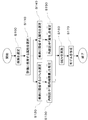
- FIG. 1 is an overall schematic diagram of a disease evaluation index calculation system according to an embodiment of the present invention. It is a schematic structure figure of the intestinal flora analysis device 200 and the intestinal flora DB300 concerning this embodiment. It is a conceptual diagram of the evaluation model concerning this embodiment. It is an explanatory view of the contents of a questionnaire concerning this embodiment. It is explanatory drawing of each group which concerns on this embodiment.
- FIG. 3 is a schematic diagram of an evaluation model according to the first embodiment. 6 is a flowchart for creating an evaluation model according to the first embodiment.
- FIG. 4 is a schematic explanatory diagram of a model in the case of covariance structure analysis according to the first embodiment.
- FIG. 4 is an explanatory diagram of a part of an evaluation model creation flowchart according to the first embodiment.
- FIG. 4 is a diagram illustrating a specific example of an evaluation model according to the first embodiment.
- FIG. 9 is a diagram illustrating a specific example of an evaluation model according to a second embodiment.
- FIG. 1 is an overall schematic diagram of a disease evaluation index calculation system according to an embodiment of the present invention.
- the disease evaluation index calculation system includes a phase in which an intestinal flora database (DB) is created from a stool collection kit submitted by a large number of subjects and evaluation applicants (users), and one or more diseases (identification) that the user wants to evaluate. And a phase for calculating an evaluation index of a risk for a specific disease.
- DB intestinal flora database
- Intestinal flora DB creation phase In the intestinal microflora DB creation phase, thousands or more subjects excrete their stool in a toilet and collect it with a stool collection kit. Next, the extractor who has received the stool collection kit inputs the stool collection kit into the intestinal bacterial DNA extraction device 100, and a DNA solution relating to the intestinal bacterial flora is output.
- the analyzer receiving the DNA solution inputs the DNA solution to the intestinal flora analyzer 200 and analyzes the intestinal flora.
- the analysis company stores the analysis result data in the intestinal flora DB300.
- FIG. 2 is a schematic configuration diagram of the intestinal flora analyzer 200 and the intestinal flora DB 300.
- the intestinal flora analyzer 200 includes an NGS analyzer 210 and a T-RFLP analyzer 220 to prepare two types of methods for analyzing the intestinal flora from a DNA solution. However, at least one of these two types may be provided and analyzed.
- the NGS analyzer 210 inputs a DNA solution that has been subjected to a reagent adjustment / dispensing operation in advance and analyzes the DNA solution with a next-generation sequencer (Next ⁇ Generation ⁇ Sequencer) to output a DNA sequence related to the intestinal flora, It is stored in the plexus (DNA sequence) DB 310. That is, in NGS, bacteria can be classified based on the sequence, and the relative amount of bacteria for each bacteria classification can be analyzed.
- a next-generation sequencer Next ⁇ Generation ⁇ Sequencer
- the DNA solution subjected to reagent dispensing and adjustment is input, and analyzed by a capillary sequencer using T-RFLP (Terminal-Restriction Fragment Length Polymorphism), whereby DNA fingers relating to the intestinal bacterial flora are analyzed.
- the print is output and stored in the intestinal flora (DNA fingerprint) DB 320. That is, in T-RFLP, bacterial classification (OTU) is performed based on DNA fragment length, and the relative amount of bacteria for each OTU can be analyzed.
- OTU is called an Operational Taxonomic Unit and is classified into groups such as "A193", but the actual name of the genus is unknown. "A" in "A193” is a restriction enzyme. Is an abbreviation for DNA is cut with this restriction enzyme.
- the intestinal flora DB300 includes an intestinal flora (DNA sequence) DB310 and an intestinal flora (DNA fingerprint) DB320.
- the two types of DBs (310 and 320) store the analysis results of the two types of analyzers (210 and 220), respectively.
- the corresponding DB (310 or 320) may be included in the intestinal flora DB300.
- the intestinal flora DB 300 associates the ID (identification number) information of each subject with the intestinal flora of the subject.
- the questionnaire collection company stores the questionnaire results in the questionnaire DB 400.
- an external questionnaire DB may be used as the questionnaire DB 400.
- an external intestinal flora DB300 may be used as the intestinal flora DB300.
- evaluation model creation phase In the evaluation model creation phase, first, an evaluation model creation company selects an attribute and a disease to be evaluated.
- the model creating device 500 extracts the input unit that receives the input of the selected attribute and disease and the ID information of the subject related to the attribute and the disease from the questionnaire DB 400, and the intestinal microflora of the corresponding ID information is also in the intestine.
- An extraction unit that extracts from the bacterial flora DB 300 and a creation unit that creates an evaluation model by a creation method described below are provided.
- the model creation device 500 stores the created evaluation model in the evaluation model DB 600.
- Disease evaluation index calculation phase In the disease evaluation index calculation phase, the evaluator submits the stool collected by the stool collection kit and prepares the intestinal microflora DB for those who wish to evaluate the risk for a specific disease (hereinafter referred to as users). Request submission of the stool collection kit described in the phase and entry of the questionnaire described in the evaluation model creation phase. The user's stool collection kit and questionnaire are processed in the same manner as the stool collection kit and questionnaire of many subjects, and are stored in the intestinal flora DB300 and the questionnaire DB400. Further, the user inputs a disease (specific disease) desired to be evaluated and the user's ID information to the disease evaluation index calculating device 700.
- a disease specific disease
- the disease evaluation index calculation device 700 includes an input unit that receives input information, an extraction unit that extracts information related to the input information, a calculation unit that calculates an evaluation index, and an output unit that outputs an evaluation report.
- the input unit receives input of specific disease and user ID information.
- the extraction unit extracts information (user factors and intestinal flora) related to the user ID information from the external questionnaire DB 400 and intestinal flora DB 300, and extracts an evaluation model related to a specific disease from the evaluation model DB 600. I do.
- the disease evaluation index calculation device 700 inputs the extracted user factors (attributes, lifestyles, etc.) and the intestinal microflora to an evaluation model of a specific disease, and calculates an evaluation index of risk for the specific disease. I do.
- An evaluation report based on the calculated evaluation index is output.
- the description has been given of the companies that perform each phase, the same company may perform all the phases.
- FIG. 3 is a conceptual diagram for explaining an example of an evaluation model stored in the evaluation model DB 600.
- the evaluation model is a statistical analysis model constructed from observation variables that have a certain or higher correlation with a specific disease and latent variables (hereinafter, referred to as factors) related to the observation variables.
- factors main causes
- observation variables are represented by solid rectangles, and factors are represented by ellipses. Each observation variable is a part of the information of the intestinal flora DB300 or the questionnaire DB400 in FIG.
- the main part of the evaluation model is attribute (sex / age) 610-1 as an observation variable, factor 1 (intestinal flora) 620-1, factor 2 (life / environment, etc.) 620-2 and Factor (disease etc.) 620-3 is provided.
- the attribute (sex / age) 610-1 is a part of the information of the questionnaire DB 400.
- the direction of the arrow defines the "influencing direction". Although the thick arrow from the factor 1 (intestinal flora) 620-1 to the factor (disease) 620-3 is in one direction, a two-way evaluation model can be constructed.
- a rectangle 630-1 surrounded by a dotted line shows the details of Factor 1 (intestinal flora) 620-1.
- Factor 1 (intestinal flora) 620-1 can be decomposed into intestinal flora factor 620-1 'and a plurality of "OTU or fungus (species)" 610-2.
- a plurality of "OTU or fungus (species)" 610-2 are observation variables, and are a part of the information of the intestinal flora DB300 in FIG.
- a rectangle 630-2 surrounded by a dotted line indicates the details of the factor 2 (life, environment, etc.) 620-2.
- Factor 2 (life / environment, etc.) 620-2 includes environmental factor 620-2′-1, living environment (questionnaire) 610-3 and home environment (questionnaire) 610-4, and dietary factor 620-2′-. 2. It can be decomposed into eating behavior (questionnaire) 610-5 and eating consciousness (questionnaire) 610-6. Living environment (questionnaire) 610-3 and home environment (questionnaire) 610-4, and eating behavior (questionnaire) 610-5 and eating consciousness (questionnaire) 610-6 are observation variables, and are information of questionnaire DB400 in FIG. Part of.
- a rectangle 630-3 surrounded by a dotted line shows details of the factor (disease etc.) 620-3.
- the factor (disease etc.) 620-3 can be decomposed into a disease / health condition factor 620-3 ', a disease (questionnaire) 610-7, and a health condition (questionnaire) 610-8.
- the disease (questionnaire) 610-7 and the health condition (questionnaire) 610-8 are observation variables and are a part of the information of the questionnaire DB 400 in FIG.
- a user is assigned to an attribute (sex / age) 610-1 and a group divided by each of the questionnaires 610-3 to 610-8, and factor 1 (intestinal flora) 620-
- the case of 1 conceptually indicates that it is possible to calculate whether the risk for a disease (specific disease) that the user wants to evaluate is high or low.
- the risk for a specific disease refers to the probability (including the possibility) that the specific disease is presently affected or will be affected in the future.
- OTU or fungal genus (species)" 610-2, an attribute (sex / age) 610-1, and a living environment (questionnaire) 610- are observed variables that have a certain or more correlation with a specific disease. 3. Select home environment (questionnaire) 610-4, eating behavior (questionnaire) 610-5, eating consciousness (questionnaire) 610-6, disease (questionnaire) 610-7, and health condition (questionnaire) 610-8. An evaluation model is constructed by factors related to these observed variables.
- the population for which statistical analysis is performed is divided into genders, and gender and age are used as observation variables.
- OTU or fungus (species) name 610-2 is used as an observation variable of intestinal flora factor 620-1 '. This is because the OTU is used when the DNA fingerprint is known by T-RFLP, and the genus (fungi species) name is used when the DNA sequence is known by NGS.
- FIG. 4 is an explanatory diagram of the contents of the questionnaire according to the present embodiment.
- the concept of the questionnaire is “attribute”, “living / home environment (lifestyle)”, “eating consciousness”, “eating behavior”, “psychological load (stress)”, “medication”, “disease / non-disease ( Health condition) ", and one or more of each of the question items corresponding to these are included.
- the “7-3 physical condition” includes a health condition determined from the physical condition, for example, itching and redness of the skin as related to atopic dermatitis, or a blood pressure that can be measured by the user. .
- “illness / unillness (healthy state)” may be referred to as “disease”, “life / home environment (lifestyle)”, “food awareness”, “food behavior” , “Psychological load (stress)” and “medication” may be collectively referred to as “life and environment”.
- FIG. 5 is an explanatory diagram of each group according to the present embodiment. It consists of a population consisting of all subjects, a healthy population without disease, a population with atopy, a population with atopy and asthma, and a population with asthma.
- Example 1 When assessing disease risk from attributes and intestinal flora, among the main parts of the evaluation model described with reference to FIG. 3, attributes (sex and age) as observation variables, and factors 1 (intestinal flora) and factors (disease, etc.) as factors are used. Next, a case where the disease risk is evaluated will be described.
- FIG. 6 is a schematic diagram of the evaluation model according to the first embodiment.
- the evaluation model of the first embodiment is a model for calculating an evaluation index of a risk for the disease “atopy” or “asthma”.
- the observation variables “sex” and “age” are extracted from the questionnaire submitted by the subject, and the observation variables “A58” and “A131” are extracted from the stool collection kit submitted by the subject.
- the observation variables “atopy” and “asthma” are diseases that the user wants to evaluate. By using this evaluation model, it is possible to calculate an evaluation index of the risk of the user becoming “atopic” and “asthma”.
- the internal factors of the evaluation model of Example 1 are “attribute”, “intestinal flora”, and “disease / health”.
- the relationship between these internal factors is represented by a schematic configuration of an evaluation model as an association model.
- covariance structure analysis is adopted as an analysis method for statistically evaluating such various relationships between observed variables and internal factors.
- the relationship between the observed variables and the internal factors and the relationship between the internal factors shown in FIG. 6 are represented by a structural equation model (SEM; Structural Equation Modeling), and an evaluation model is generated.
- the relationship between internal factors and observed variables is as follows.
- the observation variables of the internal factor “attribute” are “sex” and “age”
- the observation variables of the internal factor “intestinal flora” are OTUs such as “A58” and “A131”
- the internal factor “disease” -Observed variables of "health status” are "atopy” and "asthma”.
- the internal factor “disease / health condition” may be referred to as an internal factor “disease”.
- FIG. 7 is a flowchart for creating an evaluation model according to the first embodiment.
- “atopy” and “asthma” will be described as examples of diseases, but other diseases, for example, “heart disease”, “colorectal cancer”, “gastrointestinal disease”, “liver disease”, “kidney disease” , “Diabetes”, “hypertension”, “lipid abnormalities”, “underweight (BMI)”, “obesity (BMI)”, “bone disease”, “arthralgia”, “depression”, etc.
- diseases for example, “heart disease”, “colorectal cancer”, “gastrointestinal disease”, “liver disease”, “kidney disease” , “Diabetes”, “hypertension”, “lipid abnormalities”, “underweight (BMI)”, “obesity (BMI)”, “bone disease”, “arthralgia”, “depression”, etc.
- “Atopy” and “Asthma” are selected as diseases (S100). It is selected to use “sex” and “age” as attributes used for evaluation (S110).
- an OTU having a strong relationship with the disease “Atopy” is selected (S120). This selection may be performed based on, for example, logistic regression analysis.
- logistic regression analysis when selecting an OTU strongly related to a predetermined disease by logistic regression analysis, at the time of a predetermined attribute, a path between a predetermined intestinal flora and a predetermined disease / health state, a coefficient of the path, an odds A disease risk coefficient table composed of a ratio and a p-value (significance probability) is used.
- the internal factor “intestinal flora” of the evaluation model is estimated (S130). This estimation may be performed based on, for example, factor analysis, or may be based on another analysis method such as principal component analysis, principal coordinate analysis, or the like. The same processing (S120 and S130) is performed for the disease "asthma".
- an attribute related to the disease “Atopy” as an internal factor of the evaluation model is selected from the disease risk coefficient table (S140). Then, an internal factor “attribute” of the evaluation model is estimated for the selected attribute (S150). This estimation may be based on, for example, a factor analysis or other analysis methods such as principal component analysis, principal coordinate analysis, and the like. The same processing (S140 and S150) is performed for the disease "asthma".
- SSEM analysis is performed using the internal factor “intestinal flora” of the evaluation model estimated in S130, the internal factor “attribute” estimated in S140, and the internal factor “disease / health status” (S160).
- FIG. 9 is an explanatory diagram of a part (S120) of the evaluation model creation flowchart according to the first embodiment. The step of selecting an OTU from a disease risk coefficient table for a specific disease will be described.
- a population is selected from each group described in FIG. (4) "age" is selected as a predetermined attribute.
- each group in FIG. 5 is divided in advance into only men, only women, and the whole.
- “age” is selected.
- SEM analysis is performed, and (6) the count of each path and the conformity of the model are confirmed.
- FIG. 10 is a specific example of an evaluation model in the case of atopy and asthma according to the first embodiment.
- the direction of the arrow of each path indicates the direction of influence, and the closer the numerical value of each path is to 1, the higher the positive correlation degree, that is, the higher the influence factor.
- the triangles in the black bullets are negative values, indicating a negative correlation.
- the path from “age” to “disease factor” includes a direct path and an indirect path via “intestinal flora A”.
- the direct pass as described above, the higher the “age”, the more likely it is to suffer from “atopy” and “asthma”.
- the indirect path as the age increases, the “intestinal flora A” slightly increases, and it is hard to suffer from “atopy” and “asthma”. In consideration of the indirect path as described above, it can be evaluated that the influence that "the atopy” and “asthma” are less likely to occur as the "age” is higher is actually smaller.
- GFI is an abbreviation of Goodness of Fit Index
- AGFI is an Adjusted GFI
- RMSEA is an abbreviation of Root Mean Square Error of Approximation.
- GFI and AGFI indicate that the closer the value is to 1, the better the data is applied to the data (hereinafter referred to as the degree of goodness).
- the degree of goodness indicates that the closer the value is to 1, the better the data is applied to the data (hereinafter referred to as the degree of goodness).
- the smaller the value of RMSEA the better the fitness.
- an error variance which is an index of error variation, may be used for the evaluation model.
- the fitness index of the evaluation model of FIG. 10 is 0.9788 for GFI, 0.9735 for AGFI, and 0.1096 for RMSEA, indicating that the fitness of this evaluation model is high.
- (effect) it is possible to create an evaluation model for evaluating a disease risk from attributes and intestinal flora. That is, it is possible to create a model for evaluating the relevance of the thick arrow from the factor 1 (intestinal flora) 620-1 to the factor (disease etc.) 620-3 in FIG.
- the evaluation can determine both the direct path and the indirect path as described in FIG. A model can be created.
- the user collects and submits the stool with the stool collection kit, and further responds to the questionnaire. If the stool has a large amount of “A131”, the influence of age is small, and “the intestinal flora A Is high, and the subject is less likely to suffer from “atopy” and "asthma”.
- the disease evaluation index calculation device 700 receives user ID information from a user who wants to evaluate the risk of becoming “atopic” and “asthma”, and relates to the user ID information from the questionnaire DB 400 and the intestinal microbiota DB 300. Information (information on the attributes of the user and the intestinal microflora) is extracted, and an evaluation model regarding the diseases “atopy” and “asthma” that the user wants to evaluate is extracted from the evaluation model DB 600. Then, the disease evaluation index calculating device 700 inputs the extracted user attribute (in this case, age) and information on the intestinal microflora (in this case, a lot of “A131”) to the evaluation model in FIG. , “Atopy” and “Asthma” can be calculated. Further, an evaluation report is output based on the calculated evaluation index.
- the extracted user attribute in this case, age
- information on the intestinal microflora in this case, a lot of “A131”
- the user reads the evaluation report and finds that the user's own intestinal flora contains a large amount of “A131” having a large factor load on the intestinal flora A (factor). It can be seen that the risk for "atopy” and “asthma” is low (even with increasing age).
- Example 2 Evaluation of disease risk from attributes, life and environment, and intestinal flora
- the second embodiment the case where the factor 2 (life, environment, etc.) described in FIG. 3 is added to the first embodiment, that is, a case where the disease risk is evaluated using all the main parts of the evaluation model described in FIG. I do.
- the disease evaluation index calculation system 700 of the second embodiment is the same as the overall schematic diagram of FIG. The difference from the first embodiment is that factor 2 (life, environment, etc.) is used when creating the evaluation model.
- FIG. 11 is a diagram illustrating a specific example of the evaluation model according to the second embodiment.
- “dietary life” is used as the factor 2 (life, environment, etc.) in FIG.
- the observation variables of the internal factor “dietary life” are “milk”, “bread”, “meat” and the like.
- the fitness index of the evaluation model in FIG. 11 is 0.9265 for GFI, 0.9048 for AGFI, and 0.0738 for RMSEA. For this reason, it is shown that the degree of fit of this evaluation model is high.
- the disease evaluation index calculation device 700 receives user ID information from a user who wants to evaluate the risk of becoming “atopic” and “asthma”, and relates to the user ID information from the questionnaire DB 400 and the intestinal microbiota DB 300.
- Information questions results regarding user attributes and “dietary habits” and information on intestinal microflora
- evaluation models for diseases “atopy” and “asthma” that the user wants to evaluate are extracted from the evaluation model DB 600. I do.
- the disease evaluation index calculating device 700 inputs the extracted information on the factors “age, diet” and intestinal microflora of the user to the evaluation models of “topy” and “asthma”, and outputs “topy” and “ It is possible to calculate a risk evaluation index for "asthma”. Further, an evaluation report is output based on the calculated evaluation index.
- another analyzer such as qPCR may be used as the intestinal flora analyzer 200 of the embodiment.
- qPCR analyzer a DNA solution that has undergone reagent dispensing and adjustment is input, and analyzed by real-time quantitative PCR (quantitative ⁇ Polymerase ⁇ Chain ⁇ Reaction), whereby indicator bacterial groups relating to the intestinal flora are output, and It is stored in the intestinal flora (indicator group) DB in the flora DB 300.
- the covariance structure analysis is used as a method of analyzing the association model.
- another analysis method such as a path analysis may be used.
- Reference Signs List 100 intestinal bacterial DNA extraction device 200 intestinal bacterial flora analyzer 300 intestinal bacterial flora DB 400 Questionnaire DB 500 Model creation device 600 Evaluation model DB 700 Disease evaluation index calculation device
Landscapes
- Health & Medical Sciences (AREA)
- Engineering & Computer Science (AREA)
- Medical Informatics (AREA)
- Public Health (AREA)
- General Health & Medical Sciences (AREA)
- Epidemiology (AREA)
- Primary Health Care (AREA)
- Chemical & Material Sciences (AREA)
- Biomedical Technology (AREA)
- Life Sciences & Earth Sciences (AREA)
- Data Mining & Analysis (AREA)
- Pathology (AREA)
- Databases & Information Systems (AREA)
- Organic Chemistry (AREA)
- Analytical Chemistry (AREA)
- Physics & Mathematics (AREA)
- Proteomics, Peptides & Aminoacids (AREA)
- Zoology (AREA)
- Wood Science & Technology (AREA)
- Immunology (AREA)
- Molecular Biology (AREA)
- Biophysics (AREA)
- Biochemistry (AREA)
- Microbiology (AREA)
- Biotechnology (AREA)
- Bioinformatics & Cheminformatics (AREA)
- General Engineering & Computer Science (AREA)
- Genetics & Genomics (AREA)
- Food Science & Technology (AREA)
- Optics & Photonics (AREA)
- Hematology (AREA)
- Urology & Nephrology (AREA)
- Medicinal Chemistry (AREA)
- General Physics & Mathematics (AREA)
- Toxicology (AREA)
- Medical Treatment And Welfare Office Work (AREA)
- Measuring Or Testing Involving Enzymes Or Micro-Organisms (AREA)
- Investigating Or Analysing Biological Materials (AREA)
Abstract
Description
本発明の実施形態は、腸内細菌叢を用いた疾病評価指標を算出する技術に関し、特に、採便を提出、かつ、属性などのアンケートを回答した被験者に対し、特定の疾病に対するリスクを示す評価レポートを提供する技術に関する。 The embodiment of the present invention relates to a technique for calculating a disease evaluation index using the intestinal microflora, and in particular, presents a risk to a specific disease to a subject who submitted a stool collection and answered a questionnaire such as an attribute. Technology related to providing evaluation reports.
腸内細菌叢は数百~千種を超えるともいわれる膨大な数の細菌から構成される極めて複雑な生態系であり、腸内細菌叢を培養、観察、同定、解析する作業には莫大な労力と時間が必要である。近年、分子生物学的な手法により、これらの問題を解決することが可能になった。この手法には、細菌の遺伝子、特に16SrRNAの遺伝子(16SrDNA)の配列の違いを検出する技術が用いられている。 The intestinal flora is an extremely complex ecosystem composed of a huge number of bacteria, which are said to be in the hundreds or more than 1,000 species, and cultivating, observing, identifying and analyzing the intestinal flora requires enormous effort. Time is needed. In recent years, it has become possible to solve these problems by molecular biological techniques. This technique employs a technique for detecting a difference in the sequence of a bacterial gene, particularly a 16S rRNA gene (16S rDNA).
このような技術を用いることによって、腸内細菌叢と特定の疾病との関係についての研究が進んでいる。非特許文献1では、多数の被験者に採便キットで採取した大便を提出してもらい、さらに、年齢やBMI(Body Mass Index)の情報も提供してもらい、腸内細菌叢の情報を用いて疾病の罹患を評価するために、多重ロジスティック回帰分析によって特定の菌群と年齢やBMIとの関係を評価する研究が行われている。
また、非特許文献2では、腸内細菌叢の情報を用いた構造方程式のモデリングが記載されている。この構造方程式モデリングは疾病ではなく、菌叢の解析手法(Next Generation Sequencingなど)を評価することを目的に研究されている。
By using such a technique, research on the relationship between the intestinal flora and a specific disease is in progress. In Non-Patent
Non-Patent
このように、腸内細菌叢の情報を用いて、疾病のリスクを評価するためのモデルについては実用化に向けての研究がまだされていない。このため、せっかく採便キットで採取した大便を提出したにもかかわらず、特定の疾病に対するリスクの評価を希望する者(以下、ユーザという)がいても、ユーザ自身の腸内細菌叢の情報から、ユーザが何らかの疾病になるリスクを評価するというサービスを提供することができていない。 Thus, a model for assessing the risk of disease using information on intestinal flora has not yet been studied for practical use. For this reason, despite submitting the stool collected with the stool collection kit, even if there is a person who wishes to evaluate the risk for a specific disease (hereinafter referred to as a user), the information on the user's own intestinal flora can be used. However, it has not been possible to provide a service for evaluating the risk of a user becoming ill.
本発明は、このような課題に着目して鋭意研究され完成されたものであり、その目的は、腸内細菌叢を用いた疾病評価指標を算出することに関する技術を提供することにある。 The present invention has been completed by intensive research focusing on such problems, and an object of the present invention is to provide a technique related to calculating a disease evaluation index using intestinal flora.
上記課題を解決するために、第1の発明は、疾病評価指標を算出するためのモデル作成方法であって、1又は複数の疾病の入力を受け付け、複数の被験者の便を解析した結果である腸内細菌叢に関するデータを格納する第1のデータベースと、前記被験者の属性に関するデータ及び疾病に関するデータを格納する第2のデータベースから、健康な人及び前記疾病に罹患している人の前記属性に関するデータ、前記腸内細菌叢に関するデータ、及び、前記疾病に関するデータを抽出し、前記属性に関するデータ、前記腸内細菌叢に関するデータ、及び、前記疾病に関するデータを内部因子とする連関モデルを作成するコンピュータによるモデル作成方法である。 In order to solve the above problems, a first invention is a model creation method for calculating a disease evaluation index, which is a result of receiving an input of one or more diseases and analyzing the stool of a plurality of subjects. From a first database storing data on intestinal microflora and a second database storing data on the attributes of the subject and data on the disease, the attributes of a healthy person and a person suffering from the disease are obtained. A computer that extracts data, data on the intestinal flora, and data on the disease, and creates an association model using the data on the attribute, the data on the intestinal flora, and the data on the disease as internal factors. Is a model creation method.
第2の発明は、前記腸内細菌叢に関するデータを1又は複数の前記内部因子とする第1の発明に記載のコンピュータによるモデル作成方法である。 {Circle around (2)} The second invention is the computer-based model creation method according to the first invention, wherein the data on the intestinal flora is one or a plurality of the internal factors.
第3の発明は、前記連関モデルは構造方程式モデルである第1の発明に記載のコンピュータによるモデル作成方法である。 A third invention is the computer-aided model creation method according to the first invention, wherein the association model is a structural equation model.
第4の発明は、前記第2のデータベースは前記被験者の生活に関するデータ及び環境に関するデータをさらに格納し、前記被験者の属性に関するデータに加え、前記被験者の生活に関するデータ及び環境に関するデータも前記内部因子に加える第1の発明に記載のコンピュータによるモデル作成方法である。 In a fourth aspect, the second database further stores data relating to the life of the subject and data relating to the environment. In addition to data relating to the attributes of the subject, data relating to the life of the subject and data relating to the environment are also the internal factors. A model creation method using a computer according to the first aspect of the present invention.
第5の発明は、前記連関モデルを作成する際に、前記疾病に関係する前記腸内細菌叢に関するデータを選定し、前記選定された腸内細菌叢に関するデータを観測変数とし、前記連関モデルの前記内部因子となる前記腸内細菌叢に関するデータを推定する第1の発明に記載のコンピュータによるモデル作成方法である。 The fifth invention is configured such that, when creating the association model, selecting data on the intestinal flora related to the disease, using the data on the selected intestinal flora as an observation variable, The computer-based model creation method according to the first aspect of the present invention for estimating data on the intestinal flora serving as the internal factor.
第6の発明は、前記連関モデルを作成する際に、疾病リスク係数表を用いる第1の発明に記載のコンピュータによるモデル作成方法である。 The sixth invention is the computer-based model creation method according to the first invention, wherein a disease risk coefficient table is used when creating the association model.
第7の発明は、前記疾病リスク係数表は、所定の属性の時に、所定の腸内細菌叢と所定の疾病・健康状態とのパスに関するものである第6の発明に記載のコンピュータによるモデル作成方法である。 In a seventh aspect, the disease risk coefficient table relates to a path between a predetermined intestinal bacterial flora and a predetermined disease / health state when the attribute is a predetermined attribute. Is the way.
第8の発明は、疾病評価指標を算出するためのモデル作成プログラムであって、1又は複数の疾病の入力を受け付ける入力ステップと、複数の被験者の便を解析した結果である腸内細菌叢に関するデータを格納する第1のデータベースと、前記被験者の属性に関するデータ及び疾病に関するデータを格納する第2のデータベースから、健康な人及び前記疾病に罹患している人の前記属性に関するデータ、前記腸内細菌叢に関するデータ、及び、前記疾病に関するデータを抽出するステップと、前記属性に関するデータ、前記腸内細菌叢に関するデータ、及び、前記疾病に関するデータを内部因子とする連関モデルを作成する作成ステップと、をコンピュータに実行させるモデル作成プログラムである。 An eighth invention is a model creation program for calculating a disease evaluation index, which relates to an input step of receiving an input of one or a plurality of diseases, and an intestinal flora which is a result of analyzing stool of a plurality of subjects. A first database for storing data and a second database for storing data relating to the attributes of the subject and data relating to the disease; data relating to the attributes of a healthy person and a person suffering from the disease; Data on bacterial flora, and step of extracting data on the disease, data on the attribute, data on the intestinal flora, and a creating step of creating an association model with the data on the disease as an internal factor, Is a model creation program that causes a computer to execute.
第9の発明は、ユーザが調べて欲しいと望む1又は複数の疾病の入力を受け付け、前記ユーザの便を予め解析した結果である前記ユーザの腸内細菌叢に関するデータ、前記ユーザの属性に関するデータ、並びに、複数の被験者の属性に関するデータ、前記被験者の便を解析した結果である前記被験者の腸内細菌叢に関するデータ、及び、前記疾病に関するデータを内部因子とする連関モデルをデータベースから抽出し、前記ユーザの腸内細菌叢に関するデータ、前記ユーザの属性に関するデータ、及び、前記連関モデルを用いて、前記疾病に対するリスクを算出するコンピュータによる疾病評価指標算出方法である。 According to a ninth aspect of the present invention, data relating to the intestinal microflora of the user and data relating to the attribute of the user, which are results of pre-analyzing the stool of the user, receiving input of one or more diseases that the user desires to examine. And, data on the attributes of a plurality of subjects, data on the intestinal flora of the subject, which is the result of analyzing the stool of the subject, and extracting from the database an association model with data on the disease as an internal factor, A disease evaluation index calculation method using a computer for calculating a risk for the disease using the data on the intestinal microflora of the user, the data on the attributes of the user, and the association model.
第10の発明は、前記腸内細菌叢に関するデータを1又は複数の前記内部因子とする第9の発明に記載のコンピュータによる疾病評価指標算出方法である。 The tenth invention is the computer-aided disease evaluation index calculation method according to the ninth invention, wherein the data on the intestinal flora is one or a plurality of the internal factors.
第11の発明は、前記連関モデルは構造方程式モデルである第9の発明に記載のコンピュータによる疾病評価指標算出方法である。 An eleventh invention is the computer-aided disease evaluation index calculating method according to the ninth invention, wherein the association model is a structural equation model.
第12の発明は、前記内部因子は、前記被験者の属性に関するデータに加え、前記被験者の生活に関するデータ及び環境に関するデータも有する第9の発明に記載のコンピュータによる疾病評価指標算出方法である。 A twelfth invention is the computer-aided disease evaluation index calculation method according to the ninth invention, wherein the internal factor has data on the life of the subject and data on the environment in addition to the data on the attributes of the subject.
第13の発明は、ユーザが調べて欲しいと望む1又は複数の疾病を入力する入力部と、前記ユーザの便を予め解析した結果である前記ユーザの腸内細菌叢に関するデータ、前記ユーザの属性に関するデータ、並びに、複数の被験者の属性に関するデータ、前記被験者の便を解析した結果である前記被験者の腸内細菌叢に関するデータ、及び、前記疾病に関するデータを内部因子とする連関モデルをデータベースから抽出する抽出部と、前記ユーザの腸内細菌叢に関するデータ、前記ユーザの属性に関するデータ、及び、前記連関モデルを用いて、前記疾病に対するリスクを算出する算出部と、を備える疾病評価指標算出装置である。 A thirteenth invention is an input unit for inputting one or more diseases that the user wants to check, data on the intestinal microflora of the user, which is a result of pre-analysis of the stool of the user, and attributes of the user. Data, and data on attributes of a plurality of subjects, data on the intestinal microflora of the subject, which is the result of analyzing the stool of the subject, and an association model using data on the disease as an internal factor extracted from the database. A disease evaluation index calculation device comprising: an extraction unit that performs the calculation; and a calculation unit that calculates a risk for the disease using the data on the intestinal bacterial flora of the user, the data on the attributes of the user, and the association model. is there.
第14の発明は、ユーザが調べて欲しいと望む1又は複数の疾病を入力する入力部と、前記ユーザの便を予め解析した結果である前記ユーザの腸内細菌叢に関するデータを第1のデータベースから、及び、前記ユーザの属性に関するデータを第2のデータベースから抽出する第1の抽出部と、健康な人及び前記疾病に罹患している人を含む複数の被験者の便を解析した結果である前記被験者の腸内細菌叢に関するデータを前記第1のデータベースから、及び、前記被験者の属性に関するデータ及び疾病に関するデータを前記第2のデータベースから抽出する第2の抽出部と、前記被験者の属性に関するデータ、前記被験者の腸内細菌叢に関するデータ、及び、前記疾病に関するデータを内部因子とする連関モデルを作成する作成部と、前記ユーザの腸内細菌叢に関するデータ、前記ユーザの属性に関するデータ、及び、前記連関モデルを用いて、前記疾病に対するリスクを算出する算出部と、を備える疾病評価指標算出システムである。 A fourteenth invention provides an input unit for inputting one or a plurality of diseases that a user wants to check, and data on the intestinal flora of the user, which is a result of pre-analysis of the stool of the user, in a first database. And a first extraction unit for extracting data relating to the attributes of the user from a second database, and a result of analyzing the stool of a plurality of subjects including a healthy person and a person suffering from the disease. A second extraction unit that extracts data on the intestinal microflora of the subject from the first database, and data on the attributes of the subject and data on the disease from the second database; Data, data on the intestinal flora of the subject, and a creating unit that creates an association model with data on the disease as an internal factor, Data relating to the intestinal flora of over The data about the attribute of the user, and, using said linkage model, a disease evaluation index calculating system comprising a calculation unit for calculating a risk for the disease.
第15の発明は、ユーザが調べて欲しいと望む1又は複数の疾病の入力を受け付ける入力ステップと、前記ユーザの便を予め解析した結果である前記ユーザの腸内細菌叢に関するデータを第1のデータベースから、及び、前記ユーザの属性に関するデータを第2のデータベースから抽出する第1の抽出ステップと、健康な人及び前記疾病に罹患している人を含む複数の被験者の便を解析した結果である前記被験者の腸内細菌叢に関するデータを前記第1のデータベースから、及び、前記被験者の属性に関するデータ及び疾病に関するデータを前記第2のデータベースから抽出する第2の抽出ステップと、前記被験者の属性に関するデータ、前記被験者の腸内細菌叢に関するデータ、及び、前記疾病に関するデータを内部因子とする連関モデルを作成する作成ステップと、前記ユーザの腸内細菌叢に関するデータ、前記ユーザの属性に関するデータ、及び、前記連関モデルを用いて、前記疾病に対するリスクを算出する算出ステップと、をコンピュータに実行させる疾病評価指標算出プログラムである。 A fifteenth invention is directed to an input step of receiving an input of one or a plurality of diseases that the user wants to check, and data relating to the intestinal microflora of the user, which is a result of analyzing the stool of the user in advance, in the first step. A first extraction step of extracting data relating to the user's attributes from a second database from a database, and analyzing the stool of a plurality of subjects including a healthy person and a person suffering from the disease. A second extraction step of extracting data relating to the intestinal flora of the subject from the first database, and extracting data relating to attributes of the subject and data relating to diseases from the second database; , The intestinal flora of the subject, and the disease-related data as internal factors. And a calculation step of calculating a risk for the disease using the data on the intestinal microflora of the user, the data on the attributes of the user, and the association model. This is an evaluation index calculation program.
本発明によれば、腸内細菌叢を用いた疾病評価指標を算出することに関する技術を提供することができる。 According to the present invention, it is possible to provide a technique related to calculating a disease evaluation index using intestinal flora.
図面を参照しながら本発明の実施の形態を説明する。なお、各図において共通する部分には同一の符号を付し、重複した説明は省略する。 An embodiment of the present invention will be described with reference to the drawings. In addition, the same reference numerals are given to the common parts in each drawing, and the duplicate description will be omitted.
(疾病評価指標算出システム)
図1は、本発明の実施形態に係る疾病評価指標算出システムの全体概略図である。疾病評価指標算出システムは、多数の被験者及び評価希望者(ユーザ)が提出する採便キットから腸内細菌叢データベース(DB)を作成するフェーズ、ユーザが評価を希望する1又は複数の疾病(特定の疾病)の評価モデルを作成するフェーズ、及び、特定の疾病に対するリスクの評価指標を算出するフェーズを備える。
(Disease evaluation index calculation system)
FIG. 1 is an overall schematic diagram of a disease evaluation index calculation system according to an embodiment of the present invention. The disease evaluation index calculation system includes a phase in which an intestinal flora database (DB) is created from a stool collection kit submitted by a large number of subjects and evaluation applicants (users), and one or more diseases (identification) that the user wants to evaluate. And a phase for calculating an evaluation index of a risk for a specific disease.
(腸内細菌叢DB作成フェーズ)
腸内細菌叢DB作成フェーズでは、数千人以上という多数の被験者が各自の大便をトイレで排泄し、それを採便キットで採取する。次に、採便キットを受け取った抽出業者は、採便キットを腸内細菌DNA抽出装置100に入力し、腸内細菌叢に関するDNA溶液が出力される。
(Intestinal flora DB creation phase)
In the intestinal microflora DB creation phase, thousands or more subjects excrete their stool in a toilet and collect it with a stool collection kit. Next, the extractor who has received the stool collection kit inputs the stool collection kit into the intestinal bacterial
DNA溶液を受け取った解析業者は、DNA溶液を腸内細菌叢解析装置200に入力し、腸内細菌叢を解析する。解析業者は解析結果データを腸内細菌叢DB300に格納する。なお、抽出業者と解析業者を分けて説明したが、同一の事業者が抽出作業と解析作業を行ってもよい。
(4) The analyzer receiving the DNA solution inputs the DNA solution to the
図2は、腸内細菌叢解析装置200及び腸内細菌叢DB300の概略構成図である。本実施形態では、腸内細菌叢解析装置200は、DNA溶液から腸内細菌叢を解析する方法として2種類用意するために、NGS解析装置210及びT-RFLP解析装置220を備えている。ただし、この2種類のうち少なくとも一方を備え、解析してもよい。
FIG. 2 is a schematic configuration diagram of the
NGS解析装置210では、予め試薬調整分注操作が行われたDNA溶液を入力し、次世代シーケンサ(Next Generation Sequencer)で解析することによって、腸内細菌叢に関するDNA配列が出力され、腸内細菌叢(DNA配列)DB310に格納される。つまり、NGSでは、配列による細菌分類を行い、菌分類毎の細菌の相対量を解析することができる。
The
T-RFLP解析装置220では、試薬分注と調整を施したDNA溶液を入力し、キャビラリーシーケンサがT-RFLP(Terminal - Restriction Fragment Length Polymorphism)で解析することによって、腸内細菌叢に関するDNAフィンガープリントが出力され、腸内細菌叢(DNAフィンガープリント)DB320に格納される。つまり、T-RFLPでは、DNA断片長による細菌分類(OTU)を行い、OTU毎の細菌の相対量を解析することができる。OTUは操作的分類単位(Operational Taxonomic Unit)といい、「A193」などの群に分類されるが、実際の菌属の名前はわからない。なお、「A193」の「A」は制限酵素

腸内細菌叢DB300は、腸内細菌叢(DNA配列)DB310及び腸内細菌叢(DNAフィンガープリント)DB320を備えている。この2種類のDB(310及び320)は上述した2種類の解析装置(210及び220)の解析結果をそれぞれ格納する。なお、2種類の解析装置の一方(210又は220)が腸内細菌叢解析装置200に含まれている場合、対応するDB(310又は320)が腸内細菌叢DB300に含まれていればよい。このようなデータベース構造により、数千人以上という多数の被験者の腸内細菌叢が異なる方法で解析された場合であっても一つのデータベースとして取り扱うことができる。そして、腸内細菌叢DB300は各被験者のID(識別番号)情報とその被験者の腸内細菌叢とを関係付けている。
The intestinal flora DB300 includes an intestinal flora (DNA sequence) DB310 and an intestinal flora (DNA fingerprint) DB320. The two types of DBs (310 and 320) store the analysis results of the two types of analyzers (210 and 220), respectively. When one of the two types of analyzers (210 or 220) is included in the
次に、採便キットを提出した多数の被験者は、アンケートを記入し、アンケート回収業者に提出する。アンケート回収業者はアンケート結果をアンケートDB400に格納する。ここで、アンケート回収の初期段階では、アンケートDB400に格納されているアンケート結果が少ないため、外部のアンケートDBをアンケートDB400として利用してもよい。同様に、腸内細菌叢DB300に格納されているデータも少ないため、外部の腸内細菌叢DBを腸内細菌叢DB300として利用してもよい。
Next, many subjects who submitted the stool collection kit fill out the questionnaire and submit it to the questionnaire collection company. The questionnaire collection company stores the questionnaire results in the
(評価モデル作成フェーズ)
評価モデル作成フェーズでは、まず、評価モデル作成業者は、評価したい属性と疾病を選定する。モデル作成装置500は、選定された属性及び疾病の入力を受け付ける入力部と、これら属性及び疾病に関係する被験者のID情報をアンケートDB400から抽出し、該当するID情報の腸内細菌叢も腸内細菌叢DB300から抽出する抽出部と、後述する作成方法によって、評価モデルを作成する作成部を備える。モデル作成装置500は、作成した評価モデルを評価モデルDB600に格納する。
(Evaluation model creation phase)
In the evaluation model creation phase, first, an evaluation model creation company selects an attribute and a disease to be evaluated. The
(疾病評価指標算出フェーズ)
疾病評価指標算出フェーズでは、評価業者は、採便キットで採取した大便を提出し、かつ、特定の疾病に対するリスクの評価を希望する者(以下、ユーザという)に対し、腸内細菌叢DB作成フェーズで説明した採便キットの提出、及び、評価モデル作成フェーズで説明したアンケートの記入を依頼する。ユーザの採便キット及びアンケートは、多数の被験者の採便キット及びアンケートと同様の処理が行われ、腸内細菌叢DB300及びアンケートDB400に格納される。さらに、ユーザが評価を希望する疾病(特定の疾病)、及び、ユーザのID情報を疾病評価指標算出装置700に入力する。
(Disease evaluation index calculation phase)
In the disease evaluation index calculation phase, the evaluator submits the stool collected by the stool collection kit and prepares the intestinal microflora DB for those who wish to evaluate the risk for a specific disease (hereinafter referred to as users). Request submission of the stool collection kit described in the phase and entry of the questionnaire described in the evaluation model creation phase. The user's stool collection kit and questionnaire are processed in the same manner as the stool collection kit and questionnaire of many subjects, and are stored in the intestinal flora DB300 and the questionnaire DB400. Further, the user inputs a disease (specific disease) desired to be evaluated and the user's ID information to the disease evaluation
疾病評価指標算出装置700は、入力情報を受付ける入力部と、入力情報に関係する情報を抽出する抽出部と、評価指標を算出する算出部と、評価レポートを出力する出力部を備える。入力部は特定の疾病及びユーザのID情報の入力を受け付ける。抽出部は外部のアンケートDB400及び腸内細菌叢DB300からユーザのID情報に関係する情報(ユーザの要因、及び、腸内細菌叢)を抽出し、評価モデルDB600から特定の疾病に関する評価モデルを抽出する。そして、疾病評価指標算出装置700は、抽出されたユーザの要因(属性や生活習慣など)及び腸内細菌叢を、特定の疾病の評価モデルに入力し、特定の疾病に対するリスクの評価指標を算出する。算出された評価指標に基づく、評価レポートが出力される。なお、各フェーズを行う業者を分けて説明したが、同一の事業者が全てのフェーズを行ってもよい。
The disease evaluation
図3は、評価モデルDB600に格納される評価モデルの一例を説明するための概念図である。評価モデルは、特定の疾病と一定以上の相関が認められた観測変数と、観測変数と関係する潜在変数(以下、因子という)によって構築される統計解析モデルである。なお、この評価モデルでは、要因(主な原因)も因子として取り扱っている。
FIG. 3 is a conceptual diagram for explaining an example of an evaluation model stored in the
観測変数は実線の長方形で表し、因子は楕円形で表している。各観測変数は、図1の腸内細菌叢DB300又はアンケートDB400の情報の一部である。 Observed variables are represented by solid rectangles, and factors are represented by ellipses. Each observation variable is a part of the information of the intestinal flora DB300 or the questionnaire DB400 in FIG.
評価モデルの主要部は、観測変数としての属性(性別・年齢)610-1、並びに、因子としての要因1(腸内細菌叢)620-1、要因2(生活・環境等)620-2及び因子(疾病等)620-3を備える。属性(性別・年齢)610-1はアンケートDB400の情報の一部である。矢印の向きは「影響を与える向き」を定義している。また、要因1(腸内細菌叢)620-1から因子(疾病等)620-3への太い矢印は一方向になっているが、双方向の評価モデルを構築することも可能である。
The main part of the evaluation model is attribute (sex / age) 610-1 as an observation variable, factor 1 (intestinal flora) 620-1, factor 2 (life / environment, etc.) 620-2 and Factor (disease etc.) 620-3 is provided. The attribute (sex / age) 610-1 is a part of the information of the
次に、因子を詳細に説明する。点線で囲まれた長方形630-1は要因1(腸内細菌叢)620-1の詳細を示す。要因1(腸内細菌叢)620-1は腸内細菌叢因子620-1’及び複数の「OTU又は菌属(菌種)」610-2に分解できる。複数の「OTU又は菌属(菌種)」610-2は観測変数であり、図1の腸内細菌叢DB300の情報の一部である。 Next, the factors will be described in detail. A rectangle 630-1 surrounded by a dotted line shows the details of Factor 1 (intestinal flora) 620-1. Factor 1 (intestinal flora) 620-1 can be decomposed into intestinal flora factor 620-1 'and a plurality of "OTU or fungus (species)" 610-2. A plurality of "OTU or fungus (species)" 610-2 are observation variables, and are a part of the information of the intestinal flora DB300 in FIG.
点線で囲まれた長方形630-2は要因2(生活・環境等)620-2の詳細を示す。要因2(生活・環境等)620-2は、環境要因620-2’-1、生活環境(アンケート)610-3及び家庭環境(アンケート)610-4、並びに、食生活要因620-2’-2、食行動(アンケート)610-5及び食意識(アンケート)610-6に分解できる。生活環境(アンケート)610-3及び家庭環境(アンケート)610-4、並びに、食行動(アンケート)610-5及び食意識(アンケート)610-6は観測変数であり、図1のアンケートDB400の情報の一部である。 A rectangle 630-2 surrounded by a dotted line indicates the details of the factor 2 (life, environment, etc.) 620-2. Factor 2 (life / environment, etc.) 620-2 includes environmental factor 620-2′-1, living environment (questionnaire) 610-3 and home environment (questionnaire) 610-4, and dietary factor 620-2′-. 2. It can be decomposed into eating behavior (questionnaire) 610-5 and eating consciousness (questionnaire) 610-6. Living environment (questionnaire) 610-3 and home environment (questionnaire) 610-4, and eating behavior (questionnaire) 610-5 and eating consciousness (questionnaire) 610-6 are observation variables, and are information of questionnaire DB400 in FIG. Part of.
点線で囲まれた長方形630-3は因子(疾病等)620-3の詳細を示す。因子(疾病等)620-3は、疾病・健康状態因子620-3’、疾病(アンケート)610-7及び健康状態(アンケート)610-8に分解できる。疾病(アンケート)610-7及び健康状態(アンケート)610-8は観測変数であり、図1のアンケートDB400の情報の一部である。
長方形 A rectangle 630-3 surrounded by a dotted line shows details of the factor (disease etc.) 620-3. The factor (disease etc.) 620-3 can be decomposed into a disease / health condition factor 620-3 ', a disease (questionnaire) 610-7, and a health condition (questionnaire) 610-8. The disease (questionnaire) 610-7 and the health condition (questionnaire) 610-8 are observation variables and are a part of the information of the
この図では、ユーザを属性(性別・年齢)610-1、並びに、各アンケート610-3乃至610-8で分割された集団に割り当て、その集団が保有する要因1(腸内細菌叢)620-1の場合、ユーザが評価を希望する疾病(特定の疾病)に対するリスクは高いか低いかを算出することができることを概念的に表している。ここで、特定の疾病に対するリスクとは、特定の疾病に対して現在罹患している、又は、将来罹患する確率(可能性も含む)をいう。 In this figure, a user is assigned to an attribute (sex / age) 610-1 and a group divided by each of the questionnaires 610-3 to 610-8, and factor 1 (intestinal flora) 620- The case of 1 conceptually indicates that it is possible to calculate whether the risk for a disease (specific disease) that the user wants to evaluate is high or low. Here, the risk for a specific disease refers to the probability (including the possibility) that the specific disease is presently affected or will be affected in the future.
すなわち、特定の疾病と一定以上の相関が認められた観測変数として「OTU又は菌属(菌種)」610-2、並びに、属性(性別・年齢)610-1、生活環境(アンケート)610-3、家庭環境(アンケート)610-4、食行動(アンケート)610-5、食意識(アンケート)610-6、疾病(アンケート)610-7、及び、健康状態(アンケート)610-8を選択し、これらの観測変数と関係する因子によって評価モデルが構築される。 That is, "OTU or fungal genus (species)" 610-2, an attribute (sex / age) 610-1, and a living environment (questionnaire) 610- are observed variables that have a certain or more correlation with a specific disease. 3. Select home environment (questionnaire) 610-4, eating behavior (questionnaire) 610-5, eating consciousness (questionnaire) 610-6, disease (questionnaire) 610-7, and health condition (questionnaire) 610-8. An evaluation model is constructed by factors related to these observed variables.
ここで、属性610-1については、統計解析を行う母集団を男女別に分割し、性別及び年齢を観測変数として用いている。また、腸内細菌叢因子620-1’の観測変数として、OTU又は菌属(菌種)名610-2を用いている。これは、T-RFLPによりDNAフィンガープリントがわかる場合、OTUを用い、NGSによりDNA配列が分かる場合、菌属(菌種)名を用いるためである。 Here, for the attribute 610-1, the population for which statistical analysis is performed is divided into genders, and gender and age are used as observation variables. In addition, OTU or fungus (species) name 610-2 is used as an observation variable of intestinal flora factor 620-1 '. This is because the OTU is used when the DNA fingerprint is known by T-RFLP, and the genus (fungi species) name is used when the DNA sequence is known by NGS.
図4は、本実施形態に係るアンケート内容の説明図である。アンケートの構成概念は、「属性」、「生活・家庭環境(ライフスタイル)」、「食意識」、「食行動」、「心理的負荷(ストレス)」、「投薬」、「病気・未病(健康状態)」であり、これらに該当する各質問項目は一つ又は複数である。また、「7-3身体状況」には、身体状況から判断される健康状態、例えば、アトピー性皮膚炎に関するものとして、かゆみや皮膚の赤みという項目、又は、自分で測定できる血圧などを含まれる。ここで、説明の簡略化のため、「病気・未病(健康状態)」は「疾病」と述べてもよく、「生活・家庭環境(ライフスタイル)」、「食意識」、「食行動」、「心理的負荷(ストレス)」及び「投薬」はまとめて「生活及び環境」と述べてもよい。 FIG. 4 is an explanatory diagram of the contents of the questionnaire according to the present embodiment. The concept of the questionnaire is “attribute”, “living / home environment (lifestyle)”, “eating consciousness”, “eating behavior”, “psychological load (stress)”, “medication”, “disease / non-disease ( Health condition) ", and one or more of each of the question items corresponding to these are included. The “7-3 physical condition” includes a health condition determined from the physical condition, for example, itching and redness of the skin as related to atopic dermatitis, or a blood pressure that can be measured by the user. . Here, for the sake of simplicity, “illness / unillness (healthy state)” may be referred to as “disease”, “life / home environment (lifestyle)”, “food awareness”, “food behavior” , “Psychological load (stress)” and “medication” may be collectively referred to as “life and environment”.
図5は、本実施形態に係る各集団の説明図である。全被験者で構成される母集団、疾病にかかっていない健康母集団、アトピーにかかっている集団、アトピー及び喘息にかかっている集団、喘息にかかっている集団で構成されている。 FIG. 5 is an explanatory diagram of each group according to the present embodiment. It consists of a population consisting of all subjects, a healthy population without disease, a population with atopy, a population with atopy and asthma, and a population with asthma.
(実施例1:属性と腸内細菌叢から疾病リスクを評価する場合)
実施例1では、図3で説明した評価モデルの主要部のうち、観測変数としての属性(性別・年齢)、並びに、因子としての要因1(腸内細菌叢)及び因子(疾病等)を用いて、疾病リスクを評価する場合について説明する。
(Example 1: When assessing disease risk from attributes and intestinal flora)
In the first embodiment, among the main parts of the evaluation model described with reference to FIG. 3, attributes (sex and age) as observation variables, and factors 1 (intestinal flora) and factors (disease, etc.) as factors are used. Next, a case where the disease risk is evaluated will be described.
図6は、実施例1に係る評価モデルの概略図である。実施例1の評価モデルは、疾病「アトピー」又は「喘息」に対するリスクの評価指標を算出するためのモデルである。観測変数「性別」及び「年齢」は被験者が提出したアンケートから抽出し、観測変数「A58」、「A131」などは被験者が提出した採便キットから抽出している。また、観測変数「アトピー」及び「喘息」が、ユーザが評価を希望する疾病である。この評価モデルを用いることによって、ユーザが「アトピー」及び「喘息」になるリスクの評価指標を算出することができる。 FIG. 6 is a schematic diagram of the evaluation model according to the first embodiment. The evaluation model of the first embodiment is a model for calculating an evaluation index of a risk for the disease “atopy” or “asthma”. The observation variables “sex” and “age” are extracted from the questionnaire submitted by the subject, and the observation variables “A58” and “A131” are extracted from the stool collection kit submitted by the subject. The observation variables “atopy” and “asthma” are diseases that the user wants to evaluate. By using this evaluation model, it is possible to calculate an evaluation index of the risk of the user becoming “atopic” and “asthma”.
実施例1の評価モデルの内部因子は「属性」、「腸内細菌叢」及び「疾病・健康状態」である。これらの内部因子同士の関係が、連関モデルとして評価モデルの概略構成で表現されている。本願では、こうした観測変数、内部因子同士の多様な関係性を統計学的に評価する分析方法として共分散構造分析を採用する。図6に示す観測変数と内部因子との関係、及び、内部因子同士の関係は構造方程式モデル(SEM;Structural Equation Modeling)で表現され、評価モデルが生成される。 内部 The internal factors of the evaluation model of Example 1 are “attribute”, “intestinal flora”, and “disease / health”. The relationship between these internal factors is represented by a schematic configuration of an evaluation model as an association model. In the present application, covariance structure analysis is adopted as an analysis method for statistically evaluating such various relationships between observed variables and internal factors. The relationship between the observed variables and the internal factors and the relationship between the internal factors shown in FIG. 6 are represented by a structural equation model (SEM; Structural Equation Modeling), and an evaluation model is generated.
また、内部因子と観測変数との関係は次のようになる。内部因子「属性」の観測変数が「性別」及び「年齢」であり、内部因子「腸内細菌叢」の観測変数が「A58」、「A131」などのOTUであり、さらに、内部因子「疾病・健康状態」の観測変数が「アトピー」及び「喘息」である。なお、説明の簡略化のため、内部因子「疾病・健康状態」は内部因子「疾病」と述べてもよい。 関係 The relationship between internal factors and observed variables is as follows. The observation variables of the internal factor “attribute” are “sex” and “age”, the observation variables of the internal factor “intestinal flora” are OTUs such as “A58” and “A131”, and the internal factor “disease” -Observed variables of "health status" are "atopy" and "asthma". For the sake of simplicity, the internal factor “disease / health condition” may be referred to as an internal factor “disease”.
図7は、実施例1に係る評価モデル作成のフローチャートである。ここでは、疾病の一例として「アトピー」及び「喘息」について説明するが、他の疾病、例えば、「心臓病」、「大腸がん」、「胃腸病」、「肝臓病」、「腎臓病」、「糖尿病」、「高血圧」、「脂質異常」、「低体重(BMI)」、「肥満(BMI)」、「骨病」、「関節痛」、「うつ」などについても同様に評価モデルを作成することができる FIG. 7 is a flowchart for creating an evaluation model according to the first embodiment. Here, “atopy” and “asthma” will be described as examples of diseases, but other diseases, for example, “heart disease”, “colorectal cancer”, “gastrointestinal disease”, “liver disease”, “kidney disease” , "Diabetes", "hypertension", "lipid abnormalities", "underweight (BMI)", "obesity (BMI)", "bone disease", "arthralgia", "depression", etc. Can be created
まず、疾病として「アトピー」及び「喘息」を選択する(S100)。評価に使用する属性として「性別」及び「年齢」を使用することを選択する(S110)。 First, “Atopy” and “Asthma” are selected as diseases (S100). It is selected to use “sex” and “age” as attributes used for evaluation (S110).
次に、疾病「アトピー」と関係の強いOTUを選定する(S120)。この選定は、例えばロジスティック回帰分析に基づいて行われてもよい。ここで、所定の疾病と関係の強いOTUをロジスティック回帰分析により選定する際に、所定の属性の時に、所定の腸内細菌叢と所定の疾病・健康状態とのパス、そのパスの係数、オッズ比、及び、p値(有意確率)で構成される疾病リスク係数表を用いる。 Next, an OTU having a strong relationship with the disease “Atopy” is selected (S120). This selection may be performed based on, for example, logistic regression analysis. Here, when selecting an OTU strongly related to a predetermined disease by logistic regression analysis, at the time of a predetermined attribute, a path between a predetermined intestinal flora and a predetermined disease / health state, a coefficient of the path, an odds A disease risk coefficient table composed of a ratio and a p-value (significance probability) is used.
次いで、選定されたOTUを観測変数として、評価モデルの内部因子「腸内細菌叢」を推定する(S130)。この推定は、例えば因子分析に基づいて行われてもよく、あるいは主成分分析、主座標分析等、他の分析方法に基づいてもよい。また、疾病「喘息」についても同様の処理(S120及びS130)を行う。 Next, using the selected OTU as an observation variable, the internal factor “intestinal flora” of the evaluation model is estimated (S130). This estimation may be performed based on, for example, factor analysis, or may be based on another analysis method such as principal component analysis, principal coordinate analysis, or the like. The same processing (S120 and S130) is performed for the disease "asthma".
S120と平行して(時間の前後は問わない)、疾病「アトピー」に関係する、評価モデルの内部因子としての属性を疾病リスク係数表より選定する(S140)。そして、選定された属性に対し、評価モデルの内部因子「属性」を推定する(S150)。この推定は、例えば因子分析に基づいてもよく、あるいは主成分分析、主座標分析等、他の分析方法に基づいてもよい。また、疾病「喘息」についても同様の処理(S140及びS150)を行う。 In parallel with S120 (regardless of time), an attribute related to the disease “Atopy” as an internal factor of the evaluation model is selected from the disease risk coefficient table (S140). Then, an internal factor “attribute” of the evaluation model is estimated for the selected attribute (S150). This estimation may be based on, for example, a factor analysis or other analysis methods such as principal component analysis, principal coordinate analysis, and the like. The same processing (S140 and S150) is performed for the disease "asthma".
S130で推定された評価モデルの内部因子「腸内細菌叢」及び、S140で推定された内部因子「属性」、さらに内部因子「疾病・健康状態」によりSEM解析を実施する(S160)。 SSEM analysis is performed using the internal factor “intestinal flora” of the evaluation model estimated in S130, the internal factor “attribute” estimated in S140, and the internal factor “disease / health status” (S160).
そして、図8に示す構造方程式のパラメータα、β、γを求め、評価モデルを作成する(S170)。 Then, the parameters α, β, and γ of the structural equation shown in FIG. 8 are obtained, and an evaluation model is created (S170).
図9は、実施例1に係る評価モデル作成フローチャートの一部(S120)の説明図である。特定の疾病に関して、疾病リスク係数表からOTUを選定するステップについて説明する。 FIG. 9 is an explanatory diagram of a part (S120) of the evaluation model creation flowchart according to the first embodiment. The step of selecting an OTU from a disease risk coefficient table for a specific disease will be described.
まず、(1)疾病を決める。ここでは「アトピー」及び「喘息」とする。(2)係数表からOTUを選定する。ここでは「A58」、「A131」、「A477」及び「A498」等を記載しているが、実際には各OTUの次元は40~100次元程度になる。 First, (1) determine the disease. Here, "atopy" and "asthma" are used. (2) Select the OTU from the coefficient table. Here, “A58”, “A131”, “A477”, “A498”, and the like are described, but the dimensions of each OTU are actually about 40 to 100 dimensions.
次に、(3)図5で説明した各集団から母集団を選定する。(4)所定の属性として「年齢」を選択する。ここでは、図5の各集団は男性のみ、女性のみ、及び、全体に予め分かれており、母集団毎の評価モデルを構築するため、「年齢」を選択する。(5)SEM解析を実施し、(6)各パスの計数と、モデルの適合度を確認、すなわち、所定のしきい値以上であれば終了する。 (3) Next, (3) a population is selected from each group described in FIG. (4) "age" is selected as a predetermined attribute. Here, each group in FIG. 5 is divided in advance into only men, only women, and the whole. In order to construct an evaluation model for each population, “age” is selected. (5) SEM analysis is performed, and (6) the count of each path and the conformity of the model are confirmed.
図10は、実施例1に係るアトピー及び喘息の場合の評価モデルの具体例である。各パスの矢印の向きは影響を与える向きを表し、各パスの数値が1に近いほど正の相関度が高い、すなわち、影響を与える要素として高いことを示している。一方、中黒の三角印はマイナスの数値であり、負の相関であることを示している。 FIG. 10 is a specific example of an evaluation model in the case of atopy and asthma according to the first embodiment. The direction of the arrow of each path indicates the direction of influence, and the closer the numerical value of each path is to 1, the higher the positive correlation degree, that is, the higher the influence factor. On the other hand, the triangles in the black bullets are negative values, indicating a negative correlation.
図10の評価モデルの具体例によれば、疾病「アトピー」及び「喘息」については、ある被験者は「年齢」が高く、「A131」に属する菌を多く保有している場合、「年齢」と「疾病因子」とは正の相関があるため、「年齢」が高いほど「アトピー」及び「喘息」にかかりやすい、と評価できる。しかしながら、「A131」と「腸内細菌叢A」は正の相関があるため、「腸内細菌叢A」が高いことを意味する。そして、「アトピー」及び「喘息」と「疾病因子」は正の相関があり、かつ、「腸内細菌叢A」と「疾病因子」は負の相関があるため、「腸内細菌叢A」が高ければ、「アトピー」及び「喘息」にはかかりにくい、と評価できる。 According to the specific example of the evaluation model in FIG. 10, regarding the diseases “atopy” and “asthma”, when a certain subject has a high “age” and has many bacteria belonging to “A131,” Since there is a positive correlation with “disease factor”, it can be evaluated that the higher the “age”, the more likely it is to suffer from “atopy” and “asthma”. However, "A131" and "intestinal flora A" have a positive correlation, which means that "intestinal flora A" is high. And, since "atopic" and "asthma" and "disease factor" have a positive correlation, and "intestinal flora A" and "disease factor" have a negative correlation, "intestinal flora A" Is higher, it can be evaluated that the subject is less likely to suffer from “atopy” and “asthma”.
さらに、「年齢」から「疾病因子」へのパスは、直接的なパスと、「腸内細菌叢A」を経由する間接的なパスがあることに留意する。直接的なパスによれば、上述した通り「年齢」が高いほど「アトピー」及び「喘息」にかかりやすい。一方、間接的なパスによれば、年齢が高くなると、「腸内細菌叢A」も少し高くなり、「アトピー」及び「喘息」にはかかりにくい。このように間接的なパスも考慮すると、「年齢」が高いほど「アトピー」及び「喘息」にかかりにくいという影響は実は小さいと評価できる。 Furthermore, note that the path from “age” to “disease factor” includes a direct path and an indirect path via “intestinal flora A”. According to the direct pass, as described above, the higher the “age”, the more likely it is to suffer from “atopy” and “asthma”. On the other hand, according to the indirect path, as the age increases, the “intestinal flora A” slightly increases, and it is hard to suffer from “atopy” and “asthma”. In consideration of the indirect path as described above, it can be evaluated that the influence that "the atopy" and "asthma" are less likely to occur as the "age" is higher is actually smaller.
評価モデルの適合度指標として3種類用いており、GFIはGoodness of Fit Index、AGFIはAdjusted GFI、RMSEAはRoot Mean Square Error of Approximationの略称である。GFI及びAGFIは値が1に近くなるほどデータへの当てはまり(以下、適合度という)が良いことを意味する。一方、RMSEAは値が小さいほど適合度が良いことを意味する。また、評価モデルには、誤差のバラツキの指標である誤差分散を用いてもよい。 3Three types are used as the fitness index of the evaluation model. GFI is an abbreviation of Goodness of Fit Index, AGFI is an Adjusted GFI, and RMSEA is an abbreviation of Root Mean Square Error of Approximation. GFI and AGFI indicate that the closer the value is to 1, the better the data is applied to the data (hereinafter referred to as the degree of goodness). On the other hand, the smaller the value of RMSEA, the better the fitness. In addition, an error variance, which is an index of error variation, may be used for the evaluation model.
図10の評価モデルの適合度指標は、GFIが0.9788、AGFIが0.9735、RMSEAが0.1096であり、この評価モデルの適合度は高いことが示されている。 適合 The fitness index of the evaluation model of FIG. 10 is 0.9788 for GFI, 0.9735 for AGFI, and 0.1096 for RMSEA, indicating that the fitness of this evaluation model is high.
(効果)
実施例1によれば、属性と腸内細菌叢から疾病リスクを評価する評価モデルを作成することができる。すなわち、図3の要因1(腸内細菌叢)620-1から因子(疾病等)620-3への太い矢印の関連性を評価するモデルを作成することができる。また、図6で説明したように観測変数、内部因子同士の多様な関係性をモデル化しているため、図10で説明したように直接的なパス及び間接的なパスの両方を判断可能な評価モデルを作成することができる。
(effect)
According to the first embodiment, it is possible to create an evaluation model for evaluating a disease risk from attributes and intestinal flora. That is, it is possible to create a model for evaluating the relevance of the thick arrow from the factor 1 (intestinal flora) 620-1 to the factor (disease etc.) 620-3 in FIG. In addition, since the various relationships between the observation variables and the internal factors are modeled as described in FIG. 6, the evaluation can determine both the direct path and the indirect path as described in FIG. A model can be created.
そして、ユーザは採便キットで大便を採取、提出し、さらにアンケートに回答することによって、自分の大便が「A131」を多く保有していれば、年齢による影響は小さく、「腸内細菌叢A」が高く、「アトピー」及び「喘息」にかかりにくい、という評価を受けることができる。 Then, the user collects and submits the stool with the stool collection kit, and further responds to the questionnaire. If the stool has a large amount of “A131”, the influence of age is small, and “the intestinal flora A Is high, and the subject is less likely to suffer from "atopy" and "asthma".
そして、疾病評価指標算出装置700は、「アトピー」及び「喘息」になるリスクの評価を希望するユーザから、ユーザID情報を受け付け、アンケートDB400及び腸内細菌叢DB300からユーザのID情報に関係する情報(ユーザの属性、及び、腸内細菌叢の情報)を抽出し、評価モデルDB600からユーザが評価を希望する疾病「アトピー」及び「喘息」に関する評価モデルを抽出する。そして、疾病評価指標算出装置700は、抽出されたユーザの属性(この場合、年齢)及び腸内細菌叢の情報(この場合、「A131」を多く保有)を、図10の評価モデルに入力し、「アトピー」及び「喘息」に対するリスクの評価指標を算出することができる。さらに、算出された評価指標に基づく、評価レポートが出力される。
Then, the disease evaluation
ユーザは評価レポートを読むことによって、ユーザ自身の腸内細菌叢に、腸内細菌叢A(因子)への因子負荷量が大きい「A131」が多く含まれているため、年齢による影響は小さく(年齢が高くなっても、将来的に)「アトピー」及び「喘息」に対するリスクは低いということを理解できる。 The user reads the evaluation report and finds that the user's own intestinal flora contains a large amount of “A131” having a large factor load on the intestinal flora A (factor). It can be seen that the risk for "atopy" and "asthma" is low (even with increasing age).
次に、疾病評価指標算出システム事業者にとっての効果を述べる。ユーザの腸内細菌叢に「A131」が多く含まれていることが「アトピー」及び「喘息」に対するリスクを低減させるのであれば、「A131」に含まれる実在の菌を摂取すれば、「アトピー」及び「喘息」に対するリスクが低減される可能性を評価レポートは示唆している。この可能性に基づき、事業者はプロバイオティクスの設計、検討、及び提案を行うことができる。 (4) Next, the effects for the disease evaluation index calculation system operator will be described. If the intestinal flora of the user contains a large amount of “A131” to reduce the risk of “atopy” and “asthma”, the ingestion of real bacteria contained in “A131” will result in “atopy”. The assessment report suggests that the risk for "" and "asthma" may be reduced. Based on this possibility, operators can design, review and propose probiotics.
(実施例2;属性並びに、生活及び環境と、腸内細菌叢から疾病リスクを評価する場合)
実施例2では、図3で説明した要因2(生活・環境等)を実施例1に加え、すなわち、図3で説明した評価モデルの主要部全てを用いて、疾病リスクを評価する場合について説明する。実施例2の疾病評価指標算出システム700も、図1の全体概略図と同じである。評価モデルを作成する際に、要因2(生活・環境等)を用いている点が、実施例1と異なる点である。
(Example 2: Evaluation of disease risk from attributes, life and environment, and intestinal flora)
In the second embodiment, the case where the factor 2 (life, environment, etc.) described in FIG. 3 is added to the first embodiment, that is, a case where the disease risk is evaluated using all the main parts of the evaluation model described in FIG. I do. The disease evaluation
図11は、実施例2に係る評価モデルの具体例を示す図である。実施例2特有の評価モデルの内部因子は、図3の要因2(生活・環境等)として、「食生活」を用いている。内部因子「食生活」の観測変数が「牛乳」、「パン」、「肉」等である。 FIG. 11 is a diagram illustrating a specific example of the evaluation model according to the second embodiment. As the internal factor of the evaluation model unique to the second embodiment, “dietary life” is used as the factor 2 (life, environment, etc.) in FIG. The observation variables of the internal factor “dietary life” are “milk”, “bread”, “meat” and the like.
観測変数「牛乳」、「パン」、「肉」等を評価モデルに加えることは、図4で説明したアンケートの構成概念「食行動」の各質問項目をアンケート情報に追加することによって可能になる。また、各質問項目の数を増やすことによって、より詳細な評価をすることが可能になる。 It is possible to add the observation variables “milk”, “bread”, “meat”, etc. to the evaluation model by adding each question item of the questionnaire concept “eating behavior” described in FIG. 4 to the questionnaire information. . Further, by increasing the number of each question item, more detailed evaluation can be performed.
図11の評価モデルの具体例によれば、実施例1の解釈に加え、ある被験者が「肉」を食する頻度が高い場合、「食生活」因子が高いことを意味する。これは、「腸内細菌叢A」因子が低下し、「腸内細菌叢B」因子が増加し、さらに、「疾病因子」の増加を意味する。この「疾病因子」は「アトピー」及び「喘息」になるリスクを増加させていることを示唆している。また、この「食生活」因子が高いことにより、「腸内細菌叢B」因子が高くなり、その高い「腸内細菌叢B」因子が「疾病因子」を高めている可能性をさらに示唆している、と評価できる。 According to the specific example of the evaluation model in FIG. 11, in addition to the interpretation in the first embodiment, when a certain subject frequently eats “meat”, it means that the “dietary life” factor is high. This means that the “intestinal flora A” factor decreases, the “intestinal flora B” factor increases, and further, the “disease factor” increases. This "disease factor" suggests that it increases the risk of becoming "atopic" and "asthmatic." In addition, the high “dietary life” factor increases the “intestinal flora B” factor, further suggesting that the high “intestinal flora B” factor may increase “disease factor”. Can be evaluated.
図11の評価モデルの適合度指標は、GFIが0.9265であり、AGFIが0.9048であり、RMSEAが0.0738である。このため、この評価モデルの適合度は高いことが示されている。 適合 The fitness index of the evaluation model in FIG. 11 is 0.9265 for GFI, 0.9048 for AGFI, and 0.0738 for RMSEA. For this reason, it is shown that the degree of fit of this evaluation model is high.
(効果)
実施例2によれば、属性及び生活・環境等と、腸内細菌叢から疾病リスクを評価する評価モデルを作成することができる。図11の場合、「年齢」、「腸内細菌叢A」、「腸内細菌叢B」、「食生活」から「アトピー」及び「喘息」になるリスクを評価する評価モデルを作成することができる。
(effect)
According to the second embodiment, it is possible to create an evaluation model for evaluating a disease risk from attributes, living / environment, and the like, and intestinal flora. In the case of FIG. 11, it is possible to create an evaluation model for evaluating the risk of becoming “atopic” and “asthma” from “age”, “intestinal flora A”, “intestinal flora B”, and “dietary habits”. it can.
そして、疾病評価指標算出装置700は、「アトピー」及び「喘息」になるリスクの評価を希望するユーザから、ユーザID情報を受け付け、アンケートDB400及び腸内細菌叢DB300からユーザのID情報に関係する情報(ユーザの属性及び「食生活」に関するアンケート結果、並びに、腸内細菌叢の情報)を抽出し、評価モデルDB600からユーザが評価を希望する疾病「アトピー」及び「喘息」に関する評価モデルを抽出する。そして、疾病評価指標算出装置700は、抽出されたユーザの要因「年齢、食生活」及び腸内細菌叢の情報を、「アトピー」及び「喘息」の評価モデルに入力し、「アトピー」及び「喘息」に対するリスクの評価指標を算出することができる。さらに、算出された評価指標に基づく、評価レポートが出力される。
Then, the disease evaluation
ユーザは評価レポートを読むことによって、実施例1の評価に加え、「肉」を食する頻度が高いため、「腸内細菌叢A」因子が低下し、「腸内細菌叢B」因子が増加する傾向にあり、「アトピー」及び「喘息」になるリスクを増加させていることを示唆している。また、「肉」を食する頻度が高いことにより、「腸内細菌叢B」因子が高くなり、「アトピー」及び「喘息」になるリスクを高めている可能性をさらに示唆している、という詳細な評価を理解できる。 By reading the evaluation report, in addition to the evaluation of Example 1, the user frequently eats “meat”, so the “intestinal flora A” factor decreases and the “intestinal flora B” factor increases To increase the risk of becoming “atopic” and “asthmatic”. Also, the higher frequency of eating “meat” further increases the “intestinal flora B” factor, further suggesting that it may increase the risk of becoming “atopic” and “asthmatic”. Understand detailed evaluation.
次に、疾病評価指標算出システム事業者にとっての効果を述べる。ユーザの「肉」を食する頻度が高く、「野菜」を食する頻度が低いことが「アトピー」及び「喘息」に対するリスクを増加させるのであれは、「肉」を食する頻度を抑え、また「野菜」を多く摂取すれば、「アトピー」及び「喘息」に対するリスクが低減される可能性を評価レポートは示唆している。このような可能性に基づき、事業者はプレバイオティクスの設計、検討、及び提案を行うことができる。 (4) Next, the effects for the disease evaluation index calculation system operator will be described. If the user frequently eats "meat" and infrequently eats "vegetables" increases the risk for "atopic" and "asthma", reduce the frequency of eating "meat"; and Assessment reports suggest that consuming more “vegetables” may reduce the risk for “atopy” and “asthma”. Based on such possibilities, operators can design, study, and propose prebiotics.
以上、本発明の実施例(変形例を含む)について説明してきたが、これらのうち、2つ以上の実施例を組み合わせて実施しても構わない。あるいは、これらのうち、1つの実施例を部分的に実施しても構わない。さらには、これらのうち、2つ以上の実施例を部分的に組み合わせて実施しても構わない。 Although the embodiments (including the modifications) of the present invention have been described above, two or more of the embodiments may be combined and implemented. Alternatively, of these, one embodiment may be partially implemented. Furthermore, of these, two or more embodiments may be partially combined and implemented.
また、本発明は、上記発明の実施例の説明に何ら限定されるものではない。特許請求の範囲の記載を逸脱せず、当業者が容易に想到できる範囲で種々の変形態様もこの発明に含まれる。 The invention is not limited to the description of the embodiment of the invention. Various modifications are included in the present invention without departing from the scope of the claims and within the scope of those skilled in the art.
例えば、実施例の腸内細菌叢解析装置200としてqPCRなどの他の解析装置を用いてもよい。qPCR解析装置の場合、試薬分注と調整を施したDNA溶液を入力し、リアルタイムの定量PCR(quantitative Polymerase Chain Reaction)で解析することによって、腸内細菌叢に関する指標菌群が出力され、腸内細菌叢DB300内の腸内細菌叢(指標菌群)DBに格納される。
For example, another analyzer such as qPCR may be used as the
また、実施例では、連関モデルを解析する方法として、共分散構造分析を用いたが、パス解析などの他の解析方法を用いてもよい。 Also, in the embodiment, the covariance structure analysis is used as a method of analyzing the association model. However, another analysis method such as a path analysis may be used.
100 腸内細菌DNA抽出装置
200 腸内細菌叢解析装置
300 腸内細菌叢DB
400 アンケートDB
500 モデル作成装置
600 評価モデルDB
700 疾病評価指標算出装置
400 Questionnaire DB
500
700 Disease evaluation index calculation device
Claims (15)
1又は複数の疾病の入力を受け付け、
複数の被験者の便を解析した結果である腸内細菌叢に関するデータを格納する第1のデータベースと、前記被験者の属性に関するデータ及び疾病に関するデータを格納する第2のデータベースから、健康な人及び前記疾病に罹患している人の前記属性に関するデータ、前記腸内細菌叢に関するデータ、及び、前記疾病に関するデータを抽出し、
前記属性に関するデータ、前記腸内細菌叢に関するデータ、及び、前記疾病に関するデータを内部因子とする連関モデルを作成するコンピュータによるモデル作成方法。 A model creation method for calculating a disease evaluation index,
Accepting input of one or more diseases,
From a first database storing data on intestinal microflora, which is a result of analyzing the stool of a plurality of subjects, and a second database storing data on attributes of the subjects and data on diseases, a healthy person and Data on the attributes of the person suffering from the disease, data on the intestinal flora, and extract data on the disease,
A model creation method using a computer for creating an association model using the data related to the attribute, the data related to the intestinal microflora, and the data related to the disease as internal factors.
前記被験者の属性に関するデータに加え、前記被験者の生活に関するデータ及び環境に関するデータも前記内部因子に加える請求項1に記載のコンピュータによるモデル作成方法。 The second database further stores data on the life of the subject and data on the environment,
2. The method according to claim 1, wherein data on the life of the subject and data on the environment are added to the internal factors in addition to the data on the attributes of the subject. 3.
前記疾病に関係する前記腸内細菌叢に関するデータを選定し、
前記選定された腸内細菌叢に関するデータを観測変数とし、前記連関モデルの前記内部因子となる前記腸内細菌叢に関するデータを推定する請求項1に記載のコンピュータによるモデル作成方法。 When creating the association model,
Selecting data on the intestinal flora associated with the disease,
The model creation method according to claim 1, wherein the data on the selected intestinal flora is used as an observation variable, and the data on the intestinal flora serving as the internal factor of the association model is estimated.
1又は複数の疾病の入力を受け付ける入力ステップと、
複数の被験者の便を解析した結果である腸内細菌叢に関するデータを格納する第1のデータベースと、前記被験者の属性に関するデータ及び疾病に関するデータを格納する第2のデータベースから、健康な人及び前記疾病に罹患している人の前記属性に関するデータ、前記腸内細菌叢に関するデータ、及び、前記疾病に関するデータを抽出するステップと、
前記属性に関するデータ、前記腸内細菌叢に関するデータ、及び、前記疾病に関するデータを内部因子とする連関モデルを作成する作成ステップと、
をコンピュータに実行させるモデル作成プログラム。 A model creation program for calculating a disease evaluation index,
An input step of receiving an input of one or more diseases;
From a first database that stores data on intestinal microflora, which is the result of analyzing the stool of a plurality of subjects, and a second database that stores data about the attributes of the subject and data about diseases, Extracting data on the attribute of a person suffering from a disease, data on the intestinal flora, and data on the disease,
Data on the attribute, data on the intestinal flora, and a creating step of creating an association model with data on the disease as an internal factor,
A model creation program that causes a computer to execute
前記ユーザの便を予め解析した結果である前記ユーザの腸内細菌叢に関するデータ、前記ユーザの属性に関するデータ、並びに、複数の被験者の属性に関するデータ、前記被験者の便を解析した結果である前記被験者の腸内細菌叢に関するデータ、及び、前記疾病に関するデータを内部因子とする連関モデルをデータベースから抽出し、
前記ユーザの腸内細菌叢に関するデータ、前記ユーザの属性に関するデータ、及び、前記連関モデルを用いて、前記疾病に対するリスクを算出するコンピュータによる疾病評価指標算出方法。 Accepting an input of one or more diseases that the user wishes to investigate,
Data on the intestinal microflora of the user, which is a result of pre-analysis of the stool of the user, data on the attributes of the user, and data on the attributes of a plurality of subjects, and the subject, which is a result of analyzing the stool of the subject The data on the intestinal flora of the, and the linked model with the data on the disease as an internal factor is extracted from the database,
A method for calculating a disease evaluation index by a computer that calculates a risk for the disease using the data on the intestinal bacterial flora of the user, the data on the attributes of the user, and the association model.
前記ユーザの便を予め解析した結果である前記ユーザの腸内細菌叢に関するデータ、前記ユーザの属性に関するデータ、並びに、複数の被験者の属性に関するデータ、前記被験者の便を解析した結果である前記被験者の腸内細菌叢に関するデータ、及び、前記疾病に関するデータを内部因子とする連関モデルをデータベースから抽出する抽出部と、
前記ユーザの腸内細菌叢に関するデータ、前記ユーザの属性に関するデータ、及び、前記連関モデルを用いて、前記疾病に対するリスクを算出する算出部と、
を備える疾病評価指標算出装置。 An input unit for inputting one or more diseases that the user wants to check;
Data on the intestinal microflora of the user, which is a result of pre-analysis of the stool of the user, data on the attributes of the user, and data on the attributes of a plurality of subjects, and the subject, which is a result of analyzing the stool of the subject The intestinal flora data, and an extraction unit that extracts from the database an association model with data on the disease as an internal factor,
Data on the intestinal flora of the user, data on the attributes of the user, and a calculation unit that calculates the risk for the disease using the association model,
A disease evaluation index calculation device comprising:
前記ユーザの便を予め解析した結果である前記ユーザの腸内細菌叢に関するデータを第1のデータベースから、及び、前記ユーザの属性に関するデータを第2のデータベースから抽出する第1の抽出部と、
健康な人及び前記疾病に罹患している人を含む複数の被験者の便を解析した結果である前記被験者の腸内細菌叢に関するデータを前記第1のデータベースから、及び、前記被験者の属性に関するデータ及び疾病に関するデータを前記第2のデータベースから抽出する第2の抽出部と、
前記被験者の属性に関するデータ、前記被験者の腸内細菌叢に関するデータ、及び、前記疾病に関するデータを内部因子とする連関モデルを作成する作成部と、
前記ユーザの腸内細菌叢に関するデータ、前記ユーザの属性に関するデータ、及び、前記連関モデルを用いて、前記疾病に対するリスクを算出する算出部と、
を備える疾病評価指標算出システム。 An input unit for inputting one or more diseases that the user wants to check;
A first extraction unit for extracting data on the intestinal bacterial flora of the user, which is a result of analyzing the user's stool in advance, from the first database, and extracting data on the attributes of the user from the second database;
Data on the intestinal flora of the subject, which is the result of analyzing the stool of a plurality of subjects including a healthy person and a person suffering from the disease, from the first database, and data on the attributes of the subject And a second extraction unit for extracting data relating to the disease from the second database;
Data on the attributes of the subject, data on the intestinal microflora of the subject, and a creating unit that creates an association model with data on the disease as an internal factor,
Data on the intestinal flora of the user, data on the attributes of the user, and, using the association model, a calculation unit that calculates the risk for the disease,
A disease evaluation index calculation system comprising:
前記ユーザの便を予め解析した結果である前記ユーザの腸内細菌叢に関するデータを第1のデータベースから、及び、前記ユーザの属性に関するデータを第2のデータベースから抽出する第1の抽出ステップと、
健康な人及び前記疾病に罹患している人を含む複数の被験者の便を解析した結果である前記被験者の腸内細菌叢に関するデータを前記第1のデータベースから、及び、前記被験者の属性に関するデータ及び疾病に関するデータを前記第2のデータベースから抽出する第2の抽出ステップと、
前記被験者の属性に関するデータ、前記被験者の腸内細菌叢に関するデータ、及び、前記疾病に関するデータを内部因子とする連関モデルを作成する作成ステップと、
前記ユーザの腸内細菌叢に関するデータ、前記ユーザの属性に関するデータ、及び、前記連関モデルを用いて、前記疾病に対するリスクを算出する算出ステップと、
をコンピュータに実行させる疾病評価指標算出プログラム。 An input step of receiving an input of one or more diseases that the user wants to check;
A first extraction step of extracting data on the intestinal microflora of the user, which is a result of analyzing the stool of the user in advance, from a first database, and extracting data on attributes of the user from a second database;
Data on the intestinal flora of the subject, which is the result of analyzing the stool of a plurality of subjects including a healthy person and a person suffering from the disease, from the first database, and data on the attributes of the subject And a second extraction step of extracting data relating to the disease from the second database;
Data on the attributes of the subject, data on the intestinal flora of the subject, and a creation step of creating an association model with data on the disease as an internal factor,
Data on the intestinal flora of the user, data on the attributes of the user, and a calculation step of calculating a risk for the disease using the association model,
A disease evaluation index calculation program that causes a computer to execute the program.
Priority Applications (4)
| Application Number | Priority Date | Filing Date | Title |
|---|---|---|---|
| CN201980051821.9A CN112534513A (en) | 2018-08-23 | 2019-08-21 | Disease evaluation index calculation method, device, system, and program, and model creation method for calculating disease evaluation index |
| EP19852082.7A EP3832664A4 (en) | 2018-08-23 | 2019-08-21 | METHOD, DEVICE, SYSTEM AND PROGRAM FOR CALCULATING A DISEASE RATING INDEX AND MODELING METHOD FOR CALCULATING A DISEASE RATING INDEX |
| KR1020217001054A KR102860366B1 (en) | 2018-08-23 | 2019-08-21 | Methods, devices, systems and programs for calculating disease assessment indices, and methods for creating models for calculating disease assessment indices |
| US17/181,152 US12488898B2 (en) | 2018-08-23 | 2021-02-22 | Disease evaluation index calculation method, apparatus, system, and program, and model creation method for calculating disease evaluation index |
Applications Claiming Priority (2)
| Application Number | Priority Date | Filing Date | Title |
|---|---|---|---|
| JP2018156379A JP6533930B1 (en) | 2018-08-23 | 2018-08-23 | Method of calculating disease evaluation index, apparatus, system, program, and model creation method for calculating disease evaluation index |
| JP2018-156379 | 2018-08-23 |
Related Child Applications (1)
| Application Number | Title | Priority Date | Filing Date |
|---|---|---|---|
| US17/181,152 Continuation US12488898B2 (en) | 2018-08-23 | 2021-02-22 | Disease evaluation index calculation method, apparatus, system, and program, and model creation method for calculating disease evaluation index |
Publications (1)
| Publication Number | Publication Date |
|---|---|
| WO2020040219A1 true WO2020040219A1 (en) | 2020-02-27 |
Family
ID=67023697
Family Applications (1)
| Application Number | Title | Priority Date | Filing Date |
|---|---|---|---|
| PCT/JP2019/032698 Ceased WO2020040219A1 (en) | 2018-08-23 | 2019-08-21 | Disease evaluation index calculation method, device, system, and program, and model creation method for calculating disease evaluation index |
Country Status (6)
| Country | Link |
|---|---|
| US (1) | US12488898B2 (en) |
| EP (1) | EP3832664A4 (en) |
| JP (1) | JP6533930B1 (en) |
| KR (1) | KR102860366B1 (en) |
| CN (1) | CN112534513A (en) |
| WO (1) | WO2020040219A1 (en) |
Cited By (2)
| Publication number | Priority date | Publication date | Assignee | Title |
|---|---|---|---|---|
| EP3974536A4 (en) * | 2020-07-30 | 2022-08-17 | Noster Inc. | BACTERIA SUPPLY SYSTEM |
| WO2022203350A1 (en) * | 2021-03-26 | 2022-09-29 | 주식회사 에이치이엠파마 | Method and diagnosis device for determining presence or absence of atopy using machine learning model |
Families Citing this family (11)
| Publication number | Priority date | Publication date | Assignee | Title |
|---|---|---|---|---|
| JP6863633B1 (en) * | 2020-03-24 | 2021-04-21 | 一般社団法人日本農業フロンティア開発機構 | Bacterial group extraction method, apparatus, and program, and intestinal flora DB creation system, and method. |
| JP6986650B1 (en) * | 2020-07-16 | 2021-12-22 | 威久 山本 | Method for predicting the risk of complications in Kawasaki disease or IgA vasculitis, trained model and its generation method |
| JP7193810B1 (en) | 2021-06-25 | 2022-12-21 | 京都府公立大学法人 | Type classification method of intestinal microbiota for disease risk assessment |
| CN113628714B (en) * | 2021-07-30 | 2022-04-19 | 美益添生物医药(武汉)有限公司 | Nutrient intervention method, system, equipment and storage medium for diseases |
| JP2023032648A (en) * | 2021-08-27 | 2023-03-09 | キヤノンメディカルシステムズ株式会社 | Medical information processing apparatus, medical information processing method, and program |
| JP7270143B1 (en) | 2022-05-30 | 2023-05-10 | シンバイオシス・ソリューションズ株式会社 | Disease evaluation index calculation system, method and program |
| CN115369156A (en) * | 2022-07-14 | 2022-11-22 | 山西医科大学第二医院 | Construction method and application of intestinal type scoring model of autoimmune diseases |
| CN115472231B (en) * | 2022-10-11 | 2024-04-09 | 河南省人民医院 | Type2diabetes detecting system based on intestinal flora |
| KR102867723B1 (en) * | 2023-10-23 | 2025-10-14 | 제너바이오 주식회사 | A method for predicting various types of pet diseases using artificial intelligence models, and a computing devices and system implementing such methods |
| CN118471437B (en) * | 2024-03-05 | 2025-06-24 | 江南大学 | Diet recommendation model construction method based on diet-intestinal flora-disease database |
| WO2025216057A1 (en) * | 2024-04-09 | 2025-10-16 | 株式会社 資生堂 | Method for evaluating bacterial flora diversity |
Citations (3)
| Publication number | Priority date | Publication date | Assignee | Title |
|---|---|---|---|---|
| JP2015533213A (en) * | 2012-10-05 | 2015-11-19 | ネステク ソシエテ アノニム | Antibodies against microbial biomes, stress factors and mast cell markers as diagnostic markers for IBS |
| US20160326574A1 (en) * | 2013-11-01 | 2016-11-10 | Washington University | Methods to establish and restore normal gut microbiota function of subject in need thereof |
| JP2017029133A (en) * | 2015-07-21 | 2017-02-09 | TAK−Circulator株式会社 | Physical condition evaluation method, information presentation method, and screening method for substances that improve or prevent physical condition |
Family Cites Families (11)
| Publication number | Priority date | Publication date | Assignee | Title |
|---|---|---|---|---|
| US6470320B1 (en) * | 1997-03-17 | 2002-10-22 | The Board Of Regents Of The University Of Oklahoma | Digital disease management system |
| US20070118398A1 (en) * | 2005-11-18 | 2007-05-24 | Flicker Technologies, Llc | System and method for estimating life expectancy and providing customized advice for improving life expectancy |
| US9289418B2 (en) * | 2013-03-15 | 2016-03-22 | Cedars-Sinai Medical Center | Methods of diagnosis, selection, and treatment of diseases and conditions caused by or associated with methanogens |
| KR101445243B1 (en) * | 2014-03-28 | 2014-09-29 | 서울대학교산학협력단 | Early diagnosis of obesity-related diseases using changes in the gut microbial community structure and function |
| WO2016033439A2 (en) * | 2014-08-28 | 2016-03-03 | Yale University | Compositions and methods for the treating an inflammatory disease or disorder |
| US20180342322A1 (en) * | 2014-10-21 | 2018-11-29 | uBiome, Inc. | Method and system for characterization for appendix-related conditions associated with microorganisms |
| WO2016065075A1 (en) * | 2014-10-21 | 2016-04-28 | uBiome, Inc. | Method and system for microbiome-derived diagnostics and therapeutics |
| EP3539033B1 (en) * | 2016-11-14 | 2024-10-02 | Cognoa, Inc. | Methods and apparatus for evaluating developmental conditions and providing control over coverage and reliability |
| US20180211727A1 (en) * | 2017-01-24 | 2018-07-26 | Basehealth, Inc. | Automated Evidence Based Identification of Medical Conditions and Evaluation of Health and Financial Benefits Of Health Management Intervention Programs |
| CN107506582A (en) * | 2017-08-16 | 2017-12-22 | 周礼红 | A kind of health risk forecasting system based on enteric microorganism |
| US11410757B2 (en) * | 2017-10-30 | 2022-08-09 | International Business Machines Corporation | Facilitating health intervention suggestion for disease mitigation and/or prevention |
-
2018
- 2018-08-23 JP JP2018156379A patent/JP6533930B1/en active Active
-
2019
- 2019-08-21 WO PCT/JP2019/032698 patent/WO2020040219A1/en not_active Ceased
- 2019-08-21 KR KR1020217001054A patent/KR102860366B1/en active Active
- 2019-08-21 EP EP19852082.7A patent/EP3832664A4/en active Pending
- 2019-08-21 CN CN201980051821.9A patent/CN112534513A/en active Pending
-
2021
- 2021-02-22 US US17/181,152 patent/US12488898B2/en active Active
Patent Citations (3)
| Publication number | Priority date | Publication date | Assignee | Title |
|---|---|---|---|---|
| JP2015533213A (en) * | 2012-10-05 | 2015-11-19 | ネステク ソシエテ アノニム | Antibodies against microbial biomes, stress factors and mast cell markers as diagnostic markers for IBS |
| US20160326574A1 (en) * | 2013-11-01 | 2016-11-10 | Washington University | Methods to establish and restore normal gut microbiota function of subject in need thereof |
| JP2017029133A (en) * | 2015-07-21 | 2017-02-09 | TAK−Circulator株式会社 | Physical condition evaluation method, information presentation method, and screening method for substances that improve or prevent physical condition |
Non-Patent Citations (5)
| Title |
|---|
| ADACHI KOHEI: "Passages; Handbook of multivariate analysis examples", HANDBOOK OF MULTIVARIATE ANALYSIS EXAMPLES, 25 June 2002 (2002-06-25), pages 287 - 293, 349-368, XP009526434, ISBN: 4-254-12147-4 * |
| LAHTI ET AL.: "Tipping elements in the human intestinal ecosystem, nature", NATURE COMMUNICATIONS, vol. 5, 8 July 2014 (2014-07-08), Retrieved from the Internet <URL:https://www.nature.com/articles/ncomms5344> |
| See also references of EP3832664A4 |
| SHIGEKI YOKOYAMA; KIMIKO MATSUOKA: "Passage; Medical data mining that anyone can understand: Utilization of big data", MEDICAL DATA MINING THAT ANYONE CAN UNDERSTAND: UTILIZATION OF BIG DATA, 14 February 2014 (2014-02-14), pages 176 - 185, XP009526433, ISBN: 978-4-9907308-0-2 * |
| WU ET AL.: "Comparative analysis of microbiome measurement platforms using latent variable structural equation modeling", BMC BIOINFORMATICS 2013, vol. 14, 5 March 2013 (2013-03-05), pages 79, XP021140701, Retrieved from the Internet <URL:http://www.biomedcentral.com/1471-2105/14/79> DOI: 10.1186/1471-2105-14-79 |
Cited By (2)
| Publication number | Priority date | Publication date | Assignee | Title |
|---|---|---|---|---|
| EP3974536A4 (en) * | 2020-07-30 | 2022-08-17 | Noster Inc. | BACTERIA SUPPLY SYSTEM |
| WO2022203350A1 (en) * | 2021-03-26 | 2022-09-29 | 주식회사 에이치이엠파마 | Method and diagnosis device for determining presence or absence of atopy using machine learning model |
Also Published As
| Publication number | Publication date |
|---|---|
| JP2020030662A (en) | 2020-02-27 |
| CN112534513A (en) | 2021-03-19 |
| JP6533930B1 (en) | 2019-06-26 |
| EP3832664A1 (en) | 2021-06-09 |
| US20210174967A1 (en) | 2021-06-10 |
| EP3832664A4 (en) | 2021-10-13 |
| KR20210049081A (en) | 2021-05-04 |
| US12488898B2 (en) | 2025-12-02 |
| KR102860366B1 (en) | 2025-09-16 |
Similar Documents
| Publication | Publication Date | Title |
|---|---|---|
| WO2020040219A1 (en) | Disease evaluation index calculation method, device, system, and program, and model creation method for calculating disease evaluation index | |
| Meyer et al. | Critical assessment of metagenome interpretation: the second round of challenges | |
| Poussin et al. | Interrogating the microbiome: experimental and computational considerations in support of study reproducibility | |
| Brettschneider et al. | Quality assessment for short oligonucleotide microarray data | |
| MX2008013978A (en) | METHODS AND APPLIANCES TO IDENTIFY THE STATE OF DISEASES USING BIOMARKERS. | |
| Sut et al. | Comparison of regression tree data mining methods for prediction of mortality in head injury | |
| KR102492977B1 (en) | Providing method for health information based on microbiome and analysis apparatus | |
| JP2020030800A (en) | Disease evaluation index calculation method, device, system and program, and model creation method for calculating disease evaluation index | |
| Timonen et al. | lgpr: an interpretable non-parametric method for inferring covariate effects from longitudinal data | |
| Arbeev et al. | Genetic model for longitudinal studies of aging, health, and longevity and its potential application to incomplete data | |
| CN118538405A (en) | A method and system for evaluating the intervention effect of stroke risk perception in TIA patients | |
| Shamsutdinova et al. | Balancing accuracy and Interpretability: An R package assessing complex relationships beyond the Cox model and applications to clinical prediction | |
| Lu et al. | Case-cohort designs and analysis for clustered failure time data | |
| JP2021126091A (en) | Method for examining pollenosis | |
| KR20190046940A (en) | Systems, methods and gene signatures for predicting an individual's biological state | |
| US20230245752A1 (en) | System and method for biomarker analysis in sporting, wellness and healthcare | |
| JP6863633B1 (en) | Bacterial group extraction method, apparatus, and program, and intestinal flora DB creation system, and method. | |
| Wang et al. | Analysis of the cross-study replicability of tuberculosis gene signatures using 49 curated human transcriptomic datasets | |
| US11348662B2 (en) | Biomarkers based on sets of molecular signatures | |
| TWI912823B (en) | A method for establishing a system for determining nutrition requirement based on metagenomic sequencing data | |
| CN119207556B (en) | UniAge model-based DNA methylation age prediction method and system | |
| WO2005034736A2 (en) | Generation of biochemical images and methods of use | |
| Hajihosseini et al. | A comprehensive performance comparison study of various statistical models that accommodate challenges of the gut microbiome data | |
| Hasic Telalovic et al. | Investigation of the role of the microbiome in the development of Alzheimer’s disease using machine learning techniques | |
| EP4450650A1 (en) | Method and system for risk assessment of polycystic ovarian syndrome (pcos) |
Legal Events
| Date | Code | Title | Description |
|---|---|---|---|
| 121 | Ep: the epo has been informed by wipo that ep was designated in this application |
Ref document number: 19852082 Country of ref document: EP Kind code of ref document: A1 |
|
| ENP | Entry into the national phase |
Ref document number: 20217001054 Country of ref document: KR Kind code of ref document: A |
|
| NENP | Non-entry into the national phase |
Ref country code: DE |
|
| ENP | Entry into the national phase |
Ref document number: 2019852082 Country of ref document: EP Effective date: 20210301 |