WO2017008291A1 - Method of determining transmission resource and associated apparatus utilizing same - Google Patents
Method of determining transmission resource and associated apparatus utilizing same Download PDFInfo
- Publication number
- WO2017008291A1 WO2017008291A1 PCT/CN2015/084195 CN2015084195W WO2017008291A1 WO 2017008291 A1 WO2017008291 A1 WO 2017008291A1 CN 2015084195 W CN2015084195 W CN 2015084195W WO 2017008291 A1 WO2017008291 A1 WO 2017008291A1
- Authority
- WO
- WIPO (PCT)
- Prior art keywords
- resource
- transmission
- area
- transmission resource
- devices
- Prior art date
- Legal status (The legal status is an assumption and is not a legal conclusion. Google has not performed a legal analysis and makes no representation as to the accuracy of the status listed.)
- Ceased
Links
Images






Classifications
-
- H—ELECTRICITY
- H04—ELECTRIC COMMUNICATION TECHNIQUE
- H04W—WIRELESS COMMUNICATION NETWORKS
- H04W74/00—Wireless channel access
- H04W74/08—Non-scheduled access, e.g. ALOHA
- H04W74/0808—Non-scheduled access, e.g. ALOHA using carrier sensing, e.g. carrier sense multiple access [CSMA]
- H04W74/0816—Non-scheduled access, e.g. ALOHA using carrier sensing, e.g. carrier sense multiple access [CSMA] with collision avoidance
-
- H—ELECTRICITY
- H04—ELECTRIC COMMUNICATION TECHNIQUE
- H04L—TRANSMISSION OF DIGITAL INFORMATION, e.g. TELEGRAPHIC COMMUNICATION
- H04L5/00—Arrangements affording multiple use of the transmission path
- H04L5/003—Arrangements for allocating sub-channels of the transmission path
- H04L5/0053—Allocation of signalling, i.e. of overhead other than pilot signals
-
- H—ELECTRICITY
- H04—ELECTRIC COMMUNICATION TECHNIQUE
- H04W—WIRELESS COMMUNICATION NETWORKS
- H04W4/00—Services specially adapted for wireless communication networks; Facilities therefor
- H04W4/02—Services making use of location information
- H04W4/023—Services making use of location information using mutual or relative location information between multiple location based services [LBS] targets or of distance thresholds
-
- H—ELECTRICITY
- H04—ELECTRIC COMMUNICATION TECHNIQUE
- H04W—WIRELESS COMMUNICATION NETWORKS
- H04W4/00—Services specially adapted for wireless communication networks; Facilities therefor
- H04W4/30—Services specially adapted for particular environments, situations or purposes
- H04W4/40—Services specially adapted for particular environments, situations or purposes for vehicles, e.g. vehicle-to-pedestrians [V2P]
-
- H—ELECTRICITY
- H04—ELECTRIC COMMUNICATION TECHNIQUE
- H04W—WIRELESS COMMUNICATION NETWORKS
- H04W4/00—Services specially adapted for wireless communication networks; Facilities therefor
- H04W4/30—Services specially adapted for particular environments, situations or purposes
- H04W4/40—Services specially adapted for particular environments, situations or purposes for vehicles, e.g. vehicle-to-pedestrians [V2P]
- H04W4/46—Services specially adapted for particular environments, situations or purposes for vehicles, e.g. vehicle-to-pedestrians [V2P] for vehicle-to-vehicle communication [V2V]
-
- H—ELECTRICITY
- H04—ELECTRIC COMMUNICATION TECHNIQUE
- H04W—WIRELESS COMMUNICATION NETWORKS
- H04W64/00—Locating users or terminals or network equipment for network management purposes, e.g. mobility management
-
- H—ELECTRICITY
- H04—ELECTRIC COMMUNICATION TECHNIQUE
- H04W—WIRELESS COMMUNICATION NETWORKS
- H04W72/00—Local resource management
- H04W72/02—Selection of wireless resources by user or terminal
Definitions
- the present invention relates to the field of wireless communication technologies, and in particular, to a method for determining transmission resources and related devices.
- the first device and the third device are at least separated from the second device, and the third device is a device that uses the blind zone resource of the first device in the area, the first device
- the blind spot resource includes a transmission resource corresponding to the same time domain as the first transmission resource.
- the blind area resource of the first transmission resource includes a first dead zone resource and a second dead zone a resource
- the third device uses the first dead zone resource
- the fourth device uses the second dead zone resource
- the first rule further satisfies one of the following conditions:
- the first distance and the second distance are not less than a first threshold, the first distance is a physical distance between the first device and the third device, and the second distance is the first device and the The physical distance between the fourth devices; optionally, the third device and the fourth device are respectively two devices in the front and rear directions in the moving direction of the first device in the region;
- a fifth possible implementation manner of the first aspect Determining, according to the transmission pattern, the second transmission resource required for the next transmission of the state information, the second transmission resource, and the first transmission, after the state information of the first device is sent by using the first transmission resource Resources correspond to different time domains.
- the second device After determining that the first device leaves the area and releases the first transmission resource, the second device sends the status information of the second device by using the first transmission resource, where the first transmission resource sends the a transmission resource used when the status information of the first device is used; the second device is a device in the area that is not adjacent to the device using the blind spot resource of the first transmission resource in the physical location, the The blind zone resource of a transmission resource includes a transmission resource of the same time domain as the first transmission resource.
- the second device is in physical location and blind using the first transmission resource
- the devices of the zone resources are separated by Q devices, and Q is a positive integer.
- the second device when the second device is a device that uses the blind zone resource of the first transmission resource in the area, the determining is After the first device leaves the area and the first transmission resource is released, the second device sends the status information of the second device by using the first transmission resource, including:
- the second device Determining, by the second device, that the first device has left the area and releases the first transmission resource, according to the received status information of all devices of the second device in the area, the second device Transmitting state information of the second device by using the first transmission resource;
- the target device uses the first transmission resource, where the target device is a device to which the occupied transmission resource adjacent to the location of the transmission resource used by the second device belongs in the transmission pattern,
- the target device is a device that is not physically adjacent to a device that uses the blind spot resource of the first transmission resource.
- the second device is a blind zone resource that uses the first transmission resource in the area Equipment, including:
- the second device is a device that uses the blind zone resource of the first transmission resource, and is the closest to the physical location of the first device;
- the second device is a device to which the first occupied frequency domain resource belongs according to an arrangement order of starting positions of the frequency domain resources in the transmission pattern.
- a third aspect of the present invention provides a first device, where the first device includes:
- a processing module configured to determine, according to the transmission pattern and the resources used by the device in the resource pool, the idle resources in the resource pool;
- the first rule further includes:
- the first device and the third device are at least separated from the second device, and the third device is a device that uses the blind zone resource of the first device in the area, the first device
- the blind spot resource includes a transmission resource corresponding to the same time domain as the first transmission resource.
- the third device is a device that uses the blind zone resource of the first device in the area, include:
- the third device is a device having the largest physical distance from the first device in the area.
- the blind area resource of the first transmission resource includes a first dead zone resource and a second dead zone a resource
- the third device uses the first dead zone resource
- the fourth device uses the second dead zone resource
- the first rule further satisfies one of the following conditions:
- the first quantity and the second quantity are not less than a second threshold, and the first quantity is the number of devices existing between the first device and the third device in the area, and the second quantity is the The number of devices existing between the first device and the fourth device in the area.
- the fourth possible implementation manner of the third aspect of the present invention to:
- the processing module is further used by the processing module. to:
- the second The processing module is further configured to: when the second device is a device that uses the blind zone resource of the first transmission resource in the area, where the processing module is specifically configured to:
- the second device is a blind zone resource that uses the first transmission resource in the area Equipment, including:
- the second device is a device that uses the blind zone resource of the first transmission resource, and is the closest to the physical location of the first device;
- 1-3 are schematic diagrams of position changes in a resource corresponding transmission pattern in an embodiment of the present invention.
- FIG. 1-4 are schematic flowcharts of a method for determining a transmission resource according to an embodiment of the present invention
- a method for determining a transmission resource in an embodiment of the present invention where the method includes:
- the first transmission resource that is not the blind zone resource of the second device is determined from the idle resource, and the first transmission resource is ensured after the zone is added.
- the physical distance between the first device and the device in the blind zone is outside the fault distance, effectively reducing the probability of collision between the device and the device within a certain physical distance.
- the first transmission resource is a transmission resource used by the first device to send status information of the first device; the second device is in the area, and the first location is not used in the physical location. And a device adjacent to the device that transmits the blind spot resource of the resource, where the blind zone resource of the first transmission resource includes a transmission resource that is in the same time domain as the first transmission resource.
- the resource location may be divided into a first group, a second group, a Nth group, etc.
- the first group is a set of N*N resource locations from a location starting from a frequency resource
- the first group, the second group, ...the Nth group is arranged from left to right in accordance with the starting position of the frequency domain resources from small to large.
- the target vehicle is a vehicle with an ID of 11, and the target vehicle is the closest vehicle in the physical position among all the blind cars of the vehicle with ID 2.
- the first device 30 for performing the foregoing method for determining a transmission resource from the perspective of determining the transmission resource from the device to be joined to the area.
- the first device 30 includes:
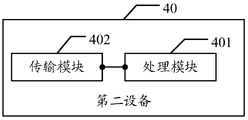
- the second device further includes a transmission module 402.
- the processing module 401 is specifically configured to: when the second device is the device that uses the blind zone resource of the first transmission resource in the area, the processing module 401 is specifically configured to:
- the memory 504 can include read only memory and random access memory, and provides instructions and data to the processor 503.
- a portion of the memory 504 can also include, possibly including, a high speed random access memory (RAM), and possibly a non- Un-volatile memory.
- RAM high speed random access memory
- Operating system Includes a variety of system programs for implementing various basic services and handling hardware-based tasks.
- the processor 603 may further perform the following steps:
Landscapes
- Engineering & Computer Science (AREA)
- Signal Processing (AREA)
- Computer Networks & Wireless Communication (AREA)
- Mobile Radio Communication Systems (AREA)
Abstract
Description
本发明涉及无线通信技术领域,尤其涉及的是一种确定传输资源的方法及相关设备。The present invention relates to the field of wireless communication technologies, and in particular, to a method for determining transmission resources and related devices.
在车辆与车辆(V2V,Vechicle to Vechicle)通信系统中,任意车辆可以广播或单播的方式与周围的车辆进行数据的交互,设备通过广播方式发送V2V信息,可以达到高效传递信息,提高网络灵活性的作用。该V2V信息是一种周期性广播信息,包括设备标识、设备位置、速度、加速度或行驶路线等车辆状态信息。In the vehicle and vehicle (V2V, Vechicle to Vechicle) communication system, any vehicle can exchange data with surrounding vehicles in a broadcast or unicast manner, and the device can transmit V2V information through broadcast, which can achieve efficient transmission of information and improve network flexibility. The role of sex. The V2V information is a kind of periodic broadcast information, including vehicle status information such as device identification, device position, speed, acceleration, or driving route.
V2V通信系统中,进入区域后的车辆根据传输图样发送自身的周期信号,以及接收其它车辆发送的周期信号,从而实现车辆与车辆之间发现彼此的目的。In the V2V communication system, the vehicle after entering the area transmits its own periodic signal according to the transmission pattern, and receives periodic signals transmitted by other vehicles, thereby achieving the purpose of finding each other between the vehicle and the vehicle.
虽然上述传输图样可以实现V2V通信系统中的车辆在区域内发送或接收周期信号,但现有技术中的车辆为随机选择发送周期信号的资源,并不能保证在选择了资源的情况下,相距很近的车辆与车辆之间能够发现彼此,出现安全事故出现的概率较高;其次,若两辆互相发现不了的车辆之间的车辆都离开区域后,这两辆车辆仍然无法发现彼此,极大可能导致安全事故。Although the above transmission pattern can realize that the vehicle in the V2V communication system transmits or receives the periodic signal in the area, the prior art vehicle randomly selects the resource for transmitting the periodic signal, and cannot guarantee that the distance is very good when the resource is selected. Near vehicles and vehicles can find each other, the probability of a safety accident is high; secondly, if the vehicles between two vehicles that cannot be found each other leave the area, the two vehicles still cannot find each other, May cause a safety incident.
发明内容Summary of the invention
本发明提供了一种确定传输资源的方法及相关设备,能够减少设备与设备之间碰撞的概率。The present invention provides a method and a related device for determining a transmission resource, which can reduce the probability of collision between the device and the device.
本发明第一方面提供了一种确定传输资源的方法,所述方法包括:A first aspect of the present invention provides a method for determining a transmission resource, the method comprising:
第一设备接收区域内所有设备发送的状态信息;The first device receives status information sent by all devices in the area;
所述第一设备根据传输图样及所述区域内,所有设备发送状态信息时在资源池中使用的资源,确定所述资源池中的空闲资源;Determining, by the first device, the idle resources in the resource pool according to the transmission pattern and the resources used in the resource pool when all the devices send the state information in the area;
所述第一设备按照第一规则,从所述空闲资源中确定第一传输资源作为发 送所述第一设备的状态信息的资源,所述第一规则为所述第一传输资源不为第二设备的盲区资源,所述第二设备为所述区域内所有设备中与所述第一设备在物理位置上相邻的设备,所述第二设备的盲区资源包括与所述第二设备所使用的传输资源对应相同时域的传输资源。Determining, by the first device, the first transmission resource from the idle resource according to the first rule a resource for sending the status information of the first device, where the first rule is that the first transmission resource is not a blind zone resource of the second device, and the second device is the device and the device in the area A device in a physical location is adjacent to the device, and the blind zone resource of the second device includes a transmission resource in the same time domain as the transmission resource used by the second device.
结合第一方面,本发明第一方面的第一种可能的实现方式中,所述第一规则还包括:With reference to the first aspect, in a first possible implementation manner of the first aspect, the first rule further includes:
在所述区域内,所述第一设备与第三设备至少相隔所述第二设备,所述第三设备为所述区域内使用所述第一设备的盲区资源的设备,所述第一设备的盲区资源包括与所述第一传输资源对应相同时域的传输资源。In the area, the first device and the third device are at least separated from the second device, and the third device is a device that uses the blind zone resource of the first device in the area, the first device The blind spot resource includes a transmission resource corresponding to the same time domain as the first transmission resource.
结合第一方面的第一种可能的实现方式,本发明第一方面的第二种可能的实现方式中,所述第三设备为所述区域内使用所述第一设备的盲区资源的设备,包括:With reference to the first possible implementation manner of the first aspect, in a second possible implementation manner of the first aspect, the third device is a device that uses the blind zone resource of the first device in the area, include:
所述第三设备为所述区域内与所述第一设备的物理距离最大的设备。The third device is a device having the largest physical distance from the first device in the area.
结合第一方面的第一种或第二种可能的实现方式,本发明第一方面的第三种可能的实现方式中,所述第一传输资源的盲区资源包括第一盲区资源和第二盲区资源,所述第三设备使用所述第一盲区资源,第四设备使用所述第二盲区资源,所述第一规则还满足如下条件中的一个:In conjunction with the first or second possible implementation of the first aspect, in a third possible implementation manner of the first aspect, the blind area resource of the first transmission resource includes a first dead zone resource and a second dead zone a resource, the third device uses the first dead zone resource, and the fourth device uses the second dead zone resource, and the first rule further satisfies one of the following conditions:
第一距离和第二距离均不小于第一阈值,所述第一距离为所述第一设备与所述第三设备之间的物理距离,所述第二距离为所述第一设备与所述第四设备之间的物理距离;可选的,所述第三设备和所述第四设备分别为所述区域内在所述第一设备的移动方向的前后两个方向上的两个设备;The first distance and the second distance are not less than a first threshold, the first distance is a physical distance between the first device and the third device, and the second distance is the first device and the The physical distance between the fourth devices; optionally, the third device and the fourth device are respectively two devices in the front and rear directions in the moving direction of the first device in the region;
或,or,
第一数量和第二数量均不小于第二阈值,所述第一数量为所述区域内,所述第一设备与所述第三设备之间存在的设备的数量,第二数量为所述区域内,所述第一设备与所述第四设备之间存在的设备的数量;可选的,所述第三设备或所述第四设备为与所述第一设备移动方向的前后两个方向上的设备。The first quantity and the second quantity are not less than a second threshold, and the first quantity is the number of devices existing between the first device and the third device in the area, and the second quantity is the The number of devices existing between the first device and the fourth device in the area; optionally, the third device or the fourth device is two before and after the moving direction with the first device Equipment in the direction.
结合第一方面或第一方面的第一种至第三种可能的实现方式中任一种可能的实现方式,本发明第一方面的第四种可能的实现方式中,所述第一设备接收所述区域内所有设备发送的状态信息,所述第一设备根据传输图样及所述区 域内所有设备发送状态信息时在资源池中使用的资源,确定所述资源池中的空闲资源,具体包括:With reference to the first aspect, or any one of the first to the third possible implementation manners of the first aspect, in a fourth possible implementation manner of the first aspect, Status information sent by all devices in the area, the first device according to the transmission pattern and the area The resources used in the resource pool when all the devices in the domain send the status information, and determine the idle resources in the resource pool, including:
第一设备接收P次所述区域内所有设备发送的状态信息,所述第一设备根据传输图样及所述P次所述区域内,所有设备发送状态信息时在所述资源池中使用的资源,确定所述空闲资源,所述P为正整数。The first device receives the status information sent by all the devices in the area in the P times, and the first device uses the resources used in the resource pool when all the devices send the status information according to the transmission pattern and the P times in the area. Determining the idle resource, the P being a positive integer.
结合第一方面或第一方面的第一种至第四种可能的实现方式中任一种可能的实现方式,本发明第一方面的第五种可能的实现方式中,所述第一设备在按照所述传输图样,利用所述第一传输资源发送所述第一设备的状态信息后,确定下一次发送状态信息所需的第二传输资源,所述第二传输资源与所述第一传输资源对应不同的时域。With reference to the first aspect, or any one of the possible implementation manners of the first to fourth possible implementations of the first aspect, in a fifth possible implementation manner of the first aspect, Determining, according to the transmission pattern, the second transmission resource required for the next transmission of the state information, the second transmission resource, and the first transmission, after the state information of the first device is sent by using the first transmission resource Resources correspond to different time domains.
结合第一方面的第五种可能的实现方式,本发明第一方面的第六种可能的实现方式中,所述传输图样包含N个时域单元和M个频域单元,若N大于等于M,则N个时域单元和M个频域单元组成一组N*M的矩阵,若N小于M,则每N个时域单元和N个频域单元组成一组N*N的矩阵,共有ceil(M/N)、floor(M/N)或round(M/N)个矩阵,每组中对应矩阵相同位置的传输资源在所述传输图样中的置换规则相同,其中,mod为求余函数,ceil为向正无穷取整函数,floor为向负无穷取整函数,round为四舍五入取整函数。In conjunction with the fifth possible implementation of the first aspect, in a sixth possible implementation manner of the first aspect, the transmission pattern includes N time domain units and M frequency domain units, where N is greater than or equal to M Then, the N time domain units and the M frequency domain units form a set of N*M matrices. If N is less than M, each N time domain unit and N frequency domain units form a set of N*N matrices. Ceil(M/N), floor(M/N) or round(M/N) matrices, the transmission rules of the same position in the corresponding matrix in each group are the same in the transmission pattern, where mod is the remainder The function, ceil is a positive infinity function, floor is a negative infinity function, and round is a rounding rounding function.
本发明第二方面提供一种确定资源的方法,所述方法包括:A second aspect of the present invention provides a method of determining a resource, the method comprising:
在确定第一设备离开区域,释放第一传输资源后,第二设备使用所述第一传输资源发送所述第二设备的状态信息,所述第一传输资源为所述第一设备发送所述第一设备的状态信息时所使用的传输资源;所述第二设备为所述区域内,在物理位置上不与使用所述第一传输资源的盲区资源的设备相邻的设备,所述第一传输资源的盲区资源包括与所述第一传输资源对应相同时域的传输资源。After determining that the first device leaves the area and releases the first transmission resource, the second device sends the status information of the second device by using the first transmission resource, where the first transmission resource sends the a transmission resource used when the status information of the first device is used; the second device is a device in the area that is not adjacent to the device using the blind spot resource of the first transmission resource in the physical location, the The blind zone resource of a transmission resource includes a transmission resource of the same time domain as the first transmission resource.
结合第二方面,本发明第二方面的第一种可能的实现方式中,所述第二设备为所述区域内,在物理位置上不与使用第一传输资源的盲区资源的设备相邻的设备,包括:With reference to the second aspect, in a first possible implementation manner of the second aspect of the present invention, the second device is in the area, and is not adjacent to the device that uses the blind zone resource of the first transmission resource in the physical location. Equipment, including:
在所述区域内,所述第二设备在物理位置上与使用所述第一传输资源的盲 区资源的设备相隔Q个设备,Q为正整数。In the area, the second device is in physical location and blind using the first transmission resource The devices of the zone resources are separated by Q devices, and Q is a positive integer.
结合第二方面,本发明第二方面的第二种可能的实现方式中,在所述第二设备为所述区域内,使用所述第一传输资源的盲区资源的设备时,所述在确定第一设备离开区域,释放第一传输资源后,第二设备使用所述第一传输资源发送所述第二设备的状态信息,包括:With reference to the second aspect, in a second possible implementation manner of the second aspect of the present invention, when the second device is a device that uses the blind zone resource of the first transmission resource in the area, the determining is After the first device leaves the area and the first transmission resource is released, the second device sends the status information of the second device by using the first transmission resource, including:
所述第二设备根据接收到的所述区域内除所述第二设备的所有设备的状态信息,确定所述第一设备已离开所述区域且释放所述第一传输资源时,第二设备使用所述第一传输资源发送所述第二设备的状态信息;Determining, by the second device, that the first device has left the area and releases the first transmission resource, according to the received status information of all devices of the second device in the area, the second device Transmitting state information of the second device by using the first transmission resource;
或者,or,
根据所述传输模块接收到的所述区域内除所述第二设备的所有设备的状态信息,确定所述第一设备已离开所述区域且释放所述第一传输资源时,不使用所述第一传输资源,以使目标设备使用所述第一传输资源,所述目标设备为在传输图样中与所述第二设备使用的传输资源的位置相邻的被占用的传输资源所属的设备,该目标设备为在物理位置上不与使用所述第一传输资源的盲区资源的设备相邻的设备。Determining, when the first device has left the area and releasing the first transmission resource, according to status information of all devices in the area that are received by the transmission module a first transmission resource, so that the target device uses the first transmission resource, where the target device is a device to which the occupied transmission resource adjacent to the location of the transmission resource used by the second device belongs in the transmission pattern, The target device is a device that is not physically adjacent to a device that uses the blind spot resource of the first transmission resource.
结合第二方面的第二种可能的实现方式,本发明第二方面的第三种可能的实现方式中,所述第二设备为所述区域内,使用所述第一传输资源的盲区资源的设备,包括:With reference to the second possible implementation manner of the second aspect, in a third possible implementation manner of the second aspect, the second device is a blind zone resource that uses the first transmission resource in the area Equipment, including:
所述第二设备为使用所述第一传输资源的盲区资源的设备中,与所述第一设备的物理位置距离最近的设备;The second device is a device that uses the blind zone resource of the first transmission resource, and is the closest to the physical location of the first device;
或者,or,
所述第二设备为按照频域资源在传输图样中的开始位置的排列顺序,第一个被占用的频域资源所属的设备。The second device is a device to which the first occupied frequency domain resource belongs according to an arrangement order of starting positions of the frequency domain resources in the transmission pattern.
本发明第三方面提供一种第一设备,所述第一设备包括:A third aspect of the present invention provides a first device, where the first device includes:
传输模块,用于接收区域内所有设备发送的状态信息;a transmission module, configured to receive status information sent by all devices in the area;
处理模块,用于根据传输图样及所述区域内,所有设备发送状态信息在资源池中使用的资源,确定资源池中的空闲资源;a processing module, configured to determine, according to the transmission pattern and the resources used by the device in the resource pool, the idle resources in the resource pool;
按照第一规则,从所述空闲资源中确定第一传输资源作为发送所述第一设 备的状态信息的资源,所述第一规则为所述第一传输资源不为第二设备的盲区资源,所述第二设备为所述区域内所有设备中与所述第一设备在物理位置上相邻的设备,所述第二设备的盲区资源包括与所述第二设备所使用的传输资源对应相同时域的传输资源。Determining, by the first rule, a first transmission resource from the idle resource as sending the first The first rule is that the first transmission resource is not a blind zone resource of the second device, and the second device is a physical location of the first device in all devices in the area. The neighboring device, the blind zone resource of the second device includes a transmission resource in the same time domain as the transmission resource used by the second device.
结合第三方面,本发明第三方面的第一种可能的实现方式中,所述第一规则还包括:In conjunction with the third aspect, in a first possible implementation manner of the third aspect, the first rule further includes:
在所述区域内,所述第一设备与第三设备至少相隔所述第二设备,所述第三设备为所述区域内使用所述第一设备的盲区资源的设备,所述第一设备的盲区资源包括与所述第一传输资源对应相同时域的传输资源。In the area, the first device and the third device are at least separated from the second device, and the third device is a device that uses the blind zone resource of the first device in the area, the first device The blind spot resource includes a transmission resource corresponding to the same time domain as the first transmission resource.
结合第三方面的第一种可能的实现方式,本发明第三方面的第二种可能的实现方式中,所述第三设备为所述区域内使用所述第一设备的盲区资源的设备,包括:With reference to the first possible implementation manner of the third aspect, in a second possible implementation manner of the third aspect, the third device is a device that uses the blind zone resource of the first device in the area, include:
所述第三设备为所述区域内与所述第一设备的物理距离最大的设备。The third device is a device having the largest physical distance from the first device in the area.
结合第三方面的第一种或第二种可能的实现方式,本发明第三方面的第三种可能的实现方式中,所述第一传输资源的盲区资源包括第一盲区资源和第二盲区资源,所述第三设备使用所述第一盲区资源,第四设备使用所述第二盲区资源,所述第一规则还满足如下条件中的一个:In conjunction with the first or second possible implementation of the third aspect, in a third possible implementation manner of the third aspect, the blind area resource of the first transmission resource includes a first dead zone resource and a second dead zone a resource, the third device uses the first dead zone resource, and the fourth device uses the second dead zone resource, and the first rule further satisfies one of the following conditions:
第一距离和第二距离均不小于第一阈值,所述第一距离为所述第一设备与所述第三设备之间的物理距离,所述第二距离为所述第一设备与所述第四设备之间的物理距离;The first distance and the second distance are not less than a first threshold, the first distance is a physical distance between the first device and the third device, and the second distance is the first device and the The physical distance between the fourth devices;
或,or,
第一数量和第二数量均不小于第二阈值,所述第一数量为所述区域内,所述第一设备与所述第三设备之间存在的设备的数量,第二数量为所述区域内,所述第一设备与所述第四设备之间存在的设备的数量。The first quantity and the second quantity are not less than a second threshold, and the first quantity is the number of devices existing between the first device and the third device in the area, and the second quantity is the The number of devices existing between the first device and the fourth device in the area.
结合第三方面或者第三方面的第一种至第三种可能的实现方式中任一种可能的实现方式,本发明第三方面的第四种可能的实现方式中,所述传输模块具体用于:With reference to the third aspect, or any one of the first to the third possible implementation manners of the third aspect, the fourth possible implementation manner of the third aspect of the present invention, to:
接收P次所述区域内所有设备发送的状态信息;Receiving P times status information sent by all devices in the area;
所述处理模块具体用于: The processing module is specifically configured to:
根据传输图样及所述P次所述区域内,所有设备发送状态信息时在所述资源池中使用的资源,确定所述空闲资源,所述P为正整数。Determining the idle resource according to the transmission pattern and the resources used in the resource pool when all the devices send the status information in the area of the P times, where the P is a positive integer.
结合第三方面或者第三方面的第一种至第四种可能的实现方式中任一种可能的实现方式,本发明第三方面的第五种可能的实现方式中,所述处理模块还用于:With reference to the third aspect, or any one of the first to the fourth possible implementation manners of the third aspect, in the fifth possible implementation manner of the third aspect, the processing module is further used by the processing module. to:
在按照所述传输图样,通过所述传输模块利用所述第一传输资源发送所述第一设备的状态信息后,确定下一次发送状态信息所需的第二传输资源,所述第二传输资源与所述第一传输资源对应不同的时域。After transmitting the state information of the first device by using the first transmission resource, the second transmission resource required for the next transmission of the state information, the second transmission resource, is determined by the transmission module according to the transmission pattern. A time domain different from the first transmission resource.
结合第三方面的第五种可能的实现方式,本发明第三方面的第六种可能的实现方式中,所述传输图样包含N个时域单元和M个频域单元,若N大于等于M,则N个时域单元和M个频域单元组成一组N*M的矩阵,若N小于M,则每N个时域单元和N个频域单元组成一组N*N的矩阵,共有ceil(M/N)、floor(M/N)或round(M/N)个矩阵,每组中对应矩阵相同位置的传输资源在所述传输图样中的置换规则相同,其中,ceil为向正无穷取整函数,floor为向负无穷取整函数,round为四舍五入取整函数。With reference to the fifth possible implementation manner of the third aspect, in a sixth possible implementation manner of the third aspect, the transmission pattern includes N time domain units and M frequency domain units, where N is greater than or equal to M Then, the N time domain units and the M frequency domain units form a set of N*M matrices. If N is less than M, each N time domain unit and N frequency domain units form a set of N*N matrices. Ceil(M/N), floor(M/N) or round(M/N) matrices, in which the transmission resources of the same position in the corresponding matrix in each group have the same replacement rule in the transmission pattern, wherein ceil is positive Infinite rounding function, floor is a rounding function to negative infinity, and round is a rounding rounding function.
本发明第四方面提供一种第二设备,其特征在于,所述第二设备包括:The fourth aspect of the present invention provides a second device, where the second device includes:
处理模块,用于在确定第一设备离开区域,释放第一传输资源后,使第二设备使用所述第一传输资源发送所述第二设备的状态信息,所述第一传输资源为所述第一设备发送所述第一设备的状态信息时所使用的传输资源;所述第二设备为所述区域内,在物理位置上不与使用所述第一传输资源的盲区资源的设备相邻的设备,所述第一传输资源的盲区资源包括与所述第一传输资源对应相同时域的传输资源。a processing module, configured to: after determining that the first device leaves the area, releasing the first transmission resource, causing the second device to use the first transmission resource to send status information of the second device, where the first transmission resource is a transmission resource used by the first device to transmit status information of the first device; the second device is in the area, and is not adjacent to a device using the blind area resource of the first transmission resource in the physical location And the blind area resource of the first transmission resource includes a transmission resource in the same time domain as the first transmission resource.
结合第四方面,本发明第四方面的第一种可能的实现方式中,所述第二设备为所述区域内,在物理位置上不与使用第一传输资源的盲区资源的设备相邻的设备,包括:With reference to the fourth aspect, in a first possible implementation manner of the fourth aspect of the present invention, the second device is in the area, and is not adjacent to the device that uses the blind spot resource of the first transmission resource in the physical location. Equipment, including:
在所述区域内,所述第二设备在物理位置上与使用所述第一传输资源的盲区资源的设备相隔Q个设备,Q为正整数。In the area, the second device is physically separated from the device using the blind spot resource of the first transmission resource by Q devices, and Q is a positive integer.
结合第四方面,本发明第四方面的第二种可能的实现方式中,所述第二设 备还包括传输模块,在所述第二设备为所述区域内,使用所述第一传输资源的盲区资源的设备时,所述处理模块具体用于:With reference to the fourth aspect, in a second possible implementation manner of the fourth aspect of the present invention, the second The processing module is further configured to: when the second device is a device that uses the blind zone resource of the first transmission resource in the area, where the processing module is specifically configured to:
根据所述传输模块接收到的所述区域内除所述第二设备的所有设备的状态信息,确定所述第一设备已离开所述区域且释放所述第一传输资源时,使用所述第一传输资源发送所述第二设备的状态信息;And determining, according to the state information of all the devices in the area that are received by the transmission module, that the first device has left the area and releases the first transmission resource, Transmitting, by the transmission resource, status information of the second device;
或者,or,
根据所述传输模块接收到的所述区域内除所述第二设备的所有设备的状态信息,确定所述第一设备已离开所述区域且释放所述第一传输资源时,不使用所述第一传输资源,以使目标设备使用所述第一传输资源,所述目标设备为在传输图样中与所述第二设备使用的传输资源的位置相邻的被占用的传输资源所属的设备,该目标设备为在物理位置上不与使用所述第一传输资源的盲区资源的设备相邻的设备。Determining, when the first device has left the area and releasing the first transmission resource, according to status information of all devices in the area that are received by the transmission module a first transmission resource, so that the target device uses the first transmission resource, where the target device is a device to which the occupied transmission resource adjacent to the location of the transmission resource used by the second device belongs in the transmission pattern, The target device is a device that is not physically adjacent to a device that uses the blind spot resource of the first transmission resource.
结合第四方面的第二种可能的实现方式,本发明第四方面的第三种可能的实现方式中,所述第二设备为所述区域内,使用所述第一传输资源的盲区资源的设备,包括:With reference to the second possible implementation manner of the fourth aspect, in a third possible implementation manner of the fourth aspect, the second device is a blind zone resource that uses the first transmission resource in the area Equipment, including:
所述第二设备为使用所述第一传输资源的盲区资源的设备中,与所述第一设备的物理位置距离最近的设备;The second device is a device that uses the blind zone resource of the first transmission resource, and is the closest to the physical location of the first device;
或者,or,
所述第二设备为按照频域资源在传输图样中的开始位置的排列顺序,第一个被占用的频域资源所属的设备。The second device is a device to which the first occupied frequency domain resource belongs according to an arrangement order of starting positions of the frequency domain resources in the transmission pattern.
本发明实施例中,第一设备根据传输图样和接收到的状态信息确定空闲资源后,从空闲资源中确定不为第二设备的盲区资源的第一传输资源,既可保证在加入区域后,在与该区域内的其他设备互相通信的前提下,使第一设备与其盲区设备的物理距离在故障距离外,有效减少一定物理距离内,设备与设备之间互相碰撞的概率。In the embodiment of the present invention, after determining the idle resource according to the transmission pattern and the received state information, the first device determines, from the idle resource, the first transmission resource that is not the blind zone resource of the second device, and ensures that after joining the region, Under the premise of communicating with other devices in the area, the physical distance between the first device and its blind zone device is outside the fault distance, effectively reducing the probability of collision between the device and the device within a certain physical distance.
图1-1为本发明实施例传输图样的结构示意图;1-1 is a schematic structural diagram of a transmission pattern according to an embodiment of the present invention;
图1-2为本发明实施例第一设备加入区域时,资源对应传输图样中的位置 变化示意图;1-2 is a location in a resource corresponding transmission pattern when a first device joins an area according to an embodiment of the present invention; Schematic diagram of change
图1-3为本发明实施例中资源对应传输图样中的位置变化示意图;1-3 are schematic diagrams of position changes in a resource corresponding transmission pattern in an embodiment of the present invention;
图1-4为本发明实施例一种确定传输资源的方法的流程示意图;1-4 are schematic flowcharts of a method for determining a transmission resource according to an embodiment of the present invention;
图1-5为本发明实施例传输图样的另一结构示意图;1-5 are schematic diagrams showing another structure of a transmission pattern according to an embodiment of the present invention;
图1-6为本发明实施例第一设备根据加入区域的位置确定传输资源对应传输图样中的位置的示意图;1-6 is a schematic diagram of determining, by a first device, a location in a transmission pattern corresponding to a transmission resource according to a location of a join area according to an embodiment of the present invention;
图1-7为本发明实施例第一设备根据加入区域的位置确定传输资源对应传输图样中的位置的另一示意图;1-7 are another schematic diagram of determining, by a first device, a location in a transmission pattern corresponding to a transmission resource according to a location of a join area according to an embodiment of the present invention;
图2-1为本发明实施例一种确定传输资源的方法的另一流程示意图;2-1 is a schematic flowchart of another method for determining a transmission resource according to an embodiment of the present invention;
图2-2为本发明实施例一种确定传输资源的方法的具体应用场景的流程示意图;2-2 is a schematic flowchart of a specific application scenario of a method for determining a transmission resource according to an embodiment of the present invention;
图3为本发明实施例一种第一设备的结构示意图;3 is a schematic structural diagram of a first device according to an embodiment of the present invention;
图4为本发明实施例一种第二设备的结构示意图;4 is a schematic structural diagram of a second device according to an embodiment of the present invention;
图4-1为本发明实施例一种第二设备的另一结构示意图;4-1 is a schematic structural diagram of another second device according to an embodiment of the present invention;
图5为本发明实施例一种第一设备的另一结构示意图;FIG. 5 is another schematic structural diagram of a first device according to an embodiment of the present invention; FIG.
图6为本发明实施例一种第二设备的另一结构示意图。FIG. 6 is another schematic structural diagram of a second device according to an embodiment of the present invention.
下面将结合本发明实施例中的附图,对本发明实施例中的技术方案进行清楚、完整地描述,显然,所描述的实施例仅仅是本发明一部分实施例,而不是全部的实施例,基于本发明中的实施例,本领域技术人员在没有做出创造性劳动前提下所获得的所有其他实施例,都属于本发明保护的范围。The technical solutions in the embodiments of the present invention are clearly and completely described in the following with reference to the accompanying drawings in the embodiments of the present invention. It is obvious that the described embodiments are only a part of the embodiments of the present invention, but not all embodiments, based on All other embodiments obtained by those skilled in the art without creative efforts are within the scope of the present invention.
本发明的说明书和权利要求书及上述附图中的术语“第一”、“第二”等是用于区别类似的对象,而不必用于描述特定的顺序或先后次序。应该理解这样使用的数据在适当情况下可以互换,以便这里描述的实施例能够以除了在这里图示或描述的内容以外的顺序实施。此外,术语“包括”和“具有”以及他们的任何变形,意图在于覆盖不排他的包含,例如,包含了一系列步骤或模块的过程、方法、系统、产品或设备不必限于清楚地列出的那些步骤或模块,而是可包括没有清楚地列出的或对于这些过程、方法、产品或设备固有 的其它步骤或模块,本文中所出现的模块的划分,仅仅是一种逻辑上的划分,实际应用中实现时可以有另外的划分方式,例如多个模块可以结合成或集成在另一个系统中,或一些特征可以忽略,或不执行,另外,所显示的或讨论的相互之间的耦合或直接耦合或通信连接可以是通过一些接口,模块之间的间接耦合或通信连接可以是电性或其他类似的形式,本文中均不作限定。并且,作为分离部件说明的模块或子模块可以是也可以不是物理上的分离,可以是也可以不是物理模块,或者可以分不到多个电路模块中,可以根据实际的需要选择其中的部分或全部模块来实现本发明实施例方案的目的。The terms "first", "second" and the like in the specification and claims of the present invention and the above drawings are used to distinguish similar objects, and are not necessarily used to describe a particular order or order. It is to be understood that the data so used may be interchanged where appropriate so that the embodiments described herein can be implemented in a sequence other than what is illustrated or described herein. In addition, the terms "comprises" and "comprises" and "the" and "the" are intended to cover a non-exclusive inclusion, for example, a process, method, system, product, or device that comprises a series of steps or modules is not necessarily limited to Those steps or modules, but may include those not explicitly listed or inherent to such processes, methods, products or equipment The other steps or modules, the division of the modules appearing in this article is only a logical division, and there may be another division manner in the actual application, for example, multiple modules can be combined or integrated into another system. , or some features may be omitted or not performed. Additionally, the coupling or direct coupling or communication connection between the displays or discussions may be through some interfaces, and the indirect coupling or communication connection between the modules may be electrical or Other similar forms are not limited herein. Moreover, the module or the sub-module described as the separate component may or may not be physically separated, may not be a physical module, or may not be divided into a plurality of circuit modules, and may select a part thereof according to actual needs or All modules are used to achieve the objectives of the embodiments of the present invention.
本发明实施例提供了一种确定传输资源的方法及相关设备,用于减少设备与设备之间发生碰撞的概率。本文中的设备可以理解为区域内任何移动的设备,例如在车道行驶的车、在空中飞行的飞行设备、航道行驶的船只,也可以扩展至轨道运行的卫星等类似高速移动的设备,具体应用场景本文中不作限定。The embodiment of the invention provides a method for determining a transmission resource and a related device, which are used to reduce the probability of collision between the device and the device. The equipment in this article can be understood as any mobile device in the area, such as a car driving in a lane, a flying device flying in the air, a vessel traveling on a waterway, or a device similar to a high-speed mobile device such as a satellite orbiting, for specific applications. The scene is not limited in this article.
本文中的加入区域后的设备都可以根据传输图样来确定需要的传输资源,以发送或接收信息。该传输图样为指示进入区域内的设备,从预配置的资源池确定传输资源与区域内或区域外的其它设备通信。该传输图样中的每个单元对应资源池中的一个传输资源,如图1-1所示,所述传输图样包括时间轴和频率轴,所述传输图样中由所述时间轴的分度值与所述频率轴的分度值所围成的最小单位对应一个传输资源,所述时间轴包括N个时间点(T1、T2、…TN),所述频率轴包括N个频率点(f1、f2、…fN),所述传输图样中的每个坐标(Tx,fy)对应一个传输资源;其中,所述传输资源的最小单元为一个物理资源块(PRB,Physical Resource Block),该传输资源在频域上使用连续12个子载波,在时域上使用一个时隙,一个时隙长度为0.5ms;所述传输资源可以包含多个PRB,例如包含2个PRB,那么所述传输资源在频域上使用连续12个子载波,在时域上使用一个子帧,所述一个子帧长度为1ms。The devices after joining the zone in this paper can determine the required transmission resources according to the transmission pattern to send or receive information. The transmission pattern is a device indicating the entry into the area, and the transmission resource is determined from the pre-configured resource pool to communicate with other devices in or outside the area. Each unit in the transmission pattern corresponds to one transmission resource in the resource pool, as shown in FIG. 1-1, the transmission pattern includes a time axis and a frequency axis, and the division value of the time axis in the transmission pattern A minimum unit enclosed by the index value of the frequency axis corresponds to a transmission resource, the time axis includes N time points (T 1 , T 2 , ... T N ), and the frequency axis includes N frequency points (f 1 , f 2 , ... f N ), each coordinate (T x , f y ) in the transmission pattern corresponds to one transmission resource; wherein the smallest unit of the transmission resource is a physical resource block (PRB, Physical Resource Block), the transmission resource uses 12 consecutive subcarriers in the frequency domain, one time slot in the time domain, and one time slot length is 0.5 ms; the transmission resource may include multiple PRBs, for example, including 2 PRBs. Then, the transmission resource uses 12 consecutive subcarriers in the frequency domain, and one subframe is used in the time domain, and the length of the one subframe is 1 ms.
另外,该传输图样规定了设备在连续多次发送自身状态信息时,确定传输资源的规则。例如,设备在一次发送自身状态信息时,选择传输图样中的第一单元所指示的传输资源发送自身状态信息,设备在下一次或其它次发送 自身状态信息时,需要按照传输图样的规则,选择传输图样中上述第一单元对应的第二单元所指示的传输资源发送自身状态信息,具体规则可以根据实际情况(如一定时间内的路况信息,或业务量,进入区域内的设备的数量或资源池的实际容量)制定,本文中不作限定。In addition, the transmission pattern specifies rules for determining the transmission resource when the device continuously transmits its own status information. For example, when the device sends its own state information, it selects the transmission resource indicated by the first unit in the transmission pattern to send its own state information, and the device sends the next time or other times. In the case of the state information, the transmission resource indicated by the second unit corresponding to the first unit in the transmission pattern is selected to transmit the state information according to the rules of the transmission pattern. The specific rules may be based on actual conditions (such as the road condition information within a certain period of time. Or the amount of traffic, the number of devices entering the area or the actual capacity of the resource pool), which is not limited in this paper.
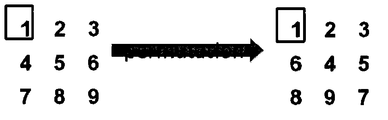
举例来说,按照每个区域所属的传输图样在时域上对应的资源位置个数N,将每个区域所属的传输图样划分为N*N的最小资源组,例如,图1-2中,区域A所属的传输图样中在时域上对应的3个资源位置,则每个区域所属的传输图样的最小资源组为3*3个资源位置组成的矩阵(如图1-2中虚线方框所示)。图1-2中数字代表车的标识(ID,Identify),每个区域所属的传输图样中在频率方向上,每隔一个最小资源组中的传输资源对应的规则相同,例如位置A与位置B对应的规则相同,位置A为第一个资源组(包含ID为1、2、3、4、5、6、7、8及9)中的ID为1在传输图样中的位置,位置B为第二个资源组(包含ID为10、11、12、13、14、15、16、17及18)中的ID为10在传输图样中的位置,其它类似,不再赘述。For example, according to the number N of resource locations corresponding to the transmission pattern of each region, the transmission pattern to which each region belongs is divided into the minimum resource group of N*N, for example, in Figure 1-2. For the three resource locations corresponding to the time domain in the transmission pattern to which the area A belongs, the minimum resource group of the transmission pattern to which each area belongs is a matrix consisting of 3*3 resource locations (as shown in the dotted box in Figure 1-2). Shown). The numbers in Figure 1-2 represent the identification of the vehicle (ID, Identify). In the transmission pattern to which each area belongs, in the frequency direction, the rules corresponding to the transmission resources in every other minimum resource group are the same, such as position A and position B. The corresponding rules are the same. Position A is the position of the ID in the first resource group (including
又举例来说,图1-3中,每个数字代表不同设备所使用的传输资源对应所述传输图样中的位置,例如,设备1、4及7在一次发送其状态信息时,使用相同的子帧,仅仅是使用的频率不同。此时,设备1、设备4和设备7是互相接收不到彼此广播的状态信息的,即这三者无法发现彼此。在经过多次(最少2次)发送状态信息后,设备1、设备4和设备7选择了不同的子帧发送各自的状态信息,因此,设备1、设备4和设备7都可以相互接收到彼此广播的状态信息。For example, in FIGS. 1-3, each number represents a transmission resource used by a different device corresponding to a location in the transmission pattern, for example,
请参照图1-4,下面从设备加入区域后,如何确定传输资源角度进行描述。本发明实施例中一种确定传输资源的方法,所述包括:Referring to Figure 1-4, after the device is added to the area, how to determine the transmission resource angle is described. A method for determining a transmission resource in an embodiment of the present invention, where the method includes:
101、第一设备接收区域内所有设备发送的状态信息;101. The first device receives status information sent by all devices in the area.
可以理解的是,第一设备在加入上述区域前,可以接收区域内所有设备周期性发送的状态信息,该状态信息可以包括设备的位置信息、设备标识、移动速度、加速度、移动方向或可能的行进路线等状态信息等。It can be understood that, before the first device joins the foregoing area, the first device may receive state information periodically sent by all devices in the area, where the status information may include location information of the device, device identifier, moving speed, acceleration, moving direction, or possible Status information such as the route of travel.
102、所述第一设备根据传输图样及所述区域内所有设备发送状态信息时 在资源池中使用的资源,确定所述资源池中的空闲资源;102. The first device sends status information according to the transmission pattern and all devices in the area. A resource used in a resource pool to determine an idle resource in the resource pool;
103、所述第一设备按照第一规则,从所述空闲资源中确定第一传输资源作为发送所述第一设备的状态信息的资源;103. The first device determines, according to the first rule, a first transmission resource from the idle resource as a resource that sends status information of the first device.
其中,所述第一规则为所述第一传输资源不为第二设备的盲区资源,所述第二设备为所述区域内所有设备中与所述第一设备在物理位置上相邻的设备,所述第二设备的盲区资源包括与所述第二设备所使用的传输资源对应相同时域的传输资源。The first rule is that the first transmission resource is not a blind zone resource of the second device, and the second device is a device that is adjacent to the first device in the physical location of all devices in the area. The blind zone resource of the second device includes a transmission resource in the same time domain as the transmission resource used by the second device.
本发明实施例中,上述第一设备根据传输图样和接收到的状态信息确定空闲资源后,从空闲资源中确定不为第二设备的盲区资源的第一传输资源,既可保证在加入区域后,在与该区域内的其他设备互相通信的前提下,使第一设备与其盲区设备的物理距离在故障距离外,有效减少一定物理距离内,设备与设备之间互相碰撞的概率。In the embodiment of the present invention, after the first device determines the idle resource according to the transmission pattern and the received state information, the first transmission resource that is not the blind zone resource of the second device is determined from the idle resource, and the first transmission resource is ensured after the zone is added. Under the premise of communicating with other devices in the area, the physical distance between the first device and the device in the blind zone is outside the fault distance, effectively reducing the probability of collision between the device and the device within a certain physical distance.
可选的,在上述图1-4所对应的实施例的基础上,本发明实施例的第一个可选实施例中,所述第一规则还包括:Optionally, in the foregoing optional embodiment of the embodiment of the present invention, the first rule further includes:
在所述区域内,所述第一设备与第三设备至少相隔所述第二设备,所述第三设备为所述区域内使用所述第一设备的盲区资源的设备,所述第一设备的盲区资源包括与所述第一传输资源对应相同时域的传输资源。In the area, the first device and the third device are at least separated from the second device, and the third device is a device that uses the blind zone resource of the first device in the area, the first device The blind spot resource includes a transmission resource corresponding to the same time domain as the first transmission resource.
实际应用时,该第一规则具体可以包括:In actual application, the first rule may specifically include:
在所述服务区域内,所述第三设备与所述第一设备之间间隔的设备的数量大于预设阈值,或所述第三设备为所述服务区域内,与所述第一设备物理距离最大的物理位置的设备。In the service area, the number of devices that are separated between the third device and the first device is greater than a preset threshold, or the third device is in the service area, and is physically different from the first device. The device with the largest physical location.
举例来说,如图1-2所示,区域A内共有27个设备,第一种情况(如图Case1)下,第一设备若加入到ID为1的设备(即第二设备)前方时,则第一设备不能选择ID为1的设备的盲区资源作为上述第一传输资源。如图1-1中的传输图样可知,ID为1的设备的盲区资源包括在所述传输图样中,ID为10、19或28等的设备使用的传输资源,即每3*3资源组在资源池中所对应位置的的传输资源。那么,在物理位置上,只要保证所述第一设备与第三设备至少相隔所述第二设备,就可以在一段时间内(第二设备不离开区域的前提下)保证
第一设备与第三设备不发生碰撞。当然,在第三设备为所述服务区域内,与所述第一设备物理距离最大的物理位置的设备(ID为27的设备),且ID为27的设备的盲区资源未被占用时,第一设备可以优先选择ID为27的设备的盲区资源作为第一传输资源。For example, as shown in Figure 1-2, there are 27 devices in area A. In the first case (see Case1), if the first device is added to the device with ID 1 (that is, the second device), The first device cannot select the blind zone resource of the device with
可选的,在上述第一个可选实施例的基础上,本发明实施例的第二个可选实施例中,所述第三设备为所述区域内使用所述第一设备的盲区资源的设备,包括:Optionally, in the second optional embodiment of the embodiment of the present invention, the third device is a blind zone resource that uses the first device in the area, in the second optional embodiment. Equipment, including:
所述第三设备为所述区域内与所述第一设备的物理距离最大的设备。The third device is a device having the largest physical distance from the first device in the area.
可选的,在上述第一个或第二个可选实施例的基础上,本发明实施例的第三个可选实施例中,所述第一传输资源的盲区资源包括第一盲区资源和第二盲区资源,所述第三设备使用所述第一盲区资源,第四设备使用所述第二盲区资源,所述第一规则还满足如下条件中的一个:Optionally, in the third optional embodiment of the embodiment of the present invention, the blind zone resource of the first transmission resource includes a first blind zone resource and The second dead zone resource, the third device uses the first blind zone resource, and the fourth device uses the second blind zone resource, and the first rule further satisfies one of the following conditions:
1、第一距离和第二距离均不小于第一阈值,所述第一距离为所述第一设备与所述第三设备之间的物理距离,所述第二距离为所述第一设备与所述第四设备之间的物理距离;The first distance and the second distance are not less than a first threshold, the first distance is a physical distance between the first device and the third device, and the second distance is the first device a physical distance from the fourth device;
此种情况下,也可以定义两个阈值或者更多,例如定义第一距离不小于阈值a,第二距离不小于阈值b,阈值a和阈值b可以相同可以不同,根据实际路况而设定,具体本文不作限定。In this case, two thresholds or more may be defined, for example, the first distance is not less than the threshold a, and the second distance is not less than the threshold b. The threshold a and the threshold b may be the same or different, and are set according to actual road conditions. This article is not limited in this paper.
实际应用中,例如设备为车时,车行驶在车道,由于每个地方的车道设计不一,可能存在单车道或双车道等等。举例来说,在单车道时,可以直接计算该车与其行驶方向上的前后两辆车的距离是否大于上述第一阈值,以保证最小安全范围;而在多车道时,可能需要计算该车与其周围的所有车之间的距离是否大于上述第一阈值。In practical applications, for example, when the device is a car, the car travels in the lane, and since the lane design of each place is different, there may be a single lane or a double lane, and the like. For example, in a single lane, it can be directly calculated whether the distance between the vehicle and the two vehicles in the direction of travel is greater than the first threshold to ensure a minimum safety range; and in multiple lanes, the vehicle may need to be calculated Whether the distance between all surrounding vehicles is greater than the above first threshold.
2、第一数量和第二数量均不小于第二阈值,所述第一数量为所述区域内,所述第一设备与所述第三设备之间存在的设备的数量,第二数量为所述区域内,所述第一设备与所述第四设备之间存在的设备的数量;2. The first quantity and the second quantity are not less than a second threshold, and the first quantity is the number of devices existing between the first device and the third device in the area, and the second quantity is The number of devices existing between the first device and the fourth device in the area;
此种情况下,也可以定义两个阈值或者更多,例如定义第一距离不小于阈 值c,第二距离不小于阈值d,阈值c和阈值d可以相同可以不同,根据实际路况而设定,具体本文不作限定。In this case, you can also define two thresholds or more, for example, define the first distance to be not less than the threshold. The value c, the second distance is not less than the threshold value d, and the threshold value c and the threshold value d may be the same or different, and are set according to the actual road condition, which is not limited herein.
实际应用中,车行驶在车道,由于每个地方的车道设计不一,可能存在单车道或双车道等等。举例来说,在单车道时,可以直接计算该车的行驶方向上的前后车的数量是否大于上述第二阈值,以保证最小安全范围;而在多车道时,可能需要分别计算该车与其周围的所有满足第三设备或第四设备条件的车之间车的数量是否大于上述第二阈值。In practical applications, the car is driving in the lane. Because the lane design of each place is different, there may be a single lane or a double lane. For example, in a single lane, it is possible to directly calculate whether the number of front and rear vehicles in the direction of travel of the vehicle is greater than the second threshold to ensure a minimum safety range; and in multiple lanes, it may be necessary to separately calculate the vehicle and its surroundings. Whether all of the vehicles between the vehicles satisfying the conditions of the third device or the fourth device are greater than the second threshold described above.
可选的,在上述图1-4所对应的实施例,或者上述第一个至第三个可选实施例中的任一个的基础上,本发明实施例的第四个可选实施例中,所述第一设备接收所述区域内所有设备发送的状态信息,所述第一设备根据传输图样及所述区域内,所有设备发送状态信息时在资源池中使用的资源,确定所述资源池中的空闲资源,具体包括:Optionally, in the fourth optional embodiment of the embodiment of the present invention, based on the foregoing embodiment corresponding to FIG. 1-4, or any one of the foregoing first to third alternative embodiments The first device receives status information sent by all devices in the area, and the first device determines the resource according to the transmission pattern and resources used in the resource pool when all devices send status information in the area. The idle resources in the pool, including:
第一设备接收P次所述区域内所有设备发送的状态信息,所述第一设备根据传输图样及所述P次所述区域内,所有设备发送状态信息时在所述资源池中使用的资源,确定所述空闲资源,所述P为正整数。The first device receives the status information sent by all the devices in the area in the P times, and the first device uses the resources used in the resource pool when all the devices send the status information according to the transmission pattern and the P times in the area. Determining the idle resource, the P being a positive integer.
根据目前技术领域的传输图样,每个设备需要通过多次发送自身的状态信息,以提高被发现及发现其他设备的概率,待加入所述区域的第一设备可以根据其它设备多次发送状态信息的结果,确定空闲资源,保证确定传输资源的准确性,也避免与其他设备在选择传输资源上发生冲突。According to the transmission pattern of the current technical field, each device needs to send its own state information multiple times to improve the probability of being discovered and discovering other devices. The first device to be added to the area may send status information multiple times according to other devices. As a result, the idle resources are determined, the accuracy of the transmission resources is determined, and collisions with other devices on the selected transmission resources are avoided.
可选的,在上述图1-4所对应的实施例,或者上述第一个至第四个可选实施例中的任一个的基础上,本发明实施例的第五个可选实施例中,所述第一设备在按照所述传输图样,利用所述第一传输资源发送所述第一设备的状态信息后,确定下一次发送状态信息所需的第二传输资源,所述第二传输资源与所述第一传输资源对应不同的时域。Optionally, in the fifth optional embodiment of the embodiment of the present invention, based on the foregoing embodiment corresponding to FIG. 1-4, or any one of the foregoing first to fourth alternative embodiments After the first device sends the state information of the first device by using the first transmission resource according to the transmission pattern, determining, by the first device, the second transmission resource required for the next transmission of the state information, the second transmission The resource corresponds to the first transmission resource in a different time domain.
可选的,在上述第五个可选实施例的基础上,本发明实施例的第六个可选实施例中,如图1-5,所述传输图样包含N个时域单元和M个频域单元,若N 大于等于M,则N个时域单元和M个频域单元组成一组N*M的矩阵,若N小于M,则每N个时域单元和N个频域单元组成一组N*N的矩阵,共有ceil(M/N)、floor(M/N)或round(M/N)个矩阵,每组中对应矩阵相同位置的传输资源在所述传输图样中的置换规则相同,其中,ceil为向正无穷取整函数,floor为向负无穷取整函数,round为四舍五入取整函数。Optionally, on the basis of the foregoing fifth optional embodiment, in a sixth optional embodiment of the embodiment of the present invention, as shown in FIG. 1-5, the transmission pattern includes N time domain units and M Frequency domain unit, if N If the value is greater than or equal to M, the N time domain units and the M frequency domain units form a matrix of N*M. If N is less than M, each N time domain unit and N frequency domain units form a group of N*N a matrix having a ceil (M/N), floor (M/N), or round (M/N) matrix, and the transmission resources of the same position in the corresponding matrix in each group have the same replacement rule in the transmission pattern, wherein ceil To round the positive infinity function, floor is a rounding function to negative infinity, and round is a rounding rounding function.
为便于理解,下面以具体的应用场景对本发明实施例中一种确定传输资源的方法进行详细描述,参阅图1-6,以下以车在车道上行驶为例,一个车道组成一个区域,有一个车道LaneA(组成区域A),设定LaneA中运行了9辆车,图1-6中数字1、2、…9代表车的ID。由于LaneA中在连续多次发送周期信号时,使用的传输资源对应传输图样中的位置在时域上相同的某些车彼此无法互相接收彼此发送的周期信号,即这些车彼此互为盲区车。For ease of understanding, a method for determining transmission resources in the embodiment of the present invention is described in detail below in a specific application scenario. Referring to FIG. 1-6, the following is an example of driving a lane in a lane, and one lane constitutes an area, and one lane has an area. Lane LaneA (composed of area A), set 9 cars running in LaneA, the
由图1-6可知,当目标车加入Case1和Case2所示的物理位置时,目标车离ID为9的车物理距离最远。因此,该目标车所选择的最优传输资源对应传输图样中X1所示的位置,即ID为9的车所使用的传输资源与目标车所选择的传输资源互为盲区资源(对应同一子帧T3)。目标车可以优先选择图中X1所示的位置对应的传输资源,也可以选择除Y1(Y1可以代表与ID为1的车选择资源的规则相同的所有位置)所示的位置对应的传输资源之外的所有资源。传输图样中的ID为9和X1对应的位置两者选择资源的规则相同,故两者一直保持在同一子帧,即互为盲区。As can be seen from FIG. 1-6, when the target vehicle is added to the physical position shown by Case1 and Case2, the target vehicle is farthest from the physical distance of the vehicle with the ID of 9. Therefore, the optimal transmission resource selected by the target vehicle corresponds to the position indicated by X 1 in the transmission pattern, that is, the transmission resource used by the vehicle with
同理,在目标车加入Case3和Case4所示的物理位置时,目标车离ID为1的车物理距离最远。因此,该目标车所选择的最优传输资源对应传输图样中X2所示的位置,即ID为1的车所使用的传输资源与目标车所选择的传输资源互为盲区资源(对应同一子帧T1)。目标车可以优先选择图中X2所示的位置对应的传输资源,也可以选择除Y2(Y2可以代表与ID为9的车选择资源的规则相同的所有位置)所示的位置对应的传输资源之外的所有资源。传输图样中的ID为1和X2对应的位置两者选择资源的规则相同,故两者一直保持在同一子帧,即互为盲区。其他加入的物理位置类似,关于目标车如何选择传输资源
不再赘述。Similarly, when the target car joins the physical location shown in Case3 and Case4, the target vehicle is farthest from the physical distance of the vehicle with
又举例来说,在上述图1-6中,图中X1的位置为最优选的传输资源的位置,如图1-7中,在目标车加入Case1时,若该X1位置(即ID为18的车)已被其它设备使用,可以按照与目标车的物理距离从远到近的顺序,依次选择相应的可用的传输资源,若图1-7中X3所示的位置未被占用,则目标车优先选择X3所示的位置,Case2、Case 3及Case4类似,不再赘述。For example, in the above-mentioned FIGS. 1-6, the position of X 1 in the figure is the position of the most preferable transmission resource, as shown in FIG. 1-7, when the target vehicle joins Case1, if the X 1 position (ie, ID) The car of 18 is already used by other devices, and the corresponding available transmission resources can be sequentially selected according to the physical distance from the target vehicle from far to near, if the position shown by X 3 in Fig. 1-7 is not occupied. , the target car prefers the position indicated by X 3 , and
当然,图1-6或图1-7中仅仅是以同一车道作为一个区域来划分传输图样,其他划分方法本文不做具体限定。同时,图1-6或图1-7中是以一个区域的车按顺序使用传输资源,实际应用中,也可以有多个区域,多个区域的情况可以进行相应扩展,本文不再赘述。Of course, in Figure 1-6 or Figure 1-7, only the same lane is used as a region to divide the transmission pattern. Other division methods are not specifically limited herein. At the same time, in Figure 1-6 or Figure 1-7, the transmission resources are used in the order of the vehicles in one area. In actual application, there may be multiple areas, and the situation of multiple areas may be extended accordingly, and will not be further described herein.
参阅图2-1,以下从区域的设备离开区域后,其释放的资源如何运用的角度对本发明实施例中一种确定传输资源的方法进行说明,所述方法包括:Referring to FIG. 2-1, a method for determining a transmission resource in the embodiment of the present invention is described in the following, and the method includes:
201、在确定第一设备离开区域,释放第一传输资源后,第二设备使用所述第一传输资源发送所述第二设备的状态信息;201. After determining that the first device leaves the area and releases the first transmission resource, the second device sends the state information of the second device by using the first transmission resource.
所述第一传输资源为所述第一设备发送所述第一设备的状态信息时所使用的传输资源;所述第二设备为所述区域内,在物理位置上不与使用所述第一传输资源的盲区资源的设备相邻的设备,所述第一传输资源的盲区资源包括与所述第一传输资源对应相同时域的传输资源。The first transmission resource is a transmission resource used by the first device to send status information of the first device; the second device is in the area, and the first location is not used in the physical location. And a device adjacent to the device that transmits the blind spot resource of the resource, where the blind zone resource of the first transmission resource includes a transmission resource that is in the same time domain as the first transmission resource.
本发明实施例中,通过预先配置如何确定被释放的资源的规则,使得第二设备在确定第一设备离开区域,释放第一传输资源后,可以使用所述第一传输资源发送所述第二设备的状态信息,通过上述确定被释放的资源的规则变换当前的资源,即在一定程度上避免的某些互为盲区的设备之间的设备都离开该区域后,彼此在物理距离上很近,但却仍然无法发现彼此,可能发生相互碰撞的问题。其次,也充分的利用了空闲资源去降低发生碰撞的概率。In the embodiment of the present invention, the second device may send the second transmission resource by using the first transmission resource after determining that the first device leaves the area and releases the first transmission resource by using a rule of how to determine the released resource. The status information of the device is changed by the above-mentioned rule for determining the released resource, that is, the devices between the devices that are partially blinded to some extent are separated from the area after being physically separated from each other. But still can't find each other, there may be problems with each other. Second, the idle resources are also fully utilized to reduce the probability of collisions.
可选的,在上述图2-1所对应的实施例的基础上,本发明实施例的第一个可选实施例中,所述第二设备为所述区域内,在物理位置上不与使用第一传输资源的盲区资源的设备相邻的设备,包括: Optionally, in the foregoing optional embodiment of the embodiment of the present invention, the second device is in the area, and is not in physical location. A device adjacent to the device using the blind spot resource of the first transmission resource, including:
在所述区域内,所述第二设备在物理位置上与使用所述第一传输资源的盲区资源的设备相隔Q个设备,Q为正整数。In the area, the second device is physically separated from the device using the blind spot resource of the first transmission resource by Q devices, and Q is a positive integer.
举例来说,在所述区域内,所述第一设备移动方向的第一方向上存在的设备的数量不小于第一阈值,所述第一设备移动方向的第二方向上存在的设备的数量不小于第二阈值。For example, in the area, the number of devices existing in the first direction of the first device moving direction is not less than a first threshold, and the number of devices existing in the second direction of the first device moving direction Not less than the second threshold.
可选的,在上述第一个可选实施例的基础上,本发明实施例的第二个可选实施例中,在所述第二设备为所述区域内,使用所述第一传输资源的盲区资源的设备时,所述在确定第一设备离开区域,释放第一传输资源后,第二设备使用所述第一传输资源发送所述第二设备的状态信息,包括:Optionally, in the second optional embodiment of the embodiment of the present invention, the first transmission resource is used in the area where the second device is in the area. When the device of the blind zone resource is determined, after determining that the first device leaves the zone and releases the first transmission resource, the second device sends the state information of the second device by using the first transmission resource, including:
所述第二设备根据接收到的所述区域内除所述第二设备的所有设备的状态信息,确定所述第一设备已离开所述区域且释放所述第一传输资源时,第二设备使用所述第一传输资源发送所述第二设备的状态信息;Determining, by the second device, that the first device has left the area and releases the first transmission resource, according to the received status information of all devices of the second device in the area, the second device Transmitting state information of the second device by using the first transmission resource;
或者,or,
所述第二设备根据接收到的所述区域内除所述第二设备的所有设备的状态信息,确定所述第一设备已离开所述区域且释放所述第一传输资源时,所述第二设备不使用所述第一传输资源,以使目标设备使用所述第一传输资源,所述目标设备为在传输图样中与所述第二设备使用的传输资源的位置相邻的被占用的传输资源所属的设备,该目标设备为在物理位置上不与使用所述第一传输资源的盲区资源的设备相邻的设备。Determining, by the second device, that the first device has left the area and releases the first transmission resource according to the received status information of all devices in the area except the second device The second device does not use the first transmission resource, so that the target device uses the first transmission resource, where the target device is occupied in a transmission pattern adjacent to a location of a transmission resource used by the second device. A device to which a transmission resource belongs, the target device being a device that is not physically adjacent to a device that uses the blind zone resource of the first transmission resource.
可选的,在上述第二个可选实施例的基础上,本发明实施例的第三个可选实施例中,所述第二设备为所述区域内,使用所述第一传输资源的盲区资源的设备,包括:Optionally, in the third optional embodiment of the embodiment of the present invention, the second device is in the area, using the first transmission resource, on the basis of the foregoing second optional embodiment. Equipment for dead zone resources, including:
所述第二设备为使用所述第一传输资源的盲区资源的设备中,与所述第一设备的物理位置距离最近的设备;The second device is a device that uses the blind zone resource of the first transmission resource, and is the closest to the physical location of the first device;
或者,or,
所述第二设备为按照频域资源在传输图样中的开始位置的排列顺序,第一个被占用的频域资源所属的设备,可知,与第一传输资源在所述传输图样中的 频域位置最近的频域资源所属的设备为优选的第二设备,若该频域资源未被占用,则按照上述排列顺序顺延至下一个被占用的频域资源所属的设备。The second device is in the order of the starting position of the frequency domain resource in the transmission pattern, and the device that belongs to the first occupied frequency domain resource is known to be in the transmission pattern with the first transmission resource. The device to which the frequency domain resource closest to the frequency domain belongs belongs to the preferred second device. If the frequency domain resource is not occupied, the device belongs to the device to which the next occupied frequency domain resource belongs according to the foregoing sequence.
可以预先将资源位置分第一组、第二组、…第N组等,例如,第一组为从频率资源开始的位置的N*N个资源位置的集合,第一组、第二组、…第N组从左至右按照频域资源的开始位置的从小至大排列。若第一组中的X资源释放,则由第二组中的第一个被占用的资源所属的设备去使用该X资源,若第二组中的第一个被占用的资源所属的设备是在物理位置上与使用所述第一传输资源的盲区资源的设备相邻的设备,则由第二组中的第二个被占用的资源所属的设备去使用该X资源,依次类推,若第二组没有资源被占用或者没有符合条件的设备,则顺延至第三组,依此类推。The resource location may be divided into a first group, a second group, a Nth group, etc., for example, the first group is a set of N*N resource locations from a location starting from a frequency resource, the first group, the second group, ...the Nth group is arranged from left to right in accordance with the starting position of the frequency domain resources from small to large. If the X resource in the first group is released, the device belonging to the first occupied resource in the second group belongs to the X resource, and if the device in the second group belongs to the device, the device belongs to the device. The device adjacent to the device that uses the blind spot resource of the first transmission resource in the physical location, the device to which the second occupied resource in the second group belongs uses the X resource, and so on. If there are no resources in the second group or no equipment that meets the requirements, the group will be postponed to the third group, and so on.
举例来说,假设第二设备使用的传输资源在频域上对应传输图样中的A位置,所述第一传输资源在频域上对应传输图样中的B位置(在第二组),则第二设备主要有两种情况:For example, suppose that the transmission resource used by the second device corresponds to the A position in the transmission pattern in the frequency domain, and the first transmission resource corresponds to the B position in the transmission pattern in the frequency domain (in the second group), then There are two main situations in the second device:
1、按照频域资源在传输图样中的开始位置从小至大时,第二设备为第三组中按照上述排列顺序的第一个被占用的频域资源所属的设备;1. When the starting position of the frequency domain resource in the transmission pattern is from small to large, the second device is the device belonging to the first occupied frequency domain resource in the third group according to the above-mentioned arrangement order;
2、按照频域资源在传输图样中的开始位置从大至小时,第二设备为第一组中按照上述排列顺序的第一个被占用的频域资源所属的设备。2. According to the starting position of the frequency domain resource in the transmission pattern from large to small, the second device is the device belonging to the first occupied frequency domain resource in the first group according to the above-mentioned arrangement order.
可选的,在上述图2-1所对应的实施例的基础上,本发明实施例的第四个可选实施例中,所述第二设备为与所述第一设备使用相同时域资源,且在所述区域内与所述第一设备的物理位置距离小于第三阈值的盲区设备;Optionally, in the fourth optional embodiment of the embodiment of the present invention, the second device is configured to use the same time domain resource as the first device. And a blind spot device in the area that is less than a third threshold from a physical location of the first device;
或者,所述第二设备为与所述第一设备使用相同时域资源,且在所述区域内与所述第一设备相隔的设备的数量小于第四阈值的盲区设备。Or the second device is a blind zone device that uses the same time domain resource as the first device, and the number of devices separated from the first device in the region is less than a fourth threshold.
为便于理解,下面以具体的应用场景对本发明实施例中一种确定传输资源的方法的进行详细描述,参阅图2-2,以下以车在车道Lane上行驶为例,一个车道组成一个区域,有一个车道LaneA(组成区域A),设定LaneA中运行了21辆车,图2-2中数字1、2、…21代表车的ID。由于LaneA中在连续多次发送周期信号时,使用的传输资源对应传输图样中的位置在时域上相同的某些车
彼此无法互相接收彼此发送的周期信号,即这些车彼此互为盲区车,例如ID为1的车与ID为10的车互为盲区车,无法发现彼此。For ease of understanding, a method for determining transmission resources in the embodiment of the present invention is described in detail in a specific application scenario. Referring to FIG. 2-2, the following is an example of driving a lane on a Lane Lane, and one lane constitutes an area. There is a lane LaneA (composed of area A), and 21 cars are set in LaneA. The
由图2-2可知,在ID为2的车离开区域A后,释放其所使用的第一传输资源,由于ID为2的车与ID为11、20的车互为盲区车,则用于下次使用第一传输资源的目标车不能与ID为11或ID为20的车在物理位置上相邻,即不能是ID为10、12或19、21的车。As can be seen from FIG. 2-2, after the vehicle with the
本实施例所选择的目标车主要有以下几种情况:The target vehicles selected in this embodiment mainly have the following situations:
1、目标车为ID为11或20的车;1. The target car is a car with
2、目标车为ID为11的车,此时目标车为与ID为2的车的所有盲区车中在物理位置上距离最近的车。2. The target vehicle is a vehicle with an ID of 11, and the target vehicle is the closest vehicle in the physical position among all the blind cars of the vehicle with
当然,也可以其它除ID为10或ID为12之外的车,具体可以根据实际应用时来设定使用的优先级或策略,本文不作限定。Of course, other vehicles with an ID of 10 or an ID of 12 may be used. Specifically, the priority or strategy used may be set according to the actual application, which is not limited herein.
以下从待加入区域的设备确定传输资源的角度对执行上述一种确定传输资源的方法的第一设备30进行说明,参阅图3,所述第一设备30包括:The following describes the
传输模块301,用于接收所述区域内所有设备发送的状态信息;The
处理模块302,用于根据传输图样及所述区域内,所有设备发送状态信息时在资源池中使用的资源,确定所述资源池中的空闲资源;The
按照第一规则,从所述空闲资源中确定第一传输资源作为发送所述第一设备的状态信息的资源,所述第一规则为所述第一传输资源不为第二设备的盲区资源,所述第二设备为所述区域内所有设备中与所述第一设备在物理位置上相邻的设备,所述第二设备的盲区资源包括与所述第二设备所使用的传输资源对应相同时域的传输资源。Determining, by the first rule, a first transmission resource as a resource for transmitting state information of the first device, where the first rule is that the first transmission resource is not a blind zone resource of the second device, The second device is a device that is physically adjacent to the first device among the devices in the area, and the blind zone resource of the second device includes a corresponding phase with the transmission resource used by the second device. At the same time, the domain's transmission resources.
本发明实施例中,处理模块302根据传输图样和接收到的状态信息确定空闲资源后,从空闲资源中确定不为第二设备的盲区资源的第一传输资源,既可保证在加入区域后,在与该区域内的其他设备互相通信的前提下,使第一设备与其盲区设备的物理距离在故障距离外,有效减少一定物理距离内,设备与设备之间互相碰撞的概率。
In the embodiment of the present invention, after determining the idle resource according to the transmission pattern and the received state information, the
可选的,在上述图3所对应的实施例的基础上,本发明实施例的第一个可选实施例中,所述第一规则还包括:Optionally, in the foregoing optional embodiment of the embodiment of the present invention, the first rule further includes:
在所述区域内,所述第一设备与第三设备至少相隔所述第二设备,所述第三设备为所述区域内使用所述第一设备的盲区资源的设备,所述第一设备的盲区资源包括与所述第一传输资源对应相同时域的传输资源。In the area, the first device and the third device are at least separated from the second device, and the third device is a device that uses the blind zone resource of the first device in the area, the first device The blind spot resource includes a transmission resource corresponding to the same time domain as the first transmission resource.
可选的,在上述第一个可选实施例的基础上,本发明实施例的第二个可选实施例中,所述第三设备为所述区域内使用所述第一设备的盲区资源的设备,包括:Optionally, in the second optional embodiment of the embodiment of the present invention, the third device is a blind zone resource that uses the first device in the area, in the second optional embodiment. Equipment, including:
所述第三设备为所述区域内与所述第一设备的物理距离最大的设备。The third device is a device having the largest physical distance from the first device in the area.
可选的,在上述第一个或第二个可选实施例的基础上,本发明实施例的第三个可选实施例中,所述第一传输资源的盲区资源包括第一盲区资源和第二盲区资源,所述第三设备使用所述第一盲区资源,第四设备使用所述第二盲区资源,所述第一规则还满足如下条件中的一个:Optionally, in the third optional embodiment of the embodiment of the present invention, the blind zone resource of the first transmission resource includes a first blind zone resource and The second dead zone resource, the third device uses the first blind zone resource, and the fourth device uses the second blind zone resource, and the first rule further satisfies one of the following conditions:
第一距离和第二距离均不小于第一阈值,所述第一距离为所述第一设备与所述第三设备之间的物理距离,所述第二距离为所述第一设备与所述第四设备之间的物理距离;The first distance and the second distance are not less than a first threshold, the first distance is a physical distance between the first device and the third device, and the second distance is the first device and the The physical distance between the fourth devices;
或,or,
第一数量和第二数量均不小于第二阈值,所述第一数量为所述区域内,所述第一设备与所述第三设备之间存在的设备的数量,第二数量为所述区域内,所述第一设备与所述第四设备之间存在的设备的数量。The first quantity and the second quantity are not less than a second threshold, and the first quantity is the number of devices existing between the first device and the third device in the area, and the second quantity is the The number of devices existing between the first device and the fourth device in the area.
可选的,在上述第一个至第三个可选实施例中任一可选实施例的基础上,本发明实施例的第四个可选实施例中,所述传输模块301具体用于:Optionally, in the fourth optional embodiment of the embodiment of the present invention, the
接收P次所述区域内所有设备发送的状态信息;Receiving P times status information sent by all devices in the area;
所述处理模块302具体用于:The
根据传输图样及所述P次所述区域内所有设备发送状态信息时在所述资源池中使用的资源,确定所述空闲资源,所述P为正整数。 And determining, according to the transmission pattern and the resources used in the resource pool when all the devices in the area send the status information, the P is a positive integer.
可选的,在上述第一个至第四个可选实施例中任一可选实施例的基础上,本发明实施例的第五个可选实施例中,所述处理模块302还用于:Optionally, in the fifth optional embodiment of the embodiment of the present invention, the
在按照所述传输图样,通过所述传输模块301利用所述第一传输资源发送所述第一设备的状态信息后,确定下一次发送状态信息所需的第二传输资源,所述第二传输资源与所述第一传输资源对应不同的时域。After the
可选的,在上述第五个可选实施例的基础上,本发明实施例的第六个可选实施例中,所述传输图样包含N个时域单元和M个频域单元,若N大于等于M,则N个时域单元和M个频域单元组成一组N*M的矩阵,若N小于M,则每N个时域单元和N个频域单元组成一组N*N的矩阵,共有ceil(M/N)、floor(M/N)或round(M/N)个矩阵,每组中对应矩阵相同位置的传输资源在所述传输图样中的置换规则相同,其中,ceil为向正无穷取整函数,floor为向负无穷取整函数,round为四舍五入取整函数。Optionally, on the basis of the foregoing fifth optional embodiment, in a sixth optional embodiment of the embodiment of the present invention, the transmission pattern includes N time domain units and M frequency domain units, if N If the value is greater than or equal to M, the N time domain units and the M frequency domain units form a matrix of N*M. If N is less than M, each N time domain unit and N frequency domain units form a group of N*N a matrix having a ceil (M/N), floor (M/N), or round (M/N) matrix, and the transmission resources of the same position in the corresponding matrix in each group have the same replacement rule in the transmission pattern, wherein ceil To round the positive infinity function, floor is a rounding function to negative infinity, and round is a rounding rounding function.
参阅图4,从设备使用区域内被释放的空闲资源的角度对本发明实施例中的一种第二设备40进行举例说明,所述第二设备40包括:Referring to FIG. 4, a
处理模块401,用于在确定第一设备离开区域,释放第一传输资源后,使第二设备使用所述第一传输资源发送所述第二设备的状态信息,所述第一传输资源为所述第一设备发送所述第一设备的状态信息时所使用的传输资源;所述第二设备为所述区域内,在物理位置上不与使用所述第一传输资源的盲区资源的设备相邻的设备,所述第一传输资源的盲区资源包括与所述第一传输资源对应相同时域的传输资源。The
本发明实施例中,通过预先配置如何确定被释放的资源的规则,使得第二设备在确定第一设备离开区域,释放第一传输资源后,可以使用所述第一传输资源发送所述第二设备的状态信息,通过处理模块401上述确定被释放的资源的规则变换当前的资源,即在一定程度上避免的某些互为盲区的设备之间的设备都离开该区域后,彼此在物理距离上很近,但却仍然无法发现彼此,可能发生相互碰撞的问题。其次,也充分的利用了空闲资源去降低发生碰撞的概率。
In the embodiment of the present invention, the second device may send the second transmission resource by using the first transmission resource after determining that the first device leaves the area and releases the first transmission resource by using a rule of how to determine the released resource. The status information of the device is transformed by the
可选的,在上述图4所对应的实施例的基础上,本发明实施例的第一个可选实施例中,所述第二设备为所述区域内,在物理位置上不与使用第一传输资源的盲区资源的设备相邻的设备,包括:Optionally, on the basis of the foregoing embodiment corresponding to FIG. 4, in the first optional embodiment of the embodiment of the present invention, the second device is in the area, and is not in use in the physical location. A device adjacent to a device that transmits a blind spot resource of a resource, including:
在所述区域内,所述第二设备在物理位置上与使用所述第一传输资源的盲区资源的设备相隔Q个设备,Q为正整数。In the area, the second device is physically separated from the device using the blind spot resource of the first transmission resource by Q devices, and Q is a positive integer.
可选的,在上述图4所对应的实施例的基础上,本发明实施例的第二个可选实施例中,参阅图4-1,所述第二设备还包括传输模块402,在所述第二设备为所述区域内,使用所述第一传输资源的盲区资源的设备时,所述处理模块401具体用于:Optionally, on the basis of the foregoing embodiment corresponding to FIG. 4, in a second optional embodiment of the embodiment of the present invention, referring to FIG. 4-1, the second device further includes a
根据所述传输模块402接收到的所述区域内除所述第二设备的所有设备的状态信息,确定所述第一设备已离开所述区域且释放所述第一传输资源时,使用所述第一传输资源发送所述第二设备的状态信息;Determining, when the first device has left the region and releases the first transmission resource, according to the state information of all devices in the area that is received by the
或者,or,
根据所述传输模块402接收到的所述区域内除所述第二设备的所有设备的状态信息,确定所述第一设备已离开所述区域且释放所述第一传输资源时,不使用所述第一传输资源,以使目标设备使用所述第一传输资源,所述目标设备为在传输图样中与所述第二设备使用的传输资源的位置相邻的被占用的传输资源所属的设备,该目标设备为在物理位置上不与使用所述第一传输资源的盲区资源的设备相邻的设备。Determining, when the first device has left the area and releasing the first transmission resource, according to status information of all devices in the area that are received by the
可选的,在上述第二个可选实施例的基础上,本发明实施例的第三个可选实施例中,所述第二设备为所述区域内,使用所述第一传输资源的盲区资源的设备,包括:Optionally, in the third optional embodiment of the embodiment of the present invention, the second device is in the area, using the first transmission resource, on the basis of the foregoing second optional embodiment. Equipment for dead zone resources, including:
所述第二设备为使用所述第一传输资源的盲区资源的设备中,与所述第一设备的物理位置距离最近的设备;The second device is a device that uses the blind zone resource of the first transmission resource, and is the closest to the physical location of the first device;
或者,or,
所述第二设备为按照频域资源在传输图样中的开始位置的排列顺序,第一 个被占用的频域资源所属的设备。The second device is in an order of arrangement according to a starting position of the frequency domain resource in the transmission pattern, first The device to which the occupied frequency domain resource belongs.
本发明还提供一种计算机存储介质,该介质存储有程序,该程序执行时包括上述一种确定传输资源的方法中的部分或者全部步骤。The present invention also provides a computer storage medium storing a program, the program including some or all of the steps of determining a transmission resource.
本发明还提供一种计算机存储介质,该介质存储有程序,该程序执行时包括上述第一设备或上述第二设备执行一种确定传输资源的方法中的部分或者全部步骤。The present invention also provides a computer storage medium storing a program, the program being executed including some or all of the steps of the first device or the second device performing a method of determining a transmission resource.
图5是本发明实施例第一设备50的另一结构示意图。第一设备50可包括至少一个网络接口或者其它通信接口、至少一个接收器501、至少一个发射器502、至少一个处理器503和存储器504,以实现这些装置之间的连接通信,通过至少一个网络接口(可以是有线或者无线)实现该系统网关与至少一个其它网元之间的通信连接,可以使用互联网,广域网,本地网,城域网等。FIG. 5 is another schematic structural diagram of the
存储器504可以包括只读存储器和随机存取存储器,并向处理器503提供指令和数据,存储器504的一部分还可以包括可能包含高速随机存取存储器(RAM,Random Access Memory),也可能还包括非不稳定的存储器(non-volatile memory)。The memory 504 can include read only memory and random access memory, and provides instructions and data to the
存储器504存储了如下的元素,可执行模块或者数据结构,或者它们的子集,或者它们的扩展集:Memory 504 stores the following elements, executable modules or data structures, or subsets thereof, or their extended sets:
操作指令:包括各种操作指令,用于实现各种操作。Operation instructions: include various operation instructions for implementing various operations.
操作系统:包括各种系统程序,用于实现各种基础业务以及处理基于硬件的任务。Operating system: Includes a variety of system programs for implementing various basic services and handling hardware-based tasks.
在本发明实施例中,处理器503通过调用存储器504存储的操作指令(该操作指令可存储在操作系统中),执行如下操作:In the embodiment of the present invention, the
通过接收器501接收所述区域内所有设备发送的状态信息;Receiving, by the
根据传输图样及所述区域内,所有设备发送状态信息时在资源池中使用的资源,确定所述资源池中的空闲资源;Determining the idle resources in the resource pool according to the transmission pattern and the resources used in the resource pool when all the devices send the status information in the area;
按照第一规则,从所述空闲资源中确定第一传输资源作为发送所述第一设 备的状态信息的资源,所述第一规则为所述第一传输资源不为第二设备的盲区资源,所述第二设备为所述区域内所有设备中与所述第一设备在物理位置上相邻的设备,所述第二设备的盲区资源包括与所述第二设备所使用的传输资源对应相同时域的传输资源。Determining, by the first rule, a first transmission resource from the idle resource as sending the first The first rule is that the first transmission resource is not a blind zone resource of the second device, and the second device is a physical location of the first device in all devices in the area. The neighboring device, the blind zone resource of the second device includes a transmission resource in the same time domain as the transmission resource used by the second device.
可选的,所述第一规则还包括:Optionally, the first rule further includes:
在所述区域内,所述第一设备与第三设备至少相隔所述第二设备,所述第三设备为所述区域内使用所述第一设备的盲区资源的设备,所述第一设备的盲区资源包括与所述第一传输资源对应相同时域的传输资源。In the area, the first device and the third device are at least separated from the second device, and the third device is a device that uses the blind zone resource of the first device in the area, the first device The blind spot resource includes a transmission resource corresponding to the same time domain as the first transmission resource.
可选的,所述第三设备为所述区域内使用所述第一设备的盲区资源的设备,包括:Optionally, the third device is a device that uses the blind zone resource of the first device in the area, and includes:
所述第三设备为所述区域内与所述第一设备的物理距离最大的设备。The third device is a device having the largest physical distance from the first device in the area.
可选的,所述第一传输资源的盲区资源包括第一盲区资源和第二盲区资源,所述第三设备使用所述第一盲区资源,第四设备使用所述第二盲区资源,所述第一规则还满足如下条件中的一个:Optionally, the blind zone resource of the first transmission resource includes a first blind zone resource and a second blind zone resource, the third device uses the first blind zone resource, and the fourth device uses the second blind zone resource, The first rule also satisfies one of the following conditions:
第一距离和第二距离均不小于第一阈值,所述第一距离为所述第一设备与所述第三设备之间的物理距离,所述第二距离为所述第一设备与所述第四设备之间的物理距离;The first distance and the second distance are not less than a first threshold, the first distance is a physical distance between the first device and the third device, and the second distance is the first device and the The physical distance between the fourth devices;
或,or,
第一数量和第二数量均不小于第二阈值,所述第一数量为所述区域内,所述第一设备与所述第三设备之间存在的设备的数量,第二数量为所述区域内,所述第一设备与所述第四设备之间存在的设备的数量。The first quantity and the second quantity are not less than a second threshold, and the first quantity is the number of devices existing between the first device and the third device in the area, and the second quantity is the The number of devices existing between the first device and the fourth device in the area.
在一些实施方式中,上述处理器503还可以执行以下步骤:In some embodiments, the
通过接收器501接收P次所述区域内所有设备发送的状态信息;Receiving, by the
根据传输图样及所述P次所述区域内,所有设备发送状态信息时在所述资源池中使用的资源,确定所述空闲资源,所述P为正整数。Determining the idle resource according to the transmission pattern and the resources used in the resource pool when all the devices send the status information in the area of the P times, where the P is a positive integer.
在一些实施方式中,上述处理器503还可以执行以下步骤:In some embodiments, the
在按照所述传输图样,通过发射器502利用所述第一传输资源发送所述第一设备的状态信息后,确定下一次发送状态信息所需的第二传输资源,所述第二传输资源与所述第一传输资源对应不同的时域。
After transmitting, according to the transmission pattern, the status information of the first device by using the first transmission resource by the
可选的,所述传输图样包含N个时域单元和M个频域单元,若N大于等于M,则N个时域单元和M个频域单元组成一组N*M的矩阵,若N小于M,则每N个时域单元和N个频域单元组成一组N*N的矩阵,共有ceil(M/N)、floor(M/N)或round(M/N)个矩阵,每组中对应矩阵相同位置的传输资源在所述传输图样中的置换规则相同,其中,ceil为向正无穷取整函数,floor为向负无穷取整函数,round为四舍五入取整函数。Optionally, the transmission pattern includes N time domain units and M frequency domain units. If N is greater than or equal to M, the N time domain units and the M frequency domain units form a set of N*M matrices. If it is less than M, each N time domain unit and N frequency domain units form a set of N*N matrices, which have a total of ceil (M/N), floor (M/N) or round (M/N) matrices. The transmission rules of the same position of the corresponding matrix in the group are the same in the transmission pattern, wherein ceil is a positive infinity rounding function, floor is a negative infinity rounding function, and round is a rounding rounding rounding function.
图5是本发明实施例第二设备60的另一结构示意图。第二设备60可包括至少一个网络接口或者其它通信接口、至少一个接收器601、至少一个发射器602、至少一个处理器603和存储器604,以实现这些装置之间的连接通信,通过至少一个网络接口(可以是有线或者无线)实现该系统网关与至少一个其它网元之间的通信连接,可以使用互联网,广域网,本地网,城域网等。FIG. 5 is another schematic structural diagram of a
存储器604可以包括只读存储器和随机存取存储器,并向处理器603提供指令和数据,存储器604的一部分还可以包括可能包含高速随机存取存储器(RAM,Random Access Memory),也可能还包括非不稳定的存储器(non-volatile memory)。The memory 604 can include read-only memory and random access memory, and provides instructions and data to the
存储器604存储了如下的元素,可执行模块或者数据结构,或者它们的子集,或者它们的扩展集:The memory 604 stores the following elements, executable modules or data structures, or a subset thereof, or an extended set thereof:
操作指令:包括各种操作指令,用于实现各种操作。Operation instructions: include various operation instructions for implementing various operations.
操作系统:包括各种系统程序,用于实现各种基础业务以及处理基于硬件的任务。Operating system: Includes a variety of system programs for implementing various basic services and handling hardware-based tasks.
在本发明实施例中,处理器603通过调用存储器604存储的操作指令(该操作指令可存储在操作系统中),执行如下操作:In the embodiment of the present invention, the
在确定第一设备离开区域,释放第一传输资源后,使得第二设备使用所述第一传输资源发送所述第二设备的状态信息,所述第一传输资源为所述第一设备发送所述第一设备的状态信息时所使用的传输资源;所述第二设备为所述区域内,在物理位置上不与使用所述第一传输资源的盲区资源的设备相邻的设备,所述第一传输资源的盲区资源包括与所述第一传输资源对应相同时域的传 输资源。After determining that the first device leaves the area and releases the first transmission resource, causing the second device to use the first transmission resource to send status information of the second device, where the first transmission resource is sent by the first device a transmission resource used when the status information of the first device is used; the second device is a device in the area that is not adjacent to the device using the blind area resource of the first transmission resource in the physical location, The blind zone resource of the first transmission resource includes the same time domain transmission corresponding to the first transmission resource Lose resources.
可选的,所述第二设备为所述区域内,在物理位置上不与使用第一传输资源的盲区资源的设备相邻的设备,包括:Optionally, the second device is a device in the area that is not adjacent to the device that uses the blind zone resource of the first transmission resource, and includes:
在所述区域内,所述第二设备在物理位置上与使用所述第一传输资源的盲区资源的设备相隔Q个设备,Q为正整数。In the area, the second device is physically separated from the device using the blind spot resource of the first transmission resource by Q devices, and Q is a positive integer.
在一些实施方式中,上述处理器603在所述第二设备为所述区域内,使用所述第一传输资源的盲区资源的设备时,还可以执行以下步骤:In some embodiments, when the second device is the device in the area that uses the blind spot resource of the first transmission resource, the
根据所述传输模块接收到的所述区域内除所述第二设备的所有设备的状态信息,确定所述第一设备已离开所述区域且释放所述第一传输资源时,使用所述第一传输资源发送所述第二设备的状态信息;And determining, according to the state information of all the devices in the area that are received by the transmission module, that the first device has left the area and releases the first transmission resource, Transmitting, by the transmission resource, status information of the second device;
或者,or,
根据所述传输模块接收到的所述区域内除所述第二设备的所有设备的状态信息,确定所述第一设备已离开所述区域且释放所述第一传输资源时,不使用所述第一传输资源,以使目标设备使用所述第一传输资源,所述目标设备为在传输图样中与所述第二设备使用的传输资源的位置相邻的被占用的传输资源所属的设备,该目标设备为在物理位置上不与使用所述第一传输资源的盲区资源的设备相邻的设备。Determining, when the first device has left the area and releasing the first transmission resource, according to status information of all devices in the area that are received by the transmission module a first transmission resource, so that the target device uses the first transmission resource, where the target device is a device to which the occupied transmission resource adjacent to the location of the transmission resource used by the second device belongs in the transmission pattern, The target device is a device that is not physically adjacent to a device that uses the blind spot resource of the first transmission resource.
在一些实施方式中,上述处理器603还可以执行以下步骤:In some embodiments, the
所述第二设备为所述区域内,使用所述第一传输资源的盲区资源的设备,包括:The second device is a device in the area that uses the blind zone resource of the first transmission resource, and includes:
所述第二设备为使用所述第一传输资源的盲区资源的设备中,与所述第一设备的物理位置距离最近的设备;The second device is a device that uses the blind zone resource of the first transmission resource, and is the closest to the physical location of the first device;
或者,or,
所述第二设备为按照频域资源在传输图样中的开始位置的排列顺序,第一个被占用的频域资源所属的设备。The second device is a device to which the first occupied frequency domain resource belongs according to an arrangement order of starting positions of the frequency domain resources in the transmission pattern.
在上述实施例中,对各个实施例的描述都各有侧重,某个实施例中没有详述的部分,可以参见其他实施例的相关描述。In the above embodiments, the descriptions of the various embodiments are different, and the details that are not detailed in a certain embodiment can be referred to the related descriptions of other embodiments.
所属领域的技术人员可以清楚地了解到,为描述的方便和简洁,上述描述的系统,装置和单元的具体工作过程,可以参考前述方法实施例中的对应 过程,在此不再赘述。A person skilled in the art can clearly understand that for the convenience and brevity of the description, the specific working process of the system, device and unit described above can refer to the corresponding in the foregoing method embodiments. The process will not be repeated here.
在本申请所提供的几个实施例中,应该理解到,所揭露的系统,装置和方法,可以通过其它的方式实现。例如,以上所描述的装置实施例仅仅是示意性的,例如,所述单元的划分,仅仅为一种逻辑功能划分,实际实现时可以有另外的划分方式,例如多个单元或组件可以结合或者可以集成到另一个系统,或一些特征可以忽略,或不执行。另一点,所显示或讨论的相互之间的耦合或直接耦合或通信连接可以是通过一些接口,装置或单元的间接耦合或通信连接,可以是电性,机械或其它的形式。In the several embodiments provided by the present application, it should be understood that the disclosed system, apparatus, and method may be implemented in other manners. For example, the device embodiments described above are merely illustrative. For example, the division of the unit is only a logical function division. In actual implementation, there may be another division manner, for example, multiple units or components may be combined or Can be integrated into another system, or some features can be ignored or not executed. In addition, the mutual coupling or direct coupling or communication connection shown or discussed may be an indirect coupling or communication connection through some interface, device or unit, and may be in an electrical, mechanical or other form.
所述作为分离部件说明的单元可以是或者也可以不是物理上分开的,作为单元显示的部件可以是或者也可以不是物理单元,即可以位于一个地方,或者也可以分布到多个网络单元上。可以根据实际的需要选择其中的部分或者全部单元来实现本实施例方案的目的。The units described as separate components may or may not be physically separated, and the components displayed as units may or may not be physical units, that is, may be located in one place, or may be distributed to multiple network units. Some or all of the units may be selected according to actual needs to achieve the purpose of the solution of the embodiment.
另外,在本发明各个实施例中的各功能单元可以集成在一个处理单元中,也可以是各个单元单独物理存在,也可以两个或两个以上单元集成在一个单元中。上述集成的单元既可以采用硬件的形式实现,也可以采用软件功能单元的形式实现。In addition, each functional unit in each embodiment of the present invention may be integrated into one processing unit, or each unit may exist physically separately, or two or more units may be integrated into one unit. The above integrated unit can be implemented in the form of hardware or in the form of a software functional unit.
所述集成的单元如果以软件功能单元的形式实现并作为独立的产品销售或使用时,可以存储在一个计算机可读取存储介质中。基于这样的理解,本发明的技术方案本质上或者说对现有技术做出贡献的部分或者该技术方案的全部或部分可以以软件产品的形式体现出来,该计算机软件产品存储在一个存储介质中,包括若干指令用以使得一台计算机设备(可以是个人计算机,服务器,或者网络设备等)执行本发明各个实施例所述方法的全部或部分步骤。而前述的存储介质包括:U盘、移动硬盘、只读存储器(ROM,Read-Only Memory)、随机存取存储器(RAM,Random Access Memory)、磁碟或者光盘等各种可以存储程序代码的介质。The integrated unit, if implemented in the form of a software functional unit and sold or used as a standalone product, may be stored in a computer readable storage medium. Based on such understanding, the technical solution of the present invention, which is essential or contributes to the prior art, or all or part of the technical solution, may be embodied in the form of a software product stored in a storage medium. A number of instructions are included to cause a computer device (which may be a personal computer, server, or network device, etc.) to perform all or part of the steps of the methods described in various embodiments of the present invention. The foregoing storage medium includes: a U disk, a mobile hard disk, a read-only memory (ROM), a random access memory (RAM), a magnetic disk, or an optical disk, and the like. .
以上对本发明所提供的一种确定传输资源的方法及相关设备进行了详细介绍,本文中应用了具体个例对本发明的原理及实施方式进行了阐述,以上实施例的说明只是用于帮助理解本发明的方法及其核心思想;同时,对于本 领域的一般技术人员,依据本发明的思想,在具体实施方式及应用范围上均会有改变之处,综上所述,本说明书内容不应理解为对本发明的限制。 The method and related device for determining transmission resources provided by the present invention are described in detail above. The principles and implementation manners of the present invention are described in the following. The description of the foregoing embodiments is only for helping to understand the present invention. Invented method and its core idea; at the same time, for this The present invention is not limited by the scope of the present invention, and the details of the present invention are not limited by the scope of the present invention.
Claims (22)
Priority Applications (3)
| Application Number | Priority Date | Filing Date | Title |
|---|---|---|---|
| PCT/CN2015/084195 WO2017008291A1 (en) | 2015-07-16 | 2015-07-16 | Method of determining transmission resource and associated apparatus utilizing same |
| US15/744,060 US10517118B2 (en) | 2015-07-16 | 2015-07-16 | Transmission resource determining method and related device |
| CN201580080701.3A CN107637102A (en) | 2015-07-16 | 2015-07-16 | A method and related equipment for determining transmission resources |
Applications Claiming Priority (1)
| Application Number | Priority Date | Filing Date | Title |
|---|---|---|---|
| PCT/CN2015/084195 WO2017008291A1 (en) | 2015-07-16 | 2015-07-16 | Method of determining transmission resource and associated apparatus utilizing same |
Related Child Applications (1)
| Application Number | Title | Priority Date | Filing Date |
|---|---|---|---|
| US15/744,060 Continuation US10517118B2 (en) | 2015-07-16 | 2015-07-16 | Transmission resource determining method and related device |
Publications (1)
| Publication Number | Publication Date |
|---|---|
| WO2017008291A1 true WO2017008291A1 (en) | 2017-01-19 |
Family
ID=57756753
Family Applications (1)
| Application Number | Title | Priority Date | Filing Date |
|---|---|---|---|
| PCT/CN2015/084195 Ceased WO2017008291A1 (en) | 2015-07-16 | 2015-07-16 | Method of determining transmission resource and associated apparatus utilizing same |
Country Status (3)
| Country | Link |
|---|---|
| US (1) | US10517118B2 (en) |
| CN (1) | CN107637102A (en) |
| WO (1) | WO2017008291A1 (en) |
Families Citing this family (3)
| Publication number | Priority date | Publication date | Assignee | Title |
|---|---|---|---|---|
| CN109076505B (en) | 2016-03-30 | 2024-08-06 | 日本电气株式会社 | Method and apparatus for transmitting and receiving reference signal |
| DE102018216053A1 (en) * | 2018-09-20 | 2020-03-26 | Robert Bosch Gmbh | First vehicle-side terminal, method for operating a first vehicle-side terminal, second vehicle-side terminal and method for operating a second vehicle-side terminal |
| KR102600454B1 (en) * | 2018-12-17 | 2023-11-10 | 삼성전자주식회사 | Method and apparatus for providing vehicle communication services |
Citations (5)
| Publication number | Priority date | Publication date | Assignee | Title |
|---|---|---|---|---|
| CN103220814A (en) * | 2012-01-21 | 2013-07-24 | 电信科学技术研究院 | Method and equipment avoiding resource collision |
| CN103248640A (en) * | 2012-02-06 | 2013-08-14 | 电信科学技术研究院 | Data and source mapping table sending method and device for vehicle ad-hoc network |
| WO2014173429A1 (en) * | 2013-04-22 | 2014-10-30 | Telefonaktiebolaget L M Ericsson (Publ) | Cellular network control of channel allocation for vehicle-to-vehicle communication |
| CN104349280A (en) * | 2013-08-07 | 2015-02-11 | 电信科学技术研究院 | Time slot allocation method and system |
| CN104581819A (en) * | 2013-10-25 | 2015-04-29 | 电信科学技术研究院 | Slot resource collision determination method and device |
Family Cites Families (2)
| Publication number | Priority date | Publication date | Assignee | Title |
|---|---|---|---|---|
| CN103298113B (en) * | 2012-02-23 | 2016-08-10 | 华为技术有限公司 | End-to-end D2D communication means and D2D communication equipment |
| US20150245334A1 (en) * | 2014-02-27 | 2015-08-27 | Innovative Sonic Corporation | Method and apparatus for device to device service in a wireless communication system |
-
2015
- 2015-07-16 WO PCT/CN2015/084195 patent/WO2017008291A1/en not_active Ceased
- 2015-07-16 US US15/744,060 patent/US10517118B2/en active Active
- 2015-07-16 CN CN201580080701.3A patent/CN107637102A/en active Pending
Patent Citations (5)
| Publication number | Priority date | Publication date | Assignee | Title |
|---|---|---|---|---|
| CN103220814A (en) * | 2012-01-21 | 2013-07-24 | 电信科学技术研究院 | Method and equipment avoiding resource collision |
| CN103248640A (en) * | 2012-02-06 | 2013-08-14 | 电信科学技术研究院 | Data and source mapping table sending method and device for vehicle ad-hoc network |
| WO2014173429A1 (en) * | 2013-04-22 | 2014-10-30 | Telefonaktiebolaget L M Ericsson (Publ) | Cellular network control of channel allocation for vehicle-to-vehicle communication |
| CN104349280A (en) * | 2013-08-07 | 2015-02-11 | 电信科学技术研究院 | Time slot allocation method and system |
| CN104581819A (en) * | 2013-10-25 | 2015-04-29 | 电信科学技术研究院 | Slot resource collision determination method and device |
Also Published As
| Publication number | Publication date |
|---|---|
| US10517118B2 (en) | 2019-12-24 |
| CN107637102A (en) | 2018-01-26 |
| US20180206073A1 (en) | 2018-07-19 |
Similar Documents
| Publication | Publication Date | Title |
|---|---|---|
| Lyu et al. | MoMAC: Mobility-aware and collision-avoidance MAC for safety applications in VANETs | |
| KR102164187B1 (en) | Method for controlling platooning and autonomous vehicle based on blockcahin | |
| Ren et al. | A mobility-based scheme for dynamic clustering in vehicular ad-hoc networks (VANETs) | |
| KR102228881B1 (en) | Method and apparatus for receiving of driving data in platooning in autonomous driving system | |
| KR102221559B1 (en) | Method and Apparatus For Controlling A Vehicle Performing Platnooning In An Autonoumous Drving System | |
| Bi et al. | A multi-hop broadcast protocol for emergency message dissemination in urban vehicular ad hoc networks | |
| JP6553205B2 (en) | Distributed resource management method and distributed resource management system in vehicular ad hoc network | |
| Yaqoob et al. | Congestion avoidance through fog computing in internet of vehicles | |
| Shahen Shah et al. | CB‐MAC: a novel cluster‐based MAC protocol for VANETs | |
| CN107005880B (en) | Communication method, server, roadside unit and node | |
| CN105657842A (en) | Resource allocation method and road side unit | |
| Javed et al. | Fog-assisted cooperative protocol for traffic message transmission in vehicular networks | |
| KR102227287B1 (en) | Method and apparatus for controlling multi-antenna of vehicle in autonomous driving system | |
| CN106331006A (en) | Method and device for grouping vehicle in Internet of Vehicles | |
| CN107040960A (en) | V2X communication means and device in car networking | |
| Hadded et al. | An infrastructure-free slot assignment algorithm for reliable broadcast of periodic messages in vehicular ad hoc networks | |
| Chour et al. | VANET aided D2D discovery: Delay analysis and performance | |
| CN104093185A (en) | Multi-channel multi-path routing protocol for vehicle team ad-hoc networks | |
| Kwon et al. | Neighbor stability-based VANET clustering for urban vehicular environments | |
| KR20210047394A (en) | Method For Controlling A Vehicle In An Autonoumous Drving System | |
| Gillani et al. | MAC layer challenges and proposed protocols for vehicular ad-hoc networks | |
| KR20190103087A (en) | Method and apparatus for setting a server bridge in an automatic driving system | |
| Deng et al. | Implementing distributed TDMA using relative distance in vehicular networks | |
| Seth et al. | [Retracted] A Taxonomy and Analysis on Internet of Vehicles: Architectures, Protocols, and Challenges | |
| WO2017008291A1 (en) | Method of determining transmission resource and associated apparatus utilizing same |
Legal Events
| Date | Code | Title | Description |
|---|---|---|---|
| 121 | Ep: the epo has been informed by wipo that ep was designated in this application |
Ref document number: 15898019 Country of ref document: EP Kind code of ref document: A1 |
|
| WWE | Wipo information: entry into national phase |
Ref document number: 15744060 Country of ref document: US |
|
| NENP | Non-entry into the national phase |
Ref country code: DE |
|
| 122 | Ep: pct application non-entry in european phase |
Ref document number: 15898019 Country of ref document: EP Kind code of ref document: A1 |