WO2014180926A1 - Hydraulic binder composition comprising slag and ash - Google Patents
Hydraulic binder composition comprising slag and ash Download PDFInfo
- Publication number
- WO2014180926A1 WO2014180926A1 PCT/EP2014/059385 EP2014059385W WO2014180926A1 WO 2014180926 A1 WO2014180926 A1 WO 2014180926A1 EP 2014059385 W EP2014059385 W EP 2014059385W WO 2014180926 A1 WO2014180926 A1 WO 2014180926A1
- Authority
- WO
- WIPO (PCT)
- Prior art keywords
- hydraulic binder
- composition
- slag
- hydraulic
- nickel
- Prior art date
- Legal status (The legal status is an assumption and is not a legal conclusion. Google has not performed a legal analysis and makes no representation as to the accuracy of the status listed.)
- Ceased
Links
Classifications
-
- C—CHEMISTRY; METALLURGY
- C04—CEMENTS; CONCRETE; ARTIFICIAL STONE; CERAMICS; REFRACTORIES
- C04B—LIME, MAGNESIA; SLAG; CEMENTS; COMPOSITIONS THEREOF, e.g. MORTARS, CONCRETE OR LIKE BUILDING MATERIALS; ARTIFICIAL STONE; CERAMICS; REFRACTORIES; TREATMENT OF NATURAL STONE
- C04B28/00—Compositions of mortars, concrete or artificial stone, containing inorganic binders or the reaction product of an inorganic and an organic binder, e.g. polycarboxylate cements
- C04B28/02—Compositions of mortars, concrete or artificial stone, containing inorganic binders or the reaction product of an inorganic and an organic binder, e.g. polycarboxylate cements containing hydraulic cements other than calcium sulfates
- C04B28/10—Lime cements or magnesium oxide cements
-
- C—CHEMISTRY; METALLURGY
- C04—CEMENTS; CONCRETE; ARTIFICIAL STONE; CERAMICS; REFRACTORIES
- C04B—LIME, MAGNESIA; SLAG; CEMENTS; COMPOSITIONS THEREOF, e.g. MORTARS, CONCRETE OR LIKE BUILDING MATERIALS; ARTIFICIAL STONE; CERAMICS; REFRACTORIES; TREATMENT OF NATURAL STONE
- C04B18/00—Use of agglomerated or waste materials or refuse as fillers for mortars, concrete or artificial stone; Treatment of agglomerated or waste materials or refuse, specially adapted to enhance their filling properties in mortars, concrete or artificial stone
- C04B18/04—Waste materials; Refuse
- C04B18/14—Waste materials; Refuse from metallurgical processes
- C04B18/141—Slags
- C04B18/144—Slags from the production of specific metals other than iron or of specific alloys, e.g. ferrochrome slags
-
- C—CHEMISTRY; METALLURGY
- C04—CEMENTS; CONCRETE; ARTIFICIAL STONE; CERAMICS; REFRACTORIES
- C04B—LIME, MAGNESIA; SLAG; CEMENTS; COMPOSITIONS THEREOF, e.g. MORTARS, CONCRETE OR LIKE BUILDING MATERIALS; ARTIFICIAL STONE; CERAMICS; REFRACTORIES; TREATMENT OF NATURAL STONE
- C04B28/00—Compositions of mortars, concrete or artificial stone, containing inorganic binders or the reaction product of an inorganic and an organic binder, e.g. polycarboxylate cements
- C04B28/02—Compositions of mortars, concrete or artificial stone, containing inorganic binders or the reaction product of an inorganic and an organic binder, e.g. polycarboxylate cements containing hydraulic cements other than calcium sulfates
- C04B28/04—Portland cements
-
- C—CHEMISTRY; METALLURGY
- C04—CEMENTS; CONCRETE; ARTIFICIAL STONE; CERAMICS; REFRACTORIES
- C04B—LIME, MAGNESIA; SLAG; CEMENTS; COMPOSITIONS THEREOF, e.g. MORTARS, CONCRETE OR LIKE BUILDING MATERIALS; ARTIFICIAL STONE; CERAMICS; REFRACTORIES; TREATMENT OF NATURAL STONE
- C04B2103/00—Function or property of ingredients for mortars, concrete or artificial stone
- C04B2103/0027—Standardised cement types
- C04B2103/004—Standardised cement types according to DIN
-
- Y—GENERAL TAGGING OF NEW TECHNOLOGICAL DEVELOPMENTS; GENERAL TAGGING OF CROSS-SECTIONAL TECHNOLOGIES SPANNING OVER SEVERAL SECTIONS OF THE IPC; TECHNICAL SUBJECTS COVERED BY FORMER USPC CROSS-REFERENCE ART COLLECTIONS [XRACs] AND DIGESTS
- Y02—TECHNOLOGIES OR APPLICATIONS FOR MITIGATION OR ADAPTATION AGAINST CLIMATE CHANGE
- Y02W—CLIMATE CHANGE MITIGATION TECHNOLOGIES RELATED TO WASTEWATER TREATMENT OR WASTE MANAGEMENT
- Y02W30/00—Technologies for solid waste management
- Y02W30/50—Reuse, recycling or recovery technologies
- Y02W30/91—Use of waste materials as fillers for mortars or concrete
Definitions
- Hydraulic binder composition comprising slag and ash
- the invention relates to hydraulic binder compositions comprising slag and ash, as well as to a process for their preparation and their applications.
- the most conventionally used hydraulic binder compositions are cements.
- the usual cements are made from a mixture of approximately 80% limestone (CaCO 3 ) and 20% clay (SiO 2 - Al 2 O 3 ).
- the cements are classified in particular according to the EN-197-1-2000 standard. The following cements may be mentioned:
- Patent application CN 2012/10266300 teaches especially for OPC ("Ordinary Portland Cement") that they must not contain more than 5% MgO. It is not obvious how to value the use of nickel slag for the preparation of cement.
- This application attempts to overcome this technical problem, and provides for the manufacture of cement from nickel slag by adding silicate stabilizers, such as sodium silicate, gypsum (typically 5 to 8%) and a quantity of at least 40% of cement clinkers in mass relative to the total mass of cement.
- Gypsum is known as an activator of the compressive strength of cement or concrete.
- magnesia can be used for the preparation of magnesium cements, especially in admixture with silica.
- EP 0 378 010 which describes an accelerated setting magnesium cement consisting essentially of a mixture of ternary type comprising as active component at least one magnesium salt, and magnesia to which is added tap water.
- the application CN 1 258 653 relates to a composition based on Portland cement whose content is high since it is 40 to 70% by weight of the composition. This request only suggests the use of slag but says nothing about the recovery of other industrial waste such as fly ash.
- the patent CN 101 423 342 relates to a very particular cement, ultra sulphated, comprising 5 to 25% sulfate-type activating agent, specific nickel-chromium-iron slag and a maximum of 10% hydraulic binder (Clinker de cement).
- the application KR 2013/0032142 describes the preparation of bricks from slag, and therefore relates to a different product hydraulic binder compositions suitable for the preparation of concrete.
- Application KR 2013/0032142 does not describe hydraulic properties nor the recovery of industrial waste such as fly ash.
- fly ash for the preparation of cements, including geopolymer type cements, called GPC, in contrast to OPC.
- the 27 products referenced as cements include either blast furnace slags or fly ash.
- CEM II cements may include fly ash. These CEM II cements comprise a proportion of at least 65% of cement clinkers and do not include blast furnace slag.
- CEM I, CEM III, and CEM V cements may include blast furnace slags. These CEM I cements comprise at least 95% cement clinker and do not include blast furnace slag or fly ash.
- CEM III / A and CEM III / B cements comprise at least 20% cement clinker.
- CEM 11 I / O cements comprise 5 to 19% cement clinker and 81 to 95% blast furnace slag, but do not include fly ash.
- CEM IV cements include at least 45% cement clinker, not blast furnace slag.
- CEM V / A cements include 40 to 75% cement clinker, 18 to 30% blast furnace slag, and 18 to 30% pozzolanic compounds or fly ash. This proportion of cement clinker remains high.
- CEM V / B cements include 20 to 38% cement clinkers, 31 to 50% blast furnace slag, and 31 to 50% pozzolanic compounds or fly ash.
- Blast furnace slags are defined in this standard as being made by rapidly cooling melting slags of a composition such as iron ore in blast furnaces and containing at least two thirds by weight of vitreous slag and possessing hydraulic properties. when they are activated.
- These crushed blast furnace slags consist of two thirds by weight of lime (CaO), magnesia (MgO) and silica (SiO 2 ). But the ratio in mass (lime + magnesia) / (silica) must be greater than 1, 0. There is therefore a significant proportion of lime and / or magnesia.
- the use of blast furnace slags is accepted because of their reactivity given in particular by the presence of lime and silica.
- An object of the invention is to develop the slag from nickel production.
- Another object of the invention is to enhance the fly ash from a thermal power plant.
- Valuing means avoiding the treated product being treated as waste and receiving appropriate waste treatment for disposal or storage.
- the valorization of the product makes it possible to obtain an economic benefit, to avoid the costs of treatment, and advantageously makes it possible to decrease the negative ecological impact of this product.
- An object of the invention consists in the preparation of hydraulic setting products such as cements or concretes, as well as their applications.
- the object of the invention is in particular the preparation of hydraulic setting products such as cements or concretes, by limiting the addition of additives such as activators or set retarders.
- hydraulic binder compositions can be prepared from nickel slag and fly ash.
- the invention relates to a hydraulic binder composition comprising 70 to 90% in total of nickel slag and fly ash, and 10 to 30% of at least one hydraulic binder, the percentages being expressed by weight relative to the total mass of the hydraulic binder composition, and wherein the slag comprises, with respect to the total mass of slag: from 10 to 60% magnesia (MgO), 30 to 70% silica (Si0 2 ), from 5 to 20 % of a compound comprising iron (Fe), and traces of nickel (Ni) and alumina (Al 2 0 3 ).
- MgO magnesia
- Si0 2 silica
- Al 2 0 3 alumina
- composition comprises or equivalent terms such as “composition comprising” that the composition comprises the elements listed but may also include other elements not listed.
- composition consists of or equivalent terms such as “composition consisting of” means that the composition is made solely from the listed elements, excluding unlisted elements, in addition to traces of inevitably present elements. These unavoidable elements may be for example impurities, for example from the raw materials or manufacturing process used.
- hydroaulic binder composition is understood to mean a powdery material which, mixed with water, forms a paste which sets and hardens, and which after curing retains its strength and its stability underwater, this material comprising one or more hydraulic binders as well as slag and fly ash.
- hydraulic binder a powdery material which, mixed with water, forms a paste which sets and hardens as a result of reactions, and which after curing, retains its strength and stability. stability even under water.
- the hydraulic binder can be a cement according to EN 197-1.
- setting is meant according to the invention the passage to the solid state by chemical reaction of hydration of a hydraulic binder composition.
- the setting is usually followed by the hardening period.
- hardening is meant according to the invention the increase of the mechanical strengths of a hydraulic binder composition, after the end of setting.
- nickel slag means slag, preferably substantially amorphous (or vitreous), obtained during the production of nickel or a ferronickel, particularly during the melting or refining of nickel or nickel. a ferronickel.
- the slag is preferably derived from one or more nickel reduction furnaces. In particular, these slags correspond to the solid waste produced by an electric melting furnace of nickel or ferronickel.
- These slags have a high content of silica and magnesia, and preferably have a composition as defined in the invention.
- the slags have a mineralogical structure with acicular crystals of magnesium silicates (forsterite (Mg 2 SiO 4 ) and / or enstatite (MgSiO 3 )), embedded in a glassy silicate matrix (polyphase).
- the matrix may contain rare metal microglobules (eg ferro-nickel).
- the nickel slags of the invention comprise an amorphous phase which is predominant in mass with respect to any other phases present.
- the nickel slag does not substantially comprise lime (CaO).
- substantially no lime is meant a presence of less than 5% in nickel slag.
- the presence of lime is not measurable.
- the nickel slag is differentiated in particular blast furnace slag in that the ratio of magnesia, and possibly lime, to the silica is less than 1.0.
- nickel slags according to the invention comprise little alumina (Al 2 O 3 ), that is to say a proportion by mass of less than 5%.
- the nickel slag is advantageously obtained by rapid cooling.
- quenching with water including seawater
- water including seawater
- the difference in temperature between the slag and the water makes it possible to ensure that there is no presence of crystals, particularly crystalline silica in the slag.
- a quenching with water can be done for example by flow of liquid slag in a stream of water, in particular a stream of high pressure water whose flow is greater than a ratio of 8 volumes of water to 1 volume of water. slag. Under these conditions, the slag share in vitreous form is at least 2/3 of the total.
- X% in total of nickel slag and fly ash means that nickel slag and fly ash are present in the composition with a mass proportion of X% relative to the total mass of the binder composition dry hydraulics, where X is the value of the percentage.
- the nickel slags comprise from 15 to 60%, preferably from 20 to 40%, from magnesia, from 40 to 70%, preferably from 50 to 60% silica, from 5 to 15% by weight.
- iron oxide (FeO) 1 to 4% alumina (Al 2 O 3 ), and a value strictly greater than 0 (detectable traces) up to 1% nickel oxide (NiO) .
- the nickel slags comprise 52 to 56% by weight of silica (SiO 2 ), 30 to 35% by weight of magnesia (MgO), 9 to 13% by weight of iron oxide (FeO), 1.8 to 2.8% by weight of alumina (Al 2 O 3 ), and 0.05 to 0.2%, and preferably about 0.1% by weight of nickel oxide (NiO), by relative to the total mass of nickel slag.
- the magnesia is present in the form of magnesium silicate.
- the raw nickel slags generally have a particle size of between 0 and 6 mm.
- the crude nickel slag is milled.
- nickel slags preferably have a particle size where D90 is less than or equal to 120 ⁇ with a D10 less than 30 ⁇ and a D50 less than 70 ⁇ .
- Average sizes and particle distributions can be determined by laser granulometer.
- the "average size" corresponds to the D50.
- Dx corresponds to the x 'th percentile of the volume distribution of particle size, where x is an integer less than or equal to 100.
- D90 is the 90 th percentile of the mass distribution of particle size .
- D10 is the i th percentile of the particle size distribution. 10% by volume of particles are smaller than D10 and 90% are larger than D10.
- particle size is meant the volume mean diameter measured by a laser granulometer (for example using a laser granulometer (Malvern MASTERSIZER 200S) implementing according to the ISO13320 standard).
- any grinding method can be used.
- a physical grinding ball or disk Preferably one will choose to use a physical grinding ball or disk.
- the slags refer to the slags present in the composition and include nickel slag but not exclusively. According to a preferred variant, the slags contained in the hydraulic binder composition are exclusively nickel slag.
- the nickel slag has an apparent density of between 1 and 2 T / m 3 (ton per cubic meter).
- apparent density is meant a density measured by density with water: for this we weigh a quantity of slag, which is then immersed in a volume of water beforehand. The increase in the volume of water following the introduction of the slag corresponds to the volume of the slag. The ratio of this volume by the mass determines the apparent density.
- the slags represent from 15 to 65%, preferably from 20 to 50% by weight relative to the total mass of the hydraulic binder composition.
- the fly ash represents from 25 to 65%, preferably from 30 to 60% by weight relative to the total mass of the hydraulic binder composition.
- the slags represent from 15 to 65%, preferably from 20 to 50%, by weight relative to the total weight of the hydraulic binder composition and the fly ash represents from 25 to 65%, preferably from 30 to 65% by weight. at 60%, by weight relative to the total mass of the hydraulic binder composition.
- the nickel slag may represent a mixture of different nickel slag
- the fly ash may represent a mixture of different fly ash
- the hydraulic binder may represent a mixture of different hydraulic binder
- the composition of the invention comprises from 15 to 25% of a hydraulic binder comprising or consisting of cement and lime.
- the hydraulic binder composition when it consists solely of the elements as defined in the invention, can comprise from 0 to 10% by weight of other constituents which will allow to modify the hydraulic setting. According to a variant it is preferred to accelerate the hydraulic setting of the hydraulic composition of the invention.
- the hydraulic composition of the invention may therefore comprise one or more hydraulic setting accelerators.
- the hydraulic binder used for the hydraulic binder composition comprises, or consists of, one or more Portland cements, and slaked lime (Ca (OH) 2 ).
- the hydraulic binder comprises Portland cement.
- Suitable cements are Portland cements described in "Lea's Chemistry of Cernent and Concrete”. Portland cements include slag, pozzolana, fly ash, shale, limestone and composite cements.
- the invention relates more particularly to CEM II type Portland cements, and more particularly to CEM II / B (CPJ) type cements, more specifically to a cement
- the invention relates to a cement defined according to the standard EN 197-1: 2000.
- These cements consist mainly of Portland cement clinker, and 6 to 55% of at least one element selected from a blast furnace slag
- clinker is meant according to the invention in particular the clinkers defined according to the standard EN 197-1: 2000, made by cooking a specific specific mixture of raw materials containing the elements CaO, SiO 2 , Al 2 O 3 and Fe 2 0 3 , and small amounts of other materials. This material is finely divided, intimately mixed and therefore homogeneous.
- a Portiand cement clinker is a hydraulic material which consists of at least two thirds by weight of calcium silicate (3CaO, SiO 2 and 2CaO, SiO 2 ), the balance consisting of aluminum and iron containing clinker phases and other compounds.
- the mass ratio (CaO) / (Si0 2 ) should not exceed 2.0.
- the magnesium oxide (MgO) content must not exceed 5.0% by mass.
- the mineralogical composition of the clinker obtained after cooking the raw materials is a function of the composition of the mixture, the temperature, the fuel used, the cooking time and the cooling conditions (quenching in air).
- Clays aluminum silicates and / or magnesium, including phyllosilicates. Clays frequently encountered in sands include montmorillonite, illite, kaolinite, muscovite and chlorites.
- a slaked lime (Ca (OH) 2 ).
- Slaked lime is an extinct hydraulic lime with a Ca (OH) 2 content greater than 90% by mass.
- Such slaked lime is commercially available under the name SUPERCALC095.
- Its particle size preferably has a D90 of less than 200 ⁇ , and preferably is less than 100 ⁇ .
- at least 90% of the particles pass in a sieve with mesh sizes of 90 ⁇ .
- the BET surface is often less than 100m 2 / g, and for example less than 20m 2 / g.
- lime is almost all Ca (OH) 2 in available form (ASTM C25-94).
- the hydraulic binder composition according to the invention comprises, or consists of, 40 to 60% of nickel slag, 20 to 40% of fly ash, 10 to 30% of cement.
- the hydraulic binder composition according to the invention comprises, or consists of, 40 to 60% nickel slag, 30 to 50% fly ash, and 5 to 15% cement.
- the hydraulic binder composition according to the invention comprises, or consists of, 30 to 50% nickel slag, 30 to 50% fly ash, and 10 to 30% cement.
- the hydraulic binder composition according to the invention comprises, or consists of, 20 to 40% of nickel slag, 40 to 60% of fly ash, 5 to 15% of cement, and 5 to 15% of cement. % of lime.
- the hydraulic binder composition according to the invention comprises, or consists of, 10 to 30% nickel slag, 50 to 70% fly ash, 5 to 15% cement, and 5 to 15% % of lime.
- the hydraulic binder composition according to the invention comprises, or consists of, 40 to 60% nickel slag, 20 to 40% fly ash, 5 to 15% cement, and 5 to 15% % of lime.
- the hydraulic binder composition does not comprise lime.
- the hydraulic binder composition comprises lime in a cement / lime mass ratio of 1/10 to 10/1, for example from 1/5 to 5/1.
- fly ash is defined as a fine powder of mainly spherical and vitreous particles, obtained by combustion of pulverized coal, with or without other co-combustion materials, which has pozzolanic properties and consists essentially of reactive silica (SiO 2 ) and alumina (Al 2 O 3 ), and optionally calcium oxide a reagent (CaO).
- the remainder of the fly ash consists of iron oxide (Fe 2 O 3 ) and other compounds.
- the combustion temperature is generally between 1300 and 1500 ⁇ €.
- the hydraulic binder composition comprises ashes comprising at least 50% by weight of silica (SiO 2 ), aluminum (Al 2 O 3 ) and iron oxide (Fe 2 O 3 ), maximum 5% sulfur dioxide, less than 3% water (moisture), and less than 10% ignition loss.
- siliceous fly ash which is composed essentially of reactive silica and alumina.
- the siliceous fly ash consists mainly of vitrified spherical particles having pozzolanic properties. It is composed mainly of reactive silica (content greater than 25% by mass - definition according to EN 197-1) and alumina. The remainder contains iron oxide and other oxides.
- the proportion of reactive lime must be less than 5% by weight.
- the proportion of reactive calcium oxide must be less than 10.0% by weight and the content of free calcium monoxide must not exceed 1.0% by weight, according to the methods determined by the EN 451-1 standard.
- Fly ash containing more than 1.0% but less than 2.5% by weight is acceptable provided that the expansion does not exceed 10 mm when tested according to EN 196-3 using a mixture of 30% by weight of siliceous fly ash and 70% by mass of CEM I cement according to EN 197-1.
- Conventional fly ash is a fine powder with pozzolanic and / or hydraulic properties. It consists essentially of reactive calcium oxide (CaO), reactive silicon dioxide (SiO 2 ) and aluminum oxide (Al 2 O 3 ).
- Reactive lime is also known as reactive calcium oxide.
- Calcium fly ash is composed of at least 10.0% by weight of reactive lime. Calcium fly ash containing between 10.0 and 15.0% by weight of reactive lime must not contain less than 25.0% by mass of reactive silica.
- the siliceous fly ash (identified V in the cement standard NF EN 197-1) and / or calcium (identified W in the cement standard NF EN 197-1) therefore enter into the composition of certain cements such as CEMII / AV, CEMII / BV, CEMII / AW, CEMII / BW, CEMV / A, CEMV / B and EMF IV.
- certain cements such as CEMII / AV, CEMII / BV, CEMII / AW, CEMII / BW, CEMV / A, CEMV / B and EMF IV.
- these cements they are not combined with slag and, in particular slag and nickel.
- the use of the Pozzolanic Class F with up to 12.0% ignition loss may be approved by users if the recorded performance is acceptable or if laboratory test results are available.
- the fly ash according to the invention are amorphous products rich in silica and alumina naturally have a particle size of less than 200 microns, typically between 1 and 200 microns.
- the ashes typically have a particle size with a D90 of 120 ⁇ , a D10 of 20 ⁇ and a D50 of 60 ⁇ .
- the average sizes and particle distributions can be determined by laser particle size (especially using a Malvern MASTERSIZER 200S laser granulometer), or by sieving.
- the QAS 30002 protocol is used, which refers to the ISO13320 standard. Nevertheless, when the individual particles have a tendency to aggregate, it is preferable to determine their size by laser granulometer with an ultrasound module.
- the invention relates to a process for preparing the dry hydraulic binder composition described according to the invention comprising:
- the composition according to the invention is advantageously used in pulverulent form.
- the nickel slag is ground before blending with the fly ash and hydraulic binder.
- the slag is ground by a ball mill or disk for example.
- the invention relates to a moist (or fresh) hydraulic binder composition, in particular by adding an aqueous solution, in particular water, to the dry hydraulic binder composition described according to the invention.
- the invention also relates to a wet binder composition comprising or consisting of a dry hydraulic binder composition (S) defined in the invention and an aqueous solvent (E), typically water.
- the mass I / O ratio is from 0.1 to 0.5, and preferably from 0.25 to 0.45, and more preferably from 0.3 to 0.4.
- the invention also relates to a process for preparing a wet hydraulic binder composition comprising:
- the invention also relates to a hydraulic composition
- a hydraulic composition comprising a hydraulic binder composition according to the invention, as well as aggregates, optionally one or more adjuvants, optionally one or more inorganic compounds, and water.
- hydraulic composition a mixture of a hydraulic binder composition defined according to the invention, with water, aggregates, optionally one or more adjuvants, and optionally one or more mineral compounds.
- a hydraulic composition may for example be a concrete.
- concrete is meant for example concretes having undergone a finishing operation such as bush-hammered concrete, deactivated or washed concrete, or polished concrete. This definition also includes prestressed concrete.
- cement includes mortars; in this case the concrete comprises a mixture of a hydraulic binder composition defined according to the invention, sand, water, optionally one or more adjuvants and optionally one or more inorganic compounds.
- the term "concrete” according to the invention denotes indistinctly fresh concrete or hardened concrete.
- the fresh concrete according to the invention comprises a mixture of the constituents of the concrete (B) with an aqueous solvent (E), typically water.
- E aqueous solvent
- the mass E / B ratio is from 0.1 to 0.5, and preferably from 0.25 to 0.45, and more preferably from 0.3 to 0.4.
- the hydraulic composition according to the invention can be used directly on site in the fresh state and cast in a formwork suitable for the application in question, or it can be used in prefabrication, or as a jointing coating on a solid support .
- Fresh concrete (wet or unhardened) combined with steel provides "reinforced concrete", a common construction material.
- Fresh concrete associated with fibers makes it possible to obtain "fibered concretes”.
- hydroaulically-setting product denotes indifferently a “hydraulic binder composition” or a “hydraulic composition”.
- aggregates is meant according to the invention gravel, chippings and / or sand.
- sand is meant a granulate having a particle size less than about 4 mm.
- the sand generally has a D10 greater than 0.1 mm and a D90 less than 4 mm.
- the sand may be of any mineral nature, limestone, siliceous or silico-limestone or other. Sand can be a mixture of sands.
- composition may, in addition, comprise other aggregates, for example chippings which correspond, for example, to aggregates having a particle size of 4 to 20 mm or gravel which correspond, for example, to granules having a particle size strictly greater than 20 mm.
- aggregates for example chippings which correspond, for example, to aggregates having a particle size of 4 to 20 mm or gravel which correspond, for example, to granules having a particle size strictly greater than 20 mm.
- the term "particle” should be understood in a broad sense.
- the particles comprise compact particles having more or less a spherical shape, angular, flattened, flake-shaped, fiber-shaped, or other shapes.
- the particles of a material are understood to mean the particles taken individually (that is to say the unitary elements of the material), knowing that the material may be in the form of particle agglomerates.
- An example of particulate material is slags, ashes, slags, especially granulated blast furnace slags.
- mineral compound (plural “inorganic compounds”) is understood to mean, according to the invention, a finely divided mineral material used in concrete in order to improve certain properties or to give it particular properties.
- these are, for example, fly ash (as defined in EN 450), silica fumes (as defined in standard EN 13263-1 ( May 2009) or NF P 18-502), dairy products (as defined in standard NF P 18-506), calcareous additions (as defined in standard NF P 18-508) and siliceous additions (as defined in standard NF P 18-509).
- the slag is preferably amorphous or vitreous (non-crystalline) particles rich in silica and magnesia of particle size of a few millimeters. Typically from 0.1 to 6 mm.
- slags other than the nickel slags used for the preparation of the dry hydraulic binder composition according to the invention may be added.
- Nickel slag may also be added for the preparation of the concrete in addition to the binder composition of the invention.
- Pozzolanic materials can also be added to make a concrete.
- Suitable pozzolanic materials include fumed silica (or micro-silica), which are composed mainly of amorphous silicon dioxide.
- the individual particles generally have a diameter of about 5 to 10 nm.
- Individual particles may agglomerate
- Other pozzolanic materials include fly ash that generally has a D10 greater than 10 microns and a D90 less than 120 microns and have, for example, a D50 of 30 to 50 microns.
- Other pozzolanic materials include materials rich in aluminosilicate such as metakaolin and natural pozzolans with volcanic, sedimentary, or diagenic origins.
- adjuvants in particular the compounds defined according to the standard EN 934-2.
- different classes of adjuvants can be distinguished. Those allowing to modify the workability of the concrete: plasticizers-reducers of water, and superplasticizers. Those allowing to modify the setting of hardening: accelerators of catch, accelerators of hardening, retarders of catch. Those modifying certain particular properties: air entrainers, gas generators, water repellents, dyes. There may also be cured products whose function is to protect the concrete during hardening.
- the hydraulic composition according to the invention may therefore also comprise one or more plasticizers and / or water reducers.
- plasticizer / water reducer is meant according to the invention an adjuvant which, without modifying the consistency, makes it possible to reduce the water content of a given concrete, or which, without modifying the water content , increases the slump / spread of concrete, or produces both effects at the same time.
- EN 934-2 provides that the water reduction must be greater than 5%.
- the water reducers may, for example, be based on lignosulfonic acids, carboxylic acids or treated carbohydrates.
- a superplasticizer is defined as a chemical whose main function is to cause a great increase in the workability of the mixture for a concrete, a mortar or a grout. It is usually added shortly before implementation.
- Adjuvants modifying the setting and / or the hardening are chemicals which modify the solubilities of the various constituents of the cements, and especially their rate of dissolution.
- the main function of the curing accelerators is to accelerate the development of the initial strengths of concretes and grouting mortars. They usually consist of soda derivatives, potash or ammonia.
- the main function of the setting retarders is to increase the setting time and the setting time of the cement in the concrete, the mortar or the grout.
- a retarding agent advantageously satisfies the definition of the retarding agent mentioned in standard NF EN 934-2.
- the retarding agent comprises a compound chosen from carboxylic acids or their salts, phosphonic acids and their salts, and any of their mixtures.
- the salts there may be mentioned ammonium, alkali metal (sodium and potassium in particular), alkaline earth metal (calcium and magnesium, in particular) salts. Other salts may be used.
- a retarding agent may be a hydroxycarboxylic acid or a salt thereof.
- the invention therefore relates to the use of a hydraulic binder composition according to the invention for the preparation of a concrete.
- the invention also relates to a method for preparing a hydraulic composition defined according to the invention.
- the invention relates to a method for preparing a hydraulic composition, in particular a concrete, said method comprising:
- a dry hydraulic binder composition as defined according to the invention with aggregates, optionally one or more adjuvants, and optionally one or more inorganic compounds, and an aqueous solution, typically water,
- the invention has the advantage of being able to be implemented in one of the industries such as the building industry and / or the cement industry.
- the hydraulic binder compositions according to the invention can be used for road construction, earthworks, in particular for the creation of embankments, layers of shapes or layers of roadways (foundations and bases), or as injection grouts for soil stabilization.
- the hydraulic binder composition according to the invention makes it possible to satisfy the properties required for a cement or a concrete. These properties are surprising since the nickel slags of the invention comprise little alumina and do not substantially comprise lime. Now these constituents are present in blast furnace slags to bring their reactivity in the preparation of hydraulic binders.
- the hydraulic products according to the invention can be used for the manufacture of concretes manufactured on site, ready-to-use concretes (including self-compacting concretes), concretes for prefabrication, pavement concretes or concretes. injection.
- ready-to-use concretes including self-compacting concretes
- concretes for prefabrication pavement concretes or concretes. injection.
- the studies also show a satisfactory compressive strength, measured according to standard NF P 18-406.
- the hydraulic binder compositions according to the invention have a compressive strength which increases with time.
- hydraulic binder compositions according to the invention exhibit satisfactory leaching test results, and conform to specifications.
- Figure 1 represents the evolution (increase) of the ratios R compression / R compression.
- the abscissas represent the formulations tested with for the histograms: R28 / R7 on the left and R90 / R28 on the right. The rates of a pure cement are mentioned on the ordinate.
- slags having the following composition may be used. This is slag from nickel reduction furnaces.
- Vibro-ring mill (bowl with 1 ring + 1 pallet in the middle)
- the particle size obtained has a D95 of 125 ⁇ .
- the slag Dmag according to this example is the slag Dmag 1 according to Table 4, but it is possible to use the slag Dmag 2 or other slags defined according to the invention.
- the ratio Water / solid (I / O) is indicated in mass (m / m) with respect to the dry mixture.
- the water content is determined, so as to have, for all formulas, an equivalent consistency.
- the consistency of the binder paste being defined for a penetration penetration penetration value, according to the standard NF P 94-052-1, between 15mm and 18mm. This value is defined so as to obtain a texture of the binder allowing better placement in the mold.
- the mold is vibrated at 30s with the vibrating needle at the end of each layer.
- the physical properties of the binder compositions are measured on the cylindrical samples it is mainly:
- the actual density is determined by the pyknometer measurement according to the standard in force.
- the table below gives, by formula, the physical properties of the binder.
- the slag / fly ash mixture leads to an increase in the strength gain between 7 days, 28 days and 90 days of storage.
- the addition of lime to a catalyst effect on increasing strength between 7 and 28 days (Formula F2 and F6).
- the determined formulations also have a role of passivation of ash, known product not to be chemically inert.
Landscapes
- Chemical & Material Sciences (AREA)
- Engineering & Computer Science (AREA)
- Ceramic Engineering (AREA)
- Materials Engineering (AREA)
- Structural Engineering (AREA)
- Organic Chemistry (AREA)
- Chemical Kinetics & Catalysis (AREA)
- Inorganic Chemistry (AREA)
- Environmental & Geological Engineering (AREA)
- Civil Engineering (AREA)
- Curing Cements, Concrete, And Artificial Stone (AREA)
Abstract
Description
Composition de liant hydraulique comprenant des scories et des cendres Hydraulic binder composition comprising slag and ash
L'invention concerne des compositions de liants hydrauliques comprenant des scories et des cendres, ainsi que leur procédé de préparation, et leurs applications. The invention relates to hydraulic binder compositions comprising slag and ash, as well as to a process for their preparation and their applications.
Les compositions de liants hydrauliques les plus classiquement utilisées sont les ciments. Les ciments usuels sont fabriqués à partir d'un mélange d'environ de 80 % de calcaire (CaC03) et de 20 % d'argile (Si02- Al203). Les ciments sont classés notamment selon la norme EN-197-1 -2000. On peut citer les ciments suivants : The most conventionally used hydraulic binder compositions are cements. The usual cements are made from a mixture of approximately 80% limestone (CaCO 3 ) and 20% clay (SiO 2 - Al 2 O 3 ). The cements are classified in particular according to the EN-197-1-2000 standard. The following cements may be mentioned:
- Ciment Portland (noté CEM I) - Portland cement (noted CEM I)
- Ciment Portland composé (noté CEM II) - Composite Portland cement (noted CEM II)
- Ciments de hauts fourneaux (noté CEM III) - Blast furnace cements (noted CEM III)
- Ciments pouzzolaniques (noté CEM IV) - Pozzolanic Cements (noted CEM IV)
- Ciments au laitier et aux cendres ou ciment composé (noté CEM V) - Slag and ash cements or composite cement (denoted CEM V)
- Ciment blanc (différent des précédents par sa composition chimique et la méthode de fabrication). - White cement (different from the previous ones by its chemical composition and the method of manufacture).
Il est déjà connu dans l'art antérieur de préparer des ciments à partir de scories. Cependant les scories n'ont pas toutes une composition identique. Les scories issues de la fusion ou de l'affinage de métaux peuvent être utilisées. Leur composition dépend notamment du métal qui est produit. Les scories issues de la production de nickel (ci-après « scories de nickel ») présentent une proportion élevée de magnésie (MgO). Or une proportion élevée de magnésie n'est pas désirée dans un ciment, voire proscrire pour un clinker de ciment pour la préparation des ciments de la norme EN-197-1 -2000. La magnésie est considérée comme présentant des inconvénients pour son utilisation dans des ciments. Par exemple, une teneur en magnésie trop élevée dans un clinker de ciment entraîne des gonflements importants plusieurs années après la mise en place du béton. Dans les ciments, la magnésie est néfaste car elle est libre dans le clinker et gonfle quand il s'hydrate. It is already known in the prior art to prepare cements from slag. However, the slags do not all have the same composition. Slags from metal smelting or refining can be used. Their composition depends in particular on the metal that is produced. Slags from nickel production (hereinafter "nickel slag") have a high proportion of magnesia (MgO). However, a high proportion of magnesia is not desired in a cement, or even proscribe for a cement clinker for the preparation of cements of the EN-197-1 -2000 standard. Magnesia is considered to have disadvantages for its use in cements. For example, an excessively high magnesia content in a cement clinker results in significant swelling several years after concrete placement. In cement, magnesia is harmful because it is free in clinker and swells when it hydrates.
La demande de brevet CN 2012/10266300 enseigne notamment pour les OPC (« Ordinary Portland Ciment ») qu'ils ne doivent pas contenir plus de 5% de MgO. Il n'est pas évident comment valoriser l'utilisation de scories de nickel pour la préparation de ciment. Cette demande tente de surmonter ce problème technique, et prévoit la fabrication du ciment à partir de scories de nickel en ajoutant des stabilisants à base de silicate, comme un silicate de sodium, du gypse (typiquement 5 à 8%) et une quantité d'au moins 40 % de clinkers de ciment en masse par rapport à la masse totale de ciment. Le gypse est connu comme activateur de la résistance à la compression de ciment ou béton. Il est également connu indépendamment que la magnésie peut être utilisée pour la préparation de ciments magnésiens, notamment en mélange avec de la silice. On peut citer à cet égard la demande de brevet EP 0 378 010, qui décrit un ciment magnésien à prise accélérée constitué essentiellement d'un mélange de type ternaire comprenant comme composant actif au moins un sel de magnésium, et de la magnésie auxquels on ajoute de l'eau de prise. Patent application CN 2012/10266300 teaches especially for OPC ("Ordinary Portland Cement") that they must not contain more than 5% MgO. It is not obvious how to value the use of nickel slag for the preparation of cement. This application attempts to overcome this technical problem, and provides for the manufacture of cement from nickel slag by adding silicate stabilizers, such as sodium silicate, gypsum (typically 5 to 8%) and a quantity of at least 40% of cement clinkers in mass relative to the total mass of cement. Gypsum is known as an activator of the compressive strength of cement or concrete. It is also independently known that magnesia can be used for the preparation of magnesium cements, especially in admixture with silica. There may be mentioned in this regard the patent application EP 0 378 010, which describes an accelerated setting magnesium cement consisting essentially of a mixture of ternary type comprising as active component at least one magnesium salt, and magnesia to which is added tap water.
La demande CN 1 258 653 est relative à une composition à base de ciment de Portland dont la teneur est élevée puisqu'elle est de 40 à 70% en masse de la composition. Cette demande suggère uniquement l'utilisation de scories mais ne dit rien sur la valorisation d'autres déchets industriels comme les cendres volantes. The application CN 1 258 653 relates to a composition based on Portland cement whose content is high since it is 40 to 70% by weight of the composition. This request only suggests the use of slag but says nothing about the recovery of other industrial waste such as fly ash.
Le brevet CN 101 423 342 est relatif à un ciment très particulier, ultra sulfaté, comprenant 5 à 25% d'agent activateur du type sulfate, des scories de nickel-chrome-fer spécifiques et au maximum 10% de liant hydraulique (clinker de ciment). The patent CN 101 423 342 relates to a very particular cement, ultra sulphated, comprising 5 to 25% sulfate-type activating agent, specific nickel-chromium-iron slag and a maximum of 10% hydraulic binder (Clinker de cement).
La demande KR 2013/0032142 décrit la préparation de briques à partir de scories, et concerne donc un produit différent des compositions de liant hydraulique adaptées pour la préparation de bétons. La demande KR 2013/0032142 ne décrit pas de propriétés hydrauliques, ni la valorisation de déchets industriels comme les cendres volantes. The application KR 2013/0032142 describes the preparation of bricks from slag, and therefore relates to a different product hydraulic binder compositions suitable for the preparation of concrete. Application KR 2013/0032142 does not describe hydraulic properties nor the recovery of industrial waste such as fly ash.
Par ailleurs, il est également connu l'utilisation de cendres volantes (« fly ash ») pour la préparation de ciments, notamment de ciments du type géopolymères, appelés GPC, en contraste aux OPC. Furthermore, it is also known the use of fly ash ("fly ash") for the preparation of cements, including geopolymer type cements, called GPC, in contrast to OPC.
De manière plus détaillée, selon la norme EN 197-1 :2000, les 27 produits référencés comme ciments comprennent soit des laitiers de hauts-fourneaux, soit des cendres volantes. Les ciments CEM II peuvent comprendre des cendres volantes. Ces ciments CEM II comprennent une proportion d'au moins 65 % de clinkers de ciment et ne comprennent pas de laitier de hauts-fourneaux. Les ciments CEM I, CEM III, et CEM V peuvent comprendre des laitiers de haut-fourneaux. Ces ciments CEM I comprennent une proportion d'au moins 95 % de clinkers de ciment et ne comprennent pas de laitier de hauts-fourneaux ni de cendres volantes. In more detail, according to the EN 197-1: 2000 standard, the 27 products referenced as cements include either blast furnace slags or fly ash. CEM II cements may include fly ash. These CEM II cements comprise a proportion of at least 65% of cement clinkers and do not include blast furnace slag. CEM I, CEM III, and CEM V cements may include blast furnace slags. These CEM I cements comprise at least 95% cement clinker and do not include blast furnace slag or fly ash.
Les ciments CEM Ill/A et CEM lll/B comprennent au moins 20 % de clinker de ciment. Les ciments CEM 11 I/O comprennent de 5 à 19 % de clinkers du ciment et 81 à 95 % de laitier de hauts-fourneaux, mais ne comprennent pas de cendres volantes. CEM III / A and CEM III / B cements comprise at least 20% cement clinker. CEM 11 I / O cements comprise 5 to 19% cement clinker and 81 to 95% blast furnace slag, but do not include fly ash.
Les ciments CEM IV comprennent au moins 45 % de clinker de ciment, n'est pas de laitier de hauts-fourneaux. CEM IV cements include at least 45% cement clinker, not blast furnace slag.
Enfin, les ciments CEM V/A comprennent de 40 à 75 % de clinkers de ciment, 18 à 30 % de laitier de hauts-fourneaux, et de 18 à 30 % de composés pouzzolaniques ou de cendres volantes. Cette proportion de clinker de ciment reste élevée. Les ciments CEM V/B comprennent de 20 à 38 % de clinkers de ciment, 31 à 50 % de laitier de hauts-fourneaux, et de 31 à 50 % de composés pouzzolaniques ou de cendres volantes. Finally, CEM V / A cements include 40 to 75% cement clinker, 18 to 30% blast furnace slag, and 18 to 30% pozzolanic compounds or fly ash. This proportion of cement clinker remains high. CEM V / B cements include 20 to 38% cement clinkers, 31 to 50% blast furnace slag, and 31 to 50% pozzolanic compounds or fly ash.
Les laitiers de hauts-fourneaux sont définis dans cette norme comme étant fabriqué par refroidissement rapide de laitiers de fusion de composition telle que de minerai de fer dans des hauts-fourneaux et contiennent au moins deux tiers en masse de laitier vitreux et possède des propriétés hydrauliques lorsqu'ils sont activés. Ces laitiers de hauts-fourneaux broyés consistent de deux tiers en masse de chaux (CaO), magnésie (MgO) et silice (Si02). Mais le rapport en masse (chaux+ magnésie)/(silice) doit être supérieur à 1 ,0. Il y a donc une proportion importante de chaux et/ou de magnésie. L'utilisation des laitiers de hauts- fourneaux est acceptée du fait de leur réactivité donnée notamment par la présence de chaux et de silice. Blast furnace slags are defined in this standard as being made by rapidly cooling melting slags of a composition such as iron ore in blast furnaces and containing at least two thirds by weight of vitreous slag and possessing hydraulic properties. when they are activated. These crushed blast furnace slags consist of two thirds by weight of lime (CaO), magnesia (MgO) and silica (SiO 2 ). But the ratio in mass (lime + magnesia) / (silica) must be greater than 1, 0. There is therefore a significant proportion of lime and / or magnesia. The use of blast furnace slags is accepted because of their reactivity given in particular by the presence of lime and silica.
L'ensemble de ces ciments est généralement utilisé pour la préparation de compositions hydrauliques comme les bétons, les bitumes, etc. Il faut donc que les compositions hydrauliques préparées présentent des propriétés satisfaisantes, notamment en termes de résistance à la compression, résistance à la flexion par traction, notamment pour ce qui est des bétons et éviter la lixiviation des composés mineurs qu'ils renferment. All of these cements are generally used for the preparation of hydraulic compositions such as concretes, bitumens, etc. It is therefore necessary that the hydraulic compositions prepared have satisfactory properties, especially in terms of compressive strength, resistance to tensile bending, particularly with regard to concrete and avoid leaching of the minor compounds they contain.
Buts de l'invention Goals of the invention
Un but de l'invention consiste à valoriser les scories issues de la production de nickel. An object of the invention is to develop the slag from nickel production.
Un autre but de l'invention consiste à valoriser les cendres volantes issues d'une centrale thermique. Another object of the invention is to enhance the fly ash from a thermal power plant.
On entend par « valoriser » le fait d'éviter que le produit considéré soit traité comme déchet et qu'il subisse un traitement approprié aux déchets pour les éliminer ou les stocker. La valorisation du produit permet d'en retirer un bénéfice économique, d'éviter les coûts de traitement, et permet avantageusement de diminuer l'impact écologique négatif de ce produit. "Valuing" means avoiding the treated product being treated as waste and receiving appropriate waste treatment for disposal or storage. The valorization of the product makes it possible to obtain an economic benefit, to avoid the costs of treatment, and advantageously makes it possible to decrease the negative ecological impact of this product.
Un but de l'invention consiste en la préparation de produits à prise hydraulique tel que des ciments ou bétons, ainsi que leurs applications. An object of the invention consists in the preparation of hydraulic setting products such as cements or concretes, as well as their applications.
L'invention a notamment pour but la préparation de produits à prise hydraulique tels que des ciments ou bétons, en limitant l'ajout d'additifs tels que des activateurs ou retardateurs de prise. The object of the invention is in particular the preparation of hydraulic setting products such as cements or concretes, by limiting the addition of additives such as activators or set retarders.
La présente invention a pour but de résoudre ces problèmes techniques en fournissant un produit à prise hydraulique satisfaisant du point de vue de la résistance à la compression et de la résistance à la flexion par traction. Description de l'invention It is an object of the present invention to solve these technical problems by providing a hydraulic setting product which is satisfactory in terms of compressive strength and tensile bending strength. Description of the invention
Il a été découvert de manière surprenante que l'on peut préparer des compositions de liants hydrauliques à partir de scories de nickel et de cendres volantes. Ainsi, l'invention concerne une composition de liant hydraulique comprenant 70 à 90 % au total de scories de nickel et de cendres volantes, et 10 à 30 % d'au moins un liant hydraulique, les pourcentages étant exprimés en masse par rapport à la masse totale de la composition de liant hydraulique, et dans laquelle les scories comprennent par rapport à la masse totale de scories : de 10 à 60 % de magnésie (MgO), 30 à 70 % de silice (Si02), de 5 à 20 % d'un composé comprenant du fer (Fe), et des traces de nickel (Ni) et d'alumine (Al203). Surprisingly, it has been discovered that hydraulic binder compositions can be prepared from nickel slag and fly ash. Thus, the invention relates to a hydraulic binder composition comprising 70 to 90% in total of nickel slag and fly ash, and 10 to 30% of at least one hydraulic binder, the percentages being expressed by weight relative to the total mass of the hydraulic binder composition, and wherein the slag comprises, with respect to the total mass of slag: from 10 to 60% magnesia (MgO), 30 to 70% silica (Si0 2 ), from 5 to 20 % of a compound comprising iron (Fe), and traces of nickel (Ni) and alumina (Al 2 0 3 ).
Selon l'invention, on entend par « composition comprend » ou des termes équivalents comme « composition comprenant » que la composition comprend les éléments énumérés mais peut comprendre également d'autres éléments non énumérés. On entend par « composition consiste de » ou de termes équivalents comme « composition consistant de » que la composition est réalisée uniquement à partir des éléments énumérés, à l'exclusion d'éléments non énumérés, outre des traces d'éléments inévitablement présents. Ces éléments inévitables peuvent être par exemple des impuretés, par exemple provenant des matières premières ou du procédé de fabrication utilisés. According to the invention, the term "composition comprises" or equivalent terms such as "composition comprising" that the composition comprises the elements listed but may also include other elements not listed. "Composition consists of" or equivalent terms such as "composition consisting of" means that the composition is made solely from the listed elements, excluding unlisted elements, in addition to traces of inevitably present elements. These unavoidable elements may be for example impurities, for example from the raw materials or manufacturing process used.
Selon l'invention, par l'expression « composition de liant hydraulique », on entend un matériau pulvérulent qui, mélangé avec de l'eau, forme une pâte qui fait prise et durcit, et qui après durcissement conserve sa résistance et sa stabilité même sous l'eau, ce matériau comprenant un ou plusieurs liants hydrauliques ainsi que des scories et des cendres volantes. According to the invention, the expression "hydraulic binder composition" is understood to mean a powdery material which, mixed with water, forms a paste which sets and hardens, and which after curing retains its strength and its stability underwater, this material comprising one or more hydraulic binders as well as slag and fly ash.
Par l'expression « liant hydraulique », on entend selon l'invention un matériau pulvérulent qui, gâché avec de l'eau, forme une pâte qui fait prise et durcit par suite de réactions, et qui après durcissement, conserve sa résistance et sa stabilité même sous l'eau. Le liant hydraulique peut être un ciment selon la norme EN 197-1 . By the term "hydraulic binder" is meant according to the invention a powdery material which, mixed with water, forms a paste which sets and hardens as a result of reactions, and which after curing, retains its strength and stability. stability even under water. The hydraulic binder can be a cement according to EN 197-1.
Par « prise », on entend selon l'invention le passage à l'état solide par réaction chimique d'hydratation d'une composition de liant hydraulique. La prise est généralement suivie par la période de durcissement. By "setting" is meant according to the invention the passage to the solid state by chemical reaction of hydration of a hydraulic binder composition. The setting is usually followed by the hardening period.
Par « durcissement », on entend selon l'invention l'augmentation des résistances mécaniques d'une composition de liant hydraulique, après la fin de la prise. By "hardening" is meant according to the invention the increase of the mechanical strengths of a hydraulic binder composition, after the end of setting.
On entend par « scories de nickel » des scories, de préférence essentiellement sous forme amorphe (ou vitreuse), obtenues lors de la production de nickel ou d'un ferronickel, en particulier lors de la fusion ou de l'affinage du nickel ou d'un ferronickel. De préférence les scories sont issues d'un ou plusieurs fours de réductions du minerai nickel. En particulier, ces scories correspondent aux déchets solides produits par un four électrique de fusion du nickel ou d'un ferronickel. Ces scories présentent une teneur élevée en silice et en magnésie, et présentent de préférence une composition telle que définie dans l'invention. Typiquement les scories présentent une structure minéralogique avec des cristaux aciculaires de silicates de magnésium (forstérite (Mg2Si04) et/ou enstatite (MgSi03)), noyés dans une matrice silicatée vitreuse (polyphasée). La matrice peut contenir de rares microglobules de métal (par exemple ferro-nickel). Typiquement, les scories de nickel de l'invention comprennent une phase amorphe majoritaire en masse par rapport aux éventuelles autres phases présentes. The term "nickel slag" means slag, preferably substantially amorphous (or vitreous), obtained during the production of nickel or a ferronickel, particularly during the melting or refining of nickel or nickel. a ferronickel. The slag is preferably derived from one or more nickel reduction furnaces. In particular, these slags correspond to the solid waste produced by an electric melting furnace of nickel or ferronickel. These slags have a high content of silica and magnesia, and preferably have a composition as defined in the invention. Typically the slags have a mineralogical structure with acicular crystals of magnesium silicates (forsterite (Mg 2 SiO 4 ) and / or enstatite (MgSiO 3 )), embedded in a glassy silicate matrix (polyphase). The matrix may contain rare metal microglobules (eg ferro-nickel). Typically, the nickel slags of the invention comprise an amorphous phase which is predominant in mass with respect to any other phases present.
Avantageusement, les scories de nickel ne comprennent sensiblement pas de chaux (CaO). On entend par sensiblement pas de chaux une présence inférieure à 5 % dans les scories de nickel. Selon une variante, la présence de chaux n'est pas mesurable. Les scories de nickel se différencient notamment du laitier de hauts-fourneaux en ce que le rapport de la magnésie, et de chaux éventuellement présente, à la silice est inférieur à 1 ,0. Advantageously, the nickel slag does not substantially comprise lime (CaO). By substantially no lime is meant a presence of less than 5% in nickel slag. According to one variant, the presence of lime is not measurable. The nickel slag is differentiated in particular blast furnace slag in that the ratio of magnesia, and possibly lime, to the silica is less than 1.0.
Par ailleurs les scories de nickel selon l'invention comprennent peu d'alumine (Al203), c'est-à-dire une proportion en masse inférieure à 5%. In addition, the nickel slags according to the invention comprise little alumina (Al 2 O 3 ), that is to say a proportion by mass of less than 5%.
Les scories de nickel sont avantageusement obtenues par un refroidissement rapide. On peut par exemple réaliser une trempe à l'eau, y compris à l'eau de mer. La différence de température entre la scorie et l'eau permet de garantir qu'il n'y a pas de présence de cristaux et notamment de silice cristalline dans la scorie. Une trempe à l'eau peut se faire par exemple par écoulement de la scorie liquide dans un flux d'eau, notamment un flux d'eau à haute pression dont le débit est supérieur à un ratio 8 volumes d'eau pour 1 volume de scorie. Dans ces conditions, la part de scorie sous forme vitreuse est d'au moins 2/3 de la totalité. The nickel slag is advantageously obtained by rapid cooling. For example, quenching with water, including seawater, can be carried out. The difference in temperature between the slag and the water makes it possible to ensure that there is no presence of crystals, particularly crystalline silica in the slag. A quenching with water can be done for example by flow of liquid slag in a stream of water, in particular a stream of high pressure water whose flow is greater than a ratio of 8 volumes of water to 1 volume of water. slag. Under these conditions, the slag share in vitreous form is at least 2/3 of the total.
On entend par « X % au total de scories de nickel et de cendres volantes » que les scories de nickel et les cendres volantes sont présentes dans la composition avec une proportion en masse de X % par rapport à la masse totale de la composition de liant hydraulique sèche, X étant la valeur du pourcentage. "X% in total of nickel slag and fly ash" means that nickel slag and fly ash are present in the composition with a mass proportion of X% relative to the total mass of the binder composition dry hydraulics, where X is the value of the percentage.
Selon un mode de réalisation, les scories de nickel comprennent de 15 à 60 %, de préférence de 20 à 40 %, de magnésie, de 40 à 70 %, de préférence de 50 à 60 % de silice, de 5 à 15 % d'oxyde de fer (FeO), de 1 à 4 % d'alumine (Al203), et d'une valeur strictement supérieure à 0 (traces détectables) jusqu'à 1 % de d'oxyde de nickel (NiO). According to one embodiment, the nickel slags comprise from 15 to 60%, preferably from 20 to 40%, from magnesia, from 40 to 70%, preferably from 50 to 60% silica, from 5 to 15% by weight. iron oxide (FeO), 1 to 4% alumina (Al 2 O 3 ), and a value strictly greater than 0 (detectable traces) up to 1% nickel oxide (NiO) .
Selon une variante préférée, les scories de nickel comprennent 52 à 56 % en masse de silice (Si02), 30 à 35 % en masse de magnésie (MgO), 9 à 13 % en masse d'oxyde de fer (FeO), 1 ,8 à 2,8 % en masse d'alumine (Al203), et 0,05 à 0,2 %, et de préférence environ 0,1 % en masse d'oxyde de nickel (NiO), par rapport à la masse totale de scories de nickel. According to a preferred variant, the nickel slags comprise 52 to 56% by weight of silica (SiO 2 ), 30 to 35% by weight of magnesia (MgO), 9 to 13% by weight of iron oxide (FeO), 1.8 to 2.8% by weight of alumina (Al 2 O 3 ), and 0.05 to 0.2%, and preferably about 0.1% by weight of nickel oxide (NiO), by relative to the total mass of nickel slag.
Avantageusement, la magnésie est présente sous forme de silicate de magnésium. Les scories de nickel brutes présentent généralement une granulométrie comprise entre 0 et 6 mm. Pour la réalisation de la composition de liant hydraulique selon l'invention, les scories de nickel brutes sont broyées. Ainsi les scories de nickel présentent de préférence une granulométrie où D90 est inférieur ou égal à 120 μηι avec un D10 inférieur à 30 μηι et un D50 inférieur a 70 μηι. Advantageously, the magnesia is present in the form of magnesium silicate. The raw nickel slags generally have a particle size of between 0 and 6 mm. For the production of the hydraulic binder composition according to the invention, the crude nickel slag is milled. Thus nickel slags preferably have a particle size where D90 is less than or equal to 120 μηι with a D10 less than 30 μηι and a D50 less than 70 μηι.
Les tailles moyennes et les distributions de particules peuvent être déterminées par granulomètre laser. Average sizes and particle distributions can be determined by laser granulometer.
La « taille moyenne » correspond au D50. The "average size" corresponds to the D50.
« Dx » correspond au x'eme centile de la distribution en volume de taille des particules, où x est un nombre entier inférieur ou égal à 100. Par exemple « D90 » correspond au 90ieme centile de la distribution en masse de taille des particules. Autrement dit, 90 % en masse des particules ont une taille inférieure au D90 et 10 % ont une taille supérieure au D90. Le D10 correspond au i o'eme centile de la distribution en volume de taille des particules. 10 % en volume des particules ont une taille inférieure au D10 et 90 % ont une taille supérieure au D10. "Dx" corresponds to the x 'th percentile of the volume distribution of particle size, where x is an integer less than or equal to 100. For example, "D90" is the 90 th percentile of the mass distribution of particle size . In other words, 90% by weight of the particles are smaller than D90 and 10% are larger than D90. D10 is the i th percentile of the particle size distribution. 10% by volume of particles are smaller than D10 and 90% are larger than D10.
Par « taille de particules » on entend le diamètre moyen en volume mesuré par un granulomètre laser (par exemple en utilisant un granulomètre laser (Malvern MASTERSIZER 200S) mettant en œuvre selon la norme ISO13320). By "particle size" is meant the volume mean diameter measured by a laser granulometer (for example using a laser granulometer (Malvern MASTERSIZER 200S) implementing according to the ISO13320 standard).
Pour le broyage des scories de nickel, on peut utiliser toute méthode broyage. De préférence on choisira d'utiliser un broyage physique à boulet ou à disque. For the grinding of nickel slag, any grinding method can be used. Preferably one will choose to use a physical grinding ball or disk.
Au sens de l'invention, les scories font référence aux scories présentes dans la composition et comprennent les scories de nickel mais pas exclusivement. Selon une variante préférée, les scories contenues dans la composition de liant hydraulique sont exclusivement des scories de nickel. For the purposes of the invention, the slags refer to the slags present in the composition and include nickel slag but not exclusively. According to a preferred variant, the slags contained in the hydraulic binder composition are exclusively nickel slag.
Avantageusement, les scories de nickel présentent une densité apparente comprise entre 1 et 2 T/m3 (tonne par mètre cube). On entend par densité apparente une densité mesurée par densité à l'eau : pour cela on pèse une quantité de scorie, que l'on immerge ensuite dans un volume d'eau au préalable. La hausse du volume d'eau consécutive à l'introduction de la scorie correspond au volume de la scorie. Le rapport de ce volume par la masse détermine la densité apparente. Advantageously, the nickel slag has an apparent density of between 1 and 2 T / m 3 (ton per cubic meter). By apparent density is meant a density measured by density with water: for this we weigh a quantity of slag, which is then immersed in a volume of water beforehand. The increase in the volume of water following the introduction of the slag corresponds to the volume of the slag. The ratio of this volume by the mass determines the apparent density.
Selon un mode de réalisation particulier, les scories représentent de 15 à 65 %, de préférence de 20 à 50 %, en masse par rapport à la masse totale de la composition de liant hydraulique. According to a particular embodiment, the slags represent from 15 to 65%, preferably from 20 to 50% by weight relative to the total mass of the hydraulic binder composition.
Selon un mode de réalisation particulier, les cendres volantes représentent de 25 à 65 %, de préférence de 30 à 60 %, en masse par rapport à la masse totale de la composition de liant hydraulique. Selon une variante, les scories représentent de 15 à 65 %, de préférence de 20 à 50 %, en masse par rapport à la masse totale de la composition de liant hydraulique et les cendres volantes représentent de 25 à 65 %, de préférence de 30 à 60 %, en masse par rapport à la masse totale de la composition de liant hydraulique. According to a particular embodiment, the fly ash represents from 25 to 65%, preferably from 30 to 60% by weight relative to the total mass of the hydraulic binder composition. According to one variant, the slags represent from 15 to 65%, preferably from 20 to 50%, by weight relative to the total weight of the hydraulic binder composition and the fly ash represents from 25 to 65%, preferably from 30 to 65% by weight. at 60%, by weight relative to the total mass of the hydraulic binder composition.
Au sens de l'invention, les scories de nickel peuvent représenter un mélange de différentes de scories de nickel, les cendres volantes peuvent représenter un mélange de différentes cendres volantes, et le liant hydraulique peut représenter un mélange de différent liant hydraulique For the purposes of the invention, the nickel slag may represent a mixture of different nickel slag, the fly ash may represent a mixture of different fly ash, and the hydraulic binder may represent a mixture of different hydraulic binder
Selon une variante, la composition de l'invention comprend de 15 à 25% d'un liant hydraulique comprenant ou constitué de ciment et de chaux. According to one variant, the composition of the invention comprises from 15 to 25% of a hydraulic binder comprising or consisting of cement and lime.
La composition de liant hydraulique, lorsqu'elle est constituée uniquement des éléments tels que définis dans l'invention, peut comprendre de 0 à 10 % en masse d'autres constituants qui vont permettre modifier la prise hydraulique. Selon une variante on préfère accélérer la prise hydraulique de la composition hydraulique de l'invention. La composition hydraulique de 'l'invention peut donc comprendre un ou plusieurs accélérateurs de prise hydraulique. The hydraulic binder composition, when it consists solely of the elements as defined in the invention, can comprise from 0 to 10% by weight of other constituents which will allow to modify the hydraulic setting. According to a variant it is preferred to accelerate the hydraulic setting of the hydraulic composition of the invention. The hydraulic composition of the invention may therefore comprise one or more hydraulic setting accelerators.
Avantageusement, le liant hydraulique utilisé pour la composition de liant hydraulique comprend, ou consiste de, un ou plusieurs ciments Portland, et de chaux éteinte (Ca(OH)2).Advantageously, the hydraulic binder used for the hydraulic binder composition comprises, or consists of, one or more Portland cements, and slaked lime (Ca (OH) 2 ).
Le liant hydraulique comprend un ciment Portland. Des ciments qui conviennent sont les ciments Portland décrits dans l'ouvrage "Lea's Chemistry of Cernent and Concrète ". Les ciments Portland incluent les ciments de laitier, de pouzzolane, de cendres volantes, de schistes brûlés, de calcaire et les ciments composites. The hydraulic binder comprises Portland cement. Suitable cements are Portland cements described in "Lea's Chemistry of Cernent and Concrete". Portland cements include slag, pozzolana, fly ash, shale, limestone and composite cements.
Par l'expression « ciment Portland », on entend selon l'invention un ciment de type By the term "Portland cement" is meant according to the invention a cement of the type
CEM I, CEM II, CEM III, CEM IV ou CEM V selon la norme EN 197-1 :2000. CEM I, CEM II, CEM III, CEM IV or CEM V according to EN 197-1: 2000.
L'invention concerne plus particulièrement des ciments Portland de type CEM II, et plus spécialement des ciments de type CEM ll/B (CPJ), encore plus précisément un ciment The invention relates more particularly to CEM II type Portland cements, and more particularly to CEM II / B (CPJ) type cements, more specifically to a cement
CEM ll/B de classe 32,5 MPa. CEM ll / B class 32.5 MPa.
Selon un mode de réalisation particulier, invention concerne un ciment défini selon la norme EN 197-1 :2000. Ces ciments sont constitués principalement de clinker de ciment de Portland, et de 6 à 55 % d'au moins un élément choisi parmi un laitier de hauts-fourneaux According to a particular embodiment, the invention relates to a cement defined according to the standard EN 197-1: 2000. These cements consist mainly of Portland cement clinker, and 6 to 55% of at least one element selected from a blast furnace slag
(« blast furnace slag »), une silice fumée (« fumed silica »), une pouzzolane (« pozzolana »), de cendre volante (« fly ash ») de schiste calciné (« burnt shale »), et de calcaire("Blast furnace slag"), fumed silica, pozzolana, fly ash, burnt shale and limestone
(« limestone »). On peut notamment citer les ciments normés suivants (EN-197-1 -2000), selon le tableau 1 : Tableau 1 ("Limestone"). Mention may in particular be made of the following standardized cements (EN-197-1-2000), according to Table 1: Table 1

Par « clinker » on entend selon l'invention en particulier les clinkers défini selon la norme EN 197-1 :2000, réalisés en cuisant un mélange spécifique précis matières premières contenant les éléments CaO, Si02, Al203 et de Fe203, et de petites quantités d'autres matériaux. Ce matériau est finement divisé, intimement mélangé et donc homogène. Un clinker de ciment de Portiand est un matériau hydraulique qui consiste en au moins deux tiers en masse de silicate de calcium (3CaO. Si02 et 2CaO. Si02), le reste consistant d'aluminium et de fer contenant des phases de clinker et d'autres composés. Le ratio en masse (CaO)/(Si02) ne doit pas excéder 2,0. La teneur en oxyde de magnésium (MgO) ne doit pas excéder 5,0 % en masse. La composition minéralogique du clinker obtenu après cuisson des matières crues est fonction de la composition du mélange, de la température, du combustible utilisé, du temps de cuisson et des conditions de refroidissement (trempe à l'air). By "clinker" is meant according to the invention in particular the clinkers defined according to the standard EN 197-1: 2000, made by cooking a specific specific mixture of raw materials containing the elements CaO, SiO 2 , Al 2 O 3 and Fe 2 0 3 , and small amounts of other materials. This material is finely divided, intimately mixed and therefore homogeneous. A Portiand cement clinker is a hydraulic material which consists of at least two thirds by weight of calcium silicate (3CaO, SiO 2 and 2CaO, SiO 2 ), the balance consisting of aluminum and iron containing clinker phases and other compounds. The mass ratio (CaO) / (Si0 2 ) should not exceed 2.0. The magnesium oxide (MgO) content must not exceed 5.0% by mass. The mineralogical composition of the clinker obtained after cooking the raw materials is a function of the composition of the mixture, the temperature, the fuel used, the cooking time and the cooling conditions (quenching in air).
Par ailleurs, on peut notamment décrire selon le tableau 2 les types de chaux classiquement utilisées : Tableau 2 Moreover, it is possible in particular to describe according to Table 2 the types of lime conventionally used: Table 2

Par le terme « argiles », on entend selon l'invention des silicates d'aluminium et/ou de magnésium, notamment les phyllosilicates. Des argiles rencontrées fréquemment dans les sables peuvent être notamment la montmorillonite, l'illite, la kaolinite, la muscovite et les chlorites. By the term "clays" is meant according to the invention aluminum silicates and / or magnesium, including phyllosilicates. Clays frequently encountered in sands include montmorillonite, illite, kaolinite, muscovite and chlorites.
On utilise de préférence dans l'invention une chaux éteinte (Ca(OH)2). La chaux éteinte est une chaux hydraulique éteinte avec une teneur en Ca(OH)2 supérieure à 90% en masse. Une telle chaux éteinte est disponible commercialement sous le nom SUPERCALC095. Sa granulométrie présente de préférence un D90 inférieur à 200μηι, et encorde de préférence inférieur à 100μηι. Typiquement, au moins 90% des particules passe dans un tamis présentant des tailles de maille de 90μηι. La surface BET est souvent inférieure à 100m2/g, et par exemple inférieure à 20m2/g. Preferably used in the invention a slaked lime (Ca (OH) 2 ). Slaked lime is an extinct hydraulic lime with a Ca (OH) 2 content greater than 90% by mass. Such slaked lime is commercially available under the name SUPERCALC095. Its particle size preferably has a D90 of less than 200μηι, and preferably is less than 100μηι. Typically, at least 90% of the particles pass in a sieve with mesh sizes of 90μηι. The BET surface is often less than 100m 2 / g, and for example less than 20m 2 / g.
Par exemple, la chaux est en quasi-totalité du Ca(OH)2 sous forme disponible (ASTM C25-94). For example, lime is almost all Ca (OH) 2 in available form (ASTM C25-94).
Selon un mode de réalisation particulier, la composition de liant hydraulique selon l'invention comprend, ou consiste de, 40 à 60 % de scories de nickel, 20 à 40 % de cendres volantes, 10 à 30 % de ciment. According to a particular embodiment, the hydraulic binder composition according to the invention comprises, or consists of, 40 to 60% of nickel slag, 20 to 40% of fly ash, 10 to 30% of cement.
Selon un mode de réalisation particulier, la composition de liant hydraulique selon l'invention comprend, ou consiste de, 40 à 60 % de scories de nickel, 30 à 50 % de cendres volantes, et 5 à 15 % de ciment. According to a particular embodiment, the hydraulic binder composition according to the invention comprises, or consists of, 40 to 60% nickel slag, 30 to 50% fly ash, and 5 to 15% cement.
Selon un mode de réalisation particulier, la composition de liant hydraulique selon l'invention comprend, ou consiste de, 30 à 50 % de scories de nickel, 30 à 50 % de cendres volantes, et 10 à 30 % de ciment. According to a particular embodiment, the hydraulic binder composition according to the invention comprises, or consists of, 30 to 50% nickel slag, 30 to 50% fly ash, and 10 to 30% cement.
Selon un mode de réalisation particulier, la composition de liant hydraulique selon l'invention comprend, ou consiste de, 20 à 40 % de scories de nickel, 40 à 60 % de cendres volantes, 5 à 15 % de ciment, et 5 à 15 % de chaux. According to a particular embodiment, the hydraulic binder composition according to the invention comprises, or consists of, 20 to 40% of nickel slag, 40 to 60% of fly ash, 5 to 15% of cement, and 5 to 15% of cement. % of lime.
Selon un mode de réalisation particulier, la composition de liant hydraulique selon l'invention comprend, ou consiste de, 10 à 30 % de scories de nickel, 50 à 70 % de cendres volantes, 5 à 15 % de ciment, et 5 à 15 % de chaux. According to a particular embodiment, the hydraulic binder composition according to the invention comprises, or consists of, 10 to 30% nickel slag, 50 to 70% fly ash, 5 to 15% cement, and 5 to 15% % of lime.
Selon un mode de réalisation particulier, la composition de liant hydraulique selon l'invention comprend, ou consiste de, 40 à 60 % de scories de nickel, 20 à 40 % de cendres volantes, 5 à 15 % de ciment, et 5 à 15 % de chaux. According to a particular embodiment, the hydraulic binder composition according to the invention comprises, or consists of, 40 to 60% nickel slag, 20 to 40% fly ash, 5 to 15% cement, and 5 to 15% % of lime.
Selon une variante, la composition de liant hydraulique ne comprend pas de chaux. Selon une autre variante, la composition de liant hydraulique comprend de la chaux dans un rapport en masse ciment/chaux de 1 /10 à 10/1 , par exemple de 1 /5 à 5/1 . According to one variant, the hydraulic binder composition does not comprise lime. According to another variant, the hydraulic binder composition comprises lime in a cement / lime mass ratio of 1/10 to 10/1, for example from 1/5 to 5/1.
Selon une variante préférée, les cendres volantes (« fly ashes ») sont définies comme une poudre fine de particules principalement sphériques et vitreuses, obtenue par combustion de charbon pulvérisé, avec ou sans autres matériaux de co-combustion, qui présente des propriétés pouzzolanique et consiste essentiellement de silice réactive (Si02) et d'alumine (Al203), et éventuellement de l'oxyde de calcium un réactif (CaO). Le reste des cendres volantes est constitué d'oxyde de fer (Fe203) et d'autres composés. Notamment on peut faire référence à la norme EN 450-1 pour la définition des compositions et caractéristiques des cendres volantes. La température de combustion est généralement comprise entre 1300 et 1500 <€. According to a preferred variant, fly ash is defined as a fine powder of mainly spherical and vitreous particles, obtained by combustion of pulverized coal, with or without other co-combustion materials, which has pozzolanic properties and consists essentially of reactive silica (SiO 2 ) and alumina (Al 2 O 3 ), and optionally calcium oxide a reagent (CaO). The remainder of the fly ash consists of iron oxide (Fe 2 O 3 ) and other compounds. In particular reference can be made to the standard EN 450-1 for the definition of compositions and characteristics of fly ash. The combustion temperature is generally between 1300 and 1500 < €.
Selon un mode de réalisation, la composition de liant hydraulique comprend des cendres comprenant au minimum 50% en masse de silice (Si02), d'aluminium (Al203) et d'oxyde de fer (Fe203), au maximum 5% de dioxyde de soufre, moins de 3% d'eau (humidité), et moins de 10% de perte à l'ignition. According to one embodiment, the hydraulic binder composition comprises ashes comprising at least 50% by weight of silica (SiO 2 ), aluminum (Al 2 O 3 ) and iron oxide (Fe 2 O 3 ), maximum 5% sulfur dioxide, less than 3% water (moisture), and less than 10% ignition loss.
Selon l'invention, on préfère utiliser des cendres volantes siliceuses qui sont composées essentiellement de silice réactive et d'alumine. La cendre volante siliceuse est constituée principalement de particules sphériques vitrifiées ayant des propriétés pouzzolaniques. Elle est composée essentiellement de silice réactive (teneur supérieure à 25 % en masse - définition selon EN 197-1 ) et d'alumine. Le restant contient de l'oxyde de fer et d'autres oxydes. La proportion de chaux réactive doit être inférieure à 5 % en masse. La proportion d'oxyde de calcium réactif doit être inférieure à 10,0 % en masse et la teneur en monoxyde de calcium libre ne doit pas excéder 1 ,0 % en masse, selon les méthodes déterminées par la norme EN 451 -1 . Les cendres volantes comprenant plus de 1 ,0% mais moins de 2,5% en masse sont acceptables sous réserve que l'expansion n'excède pas 10 mm lorsqu'elle est testée selon la norme EN 196-3 en utilisant un mélange de 30 % en masse de cendres volantes siliceuses et 70 % en masse de ciment CEM I conformément à la norme EN 197-1 . According to the invention, it is preferred to use siliceous fly ash which is composed essentially of reactive silica and alumina. The siliceous fly ash consists mainly of vitrified spherical particles having pozzolanic properties. It is composed mainly of reactive silica (content greater than 25% by mass - definition according to EN 197-1) and alumina. The remainder contains iron oxide and other oxides. The proportion of reactive lime must be less than 5% by weight. The proportion of reactive calcium oxide must be less than 10.0% by weight and the content of free calcium monoxide must not exceed 1.0% by weight, according to the methods determined by the EN 451-1 standard. Fly ash containing more than 1.0% but less than 2.5% by weight is acceptable provided that the expansion does not exceed 10 mm when tested according to EN 196-3 using a mixture of 30% by weight of siliceous fly ash and 70% by mass of CEM I cement according to EN 197-1.
La cendre volante classique est une poudre fine présentant des propriétés pouzzolaniques et/ou hydrauliques. Elle consiste essentiellement d'oxyde de calcium réactif (CaO), de dioxyde de silicium réactif (Si02) et d'oxyde d'aluminium (Al203). Conventional fly ash is a fine powder with pozzolanic and / or hydraulic properties. It consists essentially of reactive calcium oxide (CaO), reactive silicon dioxide (SiO 2 ) and aluminum oxide (Al 2 O 3 ).
On parle de silice réactive pour le dioxyde de silicium réactif. On parle également de chaux réactive pour l'oxyde de calcium réactif. La cendre volante calcique est composée d'au moins 10,0 % en masse de chaux réactive. Les cendres volantes calciques contenant entre 10,0 et 15,0 % en masse de chaux réactive ne doivent pas contenir moins de 25,0 % en masse de silice réactive. It is called reactive silica for reactive silicon dioxide. Reactive lime is also known as reactive calcium oxide. Calcium fly ash is composed of at least 10.0% by weight of reactive lime. Calcium fly ash containing between 10.0 and 15.0% by weight of reactive lime must not contain less than 25.0% by mass of reactive silica.
Les cendres volantes siliceuses (identifiées V dans la norme-ciment NF EN 197-1 ) et/ou calciques (identifiées W dans la norme-ciment NF EN 197-1 ) entrent donc dans la composition de certains ciments comme les CEMII/A-V, CEMII/B-V, CEMII/A-W, CEMII/B-W, CEMV/A, CEMV/B et les CEM IV. Cependant dans ces ciments, elles ne sont pas combinées à des scories et, en particulier à des scories et de nickel. The siliceous fly ash (identified V in the cement standard NF EN 197-1) and / or calcium (identified W in the cement standard NF EN 197-1) therefore enter into the composition of certain cements such as CEMII / AV, CEMII / BV, CEMII / AW, CEMII / BW, CEMV / A, CEMV / B and EMF IV. However, in these cements, they are not combined with slag and, in particular slag and nickel.
Pour être plus précis on peut citer pour les cendres volantes les exigences chimiques selon le tableau 3, telles que définies selon la norme ASTM 618. Tableau 3 To be more precise we can cite for the fly ash the chemical requirements according to Table 3, as defined according to ASTM 618. Table 3

A : L'utilisation de la Classe F pouzzolanique présentant jusqu'à 12,0 % de perte à l'ignition peut être approuvée par les utilisateurs si les performances enregistrées sont acceptables ou si des résultats de tests laboratoire sont disponibles. A : The use of the Pozzolanic Class F with up to 12.0% ignition loss may be approved by users if the recorded performance is acceptable or if laboratory test results are available.
Les cendres volantes selon l'invention sont des produits amorphes riches en silice et en alumine ont naturellement une granulométrie inférieure à 200 micromètres, typiquement comprise entre 1 et 200 micromètres. The fly ash according to the invention are amorphous products rich in silica and alumina naturally have a particle size of less than 200 microns, typically between 1 and 200 microns.
Les cendres présentent typiquement une granulométrie avec un D90 de 120 μηι, un D10 de 20 μηι et un D50 de 60 μηι. Les tailles moyennes et les distributions de particules peuvent être déterminées par granulométrie laser (notamment en utilisant un granulomètre laser Malvern MASTERSIZER 200S), ou par tamisage. On utilise notamment le protocole QAS 30002 qui fait référence à la norme ISO13320. Néanmoins, lorsque les particules individuelles ont une tendance à l'agrégation, il est préférable de déterminer leur taille par granulomètre laser avec un module ultrason. The ashes typically have a particle size with a D90 of 120 μηι, a D10 of 20 μηι and a D50 of 60 μηι. The average sizes and particle distributions can be determined by laser particle size (especially using a Malvern MASTERSIZER 200S laser granulometer), or by sieving. In particular, the QAS 30002 protocol is used, which refers to the ISO13320 standard. Nevertheless, when the individual particles have a tendency to aggregate, it is preferable to determine their size by laser granulometer with an ultrasound module.
L'invention concerne, selon un autre aspect, un procédé de préparation de la composition de liant hydraulique sèche décrite selon l'invention comprenant : According to another aspect, the invention relates to a process for preparing the dry hydraulic binder composition described according to the invention comprising:
* le broyage de scories de nickel brutes pour obtenir des particules de scories de nickel de granulométrie avec un D90 égal à 120 μηι (90 % des particules en masse étant inférieure à 120 μηι) ; * The grinding of raw nickel slag to obtain particles with a particle size of nickel slag with a D90 equal to 120 μηι (90% of particles by weight being less than 120 μηι);
* le mélange à sec des différentes matières premières, dont 30 à 50 % de scories de nickel broyées, 20 à 60 % de cendres volantes, et 5 à 15 % d'au moins un liant hydraulique pour préparer une composition de liant hydraulique sèche ; * dry blending of the various raw materials, including 30 to 50% ground nickel slag, 20 to 60% fly ash, and 5 to 15% of at least one hydraulic binder to prepare a dry hydraulic binder composition;
La composition selon l'invention est avantageusement utilisée sous forme pulvérulente. Selon une variante les scories de nickel sont broyées avant mélanges avec les cendres volantes et le liant hydraulique. Les scories sont broyées par un broyeur à boulet ou à disque par exemple. The composition according to the invention is advantageously used in pulverulent form. According to one variant, the nickel slag is ground before blending with the fly ash and hydraulic binder. The slag is ground by a ball mill or disk for example.
Selon un autre aspect, l'invention concerne une composition de liant hydraulique humide (ou fraîche), notamment par ajout d'une solution aqueuse, en particulier d'eau, à la composition de liant hydraulique sèche décrite selon l'invention. Ainsi l'invention concerne également une composition de liant humide comprenant, ou consistant de, une composition de liant hydraulique sèche (S) définie dans l'invention et un solvant aqueux (E), typiquement de l'eau. Avantageusement, le rapport E/S en masse est de 0,1 à 0,5, et de préférence de 0,25 à 0,45, et encore de préférence de 0,3 à 0,4. According to another aspect, the invention relates to a moist (or fresh) hydraulic binder composition, in particular by adding an aqueous solution, in particular water, to the dry hydraulic binder composition described according to the invention. Thus, the invention also relates to a wet binder composition comprising or consisting of a dry hydraulic binder composition (S) defined in the invention and an aqueous solvent (E), typically water. Advantageously, the mass I / O ratio is from 0.1 to 0.5, and preferably from 0.25 to 0.45, and more preferably from 0.3 to 0.4.
L'invention concerne aussi un procédé de préparation d'une composition de liant hydraulique humide comprenant : The invention also relates to a process for preparing a wet hydraulic binder composition comprising:
* l'ajout et le mélange d'une solution aqueuse, typiquement d'eau, à une composition de liant hydraulique sèche définie selon l'invention ; * Adding and mixing an aqueous solution, typically water, to a dry hydraulic binder composition defined according to the invention;
* le remplissage d'un moule du mélange résultant ; * the filling of a mold of the resulting mixture;
* le vibro-tassage du mélange présent dans le moule. the vibro-packing of the mixture present in the mold.
L'invention concerne également une composition hydraulique comprenant une composition de liant hydraulique selon l'invention, ainsi que des granulats, éventuellement un ou plusieurs adjuvants, éventuellement un ou plusieurs composés minéraux, et de l'eau. The invention also relates to a hydraulic composition comprising a hydraulic binder composition according to the invention, as well as aggregates, optionally one or more adjuvants, optionally one or more inorganic compounds, and water.
Par l'expression « composition hydraulique », on entend selon l'invention un mélange d'une composition de liant hydraulique définie selon l'invention, avec de l'eau, des granulats, éventuellement un ou plusieurs adjuvants, et éventuellement un ou plusieurs composés minéraux. Une composition hydraulique peut par exemple être un béton. Par le terme « béton », on entend par exemple les bétons ayant subi une opération de finition telle que le béton bouchardé, le béton désactivé ou lavé, ou le béton poli. Cette définition comprend également le béton précontraint. Le terme « béton » comprend les mortiers ; dans ce cas précis le béton comprend un mélange d'une composition de liant hydraulique définie selon l'invention, de sable, d'eau, éventuellement de un ou plusieurs adjuvants et éventuellement un ou plusieurs composés minéraux. Le terme « béton » selon l'invention désigne indistinctement le béton frais ou le béton durci. Généralement, le béton frais selon l'invention comprend un mélange des constituants du béton (B) avec un solvant aqueux (E), typiquement de l'eau. Avantageusement, le rapport E/B en masse est de 0,1 à 0,5, et de préférence de 0,25 à 0,45, et encore de préférence de 0,3 à 0,4. By the term "hydraulic composition" is meant according to the invention a mixture of a hydraulic binder composition defined according to the invention, with water, aggregates, optionally one or more adjuvants, and optionally one or more mineral compounds. A hydraulic composition may for example be a concrete. By the term "concrete" is meant for example concretes having undergone a finishing operation such as bush-hammered concrete, deactivated or washed concrete, or polished concrete. This definition also includes prestressed concrete. The term "concrete" includes mortars; in this case the concrete comprises a mixture of a hydraulic binder composition defined according to the invention, sand, water, optionally one or more adjuvants and optionally one or more inorganic compounds. The term "concrete" according to the invention denotes indistinctly fresh concrete or hardened concrete. Generally, the fresh concrete according to the invention comprises a mixture of the constituents of the concrete (B) with an aqueous solvent (E), typically water. Advantageously, the mass E / B ratio is from 0.1 to 0.5, and preferably from 0.25 to 0.45, and more preferably from 0.3 to 0.4.
La composition hydraulique selon l'invention peut être utilisée directement sur chantier à l'état frais et coulée dans un coffrage adapté à l'application considérée, ou elle peut être utilisée en préfabrication, ou en tant qu'enduit de jointement sur un support solide. Le béton frais (humide ou non durcit) associé à de l'acier permet d'obtenir le « béton armé », un matériau de construction courant. Le béton frais associé à des fibres permet d'obtenir des « bétons fibrés ». The hydraulic composition according to the invention can be used directly on site in the fresh state and cast in a formwork suitable for the application in question, or it can be used in prefabrication, or as a jointing coating on a solid support . Fresh concrete (wet or unhardened) combined with steel provides "reinforced concrete", a common construction material. Fresh concrete associated with fibers makes it possible to obtain "fibered concretes".
Selon l'invention, par « produit à prise hydraulique » on désigne indifféremment une « composition de liant hydraulique » ou une « composition hydraulique ». According to the invention, the term "hydraulically-setting product" denotes indifferently a "hydraulic binder composition" or a "hydraulic composition".
Par le terme « granulats » on entend selon l'invention des graviers, des gravillons et/ou du sable. Par « sable » on entend un granulat ayant une granulométrie inférieure à environ 4 mm. Le sable présente généralement un D10 supérieur à 0,1 mm et un D90 inférieur à 4 mm. Le sable peut être de toute nature minérale, calcaire, siliceuse ou silico- calcaire ou autre. Le sable peut correspondre à un mélange de sables. By the term "aggregates" is meant according to the invention gravel, chippings and / or sand. By "sand" is meant a granulate having a particle size less than about 4 mm. The sand generally has a D10 greater than 0.1 mm and a D90 less than 4 mm. The sand may be of any mineral nature, limestone, siliceous or silico-limestone or other. Sand can be a mixture of sands.
La composition peut, en outre, comprendre d'autres granulats, par exemple des gravillons qui correspondent, par exemple, à des granulats ayant une granulométrie de 4 à 20 mm ou des graviers qui correspondent, par exemple, à des granulats ayant une granulométrie strictement supérieure à 20 mm. The composition may, in addition, comprise other aggregates, for example chippings which correspond, for example, to aggregates having a particle size of 4 to 20 mm or gravel which correspond, for example, to granules having a particle size strictly greater than 20 mm.
Le terme « particule » doit être compris dans un sens large. Les particules comprennent des particules compactes ayant plus ou moins une forme sphérique, anguleuses, aplaties, en forme de flocon, en forme de fibres, ou d'autres formes. On entend par particules d'un matériau les particules prises individuellement (c'est-à-dire les éléments unitaires du matériau) sachant que le matériau peut se présenter sous la forme d'agglomérats de particules. Un exemple de matériau particulaire correspond aux scories, aux cendres, aux laitiers, notamment aux laitiers granulés de haut fourneau. The term "particle" should be understood in a broad sense. The particles comprise compact particles having more or less a spherical shape, angular, flattened, flake-shaped, fiber-shaped, or other shapes. The particles of a material are understood to mean the particles taken individually (that is to say the unitary elements of the material), knowing that the material may be in the form of particle agglomerates. An example of particulate material is slags, ashes, slags, especially granulated blast furnace slags.
Par l'expression « composé minéral » (au pluriel « composés minéraux ») on entend selon l'invention un matériau minéral finement divisé utilisé dans le béton afin d'améliorer certaines propriétés ou pour lui apporter des propriétés particulières. Il s'agit, par exemple, de cendres volantes (telles que définies dans la norme EN 450), de fumées de silice (telles que définies dans la norme EN 13263-1 (mai 2009) ou NF P 18-502), de laitiers (tels que définis dans la norme NF P 18-506), d'additions calcaires (telles que définies dans la norme NF P 18-508) et les additions siliceuses (telles que définies dans la norme NF P 18-509). The expression "mineral compound" (plural "inorganic compounds") is understood to mean, according to the invention, a finely divided mineral material used in concrete in order to improve certain properties or to give it particular properties. These are, for example, fly ash (as defined in EN 450), silica fumes (as defined in standard EN 13263-1 (May 2009) or NF P 18-502), dairy products (as defined in standard NF P 18-506), calcareous additions (as defined in standard NF P 18-508) and siliceous additions (as defined in standard NF P 18-509).
Les scories sont des particules de préférence amorphes ou vitreuses (non cristallines) riches en silice et magnésie de granulométrie de quelques millimètres. Typiquement de 0,1 à 6 mm. Pour la réalisation des bétons, il peut être ajouté scories autres que les scories de nickel utilisées pour la préparation de la composition de liant hydraulique sèche selon l'invention. Il peut être également ajouté des scories de nickel pour la préparation du béton en plus de la composition de liant de l'invention. The slag is preferably amorphous or vitreous (non-crystalline) particles rich in silica and magnesia of particle size of a few millimeters. Typically from 0.1 to 6 mm. For the production of concretes, slags other than the nickel slags used for the preparation of the dry hydraulic binder composition according to the invention may be added. Nickel slag may also be added for the preparation of the concrete in addition to the binder composition of the invention.
On peut également ajouter des matériaux pouzzolaniques pour fabriquer un béton. Pozzolanic materials can also be added to make a concrete.
Des matériaux pouzzolaniques adaptés comprennent les fumées de silice (ou micro-silice), qui sont composées essentiellement de dioxyde de silicium amorphe. Les particules individuelles ont généralement un diamètre d'environ 5 à 10 nm. Les particules individuelles peuvent s'agglomérer D'autres matériaux pouzzolaniques comprennent les cendres volantes qui ont généralement un D10 supérieur à 10 micromètres et un D90 inférieur à 120 micromètres et ont, par exemple, un D50 de 30 à 50 micromètres. D'autres matériaux pouzzolaniques comprennent des matériaux riches en aluminosilicate tels que le métakaolin et les pouzzolanes naturelles ayant des origines volcaniques, sédimentaires, ou diagéniques. Suitable pozzolanic materials include fumed silica (or micro-silica), which are composed mainly of amorphous silicon dioxide. The individual particles generally have a diameter of about 5 to 10 nm. Individual particles may agglomerate Other pozzolanic materials include fly ash that generally has a D10 greater than 10 microns and a D90 less than 120 microns and have, for example, a D50 of 30 to 50 microns. Other pozzolanic materials include materials rich in aluminosilicate such as metakaolin and natural pozzolans with volcanic, sedimentary, or diagenic origins.
Par « adjuvants » on entend en particulier les composés définis selon la norme EN 934-2. On peut notamment distinguer différentes catégories d'adjuvants. Ceux permettant de modifier l'ouvrabilité du béton : plastifiants-réducteurs d'eau, et superplastifiants. Ceux permettant de modifier la prise de durcissement : accélérateurs de prise, accélérateurs de durcissement, retardateurs de prise. Ceux modifiant certaines propriétés particulières : entraîneurs d'air, générateurs de gaz, hydrofuges de masse, colorants. On peut également citer les produits de cure dont la fonction est de protéger le béton pendant son durcissement. By "adjuvants" is meant in particular the compounds defined according to the standard EN 934-2. In particular, different classes of adjuvants can be distinguished. Those allowing to modify the workability of the concrete: plasticizers-reducers of water, and superplasticizers. Those allowing to modify the setting of hardening: accelerators of catch, accelerators of hardening, retarders of catch. Those modifying certain particular properties: air entrainers, gas generators, water repellents, dyes. There may also be cured products whose function is to protect the concrete during hardening.
La composition hydraulique selon l'invention peut donc comprendre également un ou plusieurs plastifiants et/ou réducteurs d'eau. The hydraulic composition according to the invention may therefore also comprise one or more plasticizers and / or water reducers.
Par l'expression « plastifiant/réducteur d'eau », on entend selon l'invention un adjuvant qui, sans modifier la consistance, permet de réduire la teneur en eau d'un béton donné, ou qui, sans modifier la teneur en eau, augmente l'affaissement/l'étalement du béton, ou produit les deux effets en même temps. La norme EN 934-2 prévoit que la réduction d'eau doit être supérieure à 5 %. Les réducteurs d'eau peuvent, par exemple, être à base d'acides lignosulfoniques, d'acides carboxyliques ou d'hydrates de carbone traités. By the expression "plasticizer / water reducer" is meant according to the invention an adjuvant which, without modifying the consistency, makes it possible to reduce the water content of a given concrete, or which, without modifying the water content , increases the slump / spread of concrete, or produces both effects at the same time. EN 934-2 provides that the water reduction must be greater than 5%. The water reducers may, for example, be based on lignosulfonic acids, carboxylic acids or treated carbohydrates.
Un superplastifiant est défini comme un produit chimique ayant pour fonction principale de provoquer un fort accroissement de l'ouvrabilité du mélange pour un béton, un mortier ou un coulis. Il est ajouté généralement peu avant la mise en œuvre. A superplasticizer is defined as a chemical whose main function is to cause a great increase in the workability of the mixture for a concrete, a mortar or a grout. It is usually added shortly before implementation.
Les adjuvants modifiant la prise et/ou le durcissement sont des produits chimiques qui modifient les solubilités des différents constituants des ciments, et surtout leur vitesse de dissolution. Un accélérateur de prise pour fonction principale de diminuer les temps de début et de fin de prise du ciment dans les bétons, mortier ou coulis. Adjuvants modifying the setting and / or the hardening are chemicals which modify the solubilities of the various constituents of the cements, and especially their rate of dissolution. A setting accelerator for main function to reduce the time of start and end of setting cement in concrete, mortar or grout.
Les accélérateurs de durcissement ont pour fonction principale d'accélérer le développement des résistances initiales des bétons, mortier coulis. Ils sont généralement constitués de dérivés de soude, de potasse ou d'ammoniaque. The main function of the curing accelerators is to accelerate the development of the initial strengths of concretes and grouting mortars. They usually consist of soda derivatives, potash or ammonia.
Les retardateurs de prise ont pour fonction principale d'augmenter le temps de début de prise et le temps de fin de prise du ciment dans le béton, le mortier ou le coulis. Un agent retardateur satisfait avantageusement à la définition du retardateur de prise mentionné dans la norme NF EN 934-2. Selon un exemple de réalisation de l'invention, l'agent retardateur comprend un composé choisi parmi les acides carboxyliques ou leurs sels, les acides phosphoniques et leurs sels, et l'un quelconque de leurs mélanges. Parmi les sels, on peut citer les sels d'ammonium, de métal alcalin (sodium et potassium, notamment), de métal alcalino-terreux (calcium et magnésium, notamment). D'autres sels peuvent être utilisés. Un agent retardateur peut être un acide hydroxycarboxylique ou l'un de ses sels. The main function of the setting retarders is to increase the setting time and the setting time of the cement in the concrete, the mortar or the grout. A retarding agent advantageously satisfies the definition of the retarding agent mentioned in standard NF EN 934-2. According to an exemplary embodiment of the invention, the retarding agent comprises a compound chosen from carboxylic acids or their salts, phosphonic acids and their salts, and any of their mixtures. Among the salts, there may be mentioned ammonium, alkali metal (sodium and potassium in particular), alkaline earth metal (calcium and magnesium, in particular) salts. Other salts may be used. A retarding agent may be a hydroxycarboxylic acid or a salt thereof.
L'invention concerne donc l'utilisation d'une composition de liant hydraulique selon l'invention pour la préparation d'un béton. The invention therefore relates to the use of a hydraulic binder composition according to the invention for the preparation of a concrete.
L'invention concerne également un procédé de préparation d'une composition hydraulique définie selon l'invention. En particulier l'invention concerne un procédé de préparation d'une composition hydraulique, notamment d'un béton, ledit procédé comprenant : The invention also relates to a method for preparing a hydraulic composition defined according to the invention. In particular the invention relates to a method for preparing a hydraulic composition, in particular a concrete, said method comprising:
* le mélange humide d'une composition de liant hydraulique sèche telle que définie selon l'invention avec des granulats, éventuellement un ou plusieurs adjuvants, et éventuellement un ou plusieurs composés minéraux, et une solution aqueuse, typiquement de l'eau, the wet mixture of a dry hydraulic binder composition as defined according to the invention with aggregates, optionally one or more adjuvants, and optionally one or more inorganic compounds, and an aqueous solution, typically water,
* l'obtention d'une composition hydraulique humide, notamment d'un béton frais, * éventuellement le séchage de la composition hydraulique humide, notamment d'un béton frais, en une composition hydraulique sèche, notamment respectivement en béton durci. * Obtaining a wet hydraulic composition, especially fresh concrete, * optionally drying the wet hydraulic composition, including fresh concrete, a dry hydraulic composition, in particular hardened concrete respectively.
L'invention a pour avantage de pouvoir être mise en œuvre dans l'une des industries telles que l'industrie du bâtiment et/ou l'industrie cimentière. Les compositions de liants hydrauliques selon l'invention peuvent être employées pour des réalisations routières, en terrassement, notamment pour la création de remblais, de couches de formes ou de couches de chaussées (fondations et bases), ou comme coulis d'injection destinés à la stabilisation des sols. The invention has the advantage of being able to be implemented in one of the industries such as the building industry and / or the cement industry. The hydraulic binder compositions according to the invention can be used for road construction, earthworks, in particular for the creation of embankments, layers of shapes or layers of roadways (foundations and bases), or as injection grouts for soil stabilization.
La composition de liant hydraulique selon l'invention permet de satisfaire aux propriétés requises pour un ciment ou un béton. Ces propriétés sont surprenantes puisque les scories de nickel l'invention comprennent peu d'alumine et ne comprennent sensiblement pas de chaux. Or ces constituants sont présents dans les laitiers de hauts-fourneaux pour apporter leur réactivité dans la préparation de liants hydrauliques. The hydraulic binder composition according to the invention makes it possible to satisfy the properties required for a cement or a concrete. These properties are surprising since the nickel slags of the invention comprise little alumina and do not substantially comprise lime. Now these constituents are present in blast furnace slags to bring their reactivity in the preparation of hydraulic binders.
On peut utiliser les produits hydrauliques selon l'invention pour la fabrication des bétons fabriqués sur chantier, des bétons prêts à l'emploi (bétons auto-plaçants y compris), des bétons pour la préfabrication, des bétons de chaussée ou encore, des bétons d'injection. En particulier, il a été découvert de manière surprenante après étude des propriétés mécaniques des compositions de liants hydrauliques selon l'invention qu'elles présentent une résistance à la traction par flexion satisfaisante, mesurée selon la norme NF P 18-407. Par ailleurs les études montrent également une résistance à la compression satisfaisante, mesurée selon la norme NF P 18-406. Les compositions de liants hydrauliques selon l'invention présentent une résistance à la compression qui augmente avec le temps. The hydraulic products according to the invention can be used for the manufacture of concretes manufactured on site, ready-to-use concretes (including self-compacting concretes), concretes for prefabrication, pavement concretes or concretes. injection. In particular, it has been surprisingly discovered after studying the mechanical properties of the hydraulic binder compositions according to the invention that they have a satisfactory flexural tensile strength, measured according to standard NF P 18-407. Moreover, the studies also show a satisfactory compressive strength, measured according to standard NF P 18-406. The hydraulic binder compositions according to the invention have a compressive strength which increases with time.
De plus, les compositions de liants hydrauliques selon l'invention présentent des résultats d'essais de lixiviation satisfaisants, et conformes aux spécifications In addition, the hydraulic binder compositions according to the invention exhibit satisfactory leaching test results, and conform to specifications.
La figure 1 représente l'évolution (augmentation) des rapports R compression/R compression. Les abscisses représentent les formulations testées avec pour les histogrammes : R28/R7 à gauche et R90/R28 à droite. Les taux d'un ciment purs sont mentionnés en ordonnée. Figure 1 represents the evolution (increase) of the ratios R compression / R compression. The abscissas represent the formulations tested with for the histograms: R28 / R7 on the left and R90 / R28 on the right. The rates of a pure cement are mentioned on the ordinate.
D'autres avantages et caractéristiques de l'invention apparaîtront clairement à la lecture de la description et des exemples donnés à titre purement illustratifs et non limitatifs qui vont suivre. Dans les exemples, les pourcentages sont exprimés en masse sèche par rapport à la masse totale sèche considérée. Other advantages and characteristics of the invention will become clear from reading the description and examples given by way of purely illustrative and nonlimiting that will follow. In the examples, the percentages are expressed in dry mass relative to the total dry mass considered.
Exemples Exemple 1 - Préparation de compositions de liants hydrauliques Examples Example 1 - Preparation of Hydraulic Binder Compositions
Dans l'exemple suivant, des scories présentant la composition suivante peuvent être utilisées. Il s'agit de scories issues de fours de réductions du minerai nickel. In the following example, slags having the following composition may be used. This is slag from nickel reduction furnaces.
Tableau 4- Composition chimique de scories : Table 4- Chemical composition of slag:

Un exemple de protocole de préparation des scories et de la composition de liant hydraulique est le suivant : An example of slag preparation and hydraulic binder composition protocol is as follows:
- broyage de la scorie par broyeur à disque ou équivalent à une granulométrie D90 de 120micron (90% inférieur à 120 micron) - Grinding the slag by disk mill or equivalent to a 120 micron D90 particle size (90% less than 120 micron)
- Broyeur : - Crusher:
- Marque : LABTECH ESSA (maintenant FLDSMITH) - Modèle : LM1 - Brand: LABTECH ESSA (now FLDSMITH) - Model: LM1
- Type : Vibro-broyeur à anneaux (bol avec 1 anneau + 1 pallet au milieu) - Type: Vibro-ring mill (bowl with 1 ring + 1 pallet in the middle)
- Paramètres de marche : - Walking parameters:
- Broyage pendant 1 minute par lot à 120μηι - Grinding for 1 minute per batch at 120μηι
- 1 200 tours/minute - 1200 rpm
- 100 g de scorie par série de broyage - 100 g of slag per grinding series
Selon ce protocole la granulométrie obtenue présente un D95 de 125 μηι. According to this protocol the particle size obtained has a D95 of 125 μηι.
- Mélange à sec des différentes matières premières (scorie broyée, cendres volantes siliceuses, additif chaux (chaux hydratée SUPERCALCO 95) ou ciment ; - Dry blending of various raw materials (crushed slag, siliceous fly ash, lime additive (SUPERCALCO 95 hydrated lime) or cement;
- Ajout d'eau selon la proportion définie pour le mélange ; - Addition of water according to the proportion defined for the mixture;
- Mélange, remplissage du moule et vibrotassage par une aiguille vibrante ou outil équivalent. - Mixing, filling the mold and vibrating with a vibrating needle or equivalent tool.
Exemple 2- Préparation de compositions de liants hydrauliques et propriétés Example 2 Preparation of Hydraulic Binder Compositions and Properties
Sept formulations de liant sont préparées comme décrit ci-dessous. La proportion, en masse de cendres volantes siliceuses dans la formulation est supérieure à 20% de la masse totale de matériau solide. Le tableau ci-dessous donne les formules de liant étudiées. Seven binder formulations are prepared as described below. The proportion by mass of siliceous fly ash in the formulation is greater than 20% of the total mass of solid material. The table below gives the studied binder formulas.
Tableau 5: Différentes formulations de composition de liant Table 5: Different Binder Composition Formulations

La scorie Dmag selon cet exemple est la scorie Dmag 1 selon le tableau 4, mais on peut utiliser la scorie Dmag 2 ou d'autres scories définies selon l'invention. The slag Dmag according to this example is the slag Dmag 1 according to Table 4, but it is possible to use the slag Dmag 2 or other slags defined according to the invention.
Le rapport Eau/solide (E/S) est indiqué en masse (m/m) par rapport au mélange sec. The ratio Water / solid (I / O) is indicated in mass (m / m) with respect to the dry mixture.
La teneur en eau est déterminée, de manière à avoir, pour toutes les formules, une consistance équivalente. La consistance de la pâte de liant étant définie pour une valeur de la pénétration au cône de pénétration, selon par la norme NF P 94-052-1 , comprise entre 15mm et 18mm. Cette valeur est définie de manière à obtenir une texture du liant permettant une meilleur mise en place dans le moule. The water content is determined, so as to have, for all formulas, an equivalent consistency. The consistency of the binder paste being defined for a penetration penetration penetration value, according to the standard NF P 94-052-1, between 15mm and 18mm. This value is defined so as to obtain a texture of the binder allowing better placement in the mold.
Les propriétés physiques et mécaniques des liants sont déterminées sur des échantillons prismatiques de forme 4x4x 1 6 cm3 ou cylindriques 0 =5 cm et H=5 cm. The physical and mechanical properties of the binders are determined on prismatic samples of shape 4x4x 1 6 cm3 or cylindrical 0 = 5 cm and H = 5 cm.
La fabrication des échantillons, par formule, consiste à : The manufacture of samples, by formula, consists of:
- peser les quantités de matériau nécessaire pour la fabrication de 3 échantillons prismatiques et 3 échantillons cylindriques du liant, weigh the quantities of material necessary for the production of 3 prismatic samples and 3 cylindrical samples of the binder,
- malaxer par pétrissage le mélange en intégrant progressivement la quantité d'eau définie à partir de la relation E/S, kneading the mixture by progressively integrating the quantity of water defined from the I / O relationship,
- remplir en deux couches les moules. Le moule est soumis à une vibration de 30s, à l'aiguille vibrante, à la fin de chaque couche. Les propriétés physiques des compositions de liant sont mesurées sur les échantillons cylindriques il s'agit principalement de : - fill the molds in two layers. The mold is vibrated at 30s with the vibrating needle at the end of each layer. The physical properties of the binder compositions are measured on the cylindrical samples it is mainly:
• La masse volumique apparente par pesée hydrostatique (MVapp), • Apparent density by hydrostatic weighing (MVapp),
• La masse volumique réelle au pycnomètre (MVr) • The real density at the pycnometer (MVr)
· Le coefficient d'absorption d'eau sous pression atmosphérique (Abs), · The absorption coefficient of water under atmospheric pressure (Abs),
• Le pouvoir de percolation • The percolation power
La masse volumique réelle est déterminée par la mesure au pycnomètre selon la norme en vigueur. Le tableau ci-dessous donne par formule, les propriétés physiques du liant. The actual density is determined by the pyknometer measurement according to the standard in force. The table below gives, by formula, the physical properties of the binder.
Tableau 6: Masse volumique apparente et réelle des liants Table 6: Apparent and actual density of binders

Exemple 3 - Propriété mécanique des compositions préparées Example 3 - Mechanical property of the prepared compositions
Les tests sont réalisés sur des échantillons prismatiques 4 x 4 x 8 cm3 selon la norme NF P 18-406. The tests are carried out on prismatic samples 4 x 4 x 8 cm3 according to standard NF P 18-406.
En terme de résistance à la flexion (voir tableau 4), les résultats obtenus montrent une bonne résistance des 7 jours des formulations hormis pour les formulations F4 & F5. Ces résistances atteignent toutes des valeurs acceptables au bout de 28 jours. In terms of flexural strength (see Table 4), the results obtained show good strength of the 7 days of the formulations except for the F4 & F5 formulations. These resistances all reach acceptable values after 28 days.
La poursuite de la hausse de ces valeurs à 90 jours montrent que le potentiel de prise est plus lent qu'un ciment Portiand classique ce qui a des avantages pour des applications type routières. The continued increase of these values to 90 days shows that the setting potential is slower than a conventional Portiand cement which has advantages for road-type applications.
Tableau 7 Table 7
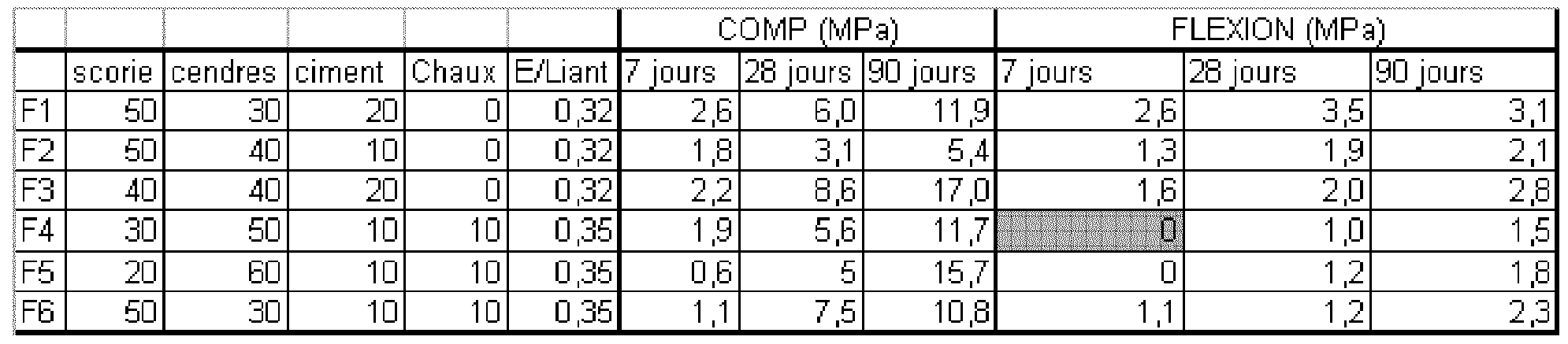
En termes de résistance à la compression, on retrouve des résultats intéressants dès les 7 premiers jours qui permettent une application de type routier (tableau 4). In terms of compressive strength, there are interesting results from the first 7 days that allow a road-type application (Table 4).
A plus long terme (voir figure 1 ), de façon générale, par rapport à une pate pure de ciment, le mélange Scorie /Cendre volante conduit à un accroissement du gain de résistance mécanique entre 7j, 28 j et 90 jours de conservation. L'ajout de chaux à un effet catalyseur sur l'accroissement de la résistance entre 7 et 28 j (Formule F2 et F6). In the longer term (see FIG. 1), in general, compared to a pure cement paste, the slag / fly ash mixture leads to an increase in the strength gain between 7 days, 28 days and 90 days of storage. The addition of lime to a catalyst effect on increasing strength between 7 and 28 days (Formula F2 and F6).
Entre 28j et 90 j de conservation on constate que le gain de résistance évolue dans le même sens que le dosage en cendre. Between 28 days and 90 days of preservation, it is found that the resistance gain evolves in the same direction as the ash dosage.
En conclusion de ce chapitre on peut noter que le choix de la formule sera fonction du domaine d'utilisation de la matrice de ciment. In conclusion of this chapter it may be noted that the choice of the formula will depend on the field of use of the cement matrix.
Pour la fabrication des ciments et bétons on devra privilégier une formule donnant de bonnes résistances mécaniques entre 7 et 28 jours donc à faible dosage en centre volante (F3, F6). For the manufacture of cements and concretes it will be necessary to favor a formula giving good mechanical strength between 7 and 28 days therefore at low dosage in flying center (F3, F6).
Pour les sous couches de chaussée on pourra privilégier une formule ne nécessitant de résistantes mécaniques élevées à jeune âge mais donnant un meilleurs gain de résistance mécanique entre 28j et 90j soit (F4 et F5). For underlays of pavement it will be possible to favor a formula requiring high mechanical strength at a young age but giving a better gain of mechanical strength between 28j and 90j is (F4 and F5).
Exemple 4 - Absence de lixiviation Example 4 - Absence of leaching
Les formulations déterminées ont également un rôle de passivation des cendres, produit connu pour ne pas être chimiquement inerte. The determined formulations also have a role of passivation of ash, known product not to be chemically inert.
Comme on peut le voir dans le tableau 5 ci-dessous, les seuils obtenus sur les formulations fabriquées selon le protocole de la Norme XP X31 -21 1 : Lixiviation sur monolithe sont respectés selon la réglementation européenne. As can be seen in Table 5 below, the thresholds obtained on the formulations manufactured according to the protocol of Standard XP X31 -21 1: Leaching on monolith are respected according to the European regulation.
Et ce même en utilisant une cendre volante qui par nature ne respecte pas les normes environnementales. And this even using a fly ash that by nature does not meet environmental standards.
Tableau 8 Table 8

Claims
Applications Claiming Priority (2)
| Application Number | Priority Date | Filing Date | Title |
|---|---|---|---|
| FR1354203A FR3005466B1 (en) | 2013-05-07 | 2013-05-07 | HYDRAULIC BINDER COMPOSITION COMPRISING SCORIES AND ASHES |
| FR1354203 | 2013-05-07 |
Publications (1)
| Publication Number | Publication Date |
|---|---|
| WO2014180926A1 true WO2014180926A1 (en) | 2014-11-13 |
Family
ID=48856885
Family Applications (1)
| Application Number | Title | Priority Date | Filing Date |
|---|---|---|---|
| PCT/EP2014/059385 Ceased WO2014180926A1 (en) | 2013-05-07 | 2014-05-07 | Hydraulic binder composition comprising slag and ash |
Country Status (2)
| Country | Link |
|---|---|
| FR (1) | FR3005466B1 (en) |
| WO (1) | WO2014180926A1 (en) |
Cited By (7)
| Publication number | Priority date | Publication date | Assignee | Title |
|---|---|---|---|---|
| CN104478368A (en) * | 2014-12-29 | 2015-04-01 | 扬州大学 | Wear-resisting concrete doped with nickel slags |
| CN104556921A (en) * | 2014-12-29 | 2015-04-29 | 扬州大学 | Method for preparing concrete by utilizing combined admixture of nickel slag powder and fly ash |
| CN105622164A (en) * | 2015-12-29 | 2016-06-01 | 福建建工建材科技开发有限公司 | Hollow micropore inorganic heat insulation mortar |
| CN105645895A (en) * | 2016-01-11 | 2016-06-08 | 淮海工学院 | Ferronickel slag ultrahigh-strength concrete and preparation method thereof |
| CN109970414A (en) * | 2019-04-11 | 2019-07-05 | 宁夏亿丰砼业有限公司 | A kind of lightweight aggregate concrete and construction method |
| CN110937830A (en) * | 2019-12-16 | 2020-03-31 | 淮安市水泥厂有限公司 | Novel mineral powder produced by nickel slag and preparation method thereof |
| CN113816708A (en) * | 2021-10-11 | 2021-12-21 | 北科蕴宏环保科技(北京)有限公司 | Cemented filling material for synergistic treatment of nickel-containing solid wastes and preparation method thereof |
Families Citing this family (1)
| Publication number | Priority date | Publication date | Assignee | Title |
|---|---|---|---|---|
| CN113548820B (en) * | 2021-07-22 | 2022-11-01 | 湖南仁义环保建材科技有限公司 | Aluminum fly ash and preparation method thereof |
Citations (3)
| Publication number | Priority date | Publication date | Assignee | Title |
|---|---|---|---|---|
| CN1258653A (en) * | 2000-01-10 | 2000-07-05 | 王绍华 | Composite portland cement |
| CN101423342B (en) * | 2008-11-27 | 2011-10-19 | 武汉理工大学 | Nickel-chromium-iron alloy slag ultra-sulphate cement and preparation method thereof |
| KR20130032142A (en) * | 2011-09-22 | 2013-04-01 | (주)원진세라텍 | Slag brick coated with glaze composition and method for manufacturing the same |
-
2013
- 2013-05-07 FR FR1354203A patent/FR3005466B1/en active Active
-
2014
- 2014-05-07 WO PCT/EP2014/059385 patent/WO2014180926A1/en not_active Ceased
Patent Citations (3)
| Publication number | Priority date | Publication date | Assignee | Title |
|---|---|---|---|---|
| CN1258653A (en) * | 2000-01-10 | 2000-07-05 | 王绍华 | Composite portland cement |
| CN101423342B (en) * | 2008-11-27 | 2011-10-19 | 武汉理工大学 | Nickel-chromium-iron alloy slag ultra-sulphate cement and preparation method thereof |
| KR20130032142A (en) * | 2011-09-22 | 2013-04-01 | (주)원진세라텍 | Slag brick coated with glaze composition and method for manufacturing the same |
Cited By (10)
| Publication number | Priority date | Publication date | Assignee | Title |
|---|---|---|---|---|
| CN104478368A (en) * | 2014-12-29 | 2015-04-01 | 扬州大学 | Wear-resisting concrete doped with nickel slags |
| CN104556921A (en) * | 2014-12-29 | 2015-04-29 | 扬州大学 | Method for preparing concrete by utilizing combined admixture of nickel slag powder and fly ash |
| CN104478368B (en) * | 2014-12-29 | 2016-06-29 | 扬州大学 | A kind of abrasion-proof concrete mixing nickel slag |
| CN105622164A (en) * | 2015-12-29 | 2016-06-01 | 福建建工建材科技开发有限公司 | Hollow micropore inorganic heat insulation mortar |
| CN105622164B (en) * | 2015-12-29 | 2018-06-08 | 福建建工建材科技开发有限公司 | A kind of hollow microporous inorganic heat insulation mortar |
| CN105645895A (en) * | 2016-01-11 | 2016-06-08 | 淮海工学院 | Ferronickel slag ultrahigh-strength concrete and preparation method thereof |
| CN109970414A (en) * | 2019-04-11 | 2019-07-05 | 宁夏亿丰砼业有限公司 | A kind of lightweight aggregate concrete and construction method |
| CN110937830A (en) * | 2019-12-16 | 2020-03-31 | 淮安市水泥厂有限公司 | Novel mineral powder produced by nickel slag and preparation method thereof |
| CN113816708A (en) * | 2021-10-11 | 2021-12-21 | 北科蕴宏环保科技(北京)有限公司 | Cemented filling material for synergistic treatment of nickel-containing solid wastes and preparation method thereof |
| CN113816708B (en) * | 2021-10-11 | 2022-06-03 | 北科蕴宏环保科技(北京)有限公司 | Cemented filling material for synergistic treatment of nickel-containing solid wastes and preparation method thereof |
Also Published As
| Publication number | Publication date |
|---|---|
| FR3005466A1 (en) | 2014-11-14 |
| FR3005466B1 (en) | 2015-06-19 |
Similar Documents
| Publication | Publication Date | Title |
|---|---|---|
| EP2467349B1 (en) | Geopolymer cement and use thereof | |
| WO2014180926A1 (en) | Hydraulic binder composition comprising slag and ash | |
| US11702361B2 (en) | Hyaloclastite, sideromelane or tachylite pozzolan-based geopolymer cement and concrete and method of making and using same | |
| EP3020692B1 (en) | Geosynthsesis binder comprising a calcium- alkaline activator and a silico-aluminous compound | |
| CN101880152A (en) | Reinforcement and repair grouting material for construction under negative temperature environment | |
| FR2987834A1 (en) | HYDRAULIC COMPOSITION WITH LOW CLINKER CONTENT | |
| WO2020260816A1 (en) | Binder composition for construction material | |
| CN118239749A (en) | Fluid filling material and preparation method thereof | |
| US20240174570A1 (en) | Dry grinding of steel making slag, ground steel making slag, and its use in construction materials | |
| CN119707414A (en) | Concrete composition, concrete, preparation method and application thereof | |
| KR101811805B1 (en) | A environmental-frindly ultra super early strength cement and a environmental-frindly ultra super early strength mortar containing the same | |
| CN1657473A (en) | High-titanium blast furnace slag concrete admixture and production method thereof | |
| KR102620465B1 (en) | Eco-friendly concrete composition | |
| EP1367032A1 (en) | Hydraulic binder resulting from a mixture of a sulfate binder and a pozzolanic binder | |
| FR3144132A1 (en) | CONSTRUCTION BINDER AND ASSOCIATED CONSTRUCTION MATERIAL | |
| CN1876593A (en) | Silicate cement | |
| JP7720576B1 (en) | Mixture, alkali-activated material composition, alkali-activated material hardened product and method for producing the same, precast product obtained from alkali-activated material composition and method for producing the same | |
| KR102787493B1 (en) | Eco-friendly concrete composition | |
| FR3144133A1 (en) | LOW-CARBON CONSTRUCTION BINDER AND ASSOCIATED CONSTRUCTION MATERIAL | |
| Kumaravel et al. | Geopolymer Concrete with M-sand and Ceramic aggregate | |
| CN101486547A (en) | Concrete | |
| FR3133393A1 (en) | Composition of hydraulic binder for blast furnace slag | |
| CN120004571A (en) | Concrete using recycled powder from high plasticity index asphalt mixing station and preparation method thereof | |
| EP4347526A1 (en) | Improved workability retention in low-clinker hydraulic compositions | |
| CZ296654B6 (en) | Method of production of building materials and products |
Legal Events
| Date | Code | Title | Description |
|---|---|---|---|
| 121 | Ep: the epo has been informed by wipo that ep was designated in this application |
Ref document number: 14725049 Country of ref document: EP Kind code of ref document: A1 |
|
| NENP | Non-entry into the national phase |
Ref country code: DE |
|
| 122 | Ep: pct application non-entry in european phase |
Ref document number: 14725049 Country of ref document: EP Kind code of ref document: A1 |