WO2014122140A2 - Precipitated and calcined composition based on zirconium oxide and cerium oxide - Google Patents
Precipitated and calcined composition based on zirconium oxide and cerium oxide Download PDFInfo
- Publication number
- WO2014122140A2 WO2014122140A2 PCT/EP2014/052185 EP2014052185W WO2014122140A2 WO 2014122140 A2 WO2014122140 A2 WO 2014122140A2 EP 2014052185 W EP2014052185 W EP 2014052185W WO 2014122140 A2 WO2014122140 A2 WO 2014122140A2
- Authority
- WO
- WIPO (PCT)
- Prior art keywords
- oxide
- composition
- zirconium
- cerium
- compounds
- Prior art date
- Legal status (The legal status is an assumption and is not a legal conclusion. Google has not performed a legal analysis and makes no representation as to the accuracy of the status listed.)
- Ceased
Links
Classifications
-
- B—PERFORMING OPERATIONS; TRANSPORTING
- B01—PHYSICAL OR CHEMICAL PROCESSES OR APPARATUS IN GENERAL
- B01D—SEPARATION
- B01D53/00—Separation of gases or vapours; Recovering vapours of volatile solvents from gases; Chemical or biological purification of waste gases, e.g. engine exhaust gases, smoke, fumes, flue gases, aerosols
- B01D53/34—Chemical or biological purification of waste gases
- B01D53/74—General processes for purification of waste gases; Apparatus or devices specially adapted therefor
- B01D53/86—Catalytic processes
-
- B—PERFORMING OPERATIONS; TRANSPORTING
- B01—PHYSICAL OR CHEMICAL PROCESSES OR APPARATUS IN GENERAL
- B01D—SEPARATION
- B01D53/00—Separation of gases or vapours; Recovering vapours of volatile solvents from gases; Chemical or biological purification of waste gases, e.g. engine exhaust gases, smoke, fumes, flue gases, aerosols
- B01D53/34—Chemical or biological purification of waste gases
- B01D53/74—General processes for purification of waste gases; Apparatus or devices specially adapted therefor
- B01D53/86—Catalytic processes
- B01D53/8603—Removing sulfur compounds
-
- B—PERFORMING OPERATIONS; TRANSPORTING
- B01—PHYSICAL OR CHEMICAL PROCESSES OR APPARATUS IN GENERAL
- B01D—SEPARATION
- B01D53/00—Separation of gases or vapours; Recovering vapours of volatile solvents from gases; Chemical or biological purification of waste gases, e.g. engine exhaust gases, smoke, fumes, flue gases, aerosols
- B01D53/34—Chemical or biological purification of waste gases
- B01D53/74—General processes for purification of waste gases; Apparatus or devices specially adapted therefor
- B01D53/86—Catalytic processes
- B01D53/8621—Removing nitrogen compounds
-
- B—PERFORMING OPERATIONS; TRANSPORTING
- B01—PHYSICAL OR CHEMICAL PROCESSES OR APPARATUS IN GENERAL
- B01D—SEPARATION
- B01D53/00—Separation of gases or vapours; Recovering vapours of volatile solvents from gases; Chemical or biological purification of waste gases, e.g. engine exhaust gases, smoke, fumes, flue gases, aerosols
- B01D53/34—Chemical or biological purification of waste gases
- B01D53/74—General processes for purification of waste gases; Apparatus or devices specially adapted therefor
- B01D53/86—Catalytic processes
- B01D53/8621—Removing nitrogen compounds
- B01D53/8625—Nitrogen oxides
- B01D53/8628—Processes characterised by a specific catalyst
-
- B—PERFORMING OPERATIONS; TRANSPORTING
- B01—PHYSICAL OR CHEMICAL PROCESSES OR APPARATUS IN GENERAL
- B01D—SEPARATION
- B01D53/00—Separation of gases or vapours; Recovering vapours of volatile solvents from gases; Chemical or biological purification of waste gases, e.g. engine exhaust gases, smoke, fumes, flue gases, aerosols
- B01D53/34—Chemical or biological purification of waste gases
- B01D53/74—General processes for purification of waste gases; Apparatus or devices specially adapted therefor
- B01D53/86—Catalytic processes
- B01D53/864—Removing carbon monoxide or hydrocarbons
-
- B—PERFORMING OPERATIONS; TRANSPORTING
- B01—PHYSICAL OR CHEMICAL PROCESSES OR APPARATUS IN GENERAL
- B01D—SEPARATION
- B01D53/00—Separation of gases or vapours; Recovering vapours of volatile solvents from gases; Chemical or biological purification of waste gases, e.g. engine exhaust gases, smoke, fumes, flue gases, aerosols
- B01D53/34—Chemical or biological purification of waste gases
- B01D53/74—General processes for purification of waste gases; Apparatus or devices specially adapted therefor
- B01D53/86—Catalytic processes
- B01D53/8668—Removing organic compounds not provided for in B01D53/8603 - B01D53/8665
-
- B—PERFORMING OPERATIONS; TRANSPORTING
- B01—PHYSICAL OR CHEMICAL PROCESSES OR APPARATUS IN GENERAL
- B01D—SEPARATION
- B01D53/00—Separation of gases or vapours; Recovering vapours of volatile solvents from gases; Chemical or biological purification of waste gases, e.g. engine exhaust gases, smoke, fumes, flue gases, aerosols
- B01D53/34—Chemical or biological purification of waste gases
- B01D53/74—General processes for purification of waste gases; Apparatus or devices specially adapted therefor
- B01D53/86—Catalytic processes
- B01D53/8671—Removing components of defined structure not provided for in B01D53/8603 - B01D53/8668
- B01D53/8675—Ozone
-
- B—PERFORMING OPERATIONS; TRANSPORTING
- B01—PHYSICAL OR CHEMICAL PROCESSES OR APPARATUS IN GENERAL
- B01D—SEPARATION
- B01D53/00—Separation of gases or vapours; Recovering vapours of volatile solvents from gases; Chemical or biological purification of waste gases, e.g. engine exhaust gases, smoke, fumes, flue gases, aerosols
- B01D53/34—Chemical or biological purification of waste gases
- B01D53/74—General processes for purification of waste gases; Apparatus or devices specially adapted therefor
- B01D53/86—Catalytic processes
- B01D53/8678—Removing components of undefined structure
- B01D53/8687—Organic components
-
- B—PERFORMING OPERATIONS; TRANSPORTING
- B01—PHYSICAL OR CHEMICAL PROCESSES OR APPARATUS IN GENERAL
- B01D—SEPARATION
- B01D53/00—Separation of gases or vapours; Recovering vapours of volatile solvents from gases; Chemical or biological purification of waste gases, e.g. engine exhaust gases, smoke, fumes, flue gases, aerosols
- B01D53/34—Chemical or biological purification of waste gases
- B01D53/92—Chemical or biological purification of waste gases of engine exhaust gases
- B01D53/94—Chemical or biological purification of waste gases of engine exhaust gases by catalytic processes
- B01D53/9445—Simultaneously removing carbon monoxide, hydrocarbons or nitrogen oxides making use of three-way catalysts [TWC] or four-way-catalysts [FWC]
- B01D53/945—Simultaneously removing carbon monoxide, hydrocarbons or nitrogen oxides making use of three-way catalysts [TWC] or four-way-catalysts [FWC] characterised by a specific catalyst
-
- B—PERFORMING OPERATIONS; TRANSPORTING
- B01—PHYSICAL OR CHEMICAL PROCESSES OR APPARATUS IN GENERAL
- B01J—CHEMICAL OR PHYSICAL PROCESSES, e.g. CATALYSIS OR COLLOID CHEMISTRY; THEIR RELEVANT APPARATUS
- B01J21/00—Catalysts comprising the elements, oxides, or hydroxides of magnesium, boron, aluminium, carbon, silicon, titanium, zirconium, or hafnium
- B01J21/06—Silicon, titanium, zirconium or hafnium; Oxides or hydroxides thereof
- B01J21/066—Zirconium or hafnium; Oxides or hydroxides thereof
-
- B—PERFORMING OPERATIONS; TRANSPORTING
- B01—PHYSICAL OR CHEMICAL PROCESSES OR APPARATUS IN GENERAL
- B01J—CHEMICAL OR PHYSICAL PROCESSES, e.g. CATALYSIS OR COLLOID CHEMISTRY; THEIR RELEVANT APPARATUS
- B01J23/00—Catalysts comprising metals or metal oxides or hydroxides, not provided for in group B01J21/00
- B01J23/002—Mixed oxides other than spinels, e.g. perovskite
-
- B—PERFORMING OPERATIONS; TRANSPORTING
- B01—PHYSICAL OR CHEMICAL PROCESSES OR APPARATUS IN GENERAL
- B01J—CHEMICAL OR PHYSICAL PROCESSES, e.g. CATALYSIS OR COLLOID CHEMISTRY; THEIR RELEVANT APPARATUS
- B01J35/00—Catalysts, in general, characterised by their form or physical properties
- B01J35/60—Catalysts, in general, characterised by their form or physical properties characterised by their surface properties or porosity
- B01J35/61—Surface area
- B01J35/613—10-100 m2/g
-
- B—PERFORMING OPERATIONS; TRANSPORTING
- B01—PHYSICAL OR CHEMICAL PROCESSES OR APPARATUS IN GENERAL
- B01J—CHEMICAL OR PHYSICAL PROCESSES, e.g. CATALYSIS OR COLLOID CHEMISTRY; THEIR RELEVANT APPARATUS
- B01J37/00—Processes, in general, for preparing catalysts; Processes, in general, for activation of catalysts
- B01J37/009—Preparation by separation, e.g. by filtration, decantation, screening
-
- B—PERFORMING OPERATIONS; TRANSPORTING
- B01—PHYSICAL OR CHEMICAL PROCESSES OR APPARATUS IN GENERAL
- B01J—CHEMICAL OR PHYSICAL PROCESSES, e.g. CATALYSIS OR COLLOID CHEMISTRY; THEIR RELEVANT APPARATUS
- B01J37/00—Processes, in general, for preparing catalysts; Processes, in general, for activation of catalysts
- B01J37/02—Impregnation, coating or precipitation
- B01J37/03—Precipitation; Co-precipitation
- B01J37/031—Precipitation
-
- B—PERFORMING OPERATIONS; TRANSPORTING
- B01—PHYSICAL OR CHEMICAL PROCESSES OR APPARATUS IN GENERAL
- B01J—CHEMICAL OR PHYSICAL PROCESSES, e.g. CATALYSIS OR COLLOID CHEMISTRY; THEIR RELEVANT APPARATUS
- B01J37/00—Processes, in general, for preparing catalysts; Processes, in general, for activation of catalysts
- B01J37/08—Heat treatment
-
- C—CHEMISTRY; METALLURGY
- C01—INORGANIC CHEMISTRY
- C01G—COMPOUNDS CONTAINING METALS NOT COVERED BY SUBCLASSES C01D OR C01F
- C01G25/00—Compounds of zirconium
- C01G25/006—Compounds containing zirconium, with or without oxygen or hydrogen, and containing two or more other elements
-
- B—PERFORMING OPERATIONS; TRANSPORTING
- B01—PHYSICAL OR CHEMICAL PROCESSES OR APPARATUS IN GENERAL
- B01D—SEPARATION
- B01D2255/00—Catalysts
- B01D2255/20—Metals or compounds thereof
- B01D2255/206—Rare earth metals
-
- B—PERFORMING OPERATIONS; TRANSPORTING
- B01—PHYSICAL OR CHEMICAL PROCESSES OR APPARATUS IN GENERAL
- B01D—SEPARATION
- B01D2255/00—Catalysts
- B01D2255/20—Metals or compounds thereof
- B01D2255/206—Rare earth metals
- B01D2255/2061—Yttrium
-
- B—PERFORMING OPERATIONS; TRANSPORTING
- B01—PHYSICAL OR CHEMICAL PROCESSES OR APPARATUS IN GENERAL
- B01D—SEPARATION
- B01D2255/00—Catalysts
- B01D2255/20—Metals or compounds thereof
- B01D2255/206—Rare earth metals
- B01D2255/2063—Lanthanum
-
- B—PERFORMING OPERATIONS; TRANSPORTING
- B01—PHYSICAL OR CHEMICAL PROCESSES OR APPARATUS IN GENERAL
- B01D—SEPARATION
- B01D2255/00—Catalysts
- B01D2255/20—Metals or compounds thereof
- B01D2255/206—Rare earth metals
- B01D2255/2065—Cerium
-
- B—PERFORMING OPERATIONS; TRANSPORTING
- B01—PHYSICAL OR CHEMICAL PROCESSES OR APPARATUS IN GENERAL
- B01D—SEPARATION
- B01D2255/00—Catalysts
- B01D2255/20—Metals or compounds thereof
- B01D2255/207—Transition metals
- B01D2255/20715—Zirconium
-
- B—PERFORMING OPERATIONS; TRANSPORTING
- B01—PHYSICAL OR CHEMICAL PROCESSES OR APPARATUS IN GENERAL
- B01D—SEPARATION
- B01D2255/00—Catalysts
- B01D2255/20—Metals or compounds thereof
- B01D2255/209—Other metals
- B01D2255/2094—Tin
-
- B—PERFORMING OPERATIONS; TRANSPORTING
- B01—PHYSICAL OR CHEMICAL PROCESSES OR APPARATUS IN GENERAL
- B01D—SEPARATION
- B01D2255/00—Catalysts
- B01D2255/40—Mixed oxides
- B01D2255/407—Zr-Ce mixed oxides
-
- B—PERFORMING OPERATIONS; TRANSPORTING
- B01—PHYSICAL OR CHEMICAL PROCESSES OR APPARATUS IN GENERAL
- B01D—SEPARATION
- B01D2255/00—Catalysts
- B01D2255/90—Physical characteristics of catalysts
- B01D2255/92—Dimensions
- B01D2255/9207—Specific surface
-
- B—PERFORMING OPERATIONS; TRANSPORTING
- B01—PHYSICAL OR CHEMICAL PROCESSES OR APPARATUS IN GENERAL
- B01D—SEPARATION
- B01D2257/00—Components to be removed
- B01D2257/10—Single element gases other than halogens
- B01D2257/106—Ozone
-
- B—PERFORMING OPERATIONS; TRANSPORTING
- B01—PHYSICAL OR CHEMICAL PROCESSES OR APPARATUS IN GENERAL
- B01D—SEPARATION
- B01D2257/00—Components to be removed
- B01D2257/30—Sulfur compounds
- B01D2257/306—Organic sulfur compounds, e.g. mercaptans
-
- B—PERFORMING OPERATIONS; TRANSPORTING
- B01—PHYSICAL OR CHEMICAL PROCESSES OR APPARATUS IN GENERAL
- B01D—SEPARATION
- B01D2257/00—Components to be removed
- B01D2257/40—Nitrogen compounds
- B01D2257/404—Nitrogen oxides other than dinitrogen oxide
-
- B—PERFORMING OPERATIONS; TRANSPORTING
- B01—PHYSICAL OR CHEMICAL PROCESSES OR APPARATUS IN GENERAL
- B01D—SEPARATION
- B01D2257/00—Components to be removed
- B01D2257/50—Carbon oxides
- B01D2257/502—Carbon monoxide
-
- B—PERFORMING OPERATIONS; TRANSPORTING
- B01—PHYSICAL OR CHEMICAL PROCESSES OR APPARATUS IN GENERAL
- B01D—SEPARATION
- B01D2257/00—Components to be removed
- B01D2257/70—Organic compounds not provided for in groups B01D2257/00 - B01D2257/602
- B01D2257/702—Hydrocarbons
- B01D2257/7022—Aliphatic hydrocarbons
-
- B—PERFORMING OPERATIONS; TRANSPORTING
- B01—PHYSICAL OR CHEMICAL PROCESSES OR APPARATUS IN GENERAL
- B01D—SEPARATION
- B01D2257/00—Components to be removed
- B01D2257/70—Organic compounds not provided for in groups B01D2257/00 - B01D2257/602
- B01D2257/702—Hydrocarbons
- B01D2257/7027—Aromatic hydrocarbons
-
- B—PERFORMING OPERATIONS; TRANSPORTING
- B01—PHYSICAL OR CHEMICAL PROCESSES OR APPARATUS IN GENERAL
- B01D—SEPARATION
- B01D2257/00—Components to be removed
- B01D2257/70—Organic compounds not provided for in groups B01D2257/00 - B01D2257/602
- B01D2257/708—Volatile organic compounds V.O.C.'s
-
- B—PERFORMING OPERATIONS; TRANSPORTING
- B01—PHYSICAL OR CHEMICAL PROCESSES OR APPARATUS IN GENERAL
- B01D—SEPARATION
- B01D2257/00—Components to be removed
- B01D2257/90—Odorous compounds not provided for in groups B01D2257/00 - B01D2257/708
-
- B—PERFORMING OPERATIONS; TRANSPORTING
- B01—PHYSICAL OR CHEMICAL PROCESSES OR APPARATUS IN GENERAL
- B01D—SEPARATION
- B01D2258/00—Sources of waste gases
- B01D2258/01—Engine exhaust gases
- B01D2258/012—Diesel engines and lean burn gasoline engines
-
- B—PERFORMING OPERATIONS; TRANSPORTING
- B01—PHYSICAL OR CHEMICAL PROCESSES OR APPARATUS IN GENERAL
- B01D—SEPARATION
- B01D2258/00—Sources of waste gases
- B01D2258/06—Polluted air
-
- B—PERFORMING OPERATIONS; TRANSPORTING
- B01—PHYSICAL OR CHEMICAL PROCESSES OR APPARATUS IN GENERAL
- B01D—SEPARATION
- B01D53/00—Separation of gases or vapours; Recovering vapours of volatile solvents from gases; Chemical or biological purification of waste gases, e.g. engine exhaust gases, smoke, fumes, flue gases, aerosols
- B01D53/34—Chemical or biological purification of waste gases
- B01D53/74—General processes for purification of waste gases; Apparatus or devices specially adapted therefor
- B01D53/86—Catalytic processes
- B01D53/8643—Removing mixtures of carbon monoxide or hydrocarbons and nitrogen oxides
-
- B—PERFORMING OPERATIONS; TRANSPORTING
- B01—PHYSICAL OR CHEMICAL PROCESSES OR APPARATUS IN GENERAL
- B01D—SEPARATION
- B01D53/00—Separation of gases or vapours; Recovering vapours of volatile solvents from gases; Chemical or biological purification of waste gases, e.g. engine exhaust gases, smoke, fumes, flue gases, aerosols
- B01D53/34—Chemical or biological purification of waste gases
- B01D53/92—Chemical or biological purification of waste gases of engine exhaust gases
- B01D53/94—Chemical or biological purification of waste gases of engine exhaust gases by catalytic processes
-
- B—PERFORMING OPERATIONS; TRANSPORTING
- B01—PHYSICAL OR CHEMICAL PROCESSES OR APPARATUS IN GENERAL
- B01J—CHEMICAL OR PHYSICAL PROCESSES, e.g. CATALYSIS OR COLLOID CHEMISTRY; THEIR RELEVANT APPARATUS
- B01J21/00—Catalysts comprising the elements, oxides, or hydroxides of magnesium, boron, aluminium, carbon, silicon, titanium, zirconium, or hafnium
- B01J21/06—Silicon, titanium, zirconium or hafnium; Oxides or hydroxides thereof
-
- B—PERFORMING OPERATIONS; TRANSPORTING
- B01—PHYSICAL OR CHEMICAL PROCESSES OR APPARATUS IN GENERAL
- B01J—CHEMICAL OR PHYSICAL PROCESSES, e.g. CATALYSIS OR COLLOID CHEMISTRY; THEIR RELEVANT APPARATUS
- B01J23/00—Catalysts comprising metals or metal oxides or hydroxides, not provided for in group B01J21/00
- B01J23/10—Catalysts comprising metals or metal oxides or hydroxides, not provided for in group B01J21/00 of rare earths
-
- B—PERFORMING OPERATIONS; TRANSPORTING
- B01—PHYSICAL OR CHEMICAL PROCESSES OR APPARATUS IN GENERAL
- B01J—CHEMICAL OR PHYSICAL PROCESSES, e.g. CATALYSIS OR COLLOID CHEMISTRY; THEIR RELEVANT APPARATUS
- B01J23/00—Catalysts comprising metals or metal oxides or hydroxides, not provided for in group B01J21/00
- B01J23/12—Catalysts comprising metals or metal oxides or hydroxides, not provided for in group B01J21/00 of actinides
-
- B—PERFORMING OPERATIONS; TRANSPORTING
- B01—PHYSICAL OR CHEMICAL PROCESSES OR APPARATUS IN GENERAL
- B01J—CHEMICAL OR PHYSICAL PROCESSES, e.g. CATALYSIS OR COLLOID CHEMISTRY; THEIR RELEVANT APPARATUS
- B01J23/00—Catalysts comprising metals or metal oxides or hydroxides, not provided for in group B01J21/00
- B01J23/14—Catalysts comprising metals or metal oxides or hydroxides, not provided for in group B01J21/00 of germanium, tin or lead
-
- B—PERFORMING OPERATIONS; TRANSPORTING
- B01—PHYSICAL OR CHEMICAL PROCESSES OR APPARATUS IN GENERAL
- B01J—CHEMICAL OR PHYSICAL PROCESSES, e.g. CATALYSIS OR COLLOID CHEMISTRY; THEIR RELEVANT APPARATUS
- B01J37/00—Processes, in general, for preparing catalysts; Processes, in general, for activation of catalysts
- B01J37/02—Impregnation, coating or precipitation
- B01J37/03—Precipitation; Co-precipitation
-
- C—CHEMISTRY; METALLURGY
- C01—INORGANIC CHEMISTRY
- C01P—INDEXING SCHEME RELATING TO STRUCTURAL AND PHYSICAL ASPECTS OF SOLID INORGANIC COMPOUNDS
- C01P2002/00—Crystal-structural characteristics
- C01P2002/50—Solid solutions
- C01P2002/52—Solid solutions containing elements as dopants
-
- C—CHEMISTRY; METALLURGY
- C01—INORGANIC CHEMISTRY
- C01P—INDEXING SCHEME RELATING TO STRUCTURAL AND PHYSICAL ASPECTS OF SOLID INORGANIC COMPOUNDS
- C01P2006/00—Physical properties of inorganic compounds
- C01P2006/12—Surface area
-
- C—CHEMISTRY; METALLURGY
- C01—INORGANIC CHEMISTRY
- C01P—INDEXING SCHEME RELATING TO STRUCTURAL AND PHYSICAL ASPECTS OF SOLID INORGANIC COMPOUNDS
- C01P2006/00—Physical properties of inorganic compounds
- C01P2006/12—Surface area
- C01P2006/13—Surface area thermal stability thereof at high temperatures
-
- Y—GENERAL TAGGING OF NEW TECHNOLOGICAL DEVELOPMENTS; GENERAL TAGGING OF CROSS-SECTIONAL TECHNOLOGIES SPANNING OVER SEVERAL SECTIONS OF THE IPC; TECHNICAL SUBJECTS COVERED BY FORMER USPC CROSS-REFERENCE ART COLLECTIONS [XRACs] AND DIGESTS
- Y02—TECHNOLOGIES OR APPLICATIONS FOR MITIGATION OR ADAPTATION AGAINST CLIMATE CHANGE
- Y02T—CLIMATE CHANGE MITIGATION TECHNOLOGIES RELATED TO TRANSPORTATION
- Y02T10/00—Road transport of goods or passengers
- Y02T10/10—Internal combustion engine [ICE] based vehicles
- Y02T10/12—Improving ICE efficiencies
Definitions
- the present invention concerns precipitated and calcined mixed oxide compositions based on zirconium oxide and cerium oxide that exhibit a high specific surface area after calcination and a very low maximum reduction temperature of the oxide after calcination.
- Compositions of the present invention may be notably used in various catalytic systems, such as for the treatment of exhaust gases from internal combustion engines.
- Multifunctional catalysts are currently used for the treatment of exhaust gases from internal combustion engines (automobile afterburning catalysis).
- the term “multifunctional” is understood to mean catalysts capable of carrying out not only oxidation, in particular of carbon monoxide and hydrocarbons present in exhaust gases, but also reduction, in particular of nitrogen oxides also present in these gases ("three-way” catalysts).
- Zirconium oxide and cerium oxide today appear as two constituents which are particularly important and advantageous for this type of catalyst.
- washcoat materials should possess high specific surface area at high temperature and a high oxygen storage capacity (OSC) with fast oxygen release.
- OSC oxygen storage capacity
- a further required quality for these materials is their reducibility.
- Reducibility is understood to mean, here and for the remainder of the description, the content of cerium(IV) in these materials capable of being converted into cerium(III) under the effect of a reducing atmosphere and at a given temperature.
- This reducibility can be measured, for example, by a consumption of hydrogen within a given temperature range. It is due to the cerium, which has the property of being reduced or of being oxidized.
- This reducibility should, desirably, be as high as possible.
- H2-Temperature Programmed Reduction is a commonly known method to measure the OSC and reducibility properties of materials. It is generally accepted that the higher the hydrogen uptake (expressed in mol of H 2 /g of oxide) and the lower the temperature of reduction, the better the catalytic properties.
- WO2005/ 100249 A2 describes a composition based on zirconium oxide and on cerium oxide comprising tin oxide in a proportion of at most 25% by weight of oxide for the use as catalysts.
- WO2005/100249 A2 does not disclose compositions based on zirconium oxide and on cerium oxide further comprising the combination of tin, lanthanum and yttrium oxides.
- US 2007/0244002 discloses a composition comprising from about 30 mol% to about 95 mol% zirconium, from about 0.5 mol% to about 50 mol% cerium, up to about 20 mol% of a stabilizer selected from the group consisting of yttrium, rare earths, and combinations comprising at least one of the stabilizers, and about 0.01 to about 25 mol% of a metal selected from the group consisting of indium, tin, and mixtures thereof.
- the objective of the invention is thus the development of a mixed oxide composition having at the same time a low maximum reduction temperature and a high specific surface area at high temperature.
- the present invention relates to a composition comprising zirconium oxide, cerium oxide, and:
- composition exhibits:
- a BET specific surface area after calcination at 1000°C for 6 hours, of at least 45 m 2 /g;
- compositions of the invention are obtained by precipitation and calcination.
- the present invention also relates to a process to obtain the compositions as defined above, a catalytic system comprising said compositions and their use for the treatment of exhaust gases from internal combustion engines, notably by bringing into contact exhaust gases from internal combustion engines with these catalytic systems.
- specific surface area is understood to mean the BET specific surface area (SBET) determined by nitrogen adsorption in accordance with standard ASTM D 3663-78 laid down from the Brunauer- Emmett-Teller method described in "The Journal of the American Chemical Society, 60, 309 (1938)".
- SBET BET specific surface area
- rare earth metal is understood to mean yttrium and the elements from the group consisting of the elements of the Periodic Table with an atomic number of between 57 and 71 inclusive.
- cerium oxide refers to eerie oxide (Ce0 2 ).
- Zirconium oxide is Zr0 2 .
- Tin oxide is in the form of stannic oxide (Sn0 2 ).
- Yttrium oxide is Y 2 0 3 .
- Gadolinium oxide is Gd 2 0 3 .
- Praseodymium oxide is Pr 6 On. Neodymium oxide is Nd 2 0 3 .
- the mixed oxide composition of the invention comprises: zirconium oxide;
- the composition may also comprise praseodymium and/or neodymium oxide in an amount comprised between 0.0 and 10.0% by weight.
- the amount of lanthanum oxide may be between 0.5 and 9.0 % by weight, even between 1.0 and 8.5% by weight.
- the amount of yttrium and/or gadolinium may be between 5.0 and 20.0% by weight, even between 5.0 and 18.0% by weight.
- the amount of tin oxide may be between 1.0 and 12.0 by weight.
- cerium oxide and zirconium oxide represent the complement to 100% by weight of the composition.
- the combined amount of zirconium oxide and cerium oxide is typically at least
- the combined amount of zirconium oxide and cerium oxide generally does not exceed 95.9% by weight.
- the Ce/Zr molar ratio may be comprised between 0.10 and 4.00, more particularly between 0.15 and 2.25.
- the Ce/Zr molar ratio is preferably inferior or equal to 1.00.
- the composition of the invention has a specific surface area (SBET), after calcination at 1000°C for 6 hours, of at least 45 m 2 /g.
- the specific surface area, after calcination at 1000°C for 6 hours, is preferably of at least 50 m 2 /g, more preferably of at least 55 m 2 /g, notably of at least 60 m 2 /g.
- specific surface area values, after calcination at 1000°C for 6 hours, of up to 70 m 2 /g may be obtained.
- the composition of the invention has a specific surface area, after calcination at 1100°C for 6 hours, of at least 25 m 2 /g.
- the specific surface area, after calcination at 1100°C for 6 hours is preferably at least 30 m 2 /g, more preferably at least 35 m 2 /g, notably at least 40 m 2 /g.
- specific surface area values, after calcination at 1100°C for 6 hours, of up to 45 m 2 /g may be obtained.
- the composition may exhibit a maximum reduction temperature, measured by temperature-programmed reduction (H 2 -TPR) as described below, inferior or equal to 500°C, preferably inferior or equal to 450°C, more preferably inferior or equal to 400°C, particularly inferior or equal to 350°C.
- H 2 -TPR temperature-programmed reduction
- values of the maximum reduction temperature of 330°C, even of 325°C may be obtained.
- compositions of the present invention may be obtained according to the processes described below.
- the process comprises the calcination of a precipitate comprising compounds of zirconium, of cerium, of tin, of lanthanum, of yttrium and/or gadolinium and, optionally, other compounds.
- a precipitate comprising compounds of zirconium, of cerium, of tin, of lanthanum, of yttrium and/or gadolinium and, optionally, other compounds.
- Such a precipitate is generally obtained by the addition of a basic compound to a liquid mixture comprising the salts of the metals. It is notably possible to heat the precipitate in an aqueous medium before drying and calcining the precipitate.
- the process comprises the following steps:
- an additive selected from anionic surfactants, nonionic surfactants, polyethylene glycols, carboxylic acids and their salts and surfactants of the carboxymethylated fatty alcohol ethoxylate type can be added to the precipitate obtained in step (c).
- the liquid medium is generally an aqueous medium.
- the precipitate obtained in step (c) is separated from the aqueous medium, optionally containing the additive, before calcination in step (d). Separation of the precipitate may be carried out according to any commonly known means, typically by filtration.
- the process comprises at least the following steps:
- step (cl) bringing the medium obtained in the preceding step in contact, under stirring, with i) either the compound(s) of the present composition that were not present in step (al), or ii) the required remaining amount of said compound(s), wherein the stirring energy used during step (cl) is less than that used during step (bl) to obtain a precipitate;
- the precipitate is separated from the liquid medium, e.g. by filtration, before calcining step (fl).
- the first step of the process according to both the first and the second embodiment consists in preparing a mixture of at least part of the compounds of the elements of the composition that it is sought to prepare.
- the mixing is generally carried out in a liquid medium which is preferably water.
- the compounds are preferably soluble compounds. They may in particular be zirconium, cerium, tin and rare earth salts. These compounds may be selected from the nitrates, sulfates, acetates, chlorides and ceric ammonium nitrate. By way of examples, mention may thus be made of zirconium sulfate, zirconyl nitrate or zirconyl chloride.
- the zirconyl sulfate may originate from placing crystalline zirconyl sulfate in solution. It may also have been obtained by dissolution of zirconium basic sulfate with sulfuric acid, or else by dissolution of zirconium hydroxide with sulfuric acid.
- the zirconyl nitrate may originate from placing crystalline zirconyl nitrate in solution or else it may have been obtained by dissolution of zirconium basic carbonate or else by dissolution of zirconium hydroxide with nitric acid.
- a zirconium compound in the form of a combination or of a mixture of the above-mentioned salts. Mention may, for example, be made of the combination of zirconium nitrate with zirconium sulfate, or else the combination of zirconium sulfate with zirconyl chloride.
- the respective proportions of the various salts can vary to a large extent, from 90/10 to 10/90 for example, these proportions denoting the contribution of each of the salts in grams of total zirconium oxide.
- cerium IV salts such as the nitrate or ceric ammonium nitrate for example, which are particularly suitable here.
- ceric nitrate is used.
- An aqueous solution of ceric nitrate can, for example, be obtained by reacting nitric acid with a ceric oxide hydrate prepared conventionally by reacting a solution of a cerous salt, for example cerous nitrate, and a solution of aqueous ammonia in the presence of aqueous hydrogen peroxide.
- Use may also preferably be made of a solution of ceric nitrate obtained according to the process of electrolytic oxidation of a cerous nitrate solution as described in FR-A-2570087, and which here constitutes an advantageous raw material.
- the aqueous solutions of cerium salts and of zirconyl salts can have a certain initial free acidity which can be adjusted by adding a base or an acid. It is, however, just as possible to use an initial solution of cerium and zirconium salts actually having a certain free acidity as mentioned above, as it is to use solutions that have been neutralized beforehand to a lesser or greater extent.
- This neutralization can be carried out by adding a basic compound to the abovementioned mixture so as to limit this acidity.
- This basic compound may, for example, be a solution of aqueous ammonia or else of alkali metal (sodium, potassium, etc.) hydroxides, but preferably a solution of aqueous ammonia.
- oxidizing agent for example aqueous hydrogen peroxide
- This oxidizing agent may be used by adding it to the reaction medium during step (a)/(al), during step (b)/(bl) or else at the beginning of step (cl).
- sol denotes any system consisting of fine solid particles of colloidal dimensions, i.e. dimensions of between approximately 1 nm and approximately 200 nm, containing a zirconium or cerium compound, this compound generally being a zirconium or cerium oxide and/or oxide hydrate, in suspension in an aqueous liquid phase.
- the mixture can without distinction be obtained either from compounds initially in the solid state, and will subsequently be introduced into a vessel heel of water for example, or else directly from solutions or suspensions of these compounds followed by mixing, in any order, of said solutions or suspensions.
- the mixture is brought in contact with a basic compound in order to obtain a precipitate.
- Products of the hydroxide type can be used as base or basic compound.
- Mention may be made of alkali metal or alkaline-earth metal hydroxides. Use may also be made of secondary, tertiary or quaternary amines. However, amines and aqueous ammonia may be preferred since they reduce the risks of pollution by alkali metal or alkaline-earth metal cations. Mention may also be made of urea.
- the basic compound may be more particularly used in the form of a solution. Finally, it may be used with a stoichiometric excess in order to be sure of optimum precipitation.
- Mixing of the basic compound with the mixture of metals is carried out under stirring. It can be carried out in any way, for example by adding a preformed mixture of the compounds of the above-mentioned elements to the basic compound in the form of a solution.
- step (cl) of the process consists in mixing the medium resulting from step (bl) with the remaining compounds of the compositions.
- the mixing can be carried out in any way, for example by adding a preformed mixture of the remaining compounds to the mixture obtained at the end of step (bl). It is also carried out with stirring, but under conditions such that the stirring energy used during step (cl) is less than that used during step (bl). More specifically, the energy used during step (cl) is at least 20% less than that of step (bl) and it may be more particularly less than 40% and even more particularly than 50% thereof.
- the heating of the precipitate can be carried out directly on the reaction medium obtained at the end of steps (b) or (cl) or on a suspension obtained after separating the precipitate from the reaction medium, optionally washing, and dispersing the precipitate again into water.
- the temperature to which the medium may be heated is at least 80°C, preferably at least 100°C and even more particularly at least 130°C. It can be between, for example, 100°C and 160°C.
- the heating operation can be carried out by introducing the liquid medium into a closed chamber (closed reactor of the autoclave type).
- the pressure in the closed reactor can range between an upper value at 1 bar (10 5 Pa) and 165 bar (1.65 x 10 7 Pa), preferably between 5 bar (5 x 10 5 Pa) and 165 bar (1.65 x 10 7 Pa).
- the heating can also be carried out in an open reactor for temperatures of about 100°C.
- the heating can be carried out either under air, or under an inert gas, preferably nitrogen.
- the heating time can vary within broad limits, for example between 1 and 48 hours, preferably between 2 and 24 hours.
- the increase in temperature is carried out at a rate which is not essential, and it is thus possible to reach the fixed reaction temperature by heating the medium for, for example, between 30 minutes and 4 hours, these values being given entirely by way of indication.
- the precipitate obtained after the heating step and optionally washing can be suspended in water and then a further heating of the resulting medium can be carried out. This further heating is carried out under the same conditions as those that were described for the first one.
- an additive which is selected from anionic surfactants, nonionic surfactants, polyethylene glycols and carboxylic acids and their salts and also surfactants of the carboxymethylated fatty alcohol ethoxylate type. With regard to this additive, reference may be made to the teaching of application WO-98/45212 and the surfactants described in this document may be used.
- surfactants of anionic type mention may be made of ethoxycarboxylates, ethoxylated fatty acids, sarcosinates, phosphate esters, sulfates such as alcohol sulfates, alcohol ether sulfates and sulfated alkanolamide ethoxylates, and sulfonates such as sulfo succinates, and alkylbenzene or alkylnapthalene sulfonates.
- nonionic surfactants mention may be made of acetylenic surfactants, alcohol ethoxylates, alkanolamides, amine oxides, ethoxylated alkanolamides, long-chain ethoxylated amines, copolymers of ethylene oxide/propylene oxide, sorbitan derivatives, ethylene glycol, propylene glycol, glycerol, polyglyceryl esters and ethoxylated derivatives thereof, alkylamines, alky limidazo lines, ethoxylated oils and alkylphenol ethoxylates. Mention may in particular be made of the products sold under the brands Igepal ® , Dowanol ® , Rhodamox ® and Alkamide ® .
- carboxylic acids it is in particular possible to use aliphatic monocarboxylic or dicarboxylic acids and, among these, more particularly saturated acids. Fatty acids and more particularly saturated fatty acids may also be used. Mention may thus in particular be made of formic acid, acetic acid, propionic acid, butyric acid, isobutyric acid, valeric acid, caproic acid, caprylic acid, capric acid, lauric acid, myristic acid and palmitic acid.
- dicarboxylic acids mention may be made of oxalic acid, malonic acid, succinic acid, glutaric acid, adipic acid, pimelic acid, suberic acid, azelaic acid and sebacic acid.
- Salts of the carboxylic acids may also be used, in particular the ammonium salts.
- lauric acid and ammonium laurate By way of example, mention may be made more particularly of lauric acid and ammonium laurate.
- a surfactant which is selected from those of the carboxymethylated fatty alcohol ethoxylate type.
- product of the carboxymethylated fatty alcohol ethoxylate type is intended to mean products consisting of ethoxylated or propoxylated fatty alcohols comprising a CH 2 -COOH group at the end of the chain.
- Ri 0-(CR 2 R3-CR 4 R 5 -0) n -CH 2 -COOH in which Ri denotes a saturated or unsaturated carbon-based chain of which the length is generally at most 22 carbon atoms, preferably at least 12 carbon atoms;
- R 2 , R3, R4 and R 5 may be identical and may represent hydrogen or else R 2 may represent a CH 3 group and R3, R4 and R 5 represent hydrogen; n is a non-zero integer that may be up to 50 and more particularly between 5 and 15, these values being included.
- a surfactant may consist of a mixture of products of the formula above for which Ri may be saturated or unsaturated, respectively, or alternatively products comprising both -CH 2 -CH 2 -0- and - C(CH 3 )-CH 2 -0- groups.
- the surfactant can be added in two ways. It can be added directly to the suspension of precipitate resulting from heating step (dl). It can also be added to the solid precipitate after separation thereof, by any known means, from the medium in which the heating took place.
- the amount of surfactant used is generally between 5% and 100% and more particularly between 15% and 60%>.
- washing of the precipitate is carried out after having separated it from the liquid medium in which it was in suspension. Washing can be carried out with water, preferably with water at basic pH, for example aqueous ammonia solution.
- the precipitate recovered is subsequently calcined.
- the calcination step makes it possible to develop the crystallinity of the product formed and it can also be adjusted and/or selected according to the subsequent operating temperature intended for the composition according to the invention, this being done while taking into account the fact that the specific surface area of the product may decrease as the calcination temperature used increases. Calcination is generally carried out under air, but a calcination carried out, for example, under inert gas or under a controlled atmosphere, oxidizing or reducing, is not excluded.
- the calcination temperature is generally limited to a range of values of between 500°C and 900°C, typically between 600°C and 850°C, and more particularly between 700°C and 800°C.
- the duration of the calcination is not critical and depends on the temperature. Purely by way of indication, it can be at least 2 hours and more particularly between 2 hours and 4 hours.
- compositions of the invention as described above or as obtained by means of the preparation process previously described are in the form of powders, but they can optionally be formed so as to be in the form of granules, pellets, foams, beads, cylinders or honeycombs of variable dimensions.
- compositions can be applied to any support commonly used in the field of catalysis, that is to say in particular thermally inert supports.
- This support can be chosen from alumina, titanium oxide, cerium oxide, zirconium oxide, silica, spinels, zeolites, silicates, crystalline silico aluminum phosphates or crystalline aluminum phosphates.
- the present invention also concerns a precipitated and calcined composition based on zirconium oxide and cerium oxide susceptible to be obtained according to the above mentioned processes of the invention.
- compositions of the invention may be used in catalytic systems.
- These catalytic systems can comprise a coating (wash coat), based on these compositions and with catalytic properties, on a substrate of the metal or ceramic monolith type, for example.
- a monolith type can be a filter type based on silicon carbide, cordierite or aluminium titanate, for instance.
- the coating can itself also comprise a support of the type of those mentioned above. This coating is obtained by mixing the composition with the support, so as to form a suspension which can subsequently be deposited on the substrate.
- catalytic systems and more particularly the compositions of the invention can have a great many applications. They are therefore particularly well suited to, and thus usable in, the catalysis of various reactions, such as, for example, dehydration, hydrosulfurization, hydrodenitrification, desulfurization, hydrodesulfurization, dehydrohalogenation, reforming, steam reforming, cracking, hydrocracking, hydrogenation, dehydrogenation, isomerization, dismutation, oxychlorination, dehydrocyclization of hydrocarbons or other organic compounds, oxidation and/or reduction reactions, the Claus reaction, treatment of exhaust gases from internal combustion engines, demetallation, methanation, the shift conversion, oxidation of CO, purification of air by low-temperature oxidation ( ⁇ 200°C, indeed even ⁇ 100°C), catalytic oxidation of the soot emitted by internal combustion engines, such as diesel engines or petrol engines operating under lean burn conditions.
- the compositions of the invention can be employed in combination with precious metals.
- precious metals The nature of these metals and the techniques for the incorporation of the latter in these compositions are well known to a person skilled in the art.
- the metals can be platinum, rhodium, palladium, gold or iridium and they can, in particular, be incorporated in the compositions by impregnation.
- the treatment of exhaust gases from internal combustion engines is a particularly advantageous application.
- the compositions of the invention can thus be used in this case for three-way catalysis. More particularly still in the case of this use in three-way catalysis, the compositions can be employed in combination with an NOx (nitrogen oxides) trap for the treatment of exhaust gases from petrol engines operating with a lean burn mixture, for example in the three-way catalysis layer of such a trap.
- the compositions of the invention can be incorporated in oxidation catalysts for diesel engines.
- the invention also relates very particularly to a process for the treatment of exhaust gases from internal combustion engines which is characterized in that use is made, as catalyst, of a composition or of a catalytic system as described above.
- Another advantageous use is the purification of air at temperatures of less than 200°C, indeed even of less than 100°C, this air comprising at least one compound of the carbon monoxide, ethylene, aldehyde, amine, mercaptan or ozone type and generally of the type of the volatile organic compounds or atmospheric pollutants, such as fatty acids, hydrocarbons, in particular aromatic hydrocarbons, and nitrogen oxides (for the oxidation of NO to give N0 2 ), and of the malodorous compounds type.
- this air comprising at least one compound of the carbon monoxide, ethylene, aldehyde, amine, mercaptan or ozone type and generally of the type of the volatile organic compounds or atmospheric pollutants, such as fatty acids, hydrocarbons, in particular aromatic hydrocarbons, and nitrogen oxides (for the oxidation of NO to give N0 2 ), and of the malodorous compounds type.
- the present invention also concerns then a process for the purification of air, said air comprising carbon monoxide, ethylene, aldehyde, amine, mercaptan, ozone, volatile organic compounds, atmospheric pollutants, fatty acids, hydrocarbons, aromatic hydrocarbons, nitrogen oxides or malodorous compounds, comprising the step of bringing into contact said gases with the catalytic system of the invention. Mention may more particularly be made, as compounds of this type, of ethanethiol, valeric acid and trimethylamine. This treatment is carried out by bringing the air to be treated into contact with a composition or a catalytic system as described above or obtained by the processes described in detail above.
- This measurement is carried out by performing a programmed temperature reduction on a OKURA RIKEN Co., LTD. TP-5000 device with a quartz reactor. This device makes it possible to measure the hydrogen consumption of a composition as a function of the temperature.
- This measurement is carried out on a 500 mg sample which has been calcined beforehand at 1000°C for 6 hours under air.
- the measurement is carried out using hydrogen diluted to 10% by volume in argon with a flow rate of 30 ml/min.
- a rise in temperature up to 900°C is carried out with a rise gradient of 10°C/min under H 2 at 10 vol% in Ar.
- the scavenging of the hydrogen is calculated from the missing surface area of the hydrogen signal from the baseline at ambient temperature to the baseline at 900°C.
- the maximum reducibility temperature (temperature at which the scavenging of the hydrogen is maximum and where, in other words, the reduction of the cerium(IV) to give cerium(III) is also maximum and which corresponds to the maximum 0 2 lability of the composition) is measured using a thermocouple placed at the heart of the sample.
- the specific surface area is measured using the BET method using a MOUNTECH Co., LTD. Macsorb analyzer with a 200 mg sample which was calcined beforehand at 1000°C for 6 hours or 1100°C for 6 hours under air.
- Tin nitrate was freshly prepared according to the following procedure:. 34 ml of distilled water was introduced into a first beaker with 12 ml of nitric acid solution (13.1 mol/1). 2.0 g of metallic tin were introduced into the thus diluted nitric acid solution under stirring so as to obtain 52.5 g of tin nitrate solution.
- Solution 1 was introduced, over the course of 50 minutes, into the reactor stirred at a speed of 500 rpm.
- Solution 2 was introduced over the course of 10 minutes and the stirring was fixed at 200 rpm.
- the solution obtained was placed in a stainless steel autoclave equipped with a stirrer. The temperature of the medium was brought to 150°C for 2 hours with stirring. 16.5 g of lauric acid was added to the resulting suspension. The suspension was kept stirring for 1 hour. The suspension obtained was then filtered through a Buchner funnel, and then washed with 1 1 of aqueous ammonia solution. The product obtained was calcined at 840°C for 2 hours under stationary conditions.
- Tin nitrate was prepared as described in Example 1.
- Example 3 116.8 ml of an aqueous ammonia solution (13.5 mol/1) was introduced into a stirred reactor and the volume was adjusted with distilled water to a total volume of 500 ml. The nitrate solution of cerium, zirconium, tin, lanthanum and yttrium was introduced, over the course of 60 minutes, into the reactor stirred at a speed of 500 rpm. The operation was subsequently carried out as in Example 1.
- Example 3 aqueous ammonia solution (13.5 mol/1)
- the composite oxide was prepared in the same way as in Example 1 except that the quantity of zirconyl nitrate solution was 137.9 g instead of 150.4 g, the quantity of yttrium nitrate solution was 48.6 g instead of 32.3 g and the quantity of ammonia solution was 116.9 ml instead of 114.4 ml.
- the nitrate solution of the cerium, zirconium and tin was introduced, over the course of 60 minutes, into the reactor stirred at a speed of 500 rpm.
- the suspension thus obtained was filtered through a Buchner funnel, and then washed twice with 1000 ml of aqueous ammonia solution.
- the precipitate was subsequently resuspended in 657.5 ml of aqueous ammonia solution.
- the solution obtained was placed in a stainless steel autoclave equipped with a stirrer. The temperature of the medium was brought to 150°C for 2 hours with stirring.
- the suspension obtained was then filtered through a Buchner funnel, and then washed twice with 750 ml of aqueous ammonia solution.
- the operation was subsequently carried out as in Example 1.
- the composite oxide was prepared in the same way as in Example 2 except that the quantity of zirconyl nitrate solution was 170.5 g instead of 137.9 g, the quantity of lanthanum nitrate was 12.8 g instead of 9.1 g, the quantity of ammonia solution was 109.4 ml instead of 116.8 ml and no yttrium nitrate was added. Comparative Example 3
- the mixture was subsequently adjusted with distilled water to obtain 500 ml of a solution of the cerium, zirconium, lanthanum and neodymium salts.
- 98.0 ml of an aqueous ammonia solution (13.5 mol/1) was introduced into a stirred reactor and the volume was then made up with distilled water so as to obtain a total volume of 500 ml.
- the nitrate solution of cerium, zirconium, lanthanum and neodymium was introduced, over the course of 60 minutes, into the reactor stirred at a speed of 500 rpm. The operation was subsequently carried out as in Example 1.
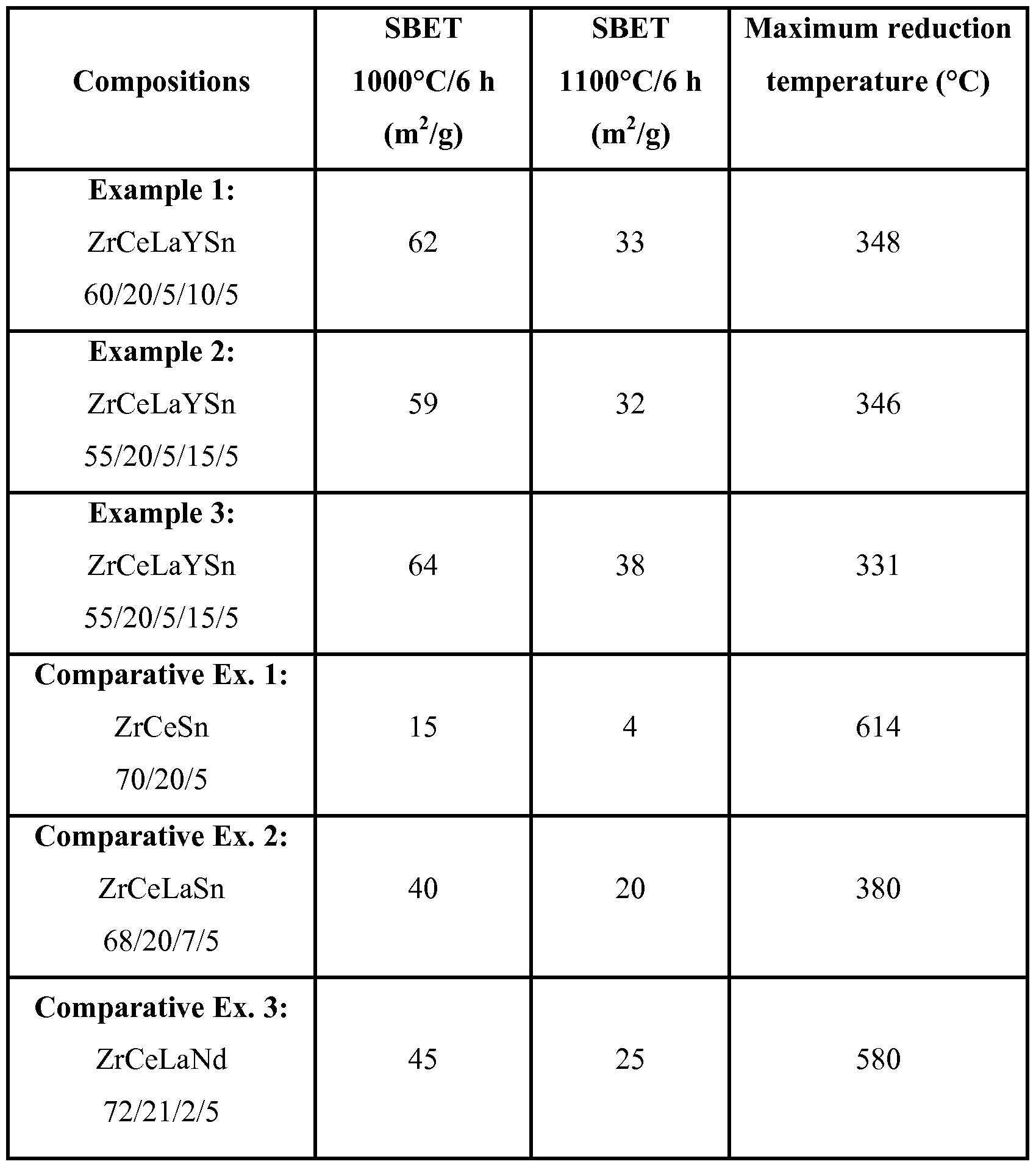
- compositions of the present invention provide higher specific surface area after calcination at high temperatures and a lower maximum reduction temperature (Examples 1 to 3), in comparison with the compositions based on zirconium oxide and cerium oxide of the prior art that do not comprise lanthanum oxide, tin oxide and yttrium and/or gadolinium oxide (Comparative Examples 1 to 3).
- the mixture was subsequently made up with distilled water so as to obtain 500 ml of a solution of the cerium, zirconium, tin, lanthanum , yttrium and D-sorbitol salts.
- the solution of the cerium, zirconium, tin, lanthanum, yttrium and D-sorbitol salts was dried under stirred condition and calcined at 700°C for 6 hours and 840°C for 2 hours under stationary conditions.
- compositions of the present invention have a higher specific surface area after calcination at high temperatures, in comparison with the compositions of the prior art.
Landscapes
- Chemical & Material Sciences (AREA)
- Engineering & Computer Science (AREA)
- Chemical Kinetics & Catalysis (AREA)
- Environmental & Geological Engineering (AREA)
- Organic Chemistry (AREA)
- Materials Engineering (AREA)
- Biomedical Technology (AREA)
- Health & Medical Sciences (AREA)
- Analytical Chemistry (AREA)
- General Chemical & Material Sciences (AREA)
- Oil, Petroleum & Natural Gas (AREA)
- Combustion & Propulsion (AREA)
- Inorganic Chemistry (AREA)
- Physics & Mathematics (AREA)
- Thermal Sciences (AREA)
- Catalysts (AREA)
- Inorganic Compounds Of Heavy Metals (AREA)
- Exhaust Gas Treatment By Means Of Catalyst (AREA)
Abstract
Description

Claims
Priority Applications (8)
| Application Number | Priority Date | Filing Date | Title |
|---|---|---|---|
| KR1020157023897A KR20150115880A (en) | 2013-02-05 | 2014-02-05 | Precipitated and calcinated composition based on zirconium oxide and cerium oxide |
| CN201480007393.7A CN105121351B (en) | 2013-02-05 | 2014-02-05 | Precipitated and calcined compositions based on zirconia and ceria |
| US14/765,496 US20150375203A1 (en) | 2013-02-05 | 2014-02-05 | Precipitated and calcined composition based on zirconium oxide and cerium oxide |
| EP14702612.4A EP2953900B1 (en) | 2013-02-05 | 2014-02-05 | Precipitated and calcined composition based on zirconium oxide and cerium oxide |
| MX2015009919A MX2015009919A (en) | 2013-02-05 | 2014-02-05 | Precipitated and calcined composition based on zirconium oxide and cerium oxide. |
| JP2015555750A JP6474353B2 (en) | 2013-02-05 | 2014-02-05 | Precipitation and calcination compositions based on zirconium oxide and cerium oxide |
| PL14702612T PL2953900T3 (en) | 2013-02-05 | 2014-02-05 | Precipitated and calcined composition based on zirconium oxide and cerium oxide |
| RU2015137841A RU2648072C2 (en) | 2013-02-05 | 2014-02-05 | Precipitated and calcined composition based on zirconium oxide and cerium oxide |
Applications Claiming Priority (2)
| Application Number | Priority Date | Filing Date | Title |
|---|---|---|---|
| EPPCT/EP2013/052188 | 2013-02-05 | ||
| PCT/EP2013/052188 WO2014121813A1 (en) | 2013-02-05 | 2013-02-05 | Precipitated and calcinated composition based on zirconium oxide and cerium oxide |
Publications (2)
| Publication Number | Publication Date |
|---|---|
| WO2014122140A2 true WO2014122140A2 (en) | 2014-08-14 |
| WO2014122140A3 WO2014122140A3 (en) | 2014-12-18 |
Family
ID=47678795
Family Applications (2)
| Application Number | Title | Priority Date | Filing Date |
|---|---|---|---|
| PCT/EP2013/052188 Ceased WO2014121813A1 (en) | 2013-02-05 | 2013-02-05 | Precipitated and calcinated composition based on zirconium oxide and cerium oxide |
| PCT/EP2014/052185 Ceased WO2014122140A2 (en) | 2013-02-05 | 2014-02-05 | Precipitated and calcined composition based on zirconium oxide and cerium oxide |
Family Applications Before (1)
| Application Number | Title | Priority Date | Filing Date |
|---|---|---|---|
| PCT/EP2013/052188 Ceased WO2014121813A1 (en) | 2013-02-05 | 2013-02-05 | Precipitated and calcinated composition based on zirconium oxide and cerium oxide |
Country Status (7)
| Country | Link |
|---|---|
| US (1) | US20150375203A1 (en) |
| JP (1) | JP6474353B2 (en) |
| KR (1) | KR20150115880A (en) |
| CN (1) | CN105121351B (en) |
| MX (1) | MX2015009919A (en) |
| RU (1) | RU2648072C2 (en) |
| WO (2) | WO2014121813A1 (en) |
Cited By (3)
| Publication number | Priority date | Publication date | Assignee | Title |
|---|---|---|---|---|
| WO2017072509A1 (en) * | 2015-10-27 | 2017-05-04 | Magnesium Elektron Limited | Zirconia-based compositions for use as three way catalysts |
| WO2017187085A1 (en) | 2016-04-26 | 2017-11-02 | Rhodia Operations | Cerium- and zirconium-based mixed oxide |
| RU2717810C1 (en) * | 2019-11-13 | 2020-03-25 | Федеральное государственное бюджетное образовательное учреждение высшего образования "Юго-Западный государственный университет" (ЮЗГУ) | Method of producing tin (iv) nitrate by oxidising tin (ii) nitrate |
Families Citing this family (14)
| Publication number | Priority date | Publication date | Assignee | Title |
|---|---|---|---|---|
| CN109963648B (en) * | 2016-04-26 | 2022-11-01 | 罗地亚经营管理公司 | Mixed oxides based on cerium and zirconium |
| CN106190340B (en) * | 2016-07-19 | 2019-07-12 | 太原理工大学 | Renewable metal composite oxide desulfurizing agent for high-temp gas and preparation method |
| JP7019379B2 (en) * | 2017-11-02 | 2022-02-15 | 花王株式会社 | Composite abrasive grains |
| CN107596899A (en) * | 2017-11-02 | 2018-01-19 | 南京汉尔斯生物科技有限公司 | A kind of rural area purification of air sewage eliminating smell agent |
| WO2019136340A1 (en) | 2018-01-08 | 2019-07-11 | Pacific Industrial Development Corporation | Catalyst comprising ceria-zirconia-oxygen storage material and process for its production |
| CN108940279B (en) * | 2018-07-20 | 2022-07-05 | 无锡威孚环保催化剂有限公司 | Gasoline vehicle tail gas purification three-way catalyst and preparation method thereof |
| RU2709862C1 (en) * | 2018-12-07 | 2019-12-23 | Федеральное государственное автономное образовательное учреждение высшего образования "Уральский федеральный университет имени первого Президента России Б.Н. Ельцина" | Method for preparing compositions based on oxides of zirconium and cerium |
| RU2688945C1 (en) * | 2019-01-14 | 2019-05-23 | Федеральное государственное бюджетное образовательное учреждение высшего образования "Российский химико-технологический университет имени Д. И. Менделеева (РХТУ им. Д. И. Менделеева) | Method of producing highly dispersed catalytically active material for cleaning gas emissions from carbon monoxide |
| US12337300B2 (en) * | 2019-03-03 | 2025-06-24 | Rhodia Operations | Mixed oxide with high pore volume |
| CN111533157A (en) * | 2020-04-24 | 2020-08-14 | 广西科学院 | A kind of microwave calcination preparation method of gadolinium oxide nano powder |
| WO2021220727A1 (en) * | 2020-04-28 | 2021-11-04 | ユミコア日本触媒株式会社 | Ce-Zr COMPOSITE OXIDE AND METHOD FOR PRODUCING SAME, AND EXHAUST GAS CLEANING CATALYST USING SAME |
| EP4041450A1 (en) | 2020-08-12 | 2022-08-17 | Neo Performance Materials (Singapore), PTE. LTD. | Oxygen storage capacity enhanced compositions |
| RU2769683C1 (en) * | 2021-03-04 | 2022-04-05 | Сергей Владимирович Буйначев | Method for producing zirconium dioxide powders with a spheroidal particle shape with a stabilizing component content of 20 to 60 wt. % |
| CN119259042B (en) * | 2024-10-30 | 2025-10-14 | 四川大学 | A Pr6O11-SnO2-ZrO2 ternary composite oxide and its preparation method and application |
Citations (5)
| Publication number | Priority date | Publication date | Assignee | Title |
|---|---|---|---|---|
| FR2570087A1 (en) | 1984-09-13 | 1986-03-14 | Rhone Poulenc Spec Chim | ELECTROLYTIC OXIDATION PROCESS AND ELECTROLYSIS ASSEMBLY FOR ITS IMPLEMENTATION |
| WO1998045212A1 (en) | 1997-04-04 | 1998-10-15 | Rhodia Rare Earths Inc. | CERIUM OXIDES, ZIRCONIUM OXIDES, Ce/Zr MIXED OXIDES AND Ce/Zr SOLID SOLUTIONS HAVING IMPROVED THERMAL STABILITY AND OXYGEN STORAGE CAPACITY |
| WO2005100249A1 (en) | 2004-03-17 | 2005-10-27 | Rhodia Chimie | Composition based on zirconium, cerium and tin oxides, preparation and use as catalyst |
| US20070244002A1 (en) | 2006-04-13 | 2007-10-18 | Kozlov Alexandr I | Ce-Zr based solid solutions and methods for making and using the same |
| WO2011138255A2 (en) | 2010-05-06 | 2011-11-10 | Rhodia Operations | Composition containing oxides of zirconium, cerium and at least one other rare earth and having a specific porosity, method for preparing same and use thereof in catalysis |
Family Cites Families (13)
| Publication number | Priority date | Publication date | Assignee | Title |
|---|---|---|---|---|
| JP4053623B2 (en) * | 1996-12-27 | 2008-02-27 | 阿南化成株式会社 | Zirconium-cerium composite oxide and method for producing the same |
| JP3985111B2 (en) * | 1998-04-09 | 2007-10-03 | 第一稀元素化学工業株式会社 | Method for producing zirconia-ceria composition |
| US6585944B1 (en) * | 2000-10-17 | 2003-07-01 | Delphi Technologies, Inc. | Enhancement of the OSC properties of Ce-Zr based solid solutions |
| JP3817443B2 (en) * | 2001-05-14 | 2006-09-06 | 株式会社アイシーティー | Exhaust gas purification catalyst |
| JP2003160741A (en) * | 2001-11-28 | 2003-06-06 | Sanyu:Kk | Inorganic white pigment |
| FR2852592B1 (en) * | 2003-03-18 | 2007-02-23 | Rhodia Elect & Catalysis | COMPOSITIONS BASED ON A CERIUM OXIDE, A ZIRCONIUM OXIDE AND, POSSIBLY, AN OXIDE OF ANOTHER RARE EARTH, WITH A HIGH SPECIFIC SURFACE AT 1100 C, PROCESS FOR THEIR PREPARATION AND THEIR USE AS A CATALYST |
| US7632477B2 (en) * | 2003-04-30 | 2009-12-15 | Magnesium Elektron, Ltd. | Process for preparing zirconium oxides and zirconium-based mixed oxides |
| US20050232839A1 (en) * | 2004-04-15 | 2005-10-20 | George Yaluris | Compositions and processes for reducing NOx emissions during fluid catalytic cracking |
| JP4575857B2 (en) * | 2005-08-01 | 2010-11-04 | 本田技研工業株式会社 | Conveyance type inspection device |
| DK1991354T3 (en) * | 2006-02-17 | 2020-03-16 | Rhodia Recherches Et Tech | COMPOSITION BASED ON ZIRCONIUM, CERIUM, YTTRIUM AND LANTHANOXIDE AND ANOTHER RARE EARTH METAL OXIDE, METHOD FOR PRODUCING IT AND CATALYTIC USE THEREOF |
| GB0609783D0 (en) * | 2006-05-17 | 2006-06-28 | Magnesium Elektron Ltd | Improved oxygen storage component |
| US8475755B2 (en) * | 2009-08-21 | 2013-07-02 | Sub-Chemie Inc. | Oxidation catalyst and method for destruction of CO, VOC and halogenated VOC |
| FR2955098B1 (en) * | 2010-01-11 | 2014-09-05 | Rhodia Operations | COMPOSITION BASED ON ZIRCONIUM OXIDES, CERIUM AND ANOTHER RARE EARTH AT MAXIMUM TEMPERATURE OF REDUCED REDUCIBILITY, PROCESS FOR PREPARATION AND USE IN THE CATALYSIS FIELD. |
-
2013
- 2013-02-05 WO PCT/EP2013/052188 patent/WO2014121813A1/en not_active Ceased
-
2014
- 2014-02-05 MX MX2015009919A patent/MX2015009919A/en unknown
- 2014-02-05 KR KR1020157023897A patent/KR20150115880A/en not_active Withdrawn
- 2014-02-05 WO PCT/EP2014/052185 patent/WO2014122140A2/en not_active Ceased
- 2014-02-05 RU RU2015137841A patent/RU2648072C2/en not_active IP Right Cessation
- 2014-02-05 JP JP2015555750A patent/JP6474353B2/en not_active Expired - Fee Related
- 2014-02-05 US US14/765,496 patent/US20150375203A1/en not_active Abandoned
- 2014-02-05 CN CN201480007393.7A patent/CN105121351B/en not_active Expired - Fee Related
Patent Citations (5)
| Publication number | Priority date | Publication date | Assignee | Title |
|---|---|---|---|---|
| FR2570087A1 (en) | 1984-09-13 | 1986-03-14 | Rhone Poulenc Spec Chim | ELECTROLYTIC OXIDATION PROCESS AND ELECTROLYSIS ASSEMBLY FOR ITS IMPLEMENTATION |
| WO1998045212A1 (en) | 1997-04-04 | 1998-10-15 | Rhodia Rare Earths Inc. | CERIUM OXIDES, ZIRCONIUM OXIDES, Ce/Zr MIXED OXIDES AND Ce/Zr SOLID SOLUTIONS HAVING IMPROVED THERMAL STABILITY AND OXYGEN STORAGE CAPACITY |
| WO2005100249A1 (en) | 2004-03-17 | 2005-10-27 | Rhodia Chimie | Composition based on zirconium, cerium and tin oxides, preparation and use as catalyst |
| US20070244002A1 (en) | 2006-04-13 | 2007-10-18 | Kozlov Alexandr I | Ce-Zr based solid solutions and methods for making and using the same |
| WO2011138255A2 (en) | 2010-05-06 | 2011-11-10 | Rhodia Operations | Composition containing oxides of zirconium, cerium and at least one other rare earth and having a specific porosity, method for preparing same and use thereof in catalysis |
Non-Patent Citations (1)
| Title |
|---|
| THE JOURNAL OF THE AMERICAN CHEMICAL SOCIETY, vol. 60, 1938, pages 309 |
Cited By (6)
| Publication number | Priority date | Publication date | Assignee | Title |
|---|---|---|---|---|
| WO2017072509A1 (en) * | 2015-10-27 | 2017-05-04 | Magnesium Elektron Limited | Zirconia-based compositions for use as three way catalysts |
| US10501332B2 (en) | 2015-10-27 | 2019-12-10 | Magnesium Elektron Ltd. | Structured zirconium solutions |
| RU2727187C2 (en) * | 2015-10-27 | 2020-07-21 | Магнезиум Электрон Лимитед | Compositions based on zirconium oxide used as ternary catalysts |
| US11613473B2 (en) | 2015-10-27 | 2023-03-28 | Magnesium Elektron Limited | Zirconia-based compositions for use as three way catalysts |
| WO2017187085A1 (en) | 2016-04-26 | 2017-11-02 | Rhodia Operations | Cerium- and zirconium-based mixed oxide |
| RU2717810C1 (en) * | 2019-11-13 | 2020-03-25 | Федеральное государственное бюджетное образовательное учреждение высшего образования "Юго-Западный государственный университет" (ЮЗГУ) | Method of producing tin (iv) nitrate by oxidising tin (ii) nitrate |
Also Published As
| Publication number | Publication date |
|---|---|
| JP2016510303A (en) | 2016-04-07 |
| CN105121351B (en) | 2018-12-14 |
| US20150375203A1 (en) | 2015-12-31 |
| CN105121351A (en) | 2015-12-02 |
| RU2648072C2 (en) | 2018-03-22 |
| MX2015009919A (en) | 2015-09-25 |
| WO2014121813A1 (en) | 2014-08-14 |
| JP6474353B2 (en) | 2019-02-27 |
| KR20150115880A (en) | 2015-10-14 |
| WO2014122140A3 (en) | 2014-12-18 |
| RU2015137841A (en) | 2017-03-13 |
Similar Documents
| Publication | Publication Date | Title |
|---|---|---|
| WO2014122140A2 (en) | Precipitated and calcined composition based on zirconium oxide and cerium oxide | |
| KR101316986B1 (en) | Catalytic compositions containing zirconium, cerium and yttrium oxides and use thereof in the treatment of exhaust gases | |
| JP5746756B2 (en) | Compositions comprising zirconium, cerium and at least one other rare earth oxide and having a specific porosity, a process for preparing them, and their use in catalysis | |
| RU2404855C2 (en) | Composition based on oxides of zirconium, cerium, lanthanum and yttrium, gadolinium or samarium with high specific surface and reducing ability, method of its production and application as catalyst | |
| KR100814304B1 (en) | Reduced maximum reductibility temperature zirconium oxide and cerium oxide based composition, method for the production and use thereof as a catalyst | |
| JP5148268B2 (en) | Zirconium and yttrium based compositions, processes for their preparation and their use in catalyst systems | |
| US10189010B2 (en) | Composition based on zirconium oxide and on at least one oxide of a rare earth other than cerium, having a specific porosity, processes for preparing same and use thereof in catalysis | |
| JP4791445B2 (en) | Compositions based on oxides of zirconium, praseodymium, lanthanum or neodymium, their preparation and use in catalyst systems | |
| KR20110027847A (en) | Compositions based on oxides of zirconium, cerium, yttrium, lanthanum and oxides of other rare earths, methods for their preparation and uses of catalysts | |
| US20140044628A1 (en) | Composition based on oxides of zirconium, of cerium, of at least one rare earth other than cerium and of silicon, preparation processes and use in catalysis | |
| KR20180137533A (en) | Cerium- and zirconium-based mixed oxides | |
| KR100749707B1 (en) | Composition based on zirconium, cerium and tin oxides, preparation and use as catalyst | |
| CN110621397A (en) | Has enhanced tolerance and NOXMixed oxides for storage capacity | |
| EP2953900B1 (en) | Precipitated and calcined composition based on zirconium oxide and cerium oxide |
Legal Events
| Date | Code | Title | Description |
|---|---|---|---|
| 121 | Ep: the epo has been informed by wipo that ep was designated in this application |
Ref document number: 14702612 Country of ref document: EP Kind code of ref document: A2 |
|
| WWE | Wipo information: entry into national phase |
Ref document number: MX/A/2015/009919 Country of ref document: MX |
|
| WWE | Wipo information: entry into national phase |
Ref document number: 14765496 Country of ref document: US |
|
| ENP | Entry into the national phase |
Ref document number: 2015555750 Country of ref document: JP Kind code of ref document: A |
|
| ENP | Entry into the national phase |
Ref document number: 20157023897 Country of ref document: KR Kind code of ref document: A |
|
| WWE | Wipo information: entry into national phase |
Ref document number: IDP00201505376 Country of ref document: ID |
|
| WWE | Wipo information: entry into national phase |
Ref document number: 2014702612 Country of ref document: EP |
|
| ENP | Entry into the national phase |
Ref document number: 2015137841 Country of ref document: RU Kind code of ref document: A |