WO2014053403A1 - Method of controlling insecticide resistant insects - Google Patents
Method of controlling insecticide resistant insects Download PDFInfo
- Publication number
- WO2014053403A1 WO2014053403A1 PCT/EP2013/070157 EP2013070157W WO2014053403A1 WO 2014053403 A1 WO2014053403 A1 WO 2014053403A1 EP 2013070157 W EP2013070157 W EP 2013070157W WO 2014053403 A1 WO2014053403 A1 WO 2014053403A1
- Authority
- WO
- WIPO (PCT)
- Prior art keywords
- spp
- compound
- group
- formula
- alkyl
- Prior art date
- Legal status (The legal status is an assumption and is not a legal conclusion. Google has not performed a legal analysis and makes no representation as to the accuracy of the status listed.)
- Ceased
Links
- 0 *c(cc1C(Nc2c(*)cc(*)cc2C(N=S(*)=O)=O)=O)n[n]1-c1ncccc1* Chemical compound *c(cc1C(Nc2c(*)cc(*)cc2C(N=S(*)=O)=O)=O)n[n]1-c1ncccc1* 0.000 description 1
Classifications
-
- A—HUMAN NECESSITIES
- A01—AGRICULTURE; FORESTRY; ANIMAL HUSBANDRY; HUNTING; TRAPPING; FISHING
- A01N—PRESERVATION OF BODIES OF HUMANS OR ANIMALS OR PLANTS OR PARTS THEREOF; BIOCIDES, e.g. AS DISINFECTANTS, AS PESTICIDES OR AS HERBICIDES; PEST REPELLANTS OR ATTRACTANTS; PLANT GROWTH REGULATORS
- A01N41/00—Biocides, pest repellants or attractants, or plant growth regulators containing organic compounds containing a sulfur atom bound to a hetero atom
- A01N41/02—Biocides, pest repellants or attractants, or plant growth regulators containing organic compounds containing a sulfur atom bound to a hetero atom containing a sulfur-to-oxygen double bond
- A01N41/10—Sulfones; Sulfoxides
-
- A—HUMAN NECESSITIES
- A01—AGRICULTURE; FORESTRY; ANIMAL HUSBANDRY; HUNTING; TRAPPING; FISHING
- A01N—PRESERVATION OF BODIES OF HUMANS OR ANIMALS OR PLANTS OR PARTS THEREOF; BIOCIDES, e.g. AS DISINFECTANTS, AS PESTICIDES OR AS HERBICIDES; PEST REPELLANTS OR ATTRACTANTS; PLANT GROWTH REGULATORS
- A01N43/00—Biocides, pest repellants or attractants, or plant growth regulators containing heterocyclic compounds
- A01N43/48—Biocides, pest repellants or attractants, or plant growth regulators containing heterocyclic compounds having rings with two nitrogen atoms as the only ring hetero atoms
- A01N43/56—1,2-Diazoles; Hydrogenated 1,2-diazoles
-
- A—HUMAN NECESSITIES
- A01—AGRICULTURE; FORESTRY; ANIMAL HUSBANDRY; HUNTING; TRAPPING; FISHING
- A01N—PRESERVATION OF BODIES OF HUMANS OR ANIMALS OR PLANTS OR PARTS THEREOF; BIOCIDES, e.g. AS DISINFECTANTS, AS PESTICIDES OR AS HERBICIDES; PEST REPELLANTS OR ATTRACTANTS; PLANT GROWTH REGULATORS
- A01N51/00—Biocides, pest repellants or attractants, or plant growth regulators containing organic compounds having the sequences of atoms O—N—S, X—O—S, N—N—S, O—N—N or O-halogen, regardless of the number of bonds each atom has and with no atom of these sequences forming part of a heterocyclic ring
Definitions
- the present invention relates to a method of controlling insects, that are resistant to an insecticide.
- the present invention relates to a method of controlling insects from the order Lepidoptera, Coleoptera or Diptera, which are resistant to an insecticide.
- the present invention also relates to a method of controlling insects from the order Thysanoptera or Homoptera, which are resistant to an insecticide.
- the invention relates to a method, in which the compounds of formula (I) itself and their stereoisomers, salts, tautomers or N-oxides, especially their salts, and their mixtures, are used for controlling Lepidoptera or Coleoptera that are resistant to other insecticides and are surprisingly useful in this context.
- the present invention is based on the surprising finding that a compound selected from the chemical class of N-thio-anthranilamides can be successfully used to control insecticide resistant populations of arthropods, in particular insects, and more particular insects from the order Lepidoptera, Coleoptera or Diptera, and also insects from the order Thysanoptera or Homoptera.
- R 2 is selected from the group consisting of hydrogen, halogen, halomethyl and cyano;
- R 3 is selected from hydrogen, C1-C6 alkyl, C1-C6 haloalkyl, C2-C6-alkenyl, C2-C6- haloalkenyl, C2-C6-alkinyl, C2-C6-haloalkinyl, Cs-Cs-cycloalkyl, Cs-Cs-halocycloalkyl, Ci-C4-alkoxy-Ci-C4-alkyl, Ci-C4-haloalkoxy-Ci-C4-alkyl,
- R 4 is hydrogen or halogen
- R 5 , R 6 are selected independently of one another from the group consisting of hydrogen, Ci-Cio-alkyl, Cs-Cs-cycloalkyl, C2-Cio-alkenyl, C2-Cio-alkynyl, wherein the aforementioned aliphatic and cycloaliphatic radicals may be substituted with 1 to 10 substituents R e , and phenyl, which is unsubstituted or carries 1 to 5 substituents R f ; or
- R 5 and R 6 together represent a C2-C7-alkylene, C2-C7-alkenylene or
- phenyl, benzyl, pyridyl and phenoxy wherein the last four radicals may be unsubstituted, partially or fully halogenated and/or carry 1 , 2 or 3 substituents selected from Ci-C6-alkyl, Ci-C6-haloalkyl, Ci-C6-alkoxy, Ci-C6-haloalkoxy, (Ci-C6-alkoxy)carbonyl, Ci-C6-alkylamino and di-(Ci-C6-alkyl)amino,
- Ci-C6-alkyl Ci-C6-haloalkyl, Ci-C6-alkoxy, Ci-C6-haloalkoxy and (C1-C6- alkoxy)carbonyl;
- R c , R d are, independently from one another and independently of each occurrence, se- lected from the group consisting of hydrogen, cyano, Ci-C6-alkyl, C2-C6-alkenyl, C2-
- C6-alkinyl, Cs-Cs-cycloalkyl, wherein one or more CH2 groups of the aforementioned radicals may be replaced by a C 0 group, and/or the aliphatic and cydoaliphatic moieties of the aforementioned radicals may be unsubstituted, partially or fully halogenated and/or may carry 1 or 2 radicals selected from Ci-C4-alkoxy;
- R c and R d together with the nitrogen atom to which they are bound, may form a 3-
- heterocyclic ring 4-, 5-, 6- or 7-membered saturated, partially unsaturated or fully unsaturated heterocyclic ring which may additionally contain 1 or 2 further heteroatoms or heteroatom groups selected from N, O, S, NO, SO and SO2, as ring members, where the heterocyclic ring may optionally be substituted with halogen, Ci-C4-haloalkyl, C1-C4- alkoxy or Ci-C4-haloalkoxy;
- PCT/EP2012/065648, PCT/EP2012/065649 and EP1 1 189973.8 describe processes for the syn- thesis of N-Thio-anthranilamide compounds.
- the compounds of formula I as well as the terms "compounds for methods according to the (present) invention”, “compounds according to the (present) invention” or “compounds of formu- la (I)” or “compound(s) II”, which all compound(s) are applied in methods and uses according to the present invention comprise the compound(s) as defined herein as well as a known stereoisomer, salt, tautomer or N-oxide thereof (including a polymorphic crystalline form, a co-crystal or a solvate of a compound or a stereoisomer, salt, tautomer or N-oxide thereof).
- composition(s) according to the invention or “composition(s) of the present invention” encompasses composition(s) comprising at least one compound of formula I or mixtures of the compounds of formula I with other pesticidally active compound(s) II for being used and/or applied in methods according to the invention as defined above.
- the compounds of the formula (I) may have one or more centers of chirality, in which case they are present as mixtures of enantiomers or diastereomers.
- the invention provides both the pure enantiomers or pure diastereomers of the compounds of formula (I), and their mixtures and the use according to the invention of the pure enantiomers or pure diastereomers of the compound of formula (I) or its mixtures.
- Suitable compounds of the formula (I) also include all possible geometrical stereoisomers (cis/trans isomers) and mixtures thereof.
- Cis/trans isomers may be present with respect to an alkene, carbon-nitrogen double- bond, nitrogen-sulfur double bond or amide group.
- stereoisomer(s) encompasses both optical isomers, such as enantiomers or diastereomers, the latter existing due to more than one center of chirality in the molecule, as well as geometrical isomers (cis/trans isomers).
- Salts of the compounds of the present invention are preferably agriculturally and veterinarily acceptable salts. They can be formed in a customary method, e.g. by reacting the compound with an acid if the compound of the present invention has a basic functionality or by reacting the compound with a suitable base if the compound of the present invention has an acidic functionality.
- suitable "agriculturally useful salts” or “agriculturally acceptable salts” are especially the salts of those cations or the acid addition salts of those acids whose cations and anions, respectively, do not have any adverse effect on the action of the compounds according to the present invention.
- Suitable cations are in particular the ions of the alkali metals, preferably lithium, sodium and potassium, of the alkaline earth metals, preferably calcium, magnesium and barium, and of the transition metals, preferably manganese, copper, zinc and iron, and also ammonium (NhV) and substituted ammonium in which one to four of the hydrogen atoms are replaced by Ci-C4-alkyl, Ci-C4-hydroxyalkyl, Ci-C4-alkoxy, Ci-C4-alkoxy-Ci-C4-alkyl, hydroxy-Ci- C4-alkoxy-Ci-C4-alkyl, phenyl or benzyl.
- substituted ammonium ions comprise me- thylammonium, isopropylammonium, dimethylammonium, diisopropylammonium, trime- thylammonium, tetramethylammonium, tetraethylammonium, tetrabutylammonium, 2- hydroxyethylammonium, 2-(2-hydroxyethoxy)ethyl-ammonium, bis(2-hydroxyethyl)ammonium, benzyltrimethylammonium and benzyltriethylammonium, furthermore phosphonium ions, sul- fonium ions, preferably tri(Ci-C4-alkyl)sulfonium, and sulfoxonium ions, preferably tri(Ci-C4- alkyl)sulfoxonium.
- Anions of useful acid addition salts are primarily chloride, bromide, fluoride, hydrogen sulfate, sulfate, dihydrogen phosphate, hydrogen phosphate, phosphate, nitrate, hydrogen carbonate, carbonate, hexafluorosilicate, hexafluorophosphate, benzoate, and the anions of Ci-C4-alkanoic acids, preferably formate, acetate, propionate and butyrate. They can be formed by reacting the compounds of the formulae I with an acid of the corresponding anion, preferably of hydrochloric acid, hydrobromic acid, sulfuric acid, phosphoric acid or nitric acid.
- N- oxide includes any compound of the present invention which has at least one tertiary nitrogen atom that is oxidized to an N-oxide moiety.
- N-oxides of compounds (I) can in particular be prepared by oxidizing the ring nitrogen atom(s) of the pyridine ring and/or the pyrazole ring with a suitable oxidizing agent, such as peroxo carboxylic acids or other peroxides. The person skilled in the art knows if and in which positions compounds of the formula (I) of the present invention may form N-oxides.
- the compounds of the present invention may be amorphous or may exist in one ore more different crystalline states (polymorphs) which may have different macroscopic properties such as stability or show different biological properties such as activities.
- the present invention includes both amorphous and crystalline compounds of formula (I), their enantiomers or diastereomers, mixtures of different crystalline states of the respective compound of formula (I), its enantiomers or diastereomers, as well as amorphous or crystalline salts thereof.
- co-crystal denotes a complex of the compounds according to the invention or a stereoisomer, salt, tautomer or N-oxide thereof, with one or more other molecules (preferably one molecule type), wherein usually the ratio of the compound according to the invention and the other molecule is a stoichiometric ratio.
- solvate denotes a co-complex of the compounds according to the invention, or a stereoisomer, salt, tautomer or N-oxide thereof, with solvent molecules.
- the solvent is usually liquid. Examples of solvents are methanol, ethanol, toluol, xylol.
- a preferred solvent which forms solvates is water, which solvates are referred to as "hydrates".
- a solvate or hydrate is usually characterized by the presence of a fixed number of n molecules solvent per m molecules compound according to the invention.
- the organic moieties mentioned in the above definitions of the variables are - like the term halogen - collective terms for individual listings of the individual group members.
- the prefix C n -C m indicates in each case the possible number of carbon atoms in the group.
- halogen denotes in each case fluorine, bromine, chlorine or iodine, in particular fluo- rine, chlorine or bromine.
- partially or fully halogenated will be taken to mean that 1 or more, e.g. 1 , 2, 3, 4 or 5 or all of the hydrogen atoms of a given radical have been replaced by a halogen atom, in particular by fluorine or chlorine.
- a partially or fully halogenated radical is termed below also “halo- radical”.
- partially or fully halogenated alkyl is also termed haloalkyl.
- alkyl as used herein (and in the alkyl moieties of other groups comprising an alkyl group, e.g. alkoxy, alkylcarbonyl, alkylthio, alkylsulfinyl, alkylsulfonyl and alkoxyalkyl) denotes in each case a straight-chain or branched alkyl group having usually from 1 to 12 or 1 to 10 carbon atoms, frequently from 1 to 6 carbon atoms, preferably 1 to 4 carbon atoms and in particular from 1 to 3 carbon atoms.
- Ci-C4-alkyl examples include methyl, ethyl, n-propyl, isopropyl, n-butyl, 2-butyl (sec-butyl), isobutyl and tert-butyl.
- Ci-C6-alkyl are, apart those mentioned for Ci-C4-alkyl, n-pentyl, 1 -methylbutyl, 2-methylbutyl, 3-methylbutyl, 2,2-dimethylpropyl, 1 -ethylpropyl, n-hexyl, 1 ,1 -dimethylpropyl, 1 ,2-dimethylpropyl, 1 -methylpentyl, 2-methylpentyl, 3-methylpentyl, 4-methylpentyl, 1 ,1 -dimethylbutyl, 1 ,2-dimethylbutyl, 1 ,3-dimethylbutyl, 2,2- dimethylbutyl, 2,3-dimethylbutyl, 3,3-dimethylbutyl, 1 -ethylbutyl, 2-ethylbutyl, 1 ,1 ,2- trimethylpropyl, 1 ,2,2-trimethylpropyl, 1 -ethyl-1 -methylpropy
- Ci-Cio-alkyl are, apart those mentioned for Ci-C6-alkyl, n-heptyl, 1 -methylhexyl, 2- methylhexyl, 3-methylhexyl, 4-methylhexyl, 5-methylhexyl, 1 -ethylpentyl, 2-ethylpentyl, 3- ethylpentyl, n-octyl, 1 -methyloctyl, 2-methylheptyl, 1 -ethylhexyl, 2-ethylhexyl, 1 ,2-dimethylhexyl, 1 -propylpentyl, 2-propylpentyl, nonyl, decyl, 2-propylheptyl and 3-propylheptyl.
- alkylene (or alkanediyl) as used herein in each case denotes an alkyl radical as defined above, wherein one hydrogen atom at any position of the carbon backbone is replaced by one further binding site, thus forming a bivalent moiety.
- haloalkyl as used herein (and in the haloalkyl moieties of other groups comprising a haloalkyl group, e.g. haloalkoxy, haloalkylthio, haloalkylcarbonyl, haloalkylsulfonyl and haloal- kylsulfinyl) denotes in each case a straight-chain or branched alkyl group having usually from 1 to 10 carbon atoms ("Ci-Cio-haloalkyl”), frequently from 1 to 6 carbon atoms (“Ci-C6-haloalkyl”), more frequently 1 to 4 carbon atoms (“Ci-Cio-haloalkyl”), wherein the hydrogen atoms of this group are partially or totally replaced with halogen atoms.
- haloalkyl as used herein (and in the haloalkyl moieties of other groups comprising a haloalkyl group, e.
- haloalkyl moieties are se- lected from Ci-C4-haloalkyl, more preferably from Ci-C2-haloalkyl, more preferably from halome- thyl, in particular from Ci-C2-fluoroalkyl.
- Halomethyl is methyl in which 1 , 2 or 3 of the hydrogen atoms are replaced by halogen atoms. Examples are bromomethyl, chloromethyl, dichlorome- thyl, trichloromethyl, fluoromethyl, difluoromethyl, trifluoromethyl, chlorofluoromethyl, dichloro- fluoromethyl, chlorodifluoromethyl and the like.
- Ci-C2-fluoroalkyl fluoromethyl, difluoromethyl, trifluoromethyl, 1 -fluoroethyl, 2-fluoroethyl, 2,2-difluoroethyl, 2,2,2-trifluoroethyl, pentafluoroethyl, and the like.
- Ci-C2-haloalkyl are, apart those mentioned for Ci- C2-fluoroalkyl, chloromethyl, dichloromethyl, trichloromethyl, bromomethyl, chlorofluoromethyl, dichlorofluoromethyl, chlorodifluoromethyl, 1 -chloroethyl, 2-chloroethyl, 2,2,-dichloroethyl, 2,2,2- trichloroethyl, 2-chloro-2-fluoroethyl, 2-chloro-2,2-difluoroethyl, 2,2-dichloro-2-fluoroethyl, 1 - bromoethyl, and the like.
- Ci-C4-haloalkyl are, apart those mentioned for C1-C2- haloalkyl, 1 -fluoropropyl, 2-fluoropropyl, 3-fluoropropyl, 3,3-difluoropropyl, 3,3,3-trifluoropropyl, heptafluoropropyl, 1 ,1 ,1 -trif I uoroprop-2-yl , 3-chloropropyl, 4-chlorobutyl and the like.
- cycloalkyi as used herein (and in the cycloalkyi moieties of other groups comprising a cycloalkyi group, e.g. cycloalkoxy and cycloalkylalkyl) denotes in each case a mono- or bicy- die cycloaliphatic radical having usually from 3 to 10 carbon atoms (“C3-Cio-cycloalkyl”), preferably 3 to 8 carbon atoms (“Cs-Cs-cycloalkyl”) or in particular 3 to 6 carbon atoms (“C3-C6- cycloalkyl").
- Examples of monocyclic radicals having 3 to 6 carbon atoms comprise cyclopropyl, cyclobutyl, cyclopentyl and cyclohexyl.
- Examples of monocyclic radicals having 3 to 8 carbon atoms comprise cyclopropyl, cyclobutyl, cyclopentyl, cyclohexyl, cycloheptyl and cyclooctyl.
- bicydic radicals having 7 or 8 carbon atoms comprise bicyclo[2.1 .1]hexyl, bicy- clo[2.2.1]heptyl, bicyclo[3.1 .1 ]heptyl, bicyclo[2.2.1]heptyl, bicyclo[2.2.2]octyl and bicy- clo[3.2.1 ]octyl.
- cycloalkylene (or cycloalkanediyl) as used herein in each case denotes an cycloalkyi radical as defined above, wherein one hydrogen atom at any position of the carbon backbone is replaced by one further binding site, thus forming a bivalent moiety.
- halocycloalkyi as used herein (and in the halocycloalkyi moieties of other groups comprising an halocycloalkyi group, e.g. halocycloalkylmethyl) denotes in each case a mono- or bicydic cycloaliphatic radical having usually from 3 to 10 carbon atoms, preferably 3 to 8 carbon atoms or in particular 3 to 6 carbon atoms, wherein at least one, e.g. 1 , 2, 3, 4 or 5 of the hydro- gen atoms are replaced by halogen, in particular by fluorine or chlorine.
- Examples are 1 - and 2- fluorocyclopropyl, 1 ,2-, 2,2- and 2,3-difluorocyclopropyl, 1 ,2,2-trifluorocyclopropyl, 2,2,3,3- tetrafluorocyclpropyl, 1 - and 2-chlorocyclopropyl, 1 ,2-, 2,2- and 2,3-dichlorocyclopropyl, 1 ,2,2- trichlorocyclopropyl, 2,2,3,3-tetrachlorocyclpropyl, 1 -,2- and 3-fluorocyclopentyl, 1 ,2-, 2,2-, 2,3-, 3,3-, 3,4-, 2,5-difluorocyclopentyl, 1 -,2- and 3-chlorocyclopentyl, 1 ,2-, 2,2-, 2,3-, 3,3-, 3,4-, 2,5-difluorocyclopentyl, 1 -,2- and 3-chlorocyclopentyl, 1
- cycloalkyl-alkyl used herein denotes a cycloalkyl group, as defined above, which is bound to the remainder of the molecule via an alkylene group.
- Cs-Cs-cycloalkyl-Ci- C4-alkyl refers to a Cs-Cs-cycloalkyl group as defined above which is bound to the remainder of the molecule via a Ci-C4-alkyl group, as defined above.
- Examples are cyclopropylmethyl, cyclo- propylethyl, cyclopropylpropyl, cyclobutylmethyl, cyclobutylethyl, cyclobutylpropyl, cyclopen- tylmethyl, cyclopentylethyl, cyclopentylpropyl, cyclohexylmethyl, cyclohexylethyl, cyclohexylpro- pyl, and the like.
- alkenyl denotes in each case a monounsaturated straight-chain or branched hydrocarbon radical having usually 2 to 10 (“C2-Cio-alkenyl”), preferably 2 to 6 carbon atoms (“C2-C6-alkenyl”), in particular 2 to 4 carbon atoms (“C2-C4-alkenyl”), and a double bond in any position, for example C2-C4-alkenyl, such as ethenyl, 1 -propenyl, 2-propenyl, 1 - methylethenyl, 1 -butenyl, 2-butenyl, 3-butenyl, 1 -methyl-1 -propenyl, 2-methyl-1 -propenyl, 1 - methyl-2-propenyl or 2-methyl-2-propenyl; C2-C6-alkenyl, such as ethenyl, 1 -propenyl, 2- propenyl, 1 -methylethenyl
- alkenylene (or alkenediyl) as used herein in each case denotes an alkenyl radical as defined above, wherein one hydrogen atom at any position of the carbon backbone is replaced by one further binding site, thus forming a bivalent moiety.
- haloalkenyl as used herein, which may also be expressed as "alkenyl which may be substituted by halogen", and the haloalkenyl moieties in haloalkenyloxy, haloalkenylcarbonyl and the like refers to unsaturated straight-chain or branched hydrocarbon radicals having 2 to 10 ("C 2 -Cio-haloalkenyl") or 2 to 6 ("C 2 -C 6 -haloalkenyl”) or 2 to 4 (“C 2 -C 4 -haloalkenyl”) carbon atoms and a double bond in any position, where some or all of the hydrogen atoms in these groups are replaced by halogen atoms as mentioned above, in particular fluorine, chlorine and bromine, for example chlorovinyl, chloroallyl and the like.
- alkynyl denotes unsaturated straight-chain or branched hydrocarbon radicals having usually 2 to 10 (“C2-Cio-alkynyl”), frequently 2 to 6 (“C2-C6-alkynyl”), preferably 2 to 4 carbon atoms (“C2-C4-alkynyl”) and one or two triple bonds in any position, for example C2- C4-alkynyl, such as ethynyl, 1 -propynyl, 2-propynyl, 1 -butynyl, 2-butynyl, 3-butynyl, 1 -methyl-2- propynyl and the like, C2-C6-alkynyl, such as ethynyl, 1 -propynyl, 2-propynyl, 1 -butynyl, 2- butynyl, 3-butynyl, 1 -methyl-2-propynyl, 1 -pentynyl
- alkynylene (or alkynediyl) as used herein in each case denotes an alkynyl radical as defined above, wherein one hydrogen atom at any position of the carbon backbone is replaced by one further binding site, thus forming a bivalent moiety.
- haloalkynyl as used herein, which is also expressed as “alkynyl which may be substituted by halogen”, refers to unsaturated straight-chain or branched hydrocarbon radicals having iusually 3 to 10 carbon atoms (“C2-Cio-haloalkynyl”), frequently 2 to 6 (“C2-C6-haloalkynyl”), preferabyl 2 to 4 carbon atoms (“C2-C4-haloalkynyl”), and one or two triple bonds in any position (as mentioned above), where some or all of the hydrogen atoms in these groups are replaced by halogen atoms as mentioned above, in particular fluorine, chlorine and bromine.
- C2-Cio-haloalkynyl unsaturated straight-chain or branched hydrocarbon radicals having iusually 3 to 10 carbon atoms
- C2-C6-haloalkynyl frequently 2 to 6
- C2-C4-haloalkynyl preferabyl 2 to 4
- alkoxy denotes in each case a straight-chain or branched alkyl group usually having from 1 to 10 carbon atoms ("Ci-Cio-alkoxy”), frequently from 1 to 6 carbon atoms (“Ci-C6-alkoxy”), preferably 1 to 4 carbon atoms (“Ci-C4-alkoxy”), which is bound to the remainder of the molecule via an oxygen atom.
- Ci-C2-Alkoxy is methoxy or ethoxy.
- Ci-C4-Alkoxy is additionally, for example, n-propoxy, 1 -methylethoxy (isopropoxy), butoxy, 1 -methylpropoxy (sec-butoxy), 2-methylpropoxy (isobutoxy) or 1 ,1 -dimethylethoxy (tert-butoxy).
- Ci-C6-Alkoxy is additionally, for example, pentoxy, 1 -methylbutoxy, 2-methylbutoxy, 3-methylbutoxy, 1 ,1 - dimethylpropoxy, 1 ,2-dimethylpropoxy, 2,2-dimethylpropoxy, 1 -ethylpropoxy, hexoxy, 1 - methylpentoxy, 2-methylpentoxy, 3-methylpentoxy, 4-methylpentoxy, 1 ,1 -dimethylbutoxy, 1 ,2- dimethylbutoxy, 1 ,3-dimethylbutoxy, 2,2-dimethylbutoxy, 2,3-dimethylbutoxy,
- Ci-Cs-Alkoxy is addition- ally, for example, heptyloxy, octyloxy, 2-ethylhexyloxy and positional isomers thereof.
- C1-C10- Alkoxy is additionally, for example, nonyloxy, decyloxy and positional isomers thereof.
- haloalkoxy denotes in each case a straight-chain or branched alkoxy group, as defined above, having from 1 to 10 carbon atoms ("Ci-Cio-haloalkoxy”), frequently from 1 to 6 carbon atoms (“Ci-C6-haloalkoxy”), preferably 1 to 4 carbon atoms (“C1-C4- haloalkoxy”), more preferably 1 to 3 carbon atoms (“Ci-C3-haloalkoxy”), wherein the hydrogen atoms of this group are partially or totally replaced with halogen atoms, in particular fluorine atoms.
- Ci-C 2 -Haloalkoxy is, for example, OCH 2 F, OCHF 2 , OCF 3 , OCH 2 CI, OCHC , OCCI 3 , chlorofluoromethoxy, dichlorofluoromethoxy, chlorodifluoromethoxy, 2-fluoroethoxy, 2- chloroethoxy, 2-bromoethoxy, 2-iodoethoxy, 2,2-difluoroethoxy, 2,2,2-trifluoroethoxy, 2-chloro-2- fluoroethoxy, 2-chloro-2,2-difluoroethoxy, 2,2-dichloro-2-fluoroethoxy, 2,2,2-trichloroethoxy or OC2F5.
- Ci-C4-Haloalkoxy is additionally, for example, 2-fluoropropoxy, 3-fluoropropoxy, 2,2- difluoropropoxy, 2,3-difluoropropoxy, 2-chloropropoxy, 3-chloropropoxy, 2,3-dichloropropoxy, 2- bromopropoxy, 3-bromopropoxy, 3,3,3-trifluoropropoxy, 3,3,3-trichloropropoxy, OCH2-C2F5, OCF2-C2F5, 1 -(CH 2 F)-2-fluoroethoxy, 1 -(CH 2 CI)-2-chloroethoxy, 1 -(CH 2 Br)-2-bromoethoxy, 4-fluorobutoxy, 4-chlorobutoxy, 4-bromobutoxy or nonafluorobutoxy.
- Ci-C6-Haloalkoxy is additionally, for example, 5-fluoropentoxy, 5-chloropentoxy, 5-brompentoxy, 5-iodopentoxy, unde- cafluoropentoxy, 6-fluorohexoxy, 6-chlorohexoxy, 6-bromohexoxy, 6-iodohexoxy or dodecafluo- rohexoxy.
- alkoxyalkyl denotes in each case alkyl usually comprising 1 to 6 carbon atoms, preferably 1 to 4 carbon atoms, wherein 1 carbon atom carries an alkoxy radical usually comprising 1 to 10, frequently 1 to 6, in particular 1 to 4, carbon atoms as defined above.
- Ci-C6-Alkoxy-Ci-C6-alkyl is a Ci-C6-alkyl group, as defined above, in which one hydrogen atom is replaced by a Ci-C6-alkoxy group, as defined above.
- Examples are CH2OCH3, CH2- OC2H5, n-propoxymethyl, CH2-OCH(CH3)2, n-butoxymethyl, (l -methylpropoxy)-methyl, (2- methylpropoxy)methyl, CH2-OC(CH3)3, 2-(methoxy)ethyl, 2-(ethoxy)ethyl, 2-(n-propoxy)-ethyl, 2- (1 -methylethoxy)-ethyl, 2-(n-butoxy)ethyl, 2-(1 -methylpropoxy)-ethyl, 2-(2-methylpropoxy)-ethyl, 2-(1 ,1 -dimethylethoxy)-ethyl, 2-(methoxy)-propyl, 2-(ethoxy)-propyl, 2-(n-propoxy)-propyl, 2-(1 - methylethoxy)-propyl, 2-(n-butoxy)-propyl, 2-(1 -methylpropoxy)-propyl, 2-(2-methyl
- haloalkoxy-alkyl denotes in each case alkyl as defined above, usually comprising 1 to 6 carbon atoms, preferably 1 to 4 carbon atoms, wherein 1 carbon atom carries an haloalkoxy radical as defined above, usually comprising 1 to 10, frequently 1 to 6, in particular 1 to 4, carbon atoms as defined above.
- Examples are fluoromethoxymethyl, difluoromethox- ymethyl, trifluoromethoxymethyl, 1 -fluoroethoxymethyl, 2-fluoroethoxymethyl, 1 ,1 - difluoroethoxymethyl, 1 ,2-difluoroethoxymethyl, 2,2-difluoroethoxymethyl, 1 ,1 ,2- trifluoroethoxymethyl, 1 ,2,2-trifluoroethoxymethyl, 2,2,2-trifluoroethoxymethyl, pentafluoroethox- ymethyl, 1 -fluoroethoxy-1 -ethyl, 2-fluoroethoxy-1 -ethyl, 1 ,1 -difluoroethoxy-1 -ethyl, 1 ,2- difluoroethoxy-1 -ethyl, 2,2-difluoroethoxy-1 -ethyl, 1 ,1 ,2-trifluoroethoxy-1
- alkylthio (also alkylsulfanyl or alkyl-S-)" as used herein denotes in each case a straight-chain or branched saturated alkyl group as defined above, usually comprising 1 to 10 carbon atoms ("Ci-Cio-alkylthio"), frequently comprising 1 to 6 carbon atoms (“Ci-C6-alkylthio”), preferably 1 to 4 carbon atoms (“Ci-C4-alkylthio”), which is attached via a sulfur atom at any position in the alkyl group.
- Ci-C2-Alkylthio is methylthio or ethylthio.
- Ci-C4-Alkylthio is additionally, for example, n-propylthio, 1 -methylethylthio (isopropylthio), butylthio, 1 -methylpropylthio (sec- butylthio), 2-methylpropylthio (isobutylthio) or 1 ,1 -dimethylethylthio (tert-butylthio).
- C1-C6- Alkylthio is additionally, for example, pentylthio, 1 -methylbutylthio, 2-methylbutylthio, 3- methylbutylthio, 1 ,1 -dimethylpropylthio, 1 ,2-dimethylpropylthio, 2,2-dimethylpropylthio, 1 - ethylpropylthio, hexylthio, 1 -methylpentylthio, 2-methylpentylthio, 3-methylpentylthio, 4- methylpentylthio, 1 ,1 -dimethylbutylthio, 1 ,2-dimethylbutylthio, 1 ,3-dimethylbutylthio, 2,2- dimethylbutylthio, 2,3-dimethylbutylthio, 3,3-dimethylbutylthio, 1 -ethylbutylthio, 2-ethylbutylthio, 1 ,
- Ci-Cs-Alkylthio is additionally, for example, heptylthio, octylthio, 2- ethylhexylthio and positional isomers thereof.
- Ci-Cio-Alkylthio is additionally, for example, nonyl- thio, decylthio and positional isomers thereof.
- haloalkylthio refers to an alkylthio group as defined above wherein the hydrogen atoms are partially or fully substituted by fluorine, chlorine, bromine and/or iodine.
- Ci-C 2 -Haloalkylthio is, for example, SCH 2 F, SCHF 2 , SCF 3 , SCH 2 CI, SCHCI 2 , SCCI 3 , chlorofluo- romethylthio, dichlorofluoromethylthio, chlorodifluoromethylthio, 2-fluoroethylthio, 2- chloroethylthio, 2-bromoethylthio, 2-iodoethylthio, 2,2-difluoroethylthio, 2,2,2-trifluoroethylthio, 2- chloro-2-fluoroethylthio, 2-chloro-2,2-difluoroethylthio, 2,2-dichlor
- Ci-C4-Haloalkylthio is additionally, for example,
- Ci-C6-Haloalkylthio is additionally, for example, 5-fluoropentylthio, 5-chloropentylthio, 5-brompentylthio,
- alkylsulfinyl and S(0) n -alkyl (wherein n is 1 ) are equivalent and, as used herein, denote an alkyl group, as defined above, attached via a sulfinyl [S(O)] group.
- Si-C 2 -alkylsulfinyl refers to a Ci-C 2 -alkyl group, as defined above, attached via a sulfinyl [S(O)] group.
- Ci-C4-alkylsulfinyl refers to a Ci-C4-alkyl group, as defined above, attached via a sulfinyl [S(O)] group.
- Ci-C6-alkylsulfinyl refers to a Ci-C6-alkyl group, as defined above, attached via a sulfinyl [S(O)] group.
- Ci-C 2 -alkylsulfinyl is methylsulfinyl or ethyl- sulfinyl.
- Ci-C4-alkylsulfinyl is additionally, for example, n-propylsulfinyl, 1 -methylethylsulfinyl (isopropylsulfinyl), butylsulfinyl, 1 -methylpropylsulfinyl (sec-butylsulfinyl), 2-methylpropylsulfinyl (isobutylsulfinyl) or 1 ,1 -dimethylethylsulfinyl (tert-butylsulfinyl).
- Ci-C6-alkylsulfinyl is additionally, for example, pentylsulfinyl, 1 -methylbutylsulfinyl, 2-methylbutylsulfinyl, 3-methylbutylsulfinyl, 1 ,1 -dimethylpropylsulfinyl, 1 ,2-dimethylpropylsulfinyl, 2,2-dimethylpropylsulfinyl,
- alkylsulfonyl and “S(0) n -alkyl” are equivalent and, as used herein, denote an alkyl group, as defined above, attached via a sulfonyl [S(0)2] group.
- C1-C2- alkylsulfonyl refers to a Ci-C2-alkyl group, as defined above, attached via a sulfonyl [S(0)2] group.
- Ci-C4-alkylsulfonyl refers to a Ci-C4-alkyl group, as defined above, attached via a sulfonyl [S(0)2] group.
- Ci-C6-alkylsulfonyl refers to a Ci-C6-alkyl group, as defined above, attached via a sulfonyl [S(0)2] group.
- Ci-C2-alkylsulfonyl is methylsulfonyl or ethyl- sulfonyl.
- Ci-C4-alkylsulfonyl is additionally, for example, n-propylsulfonyl, 1 -methylethylsulfonyl (isopropylsulfonyl), butylsulfonyl, 1 -methylpropylsulfonyl (sec-butylsulfonyl), 2- methylpropylsulfonyl (isobutylsulfonyl) or 1 ,1 -dimethylethylsulfonyl (tert-butylsulfonyl).
- C1-C6- alkylsulfonyl is additionally, for example, pentylsulfonyl, 1 -methylbutylsulfonyl, 2- methylbutylsulfonyl, 3-methylbutylsulfonyl, 1 ,1 -dimethylpropylsulfonyl, 1 ,2- dimethylpropylsulfonyl, 2,2-dimethylpropylsulfonyl, 1 -ethylpropylsulfonyl, hexylsulfonyl, 1 - methylpentylsulfonyl, 2-methylpentylsulfonyl, 3-methylpentylsulfonyl, 4-methylpentylsulfonyl, 1 ,1 -dimethylbutylsulfonyl, 1 ,2-dimethylbutylsulfonyl, 1 ,3-dimethylbutylsul
- alkylamino denotes in each case a group -NHR, wherein R is a straight-chain or branched alkyl group usually having from 1 to 6 carbon atoms (“C1-C6- alkylamino”), preferably 1 to 4 carbon atoms("Ci-C4-alkylamino").
- Ci-C6-alkylamino examples include methylamino, ethylamino, n-propylamino, isopropylamino, n-butylamino, 2-butylamino, iso- butylamino, tert-butylamino, and the like.
- dialkylamino denotes in each case a group-NRR', wherein R and R', independently of each other, are a straight-chain or branched alkyl group each usually having from 1 to 6 carbon atoms ("di-(Ci-C6-alkyl)-amino"), preferably 1 to 4 carbon atoms (“di-(Ci-C4- alkyl)-amino").
- Examples of a di-(Ci-C6-alkyl)-amino group are dimethylamino, diethylamino, dipropylamino, dibutylamino, methyl-ethyl-amino, methyl-propyl-amino, methyl-isopropylamino, methyl-butyl-amino, methyl-isobutyl-amino, ethyl-propyl-amino, ethyl-isopropylamino, ethyl- butyl-amino, ethyl-isobutyl-amino, and the like.
- cycloalkylamino denotes in each case a group -NHR, wherein R is a cycloalkyi group usually having from 3 to 8 carbon atoms (“Cs-Cs-cycloalkylamino”), preferably 3 to 6 carbon atoms("C3-C6-cycloalkylamino").
- Cs-Cs-cycloalkylamino are cycloprop- ylamino, cyclobutylamino, cyclopentylamino, cyclohexylamino, and the like.
- alkylaminosulfonyl denotes in each case a straight-chain or branched alkylamino group as defined above, which is bound to the remainder of the molecule via a sulfonyl [S(0)2] group.
- alkylaminosulfonyl group examples include methylaminosulfonyl, ethyla- minosulfonyl, n-propylaminosulfonyl, isopropylaminosulfonyl, n-butylaminosulfonyl, 2- butylaminosulfonyl, iso-butylaminosulfonyl, tert-butylaminosulfonyl, and the like.
- dialkylaminosulfonyl denotes in each case a straight-chain or branched alkylamino group as defined above, which is bound to the remainder of the molecule via a sulfonyl [S(0)2] group.
- dialkylaminosulfonyl group examples include dimethylaminosul- fonyl, diethylaminosulfonyl, dipropylaminosulfonyl, dibutylaminosulfonyl, methyl-ethyl- aminosulfonyl, methyl-propyl-aminosulfonyl, methyl-isopropylaminosulfonyl, methyl-butyl- aminosulfonyl, methyl-isobutyl-aminosulfonyl, ethyl-propyl-aminosulfonyl, ethyl- isopropylaminosulfonyl, ethyl-butyl-aminosulfonyl, ethyl-isobutyl-aminosulfonyl, and the like.
- aryl refers to a mono-, bi- or tricyclic aromatic hydrocarbon radical such as phenyl or naphthyl, in particular phenyl.
- heteroaryl refers to a mono-, bi- or tricyclic heteroaromatic hydrocarbon radical, preferably to a monocyclic heteroaromatic radical, such as pyridyl, pyrimidyl and the like.
- a saturated, partially unsaturated or unsaturated 3- to 8-membered ring system which contains 1 to 4 heteroatoms selected from oxygen, nitrogen, sulfur, is a ring system wherein two oxygen atoms must not be in adjacent positions and wherein at least 1 carbon atom must be in the ring system e.g.
- a saturated, partially unsaturated or unsaturated 3- to 8-membered ring system which contains 1 to 4 heteroatoms selected from oxygen, nitrogen, sulfur also is e.g.
- a saturated, partially unsaturated or unsaturated 5-or 6-membered heterocycle which contains 1 to 4 heteroatoms selected from oxygen, nitrogen and sulfur, such as pyridine, pyrimidine, (1 ,2,4)-oxadiazole, (1 ,3,4)-oxadiazole, pyrrole, furan, thiophene, oxazole, thiazole, imidazole, pyrazole, isoxazole, 1 ,2,4-triazole, tetrazole, pyrazine, pyridazine, oxazoline, thiazoline, tetrahy- drofuran, tetrahydropyran, morpholine, piperidine, piperazine, pyrroline, pyrrolidine, oxazolidine, thiazolidine; or
- a saturated, partially unsaturated or unsaturated 5-or 6-membered heterocycle which contains 1 nitrogen atom and 0 to 2 further heteroatoms selected from oxygen, nitrogen and sulfur, preferably from oxygen and nitrogen, such as piperidine, piperazin and morpholine.
- this ring system is a saturated, partially unsaturated or unsaturated 3- to 6- membered ring system which contains 1 to 4 heteroatoms selected from oxygen, nitrogen, sulfur, wherein two oxygen atoms must not be in adjacent positions and wherein at least 1 carbon atom must be in the ring system.
- this ring system is a radical of pyridine, pyrimidine, (1 ,2,4)-oxadiazole,
- Agronomically acceptable salts of the compounds I can be formed in a customary manner, e.g. by reaction with an acid of the anion in question.
- Preferred compounds according to the invention are compounds of formulae (I) or a stereoiso- mer, N-oxide or salt thereof, wherein the salt is an agriculturally or veterinarily acceptable salt.
- the compounds I of formula (I) and their examples include their tautomers, racemic mixtures, individual pure enantiomers and diastereomers and their optically active mixtures.
- R 4 is halogen
- R 2 is selected from the group consisting of bromo, chloro, cyano
- R 7 is selected from the group consisting of bromo, chloro, trifluoromethyl. OCHF2, and wherein the variables R 2 , R 7 , R 5 , R 6 and k are as defined herein.
- R 1 is selected from the group consisting of halogen and halomethyl
- R 2 is selected from the group consisting of bromo, chloro and cyano
- R 1 is selected from the group consisting of halogen, methyl and halomethyl
- R 2 is selected from the group consisting of bromo, chloro and cyano
- R 5 , R 6 are selected independently of one another from the group consisting of hydrogen, Ci-Cio-alkyl, Cs-Cs-cycloalkyl, wherein the aforementioned aliphatic and cycloaliphatic radicals may be substituted with 1 to 10 substituents R e ; or
- R 5 , R 6 are selected independently of one another from the group consisting of hydrogen, Ci-Cio-alkyl, Cs-Cs-cycloalkyl, wherein the aforementioned aliphatic and cycloaliphatic radicals may be substituted with 1 to 10 substituents R e .
- R 7 is selected from the group consisting of bromo, difluoromethyl, trifluoromethyl, cyano, OCHF2, OCH2F and
- R 7 is selected from the group consisting of bromo, difluoromethyl, trifluoromethyl and OCHF2.
- R 5 and R 6 are selected from methyl, ethyl, isopropyl, n-propyl, n-butyl, isobutyl, tert-butyl, cyclo- propyl, cyclopropylmethyl.
- R 5 and R 6 are identical.
- the methods and uses according to the invention prise at least one compound of formula (IA)
- R 4 is CI
- R 1 is selected from the group consisting of CI, Br, and methyl
- R 2 is selected from the group consisting of bromo and chloro
- R 5 , R 6 are selected independently of one another from the group consisting of methyl, ethyl, n-propyl, isopropyl, n-butyl, isobutyl, tert-butyl.
- R 7 is selected from the group consisting of difluoromethyl, trifluoromethyl.
- Examples of especially preferred anthranilamide compounds I of the present invention are of formula (IA-1 )
- R 1 , R 2 , R 7 , R 5 , R 6 are as defined herein.
- Table 2 Compounds of the formula (IA-1 ) in which R 1 is Br, R 2 is CI, R 7 is CF3 and the combination of R 5 and R 6 for a compound corresponds in each case to one row of Table A;
- Table 3 Compounds of the formula (IA-1 ) in which R 1 is CI, R 2 is CI, R 7 is CF 3 and the combination of R 5 and R 6 for a compound corresponds in each case to one row of Table A;
- Table 7 Compounds of the formula (IA-1 ) in which R 1 is CI, R 2 is Br, R 7 is CF3 and the combination of R 5 and R 6 for a compound corresponds in each case to one row of Table A;
- Table 8 Compounds of the formula (IA-1 ) in which R 1 is methyl, R 2 is Br, R 7 is CF3 and the combination of R 5 and R 6 for a compound corresponds in each case to one row of Table A;
- Table 9 Compounds of the formula (IA-1 ) in which R 1 is F, R 2 is cyano, R 7 is CF3 and the combination of R 5 and R 6 for a compound corresponds in each case to one row of Table A;
- Table 10 Compounds of the formula (IA-1 ) in which R 1 is Br, R 2 is cyano, R 7 is CF3 and the combination of R 5 and R 6 for a compound corresponds in each case to one row of Table A;
- Table 1 Compounds of the formula (IA-1 ) in which R 1 is CI, R 2 is cyano, R 7 is CF3 and the combination of R 5 and R 6 for a compound corresponds in each case to one row of Table A;
- Table 12 Compounds of the formula (IA-1 ) in which R 1 is methyl, R 2 is cyano, R 7 is CF3 and the combination of R 5 and R 6 for a compound corresponds in each case to one row of Table A;
- Table 16 Compounds of the formula (IA-1 ) in which R 1 is methyl, R 2 is CI, R 7 is CHF2 and the combination of R 5 and R 6 for a compound corresponds in each case to one row of Table A;
- Table 17 Compounds of the formula (IA-1 ) in which R 1 is F, R 2 is Br, R 7 is CHF2 and the combination of R 5 and R 6 for a compound corresponds in each case to one row of Table A;
- Table 21 Compounds of the formula (IA-1 ) in which R 1 is F, R 2 is cyano, R 7 is CHF2 and the combination of R 5 and R 6 for a compound corresponds in each case to one row of Table A;
- Table 22 Compounds of the formula (IA-1 ) in which R 1 is Br, R 2 is cyano, R 7 is CHF2 and the combination of R 5 and R 6 for a compound corresponds in each case to one row of Table A;
- Table 28 Compounds of the formula (IA-1 ) in which R 1 is methyl, R 2 is CI, R 7 is Br and the combination of R 5 and R 6 for a compound corresponds in each case to one row of Table A;
- Table 29 Compounds of the formula (IA-1 ) in which R 1 is F, R 2 is Br, R 7 is Br and the combination of R 5 and R 6 for a compound corresponds in each case to one row of Table A;
- Table 30 Compounds of the formula (IA-1 ) in which R 1 is Br, R 2 is Br, R 7 is Br and the combination of R 5 and R 6 for a compound corresponds in each case to one row of Table A;
- Table 31 Compounds of the formula (IA-1 ) in which R 1 is CI, R 2 is Br, R 7 is Br and the combination of R 5 and R 6 for a compound corresponds in each case to one row of Table A;
- Table 32 Compounds of the formula (IA-1 ) in which R 1 is methyl, R 2 is Br, R 7 is Br and the combination of R 5 and R 6 for a compound corresponds in each case to one row of Table A;
- Table 33 Compounds of the formula (IA-1 ) in which R 1 is F, R 2 is cyano, R 7 is Br and the combination of R 5 and R 6 for a compound corresponds in each case to one row of Table A;
- Table 47 Compounds of the formula (IA-1 ) in which R 1 is CI, R 2 is cyano, R 7 is CI and the combination of R 5 and R 6 for a compound corresponds in each case to one row of Table A;
- Table 48 Compounds of the formula (IA-1 ) in which R 1 is methyl, R 2 is cyano, R 7 is CI and the combination of R 5 and R 6 for a compound corresponds in each case to one row of Table A;
- Table 52 Compounds of the formula (IA-1 ) in which R 1 is methyl, R 2 is CI, R 7 is OCHF 2 and the combination of R 5 and R 6 for a compound corresponds in each case to one row of Table A;
- Table 53 Compounds of the formula (IA-1 ) in which R 1 is F, R 2 is Br, R 7 is OCHF 2 and the combination of R 5 and R 6 for a compound corresponds in each case to one row of Table A;
- Table 54 Compounds of the formula (IA-1 ) in which R 1 is Br, R 2 is Br, R 7 is OCHF 2 and the combination of R 5 and R 6 for a compound corresponds in each case to one row of Table A;
- Table 55 Compounds of the formula (IA-1 ) in which R 1 is CI, R 2 is Br, R 7 is OCHF 2 and the combination of R 5 and R 6 for a compound corresponds in each case to one row of Table A;
- Table 59 Compounds of the formula (IA-1 ) in which R 1 is CI, R 2 is cyano, R 7 is OCHF2 and the combination of R 5 and R 6 for a compound corresponds in each case to one row of Table A;
- Table 60 Compounds of the formula (IA-1 ) in which R 1 is methyl, R 2 is cyano, R 7 is OCHF2 and the combination of R 5 and R 6 for a compound corresponds in each case to one row of Table A.
- A-3 CH CH 2 CH 3 A-26 CH 3 C2H5
- A-52 C2H5 CH CH 2
- A-54 CH2CH2CH3 CH CH 2 A-96 CH 2 -c-C 3 H 5 CH2CH2CH 3
- A-57 C(CH 3 ) 3 CH CH 2 A-99 CH2-C-C6H11 CH2CH2CH 3
- A-63 CHF 2 CH CH 2 A-105 CH(CH 3 ) 2 CH(CH 3 ) 2
- A-64 CH2CI CH CH 2 A-106 CH2CH2CH2CH 3 CH(CH 3 ) 2
- A-66 CH2CH2CI CH CH 2 A-108 CH 2 CH(CH 3 ) 2 CH(CH 3 ) 2
- A-67 c-C 3 H 5 CH CH 2 A-109 CH(CH 3 )CH 2 CH 3 CH(CH 3 ) 2
- A-69 C-C5H9 CH CH 2 A-1 1 1 CH 2 C ⁇ CH CH(CH 3 ) 2
- A-75 C6H5 CH CH 2 A-1 17 c-C 3 H 5 CH(CH 3 ) 2
- A-136 CH 2 C ⁇ CH CH 2 CH 2 CH 2 CH 3 A-178 CH CH 2 CH 2 CH(CH 3 ) 2
- A-137 CH(CH 3 )CH CH 2 CH 2 CH 2 CH 2 CH 3 A-179 CH 2 CH 2 CH 3 CH 2 CH(CH 3 ) 2
- A-160 CH 2 CH CH 2 C(CH 3 ) 3
- A-232 C(CH 3 ) 3 CH 2 CH CH 2 A-274 CH2-C-C6H11 CH 2 C ⁇ CH
- A-240 CH2CH2CN CH 2 CH CH 2
- A-282 C(CH 3 ) 3 CH(CH 3 )CH CH 2
- A-303 CH CH 2 CHF 2 A-345 c-C 6 Hii CH2CI
- A-328 CH CH 2 CH2CI A-370 c-C 6 Hii CH2CH2CN
- A-410 CH 2 CH CH 2 C-C3H5 A-452 C 2 H5 C-C5H9
- A-636 CH 2 C ⁇ CH CH 2 -c-C 4 H 7
- c-C 3 H 5 cyclopropyl
- c-C 4 H 7 cyclobutyl
- C-C5H9 cyclopentyl
- c-CeHu cyclohexyl
- CH 2 -c-C 3 H 5 cyclopropylmethyl
- CH(CH 3 )-c-C 3 H 5 1 -cyclopropylethyl
- CH 2 -c-C5Hg cyclopentylmethyl; cyclopentylmethyl; CeH 5 : phenyl;
- a group of especially preferred compounds of formula I are compounds 1-1 to I-40 of formula IA-1 which are listed in the table C in the example section.
- a compound selected from the compounds 1-1 to I-40 as defined in Table C in the Example Section at the end of the description, are preferred in the methods and uses according to the invention.
- a compound selected from compounds 1-1 1 , 1-16, 1-21 , I-26, 1-31 is the compound I in the methods and uses according to the invention, which are defined in accord- ance with Table C of the example section:
- -1 1 is the compound the methods and uses according to the invention
- -16 is the compound the methods and uses according to the invention
- -21 is the compound the methods and uses according to the invention
- -26 is the compound the methods and uses according to the invention
- -31 is the compound the methods and uses according to the invention.
- Resistance may be defined as 'a heritable change in the sensitivity of a pest population that is reflected in the repeated failure of a product to achieve the expected level of control when used according to the label recommendation for that pest species'.
- IRAC Cross-resistance occurs when resistance to one insecticide confers resistance to another insecticide via the same bio- chemical mechanism. This can happen within insecticide chemical groups or between insecticide chemical groups. Cross-resistance may occur even if the resistant insect has never been exposed to one of the chemical classes of insecticide.
- Resistance therefore means that the original activitiy of a pesticide against the target organisms (arthropods, insects) decreases or is even lost, due to genetic adaptation of the target organ- ism.
- Resistant to an insecticide is understood to mean resistant to at least one insecticide, i.e. the insect may be resistant to only one, but also to several insecticides.
- the resistance may be also against an insecticidal effect which is due to a genetic modification of a plant (modified or transgenic plant), which caused a resistance of the plant or crop to cer- tain pests, especially insect pests, in susceptible insects.
- insecticidal proteins especially those mentioned herein, especially those known from the bacterial genus Bacillus, particularly from Bacillus thuringiensis, such as endotoxins, e. g. CrylA(b), CrylA(c), CrylF, CrylF(a2), CryllA(b), CrylllA, CrylllB(bl ) or Cry9c; vegetative insecticidal proteins (VIP), e. g. VIP1 , VIP2, VIP3 or VIP3A; insecticidal proteins of bacteria colonizing nematodes, for example Photorhabdus spp. or Xenorhabdus spp., and so on.
- VIP1 , VIP2, VIP3 or VIP3A vegetative insecticidal proteins
- insecticidal proteins of bacteria colonizing nematodes for example Photorhabdus spp. or Xenorhabdus spp., and so on.
- Methods and uses of the invention as described herein may also involve a step of assessing whether insects are resistant to certain insecticides.
- This step will in general involve collecting a sample of insects from the area (e.g. crop, field, habitat) to be treated, before actually applying a compound of formula I, and testing (for example using any suitable phenotypic, biochemical or molecular biological technique applicable) for resistance/sensitivity.
- Insecticides to which the arthropods or insects may be resistant are listd in the following categorized list M of pesticides, which are, whenever possible, classified according to the Insecticide Resistance Action Committee (IRAC),
- Acetylcholine esterase (AChE) inhibitors from the class of
- a carbamates for example aldicarb, alanycarb, bendiocarb, benfuracarb, butocarboxim, butoxycarboxim, carbaryl, carbofuran, carbosulfan, ethiofencarb, fenobucarb, formetanate, furathiocarb, isoprocarb, methiocarb, methomyl, metolcarb, oxamyl, pirimicarb, propoxur, thiodi- carb, thiofanox, trimethacarb, XMC, xylylcarb and triazamate; or from the class of
- M.1 B organophosphates for example acephate, azamethiphos, azinphos-ethyl, azinphosme- thyl, cadusafos, chlorethoxyfos, chlorfenvinphos, chlormephos, chlorpyrifos, chlorpyrifos-methyl, coumaphos, cyanophos, demeton-S-methyl, diazinon, dichlorvos/ DDVP, dicrotophos, dimetho- ate, dimethylvinphos, disulfoton, EPN, ethion, ethoprophos, famphur, fenamiphos, fenitrothion, fenthion, fosthiazate, heptenophos, imicyafos, isofenphos, isopropyl O- (methoxyaminothio- phosphoryl) salicylate, isoxathion, malathion, mecarbam,
- GABA-gated chloride channel antagonists such as:
- M.2A cyclodiene organochlorine compounds as for example endosulfan or chlordane
- M.2B fiproles phenylpyrazoles
- ethiprole phenylpyrazoles
- fipronil flufiprole
- pyrafluprole pyriprole
- M.3A pyrethroids for example acrinathrin, allethrin, d-cis-trans allethrin, d-trans allethrin, bifen- thrin, bioallethrin, bioallethrin S-cylclopentenyl, bioresmethrin, cycloprothrin, cyfluthrin, beta- cyfluthrin, cyhalothrin, lambda-cyhalothrin, gamma-cyhalothrin, cypermethrin, alpha- cypermethrin, beta-cypermethrin, theta-cypermethrin, zeta-cypermethrin, cyphenothrin, del- tamethrin, empenthrin, esfenvalerate, etofenprox, fenpropathrin,
- Nicotinic acetylcholine receptor agonists from the class of
- M.4A neonicotinoids for example acteamiprid, chlothianidin, dinotefuran, imidacloprid, niten- pyram, thiacloprid and thiamethoxam; or the compounds
- M.4A.1 1 -[(6-chloro-3-pyridinyl)methyl]-2,3,5,6,7,8-hexahydro-9-nitro-(5S,8R)-5,8-Epoxy-1 H- imidazo[1 ,2-a]azepine; or
- M.4A.2 1 -[(6-chloro-3-pyridyl)methyl]-2-nitro-1 -[(E)-pentylideneamino]guanidine; or M.4A.3: 1 -[(6-chloro-3-pyndyl)methyl]-7-methyl-8-nitro-5-propoxy-3,5,67-tetrahydro-2H- imidazo[1 ,2-a]pyridine; or
- M.6 Chloride channel activators from the class of avermectins and milbemycins, for example abamectin, emamectin benzoate, ivermectin, lepimectin or milbemectin;
- M.7A juvenile hormone analogues as hydroprene, kinoprene and methoprene; or others as M.7B fenoxycarb, or
- M.8A alkyl halides as methyl bromide and other alkyl halides, or
- M.1 1 Microbial disruptors of insect midgut membranes for example bacillus thuringiensis or bacillus sphaericus and the insecticdal proteins they produce such as bacillus thuringiensis subsp. israelensis, bacillus sphaericus, bacillus thuringiensis subsp. aizawai, bacillus thuringiensis subsp. kurstaki and bacillus thuringiensis subsp. tenebrionis, or the Bt crop proteins: Cry1 Ab, Cry1 Ac, Cry1 Fa, Cry2Ab, mCry3A, Cry3Ab, Cry3Bb and Cry34/35Ab1 ;
- M.12 Inhibitors of mitochondrial ATP synthase for example
- M.12B organotin miticides such as azocyclotin, cyhexatin or fenbutatin oxide, or M.12C pro- pargite, or
- M.13 Uncouplers of oxidative phosphorylation via disruption of the proton gradient for example chlorfenapyr, DNOC or sulfluramid
- M.14 Nicotinic acetylcholine receptor (nAChR) channel blockers for example nereistoxin analogues as bensultap, cartap hydrochloride, thiocyclam or thiosultap sodium;
- benzoylureas as for example bistriflu- ron, chlorfluazuron, diflubenzuron, flucycloxuron, flufenoxuron, hexaflumuron, lufenuron, novalu- ron, noviflumuron, teflubenzuron or triflumuron;
- M.16 Inhibitors of the chitin biosynthesis type 1 as for example buprofezin; M.17 Moulting disruptors, Dipteran, as for example cyromazine;
- Ecdyson receptor agonists such as diacylhydrazines, for example methoxyfenozide, tebufenozide, halofenozide, fufenozide or chromafenozide; M.19 Octopamin receptor agonists, as for example amitraz;
- M.21A METI acaricides and insecticides such as fenazaquin, fenpyroximate, pyrimidifen, pyridaben, tebufenpyrad or tolfenpyrad, or
- M.23 Inhibitors of the of acetyl CoA carboxylase such as Tetronic and Tetramic acid derivatives, for example spirodiclofen, spiromesifen or spirotetramat;
- M.24A phosphine such as aluminium phosphide, calcium phosphide, phosphine or
- M.25 Mitochondrial complex II electron transport inhibitors such as beta-ketonitrile derivatives, for example cyenopyrafen or cyflumetofen
- M.X insecticidal active compounds of unknown or uncertain mode of action as for example afidopyropen, azadirachtin, amidoflumet, benzoximate, bifenazate, bromopropylate, chinome- thionat, cryolite, dicofol, flufenerim, flometoquin, fluensulfone, flupyradifurone, piperonyl butox- ide, pyridalyl, pyrifluquinazon, sulfoxaflor, pyflubumide, or the compounds
- M.X.2 cyclopropaneacetic acid, l .l'- S ⁇ R ⁇ aR.eS.eaS. ⁇ R. ⁇ aS. ⁇ bSH-I ⁇ - cyclopropylacetyl)oxy]methyl]-1 ,3,4,4a,5,6,6a,12,12a,12b-decahydro-12-hydroxy-4,6a,12b- trimethyl-1 1 -oxo-9-(3-pyridinyl)-2H,1 1 H-naphtho[2,1 -b]pyrano[3,4-e]pyran-3,6-diyl] ester, or the compound
- M.X.5 1 -[2-fluoro-4-methyl-5-[(2,2,2-trifluoroethyl)sulfinyl]phenyl]-3-(trifluoromethyl)-1 H-1 ,2,4- triazole-5-amine, or actives on basis of bacillus firmus (Votivo, 1-1582), or
- M.X.6 a compound selected from the group of
- M.X.6b (E/Z)-N-[1 -[(6-chloro-5-fluoro-3-pyridyl)methyl]-2-pyridylidene]-2,2,2-trifluoro-acetamide
- M.X.6c (E/Z)-2,2,2-trifluoro-N-[1 -[(6-fluoro-3-pyridyl)methyl]-2-pyridylidene]acetamide;
- M.X.6g (E/Z)-2-chloro-N-[1 -[(6-chloro-3-pyridyl)methyl]-2-pyridylidene]-2,2-difluoro-acetamide
- M.X.6h (E/Z)-N-[1 -[(2-chloropyrimidin-5-yl)methyl]-2-pyridylidene]-2,2,2-trifluoro-acetamide
- M.X.1 1 4-[5-(3,5-dichlorophenyl)-5-(trifluoromethyl)-4H-isoxazol-3-yl]-2-methyl-N-(1 - oxothietan-3-yl)benzamide; or
- M.Y Biopesticides e.g.
- M.Y-1 Microbial pesticides with insecticidal, acaricidal, molluscidal and/or nematicidal activity: Bacillus firmus, B. thuringiensis ssp. israelensis, B. t. ssp. galleriae, B. t. ssp.
- israeltaki Beauveria bassiana, Burkholderia sp., Chromobacterium subtsugae, Cydia pomonella granulosis virus, Isaria fumosorosea, Lecanicillium longisporum, L. musca- rium (formerly Verticillium lecanii), Metarhizium anisopliae, M. anisopliae var. acrid- um, Paecilomyces fumosoroseus, P. lilacinus, Paenibacillus poppiliae, Pasteuria spp., P. nishizawae, P. reneformis, P. usagae, Pseudomonas fluorescens, Steinernema fel- tiae, Streptomces galbus;
- the quinoline derivative flometoquin is shown in WO2006/013896.
- the aminofuranone compounds flupyradifurone is known from WO 2007/1 15644.
- the sulfoximine compound sulfoxaflor is known from WO2007/149134.
- the pyrethroid momfluorothrin is known from US6908945.
- the pyrazole acaricide pyflubumide is known from WO2007/020986.
- the isoxazoline compound M.X.1 has been described in WO2005/085216, M.X.8 in WO2009/002809 and in
- the pyripyropene derivative M.X.2 has been described in WO 2006/129714.
- the spiroketal-substituted cyclic ketoenol derivative M.X.3 is known from WO2006/089633 and the biphenyl-substituted spirocyclic ketoenol derivative M.X.4 from WO2008/06791 1.
- Triazoylphenylsulfide like M.X.5 have been described in WO2006/043635 and biological control agents on basis of bacillus firmus in WO2009/124707.
- the neonicotionids M4A.1 is known from WO20120/069266 and WO201 1/06946, the M.4A.2 from WO2013/003977, the M4A.3.from WO2010/069266.
- the metaflumizone analogue M.22C is described in CN 10171577.
- M.X.6a) to M.X.6i) listed in M.X.6 have been described in WO2012/029672.
- the mesoionic antagonist compound M.X.8 was described in WO2012/0921 15, the nematicide M.X.9 in WO2013/055584 and the Pyridalyl-type analogue M.X.12 in WO2010/060379.
- biopesticides from group M.Y, and from group F.XIII as described below, their preparation and their biological activity e.g. against harmful fungi, pests is known (e-Pesticide Manual V 5.2 (ISBN 978 1 901396 85 0) (2008-201 1 ); http://www.epa.gov/opp00001/biopesticides/, see prod- uct lists therein; http://www.omri.org/omri-lists, see lists therein; Bio-Pesticides Database BPDB http://sitem.herts.ac.uk/aeru/bpdb/, see A to Z link therein).
- biopesticides are registered and/or are commercially available: aluminium silicate (SCREENTM DUO from Certis LLC, USA), Ampelomyces quisqualis M-10 (e.g. AQ 10® from Intrachem Bio GmbH & Co. KG, Germany), Ascophyllum nodosum (Norwegian kelp, Brown kelp) extract (e.g. ORKA GOLD from Becker Underwood, South Africa), Aspergillus flavus NRRL 21882 (e.g. AFLA-GUARD® from Syngenta, CH), Aureobasidium pullulans (e.g.
- B 30087 (e.g. SONATA® and BALLAD® Plus from AgraQuest Inc., USA), B. subtilis GB03 (e.g. KODIAK from Gustafson, Inc., USA), B. subtilis GB07 (EPIC from Gustafson, Inc., USA), B. subtilis QST-713 (NRRL-Nr. B 21661 in RHAPSODY®, SERENADE® MAX and SERENADE® ASO from Agra-Quest Inc., USA), B. subtilis var. amylolique-'faciens FZB24 (e.g. TAEGRO® from Novozyme Biologicals, Inc., USA), B. subtilis var.
- B. subtilis var. amylolique-'faciens FZB24 (e.g. TAEGRO® from Novozyme Biologicals, Inc., USA), B. subtilis var.
- amyloliquefaciens D747 e.g. Double Nickel 55 from Certis LLC, USA
- Bacillus thuringiensis ssp. kurstaki SB4 e.g. BETA PRO® from Becker Underwood, South Africa
- Beauveria bassiana GHA e.g. BIOEX- PERT® SC from Live Sytems Technology S.A., Colombia
- B. bassiana PRPI 5339 ARSEF number 5339 in the USDA ARS collection of entomopathogenic fungal cultures
- BROADBAND® from Becker Underwood, South Africa
- Bradyrhizobium sp. e.g. VAULT® from Becker Underwood, USA
- B. japonicum e.g. VAULT® from Becker Underwood, USA
- Candida oleophila I-82 e.g. ASPIRE® from Ecogen Inc., USA
- Candida saitoana e.g. BIO- CURE® (in mixture with lysozyme) and BIOCOAT® from Micro Flo Company, USA (BASF SE) and Arysta
- Chitosan e.g. ARMOUR-ZEN from BotriZen Ltd., NZ
- ca- tenulata also named Gliocladium catenulatum (e.g. isolate J1446: PRESTOP® from Verdera, Finland), Coniothyrium minitans CON/M/91 -08 (e.g. Contans® WG from Prophyta, Germany), Cryphonectria parasitica (e.g. Endothia parasitica from CNICM, France), Cryptococcus albidus (e.g. YIELD PLUS® from Anchor Bio-Technologies, South Africa), Ecklonia maxima (kelp) extract (e.g. KELPAK SL from Kelp Products Ltd, South Africa), Fusarium oxysporum (e.g.
- Gliocladium catenulatum e.g. isolate J1446: PRESTOP® from Verdera, Finland
- Coniothyrium minitans CON/M/91 -08 e.g. Contans® WG from Prophyta, Germany
- Cryphonectria parasitica e
- BIO- FOX® from S.I.A.P.A., Italy, FUSACLEAN® from Natural Plant Protection, France
- Glomus intraradices e.g. MYC 4000 from ITHEC, France
- Glomus intraradices RTI-801 e.g. MYKOS from Xtreme Gardening, USA or RTI Reforestation Technologies International; USA
- grapefruit seeds and pulp extract e.g. BC-1000 from Chemie S.A., Chile
- Isaria fumosorosea Apopka-97 ATCC 20874) (PFR-97TM from Certis LLC, USA
- Lecanicillium muscarium (formerly Verticillium lecanii) (e.g.
- MYCOTAL from Koppert BV, Netherlands
- Lecanicillium longisporum KV42 and KV71 e.g. VERTALEC® from Koppert BV, Netherlands
- Metarhizium anisopliae var. acridum IMI 330189 deposited in European Culture Collections CABI) (e.g. GREEN MUSCLE® from Becker Underwood, South Africa)
- M. anisopliae FI-1045 e.g. BIOCANE® from Becker Underwood Pty Ltd, Australia
- M. anisopliae var. acridum FI-985 e.g. GREEN GUARD® SC from Becker Underwood Pty Ltd, Australia
- anisopliae F52 e.g. MET52® Novozymes Biologicals BioAg Group, Canada
- M. anisopliae ICIPE 69 e.g. METATH POL from ICIPE, Kenya
- Metschnikowia fructicola e.g. SHEMER® from Agrogreen, Israel
- Microdochium dimerum e.g. ANTIBOT® from Agrauxine, France
- Neem oil e.g. TRILOGY®, TRIACT® 70 EC from Certis LLC, USA
- Paecilomyces fumosoroseus strain FE 9901 e.g. NO FLYTM from Natural Industries, Inc., USA
- lilacinus DSM 15169 e.g. NEMATA® SC from Live Systems Technology S.A., Colombia
- P. lilacinus BCP2 e.g. PL GOLD from Becker Underwood BioAg SA Ltd, South Africa
- mixture of Paenibacillus alvei NAS6G6 and Bacillus pumilis e.g. BAC-UP from Becker Underwood South Africa
- Penicillium bilaiae e.g. JUMP START® from Novozymes Biologicals BioAg Group, Canada
- Phlebiopsis gigantea e.g. ROTSTOP® from Verdera, Finland
- potassium silicate e.g.
- Sil-MATRIXTM from Certis LLC, USA
- Pseudozyma flocculosa e.g. SPORODEX® from Plant Products Co. Ltd., Canada
- Pythium oligandrum DV74 e.g. POLYVERSUM® from Remeslo SSRO, Biopreparaty, Czech Rep.
- Reynoutria sachlinensis extract e.g. REGALIA® from Marrone Biolnnovations, USA
- Rhizobium leguminosarum bv. phaseolii e.g. RHIZO-STICK from Becker Underwood, USA
- R. I. trifolii e.g. DORMAL from Becker Underwood, USA
- viciae e.g. NODULATOR from Becker Underwood, USA
- Sinorhizobium meliloti e.g. DORMAL ALFALFA from Becker Underwood, USA; NITRAGIN® Gold from Novozymes Biologicals BioAg Group, Canada
- Steinernema feltiae NE- MA->SHIELD® from BioWorks, Inc., USA
- Streptomyces lydicus WYEC 108 e.g. Actinovate® from Natural Industries, Inc., USA, US 5,403,584
- S. violaceusniger YCED-9 e.g.
- T. DT-9® from Natural Industries, Inc., USA, US 5,968,503
- Talaromyces flavus V1 17b e.g. PROTUS® from Prophyta, Germany
- Trichoderma asperellum SKT-1 e.g. ECO-HOPE® from Kumiai Chemical Industry Co., Ltd., Japan
- T. atroviride LC52 e.g. SENTINEL® from Agrimm Technologies Ltd, NZ
- T. fertile JM41 R e.g. RICHPLUSTM from Becker Underwood Bio Ag SA Ltd, South Africa
- T. harzianum T-22 e.g. PLANTSHIELD® der Firma BioWorks Inc., USA
- T. harzianum TH 35 e.g.
- T. harzianum T-39 e.g. TRICHODEX® and TRICHODERMA 2000® from Mycontrol Ltd., Israel and Makhteshim Ltd., Israel
- T. harzianum and T. viride e.g. TRICHOPEL from Agrimm Technologies Ltd, NZ
- T. harzianum ICC012 and T. viride ICC080 e.g. REMEDIER® WP from Isagro Ricerca, Italy
- T. polysporum and T. harzianum e.g. BINAB® from BINAB Bio-Innovation AB, Sweden
- T. stromaticum e.g.
- T. virens GL-21 also named Gliocladium virens
- T. viride e.g. TRIECO® from Ecosense Labs. (India) Pvt. Ltd., Indien, BIO-CURE® F from T. Stanes & Co. Ltd., Indien
- T. viride TV1 e.g. T. viride TV1 from Agribiotec srl, Italy
- Ulocladium oudemansii HRU3 e.g.
- BOTRY-ZEN® from Botry-Zen Ltd, NZ Bacillus amyloliquefaciens AP-136 (NRRL B-50614), B. amyloliquefaciens AP-188 (NRRL B-50615), B. amyloliquefaciens AP-218 (NRRL B-50618), B. amyloliquefaciens AP-219 (NRRL B-50619), B. amyloliquefaciens AP-295 (NRRL B-50620), B. mojavensis AP-209 (No. NRRL B- 50616), B. solisalsi AP-217 (NRRL B-50617), B.
- pumilus strain INR-7 (otherwise referred to as BU-F22 (NRRL B-50153) and BU-F33 (NRRL B-50185)), B. simplex ABU 288 (NRRL B-50340) and B. amyloliquefaciens subsp. plantarum MBI600 (NRRL B-50595) have been mentioned i.a. in US patent appl. 20120149571 , WO 2012/079073.
- Beauveria bassiana DSM 12256 is known from US200020031495.
- Bradyrhizobium japonicum USDA is known from US patent 7,262,151.
- Bacillus amyloliquefaciens subsp. plantarum MBI600 having the accession number NRRL B- 50595 is deposited with the United States Department of Agriculture on Nov. 10, 201 1 under the strain designation Bacillus subtilis 1430. It has also been deposited at The National Collections of Industrial and Marine Bacteria Ltd. (NCIB), Torry Research Station, P.O. Box 31 , 135 Abbey Road, Aberdeen, AB9 8DG, Scotland. under accession number 1237 on December 22, 1986.
- Bacillus amyloliquefaciens MBI600 is known as plant growth-promoting rice seed treatment from Int. J. Microbiol. Res. ISSN 0975-5276, 3(2) (201 1 ), 120-130 and further described e.g.
- strain MBI600 is commercially available as liquid formulation product Integral® (Becker-Underwood Inc., USA). Recently, the strain MBI 600 has been reclassified as Bacillus amyloliquefaciens subsp. plantarum based on polyphasic testing which combines classical microbiological methods relying on a mixture of traditional tools (such as culture-based methods) and molecular tools (such as genotyping and fatty acids analysis).
- Bacillus subtilis MBI600 (or MBI 600 or MBI-600) is identical to Bacillus amyloliquefaciens subsp. plantarum MBI600, formerly Bacillus subtilis MBI600.
- Metarhizium anisopliae IMI33 is commercially available from Becker Underwood as product Green Guard.
- M. anisopliae var acridium strain IMI 330189 (NRRL-50758) is commercially available from Becker Underwood as product Green Muscle.
- Bacillus subtilis strain FB17 was originally isolated from red beet roots in North America (System Appl. Microbiol 27 (2004) 372-379). This Bacillus subtilis strain promotes plant health (US 2010/0260735 A1 ; WO 201 1/109395 A2). B. subtilis FB17 has also been deposited at American Type Culture Collection (ATCC), Manassas, VA, USA, under accession number PTA-1 1857 on April 26, 201 1 . Bacillus subtilis strain FB17 may also be referred to as UD1022 or UD10-22.
- the at least one biopesticide II is selected from the groups M.Y-1 to M.Y-2:
- M.Y-1 Microbial pesticides with insecticidal, acaricidal, molluscidal and/or nematicidal activity:
- M.Y-2 Biochemical pesticides with insecticidal, acaricidal, molluscidal, pheromone and/or nematicidal activity: L-carvone, citral, (E,Z)-7,9-dodecadien-1 -yl acetate, ethyl formate, (E,Z)-2,4-ethyl decadienoate (pear ester), (Z,Z,E)-7,1 1 ,13-hexadecatrienal, heptyl bu- tyrate, isopropyl myristate, lavanulyl senecioate, 2-methyl 1 -butanol, methyl eugenol, methyl jasmonate, (E,Z)-2,13-octadecadien-1 -ol, (E,Z)-2,13-octadecadien-1 -ol acetate,
- the at least one biopesticide II is selected from group M.Y-1.
- the at least one biopesticide II is selected from M.Y-2. According to one embodiment of the inventive mixtures, the at least one biopesticide II is Bacillus amyloliquefaciens subsp. plantarum MBI600. These mixtures are particularly suitable in soybean.
- the at least one biopesticide II is B. pumilus strain INR-7 (otherwise referred to as BU-F22 (NRRL B-50153) and BU-F33 (NRRL B- 50185; see WO 2012/079073). These mixtures are particularly suitable in soybean and corn.
- the at least one biopesticide II is Bacillus pumilus, preferably B. pumilis strain INR-7 (otherwise referred to as BU-F22 (NRRL B- 50153) and BU-F33 (NRRL B-50185). These mixtures are particularly suitable in soybean and corn.
- the at least one biopesticide II is Bacillus simplex, preferably B. simplex strain ABU 288 (NRRL B-50340). These mixtures are particularly suitable in soybean and corn.
- the at least one biopesticide II is selected from Trichoderma asperellum, T. atroviride, T. fertile, T. gamsii, T. harmatum; mixture of T. harzia-'num and T. viride; mixture of T. polysporum and T. harzianum; T. stromaticum, T. virens (also named Gliocladium virens) and T. viride; preferably Trichoderma fertile, in particular
- the at least one biopesticide II is Sphaerodes mycoparasitica, preferably Sphaerodes mycoparasitica strain IDAC 301008-01
- strain SMCD2220-01 also referred to as strain SMCD2220-01 . These mixtures are particularly suitable in soybean and corn.
- the at least one biopesticide II is Beauveria bassiana, preferably Beauveria bassiana strain PPRI5339. These mixtures are par- ticularly suitable in soybean and corn.
- the at least one biopesticide II is Metarhizium anisopliae or M. anisopliae var. acridium, preferably selectged from M anisolpiae strain IMI33 and M. anisopliae var. acridium strain IMI 330189. These mixtures are particularly suitable in soybean and corn.
- Bradyrhizobium sp. meaning any Bradyrhizobium species and/or strain
- biopesticide II is Bradyrhizobium japonicum (B. japonicum).
- B. japonicum is not one of the strains TA-1 1 or 532c.
- B. japonicum strains were cultivated using media and fermentation techniques known in the art, e.g. in yeast extract-mannitol broth (YEM) at 27°C for about 5 days.
- USDA refers to United States Department of Agriculture Culture Collection, Beltsville, Md., USA (see e.g. Belts- ville Rhizobium Culture Collection Catalog March 1987 ARS-30).
- B. japonicum strain G49 (INRA, Angers, France) is described in Fernandez-Flouret, D. & Cleyet-Marel, J. C. (1987) C R Acad Agric Fr 73, 163-171 ), especially for soybean grown in Europe, in particular in France.
- B. japonicum strain TA-1 1 (TA1 1 NOD+) (NRRL B-18466) is i.a. described in US 5,021 ,076; AppI Environ Microbiol (1990) 56, 2399-2403 and commercially available as liquid inoculant for soybean (VAULT® NP, Becker Underwood, USA). Further B.
- japonicum strains as example for biopesticide II are described in US2012/0252672A. Further suitable and especially in Canada commercially available strain 532c (The Nitragin Company, Milwau- kee, Wisconsin, USA, field isolate from Wisconsin; Nitragin strain collection No. 61A152; Can J Plant Sci 70 (1990), 661 -666).
- strains have been re-classified as a novel species Bradyrhizobium elkanii, e.g. strain USDA 76 (Can. J. Microbiol., 1992, 38, 501 - 505).
- B. japonicum strain is E-109 (variant of strain USDA 138, see e.g. Eur. J. Soil Biol. 45 (2009) 28-35; Biol Fertil Soils (201 1 ) 47:81-89, deposited at Agriculture Collection Laboratory of the Instituto de Microbiologia y Zoologia Agncola (IMYZA), Instituto Nacional de Tecnologi ' a Agropecuaria (INTA), Castelar, Argentina).
- This strain is especially suitable for soybean grown in South America, in particular in Argentina.
- the present invention also relates to mixtures, wherein the at least one biopesticide II is selected from Bradyrhizobium elkanii and Bradyrhizobium liaoningense (B. elkanii and B. liaoningen- se), more preferably from B. elkanii. These mixtures are particularly suitable in soybean. B. elkanii and liaoningense were cultivated using media and fermentation techniques known in the art, e.g. in yeast extract-mannitol broth (YEM) at 27°C for about 5 days.
- YEM yeast extract-mannitol broth
- the present invention also relates to mixtures, wherein the at least one biopesticide II is selected from Bradyrhizobium japonicum (B. japonicum) and further comprisies a compound III, wherein compound III is selected from jasmonic acid or salts or derivatives thereof including cis- jasmone, preferably methyl-jasmonate or cis-jasmone.
- B. japonicum Bradyrhizobium japonicum
- compound III is selected from jasmonic acid or salts or derivatives thereof including cis- jasmone, preferably methyl-jasmonate or cis-jasmone.
- biopesticide II is selected from Bradyrhizobium sp. (Arachis) (B. sp. Arachis) which shall describe the cowpea miscellany cross- inoculation group which includes inter alia indigenous cowpea bradyrhizobia on cowpea (Vigna unguiculata), siratro (Macroptilium atropurpureum), lima bean (Phaseolus lunatus), and peanut (Arachis hypogaea).
- This mixture comprising as biopesticide II B. sp. Arachis is especially suitable for use in peanut, Cowpea, Mung bean, Moth bean, Dune bean, Rice bean, Snake bean and Creeping vigna, in particular peanut.
- the present invention also relates to mixtures wherein the at least one biopesticide II is selected from Bradyrhizobium sp. (Arachis) and further comprises a compound III, wherein compound III is selected from jasmonic acid or salts or derivatives thereof including cis-jasmone, preferably methyl-jasmonate or cis-jasmone.
- the at least one biopesticide II is selected from Bradyrhizobium sp. (Arachis) and further comprises a compound III, wherein compound III is selected from jasmonic acid or salts or derivatives thereof including cis-jasmone, preferably methyl-jasmonate or cis-jasmone.
- the present invention also relates to mixtures, wherein the at least one biopesticide II is selected from Bradyrhizobium sp. (Lupine) (also called B. lupini, B. lupines or Rhizobium lupini). This mixture is especially suitable for use in dry beans and lupins.
- the at least one biopesticide II is selected from Bradyrhizobium sp. (Lupine) (also called B. lupini, B. lupines or Rhizobium lupini).
- This mixture is especially suitable for use in dry beans and lupins.
- B. lupini strain is LL13 (isolated from Lupinus iuteus nodules from French soils; deposited at INRA, Dijon and Angers, France;
- B. lupini strains WU425 isolated in Esperance, Western Australia from a non-Australian legume Ornthopus compressus
- WSM4024 isolated from lupins in Australia by CRS during a 2005 survey
- WSM471 isolated from Ornithopus pinnatus in Oyster Harbour, Western Australia
- the present invention also relates to mixtures wherein the at least one biopesticide II is selected from Bradyrhizobium sp. (Lupine) (B. lupini) and further comprises a compound III, wherein compound III is selected from jasmonic acid or salts or derivatives thereof including cis- jasmone, preferably methyl-jasmonate or cis-jasmone.
- the at least one biopesticide II is selected from Bradyrhizobium sp. (Lupine) (B. lupini) and further comprises a compound III, wherein compound III is selected from jasmonic acid or salts or derivatives thereof including cis- jasmone, preferably methyl-jasmonate or cis-jasmone.
- the present invention also relates to mixtures, wherein the at least one biopesticide II is selected from Mesorhizobium sp. (meaning any Mesorhizobium species and/or strain), more prefera- bly Mesorhizobium ciceri. These mixtures are particularly suitable in cowpea.
- M. loti strains are e.g. M. loti CC829 for Lotus pedunculatus.
- the present invention also relates to mixtures wherein the at least one biopesticide II is selected from Bradyrhizobium sp. (Lupine) (B. lupini) and further comprises a compound III, wherein compound III is selected from jasmonic acid or salts or derivatives thereof including cis- jasmone, preferably methyl-jasmonate or cis-jasmone.
- the at least one biopesticide II is selected from Bradyrhizobium sp. (Lupine) (B. lupini) and further comprises a compound III, wherein compound III is selected from jasmonic acid or salts or derivatives thereof including cis- jasmone, preferably methyl-jasmonate or cis-jasmone.
- the present invention also relates to mixtures wherein the at least one biopesticide II is selected from Mesorhizobium huakuii, also referred to as Rhizobium huakuii (see e.g. Appl. Environ. Microbiol. 201 1 , 77(15), 5513-5516). These mixtures are particularly suitable in Astralagus, e.g. Astalagus sinicus (Chinese milkwetch), Thermopsis, e.g. Thermopsis sinoides (Goldenbanner) and alike.
- Astralagus e.g. Astalagus sinicus (Chinese milkwetch)
- Thermopsis e.g. Thermopsis sinoides (Goldenbanner) and alike.
- M. huakuii strain is HN3015 which was isolated from Astralagus sinicus in a rice-growing field of Southern China (see e.g. World J. Microbiol. Biotechn. (2007) 23(6), 845-851 , ISSN 0959-3993).
- the present invention also relates to mixtures wherein the at least one biopesticide II is selected from Mesorhizobium huakuii and further comprises a compound III, wherein compound III is selected from jasmonic acid or salts or derivatives thereof including cis-jasmone, preferably methyl-jasmonate or cis-jasmone.
- the present invention also relates to mixtures, wherein the at least one biopesticide II is select- ed from Azospirillum amazonense, A. brasilense, A. lipoferum, A. irakense, A. halopraeferens, more preferably from A. brasilense, in particular selected from A. brasilense strains BR 1 1005 (SP 245) and AZ39 which are both commercially used in Brazil and are obtainable from EM- BRAPA, Brazil. These mixtures are particularly suitable in soybean.
- Humates are humic and fulvic acids extracted from a form of lignite coal and clay, known as leonardite.
- Humic acids are organic acids that occur in humus and other organically derived materials such as peat and certain soft coal. They have been shown to increase fertilizer efficiency in phosphate and micro-nutrient uptake by plants as well as aiding in the development of plant root systems.
- Salts of jasmonic acid (jasmonate) or derivatives include without limitation the jasmonate salts potassium jasmonate, sodium jasmonate, lithium jasmonate, ammonium jasmonate, dime- thylammonium jasmonate, isopropylammonium jasmonate, diolammonium jasmonate, diethtri- ethanolammonium jasmonate, jasmonic acid methyl ester, jasmonic acid amide, jasmonic acid methylamide, jasmonic acid-L-amino acid (amide-linked) conjugates (e.g., conjugates with L- isoleucine, L- valine, L-leucine, or L-phenylalanine), 12-oxo-phytodienoic acid, coronatine, coro- nafacoyl- L-serine, coronafacoyl-L-threonine, methyl esters of 1 - oxo-in
- the microbial pesticides embrace not only the isolated, pure cultures of the respective micro-organism as defined herein, but also its cell-free extract, its suspensions in a whole broth culture or as a metabolite-containing supernatant or a purified metabolite obtained from a whole broth culture of the microorganism or microorganism strain.
- the microbial pesticides embrace not only the isolated, pure cultures of the respective micro-organism as defined herein, but also a cell-free extract thereof or at least one metabolite thereof, and/or a mutant of the respective micro-organism having all the identifying characteristics thereof and also a cell-free extract or at least one metabolite of the mutant.
- Whole broth culture refers to a liquid culture containing both cells and media.
- Supernatant refers to the liquid broth remaining when cells grown in broth are removed by centrifugation, filtration, sedimentation, or other means well known in the art.
- metabolite refers to any compound, substance or byproduct produced by a microorganism (such as fungi and bacteria) that has improves plant growth, water use efficiency of the plant, plant health, plant appearance, or the population of beneficial microorganisms in the soil around the plant activity.
- a microorganism such as fungi and bacteria
- mutant refers a microorganism obtained by direct mutant selection but also includes microorganisms that have been further mutagenized or otherwise manipulated (e.g., via the introduction of a plasmid). Accordingly, embodiments include mutants, variants, and or deriva- tives of the respective microorganism, both naturally occurring and artificially induced mutants. For example, mutants may be induced by subjecting the microorganism to known mutagens, such as N-methyl-nitrosoguanidine, using conventional methods.
- the solid material (dry matter) of the biopesticides (with the exception of oils such as Neem oil, Tagetes oil, etc.) are considered as active components (e.g. to be obtained after drying or evaporation of the extraction medium or the suspension medium in case of liquid formulations of the microbial pesticides).
- the weight ratios and percentages used herein for biological extract such as Quillay extract are based on the total weight of the dry content (solid material) of the respective extract(s).
- weight ratios and/or percentages refer to the total weight of a preparation of the respective biopesticide with at least 1 x 10⁶ CFU/g ("colony forming units per gram total weight"), preferably with at least 1 x 10⁸ CFU/g, even more preferably from 1 x 10⁸ to 1 x 10¹² CFU/g dry matter.
- Colony forming unit is measure of viable microbial cells, in particular fungal and bacterial cells.
- CFU may also be understood as number of (juvenile) individual nematodes in case of (entomo-'pathogenic) nematode biopesticides, such as Stei- nernema feltiae.
- microbial pesticides may be supplied in any physiological state such as active or dormant.
- dormant active component may be supplied for example frozen, dried, or lyophi- Iized or partly desiccated (procedures to produce these partly desiccated organisms are given in WO2008/002371 ) or in form of spores.
- Microbial pesticides used as organism in an active state can be delivered in a growth medium without any additional additives or materials or in combination with suitable nutrient mixtures.
- microbial pesticides are delivered and formulated in a dormant stage, more preferably in form of spores.
- compositions which comprise a microbial pesticide as component 2
- the total weight ratios of compositions, which comprise a microbial pesticide as component 2 can be determined based on the total weight of the solid material (dry matter) of component 1 ) and using the amount of CFU of component 2) to calclulate the total weight of component 2) with the following equation that 1 x 10 9 CFU equals one gram of total weight of component 2).
- the compositions, which comprise a microbial pesticide comprise between 0.01 and 90% (w/w) of dry matter (solid material) of component 1 ) and from 1 x 10 5 CFU to 1 x 10 12 CFU of component 2) per gram total weight of the composition.
- compositions which comprise a microbial pesticide, comprise between 5 and 70% (w/w) of dry matter (solid material) of component 1 ) and from 1 x 10 6 CFU to 1 x 10 10 CFU of component 2) per gram total weight of the composition.
- the compositions, wherein one component is a microbial pesticide comprise between 25 and 70% (w/w) of dry matter (solid material) of component 1 ) and from 1 x 10 7 CFU to 1 x 10 9 CFU of component 2) per gram total weight of the composition.
- the application rates preferably range from about 1 x 10 6 to 5 x 10 15 (or more) CFU/ha.
- the spore concentration is about 1 x 10⁷ to about 1 x 101 1 CFU/ha.
- (entomopathogenic) nematodes as microbial pesticides (e.g.
- the application rates preferably range inform about 1 x 10 5 to 1 x 10 12 (or more), more preferably from 1 x 10 8 to 1 x 10 11 , even more preferably from 5 x 10 8 to 1 x 10 10 individuals (e.g. in the form of eggs, juvenile or any other live stages, preferably in an infetive juvenile stage) per ha.
- the application rates with respect to plant propagation material preferably range from about 1 x 10 6 to 1 x 10 12 (or more) CFU/seed.
- the concentration is about 1 x 10 6 to about 1 x 10 11 CFU/seed.
- the application rates with respect to plant propagation material also preferably range from about 1 x 10 7 to 1 x 10 14 (or more) CFU per 100 kg of seed, preferably from 1 x 10 9 to about 1 x 10 11 CFU per 100 kg of seed.
- the method according to the invention is a method of controlling insects, which are resistant to an insecticide, which method comprises applying to said insecti- cide resistant insects at least one pesticidally active anthranilamide compound of formula (I), wherein the insecticide to which the insect is resistant is selected from
- a) neonicotinoids comprising acetamiprid, chlothianidin, dinotefuran, imidacloprid, niten- pyram, thiacloprid and thiamethoxam, as well as any compound having the same mode of action
- pyrethroids comprising acrinathrin, allethrin, d-cis-trans allethrin, d-trans allethrin, bifen- thrin, bioallethrin, bioallethrin S-cylclopentenyl, bioresmethrin, cycloprothrin, cyfluthrin, beta-cyfluthrin, cyhalothrin, lambda-cyhalothrin, gamma-cyhalothrin, cyper-methrin, al- pha-cypermethrin, beta-cypermethrin, theta-c
- chitin biosynthesis Inhibitors of type 0, comprising benzoylureas including bistrifluron, chlorfluazuron, diflubenzuron, flucycloxuron, flufenoxuron, hexaflumuron, lufenuron, novaluron, noviflumuron, teflubenzuron and triflumuron; and chitin biosynthesis inhibitors of type 1 , comprising buprofezin.
- the method according to the invention is a method of controlling insects, which are resistant to an insecticide, which method comprises applying to said insecticide resistant insects at least one pesticidally active anthranilamide compound of formula (I), wherein the insecticide to which the insect is resistant is a neonicotinoid compound.
- neonicotinoid insecticide refers to any insecticidal compound that acts at the insect nicotinic acetylcholine receptor, and in particular refers to those compounds classified as neonicotinoid insectides according to Yamamoto (1996, Agrochem Jpn 68:14-15).
- Examples of neonicotinoid insecticides include those in Group 4A of the IRAC (insecticide resistance action committee, Crop Life) mode of action classification scheme, e.g. acetamiprid, clothianidin, dinotefuran, imidacloprid, nitenpyram, thiacloprid, and thiamethoxam, as well as any compound having the same mode of action.
- the insecticide to which the insect is resistant is imidacloprid.
- control or “controlling” as applied to insects, it is meant that the targeted insects are repelled from or less attracted to the crops to be protected. Additionally, as applied to insects, the terms “control” or “controlling” may also refer to the inability, or reduced ability, of the insects to feed or lay eggs. These terms may further include that the targeted insects are killed.
- the method of the invention may involve the use of an amount of the active ingredient that is sufficient to repel insects (i.e a repellently effective amount of active ingredient), an amount of the active ingredient that is sufficient to stop insects feeding, or it may involve the use of an in- secticidally effective amount of active ingredient (i.e. an amount sufficient to kill insects), or any combination of the above effects.
- applying and “application” are understood to mean direct application to the insect to be controlled, as well as indirect application to said insect, for example through application to the crop or plant on which the insect acts as pest, or to the locus of said crop or insect, or indeed through treatment of the plant propagation material of said crop of plant.
- a compound of formula I may be applied by any of the known means of applying pesticidal compounds.
- the pests or to a locus of the pests such as a habitat of the pests, or a growing plant liable to infestation by the pests
- any part of the plant including the foliage, stems, branches or roots
- to the plant propagation material such as seed
- the invention relates to a method of protecting a crop of useful plants susceptible to and/or under attack by insects, which are resistant to an insecticide, which method comprises applying to said crop, treating a plant propagation ma- terial of said crop with, and/or applying to said insecticide resistant insects, a compound of formula I as defined herein.
- the invention relates to a method of controlling resistance to one or more insecticides in insects, which comprises alternately applying a compound of formula I as defined herein, and the insecticide, towards which the insects are resistant, to said insects or to a crop of useful plants susceptible to and/or under attack from said insects.
- the methods are also preferred wherein the insecticide re- sistant insect is from the order Lepidoptera, Coleoptera or Diptera or is selected from thrips, hoppers and whitefly.
- the compounds of the formula I are in particular suitable for efficiently controlling arthropodal pests such as arachnids, myriapedes and insects as well as nematodes, in the methods and uses according to the invention.
- the compounds of the formula I are especially suitable for efficiently combating the following pests in the methods and uses according to the invention: insects from the order of the lepidopterans (Lepidoptera), for example Acronicta major, Adox- ophyes orana, Aedia leucomelas, Agrotis spp.
- Chilo suppressalis such as Chilo suppressalis; Choristoneura fumiferana, Choristoneura occidentalis, Cirphis unipuncta, Clysia ambiguella, Cnaphalocerus spp., Cydia pomonella, Dendrolimus pini, Diaphania nitidalis, Diatraea grandiosella, Earias insulana, Elasmopalpus lignosellus, Ephestia cautella, Ephestia kuehniella, Eupoecilia ambiguella, Euproctis chrysorrhoea, Euxoa spp., Evetria bouliana, Feltia spp.
- Feltia subterranean such as Feltia subterranean; Galleria mellonella, Grapholitha fune- brana, Grapholitha molesta, Helicoverpa spp. such as Helicoverpa armigera, Helicoverpa zea; Heliothis spp. such as Heliothis armigera, Heliothis virescens, Heliothis zea; Hellula undalis, Hibernia defoliaria, Hofmannophila pseudospretella, Homona magnanima, Hyphantria cunea, Hyponomeuta padella, Hyponomeuta malinellus, Keiferia lycopersicella, Lambdina fiscellaria, Laphygma spp. such as Laphygma exigua; Leucoptera coffeella, Leucoptera scitella,
- Pseudoplusia includens, Pyrausta nubilalis, Rhyacionia frustrana, Scrobipalpula absolutea, Sitotroga cerealella, Sparganothis pilleriana, Spodoptera spp. such as Spodoptera frugiperda, Spodoptera littoralis, Spodoptera litura;
- Thaumatopoea pityocampa Thermesia gemmatalis, Tinea pellionella, Tineola bisselliella, Tortrix viridana, Trichoplusia spp. such as Trichoplusia ni; Tuta absoluta, and Zeiraphera cana- densis, beetles (Coleoptera), for example Acanthoscehdes obtectus, Adoretus spp., Agelastica alni, Agrilus sinuatus, Agriotes spp.
- Atomaria linearis such as Atomaria linearis; Attagenus spp., Aulacophora femoralis, Blastophagus piniperda, Blitophaga undata, Bruchidius obtectus, Bruchus spp. such as Bruchus lentis, Bruchus pisorum, Bruchus rufimanus; Byctiscus betulae, Callosobruchus chinensis, Cassida nebulosa, Cerotoma trifurcata, Cetonia aurata, Ceuthorhynchus spp.
- Leptinotarsa decemlineata such as Leptinotarsa decemlineata; Limonius californicus, Lissorhoptrus oryzophilus, Lissorhoptrus oryzophilus, Lixus spp., Lyctus spp. such as Lyctus bruneus; Melanotus communis, Meligethes spp. such as Meligethes aeneus; Melolon- tha hippocastani, Melolontha melolontha, Migdolus spp., Monochamus spp.
- Phyllotreta chrysocephala such as Phyllotreta chrysocephala, Phyllotreta nemorum, Phyllotreta striolata; Phyllophaga spp., Phyllopertha horticola, Popillia japonica, Premnotrypes spp., Psylliodes chrysocephala, Ptinus spp., Rhizobius ventralis , Rhizopertha dominica, Sitona lineatus, Sitophilus spp. such as Sitophilus granaria, Sitophilus zeamais;
- Sphenophorus spp. such as Sphenophorus levis; Sternechus spp. such as Sternechus sub- signatus; Symphyletes spp., Tenebrio molitor, Tribolium spp. such as Tribolium castaneum; Trogoderma spp., Tychius spp., Xylotrechus spp., and Zabrus spp. such as Zabrus tenebri- oides, flies, mosquitoes (Diptera), e.g. Aedes spp.
- Anopheles spp. such as Aedes aegypti, Aedes albopictus, Aedes vexans; Anastrepha ludens, Anopheles spp. such as Anopheles albimanus, Anopheles crucians, Anopheles freeborni, Anopheles gambiae, Anopheles leucosphyrus, Anopheles maculi- pennis, Anopheles minimus, Anopheles quadrimaculatus, Anopheles sinensis; Bibio hortulanus, Calliphora erythrocephala, Calliphora vicina, Cerafitis capitata, Ceratitis capitata, Chrysomyia spp.
- Chrysomya bezziana such as Chrysomya bezziana, Chrysomya hominivorax, Chrysomya macellaria; Chrysops atlanticus, Chrysops discalis, Chrysops silacea, Cochliomyia spp. such as Cochliomyia hominivorax; Contarinia spp. such as Contarinia sorghicola; Cordylobia anthropophaga, Culex spp.
- Lucilia caprina such as Lucilia caprina, Lucilia cuprina, Lucilia sericata; Lycoria pectoralis, Mansonia titillanus, Mayetiola spp. such as Mayetio- la destructor; Musca spp. such as Musca autumnalis, Musca domestica; Muscina stabulans, Oestrus spp. such as Oestrus ovis; Opomyza florum, Oscinella spp. such as Oscinella frit; Pe- gomya hysocyami, Phlebotomus argentipes, Phorbia spp.
- Phorbia antiqua Phorbia brassicae, Phorbia coarctata
- Prosimulium mixtum Psila rosae, Psorophora columbiae, Psoro- phora discolor, Rhagoletis cerasi, Rhagoletis pomonella
- Sarcophaga spp. such as Sarcophaga haemorrhoidalis
- Simulium vittatum Stomoxys spp. such as Stomoxys calcitrans
- thrips such as Tabanus atratus, Tabanus bovinus, Tabanus lineola, Tabanus similis; Tannia spp., Tip- ula oleracea, Tipula paludosa, and Wohlfahrtia spp., thrips (Thysanoptera), e.g. Basothrips biformis, Dichromothrips corbetti, Dichromothrips ssp., Enneothrips flavens, Frankliniella spp.
- Thisanoptera e.g. Baliothrips biformis, Dichromothrips corbetti, Dichromothrips ssp., Enneothrips flavens, Frankliniella spp.
- Calotermes flavicollis Coptotermes formosanus, Heterotermes aureus, Heterotermes longiceps, Heterotermes tenuis, Leucotermes flavipes, Odontotermes spp., Reticulitermes spp. such as Reticulitermes speratus, Reticulitermes flavipes, Reticulitermes grassei, Reticulitermes lucifugus, Reticulitermes santonensis, Reticulitermes virginicus; Termes natalensis, cockroaches (Blattaria - Blattodea), e.g.
- Aphis fabae such as Aphis fabae, Aphis forbesi, Aphis gossypii, Aphis grossulariae, Aphis pomi, Aphis sambuci, Aphis schneideri, Aphis spiraecola; Arboridia apicalis, Arilus critatus, Aspidiella spp., Aspidiotus spp., Atanus spp., Aulacorthum solani, Bemisia spp. such as Bemisia argentifolii, Bemisia tabaci; Blissus spp.
- Chrysomphalus ficus Cicadulina mbila, Cimex spp. such as Cimex hemipterus, Cimex lectulari- us; Coccomytilus halli, Coccus spp., Creontiades dilutus, Cryptomyzus ribis, Cryptomyzus ribis, Cyrtopeltis notatus, Dalbulus spp., Dasynus piperis, Dialeurades spp., Diaphorina spp., Diaspis spp., Dichelops furcatus, Diconocoris hewetti, Doralis spp., Dreyfusia nordmannianae, Drey- fusia piceae, Drosicha spp., Dysaphis spp.
- Dysaphis plantaginea such as Dysaphis pyri, Dys- aphis radicola; Dysaulacorthum pseudosolani, Dysdercus spp. such as Dysdercus cingulatus, Dysdercus intermedius; Dysmicoccus spp., Empoasca spp. such as Empoasca fabae, Empoas- ca solana; Eriosoma spp., Erythroneura spp., Eurygaster spp. such as Eurygaster integriceps; Euscelis bilobatus, Euschistus spp.
- Euschistuos heros such as Euschistuos heros, Euschistus impictiventris, Eu- schistus servus; Geococcus coffeae, Halyomorpha spp. such as Halyomorpha halys; Heliopeltis spp., Homalodisca coagulata, Horcias nobilellus, Hyalopterus pruni, Hyperomyzus lactucae, lcerya spp., Idiocerus spp., Idioscopus spp., Laodelphax striatellus, Lecanium spp., Lepi- dosaphes spp., Leptocorisa spp., Leptoglossus phyllopus, Lipaphis erysimi, Lygus spp.
- Macrosiphum spp. such as Macrosiphum rosae, Macrosiphum avenae, Macrosiphum euphorbiae; Mahanarva fim- briolata, Megacopta cribraria, Megoura viciae, Melanaphis pyrarius, Melanaphis sacchari, Metcafiella spp., Metopolophium dirhodum, Miridae spp., Monellia costalis, Monelliopsis pe- canis, Myzus spp.
- Nezara spp. such as Nezara viridula; Nilaparvata lugens, Oebalus spp., Oncometopia spp., Orthezia praelonga, Parabemisia myricae, Paratrioza spp., Parlatoria spp., Pemphigus spp.
- Pseudococcus comstocki such as Pseudococcus comstocki; Psylla spp. such as Psylla mali, Psylla piri; Pteromalus spp., Pyrilla spp., Quadraspidiotus spp., Quesada gigas, Rastrococcus spp., Reduvius senilis, Rhodnius spp., Rhopalomyzus ascaloni- cus, Rhopalosiphum spp.
- Rhopalosiphum pseudobrassicas such as Rhopalosiphum pseudobrassicas, Rhopalosiphum insertum, Rhopalosiphum maidis, Rhopalosiphum padi; Sagatodes spp., Sahlbergella singularis, Saisse- tia spp., Sappaphis mala, Sappaphis mali, Scaphoides titanus, Schizaphis graminum, Schizo- neura lanuginosa, Scotinophora spp., Selenaspidus articulatus, Sitobion avenae, Sogata spp., Sogatella furcifera, Solubea insularis , Stephanitis nashi, Stictocephala festina, Tenalaphara malayensis, Thyanta spp.
- Thyanta perditor such as Thyanta perditor; Tibraca spp., Tinocallis caryaefoliae, To- maspis spp., Toxoptera spp. such as Toxoptera aurantii; Trialeurodes spp. such as Trialeurodes vaporariorum; Triatoma spp., Trioza spp., Typhlocyba spp., Unaspis spp. such as Unaspis yanonensis; and Viteus vitifolii, ants, bees, wasps, sawflies (Hymenoptera), e.g.
- Atta capiguara Atta cephalotes, Atta cephalotes, Atta laevigata, Atta robusta, Atta sexdens, Atta texana, Bombus spp., Cam- ponotus floridanus, Crematogaster spp., Dasymutilla occidentalis, Diprion spp., Dolichovespula maculata, Hoplocampa spp. such as Hoplocampa minuta, Hoplocampa testudinea; Lasius spp.
- Amblyomma spp. e.g. Amblyomma americanum, Amblyomma variegatum, Amblyom- ma maculatum
- Argas spp. e.g. Argas persicus
- Boophilus spp. e.g. Boophilus annulatus, Boophilus decoloratus, Boophilus microplus
- Dermacentor silvarum, Dermacentor andersoni Dermacentor variabilis
- Hyalomma spp. e.g. Hyalomma truncatum
- Ixodes spp. e.g.
- Sarcoptes spp. e.g. Sarcoptes scabiei
- Eriophyidae spp. such as Acaria sheldoni, Aculops spp. (e.g. Aculops pelekassi) Aculus spp. (e.g. A
- Tenuipalpidae spp. such as Brevipalpus spp. (e.g. Brevipalpus phoenicis); Tetranychidae spp.
- Eotetranychus spp. Eutetranychus spp., Oligonychus spp., Tetranychus cinnabarinus, Tetranychus kanzawai, Tetranychus pacificus, Tetranychus telarius and Tetranychus urticae; Bryobia praetiosa, Panonychus spp. (e.g.
- Ceratophyllus spp. Ctenocephalides felis, Ctenocephalides canis, Xenopsylla cheopis, Pulex irritans, Tunga penetrans, and Nosopsyllus fasciatus, silverfish, firebrat (Thysanura), e.g. Lepisma saccharina and Thermobia domestica, centipedes (Chilopoda), e.g. Geophilus spp., Scutigera spp. such as Scutigera coleoptrata; millipedes (Diplopoda), e.g. Blaniulus guttulatus, Narceus spp.,
- Earwigs e.g. forficula auricularia, lice (Phthiraptera), e.g. Damalinia spp., Pediculus spp. such as Pediculus humanus capitis, Pe- diculus humanus corporis; Pthirus pubis, Haematopinus spp. such as Haematopinus euryster- nus, Haematopinus suis; Linognathus spp.
- Linognathus vituli such as Linognathus vituli; Bovicola bovis, Menopon gallinae, Menacanthus stramineus and Solenopotes capillatus, Trichodectes spp., springtails (Collembola ), e.g. Onychiurus ssp. such as Onychiurus armatus,
- nematodes plant parasitic nematodes such as root knot nematodes, Meloidogyne hapla, Meloidogyne incognita, Meloidogyne javanica, and other Meloidogyne species; cyst-forming nematodes, Globodera rostochiensis and other Globodera species; Heterodera avenae, Heterodera glycines, Heterodera schachtii, Heterodera trifolii, and other Heterodera species; Seed gall nematodes, Anguina species; Stem and foliar nematodes, Aphelenchoides species such as Aphelenchoides besseyi ; Sting nematodes, Belonolaimus longicaudatus and other Belonolaimus species; Pine nematodes, Bursaphelenchus lignicolus Mamiya et Kiy
- Xiphinema species and other plant parasitic nematode species.
- Examples of further pest species which may be controlled by compounds of fomula (I) include: from the class of the Bivalva, for example, Dreissena spp.; from the class of the Gastropoda, for example, Arion spp., Biomphalaria spp., Bulinus spp., Deroceras spp., Galba spp., Lymnaea spp., Oncomelania spp., Succinea spp.; from the class of the helminths, for example, Ancy- lostoma duodenale, Ancylostoma ceylanicum, Acylostoma braziliensis, Ancylostoma spp., As- caris lubricoides, Ascaris spp., Brugia malayi, Brugia timori, Bunostomum spp., Chabertia spp., Clonorchis spp., Cooperia spp.
- pest species which may be controlled by compounds of formula (I) include: Anisoplia austriaca, Apamea spp., Austroasca viridigrisea, Baliothrips biformis, Caenorhabditis elegans, Cephus spp., Ceutorhynchus napi, Chaetocnema aridula, Chilo auricilius, Chilo indicus , Chilo polychrysus, Chortiocetes terminifera, Cnaphalocroci medinalis, Cnaphalocrosis spp., Colias eurytheme, Collops spp., Cornitermes cumulans, Creontiades spp., Cyclocephala spp., Dalbulus maidis, Deraceras reticulatum , Diatrea saccharalis, Dichelops furcatus, Dicladispa armigera , Diloboderus spp.
- Diloboderus abderus such as Diloboderus abderus; Edessa spp., Epinotia spp., Formici- dae, Geocoris spp., Globitermes sulfureus, Gryllotalpidae, Halotydeus destructor, Hipnodes bicolor, Hydrellia philippina, Julus spp., Laodelphax spp., Leptocorsia acuta , Leptocorsia orato- rius , Liogenys fuscus, Lucillia spp., Lyogenys fuscus, Mahanarva spp., Maladera matrida, Ma- rasmia spp., Mastotermes spp., Mealybugs, Megascelis ssp, Metamasius hemipterus, Microthe- ca spp., Mocis latipes, Murgantia spp.,
- Orseolia oryzae such as Orseolia oryzae; Oxycaraenus hyalinipennis, Plusia spp., Pomacea canaliculata, Procornitermes ssp, Procornitermes triacifer , Psylloides spp., Rachiplu- sia spp., Rhodopholus spp., Scaptocoris castanea, Scaptocoris spp., Scirpophaga spp. such as Scirpophaga incertulas , Scirpophaga innotata; Scotinophara spp. such as Scotinophara coarc- tata; Sesamia spp.
- Sesamia inferens such as Sesamia inferens, Sogaella frucifera, Solenapsis geminata, Spis- sistilus spp., Stalk borer, Stenchaetothrips biformis, Steneotarsonemus spinki, Sylepta deroga- ta, Telehin licus, Trichostrongylus spp..
- the compounds of the present invention are particularly useful for controlling chewing-biting pests, in particular insects from the order of Lepidoptera and Coleoptera.
- the compounds of the present invention are particularly useful for controlling sucking or piercing insects, in particular insects from the order Diptera.
- the insecticide resistant insect is from the order Lepidoptera, Coleoptera or Diptera.
- the insecticide resistant insect is from the order Lepidoptera and is selected from Agrotis ypsilon, Agrotis segetum, Alabama argillacea, Anticarsia gemmatalis, Argyresthia conjugella, Autographa gamma, Bupalus piniarius, Cacoecia murinana, Capua reticulana, Cheimatobia brumata, Choristoneura fumiferana, Choristoneura occidentalis, Cirphis unipuncta, Cydia pomonella, Dendrolimus pini, Diaphania nitidalis, Diatraea grandiosel- la, Earias insulana, Elasmopalpus lignosellus, Eupoecilia ambiguella, Evetria bouliana, Feltia subterranea, Galleria mellonella, Grapholitha funebrana, Grapholitha molest
- the insecticide resistant insect is from the order Coleoptera (beetles) and is selected from Agrilus sinuatus, Agriotes lineatus, Agriotes obscurus, Amphimallus solstitialis, Anisandrus dispar, Anthonomus grandis, Anthonomus pomorum, Aph- thona euphoridae, Athous haemorrhoidalis, Atomaria linearis, Blastophagus piniperda, Blitoph- aga undata, Bruchus rufimanus, Bruchus pisorum, Bruchus lentis, Byctiscus betulae, Cassida nebulosa, Cerotoma trifurcata, Cetonia aurata, Ceuthorrhynchus assimilis, Ceuthorrhynchus napi, Chaetocnema tibialis, Conoderus vespertinus, Crioceris asparagi, Cten
- the insecticide resistant insect is a potato beetle, more specifically the Colorado potato beetle.
- the insecticide resistant insect is from the order Diptera and is selected from Aedes aegypti, Aedes albopictus, Aedes vexans, Anastrepha ludens, Anopheles maculipennis, Anopheles crucians, Anopheles albimanus, Anopheles gambiae, Anopheles freeborni, Anopheles leucosphyrus, Anopheles minimus, Anopheles quadrimacula- tus, Calliphora vicina, Ceratitis capitata, Chrysomya bezziana, Chrysomya hominivorax, Chrysomya macellaria, Chrysops discalis, Chrysops silacea, Chrysops atlanticus, Cochliomyia hominivorax, Contari
- the insecticide resistant insect is selected from thrips, hoppers and whitefly.
- the insecticide resistant insect is one or more of Tuta absoluta, Pieris rapae, Trichoplusia ni, Plutella xylostella, Spodoptera littoralis, Spodoptera frugiperda, Crocidolomia pavonana, Cnaphalocerus medinalis, Sesamia inferens, Chilo suppressalis, Pyrausta furnacalis, Thermesia gemmatalis, Liriomyza sp., Lep- tinotarsus decemlineata, Epitrix sp., Phyllotreta cruciferae, Meligethes aeneus, Hypera brunneipennis;
- Nilaparvata lugens Nephotettix virens
- Acyrthosiphum pisum Bemisia tabaci, Bemisia argentifolii, Euschisuts heros, Nezara viridula, Piezodurus guildingi, Lygus hesperus, thrips spp., Frankliniella occidentalis;
- the insecticide resistant insect is one or more of Tuta absoluta, Pieris rapae, Trichoplusia ni, Plutella xylostella, Chilo suppres- salis, Liriomyza sp., Leptinotarsus decemlineata, Epitrix sp., Phyllotreta cruciferae, Franklinella occidentalis, Bemisia tabaci, Bemisia argentifolii, Agrotis ypsilon.
- the insecticide resistant insect is one or more of Agrotis ypsilon, Heliothis virescens, Plutella xylostella, Agriotes lineatus, Diabrotica virgifera, Hypera brunneipennis, Leptinotarsus decemlineata, Phyllotreta striolata.
- the compounds of formula (I) are used in the form of agrochemical compositions comprising an auxiliary and at least one compound of formula (I) according to the invention, or a stereoisomer, salt, tautomer or N-oxide thereof.
- An agrochemical composition comprises a pesticidally effective amount of a compound of formula (I).
- effective amount denotes an amount of the composition or of the com- pounds I, which is sufficient for controlling invertebrate pests on cultivated plants or in the protection of materials and which does not result in a substantial damage to the treated plants or material.
- Such an amount can vary in a broad range and is dependent on various factors, such as the invertebrate (e.g. insect) species to be controlled, the treated cultivated plant or material, the climatic conditions and the specific compound I used.
- compositions e.g. solutions, emulsions, suspensions, dusts, powders, pastes, granules, pressings, capsules, and mixtures thereof.
- composition types are suspensions (e.g. SC, OD, FS), emulsifiable concentrates (e.g. EC), emulsions (e.g. EW, EO, ES, ME), capsules (e.g. CS, ZC), pastes, pastilles, wettable powders or dusts (e.g.
- compositions types are defined in the "Catalogue of pesticide formulation types and international coding system", Technical Monograph No. 2, 6 th Ed. May 2008, CropLife International.
- compositions are prepared in a known manner, such as described by Mollet and Grube- mann, Formulation technology, Wiley VCH, Weinheim, 2001 ; or Knowles, New developments in crop protection product formulation, Agrow Reports DS243, T&F Informa, London, 2005.
- auxiliaries are solvents, liquid carriers, solid carriers or fillers, surfactants, dispersants, emulsifiers, wetters, adjuvants, solubilizers, penetration enhancers, protective colloids, adhesion agents, thickeners, humectants, repellents, attractants, feeding stimulants, compatibilizers, bactericides, anti-freezing agents, anti-foaming agents, colorants, tackifiers and binders.
- Suitable solvents and liquid carriers are water and organic solvents, such as mineral oil frac- tions of medium to high boiling point, e.g. kerosene, diesel oil; oils of vegetable or animal origin; aliphatic, cyclic and aromatic hydrocarbons, e. g. toluene, paraffin, tetrahydronaphthalene, alkylated naphthalenes; alcohols, e.g. ethanol, propanol, butanol, benzylalcohol, cyclohexanol; glycols; DMSO; ketones, e.g. cyclohexanone; esters, e.g.
- mineral oil frac- tions of medium to high boiling point e.g. kerosene, diesel oil
- oils of vegetable or animal origin oils of vegetable or animal origin
- aliphatic, cyclic and aromatic hydrocarbons e. g. toluene, paraffin, tetrahydronaphthalen
- lactates carbonates, fatty acid esters, gamma-butyrolactone; fatty acids; phosphonates; amines; amides, e.g. N-methylpyrrolidone, fatty acid dimethylamides; and mixtures thereof.
- Suitable solid carriers or fillers are mineral earths, e.g. silicates, silica gels, talc, kaolins, limestone, lime, chalk, clays, dolomite, diatomaceous earth, bentonite, calcium sulfate, magnesium sulfate, magnesium oxide; polysaccharide powders, e.g. cellulose, starch; fertilizers, e.g. ammonium sulfate, ammonium phosphate, ammonium nitrate, ureas; products of vegetable origin, e.g. cereal meal, tree bark meal, wood meal, nutshell meal, and mixtures thereof.
- mineral earths e.g. silicates, silica gels, talc, kaolins, limestone, lime, chalk, clays, dolomite, diatomaceous earth, bentonite, calcium sulfate, magnesium sulfate, magnesium oxide
- polysaccharide powders e.g. cellulose, starch
- Suitable surfactants are surface-active compounds, such as anionic, cationic, nonionic and amphoteric surfactants, block polymers, polyelectrolytes, and mixtures thereof. Such surfactants can be used as emusifier, dispersant, solubilizer, wetter, penetration enhancer, protective colloid, or adjuvant. Examples of surfactants are listed in McCutcheon's, Vol.1 : Emulsifiers & De- tergents, McCutcheon's Directories, Glen Rock, USA, 2008 (International Ed. or North American Ed.).
- Suitable anionic surfactants are alkali, alkaline earth or ammonium salts of sulfonates, sulfates, phosphates, carboxylates, and mixtures thereof.
- sulfonates are alkylarylsulfonates, diphenylsulfonates, alpha-olefin sulfonates, lignine sulfonates, sulfonates of fatty acids and oils, sulfonates of ethoxylated alkylphenols, sulfonates of alkoxylated arylphenols, sulfonates of condensed naphthalenes, sulfonates of dodecyl- and tridecylbenzenes, sulfonates of naphthalenes and alkylnaphthalenes, sulfosuccinates or sulfosuccinamates.
- Examples of sulfates are sulfates of fatty acids and oils, of ethoxylated alkylphenols, of alcohols, of ethoxylated alcohols, or of fatty acid esters.
- Examples of phosphates are phosphate esters.
- Examples of carboxylates are alkyl carboxylates, and carboxylated alcohol or alkylphenol ethoxylates.
- Suitable nonionic surfactants are alkoxylates, N-subsituted fatty acid amides, amine oxides, esters, sugar-based surfactants, polymeric surfactants, and mixtures thereof.
- alkoxylates are compounds such as alcohols, alkylphenols, amines, amides, arylphenols, fatty acids or fatty acid esters which have been alkoxylated with 1 to 50 equivalents.
- Ethylene oxide and/or propylene oxide may be employed for the alkoxylation, preferably ethylene oxide.
- N-subsititued fatty acid amides are fatty acid glucamides or fatty acid alkanolamides.
- esters are fatty acid esters, glycerol esters or monoglycerides.
- sugar- based surfactants are sorbitans, ethoxylated sorbitans, sucrose and glucose esters or al- kylpolyglucosides.
- polymeric surfactants are home- or copolymers of vinylpyrroli- done, vinylalcohols, or vinylacetate.
- Suitable cationic surfactants are quaternary surfactants, for example quaternary ammonium compounds with one or two hydrophobic groups, or salts of long-chain primary amines.
- Suitable amphoteric surfactants are alkylbetains and imidazolines.
- Suitable block polymers are block polymers of the A-B or A-B-A type comprising blocks of polyethylene oxide and polypropylene oxide, or of the A-B-C type comprising alkanol, polyethylene oxide and polypropylene oxide.
- Suitable polyelectrolytes are polyacids or polybases. Examples of polyacids are alkali salts of polyacrylic acid or polyacid comb polymers. Examples of polybases are polyvinylamines or pol- yethyleneamines.
- Suitable adjuvants are compounds, which have a neglectable or even no pesticidal activity themselves, and which improve the biological performance of the compound I on the target.
- examples are surfactants, mineral or vegetable oils, and other auxilaries. Further examples are listed by Knowles, Adjuvants and additives, Agrow Reports DS256, T&F Informa UK, 2006, chapter 5.
- Suitable thickeners are polysaccharides (e.g. xanthan gum, carboxymethylcellulose), anorganic clays (organically modified or unmodified), polycarboxylates, and silicates.
- Suitable bactericides are bronopol and isothiazolinone derivatives such as alkylisothiazolinones and benzisothiazolinones.
- Suitable anti-freezing agents are ethylene glycol, propylene glycol, urea and glycerin.
- Suitable anti-foaming agents are silicones, long chain alcohols, and salts of fatty acids.
- Suitable colorants are pigments of low water solubility and water- soluble dyes.
- examples are inorganic colorants (e.g. iron oxide, titan oxide, iron hexacyanofer- rate) and organic colorants (e.g. alizarin-, azo- and phthalocyanine colorants).
- Suitable tackifiers or binders are polyvinylpyrrolidone, polyvinylacetates, polyvinyl alcohols, pol- yacrylates, biological or synthetic waxes, and cellulose ethers.
- composition types and their preparation are:
- a compound I according to the invention 10-60 wt% of a compound I according to the invention and 5-15 wt% wetting agent (e.g. alcohol alkoxylates) are dissolved in water and/or in a water-soluble solvent (e.g. alcohols) up to 100 wt%.
- the active substance dissolves upon dilution with water.
- a compound I according to the invention 5-25 wt% of a compound I according to the invention and 1 -10 wt% dispersant (e. g. polyvi- nylpyrrolidone) are dissolved in up to 100 wt% organic solvent (e.g. cyclohexanone). Dilution with water gives a dispersion.
- dispersant e. g. polyvi- nylpyrrolidone
- emulsifiers e.g. calcium dodecylbenzenesulfonate and castor oil ethoxylate
- 20-40 wt% water-insoluble organic solvent e.g. aromatic hydrocarbon
- a compound I according to the invention 20-60 wt% of a compound I according to the invention are comminuted with addition of 2-10 wt% dispersants and wetting agents (e.g. sodium lignosulfonate and alcohol ethoxylate), 0,1 -2 wt% thickener (e.g. xanthan gum) and up to 100 wt% water to give a fine active substance suspension. Dilution with water gives a stable suspension of the active substance.
- dispersants and wetting agents e.g. sodium lignosulfonate and alcohol ethoxylate
- 0,1 -2 wt% thickener e.g. xanthan gum
- 50-80 wt% of a compound I according to the invention are ground finely with addition of up to 100 wt% dispersants and wetting agents (e.g. sodium lignosulfonate and alcohol ethoxylate) and prepared as water-dispersible or water-soluble granules by means of technical appliances (e. g. extrusion, spray tower, fluidized bed). Dilution with water gives a stable dispersion or solu- tion of the active substance.
- dispersants and wetting agents e.g. sodium lignosulfonate and alcohol ethoxylate
- wt% of a compound I according to the invention are ground in a rotor-stator mill with addition of 1 -5 wt% dispersants (e.g. sodium lignosulfonate), 1 -3 wt% wetting agents (e.g. alcohol ethoxylate) and up to 100 wt% solid carrier, e.g. silica gel. Dilution with water gives a stable dis- persion or solution of the active substance.
- dispersants e.g. sodium lignosulfonate
- 1 -3 wt% wetting agents e.g. alcohol ethoxylate
- solid carrier e.g. silica gel
- a compound I according to the invention In an agitated ball mill, 5-25 wt% of a compound I according to the invention are comminuted with addition of 3-10 wt% dispersants (e.g. sodium lignosulfonate), 1 -5 wt% thickener (e.g. car- boxymethylcellulose) and up to 100 wt% water to give a fine suspension of the active sub- stance. Dilution with water gives a stable suspension of the active substance.
- dispersants e.g. sodium lignosulfonate
- 1 -5 wt% thickener e.g. car- boxymethylcellulose
- 5-20 wt% of a compound I according to the invention are added to 5-30 wt% organic solvent blend (e.g. fatty acid dimethylamide and cyclohexanone), 10-25 wt% surfactant blend (e.g. alkohol ethoxylate and arylphenol ethoxylate), and water up to 100 %. This mixture is stirred for 1 h to produce spontaneously a thermodynamically stable microemulsion.
- organic solvent blend e.g. fatty acid dimethylamide and cyclohexanone
- surfactant blend e.g. alkohol ethoxylate and arylphenol ethoxylate
- An oil phase comprising 5-50 wt% of a compound I according to the invention, 0-40 wt% water insoluble organic solvent (e.g. aromatic hydrocarbon), 2-15 wt% acrylic monomers (e.g.
- methylmethacrylate, methacrylic acid and a di- or triacrylate are dispersed into an aqueous solution of a protective colloid (e.g. polyvinyl alcohol). Radical polymerization initiated by a radical initiator results in the formation of poly(meth)acrylate microcapsules.
- a protective colloid e.g. polyvinyl alcohol
- an oil phase comprising 5-50 wt% of a compound I according to the invention, 0-40 wt% water insoluble organic solvent (e.g. aromatic hydrocarbon), and an isocyanate monomer (e.g. diphenylme- thene-4,4'-diisocyanatae) are dispersed into an aqueous solution of a protective colloid (e.g. polyvinyl alcohol).
- a polyamine e.g. hexamethylenediamine
- the monomers amount to 1 -10 wt%.
- Dustable powders (DP, DS) 1 -10 wt% of a compound I according to the invention are ground finely and mixed intimately with up to 100 wt% solid carrier, e.g. finely divided kaolin.
- 0.5-30 wt% of a compound I according to the invention is ground finely and associated with up to 100 wt% solid carrier (e.g. silicate). Granulation is achieved by extrusion, spray-drying or the fluidized bed.
- solid carrier e.g. silicate
- a compound I according to the invention are dissolved in up to 100 wt% organic solvent, e.g. aromatic hydrocarbon.
- organic solvent e.g. aromatic hydrocarbon.
- compositions types i) to xiii) may optionally comprise further auxiliaries, such as 0,1 -1 wt% bactericides, 5-15 wt% anti-freezing agents, 0,1 -1 wt% anti-foaming agents, and 0,1 -1 wt% colorants.
- the agrochemical compositions generally comprise between 0.01 and 95%, preferably between 0.1 and 90%, and most preferably between 0.5 and 75%, by weight of active substance.
- the active substances are employed in a purity of from 90% to 100%, preferably from 95% to 100% (according to NMR spectrum).
- a suspoconcentration (SC) is preferred for the agrochemical application.
- the SC agrochemical composition comprises between 50 to 500 g/L (grams per Litre), or between 100 and 250 g/L, or 100 g/L or 150g/L or 200g/L or 250 g/L.
- thegranules according to formulation type xii are especially preferred for the application in rice.
- Water-soluble concentrates (LS), Suspoemulsions (SE), flowable concentrates (FS), powders for dry treatment (DS), water-dispersible powders for slurry treatment (WS), water-soluble powders (SS), emulsions (ES), emulsifiable concentrates (EC) and gels (GF) are usually employed for the purposes of treatment of plant propagation materials, particularly seeds.
- the composi- tions in question give, after two-to-tenfold dilution, active substance concentrations of from 0.01 to 60% by weight, preferably from 0.1 to 40% by weight, in the ready-to-use preparations. Application can be carried out before or during sowing.
- Methods for applying or treating compound I and compositions thereof, respectively, on to plant propagation material, especially seeds include dressing, coating, pelleting, dusting, soaking and in-furrow application methods of the propagation material.
- compound I or the compositions thereof, respectively are applied on to the plant propagation material by a method such that germination is not induced, e. g. by seed dressing, pelleting, coating and dusting.
- the amounts of active substances applied are, depending on the kind of effect desired, from 0.001 to 2 kg per ha, preferably from 0.001 to 1 kg per ha, more preferably from 0.005 to 0.9 kg per ha, in particular from 0.005 to 0.5 kg per ha.
- amounts of active substance of from 0.1 to 1000 g, preferably from 0.1 to 300 g, more preferably from 0.1 to 100 g and most preferably from 0.25 to 100 g, per 100 kilogram of plant propagation material (preferably seed) are generally required.
- the amount of active substance applied depends on the kind of application area and on the desired effect. Amounts customarily applied in the protection of materials are 0.001 g to 2 kg, preferably 0.005 g to 1 kg, of active substance per cubic meter of treated material.
- oils, wetters, adjuvants, fertilizer, or micronutrients, and other pesticides may be added to the active substances or the compositions comprising them as premix or, if appropriate not until immedi- ately prior to use (tank mix).
- pesticides e.g. herbicides, insecticides, fungicides, growth regulators, safeners
- These agents can be admixed with the compositions according to the invention in a weight ratio of 1 : 100 to 100: 1 , preferably 1 : 10 to 10: 1.
- the user applies the composition according to the invention usually from a predosage device, a knapsack sprayer, a spray tank, a spray plane, or an irrigation system.
- the agrochemi- cal composition is made up with water, buffer, and/or further auxiliaries to the desired application concentration and the ready-to-use spray liquor or the agrochemical composition according to the invention is thus obtained.
- 20 to 2000 liters, preferably 50 to 400 liters, of the ready-to-use spray liquor are applied per hectare of agricultural useful area.
- composition according to the in- vention such as parts of a kit or parts of a binary or ternary mixture may be mixed by the user himself in a spray tank and further auxiliaries may be added, if appropriate.
- either individual components of the composition according to the invention or partially premixed components e. g. components comprising compounds I and/or active substances , e.g. from the groups M or F, may be mixed by the user in a spray tank and further auxiliaries and additives may be added, if appropriate.
- either individual components of the composition according to the invention or partially premixed components e. g. components comprising compounds I and/or active substances from the group M or F, can be applied jointly (e.g. after tank mix) or consecutively.
- the compounds of the present invention may be applied with other active ingredients, for example with other pesticides, insecticides, herbicides, fertilizers such as ammonium nitrate, urea, potash, and superphosphate, phytotoxicants and plant growth regulators, safeners and nematicides.
- active ingredients for example with other pesticides, insecticides, herbicides, fertilizers such as ammonium nitrate, urea, potash, and superphosphate, phytotoxicants and plant growth regulators, safeners and nematicides.
- additional ingredients may be used sequentially or in combination with the above-described compositions, if appropriate also added only immediately prior to use (tank mix).
- the plant(s) may be sprayed with a composition of this invention either before or after being treated with other active ingredients.
- the compound of formula I is combined with one or more other pesticidally active compound(s) II selected from insecticides or fungicides. Therefore, the present invention also relates to methods and uses, wherein a mixture or composition comprising at least one compound of formula (I), or a stereoisomer, tautomer , N-oxide or agriculturally or veterinarily acceptable salt thereof, and at least one further pesticide.
- flubendiamide for example flubendiamide, chlorantraniliprole (rynaxypyr®), cyantraniliprole (cyazypyr®), or the phthalamide compounds
- M.26.4 methyl-2-[3,5-dibromo-2-( ⁇ [3-bromo-1 -(3-chlorpyridin-2-yl)-1 H-pyrazol-5- yl]carbonyl ⁇ amino)benzoyl]-1 ,2-dimethylhydrazinecarboxylate; or a corn-pound selected from M.26.5a) to M.26.5d):
- M.26.5a N-[2-(5-amino-1 ,3,4-thiadiazol-2-yl)-4-chloro-6-methyl-phenyl]-5-bromo-2-(3-chloro- 2-pyridyl)pyrazole-3-carboxamide;
- M.26.5b 5-chloro-2-(3-chloro-2-pyridyl)-N-[2,4-dichloro-6-[(1 -cyano-1 -methyl- ethyl)carbamoyl]phenyl]pyrazole-3-carboxamide;
- M.26.5c 5-bromo-N-[2,4-dichloro-6-(methylcarbamoyl)phenyl]-2-(3,5-dichloro-2- pyridyl)pyrazole-3-carboxamide;
- M.26.6 N2-(1 -cyano-1 -methyl-ethyl)-N1 -(2,4-dimethylphenyl)-3-iodo-phthalamide; or M.26.7: 3-chloro-N2-(1 -cyano-1 -methyl-ethyl)-N 1 -(2,4-dimethylphenyl)phthalamide.
- Cyantraniliprole (Cyazypyr) is known from e.g. WO 2004/067528.
- the phthalamides M.26.1 and M.26.2 are both known from WO 2007/101540.
- the anthranilamide M.26.3 has been described in WO 2005/077934.
- the hydrazide compound M.26.4 has been described in WO
- the anthranilamide M.26.5a) is described in WO201 1/085575, the M.26.5b) in WO2008/134969, the M.26.5c) in US201 1/046186 and the M.26.5d in WO2012/034403.
- the diamide compounds M.26.6 and M.26.7 can be found in CN102613183.
- the combined use of the compounds of formula (I) with other pesticides may result in potential synergistic effects.
- the examples of insecticidal mixing partners are provided with the intention to illustrate the possible combinations, but not to impose any limitation to the obtainable mixtures.
- the mixing partner selected from list M is the insecticide to which the insect to be controlled is resistant
- the mixture is suitable for controlling groups of insects which comprise resistant and non-resistant insects. In cases where it is not clear, whether the insect to be controlled is resistant or not, such a mixture is particularly useful.
- the compounds of formula (I), or their stereoisomers, salts, tautomers and N-oxides may also be applied with fungicides as compound II.
- strobilurins azoxystrobin, coumethoxystrobin, coumoxystrobin, dimoxystrobin, enestroburin, fluoxastrobin, kresoxim-methyl, mandestrobin, metominostrobin, orysastrobin, picoxystrobin, pyraclostrobin, pyrametostrobin, pyraoxystrobin, pyribencarb, triclopyricarb/chlorodincarb, tri- floxystrobin, 2-[2-(2,5-dimethyl-phenoxymethyl)-phenyl]-3-methoxy-acrylic acid methyl ester and 2 (2-(3-(2,6-dichlorophenyl)-1 -methyl-allylideneaminooxymethyl)-phenyl)-2-methoxyimino-N methyl-acetamide;
- oxazolidinediones and imidazolinones famoxadone, fenamidone;
- Inhibitors of complex II e.g. carboxamides
- carboxanilides benodanil, benzovindiflupyr, bixafen, boscalid, carboxin, fenfuram, fenhexamid, fluopyram, flutolanil, furametpyr, isofetamid, isopyrazam, isotianil, mepronil, oxycarboxin, pen- flufen, penthiopyrad, sedaxane, tecloftalam, thifluzamide, tiadinil, 2-amino-4 methyl-thiazole-5- carboxanilide, N-(3',4',5' trifluorobiphenyl-2 yl)-3-difluoromethyl-1 -methyl-1 H-pyrazole-4 carbox- amide (fluxapyroxad), N-(4'-trifluoromethylthiobiphenyl-2-yl)-3 difluoromethyl-1 -methyl-1 H pyra- zole-4-carboxamide, N-(
- Inhibitors of complex III at Qi site cyazofamid, amisulbrom, [(3S,6S,7R,8R)-8-benzyl-3- [(3-acetoxy-4-methoxy-pyridine-2-carbonyl)amino]-6-methyl-4,9-dioxo-1 ,5-dioxonan-7-yl] 2-methylpropanoate, [(3S,6S,7R,8R)-8-benzyl-3-[[3-(acetoxymethoxy)-4-methoxy-pyridine- 2-carbonyl]amino]-6-methyl-4,9-dioxo-1 ,5-dioxonan-7-yl] 2-methylpropanoate, [(3S,6S,7R,8R)- 8-benzyl-3-[(3-isobutoxycarbonyloxy-4-methoxy-pyridine-2-carbonyl)amino]-6-methyl-4,9-
- respiration inhibitors diflumetorim; (5,8-difluoroquinazolin-4- yl)- ⁇ 2-[2-fluoro-4-(4-trifluoromethylpyridin-2-yloxy)-phenyl]-ethyl ⁇ -amine; tecnazen; ametoctradin; silthiofam; nitrophenyl derivates: binapacryl, dinobuton, dinocap, fluazinam, ferimzone; nitrthal- isopropyl, organometal compounds: fentin salts, such as fentin-acetate, fentin chloride or fentin hydroxide;
- triazoles azaconazole, bitertanol, bromuconazole, cyproconazole, difenoconazole, dinicona- zole, diniconazole-M, epoxiconazole, fenbuconazole, fluquinconazole, flusilazole, flutriafol, hex- aconazole, imibenconazole, ipconazole, metconazole, myclobutanil, paclobutrazole, pen- conazole, propiconazole, prothioconazole, simeconazole, tebuconazole, tetraconazole, triad- imefon, triadimenol, triticonazole, uniconazole, 1 -[re/-(2S;3R)-3-(2-chlorophenyl)-2-(2,4- difluorophenyl)-oxiranylmethyl]-5-thio
- imidazoles imazalil, pefurazoate, oxpoconazole, prochloraz, triflumizole;
- pyrimidines, pyridines and piperazines fenarimol, nuarimol, pyrifenox, triforine, [3-(4-chloro-2- fluoro-phenyl)-5-(2,4-difluorophenyl)isoxazol-4-yl]-(3-pyridyl)methanol;
- morpholines aldimorph, dodemorph, dodemorph-acetate, fenpropimorph, tridemorph;
- piperidines fenpropidin, piperalin; spiroketalamines: spiroxamine;
- phenylamides or acyl amino acid fungicides benalaxyl, benalaxyl-M, kiralaxyl, metalaxyl, met- alaxyl-M (mefenoxam), ofurace, oxadixyl;
- isoxazoles and iosothiazolones hymexazole, octhilinone;
- Tubulin inhibitors benzimidazoles and thiophanates: benomyl, carbendazim, fuber- idazole, thiabendazole, thiophanate-methyl;
- triazolopyrimidines 5-chloro-7 (4-methylpiperidin-1 -yl)-6-(2,4,6-trifluorophenyl)- [1 ,2,4]triazolo[1 ,5 a]pyrimidine;
- benzamides and phenyl acetamides diethofencarb, ethaboxam, pencycuron, fluopicolide, zox- amide;
- Actin inhibitors benzophenones: metrafenone; pyriofenone;
Landscapes
- Life Sciences & Earth Sciences (AREA)
- Agronomy & Crop Science (AREA)
- Pest Control & Pesticides (AREA)
- Plant Pathology (AREA)
- Health & Medical Sciences (AREA)
- Engineering & Computer Science (AREA)
- Dentistry (AREA)
- General Health & Medical Sciences (AREA)
- Wood Science & Technology (AREA)
- Zoology (AREA)
- Environmental Sciences (AREA)
- Agricultural Chemicals And Associated Chemicals (AREA)
- Organic Low-Molecular-Weight Compounds And Preparation Thereof (AREA)
Description
Method of controlling insecticide resistant insects Description The present invention relates to a method of controlling insects, that are resistant to an insecticide. In particular, the present invention relates to a method of controlling insects from the order Lepidoptera, Coleoptera or Diptera, which are resistant to an insecticide. The present invention also relates to a method of controlling insects from the order Thysanoptera or Homoptera, which are resistant to an insecticide.
The invention relates to a method, in which the compounds of formula (I) itself and their stereoisomers, salts, tautomers or N-oxides, especially their salts, and their mixtures, are used for controlling Lepidoptera or Coleoptera that are resistant to other insecticides and are surprisingly useful in this context. The present invention is based on the surprising finding that a compound selected from the chemical class of N-thio-anthranilamides can be successfully used to control insecticide resistant populations of arthropods, in particular insects, and more particular insects from the order Lepidoptera, Coleoptera or Diptera, and also insects from the order Thysanoptera or Homoptera.
Thus in the first aspect of the invention there is provided a method of controlling insects which are resistant to an insecticide, which method comprises applying to said insecticide resistant insects at least one pesticidally active anthranilamide compound of formula (I):

R2 is selected from the group consisting of hydrogen, halogen, halomethyl and cyano;
R3 is selected from hydrogen, C1-C6 alkyl, C1-C6 haloalkyl, C2-C6-alkenyl, C2-C6- haloalkenyl, C2-C6-alkinyl, C2-C6-haloalkinyl, Cs-Cs-cycloalkyl, Cs-Cs-halocycloalkyl, Ci-C4-alkoxy-Ci-C4-alkyl, Ci-C4-haloalkoxy-Ci-C4-alkyl,
C(=0)Ra, C(=0)ORb and C(=0)NRcRd;
R4 is hydrogen or halogen;
R5, R6 are selected independently of one another from the group consisting of hydrogen, Ci-Cio-alkyl, Cs-Cs-cycloalkyl, C2-Cio-alkenyl, C2-Cio-alkynyl, wherein the aforementioned aliphatic and cycloaliphatic radicals may be substituted with 1 to 10 substituents Re, and phenyl, which is unsubstituted or carries 1 to 5 substituents Rf; or
R5 and R6 together represent a C2-C7-alkylene, C2-C7-alkenylene or
C6-Cg-alkynylene chain forming together with the sulfur atom to which they are attached a 3-, 4-, 5-, 6-, 7-, 8-, 9- or 10-membered saturated, partially unsaturated or fully unsaturated ring, wherein 1 to 4 of the CH2 groups in the C2-C7-alkylene chain or 1 to 4 of any of the CH2 or CH groups in the C2-C7-alkenylene chain or 1 to 4 of any of the CH2 groups in the C6-Cg-alkynylene chain may be replaced by 1 to 4 groups independently selected from the group consisting of C=0, C=S, O, S, N, NO, SO, SO2 and NH , and wherein the carbon and/or nitrogen atoms in the C2- C7-alkylene, C2-C7-alkenylene or Ce-Cg-alkynylene chain may be substituted with 1 to 5 substituents independently selected from the group consisting of halogen, cy- ano, Ci-C6-alkyl, Ci-C6-haloalkyl, Ci-C6-alkoxy, Ci-C6-haloalkoxy, Ci-C6-alkylthio, Ci-C6-haloalkylthio, Cs-Cs-cycloalkyl, Cs-Cs-halocycloalkyl, C2-C6-alkenyl, C2-C6- haloalkenyl, C2-C6-alkynyl and C2-C6-haloalkynyl; said substituents being identical or different from one another if more than one substituent is present;
R7 is selected from the group consisting of bromo, chloro, difluoromethyl, trifluorome- thyl, nitro, cyano, OCH3, OCHF2, OCH2F, OCH2CF3, S(=0)nCH3, and S(=0)nCF3;
Ra is selected from the group consisting of Ci-C6-alkyl, C2-C6-alkenyl, C2-C6-alkinyl, Cs- Cs-cycloalkyl, Ci-C6-alkoxy, Ci-C6-alkylthio, Ci-C6-alkylsulfinyl, Ci-C6-alkylsulfonyl, wherein one or more CH2 groups of the aforementioned radicals may be replaced by a C=0 group, and/or the aliphatic and cycloaliphatic moieties of the aforementioned radicals may be unsubstituted, partially or fully halogenated and/or may carry 1 or 2 substituents selected from C1-C4 alkoxy;
phenyl, benzyl, pyridyl and phenoxy, wherein the last four radicals may be unsubstituted, partially or fully halogenated and/or carry 1 , 2 or 3 substituents selected from Ci-C6-alkyl, Ci-C6-haloalkyl, Ci-C6-alkoxy, Ci-C6-haloalkoxy, (Ci-C6-alkoxy)carbonyl, Ci-C6-alkylamino and di-(Ci-C6-alkyl)amino,
Rb is selected from the group consisting of Ci-C6-alkyl, C2-C6-alkenyl, C2-C6-alkinyl, Cs- Cs-cycloalkyl, Ci-C6-alkoxy, Ci-C6-alkylthio, Ci-C6-alkylsulfinyl, Ci-C6-alkylsulfonyl, wherein one or more CH2 groups of the aforementioned radicals may be replaced by
a C=0 group, and/or the aliphatic and cydoaliphatic moieties of the aforementioned radicals may be unsubstituted, partially or fully halogenated and/or may carry 1 or 2 substituents selected from Ci-C4-alkoxy;
phenyl, benzyl, pyridyl and phenoxy, wherein the last four radicals may be unsubsti- tuted, partially or fully halogenated and/or carry 1 , 2 or 3 substituents selected from
Ci-C6-alkyl, Ci-C6-haloalkyl, Ci-C6-alkoxy, Ci-C6-haloalkoxy and (C1-C6- alkoxy)carbonyl;
Rc, Rd are, independently from one another and independently of each occurrence, se- lected from the group consisting of hydrogen, cyano, Ci-C6-alkyl, C2-C6-alkenyl, C2-
C6-alkinyl, Cs-Cs-cycloalkyl, wherein one or more CH2 groups of the aforementioned radicals may be replaced by a C=0 group, and/or the aliphatic and cydoaliphatic moieties of the aforementioned radicals may be unsubstituted, partially or fully halogenated and/or may carry 1 or 2 radicals selected from Ci-C4-alkoxy;
Ci-C6-alkoxy, Ci-C6-haloalkoxy, Ci-C6-alkylthio, Ci-C6-alkylsulfinyl, C1-C6- alkylsulfonyl, Ci-C6-haloalkylthio, phenyl, benzyl, pyridyl and phenoxy, wherein the four last mentioned radicals may be unsubstituted, partially or fully halogenated and/or carry 1 , 2 or 3 substituents selected from Ci-C6-alkyl, Ci-C6-haloalkyl, C1-C6- alkoxy, C1-C6 haloalkoxy and (Ci-C6-alkoxy)carbonyl; or
Rc and Rd, together with the nitrogen atom to which they are bound, may form a 3-,
4-, 5-, 6- or 7-membered saturated, partially unsaturated or fully unsaturated heterocyclic ring which may additionally contain 1 or 2 further heteroatoms or heteroatom groups selected from N, O, S, NO, SO and SO2, as ring members, where the heterocyclic ring may optionally be substituted with halogen, Ci-C4-haloalkyl, C1-C4- alkoxy or Ci-C4-haloalkoxy;
Re is independently selected from the group consisting of halogen, cyano, nitro, -OH, - SH, -SCN, Ci-C6-alkyl, C2-C6-alkenyl, C2-C6-alkinyl, Cs-Cs-cycloalkyl, wherein one or more CH2 groups of the aforementioned radicals may be replaced by a C=0 group, and/or the aliphatic and cydoaliphatic moieties of the aforementioned radicals may be unsubstituted, partially or fully halogenated and/or may carry 1 or 2 radicals selected from C1-C4 alkoxy;
Ci-C6-alkoxy, Ci-C6-haloalkoxy, Ci-C6-alkylthio, Ci-C6-alkylsulfinyl, C1-C6- alkylsulfonyl, Ci-C6-haloalkylthio, -ORa, -NRcRd, -S(0)nRa, -S(0)nNRcRd,
-C(=0)Ra, -C(=0)NRcRd, -C(=0)ORb, -C(=S)Ra, -C(=S)NRcRd, -C(=S)ORb,
-C(=S)SRb, -C(=NRc)Rb, -C(=NRc)NRcRd, phenyl, benzyl, pyridyl and phenoxy, wherein the last four radicals may be unsubstituted, partially or fully halogenated and/or carry 1 , 2 or 3 substituents selected from Ci-C6-alkyl, Ci-C6-haloalkyl, C1-C6- alkoxy and Ci-C6-haloalkoxy; or
two vicinal radicals Re together form a group =0, =CH(Ci-C4-alkyl), =C(Ci-C4- alkyl)Ci-C4-alkyl, =N(Ci-C6-alkyl) or =NO(Ci-C6-alkyl);
Rf is independently selected from the group consisting of halogen, cyano, nitro, -OH, - SH, -SCN, Ci-C6-alkyl, C2-C6-alkenyl, C2-C6-alkinyl, Cs-Cs-cycloalkyl, wherein one or
more Chb groups of the aforementioned radicals may be replaced by a C=0 group, and/or the aliphatic and cycloaliphatic moieties of the aforementioned radicals may be unsubstituted, partially or fully halogenated and/or may carry 1 or 2 radicals selected from C1-C4 alkoxy;
Ci-C6-alkoxy, Ci-C6-haloalkoxy, Ci-C6-alkylthio, Ci-C6-alkylsulfinyl, C1-C6- alkylsulfonyl, Ci-C6-haloalkylthio, -ORa, -NRcRd, -S(0)nRa, -S(0)nNRcRd, -C(=0)Ra, -C(=0)NRcRd, -C(=0)ORb, -C(=S)Ra, -C(=S)NRcRd, -C(=S)ORb, -C(=S)SRb, -C(=NRc)R , and -C(=NRc)NRcRd; k is O or l ; n is 0, 1 or 2; or a stereoisomer, salt, tautomer or N-oxide, or a polymorphic crystalline form, a co-crystal or a solvate of a compound or a stereoisomer, salt, tautomer or N-oxide thereof.
Compounds of formula I WO 2007/006670, describes N-thio-anthranilamide compounds with a sulfilimine or sulfoximine group and their use as pesticides. PCT/EP2012/065650, PCT/EP2012/065651 , and the unpublished applications US 61/578267, US 61/593897 and US 61/651050 describe certain N- Thio-anthranilamide compounds and their use as pesticides.
PCT/EP2012/065648, PCT/EP2012/065649 and EP1 1 189973.8 describe processes for the syn- thesis of N-Thio-anthranilamide compounds.
However, although the anthranilamide compounds of formula (I) themselves and their combined application with other insecticides are known to have shown activity against certain crop damaging insect pests, the compounds of formula I and some of their selected mixtures with pesticidal- ly active compounds (II) have not yet been described for solving discussed problems as mentioned above.
The compounds of formula I as well as the terms "compounds for methods according to the (present) invention", "compounds according to the (present) invention" or "compounds of formu- la (I)" or "compound(s) II", which all compound(s) are applied in methods and uses according to the present invention comprise the compound(s) as defined herein as well as a known stereoisomer, salt, tautomer or N-oxide thereof (including a polymorphic crystalline form, a co-crystal or a solvate of a compound or a stereoisomer, salt, tautomer or N-oxide thereof). The term "composition(s) according to the invention" or "composition(s) of the present invention" encompasses composition(s) comprising at least one compound of formula I or mixtures of the compounds of formula I with other pesticidally active compound(s) II for being used and/or applied in methods according to the invention as defined above.
Depending on the substitution pattern, the compounds of the formula (I) may have one or more centers of chirality, in which case they are present as mixtures of enantiomers or diastereomers. The invention provides both the pure enantiomers or pure diastereomers of the compounds of formula (I), and their mixtures and the use according to the invention of the pure enantiomers or pure diastereomers of the compound of formula (I) or its mixtures. Suitable compounds of the formula (I) also include all possible geometrical stereoisomers (cis/trans isomers) and mixtures thereof. Cis/trans isomers may be present with respect to an alkene, carbon-nitrogen double- bond, nitrogen-sulfur double bond or amide group. The term "stereoisomer(s)" encompasses both optical isomers, such as enantiomers or diastereomers, the latter existing due to more than one center of chirality in the molecule, as well as geometrical isomers (cis/trans isomers).
Salts of the compounds of the present invention are preferably agriculturally and veterinarily acceptable salts. They can be formed in a customary method, e.g. by reacting the compound with an acid if the compound of the present invention has a basic functionality or by reacting the compound with a suitable base if the compound of the present invention has an acidic functionality.
In general, suitable "agriculturally useful salts" or "agriculturally acceptable salts" are especially the salts of those cations or the acid addition salts of those acids whose cations and anions, respectively, do not have any adverse effect on the action of the compounds according to the present invention. Suitable cations are in particular the ions of the alkali metals, preferably lithium, sodium and potassium, of the alkaline earth metals, preferably calcium, magnesium and barium, and of the transition metals, preferably manganese, copper, zinc and iron, and also ammonium (NhV) and substituted ammonium in which one to four of the hydrogen atoms are replaced by Ci-C4-alkyl, Ci-C4-hydroxyalkyl, Ci-C4-alkoxy, Ci-C4-alkoxy-Ci-C4-alkyl, hydroxy-Ci- C4-alkoxy-Ci-C4-alkyl, phenyl or benzyl. Examples of substituted ammonium ions comprise me- thylammonium, isopropylammonium, dimethylammonium, diisopropylammonium, trime- thylammonium, tetramethylammonium, tetraethylammonium, tetrabutylammonium, 2- hydroxyethylammonium, 2-(2-hydroxyethoxy)ethyl-ammonium, bis(2-hydroxyethyl)ammonium, benzyltrimethylammonium and benzyltriethylammonium, furthermore phosphonium ions, sul- fonium ions, preferably tri(Ci-C4-alkyl)sulfonium, and sulfoxonium ions, preferably tri(Ci-C4- alkyl)sulfoxonium.
Anions of useful acid addition salts are primarily chloride, bromide, fluoride, hydrogen sulfate, sulfate, dihydrogen phosphate, hydrogen phosphate, phosphate, nitrate, hydrogen carbonate, carbonate, hexafluorosilicate, hexafluorophosphate, benzoate, and the anions of Ci-C4-alkanoic acids, preferably formate, acetate, propionate and butyrate. They can be formed by reacting the compounds of the formulae I with an acid of the corresponding anion, preferably of hydrochloric acid, hydrobromic acid, sulfuric acid, phosphoric acid or nitric acid.
The compounds of the formula (I) may be present in the form of their N-oxides. The term "N- oxide" includes any compound of the present invention which has at least one tertiary nitrogen atom that is oxidized to an N-oxide moiety. N-oxides of compounds (I) can in particular be prepared by oxidizing the ring nitrogen atom(s) of the pyridine ring and/or the pyrazole ring with a suitable oxidizing agent, such as peroxo carboxylic acids or other peroxides. The person skilled in the art knows if and in which positions compounds of the formula (I) of the present invention
may form N-oxides.
The compounds of the present invention may be amorphous or may exist in one ore more different crystalline states (polymorphs) which may have different macroscopic properties such as stability or show different biological properties such as activities. The present invention includes both amorphous and crystalline compounds of formula (I), their enantiomers or diastereomers, mixtures of different crystalline states of the respective compound of formula (I), its enantiomers or diastereomers, as well as amorphous or crystalline salts thereof. The term "co-crystal" denotes a complex of the compounds according to the invention or a stereoisomer, salt, tautomer or N-oxide thereof, with one or more other molecules (preferably one molecule type), wherein usually the ratio of the compound according to the invention and the other molecule is a stoichiometric ratio.
The term "solvate" denotes a co-complex of the compounds according to the invention, or a stereoisomer, salt, tautomer or N-oxide thereof, with solvent molecules. The solvent is usually liquid. Examples of solvents are methanol, ethanol, toluol, xylol. A preferred solvent which forms solvates is water, which solvates are referred to as "hydrates". A solvate or hydrate is usually characterized by the presence of a fixed number of n molecules solvent per m molecules compound according to the invention.
The organic moieties mentioned in the above definitions of the variables are - like the term halogen - collective terms for individual listings of the individual group members. The prefix Cn-Cm indicates in each case the possible number of carbon atoms in the group.
The term halogen denotes in each case fluorine, bromine, chlorine or iodine, in particular fluo- rine, chlorine or bromine.
The term "partially or fully halogenated" will be taken to mean that 1 or more, e.g. 1 , 2, 3, 4 or 5 or all of the hydrogen atoms of a given radical have been replaced by a halogen atom, in particular by fluorine or chlorine. A partially or fully halogenated radical is termed below also "halo- radical". For example, partially or fully halogenated alkyl is also termed haloalkyl.
The term "alkyl" as used herein (and in the alkyl moieties of other groups comprising an alkyl group, e.g. alkoxy, alkylcarbonyl, alkylthio, alkylsulfinyl, alkylsulfonyl and alkoxyalkyl) denotes in each case a straight-chain or branched alkyl group having usually from 1 to 12 or 1 to 10 carbon atoms, frequently from 1 to 6 carbon atoms, preferably 1 to 4 carbon atoms and in particular from 1 to 3 carbon atoms. Examples of Ci-C4-alkyl are methyl, ethyl, n-propyl, isopropyl, n-butyl, 2-butyl (sec-butyl), isobutyl and tert-butyl. Examples for Ci-C6-alkyl are, apart those mentioned for Ci-C4-alkyl, n-pentyl, 1 -methylbutyl, 2-methylbutyl, 3-methylbutyl, 2,2-dimethylpropyl, 1 -ethylpropyl, n-hexyl, 1 ,1 -dimethylpropyl, 1 ,2-dimethylpropyl, 1 -methylpentyl, 2-methylpentyl, 3-methylpentyl, 4-methylpentyl, 1 ,1 -dimethylbutyl, 1 ,2-dimethylbutyl, 1 ,3-dimethylbutyl, 2,2- dimethylbutyl, 2,3-dimethylbutyl, 3,3-dimethylbutyl, 1 -ethylbutyl, 2-ethylbutyl, 1 ,1 ,2- trimethylpropyl, 1 ,2,2-trimethylpropyl, 1 -ethyl-1 -methylpropyl and 1 -ethyl-2-methylpropyl. Examples for Ci-Cio-alkyl are, apart those mentioned for Ci-C6-alkyl, n-heptyl, 1 -methylhexyl, 2- methylhexyl, 3-methylhexyl, 4-methylhexyl, 5-methylhexyl, 1 -ethylpentyl, 2-ethylpentyl, 3- ethylpentyl, n-octyl, 1 -methyloctyl, 2-methylheptyl, 1 -ethylhexyl, 2-ethylhexyl, 1 ,2-dimethylhexyl, 1 -propylpentyl, 2-propylpentyl, nonyl, decyl, 2-propylheptyl and 3-propylheptyl.
The term "alkylene" (or alkanediyl) as used herein in each case denotes an alkyl radical as defined above, wherein one hydrogen atom at any position of the carbon backbone is replaced by one further binding site, thus forming a bivalent moiety.
The term "haloalkyl" as used herein (and in the haloalkyl moieties of other groups comprising a haloalkyl group, e.g. haloalkoxy, haloalkylthio, haloalkylcarbonyl, haloalkylsulfonyl and haloal- kylsulfinyl) denotes in each case a straight-chain or branched alkyl group having usually from 1 to 10 carbon atoms ("Ci-Cio-haloalkyl"), frequently from 1 to 6 carbon atoms ("Ci-C6-haloalkyl"), more frequently 1 to 4 carbon atoms ("Ci-Cio-haloalkyl"), wherein the hydrogen atoms of this group are partially or totally replaced with halogen atoms. Preferred haloalkyl moieties are se- lected from Ci-C4-haloalkyl, more preferably from Ci-C2-haloalkyl, more preferably from halome- thyl, in particular from Ci-C2-fluoroalkyl. Halomethyl is methyl in which 1 , 2 or 3 of the hydrogen atoms are replaced by halogen atoms. Examples are bromomethyl, chloromethyl, dichlorome- thyl, trichloromethyl, fluoromethyl, difluoromethyl, trifluoromethyl, chlorofluoromethyl, dichloro- fluoromethyl, chlorodifluoromethyl and the like. Examples for Ci-C2-fluoroalkyl are fluoromethyl, difluoromethyl, trifluoromethyl, 1 -fluoroethyl, 2-fluoroethyl, 2,2-difluoroethyl, 2,2,2-trifluoroethyl, pentafluoroethyl, and the like. Examples for Ci-C2-haloalkyl are, apart those mentioned for Ci- C2-fluoroalkyl, chloromethyl, dichloromethyl, trichloromethyl, bromomethyl, chlorofluoromethyl, dichlorofluoromethyl, chlorodifluoromethyl, 1 -chloroethyl, 2-chloroethyl, 2,2,-dichloroethyl, 2,2,2- trichloroethyl, 2-chloro-2-fluoroethyl, 2-chloro-2,2-difluoroethyl, 2,2-dichloro-2-fluoroethyl, 1 - bromoethyl, and the like. Examples for Ci-C4-haloalkyl are, apart those mentioned for C1-C2- haloalkyl, 1 -fluoropropyl, 2-fluoropropyl, 3-fluoropropyl, 3,3-difluoropropyl, 3,3,3-trifluoropropyl, heptafluoropropyl, 1 ,1 ,1 -trif I uoroprop-2-yl , 3-chloropropyl, 4-chlorobutyl and the like.
The term "cycloalkyi" as used herein (and in the cycloalkyi moieties of other groups comprising a cycloalkyi group, e.g. cycloalkoxy and cycloalkylalkyl) denotes in each case a mono- or bicy- die cycloaliphatic radical having usually from 3 to 10 carbon atoms ("C3-Cio-cycloalkyl"), preferably 3 to 8 carbon atoms ("Cs-Cs-cycloalkyl") or in particular 3 to 6 carbon atoms ("C3-C6- cycloalkyl"). Examples of monocyclic radicals having 3 to 6 carbon atoms comprise cyclopropyl, cyclobutyl, cyclopentyl and cyclohexyl. Examples of monocyclic radicals having 3 to 8 carbon atoms comprise cyclopropyl, cyclobutyl, cyclopentyl, cyclohexyl, cycloheptyl and cyclooctyl. Ex- amples of bicydic radicals having 7 or 8 carbon atoms comprise bicyclo[2.1 .1]hexyl, bicy- clo[2.2.1]heptyl, bicyclo[3.1 .1 ]heptyl, bicyclo[2.2.1]heptyl, bicyclo[2.2.2]octyl and bicy- clo[3.2.1 ]octyl.
The term "cycloalkylene" (or cycloalkanediyl) as used herein in each case denotes an cycloalkyi radical as defined above, wherein one hydrogen atom at any position of the carbon backbone is replaced by one further binding site, thus forming a bivalent moiety.
The term "halocycloalkyi" as used herein (and in the halocycloalkyi moieties of other groups comprising an halocycloalkyi group, e.g. halocycloalkylmethyl) denotes in each case a mono- or bicydic cycloaliphatic radical having usually from 3 to 10 carbon atoms, preferably 3 to 8 carbon atoms or in particular 3 to 6 carbon atoms, wherein at least one, e.g. 1 , 2, 3, 4 or 5 of the hydro- gen atoms are replaced by halogen, in particular by fluorine or chlorine. Examples are 1 - and 2- fluorocyclopropyl, 1 ,2-, 2,2- and 2,3-difluorocyclopropyl, 1 ,2,2-trifluorocyclopropyl, 2,2,3,3- tetrafluorocyclpropyl, 1 - and 2-chlorocyclopropyl, 1 ,2-, 2,2- and 2,3-dichlorocyclopropyl, 1 ,2,2- trichlorocyclopropyl, 2,2,3,3-tetrachlorocyclpropyl, 1 -,2- and 3-fluorocyclopentyl, 1 ,2-, 2,2-, 2,3-, 3,3-, 3,4-, 2,5-difluorocyclopentyl, 1 -,2- and 3-chlorocyclopentyl, 1 ,2-, 2,2-, 2,3-, 3,3-, 3,4-, 2,5-
dichlorocyclopentyl and the like.
The term "cycloalkyl-alkyl" used herein denotes a cycloalkyl group, as defined above, which is bound to the remainder of the molecule via an alkylene group. The term "Cs-Cs-cycloalkyl-Ci- C4-alkyl" refers to a Cs-Cs-cycloalkyl group as defined above which is bound to the remainder of the molecule via a Ci-C4-alkyl group, as defined above. Examples are cyclopropylmethyl, cyclo- propylethyl, cyclopropylpropyl, cyclobutylmethyl, cyclobutylethyl, cyclobutylpropyl, cyclopen- tylmethyl, cyclopentylethyl, cyclopentylpropyl, cyclohexylmethyl, cyclohexylethyl, cyclohexylpro- pyl, and the like.
The term "alkenyl" as used herein denotes in each case a monounsaturated straight-chain or branched hydrocarbon radical having usually 2 to 10 ("C2-Cio-alkenyl"), preferably 2 to 6 carbon atoms ("C2-C6-alkenyl"), in particular 2 to 4 carbon atoms ("C2-C4-alkenyl"), and a double bond in any position, for example C2-C4-alkenyl, such as ethenyl, 1 -propenyl, 2-propenyl, 1 - methylethenyl, 1 -butenyl, 2-butenyl, 3-butenyl, 1 -methyl-1 -propenyl, 2-methyl-1 -propenyl, 1 - methyl-2-propenyl or 2-methyl-2-propenyl; C2-C6-alkenyl, such as ethenyl, 1 -propenyl, 2- propenyl, 1 -methylethenyl, 1 -butenyl, 2-butenyl, 3-butenyl, 1 -methyl-1 -propenyl, 2-methyl-1 - propenyl, 1 -methyl-2-propenyl, 2-methyl-2-propenyl, 1 -pentenyl, 2-pentenyl, 3-pentenyl, 4- pentenyl, 1 -methyl-1 -butenyl, 2-methyl-1 -butenyl, 3-methyl-1 -butenyl, 1 -methyl-2-butenyl, 2-methyl-2-butenyl, 3-methyl-2-butenyl, 1 -methyl-3-butenyl, 2-methyl-3-butenyl, 3-methyl-3- butenyl, 1 ,1 -dimethyl-2-propenyl, 1 ,2-dimethyl-1 -propenyl, 1 ,2-dimethyl-2-propenyl, 1 -ethyl-1 - propenyl, 1 -ethyl-2-propenyl, 1 -hexenyl, 2-hexenyl, 3-hexenyl, 4-hexenyl, 5-hexenyl, 1 -methyl-
1 - pentenyl, 2-methyl-1 -pentenyl, 3-methyl-1 -pentenyl, 4-methyl-1 -pentenyl, 1 -methyl-2- pentenyl, 2-methyl-2-pentenyl, 3-methyl-2-pentenyl, 4-methyl-2-pentenyl, 1 -methyl-3-pentenyl,
2- methyl-3-pentenyl, 3-methyl-3-pentenyl, 4-methyl-3-pentenyl, 1 -methyl-4-pentenyl, 2-methyl- 4-pentenyl, 3-methyl-4-pentenyl, 4-methyl-4-pentenyl, 1 ,1 -dimethyl-2-butenyl, 1 ,1 -dimethyl-3- butenyl, 1 ,2-dimethyl-1 -butenyl, 1 ,2-dimethyl-2-butenyl, 1 ,2-dimethyl-3-butenyl, 1 ,3-dimethyl-1 - butenyl, 1 ,3-dimethyl-2-butenyl, 1 ,3-dimethyl-3-butenyl, 2,2-dimethyl-3-butenyl, 2,3-dimethyl-1 - butenyl, 2,3-dimethyl-2-butenyl, 2,3-dimethyl-3-butenyl, 3, 3-dimethyl-1 -butenyl, 3,3-dimethyl-2- butenyl, 1 -ethyl-1 -butenyl, 1 -ethyl-2-butenyl, 1 -ethyl-3-butenyl, 2-ethyl-1 -butenyl,
2-ethyl-2-butenyl, 2-ethyl-3-butenyl, 1 ,1 ,2-trimethyl-2-propenyl, 1 -ethyl-1 -methyl-2-propenyl, 1 - ethyl-2-methyl-1 -propenyl, 1 -ethyl-2-methyl-2-propenyl and the like, or C2-Cio-alkenyl, such as the radicals mentioned for C2-C6-alkenyl and additionally 1 -heptenyl, 2-heptenyl, 3-heptenyl, 1 - octenyl, 2-octenyl, 3-octenyl, 4-octenyl, 1 -nonenyl, 2-nonenyl, 3-nonenyl, 4-nonenyl, 1 -decenyl, 2-decenyl, 3-decenyl, 4-decenyl, 5-decenyl and the positional isomers thereof.
The term "alkenylene" (or alkenediyl) as used herein in each case denotes an alkenyl radical as defined above, wherein one hydrogen atom at any position of the carbon backbone is replaced by one further binding site, thus forming a bivalent moiety.
The term "haloalkenyl" as used herein, which may also be expressed as "alkenyl which may be substituted by halogen", and the haloalkenyl moieties in haloalkenyloxy, haloalkenylcarbonyl and the like refers to unsaturated straight-chain or branched hydrocarbon radicals having 2 to 10 ("C2-Cio-haloalkenyl") or 2 to 6 ("C2-C6-haloalkenyl") or 2 to 4 ("C2-C4-haloalkenyl") carbon atoms and a double bond in any position, where some or all of the hydrogen atoms in these groups are replaced by halogen atoms as mentioned above, in particular fluorine, chlorine and bromine, for example chlorovinyl, chloroallyl and the like.
The term "alkynyl" as used herein denotes unsaturated straight-chain or branched hydrocarbon radicals having usually 2 to 10 ("C2-Cio-alkynyl"), frequently 2 to 6 ("C2-C6-alkynyl"), preferably 2 to 4 carbon atoms ("C2-C4-alkynyl") and one or two triple bonds in any position, for example C2- C4-alkynyl, such as ethynyl, 1 -propynyl, 2-propynyl, 1 -butynyl, 2-butynyl, 3-butynyl, 1 -methyl-2- propynyl and the like, C2-C6-alkynyl, such as ethynyl, 1 -propynyl, 2-propynyl, 1 -butynyl, 2- butynyl, 3-butynyl, 1 -methyl-2-propynyl, 1 -pentynyl, 2-pentynyl, 3-pentynyl, 4-pentynyl, 1 - methyl-2-butynyl, 1 -methyl-3-butynyl, 2-methyl-3-butynyl, 3-methyl-1 -butynyl, 1 ,1 -dimethyl-2- propynyl, 1 -ethyl-2-propynyl, 1 -hexynyl, 2-hexynyl, 3-hexynyl, 4-hexynyl, 5-hexynyl, 1 -methyl-2- pentynyl, 1 -methyl-3-pentynyl, 1 -methyl-4-pentynyl, 2-methyl-3-pentynyl, 2-methyl-4-pentynyl, 3- methyl-1 -pentynyl, 3-methyl-4-pentynyl, 4-methyl-1 -pentynyl, 4-methyl-2-pentynyl, 1 ,1 -dimethyl- 2-butynyl, 1 ,1 -dimethyl-3-butynyl, 1 ,2-dimethyl-3-butynyl, 2,2-dimethyl-3-butynyl, 3,3-dimethyl-1 - butynyl, 1 -ethyl-2-butynyl, 1 -ethyl-3-butynyl, 2-ethyl-3-butynyl, 1 -ethyl-1 -methyl-2-propynyl and the like.
The term "alkynylene" (or alkynediyl) as used herein in each case denotes an alkynyl radical as defined above, wherein one hydrogen atom at any position of the carbon backbone is replaced by one further binding site, thus forming a bivalent moiety.
The term "haloalkynyl" as used herein, which is also expressed as "alkynyl which may be substituted by halogen", refers to unsaturated straight-chain or branched hydrocarbon radicals having iusually 3 to 10 carbon atoms ("C2-Cio-haloalkynyl"), frequently 2 to 6 ("C2-C6-haloalkynyl"), preferabyl 2 to 4 carbon atoms ("C2-C4-haloalkynyl"), and one or two triple bonds in any position (as mentioned above), where some or all of the hydrogen atoms in these groups are replaced by halogen atoms as mentioned above, in particular fluorine, chlorine and bromine.
The term "alkoxy" as used herein denotes in each case a straight-chain or branched alkyl group usually having from 1 to 10 carbon atoms ("Ci-Cio-alkoxy"), frequently from 1 to 6 carbon atoms ("Ci-C6-alkoxy"), preferably 1 to 4 carbon atoms ("Ci-C4-alkoxy"), which is bound to the remainder of the molecule via an oxygen atom. Ci-C2-Alkoxy is methoxy or ethoxy. Ci-C4-Alkoxy is additionally, for example, n-propoxy, 1 -methylethoxy (isopropoxy), butoxy, 1 -methylpropoxy (sec-butoxy), 2-methylpropoxy (isobutoxy) or 1 ,1 -dimethylethoxy (tert-butoxy). Ci-C6-Alkoxy is additionally, for example, pentoxy, 1 -methylbutoxy, 2-methylbutoxy, 3-methylbutoxy, 1 ,1 - dimethylpropoxy, 1 ,2-dimethylpropoxy, 2,2-dimethylpropoxy, 1 -ethylpropoxy, hexoxy, 1 - methylpentoxy, 2-methylpentoxy, 3-methylpentoxy, 4-methylpentoxy, 1 ,1 -dimethylbutoxy, 1 ,2- dimethylbutoxy, 1 ,3-dimethylbutoxy, 2,2-dimethylbutoxy, 2,3-dimethylbutoxy,
3,3-dimethylbutoxy, 1 -ethylbutoxy, 2-ethylbutoxy, 1 ,1 ,2-trimethylpropoxy, 1 ,2,2- trimethylpropoxy, 1 -ethyl-1 -methylpropoxy or 1 -ethyl-2-methylpropoxy. Ci-Cs-Alkoxy is addition- ally, for example, heptyloxy, octyloxy, 2-ethylhexyloxy and positional isomers thereof. C1-C10- Alkoxy is additionally, for example, nonyloxy, decyloxy and positional isomers thereof.
The term "haloalkoxy" as used herein denotes in each case a straight-chain or branched alkoxy group, as defined above, having from 1 to 10 carbon atoms ("Ci-Cio-haloalkoxy"), frequently from 1 to 6 carbon atoms ("Ci-C6-haloalkoxy"), preferably 1 to 4 carbon atoms ("C1-C4- haloalkoxy"), more preferably 1 to 3 carbon atoms ("Ci-C3-haloalkoxy"), wherein the hydrogen atoms of this group are partially or totally replaced with halogen atoms, in particular fluorine atoms. Ci-C2-Haloalkoxy is, for example, OCH2F, OCHF2, OCF3, OCH2CI, OCHC , OCCI3, chlorofluoromethoxy, dichlorofluoromethoxy, chlorodifluoromethoxy, 2-fluoroethoxy, 2- chloroethoxy, 2-bromoethoxy, 2-iodoethoxy, 2,2-difluoroethoxy, 2,2,2-trifluoroethoxy, 2-chloro-2-
fluoroethoxy, 2-chloro-2,2-difluoroethoxy, 2,2-dichloro-2-fluoroethoxy, 2,2,2-trichloroethoxy or OC2F5. Ci-C4-Haloalkoxy is additionally, for example, 2-fluoropropoxy, 3-fluoropropoxy, 2,2- difluoropropoxy, 2,3-difluoropropoxy, 2-chloropropoxy, 3-chloropropoxy, 2,3-dichloropropoxy, 2- bromopropoxy, 3-bromopropoxy, 3,3,3-trifluoropropoxy, 3,3,3-trichloropropoxy, OCH2-C2F5, OCF2-C2F5, 1 -(CH2F)-2-fluoroethoxy, 1 -(CH2CI)-2-chloroethoxy, 1 -(CH2Br)-2-bromoethoxy, 4-fluorobutoxy, 4-chlorobutoxy, 4-bromobutoxy or nonafluorobutoxy. Ci-C6-Haloalkoxy is additionally, for example, 5-fluoropentoxy, 5-chloropentoxy, 5-brompentoxy, 5-iodopentoxy, unde- cafluoropentoxy, 6-fluorohexoxy, 6-chlorohexoxy, 6-bromohexoxy, 6-iodohexoxy or dodecafluo- rohexoxy.
The term "alkoxyalkyl" as used herein denotes in each case alkyl usually comprising 1 to 6 carbon atoms, preferably 1 to 4 carbon atoms, wherein 1 carbon atom carries an alkoxy radical usually comprising 1 to 10, frequently 1 to 6, in particular 1 to 4, carbon atoms as defined above. "Ci-C6-Alkoxy-Ci-C6-alkyl" is a Ci-C6-alkyl group, as defined above, in which one hydrogen atom is replaced by a Ci-C6-alkoxy group, as defined above. Examples are CH2OCH3, CH2- OC2H5, n-propoxymethyl, CH2-OCH(CH3)2, n-butoxymethyl, (l -methylpropoxy)-methyl, (2- methylpropoxy)methyl, CH2-OC(CH3)3, 2-(methoxy)ethyl, 2-(ethoxy)ethyl, 2-(n-propoxy)-ethyl, 2- (1 -methylethoxy)-ethyl, 2-(n-butoxy)ethyl, 2-(1 -methylpropoxy)-ethyl, 2-(2-methylpropoxy)-ethyl, 2-(1 ,1 -dimethylethoxy)-ethyl, 2-(methoxy)-propyl, 2-(ethoxy)-propyl, 2-(n-propoxy)-propyl, 2-(1 - methylethoxy)-propyl, 2-(n-butoxy)-propyl, 2-(1 -methylpropoxy)-propyl, 2-(2-methylpropoxy)- propyl, 2-(1 ,1 -dimethylethoxy)-propyl, 3-(methoxy)-propyl, 3-(ethoxy)-propyl, 3-(n-propoxy)- propyl, 3-(1 -methylethoxy)-propyl, 3-(n-butoxy)-propyl, 3-(1 -methylpropoxy)-propyl, 3-(2- methylpropoxy)-propyl, 3-(1 ,1 -dimethylethoxy)-propyl, 2-(methoxy)-butyl, 2-(ethoxy)-butyl, 2-(n- propoxy)-butyl, 2-(1 -methylethoxy)-butyl, 2-(n-butoxy)-butyl, 2-(1 -methylpropoxy)-butyl, 2-(2- methyl-propoxy)-butyl, 2-(1 ,1 -dimethylethoxy)-butyl, 3-(methoxy)-butyl, 3-(ethoxy)-butyl, 3-(n- propoxy)-butyl, 3-(1 -methylethoxy)-butyl, 3-(n-butoxy)-butyl, 3-(1 -methylpropoxy)-butyl, 3-(2- methylpropoxy)-butyl, 3-(1 ,1 -dimethylethoxy)-butyl, 4-(methoxy)-butyl, 4-(ethoxy)-butyl, 4-(n- propoxy)-butyl, 4-(1 -methylethoxy)-butyl, 4-(n-butoxy)-butyl, 4-(1 -methylpropoxy)-butyl, 4-(2- methylpropoxy)-butyl, 4-(1 ,1 -dimethylethoxy)-butyl and the like.
The term "haloalkoxy-alkyl" as used herein denotes in each case alkyl as defined above, usually comprising 1 to 6 carbon atoms, preferably 1 to 4 carbon atoms, wherein 1 carbon atom carries an haloalkoxy radical as defined above, usually comprising 1 to 10, frequently 1 to 6, in particular 1 to 4, carbon atoms as defined above. Examples are fluoromethoxymethyl, difluoromethox- ymethyl, trifluoromethoxymethyl, 1 -fluoroethoxymethyl, 2-fluoroethoxymethyl, 1 ,1 - difluoroethoxymethyl, 1 ,2-difluoroethoxymethyl, 2,2-difluoroethoxymethyl, 1 ,1 ,2- trifluoroethoxymethyl, 1 ,2,2-trifluoroethoxymethyl, 2,2,2-trifluoroethoxymethyl, pentafluoroethox- ymethyl, 1 -fluoroethoxy-1 -ethyl, 2-fluoroethoxy-1 -ethyl, 1 ,1 -difluoroethoxy-1 -ethyl, 1 ,2- difluoroethoxy-1 -ethyl, 2,2-difluoroethoxy-1 -ethyl, 1 ,1 ,2-trifluoroethoxy-1 -ethyl, 1 ,2,2- trifluoroethoxy-1 -ethyl, 2,2,2-trifluoroethoxy-1 -ethyl, pentafluoroethoxy-1 -ethyl, 1 -fluoroethoxy-2- ethyl, 2-fluoroethoxy-2-ethyl, 1 ,1 -difluoroethoxy-2 -ethyl, 1 ,2-difluoroethoxy-2-ethyl, 2,2- difluoroethoxy-2-ethyl, 1 ,1 ,2-trifluoroethoxy-2-ethyl, 1 ,2,2-trifluoroethoxy-2-ethyl, 2,2,2- trifluoroethoxy-2-ethyl, pentafluoroethoxy-2-ethyl, and the like.
The term "alkylthio"(also alkylsulfanyl or alkyl-S-)" as used herein denotes in each case a straight-chain or branched saturated alkyl group as defined above, usually comprising 1 to 10 carbon atoms ("Ci-Cio-alkylthio"), frequently comprising 1 to 6 carbon atoms ("Ci-C6-alkylthio"),
preferably 1 to 4 carbon atoms ("Ci-C4-alkylthio"), which is attached via a sulfur atom at any position in the alkyl group. Ci-C2-Alkylthio is methylthio or ethylthio. Ci-C4-Alkylthio is additionally, for example, n-propylthio, 1 -methylethylthio (isopropylthio), butylthio, 1 -methylpropylthio (sec- butylthio), 2-methylpropylthio (isobutylthio) or 1 ,1 -dimethylethylthio (tert-butylthio). C1-C6- Alkylthio is additionally, for example, pentylthio, 1 -methylbutylthio, 2-methylbutylthio, 3- methylbutylthio, 1 ,1 -dimethylpropylthio, 1 ,2-dimethylpropylthio, 2,2-dimethylpropylthio, 1 - ethylpropylthio, hexylthio, 1 -methylpentylthio, 2-methylpentylthio, 3-methylpentylthio, 4- methylpentylthio, 1 ,1 -dimethylbutylthio, 1 ,2-dimethylbutylthio, 1 ,3-dimethylbutylthio, 2,2- dimethylbutylthio, 2,3-dimethylbutylthio, 3,3-dimethylbutylthio, 1 -ethylbutylthio, 2-ethylbutylthio, 1 ,1 ,2-trimethylpropylthio, 1 ,2,2-trimethylpropylthio, 1 -ethyl-1 -methylpropylthio or 1 -ethyl-2- methylpropylthio. Ci-Cs-Alkylthio is additionally, for example, heptylthio, octylthio, 2- ethylhexylthio and positional isomers thereof. Ci-Cio-Alkylthio is additionally, for example, nonyl- thio, decylthio and positional isomers thereof.
The term "haloalkylthio" as used herein refers to an alkylthio group as defined above wherein the hydrogen atoms are partially or fully substituted by fluorine, chlorine, bromine and/or iodine. Ci-C2-Haloalkylthio is, for example, SCH2F, SCHF2, SCF3, SCH2CI, SCHCI2, SCCI3, chlorofluo- romethylthio, dichlorofluoromethylthio, chlorodifluoromethylthio, 2-fluoroethylthio, 2- chloroethylthio, 2-bromoethylthio, 2-iodoethylthio, 2,2-difluoroethylthio, 2,2,2-trifluoroethylthio, 2- chloro-2-fluoroethylthio, 2-chloro-2,2-difluoroethylthio, 2,2-dichloro-2-fluoroethylthio,
2,2,2-trichloroethylthio or SC2F5. Ci-C4-Haloalkylthio is additionally, for example,
2-fluoropropylthio, 3-fluoropropylthio, 2,2-difluoropropylthio, 2,3-difluoropropylthio,
2- chloropropylthio, 3-chloropropylthio, 2,3-dichloropropylthio, 2-bromopropylthio,
3- bromopropylthio, 3,3,3-trifluoropropylthio, 3,3,3-trichloropropylthio, SCH2-C2F5, SCF2-C2F5, 1 - (CH2F)-2-fluoroethylthio, 1 -(CH2CI)-2-chloroethylthio, 1 -(CH2Br)-2-bromoethylthio,
4-fluorobutylthio, 4-chlorobutylthio, 4-bromobutylthio or nonafluorobutylthio. Ci-C6-Haloalkylthio is additionally, for example, 5-fluoropentylthio, 5-chloropentylthio, 5-brompentylthio,
5- iodopentylthio, undecafluoropentylthio, 6-fluorohexylthio, 6-chlorohexylthio, 6-bromohexylthio,
6- iodohexylthio or dodecafluorohexylthio.
The terms "alkylsulfinyl" and "S(0)n-alkyl" (wherein n is 1 ) are equivalent and, as used herein, denote an alkyl group, as defined above, attached via a sulfinyl [S(O)] group. For example, the term "Ci-C2-alkylsulfinyl" refers to a Ci-C2-alkyl group, as defined above, attached via a sulfinyl [S(O)] group. The term "Ci-C4-alkylsulfinyl" refers to a Ci-C4-alkyl group, as defined above, attached via a sulfinyl [S(O)] group. The term "Ci-C6-alkylsulfinyl" refers to a Ci-C6-alkyl group, as defined above, attached via a sulfinyl [S(O)] group. Ci-C2-alkylsulfinyl is methylsulfinyl or ethyl- sulfinyl. Ci-C4-alkylsulfinyl is additionally, for example, n-propylsulfinyl, 1 -methylethylsulfinyl (isopropylsulfinyl), butylsulfinyl, 1 -methylpropylsulfinyl (sec-butylsulfinyl), 2-methylpropylsulfinyl (isobutylsulfinyl) or 1 ,1 -dimethylethylsulfinyl (tert-butylsulfinyl). Ci-C6-alkylsulfinyl is additionally, for example, pentylsulfinyl, 1 -methylbutylsulfinyl, 2-methylbutylsulfinyl, 3-methylbutylsulfinyl, 1 ,1 -dimethylpropylsulfinyl, 1 ,2-dimethylpropylsulfinyl, 2,2-dimethylpropylsulfinyl,
1 -ethylpropylsulfinyl, hexylsulfinyl, 1 -methylpentylsulfinyl, 2-methylpentylsulfinyl,
3-methylpentylsulfinyl, 4-methylpentylsulfinyl, 1 ,1 -dimethylbutylsulfinyl, 1 ,2-dimethylbutylsulfinyl, 1 , 3-d imethyl butylsulfi nyl , 2,2-dimethylbutylsulfinyl, 2,3-dimethylbutylsulfinyl, 3,3- dimethylbutylsulfinyl, 1 -ethylbutylsulf inyl , 2-ethylbutylsulfinyl, 1 ,1 ,2-trimethylpropylsulfinyl, 1 ,2,2- trimethylpropylsulfinyl, 1 -ethyl-1 -methylpropylsulfinyl or 1 -ethyl-2-methylpropylsulfinyl.
The terms "alkylsulfonyl" and "S(0)n-alkyl" (wherein n is 2) are equivalent and, as used herein, denote an alkyl group, as defined above, attached via a sulfonyl [S(0)2] group. The term "C1-C2- alkylsulfonyl" refers to a Ci-C2-alkyl group, as defined above, attached via a sulfonyl [S(0)2] group. The term "Ci-C4-alkylsulfonyl" refers to a Ci-C4-alkyl group, as defined above, attached via a sulfonyl [S(0)2] group. The term "Ci-C6-alkylsulfonyl" refers to a Ci-C6-alkyl group, as defined above, attached via a sulfonyl [S(0)2] group. Ci-C2-alkylsulfonyl is methylsulfonyl or ethyl- sulfonyl. Ci-C4-alkylsulfonyl is additionally, for example, n-propylsulfonyl, 1 -methylethylsulfonyl (isopropylsulfonyl), butylsulfonyl, 1 -methylpropylsulfonyl (sec-butylsulfonyl), 2- methylpropylsulfonyl (isobutylsulfonyl) or 1 ,1 -dimethylethylsulfonyl (tert-butylsulfonyl). C1-C6- alkylsulfonyl is additionally, for example, pentylsulfonyl, 1 -methylbutylsulfonyl, 2- methylbutylsulfonyl, 3-methylbutylsulfonyl, 1 ,1 -dimethylpropylsulfonyl, 1 ,2- dimethylpropylsulfonyl, 2,2-dimethylpropylsulfonyl, 1 -ethylpropylsulfonyl, hexylsulfonyl, 1 - methylpentylsulfonyl, 2-methylpentylsulfonyl, 3-methylpentylsulfonyl, 4-methylpentylsulfonyl, 1 ,1 -dimethylbutylsulfonyl, 1 ,2-dimethylbutylsulfonyl, 1 ,3-dimethylbutylsulfonyl,
2,2-dimethylbutylsulfonyl, 2,3-dimethylbutylsulfonyl, 3,3-dimethylbutylsulfonyl,
1 -ethylbutylsulfonyl, 2-ethylbutylsulfonyl, 1 ,1 ,2-trimethylpropylsulfonyl,
1 ,2,2-trimethylpropylsulfonyl, 1 -ethyl-1 -methylpropylsulfonyl or 1 -ethyl-2-methylpropylsulfonyl. The term "alkylamino" as used herein denotes in each case a group -NHR, wherein R is a straight-chain or branched alkyl group usually having from 1 to 6 carbon atoms ("C1-C6- alkylamino"), preferably 1 to 4 carbon atoms("Ci-C4-alkylamino"). Examples of Ci-C6-alkylamino are methylamino, ethylamino, n-propylamino, isopropylamino, n-butylamino, 2-butylamino, iso- butylamino, tert-butylamino, and the like.
The term "dialkylamino" as used herein denotes in each case a group-NRR', wherein R and R', independently of each other, are a straight-chain or branched alkyl group each usually having from 1 to 6 carbon atoms ("di-(Ci-C6-alkyl)-amino"), preferably 1 to 4 carbon atoms ("di-(Ci-C4- alkyl)-amino"). Examples of a di-(Ci-C6-alkyl)-amino group are dimethylamino, diethylamino, dipropylamino, dibutylamino, methyl-ethyl-amino, methyl-propyl-amino, methyl-isopropylamino, methyl-butyl-amino, methyl-isobutyl-amino, ethyl-propyl-amino, ethyl-isopropylamino, ethyl- butyl-amino, ethyl-isobutyl-amino, and the like.
The term "cycloalkylamino" as used herein denotes in each case a group -NHR, wherein R is a cycloalkyi group usually having from 3 to 8 carbon atoms ("Cs-Cs-cycloalkylamino"), preferably 3 to 6 carbon atoms("C3-C6-cycloalkylamino"). Examples of Cs-Cs-cycloalkylamino are cycloprop- ylamino, cyclobutylamino, cyclopentylamino, cyclohexylamino, and the like.
The term "alkylaminosulfonyl" as used herein denotes in each case a straight-chain or branched alkylamino group as defined above, which is bound to the remainder of the molecule via a sulfonyl [S(0)2] group. Examples of an alkylaminosulfonyl group are methylaminosulfonyl, ethyla- minosulfonyl, n-propylaminosulfonyl, isopropylaminosulfonyl, n-butylaminosulfonyl, 2- butylaminosulfonyl, iso-butylaminosulfonyl, tert-butylaminosulfonyl, and the like.
The term "dialkylaminosulfonyl" as used herein denotes in each case a straight-chain or branched alkylamino group as defined above, which is bound to the remainder of the molecule via a sulfonyl [S(0)2] group. Examples of an dialkylaminosulfonyl group are dimethylaminosul- fonyl, diethylaminosulfonyl, dipropylaminosulfonyl, dibutylaminosulfonyl, methyl-ethyl- aminosulfonyl, methyl-propyl-aminosulfonyl, methyl-isopropylaminosulfonyl, methyl-butyl- aminosulfonyl, methyl-isobutyl-aminosulfonyl, ethyl-propyl-aminosulfonyl, ethyl-
isopropylaminosulfonyl, ethyl-butyl-aminosulfonyl, ethyl-isobutyl-aminosulfonyl, and the like. The suffix ,,-carbonyl" in a group denotes in each case that the group is bound to the remainder of the molecule via a carbonyl C=0 group. This is the case e.g. in alkylcarbonyl, haloalkylcar- bonyl, aminocarbonyl, alkylaminocarbonyl, dialkylaminocarbonyl, alkoxycarbonyl, haloal- koxycarbonyl.
The term "aryl" as used herein refers to a mono-, bi- or tricyclic aromatic hydrocarbon radical such as phenyl or naphthyl, in particular phenyl.
The term "het(ero)aryl" as used herein refers to a mono-, bi- or tricyclic heteroaromatic hydrocarbon radical, preferably to a monocyclic heteroaromatic radical, such as pyridyl, pyrimidyl and the like.
A saturated, partially unsaturated or unsaturated 3- to 8-membered ring system which contains 1 to 4 heteroatoms selected from oxygen, nitrogen, sulfur, is a ring system wherein two oxygen atoms must not be in adjacent positions and wherein at least 1 carbon atom must be in the ring system e.g. thiophene, furan, pyrrole, thiazole, oxazole, imidazole, isothiazole, isoxa- zole, pyrazole, 1 ,3,4-oxadiazole, 1 ,3,4-thiadiazole, 1 ,3,4-triazole, 1 ,2,4-oxadiazole, 1 ,2,4- thiadiazole, 1 ,2,4-triazole, 1 ,2,3-triazole, 1 ,2,3,4-tetrazole, benzo[b]thiophene, benzo[b]furan, indole, benzo[c]thiophene, benzo[c]furan, isoindole, benzoxazole, benzthiazole, benzimidazole, benzisoxazole, benzisothiazole, benzopyrazole, benzothiadiazole, benztriazole, dibenzofuran, dibenzothiophene, carbazole, pyridine, pyrazine, pyrimidine, pyridazine, 1 ,3,5-triazine, 1 ,2,4- triazine, 1 ,2,4,5-tetrazine, quinoline, isoquinoline, quinoxaline, quinazoline, cinnoline, 1 ,8- naphthyridine, 1 ,5-naphthyridine, 1 ,6-naphthyridine, 1 ,7-naphthyridine, phthalazine, pyri- dopyrimidine, purine, pteridine, 4H-quinolizine, piperidine, pyrrolidine, oxazoline, tetrahydrofu- ran, tetrahydropyran, isoxazolidine or thiazolidine, oxirane or oxetane.
A saturated, partially unsaturated or unsaturated 3- to 8-membered ring system which contains 1 to 4 heteroatoms selected from oxygen, nitrogen, sulfur also is e.g.
a saturated, partially unsaturated or unsaturated 5-or 6-membered heterocycle which contains 1 to 4 heteroatoms selected from oxygen, nitrogen and sulfur, such as pyridine, pyrimidine, (1 ,2,4)-oxadiazole, (1 ,3,4)-oxadiazole, pyrrole, furan, thiophene, oxazole, thiazole, imidazole, pyrazole, isoxazole, 1 ,2,4-triazole, tetrazole, pyrazine, pyridazine, oxazoline, thiazoline, tetrahy- drofuran, tetrahydropyran, morpholine, piperidine, piperazine, pyrroline, pyrrolidine, oxazolidine, thiazolidine; or
a saturated, partially unsaturated or unsaturated 5-or 6-membered heterocycle which contains 1 nitrogen atom and 0 to 2 further heteroatoms selected from oxygen, nitrogen and sulfur, preferably from oxygen and nitrogen, such as piperidine, piperazin and morpholine.
Preferably, this ring system is a saturated, partially unsaturated or unsaturated 3- to 6- membered ring system which contains 1 to 4 heteroatoms selected from oxygen, nitrogen, sulfur, wherein two oxygen atoms must not be in adjacent positions and wherein at least 1 carbon atom must be in the ring system. Most preferably, this ring system is a radical of pyridine, pyrimidine, (1 ,2,4)-oxadiazole,
1 ,3,4-oxadiazole, pyrrole, furan, thiophene, oxazole, thiazole, imidazole, pyrazole, isoxazole, 1 ,2,4-triazole, tetrazole, pyrazine, pyridazine, oxazoline, thiazoline, tetrahydrofuran, tetrahydropyran, morpholine, piperidine, piperazine, pyrroline, pyrrolidine, oxazolidine, thiazolidine, oxirane or oxetane.
Preparation of the compounds of formula I can be accomplished according to standard methods of organic chemistry, e.g. by the methods or working examples described in WO 2007/006670, PCT/EP2012/065650 and PCT/EP2012/065651 , without being limited to the routes given therein.
The preparation of the compounds of formula I above may lead to them being obtained as isomer mixtures. If desired, these can be resolved by the methods customary for this purpose, such as crystallization or chromatography, also on optically active adsorbate, to give the pure isomers.
Agronomically acceptable salts of the compounds I can be formed in a customary manner, e.g. by reaction with an acid of the anion in question.
Preferences
The remarks made below as to preferred embodiments of the variables (substituents) of the compounds of formulae (I) are valid on their own as well as preferably in combination with each other, as well as in combination with the stereoisomers, tautomers, N-oxides or salts thereof, and, where applicable, as well as concerning the uses and methods according to the invention and the compositions according to the invention.
Preferred compounds according to the invention are compounds of formulae (I) or a stereoiso- mer, N-oxide or salt thereof, wherein the salt is an agriculturally or veterinarily acceptable salt. The compounds I of formula (I) and their examples include their tautomers, racemic mixtures, individual pure enantiomers and diastereomers and their optically active mixtures.
Preferred are methods and uses of compounds of formula (I), wherein the compound of formula I is a compound of formula IA:

R4 is halogen, and
wherein the variables R1, R2, R7, R5, R6 and k are as defined herein.
Preferred are methods and uses of compounds of formula (I), in which the compound of formula I is a compound of formula IB:

wherein
R2 is selected from the group consisting of bromo, chloro, cyano;
R7 is selected from the group consisting of bromo, chloro, trifluoromethyl. OCHF2, and wherein the variables R2, R7, R5, R6 and k are as defined herein.
Preferred are methods and uses of compounds of formula (I), in which the compound of formula I is a compound of formula IC:

wherein
R1 is selected from the group consisting of halogen and halomethyl;
R2 is selected from the group consisting of bromo, chloro and cyano, and
wherein the variables R5, R6 and k are as defined herein.
Preferred are methods and uses of compounds of formula (I), in which the compound of formula I is a compound of formula ID:

wherein
R1 is selected from the group consisting of halogen, methyl and halomethyl;
R2 is selected from the group consisting of bromo, chloro and cyano, and
wherein the variables R5, R6 and k are as defined herein.
Preferred are methods and uses of compounds of formula (I), in which R5, R6 are selected independently of one another from the group consisting of hydrogen, Ci-Cio-alkyl, Cs-Cs-cycloalkyl, wherein the aforementioned aliphatic and cycloaliphatic radicals may be substituted with 1 to 10 substituents Re; or
R5 and R6 together represent a C2-C7-alkylene chain forming together with the sulfur atom to which they are attached a 3-, 4-, 5-, 6-, 7- or 8- membered saturated, partially unsaturated or fully unsaturated ring, wherein 1 to 4 of the Chb groups in the C2-C7-alkylene chain may be replaced by 1 to 4 groups independently selected from the group consisting of C=0, C=S, O, S, N, NO, SO, SO2 and NH, and wherein the carbon and/or nitrogen atoms in the C2-C7-alkylene chain may be substituted with 1 to 5 substituents independently selected from the group consisting of halogen, cyano, Ci-C6-alkyl, Ci-C6-haloalkyl, Ci-C6-alkoxy, Ci-C6-haloalkoxy, C1-C6- alkylthio, Ci-C6-haloalkylthio, Cs-Cs-cycloalkyl, Cs-Cs-halocycloalkyl, C2-C6-alkenyl, C2-C6- haloalkenyl, C2-C6-alkynyl and C2-C6-haloalkynyl; said substituents being identical or different from one another if more than one substituent is present.
Preferred are methods and uses of compounds of formula (I), in which R5, R6 are selected independently of one another from the group consisting of hydrogen, Ci-Cio-alkyl, Cs-Cs-cycloalkyl, wherein the aforementioned aliphatic and cycloaliphatic radicals may be substituted with 1 to 10 substituents Re.
Preferred are methods and uses of compounds of formula (I), in which R7 is selected from the group consisting of bromo, difluoromethyl, trifluoromethyl, cyano, OCHF2, OCH2F and
Preferred are methods and uses of compounds of formula (I), in which R7 is selected from the group consisting of bromo, difluoromethyl, trifluoromethyl and OCHF2.
Preferred are methods and uses of compounds of formula (I), in which Re is independently selected from the group consisting of halogen, cyano, -OH, -SH , -SCN , Ci-C6-alkyl, C2-C6-alkenyl, C2-C6-alkinyl, Cs-Cs-cycloalkyI, wherein one or more CH2 groups of the aforementioned radicals may be replaced by a C=0 group, and/or the aliphatic and cycloaliphatic moieties of the afore- mentioned radicals may be unsubstituted, partially or fully halogenated and/or may carry 1 or 2 radicals selected from Ci-C6-alkoxy, Ci-C6-haloalkoxy, Ci-C6-alkylthio, Ci-C6-alkylsulfinyl, Ci- Ce-alkylsulfonyl, Ci-C6-haloalkylthio, -ORa, -N RcRd, -S(0)nRa, -S(0)nN RcRd,
-C(=0)Ra, -C(=0)N RcRd, -C(=0)ORb, -C(=S)Ra, -C(=S)N RcRd, -C(=S)ORb,
-C(=S)SRb, -C(=N Rc)Rb, -C(=N Rc)N RcRd, phenyl, benzyl, pyridyl and phenoxy, wherein the last four radicals may be unsubstituted, partially or fully halogenated and/or carry 1 , 2 or 3 substitu- ents selected from Ci-C6-alkyl, Ci-C6-haloalkyl, Ci-C6-alkoxy and Ci-C6-haloalkoxy.
Preferred are methods and uses of compounds of formula (I), in which Re is independently selected from the group consisting of halogen, cyano, -OH, -SH , -SCN , Ci-C6-alkyl, C2-C6-alkenyl, C2-C6-alkinyl, Cs-Cs-cycloalkyI, wherein one or more CH2 groups of the aforementioned radicals may be replaced by a C=0 group, and/or the aliphatic and cycloaliphatic moieties of the aforementioned radicals may be unsubstituted, partially or fully halogenated.
Preferred are methods and uses of compounds of formula (I) as described herein, in which in the compound of formula I
R5 and R6 are selected from methyl, ethyl, isopropyl, n-propyl, n-butyl, isobutyl, tert-butyl, cyclo- propyl, cyclopropylmethyl.
Preferred are methods and uses of compounds of formula (I) as described herein, in which in the compound of formula I
R5 and R6 are identical.
In a particularly preferred embodiment, the methods and uses according to the invention prise at least one compound of formula (IA)
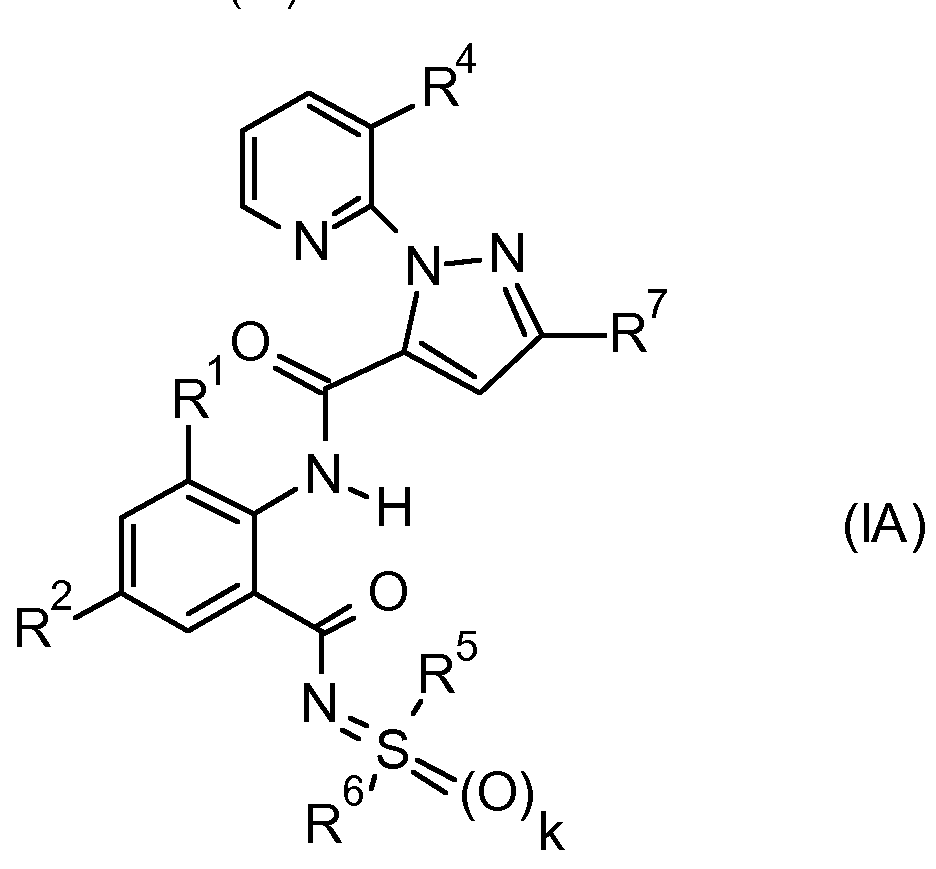
wherein
R4 is CI,
R1 is selected from the group consisting of CI, Br, and methyl;
R2 is selected from the group consisting of bromo and chloro;
R5, R6 are selected independently of one another from the group consisting of methyl, ethyl, n-propyl, isopropyl, n-butyl, isobutyl, tert-butyl.
R7 is selected from the group consisting of difluoromethyl, trifluoromethyl.
Examples of especially preferred anthranilamide compounds I of the present invention are of formula (IA-1 )

wherein R1, R2, R7, R5, R6 are as defined herein.
Examples of preferred compounds of formula I in the methods and uses according to the invention are compiled in tables 1 to 60 below. Moreover, the meanings mentioned below for the individual variables in the tables are per se, independently of the combination in which they are mentioned, a particularly preferred embodiment of the substituents in question.
Table 1 Compounds of the formula (IA-1 ) in which R1 is F, R2 is CI, R7 is CF3 and the combination of R5 and R6 for a compound corresponds in each case to one row of Table A;
Table 2 Compounds of the formula (IA-1 ) in which R1 is Br, R2 is CI, R7 is CF3 and the combination of R5 and R6 for a compound corresponds in each case to one row of Table A; Table 3 Compounds of the formula (IA-1 ) in which R1 is CI, R2 is CI, R7 is CF3 and the combination of R5 and R6 for a compound corresponds in each case to one row of Table A;
Table 4 Compounds of the formula (IA-1 ) in which R1 is methyl, R2 is CI, R7 is CF3 and the combination of R5 and R6 for a compound corresponds in each case to one row of Table A;
Table 5 Compounds of the formula (IA-1 ) in which R1 is F, R2 is Br, R7 is CF3 and the com- bination of R5 and R6 for a compound corresponds in each case to one row of Table A;
Table 6 Compounds of the formula (IA-1 ) in which R1 is Br, R2 is Br, R7 is CF3 and the combination of R5 and R6 for a compound corresponds in each case to one row of Table A;
Table 7 Compounds of the formula (IA-1 ) in which R1 is CI, R2 is Br, R7 is CF3 and the combination of R5 and R6 for a compound corresponds in each case to one row of Table A; Table 8 Compounds of the formula (IA-1 ) in which R1 is methyl, R2 is Br, R7 is CF3 and the combination of R5 and R6 for a compound corresponds in each case to one row of Table A;
Table 9 Compounds of the formula (IA-1 ) in which R1 is F, R2 is cyano, R7 is CF3 and the combination of R5 and R6 for a compound corresponds in each case to one row of Table A;
Table 10 Compounds of the formula (IA-1 ) in which R1 is Br, R2 is cyano, R7 is CF3 and the combination of R5 and R6 for a compound corresponds in each case to one row of Table A;
Table 1 1 Compounds of the formula (IA-1 ) in which R1 is CI, R2 is cyano, R7 is CF3 and the combination of R5 and R6 for a compound corresponds in each case to one row of Table A; Table 12 Compounds of the formula (IA-1 ) in which R1 is methyl, R2 is cyano, R7 is CF3 and the combination of R5 and R6 for a compound corresponds in each case to one row of Table A;
Table 13 Compounds of the formula (IA-1 ) in which R1 is F, R2 is CI, R7 is CHF2 and the combination of R5 and R6 for a compound corresponds in each case to one row of Table A;
Table 14 Compounds of the formula (IA-1 ) in which R1 is Br, R2 is CI, R7 is CHF2 and the combination of R5 and R6 for a compound corresponds in each case to one row of Table A;
Table 15 Compounds of the formula (IA-1 ) in which R1 is CI, R2 is CI, R7 is CHF2 and the combination of R5 and R6 for a compound corresponds in each case to one row of Table A;
Table 16 Compounds of the formula (IA-1 ) in which R1 is methyl, R2 is CI, R7 is CHF2 and the combination of R5 and R6 for a compound corresponds in each case to one row of Table A; Table 17 Compounds of the formula (IA-1 ) in which R1 is F, R2 is Br, R7 is CHF2 and the combination of R5 and R6 for a compound corresponds in each case to one row of Table A;
Table 18 Compounds of the formula (IA-1 ) in which R1 is Br, R2 is Br, R7 is CHF2 and the combination of R5 and R6 for a compound corresponds in each case to one row of Table A;
Table 19 Compounds of the formula (IA-1 ) in which R1 is CI, R2 is Br, R7 is CHF2 and the combination of R5 and R6 for a compound corresponds in each case to one row of Table A;
Table 20 Compounds of the formula (IA-1 ) in which R1 is methyl, R2 is Br, R7 is CHF2 and the combination of R5 and R6 for a compound corresponds in each case to one row of Table A;
Table 21 Compounds of the formula (IA-1 ) in which R1 is F, R2 is cyano, R7 is CHF2 and the combination of R5 and R6 for a compound corresponds in each case to one row of Table A; Table 22 Compounds of the formula (IA-1 ) in which R1 is Br, R2 is cyano, R7 is CHF2 and the combination of R5 and R6 for a compound corresponds in each case to one row of Table A;
Table 23 Compounds of the formula (IA-1 ) in which R1 is CI, R2 is cyano, R7 is CHF2 and the combination of R5 and R6 for a compound corresponds in each case to one row of Table A;
Table 24 Compounds of the formula (IA-1 ) in which R1 is methyl, R2 is cyano, R7 is CHF2 and the combination of R5 and R6 for a compound corresponds in each case to one row of Table A;
Table 25 Compounds of the formula (IA-1 ) in which R1 is F, R2 is CI, R7 is Br and the combination of R5 and R6 for a compound corresponds in each case to one row of Table A;
Table 26 Compounds of the formula (IA-1 ) in which R1 is Br, R2 is CI, R7 is Br and the com- bination of R5 and R6 for a compound corresponds in each case to one row of Table A;
Table 27 Compounds of the formula (IA-1 ) in which R1 is CI, R2 is CI, R7 is Br and the combination of R5 and R6 for a compound corresponds in each case to one row of Table A;
Table 28 Compounds of the formula (IA-1 ) in which R1 is methyl, R2 is CI, R7 is Br and the combination of R5 and R6 for a compound corresponds in each case to one row of Table A; Table 29 Compounds of the formula (IA-1 ) in which R1 is F, R2 is Br, R7 is Br and the combination of R5 and R6 for a compound corresponds in each case to one row of Table A;
Table 30 Compounds of the formula (IA-1 ) in which R1 is Br, R2 is Br, R7 is Br and the combination of R5 and R6 for a compound corresponds in each case to one row of Table A;
Table 31 Compounds of the formula (IA-1 ) in which R1 is CI, R2 is Br, R7 is Br and the combination of R5 and R6 for a compound corresponds in each case to one row of Table A;
Table 32 Compounds of the formula (IA-1 ) in which R1 is methyl, R2 is Br, R7 is Br and the combination of R5 and R6 for a compound corresponds in each case to one row of Table A; Table 33 Compounds of the formula (IA-1 ) in which R1 is F, R2 is cyano, R7 is Br and the combination of R5 and R6 for a compound corresponds in each case to one row of Table A;
Table 34 Compounds of the formula (IA-1 ) in which R1 is Br, R2 is cyano, R7 is Br and the combination of R5 and R6 for a compound corresponds in each case to one row of Table A;
Table 35 Compounds of the formula (IA-1 ) in which R1 is CI, R2 is cyano, R7 is Br and the combination of R5 and R6 for a compound corresponds in each case to one row of Table A;
Table 36 Compounds of the formula (IA-1 ) in which R1 is methyl, R2 is cyano, R7 is Br and the combination of R5 and R6 for a compound corresponds in each case to one row of Table A;
Table 37 Compounds of the formula (IA-1 ) in which R1 is F, R2 is CI, R7 is CI and the combination of R5 and R6 for a compound corresponds in each case to one row of Table A;
Table 38 Compounds of the formula (IA-1 ) in which R1 is Br, R2 is CI, R7 is CI and the combination of R5 and R6 for a compound corresponds in each case to one row of Table A;
Table 39 Compounds of the formula (IA-1 ) in which R1 is CI, R2 is CI, R7 is CI and the combination of R5 and R6 for a compound corresponds in each case to one row of Table A;
Table 40 Compounds of the formula (IA-1 ) in which R1 is methyl, R2 is CI, R7 is CI and the combination of R5 and R6 for a compound corresponds in each case to one row of Table A;
Table 41 Compounds of the formula (IA-1 ) in which R1 is F, R2 is Br, R7 is CI and the combination of R5 and R6 for a compound corresponds in each case to one row of Table A;
Table 42 Compounds of the formula (IA-1 ) in which R1 is Br, R2 is Br, R7 is CI and the combination of R5 and R6 for a compound corresponds in each case to one row of Table A;
Table 43 Compounds of the formula (IA-1 ) in which R1 is CI, R2 is Br, R7 is CI and the combination of R5 and R6 for a compound corresponds in each case to one row of Table A;
Table 44 Compounds of the formula (IA-1 ) in which R1 is methyl, R2 is Br, R7 is CI and the combination of R5 and R6 for a compound corresponds in each case to one row of Table A;
Table 45 Compounds of the formula (IA-1 ) in which R1 is F, R2 is cyano, R7 is CI and the combination of R5 and R6 for a compound corresponds in each case to one row of Table A;
Table 46 Compounds of the formula (IA-1 ) in which R1 is Br, R2 is cyano, R7 is CI and the combination of R5 and R6 for a compound corresponds in each case to one row of Table A;
Table 47 Compounds of the formula (IA-1 ) in which R1 is CI, R2 is cyano, R7 is CI and the combination of R5 and R6 for a compound corresponds in each case to one row of Table A; Table 48 Compounds of the formula (IA-1 ) in which R1 is methyl, R2 is cyano, R7 is CI and the combination of R5 and R6 for a compound corresponds in each case to one row of Table A;
Table 49 Compounds of the formula (IA-1 ) in which R1 is F, R2 is CI, R7 is OCHF2 and the combination of R5 and R6 for a compound corresponds in each case to one row of Table A;
Table 50 Compounds of the formula (IA-1 ) in which R1 is Br, R2 is CI, R7 is OCHF2 and the combination of R5 and R6 for a compound corresponds in each case to one row of Table A;
Table 51 Compounds of the formula (IA-1 ) in which R1 is CI, R2 is CI, R7 is OCHF2 and the combination of R5 and R6 for a compound corresponds in each case to one row of Table A;
Table 52 Compounds of the formula (IA-1 ) in which R1 is methyl, R2 is CI, R7 is OCHF2 and the combination of R5 and R6 for a compound corresponds in each case to one row of Table A;
Table 53 Compounds of the formula (IA-1 ) in which R1 is F, R2 is Br, R7 is OCHF2 and the combination of R5 and R6 for a compound corresponds in each case to one row of Table A;
Table 54 Compounds of the formula (IA-1 ) in which R1 is Br, R2 is Br, R7 is OCHF2 and the combination of R5 and R6 for a compound corresponds in each case to one row of Table A; Table 55 Compounds of the formula (IA-1 ) in which R1 is CI, R2 is Br, R7 is OCHF2 and the combination of R5 and R6 for a compound corresponds in each case to one row of Table A;
Table 56 Compounds of the formula (IA-1 ) in which R1 is methyl, R2 is Br, R7 is OCHF2 and the combination of R5 and R6 for a compound corresponds in each case to one row of Table A;
Table 57 Compounds of the formula (IA-1 ) in which R1 is F, R2 is cyano, R7 is OCHF2 and the combination of R5 and R6 for a compound corresponds in each case to one row of Table A;
Table 58 Compounds of the formula (IA-1 ) in which R1 is Br, R2 is cyano, R7 is OCHF2 and the combination of R5 and R6 for a compound corresponds in each case to one row of Table A;
Table 59 Compounds of the formula (IA-1 ) in which R1 is CI, R2 is cyano, R7 is OCHF2 and the combination of R5 and R6 for a compound corresponds in each case to one row of Table A; Table 60 Compounds of the formula (IA-1 ) in which R1 is methyl, R2 is cyano, R7 is OCHF2 and the combination of R5 and R6 for a compound corresponds in each case to one row of Table A.
Table A
R5 R6 R5 R6
A-1 CHs CH3 A-24 CH2-C-C6H11 CH3
A-2 C2H5 CH3 A-25 C6H5 CH3
A-3 CH=CH2 CH3 A-26 CH3 C2H5
A-4 CH2CH2CH3 CH3 A-27 C2H5 C2H5
A-5 CH(CH3)2 CH3 A-28 CH=CH2 C2H5
A-6 CH2CH2CH2CH3 CH3 A-29 CH2CH2CH3 C2H5
A-7 C(CH3)3 CH3 A-30 CH(CH3)2 C2H5
A-8 CH2CH(CH3)2 CH3 A-31 CH2CH2CH2CH3 C2H5
A-9 CH(CH3)CH2CH3 CH3 A-32 C(CH3)3 C2H5
A-10 CH2CH=CH2 CH3 A-33 CH2CH(CH3)2 C2H5
A-1 1 CH2C≡CH CH3 A-34 CH(CH3)CH2CH3 C2H5
A-12 CH(CH3)CH=CH2 CH3 A-35 CH2CH=CH2 C2H5
A-13 CHF2 CH3 A-36 CH2C≡CH C2H5
A-14 CH2CI CH3 A-37 CH(CH3)CH=CH2 C2H5
A-15 CH2CH2CN CH3 A-38 CHF2 C2H5
A-16 CH2CH2CI CH3 A-39 CH2CI C2H5
A-17 c-C3H5 CH3 A-40 CH2CH2CN C2H5
A-18 C-C4H7 CH3 A-41 CH2CH2CI C2H5
A-19 C-C5H9 CH3 A-42 c-C3H5 C2H5
A-20 c-C6Hii CH3 A-43 C-C4H7 C2H5
A-21 CH2-c-C3H5 CH3 A-44 C-C5H9 C2H5
A-22 CH(CH3)-c-C3H5 CH3 A-45 c-C6Hii C2H5
A-23 CH2-C-C5H9 CH3 A-46 CH2-c-C3H5 C2H5
R5 R6 R5 R6
A-47 CH(CH3)-c-C3H5 C2H5 A-89 CH2CI CH2CH2CH3
A-48 CH2-C-C5H9 C2H5 A-90 CH2CH2CN CH2CH2CH3
A-49 CH2-C-C6H11 C2H5 A-91 CH2CH2CI CH2CH2CH3
A-50 C6H5 C2H5 A-92 c-C3H5 CH2CH2CH3
A-51 CHs CH=CH2 A-93 C-C4H7 CH2CH2CH3
A-52 C2H5 CH=CH2 A-94 C-C5H9 CH2CH2CH3
A-53 CH=CH2 CH=CH2 A-95 c-C6Hii CH2CH2CH3
A-54 CH2CH2CH3 CH=CH2 A-96 CH2-c-C3H5 CH2CH2CH3
A-55 CH(CH3)2 CH=CH2 A-97 CH(CH3)-c-C3H5 CH2CH2CH3
A-56 CH2CH2CH2CH3 CH=CH2 A-98 CH2-C-C5H9 CH2CH2CH3
A-57 C(CH3)3 CH=CH2 A-99 CH2-C-C6H11 CH2CH2CH3
A-58 CH2CH(CH3)2 CH=CH2 A-100 C6H5 CH2CH2CH3
A-59 CH(CH3)CH2CH3 CH=CH2 A-101 CH3 CH(CH3)2
A-60 CH2CH=CH2 CH=CH2 A-102 C2H5 CH(CH3)2
A-61 CH2C≡CH CH=CH2 A-103 CH=CH2 CH(CH3)2
A-62 CH(CH3)CH=CH2 CH=CH2 A-104 CH2CH2CH3 CH(CH3)2
A-63 CHF2 CH=CH2 A-105 CH(CH3)2 CH(CH3)2
A-64 CH2CI CH=CH2 A-106 CH2CH2CH2CH3 CH(CH3)2
A-65 CH2CH2CN CH=CH2 A-107 C(CH3)3 CH(CH3)2
A-66 CH2CH2CI CH=CH2 A-108 CH2CH(CH3)2 CH(CH3)2
A-67 c-C3H5 CH=CH2 A-109 CH(CH3)CH2CH3 CH(CH3)2
A-68 C-C4H7 CH=CH2 A-1 10 CH2CH=CH2 CH(CH3)2
A-69 C-C5H9 CH=CH2 A-1 1 1 CH2C≡CH CH(CH3)2
A-70 c-C6Hii CH=CH2 A-1 12 CH(CH3)CH=CH2 CH(CH3)2
A-71 CH2-c-C3H5 CH=CH2 A-1 13 CHF2 CH(CH3)2
A-72 CH(CH3)-c-C3H5 CH=CH2 A-1 14 CH2CI CH(CH3)2
A-73 CH2-C-C5H9 CH=CH2 A-1 15 CH2CH2CN CH(CH3)2
A-74 CH2-C-C6H11 CH=CH2 A-1 16 CH2CH2CI CH(CH3)2
A-75 C6H5 CH=CH2 A-1 17 c-C3H5 CH(CH3)2
A-76 CH3 CH2CH2CH3 A-1 18 C-C4H7 CH(CH3)2
A-77 C2H5 CH2CH2CH3 A-1 19 C-C5H9 CH(CH3)2
A-78 CH=CH2 CH2CH2CH3 A-120 c-C6Hii CH(CH3)2
A-79 CH2CH2CH3 CH2CH2CH3 A-121 CH2-c-C3H5 CH(CH3)2
A-80 CH(CH3)2 CH2CH2CH3 A-122 CH(CH3)-c-C3H5 CH(CH3)2
A-81 CH2CH2CH2CH3 CH2CH2CH3 A-123 CH2-C-C5H9 CH(CH3)2
A-82 C(CH3)3 CH2CH2CH3 A-124 CH2-C-C6H11 CH(CH3)2
A-83 CH2CH(CH3)2 CH2CH2CH3 A-125 C6H5 CH(CH3)2
A-84 CH(CH3)CH2CH3 CH2CH2CH3 A-126 CH3 CH2CH2CH2CH3
A-85 CH2CH=CH2 CH2CH2CH3 A-127 C2H5 CH2CH2CH2CH3
A-86 CH2C≡CH CH2CH2CH3 A-128 CH=CH2 CH2CH2CH2CH3
A-87 CH(CH3)CH=CH2 CH2CH2CH3 A-129 CH2CH2CH3 CH2CH2CH2CH3
A-88 CHF2 CH2CH2CH3 A-130 CH(CH3)2 CH2CH2CH2CH3
R5 R6 R5 R6
A-131 CH2CH2CH2CH3 CH2CH2CH2CH3 A-173 Chb-c-CsHg C(CH3)3
A-132 C(CH3)3 CH2CH2CH2CH3 A-174 CH2-c-C6Hi i C(CH3)3
A-133 CH2CH(CH3)2 CH2CH2CH2CH3 A-175 C6H5 C(CH3)3
A-134 CH(CH3)CH2CH3 CH2CH2CH2CH3 A-176 CH3 CH2CH(CH3)2
A-135 CH2CH=CH2 CH2CH2CH2CH3 A-177 C2H5 CH2CH(CH3)2
A-136 CH2C≡CH CH2CH2CH2CH3 A-178 CH=CH2 CH2CH(CH3)2
A-137 CH(CH3)CH=CH2 CH2CH2CH2CH3 A-179 CH2CH2CH3 CH2CH(CH3)2
A-138 CHF2 CH2CH2CH2CH3 A-180 CH(CH3)2 CH2CH(CH3)2
A-139 CH2CI CH2CH2CH2CH3 A-181 CH2CH2CH2CH3 CH2CH(CH3)2
A-140 CH2CH2CN CH2CH2CH2CH3 A-182 C(CH3)3 CH2CH(CH3)2
A-141 CH2CH2CI CH2CH2CH2CH3 A-183 CH2CH(CH3)2 CH2CH(CH3)2
A-142 c-C3H5 CH2CH2CH2CH3 A-184 CH(CH3)CH2CH3 CH2CH(CH3)2
A-143 C-C4H7 CH2CH2CH2CH3 A-185 CH2CH=CH2 CH2CH(CH3)2
A-144 C-C5H9 CH2CH2CH2CH3 A-186 CH2C≡CH CH2CH(CH3)2
A-145 c-C6Hii CH2CH2CH2CH3 A-187 CH(CH3)CH=CH2 CH2CH(CH3)2
A-146 CH2-c-C3H5 CH2CH2CH2CH3 A-188 CHF2 CH2CH(CH3)2
A-147 CH(CH3)-c-C3H5 CH2CH2CH2CH3 A-189 CH2CI CH2CH(CH3)2
A-148 Chb-C-CsHg CH2CH2CH2CH3 A-190 CH2CH2CN CH2CH(CH3)2
A-149 CH2-c-C6Hi i CH2CH2CH2CH3 A-191 CH2CH2CI CH2CH(CH3)2
A-150 C6H5 CH2CH2CH2CH3 A-192 c-C3H5 CH2CH(CH3)2
A-151 CH3 C(CH3)3 A-193 C-C4H7 CH2CH(CH3)2
A-152 C2H5 C(CH3)3 A-194 C-C5H9 CH2CH(CH3)2
A-153 CH=CH2 C(CH3)3 A-195 c-C6Hii CH2CH(CH3)2
A-154 CH2CH2CH3 C(CH3)3 A-196 CH2-c-C3H5 CH2CH(CH3)2
A-155 CH(CH3)2 C(CH3)3 A-197 CH(CH3)-c-C3H5 CH2CH(CH3)2
A-156 CH2CH2CH2CH3 C(CH3)3 A-198 Chb-c-CsHg CH2CH(CH3)2
A-157 C(CH3)3 C(CH3)3 A-199 CH2-c-C6Hi i CH2CH(CH3)2
A-158 CH2CH(CH3)2 C(CH3)3 A-200 C6H5 CH2CH(CH3)2
A-159 CH(CH3)CH2CH3 C(CH3)3 A-201 CH3 CH(CH3)CH2CH3
A-160 CH2CH=CH2 C(CH3)3 A-202 C2H5 CH(CH3)CH2CH3
A-161 CH2C≡CH C(CH3)3 A-203 CH=CH2 CH(CH3)CH2CH3
A-162 CH(CH3)CH=CH2 C(CH3)3 A-204 CH2CH2CH3 CH(CH3)CH2CH3
A-163 CHF2 C(CH3)3 A-205 CH(CH3)2 CH(CH3)CH2CH3
A-164 CH2CI C(CH3)3 A-206 CH2CH2CH2CH3 CH(CH3)CH2CH3
A-165 CH2CH2CN C(CH3)3 A-207 C(CH3)3 CH(CH3)CH2CH3
A-166 CH2CH2CI C(CH3)3 A-208 CH2CH(CH3)2 CH(CH3)CH2CH3
A-167 c-C3H5 C(CH3)3 A-209 CH(CH3)CH2CH3 CH(CH3)CH2CH3
A-168 C-C4H7 C(CH3)3 A-210 CH2CH=CH2 CH(CH3)CH2CH3
A-169 C-C5H9 C(CH3)3 A-21 1 CH2C≡CH CH(CH3)CH2CH3
A-170 c-C6Hii C(CH3)3 A-212 CH(CH3)CH=CH2 CH(CH3)CH2CH3
A-171 CH2-c-C3H5 C(CH3)3 A-213 CHF2 CH(CH3)CH2CH3
A-172 CH(CH3)-c-C3H5 C(CH3)3 A-214 CH2CI CH(CH3)CH2CH3
R5 R6 R5 R6
A-215 CH2CH2CN CH(CH3)CH2CH3 A-257 C(CH3)3 CH2C≡CH
A-216 CH2CH2CI CH(CH3)CH2CH3 A-258 CH2CH(CH3)2 CH2C≡CH
A-217 C-C3H5 CH(CH3)CH2CH3 A-259 CH(CH3)CH2CH3 CH2C≡CH
A-218 C-C4H7 CH(CH3)CH2CH3 A-260 CH2CH=CH2 CH2C≡CH
A-219 C-C5H9 CH(CH3)CH2CH3 A-261 CH2C≡CH CH2C≡CH
A-220 c-C6Hii CH(CH3)CH2CH3 A-262 CH(CH3)CH=CH2 CH2C≡CH
A-221 CH2-c-C3H5 CH(CH3)CH2CH3 A-263 CHF2 CH2C≡CH
A-222 CH(CH3)-c-C3H5 CH(CH3)CH2CH3 A-264 CH2CI CH2C≡CH
A-223 CH2-C-C5H9 CH(CH3)CH2CH3 A-265 CH2CH2CN CH2C≡CH
A-224 CH2-C-C6H11 CH(CH3)CH2CH3 A-266 CH2CH2CI CH2C≡CH
A-225 C6H5 CH(CH3)CH2CH3 A-267 c-CsHs CH2C≡CH
A-226 CH3 CH2CH=CH2 A-268 C-C4H7 CH2C≡CH
A-227 C2H5 CH2CH=CH2 A-269 C-C5H9 CH2C≡CH
A-228 CH=CH2 CH2CH=CH2 A-270 c-C6Hii CH2C≡CH
A-229 CH2CH2CH3 CH2CH=CH2 A-271 CH2-c-C3H5 CH2C≡CH
A-230 CH(CH3)2 CH2CH=CH2 A-272 CH(CH3)-c-C3H5 CH2C≡CH
A-231 CH2CH2CH2CH3 CH2CH=CH2 A-273 CH2-C-C5H9 CH2C≡CH
A-232 C(CH3)3 CH2CH=CH2 A-274 CH2-C-C6H11 CH2C≡CH
A-233 CH2CH(CH3)2 CH2CH=CH2 A-275 C6H5 CH2C≡CH
A-234 CH(CH3)CH2CH3 CH2CH=CH2 A-276 CH3 CH(CH3)CH=CH2
A-235 CH2CH=CH2 CH2CH=CH2 A-277 C2H5 CH(CH3)CH=CH2
A-236 CH2C≡CH CH2CH=CH2 A-278 CH=CH2 CH(CH3)CH=CH2
A-237 CH(CH3)CH=CH2 CH2CH=CH2 A-279 CH2CH2CH3 CH(CH3)CH=CH2
A-238 CHF2 CH2CH=CH2 A-280 CH(CH3)2 CH(CH3)CH=CH2
A-239 CH2CI CH2CH=CH2 A-281 CH2CH2CH2CH3 CH(CH3)CH=CH2
A-240 CH2CH2CN CH2CH=CH2 A-282 C(CH3)3 CH(CH3)CH=CH2
A-241 CH2CH2CI CH2CH=CH2 A-283 CH2CH(CH3)2 CH(CH3)CH=CH2
A-242 c-C3H5 CH2CH=CH2 A-284 CH(CH3)CH2CH3 CH(CH3)CH=CH2
A-243 C-C4H7 CH2CH=CH2 A-285 CH2CH=CH2 CH(CH3)CH=CH2
A-244 C-C5H9 CH2CH=CH2 A-286 CH2C≡CH CH(CH3)CH=CH2
A-245 c-C6Hii CH2CH=CH2 A-287 CH(CH3)CH=CH2 CH(CH3)CH=CH2
A-246 CH2-c-C3H5 CH2CH=CH2 A-288 CHF2 CH(CH3)CH=CH2
A-247 CH(CH3)-c-C3H5 CH2CH=CH2 A-289 CH2CI CH(CH3)CH=CH2
A-248 CH2-C-C5H9 CH2CH=CH2 A-290 CH2CH2CN CH(CH3)CH=CH2
A-249 CH2-C-C6H11 CH2CH=CH2 A-291 CH2CH2CI CH(CH3)CH=CH2
A-250 C6H5 CH2CH=CH2 A-292 c-CsHs CH(CH3)CH=CH2
A-251 CH3 CH2C≡CH A-293 C-C4H7 CH(CH3)CH=CH2
A-252 C2H5 CH2C≡CH A-294 C-C5H9 CH(CH3)CH=CH2
A-253 CH=CH2 CH2C≡CH A-295 c-C6Hii CH(CH3)CH=CH2
A-254 CH2CH2CH3 CH2C≡CH A-296 CH2-c-C3H5 CH(CH3)CH=CH2
A-255 CH(CH3)2 CH2C≡CH A-297 CH(CH3)-c-C3H5 CH(CH3)CH=CH2
A-256 CH2CH2CH2CH3 CH2C≡CH A-298 CH2-C-C5H9 CH(CH3)CH=CH2
R5 R6 R5 R6
A-299 CH2-C-C5H9 CH(CH3)CH=CH2 A-341 CH2CH2CI CH2CI
A-300 C6H5 CH(CH3)CH=CH2 A-342 c-C3H5 CH2CI
A-301 CHs CHF2 A-343 C-C4H7 CH2CI
A-302 C2H5 CHF2 A-344 C-C5H9 CH2CI
A-303 CH=CH2 CHF2 A-345 c-C6Hii CH2CI
A-304 CH2CH2CH3 CHF2 A-346 CH2-c-C3H5 CH2CI
A-305 CH(CH3)2 CHF2 A-347 CH(CH3)-c-C3H5 CH2CI
A-306 CH2CH2CH2CH3 CHF2 A-348 CH2-C-C5H9 CH2CI
A-307 C(CH3)3 CHF2 A-349 CH2-C-C6H11 CH2CI
A-308 CH2CH(CH3)2 CHF2 A-350 C6H5 CH2CI
A-309 CH(CH3)CH2CH3 CHF2 A-351 CH3 CH2CH2CN
A-310 CH2CH=CH2 CHF2 A-352 C2H5 CH2CH2CN
A-31 1 CH2C≡CH CHF2 A-353 CH=CH2 CH2CH2CN
A-312 CH(CH3)CH=CH2 CHF2 A-354 CH2CH2CH3 CH2CH2CN
A-313 CHF2 CHF2 A-355 CH(CH3)2 CH2CH2CN
A-314 CH2CI CHF2 A-356 CH2CH2CH2CH3 CH2CH2CN
A-315 CH2CH2CN CHF2 A-357 C(CH3)3 CH2CH2CN
A-316 CH2CH2CI CHF2 A-358 CH2CH(CH3)2 CH2CH2CN
A-317 c-C3H5 CHF2 A-359 CH(CH3)CH2CH3 CH2CH2CN
A-318 C-C4H7 CHF2 A-360 CH2CH=CH2 CH2CH2CN
A-319 C-C5H9 CHF2 A-361 CH2C≡CH CH2CH2CN
A-320 c-C6Hii CHF2 A-362 CH(CH3)CH=CH2 CH2CH2CN
A-321 CH2-c-C3H5 CHF2 A-363 CHF2 CH2CH2CN
A-322 CH(CH3)-c-C3H5 CHF2 A-364 CH2CI CH2CH2CN
A-323 CH2-C-C5H9 CHF2 A-365 CH2CH2CN CH2CH2CN
A-324 CH2-C-C6H11 CHF2 A-366 CH2CH2CI CH2CH2CN
A-325 C6H5 CHF2 A-367 c-C3H5 CH2CH2CN
A-326 CH3 CH2CI A-368 C-C4H7 CH2CH2CN
A-327 C2H5 CH2CI A-369 C-C5H9 CH2CH2CN
A-328 CH=CH2 CH2CI A-370 c-C6Hii CH2CH2CN
A-329 CH2CH2CH3 CH2CI A-371 CH2-c-C3H5 CH2CH2CN
A-330 CH(CH3)2 CH2CI A-372 CH(CH3)-c-C3H5 CH2CH2CN
A-331 CH2CH2CH2CH3 CH2CI A-373 CH2-C-C5H9 CH2CH2CN
A-332 C(CH3)3 CH2CI A-374 CH2-C-C5H9 CH2CH2CN
A-333 CH2CH(CH3)2 CH2CI A-375 C6H5 CH2CH2CN
A-334 CH(CH3)CH2CH3 CH2CI A-376 CH3 CH2CH2CI
A-335 CH2CH=CH2 CH2CI A-377 C2H5 CH2CH2CI
A-336 CH2C≡CH CH2CI A-378 CH=CH2 CH2CH2CI
A-337 CH(CH3)CH=CH2 CH2CI A-379 CH2CH2CH3 CH2CH2CI
A-338 CHF2 CH2CI A-380 CH(CH3)2 CH2CH2CI
A-339 CH2CI CH2CI A-381 CH2CH2CH2CH3 CH2CH2CI
A-340 CH2CH2CN CH2CI A-382 C(CH3)3 CH2CH2CI
R5 R6 R5 R6
A-383 CH2CH(CH3)2 CH2CH2CI A-425 C6H5 C-C3H5
A-384 CH(CH3)CH2CH3 CH2CH2CI A-426 CH3 C-C4H7
A-385 CH2CH=CH2 CH2CH2CI A-427 C2H5 C-C4H7
A-386 CH2C≡CH CH2CH2CI A-428 CH=CH2 C-C4H7
A-387 CH(CH3)CH=CH2 CH2CH2CI A-429 CH2CH2CH3 C-C4H7
A-388 CHF2 CH2CH2CI A-430 CH(CH3)2 C-C4H7
A-389 CH2CI CH2CH2CI A-431 CH2CH2CH2CH3 C-C4H7
A-390 CH2CH2CN CH2CH2CI A-432 C(CH3)3 C-C4H7
A-391 CH2CH2CI CH2CH2CI A-433 CH2CH(CH3)2 C-C4H7
A-392 c-C3H5 CH2CH2CI A-434 CH(CH3)CH2CH3 C-C4H7
A-393 C-C4H7 CH2CH2CI A-435 CH2CH=CH2 C-C4H7
A-394 C-C5H9 CH2CH2CI A-436 CH2C≡CH C-C4H7
A-395 c-C6Hii CH2CH2CI A-437 CH(CH3)CH=CH2 C-C4H7
A-396 CH2-c-C3H5 CH2CH2CI A-438 CHF2 C-C4H7
A-397 CH(CH3)-c-C3H5 CH2CH2CI A-439 CH2CI C-C4H7
A-398 Chb-C-CsHg CH2CH2CI A-440 CH2CH2CN C-C4H7
A-399 CH2-c-C6Hi i CH2CH2CI A-441 CH2CH2CI C-C4H7
A-400 C6H5 CH2CH2CI A-442 C-C3H5 C-C4H7
A-401 CH3 c-C3H5 A-443 C-C4H7 C-C4H7
A-402 C2H5 c-C3H5 A-444 C-C5H9 C-C4H7
A-403 CH=CH2 c-CsHs A-445 c-C6Hii C-C4H7
A-404 CH2CH2CH3 C-C3H5 A-446 CH2-c-C3H5 C-C4H7
A-405 CH(CH3)2 C-C3H5 A-447 CH(CH3)-c-C3H5 C-C4H7
A-406 CH2CH2CH2CH3 C-C3H5 A-448 Chb-C-CsHg C-C4H7
A-407 C(CH3)3 C-C3H5 A-449 CH2-c-C6Hi i C-C4H7
A-408 CH2CH(CH3)2 C-C3H5 A-450 C6H5 C-C4H7
A-409 CH(CH3)CH2CH3 C-C3H5 A-451 CH3 C-C5H9
A-410 CH2CH=CH2 C-C3H5 A-452 C2H5 C-C5H9
A-41 1 CH2C≡CH C-C3H5 A-453 CH=CH2 C-C5H9
A-412 CH(CH3)CH=CH2 C-C3H5 A-454 CH2CH2CH3 C-C5H9
A-413 CHF2 C-C3H5 A-455 CH(CH3)2 C-C5H9
A-414 CH2CI C-C3H5 A-456 CH2CH2CH2CH3 C-C5H9
A-415 CH2CH2CN C-C3H5 A-457 C(CH3)3 C-C5H9
A-416 CH2CH2CI C-C3H5 A-458 CH2CH(CH3)2 C-C5H9
A-417 c-C3H5 C-C3H5 A-459 CH(CH3)CH2CH3 C-C5H9
A-418 C-C4H7 C-C3H5 A-460 CH2CH=CH2 C-C5H9
A-419 C-C5H9 C-C3H5 A-461 CH2C≡CH C-C5H9
A-420 c-C6Hii C-C3H5 A-462 CH(CH3)CH=CH2 C-C5H9
A-421 CH2-c-C3H5 C-C3H5 A-463 CHF2 C-C5H9
A-422 CH(CH3)-c-C3H5 C-C3H5 A-464 CH2CI C-C5H9
A-423 Chb-C-CsHg C-C3H5 A-465 CH2CH2CN C-C5H9
A-424 CH2-c-C6Hi i C-C3H5 A-466 CH2CH2CI C-C5H9
R5 R6 R5 R6
A-467 C-C3H5 C-C5H9 A-509 CH(CH3)CH2CH3 CH2-c-C3H5
A-468 C-C4H7 C-C5H9 A-510 CH2CH=CH2 CH2-c-C3H5
A-469 C-C5H9 C-C5H9 A-51 1 CH2C≡CH CH2-c-C3H5
A-470 c-C6Hii C-C5H9 A-512 CH(CH3)CH=CH2 CH2-c-C3H5
A-471 CH2-c-C3H5 C-C5H9 A-513 CHF2 CH2-c-C3H5
A-472 CH(CH3)-c-C3H5 C-C5H9 A-514 CH2CI CH2-c-C3H5
A-473 CH2-C-C5H9 C-C5H9 A-515 CH2CH2CN CH2-c-C3H5
A-474 CH2-C-C6H11 C-C5H9 A-516 CH2CH2CI CH2-c-C3H5
A-475 C6H5 C-C5H9 A-517 c-C3H5 CH2-c-C3H5
A-476 CH3 c-C6Hii A-518 C-C4H7 CH2-c-C3H5
A-477 C2H5 c-C6Hii A-519 C-C5H9 CH2-c-C3H5
A-478 CH=CH2 c-C6Hii A-520 c-C6Hii CH2-c-C3H5
A-479 CH2CH2CH3 c-C6Hii A-521 CH2-c-C3H5 CH2-c-C3H5
A-480 CH(CH3)2 c-C6Hii A-522 CH(CH3)-c-C3H5 CH2-c-C3H5
A-481 CH2CH2CH2CH3 c-C6Hii A-523 CH2-C-C5H9 CH2-c-C3H5
A-482 C(CH3)3 c-C6Hii A-524 CH2-C-C6H11 CH2-c-C3H5
A-483 CH2CH(CH3)2 c-C6Hii A-525 C6H5 CH2-c-C3H5
A-484 CH(CH3)CH2CH3 c-C6Hii A-526 CH3 CH(CH3)-c-C3H5
A-485 CH2CH=CH2 c-C6Hii A-527 C2H5 CH(CH3)-c-C3H5
A-486 CH2C≡CH c-C6Hii A-528 CH=CH2 CH(CH3)-c-C3H5
A-487 CH(CH3)CH=CH2 c-C6Hii A-529 ChbChbCHs CH(CH3)-c-C3H5
A-488 CHF2 c-C6Hii A-530 CH(CH3)2 CH(CH3)-c-C3H5
A-489 CH2CI c-C6Hii A-531 CH2CH2CH2CH3 CH(CH3)-c-C3H5
A-490 CH2CH2CN c-C6Hii A-532 C(CH3)3 CH(CH3)-c-C3H5
A-491 CH2CH2CI c-C6Hii A-533 CH2CH(CH3)2 CH(CH3)-c-C3H5
A-492 c-C3H5 c-C6Hii A-534 CH(CH3)CH2CH3 CH(CH3)-c-C3H5
A-493 C-C4H7 c-C6Hii A-535 CH2CH=CH2 CH(CH3)-c-C3H5
A-494 C-C5H9 c-C6Hii A-536 CH2C≡CH CH(CH3)-c-C3H5
A-495 c-C6Hii c-C6Hii A-537 CH(CH3)CH=CH2 CH(CH3)-c-C3H5
A-496 CH2-c-C3H5 c-C6Hii A-538 CHF2 CH(CH3)-c-C3H5
A-497 CH(CH3)-c-C3H5 c-C6Hii A-539 CH2CI CH(CH3)-c-C3H5
A-498 CH2-C-C5H9 c-C6Hii A-540 CH2CH2CN CH(CH3)-c-C3H5
A-499 CH2-C-C6H11 c-C6Hii A-541 CH2CH2CI CH(CH3)-c-C3H5
A-500 C6H5 c-C6Hii A-542 c-C3H5 CH(CH3)-c-C3H5
A-501 CH3 CH2-c-C3H5 A-543 C-C4H7 CH(CH3)-c-C3H5
A-502 C2H5 CH2-c-C3H5 A-544 C-C5H9 CH(CH3)-c-C3H5
A-503 CH=CH2 CH2-c-C3H5 A-545 c-C6Hii CH(CH3)-c-C3H5
A-504 CH2CH2CH3 CH2-c-C3H5 A-546 CH2-c-C3H5 CH(CH3)-c-C3H5
A-505 CH(CH3)2 CH2-c-C3H5 A-547 CH(CH3)-c-C3H5 CH(CH3)-c-C3H5
A-506 CH2CH2CH2CH3 CH2-c-C3H5 A-548 CH2-C-C5H9 CH(CH3)-c-C3H5
A-507 C(CH3)3 CH2-c-C3H5 A-549 CH2-C-C6H11 CH(CH3)-c-C3H5
A-508 CH2CH(CH3)2 CH2-c-C3H5 A-550 C6H5 CH(CH3)-c-C3H5
R5 R6 R5 R6
A-551 CHs CH2-C-C5H9 A-593 C-C4H7 CH2-c-C6Hii
A-552 C2H5 CH2-C-C5H9 A-594 C-C5H9 CH2-c-C6Hii
A-553 CH=CH2 CH2-C-C5H9 A-595 c-C6Hii CH2-c-C6Hii
A-554 CH2CH2CH3 CH2-C-C5H9 A-596 CH2-c-C3H5 CH2-c-C6Hii
A-555 CH(CH3)2 CH2-C-C5H9 A-597 CH(CH3)-c-C3H5 CH2-c-C6Hii
A-556 CH2CH2CH2CH3 CH2-C-C5H9 A-598 CH2-C-C5H9 CH2-c-C6Hii
A-557 C(CH3)3 CH2-C-C5H9 A-599 CH2-C-C6H11 CH2-c-C6Hii
A-558 CH2CH(CH3)2 CH2-C-C5H9 A-600 C6H5 CH2-c-C6Hii
A-559 CH(CH3)CH2CH3 CH2-C-C5H9 A-601 CH3 C6H5
A-560 CH2CH=CH2 CH2-C-C5H9 A-602 C2H5 C6H5
A-561 CH2C≡CH CH2-C-C5H9 A-603 CH=CH2 C6H5
A-562 CH(CH3)CH=CH2 CH2-C-C5H9 A-604 CH2CH2CH3 C6H5
A-563 CHF2 CH2-C-C5H9 A-605 CH(CH3)2 C6H5
A-564 CH2CI CH2-C-C5H9 A-606 CH2CH2CH2CH3 C6H5
A-565 CH2CH2CN CH2-C-C5H9 A-607 C(CH3)3 C6H5
A-566 CH2CH2CI CH2-C-C5H9 A-608 CH2CH(CH3)2 C6H5
A-567 c-C3H5 CH2-C-C5H9 A-609 CH(CH3)CH2CH3 C6H5
A-568 C-C4H7 CH2-C-C5H9 A-610 CH2CH=CH2 C6H5
A-569 C-C5H9 CH2-C-C5H9 A-61 1 CH2C≡CH C6H5
A-570 c-C6Hii CH2-C-C5H9 A-612 CH(CH3)CH=CH2 C6H5
A-571 CH2-c-C3H5 CH2-C-C5H9 A-613 CHF2 C6H5
A-572 CH(CH3)-c-C3H5 CH2-C-C5H9 A-614 CH2CI C6H5
A-573 CH2-C-C5H9 CH2-C-C5H9 A-615 CH2CH2CN C6H5
A-574 CH2-C-C6H11 CH2-C-C5H9 A-616 CH2CH2CI C6H5
A-575 C6H5 CH2-C-C5H9 A-617 c-C3H5 C6H5
A-576 CH3 CH2-c-C6Hii A-618 C-C4H7 C6H5
A-577 C2H5 CH2-c-C6Hii A-619 C-C5H9 C6H5
A-578 CH=CH2 CH2-c-C6Hii A-620 c-C6Hii C6H5
A-579 CH2CH2CH3 CH2-c-C6Hii A-621 CH2-c-C3H5 C6H5
A-580 CH(CH3)2 CH2-c-C6Hii A-622 CH(CH3)-c-C3H5 C6H5
A-581 CH2CH2CH2CH3 CH2-c-C6Hii A-623 CH2-C-C5H9 C6H5
A-582 C(CH3)3 CH2-c-C6Hii A-624 CH2-C-C5H9 C6H5
A-583 CH2CH(CH3)2 CH2-c-C6Hii A-625 C6H5 C6H5
A-584 CH(CH3)CH2CH3 CH2-c-C6Hii A-626 CH3 CH2-C-C4H7
A-585 CH2CH=CH2 CH2-c-C6Hii A-627 C2H5 CH2-C-C4H7
A-586 CH2C≡CH CH2-c-C6Hii A-628 CH=CH2 CH2-C-C4H7
A-587 CH(CH3)CH=CH2 CH2-c-C6Hii A-629 CH2CH2CH3 CH2-C-C4H7
A-588 CHF2 CH2-c-C6Hii A-630 CH(CH3)2 CH2-C-C4H7
A-589 CH2CI CH2-c-C6Hii A-631 CH2CH2CH2CH3 CH2-C-C4H7
A-590 CH2CH2CN CH2-c-C6Hii A-632 C(CH3)3 CH2-C-C4H7
A-591 CH2CH2CI CH2-c-C6Hii A-633 CH2CH(CH3)2 CH2-C-C4H7
A-592 c-C3H5 CH2-c-C6Hii A-634 CH(CH3)CH2CH3 CH2-C-C4H7
R5 R6 R5 R6
A-635 CH2CH=CH2 CH2-c-C4H7 A-677 C2H5 CH2(CH2)3CH3
A-636 CH2C≡CH CH2-c-C4H7 A-678 CH=CH2 CH2(CH2)3CH3
A-637 CH(CH3)CH=CH2 CH2-c-C4H7 A-679 CH2CH2CH3 CH2(CH2)3CH3
A-638 CHF2 CH2-c-C4H7 A-680 CH(CH3)2 CH2(CH2)3CH3
A-639 CH2CI CH2-c-C4H7 A-681 CH2CH2CH2CH3 CH2(CH2)3CH3
A-640 CH2CH2CN CH2-c-C4H7 A-682 C(CH3)3 CH2(CH2)3CH3
A-641 CH2CH2CI CH2-c-C4H7 A-683 CH2CH(CH3)2 CH2(CH2)3CH3
A-642 C-C3H5 CH2-c-C4H7 A-684 CH(CH3)CH2CH3 CH2(CH2)3CH3
A-643 C-C4H7 CH2-c-C4H7 A-685 CH2CH=CH2 CH2(CH2)3CH3
A-644 C-C5H9 CH2-c-C4H7 A-686 CH2C≡CH CH2(CH2)3CH3
A-645 c-C6Hii CH2-c-C4H7 A-687 CH(CH3)CH=CH2 CH2(CH2)3CH3
A-646 CH2-c-C3H5 CH2-c-C4H7 A-688 CHF2 CH2(CH2)3CH3
A-647 CH(CH3)-c-C3H5 CH2-c-C4H7 A-689 CH2CI CH2(CH2)3CH3
A-648 Chb-c-CsHg CH2-c-C4H7 A-690 CH2CH2CN CH2(CH2)3CH3
A-649 CH2-c-C6Hi i CH2-c-C4H7 A-691 CH2CH2CI CH2(CH2)3CH3
A-650 C6H5 CH2-c-C4H7 A-692 c-CsHs CH2(CH2)3CH3
A-651 CH3 CH2CH2-c-C3H5 A-693 c-C4H7 CH2(CH2)3CH3
A-652 C2H5 CH2CH2-c-C3H5 A-694 C-C5H9 CH2(CH2)3CH3
A-653 CH=CH2 CH2CH2-c-C3H5 A-695 c-C6Hii CH2(CH2)3CH3
A-654 CH2CH2CH3 CH2CH2-c-C3H5 A-696 CH2-c-C3H5 CH2(CH2)3CH3
A-655 CH(CH3)2 CH2CH2-c-C3H5 A-697 CH(CH3)-c-C3H5 CH2(CH2)3CH3
A-656 CH2CH2CH2CH3 CH2CH2-c-C3H5 A-698 Chb-C-CsHg CH2(CH2)3CH3
A-657 C(CH3)3 CH2CH2-c-C3H5 A-699 CH2-c-C6Hi i CH2(CH2)3CH3
A-658 CH2CH(CH3)2 CH2CH2-c-C3H5 A-700 C6H5 CH2(CH2)3CH3
A-659 CH(CH3)CH2CH3 CH2CH2-c-C3H5 A-701 CH3 CH(CH3)CH(CH3)2
A-660 CH2CH=CH2 CH2CH2-c-C3H5 A-702 C2H5 CH(CH3)CH(CH3)2
A-661 CH2C≡CH CH2CH2-c-C3H5 A-703 CH=CH2 CH(CH3)CH(CH3)2
A-662 CH(CH3)CH=CH2 CH2CH2-c-C3H5 A-704 CH2CH2CH3 CH(CH3)CH(CH3)2
A-663 CHF2 CH2CH2-c-C3H5 A-705 CH(CH3)2 CH(CH3)CH(CH3)2
A-664 CH2CI CH2CH2-c-C3H5 A-706 CH2CH2CH2CH3 CH(CH3)CH(CH3)2
A-665 CH2CH2CN CH2CH2-c-C3H5 A-707 C(CH3)3 CH(CH3)CH(CH3)2
A-666 CH2CH2CI CH2CH2-c-C3H5 A-708 CH2CH(CH3)2 CH(CH3)CH(CH3)2
A-667 c-C3H5 CH2CH2-c-C3H5 A-709 CH(CH3)CH2CH3 CH(CH3)CH(CH3)2
A-668 C-C4H7 CH2CH2-c-C3H5 A-710 CH2CH=CH2 CH(CH3)CH(CH3)2
A-669 C-C5H9 CH2CH2-c-C3H5 A-71 1 CH2C≡CH CH(CH3)CH(CH3)2
A-670 c-C6Hii CH2CH2-c-C3H5 A-712 CH(CH3)CH=CH2 CH(CH3)CH(CH3)2
A-671 CH2-c-C3H5 CH2CH2-c-C3H5 A-713 CHF2 CH(CH3)CH(CH3)2
A-672 CH(CH3)-c-C3H5 CH2CH2-c-C3H5 A-714 CH2CI CH(CH3)CH(CH3)2
A-673 Chb-c-CsHg CH2CH2-c-C3H5 A-715 CH2CH2CN CH(CH3)CH(CH3)2
A-674 CH2-c-C6Hi i CH2CH2-c-C3H5 A-716 CH2CH2CI CH(CH3)CH(CH3)2
A-675 C6H5 CH2CH2-c-C3H5 A-717 c-CsHs CH(CH3)CH(CH3)2
A-676 CH3 CH2(CH2)3CH3 A-718 c-C4H7 CH(CH3)CH(CH3)2
R5 R6 R5 R6
A-719 C-C5H9 CH(CH3)CH(CH3)2 A-733 2-EtHex 2-EtHex
A-720 c-C6Hii CH(CH3)CH(CH3)2 A-734 CH3 CH2CH2OH
A-721 CH2-c-C3H5 CH(CH3)CH(CH3)2 A-735 C2H5 CH2CH2OH
A-722 CH(CH3)-c-C3H5 CH(CH3)CH(CH3)2 A-736 C(CH3)3 CH2CH2OH
A-723 CH2-C-C5H9 CH(CH3)CH(CH3)2 A-737 CH2CH2CH2CH3 CH2CH2OH
A-724 CH2-C-C6H11 CH(CH3)CH(CH3)2 A-738 CH2(CH2)3CH3 CH2CH2OH
A-725 C6H5 CH(CH3)CH(CH3)2 A-739 CH2CH2OH CH2CH2OH
A-726 CH3 CH2(CH2)4CH3 A-740 CH2-c-C4H7 CH2-c-C4H7
A-727 C2H5 CH2(CH2)4CH3 A-741 CH2CH2-c-C3H5 CH2CH2-c-C3H5
A-728 C(CH3)3 CH2(CH2)4CH3 A-742 CH(CH3)CH(CH3)2 CH(CH3)CH(CH3)2
A-729 CH2(CH2)4CH3 CH2(CH2)4CH3 A-743 CH2(CH2)3CH3 CH2(CH2)3CH3
A-730 CH3 2-EtHex A-744 (CH2)4
A-731 C2H5 2-EtHex A-745 CH2CH2SCH2
A-732 C(CH3)3 2-EtHex
c-C3H5: cyclopropyl; c-C4H7: cyclobutyl; C-C5H9: cyclopentyl; c-CeHu: cyclohexyl;
CH2-c-C3H5: cyclopropylmethyl; CH(CH3)-c-C3H5: 1 -cyclopropylethyl;
CH2-c-C5Hg: cyclopentylmethyl;
 cyclopentylmethyl; CeH5: phenyl;
CH2CH2-c-C3H5: 2-cyclopropylethyl; CH2-c-C4H7: 2-cyclobutylmethyl; 2-EtHex:
CH2CH(C2H5)(CH2)3CH3
A group of especially preferred compounds of formula I are compounds 1-1 to I-40 of formula IA-1 which are listed in the table C in the example section.
In one embodiment, a compound selected from the compounds 1-1 to I-40 as defined in Table C in the Example Section at the end of the description, are preferred in the methods and uses according to the invention.
In one embodiment, a compound selected from compounds 1-1 1 , 1-16, 1-21 , I-26, 1-31 is the compound I in the methods and uses according to the invention, which are defined in accord- ance with Table C of the example section:

Table C
In one embodiment, -1 1 is the compound the methods and uses according to the invention, In one embodiment, -16 is the compound the methods and uses according to the invention, In one embodiment, -21 is the compound the methods and uses according to the invention, In one embodiment, -26 is the compound the methods and uses according to the invention, In one embodiment, -31 is the compound the methods and uses according to the invention.
Insecticide resistant insects and methods for controlling them
Resistance may be defined as 'a heritable change in the sensitivity of a pest population that is reflected in the repeated failure of a product to achieve the expected level of control when used according to the label recommendation for that pest species'. (IRAC) Cross-resistance occurs when resistance to one insecticide confers resistance to another insecticide via the same bio- chemical mechanism. This can happen within insecticide chemical groups or between insecticide chemical groups. Cross-resistance may occur even if the resistant insect has never been exposed to one of the chemical classes of insecticide.
Resistance therefore means that the original activitiy of a pesticide against the target organisms (arthropods, insects) decreases or is even lost, due to genetic adaptation of the target organ- ism.
"Resistant" to an insecticide is understood to mean resistant to at least one insecticide, i.e. the insect may be resistant to only one, but also to several insecticides.
The resistance may be also against an insecticidal effect which is due to a genetic modification of a plant (modified or transgenic plant), which caused a resistance of the plant or crop to cer- tain pests, especially insect pests, in susceptible insects.
This is to be understood to include plants that are by the use of recombinant DNA techniques capable to synthesize one or more insecticidal proteins, especially those mentioned herein, especially those known from the bacterial genus Bacillus, particularly from Bacillus thuringiensis, such as endotoxins, e. g. CrylA(b), CrylA(c), CrylF, CrylF(a2), CryllA(b), CrylllA, CrylllB(bl ) or Cry9c; vegetative insecticidal proteins (VIP), e. g. VIP1 , VIP2, VIP3 or VIP3A; insecticidal proteins of bacteria colonizing nematodes, for example Photorhabdus spp. or Xenorhabdus spp., and so on.
Methods and uses of the invention as described herein may also involve a step of assessing whether insects are resistant to certain insecticides. This step will in general involve collecting a sample of insects from the area (e.g. crop, field, habitat) to be treated, before actually applying a compound of formula I, and testing (for example using any suitable phenotypic, biochemical or molecular biological technique applicable) for resistance/sensitivity.
Insecticides to which the arthropods or insects may be resistant, in the sense of the methods and uses according to the invention, are listd in the following categorized list M of pesticides, which are, whenever possible, classified according to the Insecticide Resistance Action Committee (IRAC),
M.1 Acetylcholine esterase (AChE) inhibitors from the class of
M.1 A carbamates, for example aldicarb, alanycarb, bendiocarb, benfuracarb, butocarboxim, butoxycarboxim, carbaryl, carbofuran, carbosulfan, ethiofencarb, fenobucarb, formetanate, furathiocarb, isoprocarb, methiocarb, methomyl, metolcarb, oxamyl, pirimicarb, propoxur, thiodi- carb, thiofanox, trimethacarb, XMC, xylylcarb and triazamate; or from the class of
M.1 B organophosphates, for example acephate, azamethiphos, azinphos-ethyl, azinphosme- thyl, cadusafos, chlorethoxyfos, chlorfenvinphos, chlormephos, chlorpyrifos, chlorpyrifos-methyl, coumaphos, cyanophos, demeton-S-methyl, diazinon, dichlorvos/ DDVP, dicrotophos, dimetho- ate, dimethylvinphos, disulfoton, EPN, ethion, ethoprophos, famphur, fenamiphos, fenitrothion, fenthion, fosthiazate, heptenophos, imicyafos, isofenphos, isopropyl O- (methoxyaminothio- phosphoryl) salicylate, isoxathion, malathion, mecarbam, methamidophos, methidathion, mevinphos, monocrotophos, naled, omethoate, oxydemeton-methyl, parathion, parathion- methyl, phenthoate, phorate, phosalone, phosmet, phosphamidon, phoxim, pirimiphos- methyl, profenofos, propetamphos, prothiofos, pyraclofos, pyridaphenthion, quinalphos, sulfotep, tebupi- rimfos, temephos, terbufos, tetrachlorvinphos, thiometon, triazophos, trichlorfon and vamidothi- on;
M.2. GABA-gated chloride channel antagonists such as:
M.2A cyclodiene organochlorine compounds, as for example endosulfan or chlordane; or M.2B fiproles (phenylpyrazoles), as for example ethiprole, fipronil, flufiprole, pyrafluprole and pyriprole;
M.3 Sodium channel modulators from the class of
M.3A pyrethroids, for example acrinathrin, allethrin, d-cis-trans allethrin, d-trans allethrin, bifen- thrin, bioallethrin, bioallethrin S-cylclopentenyl, bioresmethrin, cycloprothrin, cyfluthrin, beta- cyfluthrin, cyhalothrin, lambda-cyhalothrin, gamma-cyhalothrin, cypermethrin, alpha- cypermethrin, beta-cypermethrin, theta-cypermethrin, zeta-cypermethrin, cyphenothrin, del- tamethrin, empenthrin, esfenvalerate, etofenprox, fenpropathrin, fenvalerate, flucythrinate, flumethrin, tau-fluvalinate, halfenprox, imiprothrin, meperfluthrin, metofluthrin, momfluorothrin, permethrin, phenothrin, prallethrin, profluthrin, pyrethrin (pyrethrum), resmethrin, silafluofen, tefluthrin, tetramethylfluthrin, tetramethrin, tralomethrin and transfluthrin; or
M.3B sodium channel modulators such as DDT or methoxychlor;
M.4 Nicotinic acetylcholine receptor agonists (nAChR) from the class of
M.4A neonicotinoids, for example acteamiprid, chlothianidin, dinotefuran, imidacloprid, niten- pyram, thiacloprid and thiamethoxam; or the compounds
M.4A.1 : 1 -[(6-chloro-3-pyridinyl)methyl]-2,3,5,6,7,8-hexahydro-9-nitro-(5S,8R)-5,8-Epoxy-1 H- imidazo[1 ,2-a]azepine; or
M.4A.2: 1 -[(6-chloro-3-pyridyl)methyl]-2-nitro-1 -[(E)-pentylideneamino]guanidine; or
M.4A.3: 1 -[(6-chloro-3-pyndyl)methyl]-7-methyl-8-nitro-5-propoxy-3,5,67-tetrahydro-2H- imidazo[1 ,2-a]pyridine; or
M.4B nicotine. M.5 Nicotinic acetylcholine receptor allosteric activators from the class of spinosyns, for example spinosad or spinetoram;
M.6 Chloride channel activators from the class of avermectins and milbemycins, for example abamectin, emamectin benzoate, ivermectin, lepimectin or milbemectin;
M.7 Juvenile hormone mimics, such as
M.7A juvenile hormone analogues as hydroprene, kinoprene and methoprene; or others as M.7B fenoxycarb, or
M.7C pyriproxyfen;
M.8 miscellaneous non-specific (multi-site) inhibitors, for example
M.8A alkyl halides as methyl bromide and other alkyl halides, or
M.8B chloropicrin, or
M.8C sulfuryl fluoride, or
M.8D borax, or
M.8E tartar emetic;
M.9 Selective homopteran feeding blockers, for example
M.9B pymetrozine, or
M.9C flonicamid;
M.10 Mite growth inhibitors, for example
M.10A clofentezine, hexythiazox and diflovidazin, or
M.10B etoxazole;
M.1 1 Microbial disruptors of insect midgut membranes, for example bacillus thuringiensis or bacillus sphaericus and the insecticdal proteins they produce such as bacillus thuringiensis subsp. israelensis, bacillus sphaericus, bacillus thuringiensis subsp. aizawai, bacillus thuringiensis subsp. kurstaki and bacillus thuringiensis subsp. tenebrionis, or the Bt crop proteins: Cry1 Ab, Cry1 Ac, Cry1 Fa, Cry2Ab, mCry3A, Cry3Ab, Cry3Bb and Cry34/35Ab1 ;
M.12 Inhibitors of mitochondrial ATP synthase, for example
M.12A diafenthiuron, or
M.12B organotin miticides such as azocyclotin, cyhexatin or fenbutatin oxide, or M.12C pro- pargite, or
M.12D tetrad if on;
M.13 Uncouplers of oxidative phosphorylation via disruption of the proton gradient, for example chlorfenapyr, DNOC or sulfluramid;
M.14 Nicotinic acetylcholine receptor (nAChR) channel blockers, for example nereistoxin analogues as bensultap, cartap hydrochloride, thiocyclam or thiosultap sodium;
M.15 Inhibitors of the chitin biosynthesis type 0, such as benzoylureas as for example bistriflu- ron, chlorfluazuron, diflubenzuron, flucycloxuron, flufenoxuron, hexaflumuron, lufenuron, novalu- ron, noviflumuron, teflubenzuron or triflumuron;
M.16 Inhibitors of the chitin biosynthesis type 1 , as for example buprofezin; M.17 Moulting disruptors, Dipteran, as for example cyromazine;
M.18 Ecdyson receptor agonists such as diacylhydrazines, for example methoxyfenozide, tebufenozide, halofenozide, fufenozide or chromafenozide; M.19 Octopamin receptor agonists, as for example amitraz;
M.20 Mitochondrial complex III electron transport inhibitors, for example
M.20A hydramethylnon, or
M.20B acequinocyl, or
M.20C fluacrypyrim;
M.21 Mitochondrial complex I electron transport inhibitors, for example
M.21A METI acaricides and insecticides such as fenazaquin, fenpyroximate, pyrimidifen, pyridaben, tebufenpyrad or tolfenpyrad, or
M.21 B rotenone;
M.22 Voltage-dependent sodium channel blockers, for example
M.22A indoxacarb, or
M.22B metaflumizone; or
M.22C 1 -[(E)-[2-(4-cyanophenyl)-1 -[3-(trifluoromethyl)phenyl]ethylidene]amino]-3-[4- (difluoromethoxy)phenyl]urea;
M.23 Inhibitors of the of acetyl CoA carboxylase, such as Tetronic and Tetramic acid derivatives, for example spirodiclofen, spiromesifen or spirotetramat;
M.24 Mitochondrial complex IV electron transport inhibitors, for example
M.24A phosphine such as aluminium phosphide, calcium phosphide, phosphine or
zinc phosphide, or
M.24B cyanide.
M.25 Mitochondrial complex II electron transport inhibitors, such as beta-ketonitrile derivatives, for example cyenopyrafen or cyflumetofen;
M.X insecticidal active compounds of unknown or uncertain mode of action, as for example afidopyropen, azadirachtin, amidoflumet, benzoximate, bifenazate, bromopropylate, chinome- thionat, cryolite, dicofol, flufenerim, flometoquin, fluensulfone, flupyradifurone, piperonyl butox- ide, pyridalyl, pyrifluquinazon, sulfoxaflor, pyflubumide, or the compounds
M.X.1 : 4-[5-(3,5-Dichloro-phenyl)-5-trifluoromethyl-4,5-dihydro-isoxazol-3-yl]-2-methyl-N-[(2,2,2- trifluoro-ethylcarbamoyl)-methyl]-benzamide, or the compound
M.X.2: cyclopropaneacetic acid, l .l'- S^R^aR.eS.eaS.^R.^aS.^bSH-I^- cyclopropylacetyl)oxy]methyl]-1 ,3,4,4a,5,6,6a,12,12a,12b-decahydro-12-hydroxy-4,6a,12b- trimethyl-1 1 -oxo-9-(3-pyridinyl)-2H,1 1 H-naphtho[2,1 -b]pyrano[3,4-e]pyran-3,6-diyl] ester, or the compound
M.X.3: 1 1 -(4-chloro-2,6-dimethylphenyl)-12-hydroxy-1 ,4-dioxa-9-azadispiro[4.2.4.2]-tetradec-1 1 - en-10-one, or the compound
M.X.4: 3-(4'-fluoro-2,4-dimethylbiphenyl-3-yl)-4-hydroxy-8-oxa-1 -azaspiro[4.5]dec-3-en-2-one, or the compound
M.X.5: 1 -[2-fluoro-4-methyl-5-[(2,2,2-trifluoroethyl)sulfinyl]phenyl]-3-(trifluoromethyl)-1 H-1 ,2,4- triazole-5-amine, or actives on basis of bacillus firmus (Votivo, 1-1582), or
M.X.6: a compound selected from the group of
M.X.6a: (E/Z)-N-[1 -[(6-chloro-3-pyridyl)methyl]-2-pyridylidene]-2,2,2-trifluoro-acetamide;
M.X.6b: (E/Z)-N-[1 -[(6-chloro-5-fluoro-3-pyridyl)methyl]-2-pyridylidene]-2,2,2-trifluoro-acetamide; M.X.6c: (E/Z)-2,2,2-trifluoro-N-[1 -[(6-fluoro-3-pyridyl)methyl]-2-pyridylidene]acetamide;
M.X.6d: (E/Z)-N-[1 -[(6-bromo-3-pyridyl)methyl]-2-pyridylidene]-2,2,2-trifluoro-acetamide;
M.X.6e: (E/Z)-N-[1 -[1 -(6-chloro-3-pyridyl)ethyl]-2-pyridylidene]-2,2,2-trifluoro-acetamide;
M.X.6f: (E/Z)-N-[1 -[(6-chloro-3-pyridyl)methyl]-2-pyridylidene]-2,2-difluoro-acetamide;
M.X.6g: (E/Z)-2-chloro-N-[1 -[(6-chloro-3-pyridyl)methyl]-2-pyridylidene]-2,2-difluoro-acetamide; M.X.6h: (E/Z)-N-[1 -[(2-chloropyrimidin-5-yl)methyl]-2-pyridylidene]-2,2,2-trifluoro-acetamide and
M.X.6i: (E/Z)-N-[1 -[(6-chloro-3-pyridyl)methyl]-2-pyridylidene]-2,2,3,3,3-pentafluoro- propanamide); or
M.X.7: triflumezopyrim; or
M.X.8: 4-[5-[3-chloro-5-(trifluoromethyl)phenyl]-5-(trifluoromethyl)-4H-isoxazol-3-yl]-N-[2- oxo-2-(2,2,2-trifluoroethylamino)ethyl]naphthalene-1 -carboxamide, or
M.X.9: 3-[3-chloro-5-(trifluoromethyl)phenyl]-4-oxo-1 -(pyrimidin-5-ylmethyl)pyrido[1 ,2- a]pyrimidin-1 -ium-2-olate; or
M.X.10: 8-chloro-N-[2-chloro-5-methoxyphenyl)sulfonyl]-6-trifluoromethyl)-imidazo[1 ,2- a]pyridine-2-carboxamide; or
M.X.1 1 : 4-[5-(3,5-dichlorophenyl)-5-(trifluoromethyl)-4H-isoxazol-3-yl]-2-methyl-N-(1 - oxothietan-3-yl)benzamide; or
M.X.12: 5-[3-[2,6-dichloro-4-(3,3-dichloroallyloxy)phenoxy]propoxy]-1 H-pyrazole; or
M.Y Biopesticides, e.g.
M.Y-1 : Microbial pesticides with insecticidal, acaricidal, molluscidal and/or nematicidal activity: Bacillus firmus, B. thuringiensis ssp. israelensis, B. t. ssp. galleriae, B. t. ssp.
kurstaki, Beauveria bassiana, Burkholderia sp., Chromobacterium subtsugae, Cydia pomonella granulosis virus, Isaria fumosorosea, Lecanicillium longisporum, L. musca- rium (formerly Verticillium lecanii), Metarhizium anisopliae, M. anisopliae var. acrid-
um, Paecilomyces fumosoroseus, P. lilacinus, Paenibacillus poppiliae, Pasteuria spp., P. nishizawae, P. reneformis, P. usagae, Pseudomonas fluorescens, Steinernema fel- tiae, Streptomces galbus;
M.Y-2) Biochemical pesticides with insecticidal, acaricidal, molluscidal, pheromone and/or nematicidal activity: L-carvone, citral, (E,Z)-7,9-dodecadien-1 -yl acetate, ethyl formate, (E,Z)-2,4-ethyl decadienoate (pear ester), (Z,Z,E)-7,1 1 ,13-hexadecatrienal, heptyl butyrate, isopropyl myristate, lavanulyl senecioate, 2-methyl 1 -butanol, methyl eugenol, methyl jasmonate, (E,Z)-2,13-octadecadien-1 -ol, (E,Z)-2,13-octadecadien-1 - ol acetate, (E,Z)-3,13-octadecadien-1 -ol, R-1 -octen-3-ol, pentatermanone, potassium silicate, sorbitol actanoate, (E,Z,Z)-3,8,1 1 -tetradecatrienyl acetate, (Z,E)-9,12- tetradecadien-1 -yl acetate, Z-7-tetradecen-2-one, Z-9-tetradecen-1 -yl acetate, Z-1 1 - tetradecenal, Z-1 1 -tetradecen-1 -ol, Acacia negra extract, extract of grapefruit seeds and pulp, extract of Chenopodium ambrosiodae, Catnip oil, neem oil, Quillay extract, Tagetes oil.
The commercially available compounds of the group M listed above may be found in The Pesticide Manual, 15th Edition, C. D. S. Tomlin, British Crop Protection Council (201 1 ) among other publications.
The quinoline derivative flometoquin is shown in WO2006/013896. The aminofuranone compounds flupyradifurone is known from WO 2007/1 15644. The sulfoximine compound sulfoxaflor is known from WO2007/149134. The pyrethroid momfluorothrin is known from US6908945. The pyrazole acaricide pyflubumide is known from WO2007/020986. The isoxazoline compound M.X.1 has been described in WO2005/085216, M.X.8 in WO2009/002809 and in
WO201 1/149749 and the isoxazoline M.X.9 in WO2013/050317. The pyripyropene derivative M.X.2 has been described in WO 2006/129714. The spiroketal-substituted cyclic ketoenol derivative M.X.3 is known from WO2006/089633 and the biphenyl-substituted spirocyclic ketoenol derivative M.X.4 from WO2008/06791 1. Triazoylphenylsulfide like M.X.5 have been described in WO2006/043635 and biological control agents on basis of bacillus firmus in WO2009/124707. The neonicotionids M4A.1 is known from WO20120/069266 and WO201 1/06946, the M.4A.2 from WO2013/003977, the M4A.3.from WO2010/069266. The metaflumizone analogue M.22C is described in CN 10171577.
The compounds M.X.6a) to M.X.6i) listed in M.X.6 have been described in WO2012/029672. The mesoionic antagonist compound M.X.8 was described in WO2012/0921 15, the nematicide M.X.9 in WO2013/055584 and the Pyridalyl-type analogue M.X.12 in WO2010/060379.
Biopesticides
The biopesticides from group M.Y, and from group F.XIII) as described below, their preparation and their biological activity e.g. against harmful fungi, pests is known (e-Pesticide Manual V 5.2 (ISBN 978 1 901396 85 0) (2008-201 1 ); http://www.epa.gov/opp00001/biopesticides/, see prod- uct lists therein; http://www.omri.org/omri-lists, see lists therein; Bio-Pesticides Database BPDB http://sitem.herts.ac.uk/aeru/bpdb/, see A to Z link therein). Many of these biopesticides are registered and/or are commercially available: aluminium silicate (SCREEN™ DUO from Certis LLC, USA), Ampelomyces quisqualis M-10 (e.g. AQ 10® from Intrachem Bio GmbH & Co. KG, Germany), Ascophyllum nodosum (Norwegian kelp, Brown kelp) extract (e.g. ORKA GOLD from
Becker Underwood, South Africa), Aspergillus flavus NRRL 21882 (e.g. AFLA-GUARD® from Syngenta, CH), Aureobasidium pullulans (e.g. BOTECTOR® from bio-ferm GmbH, Germany), Azospirillum brasilense XOH (e.g. AZOS from Xtreme Gardening, USA USA or RTI Reforestation Technologies International; USA), Bacillus amyloliquefaciens IT-45 (CNCM I 3800, NCBI 1091041 ) (e.g. RHIZOCELL C from ITHEC, France), B. amyloliquefaciens subsp. plantarum MBI600 (NRRL B-50595, deposited at United States Department of Agriculture) (e.g. INTEGRAL®, CLARITY, SUBTILEX NG from Becker Underwood, USA), B. pumilus QST 2808 (NRRL Accession No. B 30087) (e.g. SONATA® and BALLAD® Plus from AgraQuest Inc., USA), B. subtilis GB03 (e.g. KODIAK from Gustafson, Inc., USA), B. subtilis GB07 (EPIC from Gustafson, Inc., USA), B. subtilis QST-713 (NRRL-Nr. B 21661 in RHAPSODY®, SERENADE® MAX and SERENADE® ASO from Agra-Quest Inc., USA), B. subtilis var. amylolique-'faciens FZB24 (e.g. TAEGRO® from Novozyme Biologicals, Inc., USA), B. subtilis var. amyloliquefaciens D747 (e.g. Double Nickel 55 from Certis LLC, USA), Bacillus thuringiensis ssp. kurstaki SB4 (e.g. BETA PRO® from Becker Underwood, South Africa), Beauveria bassiana GHA (BOTANIGARD® 22WGP from Laverlam Int. Corp., USA), B. bassiana 12256 (e.g. BIOEX- PERT® SC from Live Sytems Technology S.A., Colombia), B. bassiana PRPI 5339 (ARSEF number 5339 in the USDA ARS collection of entomopathogenic fungal cultures) (e.g.
BROADBAND® from Becker Underwood, South Africa), Bradyrhizobium sp. (e.g. VAULT® from Becker Underwood, USA), B. japonicum (e.g. VAULT® from Becker Underwood, USA), Candida oleophila I-82 (e.g. ASPIRE® from Ecogen Inc., USA), Candida saitoana (e.g. BIO- CURE® (in mixture with lysozyme) and BIOCOAT® from Micro Flo Company, USA (BASF SE) and Arysta), Chitosan (e.g. ARMOUR-ZEN from BotriZen Ltd., NZ), Clonostachys rosea f. ca- tenulata, also named Gliocladium catenulatum (e.g. isolate J1446: PRESTOP® from Verdera, Finland), Coniothyrium minitans CON/M/91 -08 (e.g. Contans® WG from Prophyta, Germany), Cryphonectria parasitica (e.g. Endothia parasitica from CNICM, France), Cryptococcus albidus (e.g. YIELD PLUS® from Anchor Bio-Technologies, South Africa), Ecklonia maxima (kelp) extract (e.g. KELPAK SL from Kelp Products Ltd, South Africa), Fusarium oxysporum (e.g. BIO- FOX® from S.I.A.P.A., Italy, FUSACLEAN® from Natural Plant Protection, France), Glomus intraradices (e.g. MYC 4000 from ITHEC, France), Glomus intraradices RTI-801 (e.g. MYKOS from Xtreme Gardening, USA or RTI Reforestation Technologies International; USA), grapefruit seeds and pulp extract (e.g. BC-1000 from Chemie S.A., Chile), Isaria fumosorosea Apopka-97 (ATCC 20874) (PFR-97™ from Certis LLC, USA), Lecanicillium muscarium (formerly Verticillium lecanii) (e.g. MYCOTAL from Koppert BV, Netherlands), Lecanicillium longisporum KV42 and KV71 (e.g. VERTALEC® from Koppert BV, Netherlands), Metarhizium anisopliae var. acridum IMI 330189 (deposited in European Culture Collections CABI) (e.g. GREEN MUSCLE® from Becker Underwood, South Africa), M. anisopliae FI-1045 (e.g. BIOCANE® from Becker Underwood Pty Ltd, Australia), M. anisopliae var. acridum FI-985 (e.g. GREEN GUARD® SC from Becker Underwood Pty Ltd, Australia), M. anisopliae F52 (e.g. MET52® Novozymes Biologicals BioAg Group, Canada), M. anisopliae ICIPE 69 (e.g. METATH POL from ICIPE, Kenya), Metschnikowia fructicola (e.g. SHEMER® from Agrogreen, Israel), Microdochium dimerum (e.g. ANTIBOT® from Agrauxine, France), Neem oil (e.g. TRILOGY®, TRIACT® 70 EC from Certis LLC, USA), Paecilomyces fumosoroseus strain FE 9901 (e.g. NO FLY™ from Natural Industries, Inc., USA), P. lilacinus DSM 15169 (e.g. NEMATA® SC from Live Systems Technology S.A., Colombia), P. lilacinus BCP2 (e.g. PL GOLD from Becker Underwood BioAg SA Ltd,
South Africa), mixture of Paenibacillus alvei NAS6G6 and Bacillus pumilis (e.g. BAC-UP from Becker Underwood South Africa), Penicillium bilaiae (e.g. JUMP START® from Novozymes Biologicals BioAg Group, Canada), Phlebiopsis gigantea (e.g. ROTSTOP® from Verdera, Finland), potassium silicate (e.g. Sil-MATRIX™ from Certis LLC, USA), Pseudozyma flocculosa (e.g. SPORODEX® from Plant Products Co. Ltd., Canada), Pythium oligandrum DV74 (e.g. POLYVERSUM® from Remeslo SSRO, Biopreparaty, Czech Rep.), Reynoutria sachlinensis extract (e.g. REGALIA® from Marrone Biolnnovations, USA), Rhizobium leguminosarum bv. phaseolii (e.g. RHIZO-STICK from Becker Underwood, USA), R. I. trifolii (e.g. DORMAL from Becker Underwood, USA), R. I. bv. viciae (e.g. NODULATOR from Becker Underwood, USA), Sinorhizobium meliloti (e.g. DORMAL ALFALFA from Becker Underwood, USA; NITRAGIN® Gold from Novozymes Biologicals BioAg Group, Canada), Steinernema feltiae (NE- MA->SHIELD® from BioWorks, Inc., USA), Streptomyces lydicus WYEC 108 (e.g. Actinovate® from Natural Industries, Inc., USA, US 5,403,584), S. violaceusniger YCED-9 (e.g. DT-9® from Natural Industries, Inc., USA, US 5,968,503), Talaromyces flavus V1 17b (e.g. PROTUS® from Prophyta, Germany), Trichoderma asperellum SKT-1 (e.g. ECO-HOPE® from Kumiai Chemical Industry Co., Ltd., Japan), T. atroviride LC52 (e.g. SENTINEL® from Agrimm Technologies Ltd, NZ), T. fertile JM41 R (e.g. RICHPLUS™ from Becker Underwood Bio Ag SA Ltd, South Africa), T. harzianum T-22 (e.g. PLANTSHIELD® der Firma BioWorks Inc., USA), T. harzianum TH 35 (e.g. ROOT PRO® from Mycontrol Ltd., Israel), T. harzianum T-39 (e.g. TRICHODEX® and TRICHODERMA 2000® from Mycontrol Ltd., Israel and Makhteshim Ltd., Israel), T. harzianum and T. viride (e.g. TRICHOPEL from Agrimm Technologies Ltd, NZ), T. harzianum ICC012 and T. viride ICC080 (e.g. REMEDIER® WP from Isagro Ricerca, Italy), T. polysporum and T. harzianum (e.g. BINAB® from BINAB Bio-Innovation AB, Sweden), T. stromaticum (e.g. TRICO- VAB® from C.E.P.L.A.C., Brazil), T. virens GL-21 (also named Gliocladium virens) (e.g. SOIL- GARD® from Certis LLC, USA), T. viride (e.g. TRIECO® from Ecosense Labs. (India) Pvt. Ltd., Indien, BIO-CURE® F from T. Stanes & Co. Ltd., Indien), T. viride TV1 (e.g. T. viride TV1 from Agribiotec srl, Italy), Ulocladium oudemansii HRU3 (e.g. BOTRY-ZEN® from Botry-Zen Ltd, NZ), Bacillus amyloliquefaciens AP-136 (NRRL B-50614), B. amyloliquefaciens AP-188 (NRRL B-50615), B. amyloliquefaciens AP-218 (NRRL B-50618), B. amyloliquefaciens AP-219 (NRRL B-50619), B. amyloliquefaciens AP-295 (NRRL B-50620), B. mojavensis AP-209 (No. NRRL B- 50616), B. solisalsi AP-217 (NRRL B-50617), B. pumilus strain INR-7 (otherwise referred to as BU-F22 (NRRL B-50153) and BU-F33 (NRRL B-50185)), B. simplex ABU 288 (NRRL B-50340) and B. amyloliquefaciens subsp. plantarum MBI600 (NRRL B-50595) have been mentioned i.a. in US patent appl. 20120149571 , WO 2012/079073. Beauveria bassiana DSM 12256 is known from US200020031495. Bradyrhizobium japonicum USDA is known from US patent 7,262,151. Sphaerodes mycoparasitica IDAC 301008-01 (IDAC = International Depositary Authority of Canada Collection) is known from WO 201 1/022809.
Bacillus amyloliquefaciens subsp. plantarum MBI600 having the accession number NRRL B- 50595 is deposited with the United States Department of Agriculture on Nov. 10, 201 1 under the strain designation Bacillus subtilis 1430. It has also been deposited at The National Collections of Industrial and Marine Bacteria Ltd. (NCIB), Torry Research Station, P.O. Box 31 , 135 Abbey Road, Aberdeen, AB9 8DG, Scotland. under accession number 1237 on December 22, 1986. Bacillus amyloliquefaciens MBI600 is known as plant growth-promoting rice seed treatment from Int. J. Microbiol. Res. ISSN 0975-5276, 3(2) (201 1 ), 120-130 and further described e.g. in
US 2012/0149571 A1 . This strain MBI600 is commercially available as liquid formulation product Integral® (Becker-Underwood Inc., USA). Recently, the strain MBI 600 has been reclassified as Bacillus amyloliquefaciens subsp. plantarum based on polyphasic testing which combines classical microbiological methods relying on a mixture of traditional tools (such as culture-based methods) and molecular tools (such as genotyping and fatty acids analysis).
Thus, Bacillus subtilis MBI600 (or MBI 600 or MBI-600) is identical to Bacillus amyloliquefaciens subsp. plantarum MBI600, formerly Bacillus subtilis MBI600.
Metarhizium anisopliae IMI33 is commercially available from Becker Underwood as product Green Guard. M. anisopliae var acridium strain IMI 330189 (NRRL-50758) is commercially available from Becker Underwood as product Green Muscle.
Bacillus subtilis strain FB17 was originally isolated from red beet roots in North America (System Appl. Microbiol 27 (2004) 372-379). This Bacillus subtilis strain promotes plant health (US 2010/0260735 A1 ; WO 201 1/109395 A2). B. subtilis FB17 has also been deposited at American Type Culture Collection (ATCC), Manassas, VA, USA, under accession number PTA-1 1857 on April 26, 201 1 . Bacillus subtilis strain FB17 may also be referred to as UD1022 or UD10-22.
According to one embodiment of the inventive mixtures, the at least one biopesticide II is selected from the groups M.Y-1 to M.Y-2:
M.Y-1 : Microbial pesticides with insecticidal, acaricidal, molluscidal and/or nematicidal activity:
Bacillus firmus St 1582, B. thuringiensis ssp. israelensis SUM-6218, B. t. ssp. galleriae
SDS-502, B. t. ssp. kurstaki, Beauveria bassiana GHA, B. bassiana H123, B. bassiana DSM 12256, B. bassiana PRPI 5339, Burkholderia sp. A396, Chromobacterium sub- tsugae PRAA4-1 T, Cydia pomonella granulosis virus isolate V22, Isaria fumosorosea Apopka-97, Lecanicillium longisporum KV42, L. longisporum KV71 , L. muscarium (for- merly Verticillium lecanii), Metarhizium anisopliae FI-985, M. anisopliae FI-1045, M. anisopliae F52, M. anisopliae ICIPE 69, M. anisopliae var. acridum IMI 330189, Paeci- lomyces fumosoroseus FE 9901 , P. lilacinus DSM 15169, P. lilacinus BCP2, Paeni- bacillus poppiliae Dutky-1940 (NRRL B-2309 = ATCC 14706), P. poppiliae KLN 3, P. poppiliae Dutky 1 , Pasteuria spp. Ph3, P. nishizawae PN-1 , P. reneformis Pr-3, P. us- agae, Pseudomonas fluorescens CL 145A, Steinernema feltiae, Streptomces galbus;
M.Y-2: Biochemical pesticides with insecticidal, acaricidal, molluscidal, pheromone and/or nematicidal activity: L-carvone, citral, (E,Z)-7,9-dodecadien-1 -yl acetate, ethyl formate, (E,Z)-2,4-ethyl decadienoate (pear ester), (Z,Z,E)-7,1 1 ,13-hexadecatrienal, heptyl bu- tyrate, isopropyl myristate, lavanulyl senecioate, 2-methyl 1 -butanol, methyl eugenol, methyl jasmonate, (E,Z)-2,13-octadecadien-1 -ol, (E,Z)-2,13-octadecadien-1 -ol acetate,
(E,Z)-3,13-octadecadien-1 -ol, R-1 -octen-3-ol, pentatermanone, potassium silicate, sorbitol actanoate, (E,Z,Z)-3,8,1 1 -tetradecatrienyl acetate, (Z,E)-9,12-tetradecadien-1 -yl acetate, Z-7-tetradecen-2-one, Z-9-tetradecen-1 -yl acetate, Z-1 1 -tetradecenal, Z-1 1 - tetradecen-1 -ol, Acacia negra extract, extract of grapefruit seeds and pulp, extract of Chenopodium ambrosiodae, Catnip oil, Neem oil, Quillay extract, Tagetes oil;
According to one embodiment of the inventive mixtures, the at least one biopesticide II is selected from group M.Y-1.
According to one embodiment of the inventive mixtures, the at least one biopesticide II is selected from M.Y-2.
According to one embodiment of the inventive mixtures, the at least one biopesticide II is Bacillus amyloliquefaciens subsp. plantarum MBI600. These mixtures are particularly suitable in soybean.
According to another embodiment of the inventive mixtures, the at least one biopesticide II is B. pumilus strain INR-7 (otherwise referred to as BU-F22 (NRRL B-50153) and BU-F33 (NRRL B- 50185; see WO 2012/079073). These mixtures are particularly suitable in soybean and corn. According to another embodiment of the inventive mixtures, the at least one biopesticide II is Bacillus pumilus, preferably B. pumilis strain INR-7 (otherwise referred to as BU-F22 (NRRL B- 50153) and BU-F33 (NRRL B-50185). These mixtures are particularly suitable in soybean and corn.
According to another embodiment of the inventive mixtures, the at least one biopesticide II is Bacillus simplex, preferably B. simplex strain ABU 288 (NRRL B-50340). These mixtures are particularly suitable in soybean and corn.
According to another embodiment of the inventive mixtures, the at least one biopesticide II is selected from Trichoderma asperellum, T. atroviride, T. fertile, T. gamsii, T. harmatum; mixture of T. harzia-'num and T. viride; mixture of T. polysporum and T. harzianum; T. stromaticum, T. virens (also named Gliocladium virens) and T. viride; preferably Trichoderma fertile, in particular
T. fertile strain JM41 R. These mixtures are particularly suitable in soybean and corn.
According to another embodiment of the inventive mixtures, the at least one biopesticide II is Sphaerodes mycoparasitica, preferably Sphaerodes mycoparasitica strain IDAC 301008-01
(also referred to as strain SMCD2220-01 ). These mixtures are particularly suitable in soybean and corn.
According to another embodiment of the inventive mixtures, the at least one biopesticide II is Beauveria bassiana, preferably Beauveria bassiana strain PPRI5339. These mixtures are par- ticularly suitable in soybean and corn.
According to another embodiment of the inventive mixtures, the at least one biopesticide II is Metarhizium anisopliae or M. anisopliae var. acridium, preferably selectged from M anisolpiae strain IMI33 and M. anisopliae var. acridium strain IMI 330189. These mixtures are particularly suitable in soybean and corn.
According to another embodiment of the inventive mixtures, Bradyrhizobium sp. (meaning any Bradyrhizobium species and/or strain) as biopesticide II is Bradyrhizobium japonicum (B. japonicum). These mixtures are particularly suitable in soybean. Preferably B. japonicum is not one of the strains TA-1 1 or 532c. B. japonicum strains were cultivated using media and fermentation techniques known in the art, e.g. in yeast extract-mannitol broth (YEM) at 27°C for about 5 days.
References for various B. japonicum strains are given e.g. in US 7,262,151 (B. japonicum strains USDA 1 10 (= IITA 2121 , SEMIA 5032, RCR 3427, ARS 1-1 10, Nitragin 61A89; isolated from Glycine max in Florida in 1959, Serogroup 1 10; Appl Environ Microbiol 60, 940-94, 1994), USDA 31 (= Nitragin 61A164; isolated from Glycine max in Wisoconsin in 1941 , USA,
Serogroup 31 ), USDA 76 (plant passage of strain USDA 74 which has been isolated from Glycine max in California, USA, in 1956, Serogroup 76), USDA 121 (isolated from Glycine max in Ohio, USA, in 1965), USDA 3 (isolated from Glycine max in Virginia, USA, in 1914, Serogroup 6) and USDA 136 (= CB 1809, SEMIA 586, Nitragin 61A136, RCR 3407; isolated from Glycine max in Beltsville, Maryland in 1961 ; Appl Environ Microbiol 60, 940-94, 1994). USDA refers to
United States Department of Agriculture Culture Collection, Beltsville, Md., USA (see e.g. Belts- ville Rhizobium Culture Collection Catalog March 1987 ARS-30). Further suitable B. japonicum strain G49 (INRA, Angers, France) is described in Fernandez-Flouret, D. & Cleyet-Marel, J. C. (1987) C R Acad Agric Fr 73, 163-171 ), especially for soybean grown in Europe, in particular in France. Further suitable B. japonicum strain TA-1 1 (TA1 1 NOD+) (NRRL B-18466) is i.a. described in US 5,021 ,076; AppI Environ Microbiol (1990) 56, 2399-2403 and commercially available as liquid inoculant for soybean (VAULT® NP, Becker Underwood, USA). Further B. japonicum strains as example for biopesticide II are described in US2012/0252672A. Further suitable and especially in Canada commercially available strain 532c (The Nitragin Company, Milwau- kee, Wisconsin, USA, field isolate from Wisconsin; Nitragin strain collection No. 61A152; Can J Plant Sci 70 (1990), 661 -666).
Other suitable and commercially available B. japonicum strains (see e.g. AppI Environ Microbiol 2007, 73(8), 2635) are SEMIA 566 (isolated from North American inoculant in 1966 and used in Brazilian commercial inoculants from 1966 to 1978), SEMIA 586 (= CB 1809; originally isolated in Maryland, USA but received from Austrailia in 1966 and used in Brazilian inoculants in 1977), CPAC 15 (= SEMIA 5079; a natural varaiant of SEMIA 566 used in commercial inoculants since 1992) and CPAC 7 (= SEMIA 5080; a natural variant of SEMIA 586 used in commercial inoculants since 1992). These strains are especially suitable for soybean grown in Australia or South America, in particular in Brazil. Some of the abovementioned strains have been re-classified as a novel species Bradyrhizobium elkanii, e.g. strain USDA 76 (Can. J. Microbiol., 1992, 38, 501 - 505).
Another suitable and commercially available B. japonicum strain is E-109 (variant of strain USDA 138, see e.g. Eur. J. Soil Biol. 45 (2009) 28-35; Biol Fertil Soils (201 1 ) 47:81-89, deposited at Agriculture Collection Laboratory of the Instituto de Microbiologia y Zoologia Agncola (IMYZA), Instituto Nacional de Tecnologi'a Agropecuaria (INTA), Castelar, Argentina). This strain is especially suitable for soybean grown in South America, in particular in Argentina. The present invention also relates to mixtures, wherein the at least one biopesticide II is selected from Bradyrhizobium elkanii and Bradyrhizobium liaoningense (B. elkanii and B. liaoningen- se), more preferably from B. elkanii. These mixtures are particularly suitable in soybean. B. elkanii and liaoningense were cultivated using media and fermentation techniques known in the art, e.g. in yeast extract-mannitol broth (YEM) at 27°C for about 5 days.
Suitable and commercially available B. elkanii strains are SEMIA 587 and SEMIA 5019 (=29W) (see e.g. AppI Environ Microbiol 2007, 73(8), 2635) and USDA 3254 and USDA 76 and USDA 94. Further commercially available B. elkanii strains are U-1301 and U-1302 (e.g. product Ni- troagin® Optimize from Novozymes Bio As S.A., Brazil or NITRASEC for soybean from LAGE y Cia, Brazil). These strains are especially suitable for soybean grown in Australia or South America, in particular in Brazil.
The present invention also relates to mixtures, wherein the at least one biopesticide II is selected from Bradyrhizobium japonicum (B. japonicum) and further comprisies a compound III, wherein compound III is selected from jasmonic acid or salts or derivatives thereof including cis- jasmone, preferably methyl-jasmonate or cis-jasmone.
The present invention also relates to mixtures, wherein biopesticide II is selected from Bradyrhizobium sp. (Arachis) (B. sp. Arachis) which shall describe the cowpea miscellany cross- inoculation group which includes inter alia indigenous cowpea bradyrhizobia on cowpea (Vigna
unguiculata), siratro (Macroptilium atropurpureum), lima bean (Phaseolus lunatus), and peanut (Arachis hypogaea). This mixture comprising as biopesticide II B. sp. Arachis is especially suitable for use in peanut, Cowpea, Mung bean, Moth bean, Dune bean, Rice bean, Snake bean and Creeping vigna, in particular peanut.
Suitable and commercially available B. sp. (Arachis) strain is CB1015 (= IITA 1006, USDA 3446 presumably originally collected in India; from Australian Inoculants Research Group; see e.g. http://www.qaseeds.com.au/inoculant_applic.php; Beltsville Rhizobium Culture Collection Catalog March 1987 USDA-ARS ARS-30). These strains are especially suitable for peanut grown in Australia, North America or South America, in particular in Brazil. Further suitable strain is brad- yrhizobium sp. PNL01 (Becker Underwood; ISO Rep Marita McCreary, QC Manager Padma Somasageran; IDENTIFICATION OF RHIZOBIA SPECIES THAT CAN ESTABLISH NITROGEN-FIXING NODULES IN CROTALARIA LONGIROSTRATA. April 29, 2010, University of Massachusetts Amherst: http://www.wpi.edu/Pubs/E-project/Available/E-project-042810- 163614/unrestricted/Bisson.Mason._ldentification_of_Rhizobia_Species_That_can_Establish_Nit rogen-Fixing_Nodules_in_Crotalia_Longirostrata.pdf).
Suitable and commercially available Bradyrhizobium sp. (Arachis) strains especially for cowpea and peanut but also for soybean are Bradyrhizobium SEMIA 6144, SEMIA 6462 (= BR 3267) and SEMIA 6464 (= BR 3262) (deposited at FEPAGRO-MIRCEN, R. Gongalves Dias, 570 Porto Alegre - RS, 90130-060, Brazil; see e.g. FEMS Microbiology Letters (2010) 303(2), 123-131 ; Revista Brasileira de Ciencia do Solo (201 1 ) 35(3);739-742, ISSN 0100-0683).
The present invention also relates to mixtures wherein the at least one biopesticide II is selected from Bradyrhizobium sp. (Arachis) and further comprises a compound III, wherein compound III is selected from jasmonic acid or salts or derivatives thereof including cis-jasmone, preferably methyl-jasmonate or cis-jasmone.
The present invention also relates to mixtures, wherein the at least one biopesticide II is selected from Bradyrhizobium sp. (Lupine) (also called B. lupini, B. lupines or Rhizobium lupini). This mixture is especially suitable for use in dry beans and lupins.
Suitable and commercially available B. lupini strain is LL13 (isolated from Lupinus iuteus nodules from French soils; deposited at INRA, Dijon and Angers, France;
http://agriculture.gouv.fr/IMG/pdf/ch20060216.pdf). This strain is especially suitable for lupins grown in Australia, North America or Europe, in particular in Europe.
Further suitable and commercially available B. lupini strains WU425 (isolated in Esperance, Western Australia from a non-Australian legume Ornthopus compressus), WSM4024 (isolated from lupins in Australia by CRS during a 2005 survey) and WSM471 (isolated from Ornithopus pinnatus in Oyster Harbour, Western Australia) are described e.g. in Palta J.A. and Berger J.B. (eds), 2008, Proceedings 12th International Lupin Conference, 14-18 Sept. 2008, Fremantle, Western Australia. International Lupin Association, Canterbury, New Zealand, 47-50, ISBN 0- 86476-153-8:
http://www.lupins.org/pdf/conference/2008/Agronomy%20and%20Production/John%20Howieso n%20and%20G%20OHara.pdf; Appl Environ Microbiol (2005) 71 , 7041 -7052 and Australian J. Exp. Agricult. (1996) 36(1 ), 63-70.
The present invention also relates to mixtures wherein the at least one biopesticide II is selected from Bradyrhizobium sp. (Lupine) (B. lupini) and further comprises a compound III, wherein
compound III is selected from jasmonic acid or salts or derivatives thereof including cis- jasmone, preferably methyl-jasmonate or cis-jasmone.
The present invention also relates to mixtures, wherein the at least one biopesticide II is selected from Mesorhizobium sp. (meaning any Mesorhizobium species and/or strain), more prefera- bly Mesorhizobium ciceri. These mixtures are particularly suitable in cowpea.
Suitable and commercially available M. sp. strains are e.g. M. ciceri CC1 192 (=UPM 848, CECT 5549; from Horticultural Research Station, Gosford, Australia; collected in Israel from Cicer ari- etinum nodules; Can J Microbial (2002) 48, 279-284) and Mesorhizobium sp. strains WSM1271 (collected in Sardinia, Italy, from plant host Biserrula pelecinus), WSM 1497 (collected in Myko- nos, Greece, from plant host Biserrula pelecinus), M. loti strains CC829 (commerical inoculant for Lotus pedunculatus and L. ulginosus in Australia, isolated from L. ulginosus nodules in USA) and SU343 (commercial inoculant for Lotus corniculatus in Australia; isolated from host nodules in USA) all of which are deposited at Western Australian Soil Microbiology (WSM) culture collection, Australia and/or CSIRO collection (CC), Canberra, Australian Capirtal Territory (see e.g. Soil Biol Biochem (2004) 36(8), 1309-1317; Plant and Soil (201 1 ) 348(1 -2), 231 -243).
Suitable and commercially available M. loti strains are e.g. M. loti CC829 for Lotus pedunculatus.
The present invention also relates to mixtures wherein the at least one biopesticide II is selected from Bradyrhizobium sp. (Lupine) (B. lupini) and further comprises a compound III, wherein compound III is selected from jasmonic acid or salts or derivatives thereof including cis- jasmone, preferably methyl-jasmonate or cis-jasmone.
The present invention also relates to mixtures wherein the at least one biopesticide II is selected from Mesorhizobium huakuii, also referred to as Rhizobium huakuii (see e.g. Appl. Environ. Microbiol. 201 1 , 77(15), 5513-5516). These mixtures are particularly suitable in Astralagus, e.g. Astalagus sinicus (Chinese milkwetch), Thermopsis, e.g. Thermopsis luinoides (Goldenbanner) and alike.
Suitable and commercially available M. huakuii strain is HN3015 which was isolated from Astralagus sinicus in a rice-growing field of Southern China (see e.g. World J. Microbiol. Biotechn. (2007) 23(6), 845-851 , ISSN 0959-3993).
The present invention also relates to mixtures wherein the at least one biopesticide II is selected from Mesorhizobium huakuii and further comprises a compound III, wherein compound III is selected from jasmonic acid or salts or derivatives thereof including cis-jasmone, preferably methyl-jasmonate or cis-jasmone.
The present invention also relates to mixtures, wherein the at least one biopesticide II is select- ed from Azospirillum amazonense, A. brasilense, A. lipoferum, A. irakense, A. halopraeferens, more preferably from A. brasilense, in particular selected from A. brasilense strains BR 1 1005 (SP 245) and AZ39 which are both commercially used in Brazil and are obtainable from EM- BRAPA, Brazil. These mixtures are particularly suitable in soybean.
Humates are humic and fulvic acids extracted from a form of lignite coal and clay, known as leonardite. Humic acids are organic acids that occur in humus and other organically derived materials such as peat and certain soft coal. They have been shown to increase fertilizer efficiency in phosphate and micro-nutrient uptake by plants as well as aiding in the development of plant root systems.
Salts of jasmonic acid (jasmonate) or derivatives include without limitation the jasmonate salts potassium jasmonate, sodium jasmonate, lithium jasmonate, ammonium jasmonate, dime- thylammonium jasmonate, isopropylammonium jasmonate, diolammonium jasmonate, diethtri- ethanolammonium jasmonate, jasmonic acid methyl ester, jasmonic acid amide, jasmonic acid methylamide, jasmonic acid-L-amino acid (amide-linked) conjugates (e.g., conjugates with L- isoleucine, L- valine, L-leucine, or L-phenylalanine), 12-oxo-phytodienoic acid, coronatine, coro- nafacoyl- L-serine, coronafacoyl-L-threonine, methyl esters of 1 - oxo-indanoyl-isoleucine, methyl esters of 1 -oxo-indanoyl-leucine, coronalon (2- [ (6- ethyl-l-oxo-indane-4-carbonyl) -amino] - 3- methyl -pentanoic acid methyl ester), linoleic acid or derivatives thereof and cis-jasmone, or combinations of any of the above.
According to one embodiment, the microbial pesticides embrace not only the isolated, pure cultures of the respective micro-organism as defined herein, but also its cell-free extract, its suspensions in a whole broth culture or as a metabolite-containing supernatant or a purified metabolite obtained from a whole broth culture of the microorganism or microorganism strain.
According to a further embodiment, the microbial pesticides embrace not only the isolated, pure cultures of the respective micro-organism as defined herein, but also a cell-free extract thereof or at least one metabolite thereof, and/or a mutant of the respective micro-organism having all the identifying characteristics thereof and also a cell-free extract or at least one metabolite of the mutant.
"Whole broth culture" refers to a liquid culture containing both cells and media.
"Supernatant" refers to the liquid broth remaining when cells grown in broth are removed by centrifugation, filtration, sedimentation, or other means well known in the art.
The term "metabolite" refers to any compound, substance or byproduct produced by a microorganism (such as fungi and bacteria) that has improves plant growth, water use efficiency of the plant, plant health, plant appearance, or the population of beneficial microorganisms in the soil around the plant activity.
The term "mutant" refers a microorganism obtained by direct mutant selection but also includes microorganisms that have been further mutagenized or otherwise manipulated (e.g., via the introduction of a plasmid). Accordingly, embodiments include mutants, variants, and or deriva- tives of the respective microorganism, both naturally occurring and artificially induced mutants. For example, mutants may be induced by subjecting the microorganism to known mutagens, such as N-methyl-nitrosoguanidine, using conventional methods.
According to the invention, the solid material (dry matter) of the biopesticides (with the exception of oils such as Neem oil, Tagetes oil, etc.) are considered as active components (e.g. to be obtained after drying or evaporation of the extraction medium or the suspension medium in case of liquid formulations of the microbial pesticides).
In accordance with the present invention, the weight ratios and percentages used herein for biological extract such as Quillay extract are based on the total weight of the dry content (solid material) of the respective extract(s).
For microbial pesticides, weight ratios and/or percentages refer to the total weight of a preparation of the respective biopesticide with at least 1 x 10⁶ CFU/g ("colony forming units per gram total weight"), preferably with at least 1 x 10⁸ CFU/g, even more preferably from 1 x 10⁸ to 1 x 10¹² CFU/g dry matter. Colony forming unit is measure of viable microbial cells, in particular fungal and bacterial cells. In addition, here CFU may also be understood as number of (juvenile)
individual nematodes in case of (entomo-'pathogenic) nematode biopesticides, such as Stei- nernema feltiae.
Herein, microbial pesticides may be supplied in any physiological state such as active or dormant. Such dormant active component may be supplied for example frozen, dried, or lyophi- Iized or partly desiccated (procedures to produce these partly desiccated organisms are given in WO2008/002371 ) or in form of spores.
Microbial pesticides used as organism in an active state can be delivered in a growth medium without any additional additives or materials or in combination with suitable nutrient mixtures. According to a further embodiment, microbial pesticides are delivered and formulated in a dormant stage, more preferably in form of spores.
The total weight ratios of compositions, which comprise a microbial pesticide as component 2, can be determined based on the total weight of the solid material (dry matter) of component 1 ) and using the amount of CFU of component 2) to calclulate the total weight of component 2) with the following equation that 1 x 10⁹ CFU equals one gram of total weight of component 2). According to one embodiment, the compositions, which comprise a microbial pesticide, comprise between 0.01 and 90% (w/w) of dry matter (solid material) of component 1 ) and from 1 x 10⁵ CFU to 1 x 10¹² CFU of component 2) per gram total weight of the composition.
According to another embodiment, the compositions, which comprise a microbial pesticide, comprise between 5 and 70% (w/w) of dry matter (solid material) of component 1 ) and from 1 x 10⁶ CFU to 1 x 10¹⁰ CFU of component 2) per gram total weight of the composition.
According to another embodiment, the compositions, wherein one component is a microbial pesticide, comprise between 25 and 70% (w/w) of dry matter (solid material) of component 1 ) and from 1 x 10⁷ CFU to 1 x 10⁹ CFU of component 2) per gram total weight of the composition. In the case of mixtures comprising a microbial pesticide, the application rates preferably range from about 1 x 10⁶ to 5 x 10¹⁵ (or more) CFU/ha. Preferably, the spore concentration is about 1 x 10⁷ to about 1 x 101 1 CFU/ha. In the case of (entomopathogenic) nematodes as microbial pesticides (e.g. Steinernema feltiae), the application rates preferably range inform about 1 x 10⁵ to 1 x 10¹² (or more), more preferably from 1 x 10⁸ to 1 x 10¹¹, even more preferably from 5 x 10⁸ to 1 x 10¹⁰ individuals (e.g. in the form of eggs, juvenile or any other live stages, preferably in an infetive juvenile stage) per ha.
In the case of mixtures comprising microbial pesticides, the application rates with respect to plant propagation material preferably range from about 1 x 10⁶ to 1 x 10¹² (or more) CFU/seed. Preferably, the concentration is about 1 x 10⁶ to about 1 x 10¹¹ CFU/seed. In the case of microbial pesticides, the application rates with respect to plant propagation material also preferably range from about 1 x 10⁷ to 1 x 10¹⁴ (or more) CFU per 100 kg of seed, preferably from 1 x 10⁹ to about 1 x 10¹¹ CFU per 100 kg of seed.
In a preferred embodiment, the method according to the invention is a method of controlling insects, which are resistant to an insecticide, which method comprises applying to said insecti- cide resistant insects at least one pesticidally active anthranilamide compound of formula (I), wherein the insecticide to which the insect is resistant is selected from
a) neonicotinoids comprising acetamiprid, chlothianidin, dinotefuran, imidacloprid, niten- pyram, thiacloprid and thiamethoxam, as well as any compound having the same mode of action,
b) pyrethroids comprising acrinathrin, allethrin, d-cis-trans allethrin, d-trans allethrin, bifen- thrin, bioallethrin, bioallethrin S-cylclopentenyl, bioresmethrin, cycloprothrin, cyfluthrin, beta-cyfluthrin, cyhalothrin, lambda-cyhalothrin, gamma-cyhalothrin, cyper-methrin, al- pha-cypermethrin, beta-cypermethrin, theta-cypermethrin, zeta-cypermethrin, cyphe- nothrin, deltamethrin, empenthrin, esfenvalerate, etofenprox, fenpropathrin, fen- valerate, flucythrinate, flumethrin, tau-fluvalinate, halfenprox, imipro-thrin, meperfluth- rin,metofluthrin, permethrin, phenothrin, prallethrin, profluthrin, pyrethrin (pyrethrum), resmethrin, silafluofen, tefluthrin, tetramethylfluthrin, tetramethrin, tralomethrin and transfluthrin
c) chitin biosynthesis Inhibitors of type 0, comprising benzoylureas including bistrifluron, chlorfluazuron, diflubenzuron, flucycloxuron, flufenoxuron, hexaflumuron, lufenuron, novaluron, noviflumuron, teflubenzuron and triflumuron; and chitin biosynthesis inhibitors of type 1 , comprising buprofezin. In an especially preferred embodiment of the invention, the method according to the invention is a method of controlling insects, which are resistant to an insecticide, which method comprises applying to said insecticide resistant insects at least one pesticidally active anthranilamide compound of formula (I), wherein the insecticide to which the insect is resistant is a neonicotinoid compound.
The term neonicotinoid insecticide as used herein refers to any insecticidal compound that acts at the insect nicotinic acetylcholine receptor, and in particular refers to those compounds classified as neonicotinoid insectides according to Yamamoto (1996, Agrochem Jpn 68:14-15). Examples of neonicotinoid insecticides include those in Group 4A of the IRAC (insecticide resistance action committee, Crop Life) mode of action classification scheme, e.g. acetamiprid, clothianidin, dinotefuran, imidacloprid, nitenpyram, thiacloprid, and thiamethoxam, as well as any compound having the same mode of action.
In a further preferred embodiment of the invention, the insecticide to which the insect is resistant is imidacloprid. By the terms "control" or "controlling" as applied to insects, it is meant that the targeted insects are repelled from or less attracted to the crops to be protected. Additionally, as applied to insects, the terms "control" or "controlling" may also refer to the inability, or reduced ability, of the insects to feed or lay eggs. These terms may further include that the targeted insects are killed. Thus the method of the invention may involve the use of an amount of the active ingredient that is sufficient to repel insects (i.e a repellently effective amount of active ingredient), an amount of the active ingredient that is sufficient to stop insects feeding, or it may involve the use of an in- secticidally effective amount of active ingredient (i.e. an amount sufficient to kill insects), or any combination of the above effects.
The terms "applying" and "application" are understood to mean direct application to the insect to be controlled, as well as indirect application to said insect, for example through application to the crop or plant on which the insect acts as pest, or to the locus of said crop or insect, or indeed through treatment of the plant propagation material of said crop of plant.
Thus a compound of formula I may be applied by any of the known means of applying pesticidal compounds. For example, it may be applied, formulated or unformulated, to the pests or to a locus of the pests (such as a habitat of the pests, or a growing plant liable to infestation by the pests) or to any part of the plant, including the foliage, stems, branches or roots, to the plant propagation material, such as seed, before it is planted or to other media in which plants are growing or are to be planted (such as soil surrounding the roots, the soil generally, paddy water or hydroponic culture systems), directly or it may be sprayed on, dusted on, applied by dipping, applied as a cream or paste formulation, applied as a vapour or applied through distribution or incorporation of a composition (such as a granular composition or a composition packed in a water-soluble bag) in soil or an aqueous environment.
In a further preferred embodiment of the invention, the invention relates to a method of protecting a crop of useful plants susceptible to and/or under attack by insects, which are resistant to an insecticide, which method comprises applying to said crop, treating a plant propagation ma- terial of said crop with, and/or applying to said insecticide resistant insects, a compound of formula I as defined herein.
In a further preferred embodiment of the invention, the invention relates to a method of controlling resistance to one or more insecticides in insects, which comprises alternately applying a compound of formula I as defined herein, and the insecticide, towards which the insects are resistant, to said insects or to a crop of useful plants susceptible to and/or under attack from said insects.
In these methods of the invention, the methods are also preferred wherein the insecticide re- sistant insect is from the order Lepidoptera, Coleoptera or Diptera or is selected from thrips, hoppers and whitefly.
In these methods of the invention, preferred are also the methods of protecting a crop of useful plants susceptible to and/or under attack by insects, which insects are resistant to an insecticide, and enhancing the crop, which method comprises applying to the propagation material of said crop an insecticide followed by the foliar application of a compound of the formula (I), as defined herein, beginning with the 3-to 5-leaf crop stage.
Pests
The compounds of the formula I, and their stereoisomers, salts, tautomers and N-oxides, are in particular suitable for efficiently controlling arthropodal pests such as arachnids, myriapedes and insects as well as nematodes, in the methods and uses according to the invention. The compounds of the formula I are especially suitable for efficiently combating the following pests in the methods and uses according to the invention: insects from the order of the lepidopterans (Lepidoptera), for example Acronicta major, Adox- ophyes orana, Aedia leucomelas, Agrotis spp. such as Agrotis fucosa, Agrotis segetum, Agrotis ypsilon; Alabama argillacea, Anticarsia gemmatalis, Anticarsia spp., Argyresthia conjugella, Au-
tographa gamma, Barathra brassicae, Bucculatrix thurberiella, Bupalus piniarius, Cacoecia murinana, Cacoecia podana, Capua reticulana, Carpocapsa pomonella, Cheimatobia brumata, Chilo spp. such as Chilo suppressalis; Choristoneura fumiferana, Choristoneura occidentalis, Cirphis unipuncta, Clysia ambiguella, Cnaphalocerus spp., Cydia pomonella, Dendrolimus pini, Diaphania nitidalis, Diatraea grandiosella, Earias insulana, Elasmopalpus lignosellus, Ephestia cautella, Ephestia kuehniella, Eupoecilia ambiguella, Euproctis chrysorrhoea, Euxoa spp., Evetria bouliana, Feltia spp. such as Feltia subterranean; Galleria mellonella, Grapholitha fune- brana, Grapholitha molesta, Helicoverpa spp. such as Helicoverpa armigera, Helicoverpa zea; Heliothis spp. such as Heliothis armigera, Heliothis virescens, Heliothis zea; Hellula undalis, Hibernia defoliaria, Hofmannophila pseudospretella, Homona magnanima, Hyphantria cunea, Hyponomeuta padella, Hyponomeuta malinellus, Keiferia lycopersicella, Lambdina fiscellaria, Laphygma spp. such as Laphygma exigua; Leucoptera coffeella, Leucoptera scitella,
Lithocolletis blancardella, Lithophane antennata, Lobesia botrana, Loxagrotis albicosta, Loxo- stege sticticalis, Lymantria spp. such as Lymantria dispar, Lymantria monacha; Lyonetia clerkel- la, Malacosoma neustria, Mamestra spp. such as Mamestra brassicae; Mocis repanda, Mythim- na separata, Orgyia pseudotsugata, Oria spp., Ostrinia spp. such as Ostrinia nubilalis; Oulema oryzae, Panolis flammea, Pectinophora spp. such as Pectinophora gossypiella; Peridroma sau- cia, Phalera bucephala, Phthorimaea spp. such as Phthorimaea operculella; Phyllocnistis citrel- la, Pieris spp. such as Pieris brassicae, Pieris rapae; Plathypena scabra, Plutella maculipennis, Plutella xylostella, Prodenia spp., Pseudaletia spp., Pseudoplusia includens, Pyrausta nubilalis, Rhyacionia frustrana, Scrobipalpula absoluta, Sitotroga cerealella, Sparganothis pilleriana, Spodoptera spp. such as Spodoptera frugiperda, Spodoptera littoralis, Spodoptera litura;
Thaumatopoea pityocampa, Thermesia gemmatalis, Tinea pellionella, Tineola bisselliella, Tortrix viridana, Trichoplusia spp. such as Trichoplusia ni; Tuta absoluta, and Zeiraphera cana- densis, beetles (Coleoptera), for example Acanthoscehdes obtectus, Adoretus spp., Agelastica alni, Agrilus sinuatus, Agriotes spp. such as Agriotes fuscicollis, Agriotes lineatus, Agriotes obscurus; Amphimallus solstitialis, Anisandrus dispar, Anobium punctatum, Anomala rufocuprea, Ano- plophora spp. such as Anoplophora glabripennis; Anthonomus spp. such as Anthonomus gran- dis, Anthonomus pomorum; Anthrenus spp., Aphthona euphoridae, Apogonia spp., Athous haemorrhoidalis, Atomaria spp. such as Atomaria linearis; Attagenus spp., Aulacophora femoralis, Blastophagus piniperda, Blitophaga undata, Bruchidius obtectus, Bruchus spp. such as Bruchus lentis, Bruchus pisorum, Bruchus rufimanus; Byctiscus betulae, Callosobruchus chinensis, Cassida nebulosa, Cerotoma trifurcata, Cetonia aurata, Ceuthorhynchus spp. such as Ceuthorrhynchus assimilis, Ceuthorrhynchus napi; Chaetocnema tibialis, Cleonus mendicus, Conoderus spp. such as Conoderus vespertinus; Cosmopolites spp., Costelytra zealandica, Crioceris asparagi, Cryptorhynchus lapathi, Ctenicera ssp. such as Ctenicera destructor; Cur- culio spp., Dectes texanus, Dermestes spp., Diabrotica spp. such as Diabrotica 12-punctata Diabrotica speciosa, Diabrotica longicornis, Diabrotica semipunctata, Diabrotica virgifera; Epi- lachna spp. such as Epilachna varivestis, Epilachna vigintioctomaculata; Epitrix spp. such as Epitrix hirtipennis; Eutinobothrus brasiliensis, Faustinus cubae, Gibbium psylloides, Heter- onychus arator, Hylamorpha elegans, Hylobius abietis, Hylotrupes bajulus, Hypera brunneipen- nis, Hypera postica, Hypothenemus spp., Ips typographus, Lachnosterna consanguinea, Lema
bilineata, Lema melanopus, Leptinotarsa spp. such as Leptinotarsa decemlineata; Limonius californicus, Lissorhoptrus oryzophilus, Lissorhoptrus oryzophilus, Lixus spp., Lyctus spp. such as Lyctus bruneus; Melanotus communis, Meligethes spp. such as Meligethes aeneus; Melolon- tha hippocastani, Melolontha melolontha, Migdolus spp., Monochamus spp. such as Monocha- mus alternatus; Naupactus xanthographus, Niptus hololeucus, Oryctes rhinoceros, Oryzae- philus surinamensis, Otiorrhynchus sulcatus, Otiorrhynchus ovatus, Otiorrhynchus sulcatus, Oulema oryzae, Oxycetonia jucunda, Phaedon cochleariae, Phyllobius pyri, Phyllopertha horti- cola, Phyllophaga spp., Phyllotreta spp. such as Phyllotreta chrysocephala, Phyllotreta nemorum, Phyllotreta striolata; Phyllophaga spp., Phyllopertha horticola, Popillia japonica, Premnotrypes spp., Psylliodes chrysocephala, Ptinus spp., Rhizobius ventralis , Rhizopertha dominica, Sitona lineatus, Sitophilus spp. such as Sitophilus granaria, Sitophilus zeamais;
Sphenophorus spp. such as Sphenophorus levis; Sternechus spp. such as Sternechus sub- signatus; Symphyletes spp., Tenebrio molitor, Tribolium spp. such as Tribolium castaneum; Trogoderma spp., Tychius spp., Xylotrechus spp., and Zabrus spp. such as Zabrus tenebri- oides, flies, mosquitoes (Diptera), e.g. Aedes spp. such as Aedes aegypti, Aedes albopictus, Aedes vexans; Anastrepha ludens, Anopheles spp. such as Anopheles albimanus, Anopheles crucians, Anopheles freeborni, Anopheles gambiae, Anopheles leucosphyrus, Anopheles maculi- pennis, Anopheles minimus, Anopheles quadrimaculatus, Anopheles sinensis; Bibio hortulanus, Calliphora erythrocephala, Calliphora vicina, Cerafitis capitata, Ceratitis capitata, Chrysomyia spp. such as Chrysomya bezziana, Chrysomya hominivorax, Chrysomya macellaria; Chrysops atlanticus, Chrysops discalis, Chrysops silacea, Cochliomyia spp. such as Cochliomyia hominivorax; Contarinia spp. such as Contarinia sorghicola; Cordylobia anthropophaga, Culex spp. such as Culex nigripalpus, Culex pipiens, Culex quinquefasciatus, Culex tarsalis, Culex tri- taeniorhynchus; Culicoides furens, Culiseta inornata, Culiseta melanura, Cuterebra spp., Dacus cucurbitae, Dacus oleae, Dasineura brassicae, Delia spp. such as Delia antique, Delia coarc- tata, Delia platura, Delia radicum; Dermatobia hominis, Drosophila spp., Fannia spp. such as Fannia canicularis; Gastraphilus spp. such as Gasterophilus intestinalis; Geomyza Tripunctata, Glossina fuscipes, Glossina morsitans, Glossina palpalis, Glossina tachinoides, Haematobia irritans, Haplodiplosis equestris, Hippelates spp., Hylemyia spp. such as Hylemyia platura; Hy- poderma spp. such as Hypoderma lineata; Hyppobosca spp., Leptoconops torrens, Liriomyza spp. such as Liriomyza sativae, Liriomyza trifolii; Lucilia spp. such as Lucilia caprina, Lucilia cuprina, Lucilia sericata; Lycoria pectoralis, Mansonia titillanus, Mayetiola spp. such as Mayetio- la destructor; Musca spp. such as Musca autumnalis, Musca domestica; Muscina stabulans, Oestrus spp. such as Oestrus ovis; Opomyza florum, Oscinella spp. such as Oscinella frit; Pe- gomya hysocyami, Phlebotomus argentipes, Phorbia spp. such as Phorbia antiqua, Phorbia brassicae, Phorbia coarctata; Prosimulium mixtum, Psila rosae, Psorophora columbiae, Psoro- phora discolor, Rhagoletis cerasi, Rhagoletis pomonella, Sarcophaga spp. such as Sarcophaga haemorrhoidalis; Simulium vittatum, Stomoxys spp. such as Stomoxys calcitrans; Tabanus spp. such as Tabanus atratus, Tabanus bovinus, Tabanus lineola, Tabanus similis; Tannia spp., Tip- ula oleracea, Tipula paludosa, and Wohlfahrtia spp.,
thrips (Thysanoptera), e.g. Baliothrips biformis, Dichromothrips corbetti, Dichromothrips ssp., Enneothrips flavens, Frankliniella spp. such as Frankliniella fusca, Frankliniella occidentalis, Frankliniella tritici; Heliothrips spp., Hercinothrips femoralis, Kakothrips spp., Rhipiphorothrips cruentatus, Scirtothrips spp. such as Scirtothrips citri; Taeniothrips cardamoni, Thrips spp. such as Thrips oryzae, Thrips palmi, Thrips tabaci; termites (Isoptera), e.g. Calotermes flavicollis, Coptotermes formosanus, Heterotermes aureus, Heterotermes longiceps, Heterotermes tenuis, Leucotermes flavipes, Odontotermes spp., Reticulitermes spp. such as Reticulitermes speratus, Reticulitermes flavipes, Reticulitermes grassei, Reticulitermes lucifugus, Reticulitermes santonensis, Reticulitermes virginicus; Termes natalensis, cockroaches (Blattaria - Blattodea), e.g. Acheta domesticus, Blatta orientalis, Blattella asahinae, Blattella germanica, Gryllotalpa spp., Leucophaea maderae, Locusta spp., Melanoplus spp., Periplaneta americana, Periplaneta australasiae, Periplaneta brunnea, Periplaneta fuligginosa, Periplaneta japonica, bugs, aphids, leafhoppers, whiteflies, scale insects, cicadas (Hemiptera), e.g. Acrosternum spp. such as Acrosternum hilare; Acyrthosipon spp. such as Acyrthosiphon onobrychis, Acyrthosi- phon pisum; Adelges laricis, Aeneolamia spp., Agonoscena spp., Aleurodes spp., Aleurolobus barodensis, Aleurothrixus spp., Amrasca spp., Anasa tristis, Antestiopsis spp., Anuraphis car- dui, Aonidiella spp., Aphanostigma piri, Aphidula nasturtii, Aphis spp. such as Aphis fabae, Aphis forbesi, Aphis gossypii, Aphis grossulariae, Aphis pomi, Aphis sambuci, Aphis schneideri, Aphis spiraecola; Arboridia apicalis, Arilus critatus, Aspidiella spp., Aspidiotus spp., Atanus spp., Aulacorthum solani, Bemisia spp. such as Bemisia argentifolii, Bemisia tabaci; Blissus spp. such as Blissus leucopterus; Brachycaudus cardui, Brachycaudus helichrysi, Brachycau- dus persicae, Brachycaudus prunicola, Brachycolus spp., Brevicoryne brassicae, Calligypona marginata, Calocoris spp., Campylomma livida, Capitophorus horni, Carneocephala fulgida, Cavelerius spp., Ceraplastes spp., Ceratovacuna lanigera, Cercopidae, Cerosipha gossypii, Chaetosiphon fragaefolii, Chionaspis tegalensis, Chlorita onukii, Chromaphis juglandicola,
Chrysomphalus ficus, Cicadulina mbila, Cimex spp. such as Cimex hemipterus, Cimex lectulari- us; Coccomytilus halli, Coccus spp., Creontiades dilutus, Cryptomyzus ribis, Cryptomyzus ribis, Cyrtopeltis notatus, Dalbulus spp., Dasynus piperis, Dialeurades spp., Diaphorina spp., Diaspis spp., Dichelops furcatus, Diconocoris hewetti, Doralis spp., Dreyfusia nordmannianae, Drey- fusia piceae, Drosicha spp., Dysaphis spp. such as Dysaphis plantaginea, Dysaphis pyri, Dys- aphis radicola; Dysaulacorthum pseudosolani, Dysdercus spp. such as Dysdercus cingulatus, Dysdercus intermedius; Dysmicoccus spp., Empoasca spp. such as Empoasca fabae, Empoas- ca solana; Eriosoma spp., Erythroneura spp., Eurygaster spp. such as Eurygaster integriceps; Euscelis bilobatus, Euschistus spp. such as Euschistuos heros, Euschistus impictiventris, Eu- schistus servus; Geococcus coffeae, Halyomorpha spp. such as Halyomorpha halys; Heliopeltis spp., Homalodisca coagulata, Horcias nobilellus, Hyalopterus pruni, Hyperomyzus lactucae, lcerya spp., Idiocerus spp., Idioscopus spp., Laodelphax striatellus, Lecanium spp., Lepi- dosaphes spp., Leptocorisa spp., Leptoglossus phyllopus, Lipaphis erysimi, Lygus spp. such as Lygus hesperus, Lygus lineolaris, Lygus pratensis; Macropes excavatus, Macrosiphum spp.
such as Macrosiphum rosae, Macrosiphum avenae, Macrosiphum euphorbiae; Mahanarva fim- briolata, Megacopta cribraria, Megoura viciae, Melanaphis pyrarius, Melanaphis sacchari, Metcafiella spp., Metopolophium dirhodum, Miridae spp., Monellia costalis, Monelliopsis pe- canis, Myzus spp. such as Myzus ascalonicus, Myzus cerasi, Myzus persicae, Myzus varians; Nasonovia ribis-nigri, Nephotettix spp. such as Nephotettix malayanus, Nephotettix nigropictus, Nephotettix parvus, Nephotettix virescens; Nezara spp. such as Nezara viridula; Nilaparvata lugens, Oebalus spp., Oncometopia spp., Orthezia praelonga, Parabemisia myricae, Paratrioza spp., Parlatoria spp., Pemphigus spp. such as Pemphigus bursarius; Pentomidae, Peregrinus maidis, Perkinsiella saccharicida, Phenacoccus spp., Phloeomyzus passerinii, Phorodon humu- li, Phylloxera spp., Piesma quadrata, Piezodorus spp. such as Piezodorus guildinii, Pinnaspis aspidistrae, Planococcus spp., Protopulvinaria pyriformis, Psallus seriatus, Pseudacysta per- sea, Pseudaulacaspis pentagona, Pseudococcus spp. such as Pseudococcus comstocki; Psylla spp. such as Psylla mali, Psylla piri; Pteromalus spp., Pyrilla spp., Quadraspidiotus spp., Quesada gigas, Rastrococcus spp., Reduvius senilis, Rhodnius spp., Rhopalomyzus ascaloni- cus, Rhopalosiphum spp. such as Rhopalosiphum pseudobrassicas, Rhopalosiphum insertum, Rhopalosiphum maidis, Rhopalosiphum padi; Sagatodes spp., Sahlbergella singularis, Saisse- tia spp., Sappaphis mala, Sappaphis mali, Scaphoides titanus, Schizaphis graminum, Schizo- neura lanuginosa, Scotinophora spp., Selenaspidus articulatus, Sitobion avenae, Sogata spp., Sogatella furcifera, Solubea insularis , Stephanitis nashi, Stictocephala festina, Tenalaphara malayensis, Thyanta spp. such as Thyanta perditor; Tibraca spp., Tinocallis caryaefoliae, To- maspis spp., Toxoptera spp. such as Toxoptera aurantii; Trialeurodes spp. such as Trialeurodes vaporariorum; Triatoma spp., Trioza spp., Typhlocyba spp., Unaspis spp. such as Unaspis yanonensis; and Viteus vitifolii, ants, bees, wasps, sawflies (Hymenoptera), e.g. Athalia rosae, Atta capiguara, Atta cephalotes, Atta cephalotes, Atta laevigata, Atta robusta, Atta sexdens, Atta texana, Bombus spp., Cam- ponotus floridanus, Crematogaster spp., Dasymutilla occidentalis, Diprion spp., Dolichovespula maculata, Hoplocampa spp. such as Hoplocampa minuta, Hoplocampa testudinea; Lasius spp. such as Lasius niger, Linepithema humile, Monomorium pharaonis, Paravespula germanica, Paravespula pennsylvanica, Paravespula vulgaris, Pheidole megacephala, Pogonomyrmex barbatus, Pogonomyrmex californicus, Polistes rubiginosa, Solenopsis geminata, Solenopsis invicta, Solenopsis richteri, Solenopsis xyloni, Vespa spp. such as Vespa crabro, and Vespula squamosa, crickets, grasshoppers, locusts (Orthoptera), e.g. Acheta domestica, Calliptamus italicus, Chor- toicetes terminifera, Dociostaurus maroccanus, Gryllotalpa africana, Gryllotalpa gryllotalpa, Hi- eroglyphus daganensis, Kraussaria angulifera, Locusta migratoria, Locustana pardalina, Mela- noplus bivittatus, Melanoplus femurrubrum, Melanoplus mexicanus, Melanoplus sanguinipes, Melanoplus spretus, Nomadacris septemfasciata, Oedaleus senegalensis, Schistocerca ameri- cana, Schistocerca gregaria, Tachycines asynamorus, and Zonozerus variegatus, arachnids (Arachnida), such as acari,e.g. of the families Argasidae, Ixodidae and Sarcoptidae, such as Amblyomma spp. (e.g. Amblyomma americanum, Amblyomma variegatum, Amblyom- ma maculatum), Argas spp. (e.g. Argas persicus), Boophilus spp. (e.g. Boophilus annulatus,
Boophilus decoloratus, Boophilus microplus), Dermacentor silvarum, Dermacentor andersoni, Dermacentor variabilis, Hyalomma spp. (e.g. Hyalomma truncatum), Ixodes spp. (e.g. Ixodes ricinus, Ixodes rubicundus, Ixodes scapularis, Ixodes holocyclus, Ixodes pacificus), Ornithodo- rus spp. (e.g. Ornithodorus moubata, Ornithodorus hermsi, Ornithodorus turicata), Ornithonys- sus bacoti, Otobius megnini, Dermanyssus gallinae, Psoroptes spp. (e.g. Psoroptes ovis), Rhip- icephalus spp. (e.g. Rhipicephalus sanguineus, Rhipicephalus appendiculatus, Rhipicephalus evertsi), Rhizoglyphus spp., Sarcoptes spp. (e.g. Sarcoptes scabiei), and Eriophyidae spp. such as Acaria sheldoni, Aculops spp. (e.g. Aculops pelekassi) Aculus spp. (e.g. Aculus schlechten- dali), Epitrimerus pyri, Phyllocoptruta oleivora and Eriophyes spp. (e.g. Eriophyes sheldoni); Tarsonemidae spp. such as Hemitarsonemus spp., Phytonemus pallidus and Polyphagotar- sonemus latus, Stenotarsonemus spp.; Tenuipalpidae spp. such as Brevipalpus spp. (e.g. Brevipalpus phoenicis); Tetranychidae spp. such as Eotetranychus spp., Eutetranychus spp., Oligonychus spp., Tetranychus cinnabarinus, Tetranychus kanzawai, Tetranychus pacificus, Tetranychus telarius and Tetranychus urticae; Bryobia praetiosa, Panonychus spp. (e.g.
Panonychus ulmi, Panonychus citri), Metatetranychus spp. and Oligonychus spp. (e.g. Oligonychus pratensis), Vasates lycopersici; Araneida, e.g. Latrodectus mactans, and Loxosceles reclusa. And Acarus siro, Chorioptes spp., Scorpio maurus fleas (Siphonaptera), e.g. Ceratophyllus spp., Ctenocephalides felis, Ctenocephalides canis, Xenopsylla cheopis, Pulex irritans, Tunga penetrans, and Nosopsyllus fasciatus, silverfish, firebrat (Thysanura), e.g. Lepisma saccharina and Thermobia domestica, centipedes (Chilopoda), e.g. Geophilus spp., Scutigera spp. such as Scutigera coleoptrata; millipedes (Diplopoda), e.g. Blaniulus guttulatus, Narceus spp.,
Earwigs (Dermaptera), e.g. forficula auricularia, lice (Phthiraptera), e.g. Damalinia spp., Pediculus spp. such as Pediculus humanus capitis, Pe- diculus humanus corporis; Pthirus pubis, Haematopinus spp. such as Haematopinus euryster- nus, Haematopinus suis; Linognathus spp. such as Linognathus vituli; Bovicola bovis, Menopon gallinae, Menacanthus stramineus and Solenopotes capillatus, Trichodectes spp., springtails (Collembola ), e.g. Onychiurus ssp. such as Onychiurus armatus,
They are also suitable for controlling nematodes: plant parasitic nematodes such as root knot nematodes, Meloidogyne hapla, Meloidogyne incognita, Meloidogyne javanica, and other Meloidogyne species; cyst-forming nematodes, Globodera rostochiensis and other Globodera species; Heterodera avenae, Heterodera glycines, Heterodera schachtii, Heterodera trifolii, and other Heterodera species; Seed gall nematodes, Anguina species; Stem and foliar nematodes, Aphelenchoides species such as Aphelenchoides besseyi ; Sting nematodes, Belonolaimus longicaudatus and other Belonolaimus species; Pine nematodes, Bursaphelenchus lignicolus Mamiya et Kiyohara, Bursaphelenchus xylophilus and other Bursaphelenchus species; Ring
nematodes, Criconema species, Criconemella species, Criconemoides species, Mesocricone- ma species; Stem and bulb nematodes, Ditylenchus destructor, Ditylenchus dipsaci and other Ditylenchus species; Awl nematodes, Dolichodorus species; Spiral nematodes, Heliocotylen- chus multicinctus and other Helicotylenchus species; Sheath and sheathoid nematodes, Hemi- cycliophora species and Hemicriconemoides species; Hirshmanniella species; Lance nematodes, Hoploaimus species; false rootknot nematodes, Nacobbus species; Needle nematodes, Longidorus elongatus and other Longidorus species; Lesion nematodes, Pratylenchus brachy- urus, Pratylenchus neglectus, Pratylenchus penetrans, Pratylenchus curvitatus, Pratylenchus goodeyi and other Pratylenchus species; Burrowing nematodes, Radopholus similis and other Radopholus species; Reniform nematodes, Rotylenchus robustus, Rotylenchus reniformis and other Rotylenchus species; Scutellonema species; Stubby root nematodes, Trichodorus primi- tivus and other Trichodorus species, Paratrichodorus species; Stunt nematodes, Tylenchorhyn- chus claytoni, Tylenchorhynchus dubius and other Tylenchorhynchus species; Citrus nematodes, Tylenchulus species such as Tylenchulus semipenetrans; Dagger nematodes,
Xiphinema species; and other plant parasitic nematode species.
Examples of further pest species which may be controlled by compounds of fomula (I) include: from the class of the Bivalva, for example, Dreissena spp.; from the class of the Gastropoda, for example, Arion spp., Biomphalaria spp., Bulinus spp., Deroceras spp., Galba spp., Lymnaea spp., Oncomelania spp., Succinea spp.; from the class of the helminths, for example, Ancy- lostoma duodenale, Ancylostoma ceylanicum, Acylostoma braziliensis, Ancylostoma spp., As- caris lubricoides, Ascaris spp., Brugia malayi, Brugia timori, Bunostomum spp., Chabertia spp., Clonorchis spp., Cooperia spp., Dicrocoelium spp., Dictyocaulus filaria, Diphyllobothrium latum, Dracunculus medinensis, Echinococcus granulosus, Echinococcus multilocularis, Enterobius vermicularis, Faciola spp., Haemonchus spp. such as Haemonchus contortus; Heterakis spp., Hymenolepis nana, Hyostrongulus spp., Loa Loa, Nematodirus spp., Oesophagostomum spp., Opisthorchis spp., Onchocerca volvulus, Ostertagia spp., Paragonimus spp., Schistosomen spp., Strongyloides fuelleborni, Strongyloides stercora lis, Stronyloides spp., Taenia saginata, Taenia solium, Trichinella spiralis, Trichinella nativa, Trichinella britovi, Trichinella nelsoni, Trichinella pseudopsiralis, Trichostrongulus spp., Trichuris trichuria, Wuchereria bancrofti; from the order of the Isopoda, for example, Armadillidium vulgare, Oniscus asellus, Porcellio scaber; from the order of the Symphyla, for example, Scutigerella immaculata.
Further examples of pest species which may be controlled by compounds of formula (I) include: Anisoplia austriaca, Apamea spp., Austroasca viridigrisea, Baliothrips biformis, Caenorhabditis elegans, Cephus spp., Ceutorhynchus napi, Chaetocnema aridula, Chilo auricilius, Chilo indicus , Chilo polychrysus, Chortiocetes terminifera, Cnaphalocroci medinalis, Cnaphalocrosis spp., Colias eurytheme, Collops spp., Cornitermes cumulans, Creontiades spp., Cyclocephala spp., Dalbulus maidis, Deraceras reticulatum , Diatrea saccharalis, Dichelops furcatus, Dicladispa armigera , Diloboderus spp. such as Diloboderus abderus; Edessa spp., Epinotia spp., Formici- dae, Geocoris spp., Globitermes sulfureus, Gryllotalpidae, Halotydeus destructor, Hipnodes bicolor, Hydrellia philippina, Julus spp., Laodelphax spp., Leptocorsia acuta , Leptocorsia orato- rius , Liogenys fuscus, Lucillia spp., Lyogenys fuscus, Mahanarva spp., Maladera matrida, Ma- rasmia spp., Mastotermes spp., Mealybugs, Megascelis ssp, Metamasius hemipterus, Microthe-
ca spp., Mocis latipes, Murgantia spp., Mythemina separata , Neocapritermes opacus, Neo- capritermes parvus, Neomegalotomus spp., Neotermes spp., Nymphula depunctalis, Oebalus pugnax, Orseolia spp. such as Orseolia oryzae; Oxycaraenus hyalinipennis, Plusia spp., Pomacea canaliculata, Procornitermes ssp, Procornitermes triacifer , Psylloides spp., Rachiplu- sia spp., Rhodopholus spp., Scaptocoris castanea, Scaptocoris spp., Scirpophaga spp. such as Scirpophaga incertulas , Scirpophaga innotata; Scotinophara spp. such as Scotinophara coarc- tata; Sesamia spp. such as Sesamia inferens, Sogaella frucifera, Solenapsis geminata, Spis- sistilus spp., Stalk borer, Stenchaetothrips biformis, Steneotarsonemus spinki, Sylepta deroga- ta, Telehin licus, Trichostrongylus spp..
In a preferred embodiment of the invention, in the methods and uses according to the invention, the compounds of the present invention, including their stereoisomers, salts, tautomers and N- oxides, are particularly useful for controlling chewing-biting pests, in particular insects from the order of Lepidoptera and Coleoptera.
In a further preferred embodiment of the invention, in the methods and uses according to the invention, the compounds of the present invention, including their stereoisomers, salts, tautomers and N-oxides, are particularly useful for controlling sucking or piercing insects, in particular insects from the order Diptera.
Therefore, in an especially preferred embodiment of the invention, in the methods and uses according to the invention, the insecticide resistant insect is from the order Lepidoptera, Coleoptera or Diptera.
In one embodiment of the invention, the insecticide resistant insect is from the order Lepidoptera and is selected from Agrotis ypsilon, Agrotis segetum, Alabama argillacea, Anticarsia gemmatalis, Argyresthia conjugella, Autographa gamma, Bupalus piniarius, Cacoecia murinana, Capua reticulana, Cheimatobia brumata, Choristoneura fumiferana, Choristoneura occidentalis, Cirphis unipuncta, Cydia pomonella, Dendrolimus pini, Diaphania nitidalis, Diatraea grandiosel- la, Earias insulana, Elasmopalpus lignosellus, Eupoecilia ambiguella, Evetria bouliana, Feltia subterranea, Galleria mellonella, Grapholitha funebrana, Grapholitha molesta, Heliothis armige- ra, Heliothis virescens, Heliothis zea, Hellula undalis, Hibernia defoliaria, Hyphantria cunea, Hyponomeuta malinellus, Keiferia lycopersicella, Lambdina fiscellaria, Laphygma exigua, Leu- coptera coffeella, Leucoptera scitella, Lithocolletis blancardella, Lobesia botrana, Loxostege sticticalis, Lymantria dispar, Lymantria monacha, Lyonetia clerkella, Malacosoma neustria, Mamestra brassicae, Orgyia pseudotsugata, Ostrinia nubilalis, Panolis flammea, Pectinophora gossypiella, Peridroma saucia, Phalera bucephala, Phthorimaea operculella, Phyllocnistis citrel- la, Pieris brassicae, Plathypena scabra, Plutella xylostella, Pseudoplusia includens, Rhyacionia frustrana, Scrobipalpula absoluta, Sitotroga cerealella, Sparganothis pilleriana, Spodoptera fru- giperda, Spodoptera littoralis, Spodoptera litura, Thaumatopoea pityocampa, Tortrix viridana, Trichoplusia ni and Zeiraphera canadensis.
In another embodiment of the invention, the insecticide resistant insect is from the order Coleoptera (beetles) and is selected from Agrilus sinuatus, Agriotes lineatus, Agriotes obscurus, Amphimallus solstitialis, Anisandrus dispar, Anthonomus grandis, Anthonomus pomorum, Aph- thona euphoridae, Athous haemorrhoidalis, Atomaria linearis, Blastophagus piniperda, Blitoph-
aga undata, Bruchus rufimanus, Bruchus pisorum, Bruchus lentis, Byctiscus betulae, Cassida nebulosa, Cerotoma trifurcata, Cetonia aurata, Ceuthorrhynchus assimilis, Ceuthorrhynchus napi, Chaetocnema tibialis, Conoderus vespertinus, Crioceris asparagi, Ctenicera ssp., Dia- brotica longicornis, Diabrotica semipunctata, Diabrotica 12-punctata Diabrotica speciosa, Dia- brotica virgifera, Epilachna varivestis, Epitrix hirtipennis, Eutinobothrus brasiliensis, Hylobius abietis, Hypera brunneipennis, Hypera postica, Ips typographus, Lema bilineata, Lema melano- pus, Leptinotarsa decemlineata, Limonius californicus, Lissorhoptrus oryzophilus, Melanotus communis, Meligethes aeneus, Melolontha hippocastani, Melolontha melolontha, Oulema ory- zae, Otiorrhynchus sulcatus, Otiorrhynchus ovatus, Phaedon cochleariae, Phyllobius pyri, Phyl- lotreta chrysocephala, Phyllophaga sp., Phyllopertha horticola, Phyllotreta nemorum, Phyllotreta striolata, Popillia japonica, Sitona lineatus and Sitophilus granaria.
In a preferred embodiment of the invention, the insecticide resistant insect is a potato beetle, more specifically the Colorado potato beetle. In another embodiment of the invention, the insecticide resistant insect is from the order Diptera and is selected from Aedes aegypti, Aedes albopictus, Aedes vexans, Anastrepha ludens, Anopheles maculipennis, Anopheles crucians, Anopheles albimanus, Anopheles gambiae, Anopheles freeborni, Anopheles leucosphyrus, Anopheles minimus, Anopheles quadrimacula- tus, Calliphora vicina, Ceratitis capitata, Chrysomya bezziana, Chrysomya hominivorax, Chrysomya macellaria, Chrysops discalis, Chrysops silacea, Chrysops atlanticus, Cochliomyia hominivorax, Contarinia sorghicola Cordylobia anthropophaga, Culicoides furens, Culex pipiens, Culex nigripalpus, Culex quinquefasciatus, Culex tarsalis, Culiseta inornata, Culiseta melanura, Dacus cucurbitae, Dacus oleae, Dasineura brassicae, Delia antique, Delia coarctata, Delia pla- tura, Delia radicum, Dermatobia hominis, Fannia canicularis, Geomyza Tripunctata, Gasterophi- lus intestinalis, Glossina morsitans, Glossina palpalis, Glossina fuscipes, Glossina tachinoides, Haematobia irritans, Haplodiplosis equestris, Hippelates spp., Hylemyia platura, Hypoderma lineata, Leptoconops torrens, Liriomyza sativae, Liriomyza trifolii, Lucilia caprina, Lucilia cu- prina, Lucilia sericata, Lycoria pectoralis, Mansonia titillanus, Mayetiola destructor, Musca au- tumnalis, Musca domestica, Muscina stabulans, Oestrus ovis, Opomyza florum, Oscinella frit, Pegomya hysocyami, Phorbia antiqua, Phorbia brassicae, Phorbia coarctata, Phlebotomus ar- gentipes, Psorophora columbiae, Psila rosae, Psorophora discolor, Prosimulium mixtum, Rhag- oletis cerasi, Rhagoletis pomonella, Sarcophaga haemorrhoidalis, Sarcophaga spp., Simulium vittatum, Stomoxys calcitrans, Tabanus bovinus, Tabanus atratus, Tabanus lineola, and Taba- nus similis, Tipula oleracea, and Tipula paludosa.
In a further preferred embodiment of the invention, in the methods and uses according to the invention, the insecticide resistant insect is selected from thrips, hoppers and whitefly.
In particular, in the methods and uses according to the invention, the insecticide resistant insect is one or more of Tuta absoluta, Pieris rapae, Trichoplusia ni, Plutella xylostella, Spodoptera littoralis, Spodoptera frugiperda, Crocidolomia pavonana, Cnaphalocerus medinalis, Sesamia inferens, Chilo suppressalis, Pyrausta furnacalis, Thermesia gemmatalis, Liriomyza sp., Lep- tinotarsus decemlineata, Epitrix sp., Phyllotreta cruciferae, Meligethes aeneus, Hypera brunneipennis;
Nilaparvata lugens, Nephotettix virens;
Acyrthosiphum pisum, Bemisia tabaci, Bemisia argentifolii, Euschisuts heros, Nezara viridula, Piezodurus guildingi, Lygus hesperus, thrips spp., Frankliniella occidentalis;
Agriothes sp., Agrotis ypsilon, Phyllotreta spp.
Cydia pomonella, Elasmopalpus lignosellus, Heliothis armigera, Heliothis virescens, Heliothis zea;
Agriotes lineatus, Agriotes obscurus,, Anthonomus grandis, Diabrotica longicornis, Diabrotica semipunctata, Diabrotica 12-punctata, Diabrotica speciosa, Diabrotica virgifera, Epitrix hirtipen- nis, Phaedon cochlearieae, Phyllotreta striolata. In particular, in the methods and uses according to the invention, the insecticide resistant insect is one or more of Tuta absoluta, Pieris rapae, Trichoplusia ni, Plutella xylostella, Chilo suppres- salis, Liriomyza sp., Leptinotarsus decemlineata, Epitrix sp., Phyllotreta cruciferae, Franklinella occidentalis, Bemisia tabaci, Bemisia argentifolii, Agrotis ypsilon.
In particular, in the methods and uses according to the invention, the insecticide resistant insect is one or more of Agrotis ypsilon, Heliothis virescens, Plutella xylostella, Agriotes lineatus, Diabrotica virgifera, Hypera brunneipennis, Leptinotarsus decemlineata, Phyllotreta striolata.
In another embodiment, in the methods and uses according to the invention, the following application types are used:
Table AP-T:
(Abbreviations: SPC = specialty crops; ST = seed treatment)
Appl. Crop Pest
type
AP-T-1 Soybeans Spodoptera litto- ralis
AP-T-2 Soybeans Anticarsia gem- matalis
AP-T-3 Soybeans Spodoptera exi- gua
AP-T-4 Soybeans Stinkbug
AP-T-5 Soybeans Helicoverpa sp.
AP-T-6 Soybeans Spodoptera eri- dania
AP-T-7 Corn Spodoptera Fru- giperta
AP-T-8 Corn Spodoptera ex- igua
AP-T-9 Rice Sesamia inferens
AP-T-10 Rice Cnaphalocerus
medinalis
AP-T-1 1 Rice Chilo suppressa- lis
AP-T-12 Rice Leptocorisa ora-

torius
AP-T-29 SPC Pyrausta fur- AP-T-44 Onions Leptinotarsa de- nacalis cemlineata
AP-T-30 SPC Liromyza trifolii AP-T-45 Onions Bemisia tabaci
AP-T-31 SPC Cydia pomonella AP-T-46 Onions Thrips tabaci
AP-T-32 SPC Epitrix sp. AP-T-47 Onions Spodoptera eri-
AP-T-33 SPC Leptinotarsa de- dania
cemlineata AP-T-48 Onions Lobesia botrana
AP-T-34 SPC Bemisia tabaci AP-T-49 Onions Altica chapybea
AP-T-35 SPC Thrips tabaci AP-T-50 Onions Phyllocnistis ci-
AP-T-36 SPC Spodoptera eri- trella
dania AP-T-51 ST Agrotis ipsilon
AP-T-37 SPC Lobesia botrana AP-T-52 ST Spodoptera
AP-T-38 SPC Altica chapybea frugiperta
AP-T-39 SPC Phyllocnistis ci- AP-T-53 ST Phyllotreta sp.
trella AP-T-54 ST Stem Girdler
AP-T-40 Onions Pyrausta fur- AP-T-55 ST Agriotes sp.
nacalis AP-T-56 ST Delia platura
AP-T-41 Onions Liromyza trifolii
AP-T-42 Onions Cydia pomonella
AP-T-43 Onions Epitrix sp.
Formulations In the methods and uses according to the invention, the compounds of formula (I) are used in the form of agrochemical compositions comprising an auxiliary and at least one compound of formula (I) according to the invention, or a stereoisomer, salt, tautomer or N-oxide thereof.
An agrochemical composition comprises a pesticidally effective amount of a compound of formula (I). The term "effective amount" denotes an amount of the composition or of the com- pounds I, which is sufficient for controlling invertebrate pests on cultivated plants or in the protection of materials and which does not result in a substantial damage to the treated plants or material. Such an amount can vary in a broad range and is dependent on various factors, such as the invertebrate (e.g. insect) species to be controlled, the treated cultivated plant or material, the climatic conditions and the specific compound I used.
The compounds I, and their stereoisomers, salts, tautomers and N-oxides, can be converted into customary types of agrochemical compositions, e. g. solutions, emulsions, suspensions, dusts, powders, pastes, granules, pressings, capsules, and mixtures thereof. Examples for composition types are suspensions (e.g. SC, OD, FS), emulsifiable concentrates (e.g. EC), emulsions (e.g. EW, EO, ES, ME), capsules (e.g. CS, ZC), pastes, pastilles, wettable powders or dusts (e.g. WP, SP, WS, DP, DS), pressings (e.g. BR, TB, DT), granules (e.g. WG, SG, GR, FG, GG, MG), insecticidal articles (e.g. LN), as well as gel formulations for the treatment of plant propagation materials such as seeds (e.g. GF). These and further compositions types are defined in the "Catalogue of pesticide formulation types and international coding system", Technical Monograph No. 2, 6th Ed. May 2008, CropLife International.
The compositions are prepared in a known manner, such as described by Mollet and Grube- mann, Formulation technology, Wiley VCH, Weinheim, 2001 ; or Knowles, New developments in crop protection product formulation, Agrow Reports DS243, T&F Informa, London, 2005.
Examples for suitable auxiliaries are solvents, liquid carriers, solid carriers or fillers, surfactants, dispersants, emulsifiers, wetters, adjuvants, solubilizers, penetration enhancers, protective colloids, adhesion agents, thickeners, humectants, repellents, attractants, feeding stimulants, compatibilizers, bactericides, anti-freezing agents, anti-foaming agents, colorants, tackifiers and binders.
Suitable solvents and liquid carriers are water and organic solvents, such as mineral oil frac- tions of medium to high boiling point, e.g. kerosene, diesel oil; oils of vegetable or animal origin; aliphatic, cyclic and aromatic hydrocarbons, e. g. toluene, paraffin, tetrahydronaphthalene, alkylated naphthalenes; alcohols, e.g. ethanol, propanol, butanol, benzylalcohol, cyclohexanol; glycols; DMSO; ketones, e.g. cyclohexanone; esters, e.g. lactates, carbonates, fatty acid esters, gamma-butyrolactone; fatty acids; phosphonates; amines; amides, e.g. N-methylpyrrolidone, fatty acid dimethylamides; and mixtures thereof.
Suitable solid carriers or fillers are mineral earths, e.g. silicates, silica gels, talc, kaolins, limestone, lime, chalk, clays, dolomite, diatomaceous earth, bentonite, calcium sulfate, magnesium sulfate, magnesium oxide; polysaccharide powders, e.g. cellulose, starch; fertilizers, e.g. ammonium sulfate, ammonium phosphate, ammonium nitrate, ureas; products of vegetable origin, e.g. cereal meal, tree bark meal, wood meal, nutshell meal, and mixtures thereof.
Suitable surfactants are surface-active compounds, such as anionic, cationic, nonionic and amphoteric surfactants, block polymers, polyelectrolytes, and mixtures thereof. Such surfactants can be used as emusifier, dispersant, solubilizer, wetter, penetration enhancer, protective colloid, or adjuvant. Examples of surfactants are listed in McCutcheon's, Vol.1 : Emulsifiers & De- tergents, McCutcheon's Directories, Glen Rock, USA, 2008 (International Ed. or North American Ed.).
Suitable anionic surfactants are alkali, alkaline earth or ammonium salts of sulfonates, sulfates, phosphates, carboxylates, and mixtures thereof. Examples of sulfonates are alkylarylsulfonates, diphenylsulfonates, alpha-olefin sulfonates, lignine sulfonates, sulfonates of fatty acids and oils, sulfonates of ethoxylated alkylphenols, sulfonates of alkoxylated arylphenols, sulfonates of condensed naphthalenes, sulfonates of dodecyl- and tridecylbenzenes, sulfonates of naphthalenes and alkylnaphthalenes, sulfosuccinates or sulfosuccinamates. Examples of sulfates are sulfates of fatty acids and oils, of ethoxylated alkylphenols, of alcohols, of ethoxylated alcohols, or of fatty acid esters. Examples of phosphates are phosphate esters. Examples of carboxylates are alkyl carboxylates, and carboxylated alcohol or alkylphenol ethoxylates.
Suitable nonionic surfactants are alkoxylates, N-subsituted fatty acid amides, amine oxides, esters, sugar-based surfactants, polymeric surfactants, and mixtures thereof. Examples of alkoxylates are compounds such as alcohols, alkylphenols, amines, amides, arylphenols, fatty acids or fatty acid esters which have been alkoxylated with 1 to 50 equivalents. Ethylene oxide and/or propylene oxide may be employed for the alkoxylation, preferably ethylene oxide. Examples of N-subsititued fatty acid amides are fatty acid glucamides or fatty acid alkanolamides. Examples of esters are fatty acid esters, glycerol esters or monoglycerides. Examples of sugar- based surfactants are sorbitans, ethoxylated sorbitans, sucrose and glucose esters or al-
kylpolyglucosides. Examples of polymeric surfactants are home- or copolymers of vinylpyrroli- done, vinylalcohols, or vinylacetate.
Suitable cationic surfactants are quaternary surfactants, for example quaternary ammonium compounds with one or two hydrophobic groups, or salts of long-chain primary amines. Suitable amphoteric surfactants are alkylbetains and imidazolines. Suitable block polymers are block polymers of the A-B or A-B-A type comprising blocks of polyethylene oxide and polypropylene oxide, or of the A-B-C type comprising alkanol, polyethylene oxide and polypropylene oxide. Suitable polyelectrolytes are polyacids or polybases. Examples of polyacids are alkali salts of polyacrylic acid or polyacid comb polymers. Examples of polybases are polyvinylamines or pol- yethyleneamines.
Suitable adjuvants are compounds, which have a neglectable or even no pesticidal activity themselves, and which improve the biological performance of the compound I on the target. Examples are surfactants, mineral or vegetable oils, and other auxilaries. Further examples are listed by Knowles, Adjuvants and additives, Agrow Reports DS256, T&F Informa UK, 2006, chapter 5.
Suitable thickeners are polysaccharides (e.g. xanthan gum, carboxymethylcellulose), anorganic clays (organically modified or unmodified), polycarboxylates, and silicates.
Suitable bactericides are bronopol and isothiazolinone derivatives such as alkylisothiazolinones and benzisothiazolinones.
Suitable anti-freezing agents are ethylene glycol, propylene glycol, urea and glycerin.
Suitable anti-foaming agents are silicones, long chain alcohols, and salts of fatty acids.
Suitable colorants (e.g. in red, blue, or green) are pigments of low water solubility and water- soluble dyes. Examples are inorganic colorants (e.g. iron oxide, titan oxide, iron hexacyanofer- rate) and organic colorants (e.g. alizarin-, azo- and phthalocyanine colorants).
Suitable tackifiers or binders are polyvinylpyrrolidone, polyvinylacetates, polyvinyl alcohols, pol- yacrylates, biological or synthetic waxes, and cellulose ethers.
Examples for composition types and their preparation are:
i) Water-soluble concentrates (SL, LS)
10-60 wt% of a compound I according to the invention and 5-15 wt% wetting agent (e.g. alcohol alkoxylates) are dissolved in water and/or in a water-soluble solvent (e.g. alcohols) up to 100 wt%. The active substance dissolves upon dilution with water.
ii) Dispersible concentrates (DC)
5-25 wt% of a compound I according to the invention and 1 -10 wt% dispersant (e. g. polyvi- nylpyrrolidone) are dissolved in up to 100 wt% organic solvent (e.g. cyclohexanone). Dilution with water gives a dispersion.
iii) Emulsifiable concentrates (EC)
15-70 wt% of a compound I according to the invention and 5-10 wt% emulsifiers (e.g. calcium dodecylbenzenesulfonate and castor oil ethoxylate) are dissolved in up to 100 wt% water- insoluble organic solvent (e.g. aromatic hydrocarbon). Dilution with water gives an emulsion. iv) Emulsions (EW, EO, ES)
5-40 wt% of a compound I according to the invention and 1 -10 wt% emulsifiers (e.g. calcium dodecylbenzenesulfonate and castor oil ethoxylate) are dissolved in 20-40 wt% water-insoluble
organic solvent (e.g. aromatic hydrocarbon). This mixture is introduced into up to 100 wt% water by means of an emulsifying machine and made into a homogeneous emulsion. Dilution with water gives an emulsion,
v) Suspensions (SC, OD, FS)
In an agitated ball mill, 20-60 wt% of a compound I according to the invention are comminuted with addition of 2-10 wt% dispersants and wetting agents (e.g. sodium lignosulfonate and alcohol ethoxylate), 0,1 -2 wt% thickener (e.g. xanthan gum) and up to 100 wt% water to give a fine active substance suspension. Dilution with water gives a stable suspension of the active substance. For FS type composition up to 40 wt% binder (e.g. polyvinylalcohol) is added.
vi) Water-dispersible granules and water-soluble granules (WG, SG)
50-80 wt% of a compound I according to the invention are ground finely with addition of up to 100 wt% dispersants and wetting agents (e.g. sodium lignosulfonate and alcohol ethoxylate) and prepared as water-dispersible or water-soluble granules by means of technical appliances (e. g. extrusion, spray tower, fluidized bed). Dilution with water gives a stable dispersion or solu- tion of the active substance.
vii) Water-dispersible powders and water-soluble powders (WP, SP, WS)
50-80 wt% of a compound I according to the invention are ground in a rotor-stator mill with addition of 1 -5 wt% dispersants (e.g. sodium lignosulfonate), 1 -3 wt% wetting agents (e.g. alcohol ethoxylate) and up to 100 wt% solid carrier, e.g. silica gel. Dilution with water gives a stable dis- persion or solution of the active substance.
viii) Gel (GW, GF)
In an agitated ball mill, 5-25 wt% of a compound I according to the invention are comminuted with addition of 3-10 wt% dispersants (e.g. sodium lignosulfonate), 1 -5 wt% thickener (e.g. car- boxymethylcellulose) and up to 100 wt% water to give a fine suspension of the active sub- stance. Dilution with water gives a stable suspension of the active substance.
ix) Microemulsion (ME)
5-20 wt% of a compound I according to the invention are added to 5-30 wt% organic solvent blend (e.g. fatty acid dimethylamide and cyclohexanone), 10-25 wt% surfactant blend (e.g. alkohol ethoxylate and arylphenol ethoxylate), and water up to 100 %. This mixture is stirred for 1 h to produce spontaneously a thermodynamically stable microemulsion.
x) Microcapsules (CS)
An oil phase comprising 5-50 wt% of a compound I according to the invention, 0-40 wt% water insoluble organic solvent (e.g. aromatic hydrocarbon), 2-15 wt% acrylic monomers (e.g.
methylmethacrylate, methacrylic acid and a di- or triacrylate) are dispersed into an aqueous solution of a protective colloid (e.g. polyvinyl alcohol). Radical polymerization initiated by a radical initiator results in the formation of poly(meth)acrylate microcapsules. Alternatively, an oil phase comprising 5-50 wt% of a compound I according to the invention, 0-40 wt% water insoluble organic solvent (e.g. aromatic hydrocarbon), and an isocyanate monomer (e.g. diphenylme- thene-4,4'-diisocyanatae) are dispersed into an aqueous solution of a protective colloid (e.g. polyvinyl alcohol). The addition of a polyamine (e.g. hexamethylenediamine) results in the formation of a polyurea microcapsules. The monomers amount to 1 -10 wt%. The wt% relate to the total CS composition.
xi) Dustable powders (DP, DS)
1 -10 wt% of a compound I according to the invention are ground finely and mixed intimately with up to 100 wt% solid carrier, e.g. finely divided kaolin.
xii) Granules (GR, FG)
0.5-30 wt% of a compound I according to the invention is ground finely and associated with up to 100 wt% solid carrier (e.g. silicate). Granulation is achieved by extrusion, spray-drying or the fluidized bed.
xiii) Ultra-low volume liquids (UL)
1 -50 wt% of a compound I according to the invention are dissolved in up to 100 wt% organic solvent, e.g. aromatic hydrocarbon.
The compositions types i) to xiii) may optionally comprise further auxiliaries, such as 0,1 -1 wt% bactericides, 5-15 wt% anti-freezing agents, 0,1 -1 wt% anti-foaming agents, and 0,1 -1 wt% colorants. The agrochemical compositions generally comprise between 0.01 and 95%, preferably between 0.1 and 90%, and most preferably between 0.5 and 75%, by weight of active substance. The active substances are employed in a purity of from 90% to 100%, preferably from 95% to 100% (according to NMR spectrum). In one embodiment, a suspoconcentration (SC) is preferred for the agrochemical application. In one sub-embodiment thereof, the SC agrochemical composition comprises between 50 to 500 g/L (grams per Litre), or between 100 and 250 g/L, or 100 g/L or 150g/L or 200g/L or 250 g/L. In a further embodiment, thegranules according to formulation type xii are especially preferred for the application in rice.
Water-soluble concentrates (LS), Suspoemulsions (SE), flowable concentrates (FS), powders for dry treatment (DS), water-dispersible powders for slurry treatment (WS), water-soluble powders (SS), emulsions (ES), emulsifiable concentrates (EC) and gels (GF) are usually employed for the purposes of treatment of plant propagation materials, particularly seeds. The composi- tions in question give, after two-to-tenfold dilution, active substance concentrations of from 0.01 to 60% by weight, preferably from 0.1 to 40% by weight, in the ready-to-use preparations. Application can be carried out before or during sowing. Methods for applying or treating compound I and compositions thereof, respectively, on to plant propagation material, especially seeds include dressing, coating, pelleting, dusting, soaking and in-furrow application methods of the propagation material. Preferably, compound I or the compositions thereof, respectively, are applied on to the plant propagation material by a method such that germination is not induced, e. g. by seed dressing, pelleting, coating and dusting.
When employed in plant protection, the amounts of active substances applied are, depending on the kind of effect desired, from 0.001 to 2 kg per ha, preferably from 0.001 to 1 kg per ha, more preferably from 0.005 to 0.9 kg per ha, in particular from 0.005 to 0.5 kg per ha.
In treatment of plant propagation materials such as seeds, e. g. by dusting, coating or drenching seed, amounts of active substance of from 0.1 to 1000 g, preferably from 0.1 to 300 g, more preferably from 0.1 to 100 g and most preferably from 0.25 to 100 g, per 100 kilogram
of plant propagation material (preferably seed) are generally required.
When used in the protection of materials or stored products, the amount of active substance applied depends on the kind of application area and on the desired effect. Amounts customarily applied in the protection of materials are 0.001 g to 2 kg, preferably 0.005 g to 1 kg, of active substance per cubic meter of treated material.
Various types of oils, wetters, adjuvants, fertilizer, or micronutrients, and other pesticides (e.g. herbicides, insecticides, fungicides, growth regulators, safeners) may be added to the active substances or the compositions comprising them as premix or, if appropriate not until immedi- ately prior to use (tank mix). These agents can be admixed with the compositions according to the invention in a weight ratio of 1 : 100 to 100: 1 , preferably 1 : 10 to 10: 1.
The user applies the composition according to the invention usually from a predosage device, a knapsack sprayer, a spray tank, a spray plane, or an irrigation system. Usually, the agrochemi- cal composition is made up with water, buffer, and/or further auxiliaries to the desired application concentration and the ready-to-use spray liquor or the agrochemical composition according to the invention is thus obtained. Usually, 20 to 2000 liters, preferably 50 to 400 liters, of the ready-to-use spray liquor are applied per hectare of agricultural useful area.
According to one embodiment, individual components of the composition according to the in- vention such as parts of a kit or parts of a binary or ternary mixture may be mixed by the user himself in a spray tank and further auxiliaries may be added, if appropriate.
In a further embodiment, either individual components of the composition according to the invention or partially premixed components, e. g. components comprising compounds I and/or active substances , e.g. from the groups M or F, may be mixed by the user in a spray tank and further auxiliaries and additives may be added, if appropriate.
In a further embodiment, either individual components of the composition according to the invention or partially premixed components, e. g. components comprising compounds I and/or active substances from the group M or F, can be applied jointly (e.g. after tank mix) or consecutively.
Mixtures
In the methods and uses according to the invention, the compounds of the present invention, including their stereoisomers, salts, tautomers and N-oxides, may be applied with other active ingredients, for example with other pesticides, insecticides, herbicides, fertilizers such as ammonium nitrate, urea, potash, and superphosphate, phytotoxicants and plant growth regulators, safeners and nematicides. These additional ingredients may be used sequentially or in combination with the above-described compositions, if appropriate also added only immediately prior to use (tank mix). For example, the plant(s) may be sprayed with a composition of this invention either before or after being treated with other active ingredients.
In a particular embodiment of the invention, in the methods and uses according to the invention, the compound of formula I is combined with one or more other pesticidally active compound(s) II selected from insecticides or fungicides. Therefore, the present invention also relates to methods and uses, wherein a mixture or composition comprising at least one compound of formula (I), or a stereoisomer, tautomer , N-oxide or agriculturally or veterinarily acceptable salt thereof, and at least one further pesticide.
The compounds of formula (I), and their stereoisomers, salts, tautomers and N-oxides, may be applied with other insecticides as compound II, which are
• either listed in the categorized list M as shown above,
• or are a ryanodin receptor modulator:
M.26 Ryanodine receptor-modulators from the class of diamides, as
for example flubendiamide, chlorantraniliprole (rynaxypyr®), cyantraniliprole (cyazypyr®), or the phthalamide compounds
M.26.1 : (R)-3-Chlor-N 1 -{2-methyl-4-[1 ,2,2,2 -tetrafluor-1 -(trifluormethyl)ethyl]phenyl}-N2-(1 - methyl-2-methylsulfonylethyl)phthalamid and
M.26.2: (S)-3-Chlor-N1 -{2-methyl-4-[1 ,2,2,2 -tetrafluor-1 -(trifluormethyl)ethyl]phenyl}-N2-(1 - methyl-2-methylsulfonylethyl)phthalamid, or the compound
M.26.3: 3-bromo-N-{2-bromo-4-chloro-6-[(1 -cyclopropylethyl)carbamoyl]phenyl}-1 -(3- chlorpyridin-2-yl)-1 H-pyrazole-5-carboxamide (proposed ISO name: cyclaniliprole), or the compound
M.26.4: methyl-2-[3,5-dibromo-2-({[3-bromo-1 -(3-chlorpyridin-2-yl)-1 H-pyrazol-5- yl]carbonyl}amino)benzoyl]-1 ,2-dimethylhydrazinecarboxylate; or a corn-pound selected from M.26.5a) to M.26.5d):
M.26.5a: N-[2-(5-amino-1 ,3,4-thiadiazol-2-yl)-4-chloro-6-methyl-phenyl]-5-bromo-2-(3-chloro- 2-pyridyl)pyrazole-3-carboxamide;
M.26.5b: 5-chloro-2-(3-chloro-2-pyridyl)-N-[2,4-dichloro-6-[(1 -cyano-1 -methyl- ethyl)carbamoyl]phenyl]pyrazole-3-carboxamide;
M.26.5c: 5-bromo-N-[2,4-dichloro-6-(methylcarbamoyl)phenyl]-2-(3,5-dichloro-2- pyridyl)pyrazole-3-carboxamide;
M.26.5d: N-[2-(tert-butylcarbamoyl)-4-chloro-6-methyl-phenyl]-2-(3-chloro-2-pyridyl)-5- (fluoromethoxy)pyrazole-3-carboxamide; or
M.26.6: N2-(1 -cyano-1 -methyl-ethyl)-N1 -(2,4-dimethylphenyl)-3-iodo-phthalamide; or M.26.7: 3-chloro-N2-(1 -cyano-1 -methyl-ethyl)-N 1 -(2,4-dimethylphenyl)phthalamide.
Cyantraniliprole (Cyazypyr) is known from e.g. WO 2004/067528. The phthalamides M.26.1 and M.26.2 are both known from WO 2007/101540. The anthranilamide M.26.3 has been described in WO 2005/077934. The hydrazide compound M.26.4 has been described in WO
2007/043677. The anthranilamide M.26.5a) is described in WO201 1/085575, the M.26.5b) in WO2008/134969, the M.26.5c) in US201 1/046186 and the M.26.5d in WO2012/034403. The diamide compounds M.26.6 and M.26.7 can be found in CN102613183.
The combined use of the compounds of formula (I) with other pesticides may result in potential synergistic effects. The examples of insecticidal mixing partners are provided with the intention to illustrate the possible combinations, but not to impose any limitation to the obtainable mixtures.
In the case that the mixing partner selected from list M is the insecticide to which the insect to be controlled is resistant, the mixture is suitable for controlling groups of insects which comprise resistant and non-resistant insects. In cases where it is not clear, whether the insect to be controlled is resistant or not, such a mixture is particularly useful.
In another embodiment of the invention, the compounds of formula (I), or their stereoisomers, salts, tautomers and N-oxides, may also be applied with fungicides as compound II.
The following list F of active substances, in conjunction with which the compounds according to the invention can be used, is intended to illustrate the possible combinations but does not limit them:
F.I) Respiration Inhibitors
F.1-1 ) Inhibitors of complex III at Qo site:
strobilurins: azoxystrobin, coumethoxystrobin, coumoxystrobin, dimoxystrobin, enestroburin, fluoxastrobin, kresoxim-methyl, mandestrobin, metominostrobin, orysastrobin, picoxystrobin, pyraclostrobin, pyrametostrobin, pyraoxystrobin, pyribencarb, triclopyricarb/chlorodincarb, tri- floxystrobin, 2-[2-(2,5-dimethyl-phenoxymethyl)-phenyl]-3-methoxy-acrylic acid methyl ester and 2 (2-(3-(2,6-dichlorophenyl)-1 -methyl-allylideneaminooxymethyl)-phenyl)-2-methoxyimino-N methyl-acetamide;
oxazolidinediones and imidazolinones: famoxadone, fenamidone;
F.I-2) Inhibitors of complex II (e.g. carboxamides):
carboxanilides: benodanil, benzovindiflupyr, bixafen, boscalid, carboxin, fenfuram, fenhexamid, fluopyram, flutolanil, furametpyr, isofetamid, isopyrazam, isotianil, mepronil, oxycarboxin, pen- flufen, penthiopyrad, sedaxane, tecloftalam, thifluzamide, tiadinil, 2-amino-4 methyl-thiazole-5- carboxanilide, N-(3',4',5' trifluorobiphenyl-2 yl)-3-difluoromethyl-1 -methyl-1 H-pyrazole-4 carbox- amide (fluxapyroxad), N-(4'-trifluoromethylthiobiphenyl-2-yl)-3 difluoromethyl-1 -methyl-1 H pyra- zole-4-carboxamide, N-(2-(1 ,3,3-trimethyl-butyl)-phenyl)-1 ,3-dimethyl-5 fluoro-1 H-pyrazole-4 carboxamide, 3-(difluoromethyl)-1 -methyl-N-(1 ,1 ,3-trimethylindan-4-yl)pyrazole-4-carboxamide, 3-(trifluoromethyl)-1 -methyl-N-(1 ,1 ,3-trimethylindan-4-yl)pyrazole-4-carboxamide, 1 ,3-dimethyl- N-(1 ,1 ,3-trimethylindan-4-yl)pyrazole-4-carboxamide, 3-(trifluoromethyl)-1 ,5-dimethyl-N-(1 ,1 ,3- trimethylindan-4-yl)pyrazole-4-carboxamide, 3-(difluoromethyl)-1 ,5-dimethyl-N-(1 ,1 ,3- trimethylindan-4-yl)pyrazole-4-carboxamide, 3-(trifluorometrHyl)-1 ,5-dimethyl-N-(1 ,1 ,3- trimethylindan-4-yl)-"pyrazole-4-carboxamide, and 1 ,3,5-trimethyl-N-(1 ,1 ,3-trimethylindan-4- yl)pyrazole-4-carboxamide, N-(7-fluoro-1 ,1 ,3-trimethyl-indan-4-yl)-1 ,3-dimethyl-pyrazole-4- carbox-'amide, N-[2-(2,4-dichlorophenyl)-2-methoxy-1 -methyl-ethyl]-3-(difluoromethyl)-1 -methyl- pyrazole-4-carboxamide;
F.I-3) Inhibitors of complex III at Qi site: cyazofamid, amisulbrom, [(3S,6S,7R,8R)-8-benzyl-3- [(3-acetoxy-4-methoxy-pyridine-2-carbonyl)amino]-6-methyl-4,9-dioxo-1 ,5-dioxonan-7-yl] 2-methylpropanoate, [(3S,6S,7R,8R)-8-benzyl-3-[[3-(acetoxymethoxy)-4-methoxy-pyridine-
2-carbonyl]amino]-6-methyl-4,9-dioxo-1 ,5-dioxonan-7-yl] 2-methylpropanoate, [(3S,6S,7R,8R)- 8-benzyl-3-[(3-isobutoxycarbonyloxy-4-methoxy-pyridine-2-carbonyl)amino]-6-methyl-4,9-di 1 ,5-dioxonan-7-yl] 2-methylpropanoate, [(3S,6S,7R,8R)-8-benzyl-3-[[3-(1 ,3-benzodioxol-5- ylmethoxy)-4-methoxy-pyridine-2-carbonyl]amino]-6-methyl-4,9-dioxo-1 ,5-dioxonan-7-yl] 2- methylpropanoate, 3S,6S,7R,8R)-3-[[(3-hydroxy-4-methoxy-2-pyridinyl)carbonyl]amino]- 6-methyl-4,9-dioxo-8-(phenylmethyl)-1 ,5-dioxonan-7-yl 2-methylpropanoate;
F.I-4) Other respiration inhibitors (complex I, uncouplers) diflumetorim; (5,8-difluoroquinazolin-4- yl)-{2-[2-fluoro-4-(4-trifluoromethylpyridin-2-yloxy)-phenyl]-ethyl}-amine; tecnazen; ametoctradin; silthiofam; nitrophenyl derivates: binapacryl, dinobuton, dinocap, fluazinam, ferimzone; nitrthal- isopropyl, organometal compounds: fentin salts, such as fentin-acetate, fentin chloride or fentin hydroxide;
F.ll) Sterol biosynthesis inhibitors (SBI fungicides)
F.II-1 ) C14 demethylase inhibitors (DMI fungicides, e.g. triazoles, imidazoles)
triazoles: azaconazole, bitertanol, bromuconazole, cyproconazole, difenoconazole, dinicona- zole, diniconazole-M, epoxiconazole, fenbuconazole, fluquinconazole, flusilazole, flutriafol, hex- aconazole, imibenconazole, ipconazole, metconazole, myclobutanil, paclobutrazole, pen- conazole, propiconazole, prothioconazole, simeconazole, tebuconazole, tetraconazole, triad- imefon, triadimenol, triticonazole, uniconazole, 1 -[re/-(2S;3R)-3-(2-chlorophenyl)-2-(2,4- difluorophenyl)-oxiranylmethyl]-5-thiocyanato-1 H-[1 ,2,4]triazole, 2-[re/-(2S;3R)-3-(2- chlorophenyl)-2-(2,4-difluorophenyl)-oxiranylmethyl]-2H-[1 ,2,4]triazole-3-thiol, 2-[2-chloro-4-(4- chlorophenoxy)phenyl]-1 -(1 ,2,4-triazol-1 -yl)pentan-2-ol, 1 -[4-(4-chlorophenoxy)-2- (trifluoromethyl)phenyl]-1 -cyclopropyl-2-(1 ,2,4-triazol-1 -yl)ethanol, 2-[4-(4-chlorophenoxy)-2- (trifluoromethyl)phenyl]-1 -(1 ,2,4-triazol-1 -yl)butan-2-ol, 2-[2-chloro-4-(4-chlorophenoxy)phenyl]-
1 - (1 ,2,4-triazol-1 -yl)butan-2-ol, 2-[4-(4-chlorophenoxy)-2-(trifluoromethyl)phenyl]-3-methyl-1 - (1 ,2,4-triazol-1 -yl)butan-2-ol, 2-[4-(4-chlorophenoxy)-2-(trifluoromethyl)phenyl]-1 -(1 ,2,4-triazol-1 - yl)propan-2-ol, 2-[2-chloro-4-(4-chlorophenoxy)phenyl]-3-methyl-1 -(1 ,2,4-triazol-1 -yl)butan-2-ol,
2- [4-(4-chlorophenoxy)-2-(trifluoromethyl)phenyl]-1 -(1 ,2,4-triazol-1 -yl)pentan-2-ol, 2-[4-(4- fluorophenoxy)-2-(trifluoromethyl)phenyl]-1 -(1 ,2,4-triazol-1 -yl)propan-2-ol;
imidazoles: imazalil, pefurazoate, oxpoconazole, prochloraz, triflumizole;
pyrimidines, pyridines and piperazines: fenarimol, nuarimol, pyrifenox, triforine, [3-(4-chloro-2- fluoro-phenyl)-5-(2,4-difluorophenyl)isoxazol-4-yl]-(3-pyridyl)methanol;
F.II-2) Delta14-reductase inhitors (Amines, e.g. morpholines, piperidines)
morpholines: aldimorph, dodemorph, dodemorph-acetate, fenpropimorph, tridemorph;
piperidines: fenpropidin, piperalin; spiroketalamines: spiroxamine;
F.II-3) Inhibitors of 3-keto reductase: hydroxyanilides: fenhexamid;
F.lll) Nucleic acid synthesis inhibitors
F.III-1 ) RNA, DNA synthesis
phenylamides or acyl amino acid fungicides: benalaxyl, benalaxyl-M, kiralaxyl, metalaxyl, met- alaxyl-M (mefenoxam), ofurace, oxadixyl;
isoxazoles and iosothiazolones: hymexazole, octhilinone;
F.III-2) DNA topisomerase inhibitors: oxolinic acid;
F.III-3) Nucleotide metabolism (e.g. adenosin-deaminase), hydroxy (2-amino)-pyrimidines: bupi- rimate;
F.IV) Inhibitors of cell division and or cytoskeleton
F.IV-1 ) Tubulin inhibitors: benzimidazoles and thiophanates: benomyl, carbendazim, fuber- idazole, thiabendazole, thiophanate-methyl;
triazolopyrimidines: 5-chloro-7 (4-methylpiperidin-1 -yl)-6-(2,4,6-trifluorophenyl)- [1 ,2,4]triazolo[1 ,5 a]pyrimidine;
F.IV-2) Other cell division inhibitors
benzamides and phenyl acetamides: diethofencarb, ethaboxam, pencycuron, fluopicolide, zox- amide;
F.IV-3) Actin inhibitors: benzophenones: metrafenone; pyriofenone;
F.V) Inhibitors of amino acid and protein synthesis
F.V-1 ) Methionine synthesis inhibitors (anilino-pyrimidines)
anilino-pyrimidines: cyprodinil, mepanipyrim, nitrapyrin, pyrimethanil;
F.V-2) Protein synthesis inhibitors (anilino-pyrimidines)
antibiotics: blasticidin-S, kasugamycin, kasugamycin hydrochloride-hydrate, mildiomycin, strep- tomycin, oxytetracyclin, polyoxine, validamycin A;
F.VI) Signal transduction inhibitors
F.VI-1 ) MAP / Histidine kinase inhibitors (e.g. anilino-pyrimidines)
dicarboximides: fluoroimid, iprodione, procymidone, vinclozolin;
phenylpyrroles: fenpiclonil, fludioxonil;
F.VI-2) G protein inhibitors: quinolines: quinoxyfen;
F.VI I) Lipid and membrane synthesis inhibitors
F.VI 1-1 ) Phospholipid biosynthesis inhibitors
organophosphorus compounds: edifenphos, iprobenfos, pyrazophos;
dithiolanes: isoprothiolane;
F.VII-2) Lipid peroxidation: aromatic hydrocarbons: dicloran, quintozene, tecnazene, tolclofos- methyl, biphenyl, chloroneb, etridiazole;
F.VII-3) Carboxyl acid amides (CAA fungicides)
cinnamic or mandelic acid amides: dimethomorph, flumorph, mandiproamid, pyrimorph;
valinamide carbamates: benthiavalicarb, iprovalicarb, pyribencarb, valifenalate and N-(1 -(1 -(4- cyano-phenyl)ethanesulfonyl)-but-2-yl) carbamic acid-(4-fluorophenyl) ester;
F.VII-4) Compounds affecting cell membrane permeability and fatty acids:
1 -[4-[4-[5-(2,6-difluorophenyl)-4,5-dihydro-3-isoxazolyl]-2-thiazolyl]-1 -piperidinyl]-2-[5-methyl-3- (trifluoromethyl)-l H-pyrazol-1 -yl]ethanone, carbamates: propamocarb, propamocarb- hydrochlorid,
F.VII-5) Fatty acid amide hydrolase inhibitors: 1 -[4-[4-[5-(2,6-difluorophenyl)-4,5-dihydro-3 isox- azolyl]-2-thiazolyl]-1 -piperidinyl]-2-[5-methyl-3-(trifluoromethyl)-1 H-pyrazol-1 yl]ethanone;
F.VI II) Inhibitors with Multi Site Action
F.VI 11-1 ) Inorganic active substances: Bordeaux mixture, copper acetate, copper hydroxide, copper oxychloride, basic copper sulfate, sulfur;
F.VIII-2) Thio- and dithiocarbamates: ferbam, mancozeb, maneb, metam, methasulphocarb, metiram, propineb, thiram, zineb, ziram;
F.VIII-3) Organochlorine compounds (e.g. phthalimides, sulfamides, chloronitriles):
anilazine, chlorothalonil, captafol, captan, folpet, dichlofluanid, dichlorophen, flusulfamide, hex- achlorobenzene, pentachlorphenole and its salts, phthalide, tolylfluanid, N-(4-chloro-2-nitro- phenyl)-N-ethyl-4-methyl-benzenesulfonamide;
F.VIII-4) Guanidines and other: guanidine, dodine, dodine free base, guazatine, guazatine- acetate, iminoctadine, iminoctadine-triacetate, iminoctadine-tris(albesilate), dithianon, 2,6- dimethyl-1 H,5H-[1 ,4]dithiino[2,3-c:5,6-c']dipyrrole-1 ,3,5,7(2H,6H)-tetraone;
F.VIII-5) Ahtraquinones: dithianon;
F.IX) Cell wall synthesis inhibitors
F.IX-1 ) Inhibitors of glucan synthesis: validamycin, polyoxin B;
F.IX-2) Melanin synthesis inhibitors: pyroquilon, tricyclazole, carpropamide, dicyclomet, fenoxanil;
F.X) Plant defence inducers
F.X-1 ) Salicylic acid pathway: acibenzolar-S-methyl;
F.X-2) Others: probenazole, isotianil, tiadinil, prohexadione-calcium;
phosphonates: fosetyl, fosetyl-aluminum, phosphorous acid and its salts;
F.XI) Unknown mode of action:bronopol, chinomethionat, cyflufenamid, cymoxanil, dazomet, debacarb, diclomezine, difenzoquat, difenzoquat-methylsulfate, diphenylamin, fenpyrazamine, flumetover, flusulfamide, flutianil, methasulfocarb, nitrapyrin, nitrothal-isopropyl, oxathiapiprolin, 2-[3,5-bis(difluoromethyl)-1 H-pyrazol-1 -yl]-1 -[4-(4-{5-[2-(prop-2-yn-1 -yloxy)phenyl]-4,5-dihydro- 1 ,2-oxazol-3-yl}-1 ,3-thiazol-2-yl)piperidin-1 -yl]ethanone, 2-[3,5-bis(difluoromethyl)-1 H-pyrazol-1 - y|]-1 -[4-(4-{5-[2-fluoro-6-(prop-2-yn-1 -yl-oxy)phenyl]-4,5-dihydro-1 ,2-oxazol-3-yl}-1 ,3-th azol-2- yl)piperidin-1 -yl]ethanone, 2 [3,5-bis(difluoromethyl)-1 H-pyrazol-1 -yl]-1 -[4-(4-{5-[2-chloro-6- (prop-2-yn-1 -yl-oxy)phenyl]-4,5-dihydro-1 ,2-oxazol-3-yl}-1 ,3-thiazol-2 yl)piperidin-1 -yl]ethanone, oxin-copper, proquinazid, tebufloquin, tecloftalam, triazoxide, 2-butoxy-6-iodo-3-propylchromen- 4-one, N-(cyclopropylmethoxyimino-(6-difluoro-methoxy-2,3-difluoro-phenyl)-methyl)-2-phenyl acetamide, N'-(4-(4-chloro-3-trifluoromethyl-phenoxy)-2,5-dimethyl-phenyl)-N-ethyl-N methyl formamidine, N' (4-(4-fluoro-3-trifluoromethyl-phenoxy)-2,5-dimethyl-phenyl)-N-ethyl-N-methyl formamidine, N'-(2-methyl-5-trifluoromethyl-4-(3-trimethylsilanyl-propoxy)-phenyl)-N-ethyl-N- methyl formamidine, N'-(5-difluoromethyl-2 methyl-4-(3-trimethylsilanyl-propoxy)-phenyl)-N- ethyl-N-methyl formamidine, 2-{1 -[2-(5-methyl-3-trifluoromethyl-pyrazole-1 -yl)-acetyl]-piperidin- 4-yl}-thiazole-4-carboxylic acid methyl-(1 ,2,3,4-tetrahydro-naphthalen-1 -yl)-amide, 2-{1 -[2-(5- methyl-3-trifluoromethyl-pyrazole-1 -yl)-acetyl]-piperidin-4-yl}-thiazole-4-carboxylic acid methyl- (R)-1 ,2,3,4-tetrahydro-naphthalen-1 -yl-amide, methoxy-acetic acid 6-tert-butyl-8-fluoro-2,3- dimethyl-quinolin-4-yl ester and N-Methyl-2-{1 -[(5-methyl-3-trifluoromethyl-1 H-pyrazol-1 -yl)- acetyl]-piperidin-4-yl}-N-[(1 R)-1 ,2,3,4-tetrahydronaphthalen-1 -yl]-4-thiazolecarboxamide, 3-[5-(4- chloro-phenyl)-2,3-dimethyl-isoxazolidin-3 yl]-pyridine, pyrisoxazole, 5-amino-2-isopropyl-3-oxo- 4-ortho-tolyl-2,3-dihydro-pyrazole-1 carbothioic acid S-allyl ester, N-(6-methoxy-pyridin-3-yl) cyclopropanecarboxylic acid amide, 5-chloro-1 (4,6-dimethoxy-pyrimidin-2-yl)-2-methyl-1 H- benzoimidazole, 2-(4-chloro-phenyl)-N-[4-(3,4-dimethoxy-phenyl)-isoxazol-5-yl]-2-prop-2- ynyloxy-acetamide, ethyl (Z) 3 amino-2-cyano-3-phenyl-prop-2-enoate , tert-butyl N-[6-[[(Z)-[(1 - methyltetrazol-5-yl)-phenyl-methylene]amino]oxymethyl]-2-pyridyl]carbamate , pentyl N-[6-[[(Z)- [(1 -methyltetrazol-5-yl)-phenyl-methylene]amino]oxymethyl]-2-pyridyl]carbamate , 2-[2-[(7,8- difluoro-2-methyl-3-quinolyl)oxy]-6-fluoro-phenyl]propan-2-ol, 2-[2-fluoro-6-[(8-fluoro-2-methyl-3-
quinolyl)oxy]phenyl]propan-2-ol , 3-(5-fluoro-3,3,4,4-tetramethyl-3,4-dihydroiso^quinolin-1 - yl)quinoline, 3-(4,4-difluoro-3,3-dimethyl-3,4-dihydroisoquinolin-1 -yl^quinoline, 3-(4,4,5- trifluoro-3,3-dimethyl-3,4-dihydroisoquinolin-1 -yl)quinoline;
F.XI) Growth regulators: abscisic acid, amidochlor, ancymidol, 6-benzylaminopurine, brassino- lide, butralin, chlormequat (chlormequat chloride), choline chloride, cyclanilide, daminozide, dikegulac, dimethipin, 2,6-dimethylpuridine, ethephon, flumetralin, flurprimidol, fluthiacet, forchlorfenuron, gibberellic acid, inabenfide, indole-3-acetic acid, maleic hydrazide, mefluidide, mepiquat (mepiquat chloride), naphthaleneacetic acid, N 6-benzyladenine, paclobutrazol, pro- hexadione (prohexadione-calcium), prohydrojasmon, thidiazuron, triapenthenol, tributyl phos- phorotrithioate, 2,3,5 tri iodobenzoic acid, trinexapac-ethyl and uniconazole;
F.XI 11) Biopesticides
F.XI 11-1 ) Microbial pesticides with fungicidal, bactericidal, viricidal and/or plant defense activator activity: Ampelomyces quisqualis, Aspergillus flavus, Aureobasidium pullulans, Bacillus amy- loliquefaciens, B. mojavensis, B. pumilus, B. simplex, B. solisalsi, B. subtilis, B. subtilis var. amyloliquefaciens, Candida oleophila, C. saitoana, Clavibacter michiganensis (bacteriophages), Coniothyrium minitans, Cryphonectria parasitica, Cryptococcus albidus, Fusarium oxysporum, Clonostachys rosea f. catenulate (also named Gliocladium catenulatum), Gliocladium roseum, Metschnikowia fructicola, Microdochium dimerum, Paenibacillus polymyxa, Pantoea agglomer- ans, Phlebiopsis gigantea, Pseudozyma flocculosa, Pythium oligandrum, Sphaerodes mycopar- asitica, Streptomyces lydicus, S. violaceusniger, Talaromyces flavus, Trichoderma asperellum, T. atroviride, T. fertile, T. gamsii, T. harmatum; mixture of T. harzianum and T. viride; mixture of T. polysporum and T. harzianum; T. stromaticum, T. virens (also named Gliocladium virens), T. viride, Typhula phacorrhiza, Ulocladium oudema, U. oudemansii, Verticillium dahlia, zucchini yellow mosaic virus (avirulent strain);
F.XIII-2) Biochemical pesticides with fungicidal, bactericidal, viricidal and/or plant defense activator activity: chitosan (hydrolysate), jasmonic acid or salts or derivatives thereof, laminarin, Menhaden fish oil, natamycin, Plum pox virus coat protein, Reynoutria sachlinensis extract, salicylic acid, tea tree oil;
F.XIII-3) Microbial pesticides with plant stress reducing, plant growth regulator, plant growth promoting and/or yield enhancing activity: Azospirillum amazonense A. brasilense, A. lipoferum, A. irakense, A. halopraeferens, Bradyrhizobium sp., B. japonicum, Glomus intraradices, Meso- rhizobium sp., Paenibacillus alvei, Penicillium bilaiae, Rhizobium leguminosarum bv. phaseolii, R. I. trifolii, R. I. bv. viciae, Sinorhizobium meliloti;
F.XIII-4) Biochemical pesticides with plant stress reducing, plant growth regulator and/or plant yield enhancing activity: abscisic acid, aluminium silicate (kaolin), 3-decen-2-one, homobrassin- lide, humates, lysophosphatidyl ethanolamine, polymeric polyhydroxy acid, Ascophyllum nodosum (Norwegian kelp, Brown kelp) extract and Ecklonia maxima (kelp) extract.
The commercially available compounds II of the group F listed above may be found in The Pes- ticide Manual, 15th Edition, C. D. S. Tomlin, British Crop Protection Council (201 1 ) among other publications. Their preparation and their activity against harmful fungi is known (cf.:
http://www.alanwood.net/pesticides/); these substances are commercially available. The compounds described by lUPAC nomenclature, their preparation and their fungicidal activity are
also known (cf. Can. J. Plant Sci. 48(6), 587-94, 1968; EP A 141 317; EP-A 152 031 ; EP-A 226 917; EP A 243 970; EP A 256 503; EP-A 428 941 ; EP-A 532 022; EP-A 1 028 125; EP-A 1 035 122; EP A 1 201 648; EP A 1 122 244, JP 2002316902; DE 19650197; DE 10021412; DE 102005009458; US 3,296,272; US 3,325,503; WO 98/46608; WO 99/14187; WO 99/24413; WO 99/27783; WO 00/29404; WO 00/46148; WO 00/65913; WO 01/54501 ; WO 01/56358; WO 02/22583; WO 02/40431 ; WO 03/10149; WO 03/1 1853; WO 03/14103; WO 03/16286; WO 03/53145; WO 03/61388; WO 03/66609; WO 03/74491 ; WO 04/49804; WO 04/83193; WO 05/120234; WO 05/123689; WO 05/123690; WO 05/63721 ; WO 05/87772; WO 05/87773; WO 06/15866; WO 06/87325; WO 06/87343; WO 07/82098; WO 07/90624, WO 1 1/028657).
The biopesticides of group F.XIII are disclosed above in the paragraphs about biopesticides from group M.Y
The compounds I and the one or more compound(s) II are usually applied in a weight ratio of from 5000:1 to 1 :5000, preferably from 1000:1 to 1 :1000, preferably from 625:1 to 1 :625, pref- erably 500:1 to 1 :100, preferably from 100:1 to 1 :100 preferably from 20:1 to 1 :50, preferably from 20:1 to 1 :20, preferab,y from 10:1 to 1 :10, in particular from 5:1 to 1 :20, in particular from 5:1 to 1 :10, in particular from 5:1 to 1 :5.
Depending on the desired effect, the application rates of the mixtures according to the invention are from 5 g/ha to 2000 g/ha, preferably from 0.5 g/ha to 1000 g/ha, preferably from 1 to 750 g/ha, in particular from 5 to 500 g/ha.
The mixtures, as described above for the methods and uses of the invention, may optionally comprise more than one compound II as combination partner. The mixture may comprise, apart from the compound of formula (I), one active compound II (binary mixture), two active com- pounds II (ternary mixture), three active compounds II (4-way mixture), four active compounds II (5-way mixture).
All explanations and preferences as described for the methods and uses for the compound of formula (I) or a stereoisomer, salt, tautomer or N-oxide thereof, also apply for the methods and uses wherein a mixture is used, e.g. the explanations and preferences regarding pests to be controlled, insecticides to which the target organism is resistant, formulations, applications, and also the compounds of formula (I) itself.
Applications
In the methods and uses according to the invention, the application of the the compounds of the present invention, including their stereoisomers, salts, tautomers and N-oxides, is preferably as explained in the following.
The animal pest (also referred to as "invertebrate pest"), i.e. the insects, arachnids and nema- todes, the plant, soil or water in which the plant is growing can be contacted with the present compounds of formula I or composition(s) comprising them by any application method known in the art. As such, "contacting" includes both direct contact (applying the compounds/compositions directly on the animal pest or plant - typically to the foliage, stem or roots
of the plant) and indirect contact (applying the compounds/compositions to the locus of the animal pest or plant).
The compounds of formula I or the pesticidal compositions comprising them may be used to protect growing plants and crops from attack or infestation by animal pests, especially insects, acaridae or arachnids by contacting the plant/crop with a pesticidally effective amount of compounds of formula I. The term "crop" refers both to growing and harvested crops.
The compounds of the present invention and the compositions comprising them are particularly important in the control of a multitude of insects on various cultivated plants, such as cereal, root crops, oil crops, vegetables, spices, ornamentals, for example seed of durum and other wheat, barley, oats, rye, maize (fodder maize and sugar maize / sweet and field corn), soybeans, oil crops, crucifers, cotton, sunflowers, bananas, rice, oilseed rape, turnip rape, sugar- beet, fodder beet, eggplants, potatoes, grass, lawn, turf, fodder grass, tomatoes, leeks, pumpkin/squash, cabbage, iceberg lettuce, pepper, cucumbers, melons, Brassica species, melons, beans, peas, garlic, onions, carrots, tuberous plants such as potatoes, sugar cane, tobacco, grapes, petunias, geranium/pelargoniums, pansies and impatiens.
The compounds of the present invention are employed as such or in form of compositions by treating the insects or the plants, plant propagation materials, such as seeds, soil, surfaces, materials or rooms to be protected from insecticidal attack with an insecticidally effective amount of the active compounds. The application can be carried out both before and after the infection of the plants, plant propagation materials, such as seeds, soil, surfaces, materials or rooms by the insects.
The present invention also includes a method of combating animal pests which comprises contacting the animal pests, their habitat, breeding ground, food supply, cultivated plants, seed, soil, area, material or environment in which the animal pests are growing or may grow, or the materials, plants, seeds, soils, surfaces or spaces to be protected from animal attack or infestation with a pesticidally effective amount of a mixture of at least one active compound I.
Moreover, animal pests may be controlled by contacting the target pest, its food supply, habitat, breeding ground or its locus with a pesticidally effective amount of compounds of formula I. As such, the application may be carried out before or after the infection of the locus, growing crops, or harvested crops by the pest.
The compounds of the invention can also be applied preventively to places at which occurrence of the pests is expected.
The compounds of formula I may be also used to protect growing plants from attack or infestation by pests by contacting the plant with a pesticidally effective amount of compounds of formu- la I. As such, "contacting" includes both direct contact (applying the compounds/compositions directly on the pest and/or plant - typically to the foliage, stem or roots of the plant) and indirect contact (applying the compounds/compositions to the locus of the pest and/or plant).
"Locus" means a habitat, breeding ground, plant, seed, soil, area, material or environment in which a pest or parasite is growing or may grow.
The term "plant propagation material" is to be understood to denote all the generative parts of the plant such as seeds and vegetative plant material such as cuttings and tubers (e. g. potatoes), which can be used for the multiplication of the plant. This includes seeds, roots, fruits, tubers, bulbs, rhizomes, shoots, sprouts and other parts of plants. Seedlings and young plants,
which are to be transplanted after germination or after emergence from soil, may also be included. These plant propagation materials may be treated prophylactically with a plant protection compound either at or before planting or transplanting.
The term "cultivated plants" is to be understood as including plants which have been modified by breeding, mutagenesis or genetic engineering. Genetically modified plants are plants, the genetic material of which has been so modified by the use of recombinant DNA techniques that under natural circumstances cannot readily be obtained by cross breeding, mutations or natural recombination. Typically, one or more genes have been integrated into the genetic material of a genetically modified plant in order to improve certain properties of the plant. Such genetic modi- fications also include but are not limited to targeted post-transtional modification of protein(s) (oligo- or polypeptides) for example by glycosylation or polymer additions such as prenylated, acetylated or farnesylated moieties or PEG moieties(e.g. as disclosed in Biotechnol Prog. 2001 Jul-Aug;17(4):720-8., Protein Eng Des Sel. 2004 Jan;17(1 ):57-66, Nat Protoc. 2007;2(5): 1225- 35., Curr Opin Chem Biol. 2006 Oct;10(5):487-91. Epub 2006 Aug 28., Biomaterials. 2001 Mar;22(5):405-17, Bioconjug Chem. 2005 Jan-Feb;16(1 ):1 13-21 ).
The term "cultivated plants" is to be understood also including plants that have been rendered tolerant to applications of specific classes of herbicides, such as hydroxy- phenyl pyruvate diox- ygenase (HPPD) inhibitors; acetolactate synthase (ALS) inhibitors, such as sulfonyl ureas (see e. g. US 6,222,100, WO 01/82685, WO 00/26390, WO 97/ 41218, WO 98/02526, WO
98/02527, WO 04/106529, WO 05/20673, WO 03/14357, WO 03/13225, WO 03/14356, WO 04/16073) or imidazolinones (see e. g. US 6222100, WO 01/82685, WO 00/26390, WO
97/41218, WO 98/02526, WO 98/02527, WO 04/ 106529, WO 05/20673, WO 03/14357, WO 03/13225, WO 03/14356, WO 04/16073); enolpyruvylshikimate-3-phosphate synthase (EPSPS) inhibitors, such as glyphosate (see e. g. WO 92/00377); glutamine synthetase (GS) inhibitors, such as glufosinate (see e. g. EP-A-0242236, EP-A-242246) or oxynil herbicides (see e. g. US 5,559,024) as a result of conventional methods of breeding or genetic engineering. Several cultivated plants have been rendered tolerant to herbicides by conventional methods of breeding (mutagenesis), for example Clearfield® summer rape (Canola) being tolerant to imidazolinones, e. g. imazamox. Genetic engineering methods have been used to render cultivated plants, such as soybean, cotton, corn, beets and rape, tolerant to herbicides, such as glyphosate and glufosinate, some of which are commercially available under the trade names RoundupReady® (glyphosate) and LibertyLink® (glufosinate).
The term "cultivated plants" is to be understood also including plants that are by the use of re- combinant DNA techniques capable to synthesize one or more insecticidal proteins, especially those known from the bacterial genus Bacillus, particularly from Bacillus thuringiensis, such as endotoxins, e. g. CrylA(b), CrylA(c), CrylF, CrylF(a2), CryllA(b), CrylllA, CrylllB(bl ) or Cry9c; vegetative insecticidal proteins (VIP), e. g. VIP1 , VIP2, VIP3 or VIP3A; insecticidal proteins of bacteria colonizing nematodes, for example Photorhabdus spp. or Xenorhabdus spp.; toxins produced by animals, such as scorpion toxins, arachnid toxins, wasp toxins, or other insect- specific neurotoxins; toxins produced by fungi, such Streptomycetes toxins, plant lectins, such as pea or barley lectins; agglutinins; proteinase inhibitors, such as trypsin inhibitors, serine protease inhibitors, patatin, cystatin or papain inhibitors; ribosome-inactivating proteins (RIP), such
as ricin, maize-RIP, abrin, luffin, saporin or bryodin; steroid metabolism enzymes, such as 3- hydroxysteroid oxidase, ecdysteroid-IDP-glycosyl-transferase, cholesterol oxidases, ecdysone inhibitors or HMG-CoA-reductase; ion channel blockers, such as blockers of sodium or calcium channels; juvenile hormone esterase; diuretic hormone receptors (helicokinin receptors); stilben synthase, bibenzyl synthase, chitinases or glucanases. In the context of the present invention these insecticidal proteins or toxins are to be understood expressly also as pre-toxins, hybrid proteins, truncated or otherwise modified proteins. Hybrid proteins are characterized by a new combination of protein domains, (see, for example WO 02/015701 ). Further examples of such toxins or genetically-modified plants capable of synthesizing such toxins are dis-closed, for ex- ample, in EP-A 374 753, WO 93/007278, WO 95/34656, EP-A 427 529, EP-A 451 878, WO
03/018810 und WO 03/052073. The methods for producing such genetically modified plants are generally known to the person skilled in the art and are described, for example, in the publications mentioned above. These insecticidal proteins contained in the genetically modified plants impart to the plants producing these proteins protection from harmful pests from certain taxo- nomic groups of arthropods, particularly to beetles (Coleoptera), flies (Diptera), and butterflies and moths (Lepidoptera) and to plant parasitic nematodes (Nematoda).
The term "cultivated plants" is to be understood also including plants that are by the use of recombinant DNA techniques capable to synthesize one or more proteins to increase the resistance or tolerance of those plants to bacterial, viral or fungal pathogens. Examples of such proteins are the so-called "pathogenesis-related proteins" (PR proteins, see, for example EP-A 0 392 225), plant disease resistance genes (for example potato cultivars, which express resistance genes acting against Phytophthora infestans derived from the mexican wild potato So- lanum bulbocastanum) or T4-lyso-zym (e. g. potato cultivars capable of synthesizing these proteins with increased resistance against bacteria such as Erwinia amylvora). The methods for producing such genetically modified plants are generally known to the person skilled in the art and are described, for example, in the publications mentioned above.
The term "cultivated plants" is to be understood also including plants that are by the use of recombinant DNA techniques capable to synthesize one or more proteins to increase the productivity (e. g. bio mass production, grain yield, starch content, oil content or protein content), toler- ance to drought, salinity or other growth-limiting environ-mental factors or tolerance to pests and fungal, bacterial or viral pathogens of those plants.
The term "cultivated plants" is to be understood also including plants that contain by the use of recombinant DNA techniques a modified amount of substances of content or new substances of content, specifically to improve human or animal nutrition, for ex-ample oil crops that produce health-promoting long-chain omega-3 fatty acids or unsaturated omega-9 fatty acids (e. g. Nex- era® rape).
The term "cultivated plants" is to be understood also including plants that contain by the use of recombinant DNA techniques a modified amount of substances of content or new substances of content, specifically to improve raw material production, for example potatoes that produce in- creased amounts of amylopectin (e. g. Amflora® potato).
In general, "pesticidally effective amount" means the amount of active ingredient needed to achieve an observable effect on growth, including the effects of necrosis, death, retardation,
prevention, and removal, destruction, or otherwise diminishing the occurrence and activity of the target organism. The pesticidally effective amount can vary for the various compounds/compositions used in the invention. A pesticidally effective amount of the compositions will also vary according to the prevailing conditions such as desired pesticidal effect and dura- tion, weather, target species, locus, mode of application, and the like.
In the case of soil treatment or of application to the pests dwelling place or nest, the quantity of active ingredient ranges from 0.0001 to 500 g per 100 m2, preferably from 0.001 to 20 g per 100 m2.
Customary application rates in the protection of materials are, for example, from 0.01 g to 1000 g of active compound per m2 treated material, desirably from 0.1 g to 50 g per m2.
Insecticidal compositions for use in the impregnation of materials typically contain from 0.001 to 95 weight %, preferably from 0.1 to 45 weight %, and more preferably from 1 to 25 weight % of at least one repellent and/or insecticide.
For use in treating crop plants, the rate of application of the active ingredients of this invention may be in the range of 0.1 g to 4000 g per hectare, desirably from 25 g to 600 g per hectare, more desirably from 50 g to 500 g per hectare.
The compounds of formula I are effective through both contact (via soil, glass, wall, bed net, carpet, plant parts or animal parts), and ingestion (bait, or plant part).
The compounds of the invention may also be applied against non-crop insect pests, such as ants, termites, wasps, flies, mosquitos, crickets, or cockroaches. For use against said non-crop pests, compounds of formula I are preferably used in a bait composition.
The bait can be a liquid, a solid or a semisolid preparation (e.g. a gel). Solid baits can be formed into various shapes and forms suitable to the respective application e.g. granules, blocks, sticks, disks. Liquid baits can be filled into various devices to ensure proper application, e.g. open containers, spray devices, droplet sources, or evaporation sources. Gels can be based on aqueous or oily matrices and can be formulated to particular necessities in terms of stickyness, moisture retention or aging characteristics.
The bait employed in the composition is a product, which is sufficiently attractive to incite insects such as ants, termites, wasps, flies, mosquitos, crickets etc. or cockroaches to eat it. The attractiveness can be manipulated by using feeding stimulants or sex pheromones. Food stimulants are chosen, for example, but not exclusively, from animal and/or plant proteins (meat-, fish- or blood meal, insect parts, egg yolk), from fats and oils of animal and/or plant origin, or mono-, oligo- or polyorganosaccharides, especially from sucrose, lactose, fructose, dextrose, glucose, starch, pectin or even molasses or honey. Fresh or decaying parts of fruits, crops, plants, animals, insects or specific parts thereof can also serve as a feeding stimulant. Sex pheromones are known to be more insect specific. Specific pheromones are described in the literature and are known to those skilled in the art.
For use in bait compositions, the typical content of active ingredient is from 0.001 weight % to 15 weight %, desirably from 0.001 weight % to 5% weight % of active compound.
Formulations of compounds of formula I as aerosols (e.g in spray cans), oil sprays or pump sprays are highly suitable for the non-professional user for controlling pests such as flies, fleas, ticks, mosquitos or cockroaches. Aerosol recipes are preferably composed of the active compound, solvents such as lower alcohols (e.g. methanol, ethanol, propanol, butanol), ketones
(e.g. acetone, methyl ethyl ketone), paraffin hydrocarbons (e.g. kerosenes) having boiling ranges of approximately 50 to 250 °C, dimethylformamide, N-methylpyrrolidone, dimethyl sulfoxide, aromatic hydrocarbons such as toluene, xylene, water, furthermore auxiliaries such as emulsifi- ers such as sorbitol monooleate, oleyl ethoxylate having 3-7 mol of ethylene oxide, fatty alcohol ethoxylate, perfume oils such as ethereal oils, esters of medium fatty acids with lower alcohols, aromatic carbonyl compounds, if appropriate stabilizers such as sodium benzoate, amphoteric surfactants, lower epoxides, triethyl orthoformate and, if required, propellants such as propane, butane, nitrogen, compressed air, dimethyl ether, carbon dioxide, nitrous oxide, or mixtures of these gases.
The oil spray formulations differ from the aerosol recipes in that no propellants are used.
For use in spray compositions, the content of active ingredient is from 0.001 to 80 weights %, preferably from 0.01 to 50 weight % and most preferably from 0.01 to 15 weight %.
The compounds of formula I and its respective compositions can also be used in mosquito and fumigating coils, smoke cartridges, vaporizer plates or long-term vaporizers and also in moth papers, moth pads or other heat-independent vaporizer systems.
Methods to control infectious diseases transmitted by insects (e.g. malaria, dengue and yellow fever, lymphatic filariasis, and leishmaniasis) with compounds of formula I and its respective compositions also comprise treating surfaces of huts and houses, air spraying and impregnation of curtains, tents, clothing items, bed nets, tsetse-fly trap or the like. Insecticidal compositions for application to fibers, fabric, knitgoods, nonwovens, netting material or foils and tarpaulins preferably comprise a mixture including the insecticide, optionally a repellent and at least one binder. Suitable repellents for example are Ν,Ν-Diethyl-meta-toluamide (DEET), N,N- diethylphenylacetamide (DEPA), 1 -(3-cyclohexan-1 -yl-carbonyl)-2-methylpiperine, (2- hydroxymethylcyclohexyl) acetic acid lactone, 2-ethyl-1 ,3-hexandiol, indalone, Methyl- neodecanamide (MNDA), a pyrethroid not used for insect control such as {(+/-)-3-allyl-2-methyl- 4-oxocyclopent-2-(+)-enyl-(+)-trans-chrysantemate (Esbiothrin), a repellent derived from or identical with plant extracts like limonene, eugenol, (+)-Eucamalol (1 ), (-)-l -epi-eucamalol or crude plant extracts from plants like Eucalyptus maculata, Vitex rotundifolia, Cymbopogan martinii, Cymbopogan citratus (lemon grass), Cymopogan nartdus (citronella). Suitable binders are se- lected for example from polymers and copolymers of vinyl esters of aliphatic acids (such as such as vinyl acetate and vinyl versatate), acrylic and methacrylic esters of alcohols, such as butyl acrylate, 2-ethylhexylacrylate, and methyl acrylate, mono- and di-ethylenically unsaturated hydrocarbons, such as styrene, and aliphatic diens, such as butadiene.
The impregnation of curtains and bednets is done in general by dipping the textile material into emulsions or dispersions of the insecticide or spraying them onto the nets.
The compounds of formula I and its compositions can be used for protecting wooden materials such as trees, board fences, sleepers, etc. and buildings such as houses, outhouses, factories, but also construction materials, furniture, leathers, fibers, vinyl articles, electric wires and cables etc. from ants and/or termites, and for controlling ants and termites from doing harm to crops or human being (e.g. when the pests invade into houses and public facilities). The compounds of formula I are applied not only to the surrounding soil surface or into the under-floor soil in order to protect wooden materials but it can also be applied to lumbered articles such as surfaces of the under-floor concrete, alcove posts, beams, plywoods, furniture, etc., wooden articles such
as particle boards, half boards, etc. and vinyl articles such as coated electric wires, vinyl sheets, heat insulating material such as styrene foams, etc. In case of application against ants doing harm to crops or human beings, the ant controller of the present invention is applied to the crops or the surrounding soil, or is directly applied to the nest of ants or the like.
Seed treatment
In the methods and uses according to the invention, the compounds of formula I are also suitable for the treatment of seeds in order to protect the seed from insect pest, in particular from soil-living insect pests and the resulting plant's roots and shoots against soil pests and foliar insects.
In the methods and uses according to the invention, the compounds of formula I are also suitable for the treatment of soil. Soil application techniques and soil application methods according to the present invention, are methods wherein the active compound(s) are applied by drenching the soil, applied by drip irrigation, applied by soil injection. Another soil application technique in the sense of the present invention is a method, wherein the active compound(s) are applied by dipping roots, tubers or bulbs.
An alternative method of soil application technique is that the active compound(s) are applied with drip application systems. In the case of soil treatment or of application to the pests dwelling place or nest, the quantity of active ingredient ranges from 0.0001 to 500 g per 100 m2, prefera- bly from 0.001 to 20 g per 100 m2.
The compounds of formula I are particularly useful for the protection of the seed from soil pests and the resulting plant's roots and shoots against soil pests and foliar insects. The protection of the resulting plant's roots and shoots is preferred. More preferred is the protection of resulting plant's shoots from piercing and sucking insects, wherein the protection from aphids is most preferred.
The present invention therefore comprises a method for the protection of seeds from insects, in particular from soil insects and of the seedlings' roots and shoots from insects, in particular from soil and foliar insects, said method comprising contacting the seeds before sowing and/or after pregermination with a compound of the general formula I or a salt thereof. Particularly preferred is a method, wherein the plant's roots and shoots are protected, more preferably a method, wherein the plants shoots are protected from piercing and sucking insects, most preferably a method, wherein the plants shoots are protected from aphids.
The term seed embraces seeds and plant propagules of all kinds including but not limited to true seeds, seed pieces, suckers, corms, bulbs, fruit, tubers, grains, cuttings, cut shoots and the like and means in a preferred embodiment true seeds.
The term seed treatment comprises all suitable seed treatment techniques known in the art, such as seed dressing, seed coating, seed dusting, seed soaking and seed pelleting.
The present invention also comprises seeds coated with or containing the active compound. The term "coated with and/or containing" generally signifies that the active ingredient is for the most part on the surface of the propagation product at the time of application, although a greater or lesser part of the ingredient may penetrate into the propagation product, depending on the
method of application. When the said propagation product is (re)planted, it may absorb the active ingredient.
Suitable seed is seed of cereals, root crops, oil crops, vegetables, spices, ornamentals, for example seed of durum and other wheat, barley, oats, rye, maize (fodder maize and sugar maize / sweet and field corn), soybeans, oil crops, crucifers, cotton, sunflowers, bananas, rice, oilseed rape, turnip rape, sugarbeet, fodder beet, eggplants, potatoes, grass, lawn, turf, fodder grass, tomatoes, leeks, pumpkin/squash, cabbage, iceberg lettuce, pepper, cucumbers, melons, Bras- sica species, melons, beans, peas, garlic, onions, carrots, tuberous plants such as potatoes, sugar cane, tobacco, grapes, petunias, geranium/pelargoniums, pansies and impatiens.
In addition, the active compound may also be used for the treatment of seeds from plants, which tolerate the action of herbicides or fungicides or insecticides owing to breeding, including genetic engineering methods.
For example, the active compound can be employed in treatment of seeds from plants, which are resistant to herbicides from the group consisting of the sulfonylureas, imidazolinones, glufosinate-ammonium or glyphosate-isopropylammonium and analogous active substances (see for example, EP-A 242 236, EP-A 242 246) (WO 92/00377) (EP-A 257 993, U.S.
5,013,659) or in transgenic crop plants, for example cotton, with the capability of producing Bacillus thuringiensis toxins (Bt toxins) which make the plants resistant to certain pests (EP-A 142 924, EP-A 193 259),
Furthermore, the active compound can be used also for the treatment of seeds from plants, which have modified characteristics in comparison with existing plants consist, which can be generated for example by traditional breeding methods and/or the generation of mutants, or by recombinant procedures). For example, a number of cases have been described of recombinant modifications of crop plants for the purpose of modifying the starch synthesized in the plants (e.g. WO 92/1 1376, WO 92/14827, WO 91/19806) or of transgenic crop plants having a modified fatty acid composition (WO 91/13972).
The seed treatment application of the active compound is carried out by spraying or by dusting the seeds before sowing of the plants and before emergence of the plants. Compositions which are especially useful for seed treatment are e.g.:
A Soluble concentrates (SL, LS)
D Emulsions (EW, EO, ES)
E Suspensions (SC, OD, FS)
F Water-dispersible granules and water-soluble granules (WG, SG)
G Water-dispersible powders and water-soluble powders (WP, SP, WS)
H Gel-Formulations (GF)
I Dustable powders (DP, DS)
Conventional seed treatment formulations include for example flowable concentrates FS, solu- tions LS, powders for dry treatment DS, water dispersible powders for slurry treatment WS, water-soluble powders SS and emulsion ES and EC and gel formulation GF. These formulations can be applied to the seed diluted or undiluted. Application to the seeds is carried out before sowing, either directly on the seeds or after having pregerminated the latter
In a preferred embodiment a FS formulation is used for seed treatment. Typcially, a FS formulation may comprise 1 -800 g/l of active ingredient, 1-200 g/l Surfactant, 0 to 200 g/l antifreezing agent, 0 to 400 g/l of binder, 0 to 200 g/l of a pigment and up to 1 liter of a solvent, preferably water.
Especially preferred FS formulations of compounds of formula I for seed treatment usually comprise from 0.1 to 80% by weight (1 to 800 g/l) of the active ingredient, from 0.1 to 20 % by weight (1 to 200 g/l) of at least one surfactant, e.g. 0.05 to 5 % by weight of a wetter and from 0.5 to 15 % by weight of a dispersing agent, up to 20 % by weight, e.g. from 5 to 20 % of an anti-freeze agent, from 0 to 15 % by weight, e.g. 1 to 15 % by weight of a pigment and/or a dye, from 0 to 40 % by weight, e.g. 1 to 40 % by weight of a binder (sticker /adhesion agent), optionally up to 5 % by weight, e.g. from 0.1 to 5 % by weight of a thickener, optionally from 0.1 to 2 % of an anti-foam agent, and optionally a preservative such as a biocide, antioxidant or the like, e.g. in an amount from 0.01 to 1 % by weight and a filler/vehicle up to 100 % by weight.
Seed Treatment formulations may additionally also comprise binders and optionally colorants. Binders can be added to improve the adhesion of the active materials on the seeds after treatment. Suitable binders are homo- and copolymers from alkylene oxides like ethylene oxide or propylene oxide, polyvinylacetate, polyvinylalcohols, polyvinylpyrrolidones, and copolymers thereof, ethylene-vinyl acetate copolymers, acrylic homo- and copolymers, polyethyleneamines, polyethyleneamides and polyethyleneimines, polysaccharides like celluloses, tylose and starch, polyolefin homo- and copolymers like olefin/maleic anhydride copolymers, polyurethanes, polyesters, polystyrene homo and copolymers
Optionally, also colorants can be included in the formulation. Suitable colorants or dyes for seed treatment formulations are Rhodamin B, C.I. Pigment Red 1 12, C.I. Solvent Red 1 , pigment blue 15:4, pigment blue 15:3, pigment blue 15:2, pigment blue 15:1 , pigment blue 80, pigment yellow 1 , pigment yellow 13, pigment red 1 12, pigment red 48:2, pigment red 48:1 , pigment red 57:1 , pigment red 53:1 , pigment orange 43, pigment orange 34, pigment orange 5, pigment green 36, pigment green 7, pigment white 6, pigment brown 25, basic violet 10, basic violet 49, acid red 51 , acid red 52, acid red 14, acid blue 9, acid yellow 23, basic red 10, basic red 108. Examples of a gelling agent is carrageen (Satiagel®)
In the treatment of seed, the application rates of the compounds I are generally from 0.1 g to 10 kg per 100 kg of seed, preferably from 1 g to 5 kg per 100 kg of seed, more preferably from 1 g to 1000 g per 100 kg of seed and in particular from 1 g to 200 g per 100 kg of seed.
Examples
The present invention is now illustrated in further detail by the following examples. A. Chemistry
The compounds I of formula I can be accomplished according to standard methods of organic chemistry, e.g. by the methods or working examples described in WO 2007/006670,
PCT/EP2012/065650, PCT/E P2012/065651.
The characterization can be done by coupled High Performance Liquid Chromatography / mass spectrometry (HPLC/MS), by NMR or by their melting points.
Method A: Analytical HPLC column: RP-18 column Chromolith Speed ROD from Merck KgaA (Germany). Elution: acetonitrile + 0.1 % trifluoroacetic acid (TFA) / water + 0.1 % trifluoroacetic acid (TFA) in a ratio of from 5:95 to 95:5 in 5 minutes at 40 °C.
Method B: Analytical UPLC column: Phenomenex Kinetex 1 ,7 μηι XB-C18 100A; 50 x 2.1 mm; mobile phase: A: water + 0.1 % trifluoroacetic acid (TFA); B: acetonitrile + 0.1 % TFA; gradient: 5-100% B in 1.50 minutes; 100% B 0.20 min; flow: 0,8-1 ,0mL/min in 1 ,50 minutes at 60°C. MS-method: ESI positive.
1H-NMR. The signals are characterized by chemical shift (ppm) vs. tetramethylsilane, by their multiplicity and by their integral (relative number of hydrogen atoms given). The following abbreviations are used to characterize the multiplicity of the signals: m = multiplett, q = quartett, t = triplett, d = doublet and s = singulett.
Preparation Examples:
logP determinations were performed via capillary electrophorese on a cePro9600™ from CombiSep.
Starting materials
6,8-dichloro-1 H-benzo[d][1 ,3]oxazine-2,4-dione and 6-chloro-8-methyl-1 H-3,1 - benzoxazine-2,4-dione were prepared according to WO 2007/43677.
S,S-Diisopropyl-S-aminosulfonium 2,4,6-trimethylphenylsulfonat was prepared according to Y. Tamura et al, Tetrahedron 1975, 31 , 3035-3040.
2-(3-Chloropyridin-2-yl)-5-bromo-2H-pyrazole-3-carbonyl chloride was prepared according to WO 2007/24833.
Preparation Examples P.1 to P.4
Example P.1 : S,S-Dimethyl sulfinium sulfate
To a solution of sodium methylate (15.76 g of a 30% solution in methanol, 87.54 mmol, 1 .100 equiv.) in methanol (60 mL) was added dimethyl sulphide (5.44 g, 6.40 mL, 87.6 mmol, 1 .10 equiv.) at -5-0°C. To this mixture was added a pre-cooled solution (-20°C) of hydroxyla- mine-O-sulfonic acid (9.00 g, 79.6 mmol) in methanol (60 mL) and the internal temperature was maintained at -5-0°C. After stirring at room temperature overnight, all solids were removed by filtration. The filtrate was concentrated in vacuo and the residue was triturated with acetonitrile (50 mL) to yield the title compound (7.88 g, 39%). The following compounds were prepared by analogy to example P.1 :
S,S-diethyl sulfinium sulfate
S-ethyl-S-isopropyl sulfinium sulfate
S,S-diisopropyl sulfinium sulfate
S,S-bis(2-cyclopropylmethyl) sulfinium sulfate
S,S-bis(2-cyclopropylethyl) sulfinium sulfate
S,S-bis(cyclobutylmethyl) sulfinium sulfate
S,S-bis(cyclopentylmethyl) sulfinium sulfate
S-cyclopropylmethyl-S-ethyl sulfinium sulfate
S-(2-cyclopropylethyl)-S-ethyl sulfinium sulfate
S-(2-cyclopropylethyl)-S-isopropyl sulfinium sulfate
S-(1 -cyclopropylethyl)-S-isopropyl sulfinium sulfate
S-cyclobutylmethyl-S-ethyl sulfinium sulfate
S-cyclopentylmethyl-S-ethyl sulfinium sulfate
S-cyclopropylmethyl-S-isopropyl sulfinium sulfate
S-cyclobutylmethyl-S-isopropyl sulfinium sulfate
5- cyclopentylmethyl-S-isopropyl sulfinium sulfate
S,S-di-n-propyl sulfinium sulfate
S-vinyl-S-ethyl sulfinium sulfate
Example P.2: 8-Bromo-6-chloro-1 H-benzo[d][1 ,3]oxazine-2,4-dione
To a solution of 2-amino-3-bromo-5-chlorobenzoic acid (10.0 g, 39.9 mmol) in dioxane (170 mL) was added phosgene (20% in toluene, 42.0 mL, 79.9 mmol) over a period of 15 mins. The reac- tion was stirred at ambient temperature for 48 h and then concentrated in vacuo. The resulting solid was crushed and further dried in vacuo to yield the desired product (12.6 g, 1 14%) which was used in the subsequent step without further purification.
The following compounds were prepared by analogy to example P.2:
6,8-dichloro-1 H-benzo[d][1 ,3]oxazine-2,4-dione,
6,8-dibromo-1 H-benzo[d][1 ,3]oxazine-2,4-dione,
6- Bromo-8-chloro-1 H-benzo[d][1 ,3]oxazine-2,4-dione,
8-Bromo-6-chloro-1 H-benzo[d][1 ,3]oxazine-2,4-dione,
6-chloro-8-methyl-1 H-benzo[d][1 ,3]oxazine-2,4-dione,
6-bromo-8-methyl-1 H-benzo[d][1 ,3]oxazine-2,4-dione,
6-cyano-8-methyl-1 H-benzo[d][1 ,3]oxazine-2,4-dione,
6-chloro-8-trifluoromethyl-1 H-benzo[d][1 ,3]oxazine-2,4-dione,
8-chloro-6-trifluoromethyl-1 H-benzo[d][1 ,3]oxazine-2,4-dione,
6-bromo-8-trifluoromethyl-1 H-benzo[d][1 ,3]oxazine-2,4-dione,
8-bromo-6-trifluoromethyl-1 H-benzo[d][1 ,3]oxazine-2,4-dione,
8-chloro-6-cyano-1 H-benzo[d][1 ,3]oxazine-2,4-dione,
6-chloro-8-methoxy-1 H-benzo[d][1 ,3]oxazine-2,4-dione,
6-chloro-8-cyclopropyl-1 H-benzo[d][1 ,3]oxazine-2,4-dione,
6-chloro-8-ethyl-1 H-benzo[d][1 ,3]oxazine-2,4-dione,
6-difluoromethoxy-8-methyl-1 H-benzo[d][1 ,3]oxazine-2,4-dione,
6-cyano-8-methoxy-1 H-benzo[d][1 ,3]oxazine-2,4-dione,
6-fluoro-8-methyl-1 H-benzo[d][1 ,3]oxazine-2,4-dione,
6-iodo-8-methyl-1 H-benzo[d][1 ,3]oxazine-2,4-dione,
6-nitro-8-methyl-1 H-benzo[d][1 ,3]oxazine-2,4-dione,
6-(5-chloro-2-thienyl)-8-methyl-1 H-benzo[d][1 ,3]oxazine-2,4-dione,
6-(3-pyrazol-1 H-yl)-8-methyl-1 H-benzo[d][1 ,3]oxazine-2,4-dione,
6-(3-isoxazolyl)-8-methyl-1 H-benzo[d][1 ,3]oxazine-2,4-dione,
6-(hydroxyiminomethyl)-8-methyl-1 H-benzo[d][1 ,3]oxazine-2,4-dione,
6-(methoxyiminomethyl)-8-methyl-1 H-benzo[d][1 ,3]oxazine-2,4-dione,
6-(dimethylhydrazonomethyl)-8-methyl-1 H-benzo[d][1 ,3]oxazine-2,4-dione and
6-(2,2,2-trifluoroethylhydrazonomethyl)-8-methyl-1 H-benzo[d][1 ,3]oxazine-2,4-dione. Example P.3: 1 -(3-chloro-2-pyridyl)-3-trifluoromethyl-1 H-pyrazol
a) 2.71 kg of 1 ,1 ,1 -trifluoro-4-methoxy-but-3-en-2-one, 2,44 kg of ethanol and 3.10 kg of water were charged into a reaction vessel. 20 ml of concentrated hydrochloric acid and 0,80 kg of hydrazine hydrate were successively added and the mixture was heated to reflux for 4 h. The mixtures was allowed to cool and neutralized by addition of 10 % aqueous NaOH to about pH 4-5. Then the mixture was evaporated. Toluene was added and the mixture was again evaporated to yield 2 kg of raw 3-trifluoromethylpyrazole with a purity of > 85 %.
b) 1 .72 kg (10.75 mol) of the raw 3-trifluoromethylpyrazole obtained in step a), 1.75 kg (1 1.83 mol) of 2,3-dichloropyridine and 4.73 kg of dimethyl formamide were charged to a reaction vessel. 2.97 kg (21.50 mol) of potassium carbonate were added, the mixture was heated to 120°C with stirring and kept at 120-125°C for further 3 h. The reaction mixtures was cooled to 25°C and poured into 20 I of water. The thus obtained mixture was extracted twice with 5 L of tert- butylmethyl ether. The combined organic phases were washed with 4 I of water and then evaporated to dryness. Toluene was added and the mixture was again evaporated to dryness. Thereby, the 2.7 kg of the title compound was obtained (purity > 75% as determined by GC; yield 81 .5%). The product can be purified by distillation.
H-NMR (400 MHz, CDCI3): δ [delta] = 6.73 (d, 1 H), 7.38 (d, 1 H), 7.95 (m, 1 H), 8.14 (m, 1 H), 8.46 (m, 1 H).
Example P.4: 2-(3-Chloropyridin-2-yl)-5-trifluoromethyl-2H-pyrazole-3-carbonyl chloride
In a reaction vessel equipped with a thermometer, septum, nitrogen inlet and stirring bar, 10.0 g (40.4 mmol) of 1 -(3-chloro-2-pyridyl)-3-trifloromethyl-1 H-pyrazole were dissolved in 50 ml of dry dimethoxyethane. By means of a syringe, 40.4 ml of a 2 M solution (80.8 mmol, 2.0 equiv.) of isopropyl magnesium chloride in tetrahydrofuran were added dropwise with stirring, while cooling the vessel with an ice bath and keeping the internal temperature at about 5°C. The mixture was stirred for further 2 hours at 5°C. Then the ice-bath was removed and carbon dioxide was bubbled through mixture causing an increase of the temperature up to 28°C. After 10 minutes, the exothermic reaction has ceased, and, the mixture was cooled and all volatiles were removed by evaporation. The residue containing the carboxylate compound l-A was taken up in 50 mL of dichloromethane and one drop of dry DMF was added. To this mixture, 14.41 g (121 .2 mmol, 3.0 equiv.) of thionyl chloride were added and heated to reflux for 3 hours. After cooling, the resulting precipitate was removed by filtration and the mother liquid was concentrated in vacuum to obtain 13.0 g of the title compound (purity >85%, yield 100%) which was used in the next step without further purification.
H-NMR (400 MHz, CDC ): 5[delta] = 7.43-7.54 (m, 2H), 7.93 (d, 1 H), 8.52 (m, 1 H). Example P.5: 2-amino-5-chloro-N-(dimethyl- 4-sulfanylidene)-3-methyl-benzamide
To a solution of 6-chloro-8-methyl-1 H-3,1 -benzoxazine-2,4-dione (3.00 g, 12.8 mmol) in dichloromethane (40 mL) was added dimethyl sulfinium sulfate (2.25 g, 8.93 mmol, 0.70 equiv.) and potassium tert-butylate (1 .58 g, 14.0 mmol, 1 .10 equiv.) at room temperature. The mixture
was stirred for 1.5 h, upon which water was added and the layers were separated. The aqueous layer was extracted with dichloromethane, combined organic layers were dried over sodium sulphate and concentrated in vacuo. The residue was purified by flash-chromatography on silica gel to yield the title compound (2.63 g, 84%).
Characterization by HPLC-MS: 1 .855 min, M = 245.00.
Example P.6: 2-amino-5-chloro-N-(bis-2-methylpropyl- 4-sulfanylidene)-3-methyl-benzamide To a solution of 6-chloro-8-methyl-1 H-3,1 -benzoxazine-2,4-dione (3.00 g, 12.8 mmol) in dichloromethane (40 mL) was added bis-2-methylpropyl sulfinium sulfate (3.76 g, 8.93 mmol, 0.70 equiv.) and potassium tert-butylate (1 .58 g, 14.0 mmol, 1 .10 equiv.) at room temperature. The mixture was stirred for 1 .5 h, upon which water was added and the layers were separated. The aqueous layer was extracted with dichloromethane, combined organic layers were dried over sodium sulphate and concentrated in vacuo. The residue was purified by flash-chromatography on silica gel to yield the title compound (2.89 g, 69%).
Characterization by H-NMR (400 MHz, DMSO-de): 5[delta] = 1.04 (m, 12 H), 2.06 (s, 3H), 2.96 (m, 2H), 3.01 (m, 2H), 6.62 (br. s, 2H), 7.03 (s, 1 H), 7.72 (s, 1 H).
Example P.7: 2-amino-5-chloro-N-(diethyl- 4-sulfanylidene)-3-methyl-benzamide
To a solution of 6-chloro-8-methyl-1 H-3,1 -benzoxazine-2,4-dione (2 g, 0.01 mol) in anhydrous propylene carbonate (30 mL) was added bis-2-ethyl sulfinium sulfate (2.04 g, 0.01 mol, 0.70 equiv.) and triethyl amine (1 .38 mL, 1.0 g g, 0.01 mol, 1.05 equiv.) at room temperature. The mixture was stirred for 4.5 h, and then added dropwise to ice-water. The mixture was extracted with dichloromethane and the combined organic layers were dried over sodium sulphate and concentrated in vacuo. The residue was triturated with ether to yield the title compound (1.43 g, 55%).
Characterization by H-NMR (400 MHz, CDCI3): 5[delta] = 1.39 (t, 6 H), 2.13 (s, 3H), 3.02 (q, 4H), 5.95 (br. S, 2H), 7.01 (s, 1 H), 7.98 (s, 1 H).
Example P.8: 2-amino-3,5-dichloro-N-(bis-2-methylpropyl- 4-sulfanylidene)-benzamide
The title compound was prepared by analogy to the method of example P.6
Yield: 60%
Characterization by H-NMR (400 MHz, DMSO-d6): 5[delta] = 1.23 (d, 6H), 1 .38 (d, 6H), 3.42 (m, 2H), 7.02 (br. s, 2H), 7.41 (s, 1 H), 7.95 (s, 1 H). Example P.9: 2-amino-3,5-dibromo-N-(bis-2-methylpropyl- 4-sulfanylidene)-benzamide
The title compound was prepared by analogy to the method of example P.6
Yield: 66%
Characterization by HPLC-MS: 3.409 min, m/z = 410.90 (Method A)
Preparation of the compounds of formula IA-1 (Examples 1 to 4)
Example 1 : 2-(3-chloro-2-pyridyl)-N-[2,4-dichloro-6-[(diethyl- 4- sulfanylidene)carbamoyl]phenyl]-5-(trifluoromethyl)pyrazole-3-carboxamide (Compound 1-16) To a suspension of potassium carbonate (8.08 g, 58.5 mmol, 1 .50 equiv) and 2-amino-3,5- dichloro-N-(diethyl- 4-sulfanylidene)benzamide (1 1.43 g, 38.98 mmol) in acetonitrile (100 mL) was added a solution of 2-(3-chloro-2-pyridyl)-5-(trifluoromethyl)pyrazole-3-carbonyl chloride (15.8 g, 43.31 mmol, 1 .10 equiv.) in acetonitrile (50 mL) at room temperature. After 6 h at this temperature, the solids were filtered off. The resulting filtrate was washed with water and dried over Na2S04. After filtration, the filtrate was concentrated in vacuum and the resulting solids were crystallized from diisopropyl ether to yield the title compound (19.53 g, 88%).
Characterization by 1H-NMR (400 MHz, DMSO-afe):
5[delta] = 1.13 (t, 6H), 2.91 (m, 2H), 3.08 (m, 2H), 7.67 (dd, 1 H), 7.77 (s, 2H), 7.89 (s, 1 H), 8.22 (d, 1 H), 8.51 (d, 1 H), 10.73 (s, 1 H).
Example 2: Synthesis of 2-(3-chloro-2-pyridyl)-N-[2,4-dichloro-6-[(bis-2-propyl- 4- sulfanylidene)carbamoyl]phenyl]-5-(trifluoromethyl)pyrazole-3-carboxamide (Compound (I-26) To a suspension of potassium carbonate (0.892 g, 6.46 mmol, 1 .10 equiv) and 2-amino-3,5- dichloro-N-(bis-2-propyl- 4-sulfanylidene)benzamide (2.05 g, 5.87 mmol) in toluene (30 mL) was added a solution of 2-(3-chloro-2-pyridyl)-5-(trifluoromethyl)pyrazole-3-carbonyl chloride (2.02 g, 5.87 mmol, 1.00 equiv.) in toluene (20 mL) at 60°C. After 45 min at this temperature, the mixture was cooled and water was added. The resulting precipitate was collected by filtration, washed with water and toluene and dried to obtain the title compound (3.07 g, 84%).
Characterization by HPLC-MS: 1 .395 min, M = 602.1 (Method B)
Characterization by 1H-NMR (400 MHz, DMSO-afe):
5[delta] = 1 .18 (d, 6H), 1.22 (d, 6H), 3.30 (m, 2H), 7.68 (dd, 1 H), 7.75 (m, 2H), 7.81 (s, 1 H), 8.21 (d, 1 H), 8.54 (d, 1 H), 10.76 (s, 1 H).
Example 3: Synthesis of 2-(3-chloro-2-pyridyl)-N-[2-methyl-4-chloro-6-[(bis-2-propyl- 4- sulfanylidene)carbamoyl]phenyl]-5-(trifluoromethyl)pyrazole-3-carboxamide (Compound 1-21 ) To a suspension of potassium carbonate (126.01 g, 91 1 .76 mmol, 1.30 equiv) and 2-amino-3- methyl-5-chloro-N-(bis-2-propyl- 4-sulfanylidene)benzamide (21 1 g, 701 mmol) in
dichloromethane (300 mL) was added a solution of 2-(3-chloro-2-pyridyl)-5- (trifluoromethyl)pyrazole-3-carbonyl chloride (256.78 g, 771 .49 mmol, 1.10 equiv.) in
dichloromethane (200 mL) at room temperature. After 2 h at this temperature, the solids were filtered off. The resulting filtrate was washed with water and dried over Na2S04. After filtration, the filtrate was concentrated in vacuum and the resulting solids were crystallized from diisopropyl ether to yield the title compound (344.2 g, 85%).
Characterization by HPLC-MS: 1.303 min, M= 574.3 (Method B)
Characterization by H-NMR (400 MHz, DMSO-d6): 5[delta] = 1.20 (d, 6H), 1.30 (d, 6H), 2.15 (s, 3H), 3.30 (m, 2H), 7.41 (s, 1 H), 7.62 (m, 2H), 7.80 (s, 1 H), 8.22 (d, 1 H), 8.52(d, 1 H), 10.88 (s, 1 H).
Example 4a: 2-(3-chloro-2-pyridyl)-N-[2-methyl-4-chloro-6-[(diethyl- 4- sulfanylidene)carbamoyl]phenyl]-5-(trifluoromethyl)pyrazole-3-carboxamide (Compound 1-1 1 )
To a suspension of potassium carbonate (0.71 g, 10 mmol, 1.3 equiv) and 2-amino-3-methyl-5- chloro-N-(diethyl- 4-sulfanylidene)benzamide (1.42 g, 3.96 mmol) in propylene carbonate (20 mL) was added a solution of 2-(3-chloro-2-pyridyl)-5-(trifluoromethyl)pyrazole-3-carbonyl chloride (1 .35 g, 4.35 mmol, 1.10 equiv.) in propylene carbonate (10 mL) at room temperature. After 24 h at this temperature, the mixture was poured onto water and spiked with ethanol under vigorous stirring. The resulting solids were collected by filtration and contained pure title compound (1.57 g, 73%).
Characterization by HPLC-MS: 1 .19 min, m/z 546.1 (M+H)+; (Method B)
Characterization by H-NMR (500 MHz, DMSO) [delta]: 10.87 (s, 1 H), 8.53 (d, 1 H), 8.22 (d, 1 H), 7.75 (s, 1 H), 7.65 (m, 2H), 7.40 (s, 1 H), 3.09 (m, 2H), 2.92 (m, 2H) 1 .15 (m, 6H).
Example 4b: 2-(3-chloro-2-pyridyl)-N-[2-methyl-4-chloro-6-[(diethyl- 4- sulfanylidene)carbamoyl]phenyl]-5-(trifluoromethyl)pyrazole-3-carboxamide (Compound 1-1 1 ) To a solution of 2-(3-chloro-2-pyridyl)-5-(trifluoromethyl)pyrazole-3-carbonyl chloride
(150 g, 435 mmol) in acetonitrile (900 mL) at room temperature was added potassium carbonate (59 g, 427 mmol). A solution of 2-amino-5-chloro-N-(diethyl-sulfanylidene)-3-methyl- benzamide (1 17 g, 427 mmol) in acetonitrile (100 mL) was added dropwise within 1 hour while maintaining a reaction temperature of 25-28°C with occasional cooling (slightly exothermic reaction). The mixture was stirred for 16 hours at room temperature. The reaction mixture was then poured on ice-water mixture (5
L) and the pH was adjusted to 7-8 with concentrated HCI. The mixture stirred for an additional 2 hours. The light brown solid was filtered, washed with water and dried under air to give the crude product (229 g).
3 combined batches of crude product (789 g) were suspended in acetonitrile (2.6 L) and dis- solved upon heating at 60°C. After 1 hour of stirring at 60°C the solution was cooled by means of an ice-bath and the thereby formed solid was filtered off. The mother-liquor was concentrated to 300 mL and cooled with ice-bath. Thereby additional solid formed was filtered. The combined solids were washed with cold acetonitrile and dried at 50°C in a vacuum-oven over night to give the title product (703 g, 89%) as a crystalline white solid.
By the methods described in examples 1 to 4 or analogy therof, the compounds of formula (IA- 1 ) summarized in table C were prepared:

Table C


B. Biological Examples
The effect according to the invention can be determined as described e.g. in WO201 1/151249: B1 ; Myzus persicae (Green peach aphid): mixed population, feeding/residual contact activity, preventive
Sunflower leaf discs are placed on agar in a 24-well microtiter plate and sprayed with test solutions. After drying, the leaf discs are infested with an aphid population of mixed ages. After an incubation period of 6 DAT, samples are checked for mortality.
A group A (neonicotinoid insecticides susceptible Myzus persicae, mixed age population) is compared to a group B (neonicotinoid insecticides resistant Myzus persica, mixed age population).
B2: Determination of the cross-resistance status of compounds of formula I when applied against agronomically important pest species resistant to one or more commercially available class of insecticide.
As mentioned above, resistance may be defined as 'a heritable change in the sensitivity of a pest population that is reflected in the repeated failure of a product to achieve the expected level of control when used according to the label recommendation for that pest species'. (IRAC) Cross-resistance occurs when resistance to one insecticide confers resistance to another insecticide via the same biochemical mechanism. This can happen within insecticide chemical groups or between insecticide chemical groups. Cross-resistance may occur even if the resistant insect has never been exposed to one of the chemical classes of insecticide.
The level of resistance and therefore the impact on the performance of the insecticide can be measured by the use of a 'Resistance Factor'. The resistance factor can be calculated by dividing the concentration of an insecticide that provides a set level of mortality (i.e. 80 percent) for the 'resistant' strain with the concentration of the same insecticide that provides the same level of mortality for the 'susceptible' insect of the same species and life-stage. Although there are no
set rules, a low value (1 -10) indicates no cross- resistance and only natural levels of variation and a high value (50+) provides strong evidence of cross-resistance. a) Neonicotinoid and pyrethroid resistant strain of the green peach aphid (Myzus persicae) Myzus persicae strains utilised:
• Standard screening strain of Myzus persicae (Neonicotinoid susceptible)
• FRC-P strain of Myzus persicae (Neonicotinoid resistant)
Bioassay Method:
Myzus persicae: mixed population, contact activity, curative on pea seedlings
Pea seedlings, infested with an aphid population of mixed ages, are treated with the test solutions in a spray chamber. 6 days after treatment, samples are checked for mortality. The Resistance Factor (RFe0) of different compounds is tested.
Resistance fac or (RFe0) = Lowest concentration tested that provides greater than 80% mortality of resistant aphids/ Lowest concentration tested that provides greater than 80% mortality of susceptible aphids.
The Resistance Factor (RFe0) of the neonicotinoid thiamethoxam is >250.
There is no evidence of cross-resistance between the tested compounds of formula I and the neonicotinoid in this population of neonicotinoid resistant Myzus persicae. This is demonstrated by the high RF observed for thiamethoxam and low resistance factors for the compounds of formula I. This indicates that the expected level of control provid-ed by the tested compounds of formula I is unlikely to be greatly different when applied against neonicotinoid resistant and susceptible Myzus persicae.
Although not presented, the FRC strain is also known to be pyrethroid resistant and therefore the data suggests that there is also no cross-resistance with this insecticide chemistry in this strain. b) Neonicotinoid resistant strain of the brown planthopper (Nilaparvata lugens)
Nilaparvata lugens strains utilised:
• Standard screening strain of Nilaparvata lugens (Neonicotinoid susceptible)
· IND3 strain of Nilaparvata lugens (Neonicotinoid resistant)
Bioassay Method:
Nilaparvata lugens: larvicide, feeding/contact activity, preventive
Rice seedlings are treated with the diluted test solutions in a turn table spray chamber. After drying, they are infested with 20 N3 nymphs. 6 and 12 days after the treatment samples are checked for mortality, growth regulation, and effects on the Fi generation.
The Resistance Factor (RFe0) of different compounds is tested.
Resistance factor (RFeo) = Lowest concentration tested that provides greater than 80% mortality of resistant hoppers/ Lowest concentration tested that provides great-er than 80% mortality of susceptible hoppers.
The Resistance Factor (RFeo) of the neonicotinoid thiamethoxam in this test is >64.
There is no evidence of cross-resistance between the tested compounds of formula I and the neonicotinoid in this population of neonicotinoid resistant Nilaparvata lugens. This is demonstrated by the high RF observed for thiamethoxam and low resistance factors for the tested corn-pounds of formula I. This indicates that the expected level of control provided by the STAR compounds is unlikely to be greatly different when applied against neonicotinoid resistant and susceptible Nilaparvata lugens. c) Neonicotinoid and pyrethroid resistant strain of the tobacco whitefly (Bemisia tabaci) Bemisia tabaci strains utilised:
· Standard screening strain of Bemisia tabaci (Neonicotinoid susceptible)
• ALM07 strain of Nilaparvata lugens (Neonicotinoid and pyrethroid resistant) (>250 RF in residual mortality bioassay of adult whitefly with thiamethoxam).
Bioassay Method:
Bemisia tabaci: residual activity, preventive egg lay
Cotton seedlings, with all but a single leaf removed are treated with the diluted test solutions in a turn table spray chamber. 24 hours after drying, they are infested with20 adult whitefly. 3 days after exposure, the total number of adult whitefly and the total number of whitefly eggs laid on the leaf are counted. Percentage control of egg lay is calculated and corrected for control mor- tality.
The Resistance Factor (RF5o) of different compounds is tested.
Resistance factor (RF5o) = Concentration tested that provides 50% control of resistant whitefly egg lay/ concentration that provides 50% control of susceptible whitefly egg lay.
There is no evidence of cross-resistance between the tested compound and neonico-tinoid in this population of neonicotinoid resistant Bemisia tabaci. This is demonstrated by a low resistance factor for the tested compound of formula I in the egg lay bioas-say, compared to high RF observed for thiamethoxam in adult mortality bioassays. A direct comparison of cross- resistance is not possible for these compounds as they act on different life stages.
B3. Testing for cross-resistance to neonic-resistant Colorado potato beetles (CPBs)
To test for cross-resistance of compounds according to the invention to neonic-resistant Colorado potato beetles (CPBs), three colonies are used: an Imicacloprid resistant colony (New York), a Thiamethoxam resistant colony (Hadley) and a susceptible reference colony (New Jersey). All three colonies were obtained from Michigan State University.
Serial dilutions of compound are made in 50:50 acetone: deionized water & 0.01 % kinetic.
Eggplants, first pair of true leaves, are dipped in treatment solutions for three seconds and allowed to air dry for 30 minutes in the fume hood. Treated leaves are excised from plants and two leaves per petri-dish are infested with three 3rd instar CPBs. The test is held in a holding room at 26°C with no exposure to UV light. Each treatment is replicated five times.
Treatments are evaluated for mortality and feeding damage at four days after infestation.
Table B.1 : LC50 values of compounds of formula I against resistant and susceptible colonies of Colorado potato beetles in ppm. LC50 defines the lethal concentration where 50% of a respective population is killed.

As can be seen from table B.1 , no or only little resistance is being observed when compounds of formula I are applied to neonicotiniod resistant colonies of Colorado potato beetles. B.4 Testing for cross-resistance to diamide-resistant Diamond back moth (Plutella xylostella)
Compounds of formula I, clorantraniliprole, cyantraniliprole and flubendiamide were dissolved using pure analytical acetone and then diluted with 50:50 distilled water: pure analytical acetone. Kinetic HV was added as surfactant at 0.01 % v/v.
Cabbage leaves were cut into discs and dipped into serially prepared test solutions (6-8 test concentrations). Treated leaves were air-dried in petri dishes (150 x 20 mm) lined with moistened filter paper. Each treatment concentration was replicated 3x and after air drying of about an hour, each replicate was inoculated with 10 third instar larvae of (Plutella xylostella). After inoculation, each dish was covered with soft tissue paper with the plate cover on its top and then transferred in a room maintained at 24°C and 64% relative humidity. Assessment of larvae mortality was recorded 3 days after inoculation (3 DAI).
Collection of Diamond back moth pupae from Cebu region in the Philippines was done in May 2010 and in the last week of March 2012 with F1 and F2 generations used in the assay. The new LC50/LC90 values generated with the Cebu strain are shown in table B.2A and B.2B. The Diamond back moths collected from the Cebu region (Philippines) are reported to show diamide cross resistance, as for example reported by the Insecticide Resistance Action Committee (http://www.irac-online.org/).
B.2A: LC50/LC90 values for compounds of formula I on Plutella xylostella (Cebu Strain). 3DAI. May 201 1
Compound LCso (ppm) LCgo (ppm)
1-1 1 2.22 4.93
I-26 0.82 1 .55
1-16 1 .44 3.06
Chlorantraniliprole 16.10 37.31
Flubendiamide insufficient control at 1000 ppm
B.2A: LC50/LC90 values for compounds of formula I on Plutella xylostella (Cebu Strain). 3DAI. May 2012

As can be seen from tables B.2A & B.2B, commercial diamide chemistries like flubendiamide show only weak efficacies against the field collected Cebu strain of Plutella xylostella. Compounds of formula I show higher efficacies by at least one order of magnitude compared to flubendiamide, chlorantraniliprole and cyantraniliprole, respectively, when comparing LC50S and
LC50 defines the lethal concentration where 50% of a respective population is killed. LC90 fines the lethal concentration where 90% of a respective population is killed.
Claims
Claims
1 . A method of controlling insects, which are resistant to an insecticide, which method comprises applying to said insecticide resistant insects at least one pesticidally active an- thranilamide compound of formula (I):

R1 is selected from the group consisting of halogen, methyl and halomethyl;
R2 is selected from the group consisting of hydrogen, halogen, halomethyl and cyano;
R3 is selected from hydrogen, C1-C6 alkyl, C1-C6 haloalkyl, C2-C6-alkenyl, C2-C6- haloalkenyl, C2-C6-alkinyl, C2-C6-haloalkinyl, Cs-Cs-cycloalkyl, Cs-Cs-halocycloalkyl, Ci-C4-alkoxy-Ci-C4-alkyl, Ci-C4-haloalkoxy-Ci-C4-alkyl,
C(=0)Ra, C(=0)ORb and C(=0)NRcRd;
R4 is hydrogen or halogen;
R5, R6 are selected independently of one another from the group consisting of hydrogen, Ci-Cio-alkyl, Cs-Cs-cycloalkyl, C2-Cio-alkenyl, C2-Cio-alkynyl, wherein the aforementioned aliphatic and cycloaliphatic radicals may be substituted with 1 to 10 substitu- ents Re, and phenyl, which is unsubstituted or carries 1 to 5 substituents Rf; or
R5 and R6 together represent a C2-C7-alkylene, C2-C7-alkenylene or
C6-Cg-alkynylene chain forming together with the sulfur atom to which they are attached a 3-, 4-, 5-, 6-, 7-, 8-, 9- or 10-membered saturated, partially unsaturated or fully unsaturated ring, wherein 1 to 4 of the CH2 groups in the C2-C7-alkylene chain or 1 to 4 of any of the CH2 or CH groups in the C2-C7-alkenylene chain or 1 to 4 of any of the CH2 groups in the C6-Cg-alkynylene chain may be replaced by 1 to 4 groups independently selected from the group consisting of C=0, C=S, O, S, N, NO,
SO, SO2 and NH, and wherein the carbon and/or nitrogen atoms in the C2- C7-alkylene, C2-C7-alkenylene or Ce-Cg-alkynylene chain may be substituted with 1 to 5 substituents independently selected from the group consisting of halogen, cy- ano, Ci-C6-alkyl, Ci-C6-haloalkyl, Ci-C6-alkoxy, Ci-C6-haloalkoxy, Ci-C6-alkylthio, Ci-C6-haloalkylthio, Cs-Cs-cycloalkyl, C3-Cs-halocycloalkyl, C2-C6-alkenyl, C2-C6- haloalkenyl, C2-C6-alkynyl and C2-C6-haloalkynyl; said substituents being identical or different from one another if more than one substituent is present;
R7 is selected from the group consisting of bromo, chloro, difluoromethyl, trifluorome- thyl, nitro, cyano, OCH3, OCHF2, OCH2F, OCH2CF3, S(=0)nCH3, and S(=0)nCF3;
Ra is selected from the group consisting of Ci-C6-alkyl, C2-C6-alkenyl, C2-C6-alkinyl, Cs- Cs-cycloalkyl, Ci-C6-alkoxy, Ci-C6-alkylthio, Ci-C6-alkylsulfinyl, Ci-C6-alkylsulfonyl, wherein one or more CH2 groups of the aforementioned radicals may be replaced by a C=0 group, and/or the aliphatic and cycloaliphatic moieties of the aforementioned radicals may be unsubstituted, partially or fully halogenated and/or may carry 1 or 2 substituents selected from C1-C4 alkoxy;
phenyl, benzyl, pyridyl and phenoxy, wherein the last four radicals may be unsubstituted, partially or fully halogenated and/or carry 1 , 2 or 3 substituents selected from Ci-C6-alkyl, Ci-C6-haloalkyl, Ci-C6-alkoxy, Ci-C6-haloalkoxy, (Ci-C6-alkoxy)carbonyl,
Ci-C6-alkylamino and di-(Ci-C6-alkyl)amino,
Rb is selected from the group consisting of Ci-C6-alkyl, C2-C6-alkenyl, C2-C6-alkinyl, Cs- Cs-cycloalkyl, Ci-C6-alkoxy, Ci-C6-alkylthio, Ci-C6-alkylsulfinyl, Ci-C6-alkylsulfonyl, wherein one or more CH2 groups of the aforementioned radicals may be replaced by a C=0 group, and/or the aliphatic and cycloaliphatic moieties of the aforementioned radicals may be unsubstituted, partially or fully halogenated and/or may carry 1 or 2 substituents selected from Ci-C4-alkoxy;
phenyl, benzyl, pyridyl and phenoxy, wherein the last four radicals may be unsubsti- tuted, partially or fully halogenated and/or carry 1 , 2 or 3 substituents selected from
Ci-C6-alkyl, Ci-C6-haloalkyl, Ci-C6-alkoxy, Ci-C6-haloalkoxy and (C1-C6- alkoxy)carbonyl;
Rc, Rd are, independently from one another and independently of each occurrence, se- lected from the group consisting of hydrogen, cyano, Ci-C6-alkyl, C2-C6-alkenyl, C2-
C6-alkinyl, Cs-Cs-cycloalkyl, wherein one or more CH2 groups of the aforementioned radicals may be replaced by a C=0 group, and/or the aliphatic and cycloaliphatic moieties of the aforementioned radicals may be unsubstituted, partially or fully halogenated and/or may carry 1 or 2 radicals selected from Ci-C4-alkoxy;
d-Ce-alkoxy, Ci-C6-haloalkoxy, Ci-C6-alkylthio, Ci-C6-alkylsulfinyl, Ci-C6- alkylsulfonyl, Ci-C6-haloalkylthio, phenyl, benzyl, pyridyl and phenoxy, wherein the four last mentioned radicals may be unsubstituted, partially or fully halogenated and/or carry 1 , 2 or 3 substituents selected from Ci-C6-alkyl, Ci-C6-haloalkyl, C1-C6- alkoxy, C1-C6 haloalkoxy and (Ci-C6-alkoxy)carbonyl; or
Rc and Rd, together with the nitrogen atom to which they are bound, may form a 3-, 4-, 5-, 6- or 7-membered saturated, partially unsaturated or fully unsaturated heterocyclic ring which may additionally contain 1 or 2 further heteroatoms or heteroatom groups selected from N , O, S, NO, SO and SO2, as ring members, where the heterocyclic ring may optionally be substituted with halogen, Ci-C4-haloalkyl, C1-C4- alkoxy or Ci-C4-haloalkoxy;
Re is independently selected from the group consisting of halogen, cyano, nitro, -OH , - SH , -SCN , Ci-C6-alkyl, C2-C6-alkenyl, C2-C6-alkinyl, Cs-Cs-cycloalkyl, wherein one or more CH2 groups of the aforementioned radicals may be replaced by a C=0 group, and/or the aliphatic and cycloaliphatic moieties of the aforementioned radicals may be unsubstituted, partially or fully halogenated and/or may carry 1 or 2 radicals selected from C1-C4 alkoxy;
Ci-C6-alkoxy, Ci-C6-haloalkoxy, Ci-C6-alkylthio, Ci-C6-alkylsulfinyl, C1-C6- alkylsulfonyl, Ci-C6-haloalkylthio, -ORa, -N RcRd, -S(0)nRa, -S(0)nN RcRd,
-C(=0)Ra, -C(=0)N RcRd, -C(=0)ORb, -C(=S)Ra, -C(=S)N RcRd, -C(=S)ORb,
-C(=S)SRb, -C(=N Rc)Rb, -C(=N Rc)N RcRd, phenyl, benzyl, pyridyl and phenoxy, wherein the last four radicals may be unsubstituted, partially or fully halogenated and/or carry 1 , 2 or 3 substituents selected from Ci-C6-alkyl, Ci-C6-haloalkyl, C1-C6- alkoxy and Ci-C6-haloalkoxy; or
two vicinal radicals Re together form a group =0, =CH(Ci-C4-alkyl), =C(Ci-C4- alkyl)Ci-C4-alkyl, =N (Ci-C6-alkyl) or =NO(Ci-C6-alkyl);
Rf is independently selected from the group consisting of halogen, cyano, nitro, -OH , - SH , -SCN , Ci-C6-alkyl, C2-C6-alkenyl, C2-C6-alkinyl, Cs-Cs-cycloalkyl, wherein one or more CH2 groups of the aforementioned radicals may be replaced by a C=0 group, and/or the aliphatic and cycloaliphatic moieties of the aforementioned radicals may be unsubstituted, partially or fully halogenated and/or may carry 1 or 2 radicals selected from C1-C4 alkoxy;
Ci-C6-alkoxy, Ci-C6-haloalkoxy, Ci-C6-alkylthio, Ci-C6-alkylsulfinyl, C1-C6- alkylsulfonyl, Ci-C6-haloalkylthio, -ORa, -N RcRd, -S(0)nRa, -S(0)nN RcRd,
-C(=0)Ra, -C(=0)N RcRd, -C(=0)OR , -C(=S)Ra, -C(=S)N RcRd, -C(=S)OR ,
-C(=S)SR , -C(=N Rc)R , and -C(=N Rc)N RcRd; k is O or l ; n is 0, 1 or 2; or a stereoisomer, salt, tautomer or N-oxide, or a polymorphic crystalline form, a co-crystal or a solvate of a compound or a stereoisomer, salt, tautomer or N-oxide thereof.
Method according to claim 1 , in which the compound of formula I is a compound of formula IA:
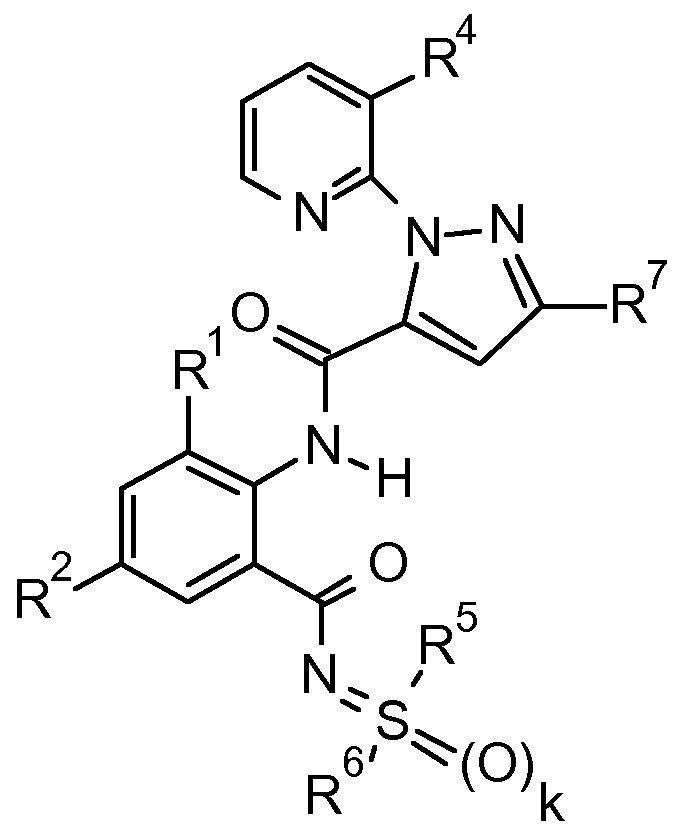
Method according to claim 1 or 2, in which the compound of formula I is a compound of formula IB:

R2 is selected from the group consisting of bromo, chloro, cyano;
R7 is selected from the group consisting of bromo, chloro, trifluoromethyl. OCHF2.
Method according to claim 1 or 2, in which the compound of formula I is a compound of formula IC:

wherein
R1 is selected from the group consisting of halogen and halomethyl;
R2 is selected from the group consisting of bromo, chloro and cyano.
Method according to claim 1 or 2, in which the compound of formula I is a compound of formula ID:

wherein
R1 is selected from the group consisting of halogen, methyl and halomethyl;
R2 is selected from the group consisting of bromo, chloro and cyano.
Method according to any of claims 1 to 5, in which in the compound of formula I
R5 and R6 are selected from methyl, ethyl, isopropyl, n-propyl, n-butyl, isobutyl, tert-butyl, cyclopropyl, cyclopropylmethyl.
Method according to any of claims 1 to 6, in which in the compound of formula I
R5 and R6 are identical.
Method according to any of claims 1 to 7, wherein the insecticide resistant insect is from the order Lepidoptera, Coleoptera or Diptera.
9. Method according to to any of claims 1 to 7, wherein the insecticide resistant insect is lected from thrips, hoppers and whitefly.
10. Method of protecting a crop of useful plants susceptible to and/or under attack by insects, which are resistant to an insecticide, which method comprises applying to said crop, treating a plant propagation material of said crop with, and/or applying to said insecticide resistant insects, a compound of formula I as defined in any of claims 1 to 7.
Method of controlling resistance to one or more insecticides in insects, which comprises alternately applying a compound of formula I as defined in any of claims 1 to 7, and the insecticide, towards which the insects are resistant, to said insects or to a crop of useful plants susceptible to and/or under attack from said insects.
12. Method according to claim 10 or 1 1 , wherein the insecticide resistant insect is from the order Lepidoptera, Coleoptera or Diptera or is selected from thrips, hoppers and whitefly.
13. Method according to any of claims 10 to 12 of protecting a crop of useful plants susceptible to and/or under attack by insects, which insects are resistant to an insecticide, and enhancing the crop, which method comprises applying to the propagation material of said crop an insecticide followed by the foliar application of a compound of the formula (I), as defined in any of claims 1 to 7, beginning with the 3-to 5-leaf crop stage.
14. Method according to any of claims 1 to 13, wherein said insect is one or more of
Tuta absoluta, Pieris rapae, Trichoplusia ni, Plutella xylostella, Spodoptera littoralis, Spodoptera frugiperda, Crocidolomia pavonana, Cnaphalocerus medinalis, Sesamia in- ferens, Chilo suppressalis, Pyrausta furnacalis, Thermesia gemmatalis, Liriomyza sp., Leptinotarsus decemlineata, Epitrix sp., Phyllotreta cruciferae, Meligethes aeneus, Hypera brunneipennis;
Nilaparvata lugens, Nephotettix virens;
Acyrthosiphum pisum, Bemisia tabaci, Bemisia argentifolii, Euschisuts heros, Nezara viridula, Piezodurus guildingi, Lygus hesperus, thrips spp., Frankliniella occidentalis;
Agriothes sp., Agrotis ypsilon, Phyllotreta spp.;
Cydia pomonella, Elasmopalpus lignosellus, Heliothis armigera, Heliothis virescens, Heliothis zea;
Agriotes lineatus, Agriotes obscurus,, Anthonomus grandis, Diabrotica longicornis, Dia- brotica semipunctata, Diabrotica 12-punctata, Diabrotica speciosa, Diabrotica virgifera, Epitrix hirtipennis, Phaedon cochlearieae, Phyllotreta striolata.
15. Method according to claim 14, wherein said insect is one or more of
Tuta absoluta, Pieris rapae, Trichoplusia ni, Plutella xylostella, Chilo suppressalis, Liriomyza sp., Leptinotarsus decemlineata, Epitrix sp., Phyllotreta cruciferae, Franklinella occidentalis, Bemisia tabaci, Bemisia argentifolii, Agrotis ypsilon.
16. Method according to claim 14, wherein said insect is one or more of Agrotis ypsilon , Heli- othis virescens, Plutella xylostella , Agriotes lineatus, Diabrotica virgifera, Hypera brun- neipennis, Leptinotarsus decemlineata, Phyllotreta striolata.
17. Method according to any of claims 1 to 16, wherein the insecticide to which the insect is resistant is selected from
a) neonicotinoids comprising acetamiprid, chlothianidin, dinotefuran, imidacloprid, niten- pyram, thiacloprid and thiamethoxam, as well as any compound having the same mode of action,
b) pyrethroids comprising acrinathrin, allethrin, d-cis-trans allethrin, d-trans allethrin, bifen- thrin, bioallethrin, bioallethrin S-cylclopentenyl, bioresmethrin, cycloprothrin, cyfluthrin, beta-cyfluthrin, cyhalothrin, lambda-cyhalothrin, gamma-cyhalothrin, cyper-methrin, al- pha-cypermethrin, beta-cypermethrin, theta-cypermethrin, zeta-cypermethrin, cyphe- nothrin, deltamethrin, empenthrin, esfenvalerate, etofenprox, fenpropathrin, fen- valerate, flucythrinate, flumethrin, tau-fluvalinate, halfenprox, imipro-thrin, meperfluth- rin,metofluthrin, permethrin, phenothrin, prallethrin, profluthrin, pyrethrin (pyrethrum), resmethrin, silafluofen, tefluthrin, tetramethylfluthrin, tetramethrin, tralomethrin and transfluthrin
c) chitin biosynthesis Inhibitors of type 0, comprising benzoylureas including bistrifluron, chlorfluazuron, diflubenzuron, flucycloxuron, flufenoxuron, hexaflumuron, lufenuron, novaluron, noviflumuron, teflubenzuron and triflumuron; and chitin biosynthesis inhibitors of type 1 , comprising buprofezin.
18. Method according to claim 17, wherein the insecticide to which the insect is resistant is imidacloprid.
19. Method according to any of claims 1 to 16, wherein the resistance is against an insecti- cidal effect which is due to a genetic modification of a plant (modified or transgenic plant), which caused a resistance of the plant or crop to certain pests, especially insect pests, in susceptible insects.
20. Method according to any of claims 1 to 19, wherein the compound of formula I is combined with one or more other pesticidally active compound(s) II selected from insecticides or fungicides.
Applications Claiming Priority (26)
| Application Number | Priority Date | Filing Date | Title |
|---|---|---|---|
| US201261708066P | 2012-10-01 | 2012-10-01 | |
| US201261708061P | 2012-10-01 | 2012-10-01 | |
| US201261708071P | 2012-10-01 | 2012-10-01 | |
| US201261708067P | 2012-10-01 | 2012-10-01 | |
| US201261708059P | 2012-10-01 | 2012-10-01 | |
| US61/708,059 | 2012-10-01 | ||
| US61/708,067 | 2012-10-01 | ||
| US61/708,071 | 2012-10-01 | ||
| US61/708,066 | 2012-10-01 | ||
| US61/708,061 | 2012-10-01 | ||
| US201261729349P | 2012-11-22 | 2012-11-22 | |
| US201361764083P | 2013-02-13 | 2013-02-13 | |
| US201361763974P | 2013-02-13 | 2013-02-13 | |
| US201361763970P | 2013-02-13 | 2013-02-13 | |
| US201361763978P | 2013-02-13 | 2013-02-13 | |
| US201361763966P | 2013-02-13 | 2013-02-13 | |
| US201361763987P | 2013-02-13 | 2013-02-13 | |
| US61/763,987 | 2013-02-13 | ||
| US61/763,966 | 2013-02-13 | ||
| US61/764,083 | 2013-02-13 | ||
| US61/763,970 | 2013-02-13 | ||
| US61/763,978 | 2013-02-13 | ||
| US61/763,974 | 2013-02-13 | ||
| US201361767831P | 2013-02-22 | 2013-02-22 | |
| US61/767,831 | 2013-02-22 | ||
| US61/729,349 | 2013-03-15 |
Publications (1)
| Publication Number | Publication Date |
|---|---|
| WO2014053403A1 true WO2014053403A1 (en) | 2014-04-10 |
Family
ID=49253308
Family Applications (1)
| Application Number | Title | Priority Date | Filing Date |
|---|---|---|---|
| PCT/EP2013/070157 Ceased WO2014053403A1 (en) | 2012-10-01 | 2013-09-27 | Method of controlling insecticide resistant insects |
Country Status (2)
| Country | Link |
|---|---|
| AR (1) | AR093771A1 (en) |
| WO (1) | WO2014053403A1 (en) |
Cited By (8)
| Publication number | Priority date | Publication date | Assignee | Title |
|---|---|---|---|---|
| WO2016034352A1 (en) * | 2014-09-02 | 2016-03-10 | Basf Se | Use of n-thio-anthranilamide compounds on cultivated plants |
| US9556141B2 (en) | 2011-11-21 | 2017-01-31 | Basf Se | Process for preparing N-substituted 1H-pyrazole-5-carboxylate compounds and derivatives thereof |
| CN107047623A (en) * | 2017-03-01 | 2017-08-18 | 华中农业大学 | A kind of casing bait formulation of energy trapping and killing termites |
| US9765052B2 (en) | 2013-02-20 | 2017-09-19 | Basf Se | Anthranilamide compounds, their mixtures and the use thereof as pesticides |
| CN113046249A (en) * | 2021-05-17 | 2021-06-29 | 福建省农业科学院植物保护研究所 | Verticillium lecanii LL-01 and biocontrol application thereof |
| CN113453540A (en) * | 2019-02-15 | 2021-09-28 | 巴斯夫农业种子解决方案美国有限责任公司 | Clubroot resistant brassica plants |
| CN113684136A (en) * | 2021-07-21 | 2021-11-23 | 华南农业大学 | Broad-spectrum insecticidal beauveria bassiana strain and application thereof |
| WO2023172464A1 (en) * | 2022-03-08 | 2023-09-14 | Fmc Corporation | Compositions comprising chloranraaniliprole and specific semochemical components |
Citations (131)
| Publication number | Priority date | Publication date | Assignee | Title |
|---|---|---|---|---|
| US3296272A (en) | 1965-04-01 | 1967-01-03 | Dow Chemical Co | Sulfinyl- and sulfonylpyridines |
| US3325503A (en) | 1965-02-18 | 1967-06-13 | Diamond Alkali Co | Polychloro derivatives of mono- and dicyano pyridines and a method for their preparation |
| EP0141317A2 (en) | 1983-10-21 | 1985-05-15 | BASF Aktiengesellschaft | 7-Amino-azolo[1,5-a]pyrimidines and fungicides containing them |
| EP0142924A2 (en) | 1983-09-26 | 1985-05-29 | Mycogen Plant Science, Inc. | Insect resistant plants |
| EP0152031A2 (en) | 1984-02-03 | 1985-08-21 | Shionogi & Co., Ltd. | Azolyl cycloalkanol derivatives and agricultural fungicides |
| EP0193259A1 (en) | 1985-01-18 | 1986-09-03 | Plant Genetic Systems N.V. | Modifying plants by genetic engineering to combat or control insects |
| EP0226917A1 (en) | 1985-12-20 | 1987-07-01 | BASF Aktiengesellschaft | Acrylic acid esters and fungicides containing these compounds |
| EP0242236A1 (en) | 1986-03-11 | 1987-10-21 | Plant Genetic Systems N.V. | Plant cells resistant to glutamine synthetase inhibitors, made by genetic engineering |
| EP0243970A1 (en) | 1986-05-02 | 1987-11-04 | Stauffer Chemical Company | Fungicidal pyridyl imidates |
| EP0256503A2 (en) | 1986-08-12 | 1988-02-24 | Mitsubishi Kasei Corporation | Pyridinecarboxamide derivatives and their use as fungicide |
| EP0257993A2 (en) | 1986-08-26 | 1988-03-02 | E.I. Du Pont De Nemours And Company | Nucleic acid fragment encoding herbicide resistant plant acetolactate synthase |
| EP0374753A2 (en) | 1988-12-19 | 1990-06-27 | American Cyanamid Company | Insecticidal toxines, genes coding therefor, antibodies binding them, transgenic plant cells and plants expressing these toxines |
| EP0392225A2 (en) | 1989-03-24 | 1990-10-17 | Ciba-Geigy Ag | Disease-resistant transgenic plants |
| US5013659A (en) | 1987-07-27 | 1991-05-07 | E. I. Du Pont De Nemours And Company | Nucleic acid fragment encoding herbicide resistant plant acetolactate synthase |
| EP0427529A1 (en) | 1989-11-07 | 1991-05-15 | Pioneer Hi-Bred International, Inc. | Larvicidal lectins and plant insect resistance based thereon |
| EP0428941A1 (en) | 1989-11-10 | 1991-05-29 | Agro-Kanesho Co., Ltd. | Hexahydrotriazine compounds and insecticides |
| US5021076A (en) | 1989-03-17 | 1991-06-04 | The United States Of America As Represented By The Secretary Of Agriculture | Enhancement of nitrogen fixation with Bradyrhizobium japonicum mutants |
| WO1991013972A1 (en) | 1990-03-16 | 1991-09-19 | Calgene, Inc. | Plant desaturases - compositions and uses |
| WO1991019806A1 (en) | 1990-06-18 | 1991-12-26 | Monsanto Company | Increased starch content in plants |
| WO1992000377A1 (en) | 1990-06-25 | 1992-01-09 | Monsanto Company | Glyphosate tolerant plants |
| WO1992011376A1 (en) | 1990-12-21 | 1992-07-09 | Amylogene Hb | Genetically engineered modification of potato to form amylopectin-type starch |
| WO1992014827A1 (en) | 1991-02-13 | 1992-09-03 | Institut Für Genbiologische Forschung Berlin Gmbh | Plasmids containing dna-sequences that cause changes in the carbohydrate concentration and the carbohydrate composition in plants, as well as plant cells and plants containing these plasmids |
| EP0532022A1 (en) | 1991-09-13 | 1993-03-17 | Ube Industries, Ltd. | Acrylate compound, preparation process thereof and fungicide using the same |
| WO1993007278A1 (en) | 1991-10-04 | 1993-04-15 | Ciba-Geigy Ag | Synthetic dna sequence having enhanced insecticidal activity in maize |
| US5403584A (en) | 1993-06-30 | 1995-04-04 | Idaho Research Foundation, Inc. | Use of Streptomyces WYEC 108 to control plant pathogens |
| WO1995034656A1 (en) | 1994-06-10 | 1995-12-21 | Ciba-Geigy Ag | Novel bacillus thuringiensis genes coding toxins active against lepidopteran pests |
| US5559024A (en) | 1988-03-23 | 1996-09-24 | Rhone-Poulenc Agrochimie | Chimeric nitrilase-encoding gene for herbicidal resistance |
| WO1997041218A1 (en) | 1996-04-29 | 1997-11-06 | Board Of Supervisors Of Louisiana State University And Agricultural And Mechanical College | Herbicide resistant rice |
| WO1998002526A1 (en) | 1996-07-17 | 1998-01-22 | Michigan State University | Imidazolinone herbicide resistant sugar beet plants |
| WO1998002527A1 (en) | 1996-07-17 | 1998-01-22 | Michigan State University | Imidazolinone herbicide resistant sugar beet plants |
| DE19650197A1 (en) | 1996-12-04 | 1998-06-10 | Bayer Ag | 3-thiocarbamoylpyrazole derivatives |
| WO1998046608A1 (en) | 1997-04-14 | 1998-10-22 | American Cyanamid Company | Fungicidal trifluoromethylalkylamino-triazolopyrimidines |
| WO1999014187A1 (en) | 1997-09-18 | 1999-03-25 | Basf Aktiengesellschaft | Benzamidoxim derivatives, intermediate products and methods for preparing and using them as fungicides |
| WO1999024413A2 (en) | 1997-11-12 | 1999-05-20 | Bayer Aktiengesellschaft | Isothiazole carboxylic acid amides and the application thereof in order to protect plants |
| WO1999027783A1 (en) | 1997-12-04 | 1999-06-10 | Dow Agrosciences Llc | Fungicidal compositions and methods, and compounds and methods for the preparation thereof |
| US5968503A (en) | 1993-06-30 | 1999-10-19 | Idaho Research Foundation, Inc. | Use of streptomyces bacteria to control plant pathogens and degrade turf thatch |
| WO2000026390A2 (en) | 1998-10-29 | 2000-05-11 | American Cyanamid Company | Genes and vectors for conferring herbicide resistance in plants |
| WO2000029404A1 (en) | 1998-11-17 | 2000-05-25 | Kumiai Chemical Industry Co., Ltd. | Pyrimidinylbenzimidazole and triazinylbenzimidazole derivatives and agricultura/horticultural bactericides |
| WO2000046148A1 (en) | 1999-02-02 | 2000-08-10 | Sintokogio, Ltd. | Silica gel carrying titanium oxide photocatalyst in high concentration and method for preparation thereof |
| EP1028125A1 (en) | 1998-11-30 | 2000-08-16 | Isagro Ricerca S.r.l. | Dipeptide compounds having fungicidal activity and their agronomic use |
| EP1035122A1 (en) | 1999-03-11 | 2000-09-13 | Rohm And Haas Company | Heterocyclic subsituted isoxazolidines and their use as fungicides |
| WO2000065913A1 (en) | 1999-04-28 | 2000-11-09 | Takeda Chemical Industries, Ltd. | Sulfonamide derivatives |
| US6222100B1 (en) | 1984-03-06 | 2001-04-24 | Mgi Pharma, Inc. | Herbicide resistance in plants |
| DE10021412A1 (en) | 1999-12-13 | 2001-06-21 | Bayer Ag | Fungicidal active ingredient combinations |
| WO2001054501A2 (en) | 2000-01-25 | 2001-08-02 | Syngenta Participations Ag | Herbicidal composition |
| EP1122244A1 (en) | 2000-02-04 | 2001-08-08 | Sumitomo Chemical Company, Limited | Uracil compounds and their use |
| WO2001056358A2 (en) | 2000-01-28 | 2001-08-09 | Rohm And Haas Company | Enhanced propertied pesticides |
| WO2001082685A1 (en) | 2000-04-28 | 2001-11-08 | Basf Aktiengesellschaft | Use of the maize x112 mutant ahas 2 gene and imidazolinone herbicides for selection of transgenic monocots, maize, rice and wheat plants resistant to the imidazolinone herbicides |
| WO2002015701A2 (en) | 2000-08-25 | 2002-02-28 | Syngenta Participations Ag | Bacillus thuringiensis crystal protein hybrids |
| US20020031495A1 (en) | 1998-04-29 | 2002-03-14 | Esperanza Morales | Pesticidally active isolate of beauveria bassiana, methods of preparing and using same for pest control in agriculture |
| WO2002022583A2 (en) | 2000-09-18 | 2002-03-21 | E. I. Du Pont De Nemours And Company | Pyridinyl amides and imides for use as fungicides |
| EP1201648A1 (en) | 1999-08-05 | 2002-05-02 | Kumiai Chemical Industry Co., Ltd. | Carbamate derivatives and agricultural/horticultural bactericides |
| WO2002040431A2 (en) | 2000-11-17 | 2002-05-23 | Dow Agrosciences Llc | Compounds having fungicidal activity and processes to make and use same |
| JP2002316902A (en) | 2001-04-20 | 2002-10-31 | Sumitomo Chem Co Ltd | Plant disease control agent composition |
| WO2003010149A1 (en) | 2001-07-25 | 2003-02-06 | Bayer Cropscience Ag | Pyrazolylcarboxanilides as fungicides |
| WO2003011853A1 (en) | 2001-07-30 | 2003-02-13 | Dow Agrosciences Llc | 6-aryl-4-aminopicolinates and their use as herbicides |
| WO2003014356A1 (en) | 2001-08-09 | 2003-02-20 | University Of Saskatchewan | Wheat plants having increased resistance to imidazolinone herbicides |
| WO2003014103A1 (en) | 2001-08-03 | 2003-02-20 | Bayer Cropscience S.A. | Iodobenzopyran-4-one derivatives having fungicidal activity |
| WO2003014357A1 (en) | 2001-08-09 | 2003-02-20 | University Of Saskatchewan | Wheat plants having increased resistance to imidazolinone herbicides |
| WO2003013225A2 (en) | 2001-08-09 | 2003-02-20 | Northwest Plant Breeding Company | Wheat plants having increased resistance to imidazolinone herbicides |
| WO2003016286A1 (en) | 2001-08-17 | 2003-02-27 | Sankyo Agro Company, Limited | 3-phenoxy-4-pyridazinol derivative and herbicide composition containing the same |
| WO2003018810A2 (en) | 2001-08-31 | 2003-03-06 | Syngenta Participations Ag | Modified cry3a toxins and nucleic acid sequences coding therefor |
| WO2003052073A2 (en) | 2001-12-17 | 2003-06-26 | Syngenta Participations Ag | Novel corn event |
| WO2003053145A1 (en) | 2001-12-21 | 2003-07-03 | Nissan Chemical Industries, Ltd. | Bactericidal composition |
| WO2003061388A1 (en) | 2002-01-18 | 2003-07-31 | Sumitomo Chemical Takeda Agro Company, Limited | Fused heterocyclic sulfonylurea compound, herbicide containing the same, and method of controlling weed with the same |
| WO2003066609A1 (en) | 2002-02-04 | 2003-08-14 | Bayer Cropscience Aktiengesellschaft | Disubstituted thiazolyl carboxanilides and their use as microbicides |
| WO2003074491A1 (en) | 2002-03-05 | 2003-09-12 | Syngenta Participations Ag | O-cyclopropyl-carboxanilides and their use as fungicides |
| WO2004016073A2 (en) | 2002-07-10 | 2004-02-26 | The Department Of Agriculture, Western Australia | Wheat plants having increased resistance to imidazolinone herbicides |
| WO2004049804A2 (en) | 2002-11-29 | 2004-06-17 | Syngenta Participations Ag | Fungicidal combinations for crop potection |
| WO2004067528A1 (en) | 2003-01-28 | 2004-08-12 | E.I. Du Pont De Nemours And Company | Cyano anthranilamide insecticides |
| WO2004083193A1 (en) | 2003-03-17 | 2004-09-30 | Sumitomo Chemical Company, Limited | Amide compound and bactericide composition containing the same |
| WO2004106529A2 (en) | 2003-05-28 | 2004-12-09 | Basf Aktiengesellschaft | Wheat plants having increased tolerance to imidazolinone herbicides |
| WO2005020673A1 (en) | 2003-08-29 | 2005-03-10 | Instituto Nacional De Technologia Agropecuaria | Rice plants having increased tolerance to imidazolinone herbicides |
| US6908945B2 (en) | 2002-04-12 | 2005-06-21 | Sumitomo Chemical Company, Limited | Ester compound and its use |
| WO2005063721A1 (en) | 2003-12-19 | 2005-07-14 | E.I. Dupont De Nemours And Company | Herbicidal pyrimidines |
| WO2005077934A1 (en) | 2004-02-18 | 2005-08-25 | Ishihara Sangyo Kaisha, Ltd. | Anthranilamides, process for the production thereof, and pest controllers containing the same |
| WO2005085216A1 (en) | 2004-03-05 | 2005-09-15 | Nissan Chemical Industries, Ltd. | Isoxazoline-substituted benzamide compound and noxious organism control agent |
| WO2005087772A1 (en) | 2004-03-10 | 2005-09-22 | Basf Aktiengesellschaft | 5,6-dialkyl-7-amino-triazolopyrimidines, method for their production, their use for controlling pathogenic fungi and agents containing said compounds |
| WO2005087773A1 (en) | 2004-03-10 | 2005-09-22 | Basf Aktiengesellschaft | 5,6-dialkyl-7-amino-triazolopyrimidines, method for their production, their use for controlling pathogenic fungi and agents containing said compounds |
| WO2005120234A2 (en) | 2004-06-03 | 2005-12-22 | E.I. Dupont De Nemours And Company | Fungicidal mixtures of amidinylphenyl compounds |
| WO2005123690A1 (en) | 2004-06-18 | 2005-12-29 | Basf Aktiengesellschaft | 1-methyl-3-difluoromethyl-pyrazol-4-carbonic acid-(ortho-phenyl)-anilides, and use thereof as a fungicide |
| WO2005123689A1 (en) | 2004-06-18 | 2005-12-29 | Basf Aktiengesellschaft | 1-methyl-3-trifluoromethyl-pyrazole-4-carboxylic acid (ortho-phenyl)-anilides and to use thereof as fungicide |
| WO2006013896A1 (en) | 2004-08-04 | 2006-02-09 | Meiji Seika Kaisha, Ltd. | Quinoline derivative and insecticide containing same as active constituent |
| WO2006015866A1 (en) | 2004-08-12 | 2006-02-16 | Syngenta Participations Ag | Method for protecting useful plants or plant propagation material |
| WO2006043635A1 (en) | 2004-10-20 | 2006-04-27 | Kumiai Chemical Industry Co., Ltd. | 3-triazolylphenyl sulfide derivative and insecticide/acaricide/nematicide containing the same as active ingredient |
| WO2006087325A1 (en) | 2005-02-16 | 2006-08-24 | Basf Aktiengesellschaft | 5-alkoxyalkyl-6-alkyl-7-amino-azolopyrimidines, method for their production, their use for controlling pathogenic fungi and agents containing said substances |
| WO2006087343A1 (en) | 2005-02-16 | 2006-08-24 | Basf Aktiengesellschaft | Pyrazole carboxylic acid anilides, method for the production thereof and agents containing them for controlling pathogenic fungi |
| WO2006089633A2 (en) | 2005-02-22 | 2006-08-31 | Bayer Cropscience Ag | Spiroketal-substituted cyclic ketoenols |
| DE102005009458A1 (en) | 2005-03-02 | 2006-09-07 | Bayer Cropscience Ag | pyrazolylcarboxanilides |
| WO2006129714A1 (en) | 2005-06-01 | 2006-12-07 | Meiji Seika Kaisha, Ltd. | Pest control agent |
| WO2007006670A1 (en) | 2005-07-07 | 2007-01-18 | Basf Aktiengesellschaft | N-thio-anthranilamid compounds and their use as pesticides |
| WO2007020986A1 (en) | 2005-08-12 | 2007-02-22 | Nihon Nohyaku Co., Ltd. | Substituted pyrazolecarboxylic acid anilide derivative or salt thereof, intermediate thereof, agent for agricultural and horticultural use, and use thereof |
| WO2007024833A1 (en) | 2005-08-24 | 2007-03-01 | E. I. Du Pont De Nemours And Company | Anthranilamides for controlling invertebrate pests |
| WO2007043677A1 (en) | 2005-10-14 | 2007-04-19 | Sumitomo Chemical Company, Limited | Hydrazide compound and pesticidal use of the same |
| WO2007082098A2 (en) | 2006-01-13 | 2007-07-19 | Dow Agrosciences Llc | 6-(poly-substituted aryl)-4-aminopicolinates and their use as herbicides |
| WO2007090624A2 (en) | 2006-02-09 | 2007-08-16 | Syngenta Participations Ag | A method of protecting a plant propagation material, a plant, and/or plant organs |
| US7262151B2 (en) | 2001-07-06 | 2007-08-28 | Mcgill University | Methods and compositions for production of lipo-chito oligosaccharides by rhizobacteria |
| WO2007101540A1 (en) | 2006-03-06 | 2007-09-13 | Bayer Cropscience Ag | Combinations of active ingredients with insecticidal properties |
| WO2007115644A1 (en) | 2006-03-31 | 2007-10-18 | Bayer Cropscience Ag | Substituted enaminocarbonyl compounds |
| WO2007149134A1 (en) | 2006-06-23 | 2007-12-27 | Dow Agrosciences Llc | A method to control insects resistant to common insecticides |
| WO2008002371A1 (en) | 2006-06-23 | 2008-01-03 | Becker Underwood Inc. | Improved shelf life and on seed stabilization of liquid bacterium inoculants |
| WO2008067911A1 (en) | 2006-12-04 | 2008-06-12 | Bayer Cropscience Ag | Biphenyl-substituted spirocyclic ketoenols |
| WO2008134969A1 (en) | 2007-04-30 | 2008-11-13 | Sinochem Corporation | Benzamide compounds and applications thereof |
| WO2009002809A2 (en) | 2007-06-26 | 2008-12-31 | E. I. Du Pont De Nemours And Company | Naphthalene isoxazoline invertebrate pest control agents |
| WO2009124707A2 (en) | 2008-04-07 | 2009-10-15 | Bayer Cropscience Ag | Combinations of biological control agents and insecticides or fungicides |
| CN101715774A (en) | 2008-10-09 | 2010-06-02 | 浙江化工科技集团有限公司 | Preparation and use of compound having insecticidal activity |
| WO2010060379A1 (en) | 2008-11-28 | 2010-06-03 | 中国中化集团公司 | Ether compounds with nitrogen-containing 5-member heterocycle and the uses thereof |
| WO2010069266A1 (en) | 2008-12-19 | 2010-06-24 | 华东理工大学 | Heterocyclic nitrogenous or oxygenous compounds with insecticidal activity formed from dialdehydes and their preparation and uses thereof |
| US20100260735A1 (en) | 2009-04-13 | 2010-10-14 | University of Delawre | Methods for promoting plant health |
| WO2011006946A2 (en) | 2009-07-15 | 2011-01-20 | Basf Se | Polymeric hair dyes |
| US20110046186A1 (en) | 2008-07-07 | 2011-02-24 | Bin Li | 1-Substituted Pyridyl-Pyrazolyl Amide Compounds and Uses Thereof |
| WO2011022809A1 (en) | 2009-08-28 | 2011-03-03 | University Of Saskatchewan | Fusarium and fusarium mycotoxin biocontrol |
| WO2011028657A1 (en) | 2009-09-01 | 2011-03-10 | Dow Agrosciences Llc | Synergistic fungicidal compositions containing a 5-fluoropyrimidine derivative for fungal control in cereals |
| WO2011085575A1 (en) | 2010-01-15 | 2011-07-21 | 江苏省农药研究所股份有限公司 | Ortho-heterocyclyl formanilide compounds, their synthesis methods and use |
| WO2011109395A2 (en) | 2010-03-01 | 2011-09-09 | University Of Delaware | Compositions and methods for increasing biomass, iron concentration, and tolerance to pathogens in plants |
| WO2011149749A1 (en) | 2010-05-27 | 2011-12-01 | E.I. Du Pont De Nemours And Company | Crystalline form of 4- [5 - [3 -chloro-5 - (trifluoromethyl) phenyl] -4, 5 - dihydro - 5 - (trifluoromethyl) -3 - isoxazolyl] -n- [2-0x0-2- [ ( 2, 2, 2 - trifluoroethyl) amino] ethyl] -1- naphthalenecarboxamide |
| WO2011151249A2 (en) | 2010-05-31 | 2011-12-08 | Syngenta Participations Ag | Method of controlling neonicotinoid resistant hemiptera |
| WO2012029672A1 (en) | 2010-08-31 | 2012-03-08 | Meiji Seikaファルマ株式会社 | Noxious organism control agent |
| WO2012034403A1 (en) | 2010-09-14 | 2012-03-22 | 中化蓝天集团有限公司 | Fluoromethoxypyrazole anthranilamide compounds, synthesization methods and uses thereof |
| WO2012079073A1 (en) | 2010-12-10 | 2012-06-14 | Auburn University | Inoculants including bacillus bacteria for inducing production of volatile organic compounds in plants |
| WO2012092115A1 (en) | 2010-12-29 | 2012-07-05 | E. I. Du Pont De Nemours And Company | Mesoionic pyrido [1,2 -a] pyrimidine pesticides |
| CN102613183A (en) | 2012-03-07 | 2012-08-01 | 中化蓝天集团有限公司 | Insecticide |
| US20120252672A1 (en) | 2011-03-31 | 2012-10-04 | Novozymes Biologicals, Inc. | Competitive and Effective Bacterial Strains |
| WO2013003977A1 (en) | 2011-07-01 | 2013-01-10 | 合肥星宇化学有限责任公司 | Compound of 2,5-disubstituted-3-nitroimino-1,2,4-triazoline and preparation method and use as pesticide thereof |
| WO2013024010A1 (en) * | 2011-08-12 | 2013-02-21 | Basf Se | N-thio-anthranilamide compounds and their use as pesticides |
| WO2013024008A1 (en) * | 2011-08-12 | 2013-02-21 | Basf Se | Aniline type compounds |
| WO2013024009A1 (en) * | 2011-08-12 | 2013-02-21 | Basf Se | N-thio-anthranilamide compounds and their use as pesticides |
| WO2013050317A1 (en) | 2011-10-03 | 2013-04-11 | Syngenta Limited | Polymorphs of an isoxazoline derivative |
| WO2013055584A1 (en) | 2011-10-13 | 2013-04-18 | E. I. Du Pont De Nemours And Company | Solid forms of nematocidal sulfonamides |
| WO2013092868A1 (en) * | 2011-12-21 | 2013-06-27 | Basf Se | N-thio-anthranilamide compounds and their use as pesticides |
| WO2013113789A1 (en) * | 2012-02-02 | 2013-08-08 | Basf Se | N-thio-anthranilamide compounds and their use as pesticides |
-
2013
- 2013-09-27 WO PCT/EP2013/070157 patent/WO2014053403A1/en not_active Ceased
- 2013-09-27 AR ARP130103518A patent/AR093771A1/en unknown
Patent Citations (134)
| Publication number | Priority date | Publication date | Assignee | Title |
|---|---|---|---|---|
| US3325503A (en) | 1965-02-18 | 1967-06-13 | Diamond Alkali Co | Polychloro derivatives of mono- and dicyano pyridines and a method for their preparation |
| US3296272A (en) | 1965-04-01 | 1967-01-03 | Dow Chemical Co | Sulfinyl- and sulfonylpyridines |
| EP0142924A2 (en) | 1983-09-26 | 1985-05-29 | Mycogen Plant Science, Inc. | Insect resistant plants |
| EP0141317A2 (en) | 1983-10-21 | 1985-05-15 | BASF Aktiengesellschaft | 7-Amino-azolo[1,5-a]pyrimidines and fungicides containing them |
| EP0152031A2 (en) | 1984-02-03 | 1985-08-21 | Shionogi & Co., Ltd. | Azolyl cycloalkanol derivatives and agricultural fungicides |
| US6222100B1 (en) | 1984-03-06 | 2001-04-24 | Mgi Pharma, Inc. | Herbicide resistance in plants |
| EP0193259A1 (en) | 1985-01-18 | 1986-09-03 | Plant Genetic Systems N.V. | Modifying plants by genetic engineering to combat or control insects |
| EP0451878A1 (en) | 1985-01-18 | 1991-10-16 | Plant Genetic Systems, N.V. | Modifying plants by genetic engineering to combat or control insects |
| EP0226917A1 (en) | 1985-12-20 | 1987-07-01 | BASF Aktiengesellschaft | Acrylic acid esters and fungicides containing these compounds |
| EP0242236A1 (en) | 1986-03-11 | 1987-10-21 | Plant Genetic Systems N.V. | Plant cells resistant to glutamine synthetase inhibitors, made by genetic engineering |
| EP0242246A1 (en) | 1986-03-11 | 1987-10-21 | Plant Genetic Systems N.V. | Plant cells resistant to glutamine synthetase inhibitors, made by genetic engineering |
| EP0243970A1 (en) | 1986-05-02 | 1987-11-04 | Stauffer Chemical Company | Fungicidal pyridyl imidates |
| EP0256503A2 (en) | 1986-08-12 | 1988-02-24 | Mitsubishi Kasei Corporation | Pyridinecarboxamide derivatives and their use as fungicide |
| EP0257993A2 (en) | 1986-08-26 | 1988-03-02 | E.I. Du Pont De Nemours And Company | Nucleic acid fragment encoding herbicide resistant plant acetolactate synthase |
| US5013659A (en) | 1987-07-27 | 1991-05-07 | E. I. Du Pont De Nemours And Company | Nucleic acid fragment encoding herbicide resistant plant acetolactate synthase |
| US5559024A (en) | 1988-03-23 | 1996-09-24 | Rhone-Poulenc Agrochimie | Chimeric nitrilase-encoding gene for herbicidal resistance |
| EP0374753A2 (en) | 1988-12-19 | 1990-06-27 | American Cyanamid Company | Insecticidal toxines, genes coding therefor, antibodies binding them, transgenic plant cells and plants expressing these toxines |
| US5021076A (en) | 1989-03-17 | 1991-06-04 | The United States Of America As Represented By The Secretary Of Agriculture | Enhancement of nitrogen fixation with Bradyrhizobium japonicum mutants |
| EP0392225A2 (en) | 1989-03-24 | 1990-10-17 | Ciba-Geigy Ag | Disease-resistant transgenic plants |
| EP0427529A1 (en) | 1989-11-07 | 1991-05-15 | Pioneer Hi-Bred International, Inc. | Larvicidal lectins and plant insect resistance based thereon |
| EP0428941A1 (en) | 1989-11-10 | 1991-05-29 | Agro-Kanesho Co., Ltd. | Hexahydrotriazine compounds and insecticides |
| WO1991013972A1 (en) | 1990-03-16 | 1991-09-19 | Calgene, Inc. | Plant desaturases - compositions and uses |
| WO1991019806A1 (en) | 1990-06-18 | 1991-12-26 | Monsanto Company | Increased starch content in plants |
| WO1992000377A1 (en) | 1990-06-25 | 1992-01-09 | Monsanto Company | Glyphosate tolerant plants |
| WO1992011376A1 (en) | 1990-12-21 | 1992-07-09 | Amylogene Hb | Genetically engineered modification of potato to form amylopectin-type starch |
| WO1992014827A1 (en) | 1991-02-13 | 1992-09-03 | Institut Für Genbiologische Forschung Berlin Gmbh | Plasmids containing dna-sequences that cause changes in the carbohydrate concentration and the carbohydrate composition in plants, as well as plant cells and plants containing these plasmids |
| EP0532022A1 (en) | 1991-09-13 | 1993-03-17 | Ube Industries, Ltd. | Acrylate compound, preparation process thereof and fungicide using the same |
| WO1993007278A1 (en) | 1991-10-04 | 1993-04-15 | Ciba-Geigy Ag | Synthetic dna sequence having enhanced insecticidal activity in maize |
| US5403584A (en) | 1993-06-30 | 1995-04-04 | Idaho Research Foundation, Inc. | Use of Streptomyces WYEC 108 to control plant pathogens |
| US5968503A (en) | 1993-06-30 | 1999-10-19 | Idaho Research Foundation, Inc. | Use of streptomyces bacteria to control plant pathogens and degrade turf thatch |
| WO1995034656A1 (en) | 1994-06-10 | 1995-12-21 | Ciba-Geigy Ag | Novel bacillus thuringiensis genes coding toxins active against lepidopteran pests |
| WO1997041218A1 (en) | 1996-04-29 | 1997-11-06 | Board Of Supervisors Of Louisiana State University And Agricultural And Mechanical College | Herbicide resistant rice |
| WO1998002526A1 (en) | 1996-07-17 | 1998-01-22 | Michigan State University | Imidazolinone herbicide resistant sugar beet plants |
| WO1998002527A1 (en) | 1996-07-17 | 1998-01-22 | Michigan State University | Imidazolinone herbicide resistant sugar beet plants |
| DE19650197A1 (en) | 1996-12-04 | 1998-06-10 | Bayer Ag | 3-thiocarbamoylpyrazole derivatives |
| WO1998046608A1 (en) | 1997-04-14 | 1998-10-22 | American Cyanamid Company | Fungicidal trifluoromethylalkylamino-triazolopyrimidines |
| WO1999014187A1 (en) | 1997-09-18 | 1999-03-25 | Basf Aktiengesellschaft | Benzamidoxim derivatives, intermediate products and methods for preparing and using them as fungicides |
| WO1999024413A2 (en) | 1997-11-12 | 1999-05-20 | Bayer Aktiengesellschaft | Isothiazole carboxylic acid amides and the application thereof in order to protect plants |
| WO1999027783A1 (en) | 1997-12-04 | 1999-06-10 | Dow Agrosciences Llc | Fungicidal compositions and methods, and compounds and methods for the preparation thereof |
| US20020031495A1 (en) | 1998-04-29 | 2002-03-14 | Esperanza Morales | Pesticidally active isolate of beauveria bassiana, methods of preparing and using same for pest control in agriculture |
| WO2000026390A2 (en) | 1998-10-29 | 2000-05-11 | American Cyanamid Company | Genes and vectors for conferring herbicide resistance in plants |
| WO2000029404A1 (en) | 1998-11-17 | 2000-05-25 | Kumiai Chemical Industry Co., Ltd. | Pyrimidinylbenzimidazole and triazinylbenzimidazole derivatives and agricultura/horticultural bactericides |
| EP1028125A1 (en) | 1998-11-30 | 2000-08-16 | Isagro Ricerca S.r.l. | Dipeptide compounds having fungicidal activity and their agronomic use |
| WO2000046148A1 (en) | 1999-02-02 | 2000-08-10 | Sintokogio, Ltd. | Silica gel carrying titanium oxide photocatalyst in high concentration and method for preparation thereof |
| EP1035122A1 (en) | 1999-03-11 | 2000-09-13 | Rohm And Haas Company | Heterocyclic subsituted isoxazolidines and their use as fungicides |
| WO2000065913A1 (en) | 1999-04-28 | 2000-11-09 | Takeda Chemical Industries, Ltd. | Sulfonamide derivatives |
| EP1201648A1 (en) | 1999-08-05 | 2002-05-02 | Kumiai Chemical Industry Co., Ltd. | Carbamate derivatives and agricultural/horticultural bactericides |
| DE10021412A1 (en) | 1999-12-13 | 2001-06-21 | Bayer Ag | Fungicidal active ingredient combinations |
| WO2001054501A2 (en) | 2000-01-25 | 2001-08-02 | Syngenta Participations Ag | Herbicidal composition |
| WO2001056358A2 (en) | 2000-01-28 | 2001-08-09 | Rohm And Haas Company | Enhanced propertied pesticides |
| EP1122244A1 (en) | 2000-02-04 | 2001-08-08 | Sumitomo Chemical Company, Limited | Uracil compounds and their use |
| WO2001082685A1 (en) | 2000-04-28 | 2001-11-08 | Basf Aktiengesellschaft | Use of the maize x112 mutant ahas 2 gene and imidazolinone herbicides for selection of transgenic monocots, maize, rice and wheat plants resistant to the imidazolinone herbicides |
| WO2002015701A2 (en) | 2000-08-25 | 2002-02-28 | Syngenta Participations Ag | Bacillus thuringiensis crystal protein hybrids |
| WO2002022583A2 (en) | 2000-09-18 | 2002-03-21 | E. I. Du Pont De Nemours And Company | Pyridinyl amides and imides for use as fungicides |
| WO2002040431A2 (en) | 2000-11-17 | 2002-05-23 | Dow Agrosciences Llc | Compounds having fungicidal activity and processes to make and use same |
| JP2002316902A (en) | 2001-04-20 | 2002-10-31 | Sumitomo Chem Co Ltd | Plant disease control agent composition |
| US7262151B2 (en) | 2001-07-06 | 2007-08-28 | Mcgill University | Methods and compositions for production of lipo-chito oligosaccharides by rhizobacteria |
| WO2003010149A1 (en) | 2001-07-25 | 2003-02-06 | Bayer Cropscience Ag | Pyrazolylcarboxanilides as fungicides |
| WO2003011853A1 (en) | 2001-07-30 | 2003-02-13 | Dow Agrosciences Llc | 6-aryl-4-aminopicolinates and their use as herbicides |
| WO2003014103A1 (en) | 2001-08-03 | 2003-02-20 | Bayer Cropscience S.A. | Iodobenzopyran-4-one derivatives having fungicidal activity |
| WO2003014356A1 (en) | 2001-08-09 | 2003-02-20 | University Of Saskatchewan | Wheat plants having increased resistance to imidazolinone herbicides |
| WO2003014357A1 (en) | 2001-08-09 | 2003-02-20 | University Of Saskatchewan | Wheat plants having increased resistance to imidazolinone herbicides |
| WO2003013225A2 (en) | 2001-08-09 | 2003-02-20 | Northwest Plant Breeding Company | Wheat plants having increased resistance to imidazolinone herbicides |
| WO2003016286A1 (en) | 2001-08-17 | 2003-02-27 | Sankyo Agro Company, Limited | 3-phenoxy-4-pyridazinol derivative and herbicide composition containing the same |
| WO2003018810A2 (en) | 2001-08-31 | 2003-03-06 | Syngenta Participations Ag | Modified cry3a toxins and nucleic acid sequences coding therefor |
| WO2003052073A2 (en) | 2001-12-17 | 2003-06-26 | Syngenta Participations Ag | Novel corn event |
| WO2003053145A1 (en) | 2001-12-21 | 2003-07-03 | Nissan Chemical Industries, Ltd. | Bactericidal composition |
| WO2003061388A1 (en) | 2002-01-18 | 2003-07-31 | Sumitomo Chemical Takeda Agro Company, Limited | Fused heterocyclic sulfonylurea compound, herbicide containing the same, and method of controlling weed with the same |
| WO2003066609A1 (en) | 2002-02-04 | 2003-08-14 | Bayer Cropscience Aktiengesellschaft | Disubstituted thiazolyl carboxanilides and their use as microbicides |
| WO2003074491A1 (en) | 2002-03-05 | 2003-09-12 | Syngenta Participations Ag | O-cyclopropyl-carboxanilides and their use as fungicides |
| US6908945B2 (en) | 2002-04-12 | 2005-06-21 | Sumitomo Chemical Company, Limited | Ester compound and its use |
| WO2004016073A2 (en) | 2002-07-10 | 2004-02-26 | The Department Of Agriculture, Western Australia | Wheat plants having increased resistance to imidazolinone herbicides |
| WO2004049804A2 (en) | 2002-11-29 | 2004-06-17 | Syngenta Participations Ag | Fungicidal combinations for crop potection |
| WO2004067528A1 (en) | 2003-01-28 | 2004-08-12 | E.I. Du Pont De Nemours And Company | Cyano anthranilamide insecticides |
| WO2004083193A1 (en) | 2003-03-17 | 2004-09-30 | Sumitomo Chemical Company, Limited | Amide compound and bactericide composition containing the same |
| WO2004106529A2 (en) | 2003-05-28 | 2004-12-09 | Basf Aktiengesellschaft | Wheat plants having increased tolerance to imidazolinone herbicides |
| WO2005020673A1 (en) | 2003-08-29 | 2005-03-10 | Instituto Nacional De Technologia Agropecuaria | Rice plants having increased tolerance to imidazolinone herbicides |
| WO2005063721A1 (en) | 2003-12-19 | 2005-07-14 | E.I. Dupont De Nemours And Company | Herbicidal pyrimidines |
| WO2005077934A1 (en) | 2004-02-18 | 2005-08-25 | Ishihara Sangyo Kaisha, Ltd. | Anthranilamides, process for the production thereof, and pest controllers containing the same |
| WO2005085216A1 (en) | 2004-03-05 | 2005-09-15 | Nissan Chemical Industries, Ltd. | Isoxazoline-substituted benzamide compound and noxious organism control agent |
| WO2005087772A1 (en) | 2004-03-10 | 2005-09-22 | Basf Aktiengesellschaft | 5,6-dialkyl-7-amino-triazolopyrimidines, method for their production, their use for controlling pathogenic fungi and agents containing said compounds |
| WO2005087773A1 (en) | 2004-03-10 | 2005-09-22 | Basf Aktiengesellschaft | 5,6-dialkyl-7-amino-triazolopyrimidines, method for their production, their use for controlling pathogenic fungi and agents containing said compounds |
| WO2005120234A2 (en) | 2004-06-03 | 2005-12-22 | E.I. Dupont De Nemours And Company | Fungicidal mixtures of amidinylphenyl compounds |
| WO2005123690A1 (en) | 2004-06-18 | 2005-12-29 | Basf Aktiengesellschaft | 1-methyl-3-difluoromethyl-pyrazol-4-carbonic acid-(ortho-phenyl)-anilides, and use thereof as a fungicide |
| WO2005123689A1 (en) | 2004-06-18 | 2005-12-29 | Basf Aktiengesellschaft | 1-methyl-3-trifluoromethyl-pyrazole-4-carboxylic acid (ortho-phenyl)-anilides and to use thereof as fungicide |
| WO2006013896A1 (en) | 2004-08-04 | 2006-02-09 | Meiji Seika Kaisha, Ltd. | Quinoline derivative and insecticide containing same as active constituent |
| WO2006015866A1 (en) | 2004-08-12 | 2006-02-16 | Syngenta Participations Ag | Method for protecting useful plants or plant propagation material |
| WO2006043635A1 (en) | 2004-10-20 | 2006-04-27 | Kumiai Chemical Industry Co., Ltd. | 3-triazolylphenyl sulfide derivative and insecticide/acaricide/nematicide containing the same as active ingredient |
| WO2006087325A1 (en) | 2005-02-16 | 2006-08-24 | Basf Aktiengesellschaft | 5-alkoxyalkyl-6-alkyl-7-amino-azolopyrimidines, method for their production, their use for controlling pathogenic fungi and agents containing said substances |
| WO2006087343A1 (en) | 2005-02-16 | 2006-08-24 | Basf Aktiengesellschaft | Pyrazole carboxylic acid anilides, method for the production thereof and agents containing them for controlling pathogenic fungi |
| WO2006089633A2 (en) | 2005-02-22 | 2006-08-31 | Bayer Cropscience Ag | Spiroketal-substituted cyclic ketoenols |
| DE102005009458A1 (en) | 2005-03-02 | 2006-09-07 | Bayer Cropscience Ag | pyrazolylcarboxanilides |
| WO2006129714A1 (en) | 2005-06-01 | 2006-12-07 | Meiji Seika Kaisha, Ltd. | Pest control agent |
| WO2007006670A1 (en) | 2005-07-07 | 2007-01-18 | Basf Aktiengesellschaft | N-thio-anthranilamid compounds and their use as pesticides |
| WO2007020986A1 (en) | 2005-08-12 | 2007-02-22 | Nihon Nohyaku Co., Ltd. | Substituted pyrazolecarboxylic acid anilide derivative or salt thereof, intermediate thereof, agent for agricultural and horticultural use, and use thereof |
| WO2007024833A1 (en) | 2005-08-24 | 2007-03-01 | E. I. Du Pont De Nemours And Company | Anthranilamides for controlling invertebrate pests |
| WO2007043677A1 (en) | 2005-10-14 | 2007-04-19 | Sumitomo Chemical Company, Limited | Hydrazide compound and pesticidal use of the same |
| WO2007082098A2 (en) | 2006-01-13 | 2007-07-19 | Dow Agrosciences Llc | 6-(poly-substituted aryl)-4-aminopicolinates and their use as herbicides |
| WO2007090624A2 (en) | 2006-02-09 | 2007-08-16 | Syngenta Participations Ag | A method of protecting a plant propagation material, a plant, and/or plant organs |
| WO2007101540A1 (en) | 2006-03-06 | 2007-09-13 | Bayer Cropscience Ag | Combinations of active ingredients with insecticidal properties |
| WO2007115644A1 (en) | 2006-03-31 | 2007-10-18 | Bayer Cropscience Ag | Substituted enaminocarbonyl compounds |
| WO2007149134A1 (en) | 2006-06-23 | 2007-12-27 | Dow Agrosciences Llc | A method to control insects resistant to common insecticides |
| WO2008002371A1 (en) | 2006-06-23 | 2008-01-03 | Becker Underwood Inc. | Improved shelf life and on seed stabilization of liquid bacterium inoculants |
| WO2008067911A1 (en) | 2006-12-04 | 2008-06-12 | Bayer Cropscience Ag | Biphenyl-substituted spirocyclic ketoenols |
| WO2008134969A1 (en) | 2007-04-30 | 2008-11-13 | Sinochem Corporation | Benzamide compounds and applications thereof |
| WO2009002809A2 (en) | 2007-06-26 | 2008-12-31 | E. I. Du Pont De Nemours And Company | Naphthalene isoxazoline invertebrate pest control agents |
| WO2009124707A2 (en) | 2008-04-07 | 2009-10-15 | Bayer Cropscience Ag | Combinations of biological control agents and insecticides or fungicides |
| US20110046186A1 (en) | 2008-07-07 | 2011-02-24 | Bin Li | 1-Substituted Pyridyl-Pyrazolyl Amide Compounds and Uses Thereof |
| CN101715774A (en) | 2008-10-09 | 2010-06-02 | 浙江化工科技集团有限公司 | Preparation and use of compound having insecticidal activity |
| WO2010060379A1 (en) | 2008-11-28 | 2010-06-03 | 中国中化集团公司 | Ether compounds with nitrogen-containing 5-member heterocycle and the uses thereof |
| WO2010069266A1 (en) | 2008-12-19 | 2010-06-24 | 华东理工大学 | Heterocyclic nitrogenous or oxygenous compounds with insecticidal activity formed from dialdehydes and their preparation and uses thereof |
| US20100260735A1 (en) | 2009-04-13 | 2010-10-14 | University of Delawre | Methods for promoting plant health |
| WO2011006946A2 (en) | 2009-07-15 | 2011-01-20 | Basf Se | Polymeric hair dyes |
| WO2011022809A1 (en) | 2009-08-28 | 2011-03-03 | University Of Saskatchewan | Fusarium and fusarium mycotoxin biocontrol |
| WO2011028657A1 (en) | 2009-09-01 | 2011-03-10 | Dow Agrosciences Llc | Synergistic fungicidal compositions containing a 5-fluoropyrimidine derivative for fungal control in cereals |
| WO2011085575A1 (en) | 2010-01-15 | 2011-07-21 | 江苏省农药研究所股份有限公司 | Ortho-heterocyclyl formanilide compounds, their synthesis methods and use |
| WO2011109395A2 (en) | 2010-03-01 | 2011-09-09 | University Of Delaware | Compositions and methods for increasing biomass, iron concentration, and tolerance to pathogens in plants |
| WO2011149749A1 (en) | 2010-05-27 | 2011-12-01 | E.I. Du Pont De Nemours And Company | Crystalline form of 4- [5 - [3 -chloro-5 - (trifluoromethyl) phenyl] -4, 5 - dihydro - 5 - (trifluoromethyl) -3 - isoxazolyl] -n- [2-0x0-2- [ ( 2, 2, 2 - trifluoroethyl) amino] ethyl] -1- naphthalenecarboxamide |
| WO2011151249A2 (en) | 2010-05-31 | 2011-12-08 | Syngenta Participations Ag | Method of controlling neonicotinoid resistant hemiptera |
| WO2012029672A1 (en) | 2010-08-31 | 2012-03-08 | Meiji Seikaファルマ株式会社 | Noxious organism control agent |
| WO2012034403A1 (en) | 2010-09-14 | 2012-03-22 | 中化蓝天集团有限公司 | Fluoromethoxypyrazole anthranilamide compounds, synthesization methods and uses thereof |
| WO2012079073A1 (en) | 2010-12-10 | 2012-06-14 | Auburn University | Inoculants including bacillus bacteria for inducing production of volatile organic compounds in plants |
| US20120149571A1 (en) | 2010-12-10 | 2012-06-14 | Auburn University | Inoculants Including Bacillus Bacteria for Inducing Production of Volatile Organic Compounds in Plants |
| WO2012092115A1 (en) | 2010-12-29 | 2012-07-05 | E. I. Du Pont De Nemours And Company | Mesoionic pyrido [1,2 -a] pyrimidine pesticides |
| US20120252672A1 (en) | 2011-03-31 | 2012-10-04 | Novozymes Biologicals, Inc. | Competitive and Effective Bacterial Strains |
| WO2013003977A1 (en) | 2011-07-01 | 2013-01-10 | 合肥星宇化学有限责任公司 | Compound of 2,5-disubstituted-3-nitroimino-1,2,4-triazoline and preparation method and use as pesticide thereof |
| WO2013024010A1 (en) * | 2011-08-12 | 2013-02-21 | Basf Se | N-thio-anthranilamide compounds and their use as pesticides |
| WO2013024008A1 (en) * | 2011-08-12 | 2013-02-21 | Basf Se | Aniline type compounds |
| WO2013024009A1 (en) * | 2011-08-12 | 2013-02-21 | Basf Se | N-thio-anthranilamide compounds and their use as pesticides |
| WO2013050317A1 (en) | 2011-10-03 | 2013-04-11 | Syngenta Limited | Polymorphs of an isoxazoline derivative |
| WO2013055584A1 (en) | 2011-10-13 | 2013-04-18 | E. I. Du Pont De Nemours And Company | Solid forms of nematocidal sulfonamides |
| WO2013092868A1 (en) * | 2011-12-21 | 2013-06-27 | Basf Se | N-thio-anthranilamide compounds and their use as pesticides |
| WO2013113789A1 (en) * | 2012-02-02 | 2013-08-08 | Basf Se | N-thio-anthranilamide compounds and their use as pesticides |
| CN102613183A (en) | 2012-03-07 | 2012-08-01 | 中化蓝天集团有限公司 | Insecticide |
Non-Patent Citations (39)
| Title |
|---|
| "Becker Underwood; ISO Rep Marita McCreary, QC Manager Padma Somasageran", IDENTIFICATION OF RHIZOBIA SPECIES THAT CAN ESTABLISH NITRO-GEN-FIXING NODULES IN CROTALARIA LONGIROSTRATA, 29 April 2010 (2010-04-29), Retrieved from the Internet <URL:www.wpi.edu/Pubs/E-project/Available/E-project-04281 0- 163614/unrestricted/Bisson.Mason._Identification_of_Rhizobia_Species_That_can_Establish_Nit rogen-Fixing_Nodules_in_Crotalia_Longirostrata.pdf> |
| "e-Pesticide Manual V 5.2", 2008 |
| "McCutcheon's, Vol.1: Emulsifiers & De- tergents", vol. 1, 2008, MCCUTCHEON'S DIRECTORIES |
| "Tech- nical Monograph No. 2", May 2008, CROPLIFE INTERNATIONAL, article "Catalogue of pesticide formulation types and international coding system" |
| APPL ENVIRON MICROBIOL, vol. 56, 1990, pages 2399 - 2403 |
| APPL ENVIRON MICROBIOL, vol. 60, 1994, pages 940 - 94 |
| APPL ENVIRON MICROBIOL, vol. 71, 2005, pages 7041 - 7052 |
| APPL ENVIRON MICROBIOL, vol. 73, no. 8, 2007, pages 2635 |
| APPL. ENVIRON. MI- CROBIOL, vol. 77, no. 15, 2011, pages 5513 - 5516 |
| AUSTRALIAN J. EXP. AGRICULT., vol. 36, no. 1, 1996, pages 63 - 70 |
| BIOCONJUG CHEM., vol. 16, no. 1, January 2005 (2005-01-01), pages 113 - 21 |
| BIOL FERTIL SOILS, vol. 47, 2011, pages 81 - 89 |
| BIOMATERIALS, vol. 22, no. 5, March 2001 (2001-03-01), pages 405 - 17 |
| BIOTECHNOL PROG., vol. 17, no. 4, July 2001 (2001-07-01), pages 720 - 8 |
| C. D. S. TOMLIN,: "The Pes- ticide Manual, 15th Edition,", 2011, BRITISH CROP PROTECTION COUNCIL |
| CAN J MICROBIAL, vol. 48, 2002, pages 279 - 284 |
| CAN J PLANT SCI, vol. 70, 1990, pages 661 - 666 |
| CAN. J. MICROBIOL., vol. 38, 1992, pages 501 - 505 |
| CAN. J. PLANT SCI., vol. 48, no. 6, 1968, pages 587 - 94 |
| CURR OPIN CHEM BIOL. 2006 OCT, vol. 10, no. 5, 28 August 2006 (2006-08-28), pages 487 - 91 |
| EUR. J. SOIL BIOL., vol. 45, 2009, pages 28 - 35 |
| FEMS MICROBIOLOGY LETTERS, vol. 303, no. 2, 2010, pages 123 - 131 |
| FERNANDEZ-FLOURET, D; CLEYET-MAREL, J. C, C R ACAD AGRIC FR, vol. 73, 1987, pages 163 - 171 |
| FOOD AND AGRICULTURE ORGANIZATION OF THE UNITED NATIONS: "Guidelines on Prevention and Management of Pesticide Resistance", September 2013 (2013-09-01), XP002715628, Retrieved from the Internet <URL:http://www.eppo.int/PPPRODUCTS/resistance/FAO_RMG_Sept_12.pdf> [retrieved on 20131029] * |
| INT. J. MICROBIOL. RES., vol. 3, no. 2, 2011, pages 120 - 130 |
| KNOWLES: "Agrow Reports DS243", 2005, T&F INFORMA, article "New developments in crop protection product formulation" |
| KNOWLES: "Agrow Reports DS256", 2006, T&F INFORMA UK, article "Adjuvants and additives" |
| MOLLET; GRUBE- MANN: "Formulation technology", 2001, WILEY VCH |
| NAT PROTOC., vol. 2, no. 5, 2007, pages 1225 - 35 |
| PALTA J.A. AND BERGER J.B.: "Proceedings 12th International Lupin Conference", 14 September 2008, INTERNATIONAL LUPIN ASSOCIATION |
| PLANT AND SOIL, vol. 348, no. 1-2, 2011, pages 231 - 243 |
| PROTEIN ENG DES SEL., vol. 17, no. 1, January 2004 (2004-01-01), pages 57 - 66 |
| REVISTA BRASILEIRA DE CIENCIA DO SOLO, vol. 35, no. 3, 2011, pages 739 - 742 |
| SOIL BIOL BIOCHEM, vol. 36, no. 8, 2004, pages 1309 - 1317 |
| SYS- TEM APPL. MICROBIOL, vol. 27, 2004, pages 372 - 379 |
| UNKNOWN AUTHOR: "Pesticide resistance", 27 September 2012 (2012-09-27), XP002715627, Retrieved from the Internet <URL:http://en.wikipedia.org/wiki/Pesticide_resistance> [retrieved on 20131029] * |
| WORLD J. MICROBIOL. BIOTECHN, vol. 23, no. 6, 2007, pages 845 - 851 |
| Y. TAMURA ET AL., TETRAHEDRON, vol. 31, 1975, pages 3035 - 3040 |
| YAMAMOTO, AGROCHEM JPN, vol. 68, 1996, pages 14 - 15 |
Cited By (11)
| Publication number | Priority date | Publication date | Assignee | Title |
|---|---|---|---|---|
| US9556141B2 (en) | 2011-11-21 | 2017-01-31 | Basf Se | Process for preparing N-substituted 1H-pyrazole-5-carboxylate compounds and derivatives thereof |
| US9765052B2 (en) | 2013-02-20 | 2017-09-19 | Basf Se | Anthranilamide compounds, their mixtures and the use thereof as pesticides |
| WO2016034352A1 (en) * | 2014-09-02 | 2016-03-10 | Basf Se | Use of n-thio-anthranilamide compounds on cultivated plants |
| CN107047623A (en) * | 2017-03-01 | 2017-08-18 | 华中农业大学 | A kind of casing bait formulation of energy trapping and killing termites |
| CN113453540A (en) * | 2019-02-15 | 2021-09-28 | 巴斯夫农业种子解决方案美国有限责任公司 | Clubroot resistant brassica plants |
| CN113453540B (en) * | 2019-02-15 | 2024-03-05 | 巴斯夫农业种子解决方案美国有限责任公司 | Anti-clubroot brassica plants |
| CN113046249A (en) * | 2021-05-17 | 2021-06-29 | 福建省农业科学院植物保护研究所 | Verticillium lecanii LL-01 and biocontrol application thereof |
| CN113046249B (en) * | 2021-05-17 | 2022-08-30 | 福建省农业科学院植物保护研究所 | Verticillium lecanii LL-01 and biocontrol application thereof |
| CN113684136A (en) * | 2021-07-21 | 2021-11-23 | 华南农业大学 | Broad-spectrum insecticidal beauveria bassiana strain and application thereof |
| CN113684136B (en) * | 2021-07-21 | 2023-08-22 | 华南农业大学 | Broad-spectrum insecticidal beauveria bassiana strain and application thereof |
| WO2023172464A1 (en) * | 2022-03-08 | 2023-09-14 | Fmc Corporation | Compositions comprising chloranraaniliprole and specific semochemical components |
Also Published As
| Publication number | Publication date |
|---|---|
| AR093771A1 (en) | 2015-06-24 |
Similar Documents
| Publication | Publication Date | Title |
|---|---|---|
| US11570992B2 (en) | Bicyclic compounds | |
| US9174967B2 (en) | Substituted pyrazole-containing compounds and their use as pesticides | |
| EP2903442A1 (en) | Pesticidally active mixtures comprising anthranilamide compounds | |
| EP2903438A1 (en) | Pesticidally active mixtures comprising anthranilamide compounds | |
| EP3013819B1 (en) | Isothiazoline compounds for combating invertebrate pests | |
| EP3102563B1 (en) | Cyclopentene and cyclopentadiene compounds for controlling invertebrate pests | |
| EP2903439A1 (en) | Method of controlling ryanodine-modulator insecticide resistant insects | |
| WO2014053396A1 (en) | Use of anthranilamide compounds in soil and seed treatment application methods | |
| EP3255990A2 (en) | Pesticidal mixture comprising a pyrazole compound, an insecticide and a fungicide | |
| US20180368404A1 (en) | 3-pyridyl heterobicyclic compound for controlling invertebrate pests | |
| US20150250174A1 (en) | Use of n-thio-anthranilamide compounds on cultivated plants | |
| WO2014053403A1 (en) | Method of controlling insecticide resistant insects | |
| WO2014079820A1 (en) | Use of anthranilamide compounds for reducing insect-vectored viral infections | |
| WO2014053407A1 (en) | N-thio-anthranilamide compounds and their use as pesticides | |
| US20150065343A1 (en) | Acrylamide compounds for combating invertebrate pests | |
| WO2015104422A1 (en) | Dihydrothiophene compounds for controlling invertebrate pests | |
| US10533002B2 (en) | Thiophene- or furan-substituted isothiazoline compounds as pesticides | |
| WO2014053402A1 (en) | Method for controlling non-crop pests | |
| US20230031024A1 (en) | Substituted pyrimidinium compounds for combating animal pests | |
| US20150368236A1 (en) | 2-(pyridin-3-yl)-5-hetaryl-thiazole compounds carrying an imine or imine-derived substituent for combating invertebrate pests |
Legal Events
| Date | Code | Title | Description |
|---|---|---|---|
| 121 | Ep: the epo has been informed by wipo that ep was designated in this application |
Ref document number: 13766983 Country of ref document: EP Kind code of ref document: A1 |
|
| NENP | Non-entry into the national phase |
Ref country code: DE |
|
| 122 | Ep: pct application non-entry in european phase |
Ref document number: 13766983 Country of ref document: EP Kind code of ref document: A1 |