WO2013131018A1 - Biaryl inhibitors of the sodium channel - Google Patents
Biaryl inhibitors of the sodium channel Download PDFInfo
- Publication number
- WO2013131018A1 WO2013131018A1 PCT/US2013/028695 US2013028695W WO2013131018A1 WO 2013131018 A1 WO2013131018 A1 WO 2013131018A1 US 2013028695 W US2013028695 W US 2013028695W WO 2013131018 A1 WO2013131018 A1 WO 2013131018A1
- Authority
- WO
- WIPO (PCT)
- Prior art keywords
- compound
- optionally substituted
- pain
- pharmaceutically acceptable
- stereoisomer
- Prior art date
- Legal status (The legal status is an assumption and is not a legal conclusion. Google has not performed a legal analysis and makes no representation as to the accuracy of the status listed.)
- Ceased
Links
- 0 *Cc1cc(*)c(*)c(*)c1 Chemical compound *Cc1cc(*)c(*)c(*)c1 0.000 description 10
Classifications
-
- C—CHEMISTRY; METALLURGY
- C07—ORGANIC CHEMISTRY
- C07D—HETEROCYCLIC COMPOUNDS
- C07D205/00—Heterocyclic compounds containing four-membered rings with one nitrogen atom as the only ring hetero atom
- C07D205/02—Heterocyclic compounds containing four-membered rings with one nitrogen atom as the only ring hetero atom not condensed with other rings
- C07D205/04—Heterocyclic compounds containing four-membered rings with one nitrogen atom as the only ring hetero atom not condensed with other rings having no double bonds between ring members or between ring members and non-ring members
-
- C—CHEMISTRY; METALLURGY
- C07—ORGANIC CHEMISTRY
- C07D—HETEROCYCLIC COMPOUNDS
- C07D211/00—Heterocyclic compounds containing hydrogenated pyridine rings, not condensed with other rings
- C07D211/04—Heterocyclic compounds containing hydrogenated pyridine rings, not condensed with other rings with only hydrogen or carbon atoms directly attached to the ring nitrogen atom
- C07D211/06—Heterocyclic compounds containing hydrogenated pyridine rings, not condensed with other rings with only hydrogen or carbon atoms directly attached to the ring nitrogen atom having no double bonds between ring members or between ring members and non-ring members
- C07D211/36—Heterocyclic compounds containing hydrogenated pyridine rings, not condensed with other rings with only hydrogen or carbon atoms directly attached to the ring nitrogen atom having no double bonds between ring members or between ring members and non-ring members with hetero atoms or with carbon atoms having three bonds to hetero atoms with at the most one bond to halogen, e.g. ester or nitrile radicals, directly attached to ring carbon atoms
- C07D211/56—Nitrogen atoms
- C07D211/58—Nitrogen atoms attached in position 4
-
- C—CHEMISTRY; METALLURGY
- C07—ORGANIC CHEMISTRY
- C07D—HETEROCYCLIC COMPOUNDS
- C07D211/00—Heterocyclic compounds containing hydrogenated pyridine rings, not condensed with other rings
- C07D211/04—Heterocyclic compounds containing hydrogenated pyridine rings, not condensed with other rings with only hydrogen or carbon atoms directly attached to the ring nitrogen atom
- C07D211/68—Heterocyclic compounds containing hydrogenated pyridine rings, not condensed with other rings with only hydrogen or carbon atoms directly attached to the ring nitrogen atom having one double bond between ring members or between a ring member and a non-ring member
- C07D211/72—Heterocyclic compounds containing hydrogenated pyridine rings, not condensed with other rings with only hydrogen or carbon atoms directly attached to the ring nitrogen atom having one double bond between ring members or between a ring member and a non-ring member with hetero atoms or with carbon atoms having three bonds to hetero atoms, with at the most one bond to halogen, directly attached to ring carbon atoms
- C07D211/74—Oxygen atoms
- C07D211/76—Oxygen atoms attached in position 2 or 6
-
- C—CHEMISTRY; METALLURGY
- C07—ORGANIC CHEMISTRY
- C07D—HETEROCYCLIC COMPOUNDS
- C07D213/00—Heterocyclic compounds containing six-membered rings, not condensed with other rings, with one nitrogen atom as the only ring hetero atom and three or more double bonds between ring members or between ring members and non-ring members
- C07D213/02—Heterocyclic compounds containing six-membered rings, not condensed with other rings, with one nitrogen atom as the only ring hetero atom and three or more double bonds between ring members or between ring members and non-ring members having three double bonds between ring members or between ring members and non-ring members
- C07D213/04—Heterocyclic compounds containing six-membered rings, not condensed with other rings, with one nitrogen atom as the only ring hetero atom and three or more double bonds between ring members or between ring members and non-ring members having three double bonds between ring members or between ring members and non-ring members having no bond between the ring nitrogen atom and a non-ring member or having only hydrogen or carbon atoms directly attached to the ring nitrogen atom
- C07D213/60—Heterocyclic compounds containing six-membered rings, not condensed with other rings, with one nitrogen atom as the only ring hetero atom and three or more double bonds between ring members or between ring members and non-ring members having three double bonds between ring members or between ring members and non-ring members having no bond between the ring nitrogen atom and a non-ring member or having only hydrogen or carbon atoms directly attached to the ring nitrogen atom with hetero atoms or with carbon atoms having three bonds to hetero atoms with at the most one bond to halogen, e.g. ester or nitrile radicals, directly attached to ring carbon atoms
- C07D213/78—Carbon atoms having three bonds to hetero atoms, with at the most one bond to halogen, e.g. ester or nitrile radicals
- C07D213/81—Amides; Imides
- C07D213/82—Amides; Imides in position 3
-
- C—CHEMISTRY; METALLURGY
- C07—ORGANIC CHEMISTRY
- C07D—HETEROCYCLIC COMPOUNDS
- C07D231/00—Heterocyclic compounds containing 1,2-diazole or hydrogenated 1,2-diazole rings
- C07D231/02—Heterocyclic compounds containing 1,2-diazole or hydrogenated 1,2-diazole rings not condensed with other rings
- C07D231/10—Heterocyclic compounds containing 1,2-diazole or hydrogenated 1,2-diazole rings not condensed with other rings having two or three double bonds between ring members or between ring members and non-ring members
- C07D231/12—Heterocyclic compounds containing 1,2-diazole or hydrogenated 1,2-diazole rings not condensed with other rings having two or three double bonds between ring members or between ring members and non-ring members with only hydrogen atoms, hydrocarbon or substituted hydrocarbon radicals, directly attached to ring carbon atoms
-
- C—CHEMISTRY; METALLURGY
- C07—ORGANIC CHEMISTRY
- C07D—HETEROCYCLIC COMPOUNDS
- C07D233/00—Heterocyclic compounds containing 1,3-diazole or hydrogenated 1,3-diazole rings, not condensed with other rings
- C07D233/54—Heterocyclic compounds containing 1,3-diazole or hydrogenated 1,3-diazole rings, not condensed with other rings having two double bonds between ring members or between ring members and non-ring members
- C07D233/64—Heterocyclic compounds containing 1,3-diazole or hydrogenated 1,3-diazole rings, not condensed with other rings having two double bonds between ring members or between ring members and non-ring members with substituted hydrocarbon radicals attached to ring carbon atoms, e.g. histidine
-
- C—CHEMISTRY; METALLURGY
- C07—ORGANIC CHEMISTRY
- C07D—HETEROCYCLIC COMPOUNDS
- C07D239/00—Heterocyclic compounds containing 1,3-diazine or hydrogenated 1,3-diazine rings
- C07D239/02—Heterocyclic compounds containing 1,3-diazine or hydrogenated 1,3-diazine rings not condensed with other rings
- C07D239/24—Heterocyclic compounds containing 1,3-diazine or hydrogenated 1,3-diazine rings not condensed with other rings having three or more double bonds between ring members or between ring members and non-ring members
- C07D239/28—Heterocyclic compounds containing 1,3-diazine or hydrogenated 1,3-diazine rings not condensed with other rings having three or more double bonds between ring members or between ring members and non-ring members with hetero atoms or with carbon atoms having three bonds to hetero atoms with at the most one bond to halogen, directly attached to ring carbon atoms
-
- C—CHEMISTRY; METALLURGY
- C07—ORGANIC CHEMISTRY
- C07D—HETEROCYCLIC COMPOUNDS
- C07D249/00—Heterocyclic compounds containing five-membered rings having three nitrogen atoms as the only ring hetero atoms
- C07D249/02—Heterocyclic compounds containing five-membered rings having three nitrogen atoms as the only ring hetero atoms not condensed with other rings
- C07D249/04—1,2,3-Triazoles; Hydrogenated 1,2,3-triazoles
- C07D249/06—1,2,3-Triazoles; Hydrogenated 1,2,3-triazoles with aryl radicals directly attached to ring atoms
-
- C—CHEMISTRY; METALLURGY
- C07—ORGANIC CHEMISTRY
- C07D—HETEROCYCLIC COMPOUNDS
- C07D249/00—Heterocyclic compounds containing five-membered rings having three nitrogen atoms as the only ring hetero atoms
- C07D249/02—Heterocyclic compounds containing five-membered rings having three nitrogen atoms as the only ring hetero atoms not condensed with other rings
- C07D249/08—1,2,4-Triazoles; Hydrogenated 1,2,4-triazoles
-
- C—CHEMISTRY; METALLURGY
- C07—ORGANIC CHEMISTRY
- C07D—HETEROCYCLIC COMPOUNDS
- C07D257/00—Heterocyclic compounds containing rings having four nitrogen atoms as the only ring hetero atoms
- C07D257/02—Heterocyclic compounds containing rings having four nitrogen atoms as the only ring hetero atoms not condensed with other rings
- C07D257/04—Five-membered rings
-
- C—CHEMISTRY; METALLURGY
- C07—ORGANIC CHEMISTRY
- C07D—HETEROCYCLIC COMPOUNDS
- C07D261/00—Heterocyclic compounds containing 1,2-oxazole or hydrogenated 1,2-oxazole rings
- C07D261/02—Heterocyclic compounds containing 1,2-oxazole or hydrogenated 1,2-oxazole rings not condensed with other rings
- C07D261/06—Heterocyclic compounds containing 1,2-oxazole or hydrogenated 1,2-oxazole rings not condensed with other rings having two or more double bonds between ring members or between ring members and non-ring members
- C07D261/08—Heterocyclic compounds containing 1,2-oxazole or hydrogenated 1,2-oxazole rings not condensed with other rings having two or more double bonds between ring members or between ring members and non-ring members with only hydrogen atoms, hydrocarbon or substituted hydrocarbon radicals, directly attached to ring carbon atoms
-
- C—CHEMISTRY; METALLURGY
- C07—ORGANIC CHEMISTRY
- C07D—HETEROCYCLIC COMPOUNDS
- C07D271/00—Heterocyclic compounds containing five-membered rings having two nitrogen atoms and one oxygen atom as the only ring hetero atoms
- C07D271/02—Heterocyclic compounds containing five-membered rings having two nitrogen atoms and one oxygen atom as the only ring hetero atoms not condensed with other rings
- C07D271/06—1,2,4-Oxadiazoles; Hydrogenated 1,2,4-oxadiazoles
-
- C—CHEMISTRY; METALLURGY
- C07—ORGANIC CHEMISTRY
- C07D—HETEROCYCLIC COMPOUNDS
- C07D271/00—Heterocyclic compounds containing five-membered rings having two nitrogen atoms and one oxygen atom as the only ring hetero atoms
- C07D271/02—Heterocyclic compounds containing five-membered rings having two nitrogen atoms and one oxygen atom as the only ring hetero atoms not condensed with other rings
- C07D271/06—1,2,4-Oxadiazoles; Hydrogenated 1,2,4-oxadiazoles
- C07D271/07—1,2,4-Oxadiazoles; Hydrogenated 1,2,4-oxadiazoles with oxygen, sulfur or nitrogen atoms, directly attached to ring carbon atoms, the nitrogen atoms not forming part of a nitro radical
-
- C—CHEMISTRY; METALLURGY
- C07—ORGANIC CHEMISTRY
- C07D—HETEROCYCLIC COMPOUNDS
- C07D271/00—Heterocyclic compounds containing five-membered rings having two nitrogen atoms and one oxygen atom as the only ring hetero atoms
- C07D271/02—Heterocyclic compounds containing five-membered rings having two nitrogen atoms and one oxygen atom as the only ring hetero atoms not condensed with other rings
- C07D271/10—1,3,4-Oxadiazoles; Hydrogenated 1,3,4-oxadiazoles
-
- C—CHEMISTRY; METALLURGY
- C07—ORGANIC CHEMISTRY
- C07D—HETEROCYCLIC COMPOUNDS
- C07D271/00—Heterocyclic compounds containing five-membered rings having two nitrogen atoms and one oxygen atom as the only ring hetero atoms
- C07D271/02—Heterocyclic compounds containing five-membered rings having two nitrogen atoms and one oxygen atom as the only ring hetero atoms not condensed with other rings
- C07D271/10—1,3,4-Oxadiazoles; Hydrogenated 1,3,4-oxadiazoles
- C07D271/113—1,3,4-Oxadiazoles; Hydrogenated 1,3,4-oxadiazoles with oxygen, sulfur or nitrogen atoms, directly attached to ring carbon atoms, the nitrogen atoms not forming part of a nitro radical
-
- C—CHEMISTRY; METALLURGY
- C07—ORGANIC CHEMISTRY
- C07D—HETEROCYCLIC COMPOUNDS
- C07D277/00—Heterocyclic compounds containing 1,3-thiazole or hydrogenated 1,3-thiazole rings
- C07D277/02—Heterocyclic compounds containing 1,3-thiazole or hydrogenated 1,3-thiazole rings not condensed with other rings
- C07D277/20—Heterocyclic compounds containing 1,3-thiazole or hydrogenated 1,3-thiazole rings not condensed with other rings having two or three double bonds between ring members or between ring members and non-ring members
- C07D277/22—Heterocyclic compounds containing 1,3-thiazole or hydrogenated 1,3-thiazole rings not condensed with other rings having two or three double bonds between ring members or between ring members and non-ring members with only hydrogen atoms, hydrocarbon or substituted hydrocarbon radicals, directly attached to ring carbon atoms
- C07D277/28—Radicals substituted by nitrogen atoms
-
- C—CHEMISTRY; METALLURGY
- C07—ORGANIC CHEMISTRY
- C07D—HETEROCYCLIC COMPOUNDS
- C07D277/00—Heterocyclic compounds containing 1,3-thiazole or hydrogenated 1,3-thiazole rings
- C07D277/02—Heterocyclic compounds containing 1,3-thiazole or hydrogenated 1,3-thiazole rings not condensed with other rings
- C07D277/20—Heterocyclic compounds containing 1,3-thiazole or hydrogenated 1,3-thiazole rings not condensed with other rings having two or three double bonds between ring members or between ring members and non-ring members
- C07D277/32—Heterocyclic compounds containing 1,3-thiazole or hydrogenated 1,3-thiazole rings not condensed with other rings having two or three double bonds between ring members or between ring members and non-ring members with hetero atoms or with carbon atoms having three bonds to hetero atoms with at the most one bond to halogen, e.g. ester or nitrile radicals, directly attached to ring carbon atoms
- C07D277/38—Nitrogen atoms
- C07D277/40—Unsubstituted amino or imino radicals
-
- C—CHEMISTRY; METALLURGY
- C07—ORGANIC CHEMISTRY
- C07D—HETEROCYCLIC COMPOUNDS
- C07D277/00—Heterocyclic compounds containing 1,3-thiazole or hydrogenated 1,3-thiazole rings
- C07D277/02—Heterocyclic compounds containing 1,3-thiazole or hydrogenated 1,3-thiazole rings not condensed with other rings
- C07D277/20—Heterocyclic compounds containing 1,3-thiazole or hydrogenated 1,3-thiazole rings not condensed with other rings having two or three double bonds between ring members or between ring members and non-ring members
- C07D277/32—Heterocyclic compounds containing 1,3-thiazole or hydrogenated 1,3-thiazole rings not condensed with other rings having two or three double bonds between ring members or between ring members and non-ring members with hetero atoms or with carbon atoms having three bonds to hetero atoms with at the most one bond to halogen, e.g. ester or nitrile radicals, directly attached to ring carbon atoms
- C07D277/38—Nitrogen atoms
- C07D277/44—Acylated amino or imino radicals
- C07D277/46—Acylated amino or imino radicals by carboxylic acids, or sulfur or nitrogen analogues thereof
-
- C—CHEMISTRY; METALLURGY
- C07—ORGANIC CHEMISTRY
- C07D—HETEROCYCLIC COMPOUNDS
- C07D277/00—Heterocyclic compounds containing 1,3-thiazole or hydrogenated 1,3-thiazole rings
- C07D277/02—Heterocyclic compounds containing 1,3-thiazole or hydrogenated 1,3-thiazole rings not condensed with other rings
- C07D277/20—Heterocyclic compounds containing 1,3-thiazole or hydrogenated 1,3-thiazole rings not condensed with other rings having two or three double bonds between ring members or between ring members and non-ring members
- C07D277/32—Heterocyclic compounds containing 1,3-thiazole or hydrogenated 1,3-thiazole rings not condensed with other rings having two or three double bonds between ring members or between ring members and non-ring members with hetero atoms or with carbon atoms having three bonds to hetero atoms with at the most one bond to halogen, e.g. ester or nitrile radicals, directly attached to ring carbon atoms
- C07D277/38—Nitrogen atoms
- C07D277/50—Nitrogen atoms bound to hetero atoms
- C07D277/52—Nitrogen atoms bound to hetero atoms to sulfur atoms, e.g. sulfonamides
-
- C—CHEMISTRY; METALLURGY
- C07—ORGANIC CHEMISTRY
- C07D—HETEROCYCLIC COMPOUNDS
- C07D295/00—Heterocyclic compounds containing polymethylene-imine rings with at least five ring members, 3-azabicyclo [3.2.2] nonane, piperazine, morpholine or thiomorpholine rings, having only hydrogen atoms directly attached to the ring carbon atoms
- C07D295/16—Heterocyclic compounds containing polymethylene-imine rings with at least five ring members, 3-azabicyclo [3.2.2] nonane, piperazine, morpholine or thiomorpholine rings, having only hydrogen atoms directly attached to the ring carbon atoms acylated on ring nitrogen atoms
- C07D295/18—Heterocyclic compounds containing polymethylene-imine rings with at least five ring members, 3-azabicyclo [3.2.2] nonane, piperazine, morpholine or thiomorpholine rings, having only hydrogen atoms directly attached to the ring carbon atoms acylated on ring nitrogen atoms by radicals derived from carboxylic acids, or sulfur or nitrogen analogues thereof
- C07D295/182—Radicals derived from carboxylic acids
- C07D295/192—Radicals derived from carboxylic acids from aromatic carboxylic acids
-
- C—CHEMISTRY; METALLURGY
- C07—ORGANIC CHEMISTRY
- C07D—HETEROCYCLIC COMPOUNDS
- C07D401/00—Heterocyclic compounds containing two or more hetero rings, having nitrogen atoms as the only ring hetero atoms, at least one ring being a six-membered ring with only one nitrogen atom
- C07D401/02—Heterocyclic compounds containing two or more hetero rings, having nitrogen atoms as the only ring hetero atoms, at least one ring being a six-membered ring with only one nitrogen atom containing two hetero rings
- C07D401/06—Heterocyclic compounds containing two or more hetero rings, having nitrogen atoms as the only ring hetero atoms, at least one ring being a six-membered ring with only one nitrogen atom containing two hetero rings linked by a carbon chain containing only aliphatic carbon atoms
-
- C—CHEMISTRY; METALLURGY
- C07—ORGANIC CHEMISTRY
- C07D—HETEROCYCLIC COMPOUNDS
- C07D401/00—Heterocyclic compounds containing two or more hetero rings, having nitrogen atoms as the only ring hetero atoms, at least one ring being a six-membered ring with only one nitrogen atom
- C07D401/02—Heterocyclic compounds containing two or more hetero rings, having nitrogen atoms as the only ring hetero atoms, at least one ring being a six-membered ring with only one nitrogen atom containing two hetero rings
- C07D401/12—Heterocyclic compounds containing two or more hetero rings, having nitrogen atoms as the only ring hetero atoms, at least one ring being a six-membered ring with only one nitrogen atom containing two hetero rings linked by a chain containing hetero atoms as chain links
-
- C—CHEMISTRY; METALLURGY
- C07—ORGANIC CHEMISTRY
- C07D—HETEROCYCLIC COMPOUNDS
- C07D403/00—Heterocyclic compounds containing two or more hetero rings, having nitrogen atoms as the only ring hetero atoms, not provided for by group C07D401/00
- C07D403/02—Heterocyclic compounds containing two or more hetero rings, having nitrogen atoms as the only ring hetero atoms, not provided for by group C07D401/00 containing two hetero rings
- C07D403/04—Heterocyclic compounds containing two or more hetero rings, having nitrogen atoms as the only ring hetero atoms, not provided for by group C07D401/00 containing two hetero rings directly linked by a ring-member-to-ring-member bond
-
- C—CHEMISTRY; METALLURGY
- C07—ORGANIC CHEMISTRY
- C07D—HETEROCYCLIC COMPOUNDS
- C07D403/00—Heterocyclic compounds containing two or more hetero rings, having nitrogen atoms as the only ring hetero atoms, not provided for by group C07D401/00
- C07D403/02—Heterocyclic compounds containing two or more hetero rings, having nitrogen atoms as the only ring hetero atoms, not provided for by group C07D401/00 containing two hetero rings
- C07D403/06—Heterocyclic compounds containing two or more hetero rings, having nitrogen atoms as the only ring hetero atoms, not provided for by group C07D401/00 containing two hetero rings linked by a carbon chain containing only aliphatic carbon atoms
-
- C—CHEMISTRY; METALLURGY
- C07—ORGANIC CHEMISTRY
- C07D—HETEROCYCLIC COMPOUNDS
- C07D405/00—Heterocyclic compounds containing both one or more hetero rings having oxygen atoms as the only ring hetero atoms, and one or more rings having nitrogen as the only ring hetero atom
- C07D405/02—Heterocyclic compounds containing both one or more hetero rings having oxygen atoms as the only ring hetero atoms, and one or more rings having nitrogen as the only ring hetero atom containing two hetero rings
- C07D405/04—Heterocyclic compounds containing both one or more hetero rings having oxygen atoms as the only ring hetero atoms, and one or more rings having nitrogen as the only ring hetero atom containing two hetero rings directly linked by a ring-member-to-ring-member bond
-
- C—CHEMISTRY; METALLURGY
- C07—ORGANIC CHEMISTRY
- C07D—HETEROCYCLIC COMPOUNDS
- C07D413/00—Heterocyclic compounds containing two or more hetero rings, at least one ring having nitrogen and oxygen atoms as the only ring hetero atoms
- C07D413/02—Heterocyclic compounds containing two or more hetero rings, at least one ring having nitrogen and oxygen atoms as the only ring hetero atoms containing two hetero rings
- C07D413/04—Heterocyclic compounds containing two or more hetero rings, at least one ring having nitrogen and oxygen atoms as the only ring hetero atoms containing two hetero rings directly linked by a ring-member-to-ring-member bond
-
- C—CHEMISTRY; METALLURGY
- C07—ORGANIC CHEMISTRY
- C07D—HETEROCYCLIC COMPOUNDS
- C07D413/00—Heterocyclic compounds containing two or more hetero rings, at least one ring having nitrogen and oxygen atoms as the only ring hetero atoms
- C07D413/02—Heterocyclic compounds containing two or more hetero rings, at least one ring having nitrogen and oxygen atoms as the only ring hetero atoms containing two hetero rings
- C07D413/06—Heterocyclic compounds containing two or more hetero rings, at least one ring having nitrogen and oxygen atoms as the only ring hetero atoms containing two hetero rings linked by a carbon chain containing only aliphatic carbon atoms
-
- C—CHEMISTRY; METALLURGY
- C07—ORGANIC CHEMISTRY
- C07D—HETEROCYCLIC COMPOUNDS
- C07D417/00—Heterocyclic compounds containing two or more hetero rings, at least one ring having nitrogen and sulfur atoms as the only ring hetero atoms, not provided for by group C07D415/00
- C07D417/02—Heterocyclic compounds containing two or more hetero rings, at least one ring having nitrogen and sulfur atoms as the only ring hetero atoms, not provided for by group C07D415/00 containing two hetero rings
- C07D417/12—Heterocyclic compounds containing two or more hetero rings, at least one ring having nitrogen and sulfur atoms as the only ring hetero atoms, not provided for by group C07D415/00 containing two hetero rings linked by a chain containing hetero atoms as chain links
-
- C—CHEMISTRY; METALLURGY
- C07—ORGANIC CHEMISTRY
- C07D—HETEROCYCLIC COMPOUNDS
- C07D471/00—Heterocyclic compounds containing nitrogen atoms as the only ring hetero atoms in the condensed system, at least one ring being a six-membered ring with one nitrogen atom, not provided for by groups C07D451/00 - C07D463/00
- C07D471/02—Heterocyclic compounds containing nitrogen atoms as the only ring hetero atoms in the condensed system, at least one ring being a six-membered ring with one nitrogen atom, not provided for by groups C07D451/00 - C07D463/00 in which the condensed system contains two hetero rings
- C07D471/04—Ortho-condensed systems
Definitions
- the invention relates to compounds useful in treating conditions associated with voltage - gated ion channel function, particularly conditions associated with sodium channel activity.
- biaryl derivatives e.g., a compound according to any of Formulas (I)-(XII) or Compounds (l)-(372) of Table 1 that are that are useful in treatment of diseases and conditions such as epilepsy, cancer, pain, migraine, Parkinson's Disease, mood disorders, schizophrenia, psychosis, tinnitus, amyotropic lateral sclerosis, glaucoma, ischaemia, spasticity disorders, obsessive compulsive disorder, restless leg syndrome and Tourette syndrome.
- diseases and conditions such as epilepsy, cancer, pain, migraine, Parkinson's Disease, mood disorders, schizophrenia, psychosis, tinnitus, amyotropic lateral sclerosis, glaucoma, ischaemia, spasticity disorders, obsessive compulsive disorder, restless leg syndrome and Tourette syndrome.
- Voltage-gated sodium (Nay) channels are present in neurons and excitable tissues where they contribute to processes such as membrane excitability and muscle contraction (Ogata et al., Jpn. J. Pharmacol. (2002) 88(4) 365-77).
- Nine different transmembrane oc-subunits (Na v l.l- 1.9) from a single Nayl family combine with auxiliary ⁇ -subunits that modify channel function to form functional Nay channels.
- auxiliary ⁇ -subunits that modify channel function to form functional Nay channels.
- five are expressed in the dorsal root ganglion where they are involved in setting the resting membrane potential and the threshold for generating action potentials, and also contribute to the upstroke as well as firing of action potentials during sustained depolarization.
- TTX tetrodotoxin
- erythromelalgia select mutations result in a reduction of pain severity (Cheng et al., Brain. 134(Pt 7): 1972-1986, 2011). While these mutations still allow the channel to open at lower membrane potentials, this subset alters the manner in which the ion channel resets to its original closed state so that it can continue to participate in pain signaling. While unmutated Nay 1.7 channels reset primarily through a kinetically rapid state on the millisecond timescale (fast- inactivation), erythromelalgia mutations resulting in less pain promote channel resetting through a kinetically slow state on the second time scale (slow-inactivation). By limiting channel availability and further participation in sodium ion gating, enhanced entry into the slow- inactivated state reduces pain signaling.
- Novel allosteric modulators of voltage-gated ion channels are thus desired to promote therapeutic analgesia.
- Modulators may affect the kinetics and/or the voltage potentials of, e.g., Nayl.7 or Nayl.8, channels.
- modulators that affect the state-dependence of voltage gated sodium channels by enhancing entry in the slow- inactivated state may be of particular utility in limiting pain signaling by limiting channel availability.
- the invention relates to compounds useful in conditions modulated by sodium channels.
- the compounds of the invention include substituted biaryl derivatives as described below.
- the invention features a compound having a structure according to the follow
- R 1 , R 2 , R 3 , and R 4 is selected from H, optionally substituted C1-C6 alkyl, optionally substituted C1-C6 alkoxy, 0-(optionally substituted phenyl), optionally substituted phenyl, -S0 2 -(optionally substituted phenyl), -S0 2 -(optionally substituted C1-C6 alkyl),
- L 1 is a covalent bond, -0-, or optionally substituted CI alkylene
- Het is an optionally substituted phenyl or optionally substituted heteroaryl selected from imidazolyl, triazolyl, oxadiazolyl, pyrazolyl, thiadiazolyl, isoxazolyl, pyrimidyl, triazinyl, thiazolyl, imidazopyridinyl, or pyridyl,
- L 2 is selected from a covalent bond; optionally substituted C1-C3 alkylene; (CH 2 ) a CHR 7 , where a is 0 or 1, and R 7 is optionally substituted C1-C6 alkyl or optionally substituted phenyl, or, together with one of R 5 or R 6 , forms an optionally substituted 3- to 7-membered heterocyclyl; or (CH 2 ) b CR 8 R 9 , where b is 0 or 1, and R 8 and R 9 are, independently, optionally substituted CI alkyl, or R 8 and R 9 combine to form an optionally substituted C3-C9 cycloalkyl;
- each of R 5 and R 6 is independently selected from H; optionally substituted C1-C6 alkyl; optionally substituted C3-C6 cycloalkyl; SO 2 R 10 , where R 10 is amino, optionally substituted Cl- C6 alkyl, or optionally substituted phenyl; or R 5 and R 6 together form an optionally substituted 3- to 7-membered heterocyclyl; or R 7 , together with one of R 5 or R 6 , forms an optionally substituted 3- to 7-membered heterocyclyl; and where no more than one of R 5 and R 6 is S0 2 R 10 , or a stereoisomer thereof, or a pharmaceutically acceptable salt thereof.
- each of R 1 , R 2 , R 3 , and R 4 is selected from H, optionally substituted C1-C6 alkyl, optionally substituted C1-C6 alkoxy, 0-(optionally substituted phenyl), optionally substituted phenyl, -SC> 2 -(optionally substituted phenyl), -SO 2 - (optionally substituted C1-C6 alkyl);
- L 1 is a covalent bond or optionally substituted CI alkylene;
- Het is an optionally substituted phenyl or optionally substituted heteroaryl selected from imidazolyl, triazolyl, oxadiazolyl, pyrazolyl, thiadiazolyl, isoxazolyl, pyrimidyl, triazinyl, or pyridyl;
- L 2 is selected from a covalent bond; optionally substituted C1-C3 alkylene; (CH 2 ) a CHR 7 , where a is
- R 1 and R 3 are both H.
- R 2 and R 4 are, independently, optionally substituted CI alkyl.
- each optionally substituted CI alkyl is a haloalkyl (e.g., each haloalkyl is CF 3 ).
- L 1 is a covalent bond or CH 2 .
- L 2 is a covalent bond or CH 2 .
- R 5 and R 6 combine to form an optionally substituted 3- to 7- membered heterocyclyl.
- L 2 is (CH 2 ) a CHR 7 .
- R 5 is H, and R 6 and
- R 7 combine to form an optionally substituted 3- to 7-membered heterocyclyl.
- a is 0.
- L 2 is (CH 2 ) t ,CR 8 R 9 .
- R 8 and R 9 combine to form an optionally substituted C3-C6 cycloalkyl, or R 8 and R 9 are both CH 3 .
- R 1 , R 2 , and R 4 are H.
- R 3 is Ph, OPh,
- R 1 and R 3 are H. In certain embodiments, R 2 and R 4 are both CF 3 or are both OCH 3 . In certain embodiments, the compound has a structure according to one of the following formul
- Het is a heteroaryl ring.
- Het is imidazolyl; lH-l,2,3-triazolyl; 1,2,4- oxadiazolyl; 1,2,4-triazolyl; lH-pyrazolyl; 1,3,4-oxadiazolyl; thiadiazolyl; imidazolyl; isoxazolyl; pyrimidyl; 1,2,4-triazinyl; or pyridyl.
- Het is thiazolyl or imidazopyridinyl.
- the compound has a structure according to one of the following
- phenyl ring are ortho, meta, or para to each other.
- the substituents on the central phenyl group are meta or para to each other.
- the compound has a structure according to one of the following formulas:
- one of R 2 -R 4 is H.
- two of R 2 -R 4 are H.
- R 2 and R 4 are both CF 3 , and R 3
- L 2 is a covalent bond or CH 2 ; and one but not both of R 5 and R 6 is an amino acid selected from leucine, isoleucine, phenylalanine, threonine, valine, alanine, proline, serine, or tyrosine, and where said amino acid optionally includes one or two N-(C1-C6 alkyl groups).
- the amino acid is a D- or L-amino acid.
- L 2 NR 5 R 6 is:
- n 0, 1, 2, 3, or 4; or m , where n is 0 or 1, and m is 0, 1, 2, or 3.
- the compound is any of Compounds (l)-(372) of Table 1. In particular embodiments, the compound is any of Compounds (l)-(229) of Table 1.
- the invention also features the stereoisomer of any of the compounds described herein, or the pharmaceutically acceptable salt of any of the compounds or stereoisomers described herein.
- the invention features a pharmaceutical composition that includes
- any of the compounds described herein e.g., a compound according to any of Formulas (I)-(XII) or Compounds (l)-(372) of Table 1), or a stereoisomer thereof, or a pharmaceutically acceptable salt thereof;
- the pharmaceutical composition is formulated in unit dosage form (e.g., the unit dosage form is a tablet, caplet, capsule, lozenge, film, strip, gelcap, or syrup).
- the invention features method to treat a disease or condition by administering to a subject in need of such treatment an effective amount of any of the compounds described herein (e.g., a compound according to any of Formulas (I)-(XII) or any of Compounds (l)-(372) of Table 1, or a stereoisomer thereof, or a pharmaceutically acceptable salt thereof), or a pharmaceutical composition thereof.
- an effective amount of any of the compounds described herein e.g., a compound according to any of Formulas (I)-(XII) or any of Compounds (l)-(372) of Table 1, or a stereoisomer thereof, or a pharmaceutically acceptable salt thereof
- a pharmaceutical composition thereof e.g., a compound according to any of Formulas (I)-(XII) or any of Compounds (l)-(372) of Table 1, or a stereoisomer thereof, or a pharmaceutically acceptable salt thereof
- the condition is pain, epilepsy, Parkinson's disease, a mood disorder (e.g., a major depressive disorder (e.g., atypical depression, melancholic depression, psychotic major depression, catatonic depression, postpartum depression, seasonal affective disorder, dysthymia, and depressive disorder not otherwise specified (DD-NOS)), recurrent brief depression, minor depressive disorder, or a bipolar disorder), psychosis (e.g., schizophrenia), tinnitus, amyotropic lateral sclerosis, glaucoma, ischaemia, spasticity disorders, obsessive compulsive disorder, restless leg syndrome, and Tourette syndrome.
- a mood disorder e.g., a major depressive disorder (e.g., atypical depression, melancholic depression, psychotic major depression, catatonic depression, postpartum depression, seasonal affective disorder, dysthymia, and depressive disorder not otherwise specified (DD-NOS)
- recurrent brief depression minor de
- the condition is pain or epilepsy.
- the pain is inflammatory pain (e.g., inflammatory pain caused by rheumatoid arthritis, juvenile idiopathic arthritis, ankylosing spondylitis, psoriatic arthritis, inflammatory bowel disease, primary dysmenorrhea, or endometriosis) or neuropathic pain.
- the pain is chronic pain.
- the chronic pain is peripheral neuropathic pain; central neuropathic pain, musculoskeletal pain, headache, visceral pain, or mixed pain.
- the peripheral neuropathic pain is post-herpetic neuralgia, diabetic neuropathic pain, neuropathic cancer pain, HIV- associated neuropathy, erythromelalgia, failed back-surgery syndrome, trigeminal neuralgia, or phantom limb pain; said central neuropathic pain is multiple sclerosis related pain, Parkinson disease related pain, post-stroke pain, posttraumatic spinal cord injury pain, lumbosacral radiculopathy, cervical radiculopathy, brachial radiculopathy, or pain in dementia; the musculoskeletal pain is osteoarthritic pain and fibromyalgia syndrome; inflammatory pain such as rheumatoid arthritis, or endometriosis; the headache is migraine, cluster headache, tension headache syndrome, facial pain, or headache caused by other diseases; the visceral pain is interstitial cystitis, irritable bowel syndrome, or chronic pelvic pain syndrome; or the mixed pain is lower back pain, neck and shoulder pain, burning mouth syndrome
- the invention features a method of modulating a voltage-gated ion channel (e.g., a voltage-gated sodium channel), where the method includes contacting a cell with any of the compounds described herein (e.g., a compound according to any of Formulas (I)-(XII) or any of Compounds (l)-(372) of Table 1, or a stereoisomer thereof, or a pharmaceutically acceptable salt thereof), or a pharmaceutical composition thereof.
- a voltage-gated ion channel e.g., a voltage-gated sodium channel
- alkyl straight-chain, branched-chain and cyclic monovalent substituents, as well as combinations of these, containing only C and H when unsubstituted. Examples include methyl, ethyl, isobutyl, cyclohexyl, cyclopentylethyl, 2-propenyl, 3-butynyl, and the like.
- cycloalkyl represents a monovalent saturated or unsaturated non-aromatic cyclic alkyl group having between three to nine carbons (e.g., a C3-C9 cycloalkyl), unless otherwise specified, and is exemplified by cyclopropyl, cyclobutyl, cyclopentyl, cyclohexyl, cycloheptyl,
- the cycloalkyl group can be referred to as a "cycloalkenyl" group.
- exemplary cycloalkenyl groups include cyclopentenyl, cyclohexenyl, and the like.
- the alkyl, alkenyl and alkynyl groups contain 1-12 carbons (e.g., C1-C12 alkyl) or 2-12 carbons (e.g., C2-C12 alkenyl or C2-C12 alkynyl).
- the alkyl groups are C1-C8, C1-C6, C1-C4, C1-C3, or C1-C2 alkyl groups; or C2-C8, C2-C6, C2- C4, or C2-C3 alkenyl or alkynyl groups.
- any hydrogen atom on one of these groups can be replaced with a substituent as described herein.
- heteroalkyl, heteroalkenyl and heteroalkynyl are similarly defined and contain at least one carbon atom but also contain one or more O, S or N heteroatoms or combinations thereof within the backbone residue whereby each heteroatom in the heteroalkyl, heteroalkenyl or heteroalkynyl group replaces one carbon atom of the alkyl, alkenyl or alkynyl group to which the heteroform corresponds.
- heteroalkynyl groups have C at each terminus to which the group is attached to other groups, and the heteroatom(s) present are not located at a terminal position. As is understood in the art, these heteroforms do not contain more than three contiguous heteroatoms. In some embodiments, the heteroatom is O or N.
- heterocyclyl represents cyclic heteroalkyl or heteroalkenyl that is, e.g., a 3-, 4-, 5-, 6- or 7-membered ring, unless otherwise specified, containing one, two, three, or four heteroatoms independently selected from the group consisting of nitrogen, oxygen, and sulfur.
- heterocyclyl also represents a heterocyclic compound having a bridged multicyclic structure in which one or more carbons and/or heteroatoms bridges two non-adjacent members of a monocyclic ring, e.g., a
- heterocyclyl includes bicyclic, tricyclic, and tetracyclic groups in which any of the above heterocyclic rings is fused to one, two, or three carbocyclic rings, e.g., an aryl ring, a cyclohexane ring, a cyclohexene ring, a cyclopentane ring, a cyclopentene ring, or another monocyclic heterocyclic ring, such as indolyl, quinolyl, isoquinolyl, tetrahydroquinolyl, benzofuryl, benzothienyl and the like.
- heteroalkyl is defined as C1-C6, it will contain 1-6 C, N, O, or S atoms such that the heteroalkyl contains at least one C atom and at least one heteroatom, for example 1-5 carbons and 1 N atom, or 1-4 carbons and 2 N atoms.
- heteroalkyl is defined as C1-C6 or C1-C4, it would contain 1-5 carbons or 1-3 carbons respectively, i.e., at least one C is replaced by O, N or S.
- heteroalkenyl or heteroalkynyl when heteroalkenyl or heteroalkynyl is defined as C2-C6 (or C2-C4), it would contain 2-6 or 2-4 C, N, O, or S atoms, since the heteroalkenyl or heteroalkynyl contains at least one carbon atom and at least one heteroatom, e.g. 2-5 carbons and 1 N atom, or 2-4 carbons, and 2 O atoms.
- heteroalkyl, heteroalkenyl or heteroalkynyl substituents may also contain one or more carbonyl groups. Examples of heteroalkyl, heteroalkenyl and heteroalkynyl groups include CH 2 OCH 3 ,
- R group contains at least one C and the size of the substituent is consistent with the definition of e.g., alkyl, alkenyl, and alkynyl, as described herein (e.g., n is 1, 2, 3, 4, 5, 6, 7, 8, 9, 10, 11, or 12).
- alkylene alkenylene
- alkynylene alkynylene
- alk divalent or trivalent groups having a specified size, typically C1-C2, C1-C3, C1-C4, Cl- C6, or C1-C8 for the saturated groups (e.g., alkylene or alk) and C2-C3, C2-C4, C2-C6, or C2- C8 for the unsaturated groups (e.g., alkenylene or alkynylene).
- saturated groups e.g., alkylene or alk
- C2-C3, C2-C4, C2-C6, or C2- C8 unsaturated groups
- alkaryl represents an aryl group, as defined herein, attached to the parent molecular group through an alkylene group, as defined herein
- alkheteroaryl refers to a heteroaryl group, as defined herein, attached to the parent molecular group through an alkylene group, as defined herein.
- the alkylene and the aryl or heteroaryl group are each optionally substituted as described herein.
- Heteroalkylene, heteroalkenylene and heteroalkynylene are similarly defined as divalent groups having a specified size, typically C1-C3, C1-C4, C1-C6, or C1-C8 for the saturated groups and C2-C3, C2-C4, C2-C6, or C2-C8 for the unsaturated groups. They include straight chain, branched chain and cyclic groups as well as combinations of these, and they further contain at least one carbon atom but also contain one or more O, S or N heteroatoms or combinations thereof within the backbone residue, whereby each heteroatom in the
- heteroalkylene, heteroalkenylene or heteroalkynylene group replaces one carbon atom of the alkylene, alkenylene or alkynylene group to which the heteroform corresponds. As is understood in the art, these heteroforms do not contain more than three contiguous heteroatoms.
- alkoxy represents a chemical substituent of formula -OR, where R is an optionally substituted alkyl group (e.g., C1-C6 alkyl group), unless otherwise specified.
- the alkyl group can be substituted, e.g., the alkoxy group can have 1, 2, 3, 4, 5 or 6 substituent groups as defined herein.
- alkoxyalkyl represents a heteroalkyl group, as defined herein, that is described as an alkyl group that is substituted with an alkoxy group.
- exemplary unsubstituted alkoxyalkyl groups include between 2 to 12 carbons.
- the alkyl and the alkoxy each can be further substituted with 1, 2, 3, or 4 substituent groups as defined herein for the respective group.
- amino represents -N(R N1 ) 2 , wherein each R N1 is,
- each R N2 is, independently, H, OH, N0 2 , N(R N2 ) 2 , S0 2 OR N2 , S0 2 R N2 , SOR N2 , an N-protecting group, alkyl, alkenyl, alkynyl, alkoxy, aryl, alkaryl, cycloalkyl, alkcycloalkyl, heterocyclyl (e.g., heteroaryl), alkheterocyclyl (e.g., alkheteroaryl), or two R N1 combine to form a heterocyclyl or an N- protecting group, and wherein each R N2 is, independently, H, alkyl, or aryl.
- amino is -NH 2 , or -NHR N1 , wherein R N1 is, independently, OH, N0 2 , NH 2 , NR N2 2 , S0 2 OR N2 , S0 2 R N2 , SOR N2 , alkyl, or aryl, and each R N2 can be H, alkyl, or aryl.
- R N1 is, independently, OH, N0 2 , NH 2 , NR N2 2 , S0 2 OR N2 , S0 2 R N2 , SOR N2 , alkyl, or aryl
- each R N2 can be H, alkyl, or aryl.
- aminoalkyl represents a heteroalkyl group, as defined hrein, that is described as an alkyl group, as defined herein, substituted by an amino group, as defined herein.
- the alkyl and amino each can be further substituted with 1, 2, 3, or 4 substituent groups as described herein for the respective group.
- Aromaatic moiety or “aryl” moiety refers to any monocyclic or fused ring bicyclic system which has the characteristics of aromaticity in terms of electron distribution throughout the ring system and includes a monocyclic or fused bicyclic moiety such as phenyl or naphthyl; "heteroaromatic” or “heteroaryl” also refers to such monocyclic or fused bicyclic ring systems containing one or more heteroatoms selected from O, S and N. The inclusion of a heteroatom permits inclusion of 5-membered rings to be considered aromatic as well as 6-membered rings. Thus, typical aromatic/heteroaromatic systems include pyridyl, pyrimidyl, indolyl,
- benzimidazolyl benzotriazolyl, isoquinolyl, quinolyl, benzothiazolyl, benzofuranyl, thienyl, furyl, pyrrolyl, thiazolyl, oxazolyl, isoxazolyl, benzoxazolyl, benzoisoxazolyl, imidazolyl and the like. Because tautomers are theoretically possible, phthalimido is also considered aromatic.
- the ring systems contain 5-12 ring member atoms or 6-10 ring member atoms.
- the aromatic or heteroaromatic moiety is a 6-membered aromatic rings system optionally containing 1-2 nitrogen atoms.
- the moiety is an optionally substituted phenyl, pyridyl, indolyl, pyrimidyl, pyridazinyl, benzothiazolyl, benzimidazolyl, pyrazolyl, imidazolyl, isoxazolyl, thiazolyl, benzothiazolyl, indolyl, or imidazopyridinyl.
- such moiety is phenyl, pyridyl, thiazolyl, imidazopyridinyl, or pyrimidyl and even more particularly, it is phenyl.
- O-aryl or “O-heteroaryl” refers to aromatic or heteroaromatic systems which are coupled to another residue through an oxygen atom.
- a typical example of an O-aryl is phenoxy.
- arylalkyl refers to aromatic and heteroaromatic systems which are coupled to another residue through a carbon chain, saturated or unsaturated, typically of C1-C8, C1-C6, or more particularly C1-C4 or C1-C3 when saturated or C2-C8, C2-C6, C2-C4, or C2-C3 when unsaturated, including the heteroforms thereof.
- arylalkyl thus includes an aryl or heteroaryl group as defined above connected to an alkyl, heteroalkyl, alkenyl, heteroalkenyl, alkynyl or heteroalkynyl moiety also as defined above.
- Typical arylalkyls would be an aryl(C6-C12)alkyl(Cl-C8), aryl(C6-C12)alkenyl(C2-C8), or aryl(C6-C12)alkynyl(C2-C8), plus the heteroforms.
- a typical example is phenylmethyl, commonly referred to as benzyl.
- Halo may be any halogen atom, especially F, CI, Br, or I, and more particularly it is fluoro or chloro.
- haloalkyl represents an alkyl group, as defined herein, substituted by a halogen group (i.e., F, CI, Br, or I).
- a haloalkyl may be substituted with one, two, three, or, in the case of alkyl groups of two carbons or more, four halogens.
- Haloalkyl groups include perfluoroalkyls.
- the haloalkyl group can be further substituted with 1, 2, 3, or 4 substituent groups as described herein for alkyl groups.
- hydroxy represents an -OH group.
- hydroxyalkyl represents an alkyl group, as defined herein, substituted by one to three hydroxy groups, with the proviso that no more than one hydroxy group may be attached to a single carbon atom of the alkyl group, and is exemplified by hydroxymethyl, dihydroxypropyl, and the like.
- N-protecting group represents those groups intended to protect an amino group against undesirable reactions during synthetic procedures. Commonly used N-protecting groups are disclosed in Greene, “Protective Groups in Organic Synthesis,” 3 rd Edition (John Wiley & Sons, New York, 1999), which is incorporated herein by reference.
- N- protecting groups include acyl, aryloyl, or carbamyl groups such as formyl, acetyl, propionyl, pivaloyl, t-butylacetyl, 2-chloroacetyl, 2-bromoacetyl, trifluoroacetyl, trichloroacetyl, phthalyl, o-nitrophenoxyacetyl, ⁇ -chlorobutyryl, benzoyl, 4-chlorobenzoyl, 4-bromobenzoyl, 4- nitrobenzoyl, and chiral auxiliaries such as protected or unprotected D, L or D, L-amino acids such as alanine, leucine, phenylalanine, and the like; sulfonyl-containing groups such as benzenesulfonyl, p-toluenesulfonyl, and the like; carbamate forming groups such as
- benzyloxycarbonyl p-chlorobenzyloxycarbonyl, p-methoxybenzyloxycarbonyl, p- nitrobenzyloxycarbonyl, 2-nitrobenzyloxycarbonyl, p-bromobenzyloxycarbonyl, 3,4- dimethoxybenzyloxycarbonyl, 3,5-dimethoxybenzyl oxycarbonyl, 2,4- dimethoxybenzyloxycarbonyl, 4-methoxybenzyloxycarbonyl, 2-nitro-4,5- dimethoxybenzyloxycarbonyl, 3,4,5-trimethoxybenzyloxycarbonyl, l-(p-biphenylyl)-l- methylethoxycarbonyl, a,a-dimethyl-3,5-dimethoxybenzyloxycarbonyl, benzhydryloxy carbonyl, t-butyloxycarbonyl, diisopropylmethoxycarbonyl, isopropyloxycarbonyl
- cyclopentyloxycarbonyl adamantyloxycarbonyl, cyclohexyloxycarbonyl, phenylthiocarbonyl, and the like
- alkaryl groups such as benzyl, triphenylmethyl, benzyloxymethyl, and the like and silyl groups such as trimethylsilyl, and the like.
- Preferred N-protecting groups are formyl, acetyl, benzoyl, pivaloyl, t-butylacetyl, alanyl, phenylsulfonyl, benzyl, t-butyloxycarbonyl (Boc), and benzyloxycarbonyl (Cbz).
- Typical optional substituents on aromatic or heteroaromatic groups include
- each R' is independently H or an optionally substituted group selected from alkyl, alkenyl, alkynyl, heteroalkyl, heteroalkenyl, heteroalkynyl, heteroaryl, and aryl (all as defined above); or the substituent may be an optionally substituted group selected from alkyl, alkenyl, alkynyl, heteroalkyl, heteroalkenyl, heteroalkynyl, aryl, heteroaryl, O-aryl, O-heteroaryl and arylalkyl.
- non-aromatic groups e.g., alkyl, alkenyl, and alkynyl groups
- a substituent group e.g., alkyl, alkenyl, alkynyl, or aryl (including all heteroforms defined above) may itself optionally be substituted by additional substituents.
- additional substituents e.g., alkyl, alkenyl, alkynyl, or aryl (including all heteroforms defined above
- alkyl may optionally be substituted by the remaining substituents listed as substituents where this makes chemical sense, and where this does not undermine the size limit of alkyl per se; e.g., alkyl substituted by alkyl or by alkenyl would simply extend the upper limit of carbon atoms for these embodiments, and is not included.
- alkyl substituted by aryl, amino, halo and the like would be included.
- the group may be substituted with 1, 2, 3, 4, 5, or 6 substituents.
- an effective amount of an agent depends upon the context in which it is being applied. For example, in the context of administering an agent that is a modulator of a sodium channel (e.g., Nayl.7 or Nayl.8), an effective amount of an agent is, for example, an amount sufficient to achieve a change in sodium channel activity as compared to the response obtained without administration of the agent.
- an agent that is a modulator of a sodium channel e.g., Nayl.7 or Nayl.8
- an effective amount of an agent is, for example, an amount sufficient to achieve a change in sodium channel activity as compared to the response obtained without administration of the agent.
- composition represents a composition containing a compound described herein (e.g., a compound according to any of Formulas (I)- (XII) or any of Compounds (l)-(372) in Table 1) formulated with a pharmaceutically acceptable excipient.
- the pharmaceutical composition is manufactured or sold with the approval of a governmental regulatory agency as part of a therapeutic regimen for the treatment of disease in a mammal.
- compositions can be formulated, for example, for oral administration in unit dosage form (e.g., a tablet, capsule, caplet, gelcap, or syrup); for topical administration (e.g., as a cream, gel, lotion, or ointment); for intravenous administration (e.g., as a sterile solution free of particulate emboli and in a solvent system suitable for intravenous use); or in any other formulation described herein.
- unit dosage form e.g., a tablet, capsule, caplet, gelcap, or syrup
- topical administration e.g., as a cream, gel, lotion, or ointment
- intravenous administration e.g., as a sterile solution free of particulate emboli and in a solvent system suitable for intravenous use
- a "pharmaceutically acceptable excipient,” as used herein, refers any ingredient other than the compounds described herein (for example, a vehicle capable of suspending or dissolving the active compound) and having the properties of being nontoxic and non-inflammatory in a patient.
- Excipients may include, for example: antiadherents, antioxidants, binders, coatings, compression aids, disintegrants, dyes (colors), emollients, emulsifiers, fillers (diluents), film formers or coatings, flavors, fragrances, glidants (flow enhancers), lubricants, preservatives, printing inks, sorbents, suspensing or dispersing agents, sweeteners, or waters of hydration.
- excipients include, but are not limited to: butylated hydroxytoluene (BHT), calcium carbonate, calcium phosphate (dibasic), calcium stearate, croscarmellose, crosslinked polyvinyl pyrrolidone, citric acid, crospovidone, cysteine, ethylcellulose, gelatin, hydroxypropyl cellulose, hydroxypropyl methylcellulose, lactose, magnesium stearate, maltitol, mannitol, methionine, methylcellulose, methyl paraben, microcrystalline cellulose, polyethylene glycol, polyvinyl pyrrolidone, povidone, pregelatinized starch, propyl paraben, retinyl palmitate, shellac, silicon dioxide, sodium carboxymethyl cellulose, sodium citrate, sodium starch glycolate, sorbitol, starch (corn), stearic acid, stearic acid, sucrose, talc, titanium dioxide, vitamin A, B
- prodrugs represents those prodrugs of the compounds of the present invention that are, within the scope of sound medical judgment, suitable for use in contact with the tissues of humans and animals with undue toxicity, irritation, allergic response, and the like, commensurate with a reasonable benefit/risk ratio, and effective for their intended use, as well as the zwitterionic forms, where possible, of the compounds of the invention.
- pharmaceutically acceptable salt represents those salts of the compounds described here (e.g., a compound according to any of Formulas (I)-(XII) or any of Compounds (l)-(372) in Table 1) that are, within the scope of sound medical judgment, suitable for use in contact with the tissues of humans and animals without undue toxicity, irritation, allergic response and the like and are commensurate with a reasonable benefit/risk ratio.
- salts are well known in the art. For example, pharmaceutically acceptable salts are described in: Berge et al., /. Pharmaceutical Sciences 66: 1-19, 1977 and in Pharmaceutical Salts: Properties, Selection, and Use, (Eds. P.H. Stahl and C.G. Wermuth), Wiley- VCH, 2008.
- the salts can be prepared in situ during the final isolation and purification of the compounds described herein or separately by reacting the free base group with a suitable organic acid.
- the compounds of the invention may have ionizable groups so as to be capable of preparation as pharmaceutically acceptable salts.
- These salts may be acid addition salts involving inorganic or organic acids or the salts may, in the case of acidic forms of the compounds of the invention be prepared from inorganic or organic bases.
- the compounds are prepared or used as pharmaceutically acceptable salts prepared as addition products of pharmaceutically acceptable acids or bases.
- Suitable pharmaceutically acceptable acids and bases are well-known in the art, such as hydrochloric, sulphuric, hydrobromic, acetic, lactic, citric, or tartaric acids for forming acid addition salts, and potassium hydroxide, sodium hydroxide, ammonium hydroxide, caffeine, various amines, and the like for forming basic salts. Methods for preparation of the appropriate salts are well-established in the art.
- Representative acid addition salts include acetate, adipate, alginate, ascorbate, aspartate, benzenesulfonate, benzoate, bisulfate, borate, butyrate, camphorate, camphorsulfonate, citrate, cyclopentanepropionate, digluconate, dodecylsulfate, ethanesulfonate, fumarate, glucoheptonate, glycerophosphate, hemisulfate, heptonate, hexanoate, hydrobromide, hydrochloride,
- hydroiodide 2-hydroxy-ethanesulfonate, lactobionate, lactate, laurate, lauryl sulfate, malate, maleate, malonate, methanesulfonate, 2-naphthalenesulfonate, nicotinate, nitrate, oleate, oxalate, palmitate, pamoate, pectinate, persulfate, 3-phenylpropionate, phosphate, picrate, pivalate, propionate, stearate, succinate, sulfate, tartrate, thiocyanate, toluenesulfonate, undecanoate, valerate salts and the like.
- alkali or alkaline earth metal salts include sodium, lithium, potassium, calcium, magnesium and the like, as well as nontoxic ammonium, quaternary ammonium, and amine cations, including, but not limited to ammonium, tetramethylammonium, tetraethylammonium, methylamine, dimethylamine, trimethylamine, triethylamine, ethylamine and the like.
- solvate means a compound as described herein (e.g., a compound according to any of Formulas (I)-(XII) or any of Compounds (l)-(372) in Table 1) where molecules of a suitable solvent are incorporated in the crystal lattice.
- a suitable solvent is physiologically tolerable at the dosage administered.
- solvates may be prepared by crystallization, recrystallization, or precipitation from a solution that includes organic solvents, water, or a mixture thereof.
- Suitable solvents are ethanol, water (for example, mono-, di-, and tri-hydrates), N-methylpyrrolidinone ( ⁇ ), dimethyl sulfoxide (DMSO), N,N'-dimethylformamide (DMF), N,N'-dimethylacetamide (DM AC), 1,3- dimethyl-2-imidazolidinone (DMEU), l,3-dimethyl-3,4,5,6-tetrahydro-2-(lH)-pyrimidinone (DMPU), acetonitrile (ACN), propylene glycol, ethyl acetate, benzyl alcohol, 2-pyrrolidone, benzyl benzoate, and the like.
- water for example, mono-, di-, and tri-hydrates
- N-methylpyrrolidinone ⁇
- DMSO dimethyl sulfoxide
- DMF N,N'-dimethylformamide
- DM AC N,N'-dimethylacetamide
- DMEU 1,
- prevent refers to prophylactic treatment or treatment that prevents one or more symptoms or conditions of a disease, disorder, or conditions described herein (for example, pain (e.g., chronic or acute pain), epilepsy, Alzheimer's disease,
- Preventative treatment can be initiated, for example, prior to ("pre-exposure prophylaxis") or following ("post-exposure prophylaxis") an event that precedes the onset of the disease, disorder, or conditions.
- Preventive treatment that includes administration of a compound described herein (e.g., a compound according to any of Formulas (I)-(XII) or any of Compounds (l)-(372) in Table 1), or a pharmaceutically acceptable salt or solvate thereof, or a pharmaceutical composition thereof, can be acute, short-term, or chronic. The doses administered may be varied during the course of preventative treatment.
- prodrug represents compounds that are rapidly transformed in vivo to the parent compound of the above formula, for example, by hydrolysis in blood.
- Prodrugs of the compounds described herein may be conventional esters. Some common esters that have been utilized as prodrugs are phenyl esters, aliphatic (C1-C8 or C8-C24) esters, cholesterol esters, acyloxymethyl esters, carbamates, and amino acid esters. For example, a compound that contains an OH group may be acylated at this position in its prodrug form.
- prodrugs of the compounds of the present invention are suitable for use in contact with the tissues of humans and animals with undue toxicity, irritation, allergic response, and the like, commensurate with a reasonable benefit/risk ratio, and effective for their intended use.
- the compounds of the invention may be coupled through conjugation to substances designed to alter the pharmacokinetics, for targeting, or for other reasons.
- the invention further includes conjugates of these compounds.
- polyethylene glycol is often coupled to substances to enhance half-life; the compounds may be coupled to liposomes covalently or noncovalently or to other particulate carriers. They may also be coupled to targeting agents such as antibodies or peptidomimetics, often through linker moieties.
- the invention is also directed to compounds (e.g., a compound according to any of Formulas (I)- (XII) or any of Compounds (l)-(372) in Table 1) when modified so as to be included in a conjugate of this type.
- to treat a condition or “treatment” of the condition (e.g., the conditions described herein such as pain (e.g., chronic or acute pain), epilepsy, Alzheimer's disease, Parkinson's disease, cardiovascular disease, diabetes, cancer, sleep disorders, obesity, psychosis such as schizophrenia, overactive bladder, renal disease, neuroprotection, addiction, and male birth control) is an approach for obtaining beneficial or desired results, such as clinical results.
- pain e.g., chronic or acute pain
- epilepsy e.g., Alzheimer's disease, Parkinson's disease, cardiovascular disease, diabetes, cancer, sleep disorders, obesity, psychosis such as schizophrenia, overactive bladder, renal disease, neuroprotection, addiction, and male birth control
- Beneficial or desired results can include, but are not limited to, alleviation or amelioration of one or more symptoms or conditions; diminishment of extent of disease, disorder, or condition; stabilized (i.e., not worsening) state of disease, disorder, or condition; preventing spread of disease, disorder, or condition; delay or slowing the progress of the disease, disorder, or condition; amelioration or palliation of the disease, disorder, or condition; and remission (whether partial or total), whether detectable or undetectable.
- “Palliating" a disease, disorder, or condition means that the extent and/or undesirable clinical manifestations of the disease, disorder, or condition are lessened and/or time course of the progression is slowed or lengthened, as compared to the extent or time course in the absence of treatment.
- unit dosage form refers to a physically discrete unit suitable as a unitary dosage for human subjects and other mammals, each unit containing a predetermined quantity of active material calculated to produce the desired therapeutic effect, in association with any suitable pharmaceutical excipient or excipients.
- exemplary, non-limiting unit dosage forms include a tablet (e.g., a chewable tablet), caplet, capsule (e.g., a hard capsule or a soft capsule), lozenge, film, strip, gelcap, and syrup.
- the compounds of the invention contain one or more chiral centers.
- the invention includes each of the isolated stereoisomeric forms as well as mixtures of stereoisomers in varying degrees of chiral purity, including racemic mixtures. It also encompasses the various diastereomers, enantiomers, and tautomers that can be formed.
- Compounds useful in the invention may also be isotopically labeled compounds. Useful isotopes include hydrogen, carbon, nitrogen, oxygen, phosphorous, fluorine, and chlorine, (e.g.,
- Isotopically labeled compounds can be prepared by synthesizing a compound using a readily available isotopically labeled reagent in place of a non-isotopically labeled reagent.
- the compound e.g., a compound according to any of Formulas (I)-(XII) or any of Compounds (l)-(372) in Table 1
- a composition that includes the compound has the natural abundance of each element present in the compound.
- the compounds described herein are also useful for the manufacture of a medicament useful to treat conditions requiring modulation of voltage-gated ion channel, e.g., sodium channel activity, and in particular Na v 1.7 or Na v 1.8 channel activity, or any combination thereof.
- voltage-gated ion channel e.g., sodium channel activity, and in particular Na v 1.7 or Na v 1.8 channel activity, or any combination thereof.
- the invention features compounds that can inhibit voltage-gated ion channel activity (e.g., voltage-gated sodium channels) by, e.g., state-dependent enhancement of slow-inactivation and other use-dependent mechanisms.
- voltage-gated ion channel activity e.g., voltage-gated sodium channels
- Exemplary compounds described herein include compounds having a structure according to the
- each of R 1 , R 2 , R 3 , and R 4 is selected from H, optionally substituted C1-C6 alkyl, optionally substituted C1-C6 alkoxy, 0-(optionally substituted phenyl), optionally substituted phenyl, -S0 2 -(optionally substituted phenyl), -S0 2 -(optionally substituted C1-C6 alkyl), L 1 is a covalent bond, -0-, or optionally substituted CI alkylene;
- Het is an optionally substituted phenyl or optionally substituted heteroaryl selected from imidazolyl, triazolyl, oxadiazolyl, pyrazolyl, thiadiazolyl, isoxazolyl, pyrimidyl, triazinyl, thiazolyl, imidazopyridinyl, or pyridyl,
- L 2 is selected from a covalent bond; optionally substituted C1-C3 alkylene; (CH 2 ) a CHR 7 , where a is 0 or 1, and R 7 is optionally substituted C1-C6 alkyl or optionally substituted phenyl, or, together with one of R 5 or R 6 , forms an optionally substituted 3- to 7-membered heterocyclyl; or (CH 2 ) b CR 8 R 9 , where b is 0 or 1, and R 8 and R 9 are, independently, optionally substituted CI alkyl, or R 8 and R 9 combine to form an optionally substituted C3-C9 cycloalkyl;
- each of R 5 and R 6 is independently selected from H; optionally substituted C1-C6 alkyl; optionally substituted C3-C6 cycloalkyl; S0 2 R 10 , where R 10 is amino, optionally substituted Cl- C6 alkyl, or optionally substituted phenyl; or R 5 and R 6 together form an optionally substituted 3- to 7-membered heterocyclyl; or R 7 , together with one of R 5 or R 6 , forms an optionally substituted 3- to 7-membered heterocyclyl; and where no more than one of R 5 and R 6 is S0 2 R 10 , or a stereoisomer thereof, or a pharmaceutically acceptable salt thereof.
- the compounds described herein are useful in the methods of the invention and, while not bound by theory, are believed to exert their desirable effects through their ability to modulate the activity of voltage-gated ion channels, e.g., sodium channels such as the Nayl.7 and Nayl.8 channels.
- voltage-gated ion channels e.g., sodium channels such as the Nayl.7 and Nayl.8 channels.
- the compounds described herein can also be used for the treatment of certain conditions such as pain, epilepsy, migraine, Parkinson's disease, mood disorders, schizophrenia, psychosis, tinnitus, amyotropic lateral sclerosis, glaucoma, ischaemia, spasticity disorders, obsessive compulsive disorder, restless leg syndrome, and Tourette syndrome. Modulation of Sodium Channels
- Nayl.1-1.9 there are nine Nayl oc-subunit isoforms: Nayl.1-1.9 (see, e.g., Yu et al., Genome Biolog, 4:207, 2003).
- other conditions associated with voltage-dependent sodium channel activity include seizures (e.g., Nayl.l), epilepsy (e.g., Nayl.2),
- neurodegeneration e.g., Nayl.l, Nayl.2
- myotonia e.g., Nayl.4
- arrhythmia e.g., Nayl.5
- movement disorders e.g., Nayl.6
- the expression of particular isoforms in particular tissues can influence the therapeutic effects of sodium channel modulators.
- the Nayl.4 and Nayl.5 isoforms are largely found in skeletal and cardiac myocytes (see, e.g., Gold, Exp Neurol. 210(1): 1-6, 2008).
- Voltage-dependent ion channels in pain-sensing neurons are currently of great interest in developing drugs to treat pain.
- blocking voltage-dependent sodium channels in pain-sensing neurons can block pain signals by interrupting initiation and transmission of the action potential.
- particular sodium channel isoforms are predominantly expressed in peripheral sensory neurons associated with pain sensation; for example, Nayl.7, Nayl.8 and Nay 1.9 activity are thought to be involved in inflammatory, and possibly neuropathic, pain (see, e.g., Cummins et al., Pain, 131(3):243-257, 2007).
- the Nayl.3 isoform has also been implicated in pain, e.g., pain associated with tissue injury (Gold, Exp Neurol. 210(1): 1-6, 2008).
- the Nayl.7 and Nayl.8 channel subtypes act as major contributors to both inflammatory and neuropathic pain (vide infra). Recently, mutations have been identified in the Nayl.7 channel that lead either to a gain of channel function (Dib-Hajj et al., Brain 128: 1847-1854, 2005) or more commonly to a loss of channel function (Chatelier et al., /. Neurophisiol.
- mice erythrormelalgia (Yang et al., J Med Genet. 41(3) 171-4, 2004), paroxysmal extreme pain disorder (Fertleman et al., Neuron. 52(5) 767-74, 2006), and congenital indifference to pain (Cox et al., Nature 444(7121):894-8, 2006).
- Behavioral studies have shown in mice that inflammatory and acute mechanosensory pain is reduced when Nayl.7 is knocked out in Nayl.8-positive neurons (Nassar et al., Proc Natl Acad Sci U S A. 101(34): 12706-11, 2004).
- siRNA of Nayl.7 attenuates inflammatory hyperalgesia (Yeomans et al., Hum Gene Ther. 16(2) 271-7, 2005).
- the Nayl.8 isoform is selectively expressed in sensory neurons and has been identified as a target for thre treatment of pain, e.g., chronic pain (e.g., Swanwick et al., Neurosci. Lett. 486:78-83, 2010).
- the role of Na v 1.8 in inflammatory hasar et al. Neurosci Lett.
- Lacosamide is a functionalized amino acid that has shown effectiveness as an analgesic in several animal models of neuropathic pain and is currently in late stages of clinical development for epilepsy and diabetic neuropathic pain.
- One mode of action that has been validated for lacosamide is inhibition of voltage-gated sodium channel activity by selective inhibition with the slow-inactivated conformation of the channel (Sheets et al., Journal of Pharmacology and Experimental Therapeutics, 326(1) 89-99 (2008)).
- Modulators of sodium channels including clinically relevant compounds, can exhibit a pronounced state-dependent binding, where sodium channels that are rapidly and repeatedly activated and inactivated are more readily blocked.
- voltage-gated sodium channels have four distinct states: open, closed, fast-inactivated and slow-inactivated.
- Classic sodium channel modulators, such as lidocaine are believed to exhibit the highest affinity for the fast-inactivated state.
- the modulation of ion channels by the compounds described herein can be measured according to methods known in the art (e.g., in the references provided herein) to monitor both use- and state-dependence (see, e.g., Tables 2 and 3).
- the compounds described herein are enhancers of slow inactivation (see, e.g., the
- Exemplary conditions that can be treated using the compounds described herein include pain (e.g., chronic or acute pain), epilepsy, Alzheimer's disease, Parkinson's disease, diabetes; cancer; sleep disorders; obesity; psychosis such as schizophrenia; overactive bladder; renal disease, neuroprotection, and addiction.
- the condition can be pain (e.g., neuropathic pain or post-surgery pain), epilepsy, migraine, Parkinson's disease, mood disorders, schizophrenia, psychosis, tinnitus, amyotropic lateral sclerosis, glaucoma, ischaemia, spasticity disorders, obsessive compulsive disorder, restless leg syndrome and Tourette syndrome.
- Epilepsy as used herein includes but is not limited to partial seizures such as temporal lobe epilepsy, absence seizures, generalized seizures, and tonic/clonic seizures.
- Cancer as used herein includes but is not limited to breast carcinoma, neuroblastoma, retinoblastoma, glioma, prostate carcinoma, esophageal carcinoma, fibrosarcoma, colorectal carcinoma, pheochromocytoma, adrenocarcinoma, insulinoma, lung carcinoma, melanoma, and ovarian cancer.
- Acute pain as used herein includes but is not limited to nociceptive pain and postoperative pain.
- Chronic pain includes but is not limited by: peripheral neuropathic pain (e.g., post-herpetic neuralgia, diabetic neuropathic pain, neuropathic cancer pain, HIV-associated neuropathy, erythromelalgia, failed back-surgery syndrome, trigeminal neuralgia, or phantom limb pain); central neuropathic pain (e.g., multiple sclerosis related pain, Parkinson disease related pain, post-stroke pain, post-traumatic spinal cord injury pain, lumbosacral radiculopathy, cervical radiculopathy, brachial radiculopathy, or pain in dementia); musculoskeletal pain such as osteoarthritic pain and fibromyalgia syndrome; inflammatory pain (e.g., inflammatory pain caused by rheumatoid arthritis, juvenile idiopathic arthritis, ankylosing spondylitis, psoriatic arthritis,
- joint mobility can also improve as the underlying chronic pain is reduced.
- use of compounds of the present invention to treat osteoarthritic pain inherently includes use of such compounds to improve joint mobility in patients suffering from osteoarthritis.
- the compounds described herein can be tested for efficacy in any standard animal model of pain.
- Various models test the sensitivity of normal animals to intense or noxious stimuli (physiological or nociceptive pain). These tests include responses to thermal, mechanical, or chemical stimuli.
- Thermal stimuli usually involve the application of hot stimuli (typically varying between 42 -55 °C) including, for example: radiant heat to the tail (the tail flick test), radiant heat to the plantar surface of the hindpaw (the Hargreaves test), the hotplate test, and immersion of the hindpaw or tail into hot water. Immersion in cold water, acetone evaporation, or cold plate tests may also be used to test cold pain responsiveness.
- Tests involving mechanical stimuli typically measure the threshold for eliciting a withdrawal reflex of the hindpaw to graded strength monofilament von Frey hairs or to a sustained pressure stimulus to a paw (e.g., the Ugo Basile analgesiometer). The duration of a response to a standard pinprick may also be measured.
- a chemical stimulus the response to the application or injection of a chemical irritant (e.g., capsaicin, mustard oil, bradykinin, ATP, formalin, acetic acid) to the skin, muscle joints or internal organs (e.g., bladder or peritoneum) is measured.
- a chemical irritant e.g., capsaicin, mustard oil, bradykinin, ATP, formalin, acetic acid
- peripheral sensitization i.e., changes in the threshold and responsiveness of high threshold nociceptors
- sensitizing chemicals e.g., prostaglandins, bradykinin, histamine, serotonin, capsaicin, or mustard oil.
- Central sensitization i.e., changes in the excitability of neurons in the central nervous system induced by activity in peripheral pain fibers
- can be induced by noxious stimuli e.g., heat
- chemical stimuli e.g., injection or application of chemical irritants
- electrical activation of sensory fibers e.g., electrical activation of sensory fibers.
- noxious stimuli e.g., heat
- chemical stimuli e.g., injection or application of chemical irritants
- electrical activation of sensory fibers e.g., electrical activation of sensory fibers.
- Various pain tests developed to measure the effect of peripheral inflammation on pain sensitivity can also be used to study the efficacy of the compounds (Stein et al., Pharmacol. Biochem. Behav. (1988) 31 : 445-451; Woolf et al., Neurosci. (1994) 62: 327-331). Additionally, various tests assess peripheral neuropathic pain using lesions of the peripheral nervous system
- axotomy pain model (Watson, /. Physiol. (1973) 231 :41).
- Other similar tests include the SNL test which involves the ligation of a spinal segmental nerve (Kim and Chung Pain (1992) 50: 355), the Seltzer model involving partial nerve injury (Seltzer, Pain (1990) 43: 205-18), the spared nerve injury (SNI) model (Decosterd and Woolf, Pain (2000) 87: 149), chronic constriction injury (CCI) model (Bennett (1993) Muscle Nerve 16: 1040), tests involving toxic neuropathies such as diabetes (streptozocin model), pyridoxine neuropathy, taxol, vincristine, and other antineoplastic agent-induced neuropathies, tests involving ischaemia to a nerve, peripheral neuritis models (e.g., CFA applied peri-neurally), models of post-herpetic neuralgia using HSV infection, and compression models.
- outcome measures may be assessed, for example, according to behavior, electrophysiology, neurochemistry, or imaging techniques to detect changes in neural activity.
- Exemplary disease models include, but are not limited to, the following models described below. Pain Models
- the Spinal Nerve Ligation is an animal model representing peripheral nerve injury generating a neuropathic pain syndrome. In this model experimental animals develop the clinical symptoms of tactile allodynia and hyperalgesia. L5/L6 Spinal nerve ligation (SNL) injury was induced using the procedure of Kim and Chung (Kim et al., Pain 50:355-363 (1992)) in male Sprague-Dawley rats (Harlan; Indianapolis, IN). An exemplary protocol is provided below.
- Animals can be anesthetized with isoflurane, and the left L6 transverse process can be removed, and the L5 and L6 spinal nerves can be tightly ligated with 6-0 silk suture. The wound can then be closed with internal sutures and external tissue adhesive. . Rats that exhibit motor deficiency (such as paw-dragging) or failure to exhibit subsequent tactile allodynia can be excluded from further testing. Sham control rats can undergo the same operation and handling as the experimental animals, but without SNL.
- Baseline and post-treatment values for mechanical hyperalgesia can be evaluated using a digital Randall-Selitto device (dRS; IITC Life Sciences, Woodland Hills, CA). Animals can be allowed to acclimate to the testing room for a minimum of 30 minutes before testing. Animals can be placed in a restraint sling that suspends the animal, leaving the hind limbs available for testing. Paw compression threshold was measured once at each time point for the ipsilateral and contralateral paws. The stimulus can be applied to the plantar surface of the hind paw by a dome-shaped tip placed between the 3rd and 4th metatarsus, and pressure can be applied gradually over approximately 10 seconds.
- dRS digital Randall-Selitto device
- Measurements can be taken from the first observed nocifensive behavior of vocalization, struggle or withdrawal. A cut-off value of 300 g can be used to prevent injury to the animal. The mean and standard error of the mean (SEM) can be determined for each paw for each treatment group. Fourteen days after surgery, mechanical hyperalgesia can be assessed, and rats can be assigned to treatment groups based on pre- treatment baseline values. Prior to initiating drug delivery, baseline behavioural testing data can be obtained. At selected times after infusion of the Test or Control Article behavioural data can then be collected again.
- SEM standard error of the mean
- the assessment of tactile allodynia can consist of measuring the withdrawal threshold of the paw ipsilateral to the site of nerve injury in response to probing with a series of calibrated von Frey filaments (innocuous stimuli). Animals can be acclimated to the suspended wire-mesh cages for 30 min before testing. Each von Frey filament can be applied perpendicularly to the plantar surface of the ligated paw of rats for 5 sec. A positive response can be indicated by a sharp withdrawal of the paw. For rats, the first testing filament is 4.31. Measurements can be taken before and after administration of test articles. The paw withdrawal threshold can be determined by the non-parametric method of Dixon (Dixon, Ann. Rev. Pharmacol. Toxicol.
- the protocol can be repeated until three changes in behaviour were determined ("up and down” method; Chaplan et al., /. Neurosci. Methods 53:55-63 (1994)).
- the cut-off values for rats can be, for example, no less than 0.2 g and no higher than 15 g (5.18 filament); for mice no less than 0.03 g and no higher than 2.34 g (4.56 filament).
- a significant drop of the paw withdrawal threshold compared to the pre-treatment baseline is considered tactile allodynia.
- Rat SNL tactile allodynia can be tested for the compounds described herein at, e.g., 60 minutes comapred to baseline and post-SNL.
- Hargreaves and colleagues can be employed to assess paw-withdrawal latency to a noxious thermal stimulus.
- Rats may be allowed to acclimate within a Plexiglas enclosure on a clear glass plate for 30 minutes.
- a radiant heat source e.g., halogen bulb coupled to an infrared filter
- Paw-withdrawal latency can be determined by a photocell that halts both lamp and timer when the paw is withdrawn.
- the latency to withdrawal of the paw from the radiant heat source can be determined prior to L5/L6 SNL, 7-14 days after L5/L6 SNL but before drug, as well as after drug administration.
- a maximal cut-off of 33 seconds is typically employed to prevent tissue damage. Paw withdrawal latency can be thus determined to the nearest 0.1 second.
- a significant drop of the paw withdrawal latency from the baseline indicates the status of thermal hyperalgesia.
- Antinociception is indicated by a reversal of thermal hyperalgesia to the pre- treatment baseline or a significant (p ⁇ 0.05) increase in paw withdrawal latency above this baseline.
- Data is converted to % anti hyperalgesia or % anti nociception by the formula: (100 x (test latency - baseline latency)/(cut-off - baseline latency) where cut-off is 21 seconds for determining anti hyperalgesia and 40 seconds for determining anti nociception.
- Compounds can be evaluated for the protection against seizures induced by a 6 Hz, 0.2 ms rectangular pulse width of 3 s duration, at a stimulus intensity of 32 mA (CC97) applied to the cornea of male CF1 mice (20-30 g) according to procedures described by Barton et al, "Pharmacological Characterization of the 6 Hz Psychomotor Seizure Model of Partial Epilepsy,' Epilepsy Res. 47(3):217-27 (2001). Seizures are characterised by the expression of one or more of the following behaviours: stun, forelimb clonus, twitching of the vibrissae and Straub-tail immediately following electrical stimulation. Animals can be considered “protected” if, following pre-treatment with a compound, the 6 Hz stimulus failed to evoke a behavioural response as describe above.
- mice can be monitored for overt signs of impaired neurological or muscular function.
- the rotarod procedure (Dunham et al., /. Am. Pharmacol. Assoc. 46:208-209 (1957)) is used to disclose minimal muscular or neurological impairment (MMI).
- MMI minimal muscular or neurological impairment
- animals may exhibit a circular or zigzag gait, abnormal body posture and spread of the legs, tremors, hyperactivity, lack of exploratory behavior, somnolence, stupor, catalepsy, loss of placing response and changes in muscle tone.
- Male Wistar rats (P6 to P9 for voltage-clamp and PI 5 to P18 for current-clamp recordings) can be anaesthetized through intraperitoneal injection of Inactin (Sigma).
- the spinal cord can then be rapidly dissected out and placed in an ice-cold solution protective sucrose solution containing (in mM): 50 sucrose, 92 NaCl, 15 D-Glucose, 26 NaHC0 3 , 5 KC1, 1.25 NaH 2 P0 4 , 0.5 CaCl 2 , 7 MgS0 4 ,l kynurenic acid, and bubbled with 5 % C0 2 / 95 % 0 2 .
- the meninges, dura, and dorsal and ventral roots can then removed from the lumbar region of the spinal cord under a dissecting microscope.
- the "cleaned" lumbar region of the spinal cord may be glued to the vibratome stage and immediately immersed in ice cold, bubbled, sucrose solution.
- 300 to 350 ⁇ parasagittal slices can be cut to preserve the dendritic arbour of lamina I neurons, while 350 to 400 ⁇ transverse slices can be prepared for voltage-clamped Na v channel recordings.
- Slices may be allowed to recover for 1 hour at 35 °C in Ringer solution containing (in mM): 125 NaCl, 20 D-Glucose, 26 NaHC0 3 , 3 KC1, 1.25 NaH 2 P0 4 , 2 CaCl 2 , 1 MgCl 2 , 1 kynurenic acid, 0.1 picrotoxin, bubbled with 5 % C0 2 / 95 % 0 2 .
- the slice recovery chamber can then returned to room temperature (20 to 22 °C) for recordings.
- Neurons may be visualized using IR-DIC optics (Zeiss Axioskop 2 FS plus, Gottingen, Germany), and neurons from lamina I and the outer layer of lamina II can be selected based on their location relative to the substantia gelatinosa layer. Neurons can be patch-clamped using borosilicate glass patch pipettes with resistances of 3 to 6 ⁇ .
- hERG K + channel which is expressed in the heart: compounds that block this channel with high potency may cause reactions which are fatal. See, e.g., Bowlby et al., "hERG (KCNH2 or K v l 1.1 K + Channels: Screening for Cardiac Arrhythmia Risk," Curr. Drug Metab. 9(9):965-70 (2008)).
- the hERG K + channel is not inhibited or only minimally inhibited as compared to the inhibition of the primary channel targeted.
- the compound does not inhibit cytochrome p450, an enzyme that is required for drug detoxification. Such compounds may be particularly useful in the methods described herein.
- Preliminary exposure characteristics of the compounds can be evaluated using, e.g., an in vivo Rat Early Pharmacokinetic (EPK) study design to show bioavailability.
- EPK in vivo Rat Early Pharmacokinetic
- Male Sprague-Dawley rats can be dosed via oral (PO) gavage in a particular formulation. Blood samples can then be collected from the animals at 6 timepoints out to 4 hours post-dose.
- the compounds of the invention can be formulated as pharmaceutical or veterinary compositions.
- the mode of administration, and the type of treatment desired- e.g., prevention, prophylaxis, or therapy-the compounds are formulated in ways consonant with these parameters.
- a summary of such techniques is found in Remington: The Science and Practice of Pharmacy, 21 st Edition, Lippincott Williams & Wilkins, (2005); and Encyclopedia of
- the compounds described herein may be present in amounts totaling 1-95% by weight of the total weight of the composition.
- the composition may be provided in a dosage form that is suitable for intraarticular, oral, parenteral (e.g., intravenous, intramuscular), rectal, cutaneous, subcutaneous, topical, transdermal, sublingual, nasal, vaginal, intravesicular, intraurethral, intrathecal, epidural, aural, or ocular administration, or by injection, inhalation, or direct contact with the nasal, genitourinary, gastrointesitnal, reproductive or oral mucosa.
- parenteral e.g., intravenous, intramuscular
- rectal cutaneous, subcutaneous, topical, transdermal, sublingual, nasal, vaginal, intravesicular, intraurethral, intrathecal, epidural, aural, or ocular administration, or by injection, inhalation, or direct contact with the nasal, genitourinary, gastrointesitnal
- the pharmaceutical composition may be in the form of, e.g., tablets, capsules, pills, powders, granulates, suspensions, emulsions, solutions, gels including hydrogels, pastes, ointments, creams, plasters, drenches, osmotic delivery devices, suppositories, enemas, injectables, implants, sprays, preparations suitable for iontophoretic delivery, or aerosols.
- the compositions may be formulated according to conventional pharmaceutical practice.
- the compounds described herein may be used alone, as mixtures of two or more compounds or in combination with other pharmaceuticals.
- An example of other pharmaceuticals to combine with the compounds described herein e.g., a compound according to any of Formulas (I)-(XII) or any of Compounds (l)-(372) of Table 1) would include pharmaceuticals for the treatment of the same indication.
- a compound in the treatment of pain, a compound may be combined with another pain relief treatment such as an NSAID, or a compound which selectively inhibits COX-2, or an opioid, or an adjuvant analgesic such as an antidepressant.
- Another example of a potential pharmaceutical to combine with the compounds described herein e.g., a compound according to any of Formulas (I)-(XII) or any of Compounds (l)-(372) of Table 1
- the compounds will be formulated into suitable compositions to permit facile delivery.
- Each compound of a combination therapy may be formulated in a variety of ways that are known in the art.
- the first and second agents of the combination therapy may be formulated together or separately. Desirably, the first and second agents are formulated together for the simultaneous or near simultaneous administration of the agents.
- the compounds of the invention may be prepared and used as pharmaceutical compositions comprising an effective amount of a compound described herein (e.g., a compound according to any of Formulas (I)-(XII) or any of Compounds (l)-(372) of Table 1) and a pharmaceutically acceptable carrier or excipient, as is well known in the art.
- a pharmaceutically acceptable carrier or excipient as is well known in the art.
- the composition includes at least two different pharmaceutically acceptable excipients or carriers.
- Formulations may be prepared in a manner suitable for systemic administration or topical or local administration.
- Systemic formulations include those designed for injection (e.g., intramuscular, intravenous or subcutaneous injection) or may be prepared for transdermal, transmucosal, or oral administration.
- the formulation will generally include a diluent as well as, in some cases, adjuvants, buffers, preservatives and the like.
- the compounds can be
- formulations can be prepared in conventional forms as liquid solutions or suspensions or as solid forms suitable for solution or suspension in liquid prior to injection or as emulsions.
- Suitable excipients include, for example, water, saline, dextrose, glycerol and the like.
- Such compositions may also contain amounts of nontoxic auxiliary substances such as wetting or emulsifying agents, pH buffering agents and the like, such as, for example, sodium acetate, sorbitan monolaurate, and so forth.
- Systemic administration may also include relatively noninvasive methods such as the use of suppositories, transdermal patches, transmucosal delivery and intranasal administration.
- Oral administration is also suitable for compounds of the invention. Suitable forms include syrups, capsules, and tablets, as is understood in the art.
- the dosage of the compounds of the invention may be, for example, 0.01-50 mg/kg (e.g., 0.01-15 mg/kg or 0.1-10 mg/kg).
- the dosage can be 10-30 mg/kg.
- Each compound of a combination therapy, as described herein, may be formulated in a variety of ways that are known in the art.
- the first and second agents of the combination therapy may be formulated together or separately.
- kits that contain, e.g., two pills, a pill and a powder, a suppository and a liquid in a vial, two topical creams, etc.
- the kit can include optional components that aid in the administration of the unit dose to patients, such as vials for reconstituting powder forms, syringes for injection, customized IV delivery systems, inhalers, etc.
- the unit dose kit can contain instructions for preparation and administration of the compositions.
- the kit may be manufactured as a single use unit dose for one patient, multiple uses for a particular patient (at a constant dose or in which the individual compounds may vary in potency as therapy progresses); or the kit may contain multiple doses suitable for administration to multiple patients ("bulk packaging").
- the kit components may be assembled in cartons, blister packs, bottles, tubes, and the like.
- Formulations for oral use include tablets containing the active ingredient(s) in a mixture with non-toxic pharmaceutically acceptable excipients.
- excipients may be, for example, inert diluents or fillers (e.g., sucrose, sorbitol, sugar, mannitol, microcrystalline cellulose, starches including potato starch, calcium carbonate, sodium chloride, lactose, calcium phosphate, calcium sulfate, or sodium phosphate); granulating and disintegrating agents (e.g., cellulose derivatives including microcrystalline cellulose, starches including potato starch, croscarmellose sodium, alginates, or alginic acid); binding agents (e.g., sucrose, glucose, sorbitol, acacia, alginic acid, sodium alginate, gelatin, starch, pregelatinized starch, microcrystalline cellulose, magnesium aluminum silicate, carboxymethylcellulose sodium, methylcellulose, hydroxypropyl methylcellulose, ethylcellulose
- Two or more compounds may be mixed together in a tablet, capsule, or other vehicle, or may be partitioned.
- the first compound is contained on the inside of the tablet, and the second compound is on the outside, such that a substantial portion of the second compound is released prior to the release of the first compound.
- Formulations for oral use may also be provided as chewable tablets, or as hard gelatin capsules wherein the active ingredient is mixed with an inert solid diluent (e.g., potato starch, lactose, microcrystalline cellulose, calcium carbonate, calcium phosphate or kaolin), or as soft gelatin capsules wherein the active ingredient is mixed with water or an oil medium, for example, peanut oil, liquid paraffin, or olive oil.
- an inert solid diluent e.g., potato starch, lactose, microcrystalline cellulose, calcium carbonate, calcium phosphate or kaolin
- water or an oil medium for example, peanut oil, liquid paraffin, or olive oil.
- Powders, granulates, and pellets may be prepared using the ingredients mentioned above under tablets and capsules in a conventional manner using, e.g., a mixer, a fluid bed apparatus or a spray drying equipment.
- Dissolution or diffusion controlled release can be achieved by appropriate coating of a tablet, capsule, pellet, or granulate formulation of compounds, or by incorporating the compound into an appropriate matrix.
- a controlled release coating may include one or more of the coating substances mentioned above and/or, e.g., shellac, beeswax, glycowax, castor wax, carnauba wax, stearyl alcohol, glyceryl monostearate, glyceryl distearate, glycerol palmitostearate,
- ethylcellulose acrylic resins, dl-polylactic acid, cellulose acetate butyrate, polyvinyl chloride, polyvinyl acetate, vinyl pyrrolidone, polyethylene, polymethacrylate, methylmethacrylate, 2- hydroxymethacrylate, methacrylate hydrogels, 1,3 butylene glycol, ethylene glycol methacrylate, and/or polyethylene glycols.
- the matrix material may also include, e.g., hydrated methylcellulose, carnauba wax and stearyl alcohol, carbopol 934, silicone, glyceryl tristearate, methyl acrylate-methyl methacrylate, polyvinyl chloride, polyethylene, and/or halogenated fluorocarbon.
- liquid forms in which the compounds and compositions of the present invention can be incorporated for administration orally include aqueous solutions, suitably flavored syrups, aqueous or oil suspensions, and flavored emulsions with edible oils such as cottonseed oil, sesame oil, coconut oil, or peanut oil, as well as elixirs and similar pharmaceutical vehicles.
- aqueous solutions suitably flavored syrups, aqueous or oil suspensions, and flavored emulsions with edible oils such as cottonseed oil, sesame oil, coconut oil, or peanut oil, as well as elixirs and similar pharmaceutical vehicles.
- the oral dosage of any of the compounds of the combination of the invention will depend on the nature of the compound, and can readily be determined by one skilled in the art. Typically, such dosage is normally about 0.001 mg to 2000 mg per day, desirably about 1 mg to 1000 mg per day, and more desirably about 5 mg to 500 mg per day. Dosages up to 200 mg per day may be necessary.
- Administration of each drug in a combination therapy can, independently, be one to four times daily for one day to one year, and may even be for the life of the patient. Chronic, long-term administration may be indicated.
- 2-Bromo- l-(3-bromophenyl)ethanone (33) was synthesized in an analogous fashion to (S)-benzyl 2-(2-bromoacetyl)pyrrolidine- l-carboxylate (28) using 3-bromo benzoic acid (32) (2.0 g, 10 mmol) as the starting material.
- the product was purified by automated column chromatography (3 % EtOAc/PE) to give of 2-bromo- l-(3-bromophenyl)ethanone (33)
- tert-Butyl 4-((4-(3,5-bis(trifluoromethyl)benzyl)-lH-imidazol-2-yl)methyl)-3- oxopiperazine-l-carboxylate (43) was prepared in an analogous fashion to teri-butyl (2-(5-(3- bromophenyl)-lH-imidazol-2-yl)ethyl)carbamate (35) using ieri-butyl 4-(2-(3-(3,5- bis(trifluoromethyl)phenyl)-2-oxopropoxy)-2-oxoethyl)-3-oxopiperazine-l-carboxylate (42).
- Azidotrimethylsilane (4.36mmol, 449mg, 0.5 mL) was added at 0 °C, and the mixture was stirred at room temperature for over a half hour.
- N-Boc-propargyl amine (46) (6.65mmol, lg) was added, followed by addition of CuS0 4 -5H 2 0 (1. lg, 4.36mmol) and sodium ascorbate
- Boc-D-leucine (50) 500 mg, 2.04 mmol
- cesium carbonate 730 mg, 2.20 mmol
- DMF 10 mL
- the resultant suspension was capped then stirred at room temperature for 30 minutes, and l-(3,5-bis(trifluoromethyl) phenyl)-2-bromoethanone (1) (683 mg, 2.04 mmol) was added.
- the reaction mixture was stirred for sixteen hours then poured into 50 mL of water.
- the aqueous solution was extracted with ethyl acetate (3 x 50 mL).
- the organic layer was washed with water (20 mL), saturated aqueous sodium bicarbonate solution (20mL), saturated ammonium chloride solution (20 mL), and brine (20 mL). The organic layer was then dried over anhydrous sodium sulfate and condensed in vacuo. The residue was taken up in ethyl acetate, and HCI gas was bubbled through the resultant solution for 2 minutes.
- reaction mixture was poured into ethyl acetate (50 mL and washed with water (20 mL), saturated aqueous sodium bicarbonate solution (20mL), saturated ammonium chloride solution (20 mL), and brine (20 mL). The mixture was then dried over anhydrous sodium sulfate and condensed in vacuo. The residue was taken up in ethyl acetate, and HCl gas was bubbled through the resultant solution for 2 minutes.
- Boc-L-Leucine (50) 200 mg, 820 ⁇
- cesium carbonate 292 mg, 900 ⁇
- DMF 10 mL
- the resultant suspension was capped and stirred for 30 minutes at room temperature.
- 2-bromo-l-(2,4-dimethoxyphenyl)ethanone 58 (211 mg, 820 ⁇ ) was added.
- the reaction mixture was stirred overnight then poured into 50 mL of water.
- the aqueous solution was extracted with ethyl acetate (3 x 50 mL).
- the solution was poured into ethyl acetate (50 mL) and washed sequentially with water (20 mL), saturated aqueous sodium bicarbonate solution (20mL), saturated ammonium chloride solution (20 mL), and brine (20 mL). The mixture was then dried over anhydrous sodium sulfate and condensed in vacuo. The residue was taken up in ethyl acetate, and HCl gas was bubbled through the resultant solution for 2 minutes.
- benzenethiol (62) ( 0.5 mL, 500 mg, 4.54 mmol), 4- fluorobenzonitrile (63) (605 mg, 4.99 mmol), potassium tert-butoxide (577 mg, 5.14 mmol) and DMF (12 mL).
- the vial was capped and heated to 160 °C for thirty minutes.
- the solution was poured into ethyl acetate (50 mL) and washed with water (20 mL), saturated aqueous sodium bicarbonate solution (20mL), saturated ammonium chloride solution (20 mL), and brine (20 mL).
- the keto-ester (68) and ammonium acetate (440 mg, 5.70 mmol) and acetonitrile (4mL) were added to a microwave vial.
- the solution was purged with argon and capped.
- the solution was heated in the microwave at 160 °C for 7 minutes then cooled to room temperature.
- the solution was poured into ethyl acetate (50 mL) and washed with water (20 mL), saturated aqueous sodium bicarbonate solution (20mL), saturated ammonium chloride solution (20 mL), and brine (20 mL). The mixture was then dried over anhydrous sodium sulfate and condensed in vacuo.
- the compounds described herein were assayed for the ability to block Navl.7. These compounds can also be assayed for modulation of, e.g., voltage gated sodium channels (e.g., other Na + channel isoforms or Ca 2+ channels such as Cay3.2 T-type channels). Exemplary methods are described herein, but additional methods are known in the art.
- voltage gated sodium channels e.g., other Na + channel isoforms or Ca 2+ channels such as Cay3.2 T-type channels.
- HEK 293F cell line stably expressing human Navl.7/NavPl was achieved by co-transfecting human SCN9A and human SCNIB cDNAs, subcloned into plasmid vectors, utilizing standard transfection techniques. Clones were selected using appropriate selection agents (0.3mg/mL Zeocin and 0.8mg/mL Geneticin) and maintained in Dulbecco's
- TTX-resistant Nayl.5 sodium channel a key cardiac ion channel
- a Nayl.5 sodium channel screening assay can be performed on Molecular Device's PatchXpressTM automated electrophysiology platform. Under voltage-clamp conditions, Na v 1.5 currents can be recorded from HEK cells expressing the human Navl.5 channel in the absence and presence of increasing concentrations of the test compound to obtain an IC 50 value.
- the external recording solution can contain (in mM): 90 TEAC1, 50 NaCl, 1.8 CaCl, 1 MgCl 2 , 10 HEPES, 10 glucose, adjusted to pH 7.4 with TEA-OH and to 300 mOsm with sucrose (if necessary), while the internal patch pipette solution contained (in mM): 129 CsF, 2 MgCl 2 , 11 EGTA, 10 HEPES, 3 Na 2 ATP adjusted to pH 7.2 with CsOH and to 290 mOsm with sucrose (if necessary).
- Nayl.5 channel currents can be evoked using a cardiac action potential waveform at 1 Hz, digitized at 31.25 kHz and low-pass filtered at 12 kHz.
- the internal recording solution contained (in mM): 129 CsF, 2 MgCl 2 , 11 EGTA, 10 HEPES, 6 NaCl, 3 Na 2 ATP adjusted to pH 7.2 with CsOH and 280 mOsm with sucrose.
- the automated liquid handling facility of PatchXpress dispensed cells and added compound. Modulation of Nayl.7 channels by compounds was assessed by promoting the channels into the inactivated state using a conditioning voltage pulse of variable amplitude, followed by a brief hyperpolarizing pulse with a subsequent depolarized voltage step to measure the current amplitude in the presence and absence of compound. Compounds were assayed at 10 ⁇ .
- the third data column displays the voltage dependence of activation (Table 2: hNaV1.7: Voltage dependence of activation).
- the fourth data column describes the voltage dependence of fast inactivation in which -50% of the channels were inactivated (Table 2: hNaV1.7: Voltage dependence of fast inactivation).
- the potency of compounds was measured using either the Patchliner automated patch clamp platform (Nanion) or manual patch clamp techniques. Both approaches allowed the compounds to be characterized based upon the ability of a compound to modulate use- and/or state-dependence.
- the potency data is tabulated in Table 3 and is represented by eight data fields. The first four fields represent potency data measured with the Patchliner automated platform under varying use- and state-dependent electrophysiology protocols similar to the Patch express protocols detailed above.
- the first data column describes the potency of compounds when the Navl.7 channel is being repetitively activated at a 7Hz hyperpolarization frequency (Table 3: hNaV1.7: IC 50 of inward current block at 7Hz, Automated patchclamp).
- the second data column represents the potency at which 50% of the initial hyperpolarization pulse is inhibited by the compounds (Table 3: hNaV1.7: IC 50 of PI block, Automated patchclamp).
- the third data column details the potency of compounds in their ability to block 50% of Navl.7 channels when these channels are induced into the slow inactivated state (Table 3: hNaV1.7: IC50 of slow inactivation block, Automated patchclamp).
- the fourth data column shows potency data at which 50% of channel activity is blocked when repetitively activated at a 0.25 Hz hyperpolarizing frequency (Table 3: hNaV1.7: IC 50 of inward current block at 0.25Hz, Automated patchclamp).
- the next three data fields describe the data generated from manual patchclamp electrophysiology measurements using similar methods to those employed for automated patchclamp studies.
- the fifth and sixth data columns demonstrate the potency at which 50% of channel activity was inhibited when repetitively activated with a 7Hz or 0.25Hz hyperpolarization frequency, respectively (Table 3: hNaV1.7: IC 50 of inward current block at 7Hz, Manual patchclamp)( hNaV1.7: IC 50 of inward current block at 0.25 Hz, Manual patchlamp).
- the seventh column shows the potency of certain compounds which block 50% channel activity when the Navl.7 channel is in the slow inactivated state (hNaV1.7: IC 50 of slow inactivation block, Manual patchclamp).
Landscapes
- Chemical & Material Sciences (AREA)
- Organic Chemistry (AREA)
- Pharmaceuticals Containing Other Organic And Inorganic Compounds (AREA)
Description
BIARYL INHIBITORS OF THE SODIUM CHANNEL
Cross-Reference to Related Applications
This application claims benefit of U.S. Provisional Application No. 61/605,915, filed March 2, 2012, which is hereby incorporated by reference in its entirety.
Field of the Invention
The invention relates to compounds useful in treating conditions associated with voltage - gated ion channel function, particularly conditions associated with sodium channel activity.
More specifically, the invention concerns biaryl derivatives (e.g., a compound according to any of Formulas (I)-(XII) or Compounds (l)-(372) of Table 1) that are that are useful in treatment of diseases and conditions such as epilepsy, cancer, pain, migraine, Parkinson's Disease, mood disorders, schizophrenia, psychosis, tinnitus, amyotropic lateral sclerosis, glaucoma, ischaemia, spasticity disorders, obsessive compulsive disorder, restless leg syndrome and Tourette syndrome.
Background of the Invention
Voltage-gated sodium (Nay) channels are present in neurons and excitable tissues where they contribute to processes such as membrane excitability and muscle contraction (Ogata et al., Jpn. J. Pharmacol. (2002) 88(4) 365-77). Nine different transmembrane oc-subunits (Navl.l- 1.9) from a single Nayl family combine with auxiliary β-subunits that modify channel function to form functional Nay channels. Of the nine Nayl a-subunit isoforms, five are expressed in the dorsal root ganglion where they are involved in setting the resting membrane potential and the threshold for generating action potentials, and also contribute to the upstroke as well as firing of action potentials during sustained depolarization. In particular, the tetrodotoxin (TTX) sensitive Nav1.7 and TTX- insensitive Nav1.8 channel subtypes act as major contributors to both inflammatory and neuropathic pain (Momin et al., Curr Opin Neurobiol. 18(4):383-8, 2008; Rush et al. , J Physiol. 579(Pt 1): 1-14, 2007).
Pathological pain states induce neuronal hyper-excitability in the peripheral and central nervous systems and as a consequence modulate voltage-gated ion channel behavior (Coderre
and Katz, Behav Brain Sci. 20(3):404-19, 1997; Hildebrand et al., Pain. 152(4):833-843, 2011) . In humans, gain-of-function mutations in the Nay 1.7 gene, SNC9A, yield the condition of inherited erythromelalgia typified by extreme pain, redness, and swelling in the extremities (Drenth and Waxman, J Clin Invest. 117(12):3603-3609, 2007). These mutations result in amino acid substitutions that alter channel function and induce hyper-excitability of the Navl.7 channel by allowing the ion channel to open at lower membrane potentials (Cheng et al., Mol Pain. 4(1): 1-9, 2008). Across the various Nayl.7 mutations identified as contributing to
erythromelalgia, select mutations result in a reduction of pain severity (Cheng et al., Brain. 134(Pt 7): 1972-1986, 2011). While these mutations still allow the channel to open at lower membrane potentials, this subset alters the manner in which the ion channel resets to its original closed state so that it can continue to participate in pain signaling. While unmutated Nay 1.7 channels reset primarily through a kinetically rapid state on the millisecond timescale (fast- inactivation), erythromelalgia mutations resulting in less pain promote channel resetting through a kinetically slow state on the second time scale (slow-inactivation). By limiting channel availability and further participation in sodium ion gating, enhanced entry into the slow- inactivated state reduces pain signaling.
Novel allosteric modulators of voltage-gated ion channels, e.g., voltage gated sodium channels, are thus desired to promote therapeutic analgesia. Modulators may affect the kinetics and/or the voltage potentials of, e.g., Nayl.7 or Nayl.8, channels. In particular, modulators that affect the state-dependence of voltage gated sodium channels by enhancing entry in the slow- inactivated state may be of particular utility in limiting pain signaling by limiting channel availability.
Summary of the Invention
The invention relates to compounds useful in conditions modulated by sodium channels.
The compounds of the invention include substituted biaryl derivatives as described below.
In a first aspect, the invention features a compound having a structure according to the follow

L1 is a covalent bond, -0-, or optionally substituted CI alkylene;
Het is an optionally substituted phenyl or optionally substituted heteroaryl selected from imidazolyl, triazolyl, oxadiazolyl, pyrazolyl, thiadiazolyl, isoxazolyl, pyrimidyl, triazinyl, thiazolyl, imidazopyridinyl, or pyridyl,
L2 is selected from a covalent bond; optionally substituted C1-C3 alkylene; (CH2)aCHR7, where a is 0 or 1, and R7 is optionally substituted C1-C6 alkyl or optionally substituted phenyl, or, together with one of R5 or R6, forms an optionally substituted 3- to 7-membered heterocyclyl; or (CH2)bCR8R9, where b is 0 or 1, and R8 and R9 are, independently, optionally substituted CI alkyl, or R8 and R9 combine to form an optionally substituted C3-C9 cycloalkyl;
each of R5 and R6 is independently selected from H; optionally substituted C1-C6 alkyl; optionally substituted C3-C6 cycloalkyl; SO2R10, where R10 is amino, optionally substituted Cl- C6 alkyl, or optionally substituted phenyl; or R5 and R6 together form an optionally substituted 3- to 7-membered heterocyclyl; or R7, together with one of R5 or R6, forms an optionally substituted 3- to 7-membered heterocyclyl; and where no more than one of R5 and R6 is S02R10, or a stereoisomer thereof, or a pharmaceutically acceptable salt thereof.
In some embodiments, each of R1, R2, R3, and R4 is selected from H, optionally substituted C1-C6 alkyl, optionally substituted C1-C6 alkoxy, 0-(optionally substituted phenyl), optionally substituted phenyl, -SC>2-(optionally substituted phenyl), -SO2- (optionally substituted C1-C6 alkyl); L1 is a covalent bond or optionally substituted CI alkylene; Het is an optionally substituted phenyl or optionally substituted heteroaryl selected from imidazolyl, triazolyl, oxadiazolyl, pyrazolyl, thiadiazolyl, isoxazolyl, pyrimidyl, triazinyl, or pyridyl; L2 is selected from a covalent bond; optionally substituted C1-C3 alkylene; (CH2)aCHR7, where a is 0 or 1, and R7 is optionally substituted C1-C6 alkyl or optionally substituted phenyl, or, together with one of R5 or R6, forms an optionally substituted 3- to 7-membered heterocyclyl; or (CH2)bCR8R9, where b is 0 or 1, and R8 and R9 are, independently, optionally substituted CI alkyl, or R8 and R9 combine to form an optionally substituted C3-C9 cycloalkyl; and each of R5 and R6 is independently selected from H; optionally substituted C1-C6 alkyl; optionally substituted C3-C6 cycloalkyl; S02R10, where R10 is amino, optionally substituted C1-C6 alkyl, or optionally substituted phenyl; or R5 and R6 together form an optionally substituted 3- to 7-membered
heterocyclyl; or R7, together with one of R5 or R6, forms an optionally substituted 3- to 7- membered heterocyclyl; and where no more than one of R5 and R6 is S02R10.
In other embodiments, R1 and R3 are both H.
In certain embodiments, R2 and R4 are, independently, optionally substituted CI alkyl.
In still other embodiments, each optionally substituted CI alkyl is a haloalkyl (e.g., each haloalkyl is CF3).
In some embodiments, L1 is a covalent bond or CH2.
In further embodiments, L2 is a covalent bond or CH2.
In still other embodiments, R5 is H and R6 is optionally substituted C1-C6 alkyl (e.g., the optionally substituted C1-C6 alkyl is an aminoalkyl group optionally including an oxo (C=0) substituent).
In some embodiments, R5 and R6 combine to form an optionally substituted 3- to 7- membered heterocyclyl.
In other embodiments, L2 is (CH2)aCHR7. In certain embodiments, R5 is H, and R6 and
R7 combine to form an optionally substituted 3- to 7-membered heterocyclyl. In some embodiments, a is 0.
In still other embodiments, L2 is (CH2)t,CR8R9. In further embodiments, R8 and R9 combine to form an optionally substituted C3-C6 cycloalkyl, or R8 and R9 are both CH3.
In certain embodiments, R1, R2, and R4 are H. In particular embodiments, R3 is Ph, OPh,
S02Me, or S02Ph.
In some embodiments, R1 and R3 are H. In certain embodiments, R2 and R4 are both CF3 or are both OCH3. In certain embodiments, the compound has a structure according to one of the following formul

In other embodiments, the compound has a structure according to one of the following

In other embodiments, the compound has a structure according to one of the following formulas:

(XI), or

or a stereoisomer thereof, or a pharmaceutically acceptable salt thereof.
In some embodiments, one of R2-R4 is H.
In still other embodiments, two of R2-R4 are H.
In certain embodiments, R2 and R4 are both CF3, and R3
In particular embodiments, L2-NR5R6 is NH2, C(=0)NH2, CH2NH2, CH2NHCH3 CH2N(CH3)2, (CH2)2NH2, (CH2)2NHCH3, (CH2)2N(CH3)2, (CH2)3NH2, (CH2)3NHCH3, (CH2)3N(CH3)2, CH2C(CH3)2NH2, CH2NHC(=0)CH2NH2, NHC(=0)CH2NH2, CH2NHC(=0)C(CH3)2NH2, NHS02NH2, or NHC(=0)C(CH3)2NH2.


In some embodiments, L2 is a covalent bond or CH2; and one but not both of R5 and R6 is an amino acid selected from leucine, isoleucine, phenylalanine, threonine, valine, alanine, proline, serine, or tyrosine, and where said amino acid optionally includes one or two N-(C1-C6 alkyl groups). In further embodiments,the amino acid is a D- or L-amino acid.
In certain embodiments, L2NR5R6 is:
(covalent bond)-(optionally substituted 5- or 6-membered heterocyclyl);
(CH2)-(optionally substituted 5- or 6-membered heterocyclyl);
C(CH3)2-(optionally substituted 5- or 6-membered heterocyclyl);
(covalent bond)-NH(C=0)(optionally substituted C1-C6 alkyl);
(CH2)-NH(C=0)(optionally substituted C1-C6 alkyl);
(covalent bond)C(=0)NH(optionally substituted C1-C6 alkyl);
(CH2)C(=0)NH(optionally substituted C1-C6 alkyl);
- , where n is 0, 1, 2, 3, or 4; or
 m, where n is 0 or 1, and m is 0, 1, 2, or 3.
In certain embodiments, the compound is any of Compounds (l)-(372) of Table 1. In particular embodiments, the compound is any of Compounds (l)-(229) of Table 1.
The invention also features the stereoisomer of any of the compounds described herein, or the pharmaceutically acceptable salt of any of the compounds or stereoisomers described herein.
In a second aspect, the invention features a pharmaceutical composition that includes
(1) any of the compounds described herein (e.g., a compound according to any of Formulas (I)-(XII) or Compounds (l)-(372) of Table 1), or a stereoisomer thereof, or a pharmaceutically acceptable salt thereof; and
(2) a pharmaceutically acceptable carrier or excipient.
In some embodiments, the pharmaceutical composition is formulated in unit dosage form (e.g., the unit dosage form is a tablet, caplet, capsule, lozenge, film, strip, gelcap, or syrup).
In a third aspect, the invention features method to treat a disease or condition by administering to a subject in need of such treatment an effective amount of any of the compounds described herein (e.g., a compound according to any of Formulas (I)-(XII) or any of Compounds (l)-(372) of Table 1, or a stereoisomer thereof, or a pharmaceutically acceptable salt thereof), or a pharmaceutical composition thereof. In some embodiments, the condition is pain, epilepsy, Parkinson's disease, a mood disorder (e.g., a major depressive disorder (e.g., atypical depression, melancholic depression, psychotic major depression, catatonic depression, postpartum depression, seasonal affective disorder, dysthymia, and depressive disorder not otherwise specified (DD-NOS)), recurrent brief depression, minor depressive disorder, or a bipolar disorder), psychosis (e.g., schizophrenia), tinnitus, amyotropic lateral sclerosis, glaucoma, ischaemia, spasticity disorders, obsessive compulsive disorder, restless leg syndrome, and Tourette syndrome.
In particular embodiments, the condition is pain or epilepsy.
In some embodiments, the pain is inflammatory pain (e.g., inflammatory pain caused by rheumatoid arthritis, juvenile idiopathic arthritis, ankylosing spondylitis, psoriatic arthritis, inflammatory bowel disease, primary dysmenorrhea, or endometriosis) or neuropathic pain.
In certain embodiments, the pain is chronic pain.
In further embodiments, the chronic pain is peripheral neuropathic pain; central neuropathic pain, musculoskeletal pain, headache, visceral pain, or mixed pain.
In some embodiments, the peripheral neuropathic pain is post-herpetic neuralgia, diabetic neuropathic pain, neuropathic cancer pain, HIV- associated neuropathy, erythromelalgia, failed back-surgery syndrome, trigeminal neuralgia, or phantom limb pain; said central neuropathic pain is multiple sclerosis related pain, Parkinson disease related pain, post-stroke pain, posttraumatic spinal cord injury pain, lumbosacral radiculopathy, cervical radiculopathy, brachial radiculopathy, or pain in dementia; the musculoskeletal pain is osteoarthritic pain and fibromyalgia syndrome; inflammatory pain such as rheumatoid arthritis, or endometriosis; the headache is migraine, cluster headache, tension headache syndrome, facial pain, or headache caused by other diseases; the visceral pain is interstitial cystitis, irritable bowel syndrome, or chronic pelvic pain syndrome; or the mixed pain is lower back pain, neck and shoulder pain, burning mouth syndrome, or complex regional pain syndrome.
In a fourth aspect, the invention features a method of modulating a voltage-gated ion channel (e.g., a voltage-gated sodium channel), where the method includes contacting a cell with any of the compounds described herein (e.g., a compound according to any of Formulas (I)-(XII) or any of Compounds (l)-(372) of Table 1, or a stereoisomer thereof, or a pharmaceutically acceptable salt thereof), or a pharmaceutical composition thereof.
As used herein, the term "alkyl," "alkenyl" and "alkynyl" include straight-chain, branched-chain and cyclic monovalent substituents, as well as combinations of these, containing only C and H when unsubstituted. Examples include methyl, ethyl, isobutyl, cyclohexyl, cyclopentylethyl, 2-propenyl, 3-butynyl, and the like. The term "cycloalkyl," as used herein, represents a monovalent saturated or unsaturated non-aromatic cyclic alkyl group having between three to nine carbons (e.g., a C3-C9 cycloalkyl), unless otherwise specified, and is exemplified by cyclopropyl, cyclobutyl, cyclopentyl, cyclohexyl, cycloheptyl,
bicyclo[2.2.1.]heptyl, and the like. When the cycloalkyl group includes one carbon-carbon double bond, the cycloalkyl group can be referred to as a "cycloalkenyl" group. Exemplary cycloalkenyl groups include cyclopentenyl, cyclohexenyl, and the like.
Typically, the alkyl, alkenyl and alkynyl groups contain 1-12 carbons (e.g., C1-C12 alkyl) or 2-12 carbons (e.g., C2-C12 alkenyl or C2-C12 alkynyl). In some embodiments, the alkyl groups are C1-C8, C1-C6, C1-C4, C1-C3, or C1-C2 alkyl groups; or C2-C8, C2-C6, C2- C4, or C2-C3 alkenyl or alkynyl groups. Further, any hydrogen atom on one of these groups can be replaced with a substituent as described herein.
Heteroalkyl, heteroalkenyl and heteroalkynyl are similarly defined and contain at least one carbon atom but also contain one or more O, S or N heteroatoms or combinations thereof within the backbone residue whereby each heteroatom in the heteroalkyl, heteroalkenyl or heteroalkynyl group replaces one carbon atom of the alkyl, alkenyl or alkynyl group to which the heteroform corresponds. In some embodiments, the heteroalkyl, heteroalkenyl and
heteroalkynyl groups have C at each terminus to which the group is attached to other groups, and the heteroatom(s) present are not located at a terminal position. As is understood in the art, these heteroforms do not contain more than three contiguous heteroatoms. In some embodiments, the heteroatom is O or N. The term "heterocyclyl," as used herein represents cyclic heteroalkyl or heteroalkenyl that is, e.g., a 3-, 4-, 5-, 6- or 7-membered ring, unless otherwise specified, containing one, two, three, or four heteroatoms independently selected from the group consisting of nitrogen, oxygen, and sulfur. The 5-membered ring has zero to two double bonds, and the 6- and 7-membered rings have zero to three double bonds. The term "heterocyclyl" also represents a heterocyclic compound having a bridged multicyclic structure in which one or more carbons and/or heteroatoms bridges two non-adjacent members of a monocyclic ring, e.g., a
quinuclidinyl group. The term "heterocyclyl" includes bicyclic, tricyclic, and tetracyclic groups in which any of the above heterocyclic rings is fused to one, two, or three carbocyclic rings, e.g., an aryl ring, a cyclohexane ring, a cyclohexene ring, a cyclopentane ring, a cyclopentene ring, or another monocyclic heterocyclic ring, such as indolyl, quinolyl, isoquinolyl, tetrahydroquinolyl, benzofuryl, benzothienyl and the like.
The designated number of carbons in heteroforms of alkyl, alkenyl and alkynyl includes the heteroatom count. For example, if heteroalkyl is defined as C1-C6, it will contain 1-6 C, N, O, or S atoms such that the heteroalkyl contains at least one C atom and at least one heteroatom, for example 1-5 carbons and 1 N atom, or 1-4 carbons and 2 N atoms. Similarly, when heteroalkyl is defined as C1-C6 or C1-C4, it would contain 1-5 carbons or 1-3 carbons respectively, i.e., at least one C is replaced by O, N or S. Accordingly, when heteroalkenyl or heteroalkynyl is defined as C2-C6 (or C2-C4), it would contain 2-6 or 2-4 C, N, O, or S atoms, since the heteroalkenyl or heteroalkynyl contains at least one carbon atom and at least one
heteroatom, e.g. 2-5 carbons and 1 N atom, or 2-4 carbons, and 2 O atoms. Further, heteroalkyl, heteroalkenyl or heteroalkynyl substituents may also contain one or more carbonyl groups. Examples of heteroalkyl, heteroalkenyl and heteroalkynyl groups include CH2OCH3,
CH2N(CH3)2, CH2OH, (CH2)nNR2, OR, COOR, CONR2, (CH2)nOR,(CH2)n COR, (CH2)nCOOR, (CH2)nSR, (CH2)nSOR, (CH2)nS02R, (CH2)nCONR2, NRCOR, NRCOOR, OCONR2, OCOR and the like wherein the R group contains at least one C and the size of the substituent is consistent with the definition of e.g., alkyl, alkenyl, and alkynyl, as described herein (e.g., n is 1, 2, 3, 4, 5, 6, 7, 8, 9, 10, 11, or 12).
As used herein, the terms "alkylene," "alkenylene," and "alkynylene," or the prefix "alk" refer to divalent or trivalent groups having a specified size, typically C1-C2, C1-C3, C1-C4, Cl- C6, or C1-C8 for the saturated groups (e.g., alkylene or alk) and C2-C3, C2-C4, C2-C6, or C2- C8 for the unsaturated groups (e.g., alkenylene or alkynylene). They include straight-chain, branched-chain and cyclic forms as well as combinations of these, containing only C and H when unsubstituted. Because they are divalent, they can link together two parts of a molecule, as exemplified by X in the compounds described herein. Examples are methylene, ethylene, propylene, cyclopropan-l,l-diyl, ethylidene, 2-butene-l,4-diyl, and the like. These groups can be substituted by the groups typically suitable as substituents for alkyl, alkenyl and alkynyl groups as set forth herein. Thus C=0 is a CI alkylene that is substituted by =0, for example. For example, the term "alkaryl," as used herein, represents an aryl group, as defined herein, attached to the parent molecular group through an alkylene group, as defined herein, and the term "alkheteroaryl" refers to a heteroaryl group, as defined herein, attached to the parent molecular group through an alkylene group, as defined herein. The alkylene and the aryl or heteroaryl group are each optionally substituted as described herein.
Heteroalkylene, heteroalkenylene and heteroalkynylene are similarly defined as divalent groups having a specified size, typically C1-C3, C1-C4, C1-C6, or C1-C8 for the saturated groups and C2-C3, C2-C4, C2-C6, or C2-C8 for the unsaturated groups. They include straight chain, branched chain and cyclic groups as well as combinations of these, and they further contain at least one carbon atom but also contain one or more O, S or N heteroatoms or combinations thereof within the backbone residue, whereby each heteroatom in the
heteroalkylene, heteroalkenylene or heteroalkynylene group replaces one carbon atom of the alkylene, alkenylene or alkynylene group to which the heteroform corresponds. As is understood in the art, these heteroforms do not contain more than three contiguous heteroatoms.
The term "alkoxy" represents a chemical substituent of formula -OR, where R is an optionally substituted alkyl group (e.g., C1-C6 alkyl group), unless otherwise specified. In some embodiments, the alkyl group can be substituted, e.g., the alkoxy group can have 1, 2, 3, 4, 5 or 6 substituent groups as defined herein.
The term "alkoxyalkyl" represents a heteroalkyl group, as defined herein, that is described as an alkyl group that is substituted with an alkoxy group. Exemplary unsubstituted alkoxyalkyl groups include between 2 to 12 carbons. In some embodiments, the alkyl and the alkoxy each can be further substituted with 1, 2, 3, or 4 substituent groups as defined herein for the respective group.
The term "amino," as used herein, represents -N(RN1)2, wherein each RN1 is,
independently, H, OH, N02, N(RN2)2, S02ORN2, S02RN2, SORN2, an N-protecting group, alkyl, alkenyl, alkynyl, alkoxy, aryl, alkaryl, cycloalkyl, alkcycloalkyl, heterocyclyl (e.g., heteroaryl), alkheterocyclyl (e.g., alkheteroaryl), or two RN1 combine to form a heterocyclyl or an N- protecting group, and wherein each RN2 is, independently, H, alkyl, or aryl. In a preferred embodiment, amino is -NH2, or -NHRN1, wherein RN1 is, independently, OH, N02, NH2, NRN2 2, S02ORN2, S02RN2, SORN2, alkyl, or aryl, and each RN2 can be H, alkyl, or aryl. The term "aminoalkyl," as used herein, represents a heteroalkyl group, as defined hrein, that is described as an alkyl group, as defined herein, substituted by an amino group, as defined herein. The alkyl and amino each can be further substituted with 1, 2, 3, or 4 substituent groups as described herein for the respective group. For example, the alkyl moiety may comprise an oxo (=0) substituent.
"Aromatic" moiety or "aryl" moiety refers to any monocyclic or fused ring bicyclic system which has the characteristics of aromaticity in terms of electron distribution throughout the ring system and includes a monocyclic or fused bicyclic moiety such as phenyl or naphthyl; "heteroaromatic" or "heteroaryl" also refers to such monocyclic or fused bicyclic ring systems containing one or more heteroatoms selected from O, S and N. The inclusion of a heteroatom permits inclusion of 5-membered rings to be considered aromatic as well as 6-membered rings. Thus, typical aromatic/heteroaromatic systems include pyridyl, pyrimidyl, indolyl,
benzimidazolyl, benzotriazolyl, isoquinolyl, quinolyl, benzothiazolyl, benzofuranyl, thienyl, furyl, pyrrolyl, thiazolyl, oxazolyl, isoxazolyl, benzoxazolyl, benzoisoxazolyl, imidazolyl and the like. Because tautomers are theoretically possible, phthalimido is also considered aromatic. Typically, the ring systems contain 5-12 ring member atoms or 6-10 ring member atoms. In some embodiments, the aromatic or heteroaromatic moiety is a 6-membered aromatic rings
system optionally containing 1-2 nitrogen atoms. More particularly, the moiety is an optionally substituted phenyl, pyridyl, indolyl, pyrimidyl, pyridazinyl, benzothiazolyl, benzimidazolyl, pyrazolyl, imidazolyl, isoxazolyl, thiazolyl, benzothiazolyl, indolyl, or imidazopyridinyl. Even more particularly, such moiety is phenyl, pyridyl, thiazolyl, imidazopyridinyl, or pyrimidyl and even more particularly, it is phenyl.
"O-aryl" or "O-heteroaryl" refers to aromatic or heteroaromatic systems which are coupled to another residue through an oxygen atom. A typical example of an O-aryl is phenoxy. Similarly, "arylalkyl" refers to aromatic and heteroaromatic systems which are coupled to another residue through a carbon chain, saturated or unsaturated, typically of C1-C8, C1-C6, or more particularly C1-C4 or C1-C3 when saturated or C2-C8, C2-C6, C2-C4, or C2-C3 when unsaturated, including the heteroforms thereof. For greater certainty, arylalkyl thus includes an aryl or heteroaryl group as defined above connected to an alkyl, heteroalkyl, alkenyl, heteroalkenyl, alkynyl or heteroalkynyl moiety also as defined above. Typical arylalkyls would be an aryl(C6-C12)alkyl(Cl-C8), aryl(C6-C12)alkenyl(C2-C8), or aryl(C6-C12)alkynyl(C2-C8), plus the heteroforms. A typical example is phenylmethyl, commonly referred to as benzyl.
Halo may be any halogen atom, especially F, CI, Br, or I, and more particularly it is fluoro or chloro.
The term "haloalkyl," as used herein, represents an alkyl group, as defined herein, substituted by a halogen group (i.e., F, CI, Br, or I). A haloalkyl may be substituted with one, two, three, or, in the case of alkyl groups of two carbons or more, four halogens. Haloalkyl groups include perfluoroalkyls. In some embodiments, the haloalkyl group can be further substituted with 1, 2, 3, or 4 substituent groups as described herein for alkyl groups.
The term "hydroxy," as used herein, represents an -OH group.
The term "hydroxyalkyl," as used herein, represents an alkyl group, as defined herein, substituted by one to three hydroxy groups, with the proviso that no more than one hydroxy group may be attached to a single carbon atom of the alkyl group, and is exemplified by hydroxymethyl, dihydroxypropyl, and the like.
The term "N-protecting group," as used herein, represents those groups intended to protect an amino group against undesirable reactions during synthetic procedures. Commonly used N-protecting groups are disclosed in Greene, "Protective Groups in Organic Synthesis," 3rd Edition (John Wiley & Sons, New York, 1999), which is incorporated herein by reference. N- protecting groups include acyl, aryloyl, or carbamyl groups such as formyl, acetyl, propionyl, pivaloyl, t-butylacetyl, 2-chloroacetyl, 2-bromoacetyl, trifluoroacetyl, trichloroacetyl, phthalyl,
o-nitrophenoxyacetyl, α-chlorobutyryl, benzoyl, 4-chlorobenzoyl, 4-bromobenzoyl, 4- nitrobenzoyl, and chiral auxiliaries such as protected or unprotected D, L or D, L-amino acids such as alanine, leucine, phenylalanine, and the like; sulfonyl-containing groups such as benzenesulfonyl, p-toluenesulfonyl, and the like; carbamate forming groups such as
benzyloxycarbonyl, p-chlorobenzyloxycarbonyl, p-methoxybenzyloxycarbonyl, p- nitrobenzyloxycarbonyl, 2-nitrobenzyloxycarbonyl, p-bromobenzyloxycarbonyl, 3,4- dimethoxybenzyloxycarbonyl, 3,5-dimethoxybenzyl oxycarbonyl, 2,4- dimethoxybenzyloxycarbonyl, 4-methoxybenzyloxycarbonyl, 2-nitro-4,5- dimethoxybenzyloxycarbonyl, 3,4,5-trimethoxybenzyloxycarbonyl, l-(p-biphenylyl)-l- methylethoxycarbonyl, a,a-dimethyl-3,5-dimethoxybenzyloxycarbonyl, benzhydryloxy carbonyl, t-butyloxycarbonyl, diisopropylmethoxycarbonyl, isopropyloxycarbonyl,
ethoxycarbonyl, methoxycarbonyl, allyloxycarbonyl, 2,2,2, -trichloroethoxycarbonyl, phenoxycarbonyl, 4-nitrophenoxy carbonyl, fluorenyl-9-methoxycarbonyl,
cyclopentyloxycarbonyl, adamantyloxycarbonyl, cyclohexyloxycarbonyl, phenylthiocarbonyl, and the like, alkaryl groups such as benzyl, triphenylmethyl, benzyloxymethyl, and the like and silyl groups such as trimethylsilyl, and the like. Preferred N-protecting groups are formyl, acetyl, benzoyl, pivaloyl, t-butylacetyl, alanyl, phenylsulfonyl, benzyl, t-butyloxycarbonyl (Boc), and benzyloxycarbonyl (Cbz).
An "oxo" group is a substituent having the structure C=0, where there is a double bond between a carbon and an oxygen atom.
Typical optional substituents on aromatic or heteroaromatic groups include
independently halo, CN, N02, CF3, OCF3, COOR', CONR'2, OR' , SR', SOR', S02R' , NR'2, NR'(CO)R' ,NR'C(0)OR', NR'C(0)NR'2, NR'S02NR'2, or NR'S02R' , wherein each R' is independently H or an optionally substituted group selected from alkyl, alkenyl, alkynyl, heteroalkyl, heteroalkenyl, heteroalkynyl, heteroaryl, and aryl (all as defined above); or the substituent may be an optionally substituted group selected from alkyl, alkenyl, alkynyl, heteroalkyl, heteroalkenyl, heteroalkynyl, aryl, heteroaryl, O-aryl, O-heteroaryl and arylalkyl.
Optional substituents on a non-aromatic group (e.g., alkyl, alkenyl, and alkynyl groups), are typically selected from the same list of substituents suitable for aromatic or heteroaromatic groups, except as noted otherwise herein. A non-aromatic group may also include a substituent selected from =0 and =NOR' where R' is H or an optionally substituted group selected from alkyl, alkenyl, alkynyl, heteroalkyl, heteroalkenyl, heteralkynyl, heteroaryl, and aryl (all as defined above).
In general, a substituent group (e.g., alkyl, alkenyl, alkynyl, or aryl (including all heteroforms defined above) may itself optionally be substituted by additional substituents. The nature of these substituents is similar to those recited with regard to the substituents on the basic structures above. Thus, where an embodiment of a substituent is alkyl, this alkyl may optionally be substituted by the remaining substituents listed as substituents where this makes chemical sense, and where this does not undermine the size limit of alkyl per se; e.g., alkyl substituted by alkyl or by alkenyl would simply extend the upper limit of carbon atoms for these embodiments, and is not included. However, alkyl substituted by aryl, amino, halo and the like would be included. For example, where a group is substituted, the group may be substituted with 1, 2, 3, 4, 5, or 6 substituents. Optional substituents include, but are not limited to: C1-C6 alkyl or heteroaryl, C2-C6 alkenyl or heteroalkenyl, C2-C6 alkynyl or heteroalkynyl, halogen; aryl, heteroaryl, azido(-N3), nitro (-N02), cyano (-CN), acyloxy(-OC(=0)R'), acyl (-C(=0)R'), alkoxy (-OR'), amido (-NR'C(=0)R" or -C(=0)NRR'), amino (-NRR'), carboxylic acid (- C02H), carboxylic ester (-C02R'), carbamoyl (-OC(=0)NR'R" or -NRC(=0)OR'), hydroxy (-OH), isocyano (-NC), sulfonate (-S(=0)2OR), sulfonamide (-S(=0)2NRR' or -NRS(=0)2R'), or sulfonyl (-S(=0)2R), where each R or R' is selected, independently, from H, C1-C6 alkyl or heteroaryl, C2-C6 alkenyl or heteroalkenyl, 2C-6C alkynyl or heteroalkynyl, aryl, or heteroaryl. A substituted group may have, for example, 1, 2, 3, 4, 5, 6, 7, 8, or 9 substituents.
The term an "effective amount" of an agent (e.g., a compound according to any of Formulas (I)-(XII) or any of Compounds (l)-(372) of Table 1), as used herein, is that amount sufficient to effect beneficial or desired results, such as clinical results, and, as such, an
"effective amount" depends upon the context in which it is being applied. For example, in the context of administering an agent that is a modulator of a sodium channel (e.g., Nayl.7 or Nayl.8), an effective amount of an agent is, for example, an amount sufficient to achieve a change in sodium channel activity as compared to the response obtained without administration of the agent.
The term "pharmaceutical composition," as used herein, represents a composition containing a compound described herein (e.g., a compound according to any of Formulas (I)- (XII) or any of Compounds (l)-(372) in Table 1) formulated with a pharmaceutically acceptable excipient. In some embodiments, the pharmaceutical composition is manufactured or sold with the approval of a governmental regulatory agency as part of a therapeutic regimen for the treatment of disease in a mammal. Pharmaceutical compositions can be formulated, for example, for oral administration in unit dosage form (e.g., a tablet, capsule, caplet, gelcap, or
syrup); for topical administration (e.g., as a cream, gel, lotion, or ointment); for intravenous administration (e.g., as a sterile solution free of particulate emboli and in a solvent system suitable for intravenous use); or in any other formulation described herein.
A "pharmaceutically acceptable excipient," as used herein, refers any ingredient other than the compounds described herein (for example, a vehicle capable of suspending or dissolving the active compound) and having the properties of being nontoxic and non-inflammatory in a patient. Excipients may include, for example: antiadherents, antioxidants, binders, coatings, compression aids, disintegrants, dyes (colors), emollients, emulsifiers, fillers (diluents), film formers or coatings, flavors, fragrances, glidants (flow enhancers), lubricants, preservatives, printing inks, sorbents, suspensing or dispersing agents, sweeteners, or waters of hydration.
Exemplary excipients include, but are not limited to: butylated hydroxytoluene (BHT), calcium carbonate, calcium phosphate (dibasic), calcium stearate, croscarmellose, crosslinked polyvinyl pyrrolidone, citric acid, crospovidone, cysteine, ethylcellulose, gelatin, hydroxypropyl cellulose, hydroxypropyl methylcellulose, lactose, magnesium stearate, maltitol, mannitol, methionine, methylcellulose, methyl paraben, microcrystalline cellulose, polyethylene glycol, polyvinyl pyrrolidone, povidone, pregelatinized starch, propyl paraben, retinyl palmitate, shellac, silicon dioxide, sodium carboxymethyl cellulose, sodium citrate, sodium starch glycolate, sorbitol, starch (corn), stearic acid, stearic acid, sucrose, talc, titanium dioxide, vitamin A, vitamin E, vitamin C, and xylitol.
The term "pharmaceutically acceptable prodrugs" as used herein, represents those prodrugs of the compounds of the present invention that are, within the scope of sound medical judgment, suitable for use in contact with the tissues of humans and animals with undue toxicity, irritation, allergic response, and the like, commensurate with a reasonable benefit/risk ratio, and effective for their intended use, as well as the zwitterionic forms, where possible, of the compounds of the invention.
The term "pharmaceutically acceptable salt," as use herein, represents those salts of the compounds described here (e.g., a compound according to any of Formulas (I)-(XII) or any of Compounds (l)-(372) in Table 1) that are, within the scope of sound medical judgment, suitable for use in contact with the tissues of humans and animals without undue toxicity, irritation, allergic response and the like and are commensurate with a reasonable benefit/risk ratio.
Pharmaceutically acceptable salts are well known in the art. For example, pharmaceutically acceptable salts are described in: Berge et al., /. Pharmaceutical Sciences 66: 1-19, 1977 and in Pharmaceutical Salts: Properties, Selection, and Use, (Eds. P.H. Stahl and C.G. Wermuth),
Wiley- VCH, 2008. The salts can be prepared in situ during the final isolation and purification of the compounds described herein or separately by reacting the free base group with a suitable organic acid.
The compounds of the invention may have ionizable groups so as to be capable of preparation as pharmaceutically acceptable salts. These salts may be acid addition salts involving inorganic or organic acids or the salts may, in the case of acidic forms of the compounds of the invention be prepared from inorganic or organic bases. Frequently, the compounds are prepared or used as pharmaceutically acceptable salts prepared as addition products of pharmaceutically acceptable acids or bases. Suitable pharmaceutically acceptable acids and bases are well-known in the art, such as hydrochloric, sulphuric, hydrobromic, acetic, lactic, citric, or tartaric acids for forming acid addition salts, and potassium hydroxide, sodium hydroxide, ammonium hydroxide, caffeine, various amines, and the like for forming basic salts. Methods for preparation of the appropriate salts are well-established in the art.
Representative acid addition salts include acetate, adipate, alginate, ascorbate, aspartate, benzenesulfonate, benzoate, bisulfate, borate, butyrate, camphorate, camphorsulfonate, citrate, cyclopentanepropionate, digluconate, dodecylsulfate, ethanesulfonate, fumarate, glucoheptonate, glycerophosphate, hemisulfate, heptonate, hexanoate, hydrobromide, hydrochloride,
hydroiodide, 2-hydroxy-ethanesulfonate, lactobionate, lactate, laurate, lauryl sulfate, malate, maleate, malonate, methanesulfonate, 2-naphthalenesulfonate, nicotinate, nitrate, oleate, oxalate, palmitate, pamoate, pectinate, persulfate, 3-phenylpropionate, phosphate, picrate, pivalate, propionate, stearate, succinate, sulfate, tartrate, thiocyanate, toluenesulfonate, undecanoate, valerate salts and the like. Representative alkali or alkaline earth metal salts include sodium, lithium, potassium, calcium, magnesium and the like, as well as nontoxic ammonium, quaternary ammonium, and amine cations, including, but not limited to ammonium, tetramethylammonium, tetraethylammonium, methylamine, dimethylamine, trimethylamine, triethylamine, ethylamine and the like.
The term "pharmaceutically acceptable solvate" as used herein means a compound as described herein (e.g., a compound according to any of Formulas (I)-(XII) or any of Compounds (l)-(372) in Table 1) where molecules of a suitable solvent are incorporated in the crystal lattice. A suitable solvent is physiologically tolerable at the dosage administered. For example, solvates may be prepared by crystallization, recrystallization, or precipitation from a solution that includes organic solvents, water, or a mixture thereof. Examples of suitable solvents are ethanol, water (for example, mono-, di-, and tri-hydrates), N-methylpyrrolidinone (ΝΜΡ), dimethyl
sulfoxide (DMSO), N,N'-dimethylformamide (DMF), N,N'-dimethylacetamide (DM AC), 1,3- dimethyl-2-imidazolidinone (DMEU), l,3-dimethyl-3,4,5,6-tetrahydro-2-(lH)-pyrimidinone (DMPU), acetonitrile (ACN), propylene glycol, ethyl acetate, benzyl alcohol, 2-pyrrolidone, benzyl benzoate, and the like. When water is the solvent, the molecule is referred to as a "hydrate."
The term "prevent," as used herein, refers to prophylactic treatment or treatment that prevents one or more symptoms or conditions of a disease, disorder, or conditions described herein (for example, pain (e.g., chronic or acute pain), epilepsy, Alzheimer's disease,
Parkinson's disease, cardiovascular disease, diabetes, cancer, sleep disorders, obesity, psychosis such as schizophrenia, overactive bladder, renal disease, neuroprotection, addiction, and male birth control). Preventative treatment can be initiated, for example, prior to ("pre-exposure prophylaxis") or following ("post-exposure prophylaxis") an event that precedes the onset of the disease, disorder, or conditions. Preventive treatment that includes administration of a compound described herein (e.g., a compound according to any of Formulas (I)-(XII) or any of Compounds (l)-(372) in Table 1), or a pharmaceutically acceptable salt or solvate thereof, or a pharmaceutical composition thereof, can be acute, short-term, or chronic. The doses administered may be varied during the course of preventative treatment.
The term "prodrug," as used herein, represents compounds that are rapidly transformed in vivo to the parent compound of the above formula, for example, by hydrolysis in blood.
Prodrugs of the compounds described herein may be conventional esters. Some common esters that have been utilized as prodrugs are phenyl esters, aliphatic (C1-C8 or C8-C24) esters, cholesterol esters, acyloxymethyl esters, carbamates, and amino acid esters. For example, a compound that contains an OH group may be acylated at this position in its prodrug form. A thorough discussion is provided in T. Higuchi and V. Stella, Pro-drugs as Novel Delivery Systems, Vol. 14 of the A.C.S. Symposium Series, Edward B. Roche, ed., Bioreversible Carriers in Drug Design, American Pharmaceutical Association and Pergamon Press, 1987, and Judkins et al., Synthetic Communications 26(23):4351-4367, 1996, each of which is incorporated herein by reference. Preferably, prodrugs of the compounds of the present invention are suitable for use in contact with the tissues of humans and animals with undue toxicity, irritation, allergic response, and the like, commensurate with a reasonable benefit/risk ratio, and effective for their intended use.
In addition, the compounds of the invention may be coupled through conjugation to substances designed to alter the pharmacokinetics, for targeting, or for other reasons. Thus, the
invention further includes conjugates of these compounds. For example, polyethylene glycol is often coupled to substances to enhance half-life; the compounds may be coupled to liposomes covalently or noncovalently or to other particulate carriers. They may also be coupled to targeting agents such as antibodies or peptidomimetics, often through linker moieties. Thus, the invention is also directed to compounds (e.g., a compound according to any of Formulas (I)- (XII) or any of Compounds (l)-(372) in Table 1) when modified so as to be included in a conjugate of this type.
As used herein, and as well understood in the art, "to treat" a condition or "treatment" of the condition (e.g., the conditions described herein such as pain (e.g., chronic or acute pain), epilepsy, Alzheimer's disease, Parkinson's disease, cardiovascular disease, diabetes, cancer, sleep disorders, obesity, psychosis such as schizophrenia, overactive bladder, renal disease, neuroprotection, addiction, and male birth control) is an approach for obtaining beneficial or desired results, such as clinical results. Beneficial or desired results can include, but are not limited to, alleviation or amelioration of one or more symptoms or conditions; diminishment of extent of disease, disorder, or condition; stabilized (i.e., not worsening) state of disease, disorder, or condition; preventing spread of disease, disorder, or condition; delay or slowing the progress of the disease, disorder, or condition; amelioration or palliation of the disease, disorder, or condition; and remission (whether partial or total), whether detectable or undetectable.
"Palliating" a disease, disorder, or condition means that the extent and/or undesirable clinical manifestations of the disease, disorder, or condition are lessened and/or time course of the progression is slowed or lengthened, as compared to the extent or time course in the absence of treatment.
The term "unit dosage form" refers to a physically discrete unit suitable as a unitary dosage for human subjects and other mammals, each unit containing a predetermined quantity of active material calculated to produce the desired therapeutic effect, in association with any suitable pharmaceutical excipient or excipients. Exemplary, non-limiting unit dosage forms include a tablet (e.g., a chewable tablet), caplet, capsule (e.g., a hard capsule or a soft capsule), lozenge, film, strip, gelcap, and syrup.
In some cases, the compounds of the invention contain one or more chiral centers. The invention includes each of the isolated stereoisomeric forms as well as mixtures of stereoisomers in varying degrees of chiral purity, including racemic mixtures. It also encompasses the various diastereomers, enantiomers, and tautomers that can be formed.
Compounds useful in the invention may also be isotopically labeled compounds. Useful isotopes include hydrogen, carbon, nitrogen, oxygen, phosphorous, fluorine, and chlorine, (e.g.,
2H, ¾ 13C, 14C, 15N, 180, 170, 31P, 32P, 35S, 18F, and 36C1). Isotopically labeled compounds can be prepared by synthesizing a compound using a readily available isotopically labeled reagent in place of a non-isotopically labeled reagent. In some embodiments, the compound (e.g., a compound according to any of Formulas (I)-(XII) or any of Compounds (l)-(372) in Table 1), or a composition that includes the compound, has the natural abundance of each element present in the compound.
Other features and advantages of the invention will be apparent from the following Detailed Description and the claims.
The compounds described herein (e.g., a compound according to any of Formulas (I)- (XII) or any of Compounds (l)-(372) of Table 1) are also useful for the manufacture of a medicament useful to treat conditions requiring modulation of voltage-gated ion channel, e.g., sodium channel activity, and in particular Nav1.7 or Nav1.8 channel activity, or any combination thereof.
Other features and advantages of the invention will be apparent from the following detailed description, and the claims.
Detailed Description of the Invention
Compounds
The invention features compounds that can inhibit voltage-gated ion channel activity (e.g., voltage-gated sodium channels) by, e.g., state-dependent enhancement of slow-inactivation and other use-dependent mechanisms.
Exemplary compounds described herein include compounds having a structure according to the

each of R1, R2, R3, and R4 is selected from H, optionally substituted C1-C6 alkyl, optionally substituted C1-C6 alkoxy, 0-(optionally substituted phenyl), optionally substituted phenyl, -S02-(optionally substituted phenyl), -S02-(optionally substituted C1-C6 alkyl),
L1 is a covalent bond, -0-, or optionally substituted CI alkylene;
Het is an optionally substituted phenyl or optionally substituted heteroaryl selected from imidazolyl, triazolyl, oxadiazolyl, pyrazolyl, thiadiazolyl, isoxazolyl, pyrimidyl, triazinyl, thiazolyl, imidazopyridinyl, or pyridyl,
L2 is selected from a covalent bond; optionally substituted C1-C3 alkylene; (CH2)aCHR7, where a is 0 or 1, and R7 is optionally substituted C1-C6 alkyl or optionally substituted phenyl, or, together with one of R5 or R6, forms an optionally substituted 3- to 7-membered heterocyclyl; or (CH2)bCR8R9, where b is 0 or 1, and R8 and R9 are, independently, optionally substituted CI alkyl, or R8 and R9 combine to form an optionally substituted C3-C9 cycloalkyl;
each of R5 and R6 is independently selected from H; optionally substituted C1-C6 alkyl; optionally substituted C3-C6 cycloalkyl; S02R10, where R10 is amino, optionally substituted Cl- C6 alkyl, or optionally substituted phenyl; or R5 and R6 together form an optionally substituted 3- to 7-membered heterocyclyl; or R7, together with one of R5 or R6, forms an optionally substituted 3- to 7-membered heterocyclyl; and where no more than one of R5 and R6 is S02R10, or a stereoisomer thereof, or a pharmaceutically acceptable salt thereof.
Other embodiments (e.g., a compound according to any of Formulas (II)-(XII) and Compounds (l)-(372) of Table 1), as well as exemplary methods for the synthesis of these compounds, are described herein in the Examples. Utility and Administration
The compounds described herein (e.g., a compound according to any of Formulas (I)- (XII) or any of Compounds (l)-(372) of Table 1) are useful in the methods of the invention and, while not bound by theory, are believed to exert their desirable effects through their ability to modulate the activity of voltage-gated ion channels, e.g., sodium channels such as the Nayl.7 and Nayl.8 channels. The compounds described herein (e.g., a compound according to any of Formulas (I)-(XII) or any of Compounds (l)-(372) of Table 1) can also be used for the treatment of certain conditions such as pain, epilepsy, migraine, Parkinson's disease, mood disorders, schizophrenia, psychosis, tinnitus, amyotropic lateral sclerosis, glaucoma, ischaemia, spasticity disorders, obsessive compulsive disorder, restless leg syndrome, and Tourette syndrome.
Modulation of Sodium Channels
There are nine Nayl oc-subunit isoforms: Nayl.1-1.9 (see, e.g., Yu et al., Genome Biolog, 4:207, 2003). In addition to pain, other conditions associated with voltage-dependent sodium channel activity include seizures (e.g., Nayl.l), epilepsy (e.g., Nayl.2),
neurodegeneration (e.g., Nayl.l, Nayl.2), myotonia (e.g., Nayl.4), arrhythmia (e.g., Nayl.5), and movement disorders (e.g., Nayl.6) as described in PCT Publication No. WO 2008/118758, herein incorporated by reference. The expression of particular isoforms in particular tissues can influence the therapeutic effects of sodium channel modulators. For example, the Nayl.4 and Nayl.5 isoforms are largely found in skeletal and cardiac myocytes (see, e.g., Gold, Exp Neurol. 210(1): 1-6, 2008).
Sodium Channel Activity and Pain
Voltage-dependent ion channels in pain-sensing neurons are currently of great interest in developing drugs to treat pain. For example, blocking voltage-dependent sodium channels in pain-sensing neurons can block pain signals by interrupting initiation and transmission of the action potential. Studies also indicate that particular sodium channel isoforms are predominantly expressed in peripheral sensory neurons associated with pain sensation; for example, Nayl.7, Nayl.8 and Nay 1.9 activity are thought to be involved in inflammatory, and possibly neuropathic, pain (see, e.g., Cummins et al., Pain, 131(3):243-257, 2007). The Nayl.3 isoform has also been implicated in pain, e.g., pain associated with tissue injury (Gold, Exp Neurol. 210(1): 1-6, 2008).
The Nayl.7 and Nayl.8 channel subtypes act as major contributors to both inflammatory and neuropathic pain (vide infra). Recently, mutations have been identified in the Nayl.7 channel that lead either to a gain of channel function (Dib-Hajj et al., Brain 128: 1847-1854, 2005) or more commonly to a loss of channel function (Chatelier et al., /. Neurophisiol.
99:2241-50, 2008). These mutations underlie human heritable disorders such as
erythrormelalgia (Yang et al., J Med Genet. 41(3) 171-4, 2004), paroxysmal extreme pain disorder (Fertleman et al., Neuron. 52(5) 767-74, 2006), and congenital indifference to pain (Cox et al., Nature 444(7121):894-8, 2006). Behavioral studies have shown in mice that inflammatory and acute mechanosensory pain is reduced when Nayl.7 is knocked out in Nayl.8-positive neurons (Nassar et al., Proc Natl Acad Sci U S A. 101(34): 12706-11, 2004). In addition, siRNA of Nayl.7 attenuates inflammatory hyperalgesia (Yeomans et al., Hum Gene Ther. 16(2) 271-7, 2005).
The Nayl.8 isoform is selectively expressed in sensory neurons and has been identified as a target for thre treatment of pain, e.g., chronic pain (e.g., Swanwick et al., Neurosci. Lett. 486:78-83, 2010). The role of Nav1.8 in inflammatory (Khasar et al. Neurosci Lett. 256(1): 17- 20, 1998), neuropathic and mechanical hyperalgesia (Joshi et al., Pain 123(l-2):75-82, 2006) has also emerged using molecular techniques to knockdown Nay 1.8, which has been shown to reduce the maintenance of these different pain states.
Lacosamide is a functionalized amino acid that has shown effectiveness as an analgesic in several animal models of neuropathic pain and is currently in late stages of clinical development for epilepsy and diabetic neuropathic pain. One mode of action that has been validated for lacosamide is inhibition of voltage-gated sodium channel activity by selective inhibition with the slow-inactivated conformation of the channel (Sheets et al., Journal of Pharmacology and Experimental Therapeutics, 326(1) 89-99 (2008)). Modulators of sodium channels, including clinically relevant compounds, can exhibit a pronounced state-dependent binding, where sodium channels that are rapidly and repeatedly activated and inactivated are more readily blocked. In a simplified scheme, voltage-gated sodium channels have four distinct states: open, closed, fast-inactivated and slow-inactivated. Classic sodium channel modulators, such as lidocaine, are believed to exhibit the highest affinity for the fast-inactivated state.
However, alteration of the slow inactivated state is also clinically relevant. As demonstrated by gain-of-function mutations of the Navl.7 gene, SCN9A, a subset of mutations that promote entry of the Nayl.7 channel into the slow inactivated state result in less severe forms of
erythromelalgia (Cheng et al., Brain. 134(Pt 7): 1972-1986, 2011). Because repeated Nav1.7 channel activation results in greater proportions of the channel to be in the slow inactivated state and further stabilization of the channel in the slow-inactivated state limits pain, the identification of modulators that enhance ion channel entry into the slow inactivated state can be useful in the identification of compounds that produce a therapeutic analgesic effect (Blair and Bean, J Neurosci. 23(32): 10338-20350, 2003).
The modulation of ion channels by the compounds described herein (e.g., a compound according to any of Formulas (I)-(XII) or any of Compounds (l)-(372) of Table 1) can be measured according to methods known in the art (e.g., in the references provided herein) to monitor both use- and state-dependence (see, e.g., Tables 2 and 3). In some embodiments, the compounds described herein are enhancers of slow inactivation (see, e.g., the
electrophysiological data in Table 3). Modulators of ion channels, e.g., voltage gated sodium ion
channels, and the medicinal chemistry or methods by which such compounds can be identified, are also described in, for example: Birch et al., Drug Discovery Today, 9(9):410-418 (2004); Audesirk, "Chapter 6-Electrophysiological Analysis of Ion Channel Function," Neurotoxicology: Approaches and Methods, 137-156 (1995); Camerino et al., "Chapter 4: Therapeutic
Approaches to Ion Channel Diseases," Advances in Genetics, 64:81-145 (2008); Petkov,
"Chapter 16-Ion Channels," Pharmacology: Principles and Practice, 387-427 (2009); Standen et al., "Chapter 15-Patch Clamping Methods and Analysis of Ion Channels," Principles of Medical Biology, Vol. 7, Part 2, 355-375 (1997); Xu et al., Drug Discovery Today, 6(24): 1278- 1287 (2001); and Sullivan et al., Methods Mol. Biol. 114: 125-133 (1999). Exemplary experimental methods are also provided in the Examples.
Diseases and Conditions
Exemplary conditions that can be treated using the compounds described herein include pain (e.g., chronic or acute pain), epilepsy, Alzheimer's disease, Parkinson's disease, diabetes; cancer; sleep disorders; obesity; psychosis such as schizophrenia; overactive bladder; renal disease, neuroprotection, and addiction. For example, the condition can be pain (e.g., neuropathic pain or post-surgery pain), epilepsy, migraine, Parkinson's disease, mood disorders, schizophrenia, psychosis, tinnitus, amyotropic lateral sclerosis, glaucoma, ischaemia, spasticity disorders, obsessive compulsive disorder, restless leg syndrome and Tourette syndrome.
Epilepsy as used herein includes but is not limited to partial seizures such as temporal lobe epilepsy, absence seizures, generalized seizures, and tonic/clonic seizures.
Cancer as used herein includes but is not limited to breast carcinoma, neuroblastoma, retinoblastoma, glioma, prostate carcinoma, esophageal carcinoma, fibrosarcoma, colorectal carcinoma, pheochromocytoma, adrenocarcinoma, insulinoma, lung carcinoma, melanoma, and ovarian cancer.
Acute pain as used herein includes but is not limited to nociceptive pain and postoperative pain. Chronic pain includes but is not limited by: peripheral neuropathic pain (e.g., post-herpetic neuralgia, diabetic neuropathic pain, neuropathic cancer pain, HIV-associated neuropathy, erythromelalgia, failed back-surgery syndrome, trigeminal neuralgia, or phantom limb pain); central neuropathic pain (e.g., multiple sclerosis related pain, Parkinson disease related pain, post-stroke pain, post-traumatic spinal cord injury pain, lumbosacral radiculopathy, cervical radiculopathy, brachial radiculopathy, or pain in dementia); musculoskeletal pain such as osteoarthritic pain and fibromyalgia syndrome; inflammatory pain (e.g., inflammatory pain
caused by rheumatoid arthritis, juvenile idiopathic arthritis, ankylosing spondylitis, psoriatic arthritis, inflammatory bowel disease, primary dysmenorrhea, or endometriosis); headache such as migraine, cluster headache, tension headache syndrome, facial pain, headache caused by other diseases; visceral pain such as interstitial cystitis, irritable bowel syndrome and chronic pelvic pain syndrome; and mixed pain such as lower back pain, neck and shoulder pain, burning mouth syndrome and complex regional pain syndrome.
In treating osteoarthritic pain, joint mobility can also improve as the underlying chronic pain is reduced. Thus, use of compounds of the present invention to treat osteoarthritic pain inherently includes use of such compounds to improve joint mobility in patients suffering from osteoarthritis.
The compounds described herein can be tested for efficacy in any standard animal model of pain. Various models test the sensitivity of normal animals to intense or noxious stimuli (physiological or nociceptive pain). These tests include responses to thermal, mechanical, or chemical stimuli. Thermal stimuli usually involve the application of hot stimuli (typically varying between 42 -55 °C) including, for example: radiant heat to the tail (the tail flick test), radiant heat to the plantar surface of the hindpaw (the Hargreaves test), the hotplate test, and immersion of the hindpaw or tail into hot water. Immersion in cold water, acetone evaporation, or cold plate tests may also be used to test cold pain responsiveness. Tests involving mechanical stimuli typically measure the threshold for eliciting a withdrawal reflex of the hindpaw to graded strength monofilament von Frey hairs or to a sustained pressure stimulus to a paw (e.g., the Ugo Basile analgesiometer). The duration of a response to a standard pinprick may also be measured. When using a chemical stimulus, the response to the application or injection of a chemical irritant (e.g., capsaicin, mustard oil, bradykinin, ATP, formalin, acetic acid) to the skin, muscle joints or internal organs (e.g., bladder or peritoneum) is measured.
In addition, various tests assess pain sensitization by measuring changes in the excitability of the peripheral or central components of the pain neural pathway. In this regard, peripheral sensitization (i.e., changes in the threshold and responsiveness of high threshold nociceptors) can be induced by repeated heat stimuli as well as the application or injection of sensitizing chemicals (e.g., prostaglandins, bradykinin, histamine, serotonin, capsaicin, or mustard oil). Central sensitization (i.e., changes in the excitability of neurons in the central nervous system induced by activity in peripheral pain fibers) can be induced by noxious stimuli (e.g., heat), chemical stimuli (e.g., injection or application of chemical irritants), or electrical activation of sensory fibers.
Various pain tests developed to measure the effect of peripheral inflammation on pain sensitivity can also be used to study the efficacy of the compounds (Stein et al., Pharmacol. Biochem. Behav. (1988) 31 : 445-451; Woolf et al., Neurosci. (1994) 62: 327-331). Additionally, various tests assess peripheral neuropathic pain using lesions of the peripheral nervous system. One such example is the "axotomy pain model" (Watson, /. Physiol. (1973) 231 :41). Other similar tests include the SNL test which involves the ligation of a spinal segmental nerve (Kim and Chung Pain (1992) 50: 355), the Seltzer model involving partial nerve injury (Seltzer, Pain (1990) 43: 205-18), the spared nerve injury (SNI) model (Decosterd and Woolf, Pain (2000) 87: 149), chronic constriction injury (CCI) model (Bennett (1993) Muscle Nerve 16: 1040), tests involving toxic neuropathies such as diabetes (streptozocin model), pyridoxine neuropathy, taxol, vincristine, and other antineoplastic agent-induced neuropathies, tests involving ischaemia to a nerve, peripheral neuritis models (e.g., CFA applied peri-neurally), models of post-herpetic neuralgia using HSV infection, and compression models.
In all of the above tests, outcome measures may be assessed, for example, according to behavior, electrophysiology, neurochemistry, or imaging techniques to detect changes in neural activity.
Exemplary disease models include, but are not limited to, the following models described below. Pain Models
L5/L6 Spinal Nerve Ligation (SNL) - Chung Pain Model
The Spinal Nerve Ligation is an animal model representing peripheral nerve injury generating a neuropathic pain syndrome. In this model experimental animals develop the clinical symptoms of tactile allodynia and hyperalgesia. L5/L6 Spinal nerve ligation (SNL) injury was induced using the procedure of Kim and Chung (Kim et al., Pain 50:355-363 (1992)) in male Sprague-Dawley rats (Harlan; Indianapolis, IN). An exemplary protocol is provided below.
Animals can be anesthetized with isoflurane, and the left L6 transverse process can be removed, and the L5 and L6 spinal nerves can be tightly ligated with 6-0 silk suture. The wound can then be closed with internal sutures and external tissue adhesive. . Rats that exhibit motor deficiency (such as paw-dragging) or failure to exhibit subsequent tactile allodynia can be excluded from further testing.
Sham control rats can undergo the same operation and handling as the experimental animals, but without SNL.
Assessment of Mechanical Hyperalgesia
Baseline and post-treatment values for mechanical hyperalgesia can be evaluated using a digital Randall-Selitto device (dRS; IITC Life Sciences, Woodland Hills, CA). Animals can be allowed to acclimate to the testing room for a minimum of 30 minutes before testing. Animals can be placed in a restraint sling that suspends the animal, leaving the hind limbs available for testing. Paw compression threshold was measured once at each time point for the ipsilateral and contralateral paws. The stimulus can be applied to the plantar surface of the hind paw by a dome-shaped tip placed between the 3rd and 4th metatarsus, and pressure can be applied gradually over approximately 10 seconds. Measurements can be taken from the first observed nocifensive behavior of vocalization, struggle or withdrawal. A cut-off value of 300 g can be used to prevent injury to the animal. The mean and standard error of the mean (SEM) can be determined for each paw for each treatment group. Fourteen days after surgery, mechanical hyperalgesia can be assessed, and rats can be assigned to treatment groups based on pre- treatment baseline values. Prior to initiating drug delivery, baseline behavioural testing data can be obtained. At selected times after infusion of the Test or Control Article behavioural data can then be collected again.
Assessment of Tactile Allodynia - Von Frey
The assessment of tactile allodynia can consist of measuring the withdrawal threshold of the paw ipsilateral to the site of nerve injury in response to probing with a series of calibrated von Frey filaments (innocuous stimuli). Animals can be acclimated to the suspended wire-mesh cages for 30 min before testing. Each von Frey filament can be applied perpendicularly to the plantar surface of the ligated paw of rats for 5 sec. A positive response can be indicated by a sharp withdrawal of the paw. For rats, the first testing filament is 4.31. Measurements can be taken before and after administration of test articles. The paw withdrawal threshold can be determined by the non-parametric method of Dixon (Dixon, Ann. Rev. Pharmacol. Toxicol. 20:441-462 (1980)), in which the stimulus was incrementally increased until a positive response was obtained, and then decreased until a negative result was observed. The protocol can be repeated until three changes in behaviour were determined ("up and down" method; Chaplan et al., /. Neurosci. Methods 53:55-63 (1994)). The 50% paw withdrawal threshold can be
determined as (10 )/10,000, where Xf = the value of the last von Frey filament employed, k = Dixon value for the positive/negative pattern, and δ = the logarithmic difference between stimuli. The cut-off values for rats can be, for example, no less than 0.2 g and no higher than 15 g (5.18 filament); for mice no less than 0.03 g and no higher than 2.34 g (4.56 filament). A significant drop of the paw withdrawal threshold compared to the pre-treatment baseline is considered tactile allodynia. Rat SNL tactile allodynia can be tested for the compounds described herein at, e.g., 60 minutes comapred to baseline and post-SNL.
Assessment of Thermal Hypersensitivity - Hargreaves
The method of Hargreaves and colleagues (Hargreaves et al., Pain 32:77-8 (1988)) can be employed to assess paw-withdrawal latency to a noxious thermal stimulus.
Rats may be allowed to acclimate within a Plexiglas enclosure on a clear glass plate for 30 minutes. A radiant heat source (e.g., halogen bulb coupled to an infrared filter) can then be activated with a timer and focused onto the plantar surface of the affected paw of treated rats. Paw-withdrawal latency can be determined by a photocell that halts both lamp and timer when the paw is withdrawn. The latency to withdrawal of the paw from the radiant heat source can be determined prior to L5/L6 SNL, 7-14 days after L5/L6 SNL but before drug, as well as after drug administration. A maximal cut-off of 33 seconds is typically employed to prevent tissue damage. Paw withdrawal latency can be thus determined to the nearest 0.1 second. A significant drop of the paw withdrawal latency from the baseline indicates the status of thermal hyperalgesia. Antinociception is indicated by a reversal of thermal hyperalgesia to the pre- treatment baseline or a significant (p < 0.05) increase in paw withdrawal latency above this baseline. Data is converted to % anti hyperalgesia or % anti nociception by the formula: (100 x (test latency - baseline latency)/(cut-off - baseline latency) where cut-off is 21 seconds for determining anti hyperalgesia and 40 seconds for determining anti nociception.
Epilepsy Models
6 Hz Psychomotor Seizure Model of Partial Epilepsy
Compounds can be evaluated for the protection against seizures induced by a 6 Hz, 0.2 ms rectangular pulse width of 3 s duration, at a stimulus intensity of 32 mA (CC97) applied to the cornea of male CF1 mice (20-30 g) according to procedures described by Barton et al, "Pharmacological Characterization of the 6 Hz Psychomotor Seizure Model of Partial Epilepsy,' Epilepsy Res. 47(3):217-27 (2001). Seizures are characterised by the expression of one or more
of the following behaviours: stun, forelimb clonus, twitching of the vibrissae and Straub-tail immediately following electrical stimulation. Animals can be considered "protected" if, following pre-treatment with a compound, the 6 Hz stimulus failed to evoke a behavioural response as describe above.
Assessments of Neurological or Muscular Impairments
To assess a compound's undesirable side effects (toxicity), animals can be monitored for overt signs of impaired neurological or muscular function. In mice, the rotarod procedure (Dunham et al., /. Am. Pharmacol. Assoc. 46:208-209 (1957)) is used to disclose minimal muscular or neurological impairment (MMI). When a mouse is placed on a rod that rotates at a speed of 6 rpm, the animal can maintain its equilibrium for long periods of time. The animal is considered toxic if it falls off this rotating rod three times during a 1-min period. In addition to MMI, animals may exhibit a circular or zigzag gait, abnormal body posture and spread of the legs, tremors, hyperactivity, lack of exploratory behavior, somnolence, stupor, catalepsy, loss of placing response and changes in muscle tone.
Recordings on Lamina I/II Spinal Cord Neurons
Male Wistar rats (P6 to P9 for voltage-clamp and PI 5 to P18 for current-clamp recordings) can be anaesthetized through intraperitoneal injection of Inactin (Sigma). The spinal cord can then be rapidly dissected out and placed in an ice-cold solution protective sucrose solution containing (in mM): 50 sucrose, 92 NaCl, 15 D-Glucose, 26 NaHC03, 5 KC1, 1.25 NaH2P04, 0.5 CaCl2, 7 MgS04,l kynurenic acid, and bubbled with 5 % C02/ 95 % 02. The meninges, dura, and dorsal and ventral roots can then removed from the lumbar region of the spinal cord under a dissecting microscope. The "cleaned" lumbar region of the spinal cord may be glued to the vibratome stage and immediately immersed in ice cold, bubbled, sucrose solution. For current-clamp recordings, 300 to 350 μιη parasagittal slices can be cut to preserve the dendritic arbour of lamina I neurons, while 350 to 400 μιη transverse slices can be prepared for voltage-clamped Nav channel recordings. Slices may be allowed to recover for 1 hour at 35 °C in Ringer solution containing (in mM): 125 NaCl, 20 D-Glucose, 26 NaHC03, 3 KC1, 1.25 NaH2P04, 2 CaCl2, 1 MgCl2, 1 kynurenic acid, 0.1 picrotoxin, bubbled with 5 % C02/ 95 % 02. The slice recovery chamber can then returned to room temperature (20 to 22 °C) for recordings.
Neurons may be visualized using IR-DIC optics (Zeiss Axioskop 2 FS plus, Gottingen, Germany), and neurons from lamina I and the outer layer of lamina II can be selected based on
their location relative to the substantia gelatinosa layer. Neurons can be patch-clamped using borosilicate glass patch pipettes with resistances of 3 to 6 ΜΩ. Current-clamp recordings of lamina I/II neurons in the intact slice, the external recording solution was the above Ringer solution, while the internal patch pipette solution contained (in mM): 140 KGluconate, 4 NaCl, 10 HEPES, 1 EGTA, 0.5 MgCl2, 4 MgATP, 0.5 Na2GTP, adjusted to pH 7.2 with 5 M KOH and to 290 mOsm with D-Mannitol (if necessary). Tonic firing neurons can be selected for current- clamp experiments, while phasic, delayed onset and single spike neurons may be discarded (22). Recordings can be digitized at 50 kHz and low-pass filtered at 2.4 kHz. hERG K+ Channel Activity
In addition to being able to modulate a particular voltage-gated ion channel, e.g. a sodium channel, it may be desirable that the compound has very low activity with respect to the hERG K+ channel, which is expressed in the heart: compounds that block this channel with high potency may cause reactions which are fatal. See, e.g., Bowlby et al., "hERG (KCNH2 or Kvl 1.1 K+ Channels: Screening for Cardiac Arrhythmia Risk," Curr. Drug Metab. 9(9):965-70 (2008)). Thus, for a compound that modulates sodium channel activity, it may also be shown that the hERG K+ channel is not inhibited or only minimally inhibited as compared to the inhibition of the primary channel targeted. Similarly, it may be desirable that the compound does not inhibit cytochrome p450, an enzyme that is required for drug detoxification. Such compounds may be particularly useful in the methods described herein.
Compounds can be tested using a standard electrophysiological assay (Kiss et al., Assay & Drug Development Technologies, 1: 1-2, 2003; Bridgland-Taylor et al., Journal of
Pharmacological and Toxicological Methods, 54: 189-199, 2006). For example, compounds can be tested at 3 μΜ using Ion Works, and the percent inhibition of the peak of the slowly deactivating hERG tail current can be used to assess the affinity.
Pharmacokinetic Parameters
Preliminary exposure characteristics of the compounds can be evaluated using, e.g., an in vivo Rat Early Pharmacokinetic (EPK) study design to show bioavailability. For example, Male Sprague-Dawley rats can be dosed via oral (PO) gavage in a particular formulation. Blood samples can then be collected from the animals at 6 timepoints out to 4 hours post-dose.
Pharmacokinetic analysis can then performed on the LC-MS/MS measured concentrations for each timepoint of each compound.
Pharmaceutical Compositions
For use as treatment of human and animal subjects, the compounds of the invention can be formulated as pharmaceutical or veterinary compositions. Depending on the subject to be treated, the mode of administration, and the type of treatment desired- e.g., prevention, prophylaxis, or therapy-the compounds are formulated in ways consonant with these parameters. A summary of such techniques is found in Remington: The Science and Practice of Pharmacy, 21st Edition, Lippincott Williams & Wilkins, (2005); and Encyclopedia of
Pharmaceutical Technology, eds. J. Swarbrick and J. C. Boylan, 1988-1999, Marcel Dekker, New York, each of which is incorporated herein by reference.
The compounds described herein (e.g., a compound according to any of Formulas (I)- (XII) or any of Compounds (l)-(372) of Table 1) may be present in amounts totaling 1-95% by weight of the total weight of the composition. The composition may be provided in a dosage form that is suitable for intraarticular, oral, parenteral (e.g., intravenous, intramuscular), rectal, cutaneous, subcutaneous, topical, transdermal, sublingual, nasal, vaginal, intravesicular, intraurethral, intrathecal, epidural, aural, or ocular administration, or by injection, inhalation, or direct contact with the nasal, genitourinary, gastrointesitnal, reproductive or oral mucosa. Thus, the pharmaceutical composition may be in the form of, e.g., tablets, capsules, pills, powders, granulates, suspensions, emulsions, solutions, gels including hydrogels, pastes, ointments, creams, plasters, drenches, osmotic delivery devices, suppositories, enemas, injectables, implants, sprays, preparations suitable for iontophoretic delivery, or aerosols. The compositions may be formulated according to conventional pharmaceutical practice.
In general, for use in treatment, the compounds described herein (e.g., a compound according to any of Formulas (I)-(XII) or any of Compounds (l)-(372) of Table 1) may be used alone, as mixtures of two or more compounds or in combination with other pharmaceuticals. An example of other pharmaceuticals to combine with the compounds described herein (e.g., a compound according to any of Formulas (I)-(XII) or any of Compounds (l)-(372) of Table 1) would include pharmaceuticals for the treatment of the same indication. For example, in the treatment of pain, a compound may be combined with another pain relief treatment such as an NSAID, or a compound which selectively inhibits COX-2, or an opioid, or an adjuvant analgesic such as an antidepressant. Another example of a potential pharmaceutical to combine with the compounds described herein (e.g., a compound according to any of Formulas (I)-(XII) or any of Compounds (l)-(372) of Table 1) would include pharmaceuticals for the treatment of different
yet associated or related symptoms or indications. Depending on the mode of administration, the compounds will be formulated into suitable compositions to permit facile delivery. Each compound of a combination therapy may be formulated in a variety of ways that are known in the art. For example, the first and second agents of the combination therapy may be formulated together or separately. Desirably, the first and second agents are formulated together for the simultaneous or near simultaneous administration of the agents.
The compounds of the invention may be prepared and used as pharmaceutical compositions comprising an effective amount of a compound described herein (e.g., a compound according to any of Formulas (I)-(XII) or any of Compounds (l)-(372) of Table 1) and a pharmaceutically acceptable carrier or excipient, as is well known in the art. In some embodiments, the composition includes at least two different pharmaceutically acceptable excipients or carriers.
Formulations may be prepared in a manner suitable for systemic administration or topical or local administration. Systemic formulations include those designed for injection (e.g., intramuscular, intravenous or subcutaneous injection) or may be prepared for transdermal, transmucosal, or oral administration. The formulation will generally include a diluent as well as, in some cases, adjuvants, buffers, preservatives and the like. The compounds can be
administered also in liposomal compositions or as microemulsions.
For injection, formulations can be prepared in conventional forms as liquid solutions or suspensions or as solid forms suitable for solution or suspension in liquid prior to injection or as emulsions. Suitable excipients include, for example, water, saline, dextrose, glycerol and the like. Such compositions may also contain amounts of nontoxic auxiliary substances such as wetting or emulsifying agents, pH buffering agents and the like, such as, for example, sodium acetate, sorbitan monolaurate, and so forth.
Various sustained release systems for drugs have also been devised. See, for example,
U.S. patent No. 5,624,677, which is herein incorporated by reference.
Systemic administration may also include relatively noninvasive methods such as the use of suppositories, transdermal patches, transmucosal delivery and intranasal administration. Oral administration is also suitable for compounds of the invention. Suitable forms include syrups, capsules, and tablets, as is understood in the art.
For administration to animal or human subjects, the dosage of the compounds of the invention may be, for example, 0.01-50 mg/kg (e.g., 0.01-15 mg/kg or 0.1-10 mg/kg). For example, the dosage can be 10-30 mg/kg.
Each compound of a combination therapy, as described herein, may be formulated in a variety of ways that are known in the art. For example, the first and second agents of the combination therapy may be formulated together or separately.
The individually or separately formulated agents can be packaged together as a kit. Non- limiting examples include, but are not limited to, kits that contain, e.g., two pills, a pill and a powder, a suppository and a liquid in a vial, two topical creams, etc. The kit can include optional components that aid in the administration of the unit dose to patients, such as vials for reconstituting powder forms, syringes for injection, customized IV delivery systems, inhalers, etc. Additionally, the unit dose kit can contain instructions for preparation and administration of the compositions. The kit may be manufactured as a single use unit dose for one patient, multiple uses for a particular patient (at a constant dose or in which the individual compounds may vary in potency as therapy progresses); or the kit may contain multiple doses suitable for administration to multiple patients ("bulk packaging"). The kit components may be assembled in cartons, blister packs, bottles, tubes, and the like.
Formulations for oral use include tablets containing the active ingredient(s) in a mixture with non-toxic pharmaceutically acceptable excipients. These excipients may be, for example, inert diluents or fillers (e.g., sucrose, sorbitol, sugar, mannitol, microcrystalline cellulose, starches including potato starch, calcium carbonate, sodium chloride, lactose, calcium phosphate, calcium sulfate, or sodium phosphate); granulating and disintegrating agents (e.g., cellulose derivatives including microcrystalline cellulose, starches including potato starch, croscarmellose sodium, alginates, or alginic acid); binding agents (e.g., sucrose, glucose, sorbitol, acacia, alginic acid, sodium alginate, gelatin, starch, pregelatinized starch, microcrystalline cellulose, magnesium aluminum silicate, carboxymethylcellulose sodium, methylcellulose, hydroxypropyl methylcellulose, ethylcellulose, polyvinylpyrrolidone, or polyethylene glycol); and lubricating agents, glidants, and antiadhesives (e.g., magnesium stearate, zinc stearate, stearic acid, silicas, hydrogenated vegetable oils, or talc). Other pharmaceutically acceptable excipients can be colorants, flavoring agents, plasticizers, humectants, buffering agents, and the like.
Two or more compounds may be mixed together in a tablet, capsule, or other vehicle, or may be partitioned. In one example, the first compound is contained on the inside of the tablet, and the second compound is on the outside, such that a substantial portion of the second compound is released prior to the release of the first compound.
Formulations for oral use may also be provided as chewable tablets, or as hard gelatin capsules wherein the active ingredient is mixed with an inert solid diluent (e.g., potato starch,
lactose, microcrystalline cellulose, calcium carbonate, calcium phosphate or kaolin), or as soft gelatin capsules wherein the active ingredient is mixed with water or an oil medium, for example, peanut oil, liquid paraffin, or olive oil. Powders, granulates, and pellets may be prepared using the ingredients mentioned above under tablets and capsules in a conventional manner using, e.g., a mixer, a fluid bed apparatus or a spray drying equipment.
Dissolution or diffusion controlled release can be achieved by appropriate coating of a tablet, capsule, pellet, or granulate formulation of compounds, or by incorporating the compound into an appropriate matrix. A controlled release coating may include one or more of the coating substances mentioned above and/or, e.g., shellac, beeswax, glycowax, castor wax, carnauba wax, stearyl alcohol, glyceryl monostearate, glyceryl distearate, glycerol palmitostearate,
ethylcellulose, acrylic resins, dl-polylactic acid, cellulose acetate butyrate, polyvinyl chloride, polyvinyl acetate, vinyl pyrrolidone, polyethylene, polymethacrylate, methylmethacrylate, 2- hydroxymethacrylate, methacrylate hydrogels, 1,3 butylene glycol, ethylene glycol methacrylate, and/or polyethylene glycols. In a controlled release matrix formulation, the matrix material may also include, e.g., hydrated methylcellulose, carnauba wax and stearyl alcohol, carbopol 934, silicone, glyceryl tristearate, methyl acrylate-methyl methacrylate, polyvinyl chloride, polyethylene, and/or halogenated fluorocarbon.
The liquid forms in which the compounds and compositions of the present invention can be incorporated for administration orally include aqueous solutions, suitably flavored syrups, aqueous or oil suspensions, and flavored emulsions with edible oils such as cottonseed oil, sesame oil, coconut oil, or peanut oil, as well as elixirs and similar pharmaceutical vehicles.
Generally, when administered to a human, the oral dosage of any of the compounds of the combination of the invention will depend on the nature of the compound, and can readily be determined by one skilled in the art. Typically, such dosage is normally about 0.001 mg to 2000 mg per day, desirably about 1 mg to 1000 mg per day, and more desirably about 5 mg to 500 mg per day. Dosages up to 200 mg per day may be necessary.
Administration of each drug in a combination therapy, as described herein, can, independently, be one to four times daily for one day to one year, and may even be for the life of the patient. Chronic, long-term administration may be indicated.
The following Examples are intended to illustrate the synthesis of a representative number of compounds and the use of these compounds for the modulation of sodium channel activity. Accordingly, the Examples are intended to illustrate but not to limit the invention.
Additional compounds not specifically exemplified may be synthesized using conventional methods in combination with the methods described herein.
EXAMPLES
Example 1: Synthesis
Exemplary methods for the compounds described herein (e.g., a compound according to any of Formulas (I)-(XII) or any of Compounds (l)-(372) in Table 1) are provided in the Examples below. It is understood that the skilled artisan would be able to generalize these methods for the preparation of still other compounds by the selection of, e.g., appropriate heteroaryl starting materials.
General synthetic protocol (1) as exemplified by the synthesis of (4-(3,5- bis(trifluoromethyl)phenyl)-lH-imidazol-2-yl)methanamine (4)

Preparation of2-( 3,5-bis( trifluoromethyl)phenyl)-2-oxoethyl 2-( ( tert-butoxycarbonyl) amino)acetate (2)
Cesium carbonate (5.2g, 16mmol) was added to a solution of N-Boc glycine (2.8g, 16mmol) in DMF (10ml). The suspension was stirred at room temperature for 30 minutes. 1- (3,5-Bis(trifluoromethyl)phenyl)-2-bromoethanone (1) (5.36g, 16mmol) was added, and the reaction mixture turned pink. The reaction mixture was stirred at room temperature overnight. Ethyl acetate (100ml) and water (50ml) were added. The organic phase was washed with brine (50ml), dried over sodium sulfate, and concentrated. The residue was purified by automated
column chromatography (EtOAc/PE) to give 2-(3,5-bis(trifluoromethyl)phenyl)-2-oxoethyl 2- ((tert-butoxycarbonyl)amino)acetate (2) (Yield 1.58g, 23%). The product was confirmed by LCMS (Positive ion mode). Preparation of tert-butyl ((4-(3,5-bis( trifluoromethyl)phenyl)-lH-imidazol- 2-yl)methyl)carbamate (3)
2-(3 ,5-bis(trifluoromethyl)phenyl)-2-oxoethyl 2-((tert-butoxycarbonyl)amino)acetate (2) (1.58g, 3.68mmol) was dissolved in acetonitrile (20ml) followed by addition of ammonium acetate (5.6g, 73.6mmol). The suspension was reacted in the microwave at 160°C for 8 minutes. Ethyl acetate (100ml) and water (50ml) were added. The organic phase was washed with brine (50ml), dried over sodium sulfate, and concentrated. The residue was purified by automated column chromatography (EtOAc/PE) to give tert-butyl ((4-(3,5-bis(trifluoromethyl)phenyl)- lH- imidazol-2-yl)methyl)carbamate (3) ( Yield 0.3g, 20%). The product was confirmed by LCMS (Positive ion mode).
Preparation of (4-(3,5-bis(trifluoromethyl)phenyl)-lH-imidazol-2-yl)methanamine
hydrochloride (4)
tert-Butyl ((4-(3,5-bis(trifluoromethyl)phenyl)- lH-imidazol-2-yl)methyl)carbamate (3) (0.3g, 0.73mmol) was dissolved in ethyl acetate (20ml), and HC1 gas was bubbled through the solution for 5 minutes. The solution was concentrated to yield the (4-(3,5- bis(trifluoromethyl)phenyl)- lH-imidazol-2-yl)methanamine hydrochloride (4) (Yield 0.25g, 99%) . MS: m/z 309.9 (M+H+). NMR, 8.4 (2H, s), 7.8 (1H, s), 7.6 (1H, s), 3.3 (2H, s).
General synthetic protocol (2) as exemplified by the synthesis of (R)-3-(3,5- bis(trifluoromethyl)phenyl)-5-(pyrrolidin-2-yl)-4H-l,2,4-triazole (10)

Preparation of (R)-l-tert-butyl 2-methyl pyrrolidine- 1,2-dicarboxylate (6)
To a mixture of (R)-l-(tert-butoxycarbonyl)pyrrolidine-2-carboxylic acid (5) (5.8 g, 27 mmol) and potassium carbonate (8.6 g, 62 mmol) in tetrahydrofuran (160 mL) was added iodomethane (4.0 mL, 65 mmol). The resultant mixture was heated at reflux for 17 hours and then cooled to room temperature. The mixture was then filtered and the filtrate was concentrated in vacuo and purified by automated column chromatography using petroleum ethenethyl acetate (3: 1) as the eluent to afford (R)-l-tert-butyl 2-methyl pyrrolidine- 1,2-dicarboxylate (6) (6.0 g, 65%) as a yellow oil.
Preparation of (R)-tert-butyl 2-(hydrazinecarbonyl)pyrrolidine-l-carboxylate (7)
To a solution of (R)-l-tert-butyl 2-methyl pyrrolidine- 1,2-dicarboxylate (6) (3.0 g, 13 mmol) in water (10 mL) was added hydrazine monohydrate (64%, 15 mL). The resultant solution was heated at reflux for 2 hours then cooled to room temperature. The solution was
extracted with ethyl acetate (3 x 40 mL). The organic extracts were then dried over anhydrous sodium sulfate and concentrated in vacuo which afforded (R)-tert-butyl 2- (hydrazinecarbonyl)pyrrolidine-l-carboxylate (7) (2.6 g, 87%) as a gummy, yellow oil. Preparation of(R)-3-(3,5-bis(trifluoromethyl)phenyl)-5-(pyrrolidin-2-yl)-4H-l,2,4-triazole (10) To a mixture of 3,5-bis(trifluoromethyl)benzonitrile (8) (1.04 g, 4.3 mmol) and potassium carbonate (0.10 g, 0.72 mmol) in n-butanol (4 mL) was added (R)-tert-butyl 2- (hydrazinecarbonyl)pyrrolidine-l-carboxylate (7) (0.33 g, 1.4 mmol). This mixture was stirred at 150 °C in a microwave reactor for 3 hours. At that time, the reaction was cooled to room temperature and concentrated in vacuo. Purification by automated flash chromatography using petroleum ethenethyl acetate (5:3) as the eluent afforded (R)-tert-butyl 2-(5-(3,5- bis(trifluoromethyl)phenyl)-4H-l,2,4-triazol-3-yl)pyrrolidine-l-carboxylate (9) (0.43 g) as a pale yellow oil.
(R)-tert-butyl 2-(5-(3,5-bis(trifluoromethyl)phenyl)-4H-l,2,4-triazol-3-yl)pyrrolidine-l- carboxylate (9) was then taken up in ethyl acetate (40 mL) and hydrogen chloride gas was bubbled through the solution for 45 seconds then allowed to stir at room temperature for 4 hours. The resultant suspension was concentrated in vacuo to afford (R)-3-(3,5- bis(trifluoromethyl)phenyl)-5-(pyrrolidin-2-yl)-4H-l,2,4-triazole (10) (0.3 g) which was then submitted to HiToPS for purification. The product was confirmed by LCMS (Positive ion mode).
General synthetic protocol (3) as exemplified by the synthesis of 2-(5-(3,5- bis(trifluoromethyl)phenyl)-4H-l,2,4-triazol-3-yl)ethanamine (15)
vj Mel, K2CQ3 J N2H4 H20
^O^ ^^OH THF, reflux " ^O^ N^^^OMe H20, reflux
11 12


2-(5-(3,5-bis(trifluoromethyl)phenyl)-4H-l,2,4-triazol-3-yl)ethanamine (15) was prepared in an analogous fashion to R-3-(3,5-bis(trifluoromethyl)phenyl)-5-(pyrrolidin-2-yl)-4H- 1,2,4-triazole (10).
General synthetic protocol (4) as exemplified by the synthesis of (S)-3-(3,5- bis(trifluoromethyl)phenyl)-5-(pyrrolidin-2-yl)isoxazole (22) and (S)-3-(3,5- bis(trifluoromethyl)phenyl)-5-(pyrrolidin-2-yl)-lH-pyrazole (23)

Preparation of (S)-tert-butyl 2-(lH-benzo[d][ 1,2,3 ]triazole-l -carbonyl)pyrrolidine-l - carboxylate (18)
EDC (2.30g, 12mmol) was added to a solution of N-Boc proline (16)(1.7g, 12mmol) and lH-l,2,3-benzotriazle (17) (1.19g, lOmmol) in DCM (50 ml). The reaction mixture was stirred at room temperature overnight. The solvent was removed, and the residue was applied to automated column chromatography using 3:1 petroleum ether and ethyl acetate as eluents to give(S)-tert-butyl 2-(lH-benzo[d][l,2,3]triazole-l-carbonyl)pyrrolidine-l-carboxylate (18) , Yield 1.78g, 56%. The product was confirmed by LCMS (Positive ion mode).
Preparation of (S)-tert-butyl 2-(3-(3,5-bis(trifluoromethyl)phenyl)-3-oxopropanoyl)pyrrolidine- 1 -carboxylate (20)
3',5'-bistrifluoromethylacetophenone (19) (1.2g, 4.67mmol) was added to a stirred mixture of (S)-tert-butyl 2-(lH-benzo[d][l,2,3]triazole-l-carbonyl)pyrrolidine-l-carboxylate (18) (1.78g, 5.63mmol) and magnesium bromide ethyl etherate (3.02g, 11.7mmol) in DCM (80
ml). Diisopropylethylamine (2.44ml, 14mmol) was then added. The resulted suspension turned yellow and was stirred overnight.
To the reaction mixture was added water (10ml), and the mixture was stirred for additional 10 minutes. The DCM solution was collected, and the aqueous solution was extracted with ethyl acetate (2 x 50ml). The combined organic solution was dried over sodium sulfate and concentrated. The residual was applied to automated column chromatography using 3 : 1 petroleum ether and ethyl acetate as eluents to give(S)-tert-butyl 2-(3-(3,5- bis(trifluoromethyl)phenyl)-3-oxopropanoyl)pyrrolidine-l-carboxylate (20), Yield 0.82g, 39%. Preparation of (S)-tert-butyl 2-(3-(3,5-bis(trifluoromethyl)phenyl)-lH-pyrazol-5-yl)pyrrolidine- 1 -carboxylate (21)
(S)-tert-butyl 2-(3-(3,5-bis(trifluoromethyl)phenyl)-3-oxopropanoyl)pyrrolidine-l- carboxylate (20) (0.2g, 0.44mmol) was dissolved in ethanol (3ml), hydrazine monohydrate (0.2ml, 4.13mmol) was added, and the mixture was reacted in a microwave reactor at 160 °C for 5 minutes. The reaction mixture was concentrated to give (S)-tert-butyl 2-(3-(3,5- bis(trifluoromethyl)phenyl)-lH-pyrazol-5-yl)pyrrolidine-l -carboxylate (21) (Yield 0.198g, 100%; The product was confirmed by LCMS (Positive ion mode)). The product was used without further purification for the next step. Preparation of(S)-3-(3,5-bis(trifluoromethyl)phenyl)-5-(pyrrolidin-2-yl)-lH-pyrazole (23)
To (S)-tert-butyl 2-(3-(3,5-bis(trifluoromethyl)phenyl)-lH-pyrazol-5-yl)pyrrolidine-l- carboxylate (21)(0.2g, 0.44mmol) was added ethyl acetate saturated with HC1 gas (30ml). The mixture was stirred at room temperature for 3 hours. The reaction mixture was concentrated and purified by HiTOPS to afford (S)-3-(3,5-bis(trifluoromethyl)phenyl)-5-(pyrrolidin-2-yl)-lH- pyrazole (23), which was confirmed by LCMS (Positive ion mode). NMR (CH3OH-d4):
8.35(2H, s), 7.98(1H, s), 7.05(1H, s), 4.10(1H, t), 2.19-2.55 (4H, m).
Preparation of (S)-3-(3,5-bis(trifluoromethyl)phenyl)-5-(pyrrolidin-2-yl)isoxazole (22)
(S)-tert-butyl 2-(3-(3,5-bis(trifluoromethyl)phenyl)-3-oxopropanoyl)pyrrolidine-l- carboxylate (20) (0.2g, 0.44mmol) was dissolved in ethanol (3ml), and hydroxylamine hydrochloride (0.14g, 2mmol) was added. The mixture was reacted in a microwave reactor at 160°C for 5 minutes. The reaction mixture was concentrated and purified by HiTOPS to give
(S)-3-(3,5-bis(trifluoromethyl)phenyl)-5-(pyrrolidin-2-yl)isoxazole (22). The product was confirmed by LCMS (Positive ion mode).
General synthetic protocol (5) as exemplified by the synthesis of(S)-2-(3,5- bis(trifluoromethyl)phenyl)-4-(pyrrolidin-2-yl)-lH-imidazole (31)


Preparation of (S)-l -benzyl 2-methyl pyrrolidine-1 ,2-dicarboxylate (26)
(S)-Methyl pyrrolidine-2-carboxylate hydrochloride (24) (3g, 18.1 mmol) and TEA (5.5 mL, 40 mmol) were stirred in dry DCM at room temperature. Benzyl chloroformate (25) (2.7 mL, 19 mmol) was then added, and the reaction stirred over night. The organics were sequentially washed with NH4C1 (saturated solution), NaHCC>3 (saturated solution), and brine, dried (Na2S04), and concentrated in vacuo to give (S)-l-benzyl 2-methyl pyrrolidine- 1,2- dicarboxylate (26) (4.08 g, 91 ) which was used as a crude for the next step, and which was onfirmed by LCMS and MS (positive ion mode).
Preparation of(S)-l-((benzyloxy)carbonyl)pyrrolidine-2-carboxylic acid (27)
Crude (S)-l-Benzyl 2-methyl pyrrolidine- 1 ,2-dicarboxylate (26) (4.08 g, 15.5 mmol) and LiOH H20 (848 mg, 20.2 mmol) were stirred in THF/H20/MeOH (50 mL, 3/3/1) at room temperature for 16 h. The organic solvent was removed in vacuo, and the aqueous phase was acidified with 1 M HC1 and extracted with EtOAc (3 x 50 mL). The organics were dried (Na2S04) and concentrated in vacuo to give (S)-l-((benzyloxy)carbonyl)pyrrolidine-2- carboxylic acid (27) (2.86 g, 74 %) which was used as a crude for the next step. The product was confirmed by LCMS and MS (negative ion mode). Preparation of '(S)-benzyl 2-(2-bromoacetyl)pyrrolidine-l-carboxylate (28)
Crude (S)-l-((Benzyloxy)carbonyl)pyrrolidine-2-carboxylic acid (27) (2.86 g, 11.4 mmol) and (COCl)2 (1.1 mL, 12.6 mmol) were stirred in dry DCM at room temperature under Ar. DMF (cat) was added, the reaction stirred until effervescence was completed. The reaction mixture was concentrated in vacuo followed by drying under high vacuum for 1 h. The residue was taken up in DCM, cooled to 0 °C under Ar and TMSDAM (2.0 M soln in diethyl ether)
(12.6 mL, 25.2 mmol) was added dropwise. The reaction mixture was stirred for 4 h by allowing it to warm to room temperature. The mixture was then cooled to 0 °C and HBr (48%) was added dropwise. The reaction was stirred for 16 h by allowing it to warm to room temperature. The reaction was concentrated in vacuo, taken up in EtOAc, washed with H20 (3 x 100 mL), dried and concentrated in vacuo to give (S)-benzyl 2-(2-bromoacetyl)pyrrolidine-l-carboxylate (28) (3.51 g, 95 %) which was used as a crude for the next step. The product was confirmed by LCMS and MS (positive ion mode).
Preparation of (S)-benzyl 2-(2-(3,5-bis(trifluoromethyl)phenyl)-lH-imidazol-4-yl)pyrrolidine-l- carboxylate (30)
Crude (S)-Benzyl 2-(2-bromoacetyl)pyrrolidine- 1 -carboxylate (28) (500 mg, 1.5 mmol), 3,5-bis-trifluoromethylbenzamidine (29) (438 mg, 1.5 mmol) and NaHCC>3 (294 mg (3.5 mmol) were heated in EtOH using a microwave at 130 °C for 45 minutes. The reaction was concentrated in vacuo, and the residue was partitioned between EtOAc and NaHCC>3 (saturated solution). The organics were separated, concentrated in vacuo, and the residue purified by automated column chromatography (20 %EtOAc/PE) to give (S)-benzyl 2-(2-(3,5- bis(trifluoromethyl)phenyl)-lH-imidazol-4-yl)pyrrolidine-l -carboxylate (30) (360 mg, yield 49.7 %). The product was confirmed by LCMS and MS (positive ion mode).
Preparation of (S)-2-(3,5-bis(trifluoromethyl)phenyl)-4-(pyrrolidin-2-yl)-lH-imidazole (31)
(S)-Benzyl 2-(2-(3,5-bis(trifluoromethyl)phenyl)-lH-imidazol-4-yl)pyrrolidine-l- carboxylate (30) (360 mg, 0.74 mmol) and Pd/C (cat) were placed in a Parr hydrogenator in MeOH at room temperature under 50 PSI hydrogen atmosphere for 1.5 hr. The reaction was filtered, concentrated in vacuo and the residue purified by HiTOPs to give (S)-2-(3,5- bis(trifluoromethyl)phenyl)-4-(pyrrolidin-2-yl)-lH-imidazole (31). The product was confirmed by LCMS and MS (positive ion mode). General synthetic protocol (6) as exemplified by the synthesis of 2-(5-(4'-(2,2,2- trifluoroethoxy)-[l,l'-biphenyl]-3-yl)-lH-imidazol-2-yl)ethanamine hydrochloride (38)


34 35
EtOAc/HCI

Tol/n-Butanol
37

38
Preparation of 2-bromo-l -( 3-bromophenyl)ethanone (33)
2-Bromo- l-(3-bromophenyl)ethanone (33) was synthesized in an analogous fashion to (S)-benzyl 2-(2-bromoacetyl)pyrrolidine- l-carboxylate (28) using 3-bromo benzoic acid (32) (2.0 g, 10 mmol) as the starting material. The product was purified by automated column chromatography (3 % EtOAc/PE) to give of 2-bromo- l-(3-bromophenyl)ethanone (33)
quantitatively. The product was used directly in the next step.
Preparation of 2-(3-bromophenyl)-2-oxoethyl 3-((tert-butoxycarbonyl)amino)propanoate (34)
3-((ieri-butoxycarbonyl)amino)propanoic acid (11) (1.89 g, 10 mmol) and CS2CO3 (3.25 g, 10 mmol) were stirred in dry DMF (20 mL) at room temperature under Ar for 1 h. 2-Bromo- l-(3-bromophenyl)ethanone (33) (2.75 g, 10 mmol) was added, and the reaction stirred at room temperature for 16 h. EtOAc (100ml) was added, and the organics washed with H20 (3 x 50 mL), separated, dried (Na2S04) and concentrated in vacuo to give 2-(3-bromophenyl)-2-oxoethyl 3-((ieri-butoxycarbonyl)amino)propanoate (34). This material was used without purification in the next step. The product was confirmed by LCMS and MS (positive ion mode).
Preparation of tert-butyl (2-(5-(3-bromophenyl)-lH-imidazol-2-yl)ethyl)carbamate (35)
2-(3-Bromophenyl)-2-oxoethyl 3-((ieri-butoxycarbonyl)amino)propanoate (34) from the previous step was divided into two portions, and each portion was then taken up in MeCN (15 mL) with NH4OAc (3.85 g, 50 mL) and heated in a microwave at 160 °C for 7 minutes. After cooling the two portions were combined and concentrated in vacuo. The residue was then taken up in EtOAc and washed with H20 (3 x 50 mL). The organics were separated, dried (Na2S04), concentrated in vacuo, and the residue purified by automated column chromatography (50%: EtOAc/PE) to give ieri-butyl (2-(5-(3-bromophenyl)- lH-imidazol-2-yl)ethyl)carbamate (35) (790 mg, yield 22 %). The product was confirmed by LCMS and MS (positive ion mode).
Preparation of tert-butyl (2-(5-(4'-(2,2,2-trifluoroethoxy)-[l,l '-biphenyl]-3-yl)-lH-imidazol-2- yl)ethyl)carbamate (37)
ieri-Butyl (2-(5-(3-bromophenyl)-lH-imidazol-2-yl)ethyl)carbamate (35) (400 mg, 1.1 mmol), 4-(2,2,2-trifluoroethoxy)phenyl boronic acid (36) (242 mg, 1.1 mmol), Pd(OAc)2 (11 mg, 0.005 mmol), PPI13 (3 mg, 0.013mmol), and Na2CC>3 (190 mg, 1.8 mmol) were heated in toluene/ 1-butanol (5mL/2.5 mL) at reflux for 2 h. The reaction was cooled, filtered, and
concentrated in vacuo. The residue was purified by automated column chromatography (50 % EtOAc/PE) to give tert-butyl (2-(5-(4'-(2,2,2-trifluoroethoxy)-[l,l'-biphenyl]-3-yl)-lH-imidazol- 2-yl)ethyl)carbamate (37). The product was confirmed by LCMS and MS (positive ion mode). Preparation of2-(5-(4'-(2,2,2-trifluoroethoxy)-[ l,l '-biphenyl]-3-yl)-lH-imidazol-2- yljethanamine hydrochloride (38)
tert-Butyl (2-(5-(4'-(2,2,2-trifluoroethoxy)-[l,l'-biphenyl]-3-yl)-lH-imidazol-2- yl)ethyl)carbamate (37) was taken up in EtOAc, and gaseous HCl applied to the solution for 1 min. The reaction was stirred at room temperature for 3 minutes, concentrated in vacuo and the residue purified by HiTOPs to give 2-(5-(4'-(2,2,2-trifluoroethoxy)-[l,l'-biphenyl]-3-yl)-lH- imidazol-2-yl)ethanamine hydrochloride (38). The product was confirmed by LCMS and MS (positive ion mode).
General synthetic protocol (7) as exemplified by the synthesis of l-((4-(3,5- bis(trifluoromethyl)benzyl)-lH-imidazol-2-yl)methyl)piperazin-2-one hydrochloride (44)

Preparation of tert-butyl 4-(2-(3-(3,5-bis(trifluoromethyl)phenyl)-2-oxopropoxy)-2-oxoethyl)-3- oxopiperazine-l-carboxylate (42)
ieri-Butyl 4-(2-(3-(3,5-bis(trifluoromethyl)phenyl)-2-oxopropoxy)-2-oxoethyl)-3- oxopiperazine-l-carboxylate (41) was prepared in an analogous fashion to 2-(3-bromophenyl)- 2-oxoethyl 3-((ieri-butoxycarbonyl)amino)propanoate (34) using l-(3,5- bis(trifluoromethyl)phenyl)-3-bromopropan-2-one (40) and 2-(4-(ieri-butoxycarbonyl)-2- oxopiperazin-l-yl)acetic acid (41).
Preparation oftert-butyl 4-((4-(3,5-bis(trifluoromethyl)benzyl)-lH-imidazol-2-yl)methyl)-3- oxopiperazine-l-carboxylate (43)
tert-Butyl 4-((4-(3,5-bis(trifluoromethyl)benzyl)-lH-imidazol-2-yl)methyl)-3- oxopiperazine-l-carboxylate (43) was prepared in an analogous fashion to teri-butyl (2-(5-(3- bromophenyl)-lH-imidazol-2-yl)ethyl)carbamate (35) using ieri-butyl 4-(2-(3-(3,5- bis(trifluoromethyl)phenyl)-2-oxopropoxy)-2-oxoethyl)-3-oxopiperazine-l-carboxylate (42).
Preparation of l-((4-(3,5-bis(trifluoromethyl)benzyl)-lH-imidazol-2-yl)methyl)piperazin-2-one hydrochloride (44)
l-((4-(3,5-Bis(trifluoromethyl)benzyl)-lH-imidazol-2-yl)methyl)piperazin-2-one hydrochloride (44) was synthesized in an analogous fashion to 2-(5-(4'-(2,2,2-trifluoroethoxy)- [l,l'-biphenyl]-3-yl)-lH-imidazol-2-yl)ethanamine hydrochloride (38) using tert-butyl 4-((4- (3,5-bis(trifluoromethyl)benzyl)-lH-imidazol-2-yl)methyl)-3-oxopiperazine-l-carboxylate (43).
General synthetic protocol (8) as exemplified by the synthesis of R)-2-amino-N-((l-(3,5- bis(trifluoromethyl)phenyl)-lH-l,2,3-triazol-4-yl)methyl)-3-methylbutanamide (48)

CUS04.5H20
sodium ascorbate
HCI(gas)/EtOAc Preparation of (l-(3,5-bis(trifluoromethyl)phenyl)-lH-l,2,3-triazol-4-yl)methanamine (47)
3, 5-bis (trifluoromethyl) aniline (45) (lg, 4.36mmol) of was dissolved in 12 mL of acetonitrile, and the t-butyl nitrite (4.36mmol, 449mg) was added to the solution at 0 °C.
Azidotrimethylsilane (4.36mmol, 449mg, 0.5 mL) was added at 0 °C, and the mixture was stirred at room temperature for over a half hour. N-Boc-propargyl amine (46) (6.65mmol, lg) was added, followed by addition of CuS04-5H20 (1. lg, 4.36mmol) and sodium ascorbate
(430mg). The mixture was refluxed for one hour until the reaction was complete. The solvent was evaporated, and the residue was partitioned with ethyl acetate and water. The organic layer was separated and dried over Na2S04. After evaporation of solvent, the oil residue was purified by automated column chromatography using 90% hexane and 10% ethyl acetate to give the Boc protected compound (47) as a light yellowish oil. This compound was dissolved in ethyl acetate followed by purging HQ gas to give the (l-(3,5-bis(trifluoromethyl)phenyl)-lH-l,2,3-triazol-4- yl)methanamine (47) product in 81% yield. The product was confirmed by LCMS and MS (positive ion mode). Preparation of (R)-2-amino-N-( (l-( 3,5-bis( trifluoromethyl)phenyl)-lH-l,2,3-triazol-4- yljmethyl )-3-methylbutanamide (48)
( 1 -(3 , 5 -bis (trifluoromethyl)phenyl) - 1 H- 1 ,2 , 3 -triazol-4-y l)methanamine (47) ( 1 g, 3.22mmol) in 15 ml DMF, N-Boc-D-valine (700mg, 3.32mmol), HATU (1.8g, 4,98mmol) and DIPEA (5.47mmol, 1.2cc) were stirred at room temperature over night. The solution was partitioned between ethyl acetate and water. The organic layer was separated, washed three times with brine and once with saturated sodium bicarbonate, and dried (Na2S04). After evaporation of solvent, the residue was purified via automated column chromatography to give
(R)-2-amino-N-((l-(3,5-bis(trifluorome l)phenyl)-lH ,2,3-triazol-4-yl)methyl)-3- methylbutanamide (48) in 69% yield. The product was confirmed by LCMS and MS (positive ion mode). NMR (CH3OH-i¾: 8.79 (IH, s), 8.58 (2H, s), 8.19 (IH, s), 4.72 (2H, m), 3.55 (IH, m), 2.75(1H, m), 1.15 (6H, d).
General synthetic protocol (9) as exemplified by the synthesis of (R)-l-(4-(3,5- bis(trifluoromethyl)phenyl)-lH-imidazol-2-yl)-N,3-dimethylbutan-l-amine (52)

50 51 52 Preparation of(R)-2-(3,5-bis(trifluoromethyl)phenyl)-2-oxoethyl 2-((tert- butoxycarbonyl)(methyl)amino)-4-methylpentanoate (51 )
To a 20 mL vial was added Boc-D-leucine (50) (500 mg, 2.04 mmol), cesium carbonate (730 mg, 2.20 mmol), and DMF (10 mL). The resultant suspension was capped then stirred at room temperature for 30 minutes, and l-(3,5-bis(trifluoromethyl) phenyl)-2-bromoethanone (1) (683 mg, 2.04 mmol) was added. The reaction mixture was stirred for sixteen hours then poured into 50 mL of water. The aqueous solution was extracted with ethyl acetate (3 x 50 mL). The organic layers were washed with brine (30 mL), dried over sodium anhydrous sulfate and then concentrated in vacuo to afford an oil. The oil was then purified by automated column chromatography to afford the (R)-2-(3,5-bis(trifluoromethyl)phenyl)-2-oxoethyl 2-((tert- butoxycarbonyl)(methyl)amino)-4-methylpentanoate (51) as a white solid (200 mg, 20% yield).
Preparation of(R)-l-(4-(3,5-bis(trifluoromethyl)phenyl)-lH-imidazol-2-yl)-N,3-dimethylbutan- 1 -amine (52)
(R)-2-(3,5-bis(trifluoromethyl)phenyl)-2-oxoethyl 2-((tert- butoxycarbonyl)(methyl)amino)-4-methylpentanoate (51) (100 mg, 200 μιηοΐ) and ammonium acetate (154 mg, 2.00 mmol) and acetonitrile (4mL) were added to a microwave vial. The solution was purged with argon and capped. The solution was heated in the microwave at 160 °C for 7 minutes. At this time, the mixture was cooled to room temperature then poured into ethyl acetate (50 mL). The organic layer was washed with water (20 mL), saturated aqueous sodium bicarbonate solution (20mL), saturated ammonium chloride solution (20 mL), and brine
(20 mL). The organic layer was then dried over anhydrous sodium sulfate and condensed in vacuo. The residue was taken up in ethyl acetate, and HCI gas was bubbled through the resultant solution for 2 minutes. The solution was stirred for an additional 30 minutes and condensed in vacuo to give a gummy solid which was submitted to HiTOPS for purification to afford the (R)- l-(4-(3,5-bis(trifluoromethyl)phenyl)-lH-imidazol-2-yl)-N,3-dimethylbutan-l-amine (52) (6.65 mg, yield 8%).
General synthetic protocol (10) as exemplified by the synthesis of (R)-l-(5-(3,5- bis(trifluoromethyl)phenyl)thiazol-2-yl)-N,3-dimethylbutan-l-amine (57)

Preparation of 2-amino-l -(3,5-bis(trifluoromethyl)phenyl)ethanone hydrochloride (55)
l-(3,5-bis(trifluoromethyl)phenyl)-2-bromoethanone (1) (1.00 g, 2.98 mmol) was dissolved into acetonitrile (30mL), and utropine (53) (418 mg, 2.98 mmol) was added. The mixture was stirred at room temperature for two hours then filtered to afford the utropine adduct (54), (600 mg) as a white solid. This solid was taken up in 14 mL of a concentrated
HCl/methanol mixture (1:2.5) and refluxed for thirty minutes. The reaction mixture was then cooled in an ice bath and filtered to afford the HCI salt of the 2-amino-l-(3,5- bis(trifluoromethyl)phenyl)ethanone hydrochloride (55) as a white solid (266 mg, 24% over two steps). The product was confirmed by LCMS and MS (positive ion mode).
Preparation of (R)-tert-butyl (l-((2-( 3,5-bis( trifluoromethyl)phenyl)-2-oxoethyl)amino )-4- methyl-l-oxopentan-2-yl)( methyljcarbamate (56)
2-amino-l-(3,5-bis(trifluoromethyl)phenyl)ethanone hydrochloride (55) ( 266 mg, 900 μηιοΐ), D-leucine (2, 200 mg, 900 μιηοΐ) and HATU (460 mg, 1.20 mmol) were dissolved into DCM and stirred at room temperature for five minutes. Diisopropylethylamine was then added (0.60 mL, 447 mg, 3.50 mmol), and the reaction was stirred at room temperature overnight. The reaction mixture was poured into ethyl acetate (50 mL) and washed with water (20 mL), saturated aqueous sodium bicarbonate solution (20mL), saturated ammonium chloride solution (20 mL), and brine (20 mL). The mixture was then dried over anhydrous sodium sulfate and condensed in vacuo to afford the crude (R)-tert-butyl (l-((2-(3,5-bis(trifluoromethyl)phenyl)-2- oxoethyl)amino)-4-methyl-l-oxopentan-2-yl)(methyl)carbamate (56) (160 mg, yield 50%).
Preparation of (R)-l-(5-(3,5-bis(trifluoromethyl)phenyl)thiazol-2-yl)-N,3-dimethylbutan-l -amine (57)
The crude (R)-tert-butyl (l-((2-(3,5-bis(trifluoromethyl)phenyl)-2-oxoethyl)amino)-4- methyl-l-oxopentan-2-yl)(methyl)carbamate (56) (80 mg, 160 μιηοΐ) was dissolved in THF and placed in a microwave vial. Lawesson's reagent was then added (130 mg, 300 μιηοΐ). The vial was heated at 110°C for ten minutes then cooled to room temperature. The reaction mixture was poured into ethyl acetate (50 mL and washed with water (20 mL), saturated aqueous sodium bicarbonate solution (20mL), saturated ammonium chloride solution (20 mL), and brine (20 mL). The mixture was then dried over anhydrous sodium sulfate and condensed in vacuo. The residue was taken up in ethyl acetate, and HCl gas was bubbled through the resultant solution for 2 minutes. The solution was stirred for an additional 30 minutes and condensed in vacuo to give a gummy solid which was submitted to HiTOPS for purification which yielded the desired product (R)-l-(5-(3,5-bis(trifluoromethyl)phenyl)thiazol-2-yl)-N,3-dimethylbutan-l-amine (57) (6.22 mg, 10%). The product was confirmed by LCMS and MS (positive ion mode).
General synthetic protocol (11) as exemplified by the synthesis of (S)-l-(4-(2,4- dimethoxyphenyl)-lH-imidazol-2-yl)-N,3-dimethylbutan-l-amine (61)

58 59 60
Preparation of (S)-l -(4-(2,4-dimethoxyphenyl)-l H-imidazol-2-yl)-N,3-dimethylbutan-l -amine (61)
To a 20 mL vial was added Boc-L-Leucine (50) (200 mg, 820 μιηοΐ), cesium carbonate (292 mg, 900 μιηοΐ) and DMF (10 mL). The resultant suspension was capped and stirred for 30 minutes at room temperature. At this time, 2-bromo-l-(2,4-dimethoxyphenyl)ethanone (58) (211 mg, 820 μιηοΐ) was added. The reaction mixture was stirred overnight then poured into 50 mL of water. The aqueous solution was extracted with ethyl acetate (3 x 50 mL). The organic layers were washed with brine (30 mL), dried over anhydrous sodium sulfate, and then concentrated in vacuo to afford the crude (S)-2-(2,4-dimethoxyphenyl)-2-oxoethyl 2-((tert- butoxycarbonyl)(methyl)amino)-4-methylpentanoate (60) as an oil. The keto-ester (60) and ammonium acetate (628 mg, 8.2 mmol) and acetonitrile (4mL) were added to a microwave vial. The solution was purged with argon and capped. The solution was heated in the microwave at 160 °C for 7 minutes then cooled to room temperature. The solution was poured into ethyl acetate (50 mL) and washed sequentially with water (20 mL), saturated aqueous sodium bicarbonate solution (20mL), saturated ammonium chloride solution (20 mL), and brine (20 mL). The mixture was then dried over anhydrous sodium sulfate and condensed in vacuo. The residue was taken up in ethyl acetate, and HCl gas was bubbled through the resultant solution for 2 minutes. The solution was stirred for an additional 30 minutes and condensed in vacuo to give a gummy solid which was submitted to HiTOPS for purification to yield the desired product (S)- l-(4-(2,4-dimethoxyphenyl)-lH-imidazol-2-yl)-N,3-dimethylbutan-l-amine (61) (23.2 mg, yield 9% over two steps). The product was confirmed by LCMS and MS (positive ion mode).
General synthetic protocol (12) as exemplified by the synthesis of (S)-N,3-dimethyl-l-(4-(4- (phenylsulfonyl)phenyl)-lH-imidazol-2-yl)butan-l-amine (69)

Preparation of ' 4-(phenylsulfonyl)benzonitrile (65)
To a microwave vial were added benzenethiol (62) ( 0.5 mL, 500 mg, 4.54 mmol), 4- fluorobenzonitrile (63) (605 mg, 4.99 mmol), potassium tert-butoxide (577 mg, 5.14 mmol) and DMF (12 mL). The vial was capped and heated to 160 °C for thirty minutes. The solution was poured into ethyl acetate (50 mL) and washed with water (20 mL), saturated aqueous sodium bicarbonate solution (20mL), saturated ammonium chloride solution (20 mL), and brine (20 mL). The mixture was then dried over anhydrous sodium sulfate and condensed in vacuo to give 4- (phenyl thio)benzonitrile (64) as a clear oil (960 mg, 100%). This was taken up in DCM and mCPBA (70%, 5.265 g, 21.4 mmol) was added. The reaction mixture was stirred at room temperature for 16 hours. The reaction mixture was concentrated in vacuo and taken up in ethyl acetate 50 mL then washed with 1 M NaOH (50 mL) followed by brine (50 mL). The organic phase was dried over anhydrous sodium sulfate then condensed in vacuo. The residue was purified by automated column chromatography to afford 4-(phenylsulfonyl)benzonitrile (65) (1.00 g, 90%).
Preparation of 2-bromo-l -(4-(phenylsulfonyl)phenyl)ethanone (67)
4-(phenylsulfonyl)benzonitrile (65) (1.00 g, 4.11 mmol) was dissolved into THF in a microwave vial. A solution of methylmagnesium bromide in diethyl ether (2.7 mL, 3 M, 8.22 mmol) was added dropwise, with the solution warming considerably. The vial was capped and heated at 60 °C for thirty minutes in the microwave. The reaction was cooled, and aqueous HCl was carefully added (2 mL, 6M). The resultant solution was heated in the microwave for 30 minutes at 100 °C. The mixture was then poured into 50 mL of ethyl acetate. The ethyl acetate was washed with water (20 mL), saturated aqueous sodium bicarbonate solution (20mL), and brine (20 mL). The mixture was then dried over anhydrous sodium sulfate and condensed in vacuo. The residue was purified by automated column chromatography to afford l-(4- (phenylsulfonyl)phenyl)ethanone as a white solid (700 mg, 65%).
l-(4-(phenylsulfonyl)phenyl)ethanone (66) (95 mg, 365 μιηοΐ) was dissolved into DCM (20 mL). Bromine (0.03 mL, 92 mg, 401 μιηοΐ) in DCM (5 mL) was added dropwise over the course of five minutes, and the reaction was stirred for three hours. The reaction mixture was condensed in vacuo to afford 2-bromo-l-(4-(phenylsulfonyl)phenyl)ethanone as brown oil (67) (150 mg, 100%).
Preparation of (S)-N,3-dimethyl-l-(4-(4-(phenylsulfonyl)phenyl)-lH-imidazol-2-yl)butan-l- amine (69)
To a 20 mL vial was added L-leucine (59) (150 mg, 610 μιηοΐ), cesium carbonate (219 mg, 700 μιηοΐ), and DMF (10 mL). The resultant suspension was capped and stirred for 30 minutes at room temperature. At this time, l-([l,l'-biphenyl]-4-yl)-2-bromoethanone (67) (150 mg, 440 μιηοΐ) was added. The reaction mixture was stirred over night then poured into 50 mL of water. The aqueous solution was extracted with ethyl acetate (3 x 50 mL). The organic layers were washed with brine (30 mL) and dried over anhydrous sodium sulfate and then concentrated in vacuo to afford the crude (S)-2-oxo-2-(4-(phenylsulfonyl)phenyl)ethyl 2-((tert- butoxycarbonyl)(methyl)amino)-4-methylpentanoate (68) as an oil.
The keto-ester (68) and ammonium acetate (440 mg, 5.70 mmol) and acetonitrile (4mL) were added to a microwave vial. The solution was purged with argon and capped. The solution was heated in the microwave at 160 °C for 7 minutes then cooled to room temperature. The solution was poured into ethyl acetate (50 mL) and washed with water (20 mL), saturated aqueous sodium bicarbonate solution (20mL), saturated ammonium chloride solution (20 mL), and brine (20 mL). The mixture was then dried over anhydrous sodium sulfate and condensed in
vacuo. The residue was taken up in ethyl acetate and HC1 gas was bubbled through the resultant solution for 2 minutes. The solution was stirred for an additional 30 minutes and condensed in vacuo to give a gummy solid which was submitted to HiTOPS for purification to yield the desired product (S)-N,3-dimethyl-l-(4-(4-(phenylsulfonyl)phenyl)-lH-imidazol-2-yl)butan-l- amine (69) (11.2 mg, 7% over two steps). The product was confirmed by LCMS and MS (positive ion mode).
General synthetic protocol (13) as exemplified by the synthesis of (R)-2-(3,5- bis(trifluoromethyl)phenyl)-5-(pyrrolidin-2-yl)-l,3,4-oxadiazole


Preparation of 3,5-bis(trifluoromethyl)benzoyl chloride (71)
To a solution of 3,5-bis(trifluoromethyl)benzoic acid (70) (1.6 g, 6.2 mmol) and oxalyl chloride (0.6 mL, 6.8 mmol) in dichloromethane (30 mL) at 0 °C was added
Ν',Ν' dimethylformamide (10 drops). The solution was stirred for 1 hour. The resultant solution was concentrated in vacuo to afford 3,5-bis(trifluoromethyl)benzoyl chloride (71) (1.7g, 100%).
Preparation of (R)-tert-butyl 2-(2-(3,5-bis(trifluoromethyl)benzoyl)
hydrazinecarbonyl )pyrrolidine-l -carboxylate (73)
To a mixture of 3,5-bis(trifluoromethyl)benzoyl chloride (71) (0.85 g, 3.1 mmol) and (R)- tert-butyl 2-(hydrazinecarbonyl)pyrrolidine-l-carboxylate (72) (0.78 g, 3.4 mmol) in
dichloromethane (25 mL) was added triethylamine (1.7 mL, 12 mmol). The resultant solution was stirred at room temperature for 72 hours. The solution was then washed with a saturated aqueous solution of sodium bicarbonate (10 mL). The organic phase was then dried over anhydrous sodium sulfate and concentrated in vacuo to afford (/?)-tert-butyl 2-(2-(3,5- bis(trifluoromethyl)benzoyl)hydrazinecarbonyl)pyrrolidine-l-carboxylate (73) (1.34 g, 93%) which was used without further purification.
Preparation of(R)-2-(3,5-bis(trifluoromethyl)phenyl)-5-(pyrrolidin-2-yl)-l,3,4-oxadiazole (75)
To a solution of (/?)-tert-butyl 2-(2-(3,5-bis(trifluoromethyl)benzoyl)
hydrazinecarbonyl)pyrrolidine-l -carboxylate (73) (1.3 g, 2.3 mmol) and pyridine (0.6 mL, 7 mmol) in diethyl ether, which was cooled to 0 °C, was added thionyl chloride (0.3 mL, 4 mmol). The resultant mixture was stirred at 0 °C for 3 hours then filtered. The filtrate was concentrated in vacuo. To the resultant oil was added toluene (40 mL), and the solution was heated at reflux for 17 hours. The mixture was then concentrated in vacuo to afford (/?)-tert-butyl 2-(5-(3,5- bis(trifluoromethyl)phenyl)-l,3,4-oxadiazol-2-yl)pyrrolidine-l-carboxylate (74) as an inseparable mixture of products.
(R)-tert-butyl 2-(5-(3,5-bis(trifluoromethyl)phenyl)-l,3,4-oxadiazol-2-yl)pyrrolidine-l- carboxylate (74) was then taken up in ethyl acetate (40 mL). Hydrogen chloride gas was then bubbled through the solution for 45 seconds, and the reaction was then allowed to stir at room temperature for 2 hours. The resultant suspension was concentrated in vacuo to afford (R)-2- (3,5-bis(trifluoromethyl)phenyl)-5-(pyrrolidin-2-yl)-l,3,4-oxadiazole (75) (0.3 g) which was then submitted to HiToPS for purification. The product was confirmed by LCMS and MS (positive ion mode).
General synthetic protocol (14) as exemplified by the synthesis of 3-(3,5- bis(trifluoromethyl)phenyl)-5-(piperazin-l-ylmethyl)-l,2,4-oxadiazole hydrochloride (78)

Preparation of (Z)-N'-hydroxy-3,5-bis(trifluoromethyl)benzimidamide (76)
3,5-Bis(trifluoromethyl)benzonitrile (8) (5g, 21 mmol), hydroxylamine hydrochloride (2.94 g, 42 mmol), and TEA (7 iriL, 42 mmol) were heated in EtOH at reflux for 4 h. The reaction was concentrated in vacuo, and the residue partitioned between EtOAc and H20. The organics were dried (Na2S04) and concentrated in vacuo to give approx 5 g of (Z)-N'-hydroxy- 3,5-bis(trifluoromethyl)benzimidamide (76) which was used without purification. The product was confirmed with LCMS and MS (positive ion mode).
Preparation of tert-butyl 4-( ( 3-( 3,5-bis( trifluoromethyl)phenyl)-l,2,4-oxadiazol-5- yl)methyl)piperazine-l-carboxylate (77)
2-(4-(ieri-Butoxycarbonyl)-2-oxopiperidin-l-yl)acetic acid (41) (472 mg, 1.83 mmol) and N,N'-carbonyldimidazole (291 mg, 1.83 mmol) were stirred in dry DMF at room temperature under Ar for 30 min. (Z)-N'-hydroxy-3,5-bis(trifluoromethyl) benzimidamide (76) (500 mg, 1.83 mmol) was added, and the reaction stirred at room temperature for 1 h.
Additional CDI (291 mg, 1.83 mmol) was added, and the reaction heated to 100 °C for 4 h. The reaction was then cooled to room temperature and portioned between EtOAc and H20 to give
crude tert-butyl 4-((3-(3,5-bis(trifluoromethyl)phenyl)-l,2,4-oxadiazol-5-yl)methyl)piperazine- 1-carboxylate (77). The product was confirmed by LCMS and MS (positive ion mode).
Preparation of3-(3,5-bis(trifluoromethyl)phenyl)-5-(piperazin-l-ylmethyl)-l,2,4-oxadiazole hydrochloride (78)
tert-Butyl 4-((3-(3,5-bis(trifluoromethyl)phenyl)- 1 ,2,4-oxadiazol-5-yl)methyl)piperazine- 1-carboxylate (77) was taken up in EtOAc, and gaseous HCI was applied to the solution for 1 min. The reaction was stirred at room temperature for 3 minutes and was then concentrated in vacuo. The residue was purified by reverse phase HPLC to give 3-(3,5- bis(trifluoromethyl)phenyl)-5-(piperazin-l-ylmethyl)-l,2,4-oxadiazole hydrochloride (78). The synthesis was confirmed by LCMS and MS (positive ion mode).
General synthetic protocol (15) as exemplified by the synthesis of (3-(3,5- bis(trifluoromethyl)phenyl)-5-(l-methylpiperidin-4-yl)-l,2,4-oxadiazole(80)

Preparation of (3-(3,5-bis(trifluoromethyl)phenyl)-5-(l-methylpiperidin-4-yl)-l,2,4-oxadiazole (80)
To a solution of N-hydroxy-3,5-bis(trifluoromethyl) benzimidamide (76) (150mg, 0.55mmol )in 10 ml dioxane was added l-methylpiperidine-4- carboxylic acid hydrochloride (79) (lOOmg, 0.56mmol) and DCC (130mg,0.60mmol). The mixture was refluxed until starting material was consumed. The solvent was evaporated, and the residue was partitioned between ethyl acetate and water. The organic layer was separated and dried. The solvent was evaporated and fresh dioxane (5cc) was added, and the mixture was then treated with microwaves at 180 °C for 10 minutes. The solvent was then evaporated to give (3-(3,5-bis(trifluoromethyl)phenyl)-5- (l-methylpiperidin-4-yl)-l,2,4-oxadiazole(80) (HOmg) in 53% yield. The synthesis was confirmed by LCMS and MS (positive ion mode).
General synthetic protocol (16) as exemplified by the synthesis of (R)-2-(3, 5- bis(trifluoromethyl)phenyl)-N-(pyrrolidin-2-ylmethyl)pyrimidine-4-carboxamide (86)

86 Preparation of2-(3,5-bis(trifluoromethyl)phenyl)pyrimidine-4-carboxylic acid (84)
A mixture of ethyl pyruvate (82) (396 mg, 3.41mmol, 0.4cc) and dimethylformamide dimethylacetal (83) (407mg, 0.5cc) was stirred for 2 hours at 80 °C. At this time, 3,5- bis(trifluoromethyl)benzimiamide hydrochloride (81) (lg, 3.14mmol) and sodium ethoxide (21% in ethanol, 6.82 mmol, 2.5cc) were added to the solution. After refluxing for 3 hours, the residue was dissolved in mixture of ethyl acetate and water. The aqueous layer was separated and then acidified with 2M HC1. The mixture was then extracted with ethyl acetate and dried over sodium sulfate. The solvent was removed to give the desired product 2-(3,5- bis(trifluoromethyl)phenyl)pyrimidine-4-carboxylic acid (84) that was used without any purification for the next step.
Preparation of(R)-2-(3, 5-bis (trifluoromethyl) phenyl)-N-(pyrrolidin-2-ylmethyl) pyrimidine-4- carboxamide (86)
2-(3,5-bis(trifluoromethyl)phenyl)pyrimidine-4-carboxylic acid (84) (75 mg, 0.22mmol) was dissolved in 3 ml DMF. (S)-Boc-2-aminomethyl pyrrolidine (85) (45mg, 0.22mmol) was then added followed by addition of HATU (150 mg, 0.37 mmol) and DIPEA (0.37 mmol, 0.2 cc). The mixture was stirred overnight. Ethyl acetate was added; the mixture was then washed three times with brine and then dried with sodium sulfate. After evaporation of solvent, the
residue was purified with automated column chromatography to give the desired product (R)-2- (3, 5-bis (trifluoromethyl) phenyl)-N-(pyrrolidin-2-ylmethyl) pyrimidine-4-carboxamide (86) in 65% yields. Synthesis confirmed by LCMS and MS (positive ion mode). General synthetic protocol (17) as exemplified by the synthesis of l-((3',5'- bis(trifluoromethyl)-[l,l'-biphenyl]-4-yl)methyl)piperazin-2-one hydrochloride (92)

Preparation of tert-butyl 4-(4-bromobenzyl)-3-oxopiperazine-l-carboxylate (89)
Sodium hydride (60% dispersion in mineral oil, 0.72g, 18mmol) was added to a suspension of 4-Boc-piperazinone (88) (3g, 15mmol) in DMF (30ml) under argon. The reaction mixture was stirred at room temperature for 30 minutes, and 4-bromobenzylbromide (87)(4.5g, 18mmol) was added. The reaction mixture was heated at 60 °C for one hour, cooled down, diluted with ethyl acetate (100ml) and washed with water (100ml) and brine (100ml). The ethyl acetate solution was dried over sodium sulfate, and concentrated. The crude material was purified with automated column chromatography using petroleum ether and ethyl acetate as eluents to give l-((3',5'-bis(trifluoromethyl)-[l, -biphenyl]-4-yl)methyl)piperazin-2-one
(89)(5.33g) as off white solid. Yield: 96%. Synthesis confirmed by LCMS and MS (positive ion mode).
Preparation of tert-butyl 4-( (3',5'-bis( trifluoromethyl)-[ 1,1 ' -biphenyl] -4-yl)methyl)-3- oxopiperazine-l-carboxylate (91)
Tert-butyl 4-(4-bromobenzyl)-3-oxopiperazine-l-carboxylate (89) (370 mg, 1 mmol), 3,5-bis-trifluromethylphenylboronic acid (90)(0.26 g, 1 mmol), palladium acetate (11 mg, 0.05 mmol), triphenylphosphine (33 mg, 0.12 mmol), and sodium carbonate (0.154 g, 1.45 mmol) were suspended in toluene (5ml) and 1-butanol (2.5ml). The reaction was heated at 160 °C for 20 minutes in the microwave reactor. The reaction mixture was filtered, and the filtrate was concentrated. The crude material was purified with automated column chromatography using petroleum ether and ethyl acetate as eluents to give tert-butyl 4-((3',5'-bis(trifluoromethyl)-[l,l'- biphenyl]-4-yl)methyl)-3-oxopiperazine-l-carboxylate (91) (290mg). Yield: 58%. Synthesis confirmed by LCMS and MS (positive ion mode).
Preparation of l-((3',5'-bis(trifluoromethyl)-[ 1,1 '-biphenyl] -4-yl)methyl)piperazin-2-one hydrochloride (92)
tert-Butyl 4-((3',5'-bis(trifluoromethyl)-[l, -biphenyl]-4-yl)methyl)-3-oxopiperazine-l- carboxylate (91) (290mg, 0.58mmol) was dissolved in ethyl acetate (50 ml) and bubbled hydrochloride gas. The reaction mixture was stirred at room temperature for 3 hours and concentrated to give l-((3',5'-bis(trifluoromethyl)-[l, -biphenyl]-4-yl)methyl)piperazin-2-one hydrochloride (92) (254 mg). Yield: 100%. Synthesis confirmed by LCMS and MS (positive ion mode).
General synthetic protocol (18) as exemplified by the synthesis of 3-amino-N-((3',5'- bis(trifluoromethyl)-[l,l'-biphenyl]-3-yl)methyl)-3-methylbutanamide hydrochloride (97)

Preparation oftert-butyl (4-( ((3',5'-bis(trifluoromethyl)-[ l,l '-biphenyl]-3-yl)methyl)amino)-2- methyl-4-oxobutan-2-yl)carbamate (96)
To the suspension of tert-butyl (4-((3-bromobenzyl) amino)-2-methyl-4-oxobutan-2- yl)carbamate (95)(382 mg, 1 mmol) in toluene (5 ml) and 1-butanol (2.5 ml) were added 3,5-bis- trifluromethylphenylboronic acid (90) (0.26g, lmmol), palladium acetate (l lmg, 0.05mmol), triphenylphosphine (33 mg, 0.12 mmol), and sodium carbonate (0.154g, 1.45mmol). The mixture was heated at 160 °C for 20 minutes in the microwave reactor. The reaction mixture
was filtered, and the filtrate was concentrated. The crude materialwas purified with automated column chromatography using petroleum ether and ethyl acetate as eluents to give tert-butyl (4- (((3',5'-bis(trifluoromethyl)-[l, -biphenyl]-3-yl)methyl)amino)-2-methyl-4-oxobutan-2- yl)carbamate (96) (285mg). Yield: 55%. Synthesis confirmed by LCMS and MS (positive ion mode).
Preparation of 3-amino-N-( (3',5'-bis( trifluoromethyl)-[ 1 ,1 '-biphenyl]-3-yl)methyl)-3- methylbutanamide hydrochloride (97)
tert-Butyl (4-(((3',5'-bis(trifluoromethyl)-[l, -biphenyl]-3-yl)methyl)amino)-2-methyl-4- oxobutan-2-yl)carbamate (96)(285mg, 0.55mmol) was dissolved in ethyl acetate (50 ml), and hydrochloride gas was bubbled into the reaction. The reaction mixture was stirred at room temperature for 3 hours and then concentrated to give 3-amino-N-((3',5'-bis(trifluoromethyl)- [l,l'-biphenyl]-3-yl)methyl)-3-methylbutanamide hydrochloride (97) (250mg). Yield: 100%. Synthesis confirmed by LCMS and MS (positive ion mode). NMR (CH3OH-d4): 8.17 (2H, s), 7.97 (1H, s), 7.66 (2H, d), 7.52 (1H, s), 7.43 (1H, t), 4.51(2H, s), 2.56 (2H, s), 1.39 (6H, s).
General synthetic protocol (19) as exemplified by the synthesis of (5-(3,5- bis(trifluoromethyl)phenyl)pyridin-3-yl)(piperazin-l-yl)methanone (102)

Preparation of tert-butyl 4-(5-bromonicotinoyl)piperazine-l-carboxylate (100)
5-Bromo-3-pyridinecarboxylic acid (98) (1.5g, 7.42mmol), 1-Boc-piperazine (99) (1.38g, 7.42mmol), HATU (3.4g, 8.9mmol), and DIPEA (2.6ml, 15mmol) were dissolved in DMF (10ml). The reaction mixture was heated at 80°C for two hours in the microwave reactor. The reaction mixture was diluted with ethyl acetate (50ml) and washed with water (50ml) and brine
(50ml). The ethyl acetate solution was dried over sodium sulfate and concentrated. The crude material was purified by automated column chromatography using petroleum ether and ethyl acetate as eluents to give tert-butyl 4-(5-bromonicotinoyl)piperazine-l-carboxylate (100)(2.76g) as off white solid. Yield: 100%. The synthesis confirmed by LCMS and MS (positive ion mode).
Preparation of tert-butyl 4-(5-(3,5-bis(trifluoromethyl)phenyl)nicotinoyl)piperazine-l - carboxylate ( 101 )
To the suspension of tert-butyl 4-(5-bromonicotinoyl)piperazine-l-carboxylate (100) (185mg, 0.5mmol) in toluene (5ml) and 1-butanol (2.5ml) were added 3,5-bis- trifluromethylphenylboronic acid (90)(0.13g, 0.5mmol), palladium acetate (5.5mg, 0.025mmol), triphenylphosphine (16.5mg, 0.06mmol), and sodium carbonate (0.077g, 0.72mmol) . The mixture was heated at 160 °C for 20 minutes in the microwave reactor. The reaction mixture was filtered, and the filtrate was concentrated. The crude was purified with automated column chromatography using petroleum ether and ethyl acetate as eluents to give tert-butyl 4- (5- (3,5- bis(trifluoromethyl)phenyl)nicotinoyl)piperazine-l-carboxylate (101) (160mg). Yield: 62%. Synthesis confirmed by LCMS and MS (positive ion mode).
Preparation of(5-(3,5-bis(trifluoromethyl)phenyl)pyridin-3-yl)(piperazin-l-yl)methanone (102) tert-Butyl 4-(5-(3,5-bis(trifluoromethyl)phenyl)nicotinoyl)piperazine-l-carboxylate (101)
(160 mg, 0.3 mmol) was dissolved in ethyl acetate (50 ml), and hydrochloride gas was bubbled through the mixture. The reaction mixture was stirred at room temperature for 3 hours and concentrated to give (5-(3,5-bis(trifluoromethyl)phenyl)pyridin-3-yl)(piperazin-l-yl)methanone (102) (147mg). Yield: 100%. Synthesis confirmed by LCMS and MS (positive ion mode).
General synthetic protocol (20) as exemplified by the synthesis of 5-(3,5- bis(trifluoromethyl)phenyl)-N-(piperidin-4-ylmethyl)nicotinamide dihydrochloride (106)

106 Preparation of ' tert-butyl 4-((5-bromonicotinamido)methyl)piperidine-l -carboxylate (104)
5-Bromo-3-pyridinecarboxylic acid (98) (2.25g, lOmmol), 4-aminomethyl-l-Boc- piperidine (103) (2.13g, lOmmol), HATU (4.5g, lOmmol) and DIPEA (5ml, 30mmol) were dissolved in DMF (10ml). The reaction mixture was heated at 80 °C for two hours in the microwave reactor. The reaction mixture was diluted with ethyl acetate (50ml) and washed with water (50 ml) and brine (50 ml). The ethyl acetate solution was dried over sodium sulfate and concentrated. The crude material was purified by automated column chromatography using petroleum ether and ethyl acetate as eluents to give tert-butyl 4-((5- bromonicotinamido)methyl)piperidine-l -carboxylate (104) (3.98g) as an off white solid. Yield: 100%. Synthesis confirmed by LCMS and MS (positive ion mode).
Preparation of tert-butyl 4-( ( 5-( 3,5-bis( trifluoromethyl)phenyl)nicotinamido) methyljpiperidine- 1 -carboxylate (105)
To the suspension of tert-butyl 4-((5-bromonicotinamido)methyl)piperidine-l- carboxylate (104) (200mg, 0.5mmol) in toluene (5ml) and 1-butanol (2.5ml) were added 3,5-bis- trifluromethylphenylboronic acid (90)(0.13g, 0.5mmol), palladium acetate (5.5mg, 0.025mmol) , triphenylphosphine (16.5mg, 0.06mmol) and sodium carbonate (0.077g, 0.72mmol). The mixture was heated at 160 °C for 20 minutes in the microwave reactor. The reaction mixture was filtered, and the filtrate was concentrated. The residue was purified with automated column
chromatography using petroleum ether and ethyl acetate as eluents to give tert-butyl 4-((5- bromonicotinamido)methyl)piperidine-l-carboxylate (105) (150mg). Yield: 56%. Synthesis confirmed by LCMS and MS (positive ion mode). Preparation of 5-( 3,5-bis( trifluoromethyl)phenyl)-N-(piperidin-4-ylmethyl)nicotinamide dihydrochloride (106)
tert-Butyl 4-((5-bromonicotinamido)methyl)piperidine-l-carboxylate (105)(150mg, 0.28mmol) was dissolved in ethyl acetate (50 ml), and hydrochloride gas was bubbled through the mixture. The reaction mixture was stirred at room temperature for 3 hours and concentrated to give 5-(3,5-bis(trifluoromethyl)phenyl)-N-(piperidin-4-ylmethyl)nicotinamide
dihydrochloride (106) (142mg). Yield: 100%. Synthesis confirmed by LCMS and MS (positive ion mode).
General synthetic protocol (21) as exemplified by the synthesis of 3-amino-N-((4-(3,5- bis(trifluoromethyl)phenyl)thiazol-2-yl)methyl)-3-methylbutanamide (109)
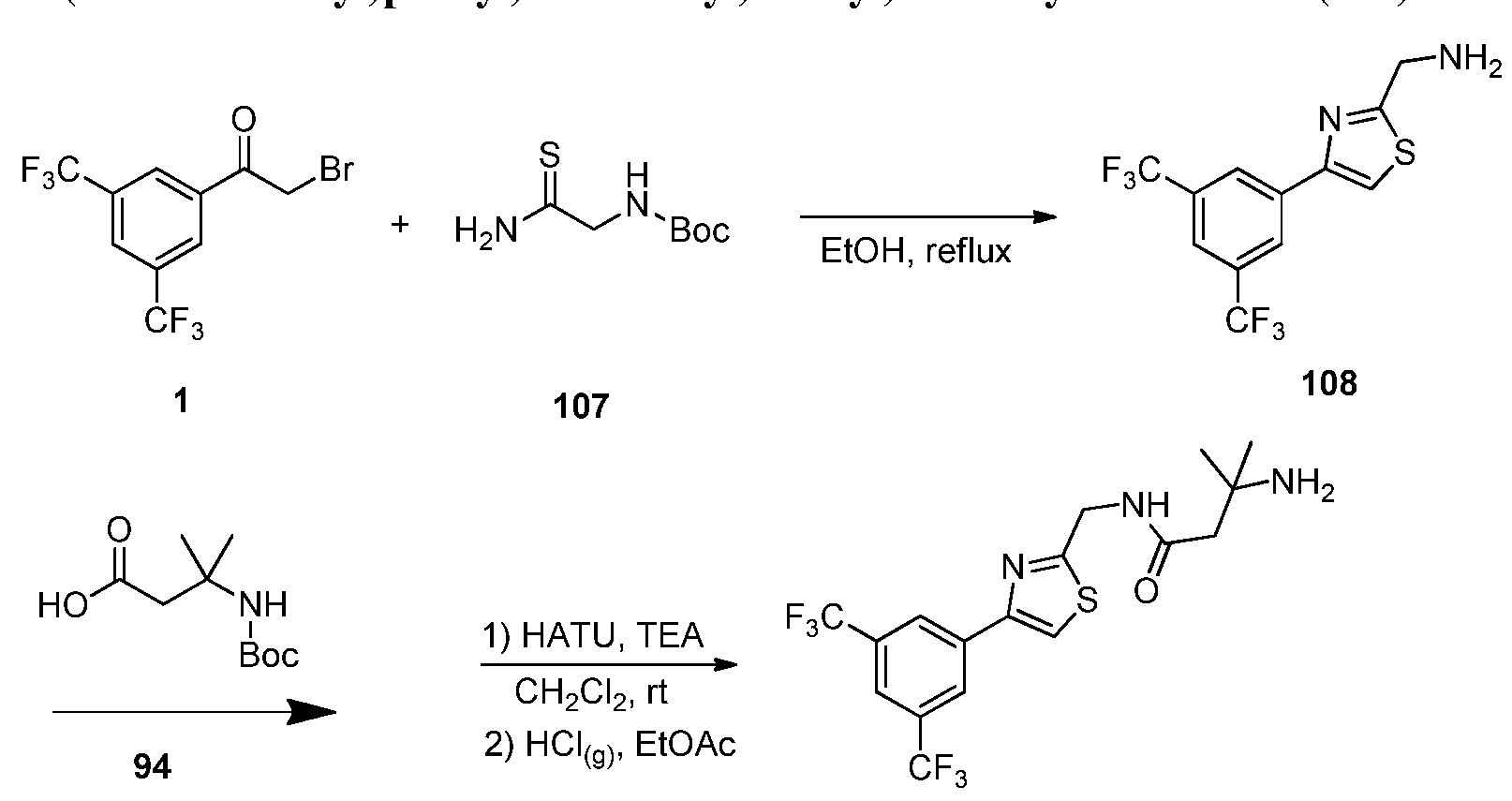
109
Preparation of(4-(3,5-bis(trifluoromethyl)phenyl)thiazol-2-yl)methanamine (108)
To a mixture of l-(3,5-bis(trifluoromethyl)phenyl)-2-bromoethanone (1) (2.3 g, 6.8 mmol) in ethanol (95%, 40 mL) was added tert-butyl (2-amino-2-thioxoethyl)carbamate (107) (1.3 g, 6.8 mmol). The mixture was heated at reflux for 3 hours then cooled to room
temperature. The solvent was removed in vacuo, and the resultant yellow solid was taken up into boiling ethyl acetate and recrystallized to afford (4-(3,5-bis(trifluoromethyl)phenyl)thiazol-
2-yl)methanamine (108) as a pale yellow solid (1.5 g, 60%). Synthesis confirmed by LCMS and MS (positive ion mode).
Preparation of 3-amino-N-((4-(3,5-bis(trifluoromethyl)phenyl)thiazol-2-yl)methyl)-3- methylbutanamide (109)
To a mixture of (4-(3,5-bis(trifluoromethyl)phenyl)thiazol-2-yl)methanamine (108) (0.08 g, 0.2 mmol), 3-((tert-butoxycarbonyl)amino)-3-methylbutanoic acid (94) (0.05 g, 0.2 mmol), and HATU (0.12 g, 0.3 mmol) in dichloromethane (5 mL) was added triethylamine (0.14 mL, 1.0 mmol) and the resultant solution was stirred at room temperature for 24 hours. The solvent was then removed in vacuo. The resultant solid was taken up in an ethyl acetate solution, saturated with hydrochloric acid, and stirred for 3 hours. The resultant suspension was then submitted to HiToPs for purification to afford 3-amino-N-((4-(3,5- bis(trifluoromethyl)phenyl)thiazol-2-yl)methyl)-3-methylbutanamide (109). Synthesis confirmed by LCMS and MS (positive ion mode).
General synthetic protocol (22) as exemplified by the synthesis of 3-amino-N-(4-(3,5- bis(trifluoromethyl)benzyl)thiazol-2-yl)-3-methylbutanamide (113)

39 110

111 112

113
Preparation of2-(3,5-bis(trifluoromethyl)phenyl)acetyl chloride (110)
To a solution of 2-(3,5-bis(trifluoromethyl)phenyl)acetic acid (39) (4.0 g, 15 mmol) in dichloromethane (50 mL) at 0 °C was added oxalyl chloride (1.4 mL, 16 mmol). To the resultant solution was added N,N-dimethylformamide (10 drops), and the reaction solution was allowed to gradually warm to room temperature and stir for 4 hours. The solvent was then removed in vacuo and dried under hi- vacuum to afford 2-(3,5-bis(trifluoromethyl)phenyl)acetyl chloride (110) (4.3 g, 98 %) as a clear yellow oil. Preparation of l-(3,5-bis(trifluoromethyl)phenyl)-3-diazopropan-2-one (111)
To a solution of 2-(3,5-bis(trifluoromethyl)phenyl)acetyl chloride (110) (2.11 g, 7.26 mmol) in tetrahydrofuran (10 mL) and acetonitrile (10 mL) was added
trimethylsilyldiazomethane (2.0 M in diethyl ether, 4.4 mL). The resultant solution was allowed to gradually warm to room temperature and stirred over 24 hours. The solvent was then removed in vacuo to afford l-(3,5-bis(trifluoromethyl)phenyl)-3-diazopropan-2-one (111) (1.8g, 84%).
Preparation of 4-( 3,5-bis( trifluoromethyl)benzyl)thiazol-2-amine ( 112 )
To a mixture of l-(3,5-bis(trifluoromethyl)phenyl)-3-diazopropan-2-one (111) (1.4 g, 4.7 mmol) and thiourea (0.36 g, 4.7 mmol) in dichloroethane (40 mL) was added copper(II) triflate, and the resultant mixture was heated to 80 °C for 2 hours. The reaction mixture was then cooled to room temperature, and water (50 mL) was then added. The aqueous layer was separated and extracted with ethyl acetate (3 x 50 mL) and the organic extracts were combined, dried over anhydrous soldium sulfate and concentrated in vacuo to afford 4-(3,5- bis(trifluoromethyl)benzyl)thiazol-2-amine (112) (0.31 g, 20%) as a yellow solid.
Preparation of 3-amino-N-(4-(3,5-bis(trifluoromethyl)benzyl)thiazol-2-yl)-3-methylbutanamide (113)
To a mixture of 4-(3,5-bis(trifluoromethyl)benzyl)thiazol-2-amine (112) (0.05 g, 0.2 mmol), 3-((tert-butoxycarbonyl)amino)-3-methylbutanoic acid (94) (0.04 g, 0.2 mmol) and HATU (0.06 g, 0.23 mmol) in dichloromethane (5 mL) was added triethylamine (0.1 mL, 0.7 mmol). The resultant solution was stirred at room temperature for 24 hours. The solvent was then removed in vacuo, and the resultant solid was taken up in an ethyl acetate solution,
saturated with hydrochloric acid, and stirred for 3 hours. The resultant suspension was then submitted to HiToPs for purification to afford 3-amino-N-(4-(3,5- bis(trifluoromethyl)benzyl)thiazol-2-yl)-3-methylbutanamide (113). Following the general procedures as set forth in examples above, the following compounds listed in Table 1 were prepared. Mass spectrometry was employed with final compounds and at various stages throughout the synthesis as a confirmation of the identity of the product obtained (M+l). For the mass spectrometric analysis, samples were prepared at an approximate concentration of lμg/ L· in acetonitrile with 0.1% formic acid. Samples were manually infused into an Applies Biosystems API3000 triple quadrupole mass spectrometer and scanned in Ql in the range of 50 to 700 m/z.
Table 1.

H-
 H- H- H- H- H-


H-
H-
 H-
H-
,2,4-
 ,3,4- H- ,1'- ,3,4-


 H-
H-


H- H- H- H-


 ,2,4- H- ,2,4-
 -
-
,3,4-
,3,4- -


 -
-

,1'-
 , 1 '■
,1'-
H- H-


,2,4-
 H- H- H- H-
 H- H- H- H- H-


 '-
'-
,1'


3-amino-N-((2'-fluoro-[1 , 1 '-
178 300.371 biphenyl]-4-yl)methyl)-3- methylbutanamide
NH2
3- amino-3-methyl-N-((2'-
179 366.377 (trifluoromethoxy)-[1 ,1 '-biphenyl]-
4- yl)methyl)butanamide

3-amino-N-((3'-chloro-4'-fluoro-
180 334.81 6 [1 , 1 '-biphenyl]-4-yl)methyl)-3- methylbutanamide
NH2
3-amino-N-((4'-methoxy-[1 , 1 '-
181 312.406 biphenyl]-4-yl)methyl)-3- methylbutanamide


 H- H- H- H-


 No. Structure MW Name
3-amino-N-((2'-
226 338.324 (trifluoromethoxy)-[1 ,1 '-biphenyl]- 4-yl)methyl)propanamide

3-amino-N-((3'-chloro-4'-fluoro-
227 306.762 [1 , 1 '-biphenyl]-4- yl)methyl)propanamide

3-amino-N-((3'-fluoro-[1 , 1 '
228 272.31 7 biphenyl]-4- yl)methyl)propanamide

3-amino-N-((3'-chloro-[1 , 1 '
229 288.772 biphenyl]-4- yl)methyl)propanamide

 No. Structure MW Name
(S)-2-(4-(4-chlorophenyl)-5-
234 373.88 phenyl-lH-imidazol-2-yl)-l- phenylethan-l-amine

(S)-2-(4;5-diphenyl-lH-imidazol-
235 357.43 2-yl)-l-(4-fluorophenyl)ethan-l- amine
j2iS 0 (S)-3-(aminomethyl)-N-((3'- chloro-4'-fluoro-[l;l'-biphenyl]-
236 376.9
4-yl)methyl)-5- methylhexanamide
(S)-3-(aminomethyl)-N-((3'-
237 342.46 fluoro-[l, -biphenyl]-4- yl)methyl)-5-methylhexanamide
 No. Structure MW Name
/ l-((4-(4-chlorophenyl)-5-phenyl-
238 380.88 lH-imidazol-2-yl)methyl)-4- methylpiperazin-2-one
2-(5-(4'-(2,2,2-trifluoroethoxy)-
239 361.37 [l,l'-biphenyl]-3-yl)-lH- imidazol-2-yl)ethan-l-amine
(S)-l-(4-chlorophenyl)-2-(4-(4-
240 408.33 chlorophenyl)-5-phenyl-lH- imidazol-2-yl)ethan-l-amine

(R)-5-(3,5-
241 NH ΥΎ 349.28 bis(trifluoromethyl)phenyl)-2- (pyrrolidin-2-yl)-lH-imidazole
CF3


The compounds described herein were assayed for the ability to block Navl.7. These compounds can also be assayed for modulation of, e.g., voltage gated sodium channels (e.g., other Na+ channel isoforms or Ca2+ channels such as Cay3.2 T-type channels). Exemplary methods are described herein, but additional methods are known in the art.
Cell generation and maintenance
The generation of a HEK 293F cell line stably expressing human Navl.7/NavPl was achieved by co-transfecting human SCN9A and human SCNIB cDNAs, subcloned into plasmid vectors, utilizing standard transfection techniques. Clones were selected using appropriate selection agents (0.3mg/mL Zeocin and 0.8mg/mL Geneticin) and maintained in Dulbecco's
Modified Eagle medium, 10% fetal bovine serum, 1% non-essential amino acids to ~80% confluence Nav1.5 Assay
Inhibition of the TTX-resistant Nayl.5 sodium channel, a key cardiac ion channel, can have profound effects on the duration and amplitude of the cardiac action potential and can result in arrhythmias and other heart malfunctions. To assess the potential cardiac liability of compounds at an early stage in the drug discovery process, a Nayl.5 sodium channel screening assay can be performed on Molecular Device's PatchXpress™ automated electrophysiology platform. Under voltage-clamp conditions, Nav1.5 currents can be recorded from HEK cells expressing the human Navl.5 channel in the absence and presence of increasing concentrations of the test compound to obtain an IC50 value. The external recording solution can contain (in mM): 90 TEAC1, 50 NaCl, 1.8 CaCl, 1 MgCl2, 10 HEPES, 10 glucose, adjusted to pH 7.4 with TEA-OH and to 300 mOsm with sucrose (if necessary), while the internal patch pipette solution contained (in mM): 129 CsF, 2 MgCl2, 11 EGTA, 10 HEPES, 3 Na2ATP adjusted to pH 7.2 with CsOH and to 290 mOsm with sucrose (if necessary). Nayl.5 channel currents can be evoked using a cardiac action potential waveform at 1 Hz, digitized at 31.25 kHz and low-pass filtered at 12 kHz.
Assessment of Navl.7 activity
On the day of each experiment, cells that were grown to 80% confluence in a T75 flask were harvested for use on PatchXpress (Molecular Devices, CA, USA). Following a recovery
period at 37 °C in a humidified incubator with 95 % atmosphere and 5% C02 in Dulbecco's Modified Eagle Medium, the media was replaced with an external recording solution containing (in mM): 90 TEAC1, 50 NaCl, 1.8 CaCl2, 1 MgCl2, 10 HEPES, 10 glucose, adjusted to pH 7.4 with TEAOH and 300 mOsm with sucrose. The internal recording solution contained (in mM): 129 CsF, 2 MgCl2, 11 EGTA, 10 HEPES, 6 NaCl, 3 Na2ATP adjusted to pH 7.2 with CsOH and 280 mOsm with sucrose. The automated liquid handling facility of PatchXpress dispensed cells and added compound. Modulation of Nayl.7 channels by compounds was assessed by promoting the channels into the inactivated state using a conditioning voltage pulse of variable amplitude, followed by a brief hyperpolarizing pulse with a subsequent depolarized voltage step to measure the current amplitude in the presence and absence of compound. Compounds were assayed at 10 μιη.
Based upon this Patch express protocol, four electrophysiological parameters were measured relative to a 0.2% DMSO vehicle control (Table 2). This first data column describes compound induced shifts in the voltage dependence of slow inactivation (Table 2: hNaV1.7: Reduction in current at 20 mV) at which -50% of the channels were inactivated. The second data column describes the change in the population of Navl.7 channels undergoing fast inactivation before and after a 30 sec conditioning voltage pulse at 20 mV (Table 2: hNayl.7: Reduction in current at 20 mV (normalized data). The ratio of these currents elicited by a hyperpolarizing pulse before and after preconditioning allows the determination of the fraction of Navl.7 channels in the slow inactivated state. The third data column displays the voltage dependence of activation (Table 2: hNaV1.7: Voltage dependence of activation). Lastly, the fourth data column describes the voltage dependence of fast inactivation in which -50% of the channels were inactivated (Table 2: hNaV1.7: Voltage dependence of fast inactivation).
In some cases, the potency of compounds was measured using either the Patchliner automated patch clamp platform (Nanion) or manual patch clamp techniques. Both approaches allowed the compounds to be characterized based upon the ability of a compound to modulate use- and/or state-dependence. The potency data is tabulated in Table 3 and is represented by eight data fields. The first four fields represent potency data measured with the Patchliner automated platform under varying use- and state-dependent electrophysiology protocols similar to the Patch express protocols detailed above. The first data column describes the potency of compounds when the Navl.7 channel is being repetitively activated at a 7Hz hyperpolarization frequency (Table 3: hNaV1.7: IC50 of inward current block at 7Hz, Automated patchclamp). The second data column represents the potency at which 50% of the initial hyperpolarization
pulse is inhibited by the compounds (Table 3: hNaV1.7: IC50 of PI block, Automated patchclamp). The third data column details the potency of compounds in their ability to block 50% of Navl.7 channels when these channels are induced into the slow inactivated state (Table 3: hNaV1.7: IC50 of slow inactivation block, Automated patchclamp). The fourth data column shows potency data at which 50% of channel activity is blocked when repetitively activated at a 0.25 Hz hyperpolarizing frequency (Table 3: hNaV1.7: IC50 of inward current block at 0.25Hz, Automated patchclamp). The next three data fields describe the data generated from manual patchclamp electrophysiology measurements using similar methods to those employed for automated patchclamp studies. The fifth and sixth data columns demonstrate the potency at which 50% of channel activity was inhibited when repetitively activated with a 7Hz or 0.25Hz hyperpolarization frequency, respectively (Table 3: hNaV1.7: IC50 of inward current block at 7Hz, Manual patchclamp)( hNaV1.7: IC50 of inward current block at 0.25 Hz, Manual patchlamp). The seventh column shows the potency of certain compounds which block 50% channel activity when the Navl.7 channel is in the slow inactivated state (hNaV1.7: IC50 of slow inactivation block, Manual patchclamp). The last column characterizes the state-dependence of compound inhibition. Compounds that maintain the greatest potency for the slow inactivated state over fast inactivated or tonic inhibition at 0.25Hz are characterized as "state dependent, blocker of slow inactivation". Exemplary data relating to the inhibition of Nay 1.7 channels are provided in Table 2.

15 -10.30 -0.16 -8.90 -6.90
16 -4.10 -0.08 -7.90 -2.20
17 -16.20 -0.25 -14.30 -6.80
18 -12.70 -0.07 -10.50 -8.80
369 -21.50 -0.19 -6.20 -8.40
19 -4.90 -0.06 -7.00 -3.80
20 -26.00 -0.34 -17.50 -11.00
21 -13.70 -0.14 -12.10 -12.20
22 -17.00 -0.04 -8.80 -4.90
23 -4.50 -0.04 -7.90 -5.50
24 -6.30 -0.14 -7.20 -7.30
25 -6.50 -0.27 -12.20 -9.50
26 -0.40 0.03 -9.80 -3.90
27 -23.80 -0.06 -6.10 -5.40
28 -11.70 -0.07 -12.90 -5.00
29 -12.80 -0.26 -9.20 -8.30
30 -13.30 -0.16 -15.30 -8.20
31 -9.50 -0.09 -5.40 -6.70
32 -15.60 -0.16 -7.90 -6.70
33 -3.60 -0.04 -9.60 -5.70
34 -22.90 -0.28 -13.70 -7.70
35 -7.60 0.04 -3.70 -2.90
36 -2.20 -0.03 -9.20 -3.50
39 -1.50 -0.05 -9.70 -7.20
40 -1.50 0.02 -7.40 -3.80
41 -18.50 -0.06 -12.90 -10.30
42 -26.60 -0.27 -10.30 -7.90
43 -7.80 -0.14 -9.70 -6.80
44 -11.70 -0.03 -11.60 -10.10
45 -18.10 -0.11 -7.80 -10.40
46 -17.70 -0.19 -9.50 -6.30
368 -15.70 -0.11 -16.30 -8.20
47 -9.00 -0.19 -10.20 -2.50
48 -5.50 -0.15 -11.80 -6.50
49 -8.60 -0.14 -13.20 -8.70
50 -24.30 -0.11 -11.80 -7.90
51 5.50 0.04 -8.00 -9.70
52 -21.00 -0.14 -11.40 -5.90
53 -15.00 -0.19 -15.00 -7.30
54 -20.00 -0.17 -10.40 -5.90
55 -19.10 -0.21 -12.20 -10.00
56 -21.00 -0.22 -12.20 -7.60
57 -19.10 -0.19 -6.50 -4.40
COMPOUND NAV1.7 Delta NAV1.7 Delta NAV1.7 NAV1.7 FAST IN ACT NO. Vhalf (@10 Ratio (@10 μιη) Conductance (VDEP @10uM) μιη) (VDEP @10 μηι)
58 -20.00 -0.29 -11.20 -8.20
59 -5.60 -0.14 -6.20 -9.30
60 -6.70 -0.11 -9.40 -3.90
61 -19.80 -0.18 -8.80 -5.40
62 -4.50 -0.11 -5.50 -5.80
63 -10.50 -0.18 -6.80 -6.10
64 -11.20 -0.12 -11.30 -5.70
65 -15.50 -0.32 -10.90 -7.10
66 -8.20 -0.19 -8.70 -6.30
67 -12.30 -0.15 -8.50 -10.60
68 -2.40 -0.01 -5.30 -3.40
69 -4.80 -0.06 -10.50 -3.50
70 -5.40 -0.02 -5.60 -6.80
71 -7.60 -0.06 -11.90 -5.70
72 -30.60 -0.17 -11.10 -6.50
73 -18.80 -0.31 -8.90 -7.30
74 -7.40 -0.07 -9.70 -6.80
75 -15.60 -0.06 -9.30 -6.90
76 -15.10 -0.10 -6.90 -5.90
77 -7.40 -0.22 -7.00 -4.30
78 -24.00 -0.11 -6.60 -10.40
79 -5.70 -0.04 -3.30 -5.70
80 -12.20 -0.11 -9.20 -6.40
81 -8.00 -0.13 -9.00 -5.90
82 -8.00 -0.14 -12.80 -6.70
83 -5.10 0.00 -8.10 -11.50
84 -7.40 -0.03 -11.20 -6.20
85 -7.30 -0.05 -8.80 -8.60
86 -15.30 -0.18 -7.50 -6.20
87 -3.70 0.00 -6.40 -5.50
88 -5.70 0.00 -12.10 -6.60
89 -8.90 -0.08 -13.50 -6.70
90 -6.30 -0.04 -8.30 -2.50
91 -2.50 0.00 -4.20 -5.80
92 -5.10 -0.06 -9.00 -6.70
93 -9.90 -0.05 -14.30 -4.80
94 -4.90 -0.07 -5.40 -6.10
95 -9.30 -0.05 -0.70 -7.40
96 -9.90 -0.14 -11.30 -9.70
97 -6.00 -0.09 -12.30 -7.70
98 -28.50 -0.43 -11.90 -19.30
99 -9.70 0.02 -6.60 -12.00
100 -11.00 -0.12 -5.40 -5.80
COMPOUND NAV1.7 Delta NAV1.7 Delta NAV1.7 NAV1.7 FAST IN ACT NO. Vhalf (@10 Ratio (@10 μιη) Conductance (VDEP @10uM) μιη) (VDEP @10 μηι)
101 -25.20 -0.14 -9.10 -7.20
102 -25.30 -0.37 -9.60 -12.00
103 -9.90 -0.14 -1.10 -7.80
104 -12.20 -0.21 -12.90 -7.90
105 -21.10 -0.15 -11.70 -5.50
106 -8.90 -0.01 -9.00 -4.60
107 -17.30 -0.11 -5.50 -13.00
108 -20.00 -0.27 -10.90 -12.50
109 -17.60 -0.09 -9.20 -7.60
110 -17.40 -0.19 -8.70 -5.30
111 -6.20 -0.09 -9.70 -6.40
112 -3.20 -0.12 -9.30 -5.90
113 -11.10 -0.08 -5.30 -5.50
114 -17.20 -0.18 -9.40 -8.00
115 -17.70 -0.08 -8.80 -5.00
116 -23.00 -0.17 -3.10 -8.50
117 -4.50 -0.02 -7.40 -4.20
118 -16.70 -0.21 -10.50 -11.10
119 -30.70 -0.30 -3.20 -6.90
120 -24.00 -0.23 -4.50 -5.50
121 -11.10 -0.13 -8.70 -5.70
122 -15.10 -0.15 -10.10 -8.30
123 -7.20 -0.17 -5.30 -5.10
124 -3.00 -0.10 -4.90 -7.30
125 -12.70 -0.14 -11.30 -6.30
126 -8.50 -0.19 -3.00 -8.40
127 -17.60 -0.18 -8.90 -7.70
128 -13.00 -0.26 -7.80 -9.50
129 -19.40 -0.20 -9.30 -15.40
130 -4.50 -0.13 -5.30 -5.70
131 -7.10 -0.16 -7.70 -8.50
132 -10.90 -0.23 -6.20 -9.60
133 -11.20 -0.20 -11.10 -8.40
134 -7.70 -0.05 -6.40 -4.90
135 -7.90 -0.07 -9.60 -5.90
136 -7.50 -0.01 -7.50 -3.10
137 -4.50 -0.01 -5.00 -3.90
138 -7.30 -0.03 -6.70 -3.00
139 -2.60 -0.01 -6.20 -3.20
140 -2.90 -0.03 -5.40 -2.40
141 -4.20 -0.06 -0.40 -5.10
142 -3.50 -0.03 -7.00 -4.10
143 -4.60 0.01 -5.40 -2.10
COMPOUND NAV1.7 Delta NAV1.7 Delta NAV1.7 NAV1.7 FAST IN ACT NO. Vhalf (@10 Ratio (@10 μιη) Conductance (VDEP @10uM) μιη) (VDEP @10 μηι)
144 -4.70 0.02 -10.40 -4.50
145 -3.70 0.01 -7.20 -3.60
146 -2.00 0.03 -7.00 -8.50
147 -8.90 -0.08 -6.30 -7.10
148 -24.70 -0.25 -2.90 -9.70
149 -17.40 -0.22 -11.80 -6.50
150 -18.10 -0.11 -7.20 -12.10
151 -17.60 -0.08 -7.90 -12.00
152 -4.30 -0.02 -6.40 -4.90
153 -3.50 -0.07 -0.90 -4.10
154 -0.50 0.01 -3.50 -2.80
155 -2.00 -0.02 -5.60 -3.50
156 -1.30 -0.03 -7.20 -2.30
157 -5.20 -0.08 -12.10 -4.70
158 -1.40 -0.01 -7.80 -2.50
159 -2.60 0.01 -6.10 -4.70
160 -5.30 -0.03 -5.80 -4.10
161 -8.00 0.04 -9.20 -6.60
162 -0.60 -0.03 -5.60 -1.40
163 -3.20 -0.01 -4.50 -2.00
164 -3.10 -0.04 -6.80 -3.70
165 -4.70 -0.06 -9.80 -4.00
166 -1.50 -0.05 -4.20 -4.50
167 -5.60 -0.05 -2.80 -5.50
168 -4.50 -0.02 -4.70 -2.20
169 -1.10 -0.02 -4.00 -1.60
172 -10.40 -0.12 -7.70 -5.60
173 -15.50 -0.23 -10.30 -4.80
176 -10.70 -0.10 -8.00 -5.40
177 -15.30 -0.11 -10.70 -6.60
179 -12.80 -0.19 -4.50 -7.30
180 -17.10 -0.19 -8.60 -12.90
183 -11.70 -0.06 -7.50 -9.30
184 -16.10 -0.25 -7.10 -14.80
186 -2.20 0.07 -4.20 -3.50
189 -17.80 -0.16 -5.90 -3.70
192 -9.00 0.00 -4.50 -0.20
194 -10.70 -0.06 -5.80 -3.70
197 -12.80 -0.06 -13.20 -3.90
198 -7.40 -0.01 -7.20 -2.20
199 -8.10 -0.10 -7.50 -4.00
200 -4.70 -0.01 -11.90 -4.90
201 -11.30 -0.06 -9.10 -4.10
COMPOUND NAV1.7 Delta NAV1.7 Delta NAV1.7 NAV1.7 FAST IN ACT NO. Vhalf (@10 Ratio (@10 μιη) Conductance (VDEP @10uM) μιη) (VDEP @10 μηι)
202 -12.40 -0.09 -8.10 -6.60
204 -13.90 -0.05 -9.90 -5.20
205 -3.50 -0.09 -1.00 -1.60
206 -8.20 -0.20 -4.80 -3.80
207 -7.80 -0.14 -5.00 -4.40
208 -26.70 -0.21 -7.00 -2.20
209 -18.40 -0.21 -2.50 -3.50
210 -20.00 -0.22 -12.80 -10.10
211 -25.00 -0.25 -3.90 -7.30
212 -20.70 -0.17 -5.40 -6.90
213 -0.60 -17.50
214 -9.60 -0.05 -4.60 -4.40
215 -5.50 -0.08 -2.60 -2.70
216 -6.00 -0.14 -3.80 -3.70
217 -25.20 -0.24 -4.20 -4.00
218 1.50 0.05 -2.80 -0.60
219 -1.60 0.01 -5.60 -3.30
220 -3.00 -0.08 -5.10 -3.30
221 -5.30 -0.09 -6.40 -4.80
222 -3.20 -0.01 -8.00 -3.30
223 -3.90 -0.10 -8.50 -3.90
224 -1.70 -0.06 -6.00 -3.40
225 -25.80 -0.24 -11.80 -8.90
226 -23.20 -0.27 -5.10 -7.30
227 -18.90 -0.13 -5.60 -5.60
228 -10.70 -0.09 -9.50 -4.80
229 -24.20 -0.19 -5.00 -7.40
230 -10.40 -0.31 -1.20 -7.90
231 -12.80 -0.28 -0.10 -7.80
232 -10.30 -0.28 -7.00 -5.40
233 -12.80 -0.26 -9.20 -8.30
234 -10.70 -0.25 -10.30 -6.70
235 -10.00 -0.23 -6.10 -5.90
236 -9.90 -0.23 -2.00 -5.30
237 -14.80 -0.22 -8.10 -10.30
238 -14.20 -0.18 -15.70 -9.70
239 -6.20 -0.17 -9.80 -6.20
240 -7.70 -0.17 -5.80 -7.10
241 -25.10 -0.16 -10.80 -5.30
242 -9.10 -0.16 -8.80 -5.50
243 -10.70 -0.16 -7.60 -7.90
244 -4.30 -0.15 -10.70 -5.00
245 -18.20 -0.14 -7.90 -4.30
COMPOUND NAV1.7 Delta NAV1.7 Delta NAV1.7 NAV1.7 FAST IN ACT NO. Vhalf (@10 Ratio (@10 μιη) Conductance (VDEP @10uM) μιη) (VDEP @10 μηι)
246 -8.60 -0.13 -9.10 -3.70
247 -16.10 -0.13 2.60 -4.60
248 -8.60 -0.12 -5.70 -5.40
249 -4.20 -0.11 -8.30 -4.20
250 -9.80 -0.10 -9.40 -4.20
251 -8.20 -0.09 -9.90 -4.40
252 -9.80 -0.09 -10.20 -6.20
253 -3.20 -0.07 -8.50 -4.10
254 -5.60 -0.07 -9.30 -3.20
255 -9.00 -0.06 -10.80 -4.80
256 -8.60 -0.06 -3.90 -6.40
257 -5.50 -0.04 -8.10 -5.90
258 -6.00 -0.04 -12.00 -5.10
259 -2.80 -0.04 -9.20 -3.20
260 -5.20 -0.04 -6.00 -3.70
261 -6.10 -0.04 -9.50 -5.10
262 -6.50 -0.02 -6.20 -3.80
263 -4.80 -0.01 -9.50 -4.20
264 -5.10 -0.01 -8.60 -5.20
265 -1.90 -0.01 -6.10 -3.30
277 -13.40 -0.09 -7.60 -6.20
278 -5.70 0.00 -7.50 -3.20
283 -8.60 -0.03 -7.20 -4.00
284 -11.50 -0.38 -8.30 -6.50
285 -9.30 -0.27 -7.00 -4.30
286 -12.00 -0.23 -6.90 -6.60
287 -22.60 -0.23 -9.40 -6.50
288 -8.70 -0.23 -14.00 -4.00
289 -19.10 -0.21 -8.60 -6.60
290 -7.20 -0.18 -8.90 -5.70
291 -11.80 -0.17 -14.10 -6.60
292 -18.10 -0.15 -6.90 -2.60
293 -11.50 -0.13 -8.00 -5.00
294 -4.80 -0.12 -6.60 -5.40
295 -5.10 -0.11 -6.40 -5.20
296 -10.30 -0.09 -5.30 -3.20
297 -7.60 -0.09 -4.60 -5.30
298 -3.00 -0.08 -7.10 -4.80
299 -3.10 -0.08 -3.30 -5.00
300 -4.40 -0.06 -10.40 -4.70
301 -4.40 -0.05 -8.40 -4.50
302 -1.20 -0.05 -7.70 -5.10
303 -3.30 -0.05 -9.50 -4.60
COMPOUND NAV1.7 Delta NAV1.7 Delta NAV1.7 NAV1.7 FAST IN ACT NO. Vhalf (@10 Ratio (@10 μιη) Conductance (VDEP @10uM) μιη) (VDEP @10 μηι)
304 -9.30 -0.05 -5.80 -6.20
305 -3.90 -0.05 -9.50 -4.50
306 -3.10 -0.05 -5.50 -4.10
307 -1.90 -0.04 -10.20 -3.60
308 -3.80 -0.04 -9.30 -4.70
309 -4.30 -0.04 -4.20 -3.00
310 -4.00 -0.04 -8.10 -3.10
311 -8.30 -0.04 -2.30 -6.40
312 -3.70 -0.04 -7.10 -4.10
313 0.90 -0.02 -5.40 -1.80
314 -6.00 -0.02 -9.30 -3.50
315 -8.50 -0.02 -4.10 -7.30
316 -2.30 -0.01 -8.00 -3.70
317 -8.10 0.00 -8.90 -4.30
318 -2.40 0.00 -11.10 -3.10
319 -0.60 0.03 -2.00 -2.10
320 0.3 0.03 -4.40 0.6
371 -15.30 -0.15 -8.20 -5.90
372 -8.90 -0.06 -4.50 -2.10
Exemplary data relating the potency and state-dependence of NaV 1.7 channel inhibition provided in Table 3.
Table 3


Other Embodiments
While the invention has been described in connection with specific embodiments thereof, it will be understood that it is capable of further modifications and this application is intended to cover any variations, uses, or adaptations of the invention following, in general, the principles of the invention and including such departures from the present disclosure come within known or customary practice within the art to which the invention pertains and may be applied to the essential features hereinbefore set forth.
All publications, patents and patent applications are herein incorporated by reference in their entirety to the same extent as if each individual publication, patent or patent application was specifically and individually indicated to be incorporated by reference in its entirety.
What is claimed is:
Claims
1. A compound having a structure according to the following formula,

each of R1, R2, R3, and R4 is selected from H, optionally substituted C1-C6 alkyl, optionally substituted C1-C6 alkoxy, 0-(optionally substituted phenyl), optionally substituted phenyl, -S02- (optionally substituted phenyl), -S02- (optionally substituted C1-C6 alkyl),
L1 is a covalent bond, -0-, or optionally substituted CI alkylene;
Het is an optionally substituted phenyl or optionally substituted heteroaryl selected from imidazolyl, triazolyl, oxadiazolyl, pyrazolyl, thiadiazolyl, isoxazolyl, pyrimidyl, triazinyl, thiazolyl, imidazopyridinyl, or pyridyl;
L2 is selected from a covalent bond; optionally substituted C1-C3 alkylene; (CH2)aCHR7, wherein a is 0 or 1, and R7 is optionally substituted C1-C6 alkyl or optionally substituted phenyl, or, together with one of R5 or R6, forms an optionally substituted 3- to 7-membered heterocyclyl; or (CH2)bCR8R9, wherein b is 0 or 1, and R8 and R9 are, independently, optionally substituted CI alkyl, or R8 and R9 combine to form an optionally substituted C3-C9 cycloalkyl; and
each of R5 and R6 is independently selected from H; optionally substituted C1-C6 alkyl; optionally substituted C3-C6 cycloalkyl; S02R10, wherein R10 is amino, optionally substituted C1-C6 alkyl, or optionally substituted phenyl; or R5 and R6 together form an optionally substituted 3- to 7-membered heterocyclyl; or R7, together with one of R5 or R6, forms an optionally substituted 3- to 7-membered heterocyclyl; and wherein no more than one of R5 and R6 is S02R10;
or a stereoisomer thereof, or a pharmaceutically acceptable salt thereof.
2. The compound of claim 1, wherein
each of R1, R2, R3, and R4 is selected from H, optionally substituted C1-C6 alkyl, optionally substituted C1-C6 alkoxy, 0-(optionally substituted phenyl), optionally substituted phenyl, -S02- (optionally substituted phenyl), -S02- (optionally substituted C1-C6 alkyl),
L1 is a covalent bond or optionally substituted CI alkylene; Het is an optionally substituted phenyl or optionally substituted heteroaryl selected from imidazolyl, triazolyl, oxadiazolyl, pyrazolyl, thiadiazolyl, isoxazolyl, pyrimidyl, triazinyl, or pyridyl,
L2 is selected from a covalent bond; optionally substituted C1-C3 alkylene; (CH2)aCHR7, wherein a is 0 or 1, and R7 is optionally substituted C1-C6 alkyl or optionally substituted phenyl, or, together with one of R5 or R6, forms an optionally substituted 3- to 7-membered heterocyclyl; or (CH2)bCR8R9, wherein b is 0 or 1, and R8 and R9 are, independently, optionally substituted CI alkyl, or R8 and R9 combine to form an optionally substituted C3-C9 cycloalkyl;
each of R5 and R6 is independently selected from H; optionally substituted C1-C6 alkyl; optionally substituted C3-C6 cycloalkyl; S02R10, wherein R10 is amino, optionally substituted C1-C6 alkyl, or optionally substituted phenyl; or R5 and R6 together form an optionally substituted 3- to 7-membered heterocyclyl; or R7, together with one of R5 or R6, forms an optionally substituted 3- to 7-membered heterocyclyl; and wherein no more than one of R5 and R6 is S02R10,
or a stereoisomer thereof, or a pharmaceutically acceptable salt thereof.
3. The compound of claim 1 or 2, wherein R1 and R3 are both H,
or a stereoisomer thereof, or a pharmaceutically acceptable salt thereof.
4. The compound of any of claims 1-3, wherein R2 and R4 are, independently, optionally substituted CI alkyl,
or a stereoisomer thereof, or a pharmaceutically acceptable salt thereof.
5. The compound of any of claims 1-4, wherein each optionally substituted CI alkyl is a haloalkyl,
or a stereoisomer thereof, or a pharmaceutically acceptable salt thereof.
6. The compound of claim 5, wherein each haloalkyl is CF3,
or a stereoisomer thereof, or a pharmaceutically acceptable salt thereof.
7. The compound of any of claims 1-6, wherein L1 is a covalent bond or CH2,
or a stereoisomer thereof, or a pharmaceutically acceptable salt thereof.
8. The compound of any of claims 1-7, wherein L2 is a covalent bond or CH2, or a stereoisomer thereof, or a pharmaceutically acceptable salt thereof.
9. The compound of any of claims 1-8, wherein R5 is H and R6 is optionally substituted C1-C6 alkyl,
or a stereoisomer thereof, or a pharmaceutically acceptable salt thereof.
10. The compound of claim 9, wherein said optionally substituted C1-C6 alkyl is an aminoalkyl group optionally comprising an oxo (C=0) substituent,
or a stereoisomer thereof, or a pharmaceutically acceptable salt thereof.
11. The compound of any of claims 1-8, wherein R5 and R6 combine to form an optionally substituted 3- to 7-membered heterocyclyl,
or a stereoisomer thereof, or a pharmaceutically acceptable salt thereof.
12. The compound of any of claims 1-7, wherein L2 is (CH2)aCHR7,
or a stereoisomer thereof, or a pharmaceutically acceptable salt thereof.
13. The compound of claim 12, wherein R5 is H, and R6 and R7 combine to form an optionally substituted 3- to 7-membered heterocyclyl,
or a stereoisomer thereof, or a pharmaceutically acceptable salt thereof.
14. The compound of claim 12 or 13, wherein a is 0,
or a stereoisomer thereof, or a pharmaceutically acceptable salt thereof.
15. The compound of any of claims 1-7, wherein L2 is (CH2)t,CR8R9,
or a stereoisomer thereof, or a pharmaceutically acceptable salt thereof.
16. The compound of claim 15, wherein R8 and R9 combine to form an optionally substituted C3-C6 cycloalkyl, or R8 and R9 are both CH3,
or a stereoisomer thereof, or a pharmaceutically acceptable salt thereof.
17. The compound of any of claims 1-16, wherein R1, R2, and R4 are H,
or a stereoisomer thereof, or a pharmaceutically acceptable salt thereof.
18. The compound of claim 17, wherein R3 is Ph, OPh, S02Me, or S02Ph,
or a stereoisomer thereof, or a pharmaceutically acceptable salt thereof.
19. The compound of any of claims 1-16, wherein R1 and R3 are H,
or a stereoisomer thereof, or a pharmaceutically acceptable salt thereof.
20. The compound of claim 19, wherein R2 and R4 are both CF3 or are both OCH3,
or a stereoisomer thereof, or a pharmaceutically acceptable salt thereof.
21. The compound of claim 1, wherein said compound has a structure according to follow

or a stereoisomer thereof, or a pharmaceutically acceptable salt thereof.
22. The compound of claim 1 , wherein said compound has a structure according to the follo

or a stereoisomer thereof, or a pharmaceutically acceptable salt thereof.
23. The compound of any of claims 1-22, wherein Het is imidazolyl; lH-l,2,3-triazolyl; 1,2,4- oxadiazolyl; 1,2,4-triazolyl; lH-pyrazolyl; 1,3,4-oxadiazolyl; thiadiazolyl; imidazolyl;
isoxazolyl; pyrimidyl; 1,2,4-triazinyl; or pyridyl;
or a stereoisomer thereof, or a pharmaceutically acceptable salt thereof.
24. The compound of any of claims 1-22, wherein Het is thiazolyl or imidazopyridinyl;
or a stereoisomer thereof, or a pharmaceutically acceptable salt thereof.
25. The compound of claim 1, wherein said compound has a structure according to the following formula,

or a stereoisomer thereof, or a pharmaceutically acceptable salt thereof.
26. The compound of claim 1 , wherein said compound has a structure according to the following formula,

or a stereoisomer thereof, or a pharmaceutically acceptable salt thereof.
27. The compound of claim 1, wherein said compound has a structure according to the following formula,

or a stereoisomer thereof, or a pharmaceutically acceptable salt thereof.
28. The compound of any of claims 25-27, wherein the substituents on the central phenyl group are meta or para to each other,
or a stereoisomer thereof, or a pharmaceutically acceptable salt thereof.
29. The compound of claim 1, wherein said compound has a structure according to the following formula,

or a stereoisomer thereof, or a pharmaceutically acceptable salt thereof.
30. The compound of claim 1, wherein said compound has a structure according to the following formula,

(VIII), or a stereoisomer thereof, or a pharmaceutically acceptable salt thereof.
31. The compound of claim 1, wherein said compound has a structure according to the following formula,

(IX), or a stereoisomer thereof, or a pharmaceutically acceptable salt thereof.
32. The compound of claim 1, wherein said compound has a structure according to the following formula,

33. The compound of claim 1, wherein said compound has a structure according to the follow

34. The compound of claim 1, wherein said compound has a structure according to the following formula,

35. The compound of any of claims 21-34, wherein one of R2-R4 is H,
or a stereoisomer thereof, or a pharmaceutically acceptable salt thereof.
36. The compound of any of claims 21-34, wherein two of R2-R4 are H,
or a stereoisomer thereof, or a pharmaceutically acceptable salt thereof.
37. The compound of any of claims 21-34, wherein R2 and R4 are both CF3, and R3 is H, or a stereoisomer thereof, or a pharmaceutically acceptable salt thereof.
38. The compound of any of claims 1-37, wherein L2-NR5R6 is NH2, C(=0)NH2, CH2NH2, CH2NHCH3, CH2N(CH3)2, (CH2)2NH2, (CH2)2NHCH3, (CH2)2N(CH3)2, (CH2)3NH2,
(CH2)3NHCH3, (CH2)3N(CH3)2, CH2C(CH3)2NH2, CH2NHC(=0)CH2NH2, NHC(=0)CH2NH2, CH2NHC(=0)C(CH3)2NH2, NHS02NH2, or NHC(=0)C(CH3)2NH2,
or a stereoisomer thereof, or a pharmaceutically acceptable salt thereof.
39. The compound of any of claims 1-37, wherein L2-NR5R6 is


or a stereoisomer thereof, or a pharmaceutically acceptable salt thereof.
40. is 

or a pharmaceutically acceptable salt thereof.
41. The compound of any of claims 1-34, wherein
L2 is a covalent bond or C¾, and
one but not both of R5 and R6 is an amino acid selected from leucine, isoleucine, phenylalanine, threonine, valine, alanine, proline, serine, or tyrosine, and wherein said amino acid optionally comprises one or two N-(C1-C6 alkyl groups),
or a stereoisomer thereof, or a pharmaceutically acceptable salt thereof.
42. The compound of claim 41, wherein said amino acid is a D- or L-amino acid,
or a stereoisomer thereof, or a pharmaceutically acceptable salt thereof.
43. The compound of any of claims 1-34, wherein L2NR5R6 is selected from:
(covalent bond)-(optionally substituted 5- or 6-membered heterocyclyl);
(CH2)-(optionally substituted 5- or 6-membered heterocyclyl);
C(CH3)2-(optionally substituted 5- or 6-membered heterocyclyl);
- (covalent bond)-NH(C=0)(optionally substituted C1-C6 alkyl);
- (CH2)-NH(C=0)(optionally substituted C1-C6 alkyl);
- (covalent bond)C(=0)NH(optionally substituted C1-C6 alkyl);
- (CH2)C(=0)NH(optionally substituted C1-C6 alkyl);
, wherein n is 0, 1, 2, 3, or 4; or  m, wherein n is 0 or 1, and m is 0, 1, 2, or 3,
or a stereoisomer thereof, or a pharmaceutically acceptable salt thereof.
44. A compound that is selected from Compounds (l)-(372) of Table 1,
or a stereoisomer thereof, or a pharmaceutically acceptable salt thereof.
45. The compound of claim 44, wherein said compound is any of Compounds (l)-(229) of Table 1,
or a stereoisomer thereof, or a pharmaceutically acceptable salt thereof.
46. The stereoisomer of the compound of any of claims 1-45.
47. The pharmaceutically acceptable salt of the compound of any of claims 1-45, or of the stereoisomer of claim 46.
48. A pharmaceutical composition comprising
(3) the compound of any of claims 1-45, or a stereoisomer thereof, or a pharmaceutically acceptable salt thereof; and
(4) a pharmaceutically acceptable carrier or excipient.
49. The pharmaceutical composition of claim 48, wherein said pharmaceutical composition is formulated in unit dosage form.
50. The pharmaceutical composition of claim 49, wherein said unit dosage form is a tablet, caplet, capsule, lozenge, film, strip, gelcap, or syrup.
51. A method to treat a disease or condition, said method comprising administering to a subject in need of such treatment an effective amount of
the compound of any of claims 1-45;
the stereoisomer of claim 46;
the pharmaceutically acceptable salt of claim 47; or
the pharmaceutical composition of any of claims 48-50.
52. The method of claim 51, wherein said condition is pain, epilepsy, Parkinson's disease, mood disorders, psychosis, tinnitus, amyotropic lateral sclerosis, glaucoma, ischaemia, spasticity disorders, obsessive compulsive disorder, restless leg syndrome, or Tourette syndrome.
53. The method of claim 52, wherein said condition is pain, epilepsy, Parkinson's disease, mood disorders, psychosis, or tinnitus.
54. The method of claim 52, wherein said psychosis is schizophrenia.
55. The method of claim 52, wherein said condition is pain or epilepsy.
56. The method of claim 55, wherein said pain is inflammatory pain or neuropathic pain.
57. The method of claim 56, wherein said inflammatory pain is caused by rheumatoid arthritis, juvenile idiopathic arthritis, ankylosing spondylitis, psoriatic arthritis, inflammatory bowel disease, primary dysmenorrhea, or endometriosis.
58. The method of claim 55, wherein said pain is chronic pain.
59. The method of claim 58, wherein said chronic pain is peripheral neuropathic pain, central neuropathic pain, musculoskeletal pain, headache, visceral pain, or mixed pain.
60. The method of claim 59, wherein
said peripheral neuropathic pain is post-herpetic neuralgia, diabetic neuropathic pain, neuropathic cancer pain, HIV-associated neuropathy, erythromelalgia, failed back-surgery syndrome, trigeminal neuralgia, or phantom limb pain;
said central neuropathic pain is multiple sclerosis related pain, Parkinson disease related pain, post-stroke pain, post-traumatic spinal cord injury pain, lumbosacral radiculopathy, cervical radiculopathy, brachial radiculopathy, or pain in dementia;
said musculoskeletal pain is osteoarthritic pain or fibromyalgia syndrome;
said headache is migraine, cluster headache, tension headache syndrome, facial pain, or headache caused by other diseases;
said visceral pain is interstitial cystitis, irritable bowel syndrome, or chronic pelvic pain syndrome; or
said mixed pain is lower back pain, neck and shoulder pain, burning mouth syndrome, or complex regional pain syndrome.
61. The method of claim 60, wherein said headache is migraine.
62. The method of claim 55, wherein said pain is acute pain.
63. The method of claim 62, wherein said acute pain is nociceptive pain or post-operative pain.
64. The method of claim 62, wherein said acute pain is post-operative pain.
65. A method of inhibiting a voltage-gated sodium channel, said method comprising contacting a cell with
the compound of any of claims 1-45;
the stereoisomer of claim 46;
the pharmaceutically acceptable salt of claim 47; or
the pharmaceutical composition of any of claims 48-50.
Applications Claiming Priority (2)
| Application Number | Priority Date | Filing Date | Title |
|---|---|---|---|
| US201261605915P | 2012-03-02 | 2012-03-02 | |
| US61/605,915 | 2012-03-02 |
Publications (1)
| Publication Number | Publication Date |
|---|---|
| WO2013131018A1 true WO2013131018A1 (en) | 2013-09-06 |
Family
ID=49083353
Family Applications (1)
| Application Number | Title | Priority Date | Filing Date |
|---|---|---|---|
| PCT/US2013/028695 Ceased WO2013131018A1 (en) | 2012-03-02 | 2013-03-01 | Biaryl inhibitors of the sodium channel |
Country Status (1)
| Country | Link |
|---|---|
| WO (1) | WO2013131018A1 (en) |
Cited By (61)
| Publication number | Priority date | Publication date | Assignee | Title |
|---|---|---|---|---|
| WO2015008861A1 (en) * | 2013-07-19 | 2015-01-22 | 大日本住友製薬株式会社 | Novel imidazopyridine compound |
| WO2015089361A1 (en) | 2013-12-13 | 2015-06-18 | Vertex Pharmaceuticals Incorporated | Prodrugs of pyridone amides useful as modulators of sodium channels |
| WO2015130957A1 (en) * | 2014-02-27 | 2015-09-03 | Zalicus Pharmaceuticals, Ltd. | Heterocyclic inhibitors of the sodium channel |
| CN105814053A (en) * | 2013-12-09 | 2016-07-27 | Ucb生物制药私人有限公司 | Imidazopyridine derivatives as modulators of TNF activity |
| WO2017007634A1 (en) * | 2015-07-06 | 2017-01-12 | The Board Of Regents Of The University Of Texas System | Benzamide or benzamine compounds useful as anticancer agents for the treatment of human cancers |
| CN106810537A (en) * | 2015-11-27 | 2017-06-09 | 中国科学院大连化学物理研究所 | One kind is applied to water phase and an oil phase system chiral catalyst and its preparation and application |
| WO2017160925A1 (en) * | 2016-03-16 | 2017-09-21 | Kalyra Pharmaceuticals, Inc. | Analgesic compounds |
| WO2017160930A1 (en) * | 2016-03-16 | 2017-09-21 | Kalyra Pharmaceuticals, Inc. | Analgesic compounds |
| WO2017160926A1 (en) * | 2016-03-16 | 2017-09-21 | Kalyra Pharmaceuticals, Inc. | Analgesic compounds |
| CN107427497A (en) * | 2015-03-10 | 2017-12-01 | 奥瑞基尼探索技术有限公司 | 1,3,4 oxadiazoles and thiadiazole compound as 3 substitutions of immunomodulator |
| KR20180068493A (en) * | 2016-12-14 | 2018-06-22 | 에스케이바이오팜 주식회사 | Use of carbamate compound for prevention, alleviation or treatment of psychiatric disorder selected from schizophrenia, obsessive-compulsive disorder and tourette syndrome |
| WO2018213426A1 (en) | 2017-05-16 | 2018-11-22 | Vertex Pharmaceuticals Incorporated | Deuterated pyridone amides and prodrugs thereof as modulators of sodium channels |
| US10160736B2 (en) | 2013-09-06 | 2018-12-25 | Aurigene Discovery Technologies Limited | 1,3,4-oxadiazole and 1,3,4-thiadiazole derivatives as immunomodulators |
| WO2019014352A1 (en) | 2017-07-11 | 2019-01-17 | Vertex Pharmaceuticals Incorporated | Carboxamides as modulators of sodium channels |
| US10189780B2 (en) | 2013-12-12 | 2019-01-29 | Zeno Royalties & Milestones, LLC | Bicyclic alkyl compounds and synthesis |
| US10208017B2 (en) | 2012-06-01 | 2019-02-19 | Nogra Pharma Limited | Heterocycles capable of modulating T-cell responses, and methods of using same |
| US10208023B2 (en) | 2013-03-01 | 2019-02-19 | Mark G. DeGiacomo | Heterocyclic inhibitors of the sodium channel |
| US10251851B2 (en) | 2013-03-14 | 2019-04-09 | Zeno Royalties & Milestones, LLC | Bicyclic analgesic compounds |
| JP2019511459A (en) * | 2016-02-01 | 2019-04-25 | ノーレックス インコーポレイテッド | Synthesis process of dipyrrolidine peptide compounds |
| WO2019098630A1 (en) * | 2017-11-14 | 2019-05-23 | 에스케이바이오팜 주식회사 | Use of carbamate compound for reducing or treating developmental disorders including fragile x syndrome, angelman syndrome or rett syndrome |
| WO2019098634A1 (en) * | 2017-11-14 | 2019-05-23 | 에스케이바이오팜 주식회사 | Blend containing carbamate compound for prevention, mitigation, or treatment of schizophrenia |
| WO2019218024A1 (en) | 2018-05-17 | 2019-11-21 | Bionomics Limited | Pain treating compounds and uses thereof |
| WO2019218025A1 (en) | 2018-05-17 | 2019-11-21 | Bionomics Limited | Modulators of ion channel receptors and uses thereof |
| US10654812B2 (en) | 2014-03-07 | 2020-05-19 | Recurium Ip Holdings Llc | Propellane derivates and synthesis |
| WO2020146682A1 (en) | 2019-01-10 | 2020-07-16 | Vertex Pharmaceuticals Incorporated | Carboxamides as modulators of sodium channels |
| WO2020146612A1 (en) | 2019-01-10 | 2020-07-16 | Vertex Pharmaceuticals Incorporated | Esters and carbamates as modulators of sodium channels |
| WO2020176763A1 (en) | 2019-02-27 | 2020-09-03 | Vertex Pharmaceuticals Incorporated | Dosage form comprising prodrug of na 1.8 sodium channel inhibitor |
| WO2020219867A1 (en) | 2019-04-25 | 2020-10-29 | Vertex Pharmaceuticals Incorporated | Pyridone amide co-crystal compositions for the treatment of pain |
| WO2020262996A1 (en) * | 2019-06-25 | 2020-12-30 | (주)앰틱스바이오 | Derivative compound introducing biphenyl group into novel aminoalkanoic acid and antifungal pharmaceutical composition comprising same |
| US10975035B2 (en) | 2014-09-17 | 2021-04-13 | Recurium Ip Holdings, Llc | Bicyclic compounds |
| WO2021113627A1 (en) | 2019-12-06 | 2021-06-10 | Vertex Pharmaceuticals Incorporated | Substituted tetrahydrofurans as modulators of sodium channels |
| US11034669B2 (en) | 2018-11-30 | 2021-06-15 | Nuvation Bio Inc. | Pyrrole and pyrazole compounds and methods of use thereof |
| US11180473B2 (en) | 2020-03-27 | 2021-11-23 | Landos Biopharma, Inc. | PLXDC2 ligands |
| JP2022504949A (en) * | 2018-10-18 | 2022-01-13 | エッサ ファーマ,インコーポレイテッド | Androgen receptor modulator and how to use it |
| US11242327B2 (en) | 2017-05-15 | 2022-02-08 | Recurium Ip Holdings, Llc | Analgesic compounds |
| RU2772465C2 (en) * | 2017-11-14 | 2022-05-20 | ЭсКей БАЙОФАРМАСЬЮТИКАЛЗ КО., ЛТД. | Mixture containing carbamate compound for prevention, relief or treatment of schizophrenia |
| US11427586B2 (en) | 2019-11-25 | 2022-08-30 | Novartis Ag | 1,2,4-oxadiazole derivatives as liver X receptor agonists |
| WO2022256702A1 (en) | 2021-06-04 | 2022-12-08 | Vertex Pharmaceuticals Incorporated | Substituted tetrahydrofuran-2-carboxamides as modulators of sodium channels |
| WO2022256622A1 (en) | 2021-06-04 | 2022-12-08 | Vertex Pharmaceuticals Incorporated | N-(hydroxyalkyl (hetero)aryl) tetrahydrofuran carboxamides as modulators of sodium channels |
| WO2022256842A1 (en) | 2021-06-04 | 2022-12-08 | Vertex Pharmaceuticals Incorporated | Hydroxy and (halo)alkoxy substituted tetrahydrofurans as modulators of sodium channels |
| WO2022256676A1 (en) | 2021-06-04 | 2022-12-08 | Vertex Pharmaceuticals Incorporated | Substituted tetrahydrofuran analogs as modulators of sodium channels |
| WO2022256679A1 (en) | 2021-06-04 | 2022-12-08 | Vertex Pharmaceuticals Incorporated | N-(hydroxyalkyl (hetero)aryl) tetrahydrofuran carboxamide analogs as modulators of sodium channels |
| WO2022256708A1 (en) | 2021-06-04 | 2022-12-08 | Vertex Pharmaceuticals Incorporated | Solid dosage forms and dosing regimens comprising (2r,3s,4s,5r)-4-[[3-(3,4-difluoro-2-methoxy-phenyl)-4,5-dimethyl-5-(trifluoromethyl) tetrahydrofuran-2-carbonyl]amino]pyridine-2-carboxamide |
| US11529337B2 (en) | 2018-02-12 | 2022-12-20 | Vertex Pharmaceuticals Incorporated | Method of treating pain |
| WO2023033681A1 (en) * | 2021-09-01 | 2023-03-09 | Limited Liability Company «Excellena Research And Development» (Llc «Excellena») | Substituted 2-(5-aryl-4 h-1,2,4-triazol-3-yl)ethanamines as modulators of trace amine-associated receptor 1 (taar1) |
| WO2023205463A1 (en) | 2022-04-22 | 2023-10-26 | Vertex Pharmaceuticals Incorporated | Heteroaryl compounds for the treatment of pain |
| WO2023205778A1 (en) | 2022-04-22 | 2023-10-26 | Vertex Pharmaceuticals Incorporated | Heteroaryl compounds for the treatment of pain |
| WO2023205465A1 (en) | 2022-04-22 | 2023-10-26 | Vertex Pharmaceuticals Incorporated | Heteroaryl compounds for the treatment of pain |
| WO2023205468A1 (en) | 2022-04-22 | 2023-10-26 | Vertex Pharmaceuticals Incorporated | Heteroaryl compounds for the treatment of pain |
| WO2024123815A1 (en) | 2022-12-06 | 2024-06-13 | Vertex Pharmaceuticals Incorporated | Process for the synthesis of substituted tetrahydrofuran modulators of sodium channels |
| EP4222151A4 (en) * | 2020-09-24 | 2024-11-13 | Shanghai Yao Yuan Biotechnology Co., Ltd. | ALPHA-PROTEIN KINASE-1 INHIBITORS AND METHODS OF USE |
| US12215102B2 (en) | 2023-02-28 | 2025-02-04 | Reglagene, Inc. | Compositions and methods for making and using small molecules for tubulin-targeted therapy in the treatment of cancers and related conditions |
| WO2025090511A1 (en) | 2023-10-23 | 2025-05-01 | Vertex Pharmaceuticals Incorporated | Methods of preparing modulators of sodium channels and solid forms of the same for treating pain |
| WO2025090480A1 (en) | 2023-10-23 | 2025-05-01 | Vertex Pharmaceuticals Incorporated | Heteroaryl compounds for the treatment of pain |
| WO2025090516A1 (en) | 2023-10-23 | 2025-05-01 | Vertex Pharmaceuticals Incorporated | Methods of preparing compounds for treating pain and solid forms thereof |
| WO2025090465A1 (en) | 2023-10-23 | 2025-05-01 | Vertex Pharmaceuticals Incorporated | Heteroaryl compounds for the treatment of pain |
| WO2025122953A1 (en) | 2023-12-07 | 2025-06-12 | Vertex Pharmaceuticals Incorporated | Dosing regimens and formulations of suzetrigine for use in the treatment of acute and chronic pain |
| US12404242B2 (en) | 2021-12-17 | 2025-09-02 | Reglagene, Inc. | Compositions and methods for making and using small molecules in the treatment of cancer |
| WO2026006674A1 (en) | 2024-06-28 | 2026-01-02 | Vertex Pharmaceuticals Incorporated | Heteroaryl compounds for the treatment of pain |
| WO2026013449A2 (en) | 2024-07-11 | 2026-01-15 | Sea4Us - Biotecnologia E Recursos Marinhos, Sa | Oxazolidone-derived compounds and their use in the treatment of chronic and acute pain |
| WO2026030525A1 (en) | 2024-07-31 | 2026-02-05 | Vertex Pharmaceuticals Incorporated | Zilvetrigine dosage forms and dosing regimens for treating pain |
Citations (4)
| Publication number | Priority date | Publication date | Assignee | Title |
|---|---|---|---|---|
| WO2004013114A1 (en) * | 2002-08-01 | 2004-02-12 | Euro-Celtique S.A. | Aminoalkyl-substituted aryl compounds and their use as sodium channel blockers |
| US20060183785A1 (en) * | 2003-04-03 | 2006-08-17 | Chakravarty Prasun K | Biaryl substituted pyrazoles as sodium channel blockers |
| US20080146627A1 (en) * | 1999-10-11 | 2008-06-19 | Lassauniere Pierre-Etienne Cha | Derivatives of heterocycles with 5 members, their preparation and their use as medicaments |
| US20080171777A1 (en) * | 2003-03-18 | 2008-07-17 | Chakravarty Prasun K | Biaryl substituted triazoles as sodium channel blockers |
-
2013
- 2013-03-01 WO PCT/US2013/028695 patent/WO2013131018A1/en not_active Ceased
Patent Citations (4)
| Publication number | Priority date | Publication date | Assignee | Title |
|---|---|---|---|---|
| US20080146627A1 (en) * | 1999-10-11 | 2008-06-19 | Lassauniere Pierre-Etienne Cha | Derivatives of heterocycles with 5 members, their preparation and their use as medicaments |
| WO2004013114A1 (en) * | 2002-08-01 | 2004-02-12 | Euro-Celtique S.A. | Aminoalkyl-substituted aryl compounds and their use as sodium channel blockers |
| US20080171777A1 (en) * | 2003-03-18 | 2008-07-17 | Chakravarty Prasun K | Biaryl substituted triazoles as sodium channel blockers |
| US20060183785A1 (en) * | 2003-04-03 | 2006-08-17 | Chakravarty Prasun K | Biaryl substituted pyrazoles as sodium channel blockers |
Cited By (118)
| Publication number | Priority date | Publication date | Assignee | Title |
|---|---|---|---|---|
| US10208017B2 (en) | 2012-06-01 | 2019-02-19 | Nogra Pharma Limited | Heterocycles capable of modulating T-cell responses, and methods of using same |
| US10562883B2 (en) | 2012-06-01 | 2020-02-18 | Nogra Pharma Limited | Heterocycles capable of modulating T-cell responses, and methods of using same |
| US10208023B2 (en) | 2013-03-01 | 2019-02-19 | Mark G. DeGiacomo | Heterocyclic inhibitors of the sodium channel |
| US10251851B2 (en) | 2013-03-14 | 2019-04-09 | Zeno Royalties & Milestones, LLC | Bicyclic analgesic compounds |
| WO2015008861A1 (en) * | 2013-07-19 | 2015-01-22 | 大日本住友製薬株式会社 | Novel imidazopyridine compound |
| US10160736B2 (en) | 2013-09-06 | 2018-12-25 | Aurigene Discovery Technologies Limited | 1,3,4-oxadiazole and 1,3,4-thiadiazole derivatives as immunomodulators |
| CN105814053A (en) * | 2013-12-09 | 2016-07-27 | Ucb生物制药私人有限公司 | Imidazopyridine derivatives as modulators of TNF activity |
| CN105814053B (en) * | 2013-12-09 | 2018-05-18 | Ucb生物制药私人有限公司 | Imidazopyridine derivatives as TNF active regulators |
| US9890154B2 (en) | 2013-12-09 | 2018-02-13 | Ucb Biopharma Sprl | Imidazopyridine derivatives as modulators of TNF activity |
| US10189780B2 (en) | 2013-12-12 | 2019-01-29 | Zeno Royalties & Milestones, LLC | Bicyclic alkyl compounds and synthesis |
| US10253054B2 (en) | 2013-12-13 | 2019-04-09 | Vertex Pharmaceuticals Incorporated | Prodrugs of pyridone amides useful as modulators of sodium channels |
| US9464102B2 (en) | 2013-12-13 | 2016-10-11 | Vertex Pharmaceuticals Incorporated | Prodrugs of pyridone amides useful as modulators of sodium channels |
| US9828397B2 (en) | 2013-12-13 | 2017-11-28 | Vertex Pharmaceuticals Incorporated | Prodrugs of pyridone amides useful as modulators of sodium channels |
| US10787472B2 (en) | 2013-12-13 | 2020-09-29 | Vertex Pharmaceuticals Incorporated | Prodrugs of pyridone amides useful as modulators of sodium channels |
| WO2015089361A1 (en) | 2013-12-13 | 2015-06-18 | Vertex Pharmaceuticals Incorporated | Prodrugs of pyridone amides useful as modulators of sodium channels |
| US11773119B2 (en) | 2013-12-13 | 2023-10-03 | Vertex Pharmaceuticals Incorporated | Prodrugs of pyridone amides useful as modulators of sodium channels |
| EP3459958A1 (en) | 2013-12-13 | 2019-03-27 | Vertex Pharmaceuticals Incorporated | Process and intermediates for preparing prodrugs of pyridone amides useful as modulators of sodium channels |
| US9163042B2 (en) | 2013-12-13 | 2015-10-20 | Vertex Pharmaceuticals Incorporated | Prodrugs of pyridone amides useful as modulators of sodium channels |
| US11236078B2 (en) * | 2014-02-27 | 2022-02-01 | Mark G. DeGiacomo | Heterocyclic inhibitors of the sodium channel |
| WO2015130957A1 (en) * | 2014-02-27 | 2015-09-03 | Zalicus Pharmaceuticals, Ltd. | Heterocyclic inhibitors of the sodium channel |
| US20170145003A1 (en) * | 2014-02-27 | 2017-05-25 | Mark G. DeGiacomo | Heterocyclic inhibitors of the sodium channel |
| US20200017488A1 (en) * | 2014-02-27 | 2020-01-16 | Mark G. DeGiacomo | Heterocyclic inhibitors of the sodium channel |
| US10654812B2 (en) | 2014-03-07 | 2020-05-19 | Recurium Ip Holdings Llc | Propellane derivates and synthesis |
| US10975035B2 (en) | 2014-09-17 | 2021-04-13 | Recurium Ip Holdings, Llc | Bicyclic compounds |
| EP3267998A4 (en) * | 2015-03-10 | 2018-12-19 | Aurigene Discovery Technologies Limited | 3-substituted 1,3,4-oxadiazole and thiadiazole compounds as immunomodulators |
| CN107427497A (en) * | 2015-03-10 | 2017-12-01 | 奥瑞基尼探索技术有限公司 | 1,3,4 oxadiazoles and thiadiazole compound as 3 substitutions of immunomodulator |
| US11548894B2 (en) | 2015-07-06 | 2023-01-10 | The Board Of Regents Of The University Of Texas System | Benzamide or benzamine compounds useful as anticancer agents for the treatment of human cancers |
| US10112948B2 (en) | 2015-07-06 | 2018-10-30 | The Board Of Regents Of The University Of Texas System | Benzamide or benzamine compounds useful as anticancer agents for the treatment of human cancers |
| WO2017007634A1 (en) * | 2015-07-06 | 2017-01-12 | The Board Of Regents Of The University Of Texas System | Benzamide or benzamine compounds useful as anticancer agents for the treatment of human cancers |
| CN106810537B (en) * | 2015-11-27 | 2019-05-07 | 中国科学院大连化学物理研究所 | A kind of chiral catalyst suitable for water-oil two-phase system and its preparation and application |
| CN106810537A (en) * | 2015-11-27 | 2017-06-09 | 中国科学院大连化学物理研究所 | One kind is applied to water phase and an oil phase system chiral catalyst and its preparation and application |
| JP2019511459A (en) * | 2016-02-01 | 2019-04-25 | ノーレックス インコーポレイテッド | Synthesis process of dipyrrolidine peptide compounds |
| WO2017160926A1 (en) * | 2016-03-16 | 2017-09-21 | Kalyra Pharmaceuticals, Inc. | Analgesic compounds |
| WO2017160930A1 (en) * | 2016-03-16 | 2017-09-21 | Kalyra Pharmaceuticals, Inc. | Analgesic compounds |
| WO2017160925A1 (en) * | 2016-03-16 | 2017-09-21 | Kalyra Pharmaceuticals, Inc. | Analgesic compounds |
| KR102900173B1 (en) * | 2016-12-14 | 2025-12-12 | 에스케이바이오팜 주식회사 | Use of carbamate compound for prevention, alleviation or treatment of psychiatric disorder selected from schizophrenia, obsessive-compulsive disorder and tourette syndrome |
| KR20180068493A (en) * | 2016-12-14 | 2018-06-22 | 에스케이바이오팜 주식회사 | Use of carbamate compound for prevention, alleviation or treatment of psychiatric disorder selected from schizophrenia, obsessive-compulsive disorder and tourette syndrome |
| US11242327B2 (en) | 2017-05-15 | 2022-02-08 | Recurium Ip Holdings, Llc | Analgesic compounds |
| WO2018213426A1 (en) | 2017-05-16 | 2018-11-22 | Vertex Pharmaceuticals Incorporated | Deuterated pyridone amides and prodrugs thereof as modulators of sodium channels |
| US11358977B2 (en) | 2017-05-16 | 2022-06-14 | Vertex Pharmaceuticals Incorporated | Deuterated pyridone amides and prodrugs thereof as modulators of sodium channels |
| US11603351B2 (en) | 2017-07-11 | 2023-03-14 | Vertex Pharmaceuticals Incorporated | Carboxamides as modulators of sodium channels |
| US12281057B2 (en) | 2017-07-11 | 2025-04-22 | Vertex Pharmaceuticals Incorporated | Carboxamides as modulators of sodium channels |
| US10647661B2 (en) | 2017-07-11 | 2020-05-12 | Vertex Pharmaceuticals Incorporated | Carboxamides as modulators of sodium channels |
| WO2019014352A1 (en) | 2017-07-11 | 2019-01-17 | Vertex Pharmaceuticals Incorporated | Carboxamides as modulators of sodium channels |
| RU2772465C2 (en) * | 2017-11-14 | 2022-05-20 | ЭсКей БАЙОФАРМАСЬЮТИКАЛЗ КО., ЛТД. | Mixture containing carbamate compound for prevention, relief or treatment of schizophrenia |
| US11116751B2 (en) | 2017-11-14 | 2021-09-14 | Sk Biopharmaceuticals Co., Ltd. | Blend containing carbamate compound for prevention, mitigation, or treatment of schizophrenia |
| US11717509B2 (en) | 2017-11-14 | 2023-08-08 | Sk Biopharmaceuticals Co., Ltd. | Blend containing carbamate compound for prevention, mitigation, or treatment of schizophrenia |
| KR102739607B1 (en) * | 2017-11-14 | 2024-12-06 | 에스케이바이오팜 주식회사 | A combination containing a carbamate compound for the prevention, alleviation or treatment of schizophrenia |
| WO2019098630A1 (en) * | 2017-11-14 | 2019-05-23 | 에스케이바이오팜 주식회사 | Use of carbamate compound for reducing or treating developmental disorders including fragile x syndrome, angelman syndrome or rett syndrome |
| CN111432813A (en) * | 2017-11-14 | 2020-07-17 | 爱思开生物制药株式会社 | Blends comprising carbamate compounds for preventing, alleviating, or treating schizophrenia |
| KR20200074157A (en) * | 2017-11-14 | 2020-06-24 | 에스케이바이오팜 주식회사 | A combination for the prevention, alleviation or treatment of schizophrenia comprising carbamate compounds |
| WO2019098634A1 (en) * | 2017-11-14 | 2019-05-23 | 에스케이바이오팜 주식회사 | Blend containing carbamate compound for prevention, mitigation, or treatment of schizophrenia |
| CN111432813B (en) * | 2017-11-14 | 2024-01-09 | 爱思开生物制药株式会社 | Blends containing carbamate compounds for preventing, alleviating, or treating schizophrenia |
| US11529337B2 (en) | 2018-02-12 | 2022-12-20 | Vertex Pharmaceuticals Incorporated | Method of treating pain |
| EP3794000A4 (en) * | 2018-05-17 | 2021-11-03 | Bionomics Limited | ION CHANNEL RECEPTOR MODULATORS AND THEIR USES |
| EP3793999A4 (en) * | 2018-05-17 | 2021-11-03 | Bionomics Limited | PAIN TREATMENT COMPOUNDS AND THEIR USES |
| US11384085B2 (en) | 2018-05-17 | 2022-07-12 | Bionomics Limited | Modulators of ion channel receptors and uses thereof |
| WO2019218024A1 (en) | 2018-05-17 | 2019-11-21 | Bionomics Limited | Pain treating compounds and uses thereof |
| US11884673B2 (en) | 2018-05-17 | 2024-01-30 | Bionomics Limited | Modulators of ion channel receptors and uses thereof |
| WO2019218025A1 (en) | 2018-05-17 | 2019-11-21 | Bionomics Limited | Modulators of ion channel receptors and uses thereof |
| JP2022504949A (en) * | 2018-10-18 | 2022-01-13 | エッサ ファーマ,インコーポレイテッド | Androgen receptor modulator and how to use it |
| JP7581192B2 (en) | 2018-10-18 | 2024-11-12 | エッサ ファーマ インコーポレイテッド | Androgen receptor modulators and methods of use thereof |
| AU2019362061B2 (en) * | 2018-10-18 | 2024-09-26 | Essa Pharma Inc | Androgen receptor modulators and methods for their use |
| JP2024123097A (en) * | 2018-10-18 | 2024-09-10 | エッサ ファーマ インコーポレイテッド | Androgen receptor modulators and methods of use thereof |
| US11034669B2 (en) | 2018-11-30 | 2021-06-15 | Nuvation Bio Inc. | Pyrrole and pyrazole compounds and methods of use thereof |
| US12440481B2 (en) | 2019-01-10 | 2025-10-14 | Vertex Pharmaceuticals Incorporated | Esters and carbamates as modulators of sodium channels |
| WO2020146682A1 (en) | 2019-01-10 | 2020-07-16 | Vertex Pharmaceuticals Incorporated | Carboxamides as modulators of sodium channels |
| WO2020146612A1 (en) | 2019-01-10 | 2020-07-16 | Vertex Pharmaceuticals Incorporated | Esters and carbamates as modulators of sodium channels |
| US12441703B2 (en) | 2019-01-10 | 2025-10-14 | Vertex Pharmaceuticals Incorporated | Carboxamides as modulators of sodium channels |
| WO2020176763A1 (en) | 2019-02-27 | 2020-09-03 | Vertex Pharmaceuticals Incorporated | Dosage form comprising prodrug of na 1.8 sodium channel inhibitor |
| WO2020219867A1 (en) | 2019-04-25 | 2020-10-29 | Vertex Pharmaceuticals Incorporated | Pyridone amide co-crystal compositions for the treatment of pain |
| US11479526B2 (en) | 2019-06-25 | 2022-10-25 | Amtixbio Co., Ltd. | Aminoalkanoic acid derivative containing biphenyl group and antifungal pharmaceutical composition comprising the same |
| JP2022535613A (en) * | 2019-06-25 | 2022-08-09 | エムティックスバイオ カンパニー リミテッド | Novel derivative compound in which biphenyl group is introduced into aminoalkanoic acid, and antifungal pharmaceutical composition containing the same |
| US12129220B2 (en) | 2019-06-25 | 2024-10-29 | Amtixbio Co., Ltd. | Pharmaceutical composition comprising aminoalkanoic acid derivative containing biphenyl group |
| US12172945B2 (en) | 2019-06-25 | 2024-12-24 | Amtixbio Co., Ltd. | Aminoalkanoic acid derivative containing biphenyl group and use of the same |
| JP7290361B2 (en) | 2019-06-25 | 2023-06-13 | エムティックスバイオ カンパニー リミテッド | Novel derivative compound in which biphenyl group is introduced into aminoalkanoic acid, and antifungal pharmaceutical composition containing the same |
| CN114051496A (en) * | 2019-06-25 | 2022-02-15 | 阿米蒂比奥有限公司 | Derivative compound for introducing biphenyl group into novel amino alkanoic acid and antifungal pharmaceutical composition comprising same |
| US12180139B2 (en) | 2019-06-25 | 2024-12-31 | Amtixbio Co., Ltd. | Method for preparing aminoalkanoic acid derivative containing biphenyl group |
| KR102286897B1 (en) | 2019-06-25 | 2021-08-09 | (주)앰틱스바이오 | Novel aminoalkanoic acid derivative compound introduced with a biphenyl group and antifungal pharmaceutical composition comprising the same |
| WO2020262996A1 (en) * | 2019-06-25 | 2020-12-30 | (주)앰틱스바이오 | Derivative compound introducing biphenyl group into novel aminoalkanoic acid and antifungal pharmaceutical composition comprising same |
| RU2826219C2 (en) * | 2019-06-25 | 2024-09-05 | Амтиксбайо Ко., Лтд. | Novel aminoalkanoic acid derivative containing biphenyl group, and antifungal pharmaceutical composition containing it |
| KR20210030343A (en) * | 2019-06-25 | 2021-03-17 | (주)앰틱스바이오 | Derivative compound in which biphenyl group is introduced into novel aminoalkanoic acid, and antifungal pharmaceutical composition comprising the same |
| US11427586B2 (en) | 2019-11-25 | 2022-08-30 | Novartis Ag | 1,2,4-oxadiazole derivatives as liver X receptor agonists |
| US12247021B2 (en) | 2019-12-06 | 2025-03-11 | Vertex Pharmaceuticals Incorporated | Substituted tetrahydrofurans as modulators of sodium channels |
| US11834441B2 (en) | 2019-12-06 | 2023-12-05 | Vertex Pharmaceuticals Incorporated | Substituted tetrahydrofurans as modulators of sodium channels |
| EP4506001A2 (en) | 2019-12-06 | 2025-02-12 | Vertex Pharmaceuticals Incorporated | Substituted tetrahydrofurans as modulators of sodium channels |
| US11919887B2 (en) | 2019-12-06 | 2024-03-05 | Vertex Pharmaceuticals Incorporated | Substituted tetrahydrofurans as modulators of sodium channels |
| WO2021113627A1 (en) | 2019-12-06 | 2021-06-10 | Vertex Pharmaceuticals Incorporated | Substituted tetrahydrofurans as modulators of sodium channels |
| US11597717B2 (en) | 2020-03-27 | 2023-03-07 | Landos Biopharma, Inc. | Substituted imidazoles as PLXDC2 ligands |
| US11180473B2 (en) | 2020-03-27 | 2021-11-23 | Landos Biopharma, Inc. | PLXDC2 ligands |
| EP4222151A4 (en) * | 2020-09-24 | 2024-11-13 | Shanghai Yao Yuan Biotechnology Co., Ltd. | ALPHA-PROTEIN KINASE-1 INHIBITORS AND METHODS OF USE |
| EP4699607A2 (en) | 2021-06-04 | 2026-02-25 | Vertex Pharmaceuticals Incorporated | N-(hydroxyalkyl (hetero)aryl) tetrahydrofuran carboxamides as modulators of sodium channels |
| WO2022256702A1 (en) | 2021-06-04 | 2022-12-08 | Vertex Pharmaceuticals Incorporated | Substituted tetrahydrofuran-2-carboxamides as modulators of sodium channels |
| US12258333B2 (en) | 2021-06-04 | 2025-03-25 | Vertex Pharmaceuticals Incorporated | N-(hydroxyalkyl (hetero)aryl) tetrahydrofuran carboxamides as modulators of sodium channels |
| EP4714435A2 (en) | 2021-06-04 | 2026-03-25 | Vertex Pharmaceuticals Incorporated | Solid dosage forms and dosing regimens comprising (2r,3s,4s,5r)-4-[[3-(3,4-difluoro-2-methoxy-phenyl)-4,5-dimethyl-5-(trifluoromethyl) tetrahydrofuran-2-carbonyl]amino]pyridine-2-carboxamide |
| WO2022256708A1 (en) | 2021-06-04 | 2022-12-08 | Vertex Pharmaceuticals Incorporated | Solid dosage forms and dosing regimens comprising (2r,3s,4s,5r)-4-[[3-(3,4-difluoro-2-methoxy-phenyl)-4,5-dimethyl-5-(trifluoromethyl) tetrahydrofuran-2-carbonyl]amino]pyridine-2-carboxamide |
| WO2022256679A1 (en) | 2021-06-04 | 2022-12-08 | Vertex Pharmaceuticals Incorporated | N-(hydroxyalkyl (hetero)aryl) tetrahydrofuran carboxamide analogs as modulators of sodium channels |
| WO2022256676A1 (en) | 2021-06-04 | 2022-12-08 | Vertex Pharmaceuticals Incorporated | Substituted tetrahydrofuran analogs as modulators of sodium channels |
| WO2022256622A1 (en) | 2021-06-04 | 2022-12-08 | Vertex Pharmaceuticals Incorporated | N-(hydroxyalkyl (hetero)aryl) tetrahydrofuran carboxamides as modulators of sodium channels |
| US11827627B2 (en) | 2021-06-04 | 2023-11-28 | Vertex Pharmaceuticals Incorporated | N-(hydroxyalkyl (hetero)aryl) tetrahydrofuran carboxamides as modulators of sodium channels |
| WO2022256842A1 (en) | 2021-06-04 | 2022-12-08 | Vertex Pharmaceuticals Incorporated | Hydroxy and (halo)alkoxy substituted tetrahydrofurans as modulators of sodium channels |
| WO2023033681A1 (en) * | 2021-09-01 | 2023-03-09 | Limited Liability Company «Excellena Research And Development» (Llc «Excellena») | Substituted 2-(5-aryl-4 h-1,2,4-triazol-3-yl)ethanamines as modulators of trace amine-associated receptor 1 (taar1) |
| US12404242B2 (en) | 2021-12-17 | 2025-09-02 | Reglagene, Inc. | Compositions and methods for making and using small molecules in the treatment of cancer |
| WO2023205778A1 (en) | 2022-04-22 | 2023-10-26 | Vertex Pharmaceuticals Incorporated | Heteroaryl compounds for the treatment of pain |
| WO2023205468A1 (en) | 2022-04-22 | 2023-10-26 | Vertex Pharmaceuticals Incorporated | Heteroaryl compounds for the treatment of pain |
| US12503439B2 (en) | 2022-04-22 | 2025-12-23 | Vertex Pharmaceuticals Incorporated | Heteroaryl compounds for the treatment of pain |
| WO2023205465A1 (en) | 2022-04-22 | 2023-10-26 | Vertex Pharmaceuticals Incorporated | Heteroaryl compounds for the treatment of pain |
| WO2023205463A1 (en) | 2022-04-22 | 2023-10-26 | Vertex Pharmaceuticals Incorporated | Heteroaryl compounds for the treatment of pain |
| WO2024123815A1 (en) | 2022-12-06 | 2024-06-13 | Vertex Pharmaceuticals Incorporated | Process for the synthesis of substituted tetrahydrofuran modulators of sodium channels |
| US12215102B2 (en) | 2023-02-28 | 2025-02-04 | Reglagene, Inc. | Compositions and methods for making and using small molecules for tubulin-targeted therapy in the treatment of cancers and related conditions |
| WO2025090465A1 (en) | 2023-10-23 | 2025-05-01 | Vertex Pharmaceuticals Incorporated | Heteroaryl compounds for the treatment of pain |
| WO2025090516A1 (en) | 2023-10-23 | 2025-05-01 | Vertex Pharmaceuticals Incorporated | Methods of preparing compounds for treating pain and solid forms thereof |
| WO2025090480A1 (en) | 2023-10-23 | 2025-05-01 | Vertex Pharmaceuticals Incorporated | Heteroaryl compounds for the treatment of pain |
| WO2025090511A1 (en) | 2023-10-23 | 2025-05-01 | Vertex Pharmaceuticals Incorporated | Methods of preparing modulators of sodium channels and solid forms of the same for treating pain |
| WO2025122953A1 (en) | 2023-12-07 | 2025-06-12 | Vertex Pharmaceuticals Incorporated | Dosing regimens and formulations of suzetrigine for use in the treatment of acute and chronic pain |
| WO2026006674A1 (en) | 2024-06-28 | 2026-01-02 | Vertex Pharmaceuticals Incorporated | Heteroaryl compounds for the treatment of pain |
| WO2026013449A2 (en) | 2024-07-11 | 2026-01-15 | Sea4Us - Biotecnologia E Recursos Marinhos, Sa | Oxazolidone-derived compounds and their use in the treatment of chronic and acute pain |
| WO2026030525A1 (en) | 2024-07-31 | 2026-02-05 | Vertex Pharmaceuticals Incorporated | Zilvetrigine dosage forms and dosing regimens for treating pain |
Similar Documents
| Publication | Publication Date | Title |
|---|---|---|
| WO2013131018A1 (en) | Biaryl inhibitors of the sodium channel | |
| US10351514B2 (en) | Benzimidazole inhibitors of the sodium channel | |
| RU2697665C1 (en) | 1,3,4-oxadiazole sulphonamide derivatives as histone deacetylase inhibitors 6 and pharmaceutical composition containing thereof | |
| WO2011032291A1 (en) | Selective calcium channel modulators | |
| WO2011026240A1 (en) | Oxopiperazine derivatives for the treatment of pain and epilepsy | |
| WO2012061926A1 (en) | Bisarylsulfone and dialkylarylsulfone compounds as calcium channel blockers | |
| US10208023B2 (en) | Heterocyclic inhibitors of the sodium channel | |
| WO2011026241A1 (en) | Substituted heterocyclic derivatives for the treatment of pain and epilepsy | |
| US11236078B2 (en) | Heterocyclic inhibitors of the sodium channel | |
| WO2015089137A1 (en) | Acylguanidines as tryptophan hydroxylase inhibitors | |
| KR20220162159A (en) | N-heteroarylalkyl-2-(heterocyclyl and heterocyclylmethyl)acetamide derivatives as SSTR4 agonists | |
| CN116507622B (en) | GPR52 modulator compounds | |
| JP2009514817A (en) | Novel indole-containing beta-agonists, methods for their preparation and their use as drugs | |
| CA2940897A1 (en) | Heterocyclic inhibitors of the sodium channel | |
| KR100871272B1 (en) | Morpholine compound | |
| EA048061B1 (en) | OXADIAZOLE DERIVATIVE | |
| JP2005023007A (en) | Heterocyclic compound and its use |
Legal Events
| Date | Code | Title | Description |
|---|---|---|---|
| 121 | Ep: the epo has been informed by wipo that ep was designated in this application |
Ref document number: 13754793 Country of ref document: EP Kind code of ref document: A1 |
|
| NENP | Non-entry into the national phase |
Ref country code: DE |
|
| 122 | Ep: pct application non-entry in european phase |
Ref document number: 13754793 Country of ref document: EP Kind code of ref document: A1 |