WO2011071078A1 - Aromatic compound, modification carrier that uses same and is used for synthesizing an oligonucleotide derivative, oligonucleotide derivative, and oligonucleotide construct - Google Patents
Aromatic compound, modification carrier that uses same and is used for synthesizing an oligonucleotide derivative, oligonucleotide derivative, and oligonucleotide construct Download PDFInfo
- Publication number
- WO2011071078A1 WO2011071078A1 PCT/JP2010/072020 JP2010072020W WO2011071078A1 WO 2011071078 A1 WO2011071078 A1 WO 2011071078A1 JP 2010072020 W JP2010072020 W JP 2010072020W WO 2011071078 A1 WO2011071078 A1 WO 2011071078A1
- Authority
- WO
- WIPO (PCT)
- Prior art keywords
- oligonucleotide
- group
- mmol
- independently
- construct
- Prior art date
- Legal status (The legal status is an assumption and is not a legal conclusion. Google has not performed a legal analysis and makes no representation as to the accuracy of the status listed.)
- Ceased
Links
Images


Classifications
-
- C—CHEMISTRY; METALLURGY
- C07—ORGANIC CHEMISTRY
- C07F—ACYCLIC, CARBOCYCLIC OR HETEROCYCLIC COMPOUNDS CONTAINING ELEMENTS OTHER THAN CARBON, HYDROGEN, HALOGEN, OXYGEN, NITROGEN, SULFUR, SELENIUM OR TELLURIUM
- C07F9/00—Compounds containing elements of Groups 5 or 15 of the Periodic Table
- C07F9/02—Phosphorus compounds
- C07F9/547—Heterocyclic compounds, e.g. containing phosphorus as a ring hetero atom
- C07F9/6558—Heterocyclic compounds, e.g. containing phosphorus as a ring hetero atom containing at least two different or differently substituted hetero rings neither condensed among themselves nor condensed with a common carbocyclic ring or ring system
- C07F9/65583—Heterocyclic compounds, e.g. containing phosphorus as a ring hetero atom containing at least two different or differently substituted hetero rings neither condensed among themselves nor condensed with a common carbocyclic ring or ring system each of the hetero rings containing nitrogen as ring hetero atom
-
- C—CHEMISTRY; METALLURGY
- C07—ORGANIC CHEMISTRY
- C07C—ACYCLIC OR CARBOCYCLIC COMPOUNDS
- C07C275/00—Derivatives of urea, i.e. compounds containing any of the groups, the nitrogen atoms not being part of nitro or nitroso groups
- C07C275/04—Derivatives of urea, i.e. compounds containing any of the groups, the nitrogen atoms not being part of nitro or nitroso groups having nitrogen atoms of urea groups bound to acyclic carbon atoms
- C07C275/20—Derivatives of urea, i.e. compounds containing any of the groups, the nitrogen atoms not being part of nitro or nitroso groups having nitrogen atoms of urea groups bound to acyclic carbon atoms of an unsaturated carbon skeleton
- C07C275/24—Derivatives of urea, i.e. compounds containing any of the groups, the nitrogen atoms not being part of nitro or nitroso groups having nitrogen atoms of urea groups bound to acyclic carbon atoms of an unsaturated carbon skeleton containing six-membered aromatic rings
-
- C—CHEMISTRY; METALLURGY
- C07—ORGANIC CHEMISTRY
- C07C—ACYCLIC OR CARBOCYCLIC COMPOUNDS
- C07C335/00—Thioureas, i.e. compounds containing any of the groups, the nitrogen atoms not being part of nitro or nitroso groups
- C07C335/04—Derivatives of thiourea
- C07C335/06—Derivatives of thiourea having nitrogen atoms of thiourea groups bound to acyclic carbon atoms
- C07C335/10—Derivatives of thiourea having nitrogen atoms of thiourea groups bound to acyclic carbon atoms of an unsaturated carbon skeleton
- C07C335/12—Derivatives of thiourea having nitrogen atoms of thiourea groups bound to acyclic carbon atoms of an unsaturated carbon skeleton the carbon skeleton containing six-membered aromatic rings
-
- C—CHEMISTRY; METALLURGY
- C07—ORGANIC CHEMISTRY
- C07F—ACYCLIC, CARBOCYCLIC OR HETEROCYCLIC COMPOUNDS CONTAINING ELEMENTS OTHER THAN CARBON, HYDROGEN, HALOGEN, OXYGEN, NITROGEN, SULFUR, SELENIUM OR TELLURIUM
- C07F9/00—Compounds containing elements of Groups 5 or 15 of the Periodic Table
- C07F9/02—Phosphorus compounds
- C07F9/547—Heterocyclic compounds, e.g. containing phosphorus as a ring hetero atom
- C07F9/553—Heterocyclic compounds, e.g. containing phosphorus as a ring hetero atom having one nitrogen atom as the only ring hetero atom
- C07F9/576—Six-membered rings
- C07F9/58—Pyridine rings
-
- C—CHEMISTRY; METALLURGY
- C07—ORGANIC CHEMISTRY
- C07H—SUGARS; DERIVATIVES THEREOF; NUCLEOSIDES; NUCLEOTIDES; NUCLEIC ACIDS
- C07H21/00—Compounds containing two or more mononucleotide units having separate phosphate or polyphosphate groups linked by saccharide radicals of nucleoside groups, e.g. nucleic acids
- C07H21/04—Compounds containing two or more mononucleotide units having separate phosphate or polyphosphate groups linked by saccharide radicals of nucleoside groups, e.g. nucleic acids with deoxyribosyl as saccharide radical
-
- C—CHEMISTRY; METALLURGY
- C12—BIOCHEMISTRY; BEER; SPIRITS; WINE; VINEGAR; MICROBIOLOGY; ENZYMOLOGY; MUTATION OR GENETIC ENGINEERING
- C12N—MICROORGANISMS OR ENZYMES; COMPOSITIONS THEREOF; PROPAGATING, PRESERVING, OR MAINTAINING MICROORGANISMS; MUTATION OR GENETIC ENGINEERING; CULTURE MEDIA
- C12N15/00—Mutation or genetic engineering; DNA or RNA concerning genetic engineering, vectors, e.g. plasmids, or their isolation, preparation or purification; Use of hosts therefor
- C12N15/09—Recombinant DNA-technology
- C12N15/11—DNA or RNA fragments; Modified forms thereof; Non-coding nucleic acids having a biological activity
- C12N15/111—General methods applicable to biologically active non-coding nucleic acids
-
- C—CHEMISTRY; METALLURGY
- C12—BIOCHEMISTRY; BEER; SPIRITS; WINE; VINEGAR; MICROBIOLOGY; ENZYMOLOGY; MUTATION OR GENETIC ENGINEERING
- C12N—MICROORGANISMS OR ENZYMES; COMPOSITIONS THEREOF; PROPAGATING, PRESERVING, OR MAINTAINING MICROORGANISMS; MUTATION OR GENETIC ENGINEERING; CULTURE MEDIA
- C12N2310/00—Structure or type of the nucleic acid
- C12N2310/30—Chemical structure
- C12N2310/35—Nature of the modification
- C12N2310/351—Conjugate
Definitions
- the present invention relates to an aromatic compound and a urea-modified carrier for synthesizing an oligonucleotide derivative, an oligonucleotide derivative, and an oligonucleotide construct using the aromatic compound.
- oligonucleotides such as DNA and RNA have been used for therapeutic and diagnostic purposes.
- a DNA chip and a DNA microarray can be mentioned.
- expression suppression by knockdown of a disease-related gene can be mentioned.
- aptamers that are nucleic acid molecules or peptides that specifically bind to specific molecules as therapeutic agents.
- RNAi refers to a phenomenon in which the action of a gene whose sequence is homologous to it is suppressed by the action of double-stranded RNA (dsRNA).
- dsRNA double-stranded RNA
- Dicer a member of the RNase III family
- siRNAs short interfering RNAs
- RISC RNA-induced silencing complex
- RNA is easily degraded by nucleases, so that the intended knockdown effect cannot be obtained sufficiently or the knockdown effect is stable. There was a problem that it was difficult to maintain.
- Non-Patent Documents 1 to 3 For example, with respect to siRNA, as shown in FIG. 1, attempts have been made to chemically modify sugar, base, and phosphate ester sites with various substituents (Non-Patent Document 4).
- the inventor modified an amidite reagent for introducing a benzene skeleton or a pyridine skeleton into a CPG resin as described in Patent Document 1 (see, for example, FIGS. 2 and 3), Two units having a benzene skeleton or a pyridine skeleton at the 3 ′ end have been successfully introduced.
- This technology was developed in consideration of the important role of the 3 ′ end dangling end in RNAi, as shown below, and improves the nuclease resistance of oligonucleotides without reducing the effect of knockdown. Can be made.
- RISC is known as a multidomain protein involved in the process of degradation of RNAi target mRNA, but recently, co-crystal X-ray crystal structure analysis of PAZ domain and siRNA in RISC has been carried out (JB.Ma). K. Ye and DJ Patel., Nature., 429, 318-322 (2004).). As a result, it was revealed that the PAZ domain recognized the 3 ′ end dangling end of siRNA, and two nucleotides at the 3 ′ end dangling end were recognized by entering the hydrophobic pocket of the PAZ domain. (JJ. Song., J. Liu., NH. Tolia., J. Schneiderman., SK. Smith., RA.
- the present inventors converted the phosphodiester bond portion of the 3 ′ end dangling end of siRNA into a carbamate bond or a urea bond, thereby eliminating the negative charge of the bond portion, It has also succeeded in enhancing the nuclease resistance and silencing activity of siRNA by improving the permeability of the cell nucleus to the membrane (Non-patent Document 5).
- the present invention has been made in view of the above-described conventional situation, and it is possible to easily synthesize an oligonucleotide derivative in which two skeletons among a benzene skeleton and a pyridine skeleton are chemically modified at the 3 ′ end, Furthermore, it is an object to provide a modified carrier for synthesizing oligonucleotide derivatives that can be easily synthesized with a small number of steps, and an aromatic compound that serves as a precursor for preparing the modified carrier for synthesizing oligonucleotide derivatives. .
- an oligonucleotide derivative in which two of the benzene skeleton and the pyridine skeleton are chemically modified at the 3 ′ end has good permeability to the cell membrane, and has excellent nuclease resistance and oligonucleotide construct The purpose is to provide.
- connection of aromatic rings by a urea bond can be very easily and quantitatively formed by coupling with carbonyldiimidazole.
- a thiourea bond can be formed very easily and quantitatively from the same raw material via the corresponding isothiocyanate.
- the modified carrier for synthesizing oligonucleotide derivatives of the present invention is characterized in that the unit represented by the following structural formula (a) is chemically modified to the carrier directly or via a linker (provided that R in the formula: 1 to R 6 each independently represent hydrogen or a substituent other than hydrogen, wherein Z 1 and Z 2 each independently represent CH or nitrogen, and X represents oxygen or sulfur.
- R in the formula: 1 to R 6 each independently represent hydrogen or a substituent other than hydrogen, wherein Z 1 and Z 2 each independently represent CH or nitrogen, and X represents oxygen or sulfur.
- the substituent other than hydrogen in R 1 to R 6 include an alkyl group, an aryl group, a haloalkyl group, and a halogen group.
- the aromatic rings are linked by a urea bond or a thiourea bond, and a hydroxymethyl group is bound to the terminal aromatic ring.
- a urea bond or a thiourea bond
- a hydroxymethyl group is bound to the terminal aromatic ring.
- the carrier is not particularly limited as long as it has a functional group capable of binding to the unit represented by the structural formula (a) (chemical formula 1) or the linker.
- examples of such carriers include glass such as microporous glass and porous glass, and plastic (for example, polyester resin, polyethylene resin, polypropylene resin, acrylonitrile butadiene styrene resin, nylon, acrylic resin, fluororesin, polycarbonate resin, polyurethane resin). Methylpentene resin, phenol resin, melamine resin, epoxy resin, vinyl chloride resin) and the like.
- the shape of the carrier may be any shape such as beads, plates (substrates), threads, spheres, polygons, powders, and the like.
- the linker is not particularly limited as long as it can chemically bond the unit represented by the structural formula (a) (chemical formula 1) and the carrier via the linker.
- the linker of DNA or RNA A linker commonly used in automatic synthesis can be used. More specifically, the following succinic acid ester linker, oxalic acid ester linker, silanediyl linker, silyl linker, and the like can be used.
- the modified carrier for synthesizing oligonucleotide derivatives of the present invention can be easily prepared by using an aromatic compound represented by the following structural formula (A) as a precursor (wherein R 1 to R 6 in the formula are independent of each other).
- A aromatic compound represented by the following structural formula (A) as a precursor (wherein R 1 to R 6 in the formula are independent of each other).
- Z 1 and Z 2 each independently represent CH or nitrogen
- X represents oxygen or sulfur
- Pr 1 and Pr 2 each independently represent A protecting group for a hydroxyl group).
- the unit represented by the following structural formula (a 1 ) may be chemically modified to the carrier directly or via a linker (provided that R 1 and R 2 in the formula are Are each independently an alkyl group, aryl group, haloalkyl group or halogen group, Z 1 and Z 2 each independently represent CH or nitrogen, and X represents oxygen or sulfur). Particularly preferred for R 1 and R 2 is an alkyl group or a haloalkyl group such as a fluoroalkyl group.
- R 1 and R 2 is an alkyl group or a haloalkyl group such as a fluoroalkyl group.
- This modified carrier for synthesizing oligonucleotide derivatives can be easily prepared by using an aromatic compound represented by the following structural formula (A 1 ) as a precursor (wherein R 1 and R 2 are each independently an alkyl group) , An aryl group, a haloalkyl group and a halogen group, Z 1 and Z 2 each independently represent CH or nitrogen, X represents oxygen or sulfur, and Pr 1 and Pr 2 each independently A hydroxyl protecting group). Particularly preferred for R 1 and R 2 is an alkyl group or a haloalkyl group such as a fluoroalkyl group.
- the unit represented by the following structural formula (a 2 ) may be chemically modified to the carrier directly or via a linker.
- the present inventors have confirmed that even when such a modified carrier for synthesizing oligonucleotide derivatives is used, it is possible to synthesize oligonucleotide derivatives easily and in high yield with a small number of steps.
- This modified carrier for oligonucleotide derivative synthesis can be easily prepared using an aromatic compound represented by the following structural formula (A 2 ) as a precursor.
- the oligonucleotide derivative of the present invention is a unit wherein the 3 ′ end of the oligonucleotide is represented by the following structural formula (a) (wherein R 1 to R 6 are each independently hydrogen or a substituent other than hydrogen) In the formula, each of Z 1 and Z 2 independently represents CH or nitrogen, and X represents oxygen or sulfur).
- the oligonucleotide derivative of the present invention can be easily synthesized by the oligonucleotide synthesis method conventionally used for the synthesis of DNA and RNA, using the modified carrier for synthesizing the oligonucleotide derivative of the present invention as a starting material.
- this oligonucleotide derivative has two aromatic rings at the 3 ′ end, and the aromatic rings are bonded to each other by a urea bond or a thiourea bond. For this reason, the 3 ′ end exhibits hydrophobicity, the permeability to the cell membrane is good, and the nuclease resistance is excellent.
- oligonucleotide derivative of the present invention when placed in a cell, the effect can be maintained for a longer time. Furthermore, when used for RNAi, it is thought that it can easily enter the hydrophobic pocket of the PAZ domain in RISC, and the effect of knockdown can be enhanced.
- the 3 ′ end of the oligonucleotide may be modified with a unit represented by the following structural formula (a 1 ) (wherein R 1 and R 2 are each independently alkyl Any one of a group, an aryl group, a haloalkyl group and a halogen group, Z 1 and Z 2 each independently represent CH or nitrogen, X represents oxygen or sulfur, and Pr 1 and Pr 2 each independently A protective group for a hydroxyl group). Particularly preferred for R 1 and R 2 is an alkyl group or a haloalkyl group such as a fluoroalkyl group.
- the present inventors have confirmed that such an oligonucleotide derivative has an excellent nuclease resistance and can sustain a knockdown effect in RNAi for a longer time when placed in a cell.
- the 3 ′ end of the oligonucleotide may be modified with a unit represented by the following structural formula (a 2 ).
- the present inventors have confirmed that such an oligonucleotide derivative has an excellent nuclease resistance and can sustain a knockdown effect in RNAi for a longer time when placed in a cell.
- the oligonucleotide portion may have a partial sequence of a predetermined gene mRNA or a complementary sequence thereof.
- the chain length of the oligonucleotide may be 10 or more and 35 or less.
- the oligonucleotide may be an oligoribonucleotide.
- the oligonucleotide construct of the present invention is an oligonucleotide construct for regulating gene expression, characterized by having any of the above-described oligonucleotide derivatives.
- This oligonucleotide construct can be an oligonucleotide construct selected from single and double stranded DNA, single and double stranded RNA, DNA / RNA chimeras and DNA / RNA hybrids, and its function. From the aspect, it can be selected from antigene, antisense, aptamer, siRNA, miRNA, shRNA and lipozyme.
- an oligonucleotide construct for gene diagnosis having any of the above-described oligonucleotide derivatives can be obtained.
- the construct can be a probe or primer.
- the modified carrier for synthesizing oligonucleotide derivatives of the present invention can be prepared as follows.
- the nucleotide referred to here is a nucleotide that may be modified.
- a method for preparing an oligonucleotide derivative by various nucleic acid synthesis methods including the amidite method using the modified carrier for synthesis of oligonucleotide derivative of the present invention can be used.
- the hydroxyl protecting group is not particularly limited, and various conventionally known hydroxyl protecting groups can be used. Specific examples of such a protecting group include a benzyl group, an acetyl group, and a benzoyl group, and a particularly preferred protecting group is a benzyl group.
- Specific examples of the amino-protecting group include a phthalic acid group and a benzoyl group, with a phthalic acid group being particularly preferred.
- a unit represented by the formula (a) may be provided.
- a unit represented by the formula (a) can be provided on the free end side.
- the primer may be appropriately provided with a unit represented by the formula (a) as necessary.
- oligonucleotide generally means a polymer having a plurality of monomer units, each of which is a monomer that constitutes an oligonucleotide or a polynucleotide.
- the oligonucleotide means deoxyribonucleotide and / or ribonucleotide as a monomer unit.
- a polymer having deoxyribonucleotides as monomer units as nucleotides is referred to as DNA
- a polymer having ribonucleotides as monomer units is referred to as RNA
- the oligonucleotide derivative of the present invention is generally used for DNA and RNA
- Oligonucleotides also include RNA / DNA chimeras.
- oligonucleotides which may be modified include purine and pyrimidines such as guanine, cytosine, thymine, adenine, uracil or methylcytosine. That is, oligonucleotides having one or more nucleotides with some chemical modification in the base, sugar moiety and phosphate ester moiety.
- the oligonucleotide derivative of the present invention can have a sense strand of DNA of a predetermined gene, an antisense strand thereof, a partial sequence of mRNA, or a complementary sequence thereof. By having such complementarity, it is possible to hybridize with various target nucleic acids, thereby expressing the intended function of the oligonucleotide derivative.
- the length of the oligonucleotide is not particularly limited and can be a length according to the use. However, considering the ease of oligonucleotide synthesis and the expected effect, it is 10 or more. It is preferable to be 35 or less.
- antisense it can be about 10 or more and 30 or less.
- siRNA the total chain length of A and B is preferably 15 or more and 35 or less, more preferably 30 or less.
- a primer it is preferably 10 or more and 30 or less, and in the case of a probe, it is preferably 10 or more and 30 or less.
- the monomer unit can be an oligoribonucleotide which may be modified.
- the oligonucleotide construct of the present invention has the oligonucleotide derivative of the present invention.
- the construct can be in the form of single-stranded DNA, double-stranded DNA, single-stranded RNA, double-stranded RNA, DNA / RNA chimera, DNA / RNA hybrid, etc. Each or a combination can be used.
- the oligonucleotide construct may also contain a modified form of the oligonucleotide.
- the oligonucleotide construct of the present invention can be used for gene expression regulation or for various uses for research and diagnosis.
- gene expression regulation applications include antigene, antisense, aptamer, siRNA, miRNA, shRNA and ribozyme.
- siRNA and shRNA by introducing the unit represented by the formula (a) into dT at the 3′-terminal overhang site in siRNA and shRNA, both nuclease resistance and silencing activity can be improved.
- Probes are oligonucleotides that have, by design or selection, a sequence that is specifically defined for the target nucleic acid and that allow them to hybridize under a given stringency. Nuclease resistance is improved by using this oligonucleotide derivative as a probe, so the effect of nuclease mixed in the sample containing the target nucleic acid is suppressed or avoided, and even if the degree of nuclease removal is low or nuclease removal treatment Sample preparation without omission becomes possible. As a result, genetic diagnosis and testing can be performed easily.
- Such hybridization between the probe and the target can be performed by immobilizing the probe on an appropriate glass substrate, a plastic substrate, or a solid phase carrier such as beads.
- the present invention also includes a solid phase carrier on which a probe containing the present oligonucleotide derivative is immobilized.
- the oligonucleotide derivative of the present invention can be used as a gene expression inhibitor by being constructed so as to function as siRNA or antisense. Further, the oligonucleotide derivative of the present invention can be used as an active ingredient of a pharmaceutical composition for prevention / treatment of diseases in humans and non-human animals. For example, for a disease associated with gene expression, the oligonucleotide derivative of the present invention constructed as a gene expression inhibitor is effective for the prevention and treatment of such diseases.
- the oligonucleotide derivative of the present invention can be used as a test reagent or a diagnostic reagent such as a probe or a primer by constructing it so as to exhibit its hybridization function. Furthermore, what hold
- the oligonucleotide derivative of the present invention can also be used in a gene expression suppression method using the gene expression suppression action of an oligonucleotide construct containing the oligonucleotide derivative of the present invention. Furthermore, it can also be used in a gene detection method using the hybridization function of the oligonucleotide construct of the present invention.
- Example 1 ⁇ Synthesis of modified carrier for synthesis of oligonucleotide derivative in which benzene ring and pyridine ring are urea-bonded>
- a modified carrier for synthesizing oligonucleotide derivatives using a benzene-pyridine skeleton as a mother nucleus was synthesized as follows. By using 2,6-pyridinedimethanol as a starting material and reacting with tert-butyldimethylsilyl chloride (TBDMSCl) in the presence of sodium hydride, a silyl compound 1 in which one hydroxyl group is protected with a TBDMS group is obtained in a yield of 49 % Was synthesized.
- TBDMSCl tert-butyldimethylsilyl chloride
- dimethoxytritylated compound 4 was obtained with a yield of 91% using 4,4′-dimethoxytrityl chloride (DMTrCl) using 3-cyanobenzyl alcohol as a starting material, and then aluminum hydride.
- the cyano group was reduced with lithium to obtain benzylamino compound 5 in a yield of 69%.
- the pyridine derivative 3 and the benzylamino compound 5 were coupled using carbonyldiimidazole to obtain the urea derivative 6 in a yield of 43%.
- the corresponding thiourea derivative can be easily and quantitatively formed from the same raw material via the corresponding isothiocyanate.
- an oligonucleotide derivative-modified carrier having a thiourea bond can be synthesized in the same manner as the modified carrier for synthesizing oligonucleotide derivatives having a urea bond shown below.
- the urea derivative 6 obtained as described above was treated with TBAF to obtain the desilylated product 7 shown below in a yield of 98%, and then subjected to succinylation with succinic anhydride according to a conventional method.
- the modified carrier 9 for synthesizing oligonucleotide derivatives of Example 1 was obtained with an activity of 38.5 ⁇ mol / g.
- the reaction solution was washed with pyridine, EtOH, and MeCN and vacuum-dried for 12 hours, and then the activity of the obtained resin was measured.
- Comparative Example 1 Based on the technique described in Patent Document 1 previously developed by the present inventors, a modified carrier (19) for synthesizing an oligonucleotide derivative of Comparative Example 1 was synthesized according to the synthetic route of Chemical Formula 9 below. Details are described below.
- Example 2 Synthesis of modified carrier for synthesis of oligonucleotide derivative in which benzene ring and pyridine ring are thiourea-bonded>
- a modified carrier for synthesizing oligonucleotide derivatives in which a benzene ring and a pyridine ring are thiourea-bonded was synthesized according to the following synthesis route.
- the organic layer was washed with sat NaCl aq and dried over anhydrous Na 2 SO 4 , and the solvent was distilled off under reduced pressure to obtain a succinyl compound (24).
- the succinyl compound (14) vacuum-dried overnight was dissolved in DMF (6 mL, 0.01 M against CPG), and then CPG resin (119 ⁇ mol / g) (480 mg, 0.058 mmol) was added to blend with the solution . Then, EDC-HCl (44 mg, 0.23 mmol) was added and shaken for 48 hours.
- the reaction solution was washed with Pyridine, EtOH, and MeCN and vacuum dried for 12 hours, and then the activity of the obtained thiourea type CPG resin (25) was measured. Its activity value was 48.3 ⁇ mol / g.
- Put 6 mg of dried CPG resin on a glass filter, pour a solution of HClO 4 : EtOH 3: 2, determine the absorbance of the UV wavelength of 498 nm (wavelength of DMTr group) of the filtrate, and substitute it into the following formula Was calculated.
- Example 3 ⁇ Synthesis of Modified Carrier for Synthesis of Oligonucleotide Derivatives with Pyridine Rings Linked to Thiourea>
- a modified carrier 31 for synthesizing oligonucleotide derivatives in which pyridine rings are thiourea bonded to each other was synthesized according to the following synthesis route.
- N, N'-Bis ⁇ [6- (hydroxymethyl) pyridin-2-yl] methyl ⁇ urea (28) N, N'-Bis ⁇ [6- (tert-butyldimethylsilyloxy) methylpyridin-2-yl] methyl ⁇ urea (27) (855 mg, 1.61 mmol) was suspended in THF (8.1 mL), degassed, and replaced with Ar And stirred at room temperature. TBAF 1.0M THF (3.7 mL) was added dropwise and further stirred. After 5 hours, the disappearance of the raw materials was confirmed by TLC, and then the reaction solution was distilled under reduced pressure.
- reaction solution was extracted with sat NaHCO 3 aq ⁇ 1, EtOAc ⁇ 2, H 2 O ⁇ 1, sat NaCl aq ⁇ 1, and then the organic layer was dried over anhydrous Na 2 SO 4 and the solvent was distilled off under reduced pressure.
- oligonucleotide synthesis method and purification method in the synthesis of siRNA are shown below.
- the phosphoramidite method shown below was used with an automatic nucleic acid synthesizer. 1.
- the 3′-end protecting group and dimethoxytrityl (DMTr) group of the oligonucleotide chain (fixed to the supporting solid CPG via the 3′-end linking group) are removed with an acid. 2.
- DMTr dimethoxytrityl
- Tetrazole was used as the amidite activator.
- Oxidation of the phosphite triester produced by coupling to a phosphotriester results in a chain with one extended nucleotide.
- each phosphoramidite of AGCU was dissolved in MeCN solution so as to be 0.1M, and the synthesized pseudo dangling end resin was dissolved in MeCN solution so as to be 0.12M.
- the synthesis was completed with the DMTr group removed at the 5 'end of the oligonucleotide.
- the CPG resin was dried through Ar gas.
- siRNA (BuP) siRNA chain synthesized using the modified oligonucleotide derivative synthesis carrier (9) of Example 1 as described above, and the modified oligonucleotide derivative synthesis carrier of Comparative Example 1 ( 18) is used to anneal the siRNA strand synthesized with the complementary strand to form double strands (TT-antisense and TT-sense, BUP-antisense and BUP-sense).
- Tm (° C.) was measured.
- SiRNA synthesized using the modified carrier (9) for synthesizing oligonucleotide derivatives of Example 1 siRNA (BuP)
- siRNA synthesized using the modified carrier for synthesizing oligonucleotide derivatives (18) of Comparative Example 1 below
- BP protein expression inhibitory effect
- the synthesized siRNA targets Renilla Luciferase, and the knockdown effect was measured by simultaneously transfecting a HeRNA cell with a vector expressing this gene and a control gene (firefly Luciferase) and siRNA.
- This method uses a vector that expresses the photoproteins Firefly luciferase and Renilla luciferase, and evaluates inhibition of protein expression of Renilla luciferase by siRNA based on the ratio of the respective luminescence (see FIG. 6). .
- HeLa cells were adjusted to 4000 cells / ml, and 100 ⁇ l each was added to each well of a 96-well plate and cultured for 24 hours.
- Each strand of the synthesized siRNA was dissolved in TE buffer (100 mM NaCl) and annealed.
- transfast transfection transfection reagent 1.5 ⁇ ⁇ ⁇ l to a total volume of 175 ⁇ l
- 35 ⁇ l of each medium was put into each well of the 96-well plate from which the medium was sucked out, and after 1 hour, 100 ⁇ l of the medium was added and cultured for 24 hours. After 24 hours, the medium was aspirated and stored frozen.
- Dual-globula substrate (Firefly substrate) was added and allowed to stand for 10 minutes, and then 23 ⁇ l of the sample was transferred to a 96-well plate for luminescence measurement, and Firefly-luciferase was measured. Then, Stop and glo substrate 23 ⁇ l was added and allowed to stand for 10 minutes, and then Renilla luciferase was measured. The value of Renillaaseluciferase was divided by the value of Firefly luciferase and compared using% of control. In addition, Luminescenser JNR was used for luciferase measurement.
- siRNA (BuP) has the same level of protein expression suppression ability as siRNA (BP) having a benzene-pyridine moiety.
- a fluorescent substituent was modified at the 5 ′ end of siRNA (BuP), siRNA (BP) and natural siRNA (TT) synthesized as described above, and their 3 ′ exonuclease resistance was examined.
- the fluorescent substituent was fluorescein, and a phosphoramidite form of fluorescein was introduced into the 5 'end by a phosphoramidite method using a DNA / RNA automatic synthesizer.
- siRNA modified with a fluorescent substituent at the 5 ′ end was examined. That is, oligonucleotides fluorescently labeled with Fluoresein (siRNA (TT), siRNA (BP) and siRNA (BuP) 300 pmol, SVP 5.0 ⁇ 10 ⁇ 3 unit / mL 100 ⁇ L were added, incubated at 37 ° C., and incubated for 0 min.
- TT Fluoresein
- BP siRNA
- BuP siRNA
- reaction stop solution (0.1% BPB, XC in 7 M Urea) previously dispensed into a separate Eppendorf tube 15 5 ⁇ L of the reaction solution was added to ⁇ L to prepare a reaction solution for each time, and the 0 min sample was not added with enzyme. These were separated by 20% PAGE, and then the degree of nuclease resistance was examined by measuring the fluorescence intensity of fluorescein using a fluorescence scanner (Lumino Image Analyzer LAS-4000).
- siRNA synthesized using the modified carrier (9) for synthesizing oligonucleotide derivatives of Example 1 (hereinafter “siRNA (BuP) is composed of single-stranded and double-stranded DNA, single-stranded and double-stranded DNA”. It has also been clarified to have similar nuclease resistance when used for strand RNA, DNA / RNA chimera, DNA / RNA hybrid and the like.
- the modified carrier for synthesizing oligonucleotide derivatives of the examples can easily synthesize oligonucleotide derivatives in which two skeletons of the benzene skeleton and the pyridine skeleton are chemically modified at the 3 ′ end.
- the pyridine ring and the benzene ring are connected by a urea bond, and the connection of aromatic rings by the urea bond can be very easily and quantitatively formed by coupling with carbonyldiimidazole.
- the synthesis is easy as compared with a modified carrier for synthesizing a ribonucleotide derivative in which a phosphate ester bond is formed using an amidite reagent.
- Example 4 ⁇ Synthesis of modified carrier for synthesis of oligonucleotide derivatives in which fluoromethylbenzene rings are urea-bonded>
- a modified carrier for synthesizing oligonucleotide derivatives in which fluoromethylbenzene rings were urea-bonded was synthesized according to the following synthesis route.
- Dimethyl 5-fluoromethylisophthalate (33) Dimethyl 5-hydroxymethylisophthalate (32) (3.36 g, 15.0 mmol) is dissolved in CH 2 Cl 2 (150 mL, 0.1M solution) under an Ar atmosphere, and ice-cooled (diethylamino) sulfur trifluoride (4.00 mL, 30.5 mmol) was slowly added dropwise and stirred at room temperature for 2 hours. After confirming the progress of the reaction by TLC, MeOH (150 mL) was added to stop the reaction.
- Methyl 3-azidomethyl-5-fluoromethylbenzoate (35) Methyl 3-fluoromethyl-5-hydroxymethylbenzoate (34) (2.30 g, 11.6 mmol) was dried for 24 hours, sodium azide (3.77 g, 58.1 mmol), carbontetrabromide (4.24 g, 12.1 mmol), triphenylphosphine (3.66 g, 13.9 mmol) ) was dried for 48 hours. Under Ar atmosphere, triethylamine (3.6 mL) was added, and then dissolved in DMF (88 mL), followed by stirring at room temperature for 93 hours.
- a saturated aqueous sodium hydrogen carbonate solution was added to the aqueous layer during extraction to make it basic, followed by extraction with ethyl acetate, dehydration with saturated brine, and drying over anhydrous sodium sulfate, and then the solvent was distilled off under reduced pressure. Then, methyl 3-aminomethyl-5-fluoromethylbenzoate (37) (33.1 mg, 8%) was obtained as a yellow transparent oil.
- the present invention can provide a useful means in the medical field using nucleic acid oligomers such as RNA drug discovery that is expected to develop into individualized medicine.
Landscapes
- Chemical & Material Sciences (AREA)
- Organic Chemistry (AREA)
- Health & Medical Sciences (AREA)
- Life Sciences & Earth Sciences (AREA)
- Engineering & Computer Science (AREA)
- Molecular Biology (AREA)
- Biochemistry (AREA)
- Genetics & Genomics (AREA)
- General Health & Medical Sciences (AREA)
- Biomedical Technology (AREA)
- Biotechnology (AREA)
- Wood Science & Technology (AREA)
- Bioinformatics & Cheminformatics (AREA)
- Zoology (AREA)
- General Engineering & Computer Science (AREA)
- Plant Pathology (AREA)
- Microbiology (AREA)
- Biophysics (AREA)
- Physics & Mathematics (AREA)
- Pharmaceuticals Containing Other Organic And Inorganic Compounds (AREA)
- Saccharide Compounds (AREA)
- Measuring Or Testing Involving Enzymes Or Micro-Organisms (AREA)
- Pyridine Compounds (AREA)
- Medicines That Contain Protein Lipid Enzymes And Other Medicines (AREA)
Abstract
Description
本発明は、芳香族化合物、並びに、それを用いたオリゴヌクレオチド誘導体合成用ウレア修飾型担体、オリゴヌクレオチド誘導体、及びオリゴヌクレオチド構築物に関する。 The present invention relates to an aromatic compound and a urea-modified carrier for synthesizing an oligonucleotide derivative, an oligonucleotide derivative, and an oligonucleotide construct using the aromatic compound.
近年、DNAやRNAなど各種のオリゴヌクレオチドが治療、診断等の用途に用いられるようになってきている。例えば、診断用途においては、DNAチップやDNAマイクロアレイが挙げられ、治療用途では、治療関連遺伝子の導入ほか、疾患関連遺伝子のノックダウンによる発現抑制等が挙げられる。また、特定の分子と特異的に結合する核酸分子やペプチドであるアプタマーを治療薬として用いる試みもなされている。 In recent years, various oligonucleotides such as DNA and RNA have been used for therapeutic and diagnostic purposes. For example, in the diagnostic use, a DNA chip and a DNA microarray can be mentioned. In the therapeutic use, in addition to the introduction of a treatment-related gene, expression suppression by knockdown of a disease-related gene can be mentioned. Attempts have also been made to use aptamers that are nucleic acid molecules or peptides that specifically bind to specific molecules as therapeutic agents.
特に注目される核酸技術としては、RNA干渉(RNAi)を利用した、特定遺伝子のノックダウン法が挙げられる。RNAiとは、二本鎖RNA(dsRNA)の働きによって、それと配列の相同な遺伝子の働きが抑制される現象をいう。RNAiによる遺伝子発現の抑制は、dsRNAがRNaseIIIファミリーの一種であるDicerによって認識され、切断されて21~23量体のsiRNAs(short interfering RNAs)となり、このsiRNAがRISC(RNA-induced silencing complex)に取り込まれ、続いて取り込まれたsiRNAに相同的なmRNAが中央部で切断され、分解されることによる。 核酸 Nucleic acid technology of particular interest is the knockdown method of specific genes using RNA interference (RNAi). RNAi refers to a phenomenon in which the action of a gene whose sequence is homologous to it is suppressed by the action of double-stranded RNA (dsRNA). In the suppression of gene expression by RNAi, dsRNA is recognized by Dicer, a member of the RNase III family, and cleaved into 21-23 mer siRNAs (short interfering RNAs), and this siRNA becomes RISC (RNA-induced silencing complex). This is because mRNA that is taken up and subsequently homologous to the taken-in siRNA is cleaved at the center and degraded.
しかしながら、生体内において外来性のDNAやRNAは、各種のヌクレアーゼに曝されており、特にRNAはヌクレアーゼにより分解されやすいため、意図したノックダウン効果が充分得られなかったり、ノックダウン効果を安定的に維持させるのが困難であったりするという問題があった。 However, exogenous DNA and RNA in the living body are exposed to various nucleases, and in particular, RNA is easily degraded by nucleases, so that the intended knockdown effect cannot be obtained sufficiently or the knockdown effect is stable. There was a problem that it was difficult to maintain.
この問題を解決するため、オリゴヌクレオチドを化学修飾してヌクレアーゼ耐性を向上させることが検討されている(非特許文献1~3)。例えば、siRNAについても、図1に示すように、糖や塩基やリン酸エステルの部位を様々な置換基で化学修飾することが試みられている(非特許文献4)。
In order to solve this problem, it has been studied to improve the nuclease resistance by chemically modifying oligonucleotides (Non-Patent
こうした状況下、本発明者は、特許文献1に記載されているように、ベンゼン骨格やピリジン骨格を導入するためのアミダイト試薬をCPG樹脂に修飾し(例えば図2及び図3参照)、ヌクレオチドの3´末端にベンゼン骨格やピリジン骨格を有するユニットを2つ導入することに成功している。この技術は、以下に示すような、RNAiにおける3´末端ダングリングエンドの重要な役割を考慮して開発されたものであり、ノックダウンの効果を低下させることなく、オリゴヌクレオチドのヌクレアーゼ耐性を向上させることができる。 Under these circumstances, the inventor modified an amidite reagent for introducing a benzene skeleton or a pyridine skeleton into a CPG resin as described in Patent Document 1 (see, for example, FIGS. 2 and 3), Two units having a benzene skeleton or a pyridine skeleton at the 3 ′ end have been successfully introduced. This technology was developed in consideration of the important role of the 3 ′ end dangling end in RNAi, as shown below, and improves the nuclease resistance of oligonucleotides without reducing the effect of knockdown. Can be made.
すなわち、RNAiの標的mRNAの分解の過程に関与するマルチドメインタンパクとしてRISCが知られているが、近年、RISC中のPAZドメインとsiRNAの共結晶X線結晶構造解析が行われた(J.B.Ma.,K.Ye and D.J.Patel.,Nature.,429,318-322(2004).)。その結果、PAZドメインはsiRNAの3´末端ダングリングエンドを認識しており、3´末端ダングリングエンドの2つのヌクレオチドがPAZドメインの疎水性ポケットに入り込んで認識されていることが明らかとなった(J.J.Song.,J.Liu.,N.H.Tolia.,J.Schneiderman.,S.K.Smith.,R.A.Martienssen.,G.J.Hannon and L.Joshua-Tor.,Nat.Struct.Biol.,10,1026-1032 (2003)、K.S.Yan.,S.Yan.,A.Farooq.,A.Han.,L.Zeng and M.M.Zhou.,Nature.,426,468-474 (2003)、Zhang.,F.A.Kolb.,L.Jaskiewicz.,E.Westhof and W.Filipowicz.,Cell.,118,57-68 (2003)及びA.Lingel.,B.Simon.,E.Izaurralde and M.Sattler.,Nature.,426,465-469 (2003))。このため、3´末端ダングリングエンドの2つのヌクレオチドの代わりに、疎水性を有するベンゼン骨格やピリジン骨格を2つ化学修飾すれば、ノックダウンの効果を高めることができるのではないかという発想のもと、特許文献1に記載されたオリゴヌクレオチド誘導体が開発されたのである。
That is, RISC is known as a multidomain protein involved in the process of degradation of RNAi target mRNA, but recently, co-crystal X-ray crystal structure analysis of PAZ domain and siRNA in RISC has been carried out (JB.Ma). K. Ye and DJ Patel., Nature., 429, 318-322 (2004).). As a result, it was revealed that the PAZ domain recognized the 3 ′ end dangling end of siRNA, and two nucleotides at the 3 ′ end dangling end were recognized by entering the hydrophobic pocket of the PAZ domain. (JJ. Song., J. Liu., NH. Tolia., J. Schneiderman., SK. Smith., RA. Martienssen., GJ. Hannon and L. Joshua-Tor., Nat. Struct. Biol., 10 , 1026-1032 (2003), KS Yan., S. Yan., A. Farooq., A. Han., L. Zeng and MM. Zhou., Nature., 426, 468-474 (2003), Zhang FA, Kolb., L. Jaskiewicz., E. WesthofWestand W.Filipowicz., Cell., 118, 57-68 (2003) and A. Lingel., B. Simon., E. Izaurralde and M. ., Nature., 426, 465-469 (2003)). For this reason, the idea of knocking down could be enhanced by chemically modifying two hydrophobic benzene skeletons or pyridine skeletons instead of two nucleotides at the 3 ′ end dangling end. Originally, the oligonucleotide derivative described in
なお、本発明に関連する技術として、本発明者らは、siRNAの3´末端ダングリングエンドのリン酸ジエステル結合部分をカルバメート結合やウレア結合に変換し、これによって結合部分の負電荷をなくし、細胞核の膜への透過性を良好にすることにより、siRNAのヌクレアーゼ耐性とサイレンシング活性とを高めることにも成功している(非特許文献5)。 As a technique related to the present invention, the present inventors converted the phosphodiester bond portion of the 3 ′ end dangling end of siRNA into a carbamate bond or a urea bond, thereby eliminating the negative charge of the bond portion, It has also succeeded in enhancing the nuclease resistance and silencing activity of siRNA by improving the permeability of the cell nucleus to the membrane (Non-patent Document 5).
しかし、上記特許文献1に記載されている、3´末端にベンゼン骨格やピリジン骨格を2つ化学修飾させたオリゴヌクレオチド誘導体を合成する際に使用する担体の調製には多くの工程が必要であり、極めて手間がかかるものであった(例えば図2及び図3参照)。また、この担体の調製には、化学的に不安定なアミダイト体と、リンカーを介して担体に結合したベンゼン骨格やピリジン骨格に結合しているヒドロキシメチル基とを反応させなければならず、この一連の反応を成功させるためには、高度に訓練された技術者によって注意深く行わなければならないという問題があった。
However, many steps are required for the preparation of a carrier used for synthesizing an oligonucleotide derivative in which two benzene skeletons or two pyridine skeletons are chemically modified at the 3 ′ end described in
本発明は、上記従来の実情に鑑みてなされたものであり、3´末端にベンゼン骨格及びピリジン骨格のうち2つの骨格が化学修飾されたオリゴヌクレオチド誘導体を容易に合成することが可能であり、しかも少ない工程数で容易に合成することができるオリゴヌクレオチド誘導体合成用修飾担体、及び、そのオリゴヌクレオチド誘導体合成用修飾担体を調製するための前駆体となる芳香族化合物を提供することを目的とする。
また、3´末端にベンゼン骨格及びピリジン骨格のうち2つの骨格が化学修飾されたオリゴヌクレオチド誘導体であって、細胞膜への透過性が良好で、優れたヌクレアーゼ耐性を有するオリゴヌクレオチド誘導体及びオリゴヌクレオチド構築物を提供することを目的とする。
The present invention has been made in view of the above-described conventional situation, and it is possible to easily synthesize an oligonucleotide derivative in which two skeletons among a benzene skeleton and a pyridine skeleton are chemically modified at the 3 ′ end, Furthermore, it is an object to provide a modified carrier for synthesizing oligonucleotide derivatives that can be easily synthesized with a small number of steps, and an aromatic compound that serves as a precursor for preparing the modified carrier for synthesizing oligonucleotide derivatives. .
Also, an oligonucleotide derivative in which two of the benzene skeleton and the pyridine skeleton are chemically modified at the 3 ′ end, has good permeability to the cell membrane, and has excellent nuclease resistance and oligonucleotide construct The purpose is to provide.
上記特許文献1に記載されている、3´末端にベンゼン骨格やピリジン骨格を2つ化学修飾させたオリゴヌクレオチド誘導体を合成する際に使用する担体の調製では、DNAやRNAの合成に用いられているアミダイト体と同様の手法により、芳香族環どうしがリン酸ジエステル結合によって連結される。このため、中間体として化学的に不安定なアミダイト体を用いることとなり、これが合成のための工程数の増加や合成の困難性の原因となっていた。このため、本発明者らは、芳香族環どうしをリン酸ジエステル結合で連結するのではなく、尿素結合により連結することとした。尿素結合による芳香族環どうしの連結はカルボニルジイミダゾールを用いてカップリングすることにより極めて容易かつ定量的に形成させることができるからである。また、チオ尿素結合による連結においても、同様の原料から対応するイソチオシアネートを経由して、極めて容易かつ定量的にチオ尿素結合を形成させることができる。
In the preparation of a carrier used when synthesizing an oligonucleotide derivative in which two benzene skeletons or two pyridine skeletons are chemically modified at the 3 ′ end described in
すなわち、本発明のオリゴヌクレオチド誘導体合成用修飾担体は、下記構造式(a)で示されるユニットが直接又はリンカーを介して担体に化学修飾されていることを特徴とする(ただし、式中のR1~R6はそれぞれ独立して水素又は水素以外の置換基を示す。また、式中Z1及びZ2はそれぞれ独立してCH又は窒素を示し、Xは酸素又はイオウを示す)。R1~R6において水素以外の置換基としては、例えばアルキル基、アリール基、ハロアルキル基及びハロゲン基等が挙げられる。 That is, the modified carrier for synthesizing oligonucleotide derivatives of the present invention is characterized in that the unit represented by the following structural formula (a) is chemically modified to the carrier directly or via a linker (provided that R in the formula: 1 to R 6 each independently represent hydrogen or a substituent other than hydrogen, wherein Z 1 and Z 2 each independently represent CH or nitrogen, and X represents oxygen or sulfur. Examples of the substituent other than hydrogen in R 1 to R 6 include an alkyl group, an aryl group, a haloalkyl group, and a halogen group.

本発明のオリゴヌクレオチド誘導体合成用修飾担体では、芳香族環どうしが尿素結合又はチオ尿素結合により連結しており、末端の芳香族環にはヒドロキシメチル基が結合している。このため、DNAやRNAの合成に多用されているアミダイト体を、このヒドロキシメチル基に結合させることにより、任意の配列のオリゴヌクレオチドを連結させることができる。また、この尿素結合による芳香族環どうしの連結は、カルボニルジイミダゾールを用いてカップリングすることにより極めて容易かつ定量的に形成させることができる。また、チオ尿素結合による連結においても、同様の原料から対応するイソチオシアネートを経由して、極めて容易かつ定量的にチオ尿素結合を形成させることができる。 In the modified carrier for synthesizing oligonucleotide derivatives of the present invention, the aromatic rings are linked by a urea bond or a thiourea bond, and a hydroxymethyl group is bound to the terminal aromatic ring. For this reason, it is possible to link oligonucleotides having an arbitrary sequence by binding amidites frequently used for the synthesis of DNA and RNA to this hydroxymethyl group. Moreover, the connection of aromatic rings by the urea bond can be very easily and quantitatively formed by coupling using carbonyldiimidazole. Moreover, also in the connection by a thiourea bond, a thiourea bond can be formed very easily and quantitatively from the same raw material via the corresponding isothiocyanate.
ここで担体は、上記構造式(a)(化1)で示されるユニットやリンカーと結合できる官能基を有するものであれば、特に限定はされない。このような担体として、例えば、微小多孔質ガラスやポーラスガラス等のガラス、プラスチック(例えば、ポリエステル樹脂、ポリエチレン樹脂、ポリプロピレン樹脂、アクリロニトリルブタジエンスチレン樹脂、ナイロン、アクリル樹脂、フッ素樹脂、ポリカーボネート樹脂、ポリウレタン樹脂、メチルペンテン樹脂、フェノール樹脂、メラミン樹脂、エポキシ樹脂、塩化ビニル樹脂)等が挙げられる。担体の形状としては、ビーズ状、板状(基板状)、糸状、球状、多角形状、粉末状等、どのような形状のものであってもよい。 担 体 Here, the carrier is not particularly limited as long as it has a functional group capable of binding to the unit represented by the structural formula (a) (chemical formula 1) or the linker. Examples of such carriers include glass such as microporous glass and porous glass, and plastic (for example, polyester resin, polyethylene resin, polypropylene resin, acrylonitrile butadiene styrene resin, nylon, acrylic resin, fluororesin, polycarbonate resin, polyurethane resin). Methylpentene resin, phenol resin, melamine resin, epoxy resin, vinyl chloride resin) and the like. The shape of the carrier may be any shape such as beads, plates (substrates), threads, spheres, polygons, powders, and the like.
また、リンカーは、上記構造式(a)(化1)で示されるユニットと担体とをリンカーを介して化学結合できるものであれば、特に限定はされることはなく、例えば、DNAやRNAの自動合成において通常用いられているリンカーを用いることができる。さらに具体的には、以下に示すコハク酸エステルリンカー、シュウ酸エステルリンカー、シランジイルリンカー、シリルリンカーなどを用いることができる。 The linker is not particularly limited as long as it can chemically bond the unit represented by the structural formula (a) (chemical formula 1) and the carrier via the linker. For example, the linker of DNA or RNA A linker commonly used in automatic synthesis can be used. More specifically, the following succinic acid ester linker, oxalic acid ester linker, silanediyl linker, silyl linker, and the like can be used.
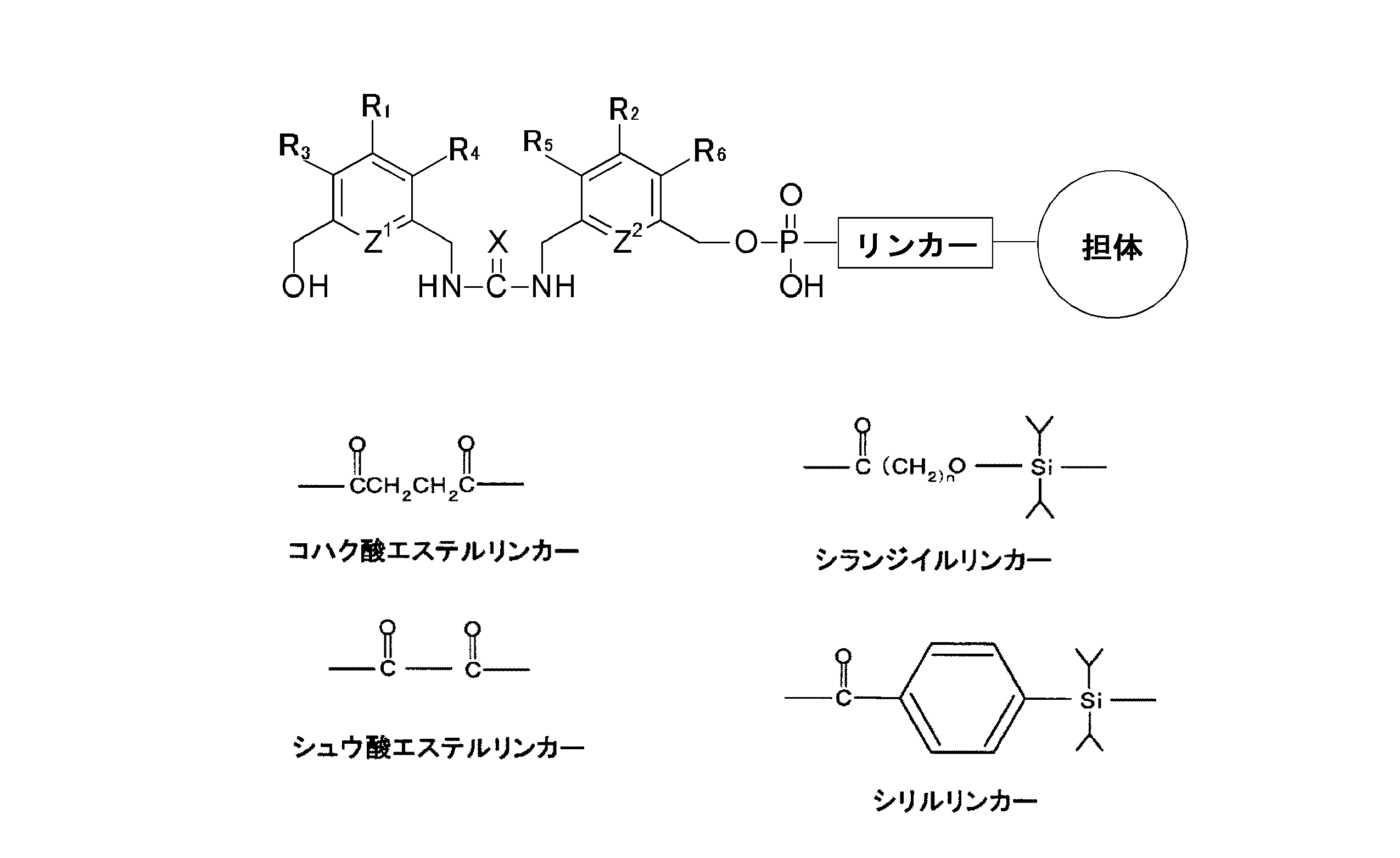
上記本発明のオリゴヌクレオチド誘導体合成用修飾担体は、下記構造式(A)で示される芳香族化合物を前駆体として容易に調製することができる(ただし、式中のR1~R6はそれぞれ独立して水素又は水素以外の置換基を示す。また、式中Z1及びZ2はそれぞれ独立してCH又は窒素を示し、Xは酸素又はイオウを示す。Pr1及びPr2はそれぞれ独立して水酸基の保護基を示す。)。 The modified carrier for synthesizing oligonucleotide derivatives of the present invention can be easily prepared by using an aromatic compound represented by the following structural formula (A) as a precursor (wherein R 1 to R 6 in the formula are independent of each other). In the formula, Z 1 and Z 2 each independently represent CH or nitrogen, X represents oxygen or sulfur, and Pr 1 and Pr 2 each independently represent A protecting group for a hydroxyl group).

本発明のオリゴヌクレオチド誘導体合成用修飾担体は、下記構造式(a1)で示されるユニットが直接又はリンカーを介して担体に化学修飾されていてもよい(ただし、式中のR1及びR2はそれぞれ独立してアルキル基、アリール基、ハロアルキル基及びハロゲン基のいずれかであり、Z1及びZ2はそれぞれ独立してCH又は窒素を示し、Xは酸素又はイオウを示す)。R1及びR2において特に好ましいのはアルキル基又はフルオロアルキル機等のハロアルキル基である。本発明者らは、このようなオリゴヌクレオチド誘導体合成用修飾担体を用いれば、少ない工程数で容易かつ高い収率でオリゴヌクレオチド誘導体を合成できることを確認している。 In the modified carrier for synthesizing oligonucleotide derivatives of the present invention, the unit represented by the following structural formula (a 1 ) may be chemically modified to the carrier directly or via a linker (provided that R 1 and R 2 in the formula are Are each independently an alkyl group, aryl group, haloalkyl group or halogen group, Z 1 and Z 2 each independently represent CH or nitrogen, and X represents oxygen or sulfur). Particularly preferred for R 1 and R 2 is an alkyl group or a haloalkyl group such as a fluoroalkyl group. The present inventors have confirmed that if such a modified carrier for synthesizing oligonucleotide derivatives is used, an oligonucleotide derivative can be synthesized easily and with a high yield with a small number of steps.

このオリゴヌクレオチド誘導体合成用修飾担体は、下記構造式(A1)で示される芳香族化合物を前駆体として容易に調製することができる(ただし、式中のR1及びR2はそれぞれ独立アルキル基、アリール基、ハロアルキル基及びハロゲン基のいずれかであり、Z1及びZ2はそれぞれ独立してCH又は窒素を示し、Xは酸素又はイオウを示す。また、Pr1及びPr2はそれぞれ独立して水酸基の保護基を示す。)。R1及びR2において特に好ましいのはアルキル基又はフルオロアルキル機等のハロアルキル基である。

本発明のオリゴヌクレオチド誘導体合成用修飾担体は、下記構造式(a2)で示されるユニットが直接又はリンカーを介して担体に化学修飾されていてもよい。本発明者らは、このようなオリゴヌクレオチド誘導体合成用修飾担体を用いても、少ない工程数で容易かつ高い収率でオリゴヌクレオチド誘導体を合成できることを確認している。 In the modified carrier for synthesizing oligonucleotide derivatives of the present invention, the unit represented by the following structural formula (a 2 ) may be chemically modified to the carrier directly or via a linker. The present inventors have confirmed that even when such a modified carrier for synthesizing oligonucleotide derivatives is used, it is possible to synthesize oligonucleotide derivatives easily and in high yield with a small number of steps.

このオリゴヌクレオチド誘導体合成用修飾担体は、下記構造式(A2)で示される芳香族化合物を前駆体として容易に調製することができる。

また、本発明のオリゴヌクレオチド誘導体は、オリゴヌクレオチドの3´末端が下記構造式(a)で示されるユニット(ただし、式中のR1~R6はそれぞれ独立して水素又は水素以外の置換基を示す。また、式中Z1及びZ2はそれぞれ独立してCH又は窒素を示し、Xは酸素又はイオウを示す)で修飾されていることを特徴とする。 Further, the oligonucleotide derivative of the present invention is a unit wherein the 3 ′ end of the oligonucleotide is represented by the following structural formula (a) (wherein R 1 to R 6 are each independently hydrogen or a substituent other than hydrogen) In the formula, each of Z 1 and Z 2 independently represents CH or nitrogen, and X represents oxygen or sulfur).

本発明のオリゴヌクレオチド誘導体は、本発明のオリゴヌクレオチド誘導体合成用修飾担体を出発物質として、従来からDNAやRNAの合成に用いられているオリゴヌクレオチドの合成法によって、容易に合成することができる。また、このオリゴヌクレオチド誘導体は、3´末端に2つの芳香族環を有しており、尿素結合又はチオ尿素結合で芳香族環どうしが結合されている。このため、3´末端が疎水性を示すこととなり、細胞膜への透過性が良好となるとともに、優れたヌクレアーゼ耐性を有することとなる。このため、細胞内に本発明のオリゴヌクレオチド誘導体を入れた場合においても、その効果をより長い時間持続させることができる。さらには、RNAiに利用した場合、RISC中のPAZドメインの疎水性ポケットに入り込み易く、ノックダウンの効果を高めることができると考えられる。 The oligonucleotide derivative of the present invention can be easily synthesized by the oligonucleotide synthesis method conventionally used for the synthesis of DNA and RNA, using the modified carrier for synthesizing the oligonucleotide derivative of the present invention as a starting material. In addition, this oligonucleotide derivative has two aromatic rings at the 3 ′ end, and the aromatic rings are bonded to each other by a urea bond or a thiourea bond. For this reason, the 3 ′ end exhibits hydrophobicity, the permeability to the cell membrane is good, and the nuclease resistance is excellent. For this reason, even when the oligonucleotide derivative of the present invention is placed in a cell, the effect can be maintained for a longer time. Furthermore, when used for RNAi, it is thought that it can easily enter the hydrophobic pocket of the PAZ domain in RISC, and the effect of knockdown can be enhanced.
本発明のオリゴヌクレオチド誘導体は、オリゴヌクレオチドの3´末端が下記構造式(a1)で示されるユニットで修飾されていてもよい(ただし、式中のR1及びR2はそれぞれ独立してアルキル基、アリール基、ハロアルキル基及びハロゲン基のいずれかであり、Z1及びZ2はそれぞれ独立してCH又は窒素を示し、Xは酸素又はイオウを示す。また、Pr1及びPr2はそれぞれ独立して水酸基の保護基を示す。)。R1及びR2において特に好ましいのはアルキル基又はフルオロアルキル機等のハロアルキル基である。本発明者らは、このようなオリゴヌクレオチド誘導体が優れたヌクレアーゼ耐性を有し、細胞内に入れた場合において、RNAiにおけるノックダウン効果をより長い時間持続させることができることを確認している。 In the oligonucleotide derivative of the present invention, the 3 ′ end of the oligonucleotide may be modified with a unit represented by the following structural formula (a 1 ) (wherein R 1 and R 2 are each independently alkyl Any one of a group, an aryl group, a haloalkyl group and a halogen group, Z 1 and Z 2 each independently represent CH or nitrogen, X represents oxygen or sulfur, and Pr 1 and Pr 2 each independently A protective group for a hydroxyl group). Particularly preferred for R 1 and R 2 is an alkyl group or a haloalkyl group such as a fluoroalkyl group. The present inventors have confirmed that such an oligonucleotide derivative has an excellent nuclease resistance and can sustain a knockdown effect in RNAi for a longer time when placed in a cell.

さらには、本発明のオリゴヌクレオチド誘導体は、オリゴヌクレオチドの3´末端が下記構造式(a2)で示されるユニットで修飾されていてもよい。本発明者らは、このようなオリゴヌクレオチド誘導体が優れたヌクレアーゼ耐性を有し、細胞内に入れた場合において、RNAiにおけるノックダウン効果をより長い時間持続させることができることを確認している。 Furthermore, in the oligonucleotide derivative of the present invention, the 3 ′ end of the oligonucleotide may be modified with a unit represented by the following structural formula (a 2 ). The present inventors have confirmed that such an oligonucleotide derivative has an excellent nuclease resistance and can sustain a knockdown effect in RNAi for a longer time when placed in a cell.

また、本発明のオリゴヌクレオチド誘導体は、オリゴヌクレオチド部分が所定の遺伝子mRNAの部分配列又はその相補配列を有するものであってもよい。また、オリゴヌクレオチドの鎖長は、10以上35以下であってもよい。さらに、オリゴヌクレオチドはオリゴリボヌクレオチドであってもよい。 In the oligonucleotide derivative of the present invention, the oligonucleotide portion may have a partial sequence of a predetermined gene mRNA or a complementary sequence thereof. The chain length of the oligonucleotide may be 10 or more and 35 or less. Furthermore, the oligonucleotide may be an oligoribonucleotide.
本発明のオリゴヌクレオチド構築物は、遺伝子発現調節用オリゴヌクレオチド構築物であって、上記いずれかのオリゴヌクレオチド誘導体を有することを特徴とする。このオリゴヌクレオチド構築物は、1本鎖及び2本鎖DNA、1本鎖及び2本鎖RNA、DNA/RNAキメラ並びにDNA/RNAハイブリッドから選択されるオリゴヌクレオチド構築物とすることができ、また、その機能面からは、アンチジーン、アンチセンス、アプタマー、siRNA、miRNA、shRNA及びリポザイムから選択することができる。 オ リ ゴ The oligonucleotide construct of the present invention is an oligonucleotide construct for regulating gene expression, characterized by having any of the above-described oligonucleotide derivatives. This oligonucleotide construct can be an oligonucleotide construct selected from single and double stranded DNA, single and double stranded RNA, DNA / RNA chimeras and DNA / RNA hybrids, and its function. From the aspect, it can be selected from antigene, antisense, aptamer, siRNA, miRNA, shRNA and lipozyme.
また、本発明によれば、上記いずれかのオリゴヌクレオチド誘導体を有する遺伝子診断用オリゴヌクレオチド構築物とすることができる。さらに、本構築物はプローブ又はプライマーとすることができる。 In addition, according to the present invention, an oligonucleotide construct for gene diagnosis having any of the above-described oligonucleotide derivatives can be obtained. Furthermore, the construct can be a probe or primer.
(オリゴヌクレオチド誘導体合成用修飾担体)
本発明のオリゴヌクレオチド誘導体合成用修飾担体は、次のようにして調製することができる。なお、ここでいうヌクレオチドとは、改変されてもよいヌクレオチドである。
(Modified carrier for synthesis of oligonucleotide derivatives)
The modified carrier for synthesizing oligonucleotide derivatives of the present invention can be prepared as follows. The nucleotide referred to here is a nucleotide that may be modified.
(オリゴヌクレオチド誘導体)
本発明のオリゴヌクレオチド誘導体を得るには、本発明のオリゴヌクレオチド誘導体合成用修飾担体を用い、アミダイト法をはじめとする各種核酸合成法によりオリゴヌクレオチド誘導体とする方法を用いることができる。水酸基の保護基としては、特に限定しないで従来公知の各種のヒドロキシル保護基を用いることができる。このような保護基としては、具体的にはベンジル基、アセチル基、ベンゾイル基等が挙げられ、特に好ましい保護基はベンジル基である。また、アミノ基の保護基として、具体的にはフタル酸基、ベンゾイル基等が挙げられ、特に好ましいのはフタル酸基である。
(Oligonucleotide derivatives)
In order to obtain the oligonucleotide derivative of the present invention, a method for preparing an oligonucleotide derivative by various nucleic acid synthesis methods including the amidite method using the modified carrier for synthesis of oligonucleotide derivative of the present invention can be used. The hydroxyl protecting group is not particularly limited, and various conventionally known hydroxyl protecting groups can be used. Specific examples of such a protecting group include a benzyl group, an acetyl group, and a benzoyl group, and a particularly preferred protecting group is a benzyl group. Specific examples of the amino-protecting group include a phthalic acid group and a benzoyl group, with a phthalic acid group being particularly preferred.
また、本発明のオリゴヌクレオチド誘導体を利用してアンチジーン、アンチセンス、アプタマー、miRNA及びリボザイムを構築するときには式(a)で表されるユニットを備えるようにすればよい。また、プローブが固相担体に固定化されている場合には、自由端側となる側に式(a)で表されるユニットを備えるようにすることができる。さらに、プライマーにおいては必要に応じて適宜式(a)で表されるユニットを備えていてもよい。 In addition, when constructing an antigene, an antisense, an aptamer, a miRNA and a ribozyme using the oligonucleotide derivative of the present invention, a unit represented by the formula (a) may be provided. When the probe is immobilized on a solid phase carrier, a unit represented by the formula (a) can be provided on the free end side. Furthermore, the primer may be appropriately provided with a unit represented by the formula (a) as necessary.
本明細書においてオリゴヌクレオチドとは、一般にオリゴヌクレオチドやポリヌクレオチドを構成するモノマーであるヌクレオチドをモノマー単位として該モノマー単位を複数有するポリマーを意味するものとする。また、オリゴヌクレオチドとは、モノマー単位として、デオキシリボヌクレオチド及び/又はリボヌクレオチドを意味するものである。一般に、ヌクレオチドとしてデオキシリボヌクレオチドをモノマー単位とするポリマーをDNAと称し、リボヌクレオチドをモノマー単位とするポリマーをRNAと称するが、本発明のオリゴヌクレオチド誘導体は、-般に挿されるDNA及びRNAのほか、これらのモノマー単位のオリゴマーを含むものとする。また、オリゴヌクレオチドは、RNA/DNAキメラも包含している。また、改変されていてもよいオリゴヌクレオチドとは、プリン及びピリミジンであるグアニン、シトシン、チミン、アデニン、ウラシル又は メチルシトシンなどの天然塩基を含むヌクレオチドのみからなるオリゴヌクレオチドのほか、オリゴヌクレオチドの各種部分、すなわち、塩基、糖部分及びリン酸エステル部分において何らかの化学修飾が施された1又は2以上のヌクレオチドを有するオリゴヌクレオチドを包含している。 に お い て In this specification, the term “oligonucleotide” generally means a polymer having a plurality of monomer units, each of which is a monomer that constitutes an oligonucleotide or a polynucleotide. The oligonucleotide means deoxyribonucleotide and / or ribonucleotide as a monomer unit. In general, a polymer having deoxyribonucleotides as monomer units as nucleotides is referred to as DNA, and a polymer having ribonucleotides as monomer units is referred to as RNA, but the oligonucleotide derivative of the present invention is generally used for DNA and RNA, These oligomer unit oligomers are included. Oligonucleotides also include RNA / DNA chimeras. In addition, oligonucleotides which may be modified include purine and pyrimidines such as guanine, cytosine, thymine, adenine, uracil or methylcytosine. That is, oligonucleotides having one or more nucleotides with some chemical modification in the base, sugar moiety and phosphate ester moiety.
本発明のオリゴヌクレオチド誘導体は、所定の遺伝子のDNAのセンス鎖、そのアンチセンス鎖又はmRNAの部分配列若しくはその相補配列を有することができる。こうした相補性を有することにより各種の標的核酸にハイブリダイズさせ、それによりオリゴヌクレオチド誘導体に意図した機能を発現させることができる。本発明のオリゴヌクレオチド誘導体において、オリゴヌクレオチドの長さは特に限定しないで、用途に応じた長さとすることができるが、オリゴヌクレオチドの合成の容易性及び期待する効果の発揮を考慮すると、10以上35以下とすることが好ましい。また、アンチセンスの場合には、10以上30以下程度にすることができ、siRNAの場合には、A及びBの合計の鎖長は、好ましくは15以上35以下、より好ましくは30以下である。また、プライマーの場合には、10以上30以下であり、プローブの場合には10以上30以下であることが好ましい。 オ リ ゴ The oligonucleotide derivative of the present invention can have a sense strand of DNA of a predetermined gene, an antisense strand thereof, a partial sequence of mRNA, or a complementary sequence thereof. By having such complementarity, it is possible to hybridize with various target nucleic acids, thereby expressing the intended function of the oligonucleotide derivative. In the oligonucleotide derivative of the present invention, the length of the oligonucleotide is not particularly limited and can be a length according to the use. However, considering the ease of oligonucleotide synthesis and the expected effect, it is 10 or more. It is preferable to be 35 or less. In the case of antisense, it can be about 10 or more and 30 or less. In the case of siRNA, the total chain length of A and B is preferably 15 or more and 35 or less, more preferably 30 or less. . In the case of a primer, it is preferably 10 or more and 30 or less, and in the case of a probe, it is preferably 10 or more and 30 or less.
本発明のオリゴヌクレオチド誘導体を、例えば、siRNA、shRNA、アンチセンス、リボザイム及びアプタマーに用いる場合には、モノマー単位は改変されていてもよいオリゴリボヌクレオチドとすることができる。 用 い る When the oligonucleotide derivative of the present invention is used for, for example, siRNA, shRNA, antisense, ribozyme and aptamer, the monomer unit can be an oligoribonucleotide which may be modified.
(オリゴヌクレオチド構築物)
本発明のオリゴヌクレオチド構築物は、本発明のオリゴヌクレオチド誘導体を有している。本オリゴヌクレオチド構築物における本オリゴヌクレオチド誘導体の種類により、本構築物は、1本鎖DNA、2本鎖DNA、1本鎖RNA、2本鎖RNA、DNA/RNAキメラ及びDNA/RNAハイブリッド等の形態をそれぞれあるいは組み合わせた形態とすることができる。なお、既に説明したように、本オリゴヌクレオチド誘導体を構成するオリゴヌクレオチド部分は、改変されたオリゴヌクレオチドを含んでいるため、本オリゴヌクレオチド構築物においても改変形態のオリゴヌクレオチドが含まれることがある。
(Oligonucleotide construct)
The oligonucleotide construct of the present invention has the oligonucleotide derivative of the present invention. Depending on the type of the oligonucleotide derivative in the oligonucleotide construct, the construct can be in the form of single-stranded DNA, double-stranded DNA, single-stranded RNA, double-stranded RNA, DNA / RNA chimera, DNA / RNA hybrid, etc. Each or a combination can be used. As already described, since the oligonucleotide portion constituting the oligonucleotide derivative contains a modified oligonucleotide, the oligonucleotide construct may also contain a modified form of the oligonucleotide.
本発明のオリゴヌクレオチド構築物は、ヌクレアーゼ耐性が向上されているため、遺伝子発現調節用、又は研究用、診断用の各種用途に用いることができる。遺伝子発現調節用途としては、アンチジーン、アンチセンス、アプタマー、siRNA、miRNA、shRNA及びリボザイム等が挙げられる。特に、siRNA及びshRNAにおいて3´ 末端オーバーハング部位のdTに対し式(a)で表されるユニットを導入することでヌクレアーゼ耐性とサイレンシング活性の双方を向上させることができる。 オ リ ゴ Since the nuclease resistance is improved, the oligonucleotide construct of the present invention can be used for gene expression regulation or for various uses for research and diagnosis. Examples of gene expression regulation applications include antigene, antisense, aptamer, siRNA, miRNA, shRNA and ribozyme. In particular, by introducing the unit represented by the formula (a) into dT at the 3′-terminal overhang site in siRNA and shRNA, both nuclease resistance and silencing activity can be improved.
診断用途又は研究用途としては、プローブ及びプライマーが挙げられる。プローブは、設計又は 選択により、ターゲット核酸に特異的に規定された配列を有しており、所定のストリンジェンシーの下で、それらがハイブリダイズするようにするに取得されたオリゴヌクレオチドである。プローブに本オリゴヌクレオチド誘導体を用いることでヌクレアーゼ耐性が向上されるため、ターゲット核酸を含有するサンプル中に混在するヌクレアーゼの影響を抑制又は回避して、ヌクレアーゼの除去程度が低くてもあるいはヌクレアーゼ除去処理を省略したサンプル調製が可能になる。これにより簡易に遺伝子診断や検査をすることができるようになる。なお、こうしたプローブとターゲットとのハイブリタイゼーションは、プローブを適当なガラス基板や、プラスチック製基板や、ビーズ等の固相担体に固定化して行なうことができる。本発明には、本オリゴヌクレオチド誘導体を含むプローブを固定化した固相担体も含まれる。 As a diagnostic use or a research use, a probe and a primer are mentioned. Probes are oligonucleotides that have, by design or selection, a sequence that is specifically defined for the target nucleic acid and that allow them to hybridize under a given stringency. Nuclease resistance is improved by using this oligonucleotide derivative as a probe, so the effect of nuclease mixed in the sample containing the target nucleic acid is suppressed or avoided, and even if the degree of nuclease removal is low or nuclease removal treatment Sample preparation without omission becomes possible. As a result, genetic diagnosis and testing can be performed easily. Such hybridization between the probe and the target can be performed by immobilizing the probe on an appropriate glass substrate, a plastic substrate, or a solid phase carrier such as beads. The present invention also includes a solid phase carrier on which a probe containing the present oligonucleotide derivative is immobilized.
(オリゴヌクレオチド誘導体の利用)
本発明のオリゴヌクレオチド誘導体は、siRNAやアンチセンス等として機能するように構築することで、遺伝子発現抑制剤として利用できる。また、本発明のオリゴヌクレオチド誘導体は、ヒト及び非ヒト動物における疾患の予防・治療用医薬組成物の有効成分として用いることができる。例えば、遺伝子発現に伴う疾患に対して、遺伝子発現抑制剤として構築した本発明のオリゴヌクレオチド誘導体はこうした疾患の予防や治療に有効である。
(Use of oligonucleotide derivatives)
The oligonucleotide derivative of the present invention can be used as a gene expression inhibitor by being constructed so as to function as siRNA or antisense. Further, the oligonucleotide derivative of the present invention can be used as an active ingredient of a pharmaceutical composition for prevention / treatment of diseases in humans and non-human animals. For example, for a disease associated with gene expression, the oligonucleotide derivative of the present invention constructed as a gene expression inhibitor is effective for the prevention and treatment of such diseases.
さらに、本発明のオリゴヌクレオチド誘導体は、そのハイブリダイゼーション機能を発揮させるように構築することで、プローブ、プライマー等の検査試薬や診断試薬として用いることができる。さらに、これらオリゴヌクレオチド構築物をチップやビ-ズ等の固体担体等に保持したものは、検査装置や診断装置又はこれらの一部として利用することができる。さらには、こうした検査試薬や診断薬は、他の試薬や診断薬あるいは装置等と組み合わせた検査用又は診断用キットとしても用いることができる。 Furthermore, the oligonucleotide derivative of the present invention can be used as a test reagent or a diagnostic reagent such as a probe or a primer by constructing it so as to exhibit its hybridization function. Furthermore, what hold | maintained these oligonucleotide constructs on solid supports, such as a chip | tip and a bead, can be utilized as a test | inspection apparatus, a diagnostic apparatus, or these one part. Furthermore, such test reagents and diagnostic agents can be used as test or diagnostic kits in combination with other reagents, diagnostic agents or devices.
本発明のオリゴヌクレオチド誘導体は、本発明のオリゴヌクレオチド誘導体を含むオリゴヌクレオチド構築物の遺伝子発現抑制作用を利用した、遺伝子発現抑制方法にも利用できる。さらには、本発明のオリゴヌクレオチド構築物のハイブリダイゼーション機能を利用した遺伝子検出方法にも利用できる。 オ リ ゴ The oligonucleotide derivative of the present invention can also be used in a gene expression suppression method using the gene expression suppression action of an oligonucleotide construct containing the oligonucleotide derivative of the present invention. Furthermore, it can also be used in a gene detection method using the hybridization function of the oligonucleotide construct of the present invention.
以下、本発明を具体化した実施例を以下に詳細に示す。
なお、下記実施例において使用した機器は以下のとおりである。
(使用機器)
NMRスペクトル JEOL JNM-α400
GC/MS SHIMADZU GCMS-QP 2010A
吸光度計 HITACHI U-2001 spectrophotometer,
GEヘルスサイエンス Nano Vue
DNA/RNA synthesizer Applied Biosystems Model 3400
Tm測定機 SHIMADZU UV 2400
HPLC SPD-10AVP, SCL-10AVP, LC-10AVP, DGU-10A,
CTO-10AVP, C-R8A
MALDI-TOF/MS SHIMADZU AXIMA-CFR plus
発光計測用プレートリーダー ATTO Luminescenser JNRII
Hereinafter, examples embodying the present invention will be described in detail below.
In addition, the apparatus used in the following Example is as follows.
(Used equipment)
NMR spectrum JEOL JNM-α400
GC / MS SHIMADZU GCMS-QP 2010A
Absorbance meter HITACHI U-2001 spectrophotometer,
GE Health Science Nano Vue
DNA / RNA synthesizer Applied Biosystems Model 3400
Tm measuring machine SHIMADZU UV 2400
HPLC SPD-10AVP, SCL-10AVP, LC-10AVP, DGU-10A,
CTO-10AVP, C-R8A
MALDI-TOF / MS SHIMADZU AXIMA-CFR plus
Plate reader for luminescence measurement ATTO Luminescenser JNRII
また、本明細書の実施例の説明の中では、以下に示す略号を用いることがある。
(略 語)
APS ammonium peroxodisulfate
CPG controlled pore glass
DMAP 4-dimethylaminopyridine
DMTrCl 4.4’-dimethoxytritylchloride
EDC 1-ethyl-3- ( 3-dimethylaminopropyl ) carbodiimide
EDTA ethylenediamine-N,N,N’,N’-tetraacetic acid
MALDI-TOF matrix assisted laser desorption ionization - time of flight
PAGE polyacrylamide gel electrophoresis
TBAF tetrabutylammonium fluoride
TBE tris-borate-EDTA
TEAA triethylammonium acetate
TEMED N,N,N’,N’-tetramethylethylenediamine
Tm melting temperature
Tris tris(hydroxymethyl)aminomethane
Moreover, in the description of the Example of this specification, the abbreviation shown below may be used.
(Abbreviation)
APS ammonium peroxodisulfate
CPG controlled pore glass
DMAP 4-dimethylaminopyridine
DMTrCl 4.4'-dimethoxytritylchloride
EDC 1-ethyl-3- (3-dimethylaminopropyl) carbodiimide
EDTA ethylenediamine-N, N, N ', N'-tetraacetic acid
MALDI-TOF matrix assisted laser desorption ionization-time of flight
PAGE polyacrylamide gel electrophoresis
TBAF tetrabutylammonium fluoride
TBE tris-borate-EDTA
TEAA triethylammonium acetate
TEMED N, N, N ', N'-tetramethylethylenediamine
Tm melting temperature
Tris tris (hydroxymethyl) aminomethane
(実施例1)
<ベンゼン環とピリジン環とが尿素結合したオリゴヌクレオチド誘導体合成用修飾担体の合成>
実施例1では、以下のようにしてベンゼン-ピリジン骨格を母核としたオリゴヌクレオチド誘導体合成用修飾担体を合成した。
2,6-ピリジンジメタノールを出発原料に用い、水素化ナトリウム存在下、tert-ブチルジメチルシリルクロリド(TBDMSCl)と反応させることにより、片方の水酸基をTBDMS基で保護したシリル体1を収率49%で合成した。さらに四臭化炭素、アジ化ナトリウムを共存させ、臭素化、アジド化を一工程で行いアジド体2を収率76%で得た後、5%パラジウムエチレンジアミン複合体触媒を用いてアジド選択的に水素接触還元反応を行い、ピリジン誘導体3を収率80%で合成した。
Example 1
<Synthesis of modified carrier for synthesis of oligonucleotide derivative in which benzene ring and pyridine ring are urea-bonded>
In Example 1, a modified carrier for synthesizing oligonucleotide derivatives using a benzene-pyridine skeleton as a mother nucleus was synthesized as follows.
By using 2,6-pyridinedimethanol as a starting material and reacting with tert-butyldimethylsilyl chloride (TBDMSCl) in the presence of sodium hydride, a

一方、下式に示すように、3-シアノベンジルアルコールを出発物質として4,4'-ジメトキシトリチルクロリド(DMTrCl)を用いてジメトキシトリチル化体4を収率91%で得た後、水素化アルミニウムリチウムでシアノ基を還元し、ベンジルアミノ体5を収率69%で得た。そして、上記のピリジン誘導体3とベンジルアミノ体5とをカルボニルジイミダゾールを用いてカップリングさせ、ウレア誘導体6を収率43%で得た。なお、ここで同様の原料から対応するイソチオシアネートを経由して、対応するチオ尿素誘導体を容易かつ定量的に形成させることができる。そして、このチオ尿素誘導体から、以下に示す尿素結合を有するオリゴヌクレオチド誘導体合成用修飾担体と同様に、チオ尿素結合を有するオリゴヌクレオチド誘導体修飾担体を合成することができる。
On the other hand, as shown in the following formula, dimethoxytritylated compound 4 was obtained with a yield of 91% using 4,4′-dimethoxytrityl chloride (DMTrCl) using 3-cyanobenzyl alcohol as a starting material, and then aluminum hydride. The cyano group was reduced with lithium to obtain

上記のようにして得たウレア誘導体6をTBAFで処理し、下記に示す脱シリル体7を収率98%で得た後、従来法に従い、無水コハク酸を用いてスクシニル化を行った後、脱水縮合剤存在下CPG樹脂と反応させることにより、実施例1のオリゴヌクレオチド誘導体合成用修飾担体9を38.5μmol/gの活性で得た。 The urea derivative 6 obtained as described above was treated with TBAF to obtain the desilylated product 7 shown below in a yield of 98%, and then subjected to succinylation with succinic anhydride according to a conventional method. By reacting with a CPG resin in the presence of a dehydrating condensing agent, the modified carrier 9 for synthesizing oligonucleotide derivatives of Example 1 was obtained with an activity of 38.5 μmol / g.

さらに詳細なオリゴヌクレオチド誘導体合成用修飾担体(9)の合成手順を以下に示す。
2-[(tert-Butyldimethylsilyloxy)methyl]-6-hydroxymethylpyridine(1)の合成
60%NaH(1.45 g, 35.9 mmol)をDMF(60 mL)に溶解し、氷冷下で撹拌しながら、2,6-pyridinedimethanol(5.00 g, 35.9 mmol)のDMF(30 mL)溶液を滴下した。Ar雰囲気下室温で1時間撹拌した後、tert-buthyldimethylchlorosilane(6.54 g, 43.3 mmol)のDMF (40 mL) 溶液を加え、さらに12時間撹拌した。TLCで原料の消失を確認した後、EtOAcと10%NaHCO3 aqで抽出し、有機層をsat NaCl aqで洗浄、無水Na2SO4を加え乾燥させた。溶媒を減圧留去後、残渣をシリカゲルクロマトグラフィー(Hex:EtOAc = 5:1)にて精製し、2-[(tert-butyldimethylsilyloxy)methyl]-6-hydroxymethylpyridine(1)(4.46 g, 49%)を無色オイルとして得た。
1H-NMR(CDCl3, 400 MHz)
δ = 7.66 (1H, d, J = 7.6Hz, Ar-H), 7.39 (1H, d, J = 7.6Hz, Ar-H), 7.10 (1H, d, J = 7.6Hz, Ar-H), 4.80 (2H, s, CH2O), 4.71 (2H, s, CH2O), 0.95 (9H, s, t-C4H9Si), 0.11 (6H, s, (CH3)2Si)
13C-NMR(CDCl3, 100 MHz)
δ = 160.3, 157.9, 157.9, 137.3, 118.5, 65.8, 63.9, 25.9, 18.3, -5.4
A more detailed procedure for synthesizing the modified carrier (9) for synthesizing oligonucleotide derivatives is shown below.
Synthesis of 2-[(tert-Butyldimethylsilyloxy) methyl] -6-hydroxymethylpyridine (1)
60% NaH (1.45 g, 35.9 mmol) was dissolved in DMF (60 mL), and a solution of 2,6-pyridinedimethanol (5.00 g, 35.9 mmol) in DMF (30 mL) was added dropwise while stirring under ice cooling. . After stirring at room temperature for 1 hour under Ar atmosphere, a DMF (40 mL) solution of tert-buthyldimethylchlorosilane (6.54 g, 43.3 mmol) was added, and the mixture was further stirred for 12 hours. After confirming the disappearance of the raw materials by TLC, extraction with EtOAc and 10% NaHCO 3 aq was performed, the organic layer was washed with sat NaCl aq, and anhydrous Na 2 SO 4 was added and dried. After distilling off the solvent under reduced pressure, the residue was purified by silica gel chromatography (Hex: EtOAc = 5: 1) to give 2-[(tert-butyldimethylsilyloxy) methyl] -6-hydroxymethylpyridine (1) (4.46 g, 49%) Was obtained as a colorless oil.
1 H-NMR (CDCl 3 , 400 MHz)
δ = 7.66 (1H, d, J = 7.6Hz, Ar-H), 7.39 (1H, d, J = 7.6Hz, Ar-H), 7.10 (1H, d, J = 7.6Hz, Ar-H), 4.80 (2H, s, CH 2 O), 4.71 (2H, s, CH 2 O), 0.95 (9H, s, tC 4 H 9 Si), 0.11 (6H, s, (CH 3 ) 2 Si)
13 C-NMR (CDCl 3 , 100 MHz)
δ = 160.3, 157.9, 157.9, 137.3, 118.5, 65.8, 63.9, 25.9, 18.3, -5.4
2-Azidomethyl-6-[(tert-butyldimethylsilyloxy)methyl]pyridine(2)の合成
予め真空乾燥させておいた2-[(tert-Butyldimethylsilyloxy)methyl]-6-hydroxymethylpyridine(1)(2.14 g, 8.42 mmol)、sodium azide(2.73 g, 42.0 mmol)、Triphenylphosphine(2.65 g, 10.10 mmol)、carbontetrabromide(3.07 g, 9.29 mmol)の混合物をDMF(64 mL)に溶解し、Triethylamine(2.64 mL)を加え、Ar雰囲気下で25時間撹拌した。TLCで原料の消失を確認した後、EtOAcと水で抽出し、有機層をsat NaCl aqで洗浄、無水Na2SO4を加え乾燥させた。溶媒を減圧留去後、残渣をシリカゲルクロマトグラフィー(Hex:EtOAc = 50:1)にて精製し、2-azidomethyl-6-[(tert-butyldimethyl-silyloxy)methyl]pyridine(2)(1.77 g, 76%)を薄黄色オイルとして得た。
1H-NMR (CDCl3, 400 MHz)
δ = 7.73 (1H, t, J = 7.6Hz, Ar-H), 7.47 (1H, d, J = 7.6Hz, Ar-H), 7.20 (1H, d, J = 7.6Hz, Ar-H), 4.83 (2H, s, CH2O), 4.44 (2H, s, CH2O), 0.96 (9H, s, t-C4H9Si), 0.12 (6H, s, (CH3)2Si)
13C-NMR (CDCl3, 100 MHz)
δ = 161.6, 154.4, 137.6, 120.0, 119.2, 65.9, 55.6, 25.9, 18.3, -5.4
Synthesis of 2-Azidomethyl-6-[(tert-butyldimethylsilyloxy) methyl] pyridine (2) 2-[(tert-Butyldimethylsilyloxy) methyl] -6-hydroxymethylpyridine (1) (2.14 g, 8.42 mmol) previously dried in vacuum ), Sodium azide (2.73 g, 42.0 mmol), triphenylphosphine (2.65 g, 10.10 mmol) and carbontetrabromide (3.07 g, 9.29 mmol) are dissolved in DMF (64 mL), triethylamine (2.64 mL) is added, and Ar is added. Stir for 25 hours under atmosphere. After confirming the disappearance of the raw materials by TLC, extraction with EtOAc and water was performed, the organic layer was washed with sat NaCl aq, and anhydrous Na 2 SO 4 was added and dried. After the solvent was distilled off under reduced pressure, the residue was purified by silica gel chromatography (Hex: EtOAc = 50: 1) to give 2-azidomethyl-6-[(tert-butyldimethyl-silyloxy) methyl] pyridine (2) (1.77 g, 76%) was obtained as a pale yellow oil.
1 H-NMR (CDCl 3 , 400 MHz)
δ = 7.73 (1H, t, J = 7.6Hz, Ar-H), 7.47 (1H, d, J = 7.6Hz, Ar-H), 7.20 (1H, d, J = 7.6Hz, Ar-H), 4.83 (2H, s, CH 2 O), 4.44 (2H, s, CH 2 O), 0.96 (9H, s, tC 4 H 9 Si), 0.12 (6H, s, (CH 3 ) 2 Si)
13 C-NMR (CDCl 3 , 100 MHz)
δ = 161.6, 154.4, 137.6, 120.0, 119.2, 65.9, 55.6, 25.9, 18.3, -5.4
2-Aminomethyl-6-[(tert-butyldimethylsilyloxy)methyl]pyridine(3)の合成
2-Azidomethyl-6-[(tert-butyldimethylsilyloxy)methyl]pyridine(2)(0.83 g, 2.98 mmol)、5% Pd/C(en)(83.0 mg, 10 wt %)をMeOH(20 mL)に懸濁させ、水素雰囲気下室温で5時間激しく撹拌した。TLCで原料の消失を確認した後、触媒を桐山ロートで吸引濾去した。ろ液を減圧留去後、残渣をシリカゲルクロマトグラフィー(CHCl3 : MeOH = 30 : 1 → 10:1)にて精製し、2-aminomethyl-6-[(tert-butyldimethylsilyloxy)methyl]pyridine(3)(603 mg, 80%)を黄色オイルとして得た。
1H-NMR (CDCl3, 400 MHz)
δ = 7.66 (1H, t, J = 7.8Hz, Ar-H), 7.37 (1H, d, J = 7.8Hz, Ar-H), 7.13 (1H, d, J = 7.6Hz, Ar-H), 4.82 (2H, s, CH2O), 3.94 (2H, s, CH2N), 0.96 (9H, s, t-C4H9Si), 0.12 (6H, s, (CH3)2Si)
13C-NMR (CDCl3, 100 MHz)
δ = 160.8, 160.7, 136.9, 119.0, 117.8, 65.9, 47.6, 25.7, 18.2, -5.4
Synthesis of 2-Aminomethyl-6-[(tert-butyldimethylsilyloxy) methyl] pyridine (3)
2-Azidomethyl-6-[(tert-butyldimethylsilyloxy) methyl] pyridine (2) (0.83 g, 2.98 mmol), 5% Pd / C (en) (83.0 mg, 10 wt%) suspended in MeOH (20 mL) The mixture was made turbid and stirred vigorously at room temperature under a hydrogen atmosphere for 5 hours. After confirming disappearance of the raw materials by TLC, the catalyst was filtered off with suction using a Kiriyama funnel. After the filtrate was distilled off under reduced pressure, the residue was purified by silica gel chromatography (CHCl 3 : MeOH = 30: 1 → 10: 1) to give 2-aminomethyl-6-[(tert-butyldimethylsilyloxy) methyl] pyridine (3) (603 mg, 80%) was obtained as a yellow oil.
1 H-NMR (CDCl 3 , 400 MHz)
δ = 7.66 (1H, t, J = 7.8Hz, Ar-H), 7.37 (1H, d, J = 7.8Hz, Ar-H), 7.13 (1H, d, J = 7.6Hz, Ar-H), 4.82 (2H, s, CH 2 O), 3.94 (2H, s, CH 2 N), 0.96 (9H, s, tC 4 H 9 Si), 0.12 (6H, s, (CH 3 ) 2 Si)
13 C-NMR (CDCl 3 , 100 MHz)
δ = 160.8, 160.7, 136.9, 119.0, 117.8, 65.9, 47.6, 25.7, 18.2, -5.4
3-(4,4’-Dimethoxytrityloxymethyl)benzonitrile(4)の合成
3-Hydroxymethylbenzonitrile(1.12 g, 8.38 mmol)と4,4’-dimethoxytritylchloride(3.41 g, 10.06 mmol)をDMF(23 mL)及びPyridine(23 mL)に懸濁し、Ar雰囲気下室温で12時間撹拌した。TLCで原料の消失を確認した後、氷水(20 mL)を加えた後、EtOAcと水で抽出し、有機層をsat NaCl aqで洗浄、無水Na2SO4を加え乾燥させた。溶媒を減圧留去後、残渣をシリカゲルクロマトグラフィー(Hex:EtOAc = 10:1)にて精製し、3-(4,4’-dimethoxytrityloxymethyl)benzonitrile(4)(3.31 mg, 91%)を無色オイルとして得た。
1H-NMR (CDCl3, 400 MHz)
δ = 7.23-7.68 (17H, m, Ar-H), 6.84 (4H, d, J = 8.8Hz, Ar-H), 4.21 (2H, s, CH2O), 3.79 (6H, s, CH3O)
13C-NMR (CDCl3, 100 MHz)
δ = 158.3, 144.4, 135.4, 130.5, 130.4, 129.5, 128.9, 128.5, 126.9, 118.6, 113.7, 112.1, 111.9, 111.8, 86.4, 56.9, 55.5, 54.0
Synthesis of 3- (4,4'-Dimethoxytrityloxymethyl) benzonitrile (4) 3-Hydroxymethylbenzonitrile (1.12 g, 8.38 mmol) and 4,4'-dimethoxytritylchloride (3.41 g, 10.06 mmol) were combined with DMF (23 mL) and Pyridine (23 The mixture was suspended at room temperature for 12 hours under an Ar atmosphere. After confirming the disappearance of the raw materials by TLC, ice water (20 mL) was added, followed by extraction with EtOAc and water, the organic layer was washed with sat NaCl aq, and dried over anhydrous Na 2 SO 4 . After distilling off the solvent under reduced pressure, the residue was purified by silica gel chromatography (Hex: EtOAc = 10: 1) to give 3- (4,4'-dimethoxytrityloxymethyl) benzonitrile (4) (3.31 mg, 91%) as a colorless oil Got as.
1 H-NMR (CDCl 3 , 400 MHz)
δ = 7.23-7.68 (17H, m, Ar-H), 6.84 (4H, d, J = 8.8Hz, Ar-H), 4.21 (2H, s, CH 2 O), 3.79 (6H, s, CH 3 O)
13 C-NMR (CDCl 3 , 100 MHz)
δ = 158.3, 144.4, 135.4, 130.5, 130.4, 129.5, 128.9, 128.5, 126.9, 118.6, 113.7, 112.1, 111.9, 111.8, 86.4, 56.9, 55.5, 54.0
3-(4,4’-Dimethoxytrityloxymethyl)benzylamine(5)の合成
LiAlH4(238 mg, 6.28 mmol)をジエチルエーテル(30 mL)に懸濁し、氷冷下撹拌しながら、3-(4,4’-Dimethoxytrityloxymethyl)benzonitrile(4)(0.86 g, 1.98 mmol)のジエチルエーテル(90 mL)溶液を滴下した。Ar雰囲気下室温で16時間撹拌した。TLCで原料の消失を確認した後、水(1.2 mL)及びMeOH(7.2 mL)を加えた。さらに30分撹拌した後、塩を吸引濾去した。ろ液を減圧留去後、残渣をシリカゲルクロマトグラフィー(CHCl3:MeOH = 100:1)にて精製し、3-(4,4’-dimethoxytrityloxymethyl)benzylamine(5)を(0.58 g, 69%)を無色オイルとして得た。
1H-NMR (CDCl3, 400 MHz)
δ = 7.21-7.52 (17H, m, Ar-H), 6.83 (4H, d, J = 8.8Hz, Ar-H), 4.16 (2H, s, CH2O), 3.86 (2H, s, CH2N), 3.79 (6H, s, CH3O)
13C-NMR (CDCl3, 100 MHz)
δ = 158.4, 145.0, 143.2, 139.6, 136.2, 130.0, 128.4, 128.2, 127.8, 126.7, 125.7, 125.6, 125.4, 113.1, 86.3, 65.5, 55.1, 46.5
Synthesis of 3- (4,4'-Dimethoxytrityloxymethyl) benzylamine (5) LiAlH 4 (238 mg, 6.28 mmol) was suspended in diethyl ether (30 mL) and stirred under ice cooling while 3- (4,4 ' A solution of -Dimethoxytrityloxymethyl) benzonitrile (4) (0.86 g, 1.98 mmol) in diethyl ether (90 mL) was added dropwise. Stir for 16 hours at room temperature under Ar atmosphere. After confirming disappearance of the raw materials by TLC, water (1.2 mL) and MeOH (7.2 mL) were added. After stirring for another 30 minutes, the salt was filtered off with suction. After the filtrate was distilled off under reduced pressure, the residue was purified by silica gel chromatography (CHCl 3 : MeOH = 100: 1) to give 3- (4,4'-dimethoxytrityloxymethyl) benzylamine (5) (0.58 g, 69%) Was obtained as a colorless oil.
1 H-NMR (CDCl 3 , 400 MHz)
δ = 7.21-7.52 (17H, m, Ar-H), 6.83 (4H, d, J = 8.8Hz, Ar-H), 4.16 (2H, s, CH 2 O), 3.86 (2H, s, CH 2 N), 3.79 (6H, s, CH 3 O)
13 C-NMR (CDCl 3 , 100 MHz)
δ = 158.4, 145.0, 143.2, 139.6, 136.2, 130.0, 128.4, 128.2, 127.8, 126.7, 125.7, 125.6, 125.4, 113.1, 86.3, 65.5, 55.1, 46.5
N-[3-(4,4’-Dimethoxytrityloxymethyl)benzyl]-N’-{[6-(tert-butyldimethylsilyloxy)methyl pyridin-2-yl]methyl}urea (6)の合成
3-(4,4’-Dimethoxytrityloxymethyl)benzylamine(5)(455 mg, 1.04 mmol)、1,1’-
carbonyldiimidazole(170 mg, 1.05 mmol)をTHF(52 mL)に懸濁し、Ar雰囲気下室温で24時間撹拌した。TLCで原料の消失を確認した後、2-aminomethyl-6-[(tert-butyl-dimethylsilyloxy)methyl]pyridine(3)(593 mg, 2.35 mmol)のTHF(13 mL)溶液を滴下した後、さらに48時間撹拌した。反応溶液を減圧留去後、残渣をシリカゲルクロマトグラフィー (CHCl3:MeOH = 100:1)にて精製し、N-[3-(4,4’-Dimethoxytrityloxymethyl)benzyl]-N’-{[6-(tert-butyldimethylsilyloxy)methylpyridin-2-yl]methyl}urea(6)(406 mg, 54%)を無色オイルとして得た。
1H-NMR (CDCl3, 400 MHz)
δ = 7.61-7.07 (16H, m, Ar-H), 6.85-6.83 (4H, d, J = 8.8Hz, Ar-H), 4.71 (2H, s, CH2) , 4.43 (2H, s, CH2), 4.37 (2H, s, CH2) , 4.16 (2H, s, CH2) , 3.78 (6H, s, CH3O) , 0.95 (9H, s, t-C4H9Si), 0.10 (6H, s, (CH3)2 Si)
13C-NMR (CDCl3, 100 MHz)
δ = 160.6, 158.4, 158.2, 156.4, 145.0, 139.7, 139.1, 137.4, 136.2, 130.0, 128.5, 128.1, 127.8, 126.7, 126.2, 126.0, 125.9, 120.0, 118.3, 113.1, 86.4, 65.8, 65.4, 55.2, 45.6, 44.5, 25.9, 18.3, -5.4
Mass (EI) m/z:717 (M+)
Synthesis of N- [3- (4,4'-Dimethoxytrityloxymethyl) benzyl] -N '-{[6- (tert-butyldimethylsilyloxy) methyl pyridin-2-yl] methyl} urea (6) 3- (4,4' -Dimethoxytrityloxymethyl) benzylamine (5) (455 mg, 1.04 mmol), 1,1'-
Carbonyldiimidazole (170 mg, 1.05 mmol) was suspended in THF (52 mL) and stirred at room temperature for 24 hours under an Ar atmosphere. After confirming disappearance of the raw material by TLC, a solution of 2-aminomethyl-6-[(tert-butyl-dimethylsilyloxy) methyl] pyridine (3) (593 mg, 2.35 mmol) in THF (13 mL) was added dropwise, and further Stir for 48 hours. After the reaction solution was distilled off under reduced pressure, the residue was purified by silica gel chromatography (CHCl 3 : MeOH = 100: 1), and N- [3- (4,4'-Dimethoxytrityloxymethyl) benzyl] -N '-{[6 -(tert-butyldimethylsilyloxy) methylpyridin-2-yl] methyl} urea (6) (406 mg, 54%) was obtained as a colorless oil.
1 H-NMR (CDCl 3 , 400 MHz)
δ = 7.61-7.07 (16H, m, Ar-H), 6.85-6.83 (4H, d, J = 8.8Hz, Ar-H), 4.71 (2H, s, CH 2 ), 4.43 (2H, s, CH 2 ), 4.37 (2H, s, CH 2 ), 4.16 (2H, s, CH 2 ), 3.78 (6H, s, CH 3 O), 0.95 (9H, s, tC 4 H 9 Si), 0.10 (6H , s, (CH 3 ) 2 Si)
13 C-NMR (CDCl 3 , 100 MHz)
δ = 160.6, 158.4, 158.2, 156.4, 145.0, 139.7, 139.1, 137.4, 136.2, 130.0, 128.5, 128.1, 127.8, 126.7, 126.2, 126.0, 125.9, 120.0, 118.3, 113.1, 86.4, 65.8, 65.4, 55.2, 45.6, 44.5, 25.9, 18.3, -5.4
Mass (EI) m / z: 717 (M + )
N-[3-(4,4’-Dimethoxytrityloxymethyl)benzyl]-N’-[(6-hydroxymethylpyridin-2-yl)methyl]urea(7)の合成
N-[3-(4,4’-Dimethoxytrityloxymethyl)benzyl]-N’-{[6-(tert-butyldimethylsilyloxy)methylpyridin-2-yl]methyl}urea(6)(410 mg, 0.57 mmol)をTHF(2.2 mL)に懸濁し、撹拌しながら、TBAF-1.0M THF(0.64 mL)溶液を滴下した後、Ar雰囲気下室温で4時間撹拌した。TLCで原料の消失を確認した後、反応溶液を減圧留去した。残渣をシリカゲルクロマトグラフィー(クロロホルム:MeOH = 20:1)にて精製し、N-[3-(4,4’-Di- methoxytrityloxymethyl)benzyl]-N’-[(6-hydroxymethylpyridin-2-yl)methyl]urea(7)(336 mg, 98%)を無色結晶として得た。
1H-NMR (CDCl3, 400 MHz)
δ = 7.52-7.02 (16H, m, Ar-H), 6.82-6.80 (4H, d, J = 8.8Hz, Ar-H), 4.59 (2H, s, CH2) , 4.39 (2H, s, CH2), 4.29 (2H, s, CH2), 4.13 (2H, s, CH2), 3.76 (6H, s, CH3O)
13C-NMR (CDCl3, 100 MHz)
δ = 158.6, 158.4, 157.1, 144.9, 139.5, 139.2, 137.3, 136.1, 130.0, 128.5, 128.1, 127.8, 126.7, 126.0, 125.8, 125.7, 120.2, 118.9, 113.1, 86.4, 65.4, 64.1, 55.1, 45.3, 44.2
Synthesis of N- [3- (4,4'-Dimethoxytrityloxymethyl) benzyl] -N '-[(6-hydroxymethylpyridin-2-yl) methyl] urea (7) N- [3- (4,4'-Dimethoxytrityloxymethyl) benzyl] -N '-{[6- (tert-butyldimethylsilyloxy) methylpyridin-2-yl] methyl} urea (6) (410 mg, 0.57 mmol) is suspended in THF (2.2 mL) and stirred with TBAF- A 1.0M THF (0.64 mL) solution was added dropwise, and the mixture was stirred at room temperature for 4 hours under an Ar atmosphere. After confirming disappearance of the raw material by TLC, the reaction solution was distilled off under reduced pressure. The residue was purified by silica gel chromatography (chloroform: MeOH = 20: 1), and N- [3- (4,4'-Di-methoxytrityloxymethyl) benzyl] -N '-[(6-hydroxymethylpyridin-2-yl) methyl] urea (7) (336 mg, 98%) was obtained as colorless crystals.
1 H-NMR (CDCl 3 , 400 MHz)
δ = 7.52-7.02 (16H, m, Ar-H), 6.82-6.80 (4H, d, J = 8.8Hz, Ar-H), 4.59 (2H, s, CH 2 ), 4.39 (2H, s, CH 2 ), 4.29 (2H, s, CH 2 ), 4.13 (2H, s, CH 2 ), 3.76 (6H, s, CH 3 O)
13 C-NMR (CDCl 3 , 100 MHz)
δ = 158.6, 158.4, 157.1, 144.9, 139.5, 139.2, 137.3, 136.1, 130.0, 128.5, 128.1, 127.8, 126.7, 126.0, 125.8, 125.7, 120.2, 118.9, 113.1, 86.4, 65.4, 64.1, 55.1, 45.3, 44.2
オリゴヌクレオチド誘導体合成用修飾担体(9)の合成
N-[3-(4,4’-Dimethoxytrityloxymethyl)benzyl]-N’-[(6-hydroxymethylpyridin-2-yl)methyl]urea(7)(290 mg, 0.47 mmol)をpyridine(4.7 mL)に溶解し、DMAP(1.24 mg, 1.42 mmol)を加え、Ar雰囲気下室温で72時間撹拌した。TLCで原料の消失を確認した後、EtOAcとsat NaHCO3 aqで抽出し、有機層をsat NaCl aqで洗浄、無水Na2SO4を加え乾燥させた。溶媒を減圧留去してスクシニル化合物(8)を得た。一晩真空乾燥したスクシニル化合物(8)をDMF(12 mL, CPGに対して0.01 M)に溶解し、CPG樹脂(120 μmol/g)(979mg, 0.118 mmol)を加えて溶液となじませた。その後、EDC・HCl(90 mg, 0.47 mmol)を加え、室温下48時間振とうした。反応溶液をpyridineで洗浄した後、0.1 M DMAP溶液(pyridine:Ac2O = 9:1)(15 mL)を加え、さらに室温下12時間振とうした。反応溶液をpyridine、EtOH、MeCNで洗浄し、12時間真空乾燥した後、得られた樹脂の活性測定を行った。活性測定は乾燥したCPG樹脂6 mgをガラスフィルターにのせ、HClO4:EtOH = 3:2の溶液を流し込み、その濾液のUV 498 nmの波長(DMTr基の波長)の吸光度を求め、以下の式に代入することにより算出した。その結果、活性値は38.5 μmol/gであった。
Synthesis of modified carrier for oligonucleotide derivative synthesis (9) N- [3- (4,4'-Dimethoxytrityloxymethyl) benzyl] -N '-[(6-hydroxymethylpyridin-2-yl) methyl] urea (7) (290 mg , 0.47 mmol) was dissolved in pyridine (4.7 mL), DMAP (1.24 mg, 1.42 mmol) was added, and the mixture was stirred at room temperature for 72 hours under an Ar atmosphere. After confirming the disappearance of the raw material by TLC, extraction with EtOAc and sat NaHCO 3 aq was performed, the organic layer was washed with sat NaCl aq, and dried over anhydrous Na 2 SO 4 . The solvent was distilled off under reduced pressure to obtain a succinyl compound (8). The succinyl compound (8), which was vacuum-dried overnight, was dissolved in DMF (12 mL, 0.01 M with respect to CPG), and CPG resin (120 μmol / g) (979 mg, 0.118 mmol) was added to adjust the solution. Thereafter, EDC · HCl (90 mg, 0.47 mmol) was added, and the mixture was shaken at room temperature for 48 hours. The reaction solution was washed with pyridine, 0.1 M DMAP solution (pyridine: Ac 2 O = 9: 1) (15 mL) was added, and the mixture was further shaken at room temperature for 12 hours. The reaction solution was washed with pyridine, EtOH, and MeCN and vacuum-dried for 12 hours, and then the activity of the obtained resin was measured. To measure the activity, put 6 mg of dried CPG resin on a glass filter, pour a solution of HClO 4 : EtOH = 3: 2, and determine the absorbance at the wavelength of UV 498 nm (DMTr group wavelength) of the filtrate. It was calculated by substituting for. As a result, the activity value was 38.5 μmol / g.

(比較例1)
本発明者らが以前に開発した、特許文献1に記載されている手法に基づき、下記化9の合成ルートに従って比較例1のオリゴヌクレオチド誘導体合成用修飾担体(19)を合成した。以下にその詳細を述べる。
(Comparative Example 1)
Based on the technique described in

(化合物11:1,3-bis-hydroxymethylbenzene の製造例)
イソフタル酸ジメチル(2.00 g,10.30mmol)にAr雰囲気下、dry THF (51.5mL,0.2M solution)を加え、水素化ホウ素リチウム(1.12g,51.5mmol,5eq)を加えた。23時間攪拌した後、氷浴で酢酸を数滴加えて反応液を中性にし、反応を停止した。しばらく攪拌した後、析出した結晶をMeOHで溶解した。反応中のTLC (Hex:EtOAc=1:1)では生成物は1スポットであったが、反応を停止すると2スポットに分かれた。溶媒を減圧留去後、シリカゲルクロマトグラフィー(EtOAc only)で単離し、化合物(11)(1.36g,9.82mmol,95%)を得た。
1H NMR(400MHz,CDCl3)δ[ppm]:7.39-7.26 (4H,m,aromatic protons),4.71(4H,s,-CH2-O-),1.70 (2H,d,J=76.8 Hz,OH)
13C NMR(100MHz,CDCl3)δ[ppm]:139.28,129.62,128.47,63.90
Mass(EI)m/z:138 (M+),120,107,79,65,51.
HRMS(EI)Calcd for C8H10O2138.06808 Found 138.06765.
Anal.Calcd for C8H10O2:C,69.54; H,7.30.Found:C,69.45; H,7.23.
(Compound 11: Production example of 1,3-bis-hydroxymethylbenzene)
In THF, dry THF (51.5 mL, 0.2 M solution) was added to dimethyl isophthalate (2.00 g, 10.30 mmol), and lithium borohydride (1.12 g, 51.5 mmol, 5 eq) was added. After stirring for 23 hours, several drops of acetic acid were added in an ice bath to neutralize the reaction solution, and the reaction was stopped. After stirring for a while, the precipitated crystals were dissolved with MeOH. In TLC during the reaction (Hex: EtOAc = 1: 1), the product was one spot, but when the reaction was stopped, it was divided into two spots. After evaporating the solvent under reduced pressure, the residue was isolated by silica gel chromatography (EtOAc only) to obtain Compound (11) (1.36 g, 9.82 mmol, 95%).
1 H NMR (400 MHz, CDCl 3 ) δ [ppm]: 7.39-7.26 (4H, m, aromatic protons), 4.71 (4H, s, -CH 2 -O-), 1.70 (2H, d, J = 76.8 Hz) , OH)
13 C NMR (100 MHz, CDCl 3 ) δ [ppm]: 139.28, 129.62, 128.47, 63.90
Mass (EI) m / z: 138 (M + ), 120, 107, 79, 65, 51.
HRMS (EI) Calcd for C 8 H 10 O 2 138.06808 Found 138.06765.
Anal. Calcd for C 8 H 10 O 2 : C, 69.54; H, 7.30. Found: C, 69.45; H, 7.23.
(化合物12:1-(4,4’-dimethoxytrityloxy)methyl-3-hydroxymethylbenzeneの製造例)予め真空乾燥させておいた化合物(11)(0.5g,3.62mmol)をpyridine (18mL)に溶解し、DMAP(22.1mg,0.18mmol,0.05eq)と4,4’-Dimethoxytrityl chloride (1.23g,3.62mmol,1eq)を加え、Ar雰囲気下で17時間攪拌した。TLC (Hex:EtOAc=3:1)により原料の消失を確認した。EtOAcとsat NaHCO3 aqで抽出し、有機層をsat NaCl aqで洗浄、無水Na2SO4を加え乾燥させた。溶媒を減圧留去後、シリカゲルクロマトグラフィー(Hex:EtOAc=4:1)で単離し、化合物(12)(0.82g,1.86mmol,51%)を得た。
1H NMR(400MHz,CDCl3)δ[ppm]:7.52-6.82 (17H,m,DMTr and aromatic protons),4.70 and 4.18 (4H,s,-CH2-O-),3.80 (6H,t,J=4.0 Hz,H-methoxy),1.62 (2H,s,OH)
13C NMR(100MHz,CDCl3)δ[ppm]:158.42,145.00,140.76,139.68,136.24,130.06,128.50,128.16,127.83,126.73,126.31,125.71,125.55,113.10,86.39,65.43,55.20
Mass(EI)m/z:440 (M+),303,273,227,138,121,107,79,45.
HRMS(EI)Calcd for C29H28O4440.19876
Found 440.19806.Anal.Calcd for C29H28O4・1/5H2O: C,78.27; H,6.45.Found:C,78.33;H,6.59.
(Production Example of Compound 12: 1- (4,4′-dimethoxytrityloxy) methyl-3-hydroxymethylbenzene) Compound (11) (0.5 g, 3.62 mmol), which had been previously vacuum-dried, was dissolved in pyridine (18 mL), DMAP (22.1 mg, 0.18 mmol, 0.05 eq) and 4,4′-Dimethoxytrityl chloride (1.23 g, 3.62 mmol, 1 eq) were added and stirred for 17 hours under Ar atmosphere. The disappearance of the starting material was confirmed by TLC (Hex: EtOAc = 3: 1). Extraction was performed with EtOAc and sat NaHCO 3 aq, and the organic layer was washed with sat NaCl aq, dried over anhydrous Na 2 SO 4 . After evaporating the solvent under reduced pressure, the residue was isolated by silica gel chromatography (Hex: EtOAc = 4: 1) to obtain Compound (12) (0.82 g, 1.86 mmol, 51%).
1 H NMR (400 MHz, CDCl 3 ) δ [ppm]: 7.52-6.82 (17H, m, DMTr and aromatic protons), 4.70 and 4.18 (4H, s, -CH 2 -O-), 3.80 (6H, t, J = 4.0 Hz, H-methoxy), 1.62 (2H, s, OH)
13 C NMR (100 MHz, CDCl 3 ) δ [ppm]: 158.42, 145.00, 140.76, 139.68, 136.24, 130.06, 128.50, 128.16, 127.83, 126.73, 126.31, 125.71, 125.55, 113.10, 86.39, 65.43, 55.20
Mass (EI) m / z: 440 (M + ), 303, 273, 227, 138, 121, 107, 79, 45.
HRMS (EI) Calcd for C 29 H 28 O 4 440.19876
Found 440.19806. Anal. Calcd for C 29 H 28 O 4 · 1 / 5H 2 O: C, 78.27; H, 6.45. Found: C, 78.33; H, 6.59.
(化合物13:1-(4,4’-dimethoxytrityloxy)methyl-3-O-[(2-cyanoethyl)-(N,N-diisopropyl)]-phosphoamidicmethyl-hydroxymethylbenzeneの製造例)
予め真空乾燥させておいた化合物(12)(0.35g,0.80mmol)をdry THF (8mL)に溶解し、DIPEA(0.4mL,4.00mmol,5eq)と亜リン酸化試薬(0.29mL,1.60mmol,2eq)を加え、Ar雰囲気下で1.5時間攪拌した。TLC(EtOAc only)により原料の消失を確認した。EtOAcとsat NaHCO3aqで抽出し、有機層をsat NaCl aqで洗浄、無水Na2SO4を加え乾燥させた。溶媒を減圧留去後、中性シリカゲルクロマトグラフィー(Hex:EtOAc=1:1)で単離し、化合物(13)(0.48g,0.75mmol,94%)を得た。
32P NMR (162MHz,CDCl3)δ[ppm]:148.8
Mass(FAB) m/z:641([M++H]),303,201,154.
HRMS(FAB) Calcd for C38H46N2O5P 641.31443 Found 641.31292.
(Compound 13: Production Example of 1- (4,4′-dimethoxytrityloxy) methyl-3-O-[(2-cyanoethyl)-(N, N-diisopropyl)]-phosphoamidicmethyl-hydroxymethylbenzene)
Compound (12) (0.35 g, 0.80 mmol), which had been vacuum-dried in advance, was dissolved in dry THF (8 mL), and DIPEA (0.4 mL, 4.00 mmol, 5 eq) and phosphorylating reagent (0.29 mL, 1.60 mmol, 2eq) was added and stirred for 1.5 hours under Ar atmosphere. The disappearance of the raw material was confirmed by TLC (EtOAc only). Extraction was performed with EtOAc and sat NaHCO 3 aq, and the organic layer was washed with sat NaCl aq, dried over anhydrous Na 2 SO 4 . After evaporating the solvent under reduced pressure, the residue was isolated by neutral silica gel chromatography (Hex: EtOAc = 1: 1) to obtain Compound (13) (0.48 g, 0.75 mmol, 94%).
32 P NMR (162 MHz, CDCl 3 ) δ [ppm]: 148.8
Mass (FAB) m / z: 641 ([M + + H]), 303,201,154.
HRMS (FAB) Calcd for C 38 H 46 N 2 O 5 P 641.31443 Found 641.31292.
(化合物15:2,6-bis-hydroxymethylpyridineの製造例)
2,6ピリジンカルボン酸ジメチル(14)(2.00 g,10.25mmol)にAr雰囲気下、無水THF (51.3mL,0.2M solution)を加え、水素化ホウ素リチウム(1.16g,51.3mmol,5eq)を加えた。16時間攪拌した後、氷浴で酢酸を数滴加えて反応液を中性にし、反応を停止した。しばらく攪拌した後、析出した結晶をメタノールで溶解した。反応中のTLC (クロロホルム:メタノール=3:1)では生成物は1スポットであったが、反応を停止すると2スポットに分かれた。溶媒を減圧留去後、シリカゲルクロマトグラフィー(クロロホルム:メタノール=10:1~3:1)で単離し、化合物(15)(0.40g,2.88mmol,28%)を得た。
1H NMR(400MHz,CDCl3)δ[ppm]:7.72-7.00 (3H,m,aromatic protons),4.79
(4H,s,-CH2-)
13C NMR(100MHz,CDCl3)δ[ppm]:158.37,137.44,119.12,64.33
Mass (FAB) m/z:140([M++H]),277,185,93,57.
HRMS (FAB) Calcd for C7H10NO2
140.07115 Found 140.07054.
Anal.Calcd for C7H10NO2:
C,60.42; H,6.52; N,10.07.Found:C,60.28; H,6.50; N,9.95.
(Compound 15: Production example of 2,6-bis-hydroxymethylpyridine)
Add anhydrous THF (51.3 mL, 0.2 M solution) to
1 H NMR (400 MHz, CDCl 3 ) δ [ppm]: 7.72–7.00 (3H, m, aromatic protons), 4.79
(4H, s, -CH 2- )
13 C NMR (100 MHz, CDCl 3 ) δ [ppm]: 158.37, 137.44, 119.12, 64.33
Mass (FAB) m / z: 140 ([M + + H]), 277,185,93,57.
HRMS (FAB) Calcd for C 7 H 10 NO 2
140.07115 Found 140.07054.
Anal. Calcd for C 7 H 10 NO 2 :
C, 60.42; H, 6.52; N, 10.07. Found: C, 60.28; H, 6.50; N, 9.95.
(化合物16:2-(4,4’-dimethoxytrityloxy)methyl-6-hydroxymethylpyridineの製造例)
予め真空乾燥させておいた化合物(15)(0.5g,3.60mmol)をピリジン(18mL)に溶解し、DMAP (22.1mg,0.18mmol,0.05eq)と4,4’-ジメトキシトリチルクロライド(1.22g,3.60mmol,1eq)を加え、Ar雰囲気下で16時間攪拌した。TLC (Hex:EtOAc=1:1)により原料の消失を確認した。酢酸エチルとsat NaHCO3 aqで抽出し、有機層をsat NaCl aqで洗浄、無水Na2SO4を加え乾燥させた。溶媒を減圧留去後、シリカゲルクロマトグラフィー(へキサン:酢酸エチル =4:1~3:1)で単離し、化合物(16)(0.27g,0.61mmol,43%)を得た。
1H NMR(400MHz,CDCl3)δ[ppm]:7.76-6.82 (16H,m,DMTr and aromatic protons),4.69 and 4.34 (4H,s,-CH2-O-),3.79 (6H,s,H-methoxy),1.58 (2H,s,OH)
13C NMR(100MHz,CDCl3)δ[ppm]:158.51,158.38,157.59,144.77,137.27,135.93,130.01,128.07,127.89,126.85,119.35,118.56,113.18,86.67,66.56,63.62,55.20
Mass (FAB) m/z:442([M++H]),303,277,185,93,57.
HRMS (FAB) Calcd for C28H28NO4
442.20183 Found 442.20332.
(Compound 16: Production example of 2- (4,4'-dimethoxytrityloxy) methyl-6-hydroxymethylpyridine)
Compound (15) (0.5 g, 3.60 mmol), which had been vacuum-dried in advance, was dissolved in pyridine (18 mL), and DMAP (22.1 mg, 0.18 mmol, 0.05 eq) and 4,4′-dimethoxytrityl chloride (1.22 g) were dissolved. , 3.60 mmol, 1 eq) was added and stirred for 16 hours under Ar atmosphere. The disappearance of the raw material was confirmed by TLC (Hex: EtOAc = 1: 1). Extraction was performed with ethyl acetate and sat NaHCO 3 aq, and the organic layer was washed with sat NaCl aq and dried over anhydrous Na 2 SO 4 . After evaporating the solvent under reduced pressure, the residue was isolated by silica gel chromatography (hexane: ethyl acetate = 4: 1-3: 1) to obtain Compound (16) (0.27 g, 0.61 mmol, 43%).
1 H NMR (400 MHz, CDCl 3 ) δ [ppm]: 7.76-6.82 (16H, m, DMTr and aromatic protons), 4.69 and 4.34 (4H, s, -CH 2 -O-), 3.79 (6H, s, H-methoxy), 1.58 (2H, s, OH)
13 C NMR (100 MHz, CDCl 3 ) δ [ppm]: 158.51, 158.38, 157.59, 144.77, 137.27, 135.93, 130.01, 128.07, 127.89, 126.85, 119.35, 118.56, 113.18, 86.67, 66.56, 63.62, 55.20
Mass (FAB) m / z: 442 ([M + + H]), 303,277,185,93,57.
HRMS (FAB) Calcd for C 28 H 28 NO 4
442.20183 Found 442.20332.
(化合物17、18:ピリジンカルボン酸ジメチル誘導体のCPG樹脂の製造例)
化合物(16)(0.20g,0.45mmmol)をピリジン(4.5mL)に溶解し、そこにDMAP (1.1mg,0.009mmol,0.02eq)と無水コハク酸(136mg,1.36mmol,3eq)を加えAr雰囲気下で攪拌した。17時間攪拌した後、TLC (ヘキサン:酢酸エチル=1:1)により反応の進行を確認し、酢酸エチルとsat NaHCO3 aqで抽出し、有機層をsat NaCl aqで洗浄、無水硫酸ナトリウムを加え乾燥させた。溶媒を減圧留去後、真空乾燥させた。この濃縮物(17)(0.16g,0.30mmol,66%)にdry DMF (7.5mL)を加え溶解させ、CPG (338mg,0.075mmol)を加え30分間静置して反応液となじませた。その後、WSC (71mg,0.37mmol,4.9eq)を加え室温で一日振とうさせた。後処理として、ピリジンで洗浄した後に0.1M DMAP ピリジン溶液:無水酢酸 (9:1)溶液(6mL)を加え、16時間振とうさせた。こうして比較例1のオリゴヌクレオチド誘導体合成用修飾担体(18)を得た。このものをメタノール、アセトンで洗浄し乾燥させ活性を測定し結果、活性は73.94μmol/gであった。
(Compounds 17 and 18: Production Examples of CPG Resin of Pyridine Carboxylic Acid Dimethyl Derivative)
Compound (16) (0.20 g, 0.45 mmol) is dissolved in pyridine (4.5 mL), to which DMAP (1.1 mg, 0.009 mmol, 0.02 eq) and succinic anhydride (136 mg, 1.36 mmol, 3 eq) are added and an Ar atmosphere is added. Stir below. After stirring for 17 hours, the progress of the reaction was confirmed by TLC (hexane: ethyl acetate = 1: 1), extracted with ethyl acetate and sat NaHCO 3 aq, the organic layer was washed with sat NaCl aq, and anhydrous sodium sulfate was added. Dried. The solvent was distilled off under reduced pressure, followed by vacuum drying. To this concentrate (17) (0.16 g, 0.30 mmol, 66%) was added dry DMF (7.5 mL) and dissolved, CPG (338 mg, 0.075 mmol) was added, and the mixture was allowed to stand for 30 minutes to allow it to blend with the reaction solution. Then, WSC (71 mg, 0.37 mmol, 4.9 eq) was added and shaken at room temperature for 1 day. As a post-treatment, after washing with pyridine, 0.1M DMAP pyridine solution: acetic anhydride (9: 1) solution (6 mL) was added and shaken for 16 hours. Thus, a modified carrier (18) for synthesizing oligonucleotide derivatives of Comparative Example 1 was obtained. This was washed with methanol and acetone, dried and measured for activity. As a result, the activity was 73.94 μmol / g.
(実施例2)
<ベンゼン環とピリジン環とがチオ尿素結合したオリゴヌクレオチド誘導体合成用修飾担体の合成>
実施例2では、次に示す合成ルートにしたがってベンゼン環とピリジン環とがチオ尿素結合したオリゴヌクレオチド誘導体合成用修飾担体を合成した。
(Example 2)
<Synthesis of modified carrier for synthesis of oligonucleotide derivative in which benzene ring and pyridine ring are thiourea-bonded>
In Example 2, a modified carrier for synthesizing oligonucleotide derivatives in which a benzene ring and a pyridine ring are thiourea-bonded was synthesized according to the following synthesis route.

3-(4,4'-Dimethoxytrityloxymethyl)benzylisothiocyanate (21) の合成
3-(4,4’-Dimethoxytrityloxymethyl)benzylamine (5) (613 mg, 1.39 mmol), carbon disulfide (0.85 mL, 13.9 mmol, 10 eq), triethylamine (0.20 mL, 1.39 mmol) をEtOH (2 mL) で溶解し、脱気後、Ar置換して室温下2時間撹拌した。その後、氷浴下di-tert-butyl dicarbonate (3.06 mg, 1.40 mmol) のEtOH (0.6 mL) 溶液、DMAP (6.12 mg, 6 mol%) のEtOH (0.6 mL) 溶液を滴下し、室温下さらに撹拌した。4時間後、TLCにより原料の消失を確認した後、反応溶液を減圧留去した。残渣をカラムクロマトグラフィー(Hexane : EtOAc = 10 : 1)で単離精製し、3-(4,4'-dimethoxytrityloxymethyl)benzylisothiocyanate (21) (640 mg, 96%) を薄黄色オイルとして得た。
1H-NMR (CDCl3, 400 MHz)
δ= 7.23-7.68 (17H, m, Ar-H), 6.84 (4H, d, J = 8.8Hz, Ar-H), 4.67 (2H, s, CH2), 4.15 (2H, s, CH2), 3.79 (6H, s, CH3O)
13C-NMR (CDCl3, 100 MHz)
δ= 158.3, 144.4, 135.4, 130.5, 130.4, 129.5, 128.9, 128.5, 126.9, 118.6, 113.7, 112.1, 111.9, 111.8, 86.4, 56.9, 55.5, 54.0
Synthesis of 3- (4,4'-Dimethoxytrityloxymethyl) benzylisothiocyanate (21)
3- (4,4'-Dimethoxytrityloxymethyl) benzylamine (5) (613 mg, 1.39 mmol), carbon disulfide (0.85 mL, 13.9 mmol, 10 eq), triethylamine (0.20 mL, 1.39 mmol) in EtOH (2 mL) After dissolution and deaeration, Ar substitution was performed and the mixture was stirred at room temperature for 2 hours. Then, EtOH (0.6 mL) solution of di-tert-butyl dicarbonate (3.06 mg, 1.40 mmol) and EtOH (0.6 mL) solution of DMAP (6.12 mg, 6 mol%) were added dropwise in an ice bath and further stirred at room temperature. did. After 4 hours, the disappearance of the raw material was confirmed by TLC, and then the reaction solution was distilled off under reduced pressure. The residue was isolated and purified by column chromatography (Hexane: EtOAc = 10: 1) to give 3- (4,4′-dimethoxytrityloxymethyl) benzylisothiocyanate (21) (640 mg, 96%) as a pale yellow oil.
1 H-NMR (CDCl 3 , 400 MHz)
δ = 7.23-7.68 (17H, m, Ar-H), 6.84 (4H, d, J = 8.8Hz, Ar-H), 4.67 (2H, s, CH 2 ), 4.15 (2H, s, CH 2 ) , 3.79 (6H, s, CH 3 O)
13 C-NMR (CDCl 3 , 100 MHz)
δ = 158.3, 144.4, 135.4, 130.5, 130.4, 129.5, 128.9, 128.5, 126.9, 118.6, 113.7, 112.1, 111.9, 111.8, 86.4, 56.9, 55.5, 54.0
N-[3-(4,4'-Dimethoxytrityloxymethyl)benzyl]-N'-{[6-(tert-butyldimethylsilyloxymethyl)pyridin-2-yl]methyl}thiourea (22) の合成
3-(4,4'-Dimethoxytrityloxymethyl)benzylisothiocyanate (21) (332 mg, 0.69 mmol) をCDCl3 (4.6 mL) で溶解し、2-aminomethyl-6-[(tert-butyldimethylsilyloxy)methyl]pyridine (3) (63.10 mg, 0.39 mmol) のCDCl3 (3 mL) 溶液を加え、脱気後、Ar置換してrefluxした。5時間後 TLCで原料の消失を確認した後、反応溶液を減圧留去した。残渣をシリカゲルクロマトグラフィー (Hexane : EtOAc = 3 : 1~2 : 1) にて精製し、N-[3-(4,4'-dimethoxytrityloxymethyl)benzyl]-N'-{[6-(tert-butyldimethylsilyloxymethyl)pyridin-2-yl]methyl}thiourea (22) (316 mg, 62%) を黄色オイルとして得た。
1H-NMR (CDCl3, 400 MHz)
δ = 7.08-7.69 (17H, m, Ar-H), 6.82 (4H, d, J = 6.8Hz, Ar-H), 4.69 (4H, s, CH2), 4.51 (2H, s, CH2), 4.16 (2H, s, CH2), 3.78 (6H, s, CH3O), 0.92 (9H, s, t-C4H9Si), 0.05 (6H, s, (CH3)2Si)
13C-NMR (CDCl3, 100 MHz)
δ= 160.6, 158.3, 154.3, 144.8, 140.0, 137.7, 136.0, 129.9, 128.5, 128.0, 127.7, 126.6, 126.3, 126.2, 126.1, 120.3, 118.8, 113.0, 86.3, 65.3, 65.2, 55.1, 49.3, 25.7, 18.1, -5.4
Synthesis of N- [3- (4,4'-Dimethoxytrityloxymethyl) benzyl] -N '-{[6- (tert-butyldimethylsilyloxymethyl) pyridin-2-yl] methyl} thiourea (22)
3- (4,4'-Dimethoxytrityloxymethyl) benzylisothiocyanate (21) (332 mg, 0.69 mmol) is dissolved in CDCl 3 (4.6 mL) and 2-aminomethyl-6-[(tert-butyldimethylsilyloxy) methyl] pyridine (3) A CDCl 3 (3 mL) solution of (63.10 mg, 0.39 mmol) was added, degassed, and then purged with Ar. After 5 hours, the disappearance of the raw material was confirmed by TLC, and then the reaction solution was distilled off under reduced pressure. The residue was purified by silica gel chromatography (Hexane: EtOAc = 3: 1 ~ 2: 1) and N- [3- (4,4'-dimethoxytrityloxymethyl) benzyl] -N '-{[6- (tert-butyldimethylsilyloxymethyl) ) pyridin-2-yl] methyl} thiourea (22) (316 mg, 62%) was obtained as a yellow oil.
1 H-NMR (CDCl 3 , 400 MHz)
δ = 7.08-7.69 (17H, m, Ar-H), 6.82 (4H, d, J = 6.8Hz, Ar-H), 4.69 (4H, s, CH 2 ), 4.51 (2H, s, CH 2 ) , 4.16 (2H, s, CH 2 ), 3.78 (6H, s, CH 3 O), 0.92 (9H, s, tC 4 H 9 Si), 0.05 (6H, s, (CH 3 ) 2 Si)
13 C-NMR (CDCl 3 , 100 MHz)
δ = 160.6, 158.3, 154.3, 144.8, 140.0, 137.7, 136.0, 129.9, 128.5, 128.0, 127.7, 126.6, 126.3, 126.2, 126.1, 120.3, 118.8, 113.0, 86.3, 65.3, 65.2, 55.1, 49.3, 25.7, 18.1, -5.4
N-[3-(4,4’-Dimethoxytrityloxymethyl)benzyl]-N’-[(6-hydroxymethylpyridin-2-yl) methyl]thiourea (23) の合成
N-[3-(4,4'-Dimethoxytrityloxymethyl)benzyl]-N'-{[6-(tert-butyldimethylsilyloxymethyl)pyridin-2-yl]methyl}thiourea (22) (316 mg, 0.43 mmol) をTHF (2.2 mL) に懸濁し、脱気後、Ar置換して室温下撹拌した。TBAF 1.0M THF (0.48 mL) を滴下し、さらに撹拌した。12時間後TLCで原料の消失を確認した後、反応溶液を減圧蒸留した。残渣をシリカゲルクロマトグラフィー (CDCl3 : MeOH = 200 : 1~50 : 1) にて精製し、N-[3-(4,4’-dimethoxytrityloxymethyl)benzyl]-N’-[(6-hydroxymethylpyridin-2-yl)methyl]thiourea (13) (141 mg, 54%) を黄色結晶として得た。
1H-NMR (CDCl3, 400 MHz)
δ = 7.04-7.55 (17H, m, Ar-H), 6.75 (4H, d, J = 9.0Hz, Ar-H), 4.60 (4H, s, CH2), 4.38 (2H, s, CH2), 4.08 (2H, s, CH2), 3.71 (6H, s, CH3O)
13C-NMR (CDCl3, 100 MHz)
δ= 183.4, 158.8, 158.4, 155.0, 144.8, 139.8, 137.7, 136.0, 130.0, 128.7, 128.0, 127.8, 126.7, 126.3, 126.1, 120.8, 119.4, 113.1, 86.4, 65.34, 64.3, 59.5, 55.1, 49.3
Synthesis of N- [3- (4,4'-Dimethoxytrityloxymethyl) benzyl] -N '-[(6-hydroxymethylpyridin-2-yl) methyl] thiourea (23)
N- [3- (4,4'-Dimethoxytrityloxymethyl) benzyl] -N '-{[6- (tert-butyldimethylsilyloxymethyl) pyridin-2-yl] methyl} thiourea (22) (316 mg, 0.43 mmol) in THF ( 2.2 mL), degassed, purged with Ar, and stirred at room temperature. TBAF 1.0M THF (0.48 mL) was added dropwise and further stirred. After 12 hours, the disappearance of the raw materials was confirmed by TLC, and then the reaction solution was distilled under reduced pressure. The residue was purified by silica gel chromatography (CDCl 3 : MeOH = 200: 1 to 50: 1), and N- [3- (4,4'-dimethoxytrityloxymethyl) benzyl] -N '-[(6-hydroxymethylpyridin-2 -yl) methyl] thiourea (13) (141 mg, 54%) was obtained as yellow crystals.
1 H-NMR (CDCl 3 , 400 MHz)
δ = 7.04-7.55 (17H, m, Ar-H), 6.75 (4H, d, J = 9.0Hz, Ar-H), 4.60 (4H, s, CH 2 ), 4.38 (2H, s, CH 2 ) , 4.08 (2H, s, CH 2 ), 3.71 (6H, s, CH 3 O)
13 C-NMR (CDCl 3 , 100 MHz)
δ = 183.4, 158.8, 158.4, 155.0, 144.8, 139.8, 137.7, 136.0, 130.0, 128.7, 128.0, 127.8, 126.7, 126.3, 126.1, 120.8, 119.4, 113.1, 86.4, 65.34, 64.3, 59.5, 55.1, 49.3
ベンゼン-ピリジン骨格を有するチオウレア型CPG樹脂(25) の合成
N-[3-(4,4’-Dimethoxytrityloxymethyl)benzyl]-N’-[(6-hydroxymethylpyridin-2-yl)methyl]thiourea (23) (141 mg, 0.23 mmol) をpyridine (3 mL) に溶解した後、succinic anhydride (71 mg, 3 eq) 、DMAP (0.62 mg, 0.02 eq) を加え、室温下撹拌した。72時間後TLCで原料の消失を確認した後、EtOAc×2、H2O×1、sat NaHCO3 aq×1で抽出した。有機層をsat NaCl aqで洗浄し、無水Na2SO4で乾燥後、溶媒を減圧留去してスクシニル化合物 (24) を得た。一晩真空乾燥したスクシニル化合物 (14) をDMF (6 mL, CPGに対して0.01 M) に溶解した後、CPG樹脂 (119 μmol/g) (480mg, 0.058 mmol) を加えて溶液となじませた。その後、EDC-HCl (44 mg, 0.23 mmol) を加え、48時間振とうした。反応溶液をpyridine×3で洗浄した後、0.1 M DMAP溶液 (pyridine : Ac2O = 9 : 1) (15 mL) を加え、室温下12時間振とうした。
反応溶液をPyridine、EtOH、MeCNで洗浄し、12時間真空乾燥した後、得られたチオウレア型CPG樹脂(25)の活性測定を行った。その活性値は48.3 μmol/gであった。
乾燥したCPG樹脂6 mgをガラスフィルターにのせ、HClO4 : EtOH = 3 : 2の溶液を流し込み、その濾液のUV 498 nmの波長 (DMTr基の波長)の吸光度を求め、以下の式に代入することにより算出した。
Synthesis of thiourea type CPG resin with benzene-pyridine skeleton (25)
N- [3- (4,4'-Dimethoxytrityloxymethyl) benzyl] -N '-[(6-hydroxymethylpyridin-2-yl) methyl] thiourea (23) (141 mg, 0.23 mmol) dissolved in pyridine (3 mL) After that, succinic anhydride (71 mg, 3 eq) and DMAP (0.62 mg, 0.02 eq) were added and stirred at room temperature. After 72 hours, the disappearance of the raw material was confirmed by TLC, followed by extraction with EtOAc × 2, H 2 O × 1, and sat NaHCO 3 aq × 1. The organic layer was washed with sat NaCl aq and dried over anhydrous Na 2 SO 4 , and the solvent was distilled off under reduced pressure to obtain a succinyl compound (24). The succinyl compound (14) vacuum-dried overnight was dissolved in DMF (6 mL, 0.01 M against CPG), and then CPG resin (119 μmol / g) (480 mg, 0.058 mmol) was added to blend with the solution . Then, EDC-HCl (44 mg, 0.23 mmol) was added and shaken for 48 hours. The reaction solution was washed with pyridine × 3, 0.1 M DMAP solution (pyridine: Ac 2 O = 9: 1) (15 mL) was added, and the mixture was shaken at room temperature for 12 hours.
The reaction solution was washed with Pyridine, EtOH, and MeCN and vacuum dried for 12 hours, and then the activity of the obtained thiourea type CPG resin (25) was measured. Its activity value was 48.3 μmol / g.
Put 6 mg of dried CPG resin on a glass filter, pour a solution of HClO 4 : EtOH = 3: 2, determine the absorbance of the UV wavelength of 498 nm (wavelength of DMTr group) of the filtrate, and substitute it into the following formula Was calculated.

(実施例3)
<ピリジン環どうしがチオ尿素結合したオリゴヌクレオチド誘導体合成用修飾担体の合成>
実施例3では、次に示す合成ルートにしたがってピリジン環どうしがチオ尿素結合したオリゴヌクレオチド誘導体合成用修飾担体31を合成した。
(Example 3)
<Synthesis of Modified Carrier for Synthesis of Oligonucleotide Derivatives with Pyridine Rings Linked to Thiourea>
In Example 3, a modified carrier 31 for synthesizing oligonucleotide derivatives in which pyridine rings are thiourea bonded to each other was synthesized according to the following synthesis route.

N,N’-Bis{[6-(tert-butyldimethylsilyloxy)methylpyridin-2-yl]methyl}urea (27) の合成
2-Aminomethyl-6-[(tert-butyldimethylsilyloxy)methyl]pyridine (26) (380 mg, 1.50 mmol) 、1,1’-carbonyldiimidazole (150 mg, 0.92 mmol) をTHF (10 mL) に懸濁し、脱気後、Ar置換して室温下撹拌した。24時間後 TLCで原料の消失を確認した後、反応溶液を減圧留去した。残渣をシリカゲルクロマトグラフィー (CHCl3 : MeOH = 50 : 1) にて精製し、N,N’-bis{[6-(tert-butyldimethylsilyloxy)methylpyridin-2-yl]methyl}urea (27) (384 mg, 96%) を黄色結晶として得た。
1H-NMR (CDCl3, 400 MHz)
δ = 7.66 (2H, t, J = 8.0Hz, Ar-H), 7.38 (2H, d, J = 7.6Hz, Ar-H), 7.14 (2H, d, J = 7.2Hz, Ar-H), 4.78 (4H, s, CH2O), 4.49 (4H, s, CH2N), 0.96 (18H, s, t-C4H9Si), 0.12 (12H, s, (CH3)2Si)
13C-NMR (CDCl3, 100 MHz)
δ= 160.7, 158.2, 156.6, 137.3, 119.8, 118.3, 65.9, 45.6, 25.8, 18.3, -5.4
Synthesis of N, N'-Bis {[6- (tert-butyldimethylsilyloxy) methylpyridin-2-yl] methyl} urea (27)
2-Aminomethyl-6-[(tert-butyldimethylsilyloxy) methyl] pyridine (26) (380 mg, 1.50 mmol) and 1,1'-carbonyldiimidazole (150 mg, 0.92 mmol) are suspended in THF (10 mL) and dehydrated. After that, the mixture was replaced with Ar and stirred at room temperature. After 24 hours, disappearance of the raw material was confirmed by TLC, and then the reaction solution was distilled off under reduced pressure. The residue was purified by silica gel chromatography (CHCl 3 : MeOH = 50: 1), and N, N'-bis {[6- (tert-butyldimethylsilyloxy) methylpyridin-2-yl] methyl} urea (27) (384 mg , 96%) as yellow crystals.
1 H-NMR (CDCl 3 , 400 MHz)
δ = 7.66 (2H, t, J = 8.0Hz, Ar-H), 7.38 (2H, d, J = 7.6Hz, Ar-H), 7.14 (2H, d, J = 7.2Hz, Ar-H), 4.78 (4H, s, CH 2 O), 4.49 (4H, s, CH 2 N), 0.96 (18H, s, tC 4 H 9 Si), 0.12 (12H, s, (CH 3 ) 2 Si)
13 C-NMR (CDCl 3 , 100 MHz)
δ = 160.7, 158.2, 156.6, 137.3, 119.8, 118.3, 65.9, 45.6, 25.8, 18.3, -5.4
N,N’-Bis{[6-(hydroxymethyl)pyridin-2-yl]methyl}urea (28) の合成
N,N’-Bis{[6-(tert-butyldimethylsilyloxy)methylpyridin-2-yl]methyl}urea (27) (855 mg, 1.61 mmol) をTHF (8.1 mL) に懸濁し、脱気後、Ar置換して室温下撹拌した。TBAF 1.0M THF (3.7 mL) を滴下し、さらに撹拌した。5時間後TLCで原料の消失を確認した後、反応溶液を減圧蒸留した。残渣を吸引ろ過し、N,N’-bis{[6-(hydroxymethyl)pyridin-2-yl]methyl}urea (28) (812 mg) を白色結晶として得た。
1H-NMR (DMSO-d6, 400 MHz)
δ = 7.73 (2H, t, J = 7.8Hz, Ar-H), 7.30 (2H, d, J = 7.8Hz, Ar-H), 7.13 (2H, d, J = 7.6Hz, Ar-H), 6.72 (2H, t, J = 5.8Hz, NH), 5.38 (2H, t, J = 5.8Hz, OH), 4.53 (4H, d, J = 5.6Hz, CH2), 4.28 (4H, d, J = 5.8Hz, CH2)
13C-NMR (DMSO-d6, 100 MHz)
δ = 161.1, 158.7, 158.0, 137.0, 118.7, 118.1, 64.1, 44.8
Synthesis of N, N'-Bis {[6- (hydroxymethyl) pyridin-2-yl] methyl} urea (28)
N, N'-Bis {[6- (tert-butyldimethylsilyloxy) methylpyridin-2-yl] methyl} urea (27) (855 mg, 1.61 mmol) was suspended in THF (8.1 mL), degassed, and replaced with Ar And stirred at room temperature. TBAF 1.0M THF (3.7 mL) was added dropwise and further stirred. After 5 hours, the disappearance of the raw materials was confirmed by TLC, and then the reaction solution was distilled under reduced pressure. The residue was suction filtered to obtain N, N′-bis {[6- (hydroxymethyl) pyridin-2-yl] methyl} urea (28) (812 mg) as white crystals.
1 H-NMR (DMSO-d 6 , 400 MHz)
δ = 7.73 (2H, t, J = 7.8Hz, Ar-H), 7.30 (2H, d, J = 7.8Hz, Ar-H), 7.13 (2H, d, J = 7.6Hz, Ar-H), 6.72 (2H, t, J = 5.8Hz, NH), 5.38 (2H, t, J = 5.8Hz, OH), 4.53 (4H, d, J = 5.6Hz, CH 2 ), 4.28 (4H, d, J = 5.8Hz, CH 2 )
13 C-NMR (DMSO-d 6 , 100 MHz)
δ = 161.1, 158.7, 158.0, 137.0, 118.7, 118.1, 64.1, 44.8
N-{[3-(4,4'-Dimethoxytrityloxymethyl)pyridin-2-yl]methyl}-N'-[(6-hydroxymethylpyridin-2-yl)methyl]urea (29) の合成
N,N’-Bis{[6-(hydroxymethyl)pyridin-2-yl]methyl}urea (28) (812 mg) 、DMTrCl (271 mg, 0.8 mmol) をpyridine (6 mL)、DMSO (1.2 mL) を加え、加熱(40℃)により懸濁し、脱気後、Ar置換して室温下攪拌した。12時間後、TLCにより反応がほとんど進行していない(原料がほぼ残っていた)のを確認した後、DMTrCl (405 mg, 1.2 mmol) を追加し、攪拌を続けた。さらに12時間後、TLCにて反応の進行を確認したが、原料の消失は確認できなかった。(生成物のスポットは濃くなったが、原料がまだ残っていた。)さらに、DMTrCl (405 mg, 1.2 mmol) を追加し、攪拌を続けた。26時間後、反応の進行が確認されたため反応を停止させた。反応溶液をsat NaHCO3 aq×1, EtOAc×2, H2O×1, sat NaCl aq×1で抽出した後、有機層を無水Na2SO4で乾燥させ、溶媒を減圧留去した。残渣をシリカゲルカラムクロマトグラフィー (CHCl3 : MeOH = 20 : 1) にて単離精製し、N-{[3-(4,4'-dimethoxytrityloxymethyl)pyridin-2-yl]methyl}-N'-[6-hydroxymethylpyridin-2-yl)methyl]urea (29) (424 mg, 43%) を薄黄色結晶として生成した。
1H NMR (CDCl3, 400 MHz)
δ = 7.62-6.96 (m, 15H, Ar-H), 6.74 (d, 4H, J=9.0Hz, Ar-H), 4.52 (s, 2H, CH2), 4.33 (d, 4H, J=5.6Hz, CH2), 4.20 (s, 2H, CH2), 3.70 (s, 6H, CH3O)
Synthesis of N-{[3- (4,4'-Dimethoxytrityloxymethyl) pyridin-2-yl] methyl} -N '-[(6-hydroxymethylpyridin-2-yl) methyl] urea (29)
N, N'-Bis {[6- (hydroxymethyl) pyridin-2-yl] methyl} urea (28) (812 mg), DMTrCl (271 mg, 0.8 mmol) in pyridine (6 mL), DMSO (1.2 mL) Was added, suspended by heating (40 ° C.), degassed, purged with Ar, and stirred at room temperature. After 12 hours, it was confirmed by TLC that the reaction hardly proceeded (the raw material was almost left), DMTrCl (405 mg, 1.2 mmol) was added, and stirring was continued. After further 12 hours, the progress of the reaction was confirmed by TLC, but the disappearance of the raw materials could not be confirmed. (The product spot became dark but the raw material still remained.) Further DMTrCl (405 mg, 1.2 mmol) was added and stirring was continued. After 26 hours, since the progress of the reaction was confirmed, the reaction was stopped. The reaction solution was extracted with sat NaHCO 3 aq × 1, EtOAc × 2, H 2 O × 1, sat NaCl aq × 1, and then the organic layer was dried over anhydrous Na 2 SO 4 and the solvent was distilled off under reduced pressure. The residue was isolated and purified by silica gel column chromatography (CHCl 3 : MeOH = 20: 1), and N-{[3- (4,4'-dimethoxytrityloxymethyl) pyridin-2-yl] methyl} -N '-[ 6-hydroxymethylpyridin-2-yl) methyl] urea (29) (424 mg, 43%) was produced as pale yellow crystals.
1 H NMR (CDCl 3 , 400 MHz)
δ = 7.62-6.96 (m, 15H, Ar-H), 6.74 (d, 4H, J = 9.0Hz, Ar-H), 4.52 (s, 2H, CH 2 ), 4.33 (d, 4H, J = 5.6 Hz, CH 2 ), 4.20 (s, 2H, CH 2 ), 3.70 (s, 6H, CH 3 O)
ピリジン環どうしがチオ尿素結合したオリゴヌクレオチド誘導体合成用修飾担体(31) の合成
N-{[3-(4,4'-Dimethoxytrityloxymethyl)pyridin-2-yl]methyl}-N'-[6-hydroxymethylpyridin-2-yl)methyl]urea (29) (363 mg, 0.60 mmol) をpyridine (7.8 mL) に溶解した後、succinic anhydride (185 mg, 3 eq) 、DMAP (1.62 mg, 0.02 eq) を加え、室温下撹拌した。72時間後TLCで原料の消失を確認した後、EtOAc×2、H2O×1、sat NaHCO3 aq×1で抽出した。有機層をsat NaCl aqで洗浄し、無水Na2SO4で乾燥後、溶媒を減圧留去してスクシニル化合物 (24) を得た。一晩真空乾燥したスクシニル化合物 (30) をDMF (15.6 mL, CPGに対して0.01 M) に溶解した後、CPG樹脂 (119 μmol/g) (1.25 g, 0.15 mmol) を加えて溶液となじませた。その後、EDC-HCl (115 mg, 0.60 mmol) を加え、48時間振とうした。反応溶液をpyridine×3で洗浄した後、0.1 M DMAP溶液 (pyridine : Ac2O = 9 : 1) (15 mL) を加え、室温下12時間振とうした。
反応溶液をpyridine、EtOH、MeCNで洗浄し、12時間真空乾燥した後、得られた樹脂の活性測定を行った。その活性値は79.91 μmol/gであった。
乾燥したCPG樹脂6 mgをガラスフィルターにのせ、HClO4 : EtOH = 3 : 2の溶液を流し込み、その濾液のUV 498 nmの波長 (DMTr基の波長)の吸光度を求め、実施例1において用いた前述の数式1より活性値を算出した。
Synthesis of Modified Carrier (31) for Synthesis of Oligonucleotide Derivatives with Pyridine Rings Linked to Thiourea
N-{[3- (4,4'-Dimethoxytrityloxymethyl) pyridin-2-yl] methyl} -N '-[6-hydroxymethylpyridin-2-yl) methyl] urea (29) (363 mg, 0.60 mmol) in pyridine After dissolving in (7.8 mL), succinic anhydride (185 mg, 3 eq) and DMAP (1.62 mg, 0.02 eq) were added and stirred at room temperature. After 72 hours, the disappearance of the raw material was confirmed by TLC, followed by extraction with EtOAc × 2, H 2 O × 1, and sat NaHCO 3 aq × 1. The organic layer was washed with sat NaCl aq and dried over anhydrous Na 2 SO 4 , and the solvent was distilled off under reduced pressure to obtain a succinyl compound (24). The succinyl compound (30), which was vacuum-dried overnight, was dissolved in DMF (15.6 mL, 0.01 M with respect to CPG), and then CPG resin (119 μmol / g) (1.25 g, 0.15 mmol) was added to mix with the solution. It was. Then, EDC-HCl (115 mg, 0.60 mmol) was added and shaken for 48 hours. The reaction solution was washed with pyridine × 3, 0.1 M DMAP solution (pyridine: Ac 2 O = 9: 1) (15 mL) was added, and the mixture was shaken at room temperature for 12 hours.
The reaction solution was washed with pyridine, EtOH, and MeCN and vacuum-dried for 12 hours, and then the activity of the obtained resin was measured. Its activity value was 79.91 μmol / g.
6 mg of dried CPG resin was placed on a glass filter, and a solution of HClO 4 : EtOH = 3: 2 was poured. The absorbance of the filtrate at a wavelength of UV 498 nm (wavelength of DMTr group) was determined and used in Example 1. The activity value was calculated from
<siRNAの合成>
以上のようにして得られた、実施例1~3及び比較例1のオリゴヌクレオチド誘導体合成用修飾担体を用い、固相ホスホロアミダイト法により3´末端に擬似ダングリングエンドを有する下記表1に示した配列(この配列はRenilla Luciferaseをターゲットにするものである)のオリゴヌクレオチド誘導体を核酸自動合成により合成した。また、3´末端にTTを有する天然型のsiRNAも同様に合成した。合成したオリゴヌクレオチドの配列を図4に示す。
<Synthesis of siRNA>
Using the modified carriers for synthesizing oligonucleotide derivatives of Examples 1 to 3 and Comparative Example 1 obtained as described above, Table 1 below has a pseudo dangling end at the 3 ′ end by the solid phase phosphoramidite method. Oligonucleotide derivatives of the sequence shown (this sequence targets Renilla Luciferase) were synthesized by automated nucleic acid synthesis. In addition, a natural siRNA having TT at the 3 ′ end was synthesized in the same manner. The sequence of the synthesized oligonucleotide is shown in FIG.
siRNAの合成におけるオリゴヌクレオチドの合成法及び精製法の詳細を以下に示す。
オリゴヌクレオチドの合成には、核酸自動合成機により、以下に示すホスホロアミダイト法を用いた。
1, オリゴヌクレオチド鎖 (3´末端の連結基を介し、支持固体CPGに固定しておく) の3´末端保護基、ジメトキシトリチル (DMTr) 基を酸で除去する。
2, 新たに遊離した5´末端に、デオキキシヌクレオシドの3´-ホスホロアミダイト誘導体をつなぐ。アミダイト体活性化剤はテトラゾールを用いた。
3, 未反応の5´末端をアセチル化でふさぎ、以降のカップリングを阻止する。これで間違ったオリゴヌクレオチドは延びないと考えられる。
4, カップリングで生じた亜リン酸トリエステルを酸化し、リン酸トリエステルにすると、ヌクレオチドが1つ延びた鎖ができる。
Details of the oligonucleotide synthesis method and purification method in the synthesis of siRNA are shown below.
For the synthesis of the oligonucleotide, the phosphoramidite method shown below was used with an automatic nucleic acid synthesizer.
1. The 3′-end protecting group and dimethoxytrityl (DMTr) group of the oligonucleotide chain (fixed to the supporting solid CPG via the 3′-end linking group) are removed with an acid.
2. Connect 3'-phosphoramidite derivative of deoxynucleoside to the newly released 5 'end. Tetrazole was used as the amidite activator.
3. Block the unreacted 5 'end with acetylation to prevent further coupling. This is unlikely to extend the wrong oligonucleotide.
4, Oxidation of the phosphite triester produced by coupling to a phosphotriester results in a chain with one extended nucleotide.
合成はホスホロアミダイト法に従い、1μmolスケールで行った。3400DNA自動合成機を用いてAGCUの各ホスホロアミダイトは0.1MになるようMeCN溶液に溶解し、合成した擬似ダングリングエンド樹脂は0.12MになるようMeCN溶液に溶解させ調整した。オリゴヌクレオチドの 5´末端は DMTr 基を除去した状態で合成を終了した。Ar ガスを通してCPG 樹脂を乾燥させた。合成終了後、CPG樹脂に結合したオリゴヌクレオチドをエッペンドルフチューブに移し、EtOH:NH4OH = 3:1水溶液1.2 mLを加えて室温で12時間振とうし、樹脂からの切り出し及びベンゾイル基などの脱保護処理を行った。その後、溶液を減圧下乾固した。残渣に1M TBAF in THF溶液1 mLを加え溶解させ、12時間振とうし、シリル基の脱保護を行った。この反応液を(*1)0.1M TEAA bufferで希釈して30 mLとし、平衡化したC-18逆相カラム(Sep-Pak) に通し、カラムに吸着させた。(最初にコンディショニングとしてCH3CN 10 mL、0.1 M TEAA buffer 15 mLを流し、その後に濾液を流した。)
ここでカラムを滅菌水で洗浄して塩を取り除き50% CH3CN in H2O 3 mLで溶出し、減圧下乾固した。残渣にloading solution (1×TBE in 90% formamide) 200 μLを加え(*2)20%PAGE電気泳動 (500V,20mA) を行った。目的のオリゴヌクレオチドのある部分のゲルを切り出し、溶出液(2 N TEAA buffer1mL、 0.1 mM EDTA水溶液0.2 mLとH2Oを加え20 mLとした。)に浸し、一晩振とうした。この濾液をもう一度平衡化したC-18逆相カラム (Sep-Pak) に通し、精製した。
(*1) 7 M尿素を含む20%ポリアクリルアミドゲルの調整
40%アクリルアミド溶液 (*1-1) 45 mL、尿素37.8 g、10×TBE buffer (*1-2) 8 mLを加えて溶かしH2Oを加え、80 mLとした。最後にAPS 55 mgを加え溶かした後、TEMED 40 μLを加えて混ぜ合わせスペーサー (1.5 mm) をはさんで固定させた2枚のガラス板の間に流し込み、1時間以上静置して固化させた。1×TBE buffer (*1-3) を泳道動用緩衝液として用いた。
(*1-1) 40%アクリルアミド; アクリルアミド190 g、N,N’-ビスアクリルアミド10 gをH2Oに溶かして500 mLとした。
(*1-2) 10×TBE buffer; Tris 108 g、ホウ酸 55 g、EDTA・2Na 7.43 gをH2Oに溶かして1 Lとした。
(*1-3) 10×TBE bufferを使用時10倍に希釈して用いた。
(*2)
・2N TEAA buffer (トリエチルアミン 277.6 mLを水に溶解させ、酢酸でpH 7.0に調整し1 Lとした。)
・0.1 M TEAA buffer (2N TEAA bufferを使用時20倍に希釈した。)
・0.1 M EDTA水溶液 (EDTA・4Na 1.81 gを水で40 mLに調整した。) を使用時100倍に希釈した。
The synthesis was performed on a 1 μmol scale according to the phosphoramidite method. Using a 3400 DNA automatic synthesizer, each phosphoramidite of AGCU was dissolved in MeCN solution so as to be 0.1M, and the synthesized pseudo dangling end resin was dissolved in MeCN solution so as to be 0.12M. The synthesis was completed with the DMTr group removed at the 5 'end of the oligonucleotide. The CPG resin was dried through Ar gas. After the synthesis is complete, transfer the oligonucleotide bound to the CPG resin to an Eppendorf tube, add 1.2 mL of EtOH: NH4OH = 3: 1 aqueous solution, shake at room temperature for 12 hours, cleave from the resin, and deprotect the benzoyl group, etc. Went. Thereafter, the solution was dried under reduced pressure. The residue was dissolved by adding 1 mL of 1M TBAF in THF solution and shaken for 12 hours to deprotect the silyl group. This reaction solution was diluted with (* 1) 0.1M TEAA buffer to 30 mL, passed through an equilibrated C-18 reverse phase column (Sep-Pak), and adsorbed on the column. (First,
Here, the column was washed with sterilized water to remove the salt, eluted with 3 mL of 50% CH 3 CN in H 2 O, and dried under reduced pressure. 200 μL of loading solution (1 × TBE in 90% formamide) was added to the residue (* 2), and 20% PAGE electrophoresis (500 V, 20 mA) was performed. A gel with a portion of the target oligonucleotide was cut out, soaked in eluate (1 mL of 2 N TEAA buffer, 0.2 mL of 0.1 mM EDTA aqueous solution and H 2 O was added to make 20 mL), and shaken overnight. The filtrate was purified once again through an equilibrated C-18 reverse phase column (Sep-Pak).
(* 1) Preparation of 20% polyacrylamide gel containing 7 M urea
40 mL acrylamide solution (* 1-1) 45 mL, urea 37.8 g, 10 × TBE buffer (* 1-2) 8 mL was added and dissolved, and H 2 O was added to make 80 mL. Finally, 55 mg of APS was added and dissolved, then 40 μL of TEMED was added, mixed and poured between two glass plates fixed with a spacer (1.5 mm) sandwiched between them, and allowed to stand for more than 1 hour to solidify. 1 × TBE buffer (* 1-3) was used as a swimming path motion buffer.
(* 1-1) 40% acrylamide; 190 g of acrylamide and 10 g of N, N′-bisacrylamide were dissolved in H 2 O to make 500 mL.
(* 1-2) 10 × TBE buffer; Tris 108 g, boric acid 55 g, EDTA · 2Na 7.43 g was dissolved in H 2 O to make 1 L.
(* 1-3) 10 × TBE buffer was diluted 10 times when used.
(* 2)
・ 2N TEAA buffer (277.6 mL of triethylamine was dissolved in water, adjusted to pH 7.0 with acetic acid to 1 L)
・ 0.1 M TEAA buffer (2N TEAA buffer was diluted 20 times when used)
A 0.1 M EDTA aqueous solution (1.81 g of EDTA · 4Na was adjusted to 40 mL with water) was diluted 100 times when in use.
こうして得られた各サンプルをH2O 1 mLに溶解し、このものの希釈液の260 nmにおける吸光度を測定し、その収量を求めた。
また、各サンプルの分子量をMALDI-TOF/MASSにより確認した。結果を表1に示す。
Each sample thus obtained was dissolved in 1 mL of H 2 O, and the absorbance of this diluted solution at 260 nm was measured to determine the yield.
The molecular weight of each sample was confirmed by MALDI-TOF / MASS. The results are shown in Table 1.

そして、さらにHPLCにて単離精製した。bufferは以下の通り、カラムはC-18を用いた。
・buffer組成
A buffer : 5% MeCN in 0.1M TEAA (pH 7.0)
B buffer : 50% MeCN in 0.1M TEAA (pH 7.0)
Further, it was isolated and purified by HPLC. The buffer used was C-18 as shown below.
・ Buffer composition A buffer: 5% MeCN in 0.1M TEAA (pH 7.0)
B buffer: 50% MeCN in 0.1M TEAA (pH 7.0)
<siRNAの評価>
(熱的安定性)
上記のようにして実施例1のオリゴヌクレオチド誘導体合成用修飾担体(9)を用いて合成したsiRNA(以下「siRNA(BuP)」という)鎖、及び比較例1のオリゴヌクレオチド誘導体合成用修飾担体(18)を用いて合成したsiRNA鎖を相補鎖とアニーリングして二本鎖(TT-antisenseとTT-sense,BUP-antisenseとBUP-senseの二組)を組み、二組の二本鎖siRNAの50%融解温度Tm(℃)を測定した。すなわち、合成したオリゴヌクレオチドの相補鎖同士を600 pmol分量り取り乾固させ、測定用緩衝液 (10 mM NaH2PO4- Na2HPO4, 100 mM NaCl (pH 7.0)) 200 μLに溶解させ、3μMとした。そして、90℃で5分間加熱後、1時間以上放置しハイブリダイズさせた。その後、脱気を行い、得られたサンプルのうち170μLを専用セルに入れ、Tm測定機で260 nmの吸光度の温度変化を測定した。測定終了後、得られたグラフから、50%融解温度(Tm)を中線法により算出した。その結果、結果を図5及び表2に示すように、BP、BuP、PuP及びBtuPは天然型とほぼ同程度の熱的安定性が示された。
<Evaluation of siRNA>
(Thermal stability)
The siRNA (hereinafter referred to as “siRNA (BuP)”) chain synthesized using the modified oligonucleotide derivative synthesis carrier (9) of Example 1 as described above, and the modified oligonucleotide derivative synthesis carrier of Comparative Example 1 ( 18) is used to anneal the siRNA strand synthesized with the complementary strand to form double strands (TT-antisense and TT-sense, BUP-antisense and BUP-sense). The 50% melting temperature Tm (° C.) was measured. Specifically, 600 pmol of the synthesized complementary strands were weighed and dried, and dissolved in 200 μL of a measurement buffer (10 mM NaH 2 PO 4 -Na 2 HPO 4 , 100 mM NaCl (pH 7.0)). 3 μM. Then, after heating at 90 ° C. for 5 minutes, it was allowed to stand for 1 hour or longer to hybridize. Thereafter, deaeration was performed, and 170 μL of the obtained sample was put into a dedicated cell, and the temperature change of the absorbance at 260 nm was measured with a Tm measuring device. After completion of the measurement, 50% melting temperature (Tm) was calculated from the obtained graph by the midline method. As a result, as shown in FIG. 5 and Table 2, the thermal stability of BP, BuP, PuP and BtuP was almost the same as that of the natural type.

(タンパク発現抑制効果の測定)
上記実施例1のオリゴヌクレオチド誘導体合成用修飾担体(9)を用いて合成したsiRNA(siRNA(BuP))、比較例1のオリゴヌクレオチド誘導体合成用修飾担体(18)を用いて合成したsiRNA(以下「siRNA(BP)」という)のタンパク発現抑制効果を評価するため、0.1nM, 1.0nM, 10nMの濃度でDual Luciferase Assayを行い、ノックダウン効果を評価した。合成したsiRNAはRenilla Luciferaseをターゲットにしており、この遺伝子とコントロール遺伝子(firefly Luciferase)を発現するベクターとsiRNAを同時にHeLa細胞にトランスフェクションすることで、そのノックダウン効果を測定した。
この方法は発光タンパクであるFirefly luciferase、及びRenilla luciferaseを発現するベクターを用いて、siRNAによるRenilla luciferaseのタンパク発現抑制を、それぞれの発光の割合から算出して評価する方法である(図6参照)。
(Measurement of protein expression suppression effect)
SiRNA synthesized using the modified carrier (9) for synthesizing oligonucleotide derivatives of Example 1 (siRNA (BuP)), siRNA synthesized using the modified carrier for synthesizing oligonucleotide derivatives (18) of Comparative Example 1 (below) In order to evaluate the protein expression inhibitory effect of “siRNA (BP)”, Dual Luciferase Assay was performed at concentrations of 0.1 nM, 1.0 nM, and 10 nM, and the knockdown effect was evaluated. The synthesized siRNA targets Renilla Luciferase, and the knockdown effect was measured by simultaneously transfecting a HeRNA cell with a vector expressing this gene and a control gene (firefly Luciferase) and siRNA.
This method uses a vector that expresses the photoproteins Firefly luciferase and Renilla luciferase, and evaluates inhibition of protein expression of Renilla luciferase by siRNA based on the ratio of the respective luminescence (see FIG. 6). .
すなわち、HeLa細胞を4000 cell/mlになるように調整し、96 well plateの各wellに100 μlずつ入れ、24時間培養した。合成したsiRNAのそれぞれの鎖をTE buffer (100 mM NaCl) に溶解し、アニーリングを行なった。このsiRNA各量、培地(OPTI-MEM) 各量、0.1 μg/μL psi-CHECK (Firefly, Renilla各々のsequenceを持つベクター) 1 μl、transfast (transfection試薬) 1.5 μlを総量175 μlになるように混合し、培地を吸い出した96 well plateの各wellに 35 μlずつ入れ、1時間後培地を100 μl加えて24時間培養した。24時間後、培地を吸い出し、冷凍保存した。測定時には、解凍後、Dual glo substrate (Fireflyの基質) 24 μlを加え10分放置後、サンプル23 μlを発光測定用の96 well plateに移し、Firefly luciferaseを測定した。その後、Stop and glo substrate 23 μlを加え10分放置後、Renilla luciferaseを測定した。Renilla luciferaseの値をFirefly luciferaseの値で割り、% of controlを用いて比較した。なお、luciferase測定には、Luminescenser JNRを使用した。 That is, HeLa cells were adjusted to 4000 cells / ml, and 100 μl each was added to each well of a 96-well plate and cultured for 24 hours. Each strand of the synthesized siRNA was dissolved in TE buffer (100 mM NaCl) and annealed. Each siRNA amount, medium (OPTI-MEM) each amount, 0.1 μg / μL psi-CHECK (vector with sequences of Firefly and Renilla) 1 μl, transfast transfection (transfection reagent) 1.5 よ う μl to a total volume of 175 μl After mixing, 35 μl of each medium was put into each well of the 96-well plate from which the medium was sucked out, and after 1 hour, 100 μl of the medium was added and cultured for 24 hours. After 24 hours, the medium was aspirated and stored frozen. At the time of measurement, after thawing, 24 μl of Dual-globula substrate (Firefly substrate) was added and allowed to stand for 10 minutes, and then 23 μl of the sample was transferred to a 96-well plate for luminescence measurement, and Firefly-luciferase was measured. Then, Stop and glo substrate 23 μl was added and allowed to stand for 10 minutes, and then Renilla luciferase was measured. The value of Renillaaseluciferase was divided by the value of Firefly luciferase and compared using% of control. In addition, Luminescenser JNR was used for luciferase measurement.
その結果、図7に示すように、siRNA(BuP)はベンゼン-ピリジン部位を有するsiRNA(BP)と同程度のタンパク発現抑制能を有することがわかった。 As a result, as shown in FIG. 7, it was found that siRNA (BuP) has the same level of protein expression suppression ability as siRNA (BP) having a benzene-pyridine moiety.
(ヌクレアーゼ耐性の測定)
前述のようにして合成したsiRNA(BuP)、siRNA(BP)及び天然型のsiRNA(TT)の5´末端に蛍光性置換基を修飾し、その3´エキソヌクレアーゼ耐性を調べた。蛍光性置換基はフルオレセインであり、フルオロセインのホスホロアミダイト体を、DNA/RNA自動合成機によりホスホロアミダイト法により5´末端に導入した。
(Measurement of nuclease resistance)
A fluorescent substituent was modified at the 5 ′ end of siRNA (BuP), siRNA (BP) and natural siRNA (TT) synthesized as described above, and their 3 ′ exonuclease resistance was examined. The fluorescent substituent was fluorescein, and a phosphoramidite form of fluorescein was introduced into the 5 'end by a phosphoramidite method using a DNA / RNA automatic synthesizer.
こうして5´末端に蛍光性置換基を修飾したsiRNAのヌクレアーゼ耐性を調べた。
すなわち、Fluoresein で蛍光標識したオリゴヌクレオチド (siRNA(TT), siRNA(BP)及びsiRNA(BuP)を300 pmol、SVP 5.0×10⁻³ unit / mLを100 μL加え、37℃でインキュベートし、0 min、1 min、5 min、10 min、15 min、30 min、1 h、3 hおきにあらかじめ別のエッペンドルフチューブに分注しておいた反応停止液 (0.1% BPB, XC in 7 M Urea) 15 μL中に、反応液を5 μL加え、各時間の反応溶液とした。なお、0minのサンプルは酵素を加えていないものとした。
これらを20% PAGEにて分離した後、蛍光スキャナ(ルミノ・イメージアナライザーLAS-4000)を用いてフルオロセインの蛍光強度を測定することにより、ヌクレアーゼ耐性の程度を調べた。
Thus, the nuclease resistance of siRNA modified with a fluorescent substituent at the 5 ′ end was examined.
That is, oligonucleotides fluorescently labeled with Fluoresein (siRNA (TT), siRNA (BP) and siRNA (BuP) 300 pmol, SVP 5.0 × 10 −3 unit /
These were separated by 20% PAGE, and then the degree of nuclease resistance was examined by measuring the fluorescence intensity of fluorescein using a fluorescence scanner (Lumino Image Analyzer LAS-4000).
結果を図8及び図9に示す。図9から、天然型siRNA(TT)は1分後にヌクレアーゼ耐性活性がほぼ消失するのに対し、ベンゼン-ピリジン部位を有するsiRNA(BuP)及びsiRNA(BP)は30分程度経過しても、まだヌクレアーゼ耐性活性は50%程度残っていた。このことから、ベンゼン-ピリジン部位を有するsiRNA(BuP)及びsiRNA(BP)は天然型siRNA(TT)と比較して優れた3´エキソヌクレアーゼ耐性を有していることが分かった。 The results of the wrinkling are shown in FIGS. From FIG. 9, natural siRNA (TT) almost loses nuclease resistance activity after 1 minute, whereas siRNA (BuP) and siRNA (BP) having a benzene-pyridine site are still about 30 minutes old. About 50% of nuclease resistance activity remained. From this, it was found that siRNA (BuP) and siRNA (BP) having a benzene-pyridine site have superior 3 ′ exonuclease resistance compared to natural siRNA (TT).
また、以上の結果から、実施例1のオリゴヌクレオチド誘導体合成用修飾担体(9)を用いて合成したsiRNA(以下「siRNA(BuP)を1本鎖及び2本鎖DNA、1本鎖及び2本鎖RNA、DNA/RNAキメラ並びにDNA/RNAハイブリッド等に利用した場合にも、同様のヌクレアーゼ耐性を有することが明白となった。 Further, from the above results, siRNA synthesized using the modified carrier (9) for synthesizing oligonucleotide derivatives of Example 1 (hereinafter “siRNA (BuP) is composed of single-stranded and double-stranded DNA, single-stranded and double-stranded DNA”. It has also been clarified to have similar nuclease resistance when used for strand RNA, DNA / RNA chimera, DNA / RNA hybrid and the like.
以上のように、実施例のオリゴヌクレオチド誘導体合成用修飾担体は、3´末端にベンゼン骨格及びピリジン骨格のうち2つの骨格が化学修飾されたオリゴヌクレオチド誘導体を容易に合成することができる。また、ピリジン環とベンゼン環どうしが尿素結合によって連結しており、尿素結合による芳香族環どうしの連結はカルボニルジイミダゾールを用いてカップリングすることにより極めて容易かつ定量的に形成させることができる。このため、アミダイト試薬を用いてリン酸エステル結合させたリゴヌクレオチド誘導体合成用修飾担体と比較して、合成が容易である。 As described above, the modified carrier for synthesizing oligonucleotide derivatives of the examples can easily synthesize oligonucleotide derivatives in which two skeletons of the benzene skeleton and the pyridine skeleton are chemically modified at the 3 ′ end. Moreover, the pyridine ring and the benzene ring are connected by a urea bond, and the connection of aromatic rings by the urea bond can be very easily and quantitatively formed by coupling with carbonyldiimidazole. For this reason, the synthesis is easy as compared with a modified carrier for synthesizing a ribonucleotide derivative in which a phosphate ester bond is formed using an amidite reagent.
(実施例4)
<フルオロメチルベンゼン環どうしが尿素結合したオリゴヌクレオチド誘導体合成用修飾担体の合成>
実施例4では、次に示す合成ルートにしたがってフルオロメチルベンゼン環どうしが尿素結合したオリゴヌクレオチド誘導体合成用修飾担体を合成した。
Example 4
<Synthesis of modified carrier for synthesis of oligonucleotide derivatives in which fluoromethylbenzene rings are urea-bonded>
In Example 4, a modified carrier for synthesizing oligonucleotide derivatives in which fluoromethylbenzene rings were urea-bonded was synthesized according to the following synthesis route.

Dimethyl 5-hydroxymethylisophthalate (32) の合成
Trimethyl 1,3,5-benzenetricarboxylate (5.02 g, 19.9 mmol) をTHF (15 mL) に溶解し、脱気後、Ar置換してさらにNaBH4 (901 mg, 23.8 mmol) を加えた後、THF : MeOH (12.5 mL : 3.7 mL) 溶液をゆっくり滴下しながら加え、30分間refluxした。TLCで反応の進行を確認した後、HCl (1 N, 20 mL) を加えて反応を停止した。酢酸エチルで抽出、飽和食塩水で洗浄、無水硫酸ナトリウムで乾燥後、溶媒を減圧留去した。残渣を中性シリカゲルカラムクロマトグラフィー (hexane : EtOAc = 4 : 1 → 3 : 1) にて単離精製し、dimethyl 5-hydroxymethylisophthalate (32) (2.73 g, 61%) を白色結晶として得た。
1H-NMR (CDCl3, 400 MHz)
δ = 8.60 (1H, s, Ar-H), 8.24 (2H, s, Ar-H), 4.82 (2H, d, J = 6.3 Hz, CH2O), 3.95 (6H, s, CH3CO2), 1.98 (1H, t, J = 6.3 Hz, OH)
13C-NMR (CDCl3, 100 MHz)
δ = 166.2, 142.0, 131.9, 130.7, 129.7, 64.05, 52.37
Synthesis of Dimethyl 5-hydroxymethylisophthalate (32)
1 H-NMR (CDCl 3 , 400 MHz)
δ = 8.60 (1H, s, Ar-H), 8.24 (2H, s, Ar-H), 4.82 (2H, d, J = 6.3 Hz, CH 2 O), 3.95 (6H, s, CH 3 CO 2 ), 1.98 (1H, t, J = 6.3 Hz, OH)
13 C-NMR (CDCl 3 , 100 MHz)
δ = 166.2, 142.0, 131.9, 130.7, 129.7, 64.05, 52.37
Dimethyl 5-fluoromethylisophthalate (33) の合成
Dimethyl 5-hydroxymethylisophthalate (32) (3.36 g, 15.0 mmol) をAr雰囲気下、CH2Cl2 (150 mL, 0.1M solution) に溶解し、氷冷下 (diethylamino)sulfur trifluoride (4.00 mL, 30.5 mmol) をゆっくり滴下しながら加え、室温で2時間撹拌した。TLCで反応の進行を確認した後、MeOH (150 mL) を加えて反応を停止した。溶媒を減圧留去した後、酢酸エチルと飽和炭酸水素ナトリウム水溶液 (×3) で抽出、飽和食塩水で洗浄、無水硫酸ナトリウムで乾燥後、溶媒を減圧留去した。残渣を中性シリカゲルカラムクロマトグラフィー (hexane : EtOAc = 10 : 1) で単離精製し、dimethyl 5-fluoromethylisophthalate (33) (2.57 g, 78%) を白色結晶として得た。
1H-NMR (CDCl3, 400 MHz)
δ = 8.67 (1H, s, Ar-H), 8.24 (2H, s, Ar-H), 5.48 (2H, d, J = 48.1 Hz, CH2F), 3.97 (6H, s, CH3CO2)
13C-NMR (CDCl3, 100 MHz)
δ = 165.8, 137.3 (d, J = 19.1 Hz), 132.2 (d, J = 6.7 Hz), 131.1, 130.8, 83.2 (d, J = 171.7 Hz), 52.5
Synthesis of Dimethyl 5-fluoromethylisophthalate (33)
Dimethyl 5-hydroxymethylisophthalate (32) (3.36 g, 15.0 mmol) is dissolved in CH 2 Cl 2 (150 mL, 0.1M solution) under an Ar atmosphere, and ice-cooled (diethylamino) sulfur trifluoride (4.00 mL, 30.5 mmol) Was slowly added dropwise and stirred at room temperature for 2 hours. After confirming the progress of the reaction by TLC, MeOH (150 mL) was added to stop the reaction. The solvent was evaporated under reduced pressure, extracted with ethyl acetate and saturated aqueous sodium hydrogen carbonate solution (× 3), washed with saturated brine, dried over anhydrous sodium sulfate, and the solvent was evaporated under reduced pressure. The residue was isolated and purified by neutral silica gel column chromatography (hexane: EtOAc = 10: 1) to obtain dimethyl 5-fluoromethylisophthalate (33) (2.57 g, 78%) as white crystals.
1 H-NMR (CDCl 3 , 400 MHz)
δ = 8.67 (1H, s, Ar-H), 8.24 (2H, s, Ar-H), 5.48 (2H, d, J = 48.1 Hz, CH 2 F), 3.97 (6H, s, CH 3 CO 2 )
13 C-NMR (CDCl 3 , 100 MHz)
δ = 165.8, 137.3 (d, J = 19.1 Hz), 132.2 (d, J = 6.7 Hz), 131.1, 130.8, 83.2 (d, J = 171.7 Hz), 52.5
Methyl 3-fluoromethyl-5-hydroxymethylbenzoate (34) の合成
Dimethyl 5-fluoromethylisophthalate (33) (3.16 g, 14.0 mmol) をTHF (10.5 mL) に溶解し、脱気後、Ar置換してさらにNaBH4 (638 mg, 16.9 mmol) を加えた後、THF : MeOH (8.8 mL : 2.6 mL) 溶液をゆっくり滴下しながら加え、1時間refluxした。TLCで反応の進行を確認した後、HCl (1 N, 14 mL) を加えて反応停止した。酢酸エチルで抽出、飽和食塩水で洗浄、無水硫酸ナトリウムで乾燥後、溶媒を減圧留去した。残渣を中性シリカゲルカラムクロマトグラフィー (hexane : EtOAc = 5 : 1 →2 : 1) にて単離精製し、methyl 3-fluoromethyl-5-hydroxymethylbenzoate (34) (2.21 g, 80%) を白色結晶として得た。
1H-NMR (CDCl3, 400 MHz)
δ = 7.93 (1H, s, Ar-H), 7.87 (1H, s, Ar-H), 7.52 (1H, s, Ar-H), 5.36 (2H, d, J = 48.6Hz, CH2F), 4.67 (2H, s, CH2O), 3.88 (3H, s, CH3CO2)
13C-NMR (CDCl3, 100 MHz)
δ = 166.6, 141.9, 136.7 (d, J = 18.1 Hz), 130.3, 129.8 (d, J = 5.7 Hz), 127.8 (d, J = 1.9 Hz), 127.1 (d, J = 6.7 Hz), 83.6 (d, J = 169.8 Hz), 63.8, 52.1
Synthesis of Methyl 3-fluoromethyl-5-hydroxymethylbenzoate (34)
Dimethyl 5-fluoromethylisophthalate (33) (3.16 g, 14.0 mmol) was dissolved in THF (10.5 mL), degassed, Ar-substituted, and NaBH 4 (638 mg, 16.9 mmol) was added, then THF: MeOH (8.8 mL: 2.6 mL) The solution was slowly added dropwise and refluxed for 1 hour. After confirming the progress of the reaction by TLC, HCl (1 N, 14 mL) was added to stop the reaction. After extraction with ethyl acetate, washing with saturated brine, and drying over anhydrous sodium sulfate, the solvent was distilled off under reduced pressure. The residue was isolated and purified by neutral silica gel column chromatography (hexane: EtOAc = 5: 1 → 2: 1) to give methyl 3-fluoromethyl-5-hydroxymethylbenzoate (34) (2.21 g, 80%) as white crystals. Obtained.
1 H-NMR (CDCl 3 , 400 MHz)
δ = 7.93 (1H, s, Ar-H), 7.87 (1H, s, Ar-H), 7.52 (1H, s, Ar-H), 5.36 (2H, d, J = 48.6Hz, CH 2 F) , 4.67 (2H, s, CH 2 O), 3.88 (3H, s, CH 3 CO 2 )
13 C-NMR (CDCl 3 , 100 MHz)
δ = 166.6, 141.9, 136.7 (d, J = 18.1 Hz), 130.3, 129.8 (d, J = 5.7 Hz), 127.8 (d, J = 1.9 Hz), 127.1 (d, J = 6.7 Hz), 83.6 ( d, J = 169.8 Hz), 63.8, 52.1
Methyl 3-azidomethyl-5-fluoromethylbenzoate (35) の合成
Methyl 3-fluoromethyl-5-hydroxymethylbenzoate (34) (2.30 g, 11.6 mmol) を24時間乾燥させ、sodium azide (3.77 g, 58.1 mmol)、carbontetrabromide (4.24 g, 12.1 mmol)、triphenylphosphine (3.66 g, 13.9 mmol) を48時間乾燥させた。Ar雰囲気下、triethylamine (3.6 mL) を加えた後、DMF (88 mL) に溶解して、室温で93時間撹拌した。TLCにて反応の進行を確認した後、酢酸エチルで抽出、飽和食塩水で洗浄、無水硫酸ナトリウムで乾燥後、溶媒を減圧留去した。残渣を中性シリカゲルカラムクロマトグラフィー (hexane : EtOAc = 10 : 1) にて単離精製し、methyl 3-azidomethyl-5-fluoromethylbenzoate (35) (1.37g, 53%) を淡黄色オイルとして得た。
1H-NMR (CDCl3, 400 MHz)
δ = 8.02 (1H, s, Ar-H), 8.00 (1H, s, Ar-H), 7.55 (1H, s, Ar-H), 5.45 (2H, d, J = 48.1Hz, CH2F), 4.45 (2H, s, CH2N3), 3.95 (3H, s, CH3CO2)
13C-NMR (CDCl3, 100 MHz)
δ = 166.2, 137.5 (d, J = 18.1 Hz), 136.5, 131.2, 130.9 (d, J = 5.7 Hz), 129.3, 128.0 (d, J = 6.7 Hz), 84.0 (d, J = 171.7 Hz), 77.50, 54.1, 52.4
Synthesis of Methyl 3-azidomethyl-5-fluoromethylbenzoate (35)
Methyl 3-fluoromethyl-5-hydroxymethylbenzoate (34) (2.30 g, 11.6 mmol) was dried for 24 hours, sodium azide (3.77 g, 58.1 mmol), carbontetrabromide (4.24 g, 12.1 mmol), triphenylphosphine (3.66 g, 13.9 mmol) ) Was dried for 48 hours. Under Ar atmosphere, triethylamine (3.6 mL) was added, and then dissolved in DMF (88 mL), followed by stirring at room temperature for 93 hours. After confirming the progress of the reaction by TLC, the mixture was extracted with ethyl acetate, washed with saturated brine, dried over anhydrous sodium sulfate, and the solvent was evaporated under reduced pressure. The residue was isolated and purified by neutral silica gel column chromatography (hexane: EtOAc = 10: 1) to obtain methyl 3-azidomethyl-5-fluoromethylbenzoate (35) (1.37 g, 53%) as a pale yellow oil.
1 H-NMR (CDCl 3 , 400 MHz)
δ = 8.02 (1H, s, Ar-H), 8.00 (1H, s, Ar-H), 7.55 (1H, s, Ar-H), 5.45 (2H, d, J = 48.1Hz, CH 2 F) , 4.45 (2H, s, CH 2 N 3 ), 3.95 (3H, s, CH 3 CO 2 )
13 C-NMR (CDCl 3 , 100 MHz)
δ = 166.2, 137.5 (d, J = 18.1 Hz), 136.5, 131.2, 130.9 (d, J = 5.7 Hz), 129.3, 128.0 (d, J = 6.7 Hz), 84.0 (d, J = 171.7 Hz), 77.50, 54.1, 52.4
3-Azidomethyl-5-fluoromethylbenzylalcohol (36) の合成
Methyl 3-azidomethyl-5-fluoromethylbenzoate (35) (468 mg, 2.10 mmol) をTHF (1.5 mL) に溶解し、脱気後、Ar置換してさらにNaBH4 (97.5 mg, 2.58 mmol) を加えた後、THF : MeOH (1.3 mL : 0.4 mL) 溶液をゆっくり滴下しながら加え、20時間refluxした。TLCで反応の進行を確認した後、1 N塩酸 (2.5 mL) を加えて反応を停止した。その後、酢酸エチルで抽出、飽和食塩水で脱水、無水硫酸ナトリウムで乾燥後、溶媒を減圧留去した。残渣を中性シリカゲルカラムクロマトグラフィー (hexane : EtOAc = 5 : 1 → EtOAc) にて単離精製し、3-azidomethyl-5-fluoromethylbenzylalcohol (36) (149 mg, 36%) を無色透明オイルとして得た。また、抽出時の水層に飽和炭酸水素ナトリウム水溶液を加えて塩基性にした後、酢酸エチルで抽出、飽和食塩水で脱水、無水硫酸ナトリウムで乾燥後、溶媒を減圧留去した。そして、methyl 3-aminomethyl-5-fluoromethylbenzoate (37) (33.1 mg, 8%) を黄色透明オイルとして得た。
3-Azidomethyl-5-fluoromethylbenzylalcohol (36)
1H-NMR (CDCl3, 400 MHz)
δ = 7.36 (1H, s, Ar-H), 7.33 (1H, s, Ar-H), 7.26 (1H, s, Ar-H), 5.40 (2H, d, J = 48.6, CH2F), 4.75 (2H, s, CH2O), 4.38 (2H, s, CH2N3)
Methyl 3-aminomethyl-5-fluoromethylbenzoate (37)
1H-NMR (CDCl3, 400 MHz)
δ = 7.99 (1H, s, Ar-H), 7.93 (1H, s, Ar-H), 7.56 (1H, s, Ar-H), 5.42 (2H, d, J = 48.1, CH2F), 3.96 (2H, s, CH2N), 3.93 (3H,s, CH3CO2)
Synthesis of 3-Azidomethyl-5-fluoromethylbenzylalcohol (36)
Methyl 3-azidomethyl-5-fluoromethylbenzoate (35) (468 mg, 2.10 mmol) was dissolved in THF (1.5 mL), degassed, purged with Ar, and NaBH 4 (97.5 mg, 2.58 mmol) was added. Then, THF: MeOH (1.3 mL: 0.4 mL) solution was slowly added dropwise and refluxed for 20 hours. After confirming the progress of the reaction by TLC, 1 N hydrochloric acid (2.5 mL) was added to stop the reaction. Thereafter, the mixture was extracted with ethyl acetate, dehydrated with saturated brine, and dried over anhydrous sodium sulfate, and the solvent was evaporated under reduced pressure. The residue was isolated and purified by neutral silica gel column chromatography (hexane: EtOAc = 5: 1 → EtOAc) to obtain 3-azidomethyl-5-fluoromethylbenzylalcohol (36) (149 mg, 36%) as a colorless transparent oil. . Further, a saturated aqueous sodium hydrogen carbonate solution was added to the aqueous layer during extraction to make it basic, followed by extraction with ethyl acetate, dehydration with saturated brine, and drying over anhydrous sodium sulfate, and then the solvent was distilled off under reduced pressure. Then, methyl 3-aminomethyl-5-fluoromethylbenzoate (37) (33.1 mg, 8%) was obtained as a yellow transparent oil.
3-Azidomethyl-5-fluoromethylbenzylalcohol (36)
1 H-NMR (CDCl 3 , 400 MHz)
δ = 7.36 (1H, s, Ar-H), 7.33 (1H, s, Ar-H), 7.26 (1H, s, Ar-H), 5.40 (2H, d, J = 48.6, CH 2 F), 4.75 (2H, s, CH 2 O), 4.38 (2H, s, CH 2 N 3 )
Methyl 3-aminomethyl-5-fluoromethylbenzoate (37)
1 H-NMR (CDCl 3 , 400 MHz)
δ = 7.99 (1H, s, Ar-H), 7.93 (1H, s, Ar-H), 7.56 (1H, s, Ar-H), 5.42 (2H, d, J = 48.1, CH 2 F), 3.96 (2H, s, CH 2 N), 3.93 (3H, s, CH 3 CO 2 )
3-Aminomethyl-5-fluoromethylbenzylalcohol (38) の合成
Methyl 3-azidomethyl-5-fluoromethylbenzoate (35) (476 mg, 2.13 mmol) をTHF (21.3 mL) に溶解し、脱気後、Ar置換した。また、別のAr置換したナスフラスコにLiAlH4 (408 mg, 10.7 mmol) を加え、氷冷下THF (21.3 mL) に懸濁し、先程の化合物(3) をゆっくり滴下しながら加え、0℃で2時間撹拌した。TLCにて原料の消失を確認した後、MeOH (10 mL) を加えて反応を停止した。セライト濾過にて金属を除去した後、濾液を減圧留去した。残渣を中性シリカゲルカラムクロマトグラフィー (hexane : EtOAc = 1 : 1 → EtOAc : MeOH = 2 : 1) にて単離精製し、3-aminomethyl-5-fluoromethylbenzylalcohol (38) (172 mg, 48%) を黄色固体として得た。
1H-NMR (CD3OD, 400 MHz)
δ = 7.43 (2H, s, Ar-H), 7.39 (1H, s, Ar-H), 5.40 (2H, d, J = 49.0, CH2F), 4.66 (2H, s, CH2O), 4.11 (2H, s, CH2N)
13C-NMR (CD3OD, 100 MHz)
δ = 144.5, 139.0 (d, J = 17.2 Hz), 135.4, 128.6, 127.7 (d, J = 6.7 Hz), 127.3 (d, J = 5.7 Hz), 85.1 (d, J = 168.8 Hz), 64.4, 44.0
Synthesis of 3-Aminomethyl-5-fluoromethylbenzylalcohol (38)
Methyl 3-azidomethyl-5-fluoromethylbenzoate (35) (476 mg, 2.13 mmol) was dissolved in THF (21.3 mL), degassed, and purged with Ar. Also, add LiAlH 4 (408 mg, 10.7 mmol) to another Ar-substituted eggplant flask, suspend in THF (21.3 mL) under ice-cooling, and add the previous compound (3) slowly dropwise, at 0 ° C. Stir for 2 hours. After confirming disappearance of the raw material by TLC, MeOH (10 mL) was added to stop the reaction. After removing the metal by Celite filtration, the filtrate was distilled off under reduced pressure. The residue was isolated and purified by neutral silica gel column chromatography (hexane: EtOAc = 1: 1 → EtOAc: MeOH = 2: 1) to give 3-aminomethyl-5-fluoromethylbenzylalcohol (38) (172 mg, 48%). Obtained as a yellow solid.
1 H-NMR (CD 3 OD, 400 MHz)
δ = 7.43 (2H, s, Ar-H), 7.39 (1H, s, Ar-H), 5.40 (2H, d, J = 49.0, CH 2 F), 4.66 (2H, s, CH 2 O), 4.11 (2H, s, CH 2 N)
13 C-NMR (CD 3 OD, 100 MHz)
δ = 144.5, 139.0 (d, J = 17.2 Hz), 135.4, 128.6, 127.7 (d, J = 6.7 Hz), 127.3 (d, J = 5.7 Hz), 85.1 (d, J = 168.8 Hz), 64.4, 44.0
3-(4,4’-Dimethoxytrityloxy)methyl-5-fluoromethylbenzylazide (39) の合成
3-Azidomethyl-5-fluoromethylbenzylalcohol (36) (142 mg, 0.73 mmol) を脱気後、Ar置換し、DMTrCl (323 mg, 0.95 mmol) を加えた。これに、DMF (2.0 mL) およびピリジン (2.0 mL) をそれぞれ加え、室温で22時間撹拌した。TLCにて反応の進行を確認した後、真空中で溶媒を減圧留去した。酢酸エチルで抽出、飽和食塩水で脱水、無水硫酸ナトリウムで乾燥後、溶媒を減圧留去した。残渣を中性シリカゲルカラムクロマトグラフィー (hexane : EtOAc = 20 : 1→ 5 : 1) にて単離精製し、3-(4,4’-dimethoxytrityloxy)methyl-5-fluoromethylbenzylazide (39) (346 mg, 95%) を無色透明オイルとして得た。
1H-NMR (CDCl3, 400 MHz)
δ = 7.51-7.21 (12H, m, Ar-H), 6.84 (4H, d, J = 9.2 Hz, Ar-H), 5.39 (2H, d, J = 48.6, CH2F), 4.37 (2H, s, CH2N3), 4.21 (2H, s, CH2O), 3.80 (6H, s, CH3O)
13C-NMR (CDCl3, 100 MHz)
δ = 158.5, 144.8, 140.6, 136.9 (d, J = 18.1 Hz), 136.0, 135.9, 130.0, 128.1, 127.9, 126.8, 125.7, 125.7, 113.2, 86.6, 84.2 (d, J = 169.8 Hz), 65.1, 55.2, 54.5
Synthesis of 3- (4,4'-Dimethoxytrityloxy) methyl-5-fluoromethylbenzylazide (39)
3-Azidomethyl-5-fluoromethylbenzylalcohol (36) (142 mg, 0.73 mmol) was degassed and replaced with Ar, and DMTrCl (323 mg, 0.95 mmol) was added. DMF (2.0 mL) and pyridine (2.0 mL) were added thereto, and the mixture was stirred at room temperature for 22 hours. After confirming the progress of the reaction by TLC, the solvent was distilled off under reduced pressure in vacuo. After extraction with ethyl acetate, dehydration with saturated brine, and drying over anhydrous sodium sulfate, the solvent was distilled off under reduced pressure. The residue was isolated and purified by neutral silica gel column chromatography (hexane: EtOAc = 20: 1 → 5: 1) to give 3- (4,4'-dimethoxytrityloxy) methyl-5-fluoromethylbenzylazide (39) (346 mg, 95%) was obtained as a colorless transparent oil.
1 H-NMR (CDCl 3 , 400 MHz)
δ = 7.51-7.21 (12H, m, Ar-H), 6.84 (4H, d, J = 9.2 Hz, Ar-H), 5.39 (2H, d, J = 48.6, CH 2 F), 4.37 (2H, s, CH 2 N 3 ), 4.21 (2H, s, CH 2 O), 3.80 (6H, s, CH 3 O)
13 C-NMR (CDCl 3 , 100 MHz)
δ = 158.5, 144.8, 140.6, 136.9 (d, J = 18.1 Hz), 136.0, 135.9, 130.0, 128.1, 127.9, 126.8, 125.7, 125.7, 113.2, 86.6, 84.2 (d, J = 169.8 Hz), 65.1, 55.2, 54.5
3-(4,4’-Dimethoxytrityloxy)methyl-5-fluoromethylbenzylamine (40) の合成
3-(4,4’-Dimethoxytrityloxy)methyl-5-fluoromethylbenzylazide (39) (247 mg, 0.50 mmol) をTHF (5.00 mL) に溶解し、水(0.20 mL)、triphenylphosphine (264 mg, 1.01 mmol) を順に加え、脱気後、Ar置換し、室温で15時間撹拌した。TLCで反応の進行を確認した後、酢酸エチルで抽出、飽和食塩水で脱水、無水硫酸ナトリウムで乾燥後、溶媒を減圧留去した。残渣を中性シリカゲルカラムクロマトグラフィー (EtOAc → EtOAc : CH3OH = 2 : 1) にて単離精製し、3-(4,4’-dimethoxytrityloxy)methyl-5-fluoromethylbenzylamine (40) (234 mg, 100%) を白濁オイルとして得た。
1H-NMR (CDCl3, 400 MHz)
δ = 7.51-7.20 (12H, m, Ar-H), 6.84 (4H, d, J = 8.7 Hz, Ar-H), 5.38 (2H, d, J = 49.0, CH2F), 4.18 (2H, s, CH2O), 3.89 (2H, s, CH2N), 3.79 (6H, s, CH3O)
13C-NMR (CDCl3, 100 MHz)
δ = 158.5, 144.9, 143.4, 140.1, 136.5 (d, J = 17.2 Hz), 136.1, 130.0, 128.1, 127.8, 126.8, 126.1, 125.0 (d, J = 5.7 Hz), 124.6 (d, J = 6.7 Hz), 113.1, 86.5, 84.6 (d, J = 168.8 Hz), 65. 3, 55.2, 46.2
Synthesis of 3- (4,4'-Dimethoxytrityloxy) methyl-5-fluoromethylbenzylamine (40)
3- (4,4'-Dimethoxytrityloxy) methyl-5-fluoromethylbenzylazide (39) (247 mg, 0.50 mmol) was dissolved in THF (5.00 mL), and water (0.20 mL) and triphenylphosphine (264 mg, 1.01 mmol) were dissolved. In order, after deaeration, Ar substitution was performed, and the mixture was stirred at room temperature for 15 hours. After confirming the progress of the reaction by TLC, the mixture was extracted with ethyl acetate, dehydrated with saturated brine, dried over anhydrous sodium sulfate, and the solvent was evaporated under reduced pressure. The residue was isolated and purified by neutral silica gel column chromatography (EtOAc → EtOAc: CH 3 OH = 2: 1) to give 3- (4,4'-dimethoxytrityloxy) methyl-5-fluoromethylbenzylamine (40) (234 mg, 100%) as a cloudy oil.
1 H-NMR (CDCl 3 , 400 MHz)
δ = 7.51-7.20 (12H, m, Ar-H), 6.84 (4H, d, J = 8.7 Hz, Ar-H), 5.38 (2H, d, J = 49.0, CH 2 F), 4.18 (2H, s, CH 2 O), 3.89 (2H, s, CH 2 N), 3.79 (6H, s, CH 3 O)
13 C-NMR (CDCl 3 , 100 MHz)
δ = 158.5, 144.9, 143.4, 140.1, 136.5 (d, J = 17.2 Hz), 136.1, 130.0, 128.1, 127.8, 126.8, 126.1, 125.0 (d, J = 5.7 Hz), 124.6 (d, J = 6.7 Hz ), 113.1, 86.5, 84.6 (d, J = 168.8 Hz), 65. 3, 55.2, 46.2
3-(t-Butyldimethylsilyloxy)methyl-5-fluoromethylbenzylamine (41) の合成
3-Aminomethyl-5-fluoromethylbenzylalcohol (38) (520 mg, 3.07 mmol) およびimidazole (923 mg, 13.6 mmol) をDMF (15.5 mL) に溶解させ、脱気後、Ar置換した。これに、TBDMSCl (1.03 g, 6.83 mmol) を加えて溶解させ、脱気後、再度Ar置換して室温で18時間撹拌した。TLCにて反応の進行を確認した後、酢酸エチルで抽出、飽和食塩水で脱水、無水硫酸ナトリウムで乾燥後、溶媒を減圧留去した。残渣を中性シリカゲルカラムクロマトグラフィー (hexane : EtOAc = 1 : 1) にて精製し、3-(t-butyldimethylsilyloxy)methyl-5-fluoromethylbenzylamine (41) (661 mg, 76%) を無色オイルとして得た。
1H NMR (CDCl3, 400MHz)
δ = 7.21 (1H, s, Ar-H), 7.19 (1H, s, Ar-H), 7.11 (1H, s, Ar-H), 5.35 (2H, d, J = 49.0 Hz, CH2F), 4.73 (2H, s, CH2O), 4.48 (2H, d, J = 6.0 Hz, CH2N), 0.94 (9H, s, t-C4H9Si), 0.10 (6H, s, (CH3)2Si)
Synthesis of 3- (t-Butyldimethylsilyloxy) methyl-5-fluoromethylbenzylamine (41)
3-Aminomethyl-5-fluoromethylbenzylalcohol (38) (520 mg, 3.07 mmol) and imidazole (923 mg, 13.6 mmol) were dissolved in DMF (15.5 mL), deaerated and then purged with Ar. To this, TBDMSCl (1.03 g, 6.83 mmol) was added and dissolved, and after deaeration, Ar was substituted again and the mixture was stirred at room temperature for 18 hours. After confirming the progress of the reaction by TLC, the mixture was extracted with ethyl acetate, dehydrated with saturated brine, and dried over anhydrous sodium sulfate, and the solvent was evaporated under reduced pressure. The residue was purified by neutral silica gel column chromatography (hexane: EtOAc = 1: 1) to give 3- (t-butyldimethylsilyloxy) methyl-5-fluoromethylbenzylamine (41) (661 mg, 76%) as a colorless oil. .
1 H NMR (CDCl 3 , 400MHz)
δ = 7.21 (1H, s, Ar-H), 7.19 (1H, s, Ar-H), 7.11 (1H, s, Ar-H), 5.35 (2H, d, J = 49.0 Hz, CH 2 F) , 4.73 (2H, s, CH 2 O), 4.48 (2H, d, J = 6.0 Hz, CH 2 N), 0.94 (9H, s, tC 4 H 9 Si), 0.10 (6H, s, (CH 3 ) 2 Si)
N-3-(4,4’-Dimethoxytrityloxy)methyl-5-fluoromethylbenzyl-N’-3-(t-Butyldimethylsilyloxy)methyl-5-fluoromethylbenzylurea (42) の合成
3-(4,4’-Dimethoxytrityloxy)methyl-5-fluoromethylbenzylamine (40) (89.3 mg, 0.19 mmol) の入ったナスフラスコを脱気後、Ar置換してTHF (5.0 mL) を加え溶解した。また、1,1’-carbonyldiimidazole (33.0 mg, 0.20 mmol) をTHF (5.0 mL) に溶解し、化合物 (10) にゆっくり滴下しながら加え、室温で9.5時間撹拌した。TLCにて反応の進行を確認した。次に、3-(t-butyldimethylsilyloxy)methyl-5-fluoromethylbenzylamine (41) (54.8 mg, 0.19 mmol) をTHF (1.6 mL) に溶解し、反応系内にゆっくり滴下した。室温で13時間撹拌し、TLCにて反応の進行を確認した。溶媒を減圧留去し、残渣を中性シリカゲルカラムクロマトグラフィー (hexane : EtOAc = 2 : 3 → EtOAc : CH3OH = 2 : 1) にて精製し、N-3-(4,4’-Dimethoxytrityloxy)methyl-5-fluoromethylbenzyl-N’-3-(t-Butyldimethylsilyloxy)methyl-5-fluoromethylbenzylurea (42) (93.5 mg, 63%) を無色オイルとして得た。
1H NMR (CDCl3, 400 MHz)
δ = 7.47-6.79 (19H, m, Ar-H), 5.28 (4H, d, J = 49.0 Hz, CH2F), 4.34 (2H, s, CH2), 4.15 (2H, s, CH2), 3.75 (8H, s, CH3O and CH2), 3.72 (2H, s, CH2), 0.93 (9H, s, t-C4H9Si), 0.09 (6H, s, (CH3)2Si)
Synthesis of N-3- (4,4'-Dimethoxytrityloxy) methyl-5-fluoromethylbenzyl-N'-3- (t-Butyldimethylsilyloxy) methyl-5-fluoromethylbenzylurea (42)
The eggplant flask containing 3- (4,4′-Dimethoxytrityloxy) methyl-5-fluoromethylbenzylamine (40) (89.3 mg, 0.19 mmol) was degassed and purged with Ar, and THF (5.0 mL) was added and dissolved. In addition, 1,1′-carbonyldiimidazole (33.0 mg, 0.20 mmol) was dissolved in THF (5.0 mL), added dropwise slowly to compound (10), and stirred at room temperature for 9.5 hours. Progress of the reaction was confirmed by TLC. Next, 3- (t-butyldimethylsilyloxy) methyl-5-fluoromethylbenzylamine (41) (54.8 mg, 0.19 mmol) was dissolved in THF (1.6 mL) and slowly dropped into the reaction system. The mixture was stirred at room temperature for 13 hours, and the progress of the reaction was confirmed by TLC. Solvent was removed in vacuo and the residue neutral silica gel column chromatography (hexane: EtOAc = 2: 3 → EtOAc:
1 H NMR (CDCl 3 , 400 MHz)
δ = 7.47-6.79 (19H, m, Ar-H), 5.28 (4H, d, J = 49.0 Hz, CH 2 F), 4.34 (2H, s, CH 2 ), 4.15 (2H, s, CH 2 ) , 3.75 (8H, s, CH 3 O and CH 2 ), 3.72 (2H, s, CH 2 ), 0.93 (9H, s, tC 4 H 9 Si), 0.09 (6H, s, (CH 3 ) 2 Si )
こうして得られたN-3-(4,4’-Dimethoxytrityloxy)methyl-5-fluoromethylbenzyl-N’-3-(t-Butyldimethylsilyloxy)methyl-5-fluoromethylbenzylurea (42)について、実施例1や実施例2と同様の方法により、実施例3のオリゴヌクレオチド誘導体合成用修飾担体を得ることができる。 Regarding N-3- (4,4′-Dimethoxytrityloxy) methyl-5-fluoromethylbenzyl-N′-3- (t-Butyldimethylsilyloxy) methyl-5-fluoromethylbenzylureaure (42) thus obtained, By the same method, the modified carrier for synthesizing oligonucleotide derivatives of Example 3 can be obtained.
この発明は上記発明の実施の態様及び実施例の説明に何ら限定されるものではない。特許請求の範囲を逸脱せず、当業者が容易に想到できる範囲で種々の変形態様もこの発明に含まれる。 This invention is not limited to the description of the embodiments and examples of the invention described above. Various modifications are also included in the present invention as long as those skilled in the art can easily conceive without departing from the scope of the claims.
本発明は、個別化医療への展開が期待されているRNA創薬等、核酸オリゴマーを用いた医療分野において有用な手段を提供することができる。 The present invention can provide a useful means in the medical field using nucleic acid oligomers such as RNA drug discovery that is expected to develop into individualized medicine.
Claims (17)


請求項7乃至12のいずれか1項に記載のオリゴヌクレオチド誘導体を有する構築物。 An oligonucleotide construct for regulating gene expression comprising:
A construct comprising the oligonucleotide derivative according to any one of claims 7 to 12.
Priority Applications (4)
| Application Number | Priority Date | Filing Date | Title |
|---|---|---|---|
| JP2011545226A JP5721180B2 (en) | 2009-12-08 | 2010-12-08 | Aromatic compound, modified carrier for synthesis of oligonucleotide derivative using the same, oligonucleotide derivative and oligonucleotide construct |
| EP10835998.5A EP2511260B1 (en) | 2009-12-08 | 2010-12-08 | Aromatic compound, modification carrier that uses same and is used for synthesizing an oligonucleotide derivative, oligonucleotide derivative, and oligonucleotide construct |
| CN201080055332.XA CN102666480B (en) | 2009-12-08 | 2010-12-08 | Aromatic compounds, modified carriers for the synthesis of oligonucleotide derivatives, oligonucleotide derivatives and oligonucleotide constructs |
| US13/514,547 US8633304B2 (en) | 2009-12-08 | 2010-12-08 | Oligonucleotide derivative comprising an aromatic compound |
Applications Claiming Priority (2)
| Application Number | Priority Date | Filing Date | Title |
|---|---|---|---|
| JP2009278456 | 2009-12-08 | ||
| JP2009-278456 | 2009-12-08 |
Publications (1)
| Publication Number | Publication Date |
|---|---|
| WO2011071078A1 true WO2011071078A1 (en) | 2011-06-16 |
Family
ID=44145623
Family Applications (1)
| Application Number | Title | Priority Date | Filing Date |
|---|---|---|---|
| PCT/JP2010/072020 Ceased WO2011071078A1 (en) | 2009-12-08 | 2010-12-08 | Aromatic compound, modification carrier that uses same and is used for synthesizing an oligonucleotide derivative, oligonucleotide derivative, and oligonucleotide construct |
Country Status (5)
| Country | Link |
|---|---|
| US (1) | US8633304B2 (en) |
| EP (1) | EP2511260B1 (en) |
| JP (1) | JP5721180B2 (en) |
| CN (1) | CN102666480B (en) |
| WO (1) | WO2011071078A1 (en) |
Cited By (3)
| Publication number | Priority date | Publication date | Assignee | Title |
|---|---|---|---|---|
| JP2014195438A (en) * | 2013-03-29 | 2014-10-16 | シーシーアイ株式会社 | Cell growth inhibitor and prevention/therapeutic agent of cancer |
| WO2017047594A1 (en) * | 2015-09-14 | 2017-03-23 | 国立大学法人岐阜大学 | Nucleoside derivative and use thereof |
| JP2018524387A (en) * | 2015-07-21 | 2018-08-30 | イミュノジェン・インコーポレーテッド | Process for the preparation of cytotoxic benzodiazepine derivatives |
Families Citing this family (3)
| Publication number | Priority date | Publication date | Assignee | Title |
|---|---|---|---|---|
| WO2014187315A1 (en) * | 2013-05-21 | 2014-11-27 | 成都先导药物开发有限公司 | Compound administration precursor and medicament carrier preparation |
| CN106906213B (en) * | 2017-01-20 | 2020-01-21 | 南方医科大学 | Modified siRNA and application thereof |
| CN112337445A (en) * | 2020-10-16 | 2021-02-09 | 邓颖菁 | Nano polyester film for adsorbing heavy metals and preparation method thereof |
Family Cites Families (4)
| Publication number | Priority date | Publication date | Assignee | Title |
|---|---|---|---|---|
| CA2114355A1 (en) * | 1993-01-29 | 1994-07-30 | Hidehiko Furukawa | Modified oligodeoxyribonucleotides, their preparation and their therapeutic use |
| JP2004324877A (en) * | 2003-04-11 | 2004-11-18 | Nsk Ltd | Toroidal continuously variable transmission |
| WO2006027862A1 (en) * | 2004-09-07 | 2006-03-16 | Gifu University | Nucleoside analogue and oligonucleotide analogue containing the same |
| WO2007094135A1 (en) | 2006-02-15 | 2007-08-23 | Gifu University | Oligonucleotide derivative and use thereof |
-
2010
- 2010-12-08 EP EP10835998.5A patent/EP2511260B1/en not_active Not-in-force
- 2010-12-08 JP JP2011545226A patent/JP5721180B2/en active Active
- 2010-12-08 CN CN201080055332.XA patent/CN102666480B/en not_active Expired - Fee Related
- 2010-12-08 WO PCT/JP2010/072020 patent/WO2011071078A1/en not_active Ceased
- 2010-12-08 US US13/514,547 patent/US8633304B2/en not_active Expired - Fee Related
Non-Patent Citations (14)
| Title |
|---|
| A. LINGEL.; B. SIMON.; E. IZAURRALDE; M. SATTLER., NATURE., vol. 426, 2003, pages 465 - 469 |
| H.HOSHI, FEBS LETTERS, vol. 521, 2002, pages 197 - 199 |
| J. B. MA.; K. YE; D. J. PATEL., NATURE, vol. 429, 2004, pages 318 - 322 |
| J. J. SONG.; J. LIU.; N. H. TOLIA.; J. SCHNEIDERMAN.; S. K. SMITH.; R. A. MARTIENSSEN.; G. J. HANNON; L. JOSHUA-TOR., NAT. STRUCT. BIOL., vol. 10, 2003, pages 1026 - 1032 |
| K. S. YAN.; S. YAN.; A. FAROOQ.; A. HAN.; L. ZENG; M. M. ZHOU., NATURE., vol. 426, 2003, pages 468 - 474 |
| L. BEIGELMAN.; J.A MCSWIGGEN.; K. G. DRAPER ET AL., J BIOLCHEM, vol. 270, 1995, pages 25702 - 25708 |
| LEE, K.H. ET AL.: "C3-Symmetric metacyclophane- based anion receptors with three thiourea groups as linkers between aromatic groups", TETRAHEDRON LETTERS, vol. 41, no. 32, 2000, pages 6083 - 6087, XP004243519, DOI: doi:10.1016/S0040-4039(00)00966-7 * |
| LEUNG, A.N. ET AL.: "Effect of spacer geometry on oxoanion binding by bis- and tetrakis-thiourea hosts", TETRAHEDRON, vol. 64, no. LL, 2008, pages 2530 - 2536, XP022454903, DOI: doi:10.1016/j.tet.2008.01.026 * |
| S . P. ZINNEN K.DOMENICO.; M. WILSON ET AL., RNA, vol. 8, 2002, pages 214 - 228 |
| S. AGRAWALAND; E. R. KANDIMAILA., CURR. CANCER DRUG TARGETS., vol. 1, 2001, pages 197 - 209 |
| See also references of EP2511260A4 * |
| SMITH, J. ET AL.: "Solid and Solution Phase Organic Syntheses of Oligomeric Thioureas", JOURNAL OF ORGANIC CHEMISTRY, vol. 61, no. 25, 1996, pages 8811 - 8818 * |
| Y. UENO; T. NAITO; K. KAWADA; A. SHIBATA; HYE-SOOK KIM Y. WATAYA; Y. KIDADE, BIOCHEM BIOPHYS RES COMMUN, vol. 330, 2005, pages 1168 - 1175 |
| ZHANG.; F. A. KOLB.; L. JASKIEWICZ.; E. WESTHOF; W. FILIPOWICZ., CELL., vol. 118, 2003, pages 57 - 68 |
Cited By (4)
| Publication number | Priority date | Publication date | Assignee | Title |
|---|---|---|---|---|
| JP2014195438A (en) * | 2013-03-29 | 2014-10-16 | シーシーアイ株式会社 | Cell growth inhibitor and prevention/therapeutic agent of cancer |
| JP2018524387A (en) * | 2015-07-21 | 2018-08-30 | イミュノジェン・インコーポレーテッド | Process for the preparation of cytotoxic benzodiazepine derivatives |
| WO2017047594A1 (en) * | 2015-09-14 | 2017-03-23 | 国立大学法人岐阜大学 | Nucleoside derivative and use thereof |
| JPWO2017047594A1 (en) * | 2015-09-14 | 2018-10-11 | 国立大学法人岐阜大学 | Nucleoside derivatives and uses thereof |
Also Published As
| Publication number | Publication date |
|---|---|
| EP2511260B1 (en) | 2015-07-29 |
| JP5721180B2 (en) | 2015-05-20 |
| US20120245341A1 (en) | 2012-09-27 |
| EP2511260A4 (en) | 2013-11-13 |
| US8633304B2 (en) | 2014-01-21 |
| EP2511260A1 (en) | 2012-10-17 |
| JPWO2011071078A1 (en) | 2013-04-22 |
| CN102666480B (en) | 2014-04-09 |
| CN102666480A (en) | 2012-09-12 |
Similar Documents
| Publication | Publication Date | Title |
|---|---|---|
| JP5493117B2 (en) | Oligonucleotide derivatives and uses thereof | |
| JP6174001B2 (en) | Oligomers for therapeutic agents | |
| JP5721180B2 (en) | Aromatic compound, modified carrier for synthesis of oligonucleotide derivative using the same, oligonucleotide derivative and oligonucleotide construct | |
| CN115850358B (en) | GalNAc cluster phosphoramide and targeted therapeutic nucleosides | |
| JP6841859B2 (en) | 3'end cap for RNAi agents for use in RNA interference | |
| CN102702010B (en) | Photosensitive functionalized solid-supported phase, preparation method and application thereof | |
| CN118852286A (en) | Compounds, conjugates and uses thereof | |
| JP5464401B2 (en) | Oligonucleotide derivative, oligonucleotide construct using oligonucleotide derivative, compound for synthesizing oligonucleotide derivative, and method for producing oligonucleotide derivative | |
| Slott et al. | MicroRNA Pools Synthesized Using Tandem Solid-Phase Oligonucleotide Synthesis | |
| JP5424236B2 (en) | Oligonucleotide derivative, oligonucleotide construct using oligonucleotide derivative, compound for synthesizing oligonucleotide derivative, and method for producing oligonucleotide derivative | |
| JP6501753B2 (en) | Ribonucleoside analog having an azide group, method for producing the same, and chimeric oligoribonucleotide analog containing triazole-linked oligoribonucleotide formed from the analog | |
| US8865898B2 (en) | Nucleoside analog or salt thereof, oligonucleotide analog, gene expression inhibitor, and nucleic-acid probe for detecting gene | |
| JPWO2006027862A1 (en) | Nucleoside analogs and oligonucleotide analogs containing them | |
| JP6346568B2 (en) | RNA interference agent, production method thereof and use thereof | |
| Seio et al. | Short-RNA selective binding of oligonucleotides modified using adenosine and guanosine derivatives that possess cyclohexyl phosphates as substituents | |
| JP6621831B2 (en) | Nucleoside derivatives and uses thereof | |
| JP2026503329A (en) | Nucleotide analogs, methods for their preparation and uses | |
| AU2013273719B2 (en) | UNA amidites for therapeutic oligomers | |
| JP5105404B2 (en) | 8-substituted guanosine derivatives having hydrogen-bonding substituents and oligonucleotides containing the same | |
| JP2011004682A (en) | Oligonucleotide derivative and oligonucleotide structure using the same | |
| McKim | The synthesis and in vitro evaluation of short interfering RNAs that contain internal modified alkyl spacers | |
| JP2009136157A (en) | Oligonucleotide analogue or salt thereof |
Legal Events
| Date | Code | Title | Description |
|---|---|---|---|
| WWE | Wipo information: entry into national phase |
Ref document number: 201080055332.X Country of ref document: CN |
|
| 121 | Ep: the epo has been informed by wipo that ep was designated in this application |
Ref document number: 10835998 Country of ref document: EP Kind code of ref document: A1 |
|
| WWE | Wipo information: entry into national phase |
Ref document number: 2011545226 Country of ref document: JP |
|
| WWE | Wipo information: entry into national phase |
Ref document number: 13514547 Country of ref document: US |
|
| NENP | Non-entry into the national phase |
Ref country code: DE |
|
| WWE | Wipo information: entry into national phase |
Ref document number: 2010835998 Country of ref document: EP |