WO2010050160A1 - Semiconductor device and method for manufacturing same - Google Patents
Semiconductor device and method for manufacturing same Download PDFInfo
- Publication number
- WO2010050160A1 WO2010050160A1 PCT/JP2009/005574 JP2009005574W WO2010050160A1 WO 2010050160 A1 WO2010050160 A1 WO 2010050160A1 JP 2009005574 W JP2009005574 W JP 2009005574W WO 2010050160 A1 WO2010050160 A1 WO 2010050160A1
- Authority
- WO
- WIPO (PCT)
- Prior art keywords
- region
- conductivity type
- semiconductor layer
- thin film
- impurity
- Prior art date
- Legal status (The legal status is an assumption and is not a legal conclusion. Google has not performed a legal analysis and makes no representation as to the accuracy of the status listed.)
- Ceased
Links
Images




Classifications
-
- G—PHYSICS
- G02—OPTICS
- G02F—OPTICAL DEVICES OR ARRANGEMENTS FOR THE CONTROL OF LIGHT BY MODIFICATION OF THE OPTICAL PROPERTIES OF THE MEDIA OF THE ELEMENTS INVOLVED THEREIN; NON-LINEAR OPTICS; FREQUENCY-CHANGING OF LIGHT; OPTICAL LOGIC ELEMENTS; OPTICAL ANALOGUE/DIGITAL CONVERTERS
- G02F1/00—Devices or arrangements for the control of the intensity, colour, phase, polarisation or direction of light arriving from an independent light source, e.g. switching, gating or modulating; Non-linear optics
- G02F1/01—Devices or arrangements for the control of the intensity, colour, phase, polarisation or direction of light arriving from an independent light source, e.g. switching, gating or modulating; Non-linear optics for the control of the intensity, phase, polarisation or colour
- G02F1/13—Devices or arrangements for the control of the intensity, colour, phase, polarisation or direction of light arriving from an independent light source, e.g. switching, gating or modulating; Non-linear optics for the control of the intensity, phase, polarisation or colour based on liquid crystals, e.g. single liquid crystal display cells
- G02F1/133—Constructional arrangements; Operation of liquid crystal cells; Circuit arrangements
- G02F1/1333—Constructional arrangements; Manufacturing methods
- G02F1/1345—Conductors connecting electrodes to cell terminals
- G02F1/13454—Drivers integrated on the active matrix substrate
-
- G—PHYSICS
- G02—OPTICS
- G02F—OPTICAL DEVICES OR ARRANGEMENTS FOR THE CONTROL OF LIGHT BY MODIFICATION OF THE OPTICAL PROPERTIES OF THE MEDIA OF THE ELEMENTS INVOLVED THEREIN; NON-LINEAR OPTICS; FREQUENCY-CHANGING OF LIGHT; OPTICAL LOGIC ELEMENTS; OPTICAL ANALOGUE/DIGITAL CONVERTERS
- G02F1/00—Devices or arrangements for the control of the intensity, colour, phase, polarisation or direction of light arriving from an independent light source, e.g. switching, gating or modulating; Non-linear optics
- G02F1/01—Devices or arrangements for the control of the intensity, colour, phase, polarisation or direction of light arriving from an independent light source, e.g. switching, gating or modulating; Non-linear optics for the control of the intensity, phase, polarisation or colour
- G02F1/13—Devices or arrangements for the control of the intensity, colour, phase, polarisation or direction of light arriving from an independent light source, e.g. switching, gating or modulating; Non-linear optics for the control of the intensity, phase, polarisation or colour based on liquid crystals, e.g. single liquid crystal display cells
- G02F1/133—Constructional arrangements; Operation of liquid crystal cells; Circuit arrangements
- G02F1/136—Liquid crystal cells structurally associated with a semi-conducting layer or substrate, e.g. cells forming part of an integrated circuit
- G02F1/1362—Active matrix addressed cells
- G02F1/1368—Active matrix addressed cells in which the switching element is a three-electrode device
-
- H—ELECTRICITY
- H10—SEMICONDUCTOR DEVICES; ELECTRIC SOLID-STATE DEVICES NOT OTHERWISE PROVIDED FOR
- H10D—INORGANIC ELECTRIC SEMICONDUCTOR DEVICES
- H10D86/00—Integrated devices formed in or on insulating or conducting substrates, e.g. formed in silicon-on-insulator [SOI] substrates or on stainless steel or glass substrates
- H10D86/01—Manufacture or treatment
- H10D86/021—Manufacture or treatment of multiple TFTs
- H10D86/0231—Manufacture or treatment of multiple TFTs using masks, e.g. half-tone masks
-
- H—ELECTRICITY
- H10—SEMICONDUCTOR DEVICES; ELECTRIC SOLID-STATE DEVICES NOT OTHERWISE PROVIDED FOR
- H10D—INORGANIC ELECTRIC SEMICONDUCTOR DEVICES
- H10D86/00—Integrated devices formed in or on insulating or conducting substrates, e.g. formed in silicon-on-insulator [SOI] substrates or on stainless steel or glass substrates
- H10D86/40—Integrated devices formed in or on insulating or conducting substrates, e.g. formed in silicon-on-insulator [SOI] substrates or on stainless steel or glass substrates characterised by multiple TFTs
-
- H—ELECTRICITY
- H10—SEMICONDUCTOR DEVICES; ELECTRIC SOLID-STATE DEVICES NOT OTHERWISE PROVIDED FOR
- H10D—INORGANIC ELECTRIC SEMICONDUCTOR DEVICES
- H10D86/00—Integrated devices formed in or on insulating or conducting substrates, e.g. formed in silicon-on-insulator [SOI] substrates or on stainless steel or glass substrates
- H10D86/40—Integrated devices formed in or on insulating or conducting substrates, e.g. formed in silicon-on-insulator [SOI] substrates or on stainless steel or glass substrates characterised by multiple TFTs
- H10D86/60—Integrated devices formed in or on insulating or conducting substrates, e.g. formed in silicon-on-insulator [SOI] substrates or on stainless steel or glass substrates characterised by multiple TFTs wherein the TFTs are in active matrices
-
- H—ELECTRICITY
- H10—SEMICONDUCTOR DEVICES; ELECTRIC SOLID-STATE DEVICES NOT OTHERWISE PROVIDED FOR
- H10F—INORGANIC SEMICONDUCTOR DEVICES SENSITIVE TO INFRARED RADIATION, LIGHT, ELECTROMAGNETIC RADIATION OF SHORTER WAVELENGTH OR CORPUSCULAR RADIATION
- H10F55/00—Radiation-sensitive semiconductor devices covered by groups H10F10/00, H10F19/00 or H10F30/00 being structurally associated with electric light sources and electrically or optically coupled thereto
- H10F55/10—Radiation-sensitive semiconductor devices covered by groups H10F10/00, H10F19/00 or H10F30/00 being structurally associated with electric light sources and electrically or optically coupled thereto wherein the radiation-sensitive semiconductor devices control the electric light source, e.g. image converters, image amplifiers or image storage devices
- H10F55/15—Radiation-sensitive semiconductor devices covered by groups H10F10/00, H10F19/00 or H10F30/00 being structurally associated with electric light sources and electrically or optically coupled thereto wherein the radiation-sensitive semiconductor devices control the electric light source, e.g. image converters, image amplifiers or image storage devices wherein the radiation-sensitive devices and the electric light source are all semiconductor devices
- H10F55/155—Radiation-sensitive semiconductor devices covered by groups H10F10/00, H10F19/00 or H10F30/00 being structurally associated with electric light sources and electrically or optically coupled thereto wherein the radiation-sensitive semiconductor devices control the electric light source, e.g. image converters, image amplifiers or image storage devices wherein the radiation-sensitive devices and the electric light source are all semiconductor devices formed in, or on, a common substrate
-
- G—PHYSICS
- G02—OPTICS
- G02F—OPTICAL DEVICES OR ARRANGEMENTS FOR THE CONTROL OF LIGHT BY MODIFICATION OF THE OPTICAL PROPERTIES OF THE MEDIA OF THE ELEMENTS INVOLVED THEREIN; NON-LINEAR OPTICS; FREQUENCY-CHANGING OF LIGHT; OPTICAL LOGIC ELEMENTS; OPTICAL ANALOGUE/DIGITAL CONVERTERS
- G02F1/00—Devices or arrangements for the control of the intensity, colour, phase, polarisation or direction of light arriving from an independent light source, e.g. switching, gating or modulating; Non-linear optics
- G02F1/01—Devices or arrangements for the control of the intensity, colour, phase, polarisation or direction of light arriving from an independent light source, e.g. switching, gating or modulating; Non-linear optics for the control of the intensity, phase, polarisation or colour
- G02F1/13—Devices or arrangements for the control of the intensity, colour, phase, polarisation or direction of light arriving from an independent light source, e.g. switching, gating or modulating; Non-linear optics for the control of the intensity, phase, polarisation or colour based on liquid crystals, e.g. single liquid crystal display cells
- G02F1/133—Constructional arrangements; Operation of liquid crystal cells; Circuit arrangements
- G02F1/13306—Circuit arrangements or driving methods for the control of single liquid crystal cells
- G02F1/13312—Circuits comprising photodetectors for purposes other than feedback
-
- G—PHYSICS
- G02—OPTICS
- G02F—OPTICAL DEVICES OR ARRANGEMENTS FOR THE CONTROL OF LIGHT BY MODIFICATION OF THE OPTICAL PROPERTIES OF THE MEDIA OF THE ELEMENTS INVOLVED THEREIN; NON-LINEAR OPTICS; FREQUENCY-CHANGING OF LIGHT; OPTICAL LOGIC ELEMENTS; OPTICAL ANALOGUE/DIGITAL CONVERTERS
- G02F1/00—Devices or arrangements for the control of the intensity, colour, phase, polarisation or direction of light arriving from an independent light source, e.g. switching, gating or modulating; Non-linear optics
- G02F1/01—Devices or arrangements for the control of the intensity, colour, phase, polarisation or direction of light arriving from an independent light source, e.g. switching, gating or modulating; Non-linear optics for the control of the intensity, phase, polarisation or colour
- G02F1/13—Devices or arrangements for the control of the intensity, colour, phase, polarisation or direction of light arriving from an independent light source, e.g. switching, gating or modulating; Non-linear optics for the control of the intensity, phase, polarisation or colour based on liquid crystals, e.g. single liquid crystal display cells
- G02F1/133—Constructional arrangements; Operation of liquid crystal cells; Circuit arrangements
- G02F1/1333—Constructional arrangements; Manufacturing methods
- G02F1/133388—Constructional arrangements; Manufacturing methods with constructional differences between the display region and the peripheral region
-
- H—ELECTRICITY
- H10—SEMICONDUCTOR DEVICES; ELECTRIC SOLID-STATE DEVICES NOT OTHERWISE PROVIDED FOR
- H10D—INORGANIC ELECTRIC SEMICONDUCTOR DEVICES
- H10D30/00—Field-effect transistors [FET]
- H10D30/60—Insulated-gate field-effect transistors [IGFET]
- H10D30/67—Thin-film transistors [TFT]
- H10D30/6704—Thin-film transistors [TFT] having supplementary regions or layers in the thin films or in the insulated bulk substrates for controlling properties of the device
- H10D30/6713—Thin-film transistors [TFT] having supplementary regions or layers in the thin films or in the insulated bulk substrates for controlling properties of the device characterised by the properties of the source or drain regions, e.g. compositions or sectional shapes
- H10D30/6715—Thin-film transistors [TFT] having supplementary regions or layers in the thin films or in the insulated bulk substrates for controlling properties of the device characterised by the properties of the source or drain regions, e.g. compositions or sectional shapes characterised by the doping profiles, e.g. having lightly-doped source or drain extensions
-
- H—ELECTRICITY
- H10—SEMICONDUCTOR DEVICES; ELECTRIC SOLID-STATE DEVICES NOT OTHERWISE PROVIDED FOR
- H10D—INORGANIC ELECTRIC SEMICONDUCTOR DEVICES
- H10D30/00—Field-effect transistors [FET]
- H10D30/60—Insulated-gate field-effect transistors [IGFET]
- H10D30/67—Thin-film transistors [TFT]
- H10D30/6704—Thin-film transistors [TFT] having supplementary regions or layers in the thin films or in the insulated bulk substrates for controlling properties of the device
- H10D30/6713—Thin-film transistors [TFT] having supplementary regions or layers in the thin films or in the insulated bulk substrates for controlling properties of the device characterised by the properties of the source or drain regions, e.g. compositions or sectional shapes
- H10D30/6715—Thin-film transistors [TFT] having supplementary regions or layers in the thin films or in the insulated bulk substrates for controlling properties of the device characterised by the properties of the source or drain regions, e.g. compositions or sectional shapes characterised by the doping profiles, e.g. having lightly-doped source or drain extensions
- H10D30/6719—Thin-film transistors [TFT] having supplementary regions or layers in the thin films or in the insulated bulk substrates for controlling properties of the device characterised by the properties of the source or drain regions, e.g. compositions or sectional shapes characterised by the doping profiles, e.g. having lightly-doped source or drain extensions having significant overlap between the lightly-doped drains and the gate electrodes, e.g. gate-overlapped LDD [GOLDD] TFTs
-
- H—ELECTRICITY
- H10—SEMICONDUCTOR DEVICES; ELECTRIC SOLID-STATE DEVICES NOT OTHERWISE PROVIDED FOR
- H10D—INORGANIC ELECTRIC SEMICONDUCTOR DEVICES
- H10D84/00—Integrated devices formed in or on semiconductor substrates that comprise only semiconducting layers, e.g. on Si wafers or on GaAs-on-Si wafers
- H10D84/80—Integrated devices formed in or on semiconductor substrates that comprise only semiconducting layers, e.g. on Si wafers or on GaAs-on-Si wafers characterised by the integration of at least one component covered by groups H10D12/00 or H10D30/00, e.g. integration of IGFETs
- H10D84/811—Combinations of field-effect devices and one or more diodes, capacitors or resistors
-
- H—ELECTRICITY
- H10—SEMICONDUCTOR DEVICES; ELECTRIC SOLID-STATE DEVICES NOT OTHERWISE PROVIDED FOR
- H10F—INORGANIC SEMICONDUCTOR DEVICES SENSITIVE TO INFRARED RADIATION, LIGHT, ELECTROMAGNETIC RADIATION OF SHORTER WAVELENGTH OR CORPUSCULAR RADIATION
- H10F39/00—Integrated devices, or assemblies of multiple devices, comprising at least one element covered by group H10F30/00, e.g. radiation detectors comprising photodiode arrays
- H10F39/10—Integrated devices
- H10F39/107—Integrated devices having multiple elements covered by H10F30/00 in a repetitive configuration, e.g. radiation detectors comprising photodiode arrays
Definitions
- the present invention relates to a semiconductor device and a manufacturing method thereof.
- TFTs thin film transistors
- Typical examples of such a semiconductor device include an active matrix liquid crystal display device and an organic EL display device.
- Such a display device is used in various electronic devices including portable electronic devices such as mobile phones.
- TFTs thin film transistors
- amorphous silicon TFTs and crystalline silicon TFTs according to the crystallinity of the silicon thin film used.
- the crystalline silicon TFT can operate faster than the amorphous silicon TFT. Therefore, when a crystalline silicon film is used, not only TFTs provided for each pixel as switching elements (referred to as “pixel TFTs”), but also peripheral circuits such as drive circuits and various functional circuits formed around the display region.
- a TFT constituting a circuit (referred to as a “driving circuit TFT”) can also be formed on the same substrate.
- a photodiode is formed on the same substrate, and a display device having a photosensor function, for example, a touch panel display device or a display with an ambient light sensor. It has also been proposed to be used in devices.
- the pixel TFT and the driving circuit TFT have different structures depending on the required characteristics.
- the pixel TFT is required to have an extremely small off-leakage current.
- it is necessary to maintain the voltage applied to the liquid crystal for a period of one frame until the screen is rewritten.
- the off current (off leak current) of the pixel TFT is large, the voltage applied to the liquid crystal This is because the display characteristics may deteriorate with time.
- LDD region Lightly Doped Drain
- Such a structure is referred to as an “LDD structure”.
- LDD structure an LDD region having a higher resistance than the source / drain region is present between the edge of the gate electrode and the low-resistance source / drain region, so that the LDD region is not provided (“single drain structure”). ) Off-leakage current can be greatly reduced as compared with TFT.
- Degradation due to hot electrons means that some of the hot electrons generated by the electric field concentration near the drain are injected into the gate insulating film or defect levels are formed in the silicon film. Means that fluctuates. Note that only part of the LDD region may overlap with the gate electrode, and the same effect can be obtained.
- the LDD region becomes a resistance, there is a disadvantage that the current driving capability is lowered as compared with the single drain structure TFT.
- the driving circuit TFT since the driving circuit TFT needs to operate at high speed, the driving circuit TFT is required to have a large current driving force, that is, a large on-current.
- a structure in which LDD regions are overlapped by a gate electrode is known. Such a structure is referred to as a “GOLD (Gate Overlapped LDD) structure”.
- GOLD Gate Overlapped LDD
- a TFT having a GOLD structure when a voltage is applied to the gate electrode, electrons serving as carriers are accumulated in the LDD region where the gate electrode overlaps. Therefore, since the resistance of the LDD region can be reduced, it is possible to suppress a decrease in the current driving capability of the TFT.
- the impurity concentration in the LDD region can be made lower than that of the TFT having the LDD structure (a structure in which at least a part of the LDD region does not overlap with the gate electrode), the electric field concentration in the vicinity of the drain can be alleviated more effectively, and hot Electron degradation resistance can be greatly improved.
- the GOLD structure TFT has a disadvantage that off-leakage current is larger than the above-described LDD structure TFT, and is not suitable for a pixel TFT. This is presumably because the storage layer is formed in the LDD region where the gate electrodes overlap even when the TFT is in the OFF state.
- Patent Document 1 discloses a method of forming a driving circuit TFT and a pixel TFT on the same substrate.
- a resist mask is used only for the semiconductor layer serving as the active layer of the driving circuit TFT.
- impurity ions for forming the LDD region are implanted first (referred to as a first low-concentration impurity implantation step).
- a gate electrode is formed on each semiconductor layer after the first low-concentration impurity implantation step.
- impurity ions for forming an LDD region are performed in the semiconductor layer serving as the active layer of the pixel TFT, using the gate electrode as a mask. Thereafter, impurity ions are implanted at a high concentration into the semiconductor layer which is the active layer of the driver circuit and pixel TFTs, thereby forming source / drain regions. In this manner, an LDD structure TFT is produced as a pixel TFT, and a GOLD structure TFT is produced as a drive circuit TFT.
- Patent Document 1 it is necessary to perform the low-concentration impurity implantation step before and after the gate electrode formation step. For this reason, compared with the case where a plurality of TFTs having the same structure is manufactured, the number of manufacturing steps increases and the manufacturing cost also increases.
- a photomask is used to form a resist pattern that serves as a mask in an etching process or an ion implantation process by photolithography. Therefore, an increase in the number of photomasks means that the resist pattern formation by photolithography, resist pattern peeling, cleaning, and drying steps increase in addition to the steps such as etching and ion implantation.
- complicated processes such as resist coating, pre-baking, exposure, development, and post-baking are performed. Thus, even if the number of photomasks is increased by one, the number of manufacturing steps and manufacturing costs increase, the lead time becomes longer, and the productivity is greatly reduced.
- Patent Documents 2 to 5 various processes for reducing even one photomask have been proposed.
- a gate electrode having a two-layer structure is formed on a semiconductor layer, and impurities are implanted into the semiconductor layer at a high concentration using the gate electrode as a mask to form source / drain regions. To do. Thereafter, only the upper layer of the gate electrode is etched to reduce its width. Next, using the upper layer with a reduced width as a mask, an impurity is implanted into the semiconductor layer at a low concentration through the lower layer to form an LDD region. According to this method, a GOLD structure TFT can be manufactured with one photomask.
- Patent Document 3 a gate electrode having a two-layer structure including a lower layer having a large width and an upper layer having a smaller width than the lower layer is formed on a plurality of semiconductor layers on a substrate, respectively.
- a method of separately making an LDD structure TFT and a GOLD structure TFT by using the above has been proposed.
- Patent Document 6 discloses a method of implanting impurity ions at a low concentration by forming a resist mask covering a portion that becomes a channel region in a semiconductor layer that becomes an active layer of a GOLD structure and an LDD structure TFT. ing.
- the resist mask is removed, and a gate electrode having a size slightly larger than the removed resist mask is formed on the semiconductor layer to be the active layer of the GOLD structure TFT.
- a gate electrode having the same size as the removed resist mask is formed on the semiconductor layer to be an active layer of the LDD structure TFT so as to cover a portion to be a channel region.
- a mask is formed to cover a region to be left as an LDD region in the semiconductor layer serving as an active layer of the LDD structure TFT.
- impurity ions are implanted into these semiconductor layers at a high concentration to form source / drain regions. According to this method, unlike the Patent Document 1, it is not necessary to perform the ion implantation step of implanting impurity ions at a low concentration twice.
- a gate electrode having the same size as the removed resist mask is formed on a semiconductor layer that becomes an active layer of an LDD structure TFT.
- the size of the resist mask used when ion implantation is performed at a low concentration and the gate electrode formed thereafter are substantially equal. For this reason, when the misalignment of the gate electrode occurs, the position of the semiconductor layer in which the impurity ions are not implanted at a low concentration (channel region) is displaced from the position of the gate electrode. As a result, there is a high resistance region between the end of the gate electrode and the LDD region, and the on-resistance may be significantly increased.
- the conventional method has a problem that it is difficult to reduce the number of photomasks used while ensuring the reliability of semiconductor elements such as TFTs.
- an n-channel TFT having a single drain structure and a p-channel TFT having a single drain structure are the same in addition to an n-channel TFT having an LDD structure and a GOLD structure.
- a diode is formed on the same substrate simultaneously with the TFT.
- the present invention has been made in view of the above circumstances, and a main object thereof is a method for manufacturing a semiconductor device including a plurality of semiconductor elements including a TFT having an LDD structure, a TFT having a GOLD structure, and a TFD on the same substrate.
- a main object thereof is a method for manufacturing a semiconductor device including a plurality of semiconductor elements including a TFT having an LDD structure, a TFT having a GOLD structure, and a TFD on the same substrate.
- it is intended to improve productivity by reducing the number of photomasks used without reducing the reliability of the semiconductor element.
- a method for manufacturing a semiconductor device is a method for manufacturing a semiconductor device having at least two thin film transistors and a diode on the same substrate.
- A An island-shaped first for forming a thin film transistor on a substrate. And a step of forming a second semiconductor layer and an island-shaped third semiconductor layer for forming a diode, and (b) a step of forming a gate insulating film covering the first, second and third semiconductor layers, (C) forming a mask layer having an opening exposing the gate insulating film on the low-concentration impurity region and the source / drain region of the first and second semiconductor layers; A first conductivity type is implanted into the first and second semiconductor layers by injecting a first conductivity type impurity into the first and second semiconductor layers from above the gate insulating film through the opening of the mask layer.
- a source / drain region is formed in the first semiconductor layer by injecting the first conductivity type impurity into the first, second, and third semiconductor layers from above the film.
- a source / drain region is formed in the region, a first conductivity type region is formed in the third semiconductor layer, and the source / drain of the first conductivity type implantation regions of the first and second semiconductor layers is formed. And a step of making the region where the region is not formed a low concentration impurity region.
- a second conductivity type region is formed in the third semiconductor layer by implanting an impurity of a second conductivity type different from the first conductivity type into another part of the third semiconductor layer.
- the step (h) is further included.
- the step (a) further includes a step of forming another island-shaped fourth semiconductor layer for forming a thin film transistor, and the step (a) includes a step of covering a portion to be a channel region of the fourth semiconductor layer.
- the step (i2) is performed simultaneously with the step (e), and the step (i2) is performed simultaneously with the step (h).
- the first conductivity type impurity is not implanted into the fourth semiconductor layer.
- the step (d) may further include a step of implanting the first conductivity type impurity into the entire fourth semiconductor layer.
- the step (a) further includes a step of forming another island-shaped fifth semiconductor layer for forming a thin film transistor, and the step (a) includes a step of covering a portion to be a channel region of the fifth semiconductor layer.
- the impurity of the first conductivity type is not implanted into the fifth semiconductor layer, and the step (j1) includes the step (e).
- the step (j2) is performed simultaneously with the step (g).
- the first conductivity type may be n-type, and the second conductivity type may be p-type.
- the semiconductor device of the present invention is a semiconductor device including first and second thin film transistors and a diode on the same substrate, and the first and second thin film transistors are provided on a channel region and on both sides of the channel region, respectively.
- the source / drain regions each including a first conductivity type impurity and the channel region, the source region and the drain region are provided, and the source region and the drain region are provided at a lower concentration than the source region and the drain region.
- the diode includes a first conductivity type region containing a first conductivity type impurity; and A semiconductor layer including a second conductivity type region containing an impurity of a second conductivity type different from the one conductivity type, and in the first thin film transistor, the gate electrode overlaps a part of the low concentration impurity region, In the second thin film transistor, the gate electrode overlaps the entire low concentration impurity region, the low concentration impurity region and the source / drain region of the first and second thin film transistors include the same impurity element,
- the concentration profiles of the first conductivity type impurities in the thickness direction of the low-concentration impurity regions of the first and second thin film transistors are substantially equal, and the thickness profiles of the source and drain regions of the first and second thin film transistors are
- an end portion of the gate electrode is aligned with an end portion of the source region or the drain region, and in the first thin film transistor, an end portion of the gate electrode is None of the end portion of the low concentration impurity region, the end portion of the source region, or the end portion of the drain region is aligned.
- the third thin film transistor further includes a third thin film transistor formed on the substrate, the third thin film transistor including a channel region and a source / drain region located on both sides of the channel region and including the second conductivity type impurity.
- a semiconductor layer; a gate insulating film formed on the semiconductor layer; and a gate electrode provided on the gate insulating film; a second conductivity type region of the diode; and a third thin film transistor The concentration profile of the second conductivity type impurity in the thickness direction with the source / drain region is substantially equal, and the source / drain region of the third thin film transistor does not include the first conductivity type impurity. Good.
- the fourth thin film transistor further includes a fourth thin film transistor formed on the substrate, the fourth thin film transistor including a channel region and a source / drain region located on both sides of the channel region and including the first conductivity type impurity.
- a semiconductor layer; a gate insulating film formed on the semiconductor layer; and a gate electrode provided on the gate insulating film; a first conductivity type region of the diode; and a fourth thin film transistor The impurity profile of the first conductivity type impurity in the thickness direction with the source / drain region is substantially equal.
- the end of the source / drain region is aligned with the end of the gate electrode. It may be.
- a highly reliable semiconductor device can be manufactured by a simple method with excellent productivity.
- the number of photomasks used can be reduced by sharing the ion implantation process for forming the LDD region of the LDD structure TFT and the GOLD structure TFT.
- the ion implantation process for forming the source / drain regions of the TFT and the n-type or p-type region of the TFD may be shared, thereby further reducing the number of photomasks used.
- a TFT having a conductivity type opposite to that of the TFT can be formed on the same substrate as the TFT and TFD. This is preferable because the source / drain regions of the reverse conductivity type TFT can be formed without increasing the number of manufacturing steps and without performing counterdoping.
- the present invention can be suitably used for an active matrix substrate integrated with a drive circuit.
- a TFT having an LDD structure is used as a TFT for a pixel
- a TFT having a GOLD structure is used as a TFT for a driving circuit
- a pixel TFT having excellent off characteristics and a driving circuit TFT having excellent on characteristics can be realized at the same time.
- a diode may be used in a circuit such as a drive circuit or may function as an optical sensor.
- FIGS. 4A to 4D are schematic process cross-sectional views for explaining a method for manufacturing a semiconductor device according to a first embodiment of the present invention.
- FIGS. 4E to 4G are schematic process cross-sectional views for explaining the method for manufacturing the semiconductor device of the first embodiment according to the present invention.
- FIGS. (A) And (b) is sectional drawing which shows the positional relationship of the semiconductor layer and gate electrode of the thin-film transistor produced by the method of 1st Embodiment by this invention, (a) is produced as designed.
- (B) is a figure which illustrates the case where the alignment shift
- FIGS. 6A to 6D are process cross-sectional views for explaining a method for manufacturing a semiconductor device of a reference example.
- FIGS. 6A to 6D are process cross-sectional views for explaining a method for manufacturing a semiconductor device of a reference example.
- (E) to (G) are process cross-sectional views for explaining a method of manufacturing a semiconductor device of a reference example. It is a circuit diagram of photosensor TFD of a 2nd embodiment by the present invention. It is a block diagram of the touch panel of the optical sensor system of 2nd Embodiment by this invention. It is a typical top view which illustrates the back substrate in the touch panel type liquid crystal display device of a 2nd embodiment by the present invention. It is a perspective view which illustrates the liquid crystal display device with an ambient light sensor of 2nd Embodiment by this invention.
- the “semiconductor device” widely includes a substrate on which a functional circuit is formed, an active matrix substrate, and a display device such as a liquid crystal display device or an organic EL display device.
- a method for manufacturing the semiconductor device according to the first embodiment of the present invention will be described below with reference to the drawings.
- a diode (TFD) an n-channel TFT having an LDD structure, an n-channel TFT having a GOLD structure, an n-channel TFT having a single drain structure, and a p-channel type having a single drain structure are formed using the same semiconductor film.
- a method for fabricating a TFT on the same substrate will be described as an example.
- FIGS. 1A to 1D and FIGS. 2E to 2G are schematic process cross-sectional views showing a method for manufacturing the semiconductor device of this embodiment.
- a light shielding layer (thickness: for example, 30 to 200 nm) 12 is formed in a region of the surface of the substrate 11 where a TFD is formed, and then an insulating film (thickness) covering the substrate 11 is formed. (For example, 500 nm) 14 is formed.
- the substrate 11 may be a substrate having an insulating surface, and may be a quartz substrate or glass substrate, or a Si substrate or metal substrate whose surface is covered with an insulating layer.
- the light shielding layer 12 can be formed by depositing a metal film, a silicon film or the like and performing patterning.
- As the metal film it is preferable to use a film made of tantalum (Ta), tungsten (W), or molybdenum (Mo), which is a refractory metal, in consideration of heat treatment in a later manufacturing process.
- the light shielding layer 12 is disposed in the final product so as to shield light from the substrate back surface direction with respect to the TFD.
- the insulating film 14 is formed by, for example, a plasma CVD method.
- the insulating film 14 may be a silicon oxide film, a silicon nitride film, or a silicon oxynitride film.
- island-shaped semiconductor layers 16a to 16e are formed on the insulating film 14, and then a gate insulating film (thickness: for example, 100 nm) covering these semiconductor layers 16a to 16e is formed. ) 18 is formed.
- the semiconductor layers 16a to 16e are formed using a crystalline semiconductor film (crystalline silicon film).
- a known semiconductor film here, an amorphous silicon film
- the thickness of the amorphous silicon film is, for example, not less than 20 nm and not more than 100 nm. In the case where the insulating film 14 and the amorphous silicon film are formed by the same method, both may be continuously formed.
- the amorphous silicon film is crystallized to obtain a crystalline silicon film. Crystallization of the amorphous silicon film can be performed by a known method.
- the amorphous silicon film may be crystallized by irradiating it with laser light.
- a pulse oscillation type or continuous oscillation type excimer laser beam is desirable, but a continuous oscillation type argon laser beam may be used.
- a catalytic element for promoting crystallization such as Ni, may be attached to the amorphous silicon surface, and then the amorphous silicon film may be crystallized by heat treatment (for example, laser irradiation).
- the obtained crystalline silicon film is patterned by photolithography and etching to obtain a plurality of island-shaped semiconductor layers 16a to 16e.
- the semiconductor layer 16a serving as an active layer of a diode, the semiconductor layer 16b serving as an active layer of an n-channel TFT having an LDD structure, and the activity of an n-channel TFT having a GOLD structure are illustrated.
- a semiconductor layer 16c to be a layer, a semiconductor layer 16d to be an active layer of an n-channel TFT having a single drain structure, and a semiconductor layer 16e to be an active layer of a p-channel TFT are shown one by one. The number and arrangement of the semiconductor layers are not limited to the illustrated example.
- the gate insulating film 18 for example, a silicon oxide (SiO 2 ) film having a thickness of 100 nm is formed.
- the gate insulating film 18 can be formed using a CVD method.
- impurity ions 22 are implanted into the semiconductor layers 16b and 16c through the openings of the mask layer 20, and impurity ion implanted regions 24b and 24c containing the impurity ions 22 at a low concentration are respectively introduced into the semiconductor layers 16b and 16c.
- the impurity ions 22 are not implanted into these semiconductor layers.
- phosphorus ions are implanted as the impurity ions 22.
- the acceleration voltage at the time of implantation is, for example, 80 kV, and the dose is 1 ⁇ 10 13 / cm 2 .
- the regions of the semiconductor layers 16b and 16c where the impurity ions 22 are not implanted become channel regions 40b and 40c, respectively.
- gate electrodes 26b to 26e are formed on the semiconductor layers 16b to 16e, respectively, as shown in FIG.
- the gate electrodes 26b and 26c cover the channel regions 40b and 40c of the semiconductor layers 16b and 16c and part of the impurity ion implantation regions 24b and 24c (portions located at both ends of the channel regions 40b and 40c).
- the gate electrodes 26d and 26e are formed so as to cover portions of the semiconductor layers 16d and 16e that become channel regions.
- the gate electrodes 26b to 26e are formed by, for example, forming a tungsten (W) film (thickness: 400 nm, for example) on the gate insulating film 18 by sputtering, and then forming a photoresist on the W film.
- the etching can be performed by etching the W film using as a mask.
- the gate electrodes 26b to 26e may be formed by patterning a laminated film made of, for example, a TaN film and a W film.
- a film (not shown) is formed.
- p-type impurity ions 30 are implanted at a high concentration into the semiconductor layers 16 a and 16 e through the openings of the mask layer 28.
- the p-type region 46 is formed in the semiconductor layer 16a, and the source / drain region 42e is formed in the semiconductor layer 16e.
- a region of the semiconductor layer 16e where the impurity ions 30 are not implanted becomes a channel region 40e. Since the entire semiconductor layers 16b to 16d are masked by the mask layer 28, impurity ions 30 are not implanted into these semiconductor layers.
- boron ions are implanted as the impurity ions 30.
- the acceleration voltage at the time of implantation is set to 80 kV, for example.
- the dose in this step may be set to be higher than the dose in the ion implantation step shown in FIG. 1C, for example, 3 ⁇ 10 15 / cm 2 .
- the mask layer 28 is removed. Subsequently, as shown in FIG. 2F, as another mask layer 32, a part of the region other than the p-type region 46 of the semiconductor layer 16a and both end portions (sources) of the impurity ion implantation region 24b of the semiconductor layer 16b.
- a resist film (thickness: about 1.5 ⁇ m (not shown)) having an opening exposing the gate insulating film 18 located on the semiconductor layers 16c and 16d and a region serving as a drain region is formed. Thereafter, n-type impurity ions 34 are implanted at a high concentration from above the mask layer 32 and the gate insulating film 18.
- an n-type region 48 is formed in the semiconductor layer 16a, and a source / drain region 42b is formed in the semiconductor layer 16b.
- regions of the semiconductor layers 16c and 16d that are not covered with the gate electrodes 26c and 26d become source / drain regions 42c and 42d, respectively.
- a region in which the impurity ions 30 (FIG. 2E) are not implanted in the previous process and the impurity ions 34 are not implanted in this process is an intrinsic region 50.
- regions where the impurity ions 34 are not implanted become low concentration impurity (LDD) regions 44b and 44c, and no impurity ions 34 are implanted in the semiconductor layer 16d. This region becomes the channel region 40d.
- LDD low concentration impurity
- phosphorus ions are used as the impurity ions 34.
- the acceleration voltage at the time of implantation is 50 kV.
- the dose in this step may be set so as to be higher than the dose in the ion implantation step shown in FIG. 1C, for example, 3 ⁇ 10 15 / cm 2 .
- the impurity ions in the n-type region 48, the p-type region 46, the LDD regions 44b and 44c, and the source / drain regions 42b to 42e are activated by heat treatment.
- a heat treatment method a furnace annealing method, a lamp annealing method, a laser annealing method, or the like can be used.
- an interlayer insulating film 36 is formed so as to cover the gate electrodes 26b to 26e and the semiconductor layers 16a to 16e.
- the interlayer insulating film 36 may have a laminated structure composed of a SiN film and a SiO 2 film.
- Contact holes reaching the n-type / p-type regions 48 and 46 of the semiconductor layer 16a and the source / drain regions 42b to 42e of the semiconductor layers 16b to 16e are formed in the interlayer insulating film 36, and then the interlayer insulating film 36 (contact A conductive film (not shown) is formed by sputtering, for example, on the inside of the hole.
- electrodes 38a to 38e having desired shapes are formed by a photolithography method, an etching method, or the like. In this manner, the diode 100a, the n-channel thin film transistors 100b to 100d, and the p-channel thin film transistor 100e are obtained.
- the thin film transistor 100c since the thin film transistor 100c is manufactured using a self-alignment process, the end of the source / drain region 42c on the LDD region 44c side is aligned with one end of the gate electrode 26c.
- the thin film transistor 100b does not use a self-alignment process using the gate electrode 26b as a mask in any of the ion implantation steps performed at a low concentration and a high concentration. Therefore, the end portion of the gate electrode 26b is not aligned with either end portion of the LDD region 44b or the source / drain region 42b.
- the thin film transistor 100b In the thin film transistor 100b, a part of the LDD region 44b does not overlap with the gate electrode 26b (LDD structure). In such a configuration, since the LDD region 44b exists between the end of the gate electrode 26b and the source / drain region 42b, off-leakage current can be suppressed. Therefore, when the semiconductor device of this embodiment is applied to a display device, the thin film transistor 100b can be suitably used as a pixel TFT. As will be described later, by designing the width of the gate electrode 26b along the channel direction to be sufficiently larger than the width (channel length) of the channel region 40b, the ON characteristics are reduced due to misalignment. Can be prevented.
- the gate electrode 26c overlaps the entire LDD region 44c and the channel region 40c (GOLD structure). According to such a structure, electric field concentration at the end of the gate electrode 26c can be alleviated, so that hot electron degradation can be effectively suppressed. Further, the entire LDD region 44c is overlapped by the gate electrode 26c, and when voltage is applied to the gate electrode 26c, electrons can be accumulated in the LDD region 44c. Therefore, a decrease in on-current due to the LDD region 44c can be suppressed. Therefore, when the semiconductor device of this embodiment is applied to a display device, the thin film transistor 100c can be suitably used as a driving circuit TFT.
- the “LDD region” in the present embodiment refers to a region having an impurity concentration of 3 ⁇ 10 17 atoms / cm 3 or more and lower than the impurity concentration of the source / drain regions. Therefore, the semiconductor layer does not include a region containing impurities at an extremely low concentration (less than 3 ⁇ 10 17 atoms / cm 3 ). For example, a part of the impurity implanted into the LDD region may diffuse to the channel region under the gate electrode. However, since the impurity concentration of the portion where the impurity is diffused is considered to be extremely low, such a portion is It is not included in the “LDD region”.
- the step of implanting impurities at a low concentration and the step of implanting impurities at a high concentration are simultaneously performed in the semiconductor layers 16b and 16c to be the thin film transistors 100b and 100c. Therefore, the LDD regions 44b and 44c of the thin film transistors 100b and 100c contain the same impurity element, and their concentration profiles in the thickness direction are substantially equal. Similarly, the source / drain regions 42b and 42c contain the same impurity element, and their concentration profiles in the thickness direction are substantially equal.
- the source / drain regions 42d of the thin film transistor 100d and the n-type region 48 of the diode 100a are also formed by the same implantation step as the source / drain regions 42b and 42c. Concentration profiles in the thickness direction thereof are substantially equal.
- the source / drain region 42e of the thin film transistor 100e and the p-type region 46 of the diode 100a are formed by the same implantation process, the source / drain region 42e and the p-type region 46 contain the same impurity element and have a thickness thereof.
- the density profiles in the vertical direction are substantially equal.
- the impurity implantation step is shared, the number of manufacturing steps and the manufacturing cost can be reduced.
- the number of photomasks for injecting impurities at a low concentration can be reduced by one as compared with a reference example process described later, so that the manufacturing process can be greatly simplified.
- the n-type impurity is not implanted into the semiconductor layer 16e which is the active layer of the p-channel TFT, it is not necessary to perform so-called counter doping in which the p-type impurity is implanted at a high concentration. Therefore, it is more advantageous than the method described in Patent Document 1, for example.
- impurities must be implanted at a higher concentration, which not only increases the manufacturing cost and decreases the productivity, but also reduces the crystallinity of the semiconductor layer due to the high concentration of impurities. This is because the quality may be deteriorated.
- this embodiment is preferable because counter dope can be avoided without increasing the number of steps.
- FIG. 3A is a schematic enlarged cross-sectional view illustrating the gate electrode 26b and the semiconductor layer 16b obtained by the method of this embodiment.
- the same components as those in FIGS. 1 and 2 are denoted by the same reference numerals, and description thereof is omitted.
- the mask layers 20 and 32 and the gate electrode 26b are designed so as to obtain a configuration as shown in FIG.
- the gate electrode 26b is formed, misalignment occurs, and the position of the gate electrode 26b may deviate from the designed position as shown in FIG. Even in such a case, the channel region 40b can be reliably covered with the gate electrode 26b by determining the channel length and the size of the gate electrode 26b in consideration of the alignment accuracy.
- the gate electrode 86 is formed of the semiconductor layer 88 in which the channel region 80, the LDD region 84, and the source / drain region 82 are formed. Of these, it is arranged on the channel region 80 and is designed to have substantially the same length as the channel region 80 along the channel direction. Therefore, when the gate electrode 86 is formed, it is necessary to perform alignment precisely so that the end of the channel region 80 and the end of the gate electrode 86 are aligned after the LDD region 84 is formed. When the misalignment of the gate electrode occurs, a part of the channel region 80 does not overlap with the gate electrode 86 as shown in FIG. Since this portion is a resistance region, the on-resistance of the TFT is significantly increased.
- the number of photomasks can be reduced while suppressing variations in TFT characteristics due to misalignment.
- the configuration of the semiconductor device of this embodiment is only required to include at least one diode, an LDD structure TFT, and a GOLD structure TFT on the same substrate.
- a single drain structure TFT or a p-channel TFT is provided. It does not have to be provided.
- a light shielding layer may not be provided on the substrate side of the TFD.
- the manufacturing method is not limited to the method shown in FIGS. For example, the step of implanting p-type impurities at a high concentration may be performed after the step of implanting n-type impurities at a high concentration.
- each layer included in the TFD and TFT can be appropriately selected.
- the channel length of the TFT and the size of the LDD region (length in the channel direction) can be selected as appropriate.
- a TFT or a TFD having another structure may be provided.
- a so-called multi-gate TFT may be formed by providing a plurality of gate electrodes on one semiconductor layer.
- channel doping for adjusting the threshold value of the TFT can be performed by using a process of implanting impurity ions at a low concentration.
- 5A to 5C, 6D, and 6E are process cross-sectional views for explaining another method for manufacturing the semiconductor device of this embodiment.
- the same components as those in FIGS. 1 and 2 are denoted by the same reference numerals, and description thereof is omitted.
- a light shielding layer 12, an insulating film 14, and a semiconductor layer 16a are formed on a substrate 11 by a method similar to the method described above with reference to FIGS. 1A and 1B.
- To 16e and the gate insulating film 18 are formed.
- a mask layer 20 ' is formed on the gate insulating film 18, and n-type impurity ions 22 are implanted into the semiconductor layers 16b to 16d at a low concentration.
- the mask layer 20 ' is different from the mask layer 20 shown in FIG. 1C in that it has an opening that opens the entire semiconductor layer 16d. Therefore, n-type impurity ions are implanted at a low concentration not only in the regions to be the LDD regions and source / drain regions of the semiconductor layers 16b and 16c but also in the entire semiconductor layer 16d for forming the single drain structure TFT.
- FIGS. 5 (C), 6 (D) and (E) a method similar to the method described above with reference to FIGS. 1 (D), 2 (E) and (F) is used. Then, a step of forming gate electrodes 26b to 26e, a step of implanting p-type impurity ions at a high concentration, and a step of implanting n-type impurity ions at a high concentration are performed.
- an interlayer insulating film and wiring / electrode thereafter, although not shown, by forming an interlayer insulating film and wiring / electrode, a diode, an n-channel thin film transistor having an LDD structure, an n-channel thin film transistor having a GOLD structure, an n-channel thin film transistor having a single drain structure, and a p-channel Type thin film transistor is obtained.
- an LDD region is formed using the gate electrode as a mask, and when fabricating a GOLD structure TFT, Source / drain regions were formed using the gate electrode as a mask.
- a process such as the reference example described below is obtained by applying each of the above forming methods.
- FIGS. 7A to 7D and FIGS. 8E to 8G are cross-sectional process diagrams illustrating a method of manufacturing four types of TFTs and TFDs according to a reference example.
- a method of manufacturing an n-channel TFT having a TFD or LDD structure, an n-channel TFT having a GOLD structure, an n-channel TFT having a single drain structure, and a p-channel TFT on the same substrate will be described as an example.
- the same components as those shown in FIGS. 1 and 2 are denoted by the same reference numerals, and description thereof is omitted.
- a light shielding layer 12 As shown in FIGS. 7A and 7B, a light shielding layer 12, an insulating film 14, semiconductor layers 16a to 16e, and a gate insulating film 18 are formed on a substrate 11.
- the formation method is the same as the method described with reference to FIGS.
- a resist film having openings is formed on the gate insulating film 18 as a mask layer 120 on the semiconductor layer 16c over the regions serving as the LDD region and the source / drain regions.
- n-type impurity ions for example, phosphorus ions
- impurity ions are implanted into the openings of the mask layer 120 at a low concentration to form impurity ion implanted regions 124c in the semiconductor layer 16c (first low-concentration impurity implantation step).
- a region of the semiconductor layer 16c where phosphorus ions are not implanted becomes a channel region 40c.
- gate electrodes 26b to 26e are formed on the semiconductor layers 16b to 16e, respectively, as shown in FIG. 7D.
- the gate electrode 26c is formed so as to cover the channel region 40c and part of the impurity ion implantation region 124c (portions located at both ends of the channel region 40c) in the semiconductor layer 16c.
- the gate electrodes 26b, 26d, and 26e are formed so as to cover portions of the semiconductor layers 16b, 16d, and 16e that become channel regions.
- a mask layer 121 is formed to mask the entire semiconductor layer 16a.
- n-type impurity ions for example, phosphorus
- second low-concentration impurity implantation step an impurity ion implantation region 125b is formed in the semiconductor layer 16b.
- phosphorus ions are further implanted into a portion of the semiconductor layer 16c that does not overlap with the gate electrode 26c to form an impurity ion implanted region 125c.
- a region of the impurity ion implanted region 124c that is covered with the gate electrode 26c and is not implanted with phosphorus ions in this step is an LDD region 144c.
- impurity ion implantation regions 125d and 125e are also formed in portions of the semiconductor layers 16d and 16e that do not overlap with the gate electrodes 26d and 26e. Of the semiconductor layers 16d and 16e, regions where phosphorus ions are not implanted become channel regions 40d and 40e.
- a resist film having a part of the semiconductor layer 16a and an opening over the semiconductor layer 16e is formed.
- p-type impurity ions for example, boron ions
- the p-type region 46 is formed in the semiconductor layer 16a, and the source / drain region 42e is formed in the semiconductor layer 16e.
- the mask layer 128 is removed. Subsequently, as shown in FIG. 8G, as another mask layer 132, a part of the semiconductor layer 16a other than the p-type region 46, and both end portions of the impurity ion implantation region 125b of the semiconductor layer 16b (see FIG. 8G).
- a resist film (thickness: about 1.5 ⁇ m) having an opening exposing the gate insulating film 18 located on the whole of the semiconductor layers 16c and 16d) and a region to be a source / drain region) is formed.
- n-type impurity ions for example, phosphorus ions
- the region of the semiconductor layer 16a in which phosphorus ions are implanted through the opening of the mask layer 132 becomes the n-type region 48
- the region of the semiconductor layer 16b in which phosphorus ions are implanted through the opening of the mask layer 132 Becomes a source / drain region 142b
- regions of the semiconductor layers 16c and 16d that are not covered with the gate electrodes 26c and 26d become source / drain regions 142c and 142d, respectively.
- the region of the semiconductor layer 16a where neither phosphorus ions nor boron ions are implanted becomes the intrinsic region 50.
- the region masked by the mask layer 132 and not implanted with high concentration of phosphorus ions becomes the LDD region 144b.
- the diode 200a, the LDD structure n-channel thin film transistor 200b, the GOLD structure n-channel thin film transistor 200c, the single drain structure n-channel thin film transistor 200d and the p-channel thin film transistor 200e are obtained on the substrate 11.
- a total of 7 photomasks are required. Specifically, (1) an etching process for forming the light shielding layer 12, (2) an etching process for forming the semiconductor layers 16a to 16e, and (3) a low concentration in the semiconductor layer 16c for forming a TFT having a GOLD structure.
- the low-concentration phosphorus implantation step is performed only once, so that the number of photomasks used can be reduced to six. Specifically, (1) an etching process for forming the light shielding layer 12, (2) an etching process for forming the semiconductor layers 16a to 16e, and (3) phosphorus is implanted into the semiconductor layers 16b and 16c at a low concentration. A low concentration phosphorus implantation step, (4) an etching step for forming the gate electrodes 26b to 26e, (5) a high concentration boron implantation step for injecting boron at a high concentration, and (6) phosphorus at a high concentration. A photomask is used in each of the six steps of the high concentration phosphorus implantation step for implantation.
- one photomask can be reduced compared to the process of the reference example, and as a result, the number of manufacturing steps can be greatly reduced. Specifically, the production cost can be reduced by about 7%, and the lead time can be shortened by about 7%. Moreover, since the photolithography process can be reduced once, the yield can be reduced by about 7%.
- the semiconductor device of this embodiment is a display device having a sensor function. These display devices are configured using the semiconductor device described above with reference to FIGS.
- the display device having the sensor function is, for example, a liquid crystal display device with a touch sensor, and includes a display region and a frame region located around the display region.
- the display area has a plurality of display units (pixels) and a plurality of photosensor units.
- Each display unit includes a pixel electrode and a pixel switching TFT, and each photosensor unit includes a TFD.
- a thin film transistor 100b having an LDD structure shown in FIG. 2G is used as the pixel switching TFT, and a diode 100a shown in FIG. 2G is used as the TFD of the optical sensor portion.
- a display drive circuit for driving each display unit is provided in the frame region, and a drive circuit TFT is used as the drive circuit.
- the driver circuit TFT for example, a thin film transistor 100c having a GOLD structure illustrated in FIG.
- the pixel switching TFT, the driving circuit TFT, and the TFD of the optical sensor unit are formed on the same substrate by the method described in the first embodiment.
- the optical sensor unit is disposed adjacent to a corresponding display unit (for example, primary color pixels).
- a corresponding display unit for example, primary color pixels.
- One photosensor unit may be arranged for one display unit, or a plurality of photosensor units may be arranged. Or you may arrange
- one optical sensor unit can be provided for a color display pixel composed of three primary color (RGB) pixels.
- RGB primary color
- the sensitivity of the TFD constituting the optical sensor unit may be reduced. Therefore, no color filter is provided on the observer side of the optical sensor unit. It is preferable.
- a display device to which an ambient light sensor for controlling display brightness in accordance with the illuminance of external light can be configured by arranging a TFD for an optical sensor in a frame region.
- the optical sensor unit can also function as a color image sensor.
- FIG. 9 is a circuit diagram showing an example of the configuration of the optical sensor unit arranged in the display area.
- the optical sensor unit includes an optical sensor thin film diode 601, a signal storage capacitor 602, and a thin film transistor 603 for extracting a signal stored in the capacitor 602. After the RST signal is input and the RST potential is written into the node 604, when the potential of the node 604 is decreased due to light leakage, the gate potential of the thin film transistor 603 is changed to open and close the TFT gate. Thereby, the signal VDD can be taken out.
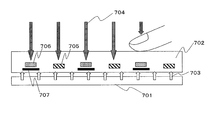
- FIG. 10 is a schematic cross-sectional view showing an example of an active matrix type touch panel liquid crystal display device.
- one photosensor unit is arranged for each pixel.
- the liquid crystal display device shown in the figure includes a liquid crystal module 702 and a backlight 701 disposed on the back side of the liquid crystal module 702.
- the liquid crystal module 702 includes, for example, a light-transmitting back substrate, a front substrate disposed so as to face the back substrate, and a liquid crystal layer provided between these substrates. Composed.
- the liquid crystal module 702 includes a plurality of display portions (primary color pixels), and each display portion includes a pixel electrode (not shown) and a pixel switching thin film transistor 705 connected to the pixel electrode. Yes.
- An optical sensor unit including a thin film diode 706 is disposed adjacent to each display unit.
- a color filter is disposed on the viewer side of each display unit, but no color filter is provided on the viewer side of the optical sensor unit.
- a light shielding layer 707 is disposed between the thin film diode 706 and the backlight 701, and light from the backlight 701 is shielded by the light shielding layer 707 and does not enter the thin film diode 706, but only the external light 704 is thin film diode 706. Is incident on. The incident of the external light 704 is sensed by the thin film diode 706 to realize a light sensing touch panel.
- the light shielding layer 707 may be arranged so that at least light from the backlight 701 does not enter the intrinsic region of the thin film diode 706.
- FIG. 11 is a schematic plan view showing an example of a rear substrate in an active matrix type touch panel liquid crystal display device.
- the liquid crystal display device of the present embodiment is composed of a large number of pixels (R, G, B pixels), but only two pixels are shown here for the sake of simplicity.
- Each of the rear substrates 1000 is disposed adjacent to each of a plurality of display portions (pixels) each including a pixel electrode 122 and a pixel switching thin film transistor 124, and includes a photosensor photodiode 126 and a signal storage capacitor 128. And an optical sensor unit including an optical sensor follower thin film transistor 129.
- the thin film transistor 124 has an LDD structure.
- the source region of the thin film transistor 124 is connected to the pixel source bus line 134, and the drain region is connected to the pixel electrode 122.
- the thin film transistor 124 is turned on / off by a signal from the pixel gate bus line 132.
- display is performed by applying a voltage to the liquid crystal layer by the pixel electrode 122 and the counter electrode formed on the front substrate disposed to face the back substrate 1000 and changing the alignment state of the liquid crystal layer.
- the photosensor photodiode 126 has the same configuration as the TFD described in the first embodiment, for example, and is located between the p + type region 126p, the n + type region 126n, and the regions 126p and 126n. And an intrinsic region 126i.
- the signal storage capacitor 128 has a gate electrode layer and an Si layer as electrodes, and a capacitance is formed by a gate insulating film.
- the p + type region 126p in the photosensor photodiode 126 is connected to the photosensor RST signal line 136, and the n + type region 126n is connected to the lower electrode (Si layer) in the signal storage capacitor 128.
- 128 is connected to the RWS signal line 138 for the optical sensor.
- n + -type region 126n is connected to the gate electrode layer in the photosensor follower thin film transistor 129.
- the source / drain regions of the photosensor follower thin film transistor 129 are connected to the photosensor VDD signal line 140 and the photosensor COL signal line 142, respectively.
- the photosensor photodiode 126, the signal storage capacitor 128, and the photosensor follower thin film transistor 129 correspond to the thin film diode 601, the capacitor 602, and the thin film transistor 603 of the drive circuit shown in FIG. It constitutes the drive circuit for the optical sensor. The operation at the time of optical sensing by this drive circuit will be described below.
- the RWS signal is written into the signal storage capacitor 128 by the RWS signal line 138.
- a positive electric field is generated on the n + -type region 126 n side of the photosensor photodiode 126, and the photosensor photodiode 126 enters a reverse bias state.
- the photosensor photodiode 126 existing in the region irradiated with light on the substrate surface, light leakage occurs and the charge is released to the RST signal line 136 side.
- the potential on the n + -type region 126n side decreases, and the gate voltage applied to the photosensor follower thin film transistor 129 changes due to the potential change.
- the VDD signal is applied from the VDD signal line 140 to the source side of the photosensor follower thin film transistor 129.
- the gate voltage fluctuates as described above, the value of the current flowing to the COL signal line 142 connected to the drain side changes, so that the electrical signal can be extracted from the COL signal line 142.
- the RST signal is written to the photosensor photodiode 126 from the COL signal line 142, and the potential of the signal storage capacitor 128 is reset.
- Optical sensing is possible by repeating the operations (1) to (5) while scanning.
- the configuration of the back substrate in the touch panel liquid crystal display device of the present embodiment is not limited to the configuration shown in FIG.
- an auxiliary capacitor (Cs) may be provided in each pixel switching TFT.
- a photosensor unit is provided adjacent to each of the RGB pixels.
- one photosensor is provided for three pixel sets (color display pixels) composed of RGB pixels. The part may be arranged.
- the thin film diode 706 is arranged in the display area and used as a touch sensor.
- the thin film diode 706 is formed outside the display area and back It can also be used as an ambient light sensor for controlling the luminance of the light 701 in accordance with the illuminance of the external light 704.
- FIG. 12 is a perspective view illustrating a liquid crystal display device with an ambient light sensor.
- the liquid crystal display device 2000 includes an LCD substrate 150 having a display area 152, a gate driver 156, a source driver 158, and an optical sensor unit 154, and a backlight 160 disposed on the back side of the LCD substrate 150.
- An area of the LCD substrate 150 located around the display area 152 and provided with the drivers 156 and 158 and the optical sensor unit 154 may be referred to as a “frame area”.
- the brightness of the backlight 160 is controlled by a backlight control circuit (not shown).
- TFTs are used for the display area 152 and the drivers 156 and 158
- TFDs are used for the optical sensor unit 154.
- the optical sensor unit 154 generates an illuminance signal based on the illuminance of external light, and inputs the illuminance signal to the backlight control circuit using a connection using a flexible substrate.
- the backlight control circuit generates a backlight control signal based on the illuminance signal and outputs it to the backlight 160.
- an organic EL display device with an ambient light sensor can be configured.
- Such an organic EL display device can have a configuration in which a display unit and a photosensor unit are arranged on the same substrate, like the liquid crystal display device shown in FIG. There is no need to provide the light 160.
- the optical sensor unit 154 is connected to the source driver 158 by wiring provided on the substrate 150, and an illuminance signal from the optical sensor unit 154 is input to the source driver 158.
- the source driver 158 changes the luminance of the display unit 152 based on the illuminance signal.
- a circuit for performing analog driving and a circuit for performing digital driving can be simultaneously formed on a glass substrate.
- a circuit that performs analog driving includes a source side driving circuit, a pixel portion, and a gate side driving circuit.
- the source side driving circuit includes a shift register, a buffer, a sampling circuit (transfer gate), and a gate side driving.
- the circuit is provided with a shift register, a level shifter, and a buffer. Further, if necessary, a level shifter circuit may be provided between the sampling circuit and the shift register.
- a memory and a microprocessor can be formed.
- the number of photomasks to be used can be reduced, so that the number of manufacturing steps and manufacturing cost can be greatly reduced.
- the present invention can be suitably applied to various semiconductor devices including a thin film transistor and a diode, for example, display devices such as an active matrix substrate, a liquid crystal display device, and an organic EL display device.
- display devices such as an active matrix substrate, a liquid crystal display device, and an organic EL display device.
Landscapes
- Physics & Mathematics (AREA)
- Nonlinear Science (AREA)
- Mathematical Physics (AREA)
- Chemical & Material Sciences (AREA)
- Crystallography & Structural Chemistry (AREA)
- General Physics & Mathematics (AREA)
- Optics & Photonics (AREA)
- Engineering & Computer Science (AREA)
- Microelectronics & Electronic Packaging (AREA)
- Thin Film Transistor (AREA)
Abstract
Description
本発明は、半導体装置及びその製造方法に関する。 The present invention relates to a semiconductor device and a manufacturing method thereof.
近年、薄膜トランジスタ(Thin Film Transistor:TFT)を備えた半導体装置の開発が進められている。このような半導体装置の代表的な例として、アクティブマトリクス型液晶表示装置、有機EL表示装置などが挙げられる。このような表示装置は、携帯電話などの携帯電子機器を含む様々な電子機器に用いられる。 In recent years, development of semiconductor devices including thin film transistors (TFTs) has been underway. Typical examples of such a semiconductor device include an active matrix liquid crystal display device and an organic EL display device. Such a display device is used in various electronic devices including portable electronic devices such as mobile phones.
アクティブマトリクス型の表示装置では、表示領域にスイッチング素子として多数の薄膜トランジスタ(TFT)が設けられている。TFTは、使用するシリコン薄膜の結晶性に応じて、非晶質シリコンTFTおよび結晶質シリコンTFTに大別される。一般に、結晶質シリコン膜の電界効果移動度は非晶質シリコン膜の電界効果移動度よりも高いため、結晶質シリコンTFTは、非晶質シリコンTFTよりも高速に動作することが可能である。従って、結晶質シリコン膜を用いると、スイッチング素子として画素毎に設けられるTFT(「画素用TFT」と呼ぶ。)のみでなく、表示領域周辺に形成される駆動回路や種々の機能回路などの周辺回路を構成するTFT(「駆動回路用TFT」と呼ぶ。)をも同一基板上に形成することが可能になる。 In an active matrix display device, a large number of thin film transistors (TFTs) are provided as switching elements in a display region. TFTs are roughly classified into amorphous silicon TFTs and crystalline silicon TFTs according to the crystallinity of the silicon thin film used. In general, since the field effect mobility of the crystalline silicon film is higher than that of the amorphous silicon film, the crystalline silicon TFT can operate faster than the amorphous silicon TFT. Therefore, when a crystalline silicon film is used, not only TFTs provided for each pixel as switching elements (referred to as “pixel TFTs”), but also peripheral circuits such as drive circuits and various functional circuits formed around the display region. A TFT constituting a circuit (referred to as a “driving circuit TFT”) can also be formed on the same substrate.
また、最近では、画素用TFTおよび駆動回路用TFTに加えてフォトダイオードも同一基板上に形成し、光センサー機能を備えた表示装置、例えばタッチパネル式の表示装置やアンビニエントライトセンサー付きの表示装置などに使用することも提案されている。 Recently, in addition to the pixel TFT and the driving circuit TFT, a photodiode is formed on the same substrate, and a display device having a photosensor function, for example, a touch panel display device or a display with an ambient light sensor. It has also been proposed to be used in devices.
ここで、画素用TFTおよび駆動回路用TFTは、それぞれに要求される特性に応じて、異なる構造を有することが好ましい。 Here, it is preferable that the pixel TFT and the driving circuit TFT have different structures depending on the required characteristics.
画素用TFTには、オフリーク電流が極めて小さいことが要求される。液晶表示装置では、画面を書き換えるまでの1フレームの期間中、液晶に印加された電圧を保持する必要があるが、画素用TFTのオフ電流(オフリーク電流)が大きいと、液晶に印加された電圧が時間とともに低下して表示特性を劣化させる可能性があるからである。 The pixel TFT is required to have an extremely small off-leakage current. In a liquid crystal display device, it is necessary to maintain the voltage applied to the liquid crystal for a period of one frame until the screen is rewritten. However, if the off current (off leak current) of the pixel TFT is large, the voltage applied to the liquid crystal This is because the display characteristics may deteriorate with time.
画素用TFTの構造として、例えばTFTのチャネル領域とソース領域・ドレイン領域との間の少なくとも一方に低濃度不純物領域(Lightly Doped Drain、以下「LDD領域」と略すことがある。)を形成した構造が知られている。このような構造は、「LDD構造」と称されている。この構造では、ゲート電極のエッジと低抵抗なソース・ドレイン領域との間に、ソース・ドレイン領域よりも高抵抗なLDD領域を存在させるので、LDD領域を有していない(「シングルドレイン構造」)TFTと比べてオフリーク電流を大幅に低減できる。また、LDD領域によってドレイン近傍の電界集中を緩和することができるので、ホットエレクトロンによる劣化を抑制できる。「ホットエレクトロンによる劣化」とは、ドレイン近傍の電界集中によって生じたホットエレクトロンの一部がゲート絶縁膜の中に注入されたり、シリコン膜中に欠陥準位が形成されることによって、トランジスタの特性が変動することをいう。なお、LDD領域の一部のみがゲート電極と重なっていてもよく、同様の効果が得られる。ただし、LDD構造のTFTでは、LDD領域が抵抗となるので、シングルドレイン構造のTFTよりも電流駆動力が低下してしまうという欠点もある。 As a structure of the pixel TFT, for example, a structure in which a low-concentration impurity region (Lightly Doped Drain, hereinafter abbreviated as “LDD region”) is formed in at least one of the channel region of the TFT and the source region / drain region. It has been known. Such a structure is referred to as an “LDD structure”. In this structure, an LDD region having a higher resistance than the source / drain region is present between the edge of the gate electrode and the low-resistance source / drain region, so that the LDD region is not provided (“single drain structure”). ) Off-leakage current can be greatly reduced as compared with TFT. Moreover, since the electric field concentration in the vicinity of the drain can be relaxed by the LDD region, deterioration due to hot electrons can be suppressed. “Degradation due to hot electrons” means that some of the hot electrons generated by the electric field concentration near the drain are injected into the gate insulating film or defect levels are formed in the silicon film. Means that fluctuates. Note that only part of the LDD region may overlap with the gate electrode, and the same effect can be obtained. However, in the TFT with the LDD structure, since the LDD region becomes a resistance, there is a disadvantage that the current driving capability is lowered as compared with the single drain structure TFT.
一方、駆動回路用TFTは高速動作を行う必要があるので、駆動回路用TFTには、電流駆動力が大きい、すなわちオン電流が大きいことが要求される。 On the other hand, since the driving circuit TFT needs to operate at high speed, the driving circuit TFT is required to have a large current driving force, that is, a large on-current.
駆動回路用TFTの構造として、LDD領域がゲート電極によってオーバーラップされた構造が知られている。このような構造は、「GOLD(Gate Overlapped LDD)構造」と称されている。GOLD構造を有するTFTでは、ゲート電極に電圧を印加すると、ゲート電極がオーバーラップしたLDD領域にキャリアとなる電子が蓄積される。よって、LDD領域の抵抗を小さくすることができるので、TFTの電流駆動力の低下を抑えることができる。また、上述したLDD構造(LDD領域の少なくとも一部がゲート電極と重なっていない構造)のTFTよりもLDD領域の不純物濃度を低くできるので、ドレイン近傍の電界集中をより効果的に緩和でき、ホットエレクトロン劣化耐性を大幅に改善できる。 As a structure of a driving circuit TFT, a structure in which LDD regions are overlapped by a gate electrode is known. Such a structure is referred to as a “GOLD (Gate Overlapped LDD) structure”. In a TFT having a GOLD structure, when a voltage is applied to the gate electrode, electrons serving as carriers are accumulated in the LDD region where the gate electrode overlaps. Therefore, since the resistance of the LDD region can be reduced, it is possible to suppress a decrease in the current driving capability of the TFT. Further, since the impurity concentration in the LDD region can be made lower than that of the TFT having the LDD structure (a structure in which at least a part of the LDD region does not overlap with the gate electrode), the electric field concentration in the vicinity of the drain can be alleviated more effectively, and hot Electron degradation resistance can be greatly improved.
ただし、GOLD構造のTFTは、前述したLDD構造のTFTよりもオフリーク電流が大きくなるという欠点があり、画素用TFTには適さない。これは、TFTがオフ状態であっても、ゲート電極がオーバーラップしたLDD領域に蓄積層が形成されるためであると考えられる。 However, the GOLD structure TFT has a disadvantage that off-leakage current is larger than the above-described LDD structure TFT, and is not suitable for a pixel TFT. This is presumably because the storage layer is formed in the LDD region where the gate electrodes overlap even when the TFT is in the OFF state.
このように、TFTの用途および目的に応じて最適なTFT構造を選択する必要がある。従って、例えば駆動回路一体型のアクティブマトリクス基板を作製しようとすると、互いに異なる構造を有する画素用TFTおよび駆動回路用TFTを同一基板上に形成しなければならない。 Thus, it is necessary to select an optimum TFT structure according to the use and purpose of the TFT. Therefore, for example, when an active matrix substrate integrated with a driving circuit is to be manufactured, a pixel TFT and a driving circuit TFT having different structures must be formed on the same substrate.
特許文献1には、同一基板上に、駆動回路用TFTおよび画素用TFTを形成する方法が開示されている。この方法では、基板上に、駆動回路用TFTおよび画素用TFTの活性層となる複数の半導体層を形成した後、駆動回路用TFTの活性層となる半導体層のみに対して、レジストマスクを利用して、LDD領域を形成するための不純物イオンの注入(1回目の低濃度不純物注入工程とよぶ。)を先に行っている。この方法では、1回目の低濃度不純物注入工程の後、各半導体層上にゲート電極を形成する。続いて、ゲート電極をマスクとして、画素用TFTの活性層となる半導体層に、LDD領域を形成するための不純物イオンの注入(2回目の低濃度不純物注入工程とよぶ。)を行う。この後、駆動回路用および画素用TFTの活性層となる半導体層に対し、高濃度で不純物イオンを注入し、ソース・ドレイン領域を形成する。このようにして、画素用TFTとしてLDD構造TFT、駆動回路用TFTとしてGOLD構造TFTを作製している。 Patent Document 1 discloses a method of forming a driving circuit TFT and a pixel TFT on the same substrate. In this method, after a plurality of semiconductor layers serving as active layers of the driving circuit TFT and the pixel TFT are formed on the substrate, a resist mask is used only for the semiconductor layer serving as the active layer of the driving circuit TFT. Then, impurity ions for forming the LDD region are implanted first (referred to as a first low-concentration impurity implantation step). In this method, a gate electrode is formed on each semiconductor layer after the first low-concentration impurity implantation step. Subsequently, impurity ions for forming an LDD region (referred to as a second low-concentration impurity implantation step) are performed in the semiconductor layer serving as the active layer of the pixel TFT, using the gate electrode as a mask. Thereafter, impurity ions are implanted at a high concentration into the semiconductor layer which is the active layer of the driver circuit and pixel TFTs, thereby forming source / drain regions. In this manner, an LDD structure TFT is produced as a pixel TFT, and a GOLD structure TFT is produced as a drive circuit TFT.
特許文献1の方法によると、低濃度不純物注入工程を、ゲート電極の形成工程の前後にそれぞれ行う必要がある。このため、同じ構造を有する複数のTFTを作製する場合と比べて、製造工程数が増加し、製造コストも増大する。 According to the method of Patent Document 1, it is necessary to perform the low-concentration impurity implantation step before and after the gate electrode formation step. For this reason, compared with the case where a plurality of TFTs having the same structure is manufactured, the number of manufacturing steps increases and the manufacturing cost also increases.
製造工程数および製造コストを低減し、生産性を向上させるためには、TFTの作製に使用するフォトマスクの枚数を1枚でも減らすことが重要である。フォトマスクは、フォトリソグラフィーにより、エッチング工程やイオン注入工程でマスクとなるレジストパターンを形成するために使用される。従って、フォトマスクの枚数が1枚増えることは、エッチングやイオン注入などの工程の他に、フォトリソグラフィーによるレジストパターンの形成、レジストパターンの剥離、洗浄および乾燥工程が増加することを意味する。特にフォトリソグラフィーによるレジストパターンの形成には、レジスト塗布、プレベーク、露光、現像、ポストベークなどの煩雑な工程が行われる。このように、フォトマスクの枚数が1枚増えるだけでも、製造工程数および製造コストが増大し、リードタイムも長くなり、生産性を大幅に低下させてしまう。 In order to reduce the number of manufacturing steps and manufacturing costs and improve productivity, it is important to reduce even the number of photomasks used for manufacturing TFTs. A photomask is used to form a resist pattern that serves as a mask in an etching process or an ion implantation process by photolithography. Therefore, an increase in the number of photomasks means that the resist pattern formation by photolithography, resist pattern peeling, cleaning, and drying steps increase in addition to the steps such as etching and ion implantation. In particular, in forming a resist pattern by photolithography, complicated processes such as resist coating, pre-baking, exposure, development, and post-baking are performed. Thus, even if the number of photomasks is increased by one, the number of manufacturing steps and manufacturing costs increase, the lead time becomes longer, and the productivity is greatly reduced.
そこで、フォトマスクを1枚でも減らすための種々のプロセスが提案されている(特許文献2~5)。 Therefore, various processes for reducing even one photomask have been proposed (Patent Documents 2 to 5).
例えば特許文献2および5に提案された方法では、半導体層上に2層構造のゲート電極を形成し、ゲート電極をマスクとして不純物を高濃度で半導体層に注入して、ソース・ドレイン領域を形成する。この後、ゲート電極の上層のみをエッチングしてその幅を小さくする。次いで、幅を小さくした上層をマスクとし、下層を介して、半導体層に不純物を低濃度で注入し、LDD領域を形成する。この方法によると、1枚のフォトマスクでGOLD構造TFTを作製することができる。さらに、特許文献3には、基板上の複数の半導体層上に、それぞれ、幅の大きい下層と、下層よりも幅の小さい上層とからなる2層構造のゲート電極を形成し、ゲート電極の構造を利用して、LDD構造TFTおよびGOLD構造TFTを作り分ける方法が提案されている。 For example, in the methods proposed in Patent Documents 2 and 5, a gate electrode having a two-layer structure is formed on a semiconductor layer, and impurities are implanted into the semiconductor layer at a high concentration using the gate electrode as a mask to form source / drain regions. To do. Thereafter, only the upper layer of the gate electrode is etched to reduce its width. Next, using the upper layer with a reduced width as a mask, an impurity is implanted into the semiconductor layer at a low concentration through the lower layer to form an LDD region. According to this method, a GOLD structure TFT can be manufactured with one photomask. Further, in Patent Document 3, a gate electrode having a two-layer structure including a lower layer having a large width and an upper layer having a smaller width than the lower layer is formed on a plurality of semiconductor layers on a substrate, respectively. There has been proposed a method of separately making an LDD structure TFT and a GOLD structure TFT by using the above.
一方、特許文献6には、GOLD構造およびLDD構造TFTの活性層となる半導体層に、それぞれチャネル領域となる部分を覆うレジストマスクを形成して、不純物イオンを低濃度で注入する方法が開示されている。この方法では、不純物イオンを低濃度で注入した後、上記レジストマスクを除去し、GOLD構造TFTの活性層となる半導体層上に、除去したレジストマスクよりも一回り大きいサイズのゲート電極を形成する。また、LDD構造TFTの活性層となる半導体層上には、除去したレジストマスクと同じサイズのゲート電極を、チャネル領域となる部分を覆うように形成する。続いて、LDD構造TFTの活性層となる半導体層のうちLDD領域として残す領域を覆うマスクを形成する。この後、これらの半導体層に高濃度で不純物イオンを注入して、ソース・ドレイン領域を形成する。この方法によると、特許文献1のように、不純物イオンを低濃度で注入するイオン注入工程を2回行う必要がない。 On the other hand, Patent Document 6 discloses a method of implanting impurity ions at a low concentration by forming a resist mask covering a portion that becomes a channel region in a semiconductor layer that becomes an active layer of a GOLD structure and an LDD structure TFT. ing. In this method, after implanting impurity ions at a low concentration, the resist mask is removed, and a gate electrode having a size slightly larger than the removed resist mask is formed on the semiconductor layer to be the active layer of the GOLD structure TFT. . In addition, a gate electrode having the same size as the removed resist mask is formed on the semiconductor layer to be an active layer of the LDD structure TFT so as to cover a portion to be a channel region. Subsequently, a mask is formed to cover a region to be left as an LDD region in the semiconductor layer serving as an active layer of the LDD structure TFT. Thereafter, impurity ions are implanted into these semiconductor layers at a high concentration to form source / drain regions. According to this method, unlike the Patent Document 1, it is not necessary to perform the ion implantation step of implanting impurity ions at a low concentration twice.
特許文献2および3の方法によると、ゲート電極エッチングを2回に分けて行うので、ゲート電極幅の制御が困難となり、その結果、TFTの駆動能力にバラツキが生じる可能性がある。 According to the methods of Patent Documents 2 and 3, since the gate electrode etching is performed in two steps, it is difficult to control the width of the gate electrode, and as a result, there is a possibility that the driving ability of the TFT varies.
特許文献6の方法では、LDD構造TFTの活性層となる半導体層上に、除去したレジストマスクと同じサイズのゲート電極を形成する。低濃度でイオン注入を行った際に用いたレジストマスクと、その後に形成するゲート電極とのサイズは略等しい。このため、ゲート電極のアライメントずれが生じると、半導体層のうち低濃度で不純物イオンが注入されなかった領域(チャネル領域)の位置とゲート電極の位置とがずれてしまう。その結果、ゲート電極の端部とLDD領域との間に高抵抗な領域が存在し、オン抵抗が大幅に増大するおそれがある。 In the method of Patent Document 6, a gate electrode having the same size as the removed resist mask is formed on a semiconductor layer that becomes an active layer of an LDD structure TFT. The size of the resist mask used when ion implantation is performed at a low concentration and the gate electrode formed thereafter are substantially equal. For this reason, when the misalignment of the gate electrode occurs, the position of the semiconductor layer in which the impurity ions are not implanted at a low concentration (channel region) is displaced from the position of the gate electrode. As a result, there is a high resistance region between the end of the gate electrode and the LDD region, and the on-resistance may be significantly increased.
従って、従来の方法では、TFTなどの半導体素子の信頼性を確保しつつ、フォトマスクの使用枚数を削減することが難しいという問題があった。 Therefore, the conventional method has a problem that it is difficult to reduce the number of photomasks used while ensuring the reliability of semiconductor elements such as TFTs.
さらに、駆動回路一体型のアクティブマトリクス基板などの半導体装置では、例えばLDD構造およびGOLD構造のnチャネル型TFTに加えて、シングルドレイン構造のnチャネル型TFT、シングルドレイン構造のpチャネル型TFTも同一基板上に作り込まれることもある。また、アクティブマトリクス基板を光センサー機能付きの表示装置に用いる場合には、上記TFTと同時にダイオードも同一基板上に作り込むことが好ましい。このように、種々の構造のTFTおよびダイオード(TFD)を形成する際には、フォトマスクの枚数がさらに増加し、製造工程が極めて複雑になる。従って、素子の信頼性を損なうことなく、フォトマスクの枚数を削減することがより重要である。 Further, in a semiconductor device such as an active matrix substrate integrated with a drive circuit, for example, an n-channel TFT having a single drain structure and a p-channel TFT having a single drain structure are the same in addition to an n-channel TFT having an LDD structure and a GOLD structure. Sometimes built on a substrate. Further, when the active matrix substrate is used for a display device with a photosensor function, it is preferable that a diode is formed on the same substrate simultaneously with the TFT. Thus, when forming TFTs and diodes (TFDs) with various structures, the number of photomasks further increases, and the manufacturing process becomes extremely complicated. Therefore, it is more important to reduce the number of photomasks without impairing the reliability of the element.
本発明は、上記事情に鑑みてなされたものであり、その主な目的は、LDD構造のTFT、GOLD構造のTFTおよびTFDを含む複数の半導体素子を同一基板上に備えた半導体装置の製造方法において、半導体素子の信頼性を低下させることなく、フォトマスクの使用枚数を削減して生産性を向上させることにある。 The present invention has been made in view of the above circumstances, and a main object thereof is a method for manufacturing a semiconductor device including a plurality of semiconductor elements including a TFT having an LDD structure, a TFT having a GOLD structure, and a TFD on the same substrate. However, it is intended to improve productivity by reducing the number of photomasks used without reducing the reliability of the semiconductor element.
本発明の半導体装置の製造方法は、少なくとも2つの薄膜トランジスタと、ダイオードとを同一基板上に備えた半導体装置の製造方法であって、(a)基板上に、薄膜トランジスタ形成用の島状の第1および第2半導体層と、ダイオード形成用の島状の第3半導体層とを形成する工程と、(b)前記第1、第2および第3半導体層を覆うゲート絶縁膜を形成する工程と、(c)前記第1および第2半導体層のうち低濃度不純物領域およびソース・ドレイン領域となる領域上の前記ゲート絶縁膜を露出する開口部を有するマスク層を形成する工程と、(d)前記マスク層の開口部を介して、前記ゲート絶縁膜の上方から前記第1および第2半導体層に第1導電型の不純物を注入することにより、前記第1および第2半導体層に第1導電型注入領域をそれぞれ形成する工程と、(e)前記ゲート絶縁膜上に、前記第1および第2半導体層のうち前記第1導電型注入領域の一部と前記チャネル領域となる部分とを覆う第1および第2ゲート電極をそれぞれ形成する工程と、(f)前記第1半導体層の前記第1導電型注入領域のうち前記第1半導体層の両端部に位置する領域、前記第2半導体層の全体および前記第3半導体層の一部上の前記ゲート絶縁膜を露出する開口部を有する他のマスク層を形成する工程と、(g)前記他のマスク層の開口部を介して、前記ゲート絶縁膜の上方から前記第1、第2および第3半導体層に前記第1導電型の不純物を注入することにより、前記第1半導体層にソース・ドレイン領域を形成し、前記第2半導体層のうち前記第2ゲート電極で覆われていない領域にソース・ドレイン領域を形成し、かつ、前記第3半導体層に第1導電型領域を形成するとともに、前記第1および第2半導体層の前記第1導電型注入領域のうち前記ソース・ドレイン領域が形成されなかった領域を低濃度不純物領域とする工程とを包含する。 A method for manufacturing a semiconductor device according to the present invention is a method for manufacturing a semiconductor device having at least two thin film transistors and a diode on the same substrate. (A) An island-shaped first for forming a thin film transistor on a substrate. And a step of forming a second semiconductor layer and an island-shaped third semiconductor layer for forming a diode, and (b) a step of forming a gate insulating film covering the first, second and third semiconductor layers, (C) forming a mask layer having an opening exposing the gate insulating film on the low-concentration impurity region and the source / drain region of the first and second semiconductor layers; A first conductivity type is implanted into the first and second semiconductor layers by injecting a first conductivity type impurity into the first and second semiconductor layers from above the gate insulating film through the opening of the mask layer. Injection And (e) a first covering the gate insulating film with a portion of the first conductivity type implantation region and a portion serving as the channel region on the gate insulating film. Forming a second gate electrode and (f) a region located at both ends of the first semiconductor layer in the first conductivity type implantation region of the first semiconductor layer, and the entire second semiconductor layer And forming another mask layer having an opening for exposing the gate insulating film on a part of the third semiconductor layer, and (g) the gate insulation through the opening of the other mask layer. A source / drain region is formed in the first semiconductor layer by injecting the first conductivity type impurity into the first, second, and third semiconductor layers from above the film. Not covered by the second gate electrode A source / drain region is formed in the region, a first conductivity type region is formed in the third semiconductor layer, and the source / drain of the first conductivity type implantation regions of the first and second semiconductor layers is formed. And a step of making the region where the region is not formed a low concentration impurity region.
ある好ましい実施形態において、前記第3半導体層の他の一部に、前記第1導電型と異なる第2導電型の不純物を注入することにより、前記第3半導体層に第2導電型領域を形成する工程(h)をさらに包含する。 In a preferred embodiment, a second conductivity type region is formed in the third semiconductor layer by implanting an impurity of a second conductivity type different from the first conductivity type into another part of the third semiconductor layer. The step (h) is further included.
ある好ましい実施形態において、前記工程(a)は、他の薄膜トランジスタ形成用の島状の第4半導体層を形成する工程をさらに含み、前記第4半導体層のチャネル領域となる部分を覆うように第4ゲート電極を形成する工程(i1)と、前記第4ゲート電極をマスクとして、前記第4半導体層に前記第2導電型の不純物を注入することにより、前記第4半導体層にソース・ドレイン領域を形成する工程(i2)とをさらに包含し、前記工程(i1)は前記工程(e)と同時に行われ、前記工程(i2)は前記工程(h)と同時に行われる。 In a preferred embodiment, the step (a) further includes a step of forming another island-shaped fourth semiconductor layer for forming a thin film transistor, and the step (a) includes a step of covering a portion to be a channel region of the fourth semiconductor layer. A step (i1) of forming a four-gate electrode, and a source / drain region in the fourth semiconductor layer by implanting the second conductivity type impurity into the fourth semiconductor layer using the fourth gate electrode as a mask. The step (i2) is performed simultaneously with the step (e), and the step (i2) is performed simultaneously with the step (h).
前記工程(d)および(g)において、前記第4半導体層には前記第1導電型の不純物は注入されないことが好ましい。 In the steps (d) and (g), it is preferable that the first conductivity type impurity is not implanted into the fourth semiconductor layer.
前記工程(d)は、前記第4半導体層の全体に前記第1導電型の不純物を注入する工程をさらに含んでもよい。 The step (d) may further include a step of implanting the first conductivity type impurity into the entire fourth semiconductor layer.
ある好ましい実施形態において、前記工程(a)は、他の薄膜トランジスタ形成用の島状の第5半導体層を形成する工程をさらに含み、前記第5半導体層のチャネル領域となる部分を覆うように第5ゲート電極を形成する工程(j1)と、前記第5ゲート電極をマスクとして、前記第5半導体層に前記第1導電型の不純物を注入することにより、前記第5半導体層にソース・ドレイン領域を形成する工程(j2)とをさらに包含し、 前記工程(d)において、前記第5半導体層には前記第1導電型の不純物は注入されず、前記工程(j1)は前記工程(e)と同時に行われ、前記工程(j2)は前記工程(g)と同時に行われる。 In a preferred embodiment, the step (a) further includes a step of forming another island-shaped fifth semiconductor layer for forming a thin film transistor, and the step (a) includes a step of covering a portion to be a channel region of the fifth semiconductor layer. A step (j1) of forming a five-gate electrode; and by implanting the first conductivity type impurity into the fifth semiconductor layer using the fifth gate electrode as a mask, a source / drain region is formed in the fifth semiconductor layer. In the step (d), the impurity of the first conductivity type is not implanted into the fifth semiconductor layer, and the step (j1) includes the step (e). The step (j2) is performed simultaneously with the step (g).
前記第1導電型はn型であり、前記第2導電型はp型であってもよい。 The first conductivity type may be n-type, and the second conductivity type may be p-type.
本発明の半導体装置は、第1および第2薄膜トランジスタとダイオードとを同一基板上に備えた半導体装置であって、前記第1および第2薄膜トランジスタは、それぞれ、チャネル領域と、前記チャネル領域の両側にそれぞれ位置し、第1導電型の不純物を含むソース・ドレイン領域と、前記チャネル領域と前記ソース領域および前記ドレイン領域との間にそれぞれ設けられ、前記ソース領域および前記ドレイン領域よりも低濃度で前記第1導電型の不純物を含む低濃度不純物領域とを有する半導体層と、前記半導体層の上に形成されたゲート絶縁膜と、前記ゲート絶縁膜の上に設けられ、少なくとも前記チャネル領域と重なるように配置されたゲート電極とを有し、前記ダイオードは、第1導電型の不純物を含む第1導電型領域と、前記第1導電型と異なる第2導電型の不純物を含む第2導電型領域とを含む半導体層を有し、前記第1薄膜トランジスタにおいて、前記ゲート電極は前記低濃度不純物領域の一部と重なっており、前記第2薄膜トランジスタにおいて、前記ゲート電極は前記低濃度不純物領域の全体と重なっており、前記第1および第2薄膜トランジスタの前記低濃度不純物領域および前記ソース・ドレイン領域は同一の不純物元素を含み、前記第1および第2薄膜トランジスタの前記低濃度不純物領域の厚さ方向における前記第1導電型の不純物の濃度プロファイルは略等しく、前記第1および第2薄膜トランジスタの前記ソース・ドレイン領域の厚さ方向における前記第1導電型の不純物の濃度プロファイルは略等しい。 The semiconductor device of the present invention is a semiconductor device including first and second thin film transistors and a diode on the same substrate, and the first and second thin film transistors are provided on a channel region and on both sides of the channel region, respectively. The source / drain regions each including a first conductivity type impurity and the channel region, the source region and the drain region are provided, and the source region and the drain region are provided at a lower concentration than the source region and the drain region. A semiconductor layer having a low-concentration impurity region containing an impurity of the first conductivity type, a gate insulating film formed on the semiconductor layer, and provided on the gate insulating film so as to overlap at least the channel region And the diode includes a first conductivity type region containing a first conductivity type impurity; and A semiconductor layer including a second conductivity type region containing an impurity of a second conductivity type different from the one conductivity type, and in the first thin film transistor, the gate electrode overlaps a part of the low concentration impurity region, In the second thin film transistor, the gate electrode overlaps the entire low concentration impurity region, the low concentration impurity region and the source / drain region of the first and second thin film transistors include the same impurity element, The concentration profiles of the first conductivity type impurities in the thickness direction of the low-concentration impurity regions of the first and second thin film transistors are substantially equal, and the thickness profiles of the source and drain regions of the first and second thin film transistors are in the thickness direction. The concentration profiles of the first conductivity type impurities are substantially equal.
ある好ましい実施形態において、前記第2薄膜トランジスタにおいて、前記ゲート電極の端部は、前記ソース領域または前記ドレイン領域の端部と整合しており、前記第1薄膜トランジスタにおいて、前記ゲート電極の端部は、前記低濃度不純物領域の端部、前記ソース領域の端部および前記ドレイン領域の端部の何れとも整合していない。 In one preferred embodiment, in the second thin film transistor, an end portion of the gate electrode is aligned with an end portion of the source region or the drain region, and in the first thin film transistor, an end portion of the gate electrode is None of the end portion of the low concentration impurity region, the end portion of the source region, or the end portion of the drain region is aligned.
前記基板上に形成された第3薄膜トランジスタをさらに備え、前記第3薄膜トランジスタは、チャネル領域と、前記チャネル領域の両側にそれぞれ位置し、前記第2導電型の不純物を含むソース・ドレイン領域とを含む半導体層と、前記半導体層の上に形成されたゲート絶縁膜と、前記ゲート絶縁膜の上に設けられたゲート電極とを有し、前記ダイオードの第2導電型領域と、前記第3薄膜トランジスタの前記ソース・ドレイン領域との厚さ方向における前記第2導電型の不純物の濃度プロファイルは略等しく、前記第3薄膜トランジスタの前記ソース・ドレイン領域は前記第1導電型の不純物を含んでいなくてもよい。 The third thin film transistor further includes a third thin film transistor formed on the substrate, the third thin film transistor including a channel region and a source / drain region located on both sides of the channel region and including the second conductivity type impurity. A semiconductor layer; a gate insulating film formed on the semiconductor layer; and a gate electrode provided on the gate insulating film; a second conductivity type region of the diode; and a third thin film transistor The concentration profile of the second conductivity type impurity in the thickness direction with the source / drain region is substantially equal, and the source / drain region of the third thin film transistor does not include the first conductivity type impurity. Good.
前記基板上に形成された第4薄膜トランジスタをさらに備え、前記第4薄膜トランジスタは、チャネル領域と、前記チャネル領域の両側にそれぞれ位置し、前記第1導電型の不純物を含むソース・ドレイン領域とを含む半導体層と、前記半導体層の上に形成されたゲート絶縁膜と、前記ゲート絶縁膜の上に設けられたゲート電極とを有し、前記ダイオードの第1導電型領域と、前記第4薄膜トランジスタの前記ソース・ドレイン領域との厚さ方向における前記第1導電型の不純物の濃度プロファイルは略等しく、前記第4薄膜トランジスタにおいて、前記ソース・ドレイン領域の端部は、前記ゲート電極の端部と整合していてもよい。 The fourth thin film transistor further includes a fourth thin film transistor formed on the substrate, the fourth thin film transistor including a channel region and a source / drain region located on both sides of the channel region and including the first conductivity type impurity. A semiconductor layer; a gate insulating film formed on the semiconductor layer; and a gate electrode provided on the gate insulating film; a first conductivity type region of the diode; and a fourth thin film transistor The impurity profile of the first conductivity type impurity in the thickness direction with the source / drain region is substantially equal. In the fourth thin film transistor, the end of the source / drain region is aligned with the end of the gate electrode. It may be.
本発明によると、生産性に優れた簡便な方法で、信頼性の高い半導体装置を製造できる。特に、LDD構造のTFTおよびGOLD構造のTFTのLDD領域を形成するためのイオン注入工程を共有させることにより、フォトマスクの使用枚数を削減できる。また、TFTのソース・ドレイン領域およびTFDのn型またはp型領域を形成するためのイオン注入工程を共有してもよく、これにより、フォトマスクの使用枚数をさらに削減できる。 According to the present invention, a highly reliable semiconductor device can be manufactured by a simple method with excellent productivity. In particular, the number of photomasks used can be reduced by sharing the ion implantation process for forming the LDD region of the LDD structure TFT and the GOLD structure TFT. In addition, the ion implantation process for forming the source / drain regions of the TFT and the n-type or p-type region of the TFD may be shared, thereby further reducing the number of photomasks used.
さらに、上記TFTおよびTFDと同一基板上に、上記TFTと逆導電型のTFTを作製することもできる。このとき、製造工程数を増加させることなく、かつ、カウンタードープを行うことなく、逆導電型のTFTのソース・ドレイン領域を形成できるので好ましい。 Further, a TFT having a conductivity type opposite to that of the TFT can be formed on the same substrate as the TFT and TFD. This is preferable because the source / drain regions of the reverse conductivity type TFT can be formed without increasing the number of manufacturing steps and without performing counterdoping.
本発明は、駆動回路一体型のアクティブマトリクス基板に好適に用いられ得る。LDD構造のTFTを画素用TFTとして用い、GOLD構造のTFTを駆動回路用TFTとして用いると、オフ特性に優れた画素用TFTとオン特性に優れた駆動回路用TFTとを同時に実現できる。また、ダイオードを駆動回路などの回路で使用してもよいし、光センサーとして機能させることもできる。 The present invention can be suitably used for an active matrix substrate integrated with a drive circuit. When a TFT having an LDD structure is used as a TFT for a pixel and a TFT having a GOLD structure is used as a TFT for a driving circuit, a pixel TFT having excellent off characteristics and a driving circuit TFT having excellent on characteristics can be realized at the same time. In addition, a diode may be used in a circuit such as a drive circuit or may function as an optical sensor.
以下、図面を参照しながら、本発明による半導体装置の実施形態を説明する。本明細書では、「半導体装置」は、機能回路が形成された基板やアクティブマトリクス基板、および、液晶表示装置や有機EL表示装置などの表示装置を広く含むものとする。 Hereinafter, embodiments of a semiconductor device according to the present invention will be described with reference to the drawings. In this specification, the “semiconductor device” widely includes a substrate on which a functional circuit is formed, an active matrix substrate, and a display device such as a liquid crystal display device or an organic EL display device.
(第1の実施形態)
以下、図面を参照しながら、本発明による第1の実施形態の半導体装置を製造する方法を説明する。ここでは、同一の半導体膜を用いて、ダイオード(TFD)、LDD構造を有するnチャネル型TFT、GOLD構造を有するnチャネル型TFT、シングルドレイン構造のnチャネル型TFTおよびシングルドレイン構造のpチャネル型TFTを同一基板上に作りこむ方法を例に説明する。
(First embodiment)
A method for manufacturing the semiconductor device according to the first embodiment of the present invention will be described below with reference to the drawings. Here, a diode (TFD), an n-channel TFT having an LDD structure, an n-channel TFT having a GOLD structure, an n-channel TFT having a single drain structure, and a p-channel type having a single drain structure are formed using the same semiconductor film. A method for fabricating a TFT on the same substrate will be described as an example.
図1(A)~(D)および図2(E)~(G)は本実施形態の半導体装置を製造する方法を示す模式的な工程断面図である。 FIGS. 1A to 1D and FIGS. 2E to 2G are schematic process cross-sectional views showing a method for manufacturing the semiconductor device of this embodiment.
まず、図1(A)に示すように、基板11の表面のうちTFDが形成される領域に遮光層(厚さ:例えば30~200nm)12を形成した後、基板11を覆う絶縁膜(厚さ:例えば500nm)14を形成する。
First, as shown in FIG. 1A, a light shielding layer (thickness: for example, 30 to 200 nm) 12 is formed in a region of the surface of the
基板11は絶縁性の表面を有する基板であればよく、石英基板、ガラス基板の他、表面が絶縁層で覆われたSi基板や金属基板を用いてもよい。遮光層12は、金属膜またはケイ素膜等を堆積し、パターニングを行うことによって形成できる。金属膜としては、後の製造工程における熱処理を考慮し、高融点金属であるタンタル(Ta)やタングステン(W)、モリブデン(Mo)からなる膜を用いることが好ましい。本実施形態では、遮光層12を、最終製品において、TFDに対する基板裏面方向からの光を遮るように配置する。絶縁膜14は、例えばプラズマCVD法で形成される。絶縁膜14は、酸化ケイ素膜、窒化ケイ素膜または酸化窒化ケイ素膜であってもよい。
The
次いで、図1(B)に示すように、絶縁膜14上に島状の半導体層16a~16eを形成し、続いて、これらの半導体層16a~16eを覆うゲート絶縁膜(厚さ:例えば100nm)18を形成する。
Next, as shown in FIG. 1B, island-shaped semiconductor layers 16a to 16e are formed on the insulating
半導体層16a~16eは、結晶質半導体膜(結晶質シリコン膜)を用いて形成される。具体的には、まず、プラズマCVD法やスパッタ法などの公知の方法を用いて、非晶質構造を有する半導体膜(ここでは、非晶質シリコン膜)を堆積する。非晶質シリコン膜の厚さは例えば20nm以上100nm以下とする。なお、絶縁膜14と非晶質シリコン膜とを同じ方法で形成する場合には、両者を連続形成してもよい。この後、非晶質シリコン膜を結晶化させて結晶質シリコン膜を得る。非晶質シリコン膜の結晶化は公知の方法で行うことができる。例えば、非晶質シリコン膜にレーザー光を照射することにより結晶化させてもよい。レーザー光としては、パルス発振型または連続発振型のエキシマレーザー光が望ましいが、連続発振型のアルゴンレーザー光でも良い。また、結晶化を助長するための触媒元素、たとえばNi等を非晶質シリコン表面に付着させた後、熱処理(例えばレーザー照射)により非晶質シリコン膜を結晶化させておいてもよい。得られた結晶質シリコン膜に対して、フォトリソグラフィーおよびエッチングによりパターニングを行い、複数の島状の半導体層16a~16eを得る。
The semiconductor layers 16a to 16e are formed using a crystalline semiconductor film (crystalline silicon film). Specifically, first, a known semiconductor film (here, an amorphous silicon film) is deposited using a known method such as a plasma CVD method or a sputtering method. The thickness of the amorphous silicon film is, for example, not less than 20 nm and not more than 100 nm. In the case where the insulating
なお、図1(B)では、簡単のため、ダイオードの活性層となる半導体層16a、LDD構造を有するnチャネル型TFTの活性層となる半導体層16b、GOLD構造を有するnチャネル型TFTの活性層となる半導体層16c、シングルドレイン構造を有するnチャネル型TFTの活性層となる半導体層16d、およびpチャネル型TFTの活性層となる半導体層16eをそれぞれ1つずつ並べて示しているが、各半導体層の個数や配置は図示する例に限定されない。
In FIG. 1B, for simplicity, the
ゲート絶縁膜18としては、例えば厚さが100nmの酸化ケイ素(SiO2)膜を形成する。ゲート絶縁膜18の形成は、CVD法を用いて行うことができる。
As the
次に、図1(C)に示すように、マスク層20として、半導体層16b、16cのうちLDD領域およびソース・ドレイン領域となる領域上のゲート絶縁膜18を露出する開口部を有するレジスト膜を形成する。この後、マスク層20の開口部を介して半導体層16b、16cに不純物イオン22を注入して、半導体層16b、16cに、不純物イオン22を低濃度で含む不純物イオン注入領域24b、24cをそれぞれ形成する。なお、半導体層16a、16d、16eの全体はマスク層20によってマスクされているので、これらの半導体層には不純物イオン22が注入されない。
Next, as shown in FIG. 1C, as the
本実施形態では、不純物イオン22としてリンイオンを注入する。注入の際の加速電圧は例えば80kV、ドーズ量は1×10¹³/cm2とする。半導体層16b、16cのうち不純物イオン22が注入されなかった領域は、それぞれ、チャネル領域40b、40cとなる。
In this embodiment, phosphorus ions are implanted as the
次いで、マスク層20を除去し、図1(D)に示すように、半導体層16b~16e上にそれぞれゲート電極26b~26eを形成する。このうちゲート電極26b、26cは、半導体層16b、16cのうちチャネル領域40b、40cと、不純物イオン注入領域24b、24cの一部(チャネル領域40b、40cの両端部に位置する部分)とを覆うように形成される。ゲート電極26d、26eは、半導体層16d、16eのうちチャネル領域となる部分を覆うように形成される。ゲート電極26b~26eの形成は、例えば、スパッタ法により、ゲート絶縁膜18上にタングステン(W)膜(厚さ:例えば400nm)を形成した後、W膜上にフォトレジストを形成し、フォトレジストをマスクとしてW膜をエッチングすることによって行うことができる。なお、ゲート電極26b~26eを、例えばTaN膜およびW膜からなる積層膜をパターニングすることによって形成してもよい。
Next, the
次に、図2(E)に示すように、マスク層28として、半導体層16aの一部および半導体層16eのソース・ドレイン領域となる領域上のゲート絶縁膜18を露出する開口部を有するレジスト膜(不図示)を形成する。この後、マスク層28の開口部を介して、半導体層16a、16eにp型の不純物イオン30を高濃度で注入する。これにより、半導体層16aにp型領域46が形成され、半導体層16eにソース・ドレイン領域42eが形成される。半導体層16eのうち不純物イオン30が注入されなかった領域はチャネル領域40eとなる。なお、半導体層16b~16dの全体はマスク層28によってマスクされているので、これらの半導体層には不純物イオン30が注入されない。
Next, as shown in FIG. 2E, as a
本実施形態では、不純物イオン30としてボロンイオンを注入する。注入の際の加速電圧は例えば80kVとする。また、本工程におけるドーズ量は、図1(C)に示すイオン注入工程におけるドーズ量よりも高くなるように設定されればよく、例えば3×10¹⁵/cm2とする。
In the present embodiment, boron ions are implanted as the
この後、マスク層28を除去する。続いて、図2(F)に示すように、さらに他のマスク層32として、半導体層16aのp型領域46以外の領域の一部、半導体層16bの不純物イオン注入領域24bの両端部(ソース・ドレイン領域となる領域)、および半導体層16c、16dの上に位置するゲート絶縁膜18を露出する開口部を有するレジスト膜(厚さ:1.5μm程度(不図示))を形成する。この後、マスク層32およびゲート絶縁膜18の上方からn型の不純物イオン34を高濃度で注入する。これにより、半導体層16aにn型領域48が形成され、半導体層16bにソース・ドレイン領域42bが形成される。また、半導体層16c、16dのうちゲート電極26c、26dで覆われていない領域は、それぞれ、ソース・ドレイン領域42c、42dとなる。また、半導体層16aのうち、前工程で不純物イオン30(図2(E))が注入されず、かつ、本工程でも不純物イオン34が注入されなかった領域は真性領域50となる。半導体層16b、16cの不純物イオン注入領域24b、24cのうち不純物イオン34が注入されなかった領域は、低濃度不純物(LDD)領域44b、44cとなり、半導体層16dのうち不純物イオン34が注入されなかった領域はチャネル領域40dとなる。
Thereafter, the
本実施形態では、不純物イオン34としてリンイオンを用いる。また、注入の際の加速電圧を50kVとする。本工程におけるドーズ量は、図1(C)に示すイオン注入工程におけるドーズ量よりも高くなるように設定されればよく、例えば3×10¹⁵/cm2とする。
In the present embodiment, phosphorus ions are used as the
次いで、マスク層32を除去した後、熱処理により、n型領域48、p型領域46、LDD領域44b、44c、および、ソース・ドレイン領域42b~42eの不純物イオンを活性化させる。熱処理の方法として、炉アニール法、ランプアニール法、レーザーアニール法などを用いることができる。
Next, after removing the
この後、図2(G)に示すように、ゲート電極26b~26eおよび半導体層16a~16eを覆うように層間絶縁膜36を形成する。層間絶縁膜36は、SiN膜およびSiO2膜からなる積層構造を有していてもよい。層間絶縁膜36に、半導体層16aのn型・p型領域48、46および半導体層16b~16eのソース・ドレイン領域42b~42eにそれぞれ達するコンタクトホールを設けた後、層間絶縁膜36上(コンタクトホールの内部を含む)に、例えばスパッタ法で導電膜(図示せず)を形成する。この導電膜から、フォトリソグラフィー法及びエッチング法等により、所望の形状の電極38a~38eを形成する。このようにして、ダイオード100a、nチャネル型薄膜トランジスタ100b~100dおよびpチャネル型薄膜トランジスタ100eを得る。
Thereafter, as shown in FIG. 2G, an
上記方法では、薄膜トランジスタ100cは自己整合プロセスを利用して作製されるので、ソース・ドレイン領域42cのLDD領域44c側の端部は、ゲート電極26cの一方の端部と整合する。一方、薄膜トランジスタ100bでは、低濃度および高濃度で行う何れのイオン注入工程でもゲート電極26bをマスクとする自己整合プロセスを利用しない。従って、ゲート電極26bの端部は、LDD領域44b、ソース・ドレイン領域42bの何れの端部とも整合しない。
In the above method, since the
薄膜トランジスタ100bでは、LDD領域44bの一部はゲート電極26bと重なっていない(LDD構造)。このような構成では、ゲート電極26bの端部とソース・ドレイン領域42bとの間にLDD領域44bが存在するので、オフリーク電流を抑制することができる。従って、本実施形態の半導体装置を表示装置に適用する場合には、薄膜トランジスタ100bを画素用TFTとして好適に用いることができる。なお、後述するように、ゲート電極26bのチャネル方向に沿った幅を、チャネル領域40bの幅(チャネル長)よりも十分大きくなるように設計することによって、アライメントずれに起因するオン特性の低下を防止することができる。
In the
また、薄膜トランジスタ100cでは、ゲート電極26cはLDD領域44cの全体およびチャネル領域40cと重なっている(GOLD構造)。このような構造によると、ゲート電極26cの端部での電界集中を緩和できるので、ホットエレクトロン劣化を効果的に抑制できる。また、LDD領域44cの全体がゲート電極26cによってオーバーラップされており、ゲート電極26cに電圧を印加すると、LDD領域44cに電子を蓄積できる。よって、LDD領域44cに起因するオン電流の低下を抑制できる。従って、本実施形態の半導体装置を表示装置に適用する場合には、薄膜トランジスタ100cを駆動回路用TFTとして好適に用いることができる。
In the
なお、本実施形態における「LDD領域」は、その不純物濃度が3×10¹⁷atoms/cm3以上であり、かつ、ソース・ドレイン領域の不純物濃度よりも低い領域を指す。従って、半導体層のうち極めて低濃度(3×1017atoms/cm3未満)で不純物を含む領域を含まない。例えばLDD領域に注入された不純物の一部がゲート電極の下にあるチャネル領域まで拡散する場合もあるが、不純物が拡散した部分の不純物濃度は極めて低いと考えられるため、そのような部分は「LDD領域」には含まれない。 The “LDD region” in the present embodiment refers to a region having an impurity concentration of 3 × 10 17 atoms / cm 3 or more and lower than the impurity concentration of the source / drain regions. Therefore, the semiconductor layer does not include a region containing impurities at an extremely low concentration (less than 3 × 10 17 atoms / cm 3 ). For example, a part of the impurity implanted into the LDD region may diffuse to the channel region under the gate electrode. However, since the impurity concentration of the portion where the impurity is diffused is considered to be extremely low, such a portion is It is not included in the “LDD region”.
本実施形態によると、薄膜トランジスタ100b、100cとなる半導体層16b、16cに低濃度で不純物を注入する工程、および、高濃度で不純物を注入する工程を同時に行う。従って、薄膜トランジスタ100b、100cのLDD領域44b、44cは同一の不純物元素を含み、その厚さ方向における濃度プロファイルは略等しくなる。同様に、ソース・ドレイン領域42b、42cは同一の不純物元素を含み、その厚さ方向における濃度プロファイルは略等しくなる。
According to this embodiment, the step of implanting impurities at a low concentration and the step of implanting impurities at a high concentration are simultaneously performed in the semiconductor layers 16b and 16c to be the
また、上記方法では、薄膜トランジスタ100dのソース・ドレイン領域42d、およびダイオード100aのn型領域48も、ソース・ドレイン領域42b、42cと同一の注入工程によって形成されるので、ソース・ドレイン領域42b、42cと同一の不純物元素を含み、その厚さ方向における濃度プロファイルも略等しくなる。また、薄膜トランジスタ100eのソース・ドレイン領域42eと、ダイオード100aのp型領域46とを同一の注入工程によって形成するため、ソース・ドレイン領域42eおよびp型領域46は同一の不純物元素を含み、その厚さ方向における濃度プロファイルは略等しくなる。
In the above method, the source /
このように、本実施形態では、不純物の注入工程を共有するので、製造工程数および製造コストを低減できる。特に、後述する参考例のプロセスと比較すると、低濃度で不純物を注入するためのフォトマスクの数を1つ低減できるので、製造工程を大幅に簡略化できる。 Thus, in this embodiment, since the impurity implantation step is shared, the number of manufacturing steps and the manufacturing cost can be reduced. In particular, the number of photomasks for injecting impurities at a low concentration can be reduced by one as compared with a reference example process described later, so that the manufacturing process can be greatly simplified.
さらに、上記方法によると、pチャネル型TFTの活性層となる半導体層16eにはn型不純物が注入されないため、p型不純物を高濃度で注入する、いわゆるカウンタードープを行う必要がない。従って、例えば特許文献1に記載された方法よりも有利である。カウンタードープを行う場合、より高い濃度で不純物を注入しなければならないので、製造コストが上昇して生産性が低下するだけでなく、高濃度の不純物によって半導体層の結晶性が低くなり、製品の品質が低下するおそれがあるからである。さらに、本実施形態によると、工程数を増やすことなく、カウンタードープを回避できるので好ましい。
Furthermore, according to the above method, since the n-type impurity is not implanted into the
また、特許文献6に記載された方法と比べると、次のようなメリットもある。図3(a)は、本実施形態の方法によって得られたゲート電極26bおよび半導体層16bを例示する模式的な拡大断面図である。簡単のため、図1および図2と同様の構成要素には同じ参照符号を付し、説明を省略する。上記方法では、図3(a)に示すような構成が得られるように、各マスク層20、32やゲート電極26bの設計を行う。しかしながら、ゲート電極26bを形成する際に、アライメントずれが発生して、図3(b)のようにゲート電極26bの位置が設計された位置からずれてしまう場合がある。このような場合でも、アライメント精度を考慮して、チャネル長およびゲート電極26bのサイズを決めておくことにより、チャネル領域40bをゲート電極26bで確実に覆うことが可能である。
Also, compared with the method described in Patent Document 6, there are the following merits. FIG. 3A is a schematic enlarged cross-sectional view illustrating the
これに対し、特許文献6に記載された方法では、図4(a)に示すように、ゲート電極86は、チャネル領域80、LDD領域84およびソース・ドレイン領域82が形成された半導体層88のうちチャネル領域80上に配置され、チャネル方向に沿ってチャネル領域80と略同じ長さを有するように設計されている。従って、ゲート電極86を形成する際には、LDD領域84を形成した後、チャネル領域80の端部とゲート電極86の端部とが整合するように厳密に位置合わせを行う必要がある。ゲート電極のアライメントずれが生じると、図4(b)に示すように、チャネル領域80の一部がゲート電極86と重ならなくなる。この部分が抵抗領域となるため、TFTのオン抵抗が著しく増大してしまう。
On the other hand, in the method described in Patent Document 6, as shown in FIG. 4A, the
このように、本実施形態によると、アライメントずれに起因するTFT特性のバラツキを抑制しつつ、フォトマスクの枚数を減少させることができる。 Thus, according to the present embodiment, the number of photomasks can be reduced while suppressing variations in TFT characteristics due to misalignment.
なお、本実施形態の半導体装置の構成は、同一基板上に、ダイオード、LDD構造のTFTおよびGOLD構造のTFTを少なくとも1つずつ備えていればよく、シングルドレイン構造のTFTやpチャネル型TFTを備えていなくてもよい。透光性を有さない基板を使用する場合には、TFDの基板側に遮光層を設けなくてもよい。また、製造方法も図1および図2に示す方法に限定されない。例えば、高濃度でp型不純物を注入する工程を、高濃度でn型不純物を注入する工程よりも後に行ってもよい。 The configuration of the semiconductor device of this embodiment is only required to include at least one diode, an LDD structure TFT, and a GOLD structure TFT on the same substrate. A single drain structure TFT or a p-channel TFT is provided. It does not have to be provided. In the case of using a substrate that does not have translucency, a light shielding layer may not be provided on the substrate side of the TFD. Further, the manufacturing method is not limited to the method shown in FIGS. For example, the step of implanting p-type impurities at a high concentration may be performed after the step of implanting n-type impurities at a high concentration.
TFDおよびTFTに含まれる各層の形成方法や材料、厚さ、不純物の種類、各LDD領域の不純物濃度などは適宜選択され得る。TFTのチャネル長やLDD領域のサイズ(チャネル方向の長さ)も適宜選択され得る。また、さらに他の構造のTFTやTFDを備えていてもよい。例えば、1つの半導体層上に複数のゲート電極を設けて、いわゆるマルチゲート構造TFTを形成してもよい。 The formation method, material, thickness, impurity type, impurity concentration of each LDD region, and the like of each layer included in the TFD and TFT can be appropriately selected. The channel length of the TFT and the size of the LDD region (length in the channel direction) can be selected as appropriate. Further, a TFT or a TFD having another structure may be provided. For example, a so-called multi-gate TFT may be formed by providing a plurality of gate electrodes on one semiconductor layer.
さらに、以下に説明するように、低濃度で不純物イオンを注入する工程を利用して、TFTの閾値を調整するためのチャネルドープを行うこともできる。 Further, as described below, channel doping for adjusting the threshold value of the TFT can be performed by using a process of implanting impurity ions at a low concentration.
図5(A)~(C)、図6(D)および(E)は、本実施形態の半導体装置の他の製造方法を説明するための工程断面図である。簡単のため、図1および図2と同様の構成要素には同じ参照符号を付して説明を省略する。 5A to 5C, 6D, and 6E are process cross-sectional views for explaining another method for manufacturing the semiconductor device of this embodiment. For simplicity, the same components as those in FIGS. 1 and 2 are denoted by the same reference numerals, and description thereof is omitted.
まず、図5(A)に示すように、図1(A)および(B)を参照して前述した方法と同様の方法で、基板11上に、遮光層12、絶縁膜14、半導体層16a~16eおよびゲート絶縁膜18を形成する。
First, as shown in FIG. 5A, a
この後、図5(B)に示すように、ゲート絶縁膜18上にマスク層20’を形成し、半導体層16b~16dに低濃度でn型の不純物イオン22を注入する。マスク層20’は、半導体層16dの全体を開口する開口部を有している点で、図1(C)に示すマスク層20と異なる。従って、半導体層16b、16cのLDD領域およびソース・ドレイン領域となる領域のみでなく、シングルドレイン構造TFT形成用の半導体層16dの全体にもn型不純物イオンが低濃度で注入される。
Thereafter, as shown in FIG. 5B, a mask layer 20 'is formed on the
続いて、図5(C)、図6(D)および(E)に示すように、図1(D)、図2(E)および(F)を参照して前述した方法と同様の方法で、ゲート電極26b~26eの形成工程、p型不純物イオンを高濃度で注入する工程、およびn型不純物イオンを高濃度で注入する工程を行う。この後、図示しないが、層間絶縁膜および配線・電極を形成することにより、ダイオード、LDD構造のnチャネル型薄膜トランジスタ、GOLD構造のnチャネル型薄膜トランジスタ、シングルドレイン構造のnチャネル型薄膜トランジスタ、およびpチャネル型薄膜トランジスタが得られる。
Subsequently, as shown in FIGS. 5 (C), 6 (D) and (E), a method similar to the method described above with reference to FIGS. 1 (D), 2 (E) and (F) is used. Then, a step of forming
なお、従来は、自己整合プロセスを最大限に利用する目的で、LDD構造のTFTを作製する際には、ゲート電極をマスクとしてLDD領域を形成し、GOLD構造のTFTを作製する際には、ゲート電極をマスクとしてソース・ドレイン領域を形成していた。同一基板上にこれらのTFTを作り込む場合、上記のそれぞれの形成方法を適用すると、以下に説明する参考例のようなプロセスとなる。 Conventionally, for the purpose of maximizing the self-alignment process, when fabricating an LDD structure TFT, an LDD region is formed using the gate electrode as a mask, and when fabricating a GOLD structure TFT, Source / drain regions were formed using the gate electrode as a mask. When these TFTs are formed on the same substrate, a process such as the reference example described below is obtained by applying each of the above forming methods.
<参考例のプロセス>
図7(A)~(D)、図8(E)~(G)は、参考例による4種類のTFTおよびTFDの作製方法を示す断面工程図である。ここでは、TFD、LDD構造のnチャネル型TFT、GOLD構造のnチャネル型TFT、シングルドレイン構造のnチャネル型TFTおよびpチャネル型TFTを同一基板上に作製する方法を例に説明する。簡単のため、図1および図2に示す構成要素と同様の構成要素には同じ参照符号を付し、説明を省略する。
<Reference example process>
FIGS. 7A to 7D and FIGS. 8E to 8G are cross-sectional process diagrams illustrating a method of manufacturing four types of TFTs and TFDs according to a reference example. Here, a method of manufacturing an n-channel TFT having a TFD or LDD structure, an n-channel TFT having a GOLD structure, an n-channel TFT having a single drain structure, and a p-channel TFT on the same substrate will be described as an example. For simplicity, the same components as those shown in FIGS. 1 and 2 are denoted by the same reference numerals, and description thereof is omitted.
まず、図7(A)および(B)に示すように、基板11の上に、遮光層12、絶縁膜14、半導体層16a~16eおよびゲート絶縁膜18を形成する。形成方法は、図1(A)および(B)を参照しながら説明した方法と同様である。
First, as shown in FIGS. 7A and 7B, a
次いで、図7(C)に示すように、ゲート絶縁膜18の上に、マスク層120として、半導体層16cのうちLDD領域およびソース・ドレイン領域となる領域上に開口部を有するレジスト膜を形成する。この後、マスク層120の開口部にn型の不純物イオン(例えばリンイオン)を低濃度で注入して、半導体層16cに不純物イオン注入領域124cを形成する(1回目の低濃度不純物注入工程)。半導体層16cのうちリンイオンが注入されなかった領域は、チャネル領域40cとなる。
Next, as shown in FIG. 7C, a resist film having openings is formed on the
この後、マスク層120を除去し、図7(D)に示すように、半導体層16b~16e上にそれぞれゲート電極26b~26eを形成する。このうちゲート電極26cは、半導体層16cのうちチャネル領域40cと、不純物イオン注入領域124cの一部(チャネル領域40cの両端部に位置する部分)とを覆うように形成される。ゲート電極26b、26d、26eは、半導体層16b、16d、16eのうちチャネル領域となる部分を覆うように形成される。
Thereafter, the
次に、図8(E)に示すように、マスク層121を形成して半導体層16aの全体をマスクする。この状態で、半導体層16b~16eにn型の不純物イオン(例えばリン)を低濃度で注入する(2回目の低濃度不純物注入工程)。これにより、半導体層16bに不純物イオン注入領域125bが形成される。また、半導体層16cのうちゲート電極26cと重なっていない部分にさらにリンイオンが注入されて不純物イオン注入領域125cとなる。このとき、不純物イオン注入領域124cのうちゲート電極26cで覆われており、本工程でリンイオンが注入されなかった領域がLDD領域144cとなる。さらに、半導体層16d、16eのうちゲート電極26d、26eと重なっていない部分にも不純物イオン注入領域125d、125eが形成される。半導体層16d、16eのうちリンイオンが注入されなかった領域はチャネル領域40d、40eとなる。
Next, as shown in FIG. 8E, a
続いて、図8(F)に示すように、マスク層128として、半導体層16aの一部および半導体層16e上に開口部を有するレジスト膜を形成する。この後、マスク層128の開口部を介して、半導体層16a、16eにp型の不純物イオン(例えばボロンイオン)を高濃度で注入する。これにより、半導体層16aにp型領域46が形成され、半導体層16eにソース・ドレイン領域42eが形成される。なお、半導体層16eには、前工程でリンイオンが注入されているため、本工程によってp型のソース・ドレイン領域42eを形成しようとすると、注入されたリンイオンを反転させる必要がある(カウンタードープ)。従って、ドーズ量をより高く設定しなければならない。
Subsequently, as shown in FIG. 8F, as the
この後、マスク層128を除去する。続いて、図8(G)に示すように、さらに他のマスク層132として、半導体層16aのうちp型領域46以外の領域の一部、半導体層16bの不純物イオン注入領域125bの両端部(ソース・ドレイン領域となる領域)、および半導体層16c、16dの全体の上に位置するゲート絶縁膜18を露出する開口部を有するレジスト膜(厚さ:1.5μm程度)を形成する。続いて、マスク層132およびゲート絶縁膜18の上方からn型の不純物イオン(例えばリンイオン)を高濃度で注入する。これにより、半導体層16aのうちマスク層132の開口部を介してリンイオンが注入された領域はn型領域48となり、半導体層16bのうちマスク層132の開口部を介してリンイオンが注入された領域はソース・ドレイン領域142bとなり、半導体層16c、16dのうちゲート電極26c、26dで覆われていない領域は、それぞれ、ソース・ドレイン領域142c、142dとなる。また、半導体層16aのうちリンイオンもボロンイオンも注入されなかった領域は真性領域50となる。半導体層16bの不純物イオン注入領域125bのうちマスク層132でマスクされ、リンイオンが高濃度で注入されなかった領域は、LDD領域144bとなる。
Thereafter, the
このようにして、基板11上に、ダイオード200a、LDD構造のnチャネル型薄膜トランジスタ200b、GOLD構造のnチャネル型薄膜トランジスタ200c、シングルドレイン構造のnチャネル型薄膜トランジスタ200dおよびpチャネル型薄膜トランジスタ200eを得る。
Thus, the
上記の参考例の方法によると、全部で7枚のフォトマスクが必要である。具体的には、(1)遮光層12を形成するためのエッチング工程、(2)半導体層16a~16eを形成するためエッチング工程、(3)GOLD構造のTFT形成用の半導体層16cに低濃度でリンを注入するための低濃度リン注入工程(1回目の低濃度不純物注入工程)、(4)ゲート電極26b~26eを形成するためのエッチング工程、(5)LDD構造のTFT形成用の半導体層16bに低濃度でリンを注入するための低濃度リン注入工程(2回目の低濃度不純物注入工程)、(6)高濃度でボロンを注入するための高濃度ボロン注入工程、(7)高濃度でリンを注入するための高濃度リン注入工程の7つの工程でそれぞれフォトマスクが使用される。
に よ る According to the above reference method, a total of 7 photomasks are required. Specifically, (1) an etching process for forming the
これに対し、図1および図2を参照しながら説明した本実施形態の方法によると、低濃度リン注入工程を1回しか行わないので、フォトマスクの使用枚数を6枚に減らすことができる。具体的には、(1)遮光層12を形成するためのエッチング工程、(2)半導体層16a~16eを形成するためエッチング工程、(3)半導体層16b、16cに低濃度でリンを注入するための低濃度リン注入工程、(4)ゲート電極26b~26eを形成するためのエッチング工程、(5)高濃度でボロンを注入するための高濃度ボロン注入工程、(6)高濃度でリンを注入するための高濃度リン注入工程の6つの工程でそれぞれフォトマスクが使用される。
On the other hand, according to the method of the present embodiment described with reference to FIGS. 1 and 2, the low-concentration phosphorus implantation step is performed only once, so that the number of photomasks used can be reduced to six. Specifically, (1) an etching process for forming the
このように、本実施形態によると、参考例のプロセスよりもフォトマスクを1枚削減でき、その結果、製造工程数を大幅に低減できる。具体的には、生産コストを約7%低くでき、リードタイムを約7%短くすることが可能である。また、フォトリソグラフィー工程を1回減らすことができるので、歩留まりの低下を約7%抑制できる。 Thus, according to the present embodiment, one photomask can be reduced compared to the process of the reference example, and as a result, the number of manufacturing steps can be greatly reduced. Specifically, the production cost can be reduced by about 7%, and the lead time can be shortened by about 7%. Moreover, since the photolithography process can be reduced once, the yield can be reduced by about 7%.
(第2の実施形態)
本発明による第2の実施形態の半導体装置を説明する。本実施形態の半導体装置は、センサー機能を備えた表示装置である。これらの表示装置は、図1および図2を参照して前述した半導体装置を用いて構成されている。
(Second Embodiment)
A semiconductor device according to a second embodiment of the present invention will be described. The semiconductor device of this embodiment is a display device having a sensor function. These display devices are configured using the semiconductor device described above with reference to FIGS.
本実施形態のセンサー機能を備えた表示装置は、例えば、タッチセンサー付きの液晶表示装置であり、表示領域と、表示領域の周辺に位置する額縁領域とを有している。表示領域は、複数の表示部(画素)と、複数の光センサー部とを有している。各表示部は、画素電極と、画素スイッチング用TFTとを含んでおり、各光センサー部はTFDを含んでいる。画素スイッチング用TFTとして、例えば図2(G)に示すLDD構造を有する薄膜トランジスタ100b、光センサー部のTFDとして、図2(G)に示すダイオード100aを用いる。額縁領域には、各表示部を駆動するための表示用の駆動回路が設けられており、駆動回路には駆動回路用TFTが利用されている。駆動回路用TFTとして、例えば図2(G)に示すGOLD構造を有する薄膜トランジスタ100cを用いる。画素スイッチング用TFTおよび駆動回路用TFTと、光センサー部のTFDとは、第1の実施形態で説明したような方法により、同一基板上に形成されている。
The display device having the sensor function according to the present embodiment is, for example, a liquid crystal display device with a touch sensor, and includes a display region and a frame region located around the display region. The display area has a plurality of display units (pixels) and a plurality of photosensor units. Each display unit includes a pixel electrode and a pixel switching TFT, and each photosensor unit includes a TFD. For example, a
本実施形態では、光センサー部は、対応する表示部(例えば原色の画素)に隣接して配置されている。1つの表示部に対して1つの光センサー部を配置してもよいし、複数の光センサー部を配置してもよい。または、複数の表示部のセットに対して光センサー部を1個ずつ配置してもよい。例えば、3つの原色(RGB)の画素からなるカラー表示画素に対して、1個の光センサー部を設けることができる。このように、表示部の数に対する光センサー部の数(密度)は、分解能に応じて適宜選択できる。 In the present embodiment, the optical sensor unit is disposed adjacent to a corresponding display unit (for example, primary color pixels). One photosensor unit may be arranged for one display unit, or a plurality of photosensor units may be arranged. Or you may arrange | position one photosensor part at a time with respect to the set of a some display part. For example, one optical sensor unit can be provided for a color display pixel composed of three primary color (RGB) pixels. Thus, the number (density) of the optical sensor units with respect to the number of display units can be appropriately selected according to the resolution.
光センサー部の観察者側にカラーフィルターが設けられていると、光センサー部を構成するTFDの感度が低下するおそれがあるため、光センサー部の観察者側にはカラーフィルターが設けられていないことが好ましい。 If a color filter is provided on the observer side of the optical sensor unit, the sensitivity of the TFD constituting the optical sensor unit may be reduced. Therefore, no color filter is provided on the observer side of the optical sensor unit. It is preferable.
なお、本実施形態の表示装置の構成は、上記に限定されない。例えば、光センサー用のTFDを額縁領域に配置して、外光の照度に応じて表示の明るさを制御するアンビニエントライトセンサーが付加された表示装置を構成することもできる。また、光センサー部の観察者側にカラーフィルターを配置して、カラーフィルターを介した光を光センサー部で受光することにより、光センサー部をカラーイメージセンサーとして機能させることもできる。 Note that the configuration of the display device of the present embodiment is not limited to the above. For example, a display device to which an ambient light sensor for controlling display brightness in accordance with the illuminance of external light can be configured by arranging a TFD for an optical sensor in a frame region. In addition, by arranging a color filter on the observer side of the optical sensor unit and receiving light through the color filter by the optical sensor unit, the optical sensor unit can also function as a color image sensor.
以下、図面を参照しながら、本実施形態の表示装置の構成を、タッチパネルセンサーを備えたタッチパネル液晶表示装置を例に説明する。 Hereinafter, the configuration of the display device of the present embodiment will be described with reference to the drawings, taking a touch panel liquid crystal display device provided with a touch panel sensor as an example.
図9は、表示領域に配置される光センサー部の構成の一例を示す回路図である。光センサー部は、光センサー用薄膜ダイオード601と、信号蓄積用のコンデンサー602と、コンデンサー602に蓄積された信号を取り出すための薄膜トランジスタ603とを有する。RST信号が入り、ノード604にRST電位が書き込まれた後、光によるリークでノード604の電位が低下すると、薄膜トランジスタ603のゲート電位が変動してTFTゲートが開閉する。これにより、信号VDDを取り出すことができる。
FIG. 9 is a circuit diagram showing an example of the configuration of the optical sensor unit arranged in the display area. The optical sensor unit includes an optical sensor
図10は、アクティブマトリクス方式のタッチパネル液晶表示装置の一例を示す模式的な断面図である。この例では、各画素に対して光センサー部が1個ずつ配置されている。 FIG. 10 is a schematic cross-sectional view showing an example of an active matrix type touch panel liquid crystal display device. In this example, one photosensor unit is arranged for each pixel.
図示する液晶表示装置は、液晶モジュール702と、液晶モジュール702の背面側に配置されたバックライト701とを備えている。ここでは図示していないが、液晶モジュール702は、例えば、光透性を有する背面基板と、背面基板に対向するように配置された前面基板と、これらの基板の間に設けられる液晶層とによって構成される。液晶モジュール702は、複数の表示部(原色の画素)を有しており、各表示部は、画素電極(図示せず)と、画素電極に接続された画素スイッチング用薄膜トランジスタ705とを有している。また、各表示部に隣接して、薄膜ダイオード706を含む光センサー部が配置されている。図示していないが、各表示部の観察者側にはカラーフィルターが配置されているが、光センサー部の観察者側にはカラーフィルターが設けられていない。薄膜ダイオード706およびバックライト701の間には遮光層707が配置されており、バックライト701からの光は遮光層707により遮光されて薄膜ダイオード706には入らず、外光704のみが薄膜ダイオード706に入射する。この外光704の入射を薄膜ダイオード706でセンシングし、光センシング方式のタッチパネルが実現される。なお、遮光層707は、少なくとも、バックライト701の光が、薄膜ダイオード706のうち真性領域に入らないように配置されていればよい。
The liquid crystal display device shown in the figure includes a
図11は、アクティブマトリクス方式のタッチパネル液晶表示装置における背面基板の一例を示す模式的な平面図である。本実施形態の液晶表示装置は、多数の画素(R、G、B画素)から構成されるが、ここでは、簡略化のため2画素分のみを示す。 FIG. 11 is a schematic plan view showing an example of a rear substrate in an active matrix type touch panel liquid crystal display device. The liquid crystal display device of the present embodiment is composed of a large number of pixels (R, G, B pixels), but only two pixels are shown here for the sake of simplicity.
背面基板1000は、それぞれが、画素電極122および画素スイッチング用薄膜トランジスタ124を有する複数の表示部(画素)と、各表示部に隣接して配置され、光センサーフォトダイオード126、信号蓄積用のコンデンサー128および光センサー用フォロアー(follower)薄膜トランジスタ129を含む光センサー部とを備えている。
Each of the
薄膜トランジスタ124はLDD構造を有している。薄膜トランジスタ124のソース領域は画素用ソースバスライン134に接続され、ドレイン領域は画素電極122に接続されている。薄膜トランジスタ124は、画素用ゲートバスライン132からの信号によってオンオフされる。これにより、画素電極122と、背面基板1000に対向して配置された前面基板に形成された対向電極とによって液晶層に電圧を印加し、液晶層の配向状態を変化させることによって表示を行う。
The
一方、光センサーフォトダイオード126は、例えば第1実施形態で説明したTFDと同様の構成を有し、p+型領域126p、n+型領域126n、およびそれらの領域126p、126nの間に位置する真性領域126iとを備えている。信号蓄積用のコンデンサー128は、ゲート電極層とSi層とを電極とし、ゲート絶縁膜で容量を形成している。光センサーフォトダイオード126におけるp+型領域126pは、光センサー用RST信号ライン136に接続され、n+型領域126nは、信号蓄積用のコンデンサー128における下部電極(Si層)に接続され、このコンデンサー128を経て光センサー用RWS信号ライン138に接続されている。さらに、n+型領域126nは、光センサー用フォロアー薄膜トランジスタ129におけるゲート電極層に接続されている。光センサー用フォロアー薄膜トランジスタ129のソース・ドレイン領域は、それぞれ、光センサー用VDD信号ライン140、光センサー用COL信号ライン142に接続されている。
On the other hand, the
このように、光センサーフォトダイオード126、信号蓄積用のコンデンサー128、および光センサー用フォロアー薄膜トランジスタ129は、それぞれ、図9に示す駆動回路の薄膜ダイオード601、コンデンサー602、薄膜トランジスタ603に対応しており、光センサーの駆動回路を構成している。この駆動回路による光センシング時の動作を以下に説明する。
In this manner, the
(1)まず、RWS信号ライン138により、信号蓄積用のコンデンサー128にRWS信号が書き込まれる。これにより、光センサーフォトダイオード126におけるn+型領域126nの側にプラス電界が生じ、光センサーフォトダイオード126に関して逆バイアス状態となる。(2)基板表面のうち光が照射されている領域に存在する光センサーフォトダイオード126では、光リークが生じてRST信号ライン136の側に電荷が抜ける。(3)これにより、n+型領域126nの側の電位が低下し、その電位変化により光センサー用フォロアー薄膜トランジスタ129に印加されているゲート電圧が変化する。(4)光センサー用フォロアー薄膜トランジスタ129のソース側にはVDD信号ライン140よりVDD信号が印加されている。上記のようにゲート電圧が変動すると、ドレイン側に接続されたCOL信号ライン142へ流れる電流値が変化するため、その電気信号をCOL信号ライン142から取り出すことができる。(5)COL信号ライン142からRST信号を光センサーフォトダイオード126に書き込み、信号蓄積用のコンデンサー128の電位をリセットする。上記(1)~(5)の動作をスキャンしながら繰り返すことにより、光センシングが可能になる。
(1) First, the RWS signal is written into the
本実施形態のタッチパネル液晶表示装置における背面基板の構成は図11に示す構成に限定されない。例えば、各画素スイッチング用TFTに補助容量(Cs)が設けられていてもよい。また、図示する例では、RGB画素のそれぞれに隣接して光センサー部が設けられているが、上述したように、RGB画素からなる3つの画素セット(カラー表示画素)に対して1つの光センサー部が配置されていてもよい。 The configuration of the back substrate in the touch panel liquid crystal display device of the present embodiment is not limited to the configuration shown in FIG. For example, an auxiliary capacitor (Cs) may be provided in each pixel switching TFT. In the example shown in the figure, a photosensor unit is provided adjacent to each of the RGB pixels. However, as described above, one photosensor is provided for three pixel sets (color display pixels) composed of RGB pixels. The part may be arranged.
ここで、再び図10を参照する。上述してきた例では、図10に示す断面図からわかるように、薄膜ダイオード706を表示領域に配置して、タッチセンサーとして利用しているが、薄膜ダイオード706を表示領域の外に形成し、バックライト701の輝度を、外光704の照度に合わせてコントロールするためのアンビニエントライトセンサーとして利用することもできる。
Here, referring to FIG. 10 again. In the example described above, as can be seen from the cross-sectional view shown in FIG. 10, the
図12は、アンビニエントライトセンサー付き液晶表示装置を例示する斜視図である。液晶表示装置2000は、表示領域152、ゲートドライバ156、ソースドライバ158および光センサー部154を有するLCD基板150と、LCD基板150の背面側に配置されたバックライト160とを備えている。LCD基板150のうち表示領域152の周辺に位置し、ドライバ156、158や光センサー部154が設けられている領域を「額縁領域」と呼ぶこともある。
FIG. 12 is a perspective view illustrating a liquid crystal display device with an ambient light sensor. The liquid
バックライト160の輝度は、バックライト制御回路(図示せず)によって制御されている。また、図示しないが、表示領域152およびドライバ156、158には、TFTが利用されており、光センサー部154にはTFDが利用されている。光センサー部154は、外光の照度に基づく照度信号を生成し、フレキシブル基板を用いた接続を利用してバックライト制御回路に入力する。バックライト制御回路では、この照度信号に基づいてバックライト制御信号を生成し、バックライト160に出力する。
The brightness of the
なお、本発明を適用すると、アンビニエントライトセンサー付き有機EL表示装置を構成することもできる。そのような有機EL表示装置は、図12に示す液晶表示装置と同様に、同一の基板上に表示部と光センサー部とが配置された構成を有することができるが、基板の背面側にバックライト160を設ける必要がない。この場合には、光センサー部154を、基板150に設けられた配線によってソースドライバ158に接続し、光センサー部154からの照度信号をソースドライバ158に入力する。ソースドライバ158は、照度信号に基づいて表示部152の輝度を変化させる。
In addition, when the present invention is applied, an organic EL display device with an ambient light sensor can be configured. Such an organic EL display device can have a configuration in which a display unit and a photosensor unit are arranged on the same substrate, like the liquid crystal display device shown in FIG. There is no need to provide the light 160. In this case, the
以上、本発明の具体的な実施形態について説明を行なったが、本発明は上述の実施形態に限定されるものではなく、本発明の技術的思想に基づく各種の変形が可能である。本発明のTFTを用いて、ガラス基板上にアナログ駆動を行うための回路やデジタル駆動を行うための回路も同時構成できる。例えば、アナログ駆動を行なう回路の場合、ソース側駆動回路、画素部およびゲート側駆動回路を有し、ソース側駆動回路には、シフトレジスタ、バッファ、サンプリング回路(トランスファゲート)、また、ゲート側駆動回路には、シフトレジスタ、レベルシフタ、バッファが設けられる。また、必要であればサンプリング回路とシフトレジスタとの間にレベルシフタ回路を設けてもよい。また、本発明の製造工程に従えば、メモリやマイクロプロセッサをも形成し得る。 Although specific embodiments of the present invention have been described above, the present invention is not limited to the above-described embodiments, and various modifications based on the technical idea of the present invention are possible. Using the TFT of the present invention, a circuit for performing analog driving and a circuit for performing digital driving can be simultaneously formed on a glass substrate. For example, a circuit that performs analog driving includes a source side driving circuit, a pixel portion, and a gate side driving circuit. The source side driving circuit includes a shift register, a buffer, a sampling circuit (transfer gate), and a gate side driving. The circuit is provided with a shift register, a level shifter, and a buffer. Further, if necessary, a level shifter circuit may be provided between the sampling circuit and the shift register. Further, according to the manufacturing process of the present invention, a memory and a microprocessor can be formed.
本発明によると、薄膜トランジスタおよびダイオードを同一基板上に備えた半導体装置を製造する際に、使用するフォトマスクの枚数を削減できるので、製造工程数および製造コストを大幅に低減できる。 According to the present invention, when manufacturing a semiconductor device having a thin film transistor and a diode on the same substrate, the number of photomasks to be used can be reduced, so that the number of manufacturing steps and manufacturing cost can be greatly reduced.
本発明は、薄膜トランジスタおよびダイオードを備えた種々の半導体装置、例えばアクティブマトリクス基板、液晶表示装置や有機EL表示装置などの表示装置に好適に適用できる。 The present invention can be suitably applied to various semiconductor devices including a thin film transistor and a diode, for example, display devices such as an active matrix substrate, a liquid crystal display device, and an organic EL display device.
100a ダイオード
100b~100e 薄膜トランジスタ
11 基板
12 遮光層
14 絶縁膜
16a~16e 半導体層
18 ゲート絶縁膜
20、28、32 マスク層
22、30、34 不純物イオン
36 層間絶縁膜
38a~38e 電極・配線
24b、24c 低濃度不純物イオン注入領域
26b~26e ゲート電極
40b~40e チャネル領域
42b~42e ソース・ドレイン領域
44b、44c LDD領域
46 p型領域
48 n型領域
50 真性領域
Claims (11)
(a)基板上に、薄膜トランジスタ形成用の島状の第1および第2半導体層と、ダイオード形成用の島状の第3半導体層とを形成する工程と、
(b)前記第1、第2および第3半導体層を覆うゲート絶縁膜を形成する工程と、
(c)前記第1および第2半導体層のうち低濃度不純物領域およびソース・ドレイン領域となる領域上の前記ゲート絶縁膜を露出する開口部を有するマスク層を形成する工程と、
(d)前記マスク層の開口部を介して、前記ゲート絶縁膜の上方から前記第1および第2半導体層に第1導電型の不純物を注入することにより、前記第1および第2半導体層に第1導電型注入領域をそれぞれ形成する工程と、
(e)前記ゲート絶縁膜上に、前記第1および第2半導体層のうち前記第1導電型注入領域の一部と前記チャネル領域となる部分とを覆う第1および第2ゲート電極をそれぞれ形成する工程と、
(f)前記第1半導体層の前記第1導電型注入領域のうち前記第1半導体層の両端部に位置する領域、前記第2半導体層の全体および前記第3半導体層の一部上の前記ゲート絶縁膜を露出する開口部を有する他のマスク層を形成する工程と、
(g)前記他のマスク層の開口部を介して、前記ゲート絶縁膜の上方から前記第1、第2および第3半導体層に前記第1導電型の不純物を注入することにより、前記第1半導体層にソース・ドレイン領域を形成し、前記第2半導体層のうち前記第2ゲート電極で覆われていない領域にソース・ドレイン領域を形成し、かつ、前記第3半導体層に第1導電型領域を形成するとともに、前記第1および第2半導体層の前記第1導電型注入領域のうち前記ソース・ドレイン領域が形成されなかった領域を低濃度不純物領域とする工程と
を包含する半導体装置の製造方法。 A method of manufacturing a semiconductor device comprising at least two thin film transistors and a diode on the same substrate,
(A) forming an island-shaped first and second semiconductor layers for forming a thin film transistor and an island-shaped third semiconductor layer for forming a diode on a substrate;
(B) forming a gate insulating film covering the first, second and third semiconductor layers;
(C) forming a mask layer having an opening exposing the gate insulating film on the low concentration impurity region and the source / drain region of the first and second semiconductor layers;
(D) Implanting a first conductivity type impurity into the first and second semiconductor layers from above the gate insulating film through the opening of the mask layer, whereby the first and second semiconductor layers are implanted. Forming each first conductivity type implantation region;
(E) First and second gate electrodes are formed on the gate insulating film so as to cover a part of the first conductivity type implantation region and a portion serving as the channel region in the first and second semiconductor layers, respectively. And a process of
(F) Of the first conductivity type implantation region of the first semiconductor layer, the regions located at both ends of the first semiconductor layer, the entire second semiconductor layer, and a part of the third semiconductor layer Forming another mask layer having an opening exposing the gate insulating film;
(G) Implanting the first conductivity type impurity into the first, second and third semiconductor layers from above the gate insulating film through the opening of the other mask layer, thereby A source / drain region is formed in the semiconductor layer, a source / drain region is formed in a region of the second semiconductor layer that is not covered with the second gate electrode, and a first conductivity type is formed in the third semiconductor layer. And forming a region in which the source / drain regions of the first and second semiconductor layers of the first and second semiconductor layers are not formed into a low-concentration impurity region. Production method.
前記第4半導体層のチャネル領域となる部分を覆うように第4ゲート電極を形成する工程(i1)と、
前記第4ゲート電極をマスクとして、前記第4半導体層に前記第2導電型の不純物を注入することにより、前記第4半導体層にソース・ドレイン領域を形成する工程(i2)とをさらに包含し、
前記工程(i1)は前記工程(e)と同時に行われ、前記工程(i2)は前記工程(h)と同時に行われる請求項2に記載の半導体装置の製造方法。 The step (a) further includes a step of forming another island-shaped fourth semiconductor layer for forming a thin film transistor,
Forming a fourth gate electrode so as to cover a portion to be a channel region of the fourth semiconductor layer (i1);
And a step (i2) of forming a source / drain region in the fourth semiconductor layer by implanting the second conductivity type impurity into the fourth semiconductor layer using the fourth gate electrode as a mask. ,
The method of manufacturing a semiconductor device according to claim 2, wherein the step (i1) is performed simultaneously with the step (e), and the step (i2) is performed simultaneously with the step (h).
前記第5半導体層のチャネル領域となる部分を覆うように第5ゲート電極を形成する工程(j1)と、
前記第5ゲート電極をマスクとして、前記第5半導体層に前記第1導電型の不純物を注入することにより、前記第5半導体層にソース・ドレイン領域を形成する工程(j2)とをさらに包含し、
前記工程(d)において、前記第5半導体層には前記第1導電型の不純物は注入されず、
前記工程(j1)は前記工程(e)と同時に行われ、前記工程(j2)は前記工程(g)と同時に行われる請求項1から5のいずれかに記載の半導体装置の製造方法。 The step (a) further includes a step of forming another island-shaped fifth semiconductor layer for forming a thin film transistor,
A step (j1) of forming a fifth gate electrode so as to cover a portion to be a channel region of the fifth semiconductor layer;
A step (j2) of forming a source / drain region in the fifth semiconductor layer by implanting the first conductivity type impurity into the fifth semiconductor layer using the fifth gate electrode as a mask; ,
In the step (d), the first conductivity type impurity is not implanted into the fifth semiconductor layer,
6. The method of manufacturing a semiconductor device according to claim 1, wherein the step (j1) is performed simultaneously with the step (e), and the step (j2) is performed simultaneously with the step (g).
前記第1および第2薄膜トランジスタは、それぞれ、チャネル領域と、前記チャネル領域の両側にそれぞれ位置し、第1導電型の不純物を含むソース・ドレイン領域と、前記チャネル領域と前記ソース領域および前記ドレイン領域との間にそれぞれ設けられ、前記ソース領域および前記ドレイン領域よりも低濃度で前記第1導電型の不純物を含む低濃度不純物領域とを有する半導体層と、前記半導体層の上に形成されたゲート絶縁膜と、前記ゲート絶縁膜の上に設けられ、少なくとも前記チャネル領域と重なるように配置されたゲート電極とを有し、
前記ダイオードは、第1導電型の不純物を含む第1導電型領域と、前記第1導電型と異なる第2導電型の不純物を含む第2導電型領域とを含む半導体層を有し、
前記第1薄膜トランジスタにおいて、前記ゲート電極は前記低濃度不純物領域の一部と重なっており、
前記第2薄膜トランジスタにおいて、前記ゲート電極は前記低濃度不純物領域の全体と重なっており、
前記第1および第2薄膜トランジスタの前記低濃度不純物領域および前記ソース・ドレイン領域は同一の不純物元素を含み、前記第1および第2薄膜トランジスタの前記低濃度不純物領域の厚さ方向における前記第1導電型の不純物の濃度プロファイルは略等しく、前記第1および第2薄膜トランジスタの前記ソース・ドレイン領域の厚さ方向における前記第1導電型の不純物の濃度プロファイルは略等しい半導体装置。 A semiconductor device comprising first and second thin film transistors and a diode on the same substrate,
The first and second thin film transistors are respectively located in a channel region, on both sides of the channel region, and include a first conductivity type impurity, a channel region, the source region, and the drain region. And a gate formed on the semiconductor layer, the semiconductor layer having a low-concentration impurity region containing the impurity of the first conductivity type at a lower concentration than the source region and the drain region. An insulating film, and a gate electrode provided on the gate insulating film and disposed so as to overlap at least the channel region;
The diode has a semiconductor layer including a first conductivity type region containing a first conductivity type impurity and a second conductivity type region containing a second conductivity type impurity different from the first conductivity type;
In the first thin film transistor, the gate electrode overlaps a part of the low concentration impurity region,
In the second thin film transistor, the gate electrode overlaps the entire low concentration impurity region,
The low-concentration impurity regions and the source / drain regions of the first and second thin film transistors contain the same impurity element, and the first conductivity type in the thickness direction of the low-concentration impurity regions of the first and second thin film transistors. The semiconductor device has substantially the same impurity concentration profile, and the first conductivity type impurity concentration profile in the thickness direction of the source / drain regions of the first and second thin film transistors is substantially equal.
前記第1薄膜トランジスタにおいて、前記ゲート電極の端部は、前記低濃度不純物領域の端部、前記ソース領域の端部および前記ドレイン領域の端部の何れとも整合していない請求項8に記載の半導体装置。 In the second thin film transistor, an end portion of the gate electrode is aligned with an end portion of the source region or the drain region,
9. The semiconductor according to claim 8, wherein in the first thin film transistor, an end of the gate electrode is not aligned with any of an end of the low-concentration impurity region, an end of the source region, and an end of the drain region. apparatus.
前記第3薄膜トランジスタは、チャネル領域と、前記チャネル領域の両側にそれぞれ位置し、前記第2導電型の不純物を含むソース・ドレイン領域とを含む半導体層と、前記半導体層の上に形成されたゲート絶縁膜と、前記ゲート絶縁膜の上に設けられたゲート電極とを有し、
前記ダイオードの第2導電型領域と、前記第3薄膜トランジスタの前記ソース・ドレイン領域との厚さ方向における前記第2導電型の不純物の濃度プロファイルは略等しく、
前記第3薄膜トランジスタの前記ソース・ドレイン領域は前記第1導電型の不純物を含んでいない請求項8または9に記載の半導体装置。 A third thin film transistor formed on the substrate;
The third thin film transistor includes a channel region, a semiconductor layer that is located on both sides of the channel region and includes a source / drain region containing the second conductivity type impurity, and a gate formed on the semiconductor layer. An insulating film, and a gate electrode provided on the gate insulating film,
The concentration profile of the second conductivity type impurity in the thickness direction of the second conductivity type region of the diode and the source / drain region of the third thin film transistor is substantially equal,
10. The semiconductor device according to claim 8, wherein the source / drain region of the third thin film transistor does not include the impurity of the first conductivity type.
前記第4薄膜トランジスタは、チャネル領域と、前記チャネル領域の両側にそれぞれ位置し、前記第1導電型の不純物を含むソース・ドレイン領域とを含む半導体層と、前記半導体層の上に形成されたゲート絶縁膜と、前記ゲート絶縁膜の上に設けられたゲート電極とを有し、
前記ダイオードの第1導電型領域と、前記第4薄膜トランジスタの前記ソース・ドレイン領域との厚さ方向における前記第1導電型の不純物の濃度プロファイルは略等しく、
前記第4薄膜トランジスタにおいて、前記ソース・ドレイン領域の端部は、前記ゲート電極の端部と整合している請求項8から10のいずれかに記載の半導体装置。 A fourth thin film transistor formed on the substrate;
The fourth thin film transistor includes a channel region, a semiconductor layer that is located on both sides of the channel region and includes a source / drain region including the first conductivity type impurity, and a gate formed on the semiconductor layer. An insulating film, and a gate electrode provided on the gate insulating film,
The concentration profile of the first conductivity type impurity in the thickness direction of the first conductivity type region of the diode and the source / drain region of the fourth thin film transistor is substantially equal,
11. The semiconductor device according to claim 8, wherein an end portion of the source / drain region is aligned with an end portion of the gate electrode in the fourth thin film transistor.
Priority Applications (1)
| Application Number | Priority Date | Filing Date | Title |
|---|---|---|---|
| US13/125,774 US8357977B2 (en) | 2008-10-27 | 2009-10-22 | Semiconductor device and method for manufacturing same |
Applications Claiming Priority (2)
| Application Number | Priority Date | Filing Date | Title |
|---|---|---|---|
| JP2008-276024 | 2008-10-27 | ||
| JP2008276024 | 2008-10-27 |
Publications (1)
| Publication Number | Publication Date |
|---|---|
| WO2010050160A1 true WO2010050160A1 (en) | 2010-05-06 |
Family
ID=42128530
Family Applications (1)
| Application Number | Title | Priority Date | Filing Date |
|---|---|---|---|
| PCT/JP2009/005574 Ceased WO2010050160A1 (en) | 2008-10-27 | 2009-10-22 | Semiconductor device and method for manufacturing same |
Country Status (2)
| Country | Link |
|---|---|
| US (1) | US8357977B2 (en) |
| WO (1) | WO2010050160A1 (en) |
Cited By (1)
| Publication number | Priority date | Publication date | Assignee | Title |
|---|---|---|---|---|
| JP2011181807A (en) * | 2010-03-03 | 2011-09-15 | Semiconductor Energy Lab Co Ltd | Method of fabricating photoelectric conversion device, and method of fabricating semiconductor device |
Families Citing this family (3)
| Publication number | Priority date | Publication date | Assignee | Title |
|---|---|---|---|---|
| CN104867964B (en) * | 2015-05-18 | 2019-02-22 | 京东方科技集团股份有限公司 | Array substrate, method for manufacturing the same, and organic light emitting diode display device |
| WO2017110547A1 (en) * | 2015-12-21 | 2017-06-29 | シャープ株式会社 | Semiconductor device, and method for manufacturing same |
| US11290677B2 (en) | 2019-05-31 | 2022-03-29 | Apple Inc. | Ambient light sensor windows for electronic devices |
Citations (2)
| Publication number | Priority date | Publication date | Assignee | Title |
|---|---|---|---|---|
| JP2000299469A (en) * | 1999-02-12 | 2000-10-24 | Semiconductor Energy Lab Co Ltd | Semiconductor device and manufacturing method thereof |
| JP2003188384A (en) * | 2001-12-14 | 2003-07-04 | Seiko Epson Corp | Method for manufacturing semiconductor device, method for manufacturing electro-optical device, semiconductor device, and electro-optical device |
Family Cites Families (7)
| Publication number | Priority date | Publication date | Assignee | Title |
|---|---|---|---|---|
| US6777716B1 (en) | 1999-02-12 | 2004-08-17 | Semiconductor Energy Laboratory Co., Ltd. | Semiconductor display device and method of manufacturing therefor |
| US6777254B1 (en) | 1999-07-06 | 2004-08-17 | Semiconductor Energy Laboratory Co., Ltd. | Semiconductor device and fabrication method thereof |
| US6952020B1 (en) | 1999-07-06 | 2005-10-04 | Semiconductor Energy Laboratory Co., Ltd. | Semiconductor device and manufacturing method thereof |
| JP4712155B2 (en) | 2000-05-02 | 2011-06-29 | 株式会社半導体エネルギー研究所 | Method for manufacturing semiconductor device |
| JP4850328B2 (en) | 2000-08-29 | 2012-01-11 | 株式会社半導体エネルギー研究所 | Method for manufacturing semiconductor device |
| JP2005243938A (en) | 2004-02-26 | 2005-09-08 | Sharp Corp | Thin film transistor and manufacturing method thereof |
| KR100675636B1 (en) | 2004-05-31 | 2007-02-02 | 엘지.필립스 엘시디 주식회사 | A liquid crystal display with integrated driving circuit unit including a TFT structure and a TFT structure simultaneously. |
-
2009
- 2009-10-22 WO PCT/JP2009/005574 patent/WO2010050160A1/en not_active Ceased
- 2009-10-22 US US13/125,774 patent/US8357977B2/en not_active Expired - Fee Related
Patent Citations (2)
| Publication number | Priority date | Publication date | Assignee | Title |
|---|---|---|---|---|
| JP2000299469A (en) * | 1999-02-12 | 2000-10-24 | Semiconductor Energy Lab Co Ltd | Semiconductor device and manufacturing method thereof |
| JP2003188384A (en) * | 2001-12-14 | 2003-07-04 | Seiko Epson Corp | Method for manufacturing semiconductor device, method for manufacturing electro-optical device, semiconductor device, and electro-optical device |
Cited By (1)
| Publication number | Priority date | Publication date | Assignee | Title |
|---|---|---|---|---|
| JP2011181807A (en) * | 2010-03-03 | 2011-09-15 | Semiconductor Energy Lab Co Ltd | Method of fabricating photoelectric conversion device, and method of fabricating semiconductor device |
Also Published As
| Publication number | Publication date |
|---|---|
| US8357977B2 (en) | 2013-01-22 |
| US20110193168A1 (en) | 2011-08-11 |
Similar Documents
| Publication | Publication Date | Title |
|---|---|---|
| US7682881B2 (en) | Thin film transistor substrate and method of manufacturing the same | |
| US8629451B2 (en) | Display device | |
| JP5314040B2 (en) | Manufacturing method of semiconductor device | |
| CN101989619B (en) | Thin film transistor substrate and thin film transistor for thin film transistor substrate | |
| US8309960B2 (en) | Display device | |
| US20110024763A1 (en) | Display device and manufacturing method thereof | |
| JP5144903B2 (en) | Method for manufacturing thin film transistor substrate | |
| WO2010084725A1 (en) | Semiconductor device, method for manufacturing same, and display device | |
| US8415678B2 (en) | Semiconductor device and display device | |
| WO2010050161A1 (en) | Semiconductor device, method for manufacturing same, and display device | |
| US20060270124A1 (en) | Thin film transistor and method of fabricating thin film transistor substrate | |
| JPH0982969A (en) | Thin film transistor and liquid crystal display | |
| WO2010050160A1 (en) | Semiconductor device and method for manufacturing same | |
| CN100381926C (en) | A liquid crystal display device and its manufacturing method | |
| CN102150273A (en) | Display panel and display device using the same | |
| WO2009096148A1 (en) | Semiconductor device and method for manufacturing the same | |
| JP2010177362A (en) | Semiconductor device, manufacturing method thereof, and display device | |
| KR101189147B1 (en) | LCD and Method of fabricating of the same | |
| JP2006093714A (en) | Thin film transistor array panel and manufacturing method thereof | |
| JP5337414B2 (en) | Display device and manufacturing method thereof | |
| KR20070072208A (en) | Liquid Crystal Display Using Polysilicon Thin Film Transistor and Manufacturing Method Thereof | |
| KR101226975B1 (en) | Array substrate for liquid crystal display device with driving circuit and method for fabricating of the same | |
| WO2010041489A1 (en) | Photodiode, photodiode-equipped display device, and fabrication method therefore | |
| KR100947778B1 (en) | Manufacturing method of liquid crystal display device | |
| JP2008166597A (en) | Manufacturing method of semiconductor device and manufacturing method of liquid crystal display device |
Legal Events
| Date | Code | Title | Description |
|---|---|---|---|
| 121 | Ep: the epo has been informed by wipo that ep was designated in this application |
Ref document number: 09823273 Country of ref document: EP Kind code of ref document: A1 |
|
| WWE | Wipo information: entry into national phase |
Ref document number: 13125774 Country of ref document: US |
|
| NENP | Non-entry into the national phase |
Ref country code: DE |
|
| 122 | Ep: pct application non-entry in european phase |
Ref document number: 09823273 Country of ref document: EP Kind code of ref document: A1 |
|
| NENP | Non-entry into the national phase |
Ref country code: JP |