WO2008154866A1 - A process for manufacturing super-high-count ramie fabric and the fabric - Google Patents
A process for manufacturing super-high-count ramie fabric and the fabric Download PDFInfo
- Publication number
- WO2008154866A1 WO2008154866A1 PCT/CN2008/071340 CN2008071340W WO2008154866A1 WO 2008154866 A1 WO2008154866 A1 WO 2008154866A1 CN 2008071340 W CN2008071340 W CN 2008071340W WO 2008154866 A1 WO2008154866 A1 WO 2008154866A1
- Authority
- WO
- WIPO (PCT)
- Prior art keywords
- water
- ramie
- fiber
- fabric
- manufacturing process
- Prior art date
- Legal status (The legal status is an assumption and is not a legal conclusion. Google has not performed a legal analysis and makes no representation as to the accuracy of the status listed.)
- Ceased
Links
Classifications
-
- D—TEXTILES; PAPER
- D02—YARNS; MECHANICAL FINISHING OF YARNS OR ROPES; WARPING OR BEAMING
- D02G—CRIMPING OR CURLING FIBRES, FILAMENTS, THREADS, OR YARNS; YARNS OR THREADS
- D02G3/00—Yarns or threads, e.g. fancy yarns; Processes or apparatus for the production thereof, not otherwise provided for
- D02G3/02—Yarns or threads characterised by the material or by the materials from which they are made
- D02G3/04—Blended or other yarns or threads containing components made from different materials
-
- D—TEXTILES; PAPER
- D02—YARNS; MECHANICAL FINISHING OF YARNS OR ROPES; WARPING OR BEAMING
- D02G—CRIMPING OR CURLING FIBRES, FILAMENTS, THREADS, OR YARNS; YARNS OR THREADS
- D02G3/00—Yarns or threads, e.g. fancy yarns; Processes or apparatus for the production thereof, not otherwise provided for
- D02G3/22—Yarns or threads characterised by constructional features, e.g. blending, filament/fibre
- D02G3/40—Yarns in which fibres are united by adhesives; Impregnated yarns or threads
- D02G3/404—Yarns or threads coated with polymeric solutions
- D02G3/406—Yarns or threads coated with polymeric solutions where the polymeric solution is removable at a later stage, e.g. by washing
-
- D—TEXTILES; PAPER
- D03—WEAVING
- D03D—WOVEN FABRICS; METHODS OF WEAVING; LOOMS
- D03D15/00—Woven fabrics characterised by the material, structure or properties of the fibres, filaments, yarns, threads or other warp or weft elements used
- D03D15/60—Woven fabrics characterised by the material, structure or properties of the fibres, filaments, yarns, threads or other warp or weft elements used characterised by the warp or weft elements other than yarns or threads
- D03D15/68—Scaffolding threads, i.e. threads removed after weaving
-
- D—TEXTILES; PAPER
- D10—INDEXING SCHEME ASSOCIATED WITH SUBLASSES OF SECTION D, RELATING TO TEXTILES
- D10B—INDEXING SCHEME ASSOCIATED WITH SUBLASSES OF SECTION D, RELATING TO TEXTILES
- D10B2201/00—Cellulose-based fibres, e.g. vegetable fibres
- D10B2201/01—Natural vegetable fibres
-
- D—TEXTILES; PAPER
- D10—INDEXING SCHEME ASSOCIATED WITH SUBLASSES OF SECTION D, RELATING TO TEXTILES
- D10B—INDEXING SCHEME ASSOCIATED WITH SUBLASSES OF SECTION D, RELATING TO TEXTILES
- D10B2201/00—Cellulose-based fibres, e.g. vegetable fibres
- D10B2201/01—Natural vegetable fibres
- D10B2201/08—Ramie
Definitions
- the invention relates to a ramie fabric manufacturing process and a product thereof, in particular to a ramie yarn having a fineness of 160 gongs (Nm) or more, particularly a high-denier pure ramie fabric and a production process thereof. Its products.
- Ramie is a special resource of China, with a total output of about 90% of the world.
- Ramie fiber has excellent hygroscopicity, fast heat dissipation, strong anti-corrosion and antibacterial ability, soft color, renewable use, eco-friendly and other characteristics. performance.
- Most ramie products are of rough, simple natural style.
- the yarn count of fabrics is more than 36 gongs. It has been difficult to produce more than 60 metrics of fabrics by conventional techniques, with low production efficiency and poor product quality stability.
- Embodiments of the present invention provide a process for producing a sorghum ramie fabric, particularly a pure ramie fabric, comprising the steps of: using water-soluble fibers as a carrier and spinning with high-branched ramie fibers, for example, about 2,500 metric or more of ramie fibers; The fabric is woven by the low-temperature sizing, and the water-soluble fiber in the fabric is removed by reducing the amount during the finishing process, and the ramie fabric having a ramie yarn fineness of about 160 metric or more is obtained.
- the water-soluble fiber has a count of about 6,000 or more, preferably about 6,000 to about 8,000.
- the water-soluble fiber used in the present invention is not particularly limited.
- One or more water-soluble fibers selected from the group consisting of polyvinyl alcohol (Vinyl) fibers, seaweed fibers, carboxymethyl cellulose fibers, and the like, preferably water-soluble fibers having a water-soluble temperature of about 95 ° C or less may be used.
- the accompanying spinning technique described in the present invention is also referred to as a carrier spinning or matrix composite spinning yarn, in particular, the mixing of one or more water-soluble fibers as a carrier with ramie fibers, and then finishing after printing and dyeing. In the process, the water-soluble fiber is removed by dissolution, and only one technique of ramie fiber remains.
- the spinning technique in which the water-soluble fiber is used as a carrier and the ramie fiber is spun comprising the steps of pre-synthesizing the water-soluble fiber and the ramie fiber, drawing, roving and spinning.
- a blended yarn of ramie fiber and water-soluble fiber comprising the steps of pre-synthesizing the water-soluble fiber and the ramie fiber, drawing, roving and spinning.
- the blended ratio of ramie fiber to water soluble fiber in the blended yarn is from about 20 to 70: about 80 to 30, preferably from about 30 to 60: about 70 to 40, more preferably about 30 ⁇ 50: about 70 ⁇ 50.
- the content of the ramie fibers in the blended yarn is from about 20 to 70 wt%, preferably from about 30 to 60 wt%, more preferably from about 30 to 50 wt%, of water-soluble fibers.
- the content is about 80 to 30% by weight, preferably about 70 to 40% by weight, more preferably about 70 to 50% by weight.
- the pre-mixed water-soluble fiber and the ramie fiber are combined more than 4 times, wherein 4 or more draw lines are selected, and the total draw ratio is About 8 ⁇ 10.
- the two roving routes are selected to have a total draw ratio of from about 7 to about 9.5.
- the total draw ratio is about 10 to 40
- the twist factor is about 100 to 130
- the twist is about 800 to 1200 ⁇ /m.
- the woven fabric is a blended yarn of the above ramie fiber and water-soluble fiber, and a large package yarn is produced by a winding device with an air splicer and an electronic yarn clearing function, and then The ramie fiber and the water-soluble fiber blended fabric complying with the process design requirements are prepared by low temperature sizing and weaving.
- the low temperature sizing yarns of the present invention may be carried out at temperatures below the conventional sizing temperature, such as below 95 ° C, especially below 80 ° C. This is because the temperature of the sizing yarn cannot exceed the water-soluble temperature of the water-soluble fiber, otherwise the water will be partially or completely dissolved. Soluble fiber.
- the low temperature sizing yarn of the present invention comprises polyvinyl alcohol
- PVA modified starch and acrylic acid slurry, especially ⁇ containing 5 ⁇ 20 grams of polyvinyl alcohol per liter of slurry, 10 ⁇ 25 grams of multi-component composite degeneration (such as K-2000), 30 ⁇ 40 grams of oxidized modified starch A slurry of (for example D-150A) and 1 to 8 grams of acrylic acid slurry (for example LMA-2050).
- the low temperature sizing technique of the present invention requires a sizing process of "small tension, low viscosity, medium pressure, slow speed" in which the tension, viscosity, pressure and speed can be applied by those skilled in the art at the above process temperatures and The base of the slurry is determined by a simple test as desired.
- the low-temperature sizing technology of the above embodiment enables the woven woven yarn to obtain stronger inter-fiber cohesion, yarn strength and bundling, and the yarn is more woven.
- the weaving and breaking ends are significantly reduced.
- the finishing process includes a tumbling seam, singeing, abatement, bleaching, whitening, tentering, and rolling processes.
- the weight reduction treatment technique removes the water-soluble fibers and the slurry contained in the yarn of the fabric by alkaline desizing and scouring liquid in a jet overflow dyeing machine.
- the weight reduction treatment technique is to place the singeed cloth in a jet overflow dyeing machine, and raise the temperature to 110 to 120 ° C for 15 to 20 minutes. The pulp and scouring liquid are bathed, and then washed twice with hot water of 90 ° C or higher, 10 minutes each time, and washed with cold water once.
- the alkaline desizing and scouring liquid is: 1 ⁇ 2 ⁇ 4 per liter of clean water, 1 to 5 g/liter of caustic soda per liter of clean water, soda ash 0.2 to 1.5 g / l, sodium sulfite 1 ⁇ 5 g / liter, non-ionic surfactant flat plus O 0.2 ⁇ 1.5 g / liter.
- the bath ratio of the alkaline desizing and scouring liquid is 1:20.
- the tumbling seam, the singeing, the bleaching, the whitening, the tentering, and the winding process are not particularly limited as long as the use of these steps can achieve the object of the present invention. It may be the same as the specific process used in the conventional finishing process, and may be appropriately changed by those skilled in the art as appropriate.
- the manufacturing process of the present invention can employ the following process flow: ramie fiber and water-soluble fiber pre-bonded ⁇ merged ⁇ roving ⁇ fine yarn ⁇ winding ⁇ warping ⁇ sizing ⁇ weaving ⁇ grey cloth finishing ⁇ turning Cloth seam head ⁇ singeing ⁇ reduction treatment ⁇ bleaching ⁇ drying ⁇ softening, whitening ⁇ tenter shaping ⁇ pre-shrinking ⁇ roll.
- one or more additional water-insoluble fibers may be blended with the above-mentioned blended yarn, and then the fabric is woven according to the above method, and then removed in the finishing process.
- the water-soluble fiber in the grey fabric is obtained by obtaining a blend fabric of the ramie fiber and one or more of the additional water-insoluble fibers, wherein the ramie fiber has a yarn fineness of 160 or more.
- the additional water-insoluble fiber may be any fiber used in the art for woven fabrics, including natural fibers and chemical fibers, such as fibers such as cotton, hemp, wool, and silk, such as viscose. , polyester, nylon, acrylic, spandex, polypropylene, vinylon and aramid fibers.
- the specification of the additional water-insoluble fiber can be determined by a person skilled in the art through a simple test as needed, and there is no particular limitation thereto.
- the blending ratio of the ramie fiber to the one or more of the other non-water-soluble fibers in the obtained blended fabric is also not particularly limited and can be determined by those skilled in the art according to the specific use thereof.
- the present invention also provides a ramie fabric produced by the above-described production process, wherein the fineness of the ramie yarn is 160 or more, preferably 160 to 500, more preferably 300.
- the invention provides for production by the above-described manufacturing process
- the pure ramie fabric, wherein the fineness of the ramie yarn is 160 or more, preferably 160 to 500, more preferably 300.
- the present invention provides a ramie blend fabric produced by the above-described manufacturing process, which may be made of ramie and selected from the group consisting of cotton, hemp, wool, silk, viscose, polyester, nylon, acrylic, spandex, polypropylene, vinylon and One or more yarns of aramid are blended, wherein the fineness of the ramie yarn is 160 or more, preferably 160 to 500, more preferably 300.
- the embodiments of the present invention mainly include the following steps:
- the present invention can have at least one of the following advantages: It solves the technical problem that the hemp fiber which has been plagued by the hemp spinning industry for a long time has poor spinnability and is difficult to spun fine hemp yarn, and realizes the fineness of the ramie yarn.
- the ramie fabrics produced not only maintain good performance and simple and natural style, but also The lack of facial defects has completely overcome the shortcomings such as breakage and latitude in the existing ramie fabric. Therefore, the present invention is advantageous in fully exploiting the characteristics and value of the ramie fiber raw material and obtaining high profits.
- the present invention further provides inspection and selection criteria for ramie fiber and water-soluble fiber raw materials for making extra-high ramie fabric, and formulates process quality control standards for each production process, and provides extra-high ramie The finished product inspection standard of the fabric, thereby making the invention more unexpected.
- the manufacturing process according to the present invention can obtain a finished fabric which is thin and has a flap shape, is elegant and luxurious in appearance, is light and soft to the touch, and is comfortable to wear.
- a finished fabric which is thin and has a flap shape, is elegant and luxurious in appearance, is light and soft to the touch, and is comfortable to wear.
- 248 male X248 males and 300 male X500 male pure ramie products can be used as the preferred fabric for high-end evening dresses and high-end women's fashion.
- ramie fibers and water-soluble fibers were selected in accordance with the following criteria.
- the S-9 (II) water-soluble polyvinylon fiber strips produced by the Sichuan Vinylon Plant in accordance with the above conditions are used as water-soluble fibers at a water-soluble temperature of 80 ° C to 95 ° C;
- the ramie fiber used was No. 05 ramie fiber strip produced by Hunan Huasheng Zhuzhou Cedar Co., Ltd. in China; the equipment used was purchased from Zhejiang Golden Eagle Co., Ltd., except for special instructions.
- the fiber content of the blended yarn used for each fabric is shown in Table 1.
- the No. 05 ramie fiber strip and the S-9 (II) water-soluble vinylon fiber strip are pre-prepared on the RMC Japanese needle combing machine, and the strip weight (dry weight) is 38.87 g/5
- the ramie fiber strip and the bar weight (dry weight) of the rice are 31.10 g/5 m water-soluble fiber strips.
- the (weight ratio) was combined for the first time on the draw frame to form a mixed strip. Then, the mixed strips are subjected to the second, third, and fourth times. After a plurality of combinations, the two fibers in the final fiber strip are thoroughly mixed, and the strips are evenly distributed.
- the Shun-Lei type select the four-to-five draw-up process route, the rear zone draft is too large to master, the lower speed is used, the number of needle strikes is controlled below 450 times/min, and the weight of the output sliver is not more than 34 Gram / 5 meters, the total drafting ratio is designed between 8 and 10, and the relative humidity of the workshop is adjusted to about 80%.
- Table 2 The specific process conditions are shown in Table 2.
- roving Select the two roving process route, using light weight, low speed, large rear zone roller gauge and smaller rear zone drafting multiple, so that the fibers are straight and parallel.
- the specific process conditions are shown in Table 3.
- the total drafting ratio is designed between 7 and 8. 5, the roving strip is controlled at 6 ⁇ 7 g / m, the II coarse weight unevenness is controlled within 2 %, the weight deviation is ⁇ 3%, I Stems ⁇ 25%, II coarse Saskatchewan ⁇ 28%.
- Winding The jointless yarn is produced by using the 1332MD type winding device with electronic yarn clearer and air splicer device. Reasonably set the yarn clearing parameters to effectively remove the yarn defect.
- the winder speed is less than 350 m / min.
- Clear yarn parameter setting long thick section 90% x 45 cm, short thick section 190% x 2. 5 cm, long detail - 70% x 45 cm.
- Process requirements The yarn has no knot, the yarn defect is cleaned, and the yarn has less hair growth.
- Process conditions Winding speed 372 ⁇ 384 m / min
- Warping (equipment model GA121): Process requirements: The tension of the warp yarn is uniform and the winding is tight.
- Sizing Equipment model G142D-200: Use "small tension, low viscosity, medium pressure, slow speed, sizing process.
- the slurry is selected from medium and low viscosity esterified modified starch, and the right amount of solid acrylic pulp. It is mixed with PVA and added with a small amount of softener to make the film flexible and wear-resistant.
- the sizing is smooth, the hand feels smooth, and the regenerated hairiness is less.
- the sizing rate is controlled at 4 ⁇ 6%, and the moisture regain rate is controlled in the range of 5 ⁇ 7 %.
- the weaving shaft is tightly wound, the sizing is smooth, the elasticity is good, and the tension is uniform.
- the main components of the slurry 10 grams of PVA per liter of slurry, 16 grams of K-2000 complex Modified starch, 34 g D-150A modified starch and 3 g LMA-2050 acrylic acid paste
- Process requirements The slurry and water-soluble fiber impurities are basically removed to improve the fabric effect.
- Process equipment A ASMA631 type jet overflow dyeing machine (produced by Jiangsu Wuxi Equipment Manufacturing Co., Ltd.)
- Desizing and scouring liquid adding soda per liter of clean water based on liters of fresh water per liter 1 g / liter, soda ash 0.5 g / liter, sodium sulfite 1 g / liter, nonionic surfactant flat plus O 0.5 g / liter, temperature 110 ⁇ 120 ° C, heat preservation 15 minutes
- Washing Wash twice with hot water above 90 °C for 10 minutes each time, wash once in cold water, and overflow the cloth.
- Process requirements further remove a small amount of residual slurry, water-soluble fibers, impurities, further improve the hair effect, clean alkali, achieve a certain degree of whiteness and uniform whiteness.
- the process conditions are shown in Table 4.
- the organic stabilizer is WPW-Z, purchased from Jingzhou Chemical Plant, Hubei, China;
- the penetrant was JTC and was purchased from China Fushun Jiahua Polyurethane Co., Ltd.
- the machine cloth is required to be dried and not wet, to eliminate small wrinkles in the overflow, and the cloth is smooth and wrinkle-free, without stains, without weft shift, without weft.
- the wet cloth door width meets the process requirements (1.5 ⁇ 2.5 cm wider than the finished door width), the door width is the same, there is no lotus edge, no broken edges, no holes, no oil, no latitude, and weft.
- Process conditions The speed is 35 ⁇ 40m/min, and the weft is carried out.
- the gap between the pressure roller and the feed roller is less than the thickness of the rubber blanket 2 ⁇ 3 mm
- the cloth is inspected and rolled to obtain the required 160 ⁇ 160 pure ramie bleaching cloth, which requires the cloth to be wound neatly, the cloth surface is not wrinkled, the accuracy is accurate, and the hoe mark is clear.
- the No. 05 ramie fiber strip and the S-9 (II) water-soluble vinylon fiber strip are pre-combined on the RMC Japanese needle combing machine, and the strip weight (dry weight) is 31.10 g/5. Rice ramie and strip weight (dry weight) is 31.10 g / 5 m water solubility Fiber strips.
- Front roller speed 38.57 rpm /
- Electric cleaning parameter setting short thick section 300%x3.0 cm; long thick section +90%x45 cm; long detail - 70%x45 cm
- Main components of the slurry 11 grams of PVA, 18 grams of K-2000 complex modified starch, 36 grams of D-150A modified starch and 3 grams of LMA-2050 acrylic acid syrup per liter of slurry
- Process requirements The slurry and water-soluble fibers and impurities are basically removed to improve the fabric effect.
- Process equipment AASMA631 type jet overflow dyeing machine (produced by Wuxi Equipment Manufacturing Factory, Jiangsu, China)
- Desizing and scouring liquid based on liters of water per liter, adding 3 g/L of caustic soda per liter of clean water, 1 g/L of soda ash, 2 g/L of sodium sulphate, nonionic surfactant flat O lg / liter, temperature 110 ⁇ 120 ° C, keep warm for 20 minutes.
- Washing Wash twice in hot water above 90 °C for 10 minutes each time, and wash it once in cold water.
- Process requirements Further remove the remaining small amount of slurry, water-soluble fiber, impurities, clean alkali, improve hair efficiency, achieve the specified whiteness, and uniform whiteness.
- the process conditions are shown in Table 7.
- the organic stabilizer is WPW-Z, purchased from Jingzhou Chemical Plant, Hubei, China;
- the penetrant was JTC and was purchased from China Fushun Jiahua Polyurethane Co., Ltd.
- Process requirements It is required to dry the machine cloth without dampness, eliminate the small wrinkles of the overflow, and The machine cloth is smooth and wrinkle-free, no stains, no weft movement, no weft.
- the vehicle speed is 40m/min
- the rolling pressure is 2 kg/cm 2
- the groove rolling roller is clean
- the drying cylinder is clean
- the steam pressure is 0.5 kg/cm 2 ⁇ 2 kg/cm 2 .
- the wet cloth door width meets the process requirements (1.5 ⁇ 2. 5 cm wider than the finished door width), the door width is the same, no flounces, no broken edges, no holes, no oil, no weft, and weft.
- Process conditions The speed is 35 ⁇ 40m/min, and the weft is carried out.
- the gap between the pressure roller and the cloth feed roller is less than the thickness of the rubber blanket 2 ⁇ 3mm
- the cloth is inspected and rolled to obtain the required 248 Nm x248 Nn ⁇ extra-high-purity pure ramie bleaching cloth, which requires that the cloth edge is wound neatly, the cloth surface is not wrinkled, and the marking is clear, and the marking of the steamed bread is clear.
- Example 3 Production of 30 ( ⁇ " ⁇ 500 ultra-high purity pure ramie bleaching cloth 1.
- the No. 05 ramie fiber strip and the S-9 (II) water-soluble vinylon fiber strip are pre-prepared on the RMC Japanese needle combing machine, and the strip weight (dry weight) is 28.5 g/5
- the ramie strips and strip weight (dry weight) of rice are 49.98 g / 5 m water-soluble fiber strips.
- Electric cleaning parameter setting short thick section +300%x3.0cm; long thick section +90%x45 cm; long detail -70%x45cm.
- Each liter of slurry contains 12 grams of PVA, 17 grams of K-2000 compound modified starch, 35 grams of D-150A modified starch, and 3 grams of LMA-2050 acrylic syrup.
- a ASMA631 type jet overflow dyeing machine (produced by Wuxi Equipment Manufacturing Factory, Jiangsu, China)
- Desizing and scouring liquid based on liters of water per liter, adding 3 g/L of caustic soda per liter of clean water, 1 g/L of soda ash, 2 g/L of sodium sulphate, nonionic surfactant flat O lg / liter, temperature 110 ⁇ 120 ° C, keep warm for 20 minutes.
- Washing Wash twice in hot water above 90 °C for 10 minutes each time, and wash it once in cold water.
- Process requirements Further remove the remaining small amount of slurry, water-soluble fiber, impurities, clean alkali, improve hair efficiency, achieve the specified whiteness, and uniform whiteness.
- the process conditions are shown in Table 10.
- the organic stabilizer is WPW-Z, which was purchased from Jingzhou Chemical Plant in Hubei, China;
- the penetrant was JTC and was purchased from China Fushun Jiahua Polyurethane Co., Ltd.
- the machine cloth is required to be dried and not wet, to eliminate small wrinkles in the overflow, the machine cloth is smooth and wrinkle-free, no stains, no latitude, no weft.
- the vehicle speed is 40m/min
- the rolling pressure is 2 kg/cm 2
- the groove rolling roller is clean
- the drying cylinder is clean
- the steam pressure is 0.5 kg/cm 2 ⁇ 2 kg/cm 2 .
- the wet cloth door width meets the process requirements (1.5 ⁇ 2 wider than the finished door width).
- the width of the door is the same, no flounces, no broken edges, no holes, no oil, no weft, weft.
- Process conditions The speed is 30 ⁇ 35m/min, and the weft is carried out.
- the gap between the pressure roller and the cloth feed roller is less than the thickness of the rubber blanket 2 ⁇ 3mm
Landscapes
- Engineering & Computer Science (AREA)
- Textile Engineering (AREA)
- Mechanical Engineering (AREA)
- Woven Fabrics (AREA)
- Yarns And Mechanical Finishing Of Yarns Or Ropes (AREA)
- Chemical Or Physical Treatment Of Fibers (AREA)
- Treatments For Attaching Organic Compounds To Fibrous Goods (AREA)
- Coloring (AREA)
- Treatment Of Fiber Materials (AREA)
Abstract
Description
一种特高支苎麻织物制作工艺及其制品 Special high-density ramie fabric manufacturing process and product thereof
技术领域 Technical field
本发明涉及一种苎麻织物的制作工艺及其制品,特别是一种 苎麻纱线细度在 160公支(Nm ) 以上的特高支苎麻织物、 尤其 是特高支纯苎麻织物的制作工艺及其制品。 The invention relates to a ramie fabric manufacturing process and a product thereof, in particular to a ramie yarn having a fineness of 160 gongs (Nm) or more, particularly a high-denier pure ramie fabric and a production process thereof. Its products.
背景技术 Background technique
苎麻是中国的特色资源, 总产量约占世界的 90%, 苎麻纤维 具有吸湿性强、散热快、 防腐抑菌能力强、 色泽柔和、 可再生利 用, 生态环保等优势特征, 具有很好的服用性能。 大多数苎麻产 品均为粗犷、 古朴的自然风格, 织物纱线支数多在 36公支以下, 用常规工艺生产 60公支以上的织物已经难度较大, 生产效率低, 产品质量稳定性差。 因此, 开发高附加值的苎麻产品, 尤其是特 高支细薄纯苎麻产品,实现苎麻纺织产品质的突破和提升仍有许 多技术问题急需解决, 很有必要对此开展全面、 系统的研究。 Ramie is a special resource of China, with a total output of about 90% of the world. Ramie fiber has excellent hygroscopicity, fast heat dissipation, strong anti-corrosion and antibacterial ability, soft color, renewable use, eco-friendly and other characteristics. performance. Most ramie products are of rough, simple natural style. The yarn count of fabrics is more than 36 gongs. It has been difficult to produce more than 60 metrics of fabrics by conventional techniques, with low production efficiency and poor product quality stability. Therefore, the development of high value-added ramie products, especially ultra-thin thin and pure ramie products, to achieve breakthroughs and enhancements in the quality of ramie textile products, there are still many technical problems that need to be solved urgently, and it is necessary to carry out comprehensive and systematic research.
发明内容 Summary of the invention
本发明的实施方案提供一种特高支苎麻织物、尤其是纯苎麻 织物的制作工艺, 包括以下步骤: 釆用水溶性纤维作为载体与高 支苎麻纤维例如约 2500公支以上的苎麻纤维伴纺以及经低温浆 纱而织造成坯布,再通过在印染后整理过程中进行减量处理来去 除坯布中的水溶性纤维, 获得苎麻纱线细度在约 160公支以上的 特高支苎麻织物。 Embodiments of the present invention provide a process for producing a sorghum ramie fabric, particularly a pure ramie fabric, comprising the steps of: using water-soluble fibers as a carrier and spinning with high-branched ramie fibers, for example, about 2,500 metric or more of ramie fibers; The fabric is woven by the low-temperature sizing, and the water-soluble fiber in the fabric is removed by reducing the amount during the finishing process, and the ramie fabric having a ramie yarn fineness of about 160 metric or more is obtained.
在一个实施方案中,所述水溶性纤维的支数为约 6000公支以 上, 优选约 6000公支 ~约8000公支。 In one embodiment, the water-soluble fiber has a count of about 6,000 or more, preferably about 6,000 to about 8,000.
本发明所釆用的水溶性纤维没有特别限制。可以使用选自聚 乙烯醇(维纶)纤维、 海藻纤维、 羧曱基纤维素纤维等中的一种 或更多种水溶性纤维, 优选水溶温度在约 95°C以下的水溶性纤 维, 更优选水溶温度在约 80°(:~约95°(:的水溶性纤维, 例如未经 缩曱醛的维纶纤维。 The water-soluble fiber used in the present invention is not particularly limited. One or more water-soluble fibers selected from the group consisting of polyvinyl alcohol (Vinyl) fibers, seaweed fibers, carboxymethyl cellulose fibers, and the like, preferably water-soluble fibers having a water-soluble temperature of about 95 ° C or less may be used. Dimensions, more preferably a water-soluble temperature of about 80° (:~ about 95°): a water-soluble fiber such as a vinylon fiber which is not acetal.
本发明中所述的伴纺技术, 又称为载体纺纱或基质复合纺 纱,尤其是指釆用一种或更多种水溶性纤维作为载体与苎麻纤维 混合纺纱,然后在印染后整理工序中将所述水溶性纤维通过溶解 而去除, 仅剩下苎麻纤维的一种技术。 The accompanying spinning technique described in the present invention is also referred to as a carrier spinning or matrix composite spinning yarn, in particular, the mixing of one or more water-soluble fibers as a carrier with ramie fibers, and then finishing after printing and dyeing. In the process, the water-soluble fiber is removed by dissolution, and only one technique of ramie fiber remains.
在一个实施方案中,所述釆用水溶性纤维作为载体与苎麻纤 维伴纺的纺纱技术包括将所述水溶性纤维与所述苎麻纤维经预 并、并条、粗纱和细纱等工序而制成苎麻纤维与水溶性纤维的混 纺纱。 In one embodiment, the spinning technique in which the water-soluble fiber is used as a carrier and the ramie fiber is spun, comprising the steps of pre-synthesizing the water-soluble fiber and the ramie fiber, drawing, roving and spinning. A blended yarn of ramie fiber and water-soluble fiber.
在一个实施方案中,所述混纺纱中苎麻纤维与水溶性纤维的 干重混纺比为约 20 ~ 70:约 80 ~ 30,优选为约 30 ~ 60:约 70 ~ 40, 更优选为约 30 ~ 50: 约 70 ~ 50。 换句话说, 基于所述混纺纱的干 重,所述混纺纱中苎麻纤维的含量为约 20 ~ 70 wt%、优选约 30 ~ 60wt%、 更优选约 30 ~ 50wt%, 水溶性纤维的含量为约 80 ~ 30wt%、 优选约 70 ~ 40wt%、 更优选约 70 ~ 50wt%。 In one embodiment, the blended ratio of ramie fiber to water soluble fiber in the blended yarn is from about 20 to 70: about 80 to 30, preferably from about 30 to 60: about 70 to 40, more preferably about 30 ~ 50: about 70 ~ 50. In other words, based on the dry weight of the blended yarn, the content of the ramie fibers in the blended yarn is from about 20 to 70 wt%, preferably from about 30 to 60 wt%, more preferably from about 30 to 50 wt%, of water-soluble fibers. The content is about 80 to 30% by weight, preferably about 70 to 40% by weight, more preferably about 70 to 50% by weight.
在一个优选实施方案中,在所述并条工序中,将经过预并的 水溶性纤维和苎麻纤维进行 4次以上的并合,其中选择 4道以上的 并条工艺路线, 总牵伸倍数为约 8 ~ 10。 In a preferred embodiment, in the drawing process, the pre-mixed water-soluble fiber and the ramie fiber are combined more than 4 times, wherein 4 or more draw lines are selected, and the total draw ratio is About 8 ~ 10.
在又一优选实施方案中,在所述粗纱工序中,选择二道粗纱 工艺路线, 总牵伸倍数为约 7 ~ 9.5。 In still another preferred embodiment, in the roving process, the two roving routes are selected to have a total draw ratio of from about 7 to about 9.5.
在另一优选实施方案中,在所述细纱工序中, 总牵伸倍数为 约 10 ~ 40, 捻系数为约 100 ~ 130, 捻度为约 800 ~ 1200捻 /米。 In another preferred embodiment, in the spinning process, the total draw ratio is about 10 to 40, the twist factor is about 100 to 130, and the twist is about 800 to 1200 Å/m.
在一个实施方案中,所述的织造成坯布是将上述苎麻纤维与 水溶性纤维的混纺纱,经带有空气捻接器及电子清纱功能的络筒 设备生成大筒子纱, 再经整经、 低温浆纱、 织造, 制成符合工艺 设计要求的苎麻纤维与水溶性纤维混纺坯布。 In one embodiment, the woven fabric is a blended yarn of the above ramie fiber and water-soluble fiber, and a large package yarn is produced by a winding device with an air splicer and an electronic yarn clearing function, and then The ramie fiber and the water-soluble fiber blended fabric complying with the process design requirements are prepared by low temperature sizing and weaving.
本发明所述的低温浆纱可以是在低于常规浆纱温度的温度 下进行的, 例如 95°C以下, 尤其是 80°C以下。 这是因为浆纱的温 度不能超过水溶性纤维的水溶温度,否则将会部分或全部溶除水 溶性纤维。 The low temperature sizing yarns of the present invention may be carried out at temperatures below the conventional sizing temperature, such as below 95 ° C, especially below 80 ° C. This is because the temperature of the sizing yarn cannot exceed the water-soluble temperature of the water-soluble fiber, otherwise the water will be partially or completely dissolved. Soluble fiber.
进一步地, 本发明所述的低温浆纱釆用包含聚乙烯醇 Further, the low temperature sizing yarn of the present invention comprises polyvinyl alcohol
( PVA )、 变性淀粉和丙烯酸的浆液, 尤其是釆用每升浆液中包 含 5 ~ 20克聚乙烯醇、 10 ~ 25克多元复合变性淀 (例如 K-2000 )、 30 ~ 40克氧化变性淀粉 (例如 D-150A )和 1 ~ 8克丙烯酸浆料 (例 如 LMA-2050 ) 的浆液。 (PVA), modified starch and acrylic acid slurry, especially 釆 containing 5 ~ 20 grams of polyvinyl alcohol per liter of slurry, 10 ~ 25 grams of multi-component composite degeneration (such as K-2000), 30 ~ 40 grams of oxidized modified starch A slurry of (for example D-150A) and 1 to 8 grams of acrylic acid slurry (for example LMA-2050).
因此, 本发明的低温浆纱技术需要釆用"小张力、 低粘度、 中压力、 慢速度"的浆纱工艺, 其中的张力、 粘度、 压力和速度 可以由本领域技术人员在应用以上工艺温度和浆液的基 上根 据期望、 经过简单试验而确定。 Therefore, the low temperature sizing technique of the present invention requires a sizing process of "small tension, low viscosity, medium pressure, slow speed" in which the tension, viscosity, pressure and speed can be applied by those skilled in the art at the above process temperatures and The base of the slurry is determined by a simple test as desired.
与常规浆纱技术相比,上述实施方式的低温浆纱技术使得上 浆后的混纺纱获得了更强的纤维间抱合力、 纱线强力和集束性, 并且纱线的可织性更强, 织疵和断头明显减少。 Compared with the conventional sizing technique, the low-temperature sizing technology of the above embodiment enables the woven woven yarn to obtain stronger inter-fiber cohesion, yarn strength and bundling, and the yarn is more woven. The weaving and breaking ends are significantly reduced.
在一个实施方案中, 所述的印染后整理过程包括翻布缝头、 烧毛、 减量处理、 漂白、 增白上柔、 拉幅和成卷工序。 In one embodiment, the finishing process includes a tumbling seam, singeing, abatement, bleaching, whitening, tentering, and rolling processes.
其中,在减量处理工序中将浆料及水溶性纤维去除干净。优 选地, 所述的减量处理技术是在喷射溢流染色机内釆用碱性退 浆、煮练液将坯布纱线中所含的水溶性纤维及浆料去除干净。在 一个具体实施方案中,所述的减量处理技术是将烧毛后的布料置 于喷射溢流染色机内, 将温度升温至 110 ~ 120°C , 保温 15 ~ 20 分钟, 用碱性退浆、 煮练液进行洗浴, 再出机用 90°C以上热水洗 两次, 每次 10分钟, 冷水洗一次出布。 Among them, the slurry and the water-soluble fiber are removed in the reduction treatment step. Preferably, the weight reduction treatment technique removes the water-soluble fibers and the slurry contained in the yarn of the fabric by alkaline desizing and scouring liquid in a jet overflow dyeing machine. In a specific embodiment, the weight reduction treatment technique is to place the singeed cloth in a jet overflow dyeing machine, and raise the temperature to 110 to 120 ° C for 15 to 20 minutes. The pulp and scouring liquid are bathed, and then washed twice with hot water of 90 ° C or higher, 10 minutes each time, and washed with cold water once.
在一个具体实施方案中, 所述的碱性退浆、 煮练液是: 以每 升清水为^ ¾ ,在每升清水中加入烧碱 1 ~ 5克 /升, 纯碱 0. 2 ~ 1.5 克 /升,亚硫酸钠 1 ~ 5克 /升、非离子表面活性剂平平加 O 0.2 ~ 1.5 克 /升。 In a specific embodiment, the alkaline desizing and scouring liquid is: 1⁄2⁄4 per liter of clean water, 1 to 5 g/liter of caustic soda per liter of clean water, soda ash 0.2 to 1.5 g / l, sodium sulfite 1 ~ 5 g / liter, non-ionic surfactant flat plus O 0.2 ~ 1.5 g / liter.
在一个具体实施方案中, 所述碱性退浆、 煮练液的浴比为 1:20。 In a specific embodiment, the bath ratio of the alkaline desizing and scouring liquid is 1:20.
在本发明中, 翻布缝头、 烧毛、 漂白、 增白上柔、 拉幅和成 卷工序没有特殊限制,只要这些步骤的釆用能够实现本发明的目 的即可,并且可以与常规印染后整理工艺中所釆用的具体工序相 同, 也可以由本领域技术人员视情况进行适当的改变。 In the present invention, the tumbling seam, the singeing, the bleaching, the whitening, the tentering, and the winding process are not particularly limited as long as the use of these steps can achieve the object of the present invention. It may be the same as the specific process used in the conventional finishing process, and may be appropriately changed by those skilled in the art as appropriate.
需要说明的是,尽管以上对本发明的制作工艺中的几个具体 步骤进行了详细的说明,但是本发明的制作工艺不应理解为仅仅 包括以上所描述的步骤,本领域技术人员可以根据具体情况确定 加入、 改变或删除某个步骤或者加入、 改变或删除具体步骤中所 使用的物质来获得本发明的更好效果,而这对于本领域技术人员 来说通过有限次的简单试验就可以实现,并且不会背离本发明的 精神和范围。 It should be noted that, although several specific steps in the fabrication process of the present invention have been described in detail above, the fabrication process of the present invention should not be construed as merely including the steps described above, and those skilled in the art can refer to specific conditions. Determining the addition, alteration or deletion of a certain step or adding, changing or deleting the substances used in the specific steps to obtain a better effect of the present invention, which can be achieved by a person skilled in the art by a limited number of simple tests, And without departing from the spirit and scope of the invention.
因此,更具体地,本发明的制作工艺可以釆用以下工艺流程: 苎麻纤维和水溶性纤维预并→并合→粗纱→细纱→络筒→ 整经→浆纱→织布→坯布整理→翻布缝头→烧毛→减量处理→ 漂白→烘干→上柔、 增白→拉幅定型→预缩→成卷。 Therefore, more specifically, the manufacturing process of the present invention can employ the following process flow: ramie fiber and water-soluble fiber pre-bonded → merged → roving → fine yarn → winding → warping → sizing → weaving → grey cloth finishing → turning Cloth seam head → singeing → reduction treatment → bleaching → drying → softening, whitening → tenter shaping → pre-shrinking → roll.
在本发明的一些实施方式中,还可以釆用一种或更多种另外 的非水溶性纤维与上述混纺纱进行混纺,进而根据以上方法织造 成坯布, 然后再在后整理过程中去除所述坯布中的水溶性纤维, 获得所述苎麻纤维与一种或更多种所述另外的非水溶性纤维的 混纺织物, 其中苎麻纤维的纱线细度在 160公支以上。 所述另外 的非水溶性纤维可以是本领域中用于织造织物的一切纤维,包括 天然纤维和化学纤维, 所述天然纤维例如棉、麻、 毛和蚕丝等纤 维, 所述化学纤维例如粘胶、 涤纶、 锦纶、 腈纶、 氨纶、 丙纶、 维纶和芳纶等纤维。所述另外的非水溶性纤维的规格可以由本领 域技术人员根据需要经过简单的试验进行确定,在此没有特殊限 制。所得混纺织物中苎麻纤维与一种或更多种所述另外的非水溶 性纤维的混纺比也没有特殊限制,可以由本领域技术人员根据其 具体用途来确定。 In some embodiments of the present invention, one or more additional water-insoluble fibers may be blended with the above-mentioned blended yarn, and then the fabric is woven according to the above method, and then removed in the finishing process. The water-soluble fiber in the grey fabric is obtained by obtaining a blend fabric of the ramie fiber and one or more of the additional water-insoluble fibers, wherein the ramie fiber has a yarn fineness of 160 or more. The additional water-insoluble fiber may be any fiber used in the art for woven fabrics, including natural fibers and chemical fibers, such as fibers such as cotton, hemp, wool, and silk, such as viscose. , polyester, nylon, acrylic, spandex, polypropylene, vinylon and aramid fibers. The specification of the additional water-insoluble fiber can be determined by a person skilled in the art through a simple test as needed, and there is no particular limitation thereto. The blending ratio of the ramie fiber to the one or more of the other non-water-soluble fibers in the obtained blended fabric is also not particularly limited and can be determined by those skilled in the art according to the specific use thereof.
本发明还提供通过上述制作工艺生产的苎麻织物,其中苎麻 纱线细度在 160公支以上、 优选 160公支 ~ 500公支、 更优选 300 公支。 The present invention also provides a ramie fabric produced by the above-described production process, wherein the fineness of the ramie yarn is 160 or more, preferably 160 to 500, more preferably 300.
在一个优选实施方案中,本发明提供通过上述制作工艺生产 的纯苎麻织物, 其中苎麻纱线细度在 160公支以上、 优选 160公 支~ 500公支、 更优选 300公支。 In a preferred embodiment, the invention provides for production by the above-described manufacturing process The pure ramie fabric, wherein the fineness of the ramie yarn is 160 or more, preferably 160 to 500, more preferably 300.
在另一优选实施方案中,本发明提供通过上述制作工艺生产 的苎麻混纺织物, 其可由苎麻与选自棉、 麻、 毛、 蚕丝、 粘胶、 涤纶、 锦纶、 腈纶、 氨纶、 丙纶、 维纶和芳纶中的一种或更多种 纱线混纺而成, 其中苎麻纱线细度在 160公支以上、 优选 160公 支~ 500公支、 更优选 300公支。 In another preferred embodiment, the present invention provides a ramie blend fabric produced by the above-described manufacturing process, which may be made of ramie and selected from the group consisting of cotton, hemp, wool, silk, viscose, polyester, nylon, acrylic, spandex, polypropylene, vinylon and One or more yarns of aramid are blended, wherein the fineness of the ramie yarn is 160 or more, preferably 160 to 500, more preferably 300.
综上所述, 本发明的实施方式主要包括以下步骤: In summary, the embodiments of the present invention mainly include the following steps:
( 1 )釆用高支苎麻纤维例如 2500公支以上的苎麻纤维; (1) using high-yield ramie fibers such as ramie fibers of more than 2,500 metric tons;
( 2 )釆用水溶性纤维作为载体的伴纺技术; (2) a spinning technique using water-soluble fibers as a carrier;
( 3 )低温浆纱技术; (3) low temperature sizing technology;
( 4 )减量处理技术。 (4) Reduction processing technology.
通过将上述步骤相组合,本发明可以具有实现以下优点中的 至少一个: 解决了长久以来困扰麻纺行业的麻纤维可纺性差、难 以纺出细号麻纱的技术难题,实现了苎麻纱线细度在 160公支以 上、 尤其是 160 ~ 500公支的苎麻织物、 尤其是纯苎麻织物的系 列化和规模化生产,所生产的苎麻织物不仅保持了良好的服用性 能和古朴自然的风格, 而且布面疵点少, 充分克服了现有苎麻织 物中经常存在的破损、 纬斜等缺点。 因此, 本发明有利于将苎麻 纤维原料的特色和价值充分挖掘出来, 并获得高利润。 By combining the above steps, the present invention can have at least one of the following advantages: It solves the technical problem that the hemp fiber which has been plagued by the hemp spinning industry for a long time has poor spinnability and is difficult to spun fine hemp yarn, and realizes the fineness of the ramie yarn. In the serialization and large-scale production of ramie fabrics, especially pure ramie fabrics of more than 160 gongs, especially 160 to 500 gongs, the ramie fabrics produced not only maintain good performance and simple and natural style, but also The lack of facial defects has completely overcome the shortcomings such as breakage and latitude in the existing ramie fabric. Therefore, the present invention is advantageous in fully exploiting the characteristics and value of the ramie fiber raw material and obtaining high profits.
在以上组合的基 上,本发明进一步地为制作特高支苎麻织 物提供了苎麻纤维和水溶性纤维原料的检验和选择标准,制定了 各生产工序的工艺质量控制标准,提供了特高支苎麻织物的成品 检验标准, 从而使得本发明获得更加出人意料的效果。 On the basis of the above combination, the present invention further provides inspection and selection criteria for ramie fiber and water-soluble fiber raw materials for making extra-high ramie fabric, and formulates process quality control standards for each production process, and provides extra-high ramie The finished product inspection standard of the fabric, thereby making the invention more unexpected.
事实上,根据本发明的制作工艺可以得到薄如蝉翼、外观高 雅华贵、 手感轻盈柔爽、 穿着舒适宜人的成品面料。 例如, 248 公支 X248公支、 300公支 X500公支的纯苎麻产品可以作为高档 晚礼服及高档女时装的优选面料。 具体实施方式 In fact, the manufacturing process according to the present invention can obtain a finished fabric which is thin and has a flap shape, is elegant and luxurious in appearance, is light and soft to the touch, and is comfortable to wear. For example, 248 male X248 males and 300 male X500 male pure ramie products can be used as the preferred fabric for high-end evening dresses and high-end women's fashion. detailed description
下面将结合具体的实施方案对本发明作进一步的描述,但本 发明不限于此。 The invention will now be further described with reference to specific embodiments, but the invention is not limited thereto.
在以下实施例中, 按照下述标准选取苎麻纤维与水溶性纤 维。 In the following examples, ramie fibers and water-soluble fibers were selected in accordance with the following criteria.
1 ) 苎麻纤维 1) Ramie fiber
纤维支数 2500 Nm及以上 Fiber count 2500 Nm and above
断裂强度 4.5CN/dtex及以上 Breaking strength 4.5CN/dtex and above
纤维平均长度 90mm及以上 Average fiber length of 90mm and above
4 cm短纤率 3%及以下 4 cm short fiber rate 3% and below
硬条率 0.05 %及以下 Hard strip rate 0.05% and below
麻粒 15个 /2克及以下 Hemp 15 / 2 grams and below
2 )水溶性纤维 2) Water soluble fiber
纤维支数 6000Nm及以上 Fiber count of 6000 Nm and above
干断裂强度 >5. OCN/dtex Dry breaking strength >5. OCN/dtex
纤维平均长度 85 mm及以上 Average fiber length 85 mm and above
4cm短纤率 10%及以下 4cm short fiber rate 10% and below
并兰率 0.1 %及以下 And the blue rate is 0.1% and below
水溶温度 <95°C (完全溶解) Water soluble temperature <95 ° C (completely dissolved)
在以下实施例中,具体选用符合以上条件的中国四川维尼纶 厂生产的水溶温度在 80°C ~ 95°C的 S-9 ( II )水溶性维纶纤维牵 切条作为水溶性纤维;所釆用的苎麻纤维是中国湖南华升株洲雪 松有限公司生产的 05号苎麻纤维条;所釆用的设备除特别指明之 外均购自中国浙江金鹰股份有限公司。 In the following examples, the S-9 (II) water-soluble polyvinylon fiber strips produced by the Sichuan Vinylon Plant in accordance with the above conditions are used as water-soluble fibers at a water-soluble temperature of 80 ° C to 95 ° C; The ramie fiber used was No. 05 ramie fiber strip produced by Hunan Huasheng Zhuzhou Cedar Co., Ltd. in China; the equipment used was purchased from Zhejiang Golden Eagle Co., Ltd., except for special instructions.
在以下实施例中, 各织物所用混纺纱的纤维含量见表 1。 In the following examples, the fiber content of the blended yarn used for each fabric is shown in Table 1.
表 1 各种纱线中的纤维混纺比 实施例 成品织物 苎麻纤维与水溶 苎麻纤维 水溶性纤维 编号 纱线支数性纤维混纺纱支数含量, wt%含量, wt% 实施例 1 160公支 76公支 47 53 实施例 2 248公支 99公支 40 60 Table 1 Fiber blending ratio in various yarns EXAMPLES Finished fabric ramie fiber and water-soluble ramie fiber water-soluble fiber number yarn count fiber blend yarn count content, wt% content, wt% Example 1 160 metric 76 metrics 47 53 Example 2 248 metrics 99 male 40 60
300公支 100公支 30 70 实施例 3 300 metrics 100 metrics 30 70 Example 3
500公支 150公支 30 70 实施例一: 生产 16(^"^<160 的特高支纯苎麻漂白布 500 metrics 150 metrics 30 70 Example 1: Production of 16 (^"^<160 extra-high purity pure ramie bleaching cloth
1、 将 05号苎麻纤维条和 S-9 ( II )水溶性维纶纤维牵切条分 别在 RMC型日本产针梳并条机上预并, 制成条重(干定重)为 38.87克 /5米的苎麻纤维条及条重(干定重)为 31.10克 /5米的水溶 性纤维条。 1. The No. 05 ramie fiber strip and the S-9 (II) water-soluble vinylon fiber strip are pre-prepared on the RMC Japanese needle combing machine, and the strip weight (dry weight) is 38.87 g/5 The ramie fiber strip and the bar weight (dry weight) of the rice are 31.10 g/5 m water-soluble fiber strips.
2、 将预并好的苎麻纤维条与水溶性纤维条按 47:53的比例 2. The proportion of pre-formed ramie fiber strips and water-soluble fiber strips at 47:53
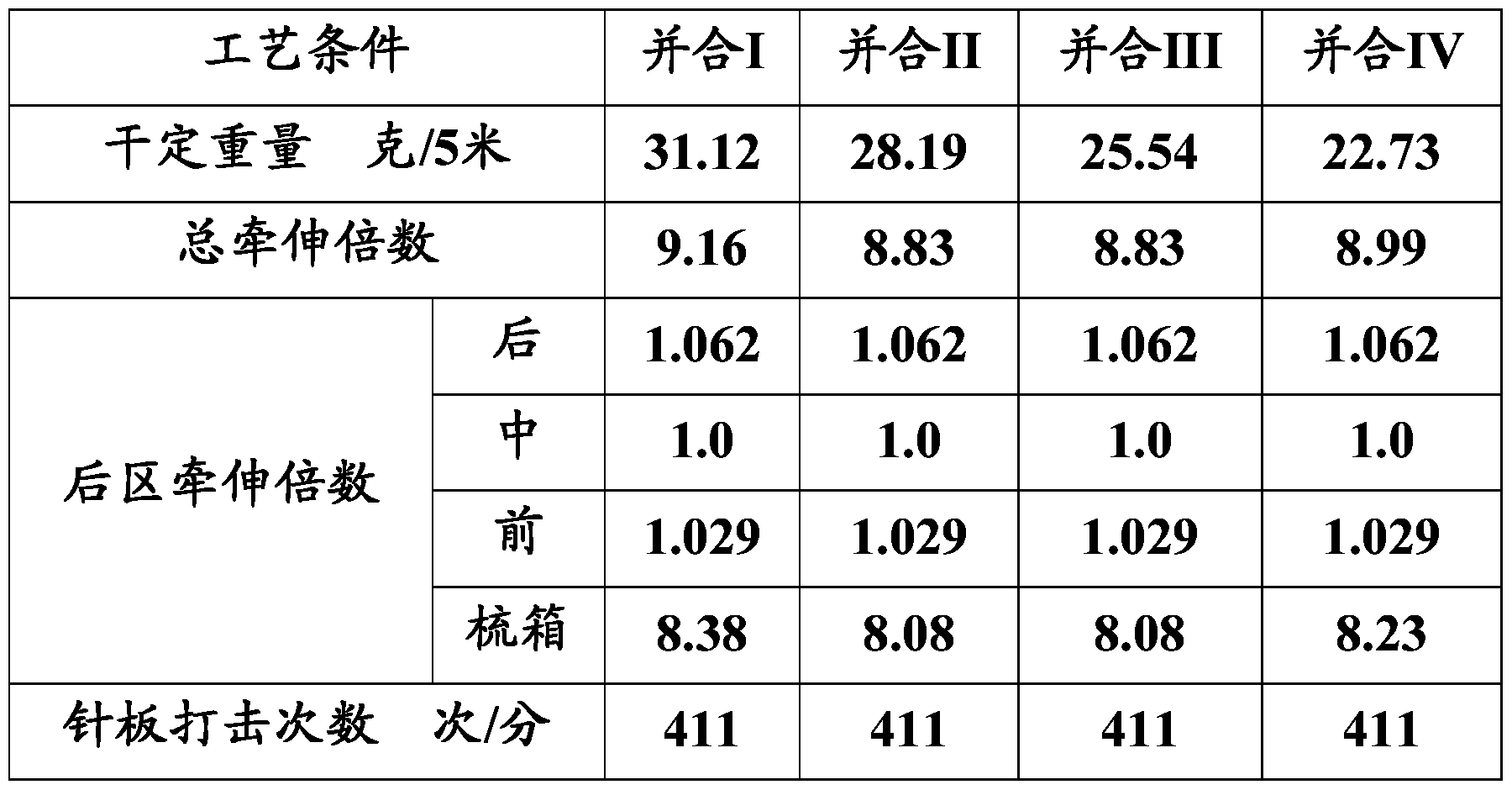
(重量比)在并条机上进行第 I次并合, 形成混合条。再将混合 条进行第 II次、 第 ΠΙ次、 第 IV次并合, 经过多次并合后, 使末并 纤维条中的两种纤维充分混合, 条干均匀。 釆用顺牵型式, 选择 四~五道并条工艺路线, 后区牵伸偏大掌握, 釆用较低的车速, 针板打击次数控制在 450次 /分钟以下, 输出条子的重量不大于 34 克 /5米, 总牵伸倍数设计在 8 ~ 10之间, 车间相对湿度调整在 80 %左右。 具体工艺条件见表 2。 The (weight ratio) was combined for the first time on the draw frame to form a mixed strip. Then, the mixed strips are subjected to the second, third, and fourth times. After a plurality of combinations, the two fibers in the final fiber strip are thoroughly mixed, and the strips are evenly distributed.釆Use the Shun-Lei type, select the four-to-five draw-up process route, the rear zone draft is too large to master, the lower speed is used, the number of needle strikes is controlled below 450 times/min, and the weight of the output sliver is not more than 34 Gram / 5 meters, the total drafting ratio is designed between 8 and 10, and the relative humidity of the workshop is adjusted to about 80%. The specific process conditions are shown in Table 2.
表 2 并条工艺条件 Table 2 Drawing conditions
工艺条件 并合 I 并合 II 并合 III 并合 IV 干定重量 克 /5米 33.95 30.21 27.27 24.80 总牵伸倍数 9.16 8.83 8.83 8.99 Process conditions Merging I Combined II Combined III Combined IV Dry weight /5 /5 33.95 30.21 27.27 24.80 Total drafting ratio 9.16 8.83 8.83 8.99
后 1.062 1.062 1.062 1.062 中 1.000 1.000 1.000 1.000 后区牵伸倍数 After 1.062 1.062 1.062 1.062 Medium 1.000 1.000 1.000 1.000 Rear Zone Drafting Multiple
前 1.029 1.029 1.029 1.029 梳箱 8.38 8.08 8.08 8.23 针板打击次数 次 /分 411 411 411 411 工艺要求: 末并纤维条中两种纤维混合均匀, 重量不匀率 <前1.029 1.029 1.029 1.029 Comb 8.38 8.08 8.08 8.23 Needle strike times / min 411 411 411 411 Process requirements: The two fibers in the fiber strip are evenly mixed, and the weight unevenness rate <
1%, 萨氏条干< 10%, 重量偏差 ±2%。 1%, Saskatchewan < 10%, weight deviation ± 2%.
3、 粗纱: 选择二道粗纱工艺路线, 釆用轻定量、 低车速、 较大后区罗拉隔距及较小的后区牵伸倍数, 使得纤维伸直平行。 具体工艺条件见表 3。 3, roving: Select the two roving process route, using light weight, low speed, large rear zone roller gauge and smaller rear zone drafting multiple, so that the fibers are straight and parallel. The specific process conditions are shown in Table 3.

工艺要求: 总牵伸倍数设计在 7 ~ 8. 5之间, 粗纱条定量控制 在 6 ~ 7克 /米, II粗重量不匀率控制在 2 %以内,重量偏差 ±3%, I 粗萨氏条干 < 25%, II粗萨氏条干 < 28%。 Process requirements: The total drafting ratio is designed between 7 and 8. 5, the roving strip is controlled at 6 ~ 7 g / m, the II coarse weight unevenness is controlled within 2 %, the weight deviation is ± 3%, I Stems < 25%, II coarse Saskatchewan < 28%.
4、 细纱 4, fine yarn
工艺条件: Process conditions:
设备型号 FZ501 Equipment type FZ501
干定重 1.213克 /100米 Dry weight 1.213 g / 100 m
总牵伸倍数 20.26 Total draw ratio 20.26
捻系数 108 捻度 942捻 /米 捻 coefficient 108 Width 942捻/m
锭子速度 6241转 /分 Spindle speed 6241 rpm
前罗拉转速 63.02转 /分 Front roller speed 63.02 rpm
5、络筒:选用具有电子清纱器及空气捻接器装置的 1332MD 型络筒设备生产无接头纱。 合理设置清纱参数, 有效去除纱疵。 络筒机速度低于 350米 /分钟。 清纱参数设置: 长粗节 90%x45厘 米, 短粗节 190%x2. 5厘米, 长细节 - 70%x45厘米。 5. Winding: The jointless yarn is produced by using the 1332MD type winding device with electronic yarn clearer and air splicer device. Reasonably set the yarn clearing parameters to effectively remove the yarn defect. The winder speed is less than 350 m / min. Clear yarn parameter setting: long thick section 90% x 45 cm, short thick section 190% x 2. 5 cm, long detail - 70% x 45 cm.
工艺要求: 筒纱无结头, 纱疵清除干净, 纱线再生毛羽少。 工艺条件: 卷绕线速度 372 ~ 384米 /分 Process requirements: The yarn has no knot, the yarn defect is cleaned, and the yarn has less hair growth. Process conditions: Winding speed 372 ~ 384 m / min
6、 整经(设备型号 GA121 ) : 工艺要求: 经轴片纱张力均 匀, 卷绕紧密。 6. Warping (equipment model GA121): Process requirements: The tension of the warp yarn is uniform and the winding is tight.
工艺条件:纱线通道光滑无毛刺,整经筒子定长,整机换筒, 结头釆用自紧结,纱尾长度 2 ~ 4毫米,车速控制在 200米 /分以内。 张力: 分上中下、 前中后 9个张力区, 才艮据纱线质量情况设置 Process conditions: the yarn passage is smooth and burr-free, the warping cylinder is fixed length, the whole machine is changed, the knot is self-tightening, the length of the yarn tail is 2 ~ 4 mm, and the speed is controlled within 200 m / min. Tension: 9 upper and lower, front, middle and back tension zones, set according to yarn quality
7、 浆纱(设备型号 G142D-200 ): 用"小张力、 低粘度、 中 压力、慢速度,,的浆纱工艺。浆料选用中低粘度的酯化变性淀粉, 适量的固体丙烯酸类浆料与 PVA混合,并加配少量的柔软剂,使 浆膜柔韧、 耐磨, 浆纱分绞顺利, 手感光滑, 再生毛羽少。 7. Sizing (equipment model G142D-200): Use "small tension, low viscosity, medium pressure, slow speed, sizing process. The slurry is selected from medium and low viscosity esterified modified starch, and the right amount of solid acrylic pulp. It is mixed with PVA and added with a small amount of softener to make the film flexible and wear-resistant. The sizing is smooth, the hand feels smooth, and the regenerated hairiness is less.
工艺要求: 上浆率控制在 4 ~ 6%, 回潮率控制在 5 ~ 7 %的范 围。 织轴卷绕紧密, 浆纱光洁, 弹性好, 张力均匀。 Process requirements: The sizing rate is controlled at 4 ~ 6%, and the moisture regain rate is controlled in the range of 5 ~ 7 %. The weaving shaft is tightly wound, the sizing is smooth, the elasticity is good, and the tension is uniform.
工艺条件: Process conditions:
上浆率 4. 8 ~ 5. 8% Sizing rate 4. 8 ~ 5. 8%
回潮率 3. 5 ~ 5.5 % Moisture regain 3. 5. ~ 5.5 %
车速 40米 /分 Speed 40 m / min
浆槽温度 80 "C Slurry temperature 80 "C
浆液粘度 7"左右 (吊粘) Slurry viscosity 7" or so (hanging sticky)
浆液主要成份: 每升浆液中包含 10克 PVA、 16克 K-2000复 合变性淀粉、 34克 D-150A变性淀粉和 3克 LMA-2050丙烯酸浆料The main components of the slurry: 10 grams of PVA per liter of slurry, 16 grams of K-2000 complex Modified starch, 34 g D-150A modified starch and 3 g LMA-2050 acrylic acid paste
8、 织造(设备型号 GA741 ) 8, weaving (device model GA741)
工艺要求: 保证经纱开口清晰, 纬纱飞行平稳, 织机运转效 率高, 织疵少。 Process requirements: Ensure that the warp yarn opening is clear, the weft yarn is flying smoothly, the loom has high running efficiency and less weaving.
工艺条件: Process conditions:
环境温度 20 ~ 28°C, 湿度 80 ~ 86% Ambient temperature 20 ~ 28 °C, humidity 80 ~ 86%
织机速度 175转 /分 Loom speed 175 rpm
开口时间 280度 Opening time 280 degrees
开口高度 100 ~ 105mm Opening height 100 ~ 105mm
综框高度 265mm Heald frame height 265mm
引纬时间 75度 Weft insertion time 75 degrees
9、 坯布整理 9, the finishing of the fabric
工艺条件: 单层修布, 单层验布, 分等 Process conditions: single layer repair, single layer inspection, grading
10、 翻布缝头 10, turn over the seam
工艺条件: 分批分箱准确, 翻布整齐, 缝头, 平直、 牢固, 包边。 Process conditions: Accurate batching, tidy cloth, seam head, straight, firm, edging.
11、 烧毛(气体烧毛机) 11, singeing (gas singeing machine)
工艺要求: 布面光洁度 3. 5级以上, 不边烧。 Process requirements: Cloth finish 3. Level 5 or above, no burning.
工艺条件: 刷毛, 二对软毛刷正反刷毛, 并用刮刀。 烧毛次 数, 二正二反。 湿落布, 车速 140 ~ 160米 /分, 汽油汽化器内温 度 85°C以上。 Process conditions: bristles, two pairs of soft brush positive and negative bristles, and use a scraper. The number of singeing, two positive and two reverse. Wet cloth, speed 140 ~ 160 m / min, gasoline vaporizer internal temperature 85 ° C or more.
12、 减量处理: 12, reduction processing:
工艺要求:浆料及水溶性纤维杂质基本去除,提高织物毛效。 工艺设备: 釆用 ASMA631型喷射溢流染色机(中国江苏无 锡设备制造厂生产) Process requirements: The slurry and water-soluble fiber impurities are basically removed to improve the fabric effect. Process equipment: A ASMA631 type jet overflow dyeing machine (produced by Jiangsu Wuxi Equipment Manufacturing Co., Ltd.)
退浆、 煮练液: 以每升清水为基础, 在每升清水中加入烧碱 1克 /升, 纯碱 0.5克 /升, 亚硫酸钠 1克 /升, 非离子表面活性剂平平 加 O 0.5克 /升, 温度 110 ~ 120°C , 保温 15分钟 Desizing and scouring liquid: adding soda per liter of clean water based on liters of fresh water per liter 1 g / liter, soda ash 0.5 g / liter, sodium sulfite 1 g / liter, nonionic surfactant flat plus O 0.5 g / liter, temperature 110 ~ 120 ° C, heat preservation 15 minutes
浴比: 1: 20 Bath ratio: 1: 20
水洗: 90°C以上热水洗两次, 每次 10分钟, 冷水洗一次, 溢 流出布。 Washing: Wash twice with hot water above 90 °C for 10 minutes each time, wash once in cold water, and overflow the cloth.
13、 漂白 13, bleaching
工艺要求:进一步去除少量残留的浆料、水溶性纤维、杂质, 进一步提高毛效, 去碱干净, 达到一定的白度且白度均匀。 工艺 条件见表 4。 Process requirements: further remove a small amount of residual slurry, water-soluble fibers, impurities, further improve the hair effect, clean alkali, achieve a certain degree of whiteness and uniform whiteness. The process conditions are shown in Table 4.
表 4 Table 4

注: 有机稳定剂为 WPW-Z, 购自中国湖北荆州化工厂; Note: The organic stabilizer is WPW-Z, purchased from Jingzhou Chemical Plant, Hubei, China;
渗透剂为 JTC, 购自中国抚顺佳化聚氨酯有限公司。 The penetrant was JTC and was purchased from China Fushun Jiahua Polyurethane Co., Ltd.
14、 烘干 14, drying
工艺要求: 要求下机布烘干不潮湿, 消除溢流小折皱, 下机 布平整无皱, 无污渍, 无纬移, 无纬斜。 Process requirements: The machine cloth is required to be dried and not wet, to eliminate small wrinkles in the overflow, and the cloth is smooth and wrinkle-free, without stains, without weft shift, without weft.
工艺条件: 车速 40m/min, 轧车压力: 2 kg/cm 2, 轧槽轧辊 清洁, 烘筒干净, 蒸汽压力在 0. 5 kg/cm2 ~ 2 kg/cm 2。 15、 上柔、 增白 5公斤/厘米之间。 The process conditions: a vehicle speed of 40m / min, rolling car pressure: 2 kg / cm 2 , the groove of the groove is clean, the drying cylinder is clean, the steam pressure is 0. 5 kg / cm 2 ~ 2 kg / cm 2 . 15, soft, whitening
工艺要求: 手感柔软, 滑爽, 织物洁白. 白度均匀, 下机无 皱、 无污渍、 无纬移、 无纬斜。 Process requirements: soft to the touch, smooth, white fabric. Uniform whiteness, no wrinkles, no stains, no weft, no weft.
工艺条件:增白剂 VBL (得自中国河北石家庄新宇化工有限 公司,下同) 1.5~2克/升,柔软剂适量,表面活性剂平平加 O 0.2 克 /升, 车速 45m/min, 轧车压力: 2kg/cm2, 二浸二轧。 Process conditions: whitening agent VBL (from Hebei Shijiazhuang Xinyu Chemical Co., Ltd., the same below) 1.5 ~ 2 g / l, softener amount, surfactant leveling plus O 0.2 g / l, speed 45m / min, rolling Pressure: 2kg/cm 2 , two dip two rolling.
16、 拉幅定型 16, tenter shaping
工艺要求: 湿布门幅达到工艺要求(比成品门幅宽 1.5~2.5 厘米), 门幅一致, 无荷叶边, 无破边、破洞, 无油污, 无纬斜、 纬移。 Process requirements: The wet cloth door width meets the process requirements (1.5~2.5 cm wider than the finished door width), the door width is the same, there is no lotus edge, no broken edges, no holes, no oil, no latitude, and weft.
工艺条件: 车速 35~40m/min, 进行整纬。 Process conditions: The speed is 35~40m/min, and the weft is carried out.
17、 预缩 17, pre-shrinking
工艺要求: 使织物尺寸稳定, 达到要求缩率, 使织物手感柔 软, 增加毛效, 下机布无折皱, 无污渍。 Process requirements: Make the fabric size stable, achieve the required shrinkage, make the fabric feel soft, increase the wool effect, the machine cloth has no wrinkles, no stains.
工艺条件: 车速 30m/min, 给湿后织物含湿度: 8 - 12%, 承压辊蒸汽压力: 0.8 ~ 1.5 kgf/cm2 Process conditions: Speed 30m/min, moisture content after wetting: 8 - 12%, pressure of the pressure roller: 0.8 ~ 1.5 kgf/cm 2
承压辊和给布辊间的间隙小于橡胶毯厚度 2 ~ 3 mm The gap between the pressure roller and the feed roller is less than the thickness of the rubber blanket 2 ~ 3 mm
织物预缩率: 2~3% Fabric shrinkage rate: 2~3%
18、 脸布、 成卷 18, face cloth, roll
对布进行验布、 成卷, 制得所需的 160^ 160 的纯苎麻 漂白布, 要求布边卷绕整齐, 布面无折皱, 定等准确, 唛头标识 清晰。 The cloth is inspected and rolled to obtain the required 160^160 pure ramie bleaching cloth, which requires the cloth to be wound neatly, the cloth surface is not wrinkled, the accuracy is accurate, and the hoe mark is clear.
实施例二: 生产 248 248 的特高支纯苎麻漂白布 Example 2: Production of 248 248 extra-high purity pure ramie bleaching cloth
1、 将 05号苎麻纤维条和 S-9 ( II )水溶性维纶纤维牵切条分 别在 RMC型日本产针梳并条机上预并, 制成条重(干定重)为 31.10克 /5米的苎麻条及条重(干定重)为 31.10克 /5米的水溶性 纤维条。 1. The No. 05 ramie fiber strip and the S-9 (II) water-soluble vinylon fiber strip are pre-combined on the RMC Japanese needle combing machine, and the strip weight (dry weight) is 31.10 g/5. Rice ramie and strip weight (dry weight) is 31.10 g / 5 m water solubility Fiber strips.
2、 将预并好的苎麻纤维条与水溶性纤维条按 40: 60的比例 在并条机上进行第 I次并合,形成混合条。再将混合条进行第 II 次、第 ΠΙ次、第 IV次并合,使末并纤维条中的两种纤维充分混合, 条干均匀。 工艺条件见表 5。 2. Combine the pre-formed ramie fiber strips with the water-soluble fiber strips at a ratio of 40:60 on the draw frame for the first time to form a mixed strip. Then, the mixed strips are subjected to the second, third, and fourth times to make the two fibers in the final fiber strips be thoroughly mixed, and the strips are evenly distributed. The process conditions are shown in Table 5.
表 5: 并条工艺条件 Table 5: Drawing conditions

3、 粗纱: 工艺条件见表 6。 3. Roving: The process conditions are shown in Table 6.
表 6: 粗纱工艺条件 Table 6: Roving process conditions
工艺条件 粗纱 I 粗纱 II Process conditions roving I roving II
设备型号 CZ411 CZ421 Equipment type CZ411 CZ421
干定重 克 /10米 6.185 2.061 Dry weight gram / 10 meters 6.185 2.061
总牵伸倍数 8.02 9.00 Total draw ratio 8.02 9.00
罗拉隔 if巨 mm 前罗拉 ~第一罗拉 55 Roller isolation if huge mm front roller ~ first roller 55
前后 225 Before and after 225
第一罗拉~第二罗拉 55 前中 30 第二罗拉~第三罗拉 75 第三罗拉~后罗拉 90 前罗拉转速 转 /分 130.8 53 First Roller ~ Second Roller 55 Front 30 Second Roller ~ Third Roller 75 Third Roller ~ Rear Roller 90 Front Roller Speed / 130.8 53
锭子速度 转 /分 250 465 Spindle speed transfer / minute 250 465
4、 细纱(设备型号 FZ501) 4, spun yarn (equipment model FZ501)
工艺条件: 干定重 1.031克 /100米 Process conditions: Dry weight 1.031 g / 100 m
总牵伸倍数 20 Total draw ratio 20
捻系数 108 捻 coefficient 108
捻度 1024捻 /米 Width 1024捻 / m
锭子速度 4458转 /分 Spindle speed 4458 rpm
前罗拉转速: 38.57转 / Front roller speed: 38.57 rpm /
5、 络筒: (设备型号 1332MD) 5, winding: (device model 1332MD)
工艺条件: Process conditions:
卷绕线速度 326米 /分 Winding speed 326 m / min
电清参数设置: 短粗节 300%x3.0 cm; 长粗节 +90%x45 cm; 长细节- 70%x45 cm Electric cleaning parameter setting: short thick section 300%x3.0 cm; long thick section +90%x45 cm; long detail - 70%x45 cm
6、 整经: (设备型号 GA121) 6. Warping: (Device model GA121)
工艺条件: Process conditions:
车速: 200米 /分 Speed: 200 m / min
张力: 分上中下、 前中后 9个张力区, 才艮据纱线质量情况设 Tension: 9 upper and lower, front, middle and back tension zones, according to the yarn quality
7、 浆纱(设备型号 G142D-200) 7, sizing (device model G142D-200)
工艺条件: Process conditions:
上浆率 4~6% Sizing rate 4~6%
3.5~5.5% 车速 40米 /分 3.5~5.5% Speed 40 m / min
浆槽温度 80 "C Slurry temperature 80 "C
浆液粘度 8"左右 (吊粘) Slurry viscosity 8" or so (hanging sticky)
浆液主要成份: 每升浆液中包含 11克 PVA、 18克 K-2000复 合变性淀粉、 36克 D-150A变性淀粉和 3克 LMA-2050丙烯酸浆料 Main components of the slurry: 11 grams of PVA, 18 grams of K-2000 complex modified starch, 36 grams of D-150A modified starch and 3 grams of LMA-2050 acrylic acid syrup per liter of slurry
8、 织造(设备型号 GA741 ) 8, weaving (device model GA741)
工艺条件: Process conditions:
环境温度 20~28°C, 湿度 80~86% Ambient temperature 20~28°C, humidity 80~86%
织机速度 175转 /分 Loom speed 175 rpm
开口时间 280度 Opening time 280 degrees
开口高度 100-105 mm Opening height 100-105 mm
综框高度 265 mm Heald frame height 265 mm
引纬时间 75度 Weft insertion time 75 degrees
9、 坯布整理 9, the finishing of the fabric
工艺条件: 单层修布, 单层验布, 分等 Process conditions: single layer repair, single layer inspection, grading
10、 翻布缝头 10, turn over the seam
工艺条件: 分批分箱准确, 翻布整齐, 缝头, 平直、 牢固, 包边。 Process conditions: Accurate batching, tidy cloth, seam head, straight, firm, edging.
11、 烧毛(气体烧毛机) 11, singeing (gas singeing machine)
工艺要求: 布面光洁度 4级以上 Process requirements: Cloth finish 4 or above
工艺条件: 刷毛, 二对软毛刷正反刷毛, 并用刮刀。 烧毛 次数,二正二反。湿落布,车速 160米 /分,汽油汽化器内温度 85°C 以上。 Process conditions: bristles, two pairs of soft brush positive and negative bristles, and use a scraper. The number of singeing, two positive and two reverse. Wet cloth, speed 160m / min, gasoline vaporizer temperature above 85 ° C.
12、 减量处理 12, reduction processing
工艺要求: 将浆料及水溶性纤维、 杂质基本去除, 提高织 物毛效。 工艺设备: 釆用 ASMA631型喷射溢流染色机(中国江苏 无锡设备制造厂生产) Process requirements: The slurry and water-soluble fibers and impurities are basically removed to improve the fabric effect. Process equipment: AASMA631 type jet overflow dyeing machine (produced by Wuxi Equipment Manufacturing Factory, Jiangsu, China)
退浆、 煮练液: 以每升清水为基^ ί , 在每升清水中加入烧 碱 3克 /升, 纯碱 1克 /升, 亚¾酸钠 2克 /升, 非离子表面活性剂平 平加 O l克 /升, 温度 110 ~ 120°C,保温 20分钟。 Desizing and scouring liquid: based on liters of water per liter, adding 3 g/L of caustic soda per liter of clean water, 1 g/L of soda ash, 2 g/L of sodium sulphate, nonionic surfactant flat O lg / liter, temperature 110 ~ 120 ° C, keep warm for 20 minutes.
浴比: 1: 20 Bath ratio: 1: 20
水洗: 90°C以上热水洗两次, 每次 10分钟, 冷水洗一次出 布。 Washing: Wash twice in hot water above 90 °C for 10 minutes each time, and wash it once in cold water.
13、 漂白 13, bleaching
工艺要求: 进一步去除剩下的少量浆料、 水溶性纤维、 杂 质, 去碱干净, 提高毛效, 达到规定的白度, 白度均匀。 工艺条 件见表 7。 Process requirements: Further remove the remaining small amount of slurry, water-soluble fiber, impurities, clean alkali, improve hair efficiency, achieve the specified whiteness, and uniform whiteness. The process conditions are shown in Table 7.
表 7: 漂白工艺^^ Table 7: Bleaching Process ^^

注: 有机稳定剂为 WPW-Z, 购自中国湖北荆州化工厂; Note: The organic stabilizer is WPW-Z, purchased from Jingzhou Chemical Plant, Hubei, China;
渗透剂为 JTC, 购自中国抚顺佳化聚氨酯有限公司。 The penetrant was JTC and was purchased from China Fushun Jiahua Polyurethane Co., Ltd.
14、 烘干 14, drying
工艺要求: 要求下机布烘干不潮湿, 消除溢流小折皱, 下 机布平整无皱, 无污渍, 无纬移, 无纬斜。 Process requirements: It is required to dry the machine cloth without dampness, eliminate the small wrinkles of the overflow, and The machine cloth is smooth and wrinkle-free, no stains, no weft movement, no weft.
工艺条件: 车速 40m/min, 轧车压力: 2 kg/cm2, 轧槽轧辊 清洁, 烘筒干净, 蒸汽压力在 0.5 kg/cm2 ~ 2 kg/cm 2。 Process conditions: The vehicle speed is 40m/min, the rolling pressure is 2 kg/cm 2 , the groove rolling roller is clean, the drying cylinder is clean, and the steam pressure is 0.5 kg/cm 2 ~ 2 kg/cm 2 .
15、 上柔、 增白 15, soft, whitening
工艺要求: 手感柔软, 滑爽, 织物洁白, 白度均匀, 下机 无皱、 无污渍、 无纬移、 无纬斜。 Process requirements: soft, smooth, soft white fabric, uniform whiteness, no wrinkles, no stains, no weft, no weft.
工艺条件: 增白剂 VBL1.5~2克 /升, 柔软剂适量, 表面活 性剂平平加 00.2克 /升, 车速 45m/min, 轧车压力: 2 kg/cm2, 二 浸二轧。 Process conditions: Brightener VBL1.5~2g/L, softener amount, surfactant leveling plus 00.2g/L, speed 45m/min, rolling pressure: 2 kg/cm 2 , two dip two rolling.
16、 拉幅定型 16, tenter shaping
工艺要求: 湿布门幅达到工艺要求(比成品门幅宽 1.5~2. 5厘米) , 门幅一致, 无荷叶边, 无破边、 破洞, 无油污, 无纬 斜、 纬移。 Process requirements: The wet cloth door width meets the process requirements (1.5~2. 5 cm wider than the finished door width), the door width is the same, no flounces, no broken edges, no holes, no oil, no weft, and weft.
工艺条件: 车速 35~40m/min, 进行整纬。 Process conditions: The speed is 35~40m/min, and the weft is carried out.
17、 预缩 17, pre-shrinking
工艺要求: 使织物尺寸稳定, 达到要求缩率, 使织物手感 柔软, 下机布无折皱, 无污渍。 Process requirements: Make the fabric size stable, achieve the required shrinkage, make the fabric feel soft, the machine cloth has no wrinkles, no stains.
工艺条件: 车速 30m/min, 给湿后织物含湿度: 8 - 12%, 承压辊蒸汽压力: 0.8 ~ 1.5kgf/cm2 Process conditions: Speed 30m/min, moisture content after wetting: 8 - 12%, pressure of pressure roller: 0.8 ~ 1.5kgf/cm 2
承压辊和给布辊间的间隙小于橡胶毯厚度 2 ~ 3mm The gap between the pressure roller and the cloth feed roller is less than the thickness of the rubber blanket 2 ~ 3mm
织物预缩率: 2~3% Fabric shrinkage rate: 2~3%
18、 脸布、 成卷 18, face cloth, roll
对布进行验布、 成卷, 制得所需的 248Nmx248Nn^特高支 纯苎麻漂白布, 要求布边卷绕整齐, 布面无折皱, 定等准确, 唛 头标识清晰。 The cloth is inspected and rolled to obtain the required 248 Nm x248 Nn ^ extra-high-purity pure ramie bleaching cloth, which requires that the cloth edge is wound neatly, the cloth surface is not wrinkled, and the marking is clear, and the marking of the steamed bread is clear.
实施例三: 生产 30(^"^<500 的特高支纯苎麻漂白布 1、 将 05号苎麻纤维条和 S-9 ( II )水溶性维纶纤维牵切条分 别在 RMC型日本产针梳并条机上预并, 制成条重(干定重)为 28.5克 /5米的苎麻条及条重(干定重)为 49.98克 /5米的水溶性纤 维条。 Example 3: Production of 30 (^"^<500 ultra-high purity pure ramie bleaching cloth 1. The No. 05 ramie fiber strip and the S-9 (II) water-soluble vinylon fiber strip are pre-prepared on the RMC Japanese needle combing machine, and the strip weight (dry weight) is 28.5 g/5 The ramie strips and strip weight (dry weight) of rice are 49.98 g / 5 m water-soluble fiber strips.
2、 将预并好的苎麻纤维条与水溶性纤维条按 30: 70的比例 在并条机上进行第 I次并合,形成混合条。再将混合条进行第 II 次、第 ΠΙ次、第 IV次并合,使末并纤维条中的两种纤维充分混合, 条干均匀。 工艺条件见表 8。 2. Combine the pre-formed ramie fiber strips with the water-soluble fiber strips in a ratio of 30:70 on the draw frame for the first time to form a mixed strip. Then, the mixed strips are subjected to the second, third, and fourth times to make the two fibers in the final fiber strips be thoroughly mixed, and the strips are evenly distributed. The process conditions are shown in Table 8.
表 8: 并条工艺条件 Table 8: Drawing conditions
3、 粗纱: 工艺条件见表 9。 3. Roving: The process conditions are shown in Table 9.
表 9: 粗纱工艺条件 Table 9: Roving process conditions
工艺条件 粗纱 I 粗纱 II Process conditions roving I roving II
设备型号 CZ411 CZ421 Equipment type CZ411 CZ421
干定重 克 /10米 5.602 1.867 Dry weight gram /10 m 5.602 1.867
总牵伸倍数 8.23 9.0 Total draw ratio 8.23 9.0
罗拉隔 if巨 mm 前后 220 前罗拉 ~第一罗拉 55 第一罗拉~第二罗拉 55 第二罗拉~第三罗拉 75 前中 30 Rolla separated by if huge mm before and after 220 front roller ~ first roller 55 First Roller ~ Second Roller 55 Second Roller ~ Third Roller 75 Front 30
第三罗拉~后罗拉 90 前罗拉转速 转 /分 135 54.5 Third Roller ~ Back Roller 90 Front Roller Speed / Points 135 54.5
锭子速度 转 /分 250 465 Spindle speed transfer / minute 250 465
4、 细纱(设备型号 FZ501 ) 4, spun yarn (equipment model FZ501)
工艺条件: 纺纱支数 90公支 150公支 Process conditions: Spinning count 90 metrics 150 metrics
干定重 1.037克 /100米 0.622克 /100米 总牵伸倍数 18.0 30.0 Dry weight 1.037 g / 100 m 0.622 g / 100 m total draft multiple 18.0 30.0
捻系数 105 110 捻 coefficient 105 110
捻度 996捻 /米 1347捻 /米 锭子速度 4458转 /分 4458转 /分 前罗拉转速 40.93转 / 29.04转 /分 5、 络筒 (设备型号 1332MD ) : 捻 996 捻 / m 1347 捻 / m spindle speed 4458 rpm / minute 4458 rpm / minute front roller speed 40.93 rev / 29.04 rev / min 5, winding (device model 1332MD):
工艺条件: Process conditions:
卷绕线速度 326 米 /分 Winding speed 326 m / min
电清参数设置: 短粗节 +300%x3.0cm; 长粗节 +90%x45 cm; 长细节 -70%x45cm。 Electric cleaning parameter setting: short thick section +300%x3.0cm; long thick section +90%x45 cm; long detail -70%x45cm.
6、 整经(设备型号 GA121 ) : 6, warping (device model GA121):
工艺条件: Process conditions:
车速: 180米 /分 Speed: 180 m / min
张力: 分上中下、 前中后 9个张力区, 才艮据纱线质量情况设 7、 浆纱(设备型号 G142D-200 ) Tension: 9 upper and lower, front, middle and back tension zones, according to the yarn quality 7, sizing (device model G142D-200)
工艺条件: Process conditions:
上浆率 4 ~ 6 % Sizing rate 4 ~ 6 %
3.5 ~ 5.5 % 3.5 ~ 5.5 %
车速 40米 /分 Speed 40 m / min
浆槽温度 80 "C Slurry temperature 80 "C
浆液粘度 8"左右 (吊粘) Slurry viscosity 8" or so (hanging sticky)
浆液主要成份 每升浆液中包含 12克 PVA、 17克 K-2000 复合变性淀粉、 35克 D-150A变性淀粉和 3克 LMA-2050丙烯酸浆 料 Main components of the slurry Each liter of slurry contains 12 grams of PVA, 17 grams of K-2000 compound modified starch, 35 grams of D-150A modified starch, and 3 grams of LMA-2050 acrylic syrup.
8、 织造 ( GA741 ) 8. Weaving (GA741)
工艺条件: Process conditions:
环境温度 20-28 "C, 湿度 80~86% Ambient temperature 20-28 "C, humidity 80~86%
织机速度 175转 /分 Loom speed 175 rpm
开口时间 280度 Opening time 280 degrees
开口高度 100mm Opening height 100mm
综框高度 265mm Heald frame height 265mm
引纬时间 75度 Weft insertion time 75 degrees
9、 坯布整理 9, the finishing of the fabric
工艺条件: 单层修布, 单层验布, 分等 Process conditions: single layer repair, single layer inspection, grading
10、 翻布缝头 10, turn over the seam
工艺条件: 分批分箱准确, 翻布整齐, 缝头, 平直、 牢固, 包边 Process conditions: Accurate batching, tidy cloth, seam head, straight, firm, edging
11、 烧毛(气体烧毛机) 11, singeing (gas singeing machine)
工艺要求: 布面光洁度 4级以上 Process requirements: Cloth finish 4 or above
工艺条件: 刷毛, 二对软毛刷正反刷毛, 并用刮刀。 烧毛 次数,一正一反。湿落布,车速 150米 /分,汽油汽化器内温度 85°C 以上。 Process conditions: bristles, two pairs of soft brush positive and negative bristles, and use a scraper. Singeing The number of times, one positive and one negative. Wet cloth, speed 150m/min, gasoline vaporizer temperature above 85°C.
12、 减量处理 12, reduction processing
工艺要求: 将浆料及水溶性纤维、 杂质基本去除, 提高织 物毛效 D Process requirements: Basically remove the slurry and water-soluble fibers and impurities to improve the fabric effect D
工艺条件: 釆用 ASMA631型喷射溢流染色机(中国江苏 无锡设备制造厂生产) Process conditions: A ASMA631 type jet overflow dyeing machine (produced by Wuxi Equipment Manufacturing Factory, Jiangsu, China)
退浆、 煮练液: 以每升清水为基^ ί , 在每升清水中加入烧 碱 3克 /升, 纯碱 1克 /升, 亚¾酸钠 2克 /升, 非离子表面活性剂平 平加 O l克 /升, 温度 110 ~ 120°C,保温 20分钟。 Desizing and scouring liquid: based on liters of water per liter, adding 3 g/L of caustic soda per liter of clean water, 1 g/L of soda ash, 2 g/L of sodium sulphate, nonionic surfactant flat O lg / liter, temperature 110 ~ 120 ° C, keep warm for 20 minutes.
浴比: 1: 20 Bath ratio: 1: 20
水洗: 90°C以上热水洗两次, 每次 10分钟, 冷水洗一次出 布。 Washing: Wash twice in hot water above 90 °C for 10 minutes each time, and wash it once in cold water.
13、 漂白 13, bleaching
工艺要求: 进一步去除剩下的少量浆料、 水溶性纤维、 杂 质, 去碱干净, 提高毛效, 达到规定的白度, 白度均匀。 工艺条 件见表 10。 Process requirements: Further remove the remaining small amount of slurry, water-soluble fiber, impurities, clean alkali, improve hair efficiency, achieve the specified whiteness, and uniform whiteness. The process conditions are shown in Table 10.
表 10: 漂白工艺条件 Table 10: Bleaching process conditions

注: 有机稳定剂为 WPW-Z, 购自中国湖北荆州化工厂; 渗透剂为 JTC, 购自中国抚顺佳化聚氨酯有限公司。 Note: The organic stabilizer is WPW-Z, which was purchased from Jingzhou Chemical Plant in Hubei, China; The penetrant was JTC and was purchased from China Fushun Jiahua Polyurethane Co., Ltd.
14、 烘干 14, drying
工艺要求: 要求下机布烘干不潮湿, 消除溢流小折皱, 下 机布平整无皱, 无污渍, 无纬移, 无纬斜。 Process requirements: The machine cloth is required to be dried and not wet, to eliminate small wrinkles in the overflow, the machine cloth is smooth and wrinkle-free, no stains, no latitude, no weft.
工艺条件: 车速 40m/min, 轧车压力: 2 kg/cm2, 轧槽轧辊 清洁, 烘筒干净, 蒸汽压力在 0.5 kg/cm2 ~ 2 kg/cm 2。 Process conditions: The vehicle speed is 40m/min, the rolling pressure is 2 kg/cm 2 , the groove rolling roller is clean, the drying cylinder is clean, and the steam pressure is 0.5 kg/cm 2 ~ 2 kg/cm 2 .
15、 上柔、 增白 15, soft, whitening
工艺要求: 手感柔软, 滑爽, 织物洁白, 白度均匀, 下机 无皱、 无污渍、 无纬移、 无纬斜。 Process requirements: soft, smooth, soft white fabric, uniform whiteness, no wrinkles, no stains, no weft, no weft.
工艺条件: 增白剂 VBL1.5~2克 /升, 柔软剂适量, 表面活 性剂平平加 00.2克 /升, 车速 45m/min, 轧车压力: 2 kg/cm2, 二 浸二轧。 Process conditions: Brightener VBL1.5~2g/L, softener amount, surfactant leveling plus 00.2g/L, speed 45m/min, rolling pressure: 2 kg/cm 2 , two dip two rolling.
16、 拉幅定型 16, tenter shaping
工艺要求: 湿布门幅达到工艺要求(比成品门幅宽 1.5~2. Process requirements: The wet cloth door width meets the process requirements (1.5~2 wider than the finished door width).
5厘米) , 门幅一致, 无荷叶边, 无破边、 破洞, 无油污, 无纬 斜、 纬移。 5 cm), the width of the door is the same, no flounces, no broken edges, no holes, no oil, no weft, weft.
工艺条件: 车速 30~35m/min, 进行整纬。 Process conditions: The speed is 30~35m/min, and the weft is carried out.
17、 预缩 17, pre-shrinking
工艺要求: 使织物尺寸稳定, 达到要求缩率, 使织物手感 柔软, 下机布无折皱, 无污渍。 Process requirements: Make the fabric size stable, achieve the required shrinkage, make the fabric feel soft, the machine cloth has no wrinkles, no stains.
工艺条件: 车速 30m/min, 给湿后织物含湿度: 8 - 12%, 承压辊蒸汽压力: 0.8 ~ 1.5kgf/cm2 Process conditions: Speed 30m/min, moisture content after wetting: 8 - 12%, pressure of pressure roller: 0.8 ~ 1.5kgf/cm 2
承压辊和给布辊间的间隙小于橡胶毯厚度 2 ~ 3mm The gap between the pressure roller and the cloth feed roller is less than the thickness of the rubber blanket 2 ~ 3mm
织物预缩率: 2~3% Fabric shrinkage rate: 2~3%
18、 脸布、 成卷 18, face cloth, roll
对布进行验布、 成卷, 制得所需的 300Nmx500Nn^特高支 纯苎麻漂白布, 要求布边卷绕整齐, 布面无折皱, 定等准确, 唛 头标识清晰。 For cloth inspection cloth, a roll, 300 Nm x500 Nn ^ Laid obtain the desired highly branched Pure ramie bleaching cloth requires the hem to be neatly wound, the fabric surface is not wrinkled, the accuracy is accurate, and the hoe mark is clear.
Claims
Priority Applications (3)
| Application Number | Priority Date | Filing Date | Title |
|---|---|---|---|
| EP08757751.6A EP2172583B1 (en) | 2007-06-18 | 2008-06-18 | A process for manufacturing super-high-count ramie fabric |
| US12/601,921 US8375537B2 (en) | 2007-06-18 | 2008-06-18 | Process for manufacturing super-high-count ramie fabric and the fabric |
| JP2010510642A JP5354551B2 (en) | 2007-06-18 | 2008-06-18 | Ultra-high fineness ramie fabric and method for producing the fabric |
Applications Claiming Priority (2)
| Application Number | Priority Date | Filing Date | Title |
|---|---|---|---|
| CN200710035172.2 | 2007-06-18 | ||
| CN2007100351722A CN101070656B (en) | 2007-06-18 | 2007-06-18 | Super-high-grade knitted pure ramie fabric preparing method and product |
Publications (1)
| Publication Number | Publication Date |
|---|---|
| WO2008154866A1 true WO2008154866A1 (en) | 2008-12-24 |
Family
ID=38898061
Family Applications (1)
| Application Number | Title | Priority Date | Filing Date |
|---|---|---|---|
| PCT/CN2008/071340 Ceased WO2008154866A1 (en) | 2007-06-18 | 2008-06-18 | A process for manufacturing super-high-count ramie fabric and the fabric |
Country Status (5)
| Country | Link |
|---|---|
| US (1) | US8375537B2 (en) |
| EP (1) | EP2172583B1 (en) |
| JP (1) | JP5354551B2 (en) |
| CN (1) | CN101070656B (en) |
| WO (1) | WO2008154866A1 (en) |
Cited By (5)
| Publication number | Priority date | Publication date | Assignee | Title |
|---|---|---|---|---|
| US20120076971A1 (en) * | 2010-09-24 | 2012-03-29 | Trident Limited | Air rich yarn and fabric and its method of manufacturing |
| CN103451803A (en) * | 2013-08-10 | 2013-12-18 | 郭淑华 | Production process of bamboo-cotton blended fabric |
| US10968544B2 (en) | 2010-09-24 | 2021-04-06 | Trident Limited | Process for manufacturing air rich yarn and air rich fabric |
| CN113930922A (en) * | 2021-10-15 | 2022-01-14 | 江阴市金汇毛纺织厂 | After-finishing process and equipment for water-soluble fiber companion-spun fabric |
| CN119061553A (en) * | 2024-11-04 | 2024-12-03 | 鲁泰纺织股份有限公司 | Production Technology of Tencel Hemp Core-spun Weft-Stretch Non-iron Woven Fabric |
Families Citing this family (30)
| Publication number | Priority date | Publication date | Assignee | Title |
|---|---|---|---|---|
| CN101070656B (en) | 2007-06-18 | 2010-12-15 | 湖南华升株洲雪松有限公司 | Super-high-grade knitted pure ramie fabric preparing method and product |
| CN101608367B (en) * | 2008-06-18 | 2010-12-29 | 新疆雅戈尔棉纺织有限公司 | Method for producing yarn with 350 counts |
| CN101463518B (en) * | 2009-01-15 | 2011-11-23 | 东华大学 | Production method of ramie spinned high count yarn and compound yarn |
| CN102191606A (en) * | 2010-03-16 | 2011-09-21 | 铜陵市德力来纺纱有限责任公司 | Method for producing pure flax woven or knitted fabrics spun with cotton flax |
| CN102191598A (en) * | 2010-03-16 | 2011-09-21 | 铜陵市德力来纺纱有限责任公司 | Method for producing high count pure linen yarn by using linen raw materials |
| IT1401154B1 (en) * | 2010-07-28 | 2013-07-12 | Flii Citterio Spa | PROCESS OF PRODUCTION OF A FABRIC IN NATURAL FIBER TEXTILE ANIMALS, PARTICULARLY FIBERS NATURAL TEXTILE OF PRECIOUS TYPE |
| PL2532775T3 (en) * | 2011-06-07 | 2013-12-31 | Climatex Ag | Textile substrate of multiple different disposable and/or recyclable materials, use of such a textile substrate and method for processing such a textile substrate |
| CN102277755B (en) * | 2011-06-29 | 2013-01-02 | 湖南华升株洲雪松有限公司 | Dyeing technology of ramie strips and manufacturing method of spinning |
| CN103266436B (en) * | 2013-05-03 | 2015-08-05 | 常熟常红织造有限公司 | Linen yarn slurry axle explained hereafter method |
| CN103361878B (en) * | 2013-07-16 | 2015-04-22 | 常熟市启弘纺织实业有限公司 | Woolen like fabric production method |
| CN103757781B (en) * | 2014-02-12 | 2016-03-30 | 鲁丰织染有限公司 | A kind of warping slashing technique of linen thread and yarn |
| IN2014MU00808A (en) * | 2014-03-11 | 2015-09-25 | Welspun India Ltd | |
| CN105063851A (en) * | 2015-07-31 | 2015-11-18 | 爱谱诗(苏州)服装有限公司 | Manufacturing process of rice fiber fabric |
| CN105155094B (en) * | 2015-09-23 | 2017-01-18 | 江苏华鹿纺织有限公司 | A kind of preparation method of ramie wool elastic fabric |
| CN105821563B (en) * | 2016-05-23 | 2018-04-20 | 江西赣东纺织有限公司 | A kind of preparation method of ramie fancy color-woven fabric |
| CN109972336A (en) * | 2017-12-28 | 2019-07-05 | 株洲唐人纺织造有限公司 | Husks dye final finishing production method |
| IT201800001698A1 (en) * | 2018-01-23 | 2019-07-23 | Gruppo Tessile Ind S P A | PROCEDURE FOR MAKING A TEXTILE ARTICLE |
| CN110359268A (en) * | 2019-06-21 | 2019-10-22 | 湖南华升株洲雪松有限公司 | The final finishing processing method of grass cloth and modified grass cloth |
| WO2021124138A1 (en) | 2019-12-17 | 2021-06-24 | Pirelli Tyre S.P.A. | Metallic reinforcing cord for tyres for vehicle wheels |
| CN114829703B (en) | 2019-12-17 | 2024-07-30 | 倍耐力轮胎股份公司 | Metal reinforcing cord for a tyre of a vehicle wheel |
| EP4077782B1 (en) * | 2019-12-17 | 2025-07-30 | Pirelli Tyre S.p.A. | Process and apparatus for manufacturing a structural component for a tyre for vehicle wheels |
| US11591748B2 (en) | 2020-01-14 | 2023-02-28 | Shadow Works, Llc | Heat treated multilayer knitted textile of liquid crystal polymer fibers and modified polyacrylonitrile fibers, and process for making same |
| CN116057226A (en) | 2020-09-25 | 2023-05-02 | 倍耐力轮胎股份公司 | Metal reinforcing cord for vehicle wheel tire and tire comprising same |
| CN112659805A (en) * | 2021-01-08 | 2021-04-16 | 王少农 | Method for making ramie into art painting carrier |
| CN113089181B (en) * | 2021-04-07 | 2022-12-16 | 赤壁恒瑞非织造材料有限公司 | High-strength high-water-absorptivity composite non-woven fabric and preparation method thereof |
| CN114014094B (en) * | 2022-01-10 | 2022-03-11 | 南通衡利莱机械设备有限公司 | Automatic change cone winder |
| CN115029944B (en) * | 2022-06-29 | 2024-03-22 | 湖南华升纺织科技有限公司 | Dyeing method for ramie and water-soluble polyester fiber blended yarn |
| KR102708786B1 (en) * | 2022-11-22 | 2024-09-24 | 원창머티리얼 주식회사 | Method of manufacturing biodegradable fabric used for interior material by using modified polyactic acid fiber |
| CN117604703B (en) * | 2023-12-18 | 2024-06-25 | 汕头市英华织造实业有限公司 | Weaving method of blended fabric |
| WO2025186832A1 (en) * | 2024-03-06 | 2025-09-12 | Welspun Living Limited | Method for producing fabric products with superior bulk and absorbency |
Citations (3)
| Publication number | Priority date | Publication date | Assignee | Title |
|---|---|---|---|---|
| CN1136099A (en) * | 1995-05-12 | 1996-11-20 | 郎金城 | Process for vinylon-flax blended yarn and its fabrics |
| CN1609299A (en) * | 2003-10-21 | 2005-04-27 | 薛冬梅 | Linen blend yarn and producing method thereof |
| CN101070686A (en) * | 2007-06-13 | 2007-11-14 | 张永宏 | Backing-adhesive luminous picture paper |
Family Cites Families (18)
| Publication number | Priority date | Publication date | Assignee | Title |
|---|---|---|---|---|
| NL60524C (en) * | 1942-03-02 | |||
| FR1455905A (en) * | 1964-05-28 | 1966-10-21 | New methods for the treatment of fibrous materials as well as products obtained | |
| JPS4898135A (en) * | 1972-03-31 | 1973-12-13 | ||
| US4617383A (en) * | 1983-11-22 | 1986-10-14 | Helmic, Inc. | Method for degumming and bleaching decorticated plant bast fiber |
| CN1038847A (en) * | 1988-06-20 | 1990-01-17 | 北京市对外贸易进出口公司 | The production method of towel yarn of zero twist |
| JPH05117966A (en) * | 1991-10-24 | 1993-05-14 | Kanebo Ltd | Method for producing fabric of pineapple fiber |
| JP2755361B2 (en) * | 1993-06-30 | 1998-05-20 | 徹 糸井 | Method for manufacturing multiple woven fabrics |
| EP0636716B1 (en) * | 1993-07-29 | 1999-01-20 | Kuraray Co., Ltd. | Water soluble polyvinyl alcohol-based fiber |
| IL142252A0 (en) * | 2001-03-26 | 2002-03-10 | Polgat Textiles Co 1960 Ltd | Novel process for the manufacture of super fine woven wool fabric with single yarn in the warp having improved weavability |
| US6803332B2 (en) * | 2001-04-10 | 2004-10-12 | World Fibers, Inc. | Composite yarn, intermediate fabric product and method of producing a metallic fabric |
| CN100557106C (en) * | 2003-02-27 | 2009-11-04 | 株洲雪松麻业有限责任公司 | A kind of spinning yarn containing raw bamboo fiber and its preparation method |
| BRPI0512062A (en) * | 2004-06-15 | 2008-02-06 | Novozymes North America Inc | process for simultaneously detaching and washing starch-containing or starch-derived sticky tissue, composition, and use thereof |
| EP1888835A4 (en) * | 2004-12-02 | 2013-11-13 | Novozymes North America Inc | Desizing process |
| CN100393924C (en) * | 2005-11-01 | 2008-06-11 | 徐梅荣 | Extraction and preparation method of hemp fiber, hemp fiber obtained by the method and use thereof |
| CN101473032B (en) * | 2006-06-21 | 2013-08-21 | 诺维信北美公司 | Desizing and scouring process |
| CN101070656B (en) | 2007-06-18 | 2010-12-15 | 湖南华升株洲雪松有限公司 | Super-high-grade knitted pure ramie fabric preparing method and product |
| CN101117748B (en) * | 2007-09-03 | 2011-04-13 | 湖南华升株洲雪松有限公司 | High-count flax ramie fibre mixed fabrics and production technique |
| US20110192488A1 (en) * | 2010-02-09 | 2011-08-11 | Yong Sun | Method for manufacturing towels of low-twist yarns |
-
2007
- 2007-06-18 CN CN2007100351722A patent/CN101070656B/en active Active
-
2008
- 2008-06-18 US US12/601,921 patent/US8375537B2/en not_active Expired - Fee Related
- 2008-06-18 EP EP08757751.6A patent/EP2172583B1/en not_active Not-in-force
- 2008-06-18 WO PCT/CN2008/071340 patent/WO2008154866A1/en not_active Ceased
- 2008-06-18 JP JP2010510642A patent/JP5354551B2/en not_active Expired - Fee Related
Patent Citations (3)
| Publication number | Priority date | Publication date | Assignee | Title |
|---|---|---|---|---|
| CN1136099A (en) * | 1995-05-12 | 1996-11-20 | 郎金城 | Process for vinylon-flax blended yarn and its fabrics |
| CN1609299A (en) * | 2003-10-21 | 2005-04-27 | 薛冬梅 | Linen blend yarn and producing method thereof |
| CN101070686A (en) * | 2007-06-13 | 2007-11-14 | 张永宏 | Backing-adhesive luminous picture paper |
Non-Patent Citations (2)
| Title |
|---|
| XU G. ET AL.: "The manufacture of drawnwork fabric from water-soluble vinylon and polyester", GUANGXI TEXTILE TECHNOLOGY, vol. 17, no. 5, September 1996 (1996-09-01), pages 6 - 9, XP008171815 * |
| YANG M. ET AL.: "The development of high count pure ramie yarn fabric", SICHUAN TEXTILE TECHNOLOGY, no. 4, August 2002 (2002-08-01), pages 34 - 35, XP008171814 * |
Cited By (6)
| Publication number | Priority date | Publication date | Assignee | Title |
|---|---|---|---|---|
| US20120076971A1 (en) * | 2010-09-24 | 2012-03-29 | Trident Limited | Air rich yarn and fabric and its method of manufacturing |
| US10196763B2 (en) * | 2010-09-24 | 2019-02-05 | Trident Limited | Air rich yarn and fabric and its method of manufacturing |
| US10968544B2 (en) | 2010-09-24 | 2021-04-06 | Trident Limited | Process for manufacturing air rich yarn and air rich fabric |
| CN103451803A (en) * | 2013-08-10 | 2013-12-18 | 郭淑华 | Production process of bamboo-cotton blended fabric |
| CN113930922A (en) * | 2021-10-15 | 2022-01-14 | 江阴市金汇毛纺织厂 | After-finishing process and equipment for water-soluble fiber companion-spun fabric |
| CN119061553A (en) * | 2024-11-04 | 2024-12-03 | 鲁泰纺织股份有限公司 | Production Technology of Tencel Hemp Core-spun Weft-Stretch Non-iron Woven Fabric |
Also Published As
| Publication number | Publication date |
|---|---|
| EP2172583A4 (en) | 2014-11-26 |
| CN101070656B (en) | 2010-12-15 |
| JP2010529314A (en) | 2010-08-26 |
| EP2172583B1 (en) | 2015-11-11 |
| EP2172583A1 (en) | 2010-04-07 |
| US20100300576A1 (en) | 2010-12-02 |
| CN101070656A (en) | 2007-11-14 |
| US8375537B2 (en) | 2013-02-19 |
| JP5354551B2 (en) | 2013-11-27 |
Similar Documents
| Publication | Publication Date | Title |
|---|---|---|
| WO2008154866A1 (en) | A process for manufacturing super-high-count ramie fabric and the fabric | |
| CN101117748B (en) | High-count flax ramie fibre mixed fabrics and production technique | |
| KR102057479B1 (en) | Stretchable and dimensionally stable woven fabric made from polytrimethylene terephthalate based core spun yarns | |
| JP4422036B2 (en) | Yarn containing natural bamboo fiber and method for producing the same | |
| CN102260949B (en) | Preparation method of fabric woven by polyester-viscose vortex spinning machine | |
| CN105839252B (en) | Processing technology of yakwool and silk double-faced woolen cloth | |
| CN104131408A (en) | Warp knitted fabric containing cotton and processing method for warp knitted fabric | |
| CN101046068A (en) | Dyeing method of copper ammonia fiber and rayon interwoven fabric | |
| CN107700034A (en) | A kind of acetic acid interwoven fabric manufacture method of tencel two | |
| EP4253619A1 (en) | Preparation of engineered fabrics with superior absorption properties | |
| CN110409030B (en) | Production and application of TT yarn based on semi-worsted yarn as decorative yarn | |
| CN107675330A (en) | A kind of color textile fabric processing method | |
| CN102677244B (en) | Production process of high count and high cold animal fiber blended yarn | |
| CN110616486B (en) | Worsted cashmere and flax blended yarn and preparation method thereof | |
| CN108642648A (en) | A kind of high conformal health-care environmental-protecting fabric and its production method | |
| CN110777467A (en) | Gauze fabric and manufacturing method thereof | |
| CN110438629A (en) | A kind of porous elastic cloth and preparation method thereof | |
| CN112430873B (en) | Recycled cotton raw material, preparation method thereof, and yarn and fabric formed by same | |
| WO2020015013A1 (en) | Blending process for cotton-hemp fabric | |
| CN105586699A (en) | Double-faced fabric and processing method thereof | |
| CN108866780B (en) | A kind of method of dyeing hemp gray for polyester and viscose blended weft knitted fabric | |
| CN117568982A (en) | A kind of preparation method of electronic screen multifunctional wiping cloth | |
| CN115522299A (en) | Machine-washable yakwool spinning fabric and production method thereof | |
| CN104532445A (en) | Ultrathin cashmere scarf fabric | |
| CN116971078A (en) | Texturing and tatting process of polyester tatting fabric |
Legal Events
| Date | Code | Title | Description |
|---|---|---|---|
| 121 | Ep: the epo has been informed by wipo that ep was designated in this application |
Ref document number: 08757751 Country of ref document: EP Kind code of ref document: A1 |
|
| WWE | Wipo information: entry into national phase |
Ref document number: 12601921 Country of ref document: US |
|
| WWE | Wipo information: entry into national phase |
Ref document number: 2010510642 Country of ref document: JP |
|
| WWE | Wipo information: entry into national phase |
Ref document number: 2008757751 Country of ref document: EP |
|
| NENP | Non-entry into the national phase |
Ref country code: DE |