WO2008070860A2 - Method and system for machine understanding, knowledge, and conversation - Google Patents
Method and system for machine understanding, knowledge, and conversation Download PDFInfo
- Publication number
- WO2008070860A2 WO2008070860A2 PCT/US2007/086858 US2007086858W WO2008070860A2 WO 2008070860 A2 WO2008070860 A2 WO 2008070860A2 US 2007086858 W US2007086858 W US 2007086858W WO 2008070860 A2 WO2008070860 A2 WO 2008070860A2
- Authority
- WO
- WIPO (PCT)
- Prior art keywords
- data
- language
- knowledge base
- input data
- formal
- Prior art date
- Legal status (The legal status is an assumption and is not a legal conclusion. Google has not performed a legal analysis and makes no representation as to the accuracy of the status listed.)
- Ceased
Links
Classifications
-
- G—PHYSICS
- G06—COMPUTING OR CALCULATING; COUNTING
- G06F—ELECTRIC DIGITAL DATA PROCESSING
- G06F40/00—Handling natural language data
- G06F40/40—Processing or translation of natural language
Definitions
- the present invention relates to the fields of Artificial Intelligence (also known as
- Machine Intelligence and to Knowledge Bases (which are related to Data Bases), and more specifically to knowledge bases integrated into a control program, which in the case of the present invention, may deliver knowledge from and learn new knowledge into the knowledge base.
- a method for processing a language comprising: (a) inputting data in a formal, speakable language; (b) parsing the input data into an internal format in such a way that a memory of an original grammar structure present in the input data is retained; (c) comparing the parsed input data with previously stored data in a data/knowledge base to prove, disprove or determine if the parsed data is plausible; and/or (d) storing results of the evaluation in the data/knowledge base.
- the speakable language may be understood by speakers of a corresponding natural language.
- the input data may be at least one word of text or speech.
- Inputting the data in a formal, speakable language and parsing the input data into an internal format may include (a) receiving the input data in a formal, spoken or written language; and (b) translating the data into an internal data structure.
- the formal, speakable language may be at least one of a Loglan-compatible, Lojban-compatible language structure, or any other speakable formal language structure.
- the input data may include one or more utterances including at least one or sounds, words, movement, symbols, or abstraction.
- the one or more utterances may be verbal, written, signed, referenced, imagined or picked up by an electronic sensing apparatus.
- the method may further include comparing a first utterance to a second utterance, where the first utterance has a higher level of specificity than the second utterance, to determine if the second utterance is superfluous.
- the method may also include (a) determining whether the input data is a command, a statement of fact, or a question, (b) discarding the input data if the input data is a statement known to be true or false, wherein the statement is added based upon rules of possibility, conjunctions, implications, and disjunctions.
- the formal language may include a grammar structure defined by: (a) a first characteristic to form predications and statements; (b) a second characteristic to form questions and queries; (c) a third characteristic to apply modifiers to portions of the text; and/or (d) a fourth characteristic ability to apply a broad category of tenses to portions of the text.
- the method may further include (a) retaining the input data if the input data is a statement which provides new information to the data/knowledge base and adding the statement to the data/knowledge base, (b) formulating an answer if the input data is a question or query, (c) retrieving selected data stored in the data/knowledge base in response to a question, and/or (d) formatting the selected data into an original natural language for output.
- the selected data may be formatted into a natural or artificial language for output in response to the question based on stored data in the data/knowledge base.
- a device for processing a language selected by a user, comprising: (a) an input module for receiving input data in the form of utterances in a formal, speakable language; (b) a parsing module for parsing the input data from the input module into an internal format; (c) a prover module for receiving the formatted input data from the parse module and comparing the parsed input data with previously stored data in a data/knowledge base to prove, disprove or determine if the parsed data is plausible; and/or (d) storing results of the prover module in the data/knowledge base. The comparison either: proves the statements, disproves the statements or shows that the statements are plausible and saves in the data/knowledge base.
- the data may be formatted into at least one of a natural or artificial language for output in response to a question based on knowledge data found with the data/knowledge base.
- a device for processing a language selected by a user, comprising: (a) means for receiving data in the form of utterances in a formal, speakable language; (b) means for parsing the data into an internal format; (c) means for comparing the parsed input data with previously stored data in a data/knowledge base to prove, disprove or determine if the parsed data is plausible; and/or (d) means for storing the results of the comparison in the data/knowledge base.
- Figure 1 is a block diagram of a computing system for executing computer executable process steps according to one embodiment of the invention.
- Figure 2 is a block diagram illustrating one example of the internal functional architecture of the computing system in Figure 1.
- Figure 3 is a block diagram of a typical topology of a computer network with computers, used according to one embodiment of the invention.
- Figure 4 is a block diagram of a system capable of understanding of text, retention of knowledge and conversation, according to one embodiment of the present invention.
- Figure 5 is a flow chart illustrating a method operational on a system capable of understanding of text, retention of knowledge and conversation, according to one embodiment of the present invention.
- Figure 6 is a flow chart illustrating a method of garbage collection, according to one embodiment of the present invention.
- Figure 7 is a flow-chart illustrating a method of low-level garbage collection, according to one embodiment of the present invention.
- Figure 8 is a flow-chart illustrating a method of reading input data, according to one embodiment of the present invention.
- Figure 9 is a flow-chart illustrating a method of processing input data, according to one embodiment of the present invention.
- Figure 10 is a flow-chart illustrating a method for processing the evaluation of a statement, question, or query, using second order and higher-order logic, according to one embodiment of the present invention.
- Figure 11 is a flow-chart illustrating a method of building a macro, according to one embodiment of the present invention.
- Figure 12 is a flow-chart illustrating a method of a macro checking for recursion conflicts, according to one embodiment of the present invention.
- Figure 13 is a flow-chart illustrating a method of expanding a macro-instruction, according to one embodiment of the present invention.
- Figure 14 is a flow-chart illustrating a method of adding a statement to a knowledge base, according to one embodiment of the present invention.
- Figure 15 is a flow-chart illustrating a method for evaluating a predication at first order, according to one embodiment of the present invention.
- Figure 16 is a flow-chart illustrating a method for comparing a single fact or rule with a single statement, query or question, according to one embodiment of the present invention.
- Figure 17 is a flow-chart illustrating a method of a full proof, according to one embodiment of the present invention.
- Figure 18 is a block diagram illustrating how natural, formal, and/or hybrid languages may be combined.
- Figure 19 is a flow diagram illustrating a method for storing and retrieving data in a formal, speakable language.
- a process is terminated when its operations are completed.
- a process may correspond to a method, a function, a procedure, a subroutine, a subprogram, etc.
- a process corresponds to a function
- its termination corresponds to a return of the function to the calling function or the main function.
- a storage medium may represent one or more devices for storing data, including read-only memory (ROM), random access memory (RAM), magnetic disk storage mediums, optical storage mediums, flash memory devices and/or other machine readable mediums for storing information.
- ROM read-only memory
- RAM random access memory
- magnetic disk storage mediums magnetic disk storage mediums
- optical storage mediums flash memory devices and/or other machine readable mediums for storing information.
- machine readable medium and “computer readable medium” include, but are not limited to portable or fixed storage devices, optical storage devices, and/or various other mediums capable of storing, containing or carrying instruction(s) and/or data.
- embodiments may be implemented by hardware, software, firmware, middleware, microcode, or any combination thereof.
- the program code or code segments to perform the necessary tasks may be stored in a machine-readable medium such as a storage medium or other storage(s).
- a processor may perform the necessary tasks.
- a code segment may represent a procedure, a function, a subprogram, a program, a routine, a subroutine, a module, a software package, a class, or any combination of instructions, data structures, or program statements.
- a code segment may be coupled to another code segment or a hardware circuit by passing and/or receiving information, data, arguments, parameters, or memory contents. Information, arguments, parameters, data, etc.
- DSP digital signal processor
- ASIC application specific integrated circuit
- FPGA field programmable gate array
- a general purpose processor may be a microprocessor, but in the alternative, the processor may be any conventional processor, controller, microcontroller, circuit, and/or state machine.
- a processor may also be implemented as a combination of computing components, e.g., a combination of a DSP and a microprocessor, a number of microprocessors, one or more microprocessors in conjunction with a DSP core, or any other such configuration.
- a software module may reside in RAM memory, flash memory, ROM memory, EPROM memory, EEPROM memory, registers, hard disk, a removable disk, a CD-ROM, or any other form of storage medium known in the art.
- a storage medium may be coupled to the processor such that the processor can read information from, and write information to, the storage medium. In the alternative, the storage medium may be integral to the processor.
- Garbage collection refers to methods of lessening memory load.
- formal language refers to a language in which the grammar is precisely defined, usually through a symbolic language-definition language, such as Backus-Naer Form (BNF, see http://en.wikipedia.org/wiki/Backus-Naur_form).
- One aspect of the present invention may overcome the problems discussed above by disclosing how a natural language, such as English, may be combined with a formal, speakable language to form a new, hybrid language which is speakable and usable by speakers of any given natural language, and which has all the properties of a formal language.
- a natural language such as English
- formal, speakable language to form a new, hybrid language which is speakable and usable by speakers of any given natural language, and which has all the properties of a formal language.
- formal language includes Loglan, first disclosed in Scientific American, June, 1960, pages 53- 63, with a true formal grammar first disclosed in La Loglantan, June 1980, pages 21-32.
- Another aspect of the present invention discloses how a program, computer, device, network, or similar artifice may understand and/or converse in such a language, including but not limited to acting as (i) a knowledge base system requiring no programming, (ii) a database system requiring neither schemata nor programming, (iii) a theorem prover requiring no programming, and/or (iv) to other uses envisaged by various fiction and nonfiction authors.
- a specific formal, speakable language is used for purposes of example and illustration, the techniques disclosed herein may be implemented with a large class of languages, covering a vast plurality of styles, base natural languages, and base formal, speakable languages. Such languages can be used for normal human discourse and/or communications, but unlike natural languages, are unambiguous.
- Such formal, speakable languages may be used to allow software applications, computers, machines, and/or a combination thereof, to mimic the operation of natural language.
- the lack of ambiguity in the class of formal, speakable languages described above means that a method or system processing and/or understanding such formal, speakable language need not score its results or attempt to assign a best or most likely meaning, as there is always exactly one meaning to any statement, question, or query.
- the following is a sample conversation between a user and a computer:
- any other unambiguous language either currently in existence,
- Such a system can serve a variety of users, at a variety of privilege levels and veracity levels.
- the system may evaluate the utterance, and for each statement, decide whether the information presented is worth storing, and if so, how. Imperatives may be executed or taken under advisement. Queries and questions (distinction to be shown below) will be answered in the proper context, if answerable.
- the responses from the system to the user can be in functional forms, constructed languages, or any natural language, given a formatting function for the target language.
- At least one implementation of the system may range from dedicated, embedded system, to wide- area-networked distributed and shared data. Some instantiations may include a wenear, shell or "skin" language and/or graphical user interface, to map one language into another, and/or to provide the user(s) a more pleasant use experience.
- the present invention provides a method and system for machine understanding of text, retention of knowledge and conversation.
- the system can be implemented in software and executed by a computing system.
- the general architecture and operation of a computing system is described along with examples of specific processes.
- one aspect of the present invention uses an unambiguous, formal grammar in which all rules are well-defined, and thus stores and compares concepts, without the need for pattern matching or probabilities.
- one embodiment handles statements, in the single-user case, as follows: (a) If the knowledge base shows that the new statement is true or superfluous, then the new statement is discarded, with or without comment, as it imparts no new knowledge; (b) If the knowledge base shows that the new statement is false, then the new statement is rejected. In the present invention, an error message or a counter-claim, stating the actual fact, or series of facts which leads to the rejection will be issued; (c) If the knowledge base shows that the new statement is plausible, then the new statement may be stored as knowledge; and (d) At any time, the system may search for items which are now superfluous, and delete them without effect on knowledge.
- trusted and untrusted user modes are used, (set up using commands or with statements, such as "I don't trust Bob"), refinements and plausible statements of trusted users may be added as descsribed above.
- new knowledge may be added in the form: "User-name claims 'statement'.”, for example, "Sheldon claims 'Streak is a cat'.”
- trusted users may override or degrade previous statements of trusted users.
- the knowledge base may be left as: “Streak is not a cat.” or "Streak is not a cat, and Sheldon claims 'Streak is a cat'.”
- a user may be held to trust himself or herself more than others, so that statements made by the current user are not as trusted as Trusted Users, but are more trusted than the statements of other untrusted users. Users may also be assigned various trust levels. The assignment of trust levels to various users can be done in any of a variety of ways. For instance, an embodiment could use statements (I don't trust Bob) or commands (Trust Bob to level 0.5).
- trusted and untrusted user modes are used, (set up using commands or with statements, such as "I don't trust Bob"), refinements and plausible statements of trusted users may be added as descsribed above.
- new knowledge may be added in the form: "User-name claims 'statement'.”, for example, "Sheldon claims 'Streak is a cat'.”
- trusted users may override or degrade previous statements of trusted users.
- the knowledge base may be left as: “Streak is not a cat.” or "Streak is not a cat, and Sheldon claims 'Streak is a cat'.”
- a user may be held to trust himself or herself more than others, so that statements made by the current user are not as trusted as Trusted Users, but are more trusted than the statements of other untrusted users. Users may also be assigned various trust levels. The assignment of trust levels to various users can be done in any of a variety of ways. For instance, an embodiment could use statements (I don't trust Bob) or commands (Trust Bob to level 0.5).
- two statements may be compared on a one-to-one logical basis.
- two statements also known as predications, may be compared on a one-to- one basis, or on the basis of basic meanings, but with added logic states.
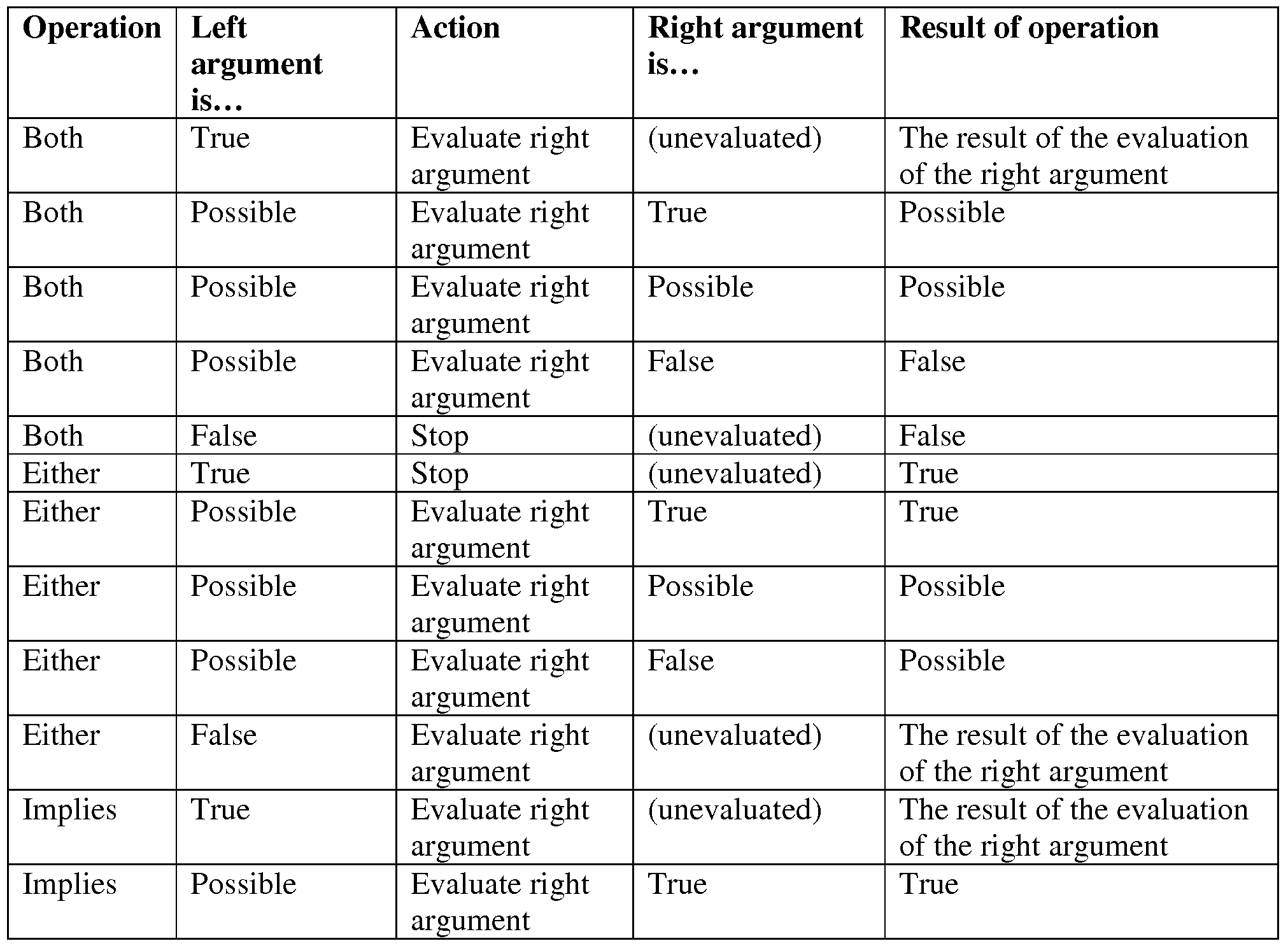
- Tables 1 and 2 illustrate expansion of "AND” and “OR” logic, respectively, to include “Plausible” results (shaded in the tables) in addition to “True” and “False”, not present in standard Boolean logic.
- Table 1 AND
- Table 2 OR
- Examples of base meaning comparisons will be shown using a knowledge base containing: "Streak is a female cat.”
- Base meaning examples include: (a) "Streak is a female.” (True, because a base meaning of the original sentence is this sentence); (b) "Streak is a cat.”, (True, for the same reason); and (c) "Streak is a nice female cat.” (Refinement, because the original sentence is a base meaning of this one).
- Such comparisons can be made by dropping an adjectival phrase. For instance, in “Streak is a female cat.” the adjectival phrase is the single adjective word "female”. Thus, the base statement here is: "Streak is a cat.”
- Utterances may also be or contain questions and queries.
- questions may mean a question which is answerable by a complete sentence, to fill in a blank
- query may mean a question having a yes-or-no answer. Questions are handled by comparing the question to the knowledge base. Rather than being True or False (or other such results), questions result in Answerable or Unanswerable states.
- a question is answerable if there is a matching statement, or if there is a matching statement that can be constructed from the knowledge on hand, and if the question is not a part of a logical construct that might depend on the question.
- a query is a question posed as a statement, with a question indicator. For example, "Is Streak a cat?". Answers to queries, may include True, False, or Plausible. Alternatively, responses of the following forms may be made: (a) “Streak is a cat.”, (b) “Streak is not a cat.”, (c) “Streak may be a cat.” Yet a third type of embodiment would have answers of the form (a) “Streak is a cat.”, (b) “It is not the case that Streak is a cat.”, or (c) "It is possible that Streak is a cat.” When there are several "classes of veracity” or "user trust levels", represented internally as numbers, answers may include: “Streak is not a cat, and Sheldon claims 'Streak is a cat'.” or "Bob claims 'Streak is not a cat', and Sheldon claims 'Streak is a cat'
- Figure 1 is a block diagram of a computing system for executing computer executable process steps according to one embodiment of the disclosure.
- Figure 1 includes a host computer 10 and a monitor/display 11.
- the monitor 11 may be a CRT type, an LCD type, or any other type of color or monochrome display.
- Also provided with the computer 10 is a keyboard 13 for entering text data and user commands, and a pointing device 14 (such as a mouse) for processing objects displayed on the monitor 11.
- the computer 10 may include a computer-readable memory medium such as a rotating disk 15 for storing readable data. Besides other programs, the disk 15 can store application programs including web browsers by which the computer 10 connects to the Internet and the systems described below, according to one aspect of the disclosure. [0057] The computer 10 can also access a computer-readable floppy disk storing data files, application program files, and computer executable process steps embodying the disclosure or the like via a floppy disk drive 16.
- a computer-readable memory medium such as a rotating disk 15 for storing readable data.
- the disk 15 can store application programs including web browsers by which the computer 10 connects to the Internet and the systems described below, according to one aspect of the disclosure.
- the computer 10 can also access a computer-readable floppy disk storing data files, application program files, and computer executable process steps embodying the disclosure or the like via a floppy disk drive 16.
- a modem, an integrated services digital network (ISDN) connection, or the like may also provide the computer 10 with a DSL/Cable/satellite connection (or Internet connection) 12 to the World Wide Web ("WWW").
- An Internet connection 12 may be used to allow the computer 10 to download data files, audio files, application program files and computer- executable process steps embodying the disclosure.
- FIG. 2 is a block diagram showing the internal functional architecture of the computer 10.
- the computer 10 may include a central processing unit (CPU) 20 for executing computer-executable process steps and interfaces with a computer bus 21.
- a WWW interface 26 is also shown in Figure 2 .
- the scanner interface 25 can connect to a check scanner or imager (not shown) and a fingerprint scanner (not shown).
- the disk 15 may store operating system program files, application program files, web browsers, and other files. Some of these files may be stored on the disk 15 using an installation program.
- the CPU 20 may execute computer-executable process steps of an installation program so that the CPU 20 can properly execute the application program.
- a random access main memory (“RAM”) 30 may also interface to the computer bus 21 to provide the CPU 20 with access to memory storage.
- RAM random access main memory
- the CPU 20 stores and executes the process steps out of the RAM 30.
- Read only memory (“ROM”) 31 may be provided to store invariant instruction sequences such as start-up instruction sequences or basic input/output operating system (BIOS) sequences for operation of the keyboard 13.
- BIOS basic input/output operating system
- Figure 3 shows a typical topology of a computer network with computers similar to computer 10, connected to the Internet.
- three computers X, Y, and Z are shown connected to the Internet 32 via the Web interface 26 (shown in Figure 2) through a gateway 33, where the gateway 33 can interface N number of computers.
- the web interface 26 may be a modem, network interface card, or a unit for providing connectivity to other computer systems over a network using protocols such as X.25, Ethernet, or TCP/IP, or any device that allows, directly or indirectly, computer-to-computer communications.
- Figure 3 further shows a second gateway 35 that may connect a network of web servers 36 and 37 to the Internet 32.
- the web servers 36 and 37 may be connected with each other over a computer network.
- the web servers 36 and 37 can provide content, including consumer information from a database 38 and/or 39.
- the web servers 36 and 37 can also host the system for machine understanding of text, retention of knowledge and conversation, according to the disclosure.
- the Internet 32 connects thousands of computers worldwide through well-known protocols, for example, Transmission Control Protocol (TCP)/Internet Protocol (IP), into a vast network.
- TCP Transmission Control Protocol
- IP Internet Protocol
- Information on the Internet is stored world wide as computer files, mostly written in the Hypertext Mark Up Language ("HTML”).
- HTML Hypertext Mark Up Language
- Other mark up languages e.g., Extensible Markup Language (“XML”) as published by W3C Consortium, Version 1, Second Edition, October 2000 may also be used.
- XML Extensible Markup Language
- the collection of all such publicly available computer files is known as the World Wide Web (“WWW”).
- the WWW is a multimedia-enabled hypertext system used for navigating the Internet 32 and is made up of hundreds of thousands of web pages with images and text and video files, which can be displayed on a computer monitor. Each web page can have connections to other pages, which may be located on any computer connected to the Internet 32.
- a method and system for machine understanding of text, retention of knowledge and conversation is provided. Although the system and method of the present invention are described with reference to the formal, speakable language Loglan, those skilled in the art will recognize that the principles and teachings described herein may be applied to a variety of formal, speakable languages.
- a grammar's form may be reduced to a set of utterances.
- Each utterance may include or more sentences.
- Each sentence may be a question, query, or statement.
- Sentences may be complex or atomic.
- Complex sentences are comprised of sub- sentences, joined by a logic word, such as a conjunction, disjunction or implication.
- Atomic sentences are comprised of a predication, which may have arguments, and may have adjectives or adjectival phrases. The way in which these components may be assembled, and which key- words may be used to do so depends on the factors involved in the original natural or artificial language.
- FIG 4 is a block diagram of a system 40 capable of understanding of text, retention of knowledge and conversation, according to one embodiment of the present invention.
- a user 42, client program, process or device inputs data into an input module 44.
- the data is then transmitted to a parse module 46 which lexes and parses the data into an internal format or structure (in such a way that a memory of the original grammar structure present in the input data (in raw or optimized form) is retained) as known in computer programming.
- Parsing is the process by which a known grammar definition (such as the BNF grammar shown herein) is translated to an internal representation or data structure by a means well known to practioners of computer programming. Parsing and retaining original (spoken or entered) structural data is described in AT&T's YACC manual, 1974 (see http://en.wikipedia.org/wiki/ Yacc). Once parsed into an internal format, the internally formatted data is transmitted to a fast prover module 48, which interacts with a data/knowledge base 50.
- the "fast prover” is an enhanced form of a theorem prover program, which is sound but not complete.
- Theorem prover refers to a type of program well known in the field of artificial intelligence
- sound refers to a category of such provers which do not make any incorrecct assumptions
- complete refers to a category of such provers which can prove or disprove any theorem presented.
- the formatted statement or question may be presented to an external or internal prover 52 in that prover's own language, with answers returned from the prover 52 to the fast prover 48, and there translated back into the internal format that has been selected. (As described below with reference to Figure 17.) Results are then passed to an output module 54 for formatting into a language the user or other initiator, such as a device or program, 42 has selected.
- the input data may be in the form of utterances spoken by a user, one at a time. Each utterance may be one or more statements, imperatives, questions, and/or queries and may be roughly equivalent to someone speaking and then stopping, or writing and then signaling the end of the note or transmission.
- the utterance may be verbal, written, signed, referenced, imagined and picked up by an electronic sensing apparatus, such as a microphone, or through any other means known in the art.
- the utterance may be in the form of any type of sound, word, movement, symbol, and/or abstraction.
- a written utterance may be typed in to a command-line program or into a field of an interactive program, such as an Input field of a web-page or interactive program.
- Verbal input might be entered via one of several commercially available continuous speech recognition programs, such as Dragon Talker, or the Macintosh operating system.
- Signed input such as American Standard Sign Language, may be ascertained using a camera or tactile input device, and delivered to the program as text.
- Figure 5 is a flow chart illustrating a method operational on a system capable of understanding of text, retention of knowledge and conversation, according to one embodiment of the present invention.
- the system may establish a baseline of a database by noting that no changes to the database have been made 101.
- the system reads the existing data/knowledge base in its entirety 102 and determines if there have been any data/knowledge base changes since the last "garbage collection" 103.
- Garbage collection may be processed during otherwise idle time, at predefined times, or upon user command.
- Garbage collection is in general, removal of unneeded data. More specifically, garbage collection removes redundant facts, simplifying and speeding searches. In performing garbage collection during idle time, where "idle time” is defined as time where the system would otherwise stop, waiting for additional input not immediately available, the system performs an optimal amount of garbage collection, while remaining available for user requests, such as statements, questions, queries, or commands. It should be noted garbage collection may or may not be performed by the methods and systems of the present invention. Garbage collection will be described in detail below with reference to Figure 6.
- the system may check for available input 104. If there is no available input, the system may perform a step (described below with reference to Figure 6) in garbage collection 107 until input is available. If there is input available, or if there have been no data/knowledge base changes, the program or system reads the input 106 (described below with reference to Figure 8). Once read, the input is processed 105 (described below with reference to Figure 9). In one embodiment, the system may continue looking for more input indefinitely. In another embodiment, the system may continue looking for input until directed to terminate its processing, such as by a command input or specified time.
- rule and “fact” each refers to a datum or an item of stored knowledge.
- Figure 6 is a flow chart illustrating a method of high level garbage collection, according to one embodiment of the present invention.
- the garbage collection module removes unused facts from the data/knowledge base 50.
- Garbage collection begins 200 by creating a list of the status of garbage collection, if this is the first time into this area of processing. If there are multi-users or multi-processor configurations, only one shared list may be maintained 201. Additionally, a list of last run-times for each rule (fact) in the data/knowledge base may be maintained 202. The process begins at a fixed location in the data, typically the first fact or rule 203.
- a search may be performed for any unneeded rules or facts 204-225, as described in detail below, where "unneeded” refers to a rule or fact which can be derived from one or more other rules or facts. For instance, if we know that Fido is a brown dog, then the fact "Fido is a dog" is unneeded, because it is implied by the previous fact.
- unneeded refers to a rule or fact which can be derived from one or more other rules or facts. For instance, if we know that Fido is a brown dog, then the fact "Fido is a dog" is unneeded, because it is implied by the previous fact.
- processing of the utterances is complete 207. If all the rules/facts have been checked, a determination is made as to which occurred last, a data change, or the completion of a garbage collection 209.
- processing starts at the original start location, typically the start of the first rule 212. If the current position, for example the start of the first rule 212, then this method checks whether it is past the end of the list of rules or facts. If not, processing continues with specific rule checking ( Figure 6B). If processing is past the end, control returns to the caller 208, only to resume at the following instruction 205 when control returns. When control returns, the garbage collector must move on to the next rule or fact 204 and begin checking it 206. When the check above 209 determines that a rule or fact has been completely checked, then it marks that rule or fact as collected 210. Specific rule checking marked as "A" 215 begins with checking whether two rules are the same 216.
- a simple sentence has a main predicate, considered the primary predicate. If the sentence is compound, and both component sentences have the same primary predicate, then the compound sentence has the same primary predicate. If not, the compound sentence has no primary predicate. If a simple sentence has a question word in the place of its main predicate, then it has no primary predicate.
- a low-level garbage collection is done using the inner & outer rules (comparison in some order) 220 (described in more detail with reference to Figure 7). If the low-level collection did not remove a rule or fact 222, then the low- level comparison is repeated 225 using the outer & inner rules (comparison in reversed order). If either low-level collection 220 or 225 resulted in a rule removal 222 and 224, then the collector has done enough work for now, returns control to the caller 223, returning to the following instruction 221. Then, this method loops back to reconsider the current rule or fact 219. Whether or not the two rules were the same 216, processing must advance to the next rule or fact 217, and then return to the garbage processing loop at marker "B" 218 (on Figure 6B), and 213 (on Figure 6A).
- the utterance is decomposed into sections by parsing, each of which may be evaluated separately.
- the system operates on formal languages, the invention is described in English.
- the English used in the examples shall be as formal as possible for English, in that only standard constructions are used. If the utterance "Streak is a cat and Fido is a dog.” is entered, the utterance is decomposed into a first component "Streak is a cat", and a second component "Fido is a dog".
- the sentence would be known to be true if both components are known to be true, known to be false if either component is known to be false, and possible otherwise.
- a knowledge base may be a collection of facts and/or rules partaining to facts.
- the knowledge base may be a list of learned facts, along with data as to the source of the facts. Data as to the source of the facts may be used in a determination of the believability of individual facts and of overall conclusions derived from one or more facts.
- This methods and systems of the present invention may be handled locally, remotely, embedded, via server, or distributed system, depending on the embodiment.
- the statement must be tested against existing knowledge.
- Existing knowledge may be from current use of the system by a user, past use of the system by a user, from use of the system by other users, information built into the system by its implementers or administrators, or information swept from public or private sources by a variety of methods known in the art, such as described in U.S. Patent #6,714,939. This may be done, as a full proof system, or as a simple comparison, or both. In the preferred embodiment, both a full proof system and a simple comparison are used. The simple comparison provides the quickest possible result, and the full proof is used to realize interactions between facts. Full proof spots implications, such as one or more statements leading to a new fact, or one or more statements precluding a fact.
- Superfluous facts may be removed from the knowledge base as a foreground or background activity. Such removal of facts may be considered a form of "garbage collection" or lessening memory load.
- a superfluous fact is any information which may be proven or derived from one or more other, independent facts.
- FIG. 7 is a flow-chart illustrating a method of low level garbage collection, according to one embodiment of the present invention.
- low level garbage collection which is a sub-process of Garbage Collection
- any two rules may be presented by the calling procedure, the high level Garbage Collection method as described above. If the first presented rule directly implies the second rule 301, using methods described herein, then the second entailed rule or fact is dropped as superfluous 302 and its caller (the high level garbage collector) is informed of the result by returning a flag showing the results 303 completing garbage collection 304.
- Figure 8 is a flow-chart illustrating a method of reading input data, according to one embodiment of the present invention.
- the method begins 400 with the actual input of the data 401. Once input, the data is parsed into an internal structure in such a way that a memory of the original grammar structure present in the input data (in raw or optimized form) is retained 402, the method is complete 403.
- the parsing of lexical input is performed by any method known in the art. Data may be stored internally by any known method in the art.
- Figure 9 is a flow-chart illustrating a method of processing input data, according to one embodiment of the present invention.
- the method begins 500 by determining whether the input data is a direct question or a command 501. If the input data is a command (i.e. starting with a command key-word), the command is executed or performed 503 (described below with reference to Figure 11) and the method is complete 505. It should be noted that the nature, syntax, meaning, and processing of commands are not detailed here, as these are well known in the art.
- any macroinstructions stored previously by use of the "let" keyword in the preferred English-like embodiment 502 (described below with reference to Figure 11). It should be noted that the existence and processing of macros are optional.
- the question's predication may be evaluated for true/false/plausible at the first order 504 (described in detail with reference to Figure 15). The results of the evaluation may then be reported to the user or client software 506 and the method is completed 507.
- an indirect question i.e.
- macros may be expanded 509 (described below with reference to Figure 13), and the question is evaluated at the second order of logic 511 (described below with reference to Figure 10).
- Orders of logic first order, second order, and higher order — see http://en.wikipedia.org/wiki/ First_order_logic, http://en.wikipedia.org/wiki/Second_order_logic and http://en.wikipedia.org/ wiki/Higher_order_logic) are well known in the art.
- the results of the evaluation may then be reported to the user or client program 514 and method is completed 515.
- macros may be expanded 512 (described below with reference to Figure 13) and the statement may be evaluated as true, false, or possible 513. Based on the result type 518, true results may be accepted but not stored 520, although some implementations may alert the user to this occurrence, false statements may be rejected 519 ending the method 521, and possible statements may be accepted as fact and stored 522 (described below with reference to Figure 14). When this occurs, the flag (as described above) indicates that data/knowledge has changed and is set, so that garbage collection may be restarted 523.
- Figure 10 (which appears in abbreviated form as element 511 of Figure 9) is a flowchart illustrating a method of processing the evaluation of a statement, question, or query, using second order and higher-order logic, according to one embodiment of the present invention.
- a calling or invoking process which presents a predication for evaluation and the existing data/knowledge base, may be used.
- This method begins 600 with the (logically) first predication in the data/knowledge base 603. It is anticipated that the implementer may store items in the data/knowledge base other than predications.
- the presented predication is compared to the current (inner) predication 607. If the outer predication entails the inner 609, then the fact is reported to the caller 611. If not, this method advances to the next item 602 and the process is repeated 604. If the first test 606 found a predication, then the presented predication (outer) is compared to the current (inner) predication 608. If the outer predication entails the inner 610, then the fact is reported to the caller 611. If not, this method advances to the next item 605 and tries again (606).
- FIG 11 is a flow-chart illustrating a method of building a macro, according to one embodiment of the present invention. It should be noted that using careful phrasing, such as an "is" predication can alleviate the need for macros. It should also be noted that macro binding can be considered a sentence or considered a command.
- the method begins 700 with an empty list of called- for macro instructions 701. The calling process passes, as an argument, the new macro. An error message is constructed indicating that the current macro refers to itself, a pro-forma complaint, and calls the low-level checker to check this circumstance, and possibly complain 711 (described in detail with reference to Figure 12). If the low-level check failed 702, processing of this method stops 703.
- FIG 12 is a flow-chart illustrating a method of a macro checking for recursion conflicts, according to one embodiment of the present invention.
- the method begins 800 with the macro's first word 801. It is then checked in a loop (described as steps 802-812 below) word by word. At each stage, this method checks whether the macro's words have all been checked 803. If so, the caller is informed of the success 804 and returned to 805. While there are still words to check, a word-by- word check is done (described as steps 802 and 806-812 below).
- the word under consideration is itself a macro 806, and is the same as the passed macro 810, then the passed complaint is issued 809, and a failure status is returned to the caller 807 and the method is completed. If the inner loop's word is a macro 811, then that word is added to the in- use list 812, and either way, processing continues with the next word 802. In this way, every word in a macro, and every word in any called macro at any depth are checked for circular references.
- Figure 13 is a flow-chart illustrating a method of expanding a macro-instruction, according to one embodiment of the present invention.
- the method begins 901 with the clearing of a flag (a coded value) which controls reprocessing of macros within macros, setting the flag to indicate that no reprocessing is yet required 903 and at the first word 904. If the list of words is exhausted 906, then the flag determining reprocessing is checked 902. If set, processing begins again 903. If not, processing is complete 900. [00100] If a word is available, and the word is "you" 907, then the word is replaced by the system's name 908.
- a flag a coded value
- the word is "me” or "i" 909, then the word is replaced by the user's name 910. If the word is a macro 914, then replacement processing occurs. The list is searched for the current macro 916. If found 918, a complaint (e.g., a warning, message, or indicator) is made that the macro was already present 919, and processing stops 917, as an optional consistency check. At this point, the reprocessing flag is set 920 to indicate that there is a macro in the macro expansion. If the macro is a simple one 922, then a direct replacement is made 923. If the macro is complex (containing a logical or arithmetic operator), then it is replaced by a compound statement in the selected style.
- a complaint e.g., a warning, message, or indicator
- Figure 14 is a flow-chart illustrating a method of adding a statement to a knowledge base, according to one embodiment of the present invention.
- the method begins 1000 with a simple evaluation of the statement 1001 (described below reference to Figure 15). If the statement can be shown to be true 1002, then processing is complete 1003. If the statement is not known to be true 1004, then the negation of the statement is evaluated 1005. Note that a statement not being provably true does not imply that it is provably false.
- the statement can be shown to be false, and a complaint can be made 1009. If the statement is Possible, a check is made to determine if it contains a "both" clause 1011. If not, then the statement is added to the data/knowledge base directly 1012. If there is a "both” clause, then both components of the "both” clause are added, recursively using this method for each such clause, with the "Known Possible” flag set as an optimization 1010 and 1007. Once both sides have been added, this method is completed 1006.
- Figure 15 is a flow-chart illustrating a method for evaluating a predication at first order, according to one embodiment of the present invention.
- the first order may be evaluated with the addition of modifiers present in this class of languages, but not in standard first-order logic.
- the method begins 1100 with an attempt at a simple proof of the statement 1101 (described below with reference to Figure 16). If the results are "unknown", i.e. the results are Possible or containing a question too difficult to answer, then a complete proof would be run 1103 (described below with reference to Figure 17). Otherwise (for True, False, and known answers) or after a proof, the result will be returned to the caller 1104 and the method is completed 1105.
- Figure 16 is a flow-chart illustrating a method for comparing a single fact or rule with a single statement, query or question, according to one embodiment of the present invention.
- the method begins 1200 with a check of the statement type 1201. If the statement is compound, then the left side or first component is evaluated 1203 (a recursive call). If a table (Table 1 detailed below) has a result based on the left component only 1204, then a result is returned 1207 and the method is completed 1209. Otherwise, the right side, or second component, is evaluated 1208, and the results are retrieved from the table 1217. If the statement is a "not" type, then the inverse of the statement is evaluated (recursively), and the inverse of the result is returned 1205.
- Table 1 detailed below
- FIG. 17 is a flow-chart illustrating a method of a full proof, according to one embodiment of the present invention.
- the process starts 1300 by translating the stored predications into predications in the prover's language 1301.
- the prover might use the Prolog language (see http://en.wikipedia.org/wiki/Prolog) as a prover interface, and would thus translate stored predications into Prolog.
- This in turn may first require translating predications into Horn clauses (see http://en.wikipedia.org/wiki/Horn_clause). Both Prolog and Horn clauses are well known in the art.
- Arguments stored in the data/knowledge base must be translated into "atoms" in the prover language 1303.
- Prolog is a usable prover language.
- translate adjectives as compound prover-language predications 1303. It should be noted
- N that a predication with N adjectives or adjectival components may take 2 prover-language predications.
- the method may be repeated with compound predications 1304. Although shown as four separate steps here, it is also possible to perform these four translations as a single step.
- the prover is run and the results are retrieved 1305. This may be an internal prover, or an external one.
- the RelFun prover (see http://www.dfki.uni- kl.de/vega/relfun+/extension/subsection3_3_l.html) may be used as it returns its status as Yes (true), No (false), and unknown, rather than Prolog's reportage of Yes (true) or No (unprovable). If Prolog or something similar is used, the results are evaluated 1307. If Yes (true), the method returns True 1309. Otherwise, the negation of the statement is sent for proof 1306 and the results are evaluated 1308. If the negation is proven, then False is returned 1311. If none of these conditions is met, then Possible is returned 1312.
- the method may proceed from the initial result check 1307 directly to final use of the results 1309, 1311 or 1312 without processing the negation 1306 and 1308.
- Speed-enhancing algorithms known by those in the art may be utilized in the present invention. For example, multiple tasks or processors, or a network of computers, each to solve a piece of the proof or comparison may be used.
- finding the root verb or predication (hereinafter, "Verb") of each statement, imperative, question, or query, and having a separate knowledge tree, list, or other storage mechanism for each possible Verb, or group of Verbs, or having an indexed list increases the speed. As a result, a much more limited set of statements would have to be searched.
- pronouns may be translated to nominative phrases on input, and back to pronouns on output.
- the input “I live in The United States.” may be stored as “Sheldon lives in The United States.” and output as “Sheldon lives in The United States", or "You live in The United States.”
- the verb tenses in English and most natural languages differ from the verb tenses in Loglan, Lojban and some other languages.
- Predicates and adjectives are taken from the Loglan classes Preda, Dio, Ga, Ge, Geu, and Gu. Predications may be explicitly marked as "*lexeme/" or "*lexeme argument ... /". It should be noted that "*" and “/” may be omitted if doing so would not contextually cause a problem. It should also be noted that the use of the asterisk and slash symbols are arbitrary and any word or symbol may be used. For speakability, these may be "predicate” and "end”, respectively. One predicate may modify another predicate, for example, adjective predication affects predication.
- "Execute” is taken from the Loglan sentence-separating word I. A separation between two executables (utterances or queries), even though they are delivered together, as in: executable execute executable. Using Execute, or some other word in other embodiments, multiple utterances may be combined into a single entry or transmission. For instance, “Happy I Execute Sad You” submits “Happy I”, then submits “Sad You”, independently. However, “Both Happy I And Sad You” would be evaluated for thruthhood as a single statement. [0112] Questions are taken from the Loglan class Ha. As a variable, the question word may be "what" or "which". As a predicate, "blank”. Loglan has a class of rearranging words, Nu.
- Go(x,y,z) means the going from x to y over path z.
- "adjective go affects *drive” would mean to drive in a going sort of way, as would “adjective go emphasis affects *drive”.
- "adjective go anything emphasis affects drive” would mean to drive in a coming sort of way.
- “anything” and “emphasis” is added here, with “anything” holding a place, and “emphasis” both holding a place, and indicating that the position is the key concept. This is used where Loglan would use a Nu-class word to rearrange the ordering of arguments, without explicitly using an argument.
- the word “parent” might be used as a predication, where "parent X Y” means that X is a parent of Y.
- the concept “child” would not need a second word in the lexicon. To state that Y is a child, “parent anything Y” would do. To state that a cat is childlike, “adjective parent anything emphasis affects cat” would be used.
- Loglan has a number of "it”-class words, Da: In English, “it”, “he”, “she”, “him”, “her”, “they”, and “them” all have meanings that are ambiguous. You have to guess the same meaning that the speaker is using.
- Loglan has a word-class representing unknowns
- Ba This class of word, in Loglan, represents true variables, rather than macros. They appear in D and D situations. Thus, in this class of languages, the scope of each variable is only with its "for all” or “there exists” phrase. These variables will be represented by lower-case letters, other than "a” or "i”. In implementation, there is a choice as to the life-span of an association with a variable, pronoun, or macro. At the choice of the implementer or user, variables (and other items) could retain their meaning for the length of a phrase (such as "For all x"), a predication, an utterance, a session (conversation), or permanently.
- Loglan also has a built-in class of pronouns, Mi — Me, I, and you. Me and I, used interchangeably, represents the speaker. When used, these tokens will be replaced by the known name of the user. On output, the name of the particular knowledge-base computer system will be replaced by "me” or "I”. For instance, “I like you”, translated as “like I you” might be stored as “like 'Sheldon Linker' 'hal.linker.com'”. If this text were read out of the system, it would be translated back as “like you me”. If the data were read back to a different user, or on a different system, the "you” and “me” substitutions would not occur. "You” represents the knowledge-base system.
- pronouns may be used.
- Loglan and mathematics both allow variables and lettered constants to have subscripts.
- Math we might use X 2 . In Loglan, this would be Da Ci To or Dacito.
- "sub” will be used. For example, "X sub 2" or "X 2 ". Subscripts are required because 24 variables won't always be enough.
- literal string "don't” would be represented as '"don"t"'. That may be a bit hard to read, so here's an easier version: The string consisting of a single- quote character, the letter D, the letter O, the letter N, a single-quote character, another single quote character, the letter T, and a final single-quote character.
- Loglan has a distinct class of names, easily recognized, and a class of name markers, the Dj an and Lao word classes.
- the system and method of the present invention uses a quotation marker.
- names use a double quote
- literal text uses single quotes.
- Names representing a person, place, thing, or named concept always act as arguments, and are represented as double-quoted strings. Because these name strings are marked names, and not literal strings, only letters and numbers should be considered, with internal white space being considered as a single space character.
- “"James Cooke Brown”” would have the same meaning (and storage) as "" james cooke brown "”.
- Other examples of names might be ""Shangri-la”", “"Fido”", and perhaps even ""The theory of Relativity"”.
- Loglan has its Die and Ui classes of words to indicate attitudes. English has punctuation in the written form, and sound qualities in the spoken form. In the present invention, attitudinal indicators may be translated to distinct sentences, such as "I am surprised.”
- the Loglan vocative classes Hoi and Hue Vocative markers, used in Loglan to gain or redirect attention, are not needed, as we're engaged in point-to-point communication.
- the Loglan classes Jo, Kie, and Kiu, metaphor are not used, such sentences being better stated as separate sentences, and so are not borrowed from English or Loglan.
- hybrid means a combination or merging of a speakable, formal language (such as Loglan), and of a natural language
- speechable means a language that can be spoken in normal human discourse (such as English or Loglan)
- formal means a language with a completely defined nonambiguous grammar (typically defined in BNF notation, such as Loglan or Fortran)
- natural means a naturally acurring language (such as English).
- the class apple means “the class consisting of all apples", or just “apples” in some uses. This appears as the class predicate. Quantifiers can be applied with classes. So, “half of all apples” would be “0.5 of class apple”, “some apples” (meaning “a certain percentage of all apples”, rather than "a certain number of apples") would be “some of the class apple”. This can appear in the following forms: (a) numeric expression the class predicate expression, (b) most of the class predicate expression, (c) some of the class predicate expression, (d) little of the class predicate expression, and (e) how much of the class predicate expression.
- the Loglan class Pa covering tenses, allows us a time basis, which is not normally a part of any form of mathematical or Boolean logic, and which is especially hard to narrow down in any natural language.
- Time tenses are listed following, to be followed by other tenses: (a) at time reference predication, (b) on time reference predication, (c) after time predication, (d) on or after time predication, (e) beginning time predication, (f) beginning after time predication, (g) before time predication, (h) on or before time predication, (i) ending time predication, (]) ending before time predication, (k) potentially predication, (1) during time predication (This last tense is the "-ing" tense.
- Time references can be a single time, or a period, using [i] time, [ii] time through time, [iii] date, [iv] date time, [v] now, [vi] today, [vii] this period, [viii] last period, [ix] next period, [x] offset... from time, [xi] offset... before time, [xii] tomorrow, [xiii] yesterday, or [xiv] a named date. Dates can be in the form yyyy, yyyy-mm, or yyyy-mm-dd. They can be followed be ad, ce, be, or bee.
- Times can be in the form hh, hh'.mm, or hh'.mm'.ss. In the preferred implementation, all times are assumed to be GMT.
- Period names can be second, minute, hours, day, week, month, and year. Offsets can be numeric expression period or a period. Periods may be in the pleural.
- Named dates may include Sunday through Saturday and January through December.), (m) certainly predication, (n) on good authority predication, (o) likely predication, (p) as a belief predication, (q) as a guess predication, (r) according to argument predication, (s) located at argument predication, (t) located at a distance of distance from argument predication, (u) located at a distance of up to distance from argument predication, (v) located at a distance of at least distance from argument predication, (w) located at a range of distance to distance from argument predication, (x) near argument predication, (y) far from argument predication, (z) a meter, (aa) numeric expression meters, (bb) when, (cc) where, and (dd) tense, which asks which tense is appropriate.
- Each predicate is transparent. It doesn't matter to the system or language what the predicate means to you. However, we need to understand what it means. An example would be Go. The following is expressed in functional form: Go(a,b,c,d) we will take to mean "A goes from B to C over path D". If we take Come(a,b,c,d) to mean "A comes to B from C over path D", then we can define "Da,b,c,d, Go(a,b,c,d) TM Come(a,c,b,d)". Missing arguments are assumed unspecified, so that "Dx,P(x), P(x) ® Dy, P(x,y)".
- Figure 18 is a block diagram of how languages are combined.
- the rules of grammar used in a hybrid language 1402 such as English-like and Loglan-like languages, were derived by taking a fully descriptive formal, speakable language 1400, Loglan in this example, and a natural language 1401, English in this example, and combining them.
- the languages were combined by (a) Removing all components of the formal language that where redundant.
- ERROR ERROR
- context-sensitive rules that are well-known in the art. These rules allow certain elements to be removed from usage in the language, and assumed later.
- context rules may also be referred to as "shift-reduce conflicts", and allow parsing to continue at the deepest level, i.e. stay with the longest form of the current grammar rule under consideration, rather than considering the rule of grammar complete, until such time as the "ERROR" lexeme forces a return to a higher level, i.e. the grammar rule is complete, and processing continues with the grammar rule that included the just-completed grammar rule).
- the basic understanding knowledge base can follow this example, defining big, large, and small: "for all x for all y if both large x y and large y z then large x z execute for all x for all y if and only if large x y then small y x execute for all x for all y if and only if large x y then big x y".
- any algorithm should assume, for the sake of speed, that the data will look something like "A(a) ⁇ B(b) ⁇ C(c) " internally or a series of stated facts externally, and that the query will look something like "?B(b)", or like "B(_)", or like “_(b)” internally, or a question (typically involving “is it the case that") or query (typically involving a question word, such as "who", “what”, “which”, “how many", “when”, or other similar words) externally.
- Figure 19 is a flow diagram illustrating a method for storing and retrieving data in a formal, speakable language.
- Data is inputted in a formal, speakable language 1902.
- Such formal speakable language may have a more defined grammar and/or syntax than natural languages (e.g., English, Spanish, Japanese, etc.) but are more flexible and speakable in comparison to machine languages (e.g., Fortran, Basic, Java, etc.).
- the input data is parsed into an internal format in such a way that a memory of an original grammar structure present in the input data is retained 1904.
- the parsed input data is compared to previously stored data in a data/knowledge base to prove, disprove or determine if the parsed data is plausible 1906.
- the results of the comparison are stored in the data/knowledge base 1908.
- the formal, speakable language may be understandable by speakers of a corresponding natural language.
- the input data may be at least one word of text or speech.
- Inputting the data may be performed in a formal, speakable language and parsing the input data into an internal format include, (a) receiving the input data in a formal, spoken or written language and/or (b) translating the data into an internal data structure.
- the formal, speakable language may be at least one of a Loglan-compatible, Lojban-compatible language structure, or any other speakable formal language structure.
- the input data may be one or more utterances including at least one or sounds, words, movement, symbols, or abstraction. The one or more utterances may be verbal, written, signed, referenced, imagined or picked up by an electronic sensing apparatus.
- the method may further comprise (a) comparing a first utterance to a second utterance, where the first utterance has a higher level of specificity than the second utterance, to determine if the second utterance is superfluous, (b) determining whether the input data is a command, a statement of fact, or a question, and/or (c) discarding the input data if the input data is a statement known to be true or false, wherein the statement is added based upon rules of possibility, conjunctions, implications, and disjunctions.
- the formal language includes a grammar structure defined by: (a) a first characteristic to form predications and statements; (b) a second characteristic to form questions and queries; (c) a third characteristic to apply modifiers to portions of the text; and/or (d) a fourth characteristic ability to apply a broad category of tenses to portions of the text.
- the method may further comprise: (a) retaining the input data if the input data is a statement which provides new information to the data/knowledge base and adding the statement to the data/knowledge base, (b) formulating an answer if the input data is a question or query.
- the method may also comprise (a) retrieving selected data stored in the data/knowledge base in response to a question; (b) formatting the selected data into an original natural language for output, wherein the selected data is formatted into a natural or artificial language for output in response to the question based on stored data in the data/knowledge base.
- One or more of the components, steps, and/or functions illustrated in Figures 1, 2, 3, 4, 5, 6, 7, 8, 9, 10, 11, 12, 13, 14, 15, 16, 18 and/or 19 may be rearranged and/or combined into a single component, step, or function or embodied in several components, steps, or functions. Additional elements, components, steps, and/or functions may also be added without departing from the invention.
- the apparatus, devices, and/or components illustrated in Figures 1, 2, 3, 4 and/or 18 may be configured to perform one or more of the methods, features, or steps described in Figures 5, 6, 7, 8, 9, 10, 11, 12, 13, 14, 15, 16, 17 and/or 19.
- the novel algorithms described herein may be efficiently implemented in software and/or embedded hardware.
Landscapes
- Engineering & Computer Science (AREA)
- Theoretical Computer Science (AREA)
- Health & Medical Sciences (AREA)
- Artificial Intelligence (AREA)
- Audiology, Speech & Language Pathology (AREA)
- Computational Linguistics (AREA)
- General Health & Medical Sciences (AREA)
- Physics & Mathematics (AREA)
- General Engineering & Computer Science (AREA)
- General Physics & Mathematics (AREA)
- Machine Translation (AREA)
Abstract
Description



Claims
Applications Claiming Priority (6)
| Application Number | Priority Date | Filing Date | Title |
|---|---|---|---|
| US86902006P | 2006-12-07 | 2006-12-07 | |
| US60/869,020 | 2006-12-07 | ||
| US1225207P | 2007-12-07 | 2007-12-07 | |
| US61/012,252 | 2007-12-07 | ||
| US11/952,796 US8117022B2 (en) | 2006-12-07 | 2007-12-07 | Method and system for machine understanding, knowledge, and conversation |
| US11/952,796 | 2007-12-07 |
Publications (3)
| Publication Number | Publication Date |
|---|---|
| WO2008070860A2 true WO2008070860A2 (en) | 2008-06-12 |
| WO2008070860A8 WO2008070860A8 (en) | 2008-08-21 |
| WO2008070860A3 WO2008070860A3 (en) | 2008-12-04 |
Family
ID=39493107
Family Applications (1)
| Application Number | Title | Priority Date | Filing Date |
|---|---|---|---|
| PCT/US2007/086858 Ceased WO2008070860A2 (en) | 2006-12-07 | 2007-12-07 | Method and system for machine understanding, knowledge, and conversation |
Country Status (2)
| Country | Link |
|---|---|
| US (1) | US8117022B2 (en) |
| WO (1) | WO2008070860A2 (en) |
Families Citing this family (86)
| Publication number | Priority date | Publication date | Assignee | Title |
|---|---|---|---|---|
| US7013308B1 (en) * | 2000-11-28 | 2006-03-14 | Semscript Ltd. | Knowledge storage and retrieval system and method |
| US8666928B2 (en) | 2005-08-01 | 2014-03-04 | Evi Technologies Limited | Knowledge repository |
| US8688749B1 (en) | 2011-03-31 | 2014-04-01 | Palantir Technologies, Inc. | Cross-ontology multi-master replication |
| US8515912B2 (en) | 2010-07-15 | 2013-08-20 | Palantir Technologies, Inc. | Sharing and deconflicting data changes in a multimaster database system |
| US7962495B2 (en) | 2006-11-20 | 2011-06-14 | Palantir Technologies, Inc. | Creating data in a data store using a dynamic ontology |
| US8838659B2 (en) | 2007-10-04 | 2014-09-16 | Amazon Technologies, Inc. | Enhanced knowledge repository |
| US8554719B2 (en) | 2007-10-18 | 2013-10-08 | Palantir Technologies, Inc. | Resolving database entity information |
| US20090234638A1 (en) * | 2008-03-14 | 2009-09-17 | Microsoft Corporation | Use of a Speech Grammar to Recognize Instant Message Input |
| US20100030609A1 (en) * | 2008-07-31 | 2010-02-04 | International Business Machines Corporation | Intelligent system and fuzzy logic based method to determine project risk |
| US8429194B2 (en) | 2008-09-15 | 2013-04-23 | Palantir Technologies, Inc. | Document-based workflows |
| US9805089B2 (en) * | 2009-02-10 | 2017-10-31 | Amazon Technologies, Inc. | Local business and product search system and method |
| US8032525B2 (en) * | 2009-03-31 | 2011-10-04 | Microsoft Corporation | Execution of semantic queries using rule expansion |
| US9110882B2 (en) | 2010-05-14 | 2015-08-18 | Amazon Technologies, Inc. | Extracting structured knowledge from unstructured text |
| US8364642B1 (en) | 2010-07-07 | 2013-01-29 | Palantir Technologies, Inc. | Managing disconnected investigations |
| JP2012063868A (en) * | 2010-09-14 | 2012-03-29 | Internatl Business Mach Corp <Ibm> | Method to generate combined parser by combining language processing parsers, and its computer and computer program |
| US8670984B2 (en) * | 2011-02-25 | 2014-03-11 | Nuance Communications, Inc. | Automatically generating audible representations of data content based on user preferences |
| US20120330875A1 (en) * | 2011-06-24 | 2012-12-27 | Angele Juergen | Structure index |
| US8732574B2 (en) | 2011-08-25 | 2014-05-20 | Palantir Technologies, Inc. | System and method for parameterizing documents for automatic workflow generation |
| US9208134B2 (en) * | 2012-01-10 | 2015-12-08 | King Abdulaziz City For Science And Technology | Methods and systems for tokenizing multilingual textual documents |
| US8782004B2 (en) | 2012-01-23 | 2014-07-15 | Palantir Technologies, Inc. | Cross-ACL multi-master replication |
| US8880989B2 (en) | 2012-01-30 | 2014-11-04 | Microsoft Corporation | Educating users and enforcing data dissemination policies |
| US9087039B2 (en) * | 2012-02-07 | 2015-07-21 | Microsoft Technology Licensing, Llc | Language independent probabilistic content matching |
| KR102056461B1 (en) * | 2012-06-15 | 2019-12-16 | 삼성전자주식회사 | Display apparatus and method for controlling the display apparatus |
| US9348677B2 (en) | 2012-10-22 | 2016-05-24 | Palantir Technologies Inc. | System and method for batch evaluation programs |
| US9081975B2 (en) | 2012-10-22 | 2015-07-14 | Palantir Technologies, Inc. | Sharing information between nexuses that use different classification schemes for information access control |
| US9501761B2 (en) | 2012-11-05 | 2016-11-22 | Palantir Technologies, Inc. | System and method for sharing investigation results |
| US9092502B1 (en) | 2013-02-25 | 2015-07-28 | Leidos, Inc. | System and method for correlating cloud-based big data in real-time for intelligent analytics and multiple end uses |
| US10140664B2 (en) | 2013-03-14 | 2018-11-27 | Palantir Technologies Inc. | Resolving similar entities from a transaction database |
| US8868486B2 (en) | 2013-03-15 | 2014-10-21 | Palantir Technologies Inc. | Time-sensitive cube |
| US8924388B2 (en) | 2013-03-15 | 2014-12-30 | Palantir Technologies Inc. | Computer-implemented systems and methods for comparing and associating objects |
| US8930897B2 (en) | 2013-03-15 | 2015-01-06 | Palantir Technologies Inc. | Data integration tool |
| US9740369B2 (en) | 2013-03-15 | 2017-08-22 | Palantir Technologies Inc. | Systems and methods for providing a tagging interface for external content |
| US8909656B2 (en) | 2013-03-15 | 2014-12-09 | Palantir Technologies Inc. | Filter chains with associated multipath views for exploring large data sets |
| US9898167B2 (en) | 2013-03-15 | 2018-02-20 | Palantir Technologies Inc. | Systems and methods for providing a tagging interface for external content |
| US8903717B2 (en) * | 2013-03-15 | 2014-12-02 | Palantir Technologies Inc. | Method and system for generating a parser and parsing complex data |
| US8855999B1 (en) * | 2013-03-15 | 2014-10-07 | Palantir Technologies Inc. | Method and system for generating a parser and parsing complex data |
| US8886601B1 (en) | 2013-06-20 | 2014-11-11 | Palantir Technologies, Inc. | System and method for incrementally replicating investigative analysis data |
| US8601326B1 (en) | 2013-07-05 | 2013-12-03 | Palantir Technologies, Inc. | Data quality monitors |
| US9223773B2 (en) | 2013-08-08 | 2015-12-29 | Palatir Technologies Inc. | Template system for custom document generation |
| US8938686B1 (en) | 2013-10-03 | 2015-01-20 | Palantir Technologies Inc. | Systems and methods for analyzing performance of an entity |
| US9105000B1 (en) | 2013-12-10 | 2015-08-11 | Palantir Technologies Inc. | Aggregating data from a plurality of data sources |
| US10579647B1 (en) | 2013-12-16 | 2020-03-03 | Palantir Technologies Inc. | Methods and systems for analyzing entity performance |
| US9009827B1 (en) | 2014-02-20 | 2015-04-14 | Palantir Technologies Inc. | Security sharing system |
| US8924429B1 (en) | 2014-03-18 | 2014-12-30 | Palantir Technologies Inc. | Determining and extracting changed data from a data source |
| US9836580B2 (en) | 2014-03-21 | 2017-12-05 | Palantir Technologies Inc. | Provider portal |
| US10572496B1 (en) | 2014-07-03 | 2020-02-25 | Palantir Technologies Inc. | Distributed workflow system and database with access controls for city resiliency |
| US10120843B2 (en) * | 2014-08-26 | 2018-11-06 | International Business Machines Corporation | Generation of parsable data for deep parsing |
| US9229952B1 (en) | 2014-11-05 | 2016-01-05 | Palantir Technologies, Inc. | History preserving data pipeline system and method |
| US9483546B2 (en) | 2014-12-15 | 2016-11-01 | Palantir Technologies Inc. | System and method for associating related records to common entities across multiple lists |
| US11302426B1 (en) | 2015-01-02 | 2022-04-12 | Palantir Technologies Inc. | Unified data interface and system |
| US10803106B1 (en) | 2015-02-24 | 2020-10-13 | Palantir Technologies Inc. | System with methodology for dynamic modular ontology |
| US9727560B2 (en) | 2015-02-25 | 2017-08-08 | Palantir Technologies Inc. | Systems and methods for organizing and identifying documents via hierarchies and dimensions of tags |
| US10103953B1 (en) | 2015-05-12 | 2018-10-16 | Palantir Technologies Inc. | Methods and systems for analyzing entity performance |
| US10628834B1 (en) | 2015-06-16 | 2020-04-21 | Palantir Technologies Inc. | Fraud lead detection system for efficiently processing database-stored data and automatically generating natural language explanatory information of system results for display in interactive user interfaces |
| US9418337B1 (en) | 2015-07-21 | 2016-08-16 | Palantir Technologies Inc. | Systems and models for data analytics |
| US9392008B1 (en) | 2015-07-23 | 2016-07-12 | Palantir Technologies Inc. | Systems and methods for identifying information related to payment card breaches |
| US9996595B2 (en) | 2015-08-03 | 2018-06-12 | Palantir Technologies, Inc. | Providing full data provenance visualization for versioned datasets |
| US10127289B2 (en) | 2015-08-19 | 2018-11-13 | Palantir Technologies Inc. | Systems and methods for automatic clustering and canonical designation of related data in various data structures |
| US10853378B1 (en) | 2015-08-25 | 2020-12-01 | Palantir Technologies Inc. | Electronic note management via a connected entity graph |
| US9984428B2 (en) | 2015-09-04 | 2018-05-29 | Palantir Technologies Inc. | Systems and methods for structuring data from unstructured electronic data files |
| US9576015B1 (en) | 2015-09-09 | 2017-02-21 | Palantir Technologies, Inc. | Domain-specific language for dataset transformations |
| US9760556B1 (en) | 2015-12-11 | 2017-09-12 | Palantir Technologies Inc. | Systems and methods for annotating and linking electronic documents |
| US9514414B1 (en) | 2015-12-11 | 2016-12-06 | Palantir Technologies Inc. | Systems and methods for identifying and categorizing electronic documents through machine learning |
| US10248722B2 (en) | 2016-02-22 | 2019-04-02 | Palantir Technologies Inc. | Multi-language support for dynamic ontology |
| US10698938B2 (en) | 2016-03-18 | 2020-06-30 | Palantir Technologies Inc. | Systems and methods for organizing and identifying documents via hierarchies and dimensions of tags |
| US10007674B2 (en) | 2016-06-13 | 2018-06-26 | Palantir Technologies Inc. | Data revision control in large-scale data analytic systems |
| US11106692B1 (en) | 2016-08-04 | 2021-08-31 | Palantir Technologies Inc. | Data record resolution and correlation system |
| US10133588B1 (en) | 2016-10-20 | 2018-11-20 | Palantir Technologies Inc. | Transforming instructions for collaborative updates |
| US10102229B2 (en) | 2016-11-09 | 2018-10-16 | Palantir Technologies Inc. | Validating data integrations using a secondary data store |
| US9946777B1 (en) | 2016-12-19 | 2018-04-17 | Palantir Technologies Inc. | Systems and methods for facilitating data transformation |
| US9922108B1 (en) | 2017-01-05 | 2018-03-20 | Palantir Technologies Inc. | Systems and methods for facilitating data transformation |
| US11074277B1 (en) | 2017-05-01 | 2021-07-27 | Palantir Technologies Inc. | Secure resolution of canonical entities |
| US10956406B2 (en) | 2017-06-12 | 2021-03-23 | Palantir Technologies Inc. | Propagated deletion of database records and derived data |
| US10691729B2 (en) | 2017-07-07 | 2020-06-23 | Palantir Technologies Inc. | Systems and methods for providing an object platform for a relational database |
| US10956508B2 (en) | 2017-11-10 | 2021-03-23 | Palantir Technologies Inc. | Systems and methods for creating and managing a data integration workspace containing automatically updated data models |
| US10387576B2 (en) * | 2017-11-30 | 2019-08-20 | International Business Machines Corporation | Document preparation with argumentation support from a deep question answering system |
| US10235533B1 (en) | 2017-12-01 | 2019-03-19 | Palantir Technologies Inc. | Multi-user access controls in electronic simultaneously editable document editor |
| US11061874B1 (en) | 2017-12-14 | 2021-07-13 | Palantir Technologies Inc. | Systems and methods for resolving entity data across various data structures |
| US10838987B1 (en) | 2017-12-20 | 2020-11-17 | Palantir Technologies Inc. | Adaptive and transparent entity screening |
| US10754822B1 (en) | 2018-04-18 | 2020-08-25 | Palantir Technologies Inc. | Systems and methods for ontology migration |
| US11461355B1 (en) | 2018-05-15 | 2022-10-04 | Palantir Technologies Inc. | Ontological mapping of data |
| US11061542B1 (en) | 2018-06-01 | 2021-07-13 | Palantir Technologies Inc. | Systems and methods for determining and displaying optimal associations of data items |
| US10795909B1 (en) | 2018-06-14 | 2020-10-06 | Palantir Technologies Inc. | Minimized and collapsed resource dependency path |
| CN109753658B (en) * | 2018-12-29 | 2023-09-19 | 百度在线网络技术(北京)有限公司 | Interaction method and device |
| RU2730449C2 (en) * | 2019-01-29 | 2020-08-21 | Публичное Акционерное Общество "Сбербанк России" (Пао Сбербанк) | Method of creating model for analysing dialogues based on artificial intelligence for processing user requests and system using such model |
| US12505311B2 (en) * | 2023-08-18 | 2025-12-23 | Robert Bosch Gmbh | Hallucination detection and handling for a large language model based domain-specific conversation system |
Family Cites Families (21)
| Publication number | Priority date | Publication date | Assignee | Title |
|---|---|---|---|---|
| JPS62293352A (en) * | 1986-06-11 | 1987-12-19 | Hitachi Ltd | knowledge information processing system |
| US5659724A (en) * | 1992-11-06 | 1997-08-19 | Ncr | Interactive data analysis apparatus employing a knowledge base |
| US6356886B1 (en) * | 1995-11-30 | 2002-03-12 | Electronic Data Systems Corporation | Apparatus and method for communicating with a knowledge base |
| US6484155B1 (en) * | 1998-07-21 | 2002-11-19 | Sentar, Inc. | Knowledge management system for performing dynamic distributed problem solving |
| US20010053968A1 (en) * | 2000-01-10 | 2001-12-20 | Iaskweb, Inc. | System, method, and computer program product for responding to natural language queries |
| US7099855B1 (en) * | 2000-01-13 | 2006-08-29 | International Business Machines Corporation | System and method for electronic communication management |
| US6701294B1 (en) * | 2000-01-19 | 2004-03-02 | Lucent Technologies, Inc. | User interface for translating natural language inquiries into database queries and data presentations |
| JP3994368B2 (en) * | 2000-01-25 | 2007-10-17 | ソニー株式会社 | Information processing apparatus, information processing method, and recording medium |
| US7831688B2 (en) * | 2000-06-06 | 2010-11-09 | Adobe Systems Incorporated | Method and system for providing electronic user assistance |
| JP2002023783A (en) * | 2000-07-13 | 2002-01-25 | Fujitsu Ltd | Dialogue processing system |
| US7243069B2 (en) * | 2000-07-28 | 2007-07-10 | International Business Machines Corporation | Speech recognition by automated context creation |
| US6757672B2 (en) * | 2001-01-31 | 2004-06-29 | Intel Corporation | Modifying a relational database |
| US7216073B2 (en) * | 2001-03-13 | 2007-05-08 | Intelligate, Ltd. | Dynamic natural language understanding |
| EP1527414A2 (en) * | 2002-02-01 | 2005-05-04 | John R. C. Fairweather | A system and method for managing knowledge |
| KR100446627B1 (en) * | 2002-03-29 | 2004-09-04 | 삼성전자주식회사 | Apparatus for providing information using voice dialogue interface and method thereof |
| US7197488B2 (en) * | 2002-11-11 | 2007-03-27 | Zxibix, Inc. | System and method of facilitating and evaluating user thinking about an arbitrary problem using an archetype problem structure |
| US7305372B2 (en) * | 2003-03-04 | 2007-12-04 | Kurzweil Technologies, Inc. | Enhanced artificial intelligence language |
| US7266547B2 (en) * | 2004-06-10 | 2007-09-04 | International Business Machines Corporation | Query meaning determination through a grid service |
| EP1785933A3 (en) * | 2005-04-29 | 2008-04-09 | Angelo Dalli | Method and apparatus for displaying processed multimedia and textual content on electronic signage or billboard displays through input from electronic communication networks |
| US8666928B2 (en) * | 2005-08-01 | 2014-03-04 | Evi Technologies Limited | Knowledge repository |
| US7797303B2 (en) * | 2006-02-15 | 2010-09-14 | Xerox Corporation | Natural language processing for developing queries |
-
2007
- 2007-12-07 WO PCT/US2007/086858 patent/WO2008070860A2/en not_active Ceased
- 2007-12-07 US US11/952,796 patent/US8117022B2/en active Active
Also Published As
| Publication number | Publication date |
|---|---|
| US8117022B2 (en) | 2012-02-14 |
| US20080140387A1 (en) | 2008-06-12 |
| WO2008070860A3 (en) | 2008-12-04 |
| WO2008070860A8 (en) | 2008-08-21 |
Similar Documents
| Publication | Publication Date | Title |
|---|---|---|
| US8117022B2 (en) | Method and system for machine understanding, knowledge, and conversation | |
| US12050874B2 (en) | System for knowledge acquisition | |
| US8515733B2 (en) | Method, device, computer program and computer program product for processing linguistic data in accordance with a formalized natural language | |
| Pereira et al. | Definite clause grammars for language analysis—a survey of the formalism and a comparison with augmented transition networks | |
| US9390087B1 (en) | System and method for response generation using linguistic information | |
| US8417512B2 (en) | Method, used by computers, for developing an ontology from a text in natural language | |
| WO2022052639A1 (en) | Data query method and apparatus | |
| Cheng et al. | Learning an executable neural semantic parser | |
| US20140156282A1 (en) | Method and system for controlling target applications based upon a natural language command string | |
| Pulido-Prieto et al. | A survey of naturalistic programming technologies | |
| Rozhnov et al. | Vectorizing textual data sources to decrease attribute space dimension | |
| Peldszus et al. | Incremental construction of robust but deep semantic representations for use in responsive dialogue systems | |
| Lee | N-Gram language model | |
| Ramirez-Rueda et al. | A systematic literature review of 10 years of research on program synthesis and natural language processing | |
| Longo et al. | A Reactive Cognitive Architecture based on Natural Language Processing for the task of Decision-Making using a Rich Semantic. | |
| Ramírez-Rueda et al. | A decade of advancements in program synthesis from natural language: a systematic literature review | |
| Gabbay et al. | Structured contexts with fibred semantics | |
| Wachtel et al. | Natural language user interface for software engineering tasks | |
| Wachtel et al. | Programming Spreadsheets in Natural Language: Design of a Natural Language User Interface | |
| van den Berg et al. | Bachelor’s Thesis Computing Science | |
| Riefolo et al. | Translation of natural language sentences into logical formulas using Large Language Models | |
| Fuchs et al. | Controlled english for requirements specification | |
| Chiruzzo et al. | Statistical Deep Parsing for Spanish: Abridged Version | |
| Qabbaah et al. | Using Visual Analytics and K-Means Clustering for Monetising Logistics Data, a Case Study with Multiple E-Commerce Companies | |
| Room | Chomsky Hierarchy |
Legal Events
| Date | Code | Title | Description |
|---|---|---|---|
| WPC | Withdrawal of priority claims after completion of the technical preparations for international publication |
Ref document number: 61/012,252 Country of ref document: US Free format text: WITHDRAWN AFTER TECHNICAL PREPARATION FINISHED Ref document number: 11,952,796 Country of ref document: US Free format text: WITHDRAWN AFTER TECHNICAL PREPARATION FINISHED |
|
| 121 | Ep: the epo has been informed by wipo that ep was designated in this application |
Ref document number: 07865417 Country of ref document: EP Kind code of ref document: A2 |
|
| NENP | Non-entry into the national phase |
Ref country code: DE |
|
| 122 | Ep: pct application non-entry in european phase |
Ref document number: 07865417 Country of ref document: EP Kind code of ref document: A2 |