WO2007063946A1 - Diagnostic and remedy for disease caused by amyloid aggregation and/or deposition - Google Patents
Diagnostic and remedy for disease caused by amyloid aggregation and/or deposition Download PDFInfo
- Publication number
- WO2007063946A1 WO2007063946A1 PCT/JP2006/323955 JP2006323955W WO2007063946A1 WO 2007063946 A1 WO2007063946 A1 WO 2007063946A1 JP 2006323955 W JP2006323955 W JP 2006323955W WO 2007063946 A1 WO2007063946 A1 WO 2007063946A1
- Authority
- WO
- WIPO (PCT)
- Prior art keywords
- group
- amyloid
- compound
- transition metal
- salt
- Prior art date
- Legal status (The legal status is an assumption and is not a legal conclusion. Google has not performed a legal analysis and makes no representation as to the accuracy of the status listed.)
- Ceased
Links
Classifications
-
- C—CHEMISTRY; METALLURGY
- C07—ORGANIC CHEMISTRY
- C07D—HETEROCYCLIC COMPOUNDS
- C07D471/00—Heterocyclic compounds containing nitrogen atoms as the only ring hetero atoms in the condensed system, at least one ring being a six-membered ring with one nitrogen atom, not provided for by groups C07D451/00 - C07D463/00
- C07D471/02—Heterocyclic compounds containing nitrogen atoms as the only ring hetero atoms in the condensed system, at least one ring being a six-membered ring with one nitrogen atom, not provided for by groups C07D451/00 - C07D463/00 in which the condensed system contains two hetero rings
- C07D471/04—Ortho-condensed systems
-
- A—HUMAN NECESSITIES
- A61—MEDICAL OR VETERINARY SCIENCE; HYGIENE
- A61K—PREPARATIONS FOR MEDICAL, DENTAL OR TOILETRY PURPOSES
- A61K31/00—Medicinal preparations containing organic active ingredients
- A61K31/33—Heterocyclic compounds
- A61K31/395—Heterocyclic compounds having nitrogen as a ring hetero atom, e.g. guanethidine or rifamycins
- A61K31/41—Heterocyclic compounds having nitrogen as a ring hetero atom, e.g. guanethidine or rifamycins having five-membered rings with two or more ring hetero atoms, at least one of which being nitrogen, e.g. tetrazole
- A61K31/42—Oxazoles
- A61K31/423—Oxazoles condensed with carbocyclic rings
-
- A—HUMAN NECESSITIES
- A61—MEDICAL OR VETERINARY SCIENCE; HYGIENE
- A61K—PREPARATIONS FOR MEDICAL, DENTAL OR TOILETRY PURPOSES
- A61K31/00—Medicinal preparations containing organic active ingredients
- A61K31/33—Heterocyclic compounds
- A61K31/395—Heterocyclic compounds having nitrogen as a ring hetero atom, e.g. guanethidine or rifamycins
- A61K31/41—Heterocyclic compounds having nitrogen as a ring hetero atom, e.g. guanethidine or rifamycins having five-membered rings with two or more ring hetero atoms, at least one of which being nitrogen, e.g. tetrazole
- A61K31/425—Thiazoles
- A61K31/427—Thiazoles not condensed and containing further heterocyclic rings
-
- A—HUMAN NECESSITIES
- A61—MEDICAL OR VETERINARY SCIENCE; HYGIENE
- A61K—PREPARATIONS FOR MEDICAL, DENTAL OR TOILETRY PURPOSES
- A61K31/00—Medicinal preparations containing organic active ingredients
- A61K31/33—Heterocyclic compounds
- A61K31/395—Heterocyclic compounds having nitrogen as a ring hetero atom, e.g. guanethidine or rifamycins
- A61K31/435—Heterocyclic compounds having nitrogen as a ring hetero atom, e.g. guanethidine or rifamycins having six-membered rings with one nitrogen as the only ring hetero atom
- A61K31/4353—Heterocyclic compounds having nitrogen as a ring hetero atom, e.g. guanethidine or rifamycins having six-membered rings with one nitrogen as the only ring hetero atom ortho- or peri-condensed with heterocyclic ring systems
- A61K31/437—Heterocyclic compounds having nitrogen as a ring hetero atom, e.g. guanethidine or rifamycins having six-membered rings with one nitrogen as the only ring hetero atom ortho- or peri-condensed with heterocyclic ring systems the heterocyclic ring system containing a five-membered ring having nitrogen as a ring hetero atom, e.g. indolizine, beta-carboline
-
- A—HUMAN NECESSITIES
- A61—MEDICAL OR VETERINARY SCIENCE; HYGIENE
- A61K—PREPARATIONS FOR MEDICAL, DENTAL OR TOILETRY PURPOSES
- A61K31/00—Medicinal preparations containing organic active ingredients
- A61K31/33—Heterocyclic compounds
- A61K31/395—Heterocyclic compounds having nitrogen as a ring hetero atom, e.g. guanethidine or rifamycins
- A61K31/435—Heterocyclic compounds having nitrogen as a ring hetero atom, e.g. guanethidine or rifamycins having six-membered rings with one nitrogen as the only ring hetero atom
- A61K31/44—Non condensed pyridines; Hydrogenated derivatives thereof
- A61K31/4427—Non condensed pyridines; Hydrogenated derivatives thereof containing further heterocyclic ring systems
- A61K31/4439—Non condensed pyridines; Hydrogenated derivatives thereof containing further heterocyclic ring systems containing a five-membered ring with nitrogen as a ring hetero atom, e.g. omeprazole
-
- A—HUMAN NECESSITIES
- A61—MEDICAL OR VETERINARY SCIENCE; HYGIENE
- A61K—PREPARATIONS FOR MEDICAL, DENTAL OR TOILETRY PURPOSES
- A61K51/00—Preparations containing radioactive substances for use in therapy or testing in vivo
- A61K51/02—Preparations containing radioactive substances for use in therapy or testing in vivo characterised by the carrier, i.e. characterised by the agent or material covalently linked or complexing the radioactive nucleus
- A61K51/04—Organic compounds
- A61K51/041—Heterocyclic compounds
- A61K51/044—Heterocyclic compounds having nitrogen as a ring hetero atom, e.g. guanethidine, rifamycins
- A61K51/0453—Heterocyclic compounds having nitrogen as a ring hetero atom, e.g. guanethidine, rifamycins having five-membered rings with two or more ring hetero atoms, at least one of which being nitrogen, e.g. tetrazole
-
- A—HUMAN NECESSITIES
- A61—MEDICAL OR VETERINARY SCIENCE; HYGIENE
- A61K—PREPARATIONS FOR MEDICAL, DENTAL OR TOILETRY PURPOSES
- A61K51/00—Preparations containing radioactive substances for use in therapy or testing in vivo
- A61K51/02—Preparations containing radioactive substances for use in therapy or testing in vivo characterised by the carrier, i.e. characterised by the agent or material covalently linked or complexing the radioactive nucleus
- A61K51/04—Organic compounds
- A61K51/041—Heterocyclic compounds
- A61K51/044—Heterocyclic compounds having nitrogen as a ring hetero atom, e.g. guanethidine, rifamycins
- A61K51/0455—Heterocyclic compounds having nitrogen as a ring hetero atom, e.g. guanethidine, rifamycins having six-membered rings with one nitrogen as the only ring hetero atom
-
- A—HUMAN NECESSITIES
- A61—MEDICAL OR VETERINARY SCIENCE; HYGIENE
- A61K—PREPARATIONS FOR MEDICAL, DENTAL OR TOILETRY PURPOSES
- A61K51/00—Preparations containing radioactive substances for use in therapy or testing in vivo
- A61K51/02—Preparations containing radioactive substances for use in therapy or testing in vivo characterised by the carrier, i.e. characterised by the agent or material covalently linked or complexing the radioactive nucleus
- A61K51/04—Organic compounds
- A61K51/041—Heterocyclic compounds
- A61K51/044—Heterocyclic compounds having nitrogen as a ring hetero atom, e.g. guanethidine, rifamycins
- A61K51/0459—Heterocyclic compounds having nitrogen as a ring hetero atom, e.g. guanethidine, rifamycins having six-membered rings with two nitrogen atoms as the only ring hetero atoms, e.g. piperazine
-
- A—HUMAN NECESSITIES
- A61—MEDICAL OR VETERINARY SCIENCE; HYGIENE
- A61P—SPECIFIC THERAPEUTIC ACTIVITY OF CHEMICAL COMPOUNDS OR MEDICINAL PREPARATIONS
- A61P17/00—Drugs for dermatological disorders
-
- A—HUMAN NECESSITIES
- A61—MEDICAL OR VETERINARY SCIENCE; HYGIENE
- A61P—SPECIFIC THERAPEUTIC ACTIVITY OF CHEMICAL COMPOUNDS OR MEDICINAL PREPARATIONS
- A61P21/00—Drugs for disorders of the muscular or neuromuscular system
-
- A—HUMAN NECESSITIES
- A61—MEDICAL OR VETERINARY SCIENCE; HYGIENE
- A61P—SPECIFIC THERAPEUTIC ACTIVITY OF CHEMICAL COMPOUNDS OR MEDICINAL PREPARATIONS
- A61P21/00—Drugs for disorders of the muscular or neuromuscular system
- A61P21/02—Muscle relaxants, e.g. for tetanus or cramps
-
- A—HUMAN NECESSITIES
- A61—MEDICAL OR VETERINARY SCIENCE; HYGIENE
- A61P—SPECIFIC THERAPEUTIC ACTIVITY OF CHEMICAL COMPOUNDS OR MEDICINAL PREPARATIONS
- A61P25/00—Drugs for disorders of the nervous system
-
- A—HUMAN NECESSITIES
- A61—MEDICAL OR VETERINARY SCIENCE; HYGIENE
- A61P—SPECIFIC THERAPEUTIC ACTIVITY OF CHEMICAL COMPOUNDS OR MEDICINAL PREPARATIONS
- A61P25/00—Drugs for disorders of the nervous system
- A61P25/14—Drugs for disorders of the nervous system for treating abnormal movements, e.g. chorea, dyskinesia
- A61P25/16—Anti-Parkinson drugs
-
- A—HUMAN NECESSITIES
- A61—MEDICAL OR VETERINARY SCIENCE; HYGIENE
- A61P—SPECIFIC THERAPEUTIC ACTIVITY OF CHEMICAL COMPOUNDS OR MEDICINAL PREPARATIONS
- A61P25/00—Drugs for disorders of the nervous system
- A61P25/28—Drugs for disorders of the nervous system for treating neurodegenerative disorders of the central nervous system, e.g. nootropic agents, cognition enhancers, drugs for treating Alzheimer's disease or other forms of dementia
-
- A—HUMAN NECESSITIES
- A61—MEDICAL OR VETERINARY SCIENCE; HYGIENE
- A61P—SPECIFIC THERAPEUTIC ACTIVITY OF CHEMICAL COMPOUNDS OR MEDICINAL PREPARATIONS
- A61P3/00—Drugs for disorders of the metabolism
- A61P3/08—Drugs for disorders of the metabolism for glucose homeostasis
- A61P3/10—Drugs for disorders of the metabolism for glucose homeostasis for hyperglycaemia, e.g. antidiabetics
-
- A—HUMAN NECESSITIES
- A61—MEDICAL OR VETERINARY SCIENCE; HYGIENE
- A61P—SPECIFIC THERAPEUTIC ACTIVITY OF CHEMICAL COMPOUNDS OR MEDICINAL PREPARATIONS
- A61P35/00—Antineoplastic agents
-
- A—HUMAN NECESSITIES
- A61—MEDICAL OR VETERINARY SCIENCE; HYGIENE
- A61P—SPECIFIC THERAPEUTIC ACTIVITY OF CHEMICAL COMPOUNDS OR MEDICINAL PREPARATIONS
- A61P43/00—Drugs for specific purposes, not provided for in groups A61P1/00-A61P41/00
-
- A—HUMAN NECESSITIES
- A61—MEDICAL OR VETERINARY SCIENCE; HYGIENE
- A61P—SPECIFIC THERAPEUTIC ACTIVITY OF CHEMICAL COMPOUNDS OR MEDICINAL PREPARATIONS
- A61P9/00—Drugs for disorders of the cardiovascular system
-
- C—CHEMISTRY; METALLURGY
- C07—ORGANIC CHEMISTRY
- C07D—HETEROCYCLIC COMPOUNDS
- C07D235/00—Heterocyclic compounds containing 1,3-diazole or hydrogenated 1,3-diazole rings, condensed with other rings
- C07D235/02—Heterocyclic compounds containing 1,3-diazole or hydrogenated 1,3-diazole rings, condensed with other rings condensed with carbocyclic rings or ring systems
- C07D235/04—Benzimidazoles; Hydrogenated benzimidazoles
- C07D235/18—Benzimidazoles; Hydrogenated benzimidazoles with aryl radicals directly attached in position 2
-
- C—CHEMISTRY; METALLURGY
- C07—ORGANIC CHEMISTRY
- C07D—HETEROCYCLIC COMPOUNDS
- C07D263/00—Heterocyclic compounds containing 1,3-oxazole or hydrogenated 1,3-oxazole rings
- C07D263/52—Heterocyclic compounds containing 1,3-oxazole or hydrogenated 1,3-oxazole rings condensed with carbocyclic rings or ring systems
- C07D263/54—Benzoxazoles; Hydrogenated benzoxazoles
- C07D263/56—Benzoxazoles; Hydrogenated benzoxazoles with only hydrogen atoms, hydrocarbon or substituted hydrocarbon radicals, directly attached in position 2
- C07D263/57—Aryl or substituted aryl radicals
-
- C—CHEMISTRY; METALLURGY
- C07—ORGANIC CHEMISTRY
- C07D—HETEROCYCLIC COMPOUNDS
- C07D277/00—Heterocyclic compounds containing 1,3-thiazole or hydrogenated 1,3-thiazole rings
- C07D277/60—Heterocyclic compounds containing 1,3-thiazole or hydrogenated 1,3-thiazole rings condensed with carbocyclic rings or ring systems
- C07D277/62—Benzothiazoles
- C07D277/64—Benzothiazoles with only hydrocarbon or substituted hydrocarbon radicals attached in position 2
- C07D277/66—Benzothiazoles with only hydrocarbon or substituted hydrocarbon radicals attached in position 2 with aromatic rings or ring systems directly attached in position 2
-
- C—CHEMISTRY; METALLURGY
- C07—ORGANIC CHEMISTRY
- C07D—HETEROCYCLIC COMPOUNDS
- C07D403/00—Heterocyclic compounds containing two or more hetero rings, having nitrogen atoms as the only ring hetero atoms, not provided for by group C07D401/00
- C07D403/02—Heterocyclic compounds containing two or more hetero rings, having nitrogen atoms as the only ring hetero atoms, not provided for by group C07D401/00 containing two hetero rings
- C07D403/10—Heterocyclic compounds containing two or more hetero rings, having nitrogen atoms as the only ring hetero atoms, not provided for by group C07D401/00 containing two hetero rings linked by a carbon chain containing aromatic rings
-
- C—CHEMISTRY; METALLURGY
- C07—ORGANIC CHEMISTRY
- C07D—HETEROCYCLIC COMPOUNDS
- C07D413/00—Heterocyclic compounds containing two or more hetero rings, at least one ring having nitrogen and oxygen atoms as the only ring hetero atoms
- C07D413/02—Heterocyclic compounds containing two or more hetero rings, at least one ring having nitrogen and oxygen atoms as the only ring hetero atoms containing two hetero rings
- C07D413/10—Heterocyclic compounds containing two or more hetero rings, at least one ring having nitrogen and oxygen atoms as the only ring hetero atoms containing two hetero rings linked by a carbon chain containing aromatic rings
-
- C—CHEMISTRY; METALLURGY
- C07—ORGANIC CHEMISTRY
- C07D—HETEROCYCLIC COMPOUNDS
- C07D417/00—Heterocyclic compounds containing two or more hetero rings, at least one ring having nitrogen and sulfur atoms as the only ring hetero atoms, not provided for by group C07D415/00
- C07D417/02—Heterocyclic compounds containing two or more hetero rings, at least one ring having nitrogen and sulfur atoms as the only ring hetero atoms, not provided for by group C07D415/00 containing two hetero rings
- C07D417/10—Heterocyclic compounds containing two or more hetero rings, at least one ring having nitrogen and sulfur atoms as the only ring hetero atoms, not provided for by group C07D415/00 containing two hetero rings linked by a carbon chain containing aromatic rings
-
- G—PHYSICS
- G01—MEASURING; TESTING
- G01N—INVESTIGATING OR ANALYSING MATERIALS BY DETERMINING THEIR CHEMICAL OR PHYSICAL PROPERTIES
- G01N2333/00—Assays involving biological materials from specific organisms or of a specific nature
- G01N2333/435—Assays involving biological materials from specific organisms or of a specific nature from animals; from humans
- G01N2333/46—Assays involving biological materials from specific organisms or of a specific nature from animals; from humans from vertebrates
- G01N2333/47—Assays involving proteins of known structure or function as defined in the subgroups
- G01N2333/4701—Details
- G01N2333/4709—Amyloid plaque core protein
-
- G—PHYSICS
- G01—MEASURING; TESTING
- G01N—INVESTIGATING OR ANALYSING MATERIALS BY DETERMINING THEIR CHEMICAL OR PHYSICAL PROPERTIES
- G01N2500/00—Screening for compounds of potential therapeutic value
- G01N2500/04—Screening involving studying the effect of compounds C directly on molecule A (e.g. C are potential ligands for a receptor A, or potential substrates for an enzyme A)
Definitions
- the present invention relates to a diagnostic and therapeutic agent for diseases caused by amyloid aggregation and Z or deposition.
- Amyloid is a unique protein having a fibrous structure, and is hematoxylin and eosin-stained. In alkaline Congo red staining, it dyes orange-red, and when viewed with a polarizing microscope, it exhibits green birefringence. In electron microscopes, unbranched fiber forces with a width of 7-15 nm are also possible. It is said that there are at least 20 proteins that make up the force amyloid that looks the same morphologically. Monomer is not toxic and is considered to cause organ damage when sputum aggregates. . A common feature of this protein aggregate is that it is rich in ⁇ -sheet structure and is hardly soluble.
- Amyloidosis is a group of diseases that cause dysfunction by amyloid fibrils being deposited or accumulated outside the cells of various organs throughout the body. According to the new classification of the Ministry of Health, Labor and Welfare's Specified Disease Research Group, amyloidosis is divided into systemic and local as follows.
- Amyloid derived from immunoglobulin (from light chain chain, kappa chain and heavy chain) is deposited in systemic organs.
- amyloid derived from serum amyloid A SAA
- an acute phase protein is deposited.
- Familial amyloid poly-Eurobachi-I (classified as type I IV) presents with a unique sensory impairment 'motor impairment-Eurobachi-I and autonomic neuropathy (atypical transthyretin). Other Include familial Mediterranean fever and Muckle-Wells syndrome.
- Wild-type transthyretin accumulates not only in the heart but also in the lungs and blood vessel walls of the digestive tract.
- Amyloid associated with medullary thyroid cancer Type 2 diabetes' insulinoma, localized atrial amyloidosis
- Diagnosis of systemic amyloidosis is variable because amyloid accumulates in any organ of the body. Initially, nonspecific initial symptoms such as general malaise, weight loss, edema, anemia, etc. begin, congestive heart failure, nephrotic syndrome, malabsorption syndrome, peripheral neuropathy, orthostatic hypotension, hand Symptoms such as root canal syndrome and enlarged liver are known. As a clinical test, amyloid constituent proteins are detected by hematological serology. In addition, “ m Tc-pyrophosphate scintigraphy is effective for the detection of cardiac amyloid,” however, “ m Tc-pyrophosphate is not specific because it also accumulates in ischemic sites.
- amyloidosis For the definitive diagnosis of amyloidosis, there is a need to prove the amyloid deposition by collecting tissue by biopsy of organ force suspected of amyloid deposition. After pathological examination by biopsy, immunohistological examination, serological examination, and genetic examination are combined to identify amyloid precursor protein and lead to definitive diagnosis. In order to diagnose amyloidosis, it is essential to select a tissue that accumulates a large amount of amyloid and biopsy from that site. It becomes.
- Reactive AA amyloidosis is a disease in which amyloid derived from the acute phase reactive protein Serum Amyloid A (SAA) is deposited, secondary to chronic inflammatory diseases.
- SAA Serum Amyloid A
- rheumatoid arthritis which has a prevalence of 0.3-0.8% per population in Japan, is also a primary disease of AA amyloidosis, and about 10% of the complications are observed.
- This amyloid accumulation is a disease that causes various organ damages by depositing extracellularly in tissues and is a complication with a very poor prognosis.
- the 50% survival rate is 2 to 4 years. In general, diagnosis can only be done by confirming that amyloid has accumulated by biopsy.
- SAP serum amyloid component
- BBB blood-brain barrier
- Alzheimer's disease is a disease that is becoming a serious social problem with localized amyloidosis.
- Japan the number of patients with dementia is increasing rapidly with the aging of the population, and the treatment and care of dementia is an issue that must be solved urgently in terms of medical economics.
- it is estimated that there will be 3 million people with dementia, many of whom are allegedly suffering from Alzheimer's disease.
- Alzheimer's disease patients There are currently 4 million Alzheimer's disease patients in the United States, and an estimated 1 million in Japan.
- Alzheimer's disease is a disease with a poor prognosis in which half of the patients die within 3 to 8 years from the onset of disease, and the disease progresses with certainty.
- Image diagnosis is an important test for differentiating Alzheimer's disease from other diseases.
- evidence from contrast between autopsy and images is not available.
- PET and SPECT which measure changes in glucose metabolism and cerebral blood flow
- CER AD Consortium to Establish a registry for Alzneimer s Disease, Braak et al., etc.
- CERAD's pathological diagnosis criteria semi-quantitatively determine the number of typical senile plaques stained with silver stain, the most intense of Alzheimer's lesions. Compared with the number of senile plaques classified as sparse, 6 / mm moderate, 35 / mm frequent and standardized by age group for neocortex, it is evaluated as definite, probable, normal .
- a novel amyloid imaging agent having a thioflavin structure was developed at the University of Pittsburgh and called Pittsburgh Compound-BC-PIB) (Patent Documents 3 and 4). It has been reported that when C—PIB is administered to mildAD patients, amyloid accumulates and shows significant retention compared to controls in the cortical region, clearly distinguishing between Alcino-Ima disease and normal subjects. Yes. However, since 11 C-PIB retention is only doubled in the AD patient group, a diagnostic agent that can provide higher contrast is desired to examine the degree of amyloid accumulation in more detail. This is an essential condition for determining whether a patient with symptoms such as mild cognitive impairment (MCI), which is more difficult to diagnose, progresses to Arnno-ima.
- MCI mild cognitive impairment
- 11 C PIB was administered to mice overexpressing APP to generate amyloid aggregates (PSI ZAPP mice) and examined by animal PET scanner. As a result, there was a difference in retention time between PSlZAPP mice and normal mice. Is not seen. In vivo animal experiments indicate that PIB is unable to image amyloid accumulation in PSlZAPP mice due to its low affinity for amyloid aggregates. Furthermore, “C-PIB labeled nuclide 11 C has a half-life of 20 minutes. Thus, the positron-emitting nuclide used in imaging generally has a very short half-life, and the radionuclide is a cyclotron.
- a commercially available and industrially useful method is a nuclide-labeled formulation with a longer half-life (about 6-72 hours) that emits y-rays.
- the nuclide along this purpose, there are 123 iota and 9 9m Tc.
- 123 1 studied 123 I- IMPY labeling purposes is reported from Pennsylvania University (Patent Document 5), have a high affinity for amyloid in AD patients brain and Tg mice.
- An amyloid-binding probe with a thioflavine skeleton labeled with a radioisotope has an N-alkylamine structure.
- N-alkylamine structure is biological It is common to undergo internal metabolism.
- Non-Patent Document 2 radioligand metabolites that have lost amyloid-binding properties and have undergone N-dealkylation while maintaining lipid solubility pass through the blood-brain barrier and enter the brain, thereby being related to amyloid. No accumulation (Non-Patent Document 2). Therefore, the development of derivatives whose metabolites are not detected in the brain is strongly desired.
- amyloidosis disease substances that inhibit aggregation and Z or deposition of amyloid (including amyloid protein and amyloid-like protein) are considered to be effective. Furthermore, in the case of amyloidosis of the brain typified by Aruno-Ima disease, it is required to be a diagnostic or therapeutic agent that crosses the blood-brain barrier.
- Patent Document 1 WO2005Z042461 pamphlet
- Patent Document 2 Japanese Translation of Special Publication 2002-523383
- Patent Document 3 WO 2004Z083195 pamphlet
- Patent Document 4 Japanese Translation of Special Publication 2004-506723
- Patent Document 5 Special Table 2005—512945
- Non-Patent Document 1 Hawkins PN, Lavender JP, Pepys MB., N Engl J Med. 1990 Aug 23; 323 (8): 508-13.
- Non-Patent Document 2 Kung MP, Hou C, Zhuang ZP, Cross AJ, Maier DL, Kung HF., Eur J Nucl Med Mol Imaging. 2004 Aug; 31 (8): 1136-45. Epub 2004 Mar 9.
- the present invention relates to a diagnostic agent that specifically binds to amyloid aggregates and Z or deposits, and can image and quantify diseases caused by amyloid aggregation and Z or deposits.
- the purpose is to provide.
- Another object of the present invention is to inhibit amyloid aggregation and Z or deposition, and provide a preventive and Z or therapeutic agent for diseases caused by these.
- an object of the present invention is to provide a method for preventing a disease caused by aggregation and Z or deposition of amyloid and screening for a Z or therapeutic agent.
- the present inventors searched for a substance that specifically binds to amyloid, passes through the blood-brain barrier, and no metabolite is detected in the brain, and is represented by the following general formula (1).
- the present invention has been completed by finding that the compound has potent properties and is useful as a diagnostic agent and a preventive and z- or therapeutic agent for diseases caused by amyloid aggregation and Z or deposition.
- the present invention relates to the general formula (1)
- X 1 represents a bicyclic heterocyclic group which may have a substituent
- X 2 represents a hydrogen atom, a halogen atom or a chelate-forming group
- the ring containing A represents a benzene ring or a pyridine ring
- the ring containing B represents a 5-membered aromatic heterocyclic group which may have a substituent, and this ring is bonded to a benzene ring or a pyridine ring in the formula at a carbon atom.
- the present invention also provides a diagnostic, prophylactic and Z or therapeutic pharmaceutical comprising the compound represented by the general formula (1), a salt thereof, a solvate thereof, or a transition metal coordination body thereof. Is to provide.
- the present invention also provides use of the compound represented by the above general formula (1), a salt thereof, a solvate thereof or a transition metal coordination body thereof for the production of a medicine.
- the present invention also provides a pharmaceutical composition
- a pharmaceutical composition comprising a compound represented by the above general formula (1), a salt thereof, a solvate thereof or a transition metal coordination body thereof, and a pharmaceutically acceptable carrier. To do.
- the present invention relates to amyloid aggregation and administration characterized by administering an effective amount of a compound represented by the general formula (1), a salt thereof, a solvate thereof, or a transition metal coordination body thereof.
- a method for preventing and / or treating a disease caused by deposition is provided.
- the present invention provides administration of a detectable amount of a compound represented by the above general formula (1), a salt thereof, a solvate thereof, or a transition metal coordination compound thereof, and the labeled compound is amyloid.
- the present invention provides a method for imaging amyloid deposits characterized in that it takes a sufficient time to bind to the deposits and detects a labeled compound bound to the amyloid deposits.
- the present invention is a production intermediate of the compound of the general formula (1), the general formula (2)
- R 1 represents an oxygen atom, a sulfur atom or NR 3 (R 3 represents a hydrogen atom, a hydroxy group or an alkoxy group);
- R 2 may have a substituent, may be an alkyl group, a substituent! /, May! /, A alkenyl group, or an amino group which may have a substituent. Show;
- the ring containing X 1 , X 2 and A is the same as described above. )
- the present invention relates to a binding property between an analyte and amyloid using the compound represented by the general formula (1), a salt thereof, a solvate thereof, or a transition metal coordination body thereof. Detecting and measuring amyloid aggregation and the degree of Z or deposition, which is characterized by the prevention or treatment of diseases caused by aggregation or deposition of amyloid, and screening using such screening methods The present invention provides a preventive and Z or therapeutic agent for diseases caused by aggregation and Z or deposition of amyloid containing a selected substance.
- the compound (1) of the present invention has high affinity for amyloid aggregates or deposits and passes through the blood-brain barrier. In addition, there should be no metabolites in the brain, which is highly stable in vivo. Therefore, safety is high. Therefore, the compound (1) of the present invention is useful as a diagnostic agent for a disease caused by amyloid aggregation and Z or deposition, particularly as a diagnostic imaging agent.
- the compound (1) of the present invention has an action of inhibiting amyloid aggregation and Z or deposition, a drug caused by amyloid aggregation and Z or deposition, that is, a prophylactic and Z or therapeutic agent for amyloidosis Useful as.
- the compound (1) of the present invention is useful for the prevention of diseases caused by aggregation and Z or deposition of amyloid and the screening of Z or therapeutic agents.
- FIG. 1 is a diagram showing a correlation equation between logkw and log D7.4 of a fat-soluble standard substance.
- FIG. 2 A graph showing the relationship between the amount of amyloid
- FIG. 3 is a diagram showing CD spectra of amyloid
- FIG. 4 is a graph showing a comparison between the amount of ⁇ -sheet of amyloid
- FIG. 5 is a diagram showing the results of analysis of radioactive substances in the brain after administration to rats.
- FIG. 6 shows the results of in vitro specific binding experiments using Alzheimer's disease brains. BEST MODE FOR CARRYING OUT THE INVENTION
- X 1 represents a bicyclic heterocyclic group which may have a substituent.
- Bicyclic heterocyclic groups include 5-membered 5-membered bicyclic heterocyclic groups, 6-membered 5-membered heterocyclic groups, 6-membered 6-membered heterocyclic groups, etc. However, a 6-membered ring and a 5-membered heterocyclic group are preferable.
- a bicyclic heterocyclic group a 6-membered 5-membered heterocyclic group containing 2 to 4 heteroatoms selected from a nitrogen atom, an oxygen atom, and a sulfur atom is a preferable example.
- bicyclic groups which can replace the heterocyclic group represented by X 1, a halogen atom, a hydroxyl group, alkyl group, alkyl tin group, halogenoalkyl group, halogenoalkylcarboxylate - Rua amino group and the chelating group There are 1 to 3 that can be selected.
- halogen atom examples include a fluorine atom, a chlorine atom, a bromine atom, and an iodine atom.
- an alkyl group a C1-C8 alkyl group is mentioned, Preferably it is a C1-C6 alkyl group.
- the alkyl group may be linear or branched. Specific examples include a methyl group, an ethyl group, a propyl group, an isopropyl group, a butyl group, an isobutyl group, a tert-butyl group, and a pentyl group.
- the alkyl tin group examples include a tri (C—C alkyl) tin group, and a tri (C—C alkyl) tin group is preferable.
- Halogenoalkyl groups include phenoxy, oral C 1 -C alkyl groups, especially halogeno C—C
- a 1 8 1 6 alkyl group is preferred. Specific examples include a chloromethyl group, a bromomethyl group, a fluoromethyl group, a odomethyl group, a chloroethyl group, a bromoethyl group, a fluorethyl group, a chloroethyl group, a chloropropyl group, a fluorpropyl group, and a chloropropyl group.
- the halogenoalkylcarbolumino group includes a halogeno (C—C alkyl) carbole group.
- amino group preferably a halogeno (C-C alkyl) carbo-amino group.
- chlorobutanoylamino group, fluorobutanoylamino group, pseudobutanoylamino group and the like chloroacetamino group, a fluoroacetamino group, a odoacetamino group, a chloropropanoylamino group, a fluoropropanoylamino group, and a chloropropanoylamino group.
- Examples of the chelate-forming group include the following groups.
- the formula is described as a form including a chelate-form transition metal atom.
- M represents a transition metal atom such as Ga, Tc, Re, In, etc.
- halogen atom and the chelate-forming group represented by [0033] X 2 may be the same as those exemplified as a substituent on the heterocyclic Shikimoto two rings of the X 1.
- the ring containing A is a benzene ring or a pyridine ring.
- the benzene ring any of o-phenylene group, m-phenylene group, and p-phenylene group may be used.
- a pyridine ring if the substitution position of X 1 is 1, any of 2-pyridyl, 3-pyridyl, and 4-pyridyl may be used. Yes.
- the ring containing B is bonded to the benzene ring or pyridine ring in the formula with a carbon atom.
- the 5-membered aromatic heterocyclic group represented by the ring containing B include a 5-membered aromatic heterocyclic group having 1 to 4 heteroatoms selected from a nitrogen atom, an oxygen atom, and a sulfur atomic energy. Further, a 5-membered aromatic heterocyclic group having 2 to 4 heteroatoms, particularly a nitrogen-containing 5-membered aromatic heterocyclic group is preferred.
- oxazolyl group examples include oxazolyl group, isoxazolyl group, thiazolyl group, isothiazolyl group, pyrazolyl group, imidazolyl group, triazolyl group, thiadiazolyl group, oxadiazolyl group, tetrazolyl group and the like.
- Examples of the group that can be substituted on the ring containing B include a halogen atom, an alkyl group, an alkoxy group, a chelate-forming group, and the like.
- Examples of the halogen atom, alkyl group, and chelate-forming group include those exemplified as the substituent on the bicyclic heterocycle of X 1 .
- an alkoxy group a C1-C8 alkoxy group is mentioned, Preferably it is a 1-6 alkoxy group.
- Specific examples of the alkoxy group may be linear or branched and include methoxy, ethoxy, propoxy, isopropoxy, butoxy, isobutoxy, and tert-butoxy.
- the ring containing X 1 , X 2 , or B has at least one halogen atom.
- the compound (1) of the present invention is labeled with a radionuclide. It is desirable to use Radioisotopes utilized for the purposes of the present invention include nuclides that emit 8) rays, gamma rays, positron radiation, and x-rays.
- the radioactive element that may be used to label the compound (1) of the present invention, 3 H, 14 C, C , 13 N, 15 0, 18 F, 35 S, 62 Cu, 64 Cu, 6 7 Ga ⁇ 68 Ga ⁇ "mTc ⁇ i In, 122 I, 123 I, 124 I, 125 I, 131 I, 133 Xe, 201 T1 etc. 3 H, 14 C, 35 S, 131 I can be mentioned in vitro. It is a frequently used nuclide.
- nuclides that emit gamma rays or positron emitting nuclides with high in vivo permeability are used.
- An amyloid can be imaged by labeling the compound (1) of the present invention and administering it in vivo. This method is non-invasive with very little damage to the patient.
- Positron Yang “Electron” means an electron having a positive charge. Positively charged positrons and negatively charged ordinary electrons have the property of attracting each other, and positrons immediately combine with electrons.
- a PET (Positron Emission Tomography) image excellent in resolution and quantification can be obtained by simultaneously measuring them with a pair of detectors.
- Nuclides to be used for this purpose is 11 C, 13 N, 15 0 , 18 F include, in particular, 11 C and 18 F are preferred.
- positron-emitting nuclides used in imaging generally have a very short half-life, and since radionuclides are produced with a cyclotron, the compounds are labeled. Therefore, it is necessary to control the quality of the labeled compound, and it is possible to label with positron emitting nuclides in Japan and visualize amyloid in the living body. Facilities are limited.
- 68 Ga is a metal radionuclide and a chelate site must be introduced into the compound in order to bind to the compound.
- Typical examples of the 68 Ga-chelate structure that can be introduced are the above formulas (A) and (B) (in this case, M in the formulas (A) and (B) is Ga).
- the nuclide generally used to produce commercially useful images is a method of labeling drugs with nuclides that emit gamma rays.
- the detector detects the gamma rays emitted by the compound force and images them as two dimensions. This is accomplished by attaching a collimator to detect only gamma rays from a specific direction and obtaining positional information along with the detection of gamma rays.
- SPECT single photon emission computed tomography
- SPECT detects relatively low energy and gamma rays compared to PET, so the influence of absorption and scattering rays is large. Therefore, the power that is considered to be inferior to PET in terms of quantitativeness. It has become possible to perform quantitative analysis in SPECT.
- gamma emitting nuclides used in the SPECT 67 Ga, 99m Tc, i In, 123 I, 124 I, I, 133 Xe, 201 T1 , etc.
- 99m Tc is a radionuclide that is readily available from the 99 Mo- 99m Tc generator and is very suitable for routine inspection.
- Tc is a metal radionuclide and a chelate site must be introduced into the compound to bind to the compound.
- a typical example of a 99 M Tc-chelate structure that can be introduced is the above formula ( ⁇ (wherein M in the formulas (C) to (J) is Tc).)
- MRI magnetic resonance imaging
- MRS spectroscopy
- EPR electron paramagnetic resonance
- Examples of the salt of the compound of the present invention include salts of inorganic acids and organic acids.
- Examples of inorganic acid salts include salts with hydrochloric acid, hydrobromic acid, sulfuric acid, sulfamic acid, phosphoric acid, nitric acid and the like.
- organic salts include maleic acid, fumaric acid, benzoic acid, ascorbic acid, succinic acid, oxalic acid, bismethylenesalicylic acid, methanesulfonic acid, ethanedisulfonic acid, acetic acid, propionic acid, tartaric acid, salicylic acid, citrate, Darconic acid, Lactic acid, Malic acid, Mandelic acid, Keihic acid, Citraconic acid, Aspartic acid, Stearic acid, Palmitic acid, Itaconic acid, Glycolic acid, ⁇ -Aminobenzoic acid, Glutamic acid, Benzenesulfonic acid, Theophosphoric acid, 8 -Salts with 8-halotheophylline such as bromo-theophylline.
- the solvate of the compound of the present invention include hydrates and various organic solvates.
- the present invention process for the preparation of compound (1) is a phase differences by the structure of the ring containing heterocyclic group and B of X 1, ring containing force or B to form a heterocyclic ring of X 1 to the end It can be roughly divided into two kinds of manufacturing methods depending on the last formation.
- the ring containing A and the ring containing B are not limited to the heterocycles described in the reaction formula.
- an aldehyde form (2-a) is obtained, and by reacting this with a methyl isocyanide, an oxazole form (1-a) is obtained.
- the reduction reaction of the nitrile is carried out, for example, by using a reducing agent such as dialkylaluminum hydride such as diisobutylaluminum hydride, catecholallan, Raney nickel, or stannous chloride.
- the reaction is carried out at a temperature of 10 ° C. to 50 ° C. in an ether type solvent such as a halogenated hydrocarbon such as dichloromethane or tetrahydrofuran.
- Examples of the methylisocyanides used for the conversion of the aldehyde (2-a) force to the oxazole (1-a) include p-toluenesulfonylmethyl isocyanide, benzotriazolylmethyl isocyanide and the like.
- the reaction is carried out by heating in an alcohol solvent such as methanol for 5 to 24 hours in the presence of a base such as potassium carbonate, sodium hydrogen carbonate or sodium hydroxide.
- the thioamide form (2-b) is obtained by reacting the nitrile form (3) with thioacetamide, and the thiazole form (1b) is obtained by reacting this with a halogenoacetaldehyde.
- the reaction of nitrile (3) with thioacetamide is carried out in polar solvents such as dimethylformamide, dimethylacetamide, N-methylpyrrolidone in the presence of acids such as hydrochloric acid and sulfuric acid. This is done by heating.
- halogenoacetaldehyde used for the conversion to thiazole (1-b)
- halogenoacetaldehyde include chloroacetaldehyde, bromoacetaldehyde, bromoacetaldehyde decetylacetal and the like.
- the reaction is carried out by heating in the presence of a base such as triethylamine or pyridine.
- the tetrazole body (1c) By reacting the nitrile body (3) with an azide compound to cyclize, the tetrazole body (1c) is obtained.
- the azide compound used include azidotrimethylsilane and azinatrium.
- the reaction is preferably carried out under heating in the presence of a metal catalyst such as trimethylaluminum.
- the compound (2-d) is obtained by reacting the aldehyde compound (2-a) with a Grignard reagent such as methylmagnesium bromide and then water to obtain the compound.
- the body (2-e) is obtained.
- the acetofenone form (2-e) is reacted with dimethylformamide acetal to obtain a compound (2-f), which is reacted with hydrazine to obtain a violazole form (1 e ). Further, when hydroxylamine is reacted with compound (2-f), isoxazole compound (1-f) is obtained.
- the oxidation reaction of the alcohol (2-d) can be carried out using manganese dioxide, chromium trioxide, metabenzoic perbenzoic acid, dimethyl sulfoxide or the like.
- Reaction of the acetophenone (2-e) and dimethylacetamide acetal is carried out by heating to 130-160 ° C.
- the ring closure reaction of compound (2-f) with hydrazine is carried out by heating in an alcohol solvent such as ethanol.
- the ring closure reaction of compound (2-f) with hydroxylamine is carried out by heating in an alcohol solvent such as ethanol.
- Compound (2e) is reacted with a halogenating agent to obtain compound (2g), and formamide is reacted therewith to obtain an imidazole form (l-g).
- a halogenating agent N-halogeno succinimide, tetraptyl ammotribromide, bromine and the like are used.
- the reaction between compound (2-g) and formamide is carried out under heating conditions.
- the compound (1) of the present invention can be produced, for example, according to the following reaction formula.
- R 1 represents a hydrogen atom or the same substituent as the substituent on the heterocyclic group of X 1
- Y represents a carbon atom or a nitrogen atom
- X 4 represents a halogen atom.
- X 2 , the ring containing A and the ring containing B are the same as above
- Compound (1-h) is obtained by reacting aromatic amine (4) with compound (5). This reaction is usually carried out in a solvent in the presence of a base at room temperature or under heating, but depending on the type of compound (5), it can be produced in a high yield by carrying out the reaction under heating and reflux. Can do.
- the base that can be used in this reaction include inorganic bases such as potassium carbonate and sodium hydrogen carbonate, and organic bases such as triethylamine.
- an organic solvent that does not react with a substrate, a product, a reagent, or the like for example, various solvents such as ethanol, methanol, ether, tetrahydrofuran, acetone, benzene, and toluene can be used.
- solvents such as ethanol, methanol, and acetone.
- the compound represented by the general formula (2) is useful as an intermediate for producing the compound (1) of the present invention.
- the aldehyde (2-a), the compound (5), and the compound (7) used in the above reaction are known compounds, or the formation reaction of the X 1 heterocycle, or B It can be produced according to the reaction of forming a ring containing it.
- promoacetophenone compound (5) can be produced from casee phenone compound by a known method (Synthesis. 1976, 194, 196; Org. Synth, 194 3, I, 127). Can do.
- the method for producing a benzothiazole structure and a benzoxazole structure can be produced by reacting an aldehyde compound with an Arin compound. Usually, the reaction is carried out in a solvent, and it is produced at room temperature or under heating. Dimethyl sulfoxide or the like can be used as a solvent, and the reaction is preferably performed at about 160 ° C! /.
- Substituents on the ring containing X 1 , X 2 and B can be converted by various conversion methods by conventional methods.
- a trialkyltin group can be obtained by reacting a halogen compound with trialkyltin in the presence of a catalyst such as tetra (triphenylphosphine) palladium.
- a catalyst such as tetra (triphenylphosphine) palladium.
- the conversion from trialkyltin group to iodine body may be achieved by reacting iodine.
- the compound (1) of the present invention produced by the above method can be isolated and purified as a free form or a salt thereof. Isolation and purification can be performed by applying known chemical operations such as extraction, recrystallization, and various chromatography.
- a C11 labeled body which is a compound for PET, can be obtained, for example, as follows.
- C] CO obtained from cyclotron is used as a raw material.
- Methyl iodide reaction using C] methyl iodide and [ nc ] methyl triflate is used.
- a C-11 labeled product can be obtained.
- a C-11 labeled product can be obtained by a coupling reaction with an organic tin compound using Pd as a catalyst. Examples of labeling schemes by each method are shown below.
- R 2 SnMe 3 , SnBu 3
- the F-18 labeling method includes the F method, which is an electrophilic substitution reaction, and the acetyl hypofluorite method.
- the second method uses [ 18 F] F containing a carrier as the raw material, so the specific activity tends to decrease.
- R 2 SnM SnBu 3
- R 4 , R 5 C1, Br, Tosyl- ⁇ -, Nosyl- 0-, Tf-O-
- the compound (1) of the present invention having a chelate-forming group can be obtained, for example, as follows.
- the following reaction formula is a reaction formula for synthesizing the compound having ⁇ as a chelate-forming group.
- reaction formula is a reaction formula for synthesizing the compound having the above-mentioned (F) as a chelate-forming group.
- reaction formula is a reaction formula for synthesizing a compound having the above (D) and (E) as a chelate-forming group.
- tert-butyl 2- (5— ⁇ [(6-amino-3-pyridyl) amino] carbol ⁇ — 2— Pyridyl) 1-hydrazinecarbochelate is obtained.
- tert-butyl 2— (5— ⁇ [(6 amino 3 pyridyl) amino] carbol ⁇ 2 pyridyl) — 1 hydrazine carbochelate and 1— [4— (1 acetyl 1H— 3 pyrazolyl) phenyl ] 2-Promo 1 Ethanone is dissolved in dioxane and heated to reflux.
- the chelate labeling method of the compound (1) of the present invention having a chelate-forming group is performed, for example, as follows.
- sodium pertechnetate is used for Tc-99m labeling reactions. It can be carried out by a method of reacting a mixed solution with a ligand compound as a raw material in the presence of a reducing agent.
- a Tc-99m labeled product can be obtained by performing a ligand exchange reaction on the technetium intermediate compound, which is also reduced in the raw material sodium pertechnetate. Examples of labeling schemes by each method are shown in the following formulas.
- the compound (1) of the present invention has a property of passing through the blood-brain barrier and entering the brain, and has a strong binding affinity for amyloid aggregates or deposits. Furthermore, since it has high metabolic stability and no metabolite is present in the brain, it is useful as a compound for specific imaging of amyloid aggregates and deposits in the brain. That is, the compound (1) of the present invention is useful as an imaging agent, particularly as an amyloid imaging agent. Therefore, the use of the labeled compound of the compound (1) of the present invention enables imaging diagnosis of diseases caused by aggregation and Z or deposition of amyloid, such as amyloidosis, such as Aruno, Imah's disease, Down's syndrome, Kreuzfeld.
- Jacob's disease type 2 diabetes, dialysis amyloidosis, AA amyloidosis, Gerstman Streisler.Shinker syndrome, Max'Wells syndrome, localized atrial amyloidosis, medullary thyroid cancer, cutaneous amyloidosis, localized sexual nodular amyloidosis, AL amyloidosis, AH amyloidosis, familial amyloid poly-eurobachi, senile systemic amyloidosis, cerebrovascular amyloidosis, familial Mediterranean fever, Parkinson's disease, tau This makes it possible to make an early diagnosis of opac, ALS or CAG repeat disease.
- amyloidosis such as Alzheimer's disease, Down's syndrome, Creutzfeldt's Jacob Disease, type II diabetes, dialysis amyloidosis, AA amyloidosis, Gerstman's Streisler ⁇ -Shineker syndrome, Max'Welz syndrome, focal atrial amyloid, medullary thyroid cancer, cutaneous amyloidosis, localized Sex Nodular amyloidosis, AL amyloidosis, Sputum amyloidosis, Familial amyloid poly-Eurobati, Senile systemic amyloidosis, Cerebrovascular amyloidosis, Familial Mediterranean fever, Parkinson's disease, Tawapati, It is useful as a preventive and acupuncture or therapeutic agent for ALS or CAG repeat disease. Furthermore, it is useful as a screening tool
- the compound (1) of the present invention when used as a diagnostic agent, it can be administered intravenously, intraarterially, intrathecally, etc., which may be local or systemic, and is suitable for the intended use and target disease Select the shape. Administer a detectable amount of the labeled compound of compound (1), allow sufficient time for the labeled compound to bind to the amyloid deposit (for example, 30 minutes at 48 hours), and label the labeled compound that has bound to the amyloid deposit. By detecting the compound, an amyloid deposit can be imaged.
- the labeled complex combined with the amyloid deposit is detected by an imaging device (MRSZMRI, SPECT, Brunar scintillation image, PET, etc.) suitable for detection according to the target disease.
- the diagnostic protocol depends on the disease, patient, and conditions appropriate for the detection device.
- non-aqueous solvents at the time of administration are propylene glycol, vegetable oils, and injectable organic esters.
- examples of the aqueous solvent include water, an alcohol solution, and physiological saline.
- the compound (1) of the present invention when used as a medicament, it can be administered orally or parenterally, and a dosage form suitable for the intended use and the target disease may be selected.
- Oral dosage forms include tablets, pills, capsules, powders, liquids for internal use, and parenteral dosage forms include injections, eye drops, suppositories, and suspensions. Suspending agents, ointments, poultices, liniments, lotions, aerosols, plasters, etc. it can. Formulation into these dosage forms is within a range not impairing the effect of the compound (1) of the present invention.
- Excipients Excipients, binders, disintegrants, fluidizing agents, suspending agents, humectants, solubilizing agents, etc.
- the dose of the compound (1) of the present invention may be appropriately determined depending on the type and extent of the disease, the administration method, the compound to be administered, and the age, sex and body weight of the patient.
- the timing of administration include before meals, between meals, after meals, and before going to bed. Administration may be divided into 1 to several times.
- the compound (1) of the present invention labeled with a radiation-emitting nuclide it may be appropriately determined in consideration of the measurement conditions of a radiation imaging apparatus such as a SPECT or PET apparatus and the exposure of the patient.
- the radioactivity is 37 to 37 GBq, preferably l l l to 740 MBq.
- the binding property between the subject and amyloid in vitro or in vivo. May be detected using the compound (1) of the present invention.
- a method of detecting the binding between a specimen and amyloid using the compound (1) of the present invention after contacting the specimen with amyloid for example, amyloid ⁇ aggregate
- the compound (1) of the present invention is used to measure the degree of amyloid aggregation and Z or deposition.
- the degree of amyloid aggregation and Z or deposition using the compound (1) of the present invention can be measured.
- the subject If it is found that the subject inhibits binding to amyloid or the like by using the compound (1) of the present invention, the subject can prevent and prevent amyloid-related diseases (amyloid cis) caused by amyloid protein. It turns out that it is useful as Z or a therapeutic agent.
- amyloid-related diseases amyloid cis
- Example 5 3 “4— (6—Yodomidazo“ 1.2 alpyridine-2 ”) ⁇ 1.2.4—Oxazia Zonole (17)
- Example 8 5 “4— (6-Iodoimidazo” 1.2 Pyrimidine-2-yl) phenyl ⁇ 1. 3-Oxazole (25)
- Example 2 The same procedure as in Example 1 was performed using 4- (6-bromoimidazo [1,2-a] pyridine-2-yl) benzaldehyde (255 mg) and p-toluenesulfol methylisocyanide (198 mg). The title compound (227 mg) was obtained.
- Potassium hydroxide 39.6 g was dissolved in water (80 mL) at 0 ° C., and 2 amino-6 bromobenzothiazole (6.87 g) was added thereto and heated to reflux. After returning to room temperature, neutralized with 5N acetic acid aqueous solution and precipitated crystals were collected by filtration. The crystals collected by filtration are washed with water and depressurized. After drying by heating, the title compound (3.87 g) was obtained by recrystallization from isopropyl ether.
- the target product When analyzed by TLC using a reverse phase silica gel plate (Whatman, KC18F) with 95% aqueous methanol as a developing solvent, the target product has an Rf value of about 0.5 and a radiochemical purity of 95% or more. Was about 2000 CiZm M.
- Example 22 [4— (1H— 3 Pyrazoyl) phenol] — 6— (1, 1, 1-Tributylstarl) imidazole [1, 2-a] pyridine (triptylstar precursor)
- 6 (1, 1, 1-Tributylstarl) imidazole [1, 2-a] pyridine (triptylstar precursor)
- the same operation as in Example 22 was performed, and after adding an appropriate amount of ethanol and 50 mM ascorbic acid aqueous solution to a composition of about 1 to 2 mCiZmL of 5.
- the solution was filtered through a 20 m membrane filter to prepare a target solution. Stored at –20 ° C for up to 8 weeks for in vitro binding and rat biodistribution experiments.
- the Rf value of the target product is about 0.5, and the radiochemical purity is over 95%.
- the specific activity was about 2000 CiZmmol.
- the Rf value of the target product is approximately 0.5, and the radiochemical properties immediately after preparation and after 3 hours at room temperature. Both purities were over 90%.
- tert-butyl 4- (4 acetylphenyl) -1H-1 pyrazole carboxylate (390 mg) and triethylamine (393 L) were dissolved in dichloromethane (10 mL), and bromotrimethylsilane ( 374 L) was added and stirred in argon gas at room temperature for 14 hours.
- the reaction solution was washed with water and saturated brine, and dried over magnesium sulfate.
- the brown oil obtained by distilling off the solvent under reduced pressure was dissolved in tetrahydrofuran (10 mL). N-Promosuccinimide (253 mg) was added thereto, and the mixture was stirred at room temperature for 1 hour.
- tertbutyl 3- [4 (5-bromo-1,3benzoxazole-2-yl) phenyl] -1H-1-pyrazolecarboxylate (170 mg) was dissolved in 1,4 dioxane (5 mL).
- Bistributyltin (303 ⁇ L) and tetrakistriphenylphosphine palladium (catalytic amount) were added, and the mixture was heated to reflux for 6 hours in an argon gas atmosphere.
- the residue obtained by concentrating the reaction solution under reduced pressure was subjected to flash chromatography, and the fraction obtained from the eluate of dichloromethane was concentrated under reduced pressure to obtain a pale yellow oil.
- the obtained brown solid was subjected to NH silica gel force ram chromatography, and the fraction obtained from the dichloromethane eluate was concentrated under reduced pressure and collected by filtration with isopropyl ether to obtain 1 [4- (6-bromo-1, 3 Benzoxazolu 2 yl) phenyl] -1 ethanone (586 mg) was obtained.
- N-hydroxy-4- (5 bromo-1,3 benzoxazol-2-yl) benzamidine (266 mg) was suspended in triethyl orthoformate (3 mL) and heated to reflux for 24 hours.
- the solid obtained by concentrating the reaction mixture was collected by filtration with isopropyl ether and dried under reduced pressure to give 5 bromo 2- [4- (1, 2, 4-oxazodiazol 3-yl) phenol] — 1,3 benzoxazole (190 mg) was obtained.
- the reaction mixture was washed with aqueous sodium thiosulfate solution, water and saturated brine, and dried over magnesium sulfate.
- the solid obtained by distilling off the solvent under reduced pressure was dissolved in methanol (2 mL), 3N hydrochloric acid (500 L) was added, and the mixture was stirred at room temperature.
- a 3N sodium hydroxide aqueous solution 600 L was added to the reaction solution, extracted with chloroform, washed with water and saturated brine, and dried over magnesium sulfate.
- the solid obtained by distilling off the solvent under reduced pressure was collected by filtration with isopropyl ether and dried under reduced pressure to obtain the title compound (46 mg).
- the reaction mixture was diluted with ethyl acetate and filtered through celite, and the filtrate was concentrated under reduced pressure.
- the reaction mixture was washed with aqueous sodium thiosulfate solution, water and saturated brine, and dried over magnesium sulfate.
- the solid obtained by evaporating the solvent under reduced pressure was dissolved in methanol (2 mL), 3N hydrochloric acid (500 L) was added, and the mixture was stirred overnight at room temperature.
- a 3N aqueous solution of sodium hydroxide (lmL) was added to the reaction mixture, extracted with chloroform, washed with water and saturated brine, and dried over magnesium sulfate.
- the solid obtained by distilling off the solvent under reduced pressure was collected by filtration with jetyl ether, and dried under reduced pressure to obtain the title compound (34 mg).
- the reaction mixture was concentrated under reduced pressure, extracted with ethyl acetate, washed with water and saturated brine, and dried over sodium sulfate.
- reaction solution is diluted with ethyl acetate and filtered through Celite, and the residue obtained by concentrating the filtrate under reduced pressure is subjected to flash chromatography.
- ⁇ hexane: ethyl acetate 1: 1 5 ⁇ ⁇ 4 [6— (1, 1, 1 tributylstanl) 3 ⁇ -imidazo [4, 5—b] pyridine-2-yl] phenol ⁇ — 1, 3 Oxazole (17 mg) was obtained.
- 4-imidazo [1,2a] pyridine-2-ylbenzaldehyde (2.67 g) was dissolved in tetrahydrofuran (lOOmL) and stirred in ice-cooling.
- methylmagnesium bromide (3.0 M jetyl ether solution, 4.4 mL) was added dropwise and stirred at room temperature for 1 hour.
- a saturated aqueous solution of ammonium chloride (5 mL) was added dropwise to the reaction solution, and the mixture was stirred at room temperature for 1 hour. Water was added to the reaction mixture, extracted with black mouth form, and dried over magnesium sulfate.
- the compound number indicates the Example number (for example, the compound of Example 3 is indicated as Compound 3).
- Lipid solubility is the weight that affects the contrast of images obtained with radiolabeled derivatives.
- the key factor The fat solubility (log D) at pH 7.4 was measured according to a method using high performance liquid chromatography (HPLC) equipped with a reverse phase column. At this time, a compound having a known log D shown in Table 1 was used as a fat-soluble standard substance, and the log D of the compound of the present invention was calculated by comparing with the fat-soluble standard substance.
- the inventive compound was made into a 20 mol / L solution with 60% methanol to prepare a sample solution. Similarly, a 20 molZL standard solution was prepared for the fat-soluble standard substance.
- HPLC HPLC was performed using a separation module Alliance2 690 connected to a 2487 Dual UV detector at a detection wavelength of 256 or 300 nM. Data analysis was performed using Millennium 32 (all manufactured by Waters Corporation). The column used Symmetry C18, 3.9 X 150 mm (manufactured by Waters Corporation), and the analysis was performed under the condition that the mobile phase flow rate was 1. OmL Z min. The mobile phase used was 20 mM 4 morpholine-propane sulfonic acid (MOPS) buffer (pH 7.4) and methanol concentration ranging from 40:60 to 15:85. The retention time of the standard solution and the sample solution was calculated by the following formula as a ratio.
- MOPS morpholine-propane sulfonic acid
- the capacity factor (k ′) at each methanol concentration was calculated as follows.
- the log D value was calculated from the log kw (actual value) of the test substance using the relational expression between kw (actual value) and (document value).
- Figure 1 shows the correlation equation between log kw and log D of the obtained fat-soluble reference material.
- Table 2 shows the fat-solubility of the compounds of the present invention for which the correlation force of FIG.
- the compound of the present invention is a group of compounds having an optimum fat solubility for passing through the blood-brain barrier and suitable for imaging.
- [0217] [Table 1] Fat-soluble reference materials and literature values for their fat-solubility
- Test Example 2 Binding to amyloid ⁇ -protein aggregates. Harmful experiment
- Amyloid j8 (1-40) peptide 'hydrochloride (manufactured by Peptide Laboratories) was dissolved in purified water to a concentration of 200 ⁇ mol ZL. To this solution, add an equal volume of phosphate buffered saline solution (PBS (—)) prepared at a double concentration, and after sonication, gently agitate at 37 ° C for 4 days to synthesize synthetic amyloid 0 (1 —40) Aggregates were produced.
- PBS (—) phosphate buffered saline solution
- 500 / z L PBS, lOO ⁇ LOO. 2% BSA / PBS solution was added to a test tube.
- the activity value is graphPad Prism Ver. 4.00 (Grad) when the concentration at which only ascorbic acid solution is added is taken as 100%, and the concentration that can inhibit up to 50% is IC.
- Compound 23 is closer to the structure of Thioflavin T than Congo Red and FDDNP, and is strongly inhibited by IMPY and PIB. Therefore, it is considered that Compound 23 is a binding site similar to these compounds.
- the compounds of the present invention inhibit binding more strongly than known compounds such as sputum and sputum, which are known to have binding activity to ⁇ -amyloid constituting senile plaques of Alzheimer's disease, and have stronger binding activity. It was shown to have.
- Amyloid (1-40) peptide 'hydrochloride manufactured by Peptide Laboratories 15 ⁇ molZL and test substances 1.6, 8, and 40 111017 were incubated in 1 3 83 (—) at room temperature for 1 day. Thereafter, the amount of amyloid formation was measured by the thioflavin T method. The measured value was converted to a relative value (%) with respect to the amount of amyloid formation in the non-drug-added group, and then the 50% inhibitory concentration (IC 50 value) of amyloid liquid was calculated. Similarly, IC50 value was calculated by the same operation using amylin protein (Bacchem) molZL. The results are shown in Table 3. From this, it was shown that the compound of the present invention inhibits aggregation of amyloid ⁇ 8 (1-40).
- I-IMPY amyloid ⁇ protein aggregate binding experiment was performed.
- Synthetic amyloid (1-40) aggregates were prepared in the same manner as in Test Example 2, and 50 mg PBS was used.
- a homogenate was prepared using a homogenizer with 5 times the amount of PBS as wet weight of brain tissue extracted from normal rats.
- PBS in the presence of homogenate: 500 / z mL, absence: 600 L
- 100 L of rat brain homogenate was added.
- 100 L of ascorbic acid solution was added to 100 mL of 123 1-labeled substance having a concentration of 1.1 ⁇ CiZmL so that the reaction volume was 1 mL during the reaction.
- 8 Aggregate 2-fold diluted series solution was added to the test tube 200 L at a time to start the reaction.
- Nonspecific binding was determined by adding a solution obtained by diluting compound 1 to 5 ⁇ molZL with ascorbic acid solution in a test tube instead of adding 100 L of ascorbic acid solution (final concentration 500 nmolZL).
- the SN (SignalZNoise) ratio was calculated by subtracting the nonspecific binding from the total binding and further dividing by the nonspecific binding to determine the relationship with the amyloid j8 protein aggregate (Fig. 2).
- Both the 123 1-labeled compound 3 and 123 I-IMPY increased the amount of binding depending on the concentration of amyloid
- the binding increased depending on the concentration of amyloid 8 protein aggregate, which was not affected by normal brain components.
- the 1231- labeled compound 3 showed a higher SN value.
- Test Example 5 Secondary structure analysis of amyloid ⁇ -white violent body
- Circular dichroism (CD) measurement was performed on amyloid ⁇ 8 protein aggregates, and secondary structure analysis was performed.
- Synthetic amyloid (1-40) aggregates were prepared in the same manner as in Test Example 2, and diluted with PBS to a concentration of 50 Onmol ZL. Furthermore, amyloid (1-40) peptide 'HC1 salt was dissolved in purified water to prepare a 100 / z molZL amyloid (1-40) solution. For CD spectral measurement, each solution was diluted 2 times, and the measurement wavelength ranged from 190 to 250 nm at room temperature (about 25 ° C). Blank measurement was performed on PBS or purified water. After the measurement, baseline correction was performed by subtracting the blank value from the CD value of each sample. Furthermore, obtained Secondary structure analysis was performed using the CD correction value of each sample. SELC ON3 was used for secondary structure analysis.
- 8 (1-40) peptide solution are shown in FIG.
- the obtained CD spectrum was analyzed for secondary structure using analysis software SELCON3 (Table 4). From the results of these secondary structure analyses, it became clear that the ⁇ -sheet structure increases as the aggregation reaction proceeds in PBS.
- Binding to peptides was measured.
- the experimental method was the same as in Test Example 3.
- the label used in the reaction is Compound 24, which is a 1251 label, and does not include rat brain homogenate.
- Each amyloid ⁇ concentration used was 50 nmol ZL during the reaction.
- 8 (1-40) aggregate suspension prepared in PBS using compound 24 was bound to amyloid dissolved in purified water) 8 (1-40) solution The specific binding was increased approximately 20 times compared to the case of the treatment. From this, it is considered that compound 24 binds to amyloid b aggregates rich in sheet structure.
- PBS aggregates and MES aggregates become 3: 1, 1: 1, 1: 3 (the ratio of PBS aggregates is 75, 50, and 25%, respectively). And further diluted with PBS to 40 / z molZL. Furthermore, PBS aggregates and MES aggregates were each diluted to 40 ⁇ mol ZL with PBS.
- Thioflavin T method / 3 sheet volume of the aggregate is 96-well black half area well plate (manufactured by NUNC), 40 ⁇ mol / L aggregate solution 48. 75 ⁇ L and 2 mmol ZL thioflavin-T solution 1 25 L was added, and the fluorescence intensity at a wavelength of 490 nm at an excitation wavelength of 443 nm was measured with a microplate reader (MOLECULAR DEVICES).
- the amount of compound 23 bound to the mixed aggregate obtained by mixing the aggregates prepared in PBS and MES was measured using the same method as the binding experiment for amyloid in Test Example 5.
- the specific binding amount and non-specific binding amount of Compound 23 to the mixed aggregate, and the fluorescence intensity of the mixed aggregate are shown in FIG.
- the fluorescence intensity of the mixed aggregates increased with the increase in PBS aggregates, which are enriched in
- Test Example 7 Output of binding affinity using Alzheimer's disease brain
- Binding experiment method The same procedure as in Test Example 2 was performed. Test compounds, using 200mmolZL Asukorubin acid ZPBS solution containing 20% ethanol, to produce a 4-fold dilution series to consist 0. 00019NM to 200nM in the reaction tube, 125 1-labeled test compound, the reaction test The solution was diluted with ascorbic acid solution to 0.5 nmol ZL in the tube. The reaction was started by adding the Algnoima disease brain homogenate diluted with PBS to all test tubes. Nonspecific binding was counted when the same operation was performed with Compound 1 added to 200 nmolZL in a reaction tube.
- test substance and structure of the test substance is 125 1-labeled are the same, because it is thought to bind in exactly the same manner Ami port id clumps, and conversion calculated as all the test substances 125 1-labeled test substance, count data Were corrected and analyzed with GraphPad Prism Ver. 4.00 (GraphPad Software, Inc.) to calculate binding parameters (Kd, Bmax). The results are shown in Table 6.
- Test Example 8 In vitro specific binding experiment using Alzheimer's disease brain
- Binding experiment method 125 ⁇ -labeled test compound was diluted with the aforementioned ascorbic acid solution, and added to the reaction test tube so as to be 0.5 nmol / L. Furthermore, the total protein derived from Alzheimer's diseased tissue diluted with PBS was added in a test tube to a concentration of 50 ⁇ g protein ZL. The reaction was started at room temperature for 10 minutes, and then aspirated in the same manner as in the above test method. The reaction was stopped by filtration. In addition, non-specific binding is observed at 200 nmo in a reaction tube. Compound 1 was added so that it might become 1ZL, and it was set as the amount of coupling
- the compound of the present invention has a higher binding rate and a higher binding rate than the known compound 125 I-IMPY, specifically binding to Alzheimer's disease brain under short-time incubation conditions. This is a suitable property for radiopharmaceuticals that must be taken into the brain in a short time and quickly disappear when administered in vivo!
- Compound 23, Compound 24, and [ 12 3 ⁇ 4-IMPY were prepared in a solution containing 40 mM ascorbic acid and 0.1% Tween 80 to 100 ⁇ Ci / 200 ⁇ L, respectively. Force was also administered. 2, 5, 10, 20, 40, 60, 120 minutes after administration, the rats were decapitated under halothane anesthesia, and the brain and blood were immediately removed. The brain was divided into two equal parts, and the weight of each was measured. The right brain was placed in a vial and measured with a gamma counter. As a percentage of the dose, the radioactivity of each tissue was calculated as% L D./g tissue weight divided by% 1. D. or tissue weight.
- Table 7 shows changes in brain radioactivity over time. All derivatives show good uptake into the rat brain, followed by rapid clearance. In a normal brain without amyloid aggregates, this behavior is shown when radioligand bound to amyloid stays in the brain when administered to a patient with Algno-Imma, but in areas without amyloid deposition, Is rapidly cleared and shows a distribution image of amyloid with high contrast within a short time.
- the compounds incorporated into the rat brain were analyzed.
- a homogenate was prepared using a potter-type homogenizer with 40 mmol / L ascorbic acid-containing ⁇ S added in an amount of 4 times the mass.
- Four times as much acetonitrile as the volume of the homogenate was added, and after slow protein filtration, the acetonitrile layer was developed with reversed-phase TLC (Whatman KC18F). TLC was contacted to the imaging plate, and the radioactivity was detected with BAS-1800 (Fuji Film Co., Ltd.).
- the brain homogenate 2, 5, 40, 60, 120 minutes after administration was gradually proteinized with acetonitrile, and the extracted radioactive material was analyzed by thin layer chromatography (KC18F, Whatman).
- Figure 5 shows the results of TLC analysis after extracting radioactive substances accumulated in the brain.
- the compounds of the present invention show that metabolites cannot be confirmed in the brain and most of them remain unchanged.
- 125 1-IMPY was found to have multiple metabolites in the brain, and the proportion of metabolites increased with the passage of time after administration.
- Liver microsomes commercially available from In Vitro Technologies (Pooled human Liver Microsomes ⁇ Male CD1 mouse, Male Wister Rat) were used.
- Compound 23, Compound 24, and [ 12 3 ⁇ 4-IMPY were prepared with Milli Q water to 11 CiZmL (5 nmol / L), respectively.
- Preparation of reduced nicotinamide adenine dinucleotide phosphate (NADPH) production system lOOmM glucose 6-phosphate and lOnmolZL NADPH mixed solution is mixed with an equivalent amount of ⁇ molZL salt ⁇ magnesium to terminate dulcose 6-phosphate dehydrogenase. Concentration was 1 Oun itZmL and prepared at the time of use.
- NADPH reduced nicotinamide adenine dinucleotide phosphate
- Compound 24 has very low metabolic rate and extremely high metabolic stability. Therefore, it is considered that not only the influence of metabolism by animal species is particularly small, but also the change of metabolic enzymes due to age and disease has little effect on pharmacokinetics. In addition, high metabolic stability can minimize the effects of metabolic enzyme induction by administration of therapeutic agents. The above is consistent with the purpose of the compound of the present invention capable of monitoring an Alzheimer's therapeutic agent.
Landscapes
- Health & Medical Sciences (AREA)
- Chemical & Material Sciences (AREA)
- Organic Chemistry (AREA)
- Life Sciences & Earth Sciences (AREA)
- Veterinary Medicine (AREA)
- Public Health (AREA)
- General Health & Medical Sciences (AREA)
- Medicinal Chemistry (AREA)
- Animal Behavior & Ethology (AREA)
- Pharmacology & Pharmacy (AREA)
- Epidemiology (AREA)
- Engineering & Computer Science (AREA)
- Bioinformatics & Cheminformatics (AREA)
- Nuclear Medicine, Radiotherapy & Molecular Imaging (AREA)
- Chemical Kinetics & Catalysis (AREA)
- General Chemical & Material Sciences (AREA)
- Neurology (AREA)
- Optics & Photonics (AREA)
- Physics & Mathematics (AREA)
- Proteomics, Peptides & Aminoacids (AREA)
- Biomedical Technology (AREA)
- Neurosurgery (AREA)
- Diabetes (AREA)
- Orthopedic Medicine & Surgery (AREA)
- Physical Education & Sports Medicine (AREA)
- Endocrinology (AREA)
- Heart & Thoracic Surgery (AREA)
- Psychology (AREA)
- Hospice & Palliative Care (AREA)
- Obesity (AREA)
- Hematology (AREA)
- Dermatology (AREA)
- Pain & Pain Management (AREA)
- Emergency Medicine (AREA)
- Psychiatry (AREA)
- Cardiology (AREA)
- Medicines Containing Antibodies Or Antigens For Use As Internal Diagnostic Agents (AREA)
- Nitrogen Condensed Heterocyclic Rings (AREA)
- Pharmaceuticals Containing Other Organic And Inorganic Compounds (AREA)
- Plural Heterocyclic Compounds (AREA)
Abstract
Description
アミロイドの凝集及び z又は沈着に起因する疾患の診断薬及び治療薬 技術分野 Diagnostic and therapeutic agents for diseases caused by amyloid aggregation and z or deposition
[oooi] 本発明は、アミロイドの凝集及び Z又は沈着に起因する疾患の診断薬及び治療薬 に関する。 [oooi] The present invention relates to a diagnostic and therapeutic agent for diseases caused by amyloid aggregation and Z or deposition.
背景技術 Background art
[0002] アミロイドは線維構造を持つ特異なタンパク質であり、へマトキシリン'ェォジン染色 では淡好酸性性で均質無構造を呈する。アルカリコンゴレッド染色では橙赤色に染 まり、偏光顕微鏡で観察すると緑色の複屈折を呈する。電子顕微鏡では幅 7〜15n mの枝分かれのない繊維力も成り立つている。形態的には同一のように見える力 ァ ミロイドを構成するタンパクには少なくとも 20種類あるとされており、単量体では毒性 を発揮しな ヽが凝集すると臓器障害を起こすと考えられて 、る。このタンパク凝集体 は βシート構造に富み難溶であることが共通の特徴である。 [0002] Amyloid is a unique protein having a fibrous structure, and is hematoxylin and eosin-stained. In alkaline Congo red staining, it dyes orange-red, and when viewed with a polarizing microscope, it exhibits green birefringence. In electron microscopes, unbranched fiber forces with a width of 7-15 nm are also possible. It is said that there are at least 20 proteins that make up the force amyloid that looks the same morphologically. Monomer is not toxic and is considered to cause organ damage when sputum aggregates. . A common feature of this protein aggregate is that it is rich in β-sheet structure and is hardly soluble.
[0003] アミロイド一シスはアミロイド線維が全身の諸臓器の細胞外に沈着又は蓄積すること によって機能障害を引き起こす一連の疾患群である。厚生労働省特定疾患調査研 究班新分類に従 ヽ、アミロイド一シスを全身性及び局所性に分けると以下のようにな る。 [0003] Amyloidosis is a group of diseases that cause dysfunction by amyloid fibrils being deposited or accumulated outside the cells of various organs throughout the body. According to the new classification of the Ministry of Health, Labor and Welfare's Specified Disease Research Group, amyloidosis is divided into systemic and local as follows.
[0004] I.全身性アミロイド一シス [0004] I. Systemic amyloidosis
1.免疫細胞性アミロイド一シス 1. Immune cell amyloidosis
免疫グロブリン由来(light chainのえ鎖、 κ鎖及び heavy chain由来)のアミロイ ドが全身臓器に沈着する。 Amyloid derived from immunoglobulin (from light chain chain, kappa chain and heavy chain) is deposited in systemic organs.
2.反応性 AAアミロイド一シス (続発性アミロイド一シス) 2. Reactive AA amyloidosis (secondary amyloidosis)
慢性の炎症性疾患(関節リウマチ、結核、らい病、気管支拡張症などに続発し、急 性期蛋白である serum amyloid A (SAA)由来のアミロイドが沈着する。 Secondary to chronic inflammatory diseases (rheumatoid arthritis, tuberculosis, leprosy, bronchiectasis, etc.), amyloid derived from serum amyloid A (SAA), an acute phase protein, is deposited.
3.家族性アミロイド一シス (遺伝性アミロイド一シス) 3. Familial amyloidosis (hereditary amyloidosis)
家族性アミロイドポリ-ユーロバチ一 (I IV型に分類)は特有の感覚障害'運動障 害性-ユーロバチ一及び自律神経障害を呈する (異型トランスサイレチン)。その他 に家族性地中海熱、 Muckle— Wells症候群などが含まれる。 Familial amyloid poly-Eurobachi-I (classified as type I IV) presents with a unique sensory impairment 'motor impairment-Eurobachi-I and autonomic neuropathy (atypical transthyretin). Other Include familial Mediterranean fever and Muckle-Wells syndrome.
4.透析アミロイド一シス 4. Dialysis amyloidosis
長期間の透析患者に j8 2ミクログロブリン由来のアミロイド一シスが見られる場合が ある。 Long-term dialysis patients may have amyloidosis from j82 microglobulin.
5.老人性アミロイド一シス 5. Senile amyloidosis
野生型のトランスサイレチンが心臓のほかに肺、消化管の血管壁に蓄積する。 Wild-type transthyretin accumulates not only in the heart but also in the lungs and blood vessel walls of the digestive tract.
II.局所性アミロイド一シス II. Local amyloidosis
1.脳アミロイド一シス 1. Brain amyloidosis
アルッノ、イマ一病及びダウン症候群、脳血管アミロイド一シス、遺伝性脳アミロイド' アンギオパチ一、英国型家族性痴呆、クロイツフェルト 'ヤコブ病 Arno, Imah disease and Down syndrome, cerebrovascular amyloidosis, hereditary brain amyloid 'angiopatia, British familial dementia, Creutzfeld's Jacob disease
2.内分泌アミロイド一シス 2. Endocrine amyloidosis
甲状腺髄様癌に伴うアミロイド、 2型糖尿病'インスリノ一マ、限局性心房アミロイド一 シス Amyloid associated with medullary thyroid cancer, Type 2 diabetes' insulinoma, localized atrial amyloidosis
3.皮膚アミロイド一シス 3.Skin amyloidosis
4.限局性結節性アミロイド一シス 4. Localized nodular amyloidosis
[0005] 全身性アミロイド—シスの診断は、アミロイドが身体のいかなる臓器にも蓄積するの で症状は多彩である。初期には、全身倦怠、体重減少、浮腫、貧血などの非特異的 な初発症状力 始まり、経過中にうつ血性心不全、ネフローゼ症候群、吸収不良症 候群、末梢神経障害、起立性低血圧、手根管症候群、肝肥大などの症状が知られて いる。臨床検査として、血液血清学的検査によりアミロイド構成タンパクの検出を行な う。また、心アミロイドの検出には、 "mTc— pyrophosphateシンチグラフィーも有効 であるが、 "mTc— pyrophosphateは虚血部位にも集積するため、特異的であると はいえない。 [0005] Diagnosis of systemic amyloidosis is variable because amyloid accumulates in any organ of the body. Initially, nonspecific initial symptoms such as general malaise, weight loss, edema, anemia, etc. begin, congestive heart failure, nephrotic syndrome, malabsorption syndrome, peripheral neuropathy, orthostatic hypotension, hand Symptoms such as root canal syndrome and enlarged liver are known. As a clinical test, amyloid constituent proteins are detected by hematological serology. In addition, “ m Tc-pyrophosphate scintigraphy is effective for the detection of cardiac amyloid,” however, “ m Tc-pyrophosphate is not specific because it also accumulates in ischemic sites.
[0006] アミロイド一シスの確定診断にはアミロイドの沈着が疑われる臓器力も生検で組織を 採取し、アミロイド沈着を証明する必要性がある。生検による病理学的検査後、免疫 組織学的検査、血清学的検査、遺伝子検査を組み合わせて、アミロイド前駆タンパク を特定し確定診断に至る。アミロイド一シスの診断にはアミロイドが大量に蓄積する組 織選択とその部位からの生検が必須となり、生検部位によっては侵襲性の高い検査 となる。 [0006] For the definitive diagnosis of amyloidosis, there is a need to prove the amyloid deposition by collecting tissue by biopsy of organ force suspected of amyloid deposition. After pathological examination by biopsy, immunohistological examination, serological examination, and genetic examination are combined to identify amyloid precursor protein and lead to definitive diagnosis. In order to diagnose amyloidosis, it is essential to select a tissue that accumulates a large amount of amyloid and biopsy from that site. It becomes.
[0007] 全身性アミロイド一シスの代表例として、反応性 AAアミロイド一シスを取り上げる。 [0007] As a representative example of systemic amyloidosis, reactive AA amyloidosis is taken up.
反応性 AAアミロイド一シスは急性期反応性タンパクの Serum Amyloid A(SAA) 由来のアミロイドが沈着する疾患であり、慢性の炎症性疾患に続発する。例えば、本 邦では人口あたり 0. 3-0. 8%の有病率がある関節リウマチも AAアミロイド一シスの 原疾患となり、合併は約 10%に認められる。このアミロイド蓄積は組織の細胞外に沈 着することによって種々の臓器障害をきたす病気であり予後が極めて悪い合併症で あり、 50%生存率は 2〜4年となっている。一般的に、診断は生検によりアミロイドが 蓄積していることを確認するしか方法がなぐ AAアミロイドが蓄積する消化管や腎臓 がその標的とされる力 侵襲性があり特に腎臓では困難である。最近、 SAP (serum amyloid P component)を123I標識し、末梢のアミロイドを画像ィ匕することに成功 している(非特許文献 1)。し力し SAPは分子量 250kDaの糖タンパクであり、血液脳 関門(BBB)を通過することができないため、脳のアミロイド蓄積を画像ィ匕することが できない。また、肝臓、脾臓、腎臓、副腎、骨髄、関節には特異的に集積するが、心 臓には集積しな 、とされて 、る。 Reactive AA amyloidosis is a disease in which amyloid derived from the acute phase reactive protein Serum Amyloid A (SAA) is deposited, secondary to chronic inflammatory diseases. For example, rheumatoid arthritis, which has a prevalence of 0.3-0.8% per population in Japan, is also a primary disease of AA amyloidosis, and about 10% of the complications are observed. This amyloid accumulation is a disease that causes various organ damages by depositing extracellularly in tissues and is a complication with a very poor prognosis. The 50% survival rate is 2 to 4 years. In general, diagnosis can only be done by confirming that amyloid has accumulated by biopsy. The gastrointestinal tract and kidneys where AA amyloid accumulates are targeted, and are particularly difficult in the kidney. Recently, SAP (serum amyloid component) has been successfully labeled with 123 I to image peripheral amyloid (Non-patent Document 1). However, because SAP is a glycoprotein with a molecular weight of 250 kDa and cannot pass through the blood-brain barrier (BBB), it cannot image amyloid accumulation in the brain. In addition, it specifically accumulates in the liver, spleen, kidney, adrenal gland, bone marrow, and joints, but does not accumulate in the heart.
[0008] 限局性アミロイド一シスで高齢ィ匕に伴、、深刻な社会問題ィ匕しつつある疾患にアル ッハイマー病がある。 日本にぉ 、て人口の高齢ィ匕に伴 、痴呆患者が急増しており、 痴呆疾患の治療 ·ケアは医療経済学的に早急に解決しなければならない事項である 。 2050年には痴呆患者は 300万人に達するとされており、このうちの多くはアルッハ イマ一病であるとされて 、る。米国では現在 400万人のアルツハイマー病患者が存 在し、本邦においても 100万人と推計されている。アルツハイマー病は発症から 3〜8 年の間に半数の患者が死亡し、持続的な進行と確実に死亡する予後不良の疾患で ある。 [0008] Alheimer's disease is a disease that is becoming a serious social problem with localized amyloidosis. In Japan, the number of patients with dementia is increasing rapidly with the aging of the population, and the treatment and care of dementia is an issue that must be solved urgently in terms of medical economics. By 2050, it is estimated that there will be 3 million people with dementia, many of whom are allegedly suffering from Alzheimer's disease. There are currently 4 million Alzheimer's disease patients in the United States, and an estimated 1 million in Japan. Alzheimer's disease is a disease with a poor prognosis in which half of the patients die within 3 to 8 years from the onset of disease, and the disease progresses with certainty.
[0009] 画像診断は、アルツハイマー病と他の疾患を鑑別する際の重要な検査である。しか し、剖検と画像との対比によるェビデンスが得られない。また脳の萎縮を検出する CT 、 MRI、グルコース代謝や脳血流の変化を測定する PETや SPECTで早期診断の 試みが行われ、アルッノ、イマ一病に対して典型的な所見が得られつつある力 アル ッハイマー病の中には必ずしもこのような所見を得ない場合が存在する。 [0010] アルッノ、イマ一病の確定診断は病理的な検討が必要であり、その一般的な基準は 老人斑の分布、アルツハイマー神経原線維変化が指標であり、その基準として CER AD (Consortium to establish a registry for Alzneimer s Diseaseノ、 Br aakらのステージ分類などがある。このうち CERADの病理診断基準は鍍銀染色で染 色した典型的老人斑の数を半定量し、アルツハイマー病変のもっとも激 、新皮質 にお ヽて 2z mm 'を sparse、 6/ mmを moderate、 35/ mmを frequentに分類し て年齢階層別に標準化した老人斑数と比較して、 definite、 probable, normalと評 価する。 Image diagnosis is an important test for differentiating Alzheimer's disease from other diseases. However, evidence from contrast between autopsy and images is not available. In addition, CT, MRI, which detects brain atrophy, PET and SPECT, which measure changes in glucose metabolism and cerebral blood flow, are being used for early diagnosis, and typical findings for Arno and Imah's disease are being obtained. Certain Powers Alheimer's disease does not always have this finding. [0010] The definitive diagnosis of Arno and Imah's disease requires pathological examination, and the general criteria are senile plaque distribution and Alzheimer's neurofibrillary tangles. CER AD (Consortium to Establish a registry for Alzneimer s Disease, Braak et al., etc. Among these, CERAD's pathological diagnosis criteria semi-quantitatively determine the number of typical senile plaques stained with silver stain, the most intense of Alzheimer's lesions. Compared with the number of senile plaques classified as sparse, 6 / mm moderate, 35 / mm frequent and standardized by age group for neocortex, it is evaluated as definite, probable, normal .
[0011] 以上のようにアルッノ、イマ一病を確定診断するためには脳内の老人斑及び神経原 線維変化の分布に関する情報が必要である。特に老人斑は、アルッノ、イマ一病が発 症する数十年前から蓄積しているとされており、このアミロイドの蓄積を検出すること 力 アルツハイマー病の早期診断の目的に合致している。近年、この老人斑を画像と して捕らえる試みが行われてきた。脳内の老人斑をインビボで画像ィ匕する技術として 考えられるのは、核磁気共鳴あるいは放射性同位元素を用いた核医学的方法である 。その中で直接老人斑を核磁気共鳴法で画像化する試みが、 APPを過剰発現させ たトランスジエニックマウス (Tgマウス)を用いて行なわれている。しかし、 7テスラ以上 の高 、磁場を必要とするうえに、老人斑に対するコントラストは低 、。 [0011] As described above, information on the distribution of senile plaques and neurofibrillary tangles in the brain is necessary for the definitive diagnosis of Arno and Imah's disease. Senile plaques, in particular, have been accumulated several decades before the onset of Arno and Imah disease, and the ability to detect this amyloid accumulation is consistent with the objective of early diagnosis of Alzheimer's disease. In recent years, attempts have been made to capture this senile plaque as an image. A possible technique for imaging senile plaques in the brain in vivo is a nuclear medicine method using nuclear magnetic resonance or a radioisotope. Among them, an attempt to directly image senile plaques by nuclear magnetic resonance has been performed using transgenic mice (Tg mice) overexpressing APP. However, it requires a magnetic field higher than 7 Tesla and has low contrast to senile plaques.
更に正常組織とアミロイドのコントラストを高め感度をよくする目的で、アミロイドに特 異的に結合して造影させる薬剤の開発が試みられている。最近、 Higashiらは血液 脳関門(BBB)を通過し、アミロイドに結合する薬剤を開発した (特許文献 1)。しかし 臨床応用のためには更に高い活性を要するリガンドが必要となってくる。 Furthermore, for the purpose of increasing the contrast between normal tissue and amyloid and improving the sensitivity, development of a drug that specifically binds to amyloid and makes an image contrast has been attempted. Recently, Higashi et al. Developed a drug that crosses the blood-brain barrier (BBB) and binds to amyloid (Patent Document 1). However, ligands that require higher activity are required for clinical application.
[0012] アミロイド凝集体に対して結合するリガンドに放射性核種を結合させ、 γ線を検出 する装置により画像を再構成させアミロイド凝集塊を可視化する試みが多く行なわれ てきた。世界で初めてアルッノ、イマ一病 (AD)患者脳中の老人斑に成功した放射性 薬剤は UCLAのグループが開発した [18F]— FDDNPである。この薬剤は老人斑及 び神経原線維の両方を描出することができる(特許文献 2)。更に脳の保持時間は A D患者とコントロール脳で有意な相違があり、この保持時間は認知機能と相関を示し た。し力しながら、投与後後半の像では AD患者脳の放射能の保持は多くの老人斑 が存在している大脳皮質と老人斑が少ない橋の放射能保持の差が 10— 30%程度 しかなぐバックグラウンドが大きい。 [0012] Many attempts have been made to visualize amyloid aggregates by binding a radionuclide to a ligand that binds to amyloid aggregates and reconstructing an image with a device that detects γ-rays. The world's first radiopharmaceutical that succeeded in senile plaques in the brain of Arno and Imah's disease (AD) patients was developed by the UCLA group [ 18 F] —FDDNP. This drug can visualize both senile plaques and neurofibrils (Patent Document 2). Furthermore, brain retention time was significantly different between AD patients and control brain, and this retention time correlated with cognitive function. However, in the second half of the image after administration, the radiation of the AD patient's brain is retained in many senile plaques. There is a large background where the difference in radioactivity retention between the cerebral cortex where there is senile and the bridge with few senile plaques is only 10-30%.
[0013] チオフラビン構造をもつ新規のアミロイドイメージング剤がピッツバーグ大学にて開 発され Pittsburgh Compound—B C— PIB)と称された(特許文献 3、 4)。 C — PIBを mildAD患者に投与したところ、アミロイドが蓄積して 、る皮質領域でコント ロールに比較して際立ったリテンションを示し、アルッノヽイマ一病と正常者を明確に 区別できることが報告されている。しかし、 AD患者グループにおいて11 C— PIBのリ テンションは 2倍程度しかみられないため、アミロイド蓄積の程度をより詳細に検討す るには、より高いコントラストが得られる診断薬が望まれる。これは、診断がより困難で ある軽度認知機能障害(mildcognitive impairment; MCI)のような症状の患者が アルッノヽイマ一に進行するかどうかを判断するためには必須の条件である。更に、 11 C PIBは、アミロイド凝集塊を発生させるように APPを過剰発現させたマウス (PSI ZAPPマウス)に投与し、 animal PET scannerにより検討した結果、 PSlZAPP マウスと正常マウス間に保持時間の差がみられない。 PSlZAPPマウスのアミロイド 凝集塊に対しては親和性が低すぎ、インビボにおける動物実験で PIBはアミロイドの 蓄積を画像ィ匕することができないとしている。更に、 "C— PIBの標識核種である11 C は半減期 20分である。このように、画像ィ匕で用いられるポジトロン放出核種は一般的 に極めて短い半減期をもち、放射性核種をサイクロトロンで製造した後化合物を標識 するため、短時間で標識できる化合物であること、 PET装置に隣接したサイクロトロン の設置が必要である。更に、標識したィ匕合物を生体内に投与するために、厳重に品 質管理を行なわなければならないことから、本邦においてポジトロン放出核種にて標 識して、生体内のアミロイドを描出することができる施設は限られて 、る。 [0013] A novel amyloid imaging agent having a thioflavin structure was developed at the University of Pittsburgh and called Pittsburgh Compound-BC-PIB) (Patent Documents 3 and 4). It has been reported that when C—PIB is administered to mildAD patients, amyloid accumulates and shows significant retention compared to controls in the cortical region, clearly distinguishing between Alcino-Ima disease and normal subjects. Yes. However, since 11 C-PIB retention is only doubled in the AD patient group, a diagnostic agent that can provide higher contrast is desired to examine the degree of amyloid accumulation in more detail. This is an essential condition for determining whether a patient with symptoms such as mild cognitive impairment (MCI), which is more difficult to diagnose, progresses to Arnno-ima. In addition, 11 C PIB was administered to mice overexpressing APP to generate amyloid aggregates (PSI ZAPP mice) and examined by animal PET scanner. As a result, there was a difference in retention time between PSlZAPP mice and normal mice. Is not seen. In vivo animal experiments indicate that PIB is unable to image amyloid accumulation in PSlZAPP mice due to its low affinity for amyloid aggregates. Furthermore, “C-PIB labeled nuclide 11 C has a half-life of 20 minutes. Thus, the positron-emitting nuclide used in imaging generally has a very short half-life, and the radionuclide is a cyclotron. In order to label the compound after production, it must be a compound that can be labeled in a short time, and a cyclotron adjacent to the PET device must be installed.In addition, in order to administer the labeled compound in vivo, In Japan, there are only a few facilities that can be labeled with positron emitting nuclides and visualize amyloid in vivo.
[0014] 商業的に供給が可能で産業上有用な方法は、半減期がより長く (約 6〜72時間) y 線を放出する核種で標識した製剤である。この目的に添った核種としては、 123ι及び9 9mTcがある。 1231標識を目的として研究された123I— IMPYがペンシルバニア大から 報告され (特許文献 5)、 AD患者脳及び Tgマウスのアミロイドに対して高い親和性を 有する。放射性同位元素を用いて標識されたチオフラビン骨格をもつアミロイド結合 性プローブは、 N—アルキルアミン構造をしている。 N—アルキルアミン構造は生体 内代謝を受けることが一般的である。このことから考え、アミロイド結合性を失い、更に 脂溶性を保ったままの N—脱アルキルを起こした放射性リガンド代謝物は血液脳関 門を通過し、脳内に入りこむことによって、アミロイドに関係のない集積を示す (非特 許文献 2)。そこで代謝物が脳内に検出されない誘導体の開発が強く望まれている。 [0014] A commercially available and industrially useful method is a nuclide-labeled formulation with a longer half-life (about 6-72 hours) that emits y-rays. The nuclide along this purpose, there are 123 iota and 9 9m Tc. 123 1 studied 123 I- IMPY labeling purposes is reported from Pennsylvania University (Patent Document 5), have a high affinity for amyloid in AD patients brain and Tg mice. An amyloid-binding probe with a thioflavine skeleton labeled with a radioisotope has an N-alkylamine structure. N-alkylamine structure is biological It is common to undergo internal metabolism. Based on this, radioligand metabolites that have lost amyloid-binding properties and have undergone N-dealkylation while maintaining lipid solubility pass through the blood-brain barrier and enter the brain, thereby being related to amyloid. No accumulation (Non-Patent Document 2). Therefore, the development of derivatives whose metabolites are not detected in the brain is strongly desired.
[0015] アミロイド一シスの疾患の予防及び治療には、アミロイド (アミロイドタンパク質及びァ ミロイド様タンパク質を含む)の凝集及び Z又は沈着を阻害する物質が有効であると 考えられている。更にはアルッノヽイマ一病に代表される脳のアミロイド一シスの場合、 血液脳関門を通過する診断薬あるいは治療薬であることが要求される。 [0015] For the prevention and treatment of amyloidosis disease, substances that inhibit aggregation and Z or deposition of amyloid (including amyloid protein and amyloid-like protein) are considered to be effective. Furthermore, in the case of amyloidosis of the brain typified by Aruno-Ima disease, it is required to be a diagnostic or therapeutic agent that crosses the blood-brain barrier.
特許文献 1: WO2005Z042461号パンフレット Patent Document 1: WO2005Z042461 pamphlet
特許文献 2:特表 2002— 523383号公報 Patent Document 2: Japanese Translation of Special Publication 2002-523383
特許文献 3: WO 2004Z083195号パンフレット Patent Document 3: WO 2004Z083195 pamphlet
特許文献 4:特表 2004 - 506723号公報 Patent Document 4: Japanese Translation of Special Publication 2004-506723
特許文献 5:特表 2005— 512945号公報 Patent Document 5: Special Table 2005—512945
非特許文献 1 : Hawkins PN, Lavender JP, Pepys MB. , N Engl J Med. 1990 Aug 23 ; 323 (8) : 508- 13. Non-Patent Document 1: Hawkins PN, Lavender JP, Pepys MB., N Engl J Med. 1990 Aug 23; 323 (8): 508-13.
非特許文献 2 :Kung MP, Hou C, Zhuang ZP, Cross AJ, Maier DL, Kun g HF. , Eur J Nucl Med Mol Imaging. 2004 Aug ; 31 (8) : 1136-45. Epub 2004 Mar 9. Non-Patent Document 2: Kung MP, Hou C, Zhuang ZP, Cross AJ, Maier DL, Kung HF., Eur J Nucl Med Mol Imaging. 2004 Aug; 31 (8): 1136-45. Epub 2004 Mar 9.
発明の開示 Disclosure of the invention
発明が解決しょうとする課題 Problems to be solved by the invention
[0016] 本発明は、アミロイドの凝集物及び Z又は沈着物に対して特異的に結合して、アミ ロイドの凝集及び Z又は沈着に起因する疾患を画像ィヒ及び定量ィヒできる診断用薬 を提供することを目的とする。 [0016] The present invention relates to a diagnostic agent that specifically binds to amyloid aggregates and Z or deposits, and can image and quantify diseases caused by amyloid aggregation and Z or deposits. The purpose is to provide.
また、本発明は、アミロイドの凝集及び Z又は沈着を阻害し、これらに起因する疾患 の予防及び Z又は治療薬を提供することを目的とする。 Another object of the present invention is to inhibit amyloid aggregation and Z or deposition, and provide a preventive and Z or therapeutic agent for diseases caused by these.
更に、本発明は、アミロイドの凝集及び Z又は沈着に起因する疾患の予防及び Z 又は治療薬のスクリーニング方法を提供することを目的とする。 Furthermore, an object of the present invention is to provide a method for preventing a disease caused by aggregation and Z or deposition of amyloid and screening for a Z or therapeutic agent.
課題を解決するための手段 [0017] そこで本発明者は、アミロイドに特異的に結合するとともに、血液脳関門を通過し、 かつ脳内で代謝物が検出されない物質を探索したところ、後記一般式(1)で表され る化合物が、力かる特性を具備し、アミロイドの凝集及び Z又は沈着に起因する疾患 の診断薬並びに予防及び z又は治療薬として有用であることを見出し、本発明を完 成した。 Means for solving the problem [0017] Therefore, the present inventors searched for a substance that specifically binds to amyloid, passes through the blood-brain barrier, and no metabolite is detected in the brain, and is represented by the following general formula (1). The present invention has been completed by finding that the compound has potent properties and is useful as a diagnostic agent and a preventive and z- or therapeutic agent for diseases caused by amyloid aggregation and Z or deposition.
[0018] すなわち、本発明は、一般式(1) That is, the present invention relates to the general formula (1)
[0019] [化 1] [0019] [Chemical 1]

[0020] (式中、 X1は置換基を有していてもよい 2環性の複素環式基を示し; [Wherein X 1 represents a bicyclic heterocyclic group which may have a substituent;
X2は水素原子、ハロゲン原子又はキレート形成基を示し; X 2 represents a hydrogen atom, a halogen atom or a chelate-forming group;
Aを含む環は、ベンゼン環又はピリジン環を示し; The ring containing A represents a benzene ring or a pyridine ring;
Bを含む環は、置換基を有していてもよい 5員の芳香族複素環式基を示し、この環 は式中のベンゼン環又はピリジン環と炭素原子で結合して 、る。) The ring containing B represents a 5-membered aromatic heterocyclic group which may have a substituent, and this ring is bonded to a benzene ring or a pyridine ring in the formula at a carbon atom. )
で表される化合物、その塩、それらの溶媒和物又はそれらの遷移金属配位体を提供 するものである。 Or a salt thereof, a solvate thereof, or a transition metal coordination body thereof.
[0021] また本発明は、上記一般式(1)で表される化合物、その塩、それらの溶媒和物又は それらの遷移金属配位体を含有する診断用、予防及び Z又は治療用の医薬を提供 するものである。 The present invention also provides a diagnostic, prophylactic and Z or therapeutic pharmaceutical comprising the compound represented by the general formula (1), a salt thereof, a solvate thereof, or a transition metal coordination body thereof. Is to provide.
また本発明は、上記一般式(1)で表される化合物、その塩、それらの溶媒和物又は それらの遷移金属配位体の、医薬製造のための使用を提供するものである。 The present invention also provides use of the compound represented by the above general formula (1), a salt thereof, a solvate thereof or a transition metal coordination body thereof for the production of a medicine.
また本発明は、上記一般式(1)で表される化合物、その塩、それらの溶媒和物又は それらの遷移金属配位体、並びに薬学的に許容される担体を含有する医薬組成物 を提供するものである。 The present invention also provides a pharmaceutical composition comprising a compound represented by the above general formula (1), a salt thereof, a solvate thereof or a transition metal coordination body thereof, and a pharmaceutically acceptable carrier. To do.
更に、本発明は、一般式(1)で表される化合物、その塩、それらの溶媒和物又はそ れらの遷移金属配位体の有効量を投与することを特徴とするアミロイドの凝集及び Z 又は沈着に起因する疾患の予防及び z又は治療方法を提供するものである。 更に、本発明は、上記一般式(1)で表される化合物、その塩、それらの溶媒和物又 はそれらの遷移金属配位体の標識化合物を検出可能量投与し、標識化合物がアミ ロイド沈着物と結合するのに十分な時間をとり、そしてアミロイド沈着物と結合した標 識化合物を検出することを特徴とするアミロイド沈着物を画像化する方法を提供する ものである。 Furthermore, the present invention relates to amyloid aggregation and administration characterized by administering an effective amount of a compound represented by the general formula (1), a salt thereof, a solvate thereof, or a transition metal coordination body thereof. Z Alternatively, a method for preventing and / or treating a disease caused by deposition is provided. Further, the present invention provides administration of a detectable amount of a compound represented by the above general formula (1), a salt thereof, a solvate thereof, or a transition metal coordination compound thereof, and the labeled compound is amyloid. The present invention provides a method for imaging amyloid deposits characterized in that it takes a sufficient time to bind to the deposits and detects a labeled compound bound to the amyloid deposits.
更にまた、本発明は、一般式(1)の化合物の製造中間体である、一般式 (2) Furthermore, the present invention is a production intermediate of the compound of the general formula (1), the general formula (2)
[0022] [化 2] [0022] [Chemical 2]

[0023] (式中、 R1は酸素原子、硫黄原子又は NR3 (R3は水素原子、ヒドロキシ基又はアルコ キシ基を示す)を示し; [Wherein, R 1 represents an oxygen atom, a sulfur atom or NR 3 (R 3 represents a hydrogen atom, a hydroxy group or an alkoxy group);
R2は置換基を有して 、てもよ 、アルキル基、置換基を有して!/、てもよ!/、ァルケ-ル 基、又は置換基を有していてもよいアミノ基を示し; R 2 may have a substituent, may be an alkyl group, a substituent! /, May! /, A alkenyl group, or an amino group which may have a substituent. Show;
X1、 X2及び Aを含む環は前記と同じ。 ) The ring containing X 1 , X 2 and A is the same as described above. )
で表される化合物、その塩又はそれらの溶媒和物を提供するものである。 The compound represented by these, its salt, or those solvates are provided.
[0024] さらに本発明は、一般式(1)で表される化合物、その塩、それらの溶媒和物又はそ れらの遷移金属配位体を用いて、被検体とアミロイドとの結合性またはアミロイドの凝 集並びに Z若しくは沈着の程度を検出'測定することを特徴とするアミロイドが凝集又 は沈着することに起因する疾患の予防及び Z又は治療薬のスクリーニング方法、及 び当該スクリーニング方法によりスクリーニングされた物質を含有するアミロイドが凝 集及び Z又は沈着することに起因する疾患の予防及び Z又は治療薬を提供するも のである。 [0024] Furthermore, the present invention relates to a binding property between an analyte and amyloid using the compound represented by the general formula (1), a salt thereof, a solvate thereof, or a transition metal coordination body thereof. Detecting and measuring amyloid aggregation and the degree of Z or deposition, which is characterized by the prevention or treatment of diseases caused by aggregation or deposition of amyloid, and screening using such screening methods The present invention provides a preventive and Z or therapeutic agent for diseases caused by aggregation and Z or deposition of amyloid containing a selected substance.
発明の効果 The invention's effect
[0025] 本発明化合物(1)は、アミロイドの凝集物又は沈着物に対する親和性が高ぐかつ 血液脳関門を通過する。更に、生体内安定性が高ぐ脳内に代謝物が存在しないこ とから、安全性も高い。従って、本発明化合物(1)は、アミロイドの凝集及び Z又は沈 着に起因する疾患の診断薬、特に画像診断薬として有用である。 The compound (1) of the present invention has high affinity for amyloid aggregates or deposits and passes through the blood-brain barrier. In addition, there should be no metabolites in the brain, which is highly stable in vivo. Therefore, safety is high. Therefore, the compound (1) of the present invention is useful as a diagnostic agent for a disease caused by amyloid aggregation and Z or deposition, particularly as a diagnostic imaging agent.
また本発明化合物(1)は、アミロイドの凝集及び Z又は沈着を阻害する作用を有す ることから、アミロイドの凝集及び Z又は沈着に起因する疾患、すなわちアミロイド一 シスの予防及び Z又は治療薬として有用である。また、本発明化合物(1)は、アミ口 イドの凝集及び Z又は沈着に起因する疾患の予防及び Z又は治療薬のスクリーニン グに有用である。 In addition, since the compound (1) of the present invention has an action of inhibiting amyloid aggregation and Z or deposition, a drug caused by amyloid aggregation and Z or deposition, that is, a prophylactic and Z or therapeutic agent for amyloidosis Useful as. In addition, the compound (1) of the present invention is useful for the prevention of diseases caused by aggregation and Z or deposition of amyloid and the screening of Z or therapeutic agents.
図面の簡単な説明 Brief Description of Drawings
[0026] [図 1]脂溶性標準物質の logkwと log D7. 4の相関式を示す図である。 [0026] FIG. 1 is a diagram showing a correlation equation between logkw and log D7.4 of a fat-soluble standard substance.
[図 2]正常のラット脳ホモジネート非存在下 (左図)及びラット脳ホモジネート非存在下 (右図)におけるアミロイド |8 (1—40)凝集体量と SN比との関係を示す図である。 [Fig. 2] A graph showing the relationship between the amount of amyloid | 8 (1-40) aggregates and the signal-to-noise ratio in the absence of normal rat brain homogenate (left) and in the absence of rat brain homogenate (right) .
[図 3]アミロイド |8 (1—40)凝集体懸濁液及びアミロイド |8 (1—40)水溶液の CDスぺ タトルを示す図である。 FIG. 3 is a diagram showing CD spectra of amyloid | 8 (1-40) aggregate suspension and amyloid | 8 (1-40) aqueous solution.
[図 4]アミロイド |8 (1— 40)凝集体の βシート量と化合物 24の結合量の比較を示す図 である。 FIG. 4 is a graph showing a comparison between the amount of β-sheet of amyloid | 8 (1-40) aggregate and the amount of compound 24 bound.
[図 5]ラット投与後の脳内放射性物質の分析結果を示す図である。 FIG. 5 is a diagram showing the results of analysis of radioactive substances in the brain after administration to rats.
[図 6]アルツハイマー病脳を用いたインビトロ特異的結合実験結果を示す図である。 発明を実施するための最良の形態 FIG. 6 shows the results of in vitro specific binding experiments using Alzheimer's disease brains. BEST MODE FOR CARRYING OUT THE INVENTION
[0027] 一般式(1)中、 X1は置換基を有していてもよい 2環性の複素環式基を示す。 2環性 の複素環式基としては、 5員環 5員環の 2環性複素環式基、 6員環 5員環の複素 環式基、 6員環 6員環の複素環式基等が挙げられるが、 6員環 5員環の複素環 式基が好ましい。 2環性の複素環式基としては、窒素原子、酸素原子及び硫黄原子 力 選ばれるヘテロ原子を 2〜4個含む 6員環 5員環の複素環式基が好ましぐそ のような例としては、ベンゾチアゾリル基、ベンズイソチアゾリル基、ベンズォキサゾリ ル基、ベンズイソォキサゾリル基、ベンズイミダゾリル基、ベンゾピラゾリル基、イミダゾ ピリジル基、イミダゾピリミジル基、チアゾロピリジル基、チアゾロピリミジル基、ォキサ ゾロピリジル基、ォキサゾロピリミジル基、トリァゾロピリジル基、トリァゾロピリミジル基、 イミダゾピリダジル基、チェノビリジル基、ピロ口ピリジル基、フロピリジル基等が挙げら れる。このうち、ベンゾチアゾリル基、ベンズォキサゾリル基、イミダゾピリジル基、イミ ダゾピリミジル基、ベンズイミダゾリル基等が特に好まし 、。 In general formula (1), X 1 represents a bicyclic heterocyclic group which may have a substituent. Bicyclic heterocyclic groups include 5-membered 5-membered bicyclic heterocyclic groups, 6-membered 5-membered heterocyclic groups, 6-membered 6-membered heterocyclic groups, etc. However, a 6-membered ring and a 5-membered heterocyclic group are preferable. As a bicyclic heterocyclic group, a 6-membered 5-membered heterocyclic group containing 2 to 4 heteroatoms selected from a nitrogen atom, an oxygen atom, and a sulfur atom is a preferable example. Are benzothiazolyl, benzisothiazolyl, benzoxazolyl, benzisoxazolyl, benzimidazolyl, benzopyrazolyl, imidazopyridyl, imidazopyrimidyl, thiazopyridyl, thiazolopyrimimi And the like, such as zyl group, oxazolopyridyl group, oxazolopyrimidyl group, triazolopyridyl group, triazolopyrimidyl group, imidazopyridyl group, chenobilidyl group, pyropyridyl group, furopyridyl group, etc. It is. Of these, benzothiazolyl, benzoxazolyl, imidazolpyridyl, imidazolpyrimidyl, benzimidazolyl and the like are particularly preferred.
[0028] X1で示される 2環性の複素環式基に置換し得る基としては、ハロゲン原子、水酸基 、アルキル基、アルキルスズ基、ハロゲノアルキル基、ハロゲノアルキルカルボ-ルァ ミノ基及びキレート形成基力も選ばれる 1〜3個が挙げられる。 [0028] Examples of bicyclic groups which can replace the heterocyclic group represented by X 1, a halogen atom, a hydroxyl group, alkyl group, alkyl tin group, halogenoalkyl group, halogenoalkylcarboxylate - Rua amino group and the chelating group There are 1 to 3 that can be selected.
[0029] ハロゲン原子としては、フッ素原子、塩素原子、臭素原子、ヨウ素原子が挙げられる 。アルキル基としては、炭素数 1〜8のアルキル基が挙げられ、好ましくは炭素数 1〜 6のアルキル基である。当該アルキル基としては直鎖又は分岐鎖のいずれでもよぐ 具体的にはメチル基、ェチル基、プロピル基、イソプロピル基、ブチル基、イソブチル 基、 tert—ブチル基、ペンチル基等が挙げられる。アルキルスズ基としては、トリ(C — Cアルキル)スズ基が挙げられ、好ましくは、トリ(C— Cアルキル)スズ基である。 [0029] Examples of the halogen atom include a fluorine atom, a chlorine atom, a bromine atom, and an iodine atom. As an alkyl group, a C1-C8 alkyl group is mentioned, Preferably it is a C1-C6 alkyl group. The alkyl group may be linear or branched. Specific examples include a methyl group, an ethyl group, a propyl group, an isopropyl group, a butyl group, an isobutyl group, a tert-butyl group, and a pentyl group. Examples of the alkyl tin group include a tri (C—C alkyl) tin group, and a tri (C—C alkyl) tin group is preferable.
8 1 6 8 1 6
具体的にはトリメチルスズ基、トリェチルスズ基、トリブチルスズ基等が挙げられる。ハ ロゲノアルキル基としては、ノ、口ゲノ一 C— Cアルキル基、特にハロゲノー C— Cァ Specific examples include a trimethyltin group, a triethyltin group, and a tributyltin group. Halogenoalkyl groups include phenoxy, oral C 1 -C alkyl groups, especially halogeno C—C
1 8 1 6 ルキル基が好ましい。具体的には、クロロメチル基、ブロモメチル基、フルォロメチル 基、ョードメチル基、クロ口ェチル基、ブロモェチル基、フルォロェチル基、ョードエチ ル基、クロ口プロピル基、フルォロプロピル基、ョードプロピル基等が挙げられる。ハロ ゲノアルキルカルボ-ルァミノ基としては、ハロゲノ(C—C アルキル)カルボ-ル A 1 8 1 6 alkyl group is preferred. Specific examples include a chloromethyl group, a bromomethyl group, a fluoromethyl group, a odomethyl group, a chloroethyl group, a bromoethyl group, a fluorethyl group, a chloroethyl group, a chloropropyl group, a fluorpropyl group, and a chloropropyl group. The halogenoalkylcarbolumino group includes a halogeno (C—C alkyl) carbole group.
1 8 1 8
ァミノ基が挙げられ、好ましくはハロゲノ(C—Cアルキル)カルボ-ルァミノ基である An amino group, preferably a halogeno (C-C alkyl) carbo-amino group.
1 6 1 6
。具体的には、クロロアセトァミノ基、フルォロアセトァミノ基、ョードアセトァミノ基、クロ 口プロパノィルァミノ基、フルォロプロパノィルァミノ基、ョードプロパノィルァミノ基、ク 口ロブタノィルァミノ基、フルォロブタノィルァミノ基、ョードブタノィルァミノ基等が挙げ られる。 . Specifically, a chloroacetamino group, a fluoroacetamino group, a odoacetamino group, a chloropropanoylamino group, a fluoropropanoylamino group, and a chloropropanoylamino group. And chlorobutanoylamino group, fluorobutanoylamino group, pseudobutanoylamino group and the like.
[0030] キレート形成基としては、例えば次に示す基が挙げられる。なお、式は、キレート形 成の遷移金属原子も含む形態として記載した。 [0030] Examples of the chelate-forming group include the following groups. The formula is described as a form including a chelate-form transition metal atom.
[0031] [化 3]


G) (H) (L) G) (H) (L)

[0032] (式中、 Mは、例えば Ga、 Tc、 Re、 In、などの遷移金属原子を示す) [In the formula, M represents a transition metal atom such as Ga, Tc, Re, In, etc.]
[0033] X2で示されるハロゲン原子及びキレート形成基としては、前記 X1の 2環性の複素環 式基上の置換基として例示したものと同じものが挙げられる。 The halogen atom and the chelate-forming group represented by [0033] X 2, may be the same as those exemplified as a substituent on the heterocyclic Shikimoto two rings of the X 1.
[0034] Aを含む環は、ベンゼン環又はピリジン環である。ベンゼン環の場合、 o—フエ-レ ン基、 m—フエ-レン基、 p—フエ-レン基のいずれでもよい。ピリジン環の場合、 X1 の置換位置を 1とした場合、 2—ピリジル、 3—ピリジル、 4—ピリジルのいずれでもよ い。 [0034] The ring containing A is a benzene ring or a pyridine ring. In the case of the benzene ring, any of o-phenylene group, m-phenylene group, and p-phenylene group may be used. In the case of a pyridine ring, if the substitution position of X 1 is 1, any of 2-pyridyl, 3-pyridyl, and 4-pyridyl may be used. Yes.
[0035] Bを含む環は、式(1)で示されるように、式中のベンゼン環又はピリジン環と炭素原 子で結合している。 Bを含む環で示される 5員の芳香族複素環式基としては、窒素原 子、酸素原子及び硫黄原子力 選ばれるヘテロ原子を 1〜4個有する 5員の芳香族 複素環式基が挙げられ、更にこれらへテロ原子を 2〜4個有する 5員の芳香族複素環 式基、特に含窒素 5員芳香族複素環式基が好ましい。具体的には、ォキサゾリル基、 イソォキサゾリル基、チアゾリル基、イソチアゾリル基、ピラゾリル基、イミダゾリル基、ト リアゾリル基、チアジアゾリル基、ォキサジァゾリル基、テトラゾリル基等が挙げられる。 [0035] As shown in the formula (1), the ring containing B is bonded to the benzene ring or pyridine ring in the formula with a carbon atom. Examples of the 5-membered aromatic heterocyclic group represented by the ring containing B include a 5-membered aromatic heterocyclic group having 1 to 4 heteroatoms selected from a nitrogen atom, an oxygen atom, and a sulfur atomic energy. Further, a 5-membered aromatic heterocyclic group having 2 to 4 heteroatoms, particularly a nitrogen-containing 5-membered aromatic heterocyclic group is preferred. Specific examples include oxazolyl group, isoxazolyl group, thiazolyl group, isothiazolyl group, pyrazolyl group, imidazolyl group, triazolyl group, thiadiazolyl group, oxadiazolyl group, tetrazolyl group and the like.
[0036] Bを含む環上に置換し得る基としては、ハロゲン原子、アルキル基、アルコキシ基、 キレート形成基等が挙げられる。ハロゲン原子、アルキル基、キレート形成基としては 、前記 X1の 2環性の複素環上の置換基として例示したものが挙げられる。また、アル コキシ基としては、炭素数 1〜8のアルコキシ基が挙げられ、好ましくは 1〜6のアルコ キシ基である。当該アルコキシ基としては直鎖又は分岐鎖のいずれでもよぐ具体的 にはメトキシ基、エトキシ基、プロポキシ基、イソプロポキシ基、ブトキシ基、イソブトキ シ基、 tert—ブトキシ基等が挙げられる。 [0036] Examples of the group that can be substituted on the ring containing B include a halogen atom, an alkyl group, an alkoxy group, a chelate-forming group, and the like. Examples of the halogen atom, alkyl group, and chelate-forming group include those exemplified as the substituent on the bicyclic heterocycle of X 1 . Moreover, as an alkoxy group, a C1-C8 alkoxy group is mentioned, Preferably it is a 1-6 alkoxy group. Specific examples of the alkoxy group may be linear or branched and include methoxy, ethoxy, propoxy, isopropoxy, butoxy, isobutoxy, and tert-butoxy.
[0037] 本発明化合物(1)においては、 X1、 X2、又は Bを含む環には、少なくとも 1個のハロ ゲン原子を有するものがより好まし 、。 In the compound (1) of the present invention, it is more preferable that the ring containing X 1 , X 2 , or B has at least one halogen atom.
[0038] また、本発明化合物(1)をアミロイドの凝集物及び Z又は沈着物を画像ィ匕するため の診断薬として使用するには、化合物(1)を放射性核種で標識したィ匕合物を用いる のが望ましい。本発明の目的に利用される放射性同位元素には )8線、 γ線、陽電子 放射線、エックス線を放出する核種が含まれる。本発明の化合物(1)を標識するため に使用し得る放射性元素としては、 3H、 14C、 C, 13N、 150、 18F、 35S、 62Cu、 64Cu、 67Gaゝ 68Gaゝ "mTcゝ i In, 122I、 123I、 124I、 125I、 131I、 133Xe、 201T1等を挙げることが できる。 3H、 14C、 35S、 131Iはインビトロにおいて多く用いられる核種である。 [0038] In addition, in order to use the compound (1) of the present invention as a diagnostic agent for imaging amyloid aggregates and Z or deposits, the compound (1) is labeled with a radionuclide. It is desirable to use Radioisotopes utilized for the purposes of the present invention include nuclides that emit 8) rays, gamma rays, positron radiation, and x-rays. The radioactive element that may be used to label the compound (1) of the present invention, 3 H, 14 C, C , 13 N, 15 0, 18 F, 35 S, 62 Cu, 64 Cu, 6 7 Gaゝ68 Ga ゝ "mTc ゝi In, 122 I, 123 I, 124 I, 125 I, 131 I, 133 Xe, 201 T1 etc. 3 H, 14 C, 35 S, 131 I can be mentioned in vitro. It is a frequently used nuclide.
[0039] 生体内のアミロイドの凝集物及び Z又は沈着物を画像ィ匕するためには、生体内透 過率の高いガンマ線を放出する核種やポジトロン放出核種が利用され、このような核 種により本発明化合物(1)を標識して生体内に投与することによりアミロイドを画像ィ匕 できる。この方法は患者へのダメージが非常に少なく非侵襲的である。ポジトロン(陽 電子)とは、正(プラス)の電荷をもった電子のことである。正の電荷を持つポジトロンと 負の電荷を持つ普通の電子は、互いに引き寄せ合う性質があり、ポジトロンはすぐに 電子と結合する。この時、 2本の γ放射線が正反対の方向へ放出され、これを一対の 検出器により同時計測することにより解像度及び定量性に優れた PET (Positron E mission Tomography)画像を得ることができる。この目的の為に利用される核種 は11 C、 13N、 150、 18Fなどがあり、特に11 C及び18 Fが好ましい。しかし、画像化で用い られるポジトロン放出核種は一般的に極めて短い半減期をもち、放射性核種をサイク ロトロンで製造したのち化合物を標識するため、短時間で標識できる化合物であるこ と、 PET装置に隣接したサイクロトロンの設置が必要なこと、標識した化合物の品質 管理を行なわなければならな 、ことから、日本にお!、てポジトロン放出核種にて標識 して、生体内のアミロイドを描出することができる施設は限られている。この問題の解 決の為に最近、 68GeZ68Gaジェネレータ一により容易に PET核種が得られるような 手法も存在する。 68Gaは金属放射性核種であり、化合物に結合させるためにはキレ ート部位をィ匕合物に導入しなければならない。導入できる68 Ga—キレート構造の代 表的な例は、前記式 (A)及び (B)である(このとき、式 (A)及び (B)中の Mは Gaであ る)。 [0039] In order to image amyloid aggregates and Z or deposits in a living body, nuclides that emit gamma rays or positron emitting nuclides with high in vivo permeability are used. An amyloid can be imaged by labeling the compound (1) of the present invention and administering it in vivo. This method is non-invasive with very little damage to the patient. Positron (Yang “Electron” means an electron having a positive charge. Positively charged positrons and negatively charged ordinary electrons have the property of attracting each other, and positrons immediately combine with electrons. At this time, two gamma rays are emitted in opposite directions, and a PET (Positron Emission Tomography) image excellent in resolution and quantification can be obtained by simultaneously measuring them with a pair of detectors. Nuclides to be used for this purpose is 11 C, 13 N, 15 0 , 18 F include, in particular, 11 C and 18 F are preferred. However, positron-emitting nuclides used in imaging generally have a very short half-life, and since radionuclides are produced with a cyclotron, the compounds are labeled. Therefore, it is necessary to control the quality of the labeled compound, and it is possible to label with positron emitting nuclides in Japan and visualize amyloid in the living body. Facilities are limited. In order to solve this problem, there is a method that can easily obtain PET nuclides with a 68 GeZ 68 Ga generator. 68 Ga is a metal radionuclide and a chelate site must be introduced into the compound in order to bind to the compound. Typical examples of the 68 Ga-chelate structure that can be introduced are the above formulas (A) and (B) (in this case, M in the formulas (A) and (B) is Ga).
一般的に商業的に有用な画像ィ匕をするために使用される核種は、ガンマ線を放出 する核種で薬剤を標識する方法である。検出器は化合物力 放出されるガンマ線を 検出し、 2次元として画像化する。これは特定の方向からのガンマ線のみを検出する ためのコリメータを装着し、ガンマ線の検出とともに位置情報も得ることによって画像 化が成し遂げられる。このようなガンマカメラは最近では回転させることによりデータ 収集を行い、画像を再構成させることにより断層像を得る SPECT(Single photon emission computed tomography)手法が一般化している。一般的に SPECT は PETに比較して比較的エネルギーの低 、ガンマ線を検出するため、吸収や散乱 線の影響が大きいので、定量性において PETより劣るとされている力 様々な解析手 法により、 SPECTにおいても定量解析できるようになつてきた。この SPECTに用い られるガンマ線放出核種として、 67Ga、 99mTc、 i In, 123I、 124I、 I、 133Xe、 201T1な どがあり、半減期 13時間の123Iやジェネレーター核種であり半減期 6時間の99 mTcが 好ましい。 99mTcについては、 99Mo— 99mTcジェネレータ一により容易に入手可能な 放射性核種であり、 日常の検査には非常に適する。 ""Tcは金属放射性核種であり 、化合物に結合させるためにはキレート部位をィ匕合物に導入しなければならない。導 入できる99 MTc—キレート構造の代表的な例は、前記式 ( 〜ωである (このとき、 式(C)〜(J)中の Mは Tcである。 ) The nuclide generally used to produce commercially useful images is a method of labeling drugs with nuclides that emit gamma rays. The detector detects the gamma rays emitted by the compound force and images them as two dimensions. This is accomplished by attaching a collimator to detect only gamma rays from a specific direction and obtaining positional information along with the detection of gamma rays. Recently, a single photon emission computed tomography (SPECT) method has been generalized in which such a gamma camera is rotated to collect data and reconstruct the image to obtain a tomographic image. In general, SPECT detects relatively low energy and gamma rays compared to PET, so the influence of absorption and scattering rays is large. Therefore, the power that is considered to be inferior to PET in terms of quantitativeness. It has become possible to perform quantitative analysis in SPECT. As gamma emitting nuclides used in the SPECT, 67 Ga, 99m Tc, i In, 123 I, 124 I, I, 133 Xe, 201 T1 , etc. There is a 123 I or generator nuclide half life 13-hour half-life 99 m Tc for 6 hours preferable. 99m Tc is a radionuclide that is readily available from the 99 Mo- 99m Tc generator and is very suitable for routine inspection. "" Tc is a metal radionuclide and a chelate site must be introduced into the compound to bind to the compound. A typical example of a 99 M Tc-chelate structure that can be introduced is the above formula (˜ω (wherein M in the formulas (C) to (J) is Tc).)
[0041] また本発明の磁気共鳴画像化 (MRI)又は分光法 (MRS)でインビボでの測定の 可能性について研究が進められている。この目的のための核種として1 H、 31Pをはじ めとして2 D、 7Li、 19F、 13Cなどがある。 [0041] Further, research is being conducted on the possibility of in vivo measurement using magnetic resonance imaging (MRI) or spectroscopy (MRS) of the present invention. Examples of nuclides for this purpose include 1 H, 31 P, 2 D, 7 Li, 19 F, 13 C.
[0042] 検出のための他の例は電子常磁性共鳴 (EPR)である。この標識のために、技術上 周知の EPRプローブであるニトロォキシドなどを使用することができる。 [0042] Another example for detection is electron paramagnetic resonance (EPR). For this labeling, nitroxide, which is an EPR probe well known in the art, can be used.
[0043] 本発明の化合物の塩としては、無機酸および有機酸の塩が挙げられる。無機酸の 塩の例としては、塩酸、臭化水素酸、硫酸、スルファミン酸、リン酸、硝酸等との塩が 挙げられる。有機塩の例としては、マレイン酸、フマル酸、安息香酸、ァスコルビン酸 、コハク酸、シユウ酸、ビスメチレンサリチル酸、メタンスルホン酸、ェタンジスルホン酸 、酢酸、プロピオン酸、酒石酸、サリチル酸、クェン酸、ダルコン酸、乳酸、リンゴ酸、 マンデル酸、ケィヒ酸、シトラコン酸、ァスパラギン酸、ステアリン酸、パルミチン酸、ィ タコン酸、グリコール酸、 ρ—ァミノ安息香酸、グルタミン酸、ベンゼンスルホン酸、テ オフイリン酢酸、 8—ブロモーテオフィリンなどの 8—ハロテオフィリン等との塩が挙げ られる。また、本発明の化合物の溶媒和物としては、水和物及び各種有機溶媒和物 が挙げられる。 [0043] Examples of the salt of the compound of the present invention include salts of inorganic acids and organic acids. Examples of inorganic acid salts include salts with hydrochloric acid, hydrobromic acid, sulfuric acid, sulfamic acid, phosphoric acid, nitric acid and the like. Examples of organic salts include maleic acid, fumaric acid, benzoic acid, ascorbic acid, succinic acid, oxalic acid, bismethylenesalicylic acid, methanesulfonic acid, ethanedisulfonic acid, acetic acid, propionic acid, tartaric acid, salicylic acid, citrate, Darconic acid, Lactic acid, Malic acid, Mandelic acid, Keihic acid, Citraconic acid, Aspartic acid, Stearic acid, Palmitic acid, Itaconic acid, Glycolic acid, ρ-Aminobenzoic acid, Glutamic acid, Benzenesulfonic acid, Theophosphoric acid, 8 -Salts with 8-halotheophylline such as bromo-theophylline. Examples of the solvate of the compound of the present invention include hydrates and various organic solvates.
[0044] 本発明化合物(1)の製造法は、 X1の複素環式基及び Bを含む環の構造によって相 違するが、 X1の複素環を最後に形成させる力 あるいは Bを含む環を最後に形成さ せるかで大きく 2種の製造法に分けることができる。なお、以下の反応式中の Aを含 む環及び Bを含む環は、反応式に記載された複素環に限定されるものではない。 [0044] The present invention process for the preparation of compound (1) is a phase differences by the structure of the ring containing heterocyclic group and B of X 1, ring containing force or B to form a heterocyclic ring of X 1 to the end It can be roughly divided into two kinds of manufacturing methods depending on the last formation. In the following reaction formula, the ring containing A and the ring containing B are not limited to the heterocycles described in the reaction formula.
[0045] (A)最後に Bを含む環を形成させる場合は、例えば次の反応式に従って、本発明 化合物(1)を製造することができる。 [0045] (A) When a ring containing B is finally formed, the compound (1) of the present invention can be produced, for example, according to the following reaction formula.
[0046] [化 4]

1 - c ) 1-c)
[0047] (式中、 X1、 X2及び Aを含む環は前記と同じ) [0047] (wherein the ring containing X 1 , X 2 and A is the same as above)
[0048] すなわち、二トリル体(3)を還元することによりアルデヒド体(2— a)が得られ、これに メチルイソシアニド類を反応させることによりォキサゾール体(1— a)が得られる。二トリ ル体の還元反応は、例えば、ジイソブチル水素化アルミニウム等のジアルキル水素 化アルミニウム、カテコールァラン、ラネーニッケル、塩ィ匕第一スズ等の還元剤を用い ることにより行なわれる。反応は、ジクロロメタン等のハロゲンィ匕炭化水素ゃテトラヒド 口フラン等のエーテル系溶媒中で、 10°C〜50°Cの温度で行なわれる。 That is, by reducing the nitrile form (3), an aldehyde form (2-a) is obtained, and by reacting this with a methyl isocyanide, an oxazole form (1-a) is obtained. The reduction reaction of the nitrile is carried out, for example, by using a reducing agent such as dialkylaluminum hydride such as diisobutylaluminum hydride, catecholallan, Raney nickel, or stannous chloride. The reaction is carried out at a temperature of 10 ° C. to 50 ° C. in an ether type solvent such as a halogenated hydrocarbon such as dichloromethane or tetrahydrofuran.
[0049] アルデヒド体(2— a)力もォキサゾール体(1— a)への変換に用いられるメチルイソ シアニド類としては、 p トルエンスルホ-ルメチルイソシアニド、ベンゾトリアゾリルメ チルイソシアニド等が挙げられる。反応はメタノール等のアルコール溶媒中、炭酸カリ ゥム、炭酸水素ナトリウム、水酸化ナトリウム等の塩基の存在下に 5〜24時間加熱す ること〖こより行なわれる。 [0049] Examples of the methylisocyanides used for the conversion of the aldehyde (2-a) force to the oxazole (1-a) include p-toluenesulfonylmethyl isocyanide, benzotriazolylmethyl isocyanide and the like. The reaction is carried out by heating in an alcohol solvent such as methanol for 5 to 24 hours in the presence of a base such as potassium carbonate, sodium hydrogen carbonate or sodium hydroxide.
[0050] 二トリル体(3)にチオアセトアミドを反応させることにより、チオアミド体(2— b)が得ら れ、これにハロゲノアセトアルデヒドを反応させることにより、チアゾール体(1 b)が 得られる。二トリル体(3)とチオアセトアミドとの反応は、塩酸、硫酸等の酸の存在下、 ジメチルホルムアミド、ジメチルァセトアミド、 N—メチルピロリドン等の極性溶媒中で 加熱することにより行なわれる。 [0050] The thioamide form (2-b) is obtained by reacting the nitrile form (3) with thioacetamide, and the thiazole form (1b) is obtained by reacting this with a halogenoacetaldehyde. The reaction of nitrile (3) with thioacetamide is carried out in polar solvents such as dimethylformamide, dimethylacetamide, N-methylpyrrolidone in the presence of acids such as hydrochloric acid and sulfuric acid. This is done by heating.
[0051] チオアミド体(2— b)力 チアゾール体(1—b)への変換に用いられるハロゲノアセト アルデヒドとしては、クロロアセトアルデヒド、ブロモアセトアルデヒド、ブロモアセトアル デヒドジェチルァセタール等が挙げられる。反応は、トリェチルァミン、ピリジン等の塩 基の存在下に加熱することにより行なわれる。 [0051] Thioamide (2-b) force Examples of halogenoacetaldehyde used for the conversion to thiazole (1-b) include chloroacetaldehyde, bromoacetaldehyde, bromoacetaldehyde decetylacetal and the like. The reaction is carried out by heating in the presence of a base such as triethylamine or pyridine.
[0052] 二トリル体(3)にアジド化合物を反応させて閉環することにより、テトラゾール体(1 c)が得られる。用いられるアジド化合物としては、アジドトリメチルシラン、アジィ匕ナトリ ゥム等が挙げられる。反応はトリメチルアルミニウムのような金属触媒の存在下、加熱 下に行うのが好ましい。 [0052] By reacting the nitrile body (3) with an azide compound to cyclize, the tetrazole body (1c) is obtained. Examples of the azide compound used include azidotrimethylsilane and azinatrium. The reaction is preferably carried out under heating in the presence of a metal catalyst such as trimethylaluminum.
[0053] [化 5] [0053] [Chemical 5]

(式中、 Halはハロゲン原子を示し、 X1、 X2及び Aを含む環は前記と同じ) [0055] 二トリル体(3)に塩基の存在下ヒドロキシルァミンを反応させてアミジン体(2— c)を 得、これにトリメチルオルトホルメート等のメチル化剤を反応させることにより、ォキサジ ァゾール体(1— d)が得られる。二トリル体(3)とヒドロキシルァミンとの反応は、例えば 炭酸カリウム、炭酸ナトリウム、炭酸水素ナトリウム、水酸化ナトリウム等の塩基の存在 下、ヒドロキシルァミンを加熱下に反応させることにより行なわれる。アミジン体(2— c) の閉環反応は、トリメチルオルトホルメート等を還流下に反応させることにより行なわ れる。 (In the formula, Hal represents a halogen atom, and the ring containing X 1 , X 2 and A is the same as above) [0055] Hydroxylamine is reacted with nitrile form (3) in the presence of a base to obtain amidine form (2-c), which is reacted with a methylating agent such as trimethylorthoformate to give oxadiazole. The body (1-d) is obtained. The reaction between the nitrile form (3) and hydroxylamine is carried out, for example, by reacting hydroxylamine with heating in the presence of a base such as potassium carbonate, sodium carbonate, sodium bicarbonate or sodium hydroxide. The ring-closing reaction of the amidine compound (2-c) is carried out by reacting trimethyl orthoformate or the like under reflux.
[0056] アルデヒド体(2— a)にメチルマグネシウムブロマイド等のグリニャール試薬を反応さ せた後水を反応させることにより、化合物(2— d)が得られ、これを酸ィ匕することにより ァセトフエノン体(2— e)が得られる。このァセトフエノン体(2— e)にジメチルホルムァ シドアセタールを反応させて化合物(2—f)とし、これにヒドラジンを反応させればビラ ゾール体(1 e)が得られる。また化合物(2— f)にヒドロキシルァミンを反応させれば 、イソォキサゾール体(1—f)が得られる。 [0056] The compound (2-d) is obtained by reacting the aldehyde compound (2-a) with a Grignard reagent such as methylmagnesium bromide and then water to obtain the compound. The body (2-e) is obtained. The acetofenone form (2-e) is reacted with dimethylformamide acetal to obtain a compound (2-f), which is reacted with hydrazine to obtain a violazole form (1 e ). Further, when hydroxylamine is reacted with compound (2-f), isoxazole compound (1-f) is obtained.
[0057] アルコール体(2— d)の酸化反応は二酸化マンガン、三酸化クロム、メタクロ口過安 息香酸、ジメチルスルフォキシド等を用いて行うことができる。ァセトフエノン体(2— e) とジメチルァセトアミドアセタールの反応は、 130〜160°Cに加熱することにより行な われる。化合物(2— f)のヒドラジンによる閉環反応は、エタノール等のアルコール溶 媒中で加熱することにより行なわれる。また、化合物(2—f)のヒドロキシルァミンによ る閉環反応は、エタノール等のアルコール溶媒中で加熱することにより行なわれる。 [0057] The oxidation reaction of the alcohol (2-d) can be carried out using manganese dioxide, chromium trioxide, metabenzoic perbenzoic acid, dimethyl sulfoxide or the like. Reaction of the acetophenone (2-e) and dimethylacetamide acetal is carried out by heating to 130-160 ° C. The ring closure reaction of compound (2-f) with hydrazine is carried out by heating in an alcohol solvent such as ethanol. Further, the ring closure reaction of compound (2-f) with hydroxylamine is carried out by heating in an alcohol solvent such as ethanol.
[0058] 化合物(2 e)にハロゲン化剤を反応させて化合物(2 g)を得、これにホルムアミ ドを反応させればイミダゾール体(l—g)が得られる。ハロゲン化剤としては、 N—ハロ ゲノコハク酸イミド、テトラプチルアンモ -ゥムトリブロマイド、臭素等が用いられる。ま た、化合物(2— g)とホルムアミドの反応は、加熱条件下に行なわれる。 [0058] Compound (2e) is reacted with a halogenating agent to obtain compound (2g), and formamide is reacted therewith to obtain an imidazole form (l-g). As the halogenating agent, N-halogeno succinimide, tetraptyl ammotribromide, bromine and the like are used. The reaction between compound (2-g) and formamide is carried out under heating conditions.
[0059] (B)最後に X1の複素環を形成させる場合は、例えば次の反応式に従って、本発明 化合物(1)を製造することができる。 [0059] (B) When the heterocyclic ring of X 1 is finally formed, the compound (1) of the present invention can be produced, for example, according to the following reaction formula.
[0060] [化 6]

[0061] (式中、 R1は、水素原子、又は X1の複素環式基上の置換基と同じものを示し、 Yは炭 素原子又は窒素原子を示し、 X4はハロゲン原子を示し、 X2、 Aを含む環及び Bを含 む環は前記と同じ) [0061] (wherein R 1 represents a hydrogen atom or the same substituent as the substituent on the heterocyclic group of X 1 , Y represents a carbon atom or a nitrogen atom, and X 4 represents a halogen atom. , X 2 , the ring containing A and the ring containing B are the same as above)
[0062] 芳香族ァミン (4)と化合物(5)を反応させることにより化合物(1—h)が得られる。こ の反応は、通常、溶媒中で塩基の存在下において、室温あるいは加温下で行うが、 化合物(5)の種類により、加熱還流下で反応を実施することで高収率に製造すること ができる。この反応で使用できる塩基としては、炭酸カリウム、炭酸水素ナトリウム等の 無機塩基、トリェチルァミン等の有機塩基が挙げられる。溶媒としては、基質、生成物 、又は試薬等と反応しない有機溶剤、例えば、エタノール、メタノール、エーテル、テ トラヒドロフラン、アセトン、ベンゼン、トルエン等の各種溶媒を用いることができる。好 ましくは、エタノール、メタノール及びアセトンを挙げることができる。 [0062] Compound (1-h) is obtained by reacting aromatic amine (4) with compound (5). This reaction is usually carried out in a solvent in the presence of a base at room temperature or under heating, but depending on the type of compound (5), it can be produced in a high yield by carrying out the reaction under heating and reflux. Can do. Examples of the base that can be used in this reaction include inorganic bases such as potassium carbonate and sodium hydrogen carbonate, and organic bases such as triethylamine. As the solvent, an organic solvent that does not react with a substrate, a product, a reagent, or the like, for example, various solvents such as ethanol, methanol, ether, tetrahydrofuran, acetone, benzene, and toluene can be used. Preferable examples include ethanol, methanol, and acetone.
[0063] [化 7] [0063] [Chemical 7]
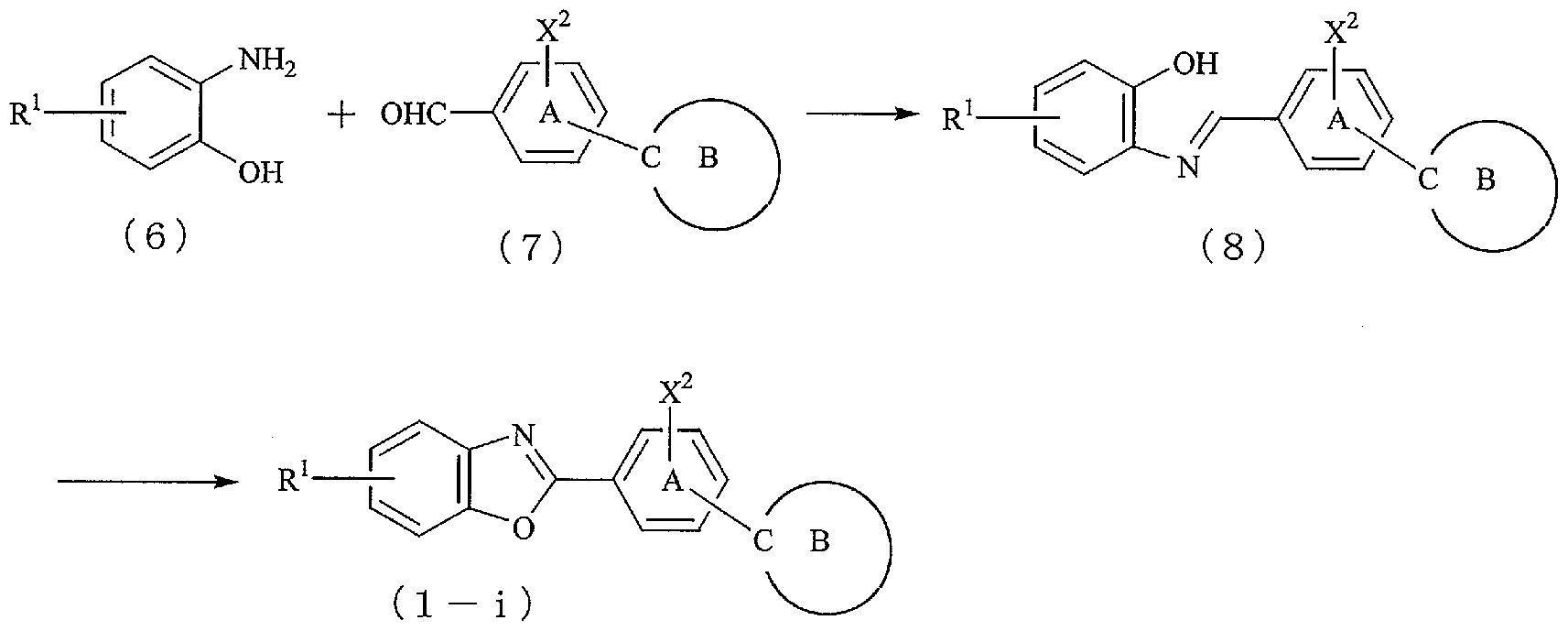
[0064] (式中、 R\ X2、 Aを含む環、及び Bを含む環は前記と同じ) [0064] (wherein R \ X 2 , the ring containing A, and the ring containing B are the same as above)
[0065] 化合物(6)とアルデヒド体(7)とを縮合させて化合物(8)を得、次 、でこれにョード ベンゼンジアセテート、トリァセトキシマンガン等の縮合剤を反応させることによりィ匕合 物(1— i)が得られる。化合物(6)とアルデヒド体(7)との反応は、エタノール等のアル コール溶媒中で加熱すればよい。また、化合物(8)の閉環反応は、 0〜60°Cで、ョー ドベンゼンジアセテートなどを用いて行えばよ 、。 [0065] The compound (6) and the aldehyde (7) are condensed to obtain a compound (8). Next, this is reacted with a condensing agent such as odobenzene diacetate or triacetoxymanganese. Compound (1-i) is obtained. Reaction of compound (6) with aldehyde (7) What is necessary is just to heat in a coal solvent. Further, the ring closure reaction of compound (8) may be carried out at 0 to 60 ° C. using iodine benzene diacetate or the like.
[0066] 上記反応式から明らかなように、前記一般式 (2)で表わされる化合物は、本発明化 合物(1)の製造中間体として有用である。 As apparent from the above reaction formula, the compound represented by the general formula (2) is useful as an intermediate for producing the compound (1) of the present invention.
[0067] 前記反応において用いられるアルデヒド体(2— a)、化合物(5)、化合物(7)は、公 知の化合物である力、又は前記の X1の複素環の形成反応、又は Bを含む環の形成 反応に準じて製造することができる。例えば、プロモアセトフエノンィ匕合物(5)は、ァセ 卜フエノンィ匕合物より公知の方法(Synthesis. 1976, 194, 196 ; Org. Synth, 194 3, I, 127)により製造することができる。これらの環構造のうち、ベンゾチアゾール構 造及びべンゾォキサゾール構造の製造方法は、アルデヒドィ匕合物に、ァ-リンィ匕合 物を反応させること〖こより製造することができる。通常、反応は溶媒中で行われ、室温 ないし加温下で製造する。溶媒としてはジメチルスルホキシド等が使用でき、反応は 160°C程度で行うのが好まし!/、。 [0067] The aldehyde (2-a), the compound (5), and the compound (7) used in the above reaction are known compounds, or the formation reaction of the X 1 heterocycle, or B It can be produced according to the reaction of forming a ring containing it. For example, promoacetophenone compound (5) can be produced from casee phenone compound by a known method (Synthesis. 1976, 194, 196; Org. Synth, 194 3, I, 127). Can do. Among these ring structures, the method for producing a benzothiazole structure and a benzoxazole structure can be produced by reacting an aldehyde compound with an Arin compound. Usually, the reaction is carried out in a solvent, and it is produced at room temperature or under heating. Dimethyl sulfoxide or the like can be used as a solvent, and the reaction is preferably performed at about 160 ° C! /.
[0068] また、 X1、 X2及び Bを含む環上の置換基は、常法により種々の変換方法で変換す ることができる。例えば、トリアルキルスズ基は、ハロゲンィ匕体に、テトラ(トリフエニルホ スフイン)パラジウム等の触媒の存在下にトリアルキルスズを反応させればょ 、。またト リアルキルスズ基から、ョード体への変換は、ヨウ素を反応させればよい。 [0068] Substituents on the ring containing X 1 , X 2 and B can be converted by various conversion methods by conventional methods. For example, a trialkyltin group can be obtained by reacting a halogen compound with trialkyltin in the presence of a catalyst such as tetra (triphenylphosphine) palladium. Further, the conversion from trialkyltin group to iodine body may be achieved by reacting iodine.
[0069] 上記の方法で製造された本発明化合物(1)は、遊離体あるいはその塩として単離 し、精製することができる。単離及び精製は、抽出、再結晶,各種クロマトグラフィー 等の公知の化学操作を適用して行うことができる。 [0069] The compound (1) of the present invention produced by the above method can be isolated and purified as a free form or a salt thereof. Isolation and purification can be performed by applying known chemical operations such as extraction, recrystallization, and various chromatography.
[0070] また、 PET用の化合物である C 11標識体は、例えば、次の如くして得られる。一 般的に C— 11標識反応には、サイクロトロンより得られる C] COを原料として生成 [0070] In addition, a C11 labeled body, which is a compound for PET, can be obtained, for example, as follows. In general, for C-11 labeling reaction, C] CO obtained from cyclotron is used as a raw material.
2 2
される C]ヨウ化メチル、 [nc]メチルトリフレートを用いたメチルイ匕反応が用いられ る。アミノ基、アミド基、水酸基、チオール基等を有する前駆体に対しメチル化反応を 行うことにより、 C— 11標識体を得る事が出来る。また、 Pdを触媒とした有機スズィ匕合 物とのカップリング反応を用いて、 C— 11標識体を得る事も出来る。各方法による標 識スキームの例を、下図に示す。 Methyl iodide reaction using C] methyl iodide and [ nc ] methyl triflate is used. By performing a methylation reaction on a precursor having an amino group, an amide group, a hydroxyl group, a thiol group, etc., a C-11 labeled product can be obtained. In addition, a C-11 labeled product can be obtained by a coupling reaction with an organic tin compound using Pd as a catalyst. Examples of labeling schemes by each method are shown below.
[0071] [化 8] [0071] [Chemical 8]


UCH3I

加熱 Heating
R2=SnMe3, SnBu3 R 2 = SnMe 3 , SnBu 3
[0072] また、 F— 18標識法には、求電子置換反応である F法、 acetyl hypofluorite法 [0072] The F-18 labeling method includes the F method, which is an electrophilic substitution reaction, and the acetyl hypofluorite method.
2 2
と、求核置換反応であるフッ素イオン法が用いられる。 F And a fluorine ion method which is a nucleophilic substitution reaction is used. F
2法、 acetyl hypofluorite 法は、キャリアーを含む [18F]Fを原料に用いるため、比放射能が低くなる傾向にあ The second method, the acetyl hypofluorite method, uses [ 18 F] F containing a carrier as the raw material, so the specific activity tends to decrease.
2 2
る。フッ素イオン法では、無担体の [18F]F—を原料に用いるため比放射能の高い標 識体が得られる。両方法共に、適切な脱離基を持った前駆体を用いることにより、フッ 素標識体を得ることが出来る。各方法による標識スキームの例を、下図に示す。 The In the fluoride ion method, since a carrier-free [ 18 F] F— is used as a raw material, a label with high specific activity can be obtained. In both methods, a fluorine-labeled product can be obtained by using a precursor having an appropriate leaving group. Examples of labeling schemes by each method are shown in the figure below.
[0073] [化 9] [0073] [Chemical 9]

R2=SnM SnBu3 R 2 = SnM SnBu 3


R4,R5=C1, Br, Tosyl-Ο-, Nosyl- 0-, Tf-O- R 4 , R 5 = C1, Br, Tosyl-Ο-, Nosyl- 0-, Tf-O-
[0074] キレート形成基を有する本発明化合物(1)は、例えば、次の如くして得られる。 [0074] The compound (1) of the present invention having a chelate-forming group can be obtained, for example, as follows.
次の反応式は、キレート形成基として前記の ωを有する化合物を合成するための反 応式である。 The following reaction formula is a reaction formula for synthesizing the compound having ω as a chelate-forming group.
[0075] [化 10] [0075] [Chemical 10]

[0076] より具体的には、(6—アミノー 3—ピリジル)メタノールと 1— [4— (1—ァセチルー H— 3 ピラゾリル)フエ-ル] 2 ブロモ 1 エタノンをジォキサンに溶解し、カロ 熱還流する。放冷後、析出物をろ取して表記化合物の臭酸塩を得る。得られた固体 をクロ口ホルムに懸濁し、トリェチルァミンをカ卩え、室温で撹拌する。反応液を水、飽 和食塩水で洗浄し、硫酸マグネシウムで乾燥後、溶媒を減圧留去する。得られる残 渣をフラッシュカラムクロマトグラフィーにて精製し、 1— (3— {4— [6— (ヒドロキシメチ ル)イミダゾ [ 1 , 2— a]ピリジン— 2—ィル]フエ-ル }— 1H— 1—ピラゾリル)— 1—ェ タノンを得る。次に、 1— (3— {4— [6— (ヒドロキシメチル)イミダゾ [1, 2— a]ピリジン —2—ィル]フエ-ル} - 1H— 1—ピラゾリル) 1—エタノンと四臭化炭素のテトラヒド 口フラン溶液に、トリフエ-ルフォスフィンをカ卩える。室温で撹拌した後、クロ口ホルムで 抽出する。硫酸マグネシウムで乾燥後、溶媒を減圧留去する。得られる残渣をフラッ シュカラムクロマトグラフィーにて精製し、 1— (3— {4— [6— (ヒドロキシメチル)イミダ ゾ [ 1 , 2— a]ピリジン一 2—ィル]フエ-ル}— 1H— 1—ピラゾリル) 1—エタノンを得 る。次に、 1— (3— {4— [6— (ヒドロキシメチル)イミダゾ [1, 2— a]ピリジン一 2—ィル ]フエ-ル} 1H— 1 ピラゾリル) 1 エタノンと N 1 , N2 ジ { 2— [ (4 メトキシ ベンジル)スルファ-ル ]—2—メチルプロピル }— 1, 2—エタンジァミンをァセトニトリ ルに溶解し、トリェチルァミンをカ卩え,加熱還流する。放冷後、クロ口ホルムで抽出す る。硫酸マグネシウムで乾燥後、溶媒を減圧留去する。得られる残渣をフラッシュカラ ムクロマトグラフィーにて精製し、 1— (3— {4— [6— ({ {2— [ (4—メトキシベンジル) スルファ-ル ] 2 メチルプロピル } [2— ({2— [ (4ーメトキシベンジルスルファ-ル ) ] - 2—メチルプロピル }ァミノ)ェチル]アミノ}メチル)イミダゾ [ 1 , 2— a]ピリジン— 2 —ィル]フエ-ル}— 1H— 1—ピラゾリル)一 1—エタノンを得る。次に、 1— (3— {4— [6—({ {2— [ (4ーメトキシベンジル)スルファ-ル ] 2 メチルプロピル } [2- ({2 —[ (4—メトキシベンジルスルファ -ル) ]—2—メチルプロピル }ァミノ)ェチル]ァミノ) メチル)イミダゾ [1, 2— a]ピリジン— 2—ィル]フエ-ル}— 1H— 1—ピラゾリル)— 1 エタノンをトリフルォロ酢酸に溶解し、加熱還流する。放冷後、減圧濃縮して得られ る残渣に水を加え、ジクロロメタンで洗浄する。水層を減圧濃縮することにより、 2—メ チルー 1 [{2— [ (2—メチルー 2 スルファ-ルプロピル)ァミノ]ェチル } ({2— [4 - (1H— 3 ピラゾリル)フエ-ル]イミダゾ [1, 2— a]ピリジン— 6—ィル }メチル)アミ ノ ] 2—プロパンチオール 二トリフルォロ酢酸塩を得ることができる。 [0076] More specifically, (6-amino-3-pyridyl) methanol and 1- [4- (1-acetylyl) H-3 pyrazolyl) phenol] 2 Bromo 1 Ethanone is dissolved in dioxane and heated to reflux. After allowing to cool, the precipitate is collected by filtration to obtain the oxyacid salt of the title compound. The obtained solid is suspended in black mouth form, and triethylamine is added thereto, followed by stirring at room temperature. The reaction solution is washed with water and saturated Japanese brine, dried over magnesium sulfate, and the solvent is distilled off under reduced pressure. The resulting residue was purified by flash column chromatography. 1— (3— {4— [6— (Hydroxymethyl) imidazo [1, 2 — a] pyridine-2-yl] phenol} — 1H— 1-pyrazolyl) — 1-ethanone is obtained. Next, 1— (3— {4— [6— (Hydroxymethyl) imidazo [1, 2— a] pyridine —2—yl] phenol}-1H— 1-pyrazolyl) 1-ethanone and four odors Triphenylphosphine is added to a solution of carbonized tetrahydride. After stirring at room temperature, extract with black mouth form. After drying with magnesium sulfate, the solvent is distilled off under reduced pressure. The resulting residue was purified by flash column chromatography. 1— (3— {4— [6— (Hydroxymethyl) imidazo [1, 2 — a] pyridine 1-2-yl] phenol} — 1H— 1-pyrazolyl) 1-ethanone is obtained. Next, 1- (3— {4-— [6— (Hydroxymethyl) imidazo [1, 2— a] pyridine-2-yl] phenol} 1H— 1 pyrazolyl) 1 ethanone and N 1, N2 di {2— [(4 Methoxybenzyl) sulfuryl] —2-methylpropyl} — 1,2-Ethandiamine is dissolved in acetonitrile, and triethylamine is added to the mixture and heated to reflux. After cooling, extract with black mouth form. After drying with magnesium sulfate, the solvent is distilled off under reduced pressure. The resulting residue was purified by flash column chromatography. 1- ( 3 — {4— [6— ({{2— [(4-methoxybenzyl) sulfuryl] 2 methylpropyl} [2— ({ 2 — [(4-Methoxybenzylsulfuryl)]-2-2-methylpropyl} amino) ethyl] amino} methyl) imidazo [1,2-a] pyridine-2-2-yl] phenol} —1H— 1-pyrazolyl) 1 1-ethanone is obtained. Next, 1— (3— {4— [6 — ({{2— [(4-methoxybenzyl) sulfuryl] 2 methylpropyl} [2- ({2 — [(4-methoxybenzylsulfuric- ])-2-Methylpropyl} amino) ethyl] amino] methyl) imidazo [1, 2-a] pyridine-2-yl] phenol} — 1H— 1-pyrazolyl) — 1 Ethanone to trifluoroacetic acid Dissolve and heat to reflux. After standing to cool, add water to the residue obtained by concentration under reduced pressure, and wash with dichloromethane. By concentrating the aqueous layer under reduced pressure, 2-methyl-1-[{2-[(2-methyl-2-sulfurpropyl) amino] ethyl} ({2- [4- (1H—3-pyrazolyl) phenol] imidazo [1, 2-a] pyridine-6-yl} methyl) amino 2] 2-Propanethiol ditrifluoroacetate can be obtained.
[0077] 次の反応式は、キレート形成基として前記の(F)を有する化合物を合成するための 反応式である。 [0077] The following reaction formula is a reaction formula for synthesizing the compound having the above-mentioned (F) as a chelate-forming group.
[0078] [化 11] [0078] [Chemical 11]

[0079] より具体的には、 1 - (3- {4- [6- (ヒドロキシメチル)イミダゾ [1, 2— a]ピリジン [0079] More specifically, 1- (3- {4- [6- (hydroxymethyl) imidazo [1,2-a] pyridine
- 2—ィル]フエ-ル}— 1H— 1—ピラゾリル) 1—エタノンと 1 , 2 -ジピコリルアミン をァセトニトリルに溶解し、トリェチルァミンをカ卩え、加熱還流する。放冷後、クロ口ホル ムで抽出する。硫酸マグネシウムで乾燥後、溶媒を減圧留去する。得られる残渣をフ ラッシュカラムクロマトグラフィーにて精製し、 1— {3— [4— (6— { [ジ(2 ピリジルメ チル)ァミノ]メチル }イミダゾ [ 1 , 2— a]ピリジン— 2—ィル)フエ-ル]— 1H— 1—ビラ ゾリル}— 1—エタノンを得る。次に、 1— {3— [4— (6— { [ジ(2 ピリジルメチル)アミ ノ]メチル }イミダゾ [ 1 , 2— a]ピリジン— 2—ィル)フエ-ル]— 1H— 1—ピラゾリル } - 1—エタノンをエタノールに溶解し、 3N塩酸を加えて加熱還流する。放冷後、水酸ィ匕 ナトリウム水溶液でアルカリ性としたのち、クロ口ホルムで抽出する。硫酸マグネシウム で乾燥後、溶媒を減圧留去する。得られる残渣をフラッシュカラムクロマトグラフィー にて精製し、 N, N ジ(2 ピリジルメチル) {2— [4— (1H— 3 ピラゾリル)フエ -ル]イミダゾ [ 1 , 2— a]ピリジン 6 ィル }メタンアミンを得ることができる。 -2-yl] phenol} — 1H— 1-pyrazolyl) Dissolve 1-ethanone and 1,2-dipicolylamine in acetonitrile, add triethylamine, and heat to reflux. After cooling, extract with black mouth form. After drying with magnesium sulfate, the solvent is distilled off under reduced pressure. The resulting residue was purified by flash column chromatography, and 1— {3— [4— (6 — {[di (2pyridylmethyl) amino] methyl} imidazo [1,2, —a] pyridine-2-y Lu) -Fuel] — 1H— 1-Vilazolyl} — 1-Ethanone is obtained. Next, 1— {3— [4— (6— {[di (2 pyridylmethyl) amino] methyl} imidazo [1, 2— a] pyridine-2-yl) phenol] — 1H— 1 -Pyrazolyl}-1-Ethanone is dissolved in ethanol, 3N hydrochloric acid is added, and the mixture is heated to reflux. After allowing to cool, the solution is made alkaline with a sodium hydroxide aqueous solution and extracted with black mouth form. After drying over magnesium sulfate, the solvent is distilled off under reduced pressure. The resulting residue was purified by flash column chromatography, and N, N di (2 pyridylmethyl) {2— [4— (1H— 3 pyrazolyl) phenol] imidazo [1,2-a] pyridine 6 yl } Methanamine can be obtained.
[0080] 次の反応式は、キレート形成基として前記の(D)及び (E)を有する化合物を合成す るための反応式である。 [0080] The following reaction formula is a reaction formula for synthesizing a compound having the above (D) and (E) as a chelate-forming group.
[0081] [化 12] [0081] [Chemical 12]
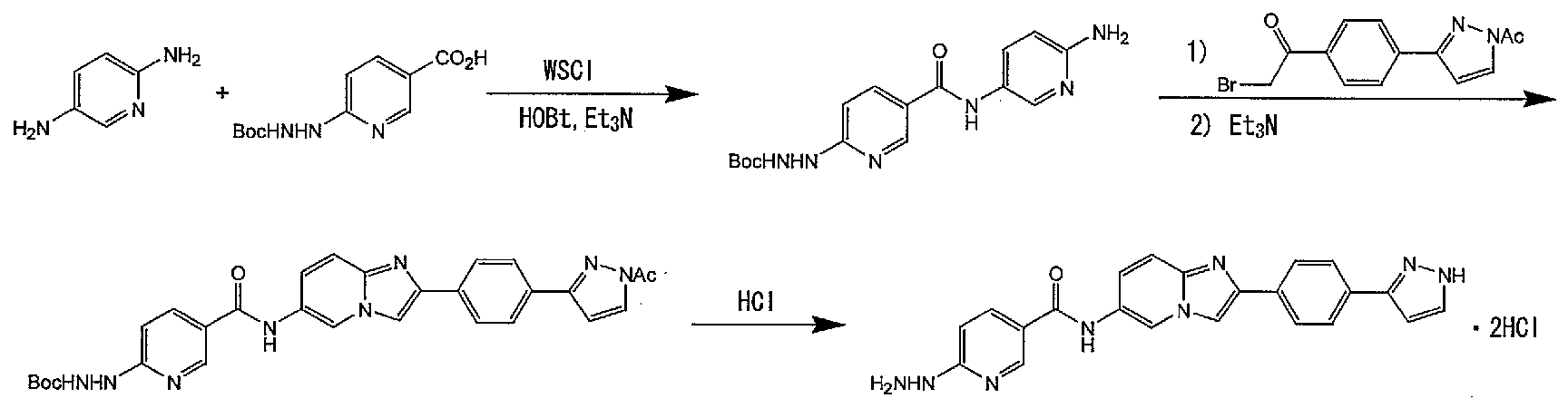
[0082] より具体的には、 2, 5 ジァミノピリジンと 6— [2 (tert ブトキシカルボ-ル)ヒド ラジノ]ニコチン酸、及び 1—ヒドロキシベンゾトリアゾールを N, N ジメチルホルムァ ミドに溶解し、トリェチルァミン、 1—ェチル—3— (3 ジメチルァミノプロピル)カルボ ジイミド塩酸塩を加え、室温で撹拌する。反応溶液に水を加え、ジクロロメタンで抽出 後、硫酸マグネシウムでする。溶媒を減圧留去して得られる残渣をフラッシュカラムク 口マトグラフィ一にて精製し、 tert—ブチル 2- (5— { [ (6—アミノー 3—ピリジル)ァ ミノ]カルボ-ル}— 2—ピリジル) 1—ヒドラジンカルボシキレートを得る。次に、 tert -ブチル 2— (5— { [ (6 ァミノ 3 ピリジル)ァミノ]カルボ-ル} 2 ピリジル) — 1 ヒドラジンカルボシキレートと 1— [4— ( 1 ァセチル 1H— 3 ピラゾリル)フ ェニル ] 2—プロモー 1 エタノンをジォキサンに溶解し、加熱還流する。放冷後, 析出物をろ取して臭酸塩を得る。得られた固体をクロ口ホルムに懸濁し,トリェチルァ ミンを加え,室温で撹拌する。反応液を水、飽和食塩水で洗浄し、硫酸マグネシウム で乾燥後、溶媒を減圧留去する。得られる残渣をフラッシュカラムクロマトグラフィー にて精製し、 tert -ブチル 2 — [ ( { 2— [4— (1—ァセチル 1H— 3 ビラゾリ ル)フエ-ル]イミダゾ [ 1 , 2— a]ピリジン 6—ィル }ァミノ)カルボ-ル] 1 ヒドラ ジンカルボキシレートを得る。次に、 tert ブチル 2— ー[ ( { 2—[4ー(1 ァセチ ルー 1H— 3 ピラゾリル)フエ-ル]イミダゾ [ 1 , 2— a]ピリジン 6 ィル }ァミノ)カル ボ -ル] 1ーヒドラジンカルボキシレートをエタノールに溶解し、 3N塩酸をカ卩え,加 熱還流する。析出する固体をろ取して N3— { 2— [4一(1H— 3 ピラゾリル)フエ二 ル]イミダゾ [1, 2— a]ピリジン一 6—ィル }— 6 ヒドラジノニコチンアミド 二塩酸塩を 得ることができる。 [0082] More specifically, 2,5-diaminopyridine, 6- [2 (tertbutoxycarbol) hydrazino] nicotinic acid, and 1-hydroxybenzotriazole are dissolved in N, N dimethylformamide to give triethylamine. Add 1-ethyl-3- (3 dimethylaminopropyl) carbodiimide hydrochloride and stir at room temperature. Add water to the reaction solution, extract with dichloromethane, and use magnesium sulfate. The residue obtained by distilling off the solvent under reduced pressure was purified by flash column chromatography, and tert-butyl 2- (5— {[(6-amino-3-pyridyl) amino] carbol} — 2— Pyridyl) 1-hydrazinecarbochelate is obtained. Next, tert-butyl 2— (5— {[(6 amino 3 pyridyl) amino] carbol} 2 pyridyl) — 1 hydrazine carbochelate and 1— [4— (1 acetyl 1H— 3 pyrazolyl) phenyl ] 2-Promo 1 Ethanone is dissolved in dioxane and heated to reflux. After allowing to cool, the precipitate is collected by filtration to obtain the bromoacid salt. Suspend the resulting solid in chloroform, add triethylamine, and stir at room temperature. The reaction mixture is washed with water and saturated brine, dried over magnesium sulfate, and the solvent is evaporated under reduced pressure. The resulting residue was purified by flash column chromatography, and tert-butyl 2 — [({2— [4— (1-acetyl 1H— 3 virazolyl) phenol] imidazo [1, 2— a] pyridine 6 —Il} Amino) Carbol] 1 Obtains hydrazine carboxylate. Next, tert butyl 2 -— [({2— [4- (1 acetyl 1H— 3 pyrazolyl) phenol] imidazo [1, 2— a] pyridine 6 yl} amino) carbol] 1 -Dissolve hydrazine carboxylate in ethanol, add 3N hydrochloric acid, and heat to reflux. The precipitated solid was collected by filtration. N3— {2— [4 (1H— 3 Pyrazolyl) phenyl] imidazo [1, 2— a] Pyridine mono 6-yl} — 6 Hydrazinonicotinamide dihydrochloride Can be obtained.
[0083] キレート形成基を有する本発明化合物(1)のキレート標識方法は、例えば、次の如 くして行なわれる。一般的に Tc— 99m標識反応には、過テクネチウム酸ナトリウムを 原料とし、配位子化合物との混合溶液を還元剤の共存下、反応させるなどの方法に より実施できる。また、原料の過テクネチウム酸ナトリウム力も還元したテクネチウム中 間体ィ匕合物に対し、配位子交換反応を行なうことにより Tc— 99m標識体を得ること ができる。各方法による標識スキームの例を下式に示す。 [0083] The chelate labeling method of the compound (1) of the present invention having a chelate-forming group is performed, for example, as follows. In general, sodium pertechnetate is used for Tc-99m labeling reactions. It can be carried out by a method of reacting a mixed solution with a ligand compound as a raw material in the presence of a reducing agent. In addition, a Tc-99m labeled product can be obtained by performing a ligand exchange reaction on the technetium intermediate compound, which is also reduced in the raw material sodium pertechnetate. Examples of labeling schemes by each method are shown in the following formulas.
[0084] [化 13] [0084] [Chemical 13]

=TPPTS, TPPDS, TPPMS, NIC, AP = TPPTS, TPPDS, TPPMS, NIC, AP
[0085] 本発明化合物(1)は、血液脳関門を通過し、脳内に入り込む性質を有し、かつアミ ロイド凝集物又は沈着物に対して強い結合親和性を有する。更に代謝安定性が高く 、かつ脳内に代謝物が存在しないことから、脳内のアミロイド凝集物及び沈着物の特 異的画像ィ匕用の化合物として有用である。すなわち、本発明化合物(1)は、イメージ ング剤、特にアミロイドイメージング剤として有用である。従って、本発明化合物(1)の 標識体を用いれば、アミロイドの凝集及び Z又は沈着が起因する疾患の画像診断が 可能となり、アミロイド一シス、例えばアルッノ、イマ一病、ダウン症候群、クロイツフエ ルト.ヤコブ病、 Π型糖尿病、透析アミロイド一シス、 AAアミロイド一シス、ゲルストマン •ストロイスラー.シャインカー症候群、マックス 'ウェルズ症候群、限局性心房性アミ口 イド、甲状腺髄様癌、皮膚アミロイド一シス、限局性結節性アミロイド一シス、 ALアミ口 イド一シス、 AHアミロイド一シス、家族性アミロイドポリ-ユーロバチ一、老人性全身 性アミロイド一シス、脳血管アミロイド一シス、家族性地中海熱、パーキンソン病、タウ ォパチ一、 ALS又は CAGリピート病の早期診断が可能となる。 [0085] The compound (1) of the present invention has a property of passing through the blood-brain barrier and entering the brain, and has a strong binding affinity for amyloid aggregates or deposits. Furthermore, since it has high metabolic stability and no metabolite is present in the brain, it is useful as a compound for specific imaging of amyloid aggregates and deposits in the brain. That is, the compound (1) of the present invention is useful as an imaging agent, particularly as an amyloid imaging agent. Therefore, the use of the labeled compound of the compound (1) of the present invention enables imaging diagnosis of diseases caused by aggregation and Z or deposition of amyloid, such as amyloidosis, such as Aruno, Imah's disease, Down's syndrome, Kreuzfeld. Jacob's disease, type 2 diabetes, dialysis amyloidosis, AA amyloidosis, Gerstman Streisler.Shinker syndrome, Max'Wells syndrome, localized atrial amyloidosis, medullary thyroid cancer, cutaneous amyloidosis, localized Sexual nodular amyloidosis, AL amyloidosis, AH amyloidosis, familial amyloid poly-eurobachi, senile systemic amyloidosis, cerebrovascular amyloidosis, familial Mediterranean fever, Parkinson's disease, tau This makes it possible to make an early diagnosis of opac, ALS or CAG repeat disease.
また、本発明化合物(1)は、アミロイドの凝集及び Z又は沈着を阻害する作用を有 することから、これらが起因する疾患、すなわちアミロイド一シス、例えばアルッハイマ 一病、ダウン症候群、クロイツフェルト 'ヤコブ病、 II型糖尿病、透析アミロイド一シス、 AAアミロイド一シス、ゲルストマン'ストロイスラ^ ~ ·シャインカー症候群、マックス'ゥェ ルズ症候群、限局性心房性アミロイド、甲状腺髄様癌、皮膚アミロイド一シス、限局性 結節性アミロイド一シス、 ALアミロイド一シス、 ΑΗアミロイド一シス、家族性アミロイド ポリ-ユーロバチ一、老人性全身性アミロイド一シス、脳血管アミロイド一シス、家族性 地中海熱、パーキンソン病、タウォパチ一、 ALS又は CAGリピート病の予防及び Ζ 又は治療薬として有用である。更に、これらの疾患の予防及び Ζ又は治療薬のスクリ 一ユングツールとして有用である。 In addition, since the compound (1) of the present invention has an action of inhibiting amyloid aggregation and Z or deposition, a disease caused by these, ie, amyloidosis, such as Alzheimer's disease, Down's syndrome, Creutzfeldt's Jacob Disease, type II diabetes, dialysis amyloidosis, AA amyloidosis, Gerstman's Streisler ^-Shineker syndrome, Max'Welz syndrome, focal atrial amyloid, medullary thyroid cancer, cutaneous amyloidosis, localized Sex Nodular amyloidosis, AL amyloidosis, Sputum amyloidosis, Familial amyloid poly-Eurobati, Senile systemic amyloidosis, Cerebrovascular amyloidosis, Familial Mediterranean fever, Parkinson's disease, Tawapati, It is useful as a preventive and acupuncture or therapeutic agent for ALS or CAG repeat disease. Furthermore, it is useful as a screening tool for the prevention and treatment of these diseases.
[0086] 本発明化合物(1)を診断薬として用いる場合、局所又は全身性でも良ぐ静脈内、 動脈内、髄腔内などに投与することができ、用途や対象とする疾病に見合った剤形 を選択すればよい。化合物(1)の標識化合物を検出可能量投与し、該標識化合物 がアミロイド沈着物と結合するのに十分な時間をとり(例えば 30分力も 48時間)、アミ ロイド沈着物と結合した標識ィ匕合物を検出することによりアミロイド沈着物が画像ィ匕で きる。この際、アミロイド沈着物と結合した標識ィ匕合物は、対象疾患に合わせ生体領 域を、検出に適した画像化装置(MRSZMRI、 SPECT、ブラナーシンチレーシヨン 画像、 PETなど)によって検出する。診断プロトコールは対象とする疾病や患者、検 出装置に見合った条件に依存する。 [0086] When the compound (1) of the present invention is used as a diagnostic agent, it can be administered intravenously, intraarterially, intrathecally, etc., which may be local or systemic, and is suitable for the intended use and target disease Select the shape. Administer a detectable amount of the labeled compound of compound (1), allow sufficient time for the labeled compound to bind to the amyloid deposit (for example, 30 minutes at 48 hours), and label the labeled compound that has bound to the amyloid deposit. By detecting the compound, an amyloid deposit can be imaged. At this time, the labeled complex combined with the amyloid deposit is detected by an imaging device (MRSZMRI, SPECT, Brunar scintillation image, PET, etc.) suitable for detection according to the target disease. The diagnostic protocol depends on the disease, patient, and conditions appropriate for the detection device.
投与時の非水性溶媒の例は、プロピレングリコール、植物油、及び注射用有機エス テルである。水性溶媒としては水、アルコール溶液水溶液、生理食塩液などが挙げら れる。 Examples of non-aqueous solvents at the time of administration are propylene glycol, vegetable oils, and injectable organic esters. Examples of the aqueous solvent include water, an alcohol solution, and physiological saline.
[0087] 本発明化合物(1)を医薬として用いる場合、これらは経口又は非経口的に投与す ることができ、用途や対象とする疾病に見合った剤形を選択すればよい。経口的に 投与する剤形としては、錠剤、丸剤、カプセル剤、散剤、内服液剤等を挙げることが でき、非経口的に投与する剤形としては、注射剤、点眼剤、坐剤、懸濁剤、軟膏剤、 パップ剤、リニメント剤、ローション剤、エアゾール剤、プラスター剤等を挙げることが できる。これらの剤形への製剤化は、本発明化合物(1)の効果を損なわない範囲で[0087] When the compound (1) of the present invention is used as a medicament, it can be administered orally or parenterally, and a dosage form suitable for the intended use and the target disease may be selected. Oral dosage forms include tablets, pills, capsules, powders, liquids for internal use, and parenteral dosage forms include injections, eye drops, suppositories, and suspensions. Suspending agents, ointments, poultices, liniments, lotions, aerosols, plasters, etc. it can. Formulation into these dosage forms is within a range not impairing the effect of the compound (1) of the present invention.
、賦形剤、結合剤、崩壊剤、流動化剤、懸濁化剤、保湿剤、溶解補助剤等の製剤添 加物を適宜用いて行なえばょ 、。 , Excipients, binders, disintegrants, fluidizing agents, suspending agents, humectants, solubilizing agents, etc.
[0088] 本発明化合物(1)の投与量は、疾患の種類及び程度、投与方法、投与する化合物 ならびに患者の年齢、性別及び体重によって、適宜決定すればよい。例えば、経口 投与の場合、成人一日あたり、約 0. lmg〜約 lOOOmgを挙げることができる。投与 時期としては、食前、食間、食後、就寝前等を挙げることができ、投与は、 1〜数回に 分割してもよい。また、放射線放出核種で標識されている本発明化合物(1)の場合、 更に SPECTあるいは PET装置等の放射線イメージング装置の測定条件並びに患 者の被曝も考慮して、適宜決定すればよい。例えば、放射能として、 37〜37GBq、 好ましくは、 l l l〜740MBqである。 [0088] The dose of the compound (1) of the present invention may be appropriately determined depending on the type and extent of the disease, the administration method, the compound to be administered, and the age, sex and body weight of the patient. For example, in the case of oral administration, about 0.1 mg to about 100 mg can be mentioned per adult day. Examples of the timing of administration include before meals, between meals, after meals, and before going to bed. Administration may be divided into 1 to several times. Further, in the case of the compound (1) of the present invention labeled with a radiation-emitting nuclide, it may be appropriately determined in consideration of the measurement conditions of a radiation imaging apparatus such as a SPECT or PET apparatus and the exposure of the patient. For example, the radioactivity is 37 to 37 GBq, preferably l l l to 740 MBq.
[0089] 本発明化合物(1)を用いてアミロイドの凝集及び Z又は沈着に起因する疾患の予 防及び Z又は治療薬をスクリーニングするには、インビトロ又はインビボにおいて、被 検体とアミロイドとの結合性を、本発明化合物(1)を用いて検出すればよい。例えば、 インビトロの場合には、 (i)被検体とアミロイド (例えばアミロイド β凝集体)を接触させ た後、本発明化合物(1)を用いて、被検体とアミロイドとの結合性を検出する方法、 (i i)被検体とアミロイドを接触させた後、本発明化合物(1)を用いて、アミロイドの凝集 及び Z又は沈着の程度を測定する方法などにより行われる。 [0089] To prevent the disease caused by amyloid aggregation and Z or deposition using the compound (1) of the present invention and to screen for a Z or therapeutic agent, the binding property between the subject and amyloid in vitro or in vivo. May be detected using the compound (1) of the present invention. For example, in the case of in vitro, (i) a method of detecting the binding between a specimen and amyloid using the compound (1) of the present invention after contacting the specimen with amyloid (for example, amyloid β aggregate) (Ii) After contacting the subject with amyloid, the compound (1) of the present invention is used to measure the degree of amyloid aggregation and Z or deposition.
[0090] インビボの場合には、例えば、アミロイドが形成した動物(ヒトおよび非ヒト動物)に被 検体を投与した後、本発明化合物(1)を用いて、アミロイドの凝集及び Z又は沈着の 程度を測定すればよい。 In the case of in vivo, for example, after administration of a subject to animals (human and non-human animals) in which amyloid is formed, the degree of amyloid aggregation and Z or deposition using the compound (1) of the present invention. Can be measured.
[0091] 本発明化合物(1)を用いることにより、被検体がアミロイド等との結合を阻害すること がわかれば、当該被検体はアミロイド蛋白に起因するアミロイド関連疾患 (アミロイド 一シス)の予防及び Z又は治療薬として有用であることがわかる。 [0091] If it is found that the subject inhibits binding to amyloid or the like by using the compound (1) of the present invention, the subject can prevent and prevent amyloid-related diseases (amyloid cis) caused by amyloid protein. It turns out that it is useful as Z or a therapeutic agent.
実施例 Example
[0092] 次に実施例を挙げて本発明を詳細に説明するが、本発明は何らこれに限定される ものではない。 [0092] Next, the present invention will be described in detail with reference to examples, but the present invention is not limited thereto.
[0093] 参考例 1 4— (6 ョードイミダゾ「1. 2— alピリジン一 2—ィル)ベンゾニトリル(1)[0093] Reference Example 1 4— (6 Yodoimidazo “1.2-Alpyridine-2-yl) benzonitrile (1)
2 アミノー 5 ョードピリジン(1. Og)と 2 ブロモ 4,一シァノアセトフエノン(1. 0 2g)をエタノール(30mL)に溶解し、炭酸水素ナトリウム(382mg)をカ卩え、 16時間還 流した。反応溶液に水 10mLを加え放冷後、析出物を濾取し乾燥することで標題ィ匕 合物(1. 27g)を得た。 2 Amino-5-iodopyridine (1. Og) and 2 bromo-4, 1 cyanoacetophenone (1.0 2 g) were dissolved in ethanol (30 mL), and sodium bicarbonate (382 mg) was added and refluxed for 16 hours. . After adding 10 mL of water to the reaction solution and allowing to cool, the precipitate was collected by filtration and dried to obtain the title compound (1.27 g).
'H-NMR (400MHz, DMSO-d ) δ :7. 54(1Η, d, J = 9. 5Hz), 7. 62(1Η, 'H-NMR (400MHz, DMSO-d) δ: 7.54 (1Η, d, J = 9.5Hz), 7.62 (1Η,
6 6
dd, J=l. 2, 9. 3Hz), 7. 94 (2Η, d, J = 8. 3Hz), 8. 14 (2H, d, J=8. 5Hz), 8. 56(1H, s), 9. 02(1H, s) . dd, J = l. 2, 9. 3Hz), 7. 94 (2Η, d, J = 8.3Hz), 8. 14 (2H, d, J = 8.5Hz), 8. 56 (1H, s ), 9. 02 (1H, s).
EI -MS m/z:345(M)+. EI -MS m / z: 345 (M) +.
[0094] 参考例 2 [0094] Reference Example 2
4一(6 ョードイミダゾ「1. 2— alピリジンー2 ィル)ベンズアルデヒド(2) 4 1 (6 Joidoimidazo "1.2-alpyridine-2 yl) benzaldehyde (2)
4— (6—ョードイミダゾ [1, 2— a]ピリジン— 2—ィル)ベンゾ-トリル(1. 27g)をテト ラヒドロフラン(15mL)とジクロロメタン(15mL)に加え、氷冷中で撹拌した。この反応 液にジイソブチル水素化アルミニウム(7. 8mL)を滴下し、同温にて 15分撹拌後、室 温にて 4時間撹拌した。反応液に飽和塩ィ匕アンモ-ゥム水溶液(2mL)を滴下後、室 温にて 1時間撹拌し、硫酸マグネシウム、ジェチルエーテルをカ卩えて更に 1時間撹拌 した。溶媒を留去し残渣物をシリカゲルカラムクロマトグラフィー(ジクロロメタン:メタノ ール =95:5)にて精製、減圧濃縮し標題化合物(1. 03g)を得た。 4- (6-Edoimidazo [1,2-a] pyridine-2-yl) benzo-tolyl (1.27 g) was added to tetrahydrofuran (15 mL) and dichloromethane (15 mL), and the mixture was stirred in ice-cooling. Diisobutylaluminum hydride (7.8 mL) was added dropwise to the reaction mixture, and the mixture was stirred at the same temperature for 15 minutes and then at room temperature for 4 hours. A saturated aqueous solution of ammonium chloride (2 mL) was added dropwise to the reaction mixture, and the mixture was stirred at room temperature for 1 hr. Magnesium sulfate and jetyl ether were added, and the mixture was further stirred for 1 hr. The solvent was distilled off, and the residue was purified by silica gel column chromatography (dichloromethane: methanol = 95: 5) and concentrated under reduced pressure to obtain the title compound (1.03 g).
'H-NMR (400MHz, DMSO-d ) δ :7.47 (2Η, d, J=l. 2Hz), 7. 98 (2H, 'H-NMR (400MHz, DMSO-d) δ: 7.47 (2Η, d, J = l. 2Hz), 7. 98 (2H,
6 6
d, J = 8. 3Hz), 8. 18 (2H, d, J = 8. 3Hz), 8.49(1H, s), 8. 95(1H, t, J=l. 2Hz), 10. 02 (1H, s). d, J = 8.3Hz), 8. 18 (2H, d, J = 8.3Hz), 8.49 (1H, s), 8. 95 (1H, t, J = l. 2Hz), 10. 02 ( 1H, s).
[0095] 実施例 1 [0095] Example 1
5—「4— (6—ョードイミダゾ「1. 2 ピリジン一 2—ィル)フエニル Ί 1. 3—ォキサ ゾーノレ(3) 5— “4— (6-Iodoimidazo” 1.2.2-Pyridine-2-yl) phenyl Ί 1. 3-Oxazonere (3)
4— (6 ョードイミダゾ [1, 2— a]ピリジン— 2—ィル)ベンズアルデヒド(647mg)及 び -トルエンスルホ-ルメチルイソシアニド(454mg)をメタノール (lOmL)に溶解し 、室温にて炭酸カリウム(321mg)を加え 13時間還流した。析出物を濾取し乾燥する ことで標題ィ匕合物(330mg)を得た。 Ή-NMR (400MHz, DMSO— d ) δ :7.45 (2H, d, J=l.2Hz), 7.74 (1H, 4- (6 pseudoimidazo [1,2-a] pyridin-2-yl) benzaldehyde (647 mg) and -toluenesulfol methylisocyanide (454 mg) were dissolved in methanol (10 mL), and potassium carbonate ( 321 mg) was added and refluxed for 13 hours. The precipitate was collected by filtration and dried to give the title compound (330 mg). NMR-NMR (400MHz, DMSO— d) δ: 7.45 (2H, d, J = l.2Hz), 7.74 (1H,
6 6
s), 7.81 (2H, d, J = 8.5Hz), 8.06 (2H, d, J = 8.5Hz), 8.39 (1H, s), 8.4 7(1H, s), 8.92(1H, t, J=l.2Hz) . s), 7.81 (2H, d, J = 8.5Hz), 8.06 (2H, d, J = 8.5Hz), 8.39 (1H, s), 8.4 7 (1H, s), 8.92 (1H, t, J = l.2Hz)
EI -MS m/z:387(M)+. EI -MS m / z: 387 (M) + .
[0096] 参考例 3 [0096] Reference Example 3
4一(6 ョードイミダゾ「1.2— alピリジンー2—ィル)ー1 ベンゼンカルボチォアミ H(6) 4 1 (6 Yodoimidazo “1.2-Alpyridine-2-yl” -1) Benzenecarbothioami H (6)
4— (6 ョードイミダゾ [1, 2— a]ピリジン一 2—ィル)ベンゾ-トリル(345mg)とチ オアセタミド(150mg)を飽和塩化水素ジメチルホルムアミド溶液 (5mL)に加え 80°C で 4時間加熱した。溶媒を留去して得られる残渣物に飽和炭酸水素ナトリウムを加え 、濾取して乾燥することで標題ィ匕合物(269mg)を得た。 Add 4- (6 pseudoimidazo [1,2-a] pyridine-2-yl) benzo-tolyl (345 mg) and thioacetamide (150 mg) to saturated hydrogen chloride dimethylformamide solution (5 mL) and heat at 80 ° C for 4 hours. did. Saturated sodium hydrogen carbonate was added to the residue obtained by distilling off the solvent, and the residue was collected by filtration and dried to obtain the title compound (269 mg).
'H-NMR (400MHz, DMSO-d ) δ :7.45 (2Η, d, J=l. OHz), 7.98 (4H, 'H-NMR (400MHz, DMSO-d) δ: 7.45 (2Η, d, J = l.OHz), 7.98 (4H,
6 6
s), 8.41 (1H, s), 8.92(1H, s), 9.52(1H, s), 9.86(1H, s) . s), 8.41 (1H, s), 8.92 (1H, s), 9.52 (1H, s), 9.86 (1H, s).
FAB -MS m/z:380(M+H)+. FAB -MS m / z: 380 (M + H) +.
[0097] 実施例 2 [0097] Example 2
2—「4— (6 ョードイミダゾ「1.2 ピリジン一 2—ィル)フ ニル Ί 1.3 チアゾ ール(7) 2— “4— (6 Iodoimidazo” 1.2 Pyridine-2-yl) Finyl Ί 1.3 Thiazol (7)
4一(6 ョードイミダゾ [1, 2— a]ピリジンー2—ィル)ー1 ベンゼンカルボチオア ミド(249mg)をエタノール(lOmL)に溶解し、トリエチルァミン(91 L)とクロロアセト アルデヒド(155 L)をカ卩え、 18時間還流した。反応液に水を加え、ジクロロメタン— メタノールにて抽出後、溶媒を留去し残渣物をシリカゲルカラムクロマトグラフィー(ジ クロロメタン:メタノール =100 :5)にて精製、減圧濃縮し標題ィ匕合物(103mg)を得 た。 4 1 (6 imidazolido [1,2-a] pyridine-2-yl) -1 Dissolve benzenecarbothioamide (249 mg) in ethanol (10 mL), triethylamine (91 L) and chloroacetaldehyde (155 L) ) And refluxed for 18 hours. Water was added to the reaction mixture, and the mixture was extracted with dichloromethane-methanol. The solvent was evaporated, and the residue was purified by silica gel column chromatography (dichloromethane: methanol = 100: 5) and concentrated under reduced pressure. (103 mg) was obtained.
'H-NMR (400MHz, DMSO-d ) δ :7.45 (2Η, s), 7.80(1Η, dd, J = 0.7 'H-NMR (400MHz, DMSO-d) δ: 7.45 (2Η, s), 7.80 (1Η, dd, J = 0.7
6 6
, 3.2Hz), 7.94(1H, dd, J = 0.7, 3.2Hz), 8.02 (2H, d, J = 8.1Hz), 8.0 8(2H, d, J = 8.3Hz), 8.41 (1H, s), 8.93 (1H, d, J=l. OHz). , 3.2Hz), 7.94 (1H, dd, J = 0.7, 3.2Hz), 8.02 (2H, d, J = 8.1Hz), 8.0 8 (2H, d, J = 8.3Hz), 8.41 (1H, s) , 8.93 (1H, d, J = l.OHz).
EI -MS m/z:403(M)+. EI -MS m / z: 403 (M) +.
[0098] 参考例 4 1一「4一(6 ョードイミダゾ「 1.2 ピリジン一 2 ィル)フエニル Ί一 1一エタノー k(8) [0098] Reference Example 4 1 1 “4 1 (6 Imidimizo” 1.2 Pyridine 1 2 il) Phenyl 1 1 Ethano k (8)
4— (6—ョードイミダゾ [1, 2— a]ピリジン— 2—ィル)ベンズアルデヒド(820mg)を テトラヒドロフラン(25mL)に溶解し氷冷中で撹拌した。この反応液にメチルマグネシ ゥムブロマイド(787mL)を滴下し、氷冷中で 15分撹拌後、室温にて 5時間撹拌した 。反応液に飽和塩ィ匕アンモ-ゥム水溶液(25mL)を滴下し、室温で 1時間撹拌した。 反応液に水を加え、ジクロロメタン +メタノールにて抽出後、溶媒を留去し残渣物をシ リカゲルカラムクロマトグラフィー(ジクロロメタン:メタノール =97 :3)にて精製、減圧 濃縮し標題化合物(579mg)を得た。 4- (6-Edoimidazo [1,2-a] pyridine-2-yl) benzaldehyde (820 mg) was dissolved in tetrahydrofuran (25 mL) and stirred in ice-cooling. Methyl magnesium bromide (787 mL) was added dropwise to the reaction solution, and the mixture was stirred for 15 minutes in ice-cooling and then for 5 hours at room temperature. A saturated aqueous solution of ammonium chloride (25 mL) was added dropwise to the reaction solution, and the mixture was stirred at room temperature for 1 hour. Water was added to the reaction mixture, and the mixture was extracted with dichloromethane + methanol. The solvent was evaporated, and the residue was purified by silica gel column chromatography (dichloromethane: methanol = 97: 3) and concentrated under reduced pressure to give the title compound (579 mg). Obtained.
'H-NMR (400MHz, CDC1 ) δ :1.53 (3Η, d, J = 6.3Hz), 4.93 (1H, q, J 'H-NMR (400MHz, CDC1) δ: 1.53 (3Η, d, J = 6.3Hz), 4.93 (1H, q, J
3 Three
=6.5Hz), 7.32(1H, dd, J=l.7, 9.4Hz), 7.41 (2H, d, J = 7.6Hz), 7.4 4(1H, s), 7.78 (1H, s), 7.89 (2H, d, J = 8.1Hz), 8.37(1H, s) . = 6.5Hz), 7.32 (1H, dd, J = l.7, 9.4Hz), 7.41 (2H, d, J = 7.6Hz), 7.4 4 (1H, s), 7.78 (1H, s), 7.89 ( 2H, d, J = 8.1Hz), 8.37 (1H, s).
[0099] 参考例 5 [0099] Reference Example 5
1—「4— (6—ョードイミダゾ「 1.2 ピリジン 2 ィル)フエニル Ί 2 エタノン( 9) 1— “4— (6-Iodoimidazo” 1.2 Pyridine 2 yl) Phenyl Ί 2 Ethanone (9)
1— [4— (6—ョードイミダゾ [ 1 , 2— a]ピリジン 2 ィル)フエ-ル] 1 エタノー ル(579mg)のクロ口ホルム溶液(50mL)に二酸化マンガン(69 lmg)をカ卩え、 8時間 還流した。反応液をセライト濾過し、母液を濃縮して得られる残渣物をシリカゲルカラ ムクロマトグラフィー(ジクロロメタン:メタノール =95:5)にて精製、減圧濃縮し標題化 合物(37 lmg)を得た。 1— [4— (6-Edoimidazo [1, 2— a] pyridine 2-yl) phenol] 1) Manganese dioxide (69 lmg) was added to ethanol solution (50 mL) in ethanol (579 mg). And refluxed for 8 hours. The reaction mixture was filtered through Celite, and the residue obtained by concentrating the mother liquor was purified by silica gel column chromatography (dichloromethane: methanol = 95: 5) and concentrated under reduced pressure to obtain the title compound (37 lmg).
'H-NMR (400MHz, DMSO-d ) δ :2.60 (3Η, s), 7.46 (2Η, s), 8.03(2 'H-NMR (400MHz, DMSO-d) δ: 2.60 (3Η, s), 7.46 (2Η, s), 8.03 (2
6 6
H, d, J=8.3Hz), 8.09 (2H, J = 8.3Hz), 8.46 (1H, s), 8.93 (1H, s) . EI -MS m/z:362(M)+. H, d, J = 8.3Hz), 8.09 (2H, J = 8.3Hz), 8.46 (1H, s), 8.93 (1H, s) .EI -MS m / z: 362 (M) + .
[0100] 参考例 6 [0100] Reference Example 6
(E) -3- (ジメチルァミノ)— 1—「4— (6 ョードイミダゾ「1.2— alピリジン— 2—ィ ル)フエニル 1 2—プロペン 1 オン( 10) (E) -3- (Dimethylamino) — 1— “4— (6 pseudoimidazo” —1.2—alpyridine-2-yl) phenyl 1 2—propene 1 on (10)
1— [4— (6—ョードイミダゾ [ 1 , 2— a]ピリジン 2 ィル)フエ-ル] 2 エタノン (495mg)のジメチルホルムアミド溶液(50mL)に N, N ジメチルホルムアミドジメチ ルァセタール(363 /zL)を滴下し、 150°Cで 16時間加熱した。反応液を濃縮し残渣 物をシリカゲルカラムクロマトグラフィー(ジクロロメタン:メタノール = 97: 3)にて精製、 減圧濃縮し標題化合物(274mg)を得た。 1— [4— (6-Edoimidazo [1,2, —a] pyridine-2-yl) phenol] 2 Etanone (495mg) in dimethylformamide solution (50mL) with N, N dimethylformamide dimethyl Rucetal (363 / zL) was added dropwise and heated at 150 ° C. for 16 hours. The reaction mixture was concentrated, and the residue was purified by silica gel column chromatography (dichloromethane: methanol = 97: 3) and concentrated under reduced pressure to give the title compound (274 mg).
'H-NMR (400MHz, CDC1 ) δ :2.97 (3Η, br), 3.16 (3Η, br), 5.77(1H 'H-NMR (400MHz, CDC1) δ: 2.97 (3Η, br), 3.16 (3Η, br), 5.77 (1H
3 Three
, d, J=12.4Hz), 7.35(1H, dd, J=l.5, 10.9Hz), 7.44 (1H, d, J = 9.3H z), 7.83 (1H, d, J=12.4Hz), 7.86 (1H, s), 7.98 (4H, d, J = 0.5Hz), 8. 40 (1H, s). , d, J = 12.4Hz), 7.35 (1H, dd, J = l.5, 10.9Hz), 7.44 (1H, d, J = 9.3H z), 7.83 (1H, d, J = 12.4Hz), 7.86 (1H, s), 7.98 (4H, d, J = 0.5Hz), 8. 40 (1H, s).
[0101] 実施例 3 [0101] Example 3
6 ョード 2—「4— (1H— 3 ピラゾィル)フエニル Ί イミダゾ「 1.2 ピリジン( 1 1) 6 Yod 2— “4— (1H— 3 Pyrazol) phenyl Ί Imidazo” 1.2 Pyridine (1 1)
(Ε) -3- (ジメチルァミノ)— 1— [4— (6—ョードイミダゾ [1, 2 a]ピリジン— 2— ィル)フエ-ル] 2 プロペン 1 オン(344mg)のエタノール溶液(30mL)にヒド ラジン 1水和物(100 /zL)を加え、 3時間還流した。反応液を放冷し、析出物を濾取 し乾燥することで標題ィ匕合物(290mg)を得た。 (Ε) -3- (Dimethylamino) — 1— [4— (6-Odorimidazo [1, 2 a] pyridine-2-yl) phenol] 2 Propene 1-on (344 mg) in ethanol solution (30 mL) Hydrazine monohydrate (100 / zL) was added and refluxed for 3 hours. The reaction mixture was allowed to cool, and the precipitate was collected by filtration and dried to give the title compound (290 mg).
'H-NMR (400MHz, DMSO-d ) δ :6.75(1Η, d, J=l.7Hz), 7.44 (2Η, 'H-NMR (400MHz, DMSO-d) δ: 6.75 (1Η, d, J = l.7Hz), 7.44 (2Η,
6 6
t, J = 9.8Hz), 7.79(1H, br), 7.87 (2H, d, J = 8.0Hz), 7.98 (2H, d, J = 8 .0Hz), 8.34 (1H, s), 8.91 (1H, s), 12.90 (1H, br) . t, J = 9.8Hz), 7.79 (1H, br), 7.87 (2H, d, J = 8.0Hz), 7.98 (2H, d, J = 8.0Hz), 8.34 (1H, s), 8.91 (1H , s), 12.90 (1H, br).
EI -MS m/z:386(M)+. EI -MS m / z: 386 (M) +.
[0102] 参考例 7 [0102] Reference Example 7
2 ブロモー 1 4 6 ョードイミダゾ「 1.2 alピリジン 2 ィル)フエ-ル Ί 1 エタノン(14) 2 Bromo 1 4 6 Yodimidazo “1.2 al pyridine 2 yl” Fuel Ί 1 Ethanone (14)
1— [4— (6—ョードイミダゾ [ 1 , 2— a]ピリジン 2 ィル)フエ-ル] 2 エタノン (464mg)〖こジクロロメタン (9mL)とトリエチルァミン (355 μ L)をカロえ氷冷中で撹拌 した。この反応液にプロモトリメチルシラン(379 L)を滴下し、室温で 22時間撹拌し た。反応液に水を加え、ジクロロメタンにて抽出後、硫酸ナトリウムで乾燥した。溶媒 を減圧濃縮し、濃縮残渣をテトラヒドロフラン(7mL)に溶解し、 N ブロモこはく酸イミ ド(228mg)を加え、室温で 1時間撹拌した。溶媒を留去し残渣物をシリカゲルカラム クロマトグラフィー(ジクロロメタン:メタノール =98:2)にて精製、減圧濃縮し標題ィ匕 合物 (441mg)を得た。 1— [4— (6-Edoimidazo [1, 2— a] pyridine 2-yl) phenol] 2 Ethanone (464 mg) 〖dichloromethane (9 mL) and triethylamine (355 μL) Stir in. To this reaction solution, promotrimethylsilane (379 L) was added dropwise and stirred at room temperature for 22 hours. Water was added to the reaction solution, extracted with dichloromethane, and dried over sodium sulfate. The solvent was concentrated under reduced pressure, the concentrated residue was dissolved in tetrahydrofuran (7 mL), N-bromosuccinic acid imide (228 mg) was added, and the mixture was stirred at room temperature for 1 hr. The solvent was distilled off and the residue was purified by silica gel column chromatography (dichloromethane: methanol = 98: 2) and concentrated under reduced pressure. Compound (441 mg) was obtained.
'H-NMR (400MHz, DMSO-d ) δ :4.95 (2H, s), 7.47 (2H, s), 8.07(2 'H-NMR (400MHz, DMSO-d) δ: 4.95 (2H, s), 7.47 (2H, s), 8.07 (2
6 6
H, d, J=8.3Hz), 8.12(2H, d, J = 8.3Hz), 8.49(1H, s), 8.94 (1H, s) . EI -MS m/z:442(M+H)+. H, d, J = 8.3Hz), 8.12 (2H, d, J = 8.3Hz), 8.49 (1H, s), 8.94 (1H, s) .EI -MS m / z: 442 (M + H) + .
[0103] 実施例 4 [0103] Example 4
2—「4— (1H— 4—イミダゾィル)フエニル Ί— 6 ョード イミダゾ「1.2 alピリジン( 15) 2— “4— (1H— 4-Imidazoyl) phenyl Ί— 6
2 -ブロモ 1— [4— (6 ョードイミダゾ [ 1 , 2— a]ピリジン 2 ィル)フエ-ル] - 1 エタノン( lOOmg)のホルムアミド溶液(2mL)を 190°Cで 1時間加熱した。室温ま で放冷後、反応液に水と 2規定水酸化ナトリウム溶液を加え、ジクロロメタン +メタノー ルにて抽出後、溶媒を留去し残渣物をシリカゲルカラムクロマトグラフィー(ジクロロメ タン:メタノール =9:1)にて精製、減圧濃縮し標題化合物(8 lmg)を得た。 2-Bromo 1- [4— (6 pseudoimidazo [1,2-a] pyridine-2-yl) phenol] -1 A solution of ethanone (lOOmg) in formamide (2 mL) was heated at 190 ° C. for 1 hour. After cooling to room temperature, water and 2N sodium hydroxide solution were added to the reaction mixture, and the mixture was extracted with dichloromethane + methanol. The solvent was evaporated and the residue was purified by silica gel column chromatography (dichloromethane: methanol = 9: Purification in 1) and concentration under reduced pressure gave the title compound (8 lmg).
'H-NMR (400MHz, DMSO-d ) δ :7.42 (2Η, s), 7.67(1Η, s), 7.71(1 'H-NMR (400MHz, DMSO-d) δ: 7.42 (2Η, s), 7.67 (1Η, s), 7.71 (1
6 6
Η, s), 7.85 (2Η, d, J = 8.3Hz), 7.92 (2H, d, J = 8.1Hz), 8.30 (1H, s), Η, s), 7.85 (2Η, d, J = 8.3Hz), 7.92 (2H, d, J = 8.1Hz), 8.30 (1H, s),
8.90(1H, s), 12.18(1H, br) . 8.90 (1H, s), 12.18 (1H, br).
EI -MS m/z:386(M)+. EI -MS m / z: 386 (M) +.
[0104] 参考例 8 [0104] Reference Example 8
N ヒドロキシ一 4— (6 ョードイミダゾ「1.2 ピリジン一 2—ィル)ベンズアミジン (16) N-Hydroxy 1 4- (6 Yodoimidazo “1.2 Pyridine 2-2-yl) benzamidine (16)
4— (6 ョードイミダゾ [1, 2— a]ピリジン一 2—ィル)ベンゾ-トリル(345mg)のメ タノール溶液(10mL)にヒドロキシルァミン塩酸塩(208mg)と炭酸カリウム(415mg) を加え、 14時間還流した。放冷後、結晶を濾過し、水で洗浄し、乾燥することで標題 化合物(279mg)を得た。 Add 4-hydroxylamine hydrochloride (208 mg) and potassium carbonate (415 mg) to a methanol solution (10 mL) of 4- (6 pseudoimidazo [1,2-a] pyridine-2-yl) benzo-tolyl (345 mg), Refluxed for 14 hours. After allowing to cool, the crystals were filtered, washed with water, and dried to give the title compound (279 mg).
'H-NMR (400MHz, DMSO-d ) δ :5.82 (2Η, s), 7.43 (2Η, s), 7.74(2 'H-NMR (400MHz, DMSO-d) δ: 5.82 (2Η, s), 7.43 (2Η, s), 7.74 (2
6 6
H, d, J=8.3Hz), 7.94 (2H, d, J = 8.3Hz), 8.34(1H, s), 8.91 (1H, s), H, d, J = 8.3Hz), 7.94 (2H, d, J = 8.3Hz), 8.34 (1H, s), 8.91 (1H, s),
9.65(1H, s). 9.65 (1H, s).
EI -MS m/z:378(M)+. EI -MS m / z: 378 (M) + .
[0105] 実施例 5 3—「4ー(6—ョードィミダゾ「1.2 alピリジンー2 ィル) Ί 1.2.4ーォキサジァ ゾーノレ(17) [0105] Example 5 3— “4— (6—Yodomidazo“ 1.2 alpyridine-2 ”) Ί 1.2.4—Oxazia Zonole (17)
Ν—ヒドロキシ一 4— (6 ョードイミダゾ [1, 2— a]ピリジン一 2—ィル)ベンズアミジ ン(265mg)をトリメチルオルトホルメート(2.3mL)に加え、 18時間還流した。放冷 後、溶媒を減圧濃縮し、ジクロロメタン一メタノール溶液を加え、析出物を濾過した。 析出物を乾燥することで標題ィ匕合物 (217mg)を得た。 Ν-Hydroxy-4- (6 pseudoimidazo [1,2-a] pyridine-2-yl) benzamidine (265 mg) was added to trimethylorthoformate (2.3 mL) and refluxed for 18 hours. After allowing to cool, the solvent was concentrated under reduced pressure, dichloromethane / methanol solution was added, and the precipitate was filtered. The precipitate was dried to give the title compound (217 mg).
'H-NMR (400MHz, DMSO-d ) δ :7.46 (2Η, s), 8.11 (2Η, d, J = 8.3H 'H-NMR (400MHz, DMSO-d) δ: 7.46 (2Η, s), 8.11 (2Η, d, J = 8.3H
6 6
z), 8.16 (2H, d, J = 8.3Hz), 8.44 (1H, s), 8.94(1H, d, J=l.0Hz), 9.7 1(1H, d, J = 0.5Hz). z), 8.16 (2H, d, J = 8.3Hz), 8.44 (1H, s), 8.94 (1H, d, J = l.0Hz), 9.7 1 (1H, d, J = 0.5Hz).
EI -MS m/z:388(M)+. EI -MS m / z: 388 (M) +.
[0106] 実施例 6 [0106] Example 6
6 ョード 2—「4— (1H— 1.2、 3、 4—テトラァゾ—ル— 5—ィル)フエ-ル Ίイミダ ゾ「1.2— alピリジン(19) 6-2-"4-(1H-1.2, 3, 4-tetrazol-5-yl) felt Ί imidazo" 1.2-alpyridine (19)
4— (6 ョードイミダゾ [1, 2— a]ピリジン— 2—ィル)ベンゾ-トリル(104mg)のト ルェン溶液(lmL)にトリメチルアルミニウム(150 μ L)とアジドトリメチルシラン(42 μ L)を加え、 80°Cで 2時間加熱した。室温まで放冷後、 6規定塩酸溶液を加えた。析 出物を濾取し乾燥することで標題ィ匕合物(17mg)を得た。 4- (6 pseudoimidazo [1,2-a] pyridine-2-yl) benzo-tolyl (104 mg) in toluene solution (lmL) was charged with trimethylaluminum (150 μL) and azidotrimethylsilane (42 μL). In addition, it was heated at 80 ° C. for 2 hours. After cooling to room temperature, 6N hydrochloric acid solution was added. The precipitate was collected by filtration and dried to give the title compound (17 mg).
'H-NMR (400MHz, DMSO-d ) δ :7.55— 7.68 (2Η, m), 8.18 (4Η, q, J 'H-NMR (400MHz, DMSO-d) δ: 7.55— 7.68 (2Η, m), 8.18 (4Η, q, J
6 6
=8.3Hz), 8.54(1H, s), 9.05 (1H, s) . = 8.3Hz), 8.54 (1H, s), 9.05 (1H, s).
[0107] 実施例 7 [0107] Example 7
5-Γ4- (6 ョードイミダゾ「1.2 alピリジンー2 ィル)フエニル Ίイソォキサゾー k(20) 5-Γ4- (6 Yodoimidazo “1.2 alpyridine-2 yl” phenyl Ίisoxazo k (20)
(E) -3- (ジメチルァミノ)— 1— [4— (6—ョードイミダゾ [1, 2 a]ピリジン— 2— ィル)フエ-ル] 2 プロペン 1 オン( 104mg)のエタノール溶液(5mL)にヒドロ キシルァミン塩酸塩(53mg)加え、 2時間還流した。溶媒を留去して得られる残渣物 をシリカゲルクロマトグラフィー(ジクロロメタン:メタノーノレ =97: 3)にて精製し標題ィ匕 合物(24mg)を得た。 (E) -3- (Dimethylamino) — 1— [4— (6--Iodoimidazo [1, 2 a] pyridine-2-yl) phenol] 2 Propene 1-on (104 mg) in ethanol solution (5 mL) Hydroxylamine hydrochloride (53 mg) was added and refluxed for 2 hours. The residue obtained by distilling off the solvent was purified by silica gel chromatography (dichloromethane: methanol = 97: 3) to obtain the title compound (24 mg).
'H-NMR (400MHz, DMSO-d ) δ :7.09 (1Η, dd, J = 0.7, 2.0Hz), 7.4 7(2H, s), 7. 97 (2H, d, J = 7. 8Hz), 8. 21 (2H, d, J = 8. 0Hz), 8. 45(1H, s ), 8. 68(1H, dd, J=l. 0, 2. OHz), 8. 94(1H, d, J=l. OHz) . 'H-NMR (400MHz, DMSO-d) δ: 7.09 (1Η, dd, J = 0.7, 2.0Hz), 7.4 7 (2H, s), 7.97 (2H, d, J = 7.8Hz), 8.21 (2H, d, J = 8.0Hz), 8. 45 (1H, s), 8.68 ( 1H, dd, J = l. 0, 2. OHz), 8. 94 (1H, d, J = l. OHz).
EI -MS m/z:387(M)+. EI -MS m / z: 387 (M) + .
[0108] 参考例 9 [0108] Reference Example 9
1ー「4ー(1. 3—ォキサゾールー 5 ィル)フエニル Ί—l エタノン(21) 1- "4-(1.3-Oxazole-5-yl) phenyl Ί-l Ethanone (21)
4 -ァセチルベンズアルデヒド(2. 96g)及び p -トルエンスルホ-ルメチルイソシァ ネート(4. 69g)をメタノール(200mL)に溶解し、炭酸カリウム(3. 32g)をカ卩えて室 温で一晩撹拌した。反応溶液に水を加え、酢酸ェチルで抽出後、溶媒を留去し残渣 物をシリカゲルカラムクロマトグラフィー(ジクロロメタン:メタノール =100: 1)にて精製 、減圧濃縮し標題化合物 (3. 14g)を得た。 4-Acetylbenzaldehyde (2.96 g) and p-toluenesulfol methyl isocyanate (4.69 g) were dissolved in methanol (200 mL), and potassium carbonate (3.32 g) was added and stirred overnight at room temperature. . Water was added to the reaction solution, extracted with ethyl acetate, the solvent was distilled off, and the residue was purified by silica gel column chromatography (dichloromethane: methanol = 100: 1) and concentrated under reduced pressure to give the title compound (3.14 g). It was.
'H-NMR (400MHz, CDC1 ) δ :2. 63 (3Η, s), 7.49 (1Η, s), 7. 75 (2H, d 'H-NMR (400MHz, CDC1) δ: 2.63 (3Η, s), 7.49 (1Η, s), 7.75 (2H, d
3 Three
, J = 8. 3Hz), 7. 97(1H, s), 8. 02 (2H, d, J = 8. 3Hz) . , J = 8.3Hz), 7. 97 (1H, s), 8.02 (2H, d, J = 8.3Hz).
[0109] 参考例 10 [0109] Reference Example 10
2 ブロモ 1 「4一(1. 3 ォキサゾール 5 ィル)フエニル Ί 1 エタノン(22 ) 2 Bromo 1 “4 1 (1.3 oxazole 5 yl) phenyl Ί 1 Ethanone (22)
1-[4-(1, 3—ォキサゾールー 5 ィル)フエ-ル ]ー1 エタノン(2. 81g)及びト リエチルァミン(6. 27mL)をジクロロメタン(lOOmL)に溶解し、氷冷下、ブロモトリメ チルシラン(3. 96mL)を滴下し、アルゴンガス雰囲気下、室温でー晚撹拌した。反 応溶液を水、飽和食塩水で洗浄後、硫酸マグネシウムで乾燥した。溶媒を減圧留去 して得られる褐色油状物を、テトラヒドロフラン(lOOmL)に溶解した。これに N—プロ モこはく酸イミド(2. 67g)を加えて、室温で 30分間撹拌した。反応溶液に水を加え、 酢酸ェチルで抽出後、溶媒を留去し残渣をフラッシュカラムクロマトグラフィー(ジクロ ロメタン)にて精製、減圧濃縮して得られる固体を n キサンでろ取することにより、 標題化合物 (3. 35g)を得た。 1- [4- (1,3-Oxazol-5-yl) phenol] -1 Ethanone (2.81 g) and triethylamine (6.27 mL) are dissolved in dichloromethane (lOOmL) and cooled with ice under bromotrimethylsilane. (3.96 mL) was added dropwise and stirred at room temperature under an argon gas atmosphere. The reaction solution was washed with water and saturated brine, and then dried over magnesium sulfate. The brown oil obtained by distilling off the solvent under reduced pressure was dissolved in tetrahydrofuran (lOOmL). N-Promosuccinimide (2.67 g) was added thereto and stirred at room temperature for 30 minutes. After adding water to the reaction solution and extracting with ethyl acetate, the solvent is distilled off and the residue is purified by flash column chromatography (dichloromethane) and concentrated under reduced pressure. (3.35 g) was obtained.
'H-NMR (400MHz, CDC1 ) δ :4. 45 (2Η, s), 7. 52(1Η, s), 7. 78 (2Η, d 'H-NMR (400MHz, CDC1) δ: 4.45 (2Η, s), 7.52 (1Η, s), 7.78 (2Η, d
3 Three
, J = 8. 3Hz), 7. 99 (1H, s), 8. 06 (2H, d, J = 8. 3Hz) . , J = 8.3Hz), 7.99 (1H, s), 8.06 (2H, d, J = 8.3Hz).
[0110] 参考例 11 [0110] Reference Example 11
5-[4- (6 ブロモイミグゾ「 2-alピリミジン 2 ィル)フエニル Ί - 1. 3—ォキ サゾール(23) 5- [4- (6 Bromoimigzo 2-alpyrimidine 2-yl) phenyl 1.-1. 3—Oki Sasol (23)
2 -ァミノ 5 ブロモピリミジン(348mg)及び 2 -ブロモ 1— [4— (1, 3—ォキ サゾールー 5—ィル)フエ-ル]— 1—エタノン(532mg)を 1, 4 ジォキサン(20mL )に懸濁し、一晩加熱還流した。反応溶液を冷却することなく素早くろ取し、熱 1, 4 ジォキサンで洗浄して乾燥することにより、標題化合物(587mg)を得た。 2-Amino-5-bromopyrimidine (348mg) and 2-bromo 1- [4- (1,3-oxazol-5-yl) phenol]-1-ethanone (532mg) in 1,4 dioxane (20mL) And heated to reflux overnight. The reaction solution was quickly filtered without cooling, washed with hot 1,4 dioxane and dried to give the title compound (587 mg).
'H-NMR (400MHz, DMSO-d ) δ :7.80(1Η, s), 7.88 (2Η, d, J = 8.3H 'H-NMR (400MHz, DMSO-d) δ: 7.80 (1Η, s), 7.88 (2Η, d, J = 8.3H
6 6
z), 8.13 (2H, d, J = 8.3Hz), 8.50(1H, s), 8.51 (1H, s), 8.77(1H, d, J =2.2Hz), 9.47(1H, d, J = 2.2Hz) . z), 8.13 (2H, d, J = 8.3Hz), 8.50 (1H, s), 8.51 (1H, s), 8.77 (1H, d, J = 2.2Hz), 9.47 (1H, d, J = 2.2 Hz).
EI -MS m/z:340(M)+. EI -MS m / z: 340 (M) + .
[0111] 参考例 12 [0111] Reference Example 12
5— ί4—「6— (1.1.1—トリブチルスタンニル)イミダゾ「1.2 alピリミジン— 2—ィ ル 1フ ニル } 1.3 ォキサゾール(24) 5— ί4— “6— (1.1.1—Tributylstannyl) imidazo” 1.2 alpyrimidine—2-yl 1 phenyl} 1.3 oxazole (24)
5— [4— (6—ブロモイミダゾ [1, 2— a]ピリミジン— 2—ィル)フエ-ル]— 1, 3—ォ キサゾール(171mg)を N, N ジメチルホルムアミド(10mL)に懸濁し、トリェチルァ ミン(139 L)、ビストリブチルスズ(505 μ L)及びテトラキストリフエ-ルホスフィンパ ラジウム (触媒量)を加え、アルゴンガス雰囲気下、 120°Cで一晩撹拌した。反応溶液 をメタノール(20mL)で希釈後、セライトろ過し、ろ液を減圧濃縮した。得られた残渣 物をフラッシュクロマトグラフィーに付し、 n—へキサン:酢酸ェチル =1:1溶出部より 得た分画を減圧濃縮して淡黄色油状物を得た。これを更に NH シリカゲルカラムク 口マトグラフィー (n—へキサン:酢酸ェチル = 2: 1)にて精製、減圧濃縮することによ り、標題化合物(92mg)を得た。 5— [4— (6-Bromoimidazo [1, 2-a] pyrimidine-2-yl) phenol] — 1,3-oxazole (171 mg) was suspended in N, N dimethylformamide (10 mL). , Triethylamine (139 L), bistributyltin (505 μL) and tetrakistriphenylphosphine palladium (catalytic amount) were added, and the mixture was stirred at 120 ° C. overnight under an argon gas atmosphere. The reaction solution was diluted with methanol (20 mL), filtered through celite, and the filtrate was concentrated under reduced pressure. The obtained residue was subjected to flash chromatography, and the fraction obtained from the eluate of n-hexane: ethyl acetate = 1: 1 was concentrated under reduced pressure to give a pale yellow oil. This was further purified by NH silica gel column chromatography (n-hexane: ethyl acetate = 2: 1) and concentrated under reduced pressure to obtain the title compound (92 mg).
'H-NMR (400MHz, CDC1 ) δ :0.91 (9Η, t, J = 7.3Hz), 1.16— 1.20(6 'H-NMR (400MHz, CDC1) δ: 0.91 (9Η, t, J = 7.3Hz), 1.16— 1.20 (6
3 Three
H, m), 1.36 (6H, q, J = 7.3Hz) , 1.54—1.61 (6H, m), 7.40(1H, s), 7. 74 (2H, d, J = 8.3Hz), 7.82 (1H, s), 7.93 (1H, s), 8.11 (2H, d, J = 8.3 Hz), 8.29(1H, d、J=l.5Hz), 8.49(1H, d, J=l.5Hz) . H, m), 1.36 (6H, q, J = 7.3Hz), 1.54—1.61 (6H, m), 7.40 (1H, s), 7.74 (2H, d, J = 8.3Hz), 7.82 (1H , s), 7.93 (1H, s), 8.11 (2H, d, J = 8.3 Hz), 8.29 (1H, d, J = l.5Hz), 8.49 (1H, d, J = l.5Hz).
EI -MS m/z:552(M)+. EI -MS m / z: 552 (M) + .
HR-EI-MS m/z:552.1922 (calcd. for C H N OSn;552.1916). HR-EI-MS m / z: 552.1922 (calcd. For C H N OSn; 552.1916).
27 36 4 27 36 4
[0112] 実施例 8 5—「4— (6—ョードイミダゾ「1. 2 ピリミジン— 2—ィル)フエニル Ί 1. 3—ォキ サゾール(25) [0112] Example 8 5— “4— (6-Iodoimidazo” 1.2 Pyrimidine-2-yl) phenyl Ί 1. 3-Oxazole (25)
5— {4— [6— (1, 1, 1—トリブチルスタン-ル)イミダゾ [1, 2— a]ピリミジン一 2— ィル]フエ-ル}ー1, 3 ォキサゾール(77mg)をテトラヒドロフラン(2mL)に溶解し、 ヨウ素(36mg)のテトラヒドロフラン(360 溶液を加え、室温で 5分間撹拌した。溶 媒を減圧留去して得られる固体をろ取し、エタノールで洗浄することにより、標題化合 物(40mg)を得た。 5— {4— [6— (1, 1, 1-Tributylstanle) imidazo [1, 2— a] pyrimidine 1- 2-yl] phenol} -1, 3 oxazole (77 mg) was added to tetrahydrofuran (77 mg). 2 mL), tetrahydrofuran (360 mg) of iodine (36 mg) was added, and the mixture was stirred at room temperature for 5 minutes. The solvent was distilled off under reduced pressure, and the resulting solid was collected by filtration and washed with ethanol to give the title compound. Product (40 mg) was obtained.
'H-NMR (400MHz, DMSO-d ) δ :7. 76(1Η, s), 7. 83 (2Η, d, J = 8. 3H 'H-NMR (400MHz, DMSO-d) δ: 7.76 (1Η, s), 7.83 (2Η, d, J = 8.3H
6 6
z), 8. 11 (2H, d, J = 8. 3Hz), 8. 34(1H, s), 8.47(1H, s), 8. 62(1H, d, J =2. 2Hz), 9. 33 (1H, d, J = 2. 2Hz) . z), 8.11 (2H, d, J = 8.3 Hz), 8.34 (1H, s), 8.47 (1H, s), 8.62 (1H, d, J = 2.2 Hz), 9 33 (1H, d, J = 2.2 Hz)
EI -MS m/z:388(M)+. EI -MS m / z: 388 (M) +.
HR-EI-MS mZz :387. 9839 (calcd. for C H N OI;387. 9821). HR-EI-MS mZz: 387.9839 (calcd.for C H N OI; 387.9821).
15 9 4 15 9 4
[0113] 参考例 13 [0113] Reference Example 13
4一(6 ブロモイミダゾ「1. 2— alピリジン 2 ィル)ベンゾニトリル(26) 4 One (6 Bromoimidazo “1.2-Alpyridine 2-yl) benzonitrile (26)
2 ァミノ 5 ブロモピリジン(692mg)と 2 ブロモ 4,一シァノアセトフエノン(4 50mg)を用いて参考例 1と同様の操作を行!ヽ、標題化合物(500mg)を得た。 The title compound (500 mg) was obtained in the same manner as in Reference Example 1 using 2 amino 5 bromopyridine (692 mg) and 2 bromo-4, 1-sianoacetophenone (450 mg).
'H-NMR (400MHz, DMSO-d ) δ :7.46 (1Η, dd, J=l. 7, 9. 5Hz), 7. 6 'H-NMR (400MHz, DMSO-d) δ: 7.46 (1Η, dd, J = l. 7, 9. 5Hz), 7.6
6 6
3(1H, d, J = 9. 8Hz), 7. 91 (2H, d, J = 8. 3Hz), 8. 15 (2H, d, J = 8. 3Hz), 8. 56(1H, s), 8. 94(1H, d, J=l. 0Hz) . 3 (1H, d, J = 9.8Hz), 7. 91 (2H, d, J = 8.3Hz), 8. 15 (2H, d, J = 8.3Hz), 8. 56 (1H, s ), 8. 94 (1H, d, J = l. 0Hz).
[0114] 参考例 14 [0114] Reference Example 14
4一(6 ブロモイミダゾ「 1. 2— alピリジン 2 ィル)ベンズアルデヒド(27) 4 1 (6 Bromoimidazo “1.2-Alpyridine 2-yl) benzaldehyde (27)
4— (6 ブロモイミダゾ [1, 2— a]ピリジン— 2—ィル)ベンゾ-トリル(500mg)を用 V、て参考例 2と同様の操作を行 、、標題化合物(260mg)を得た。 4- (6 Bromoimidazo [1,2-a] pyridin-2-yl) benzo-tolyl (500 mg) was used in the same manner as in Reference Example 2 to obtain the title compound (260 mg). .
'H-NMR (400MHz, DMSO-d ) δ :7.41 (1Η, dd, J=l. 5, 9. 5Hz), 7. 6 'H-NMR (400MHz, DMSO-d) δ: 7.41 (1Η, dd, J = l. 5, 9. 5Hz), 7.6
6 6
1(1H, d, J = 9. 5Hz), 7. 98 (2H, d, J = 8. 1Hz), 8. 19 (2H, d, J = 8. 1Hz), 8. 53(1H, s), 8. 92(1H, t, J=l. 0Hz), 10. 02(1H, s) . 1 (1H, d, J = 9.5Hz), 7.98 (2H, d, J = 8.1 Hz), 8. 19 (2H, d, J = 8.1 Hz), 8. 53 (1H, s ), 8. 92 (1H, t, J = l. 0Hz), 10. 02 (1H, s).
[0115] 実施例 9 [0115] Example 9
5-[4- (6 ブロモイミグゾ「 2 alピリジン 2 ィル)フエニル Ί 1. 3—ォキサ ゾーノレ(28) 5- [4- (6 Bromoimiguzo 2 alpyridine 2 yl) phenyl Ί 1. 3-Oxa Zonole (28)
4— (6—ブロモイミダゾ [1, 2— a]ピリジン— 2—ィル)ベンズアルデヒド(255mg) 及び p トルエンスルホ-ルメチルイソシアニド( 198mg)を用 ヽて実施例 1と同様の 操作を行 ヽ標題化合物(227mg)を得た。 The same procedure as in Example 1 was performed using 4- (6-bromoimidazo [1,2-a] pyridine-2-yl) benzaldehyde (255 mg) and p-toluenesulfol methylisocyanide (198 mg). The title compound (227 mg) was obtained.
'H-NMR (400MHz, DMSO-d ) δ :7.38 (1Η, dd, J = 2.0, 9.5Hz), 7.5 'H-NMR (400MHz, DMSO-d) δ: 7.38 (1Η, dd, J = 2.0, 9.5Hz), 7.5
6 6
8(1H, dd, J = 0.7, 9.5Hz), 7.74 (1H, s), 7.81 (2H, d, J = 8.1Hz), 8.0 7(2H, d, J = 8.1Hz), 8.43(1H, s), 8.47(1H, s), 8.89(1H, t, J = 0.7Hz ). 8 (1H, dd, J = 0.7, 9.5Hz), 7.74 (1H, s), 7.81 (2H, d, J = 8.1Hz), 8.0 7 (2H, d, J = 8.1Hz), 8.43 (1H, s), 8.47 (1H, s), 8.89 (1H, t, J = 0.7Hz).
EI -MS m/z:341(M+H)+. EI -MS m / z: 341 (M + H) + .
[0116] 実施例 10 [0116] Example 10
5—「4— (6 クロロイミダゾ「1.2 ピリジン一 2—ィル)フエニル Ί 1.3—ォキサ ゾーノレ(29) 5— “4— (6 Chloroimidazo” 1.2 Pyridine-2-yl) phenyl Ί 1.3—Oxazone (29)
2 -ァミノ 5 クロ口ピリジン(49mg)と参考例 10で得られた 2 -ブロモ 1— [4— (1, 3—ォキサゾール 5 ィル)フエ-ル] 1 エタノン( 1 OOmg)を用 、て参考例 1と同様の操作を行い、標題ィ匕合物 (30mg)を得た。 Using 2-amino-5-chloropyridine (49 mg) and 2-bromo 1- [4- (1,3-oxazole-5-yl) phenol] 1 ethanone (1 OOmg) obtained in Reference Example 10 The same operation as in Reference Example 1 was performed to give the title compound (30 mg).
'H-NMR (400MHz, DMSO-d ) δ :7.32(1Η, d, J = 9.5Hz), 7.65 (1Η, 'H-NMR (400MHz, DMSO-d) δ: 7.32 (1Η, d, J = 9.5Hz), 7.65 (1Η,
6 6
d, J = 9.5Hz), 7.75(1H, s), 7.82 (2H, d, J = 8.3Hz), 8.08 (2H, d, J=8 .3Hz), 8.45(1H, s), 8.48 (1H, s), 8.84(1H, s) . d, J = 9.5Hz), 7.75 (1H, s), 7.82 (2H, d, J = 8.3Hz), 8.08 (2H, d, J = 8.3Hz), 8.45 (1H, s), 8.48 (1H , s), 8.84 (1H, s).
EI -MS m/z:295M+. EI -MS m / z: 295M + .
[0117] 実施例 11 [0117] Example 11
5—「4— (6—メチルイミダゾ「1.2 alピリジンー2 ィル)フエニル Ί 1.3 ォキサ ゾーノレ(30) 5— “4— (6-Methylimidazo” 1.2 alpyridine-2 yl) phenyl Ί 1.3 oxa zonore (30)
2 -ァミノ 5 メチルピリジン(54mg)と参考例 10で得られた 2 ブロモ 1— [4 — (1, 3—ォキサゾール 5 ィル)フエ-ル] 1 エタノン( 133mg)を用 、て参考 例 1と同様の操作を行 ヽ、標題化合物(60mg)を得た。 Reference Example 1 using 2-amino-5-methylpyridine (54 mg) and 2 bromo 1- [4 — (1,3-oxazole 5 yl) phenol] 1 ethanone (133 mg) obtained in Reference Example 10 The title compound (60 mg) was obtained in the same manner as in the above.
'H-NMR (400MHz, DMSO-d ) δ :2.29 (3Η, s), 7.13 (1Η, d, J = 9.3H 'H-NMR (400MHz, DMSO-d) δ: 2.29 (3Η, s), 7.13 (1Η, d, J = 9.3H
6 6
z), 7.50(1H, d, J = 9.3Hz), 7.73(1H, s), 7.79 (2H, d, J = 8.3Hz), 8.0 6(2H, d, J = 8.1Hz), 8.33(1H, s), 8.38(1H, s), 8.47(1H, s) . EI -MS m/z:275(M)+. z), 7.50 (1H, d, J = 9.3Hz), 7.73 (1H, s), 7.79 (2H, d, J = 8.3Hz), 8.0 6 (2H, d, J = 8.1Hz), 8.33 (1H , s), 8.38 (1H, s), 8.47 (1H, s). EI -MS m / z: 275 (M) + .
[0118] 参考例 15 [0118] Reference Example 15
5— ί4—「3 フルォロ 6— (1.1.1—トリブチルスタニル)イミダゾ「1.2 alピリジ ンー 2—ィル Ίフエニル }1.3 ォキサゾール(31) 5— ί4— “3 Fluoro 6— (1.1.1—Tributylstannyl) imidazo” 1.2 alpyridin-2-yl Ίphenyl} 1.3 oxazole (31)
アルゴン気流下、水素化ナトリウム(18mg)の無水テトラヒドロフラン溶液(lOmL) に実施例 9で得られた 5— [4— (6—ブロモイミダゾ [1, 2— a]ピリジン一 2—ィル)フ ェ -ル] 1, 3 ォキサゾール(lOOmg)の無水テトラヒドロフラン溶液(30mL)をカロえ 、 30分室温で撹拌した。反応液に Selectfluor(387mg)の無水ァセトニトリル溶液( lOmL)をカ卩え、 3時間室温で撹拌した。反応液に塩ィ匕アンモ-ゥム飽和水溶液をカロ え、酢酸ェチルにて抽出した。溶媒を留去し残渣物をシリカゲルカラムクロマトグラフ ィー(ジクロロメタン:メタノール =98:2)にて精製、減圧濃縮し、淡黄色固体(100m g)を得た。得られた淡黄色固体(lOOmg)を用いて参考例 12と同様の操作を行 ヽ、 標題化合物(26mg)を得た。 Under a stream of argon, sodium hydride (18 mg) in anhydrous tetrahydrofuran (lOmL) was added to the 5- [4- (6-bromoimidazo [1,2-a] pyridine-2-yl) phenol obtained in Example 9. Ethyl] 1,3-oxazole (lOOmg) in anhydrous tetrahydrofuran (30 mL) was prepared and stirred at room temperature for 30 minutes. To the reaction solution was added Selectfluor (387 mg) in anhydrous acetonitrile (10 mL), and the mixture was stirred for 3 hours at room temperature. To the reaction solution was added a saturated aqueous solution of ammonium chloride and extracted with ethyl acetate. The solvent was distilled off, and the residue was purified by silica gel column chromatography (dichloromethane: methanol = 98: 2) and concentrated under reduced pressure to obtain a pale yellow solid (100 mg). Using the obtained pale yellow solid (lOOmg), the same operation as in Reference Example 12 was performed to obtain the title compound (26mg).
'H-NMR (400MHz, CDC1 ) δ :0.90— 0.92 (9Η, m), 1.13— 1.15 (6Η, 'H-NMR (400MHz, CDC1) δ: 0.90— 0.92 (9Η, m), 1.13— 1.15 (6Η,
3 Three
m), 1.32-1.39 (6H, m), 1.53— 1.61 (6H, m), 7.16(1H, d, J = 8.8Hz ), 7.41 (1H, s), 7.50(1H, d, J = 9. OHz), 7.75— 7.77 (3H, m), 7.94(1 H, s), 8.09 (1H, d, J = 8.5Hz) . m), 1.32-1.39 (6H, m), 1.53— 1.61 (6H, m), 7.16 (1H, d, J = 8.8Hz), 7.41 (1H, s), 7.50 (1H, d, J = 9. OHz), 7.75-7.77 (3H, m), 7.94 (1 H, s), 8.09 (1H, d, J = 8.5Hz).
EI -MS m/z:568(M)+. EI -MS m / z: 568 (M) +.
[0119] 実施例 12 [0119] Example 12
5—「4一( 3 フルォロ 6 ョードイミダゾ「 1.2 alピリジン 2 ィル)フエニル Ί 1 .3 ォキサゾール(32) 5— “4 One (3 Fluoro 6 Hydroidazo” 1.2 alpyridine 2 yl) Phenyl Ί 1.3 Oxazole (32)
5— {4— [3 フルォロ 6— (1, 1, 1—トリブチルスタ-ル)イミダゾ [1, 2— a]ピリ ジンー2 ィル]フエ-ル}1, 3 ォキサゾール(26mg)にヨウ素のクロ口ホルム溶液 を退色しなくなるまで加え、 1時間撹拌した。反応液にチォ硫酸ナトリウム飽和水溶液 を加えて、ジクロロメタンにて抽出した。溶媒を留去して得られた残渣物を NHシリカ ゲルカラムクロマトグラフィーに付し、ジクロロメタン:メタノール =98:2溶出部より得た 分画を減圧濃縮し、標題化合物(16mg)を得た。 5— {4— [3 Fluoro 6— (1, 1, 1-Tributylstar) imidazo [1, 2— a] pyridin-2-yl] phenol} 1, 3 oxazole (26 mg) with iodine The black mouth form solution was added until it did not fade and stirred for 1 hour. A saturated aqueous sodium thiosulfate solution was added to the reaction solution, and the mixture was extracted with dichloromethane. The residue obtained by evaporating the solvent was subjected to NH silica gel column chromatography, and the fraction obtained from the eluate of dichloromethane: methanol = 98: 2 was concentrated under reduced pressure to obtain the title compound (16 mg).
'H-NMR (400MHz, DMSO-d ) δ :7.42(1Η, d, J = 9.3Hz), 7.47(1Η, d, J = 9.5Hz), 7.77(1H, s), 7.87 (2H, d, J = 7.8Hz), 8.02 (2H, d, J=8 .8Hz), 8.49(1H, s), 8.67(1H, s) . 'H-NMR (400MHz, DMSO-d) δ: 7.42 (1Η, d, J = 9.3Hz), 7.47 (1Η, d, J = 9.5Hz), 7.77 (1H, s), 7.87 (2H, d, J = 7.8Hz), 8.02 (2H, d, J = 8.8Hz), 8.49 (1H, s), 8.67 (1H , s).
EI -MS m/z:405(M)+. EI -MS m / z: 405 (M) +.
[0120] 参考例 16 [0120] Reference Example 16
N—(4 ブロモフエニル)チォゥレア(33) N— (4 Bromophenyl) thiourea (33)
4 ブロモフエ-ルイソチオシァネート(21.4g)をテトラヒドロフラン(50mL)に溶解 し、この溶液に濃アンモニア水(28%) (13.7mL)を滴下し、室温で 10分間撹拌し た。溶媒を減圧濃縮して得られる結晶を水でろ取し、エタノール力 再結晶すること により標題ィ匕合物(16.4g)を得た。 4 Bromophenol isothiocyanate (21.4 g) was dissolved in tetrahydrofuran (50 mL), concentrated aqueous ammonia (28%) (13.7 mL) was added dropwise to the solution, and the mixture was stirred at room temperature for 10 min. Crystals obtained by concentrating the solvent under reduced pressure were collected by filtration with water and recrystallized with ethanol to obtain the title compound (16.4 g).
'H-NMR (400MHz, DMSO-d +D Ο) δ :7.43 (2H, dtゝ J = 2.4, 8.8Hz 'H-NMR (400MHz, DMSO-d + D Ο) δ: 7.43 (2H, dt ゝ J = 2.4, 8.8Hz
6 2 6 2
), 7.49 (2H, dt、J = 2.4, 8.8Hz) . ), 7.49 (2H, dt, J = 2.4, 8.8Hz).
FAB -MS m/z:233(M+H)+. FAB -MS m / z: 233 (M + H) + .
[0121] 参考例 17 [0121] Reference Example 17
2 アミノー 6 ブロモベンゾチアゾール(34) 2 Amino-6 bromobenzothiazole (34)
N— (4 ブロモフエ-ル)チォゥレア(16.18g)及び酸化マグネシウム(1.41g)の クロ口ベンゼン(lOOmL)溶液を 50°Cに加温し、塩化スルフリル(8.43mL)のクロ口 ベンゼン(9mL)溶液を 1時間以上かけて滴下し、 50°Cで一晩撹拌した。反応液を室 温に戻したのち、水(20mL)を加え,濃アンモニア水で pHをおよそ 8に調整し、析出 物をろ取した。得られた固体を 90%エタノール力も再結晶することにより、標題化合 物(7.95g)を得た。 N— (4 bromophenol) thiourea (16.18 g) and magnesium oxide (1.41 g) in black benzene (lOOmL) was heated to 50 ° C, and sulfuryl chloride (8.43 mL) in black benzene (9 mL) The solution was added dropwise over 1 hour and stirred at 50 ° C overnight. After returning the reaction solution to room temperature, water (20 mL) was added, the pH was adjusted to about 8 with concentrated aqueous ammonia, and the precipitate was collected by filtration. The obtained solid was recrystallized with 90% ethanol to give the title compound (7.95 g).
1H—NMR (400MHz, DMSO-d +D Ο) δ :7.26 (1H, d, J = 8.5Hz), 7.3 1 H—NMR (400 MHz, DMSO-d + D Ο) δ: 7.26 (1H, d, J = 8.5 Hz), 7.3
6 2 6 2
5(1H, dd, J = 2.2, 8.5Hz), 7.90(1H, d, J = 2.2Hz) . 5 (1H, dd, J = 2.2, 8.5Hz), 7.90 (1H, d, J = 2.2Hz).
FAB -MS m/z:231(M+H)+. FAB -MS m / z: 231 (M + H) +.
[0122] 参考例 18 [0122] Reference Example 18
2 アミノー 6 ブロモベンゼンチオール (35) 2 Amino-6 Bromobenzenethiol (35)
水(80mL)に 0°Cで水酸化カリウム(39.6g)を溶解し、これに 2 アミノー 6 ブロ モベンゾチアゾール(6.87g)をカ卩えて、ー晚加熱還流した。室温に戻したのち、 5N 酢酸水溶液で中和して析出する結晶をろ取した。ろ取した結晶を水で洗浄し、減圧 加熱乾燥後、イソプロピルエーテル力 再結晶することにより、標題化合物(3.87g) を得た。 Potassium hydroxide (39.6 g) was dissolved in water (80 mL) at 0 ° C., and 2 amino-6 bromobenzothiazole (6.87 g) was added thereto and heated to reflux. After returning to room temperature, neutralized with 5N acetic acid aqueous solution and precipitated crystals were collected by filtration. The crystals collected by filtration are washed with water and depressurized. After drying by heating, the title compound (3.87 g) was obtained by recrystallization from isopropyl ether.
1H—NMR (400MHz, DMSO— d +D O) δ :6.72(1H, d, J = 8.8Hz), 7.0 1 H—NMR (400 MHz, DMSO— d + DO) δ: 6.72 (1H, d, J = 8.8 Hz), 7.0
6 2 6 2
0(1H, d, J = 2.4Hz), 7.24 (1H, dd, J = 2.4, 8.8Hz) . 0 (1H, d, J = 2.4Hz), 7.24 (1H, dd, J = 2.4, 8.8Hz).
FAB -MS m/z:204(M+H)+. FAB -MS m / z: 204 (M + H) + .
[0123] 参考例 19 [0123] Reference Example 19
4 (1.3—ォキサゾールー 5 ィル)安息香酸メチル(36) 4 (1.3-Oxazole-5 yl) methyl benzoate (36)
4 ホルミル安息香酸メチル(4.92g)及び p トルエンスルホ-ルメチルイソシァネ ート(7.03g)を用いて実施例 1と同様の操作を行い、標題ィ匕合物(5.28g)を得た。 'H-NMR (400MHz, CDC1 ) δ :3.94 (1Η, s), 7.47(1H, s), 7.72 (2H, d 4 Using the same procedure as in Example 1 using methyl formylbenzoate (4.92 g) and p-toluenesulfol methyl isocyanate (7.03 g), the title compound (5.28 g) was obtained. . 'H-NMR (400MHz, CDC1) δ: 3.94 (1Η, s), 7.47 (1H, s), 7.72 (2H, d
3 Three
, J = 8.3Hz), 7.96 (1H, s), 8.09 (2H, d, J = 8.3Hz) . , J = 8.3Hz), 7.96 (1H, s), 8.09 (2H, d, J = 8.3Hz).
[0124] 参考例 20 [0124] Reference Example 20
「4一(1.3—ォキサゾールー 5 ィル)フエニル Ίメタノール(37) “4- (1.3-oxazole-5-yl) phenylΊmethanol (37)
4-(1, 3—ォキサゾールー 5 ィル)安息香酸メチル(1.02g)のテトラヒドロフラン (20mL)溶液に、氷冷下で水素化リチウムアルミニウムの 2.4モル テトラヒドロフラン 溶液(2.08mL)を滴下し、 0°Cで 30分間撹拌した。この溶液にフッ化水素(840mg )と水(270 L)を加え、室温で 1時間撹拌した。反応溶液をろ過して、ろ液を減圧濃 縮した。残渣をフラッシュカラムクロマトグラフィー(n キサン:酢酸ェチル = 3: 2) にて精製、減圧濃縮し、標題ィ匕合物(321mg)を得た。 To a solution of methyl 4- (1,3-oxazole-5-yl) benzoate (1.02 g) in tetrahydrofuran (20 mL) was added dropwise a 2.4 molar tetrahydrofuran solution (2.08 mL) of lithium aluminum hydride under ice-cooling, and 0 ° Stir at C for 30 min. Hydrogen fluoride (840 mg) and water (270 L) were added to this solution, and the mixture was stirred at room temperature for 1 hour. The reaction solution was filtered, and the filtrate was concentrated under reduced pressure. The residue was purified by flash column chromatography (n xane: ethyl acetate = 3: 2) and concentrated under reduced pressure to obtain the title compound (321 mg).
'H-NMR (400MHz, CDC1 ) δ :1.92(1Η, s), 4.73 (2Η, s), 7.34(1Η, s) 'H-NMR (400MHz, CDC1) δ: 1.92 (1Η, s), 4.73 (2Η, s), 7.34 (1Η, s)
3 Three
, 7.43 (2Η, d, J = 8.3Hz), 7.65 (2H, d, J = 8.3Hz), 7.91 (1H, s) . , 7.43 (2mm, d, J = 8.3Hz), 7.65 (2H, d, J = 8.3Hz), 7.91 (1H, s).
[0125] 参考例 21 [0125] Reference Example 21
4 (1.3—ォキサゾールー 5 ィル)ベンズアルデヒド(38) 4 (1.3-Oxazole-5 yl) benzaldehyde (38)
ピリジ -ゥムクロ口クロメート(517mg)及びセライト(3g)をジクロロメタン (20mL)に 懸濁し、 [4— (1, 3—ォキサゾール—5—ィル)フエ-ル]メタノール(280mg)のジク ロロメタン(5mL)溶液をカ卩えて、室温で一晩撹拌した。反応溶液をろ過して、ろ液を 減圧濃縮して得られる残渣をフラッシュカラムクロマトグラフィー (n—へキサン:酢酸 ェチル =2: 1)にて精製、濃縮し、標題ィ匕合物(115mg)を得た。 Ή-NMR (400MHz, CDC1 ) δ :7.53(1H, s), 7.82 (2H, d, J = 8.3Hz), 7 Pyridi-mukuroguchi chromate (517 mg) and celite (3 g) were suspended in dichloromethane (20 mL) and [4- (1,3-oxazole-5-yl) phenol] methanol (280 mg) in dichloromethane (5 mL). ) The solution was collected and stirred at room temperature overnight. The reaction solution was filtered, and the filtrate was concentrated under reduced pressure. The residue obtained was purified by flash column chromatography (n-hexane: ethyl acetate = 2: 1) and concentrated to give the title compound (115 mg). Got. NMR-NMR (400MHz, CDC1) δ: 7.53 (1H, s), 7.82 (2H, d, J = 8.3Hz), 7
3 Three
.95 (2H, d, J = 8.3Hz), 7.99 (1H, s), 10.03 (1H, s) . .95 (2H, d, J = 8.3Hz), 7.99 (1H, s), 10.03 (1H, s).
[0126] 参考例 22 [0126] Reference Example 22
5—「4ー(6—ブロモー1.3 べンゾチアゾールー 2 ィル)フエニル Ί 1.3—ォキ サゾール(39) 5- “4- (6-Bromo-1.3 benzothiazole- 2 yl) phenyl Ί 1.3-oxazole (39)
2 アミノー 6 ブロモベンゼンチオール(102mg)及び 4 (1, 3 ォキサゾール —5—ィル)ベンズアルデヒド(87mg)をジメチルスルホキシド(ImL)に溶解し、 160 °Cで 10分間撹拌した。反応溶液に水(10mL)を加えて析出物をろ取し、メタノール で洗浄することにより標題ィ匕合物(105mg)を得た。 2 Amino-6 bromobenzenethiol (102 mg) and 4 (1,3oxazole-5-yl) benzaldehyde (87 mg) were dissolved in dimethyl sulfoxide (ImL) and stirred at 160 ° C. for 10 minutes. Water (10 mL) was added to the reaction solution, and the precipitate was collected by filtration and washed with methanol to give the title compound (105 mg).
'H-NMR (400MHz, DMSO-d ) δ :7.71 (1Η, dd, J = 2.0, 8.5Hz), 7.8 'H-NMR (400MHz, DMSO-d) δ: 7.71 (1Η, dd, J = 2.0, 8.5Hz), 7.8
6 6
8(1H, s), 7.93 (2H, d, J = 8.3Hz), 8.01 (1H, d, J = 8.5Hz), 8. 16 (2H, d, J = 8.3Hz), 8.47(1H, d, J = 2.0Hz), 8.54(1H, s) . 8 (1H, s), 7.93 (2H, d, J = 8.3Hz), 8.01 (1H, d, J = 8.5Hz), 8. 16 (2H, d, J = 8.3Hz), 8.47 (1H, d , J = 2.0Hz), 8.54 (1H, s).
EI -MS m/z:356(M+H)+. EI -MS m / z: 356 (M + H) +.
[0127] 参考例 23 [0127] Reference Example 23
5— ί4—「6— (1.1.1 トリブチルスタン-ル) 1.3 ベンゾチアゾール—2—ィ ル 1フ ニル } 1.3 ォキサゾール(40) 5— ί4— “6— (1.1.1 Tributylstanl) 1.3 Benzothiazole-2-yl 1 phenyl} 1.3 Oxazole (40)
5—[4ー(6—ブロモー1, 3 べンゾチアゾールー 2 ィル)フエ-ル ]ー1, 3—ォ キサゾール(71mg)を用いて参考例 12と同様の操作を行い、標題化合物 (40mg)を 得た。 Using 5- [4- (6-bromo-1,3-benzothiazole-2-yl) phenol] -1,3-oxazole (71 mg) in the same manner as in Reference Example 12, the title compound (40 mg) Got.
'H-NMR (400MHz, CDC1 ) δ :0.90(9Η, J = 7.3Hz), 1. 11— 1.15 (6Η, 'H-NMR (400MHz, CDC1) δ: 0.90 (9Η, J = 7.3Hz), 1.11— 1.15 (6Η,
3 Three
m), 1.35 (6Η, q, J = 7.3Hz) , 1.54—1.60 (6H, m), 7.46 (1H, s), 7.57( 1H, d, J = 8.1Hz), 7.76 (2H, dd, J=l.5, 8.3Hz), 7.95 (1H, s), 7.99 ( 1H, s), 8.04 (1H, d, J = 8.1Hz), 8. 15 (2H, d, J = 8.3Hz) . m), 1.35 (6Η, q, J = 7.3Hz), 1.54—1.60 (6H, m), 7.46 (1H, s), 7.57 (1H, d, J = 8.1Hz), 7.76 (2H, dd, J = l.5, 8.3Hz), 7.95 (1H, s), 7.99 (1H, s), 8.04 (1H, d, J = 8.1Hz), 8. 15 (2H, d, J = 8.3Hz).
EI -MS m/z:568(M)+. EI -MS m / z: 568 (M) +.
HR-EI-MS m/z:568.1589 (calcd. for C H N OSSn;568.1574). HR-EI-MS m / z: 568.1589 (calcd. For C H N OSSn; 568.1574).
28 36 2 28 36 2
[0128] 実施例 13 [0128] Example 13
5—「4— (6—ョードー 1.3 べンゾチアゾールー 2 ィル)フエニル Ί 1.3—ォキ サゾール(41) 5— {4— [6— (1, 1, 1 トリブチルスタン-ル) 1, 3 ベンゾチアゾール—2—ィ ル]フエ-ル}ー1, 3 ォキサゾール(34. Omg)を用いて実施例 8と同様の操作を行 V、、標題化合物(16. 6mg)を得た。 5— “4— (6-Edodo 1.3 Benzothiazole-2 yl) phenyl Ί 1.3—Oxazole (41) 5— {4— [6— (1, 1, 1 Tributylstanl) 1, 3 benzothiazole-2-yl] phenol} -1, 3 oxazole (34. Omg) Example 8 The same operation as in row V, the title compound (16.6 mg) was obtained.
'H-NMR (400MHz, DMSO-d ) δ : 7. 85— 7. 86 (2Η, m) , 7. 89 (1Η, s) 'H-NMR (400MHz, DMSO-d) δ: 7. 85— 7. 86 (2Η, m), 7. 89 (1Η, s)
6 6
, 7. 92 (2H, d, J = 8. 5Hz) , 8. 19 (2H, d、J = 8. 5Hz) , 8. 54 (1H, s) , 8. 61 8. 62 (1H, m) . , 7. 92 (2H, d, J = 8.5 Hz), 8. 19 (2H, d, J = 8.5 Hz), 8. 54 (1H, s), 8. 61 8. 62 (1H, m ).
EI -MS m/z :404 (M) +. EI -MS m / z: 404 (M) + .
HR-EI-MS m/z :403. 9500 (calcd. for C H N OSI ;403. 9480) . HR-EI-MS m / z: 403.9500 (calcd. For C H N OSI; 403.9480).
16 9 2 16 9 2
[0129] 参考例 24 [0129] Reference Example 24
2 アミノー 5 ブロモベンゼンチオール (44) 2 Amino-5 Bromobenzenethiol (44)
原料として 3 ブロモフエ-ル イソチオシァネート(25. Og)を用いて参考例 16と 同様の操作を行い、 N— (3 ブロモフエ-ル)チォゥレア(19. 4g)を無色結晶として 得た。続いて参考例 17同様の操作を行い、 2 アミノー 5 ブロモベンゾチアゾール (1. 21g)を得た。続いて参考例 18と同様の操作を行い、標題ィ匕合物(227mg)を得 た。 The same operation as in Reference Example 16 was carried out using 3 bromophenol isothiocyanate (25. Og) as a raw material, and N— (3 bromophenol) thiorea (19.4 g) was obtained as colorless crystals. Subsequently, the same operation as in Reference Example 17 was performed to obtain 2 amino-5 bromobenzothiazole (1.21 g). Subsequently, the same operation as in Reference Example 18 was performed to obtain the title compound (227 mg).
'H-NMR (400MHz, CD OD) δ : 6. 67 (1H, d, J = 7. 8Hz) , 6. 75 (1H, d, J 'H-NMR (400MHz, CD OD) δ: 6. 67 (1H, d, J = 7.8Hz), 6. 75 (1H, d, J
3 Three
= 7. 8Hz) , 6. 95 (1H, d, J = 7. 8Hz) . = 7.8Hz), 6.95 (1H, d, J = 7.8Hz).
[0130] 実施例 14 [0130] Example 14
5—「4— (5 ョードー 1. 3 べンゾチアゾールー 2 ィル)フエニル Ί 1. 3—ォキ サゾール(47) 5— “4— (5 iodine 1. 3 benzothiazole-2 yl) phenyl Ί 1. 3-oxazole (47)
参考例 24で得られた 2 ァミノ 5 ブロモベンゼンチオール (143mg)及び参考 例 21で得られた 4 (1, 3—ォキサゾールー 5 ィル)ベンズアルデヒド(121mg)を 用いて参考例 22と同様の操作を行い、 5—[4ー(5—ブロモー1, 3 べンゾチアゾ 一ルー 2 ィル)フエ-ル ]ー1, 3 ォキサゾール(156mg)を得た。続いて参考例 1 2と同様の操作を行い、 5— {4— [5— (1, 1, 1—トリブチルスタン-ル)— 1, 3 ベ ンゾチアゾールー 2 ィル]フエ-ル} 1, 3 ォキサゾール(94mg)を得た。続いて 実施例 8と同様の操作を行い、標題化合物(33. 4mg)を得た。 The same procedure as in Reference Example 22 was performed using 2-amino-5-bromobenzenethiol (143 mg) obtained in Reference Example 24 and 4 (1,3-oxazol-5yl) benzaldehyde (121 mg) obtained in Reference Example 21. Then, 5- [4- (5-bromo-1,3-benzothiazo 1-ru 2 yl) phenol] -1,3-oxazole (156 mg) was obtained. Subsequently, the same operation as in Reference Example 1 2 was performed, and 5— {4— [5— (1, 1, 1-tributylstanl) — 1, 3 benzothiazole-2 yl] file} 1, 3 Oxazole (94 mg) was obtained. Subsequently, the same operation as in Example 8 was performed to obtain the title compound (33.4 mg).
'H-NMR (400MHz, DMSO-d ) δ : 7. 35 (1Η, t, J = 7. 8Hz) , 7. 83 (1H, d, J = 7.8Hz), 7.90(1H, s), 7.93 (2H, d, J = 8.3Hz), 8.09(1H, d, J=7 .8Hz), 8.22 (2H, d, J = 8.3Hz), 8.54 (1H, s) . 'H-NMR (400MHz, DMSO-d) δ: 7.35 (1Η, t, J = 7.8Hz), 7. 83 (1H, d, J = 7.8Hz), 7.90 (1H, s), 7.93 (2H, d, J = 8.3Hz), 8.09 (1H, d, J = 7.8Hz), 8.22 (2H, d, J = 8.3Hz) ), 8.54 (1H, s).
EI -MS m/z:404(M)+. EI -MS m / z: 404 (M) + .
HR-EI-MS m/z:403.9500(calcd. for C H N OSI;403.9480) . HR-EI-MS m / z: 403.9500 (calcd. For C H N OSI; 403.9480).
16 9 2 16 9 2
[0131] 参考例 25 [0131] Reference Example 25
5—(2 ブロモー 4 メチルフエニル) 1.3 ォキサゾール(50) 5- (2 bromo-4-methylphenyl) 1.3 oxazole (50)
2 ブロモー 4メチル安息香酸(5.00g)と N, O ジメチルヒドロキシルァミン塩酸 塩(2.73g)のジクロロメタン溶液(lOOmL)に 1—ヒドロキシベンゾトリアゾール(3.7 8g)と 4 ジメチルァミノピリジン(3.42g)と N ェチル N, - (3 ジメチルアミノプ 口ピル)カルポジイミド塩酸塩(5.40g)をカ卩え、室温にて 13時間撹拌した。反応液に 1規定塩酸を加え、ジクロロメタンにて抽出し溶媒を留去した。精製後、 2—プロモー 4, N—ジメチルー N—メトキシベンズアミド(6. Og)を得た。得られた 2 ブロモー 4, N ジメチルー N—メトキシベンズアミド(6. Og)をアルゴン気流下、無水テトラヒドロ フラン溶液(50mL)に溶解し、—78°Cにてジイソブチル水素化アルミニウム(24.7 mL, 0.93Mへキサン溶液)を滴下し、同温にて 2時間撹拌した。反応液にメタノー ル(5mL)を滴下し、続いて塩酸アンモ-ゥム飽和水溶液(5mL)をカ卩えて室温にて 1 時間撹拌した。反応液に無水硫酸ナトリウムを加えて、更に 1時間撹拌した。生じた 沈殿物をセライトろ過にてろ去後、ろ液を精製し、 2—プロモー 4 メチルベンズアル デヒド(4. Og)を得た。 2 ブロモー 4 メチルベンズアルデヒド(4. Og)を用いて参考 例 9と同様の操作を行い、標題化合物 (3.7g)を得た。 2-Bromo-4-methylbenzoic acid (5.00 g) and N, O dimethylhydroxylamine hydrochloride (2.73 g) in dichloromethane (lOOmL) in 1-hydroxybenzotriazole (3.78 g) and 4 dimethylaminopyridine (3.42 g) And Nethyl N,-(3 dimethylaminopropyl) carpositimide hydrochloride (5.40 g) were added and stirred at room temperature for 13 hours. 1N Hydrochloric acid was added to the reaction mixture, and the mixture was extracted with dichloromethane. After purification, 2-promo 4, N-dimethyl-N-methoxybenzamide (6. Og) was obtained. The resulting 2 bromo-4, N-dimethyl-N-methoxybenzamide (6. Og) was dissolved in anhydrous tetrahydrofuran solution (50 mL) under an argon stream, and diisobutylaluminum hydride (24.7 mL, 0.93M) at -78 ° C. Hexane solution) was added dropwise and stirred at the same temperature for 2 hours. Methanol (5 mL) was added dropwise to the reaction solution, and then saturated aqueous ammonium chloride solution (5 mL) was added and stirred at room temperature for 1 hour. Anhydrous sodium sulfate was added to the reaction solution, and the mixture was further stirred for 1 hour. The resulting precipitate was filtered off through Celite filtration, and the filtrate was purified to obtain 2-promo 4 methylbenzaldehyde (4. Og). 2 The title compound (3.7 g) was obtained in the same manner as in Reference Example 9 using bromo-4-methylbenzaldehyde (4. Og).
'H-NMR (400MHz, CDC1 ) δ :2.37 (3Η, s), 7.20(1Η, d, J = 8.1Hz), 7 'H-NMR (400MHz, CDC1) δ: 2.37 (3Η, s), 7.20 (1Η, d, J = 8.1Hz), 7
3 Three
.51 (1H, s), 7.63(1H, d, J = 8.1Hz), 7.78 (1H, s), 7.94(1H, s) . .51 (1H, s), 7.63 (1H, d, J = 8.1Hz), 7.78 (1H, s), 7.94 (1H, s).
EI -MS m/z:238(M)+. EI -MS m / z: 238 (M) + .
[0132] 参考例 26 [0132] Reference Example 26
3 ブロモー 4 (1.3—ォキサゾールー 5 ィル)ベンズアルデヒド(54) 3 Bromo-4 (1.3-oxazole-5-yl) benzaldehyde (54)
5—(2 ブロモー 4 メチルフエ-ル) 1, 3 ォキサゾール(2.6g)の四塩化炭 素溶液(lOOmL)に N—ブロモコハク酸イミド(2.36g)と 2, 2,一ァゾビス(2—メチル プロピオン-トリル)(164mg)を加えて、 2.5時間加熱還流した。不溶物をろ去後、 精製し、 5— [2 ブロモー 4—(ブロモメチル)フエ-ル ] 1, 3 ォキサゾール(3. 2 g)を得た。得られた 5— [2 ブロモー 4 (ブロモメチル)フエ-ル ]—1, 3 ォキサ ゾール(500mg)の無水 N, N—ジメチルホルムアミド溶液(50mL)〖こ酢酸(190mg) と炭酸水素ナトリウム(336mg)を加え、室温にて 23時間撹拌した。溶媒を留去して 得られた残渣物を精製し、 3 ブロモー 4ー(1, 3—ォキサゾールー 5 ィル)ベンジ ル アセテート(300mg)を得た。この操作を繰り返し得られた 3 ブロモー 4ー(1, 3 ーォキサゾールー 5 ィル)ベンジル アセテート (490mg)のメタノール溶液(50mL )に 2規定水酸ィ匕ナトリウム水溶液 (5mL)を加え、室温にて 30分撹拌した。溶媒を留 去して得られた残渣物を精製し、 [3—ブロモ—4— (1, 3—ォキサゾール—5—ィル) フエ-ル]メタノール(350mg)を得た。 [3 ブロモー 4ー(1, 3—ォキサゾールー 5— ィル)フ ニル]メタノール(350mg)のクロ口ホルム溶液(50mL)に二酸化マンガン( 672mg)をカ卩え、 20時間加熱還流した。セライトろ過により不溶物をろ去した後、ろ 液を減圧濃縮して得られた残渣物をシリカゲルカラムクロマトグラフィー(ジクロ口メタ ン)にて精製、濃縮し、標題化合物 (300mg)を得た。 5— (2 Bromo-4-methylphenol) 1,3-oxazole (2.6 g) in carbon tetrachloride (lOOmL) and N-bromosuccinimide (2.36 g) and 2, 2, monoazobis (2-methylpropion- (Tolyl) (164 mg) was added and the mixture was heated to reflux for 2.5 hours. After filtering off insoluble materials, Purification gave 5- [2 bromo-4- (bromomethyl) phenol] 1,3 oxazole (3.2 g). The resulting 5- [2 bromo-4- (bromomethyl) phenol] -1,3-oxazole (500 mg) in anhydrous N, N-dimethylformamide solution (50 mL) succinic acid (190 mg) and sodium bicarbonate (336 mg) And stirred at room temperature for 23 hours. The residue obtained by distilling off the solvent was purified to obtain 3 bromo-4- (1,3-oxazole-5 yl) benzyl acetate (300 mg). 2N sodium hydroxide aqueous solution (5mL) was added to a methanol solution (50mL) of 3bromo-4- (1,3-oxazole-5yl) benzyl acetate (490mg) obtained by repeating this procedure, and the mixture was stirred at room temperature. Stir for minutes. The residue obtained by removing the solvent was purified to obtain [3-bromo-4- (1,3-oxazole-5-yl) phenol] methanol (350 mg). [3 Bromo-4- (1,3-oxazole-5-yl) phenyl] Manganese dioxide (672 mg) was added to a chloroform solution (50 mL) of methanol (350 mg), and the mixture was heated to reflux for 20 hours. Insoluble material was removed by filtration through Celite, and the filtrate was concentrated under reduced pressure. The residue was purified by silica gel column chromatography (dichloromethane) and concentrated to give the title compound (300 mg).
'H-NMR (400MHz, CDC1 ) δ : 7. 90 (1Η, d, J = 8. 1Hz) , 7. 97 (1H, d, J 'H-NMR (400MHz, CDC1) δ: 7.90 (1Η, d, J = 8.1 Hz), 7. 97 (1H, d, J
3 Three
=8. 1Hz) , 8. 04 (1H, s) , 8. 10 (1H, s) , 8. 18 (1H, s) , 9. 99 (1H, s) . EI -MS m/z : 252 (M) +. = 8. 1Hz), 8. 04 (1H, s), 8. 10 (1H, s), 8. 18 (1H, s), 9. 99 (1H, s). EI -MS m / z: 252 (M) + .
実施例 15 Example 15
2—「3 ョードー 4— (1. 3—ォキサゾールー 5 ィル)フエニル Ί 1. 3 べンゾチ ァゾールー 6—オール(59) 2— “3 iodine 4— (1.3-oxazole-5 yl) phenyl Ί 1. 3 benzothiazol 6-ol (59)
水酸化カリウム(21. 9g)の水溶液(lOOmL)に 2 アミノー 6—メトキシベンゾチア ゾール(3. Og)を加えて 15時間加熱還流した。 5規定酢酸水溶液にて中和した後、 析出した結晶をろ取した。ろ取した 2 アミノー 5—メトキシー1 ベンゼンチオール( 185mg)と参考例 26で得られた 3 ブロモー 4 (1, 3—ォキサゾールー 5 ィル) ベンズアルデヒド(300mg)を用いて参考例 22と同様の操作を行い、 5— [2 ブロモ — 4— (6—メトキシ— 1, 3 ベンゾチアゾール—2—ィル)フエ-ル]— 1, 3—ォキサ ゾール(450mg)を得た。続いて 5— [2 ブロモ—4— (6—メトキシ— 1, 3 ベンゾ チアゾールー 2 ィル)フエ-ル] 1, 3 ォキサゾール(450mg)を用いて参考例 1 2と同様の操作を行い、 5— [4— (6—メトキシ一 1, 3 ベンゾチアゾール 2—ィル) -2-(1, 1, 1 トリブチルスタ-ル)フエ-ル ] 1, 3 ォキサゾール(15mg)を得 た。続いて 5— [4— (6—メトキシ— 1, 3 ベンゾチアゾール—2—ィル)—2— (1, 1 , 1—トリブチルスタ-ル)フエ-ル]— 1, 3—ォキサゾール(15mg)を用いて実施例 1 2と同様の操作を行い、 5— [2 ョード 4— (6—メトキシ一 1, 3 ベンゾチアゾー ルー 2 ィル)フエ-ル ]ー1, 3 ォキサゾールを得た。アルゴン気流下、 5—[2 ョ ード一 4— (6—メトキシ一 1, 3 ベンゾチアゾール 2—ィル)フエ-ル]— 1, 3—ォ キサゾール (20mg)のジクロロメタン溶液 (30mL)に三臭化ホウ素(200 μ 1, 1Mジク ロロメタン溶液)を滴下し、室温で 23時間撹拌した。反応液に 1規定塩酸水溶液を加 えて、酢酸ェチルにて抽出した。溶媒留去し残渣物をシリカゲルカラムクロマトグラフ ィー (η—へキサン:酢酸ェチル = 1: 1)にて精製し、標題ィ匕合物(10mg)を得た。 'H-NMR (400MHz, DMSO-d ) δ :7.03 (1Η, dd, J = 2.4Hz, 8.8Hz), 7 2 Amino-6-methoxybenzothiazole (3. Og) was added to an aqueous solution (lOOmL) of potassium hydroxide (21.9 g), and the mixture was heated to reflux for 15 hours. After neutralizing with 5N aqueous acetic acid, the precipitated crystals were collected by filtration. The same procedure as in Reference Example 22 was performed using 2 amino-5-methoxy-1-benzenethiol (185 mg) collected by filtration and 3 bromo-4 (1,3-oxazol-5 yl) benzaldehyde (300 mg) obtained in Reference Example 26. Then, 5- [2 bromo-4- (6-methoxy-1,3-benzothiazole-2-yl) phenol] -1,3-oxazole (450 mg) was obtained. Subsequently, 5- [2 bromo-4- (6-methoxy-1,3-benzothiazole-2-yl) phenol] 1,3-oxazole (450 mg) was used as Reference Example 1 5- [4- (6-Methoxy-1,3-benzothiazole 2-yl) -2- (1,1,1 tributylstar) phenol] 1,3 oxazole (15 mg) was obtained. Then 5— [4— (6-Methoxy-1,3 benzothiazole-2-yl) -2- (1,1,1-tributylstar) phenol] —1,3-oxazole (15 mg ) Was used in the same manner as in Example 12 to obtain 5- [2 iodine 4- (6-methoxy-1,3-benzothiazol 2-yl) phenol] -1,3-oxazole. Under a stream of argon, add 5- [2 1-4- (6-Methoxy-1- 1,3 benzothiazole 2-yl) phenol] — 1,3-oxazole (20 mg) in dichloromethane (30 mL). Boron tribromide (200 μ1, 1M dichloromethane solution) was added dropwise and stirred at room temperature for 23 hours. 1N aqueous hydrochloric acid solution was added to the reaction mixture, and the mixture was extracted with ethyl acetate. The solvent was distilled off and the residue was purified by silica gel column chromatography (η-hexane: ethyl acetate = 1: 1) to obtain the title compound (10 mg). 'H-NMR (400MHz, DMSO-d) δ: 7.03 (1Η, dd, J = 2.4Hz, 8.8Hz), 7
6 6
.45(1H, d, J = 2.4Hz), 7.78 (1H, d, J = 8.1Hz), 7.90 (2H, m), 8.09(1 H, dd, J=l.7Hz, 8.1Hz), 8.61 (1H, s), 8.62(1H, d, J=l.7Hz), 9.99 (1H, s). .45 (1H, d, J = 2.4Hz), 7.78 (1H, d, J = 8.1Hz), 7.90 (2H, m), 8.09 (1 H, dd, J = l.7Hz, 8.1Hz), 8.61 (1H, s), 8.62 (1H, d, J = l.7Hz), 9.99 (1H, s).
EI -MS m/z:420(M)+. EI -MS m / z: 420 (M) + .
実施例 16 Example 16
6 ョードー 2—「4一(1H— 3 ピラゾリル)フエニル Ί 1.3 べンゾチアゾール(6 5) 6 Yodo 2— “4 1 (1H— 3 pyrazolyl) phenyl Ί 1.3 Benzothiazole (6 5)
水酸化カリウム(10. lg)の水溶液(50mL)に 2 アミノー 6 ブロモベンゾチアゾ ール(1.75g)を加え、 21時間加熱還流した。 5規定酢酸水溶液で中和し、析出物を ろ取した。ろ取した粗結晶を酢酸ェチルーへキサン混液により再結晶することにより、 2 アミノー 5 ブロモー 1 ベンゼンチオール(204mg) (1. lg)を得た。次いで 2 -ァミノ 5 ブロモ 1 ベンゼンチオール(204mg)と 4 -ァセチルベンズアルデ ヒド( 148mg)のジメチルスルホキシド溶液(2mL)を、 150°Cにて 30分加熱撹拌した 。反応液を酢酸ェチルで抽出した。溶媒を留去して得られた残渣物を精製し、 1-[4 — (6 ブロモ 1, 3 ベンゾチアゾール - 2 ィル)フエ-ル] 1 エタノン(70m g)を得た。次いで 1— [4— (6—ブロモ—1, 3 ベンゾチアゾール—2—ィル)フエ- ル]― 1 エタノンを用いて参考例 6と同様の操作を行い、 (E)— 1— [4— (6 ブロ モー 1, 3 ベンゾチアゾール—2—ィル)フエ-ル]— 3 (ジメチルァミノ)—2 プロ ペン 1 オン( 120mg)を得た。得られた(E)— 1 [4一(6 ブロモ 1 , 3 ベン ゾチアゾールー 2 ィル)フエ-ル ] 3 (ジメチルァミノ) 2 プロペン 1 オン( 120mg)を用 、て実施例 3と同様の操作を行 、、6 ブロモ 2— [4— (1H— 3 ピ ラゾリル)フエ-ル] 1, 3 ベンゾチアゾール (lOOmg)を得た。得られた 6 -ブロモ — 2— [4— (1H— 3 ピラゾリル)フエ-ル 1, 3 ベンゾチアゾール (lOOmg)を 用いて参考例 12と同様の操作を行い、 2- [4- (1H— 3 ピラゾリル)フエ-ル]— 6 -(1, 1, 1 トリブチルスタ-ル) 1, 3 ベンゾチアゾール(24mg)を得た。得られ た 2— [4— (1H— 3 ピラゾリル)フエ-ル]— 6— (1, 1, 1 トリブチルスタ-ル) 1 , 3 ベンゾチアゾール(24mg)を用いて実施例 12と同様の操作を行い、標題化合 物(llmg)を得た。 To an aqueous solution (50 mL) of potassium hydroxide (10. lg) was added 2 amino-6 bromobenzothiazol (1.75 g), and the mixture was heated to reflux for 21 hours. The mixture was neutralized with 5N acetic acid aqueous solution, and the precipitate was collected by filtration. The crude crystals collected by filtration were recrystallized with a mixed solution of ethyl acetate and hexane to obtain 2 amino-5 bromo-1 benzenethiol (204 mg) (1. lg). Subsequently, a dimethyl sulfoxide solution (2 mL) of 2-amino-5 bromo 1 benzenethiol (204 mg) and 4-acetyl benzaldehyde (148 mg) was heated and stirred at 150 ° C. for 30 minutes. The reaction solution was extracted with ethyl acetate. The residue obtained by evaporating the solvent was purified to obtain 1- [4 — (6 bromo 1,3 benzothiazole-2-yl) phenol] 1 ethanone (70 mg). 1— [4— (6-Bromo-1,3 benzothiazole-2-yl) 1] The same procedure as in Reference Example 6 was performed using ethanone. (E) — 1— [4— (6 Bromo 1,3 benzothiazole-2-yl) phenol] — 3 (dimethylamino) ) -2 Propene 1-on (120 mg) was obtained. Using the obtained (E) -1 [4 (6 bromo 1,3 benzothiazol-2-yl) phenol] 3 (dimethylamino) 2 propene 1-one (120 mg), the same operation as in Example 3 was carried out. As a result, 6-bromo-2- [4- (1H—3-pyrazolyl) phenol] 1,3 benzothiazole (lOOmg) was obtained. Using the obtained 6-bromo — 2— [4— (1H— 3 pyrazolyl) phenol 1,3 benzothiazole (lOOmg), the same procedure as in Reference Example 12 was performed, and 2- [4- (1H— 3 pyrazolyl) phenol] — 6-(1, 1, 1 tributylstar) 1,3 benzothiazole (24 mg) was obtained. The same operation as in Example 12 was carried out using the obtained 2- [4— (1H—3 pyrazolyl) phenol] —6— (1, 1, 1 tributylstar) 1,3 benzothiazole (24 mg). To give the title compound (llmg).
'H-NMR (400MHz, DMSO-d ) δ :6.85(1Η, s), 7.84 (3Η, br), 8.02 ( 'H-NMR (400MHz, DMSO-d) δ: 6.85 (1Η, s), 7.84 (3Η, br), 8.02 (
6 6
2Η, d, J = 8.1Hz), 8.12(2H, d, J = 8.1Hz), 8.60(1H, s), 13.06 (1H, s) 2Η, d, J = 8.1Hz), 8.12 (2H, d, J = 8.1Hz), 8.60 (1H, s), 13.06 (1H, s)
EI -MS m/z:403(M)+. EI -MS m / z: 403 (M) +.
[0135] 参考例 27 [0135] Reference Example 27
5— (1.3—ォキサゾールー 5 ィル) 2 ピリジンカルバルデヒド(71) 5— (1.3—Oxazole-5 yl) 2 Pyridine carbaldehyde (71)
5 シァノ 2—メチルピリジン(500mg)を用いて参考例 2と同様に操作を行 、、 6 メチルニコチンアルデヒド(360mg)を得た。得られた 6 メチルニコチンアルデヒド (360mg)を用いて参考例 25、 26と同様の操作を行い、標題ィ匕合物(140mg)を得 た。 The same operation as in Reference Example 2 was carried out using 5 cyan-2-methylpyridine (500 mg) to obtain 6 methylnicotinaldehyde (360 mg). The obtained 6-methylnicotinaldehyde (360 mg) was used in the same manner as in Reference Examples 25 and 26 to obtain the title compound (140 mg).
'H-NMR (400MHz, CDC1 ) δ :7.62(1Η, s), 8.03— 8.05 (2Η, m), 8. 1 'H-NMR (400MHz, CDC1) δ: 7.62 (1Η, s), 8.03— 8.05 (2Η, m), 8.1
3 Three
1(1Η, d, J = 8.1Hz), 9.09(1H, s), 10.09(1H, s) . 1 (1Η, d, J = 8.1Hz), 9.09 (1H, s), 10.09 (1H, s).
EI -MS m/z:174(M)+. EI -MS m / z: 174 (M) +.
[0136] 実施例 17 [0136] Example 17
5—「6— (6 ョードー 1.3 べンゾチアゾールー 2—ィル)ー3 ピリジル Ί 1.3— ォキせゾール(74) 参考例 27で得られた 5— (1, 3—ォキサゾールー 5 ィル)ー2 ピリジンカルバル デヒド( 140mg)と 2 ァミノ 5 ブロモ 1 ベンゼンチオール( 163mg)を用 、て 実施例 14と同様の操作を行 、、標題化合物(25mg)を得た。 5— “6— (6 iodine 1.3 benzothiazole-2-yl) -3 pyridyl Ί 1.3—oxosezol (74) Using 5- (1,3-oxazole-5-yl) -2 pyridinecarbaldehyde (140 mg) and 2-amino-5 bromo 1 benzenethiol (163 mg) obtained in Reference Example 27, the same operation as in Example 14 To give the title compound (25 mg).
'H-NMR (400MHz, DMSO- d ) δ : 7. 86— 7. 91 (2Η, m) , 8. 01 (1Η, s) 'H-NMR (400MHz, DMSO- d) δ: 7. 86— 7. 91 (2Η, m), 8. 01 (1Η, s)
6 6
, 8. 34 (1H, d, J = 8, 1Hz) , 8. 41 (1H, d, J = 8. 3Hz) , 8. 62— 8. 63 (2H, m ) , 9. 12 (1H, s) . , 8. 34 (1H, d, J = 8, 1Hz), 8. 41 (1H, d, J = 8.3 Hz), 8. 62— 8. 63 (2H, m), 9. 12 (1H, s).
EI -MS m/z :405 (M) +. EI -MS m / z: 405 (M) +.
実施例 18 Example 18
6 ョードー 2—「4— (1. 3—ォキサゾールー 5 ィル)フエニル Ί 1. 3 べンゾキ サゾーノレ(78) 6 Yodo 2— “4— (1.3-Oxazole-5 yl) phenyl Ί 1. 3 Benzoki Sazonole (78)
参考例 21で得られた 4一( 1 , 3 ォキサゾール一 5 ィル)ベンズアルデヒド( 346 mg)及び 2 -ァミノ 5 -トロフエノール(308mg)をエタノール(20mL)に溶解し、 一晩加熱還流した。室温に戻したのち、析出物をろ取し、 5 -トロ 2— ({ (E)— 1 The 4- (1,3-oxazole-15-yl) benzaldehyde (346 mg) and 2-amino-5-trophenol (308 mg) obtained in Reference Example 21 were dissolved in ethanol (20 mL) and heated to reflux overnight. After returning to room temperature, the precipitate is collected by filtration, and 5-tro 2— ({(E) — 1
[4 (1, 3—ォキサゾールー 2 ィル)フエ-ル]メチリデン }ァミノ)フエノール(30 8mg)を得た。次いでジメチルスルホキシド(4mL)に溶解し、ョードベンゼンジァセテ ート(258mg)を加え、室温で 30分間撹拌した。反応液に水 (40mL)を加え、析出 物をろ取して乾燥、精製し 6 -トロ 2— [4— (1, 3—ォキサゾール—5—ィル)フ ェ -ル] 1, 3 ベンゾキサゾール ( 114mg)を得た。次 、でテトラヒドロフラン Z酢 酸ェチル(1: 1) (20mL)に溶解し、 10%パラジウム炭素(50mg)を加え、水素ガス 雰囲気下、室温で一晩撹拌した。セライトろ過後、ろ液を濃縮して得られる固体をジ ェチルエーテルでろ取することにより、 2— [4一(1, 3—ォキサゾールー 5 ィル)フ ェ -ル] 1, 3 ベンゾキサゾール—6 ァミン(89mg)を得た。得られた 2— [4— ( 1, 3—ォキサゾール—5—ィル)フエ-ル]— 1, 3 ベンゾキサゾール—6 ァミン(1 l lmg)を酢酸(2mL)及び 3N 塩酸(lmL)に溶解し、氷冷下、亜硝酸ナトリウム(3 3mg)水溶液を滴下して 5分間撹拌した。この反応液に氷冷下、ヨウ化カリウム(80m g)水溶液を滴下して 30分間撹拌した。反応液に水酸ィ匕カリウムを加えて塩基性とし たのち、チォ硫酸ナトリウムを加えて脱色し、析出固体をろ取した。得られた固体を洗 浄し乾燥することにより、標題ィ匕合物(51mg)を得た。 Ή-NMR (400MHz, DMSO— d ) δ :7.72(1H, dd, J = 2.0, 8.8Hz), 7.9 [4 (1,3-Oxazol-2-yl) phenol] methylidene} amino) phenol (308 mg) was obtained. Subsequently, it melt | dissolved in dimethylsulfoxide (4 mL), the iodine benzene diacetate (258 mg) was added, and it stirred for 30 minutes at room temperature. Water (40 mL) was added to the reaction mixture, and the precipitate was collected by filtration, dried and purified. 6-tro 2- [4- (1,3-oxazole-5-yl) phenol] 1,3 benzo Xazole (114 mg) was obtained. Next, it was dissolved in tetrahydrofuran Z ethyl acetate (1: 1) (20 mL), 10% palladium carbon (50 mg) was added, and the mixture was stirred overnight at room temperature in a hydrogen gas atmosphere. After filtration through celite, the solid obtained by concentrating the filtrate was filtered with dimethyl ether to obtain 2- [4 (1,3-oxazole-5-yl) phenol] 1,3 benzoxazole-6 Amamine (89 mg) was obtained. The resulting 2- [4— (1,3-oxazole-5-yl) phenol] — 1,3 benzoxazole-6 ammine (1 l lmg) to acetic acid (2 mL) and 3N hydrochloric acid (lmL) Then, an aqueous solution of sodium nitrite (33 mg) was added dropwise with ice cooling, and the mixture was stirred for 5 minutes. To this reaction solution, an aqueous solution of potassium iodide (80 mg) was added dropwise under ice cooling, and the mixture was stirred for 30 minutes. The reaction solution was basified with potassium hydroxide and then decolorized with sodium thiosulfate, and the precipitated solid was collected by filtration. The obtained solid was washed and dried to give the title compound (51 mg). NMR-NMR (400MHz, DMSO-d) δ: 7.72 (1H, dd, J = 2.0, 8.8Hz), 7.9
6 6
2(1H, s), 7.96(1H, d, J = 8.8Hz), 8.00 (2H, d, J = 8.3Hz), 8. 14(1H, d, J = 2.0Hz), 8.31 (2H, d, J = 8.3Hz), 8.56 (1H, s) . 2 (1H, s), 7.96 (1H, d, J = 8.8Hz), 8.00 (2H, d, J = 8.3Hz), 8. 14 (1H, d, J = 2.0Hz), 8.31 (2H, d , J = 8.3Hz), 8.56 (1H, s).
EI -MS m/z:388(M)+. EI -MS m / z: 388 (M) +.
HR-EI-MS m/z:387.9736(calcd. for C H IN O ;387.9709). HR-EI-MS m / z: 387.9736 (calcd. For C H IN O; 387.9709).
16 9 2 2 16 9 2 2
実施例 19 Example 19
Ν1-(2-Γ4-(1.3—ォキサゾール—5—ィル)フエニル Ίイミダゾ「1.2 alピリジ ン 6—ィル } 2—フルォロアセタミド(82) Ν1- (2-Γ4- (1.3-Oxazol-5-yl) phenyl ΊImidazo “1.2 alpyridin 6-yl} 2-Fluoroacetamide (82)
参考例 10で得られた 2 ブロモー 1 [4 (1, 3—ォキサゾールー 5 ィル)フエ -ル]—1—エタノン(1.064g)及び 2 ァミノ 5 二トロピリジン(0.556g)をエタノ ール(20mL)に溶解し、ー晚加熱還流した。反応液にトリェチルァミン (0.836mL) を加えて、更に 1時間加熱還流した。放冷後、水(5mL)をカ卩えて析出物をろ取し、 5 — [4— (6 二トロイミダゾ [1, 2— a]ピリジン— 2—ィル)フエ-ル]— 1, 3—ォキサゾ ール(0.743g)を得た。次いでメタノール Z酢酸ェチル(1:1) (200mL)に懸濁し、 10%パラジウム炭素(200mg)をカ卩え、水素ガス雰囲気下、室温で一晩撹拌した。セ ライトろ過後、ろ液を濃縮して乾燥することにより、 2— [4一(1, 3—才キサゾ一ルー 5 ィル)フエ-ル]イミダゾ [1, 2— a]ピリジンー6 ァミン(426mg)を得た。次いでジ クロロメタン(50mL)に懸濁し、ジイソプロピルェチルァミン(523 μ L)及びクロロアセ チルクロライド、(120 L)を加えて、室温で一晩撹拌した。反応液を濃縮して得られ る残渣を精製し、 Ν1-{2-[4-(1, 3—ォキサゾールー 5 ィル)フエ-ル]イミダゾ [1, 2— a]ピリジン— 6—ィル } 2 クロロアセタミド(76mg)を得た。得られた N1— {2—[4ー(1, 3—ォキサゾールー 5 ィル)フエ-ル]イミダゾ [1, 2— a]ピリジンー6 —ィル } 2 クロロアセタミド(35mg)をジメチルスルホキシド(0.5mL)に溶解し、 テトラプチルアンモ -ゥムフルオライド(1Mテトラヒドロフラン溶液、 1. OmL)をカ卩えて 、 90°Cで 1時間撹拌した。反応液を放冷後、水を加えて析出する灰色固体をろ取し た。得られた固体をカラムクロマトグラフィー(ジクロロメタン:メタノール =15: 1)にて 精製し、標題ィ匕合物(10mg)を得た。 2 Bromo-1 [4 (1,3-oxazole-5-yl) phenol] -1-ethanone (1.064 g) and 2-amino-5-ditropyridine (0.556 g) obtained in Reference Example 10 were added to ethanol (20 mL). ) And heated to reflux. Triethylamine (0.836 mL) was added to the reaction mixture, and the mixture was further heated to reflux for 1 hr. After standing to cool, add water (5 mL) and collect the precipitate by filtration. 5 — [4— (6 Ditroimidazo [1, 2— a] pyridine-2-yl) phenol] — 1, 3 —Oxazole (0.743 g) was obtained. Subsequently, it was suspended in methanol Z ethyl acetate (1: 1) (200 mL), 10% palladium carbon (200 mg) was added, and the mixture was stirred overnight at room temperature in a hydrogen gas atmosphere. After filtration through celite, the filtrate is concentrated and dried to give 2- [4 one (1,3—year-old xazol roux 5 yl) phenol] imidazo [1, 2-a] pyridine-6 ammine ( 426 mg) was obtained. Next, the mixture was suspended in dichloromethane (50 mL), diisopropylethylamine (523 μL) and chloroacetyl chloride (120 L) were added, and the mixture was stirred overnight at room temperature. The residue obtained by concentrating the reaction solution was purified, and Ν1- {2- [4- (1,3-oxazole-5-yl) phenol] imidazo [1,2-a] pyridine-6-yl } 2 Chloroacetamide (76 mg) was obtained. The resulting N1— {2- [4- (1,3-oxazole-5-yl) phenol] imidazo [1,2-a] pyridine-6-yl} 2 chloroacetamide (35 mg) was added to dimethyl sulfoxide (0.5 mL). ), Tetraptylammonium fluoride (1M tetrahydrofuran solution, 1. OmL) was added, and the mixture was stirred at 90 ° C for 1 hour. The reaction solution was allowed to cool, water was added, and the precipitated gray solid was collected by filtration. The obtained solid was purified by column chromatography (dichloromethane: methanol = 15: 1) to obtain the title compound (10 mg).
'H-NMR (400MHz, DMSO-d ) δ :5.06 (2Η, d, J=46.6Hz), 7.35— 7 . 38 (1H, m) , 7. 60 (1H, d, J= 10. 3Hz) , 7. 74 (1H, s) , 7. 80 (2H, d, J = 8 . 3Hz) , 8. 04 (2H, d, J = 8. 3Hz) , 8. 47 (1H, s) , 8. 58 (1H, s) , 9. 21 (1H, s) , 10. 31 (1H, s) . 'H-NMR (400MHz, DMSO-d) δ: 5.06 (2Η, d, J = 46.6Hz), 7.35-7 38 (1H, m), 7.60 (1H, d, J = 10.3Hz), 7.74 (1H, s), 7.80 (2H, d, J = 8.3Hz), 8. 04 (2H, d, J = 8.3Hz), 8. 47 (1H, s), 8.58 (1H, s), 9. 21 (1H, s), 10. 31 (1H, s).
EI -MS m/z : 336 (M) +. EI -MS m / z: 336 (M) +.
HR-EI-MS m/z : 336. 1023 (calcd. for C H FN O ; 336. 1023) . HR-EI-MS m / z: 336.1023 (calcd. For C H FN O; 336.1023).
18 13 4 2 18 13 4 2
実施例 20 Example 20
5 ί 4—「6 (フルォロメチル)イミダゾ「 1. 2 ピリジン― 2 ィル Ίフエ二ル} - 1 . 3—ォキサゾール(86) 5 ί 4 -— “6 (Fluoromethyl) imidazo” 1.2 Pyridine-2-yl Ίphenyl}-1.3-oxazole (86)
6 ァミノニコチン酸 (830mg)をテトラヒドロフラン(20mL)に溶解し、ボラン一テト ラヒドロフラン錯体(12mL)を加え、窒素ガス中で 4時間還流した。 2. 4規定塩酸溶 液(lOmL)とメタノール(lOmL)をゆっくり添カ卩し、 80°Cで 1時間過熱した。放冷後、 2規定水酸ィ匕ナトリウム溶液でアルカリ性にしジクロロメタン一メタノールで抽出後、精 製して(6 ァミノ 3 ピリジル)メタノール (562mg)を得た。次 、でエタノール (35 mL)に溶解し、参考例 10で得られた 2 ブロモー 1 [4— (1, 3—ォキサゾールー 5 ィル)フエ-ル] 1 エタノン(857mg)を加え、更に炭酸水素ナトリウム(271mg )を加えて 14時間還流した。反応溶液に水 10mLを加え放冷後、析出物を濾取し乾 燥することで {2— [4一(1, 3—ォキサゾールー 5 ィル)フエ-ル]イミダゾ [1, 2— a] ピリジン— 6—ィル }メタノール(664mg)を得た。 {2— [4— (1, 3—ォキサゾール—5 —ィル)フエ-ル]イミダゾ [1, 2— a]ピリジン一 6—ィル }メタノール(170mg)に 47% 臭化水素酸 (6mL)と濃硫酸 (600 /z l)を加え、 4時間還流した。放冷後、 2規定水 酸ィ匕ナトリウム溶液でアルカリ性にしジクロロメタン一メタノールで抽出後、硫酸ナトリ ゥムで乾燥した。溶媒を留去して得られる残渣物をシリカゲルクロマトグラフィー(ジク ロロメタン:メタノール = 95: 5)にて精製、減圧濃縮し 5— {4— [6— (プロモメチル)ィ ミダゾ [1, 2— a]ピリジン— 2—ィル]フエ-ル}— 1, 3—ォキサゾール(169mg)を得 た。得られた 5— {4 [6 (ブロモメチル)イミダゾ [1, 2— a]ピリジン 2 ィル]フエ -ル }ー1, 3 ォキサゾール(71mg)をジメチルスルホキシド(1. OmL)に溶解し、テ トラブチルアンモ -ゥムフルオライド(1Mテトラヒドロフラン溶液、 2. OmL)をカ卩えて、 実施例 19と同様の操作を行 、、標題ィ匕合物(15mg)を得た。 Ή-NMR (400MHz, DMSO— d ) δ :5.46 (2H, d, J=47.8Hz), 7.34(1H 6 Aminonicotinic acid (830 mg) was dissolved in tetrahydrofuran (20 mL), borane-tetrahydrofuran complex (12 mL) was added, and the mixture was refluxed in nitrogen gas for 4 hours. 2. 4N hydrochloric acid solution (lOmL) and methanol (lOmL) were slowly added and heated at 80 ° C for 1 hour. After allowing to cool, the mixture was made alkaline with 2N sodium hydroxide solution, extracted with dichloromethane and methanol, and purified to give (6amino 3 pyridyl) methanol (562 mg). Next, dissolve in ethanol (35 mL), add 2 bromo-1 [4- (1,3-oxazol-5 yl) phenol] 1 ethanone (857 mg) obtained in Reference Example 10, and then add bicarbonate. Sodium (271 mg) was added and refluxed for 14 hours. After adding 10 mL of water to the reaction solution and allowing to cool, the precipitate was collected by filtration and dried to give {2— [4 (1,3-oxazole-5-yl) phenol] imidazo [1, 2— a]. Pyridine-6-yl} methanol (664 mg) was obtained. {2— [4— (1, 3—Oxazole-5-yl) phenol] imidazo [1, 2— a] pyridine 6-yl} Methanol (170 mg) with 47% hydrobromic acid (6 mL ) And concentrated sulfuric acid (600 / zl) were added and refluxed for 4 hours. After allowing to cool, the solution was made alkaline with 2N sodium hydroxide solution, extracted with dichloromethane and methanol, and dried over sodium sulfate. The residue obtained by distilling off the solvent was purified by silica gel chromatography (dichloromethane: methanol = 95: 5) and concentrated under reduced pressure. 5— {4— [6— (Promomethyl) ymidazo [1, 2— a] Pyridine-2-yl] phenol} -1,3-oxazole (169 mg) was obtained. The resulting 5- {4 [6 (bromomethyl) imidazo [1,2-a] pyridine-2-yl] phenol} -1,3-oxazole (71 mg) was dissolved in dimethyl sulfoxide (1. Trabutylammonium fluoride (1M tetrahydrofuran solution, 2. OmL) was added and the same procedure as in Example 19 was performed to give the title compound (15 mg). NMR-NMR (400MHz, DMSO- d) δ: 5.46 (2H, d, J = 47.8Hz), 7.34 (1H
6 6
, d, J = 23.9Hz), 7.64(1H, d, J = 9.3Hz), 7.75(1H, s), 7.81 (2H, d, J =8.3Hz), 8.09 (2H, d, J = 8.3Hz), 8.48 (1H, s), 8.53 (1H, s), 8.71(1 H, d, J=3.4Hz). , d, J = 23.9Hz), 7.64 (1H, d, J = 9.3Hz), 7.75 (1H, s), 7.81 (2H, d, J = 8.3Hz), 8.09 (2H, d, J = 8.3Hz ), 8.48 (1H, s), 8.53 (1H, s), 8.71 (1 H, d, J = 3.4Hz).
EI -MS m/z:293(M)+. EI -MS m / z: 293 (M) + .
[0140] 実施例 21 [0140] Example 21
5—「4— (6—フルォロイミダゾ「1.2 alピリジン一 2—ィル)フエニル Ί 1.3—ォキ サゾール(87) 5— “4— (6-Fluoroimidazo” 1.2 alpyridine 1-yl) phenyl Ί 1.3-oxazole (87)
2 -ァミノ 5 フルォロピリジン( 112mg)と参考例 10で得られた 2—ブロモー 1— [4— ( 1 , 3 ォキサゾール 5 ィル)フエ-ル] 1 エタノン(266mg)をエタノー ル(30mL)に溶解し、炭酸水素ナトリウム(84mg)を加え、 16時間還流した。反応溶 液に水 10mLを加え放冷後、析出物を濾取し乾燥することで標題ィ匕合物(90mg)を 得た。 2-Amino-5-fluoropyridine (112mg) and 2-bromo-1- (4- (1,3oxazole-5yl) phenol] obtained in Reference Example 10 1 Ethanone (266mg) dissolved in ethanol (30mL) Then, sodium hydrogen carbonate (84 mg) was added and refluxed for 16 hours. After adding 10 mL of water to the reaction solution and allowing to cool, the precipitate was collected by filtration and dried to obtain the title compound (90 mg).
'H-NMR (400MHz, DMSO— d ) δ :7.35(1H, ddd, J = 2.4Hz, 8.5Hz, 1 'H-NMR (400MHz, DMSO-d) δ: 7.35 (1H, ddd, J = 2.4Hz, 8.5Hz, 1
6 6
0.0Hz), 7.66 (1H, dd, J = 5.1Hz, 10.0Hz), 7.74 (1H, s), 7.81 (2H, d , J = 8.3Hz), 8.07 (2H, d, J = 8.3Hz), 8.47 (2H, s), 8.77(1H, dd, J=2 .4Hz, 4.9Hz) . 0.0Hz), 7.66 (1H, dd, J = 5.1Hz, 10.0Hz), 7.74 (1H, s), 7.81 (2H, d, J = 8.3Hz), 8.07 (2H, d, J = 8.3Hz), 8.47 (2H, s), 8.77 (1H, dd, J = 2 .4Hz, 4.9Hz).
EI -MS m/z:279(M)+. EI -MS m / z: 279 (M) + .
[0141] 参考例 28 [0141] Reference Example 28
1—「4— (6 フルォロイミダゾ「 1.2 ピリジン 2 ィル)フエニル Ί -2-ェタノ (91) 1— “4— (6 Fluoroimidazo” 1.2 Pyridine 2-yl) phenyl -2--2-Etano (91)
2 アミノー 5 フルォロピリジン(2.5g)と 2 ブロモ 4,一シァノアセトフエノン(5 .0g)をエタノール(lOOmL)に溶解し、炭酸水素ナトリウム(1.9g)をカ卩え、 16時間 還流した。反応溶液に水(10mL)を加え放冷後、析出物を濾取し乾燥し、 4一(6— フルォロイミダゾ [1, 2— a]ピリジン— 2—ィル)ベンゾ-トリル(2. lg)を得た。次に得 られた 4一(6 フルォロイミダゾ [1, 2— a]ピリジン— 2—ィル)ベンゾ-トリルを無水 テトラヒドロフラン溶液(30mL)に溶解し、 78°Cにてジイソブチル水素化アルミ-ゥ ム(9. OmL, 0.93Mへキサン溶液)を滴下し、アルゴン気流下、室温にて 2時間撹 拌した。反応液に塩ィ匕アンモ-ゥム飽和水溶液(lOmL)を滴下後、室温にて 1時間 撹拌し、無水硫酸マグネシウム、ジェチルエーテルをカ卩えて更に 1時間撹拌した。溶 媒を留去して得られる残渣物を精製し、 4一(6 フルォロイミダゾ [1, 2— a]ピリジン —2—ィル)ベンズアルデヒド (0. 6g)を得た。次に無水テトラヒドロフラン溶液(30mL )に溶解しアルゴン気流下、—78°Cにてメチルマグネシウムブロマイド(0. 78mL, 3 Mへキサン溶液)を滴下し、氷冷中で 15分撹拌後、室温にて 3時間撹拌した。反応 液に塩ィ匕アンモ-ゥム飽和水溶液(lOmL)を滴下し、室温で 1時間撹拌した。ジクロ ロメタン メタノールにて抽出後、シリカゲルクロマトグラフィー(ジクロロメタン:メタノ ール = 95 : 5)にて精製し、 1— [4— (6—フルォロイミダゾ [1, 2— a]ピリジン— 2—ィ ル)フエ-ル] 1 エタノール(530mg)を得た。得られた 1 [4一(6 フルォロイミ ダゾ [ 1 , 2— a]ピリジン 2 ィル)フエ-ル] 1 エタノール (530mg)をクロ口ホル ム溶液(50mL)に溶解し、二酸ィ匕マンガン(721mg)をカ卩え、 4時間還流した。反応 液をセライト濾過し、ろ液を濃縮して得られる残渣物をシリカゲルクロマトグラフィー( ジクロロメタン:メタノール = 98 : 2)にて精製し、標題ィ匕合物 (41 Omg)を得た。 2 Amino-5-fluoropyridine (2.5 g) and 2 bromo-4, 1-sianoacetophenone (5.0 g) were dissolved in ethanol (lOOmL), sodium hydrogen carbonate (1.9 g) was added, and the mixture was refluxed for 16 hours. Water (10 mL) was added to the reaction solution, and the mixture was allowed to cool, then the precipitate was collected by filtration and dried. 4-1- (6-Fluoroidimidazo [1,2-a] pyridine-2-yl) benzo-tolyl (2. lg) Got. Next, the obtained 4- (6 fluoroloymidazo [1,2-a] pyridin-2-yl) benzo-tolyl was dissolved in anhydrous tetrahydrofuran solution (30 mL), and diisobutylaluminum hydride at 78 ° C. (9. OmL, 0.93M hexane solution) was added dropwise and stirred for 2 hours at room temperature under an argon stream. Stir. A saturated aqueous solution of ammonium chloride (10 mL) was added dropwise to the reaction solution, and the mixture was stirred at room temperature for 1 hour, anhydrous magnesium sulfate and jetyl ether were added, and the mixture was further stirred for 1 hour. The residue obtained by distilling off the solvent was purified to obtain 4- (6 fluoroloymidazo [1,2-a] pyridine-2-yl) benzaldehyde (0.6 g). Next, dissolve in anhydrous tetrahydrofuran solution (30 mL), add methylmagnesium bromide (0.78 mL, 3 M hexane solution) dropwise at -78 ° C under an argon stream, stir in ice-cooling for 15 minutes, and then bring to room temperature. And stirred for 3 hours. A saturated aqueous solution of ammonium chloride (10 mL) was added dropwise to the reaction solution, and the mixture was stirred at room temperature for 1 hour. Extraction with dichloromethane and methanol followed by purification by silica gel chromatography (dichloromethane: methanol = 95: 5), 1— [4— (6-Fluoroimidazo [1, 2-a] pyridine-2-yl) [Fuel] 1 Ethanol (530 mg) was obtained. The resulting 1 [4 (6 fluoroloydazo [1,2-a] pyridine-2-yl) phenol] 1 ethanol (530 mg) was dissolved in chloroform solution (50 mL) (721 mg) was added and refluxed for 4 hours. The reaction solution was filtered through Celite, and the residue obtained by concentrating the filtrate was purified by silica gel chromatography (dichloromethane: methanol = 98: 2) to obtain the title compound (41 Omg).
'H-NMR (400MHz, DMSO-d ) δ : 2. 60 (3Η, d, J = 0. 6Hz) , 7. 34— 7. 'H-NMR (400MHz, DMSO-d) δ: 2. 60 (3Η, d, J = 0.6 Hz), 7. 34— 7.
6 6
39 (1H, m) , 7. 67 (1H, dd, J = 5. 4Hz, 10. OHz) , 8. 02 (2H, d, J = 8. 3Hz) , 8. 09 (2H, d, J = 8. 1Hz) , 8. 53 (1H, s) , 8. 77 (1H, dd, J = 2. 4Hz, 4. 6H z) . 39 (1H, m), 7.67 (1H, dd, J = 5.4 Hz, 10. OHz), 8.02 (2H, d, J = 8.3 Hz), 8. 09 (2H, d, J = 8. 1Hz), 8. 53 (1H, s), 8. 77 (1H, dd, J = 2.4 Hz, 4.6 Hz).
EI -MS m/z : 254 (M) +. EI -MS m / z: 254 (M) + .
実施例 22 Example 22
6 -フルォロ 2—「4— (1H— 3 ピラゾィル)フエニル Ίイミダゾ「 1. 2 alピリジン( 93) 6-Fluoro 2— “4— (1H— 3 Pyrazoyl) phenyl Ί imidazo” 1.2 Alpyridine (93)
参考例 28で得られた 1 [4一(6 フルォロイミダゾ [1, 2— a]ピリジンー2 ィル) フエ-ル]— 2 エタノン (410mg)を用いて参考例 6と同様の操作を行い、 (E)—3 (ジメチルァミノ) 1 [4一(6 フルォロイミダゾ [1, 2— a]ピリジンー2 ィル)フ ェ-ル ] 2 プロペン一 1—オン(120mg)を得た。次に実施例 3と同様の操作を行 V、、標題化合物(75mg)を得た。 Using 1 [4 1 (6 Fluoroimidazo [1,2-a] pyridine-2-yl) phenol] -2 Ethanone (410 mg) obtained in Reference Example 28, the same procedure as in Reference Example 6 was performed. E) -3 (Dimethylamino) 1 [41 (6-Fluoroimidazo [1,2-a] pyridine-2-yl) phenol] 2 Propene 1-one (120 mg) was obtained. Next, the same operation as in Example 3 was carried out, and the title compound (75 mg) was obtained.
'H-NMR (400MHz, DMSO-d ) δ : 6. 74 (1Η, d, J = 2. OHz) , 7. 30— 7. 35 (1H, m) , 7. 64 (1H, dd, J=4. 4Hz, 10. OHz) , 7. 71 (1H, br) , 7. 86 (2 H, d, J=8. 3Hz) , 7. 98 (2H, d, J = 8. 3Hz) , 8. 41 (1H, s) , 8. 75 (1H, dd, J = 2. 4Hz, 4. 6Hz) , 12. 94 (1H, br) . 'H-NMR (400MHz, DMSO-d) δ: 6.74 (1Η, d, J = 2. OHz), 7. 30— 7. 35 (1H, m), 7. 64 (1H, dd, J = 4.4 Hz, 10. OHz), 7. 71 (1H, br), 7. 86 (2 H, d, J = 8.3 Hz) , 7. 98 (2H, d, J = 8.3 Hz), 8. 41 (1H, s), 8. 75 (1H, dd, J = 2.4 Hz, 4.6 Hz), 12. 94 (1H, br).
EI -MS m/z : 278 (M) +. EI -MS m / z: 278 (M) + .
[0143] 実施例 23 [0143] Example 23
Γ^ΐΊ δ—「4— (6—ョードイミダゾ「1. 2 ピリジン— 2—ィル)フエニル Ί 1. 3- ォキサゾーノレ Γ ^ ΐΊ δ— “4— (6-Imidimidazo” 1.2 Pyridine-2-yl) phenyl Ί 1. 3-oxazonore
5— {4— [6— (1, 1, 1—トリブチルスタ-ル)イミダゾ [1, 2— a]ピリジン— 2—ィル ]フエ-ル} 1, 3 ォキサゾール(トリブチルスタ-ル前駆体)とのョード脱スタ-ル 化反応にて調製した。 5— {4— [6— (1, 1, 1-tributylstar) imidazo [1, 2— a] pyridine-2-yl] phenol} 1,3 oxazole (tributylstar precursor ) And a sodo destallization reaction.
1. OmgZmLのトリブチルスタ-ル前駆体エタノール溶液 20 レ 0. 3Mリン酸ナ トリウム緩衝溶液 (PH5. 5) 70 /z L、 [1251]ヨウ化ナトリウム溶液(1— 10mCi) 10— 30 Lの混合溶液に、 0. lOmgZmLの p—トルエンスルホンクロ口アミドナトリウム水溶 液 20 Lを添カ卩した。室温で 2分間放置した後、 2. OmgZmLの二亜硫酸ナトリウム 水溶液 100 Lを添加して、反応を終了させた。反応混合物を逆相カラム(SHISEI DO CAPCELLPAK C18 UG120、 6. O X 150mm)を用! /、て、 600/0メタノーノレ 水溶液の移動相で 1. OmLZ分の流速にて分離精製した。最終的に約 l〜2mCiZ mLの 5. OmMァスコルビン酸 Z90%エタノール水溶液の組成になるようにエタノー ルと 50mMァスコルビン酸水溶液を適量添カ卩した後、 0. 20 mのメンブランフィルタ 一で濾過し、 目的物の溶液を調製した。 in vitro結合実験及びラット体内分布実験 のために、 8週間まで— 20°Cにて貯蔵した。 95%メタノール水溶液を展開溶媒として 逆相シリカゲルプレート(Whatman、 KC18F)を用いる TLCで分析する時、 目的物 の Rf値は約 0. 5、放射化学的純度は 95%以上であり、比放射能は約 2000CiZm Mであった。 1. OmgZmL Tributyl Star Precursor Ethanol Solution 20 les 0.3M Sodium Phosphate Buffer Solution (PH5.5) 70 / z L, [ 125 1] Sodium Iodide Solution (1-10 mCi) 10-30 L To this mixed solution, 20 L of 0.1 lOmgZmL of p-toluenesulfone sodium amide aqueous solution was added. After standing at room temperature for 2 minutes, 2. 100 mg of OmgZmL of sodium disulfite aqueous solution was added to terminate the reaction. The reaction mixture was purified by reverse phase column (SHISEI DO CAPCELLPAK C18 UG120, 6. OX 150mm) use a! /, Te, was separated and purified at a flow rate of 1. OmLZ min with mobile phase of 60 0/0 Metanonore solution. Finally, add appropriate amounts of ethanol and 50 mM ascorbic acid aqueous solution so that the composition of OmM ascorbic acid Z90% aqueous ethanol solution is about 1 to 2 mCiZ mL, and then filter through a 0.20 m membrane filter. A solution of the target product was prepared. Stored at 20 ° C for up to 8 weeks for in vitro binding and rat biodistribution experiments. When analyzed by TLC using a reverse phase silica gel plate (Whatman, KC18F) with 95% aqueous methanol as a developing solvent, the target product has an Rf value of about 0.5 and a radiochemical purity of 95% or more. Was about 2000 CiZm M.
[0144] 参考例 29 [0144] Reference Example 29
Γ^ΐΊ δ—「4— (6—ョードイミダゾ「1. 2 ピリジン— 2—ィル)フエニル Ί 1. 3— ォキサゾーノレ Γ ^ ΐΊ δ— “4— (6-Imidimidazo” 1.2 Pyridine-2-yl) phenyl Ί 1. 3— Oxazonore
5— {4— [6— (1, 1, 1—トリブチルスタ-ル)イミダゾ [1, 2— a]ピリジン— 2—ィル ]フエ-ル} 1, 3 ォキサゾール(トリブチルスタ-ル前駆体)とのョード脱スタ-ル 化反応にて調製した。 5— {4— [6— (1, 1, 1-Tributylstar) imidazo [1, 2— a] pyridine-2-yl ] Feel} Prepared by the iodine destalation reaction with 1,3oxazole (tributylstar precursor).
1. OmgZmLのトリブチルスタ-ル前駆体エタノール溶液 20 レ 0. 3Mリン酸ナ トリウム緩衝溶液 (PH5. 5) 70 レ [1231]ヨウ化ナトリウム溶液 (約 40mCi) 30 Lの 混合溶液に、 10%次亜塩素酸ナトリウム水溶液 20 Lを添加した。室温で 10分間 放置した後、 20mgZmLのチォ硫酸ナトリウム(5水和物)水溶液 100 μ Lを添カ卩して 、反応を終了させた。溶液を逆相カラム(SHISEIDO CAPCELLPAK C18 U G120、 6. O X 150mm)を用いて、 60%メタノール水溶液の移動相で 1. OmLZ分 の流速にて分離精製した。最終的に約 2〜3mCiZmLの 5%エタノール Z0. 25m Mァスコルビン酸 Ζθ. 1%ツイーン 80生理食塩水溶液になるように、エタノールと 0. 25mMァスコルビン酸 Ζ0. 1%ツイーン 80生理食塩水溶液を適量添加して溶解さ せ、 0. 20 mのメンブランフィルターで濾過し、 目的物の溶液(サルイメージング実 験用)を調製した。 95%メタノール水溶液を展開溶媒として逆相シリカゲルプレート( Whatman、KC18F)を用いる TLCで分析する時、 目的物の Rf値は約 0. 5、調製 直後及び室温 3時間後の放射化学的純度は共に 90%以上であった。 1. OmgZmL Tributyl Star Precursor Ethanol Solution 20 les 0.3M Sodium Phosphate Buffer Solution (PH5.5) 70 les [ 123 1] Sodium Iodide Solution (approximately 40mCi) 20 L of% sodium hypochlorite aqueous solution was added. After standing at room temperature for 10 minutes, 100 mg of 20 mg ZmL aqueous sodium thiosulfate (pentahydrate) solution was added to terminate the reaction. The solution was separated and purified using a reverse phase column (SHISEIDO CAPCELLPAK C18 UG120, 6. OX 150 mm) with a mobile phase of 60% aqueous methanol at a flow rate of 1. OmLZ. Appropriate addition of ethanol and 0.25 mM ascorbic acid 0.1% Tween 80 physiological saline solution so that the final solution is about 2-3mCiZmL of 5% ethanol Z0.25mM ascorbic acid Ζθ. 1% Tween 80 physiological saline solution. Then, it was dissolved and filtered through a 0.20 m membrane filter to prepare a target solution (for monkey imaging experiment). When analyzed by TLC using a reverse phase silica gel plate (Whatman, KC18F) with 95% aqueous methanol as a developing solvent, the Rf value of the target product was about 0.5, and both the radiochemical purity immediately after preparation and after 3 hours at room temperature More than 90%.
[0145] 実施例 24 [0145] Example 24
「 116 ョード—2—「4— (1H— 3 ピラゾィル)フ ニル Ίイミダゾ「1. 2 alピリジ “116 -2—“ 4— (1H— 3 pyrazoyl) funil Ίimidazo “1.2 al pyrid
2— [4— (1H— 3 ピラゾィル)フエ-ル]— 6— (1, 1, 1—トリブチルスタ-ル)イミ ダゾ [ 1 , 2— a]ピリジン(トリプチルスタ-ル前駆体)を用いて実施例 22と同様の操作 を行い、最終的に約 l〜2mCiZmLの 5. OmMァスコルビン酸 Z90%エタノール水 溶液の組成になるようにエタノールと 50mMァスコルビン酸水溶液を適量添カ卩した後 、0. 20 mのメンブランフィルターで濾過し、 目的物の溶液を調製した。 in vitro結 合実験及びラット体内分布実験のために、 8週間まで— 20°Cにて貯蔵した。 90%メ タノール水溶液を展開溶媒として逆相シリカゲルプレート (Whatman, KC18F)を用 いる TLCで分析する時、 目的物の Rf値は約 0. 5、放射化学的純度は 95%以上であ り、比放射能は約 2000CiZミリモルであった。 2— [4— (1H— 3 Pyrazoyl) phenol] — 6— (1, 1, 1-Tributylstarl) imidazole [1, 2-a] pyridine (triptylstar precursor) The same operation as in Example 22 was performed, and after adding an appropriate amount of ethanol and 50 mM ascorbic acid aqueous solution to a composition of about 1 to 2 mCiZmL of 5. The solution was filtered through a 20 m membrane filter to prepare a target solution. Stored at –20 ° C for up to 8 weeks for in vitro binding and rat biodistribution experiments. When analyzed by TLC using reverse phase silica gel plate (Whatman, KC18F) with 90% methanol aqueous solution as developing solvent, the Rf value of the target product is about 0.5, and the radiochemical purity is over 95%. The specific activity was about 2000 CiZmmol.
[0146] 参考例 30 Γ^ΐΊδ ョード 2—「4— (1Η— 3 ピラゾィル)フエニル Ίイミダゾ「1, 2 alピリジ [0146] Reference Example 30 Γ ^ ΐΊδ Rhodo 2— “4— (1Η— 3 Pyrazol) Phenyl Ί Imidazo“ 1, 2 al pyridi
2— [4— (1H— 3 ピラゾィル)フエ-ル]— 6— (1, 1, 1—トリブチルスタ-ル)イミ ダゾ [ 1 , 2— a]ピリジン(トリプチルスタ-ル前駆体)を用いて実施例 23と同様の操作 を行 、、最終的に約 2〜3mCiZmLの 5%エタノール Z40mMァスコルビン酸 ZO. 05%ツイーン 80生理食塩水溶液になるように、エタノールと 40mMァスコルビン酸 Z 0. 05%ツイーン 80生理食塩水溶液を適量添カ卩して溶解させ、 0. 20 μ mのメンブラ ンフィルターで濾過し、 目的物の溶液 (サルイメージング実験用)を調製した。 90%メ タノール水溶液を展開溶媒として逆相シリカゲルプレート (Whatman, KC18F)を用 いる TLCで分析する時、 目的物の Rf値は約 0. 5、調製直後及び室温 3時間後の放 射化学的純度は共に 90%以上であった。 2— [4— (1H— 3 Pyrazoyl) phenol] — 6— (1, 1, 1-Tributylstarl) imidazole [1, 2-a] pyridine (triptylstar precursor) The same operation as in Example 23 was performed, and finally, about 2 to 3 mCiZmL of 5% ethanol Z40 mM ascorbic acid ZO. 05% Tween 80 ethanol and 40 mM ascorbic acid Z 0.05% Tween An appropriate amount of 80 physiological saline solution was added and dissolved, and filtered through a 0.20 μm membrane filter to prepare a target solution (for monkey imaging experiments). When analyzed by TLC using a 90% methanol aqueous solution as a developing solvent and a reverse phase silica gel plate (Whatman, KC18F), the Rf value of the target product is approximately 0.5, and the radiochemical properties immediately after preparation and after 3 hours at room temperature. Both purities were over 90%.
[0147] 実施例 25 [0147] Example 25
tert ブチル 3—ί4—「6—(1. 1. 1 トリブチルスタニル)イミダゾ「1. 2 alピリジ ン 2—ィル Ίフエニル 1 1H— 1—ピラゾールカルボキシレート tert Butyl 3—ί4— “6— (1. 1. 1 Tributylstannyl) imidazo” 1. 2 alpyridin 2-yl Ίphenyl 1 1H— 1-pyrazolecarboxylate
2— [4— (1H— 3 ピラゾィル)フエ-ル]— 6— (1, 1, 1—トリブチルスタ-ル)イミ ダゾ [ 1 , 2— a]ピリジン( 113mg)とジメチルァミノピリジン(26mg)をジクロロメタン (3 mL)に溶解し、氷冷中で撹拌した。反応溶液に二炭酸ジ— tert ブチル(1. lmL) を加え、室温で 8時間撹拌した。反応溶液にジクロロメタンをカ卩え、水、飽和食塩水で 洗浄した。無水硫酸ナトリウムで乾燥し、溶媒を留去して得られる残渣物をシリカゲル クロマトグラフィーに付し、ジクロロメタン:メタノール =97: 3溶出部より得た分画を減 圧濃縮し、標題ィ匕合物(127mg)を得た。 2— [4— (1H— 3 Pyrazoyl) phenol] — 6— (1, 1, 1-Tributylstar) imidazo [1, 2— a] pyridine (113 mg) and dimethylaminopyridine (26 mg ) Was dissolved in dichloromethane (3 mL) and stirred under ice cooling. Di-tertbutyl dicarbonate (1. 1 mL) was added to the reaction solution, and the mixture was stirred at room temperature for 8 hours. Dichloromethane was added to the reaction solution and washed with water and saturated brine. The residue obtained by drying over anhydrous sodium sulfate and distilling off the solvent was subjected to silica gel chromatography, and the fraction obtained from the eluate of dichloromethane: methanol = 97: 3 was concentrated under reduced pressure to give the title compound. (127 mg) was obtained.
'H-NMR (400MHz, CDC1 ) δ :0. 91 (9Η, t, J = 7. 3Hz), 1. 06— 1. 26(6 'H-NMR (400MHz, CDC1) δ: 0. 91 (9Η, t, J = 7.3Hz), 1. 06— 1. 26 (6
3 Three
H, m), 1. 31-1.40 (6H, m), 1.47—1. 61 (6H, m), 1. 68 (9H, s), 6. 76 ( 1H, d, J = 2. 9Hz), 7. 16 (1H, d, J = 8. 8Hz), 7. 61 (1H, d, J=8. 5Hz), 7. 89 (1H, s), 7. 98-8. 04 (5H, m), 8. 11 (1H, d, J = 3. 0Hz) . H, m), 1. 31-1.40 (6H, m), 1.47—1.61 (6H, m), 1.68 (9H, s), 6.76 (1H, d, J = 2.9 Hz) , 7.16 (1H, d, J = 8.8Hz), 7.61 (1H, d, J = 8.5Hz), 7. 89 (1H, s), 7. 98-8. 04 (5H, m), 8.11 (1H, d, J = 3.0 Hz).
FAB -MS m/z:651(M+H)+. FAB -MS m / z: 651 (M + H) +.
[0148] 実施例 26 [0148] Example 26
2-[4- (6 ョードイミダゾ「 1. 2 ピリジン 2 ィル)フエニル Ί -4. 5 ジヒト: Η 1. 3—ォキサゾーノレ 2- [4- (6 Yodoimidazo “1.2 Pyridine 2-yl) phenyl -4-4. 5 Dihito: Η 1. 3—Oxazonore
4 シァノベンゾイルクロリド(1. 66g)をジクロロメタン(30mL)に溶解し、氷冷中で 撹拌した。この反応溶液に 2 アミノエタノール(2. 4mL)をジクロロメタン(10mL)を 溶解した溶液をゆっくりと滴下し、氷冷中で 30分間撹拌した。反応終了後、溶媒を留 去して得られる残渣物をシリカゲルクロマトグラフィーに付し、ジクロロメタン:メタノー ル = 9 : 1溶出部より得た分画を減圧濃縮し、 N 1— (2—ヒドロキシェチル)—4 シ ァノベンズアミド( 1. 9 lg)を得た。 4 Sianobenzoyl chloride (1.66 g) was dissolved in dichloromethane (30 mL) and stirred under ice cooling. A solution of 2 aminoethanol (2.4 mL) and dichloromethane (10 mL) dissolved therein was slowly added dropwise to the reaction solution, and the mixture was stirred for 30 minutes under ice cooling. After completion of the reaction, the residue obtained by distilling off the solvent was subjected to silica gel chromatography. The fraction obtained from the dichloromethane: methanol = 9: 1 eluate was concentrated under reduced pressure, and N 1- (2-hydroxyl) was obtained. Chill) -4 cyanobenzamide (1.9 lg) was obtained.
'H-NMR (400MHz, CDC1 ) δ : 3. 66 (2Η, q, J = 5. 1Hz) , 3. 87 (2H, Br) , 'H-NMR (400MHz, CDC1) δ: 3.66 (2Η, q, J = 5.1 Hz), 3.87 (2H, Br),
3 Three
6. 62 (1H, Br) , 7. 75 (2H, d, J = 8. 1Hz) , 7. 89 (2H, d, J = 8. 1Hz) . 6.62 (1H, Br), 7.75 (2H, d, J = 8.1 Hz), 7.89 (2H, d, J = 8.1 Hz).
[0149] 次に、 N 1— (2 ヒドロキシェチル) 4 シァノベンズアミド(1. 91g)をジクロロメ タン(30mL)に溶解し、氷冷中で撹拌した。この反応溶液に塩ィ匕チォ-ル(3. 3mL )をゆっくりと添加し、室温で 13時間撹拌した。反応終了後、溶媒を留去して得られる 残渣物をシリカゲルクロマトグラフィーに付し、ジクロロメタン:メタノール = 98 : 2溶出 部より得た分画を減圧濃縮し、 N 1— (2 クロロェチル)—4 シァノベンズアミド(2 . 07g)を得た。 [0149] Next, N 1- (2 hydroxyethyl) 4 cyanobenzamide (1.91 g) was dissolved in dichloromethane (30 mL), and the mixture was stirred under ice cooling. To this reaction solution was slowly added sodium chloride (3.3 mL), and the mixture was stirred at room temperature for 13 hours. After completion of the reaction, the residue obtained by distilling off the solvent was subjected to silica gel chromatography, and the fraction obtained from the eluate of dichloromethane: methanol = 98: 2 was concentrated under reduced pressure to give N 1- (2 chloroethyl) -4 Cyanobenzamide (2.07 g) was obtained.
'H-NMR (400MHz, CDC1 ) δ : 3. 76 (2Η, t, J = 5. 4Hz) , 3. 84 (2H, q, J 'H-NMR (400MHz, CDC1) δ: 3.76 (2Η, t, J = 5.4Hz), 3.84 (2H, q, J
3 Three
=4. 2Hz) , 7. 76 (2H, d, J = 8. 1Hz) , 7. 90 (2H, d, J = 8. 1Hz) . = 4.2 Hz), 7.76 (2H, d, J = 8.1 Hz), 7.90 (2H, d, J = 8.1 Hz).
[0150] 次に、 60%水素化ナトリウム(400mg)のテトラヒドロフラン(15mL)溶液に、 N 1 [0150] Next, 60% sodium hydride (400mg) in tetrahydrofuran (15mL) was mixed with N 1
- (2 クロロェチノレ) 4 シァノベンズアミド(2. Og)のテトラヒドロフラン(20mL)を 添加し, 50°Cで 1時間過熱撹拌した。メタノール(lmL)をカ卩ぇ反応を終了した後溶 媒を留去し、ジクロロメタンに溶解した。これを飽和塩化アンモ-ゥム溶液、飽和重曹 水、飽和食塩水で洗浄し、無水硫酸ナトリウムで乾燥した。減圧濃縮後、得られる残 渣物をシリカゲルクロマトグラフィーに付し、ジクロロメタン:酢酸ェチル = 1: 1溶出部 より得た分画を減圧濃縮し、 4一(4, 5 ジヒドロー 1, 3—ォキサゾールー 2 ィル) ベンゾ-トリル( 1. 55g)を得た。 -(2 Chlorocetinole) 4 Cyanobenzamide (2. Og) in tetrahydrofuran (20 mL) was added and stirred at 50 ° C for 1 hour. After the reaction of methanol (lmL) was completed, the solvent was distilled off and dissolved in dichloromethane. This was washed with a saturated ammonium chloride solution, a saturated aqueous sodium bicarbonate solution, and saturated brine, and dried over anhydrous sodium sulfate. After concentration under reduced pressure, the resulting residue was subjected to silica gel chromatography, and the fraction obtained from the eluate of dichloromethane: ethyl acetate = 1: 1 was concentrated under reduced pressure to obtain 4 (4,5 dihydro-1,3-oxazole-2 Benzyl-tolyl (1.55 g) was obtained.
'H-NMR (400MHz, CDC1 ) δ :4. 11 (2Η, t, J = 9. 5Hz) , 4. 48 (2H, t, J = 'H-NMR (400MHz, CDC1) δ: 4.11 (2Η, t, J = 9.5Hz), 4. 48 (2H, t, J =
3 Three
9. 5Hz) , 7. 71 (2H, d, J = 8. 3Hz) , 8. 05 (2H, d, J = 8. 3Hz) . 9.5Hz), 7.71 (2H, d, J = 8.3Hz), 8.05 (2H, d, J = 8.3Hz).
FAB -MS m/z : 173 (M+H) +. [0151] 次に、 4— (4, 5 ジヒドロ一 1, 3—ォキサゾール 2—ィル)ベンゾ-トリル(2. 24 g)をテトラヒドロフラン(22mL)に加え、氷冷中で撹拌した。この反応液にジイソプチ ル水素化アルミニウム(30mL)を滴下し、同温にて 10分撹拌後、室温にて 21時間 撹拌した。反応液に飽和塩ィ匕アンモ-ゥム水溶液(2mL)を滴下後、室温にて 1時間 撹拌し、硫酸マグネシウム、ジェチルエーテルを加えて更に 1時間撹拌した。セライト 濾過後、溶媒を留去して得られる残渣物をシリカゲルクロマトグラフィーに付し、ジクロ ロメタン:メタノール = 100 : 2溶出部より得た分画を減圧濃縮し、 4— (4, 5-ジヒドロ 1, 3—ォキサゾールー 2 ィル)ベンズアルデヒド(622mg)を得た。 FAB -MS m / z: 173 (M + H) + . [0151] Next, 4- (4,5 dihydro-1,3-oxazol-2-yl) benzo-tolyl (2.24 g) was added to tetrahydrofuran (22 mL), and the mixture was stirred under ice cooling. Diisobutylaluminum hydride (30 mL) was added dropwise to the reaction mixture, and the mixture was stirred at the same temperature for 10 minutes and then at room temperature for 21 hours. A saturated aqueous solution of ammonium chloride (2 mL) was added dropwise to the reaction mixture, and the mixture was stirred at room temperature for 1 hr, magnesium sulfate and jetyl ether were added, and the mixture was further stirred for 1 hr. After filtration through Celite, the residue obtained by distilling off the solvent was subjected to silica gel chromatography. The fraction obtained from the dichloromethane: methanol = 100: 2 eluate was concentrated under reduced pressure to give 4- (4,5-dihydro 1,3-Oxazol-2-yl) benzaldehyde (622 mg) was obtained.
'H-NMR (400MHz, CDC1 ) δ :4. 11 (2Η, t, J = 9. 5Hz) , 4. 48 (2H, t, J = 'H-NMR (400MHz, CDC1) δ: 4.11 (2Η, t, J = 9.5Hz), 4. 48 (2H, t, J =
3 Three
9. 8Hz) , 7. 92 (2H, d, J = 8. 3Hz) , 8. 11 (2H, d, J = 8. 3Hz) , 10. 07 (1H, s) . 9.8Hz), 7.92 (2H, d, J = 8.3Hz), 8.11 (2H, d, J = 8.3Hz), 10.07 (1H, s).
[0152] 次に、 4— (4, 5 ジヒドロー 1, 3—ォキサゾールー 2 ィル)ベンズアルデヒド(62 2mg)をテトラヒドロフラン(16mL)に溶解し、氷冷中で撹拌した。この反応液にメチ ルマグネシウムブロマイド(1. 54mL)を滴下し、氷冷中で 15分撹拌後、室温にて 3 時間撹拌した。反応液に飽和塩ィ匕アンモ-ゥム水溶液(25mL)を滴下し、室温で 1 時間撹拌した。反応液に水を加え、ジクロロメタン +メタノールにて抽出後、硫酸ナト リウムで乾燥した。溶媒を留去して得られる残渣物をシリカゲルクロマトグラフィーに付 し、ジクロロメタン:メタノール = 95 : 5溶出部より得た分画を減圧濃縮し、 1— [4— (4 , 5 ジヒドロ一 1, 3—ォキサゾール 2—ィル)フエ-ル]— 1—エタノール(548mg )を得た。 Next, 4- (4,5 dihydro-1,3-oxazol-2-yl) benzaldehyde (62 2 mg) was dissolved in tetrahydrofuran (16 mL), and the mixture was stirred under ice cooling. Methyl magnesium bromide (1.54 mL) was added dropwise to the reaction solution, and the mixture was stirred for 15 minutes in ice-cooling, and then stirred at room temperature for 3 hours. To the reaction solution was added saturated aqueous sodium chloride solution (25 mL) dropwise, and the mixture was stirred at room temperature for 1 hour. Water was added to the reaction mixture, and the mixture was extracted with dichloromethane + methanol and dried over sodium sulfate. The residue obtained by distilling off the solvent was subjected to silica gel chromatography, and the fraction obtained from the eluate of dichloromethane: methanol = 95: 5 was concentrated under reduced pressure to give 1- [4- (4,5 dihydro-1,1, 3-Oxazole 2-yl) phenol] -1-ethanol (548 mg) was obtained.
'H-NMR (400MHz, CDC1 ) δ : 1. 50 (3Η, d, J = 6. 6Hz) , 4. 04 (2H, t, J 'H-NMR (400MHz, CDC1) δ: 1.50 (3Η, d, J = 6.6Hz), 4.04 (2H, t, J
3 Three
= 9. 3Hz) , 4. 43 (2H, t, J = 9. 5Hz) , 4. 93 (1H, q, J = 6. 6Hz) , 7. 40 (2H, d, J = 8. 1Hz) , 7. 90 (2H, d, J = 8. 3Hz) . = 9.3Hz), 4.43 (2H, t, J = 9.5Hz), 4.93 (1H, q, J = 6.6Hz), 7.40 (2H, d, J = 8.1 Hz) , 7. 90 (2H, d, J = 8.3 Hz).
[0153] 次に、 1— [4— (4, 5 ジヒドロ一 1, 3—ォキサゾール 2—ィル)フエ-ル]— 1— エタノール (548mg)のクロ口ホルム溶液(60mL)に二酸化マンガン(756mg)をカロ え、 5時間還流した。反応液をセライト濾過し、母液を濃縮して得られる残渣物をシリ 力ゲルクロマトグラフィーに付し、ジクロロメタン:メタノール = 100: 3溶出部より得た分 画を減圧濃縮し、 1 [4ー(4, 5 ジヒドロー 1, 3—ォキサゾールー 2 ィル)フエ- ル] 1 エタノン(279mg)を得た。 [0153] Next, 1— [4— (4,5 dihydro-1,3-oxazol 2-yl) phenol] — 1—ethanol (548 mg) in a chloroform solution (60 mL) with manganese dioxide ( 756 mg) was added and refluxed for 5 hours. The reaction mixture was filtered through celite, and the residue obtained by concentrating the mother liquor was subjected to silica gel chromatography. The fraction obtained from the eluate of dichloromethane: methanol = 100: 3 was concentrated under reduced pressure, and 1 [4- ( 4, 5 Dihydro-1,3-oxazole-2-yl) 1] Ethanone (279 mg) was obtained.
'H-NMR (400MHz, CDC1 ) δ :2.63 (3Η, s), 4.10 (2Η, t, J = 9.5Hz), 4 'H-NMR (400MHz, CDC1) δ: 2.63 (3Η, s), 4.10 (2Η, t, J = 9.5Hz), 4
3 Three
.47 (2H, t, J = 9.8Hz), 7.99 (2H, d, J = 8.5Hz), 8.04 (2H, d, J = 8.5Hz ). .47 (2H, t, J = 9.8Hz), 7.99 (2H, d, J = 8.5Hz), 8.04 (2H, d, J = 8.5Hz).
[0154] 次に、 1— [4— (4, 5 ジヒドロ一 1, 3—ォキサゾール 2—ィル)フエ-ル]— 1— エタノン( 114mg)にジクロロメタン (4mL)とトリエチルァミン( 168 L)を加え、氷冷 中で撹拌した。この反応液にブロモトリメチルシラン(160 L)を滴下し、室温で 22 時間撹拌した。反応液に水を加え、ジクロロメタンにて抽出後、硫酸ナトリウムで乾燥 した。溶媒を減圧濃縮し、濃縮残渣をテトラヒドロフラン (4mL)に溶解し、 N—ブロモ こはく酸イミド(108mg)を加え、室温で 1時間撹拌した。溶媒を留去して得られる残 渣物をシリカゲルクロマトグラフィーに付し、ジクロロメタン:メタノール = 100: 2溶出部 より得た分画を減圧濃縮し、 2 ブロモ—1— [4— (4, 5 ジヒドロ 1, 3—ォキサゾ ール一 2 ィル)フエ-ル] 1 エタノン( 107mg)を得た。 [0154] Next, 1— [4— (4,5 dihydro-1,3-oxazol 2-yl) phenol] — 1—ethanone (114 mg) with dichloromethane (4 mL) and triethylamine (168 L ) Was added and stirred under ice-cooling. Bromotrimethylsilane (160 L) was added dropwise to the reaction solution, and the mixture was stirred at room temperature for 22 hours. Water was added to the reaction solution, extracted with dichloromethane, and dried over sodium sulfate. The solvent was concentrated under reduced pressure, the concentrated residue was dissolved in tetrahydrofuran (4 mL), N-bromosuccinimide (108 mg) was added, and the mixture was stirred at room temperature for 1 hr. The residue obtained by distilling off the solvent was subjected to silica gel chromatography, and the fraction obtained from the eluate of dichloromethane: methanol = 100: 2 was concentrated under reduced pressure to give 2 bromo-1— [4— (4, 5 Dihydro 1,3-oxazole 1-2 yl) phenol] 1 ethanone (107 mg) was obtained.
'H-NMR (400MHz, CDC1 ) δ :4. 11 (2Η, t, J = 9.5Hz), 4.45—4.50(4 'H-NMR (400MHz, CDC1) δ: 4.11 (2Η, t, J = 9.5Hz), 4.45-4.50 (4
3 Three
H, m), 8.02 (2H, d, J = 8.8Hz), 8.07 (2H, d, J = 8.5Hz) . H, m), 8.02 (2H, d, J = 8.8Hz), 8.07 (2H, d, J = 8.5Hz).
[0155] 次に、 2 アミノー 5 ョードピリジン(88mg)と 2 ブロモー 1— [4— (4, 5 ジヒド 口一 1 , 3 ォキサゾール 2 ィル)フエ-ル] 1 エタノン( 107mg)をエタノール (7mL)に溶解し、炭酸水素ナトリウム(34mg)を加え、 13時間還流した。反応溶液 にジクロロメタン メタノール溶液をカ卩え、水、飽和食塩水で洗浄した。無水硫酸ナト リウムで乾燥し、溶媒を留去して得られる残渣物をシリカゲルクロマトグラフィーに付し 、ジクロロメタン:メタノール = 100: 5溶出部より得た分画を減圧濃縮し標題ィ匕合物(8 9mg)を得た。 [0155] Next, 2 amino-5-iodopyridine (88 mg) and 2 bromo 1- [4— (4, 5 dihydric 1, 3-oxazole 2 yl) phenol] 1 ethanone (107 mg) in ethanol (7 mL) Into the solution, sodium hydrogen carbonate (34 mg) was added and refluxed for 13 hours. Dichloromethane / methanol solution was added to the reaction solution and washed with water and saturated brine. The residue obtained by drying with anhydrous sodium sulfate and distilling off the solvent was subjected to silica gel chromatography. The fraction obtained from the eluate of dichloromethane: methanol = 100: 5 was concentrated under reduced pressure and the title compound ( 8 9 mg) was obtained.
'H-NMR (400MHz, DMSO-d ) δ :3.98 (2Η, t, J = 9.5Hz), 4.42 (2H, 'H-NMR (400MHz, DMSO-d) δ: 3.98 (2Η, t, J = 9.5Hz), 4.42 (2H,
6 6
t, J = 9.8Hz), 7.45 (2H, d, J=l.2Hz), 7.93 (2H, d, J = 8.3Hz), 8.05(2 H, d, J=8.5Hz), 8.41 (1H, s), 8.93(1H, s) . t, J = 9.8Hz), 7.45 (2H, d, J = l.2Hz), 7.93 (2H, d, J = 8.3Hz), 8.05 (2 H, d, J = 8.5Hz), 8.41 (1H, s), 8.93 (1H, s).
EI -MS m/z:389(M)+. EI -MS m / z: 389 (M) +.
[0156] 実施例 27 [0156] Example 27
6 ョー — 2— 4 -(1H-4-ピラゾール _)フ ニル Ίイミダゾ「1.2 - alピリジン 4,一ブロモアセトフエノン(641mg)と 4, 4, 5, 5—テトラメチル一 2— (1H ピラゾ 一ルー 2 ィル) 1, 3, 2 ジォキサボロラン(750mg)を 1—プロパノール(16mL )に溶解し、 2規定炭酸ナトリウム(5mL)とビス(トリフエ-ルホスフィン)パラジウム (II) ジクロリド(67mg)をカ卩え、アルゴンガス中 100°Cで 19時間加熱した。反応溶液にジ クロロメタンを加え、水、飽和食塩水で洗浄した。無水硫酸ナトリウムで乾燥し、溶媒 を留去して得られる残渣物をシリカゲルクロマトグラフィーに付し、ジクロロメタン:メタ ノール = 100 : 5溶出部より得た分画を減圧濃縮し、 1— [4— (1H— 4 ピラゾィル) フエ-ル] - 1 エタノン(444mg)を得た。 6-2-4-(1H-4-pyrazole _) furyl ニ ル imidazo “1.2-alpyridine 4, 1-bromoacetophenone (641mg) and 4, 4, 5, 5-tetramethyl-2- (1H pyrazo-lru 2 yl) 1, 3, 2 dioxaborolane (750mg) in 1-propanol (16mL) After dissolution, 2N sodium carbonate (5 mL) and bis (triphenylphosphine) palladium (II) dichloride (67 mg) were added and heated in argon gas at 100 ° C. for 19 hours. Dichloromethane was added to the reaction solution and washed with water and saturated brine. The residue obtained by drying over anhydrous sodium sulfate and evaporating the solvent was subjected to silica gel chromatography. The fraction obtained from the eluate of dichloromethane: methanol = 100: 5 was concentrated under reduced pressure, and 1— [4— (1H-4 pyrazoyl) phenol] -1 Ethanone (444 mg) was obtained.
'H-NMR (400MHz, CDC1 ) δ : 2. 62 (3Η, s) , 7. 61 (2Η, d, J = 8. 5Hz) , 7 'H-NMR (400MHz, CDC1) δ: 2.62 (3Η, s), 7.61 (2Η, d, J = 8.5Hz), 7
3 Three
. 94 (2H, s) , 7. 98 (2H, d, J = 8. 5Hz) . 94 (2H, s), 7.98 (2H, d, J = 8.5 Hz).
EI -MS m/z : 186 (M) +. EI -MS m / z: 186 (M) +.
[0157] 次に、 1— [4— (1H— 4 ピラゾィル)フエ-ル]— 1—エタノン(44mg)とジメチル アミノビリジン(292mg)をジクロロメタン(30mL)に溶解し、氷冷中で撹拌した。この 反応溶液に二炭酸ジ tert—ブチル(1. lmL)を加え、室温で 8時間撹拌した。反 応溶液にジクロロメタンを加え、水、飽和食塩水で洗浄した。無水硫酸ナトリウムで乾 燥し、溶媒を留去して得られる残渣物をシリカゲルクロマトグラフィーに付し、ジクロロ メタン:メタノール = 100 : 1溶出部より得た分画を減圧濃縮し、 tert—ブチル 4— (4 —ァセチルフエ-ル) 1H— 1 ピラゾールカルボキシレート(659mg)を得た。 'H-NMR (400MHz, CDC1 ) δ : 1. 69 (9Η, s) , 2. 61 (3Η, s) , 7. 62 (2H, d [0157] Next, 1- [4- (1H-4 pyrazolyl) phenol]-1-ethanone (44 mg) and dimethylaminoviridine (292 mg) were dissolved in dichloromethane (30 mL) and stirred in ice-cooling. . To this reaction solution was added ditert-butyl dicarbonate (1. 1 mL), and the mixture was stirred at room temperature for 8 hours. Dichloromethane was added to the reaction solution and washed with water and saturated brine. The residue obtained by drying over anhydrous sodium sulfate and distilling off the solvent was subjected to silica gel chromatography. The fraction obtained from the eluate of dichloromethane: methanol = 100: 1 was concentrated under reduced pressure, and tert-butyl 4 — (4 —Acetylphenol) 1H— 1 Pyrazole carboxylate (659 mg) was obtained. 'H-NMR (400MHz, CDC1) δ: 1.69 (9Η, s), 2.61 (3Η, s), 7.62 (2H, d
3 Three
, J = 8. 5Hz) , 7. 99 (2H, d, J = 8. 2Hz) , 8. 04 (1H, s) , 8. 39 (1H, s) . , J = 8.5 Hz), 7.99 (2H, d, J = 8.2 Hz), 8.04 (1H, s), 8.39 (1H, s).
EI -MS m/z : 286 (M) +. EI -MS m / z: 286 (M) + .
[0158] 次に、 tert—ブチル 4— (4 ァセチルフエニル) - 1H— 1 ピラゾールカルボキ シレート(390mg)とトリエチルァミン(393 L)をジクロロメタン(10mL)に溶解し、氷 冷下、ブロモトリメチルシラン(374 L)をカ卩え、アルゴンガス中室温で 14時間撹拌し た。反応溶液を水、飽和食塩水で洗浄後、硫酸マグネシウムで乾燥した。溶媒を減 圧留去して得られる褐色油状物を、テトラヒドロフラン(10mL)に溶解した。これに N —プロモこはく酸イミド(253mg)を加えて、室温で 1時間撹拌した。反応溶液にジク ロロメタンを加え、水、飽和食塩水で洗浄した。無水硫酸ナトリウムで乾燥し、溶媒を 留去して得られる残渣物をシリカゲルクロマトグラフィーに付し、ジクロロメタン:メタノ ール =100: 1溶出部より得た分画を減圧濃縮し、 tert—ブチル 4— [4— (2—プロ モアセチル)フエ-ル] 1H— 1 ピラゾールカルボキシレート(454mg)を得た。 'H-NMR (400MHz, CDCl ) δ :1.69 (9Η, s), 4.45 (2Η, s), 7.65 (2H, d [0158] Next, tert-butyl 4- (4 acetylphenyl) -1H-1 pyrazole carboxylate (390 mg) and triethylamine (393 L) were dissolved in dichloromethane (10 mL), and bromotrimethylsilane ( 374 L) was added and stirred in argon gas at room temperature for 14 hours. The reaction solution was washed with water and saturated brine, and dried over magnesium sulfate. The brown oil obtained by distilling off the solvent under reduced pressure was dissolved in tetrahydrofuran (10 mL). N-Promosuccinimide (253 mg) was added thereto, and the mixture was stirred at room temperature for 1 hour. Dichloromethane was added to the reaction solution and washed with water and saturated brine. Dry over anhydrous sodium sulfate and remove solvent The residue obtained by evaporation was subjected to silica gel chromatography, and the fraction obtained from the eluate of dichloromethane: methanol = 100: 1 was concentrated under reduced pressure to give tert-butyl 4- [4- (2-promoacetyl). ) File] 1H-1 Pyrazole carboxylate (454 mg) was obtained. 'H-NMR (400MHz, CDCl) δ: 1.69 (9Η, s), 4.45 (2Η, s), 7.65 (2H, d
3 Three
, J = 8.1Hz), 8.02-8.06 (3H, m), 8.41 (1H, s) . , J = 8.1Hz), 8.02-8.06 (3H, m), 8.41 (1H, s).
[0159] 次に、 2 アミノー 5 ョードピリジン(478mg)と tert—ブチル 4— [4— (2 ブロ モアセチル)フエ-ル] 1H— 1 ピラゾールカルボキシレート(793mg)をエタノー ル(20mL)に溶解し、炭酸水素ナトリウム(183mg)を加え、 16時間還流した。析出 物を濾取し乾燥することで、標題化合物(535mg)を得た。 [0159] Next, 2-amino-5-iodopyridine (478 mg) and tert-butyl 4- [4- (2 bromoacetyl) phenol] 1H-1 pyrazole carboxylate (793 mg) were dissolved in ethanol (20 mL). Sodium hydrogen carbonate (183 mg) was added and refluxed for 16 hours. The precipitate was collected by filtration and dried to give the title compound (535 mg).
'H-NMR (400MHz, DMSO-d ) δ :7.43 (2Η, t, J=10. OHz), 7.68 (2H 'H-NMR (400MHz, DMSO-d) δ: 7.43 (2Η, t, J = 10.OHz), 7.68 (2H
6 6
, d, J = 7.8Hz), 7.93 (2H, d, J=7.8Hz), 8.11 (2H, Br), 8.32(1H, s), 8 .90(1H, s), 12.99(1H, Br). , d, J = 7.8Hz), 7.93 (2H, d, J = 7.8Hz), 8.11 (2H, Br), 8.32 (1H, s), 8.90 (1H, s), 12.99 (1H, Br) .
EI -MS m/z:386(M)+. EI -MS m / z: 386 (M) +.
[0160] 実施例 28 [0160] Example 28
5 ョードー 2—「4— (1H— 3 ピラゾリル)フエニル Ί 1.3 ベンゾキサゾール 5 Yodo 2— “4— (1H— 3 Pyrazolyl) phenyl Ί 1.3 Benzoxazole
2 -ァミノ 4 ブロモフエノール(940mg)及び 4 -ァセチルベンズアルデヒド(74 Omg)をエタノール(20mL)に溶解し、 3時間加熱還流した。放冷後、析出する固体 をろ取してエタノールで洗浄し、減圧乾燥して 1一(4— {[(5 ブロモー 2 ヒドロキシ フエ-ル)ィミノ]メチル }フエ-ル)一 1—エタノン(1.41g)を得た。 2-Amino 4 bromophenol (940 mg) and 4-acetyl benzaldehyde (74 Omg) were dissolved in ethanol (20 mL), and the mixture was heated to reflux for 3 hours. After allowing to cool, the precipitated solid was collected by filtration, washed with ethanol, and dried under reduced pressure. 1- (4-{[(5 Bromo-2-hydroxyphenol) imino] methyl} phenol) -1-1-ethanone ( 1.41 g) was obtained.
'H-NMR (400MHz, DMSO-d ) δ :2.64 (3Η, s), 6.88(1Η, d, J = 8.8H 'H-NMR (400MHz, DMSO-d) δ: 2.64 (3Η, s), 6.88 (1Η, d, J = 8.8H
6 6
z), 7.26 (1H, dd, J = 2.4, 8.8Hz), 7.44 (1H, d, J = 2.4Hz), 8.08 (2H, d , J = 8.3Hz), 8.16 (2H, d, J = 8.3Hz), 8.83(1H, s), 9.47(1H, brs) . EI -MS m/z:317(M)+. z), 7.26 (1H, dd, J = 2.4, 8.8Hz), 7.44 (1H, d, J = 2.4Hz), 8.08 (2H, d, J = 8.3Hz), 8.16 (2H, d, J = 8.3 Hz), 8.83 (1H, s), 9.47 (1H, brs) .EI -MS m / z: 317 (M) + .
[0161] 次に、 1— (4— {[(5 ブロモ—2 ヒドロキシフエ-ル)ィミノ]メチル }フエ-ル)— 1 —エタノン(955mg)をァセトニトリル(200mL)に懸濁し、 50°Cでョードベンゼンジァ セテート(1.06g)を加え、同温にて 10分間撹拌した。反応液を減圧濃縮後、イソプ 口ピルエーテルでろ取して褐色固体を得た。得られた褐色固体を NH シリカゲル力 ラムクロマトグラフィーに付し、クロ口ホルム溶出部より得た分画を減圧濃縮し、イソプ 口ピルエーテルでろ取することにより、 1 [4ー(5—ブロモー1, 3 べンゾキサゾー ル一 2 ィル)フエ-ル] - 1 エタノン(689mg)を得た。 [0161] Next, 1- (4— {[(5 Bromo-2 hydroxyphenol) imino] methyl} phenol) — 1 —Ethanone (955 mg) was suspended in acetonitrile (200 mL) and 50 ° C. Then, odobenzene diacetate (1.06 g) was added and stirred at the same temperature for 10 minutes. The reaction mixture was concentrated under reduced pressure, and then filtered through isopropyl ether to obtain a brown solid. The obtained brown solid was subjected to NH silica gel chromatography, and the fraction obtained from the eluate of black mouth was concentrated under reduced pressure. 1 [4- (5-Bromo-1,3 benzoxazol-2-yl) phenol] -1 ethanone (689 mg) was obtained by filtration with oral pill ether.
'H-NMR (400MHz, DMSO-d ) δ :2.66 (3Η, s), 7.65 (1Η, dd, J = 2.0 'H-NMR (400MHz, DMSO-d) δ: 2.66 (3Η, s), 7.65 (1Η, dd, J = 2.0
6 6
, 8.5Hz), 7.83(1H, d, J = 8.5Hz), 8.11(1H, d, J = 2.0Hz), 8.17(2H, d, J = 8.3Hz), 8.33 (2H, d, J = 8.3Hz) . , 8.5Hz), 7.83 (1H, d, J = 8.5Hz), 8.11 (1H, d, J = 2.0Hz), 8.17 (2H, d, J = 8.3Hz), 8.33 (2H, d, J = 8.3 Hz).
EI -MS m/z:315(M)+. EI -MS m / z: 315 (M) +.
[0162] 次に、 1— [4— (5 ブロモー 1, 3 べンゾキサゾールー 2 ィル)フエ-ル ]ー1 エタノン(632mg)及び N, N ジメチルホルムアミドジメチルァセタール(585 L)を N, N ジメチルホルムアミド(20mL)に溶解し、 100°Cで 3時間加熱した。反応液を 減圧濃縮して得られた固体をジェチルエーテルでろ取し、(E) 1— [4— (5—プロ モ一 1 , 3 ベンゾキサゾール - 2 ィル)フエ-ル] 3 ジメチルァミノ 2 プロべ ン一 1 オン(741mg)を得た。 [0162] Next, 1- [4— (5 bromo-1,3 benzoxazole-2-yl) phenol] -1 ethanone (632 mg) and N, N dimethylformamide dimethylacetal (585 L) Dissolved in dimethylformamide (20 mL) and heated at 100 ° C. for 3 hours. The solid obtained by concentrating the reaction solution under reduced pressure was collected by filtration with jetyl ether, and (E) 1- [4- (5-Promo 1,3 benzoxazole-2 yl) phenol] 3 dimethylamino 2 probes 1 1-on (741 mg) was obtained.
'H-NMR (400MHz, DMSO-d ) δ :2.96 (3Η, s), 3.18 (3Η, s), 5.91(1 'H-NMR (400MHz, DMSO-d) δ: 2.96 (3Η, s), 3.18 (3Η, s), 5.91 (1
6 6
H, d, J=12.2Hz), 7.62(1H, dd, J = 2.0, 8.5Hz), 7.79(1H, d, J=12.2 Hz), 7.82(1H, d, J = 8.5Hz), 8.09(1H, d, J = 2.0Hz), 8.11 (2H, d, J = 8.3Hz), 8.25 (2H, d, J = 8.3Hz) . H, d, J = 12.2Hz), 7.62 (1H, dd, J = 2.0, 8.5Hz), 7.79 (1H, d, J = 12.2 Hz), 7.82 (1H, d, J = 8.5Hz), 8.09 ( 1H, d, J = 2.0Hz), 8.11 (2H, d, J = 8.3Hz), 8.25 (2H, d, J = 8.3Hz).
ESI— MS m/z:371(M+H)+. ESI— MS m / z: 371 (M + H) + .
[0163] 次に、 )ー1 [4ー(5—ブロモー1, 3 べンゾキサゾールー 2 ィル)フエ-ル] — 3 ジメチルァミノ 2 プロペン一 1—オン( 37 lmg)をエタノール( 15mL)に懸 濁し、ヒドラジン 1水和物(121 /zL)をカ卩え、 3時間加熱還流した。放冷後、析出する 固体をろ取してエタノールで洗浄し、減圧乾燥して 5 ブロモー 2— [4一(1H— 3— ピラゾリル)フエ-ル ]—1, 3 ベンゾキサゾール(316mg)を得た。 [0163] Next,) -1 [4- (5-Bromo-1,3-benzoxazole-2-yl) phenol] — 3 Dimethylamino-2-propen-1-one (37 lmg) was suspended in ethanol (15 mL). Hydrazine monohydrate (121 / zL) was added and heated to reflux for 3 hours. After standing to cool, the precipitated solid was collected by filtration, washed with ethanol, and dried under reduced pressure to give 5-bromo-2- [4 (1H-3-pyrazolyl) phenol] -1,3 benzoxazole (316 mg). Obtained.
'H-NMR (400MHz, DMSO-d ) δ :6.88(1Η, d, J = 2.4Hz), 7.60 (1Η, 'H-NMR (400MHz, DMSO-d) δ: 6.88 (1Η, d, J = 2.4Hz), 7.60 (1Η,
6 6
dd, J = 2.0, 8.5Hz), 7.80(1H, d, J = 8.5Hz), 7.855(1H, brs), 8.06(1 H, d, J=2.0Hz), 8.07 (2H, d, J = 8.1Hz), 8.23 (2H, d、J = 8. 1Hz), 13. 10 (1H, brs). dd, J = 2.0, 8.5Hz), 7.80 (1H, d, J = 8.5Hz), 7.855 (1H, brs), 8.06 (1 H, d, J = 2.0Hz), 8.07 (2H, d, J = 8.1Hz), 8.23 (2H, d, J = 8.1 Hz), 13. 10 (1H, brs).
ESI— MS m/z:340(M+H)+. ESI— MS m / z: 340 (M + H) + .
[0164] 次に、 5 ブロモ 2— [4— (1H— 3 ピラゾリル)フエ-ル]— 1, 3 ベンゾキサゾ ール(170mg)を N, N ジメチルホルムアミド(lOmL)に溶解し、炭酸カリウム(104 mg)及びジー tert—ブチルジカーボネート(138 μ L)を加え、室温で 2時間撹拌した 。反応液を減圧濃縮後、クロ口ホルムで抽出し、硫酸マグネシウムで乾燥した。溶媒 を減圧留去して得られる固体をイソプロピルエーテルでろ取し、減圧乾燥して tert— ブチル 3—[4ー(5—ブロモー1, 3 べンゾキサゾールー 2 ィル)フエ-ル]—1H — 1 ピラゾールカルボキシレート( 196mg)を得た。 [0164] Next, 5 bromo 2— [4— (1H— 3 pyrazolyl) phenol] — 1, 3 benzoxazo (170 mg) was dissolved in N, N dimethylformamide (10 mL), potassium carbonate (104 mg) and di-tert-butyl dicarbonate (138 μL) were added, and the mixture was stirred at room temperature for 2 hours. The reaction mixture was concentrated under reduced pressure, extracted with black mouth form, and dried over magnesium sulfate. The solid obtained by distilling off the solvent under reduced pressure was collected by filtration with isopropyl ether, dried under reduced pressure, and tert-butyl 3- [4- (5-bromo-1,3-benzoxazole-2-yl) phenol] —1H — 1 Pyrazole carboxylate (196 mg) was obtained.
'H-NMR (400MHz, CDC1 ) δ :1.69 (9Η, s), 6.80(1Η, d, J = 2.7Hz), 7 'H-NMR (400MHz, CDC1) δ: 1.69 (9Η, s), 6.80 (1Η, d, J = 2.7Hz), 7
3 Three
.48 (2H, d, J=l.2Hz), 7.92(1H, dd, J=l.2、 1.2Hz), 8.09 (2H, d, J = 8.3Hz), 8.15 (1H, d, J = 2.7Hz), 8.31 (2H, d, J = 8.3Hz) . .48 (2H, d, J = l.2Hz), 7.92 (1H, dd, J = l.2, 1.2Hz), 8.09 (2H, d, J = 8.3Hz), 8.15 (1H, d, J = 2.7Hz), 8.31 (2H, d, J = 8.3Hz).
ESI— MS m/z:440(M+H)+. ESI— MS m / z: 440 (M + H) + .
[0165] 次に、 tert ブチル 3— [4一(5 ブロモー 1, 3 べンゾキサゾールー 2 ィル) フエニル] -1H-1-ピラゾールカルボキシレート( 170mg)を 1 , 4 ジォキサン( 5 mL)に溶解し、ビストリブチルスズ(303 μ L)とテトラキストリフエ-ルホスフィンパラジ ゥム (触媒量)を加え、アルゴンガス雰囲気下、 6時間加熱還流した。反応溶液を減圧 濃縮して得られる残渣物をフラッシュクロマトグラフィーに付し、ジクロロメタン溶出部 より得た分画を減圧濃縮して淡黄色油状物を得た。これを再びフラッシュクロマトダラ フィ一に付し、 η—へキサン:酢酸ェチル =10: 1溶出部より得た分画を減圧濃縮する ことにより、 tert—ブチル 3— {4— [5— (1, 1, 1—トリブチノレスタン-ノレ)— 1, 3— ベンゾキサゾール 2—ィル]フエ二ル}— 1H— 1—ピラゾールカルボキシレート( 11 5mg)を得た。 [0165] Next, tertbutyl 3- [4 (5-bromo-1,3benzoxazole-2-yl) phenyl] -1H-1-pyrazolecarboxylate (170 mg) was dissolved in 1,4 dioxane (5 mL). Bistributyltin (303 μL) and tetrakistriphenylphosphine palladium (catalytic amount) were added, and the mixture was heated to reflux for 6 hours in an argon gas atmosphere. The residue obtained by concentrating the reaction solution under reduced pressure was subjected to flash chromatography, and the fraction obtained from the eluate of dichloromethane was concentrated under reduced pressure to obtain a pale yellow oil. This was subjected to flash chromatography again, and the fraction obtained from the eluate of η-hexane: ethyl acetate = 10: 1 was concentrated under reduced pressure to give tert-butyl 3- {4 -— [5— (1 , 1,1-Tributinolesstane-nole) -1,3-benzoxazole 2-yl] phenyl} -1H-1-pyrazolecarboxylate (115 mg).
'H-NMR (400MHz, CDC1 ) δ :0.89 (9Η, t, J = 7.3Hz), 1.03— 1.19(6 'H-NMR (400MHz, CDC1) δ: 0.89 (9Η, t, J = 7.3Hz), 1.03— 1.19 (6
3 Three
H, m), 1.35 (6H, q, J = 7.3Hz) , 1.51— 1.63 (6H, m), 1.69 (9H, s), 6. 79 (1H, d, J = 2.7Hz), 7.43 (1H, d, J = 7.8Hz), 7.58 (1H, d, J = 7.8Hz) , 7.90(1H, s), 8.08 (2H, d, J = 8.3Hz), 8.14(1H, d, J = 2.7Hz), 8.32( 2H, d, J = 8.3Hz). H, m), 1.35 (6H, q, J = 7.3Hz), 1.51— 1.63 (6H, m), 1.69 (9H, s), 6. 79 (1H, d, J = 2.7Hz), 7.43 (1H , d, J = 7.8Hz), 7.58 (1H, d, J = 7.8Hz), 7.90 (1H, s), 8.08 (2H, d, J = 8.3Hz), 8.14 (1H, d, J = 2.7Hz ), 8.32 (2H, d, J = 8.3Hz).
FAB -MS m/z:652(M+H)+. FAB -MS m / z: 652 (M + H) + .
[0166] 次に、 tert—ブチル 3—{4 [5—(1, 1, 1 トリブチルスタン-ル)—1, 3 ベン ゾキサゾール—2—ィル]フエ-ル} - 1H— 1 ピラゾールカルボキシレート(26mg) をクロ口ホルム(lmL)に溶解し、ヨウ素(13mg)のクロ口ホルム(lmL)溶液を加え、 室温で 5分間撹拌した。反応液をチォ硫酸ナトリウム水溶液、水及び飽和食塩水で 洗浄後、硫酸マグネシウムで乾燥した。溶媒を減圧留去して得られる固体を n キ サンでろ取し、減圧乾燥することにより tert—ブチル 3— [4— (5—ョード—1, 3— ベンゾキサゾール 2—ィル)フエ-ル] 1H— 1 ピラゾールカルボキシレート(19 mg)を得た。 [0166] Next, tert-butyl 3- {4 [5- (1, 1, 1 tributylstanl) -1,3 benzoxazole-2-yl] phenol}-1H— 1 pyrazole carboxylate (26mg) Was dissolved in black mouth form (1 mL), a solution of iodine (13 mg) in black mouth form (1 mL) was added, and the mixture was stirred at room temperature for 5 minutes. The reaction mixture was washed with aqueous sodium thiosulfate solution, water and saturated brine, and dried over magnesium sulfate. The solid obtained by distilling off the solvent under reduced pressure was collected by filtration with n xan and dried under reduced pressure to obtain tert-butyl 3- [4- (5--hodo-1,1,3-benzoxazol 2-yl) phenol]. L] 1H-1 pyrazole carboxylate (19 mg) was obtained.
'H-NMR (400MHz, CDC1 ) δ :1.69 (9Η, s), 6.80(1Η, d, J = 2.9Hz), 7 'H-NMR (400MHz, CDC1) δ: 1.69 (9Η, s), 6.80 (1Η, d, J = 2.9Hz), 7
3 Three
.37(1H, d, J = 8.3Hz), 7.66(1H, dd, J=l.2, 8.5Hz), 8.09 (2H, d, J = 8.3Hz), 8.12(1H, d, J=l.2Hz), 8.15(1H, d, J = 2.9Hz), 8.30 (2H, d , J = 8.3Hz). .37 (1H, d, J = 8.3Hz), 7.66 (1H, dd, J = l.2, 8.5Hz), 8.09 (2H, d, J = 8.3Hz), 8.12 (1H, d, J = l .2Hz), 8.15 (1H, d, J = 2.9Hz), 8.30 (2H, d, J = 8.3Hz).
EI -MS m/z:487(M)+. EI -MS m / z: 487 (M) + .
[0167] 次に、 tert ブチル 3— [4— (5—ョードー 1, 3 べンゾキサゾールー 2 ィル)フ ェ -ル] - 1H— 1 ピラゾールカルボキシレート(14.6mg)をクロ口ホルム(500 μ L )に溶解し、トリフルォロ酢酸(231 μ L)を加え、室温で 1時間撹拌した。反応液を減 圧濃縮、乾燥して得られた白色固体をクロ口ホルムに溶解し、 1N水酸ィ匕ナトリウム水 溶液、水及び飽和食塩水で洗浄後、硫酸マグネシウムで乾燥した。溶媒を減圧留去 して得られる固体をイソプロピルエーテルでろ取し、減圧乾燥することにより標題ィ匕合 物(9.8mg)を得た。 [0167] Next, tert-butyl 3- [4- (5-- 1,3-benzoxazole-2 yl) phenol]-1H— 1 pyrazole carboxylate (14.6 mg) ), Trifluoroacetic acid (231 μL) was added, and the mixture was stirred at room temperature for 1 hour. The reaction solution was concentrated under reduced pressure and dried, and the resulting white solid was dissolved in chloroform and washed with 1N aqueous sodium hydroxide solution, water and saturated brine, and then dried over magnesium sulfate. The solid obtained by distilling off the solvent under reduced pressure was collected by filtration with isopropyl ether and dried under reduced pressure to obtain the title compound (9.8 mg).
'H-NMR (400MHz, DMSO-d ) δ :6.88(1Η, d, J = 2.2Hz), 7.66 (1Η, 'H-NMR (400MHz, DMSO-d) δ: 6.88 (1Η, d, J = 2.2Hz), 7.66 (1Η,
6 6
d, J = 8.5Hz), 7.74 (1H, dd, J = 0.7, 8.5Hz), 7.85 (1H, brs), 8.07 (2H , d, J = 8.3Hz), 8.20(1H, d, J=0.7Hz), 8.23 (2H, d, J = 8.3Hz), 13.1 1(1H, brs). d, J = 8.5Hz), 7.74 (1H, dd, J = 0.7, 8.5Hz), 7.85 (1H, brs), 8.07 (2H, d, J = 8.3Hz), 8.20 (1H, d, J = 0.7 Hz), 8.23 (2H, d, J = 8.3Hz), 13.1 1 (1H, brs).
EI -MS m/z:387(M)+. EI -MS m / z: 387 (M) + .
[0168] 実施例 29 [0168] Example 29
6 ョードー 2—「4— (1H— 3 ピラゾリル)フエニル Ί 1.3 ベンゾキサゾール 6 odo 2— “4— (1H— 3 pyrazolyl) phenyl Ί 1.3 benzoxazole
発煙硝酸(2.4mL)の酢酸(8mL)溶液に 3 ブロモフ ノール(10g)の酢酸 (40 mL)溶液を氷冷下、 1時間以上かけて滴下した。室温で 30分間撹拌し、反応液を減 圧濃縮した。残渣をジェチルエーテルで抽出し、硫酸ナトリウムで乾燥した。溶媒を 減圧留去して得られる残渣をフラッシュクロマトグラフィーに付し、 n へキサン:酢酸 ェチル =3: 1溶出部より得た分画を減圧濃縮し、得られる固体を n—へキサンでろ取 して乾燥することにより、 5 ブロモ 2 -トロフエノール(1.93g)を得た。 To a solution of fuming nitric acid (2.4 mL) in acetic acid (8 mL), a solution of 3 bromophenol (10 g) in acetic acid (40 mL) was added dropwise over 1 hour under ice cooling. The mixture was stirred at room temperature for 30 minutes, and the reaction solution was concentrated under reduced pressure. The residue was extracted with jetyl ether and dried over sodium sulfate. Solvent The residue obtained by evaporation under reduced pressure was subjected to flash chromatography, the fraction obtained from the eluate of n-hexane: ethyl acetate = 3: 1 was concentrated under reduced pressure, and the resulting solid was filtered with n-hexane. By drying, 5 bromo 2 -trophenol (1.93 g) was obtained.
'H-NMR (400MHz, DMSO-d ) δ :7.14(1Η, dd, J = 2.0, 9. ΟΗζ), 7.3 'H-NMR (400MHz, DMSO-d) δ: 7.14 (1Η, dd, J = 2.0, 9. ΟΗζ), 7.3
6 6
8(1Η, d, J = 2.0Hz), 7.98(1Η, d, J = 9. ΟΗζ), 10.62(1Η, s) . 8 (1Η, d, J = 2.0Hz), 7.98 (1Η, d, J = 9. ΟΗζ), 10.62 (1Η, s).
EI -MS m/z:217(M)+. EI -MS m / z: 217 (M) + .
[0169] 次に、 5 ブロモ—2 二トロフエノール(1.74g)を 0.5%水酸化ナトリウム水溶液 [0169] Next, 5 Bromo-2 ditrophenol (1.74 g) was added to 0.5% aqueous sodium hydroxide solution.
(180mL)に溶解し、ハイドロサルファイトナトリウム(8.19g)を加え、室温で 10分間 撹拌した。酢酸を用いて反応液の pHをおよそ 5としたのち、ジェチルエーテルで抽 出し、硫酸ナトリウムで乾燥した。溶媒を減圧留去して得られる残渣をフラッシュクロ マトグラフィ一に付し、 n—へキサン:酢酸ェチル =3: 1溶出部より得た分画を減圧濃 縮し、得られる固体を n—へキサンでろ取して乾燥することにより、 2 アミノー 5 ブ ロモフエノール (827mg)を得た。 (180 mL), hydrosulfite sodium (8.19 g) was added, and the mixture was stirred at room temperature for 10 min. The pH of the reaction solution was adjusted to about 5 using acetic acid, extracted with jetyl ether, and dried over sodium sulfate. The residue obtained by distilling off the solvent under reduced pressure was subjected to flash chromatography. The fraction obtained from the eluate of n-hexane: ethyl acetate = 3: 1 was concentrated under reduced pressure, and the resulting solid was converted to n-. The mixture was collected by filtration with xylene and dried to obtain 2 amino-5 bromophenol (827 mg).
'H-NMR (400MHz, DMSO-d ) δ :4.65 (2Η, brs), 6.51 (1Η, d, J = 8.3 'H-NMR (400MHz, DMSO-d) δ: 4.65 (2Η, brs), 6.51 (1Η, d, J = 8.3
6 6
Hz), 6.67(1H, dd, J = 2.2, 8.3Hz), 6.75(1H, d, J = 2.2Hz), 9.44 (1H , brs) . Hz), 6.67 (1H, dd, J = 2.2, 8.3Hz), 6.75 (1H, d, J = 2.2Hz), 9.44 (1H, brs).
ESI— MS m/z:188(M+H)+. ESI— MS m / z: 188 (M + H) + .
[0170] 次に、 2 アミノー 5 ブロモフエノール(752mg)及び 4 ァセチルベンズアルデヒ ド(592mg)をエタノール(20mL)に溶解し、 3時間加熱還流した。放冷後、析出する 固体をろ取してエタノールで洗浄し、減圧乾燥して 1— (4— {[(4 ブロモ 2 ヒド ロキシフエ-ル)ィミノ]メチル }フエ-ル)一 1—エタノン(1.03g)を得た。 Next, 2 amino-5 bromophenol (752 mg) and 4 acetylbenzaldehyde (592 mg) were dissolved in ethanol (20 mL) and heated to reflux for 3 hours. After allowing to cool, the precipitated solid was collected by filtration, washed with ethanol, and dried under reduced pressure. 1- (4— {[(4 Bromo-2-hydroxyphenyl) imino] methyl} phenol) 1 1-ethanone ( 1.03 g) was obtained.
'H-NMR (400MHz, CDC1 ) δ :2.64 (3Η, s), 7.02 (1Η, dd, J = 2.2、 8.3 'H-NMR (400MHz, CDC1) δ: 2.64 (3Η, s), 7.02 (1Η, dd, J = 2.2, 8.3
3 Three
Hz), 7.09(1H, d, J = 2.2Hz), 7.20(1H, d, J = 8.3Hz), 8.07 (2H, d, J = 8.3Hz), 8.14 (2H, d, J = 8.3Hz), 8.82 (1H, s), 9.70(1H, brs). Hz), 7.09 (1H, d, J = 2.2Hz), 7.20 (1H, d, J = 8.3Hz), 8.07 (2H, d, J = 8.3Hz), 8.14 (2H, d, J = 8.3Hz) , 8.82 (1H, s), 9.70 (1H, brs).
EI -MS m/z:317(M)+. EI -MS m / z: 317 (M) + .
[0171] 次に、 1— (4— {[(4 ブロモ—2 ヒドロキシフエ-ル)ィミノ]メチル }フエ-ル)— 1 —エタノン(955mg)をァセトニトリル(200mL)に懸濁し、 50°Cでョードベンゼンジァ セテート(1.06g)を加え、同温にて 10分間撹拌した。反応液を減圧濃縮後、イソプ 口ピルエーテルでろ取して褐色固体を得た。得られた褐色固体を NH シリカゲル力 ラムクロマトグラフィーに付し、ジクロロメタン溶出部より得た分画を減圧濃縮し、イソプ 口ピルエーテルでろ取することにより、 1 [4ー(6—ブロモー1, 3 べンゾキサゾー ルー 2 ィル)フエニル] - 1 エタノン(586mg)を得た。 [0171] Next, 1- (4— {[(4 Bromo-2 hydroxyphenol) imino] methyl} phenol) — 1 —Ethanone (955 mg) was suspended in acetonitrile (200 mL) and 50 ° C. Then, odobenzene diacetate (1.06 g) was added and stirred at the same temperature for 10 minutes. After concentrating the reaction solution under reduced pressure, Filtration with mouth pill ether gave a brown solid. The obtained brown solid was subjected to NH silica gel force ram chromatography, and the fraction obtained from the dichloromethane eluate was concentrated under reduced pressure and collected by filtration with isopropyl ether to obtain 1 [4- (6-bromo-1, 3 Benzoxazolu 2 yl) phenyl] -1 ethanone (586 mg) was obtained.
'H-NMR (400MHz, DMSO-d ) δ :2.68 (3Η, s), 7.52(1Η, dd, J=l.7 'H-NMR (400MHz, DMSO-d) δ: 2.68 (3Η, s), 7.52 (1Η, dd, J = l.7
6 6
, 8.5Hz), 7.67(1H, d, J = 8.5Hz), 7.79(1H, d, J=l.7Hz), 8.11 (2H, dt, J=l.7, 8.5Hz), 8.34 (2H, dt, J=l.7, 8.5Hz) . , 8.5Hz), 7.67 (1H, d, J = 8.5Hz), 7.79 (1H, d, J = l.7Hz), 8.11 (2H, dt, J = l.7, 8.5Hz), 8.34 (2H, (dt, J = l.7, 8.5Hz).
EI -MS m/z:315(M)+. EI -MS m / z: 315 (M) +.
[0172] 次に、 1— [4— (6 ブロモー 1, 3 べンゾキサゾールー 2 ィル)フエ-ル ]ー1 エタノン(569mg)及び N, N ジメチルホルムアミドジメチルァセタール(531 L)を N, N ジメチルホルムアミド(20mL)に溶解し、 100°Cで 2時間加熱した。反応液を 減圧濃縮して得られた固体をジェチルエーテルでろ取し、(E) 1— [4— (6—プロ モ一 1 , 3 ベンゾキサゾール - 2 ィル)フエ-ル] 3 ジメチルァミノ 2 プロべ ン一 1—オン(640mg)を得た。 [0172] Next, 1- [4- (6 Bromo-1,3 benzoxazole-2-yl) phenol] -1 Ethanone (569 mg) and N, N dimethylformamide dimethylacetal (531 L) Dissolved in dimethylformamide (20 mL) and heated at 100 ° C. for 2 hours. The solid obtained by concentrating the reaction solution under reduced pressure was collected by filtration with jetyl ether, and (E) 1— [4- (6-Promo 1,3 benzoxazole-2-yl) phenol] 3 dimethylamino 2 Probe 1-one (640 mg) was obtained.
'H-NMR (400MHz, DMSO-d ) δ :2.96 (3Η, s), 2.94 (3Η, s), 5.91(1 'H-NMR (400MHz, DMSO-d) δ: 2.96 (3Η, s), 2.94 (3Η, s), 5.91 (1
6 6
H, d, J=12.2Hz), 7.61 (1H, dd, J=l.7, 8.5Hz), 7.79(1H, d, J=12.2 Hz), 7.80(1H, d, J = 8.5Hz), 8.11 (2H, d, J = 8.3Hz), 8.16(1H, d, J = H, d, J = 12.2Hz), 7.61 (1H, dd, J = l.7, 8.5Hz), 7.79 (1H, d, J = 12.2 Hz), 7.80 (1H, d, J = 8.5Hz), 8.11 (2H, d, J = 8.3Hz), 8.16 (1H, d, J =
I.7Hz), 8.24 (2H, d, J = 8.3Hz) . I.7Hz), 8.24 (2H, d, J = 8.3Hz).
EI -MS m/z:370(M)+. EI -MS m / z: 370 (M) + .
[0173] 次に、 )ー1 [4ー(6—ブロモー1, 3 べンゾキサゾールー 2 ィル)フエ-ル] — 3 ジメチルァミノ 2 プロペン 1 オン(594mg)をエタノール(20mL)に懸 濁し、ヒドラジン 1水和物(194 /zL)をカ卩え、 2時間加熱還流した。放冷後、析出する 固体をろ取してエタノールで洗浄し、減圧乾燥して 6 ブロモー 2— [4一(1H— 3— ピラゾリル)フエ-ル] 1, 3 ベンゾキサゾール (494mg)を得た。 [0173] Next,) -1 [4- (6-Bromo-1,3-benzoxazole-2-yl) phenol] — 3 Dimethylamino-2 propene 1-one (594 mg) was suspended in ethanol (20 mL) to give hydrazine 1 Hydrate (194 / zL) was added and heated to reflux for 2 hours. After standing to cool, the precipitated solid was collected by filtration, washed with ethanol, and dried under reduced pressure to give 6-bromo-2- [4 (1H-3-pyrazolyl) phenol] 1,3 benzoxazole (494 mg). It was.
'H-NMR (400MHz, DMSO-d ) δ :6.88(1Η, d, J = 2.3Hz), 7.60 (1Η, 'H-NMR (400MHz, DMSO-d) δ: 6.88 (1Η, d, J = 2.3Hz), 7.60 (1Η,
6 6
dd, J=l.7, 8.5Hz), 7.78 (1H, d, J = 8.5Hz), 7.85 (1H, brs), 8.07 (2H , d, J = 8.0Hz), 8.13(1H, d, J=l.7Hz), 8.22 (2H, d, J = 8.0Hz), 13.1 0(1H, brs). EI -MS m/z:339(M)+. dd, J = l.7, 8.5Hz), 7.78 (1H, d, J = 8.5Hz), 7.85 (1H, brs), 8.07 (2H, d, J = 8.0Hz), 8.13 (1H, d, J = l.7Hz), 8.22 (2H, d, J = 8.0Hz), 13.1 0 (1H, brs). EI -MS m / z: 339 (M) +.
[0174] 次に、 6 ブロモ 2— [4— (1H— 3 ピラゾリル)フエ-ル]— 1, 3 ベンゾキサゾ ール(476mg)を N, N ジメチルホルムアミド(lOmL)に溶解し、炭酸カリウム(232 mg)及びジー tert—ブチルジカーボネート(354 μ L)を加え、室温で 2時間撹拌した 。反応液を減圧濃縮後、クロ口ホルムで抽出し、硫酸マグネシウムで乾燥した。溶媒 を減圧留去して得られる固体をイソプロピルエーテルでろ取し、減圧乾燥して tert— ブチル 3—[4ー(6—ブロモー1, 3 べンゾキサゾールー 2 ィル)フエ-ル]—1H 1ーピラゾールカルボキシレート(575mg)を得た。 [0174] Next, 6-bromo-2- [4- (1H-3 pyrazolyl) phenol] — 1,3 benzoxazole (476 mg) was dissolved in N, N dimethylformamide (10 mL), and potassium carbonate (232 mg) and di-tert-butyl dicarbonate (354 μL) were added, and the mixture was stirred at room temperature for 2 hours. The reaction mixture was concentrated under reduced pressure, extracted with black mouth form, and dried over magnesium sulfate. The solid obtained by distilling off the solvent under reduced pressure was collected by filtration with isopropyl ether, dried under reduced pressure, and tert-butyl 3- [4- (6-bromo-1,3-benzoxazole-2-yl) phenol] —1H 1- Pyrazole carboxylate (575 mg) was obtained.
'H-NMR (400MHz, CDC1 ) δ :1.69 (9Η, s), 6.79(1Η, d, J = 2.9Hz), 7 'H-NMR (400MHz, CDC1) δ: 1.69 (9Η, s), 6.79 (1Η, d, J = 2.9Hz), 7
3 Three
.49(1H, dd, J=l.7, 8.5Hz), 7.64(1H, d, J = 8.5Hz), 7.77(1H, d, J = 1.7Hz), 8.08 (2H, d, J = 8.3Hz), 8.14(1H, d, J = 2.9Hz), 8.29 (2H, d , J = 8.3Hz). .49 (1H, dd, J = l.7, 8.5Hz), 7.64 (1H, d, J = 8.5Hz), 7.77 (1H, d, J = 1.7Hz), 8.08 (2H, d, J = 8.3 Hz), 8.14 (1H, d, J = 2.9Hz), 8.29 (2H, d, J = 8.3Hz).
EI -MS m/z:439(M)+. EI -MS m / z: 439 (M) +.
[0175] 次に、 tert ブチル 3— [4一(6 ブロモー 1, 3 べンゾキサゾールー 2 ィル) フエニル] - 1H— 1 ピラゾールカルボキシレート(440mg)を 1, 4 ジォキサン(20 mL)に溶解し、ビストリブチルスズ(758 μ L)とテトラキストリフエ-ルホスフィンパラジ ゥム(35mg)をカ卩え、アルゴンガス雰囲気下、 6時間加熱還流した。反応溶液を減圧 濃縮して得られる残渣物をフラッシュクロマトグラフィーに付し、クロ口ホルム溶出部よ り得た分画を減圧濃縮して淡黄色油状物を得た。これを再びフラッシュクロマトグラフ ィ一に付し、 n—へキサン:酢酸ェチル =12: 1溶出部より得た分画を減圧濃縮するこ とにより、 tert ブチル 3— {4— [6— (1, 1, 1—トリブチルスタン-ル)一 1, 3 ベ ンゾキサゾールー 2—ィル]フエ-ル} - 1H— 1 ピラゾールカルボキシレート(240 mg)を得た。 [0175] Next, tert-butyl 3- [4 (6-bromo-1,3-benzoxazole-2-yl) phenyl] -1H-1 pyrazole carboxylate (440 mg) was dissolved in 1,4 dioxane (20 mL), Bistributyltin (758 μL) and tetrakistriphenylphosphine palladium (35 mg) were added and heated to reflux for 6 hours in an argon gas atmosphere. The residue obtained by concentrating the reaction solution under reduced pressure was subjected to flash chromatography, and the fraction obtained from the eluate of black mouth form was concentrated under reduced pressure to obtain a pale yellow oil. This was again subjected to flash chromatography, and the fraction obtained from the eluate of n-hexane: ethyl acetate = 12: 1 was concentrated under reduced pressure to give tert-butyl 3- {4— [6— (1 , 1,1-tributylstanl) -1,3 benzoxazole-2-yl] phenol} -1H-1 pyrazole carboxylate (240 mg).
'H-NMR (400MHz, CDC1 ) δ :0.90 (9Η, t, J = 7.3Hz), 1.06— 1.21(6 'H-NMR (400MHz, CDC1) δ: 0.90 (9Η, t, J = 7.3Hz), 1.06—1.21 (6
3 Three
H, m), 1.36 (6H, q, J = 7.3Hz) , 1.51— 1.61 (6H, m), 1.69 (9H, s), 6. 79 (1H, dd, J = 0.5, 2.7Hz), 7.43(1H, d, J = 7.6Hz), 7.70(1H, d, J = 0 .5Hz), 7.76 (1H, d, J = 7.6Hz), 8.08 (2H, d, J = 8.3Hz), 8.14(1H, dd , J = 0.5, 2.7Hz)、 8.31 (2H, d, J = 8.3Hz) . FAB -MS m/z:652(M+H)+. H, m), 1.36 (6H, q, J = 7.3Hz), 1.51— 1.61 (6H, m), 1.69 (9H, s), 6. 79 (1H, dd, J = 0.5, 2.7Hz), 7.43 (1H, d, J = 7.6Hz), 7.70 (1H, d, J = 0.5Hz), 7.76 (1H, d, J = 7.6Hz), 8.08 (2H, d, J = 8.3Hz), 8.14 ( 1H, dd, J = 0.5, 2.7Hz), 8.31 (2H, d, J = 8.3Hz). FAB -MS m / z: 652 (M + H) + .
[0176] 次に、 tert—ブチル 3—{4 [6—(1, 1, 1 トリブチルスタン-ル)—1, 3 ベン ゾキサゾール 2 ィル]フエ二ル} -1H-1-ピラゾールカルボキシレート( 150mg )をテトラヒドロフラン(2mL)に溶解し、ヨウ素(63mg)のテトラヒドロフラン(lmL)溶 液を加え、室温で 5分間撹拌した。反応液をクロ口ホルムで希釈したのち、チォ硫酸 ナトリウム水溶液、水及び飽和食塩水で洗浄後、硫酸マグネシウムで乾燥した。溶媒 を減圧留去して得られる固体を n へキサンでろ取し、減圧乾燥することにより tert— ブチル 3—[4ー(6—ョードー1, 3 べンゾキサゾールー 2 ィル)フエ-ル]—1H 1ーピラゾールカルボキシレート(98mg)を得た。 [0176] Next, tert-butyl 3- {4 [6- (1, 1, 1 tributylstanl) -1,3 benzoxazole 2-yl] phenyl} -1H-1-pyrazole carboxylate ( 150 mg) was dissolved in tetrahydrofuran (2 mL), iodine (63 mg) in tetrahydrofuran (1 mL) was added, and the mixture was stirred at room temperature for 5 min. The reaction mixture was diluted with black mouthform, washed with aqueous sodium thiosulfate solution, water and saturated brine, and dried over magnesium sulfate. The solid obtained by distilling off the solvent under reduced pressure was collected by filtration with n-hexane, and dried under reduced pressure to obtain tert-butyl 3- [4- (6-benzo-1,3-benzoxazole-2-yl) phenol] —1H 1-pyrazole carboxylate (98 mg) was obtained.
'H-NMR (400MHz, CDC1 ) δ :1.69 (9Η, s), 6.79(1Η, dd, J = 0.5, 2.9 'H-NMR (400MHz, CDC1) δ: 1.69 (9Η, s), 6.79 (1Η, dd, J = 0.5, 2.9
3 Three
Hz), 7.53 (1H, d, J = 8.3Hz), 7.68 (1H, dd, J=l.5, 8.3Hz), 7.96 (1H , d, J=l.5Hz), 8.08 (2H, d, J=8.3Hz), 8.15 (1H, d, J = 2.9Hz), 8.30 (2H, d, J = 8.3Hz). Hz), 7.53 (1H, d, J = 8.3Hz), 7.68 (1H, dd, J = l.5, 8.3Hz), 7.96 (1H, d, J = l.5Hz), 8.08 (2H, d, J = 8.3Hz), 8.15 (1H, d, J = 2.9Hz), 8.30 (2H, d, J = 8.3Hz).
EI -MS m/z:487(M)+. EI -MS m / z: 487 (M) + .
[0177] 次に、 tert ブチル 3— [4— (6 ョードー 1, 3 べンゾキサゾールー 2 ィル)フ ェニル] - 1H— 1 ピラゾールカルボキシレート(49mg)をテトラヒドロフラン(2mL) 及びエタノール(2mL)に溶解し、 6N塩酸(500 L)を加え、 80°Cで 2時間撹拌した 。反応液を 1N水酸ィ匕ナトリウムで塩基性としたのち、 80°Cで 1時間撹拌した。反応液 を減圧濃縮、乾燥して得られた白色固体をろ取し、水、エタノールで洗浄後、減圧乾 燥することにより標題ィ匕合物(26mg)を得た。 [0177] Next, tert-butyl 3- [4- (6, 1,3-benzoxazole-2-yl) phenyl]-1H-1 pyrazole carboxylate (49 mg) was dissolved in tetrahydrofuran (2 mL) and ethanol (2 mL). 6N hydrochloric acid (500 L) was added, and the mixture was stirred at 80 ° C. for 2 hours. The reaction mixture was basified with 1N sodium hydroxide and stirred at 80 ° C. for 1 hour. The white solid obtained by concentrating and drying the reaction solution under reduced pressure was collected by filtration, washed with water and ethanol, and then dried under reduced pressure to give the title compound (26 mg).
'H-NMR (400MHz, DMSO-d ) δ :6.88(1Η, d, J = 2. ΟΗζ), 7.63 (1Η, 'H-NMR (400MHz, DMSO-d) δ: 6.88 (1Η, d, J = 2. ΟΗζ), 7.63 (1Η,
6 6
d, J = 8.0Hz), 7.74 (1H, d, J = 8.0Hz), 7.83(1H, brs), 8.06 (2H, d, J = 8.3Hz), 8.22 (2H, d, J = 8.3Hz), 8.24 (1H, s), 13.12(1H, brs). d, J = 8.0Hz), 7.74 (1H, d, J = 8.0Hz), 7.83 (1H, brs), 8.06 (2H, d, J = 8.3Hz), 8.22 (2H, d, J = 8.3Hz) , 8.24 (1H, s), 13.12 (1H, brs).
EI -MS m/z:387(M)+. EI -MS m / z: 387 (M) + .
[0178] 実施例 30 [0178] Example 30
5 ョードー 2—「4— (1.2.4 ォキサジァゾ一ルー 3 ィル)フエニル Ί 1.3 べ ンゾキサゾーノレ 5 2 2— “4— (1.2.4 oxazolylo 3 yl) phenyl Ί 1.3 benzoxa zonore
2 アミノー 4 ブロモフエノール(2.07g)及び 4 シァノベンズアルデヒド(1.44g )をエタノール(50mL)に溶解し、 3時間加熱還流した。反応液を濃縮して得られる 固体をろ取してジェチルエーテルで洗浄し、減圧乾燥して 4 { [ (5 ブロモー 2 ヒ ドロキシフエ-ル)ィミノ]メチル }ベンゾ-トリル(2.73g)を得た。 2 amino-4 bromophenol (2.07 g) and 4 cyanobenzaldehyde (1.44 g) ) Was dissolved in ethanol (50 mL) and heated to reflux for 3 hours. The solid obtained by concentrating the reaction solution was collected by filtration, washed with jetyl ether, and dried under reduced pressure to obtain 4 {[((5 bromo-2-hydroxyphenyl) imino] methyl} benzo-tolyl (2.73 g). It was.
'H-NMR (400MHz, CDC1 ) δ :6.87(1Η, dd, J = 0.7, 8.5Hz), 7.27(1 'H-NMR (400MHz, CDC1) δ: 6.87 (1Η, dd, J = 0.7, 8.5Hz), 7.27 (1
3 Three
Η, ddd, J = 0.7, 2.4, 8.5Hz), 7.47(1Η, dd, J = 0.7, 2.4Hz), 7.99 (2Η , d, J = 8.1Hz), 8.21 (2H, d, J=8.1Hz), 8.85 (1H, s), 9.45 (1H, brs) . EI -MS m/z:300(M)+. Η, ddd, J = 0.7, 2.4, 8.5Hz), 7.47 (1Η, dd, J = 0.7, 2.4Hz), 7.99 (2Η, d, J = 8.1Hz), 8.21 (2H, d, J = 8.1Hz ), 8.85 (1H, s), 9.45 (1H, brs) .EI -MS m / z: 300 (M) +.
[0179] 次に、 4— {[(5 ブロモ—2 ヒドロキシフエ-ル)ィミノ]メチル }ベンゾ-トリル(2. [0179] Next, 4-{[((5 bromo-2 hydroxyphenol) imino] methyl} benzo-tolyl (2.
71g)をァセトニトリル(200mL)に懸濁し、ョードベンゼンジアセテート(2.90g)をカロ え、室温で 30分間撹拌した。反応液を減圧濃縮後、クロ口ホルムで抽出し、硫酸マグ ネシゥムで乾燥した。得られた褐色固体をフラッシュカラムクロマトグラフィーに付し、 ジクロロメタン溶出部より得た分画を減圧濃縮し、 n キサンでろ取することにより、 淡黄色固体を得た。更に NH シリカゲルカラムクロマトグラフィーに付し、クロ口ホル ム溶出部より得た分画を減圧濃縮し、ジェチルエーテルでろ取することにより、 4 (5 ーブロモー 1, 3 べンゾキサゾールー 2 ィル)ベンゾ-トリル(1.00g)を得た。 'H-NMR (400MHz, DMSO-d ) δ :7.66 (1Η, d, J = 8.5Hz), 7.84 (1H, 71 g) was suspended in acetonitrile (200 mL), and chlorobenzene diacetate (2.90 g) was added thereto, followed by stirring at room temperature for 30 minutes. The reaction solution was concentrated under reduced pressure, extracted with black mouth form, and dried over magnesium sulfate. The obtained brown solid was subjected to flash column chromatography, and the fraction obtained from the eluate of dichloromethane was concentrated under reduced pressure and collected by filtration with n- xane to obtain a pale yellow solid. Further, it was subjected to NH silica gel column chromatography, and the fraction obtained from the eluate of black mouth was concentrated under reduced pressure and filtered with jetyl ether to obtain 4 (5-bromo-1,3 benzoxazole-2-yl) benzo- Tril (1.00 g) was obtained. 'H-NMR (400MHz, DMSO-d) δ: 7.66 (1Η, d, J = 8.5Hz), 7.84 (1H,
6 6
d, J = 8.5Hz), 8.10 (2H, d, J = 8. 1Hz), 8.13(1H, s), 8.35 (2H, d, J=8 . 1Hz). d, J = 8.5Hz), 8.10 (2H, d, J = 8.1 Hz), 8.13 (1H, s), 8.35 (2H, d, J = 8.1 Hz).
EI -MS m/z:298(M)+. EI -MS m / z: 298 (M) + .
[0180] 次に、 4— (5 ブロモー 1, 3 べンゾキサゾールー 2 ィル)ベンゾ-トリル(598m g)をメタノール(20mL)に懸濁し、ヒドロキシルァミン塩酸塩 (417mg)及び炭酸カリ ゥム(829mg)をカ卩え、 12時間加熱還流した。反応液を放冷後、水(10mL)を加え、 析出した固体をろ取した。 50%エタノールで洗浄し、減圧乾燥することにより、 N ヒ ドロキシ— 4— (5 ブロモ 1, 3 ベンゾキサゾール—2—ィル)ベンズアミジン(51 lmg)を得た。 [0180] Next, 4- (5 bromo-1,3benzoxazole-2-yl) benzo-tolyl (598 mg) was suspended in methanol (20 mL), and hydroxylamine hydrochloride (417 mg) and potassium carbonate ( 829 mg) was added and heated to reflux for 12 hours. The reaction mixture was allowed to cool, water (10 mL) was added, and the precipitated solid was collected by filtration. By washing with 50% ethanol and drying under reduced pressure, N-hydroxy-4- (5 bromo 1,3-benzoxazol-2-yl) benzamidine (51 lmg) was obtained.
'H-NMR (400MHz, DMSO-d ) δ :5.97 (2Η, s), 7.60(1Η, dd, J = 2.0 'H-NMR (400MHz, DMSO-d) δ: 5.97 (2Η, s), 7.60 (1Η, dd, J = 2.0
6 6
, 8.5Hz), 7.79(1H, d, J = 8.5Hz), 7.92 (2H, d, J = 8.3Hz), 8.06 (1H, d, J = 2.0Hz), 8.19 (2H, d, J = 8.3Hz), 9.93 (1H, s) . EI -MS m/z:331(M)+. , 8.5Hz), 7.79 (1H, d, J = 8.5Hz), 7.92 (2H, d, J = 8.3Hz), 8.06 (1H, d, J = 2.0Hz), 8.19 (2H, d, J = 8.3 Hz), 9.93 (1H, s). EI -MS m / z: 331 (M) +.
[0181] 次に、 N ヒドロキシ— 4— (5 ブロモ—1, 3 ベンゾキサゾール—2—ィル)ベン ズアミジン(266mg)をオルトギ酸トリェチル(3mL)に懸濁し、 24時間加熱還流した 。反応液を濃縮して得られる固体をイソプロピルエーテルでろ取し、減圧乾燥するこ とにより、 5 ブロモ 2— [4— (1, 2, 4—ォキサジァゾ一ルー 3—ィル)フエ-ル]— 1, 3 ベンゾキサゾール ( 190mg)を得た。 [0181] Next, N-hydroxy-4- (5 bromo-1,3 benzoxazol-2-yl) benzamidine (266 mg) was suspended in triethyl orthoformate (3 mL) and heated to reflux for 24 hours. The solid obtained by concentrating the reaction mixture was collected by filtration with isopropyl ether and dried under reduced pressure to give 5 bromo 2- [4- (1, 2, 4-oxazodiazol 3-yl) phenol] — 1,3 benzoxazole (190 mg) was obtained.
'H-NMR (400MHz, DMSO-d ) δ :7.64(1Η, dd, J=l.7, 8.5Hz), 7.8 'H-NMR (400MHz, DMSO-d) δ: 7.64 (1Η, dd, J = l.7, 8.5Hz), 7.8
6 6
3(1Η, d, J = 8.5Hz), 8.11 (1Η, d, J=l.7Hz), 8.28 (2H, d, J = 8.3Hz), 8.39 (2H, d, J = 8.3Hz), 9.81 (1H, s) . 3 (1Η, d, J = 8.5Hz), 8.11 (1Η, d, J = l.7Hz), 8.28 (2H, d, J = 8.3Hz), 8.39 (2H, d, J = 8.3Hz), 9.81 (1H, s).
FAB -MS m/z:342(M+H)+. FAB -MS m / z: 342 (M + H) +.
[0182] 次に、 5 ブロモー 2— [4— (1, 2, 4 ォキサジァゾ一ルー 3 ィル)フエ-ル ]ー1 , 3 ベンゾキサゾール(171mg)を 1, 4 ジォキサン(10mL)に溶解し、ビストリブ チルスズ(505 μ L)とテトラキストリフエ-ルホスフィンパラジウム (触媒量)を加え、ァ ルゴンガス雰囲気下、一晩加熱還流した。反応液を酢酸ェチルで希釈し、セライトろ 過したのち、ろ液を減圧濃縮して得られる残渣物をフラッシュクロマトグラフィーに付し 、 η—へキサン:酢酸ェチル =10:1溶出部より得た分画を減圧濃縮することにより、 2 — [4— (1, 2, 4—ォキサジァゾ一ルー 3—ィル)フエ-ル]— 5— (1, 1, 1—トリブチ ルスタン-ル) 1, 3 ベンゾキサゾール (74mg)を得た。 [0182] Next, 5-bromo-2- [4- (1,2,4 oxadiazo-luoyl 3) -phenol] -1,3 benzoxazole (171 mg) was dissolved in 1,4-dioxane (10 mL) Then, bis (tributyltin) (505 μL) and tetrakistriphenylphosphine palladium (catalytic amount) were added, and the mixture was heated to reflux overnight in an argon gas atmosphere. The reaction mixture was diluted with ethyl acetate and filtered through celite, and the filtrate was concentrated under reduced pressure. The residue obtained was subjected to flash chromatography, and obtained from the elution part of η-hexane: ethyl acetate = 10: 1. By concentrating the fractions under reduced pressure, 2 — [4— (1, 2, 4—Oxadiazo 3-L) Fuel] — 5— (1, 1, 1-Tributyl styrene) 1, 3 Benzoxazole (74 mg) was obtained.
'H-NMR (400MHz, CDC1 ) δ :0.89 (9Η, t, J = 7.3Hz), 1.05— 1.20(6 'H-NMR (400MHz, CDC1) δ: 0.89 (9Η, t, J = 7.3Hz), 1.05— 1.20 (6
3 Three
H, m), 1.35 (6H, q, J = 7.3Hz) , 1.51— 1.63 (6H, m), 7.46 (1H, d, J = 8 . 1Hz), 7.60(1H, d, J = 8. 1Hz), 7.92(1H, d, J = 0.5Hz), 8.29 (2H, d, J = 8.3Hz), 8.40 (2H, d, J = 8.3Hz), 8.81 (1H, s) . H, m), 1.35 (6H, q, J = 7.3Hz), 1.51— 1.63 (6H, m), 7.46 (1H, d, J = 8.1 Hz), 7.60 (1H, d, J = 8.1 Hz) ), 7.92 (1H, d, J = 0.5Hz), 8.29 (2H, d, J = 8.3Hz), 8.40 (2H, d, J = 8.3Hz), 8.81 (1H, s).
FAB -MS m/z:554(M+H)+. FAB -MS m / z: 554 (M + H) + .
[0183] 次に、 2— [4— (1, 2, 4—ォキサジァゾール一 3—ィル)フエ-ル]— 5— (1, 1, 1 —トリブチルスタン-ル) 1, 3 ベンゾキサゾール(55mg)をクロ口ホルム(2mL)に 溶解し、ヨウ素(28mg)のクロ口ホルム(lmL)溶液を加え、室温で 5分間撹拌した。 反応液をチォ硫酸ナトリウム水溶液、水及び飽和食塩水で洗浄後、硫酸マグネシゥ ムで乾燥した。溶媒を減圧留去して得られる固体をイソプロピルエーテルでろ取し、 減圧乾燥することにより標題ィ匕合物(19mg)を得た。 [0183] Next, 2— [4— (1, 2, 4-Oxadiazole-3-yl) phenol] — 5— (1, 1, 1-tributylstanl) 1, 3 benzoxazole (55 mg) was dissolved in black mouth form (2 mL), a solution of iodine (28 mg) in black mouth form (1 mL) was added, and the mixture was stirred at room temperature for 5 minutes. The reaction mixture was washed with aqueous sodium thiosulfate solution, water and saturated brine, and dried over magnesium sulfate. The solid obtained by distilling off the solvent under reduced pressure was collected by filtration with isopropyl ether, The title compound (19 mg) was obtained by drying under reduced pressure.
'H-NMR (400MHz, DMSO-d ) δ :7.70(1Η, d, J = 8.5Hz), 7.78 (1Η, 'H-NMR (400MHz, DMSO-d) δ: 7.70 (1Η, d, J = 8.5Hz), 7.78 (1Η,
6 6
dd, J=l.7, 8.5Hz), 8.24 (1H, s), 8.28 (2H, d, J = 8.1Hz), 8.39 (2H, d , J = 8.1Hz), 9.81 (1H, d, J=l.0Hz) . dd, J = l.7, 8.5Hz), 8.24 (1H, s), 8.28 (2H, d, J = 8.1Hz), 8.39 (2H, d, J = 8.1Hz), 9.81 (1H, d, J = l.0Hz).
EI -MS m/z:389(M)+. EI -MS m / z: 389 (M) +.
[0184] 実施例 31 [0184] Example 31
5—「4一( 5 ョードー 1H べンゾ「d,イミダゾール一 2 ィル)フエニル Ί一 1.3—ォ キサゾ一ノレ 5— “4 1 (5 1H Benzo“ d, 1 imidazole 2 yl) phenyl Ί1 1.3—Oxazo 1 nore
4 ブロモ—2 二トロア-リン(434mg)及び 4— (1, 3—ォキサゾール—5—ィル) ベンズアルデヒド(346mg)をエタノール(15mL)に溶解し、 1M ノ、イド口サルフアイ トナトリウム水溶液 (6mL)をカ卩え、 10時間加熱還流した。放冷後、反応液に 5Nアン モ-ァ水溶液 (4mL)を加え、析出する固体をろ取して水で洗浄し、減圧乾燥するこ とにより 5— [4一(5 ブロモ一 1H ベンゾ [d]イミダゾールー 2 ィル)フエ-ル]一 1, 3—ォキサゾール (480mg)を得た。 4 Bromo-2 ditroa-line (434 mg) and 4- (1,3-oxazole-5-yl) benzaldehyde (346 mg) is dissolved in ethanol (15 mL), and 1M aqueous sodium sulfate aqueous solution (6 mL) ) And heated to reflux for 10 hours. After allowing to cool, a 5N aqueous ammonia solution (4 mL) is added to the reaction mixture, and the precipitated solid is collected by filtration, washed with water, and dried under reduced pressure to give 5- [4 1 (5 bromo-1H benzo [ d] imidazole-2-yl) phenol] -1,3-oxazole (480 mg) was obtained.
'H-NMR (400MHz, CD OD) δ :7.39(1H, dd, J=l.7, 8.5Hz), 7.52(1 'H-NMR (400MHz, CD OD) δ: 7.39 (1H, dd, J = l.7, 8.5Hz), 7.52 (1
3 Three
H, d, J=8.5Hz), 7.66 (1H, s), 7.76(1H, brs), 7.90 (2H, d, J = 8.5Hz) , 8.15 (2H, d, J = 8.5Hz), 8.31 (1H, s) . EI -MS m/z: 339 (M) +. H, d, J = 8.5Hz), 7.66 (1H, s), 7.76 (1H, brs), 7.90 (2H, d, J = 8.5Hz), 8.15 (2H, d, J = 8.5Hz), 8.31 ( EI -MS m / z: 339 (M) + .
[0185] 次に、 5— [4— (5 ブロモー 1H べンゾ [d]イミダゾールー 2 ィル)フエ-ル] [0185] Next, 5— [4— (5 Bromo-1H Benz [d] imidazole-2 Fil)
I, 3—ォキサゾール(204mg)を N, N ジメチルホルムアミド(2mL)に溶解し、炭 酸カリウム( 1 OOmg)及びジ tert ブチルジカーボネート( 152 L)を加え、室温 で 3時間撹拌した。反応液を減圧濃縮後、クロ口ホルムで抽出し、硫酸マグネシウム で乾燥した。溶媒を減圧留去して得られる固体をイソプロピルエーテルでろ取し、減 圧乾燥して tert ブチル 5 ブロモー 2— [4一(1, 3—ォキサゾールー 5 ィル)フ ェニル] 1H べンゾ [d]イミダゾールー 1 カルボキシレート及び tert ブチル 6 ーブロモー 2— [4一(1, 3 ォキサゾール 5 ィル)フエ-ル] 1H べンゾ [d]ィ ミダゾ一ルー 1 カルボキシレートの 1: 1混合物(123mg)を得た。 I, 3-Oxazole (204 mg) was dissolved in N, N dimethylformamide (2 mL), potassium carbonate (1 OO mg) and ditertbutyl dicarbonate (152 L) were added, and the mixture was stirred at room temperature for 3 hours. The reaction liquid was concentrated under reduced pressure, extracted with black mouth form, and dried over magnesium sulfate. The solid obtained by distilling off the solvent under reduced pressure was collected by filtration with isopropyl ether, dried under reduced pressure, and tert-butyl 5-bromo-2- [4 (1,3-oxazol-5-yl) phenyl] 1H benzo [d ] Imidazole-1 carboxylate and tertbutyl 6-bromo-2- [4 (1,3oxazole-5 yl) phenol] 1H Benzo [d] midazol 1 1: 1 mixture of carboxylate (123 mg) Got.
EI-MS m/z:439(M) EI-MS m / z: 439 (M)
[0186] 次に、 tert ブチル 5 ブロモー 2— [4— (1, 3—ォキサゾールー 5 ィル)フエ -ル] 1H べンゾ [d]イミダゾールー 1 カルボキシレートと tert ブチル 6 ブ 口モー 2— [4一(1, 3 ォキサゾール 5 ィル)フエ-ル] 1H べンゾ [d]イミダ ゾールー 1 カルボキシレートの 1: 1混合物(110mg)を 1, 4 ジォキサン(2mL)に 溶解し、ビストリブチルスズ(253 μ L)とテトラキストリフエ-ルホスフィンパラジウム (触 媒量)を加え、アルゴンガス雰囲気下、 3時間加熱還流した。反応液を濃縮して得ら れる残渣物をフラッシュクロマトグラフィーに付し、 η—へキサン:酢酸ェチル = 2 : 1溶 出部より得た分画を減圧濃縮することにより、 tert ブチル 2— [4 (1, 3 ォキサ ゾールー 5 ィル)フエ-ル ]ー5—(1, 1, 1 トリブチルスタン-ル)—1H—ベンゾ[ d]イミダゾールー 1 カルボキシレート及び tert ブチル 2— [4一(1, 3—ォキサゾ 一ルー 5—ィル)フエ-ル]— 6— (1, 1, 1—トリブチルスタン-ル)— 1H—ベンゾ [d] イミダゾールー 1 カルボキシレートの 1: 1混合物(113mg)を得た。 [0186] Next, tert-butyl-5-bromo-2- [4- (1,3-oxazole-5-yl) phenol -L] 1H Benzo [d] imidazole 1 Carboxylate and tert butyl 6-b-mole 2- [4 (1,3-oxazole-5-yl) phenol] 1H Benzo [d] Imidazole 1 Carboxy A 1: 1 mixture of the rate (110 mg) was dissolved in 1,4 dioxane (2 mL), bistributyltin (253 μL) and tetrakistriphenylphosphine palladium (catalyst amount) were added, and an argon gas atmosphere 3 Heated to reflux for hours. The residue obtained by concentrating the reaction solution was subjected to flash chromatography, and the fraction obtained from the η-hexane: ethyl acetate = 2: 1 eluate was concentrated under reduced pressure to give tert-butyl 2- [ 4 (1,3oxazole-5-yl) phenol] -5- (1,1,1 tributylstanl) —1H-benzo [d] imidazole-1 carboxylate and tert butyl 2- [4 , 3—Oxazol 1-loop 5—yl) phenol] — 6— (1, 1, 1-tributylstanl) — 1H-benzo [d] imidazole-1 carboxylate 1: 1 mixture (113 mg) Obtained.
FAB— MS m/z : 652 (M+H) +. FAB— MS m / z: 652 (M + H) + .
次に、 tert ブチル 2— [4— (1, 3—ォキサゾールー 5 ィル)フエ-ル ]ー5—( 1, 1, 1—トリブチルスタン-ル)— 1H—ベンゾ [d]イミダゾールー 1—カルボキシレ ートと tert ブチル 2—[4ー(1, 3—ォキサゾールー 5 ィル)フエ-ル ]ー6—(1, 1, 1 トリブチルスタン-ル) 1H—べンゾ [d]イミダゾールー 1 カルボキシレート の 1: 1混合物(98mg)をクロ口ホルム(lmL)に溶解し、ヨウ素(28mg)のクロ口ホル ム(lmL)溶液を加え、室温で 5分間撹拌した。反応液をチォ硫酸ナトリウム水溶液、 水及び飽和食塩水で洗浄後、硫酸マグネシウムで乾燥した。溶媒を減圧留去して得 られる固体をメタノール(2mL)に溶解し、 3N塩酸(500 L)をカ卩え、室温でー晚撹 拌した。反応液に 3N水酸ィ匕ナトリウム水溶液 (600 L)をカ卩えてクロ口ホルムで抽出 し、水及び飽和食塩水で洗浄後、硫酸マグネシウムで乾燥した。溶媒を減圧留去し て得られる固体をイソプロピルエーテルでろ取し、減圧乾燥することにより標題ィ匕合 物(46mg)を得た。 Next, tert-butyl 2- [4- (1,3-oxazole-5-yl) phenol] -5- (1, 1,1-tributylstanl)-1H-benzo [d] imidazole-1-carboxy Rate and tert Butyl 2- [4- (1,3-Oxazole-5-yl) phenol] -6- (1, 1, 1 Tributylstanl) 1H-Benzo [d] imidazole 1 Carboxy A 1: 1 mixture of the rate (98 mg) was dissolved in black mouth form (1 mL), a solution of iodine (28 mg) in black mouth form (1 mL) was added, and the mixture was stirred at room temperature for 5 minutes. The reaction mixture was washed with aqueous sodium thiosulfate solution, water and saturated brine, and dried over magnesium sulfate. The solid obtained by distilling off the solvent under reduced pressure was dissolved in methanol (2 mL), 3N hydrochloric acid (500 L) was added, and the mixture was stirred at room temperature. A 3N sodium hydroxide aqueous solution (600 L) was added to the reaction solution, extracted with chloroform, washed with water and saturated brine, and dried over magnesium sulfate. The solid obtained by distilling off the solvent under reduced pressure was collected by filtration with isopropyl ether and dried under reduced pressure to obtain the title compound (46 mg).
'H-NMR (400MHz, CD OD) δ : 7. 42 (1H, d, J = 8. 5Hz) , 7. 56 (1H, dd, 'H-NMR (400MHz, CD OD) δ: 7. 42 (1H, d, J = 8.5 Hz), 7. 56 (1H, dd,
3 Three
J= l. 7, 8. 5Hz) , 7. 66 (1H, s) , 7. 91 (2H, d, J = 8. 5Hz) , 7. 96 (1H, brs) , 8. 16 (2H, d, J = 8. 5Hz) , 8. 31 (1H, s) . J = l. 7, 8. 5Hz), 7. 66 (1H, s), 7. 91 (2H, d, J = 8.5 Hz), 7. 96 (1H, brs), 8. 16 (2H, d, J = 8.5 Hz), 8. 31 (1H, s).
EI -MS m/z : 387 (M) +. [0188] 実施例 32 EI -MS m / z: 387 (M) + . [0188] Example 32
5 ョードー 2—「4—(1Η— 3 ピラゾリル)フエニル Ί - 1H-ベンゾ「d,イミダゾール 5 odo 2— “4— (1Η— 3 pyrazolyl) phenyl Ί-1H-benzo” d, imidazole
4 -ブロモ 2 二トロア-リン(65 lmg)及び 4 -ァセチルベンズアルデヒド(444 mg)をエタノール(12mL)に溶解し、 1M ハイドロサルファイトナトリウム水溶液(9m L)をカ卩え、 8時間加熱還流した。放冷後、反応液に 5Nアンモニア水溶液 (6mL)を 加え、析出する固体をろ取して水で洗浄し、減圧乾燥することにより 1— [4— (5—ブ 口モー 1H ベンゾ [d]イミダゾールー 2—ィル)フエ-ル] 1 エタノン(597mg)を 得た。 4-Bromo 2 ditroa-line (65 lmg) and 4-acetylbenzaldehyde (444 mg) are dissolved in ethanol (12 mL), and 1M aqueous hydrosulfite aqueous solution (9 mL) is added and heated to reflux for 8 hours. did. After allowing to cool, 5N aqueous ammonia solution (6 mL) was added to the reaction solution, and the precipitated solid was collected by filtration, washed with water, and dried under reduced pressure to give 1- [4- (5-Bubble Mo 1H Benzo [d] Imidazole-2-yl) phenol] 1 ethanone (597 mg) was obtained.
'H-NMR (400MHz, CD OD) δ : 2. 66 (3H, s) , 7. 41 (1H, dd, J= l. 7, 8. 'H-NMR (400MHz, CD OD) δ: 2. 66 (3H, s), 7. 41 (1H, dd, J = l. 7, 8.
3 Three
5Hz) , 7. 55 (1H, d, J = 8. 5Hz) , 7. 78 (1H, d, J= l. 7Hz) , 8. 15 (2H, d, J =8. 8Hz) , 8. 20 (2H, d, J = 8. 8Hz) . 5Hz), 7.55 (1H, d, J = 8.5Hz), 7.78 (1H, d, J = l.7Hz), 8.15 (2H, d, J = 8.8Hz), 8. 20 (2H, d, J = 8.8Hz).
EI -MS m/z : 314 (M) +. EI -MS m / z: 314 (M) + .
[0189] 次に、 1— [4— (5—ブロモー 1H べンゾ [d]イミダゾールー 2 ィル)フエ-ル] 1—エタノン(592mg)及び N, N ジメチルホルムアミドジメチルァセタール(468 μ L)を Ν, Ν ジメチルホルムアミド(10mL)に溶解し、 100°Cで 2時間加熱した。反応 液を濃縮して得られる残渣物をフラッシュクロマトグラフィーに付し、ジクロロメタン:メ タノール = 15: 1溶出部より得た分画を減圧濃縮し、イソプロピルエーテルでろ取する ことにより、(E) 1— [4— (5 ブロモ 1H ベンゾ [d]イミダゾール 2 ィル)フ ェ -ル] 3 ジメチルァミノ 2 プロペン— 1—オン及び(E) 1— [4— (6—ブロ モー 1H べンゾ [d]イミダゾール 2 ィル)フエ-ル] 3 ジメチルァミノ 2 プ 口ペン— 1 オンの 1: 1混合物(116mg)を得た。 [0189] Next, 1- [4— (5-Bromo-1H benzo [d] imidazole-2-yl) phenol] 1-ethanone (592 mg) and N, N dimethylformamide dimethylacetal (468 μL) ) Was dissolved in Ν, ジ メ チ ル dimethylformamide (10 mL) and heated at 100 ° C for 2 hours. The residue obtained by concentrating the reaction solution was subjected to flash chromatography, and the fraction obtained from the eluate of dichloromethane: methanol = 15: 1 was concentrated under reduced pressure and collected by filtration with isopropyl ether to obtain (E) 1 — [4— (5 Bromo 1H benzo [d] imidazole 2-yl) phenol] 3 Dimethylamino 2 propene— 1-one and (E) 1— [4— (6-Bromo 1H Benzo [d ] Imidazole 2- (yl) phenol] 3-Dimethylamino 2-neck pen-1-on 1: 1 mixture (116 mg) was obtained.
EI-MS m/z : 369 (M) +. EI-MS m / z: 369 (M) +.
[0190] 次に、(E)— 1— [4— (5—ブロモ 1H ベンゾ [d]イミダゾール— 2—ィル)フエ- ル] 3 ジメチルァミノ 2 プロペン一 1—オンと(E)— 1— [4— (5—ブロモ 1H ベンゾ [d]イミダゾール 2 ィル)フエ-ル] 3 ジメチルァミノ 2 プロペン 1 オンの 1: 1混合物(93mg)をエタノール(2mL)に懸濁し、ヒドラジン 1水和物(30 /z L)を加え、 2時間加熱還流した。放冷後、反応液を濃縮して得られる固体をろ取し てジェチルエーテルで洗浄し、減圧乾燥して 5ーブロモー 2— [4一(1H— 3 ピラゾ リル)フエ-ル] 1H べンゾ [d]イミダゾール(83mg)を得た。 [0190] Next, (E) — 1— [4— (5-Bromo 1H benzo [d] imidazole-2-yl) phenol] 3 dimethylamino 2 propene 1-one and (E) — 1— [4- (5-Bromo 1H benzo [d] imidazole 2-phenyl) phenol] 3 Dimethylamino 2 Propene 1-one 1: 1 mixture (93 mg) was suspended in ethanol (2 mL) and hydrazine monohydrate ( 30 / z L) was added and heated to reflux for 2 hours. After allowing to cool, the reaction solution is concentrated, and the resulting solid is collected by filtration, washed with jetyl ether, dried under reduced pressure, and then 5- bromo-2- [4 (1H-3 pyrazo Lil) phenol] 1H benzo [d] imidazole (83 mg) was obtained.
'H-NMR (400MHz, CD OD) δ : 6. 79 (1H, d, J = 2. 2Hz) , 7. 39 (1H, dd, 'H-NMR (400MHz, CD OD) δ: 6. 79 (1H, d, J = 2.2 Hz), 7. 39 (1H, dd,
3 Three
J= l. 7, 8. 5Hz) , 7. 53 (1H, d, J = 8. 5Hz) , 7. 72 (1H, brs) , 7. 77 (1H, s) , 7. 98 (2H, d, J = 8. 3Hz) , 8. 14 (2H, d, J = 8. 3Hz) . J = l. 7, 8. 5Hz), 7. 53 (1H, d, J = 8.5 Hz), 7. 72 (1H, brs), 7. 77 (1H, s), 7. 98 (2H, d, J = 8.3Hz), 8.14 (2H, d, J = 8.3Hz).
EI -MS m/z : 338 (M) +. EI -MS m / z: 338 (M) +.
[0191] 次に、 5 ブロモ 2— [4— (1H— 3 ピラゾリル)フエ-ル]— 1H ベンゾ [d]イミ ダゾール(75mg)を N, N ジメチルホルムアミド(lmL)に溶解し、炭酸カリウム(67 mg)及びジー tert—ブチルジカーボネート(106 μ L)を加え、室温で 2時間撹拌した 。反応液を水で希釈したのち、酢酸ェチルで抽出し、水及び飽和食塩水で洗浄後、 硫酸ナトリウムで乾燥した。フラッシュクロマトグラフィーに付し、 η—へキサン:酢酸ェ チル =4 : 1溶出部より得た分画を減圧濃縮することにより、 tert ブチル 5 ブロモ — 2— {4 [ (tert -ブトキシカルボ-ル) 1H— 3 ピラゾリル]フエ-ル} 1H— ベンゾ [d]イミダゾール 1 カルボキシレート及び tert ブチル 6 ブロモー 2— { 4 - [ (tert -ブトキシカルボ-ル) 1H— 3 ピラゾリル]フエ二ル} 1H ベンゾ [d ]イミダゾールー 1 カルボキシレートの 1: 1混合物(118mg)を得た。 [0191] Next, 5 bromo 2- [4- (1H— 3 pyrazolyl) phenol] — 1H benzo [d] imidazole (75 mg) was dissolved in N, N dimethylformamide (lmL), and potassium carbonate ( 67 mg) and di-tert-butyl dicarbonate (106 μL) were added, and the mixture was stirred at room temperature for 2 hours. The reaction mixture was diluted with water, extracted with ethyl acetate, washed with water and saturated brine, and dried over sodium sulfate. The fraction obtained from the eluate was subjected to flash chromatography, and the fraction obtained from the eluate of η—hexane: ethyl acetate = 4: 1 was concentrated under reduced pressure to give tert butyl 5 bromo — 2— {4 [(tert-butoxycarbol ) 1H— 3 pyrazolyl] phenol} 1H— benzo [d] imidazole 1 carboxylate and tert butyl 6 bromo 2— {4-[(tert-butoxycarbol) 1H— 3 pyrazolyl] phenyl} 1H benzo [d] A 1: 1 mixture of imidazole-1 carboxylate (118 mg) was obtained.
EI-MS m/z : 538 (M) EI-MS m / z: 538 (M)
[0192] 次に、 tert ブチル 5 ブロモー 2— {4 [ (tert ブトキシカルボ-ル) 1H— 3 ピラゾリル]フエ-ル} - 1H ベンゾ [d]イミダゾールー 1—カルボキシレートと ter t ブチル 6 ブロモ—2— {4— [ (tert—ブトキシカルボ-ル)— 1H— 3 ピラゾリ ル]フエ-ル} 1H べンゾ [d]イミダゾールー 1 カルボキシレートの 1: 1混合物(9 7mg)を 1, 4 ジォキサン(2mL)に溶解し、ビストリブチルスズ(182 L)とテトラキ ストリフエニルホスフィンパラジウム (触媒量)を加え、アルゴンガス雰囲気下、 2時間 加熱還流した。反応液を酢酸ェチルで希釈し、セライトろ過した後、ろ液を減圧濃縮 して得られる残渣物をフラッシュクロマトグラフィーに付し、 n へキサン:酢酸ェチル = 6 : 1溶出部より得た分画を減圧濃縮することにより、 tert ブチル 2— {4 [ (ter t -ブトキシカルボ-ル) 1H— 3 ピラゾリル]フエ-ル} 5— ( 1 , 1 , 1 トリブチ ルスタン-ル) 1H—べンゾ [d]イミダゾールー 1 カルボキシレート及び tert—ブ チル 2—{4ー[ 6 ーブトキシカルボ-ル)ー111 3—ピラゾリル]フェ-ル}ー6— (1, 1, 1 トリブチルスタン-ル) 1H—べンゾ [d]イミダゾールー 1 カルボキシレ ートの 1: 1混合物(82mg)を得た。 [0192] Next, tert butyl 5 bromo 2— {4 [(tert butoxycarbol) 1H— 3 pyrazolyl] phenol} -1H benzo [d] imidazole 1-carboxylate and tert butyl 6 bromo-2 — {4— [(tert-Butoxycarbol) — 1H— 3 Pyrazolyl] phenol} 1H Benzo [d] imidazole 1 Carboxylate 1: 1 mixture (9 7 mg) 1, 4 Dioxane ( 2 mL), bistributyltin (182 L) and tetraxtriphenylphosphine palladium (catalytic amount) were added, and the mixture was heated to reflux for 2 hours under an argon gas atmosphere. The reaction mixture was diluted with ethyl acetate and filtered through celite, and the filtrate was concentrated under reduced pressure. The residue obtained was subjected to flash chromatography, and the fraction obtained from the n-hexane: ethyl acetate = 6: 1 elution fraction was obtained. Tert butyl 2— {4 [(ter t-butoxycarbol) 1H— 3 pyrazolyl] phenol} 5— (1, 1, 1 tributyl styrene) 1H—benzo [d] Imidazole-1 carboxylate and tert-butyl 2- {4- [6-butoxycarbonyl) -111 3-pyrazolyl] phenol} -6— A (1: 1) mixture (82 mg) of (1, 1, 1 tributylstanl) 1H-benzo [d] imidazole-1 carboxylate was obtained.
FAB— MS m/z : 751 (M+H) +. FAB— MS m / z: 751 (M + H) + .
[0193] 次に、 tert ブチル 2— {4 [ (tert ブトキシカルボ-ル) 1H— 3 ピラゾリル ]フエ-ル} 5— (1, 1, 1—トリブチルスタン-ル)— 1H ベンゾ [d]イミダゾールー 1 カルボキシレートと tert ブチル 2— {4 [ (tert ブトキシカルボ-ル) 1H — 3 ピラゾリル]フエ-ル} 6— ( 1 , 1 , 1 トリブチルスタン-ル) 1H ベンゾ [d ]イミダゾールー 1 カルボキシレートの 1: 1混合物(75mg)をクロ口ホルム(2mL)に 溶解し、ヨウ素(28mg)のクロ口ホルム(lmL)溶液を加え、室温で 5分間撹拌した。 反応液をチォ硫酸ナトリウム水溶液、水及び飽和食塩水で洗浄後、硫酸マグネシゥ ムで乾燥した。溶媒を減圧留去して得られる固体をメタノール(2mL)に溶解し、 3N 塩酸(500 L)をカ卩え、室温で一晩撹拌した。反応液に 3N水酸ィ匕ナトリウム水溶液 (lmL)をカ卩えてクロ口ホルムで抽出し、水及び飽和食塩水で洗浄後、硫酸マグネシ ゥムで乾燥した。溶媒を減圧留去して得られる固体をジェチルエーテルでろ取し、減 圧乾燥することにより標題化合物 (34mg)を得た。 [0193] Next, tert butyl 2— {4 [(tert butoxycarbol) 1H— 3 pyrazolyl] phenol} 5— (1, 1, 1-tributylstanl) — 1H benzo [d] imidazole 1 carboxylate and tert-butyl 2- {4 [(tert-butoxycarbol) 1H — 3 pyrazolyl] phenol} 6— (1, 1, 1 tributylstanl) 1H benzo [d] imidazole 1 of carboxylate The 1: 1 mixture (75 mg) was dissolved in black mouth form (2 mL), a solution of iodine (28 mg) in black mouth form (1 mL) was added, and the mixture was stirred at room temperature for 5 minutes. The reaction mixture was washed with aqueous sodium thiosulfate solution, water and saturated brine, and dried over magnesium sulfate. The solid obtained by evaporating the solvent under reduced pressure was dissolved in methanol (2 mL), 3N hydrochloric acid (500 L) was added, and the mixture was stirred overnight at room temperature. A 3N aqueous solution of sodium hydroxide (lmL) was added to the reaction mixture, extracted with chloroform, washed with water and saturated brine, and dried over magnesium sulfate. The solid obtained by distilling off the solvent under reduced pressure was collected by filtration with jetyl ether, and dried under reduced pressure to obtain the title compound (34 mg).
'H-NMR (400MHz, CD OD) δ : 6. 79 (1H, d, J = 2. 2Hz) , 7. 42 (1H, d, J 'H-NMR (400MHz, CD OD) δ: 6. 79 (1H, d, J = 2.2 Hz), 7. 42 (1H, d, J
3 Three
=8. 5Hz) , 7. 56 (1H, dd, J= l. 7, 8. 5Hz) , 7. 71 (1H, d, J = 2. 2Hz) , 7. 9 6 (1H, d, J= l. 7Hz) , 7. 97 (2H, d, J = 8. 5Hz) , 8. 14 (2H, d, J = 8. 5Hz) . EI -MS m/z : 386 (M) +. = 8. 5Hz), 7. 56 (1H, dd, J = l. 7, 8. 5Hz), 7. 71 (1H, d, J = 2.2 Hz), 7. 9 6 (1H, d, J = l. 7Hz), 7. 97 (2H, d, J = 8.5 Hz), 8. 14 (2H, d, J = 8.5 Hz) .EI -MS m / z: 386 (M) +.
[0194] 実施例 33 [0194] Example 33
5—「4— (6 ョード—3H—イミダゾ「4. 5— b,ピリジン— 2—ィル)フエニル Ί 1. 3 ーォキサゾーノレ 5— “4— (6 iodine—3H—imidazo” 4.5—b, pyridine—2-yl) phenyl Ί 1.3
2 アミノー 5 ブロモ—3—二トロピリジン(218mg)及び 4— (1, 3—ォキサゾール 5 ィル)ベンズアルデヒド( 173mg)をジメチルスルホキシド(2mL)に懸濁し、 80 °Cで 20分間撹拌した。この溶液にエタノール (4mL)及び 1M ノ、イドロサルファイト ナトリウム水溶液(3mL)を加え、 15時間加熱還流した。放冷後、反応液に水(20mL )及び濃アンモニア水溶液 (500 μ L)を加え、析出する固体をろ取して水で洗浄し、 減圧乾燥することにより 5— [4— (6—ブロモ 3Η—イミダゾ [4, 5— b]ピリジン一 2 ィル)フエ-ル ]—1, 3 ォキサゾール及び 5— [4一(6 ブロモー 1H—イミダゾ [ 4, 5—b]ピリジンー2 ィル)フエ-ル ]ー1, 3 ォキサゾールの 1 : 1混合物(258m g)を得た。 2 Amino-5-bromo-3-ditropyridine (218 mg) and 4- (1,3-oxazole-5-yl) benzaldehyde (173 mg) were suspended in dimethyl sulfoxide (2 mL) and stirred at 80 ° C. for 20 minutes. To this solution were added ethanol (4 mL) and 1M aqueous solution of sodium idrosulfite (3 mL), and the mixture was heated to reflux for 15 hours. After allowing to cool, water (20 mL) and concentrated aqueous ammonia solution (500 μL) are added to the reaction mixture, and the precipitated solid is collected by filtration, washed with water, and dried under reduced pressure to give 5- [4 -— (6-bromo 3Η—Imidazo [4, 5— b] pyridine 1 2 Yl) phenol] -1,3-oxazole and 5- [4 (6-bromo-1H-imidazo [4,5-b] pyridine-2 yl) phenol] -1,3 oxazole (258 mg) was obtained.
[0195] 次に、 5— [4— (6 ブロモー 3H—イミダゾ [4, 5—b]ピリジンー2 ィル)フエ-ル ] 1, 3 ォキサゾールと 5— [4— (6—ブロモー 1H—イミダゾ [4, 5—b]ピリジン 2—ィル)フエ-ル]— 1, 3—ォキサゾールの 1 : 1混合物(239mg)を N, N—ジメチ ルホルムアミド(4mL)に溶解し、炭酸カリウム(124mg)及びジー tert—ブチルジカ ーボネート(184 L)を加え、室温で 3時間撹拌した。反応液を減圧濃縮後、酢酸ェ チルで抽出し、水、飽和食塩水で洗浄後、硫酸ナトリウムで乾燥した。溶媒を減圧留 去して得られる残渣物をフラッシュクロマトグラフィーに付し、 n へキサン:酢酸ェチ ル= 1: 1溶出部より得た分画を減圧濃縮して得られる固体をジェチルエーテルでろ 取し、減圧乾燥して tert ブチル 6 ブロモー 2— [4一(1, 3 ォキサゾール 5 ィル)フエ-ル ] 3H—イミダゾ [4, 5—b]ピリジン 3—カルボキシレート及び ter t ブチル 6 ブロモ—2— [4— (1, 3—ォキサゾール—5—ィル)フエ-ル]— 1H イミダゾ [4, 5—b]ピリジン 1 カルボキシレートの 1: 1混合物(200mg)を得た。 [0195] Next, 5— [4— (6 bromo-3H-imidazo [4,5-b] pyridine-2-yl) phenol] 1,3 oxazole and 5— [4— (6-bromo-1H—imidazo [4,5-b] pyridine 2-yl) phenol] — A 1: 1 mixture of 1,3-oxazole (239 mg) was dissolved in N, N-dimethylformamide (4 mL) and potassium carbonate (124 mg ) And tert-butyl dicarbonate (184 L) were added, and the mixture was stirred at room temperature for 3 hours. The reaction mixture was concentrated under reduced pressure, extracted with ethyl acetate, washed with water and saturated brine, and dried over sodium sulfate. The residue obtained by distilling off the solvent under reduced pressure was subjected to flash chromatography, and the fraction obtained from the eluate of n-hexane: ethyl acetate = 1: 1 was concentrated under reduced pressure to obtain a solid obtained as a jetyl ether. Tert-butyl 6 bromo-2- [4 (1,3-oxazole-5-yl) phenol] 3H-imidazo [4,5-b] pyridine 3-carboxylate and tert-butyl 6 Bromo-2- [4- (1,3-oxazole-5-yl) phenol] — 1H imidazo [4,5-b] pyridine 1 A 1: 1 mixture (200 mg) of carboxylate was obtained.
[0196] 次に、 tert ブチル 6 ブロモー 2— [4— (1, 3—ォキサゾールー 5 ィル)フエ -ル ]—3H—イミダゾ [4, 5—b]ピリジンー3—カルボキシレートと tert ブチル 6 ブロモ 2— [4— (1, 3 ォキサゾール 5 ィル)フエ-ル] 1H—イミダゾ [4, 5—b]ピリジン— 1 カルボキシレートの 1: 1混合物(71mg)を N, N ジメチルホル ムアミド(2mL) 1, 4 ジォキサン(lmL)に溶解し、ビストリブチルスズ(121 μ L)とテ トラキストリフエ-ルホスフィンパラジウム (触媒量)をカ卩え、アルゴンガス雰囲気下、一 晚加熱還流した。反応液を酢酸ェチルで希釈し、セライトろ過したのち、ろ液を減圧 濃縮して得られる残渣物をフラッシュクロマトグラフィーに付し、 η へキサン:酢酸ェ チル = 1 : 1溶出部より得た分画を減圧濃縮することにより、 5—{4 [6— (1, 1, 1 トリブチルスタン-ル) 3Η—イミダゾ [4, 5— b]ピリジン一 2—ィル]フエ-ル}— 1, 3 ォキサゾール( 17mg)を得た。 [0196] Next, tert butyl 6 bromo-2- [4- (1,3-oxazole-5 yl) phenol] -3H-imidazo [4,5-b] pyridine-3-carboxylate and tert butyl 6 bromo 2— [4— (1,3 oxazole 5 yl) phenol] 1H—imidazo [4, 5—b] pyridine— 1 1: 1 mixture of carboxylates (71 mg) with N, N dimethylformamide (2 mL) Dissolved in 1,4 dioxane (1 mL), bistributyltin (121 μL) and tetrakistriphenylphosphine palladium (catalytic amount) were added, and the mixture was heated to reflux under an argon gas atmosphere. The reaction solution is diluted with ethyl acetate and filtered through Celite, and the residue obtained by concentrating the filtrate under reduced pressure is subjected to flash chromatography. Η hexane: ethyl acetate = 1: 1 5− {4 [6— (1, 1, 1 tributylstanl) 3Η-imidazo [4, 5—b] pyridine-2-yl] phenol} — 1, 3 Oxazole (17 mg) was obtained.
'H-NMR (400MHz, CDC1 ) δ : 0. 90 (9Η, t, J = 7. 3Hz) , 1. 13— 1. 30 (6 'H-NMR (400MHz, CDC1) δ: 0.90 (9Η, t, J = 7.3Hz), 1. 13— 1. 30 (6
3 Three
H, m) , 1. 38 (6H, q, J = 7. 3Hz) , 1. 55— 1. 67 (6H, m) , 7. 50 (1H, s) , 7. 89 (2H, d, J = 8.5Hz), 8.00 (1H, s), 8.32(1H, d, J=l.0Hz), 8.42 (2H , d, J = 8.5Hz), 8.48 (1H, d, J=l.0Hz) . H, m), 1.38 (6H, q, J = 7.3 Hz), 1.55— 1.67 (6H, m), 7. 50 (1H, s), 7. 89 (2H, d, J = 8.5Hz), 8.00 (1H, s), 8.32 (1H, d, J = l.0Hz), 8.42 (2H, d, J = 8.5Hz), 8.48 (1H, d, J = l.0Hz).
EI -MS m/z:552(M)+. EI -MS m / z: 552 (M) + .
[0197] 次に、 5— {4— [6— (1, 1, 1ートリブチノレスタン-ノレ) 3H イミダゾ [4, 5— b]ピ リジン 2 ィル]フエ-ル} 1, 3—ォキサゾール( 13mg)をテトラヒドロフラン( lmL )に溶解し、ヨウ素(28mg)のテトラヒドロフラン(lmL)溶液を加え、室温で 5分間撹 拌した。反応液を減圧濃縮して得られる固体をメタノールでろ取、洗浄し、減圧乾燥 することにより標題ィ匕合物(8mg)を得た。 [0197] Next, 5— {4— [6— (1, 1, 1-tributinolestan-nore) 3H imidazo [4, 5— b] pyridin 2 yl] file} 1, 3 —Oxazole (13 mg) was dissolved in tetrahydrofuran (1 mL), a solution of iodine (28 mg) in tetrahydrofuran (1 mL) was added, and the mixture was stirred at room temperature for 5 minutes. The solid obtained by concentrating the reaction solution under reduced pressure was collected by filtration with methanol, washed, and dried under reduced pressure to give the title compound (8 mg).
'H-NMR (400MHz, DMSO-d ) δ :7.87(1Η, s), 7.95 (2Η, d, J = 8.5H 'H-NMR (400MHz, DMSO-d) δ: 7.87 (1Η, s), 7.95 (2Η, d, J = 8.5H
6 6
z), 8.32 (2H, d, J = 8.5Hz), 8.42(1H, brs), 8.53(1H, s), 8.54(1H, br s). z), 8.32 (2H, d, J = 8.5Hz), 8.42 (1H, brs), 8.53 (1H, s), 8.54 (1H, br s).
EI -MS m/z:388(M)+. EI -MS m / z: 388 (M) +.
[0198] 実施例 34 [0198] Example 34
N 1—( 1 メチル 1 スルファ -ルェチル)—Ν1— ί2—「(1 メチル 1 スルフ ァニルェチル)ァミノ 1ェチル } 2—「3—(4 イミダゾ「1.2— alピリジンー2—ィル フエニル) -1H-1-ピラゾリル Ίァセタミド N 1— (1 methyl 1 sulfa-ruethyl) —Ν1— ί2 — “(1 methyl 1 sulfanilethyl) amino 1 ethyl} 2—“ 3— (4 imidazo “1.2—alpyridine-2-yl phenyl) -1H- 1-Pyrazolyl Zacetamide
2 アミノビリジン(1.88g)と 2 ブロモ 4,一シァノアセトフエノン(4.48g)をエタ ノール (40mL)に溶解し、炭酸水素ナトリウム(1.85g)を加え、 10時間還流した。反 応溶液に水をカ卩え、クロ口ホルムで抽出後、硫酸マグネシウムで乾燥した。溶媒を減 圧留去して得られる残渣をフラッシュカラムクロマトグラフィーに付し、ジクロロメタン:メ タノール = 100: 1溶出部より得た分画を減圧濃縮して得られる固体をジェチルエー テルでろ取することにより、 4—イミダゾ [1, 2— a]ピリジン一 2—ィルベンゾ-トリル(3 .82g)を得た。 2 Aminoviridine (1.88 g) and 2 bromo-4,1 cyanoacetophenone (4.48 g) were dissolved in ethanol (40 mL), sodium bicarbonate (1.85 g) was added, and the mixture was refluxed for 10 hours. Water was added to the reaction solution, extracted with black mouth form, and dried over magnesium sulfate. The residue obtained by depressurizingly distilling off the solvent is subjected to flash column chromatography, and the fraction obtained from the eluate of dichloromethane: methanol = 100: 1 is concentrated under reduced pressure, and the solid obtained is filtered through a jetyl ether. To give 4-imidazo [1,2-a] pyridine-2-ylbenzo-tolyl (3.82 g).
'H-NMR (400MHz, DMSO-d ) δ :6.94(1Η, tt, J=l.0, 6.8Hz), 7.3 'H-NMR (400MHz, DMSO-d) δ: 6.94 (1Η, tt, J = l.0, 6.8Hz), 7.3
6 6
0(1Η, ddt, J=l.0, 6.8, 9. ΟΗζ), 7.62(1Η, d, J = 9. ΟΗζ), 7.90 (2Η, d , J = 8.5Hz), 8.16 (2Η, d, J = 8.5Hz), 8.56 (1H, ddd, J=l.0, 2.0, 6.8 Hz), 8.60 (1H, s). 0 (1Η, ddt, J = l.0, 6.8, 9. ΟΗζ), 7.62 (1Η, d, J = 9. ΟΗζ), 7.90 (2Η, d, J = 8.5Hz), 8.16 (2Η, d, J = 8.5Hz), 8.56 (1H, ddd, J = l.0, 2.0, 6.8 Hz), 8.60 (1H, s).
[0199] 次に、 4—イミダゾ [1, 2— a]ピリジン一 2—ィルベンゾ-トリル(3.51g)をテトラヒド 口フラン(70mL)とジクロロメタン(70mL)に溶解し、氷冷中で撹拌した。この反応液 にジイソブチル水素化アルミニウム(1. OM n キサン溶液、 35.2mL)を滴下し 、同温にて 15分撹拌後、室温にて 2時間撹拌した。反応液に飽和塩ィ匕アンモ-ゥム 水溶液(5mL)を滴下後、室温にて 1時間撹拌し、硫酸マグネシウム、ジクロロメタン( 200mL)を加えて更に 1時間撹拌した。セライト濾過後、溶媒を留去して得られる固 体をジェチルエーテルでろ取することにより、 4 イミダゾ [1, 2— a]ピリジンー2—ィ ルベンズアルデヒド (2.79g)を得た。 [0199] Next, 4-imidazo [1, 2-a] pyridine-2-ylbenzo-tolyl (3.51 g) was added to tetrahydride. The product was dissolved in mouth furan (70 mL) and dichloromethane (70 mL), and the mixture was stirred under ice cooling. To this reaction solution was added dropwise diisobutylaluminum hydride (1. OM n-xane solution, 35.2 mL), and the mixture was stirred at the same temperature for 15 minutes and then at room temperature for 2 hours. A saturated aqueous solution of ammonium chloride (5 mL) was added dropwise to the reaction mixture, and the mixture was stirred at room temperature for 1 hr. Magnesium sulfate and dichloromethane (200 mL) were added, and the mixture was further stirred for 1 hr. After filtration through celite, the solid obtained by distilling off the solvent was collected by filtration with jetyl ether to obtain 4 imidazo [1,2-a] pyridine-2-ylbenzaldehyde (2.79 g).
'H-NMR (400MHz, DMSO-d ) δ :6.94(1Η, dddd, J=l.0, 1.0, 6.8, 'H-NMR (400MHz, DMSO-d) δ: 6.94 (1Η, dddd, J = l.0, 1.0, 6.8,
6 6
6.8Hz), 7.29(1Η, dddd, J=l.0, 1.0, 6.8, 9.3Hz), 7.62(1Η, ddd, J =1.0, 1.0, 9.3Hz), 7.98 (2Η, d, J = 8.3Hz), 8.20 (2H, d, J = 8.3Hz) 6.8Hz), 7.29 (1Η, dddd, J = l.0, 1.0, 6.8, 9.3Hz), 7.62 (1Η, ddd, J = 1.0, 1.0, 9.3Hz), 7.98 (2Η, d, J = 8.3Hz ), 8.20 (2H, d, J = 8.3Hz)
, 8.56(1H, dddd, J=l.0, 1.0, 1.0, 6.8Hz), 8.60(1H, s), 10.02(1H, s). , 8.56 (1H, dddd, J = l.0, 1.0, 1.0, 6.8Hz), 8.60 (1H, s), 10.02 (1H, s).
次に、 4—イミダゾ [1, 2 a]ピリジン一 2—ィルベンズアルデヒド(2.67g)をテトラヒ ドロフラン(lOOmL)に溶解し氷冷中で撹拌した。この反応液にメチルマグネシウムブ ロマイド(3.0M ジェチルエーテル溶液、 4.4mL)を滴下し、室温にて 1時間撹拌 した。反応液に飽和塩ィ匕アンモ-ゥム水溶液(5mL)を滴下し、室温で 1時間撹拌し た。反応液に水を加え、クロ口ホルムにて抽出後、硫酸マグネシウムで乾燥した。溶 媒を留去して得られる固体をジクロロメタン:メタノール = 30: 1混液でろ取すること並 びにろ液を減圧濃縮して得られる残渣をフラッシュクロマトグラフィーに付し、ジクロロ メタン:メタノール = 30: 1溶出部より得た分画を減圧濃縮して得られる固体をジェチ ルエーテルでろ取することにより、 1ー(4ーィミダゾ[1, 2— a]ピリジンー2—ィルフエ -ル) 1—エタノール(2.43g)を得た。 Next, 4-imidazo [1,2a] pyridine-2-ylbenzaldehyde (2.67 g) was dissolved in tetrahydrofuran (lOOmL) and stirred in ice-cooling. To this reaction solution, methylmagnesium bromide (3.0 M jetyl ether solution, 4.4 mL) was added dropwise and stirred at room temperature for 1 hour. A saturated aqueous solution of ammonium chloride (5 mL) was added dropwise to the reaction solution, and the mixture was stirred at room temperature for 1 hour. Water was added to the reaction mixture, extracted with black mouth form, and dried over magnesium sulfate. The solid obtained by distilling off the solvent was filtered with a dichloromethane: methanol = 30: 1 mixture, and the residue obtained by concentrating the filtrate under reduced pressure was subjected to flash chromatography. Dichloromethane: methanol = 30: 1 The fraction obtained from the eluate was concentrated under reduced pressure, and the solid obtained was filtered with diethyl ether to give 1- (4-imidazo [1,2-a] pyridine-2-ylphenyl) 1-ethanol (2.43 g )
'H-NMR (400MHz, DMSO-d ) δ :1.35 (3Η, d, J = 6.6Hz), 4.75 (1H, 'H-NMR (400MHz, DMSO-d) δ: 1.35 (3Η, d, J = 6.6Hz), 4.75 (1H,
6 6
dt, J = 6.3, 10.7Hz), 5.18 (1H, dd, J=l.2, 4.4Hz), 6.89 (1H, dddd, J =1.2, 1.2, 6.8, 6.8Hz), 7.24 (1H, dddd, J=l.2, 1.2, 6.6, 9.0Hz),dt, J = 6.3, 10.7Hz), 5.18 (1H, dd, J = l.2, 4.4Hz), 6.89 (1H, dddd, J = 1.2, 1.2, 6.8, 6.8Hz), 7.24 (1H, dddd, J = l.2, 1.2, 6.6, 9.0Hz),
7.41 (2H, d, J = 8.3Hz), 7.57(1H, ddd, J=l.2, 1.2, 9.0Hz), 7.91(2 H, d, J=8.3Hz), 8.36(1H, s), 8.52(1H, dddd, J=l.2, 1.2, 1.2, 6.8 Hz). [0201] 次に、 1 (4 イミダゾ [1, 2— a]ピリジンー2—ィルフエ-ル)ー1 エタノール(2 .38g)のクロ口ホルム(lOOmL)溶液に二酸化マンガン(4.35g)をカ卩え、 20時間カロ 熱還流した。反応液を冷却することなく素早くセライト濾過し、ろ液を減圧濃縮した。 得られた残渣をシリカゲルクロマトグラフィーに付し、ジクロロメタン:メタノール = 100: 1溶出部より得た分画を減圧濃縮して得られる固体をジェチルエーテルでろ取するこ とにより、 1— (4—イミダゾ [1, 2— a]ピリジン一 2—ィルフエ-ル)一 1—エタノン(2. 20g)を得た。 7.41 (2H, d, J = 8.3Hz), 7.57 (1H, ddd, J = l.2, 1.2, 9.0Hz), 7.91 (2 H, d, J = 8.3Hz), 8.36 (1H, s), 8.52 (1H, dddd, J = l.2, 1.2, 1.2, 6.8 Hz). [0201] Next, 1 (4 imidazo [1, 2-a] pyridine-2-ylphenol)-1 ethanol (2.38 g) in chloroform (lOOmL) solution was charged with manganese dioxide (4.35 g). Well, it was heated to reflux for 20 hours. The reaction solution was quickly filtered through celite without cooling, and the filtrate was concentrated under reduced pressure. The obtained residue was subjected to silica gel chromatography, and the fraction obtained from the eluate of dichloromethane: methanol = 100: 1 was concentrated under reduced pressure. Imidazo [1,2-a] pyridine-2-ylphenyl) 1-1-ethanone (2.20 g) was obtained.
'H-NMR (400MHz, DMSO-d ) δ :2.61 (3Η, d, J=l. OHz), 6.93 (1H, 'H-NMR (400MHz, DMSO-d) δ: 2.61 (3Η, d, J = l.OHz), 6.93 (1H,
6 6
dddd, J=l.0, 1.2, 6.8, 6.8Hz), 7.29(1H, dddd, J=l.0, 1.2, 6.8, 9. OHz), 7.61 (1H, d, J = 9. OHz), 8.03 (2H, d, J = 7.8Hz), 8.12(2H, d, J =7.8Hz), 8.55 (1H, dd, J=l.2, 6.8Hz), 8.56 (1H, s) . dddd, J = l.0, 1.2, 6.8, 6.8Hz), 7.29 (1H, dddd, J = l.0, 1.2, 6.8, 9. OHz), 7.61 (1H, d, J = 9. OHz), 8.03 (2H, d, J = 7.8Hz), 8.12 (2H, d, J = 7.8Hz), 8.55 (1H, dd, J = l.2, 6.8Hz), 8.56 (1H, s).
[0202] 次に、 1— (4—イミダゾ [1, 2— a]ピリジン一 2—ィルフエ-ル)一 1—エタノン(2. 1 3g)の N, N ジメチルホルムアミド(50mL)溶液に N, N—ジメチルホルムアミドジメ チルァセタール(3. OmL)をカ卩え、 120°Cで 8時間加熱した。反応液を室温に冷却し 、析出する固体をろ取してエタノールで洗浄すること並びにろ液を減圧濃縮して得ら れる残渣をフラッシュクロマトグラフィーに付し、ジクロロメタン:メタノール =30: 1溶出 部より得た分画を減圧濃縮して得られる固体を酢酸ェチルでろ取することにより、 (E) —3 ジメチルァミノ一 1— (4—イミダゾ [1, 2— a]ピリジン一 2—ィルフエ-ル) 2— プロペン 1 オン(2.38g)を得た。 [0202] Next, 1- (4-Imidazo [1,2-a] pyridine-2-ylphenyl) -1- 1-ethanone (2. 1 3 g) in N, N dimethylformamide (50 mL) in N, N-dimethylformamide dimethylacetal (3. OmL) was added and heated at 120 ° C for 8 hours. The reaction solution is cooled to room temperature, and the precipitated solid is collected by filtration and washed with ethanol. The residue obtained by concentrating the filtrate under reduced pressure is subjected to flash chromatography, and dichloromethane: methanol = 30: 1 elution part. The solid obtained by concentrating the obtained fraction under reduced pressure was collected by filtration with ethyl acetate. (E) —3 Dimethylamino 1 1- (4-Imidazo [1, 2-a] pyridine 1 2-Irphenyl) 2- Propene 1-on (2.38 g) was obtained.
'H-NMR (400MHz, DMSO-d ) δ :2.94 (3Η, s), 3.16 (3Η, s), 5.89(1 'H-NMR (400MHz, DMSO-d) δ: 2.94 (3Η, s), 3.16 (3Η, s), 5.89 (1
6 6
H, d, J=12.2Hz), 6.91 (1H, dddd, J=l.0, 1.2, 6.8, 6.8Hz), 7.26(1 H, dddd, J=l.0, 1.2, 6.8, 9. OHz), 7.60(1H, d, J = 9. OHz), 7.74 (1H , d, J=12.2Hz), 7.97 (2H, d, J = 8.3Hz), 8.03 (2H, d, J = 8.3Hz), 8.4 9(1H, s), 8.54(1H, dd, J=l.2, 6.8Hz) . H, d, J = 12.2Hz), 6.91 (1H, dddd, J = l.0, 1.2, 6.8, 6.8Hz), 7.26 (1 H, dddd, J = l.0, 1.2, 6.8, 9. OHz ), 7.60 (1H, d, J = 9. OHz), 7.74 (1H, d, J = 12.2Hz), 7.97 (2H, d, J = 8.3Hz), 8.03 (2H, d, J = 8.3Hz) , 8.4 9 (1H, s), 8.54 (1H, dd, J = l.2, 6.8Hz).
[0203] 次に、(E)— 3 ジメチルァミノ— 1— (4—イミダゾ [1, 2— a]ピリジン— 2—ィルフエ -ル)ー2 プロペンー1 オン(2.33g)のエタノール(40mL)溶液に、ヒドラジン 1 水和物(80%、 970 L)を加え、 10時間加熱還流した。反応液を放冷し、析出物を ろ取して減圧乾燥することにより、 2- [4- (1H— 3 ピラゾリル)フエ-ル]イミダゾ [ 1, 2— a]ピリジン(1.91g)を得た。 [0203] Next, (E) -3 Dimethylamino-1- (4-Imidazo [1,2-a] pyridin-2-ylphenyl) -2 propene-1-one (2.33 g) in ethanol (40 mL) Hydrazine monohydrate (80%, 970 L) was added, and the mixture was heated to reflux for 10 hours. The reaction solution is allowed to cool, and the precipitate is collected by filtration and dried under reduced pressure to give 2- [4- (1H— 3 pyrazolyl) phenol] imidazo [ 1,2-a] pyridine (1.91 g) was obtained.
'H-NMR (400MHz, DMSO-d ) δ :6. 72(1H, d, J = 2.0Hz), 6. 93 (1H, 'H-NMR (400MHz, DMSO-d) δ: 6.72 (1H, d, J = 2.0Hz), 6.93 (1H,
6 6
dt, J=l.0, 6.8Hz), 7.33(1H, ddd, J=l.2, 6.8, 9.0Hz), 7.57(1H, dd , J=l.0, 9. OHz), 7.68 (1H, brs), 7.85 (2H, d, J = 8.3Hz), 7.99 (2H, d , J = 8.3Hz), 8.24 (1H, s), 8.43(1H, ddd, J=l.0, 1.2, 6.8Hz) . dt, J = l.0, 6.8Hz), 7.33 (1H, ddd, J = l.2, 6.8, 9.0Hz), 7.57 (1H, dd, J = l.0, 9. OHz), 7.68 (1H , brs), 7.85 (2H, d, J = 8.3Hz), 7.99 (2H, d, J = 8.3Hz), 8.24 (1H, s), 8.43 (1H, ddd, J = l.0, 1.2, 6.8 Hz).
[0204] 次に、アルゴンガス雰囲気下、 2— [4一(1H— 3 ピラゾリル)フエ-ル]イミダゾ [1 , 2— a]ピリジン(1.17g)の無水ジォキサン(50mL)溶液に、ナトリウム t—ブトキシ ド (481mg)を加え、氷冷中で撹拌した。この反応液にクロロアセトニトリル(316 の無水ジォキサン(5mL)溶液を滴下し、同温にて 15分撹拌後、 45時間加熱還流し た。反応液を放冷後、クロ口ホルムで抽出し、硫酸マグネシウムで乾燥した。溶媒を減 圧留去して得られる残渣をフラッシュカラムクロマトグラフィーに付し、ジクロロメタン:メ タノール = 50: 1溶出部より得た分画を減圧濃縮して得られる固体をジェチルエーテ ルでろ取することにより、 [3— (4 イミダゾ [1, 2— a]ピリジンー2—ィルフエ-ル) 1H— 1 ピラゾリル]メチルシアニド(486mg)を得た。 [0204] Next, in an argon gas atmosphere, 2- [4 (1H-3 pyrazolyl) phenol] imidazo [1,2,2-a] pyridine (1.17 g) in anhydrous dioxane (50 mL) was added to sodium t —Butoxide (481 mg) was added, and the mixture was stirred under ice-cooling. To this reaction solution was added dropwise chloroacetonitrile (316 in anhydrous dioxane (5 mL) solution, and the mixture was stirred at the same temperature for 15 minutes and then heated to reflux for 45 hours. The residue obtained by depressurizingly distilling off the solvent was subjected to flash column chromatography, and the fraction obtained from the eluate of dichloromethane: methanol = 50: 1 was concentrated under reduced pressure to obtain a solid obtained as Jetylate. The product was collected by filtration to give [3- (4 imidazo [1,2-a] pyridine-2-ylphenol) 1H-1 pyrazolyl] methyl cyanide (486 mg).
'H-NMR (400MHz, DMSO-d ) δ :5.56 (2Η, s), 6.89 (1Η, dd, J=l.2 'H-NMR (400MHz, DMSO-d) δ: 5.56 (2Η, s), 6.89 (1Η, dd, J = l.2
6 6
, 2.2Hz), 6.91 (1H, tt, J=l.2, 6.8Hz), 7.59 (1H, d, J = 9. OHz), 7.90 (2H, d, J = 8.3Hz), 7.93 (1H, dd, J=l.2, 2.2Hz), 8.03 (2H, d, J = 8.3 Hz), 8.45 (1H, s), 8.54 (1H, ddd, J=l.2, 2.2, 6.8Hz) . , 2.2Hz), 6.91 (1H, tt, J = l.2, 6.8Hz), 7.59 (1H, d, J = 9. OHz), 7.90 (2H, d, J = 8.3Hz), 7.93 (1H, dd, J = l.2, 2.2Hz), 8.03 (2H, d, J = 8.3 Hz), 8.45 (1H, s), 8.54 (1H, ddd, J = l.2, 2.2, 6.8Hz).
ESI— MS m/z:300(M+H)+. ESI— MS m / z: 300 (M + H) +.
[0205] 次に、 [3— (4—イミダゾ [1, 2— a]ピリジン一 2—ィルフエ-ル)一 1H—1—ビラゾリ ル]メチルシア-ド(479mg)をエタノール(15mL)に懸濁し、 25M 水酸化ナトリウ ム水溶液(1.6mL)をカ卩え、 14時間加熱還流した。反応液に水(20mL)をカ卩えて放 冷し、 3N塩酸で反応液の pHをおよそ 3に調整した。析出する固体をろ取し、水で洗 浄後、減圧乾燥することにより、 2—[3—(4ーィミダゾ[1, 2— a]ピリジンー2 ィルフ ヱ-ル) 1H— 1 ピラゾリル]酢酸 (489mg)を得た。 [0205] Next, [3- (4-Imidazo [1,2-a] pyridine-2-ylphenyl) -1-H-1-bisazolyl] methyl cyanide (479 mg) was suspended in ethanol (15 mL). A 25 M aqueous sodium hydroxide solution (1.6 mL) was added and the mixture was heated to reflux for 14 hours. Water (20 mL) was added to the reaction solution and allowed to cool, and the pH of the reaction solution was adjusted to about 3 with 3N hydrochloric acid. The precipitated solid is collected by filtration, washed with water, and dried under reduced pressure to give 2- [3 -— (4-imidazo [1,2-a] pyridine-2-ylsulfuryl) 1H— 1 pyrazolyl] acetic acid (489 mg )
'H-NMR (400MHz, DMSO-d ) δ :5.04 (2Η, s), 6.88(1Η, d, J = 2.2H 'H-NMR (400MHz, DMSO-d) δ: 5.04 (2Η, s), 6.88 (1Η, d, J = 2.2H
6 6
z), 7.44 (1H, t, J = 6.8Hz), 7.84(1H, d, J = 2.2Hz), 7.88(1H, d, J = 7. 1Hz), 7.94 (1H, d, J = 8.6Hz), 7.89 (2H, d, J = 8.3Hz), 8.06 (2H, d, J =8.3Hz), 8.82(1H, s), 8.85 (1H, d, J = 6.8Hz), 12.90— 13.50(1H, b r). z), 7.44 (1H, t, J = 6.8Hz), 7.84 (1H, d, J = 2.2Hz), 7.88 (1H, d, J = 7.1 Hz), 7.94 (1H, d, J = 8.6Hz) ), 7.89 (2H, d, J = 8.3Hz), 8.06 (2H, d, J = 8.3Hz), 8.82 (1H, s), 8.85 (1H, d, J = 6.8Hz), 12.90— 13.50 (1H, br).
ESI— MS m/z:319(M+H)+. ESI— MS m / z: 319 (M + H) +.
[0206] 次に、 2— [3— (4—イミダゾ [1, 2— a]ピリジン— 2—ィルフエ-ル)— 1H—1 ピ ラゾリル]酢酸(255mg)と N 1 , N2 ジ { 2— [ (4 メトキシベンジル)スルファ -ル] — 2—メチルプロピル }— 1, 2—エタンジァミン(38 lmg)及び 1—ヒドロキシベンゾトリ ァゾール(135mg)を N, N ジメチルホルムアミド(10mL)に溶解し、トリェチルアミ ン(279 μ L)、 1ーェチルー 3—(3 ジメチルァミノプロピル)カルボジイミド塩酸塩( 192mg)をカ卩え、室温で 6時間撹拌した。反応溶液に水をカ卩え、ジクロロメタンで抽 出後、硫酸マグネシウムで乾燥した。溶媒を減圧留去して得られる残渣をフラッシュ カラムクロマトグラフィーに付し、ジクロロメタン:メタノール =30: 1溶出部より得た分 画を減圧濃縮することにより、 N1— { 1 [ (4ーメトキシベンジル)スルファ -ル] 1 メチルェチル }—Ν1— [2—({1— [ (4—メトキシベンジル)スルファ -ル] 1ーメ チルェチル }ァミノ)ェチル ] 2— [3—(4 イミダゾ [1, 2— a]ピリジン 2 ィルフ ェ -ル) 1H— 1 ピラゾリル]ァセタミド(456mg)を得た。 [0206] Next, 2- [3— (4-Imidazo [1,2-a] pyridine-2-ylphenyl) — 1H—1 pyrazolyl] acetic acid (255 mg) and N 1, N2 di {2— [(4 Methoxybenzyl) sulfuryl] — 2-methylpropyl} — 1,2-ethanediamine (38 lmg) and 1-hydroxybenzotriazole (135 mg) were dissolved in N, N dimethylformamide (10 mL) (279 μL), 1-ethyl-3- (3 dimethylaminopropyl) carbodiimide hydrochloride (192 mg) was added and stirred at room temperature for 6 hours. Water was added to the reaction solution, extracted with dichloromethane, and dried over magnesium sulfate. The residue obtained by distilling off the solvent under reduced pressure was subjected to flash column chromatography, and the fraction obtained from the eluate of dichloromethane: methanol = 30: 1 was concentrated under reduced pressure to give N1— {1 [(4-methoxybenzyl. ) Sulfayl] 1 methylethyl} — ェ 1— [2 — ({1— [(4-methoxybenzyl) sulfuryl] 1-methylethyl} amino) ethyl] 2— [3— (4 imidazo [1, 2 — A] Pyridine 2-phenyl) 1H— 1 Pyrazolyl] acetamide (456 mg) was obtained.
'H-NMR (400MHz, CD OD) δ :1.32 (6H, s), 1.34 (6H, s), 2.56 (2H, 'H-NMR (400MHz, CD OD) δ: 1.32 (6H, s), 1.34 (6H, s), 2.56 (2H,
3 Three
s), 2.72 (2H, t, J = 6.6Hz), 3.57— 3.85 (8H, m), 3.71 (6H, s), 5.30(2 H, s), 6.72(1H, d, J = 2.4Hz), 6.78 (2H, d, J = 8.6Hz), 6.82 (2H, d, J =8.6Hz), 6.91 (1H, dt, J=l.0, 6.8Hz), 7.21 (2H, d, J = 8.6Hz), 7.2 4(2H, d, J = 8.6Hz), 7.31 (1H, ddd, J=l.0, 2.4, 6.8Hz), 7.56(1H, d , J = 9.0Hz), 7.65(1H, d, J = 2.4Hz), 7.87 (2H, d, J = 8.5Hz), 7.93(2 H, d, J=8.5Hz), 8.20(1H, s), 8.41 (1H, d, J = 6.8Hz) . s), 2.72 (2H, t, J = 6.6Hz), 3.57- 3.85 (8H, m), 3.71 (6H, s), 5.30 (2 H, s), 6.72 (1H, d, J = 2.4Hz) , 6.78 (2H, d, J = 8.6Hz), 6.82 (2H, d, J = 8.6Hz), 6.91 (1H, dt, J = l.0, 6.8Hz), 7.21 (2H, d, J = 8.6 Hz), 7.2 4 (2H, d, J = 8.6Hz), 7.31 (1H, ddd, J = l.0, 2.4, 6.8Hz), 7.56 (1H, d, J = 9.0Hz), 7.65 (1H, d, J = 2.4Hz), 7.87 (2H, d, J = 8.5Hz), 7.93 (2 H, d, J = 8.5Hz), 8.20 (1H, s), 8.41 (1H, d, J = 6.8Hz ).
ESI— MS m/z:777(M+H)+. ESI— MS m / z: 777 (M + H) + .
[0207] 次に、?^1 {1 [(4ーメトキシべンジル)スルファ-ル]ー1ーメチルェチル}ー?^1 [0207] Next? ^ 1 {1 [(4-Methoxybenzyl) sulfuryl] -1-methylethyl}-? ^ 1
[2—({ 1 [ (4ーメトキシベンジル)スルファ -ル] 1 メチルェチル }ァミノ)ェチ ル]— 2— [ 3— (4 イミダゾ [ 1 , 2— a]ピリジン— 2 ィルフエ-ル) 1 H— 1—ビラ ゾリル]ァセタミド(155mg)をトリフルォロ酢酸(2mL)に溶解し、 4時間加熱還流した 。放冷後、減圧濃縮して得られる残渣に水を加え、ジクロロメタンで洗浄した。水層を 減圧濃縮することにより、標題ィ匕合物(90mg)を得た。 FAB— MS m/z:537(M +H)+. [2 — ({1 [(4-Methoxybenzyl) sulfuryl] 1 methylethyl} amino) ethyl] — 2— [3— (4 imidazo [1, 2— a] pyridine— 2 alkylphenol) 1 H-1-Bilazolyl] acetamide (155 mg) was dissolved in trifluoroacetic acid (2 mL) and heated to reflux for 4 hours. After allowing to cool, water was added to the residue obtained by concentration under reduced pressure, and the residue was washed with dichloromethane. Water layer Concentration under reduced pressure gave the title compound (90 mg). FAB— MS m / z: 537 (M + H) +.
[0208] 実施例 35 [0208] Example 35
Nl. Nl ジ(2 ピリジルメチル)ー2—「3—(4ーィミダゾ「l.2— alピリジンー2— ィルフヱニル) 1H— 1 ピラゾリル Ίァセタミド Nl. Nl Di (2 pyridylmethyl) -2- “3- (4-imidazo” l.2—alpyridine-2-ylphenyl) 1H— 1 Pyrazolyl acecetamide
2— [3— (4—イミダゾ [1, 2— a]ピリジン— 2—ィルフエ-ル)— 1H—1 ピラゾリル ]酢酸(51mg)と 2, 2,一ジピコリルアミン(32mg)及び 1—ヒドロキシベンゾトリァゾー ル(27mg)を N, N ジメチルホルムアミド(lmL)に溶解し、トリェチルァミン(56 L )、 1ーェチルー 3—(3 ジメチルァミノプロピル)カルボジイミド塩酸塩(38mg)を加 え、室温で 2時間撹拌した。反応溶液に水を加え、クロ口ホルムで抽出後、硫酸マグ ネシゥムで乾燥した。溶媒を減圧留去して得られる残渣をフラッシュカラムクロマトダラ フィ一に付し、ジクロロメタン:メタノール =20: 1溶出部より得た分画を減圧濃縮して 得られる固体をジェチルエーテルでろ取することにより、標題化合物(58mg)を得た 2— [3— (4-Imidazo [1,2-a] pyridine-2-ylphenyl) — 1H—1 Pyrazolyl] acetic acid (51 mg) with 2,2,1 dipicolylamine (32 mg) and 1-hydroxy Dissolve benzotriazole (27 mg) in N, N dimethylformamide (lmL), add triethylamine (56 L), 1-ethyl-3- (3 dimethylaminopropyl) carbodiimide hydrochloride (38 mg), and add 2 at room temperature. Stir for hours. Water was added to the reaction solution, extracted with black mouth form, and dried over magnesium sulfate. The residue obtained by distilling off the solvent under reduced pressure is subjected to flash column chromatography, and the fraction obtained from the eluate of dichloromethane: methanol = 20: 1 is concentrated under reduced pressure, and the resulting solid is filtered with jetyl ether. This gave the title compound (58mg).
'H-NMR (400MHz, DMSO-d ) δ :4.61 (2Η, s), 4.87 (2Η, s), 5.43(2 'H-NMR (400MHz, DMSO-d) δ: 4.61 (2Η, s), 4.87 (2Η, s), 5.43 (2
6 6
H, s), 6.78 (1H, dd, J=l.0, 2.4Hz), 6.90(1H, tt, J=l.0, 6.8Hz), 7. 23-7.29 (2H, m), 7.31 (1H, d, J = 7.8Hz), 7.37(1H, ddt, J=l.0, 4.9 , 6.8Hz), 7.43(1H, d, J = 7.8Hz), 7.58(1H, d, J = 9.0Hz), 7.74 (1H, ddt, J=l.0, 1.7, 7.8Hz), 7.79(1H, dd, J=l.0, 2.4Hz), 7.83 (1H, dd t, J=l.0, 1.7, 7.8Hz), 7.86 (2H, d, J = 8.3Hz), 8.00 (2H, d, J = 8.3H z), 8.45(1H, s), 8.50(1H, ddd, J=l.0, 1.0, 4.9Hz), 8.53(1H, dd, J =1.0, 6.8Hz), 8.65 (1H, ddd, J=l.0, 1.0, 4.9Hz) . H, s), 6.78 (1H, dd, J = l.0, 2.4Hz), 6.90 (1H, tt, J = l.0, 6.8Hz), 7. 23-7.29 (2H, m), 7.31 ( 1H, d, J = 7.8Hz), 7.37 (1H, ddt, J = l.0, 4.9, 6.8Hz), 7.43 (1H, d, J = 7.8Hz), 7.58 (1H, d, J = 9.0Hz ), 7.74 (1H, ddt, J = l.0, 1.7, 7.8Hz), 7.79 (1H, dd, J = l.0, 2.4Hz), 7.83 (1H, dd t, J = l.0, 1.7 , 7.8Hz), 7.86 (2H, d, J = 8.3Hz), 8.00 (2H, d, J = 8.3H z), 8.45 (1H, s), 8.50 (1H, ddd, J = l.0, 1.0 , 4.9Hz), 8.53 (1H, dd, J = 1.0, 6.8Hz), 8.65 (1H, ddd, J = l.0, 1.0, 4.9Hz).
ESI— MS m/z:500(M+H)+. ESI— MS m / z: 500 (M + H) +.
[0209] 実施例 36 [0209] Example 36
Γ^ΐΊδ ョード 2—「4— (1H— 3 ピラゾィル)フエニル Ίイミダゾ「1, 2 alピリジ ン泮.射液の製法 Γ ^ ΐΊδ Node 2— “4— (1H— 3 Pyrazol) phenyl ΊImidazo” 1, 2 al pyridine 泮.
ヨウィ匕ナトリウム 3.75 gを 0.3mol/Lリン酸一ナトリウム緩衝液 (pH5.5)1167 Lに溶解し、ヨウ化ナトリウム (12¾液 (検定日時放射能濃度; 12.33GBq/mL) 5 00 /z L、 lmgZmL実施例 25化合物の 2—プロパノール溶液 333 /z L及び 0. lmg ZmLクロラミン T水溶液 333 Lを加え、室温で 5分間反応させた。反応終了後、ェ タノール 1667 μ L及び塩酸 833 μ Lを加えて反応用ガラスバイアルにゴム栓及びァ ルミ栓を施栓し、 70°Cに加熱したヒーティングブロックに 30分間置 、て脱保護化した 。脱保護化終了後施栓を解き、 12molZL水酸ィ匕ナトリウム水溶液 及び飽 和炭酸水素ナトリウム水溶液 2499 Lをカ卩えて液を中和し、更に注射用水 8000 Lを加えた。この液全量を、あらかじめ無水エタノール 5mL及び注射用水 5mLで活 性化した固相抽出カラム(Empore C18 HD, 3M)に減圧下(lOOTorr)通液し 、反応用ガラスバイアルを注射用水 5mLで洗浄した液全量も減圧下(lOOTorr)通 液した。更に注射用水 5mLを減圧下(lOOTorr)通液した。固相抽出カラムに無水 エタノール 0. 5mL及び注射用水 0. 5mLを減圧下(500Torr)通液し、標題化合物 を抽出した。次に、固相抽出カラム力もの抽出液を HPLCに注入し、下記条件にて 精製した。 [移動相;ライン A:エタノール、ライン B :蒸留水、 A: B = 50 : 50、流速; 2 mL/min.、カラム温度; 30°C、 UV測定波長; 275nm、カラム; CAPCELL PAK C18 UG120, 5 /z m] Dissolve 3.75 g of Yowi 匕 sodium in 1167 L of 0.3 mol / L monosodium phosphate buffer (pH 5.5) and add sodium iodide ( 12 ¾ solution (radioactivity concentration at assay date; 12.33 GBq / mL) 5 00 / z L, lmgZmL Example 25 2-propanol solution of compound 333 / z L and 0.1 mg ZmL chloramine T aqueous solution 333 L were added and reacted at room temperature for 5 minutes. After completion of the reaction, add 1667 μL of ethanol and 833 μL of hydrochloric acid, plug the reaction glass vial with a rubber stopper and an aluminum stopper, and place it in a heating block heated to 70 ° C for 30 minutes for deprotection. did . After completion of the deprotection, the stopper was opened, the solution was neutralized by adding 2499 L of 12 mol ZL sodium hydroxide aqueous solution and saturated sodium bicarbonate aqueous solution, and 8000 L of water for injection was further added. The total amount of this solution was passed through a solid-phase extraction column (Empore C18 HD, 3M) previously activated with 5 mL of absolute ethanol and 5 mL of water for injection under reduced pressure (lOOTorr), and the reaction glass vial was washed with 5 mL of water for injection. The whole liquid was also passed under reduced pressure (lOOTorr). Further, 5 mL of water for injection was passed through under reduced pressure (lOOTorr). Through a solid phase extraction column, 0.5 mL of absolute ethanol and 0.5 mL of water for injection were passed under reduced pressure (500 Torr) to extract the title compound. Next, an extract with a solid phase extraction column force was injected into HPLC and purified under the following conditions. [Mobile phase; line A: ethanol, line B: distilled water, A: B = 50: 50, flow rate: 2 mL / min., Column temperature; 30 ° C, UV measurement wavelength: 275 nm, column; CAPCELL PAK C18 UG120 , 5 / zm]
[0210] 注入開始後、 18分付近から 22分付近まで、 4分間液を分取した。なお、分取用ガ ラスバイアルには予め 500mmolZLァスコルビン酸水溶液 50 μ Lを添カ卩した。 HPL C分取液に注射用水 32mLを加えた。この液全量を、予め無水エタノール 5mL及び 注射用水 5mLで活性ィ匕した固相抽出カラム (Empore C18 HD, 3M)に減圧下( lOOTorr)通液し、分取用ガラスバイアルを注射用水 5mLで洗浄した液全量も減圧 下(lOOTorr)通液した。更に注射用水 5mLを減圧下(lOOTorr)通液した。固相抽 出力ラムに無水エタノール lmLを減圧下(500Torr)通液し、標題ィ匕合物を抽出した 。抽出液に無水エタノール lmLをカ卩え、その 180 /z Lを採取して 500mmolZLァス コルビン酸水溶液 20 Lを加えた。液全量に対して、 40mmolZLァスコルビン酸 Z 0. 1%ポリソルベート 80生理食塩液溶液 3800 Lを加え、標題化合物注射液 (検 定日時比放射能; 6477. 2Ci/mmol)を得た。 [0210] After the start of injection, the liquid was collected for 4 minutes from around 18 minutes to around 22 minutes. A glass vial for fractionation was previously supplemented with 50 μL of a 500 mmol ZL ascorbic acid aqueous solution. 32 mL of water for injection was added to the HPL C prep solution. The total amount of this solution is passed through a solid-phase extraction column (Empore C18 HD, 3M) activated in advance with 5 mL of absolute ethanol and 5 mL of water for injection under reduced pressure (lOOTorr), and the preparative glass vial is washed with 5 mL of water for injection. The total amount of the solution was also passed through under reduced pressure (lOOTorr). Further, 5 mL of water for injection was passed through under reduced pressure (lOOTorr). 1 mL of absolute ethanol was passed through the solid phase extraction ram under reduced pressure (500 Torr) to extract the title compound. To the extract was added lmL of absolute ethanol, 180 / zL was collected and 20 L of 500 mmol ZL ascorbic acid aqueous solution was added. To the total amount of the solution, 3800 L of 40 mmol ZL ascorbic acid Z 0.1% polysorbate 80 physiological saline solution was added to obtain the title compound injection (specific radioactivity of the test date; 6477. 2 Ci / mmol).
[0211] 参考例 31 [0211] Reference Example 31
严116—ョー — 2— (4'—ジメチルァミノ一 _)フエ-ル一ィ ゾ「丄 2— a]ピ ジン( IMPY)注射液の製法 严 116—yo — 2— (4'-dimethylamino-1_) ferrazo “ゾ 2—a] pyridine ( IMPY) Manufacturing method of injection
lmgZmLに調整した 6 トリブチルスタン-ル— 2— (4,—ジメチルァミノ—)フエ -ル—イミダゾ [1, 2a]ピリジンのエタノール溶液 150 Lに、ヨウ化ナトリウム(12¾ 液 (検定日時放射能濃度;13. 50GBq/mL) 90 μ L、 ImolZL塩酸水溶液 Zl % (wZv)過酸ィ匕水素水混液(10 : 3) 195 /^をカ卩え、室温で 60分間反応させた。 10 OmgZmL亜硫酸水素ナトリウム水溶液 60 Lをカ卩ぇ反応を終了させ、 ImolZL水 酸ィ匕ナトリウム水溶液 150 L及び飽和炭酸水素ナトリウム水溶液 150 Lをカ卩えて 液を中和した。反応液を HPLCに注入し、下記条件にて精製した。 [移動相;ライン A :エタノール、ライン B: lOmmolZLリン酸水素ニナトリウム水溶液、 A: B= 50: 50、 流速; 2mLZmin. 、カラム温度; 30°C、 UV測定波長; 280nm、カラム; CAPCELL PAK C18 UG120, 10 X 250mm, 5 ^ m] Sodium trioxide ( 12 ¾ solution (test date and time radioactivity concentration) was added to 150 L of ethanol solution of 6-tributylstanl-2- (4, -dimethylamino-) phenol-imidazo [1,2a] pyridine adjusted to lmgZmL. ; 13. 50GBq / mL) 90 μL, ImolZL hydrochloric acid aqueous solution Zl% (wZv) peracid-hydrogen water mixture (10: 3) 195 / ^ was added and reacted at room temperature for 60 minutes. The reaction was terminated with 60 L of sodium hydrogen carbonate aqueous solution, and neutralized by adding 150 L of ImolZL sodium hydroxide aqueous solution and 150 L of saturated sodium hydrogen carbonate aqueous solution. [Mobile phase; line A: ethanol, line B: lOmmolZL disodium hydrogenphosphate aqueous solution, A: B = 50: 50, flow rate; 2 mLZmin., Column temperature; 30 ° C, UV measurement wavelength; 280nm, column; CAPCELL PAK C18 UG120, 10 X 250mm, 5 ^ m]
[0212] 注入開始後、 11分付近力も 12分付近まで液を分取した。なお、分取用ガラスバイ アルには予め 500mmolZLァスコルビン酸水溶液 5 μ Lを添カ卩した。 HPLC分取液 に注射用水 8mLを加えた。この液全量を、予め無水エタノール 5mL及び注射用水 5 mLで活性化した固相抽出カラム(Sep— Pak Light C18)に減圧下(lOOTorr) 通液し、更に注射用水 5mLを減圧下(lOOTorr)通液した。固相抽出カラムに無水 エタノール 2. 5mLを減圧下(500Torr)通液し、標識ィ匕合物を抽出した。なお、抽出 用フラスコには予め 500mmolZLァスコルビン酸水溶液 5 Lを添カ卩した。減圧下、 溶媒留去した。残渣をエタノール 0. 2mLに溶解し、更に 40mmolZLァスコルビン 酸 Z0. 1%ポリソルベート 80生理食塩水溶液 3. 8mLをカ卩ぇ混合した。 目標とする 検定日時放射能濃度に調整するため、更にエタノール 0. lmL及び 40mmolZLァ スコルビン酸 Z0. 1%ポリソルベート 80生理食塩水溶液 1. 9mLをカ卩え、この液 3m Lを Millex— LGにて濾過した。この濾過液を標題化合物注射液 (検定時比放射能: 236073. 3 CiZmmol)として得た。 [0212] After the start of the injection, the liquid was collected up to about 12 minutes with a force of around 11 minutes. In addition, 5 μL of 500 mmol ZL ascorbic acid aqueous solution was added to the preparative glass vial in advance. 8 mL of water for injection was added to the HPLC fraction. The total amount of this solution was passed through a solid phase extraction column (Sep-Pak Light C18) previously activated with 5 mL of absolute ethanol and 5 mL of water for injection, under reduced pressure (lOOTorr), and further 5 mL of water for injection was passed under reduced pressure (lOOTorr). Liquid. 2.5 mL of absolute ethanol was passed through the solid phase extraction column under reduced pressure (500 Torr) to extract the labeled compound. The extraction flask was previously charged with 5 L of 500 mmol ZL ascorbic acid aqueous solution. The solvent was distilled off under reduced pressure. The residue was dissolved in 0.2 mL of ethanol, and further 40 mL of 40 mmol ZL ascorbic acid Z0.1 0.1% polysorbate 80 physiological saline solution was mixed. To adjust to the target assay date and time radioactivity concentration, add 0.1 mL of ethanol and 40 mmol ZL ascorbic acid Z0. 1% polysorbate 80 physiological saline solution 1. Add 9 mL of this solution to Millex-LG. Filtered. This filtrate was obtained as the title compound injection (specific activity at the time of assay: 236073.3 CiZmmol).
[0213] 以下の試験例において、化合物番号は実施例番号を示す (例えば、実施例 3の化 合物は化合物 3と表示した)。 [0213] In the following test examples, the compound number indicates the Example number (for example, the compound of Example 3 is indicated as Compound 3).
[0214] 試験例 1 脂溶件の測定 [0214] Test Example 1 Measurement of fat-soluble matter
脂溶性は放射性標識誘導体で画像を得る場合、そのコントラストに影響を与える重 要なファクタ一となる。 pH7. 4における脂溶性 (log D )は逆相カラムを装着した 高速液体クロマトグラフィー (HPLC)を用いた方法に従って測定した。この時表 1に 示した log D が既知である化合物を脂溶性標準物質とし、この脂溶性標準物質と 比較することにより、本発明化合物の log D を算出した。 Lipid solubility is the weight that affects the contrast of images obtained with radiolabeled derivatives. The key factor. The fat solubility (log D) at pH 7.4 was measured according to a method using high performance liquid chromatography (HPLC) equipped with a reverse phase column. At this time, a compound having a known log D shown in Table 1 was used as a fat-soluble standard substance, and the log D of the compound of the present invention was calculated by comparing with the fat-soluble standard substance.
発明化合物を 60%メタノールで 20 mol/L溶液とし、試料溶液とした。脂溶性標 準物質も同様に 20 molZLの標準溶液を調製した。 The inventive compound was made into a 20 mol / L solution with 60% methanol to prepare a sample solution. Similarly, a 20 molZL standard solution was prepared for the fat-soluble standard substance.
HPLCは 2487Dual UV検出器を接続したセパレーシヨンモジュール Alliance2 690を用い、検出波長 256あるいは 300nMで分析を行った。またデータ解析は Mill ennium32を用いて行った(全て Waters Corporation製)。カラムは Symmetry C18、 3. 9 X 150mm (Waters Corporation製)を用い、移動相の流速が 1. OmL Z分の条件で分析した。この時用いた移動相は、 20mM4 モルフオリンープロパン スルホン酸 (MOPS)バッファー(pH7. 4)とメタノール濃度を 40: 60力ら 15: 85まで の範囲で 5段階に混合を変化させ、各混合比率で標準溶液及び試料溶液の保持時 間を以下の式で算出した。 HPLC was performed using a separation module Alliance2 690 connected to a 2487 Dual UV detector at a detection wavelength of 256 or 300 nM. Data analysis was performed using Millennium 32 (all manufactured by Waters Corporation). The column used Symmetry C18, 3.9 X 150 mm (manufactured by Waters Corporation), and the analysis was performed under the condition that the mobile phase flow rate was 1. OmL Z min. The mobile phase used was 20 mM 4 morpholine-propane sulfonic acid (MOPS) buffer (pH 7.4) and methanol concentration ranging from 40:60 to 15:85. The retention time of the standard solution and the sample solution was calculated by the following formula as a ratio.
各メタノール濃度におけるキャパシティファクター (k' )は次のように計算した。 The capacity factor (k ′) at each methanol concentration was calculated as follows.
[0215] (数 1) [0215] (Equation 1)
k, = (t t k, = (t t
R O O R O O
k':キャパシティファクター k ': Capacity factor
t :試料の保持時間 t: Sample retention time
R R
t:移動相のカラム通過時間 t: Mobile phase column passage time
0 0
[0216] 各メタノール濃度におけるキャパシティファクターの対数値をメタノール濃度 0%ま で直線で外挿し、その値を log kwとした。 log D 値が既知である標準物質の log [0216] The logarithmic value of the capacity factor at each methanol concentration was extrapolated linearly to a methanol concentration of 0%, and the value was defined as log kw. log Log of reference material with known D value
7. 4 7. 4
kw (実測値)と (文献値)の関係式を用い、被験物質の log kw (実測値)から log D 値を算出した。 The log D value was calculated from the log kw (actual value) of the test substance using the relational expression between kw (actual value) and (document value).
7. 4 7. 4
求められた脂溶性標準物質の log kwと log D の相関式を、図 1に示す。 Figure 1 shows the correlation equation between log kw and log D of the obtained fat-soluble reference material.
7. 4 7. 4
図 1の相関式力も求めた本発明化合物の脂溶性を、表 2に示す。 Table 2 shows the fat-solubility of the compounds of the present invention for which the correlation force of FIG.
これより、本発明化合物は、血液脳関門を通過するのに最適な脂溶性を持ち、画 像ィ匕に適したィ匕合物群であることが示された。 [0217] [表 1] 脂溶性標準物質及びその脂溶性の文献値From this, it was shown that the compound of the present invention is a group of compounds having an optimum fat solubility for passing through the blood-brain barrier and suitable for imaging. [0217] [Table 1] Fat-soluble reference materials and literature values for their fat-solubility

[0218] 試験例 2 アミロイド β蛋白凝 体への結合阳.害実験 [0218] Test Example 2 Binding to amyloid β-protein aggregates. Harmful experiment
溶液状態の合成 Α ペプチドは試験管内で自発凝集し、アルツハイマー脳のアミ ロイドと同じ ι8シート構造をもつ凝集体を形成する。そこで、本発明化合物のスクリー ユング法として、化合物 1の1251標識体 (ィ匕合物 23)を標品として用い、アミロイド i3蛋 白凝集体への結合阻害活性を測定した。 Synthesis in solution Α Peptides spontaneously aggregate in vitro to form aggregates with the same 88 sheet structure as Alzheimer brain amyloid. Thus, as a screening method for the compound of the present invention, the 125 1-labeled compound (Compound 23) of Compound 1 was used as a preparation, and the binding inhibitory activity to amyloid i3 protein aggregates was measured.
アミロイド j8 (1—40)ペプチド '塩酸塩 (ペプチド研究所社製)を、精製水にて 200 μ molZL濃度に溶解した。この溶液に 2倍濃度で調製したリン酸緩衝化生理食塩 溶液 (PBS (—))を等量添加して超音波処理後、 37°Cで 4日間緩やかに攪拌し、合 成アミロイド 0 (1—40)凝集体を作製した。 結合実験方法は、試験管に 500 /z L PBS、 lOO ^ LOO. 2%BSA/PBS溶液を 添加した。被験物質をァスコルビン酸溶液(20%エタノールを含む 5mmolZLァスコ ルビン酸 ZPBS溶液)を用いて最終濃度 0. 038から 10, OOOnmolZL〖こなるように 希釈系列を作製し、これらを 100 L試験管に添カ卩した。ここに lnmol/L化合物 23 を 100 μ L、更に反応時に lmLになるようにァスコルビン酸溶液 100 L添カ卩した。 反応は、 PBSにて 500nmolZL濃度に調製した合成アミロイド j8 (1—40)凝集体溶 液を、全ての試験管に 200 / Lずつ添加することによって開始した。また、非特異的 結合はァスコルビン酸溶液を 100 L添加する代わりに、化合物 1をァスコルビン酸 溶液で 5 μ molZUこ希釈した溶液を、試験管内に添加することにより求めた (最終 濃度 500nmolZL)。 Amyloid j8 (1-40) peptide 'hydrochloride (manufactured by Peptide Laboratories) was dissolved in purified water to a concentration of 200 μmol ZL. To this solution, add an equal volume of phosphate buffered saline solution (PBS (—)) prepared at a double concentration, and after sonication, gently agitate at 37 ° C for 4 days to synthesize synthetic amyloid 0 (1 —40) Aggregates were produced. In the binding experiment method, 500 / z L PBS, lOO ^ LOO. 2% BSA / PBS solution was added to a test tube. Dilute a test substance with ascorbic acid solution (5 mmol ZL ascorbic acid ZPBS solution containing 20% ethanol) to a final concentration of 0.038 to 10, OOOnmol ZL, and add these to a 100 L test tube. I'm sorry. 100 μL of lnmol / L compound 23 was added thereto, and 100 L of ascorbic acid solution was added to 1 mL during the reaction. The reaction was started by adding 200 / L of synthetic amyloid j8 (1-40) aggregate solution prepared in PBS to a concentration of 500 nmol ZL to each test tube. Nonspecific binding was determined by adding a solution obtained by diluting compound 1 in 5 μmolZU with ascorbic acid solution in a test tube instead of adding 100 L of ascorbic acid solution (final concentration 500 nmolZL).
室温にて 3時間インキュベートを行った後、セルハーべスター(Brandel社製 M— 2 4R)を用い、 Whatman GFZBフィルター(Whatman社製)を用いて反応液をろ 過し、更に氷冷した約 2mLの 0. ImmolZLァスコルビン酸を含む PBS溶液で 3回 洗浄した。化合物 23が捕捉されているフィルターの領域を切り取り、ガンマカウンタ 一 (Wallac社製)にて放射能を測定した。 After incubating at room temperature for 3 hours, filter the reaction solution using a cell harvester (M-2 24R manufactured by Brandel) using a Whatman GFZB filter (manufactured by Whatman), and further ice-cool about 2 mL. The plate was washed 3 times with a PBS solution containing 0.1 mmol of ascorbic acid. The area of the filter in which compound 23 was captured was cut out and the radioactivity was measured with a gamma counter (manufactured by Wallac).
活性値は、ァスコルビン酸溶液のみ添カ卩した時のカウントを 100%とした場合、 50 %まで阻害することができる濃度を IC として GraphPad Prism Ver. 4. 00 (Gra The activity value is graphPad Prism Ver. 4.00 (Grad) when the concentration at which only ascorbic acid solution is added is taken as 100%, and the concentration that can inhibit up to 50% is IC.
50 50
phPad Software, Inc.:)を用いて算出した。結果を表 2に示す。 phPad Software, Inc. :). The results are shown in Table 2.
[表 2] [Table 2]
Α β 1—4 0凝集体に対する結合阻害活性及び脂溶性 結合 Binding inhibitory activity and fat-solubility for β 1-40 aggregates
参照化合物名又 阻害活性 (n=3) Reference compound name or inhibitory activity (n = 3)
は IC50 IC50
実施例番号 Mean土 S.D. nmol/L

ΙΜΡΥ 29.3 ± 12.8 4.03 ΙΜΡΥ 29.3 ± 12.8 4.03
ΡΙΒ 42.9 ± 5.88 2.54 ΡΙΒ 42.9 ± 5.88 2.54
FDDNP 1050 ± 48.8 3.00 FDDNP 1050 ± 48.8 3.00
Thioflavin T 895 ± 121 ― Thioflavin T 895 ± 121 ―
Congo Red >5000 ― Congo Red> 5000 ―
1 1.23 土 0.0842 3.64 1 1.23 Sat 0.0842 3.64
3 9.72 ± 1.44 3.20 [0220] アミロイド凝集体には幾つかの結合部位が存在する。化合物 23は、コンゴレッド及 び FDDNPよりも Thioflavin Tの構造に近!ヽ IMPYや PIBに対して強く阻害される ことから、これらの化合物と同様の結合部位であると考えられる。 3 9.72 ± 1.44 3.20 [0220] There are several binding sites on amyloid aggregates. Compound 23 is closer to the structure of Thioflavin T than Congo Red and FDDNP, and is strongly inhibited by IMPY and PIB. Therefore, it is considered that Compound 23 is a binding site similar to these compounds.
本発明の化合物は、アルツハイマー病の老人斑を構成する βアミロイドに対して結 合活性があることが知られている ΙΜΡΥや ΡΙΒの様な既知の化合物よりも強く阻害し 、より強い結合活性を有することが示された。 The compounds of the present invention inhibit binding more strongly than known compounds such as sputum and sputum, which are known to have binding activity to β-amyloid constituting senile plaques of Alzheimer's disease, and have stronger binding activity. It was shown to have.
[0221] 試謝列 3 アミロイド' β 白 のアミロイド'形成に針する阳.害活件 [0221] Trial line 3 Acupuncture needles for the formation of amyloid 'β white amyloid'.
アミロイド ( 1— 40)ペプチド '塩酸塩 (ペプチド研究所社製) 15 μ molZL及び被 験物質 1. 6、 8、 40 111017 を1383 (—)中、室温にて 1日インキュベートした。その 後、アミロイド形成量をチオフラビン T法にて測定した。測定値は薬物非添加群のアミ ロイド形成量に対する相対値 (%)に換算した後、アミロイド液性の 50%抑制濃度 (IC 50値)を算定した。また同様にアミリンタンパク (バッケム社製) molZLを用いて 同様に操作し、 IC50値を算定した。結果を表 3に示す。これより本発明化合物でアミ ロイド ι8 ( 1— 40)の凝集を阻害することが示された。 Amyloid (1-40) peptide 'hydrochloride (manufactured by Peptide Laboratories) 15 μmolZL and test substances 1.6, 8, and 40 111017 were incubated in 1 3 83 (—) at room temperature for 1 day. Thereafter, the amount of amyloid formation was measured by the thioflavin T method. The measured value was converted to a relative value (%) with respect to the amount of amyloid formation in the non-drug-added group, and then the 50% inhibitory concentration (IC 50 value) of amyloid liquid was calculated. Similarly, IC50 value was calculated by the same operation using amylin protein (Bacchem) molZL. The results are shown in Table 3. From this, it was shown that the compound of the present invention inhibits aggregation of amyloid ι8 (1-40).
[0222] [表 3] アミロイド 蛋白質の凝集阻害活性 [0222] [Table 3] Aggregation inhibitory activity of amyloid protein

[0223] 試,験例 4 アミロイド 白凝暴体への結合件 験 [0223] Trial, Experimental Example 4 Amyloid binding to white violent body
発明化合物がアミロイド凝集体の量に従い、特異的結合が上昇すること、更にこの 結合が脳内成分から影響されることが無いことを確認する目的で、正常ラット脳ホモ ジネート存在下とホモジネート非存在下の 2つの条件下でィ匕合物 3の1231標識体と123 In order to confirm that the specific binding of the inventive compound increases according to the amount of amyloid aggregates and that this binding is not affected by components in the brain, normal rat brain homogenate is present and homogenate absent. Under the two conditions below, compound 3 of 123 1 and 123
I -IMPYのアミロイド β蛋白凝集体結合実験を行った。 I-IMPY amyloid β protein aggregate binding experiment was performed.
[0224] 試験例 2と同様の手法により合成アミロイド ( 1—40)凝集体を作製し、 PBSで 50[0224] Synthetic amyloid (1-40) aggregates were prepared in the same manner as in Test Example 2, and 50 mg PBS was used.
OnmolZL濃度に希釈調製した。更に、この溶液カゝら PBSを用いて 2倍希釈系列溶 液を作製した。 Diluted to OnmolZL concentration. In addition, this solution was added to a 2-fold dilution series using PBS. A liquid was prepared.
正常ラットより摘出した脳組織の湿重量に対する 5倍量の PBSをカ卩えて、ホモジナ ィザ一にてホモジネートを作製した。試験管に PBS (ホモジネート存在下条件: 500 /z mL,非存在下条件: 600 L)、更にホモジネート存在下条件では、ラット脳ホモジ ネートを 100 L添カ卩した。ここに 1. 1 μ CiZmL濃度の1231標識体を 100 レ更に 反応時に lmLになるように、ァスコルビン酸溶液を 100 L添カロした。 Α |8凝集体 2 倍希釈系列溶液を試験管に 200 Lずつ添加して、反応開始とした。また、非特異 的結合はァスコルビン酸溶液を 100 L添加する代わりに、化合物 1をァスコルビン 酸溶液で 5 μ molZLに希釈した溶液を試験管内に添加することにより求めた (最終 濃度 500nmolZL)。 A homogenate was prepared using a homogenizer with 5 times the amount of PBS as wet weight of brain tissue extracted from normal rats. In a test tube, PBS (in the presence of homogenate: 500 / z mL, absence: 600 L), and in the presence of homogenate, 100 L of rat brain homogenate was added. Here, 100 L of ascorbic acid solution was added to 100 mL of 123 1-labeled substance having a concentration of 1.1 μCiZmL so that the reaction volume was 1 mL during the reaction. Α | 8 Aggregate 2-fold diluted series solution was added to the test tube 200 L at a time to start the reaction. Nonspecific binding was determined by adding a solution obtained by diluting compound 1 to 5 μmolZL with ascorbic acid solution in a test tube instead of adding 100 L of ascorbic acid solution (final concentration 500 nmolZL).
[0225] 以下、試験例 2と同様の手法により、フィルター濾過を行ない、フィルターに補足さ れた放射能を測定した。 [0225] Hereinafter, filter filtration was performed in the same manner as in Test Example 2, and the radioactivity trapped in the filter was measured.
全結合から非特異的結合を差し引き、更に非特異的結合で割ることにより、 SN (Si gnalZNoise)比を算出し、アミロイド j8蛋白凝集体との関係を求めた(図 2)。 The SN (SignalZNoise) ratio was calculated by subtracting the nonspecific binding from the total binding and further dividing by the nonspecific binding to determine the relationship with the amyloid j8 protein aggregate (Fig. 2).
化合物 3の1231標識体及び123I-IMPYは、共にアミロイド |8蛋白凝集体の濃度に 応じて結合量は増力!]した。また、正常ラット脳ホモジネート存在下でも結果に影響が 見られないことから、正常脳成分からの影響が無ぐアミロイド )8蛋白凝集体の濃度 に依存して結合が上昇することが示された。また更に、試験例 2で示したように高い 結合活性を反映して、化合物 3の1231標識体の方が高 、SN値を示した。 Both the 123 1-labeled compound 3 and 123 I-IMPY increased the amount of binding depending on the concentration of amyloid | 8 protein aggregate!]. In addition, since no effect was observed in the presence of normal rat brain homogenate, it was shown that the binding increased depending on the concentration of amyloid) 8 protein aggregate, which was not affected by normal brain components. Furthermore, as shown in Test Example 2, reflecting the high binding activity, the 1231- labeled compound 3 showed a higher SN value.
[0226] 試験例 5 アミロイド β 白凝暴体の二次構诰解析 [0226] Test Example 5 Secondary structure analysis of amyloid β-white violent body
アミロイド ι8蛋白凝集体について円偏向二色性 (CD)測定を実施し、二次構造解 析を行った。 Circular dichroism (CD) measurement was performed on amyloid ι8 protein aggregates, and secondary structure analysis was performed.
試験例 2と同様の手法により合成アミロイド (1—40)凝集体を作製し、 PBSで 50 OnmolZL濃度に希釈調製した。更に、アミロイド (1— 40)ペプチド 'HC1塩を精 製水に溶解し、 100 /z molZLのアミロイド (1—40)溶液を調製した。 CDスぺタト ル測定は、各溶液を 2倍希釈し室温 (約 25°C)で測定波長は 190〜250nmまでの範 囲を測定した。ブランク測定は、 PBS、あるいは精製水について実施した。測定後、 各試料の CD値よりブランク値を差し引いてベースライン補正を実施した。更に、得ら れた各試料の CD補正値を用いて二次構造解析を行った。二次構造解析は、 SELC ON3を使用した。 Synthetic amyloid (1-40) aggregates were prepared in the same manner as in Test Example 2, and diluted with PBS to a concentration of 50 Onmol ZL. Furthermore, amyloid (1-40) peptide 'HC1 salt was dissolved in purified water to prepare a 100 / z molZL amyloid (1-40) solution. For CD spectral measurement, each solution was diluted 2 times, and the measurement wavelength ranged from 190 to 250 nm at room temperature (about 25 ° C). Blank measurement was performed on PBS or purified water. After the measurement, baseline correction was performed by subtracting the blank value from the CD value of each sample. Furthermore, obtained Secondary structure analysis was performed using the CD correction value of each sample. SELC ON3 was used for secondary structure analysis.
アミロイド (1— 40)凝集体懸濁液、並びにアミロイド |8 (1— 40)ペプチド溶液の C Dスペクトルを図 3に示した。また、得られた CDスペクトルを解析ソフト SELCON3を 用いて二次構造解析を行った (表 4)。これら二次構造解析の結果より、 PBS中で凝 集反応が進行することにより βシート構造が増加することが明らかとなった。 The CD spectra of the amyloid (1-40) aggregate suspension and the amyloid | 8 (1-40) peptide solution are shown in FIG. The obtained CD spectrum was analyzed for secondary structure using analysis software SELCON3 (Table 4). From the results of these secondary structure analyses, it became clear that the β-sheet structure increases as the aggregation reaction proceeds in PBS.
[0227] [表 4] [0227] [Table 4]

[0228] 続いて、発明化合物の精製水中で溶解あるいは PBS中で凝集させたアミロイド β ( [0228] Subsequently, the amyloid β (
1—40)ペプチドに対する結合性を、それぞれ測定した。実験方法は、試験例 3と同 様の手法と同様に実施した。ただし、反応に用いた標識体は 1251標識体である化合 物 24であり、ラット脳ホモジネートは含まれていない。また、使用したそれぞれのアミ ロイド β濃度は反応時で 50nmolZLである。 1-40) Binding to peptides was measured. The experimental method was the same as in Test Example 3. However, the label used in the reaction is Compound 24, which is a 1251 label, and does not include rat brain homogenate. Each amyloid β concentration used was 50 nmol ZL during the reaction.
[0229] [表 5] [0229] [Table 5]

[0230] 化合物 24を用いて、 PBS中で作製したアミロイド |8 (1—40)凝集体懸濁液に対す る結合は、精製水中で溶解したアミロイド )8 (1—40)溶液中で反応させた場合より、 およそ 20倍特異的結合が増カロした。このことから、化合物 24は シート構造が豊富 なアミロイド b凝集体に結合すると考えられる。 [0230] Amyloid | 8 (1-40) aggregate suspension prepared in PBS using compound 24 was bound to amyloid dissolved in purified water) 8 (1-40) solution The specific binding was increased approximately 20 times compared to the case of the treatment. From this, it is considered that compound 24 binds to amyloid b aggregates rich in sheet structure.
[0231] 試,験例 6 凝暴 :の βシー卜量 化 物23の!^^ のネ目閗の確認 [0231] Trial, Experimental Example 6 violence: β-sheet mass confirmation of compound 23! ^^
化合物 23が βシート構造の量に依存して結合することを確認するため、 βシート含 量の異なるアミロイド 13凝集体を用いて結合量の比較を行なった。 酸性下で凝集させたアミロイド 18 ( 1— 40)は、 |8シート構造が少ない大きな凝集塊 として存在すること、並びに pHを中性域にシフトしてもその構造は変化しないことが、 Woodら【こより報告されて!ヽる(Wood SJ, J Mol Biol 256 (5) : 870— 877)。こ の報告を元に、 PBS中で試験例 2と同様の手法により作成した合成アミロイド |8 ( 1— 40)凝集体と、 MES ( 2 - Morpholinoethansulf onate)緩衝液中で同様の手法で 凝集させた凝集体を調製した。 In order to confirm that Compound 23 binds depending on the amount of β sheet structure, the amount of binding was compared using amyloid 13 aggregates having different β sheet contents. Wood et al. Show that amyloid 18 (1-40) agglomerated under acidic conditions exists as a large agglomerate with few | 8 sheet structures, and that the structure does not change even when the pH is shifted to the neutral range. [Reported from here! (Wood SJ, J Mol Biol 256 (5): 870-877). Based on this report, a synthetic amyloid | 8 (1-40) aggregate prepared in PBS by the same method as in Test Example 2 was aggregated in a similar manner in MES (2-Morpholinoethansulfonate) buffer. Aggregates were prepared.
調製したそれぞれの凝集体溶液は使用時に、 PBS製凝集体及び MES製凝集体 を 3 : 1、 1 : 1、 1 : 3 (PBS製凝集体の割合は順に 75、 50、 25%)になるように混合し、 更に PBSで希釈して 40 /z molZLとした。更に、 PBS製凝集体及び MES製凝集体 もそれぞれ PBSで 40 μ molZLに希釈した。 When using each aggregate solution prepared, PBS aggregates and MES aggregates become 3: 1, 1: 1, 1: 3 (the ratio of PBS aggregates is 75, 50, and 25%, respectively). And further diluted with PBS to 40 / z molZL. Furthermore, PBS aggregates and MES aggregates were each diluted to 40 μmol ZL with PBS.
チオフラビン T法による混合凝集体の /3シート量は、 96穴黒色ハーフエリアウエ ルプレート(NUNC社製)に 40 μ mol/Lの凝集体溶液 48. 75 μ Lと 2mmolZLの チオフラビン—T溶液 1. 25 Lとを添加し、励起波長 443nmにおける波長 490nm の蛍光強度をマイクロプレートリーダー(MOLECULAR DEVICES社製)で測定 した。 Thioflavin T method / 3 sheet volume of the aggregate is 96-well black half area well plate (manufactured by NUNC), 40 μmol / L aggregate solution 48. 75 μL and 2 mmol ZL thioflavin-T solution 1 25 L was added, and the fluorescence intensity at a wavelength of 490 nm at an excitation wavelength of 443 nm was measured with a microplate reader (MOLECULAR DEVICES).
化合物 23の各々の PBS及び MES中で作製した凝集体を混ぜ合わせた混合凝集 体に対する結合量は、試験例 5のアミロイドに対する結合実験と同様の方法を用いて 実施した。 The amount of compound 23 bound to the mixed aggregate obtained by mixing the aggregates prepared in PBS and MES was measured using the same method as the binding experiment for amyloid in Test Example 5.
化合物 23の混合凝集体に対する特異的結合量と非特異的結合量、並びに混合凝 集体の蛍光強度を図 4に示す。混合凝集体の蛍光強度は、 |8シート構造が豊富とさ れる PBS製凝集体の増加に伴って増大し、化合物 24の特異的結合量もまた同様の 傾向を示した。このことから、化合物 23の特異的結合は凝集体中の βシート量の増 加に従って増加し、アミロイド j8凝集体への結合が j8シート構造に依存していること が確認された。 The specific binding amount and non-specific binding amount of Compound 23 to the mixed aggregate, and the fluorescence intensity of the mixed aggregate are shown in FIG. The fluorescence intensity of the mixed aggregates increased with the increase in PBS aggregates, which are enriched in | 8 sheet structure, and the specific binding amount of Compound 24 also showed a similar tendency. From this, it was confirmed that the specific binding of Compound 23 increased as the amount of β sheet in the aggregates increased, and that the binding to amyloid j8 aggregates depended on the j8 sheet structure.
試験例 7 アルツハイマー病脳を用いた結合親和件の 出 Test Example 7 Output of binding affinity using Alzheimer's disease brain
アルツハイマー病脳の入手 Obtaining Alzheimer's brain
Biochain社 (米国)より市販されているヒトアルツハイマー病変組織由来全蛋白質( Temporal Cortex)を用 、て実施した。 結合実験方法:試験例 2と同様の手法により実施した。被験化合物は、 20%エタノ ールを含む 200mmolZLァスコルビン酸 ZPBS溶液を用いて、反応試験管内で 0. 00019nMから 200nMになるように 4倍希釈系列を作製し、1251標識被験化合物は、 反応試験管内で 0. 5nmolZLになるようにァスコルビン酸溶液で希釈し使用した。 P BSにて希釈したアルッノヽイマ一病脳ホモジネートを全ての試験管に添カ卩して反応を 開始した。非特異的結合は反応試験管中 200nmolZLになるように化合物 1を添カロ して同様に操作したときのカウントとした。 This was performed using a human Alzheimer's diseased tissue-derived total protein (Temporal Cortex) commercially available from Biochain (USA). Binding experiment method: The same procedure as in Test Example 2 was performed. Test compounds, using 200mmolZL Asukorubin acid ZPBS solution containing 20% ethanol, to produce a 4-fold dilution series to consist 0. 00019NM to 200nM in the reaction tube, 125 1-labeled test compound, the reaction test The solution was diluted with ascorbic acid solution to 0.5 nmol ZL in the tube. The reaction was started by adding the Algnoima disease brain homogenate diluted with PBS to all test tubes. Nonspecific binding was counted when the same operation was performed with Compound 1 added to 200 nmolZL in a reaction tube.
被験物質が1251標識された被験物質と構造が同一であることから、全く同様にアミ口 イド凝集塊に結合すると考えられるため、被験物質も全て1251標識被験物質として換 算し、カウントデータを補正して GraphPad Prism Ver. 4. 00 (GraphPad Soft ware, Inc. )で解析して結合パラメータ (Kd、 Bmax)を算出した。結果を表 6に示し た。 Since the test substance and structure of the test substance is 125 1-labeled are the same, because it is thought to bind in exactly the same manner Ami port id clumps, and conversion calculated as all the test substances 125 1-labeled test substance, count data Were corrected and analyzed with GraphPad Prism Ver. 4.00 (GraphPad Software, Inc.) to calculate binding parameters (Kd, Bmax). The results are shown in Table 6.
これより、既知化合物1251— IMPYよりもアルツハイマー病脳に対して高 、結合活性 を持つことが示された。 From this, it was shown that it has a higher binding activity to Alzheimer's disease brain than the known compound 125 1-IMPY.
[0233] [表 6] ァルツハイマー病脳に対する結合親和性 [0233] [Table 6] Binding affinity for brains with Alzheimer's disease

[0234] 試験例 8 アルツハイマー病脳を用いたインビトロ特異的結合実験 [0234] Test Example 8 In vitro specific binding experiment using Alzheimer's disease brain
Biochain社 (米国)より市販されているヒトアルツハイマー病変組織由来全蛋白質 ( 側頭葉)を用いて、実験を実施した。 Experiments were performed using human Alzheimer's diseased tissue-derived total protein (temporal lobe) commercially available from Biochain (USA).
結合実験方法: 125ι標識被験化合物を前述のァスコルビン酸溶液で希釈し、反応 試験管中内で 0. 5nmol/Lになるように添カ卩した。更にそこに PBSにて希釈したァ ルツハイマー病変組織由来全蛋白質を試験管内で 50 μ gproteinZLになるように 添加して反応を開始し、室温 10分間反応させた後、前記の試験法と同様に吸引ろ 過することにより反応を停止させた。また、非特異的結合は、反応試験管中 200nmo 1ZLになるように化合物 1を添加し、同様に操作した時の結合量とした。結果を図 6に 示す。 Binding experiment method: 125 ι-labeled test compound was diluted with the aforementioned ascorbic acid solution, and added to the reaction test tube so as to be 0.5 nmol / L. Furthermore, the total protein derived from Alzheimer's diseased tissue diluted with PBS was added in a test tube to a concentration of 50 μg protein ZL. The reaction was started at room temperature for 10 minutes, and then aspirated in the same manner as in the above test method. The reaction was stopped by filtration. In addition, non-specific binding is observed at 200 nmo in a reaction tube. Compound 1 was added so that it might become 1ZL, and it was set as the amount of coupling | bonding when operating similarly. The results are shown in Fig. 6.
これより、本発明化合物は既知化合物125I-IMPYよりも、短時間のインキュベートの 条件でアルツハイマー病脳に対して特異的結合する量が大きぐ結合速度が高いこ と力示された。これは生体内に投与した際、短時間で脳に取り込まれ速やかに消失 しなければならな!/ヽ放射性薬剤にとって、適した性質である。 From this, it was shown that the compound of the present invention has a higher binding rate and a higher binding rate than the known compound 125 I-IMPY, specifically binding to Alzheimer's disease brain under short-time incubation conditions. This is a suitable property for radiopharmaceuticals that must be taken into the brain in a short time and quickly disappear when administered in vivo!
[0235] 試,験例 9 ラッ M本内分布実,験 [0235] Trial, Experimental Example 9
Wistar系雄性ラットを日本エスエルシー株式会社から入荷後、水及び餌 (市販の 固形飼料:船橋農場製 F— 2)が自由摂取できる状態で 7日間、環境に馴化させた後 、非絶食状態で実験に用いた。(実験時 8週齢) After receiving Wistar male rats from Japan SLC Co., Ltd., they were acclimatized to the environment for 7 days with free access to water and food (commercial solid feed: Funabashi Farm F-2). Used for experiments. (8 weeks old at the time of experiment)
化合物 23、化合物 24、及び [12¾—IMPYを、それぞれ 40mMのァスコルビン酸 及び 0. l%Tween80を含む溶液で 100 μ Ci/200 μ Lになるように調製し、無麻 酔下ラット尾静脈力も投与した。投与後 2、 5、 10、 20、 40、 60、 120分後にハロタン 麻酔下、断頭し、直ちに脳及び血液を取り出した。脳を左右に 2等分し、それぞれの 重量を測定した。右脳をバイアルにいれ、ガンマカウンタ一にて測定した。投与量に 対する割合として、各組織の放射能を%1. D.あるいは組織重量で割った%L D. / g組織重量として算出した。 Compound 23, Compound 24, and [ 12 ¾-IMPY were prepared in a solution containing 40 mM ascorbic acid and 0.1% Tween 80 to 100 μCi / 200 μL, respectively. Force was also administered. 2, 5, 10, 20, 40, 60, 120 minutes after administration, the rats were decapitated under halothane anesthesia, and the brain and blood were immediately removed. The brain was divided into two equal parts, and the weight of each was measured. The right brain was placed in a vial and measured with a gamma counter. As a percentage of the dose, the radioactivity of each tissue was calculated as% L D./g tissue weight divided by% 1. D. or tissue weight.
脳内放射能の経時的変化を表 7に示す。全ての誘導体で、ラット脳へ良好な取り込 みを示し、その後急速なクリアランスを示している。アミロイド凝集塊が無い正常脳で 、このような動態を示すことは、アルッノヽイマ一患者に投与した時、アミロイドに結合し た放射性リガンドは脳内に留まるが、アミロイド沈着が無い部分では放射性リガンドが 急速にクリアランスされ、短時間内にコントラストが高いアミロイドの分布像を示す。 Table 7 shows changes in brain radioactivity over time. All derivatives show good uptake into the rat brain, followed by rapid clearance. In a normal brain without amyloid aggregates, this behavior is shown when radioligand bound to amyloid stays in the brain when administered to a patient with Algno-Imma, but in areas without amyloid deposition, Is rapidly cleared and shows a distribution image of amyloid with high contrast within a short time.
[0236] [表 7] ラット投与後の脳内放射能の推移 [0236] [Table 7] Changes in brain radioactivity after administration to rats

[0237] 試,験例 ίθ ラット 後の脳 放 件物 の分析 [0237] Analyzes of brain parasites after trial, experimental ίθ rats
ラット脳内に取り込まれたィ匕合物を分析した。ラット体内分布試験で得られたラット 左脳を用いてポッター型ホモジネーザ一にて、 40mmol/Lァスコルビン酸含有 ΡΒ Sを質重量当り 4倍量添カ卩し、ホモジネートを行った。ホモジネートの容量に対して 4 倍のァセトニトリルをそれぞれ添カ卩してろ過により徐タンパク後、逆相 TLC (Whatma n KC18F)にてァセトニトリル層を展開した。 TLCはイメージングプレートにコンタク トし、放射能を BAS— 1800 (富士フィルム株式会社)で検出した。投与後 2, 5, 40, 60, 120分後の脳ホモジネートをァセトニトリルで徐タンパク後、抽出された放射性物 質を薄層クロマトグラフィー(KC18F、 Whatman)で分析した。 The compounds incorporated into the rat brain were analyzed. Using a rat left brain obtained in a rat biodistribution test, a homogenate was prepared using a potter-type homogenizer with 40 mmol / L ascorbic acid-containing ΡΒS added in an amount of 4 times the mass. Four times as much acetonitrile as the volume of the homogenate was added, and after slow protein filtration, the acetonitrile layer was developed with reversed-phase TLC (Whatman KC18F). TLC was contacted to the imaging plate, and the radioactivity was detected with BAS-1800 (Fuji Film Co., Ltd.). The brain homogenate 2, 5, 40, 60, 120 minutes after administration was gradually proteinized with acetonitrile, and the extracted radioactive material was analyzed by thin layer chromatography (KC18F, Whatman).
脳に集積した放射性物質を抽出し、 TLC分析した結果を図 5に示す。本発明化合 物は、脳内で代謝物が確認できず大部分が未変化体のまま存在していることを示す 。一方1251— IMPYは脳内に複数の代謝物がみられ、投与後の時間経過に従って、 代謝物の割合が大きくなることが確認された。 Figure 5 shows the results of TLC analysis after extracting radioactive substances accumulated in the brain. The compounds of the present invention show that metabolites cannot be confirmed in the brain and most of them remain unchanged. On the other hand, 125 1-IMPY was found to have multiple metabolites in the brain, and the proportion of metabolites increased with the passage of time after administration.
[0238] 試験例 11 肝ミクロソームによる in vitro 代謝谏度の算出 [0238] Test Example 11 Calculation of in vitro metabolic concentration by liver microsomes
肝ミクロノームの入手 Obtaining liver micronome
In Vitro Technologies社より市販されている肝ミクロソーム(Pooled human Liver Microsomes^ Male CD1 mouse、 Male Wister Rat)を用いて実施し た。 Liver microsomes commercially available from In Vitro Technologies (Pooled human Liver Microsomes ^ Male CD1 mouse, Male Wister Rat) were used.
[0239] [1251]標識ィ匕合物の調製 [0239] Preparation of [ 125 1] labeling compounds
化合物 23、化合物 24、 [12¾— IMPYを、それぞれ Milli Q水で 11 CiZmL (5 nmol/L)になるように調製した。 還元型ニコチンアミドアデニンジヌクレオチドリン酸 (NADPH)生成系の調製 lOOmM グルコース 6—リン酸と lOnmolZL NADPH混合溶液に当量の ΙΟΟη molZL塩ィ匕マグネシウムを混合し、ダルコース 6—リン酸脱水素酵素を終濃度 1 Oun itZmLにし、用時調製した。 Compound 23, Compound 24, and [ 12 ¾-IMPY were prepared with Milli Q water to 11 CiZmL (5 nmol / L), respectively. Preparation of reduced nicotinamide adenine dinucleotide phosphate (NADPH) production system lOOmM glucose 6-phosphate and lOnmolZL NADPH mixed solution is mixed with an equivalent amount of ΙΟΟη molZL salt 匕 magnesium to terminate dulcose 6-phosphate dehydrogenase. Concentration was 1 Oun itZmL and prepared at the time of use.
方法:ガラス製試験管に 0. 167nmol/L EDTA/O. 33M リン酸カリウム緩衝液 150 ^ L, MilliQ 200 μ L, 0. 005あるいは 0. 5mg protein/mLミクロソーム懸 濁液を 50 L、被験物質溶液 50 Lを添加した。 37°Cで 2分間プレインキュペートし た後、 NADPH生成系を 50 L添カ卩し、反応開始とした。任意の時間で当量のァセ トニトリルを添加し、反応を終了した。代謝された量を測定するため、ガラスチューブ に反応液 50 μ Lを採取し、更に飽和ァスコルビン酸エタノール溶液を 25 μ L添カロし た後、逆相 TLC (Whatman KC18F)を用いて 80%メタノールで展開した。 TLCは イメージングプレートにコンタクトし、放射能を BAS— 1800 (富士フィルム株式会社) で検出した。解析は GraphPad Prism Ver. 4. 00 (GraphPad Software, Inc . )で解析して代謝速度を算出した。結果を表 8に示す。 Method: Test glass with 0.167 nmol / L EDTA / O. 33M potassium phosphate buffer 150 ^ L, MilliQ 200 μL, 0.005 or 0.5 mg protein / mL microsome suspension 50 L 50 L of substance solution was added. After preincubating for 2 minutes at 37 ° C, 50 L of NADPH production system was added to initiate the reaction. At an arbitrary time, an equivalent amount of acetonitrile was added to complete the reaction. To measure the metabolized amount, collect 50 μL of the reaction solution in a glass tube, add 25 μL of saturated iscorbic acid ethanol solution, and then add 80% methanol using reverse-phase TLC (Whatman KC18F). Deployed. TLC contacted the imaging plate and detected radioactivity with BAS-1800 (Fuji Film Co., Ltd.). Analysis was performed with GraphPad Prism Ver. 4.00 (GraphPad Software, Inc.) to calculate the metabolic rate. The results are shown in Table 8.
各化合物は、動物種間で大きな違いがないことが明らかになった。化合物 24は代 謝速度が非常に小さぐ代謝安定性が極めて高い。そのため特に動物種による代謝 の影響が少ないのみならず、年齢や疾患による代謝酵素の変動が薬物動態に及ぼ す影響が少ないと考えられる。また、代謝安定性が高いことは治療薬投与による代謝 酵素誘導された場合の影響を最小限にすることができる。以上のことは、ァルツハイ マー治療薬をモニタリングすることができる本発明化合物の目的に合致するものであ る。 Each compound was found to have no significant differences between animal species. Compound 24 has very low metabolic rate and extremely high metabolic stability. Therefore, it is considered that not only the influence of metabolism by animal species is particularly small, but also the change of metabolic enzymes due to age and disease has little effect on pharmacokinetics. In addition, high metabolic stability can minimize the effects of metabolic enzyme induction by administration of therapeutic agents. The above is consistent with the purpose of the compound of the present invention capable of monitoring an Alzheimer's therapeutic agent.
[表 8] 肝ミク口ソームによる代謝速度 [Table 8] Metabolic rate by hepatic Mikuguchisome

pmol/ram/mg protein pmol / ram / mg protein
Claims


Priority Applications (3)
| Application Number | Priority Date | Filing Date | Title |
|---|---|---|---|
| JP2007548001A JP4738419B2 (en) | 2005-11-30 | 2006-11-30 | Diagnostic and therapeutic agents for diseases caused by amyloid aggregation and / or deposition |
| EP06833758.3A EP1956013B1 (en) | 2005-11-30 | 2006-11-30 | Diagnostic and remedy for disease caused by amyloid aggregation and/or deposition |
| US12/095,320 US8022075B2 (en) | 2005-11-30 | 2006-11-30 | Diagnostic and remedy for disease caused by amyloid aggregation and/or deposition |
Applications Claiming Priority (2)
| Application Number | Priority Date | Filing Date | Title |
|---|---|---|---|
| JP2005346676 | 2005-11-30 | ||
| JP2005-346676 | 2005-11-30 |
Publications (1)
| Publication Number | Publication Date |
|---|---|
| WO2007063946A1 true WO2007063946A1 (en) | 2007-06-07 |
Family
ID=38092279
Family Applications (1)
| Application Number | Title | Priority Date | Filing Date |
|---|---|---|---|
| PCT/JP2006/323955 Ceased WO2007063946A1 (en) | 2005-11-30 | 2006-11-30 | Diagnostic and remedy for disease caused by amyloid aggregation and/or deposition |
Country Status (4)
| Country | Link |
|---|---|
| US (1) | US8022075B2 (en) |
| EP (1) | EP1956013B1 (en) |
| JP (2) | JP4738419B2 (en) |
| WO (1) | WO2007063946A1 (en) |
Cited By (26)
| Publication number | Priority date | Publication date | Assignee | Title |
|---|---|---|---|---|
| WO2009054496A1 (en) | 2007-10-24 | 2009-04-30 | Nihon Medi-Physics Co., Ltd. | Novel compound having affinity for amyloid |
| WO2009054497A1 (en) | 2007-10-26 | 2009-04-30 | Nihon Medi-Physics Co., Ltd. | Novel compound having affinity for amyloid |
| WO2009057578A1 (en) | 2007-10-30 | 2009-05-07 | Nihon Medi-Physics Co., Ltd. | Utilization of novel compounds with amyloid affinity and method of producing the same |
| WO2009057577A1 (en) * | 2007-10-30 | 2009-05-07 | Nihon Medi-Physics Co., Ltd. | Use of novel compound having affinity for amyloid, and process for production of the same |
| JP2009120591A (en) * | 2007-10-24 | 2009-06-04 | Nihon Medi Physics Co Ltd | Novel amyloid affinity compound |
| FR2926079A1 (en) * | 2008-01-03 | 2009-07-10 | Commissariat Energie Atomique | PROCESS FOR THE PREPARATION OF A BRAND PURINE DERIVATIVE, THE DERIVATIVE AND ITS USES |
| WO2009146343A1 (en) * | 2008-05-30 | 2009-12-03 | Merck & Co., Inc. | Novel substituted pyrazoles, 1,2,4-oxadiazoles, and 1,3,4-oxadiazoles |
| US7670591B2 (en) | 2006-06-19 | 2010-03-02 | Astrazeneca Ab | Heteroaryl substituted benzoxazoles |
| US7772256B2 (en) | 2007-03-06 | 2010-08-10 | Astrazeneca Ab | 2-heteroaryl substituted benzothiophenes and benzofuranes 709 |
| WO2010011964A3 (en) * | 2008-07-24 | 2010-08-26 | Siemens Medical Solutions Usa, Inc. | Imaging agents useful for identifying ad pathology |
| WO2010128595A1 (en) * | 2009-05-07 | 2010-11-11 | 富士フイルムRiファーマ株式会社 | Method for producing radioactive iodine-labeled imidazopyridine derivative |
| EP2023919A4 (en) * | 2006-05-08 | 2010-12-22 | Molecular Neuroimaging Llc | COMPOUNDS AND AMYLOID PROBES THEREFOR FOR THERAPEUTIC AND IMAGING USES |
| WO2012017739A1 (en) * | 2010-07-31 | 2012-02-09 | エレコン科学株式会社 | Amyloid assay device and amyloid assay method |
| US8163928B2 (en) | 2006-01-27 | 2012-04-24 | Astrazeneca Ab | Heteroaryl substituted benzothiazoles |
| US8318132B2 (en) | 2008-02-14 | 2012-11-27 | Siemens Medical Solutions Usa, Inc. | Imaging agents for detecting neurological dysfunction |
| WO2012161116A1 (en) | 2011-05-20 | 2012-11-29 | 日本メジフィジックス株式会社 | Novel compound having affinity for amyloid |
| WO2012176587A1 (en) | 2011-06-24 | 2012-12-27 | 日本メジフィジックス株式会社 | Novel compound with amyloid affinity |
| US8491869B2 (en) | 2009-03-23 | 2013-07-23 | Eli Lilly And Company | Imaging agents for detecting neurological disorders |
| JP2013532137A (en) * | 2010-06-04 | 2013-08-15 | ピラマル イメージング ソシエテ アノニム | Method for producing F-18 labeled amyloid beta ligand |
| US8691187B2 (en) | 2009-03-23 | 2014-04-08 | Eli Lilly And Company | Imaging agents for detecting neurological disorders |
| US8932557B2 (en) | 2008-02-14 | 2015-01-13 | Eli Lilly And Company | Imaging agents for detecting neurological dysfunction |
| JP2016520046A (en) * | 2013-04-29 | 2016-07-11 | エフ.ホフマン−ラ ロシュ アーゲーF. Hoffmann−La Roche Aktiengesellschaft | 2-phenyl or 2-hetarylimidazole [1,2-a] pyridine derivatives |
| JP2018523657A (en) * | 2015-08-18 | 2018-08-23 | ザ リージェンツ オブ ザ ユニバーシティ オブ カリフォルニア | Nitroxide-containing amyloid binders and their therapeutic use for imaging |
| US10071966B2 (en) | 2008-06-09 | 2018-09-11 | Ludwig-Maximalians-Universitat Munchen | Drug for inhibiting aggregation of proteins involved in diseases linked to protein aggregation and/or neurodegenerative diseases |
| JP2019123675A (en) * | 2018-01-12 | 2019-07-25 | 上海富吉医療器械有限公司Shanghai Chartwell Medical Instrument Co., Ltd. | Radionuclide-labeled compound and imaging agent containing the same |
| CN110167603A (en) * | 2017-01-23 | 2019-08-23 | 塞拉法尔目有限责任公司 | Radioimmunoconjugates for use in the treatment of bone marrow related diseases |
Families Citing this family (17)
| Publication number | Priority date | Publication date | Assignee | Title |
|---|---|---|---|---|
| IL169855A (en) * | 2005-07-25 | 2014-05-28 | Elta Systems Ltd | System and method for enabling determination of a position of a receiver |
| PL1907382T3 (en) | 2005-07-26 | 2016-01-29 | Bial Portela & Ca Sa | Nitrocatechol derivatives as comt inhibitors |
| EP1845097A1 (en) * | 2006-04-10 | 2007-10-17 | Portela & Ca., S.A. | Oxadiazole derivatives as COMT inhibitors |
| BRPI0721213B1 (en) * | 2007-01-31 | 2021-11-09 | Bial - Portela & Ca, S.A. | USE OF REPLACED NITROCATECOLS, AND PACKAGING |
| WO2009057576A1 (en) * | 2007-10-30 | 2009-05-07 | Nihon Medi-Physics Co., Ltd. | Use of novel compound having affinity for amyloid, and process for production of the same |
| MX2010009043A (en) * | 2008-02-28 | 2010-10-25 | Bial Portela & Ca Sa | Pharmaceutical composition for poorly soluble drugs. |
| WO2009116882A1 (en) | 2008-03-17 | 2009-09-24 | Portela & Ca., S.A. | Crystal forms of 5- [3- (2, 5-dichloro-4, 6-dimethyl-1-oxy-pyridine-3-yl) [1,2,3] oxadiazol-5-yl] -3-nit robenzene-1, 2-diol |
| AU2009281457A1 (en) * | 2008-08-14 | 2010-02-18 | Bayer Cropscience Ag | Insecticidal 4-phenyl-1H-pyrazoles |
| MX2011004680A (en) * | 2008-11-06 | 2011-05-25 | Astrazeneca Ab | Modulators of amyloid beta. |
| EP2218464A1 (en) * | 2009-02-11 | 2010-08-18 | Technische Universität München | Compounds for non-invasive measurement of aggregates of amyloid peptides |
| PT2413912T (en) | 2009-04-01 | 2019-06-11 | Bial Portela & Ca Sa | Pharmaceutical formulations comprising nitrocatechol derivatives and methods of making thereof |
| US20140045900A1 (en) | 2011-02-11 | 2014-02-13 | Bial-Portela & Ca, S.A. | Administration regime for nitrocatechols |
| JP6456143B2 (en) | 2011-12-13 | 2019-01-23 | ノヴィファーマ,エス.アー. | Chemical compounds useful as intermediates for preparing catechol-O-methyltransferase inhibitors |
| CN105229009B (en) * | 2013-05-23 | 2017-09-29 | 豪夫迈·罗氏有限公司 | 2‑Phenylimidazo[1,2‑A]pyrimidines as Imaging Agents |
| CA2920068A1 (en) | 2013-09-26 | 2015-04-02 | F. Hoffmann-La Roche Ag | Imidazo[1,2-a]pyridin-7-amines as imaging tools |
| RU2017120184A (en) | 2014-11-28 | 2018-12-28 | БИАЛ - ПОРТЕЛА ЭНД Ка, С.А. | DRUGS TO DELAY THE COURSE OF PARKINSON'S DISEASE |
| EP4282438A1 (en) * | 2022-05-23 | 2023-11-29 | ABX Advanced Biochemical Compounds GmbH | Functionalized bisaminothiol derivatives, complexes with these bisaminothiol derivatives and use of said complexes as diagnostics and therapeutics |
Citations (8)
| Publication number | Priority date | Publication date | Assignee | Title |
|---|---|---|---|---|
| JP2004506723A (en) * | 2000-08-24 | 2004-03-04 | ユニバーシティー オブ ピッツバーグ | Thioflavin derivatives for use in prenatal diagnosis of Alzheimer's disease and in vivo imaging and prevention of amyloid deposits |
| WO2004032975A2 (en) * | 2002-10-04 | 2004-04-22 | The Trustees Of The University Of Pennsylvania | Biphenyls and fluorenes as imaging agents in alzheimer's disease |
| WO2004058176A2 (en) * | 2002-12-20 | 2004-07-15 | Pharmacia Corporation | Acyclic pyrazole compounds |
| WO2004064869A2 (en) * | 2003-01-22 | 2004-08-05 | The General Hospital Corporation | Amyloid-binding, metal-chelating agents |
| WO2004094388A2 (en) * | 2003-04-16 | 2004-11-04 | Signal Pharmaceuticals, Llc | Indazole derivatives as jnk inhibitors |
| WO2005002503A2 (en) * | 2003-05-13 | 2005-01-13 | Icagen, Inc. | Asymmetric benzimidazoles and related compounds as potassium channel modulators |
| JP2005523903A (en) * | 2002-02-13 | 2005-08-11 | アメルシャム・パブリック・リミテッド・カンパニー | Benzothiazole derivatives for in vivo imaging of amyloid plaques |
| WO2006113140A2 (en) * | 2005-04-15 | 2006-10-26 | Elan Pharmaceuticals, Inc. | Novel compounds useful for bradykinin b1 receptor antagonism |
Family Cites Families (24)
| Publication number | Priority date | Publication date | Assignee | Title |
|---|---|---|---|---|
| US3803162A (en) * | 1969-10-03 | 1974-04-09 | Sandoz Ltd | 7-triazolyl-3-phenylcoumarins |
| US3843632A (en) * | 1969-10-21 | 1974-10-22 | Sumitomo Chemical Co | Optical brightening agents of oxazolyl derivatives |
| CH566326A5 (en) | 1971-05-26 | 1975-09-15 | Sandoz Ag | |
| GB1442707A (en) * | 1973-07-07 | 1976-07-14 | Yoshitomi Pharmaceutical | Substituted phenylalkanoic acids and their derivatives and pharma ceutical compositions thereof |
| JPS5920691B2 (en) | 1974-07-24 | 1984-05-15 | カブシキガイシヤ ニホンカガクコウギヨウシヨ | fluorescent whitening method |
| DK40192D0 (en) | 1992-03-26 | 1992-03-26 | Neurosearch As | IMIDAZOLE COMPOUNDS, THEIR PREPARATION AND USE |
| US5942532A (en) | 1997-09-05 | 1999-08-24 | Ortho Pharmaceutical Corporation | 2-substituted phenyl-benzimidazole antibacterial agents |
| DE19808634A1 (en) | 1998-02-24 | 1999-08-26 | Schering Ag | Production of pharmaceutical pellets, especially containing iloprost, with stabilized release properties |
| EP1075475B1 (en) | 1998-05-04 | 2003-06-18 | Fujisawa Pharmaceutical Co., Ltd. | Heterocyclic carboxamide derivatives as inhibitors of nitric oxide production |
| AU759945B2 (en) | 1998-08-20 | 2003-05-01 | Regents Of The University Of California, The | Methods for labeling beta-amyloid plaques and neurofibrillary tangles |
| CN1439008A (en) * | 2000-06-23 | 2003-08-27 | 布里斯托尔-迈尔斯斯奎布药品公司 | 1-(heteroaryl-henyl)-condensed pyrazol derivatives as factor XA inhibitors |
| US7270800B2 (en) | 2000-08-24 | 2007-09-18 | University Of Pittsburgh | Thioflavin derivatives for use in antemortem diagnosis of Alzheimer's disease and in vivo imaging and prevention of amyloid deposition |
| CA2444214A1 (en) | 2001-04-23 | 2002-10-31 | The Trustees Of The University Of Pennsylvania | Amyloid plaque aggregation inhibitors and diagnostic imaging agents |
| MXPA04008100A (en) | 2002-02-21 | 2005-06-17 | Biovail Lab Int Srl | Modified release formulations of at least one form of tramadol. |
| GB0206860D0 (en) | 2002-03-22 | 2002-05-01 | Glaxo Group Ltd | Compounds |
| CA2438032C (en) | 2003-03-14 | 2013-05-07 | University Of Pittsburgh | Benzothiazole derivative compounds, compositions and uses |
| WO2004110350A2 (en) | 2003-05-14 | 2004-12-23 | Torreypines Therapeutics, Inc. | Compouds and uses thereof in modulating amyloid beta |
| JP3877754B2 (en) | 2003-10-30 | 2007-02-07 | 株式会社同仁化学研究所 | Amyloid affinity compounds |
| AR051596A1 (en) | 2004-10-26 | 2007-01-24 | Irm Llc | CONDENSED HETEROCICLIC COMPOUNDS NITROGENATED AS INHIBITORS OF THE ACTIVITY OF THE CANABINOID RECEIVER 1; PHARMACEUTICAL COMPOSITIONS THAT CONTAIN THEM AND THEIR EMPLOYMENT IN THE PREPARATION OF MEDICINES FOR THE TREATMENT OF FOOD DISORDERS |
| US7671094B2 (en) | 2005-06-27 | 2010-03-02 | Biovail Laboratories International S.R.L. | Bupropion hydrobromide and therapeutic applications |
| WO2007034278A2 (en) * | 2005-09-19 | 2007-03-29 | Pfizer Products Inc. | Fused imidazole derivatives as c3a receptor antagonists |
| WO2007078895A2 (en) | 2005-12-30 | 2007-07-12 | Biovail Laboratories International S.R.L. | Modified release formulations of tramadol and uses thereof |
| CZ300698B6 (en) | 2006-06-16 | 2009-07-22 | Zentiva, A. S. | Metformin-containing tablet |
| US20080118570A1 (en) | 2006-11-20 | 2008-05-22 | Zhi Liu | Polymer coated drug-ion exchange resins and methods |
-
2006
- 2006-11-30 WO PCT/JP2006/323955 patent/WO2007063946A1/en not_active Ceased
- 2006-11-30 JP JP2007548001A patent/JP4738419B2/en not_active Expired - Fee Related
- 2006-11-30 EP EP06833758.3A patent/EP1956013B1/en not_active Not-in-force
- 2006-11-30 US US12/095,320 patent/US8022075B2/en not_active Expired - Fee Related
-
2010
- 2010-08-10 JP JP2010179093A patent/JP4751957B2/en not_active Expired - Fee Related
Patent Citations (8)
| Publication number | Priority date | Publication date | Assignee | Title |
|---|---|---|---|---|
| JP2004506723A (en) * | 2000-08-24 | 2004-03-04 | ユニバーシティー オブ ピッツバーグ | Thioflavin derivatives for use in prenatal diagnosis of Alzheimer's disease and in vivo imaging and prevention of amyloid deposits |
| JP2005523903A (en) * | 2002-02-13 | 2005-08-11 | アメルシャム・パブリック・リミテッド・カンパニー | Benzothiazole derivatives for in vivo imaging of amyloid plaques |
| WO2004032975A2 (en) * | 2002-10-04 | 2004-04-22 | The Trustees Of The University Of Pennsylvania | Biphenyls and fluorenes as imaging agents in alzheimer's disease |
| WO2004058176A2 (en) * | 2002-12-20 | 2004-07-15 | Pharmacia Corporation | Acyclic pyrazole compounds |
| WO2004064869A2 (en) * | 2003-01-22 | 2004-08-05 | The General Hospital Corporation | Amyloid-binding, metal-chelating agents |
| WO2004094388A2 (en) * | 2003-04-16 | 2004-11-04 | Signal Pharmaceuticals, Llc | Indazole derivatives as jnk inhibitors |
| WO2005002503A2 (en) * | 2003-05-13 | 2005-01-13 | Icagen, Inc. | Asymmetric benzimidazoles and related compounds as potassium channel modulators |
| WO2006113140A2 (en) * | 2005-04-15 | 2006-10-26 | Elan Pharmaceuticals, Inc. | Novel compounds useful for bradykinin b1 receptor antagonism |
Non-Patent Citations (5)
| Title |
|---|
| HABU H. ET AL.: "Nihon Rinsho 61 Kan Zokango 9 Chihoshogaku (1)-Koreika Shakai to No Kagaku no Shinpo-", DAI 1 PAN, 28 December 2003 (2003-12-28), pages 575 - 578, XP003014007 * |
| MITAGAWA N. ET AL.: "Nihon Rinsho 61 Kan Zokanga 9 Chihoshogaku (1)-Koreika Shakai to No Kagaku no Shinpo-", DAI 1 PAN, 28 December 2003 (2003-12-28), pages 584 - 587, XP003014009 * |
| MIYAKAWA K. ET AL.: "Nihon Rinsho 61 Kan Zokanga 9 Chihoshogaku (1)-Koreika Shakai to No Kagaku no Shinpo-", DAI 1 PAN, 28 December 2003 (2003-12-28), pages 579 - 583, XP003014008 * |
| NANBA Y.: "Nihon Rinsho 61 Kan Zokanga 9 Chihoshogaku (1)-Koreika Shakai to No Kakaku no Shinpo-", DAI 1 PAN, 28 December 2003 (2003-12-28), pages 593 - 596, XP003014010 * |
| SUGAI Y. ET AL.: "Nihon Rinsho 61 Kan Zokango 9 Chihoshogaku (1)-Koreika Shakai to No Kagaku no Shinpo-", DAI 1 PAN, 28 December 2003 (2003-12-28), pages 571 - 574, XP003014006 * |
Cited By (46)
| Publication number | Priority date | Publication date | Assignee | Title |
|---|---|---|---|---|
| US8957215B2 (en) | 2006-01-27 | 2015-02-17 | Navidea Biopharmaceuticals, Inc. | Heteroaryl substituted benzothiazoles |
| US8163928B2 (en) | 2006-01-27 | 2012-04-24 | Astrazeneca Ab | Heteroaryl substituted benzothiazoles |
| EP2023919A4 (en) * | 2006-05-08 | 2010-12-22 | Molecular Neuroimaging Llc | COMPOUNDS AND AMYLOID PROBES THEREFOR FOR THERAPEUTIC AND IMAGING USES |
| US7670591B2 (en) | 2006-06-19 | 2010-03-02 | Astrazeneca Ab | Heteroaryl substituted benzoxazoles |
| US7772256B2 (en) | 2007-03-06 | 2010-08-10 | Astrazeneca Ab | 2-heteroaryl substituted benzothiophenes and benzofuranes 709 |
| WO2009054496A1 (en) | 2007-10-24 | 2009-04-30 | Nihon Medi-Physics Co., Ltd. | Novel compound having affinity for amyloid |
| JPWO2009054496A1 (en) * | 2007-10-24 | 2011-03-10 | 日本メジフィジックス株式会社 | Novel amyloid affinity compound |
| JP2009120591A (en) * | 2007-10-24 | 2009-06-04 | Nihon Medi Physics Co Ltd | Novel amyloid affinity compound |
| US8399672B2 (en) | 2007-10-26 | 2013-03-19 | Nihon Medi-Physics Co., Ltd. | Compound having affinity for amyloid |
| WO2009054497A1 (en) | 2007-10-26 | 2009-04-30 | Nihon Medi-Physics Co., Ltd. | Novel compound having affinity for amyloid |
| JPWO2009057577A1 (en) * | 2007-10-30 | 2011-03-10 | 日本メジフィジックス株式会社 | Use and production methods of novel amyloid affinity compounds |
| WO2009057577A1 (en) * | 2007-10-30 | 2009-05-07 | Nihon Medi-Physics Co., Ltd. | Use of novel compound having affinity for amyloid, and process for production of the same |
| WO2009057578A1 (en) | 2007-10-30 | 2009-05-07 | Nihon Medi-Physics Co., Ltd. | Utilization of novel compounds with amyloid affinity and method of producing the same |
| WO2009087066A3 (en) * | 2008-01-03 | 2009-11-12 | Commissariat A L'energie Atomique | Method for preparing a marked purine derivative, said derivative and uses thereof |
| JP2011508752A (en) * | 2008-01-03 | 2011-03-17 | コミッサリア ア ロンネルジー アトミック エ オ ゾンネルジー ザルテルナティーフ | Method for producing marked purine derivatives, the purine derivatives, and uses thereof |
| US11298432B2 (en) | 2008-01-03 | 2022-04-12 | Commissariat A L'energie Atomique Et Aux Energies Alternatives | Method for preparing a marked purine derivative, said derivative and uses thereof |
| FR2926079A1 (en) * | 2008-01-03 | 2009-07-10 | Commissariat Energie Atomique | PROCESS FOR THE PREPARATION OF A BRAND PURINE DERIVATIVE, THE DERIVATIVE AND ITS USES |
| US8932557B2 (en) | 2008-02-14 | 2015-01-13 | Eli Lilly And Company | Imaging agents for detecting neurological dysfunction |
| US8318132B2 (en) | 2008-02-14 | 2012-11-27 | Siemens Medical Solutions Usa, Inc. | Imaging agents for detecting neurological dysfunction |
| WO2009146343A1 (en) * | 2008-05-30 | 2009-12-03 | Merck & Co., Inc. | Novel substituted pyrazoles, 1,2,4-oxadiazoles, and 1,3,4-oxadiazoles |
| US10435373B2 (en) | 2008-06-09 | 2019-10-08 | Ludwig-Maximilians-Universitat Munchen | Drug for inhibiting aggregation of proteins involved in diseases linked to protein aggregation and/or neurodegenerative diseases |
| US10071966B2 (en) | 2008-06-09 | 2018-09-11 | Ludwig-Maximalians-Universitat Munchen | Drug for inhibiting aggregation of proteins involved in diseases linked to protein aggregation and/or neurodegenerative diseases |
| EP2307381B1 (en) * | 2008-06-09 | 2021-01-13 | Ludwig-Maximilians-Universität München | New drugs for inhibiting aggregation of proteins involved in diseases linked to protein aggregation and/or neurodegenerative diseases |
| WO2010011964A3 (en) * | 2008-07-24 | 2010-08-26 | Siemens Medical Solutions Usa, Inc. | Imaging agents useful for identifying ad pathology |
| US8420052B2 (en) | 2008-07-24 | 2013-04-16 | Siemens Medical Solutions Usa, Inc. | Imaging agents useful for identifying AD pathology |
| US8491869B2 (en) | 2009-03-23 | 2013-07-23 | Eli Lilly And Company | Imaging agents for detecting neurological disorders |
| US8691187B2 (en) | 2009-03-23 | 2014-04-08 | Eli Lilly And Company | Imaging agents for detecting neurological disorders |
| WO2010128595A1 (en) * | 2009-05-07 | 2010-11-11 | 富士フイルムRiファーマ株式会社 | Method for producing radioactive iodine-labeled imidazopyridine derivative |
| JP2013532137A (en) * | 2010-06-04 | 2013-08-15 | ピラマル イメージング ソシエテ アノニム | Method for producing F-18 labeled amyloid beta ligand |
| WO2012017739A1 (en) * | 2010-07-31 | 2012-02-09 | エレコン科学株式会社 | Amyloid assay device and amyloid assay method |
| JP5841945B2 (en) * | 2010-07-31 | 2016-01-13 | 祐児 後藤 | Amyloid assay device and amyloid assay method |
| JP5272110B2 (en) * | 2011-05-20 | 2013-08-28 | 日本メジフィジックス株式会社 | Novel amyloid affinity compound |
| US9149546B2 (en) | 2011-05-20 | 2015-10-06 | Nihon Medi-Physics Co., Ltd. | Compound having affinity for amyloid |
| EP2716641A4 (en) * | 2011-05-20 | 2014-12-10 | Nihon Mediphysics Co Ltd | NOVEL COMPOUND HAVING AFFINITY FOR THE AMYLOID SUBSTANCE |
| WO2012161116A1 (en) | 2011-05-20 | 2012-11-29 | 日本メジフィジックス株式会社 | Novel compound having affinity for amyloid |
| US9211350B2 (en) | 2011-06-24 | 2015-12-15 | Nihon Medi-Physics Co., Ltd. | Compound with amyloid affinity |
| WO2012176587A1 (en) | 2011-06-24 | 2012-12-27 | 日本メジフィジックス株式会社 | Novel compound with amyloid affinity |
| JP2016520046A (en) * | 2013-04-29 | 2016-07-11 | エフ.ホフマン−ラ ロシュ アーゲーF. Hoffmann−La Roche Aktiengesellschaft | 2-phenyl or 2-hetarylimidazole [1,2-a] pyridine derivatives |
| US10975073B2 (en) | 2013-04-29 | 2021-04-13 | Hoffmann-La Roche Inc. | Imaging methods using 2-hetaryl imidazol[1,2-a]pyridine derivatives |
| US11358962B2 (en) | 2013-04-29 | 2022-06-14 | Hoffmann-La Roche Inc. | 2-hetaryl imidazol[1,2-a]pyridine derivatives |
| JP2018523657A (en) * | 2015-08-18 | 2018-08-23 | ザ リージェンツ オブ ザ ユニバーシティ オブ カリフォルニア | Nitroxide-containing amyloid binders and their therapeutic use for imaging |
| CN110167603A (en) * | 2017-01-23 | 2019-08-23 | 塞拉法尔目有限责任公司 | Radioimmunoconjugates for use in the treatment of bone marrow related diseases |
| JP2019123675A (en) * | 2018-01-12 | 2019-07-25 | 上海富吉医療器械有限公司Shanghai Chartwell Medical Instrument Co., Ltd. | Radionuclide-labeled compound and imaging agent containing the same |
| KR20200109335A (en) | 2018-01-12 | 2020-09-22 | 상하이 차트웰 메디컬 인스트루먼트 컴퍼니 리미티드 | Radionuclide labeling compound and imaging agent containing the same |
| CN111556868A (en) * | 2018-01-12 | 2020-08-18 | 上海富吉医疗器械有限公司 | Radionuclide-labeled compounds and imaging agents containing the same |
| CN111556868B (en) * | 2018-01-12 | 2023-03-28 | 上海富吉医疗科技有限公司 | Radionuclide-labeled compound and developer containing the same |
Also Published As
| Publication number | Publication date |
|---|---|
| EP1956013A1 (en) | 2008-08-13 |
| US8022075B2 (en) | 2011-09-20 |
| EP1956013B1 (en) | 2016-04-13 |
| EP1956013A4 (en) | 2011-07-20 |
| US20090162283A1 (en) | 2009-06-25 |
| JP2010285453A (en) | 2010-12-24 |
| JPWO2007063946A1 (en) | 2009-05-07 |
| JP4738419B2 (en) | 2011-08-03 |
| JP4751957B2 (en) | 2011-08-17 |
Similar Documents
| Publication | Publication Date | Title |
|---|---|---|
| WO2007063946A1 (en) | Diagnostic and remedy for disease caused by amyloid aggregation and/or deposition | |
| US7670591B2 (en) | Heteroaryl substituted benzoxazoles | |
| KR101406248B1 (en) | Novel heteroaryl substituted benzothiazoles | |
| JP5928901B2 (en) | Tau imaging probe | |
| US20060018825A1 (en) | Probe for diseases with amyloid accumulation, amyloid-staining agent, remedy and preventive for diseases with amyloid accumulation and diagnostic probe and staining agent for neurofibrillary change | |
| EP3190888B1 (en) | Probes for imaging huntingtin protein | |
| EP4006016A2 (en) | Probes for imaging huntingtin protein | |
| US20100150833A1 (en) | Compounds and amyloid probes thereof for therapeutic and imaging uses | |
| JP2018500360A (en) | Mutant IDH1 inhibitor useful for cancer treatment | |
| WO2004087641A1 (en) | Hydrazone derivative | |
| EP3340796B1 (en) | Probes for imaging huntingtin protein | |
| JP4738443B2 (en) | Imaging agents and therapeutic agents for diseases caused by aggregation and / or deposition of amyloid | |
| EP1655287A1 (en) | Probe for diseases with amyloid accumulation, amyloid-staining agent, remedy and preventive for diseases with amyloid accumulation and diagnostic probe and staining agent for neurofibrillary change | |
| WO2003099206A2 (en) | Indole compounds useful as impdh inhibitors | |
| TW201206485A (en) | Compounds for binding and imaging amyloid plaques and their use | |
| JP7652791B2 (en) | Novel compounds for the diagnosis, treatment and prevention of diseases associated with the aggregation of alpha-synuclein | |
| JP5190893B2 (en) | Benzoxazole derivatives | |
| HK1241223A1 (en) | Probes for imaging huntingtin protein | |
| HK1241223B (en) | Probes for imaging huntingtin protein | |
| HK1257113A1 (en) | Probes for imaging huntingtin protein | |
| HK1257113B (en) | Probes for imaging huntingtin protein |
Legal Events
| Date | Code | Title | Description |
|---|---|---|---|
| 121 | Ep: the epo has been informed by wipo that ep was designated in this application | ||
| ENP | Entry into the national phase |
Ref document number: 2007548001 Country of ref document: JP Kind code of ref document: A |
|
| WWE | Wipo information: entry into national phase |
Ref document number: 12095320 Country of ref document: US Ref document number: 2006833758 Country of ref document: EP |
|
| NENP | Non-entry into the national phase |
Ref country code: DE |