WO2007063934A1 - Alicyclic heterocyclic compound - Google Patents
Alicyclic heterocyclic compound Download PDFInfo
- Publication number
- WO2007063934A1 WO2007063934A1 PCT/JP2006/323908 JP2006323908W WO2007063934A1 WO 2007063934 A1 WO2007063934 A1 WO 2007063934A1 JP 2006323908 W JP2006323908 W JP 2006323908W WO 2007063934 A1 WO2007063934 A1 WO 2007063934A1
- Authority
- WO
- WIPO (PCT)
- Prior art keywords
- compound
- apci
- substituted
- added
- chemical
- Prior art date
- Legal status (The legal status is an assumption and is not a legal conclusion. Google has not performed a legal analysis and makes no representation as to the accuracy of the status listed.)
- Ceased
Links
Classifications
-
- C—CHEMISTRY; METALLURGY
- C07—ORGANIC CHEMISTRY
- C07D—HETEROCYCLIC COMPOUNDS
- C07D487/00—Heterocyclic compounds containing nitrogen atoms as the only ring hetero atoms in the condensed system, not provided for by groups C07D451/00 - C07D477/00
- C07D487/02—Heterocyclic compounds containing nitrogen atoms as the only ring hetero atoms in the condensed system, not provided for by groups C07D451/00 - C07D477/00 in which the condensed system contains two hetero rings
- C07D487/04—Ortho-condensed systems
-
- A—HUMAN NECESSITIES
- A61—MEDICAL OR VETERINARY SCIENCE; HYGIENE
- A61P—SPECIFIC THERAPEUTIC ACTIVITY OF CHEMICAL COMPOUNDS OR MEDICINAL PREPARATIONS
- A61P11/00—Drugs for disorders of the respiratory system
- A61P11/06—Antiasthmatics
-
- A—HUMAN NECESSITIES
- A61—MEDICAL OR VETERINARY SCIENCE; HYGIENE
- A61P—SPECIFIC THERAPEUTIC ACTIVITY OF CHEMICAL COMPOUNDS OR MEDICINAL PREPARATIONS
- A61P17/00—Drugs for dermatological disorders
-
- A—HUMAN NECESSITIES
- A61—MEDICAL OR VETERINARY SCIENCE; HYGIENE
- A61P—SPECIFIC THERAPEUTIC ACTIVITY OF CHEMICAL COMPOUNDS OR MEDICINAL PREPARATIONS
- A61P29/00—Non-central analgesic, antipyretic or antiinflammatory agents, e.g. antirheumatic agents; Non-steroidal antiinflammatory drugs [NSAID]
-
- A—HUMAN NECESSITIES
- A61—MEDICAL OR VETERINARY SCIENCE; HYGIENE
- A61P—SPECIFIC THERAPEUTIC ACTIVITY OF CHEMICAL COMPOUNDS OR MEDICINAL PREPARATIONS
- A61P37/00—Drugs for immunological or allergic disorders
-
- A—HUMAN NECESSITIES
- A61—MEDICAL OR VETERINARY SCIENCE; HYGIENE
- A61P—SPECIFIC THERAPEUTIC ACTIVITY OF CHEMICAL COMPOUNDS OR MEDICINAL PREPARATIONS
- A61P37/00—Drugs for immunological or allergic disorders
- A61P37/02—Immunomodulators
- A61P37/06—Immunosuppressants, e.g. drugs for graft rejection
-
- A—HUMAN NECESSITIES
- A61—MEDICAL OR VETERINARY SCIENCE; HYGIENE
- A61P—SPECIFIC THERAPEUTIC ACTIVITY OF CHEMICAL COMPOUNDS OR MEDICINAL PREPARATIONS
- A61P37/00—Drugs for immunological or allergic disorders
- A61P37/08—Antiallergic agents
-
- A—HUMAN NECESSITIES
- A61—MEDICAL OR VETERINARY SCIENCE; HYGIENE
- A61P—SPECIFIC THERAPEUTIC ACTIVITY OF CHEMICAL COMPOUNDS OR MEDICINAL PREPARATIONS
- A61P43/00—Drugs for specific purposes, not provided for in groups A61P1/00-A61P41/00
-
- C—CHEMISTRY; METALLURGY
- C07—ORGANIC CHEMISTRY
- C07D—HETEROCYCLIC COMPOUNDS
- C07D237/00—Heterocyclic compounds containing 1,2-diazine or hydrogenated 1,2-diazine rings
- C07D237/02—Heterocyclic compounds containing 1,2-diazine or hydrogenated 1,2-diazine rings not condensed with other rings
- C07D237/06—Heterocyclic compounds containing 1,2-diazine or hydrogenated 1,2-diazine rings not condensed with other rings having three double bonds between ring members or between ring members and non-ring members
- C07D237/10—Heterocyclic compounds containing 1,2-diazine or hydrogenated 1,2-diazine rings not condensed with other rings having three double bonds between ring members or between ring members and non-ring members with hetero atoms or with carbon atoms having three bonds to hetero atoms with at the most one bond to halogen, e.g. ester or nitrile radicals, directly attached to ring carbon atoms
- C07D237/24—Carbon atoms having three bonds to hetero atoms with at the most one bond to halogen
-
- C—CHEMISTRY; METALLURGY
- C07—ORGANIC CHEMISTRY
- C07D—HETEROCYCLIC COMPOUNDS
- C07D239/00—Heterocyclic compounds containing 1,3-diazine or hydrogenated 1,3-diazine rings
- C07D239/70—Heterocyclic compounds containing 1,3-diazine or hydrogenated 1,3-diazine rings condensed with carbocyclic rings or ring systems
- C07D239/72—Quinazolines; Hydrogenated quinazolines
- C07D239/95—Quinazolines; Hydrogenated quinazolines with hetero atoms directly attached in positions 2 and 4
-
- C—CHEMISTRY; METALLURGY
- C07—ORGANIC CHEMISTRY
- C07D—HETEROCYCLIC COMPOUNDS
- C07D241/00—Heterocyclic compounds containing 1,4-diazine or hydrogenated 1,4-diazine rings
- C07D241/02—Heterocyclic compounds containing 1,4-diazine or hydrogenated 1,4-diazine rings not condensed with other rings
- C07D241/10—Heterocyclic compounds containing 1,4-diazine or hydrogenated 1,4-diazine rings not condensed with other rings having three double bonds between ring members or between ring members and non-ring members
- C07D241/14—Heterocyclic compounds containing 1,4-diazine or hydrogenated 1,4-diazine rings not condensed with other rings having three double bonds between ring members or between ring members and non-ring members with hetero atoms or with carbon atoms having three bonds to hetero atoms with at the most one bond to halogen, e.g. ester or nitrile radicals, directly attached to ring carbon atoms
- C07D241/24—Carbon atoms having three bonds to hetero atoms with at the most one bond to halogen, e.g. ester or nitrile radicals
- C07D241/26—Carbon atoms having three bonds to hetero atoms with at the most one bond to halogen, e.g. ester or nitrile radicals with nitrogen atoms directly attached to ring carbon atoms
- C07D241/28—Carbon atoms having three bonds to hetero atoms with at the most one bond to halogen, e.g. ester or nitrile radicals with nitrogen atoms directly attached to ring carbon atoms in which said hetero-bound carbon atoms have double bonds to oxygen, sulfur or nitrogen atoms
-
- C—CHEMISTRY; METALLURGY
- C07—ORGANIC CHEMISTRY
- C07D—HETEROCYCLIC COMPOUNDS
- C07D253/00—Heterocyclic compounds containing six-membered rings having three nitrogen atoms as the only ring hetero atoms, not provided for by group C07D251/00
- C07D253/02—Heterocyclic compounds containing six-membered rings having three nitrogen atoms as the only ring hetero atoms, not provided for by group C07D251/00 not condensed with other rings
- C07D253/06—1,2,4-Triazines
- C07D253/065—1,2,4-Triazines having three double bonds between ring members or between ring members and non-ring members
- C07D253/07—1,2,4-Triazines having three double bonds between ring members or between ring members and non-ring members with hetero atoms, or with carbon atoms having three bonds to hetero atoms with at the most one bond to halogen, e.g. ester or nitrile radicals, directly attached to ring carbon atoms
- C07D253/075—Two hetero atoms, in positions 3 and 5
-
- C—CHEMISTRY; METALLURGY
- C07—ORGANIC CHEMISTRY
- C07D—HETEROCYCLIC COMPOUNDS
- C07D401/00—Heterocyclic compounds containing two or more hetero rings, having nitrogen atoms as the only ring hetero atoms, at least one ring being a six-membered ring with only one nitrogen atom
- C07D401/02—Heterocyclic compounds containing two or more hetero rings, having nitrogen atoms as the only ring hetero atoms, at least one ring being a six-membered ring with only one nitrogen atom containing two hetero rings
- C07D401/04—Heterocyclic compounds containing two or more hetero rings, having nitrogen atoms as the only ring hetero atoms, at least one ring being a six-membered ring with only one nitrogen atom containing two hetero rings directly linked by a ring-member-to-ring-member bond
-
- C—CHEMISTRY; METALLURGY
- C07—ORGANIC CHEMISTRY
- C07D—HETEROCYCLIC COMPOUNDS
- C07D401/00—Heterocyclic compounds containing two or more hetero rings, having nitrogen atoms as the only ring hetero atoms, at least one ring being a six-membered ring with only one nitrogen atom
- C07D401/02—Heterocyclic compounds containing two or more hetero rings, having nitrogen atoms as the only ring hetero atoms, at least one ring being a six-membered ring with only one nitrogen atom containing two hetero rings
- C07D401/12—Heterocyclic compounds containing two or more hetero rings, having nitrogen atoms as the only ring hetero atoms, at least one ring being a six-membered ring with only one nitrogen atom containing two hetero rings linked by a chain containing hetero atoms as chain links
-
- C—CHEMISTRY; METALLURGY
- C07—ORGANIC CHEMISTRY
- C07D—HETEROCYCLIC COMPOUNDS
- C07D401/00—Heterocyclic compounds containing two or more hetero rings, having nitrogen atoms as the only ring hetero atoms, at least one ring being a six-membered ring with only one nitrogen atom
- C07D401/14—Heterocyclic compounds containing two or more hetero rings, having nitrogen atoms as the only ring hetero atoms, at least one ring being a six-membered ring with only one nitrogen atom containing three or more hetero rings
-
- C—CHEMISTRY; METALLURGY
- C07—ORGANIC CHEMISTRY
- C07D—HETEROCYCLIC COMPOUNDS
- C07D403/00—Heterocyclic compounds containing two or more hetero rings, having nitrogen atoms as the only ring hetero atoms, not provided for by group C07D401/00
- C07D403/02—Heterocyclic compounds containing two or more hetero rings, having nitrogen atoms as the only ring hetero atoms, not provided for by group C07D401/00 containing two hetero rings
- C07D403/12—Heterocyclic compounds containing two or more hetero rings, having nitrogen atoms as the only ring hetero atoms, not provided for by group C07D401/00 containing two hetero rings linked by a chain containing hetero atoms as chain links
-
- C—CHEMISTRY; METALLURGY
- C07—ORGANIC CHEMISTRY
- C07D—HETEROCYCLIC COMPOUNDS
- C07D413/00—Heterocyclic compounds containing two or more hetero rings, at least one ring having nitrogen and oxygen atoms as the only ring hetero atoms
- C07D413/02—Heterocyclic compounds containing two or more hetero rings, at least one ring having nitrogen and oxygen atoms as the only ring hetero atoms containing two hetero rings
- C07D413/12—Heterocyclic compounds containing two or more hetero rings, at least one ring having nitrogen and oxygen atoms as the only ring hetero atoms containing two hetero rings linked by a chain containing hetero atoms as chain links
-
- C—CHEMISTRY; METALLURGY
- C07—ORGANIC CHEMISTRY
- C07D—HETEROCYCLIC COMPOUNDS
- C07D495/00—Heterocyclic compounds containing in the condensed system at least one hetero ring having sulfur atoms as the only ring hetero atoms
- C07D495/02—Heterocyclic compounds containing in the condensed system at least one hetero ring having sulfur atoms as the only ring hetero atoms in which the condensed system contains two hetero rings
- C07D495/04—Ortho-condensed systems
-
- C—CHEMISTRY; METALLURGY
- C07—ORGANIC CHEMISTRY
- C07D—HETEROCYCLIC COMPOUNDS
- C07D498/00—Heterocyclic compounds containing in the condensed system at least one hetero ring having nitrogen and oxygen atoms as the only ring hetero atoms
- C07D498/02—Heterocyclic compounds containing in the condensed system at least one hetero ring having nitrogen and oxygen atoms as the only ring hetero atoms in which the condensed system contains two hetero rings
- C07D498/04—Ortho-condensed systems
Definitions
- the present invention relates to a compound having a function regulating action of CCR4 or TARC and Z or MDC useful for the prevention or treatment of allergic diseases such as bronchial asthma and atopic dermatitis, inflammatory diseases and autoimmune diseases.
- allergic diseases such as bronchial asthma and atopic dermatitis, inflammatory diseases and autoimmune diseases.
- Allergic diseases such as bronchial asthma and atopic dermatitis are chronic inflammatory diseases accompanied by infiltration and activation of inflammatory cells (Non-patent document 1, Non-patent document 2).
- Bronchial asthma is a disease with reversible airway obstruction accompanied by airway inflammation and increased airway hyperresponsiveness. Symptoms include wheezing, shortness of breath, and cough. Histologically, chronic inflammatory findings such as infiltration of eosinophils, lymphocytes and mast cells into the respiratory tract, submucosal edema, deposition of eosinophil-derived tissue damage granule protein, and airway epithelial damage Is observed.
- Atopic dermatitis is a chronic inflammatory disease of the skin with a strong lesion and eczema that repeats exacerbations and remissions.
- the pathological condition is thought to involve both the disruption of the stratum corneum barrier function, mainly of dry skin, and the abnormal production of cytoplasmic force in immune cells. Therefore, suppressing these chronic inflammations is considered an approach in the treatment of allergic diseases.
- Th cells helper T (Th) cells and the cytodynamic force produced by Th cells play an important role in the onset of this allergic inflammation
- Non-patent Document 1 Th cells produce interferon gamma (IFN— ⁇ ) and interleukin 2 (IL—2) due to differences in the cytodynamic in production pattern, and Th cells, interleukin 4 (IL-4), and interleukin 5 It is classified into Th2 cells producing (IL-5) and! /, Two subpopulations (Non-patent Document 4).
- IFN-y and IL-2 regulate cellular immunity such as defense against infection by activating macrophages and natural killer (NK) cells.
- IL-4 and IL-5 are involved in the production of immunoglobulin (Ig) E and eosinophil activity, respectively. It is considered to play a major role (Non-patent document 1, Non-patent document 5, Non-patent document 6, Non-patent document 7).
- Chemokines are classified as endogenous leukocyte chemotactic factors and play an important role in leukocyte tissue accumulation. Most chemokines are induced in the inflamed area by inflammatory stimuli, etc., and act on leukocytes to induce a migratory reaction. To date, more than 40 chemokines have been identified and classified into CXC, CC, C, and CX3C subfamilies by their structural features.
- the chemokine receptor is a seven-transmembrane receptor coupled with G protein, and is composed of CXC chemokine receptor, CC chemokine receptor, CX3C chemokine receptor, C chemokine receptor.
- the Many chemokine receptors are known to bind multiple chemokines, and many chemokines bind to multiple chemokine receptors.
- CC chemokine receptor 4 CCR4 gene was cloned from human basophil-like cell line KU-812 in 1995 (Non-patent Document 8). Subsequently, TARC (Thymus and activation-regulated chemokine) / CCL 17 is used as a CC chemokine that specifically migrates T cells, and then MDC is used as a CC chemokine that exhibits migration activity against monocytes, rods, and NK cells.
- Non-patent document 9 Non-patent document 10
- CCR4 is strongly expressed in thymus and peripheral blood lymphocytes (Non-patent document 8), and in lymphocytes, expression is relatively restricted to Th cells (Non-patent document 11).
- Non-Patent Documents 11 to 15 CCR4 in the onset process of allergic diseases The role of has come to be noticed.
- IDDM 'Insulin-dependent diabetes mellitus
- Coronary artery disease Non-patent document 47
- Pemphigoid Non-patent literature 48
- bronchial asthma As therapeutic agents for bronchial asthma currently used clinically, there are j8 2 stimulants, xanthines, steroids, antiallergic drugs (particularly leukotriene antagonists) and the like.
- inhaled steroids are positioned as first-line drugs for asthma treatment and are currently widely used in treatment.
- steroids continue to be a concern for side effects caused by long-term administration, and the current situation is that they can maintain compliance.
- tacrolimus having an immunosuppressive action other than steroids is used as an external preparation for the purpose of suppressing inflammation.
- Topical steroids also have side effects such as hirsutism and skin atrophy even in dermatological diseases.
- topical tacrolimus has no side effects like steroids, but has been pointed out to be related to the appearance of skin irritation and the development of skin cancer.
- Patent Document 1 As compounds having CCR4 antagonistic action or CCR4 function regulating action, 5-cyanopyrimidine derivatives (Patent Document 1), bicyclic pyrimidine derivatives (Patent Document 2), 5-arylpyrimidine derivatives (Patent Document 3), 2 Cyclic compounds (Patent Document 4), Tricyclic compounds (Patent Documents 5 and 6), Fused bicyclic pyrimidine derivatives (Patent Document 7), Substituted pyrimidine derivatives (Patent Document 8), Sulfonamide compounds (Patents) Documents 9-15) are known.
- Patent Document 1 As compounds having CCR4 antagonistic action or CCR4 function regulating action, 5-cyanopyrimidine derivatives (Patent Document 1), bicyclic pyrimidine derivatives (Patent Document 2), 5-arylpyrimidine derivatives (Patent Document 3), 2 Cyclic compounds (Patent Document 4), Tricyclic compounds (Patent Documents 5 and 6), Fused bicyclic pyrimidine derivative
- Non-Patent Document 1 Immunol. Today, 13, 501 (1992)
- Non-Patent Document 2 Allergy Clin. Immunol, 94, 1310 (1994)
- Non-Patent Document 3 Am. Rev. Respir. Dis., 147, 540 (1993)
- Non-Patent Document 4 J. Immunol., 1986, 136, 2348-57
- Non-Patent Document 5 Immunol. Today, 12, 256 (1991)
- Non-Patent Document 6 N. Eng. J. Med., 326, 298 (1992)
- Non-Patent Document 7 Trends. Pharmacol. Sci., 15, 324 (1994)
- Non-Patent Document 8 J. Biol. Chem “270, 19495 (1995)
- Non-Patent Document 9 J. Biol. Chem., 271, 21514 (1996)
- Non-Patent Document 10 J. Exp. Med., 185, 1595 (1997)
- Non-Patent Document 11 J. Biol. Chem., 272, 15036 (1997)
- Non-Patent Document 12 J. Biol. Chem., 273, 1764 (1998)
- Non-Patent Document 13 J. Exp. Med., 187, 129 (1998)
- Non-Patent Document 14 J. Exp. Med., 187, 875 (1998)
- Non-Patent Document 15 Int. Immunol, 11, 81 (1999)
- Non-Patent Document 16 J. Clin. Invest., 107, 1357 (2001)
- Non-Patent Document 17 J. Allergy Clin. Immunol, 107, 353 (2001)
- Non-Patent Document 18 J. Invest. Dermatol., 117, 188 (2001)
- Non-Patent Document 19 J. Allergy Clin. Immunol., 107, 535 (2001)
- Non-Patent Document 20 Eur. J. Immunol, 30, 204 (2000)
- Non-Patent Document 21 J. Immunol, 163, 403 (1999)
- Non-Patent Document 22 J. Immunol, 166, 2055 (2001)
- Non-patent literature 23 The Journal of Clinical Investigation, 107, 535, 2001
- Non-patent literature 24 Journal of Investigative Dermatology, 115, 640, 2000
- Non-patent literature 25 Journal of Investigative Dermatology, 186, 1052, 2002
- Non-patent literature 26 Allergy, 57, 2, 173, 2002
- Non-Patent Document 27 European Journal of Immunology, 32, 7, 1933, 2002
- Non-Patent Document 28 Br J Ophthalmol, 86, 10, 1175, 2002
- Non-Patent Document 30 Arthritis & Rheumatism, 44, 2750, 2001
- Non-Patent Document 31 Journal of Investigative Dermatology, 124, 1241, 2005
- Non-Patent Document 32 Clinical Experimental Immunology, 138, 342, 2004
- Non-Patent Document 33 Arthritis & Rheumatism, 46, 735, 2002
- Non Patent Literature 34 The Journal of Clinical Investigation, 110, 1675, 2002
- Non-Patent Document 35 European Journal of Immunology, 35, 128, 2005
- Non-patent literature 36 Clinical & Experimental Immunology, 132, 332, 2003
- Non-Patent Document 37 American Journal of Pathology, 162, 1061, 2003
- Non-Patent Document 38 The Journal of Experimental Medicine, 191, 1755, 2000
- Non-Patent Document 39 The Journal of Neuroscience, 21, 5027, 2001
- Non-Patent Document 40 Cancer Res. 2005 Mar 15; 11 (6): 2427-35
- Non-Special Article 41 American Journal of Respiratory and Critical Care Medicine, Vol. 17 3, pp.310-317 (2006)
- Non-Patent Document 42 The Journal of Immunology, 173, 4692, 2004
- Non-patent literature 43 Clinical Immunology, 116, 83, 2005
- Non-Patent Document 45 British Journal of Dermatology, 152, 746, 2005
- Non-Patent Document 46 Clinical Experimental Immunology, 138, 342, 2004
- Non-Patent Document 47 Journal of the American College of Cardiology, 41, 1460, 2003
- Non-Patent Document 48 British Journal of Dermatology, 148, 203, 2003
- Patent Document 1 WO03 / 082855
- Patent Document 2 WO03Zl04230
- Patent Document 3 WO2004Z074260
- Patent Document 4 WO2004Z020584
- Patent Document 7 WO2005 / 082865 Three
- Patent Document 10 WO 2004Z 10, 2
- Patent Document 11 WO2004Zl08717
- Patent Document 12 WO2004Zl0,0
- Patent Document 13 WO03Z059893
- Patent Document 14 WO03 / 051870
- Patent Document 15 WO02Z30358
- the present invention provides an excellent CCR4 or TARCZCCL17 and Z or MDCZCCL22 function-modulating action with few side effects, and a compound useful for the prevention or treatment of allergic diseases, inflammatory diseases and autoimmune diseases. There is to do.
- the present invention is as follows.
- ring A represents a group selected from the following formulas.
- Ring B may be substituted, aromatic carbocyclic or substituted, heterocyclic.
- P 1 and P 2 are the same or different and each represents CH or N. However, P 1 and P 2 are not simultaneously CH.
- q and r are 0, 1 or 2, respectively.
- n 1 or 2.
- w 0, 1 or 2.
- Q represents an oxygen atom, a sulfur atom or —N (R 6 ).
- X represents N (R 7 ), 1 O or C (R 8 ) (R 9 ).
- Y represents one C (R 1C) ) (R 11 ) —, one CO or one SO—.
- Z is alkylene optionally substituted with oxo, CON (R 12 ) —, —SO N (R 12 ) —,
- R 1 represents hydrogen, alkyl, alkoxy, halogen, carboxy, alkoxycarbole, optionally substituted rubamoyl, optionally substituted ami-nitro, or substituted or ureido.
- R la represents carboxy, alkoxycarbole, optionally substituted rubamoyl, optionally substituted nitro-substituted, phenol or optionally substituted ureido.
- R lb represents a phenyl which may be mono- or di-substituted with alkyl and may be amino or substituted.
- R le is mono- or di-substituted with carboxy, alkoxy carbo, or alkyl with shear! Or may be rubyl, substituted or substituted benzil.
- R ld represents a hydroxyl group, alkoxy, amino which may be mono- or di-substituted by alkyl, or substituted or phenyl.
- R 2 represents hydrogen, alkyl, alkoxycarbol, carboxy or oxo.
- R 3 is an optionally substituted carbocyclic group, an optionally substituted heterocyclic group, a hydroxyl group
- R 4 represents hydrogen or alkyl.
- R 5 is hydrogen, alkyl or substituted, and may represent alkanol.
- R 6 is hydrogen, alkyl or substituted, and may represent alkanol.
- R 7 represents hydrogen or alkyl.
- R 8 and R 9 and R 1C) and R 11 are the same or different and each represents hydrogen or alkyl.
- R 12 represents hydrogen or alkyl.
- R 3 may be (1) pyrrolidyl optionally substituted with oxo or cyan, (2) alkyl, alkanol and oxo force, optionally substituted with a group selected from piveridyl, (3) Alkyl substituted !, may! /, Piperazil, (4) Alkyl substituted !, may! / ⁇ morpholinyl, (5) Alkyl substituted imidazolyl, ( 6) pyridyl, (7) substituted with 1-2 oxo, may be thiamorpholinyl, (8) tetrahydrobiral or (9) tetrahydropyri optionally substituted with 1-2 oxo 4.
- the compound or a pharmaceutically acceptable salt thereof according to any one of the above 1 to 3, which is a midyl.
- X is -NH
- Y is -CH CH (CH) or C (CH)
- another preferable embodiment of the compound (I) of the present invention includes, for example, the following compounds.
- Ring B is the same or different group of 1 to 3 groups that are selected as a group force that can be a halogen and a cyan force. Substituted with !! represents an aromatic carbocycle.
- P 1 and P 2 are the same or different and each represents CH or N. However, P 1 and P 2 are not simultaneously CH.
- q and r are 0, 1 or 2, respectively.
- n 1 or 2.
- w 0, 1 or 2.
- Q represents an oxygen atom, a sulfur atom or —N (R 6 ).
- X—Y represents —NHCH— or —NHCH (CH 3) —.
- Z is alkylene optionally substituted with oxo, CON (R 12 ) —, —SO N (R 12 ) —,
- P 2 represents CH.
- R 1 represents hydrogen, alkyl, alkoxy, halogen, carboxy, alkoxycarbole, optionally substituted rubamoyl, optionally substituted ami-nitro, or substituted or ureido.
- R la represents carboxy, alkoxycarbole, optionally substituted rubamoyl, optionally substituted nitro-substituted, phenol or optionally substituted ureido.
- R 2 represents hydrogen, alkyl, alkoxycarbol, carboxy or oxo.
- R 3 may be substituted, heterocyclic group or substituted, and may represent an amino group.
- R 4 represents hydrogen or alkyl.
- R 5 is hydrogen, alkyl or substituted, and may represent alkanol.
- R 6 is hydrogen, alkyl or substituted, and may represent alkanol.
- R 12 represents hydrogen or alkyl.
- R 3 may be substituted with the same or different 1 to 3 selected alkyl, oxo and halogen power, may be mono- or di-substituted with a heterocyclic group, or alkyl !, amino The compound according to any one of 6 to 9 above or a pharmaceutically acceptable salt thereof.
- R 3 may be (1) substituted with 1 to 3 identical or different alkyl, oxo and halogen powers, may be pyrrolidine, (2) substituted with alkyl !, may! /, The compound according to any one of 6 to 10 above, which is substituted with morpholine or (3) alkyl !, may be! /, Piperidine, or a pharmaceutically acceptable salt thereof.
- a medicament comprising the compound according to any one of 1 to 15 above or a pharmaceutically acceptable salt force thereof.
- a CCR4 or TARCZCCL17 and Z or MDCZCCL2 2 function-regulating agent containing the compound according to any one of 1 to 15 or a pharmaceutically acceptable salt thereof as an active ingredient, or by administering it to a patient
- the function adjusting method adjusting the rate at which a pharmaceutically acceptable salt thereof is administered.
- a prophylactic or therapeutic agent for allergic diseases, inflammatory diseases, autoimmune diseases or cancer diseases comprising the compound according to any one of 1 to 15 or a pharmaceutically acceptable salt thereof as an active ingredient, or the agent Of treating the disease by administering to a patient
- a preventive or therapeutic agent for asthma or dermatitis comprising the compound according to any one of 1 to 15 above or a pharmaceutically acceptable salt thereof as an active ingredient, or the administration of the disease to a patient Method of treatment.
- aromatic carbocycle examples include 6 to 14-membered monocyclic, bicyclic or tricyclic unsaturated carbocycle, and specific examples thereof include benzene, naphthalene, and phenanthrene. And anthracene.
- heterocycle includes, for example, a 3 to 15-membered monocyclic or bicyclic unsaturated group containing 1 to 4 heteroatoms selected from, for example, a nitrogen atom, an oxygen atom, and a sulfur atom. Heterocycles and heterocycles in which all or part of them are saturated. Specific examples of the unsaturated heterocyclic ring and a heterocyclic ring saturated in whole or in part include, for example, pyrrole, imidazole, triazole, tetrazole, pyrazole, pyridine, pyrazine, pyrimidine, pyridazine, azepine, diazepine, furan.
- the "alicyclic heterocycle” includes, for example, a 5- to 7-membered monocyclic saturated heterocycle containing 1 or 2 heteroatoms selected from a nitrogen atom, an oxygen atom and a sulfur atom.
- a 5- to 7-membered monocyclic saturated heterocycle containing 1 or 2 heteroatoms selected from a nitrogen atom, an oxygen atom and a sulfur atom.
- piperidine, piperazine, morpholine, thiamorpholine, homopiperidine, tetrahydrooxazine and the like can be mentioned.
- alkylene examples include linear or branched C1-C10 alkylene, and specific examples include methylene, ethylene, trimethylene, propylene, tetramethylene, pentamethylene, hexamethylene and the like. .
- alkyl examples include linear or branched C1-C6 alkyl, and specific examples include methyl, ethyl, propyl, isopropyl, butyl, isobutyl, tert-butyl, pentyl, hexyl. Etc.
- Alkoxy includes, for example, linear or branched C1-C6 alkoxy, and specifically includes methoxy, ethoxy, propoxy, isopropoxy, butoxy, isobutoxy, tert-butoxy , Pentyloxy, hexyloxy and the like.
- Halogen includes fluorine, chlorine, bromine and iodine.
- Haloalkyl includes, for example, linear or branched C1-C6 alkyl substituted with 1-6 halogens, and specifically includes fluoromethyl, chloromethyl, trifluoromethyl, and the like. 2, 2, 2—trifluoroethyl and the like.
- alkoxycarbol examples include linear or branched C2-C7 alcohols. Specific examples include methoxy carbo yl, ethoxy carbo yl, propoxy carbonyl, isopropoxy carbonyl, butoxy carbonyl, isobutoxy carbonyl, tert butoxy carbonyl and the like.
- alkanoyl examples include linear or branched C1-C6 alkanol, and specifically include formyl, acetyl, propiol, butyryl, pentanoyl, hexanoyl and the like.
- Alkyl includes, for example, a linear or branched C1-C6 alkyl substituted with an aromatic carbocyclic ring (preferably benzene), and specifically includes benzyl, 2-phenylethyl, Examples include 1-phenylethyl and 3-vinylpropyl.
- cycloalkyl examples include C3-C6 cycloalkyl, and specific examples include cyclopropyl, cyclobutyl, cyclopentyl, cyclohexyl and the like.
- Alkylsulfol includes, for example, linear or branched C1-C6 alkylsulfol, and specifically includes methylsulfol, ethylsulfol, propylsulfonyl, isopropylsulfol and the like. -L, butylsulfol and the like.
- alkylenedioxy examples include linear or branched C1-C4 alkylenedioxy, and specific examples include methylenedioxy, ethylenedioxy, trimethylenedioxy, propylenedioxy, and the like.
- Carbocyclic group for example, a 3- to 15-membered monocyclic, bicyclic or tricyclic unsaturated carbocyclic group, and all or a part thereof are saturated, Carbocyclic ring.
- carbocycles include, for example, phenol, naphthyl, phenanthryl, anthrenole, cyclopropinole, cyclobutinole, cyclopentinole, cyclohexinole, cycloheptyl, cyclooctyl, cyclopentenyl, cyclohexenole, cycloheptenyl, Examples include cyclooctenyl, cyclopentagenyl, cyclohexagenyl, cycloheptagenyl, cyclooctagel, indul, indanyl, dihydronaphthyl, tetrahydronaphthyl and the like.
- the "heterocyclic group” includes, for example, a nitrogen atom, an oxygen atom and a sulfur atom, a 3 to 15-membered monocyclic or bicyclic ring containing 1 to 4 heteroatoms. Saturated heterocycle And a heterocyclic group in which all or part of the formula group is saturated.
- the unsaturated heterocyclic group and the heterocyclic group saturated in whole or in part include, for example, pyrrolyl, imidazolyl, triazolyl, tetrazolyl, pyrazolyl, pyridyl, pyrazyl, pyrimidinyl, pyridazi- , Zazepi-l, diazepi-l, furyl, pyranyl, oxepinyl, chenyl, thiapyranyl, chepinyl, oxazolyl, isoxazolyl, thiazolyl, isothiazolyl, furazanyl, oxadiazolyl, oxazinyl, oxadiazinyl, oxazepinyl, oxazizebuyl, asiazolyl Thiazinyl, thiadiazinyl, thiazepinyl, thiadiazepinyl, indolyl, isoin
- Examples of the "aromatic heterocyclic group” include, for example, a 3 to 15-membered monocyclic or bicyclic compound containing 1 to 4 heteroatoms, for example, a nitrogen atom, an oxygen atom, and a sulfur atomic force are also selected.
- Specific examples include cyclic unsaturated heterocyclic groups such as pyrrolyl, imidazolyl, triazolyl, tetrazolyl, pyrazolyl, pyridyl, pyrazol, pyrimidinyl, pyridazyl, furyl, chenyl, oxazolyl, isoxazolyl, thiazolyl, isothiazolyl.
- the "alicyclic heterocyclic group” includes, for example, a 5- to 7-membered monocyclic saturated heterocyclic ring containing 1 or 2 heteroatoms selected from a nitrogen atom, an oxygen atom and a sulfur atom
- Specific examples include piperidyl, piperazyl, morpholinyl, thiamorpholini, and the like. , Homopiperidyl, tetrahydrooxazinyl and the like.
- substituents of “substituted, may be aromatic carbocycle” and “substituted, may! / ⁇ heterocycle” in ring B include, for example, halogen, alkyl, haloalkyl, hydroxyl, alkoxy , Carboxy-containing carboxy, alkoxycarbonyl, nitro and the like, and may have 1 to 3 of these substituents.
- Preferred substituents include halogen, alkyl, and alkyl, with halogen being particularly preferred! /.
- alkylene substituted with oxo examples include carbol, 1-oxoethylene, 2-oxoethylene, 1-oxotrimethylene and the like.
- R 1 and R la examples include, for example, alkyl, aralkyl and the like, and have one or two of these same or different substituents. May be.
- substituent of “optionally substituted amino” in R 1 and R la include, for example, alkyl, optionally substituted alkanoyl, alkylsulfol, optionally substituted alkoxycarbole, Examples thereof include cycloalkyl carbo yl and hydroxyl group, and these may have one or two substituents which are the same or different.
- substituent of the alkoxy carbonyl, which may be substituted or alkanoyl include alkoxy and hydroxyl group.
- Examples of the substituent of "optionally substituted ureido" in R 1 and R la include alkyl and the like, and may have 1 or 2 of the same or different substituents. . Two substituents may be joined together to form a 5- to 7-membered alicyclic heterocycle with an adjacent nitrogen atom.
- substituents of “substituted or phenyl” in R lb and “optionally substituted benzoyl” in R lc include, for example, halogen, alkyl, alkoxy, hydroxyl group, respectively. And may have 1 to 3 of these same or different substituents.
- Examples of the substituent of the “optionally substituted carbocyclic group” in R 3 include, for example, an alicyclic heterocyclic group which may be substituted with oxo, an optionally substituted alkyl, cyan, and substituted. Ami-containing or alkylenedioxy, which may be added. here, Examples of the substituent of the alkyl which may be substituted include cyan. Examples of the optionally substituted amino group include alkylsulfol.
- substituent of the “optionally substituted heterocyclic group” in R 3 include, for example, oxo, carboxy, alkoxycarbol, alkyl, and mono- or di-substituted heterocycle Formula groups, alkyls optionally substituted with phenols, rubamoyls optionally substituted mono- or di-alkyls, alkylsulfols, alkanols, phenols optionally substituted with alkoxy, Halogen, cyan, etc.
- substituents of “optionally substituted amino” in R 3 include, for example, alkyl, alkanol, alkoxycarbonyl, and substituted, phenyl, etc., which are the same or You may have 1 or 2 different substituents.
- substituents of the optionally substituted phenyl include halogen, alkyl, alkoxy, and hydroxyl group.
- R 5 and R 6 examples include cycloalkyl and the like.
- Preferable examples of the group represented by the following include the following groups.
- Examples of the pharmaceutically acceptable salt of the compound of the present invention include inorganic acid salts such as hydrochloride, sulfate, phosphate and hydrobromide, acetate, fumarate, oxalate, and queen. And organic acid salts such as acid salts, methanesulfonates, benzenesulfonates, tosylates, and maleates.
- a salt with a base for example, an alkali metal salt such as sodium salt or potassium salt, an alkaline earth metal salt such as calcium salt, an organic base salt such as triethylamine salt, And amino acid salts such as lysine salts).
- the compound of the present invention or a pharmaceutically acceptable salt thereof includes deviations from solvates such as inner salts and hydrates thereof.
- the compound (I) of the present invention may have optical isomers based on asymmetric carbon, but the compound (I) of the present invention includes any of these isomers and mixtures thereof. Further, when the compound (I) of the present invention has a double bond or a cycloalkanedyl, a cis isomer or a trans isomer exists, and the compound (I) of the present invention is based on an unsaturated bond such as a carbole. Although tautomeric isomers may exist, the compound (I) of the present invention includes any of these isomers and mixtures thereof.
- the compound of the present invention includes N-oxide.
- the compound (1) of the present invention can be produced by the following method.
- Compound method P 1 is a N (1) is prepared by the following method.
- Compound (2) in compound (3) and solvent THF, dioxane, jetyl ether, DMF, DMSO, methanol, ethanol, ethylene glycol, etc.
- base triethylamine, diisopropylethylamine, Compound (1 A) is obtained by reacting at 0 to 150 ° C for 1 to 24 hours in the presence of pyridine, sodium hydroxide, potassium hydroxide, sodium carbonate, potassium carbonate, etc. .
- Ring A is a group (A) to (F) or (I) to (K), is —N (R 7 ) — or —O—, and Y is —C (R 1C) ) ( Compound (1) wherein R 11 ) is 1 and P 1 is N is prepared by the following method.
- ring A 1 represents a group (A) to (F) or (I) to (K), X 1 represents —N (R 7 ) — or —O—, and the other symbols are as defined above. Synonymous.
- Ring A is a group (G), X gar N (R 7) - or -O-, and compounds of P 1 is a N (1) is prepared by the following method .
- Compound (9) is treated with a base (n-butyllithium, LDA, etc.) in a solvent (THF, jetyl ether, dioxane, etc.) at -78 ° C under ice cooling, and then at the same temperature for 1-12 hours.
- Compound (10) is obtained by reacting with carbon dioxide.
- the reaction of compound (11) with R 4 NH can be carried out in the same manner as in Method 2.
- the compound (11) acid halide is prepared by treating with a halogenating agent (such as a salt salt) by a conventional method.
- Compound (13) is obtained by reacting compound (12) with ammonia in a solvent (THF, jetyl ether, dioxane, etc.) from 0 ° C. to the reflux temperature of the solvent for 1 hour to 10 days.
- a solvent THF, jetyl ether, dioxane, etc.
- Compound (13) is trialkyl orthoformate (trimethyl orthoformate, triethyl orthoformate, tripropyl orthoformate, tributyl orthoformate, etc.) and acid (acetic acid, acetic anhydride, hydrochloric acid, sulfuric acid, etc.) in the presence of room temperature to 150 ° C
- the compound (14) is obtained by reacting for 1 to 12 hours.
- compound (14) is compounded in a solvent (DMF, DMSO, chloroform, methylene chloride, THF, etc.) in the presence of a base (triethylamine, diisopropylethylamine, pyridine, etc.).
- a base triethylamine, diisopropylethylamine, pyridine, etc.
- Compound (1-D) is obtained by reacting (3) at 0-100 ° C for 1 hour to 2 days.
- the compound (14) in which p is 0 is treated with an oxidizing agent (eg, metabenzoic perbenzoic acid, hydrogen peroxide) in a conventional manner, and a compound in which p is 1 or 2 ( After 14), it can be used in this reaction.
- an oxidizing agent eg, metabenzoic perbenzoic acid, hydrogen peroxide
- Ring A is a group (H)
- X is —N (R 7 ) —or —O—
- Y is —C (R 1C> ) (R n ) —
- P 1 is N
- Compound (1) is prepared by the following method.
- Compound (16) is obtained by reacting compound (15) with DMF and phosphorus oxychloride or phosphorus oxybromide at room temperature for 1 to 12 hours at the reflux temperature of the solvent.
- reaction of compound (16) and compound (7) can be carried out in the same manner as in Method 1.
- Method 6 Compound (6) wherein ring A is group (I) or CO is prepared by the following method.
- V represents CH or N
- R A represents alkyl
- Compound (21) in a malonic acid dialkyl ester and a solvent methanol, ethanol, isopropyl alcohol, etc.
- a base sodium methoxide, sodium ethoxide, potassium methoxide, etc.
- Compound (6-A) is obtained by reacting Compound (22) in the same manner as in the halogenation reaction of Method 3.
- Compound (24-a) or compound (24-b) is obtained by reacting compound (23-a) or compound (23-b) with urea at 100 to 250 ° C. for 1 to 12 hours.
- Compound (6-B) or Compound (6-C) is obtained by reacting Compound (24-a) or Compound (24-b) in the same manner as the halogenation reaction in Method 3.
- Method 8 Compound (6) wherein ring A is group (F) is prepared by the following method.
- Compound (26) was prepared according to the method described in Tetrahedron, 58, (2002) 3155-3158 or WO95Z32205. Is done. (1) Compound (25), in which G is cyan, is dissolved in carbon dioxide and a solvent (DMF, DMSO, THF, etc.) in the presence of an excess amount of base (DBU, DBN, etc.) from room temperature to 100 ° C. The force of reacting with C for 1 to 48 hours, or (2) Compound (25) in which G is carboxy is reacted with urea at 100 to 250 ° C. for 1 to 12 hours to obtain Compound (26). Compound (6D) is obtained by reacting Compound (26) in the same manner as in the halogenation reaction of Method 3.
- Compound (29) in a solvent hydrous methanol, hydrous ethanol, water, etc.
- acid acetic acid, hydrochloric acid, sulfuric acid, etc.
- alkali sodium hydroxide, potassium hydroxide, etc.
- Compound (6-E) is obtained by reacting Compound (30) in the same manner as in the halogenation reaction of Method 3.
- Method 10 Compound (1) wherein ring A is group (E) and w is 1 or 2 is prepared by the following method.
- reaction of compound (31) and compound (7) can be carried out in the same manner as in Method 1.
- Compound (32) is treated with a base (sodium hydroxide, potassium hydroxide, sodium carbonate, potassium carbonate, etc.) in a solvent (methanol, ethanol, isopropyl alcohol, etc.) at room temperature to the reflux temperature of the solvent for 1-24 hours.
- a base sodium hydroxide, potassium hydroxide, sodium carbonate, potassium carbonate, etc.
- a solvent methanol, ethanol, isopropyl alcohol, etc.
- Compound (35) is obtained by treating compound (33) with carbodiimidazole in a solvent (THF, dioxane, etc.) and then reacting with compound (34). This reaction can be carried out at a room temperature force of 100 ° C for 1 to 12 hours.
- Compound (36) is obtained by reacting compound (35) with compound (21) in a solvent (such as acetic acid) or without solvent at 50 to 150 ° C. for 1 to 48 hours.
- a solvent such as acetic acid
- Compound (31) is obtained by reacting compound (36) in the same manner as in the halogenation reaction of Method 3.
- Ring A is the group (A), X is —N (R 7 ) —or —O—, Y is —C (R 1C) ) (R 11 ) —, and m is 1.
- Compound (1) wherein R 1 is an alkoxy carbo hydrate is prepared by the following method.
- Compound (17) is compounded with Compound (37) and solvent (methanol, ethanol, isopropyl alcohol, etc.) in the presence of a base (triethylamine, diisopropylethylamine, pyridine, etc.) at 0-100 ° C for 1-12
- Compound (38) is obtained by reacting for a period of time.
- Compound (1-I) is obtained by reacting compound (38) with compound (3) in the same manner as in Method 1.
- Method 14 Compound (25), in which G is cyan and R la is alkoxycarbo ol, is prepared by the following method.
- Compound (40) is obtained by reacting compound (39) with acrylonitrile in a solvent (benzene, toluene, xylene, chloroform, methylene chloride, etc.) at room temperature for 1 to 24 hours at the reflux temperature of the solvent.
- Compound (25-a) is obtained by reacting compound (40) with a boron trifluoride ⁇ jetyl ether complex, preferably at reflux temperature for 1 to 12 hours.
- Method 15 Compound (3) wherein P 1 and P 2 are N and Z is —CO— is prepared by the following method.
- J represents an amino protecting group such as benzyloxycarbon and Boc
- L 2 represents a leaving group such as halogen and alkoxy, and other symbols are as defined above.
- Compound (3-a) is obtained by subjecting compound (43) to deprotection by catalytic reduction using noradium-carbon or an acid (trifluoroacetic acid, hydrochloric acid, etc.) by a conventional method.
- Ring A is a group (L), P 1 is N, X is —N (R 7 ) —or —O—, and Y is —C (R 1C> ) (R 11 ) —
- Compound (1) is prepared by the following method.
- Ring A is a group (N), P 1 is N, X is —N (R 7 ) —or —O , and Y is —C (R 1C> ) (R 11 ) —
- a certain compound (1) is prepared by the following method.
- Compound (1-K) is obtained by reacting compound (46) with compound (3) in the same manner as in Method 1.
- Ring A is a group (O), P 1 is N, X is —N (R 7 ) —or —O—, and Y is —C (R 1C> ) (R 11 ) —
- Compound (1) is prepared by the following method.
- Compound (47) is obtained by reacting compound (11) with hydrazine in a solvent (DMF, DMSO, methanol, ethanol, etc.) at 0 to 50 ° C. for 1 to 24 hours.
- a solvent DMF, DMSO, methanol, ethanol, etc.
- Compound (1 L) is obtained by reacting compound (49) with compound (3) in the same manner as in Method 1.
- Ring A is a group (M), P 1 is N, X is —N (R 7 ) or —O, and Y is —C (R 1C> ) (R 11 ) —
- Compound (1) is prepared by the following method.
- Compound (50) is obtained by heating compound (49) in a solvent (DMF, DMSO, THF, dioxane, etc.).
- a solvent DMF, DMSO, THF, dioxane, etc.
- Compound (1-M) is obtained by reacting compound (50) with compound (3) in the same manner as in Method 1.
- Method 20 Compound (1) wherein ring A is a group (P), (Q) and (R) can be prepared according to the method described in WO01Z83460 and 1195378 and the above method.
- Method 21 Compound (6) wherein ring A1 is group (C) and Lv is halogen is prepared by the following method.
- R b represents hydrogen or alkyl, or represents halogen, and other symbols are as defined above.
- Compound (51) is treated with aqueous ammonia by a conventional method to give compound (52), and then compound (52) is converted into a solvent (for example, water, methanol, ethanol, tert-butyl alcohol, THF, dioxane, acetic acid).
- a solvent for example, water, methanol, ethanol, tert-butyl alcohol, THF, dioxane, acetic acid.
- (53) is obtained by reduction in ethyl, acetic acid, xylene, DMF, DMSO or a mixture thereof.
- a power metal iron, zinc, tin, etc.
- a reducing agent such as sodium borohydride, lithium borohydride, lithium aluminum hydride, or a transition metal (palladium-carbon, It can also be carried out by catalytic reduction using platinum oxide, Raney nickel, rhodium, ruthenium, etc.).
- the hydrogen source may be formic acid, ammonium formate, 1,4-cyclohexane, and the like. This reaction usually proceeds at -20 to 150 ° C, usually 30 minutes to 48 hours.
- Compound (54) is obtained by reacting compound (53) with urea at 100 to 250 ° C. for 1 to 12 hours.
- Compound (54) can be used in a solvent (benzene, toluene, xylene, chloroform, methylene chloride, acetonitrile, DMF, etc.) or in the absence of a solvent. In the presence of pyridine, diisopropylethylamine, etc.) by reacting with a halogenating agent (phosphorous oxychloride, phosphorous oxybromide, etc.) for 1 to 12 hours at the reflux temperature of the solvent. ) Is obtained.
- Method 22 Compound (6) wherein ring A 1 is group (D) and Lv is halogen is prepared by the following method.
- 3-oxopropionitrile derivative produced by treating compound (55) with a strong base (sodium methoxide, potassium methoxide, sodium ethoxide, potassium ethoxide, etc.) in a solvent (methanol, ethanol, etc.) and compound (56) is reacted in the presence of a weak base (such as sodium acetate, potassium acetate, sodium carbonate, potassium carbonate) to give compound (57).
- a strong base sodium methoxide, potassium methoxide, sodium ethoxide, potassium ethoxide, etc.
- a solvent methanol, ethanol, etc.
- a weak base such as sodium acetate, potassium acetate, sodium carbonate, potassium carbonate
- Compound (58) is obtained by reacting compound (57) with cyanate (sodium cyanate, potassium cyanate, etc.) in a solvent (methanol, ethanol, acetic acid, water or a mixture thereof, etc.). This reaction suitably proceeds at 0 to 100 ° C., preferably at room temperature, for 1 to 12 hours.
- cyanate sodium cyanate, potassium cyanate, etc.
- a solvent methanol, ethanol, acetic acid, water or a mixture thereof, etc.
- protecting groups for amino include tert butyloxycarbonyl, benzyloxycarbonyl, 9-fluorenylmethoxycarbonyl. 2, 2, 2-trichloroethoxycarbonyl, tert-amyloxycarbonyl and the like.
- carboxy protecting group include alkyl such as methyl and ethyl, benzil and the like.
- the functional group can be converted or modified according to a conventional method. Specifically, the following methods are mentioned.
- the amino can be converted to the corresponding amide by reacting carboxy with amide in the presence of a condensation agent.
- the ester can be converted to the corresponding carboxy by hydrolysis with alkali (sodium hydroxide, potassium hydroxide, etc.) or acid (hydrochloric acid, sulfuric acid, etc.).
- alkali sodium hydroxide, potassium hydroxide, etc.
- acid hydrochloric acid, sulfuric acid, etc.
- Corresponding-can be converted to tolyl.
- Amino can be converted to the corresponding mono- or dialkyl-substituted amino or phenyl-substituted amino by reacting with an alkyl or phenyl halide.
- amino can be converted to the corresponding mono- or dialkyl-substituted amino by subjecting it to a reductive amination reaction.
- Amino can be converted to the corresponding alkyl sulfo-amino or phenol sulfo-lumino by reacting with an alkyl sulfo-halide or phenol sulfo-halide.
- Amino can be converted to alkyl ureido by reacting with alkyl isocyanate.
- Reduction of aromatic nitro by conventional methods [for example, metal reducing reagents such as sodium borohydride, lithium borohydride, lithium aluminum hydride, metals (iron, zinc, tin, tin chloride ( ⁇ ), titanium, etc. ), Or by a catalytic reduction using a transition metal (palladium carbon, platinum, Raney nickel, etc.) can be converted to an aromatic amine.
- metal reducing reagents such as sodium borohydride, lithium borohydride, lithium aluminum hydride, metals (iron, zinc, tin, tin chloride ( ⁇ ), titanium, etc.
- a catalytic reduction using a transition metal palladium carbon, platinum, Raney nickel, etc.
- ammonium formate, hydrazine, or the like is used as a hydrogen source.
- the compound of the present invention and each intermediate produced can be purified by usual methods such as column chromatography, recrystallization and the like.
- the recrystallization solvent include alcohol solvents such as methanol, ethanol and 2-propanol, ether solvents such as diethyl ether, ester solvents such as ethyl acetate, aromatic solvents such as toluene, ketone solvents such as acetone, hexane and the like. Hydrocarbon solvent, water, etc., or a mixed solvent thereof.
- the compounds of the present invention are pharmaceutically acceptable according to conventional methods. It can be made into a salt and then recrystallization or the like can be performed.
- the compound of the present invention or a pharmaceutically acceptable salt thereof has a function-regulating action of CCR4 or TARCZCCL17 and Z or MDCZCCL22, allergic disease, inflammatory disease, autoimmune disease or cancer disease [for example, Asthma (such as bronchial asthma), allergic rhinitis, allergic conjunctivitis, hay fever, dermatitis (such as atopic dermatitis, contact dermatitis), psoriasis, rheumatoid arthritis, systemic lupus erythematosus, multiple sclerosis, insulin dependent Type diabetes mellitus (IDDM), rejection during organ transplantation, inflammatory bowel disease (ulcerative colitis, Crohn's disease, etc.), interstitial cystitis, glomerulonephritis, sepsis, pain, adult T-cell leukemia (ATL) ), Malignant tumor, pulmonary fibrosis, eosinophilic pneumonia, pulmonary eos
- the compound of the present invention or a pharmaceutically acceptable salt thereof can be formulated into a pharmaceutical composition comprising a therapeutically effective amount of the compound and a pharmaceutically acceptable carrier.
- Pharmaceutically acceptable carriers include diluents, binders (syrup, gum arabic, gelatin, sorbit, tragacanth, polybulurpyrrolidone), excipients (lactose, sucrose, corn starch, potassium phosphate, sorbit, Glycine), lubricants (magnesium stearate, talc, polyethylene glycol, silica), disintegrants (potato starch) and wetting agents (sodium lauryl sulfate).
- the compound of the present invention or a pharmaceutically acceptable salt thereof can be administered orally or parenterally, and can be used as an appropriate pharmaceutical preparation.
- suitable pharmaceutical preparations for oral administration include, for example, solid preparations such as tablets, granules, capsules and powders, or solution preparations, suspension preparations and emulsion preparations.
- Appropriate pharmaceutical preparations for parenteral administration include suppositories, injectable distilled water for injection, physiological saline or aqueous dextrose solutions, or infusion preparations or inhalants.
- the dose of the compound of the present invention or a pharmaceutically acceptable salt thereof varies depending on the administration method, patient age, body weight, and condition. Usually, about 0.001 to 100 mgZkg per day, preferably about 0.01 ⁇ 30 mgZkg, particularly about 0.05 ⁇ : about LOmgZkg is preferable.
- the precipitated crystals were collected by filtration, washed with water, ethanol, and jetyl ether and then dried to obtain 22.Hg of 4H-virazolo [1,5-a] pyrimidine-5,7-dione colorless powder. .
- Jetyl ether was added to the residue, and the precipitate was collected by filtration and dried to obtain 2,4-dichloro-N— (2-chloroquinone quinazoline-4-yl) -benzenesulfonamide as a colorless powder 164 mg. .
Landscapes
- Chemical & Material Sciences (AREA)
- Organic Chemistry (AREA)
- Health & Medical Sciences (AREA)
- Pharmacology & Pharmacy (AREA)
- Animal Behavior & Ethology (AREA)
- Chemical Kinetics & Catalysis (AREA)
- General Chemical & Material Sciences (AREA)
- Medicinal Chemistry (AREA)
- Nuclear Medicine, Radiotherapy & Molecular Imaging (AREA)
- Bioinformatics & Cheminformatics (AREA)
- Engineering & Computer Science (AREA)
- Life Sciences & Earth Sciences (AREA)
- Veterinary Medicine (AREA)
- General Health & Medical Sciences (AREA)
- Public Health (AREA)
- Immunology (AREA)
- Pulmonology (AREA)
- Transplantation (AREA)
- Pain & Pain Management (AREA)
- Rheumatology (AREA)
- Dermatology (AREA)
- Pharmaceuticals Containing Other Organic And Inorganic Compounds (AREA)
- Plural Heterocyclic Compounds (AREA)
Abstract
Description
明 細 書 Specification
脂環式複素環化合物 Alicyclic heterocyclic compounds
技術分野 Technical field
[0001] 本発明は、気管支喘息、アトピー性皮膚炎などのアレルギー性疾患、炎症性疾患 および自己免疫疾患の予防または治療に有用な CCR4あるいは TARCおよび Zま たは MDCの機能調節作用を有する化合物に関する。 [0001] The present invention relates to a compound having a function regulating action of CCR4 or TARC and Z or MDC useful for the prevention or treatment of allergic diseases such as bronchial asthma and atopic dermatitis, inflammatory diseases and autoimmune diseases. About.
背景技術 Background art
[0002] 気管支喘息やアトピー性皮膚炎などのアレルギー性疾患は、炎症細胞の浸潤およ び活性化を伴う慢性の炎症性疾患である (非特許文献 1、非特許文献 2)。気管支喘 息は、気道の炎症と気道過敏性亢進を伴う可逆的な気道閉塞を呈する疾患であり、 症状として喘鳴、息切れ、咳などを認める。組織学的には、気道局所への好酸球、リ ンパ球および肥満細胞の浸潤、粘膜下の浮腫、好酸球由来の組織障害性顆粒蛋白 の沈着、気道上皮損傷など、慢性炎症の所見が観察される。また、アトピー性皮膚炎 は、強い搔痒を有し、増悪と寛解を繰り返す湿疹を主病変とする皮膚の慢性炎症性 疾患である。その病態は皮膚の乾燥を主体とした角層バリア機能の破壊と、免疫細 胞のサイト力イン産生異常の両方が関与しているとされる。したがって、これらの慢性 炎症を抑制することはアレルギー性疾患の治療における一つのアプローチと考えら れている。 [0002] Allergic diseases such as bronchial asthma and atopic dermatitis are chronic inflammatory diseases accompanied by infiltration and activation of inflammatory cells (Non-patent document 1, Non-patent document 2). Bronchial asthma is a disease with reversible airway obstruction accompanied by airway inflammation and increased airway hyperresponsiveness. Symptoms include wheezing, shortness of breath, and cough. Histologically, chronic inflammatory findings such as infiltration of eosinophils, lymphocytes and mast cells into the respiratory tract, submucosal edema, deposition of eosinophil-derived tissue damage granule protein, and airway epithelial damage Is observed. Atopic dermatitis is a chronic inflammatory disease of the skin with a strong lesion and eczema that repeats exacerbations and remissions. The pathological condition is thought to involve both the disruption of the stratum corneum barrier function, mainly of dry skin, and the abnormal production of cytoplasmic force in immune cells. Therefore, suppressing these chronic inflammations is considered an approach in the treatment of allergic diseases.
[0003] 近年、このアレルギー性炎症の発症過程にヘルパー T (Th)細胞および Th細胞が 産生するサイト力インが重要な役割を担っていることが明らかにされてきた (非特許文 献 1、非特許文献 3)。 Th細胞は、そのサイト力イン産生パターンの違いにより、インタ 一フエロン γ (IFN— γ )やインターロイキン 2 (IL— 2)を産生する Thl細胞とインター ロイキン 4 (IL - 4)、インターロイキン 5 (IL - 5)を産生する Th2細胞と!/、う 2つの亜集 団に分類されている(非特許文献 4)。 IFN- yおよび IL— 2は、マクロファージゃナ チュラルキラー (NK)細胞を活性化することで感染防御などの細胞性免疫を調節す る。一方、 IL— 4および IL— 5は、それぞれィムノグロブリン (Ig) E産生および好酸球 の活性ィ匕に関与していることから、アレルギー性炎症の病態においては Th2細胞が 大きな役割を担っていると考えられている (非特許文献 1、非特許文献 5、非特許文 献 6、非特許文献 7)。 [0003] In recent years, it has been clarified that helper T (Th) cells and the cytodynamic force produced by Th cells play an important role in the onset of this allergic inflammation (Non-patent Document 1, Non-patent document 3). Th cells produce interferon gamma (IFN—γ) and interleukin 2 (IL—2) due to differences in the cytodynamic in production pattern, and Th cells, interleukin 4 (IL-4), and interleukin 5 It is classified into Th2 cells producing (IL-5) and! /, Two subpopulations (Non-patent Document 4). IFN-y and IL-2 regulate cellular immunity such as defense against infection by activating macrophages and natural killer (NK) cells. On the other hand, IL-4 and IL-5 are involved in the production of immunoglobulin (Ig) E and eosinophil activity, respectively. It is considered to play a major role (Non-patent document 1, Non-patent document 5, Non-patent document 6, Non-patent document 7).
[0004] ケモカインは内因性の白血球走化性因子に分類され、白血球の組織集積に重要 な役割を果たしている。ケモカインの多くは炎症性刺激などによって炎症局所にて誘 導され、白血球に作用して遊走反応を惹起する。現在までに 40余りのケモカインが 同定され、その構造的な特徴により CXC、 CC、 C、 CX3Cサブファミリーに分類され る。一方、ケモカイン受容体は Gタンパク質が共役している 7回膜貫通型受容体であ り、 CXCケモカイン受容体、 CCケモカイン受容体、 CX3Cケモカイン受容体、 Cケモ 力イン受容体から構成されて 、る。ケモカイン受容体の多くは複数のケモカインが結 合し、また多くのケモカインが複数のケモカイン受容体に結合することが知られて 、る [0004] Chemokines are classified as endogenous leukocyte chemotactic factors and play an important role in leukocyte tissue accumulation. Most chemokines are induced in the inflamed area by inflammatory stimuli, etc., and act on leukocytes to induce a migratory reaction. To date, more than 40 chemokines have been identified and classified into CXC, CC, C, and CX3C subfamilies by their structural features. On the other hand, the chemokine receptor is a seven-transmembrane receptor coupled with G protein, and is composed of CXC chemokine receptor, CC chemokine receptor, CX3C chemokine receptor, C chemokine receptor. The Many chemokine receptors are known to bind multiple chemokines, and many chemokines bind to multiple chemokine receptors.
[0005] CCケモカイン受容体 4 (CCR4)遺伝子は、 1995年にヒト好塩基球様細胞株 KU —812からクローユングされた (非特許文献 8)。その後、 T細胞を特異的に遊走させ る CCケモカインとして TARC (Thymus and activation-regulated chemokine) /CCL 17が、次いで単球、榭状細胞および NK細胞に対して遊走活性を示す CCケモカイ ンとして MDC (Macrophage- derived chemokine) ZCCL22がそれぞれクロー-ング され (非特許文献 9、非特許文献 10)、これらのケモカインカCCR4のリガンドであるこ とが判明した (非特許文献 11、非特許文献 12)。 CCR4は、胸腺および末梢血リンパ 球において強く発現しており(非特許文献 8)、さらにリンパ球の中では Th細胞に比 較的限局して発現が認められる(非特許文献 11)。 CCR4が Th2細胞に選択的に発 現しており、 TARCZCCL17または MDCZCCL22の刺激により Th2細胞の遊走 が誘導されることが明らかになるにつれ (非特許文献 11〜15)、アレルギー性疾患の 発症過程における CCR4の役割が注目されるようになった。 [0005] The CC chemokine receptor 4 (CCR4) gene was cloned from human basophil-like cell line KU-812 in 1995 (Non-patent Document 8). Subsequently, TARC (Thymus and activation-regulated chemokine) / CCL 17 is used as a CC chemokine that specifically migrates T cells, and then MDC is used as a CC chemokine that exhibits migration activity against monocytes, rods, and NK cells. (Macrophage-derived chemokine) ZCCL22 was cloned (Non-patent document 9, Non-patent document 10), and was found to be a ligand for these chemokine CCR4 (Non-patent document 11, Non-patent document 12). CCR4 is strongly expressed in thymus and peripheral blood lymphocytes (Non-patent document 8), and in lymphocytes, expression is relatively restricted to Th cells (Non-patent document 11). As CCR4 is selectively expressed in Th2 cells, and it becomes clear that migration of Th2 cells is induced by stimulation with TARCZCCL17 or MDCZCCL22 (Non-Patent Documents 11 to 15), CCR4 in the onset process of allergic diseases The role of has come to be noticed.
CL22との関係については、(1) CCR4の mRNAを発現した T細胞が慢性気管支喘 息患者の気管支粘膜に検出され、その数は抗原曝露後に増加すること (非特許文献 16)、 (2)アトピー性皮膚炎患者の末梢血 T細胞では、 CCR4mRNAの発現亢進が 認められ、その程度と血中好酸球数、血清中 IgE量または皮膚炎の重症度の間には 相関関係が認められること (非特許文献 17、非特許文献 18)、(3)アトピー性皮膚炎 患者では、健常人に比べて血清中の TARCZCCL17および MDCZCCL22濃度 上昇が観察されること (非特許文献 19、非特許文献 20) (4)実験的喘息モデルにお Vヽては、抗 TARC抗体または抗 MDC抗体を処置することにより気道反応性亢進や 気道あるいは肺間質への炎症細胞浸潤が抑制されること (非特許文献 21、非特許文 献 22)等が報告されている。 Regarding the relationship with CL22, (1) T cells expressing CCR4 mRNA were detected in the bronchial mucosa of patients with chronic bronchial asthma, and the number increases after antigen exposure (Non-patent Document 16), (2) Peripheral blood T cells from patients with atopic dermatitis show increased expression of CCR4 mRNA, and the difference between this level and the number of blood eosinophils, serum IgE level, or severity of dermatitis Correlation is observed (Non-patent document 17, Non-patent document 18), (3) Elevated serum TARCZCCL17 and MDCZCCL22 levels are observed in patients with atopic dermatitis compared to healthy subjects (Non-patent document) 19, Non-patent document 20) (4) In experimental asthma model, treatment with anti-TARC antibody or anti-MDC antibody suppresses airway hyperresponsiveness and inflammatory cell infiltration into airway or lung interstitium (Non-patent document 21, Non-patent document 22) etc. have been reported.
また、 CCR4および Zまたはそのリガンドとアレルギー性疾患、炎症性疾患および 自己免疫疾患などとの関係を示すものとして、以下の報告がある。 The following reports show the relationship between CCR4 and Z or their ligands and allergic diseases, inflammatory diseases and autoimmune diseases.
•皮膚炎 (アトピー性皮膚炎、接触性皮膚炎):非特許文献 23〜25 • Dermatitis (atopic dermatitis, contact dermatitis): Non-patent literature 23-25
•喘息:非特許文献 16、 26 Asthma: Non-patent literature 16, 26
•鼻炎:非特許文献 27 Rhinitis: Non-patent document 27
'結膜炎:非特許文献 28 'Conjunctivitis: Non-patent document 28
•乾癬:非特許文献 29 • Psoriasis: Non-patent literature 29
•関節リウマチ:非特許文献 30 • Rheumatoid arthritis: Non-patent literature 30
•全身性エリテマトーデス:非特許文献 31〜33 • Systemic lupus erythematosus: Non-patent literature 31-33
'インスリン依存型糖尿病 (IDDM):非特許文献 34 'Insulin-dependent diabetes mellitus (IDDM): Non-patent document 34
•臓器移植時の拒絶反応:非特許文献 35 • Rejection during organ transplantation: Non-patent literature 35
•炎症性腺疾患 (潰瘍性大腸炎、クローン病):非特許文献 36 • Inflammatory gland diseases (ulcerative colitis, Crohn's disease): Non-patent document 36
,糸球体腎炎:非特許文献 37 , Glomerulonephritis: Non-patent document 37
•敗血症:非特許文献 38 Sepsis: Non-patent document 38
•疼痛:非特許文献 39 Pain: Non-patent literature 39
•成人 T細胞白血病 ( ATL):非特許文献 40 • Adult T-cell leukemia (ATL): Non-patent document 40
'肺線維症:非特許文献 41、 42 'Pulmonary fibrosis: Non-patent document 41, 42
•好酸球性肺炎:非特許文献 43 • Eosinophilic pneumonia: Non-patent document 43
•肺好酸球性肉芽種:非特許文献 44 • Lung eosinophilic granulation species: Non-patent document 44
•皮膚 T細胞リンパ腫:非特許文献 20、 45 Cutaneous T-cell lymphoma: Non-patent literature 20, 45
•強直性脊椎炎:非特許文献 46 • Ankylosing spondylitis: Non-patent document 46
•冠動脈疾患:非特許文献 47 •類天疱瘡:非特許文献 48 Coronary artery disease: Non-patent document 47 Pemphigoid: Non-patent literature 48
•ホジキン病:非特許文献 49 • Hodgkin's disease: Non-patent literature 49
CCL22の異常発現がアレルギー性疾患をはじめとする種々の病態の発症に大きく 関与していることを示唆するとともに、 CCR4およびそのリガンドの機能を制御するこ とにより、これらの病態を治癒または改善しうる可能性を示唆している。 This suggests that abnormal expression of CCL22 is greatly involved in the development of various pathologies including allergic diseases, and that these conditions can be cured or improved by controlling the functions of CCR4 and its ligands. It suggests the possibility.
現在臨床で使用されている気管支喘息の治療薬としては、 j8 2刺激薬、キサンチン 、ステロイド剤、抗アレルギー薬 (特にロイコトリェン拮抗薬)などがある。このうち、吸 入ステロイド剤が喘息治療の第一選択薬として位置付けられ、現在治療に幅広く使 用されている。し力しながら、ステロイド剤は長期投与による副作用の問題が懸念され 続けており、高 、服薬遵守が維持できて 、な 、のが現状である。 As therapeutic agents for bronchial asthma currently used clinically, there are j8 2 stimulants, xanthines, steroids, antiallergic drugs (particularly leukotriene antagonists) and the like. Of these, inhaled steroids are positioned as first-line drugs for asthma treatment and are currently widely used in treatment. However, steroids continue to be a concern for side effects caused by long-term administration, and the current situation is that they can maintain compliance.
[0009] また、アトピー性皮膚炎の治療には、炎症を抑制する目的でステロイド剤以外に免 疫抑制作用をもつタクロリムスが外用剤として使用されている。ステロイド外用剤は皮 膚科疾患においても多毛や皮膚萎縮など副作用の問題がある。一方、タクロリムス外 用剤は、ステロイド剤のような副作用は認められていないが、皮膚刺激感の発現や皮 膚癌発症との関連性が指摘されている。 [0009] Further, for the treatment of atopic dermatitis, tacrolimus having an immunosuppressive action other than steroids is used as an external preparation for the purpose of suppressing inflammation. Topical steroids also have side effects such as hirsutism and skin atrophy even in dermatological diseases. On the other hand, topical tacrolimus has no side effects like steroids, but has been pointed out to be related to the appearance of skin irritation and the development of skin cancer.
[0010] したがって、ステロイド剤と同等の強い治療効果を有し、新規作用機序に基づく副 作用の少ないアレルギー性疾患、炎症性疾患および自己免疫疾患の予防または治 療薬の開発が切望されている。また、 CCR4拮抗作用または CCR4機能調節作用を 有する化合物は、ステロイドや免疫抑制薬と異なり、 Th2細胞の炎症局所への浸潤 および活性ィ匕を選択的に抑制することから、副作用が少なくかつ経口投与可能な薬 剤になる可能性が期待できる。 [0010] Therefore, there is an urgent need to develop preventive or therapeutic drugs for allergic diseases, inflammatory diseases and autoimmune diseases that have a strong therapeutic effect equivalent to that of steroids and have few side effects based on a novel mechanism of action. . In addition, unlike steroids and immunosuppressive drugs, compounds with CCR4 antagonistic action or CCR4 function-modulating action selectively inhibit infiltration and activity of Th2 cells in the local area of the inflammatory cells. The possibility of becoming a possible drug is expected.
[0011] CCR4拮抗作用または CCR4機能調節作用を有する化合物として、 5—シァノピリ ミジン誘導体 (特許文献 1)、二環性ピリミジン誘導体 (特許文献 2)、 5—ァリールピリミ ジン誘導体 (特許文献 3)、二環性化合物 (特許文献 4)、三環性化合物 (特許文献 5 、 6)、縮合二環性ピリミジン誘導体 (特許文献 7)、置換ピリミジン誘導体 (特許文献 8 )、スルホンアミドィ匕合物(特許文献 9〜 15)などが知られて 、る。 [0011] As compounds having CCR4 antagonistic action or CCR4 function regulating action, 5-cyanopyrimidine derivatives (Patent Document 1), bicyclic pyrimidine derivatives (Patent Document 2), 5-arylpyrimidine derivatives (Patent Document 3), 2 Cyclic compounds (Patent Document 4), Tricyclic compounds (Patent Documents 5 and 6), Fused bicyclic pyrimidine derivatives (Patent Document 7), Substituted pyrimidine derivatives (Patent Document 8), Sulfonamide compounds (Patents) Documents 9-15) are known.
非特許文献 1 : Immunol. Today, 13, 501 (1992) 非特許文献 2 : Allergy Clin. Immunol, 94, 1310 (1994) Non-Patent Document 1: Immunol. Today, 13, 501 (1992) Non-Patent Document 2: Allergy Clin. Immunol, 94, 1310 (1994)
非特許文献 3 : Am. Rev. Respir. Dis., 147, 540 (1993) Non-Patent Document 3: Am. Rev. Respir. Dis., 147, 540 (1993)
非特許文献 4:J. Immunol., 1986, 136, 2348-57 Non-Patent Document 4: J. Immunol., 1986, 136, 2348-57
非特許文献 5 : Immunol. Today, 12, 256 (1991) Non-Patent Document 5: Immunol. Today, 12, 256 (1991)
非特許文献 6 : N. Eng. J. Med., 326, 298 (1992) Non-Patent Document 6: N. Eng. J. Med., 326, 298 (1992)
非特許文献 7 : Trends. Pharmacol. Sci., 15, 324 (1994) Non-Patent Document 7: Trends. Pharmacol. Sci., 15, 324 (1994)
非特許文献 8 : J. Biol. Chem" 270, 19495 (1995) Non-Patent Document 8: J. Biol. Chem "270, 19495 (1995)
非特許文献 9 : J. Biol. Chem., 271, 21514 (1996) Non-Patent Document 9: J. Biol. Chem., 271, 21514 (1996)
非特許文献 10 : J. Exp. Med., 185, 1595 (1997) Non-Patent Document 10: J. Exp. Med., 185, 1595 (1997)
非特許文献 11 :J. Biol. Chem., 272, 15036 (1997) Non-Patent Document 11: J. Biol. Chem., 272, 15036 (1997)
非特許文献 12 : J. Biol. Chem., 273, 1764 (1998) Non-Patent Document 12: J. Biol. Chem., 273, 1764 (1998)
非特許文献 13 : J. Exp. Med., 187, 129 (1998) Non-Patent Document 13: J. Exp. Med., 187, 129 (1998)
非特許文献 14:J. Exp. Med., 187, 875 (1998) Non-Patent Document 14: J. Exp. Med., 187, 875 (1998)
非特許文献 15 : Int. Immunol, 11, 81 (1999) Non-Patent Document 15: Int. Immunol, 11, 81 (1999)
非特許文献 16 : J. Clin. Invest., 107, 1357 (2001) Non-Patent Document 16: J. Clin. Invest., 107, 1357 (2001)
非特許文献 17 : J. Allergy Clin. Immunol, 107, 353 (2001) Non-Patent Document 17: J. Allergy Clin. Immunol, 107, 353 (2001)
非特許文献 18 :J. Invest. Dermatol., 117, 188 (2001) Non-Patent Document 18: J. Invest. Dermatol., 117, 188 (2001)
非特許文献 19 : J. Allergy Clin. Immunol., 107, 535 (2001) Non-Patent Document 19: J. Allergy Clin. Immunol., 107, 535 (2001)
非特許文献 20 : Eur. J. Immunol, 30, 204 (2000) Non-Patent Document 20: Eur. J. Immunol, 30, 204 (2000)
非特許文献 21 : J. Immunol, 163, 403 (1999) Non-Patent Document 21: J. Immunol, 163, 403 (1999)
非特許文献 22 : J. Immunol, 166, 2055 (2001) Non-Patent Document 22: J. Immunol, 166, 2055 (2001)
非特許文献 23 :The Journal of Clinical Investigation, 107, 535, 2001 非特許文献 24: Journal of Investigative Dermatology, 115, 640, 2000 非特許文献 25 Journal of Investigative Dermatology, 186, 1052, 2002 非特許文献 26 : Allergy, 57, 2, 173, 2002 Non-patent literature 23: The Journal of Clinical Investigation, 107, 535, 2001 Non-patent literature 24: Journal of Investigative Dermatology, 115, 640, 2000 Non-patent literature 25 Journal of Investigative Dermatology, 186, 1052, 2002 Non-patent literature 26: Allergy, 57, 2, 173, 2002
非特許文献 27 : European Journal of Immunology, 32, 7 , 1933, 2002 非特許文献 28 : Br J Ophthalmol, 86, 10, 1175, 2002 Non-Patent Document 27: European Journal of Immunology, 32, 7, 1933, 2002 Non-Patent Document 28: Br J Ophthalmol, 86, 10, 1175, 2002
非特許文献 29 laboratory Investigation, 81, 335, 2001 非特許文献 30 : Arthritis & Rheumatism, 44, 2750, 2001 Non-patent literature 29 laboratory Investigation, 81, 335, 2001 Non-Patent Document 30: Arthritis & Rheumatism, 44, 2750, 2001
非特許文献 31 Journal of Investigative Dermatology, 124, 1241, 2005 Non-Patent Document 31 Journal of Investigative Dermatology, 124, 1241, 2005
非特許文献 32 : Clinical Experimental Immunology, 138, 342, 2004 Non-Patent Document 32: Clinical Experimental Immunology, 138, 342, 2004
非特許文献 33 : Arthritis & Rheumatism, 46, 735, 2002 Non-Patent Document 33: Arthritis & Rheumatism, 46, 735, 2002
非特許文献 34 : The Journal of Clinical Investigation, 110, 1675, 2002 Non Patent Literature 34: The Journal of Clinical Investigation, 110, 1675, 2002
非特許文献 35 : European Journal of Immunology, 35, 128, 2005 Non-Patent Document 35: European Journal of Immunology, 35, 128, 2005
非特許文献 36 : Clinical & Experimental Immunology, 132, 332, 2003 Non-patent literature 36: Clinical & Experimental Immunology, 132, 332, 2003
非特許文献 37 : American Journal of Pathology, 162, 1061, 2003 Non-Patent Document 37: American Journal of Pathology, 162, 1061, 2003
非特許文献 38 : The Journal of Experimental Medicine, 191, 1755, 2000 Non-Patent Document 38: The Journal of Experimental Medicine, 191, 1755, 2000
非特許文献 39 : The Journal of Neuroscience, 21, 5027, 2001 Non-Patent Document 39: The Journal of Neuroscience, 21, 5027, 2001
非特許文献 40 : Cancer Res. 2005 Mar 15;11(6):2427- 35 Non-Patent Document 40: Cancer Res. 2005 Mar 15; 11 (6): 2427-35
非特言午文献 41: American Journal of Respiratory and Critical Care Medicine, Vol. 17 3, pp.310- 317 (2006) Non-Special Article 41: American Journal of Respiratory and Critical Care Medicine, Vol. 17 3, pp.310-317 (2006)
非特許文献 42 : The Journal of Immunology, 173, 4692, 2004 Non-Patent Document 42: The Journal of Immunology, 173, 4692, 2004
非特許文献 43 : Clinical Immunology, 116, 83, 2005 Non-patent literature 43: Clinical Immunology, 116, 83, 2005
非特許文献 44 American Journal of Pathology, 165, 1211, 2004 Non-patent literature 44 American Journal of Pathology, 165, 1211, 2004
非特許文献 45 : British Journal of Dermatology, 152, 746, 2005 Non-Patent Document 45: British Journal of Dermatology, 152, 746, 2005
非特許文献 46 : Clinical Experimental Immunology, 138, 342, 2004 Non-Patent Document 46: Clinical Experimental Immunology, 138, 342, 2004
非特許文献 47 Journal of the American College of Cardiology, 41, 1460, 2003 非特許文献 48 : British Journal of Dermatology, 148, 203, 2003 Non-Patent Document 47 Journal of the American College of Cardiology, 41, 1460, 2003 Non-Patent Document 48: British Journal of Dermatology, 148, 203, 2003
非特許文献 49 international Journal of Cancer, 98, 567, 2002 Non-patent literature 49 international Journal of Cancer, 98, 567, 2002
特許文献 1: WO03/082855 Patent Document 1: WO03 / 082855
特許文献 2 :WO03Zl04230 Patent Document 2: WO03Zl04230
特許文献 3: WO2004Z074260 Patent Document 3: WO2004Z074260
特許文献 4:WO2004Z020584Patent Document 4: WO2004Z020584
j¾5: WO2004/007472 j¾5: WO2004 / 007472
¾6 :WO2005/023771 ¾6: WO2005 / 023771
特許文献 7: WO2005/082865 3 Patent Document 7: WO2005 / 082865 Three
特許文献 10: WO 2004Z 10, 2 Patent Document 10: WO 2004Z 10, 2
特許文献 11 :WO2004Zl08717 Patent Document 11: WO2004Zl08717
特許文献 12 :WO2004Zl0,0 Patent Document 12: WO2004Zl0,0
特許文献 13: WO03Z059893 Patent Document 13: WO03Z059893
特許文献 14:WO03/051870 Patent Document 14: WO03 / 051870
特許文献 15: WO02Z30358 Patent Document 15: WO02Z30358
発明の開示 Disclosure of the invention
発明が解決しょうとする課題 Problems to be solved by the invention
[0012] 本発明は、副作用が少ない優れた CCR4あるいは TARCZCCL17および Zまた は MDCZCCL22の機能調節作用を有し、アレルギー性疾患、炎症性疾患および 自己免疫疾患などの予防または治療に有用な化合物を提供することにある。 [0012] The present invention provides an excellent CCR4 or TARCZCCL17 and Z or MDCZCCL22 function-modulating action with few side effects, and a compound useful for the prevention or treatment of allergic diseases, inflammatory diseases and autoimmune diseases. There is to do.
課題を解決するための手段 Means for solving the problem
[0013] 前記課題を解決するために本発明者等は鋭意研究の結果、下式により表される化 合物が優れた CCR4あるいは TARCZCCL17および Zまたは MDCZCCL22の 機能調節作用を有することを見出し、本発明を完成した。 [0013] In order to solve the above-mentioned problems, the present inventors have found that the compound represented by the following formula has excellent CCR4 or TARCZCCL17 and Z or MDCZCCL22 function-regulating action as a result of intensive studies. Completed the invention.
すなわち、本発明は、以下の通りである。 That is, the present invention is as follows.
[0014] 1.式(1) [0014] 1. Formula (1)
[化 1] [Chemical 1]

(式中、環 Aは下式から選ばれる基を示す。 (In the formula, ring A represents a group selected from the following formulas.
[化 2] [Chemical 2]


(P) (Q) (R) (P) (Q) (R)
環 Bは置換されて ヽてもよ 、芳香族炭素環または置換されて ヽてもよ ヽ複素環を示 す。 Ring B may be substituted, aromatic carbocyclic or substituted, heterocyclic.
P1および P2は、同一または異なって、それぞれ CHまたは Nを示す。ただし、 P1およ び P2は同時に CHではない。 P 1 and P 2 are the same or different and each represents CH or N. However, P 1 and P 2 are not simultaneously CH.
q、 rはそれぞれ 0、 1または 2を示す。 q and r are 0, 1 or 2, respectively.
mは 1または 2を示す。 nは 1〜3の整数を示す。 m represents 1 or 2. n represents an integer of 1 to 3.
wは 0、 1または 2を示す。 w represents 0, 1 or 2.
Qは酸素原子、硫黄原子または—N(R6) を示す。 Q represents an oxygen atom, a sulfur atom or —N (R 6 ).
Xは N(R7) 、 一O または C(R8) (R9) を示す。 X represents N (R 7 ), 1 O or C (R 8 ) (R 9 ).
Yは一 C(R1C)) (R11)—、 一CO または一 SO—を示す。 Y represents one C (R 1C) ) (R 11 ) —, one CO or one SO—.
2 2
Zはォキソで置換されていてもよいアルキレン、 CON(R12)—、 -SO N(R12)—、 Z is alkylene optionally substituted with oxo, CON (R 12 ) —, —SO N (R 12 ) —,
2 2
-N(R12)—または— SO—を示す。ただし、 Zが— CON(R12)—、 -SO N(R12) —または一 N (R12)—の時、 P2は CHを示す。 -N (R 12 ) —or —SO— is shown. However, Z is — CON (R 12 ) —, -SO N (R 12 ) When —or 1 N (R 12 ) —, P 2 represents CH.
R1は水素、アルキル、アルコキシ、ハロゲン、カルボキシ、アルコキシカルボ-ル、置 換されていてもよい力ルバモイル、置換されていてもよいアミ入ニトロまたは置換され て 、てもよ 、ウレイドを示す。 R 1 represents hydrogen, alkyl, alkoxy, halogen, carboxy, alkoxycarbole, optionally substituted rubamoyl, optionally substituted ami-nitro, or substituted or ureido.
Rlaはカルボキシ、アルコキシカルボ-ル、置換されていてもよい力ルバモイル、置換 されていてもよいアミ入ニトロ、フエ-ルまたは置換されていてもよいウレイドを示す。 Rlbはアルキルでモノまたはジ置換されて 、てもよ ヽァミノまたは置換されて 、てもよ いフエニルを示す。 R la represents carboxy, alkoxycarbole, optionally substituted rubamoyl, optionally substituted nitro-substituted, phenol or optionally substituted ureido. R lb represents a phenyl which may be mono- or di-substituted with alkyl and may be amino or substituted.
Rleはカルボキシ、アルコキシカルボ-ル、シァ入アルキルでモノまたはジ置換され て!、てもよ 、力ルバモイルまたは置換されて 、てもよ 、ベンゾィルを示す。 R le is mono- or di-substituted with carboxy, alkoxy carbo, or alkyl with shear! Or may be rubyl, substituted or substituted benzil.
Rldは水酸基、アルコキシ、アルキルでモノまたはジ置換されていてもよいアミノまた は置換されて 、てもよ 、フエ-ルを示す。 R ld represents a hydroxyl group, alkoxy, amino which may be mono- or di-substituted by alkyl, or substituted or phenyl.
R2は水素、アルキル、アルコキシカルボ-ル、カルボキシまたはォキソを示す。R 2 represents hydrogen, alkyl, alkoxycarbol, carboxy or oxo.
R3は置換されていてもよい炭素環式基、置換されていてもよい複素環式基、水酸基R 3 is an optionally substituted carbocyclic group, an optionally substituted heterocyclic group, a hydroxyl group
、アルコキシまたは置換されて 、てもよ ヽァミノを示す。 , Alkoxy or substituted, which may represent amino.
R4は水素またはアルキルを示す。 R 4 represents hydrogen or alkyl.
R5は水素、アルキルまたは置換されて 、てもよ 、アルカノィルを示す。 R 5 is hydrogen, alkyl or substituted, and may represent alkanol.
R6は水素、アルキルまたは置換されて 、てもよ 、アルカノィルを示す。 R 6 is hydrogen, alkyl or substituted, and may represent alkanol.
R7は水素またはアルキルを示す。 R 7 represents hydrogen or alkyl.
R8および R9ならびに R1C)および R11は、同一または異なって、それぞれ水素またはァ ルキルを示す。 R 8 and R 9 and R 1C) and R 11 are the same or different and each represents hydrogen or alkyl.
R12は水素またはアルキルを示す。 ) R 12 represents hydrogen or alkyl. )
により表される化合物またはその製薬上許容しうる塩。 Or a pharmaceutically acceptable salt thereof.
2.環 Aが下式力 選ばれる基である前記 1に記載の化合物またはその製薬上許容 しうる塩。 2. The compound according to 1 or a pharmaceutically acceptable salt thereof, wherein ring A is a group selected from the following formulas:
[化 3]

(A) (B) (C) (D) (A) (B) (C) (D)

(G) (I) (J) (G) (I) (J)

(P) (Q') (P) (Q ')
(式中、各記号は前記と同義である。 ) (In the formula, each symbol has the same meaning as described above.)
[0016] 3. Zがォキソで置換されたアルキレンである前記 1または 2に記載の化合物またはそ の製薬上許容しうる塩。 [0016] 3. The compound or the pharmaceutically acceptable salt thereof according to 1 or 2, wherein Z is alkylene substituted with oxo.
[0017] 4. R3が(1)ォキソまたはシァノで置換されていてもよいピロリジ -ル、(2)アルキル、 アルカノィルおよびォキソ力 選ばれる基で置換されて 、てもよ 、ピベリジ-ル、 (3) アルキル置換されて!、てもよ!/、ピぺラジュル、(4)アルキル置換されて!、てもよ!/ヽモ ルホリニル、(5)アルキル置換されていてもよいイミダゾリル、(6)ピリジル、(7)1〜2 個のォキソで置換されて 、てもよ 、チアモルホリニル、(8)テトラヒドロビラ-ルまたは (9) 1〜2個のォキソで置換されていてもよいテトラヒドロピリミジ -ルである前記 1〜3 のいずれかに記載の化合物またはその製薬上許容しうる塩。 [0017] 4. R 3 may be (1) pyrrolidyl optionally substituted with oxo or cyan, (2) alkyl, alkanol and oxo force, optionally substituted with a group selected from piveridyl, (3) Alkyl substituted !, may! /, Piperazil, (4) Alkyl substituted !, may! / ヽ morpholinyl, (5) Alkyl substituted imidazolyl, ( 6) pyridyl, (7) substituted with 1-2 oxo, may be thiamorpholinyl, (8) tetrahydrobiral or (9) tetrahydropyri optionally substituted with 1-2 oxo 4. The compound or a pharmaceutically acceptable salt thereof according to any one of the above 1 to 3, which is a midyl.
[0018] 5. Xがー NH であり、 Yがー CH CH(CH ) または C(CH ) 一であり、 [0018] 5. X is -NH, Y is -CH CH (CH) or C (CH), and
2 3 3 2 環 Bがハロゲン、アルキルおよびハロアルキル力 選ばれる 1または 2個の基で置換 されたベンゼンである前記 1〜4のいずれかに記載の化合物またはその製薬上許容 しうる塩。 2 3 3 2 Ring B substituted with 1 or 2 groups chosen of halogen, alkyl and haloalkyl forces 5. The compound or the pharmaceutically acceptable salt thereof according to any one of 1 to 4 above, which is a selected benzene.
また、本発明の化合物 (I)のうち、別の好ましい実施態様として、例えば、以下の化 合物があげられる。 In addition, another preferable embodiment of the compound (I) of the present invention includes, for example, the following compounds.
6.式(1) 6. Formula (1)
[化 4] [Chemical 4]

(F) (Q') (R') (F) (Q ') (R')
環 Bはハロゲンおよびシァノ力もなる群力も選ばれる同一または異なる 1〜3個の基 で置換されて!ヽてもよ!ヽ芳香族炭素環を示す。 Ring B is the same or different group of 1 to 3 groups that are selected as a group force that can be a halogen and a cyan force. Substituted with !! represents an aromatic carbocycle.
P1および P2は、同一または異なって、それぞれ CHまたは Nを示す。ただし、 P1およ び P2は同時に CHではない。 P 1 and P 2 are the same or different and each represents CH or N. However, P 1 and P 2 are not simultaneously CH.
q、 rはそれぞれ 0、 1または 2を示す。 q and r are 0, 1 or 2, respectively.
mは 1または 2を示す。 nは 1〜3の整数を示す。 m represents 1 or 2. n represents an integer of 1 to 3.
wは 0、 1または 2を示す。 w represents 0, 1 or 2.
Qは酸素原子、硫黄原子または—N (R6) を示す。 Q represents an oxygen atom, a sulfur atom or —N (R 6 ).
X— Yは— NHCH—または— NHCH (CH )—を示す。 X—Y represents —NHCH— or —NHCH (CH 3) —.
2 3 twenty three
Zはォキソで置換されていてもよいアルキレン、 CON (R12)—、 -SO N (R12)—、 Z is alkylene optionally substituted with oxo, CON (R 12 ) —, —SO N (R 12 ) —,
2 2
N (R12) または SO を示す。ただし、 Zがー CON (R12) 、 一 SO N (R12) N (R 12 ) or SO. However, Z is-CON (R 12 ), SO N (R 12 )
2 2 twenty two
—または一 N (R12)—の時、 P2は CHを示す。 When —or 1 N (R 12 ) —, P 2 represents CH.
R1は水素、アルキル、アルコキシ、ハロゲン、カルボキシ、アルコキシカルボ-ル、置 換されていてもよい力ルバモイル、置換されていてもよいアミ入ニトロまたは置換され て 、てもよ 、ウレイドを示す。 R 1 represents hydrogen, alkyl, alkoxy, halogen, carboxy, alkoxycarbole, optionally substituted rubamoyl, optionally substituted ami-nitro, or substituted or ureido.
Rlaはカルボキシ、アルコキシカルボ-ル、置換されていてもよい力ルバモイル、置換 されていてもよいアミ入ニトロ、フエ-ルまたは置換されていてもよいウレイドを示す。 R2は水素、アルキル、アルコキシカルボ-ル、カルボキシまたはォキソを示す。 R la represents carboxy, alkoxycarbole, optionally substituted rubamoyl, optionally substituted nitro-substituted, phenol or optionally substituted ureido. R 2 represents hydrogen, alkyl, alkoxycarbol, carboxy or oxo.
R3は置換されて 、てもよ 、複素環式基または置換されて 、てもよ 、ァミノを示す。 R4は水素またはアルキルを示す。 R 3 may be substituted, heterocyclic group or substituted, and may represent an amino group. R 4 represents hydrogen or alkyl.
R5は水素、アルキルまたは置換されて 、てもよ 、アルカノィルを示す。 R 5 is hydrogen, alkyl or substituted, and may represent alkanol.
R6は水素、アルキルまたは置換されて 、てもよ 、アルカノィルを示す。 R 6 is hydrogen, alkyl or substituted, and may represent alkanol.
R12は水素またはアルキルを示す。 ) R 12 represents hydrogen or alkyl. )
により表される化合物またはその製薬上許容しうる塩。 Or a pharmaceutically acceptable salt thereof.
7. R1が水素またはアルキルである前記 6に記載の化合物またはその製薬上許容しう る塩。 7. The compound or a pharmaceutically acceptable salt thereof as described in 6 above, wherein R 1 is hydrogen or alkyl.
8. Rlaが置換されて!、てもよ!/、力ルバモイルまたは置換されて!、てもよ!/、ウレイドであ る前記 6または 7に記載の化合物またはその製薬上許容しうる塩。 8. The compound according to the above 6 or 7 or a pharmaceutically acceptable salt thereof, wherein R la is substituted !, may! /, Rubamoyl or substituted !, may! /, Ureido .
9. R2が水素または力ルバモイルである前記 6〜8の!、ずれかに記載の化合物または その製薬上許容しうる塩。 9. The compound according to any one of 6 to 8 above, wherein R 2 is hydrogen or rubamoyl, or Its pharmaceutically acceptable salt.
10. R3がアルキル、ォキソおよびハロゲン力も選ばれる同一または異なる 1〜3個で 置換されて 、てもよ 、複素環式基、またはアルキルでモノまたはジ置換されて ヽても よ!、ァミノである前記 6〜9の 、ずれかに記載の化合物またはその製薬上許容しうる 塩。 10. R 3 may be substituted with the same or different 1 to 3 selected alkyl, oxo and halogen power, may be mono- or di-substituted with a heterocyclic group, or alkyl !, amino The compound according to any one of 6 to 9 above or a pharmaceutically acceptable salt thereof.
11. R3が(1)アルキル、ォキソおよびハロゲン力も選ばれる同一または異なる 1〜3 個で置換されて 、てもよ 、ピロリジン、 (2)アルキルで置換されて!、てもよ!/、モルホリ ンまたは(3)アルキルで置換されて!、てもよ!/、ピペリジンである前記 6〜 10の!、ずれ かに記載の化合物またはその製薬上許容しうる塩。 11. R 3 may be (1) substituted with 1 to 3 identical or different alkyl, oxo and halogen powers, may be pyrrolidine, (2) substituted with alkyl !, may! /, The compound according to any one of 6 to 10 above, which is substituted with morpholine or (3) alkyl !, may be! /, Piperidine, or a pharmaceutically acceptable salt thereof.
12. rが 1であり、 qが 0または 1である前記 6〜: L 1のいずれかに記載の化合物または その製薬上許容しうる塩。 12. The compound or a pharmaceutically acceptable salt thereof according to any one of 6 to L above, wherein r is 1, and q is 0 or 1.
13. Zが—(CH ) 一、 -CH CO—または— CO—である前記 6〜12のいずれかに 13. In the above 6 to 12, wherein Z is — (CH 2) 1, —CH 2 CO— or —CO—.
2 2 2 2 2 2
記載の化合物またはその製薬上許容しうる塩。 Or a pharmaceutically acceptable salt thereof.
14.環 Bがハロゲンおよびシァノ力もなる群力も選ばれる同一または異なる 1〜3個の 基で置換されて 、てもよ 、ベンゼンである前記 6〜 13の 、ずれかに記載の化合物ま たはその製薬上許容しうる塩。 14. The compound or the compound according to any one of the above 6 to 13, wherein ring B is substituted with 1 to 3 groups which are the same or different and the group force which is also selected from halogen and cyano force is benzene Its pharmaceutically acceptable salt.
15.環 Aが 15.Ring A is
[化 6] [Chemical 6]


(式中、各記号は前記と同義である。 ) (In the formula, each symbol has the same meaning as described above.)
力も選ばれる基である前記 6〜 14のいずれかに記載の化合物またはその製薬上許 容しうる塩。 15. The compound or a pharmaceutically acceptable salt thereof according to any one of the above 6 to 14, which is a group for which force is also selected.
16.前記 1〜15のいずれかに記載の化合物またはその製薬上許容しうる塩力もなる 医薬。 16. A medicament comprising the compound according to any one of 1 to 15 above or a pharmaceutically acceptable salt force thereof.
17.前記 1〜 15の 、ずれかに記載の化合物またはその製薬上許容しうる塩を有効 成分として含有する CCR4あるいは TARCZCCL17および Zまたは MDCZCCL2 2の機能調節剤、あるいはそれを患者に投与することによる該機能調節方法。 17. A CCR4 or TARCZCCL17 and Z or MDCZCCL2 2 function-regulating agent containing the compound according to any one of 1 to 15 or a pharmaceutically acceptable salt thereof as an active ingredient, or by administering it to a patient The function adjusting method.
18.前記 1〜 15の 、ずれかに記載の化合物またはその製薬上許容しうる塩を有効 成分として含有するアレルギー性疾患、炎症性疾患、自己免疫疾患もしくは癌疾患 の予防または治療剤、あるいはそれを患者に投与することによる該疾患の治療方法 18. A prophylactic or therapeutic agent for allergic diseases, inflammatory diseases, autoimmune diseases or cancer diseases comprising the compound according to any one of 1 to 15 or a pharmaceutically acceptable salt thereof as an active ingredient, or the agent Of treating the disease by administering to a patient
19.前記 1〜 15の 、ずれかに記載の化合物またはその製薬上許容しうる塩を有効 成分として含有する喘息もしくは皮膚炎の予防または治療剤、あるいはそれを患者に 投与することによる該疾患の治療方法。 19. A preventive or therapeutic agent for asthma or dermatitis comprising the compound according to any one of 1 to 15 above or a pharmaceutically acceptable salt thereof as an active ingredient, or the administration of the disease to a patient Method of treatment.
以下、本明細書における各記号で表される基につ!、て説明する。なお、本明細書 において使用される略号は、それぞれ以下の意味を表す。 Hereinafter, groups represented by symbols in this specification will be described. In addition, this specification The abbreviations used in each represent the following meanings.
THF:テトラヒドロフラン THF: tetrahydrofuran
DMF:N, N ジメチルホルムアミド DMF: N, N Dimethylformamide
DMSO:ジメチルスルホキシド DMSO: Dimethyl sulfoxide
DMA:ジメチルァセタミド DMA: Dimethylacetamide
DME : 1, 2—ジメトキシェタン DME: 1,2-Dimethoxyethane
LDA:リチウムジイソプロピルアミド LDA: Lithium diisopropylamide
DBU : 1, 8 ジァザビシクロ [5. 4. 0]—7 ゥンデセン DBU: 1, 8 Gazabicyclo [5. 4. 0] —7 Undecene
DBN : 1, 5 ジァザビシクロ [4. 3. 0]ノナ 5 ェン DBN: 1, 5 Gizabicyclo [4. 3. 0] Nona 5
Me :メチル Me: methyl
Et:ェチル Et: Echil
Pr:n—プロピル Pr: n-propyl
iPr:イソプロピル iPr: Isopropyl
t—Bu:tert ブチノレ t—Bu: tert Butinore
Boc: tert ブトキシカノレボニノレ Boc: tert Butoxycanoreboninole
Bn:ベンジノレ Bn: Benzinore
Ph:フエ-ル Ph: Fuel
[0021] 「芳香族炭素環」としては、例えば、 6〜14員の単環式、二環式または三環式の不 飽和炭素環などがあげられ、具体的には、ベンゼン、ナフタレン、フエナントレン、ァ ントラセンなどがあげられる。 Examples of the “aromatic carbocycle” include 6 to 14-membered monocyclic, bicyclic or tricyclic unsaturated carbocycle, and specific examples thereof include benzene, naphthalene, and phenanthrene. And anthracene.
[0022] 「複素環」としては、例えば、例えば窒素原子、酸素原子および硫黄原子から選ば れる 1〜4個のへテロ原子を含有する 3〜 15員の単環式または二環式の不飽和複素 環、およびその全部または一部が飽和されている複素環などがあげられる。当該不 飽和複素環およびその全部または一部が飽和されている複素環の具体例としては、 例えば、ピロール、イミダゾール、トリァゾール、テトラゾール、ピラゾール、ピリジン、ピ ラジン、ピリミジン、ピリダジン、ァゼピン、ジァゼピン、フラン、ピラン、ォキセピン、チ ォフェン、チアピラン、チェピン、ォキサゾール、イソキサゾール、チアゾール、イソチ ァゾール、フラザン、ォキサジァゾール、ォキサジン、ォキサジァジン、ォキサゼピン、 ォキサジァゼピン、チアジアゾーノレ、チアジン、チアジアジン、チアゼピン、チアジア ゼピン、インドーノレ、イソインドーノレ、ベンゾフラン、ベンゾチ才フェン、インダゾーノレ、 キノリン、イソキノリン、キノキサリン、キナゾリン、ベンゾォキサゾーノレ、ベンゾチアゾー ル、ベンゾイミダゾール、ピロリン、ピロリジン、イミダゾリン、イミダゾリジン、ピラゾリン、 ビラゾリジン、ジヒドロピリジン、テトラヒドロピリジン、ジヒドロビラジン、テトラヒドロビラジ ン、ジヒドロピリミジン、テトラヒドロピリミジン、ジヒドロアゼピン、テトラヒドロアゼピン、ジ ヒドロジァゼピン、テトラヒドロジァゼピン、ジヒドロフラン、テトラヒドロフラン、ジヒドロピ ラン、テトラヒドロピラン、ジヒドロチォフェン、テトラヒドロチォフェン、ジヒドロチアピラン 、テトラヒドロチアピラン、ピぺリジン、ピぺラジン、モルホリン、チアモルホリン、ホモピ ペリジンなどがあげられる。 The “heterocycle” includes, for example, a 3 to 15-membered monocyclic or bicyclic unsaturated group containing 1 to 4 heteroatoms selected from, for example, a nitrogen atom, an oxygen atom, and a sulfur atom. Heterocycles and heterocycles in which all or part of them are saturated. Specific examples of the unsaturated heterocyclic ring and a heterocyclic ring saturated in whole or in part include, for example, pyrrole, imidazole, triazole, tetrazole, pyrazole, pyridine, pyrazine, pyrimidine, pyridazine, azepine, diazepine, furan. , Pyran, oxepin, thiophene, thiapyran, chepine, oxazole, isoxazole, thiazole, isothiazole, furazane, oxadiazole, oxazine, oxazidine, oxazepine, Oxaziazepine, thiadiazonole, thiazine, thiadiazine, thiazepine, thiadiazepine, indanol, isoindoinole, benzofuran, benzothiophene, indazolene, quinoline, isoquinoline, quinoxaline, quinazoline, benzoxazonole, benzothiazol, benzimidazole, pyrrolidine, pyrrolidine , Imidazoline, imidazolidine, pyrazoline, virazolidine, dihydropyridine, tetrahydropyridine, dihydrovirazine, tetrahydrovirazine, dihydropyrimidine, tetrahydropyrimidine, dihydroazepine, tetrahydroazepine, dihydrodiazepine, tetrahydrodiazepine, dihydrofuran, tetrahydrofuran, Dihydropyran, tetrahydropyran, dihydrothiophene, tetra Examples include hydrothiophene, dihydrothiapyran, tetrahydrothiapyran, piperidine, piperazine, morpholine, thiamorpholine, homopiperidine and the like.
[0023] 「脂環式複素環」としては、例えば、窒素原子、酸素原子および硫黄原子から選ば れる 1または 2個のへテロ原子を含有する 5〜7員の単環式飽和複素環などがあげら れ、具体的には、ピぺリジン、ピぺラジン、モルホリン、チアモルホリン、ホモピぺリジン 、テトラヒドロォキサジンなどがあげられる。 [0023] The "alicyclic heterocycle" includes, for example, a 5- to 7-membered monocyclic saturated heterocycle containing 1 or 2 heteroatoms selected from a nitrogen atom, an oxygen atom and a sulfur atom. Specifically, piperidine, piperazine, morpholine, thiamorpholine, homopiperidine, tetrahydrooxazine and the like can be mentioned.
「アルキレン」としては、例えば、直鎖または分枝鎖状の C1〜C10アルキレンなどが あげられ、具体的には、メチレン、エチレン、トリメチレン、プロピレン、テトラメチレン、 ペンタメチレン、へキサメチレンなどがあげられる。 Examples of the “alkylene” include linear or branched C1-C10 alkylene, and specific examples include methylene, ethylene, trimethylene, propylene, tetramethylene, pentamethylene, hexamethylene and the like. .
「アルキル」としては、例えば、直鎖または分枝鎖状の C1〜C6アルキルなどがあげ られ、具体的には、メチル、ェチル、プロピル、イソプロピル、ブチル、イソブチル、 ter tーブチル、ペンチル、へキシルなどがあげられる。 Examples of “alkyl” include linear or branched C1-C6 alkyl, and specific examples include methyl, ethyl, propyl, isopropyl, butyl, isobutyl, tert-butyl, pentyl, hexyl. Etc.
[0024] 「アルコキシ」としては、例えば、直鎖または分枝鎖状の C1〜C6アルコキシなどが あげられ、具体的には、メトキシ、エトキシ、プロポキシ、イソプロポキシ、ブトキシ、イソ ブトキシ、 tert—ブトキシ、ペンチルォキシ、へキシルォキシなどがあげられる。 [0024] "Alkoxy" includes, for example, linear or branched C1-C6 alkoxy, and specifically includes methoxy, ethoxy, propoxy, isopropoxy, butoxy, isobutoxy, tert-butoxy , Pentyloxy, hexyloxy and the like.
「ハロゲン」としては、フッ素、塩素、臭素、ヨウ素があげられる。 “Halogen” includes fluorine, chlorine, bromine and iodine.
「ハロアルキル」としては、例えば、直鎖または分枝鎖状の C1〜C6アルキルに 1〜 6個のハロゲンが置換したものなどがあげられ、具体的には、フルォロメチル、クロロメ チル、トリフルォロメチル、 2, 2, 2—トリフルォロェチルなどがあげられる。 “Haloalkyl” includes, for example, linear or branched C1-C6 alkyl substituted with 1-6 halogens, and specifically includes fluoromethyl, chloromethyl, trifluoromethyl, and the like. 2, 2, 2—trifluoroethyl and the like.
[0025] 「アルコキシカルボ-ル」としては、例えば、直鎖または分枝鎖状の C2〜C7アルコ キシカルボ-ルなどがあげられ、具体的には、メトキシカルボ-ル、エトキシカルボ- ル、プロポキシカルボニル、イソプロポキシカルボニル、ブトキシカルボニル、イソブト キシカルボニル、 tert ブトキシカルボニルなどがあげられる。 [0025] Examples of the "alkoxycarbol" include linear or branched C2-C7 alcohols. Specific examples include methoxy carbo yl, ethoxy carbo yl, propoxy carbonyl, isopropoxy carbonyl, butoxy carbonyl, isobutoxy carbonyl, tert butoxy carbonyl and the like.
「アルカノィル」としては、例えば、直鎖または分枝鎖状の C1〜C6アルカノィルなど があげられ、具体的には、ホルミル、ァセチル、プロピオ-ル、ブチリル、ペンタノィル 、へキサノィルなどがあげられる。 Examples of the “alkanoyl” include linear or branched C1-C6 alkanol, and specifically include formyl, acetyl, propiol, butyryl, pentanoyl, hexanoyl and the like.
「ァラルキル」としては、例えば、直鎖または分枝鎖状の C1〜C6アルキルに芳香族 炭素環 (好ましくはベンゼン)が置換したものがあげられ、具体的には、ベンジル、 2 フエ-ルェチル、 1 フエ-ルェチル、 3 フエ-ルプロピルなどがあげられる。 “Aralkyl” includes, for example, a linear or branched C1-C6 alkyl substituted with an aromatic carbocyclic ring (preferably benzene), and specifically includes benzyl, 2-phenylethyl, Examples include 1-phenylethyl and 3-vinylpropyl.
[0026] 「シクロアルキル」としては、例えば、 C3〜C6シクロアルキルなどがあげられ、具体 的には、シクロプロピル、シクロブチル、シクロペンチル、シクロへキシルなどがあげら れる。 [0026] Examples of "cycloalkyl" include C3-C6 cycloalkyl, and specific examples include cyclopropyl, cyclobutyl, cyclopentyl, cyclohexyl and the like.
「アルキルスルホ -ル」としては、例えば、直鎖または分枝鎖状の C1〜C6アルキル スルホ-ルなどがあげられ、具体的には、メチルスルホ -ル、ェチルスルホ -ル、プロ ピルスルホニル、イソプロピルスルホ -ル、ブチルスルホ -ルなどがあげられる。 “Alkylsulfol” includes, for example, linear or branched C1-C6 alkylsulfol, and specifically includes methylsulfol, ethylsulfol, propylsulfonyl, isopropylsulfol and the like. -L, butylsulfol and the like.
「アルキレンジォキシ」としては、例えば、直鎖または分枝鎖状の C1〜C4アルキレ ンジォキシなどがあげられ、具体的には、メチレンジォキシ、エチレンジォキシ、トリメ チレンジォキシ、プロピレンジォキシなどがあげられる。 Examples of “alkylenedioxy” include linear or branched C1-C4 alkylenedioxy, and specific examples include methylenedioxy, ethylenedioxy, trimethylenedioxy, propylenedioxy, and the like.
[0027] 「炭素環式基」としては、例えば、 3〜15員の単環式、二環式または三環式の不飽 和炭素環式基、およびその全部または一部が飽和されて 、る炭素環などがあげられ る。これら炭素環の具体例としては、例えば、フエ-ル、ナフチル、フエナントリル、ァ ンスリノレ、シクロプロピノレ、シクロブチノレ、シクロペンチノレ、シクロへキシノレ、シクロヘプ チル、シクロォクチル、シクロペンテニル、シクロへキセニノレ、シクロへプテニル、シク 口ォクテニル、シクロペンタジェニル、シクロへキサジェニル、シクロヘプタジェニル、 シクロォクタジェ -ル、インデュル、インダニル、ジヒドロナフチル、テトラヒドロナフチ ルなどがあげられる。 [0027] As the "carbocyclic group", for example, a 3- to 15-membered monocyclic, bicyclic or tricyclic unsaturated carbocyclic group, and all or a part thereof are saturated, Carbocyclic ring. Specific examples of these carbocycles include, for example, phenol, naphthyl, phenanthryl, anthrenole, cyclopropinole, cyclobutinole, cyclopentinole, cyclohexinole, cycloheptyl, cyclooctyl, cyclopentenyl, cyclohexenole, cycloheptenyl, Examples include cyclooctenyl, cyclopentagenyl, cyclohexagenyl, cycloheptagenyl, cyclooctagel, indul, indanyl, dihydronaphthyl, tetrahydronaphthyl and the like.
[0028] 「複素環式基」としては、例えば、窒素原子、酸素原子および硫黄原子力 選ばれ る 1〜4個のへテロ原子を含有する 3〜15員の単環式または二環式の不飽和複素環 式基、およびその全部または一部が飽和されて 、る複素環式基などがあげられる。 当該不飽和複素環式基およびその全部または一部が飽和されている複素環式基の 具体例としては、例えば、ピロリル、イミダゾリル、トリァゾリル、テトラゾリル、ピラゾリル 、ピリジル、ピラジ -ル、ピリミジニル、ピリダジ -ル、ァゼピ -ル、ジァゼピ -ル、フリル 、ピラニル、ォキセピニル、チェニル、チアピラニル、チェピニル、ォキサゾリル、イソ キサゾリル、チアゾリル、イソチアゾリル、フラザニル、ォキサジァゾリル、ォキサジニル 、ォキサジアジニル、ォキサゼピニル、ォキサジァゼビュル、チアジアゾリル、チアジ ニル、チアジアジニル、チアゼピニル、チアジアゼピニル、インドリル、イソインドリル、 ベンゾフラニル、ベンゾチォフエニル、インダゾリル、キノリニル、イソキノリニル、キノキ サリニル、キナゾリ-ル、ベンゾォキサゾリル、ベンゾチアゾリル、ベンゾイミダゾリル、 ピロリニル、ピロリジニル、イミダゾリニル、イミダゾリジニル、ビラゾリニル、ビラゾリジニ ル、ジヒドロピリジル、テトラヒドロピリジル、ジヒドロピラジュル、テトラヒドロピラジュル、 ジヒドロピリミジニル、テトラヒドロピリミジニル、ジヒドロアゼピニル、テトラヒドロアゼピニ ル、ジヒドロジァゼピニル、テトラヒドロジァゼピニル、ジヒドロフリル、テトラヒドロフリル 、ジヒドロピラニル、テトラヒドロビラニル、ジヒドロチェニル、テトラヒドロチェニル、ジヒ ドロチアピラニル、テトラヒドロチアピラニル、ピペリジル、ピペラジニル、モルホリニル、 チアモルホリニル、ホモピペリジルなどがあげられる。 [0028] The "heterocyclic group" includes, for example, a nitrogen atom, an oxygen atom and a sulfur atom, a 3 to 15-membered monocyclic or bicyclic ring containing 1 to 4 heteroatoms. Saturated heterocycle And a heterocyclic group in which all or part of the formula group is saturated. Specific examples of the unsaturated heterocyclic group and the heterocyclic group saturated in whole or in part include, for example, pyrrolyl, imidazolyl, triazolyl, tetrazolyl, pyrazolyl, pyridyl, pyrazyl, pyrimidinyl, pyridazi- , Zazepi-l, diazepi-l, furyl, pyranyl, oxepinyl, chenyl, thiapyranyl, chepinyl, oxazolyl, isoxazolyl, thiazolyl, isothiazolyl, furazanyl, oxadiazolyl, oxazinyl, oxadiazinyl, oxazepinyl, oxazizebuyl, asiazolyl Thiazinyl, thiadiazinyl, thiazepinyl, thiadiazepinyl, indolyl, isoindolyl, benzofuranyl, benzothiophenyl, indazolyl, quinolinyl, isoquinolinyl, quinoxalinyl, quinazo Reel, benzoxazolyl, benzothiazolyl, benzimidazolyl, pyrrolinyl, pyrrolidinyl, imidazolinyl, imidazolidinyl, virazolinyl, virazolidinyl, dihydropyridyl, tetrahydropyridyl, dihydropyrazuril, tetrahydropyridyl, dihydropyrimidinyl, dihydropyrimidinyl, dihydropyrimidinyl Nyl, Tetrahydroazepinyl, Dihydrodiazepinyl, Tetrahydrodiazepinyl, Dihydrofuryl, Tetrahydrofuryl, Dihydropyranyl, Tetrahydrobiranyl, Dihydrochenyl, Tetrahydrochenyl, Dihydrothiapyranyl, Tetrahydrothiapyranyl, Piperidyl , Piperazinyl, morpholinyl, thiamorpholinyl, homopiperidyl and the like.
[0029] 「芳香族複素環式基」としては、例えば、例えば窒素原子、酸素原子および硫黄原 子力も選ばれる 1〜4個のへテロ原子を含有する 3〜15員の単環式または二環式の 不飽和複素環式基などがあげられ、具体的には、ピロリル、イミダゾリル、トリァゾリル 、テトラゾリル、ピラゾリル、ピリジル、ピラジュル、ピリミジニル、ピリダジ -ル、フリル、 チェニル、ォキサゾリル、イソキサゾリル、チアゾリル、イソチアゾリル、フラザニル、ォ キサジァゾリル、チアジアゾリル、インドリル、イソインドリル、ベンゾフラニル、ベンゾチ ォフエ-ル、インダゾリル、キノリニル、イソキノリニル、キノキサリ -ル、キナゾリニル、 ベンゾォキサゾリル、ベンゾチアゾリル、ベンゾイミダゾリルなどがあげられる。 [0029] Examples of the "aromatic heterocyclic group" include, for example, a 3 to 15-membered monocyclic or bicyclic compound containing 1 to 4 heteroatoms, for example, a nitrogen atom, an oxygen atom, and a sulfur atomic force are also selected. Specific examples include cyclic unsaturated heterocyclic groups such as pyrrolyl, imidazolyl, triazolyl, tetrazolyl, pyrazolyl, pyridyl, pyrazol, pyrimidinyl, pyridazyl, furyl, chenyl, oxazolyl, isoxazolyl, thiazolyl, isothiazolyl. , Furazanyl, oxadiazolyl, thiadiazolyl, indolyl, isoindolyl, benzofuranyl, benzothiophene, indazolyl, quinolinyl, isoquinolinyl, quinoxalyl, quinazolinyl, benzoxazolyl, benzothiazolyl, benzimidazolyl, and the like.
[0030] 「脂環式複素環式基」としては、例えば、窒素原子、酸素原子および硫黄原子から 選ばれる 1または 2個のへテロ原子を含有する 5〜7員の単環式飽和複素環式基など があげられ、具体的には、ピペリジル、ピペラジ -ル、モルホリニル、チアモルホリニ ル、ホモピペリジル、テトラヒドロォキサジニルなどがあげられる。 [0030] The "alicyclic heterocyclic group" includes, for example, a 5- to 7-membered monocyclic saturated heterocyclic ring containing 1 or 2 heteroatoms selected from a nitrogen atom, an oxygen atom and a sulfur atom Specific examples include piperidyl, piperazyl, morpholinyl, thiamorpholini, and the like. , Homopiperidyl, tetrahydrooxazinyl and the like.
環 Bにおける「置換されて 、てもよ 、芳香族炭素環」および「置換されて 、てもよ!/ヽ 複素環」の置換基としては、例えば、ハロゲン、アルキル、ハロアルキル、水酸基、ァ ルコキシ、シァ入カルボキシ、アルコキシカルボニル、ニトロなどがあげられ、これら 置換基を 1〜3個有していてもよい。好ましい置換基としては、ハロゲン、アルキル、ハ 口アルキルがあげられ、特にハロゲンが好まし!/、。 Examples of the substituent of “substituted, may be aromatic carbocycle” and “substituted, may! / ヽ heterocycle” in ring B include, for example, halogen, alkyl, haloalkyl, hydroxyl, alkoxy , Carboxy-containing carboxy, alkoxycarbonyl, nitro and the like, and may have 1 to 3 of these substituents. Preferred substituents include halogen, alkyl, and alkyl, with halogen being particularly preferred! /.
[0031] Zにおける「ォキソで置換されたアルキレン」としては、カルボ-ル、 1ーォキソェチレ ン、 2—ォキソエチレン、 1—ォキソトリメチレンなどがあげられる。 [0031] Examples of "alkylene substituted with oxo" in Z include carbol, 1-oxoethylene, 2-oxoethylene, 1-oxotrimethylene and the like.
R1および Rlaにおける「置換されて 、てもよ 、力ルバモイル」の置換基としては、例 えば、アルキル、ァラルキルなどがあげられ、これら同一または異なる置換基を 1また は 2個有していてもよい。 Examples of the substituent of “substituted, but rubamoyl” in R 1 and R la include, for example, alkyl, aralkyl and the like, and have one or two of these same or different substituents. May be.
R1および Rlaにおける「置換されていてもよいァミノ」の置換基としては、例えば、ァ ルキル、置換されていてもよいアルカノィル、アルキルスルホ -ル、置換されていても よいアルコキシカルボ-ル、シクロアルキルカルボ-ル、水酸基などがあげられ、これ ら同一または異なる置換基を 1または 2個有していてもよい。ここで、置換されていて もよ 、アルカノィルおよび置換されて 、てもよ 、アルコキシカルボ-ルの置換基として は、例えば、アルコキシ、水酸基などがあげられる。 Examples of the substituent of “optionally substituted amino” in R 1 and R la include, for example, alkyl, optionally substituted alkanoyl, alkylsulfol, optionally substituted alkoxycarbole, Examples thereof include cycloalkyl carbo yl and hydroxyl group, and these may have one or two substituents which are the same or different. Here, examples of the substituent of the alkoxy carbonyl, which may be substituted or alkanoyl, include alkoxy and hydroxyl group.
[0032] R1および Rlaにおける「置換されていてもよいウレイド」の置換基としては、例えば、 アルキルなどがあげられ、この同一または異なる置換基を 1または 2個有していてもよ い。また、 2個の置換基が一緒になつて、隣接する窒素原子とともに 5〜7員の脂環式 複素環を形成してもよい。 [0032] Examples of the substituent of "optionally substituted ureido" in R 1 and R la include alkyl and the like, and may have 1 or 2 of the same or different substituents. . Two substituents may be joined together to form a 5- to 7-membered alicyclic heterocycle with an adjacent nitrogen atom.
Rlbにおける「置換されて 、てもよ 、フエ-ル」および Rlcにおける「置換されて!ヽても よいべンゾィル」の置換基としては、それぞれ、例えば、ハロゲン、アルキル、アルコキ シ、水酸基などがあげられ、これら同一または異なる置換基を 1〜3個有していてもよ い。 Examples of the substituent of “substituted or phenyl” in R lb and “optionally substituted benzoyl” in R lc include, for example, halogen, alkyl, alkoxy, hydroxyl group, respectively. And may have 1 to 3 of these same or different substituents.
R3における「置換されていてもよい炭素環式基」の置換基としては、例えば、ォキソ で置換されていてもよい脂環式複素環式基、置換されていてもよいアルキル、シァノ 、置換されていてもよいアミ入またはアルキレンジォキシなどがあげられる。ここで、 置換されていてもよいアルキルの置換基としては、例えば、シァノなどがあげられる。 置換されていてもよいァミノの置換基としては、例えば、アルキルスルホ-ルなどがあ げられる。 Examples of the substituent of the “optionally substituted carbocyclic group” in R 3 include, for example, an alicyclic heterocyclic group which may be substituted with oxo, an optionally substituted alkyl, cyan, and substituted. Ami-containing or alkylenedioxy, which may be added. here, Examples of the substituent of the alkyl which may be substituted include cyan. Examples of the optionally substituted amino group include alkylsulfol.
[0033] R3における「置換されていてもよい複素環式基」の置換基としては、例えば、ォキソ 、カルボキシ、アルコキシカルボ-ル、アルキルでモノまたはジ置換されていてもよい アミ入複素環式基、フエ-ルで置換されていてもよいアルキル、アルキルでモノまた はジ置換されていてもよい力ルバモイル、アルキルスルホ -ル、アルカノィル、アルコ キシで置換されていてもよいフエ-ル、ハロゲン、シァノなどがあげられる。 Examples of the substituent of the “optionally substituted heterocyclic group” in R 3 include, for example, oxo, carboxy, alkoxycarbol, alkyl, and mono- or di-substituted heterocycle Formula groups, alkyls optionally substituted with phenols, rubamoyls optionally substituted mono- or di-alkyls, alkylsulfols, alkanols, phenols optionally substituted with alkoxy, Halogen, cyan, etc.
R3における「置換されていてもよいァミノ」の置換基としては、例えば、アルキル、ァ ルカノィル、アルコキシカルボ-ルおよび置換されて 、てもよ 、フエ-ルなどがあげら れ、これら同一または異なる置換基を 1または 2個有していてもよい。ここで、置換され ていてもよいフエ-ルの置換基としては、例えば、ハロゲン、アルキル、アルコキシ、 水酸基などがあげられる。 Examples of the substituent of “optionally substituted amino” in R 3 include, for example, alkyl, alkanol, alkoxycarbonyl, and substituted, phenyl, etc., which are the same or You may have 1 or 2 different substituents. Here, examples of the substituent of the optionally substituted phenyl include halogen, alkyl, alkoxy, and hydroxyl group.
R5および R6における「置換されて 、てもよ 、アルカノィル」の置換基としては、シクロ アルキルなどがあげられる。 Examples of the substituent of “substituted or alkanoyl” in R 5 and R 6 include cycloalkyl and the like.
[0034] 下式 [0034] The following formula
[化 7] [Chemical 7]
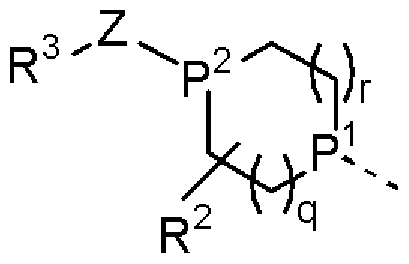
により表される基の好まし 、具体例としては、以下の基があげられる。 Preferable examples of the group represented by the following include the following groups.
[化 8] [6^] [esoo] [Chemical 8] [6 ^] [esoo]

806CZC/900Zdf/X3d 17C6C90/.00Z OAV 806CZC / 900Zdf / X3d 17C6C90 / .00Z OAV

[0036] [化 10] [0036] [Chemical 10]

[0037] [化 11] [0037] [Chemical 11]

[0038] 本発明化合物の製薬上許容しうる塩としては、例えば塩酸塩、硫酸塩、リン酸塩、 臭化水素酸塩等の無機酸塩、酢酸塩、フマル酸塩、シユウ酸塩、クェン酸塩、メタン スルホン酸塩、ベンゼンスルホン酸塩、トシル酸塩、マレイン酸塩等の有機酸塩等が 挙げられる。また、カルボキシ等の酸性基を有する場合には塩基との塩 (例えばナトリ ゥム塩、カリウム塩等のアルカリ金属塩、カルシウム塩等のアルカリ土類金属塩、トリ ェチルァミン塩等の有機塩基塩、リジン塩等のアミノ酸塩等)も挙げられる。 [0038] Examples of the pharmaceutically acceptable salt of the compound of the present invention include inorganic acid salts such as hydrochloride, sulfate, phosphate and hydrobromide, acetate, fumarate, oxalate, and queen. And organic acid salts such as acid salts, methanesulfonates, benzenesulfonates, tosylates, and maleates. In addition, when it has an acidic group such as carboxy, a salt with a base (for example, an alkali metal salt such as sodium salt or potassium salt, an alkaline earth metal salt such as calcium salt, an organic base salt such as triethylamine salt, And amino acid salts such as lysine salts).
[0039] 本発明化合物またはその製薬上許容しうる塩には、その分子内塩、その水和物等 の溶媒和物の 、ずれもが含まれる。 [0039] The compound of the present invention or a pharmaceutically acceptable salt thereof includes deviations from solvates such as inner salts and hydrates thereof.
本発明化合物 (I)には不斉炭素に基づく光学異性体が存在しうるが、本発明化合 物 (I)は、それらいずれの異性体およびそれらの混合物をも包含する。さらに、本発 明化合物 (I)に二重結合あるいはシクロアルカンジィルを有する場合は、シス体、トラ ンス体が存在し、本発明化合物 (I)にはカルボ-ルなどの不飽和結合に基づく互変 異性体が存在しうるが、本発明化合物 (I)は、それらいずれの異性体およびそれらの 混合物をも包含する。また、本発明化合物は、 N—オキサイドを包含する。 The compound (I) of the present invention may have optical isomers based on asymmetric carbon, but the compound (I) of the present invention includes any of these isomers and mixtures thereof. Further, when the compound (I) of the present invention has a double bond or a cycloalkanedyl, a cis isomer or a trans isomer exists, and the compound (I) of the present invention is based on an unsaturated bond such as a carbole. Although tautomeric isomers may exist, the compound (I) of the present invention includes any of these isomers and mixtures thereof. The compound of the present invention includes N-oxide.
[0040] 本発明の化合物(1)は、以下の方法により製造することができる。 [0040] The compound (1) of the present invention can be produced by the following method.
方法 P1が Nである化合物(1)は、以下の方法により調製される。 Compound method P 1 is a N (1) is prepared by the following method.
[化 12]

( 2 ) (2)
( 1-A ) (1-A)
(式中、 Lvはハロゲンまたは CH S (O) (式中、 pは 0、 1または 2を示す。)を示し、他 (Wherein Lv represents halogen or CH 2 S (O) (wherein p represents 0, 1 or 2), etc.)
3 P 3 P
の記号は前記と同義である。 ) The symbol is as defined above. )
化合物(2)をィ匕合物(3)と溶媒 (THF、ジォキサン、ジェチルエーテル、 DMF、 D MSO、メタノール、エタノール、エチレングリコールなど)中、塩基(トリエチルァミン、 ジイソプロピルェチルァミン、ピリジン、水酸化ナトリウム、水酸ィ匕カリウム、炭酸ナトリ ゥム、炭酸カリウムなど)の存在下、 0〜150°Cで 1〜24時間反応させることにより、化 合物(1 A)が得られる。 Compound (2) in compound (3) and solvent (THF, dioxane, jetyl ether, DMF, DMSO, methanol, ethanol, ethylene glycol, etc.), base (triethylamine, diisopropylethylamine, Compound (1 A) is obtained by reacting at 0 to 150 ° C for 1 to 24 hours in the presence of pyridine, sodium hydroxide, potassium hydroxide, sodium carbonate, potassium carbonate, etc. .
方法 2 : P2が Nであり、 Zがー CO—または SO—である化合物(1)は、以下の方 Method 2: Compound (1) wherein P 2 is N and Z is —CO— or SO—
2 2
法により調製される。 Prepared by the method.
[化 13] [Chemical 13]
R3_Z1— Hal R 3 _Z 1 — Hal
( 5-a ) (5-a)

(式中、 Z1は CO—または SO を示し、 Halはハロゲンを示し、他の記号は前 (In the formula, Z 1 represents CO— or SO, Hal represents halogen, and other symbols are
2 2
記と同義である。 ) It is synonymous with the above. )
(1)化合物 (4)を塩基 (炭酸水素ナトリウム、炭酸カリウム、トリェチルァミン、ピリジン など)の存在下、—20°C力も室温で 30分から 24時間、化合物(5— a)と反応させるこ とにより、化合物(1 B)が得られる。 (1) By reacting compound (4) with compound (5-a) in the presence of a base (sodium hydrogen carbonate, potassium carbonate, triethylamine, pyridine, etc.) at -20 ° C force at room temperature for 30 minutes to 24 hours. Compound (1 B) is obtained.
(2)化合物 (4)を必要に応じて溶媒 (DMF、 THF、ジォキサンなど)中、縮合剤(1, 3 ジシクロへキシルカルボジイミド、 1—ェチル 3— (3 ジメチルァミノプロピル) カルボジイミド、カルボ-ルジイミダゾール、シアノリン酸ジェチルなど)の存在下、ィ匕 合物(5— b)と縮合させることにより、化合物(1 B)が得られる。本反応は通常 0°Cか ら 100°Cで、通常 30分から 24時間で進行する。なお、縮合剤を用いる反応は、必要 に応じて 1—ヒドロキシベンズトリァゾール、 N—ヒドロキシスクシンイミドなどの存在下 で行うことちできる。 (2) Compound (4) in a solvent (DMF, THF, dioxane, etc.) as necessary in a condensing agent (1, 3) Dicyclohexylcarbodiimide, 1-ethyl 3- (3 dimethylaminopropyl) carbodiimide, carbodiimidazole, cyanoethyl jetyl, etc.) in the presence of compound (5-b) (1 B) is obtained. This reaction usually proceeds from 0 ° C to 100 ° C, usually from 30 minutes to 24 hours. The reaction using a condensing agent can be carried out in the presence of 1-hydroxybenztriazole, N-hydroxysuccinimide, etc. as necessary.
(3)化合物 (4)を混合酸無水物(クロ口炭酸メチル、クロ口炭酸ェチルなどとの炭酸ェ ステルなど)に変換し、当該混合酸無水物を適当な溶媒 (THF、トルエン、ニトロベン ゼンあるいはこれらの混合溶媒など)中、塩基(トリエチルァミン、ピリジンなど)の存在 下、室温力 溶媒の還流温度で 1から 24時間、化合物(5— b)と縮合させることにより 、化合物(1 B)が得られる。 (3) Convert compound (4) into a mixed acid anhydride (such as carbonic acid ester with methyl carbonate or ethyl carbonate), and use the mixed acid anhydride in an appropriate solvent (THF, toluene, nitrobenzene). Alternatively, in the presence of a base (triethylamine, pyridine, etc.) in the presence of a base (triethylamine, pyridine, etc.) in the presence of a base at a reflux temperature of the solvent for 1 to 24 hours, the compound (1 B ) Is obtained.
方法 3:環 Aが基 (A)〜(F)または(I)〜(K)であり、 が― N (R7)—または— O— であり、 Yがー C (R1C)) (R11)一であり、 P1が Nである化合物(1)は、以下の方法により 調製される。 Method 3: Ring A is a group (A) to (F) or (I) to (K), is —N (R 7 ) — or —O—, and Y is —C (R 1C) ) ( Compound (1) wherein R 11 ) is 1 and P 1 is N is prepared by the following method.
[化 14] [Chemical 14]

( 1-C ) (1-C)
(式中、環 A1は基 ( A)〜 (F)または (I)〜 (K)を示し、 X1は— N (R7)—または— O— を示し、他の記号は前記と同義である。 ) (Wherein ring A 1 represents a group (A) to (F) or (I) to (K), X 1 represents —N (R 7 ) — or —O—, and the other symbols are as defined above. Synonymous.)
化合物(6)と化合物(7)との反応および化合物(8)と化合物(3)との反応は、それ ぞれ方法 1と同様に実施することができる。 The reaction between compound (6) and compound (7) and the reaction between compound (8) and compound (3) It can be carried out in the same way as in Method 1.
方法 4 :環 Aが基(G)であり、 Xがー N (R7)—または—O—であり、 P1が Nである化 合物(1)は、以下の方法により調製される。 Method 4: Ring A is a group (G), X gar N (R 7) - or -O-, and compounds of P 1 is a N (1) is prepared by the following method .
[化 15] [Chemical 15]

( 14 ) ( 1-D ) ( 14 ) (1-D)
(式中、 pは 0、 1または 2を示し、他の記号は前記と同義である。 ) (Wherein p represents 0, 1 or 2, and other symbols are as defined above.)
化合物(9)を溶媒 (THF、ジェチルエーテル、ジォキサンなど)中、— 78°Cから氷 冷下で、塩基 (n—ブチルリチウム、 LDAなど)と処理した後、同温度で 1〜12時間二 酸化炭素と反応させることにより、化合物(10)が得られる。 Compound (9) is treated with a base (n-butyllithium, LDA, etc.) in a solvent (THF, jetyl ether, dioxane, etc.) at -78 ° C under ice cooling, and then at the same temperature for 1-12 hours. Compound (10) is obtained by reacting with carbon dioxide.
化合物(10)を方法 1と同様に化合物(7)と反応させることにより、化合物(11)が得 られる。 Compound (11) is obtained by reacting compound (10) with compound (7) in the same manner as in Method 1.
化合物(11)と R4NHとの反応は、方法 2と同様に実施することができる。なお、化 合物(11)の酸ノヽライドは、常法により、ハロゲン化剤 (塩ィ匕チォ-ルなど)と処理して 調製される。 The reaction of compound (11) with R 4 NH can be carried out in the same manner as in Method 2. In addition, The compound (11) acid halide is prepared by treating with a halogenating agent (such as a salt salt) by a conventional method.
化合物(12)を溶媒 (THF、ジェチルエーテル、ジォキサンなど)中、 0°Cから溶媒 の還流温度で 1時間〜 10日間アンモニアと反応させることにより、化合物(13)が得ら れる。 Compound (13) is obtained by reacting compound (12) with ammonia in a solvent (THF, jetyl ether, dioxane, etc.) from 0 ° C. to the reflux temperature of the solvent for 1 hour to 10 days.
化合物(13)をオルトギ酸トリアルキル (オルトギ酸トリメチル、オルトギ酸トリエチル、 オルトギ酸トリプロピル、オルトギ酸トリブチルなど)と酸 (酢酸、無水酢酸、塩酸、硫酸 など)の存在下、室温から 150°Cで 1〜12時間反応させることにより、化合物(14)が 得られる。 Compound (13) is trialkyl orthoformate (trimethyl orthoformate, triethyl orthoformate, tripropyl orthoformate, tributyl orthoformate, etc.) and acid (acetic acid, acetic anhydride, hydrochloric acid, sulfuric acid, etc.) in the presence of room temperature to 150 ° C The compound (14) is obtained by reacting for 1 to 12 hours.
WO01Z83460に記載の方法に準じて、化合物(14)を溶媒(DMF、 DMSO、ク ロロホルム、塩化メチレン、 THFなど)中、塩基(トリエチルァミン、ジイソプロピルェチ ルァミン、ピリジンなど)の存在下、化合物(3)と 0〜100°Cで 1時間〜 2日間反応させ ることにより、化合物(1— D)が得られる。なお、 pが 0である化合物(14)は、常法によ り、酸化剤 (メタクロ口過安息香酸、過酸ィ匕水素など)と処理し、 pが 1または 2である化 合物(14)とした後、本反応に用いることができる。 In accordance with the method described in WO01Z83460, compound (14) is compounded in a solvent (DMF, DMSO, chloroform, methylene chloride, THF, etc.) in the presence of a base (triethylamine, diisopropylethylamine, pyridine, etc.). Compound (1-D) is obtained by reacting (3) at 0-100 ° C for 1 hour to 2 days. The compound (14) in which p is 0 is treated with an oxidizing agent (eg, metabenzoic perbenzoic acid, hydrogen peroxide) in a conventional manner, and a compound in which p is 1 or 2 ( After 14), it can be used in this reaction.
方法 5 :環 Aが基 (H)であり、 Xが— N (R7)—または— O—であり、 Yが— C (R1C>) (R n)—であり、 P1が Nである化合物(1)は、以下の方法により調製される。 Method 5: Ring A is a group (H), X is —N (R 7 ) —or —O—, Y is —C (R 1C> ) (R n ) —, and P 1 is N Compound (1) is prepared by the following method.
[化 16] [Chemical 16]


( 1-E ) (1-E)
(式中、各記号は前記と同義である。 ) (In the formula, each symbol has the same meaning as described above.)
化合物(15)を DMFおよびォキシ塩化リンまたはォキシ臭化リンと室温力も溶媒の 還流温度で 1〜 12時間反応させることにより、化合物(16)が得られる。 Compound (16) is obtained by reacting compound (15) with DMF and phosphorus oxychloride or phosphorus oxybromide at room temperature for 1 to 12 hours at the reflux temperature of the solvent.
化合物(16)と化合物(7)との反応は、方法 1と同様に実施することができる。 The reaction of compound (16) and compound (7) can be carried out in the same manner as in Method 1.
化合物(17)を化合物(18)と溶媒 (メタノール、エタノール、イソプロピルアルコール 、クロ口ホルム、塩化メチレン、 DMF、 DMSO、 THF、ジォキサンなど)中、必要に応 じて酸 (塩酸、硫酸、酢酸、トリフルォロ酢酸など)の存在下、還元剤(水素化ホウ素ナ トリウム、水素化シァノホウ素ナトリウム、トリァセトキシ水素化ホウ素ナトリウムなど)と 反応させることにより、化合物(19)が得られる。本反応は室温から溶媒の還流温度 で 30分から 2日間実施することができる。 Compound (17) in compound (18) and solvent (methanol, ethanol, isopropyl alcohol, black mouth form, methylene chloride, DMF, DMSO, THF, dioxane, etc.), if necessary, acid (hydrochloric acid, sulfuric acid, acetic acid, Compound (19) is obtained by reacting with a reducing agent (such as sodium borohydride, sodium cyanoborohydride, sodium triacetoxyborohydride) in the presence of trifluoroacetic acid. This reaction can be carried out at room temperature to the reflux temperature of the solvent for 30 minutes to 2 days.
化合物(19)を溶媒 (THF、ジォキサン、ジェチルエーテル、 DMF、 DMSOなど) 中、塩基(トリエチルァミン、ピリジン、水素化ナトリウム、カリウム t—ブトキシド、ナトリウ ム t—ブトキシドなど)の存在下、室温力も溶媒の還流温度で 1〜24時間処理すること により、 R化合物(20)が得られる。 Compound (19) as solvent (THF, dioxane, jetyl ether, DMF, DMSO, etc.) In the presence of a base (triethylamine, pyridine, sodium hydride, potassium t-butoxide, sodium t-butoxide, etc.), the R compound (20 ) Is obtained.
方法 1と同様に、化合物(20)を化合物(3)と反応させることにより、化合物(1— E) が得られる。 In the same manner as in Method 1, compound (1-E) is obtained by reacting compound (20) with compound (3).
方法 6:環 Aが基 (I)または COである化合物(6)は、以下の方法により調製される。 Method 6: Compound (6) wherein ring A is group (I) or CO is prepared by the following method.
[化 17] [Chemical 17]
ノ

( 21 ) ( 22 ) ( 6-A ) (21) (22) (6-A)
(式中、 Vは CHまたは Nを示し、 RAはアルキルを示し、他の記号は前記と同義である o ) (In the formula, V represents CH or N, R A represents alkyl, and other symbols are as defined above.)
化合物(21)をマロン酸ジアルキルエステルと溶媒 (メタノール、エタノール、イソプロ ピルアルコールなど)中、塩基 (ナトリウムメトキシド、ナトリウムエトキシド、カリウムメトキ シドなど)の存在下、室温力 溶媒の還流温度で 1〜48時間反応させることにより、 化合物(22)が得られる。 Compound (21) in a malonic acid dialkyl ester and a solvent (methanol, ethanol, isopropyl alcohol, etc.) in the presence of a base (sodium methoxide, sodium ethoxide, potassium methoxide, etc.) at room temperature and at the reflux temperature of the solvent. Compound (22) is obtained by reacting for ~ 48 hours.
化合物(22)を方法 3のハロゲン化反応と同様に反応させることにより化合物(6— A )が得られる。 Compound (6-A) is obtained by reacting Compound (22) in the same manner as in the halogenation reaction of Method 3.
方法 7:環 Aが基 (A)または(B)である化合物(6)は、以下の方法により調製される Method 7: Compound (6) wherein ring A is group (A) or (B) is prepared by the following method
[化 18]
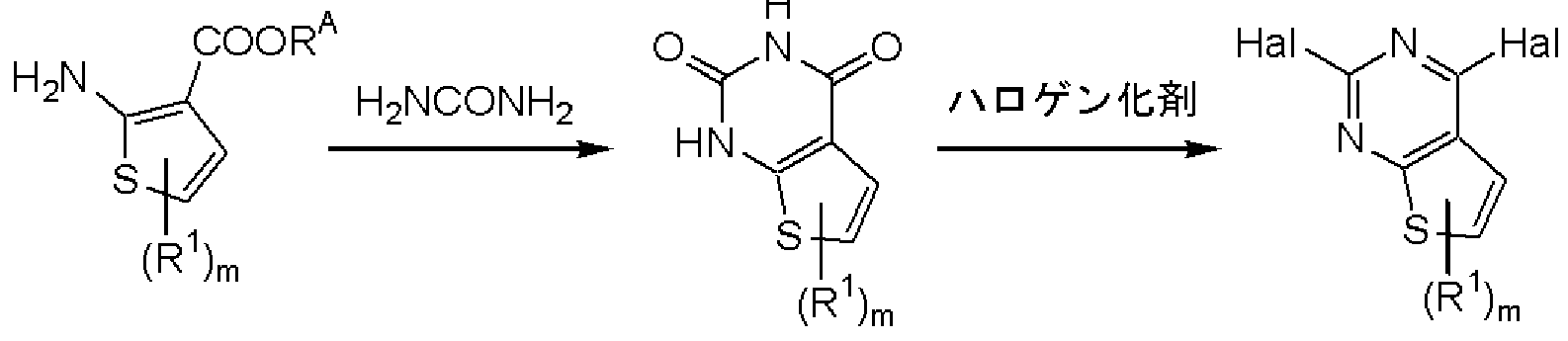
23-a )

(式中、各記号は前記と同義である。 ) (In the formula, each symbol has the same meaning as described above.)
化合物(23— a)または化合物(23— b)を尿素と 100〜250°Cで 1〜12時間反応さ せることにより、化合物(24— a)または化合物(24— b)が得られる。 Compound (24-a) or compound (24-b) is obtained by reacting compound (23-a) or compound (23-b) with urea at 100 to 250 ° C. for 1 to 12 hours.
化合物(24— a)または化合物(24— b)を、方法 3のハロゲン化反応と同様に反応 させることにより、化合物(6— B)または化合物(6— C)が得られる。 Compound (6-B) or Compound (6-C) is obtained by reacting Compound (24-a) or Compound (24-b) in the same manner as the halogenation reaction in Method 3.
方法 8:環 Aが基 (F)である化合物(6)は、以下の方法により調製される。 Method 8: Compound (6) wherein ring A is group (F) is prepared by the following method.
[化 19] [Chemical 19]

( 25 ) ( 26 ) ( 6-D ) (25) (26) (6-D)
(式中、 Gはカルボキシまたはシァノを示し、他の記号は前記と同義である。 ) 化合物(26)は、 Tetrahedron, 58, (2002) 3155- 3158または WO95Z32205に記 載の方法に準じて調整される。すなわち、(1) Gがシァノである化合物(25)を二酸ィ匕 炭素と溶媒(DMF、 DMSO、 THFなど)中、過剰量の塩基(DBU、 DBNなど)の存 在下、室温から 100°Cで 1〜48時間反応させる力、または(2) Gがカルボキシである 化合物(25)を尿素と 100〜250°Cで 1〜12時間反応させることにより、化合物(26) が得られる。 化合物(26)を方法 3のハロゲン化反応と同様に反応させることにより、化合物(6 D)が得られる。 (In the formula, G represents carboxy or cyan, and other symbols are as defined above.) Compound (26) was prepared according to the method described in Tetrahedron, 58, (2002) 3155-3158 or WO95Z32205. Is done. (1) Compound (25), in which G is cyan, is dissolved in carbon dioxide and a solvent (DMF, DMSO, THF, etc.) in the presence of an excess amount of base (DBU, DBN, etc.) from room temperature to 100 ° C. The force of reacting with C for 1 to 48 hours, or (2) Compound (25) in which G is carboxy is reacted with urea at 100 to 250 ° C. for 1 to 12 hours to obtain Compound (26). Compound (6D) is obtained by reacting Compound (26) in the same manner as in the halogenation reaction of Method 3.
方法 9:環 Aが基 (E)である化合物(6)は、以下の方法により調製される。 Method 9: Compound (6) wherein ring A is group (E) is prepared by the following method.
[化 20] [Chemical 20]

( 6-E ) (6-E)
(式中、各記号は前記と同義である。 ) (In the formula, each symbol has the same meaning as described above.)
本反応は特開昭 58— 146586に記載の方法に準じて調製される。すなわち、化合 物(27)を化合物(28)またはその塩 (塩酸塩、硫酸塩など)と溶媒 (メタノール、ェタノ ール、イソプロピルアルコール、 DMF、 DMSOなど)中、塩基(水酸化ナトリウム、水 酸ィ匕カリウム、炭酸ナトリウム、炭酸カリウム、水素化ナトリウム、ナトリウムメトキシド、ナ トリウムエトキシドなど)の存在下、室温から 100°Cで 1〜12時間反応させることにより 、化合物(29)が得られる。 This reaction is prepared according to the method described in JP-A-58-146586. That is, compound (27) is converted into compound (28) or a salt thereof (hydrochloride, sulfate, etc.) and a solvent (methanol, ethanol, isopropyl alcohol, DMF, DMSO, etc.) and a base (sodium hydroxide, hydroxide). In the presence of potassium, sodium carbonate, potassium carbonate, sodium hydride, sodium methoxide, sodium ethoxide, etc.) at room temperature to 100 ° C. for 1-12 hours to obtain compound (29) .
化合物(29)を溶媒 (含水メタノール、含水エタノール、水など)中、酸 (酢酸、塩酸、 硫酸など)またはアルカリ(水酸化ナトリウム、水酸ィ匕カリウムなど)と室温から溶媒の 還流温度で 1時間から 3日間反応させることにより、化合物(30)が得られる。 Compound (29) in a solvent (hydrous methanol, hydrous ethanol, water, etc.), acid (acetic acid, hydrochloric acid, sulfuric acid, etc.) or alkali (sodium hydroxide, potassium hydroxide, etc.) and from room temperature to the reflux temperature of the solvent 1 Compound (30) is obtained by reacting for 3 days from time.
化合物(30)を方法 3のハロゲン化反応と同様に反応させることにより、化合物(6— E)が得られる。 Compound (6-E) is obtained by reacting Compound (30) in the same manner as in the halogenation reaction of Method 3.
方法 10 :環 Aが基 (E)であり、 wが 1または 2である化合物(1)は、以下の方法により 調製される。 Method 10: Compound (1) wherein ring A is group (E) and w is 1 or 2 is prepared by the following method.
[化 21]

(1-F) (1-G) (1-F) (1-G)
(式中、 wlは 1または 2を示し、他の記号は前記と同義である。 ) (Wherein, wl represents 1 or 2, and other symbols are as defined above.)
化合物(1—F)を溶媒 (酢酸、ジォキサン、クロ口ホルム、塩化メチレンなど)中、酸 ィ匕剤 (メタクロ口過安息香酸、過酸ィ匕水素など)と 0〜100°Cで 30分から 24時間反応 させることにより、化合物(1 G)が得られる。 Compound (1-F) in a solvent (acetic acid, dioxane, chloroform, methylene chloride, etc.), with an acidic agent (metachloroperbenzoic acid, hydrogen peroxide, etc.) at 0-100 ° C for 30 minutes The compound (1 G) is obtained by reacting for 24 hours.
方法 l P1が CHであり、 Xが— N(R7)—または— O であり、 Yが— C(R10) (R ) —である化合物 (4)は、以下の方法により調製される。 Method l Compound (4) wherein P 1 is CH, X is —N (R 7 ) — or —O and Y is —C (R 10 ) (R) — is prepared by the following method: The
[化 22] [Chemical 22]

(31 ) (32)

(式中、各記号は前記と同義である。 ) (In the formula, each symbol has the same meaning as described above.)
化合物(31)と化合物(7)との反応は、方法 1と同様に実施することができる。 The reaction of compound (31) and compound (7) can be carried out in the same manner as in Method 1.
化合物(32)を溶媒 (メタノール、エタノール、イソプロピルアルコールなど)中、室温 から溶媒の還流温度で 1〜24時間、塩基 (水酸化ナトリウム、水酸化カリウム、炭酸ナ トリウム、炭酸カリウムなど)と処理することにより、化合物 (4— a)が得られる。 Compound (32) is treated with a base (sodium hydroxide, potassium hydroxide, sodium carbonate, potassium carbonate, etc.) in a solvent (methanol, ethanol, isopropyl alcohol, etc.) at room temperature to the reflux temperature of the solvent for 1-24 hours. Thus, compound (4-a) is obtained.
方法 12:環 Aが基 (I)または COである化合物(31)は、以下の方法により調製される [化 23] Method 12: Compound (31) wherein Ring A is the group (I) or CO is prepared by the following method [Chemical 23]

(式中、各記号は前記と同義である。 ) (In the formula, each symbol has the same meaning as described above.)
化合物(33)を溶媒 (THF、ジォキサンなど)中、カルボ-ルジイミダゾールと処理し た後、化合物(34)と反応させることにより、化合物(35)が得られる。本反応は、室温 力 100°Cで 1〜12時間実施することができる。 Compound (35) is obtained by treating compound (33) with carbodiimidazole in a solvent (THF, dioxane, etc.) and then reacting with compound (34). This reaction can be carried out at a room temperature force of 100 ° C for 1 to 12 hours.
化合物(35)を化合物(21)と溶媒 (酢酸など)中または無溶媒で、 50〜150°Cで 1 〜48時間反応させることにより、化合物(36)が得られる。 Compound (36) is obtained by reacting compound (35) with compound (21) in a solvent (such as acetic acid) or without solvent at 50 to 150 ° C. for 1 to 48 hours.
化合物(36)を方法 3のハロゲン化反応と同様に反応させることにより、化合物(31 — a)が得られる。 Compound (31) is obtained by reacting compound (36) in the same manner as in the halogenation reaction of Method 3.
方法 13 :環 Aが基 (A)であり、 Xが— N (R7)—または— O—であり、 Yが— C (R1C)) ( R11)—であり、 mが 1であり、 R1がアルコキシカルボ-ルである化合物(1)は、以下の 方法により調製される。 Method 13: Ring A is the group (A), X is —N (R 7 ) —or —O—, Y is —C (R 1C) ) (R 11 ) —, and m is 1. Compound (1) wherein R 1 is an alkoxy carbo hydrate is prepared by the following method.
[化 24] [Chemical 24]

( 1-1 ) (1-1)
(式中、各記号は前記と同義である。 ) (In the formula, each symbol has the same meaning as described above.)
化合物(17)を化合物(37)と溶媒 (メタノール、エタノール、イソプロピルアルコール など)中、塩基(トリエチルァミン、ジイソプロピルェチルァミン、ピリジンなど)の存在下 、 0〜100°Cで 1〜12時間反応させることにより、化合物(38)が得られる。 Compound (17) is compounded with Compound (37) and solvent (methanol, ethanol, isopropyl alcohol, etc.) in the presence of a base (triethylamine, diisopropylethylamine, pyridine, etc.) at 0-100 ° C for 1-12 Compound (38) is obtained by reacting for a period of time.
化合物(38)を化合物(3)と方法 1と同様に反応させることにより、化合物(1—I)が 得られる。 Compound (1-I) is obtained by reacting compound (38) with compound (3) in the same manner as in Method 1.
方法 14 : Gがシァノであり、 Rlaがアルコキシカルボ-ルである化合物(25)は、以下 の方法により調製される。 Method 14: Compound (25), in which G is cyan and R la is alkoxycarbo ol, is prepared by the following method.
[化 25]

( 39 ) ( 40 ) ( 25-a ) (39) (40) (25-a)
(式中、各記号は前記と同義である。 ) (In the formula, each symbol has the same meaning as described above.)
化合物(39)をアクリロニトリルと溶媒(ベンゼン、トルエン、キシレン、クロ口ホルム、 塩化メチレンなど)中、室温力も溶媒の還流温度で 1〜24時間反応させることにより、 化合物 (40)が得られる。 化合物 (40)を三フッ化ホウ素 ·ジェチルエーテル錯体と好ましくは還流温度で 1〜 12時間反応させることにより、化合物(25— a)が得られる。 Compound (40) is obtained by reacting compound (39) with acrylonitrile in a solvent (benzene, toluene, xylene, chloroform, methylene chloride, etc.) at room temperature for 1 to 24 hours at the reflux temperature of the solvent. Compound (25-a) is obtained by reacting compound (40) with a boron trifluoride · jetyl ether complex, preferably at reflux temperature for 1 to 12 hours.
方法 15 : P1および P2が Nであり、 Zがー CO—である化合物(3)は、以下の方法によ り調製される。 Method 15: Compound (3) wherein P 1 and P 2 are N and Z is —CO— is prepared by the following method.
[化 26][Chemical 26]

( 41 ) ( 43 ) ( 3-a ) (41) (43) (3-a)
(式中、 Jはべンジルォキシカルボ-ル、 Bocなどのァミノ保護基を示し、 L2は、ハロゲ ン、アルコキシなどの脱離基を示し、他の記号は前記と同義である。 ) (In the formula, J represents an amino protecting group such as benzyloxycarbon and Boc, L 2 represents a leaving group such as halogen and alkoxy, and other symbols are as defined above.)
化合物 (41)を化合物 (42)と、方法 1と同様に反応させることにより、化合物 (43)が 得られる。 Compound (43) is obtained by reacting compound (41) with compound (42) in the same manner as in Method 1.
化合物 (43)を、常法により、ノラジウム—炭素を用いた接触還元または酸 (トリフル ォロ酢酸、塩酸など)で脱保護することにより、化合物(3— a)が得られる。 Compound (3-a) is obtained by subjecting compound (43) to deprotection by catalytic reduction using noradium-carbon or an acid (trifluoroacetic acid, hydrochloric acid, etc.) by a conventional method.
方法 16 :環 Aが基 (L)であり、 P1が Nであり、 Xがー N (R7)—または—O—であり、 Y が— C (R1C>) (R11)—である化合物(1)は、以下の方法により調製される。 Method 16: Ring A is a group (L), P 1 is N, X is —N (R 7 ) —or —O—, and Y is —C (R 1C> ) (R 11 ) — Compound (1) is prepared by the following method.
[化 27] [Chemical 27]


( i-J ) (i-J)
(式中、各記号は前記と同義である。 ) (In the formula, each symbol has the same meaning as described above.)
化合物( 13— a)を化合物 (44 a)または化合物 (44 b)と溶媒 (THF、ジォキサ ン、 DMF、 DMSO、メタノール、エタノール、イソプロピルアルコールなど)中、必要 に応じて塩基(トリエチルァミン、ジイソプロピルェチルァミン、ピリジンなど)の存在下 、室温力 溶媒の還流温度で 1〜24時間反応させることにより、化合物 (45)が得ら れる。 Compound (13-a) in compound (44a) or compound (44b) and solvent (THF, dioxane, DMF, DMSO, methanol, ethanol, isopropyl alcohol, etc.), if necessary, a base (triethylamine, In the presence of diisopropylethylamine, pyridine, etc.), the compound (45) is obtained by reacting at room temperature for 1 to 24 hours at the reflux temperature of the solvent.
化合物 (45)を化合物(3)と方法 1と同様に反応させることにより、化合物(1 -J)が 得られる。 Compound (1 -J) is obtained by reacting compound (45) with compound (3) in the same manner as in Method 1.
方法 17 :環 Aが基 (N)であり、 P1が Nであり、 Xが— N (R7)—または— O であり、 Yが— C (R1C>) (R11)—である化合物(1)は、以下の方法により調製される。 Method 17: Ring A is a group (N), P 1 is N, X is —N (R 7 ) —or —O , and Y is —C (R 1C> ) (R 11 ) — A certain compound (1) is prepared by the following method.
[化 28] [Chemical 28]


( 1 -κ ) (1 -κ)
(式中、各記号は前記と同義である。 ) (In the formula, each symbol has the same meaning as described above.)
化合物(11)を溶媒(DMF、 DMSO、 THF、ジォキサンなど)中、アジ化金属塩( アジィ匕ナトリウム、アジィ匕カリウムなど)と室温から 100°Cで 1〜12時間反応させること により、化合物 (46)が得られる。 By reacting compound (11) with a metal azide salt (such as sodium azide or potassium azide) in a solvent (DMF, DMSO, THF, dioxane, etc.) at room temperature to 100 ° C for 1 to 12 hours, 46) is obtained.
化合物 (46)を化合物(3)と方法 1と同様に反応させることにより、化合物(1— K)が 得られる。 Compound (1-K) is obtained by reacting compound (46) with compound (3) in the same manner as in Method 1.
方法 18 :環 Aが基(O)であり、 P1が Nであり、 Xが— N (R7)—または— O—であり、 Yが— C (R1C>) (R11)—である化合物(1)は、以下の方法により調製される。 Method 18: Ring A is a group (O), P 1 is N, X is —N (R 7 ) —or —O—, and Y is —C (R 1C> ) (R 11 ) — Compound (1) is prepared by the following method.
[化 29] [Chemical 29]


( 1 -L ) (1 -L)
(式中、各記号は前記と同義である。 ) (In the formula, each symbol has the same meaning as described above.)
化合物(11)を溶媒(DMF、 DMSO、メタノール、エタノールなど)中、ヒドラジンと 0 〜50°Cで 1〜24時間反応させることにより、化合物 (47)が得られる。 Compound (47) is obtained by reacting compound (11) with hydrazine in a solvent (DMF, DMSO, methanol, ethanol, etc.) at 0 to 50 ° C. for 1 to 24 hours.
化合物(47)を化合物(48)と溶媒 (THF、 DMF、 DMSO、メタノール、エタノール など)中または無溶媒で、室温から溶媒の還流温度で 1〜24時間反応させることによ り、化合物 (49)が得られる。 By reacting compound (47) with compound (48) in a solvent (THF, DMF, DMSO, methanol, ethanol, etc.) or without solvent at room temperature to the reflux temperature of the solvent for 1 to 24 hours, compound (49) ) Is obtained.
化合物 (49)を化合物(3)と方法 1と同様に反応させることにより、化合物(1 L)が 得られる。 Compound (1 L) is obtained by reacting compound (49) with compound (3) in the same manner as in Method 1.
方法 19 :環 Aが基(M)であり、 P1が Nであり、 Xがー N (R7) または—O であり、 Yが— C (R1C>) (R11)—である化合物(1)は、以下の方法により調製される。 Method 19: Ring A is a group (M), P 1 is N, X is —N (R 7 ) or —O, and Y is —C (R 1C> ) (R 11 ) — Compound (1) is prepared by the following method.
[化 30] [Chemical 30]

( 1 -M ) (1 -M)
(式中、各記号は前記と同義である。 ) (In the formula, each symbol has the same meaning as described above.)
化合物(49)を溶媒 (DMF、 DMSO、 THF、ジォキサンなど)中、加熱することによ り、化合物(50)が得られる。 Compound (50) is obtained by heating compound (49) in a solvent (DMF, DMSO, THF, dioxane, etc.).
化合物(50)を化合物(3)と方法 1と同様に反応させることにより、化合物(1—M) が得られる。 Compound (1-M) is obtained by reacting compound (50) with compound (3) in the same manner as in Method 1.
[0059] 方法 20 :環 Aが基(P)、(Q)および (R)である化合物(1)は、 WO01Z83460およ ひ ΈΡ1195378に記載の方法および上記方法に準じて調製することができる。 [0059] Method 20: Compound (1) wherein ring A is a group (P), (Q) and (R) can be prepared according to the method described in WO01Z83460 and 1195378 and the above method.
[0060] 方法 21:環 A1が基(C)であり、 Lvがハロゲンである化合物(6)は、以下の方法により 調製される。 [0060] Method 21: Compound (6) wherein ring A1 is group (C) and Lv is halogen is prepared by the following method.
[化 31] [Chemical 31]

( 51 ) ( 52 ) ( 53 ) (51) (52) (53)
H2NCONH 2H 2 NCONH 2

( 54 ) ( 6-F ) (54) (6-F)
(式中、 Rbは水素またはアルキルを示し、 ΡΊまハロゲンを示し、他の記号は前記と同 義である。 ) (In the formula, R b represents hydrogen or alkyl, or represents halogen, and other symbols are as defined above.)
化合物(51)を常法によりアンモニア水と処理して化合物(52)とした後、化合物(5 2)を、溶媒(例えば、水、メタノール、エタノール、 tert—ブチルアルコール、 THF、ジ ォキサン、酢酸ェチル、酢酸、キシレン、 DMF、 DMSOまたはそれらの混合物)中、 還元することにより化合物(53)が得られる。還元反応は、例えば水素化ホウ素ナトリ ゥム、水素化ホウ素リチウム、水素化アルミニウムリチウム等の還元剤を用いる力 金 属 (鉄、亜鉛、スズ等)を用いるか、または遷移金属 (パラジウム—炭素、酸化白金、ラ ネーニッケル、ロジウム、ルテニウム等)を用いた接触還元などによっても行うことがで きる。なお、接触還元を行う場合、水素源はギ酸、ギ酸アンモ-ゥム、 1, 4—シクロへ キサジェン等であってもよい。本反応は、通常— 20〜150°Cで、通常 30分間から 48 時間で進行する。 Compound (51) is treated with aqueous ammonia by a conventional method to give compound (52), and then compound (52) is converted into a solvent (for example, water, methanol, ethanol, tert-butyl alcohol, THF, dioxane, acetic acid). (53) is obtained by reduction in ethyl, acetic acid, xylene, DMF, DMSO or a mixture thereof. For the reduction reaction, for example, a power metal (iron, zinc, tin, etc.) using a reducing agent such as sodium borohydride, lithium borohydride, lithium aluminum hydride, or a transition metal (palladium-carbon, It can also be carried out by catalytic reduction using platinum oxide, Raney nickel, rhodium, ruthenium, etc.). In the case of performing catalytic reduction, the hydrogen source may be formic acid, ammonium formate, 1,4-cyclohexane, and the like. This reaction usually proceeds at -20 to 150 ° C, usually 30 minutes to 48 hours.
化合物(53)を尿素と 100〜250°Cで 1〜12時間反応させることにより、化合物(54 )が得られる。 Compound (54) is obtained by reacting compound (53) with urea at 100 to 250 ° C. for 1 to 12 hours.
化合物(54)を、溶媒(ベンゼン、トルエン、キシレン、クロ口ホルム、塩化メチレン、 ァセトニトリル、 DMFなど)中または無溶媒で、必要に応じて塩基 (ジメチルァ-リン、 ジェチルァニリン、トリエチルァミン、コリジン、ピリジン、ジイソプロピルェチルァミンな ど)の存在下、室温力も溶媒の還流温度で 1〜12時間ハロゲン化剤 (ォキシ塩化リン 、ォキシ臭化リンなど)と反応させることにより、化合物(6— F)が得られる。 方法 22 :環 A1が基(D)であり、 Lvがハロゲンである化合物(6)は、以下の方法により 調製される。 Compound (54) can be used in a solvent (benzene, toluene, xylene, chloroform, methylene chloride, acetonitrile, DMF, etc.) or in the absence of a solvent. In the presence of pyridine, diisopropylethylamine, etc.) by reacting with a halogenating agent (phosphorous oxychloride, phosphorous oxybromide, etc.) for 1 to 12 hours at the reflux temperature of the solvent. ) Is obtained. Method 22: Compound (6) wherein ring A 1 is group (D) and Lv is halogen is prepared by the following method.
[化 32] t

( 55 ) ( 57 ) ( 58 ) (55) (57) (58)

(式中、 aはアルキルを示し、他の記号は前記と同義である。 ) (Wherein, a represents alkyl, and other symbols are as defined above.)
化合物(55)を溶媒 (メタノール、エタノールなど)中、強塩基 (ナトリウムメトキシド、 カリウムメトキシド、ナトリウムエトキシド、カリウムエトキシドなど)で処理することにより 生成する 3—ォキソプロピオ二トリル誘導体と、化合物(56)とを弱塩基 (酢酸ナトリウ ム、酢酸カリウム、炭酸ナトリウム、炭酸カリウムなど)の存在下で反応させることにより 、化合物(57)が得られる。 3-oxopropionitrile derivative produced by treating compound (55) with a strong base (sodium methoxide, potassium methoxide, sodium ethoxide, potassium ethoxide, etc.) in a solvent (methanol, ethanol, etc.) and compound (56) is reacted in the presence of a weak base (such as sodium acetate, potassium acetate, sodium carbonate, potassium carbonate) to give compound (57).
化合物(57)を溶媒 (メタノール、エタノール、酢酸、水またはその混合物など)中、 シアン酸塩 (シアン酸ナトリウム、シアン酸カリウムなど)と反応させることにより、化合 物(58)が得られる。本反応は、 0°Cから 100°C、好ましくは室温で、 1〜12時間で好 適に進行する。 Compound (58) is obtained by reacting compound (57) with cyanate (sodium cyanate, potassium cyanate, etc.) in a solvent (methanol, ethanol, acetic acid, water or a mixture thereof, etc.). This reaction suitably proceeds at 0 to 100 ° C., preferably at room temperature, for 1 to 12 hours.
化合物(58)を溶媒(水、メタノール、エタノール、 DMSO、 DMFなど)中、塩基(水 酸ィ匕ナトリウム、水酸ィ匕カリウム、炭酸ナトリウム、炭酸カリウムなど)と処理することによ り、化合物(59)が得られる。本反応は 0〜150°C、好ましくは溶媒の還流温度で、 1 〜 12時間で好適に進行する。 Compound (58) is treated with base (solvent: sodium hydroxide, potassium hydroxide, sodium carbonate, potassium carbonate, etc.) in a solvent (water, methanol, ethanol, DMSO, DMF, etc.). (59) is obtained. This reaction suitably proceeds at 0 to 150 ° C., preferably at the reflux temperature of the solvent, for 1 to 12 hours.
化合物(59)を、方法 21と同様にハロゲン化剤と反応させることにより、化合物(6— G)が得られる。 Compound (59) is reacted with a halogenating agent in the same manner as in Method 21 to give compound (6- G) is obtained.
[0062] 方法 23 : [0062] Method 23:
上記方法において、本発明化合物、中間体化合物、原料化合物等に官能基 (水酸 基、ァミノ、カルボキシ等)を有する場合は、 Protective Groups in Organic Synthesis" T. W. Greene, P. M. G. Wuts, John Wiley and Sons 1991に記載の方法に準じて、 有機合成化学において通常用いる保護基で保護し、反応後、当該保護基を除去す ることにより、 目的とする化合物を得ることができる。保護基としては、同書に記載され た有機合成化学において通常用いる保護基があげられ、例えば、水酸基の保護基と しては、例えばテトラヒドロビラ-ル、トリメチルシリル、 tert ブチルジメチルシリル、 ベンジル、メトキシメチル、ァセチル等が挙げられ、ァミノの保護基としては、例えば te rt ブトキシカルボニル、ベンジルォキシカルボニル、 9 フルォレニルメトキシカル ボニル、 2, 2, 2—トリクロ口エトキシカルボニル、 tert—アミルォキシカルボニル等が 挙げられ、カルボキシの保護基としては、例えばメチル、ェチル等のアルキル、ベン ジル等が挙げられる。 In the above method, when the compound of the present invention, intermediate compound, raw material compound, etc. have a functional group (hydroxyl group, amino, carboxy, etc.), Protective Groups in Organic Synthesis "TW Greene, PMG Wuts, John Wiley and Sons 1991 The target compound can be obtained by protecting with a protective group usually used in organic synthetic chemistry and removing the protective group after the reaction, as described in 1. Examples of the protecting group usually used in the described organic synthetic chemistry include, for example, a hydroxyl protecting group such as tetrahydrobiral, trimethylsilyl, tertbutyldimethylsilyl, benzyl, methoxymethyl, and acetyl. Examples of protecting groups for amino include tert butyloxycarbonyl, benzyloxycarbonyl, 9-fluorenylmethoxycarbonyl. 2, 2, 2-trichloroethoxycarbonyl, tert-amyloxycarbonyl and the like. Examples of the carboxy protecting group include alkyl such as methyl and ethyl, benzil and the like.
[0063] また、上記方法に従って本発明化合物、中間体化合物を製造した後、官能基を常 法に従って変換または修飾することもできる。具体的には以下の方法が挙げられる。 [0063] Further, after the compound of the present invention and the intermediate compound are produced according to the above method, the functional group can be converted or modified according to a conventional method. Specifically, the following methods are mentioned.
(1)ァミノのアミドへの変換 (1) Conversion of amino to amide
アミノをァシルノヽライドと反応させるカゝ、カルボキシを縮合剤存在下でァミンと反応さ せることにより、対応するアミドに変換することができる。 The amino can be converted to the corresponding amide by reacting carboxy with amide in the presence of a condensation agent.
(2)カルボキシまたはそのエステルの力ルバモイルへの変換 (2) Conversion of carboxy or its ester to rubamoyl
カルボキシをァシルハライドに変換した後ァミンと反応させる力、カルボキシに縮合 剤の存在下でアミンを反応させる力 ある 、はエステルにアミンを反応させることによ り、対応する力ルバモイルに変換することができる。 Ability to react carboxy to acyl halide and then react with amine, carboxy to react with amine in the presence of a condensing agent, can be converted to the corresponding force rubymoyl by reacting an amine with an ester .
(3)エステルの加水分解 (3) Ester hydrolysis
エステルをアルカリ (水酸ィ匕ナトリウム、水酸ィ匕カリウム等)または酸 (塩酸、硫酸など) で加水分解することにより、対応するカルボキシに変換することができる。 The ester can be converted to the corresponding carboxy by hydrolysis with alkali (sodium hydroxide, potassium hydroxide, etc.) or acid (hydrochloric acid, sulfuric acid, etc.).
(4)力ルバモイルの-トリルへの変換 (4) Conversion of force ruby moyl to -tolyl
力ルバモイルをォキシ塩化リンまたは無水トリフルォロ酢酸と反応させることで、対 応する-トリルに変換することができる。 By reacting strong rubamoyl with phosphorus oxychloride or trifluoroacetic anhydride, Corresponding-can be converted to tolyl.
(5) N アルキル化、 N フ ニル化 (5) N alkylation, N phenylation
アミノをアルキルノヽライドまたはフエ-ルハライドと反応させることにより、対応するモ ノまたはジアルキル置換アミノまたはフエニル置換ァミノに変換することができる。 また、アミノを還元的ァミノ化反応に付すことにより、対応するモノまたはジアルキル 置換ァミノに変換することができる。 Amino can be converted to the corresponding mono- or dialkyl-substituted amino or phenyl-substituted amino by reacting with an alkyl or phenyl halide. Alternatively, amino can be converted to the corresponding mono- or dialkyl-substituted amino by subjecting it to a reductive amination reaction.
(6) N スルホニル化 (6) N sulfonylation
アミノをアルキルスルホ-ルハライドまたはフエ-ルスルホ-ルハライドと反応させる ことにより、対応するアルキルスルホ -ルァミノまたはフエ-ルスルホ -ルァミノに変換 することができる。 Amino can be converted to the corresponding alkyl sulfo-amino or phenol sulfo-lumino by reacting with an alkyl sulfo-halide or phenol sulfo-halide.
(7)ァミノのウレイドへの変換 (7) Conversion of amino to ureido
アミノをアルキルイソシァネートと反応させることにより、アルキルウレイドに変換する ことができる。 Amino can be converted to alkyl ureido by reacting with alkyl isocyanate.
また、アミノをカルバモイルノヽライドと反応させる力、あるいはアミノをイソシァネート にした後ァミンと反応させることにより、ウレイドに変換することもできる。 It can also be converted to ureido by reacting amino with carbamoyl halide or by reacting amino with isocyanate and then with amine.
(8)芳香族-トロの芳香族ァミンへの変換 (8) Conversion of aromatic-toro to aromatic amine
芳香族ニトロを、常法による還元 [例えば水素化ホウ素ナトリウム、水素化ホウ素リチ ゥム、水素化アルミニウムリチウム等の金属還元試薬、金属 (鉄、亜鉛、スズ、塩化ス ズ (Π)、チタン等)による還元、遷位金属 (パラジウム 炭素、白金、ラネーニッケル等 )を用いた接触還元]で処理することにより、芳香族ァミンへ変換することができる。な お、接触還元を行う場合、水素源としてギ酸アンモ-ゥム、ヒドラジン等を使用するこ とちでさる。 Reduction of aromatic nitro by conventional methods [for example, metal reducing reagents such as sodium borohydride, lithium borohydride, lithium aluminum hydride, metals (iron, zinc, tin, tin chloride (Π), titanium, etc. ), Or by a catalytic reduction using a transition metal (palladium carbon, platinum, Raney nickel, etc.) can be converted to an aromatic amine. When catalytic reduction is performed, ammonium formate, hydrazine, or the like is used as a hydrogen source.
また、上記の製造において、製造される本発明化合物および各中間体は、通常の 方法、例えばカラムクロマトグラフィー、再結晶等で精製することができる。再結晶溶 媒としては例えばメタノール、エタノール、 2—プロパノール等のアルコール溶媒、ジ ェチルエーテル等のエーテル溶媒、酢酸ェチル等のエステル溶媒、トルエン等の芳 香族溶媒、アセトン等のケトン溶媒、へキサン等の炭化水素溶媒、水等またはこれら の混合溶媒等が挙げられる。また、本発明化合物は常法に従って製薬上許容される 塩にすることができ、その後再結晶等を行うこともできる。 In the production described above, the compound of the present invention and each intermediate produced can be purified by usual methods such as column chromatography, recrystallization and the like. Examples of the recrystallization solvent include alcohol solvents such as methanol, ethanol and 2-propanol, ether solvents such as diethyl ether, ester solvents such as ethyl acetate, aromatic solvents such as toluene, ketone solvents such as acetone, hexane and the like. Hydrocarbon solvent, water, etc., or a mixed solvent thereof. The compounds of the present invention are pharmaceutically acceptable according to conventional methods. It can be made into a salt and then recrystallization or the like can be performed.
発明の効果 The invention's effect
[0065] 本発明化合物またはその製薬上許容しうる塩は、 CCR4あるいは TARCZCCL1 7および Zまたは MDCZCCL22の機能調節作用を有することから、アレルギー性 疾患、炎症性疾患、自己免疫疾患または癌疾患〔例えば、喘息 (気管支喘息など)、 アレルギー性鼻炎、アレルギー性結膜炎、花粉症、皮膚炎 (アトピー性皮膚炎、接触 性皮膚炎など)、乾癬、関節リウマチ、全身性エリテマトーデス、多発性硬化症、イン スリン依存型糖尿病 (IDDM)、臓器移植時の拒絶反応、炎症性腸疾患 (潰瘍性大 腸炎、クローン病など)、間質性膀胱炎、糸球体腎炎、敗血症、疼痛、成人 T細胞白 血病 (ATL)、悪性腫瘍、肺線維症、好酸球性肺炎、肺好酸球性肉芽種、皮膚 T細 胞リンパ腫、強直性脊椎炎、冠動脈疾患、類天疱瘡、ホジキン病など〕などに対する 予防または治療薬として有用である。 [0065] Since the compound of the present invention or a pharmaceutically acceptable salt thereof has a function-regulating action of CCR4 or TARCZCCL17 and Z or MDCZCCL22, allergic disease, inflammatory disease, autoimmune disease or cancer disease [for example, Asthma (such as bronchial asthma), allergic rhinitis, allergic conjunctivitis, hay fever, dermatitis (such as atopic dermatitis, contact dermatitis), psoriasis, rheumatoid arthritis, systemic lupus erythematosus, multiple sclerosis, insulin dependent Type diabetes mellitus (IDDM), rejection during organ transplantation, inflammatory bowel disease (ulcerative colitis, Crohn's disease, etc.), interstitial cystitis, glomerulonephritis, sepsis, pain, adult T-cell leukemia (ATL) ), Malignant tumor, pulmonary fibrosis, eosinophilic pneumonia, pulmonary eosinophilic granulation, cutaneous T cell lymphoma, ankylosing spondylitis, coronary artery disease, pemphigoid, Hodgkin's disease, etc.) Useful as a remedy.
[0066] 本発明の化合物またはその製薬上許容しうる塩は、当該化合物の治療上有効量お よび製薬上許容される担体カゝらなる医薬組成物に製剤化することができる。製薬上 許容される担体としては、希釈剤、結合剤(シロップ、アラビアゴム、ゼラチン、ソルビ ット、トラガカント、ポリビュルピロリドン)、賦形剤(乳糖、ショ糖、コーンスターチ、リン 酸カリウム、ソルビット、グリシン)、滑沢剤 (ステアリン酸マグネシウム、タルク、ポリェチ レンダリコール、シリカ)、崩壊剤 (バレイショデンプン)および湿潤剤 (ラウリル硫酸ナト リウム)等を挙げることができる。 [0066] The compound of the present invention or a pharmaceutically acceptable salt thereof can be formulated into a pharmaceutical composition comprising a therapeutically effective amount of the compound and a pharmaceutically acceptable carrier. Pharmaceutically acceptable carriers include diluents, binders (syrup, gum arabic, gelatin, sorbit, tragacanth, polybulurpyrrolidone), excipients (lactose, sucrose, corn starch, potassium phosphate, sorbit, Glycine), lubricants (magnesium stearate, talc, polyethylene glycol, silica), disintegrants (potato starch) and wetting agents (sodium lauryl sulfate).
[0067] 本発明化合物またはその製薬上許容しうる塩は、経口的または非経口的に投与す ることができ、適当な医薬製剤として用いることができる。経口投与用の適当な医薬 製剤としては、例えば、錠剤、顆粒剤、カプセル剤、散剤などの固体製剤、あるいは 溶液製剤、懸濁製剤または乳化製剤などが挙げられる。非経口投与用の適当な医 薬製剤としては、坐剤、注射用蒸留水、生理食塩水またはブドウ糖水溶液などを用 Vヽた注射剤または点滴製剤、あるいは吸入剤等が挙げられる。 [0067] The compound of the present invention or a pharmaceutically acceptable salt thereof can be administered orally or parenterally, and can be used as an appropriate pharmaceutical preparation. Suitable pharmaceutical preparations for oral administration include, for example, solid preparations such as tablets, granules, capsules and powders, or solution preparations, suspension preparations and emulsion preparations. Appropriate pharmaceutical preparations for parenteral administration include suppositories, injectable distilled water for injection, physiological saline or aqueous dextrose solutions, or infusion preparations or inhalants.
本発明化合物またはその製薬上許容し得る塩の投与量は、投与方法、患者の年 令、体重、状態によっても異なる力 通常、 1日当り約 0. 003〜100mgZkg、好まし くは約 0. 01〜30mgZkg、とりわけ約 0. 05〜: LOmgZkg程度とするのが好ましい。 発明を実施するための最良の形態 The dose of the compound of the present invention or a pharmaceutically acceptable salt thereof varies depending on the administration method, patient age, body weight, and condition. Usually, about 0.001 to 100 mgZkg per day, preferably about 0.01 ˜30 mgZkg, particularly about 0.05˜: about LOmgZkg is preferable. BEST MODE FOR CARRYING OUT THE INVENTION
[0068] 以下、本発明を実施例、参考例により詳細に説明するが、本発明はこれらにより何 ら限定されるものではない。 [0068] Hereinafter, the present invention will be described in detail with reference to Examples and Reference Examples, but the present invention is not limited thereto.
実施例 Example
[0069] 実施例 1 [0069] Example 1
[化 33]

(1) 3—アミノビラゾール 16. Og、マロン酸ジメチル 26. 4gのメタノール 500ml溶液に 室温下でナトリウムメチラートのメタノール溶液(28%) 77. 2gをカ卩え、加熱還流下で 18時間攪拌した。放冷後に反応液を減圧濃縮し、 1時間放置し、不溶物を濾取し、 乾燥した。不溶物を水 500mlに溶かし、 6N塩酸を滴下して pHを 3にした。析出した 結晶を濾取し、水、エタノール、ジェチルエーテルで洗浄した後、乾燥し、 4H—ビラ ゾロ [1, 5— a]ピリミジン— 5, 7—ジオンの無色粉末 22. lgを得た。 (1) 3-Aminovirazole 16. Og, dimethyl malonate 26.4 g of methanol solution in methanol (500 ml) at room temperature was charged with 77.2 g of sodium methylate in methanol (28%) and heated under reflux for 18 hours. Stir. After allowing to cool, the reaction mixture was concentrated under reduced pressure, allowed to stand for 1 hour, insolubles were collected by filtration and dried. The insoluble material was dissolved in 500 ml of water, and 6N hydrochloric acid was added dropwise to adjust the pH to 3. The precipitated crystals were collected by filtration, washed with water, ethanol, and jetyl ether and then dried to obtain 22.Hg of 4H-virazolo [1,5-a] pyrimidine-5,7-dione colorless powder. .
APCI-MS (m/e) : 152[M+H] + APCI-MS (m / e): 152 [M + H] +
[化 34]

[0070] (2) 4H—ピラゾ口 [1, 5— a]ピリミジン一 5, 7—ジオン 1. 7gにジェチノレア-リン 3. 6 ml、ォキシ塩化リン 9. 3mlをカ卩え、 70〜75°C下で 1時間攪拌した。反応液を減圧濃 縮してトルエンで 2回共沸した。残渣の半分を酢酸ェチルに溶かし、氷および飽和重 曹水に注いだ後、酢酸ェチルで抽出した。有機層を飽和食塩水で洗浄後、硫酸ナト リウムで乾燥して濾過し、濾液を減圧濃縮した。残渣をシリカゲルカラムクロマトグラフ ィー(へキサン Z酢酸ェチル = i9Zl→4Zl)で精製し、 5, 7—ジクロロ—ピラゾ口 [ 1, 5— a]ピリミジンの無色固体 0. 54gを得た。 [0070] (2) 4H—Pyrazo Mout [1, 5—a] Pyrimidine 1,5,7-Dione 1. 7 g of Jetinorea-Phosphorus 3.6 ml, Oxygen Phosphorus Chloride 9.73 ml The mixture was stirred at ° C for 1 hour. The reaction solution was concentrated under reduced pressure and azeotroped twice with toluene. Half of the residue was dissolved in ethyl acetate, poured into ice and saturated aqueous sodium bicarbonate, and extracted with ethyl acetate. The organic layer was washed with saturated brine, dried over sodium sulfate and filtered, and the filtrate was concentrated under reduced pressure. The residue was purified by silica gel column chromatography (hexane Z ethyl acetate = i9Zl → 4Zl) to obtain 0.54 g of a colorless solid of 5,7-dichloro-pyrazo [1,5-a] pyrimidine.
APCI— MS (m/e) : 188/190[M+H] + [化 35] APCI— MS (m / e): 188/190 [M + H] + [Chemical 35]

(3) 5, 7 ジクロロ一ピラゾ口 [1, 5— a]ピリミジン 470mgの 1, 4 ジォキサン 5ml溶 液に、 2, 4 ジクロロベンジルァミン 440mg、トリエチルァミン 0. 35mlを加え、 50〜 60°C下で 4時間攪拌した。放冷後、反応液に飽和重曹水を加え、酢酸ェチルで抽 出した。硫酸ナトリウムで乾燥後、溶媒を留去した。残渣をシリカゲルカラムクロマトグ ラフィー(へキサン Z酢酸ェチル = 9Zl→4Zl)で精製し、(5 クロローピラゾ口 [1 , 5— a]ピリミジン一 7—ィル)一(2, 4 ジクロロ一ベンジル)一ァミンの無色固体 69 7mgを得た。 (3) 5,7 Dichloropirazo Mouth [1,5-a] pyrimidine To 470 mg of 1,4 dioxane in 5 ml, add 440 mg of 2,4 dichlorobenzylamine and 0.35 ml of triethylamine, 50-60 The mixture was stirred at ° C for 4 hours. After allowing to cool, saturated aqueous sodium hydrogen carbonate was added to the reaction mixture, and the mixture was extracted with ethyl acetate. After drying with sodium sulfate, the solvent was distilled off. The residue was purified by silica gel column chromatography (hexane Z ethyl acetate = 9Zl → 4Zl), and (5 chloro-pyrazo mouth [1,5-a] pyrimidine 1-7-yl) (2,4 dichloro 1benzyl) 1amine A colorless solid 69 7 mg was obtained.
APCI-MS (m/e) : 327/329 [M+H] + APCI-MS (m / e): 327/329 [M + H] +
[化 36] [Chemical 36]

(4) (5 クロ口一ピラゾ口 [1, 5— a]ピリミジン一 7—ィル)一(2, 4 ジクロロ一ベンジ ル)ーァミン 290mgl, 4 ジォキサン 3ml溶液に、 2— (ピペラジン— 1—カルボ-ル )一ピロリジン 1一力ルボン酸 tert ブチルエステル 1. 0g、ジイソプロピルェチル ァミン 0. 31mlを加え、 17時間還流攪拌した。放冷後、反応液に酢酸ェチルを加え 、飽和重曹水と飽和食塩水で洗浄した。硫酸ナトリウムで乾燥し、濾過した後、溶媒 を留去した。残渣をシリカゲルカラムクロマトグラフィー(へキサン Z酢酸ェチル =2Z 1→1Z2)で精製し、 2— {4— [7— (2, 4 ジクロロ—ベンジルァミノ)—ピラゾ口 [1, 5— a]ピリミジン一 5—ィル]—ピペラジン一 1—カルボ-ル }—ピロリジン ン酸 tert—ブチルエステルを無色アモルファス 142mgとして得た。 (4) (5 Black mouth 1 Pyrazo mouth [1, 5— a] Pyrimidine 1 7-yl) 1 (2, 4 dichloro 1 benzyl) -amine 290 mgl, 4 Dioxane 3 ml solution, 2— (piperazine 1 — Carbon) monopyrrolidine, 1 rubonic acid tert butyl ester (1.0 g) and diisopropylethylamine (0.31 ml) were added, and the mixture was stirred at reflux for 17 hours. After allowing to cool, ethyl acetate was added to the reaction mixture, and the mixture was washed with saturated aqueous sodium hydrogen carbonate and saturated brine. After drying over sodium sulfate and filtration, the solvent was distilled off. The residue was purified by silica gel column chromatography (Hexane Z Ethyl acetate = 2Z 1 → 1Z2), 2— {4— [7— (2, 4 Dichloro-benzylamino) -pyrazo mouth [1, 5-a] pyrimidine 1-yl] -piperazine 1-carbol} -pyrrolidine acid tert-butyl ester was obtained as colorless amorphous 142 mg.
APCI— MS (m/e) : 574/576 [M+H] + APCI— MS (m / e): 574/576 [M + H] +
[化 37] [Chemical 37]

[0073] (5) 2— {4— [7— (2, 4—ジクロロベンジルァミノ)一ピラゾ口 [1, 5— a]ピリミジン一 5 —ィル]—ピペラジン— 1—カルボ-ル}—ピロリジン— 1—カルボン酸 tert—ブチル エステル 142mgを塩化メチレン 6mlに溶かし、氷冷下でトリフルォロ酢酸 0. 5mlを加 え、 1. 5時間攪拌した。更に氷冷下でトリフルォロ酢酸 0. 5mlを加え、室温で 4. 5時 間攪拌した。反応液を減圧濃縮し、残渣に酢酸ェチルを加えた。飽和重曹水と飽和 食塩水で洗浄後、硫酸ナトリウムで乾燥した。溶媒を留去した後、 tert—ブタノール 力も凍結乾燥を行い、 {4— [7— (2, 4—ジクロロ一ベンジルァミノ)一ピラゾ口 [1, 5 — a]ピリミジン一 5—ィル]—ピペラジン一 1—ィル }—ピロリジン一 2—ィル一メタノン を無色アモルファス 11 lmgとして得た。 [0073] (5) 2— {4— [7— (2, 4-Dichlorobenzylamino) One Pyrazo Mout [1, 5— a] Pyrimidine 1 5 —yl] -piperazine— 1-carbol} 142 mg of pyrrolidine-1-carboxylic acid tert-butyl ester was dissolved in 6 ml of methylene chloride, 0.5 ml of trifluoroacetic acid was added under ice cooling, and the mixture was stirred for 1.5 hours. Further, 0.5 ml of trifluoroacetic acid was added under ice cooling, and the mixture was stirred at room temperature for 4.5 hours. The reaction solution was concentrated under reduced pressure, and ethyl acetate was added to the residue. The extract was washed with saturated aqueous sodium hydrogen carbonate and saturated brine, and dried over sodium sulfate. After distilling off the solvent, the tert-butanol force was also lyophilized to give {4— [7— (2,4-dichloro-benzylamino)] pyrazo mouth [1, 5 — a] pyrimidine-5-yl] -piperazine 1-yl} -pyrrolidine-2-yl-methanone was obtained as colorless amorphous 11 lmg.
APCI— MS (m/e) :474/476 [M+H] + APCI— MS (m / e): 474/476 [M + H] +
[0074] 実施例 2〜15 [0074] Examples 2-15
実施例 1と同様に反応 '処理することにより、以下の化合物を得た。 The following compounds were obtained by reacting and treating in the same manner as in Example 1.
[表 1]

2 475/477, APCI 2 475/477, APCI
588/590, APCI

COOlBu Me COO l Bu Me
-CO- — N N— N_N 488/490, APCI N-CO- — N N— N_N 488/490, APCI N
H H
II

2] 実施 2] Implementation
14 14
15 15

実施例 16 Example 16
[化 38]

(1)ォキシ塩化リン 144. lgを 0°Cに冷やし、 DMF28mlを滴下した。混合液を室温 で 30分攪拌した後、 4, 6 ジヒドロキシ一 2—メルカプトピリミジン 20gを加えた。反応 液を室温で 1時間攪拌した後、還流下、 6時間攪拌した。反応液を濃縮した後、残渣 にトルエンを加え、再び濃縮した。残渣に水および酢酸ェチルをカ卩え、分液した。有 機層を乾燥、溶媒を濃縮した後、残渣をシリカゲルカラムクロマトグラフィー(へキサン :酢酸ェチル =95 : 5→80: 20)で精製することにより、 4, 6 ジクロロー 2—メチルス ルファ-ルピリミジン— 5 カルボアルデヒドを無色粉末 11. 62gとして得た。 GC-MS : 222/224[M] (1) 144. lg of phosphorus oxychloride was cooled to 0 ° C, and 28 ml of DMF was added dropwise. The mixture was stirred at room temperature for 30 minutes, and 20 g of 4,6 dihydroxy-1-2-mercaptopyrimidine was added. The reaction solution was stirred at room temperature for 1 hour and then stirred under reflux for 6 hours. After concentrating the reaction solution, toluene was added to the residue and concentrated again. Water and ethyl acetate were added to the residue and separated. After drying the organic layer and concentrating the solvent, the residue was purified by silica gel column chromatography (hexane: ethyl acetate = 95: 5 → 80: 20) to obtain 4,6-dichloro-2-methylsulfurylpyrimidine. — 5 Carbaldehyde was obtained as colorless powder 11.62g. GC-MS: 222/224 [M]
[化 39] [Chemical 39]

[0077] (2) 0°Cに冷やした 4, 6 ジクロロ一 2—メチルスルファ-ルピリミジン一 5—カルボア ノレデヒド 2. Ogのメタノーノレ 80ml溶液【こ、 2, 4ージクロ口べンジノレアミン 1. 89gおよ びトリエチルァミン 1. 36gのメタノール 10ml溶液を滴下した。反応液を室温で 1時間 攪拌した後、飽和重曹水および酢酸ェチルを加え、分液した。有機層を乾燥し、溶 媒を濃縮した。残渣にジイソプロピルエーテルおよびへキサンを加え、沈殿物を濾取 した後、乾燥し、 4 クロ口一 6— (2, 4 ジクロロベンジルァミノ) 2—メチルスルフ ァ-ルピリミジン— 5 カルボアルデヒドを無色粉末 2. 88gとして得た。 [0077] (2) 4,6-dichloro-1,2-methylsulfurpyrimidine-1,5-carborane, chilled to 0 ° C. 2. Og methanolol 80 ml solution [this, 2,4-dichlorobenzobenolemin 1.89 g and And triethylamine 1.36 g of methanol in 10 ml was added dropwise. The reaction mixture was stirred at room temperature for 1 hour, and then saturated aqueous sodium hydrogen carbonate and ethyl acetate were added to separate the layers. The organic layer was dried and the solvent was concentrated. Diisopropyl ether and hexane were added to the residue, and the precipitate was collected by filtration and dried. 4-chlorosulfanimido-5-carbaldehyde was obtained as a colorless powder. 2. Obtained as 88 g.
APCI - MS (m/e) : 362/364[M+H] + APCI-MS (m / e): 362/364 [M + H] +
[化 40] [Chemical 40]

[0078] (3) 4 クロ口一 6— (2, 4 ジクロロ一ベンジルァミノ)一 2—メチルスルファ二ルーピ リミジン 5 カルボアルデヒド 1. 20gのエタノール 15ml溶液に、室温下でチォグリ コール酸ェチル 0. 4mlおよびトリェチルァミン 0. 92mlを滴下し、 80°C下で 2時間攪 拌した。放冷後、析出した結晶を濾取し、ジイソプロピルエーテルで洗浄して乾燥し た。粗結晶を酢酸ェチルに溶かし、水洗し、硫酸マグネシウムで乾燥後、溶媒を留去 した。得られた結晶をジェチルエーテルで洗浄後、乾燥することにより、 4— (2, 4— ジクロロ一ベンジルァミノ) 2—メチルスルファ -ル一チェノ [2, 3— d]ピリミジン一 6 —カルボン酸ェチルを無色固形物 1. 13gとして得た。 [0078] (3) 4-chloro 6- (2,4 dichloro-benzylbenzyl) 1 2-methylsulfanilurimimidine 5 carbaldehyde 1. In 20 ml of ethanol in 15 ml solution, 0.4 ml of thioglycolate ethyl at room temperature 0.92 ml of triethylamine was added dropwise and stirred at 80 ° C for 2 hours. After allowing to cool, the precipitated crystals were collected by filtration, washed with diisopropyl ether and dried. The crude crystals were dissolved in ethyl acetate, washed with water, dried over magnesium sulfate, and the solvent was distilled off. The crystals obtained are washed with jetyl ether and dried to give 4- (2,4-dichloro-benzylamino) 2-methylsulfuryl-cheno [2,3-d] pyrimidine mono- 6 —Ethyl carboxylate was obtained as a colorless solid 1.13 g.
APCI— MS (m/e) :428/430[M+H] + APCI— MS (m / e): 428/430 [M + H] +
[化 41] [Chemical 41]

[0079] (4) 4— (2, 4 ジクロロ一ベンジルァミノ) 2—メチルスルファ -ル一チェノ [2, 3— d]ピリミジン 6 カルボン酸ェチル 1. 13gの DMF20mlZクロ口ホルム 4ml混液に 0°C下でメタクロ口過安息香酸 781mgを加え、 2時間攪拌した。反応液に 4— (2— ( ピロリジノ)ェチル)ピぺリジン 719mg、トリェチルァミン 0. 55mlをカ卩え、室温で 1日、 55°C下で 1日攪拌した。放冷後、反応液に 2%炭酸カリウム水溶液を加え、酢酸ェチ ルで抽出し、硫酸マグネシウムで乾燥後、濾過した。残渣をシリカゲルカラムクロマト グラフィー(へキサン Z酢酸ェチル = 100ZO→75Z25)で精製し、 4- (2, 4 ジク ロロ—ベンジルァミノ)—2— [4— (2 ピロリジン— 1—ィル—ェチル)—ピペリジン— 1—ィル]—チエノ [2, 3— d]ピリミジン— 6—カルボン酸ェチルエステルを淡黄色粉 末 1. 14gとして得た。 [0079] (4) 4— (2,4 Dichloromonobenzylamino) 2-Methylsulfuryl cheneno [2, 3—d] Pyrimidine 6 Ethyl carboxylate 1. 13 g of DMF20mlZ Chromium Form 4 ml in a mixture at 0 ° C Then, 781 mg of metabenzoic perbenzoic acid was added and stirred for 2 hours. 4- (2- (Pyrrolidino) ethyl) piperidine (719 mg) and triethylamine (0.55 ml) were added to the reaction mixture, and the mixture was stirred at room temperature for 1 day and at 55 ° C. for 1 day. After allowing to cool, 2% aqueous potassium carbonate solution was added to the reaction mixture, and the mixture was extracted with ethyl acetate, dried over magnesium sulfate, and filtered. The residue was purified by silica gel column chromatography (hexane Z ethyl acetate = 100ZO → 75Z25) to give 4- (2, 4 dichloro-benzylamino) —2— [4— (2 pyrrolidine-1-ylethyl) — Piperidine-1-yl] -thieno [2,3-d] pyrimidine-6-carboxylic acid ethyl ester was obtained as a pale yellow powder 1.14 g.
APCI— MS (m/e) : 562/564[M+H] + APCI— MS (m / e): 562/564 [M + H] +
[0080] 実施例 17 [0080] Example 17
[化 42]

(1)ジイソプロピルアミン 47. 7gの THF1. 4L溶液に窒素置換下、 -78°C下で n—ブ チルリチウム(1. 7Mへキサン溶液) 295mlを 30分かけて滴下し、更に 30分攪拌し た。この反応液に 4, 6 ジクロロ一 2—メチルスルファ -ル一ピリミジン 40. Ogの TH F200ml溶液を 1時間かけて滴下し、更に 1時間攪拌した。反応液をドライアイス 800 gにゆっくり注ぎ込み、 2時間攪拌した。 1N塩酸をゆっくり加え、酢酸ェチルを加えて 、水、飽和食塩水で洗浄した。水層を酢酸ェチルで抽出し、先の有機層と合わせて 硫酸マグネシウムで乾燥し、溶媒を留去した。へキサンを加えて固体を粉砕した後、 乾燥し、 4, 6 ジクロロ 2—メチルスルファ -ル—ピリミジン— 5—カルボン酸を淡 褐色固形物 45. 5 lgとして得た。 (1) Diisopropylamine 47. 7 g of THF (1.4 L) was purged with nitrogen and 295 ml of n-butyllithium (1.7 M hexane solution) was added dropwise at -78 ° C over 30 minutes, and the mixture was further stirred for 30 minutes. did. To this reaction solution was added dropwise a solution of 4,6dichloro-1,2-methylsulfurylpyrimidine 40. Og in TH F 200 ml over 1 hour, and the mixture was further stirred for 1 hour. The reaction mixture is dried ice 800 Slowly poured into g and stirred for 2 hours. 1N Hydrochloric acid was slowly added, ethyl acetate was added, and the mixture was washed with water and saturated brine. The aqueous layer was extracted with ethyl acetate, combined with the previous organic layer and dried over magnesium sulfate, and the solvent was distilled off. Hexane was added to grind the solid and then dried to give 4,6 dichloro 2-methylsulfuryl-pyrimidine-5-carboxylic acid as a light brown solid 45.5 lg.
APCI-MS (m/e) : 237/239[M-H]" APCI-MS (m / e): 237/239 [M-H] "
[化 43] [Chemical 43]

(2) 4, 6 ジクロロ一 2—メチルスルファ -ル一ピリミジン一 5—カルボン酸 45. 5g、ト リエチルァミン 53. lgの DMF270ml溶液に、氷冷下で 2, 4 ジクロロべンジルアミ ン 33. 5gの DMF270ml溶液を 30分かけて滴下し、室温で 4時間攪拌した。反応液 にクェン酸水をカ卩え、さらに酢酸ェチル Zへキサンをカ卩えた。水、飽和食塩水で洗浄 し、硫酸ナトリウムで乾燥後、溶媒を留去した。酢酸ェチル Zへキサンで結晶化を行 い、 4 クロ口一 6— (2, 4 ジクロロ一ベンジルァミノ) 2—メチルスルファ -ル一ピ リミジン一 5—カルボン酸を桃色結晶 69. 5gとして得た。 (2) 4,6-dichloro-2-methylsulfuryl-pyrimidine-5-carboxylic acid 45.5 g, triethylamine 53. lg in DMF 270 ml solution, ice-cooled 2,4 dichlorobenzylamine 33.5 g DMF 270 ml The solution was added dropwise over 30 minutes and stirred at room temperature for 4 hours. To the reaction solution, citrate water was added, and further ethyl acetate Z-hexane was added. The extract was washed with water and saturated brine, dried over sodium sulfate, and the solvent was evaporated. Crystallization was performed with ethyl acetate Z-hexane to give 6- (2-, 4-dichloro-benzylamino) 2-methylsulfuryl-pyrimidine-5-carboxylic acid as 65.5 g of pink crystals.
APCI-MS (m/e) : 378/380[M-H]" APCI-MS (m / e): 378/380 [M-H] "
[化 44] [Chemical 44]

(3) 4 クロ口一 6— (2, 4 ジクロロ一ベンジルァミノ) 2—メチルスルファ -ル一ピ リミジンー5—力ルボン酸 80. 5gに塩化チォ -ル 136mlをカ卩え、加熱還流下で 1時 間攪拌した。放冷後、反応液を減圧濃縮した。残渣に塩化メチレン 400mlを加え、氷 冷下でアンモニア Zl, 4—ジォキサン溶液を滴下し、室温で 3時間攪拌した。反応 液を飽和重曹水、飽和食塩水で洗浄し、硫酸ナトリウムで乾燥した。 NHシリカゲルを 加えて濾過し、溶媒を留去した。酢酸ェチル Zへキサン力 再結晶し、 4 クロロー 6 - (2, 4 ジクロロ一ベンジルァミノ) 2—メチルスルファ -ル一ピリミジン一 5—カル ボン酸アミドを淡褐色結晶 54. 6gとして得た。 (3) 4 Black mouth 6- (2,4 Dichloromonobenzylamino) 2-Methylsulfurylpyrimidine-5-Strong rubonic acid 80.5 g of 136 ml of chlorochloride was added and heated under reflux for 1 hour. Stir for a while. After allowing to cool, the reaction solution was concentrated under reduced pressure. Add 400 ml of methylene chloride to the residue and add ice. Under cooling, ammonia Zl, 4-dioxane solution was added dropwise and stirred at room temperature for 3 hours. The reaction mixture was washed with saturated aqueous sodium hydrogen carbonate and saturated brine, and dried over sodium sulfate. NH silica gel was added and filtered, and the solvent was distilled off. Ethyl acetate Z-hexane force was recrystallized to give 4chloro-6- (2,4dichloromonobenzylamino) 2-methylsulfuryl-pyrimidine-5-carboxylic acid amide as light brown crystals (54.6 g).
APCI-MS (m/e) : 377/379 [M+H] + APCI-MS (m / e): 377/379 [M + H] +
[化 45] [Chemical 45]

[0083] (4) 4 クロ口一 6— (2, 4 ジクロロ一ベンジルァミノ)一 2—メチルスルファ二ルーピ リミジン— 5—カルボン酸アミド 20. Ogの 1, 4 ジォキサン 250ml溶液に、攪拌下、 室温でアンモニアガスをパブリングさせた。その後、 110°Cまで昇温し、時折アンモ- ァガスをパブリングさせて、 1週間攪拌した。室温に放冷し、加熱還流下で 1時間攪 拌した。放冷後、反応液にクロ口ホルムを加え、不溶物を濾取し、クロ口ホルムで洗浄 し、乾燥した。得られた不溶物を酢酸ェチル Zテトラヒドフランに溶かし、飽和重曹水 と飽和食塩水で洗浄した。硫酸ナトリウムで乾燥後、溶媒を留去し、 4 アミノー 6— ( 2, 4 ジクロロ一ベンジルァミノ) 2—メチルスルファ -ル一ピリミジン一 5—カルボ ン酸アミドを淡褐色粉末 2. 44gとして得た。 [0083] (4) 4 Black mouth 6- (2,4 Dichloromonobenzylamino) 1 2-Methylsulfanilupyrimidine-5-carboxylic acid amide 20. To 250 ml of 1,4 dioxane in a solution of Og at room temperature with stirring Ammonia gas was published. Thereafter, the temperature was raised to 110 ° C., and ammonia gas was occasionally published and stirred for 1 week. The mixture was allowed to cool to room temperature and stirred for 1 hour with heating under reflux. After allowing to cool, black mouth form was added to the reaction solution, insoluble matter was collected by filtration, washed with black mouth form, and dried. The obtained insoluble material was dissolved in ethyl acetate Z tetrahydrfuran and washed with saturated aqueous sodium hydrogen carbonate and saturated brine. After drying with sodium sulfate, the solvent was distilled off to obtain 4.44 g of 4-amino-6- (2,4dichloromonobenzylamino) 2-methylsulfuryl-pyrimidine-5-carboxamide as a light brown powder.
APCI - MS (m/e) : 358/360[M+H] + APCI-MS (m / e): 358/360 [M + H] +
[化 46] [Chem 46]

[0084] (5) 4 ァミノ一 6— (2, 4 ジクロロ一ベンジルァミノ) 2—メチルスルファ -ル一ピ リミジン— 5—カルボン酸アミド 2. 44g、オルトギ酸トリェチル 3. 3ml、無水酢酸 19. 2 mlを 120°C下で 5時間攪拌した。反応液を放冷し、減圧濃縮した。残渣に酢酸ェチ ル Zへキサンを加えて固体を粉砕した。ジイソプロピルエーテルで洗浄後、乾燥し、 5- (2, 4—ジクロロ一ベンジルァミノ)一 7—メチルスルファ -ル一 3H—ピリミド [4, 5 - d]ピリミジン— 4—オンを淡黄色粉末 770mgとして得た。 [0084] (5) 4 amino 6- (2, 4 dichloro monobenzylamino) 2-methylsulfuryl ether Limidin-5-carboxylic acid amide (2.44 g), triethyl orthoformate (3.3 ml) and acetic anhydride (19.2 ml) were stirred at 120 ° C for 5 hours. The reaction solution was allowed to cool and concentrated under reduced pressure. Ethyl acetate Z-hexane was added to the residue to grind the solid. After washing with diisopropyl ether and drying, 5- (2,4-dichloromonobenzylamino) -1-7-methylsulfuryl-3-H-pyrimido [4,5-d] pyrimidin-4-one was obtained as a pale yellow powder 770 mg. .
APCI - MS (m/e) : 368/370[M+H] + APCI-MS (m / e): 368/370 [M + H] +
[化 47] [Chemical 47]

( 1 ) ( 2 ) (1) (2)
[0085] (6)化合物(1)を、実施例 16 (2)と同様に反応、処理することにより、化合物(2)を得 た。 [0085] (6) Compound (2) was obtained by reacting and treating compound (1) in the same manner as in Example 16 (2).
APCI— MS (m/e) : 603/605 [M+H] + APCI— MS (m / e): 603/605 [M + H] +
[化 48] [Chemical 48]

[0086] (7)化合物(1)を、実施例 1 (5)と同様に反応、処理することにより、化合物(2)を得 た。 (7) Compound (2) was obtained by reacting and treating compound (1) in the same manner as in Example 1 (5).
APCI— MS (m/e) : 503/505 [M+H] + APCI— MS (m / e): 503/505 [M + H] +
[0087] 実施例 18〜20 [0087] Examples 18-20
上記実施例と同様に反応 ·処理することにより、以下の化合物を得た。 [表 3] The following compounds were obtained by reaction and treatment in the same manner as in the above Examples. [Table 3]

4— (2, 4 ジクロロ一ベンジルァミノ) 2— [4— (2 ピロリジン一 1—ィル一ェチ ル)—ピペリジン— 1—ィル]—チエノ [2, 3 d]ピリミジン— 6—カルボン酸 150mg のジメチルァセトアミド lml溶液に室温下でジフエ-ルリン酸アジド 0. 12ml,トリェチ ルァミン 0. 08mlをカ卩え、 60°Cで 3時間攪拌した。さらにェチルァミン水溶液(70%) 0. 05mlをカ卩え、室温で 1晚放置し、反応液にクロ口ホルムをカ卩えた。飽和重曹水お よび飽和食塩水で洗浄し、硫酸マグネシウムで乾燥後、溶媒を留去した。薄層シリカ ゲルクロマトグラフィー(クロ口ホルム Zメタノール = 19Zl)で精製し、 1 - {4- (2, 4 —ジクロ口—ベンジルァミノ)—2— [4— (2 ピロリジン— 1—ィル—ェチル)—ピペリ ジン一 1—ィル] -チエノ [2, 3-d]ピリミジン一 6 ィル } 3 ェチル一ウレァを橙 色固形物 2. 3mgとして得た。 4— (2, 4 Dichloromonobenzylamino) 2— [4— (2 Pyrrolidine 1-ylethyl) -piperidine-1-yl] -thieno [2, 3 d] pyrimidine-6-carboxylic acid Diphenylphosphate azide (0.12 ml) and triethylamine (0.08 ml) were added to a 150 mg dimethylacetamide (1 ml) solution at room temperature, and the mixture was stirred at 60 ° C for 3 hours. Further, 0.05 ml of an aqueous solution of ethylamine (70%) was added and left at room temperature for 1 hour to obtain black mouth form in the reaction solution. The extract was washed with saturated aqueous sodium hydrogen carbonate and saturated brine, dried over magnesium sulfate, and the solvent was evaporated. Thin layer silica Purified by gel chromatography (black mouth form Z methanol = 19Zl), 1-{4- (2, 4 -diclo mouth -benzylamino) -2-[4-(2 pyrrolidine-1 -yl-ethyl) -piperi Gin-1-yl] -thieno [2,3-d] pyrimidine-6-yl} 3 ethyl-urea was obtained as an orange solid 2.3 mg.
APCI— MS (m/e) : 576/578 [M+H] + APCI— MS (m / e): 576/578 [M + H] +
[0090] 実施例 22 [0090] Example 22
[化 50] [Chemical 50]

(2, 4 ジクロロ一ベンジル)一(5 ピぺラジン一 1—ィル一ピラゾ口 [1, 5— a」ピリ ミジン— 7—ィル)—ァミン 40mgの THFlml溶液に室温下で塩化ベンゾィル 28mg を加え、 30分間攪拌した。反応液に酢酸ェチルを加え、飽和重曹水で洗浄し、硫酸 マグネシウムで乾燥後、溶媒を留去した。残渣を酢酸ェチルから再結晶し、 {4- [7 - (2, 4 ジクロロ一ベンジルァミノ)一ピラゾ口 [1, 5— a]ピリミジン一 5—ィル]—ピ ペラジン 1ーィル }—フエ-ルーメタノンを無色結晶 36mgとして得た。 (2, 4 Dichloromonobenzyl) One (5 Piperazine 1 1-yl 1 Pyrazo Mout [1, 5—a ”Pyrimidine-7-yl) -Amine 40 mg of Benzyl Chloride 28 ml in THF at room temperature And stirred for 30 minutes. Ethyl acetate was added to the reaction mixture, washed with saturated aqueous sodium hydrogen carbonate, dried over magnesium sulfate, and the solvent was evaporated. The residue was recrystallized from ethyl acetate, {4- [7-(2, 4 dichloro monobenzylamino) monopyrazo mouth [1, 5—a] pyrimidine mono 5-yl] -piperazine 1-yl} -ferreu-methanone Was obtained as 36 mg of colorless crystals.
APCI— MS (m/e) :481/483 [M+H] + APCI— MS (m / e): 481/483 [M + H] +
[0091] 実施例 23〜40 [0091] Examples 23-40
上記実施例と同様に反応 ·処理することにより、以下の化合物を得た。 The following compounds were obtained by reaction and treatment in the same manner as in the above Examples.
[0092] [表 4] [0092] [Table 4]

Me-N N— -C〇- 一 N N— N^N, 503/505, APCIMe-N N— -C〇- One N N— N ^ N, 503/505, APCI
29 29
30 M I 30 M I

5] 圏第 0] Five] No. 0]
S、 S,
lOdV 8ZW9Zt7 -Z D- - N ot^ lOdV 8ZW9Zt7- Z D--N ot ^
〔、 lOdV OS/SOS 6ε [, LOdV OS / SOS 6ε

H H
N P N P
lOdV L6t7/68t7 N N -N^N- -〇〇- 8ε lOdV L6t7 / 68t7 N N -N ^ N- -〇〇-8ε
V-NH lOdV 06t7/88t7 ζε V-NH lOdV 06t7 / 88t7 ζε
lOdV 86S/96S 9ε lOdV 86S / 96S 9ε
lOdV 'L-SS/6½ lOdV 'L-SS / 6½
lOdV L-ZS/69S lOdV L-ZS / 69S
lOdV 59S/£9S εεlOdV 59S / £ 9S εε

(+[H+I/\I])SIAI ( + [H + I / \ I]) SIAI
」 "


(1) (2 クロローチエノ [3, 2— d]ピリミジン 4ーィノレ)一(2, 4 ジクロロ一ベンジ ル)—ァミン 199mg、 4— (2 ピロリジン— 1—ィル—ェチル)—ピペリジン— 4—力 ルボン酸ェチルエステル 770mg、ジイソプロピルェチルァミン 1. 01mlを 1, 4ージォ キサン 3mlに溶かし、マイクロウエーブ照射下 150°Cで 3時間攪拌した。放冷後、反 応液に飽和重曹水を加え、酢酸ェチルで 3回抽出した。有機層を合わせ、硫酸マグ ネシゥムで乾燥後、溶媒を留去した。残渣をシリカゲルカラムクロマトグラフィー(クロ 口ホルム Zメタノール = 100Z0→85Z15)で精製し、 1— [4— (2, 4 ジクロロ一ベ ンジルァミノ)一チエノ [3, 2— d]ピリミジン一 2—ィル] 4— (2 ピロリジン一 1—ィ ル ェチル) ピぺリジン 4 カルボン酸ェチルエステルを淡黄色油状物 193mg として得た。 (1) (2 Chlorothieno [3, 2—d] pyrimidine 4-inole) -one (2,4 dichloro-benzil) -amine 199 mg, 4-— (2 Pyrrolidine-1-yl-ethyl) —piperidine—4-force 770 mg of rubonic acid ethyl ester and 1.01 ml of diisopropylethylamine were dissolved in 3 ml of 1,4-dioxane and stirred at 150 ° C. for 3 hours under microwave irradiation. After allowing to cool, saturated aqueous sodium hydrogen carbonate was added to the reaction mixture, and the mixture was extracted 3 times with ethyl acetate. The organic layers were combined and dried over magnesium sulfate, and then the solvent was distilled off. The residue was purified by silica gel column chromatography (chloroform Zmethanol = 100Z0 → 85Z15) and 1- [4- (2,4-dichloromonobenzilamino) monothieno [3,2-d] pyrimidine-2-yl ] 4- (2 Pyrrolidine-1-ylethyl) piperidine 4 Carboxylic acid ethyl ester was obtained as a pale yellow oil 193 mg.
APCI— MS (m/e) : 562/564[M+H] + APCI— MS (m / e): 562/564 [M + H] +
4一力ノレボン酸 4 Norevonic acid
[化 52] [Chemical 52]

(2) 1— [4— (2, 4 ジクロロ一ベンジルァミノ)一チエノ [3, 2— d」ピリミジン一 2—ィ ル]—4— (2—ピロリジン— 1—ィル—ェチル)—ピペリジン— 4—カルボン酸ェチル エステル 152mgのエタノール溶液 2. 7mlに 2N水酸化ナトリウム水溶液 1. 35mlを 加え、加熱還流下で終夜攪拌した。放冷後、反応液に 1N塩酸を加え中和し、溶媒 を留去した。クロ口ホルム Zメタノール (4ZD混液をカ卩え、不溶物を濾去し、濾液を 濃縮した。シリカゲルカラムクロマトグラフィー(クロ口ホルム Zメタノール =90ZlO→(2) 1— [4— (2, 4 Dichloromonobenzylamino) monothieno [3, 2— d ”Pyrimidine 1 2-yl] —4— (2-Pyrrolidine-1-yl-ethyl) -piperidine— 4-Carboxylic acid ethyl ester 152 mg in ethanol solution 2. 7 ml of 2N sodium hydroxide aqueous solution 1.35 ml was added, and the mixture was stirred overnight with heating under reflux. After allowing to cool, the reaction mixture was neutralized with 1N hydrochloric acid, and the solvent was distilled off. Black mouth form Z methanol (4ZD mixture was added, insolubles were filtered off, and the filtrate was Concentrated. Silica gel column chromatography (black mouth form Z methanol = 90ZlO →
40/60)で精製し、析出する固体をメタノールで洗浄し、乾燥させることにより、 1— [ 4- (2, 4—ジクロロ一ベンジルァミノ)一チエノ [3, 2— d]ピリミジン一 2—ィル]—4 - (2—ピロリジン— 1—ィル—ェチル)—ピペリジン— 4—カルボン酸を淡黄色固形 物 84mgとして得た。 40-60), and the precipitated solid was washed with methanol and dried to give 1- [4- (2,4-dichloro-benzylamino) 1thieno [3,2--d] pyrimidine 1-2- L] -4- (2-pyrrolidine-1-yl-ethyl) -piperidine-4-carboxylic acid was obtained as 84 mg of a pale yellow solid.
APCI— MS (m/e) : 534/536 [M+H] + APCI— MS (m / e): 534/536 [M + H] +
[0096] 実施例 42 [0096] Example 42
[化 53] [Chemical 53]

(1) 2—ァミノ— 5—二トロべンゾ-トリル 11. 69gの DMF135ml溶液に室温下、 DB U32. 7gを加え、二酸化炭素雰囲気下で室温下、終夜攪拌した。反応液を 0°Cに冷 やし、 1N塩酸 1350mlを滴下した。析出した結晶を濾取し、ジェチルエーテルで洗 浄後、乾燥し、 6—二トロ— 1H—キナゾリン— 2, 4—ジオンを黄色粉末 14. 13gとし てを得た。 (1) 2-Amino-5-nitrobenzene-tolyl 11. 7 g of DB U32. Was added to a solution of 69 g of DMF in 135 ml at room temperature, and the mixture was stirred overnight at room temperature in a carbon dioxide atmosphere. The reaction solution was cooled to 0 ° C., and 1350 ml of 1N hydrochloric acid was added dropwise. The precipitated crystals were collected by filtration, washed with jetyl ether and dried to obtain 6-nitro-1H-quinazoline-2,4-dione as 14.13 g of a yellow powder.
APCI— MS (mZe) : 206 [M— H]— APCI— MS (mZe): 206 [M— H] —
[化 54] [Chemical 54]

[0097] (2) 6—二トロ一 1H—キナゾリン一 2, 4—ジオン 3. Ogにォキシ塩ィ匕リン 41. 45gを 加え、還流下、終夜攪拌した。反応液を濃縮した後、残渣にトルエンを加え、再び濃 縮した。残渣にクロ口ホルムをカ卩え、沈殿物を濾去し、濾液に水を加え、分液した。有 機層を乾燥し、溶媒を濃縮した。残渣にァセトニトリル 50mlを加え、 0°Cに冷やした 後、 2, 4—ジクロロベンジルァミン 1. 06gのァセトニトリル 20ml溶液を滴下した。 0°C で 15分攪拌した後、反応液にクロ口ホルムと水を加え、分液した。有機層を乾燥し、 溶媒を濃縮した。残渣にジイソプロピルエーテルを加え、沈殿物を濾取した後、乾燥 し、(2 クロ口一 6 -トロ一キナゾリン一 4—ィル)一(2, 4 ジクロロ一ベンジル) アミンを黄色粉末 832mgとして得た。 [0097] (2) 6-nitro 1H-quinazoline 1, 2, 4-dione 3. 41.45 g of oxysyl chloride was added to Og, and the mixture was stirred under reflux overnight. After the reaction solution was concentrated, toluene was added to the residue and the solution was concentrated again. Black residue form was added to the residue, the precipitate was removed by filtration, and water was added to the filtrate for liquid separation. The organic layer was dried and the solvent was concentrated. Acetonitrile (50 ml) was added to the residue, and the mixture was cooled to 0 ° C. Then, a solution of 2,4-dichlorobenzylamine (1.06 g) in acetonitrile (20 ml) was added dropwise. 0 ° C After stirring for 15 minutes, black mouthform and water were added to the reaction solution, followed by liquid separation. The organic layer was dried and the solvent was concentrated. Diisopropyl ether was added to the residue, and the precipitate was collected by filtration and dried to give (2,4 dichloroquinazoline-4-yl) mono (2,4 dichloromonobenzyl) amine as a yellow powder 832 mg. It was.
APCI— MS (m/e) : 383/385[M+H] + APCI— MS (m / e): 383/385 [M + H] +
[化 55] [Chemical 55]

(3) (2 クロ口一 6 -トロキナゾリン一 4—ィル)一(2, 4 ジクロロベンジル)ァミン 2 26. 3mgおよび 4— (2 ピロリジノエチル)ピぺリジン 161mgのイソプロピルアルコー ル 7mlとクロ口ホルム lmlの懸濁液に、ジイソプロピルェチルァミン 153mgを加え、還 流下、 2時間攪拌した。反応液を濃縮した後、残渣に飽和重曹水とクロ口ホルムをカロ え、分液した。有機層を乾燥し、溶媒を濃縮した。残渣にジイソプロピルエーテルを 加え、沈殿物を濾取した後、乾燥し、 (2, 4 ジクロロ— {6 -トロ 2— [4— (2 ピ 口リジン一 1 ィル一ェチル) -ピぺリジン 1 ィル] キナゾリン一 4 ィル }—アミ ンを黄色粉末 238mgとして得た。 (3) (2 Black mouth 6-troquinazoline 1-yl) 1 (2, 4 dichlorobenzyl) amine 2 26. 3 mg and 4- (2 pyrrolidinoethyl) piperidine 161 mg isopropyl alcohol To a 1 ml suspension of black mouth form, 153 mg of diisopropylethylamine was added and stirred for 2 hours under reflux. After concentrating the reaction solution, saturated sodium bicarbonate water and black mouth form were added to the residue and separated. The organic layer was dried and the solvent was concentrated. Diisopropyl ether was added to the residue, and the precipitate was collected by filtration and then dried. (2, 4 Dichloro- {6 -tro 2— [4— (2 Diethyl lysine 1-1-ethyl) 1-Piperidine 1 Yil] quinazoline 4-yl} -amine was obtained as yellow powder 238 mg.
APCI— MS (m/e) : 529/531 [M+H] + APCI— MS (m / e): 529/531 [M + H] +
[化 56] [Chemical 56]

(4) (2, 4 ジクロロベンジル) {6 二トロ一 2— [4— (2 ピロリジン一 1—ィルェ チル)ピぺリジン— 1—ィル]キナゾリン— 4—ィル }ァミン 2. 33gのエタノール 100ml 溶液に塩化スズ 二水和物 3. 48gを加え、還流下、 2時間攪拌した。反応液を濃縮 した後、残渣に飽和重曹水とクロ口ホルムを加えた。不溶物を濾去した後、分液した。 有機層を乾燥し、溶媒を濃縮した後、残渣を NHシリカゲルカラムクロマトグラフィー( 酢酸ェチル:メタノール = 99 : 1→95 : 5)で精製することにより、 {4- (2, 4ージクロ口 ベンジルァミノ) - 2- [4- (2 ピロリジン 1 ィルェチル)ピぺリジン 1 ィル] キナゾリン— 6 ィル }ァミンを赤色粉末 1. lgとして得た。 (4) (2, 4 Dichlorobenzyl) {6 Nitro 1 2- [4- (2 Pyrrolidine 1-ylethyl) piperidine-1-yl] quinazoline-4-yl} amine 2. 33 g Ethanol 100ml To the solution was added 3.48 g of tin chloride dihydrate, and the mixture was stirred for 2 hours under reflux. After the reaction solution was concentrated, saturated aqueous sodium hydrogen carbonate and black mouth form were added to the residue. The insoluble material was removed by filtration and then separated. After drying the organic layer and concentrating the solvent, the residue was purified by NH silica gel column chromatography (ethyl acetate: methanol = 99: 1 → 95: 5) to give {4- (2,4-dichloro-mouthed benzylamino) -2- [4- (2 pyrrolidine 1 ylethyl) piperidine 1 yl] quinazoline-6 yl} amine was obtained as a red powder 1. lg.
APCI— MS (m/e) :499/501 [M+H] + APCI— MS (m / e): 499/501 [M + H] +
[化 57] [Chemical 57]

[0100] (5) {4— (2, 4 ジクロロベンジルァミノ) 2— [4— (2 ピロリジン一 1—ィルェチル )ピペリジン— 1—ィル]キナゾリン— 6—ィル }ァミン 350mgの THF30ml溶液に、ェ チルイソシァネート 99. 5mgを加え、室温下、終夜攪拌した。さらにェチルイソシァネ ート 48mgを加え、室温下、終夜攪拌した。反応液を濃縮した後、残渣を NHシリカゲ ルカラムクロマトグラフィー(クロ口ホルム:メタノール = 99 : 1)にて精製した後、さらに 薄層 NHシリカゲルカラムクロマトグラフィー(酢酸ェチル:メタノール = 19: 1)で精製 した。残渣にジイソプロピルエーテルを加えた後、沈殿物を濾取し、乾燥して、 1 - {4 - (2, 4 ジクロロ—ベンジルァミノ) - 2- [4— (2 ピロリジン— 1—ィル—ェチル) ーピペリジン 1 ィル] キナゾリンー6—ィル }ー3 ェチルーウレァを黄色粉末 1 25mgとして得た。 [0100] (5) {4— (2, 4 Dichlorobenzylamino) 2— [4— (2 Pyrrolidine mono 1-ylethyl) piperidine 1-yl] quinazoline-6-yl} amamine 350 mg in THF 30 ml Ethyl isocyanate 99.5 mg was added thereto, and the mixture was stirred overnight at room temperature. Further, 48 mg of ethyl isocyanate was added and stirred overnight at room temperature. After concentrating the reaction solution, the residue was purified by NH silica gel column chromatography (chloroform: methanol = 99: 1), and then further thin layer NH silica gel column chromatography (ethyl acetate: methanol = 19: 1). Purified. After adding diisopropyl ether to the residue, the precipitate was collected by filtration and dried to give 1-{4-(2, 4 dichloro-benzylamino)-2- [4— (2 pyrrolidine-1-ylethyl) -Piperidin 1 yl] Quinazoline-6-yl} -3 ethyl urea was obtained as yellow powder 1 25 mg.
APCI-MS (m/e) : 570/572[M+H] + APCI-MS (m / e): 570/572 [M + H] +
[0101] 実施例 43 [0101] Example 43
[化 58] [Chemical 58]

{4— (2, 4 ジクロロベンジルァミノ) - 2- [4- (2 ピロリジン一 1—ィルェチル) ピぺリジン— 1—ィル]キナゾリン— 6—ィル }ァミン 30mgの塩化メチレン 3ml溶液に、 ァセチルクロライド 14mgおよびトリェチルァミン 18. 2mgをカ卩え、室温下、二日間攪 拌した。反応液に飽和重曹水とクロ口ホルムを加えた後、分液した。有機層を乾燥し 、溶媒を濃縮した。残渣をメタノールに溶解した後、活性炭を加え、濾過した。濾液を 薄層 NHシリカゲルカラムクロマトグラフィー(クロ口ホルム:メタノール = 9 : 1)にて精 製することにより、 N— {4— (2, 4—ジクロロ一ベンジルァミノ) - 2- [4— (2—ピロリ ジン 1ーィルーェチル)ーピペリジン 1 ィル] キナゾリン 6—ィル }ーァセタミ ドをオレンジ色粉末 15mgとして得た。 {4— (2, 4 Dichlorobenzylamino)-2- [4- (2 Pyrrolidine mono 1-ylethyl) piperidine-1 -yl] quinazoline-6 -il} amine 30 mg of methylene chloride in 3 ml solution 14 mg of acetyl chloride and 18.2 mg of triethylamine were added and stirred at room temperature for 2 days. A saturated aqueous sodium bicarbonate solution and black mouth form were added to the reaction solution, followed by liquid separation. The organic layer was dried and the solvent was concentrated. After the residue was dissolved in methanol, activated carbon was added and filtered. The filtrate was purified by thin-layer NH silica gel column chromatography (black mouth form: methanol = 9: 1) to give N— {4— (2,4-dichloromonobenzylamamino)-2- [4— (2 —Pyrrolidine 1-Luetil) -piperidine 1 yl] Quinazoline 6-yl} -acetamide was obtained as 15 mg of orange powder.
APCI— MS (m/e) : 541/543 [M+H] + APCI— MS (m / e): 541/543 [M + H] +
[0102] 実施例 44〜81 [0102] Examples 44-81
上記実施例と同様に反応 ·処理することにより、以下の化合物を得た。 The following compounds were obtained by reaction and treatment in the same manner as in the above Examples.
[0103] [表 6] [0103] [Table 6]

1 a 1 a
実施例 R MS([M+H]+)

45 NHCOCH2OMe 571 , ESI 46 NHCONEt2 598, ESI 45 NHCOCH 2 OMe 571, ESI 46 NHCONEt 2 598, ESI

49 NHCOOMe 557, ESI 49 NHCOOMe 557, ESI
50 NHCO-N N-Me 625, ESI 50 NHCO-N N-Me 625, ESI
51 NHCOO(CH2)2OMe 601 , ESI 52 NHCOOEt 571 , ESI 51 NHCOO (CH 2 ) 2 OMe 601, ESI 52 NHCOOEt 571, ESI
53 NHCO 595, ESI 53 NHCO 595, ESI
54 NHS02Me 577, ESI 55 NHS〇2iP「 605, ESI 56 NHCONHiPr 584, ESI 54 NHS0 2 Me 577, ESI 55 NHS 0 2 iP 605, ESI 56 NHCONHiPr 584, ESI

57 -CH2CO- -NOつ 544/546, APCI 57 -CH 2 CO- -NO 544/546, APCI
58 -CH2CO- -NH, 514/516, APCI

59 一 -CH2CO- -NHCONHEt 585/587, APCI 59 i -CH 2 CO- -NHCONHEt 585/587, APCI
60

COO'Bu COO'Bu
61 -CO- -NH, 600/602, APCI lBu 61 -CO- -NH, 600/602, APCI lBu
62


[0105] [表 8] [0105] [Table 8]

66 -C〇- -NOつ 630/632, APCI66 -C〇- -NO 630/632, APCI
Bu Bu
67 -CO- -NHOH 616/618, APCI67 -CO- -NHOH 616/618, APCI
Bu Bu
68 -CO- -NH, 600/602, APCI68 -CO- -NH, 600/602, APCI
Bu Bu
69 -C〇- -NHCONHEt 671 /673, APCI lBu 69 -C〇- -NHCONHEt 671/673, APCI lBu
70 -CO- -NHCONHEt 571/573, APCI

] ]

71 -C〇- -COOMe 643/645, APCI u 71 -C〇- -COOMe 643/645, APCI u
72 -CO- -COOH 629/631 , APCI72 -CO- -COOH 629/631, APCI
Bu Bu
73 -CO- -COOH 529/531 , APCI 73 -CO- -COOH 529/531, APCI
74 -CONHEt 656/658, APCI u 74 -CONHEt 656/658, APCI u
75 -CO- -C〇NH: 628/630, APCI75 -CO- -C〇NH: 628/630, APCI
¾u ¾u
76 -CO- -CONHEt 556/558, APCI 76 -CO- -CONHEt 556/558, APCI
77 -CO- -CONH, 528/530, APCI

0] 0]

1a 1a
実施例 R R MS([M+H] ) Example R R MS ([M + H])
631/633, APCI 631/633, APCI
531/533, APCI 531/533, APCI
672/674, 572/574, APCI

(1) 2, 4—ジクロロベンゼンスルホ-ルクロライド 5. Ogの THF80ml溶液を 0°Cに冷 やし、 28%アンモニア水 40mlを加え、室温下で 1時間攪拌した。反応液を濃縮した 後、酢酸ェチルと塩酸水を加え、分液した。有機層を乾燥し、溶媒を濃縮した。残渣 を酢酸ェチルおよびジイソプロピルエーテルから再結晶を行い、 2, 4ージクロ口ベン ゼンスルホンアミドを無色結晶 4. 23gとして得た。 (1) 2,4-Dichlorobenzenesulfonyl chloride 5. A solution of Og in 80 ml of THF was cooled to 0 ° C., 40 ml of 28% aqueous ammonia was added, and the mixture was stirred at room temperature for 1 hour. After concentrating the reaction solution, ethyl acetate and aqueous hydrochloric acid were added for liquid separation. The organic layer was dried and the solvent was concentrated. The residue was recrystallized from ethyl acetate and diisopropyl ether to give 2,4-dichlorobenzenebenzenesulfonamide as 4.23 g of colorless crystals.
APCI-MS (m/e) : 224/226 [M-H] " APCI-MS (m / e): 224/226 [M-H] "
[化 60]

[0109] (2) 2, 4ージクロ口ベンゼンスルホンアミド 904mgの DMSOlOml溶液に水素化ナト リウム 160mgをカ卩え、室温下で 30分攪拌した。反応液を 0°Cに冷やし、 2, 4 ジクロ 口キナゾリン 597. Imgを加えた後、室温で 3時間攪拌した。反応液に酢酸ェチルとリ ン酸バッファー (PH6)を加え、分液した。有機層を乾燥し、溶媒を濃縮した。残渣に ジェチルエーテルをカ卩え、沈殿物を濾取した後、乾燥し、 2, 4ージクロロー N— (2- クロ口一キナゾリン一 4 ィル) -ベンゼンスルホンアミドを無色粉末 164mgとして得 た。 (2) 2,4-Dichlorobenzene benzenesulfonamide 160 mg of sodium hydride was added to a solution of 904 mg of DMSOlOml and stirred at room temperature for 30 minutes. The reaction mixture was cooled to 0 ° C, 2,597 quinazoline 597. Img was added, and the mixture was stirred at room temperature for 3 hr. Ethyl acetate and phosphate buffer (PH6) were added to the reaction solution to separate the layers. The organic layer was dried and the solvent was concentrated. Jetyl ether was added to the residue, and the precipitate was collected by filtration and dried to obtain 2,4-dichloro-N— (2-chloroquinone quinazoline-4-yl) -benzenesulfonamide as a colorless powder 164 mg. .
APCI - MS (m/e) : 388/390[M+H] + APCI-MS (m / e): 388/390 [M + H] +
[化 61] [Chemical 61]

( ) ( 2 ) () (2)
[0110] (3)化合物(1)を、実施例 42 (3)と同様に反応、処理することにより、化合物(2)を得 た。 [0110] (3) Compound (2) was obtained by reacting and treating compound (1) in the same manner as in Example 42 (3).
APCI-MS (m/e) : 549/551 [M+H]+ APCI-MS (m / e): 549/551 [M + H] +
[0111] 実施例 83 [0111] Example 83
[化 62] [Chemical 62]

(1 ) (2) (1)化合物(1)を、実施例 1 (4)と同様に反応、処理することにより、化合物(2)を得 た。 (1) (2) (1) Compound (2) was obtained by reacting and treating compound (1) in the same manner as in Example 1 (4).
APCI— MS(mZe) :635/637[M+H]+ APCI— MS (mZe): 635/637 [M + H] +
[化 63] [Chemical 63]

(1 (2) (1 (2)
[0112] (2)化合物(1)を、実施例 1(5)と同様に反応、処理することにより、化合物(2)を得 た。 [0112] (2) Compound (2) was obtained by reacting and treating compound (1) in the same manner as in Example 1 (5).
APCI-MS(m/e) :535/537[M+H]+ APCI-MS (m / e): 535/537 [M + H] +
[0113] 実施例 84 [0113] Example 84
[化 64] [Chemical 64]
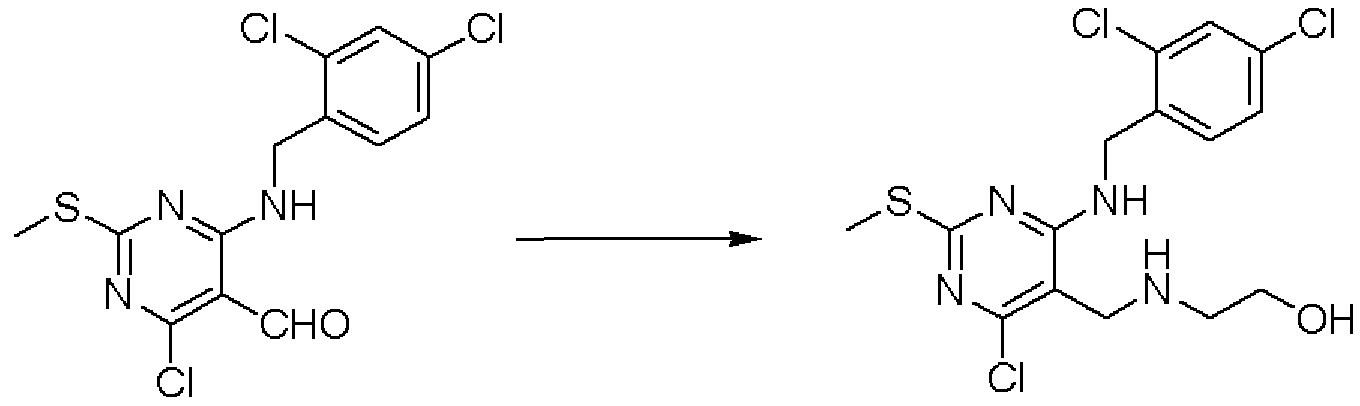
(1)4 クロ口一 6— (2, 4ージクロ口ベンジルァミノ) 2—メチルスルファニルピリミジ ン一 5—カルボアルデヒド 600mgの塩化メチレン 30ml溶液に、 2 アミノエタノール 1 llmgを加え、室温下、 30分攪拌した。さらに混合液にトリァセトキシ水素化ホウ素ナ トリウム 1. 05gおよび酢酸 0. 284mlをカ卩え、室温で終夜攪拌した。反応液に飽和重 曹水およびクロ口ホルムを加え、分液した。有機層を乾燥し、溶媒を濃縮した後、残 渣をシリカゲルカラムクロマトグラフィー(クロ口ホルム:メタノール = 100: 0→19: 1)で 精製することにより、 2— { [4 クロ口一 6— (2, 4 ジクロロベンジルァミノ)一 2—メチ ルスルファ-ルピリミジン— 5—ィルメチル]アミノ}エタノールを無色粉末 86. 3mgと して得た。 (1) 4 Black mouth 6- (2,4-Dichloro mouth benzylamino) 2-Methylsulfanylpyrimidine 1 5-Carbaldehyde Add 1 llmg of 2 aminoethanol to 30 ml of methylene chloride solution at room temperature for 30 minutes Stir. In addition, triacetoxyborohydride Thorium (1.05 g) and acetic acid (0.284 ml) were added and stirred at room temperature overnight. Saturated aqueous sodium hydrogen carbonate and black mouth form were added to the reaction mixture, and the phases were separated. After drying the organic layer and concentrating the solvent, the residue was purified by silica gel column chromatography (black mouth form: methanol = 100: 0 → 19: 1) to give 2 — {[4 black mouth 6— (2,4-Dichlorobenzylamino) 1-2-methylsulfurylpyrimidine-5-ylmethyl] amino} ethanol was obtained as a colorless powder, 86.3 mg.
APCI— MS (m/e) :407/409 [M+H] + APCI— MS (m / e): 407/409 [M + H] +
[化 65] [Chemical 65]

(2) 2— { [4—クロ口一 6— (2, 4—ジクロロベンジルァミノ) 2—メチルスルファ-ル ピリミジン— 5—ィルメチル]アミノ}エタノール 86. 3mgの THF6ml溶液に、 60%水 素化ナトリウム 10. 2mgをカ卩え、加熱還流下で 3時間攪拌した。反応液に水およびク ロロホルムを加え、分液した。有機層を乾燥し、溶媒を濃縮した後、残渣を薄層シリカ ゲルカラムクロマトグラフィー(クロ口ホルム:メタノール = 9 : 1)で精製することにより、 ( 2, 4 ジクロロベンジル) 2— (メチルスルファ -ル一 5, 6, 7, 8—テトラヒドロ一 9— ォキサ 1, 3, 6 トリアザべンゾシクロヘプテン— 4—ィル)アミンを無色粉末 28. 5 mgとして得た。 (2) 2— {[4-Chromatic mouth 6- (2, 4-Dichlorobenzylamino) 2-methylsulfurpyrimidine-5-ylmethyl] amino} ethanol 86. Sodium chloride (10.2 mg) was added, and the mixture was stirred for 3 hours under reflux. Water and chloroform were added to the reaction solution to separate the layers. After drying the organic layer and concentrating the solvent, the residue was purified by thin layer silica gel column chromatography (black mouth form: methanol = 9: 1) to give (2, 4 dichlorobenzyl) 2- (methylsulfa- 1,5,7,8-tetrahydro-9-oxa1,3,6 triazabenzocycloheptene-4-yl) amine was obtained as 28.5 mg of a colorless powder.
APCI-MS (m/e) : 371/373 [M+H] + APCI-MS (m / e): 371/373 [M + H] +
[化 66] [Chemical 66]

, 4 ジクロロベンジルァミノ)一 2—メチルスルファ -ル一 7, 8 ジヒドロ一 5H— 9— ォキサ 1, 3, 6 トリアザべンゾシクロヘプテン一 6—ィル]メタノンを無色粉末 21. 9mgとして得た。 , 4 Dichlorobenzylamino) 1 2-Methylsulfuryl 7,8 Dihydro-1 5H-9-Oxa 1, 3, 6 Triazabenzocycloheptene 1-yl] methanone as colorless powder 21.9 mg Obtained.
APCI— MS (m/e) :439/441 [M+H] + APCI— MS (m / e): 439/441 [M + H] +
[化 67] [Chemical 67]

[0116] (4)シクロプロピル一 [4— (2, 4 ジクロロベンジルァミノ) 2—メチルスルファ-ル [0116] (4) Cyclopropyl mono [4- (2, 4 dichlorobenzylamino) 2-methylsulfuryl
- 7, 8 ジヒドロー 5H— 9 ォキサ 1, 3, 6 トリアザべンゾシクロヘプテン 6— ィル]メタノン 21. 9mgのクロ口ホルム溶液 3ml溶液を 0°Cに冷やし、 75%メタクロ口過 安息香酸 20mgを加え、室温で 2時間攪拌した。反応液を濃縮した後、残渣に 1—ピ ペラジン一 1—ィル一 2 ピロリジン一 1—ィルエタノン 259mgをカロえ、マイクロウエー ブ反応装置を用いて 150°Cで 1時間照射した。反応液を室温まで冷却後、水とクロ口 ホルムを加え、分液した。有機層を乾燥し、溶媒を濃縮した後、残渣を薄層シリカゲ ルカラムクロマトグラフィー(クロ口ホルム:メタノール = 9 : 1)にて精製し、再び NH薄 層シリカゲルカラムクロマトグラフィー(酢酸ェチル:メタノール = 10 : 1)にて精製し、 1 — {4— [6—シクロプロパンカルボ-ルー 4— (2, 4—ジクロロ一ベンジルァミノ) 5, 6, 7, 8—テトラアンヒドロー 9 ォキサ 1, 3, 6 トリアザ一べンゾシクロヘプタン 2 -ィル] -ピぺラジン 1 ィル } 2 ピロリジン一 1 ィル一エタノンを黄色粉末 3 mgとして得た。 -7, 8 Dihydro-5H—9-oxa 1, 3, 6 Triazabenzocycloheptene 6-yl] methanone 21. 9 mg of Kuro-Formol solution 3 ml of solution was cooled to 0 ° C and 75% Meta-Chloro-peroxybenzoate 20 mg of acid was added and stirred at room temperature for 2 hours. After concentrating the reaction solution, 259 mg of 1-piperazine-1-yl-2-pyrrolidine-1-ylethanone was prepared in the residue and irradiated at 150 ° C. for 1 hour using a microwave reactor. After cooling the reaction solution to room temperature, water and chloroform were added and separated. After drying the organic layer and concentrating the solvent, the residue was purified by thin layer silica gel column chromatography (black mouth form: methanol = 9: 1), and again NH thin layer silica gel column chromatography (ethyl acetate: methanol). = 10: 1), 1 — {4— [6-Cyclopropanecarboluro 4- (2, 4-dichlorodichlorobenzylamino) 5, 6, 7, 8-tetraanhydro 9 oxa 1, 3, 6 Triaza-benzobenzoheptane 2 -yl] -piperazine 1 yl} 2 pyrrolidine 1 yl 1 ethanone was obtained as 3 mg of a yellow powder.
APCI-MS (m/e) : 588/590[M+H] + APCI-MS (m / e): 588/590 [M + H] +
[0117] 実施例 85〜: 177 [0117] Examples 85-: 177
上記実施例と同様に反応、処理することにより、以下の化合物を得た。 The following compounds were obtained by reacting and treating in the same manner as in the above Examples.
[0118] [表 11] [0118] [Table 11]

85 一 -CH2CO- 505/507, APCI 86 N -c〇- 591/593, APCI 85 1 -CH 2 CO- 505/507, APCI 86 N -c〇-591 / 593, APCI
COO'Bu COO'Bu

89 MeS02NH- -CH2CO- 529, ESI 89 MeS0 2 NH- -CH 2 CO- 529, ESI
〇 Yes

97 ςΝΙΙ仆 -co- 587, ESI 97 ς ΝΙΙ 仆 -co- 587, ESI
〇

実施例 R3NN Z MS([M+H]+)

99 o. -c〇- 519, ESI 99 o.-c〇- 519, ESI
100 -c〇- 502, ESI 101 -CH2C〇- 521 , ESI 02 -c〇- 548, ESI 03 -CH2C〇- 520, ESI 04 -c〇- 534, ESI

105 -CH2C〇- 534, ESI 105 -CH 2 C〇-534, ESI
O O

3]

実施例 R MS([M+H]+)

109 O N— -CH2CO- 521 , ESI 109 ON— -CH 2 CO- 521, ESI

N N
118 Cl- -CO- 533, ESI

4]

実施例 MS([M+H]+) Example MS ([M + H] +)
120 -CH2CO- 513, ESI 120 -CH 2 CO- 513, ESI
N-

122 MeCONH -CH2CO- 493, ESI 122 MeCONH -CH 2 CO- 493, ESI

]

実施例 R MS([M+H]+)

-N -N
141 -CO- 499, ESI 141 -CO- 499, ESI

6] R3" 、N 6] R 3 ", N
実施例 R MS([M+H]+) Example RMS ([M + H] +)

153 -CH2)2CO- 516, ESI

H H
]

実施例 R- MS([M+H] )

161 N— -CH2CO- 504, ESI 161 N— -CH 2 CO- 504, ESI
N N N N

8] 8]

APCIAPCI

9] 9]

実施例 178 Example 178
[化 68] [Chemical 68]

(R)-2-{4-[4-(2, 4—ジクロロベンジルァミノ)一 7, 8—ジヒドロ一 6H—チォ ピラノ [ 3、 2— d]ピリミジン一 2—ィル]ピぺラジン一 1—カルボ-ル }ピロリジン一 1— カルボン酸 tert—ブチルエステル 110.7mgのクロ口ホルム 5ml溶液に、 75%メタク ロロ過安息香酸 74. Imgを加え、室温下、 1.5時間攪拌した。反応液に飽和チォ硫 酸ナトリウム水および飽和重曹水を加え、 10分間攪拌し、分液した。有機層を乾燥し(R) -2- {4- [4- (2,4-Dichlorobenzylamino) -1,7,8-dihydro-6H-thiopyrano [3,2-d] pyrimidine-1-2-yl] piperazine 1-Carboxyl} pyrrolidine 1-carboxylic acid tert-butyl ester To a 5 ml solution of 110.7 mg of chloroform-form 5% of 75% chloroperbenzoic acid was added and stirred at room temperature for 1.5 hours. Saturated thiosulfuric acid in the reaction solution Sodium acid aqueous solution and saturated aqueous sodium hydrogen carbonate were added, and the mixture was stirred for 10 minutes and separated. Dry the organic layer
、溶媒を濃縮した後、残渣を薄層シリカゲルカラムクロマトグラフィー(酢酸ェチル)に て精製することにより、 2- {4- [4- (2, 4ージクロローベンジルァミノ)ー 5, 5—ジォ キソー 5, 6, 7, 8—テトラヒドローえー6—チェノビリミジン [3, 2— d]ピリミジンー2— ィル]—ピペリジン— 1—カルボ-ル}ピロリジン— 1—カルボン酸 tert—ブチルエス テルを無色粉末 59. 4mgとして得た。 After concentrating the solvent, the residue was purified by thin layer silica gel column chromatography (ethyl acetate) to give 2- {4- [4- (2, 4-dichloro-benzylamino) -5, 5 Dioxo 5, 6, 7, 8—Tetrahydro-e-6-Chenobilimidine [3, 2-—d] pyrimidine-2-yl] -piperidine— 1-carbol} pyrrolidine—1-carboxylic acid tert-butyl ester Obtained as a powder 59.4 mg.
APCI— MS (m/e) : 639/641 [M+H] + APCI— MS (m / e): 639/641 [M + H] +
[0128] 実施例 179〜202 [0128] Examples 179 to 202
上記実施例と同様に反応、処理することにより、以下の化合物を得た。 The following compounds were obtained by reacting and treating in the same manner as in the above Examples.
[0129] [表 20] [0129] [Table 20]

179 N CO- 0 607/609, APCI 179 N CO- 0 607/609, APCI
COO'Bu COO'Bu

H H
[0130] [表 21]

実施例 P1 環 A MS([M+H]+) Example P 1 ring A MS ([M + H] +)
I I I I II I I I I

22]

199 579/581 , 199 579/581,
200

201 478/480, APCI201 478/480, APCI
202 461 /463, APCI202 461/463, APCI

実施例 203 Example 203
[化 69] [Chem 69]

(1) 4— (2, 4—ジクロロベンジルァミノ)—6— [4— (2—ピロリジン— 1—ィルェチル) ピぺリジン— 1—ィル]ピリダジン— 3—カルボン酸メチルエステル 566. 8mgのジォ キサン 5ml溶液に 2N水酸ィ匕ナトリウム水溶液 5mlを加え、室温で 1時間攪拌した。反 応液に 2N塩酸水をカ卩え、中和した後、クロ口ホルムおよびリン酸バッファー(pH6)を 加え、分液した。有機層を乾燥し、溶媒を濃縮した後、残渣に THFとジェチルエーテ ルをカ卩えた。沈殿物を濾取した後、乾燥し、 4— (2, 4—ジクロロベンジルァミノ) -6 — [4— (2—ピロリジン— 1—ィルェチル)ピぺリジン— 1—ィル]ピリダジン— 3—カル ボン酸を無色粉末 500mgとして得た。 (1) 4- (2, 4-Dichlorobenzylamino) -6- [4- (2-Pyrrolidine-1-ylethyl) piperidine-1-yl] pyridazine-3-carboxylic acid methyl ester 566. 8mg 5 ml of 2N sodium hydroxide aqueous solution was added to 5 ml of dioxane and stirred at room temperature for 1 hour. After 2N hydrochloric acid water was added to the reaction solution and neutralized, black mouth form and phosphate buffer (pH 6) were added to separate the solution. After drying the organic layer and concentrating the solvent, THF and jetyl ether were added to the residue. The precipitate was collected by filtration and dried. 4— (2,4-Dichlorobenzylamino) -6 — [4— (2-Pyrrolidine—1-ylethyl) piperidine—1-yl] pyridazine— 3 —Carbonic acid was obtained as a colorless powder 500 mg.
ESI-MS (m/e) :478/480[M+H] +
[化 70]

[0134] (2) 4- (2, 4 ジクロロベンジルァミノ)—6— [4— (2 ピロリジン— 1—ィルェチル) ピぺリジン— 1—ィル]ピリダジン— 3—カルボン酸 140mgの DMF3mlと DMS03ml の懸濁液に N, N,—カルボ-ルジイミダゾール 71. 3mgを加え、室温で 3日間攪拌 した。さらに、反応液に 28%アンモニア水 0. 2mlを加え、室温で終夜攪拌した。反応 液に水と酢酸ェチルを加え、分液した。有機層を水で洗浄し、乾燥後、溶媒を濃縮し た。残渣を薄層 NHシリカゲルカラムクロマトグラフィー(クロ口ホルム:メタノール = 50 : 1)にて精製した。残渣に酢酸ェチルとジイソプロピルエーテルを加え、沈殿物を濾 取した後、乾燥し、 4— (2, 4 ジクロロベンジルァミノ)—6— [4— (2 ピロリジン— 1 ィルェチル)ピぺリジン 1 ィル]ピリダジン 3 カルボン酸アミドを薄黄色粉 末 20mgとして得た。 [0134] (2) 4- (2,4 Dichlorobenzylamino) —6— [4— (2 Pyrrolidine-1-ylethyl) piperidine-1-yl] pyridazine-3-carboxylic acid 140 mg DMF 3 ml To the suspension of DMS03 ml, 71.3 mg of N, N, -carbodiimidazole was added and stirred at room temperature for 3 days. Furthermore, 0.2 ml of 28% aqueous ammonia was added to the reaction solution, and the mixture was stirred at room temperature overnight. Water and ethyl acetate were added to the reaction solution to separate it. The organic layer was washed with water and dried, and then the solvent was concentrated. The residue was purified by thin layer NH silica gel column chromatography (black mouth form: methanol = 50: 1). Ethyl acetate and diisopropyl ether were added to the residue, and the precipitate was collected by filtration and then dried. 4- (2,4dichlorobenzylamino) -6- [4- (2 pyrrolidine-1 ylethyl) piperidine 1 [Ru] pyridazine 3 carboxamide was obtained as a pale yellow powder 20 mg.
APCI— MS (m/e) :477/479 [M+H] + APCI— MS (m / e): 477/479 [M + H] +
[0135] 実施例 204 [0135] Example 204
[化 71] [Chemical 71]

(1) 0°Cに冷やした水素化リチウムアルミニウム 508mgの THF40ml懸濁液に、 5— ( 2, 4 ジクロロベンジルァミノ)一 3—メチルスルファ -ル一 [1, 2, 4]トリァジン一 6— カルボン酸ェチルエステル 2. 5gの THF17ml溶液を滴下し、室温で 30分攪拌した 。反応液を 0°Cに冷やし、飽和硫酸アンモ-ゥム水溶液 1. 6mlを滴下した後、 0°Cで 10分攪拌した。さらに THF20mlをカ卩えた後、飽和硫酸アンモ-ゥム水溶液 0. 5ml を加え、室温で 30分攪拌した。反応液を濾過し、濾液を濃縮した。残渣をシリカゲル カラムクロマトグラフィー(クロ口ホルム:メタノール = 90 : 10)にて精製した。残渣に酢 酸ェチルをカ卩え、沈殿物を濾取した後、乾燥し、 5— (2, 4ージクロ口ベンジルァミノ) 3—メチルスルファ二ルー [1, 2, 4]トリアジン 6 ィル] メタノールを無色粉末 500mgとして得た。 (1) Lithium aluminum hydride chilled to 0 ° C 508mg in THF 40ml suspension, 5- (2,4dichlorobenzylamino) -1-3-methylsulfuryl [1,2,4] triazine-6- Carboxylic acid ethyl ester 2.5 g of THF 17 ml solution was added dropwise and stirred at room temperature for 30 minutes. The reaction solution was cooled to 0 ° C., 1.6 ml of a saturated aqueous ammonium sulfate solution was added dropwise, and the mixture was stirred at 0 ° C. for 10 minutes. Add 20 ml of THF, and then add 0.5 ml of saturated ammonium sulfate aqueous solution. And stirred at room temperature for 30 minutes. The reaction solution was filtered and the filtrate was concentrated. The residue was purified by silica gel column chromatography (black mouth form: methanol = 90: 10). Ethyl acetate was added to the residue, the precipitate was collected by filtration and dried, and 5- (2,4-dichlorodibenzylamino) 3-methylsulfanilu [1, 2, 4] triazine 6 yl] methanol was added. Obtained as a colorless powder 500 mg.
APCI - MS (m/e) : 331/333 [M+H] + APCI-MS (m / e): 331/333 [M + H] +
[化 72] [Chemical 72]

(2) [5 - (2, 4 ジクロロベンジルァミノ) 3—メチルスルファ -ル一 [1, 2, 4]トリア ジン— 6—ィル]メタノール 1. 328の塩化メチレン501111と1¾ 501111の溶液に85% 二酸化マンガン 8. 18gを加え、室温で 3日間攪拌した。反応液を濾過し、濾液を濃 縮した。残渣をシリカゲルカラムクロマトグラフィー(へキサン:酢酸ェチル = 95: 5→7 5 : 25)にて精製することにより、 5- (2, 4 ジクロロベンジルァミノ)一 3—メチルスル ファ-ルー [1, 2, 4]トリアジンー 6 カルボアルデヒドを薄黄色粉末 520mgとして得 た。 (2) [5- (2, 4 Dichlorobenzylamino) 3-methylsulfuryl [1, 2, 4] triazine-6-yl] methanol 1. 32 8 in methylene chloride 501111 and 1¾ 501111 To the mixture, 8.18 g of 85% manganese dioxide was added and stirred at room temperature for 3 days. The reaction solution was filtered and the filtrate was concentrated. The residue was purified by silica gel column chromatography (hexane: ethyl acetate = 95: 5 → 7 5:25) to give 5- (2,4 dichlorobenzylamino) -1-3-methylsulfurone [1, 2,4] triazine-6 carbaldehyde was obtained as 520 mg of light yellow powder.
APCI— MS (m/e) : 329/331 [M+H] + APCI— MS (m / e): 329/331 [M + H] +
[化 73] [Chemical 73]

(3) 5 - (2, 4 ジクロロベンジルァミノ)一 3—メチルスルファ -ル一 [1, 2, 4]トリア ジン一 6 カルボアルデヒド 520mgのメタノール 30ml溶液に塩化ヒドロキシルアンモ -ゥム 164. 7mgおよび酢酸ナトリウム 324mgをカ卩え、室温で終夜攪拌した。反応液 を濃縮後、残渣に水とクロ口ホルムをカ卩え、分液した。水層をクロ口ホルムで 2回抽出 後、有機層を合わせて乾燥し、溶媒を濃縮した。残渣にジェチルエーテルを加え、 沈殿物を濾取した後、乾燥し、 5- (2, 4—ジクロロベンジルァミノ)—3—メチルスル ファ-ルー [1, 2, 4]トリアジン 6 カルボアルデヒド ォキシムを無色粉末 445mg として得た。 (3) 5- (2,4 dichlorobenzylamino) 1 3-methylsulfuryl [1, 2, 4] triazine 1 6 Carbaldehyde 520 mg of methanolic 30 ml solution of hydroxylammonium chloride 164.7 7 mg and 324 mg of sodium acetate was added and stirred at room temperature overnight. After concentrating the reaction solution, water and black form were added to the residue and the phases were separated. Extract water layer twice with black mouth form Thereafter, the organic layers were combined and dried, and the solvent was concentrated. Jetyl ether was added to the residue, and the precipitate was collected by filtration and then dried. 5- (2,4-Dichlorobenzylamino) -3-methylsulfuro [1, 2, 4] triazine 6 carbaldehyde oxime Was obtained as a colorless powder 445 mg.
APCI - MS (m/e) : 344/346 [M+H] + APCI-MS (m / e): 344/346 [M + H] +
[化 74] [Chemical 74]
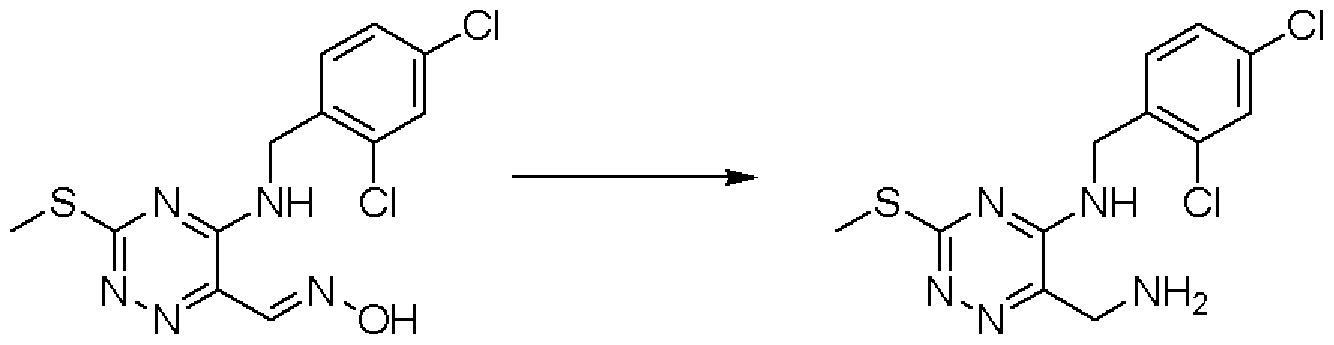
[0138] (4) 0°Cに冷やした 5— (2, 4ージクロ口ベンジルァミノ)ー3—メチルスルファ二ルー [ 1, 2, 4]トリアジン— 6—カルボアルデヒド ォキシム 276mgの THFlOml溶液に、 水素化リチウムアルミニウム 36. 4mgをカ卩え、室温で 1時間攪拌した。反応液を 0°C に冷やし、水素化リチウムアルミニウム 36. 4mgを加え、室温で終夜攪拌した。反応 液を 0°Cに冷やし、飽和硫酸アンモ-ゥム水溶液 0. 56mlをカ卩えた後、反応液を濾 過し、濾液を濃縮した。残渣を薄層シリカゲルカラムクロマトグラフィー(クロ口ホルム: メタノール =80 : 20)にて精製し、(6 アミノメチルー 3—メチルスルファ -ル一 [1, 2 , 4]トリアジン一 5—ィル)一(2, 4 ジクロロベンジル)アミンを赤色粘体 42. 6mgと して得た。 [0138] (4) Hydrogenated to a solution of 276 mg of 276 mg of 5- (2, 4-dichlorodibenzylamino) -3-methylsulfanilu [1, 2, 4] triazine-6-carbaldehyde oxime cooled to 0 ° C 36.4 mg of lithium aluminum was added and stirred at room temperature for 1 hour. The reaction mixture was cooled to 0 ° C., 36.4 mg of lithium aluminum hydride was added, and the mixture was stirred overnight at room temperature. The reaction solution was cooled to 0 ° C. and 0.56 ml of a saturated aqueous ammonium sulfate solution was added, and then the reaction solution was filtered and the filtrate was concentrated. The residue was purified by thin-layer silica gel column chromatography (black mouth form: methanol = 80:20), and (6 aminomethyl-3-methylsulfuryl [1,2,4] triazine-1-5-yl) , 4dichlorobenzyl) amine was obtained as 42.6 mg of red viscous material.
APCI-MS (m/e) : 330/332[M+H] + APCI-MS (m / e): 330/332 [M + H] +
[化 75] [Chemical 75]

[0139] (5) (6 アミノメチル一 3—メチルスルファ -ル一 [1, 2, 4]トリァジン一 5—ィル)一( 2, 4 ジクロロベンジル)ァミン 42. 6mgの THF5ml溶液に、シクロパンカルボ-ル クロライド 14. 6mgを加え、室温で 10分攪拌した。反応液に飽和重曹水とクロ口ホル ムを加え、分液した。有機層を乾燥し、溶媒を濃縮した後、残渣を薄層シリカゲルカラ ムクロマトグラフィー(クロ口ホルム:メタノール = 95 : 5)にて精製し、シクロプロパン力 ルボン酸 [5— (2, 4 ジクロ口ベンジルァミノ)ー3—メチルスルファ二ルー [1, 2, 4] トリァジン— 6—ィル]メチル]アミドを無色粉末 36. 7mgとして得た。 [0139] (5) (6 Aminomethyl 3-methylsulfanyl [1, 2, 4] triazine 5-yl) mono (2, 4 dichlorobenzyl) amine 42.6 Carbole Added 14.6 mg of chloride and stirred at room temperature for 10 minutes. Saturated aqueous sodium hydrogen carbonate and chloroform were added to the reaction solution, and the mixture was separated. After drying the organic layer and concentrating the solvent, the residue was purified by thin-layer silica gel column chromatography (chloroform: methanol = 95: 5) to give cyclopropane-powered rubonic acid [5— (2, 4 Methyl benzylamino) -3-methylsulfanilu [1, 2, 4] triazine-6-yl] methyl] amide was obtained as a colorless powder 36.7 mg.
APCI-MS (m/e) : 398/400[M+H]+ APCI-MS (m / e): 398/400 [M + H] +
[化 76] [Chemical 76]

[0140] (6) 0°Cに冷やした、シクロプロパンカルボン酸 [5— (2, 4ージクロ口ベンジルァミノ) —3—メチルスルファ -ル一 [1, 2, 4]トリアジンー6 ィル]メチル]アミド 36. 7mgの クロ口ホルム 5ml溶液に、 75%メタクロ口過安息香酸 27. 6mgのクロ口ホルム 5ml溶 液を滴下し、室温で 1時間攪拌した。反応液に、 1一(2—ピロリジン 1ーィルーェチ ル)ピぺラジン 43. 8mg、卜リエチルァミン 0. 017ml、ジォキサン 20mlを加え、 100 °Cで終夜攪拌した。反応液を濃縮後、残渣にクロ口ホルムと飽和炭酸カリウム水溶液 を加え、分液した。有機層を乾燥し、溶媒を濃縮した後、残渣を NH薄層シリカゲル カラムクロマトグラフィー(クロ口ホルム:メタノール = 95 : 5)にて精製した。残渣にジィ ソプロピルエーテルをカ卩え、沈殿物を濾取した後、乾燥し、シクロプロパンカルボン酸 {5- (2, 4 ジクロロ—ベンジルァミノ)—3— [4— (2 ピロリジン— 1—ィル—ェチ ル)—ピぺラジン— 1—ィル] [1, 2, 4]トリァジン— 6—ィルメチル }—アミドを無色 粉末 17. 4mgとして得た。 [0140] (6) Cyclopropanecarboxylic acid cooled to 0 ° C [5- (2,4-Dichlorodibenzylamino) —3-methylsulfuryl [1, 2, 4] triazine-6-yl] methyl] amide 36. To a solution of 7 mg of black mouth form 5 ml, 75% metaclo mouth perbenzoic acid 27.6 mg of black mouth form 5 ml solution was added dropwise and stirred at room temperature for 1 hour. To the reaction solution, 13.8 (2-pyrrolidine 1-lruethyl) piperazine (43.8 mg), triethylamine (0.017 ml) and dioxane (20 ml) were added, and the mixture was stirred at 100 ° C overnight. After concentrating the reaction solution, Kuroguchi Form and saturated aqueous potassium carbonate solution were added to the residue and the phases were separated. After the organic layer was dried and the solvent was concentrated, the residue was purified by NH thin layer silica gel column chromatography (black mouth form: methanol = 95: 5). Diisopropyl ether is added to the residue, and the precipitate is collected by filtration and then dried. Cyclopropanecarboxylic acid {5- (2, 4 dichloro-benzylamino) —3— [4— (2 pyrrolidine — 1— Ru-ethyl) -piperazine-1-yl] [1,2,4] triazine-6-ylmethyl} -amide was obtained as a colorless powder 17.4 mg.
APCI-MS (m/e) : 533/535 [M+H] + APCI-MS (m / e): 533/535 [M + H] +
[0141] 実施例 205 [0141] Example 205
[化 77] [Chemical 77]

5- (2, 4 ジクロロ一ベンジルァミノ)一 3—メチルスルファ -ル一 [1, 2, 4]トリア ジン— 6 カルボン酸ェチルエステル 5. 40gのクロ口ホルム 100ml溶液に 0°Cでメタ クロ口過安息香酸 3. 91gを加え、室温で 0. 5時間攪拌した。反応液に 1— (2 ピロリ ジン一 1—ィル一ェチル)ピぺラジン 700mg,トリェチルァミン 708mgのクロ口ホルム 50ml溶液を 30分かけて滴下し、室温で 1日攪拌した。反応液を減圧濃縮後、残渣 に酢酸ェチルをカ卩え、飽和重曹水、水および飽和食塩水で洗浄し、硫酸マグネシゥ ムで乾燥後に溶媒を留去した。シリカゲルカラムクロマトグラフィー(クロ口ホルム Zメ タノール = 100Z0→87Z13)で精製し、橙色固形物を得た。これを酢酸ェチル Ζ へキサンから再結晶し、 5- (2, 4—ジクロロ一ベンジルァミノ) 3— [4— (2—ピロリ ジン 1ーィルーェチル)ピぺラジン 1ーィル ] [1, 2, 4]トリアジンー6 カルボ ン酸 ェチルエステルを微黄色結晶 4. 33gとして得た。 5- (2, 4 Dichloromonobenzylamino) 1 3-Methylsulfuryl [1, 2, 4] Triazine-6 carboxylic acid ethyl ester 5. 40 g of Chromium Form in 100 ml solution of Methyl Chlorobenzoate at 0 ° C 3.91 g of acid was added and stirred at room temperature for 0.5 hour. To the reaction solution, 700 ml of 1- (2 pyrrolidine-1-ylethyl) piperazine 700 mg and triethylamine 708 mg 50 ml formaldehyde was added dropwise over 30 minutes and stirred at room temperature for 1 day. After the reaction solution was concentrated under reduced pressure, ethyl acetate was added to the residue, washed with saturated aqueous sodium hydrogen carbonate, water and saturated brine, dried over magnesium sulfate, and the solvent was evaporated. Purification by silica gel column chromatography (black mouth form Z methanol = 100Z0 → 87Z13) gave an orange solid. This was recrystallized from ethyl acetate Ζ hexane to give 5- (2, 4-dichloromonobenzylamino) 3- [4- (2-pyrrolidine 1-lruethyl) piperazine 1-yl] [1, 2, 4] triazine 6 Carbonic acid ethyl ester was obtained as 4.33 g of slightly yellow crystals.
APCI— MS (m/e) : 508/510[M+H] + APCI— MS (m / e): 508/510 [M + H] +
[0142] 実施例 206〜218 [0142] Examples 206-218
上記実施例と同様に反応、処理することにより、以下の化合物を得た。 The following compounds were obtained by reacting and treating in the same manner as in the above Examples.
[0143] [表 24] [0143] [Table 24]

実施例 MS([M+H]+) Example MS ([M + H] +)
214 585/587, APCI 214 585/587, APCI
215 585/587, APCI 215 585/587, APCI
216 624/626, APCI 216 624/626, APCI
217 622/624, APCI 217 622/624, APCI

218 (^N- -CH2CO- 一 N N- 、 522/524, APCI 218 (^ N- -CH 2 CO- 1 N N-, 522/524, APCI
\ _ / Nγ人 \ _ / Nγ people
ヽ COOEt ヽ COOEt
実施例 219 Example 219
[化 78] [Chemical 78]

( 1 ( 2 ) (1 (2)
3- (4—アタリロイル一ピペラジン一 1—ィル) 5— (2, 4 ジクロロ一ベンジルアミ ノ)ー[1, 2, 4]トリアジンー 6—力ルボン酸 ェチルエステル 5 lmgの塩化メチレン 5 ml溶液にピロリジン 15 1をカ卩え、室温で攪拌した。ピロリジン 50 1を追カ卩し、室温 で終夜攪拌した。溶媒を留去し、シリカゲルカラムクロマトグラフィー(クロ口ホルム Zメ タノール =90Z10→30Z70)で精製し、 5- (2, 4 ジクロロ一ベンジルァミノ)一 3 - [4— (3 ピロリジン— 1—ィル—プロピオ-ル)—ピペラジン— 1—ィル]― [1, 2, 4]トリァジン— 6—カルボン酸 ェチルエステルを淡黄色油状物 37mgとして得た。3- (4-Atarylloyl monopiperazine 1-yl) 5— (2, 4 dichloro monobenzylamino)-[1, 2, 4] triazine 6-strength rubonic acid ethyl ester 5 lmg of pyrrolidine in 5 ml of methylene chloride 15 1 was added and stirred at room temperature. Pyrrolidine 50 1 was added and stirred at room temperature overnight. The solvent was distilled off, and the residue was purified by silica gel column chromatography (black mouth form Z methanol = 90Z10 → 30Z70), and 5- (2,4dichloromonobenzylamino) -1-3- [4- —Propiol) —piperazine— 1—yl] — [1, 2, 4] Triazine-6-carboxylic acid ethyl ester was obtained as a pale yellow oil (37 mg).
APCI-MS(m/e) :536/538[M + H] + APCI-MS (m / e): 536/538 [M + H] +
[0146] 実施例 220〜254 [0146] Examples 220 to 254
上記実施例と同様に反応、処理することにより、以下の化合物を得た。 The following compounds were obtained by reacting and treating in the same manner as in the above Examples.
[0147] [表 26] p,

2、つ Two
220 522/524, APCI 220 522/524, APCI
221 479/481, APCI

CI CI CI CI
222 ^N- -(CH2)2- -N N- 81, APCI 222 ^ N--(CH 2 ) 2 --N N- 81, APCI
N. H -CH2- 479/4 N. H -CH 2 - 479/4
CONHつ CONH

実施例 ([M+H]+) Example ([M + H] +)
231 4/526, APCI 231 4/526, APCI
232 5/497, APCI 232 5/497, APCI
233 2/524, APCI 233 2/524, APCI
234 93/495, APCI 234 93/495, APCI
235 3/495, APCI 235 3/495, APCI
236 07/509, APCI 236 07/509, APCI
237 93/495, APCI

N N
238 N- -(CH2)2 - N— 507/509, APCI 238 N--(CH 2 ) 2 -N— 507/509, APCI
N ヽ COOEt N ヽ COOEt
239 一 -(CH2)2- -N N- 507/509, APCI

[0149] [表 28] 実施例 [0149] [Table 28] Example
240 240
241 I 241 I
242 I

COOlBu COO l Bu
243 -NH- 479/481 , APCI 243 -NH- 479/481, APCI
244 -O- 494/496, APCI 244 -O- 494/496, APCI
245 -NH- 579/581 , APCI 245 -NH- 579/581, APCI
246 -NH- 478/480, APCI 246 -NH- 478/480, APCI
247 -NH- 578/580, APCI 247 -NH- 578/580, APCI
248 -O- 493/495, APCI 248 -O- 493/495, APCI
249 -NH- 478/480, APCI 249 -NH- 478/480, APCI
250 -NH- 607/609, APCI

29] 実施例 MS([M+H]+) 29] Example MS ([M + H] +)
251 593/595, APCI 251 593/595, APCI
252 507/509, APCI 252 507/509, APCI
253 493/495, APCI253 493/495, APCI
254 507/509, APCI254 507/509, APCI

実施例 255 Example 255
[化 79] [Chemical 79]

( 1 ) ( 2 ) (1) (2)
5- (2, 4 ジクロロ一ベンジルァミノ) 3— [4— (ピロリジン一 2—カルボ-ル) ピぺラジン— 1—ィル] [1, 2, 4]トリァジン— 6—カルボン酸アミド 116mg、酢酸 2 \ ix \, ノ《ラホルムアルデヒド 29. 6mgの THF5ml溶液に、氷冷下で水素化トリァセト キシホウ素ナトリウム 261mgを加え、室温で終夜攪拌した。パラホルムアルデヒド 26 mg、酢酸 21 IX 1、水素化トリァセトキシホウ素ナトリウム 515mgを追加し、室温で 2日 攪拌した。反応液に水を加え、溶媒を留去した。残渣をシリカゲルカラムクロマトダラ フィー(クロロホノレム Zメタノーノレ = 100/0→20/80)で 2回、 NHシリカゲノレカラム クロマトグラフィー(酢酸ェチル Zメタノール = 100Z0→90Z10)で 1回精製するこ とにより、 5—(2, 4 ジクロ ペンジノレアミノ) 3— [4 1ーメチノレーピロリジン 2—カルボ-ル)—ピぺラジン— 1—ィル] [1, 2, 4]トリアジン— 6—カルボン酸アミ ドを無色固体 5mgとして得た。 5- (2,4dichloromonobenzylamino) 3— [4- (pyrrolidine-2-carbon) piperazine-1-yl] [1,2,4] triazine-6-carboxylic amide 116 mg, acetic acid 2 \ ix \, «Laformaldehyde 29.6 mg of sodium triacetoxyborohydride (261 mg) was added to a solution of 29.6 mg of THF (5 ml) under ice cooling and stirred overnight at room temperature. Paraformaldehyde 26 mg, acetic acid 21 IX 1, and sodium triacetoxyborohydride 515 mg were added, and the mixture was stirred at room temperature for 2 days. Water was added to the reaction solution, and the solvent was distilled off. The silica gel column chromatography (Chlorohonolem Z methanolate = 100/0 → 20/80) was used twice for the residue, NH silicagenole column Chromatography (Ethyl acetate Zmethanol = 100Z0 → 90Z10) was purified once to give 5- (2,4 dichloropentinoleamino) 3— [4 1-methinolepyrrolidine 2-carbol) 1-yl] [1,2,4] triazine-6-carboxylic acid amide was obtained as a colorless solid 5 mg.
APCI— MS (m/e) :493/495 [M+H] + APCI— MS (m / e): 493/495 [M + H] +
[0152] 実施例 256 [0152] Example 256
上記実施例 255と同様に反応、処理することにより、以下の化合物を得た。 [化 80] The following compounds were obtained by reacting and treating in the same manner as in Example 255. [Chemical 80]

APCI-MS ( APCI-MS (
[0153] 実施例 257 [0153] Example 257
[化 81] [Chemical 81]

5- (2, 4 ジクロロ一ベンジルァミノ) 3— [4— (1—メチル一ピロリジン一 2—力 ルポ-ル)ーピペラジン 1ーィル ] [1, 2, 4]トリアジンー6—力ルボン酸アミド 27 mgの THFl. 5ml溶液にヨウ化メチル 10 1を加えて、室温で終夜攪拌した。溶媒を 留去し、残渣をメタノール 酢酸ェチルカ 再結晶を行い、 2—{4 [6—力ルバモイ ルー 5— (2, 4 ジクロロ—ベンジルァミノ)— [1, 2, 4]トリァジン— 3—ィル]—ピぺ ラジンー1 カルボ-ル}ー1, 1 ジメチルーピロリジゥム ヨウ化物塩を淡黄色結晶 21mgとして得た。 APCI— MS (m/e) : 507/509 [M+H] + 5- (2,4dichloromonobenzylamino) 3- [4- (1-methylmonopyrrolidine-one 2-power) -piperazine 1-yl] [1, 2, 4] triazine-6-power rubonic acid amide 27 mg Methyl iodide 101 was added to a THFl. 5 ml solution and stirred overnight at room temperature. The solvent was distilled off, and the residue was recrystallized with methanol / ethyl acetate, 2- {4 [6—force rubamoyl 5- (2, 4 dichloro-benzylamino) — [1, 2, 4] triazine-3-yl ] —Piperazin-1 carbol} -1, 1 Dimethyl-pyrrolidinium iodide salt was obtained as 21 mg of pale yellow crystals. APCI— MS (m / e): 507/509 [M + H] +
[0154] 実施例 258 [0154] Example 258
[化 82] [Chemical 82]

( 1 ) ( 2 ) (1) (2)
2- (4 アミノメチル一ピペリジン一 1—ィル) 4— (2, 4 ジクロロ一ベンジルアミ ノ)—ピリミジン— 5—カルボン酸アミド 95mg, 2—メチルスルファ二ルー 4, 5 ジヒド ロー 1H イミダゾーノレ 155mg、トリエチノレアミン 325 1をエタノーノレ 4mlに溶力し、 6 0°C下で 6日間加熱攪拌した。反応液を減圧濃縮し、薄層シリカゲルカラムクロマトグ ラフィ一で精製した。残渣固形物にジイソプロピルエーテルをカ卩えて粉砕することによ り、 4一(2, 4 ジクロロ一ベンジルァミノ) 2— {4— [ (4, 5 ジヒドロ一 1H—イミダゾ ール 2 ィルァミノ) -メチル]—ピペリジン一 1 ィル }—ピリミジン一 5 カルボン 酸アミドを淡黄色固体 15mgとして得た。 2- (4 aminomethyl monopiperidine 1-yl) 4- (2,4 dichloro monobenzylamino) -pyrimidine-5-carboxylic acid amide 95 mg, 2-methylsulfanilu 4,5 dihydro 1H imidazolone 155 mg, tri Ethinoreamine 325 1 was dissolved in 4 ml of ethanol and stirred under heating at 60 ° C. for 6 days. The reaction solution was concentrated under reduced pressure and purified by thin layer silica gel column chromatography. By adding diisopropyl ether to the residual solid and crushing it, 4 4- (2,4-dichloro-benzylbenzyl) 2- {4— [(4,5-dihydro- 1H-imidazole 2-ilamino) -methyl] —Piperidine mono 1} -Pyrimidine mono 5 carboxylic acid amide was obtained as a pale yellow solid 15 mg.
APCI— MS (m/e) :478/480[M+H] + APCI— MS (m / e): 478/480 [M + H] +
[0155] 実施例 259〜294 [0155] Examples 259-294
上記実施例と同様に反応、処理することにより、以下の化合物を得た。 The following compounds were obtained by reacting and treating in the same manner as in the above Examples.
[0156] [表 30] [0156] [Table 30]
^〔〕〔〕015731 ^ [] [] 015731

実施例 MS([M+H] Example MS ([M + H]
271 520/522, APCI 271 520/522, APCI
272 520/522, APCI 272 520/522, APCI
273 492/494, APCI

ヽ C。ONHMe ヽ C. ONHMe
274 -(CH2)2- -N N- N 493/495, APCI

275 Me2N— -(CH2)2- - N N- 453/455, APCI 275 Me 2 N—-(CH 2 ) 2 --N N- 453/455, APCI
N Ύ,人 N ヽ CONH ':2 N Ύ, people N ヽ CONH ' : 2
276 481/483, APCI 276 481/483, APCI
277 Me 493/495, APCI 277 Me 493/495, APCI
278 (iP 509/51 1 , APCI 278 (iP 509/51 1, APCI
279 O 495/497, APCI 279 O 495/497, APCI
280 478/480, APCI 280 478/480, APCI
281 583/585, APCI 281 583/585, APCI
282 555/557, APCI

実施例 MS([M+H]+)Example MS ([M + H] +)
283 493/495, APCI 283 493/495, APCI
284 507/509, APCI284 507/509, APCI
285 521/523, APCI 285 521/523, APCI
286 508/510, APCI286 508/510, APCI
287 563/565, APCI

[0159] [表 33] [0159] [Table 33]

実施例 295 Example 295
[化 83] [Chemical 83]
■S■ S

( ) (2) () (2)
(1)4 ァミノ一 6— (2, 4 ジクロロ一ベンジルァミノ) 2—メチルスルファ -ル一ピ リミジン 5 カルボン酸アミド 502mgの 1, 4 ジォキサン 70ml溶液にクロロアセト アルデヒド 0. 344mlを加え、 100°Cで終夜攪拌した。反応液を減圧濃縮し、残渣に 酢酸ェチルを加え、飽和重曹水と飽和食塩水で洗浄し、乾燥後、溶媒を留去した。 シリカゲルカラムクロマトグラフィー(へキサン Z酢酸ェチル = 100/0→35/65)で 精製し、 7- (2, 4 ジクロロ—ベンジルァミノ)— 5—メチルスルファ -ル—イミダゾ [1 , 2— c]ピリミジン— 8—カルボン酸アミドを黄色固形物 108mgとして得た。 (1) 4-amino-6- (2,4dichloromonobenzylamino) 2-methylsulfurylpyrimidine 5 carboxylic acid amide 502 mg of 1,4 dioxane in 70 ml of chloroacetate 0.344 ml of aldehyde was added and stirred overnight at 100 ° C. The reaction mixture was concentrated under reduced pressure, ethyl acetate was added to the residue, washed with saturated aqueous sodium hydrogen carbonate and saturated brine, dried, and the solvent was evaporated. Purified by silica gel column chromatography (hexane Z ethyl acetate = 100/0 → 35/65), 8-Carboxamide was obtained as 108 mg of a yellow solid.
APCI - MS (m/e) : 382/384[M+H] + APCI-MS (m / e): 382/384 [M + H] +
[化 84] [Chemical 84]

( ) ( 2 ) () (2)
[0161] (2) 7- (2, 4 ジクロロ一ベンジルァミノ) 5—メチルスルファ -ル一イミダゾ [1, 2 — c]ピリミジン一 8 カルボン酸アミド 15mg、 1 -ピぺリジン一 1 ィル一 2 ピロリジ ン一 1—ィル一エタノン 56mgをジメチルァセトアミド 0. 2mlに溶力し、 80°C〜100°C で 9時間攪拌した。更に 1 ピぺリジン 1 イノレー 2 ピロリジン一 1—ィル -ェタノ ン 25mgを追加し、 100°Cで 3時間攪拌した。放冷後、重曹水を加え、酢酸ェチル Z ジェチルエーテルで抽出した。有機層を合わせ、飽和食塩水で洗浄し、硫酸マグネ シゥムで乾燥後、溶媒を留去した。薄層 NHシリカゲルクロマトグラフィー(へキサン Z 酢酸ェチル = 1Z2)で精製し、 7- (2, 4ージクロローベンジルァミノ) - 5- [4- (2 —ピロリジン— 1—ィル—ァセチル)—ピペラジン— 1—ィル]—イミダゾ [1, 2— c]ピリ ミジン— 8—カルボン酸アミドを淡黄色結晶 5mgとして得た。 [0161] (2) 7- (2,4 Dichloromonobenzylamino) 5-Methylsulfuryl-imidazo [1, 2 — c] Pyrimidine mono-8 Carboxylic acid amide 15 mg, 1-piperidine-one 1-yl-2-pyrrolidi Nyl-1-ethanone 56 mg was dissolved in 0.2 ml of dimethylacetamide and stirred at 80 ° C. to 100 ° C. for 9 hours. Further, 1 piperidine, 1 inole, 2 pyrrolidine, 1-1-yl-ethanol, 25 mg were added, and the mixture was stirred at 100 ° C for 3 hours. After allowing to cool, aqueous sodium bicarbonate was added, and the mixture was extracted with ethyl acetate Z jetyl ether. The organic layers were combined, washed with saturated brine, dried over magnesium sulfate, and the solvent was evaporated. Purified by thin layer NH silica gel chromatography (Hexane Z Ethyl acetate = 1Z2), 7- (2, 4-Dichloro-benzylamino)-5- [4- (2-Pyrrolidine-1-yl-acetyl) —Piperazine—1-yl] -imidazo [1,2-c] pyrimidine-8-carboxylic acid amide was obtained as 5 mg of pale yellow crystals.
APCI— MS (m/e) : 531/533 [M+H] + APCI— MS (m / e): 531/533 [M + H] +
[0162] 実施例 296 [0162] Example 296
[化 85]

( 1 ) (2 ) (1) (2)
(1)4 ァミノ一 6— (2, 4 ジクロロ一ベンジルァミノ) 2—メチルスルファ -ル一ピ リミジン— 5—カルボン酸 lOOmgの DMF2ml溶液にアジ化ナトリウム 17.2mgを加 えて、 50°Cで 1時間攪拌した。反応液に酢酸ェチルをカ卩え、水および飽和食塩水で 洗浄し、硫酸ナトリウム乾燥後、溶媒を留去した。へキサンで洗浄した後、乾燥し、 7 -(2, 4 ジクロロ一ベンジルァミノ)一 5—メチルスルファ -ル一テトラゾロ [1, 5— c] ピリミジン— 8—カルボン酸アミドを淡黄色固形物 85mgとして得た。 (1) 4-amino-6- (2,4-dichloromonobenzylamino) 2-methylsulfurylpyrimidine-5-carboxylic acid 17.2 mg of sodium azide was added to 2 ml of a solution of lOOmg in DMF and stirred at 50 ° C for 1 hour. did. Ethyl acetate was added to the reaction solution, washed with water and saturated brine, dried over sodium sulfate, and the solvent was distilled off. After washing with hexane and drying, 7- (2,4dichloromonobenzylamino) -1,5-methylsulfuryl-tetrazolo [1,5-c] pyrimidine-8-carboxylic acid amide was obtained as a pale yellow solid 85 mg. It was.
APCI - MS (m/e) :384/386 [M+H] + APCI-MS (m / e): 384/386 [M + H] +
[化 86] [Chemical 86]

( 1 ) (2 ) (1) (2)
[0163] (2)7- (2, 4—ジクロロ一ベンジルァミノ) 5—メチルスルファ二ルーテトラゾロ [1, 5— c]ピリミジン— 8—カルボン酸アミドを、実施例 295 (2)と同様に反応、処理するこ とにより、) 7— (2, 4 ジクロロ一ベンジルァミノ) 5— [4— (2—ピロリジン一 1—ィ ルーァセチル)—ピペリジン— 1—ィル]—テトラゾロ [1, 5— c]ピリミジン— 8—カルボ ン酸アミドを得た。 [0163] (2) 7- (2,4-Dichloromonobenzylamamino) 5-methylsulfanilutetrazolo [1,5-c] pyrimidine-8-carboxylic acid amide was reacted and treated in the same manner as in Example 295 (2). 7- (2,4 Dichloromonobenzylamino) 5— [4— (2-Pyrrolidine mono 1-yl leucetyl) -piperidine-1-yl] -tetrazolo [1, 5-c] pyrimidine— 8-Carbonamide was obtained.
APCI-MS (m/e) :533/535 [M+H] + APCI-MS (m / e): 533/535 [M + H] +
[0164] 実施例 297、 298 [0164] Examples 297, 298
上記実施例と同様に反応、処理することにより、以下の化合物を得た。 The following compounds were obtained by reacting and treating in the same manner as in the above Examples.
[0165] [表 34]

実施例 MS([M+H] ) Example MS ([M + H])

実施例 299 Example 299
[化 87] [Chemical 87]

( 1 ) (2 ) (1) (2)
(1)4 ァミノ一 6— (2, 4 ジクロロ一ベンジルァミノ) 2—メチルスルファ -ル一ピ リミジン— 5—カルボン酸 1. Ogの 1, 4 ジォキサン 20mlに抱水ヒドラジン 0.66gを 加え、室温で攪拌した。酢酸ェチルをカ卩え、飽和重曹水および飽和食塩水で洗浄後 、硫酸マグネシウムで乾燥し、溶媒を留去した。残渣にへキサンで洗浄した後、乾燥 し、 4— (2, 4 ジクロロ一ベンジルァミノ) 6 ヒドラジノ一 2—メチルスルファ-ル —ピリミジン— 5—カルボン酸アミドを無色固形物 1. Olgとして得た。 (1) 4-amino-6- (2,4-dichloromonobenzylamino) 2-methylsulfurylpyrimidine-5-carboxylic acid 1. Add 0.66 g of hydrazine hydrate to 20 ml of 1,4 dioxane of Og and stir at room temperature did. Ethyl acetate was added, washed with saturated aqueous sodium hydrogen carbonate and saturated brine, dried over magnesium sulfate, and the solvent was evaporated. The residue was washed with hexane and then dried to obtain 4- (2,4dichloromonobenzylamino) 6 hydrazino-2-methylsulfuryl-pyrimidine-5-carboxylic acid amide as a colorless solid 1. Olg.
APCI-MS(m/e) :373/375 [M+H] + APCI-MS (m / e): 373/375 [M + H] +
[化 88] [Chemical 88]

( 1 (2 (1 (2
[0167] (2)4- (2, 4 ジクロロ一ベンジルァミノ) 6 ヒドラジノ一 2—メチルスルファ-ル —ピリミジン— 5—カルボン酸アミド 2.66gの DMF70ml溶液にオルトギ酸メチル 29 .6gを加え、室温で 1時間、 55°Cで 3.5時間攪拌した。反応液を放冷し、ジイソプロ ピルエーテル Z酢酸ェチル(9ZDを加え、析出した結晶を濾取した。ジイソプロピ ルエーテルで洗浄後、乾燥し、 7- (2, 4—ジクロロ—ベンジルァミノ)—5—メチルス ルファ -ル— [1, 2, 4]トリァゾロ [4, 3— c]ピリミジン— 8—カルボン酸アミドを黄色 結晶 1.5 lgとして得た。 (2) 4- (2,4 Dichloromonobenzylamino) 6 Hydrazino 1-Methylsulfuryl-pyrimidine-5-carboxylic acid amide 2.66 g of DMF in 70 ml solution was added with 29.6 g of methyl orthoformate, and 1 The mixture was stirred at 55 ° C for 3.5 hours. The reaction solution was allowed to cool, diisopropyl ether Z ethyl acetate (9ZD was added, and the precipitated crystals were collected by filtration. After washing with diisopropyl ether, it was dried, and 7- (2,4-dichloro-benzylamino) -5-methyls. Rufa-l- [1,2,4] triazolo [4,3-c] pyrimidine-8-carboxylic acid amide was obtained as 1.5 lg of yellow crystals.
APCI-MS(m/e) :383/385 [M+H] + APCI-MS (m / e): 383/385 [M + H] +
[化 89] [Chemical 89]

(1 ) (2) (1) (2)
[0168] (3)7- (2, 4 ジクロロ一ベンジルァミノ) 5—メチルスルファ -ル一 [1, 2, 4]トリ ァゾロ [4, 3— c]ピリミジン— 8—カルボン酸アミドを、実施例 295 (2)と同様に反応、 処理することにより、 7- (2, 4 ジクロロ一ベンジルァミノ)一 5— [4— (2 ピロリジン 1ーィルーァセチル)ーピペラジン 1 ィル] [1, 2, 4]トリァゾロ [4, 3— c]ピリミ ジン 8—力ノレボン酸アミドを得た。 [0168] (3) 7- (2,4 Dichloromonobenzylamino) 5-Methylsulfuryl [1, 2, 4] triazolo [4,3-c] pyrimidine-8-carboxylic acid amide By reacting and treating in the same manner as in (2), 7- (2,4 dichloro-benzylbenzyl)-1-5— [4— (2 pyrrolidine 1-lruacetyl) -piperazine 1 yl] [1, 2, 4] triazolo [4 , 3-c] pyrimidine 8-force norevonamide was obtained.
APCI— MS(m/e) :532/534[M+H] + APCI— MS (m / e): 532/534 [M + H] +
[0169] 実施例 300〜303
上記実施例と同様に反応、処理することにより、以下の化合物を得た [表 35]

実施例 R MS([M+H]+)

[表 36]

実施例 MS([M+H] )

303 N -CO- 518/520, APCI 303 N -CO- 518/520, APCI
H H

ESI— MS(mZe) :170[M— H]— ESI— MS (mZe): 170 [M— H] —
[化 91] [Chemical 91]

(2)よく乾燥したメタノール 830mlに金属ナトリウム 6.71gを注意深くゆっくり加え、金 属ナトリウム片が溶解した後に氷冷した。この溶液に化合物(1)43.61gを加え、次 いでヨウ化メチル 43.64mlを加えて 60〜70°Cで 4時間攪拌した。反応液を減圧濃 縮し、残渣にクロ口ホルムを加え、飽和重曹水、飽和食塩水で洗浄、乾燥し、溶媒留 去した。残渣をシリカゲルカラムクロマトグラフィー(へキサン:酢酸ェチル =4: 1→1: 1)で精製し、化合物(2) 17. Ogを黄色油状物として、化合物(3) 26.8gを無色粉末 として得た。 (2) 6.71 g of metallic sodium was carefully and slowly added to 830 ml of well-dried methanol, and the mixture was cooled with ice after the metallic sodium pieces were dissolved. To this solution, 43.61 g of compound (1) was added, and then 43.64 ml of methyl iodide was added, followed by stirring at 60 to 70 ° C. for 4 hours. The reaction solution was concentrated under reduced pressure, and chloroform was added to the residue, washed with saturated aqueous sodium hydrogen carbonate and saturated brine, dried, and the solvent was distilled off. The residue was purified by silica gel column chromatography (hexane: ethyl acetate = 4: 1 → 1: 1) to obtain compound (2) 17. Og as a yellow oil and compound (3) 26.8 g as a colorless powder. .
化合物 (2) Compound (2)
APCI— MS(m/e) :186[M+H] + APCI— MS (m / e): 186 [M + H] +
XHNMR (500MHZ/DMSO - d ) δ (ppm) :3.95 (s, 3H), 4.00 (s, 3H), 8. X HNMR (500MHZ / DMSO-d) δ (ppm): 3.95 (s, 3H), 4.00 (s, 3H), 8.
6 6
37 (s, 1H) 37 (s, 1H)
化合物 (3) Compound (3)
APCI-MS(m/e) :186[M+H] + APCI-MS (m / e): 186 [M + H] +
XHNMR (500MHZ/DMSO - d ) δ (ppm) :3.94 (s, 3H), 4.00 (s, 3H), 8. X HNMR (500MHZ / DMSO-d) δ (ppm): 3.94 (s, 3H), 4.00 (s, 3H), 8.
6 6
95 (s, 1H) 95 (s, 1H)
[化 92]

(3) 28%アンモニア水 285mlに化合物(1)17. Ogを加え、 60°Cで 6時間攪拌した 反応液を放冷し、減圧濃縮し、化合物(2) 16. Ogを無色固体として得た。 (3) Compound (1) 17. Og was added to 285 ml of 28% ammonia water and stirred for 6 hours at 60 ° C. The reaction solution was allowed to cool and concentrated under reduced pressure to obtain Compound (2) 16. Og as a colorless solid It was.
ESI-MS(m/e) :169[M-H]" ESI-MS (m / e): 169 [M-H] "

(4)化合物(1)19.8gのメタノール 350ml懸濁液に、 10%パラジウム—炭素をカロえ 、中圧還元装置を用いて、室温、水素ガス加圧下(50psi)で終夜攪拌した。 4N塩酸 Z酢酸ェチル 120mlに反応液を注ぎ、セライトを用いて不溶物をろ過した。ろ液を減 圧濃縮し、残渣に酢酸ェチルを加えて粉砕、乾燥し、化合物(2) 19.95gを淡橙色 粉末として得た。 (4) A suspension of compound (1) 19.8 g in methanol 350 ml was charged with 10% palladium-carbon and stirred overnight at room temperature under hydrogen gas pressure (50 psi) using an intermediate pressure reduction device. The reaction solution was poured into 120 ml of 4N hydrochloric acid Z ethyl acetate, and insolubles were filtered using Celite. The filtrate was concentrated under reduced pressure, ethyl acetate was added to the residue, and the mixture was pulverized and dried to obtain 19.95 g of Compound (2) as a pale orange powder.
APCI-MS(m/e) :141[M+H] + APCI-MS (m / e): 141 [M + H] +
[化 94] [Chemical 94]

(1) (2) (1) (2)
(5)化合物(1) 17.3gとゥレア 32.9gを反応容器に加え、 200°Cに加熱下、 1時間 攪拌した。放冷後、温めた 1N水酸ィ匕ナトリウム水溶液 330mlを加え、溶解させた後 に氷冷し、酢酸 55mlをカ卩えて液性を pH4とした。析出結晶をろ取し、水で 3回、ジェ チルエーテルで 1回洗净し、乾燥し、化合物(2) 12.6gを無色粉末として得た。 APCI-MS(m/e) :189[M + Na] + (5) 17.3 g of compound (1) and 32.9 g of urea were added to the reaction vessel, and the mixture was stirred for 1 hour while heating at 200 ° C. After standing to cool, 330 ml of warm 1N sodium hydroxide aqueous solution was added and dissolved, and then ice-cooled, and 55 ml of acetic acid was added to adjust the liquidity to pH 4. The precipitated crystals were collected by filtration, washed 3 times with water and once with diethyl ether, and dried to obtain 12.6 g of Compound (2) as a colorless powder. APCI-MS (m / e): 189 [M + Na] +
[化 95]

[0176] (6)化合物(1) 14. Ogとォキシ塩化リン 84mlの懸濁液に、ジェチルァ-リン 16. 9ml をゆっくり加え、加熱還流下で 22時間攪拌した。反応液を放冷し、減圧濃縮し、トル ェンで 2回共沸した。残渣を氷水中にゆっくり注ぎ、クロ口ホルムを加えて攪拌した。 混合物を分液し、クロ口ホルム層を飽和食塩水で洗浄、乾燥し、溶媒留去した。残渣 をシリカゲルカラムクロマトグラフィー(へキサン:酢酸ェチル = 10: 1→2: 1)で精製し 、化合物(2) 15. 3gを黄色固形物として得た。 (6) Compound (1) 14.16.9 ml of jetylaline was slowly added to a suspension of 84 g of Og and phosphorus oxychloride, and the mixture was stirred for 22 hours while heating under reflux. The reaction solution was allowed to cool, concentrated under reduced pressure, and azeotroped twice with toluene. The residue was slowly poured into ice water, and black mouth form was added and stirred. The mixture was separated, and the black mouth form layer was washed with saturated brine, dried, and evaporated. The residue was purified by silica gel column chromatography (hexane: ethyl acetate = 10: 1 → 2: 1) to obtain 15.3 g of compound (2) as a yellow solid.
APCI— MS (m/e) : 203/205 [M+H] + APCI— MS (m / e): 203/205 [M + H] +
[化 96] [Chemical 96]

[0177] (7)化合物(1) 14. 3gの 1, 4 ジォキサン 260ml溶液に、氷冷下で化合物(2) 18. [0177] (7) Compound (1) 14. A solution of 3 g of 1,4 dioxane in 260 ml was added to Compound (2) 18.
6g、トリェチルァミン 17. 8gを順次加え、室温で 4時間攪拌した。反応液に酢酸ェチ ルを加え、飽和重曹水、飽和食塩水で洗浄し、乾燥し、溶媒留去した。残渣をシリカ ゲルカラムクロマトグラフィー(へキサン:酢酸ェチル = 2 : 1→1 : 2)で精製した。ジェ チルエーテルで粉枠後、乾燥し、化合物(2) 20. Ogを無色粉末として得た。 6 g and 17.8 g of triethylamine were sequentially added, and the mixture was stirred at room temperature for 4 hours. Ethyl acetate was added to the reaction mixture, washed with saturated aqueous sodium hydrogen carbonate and saturated brine, dried and evaporated. The residue was purified by silica gel column chromatography (hexane: ethyl acetate = 2: 1 → 1: 2). After powdering with jet ether, the product was dried to obtain 20.Og of compound (2) as a colorless powder.
APCI-MS (m/e) : 342/344 [M+H] + APCI-MS (m / e): 342/344 [M + H] +
[化 97] [Chemical 97]

[0178] (8)化合物(1)を実施例 1 (4)および (5)と同様に反応,処理することにより、化合物( 2)を得た。 (8) Compound (2) was obtained by reacting and treating compound (1) in the same manner as in Example 1 (4) and (5).
APCI— MS (m/e) :489/491 [M+H] + APCI— MS (m / e): 489/491 [M + H] +
[0179] 実施例 305 [0179] Example 305
[化 98]
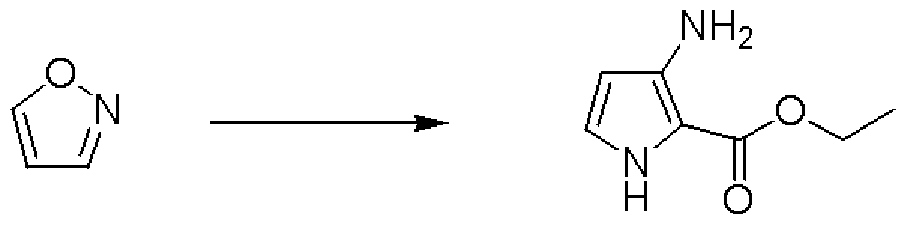
(1)イソキサゾール 75gのエタノール 300ml溶液に、ナトリウムエトキシド(21w%エタ ノール溶液) 369gを 8°C以下で 2時間かけてゆっくり加え、そのまま 45分攪拌した。 反応液に 4〜6°Cで酢酸 22. 5g、 2—アミノジマロン酸ジェチル塩酸塩 143g、酢酸 ナトリウム 61. 4gを順次加え、室温で終夜攪拌した。減圧濃縮後、残渣〖こクロ口ホル ムを加えて水洗後、乾燥した。残渣にエタノール 1. 14L、ナトリウムエトキシド(21w o/oエタノール溶液) 262ml加え、終夜攪拌した。反応液に酢酸 42. 2gを加えて減圧 濃縮した。残渣に水をカ卩えた後、飽和重曹水をカ卩えて pH7とし、クロ口ホルムを用い て抽出した後、乾燥した。シリカゲルカラムクロマトグラフィー(へキサン:酢酸ェチル = 2 : 1)で精製し、 3—アミノー 1H—ピロール - 2-カルボン酸ェチルエステルを 60 . 7g得た。 (1) To a solution of 75 g of isoxazole in 300 ml of ethanol, 369 g of sodium ethoxide (21 w% ethanol solution) was slowly added over 2 hours at 8 ° C. or less, and the mixture was stirred as it was for 45 minutes. To the reaction solution, 22.5 g of acetic acid, 143 g of 2-aminodimalonic acid jetyl hydrochloride and 61.4 g of sodium acetate were sequentially added at 4 to 6 ° C, and the mixture was stirred at room temperature overnight. After concentration under reduced pressure, the residue was dried and washed with water. To the residue, 1.14 L of ethanol and 262 ml of sodium ethoxide (21 w / o ethanol solution) were added and stirred overnight. To the reaction solution, 42.2 g of acetic acid was added and concentrated under reduced pressure. Water was added to the residue, saturated aqueous sodium bicarbonate solution was added to adjust the pH to 7, extracted using black mouth form, and dried. Purification by silica gel column chromatography (hexane: ethyl acetate = 2: 1) gave 60.7 g of 3-amino-1H-pyrrole-2-carboxylic acid ethyl ester.
APCI-MS (m/e) : 155 [M+H] + APCI-MS (m / e): 155 [M + H] +
[化 99] [Chemical 99]
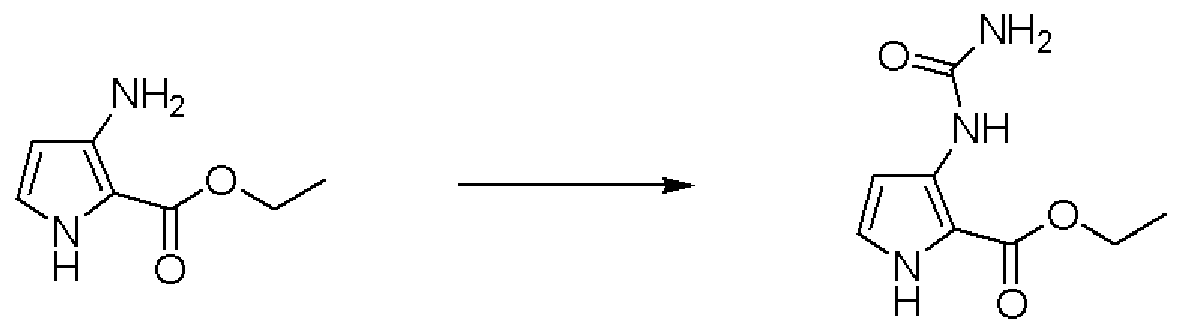
APCI-MS (m/e) : 198 [M+H] + APCI-MS (m / e): 198 [M + H] +
[化 100] [Chemical 100]

(3) 3—ウレイド一 1H—ピロ口一 2—カルボン酸ェチルエステル 69. 4gに 6%水酸ィ匕 ナトリウム水溶液 950mlを加え、加熱還流下で 30分攪拌した。放冷後、反応液に濃 塩酸をカ卩えて PH6とし、攪拌後に析出物をろ取した。少量の水、メタノールで洗浄後 に減圧乾燥し、トルエンで共沸し、 1, 5—ジヒドロ—ピロ口 [3, 2— d]ピリミジン— 2, 4 —ジ才ンを 32g得た。 (3) 3-Ureido 1 1H-Pyroguchi 1-Carboxylic acid ethyl ester To 69.4 g, 950 ml of a 6% aqueous sodium hydroxide solution was added, and the mixture was stirred for 30 minutes under heating to reflux. After allowing to cool, concentrated hydrochloric acid was added to the reaction solution to PH6, and the precipitate was collected by filtration after stirring. After washing with a small amount of water and methanol, it was dried under reduced pressure, and azeotroped with toluene, to obtain 32 g of 1,5-dihydro-pyro-mouth [3,2-d] pyrimidine-2,4-diene.
APCI-MS (m/e) : 152[M+H] + APCI-MS (m / e): 152 [M + H] +
[化 101] [Chemical 101]

[0181] (4) 1, 5—ジヒドロ一ピロ口 [3, 2— d]ピリミジン一 2, 4—ジオン 35. Ogに 1N水酸化 ナトリウム水溶液 23 lmlを加え、しばらく攪拌後に減圧濃縮し、残渣にトルエンを加え て共沸した。残渣にフエ-ルホスホニックジクロリド 239gをゆっくり加え、発熱が納ま つてから 180°Cに昇温し、 3時間攪拌した。更に、フエ-ルホスホ-ックジクロリド 100 gをゆっくり追加し、終夜攪拌した。反応液を攪拌下で氷水にゆっくり注ぎ、酢酸ェチ ルを加えて抽出した。有機層を重曹水で洗浄後、乾燥した。残渣に酢酸ェチル Zジ イソプロピルェ—テルをカ卩えて結晶化し、 2, 4 ジクロロ 5H ピロ口 [3, 2 ミジンを 19. 96g得た。 [0181] (4) 1,5-Dihydro 1-pyro [3, 2-d] pyrimidine 1, 2, 4-dione 35. Add 23 lml of 1N sodium hydroxide aqueous solution to Og, concentrate for a while, and concentrate under reduced pressure. Toluene was added to azeotropically. To the residue, 239 g of phenylphosphonic dichloride was slowly added, and after the exotherm had subsided, the temperature was raised to 180 ° C. and stirred for 3 hours. Further, 100 g of phenol phosphoric dichloride was slowly added and stirred overnight. The reaction solution was slowly poured into ice water with stirring, and extracted with ethyl acetate. The organic layer was washed with aqueous sodium bicarbonate and dried. Ethyl acetate Z Isopropyl ether was crystallized to obtain 19.96 g of 2,4 dichloro 5H pyro [3, 2 midine.
APCI— MS (m/e) : 188/190[M+H] + APCI— MS (m / e): 188/190 [M + H] +
[化 102]

[0182] (5) 2, 4 ジクロロ一 5H ピロ口 [3, 2— d]ピリミジン 19. 9gのァセトニトリル 530ml 溶液に氷冷下で 60%水素化ナトリウム 5. 08gを加え、室温下で 30分攪拌した。反 応液に 8°Cでヨウ化メチル 18. 03gを滴下し、室温下で終夜攪拌した。不溶物をセラ イトでろ過し、ろ液を濃縮した。残渣をジイソプロピルエーテルで洗浄し、 2, 4 ジク ロロ 5—メチル—5H ピロ口 [3, 2 d]ピリミジンを 11. Og得た。 [0182] (5) 2,4 Dichloro-5H Pillow mouth [3, 2—d] pyrimidine 19. Add 50.8 g of 60% sodium hydride to a solution of 9.9 ml of acetononitrile under ice-cooling, and 30 minutes at room temperature Stir. To the reaction solution, 18.03 g of methyl iodide was added dropwise at 8 ° C, and the mixture was stirred overnight at room temperature. Insoluble matter was filtered through celite, and the filtrate was concentrated. The residue was washed with diisopropyl ether to obtain 11. Og of 2,4 dichloro 5-methyl-5H pyro [3, 2 d] pyrimidine.
APCI-MS (m/e) : 202/204 [M+H] + APCI-MS (m / e): 202/204 [M + H] +
[化 103] [Chemical 103]

[0183] (6)化合物(1)を、実施例 1 (3)と同様に反応、処理することにより、(2 クロロー 5— メチル 5H ピロ口 [3, 2— d]ピリミジン一 4ーィル)ー(2, 4 ジクロロ一ベンジル) —ァミン(2)を 20. 6g得た。 [0183] (6) By reacting and treating compound (1) in the same manner as in Example 1 (3), (2 chloro-5-methyl 5H pillow mouth [3,2-d] pyrimidine 1-4-yl)- 20.6 g of (2,4dichloromonobenzyl) -amine (2) was obtained.
APCI - MS (m/e) : 341/343 [M+H] + APCI-MS (m / e): 341/343 [M + H] +
[化 104] [Chemical 104]

(1 ) (2) [0184] (7)化合物(1)を、実施例 1(4)と同様に反応、処理することにより、化合物(2)を得 た。 (1) (2) [0184] (7) Compound (2) was obtained by reacting and treating compound (1) in the same manner as in Example 1 (4).
APCI— MS(m/e) :391/393[M+H] APCI— MS (m / e): 391/393 [M + H]
[化 105] [Chemical 105]

[0185] (8)化合物(1)を実施例 22と同様に反応,処理することにより、化合物(2)を得た (8) Compound (2) was obtained by reacting and treating compound (1) in the same manner as in Example 22.
APCI— MS(m/e) :502/504[M+H] + APCI— MS (m / e): 502/504 [M + H] +
[0186] 実施例 306 [0186] Example 306
[化 106] [Chem 106]

(1)化合物(l)679mg、トリェチルァミン 276 1の THF20ml懸濁液に、氷冷下でク 口ロアセチルクロリド 224mgを滴下し、 1時間攪拌した。反応液にクロ口ホルムをカロえ 、水で洗浄し、乾燥後に溶媒留去した。残渣をジェチルエーテルで粉砕後、乾燥し、 化合物(2) 686mgを桃色粉末として得た。 (1) To a suspension of 679 mg of compound (l) and triethylamine 2761 in 20 ml of THF, 224 mg of chloroacetyl chloride was added dropwise under ice cooling, followed by stirring for 1 hour. The reaction solution was dried with black mouth form, washed with water, dried and evaporated. The residue was pulverized with jetyl ether and dried to obtain 686 mg of compound (2) as a pink powder.
APCI— MS(m/e) :453/455[M+H] + APCI— MS (m / e): 453/455 [M + H] +
[化 107]

(1 ) (2) (1) (2)
[0187] (2)化合物(l) 100mg、(R)—3 フルォロピロリジン塩酸塩 33mg、炭酸カリウム粉 末 76mgをァセトニトリル 2mlおよび 1, 4 ジォキサン 2mlの溶液に加え、室温下で 1 . 5時間攪拌した。反応液に酢酸ェチルを加え、飽和食塩水で洗浄後、乾燥、溶媒 留去した。残渣をシリカゲルカラムクロマトグラフィー(クロ口ホルム:メタノール = 100 : 0→95: 5)で精製し、化合物(2) 107mgを無色粉末として得た。 (2) Compound (l) 100 mg, (R) -3 fluoropyrrolidine hydrochloride 33 mg, potassium carbonate powder 76 mg was added to a solution of acetonitrile 2 ml and 1,4 dioxane 2 ml, and 1.5 ml at room temperature. Stir for hours. Ethyl acetate was added to the reaction solution, washed with saturated brine, dried and evaporated. The residue was purified by silica gel column chromatography (black mouth form: methanol = 100: 0 → 95: 5) to obtain 107 mg of compound (2) as a colorless powder.
APCI— MS (m/e) : 506/508 [M+H] + APCI— MS (m / e): 506/508 [M + H] +
[0188] 実施例 307 [0188] Example 307
[化 108] [Chemical 108]

化合物(l) lOOmgの塩化メチレン 5mlおよび DMFO. 5mlの溶液に、無水フタル 酸 72. 5mg、トリェチルァミン 70 1を加え、室温下で終夜攪拌した。反応液を減圧 濃縮し、残渣にクロ口ホルムを加えて飽和重曹水で洗浄後、乾燥し、溶媒留去した。 残渣をシリカゲルカラムクロマトグラフィー(クロ口ホルム:メタノール = 98: 2→90: 10) で精製し、化合物 (2)を得た。 化合物(2)を DMFに溶かし、 28%アンモニア水 1. 61 ml,ベンゼントリァゾール— 1—イロキシ一トリス(ジメチルァミノ)ホスホ-ゥムへキサフルォロホスホネート 426mg 、トリェチルァミン 135 1を順次加え、終夜攪拌した。反応液に酢酸ェチルを加え、 飽和重曹水で洗浄し、乾燥後に溶媒留去した。残渣をシリカゲルカラムクロマトグラフ ィー(クロ口ホルム:メタノール = 100: 0→90: 10)で精製し、へキサン/酢酸ェチル 力も固化し、乾燥して、化合物(3) 40mgを無色粉末として得た。 To a solution of compound (l) lOOmg in 5 ml of methylene chloride and DMFO. Was added 72.5 mg of phthalic anhydride and triethylamine 701, and stirred at room temperature overnight. The reaction solution was concentrated under reduced pressure, and chloroform was added to the residue. The residue was washed with saturated aqueous sodium hydrogen carbonate, dried and evaporated. The residue was purified by silica gel column chromatography (black mouth form: methanol = 98: 2 → 90: 10) to obtain compound (2). Dissolve compound (2) in DMF, add 1.61 ml of 28% aqueous ammonia, benzenetriazole-1-yloxytris (dimethylamino) phospho-hexafluorophosphonate 426 mg, and triethylamine 135 1 in order. Stir. Ethyl acetate was added to the reaction solution, washed with saturated aqueous sodium hydrogen carbonate, dried and evaporated. The residue was purified by silica gel column chromatography (black mouth form: methanol = 100: 0 → 90: 10), and the hexane / ethyl acetate force was solidified and dried to obtain 40 mg of compound (3) as a colorless powder. It was.
APCI— MS (m/e) : 555/557[M+H] + APCI— MS (m / e): 555/557 [M + H] +
[0189] 実施例 308〜325 [0189] Examples 308-325
上記実施例と同様に反応 ·処理することにより、以下の化合物を得た。 The following compounds were obtained by reaction and treatment in the same manner as in the above Examples.
[表 37] [Table 37]


310 :>[ N_ -CH2CO- 1 N _N. H H 524/526, APCI310 : > [ N _ -CH 2 CO- 1 N _N.HH 524/526, APCI
311 311
312

[0190] [表 38] R3 [0190] [Table 38] R 3

実施例 環 B MS([M+H]+)

39] 39]

APCI— MS (m/e) : 649/645 [M+H] + APCI— MS (m / e): 649/645 [M + H] +
[化 110] [Chem 110]

(2)反応条件を 60°Cにかえて、化合物(1)を実施例 41 (2)と同様に反応、処理する ことにより、化合物(2)を得た。 (2) Compound (2) was obtained by changing the reaction conditions to 60 ° C and reacting and treating compound (1) in the same manner as in Example 41 (2).
APCI— MS (m/e) : 635/637[M+H] + APCI— MS (m / e): 635/637 [M + H] +
[化 111] [Chem 111]

(3)化合物(1)を参考例 32 (5)と同様に反応、処理し、次いで参考例 32 (6)と同様 に反応、処理することにより、化合物(2)を得た。 (3) Compound (2) was obtained by reacting and treating Compound (1) in the same manner as in Reference Example 32 (5) and then reacting and treating in the same manner as in Reference Example 32 (6).
APCI— MS (m/e) : 534/536 [M+H] + APCI— MS (m / e): 534/536 [M + H] +
上記実施例と同様に反応、処理することにより、以下の化合物を得た。 The following compounds were obtained by reacting and treating in the same manner as in the above Examples.
[表 40] [Table 40]

327 -CONH-Me 548/550, APCI (2HCI) 327 -CONH-Me 548/550, APCI (2HCI)
328 -CONMe2 562/564, APCI (2HCI) 328 -CONMe 2 562/564, APCI (2HCI)
41] 41]

実施例 環 B MS([M+H]+)

42] 42]

実施例 環 A MS([M+H]+) Example Ring A MS ([M + H] +)
[0196] [表

実施例 R3 Z 環 A MS([M+H]+)

[0197] [表 44] [0197] [Table 44]


実施例 347 Example 347
[化 112] [Chem 112]

(1) (3) (13)
(1)化合物(1)と化合物(2)を実施例 1 (4)と同様に反応、処理することにより、化合 物 (3)を得た。 (1) Compound (3) was obtained by reacting and treating compound (1) and compound (2) in the same manner as in Example 1 (4).
APCI -MS (m/e) :477/479[M+H] + [化 113] APCI -MS (m / e): 477/479 [M + H] + [Chem 113]

(2)化合物(1)を実施例 1 (5)と同様に反応、処理することにより、化合物(2)を得た (2) Compound (2) was obtained by reacting and treating compound (1) in the same manner as in Example 1 (5).
APCI-MS (m/e) : 377/379 [M+H] APCI-MS (m / e): 377/379 [M + H]
[化 114] [Chemical 114]

(3)化合物(l) 68mgの塩化メチレン 1. 5ml溶液に、室温で 1—ピロリジンカルボ- ルクロリド 25 1、トリェチルァミン 106 1をカ卩え、室温で 2時間攪拌した。反応液に T HFl. Omlを加え、室温で終夜攪拌後、 50°Cで 2時間攪拌した。反応液を放冷し、ク ロロホルムを加え、飽和重曹水で洗浄し、乾燥後に溶媒留去した。残渣をシリカゲル カラムクロマトグラフィー(クロ口ホルム:メタノール = 100: 0→95: 5)で精製し、酢酸 ェチル Zジェチルエーテルで結晶化して、化合物(2) 52mgを淡橙色粉末として得 た。 (3) Compound (l) To a solution of 68 mg of methylene chloride in 1.5 ml was added 1-pyrrolidinecarbochloride 25 1 and triethylamine 106 1 at room temperature, and the mixture was stirred at room temperature for 2 hours. T HFl. Oml was added to the reaction mixture, and the mixture was stirred at room temperature overnight and then at 50 ° C. for 2 hours. The reaction solution was allowed to cool, added with chloroform, washed with saturated aqueous sodium bicarbonate, dried and evaporated. The residue was purified by silica gel column chromatography (black mouth form: methanol = 100: 0 → 95: 5) and crystallized with ethyl acetate Z jetyl ether to obtain 52 mg of compound (2) as a pale orange powder.
APCI— MS (m/e) :474/476 [M+H] + APCI— MS (m / e): 474/476 [M + H] +
上記実施例と同様に反応、処理することにより、以下の化合物を得た。 The following compounds were obtained by reacting and treating in the same manner as in the above Examples.
[表 45]


351 Me2N- -CONH- R 448/450, APCI 351 Me 2 N- -CONH- R 448/450, APCI
352 〇 N— -CONH- R 490/492, APCI 352 〇 N— -CONH- R 490/492, APCI
353 Me -N N— -CONH- R 503/505, APCI 353 Me -N N— -CONH- R 503/505, APCI

参考例 1 Reference example 1
[化 115] [Chemical 115]

(1 ) (2) (1) (2)
5—メチルー 1H ピラゾールー 3 ィルァミンを実施例 1(1)と同様に反応、処理 することにより、 2—メチル 4H ピラゾ口 [1, 5— a]—ピリミジン一 5, 7 ジオンを得 た。 5-Methyl-1H pyrazole-3-ylamine was reacted and treated in the same manner as in Example 1 (1) to give 2-methyl-4H pyrazolo [1,5-a] -pyrimidine-1,5,7 dione. It was.
APCI— MS(m/e) :166[M+H] APCI— MS (m / e): 166 [M + H]
[0201] 参考例 2— 1 [0201] Reference Example 2-1
[化 116] [Chem 116]

メチル 3 ァミノ— 4—メチル—2—カルボキシレート 25. Ogおよび尿素 43.9gを 190°Cで 4時間攪拌した。放冷後、水酸ィ匕ナトリウム水溶液を加えて、不溶物を濾去 した。濾液に塩酸を加えて中和し、氷冷下で放置し、析出した結晶を濾取し、水およ びメタノールで洗浄後、乾燥し、 7—メチル—1H チエノ [3, 2— d]ピリミジン— 2, 4 —ジオンを淡桃色粉末 15.9gとして得た。 Methyl 3-amino-4-methyl-2-carboxylate 25. Og and 43.9 g of urea were stirred at 190 ° C. for 4 hours. After allowing to cool, an aqueous sodium hydroxide solution was added, and the insoluble material was removed by filtration. The filtrate was neutralized by adding hydrochloric acid and allowed to stand under ice-cooling. The precipitated crystals were collected by filtration, washed with water and methanol, and then dried. 7-Methyl-1H thieno [3, 2-d] Pyrimidine-2,4-dione was obtained as 15.9 g of pale pink powder.
APCI-MS(m/e) :183[M+H] + APCI-MS (m / e): 183 [M + H] +
[0202] 参考例 2— 2 [0202] Reference Example 2-2
[化 117] [Chemical 117]

3 アミノー 5—メチルーチォフェン 2—力ルボン酸 メチルエステルを、参考例 2 —1と同様に反応、処理することにより、 6—メチル—1H チエノ [3, 2 d]ピリミジン -2, 4 ジ才ンを得た。 3 By reacting and treating amino-5-methylthiophene 2-strong rubonic acid methyl ester in the same manner as in Reference Example 2-1, the 6-methyl-1H thieno [3,2d] pyrimidine-2,4 di I got a talent.
APCI-MS(m/e) :183[M+H] + APCI-MS (m / e): 183 [M + H] +
参考例 3 Reference example 3
[化 118] [Chemical 118]

( ) (2) 化合物(1)を、参考例 2— 1と同様に反応、処理することにより、化合物(2)を得た c APCI-MS(m/e) :183[M+H] + () (2) Compound (1) was reacted and treated in the same manner as in Reference Example 2-1 to obtain compound (2). C APCI-MS (m / e): 183 [M + H] +
[0204] 参考例 4 [0204] Reference Example 4
[化 119] [Chemical 119]
-0 -0
Η Ν Η Ν
ΗΝ、 ΗΝ,
丄 Ν¾/ ΝΗ ¾ 、Ν 丄 Ν¾ / ΝΗ ¾, Ν
(1 ) (2) (1) (2)
化合物(1)を、実施例 1(1)と同様に反応、処理することにより、化合物(2)を得た c APCI-MS (m/e): 151[M— H]— Compound (2) was obtained by reacting and treating compound (1) in the same manner as in Example 1 (1). C APCI-MS (m / e): 151 [M—H] —
[0205] 参考例 5— 1 [0205] Reference Example 5— 1
[化 120] [Chemical 120]

(1 ) (2) (1) (2)
化合物(1)を、実施例 1(2)と同様に反応、処理することにより、化合物(2)を得た APCI-MS (m/e) :202/204 [M+H] + Compound (2) was obtained by reacting and treating compound (1) in the same manner as in Example 1 (2). APCI-MS (m / e): 202/204 [M + H] +
[0206] 参考例 5— 2 [0206] Reference Example 5-2
[化 121] [Chemical 121]
、 N, N

( ) (2; () (2;
化合物(1)を、実施例 1 (2)と同様に反応、処理することにより、化合物(2)を得た APCI-MS (m/e): 189/191[M+H] + Compound (2) was obtained by reacting and treating compound (1) in the same manner as in Example 1 (2). APCI-MS (m / e): 189/191 [M + H] +
[0207] 参考例 5— 3 [0207] Reference Example 5-3
[化 122]

(1 ) (2) (1) (2)
化合物(1)を、実施例 1(2)と同様に反応、処理することにより、化合物(2)を得た APCI— MS (m/e) :219/221 [M+H] + Compound (2) was obtained by reacting and treating compound (1) in the same manner as in Example 1 (2). APCI—MS (m / e): 219/221 [M + H] +
[0208] 参考例 6— 1 [0208] Reference Example 6— 1
[化 123] [Chemical 123]

(1 ) (2) (1) (2)
化合物(1)を、実施例 1(3)と同様に反応、処理することにより、化合物(2)を得た APCI-MS (m/e) :341/343 [M+H] + Compound (2) was obtained by reacting and treating compound (1) in the same manner as in Example 1 (3). APCI-MS (m / e): 341/343 [M + H] +
[0209] 参考例 6— 2 [0209] Reference Example 6-2
[化 124] [Chemical 124]

化合物(1)を、実施例 1(3)と同様に反応、処理することにより、化合物(2)を得た APCI-MS(m/e) :328/330[M+H] + Compound (2) was obtained by reacting and treating compound (1) in the same manner as in Example 1 (3). APCI-MS (m / e): 328/330 [M + H] +
[0210] 参考例 6— 3 [0210] Reference Example 6-3
[化 125]

(1 ) (2) (1) (2)
化合物(1)を、実施例 1(3)と同様に反応、処理することにより、化合物(2)を得た。 APCI-MS(m/e) :358/360[M+H] + Compound (2) was obtained by reacting and treating compound (1) in the same manner as in Example 1 (3). APCI-MS (m / e): 358/360 [M + H] +
[0211] 参考例 6— 4 [0211] Reference Example 6— 4
[化 126] [Chemical 126]

(1 ) (2) (1) (2)
化合物(1)を、実施例 1 (3)と同様に反応、処理することにより、化合物(2)を得た。 APCI-MS(m/e) :338/340[M+H] + Compound (2) was obtained by reacting and treating compound (1) in the same manner as in Example 1 (3). APCI-MS (m / e): 338/340 [M + H] +
[0212] 参考例 6— 5 [0212] Reference Example 6-5
[化 127] [Chemical 127]

(1 ) (2) (1) (2)
化合物(1)を、実施例 1 (2)および (3)と同様に反応、処理することにより、化合物( 2)を得た。 Compound (2) was obtained by reacting and treating compound (1) in the same manner as in Examples 1 (2) and (3).
APCI-MS(m/e) :358/360[M+H] + [0213] 参考例 6— 6 APCI-MS (m / e): 358/360 [M + H] + [0213] Reference Example 6-6
[化 128] [Chemical 128]

化合物(1)を、実施例 1(3)と同様に反応、処理することにより、化合物(2)を得た APCI— MS(mZe) :358 360[M+H] + Compound (2) was obtained by reacting and treating compound (1) in the same manner as in Example 1 (3). APCI—MS (mZe): 358 360 [M + H] +
[0214] 参考例 6— 7 [0214] Reference Example 6-7
[化 129] [Chemical 129]

( ) (2) () (2)
化合物(1)を、実施例 1 (3)と同様に反応、処理することにより、化合物(2)を得た。 APCI-MS(m/e) :360/362[M+H] + Compound (2) was obtained by reacting and treating compound (1) in the same manner as in Example 1 (3). APCI-MS (m / e): 360/362 [M + H] +
[0215] 参考例 7 [0215] Reference Example 7
[化 130] [Chem 130]
γ。、γ. ,
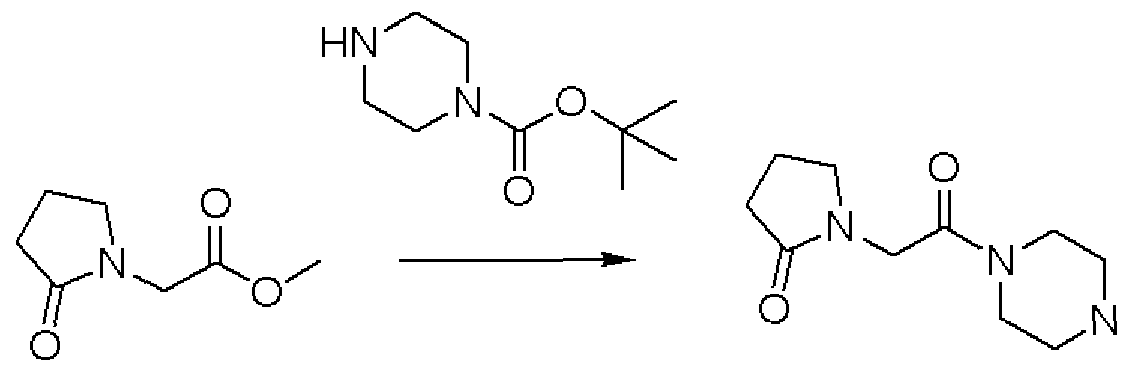
Ο Ο
(1) (2 ォキソ 1 ピロリジン 1 ィル) 酢酸メチルエステル 1.42g、ピペラジ ンー1一力ルボン酸 tert ブチルエステル 1.68gを混合し、マイクロウエーブ反応装 置を用いて 150°Cで 2時間照射した。シリカゲルカラムクロマトグラフィー(クロ口ホル ム Zメタノール = 100ZO→90ZlO)で精製した。再度、 ΝΗシリカゲルカラムクロマ トグラフィー(へキサン Ζ酢酸ェチル =50Z50→OZlOO)で精製し、 4 [2—(2— ォキソ一ピロリジン一 1—ィル)ァセチル]—ピペラジン一 1—カルボン酸 tert—ブチ ルエステルを油状物 1. 15gとして得た。 (1) (2 oxo 1 pyrrolidine 1 yl) Acetic acid methyl ester 1.42 g and piperazin-1 1 rubonic acid tert butyl ester 1.68 g were mixed together, and microwave reaction The sample was irradiated at 150 ° C for 2 hours. The product was purified by silica gel column chromatography (black mouth form Z methanol = 100ZO → 90ZlO). Again, purify by silica gel column chromatography (hexane キ サ ン ethyl acetate = 50Z50 → OZlOO) to obtain 4 [2- (2-oxo-1-pyrrolidine-1-yl) acetyl] -piperazine-1-1-carboxylic acid tert- Butyl ester was obtained as 1.15 g of oil.
APCI-MS (m/e) : 312[M+H] + APCI-MS (m / e): 312 [M + H] +
[化 131] [Chemical 131]

[0216] (2)化合物(1)を、実施例 1 (5)と同様に反応、処理することにより、化合物(2)を得 た。 (2) Compound (2) was obtained by reacting and treating compound (1) in the same manner as in Example 1 (5).
APCI-MS (m/e) : 212[Μ+Η] + APCI-MS (m / e): 212 [Μ + Η] +
[0217] 参考例 8 [0217] Reference Example 8
[化 132] [Chemical 132]

(1)Ν ェチル一エタノールァミン 24. 96gのトルエン 85ml溶液に 2 クロロアクリロ 二トリル 22. 4mlを室温下でゆっくり加え、終夜攪拌した。反応液に 0°C下でカリウム t ert—ブトキシド 31. 44gのトルエン 200mlZTHF160ml溶液をゆっくり加え、更に 1 時間攪拌した。反応液を減圧留去し、ジェチルエーテルを加え、析出した固体を濾 去した。濾液を濃縮し、残渣にトルエン 235mlをカ卩え、 6N塩酸 380mlをカ卩えて加熱 還流下で 2時間、室温で終夜攪拌した。溶媒を留去した後、乾燥し、 4 ェチル—モ ルホリン— 2—カルボン酸の粗体を得た。この化合物を精製せずに次工程で用いた。 (1) Ethyl monoethanolamine 24. 96 ml of toluene in 85 ml of solution was slowly added 2 chloroacrylo nitrile (22.4 ml) at room temperature and stirred overnight. To the reaction solution, a solution of potassium tert-butoxide 31.44 g in toluene 200 ml ZTHF 160 ml was slowly added at 0 ° C., and the mixture was further stirred for 1 hour. The reaction solution was evaporated under reduced pressure, jet ether was added, and the precipitated solid was removed by filtration. The filtrate was concentrated, 235 ml of toluene was added to the residue, 380 ml of 6N hydrochloric acid was added, and the mixture was heated under reflux for 2 hours and stirred overnight at room temperature. After the solvent was distilled off, the residue was dried to obtain a crude product of 4-ethyl-morpholine-2-carboxylic acid. This compound was used in the next step without purification.
APCI-MS (m/e) : 160[M+H] +

(2) 4-ェチル モルホリン 2 カルボン酸の粗体に塩化チォ -ルをカ卩え、加熱還 流下で 4時間攪拌した。溶媒を留去し、トルエンで 2回共沸した。残渣を塩化メチレン 100mlに溶力し、氷冷下でベンジルォキシカルボ-ルビペラジン 59. 2g、トリェチル ァミン 195mlをカ卩えて、室温で終夜攪拌した。溶媒を留去した後、ジ— tert—ブチル ジカルボネート 30. 7g、酢酸ェチル 120mlを加え、室温で 4時間攪拌した。クェン酸 水を加え、酢酸ェチルで抽出し、乾燥後、溶媒を留去した。シリカゲルカラムクロマト グラフィー(へキサン Z酢酸ェチル =60Z40→40Z60)で精製し、 4一(4 ェチル —モルホリン— 2—カルボ-ル)—ピペラジン— 1—カルボン酸べンジルエステルを橙 色油状物 3. 69gとして得た。 (2) 4-Ethylmorpholine 2 Carboxylic acid was added to a crude product of carboxylic acid and stirred for 4 hours under heating reflux. The solvent was distilled off and azeotroped twice with toluene. The residue was dissolved in 100 ml of methylene chloride, and 59.2 g of benzyloxycarborpiperazine and 195 ml of triethylamine were collected under ice cooling and stirred overnight at room temperature. After distilling off the solvent, 30.7 g of di-tert-butyl dicarbonate and 120 ml of ethyl acetate were added and stirred at room temperature for 4 hours. Aqueous water was added, extracted with ethyl acetate, dried, and then the solvent was distilled off. Purified by silica gel column chromatography (hexane Z ethyl acetate = 60Z40 → 40Z60) to obtain 4- (4-ethyl-morpholin-2-carbol) -piperazine-1-carboxylic acid benzyl ester as an orange oil 3.69 g Got as.
APCI-MS (m/e) : 362[M+H] + APCI-MS (m / e): 362 [M + H] +
[化 134] [Chemical 134]

[0218] (3)化合物(1)を、参考例 9 (2)と同様に反応、処理することにより、化合物(2)を得 た。 (3) Compound (2) was obtained by reacting and treating compound (1) in the same manner as in Reference Example 9 (2).
APCI-MS (m/e) : 228 [M+H] + APCI-MS (m / e): 228 [M + H] +
[0219] 参考例 9 [0219] Reference Example 9

APCI— MS (m/e) :432[M+H] + APCI— MS (m / e): 432 [M + H] +
[化 136] [Chemical 136]

[0220] (2) 4— [2— (2 (S)—tert ブトキシカルボ-ルーピロリジン 1 ィル)ァセチル] —ピペラジン一 1 カルボン酸べンジルエステル 4. 32gのメタノール溶液に 10%パ ラジウム Z炭素 1. Ogを加え、水素雰囲気下、室温で終夜攪拌した。反応液をセライ トで濾過し、濾液を濃縮し、 1— (2—ォキソ—2—ピぺラジン— 1—ィル—ェチル) - ピロリジン— 2 (S)—カルボン酸 tert—ブチルエステルを油状物 3. 09gとして得た。 APCI-MS (m/e) : 298 [M+H] + [0220] (2) 4— [2— (2 (S) —tert Butoxycarbo-lupyrrolidine 1 yl) acetyl] —piperazine mono 1 carboxylic acid benzyl ester 4. 10% palladium Z carbon in 32 g methanol solution 1. Og was added and stirred overnight at room temperature under a hydrogen atmosphere. The reaction solution was filtered through celite, and the filtrate was concentrated to give 1- (2-oxo-2-piperazine-1-ylethyl) -pyrrolidine-2 (S) -carboxylic acid tert-butyl ester as an oil. 3. Obtained as 09 g. APCI-MS (m / e): 298 [M + H] +
[0221] 参考例 10— 1 [0221] Reference Example 10— 1
[化 137]

(1 ) (2) (1) (2)
化合物(1)を、実施例 1(4)と同様に反応、処理することにより、化合物(2)を得た APCI-MS(m/e) :377/379 [M+H] + Compound (2) was obtained by reacting and treating compound (1) in the same manner as in Example 1 (4). APCI-MS (m / e): 377/379 [M + H] +
[0222] 参考例 10— 2 [0222] Reference Example 10-2
[化 138] [Chemical 138]

(1 ) (2) (1) (2)
化合物(1)を、実施例 1(4)と同様に反応、処理することにより、化合物(2)を得た APCI— MS(m/e) :408/410[M+H] + Compound (2) was obtained by reacting and treating compound (1) in the same manner as in Example 1 (4). APCI—MS (m / e): 408/410 [M + H] +
[0223] 参考例 10— 3 [0223] Reference Example 10-3
[化 139] [Chem 139]

(1 ) (2) 化合物(1)を、実施例 1(4)と同様に反応、処理することにより、化合物(2)を得た APCI - MS (m/e) :394/396 [M+H] + (1) (2) Compound (1) was reacted and treated in the same manner as in Example 1 (4) to give compound (2). APCI-MS (m / e): 394/396 [M + H] +
[0224] 参考例 11 [0224] Reference Example 11
[化 140]

(1)メチルアクリロニトリル 40gに 45°C下で臭素を 2時間かけてゆっくり滴下し、更に 2 時間攪拌した。水酸化カリウム 67. 4gのメタノール 500ml溶液に、 0°Cで先の反応液 を 30分かけてゆっくり滴下し、 2時間後に室温に昇温し、 1日攪拌した。反応液を減 圧濃縮し、残渣に水を加え、ジェチルエーテルで 2回抽出した。有機層を合わせ、飽 和食塩水で洗浄し、硫酸マグネシウムで乾燥後、濾過し、溶媒を留去した。残渣にェ タノール 50ml、飽水ヒドラジン 35. 8gを加え、 80°Cで 1日攪拌した。ヒドラジン 10gを 追加し、 80°Cで更に 1日攪拌した。反応液を減圧濃縮後、残渣をクロ口ホルム Zメタ ノール(9Z1)混液に溶かし、シリカゲルを加えて放置後に濾過した。濾液を減圧濃 縮し、 4ーメチルー 1H—ピラゾールー 3—ィルァミンを暗紫色油状物 46. 7gとして得 た。 (1) Bromine was slowly added dropwise to 40 g of methylacrylonitrile at 45 ° C. over 2 hours, followed by further stirring for 2 hours. The above reaction solution was slowly added dropwise to a solution of 67.4 g of potassium hydroxide in 500 ml of methanol at 0 ° C. over 30 minutes. After 2 hours, the mixture was warmed to room temperature and stirred for 1 day. The reaction mixture was concentrated under reduced pressure, water was added to the residue, and the mixture was extracted twice with jetyl ether. The organic layers were combined, washed with saturated Japanese brine, dried over magnesium sulfate, filtered, and the solvent was distilled off. To the residue were added 50 ml of ethanol and 35.8 g of saturated hydrazine, and the mixture was stirred at 80 ° C for 1 day. 10 g of hydrazine was added, and the mixture was further stirred at 80 ° C for 1 day. After concentrating the reaction solution under reduced pressure, the residue was dissolved in a mixed solution of black mouth form Z methanol (9Z1), added with silica gel, and then filtered. The filtrate was concentrated under reduced pressure to give 4-methyl-1H-pyrazole-3-ylamine as 46.7 g of a dark purple oil.
APCI-MS (m/e) : 98 [M+H] + APCI-MS (m / e): 98 [M + H] +
[化 141]

( 1 ) ( 2 ) (1) (2)
化合物(1)を、実施例 1 (1)と同様に反応、処理することにより、化合物(2)を得た。 Compound (2) was obtained by reacting and treating compound (1) in the same manner as in Example 1 (1).
APCI-MS (m/e) : 166 [M+H] + APCI-MS (m / e): 166 [M + H] +
参考例 12 Reference Example 12
[化 142]

(1) N—エトキシカルボ-ルイソ-ペコチン酸 4. 43gの THF50ml溶液に氷冷下で N , N'—カルボニルジイミダゾール 9. 9gをカ卩え、室温下で 1時間攪拌した。反応液に 室温でマロン酸モノ(4--トロベンジル)エステル マグネシウム塩 12. Ogおよび TH F30mlを加え、 50°Cで 10時間攪拌した。反応液を濃縮し、残渣にジェチルエーテ ルをカ卩え、塩酸、水、飽和重曹水および飽和食塩水で洗浄し、硫酸ナトリウムで乾燥 後、溶媒を留去した。残渣をシリカゲルカラムクロマトグラフィー(へキサン Z酢酸ェチ ル = 100ZO→65Z35)で精製した。酢酸ェチル Ζへキサン力も再結晶を行い、 4 — [2— (4— -トロ—ベンジルォキシカルボ-ル)—ァセチル]—ピペリジン— 1—力 ルボン酸ェチルエステルを無色粉末 7. 82gとして得た。 (1) N-ethoxycarboiso-pecotic acid 4. 9.9 g of N, N'-carbonyldiimidazole was added to a solution of 43 g of THF in 50 ml of THF under ice-cooling, and the mixture was stirred at room temperature for 1 hour. To the reaction mixture, malonic acid mono (4-trobenzyl) ester magnesium salt 12. Og and 30 ml of THF were added at room temperature, followed by stirring at 50 ° C. for 10 hours. Concentrate the reaction mixture and add Jetylate to the residue. The solution was collected, washed with hydrochloric acid, water, saturated aqueous sodium hydrogen carbonate and saturated brine, dried over sodium sulfate, and the solvent was evaporated. The residue was purified by silica gel column chromatography (hexane Z ethyl acetate = 100ZO → 65Z35). Ethyl acetate Ζhexane force was also recrystallized to give 4 — [2— (4--tro-benzyloxycarbol) -acetyl] -piperidine 1-force rubonic acid ethyl ester as colorless powder 7.82 g .
APCI-MS (m/e) : 379 [M+H] + APCI-MS (m / e): 379 [M + H] +
[化 143] [Chemical 143]

[0226] (2) 4— [2— (4 二トロ—ベンジルォキシカルボ-ル)—ァセチル]—ピペリジン— 1 —カルボン酸 ェチルエステル 10. 3gと 3 アミノビラゾール 2. 2gを酢酸 15mlに溶 かし、 95°Cで終夜攪拌した。反応液を減圧濃縮し、残渣に酢酸ェチルを加え、析出 した結晶を濾取した。酢酸ェチルで洗浄後、乾燥し、 4一(7—ォキソ—4, 7—ジヒド ローピラゾ口 [1, 5— a]ピリミジンー5—ィノレ)ーピペリジンー1一力ノレボン酸 ェチノレ エステルを淡褐色結晶 6. 9gとして得た。 APCI— MS (mZe) : 291 [M+H] + [化 144] [0226] (2) 4— [2— (4 Nitro-benzyloxycarbol) -acetyl] -piperidine-1 —carboxylic acid ethyl ester 10.3 g and 3 aminobiazole 2.2 g in 15 ml acetic acid However, the mixture was stirred at 95 ° C overnight. The reaction mixture was concentrated under reduced pressure, ethyl acetate was added to the residue, and the precipitated crystals were collected by filtration. After washing with ethyl acetate and drying, 4 1 (7-oxo-4,7-dihydropirazo mouth [1, 5—a] pyrimidine-5-inole) -piperidine-1 Got as. APCI— MS (mZe): 291 [M + H] + [Chemical 144]

[0227] (3) 4— (7—ォキソ 4, 7 ジヒドロ一ピラゾ口 [1, 5— a]ピリミジン一 5—ィル)一ピ ペリジン 1一力ルボン酸 ェチルエステル 500mgにジェチルァニリン 1. 2ml、ォキ シ塩化リン 3. Ogを順次カ卩え、 50°Cで 10分間攪拌した。クロ口ホルムに溶かし、飽和 重曹水、飽和食塩水で洗浄し、乾燥後に溶媒を留去した。残渣をシリカゲルカラムク 口マトグラフィー(へキサン Z酢酸ェチル =4Zl→2Zl)で精製し、 4一(7—クロ口 ピラゾ口 [1, 5— a]ピリミジンー5—ィノレ)ーピペリジンー1一力ノレボン酸 ェチノレエ ステルを黄色油状物 501mgとして得た。 APCI-MS (m. e) : 309/311 [M+H] [0227] (3) 4— (7-oxo 4, 7 Dihydro monopyrazo mouth [1, 5— a] Pyrimidine mono 5-yl) monopiperidine 1 monostrengthene rubonic acid ethyl ester Phosphorus oxychloride 3. Og was sequentially added and stirred at 50 ° C for 10 minutes. The residue was dissolved in chloroform, washed with saturated aqueous sodium hydrogen carbonate and saturated brine, and dried, and the solvent was evaporated. The residue was purified by silica gel column chromatography (hexane Z ethyl acetate = 4Zl → 2Zl), and 4- (7-black mouth pyrazo mouth [1, 5-a] pyrimidine-5-inole) -piperidine-1 Ethinole stell was obtained as a yellow oil 501 mg. APCI-MS (m.e): 309/311 [M + H]
[化 145] [Chemical 145]

[0228] (4) 4— (7 クロ口一ピラゾ口 [1, 5— a]ピリミジン一 5—ィル)一ピペリジン一 1—カル ボン酸 ェチルエステル 490mg、 2, 4 ジクロロベンジルァミン 419mgを 1, 4 ジ ォキサン 5mlに溶かし、ジイソプロピルェチルァミン 0. 28mlを加え、 90°Cで 9時間攪 拌した。放冷後、反応液にクロ口ホルムを加え、飽和重曹水、飽和食塩水で洗浄し、 乾燥後に溶媒を留去した。 NHシリカゲルカラムクロマトグラフィー(酢酸ェチル Zへ キサン Zクロ口ホルム =1Z5Z5→3Z10Z10)で精製し、 4- [7- (2, 4 ジクロロ ペンジノレアミノ) ピラゾ口 [1, 5— a]ピリミジン 5—ィノレ]ーピペリジン 1一力ノレ ボン酸ェチルエステルを淡褐色油状物 0. 75gとして得た。 [0228] (4) 4— (7 Black mouth 1 Pyrazo mouth [1, 5— a] Pyrimidine 1 5-yl) 1 Piperidine 1 1-Carbonate ethyl ester 490 mg, 2, 4 Dichlorobenzylamine 419 mg 1 , 4 Dioxane was dissolved in 5 ml, 0.28 ml of diisopropylethylamine was added, and the mixture was stirred at 90 ° C for 9 hours. After allowing to cool, chloroform was added to the reaction mixture, washed with saturated aqueous sodium hydrogen carbonate and saturated brine, and dried to remove the solvent. Purified by NH silica gel column chromatography (Ethyl acetate Z Hexane Z Chloform form = 1Z5Z5 → 3Z10Z10), 4- [7- (2, 4 Dichloropentinoreamino) Pyrazolo [1,5-a] pyrimidine 5-inole] Piperidine 1-strength norebonic acid ethyl ester was obtained as a pale brown oily substance, 0.75 g.
APCI— MS (m/e) :448/450[M+H] + APCI— MS (m / e): 448/450 [M + H] +
[化 146] [Chemical 146]

[0229] (5) 4— [7— (2, 4 ジクロロ一ベンジルァミノ)一ビラゾロ [1, 5— a」ピリミジン一 5— ィル]—ピペリジン— 1—カルボン酸ェチルエステル 10. 4gの 2 プロパノール 150 ml溶液に水酸ィ匕カリウム 13. Ogを加え、加熱還流下で終夜攪拌した。反応液を放冷 し、塩ィ匕アンモ-ゥム水溶液をカ卩え、クロ口ホルムで抽出した。有機層を飽和食塩水 で洗浄し、硫酸ナトリウムで乾燥後、溶媒を留去した。酢酸ェチルカ 結晶化を行い 、 (2, 4 ジクロロ一ベンジル)一(5 ピぺリジン一 4—ィル一ピラゾ口 [1, 5— a]ピリ ミジン— 7—ィル)—ァミンを無色結晶 7. 08gとして得た。 APCI-MS( [0229] (5) 4— [7— (2,4 Dichloromonobenzylamino) monovirazolo [1, 5— a ”Pyrimidine mono 5-yl] -piperidine— 1-carboxylic acid ethyl ester 10. 4 g of 2 propanol 150 To the ml solution, 13.Og of potassium hydroxide was added, and the mixture was stirred overnight with heating under reflux. The reaction solution was allowed to cool, and an aqueous salt ammonium solution was added and extracted with black mouth form. The organic layer was washed with saturated brine, dried over sodium sulfate, and the solvent was evaporated. Ethyl acetate was crystallized to give (2, 4 dichloro monobenzyl) mono (5 piperidine mono 4-yl monopyrazo mouth [1, 5-a] pyrimidine-7-yl) -amamine as colorless crystals. Obtained as 08g. APCI-MS (
[0230] 参考例 13 [0230] Reference Example 13
[化 147]

(1)4 ヒドロキシメチル -ピぺリジン 1 カルボン酸から常法により誘導される 4 - ヒドロキシメチルーピペリジン 1一力ルボン酸 tert ブチルエステル 5.05gの塩ィ匕 メチレン 50ml溶液に室温でトリフエ-ルホスフィン 7.42gおよび四臭化炭素 11.69 gを加え、室温で 30分間攪拌した。反応液に飽和重曹水を加え、クロ口ホルムで 3回 抽出し、硫酸マグネシウムで乾燥後、溶媒を留去した。残渣をシリカゲルカラムクロマ トグラフィー(へキサン Z酢酸ェチル 100Z0→90Z10)で精製し、 4 ブロモメチル ーピペリジン 1一力ルボン酸 tert ブチルエステルを無色油状物 7.25gとして得 た。 (1) 4-Hydroxymethyl-piperidine 1 4-hydroxymethyl-piperidine 1 Derived from carboxylic acid tert-butyl ester 5.05 g of salt 匕 Triphenylphosphine in 50 ml solution of methylene at room temperature 7.42 g and carbon tetrabromide 11.69 g were added, and the mixture was stirred at room temperature for 30 minutes. Saturated aqueous sodium hydrogen carbonate was added to the reaction mixture, and the mixture was extracted 3 times with black mouth form, dried over magnesium sulfate, and the solvent was evaporated. The residue was purified by silica gel column chromatography (hexane Z ethyl acetate 100Z0 → 90Z10) to give 4-bromomethyl-piperidine 1-strength rubonic acid tert butyl ester as a colorless oil, 7.25 g.
APCI— MS(m/e) :178/180[M+H] + APCI— MS (m / e): 178/180 [M + H] +
[化 148]

( 1 ) (2) (1) (2)
化合物(1)を、実施例 1(4)と同様に反応、処理することにより、化合物(2)を得た。 APCI— MS(m/e) :269[M+H] + Compound (2) was obtained by reacting and treating compound (1) in the same manner as in Example 1 (4). APCI— MS (m / e): 269 [M + H] +
[0231] 参考例 13 (4): [0231] Reference Example 13 (4):
[0232] 4 ピロリジン一 1ーィルメチルーピペリジン · 2塩酸塩 [0232] 4 Pyrrolidine mono-1-ylmethyl-piperidine dihydrochloride
[化 149]

(1 (2 (1 (2
化合物(1)を、実施例 1(5)と同様に反応、処理することにより、化合物(2)を得た。 APCI-MS ( Compound (2) was obtained by reacting and treating compound (1) in the same manner as in Example 1 (5). APCI-MS (
[0233] 参考例 14 [0233] Reference Example 14
[化 150] [Chemical 150]

(1)ジイソプロピルアミン 4. 1mlの THF4. 1ml溶液に窒素置換下、 78°Cで n—ブ チルリチウム(1. 7Mへキサン溶液)をカ卩え、 30分攪拌した。この反応液に N— tert ブチルォキシカルボ-ル イソ-ペコチン酸ェチルエステル 5. 0 lgの THF 15ml 溶液を滴下し、 30分攪拌した。更にクロロブロモェタン 4. 8mlをカ卩え、 30°C〜一 2 0°Cで 5時間攪拌した。反応液に氷冷下で飽和重曹水を加え、酢酸ェチルで 3回抽 出した。有機層を合わせ、硫酸マグネシウムで乾燥し、溶媒を留去した。シリカゲル力 ラムクロマトグラフィー(へキサン Z酢酸ェチル = 90Z10→80Z20)で精製し、 4一 ( 2 クロローェチル)ーピペリジン 1, 4ージカルボン酸 1 tert ブチルエステル 4 ェチルエステルを淡黄色油状物 2. 19gとして得た。 (1) Diisopropylamine 4.1-ml THF solution was charged with n-butyllithium (1.7 M hexane solution) at 78 ° C under nitrogen substitution and stirred for 30 minutes. To this reaction solution, a solution of N-tertbutyloxycarboxyl-pecotic acid ethyl ester 5.0 lg in THF 15 ml was added dropwise and stirred for 30 minutes. Further, 4.8 ml of chlorobromoethane was added and stirred at 30 ° C. to 120 ° C. for 5 hours. Saturated aqueous sodium hydrogen carbonate was added to the reaction mixture under ice cooling, and the mixture was extracted three times with ethyl acetate. The organic layers were combined, dried over magnesium sulfate, and the solvent was distilled off. Purification by silica gel force chromatography (hexane Z ethyl acetate = 90Z10 → 80Z20) gave 4- (2-chloroethyl) -piperidine 1,4-dicarboxylic acid 1 tert butyl ester 4 ethyl ester as a pale yellow oil 2.19 g.
APCI - MS (m/e): 220/222 (M + 2H- Boc) + APCI-MS (m / e): 220/222 (M + 2H- Boc) +
[化 151] [Chemical 151]

( ) ( 2 () (2
[0234] (2)化合物(1)を、実施例 1 (4)と同様に反応、処理することにより、化合物(2)を得 た。 (2) Compound (2) was obtained by reacting and treating compound (1) in the same manner as in Example 1 (4).
APCI-MS (m/e) : 355 [M+H] + APCI-MS (m / e): 355 [M + H] +
[化 152]

[0235] (3)化合物(1)を、実施例 1 (5)と同様に反応、処理することにより、化合物(2)を得 た。 (3) Compound (2) was obtained by reacting and treating compound (1) in the same manner as in Example 1 (5).
APCI-MS (m/e) : 255 [M+H] + APCI-MS (m / e): 255 [M + H] +
[0236] 参考例 15 [0236] Reference Example 15
[化 153] [Chemical 153]

(1) N- (1— tert—ブトキシカルボ-ル)一(R)—プロリン 10gの DMF200ml溶液 に 1一(3 ジメチルァミノプロピル) 3 ェチルカルボジイミド塩酸塩 10. 7gおよび 1—ヒドロキシベンゾトリアゾール水和物 8. 5gをカ卩え、室温で 1時間攪拌した。反応 液にピぺラジン— 1—カルボン酸べンジルエステル 12. 3gをカ卩え、室温で終夜攪拌 した。反応液に水と酢酸ェチルを加え、分液した。有機層を水で洗浄し、乾燥後、溶 媒を留去した。残渣をシリカゲルカラムクロマトグラフィー(へキサン:酢酸ェチル:メタ ノール = 2: 1: 0→0: 1: 0→0 : 100 : 1)にて精製した。残渣にジェチルエーテルをカロ え、沈殿物を濾取した。へキサンで洗浄し、乾燥後、 目的物の粉末 4. 02gを得た。 ( 収率 21%) APCI— MS (mZe) :418 [M+H] + (1) N- (1-tert-butoxycarbol) mono (R) -proline 1 g (3 dimethylaminopropyl) 3 ethylcarbodiimide hydrochloride 10.7 g and 1-hydroxybenzotriazole 8.5 g of hydrate was added and stirred at room temperature for 1 hour. To the reaction solution, 12.3 g of piperazine-1-carboxylic acid benzyl ester was added and stirred at room temperature overnight. Water and ethyl acetate were added to the reaction solution to separate it. The organic layer was washed with water and dried, and then the solvent was distilled off. The residue was purified by silica gel column chromatography (hexane: ethyl acetate: methanol = 2: 1: 0 → 0: 1: 0 → 0: 100: 1). The residue was covered with jetyl ether, and the precipitate was collected by filtration. After washing with hexane and drying, 4.02 g of the desired powder was obtained. (Yield 21%) APCI— MS (mZe): 418 [M + H] +
[化 154]

(1) (2) (1) (2)
[0237] (2)化合物(1)を、参考例 9 (2)と同様に反応、処理することにより、化合物(2)を得 た。 (2) Compound (2) was obtained by reacting and treating compound (1) in the same manner as in Reference Example 9 (2).
APCI-MS(m/e) :284[M+H] + APCI-MS (m / e): 284 [M + H] +
[0238] 参考例 16 [0238] Reference Example 16
[化 155] [Chemical 155]

(1 ) (2) (1) (2)
(1)化合物(1)を、参考例 9 (1)と同様に反応、処理することにより、化合物(2)を得 た。 (1) Compound (2) was obtained by reacting and treating compound (1) in the same manner as in Reference Example 9 (1).
APCI-MS(m/e) :332[Μ+Η] + APCI-MS (m / e): 332 [Μ + Η] +
[化 156] [Chemical 156]

(1 ) (2) (1) (2)
[0239] (2)化合物(1)を、参考例 9 (2)と同様に反応、処理することにより、化合物(2)を得 た。 (2) Compound (2) was obtained by reacting and treating compound (1) in the same manner as in Reference Example 9 (2).
APCI-MS(m/e) :198[Μ+Η] + APCI-MS (m / e): 198 [Μ + Η] +
[0240] 参考例 17 [化 157] [0240] Reference Example 17 [Chemical 157]

(1 ) (2) (1) (2)
(1)化合物(1)を、参考例 2 (1)と同様に反応、処理することにより、化合物(2)を得 た。 (1) Compound (2) was obtained by reacting and treating compound (1) in the same manner as in Reference Example 2 (1).
APCI— MS(mZe) :206[M— H]— APCI— MS (mZe): 206 [M— H] —
[化 158] [Chemical 158]

(1 ) (2) (1) (2)
[0241] (2)化合物(1)を、実施例 1(2)および (3)と同様に反応、処理することにより、化合 物 (2)を得た。 [0241] (2) Compound (2) was obtained by reacting and treating compound (1) in the same manner as in Examples 1 (2) and (3).
APCI-MS(m/e) :383/385 [M+H] + APCI-MS (m / e): 383/385 [M + H] +
[0242] 参考例 18 [0242] Reference Example 18
[化 159] [Chemical 159]

APCI-MS (m/e) : 177[M+H] + APCI-MS (m / e): 177 [M + H] +
[化 160] [Chemical 160]

[0243] (2)化合物(1)を、実施例 42 (1)と同様に反応、処理することにより、化合物(2)を得 た。 [0243] (2) Compound (2) was obtained by reacting and treating compound (1) in the same manner as in Example 42 (1).
APCI-MS (m/e) : 221 [M+H] + APCI-MS (m / e): 221 [M + H] +
[化 161] [Chemical 161]

[0244] (3)化合物(1)を、実施例 1 (2)および (3)と同様に反応、処理することにより、化合 物 (2)を得た。 [0244] (3) Compound (2) was obtained by reacting and treating compound (1) in the same manner as in Example 1 (2) and (3).
APCI-MS (m/e) : 396/398 [M+H] + [0245] 参考例 19 APCI-MS (m / e): 396/398 [M + H] + [0245] Reference Example 19
[化 162] [Chemical 162]

6 二トロー 1H キナゾリン 2, 4 ジオン 2. 07gおよび 2, 4, 6 トリメチノレピリ ジン 3. 64gのァセトニトリノレ 150mlの懸淘液に、才キシ塩ィ匕リン 18. 4gをカロえ、還流 下、終夜攪拌した。反応液を濃縮した後、残渣に酢酸ェチルと水を加え、分液した。 有機層を水で洗浄し、乾燥後、溶媒を留去した。残渣にァセトニトリル 100mlを加え 、 0°Cに冷却した。この溶液に 50°Cにて 1時間攪拌した 2, 4 ジクロ口べンジルアル コール 3. 54gおよび水素化ナトリウム 800mgの DMF50ml懸濁液を 0°Cにて滴下し た。混合物を 0°Cで 1時間攪拌後、反応液に酢酸ェチルと水を加え、分液した。有機 層を水で洗浄し、乾燥後、溶媒を留去した。残渣にクロ口ホルムとジェチルエーテル を加え、沈殿物を濾去した後、濾液を濃縮した。残渣をシリカゲルカラムクロマトダラ フィー(へキサン:酢酸ェチル = 100: 0→85: 15)にて精製した。残渣にジェチルェ 一テルおよびへキサンを加え、沈殿物を濾取した後、乾燥し、 目的物の黄色粉末 37 8mgを得た。 6 Nitrowe 1H quinazoline 2,4 dione 2. 07 g and 2, 4, 6 Trimethinorepyridine 3. 64 g Acetonitrinore Into 150 ml suspension, add 18.4 g of xylin saltin and stir under reflux overnight. did. After concentrating the reaction solution, ethyl acetate and water were added to the residue for liquid separation. The organic layer was washed with water and dried, and then the solvent was distilled off. Acetonitrile (100 ml) was added to the residue and cooled to 0 ° C. To this solution, a suspension of 2,54 dichroic benzyl alcohol 3.54 g and sodium hydride 800 mg in DMF 50 ml stirred at 50 ° C. for 1 hour was added dropwise at 0 ° C. After the mixture was stirred at 0 ° C. for 1 hour, ethyl acetate and water were added to the reaction solution, and the mixture was separated. The organic layer was washed with water and dried, and then the solvent was distilled off. To the residue were added black mouth form and jetyl ether, the precipitate was filtered off, and the filtrate was concentrated. The residue was purified by silica gel column chromatography (hexane: ethyl acetate = 100: 0 → 85: 15). Jetyl ether and hexane were added to the residue, and the precipitate was collected by filtration and then dried to obtain 378 mg of the objective yellow powder.
APCI— MS (m/e) : 384/386 [M+H] + APCI— MS (m / e): 384/386 [M + H] +
[0246] 参考例 20 [0246] Reference Example 20
[化 163]

(1)化合物(1)を、参考例 2 (1)と同様に反応、処理することにより、化合物(2)を得 APCI— MS(m/e) :169[M+H] (1) Compound (2) is obtained by reacting and treating compound (1) in the same manner as in Reference Example 2 (1). APCI— MS (m / e): 169 [M + H]
[化 164] [Chemical 164]

[0247] (2)化合物(1)を、実施例 1(2)および (3)と同様に反応、処理することにより、化合 物 (2)を得た。 [0247] (2) Compound (2) was obtained by reacting and treating compound (1) in the same manner as in Examples 1 (2) and (3).
APCI - MS (m/e) :344/346 [M+H] + APCI-MS (m / e): 344/346 [M + H] +
[0248] 参考例 21 [0248] Reference Example 21
[化 165] [Chemical 165]

(1 (2 (1 (2
化合物(1)を、実施例 1(4)と同様に反応、処理することにより、化合物(2)を得た。 APCI -MS (m/e) :419/421[M+H] + Compound (2) was obtained by reacting and treating compound (1) in the same manner as in Example 1 (4). APCI -MS (m / e): 419/421 [M + H] +
[0249] 参考例 22 [0249] Reference Example 22
[化 166] [Chemical 166]

(1 ) (2 (1)化合物(1)を、実施例 1(4)と同様に反応、処理することにより、化合物(2)を得 た。 (1) (2 (1) Compound (2) was obtained by reacting and treating compound (1) in the same manner as in Example 1 (4).
APCI— MS(m/e) :552/554[M+H] APCI— MS (m / e): 552/554 [M + H]
[化 167] [Chemical 167]

(1 ) (2) (1) (2)
[0250] (2)化合物(1)を、実施例 1(5)と同様に反応、処理することにより、化合物(2)を得 た。 (2) Compound (2) was obtained by reacting and treating compound (1) in the same manner as in Example 1 (5).
APCI— MS(m/e) :452/454[M+H] + APCI— MS (m / e): 452/454 [M + H] +
[0251] 参考例 23 [0251] Reference Example 23
[化 168] [Chemical 168]

(1)濃硫酸 68mlを— 5°C〜― 2°Cに冷やし、濃硝酸 68mlを滴下した溶液に、 1H— チエノ [3、 2— d]ピリミジン— 2, 4 ジオン 24.38gを 0。Cで加え、 2.5時間攪拌した 。反応液を氷水に注ぎ、析出する結晶を濾取した。水で洗浄した後、乾燥させ、 6— ニトロチエノ [3、 2— d]ピリミジン一 2, 4 ジオールと 7 -トロチエノ [3、 2— d]ピリミ ジン 2, 4 ジオールの混合物 16.31gを得た。 (1) Concentrated sulfuric acid (68 ml) was cooled to -5 ° C to -2 ° C and concentrated nitric acid (68 ml) was added dropwise to 1H-thieno [3,2-d] pyrimidine-2,4 dione (24.38 g). C was added and stirred for 2.5 hours. The reaction solution was poured into ice water, and the precipitated crystals were collected by filtration. After washing with water and drying, 16.31 g of a mixture of 6-nitrothieno [3,2-d] pyrimidine 1,2,4 diol and 7-trothieno [3,2-d] pyrimidine 2,4 diol was obtained.
APCI— MS(mZe) :212[M— H]— APCI— MS (mZe): 212 [M— H] —
[化 169] [Chemical 169]

(2)化合物(1)および (2)の混合物を、実施例 1 (2)および (3)と同様に反応、処理 することにより、化合物(3)を得た。 (2) Compound (3) was obtained by reacting and treating the mixture of compounds (1) and (2) in the same manner as in Example 1 (2) and (3).
APCI— MS (m/e) : 389/391 [M+H] + APCI— MS (m / e): 389/391 [M + H] +
参考例 24 Reference Example 24
[化 170]

(1) 70oC【こ冷やしたジイソプロピノレ rミン 7. 81gの THF溶液 400ml【こ、 1. 6Mの n—ブチルリチウム 48. 25mlを滴下し、 70°Cで 30分間、攪拌した。さらに 2, 6— ジクロロビラジン 5. Ogの THF溶液 50mlを、—70°Cで 30分間かけて滴下した後、― 70°Cで 1. 5時間攪拌した。反応液にドライアイス 150gを加え、さらに 30分間攪拌し た。反応液に 6N塩酸水 200mlをカ卩えた後、酢酸ェチルをカ卩え、分液した。有機層を 濃縮した後、残渣に酢酸ェチルおよび飽和重曹水を加え、分液した。水層に濃塩酸 を加え、溶液を酸性にした後、酢酸ェチルを加え、分液した。有機層を水および飽和 食塩水で洗浄後、乾燥し、溶媒を留去した。残渣に塩ィ匕チォニル 100mlを加えた後 、 DMFO. 5mlをカ卩え、還流下、 45分間した。反応液を濃縮後、残渣にトルエンをカロ え、再び濃縮した。残渣に塩化メチレン 100mlをカ卩えた溶液を 0°Cに冷やし、 28%ァ ンモユア水 25mlを滴下した。反応液を 0°Cで 15分間攪拌した後、分液した。有機層 を乾燥後、溶媒を留去した。残渣をシリカゲルカラムクロマトグラフィー(へキサン:酢 酸ェチル = 75: 25→45: 55)にて精製した。残渣にジイソプロピルエーテルをカロえ、 沈殿物を濾取した後、乾燥し、 3, 5 ジクロロ—ピラジン— 2—カルボン酸アミドを無 色粉末 1.66gとして得た。 (1) 70 o C [cooled diisopropinole rmin 7.81 g of THF solution 400 ml [this, 1.6M n-butyllithium 48.25 ml was added dropwise and stirred at 70 ° C. for 30 minutes. Further, 50 ml of a THF solution of 2,6-dichlorovirazine 5. Og was added dropwise at -70 ° C over 30 minutes, and then stirred at -70 ° C for 1.5 hours. 150 g of dry ice was added to the reaction solution, and the mixture was further stirred for 30 minutes. After 200 ml of 6N aqueous hydrochloric acid was added to the reaction solution, ethyl acetate was added and separated. After the organic layer was concentrated, ethyl acetate and saturated aqueous sodium hydrogen carbonate were added to the residue for liquid separation. Concentrated hydrochloric acid was added to the aqueous layer to make the solution acidic, and then ethyl acetate was added to separate the layers. The organic layer was washed with water and saturated brine, dried, and the solvent was evaporated. After adding 100 ml of sodium chloride to the residue, 5 ml of DMFO. Was added and refluxed for 45 minutes. After concentrating the reaction solution, toluene was added to the residue and concentrated again. A solution in which 100 ml of methylene chloride was added to the residue was cooled to 0 ° C., and 25 ml of 28% ammonia water was added dropwise. The reaction solution was stirred at 0 ° C for 15 minutes and then separated. After drying the organic layer, the solvent was distilled off. The residue was purified by silica gel column chromatography (hexane: ethyl acetate = 75: 25 → 45: 55). Diisopropyl ether was added to the residue, and the precipitate was collected by filtration and dried to remove 3,5 dichloro-pyrazine-2-carboxylic acid amide. Obtained as 1.66 g of colored powder.
APCI-MS(m/e) :192/194[M+H] APCI-MS (m / e): 192/194 [M + H]
[化 171] [Chemical 171]

( ) (2) () (2)
[0253] (2)3, 5—ジクロローピラジンー2—力ルボン酸アミドを、実施例 1(3)と同様に反応、 処理することにより、化合物(2)を得た。 (2) The compound (2) was obtained by reacting and treating 3,5-dichloropyrazine-2-strong rubonic acid amide in the same manner as in Example 1 (3).
APCI - MS(m/e) :331/333[M+H] + APCI-MS (m / e): 331/333 [M + H] +
[0254] 参考例 25 [0254] Reference Example 25
[化 172] [Chemical 172]

WO01Z83460に記載の方法に準じて調製される 4, 6—ジクロ口ピリダジンー3— カルボン酸メチルエステル 3.08gのトルエン 100ml懸濁液〖こ、 2, 4—ジクロロべンジ ルァミン 2.8 lgとトリェチルァミン 2.20gのトルエン 20ml溶液を滴下し、終夜攪拌し た。反応液に酢酸ェチルおよび水を加え、攪拌した後、分液した。有機層を乾燥後、 溶媒を留去した。残渣をシリカゲルカラムクロマトグラフィー(へキサン:酢酸ェチル = 80:20→0:100)にて精製し、 6—クロ口— 4— (2, 4—ジクロロ—ベンジルァミノ)— ピリダジン— 3—カルボン酸メチルエステルを無色粉末 4.46gとして得た。 A suspension of 3.08 g of 4,6-dichloropyridazine-3-carboxylic acid methyl ester prepared according to the method described in WO01Z83460 in 100 ml of toluene, 2.8 lg of 2,4-dichlorobenzilamine and 2.20 g of triethylamine Toluene 20 ml solution was added dropwise and stirred overnight. Ethyl acetate and water were added to the reaction solution, and the mixture was stirred and then separated. After drying the organic layer, the solvent was distilled off. The residue was purified by silica gel column chromatography (hexane: ethyl acetate = 80: 20 → 0: 100), 6-chloro-4- (2,4-dichloro-benzylamino) -pyridazine-3-methyl carboxylate The ester was obtained as 4.46 g of a colorless powder.
APCI - MS (m/e) :346/348 [M+H] + APCI-MS (m / e): 346/348 [M + H] +
[0255] 参考例 26— 1 [0255] Reference Example 26— 1
[化 173]

チォセミカルバジド 49. 8g、ォキソマロン酸ジェチル 98. 3gのエタノール 900ml溶 液を加熱流下で 5時間攪拌した。反応液を放冷し、これに室温でナトリウムエトキシド 37. 4gを加え、加熱還流下で 2時間攪拌した。再び反応液を放冷し、 0°Cでヨウ化メ チル 113g、炭酸カリウム 41. 5gの水溶液 300mlをゆっくり加え、 0°Cで 4時間攪拌し た。 0°Cでクェン酸水溶液をゆっくり滴下して反応をカ卩え、エタノールを減圧留去した 。残渣に塩ィ匕ナトリウムを加え、酢酸ェチルで抽出した。有機層を合わせ、硫酸マグ ネシゥムで乾燥後、溶媒を留去した。残渣をシリカゲルカラムクロマトグラフィー(クロ 口ホルム Zメタノール = 98Z2→93Z7)で精製し、黄色固形物を得た。酢酸ェチル から再結晶し、 3—メチルスルファ二ルー 5 ォキソ 4, 5 ジヒドロー [1, 2, 4]トリ アジンー 6—力ルボン酸 ェチルエステルを淡黄色結晶 85. 2gとして得た。 A solution of 49.8 g thiosemicarbazide and 98.3 g oxomalonate 9900 g in ethanol was stirred for 5 hours under heating. The reaction solution was allowed to cool, 37.4 g of sodium ethoxide was added thereto at room temperature, and the mixture was stirred for 2 hours with heating under reflux. The reaction solution was allowed to cool again, and 300 g of an aqueous solution of 113 g of methyl iodide and 41.5 g of potassium carbonate was slowly added at 0 ° C., followed by stirring at 0 ° C. for 4 hours. At 0 ° C., a citrate aqueous solution was slowly added dropwise to quench the reaction, and ethanol was distilled off under reduced pressure. To the residue was added sodium chloride and extracted with ethyl acetate. The organic layers were combined and dried over magnesium sulfate, and then the solvent was distilled off. The residue was purified by silica gel column chromatography (chloroform Zmethanol = 98Z2 → 93Z7) to give a yellow solid. Recrystallization from ethyl acetate gave 3-methylsulfanilu 5oxo 4,5 dihydro [1,2,4] triazine-6-strength ruvic acid ethyl ester as pale yellow crystals (85.2 g).
APCI-MS (m/e) : 216 [M+H] + APCI-MS (m / e): 216 [M + H] +
参考例 26— 2 Reference Example 26-2
[化 174] [Chemical 174]

( 1 ) ( 2 ) ( 3 ) ( one two Three )
化合物(1)と化合物(2)を、参考例 26— 1と同様に反応、処理することにより、化合 物 (3)を得た。 Compound (3) was obtained by reacting and treating compound (1) and compound (2) in the same manner as in Reference Example 26-1.
APCI-MS (m/e) : 220[M+H] + APCI-MS (m / e): 220 [M + H] +
参考例 26— 3 Reference Example 26-3
[化 175]

( 1 ) ( 2 ) ( 3 ) ( one two Three )
化合物(1)と化合物(2)を、参考例 26— 1と同様に反応、処理することにより、化合 物 (3)を得た。 Compound (3) was obtained by reacting and treating compound (1) and compound (2) in the same manner as in Reference Example 26-1.
APCI-MS (m/e) : 212[M+H] + APCI-MS (m / e): 212 [M + H] +
[0258] 参考例 27— 1 [0258] Reference Example 27— 1
[化 176] [Chemical 176]

3—メチルスルファニル一 5—ォキソ 4, 5 ジヒドロ一 [1, 2, 4]トリアジン一 6—力 ルボン酸ェチルエステル 60. Og〖こ塩ィ匕チォ -ル 650mlを加え、加熱還流下で 1日 攪拌した。放冷後、反応液を減圧濃縮し、トルエンで 3回共沸した。残渣に塩化メチ レン 500mlをカロ免て溶力し、これに 0oCで 2, 4 ジク口口ベンジノレアミン 51. lg、トリ ェチルァミン 40. 5gの塩化メチレン 300ml溶液をゆっくりと滴下し、室温で 1時間攪 拌した。反応液をクェン酸水で洗浄後、硫酸マグネシウムで乾燥して溶媒を留去した 。シリカゲルカラムクロマトグラフィー(へキサン Z酢酸ェチル = 10/1→4/1)で精 製し、黄色固形物を得た。酢酸ェチル Zイソプロピルエーテル力 再結晶し、 5- (2 , 4 ジクロロ一ベンジルァミノ)一 3—メチルスルファ -ル一 [1, 2, 4]トリァジン一 6 —カルボン酸ェチルエステルを微黄色結晶 48. 2gとして得た。 3-methylsulfanyl-1-5-oxo-4,5-dihydro [1,2,4] triazine-6-force rubonic acid ethyl ester 60. Add 650 ml of Og salt and stir for 1 day with heating under reflux did. After allowing to cool, the reaction mixture was concentrated under reduced pressure and azeotroped three times with toluene. To the residue, 500 ml of methylene chloride was dissolved and dissolved at 0 o C. To this was slowly added dropwise a solution of 2,4 dimethyl benzenoreamine 51.lg, triethylamine 40.5g methylene chloride in 0 ml at room temperature. Stir for hours. The reaction solution was washed with citrate water and dried over magnesium sulfate, and the solvent was distilled off. Purification by silica gel column chromatography (hexane Z ethyl acetate = 10/1 → 4/1) gave a yellow solid. Ethyl acetate, Z isopropyl ether, recrystallized to give 5- (2,4 dichloro monobenzylamino) -1-3-methylsulfuryl [1, 2, 4] triazine mono 6-carboxylic acid ethyl ester as slightly yellow crystals 48.2 g It was.
APCI-MS (m/e) : 373/375 [M+H] + APCI-MS (m / e): 373/375 [M + H] +
参考例 27— 1と同様に反応、処理することにより、以下の化合物を得た。 The following compounds were obtained by reacting and treating in the same manner as in Reference Example 27-1.
[0259] 参考例 27— 2 [0259] Reference Example 27-2
[化 177]

APCI— MS (m/e) 373/375 [M+H] APCI— MS (m / e) 373/375 [M + H]
[0260] 参考例 27— 3 [0260] Reference Example 27-3
[化 178] [Chemical 178]

APCI— MS (m/e) 341 [M+H] APCI— MS (m / e) 341 [M + H]
[0261] 参考例 27— 4 [0261] Reference Example 27-4
[化 179] [Chemical 179]

APCI— MS (m/e) 341 [M+H] APCI— MS (m / e) 341 [M + H]
[0262] 参考例 27— 5 [0262] Reference Example 27-5
[化 180] [Chemical 180]

APCI-MS (m/e) :387/389 [M+H] APCI-MS (m / e): 387/389 [M + H]
[0263] 参考例 27— 6 [0263] Reference Example 27— 6
[化 181] [Chemical 181]

APCI-MS (m/e) :387/389 [M+H] APCI-MS (m / e): 387/389 [M + H]
[0264] 参考例 27— 7 [0264] Reference Example 27-7
[化 182] [Chemical 182]

APCI-MS (m/e) :369/371 [M+H] APCI-MS (m / e): 369/371 [M + H]
[0265] 参考例 27— 8 [0265] Reference Example 27-8
[化 183]

APCI-MS (m/e) :377/379 [M+H] [0266] 参考例 27— 9 APCI-MS (m / e): 377/379 [M + H] [0266] Reference Example 27-9
[化 184] [Chemical 184]

APCI-MS (m/e) :372/374[M+H] [0267] 参考例 27— 10 APCI-MS (m / e): 372/374 [M + H] [0267] Reference Example 27-10
[化 185] [Chemical 185]
,S丫 N CI , S 丫 N CI
N、 N,
O O

APCI-MS (m/e) :373/375 [M+H] [0268] 参考例 27— 11 APCI-MS (m / e): 373/375 [M + H] [0268] Reference Example 27— 11
[化 186] [Chemical 186]

APCI-MS (m/e) : 372/374[M+H] + APCI-MS (m / e): 372/374 [M + H] +
参考例 27— 11と同様に反応、処理することにより、以下の化合物を得た。 The following compounds were obtained by reacting and treating in the same manner as in Reference Example 27-11.
[0269] 参考例 27— 12 [0269] Reference Example 27-12
[化 187] [Chemical 187]

APCI-MS (m. 386/388 [M+H] APCI-MS (m. 386/388 [M + H]
[0270] 参考例 27 [0270] Reference Example 27
[化 188] [Chemicalization 188]

APCI-MS (m. 373/375 [M+H] APCI-MS (m. 373/375 [M + H]
[0271] 参考例 27 [0271] Reference Example 27
[化 189] [Chemical 189]

APCI— MS(m/e) :428/430[M+H] APCI— MS (m / e): 428/430 [M + H]
[0272] 参考例 28— 1 [0272] Reference Example 28— 1
[化 190] [Chemical 190]

( ) (2) () (2)
化合物(1)を、実施例 16 (2)と同様に反応、処理することにより、化合物(2)を得た

1、実施例 22、実施例 203および実施例 1(5)と同様に反応、処理す ることにより、以下の化合物を得た。 The following compounds were obtained by reacting and treating in the same manner as in Example 1, Example 22, Example 203 and Example 1 (5).
[0273] 参考例 28— -2 [0273] Reference Example 28— -2
[化 191] [Chemical 191]

APCI— MS(m/e) :411/413[M+H] APCI— MS (m / e): 411/413 [M + H]
[0274] 参考例 28— 3 [化 192] [0274] Reference Example 28-3 [Chemical 192]

APCI -MS (m/e) :454/456 [M+H] [0275] 参考例 28— 4 APCI -MS (m / e): 454/456 [M + H] [0275] Reference Example 28— 4
[化 193] [Chemical 193]

APCI -MS (m/e) :487/489 [M+H] [0276] 参考例 28— 5 APCI -MS (m / e): 487/489 [M + H] [0276] Reference Example 28— 5
[化 194] [Chemical 194]

APCI -MS (m/e) :465/467[M+H] [0277] 参考例 28— 6 APCI -MS (m / e): 465/467 [M + H] [0277] Reference Example 28— 6
[化 195] [Chem 195]

[0278] 参考例 28— 7 [0278] Reference Example 28-7
[化 196] [Chem 196]

APCI -MS (m/e) :494/496[M+H] APCI -MS (m / e): 494/496 [M + H]
[0279] 参考例 28— 8 [0279] Reference Example 28— 8
[化 197] [Chemical 197]

APCI— MS m, e) :525/527[M+H] APCI— MS m, e): 525/527 [M + H]
[0280] 参考例 28— 9 [0280] Reference Example 28— 9
[化 198] [Chemical 198]

APCI— MS m, e) :539/541 [M+H] APCI— MS m, e): 539/541 [M + H]
[0281] 参考例 28— 10 [0281] Reference Example 28— 10
[化 199]

APCI - MS (m, e) : 510/512[M+H] [0282] 参考例 28— 11 APCI-MS (m, e): 510/512 [M + H] [0282] Reference Example 28— 11
[化 200] [Chemical 200]

APCI -MS (m/e) :496/498 [M+H] [0283] 参考例 28— 12 APCI -MS (m / e): 496/498 [M + H] [0283] Reference Example 28-12
[化 201] [Chemical 201]

APCI -MS (m/e) :410/412[Μ+Η] [0284] 参考例 28— 13 APCI -MS (m / e): 410/412 [Μ + Η] [0284] Reference Example 28-13
[化 202] [Chemical 202]

[0285] 参考例 28— 14 [0285] Reference Example 28— 14
[化 203] [Chemical 203]
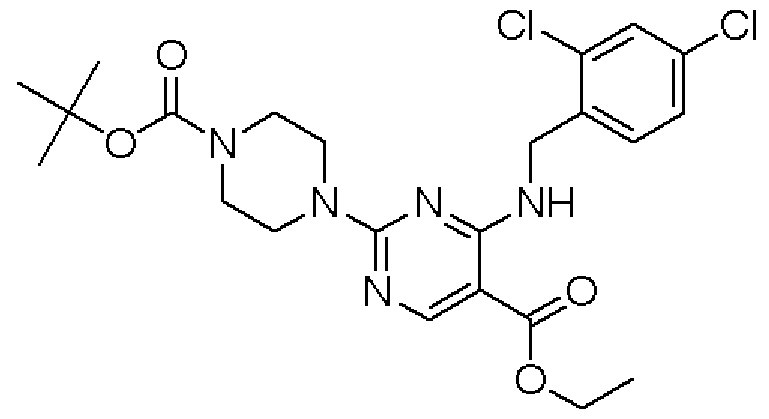
APCI-MS (m/e) : 510/512[M+H] APCI-MS (m / e): 510/512 [M + H]
[0286] 参考例 28— 15 [0286] Reference Example 28— 15
[化 204] [Chemical 204]

APCI-MS (m/e) :482/484[M+H] APCI-MS (m / e): 482/484 [M + H]
[0287] 参考例 28— 16 [0287] Reference Example 28— 16
[化 205] [Chemical 205]

APCI-MS (m/e) :481/483 [M+H] APCI-MS (m / e): 481/483 [M + H]
[0288] 参考例 29 [0288] Reference Example 29
[化 206]

(1)ベンズアルデヒド 10. 6g、 S—メチルチオゥレア硫酸塩 13. 9g、マロン酸ジェチ ル 16. Ogのエタノール 200ml溶液に炭酸カリウム 13. 8gを加え、 50〜60。Cで終夜 攪拌した。反応液を減圧濃縮し、残渣に酢酸ェチルを加え、塩酸、水、飽和重曹水 および飽和食塩水で洗浄後、硫酸マグネシウム乾燥し、溶媒を留去した。シリカゲル カラムクロマトグラフィー(へキサン Z酢酸ェチル = 100/0→70/30)で精製した。 酢酸ェチル Zへキサン力 再結晶し、 目的物を無色結晶 6. 21gとして得た。 (1) Benzaldehyde 10.6 g, S-methylthiourea sulfate 13.9 g, malonic acid gel 16. Og in 200 ml ethanol solution 13.8 g potassium carbonate, 50-60. Stir at C overnight. The reaction mixture was concentrated under reduced pressure, ethyl acetate was added to the residue, washed with hydrochloric acid, water, saturated aqueous sodium hydrogen carbonate and saturated brine, dried over magnesium sulfate, and the solvent was evaporated. The product was purified by silica gel column chromatography (hexane Z ethyl acetate = 100/0 → 70/30). Ethyl acetate Z-hexane power was recrystallized to obtain 6.21 g of the desired product as colorless crystals.
APCI-MS (m/e) : 293 [M+H] + APCI-MS (m / e): 293 [M + H] +
[化 207] [Chemical 207]

( 1 ) ( 2 ) (1) (2)
(2)化合物(1) 5. 85gの 2—プロパノール 120ml溶液に 0°C下で 2, 3—ジクロロー 5 , 6—ジシァノー 1, 4一べンゾキノン 4. 52gをゆっくりとカロえ、 0°Cで 1時間、室温で 1 日攪拌した。 2, 3—ジクロロー 5, 6—ジシァノー 1, 4一べンゾキノン 1. 16gを追カロし 、室温で 4時間攪拌した。反応液を減圧濃縮し、残渣に酢酸ェチルを加え、水で 3回 洗浄し、硫酸マグネシウムで乾燥後、溶媒を留去した。シリカゲルカラムクロマトグラフ ィー(クロ口ホルム Zメタノール = 100/0→93/7)で精製し、酢酸ェチル Zへキサ ンカも再結晶して、 目的物を無色結晶 4. 42gとして得た。 (2) Compound (1) 5. 85 g of 2-propanol in 120 ml at 0 ° C, 2, 3-dichloro-5,6-disyano 1,4 monobenzoquinone 4.52 g was slowly added to 0 ° C For 1 hour at room temperature for 1 day. 2,3-Dichloro-5,6-disyano 1,4 monobenzoquinone 1.16 g of additional calorie was added and stirred at room temperature for 4 hours. The reaction mixture was concentrated under reduced pressure, ethyl acetate was added to the residue, washed three times with water, dried over magnesium sulfate, and the solvent was evaporated. Purification by silica gel column chromatography (black mouth form Z methanol = 100/0 → 93/7) and recrystallization of ethyl acetate Z hexane gave the desired product as colorless crystals, 4.42 g.
APCI-MS (m/e) : 291 [M+H] + APCI-MS (m / e): 291 [M + H] +
[化 208]

(1 ) (2) (1) (2)
(3)化合物(1)を、実施例 1 (2)と同様に反応、処理することにより、化合物(2)を得 た。 (3) Compound (2) was obtained by reacting and treating compound (1) in the same manner as in Example 1 (2).
APCI-MS(m/e) :309/311[M+H] + APCI-MS (m / e): 309/311 [M + H] +
[化 209] [Chemical 209]

(1 ) (2) (1) (2)
[0291] (4)化合物(1)を、実施例 1(3)と同様に反応、処理することにより、化合物(2)を得 た。 (4) Compound (2) was obtained by reacting and treating compound (1) in the same manner as in Example 1 (3).
APCI— MS(m/e) :448/450[M+H] + APCI— MS (m / e): 448/450 [M + H] +
[0292] 参考例 30 [0292] Reference Example 30
[化 210] [Chemical 210]

(1)ジイソプロピルアミン 1.32mlの THF溶液 10mlに窒素置換下、 78°Cで n—ブ チルリチウム/へキサン溶液(1.7M)5.5mlをゆっくりとカ卩え、 30分攪拌後、 4 ク ロロ 2—メチルスルファ -ル—ピリミジン 1. Olgの THF溶液 12mlをゆっくり加え、 1 時間攪拌した。更にこの反応液に 3—メトキシベンズアルデヒド 950mgの THF溶液 1 2mlをゆっくり加え、— 78°Cで 2時間、室温に昇温して 2時間攪拌した。反応液に飽 和重曹水を加え、酢酸ェチルで 3回抽出した。有機層を合わせ、硫酸マグネシウムで 乾燥し、溶媒を留去した。残渣をシリカゲルカラムクロマトグラフィー(へキサン Z酢酸 ェチル =90ZlO→65Z35)で精製した。再度シリカゲルカラムクロマトグラフィー( へキサン Ζ酢酸ェチル = 100/0→50/50)で精製し、(4—クロ口— 2—メチルスル ファ -ル—ピリミジン— 5—ィル)―(3—メトキシ—フエ-ル)メタノールを橙色油状物 878mgとして得た。 (1) Diisopropylamine 1.32 ml of THF solution 10 ml of nitrogen was replaced with 5.5 ml of n-butyllithium / hexane solution (1.7 M) slowly at 78 ° C and stirred for 30 minutes. 2-Methylsulfuryl-pyrimidine 1. Slowly add 12 ml of Olg in THF, 1 Stir for hours. Further, 2 ml of THF solution of 950 mg of 3-methoxybenzaldehyde was slowly added to this reaction solution, and the mixture was stirred at -78 ° C for 2 hours and then at room temperature for 2 hours. Saturated aqueous sodium bicarbonate was added to the reaction mixture, and the mixture was extracted 3 times with ethyl acetate. The organic layers were combined, dried over magnesium sulfate, and the solvent was distilled off. The residue was purified by silica gel column chromatography (hexane Z ethyl acetate = 90 ZlO → 65 Z35). Purify again by silica gel column chromatography (HexaneΖEthyl acetate = 100/0 → 50/50), and (4-Chromium-2-Methylsulfuryl-pyrimidine-5-yl)-(3-Methoxy- (Phenol) methanol was obtained as an orange oil 878 mg.
APCI— MS (m/e) : 296 [M+H] + APCI— MS (m / e): 296 [M + H] +
[化 211] [Chemical 211]

( 1 ) ( 2 ) (1) (2)
(2) (4—クロ口一 2—メチルスルファ -ル一ピリミジン一 5—ィル)一(3—メトキシ一フ ェ -ル)メタノール 824mgのクロ口ホルム 30ml溶液に 0°C下で二酸化マンガン(粉末 ) 4. 83gを加え、室温で 6時間攪拌した。更に二酸ィ匕マンガン 4. 83gを追加し、終夜 攪拌した。反応液中の不溶物をセライトで濾去し、濾液を濃縮した。残渣をシリカゲル カラムクロマトグラフィー(へキサン Z酢酸ェチル = 100/0→80/20)で精製し、(4 —クロ口一 2—メチルスルファ -ル一ピリミジン一 5—ィル)一(3—メトキシ一フエ-ル) メタノンを無色油状物 500mgとして得た。 (2) (4-Methylsulfuryl 2-Pyrimidine-5-yl) Methanol (824) Chloroform in 30 ml solution of 824 mg of manganese dioxide (at 0 ° C) 4. 83 g of powder) was added and stirred at room temperature for 6 hours. Further, 4.83 g of manganese dioxide was added and stirred overnight. Insolubles in the reaction solution were filtered off through celite, and the filtrate was concentrated. The residue was purified by silica gel column chromatography (hexane Z ethyl acetate = 100/0 → 80/20), and (4 — black mouth 2 -methylsulfuryl 1 pyrimidine 1 5 -yl) 1 (3-methoxy 1 (Phenol) Methanone was obtained as a colorless oil 500 mg.
APCI— MS (m/e) : 295/297[M+H] + APCI— MS (m / e): 295/297 [M + H] +
[化 212] [Chemical 212]

(3) (4—クロ口一 2—メチルスルファ -ル一ピリミジン一 5—ィル)一(3—メトキシ一フ ェニル)メタノンを、実施例 1 (3)と同様に反応、処理することにより、化合物(2)を得 た。 (3) By reacting and treating (4-methoxysulfuryl-pyrimidine-5-yl)-(3-methoxymonophenyl) methanone in the same manner as in Example 1 (3), Compound (2) was obtained.
APCI— MS (m/e) :434/436 [M+H] + APCI— MS (m / e): 434/436 [M + H] +
参考例 31 Reference Example 31
[化 213] [Chemical 213]

(1)化合物(1) 8. 96g、化合物(2) 19. 88gの DMF120ml溶液に、氷冷下でジェ チルホスホロシァ-デート 22. 64g、トリェチルァミン 19. 36mlを順次ゆっくりと滴下 し、室温下で終夜攪拌した。反応液を減圧濃縮後、残渣に酢酸ェチルを加え、飽和 重曹水で洗浄し、乾燥後、溶媒留去した。残渣をシリカゲルカラムクロマトグラフィー( クロ口ホルム:メタノール = 98 : 2→90: 10)で精製し、化合物(3) 6. 80gを淡黄色油 状物として得た。 (1) Compound (1) 8. 96 g, Compound (2) 19. 88 g of DMF in 120 ml are slowly added dropwise with ice-cooled jet phosphoric acid-date 22.64 g and triethylamine 19. 36 ml, and then at room temperature overnight. Stir. The reaction mixture was concentrated under reduced pressure, ethyl acetate was added to the residue, washed with saturated aqueous sodium hydrogen carbonate, dried, and the solvent was evaporated. The residue was purified by silica gel column chromatography (black mouth form: methanol = 98: 2 → 90: 10) to obtain 6.80 g of compound (3) as a pale yellow oil.
APCI-MS (m/e) : 302[M+H] + APCI-MS (m / e): 302 [M + H] +
[化 214]

[0295] (2)化合物(1)7.73gのメタノール 100ml溶液に 10%パラジウム—炭素 1. Ogをカロ え、水素ガス置換下(50psi)、室温下で終夜攪拌した。メンブランフィルターを用いて 反応液中の不溶物をろ過し、ろ液を減圧濃縮し、化合物(2) 4.76gを淡黄色油状物 として得た。 (2) Compound (1) 10% Palladium-carbon 1. Og was added to a solution of 7.73 g of methanol in 100 ml of methanol, and the mixture was stirred overnight at room temperature under hydrogen gas replacement (50 psi). Insolubles in the reaction solution were filtered using a membrane filter, and the filtrate was concentrated under reduced pressure to obtain 4.76 g of Compound (2) as a pale yellow oil.
APCI-MS(m/e) :198[M+H] + APCI-MS (m / e): 198 [M + H] +
[0296] 参考例 32 [0296] Reference Example 32
[化 215]

(1) (2) (1) (2)
(1)メタノール 450mlに氷冷下で塩化チォ -ル 30mlをゆっくり加え、化合物(1)44. 9gを加えて室温下で終夜攪拌した。反応液を減圧濃縮し、残渣に酢酸ェチル 500 mlを加え、飽和重曹水、水および飽和食塩水で洗浄し、乾燥後に溶媒留去し、化合 物(2) 57.8gを淡黄色油状物として得た。 (1) To 450 ml of methanol was slowly added 30 ml of titanium chloride under ice-cooling, 44.9 g of compound (1) was added, and the mixture was stirred overnight at room temperature. Concentrate the reaction solution under reduced pressure, add 500 ml of ethyl acetate to the residue, wash with saturated aqueous sodium hydrogen carbonate, water and saturated brine, dry and evaporate the solvent to obtain 57.8 g of compound (2) as a pale yellow oil. It was.
GC— MS(m/e) :184/186[M+H] + GC— MS (m / e): 184/186 [M + H] +
[化 216] [Chemical 216]

(2)化合物(1)51. Ogの四塩化炭素 478mlに N—ブロモスクシンイミド 54.3g、 2, 2 '—ァゾビスイソプチ口-トリル 4.2gをカ卩え、加熱還流下で 2時間攪拌した。放冷後、 反応液を減圧濃縮し、残渣をシリカゲルカラムクロマトグラフィー(へキサン:酢酸ェチ ル=100:0→95:5)で精製し、化合物(2) 69.3gを淡黄色油状物として得た。 HNMR (400MHZ/CDC1 ) δ (ppm) : 3. 93 (s, 3H) , 4. 60 (s, 2H) , 7. 52 (d (2) Compound (1) 51. 54.3 g of N-bromosuccinimide and 4.2 g of 2,2′-azobisisobutyl-tolyl were added to 478 ml of Og carbon tetrachloride, and the mixture was stirred for 2 hours while heating under reflux. After allowing to cool, the reaction mixture was concentrated under reduced pressure, and the residue was purified by silica gel column chromatography (hexane: ethyl acetate = 100: 0 → 95: 5) to give 69.3 g of Compound (2) as a pale yellow oil. Obtained. HNMR (400MHZ / CDC1) δ (ppm): 3.93 (s, 3H), 4.60 (s, 2H), 7.52 (d
3 Three
, 1H, J = 7. 8Hz) , 7. 91 (dd, 1H, J= l. 5Hz, 7. 8Hz) , 8. 06 (d, 1H, J= l. , 1H, J = 7.8Hz), 7.91 (dd, 1H, J = l. 5Hz, 7.8Hz), 8.06 (d, 1H, J = l.
5Hz) (5Hz)
[化 217] [Chemical 217]

[0298] (3)メタノール 1. 5Lを氷冷し、攪拌下、アンモニアガスを溶解させた。この溶液に化 合物(1)を加え、室温下で 2時間攪拌し、更にアンモニア Zメタノール 1Lを追加し、 室温下で 1時間攪拌した。反応液を減圧濃縮し、残渣にジェチルエーテルを加えて 粉砕し、ろ取して乾燥し、化合物(2) 34. 4gを無色固形物として得た。 (3) Methanol 1.5 L was ice-cooled, and ammonia gas was dissolved under stirring. Compound (1) was added to this solution, and the mixture was stirred at room temperature for 2 hours. Further, 1 L of ammonia Zmethanol was added, and the mixture was stirred at room temperature for 1 hour. The reaction solution was concentrated under reduced pressure, and the residue was crushed by adding jetyl ether, filtered and dried to obtain 34.4 g of Compound (2) as a colorless solid.
APCI-MS (m/e) : 200/202 [M+H] + APCI-MS (m / e): 200/202 [M + H] +
[化 218] [Chemical 218]

[0299] (4)化合物(1) 34. 4gに水 1. 2Lをカ卩えて溶かし、これに水酸化ナトリウム 10. 8g、 ジ— tert—ブチルジカーボネート 29. 4gの 1, 4—ジォキサン 0. 6L溶液をカ卩え、室 温で 4時間攪拌した。更に水酸ィ匕ナトリウム 5. 4gの 50ml水溶液を加え、終夜攪拌し た。更に水酸ィ匕ナトリウム 10. 8gの 100ml水溶液を追加し、室温で 1時間攪拌後、反 応液を減圧濃縮した。残渣にクェン酸 70g水溶液をゆっくり加えて pH3— 4とし、 2- プロパノール Zクロ口ホルム(9 : 1)で抽出し、有機層を水、飽和食塩水で洗浄し、乾 燥後に溶媒留去し、化合物(2) 33. 2gを無色固形物として得た。 [0299] (4) Compound (1) 34. 4 g of water was dissolved in 1.2 L of water and dissolved in 10.8 g of sodium hydroxide, and di-tert-butyl dicarbonate 29.4 g of 1,4-dioxane 0 6L solution was added and stirred at room temperature for 4 hours. Further, 5.4 g of 50 ml aqueous solution of sodium hydroxide was added and stirred overnight. Further, 100 ml aqueous solution of 10.8 g sodium hydroxide was added and stirred at room temperature for 1 hour, and then the reaction solution was concentrated under reduced pressure. To the residue was slowly added 70 g aqueous solution of citrate to pH 3-4, extracted with 2-propanol Z chloroform (9: 1), the organic layer was washed with water and saturated brine, dried and evaporated. Compound (2) 33.2 g was obtained as a colorless solid.
ESI-MS (m/e) : 284[M-H] " ESI-MS (m / e): 284 [M-H] "
[化 219]

(5)化合物(1) 1. 12gの DMF20ml溶液に、 28%アンモニア水 2ml、 1—ェチルー 3— (3—ジメチルァミノプロピル)一カルポジイミド 1. 50g、 1—ヒドロキシベンゼントリ ァゾール 1. 20gをカ卩え、室温下で 4日間攪拌した。反応液に酢酸ェチルをカ卩え、飽 和重曹水、水、飽和食塩水で洗浄し、乾燥後に溶媒留去した。残渣をイソプロピルェ 一テル Zへキサンで粉砕し、乾燥し、化合物(2) 1. 04gを無色粉末として得た。 APCI— MS (m/e) : 185/187[M+H] + (5) Compound (1) 1. Add 12 ml of DMF in 20 ml, 28 ml of ammonia water, 2 ml, 1-ethyl 3- (3-dimethylaminopropyl) monocarbodiimide, 1.50 g, 1-hydroxybenzenetriazole, 1.20 g After stirring, the mixture was stirred at room temperature for 4 days. Ethyl acetate was added to the reaction solution, washed with saturated aqueous sodium hydrogen carbonate, water and saturated brine, dried and evaporated. The residue was triturated with isopropyl ether Z-hexane and dried to obtain 1.04 g of compound (2) as a colorless powder. APCI— MS (m / e): 185/187 [M + H] +
[化 220] [Chemical 220]

(6)化合物(l) 600mgのァセトニトリル 50ml溶液に、トリフエ-ルホスフィン 3. 32g、 四塩ィ匕炭素 972mgを加え、室温で 2日間攪拌した。反応液にクロ口ホルムをカロえ、 飽和重曹水で洗浄し、乾燥後に溶媒留去した。残渣をシリカゲルカラムクロマトグラフ ィー(クロ口ホルム:メタノール = 100: 0→95: 5)で精製し、化合物(2) 554mgを無色 油状物として得た。 (6) To a solution of compound (l) 600 mg in acetonitrile 50 ml of triphenylphosphine and 972 mg of tetrasalt carbon were added and stirred at room temperature for 2 days. The reaction solution was dried with black mouth form, washed with saturated aqueous sodium bicarbonate, dried and evaporated. The residue was purified by silica gel column chromatography (black mouth form: methanol = 100: 0 → 95: 5) to obtain 554 mg of compound (2) as a colorless oil.
APCI— MS (m/e) : 267/269 [M+H] + APCI— MS (m / e): 267/269 [M + H] +
[化 221] [Chem 221]

APCI— MS (m/e) : 167/169 [M+H] + APCI— MS (m / e): 167/169 [M + H] +
[0303] 参考例 33 [0303] Reference Example 33
[化 222] [Chemical 222]

(1)化合物(l) 990mgの塩化メチレン 30ml溶液に、氷冷下で四臭化炭素 2. 02g、 トリフエ-ルホスフィン 2. Ogを順次カ卩え、室温で終夜攪拌した。反応液にクロ口ホル ムを加え、水洗し、乾燥後に溶媒留去した。残渣をシリカゲルカラムクロマトグラフィー (へキサン:酢酸ェチル = 100: 0→95: 5)で精製し、化合物(2) 1. 39gを無色透明 油状物として得た。 (1) Compound (l) Carbon tetrabromide 2.02 g and triphenylphosphine 2. Og were successively added to a solution of 990 mg of methylene chloride in 990 mg under ice-cooling, and stirred overnight at room temperature. To the reaction solution was added black mouthform, washed with water, dried and evaporated. The residue was purified by silica gel column chromatography (hexane: ethyl acetate = 100: 0 → 95: 5) to obtain 1.39 g of compound (2) as a colorless transparent oil.
'HNMR (400MZ/CDC1 ) δ (ppm) :4. 50 (s, 2H) , 7. 26 (d, 1H, J = 9. OHZ 'HNMR (400MZ / CDC1) δ (ppm): 4.50 (s, 2H), 7.26 (d, 1H, J = 9. OHZ
3 Three
) , 7. 46 (d, 1H, J = 6. 7HZ) ), 7. 46 (d, 1H, J = 6.7HZ)
[化 223] [Chem. 223]

[0304] (2)化合物(l) 624mgの THF30ml溶液に 60%水素化ナトリウム 145mgをカ卩えて 3 0分攪拌後、イミノジカルボン酸ージ—tert ブチルエステル 788mgをカ卩え、 55°C で 1時間攪拌した。イミノジカルボン酸—ジ— tert -ブチルエステル 788mgを追加し 、 55°Cで終夜攪拌した。反応液を放冷後、酢酸ェチルを加え、水洗後、乾燥し、溶 媒留去した。残渣をシリカゲルカラムクロマトグラフィー(へキサン:酢酸ェチル = 100 : 0→95: 5)で精製し油状物を得た。得られた油状物の酢酸ェチル溶液に 4N塩酸 Z酢酸ェチル 20mlを加えて、室温で 1. 5時間攪拌し、反応液を減圧濃縮した。残 渣にジェチルエーテル Zへキサンを加えて固形物を粉砕し、乾燥させて、化合物(2 ) 490mgを無色固形物として得た。 [0304] (2) Compound (l) In a solution of 624 mg of THF in 30 ml of THF, 145 mg of 60% sodium hydride was added and stirred for 30 minutes, and then 788 mg of iminodicarboxylic acid-di-tert butyl ester was added at 55 ° C. Stir for 1 hour. An additional 788 mg of iminodicarboxylic acid-di-tert-butyl ester was stirred at 55 ° C. overnight. The reaction solution was allowed to cool, then added with ethyl acetate, washed with water, dried and evaporated. The residue was purified by silica gel column chromatography (hexane: ethyl acetate = 100: 0 → 95: 5) to give an oil. Add 4N hydrochloric acid to the resulting oily ethyl acetate solution. 20 ml of Z ethyl acetate was added and stirred at room temperature for 1.5 hours, and the reaction mixture was concentrated under reduced pressure. Jetyl ether Z-hexane was added to the residue, the solid was pulverized and dried to obtain 490 mg of compound (2) as a colorless solid.
APCI— MS (m/e) : 194/196 [M+H] + APCI— MS (m / e): 194/196 [M + H] +
[0305] 参考例 34 [0305] Reference Example 34
[化 224] [Chemical 224]

(1) (2) (1) (2)
(1)化合物(1) 7. 8gの四塩化炭素 50ml溶液に N—ブロモスクシンイミド 9. 26g、過 酸ィ匕ベンゾィル 515mgを加え、加熱還流下で終夜攪拌した。反応液を放冷し、シリ 力ゲルカラムクロマトグラフィー(へキサン:酢酸ェチル = 30: 1)で精製し、化合物(2) 8. 87gを黄色透明油状物として得た。 (1) Compound (1) To a solution of 7.8 g of carbon tetrachloride in 50 ml were added 9.26 g of N-bromosuccinimide and 515 mg of benzoyl peroxide, and the mixture was stirred overnight with heating under reflux. The reaction solution was allowed to cool and purified by silica gel column chromatography (hexane: ethyl acetate = 30: 1) to obtain 8.87 g of Compound (2) as a yellow transparent oil.
'HNMR (400MHZ/CDC1 ) δ (ppm) :4. 60 (s, 2H) , 7. 50 (d, 1H, J = 8. 5 'HNMR (400MHZ / CDC1) δ (ppm): 4.60 (s, 2H), 7.50 (d, 1H, J = 8.5
3 Three
HZ) , 7. 57 (dd, 1H, J = 2. 3, 8. 5HZ) , 7. 65 (d, 1H, J = 2. 3HZ) HZ), 7.57 (dd, 1H, J = 2.3, 8.5HZ), 7.65 (d, 1H, J = 2.3HZ)
[化 225] [Chemical 225]

(1) (2) (1) ( 2 )
(2)化合物(1)を参考例 33 (2)と同様に反応、処理し、化合物(2)を得た。 (2) Compound (1) was reacted and treated in the same manner as Reference Example 33 (2) to give compound (2).
APCI— MS (m/e) : 167/169 [M+H] + APCI— MS (m / e): 167/169 [M + H] +
産業上の利用可能性 Industrial applicability
[0306] 本発明化合物またはその製薬上許容しうる塩は、優れた CCR4あるいは TARCお よび Zまたは MDC機能調節作用を有し、気管支喘息、アトピー性皮膚炎などのァレ ルギー性疾患、炎症性疾患または自己免疫疾患等の予防または治療薬として有用 である。 [0306] The compound of the present invention or a pharmaceutically acceptable salt thereof has an excellent CCR4 or TARC and Z or MDC function-modulating action, and causes allergic diseases such as bronchial asthma and atopic dermatitis, inflammatory It is useful as a preventive or therapeutic agent for diseases or autoimmune diseases.
Claims


Priority Applications (3)
| Application Number | Priority Date | Filing Date | Title |
|---|---|---|---|
| JP2007547991A JPWO2007063934A1 (en) | 2005-12-02 | 2006-11-30 | Alicyclic heterocyclic compounds |
| EP06833711A EP1970373A1 (en) | 2005-12-02 | 2006-11-30 | Alicyclic heterocyclic compound |
| US12/085,921 US20090182140A1 (en) | 2005-12-02 | 2006-11-30 | Alicyclic Heterocyclic Compound |
Applications Claiming Priority (4)
| Application Number | Priority Date | Filing Date | Title |
|---|---|---|---|
| JP2005348597 | 2005-12-02 | ||
| JP2005-348597 | 2005-12-02 | ||
| US75003805P | 2005-12-14 | 2005-12-14 | |
| US60/750038 | 2005-12-14 |
Publications (1)
| Publication Number | Publication Date |
|---|---|
| WO2007063934A1 true WO2007063934A1 (en) | 2007-06-07 |
Family
ID=38092268
Family Applications (1)
| Application Number | Title | Priority Date | Filing Date |
|---|---|---|---|
| PCT/JP2006/323908 Ceased WO2007063934A1 (en) | 2005-12-02 | 2006-11-30 | Alicyclic heterocyclic compound |
Country Status (4)
| Country | Link |
|---|---|
| US (1) | US20090182140A1 (en) |
| EP (1) | EP1970373A1 (en) |
| TW (1) | TW200732336A (en) |
| WO (1) | WO2007063934A1 (en) |
Cited By (23)
| Publication number | Priority date | Publication date | Assignee | Title |
|---|---|---|---|---|
| JPWO2007132841A1 (en) * | 2006-05-16 | 2009-09-24 | 武田薬品工業株式会社 | Fused heterocyclic compounds and uses thereof |
| WO2010007800A1 (en) * | 2008-07-18 | 2010-01-21 | 大鵬薬品工業株式会社 | Novel uracil compound having amide structure and salt thereof |
| CN102633803A (en) * | 2012-05-03 | 2012-08-15 | 盛世泰科生物医药技术(苏州)有限公司 | Synthetic method of 5,7-dichloro pyrazole [1,5-a] pyrimidine |
| JP2013514301A (en) * | 2009-12-17 | 2013-04-25 | ベーリンガー インゲルハイム インターナショナル ゲゼルシャフト ミット ベシュレンクテル ハフツング | Novel CCR2 receptor antagonists and uses thereof |
| US8609672B2 (en) | 2010-08-27 | 2013-12-17 | University Of The Pacific | Piperazinylpyrimidine analogues as protein kinase inhibitors |
| RU2505534C2 (en) * | 2008-06-30 | 2014-01-27 | Хатчисон Медифарма Энтерпрайзис Лимитед | Quinazoline derivatives inhibiting egfr activity |
| JP2015500242A (en) * | 2011-12-01 | 2015-01-05 | ケモセントリックス,インコーポレイティド | Substituted anilines as CCR (4) antagonists |
| JP2015504900A (en) * | 2012-01-25 | 2015-02-16 | スピニフェクス ファーマシューティカルズ ピーティーワイ リミテッド | Heterocyclic compounds and methods of use thereof |
| JP2015506936A (en) * | 2012-01-16 | 2015-03-05 | インスティテュート オブ ファーマコロジー アンド トキシコロジー アカデミー オブ ミリタリー メディカル サイエンシズ ピー.エル.エー.チャイナ | Piperazinyl pyrimidine derivatives, their production and use |
| JP2015533135A (en) * | 2012-10-10 | 2015-11-19 | ヤンセン・サイエンシズ・アイルランド・ユーシー | Pyrrolo [3,2-D] pyrimidine derivatives for the treatment of viral infections and other diseases |
| US10253003B2 (en) | 2012-11-16 | 2019-04-09 | Janssen Sciences Ireland Uc | Heterocyclic substituted 2-amino quinazoline derivatives for the treatment of viral infections |
| US10259793B2 (en) | 2013-02-21 | 2019-04-16 | Janssen Sciences Ireland Uc | 2-aminopyrimidine derivatives for the treatment of viral infections |
| US10266543B2 (en) | 2013-03-29 | 2019-04-23 | Janssen Sciences Ireland Uc | Macrocyclic deaza-purinones for the treatment of viral infections |
| US10272085B2 (en) | 2011-04-08 | 2019-04-30 | Janssen Sciences Ireland Uc | Pyrimidine derivatives for the treatment of viral infections |
| US10280180B2 (en) | 2012-07-13 | 2019-05-07 | Janssen Sciences Ireland Uc | Macrocyclic purines for the treatment of viral infections |
| US10280167B2 (en) | 2011-11-09 | 2019-05-07 | Janssen Sciences Ireland Uc | Purine derivatives for the treatment of viral infections |
| US10316043B2 (en) | 2013-07-30 | 2019-06-11 | Janssen Sciences Ireland Unlimited Company | Thieno[3,2-d]pyrimidines derivatives for the treatment of viral infections |
| US10377738B2 (en) | 2013-05-24 | 2019-08-13 | Janssen Sciences Ireland Unlimited Company | Pyridone derivatives for the treatment of viral infections and further diseases |
| US10385054B2 (en) | 2013-06-27 | 2019-08-20 | Janssen Sciences Ireland Unlimited Company | Pyrrolo[3,2-d]pyrimidine derivatives for the treatment of viral infections and other diseases |
| US10968184B2 (en) | 2016-09-29 | 2021-04-06 | Janssen Sciences Ireland Unlimited Company | Pyrimidine prodrugs for the treatment of viral infections and further diseases |
| US11053256B2 (en) | 2016-07-01 | 2021-07-06 | Janssen Sciences Ireland Unlimited Company | Dihydropyranopyrimidines for the treatment of viral infections |
| US11446289B2 (en) | 2018-08-29 | 2022-09-20 | Chemocentryx, Inc. | Combination therapy using C-C chemokine receptor 4 (CCR4) antagonists and one or more immune checkpoint inhibitors |
| US11597704B2 (en) | 2018-03-01 | 2023-03-07 | Janssen Sciences Ireland Unlimited Company | 2,4-diaminoquinazoline derivatives and medical uses thereof |
Families Citing this family (20)
| Publication number | Priority date | Publication date | Assignee | Title |
|---|---|---|---|---|
| EP2312945A4 (en) * | 2008-08-13 | 2012-05-09 | Merck Sharp & Dohme | PURINE DERIVATIVES FOR THE TREATMENT OF ALZHEIMER'S DISEASE |
| TW201200518A (en) * | 2010-03-10 | 2012-01-01 | Kalypsys Inc | Heterocyclic inhibitors of histamine receptors for the treatment of disease |
| PL2748166T3 (en) * | 2011-08-23 | 2019-05-31 | Asana Biosciences Llc | Pyrimido-pyridazinone compounds and use thereof |
| AR088256A1 (en) * | 2011-10-08 | 2014-05-21 | Novartis Ag | CARBAMATE / UREA DERIVATIVES AS H3 RECEIVER ANTAGONISTS |
| US10441588B2 (en) | 2012-05-02 | 2019-10-15 | Curators Of The University Of Missouri | Methods and compositions for treating bacterial infection |
| US9814719B2 (en) | 2012-05-02 | 2017-11-14 | Curators Of The University Of Missouri | Methods and compositions for treating bacterial infection |
| US9504688B2 (en) | 2012-05-02 | 2016-11-29 | The Regents Of The University Of Michigan | Methods and compositions for treating bacterial infection |
| US9034874B2 (en) | 2012-07-20 | 2015-05-19 | Novartis Ag | Carbamate/urea derivatives |
| GB2512857A (en) * | 2013-04-09 | 2014-10-15 | Cancer Res Technology | Cancer biomarker |
| WO2015001567A1 (en) * | 2013-07-01 | 2015-01-08 | Msn Laboratories Private Limited | Process for the preparation of (s)-4-[(3-chloro-4-methoxybenzyl)amino]-2-[2- (hydroxymethyl)-1-pyrrolidinyl]-n-(2-pyrimidinyl methyl-5-pyrimidine carboxamide |
| MY176401A (en) | 2014-04-24 | 2020-08-05 | Mitsubishi Tanabe Pharma Corp | Novel disubstituted 1,2,4-triazine compound |
| CN104140427A (en) * | 2014-07-05 | 2014-11-12 | 湖南华腾制药有限公司 | Preparation method of tetrahydropyrazolo[1,5-a]pyridine |
| GB201416754D0 (en) | 2014-09-23 | 2014-11-05 | Mission Therapeutics Ltd | Novel compounds |
| RU2019112740A (en) | 2016-09-30 | 2020-11-02 | АСАНА БАЙОСАЙЕНСИЗ, ЭлЭлСи | P2X3 AND / OR P2X2 / 3 CONNECTIONS AND METHODS |
| GB201700814D0 (en) | 2017-01-17 | 2017-03-01 | Liverpool School Tropical Medicine | Compounds |
| CN118105392A (en) | 2017-04-28 | 2024-05-31 | 自由生物有限公司 | Preparations, methods, kits and dosage forms for treating atopic dermatitis and improving the stability of active pharmaceutical ingredients |
| US12459934B2 (en) * | 2018-11-28 | 2025-11-04 | Basf Se | Pesticidal compounds |
| EP4055014B1 (en) * | 2019-11-06 | 2025-04-30 | Yuhan Corporation | PYRROLIDINE AND PIPERIDINE COMPOUNDS |
| KR20230149729A (en) * | 2022-04-19 | 2023-10-27 | 케모센트릭스, 인크. | Ccr4 antagonists |
| WO2025080788A1 (en) * | 2023-10-11 | 2025-04-17 | Raythera, Inc. | Ccr4 inhibitors and methods of use thereof |
Citations (6)
| Publication number | Priority date | Publication date | Assignee | Title |
|---|---|---|---|---|
| US5948911A (en) * | 1998-11-20 | 1999-09-07 | Cell Pathways, Inc. | Method for inhibiting neoplastic cells and related conditions by exposure to thienopyrimidine derivatives |
| JP2000281660A (en) * | 1999-03-29 | 2000-10-10 | Sumitomo Pharmaceut Co Ltd | Quinazoline derivative |
| US6133271A (en) * | 1998-11-19 | 2000-10-17 | Cell Pathways, Inc. | Method for inhibiting neoplastic cells and related conditions by exposure thienopyrimidine derivatives |
| JP2001502342A (en) * | 1996-10-24 | 2001-02-20 | メルク パテント ゲゼルシャフト ミット ベシュレンクテル ハフトング | Thienopyrimidine having phosphodiesterase V inhibitory effect |
| WO2005047292A1 (en) * | 2003-11-04 | 2005-05-26 | Merck Patent Gmbh | Use of thienopyrimidines |
| WO2005082865A1 (en) * | 2004-02-27 | 2005-09-09 | Astellas Pharma Inc. | Fused bicyclic pyrimidine derivative |
Family Cites Families (12)
| Publication number | Priority date | Publication date | Assignee | Title |
|---|---|---|---|---|
| AU2002213467A8 (en) * | 2000-10-11 | 2009-07-30 | Chemocentryx Inc | Modulation of ccr4 function |
| AU2002358390A1 (en) * | 2001-12-18 | 2003-06-30 | Astrazeneca Ab | Novel compounds |
| TWI328007B (en) * | 2002-01-16 | 2010-08-01 | Astrazeneca Ab | Novel compounds |
| JPWO2003104230A1 (en) * | 2002-06-07 | 2005-10-06 | 協和醗酵工業株式会社 | Bicyclic pyrimidine derivatives |
| AU2003252478A1 (en) * | 2002-07-10 | 2004-02-02 | Ono Pharmaceutical Co., Ltd. | Ccr4 antagonist and medicinal use thereof |
| US7202249B2 (en) * | 2002-08-27 | 2007-04-10 | Bristol-Myers Squibb Company | Antagonists of chemokine receptors |
| EP1595869A1 (en) * | 2003-02-21 | 2005-11-16 | Kyowa Hakko Kogyo Co., Ltd. | Pyrimidine derivatives |
| SE0301650D0 (en) * | 2003-06-04 | 2003-06-04 | Astrazeneca Ab | Novel compounds |
| SE0301653D0 (en) * | 2003-06-05 | 2003-06-05 | Astrazeneca Ab | Novel compounds |
| SE0301654D0 (en) * | 2003-06-05 | 2003-06-05 | Astrazeneca Ab | Novel compounds |
| SE0302304D0 (en) * | 2003-08-27 | 2003-08-27 | Astrazeneca Ab | Novel compounds |
| WO2005023771A1 (en) * | 2003-09-05 | 2005-03-17 | Ono Pharmaceutical Co., Ltd. | Chemokine receptor antagonist and medical use thereof |
-
2006
- 2006-11-30 WO PCT/JP2006/323908 patent/WO2007063934A1/en not_active Ceased
- 2006-11-30 US US12/085,921 patent/US20090182140A1/en not_active Abandoned
- 2006-11-30 EP EP06833711A patent/EP1970373A1/en not_active Withdrawn
- 2006-12-01 TW TW095144620A patent/TW200732336A/en unknown
Patent Citations (6)
| Publication number | Priority date | Publication date | Assignee | Title |
|---|---|---|---|---|
| JP2001502342A (en) * | 1996-10-24 | 2001-02-20 | メルク パテント ゲゼルシャフト ミット ベシュレンクテル ハフトング | Thienopyrimidine having phosphodiesterase V inhibitory effect |
| US6133271A (en) * | 1998-11-19 | 2000-10-17 | Cell Pathways, Inc. | Method for inhibiting neoplastic cells and related conditions by exposure thienopyrimidine derivatives |
| US5948911A (en) * | 1998-11-20 | 1999-09-07 | Cell Pathways, Inc. | Method for inhibiting neoplastic cells and related conditions by exposure to thienopyrimidine derivatives |
| JP2000281660A (en) * | 1999-03-29 | 2000-10-10 | Sumitomo Pharmaceut Co Ltd | Quinazoline derivative |
| WO2005047292A1 (en) * | 2003-11-04 | 2005-05-26 | Merck Patent Gmbh | Use of thienopyrimidines |
| WO2005082865A1 (en) * | 2004-02-27 | 2005-09-09 | Astellas Pharma Inc. | Fused bicyclic pyrimidine derivative |
Cited By (42)
| Publication number | Priority date | Publication date | Assignee | Title |
|---|---|---|---|---|
| JPWO2007132841A1 (en) * | 2006-05-16 | 2009-09-24 | 武田薬品工業株式会社 | Fused heterocyclic compounds and uses thereof |
| RU2505534C2 (en) * | 2008-06-30 | 2014-01-27 | Хатчисон Медифарма Энтерпрайзис Лимитед | Quinazoline derivatives inhibiting egfr activity |
| WO2010007800A1 (en) * | 2008-07-18 | 2010-01-21 | 大鵬薬品工業株式会社 | Novel uracil compound having amide structure and salt thereof |
| JP2013514301A (en) * | 2009-12-17 | 2013-04-25 | ベーリンガー インゲルハイム インターナショナル ゲゼルシャフト ミット ベシュレンクテル ハフツング | Novel CCR2 receptor antagonists and uses thereof |
| US8609672B2 (en) | 2010-08-27 | 2013-12-17 | University Of The Pacific | Piperazinylpyrimidine analogues as protein kinase inhibitors |
| US10420767B2 (en) | 2011-04-08 | 2019-09-24 | Janssen Sciences Ireland Uc | Pyrimidine derivatives for the treatment of viral infections |
| US10780089B2 (en) | 2011-04-08 | 2020-09-22 | Janssen Sciences Ireland Uc | Pyrimidine derivatives for the treatment of viral infections |
| US11541050B2 (en) | 2011-04-08 | 2023-01-03 | Janssen Sciences Ireland Uc | Pyrimidine derivatives for the treatment of viral infections |
| US10272085B2 (en) | 2011-04-08 | 2019-04-30 | Janssen Sciences Ireland Uc | Pyrimidine derivatives for the treatment of viral infections |
| US11104678B2 (en) | 2011-11-09 | 2021-08-31 | Janssen Sciences Ireland Unlimited Company | Purine derivatives for the treatment of viral infections |
| US10280167B2 (en) | 2011-11-09 | 2019-05-07 | Janssen Sciences Ireland Uc | Purine derivatives for the treatment of viral infections |
| US9758512B2 (en) | 2011-12-01 | 2017-09-12 | Chemocentryx, Inc. | Substituted anilines as CCR(4) antagonists |
| US10407417B2 (en) | 2011-12-01 | 2019-09-10 | Chemocentryx, Inc. | Substituted anilines as CCR(4) antagonists |
| JP2015500242A (en) * | 2011-12-01 | 2015-01-05 | ケモセントリックス,インコーポレイティド | Substituted anilines as CCR (4) antagonists |
| US11884654B2 (en) | 2011-12-01 | 2024-01-30 | Chemocentryx, Inc. | Substituted anilines as CCR(4) antagonists |
| JP2015506936A (en) * | 2012-01-16 | 2015-03-05 | インスティテュート オブ ファーマコロジー アンド トキシコロジー アカデミー オブ ミリタリー メディカル サイエンシズ ピー.エル.エー.チャイナ | Piperazinyl pyrimidine derivatives, their production and use |
| JP2015504900A (en) * | 2012-01-25 | 2015-02-16 | スピニフェクス ファーマシューティカルズ ピーティーワイ リミテッド | Heterocyclic compounds and methods of use thereof |
| JP2018076297A (en) * | 2012-01-25 | 2018-05-17 | ノバルティス アーゲー | Heterocyclic compounds and methods for their use |
| CN102633803A (en) * | 2012-05-03 | 2012-08-15 | 盛世泰科生物医药技术(苏州)有限公司 | Synthetic method of 5,7-dichloro pyrazole [1,5-a] pyrimidine |
| US10280180B2 (en) | 2012-07-13 | 2019-05-07 | Janssen Sciences Ireland Uc | Macrocyclic purines for the treatment of viral infections |
| US10822349B2 (en) | 2012-07-13 | 2020-11-03 | Janssen Sciences Ireland Unlimited Company | Macrocyclic purines for the treatment of viral infections |
| US10259814B2 (en) | 2012-10-10 | 2019-04-16 | Janssen Sciences Ireland Uc | Pyrrolo[3,2-d]pyrimidine derivatives for the treatment of viral infections and other diseases |
| US11220504B2 (en) | 2012-10-10 | 2022-01-11 | Janssen Sciences Ireland Unlimited Company | Pyrrolo[3,2-d] pyrimidine derivatives for the treatment of viral infections and other diseases |
| JP2015533135A (en) * | 2012-10-10 | 2015-11-19 | ヤンセン・サイエンシズ・アイルランド・ユーシー | Pyrrolo [3,2-D] pyrimidine derivatives for the treatment of viral infections and other diseases |
| US10253003B2 (en) | 2012-11-16 | 2019-04-09 | Janssen Sciences Ireland Uc | Heterocyclic substituted 2-amino quinazoline derivatives for the treatment of viral infections |
| US10723707B2 (en) | 2012-11-16 | 2020-07-28 | Janssen Sciences Ireland Unlimited Company | Heterocyclic substituted 2-amino quinazoline derivatives for the treatment of viral infections |
| US10259793B2 (en) | 2013-02-21 | 2019-04-16 | Janssen Sciences Ireland Uc | 2-aminopyrimidine derivatives for the treatment of viral infections |
| US10647684B2 (en) | 2013-02-21 | 2020-05-12 | Janssen Sciences Ireland Unlimited Company | 2-aminopyrimidine derivatives for the treatment of viral infections |
| US10829494B2 (en) | 2013-03-29 | 2020-11-10 | Janssen Sciences Ireland Unlimited Company | Macrocyclic deaza-purinones for the treatment of viral infections |
| US11702426B2 (en) | 2013-03-29 | 2023-07-18 | Janssen Sciences Ireland Unlimited Company | Macrocyclic deaza-purinones for the treatment of viral infections |
| US10266543B2 (en) | 2013-03-29 | 2019-04-23 | Janssen Sciences Ireland Uc | Macrocyclic deaza-purinones for the treatment of viral infections |
| US10865193B2 (en) | 2013-05-24 | 2020-12-15 | Janssen Sciences Ireland Unlimited Company | Pyridone derivatives for the treatment of viral infections and further diseases |
| US10377738B2 (en) | 2013-05-24 | 2019-08-13 | Janssen Sciences Ireland Unlimited Company | Pyridone derivatives for the treatment of viral infections and further diseases |
| US10781216B2 (en) | 2013-06-27 | 2020-09-22 | Janssen Sciences Ireland Unlimited Company | Pyrrolo [3,2-d]pyrimidine derivatives for the treatment of viral infections and other diseases |
| US10385054B2 (en) | 2013-06-27 | 2019-08-20 | Janssen Sciences Ireland Unlimited Company | Pyrrolo[3,2-d]pyrimidine derivatives for the treatment of viral infections and other diseases |
| US10822347B2 (en) | 2013-07-30 | 2020-11-03 | Janssen Sciences Ireland Unlimited Company | Thieno[3,2-d]pyrimidines derivatives for the treatment of viral infections |
| US10316043B2 (en) | 2013-07-30 | 2019-06-11 | Janssen Sciences Ireland Unlimited Company | Thieno[3,2-d]pyrimidines derivatives for the treatment of viral infections |
| US11053256B2 (en) | 2016-07-01 | 2021-07-06 | Janssen Sciences Ireland Unlimited Company | Dihydropyranopyrimidines for the treatment of viral infections |
| US10968184B2 (en) | 2016-09-29 | 2021-04-06 | Janssen Sciences Ireland Unlimited Company | Pyrimidine prodrugs for the treatment of viral infections and further diseases |
| US11597704B2 (en) | 2018-03-01 | 2023-03-07 | Janssen Sciences Ireland Unlimited Company | 2,4-diaminoquinazoline derivatives and medical uses thereof |
| US11446289B2 (en) | 2018-08-29 | 2022-09-20 | Chemocentryx, Inc. | Combination therapy using C-C chemokine receptor 4 (CCR4) antagonists and one or more immune checkpoint inhibitors |
| US12011439B2 (en) | 2018-08-29 | 2024-06-18 | Chemocentryx, Inc. | Combination therapy using C—C chemokine receptor 4 (CCR4) antagonists and one or more immune checkpoint inhibitors |
Also Published As
| Publication number | Publication date |
|---|---|
| US20090182140A1 (en) | 2009-07-16 |
| EP1970373A1 (en) | 2008-09-17 |
| TW200732336A (en) | 2007-09-01 |
Similar Documents
| Publication | Publication Date | Title |
|---|---|---|
| WO2007063934A1 (en) | Alicyclic heterocyclic compound | |
| US20230348490A1 (en) | Positive allosteric modulators of the muscarinic acetylcholine receptor m4 | |
| EP3033335B1 (en) | Pyridinones | |
| AU2012323085B2 (en) | PDE9i with imidazo pyrazinone backbone | |
| AU2013346809B2 (en) | Triazolopyrazine | |
| US9422290B2 (en) | Triazolopyridazine | |
| US20230227449A1 (en) | Amidopyrimidone derivatives | |
| EP3322698A1 (en) | Indazole and azaindazole compounds as irak-4 inhibitors | |
| JP2009007341A (en) | Pharmaceutical composition | |
| JP2009007342A (en) | Pharmaceutical composition | |
| WO2007063935A1 (en) | Aromatic compound | |
| WO2023185073A1 (en) | Parp7 inhibitor and use thereof | |
| US12448380B2 (en) | Positive modulators of the muscarinic acetylcholine receptor M4 | |
| JP2006137723A (en) | Sulfonamide derivatives | |
| TWI894448B (en) | Ctla-4 small molecule inhibitor and its application | |
| WO2022162034A1 (en) | Pyrazoleamide derivatives | |
| US12139498B1 (en) | Positive allosteric modulators of the muscarinic acetylcholine receptor M4 | |
| JPWO2007063934A1 (en) | Alicyclic heterocyclic compounds | |
| JPWO2007063935A1 (en) | Aromatic compounds | |
| HK40006947B (en) | Positive allosteric modulators of the muscarinic acetylcholine receptor m4 | |
| HK40006947A (en) | Positive allosteric modulators of the muscarinic acetylcholine receptor m4 |
Legal Events
| Date | Code | Title | Description |
|---|---|---|---|
| 121 | Ep: the epo has been informed by wipo that ep was designated in this application | ||
| ENP | Entry into the national phase |
Ref document number: 2007547991 Country of ref document: JP Kind code of ref document: A |
|
| WWE | Wipo information: entry into national phase |
Ref document number: 12085921 Country of ref document: US |
|
| NENP | Non-entry into the national phase |
Ref country code: DE |
|
| WWE | Wipo information: entry into national phase |
Ref document number: 2006833711 Country of ref document: EP |