WO2007060300A1 - Novel lipophobic perfluoroalkyl polyamides, preparation thereof and use thereof - Google Patents
Novel lipophobic perfluoroalkyl polyamides, preparation thereof and use thereof Download PDFInfo
- Publication number
- WO2007060300A1 WO2007060300A1 PCT/FR2006/002186 FR2006002186W WO2007060300A1 WO 2007060300 A1 WO2007060300 A1 WO 2007060300A1 FR 2006002186 W FR2006002186 W FR 2006002186W WO 2007060300 A1 WO2007060300 A1 WO 2007060300A1
- Authority
- WO
- WIPO (PCT)
- Prior art keywords
- mixture
- perfluoroalkyl
- added
- surfactants according
- reaction
- Prior art date
- Legal status (The legal status is an assumption and is not a legal conclusion. Google has not performed a legal analysis and makes no representation as to the accuracy of the status listed.)
- Ceased
Links
Classifications
-
- C—CHEMISTRY; METALLURGY
- C07—ORGANIC CHEMISTRY
- C07C—ACYCLIC OR CARBOCYCLIC COMPOUNDS
- C07C233/00—Carboxylic acid amides
- C07C233/01—Carboxylic acid amides having carbon atoms of carboxamide groups bound to hydrogen atoms or to acyclic carbon atoms
- C07C233/12—Carboxylic acid amides having carbon atoms of carboxamide groups bound to hydrogen atoms or to acyclic carbon atoms having the nitrogen atom of at least one of the carboxamide groups bound to a carbon atom of a hydrocarbon radical substituted by halogen atoms or by nitro or nitroso groups
-
- A—HUMAN NECESSITIES
- A62—LIFE-SAVING; FIRE-FIGHTING
- A62D—CHEMICAL MEANS FOR EXTINGUISHING FIRES OR FOR COMBATING OR PROTECTING AGAINST HARMFUL CHEMICAL AGENTS; CHEMICAL MATERIALS FOR USE IN BREATHING APPARATUS
- A62D1/00—Fire-extinguishing compositions; Use of chemical substances in extinguishing fires
- A62D1/0071—Foams
- A62D1/0085—Foams containing perfluoroalkyl-terminated surfactant
-
- C—CHEMISTRY; METALLURGY
- C07—ORGANIC CHEMISTRY
- C07C—ACYCLIC OR CARBOCYCLIC COMPOUNDS
- C07C233/00—Carboxylic acid amides
- C07C233/01—Carboxylic acid amides having carbon atoms of carboxamide groups bound to hydrogen atoms or to acyclic carbon atoms
- C07C233/34—Carboxylic acid amides having carbon atoms of carboxamide groups bound to hydrogen atoms or to acyclic carbon atoms having the nitrogen atom of at least one of the carboxamide groups bound to a carbon atom of a hydrocarbon radical substituted by amino groups
- C07C233/35—Carboxylic acid amides having carbon atoms of carboxamide groups bound to hydrogen atoms or to acyclic carbon atoms having the nitrogen atom of at least one of the carboxamide groups bound to a carbon atom of a hydrocarbon radical substituted by amino groups with the substituted hydrocarbon radical bound to the nitrogen atom of the carboxamide group by an acyclic carbon atom
- C07C233/36—Carboxylic acid amides having carbon atoms of carboxamide groups bound to hydrogen atoms or to acyclic carbon atoms having the nitrogen atom of at least one of the carboxamide groups bound to a carbon atom of a hydrocarbon radical substituted by amino groups with the substituted hydrocarbon radical bound to the nitrogen atom of the carboxamide group by an acyclic carbon atom having the carbon atom of the carboxamide group bound to a hydrogen atom or to a carbon atom of an acyclic saturated carbon skeleton
-
- C—CHEMISTRY; METALLURGY
- C07—ORGANIC CHEMISTRY
- C07C—ACYCLIC OR CARBOCYCLIC COMPOUNDS
- C07C233/00—Carboxylic acid amides
- C07C233/57—Carboxylic acid amides having carbon atoms of carboxamide groups bound to carbon atoms of rings other than six-membered aromatic rings
- C07C233/62—Carboxylic acid amides having carbon atoms of carboxamide groups bound to carbon atoms of rings other than six-membered aromatic rings having the nitrogen atom of at least one of the carboxamide groups bound to a carbon atom of a hydrocarbon radical substituted by amino groups
-
- C—CHEMISTRY; METALLURGY
- C07—ORGANIC CHEMISTRY
- C07C—ACYCLIC OR CARBOCYCLIC COMPOUNDS
- C07C233/00—Carboxylic acid amides
- C07C233/64—Carboxylic acid amides having carbon atoms of carboxamide groups bound to carbon atoms of six-membered aromatic rings
- C07C233/77—Carboxylic acid amides having carbon atoms of carboxamide groups bound to carbon atoms of six-membered aromatic rings having the nitrogen atom of at least one of the carboxamide groups bound to a carbon atom of a hydrocarbon radical substituted by amino groups
- C07C233/78—Carboxylic acid amides having carbon atoms of carboxamide groups bound to carbon atoms of six-membered aromatic rings having the nitrogen atom of at least one of the carboxamide groups bound to a carbon atom of a hydrocarbon radical substituted by amino groups with the substituted hydrocarbon radical bound to the nitrogen atom of the carboxamide group by an acyclic carbon atom
-
- C—CHEMISTRY; METALLURGY
- C07—ORGANIC CHEMISTRY
- C07D—HETEROCYCLIC COMPOUNDS
- C07D213/00—Heterocyclic compounds containing six-membered rings, not condensed with other rings, with one nitrogen atom as the only ring hetero atom and three or more double bonds between ring members or between ring members and non-ring members
- C07D213/02—Heterocyclic compounds containing six-membered rings, not condensed with other rings, with one nitrogen atom as the only ring hetero atom and three or more double bonds between ring members or between ring members and non-ring members having three double bonds between ring members or between ring members and non-ring members
- C07D213/04—Heterocyclic compounds containing six-membered rings, not condensed with other rings, with one nitrogen atom as the only ring hetero atom and three or more double bonds between ring members or between ring members and non-ring members having three double bonds between ring members or between ring members and non-ring members having no bond between the ring nitrogen atom and a non-ring member or having only hydrogen or carbon atoms directly attached to the ring nitrogen atom
- C07D213/24—Heterocyclic compounds containing six-membered rings, not condensed with other rings, with one nitrogen atom as the only ring hetero atom and three or more double bonds between ring members or between ring members and non-ring members having three double bonds between ring members or between ring members and non-ring members having no bond between the ring nitrogen atom and a non-ring member or having only hydrogen or carbon atoms directly attached to the ring nitrogen atom with substituted hydrocarbon radicals attached to ring carbon atoms
- C07D213/28—Radicals substituted by singly-bound oxygen or sulphur atoms
- C07D213/30—Oxygen atoms
Definitions
- the present invention relates to novel perfluoroalkyl surfactants of the amphoteric type, the perfluorinated group of which is derived from the laterelomerization of tetrafluoroethylene (TFE) and whose molecular structure corresponds to the following general formula:
- These compounds have the particularity of having, in part A, an alkylamido or acidoalkyl / arylamido group bound to a substituted polyamide group.
- Part A is separated from the poly-fluoroalkyl chain R F by a BD-group.
- R F is one. linear or branched perlluoroalkyl chain n - 4 to 20, or a mixture of linear or branched perrluoroalkyl groups;
- D is one.
- tribemen and or when-B is a grouping. nil in other cases;
- X is: alkyl or aryl when E is nil or "OOC when E is other than nil;
- Many tensioaGtifs perfluoroalkyl agents carboxybetaine type of prior art have been described in patents FR 2,088,941, FR 2,185,668 , DE 2,559,189, FR 2,390,426, US
- perfluoroalkyl carboxybetams of this invention are characterized by their great ability to reduce the surface tension of water and inorganic electrolyte solutions, because of the substantial lowering of the surface tension that the compounds of the invention produced in water, these can be used as wetting, foaming, emulsifying and dispersing agents.
- the carboxybetaine compounds are particularly useful in that they can be used both in strongly acidic and basic media.
- the perfluoroalkylated surfactants of the invention are particularly effective when used as additives for synthetic extinguishing foams (AFFF) and protein
- the compounds according to the invention are easily synthesized from commercially available products by economically viable processes.
- the compounds according to the invention contain no perfluorooctane sulfonyl or perfluorooctane carboxyl group capable of degrading respectively to perfluorooctane sulfonate (PFOS) or perfluorooctane Garboxy® acid (PFOA).
- PFOS perfluorooctane sulfonate
- PFOA perfluorooctane Garboxy® acid
- fluorinated surfactants possessing this type of group in their molecular structure are currently the subject of studies on their possible Persistence, Bioaccumulation and Toxicity (PB-T),
- PB-T Persistence, Bioaccumulation and Toxicity
- one remarkable originality of this invention lies in the fact that the polyamide compounds according to the invention, in addition to being able to lower, notably the surface tension of the water, make it possible to It is an unexpected fact that an aqueous film on the surface of hydrocarbons is much more resistant than that obtained with surfactants. a- causing lowering stronger "lia. superficial voltage-FEAU. It is bien.connu that in. foam concentrate liquid composition. for production- of la-.
- perfluroalkyl epoxides such as:
- epoxides having a terminal double bond such as the allyl group of 1-allyloxy-2,3-epoxypropane, or two terminal double-bonds, such as the diallylamine group of glycidyldiallylamine .
- the epoxide ring is opened by a primary or tertiary amine contained in the hydrophilic polyamide portion.
- the perfluoroalkylating agents used are perfluoroalkane iodides, which are raw materials obtained by the telomerisation process of tetrafluoroethylene. illustrated “in.” subsequentlyuorocarbons and Their Derivatives "" by REBanfcs, London 1964 p.56 '-61.
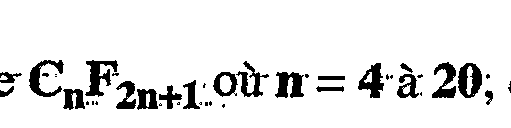
- the perfluoroalkane iodides C n F 2n + 1 in which C n F 2n + 1 is a linear per ⁇ uor-oalkyl group. or- ram mask- where- n is an integer number from-4-0-20 "or. mixture of groups, perfluoroalkyls. linear or.
- X alfcyl or aryl group when E is zero or ⁇ OOC when E is different from none are prepared in three steps:
- N, N-dimethylformamide is first reacted with several equivalents of a diamine of formula
- R 1 and R 2 lower alkyl, with an acid anhydride which may be acetic anhydride, benzoic anhydride, butyric anhydride, capric anhydride, caproic anhydride, heptanoic anhydride, isobutyric anhydride, isovatoric anhydride, succinic anhydride, . glutaric ,. î, 2-cyclohexane. dicarboxylic ,. phthalic ,. pyridine, or 2,3-pyrazine dicarboxylic acid.
- the compounds I) are reacted with several equivalents of an alkyl monochloroacetate in one or more times to give a N, N-dialkylaminopolyamidoacid of the formula
- the pH of the mixture is set between 7 and 8.
- Amino-carboxybetaine surfactants corresponding to:
- M an alkali metal ion or nil are obtained in three stages: the glycidyl diethylamine or the epoxides of the following formulas are reacted:
- any allylic double bonds of the compound (VIT) are then perfluoroalkylated using perfluoroalkane iodides in the presence of 2,2'-azobis (isobutyronitrile) and sodium hydrosulfite.
- the perfluoroalkyl surfactants of the sodium or potassium carboxylate type according to the invention are obtained.
- the mixture is diluted with a small amount of monobutyl ether of the diethylene glycol and supplemented with water so that the feedstock activates perfluoroalkylated carboxybetaine surfactants of the invention to be about 40% with a fluorine content of about 9%.
- the pH of the mixture is set between 7 and 8.
- the reaction medium is then brought to a temperature of 50 ° C. and 5 pp of isopropyl alcohol are added. 3.42 ⁇ l of 1-allyloxy-2,3-epoxypropane are then slowly added. The reaction is slightly exothermic. The mixture is heated at 85 ° for 3 hours. Let the temperature return to 60 ° C then 12.15 parts of perfluorohexane iodide, 0.25 parts of 2,2'-azobis (isobutyronitrile) and 3.0 parts are successively added. pp of sodium hydrosulphide dissolved in 9.5 pp of water and then heated between 75 and 80 ° C. for 3 hours. When the mixture has returned to room temperature, 3.8 g of 90% potassium hydroxide dissolved in 11.35 g of water are added. 3.9 pp of diethylene monobutyl ether are then added.
- A OOC-E-CO- [NH - (CH 2 -N, CH 2 ) n -CH 2 -CO] 2 -NH- (CH 2 ) 3 -N + (CH 3 ) 2 -
- the temperature is allowed to return to 60 ° C., then 12.15 parts of perfluorohexane iodide, 0.25 parts of 2,2'- ⁇ -bis (isobutyronitrile) and 3.0 parts of dissolved sodium hydrosulfite are successively added. in 9.5 pp of water and then heated at 75-80 ° C for 3 hours. When the mixture has returned to room temperature, 3.8 g of 90% potassium hydroxide dissolved in 11.35 g of water are added. 4 ⁇ g of diethylene monobutyl ether is then added.
- reaction medium is then brought to a temperature of 50 ° C and add 5 pp alcohol isopropyl: then slowly added 3.42 pbw of l-allyloxy-23-epoxypropane, The reaction is slightly exothermic.
- the mixture is heated at 85 ° C for 3 hours; The temperature is allowed to return to 60 ° C., then a mixture of perfluoroocane iodides (43% C 6 F 13 ,
- the mixture is cooled to 30-40 ° C, 15 pp of 90% caustic potash dissolved in 27 pp of water are added.
- the mixture is heated at 75-80 ° C for 4 hours and then cooled to 25 ° -30 ° C; 15.6 pp of diethylene glycol monobutyl ether are then added, and the mixture is then added to 22.19 pp of water.
- the solution to be tested is prepared, ie a 3% AFFF-emulsifier, by mixing the following compounds a): 0 pp of a fluorinated surfactant, 12.0 pp of anionic surfactant, 0.8 pp. a
- amphoteric surfactant 30.0 pp of diethylene glycol monobutyl ether and 51.2 p water.
- the pH is adjusted between 7 and '8; 50 ml of cyclohexane is poured into a petri dish and a screw 2.5 mm long is placed in the center of the can, and pointed in the air. 3 ml of the test solution are then dripped onto the tip of the screw with the aid of a test tube. From the first drop, the stopwatch is triggered: the useful time for adding the 3 ml of solution is 1 to 2 minutes; Remove the Petri dish from the test tube, carefully remove the screw and wait for 1 minute.
- a lit match is approached 10 mm from the surface of the liquid * then the surface is swept: if the cyclohexane does not ignite, touch the surface of the cyclohexane with a match burning at the edge of the petri dish, while triggering the stopwatch, We note the time needed to turn on the liquid, ie x seconds * and we remove the match. We then observe the advancement of the flame front, when the entire surface has caught fire, stop the stopwatch and note the time y.
- the x / y couple is used to compare the fire resistance of the film produced by different solutions on cyclohexane.
Landscapes
- Chemical & Material Sciences (AREA)
- Organic Chemistry (AREA)
- Chemical Kinetics & Catalysis (AREA)
- General Chemical & Material Sciences (AREA)
- Business, Economics & Management (AREA)
- Emergency Management (AREA)
- Organic Low-Molecular-Weight Compounds And Preparation Thereof (AREA)
- Emulsifying, Dispersing, Foam-Producing Or Wetting Agents (AREA)
Abstract
Description
NOlIYEAIIXrFQLYMmSES]EEEELnQEQALK-YLESX] LEUR' OBTENTION ET LEUR-UTILISATIONNOlIYEAIIXrFQLYMmSES] EEEELnQEQALK-YLESX] THEIR OBTAINING AND-USE
La présente invention: concerne de nouveaux tensioactifs perfluoroalkyles de type amphotère dont le groupement perfluoré est issu de latélomérisation du tétrafluoroéthylène (TFE) et dont la: structure moléculaire correspond à- la formule générale suivante :The present invention relates to novel perfluoroalkyl surfactants of the amphoteric type, the perfluorinated group of which is derived from the laterelomerization of tetrafluoroethylene (TFE) and whose molecular structure corresponds to the following general formula:

Ces: composés ont la particularité- de comporter, dans la partie A, un groupement alkylamido ou acidoalkyl/ary lamido lié- à un groupement polyamide substituéThese compounds have the particularity of having, in part A, an alkylamido or acidoalkyl / arylamido group bound to a substituted polyamide group.


La partie A est séparée delà chaîne poly-fluoroallsylée RF par un- groupement- B-D -.Part A is separated from the poly-fluoroalkyl chain R F by a BD-group.
Dans: cette formule- générale :In: this general formula:
RF est une. chaîne perlluoroalkyle linéaire ou ramifiée


D est un. groupemen


m,, p et q. sont des nombres entiers valant 2 ou 3 indépendamment les uns dès autres; r est égal à 2 lorsqμe B est égal à -CH2CH(OH)- CH2-N=^, 1 dans les autres cas ; R1 et R2 sont des groupements alkyle- mineur identiques ;m ,, p and q. are integers equal to 2 or 3 independently of each other; r is equal to 2 when B is equal to -CH 2 CH (OH) -CH 2 -N = 1 in other cases; R 1 and R 2 are identical alkyl-minor groups;
X est un: groupement alkyle ou aryle lorsque E est néant ou "OOC lorsque E est différent de néant; De nombreux agents tensioaGtifs perfluoroalkylés de type carboxybétaïne de l'art antérieur ont été décrits dans les brevets FR 2.088.941, FR 2.185.668, DE 2.559.189, FR 2.390.426, USX is: alkyl or aryl when E is nil or "OOC when E is other than nil; Many tensioaGtifs perfluoroalkyl agents carboxybetaine type of prior art have been described in patents FR 2,088,941, FR 2,185,668 , DE 2,559,189, FR 2,390,426, US
4069.244, US 4.126.633, US 4.283.533 , US 4.795.590.4069,244, US 4,126,633, US 4,283,533, US 4,795,590.
Les carboxybétames perfluoroalkylées de cette invention sont caractérisées par- leur grand pouvoir de réduction de la tension superficielle de l'eau- et des solutions d'électrolytes inorganiques, En raison de l'abaissement important de la tension superficielle que les composés de l'invention produisent dans l'eau, ces derniers peuvent être utilisés comme agents mouillants, moussants, émulsifiants et dispersants.The perfluoroalkyl carboxybetams of this invention are characterized by their great ability to reduce the surface tension of water and inorganic electrolyte solutions, because of the substantial lowering of the surface tension that the compounds of the invention produced in water, these can be used as wetting, foaming, emulsifying and dispersing agents.
Les composés de type carboxybétaïne sont particulièrement intéressants dans la mesure où ils peuvent être utilisés aussi bien- dans les milieux fortement acides que basiques. Les agents tensioaGtifs perfluoroalkylés de l'invention sont particulièrement efficaces lorsqu'ils sont utilisés comme additifs pour les mousses extinctrices synthétiques (AFFF) et protéiniquesThe carboxybetaine compounds are particularly useful in that they can be used both in strongly acidic and basic media. The perfluoroalkylated surfactants of the invention are particularly effective when used as additives for synthetic extinguishing foams (AFFF) and protein
(FFFP) fîlmogènes destinées à la lutte contre les incendies d'hydrocarbures ou de solvants.(FFFP) fuels for combating hydrocarbon fires or solvents.
Ces mousses ont été décrites dans de nombreux brevets-: US 4.042.522, US 4.090.967, DEThese foams have been described in numerous patents: US 4,042,522, US 4,090,967, DE
2.325.855, DE 2.732.555, DE 2.749.331, DE 2.829,594, EP 311.570, US 5.085.786, EP 780.141 (AFFF); US 3.475.333, DE 1.928.556, DE 2.240.263, FR 2.575.165 (FEFP).2,325,855, DE 2,732,555, DE 2,749,331, DE 2,829,594, EP 311,570, US 5,085,786, EP 780,141 (AFFF); US 3,475,333, DE 1,928,556, DE 2,240,263, FR 2,575,165 (FEFP).
Les avantages de cette invention sont multiples :The advantages of this invention are manifold:
- les réactions permettant d'obtenir les tensioactifs perfluoroalkylés selon l'invention sont faciles et rapides à mettre en œuvre,the reactions making it possible to obtain the perfluoroalkyl surfactants according to the invention are easy and quick to implement,
- les composés selon- l'invention sont aisément synthétisés à partir de produits disponibles dans le commerce par des procédés économiquement viables.,the compounds according to the invention are easily synthesized from commercially available products by economically viable processes.
- les composés selon l'invention sont préparés sans avoir à séparer et purifier chaque intermédiaire,the compounds according to the invention are prepared without having to separate and purify each intermediate,
- les composés- selon l'invention ne comportent aucun- groupement perfluorooctane sulfonyle ou perfluorooctane carboxyle susceptible de se dégrader respectivement en perfluorooctane sulfonate (PFOS) ou perfluorooctane acide Garboxyϋque (PFOA). Il faut rappeler que les tensioactifs fluorés possédant ce type de groupement dans- leur- structure moléculaire font actuellement l'objet d'études sur leur éventuelle Persistance, Bioaccumulation et Toxicité (PB-T), Mais Tune dès- originalités remarquable de cette invention réside dans, le fait que les- composés- polyamides, selon- l'invention, outre qu'ils- permettent d'abaisser, notablement là- tension superficielle de Feau, permettent de façon tout à- fait inattendue d'obtenir, un film aqueux à la surface des- hydrocarbures, bien, plus- résistant que celui obtenu avec dès- tensioactifs. provoquant un- abaissement plus marqué" de lia. tension- superficielle de Feau. Il est bien.connu que dans une. composition de liquide émulseur. destiné à la- production- de. mousse extinctrice, la résistance du film- aqueux formé' à la surface: dès hydrocarbures ne dépend- pas uniquement du- pouvoir, du tensioactif d-' abaisser. Ia- tension- superficielle de. la. mousse, extinctrice, mais aussi- de Fïnfluence des cotensioactifs. utilisés. Nous- avons constaté que Ia formule moléculaire d'un- tensioactif peut avoir un- effet remarquable, dans ce domaine, ce qui' est Fbbjet de la présente-invention. .the compounds according to the invention contain no perfluorooctane sulfonyl or perfluorooctane carboxyl group capable of degrading respectively to perfluorooctane sulfonate (PFOS) or perfluorooctane Garboxy® acid (PFOA). It should be noted that fluorinated surfactants possessing this type of group in their molecular structure are currently the subject of studies on their possible Persistence, Bioaccumulation and Toxicity (PB-T), However, one remarkable originality of this invention lies in the fact that the polyamide compounds according to the invention, in addition to being able to lower, notably the surface tension of the water, make it possible to It is an unexpected fact that an aqueous film on the surface of hydrocarbons is much more resistant than that obtained with surfactants. a- causing lowering stronger "lia. superficial voltage-FEAU. It is bien.connu that in. foam concentrate liquid composition. for production- of la-. extinguishing foam, aqueous film-formed of the resistance 'to The surface of hydrocarbons does not depend solely on the ability of the surfactant to lower the surface tension of the foam, extinguishing, but also on the influence of the co-surfactants used. molecular formula of a- surfactant may have one- remarkable effect in this area, which is Fbbjet of the present-invention..
Le brevet ERZ.866".883 dès mêmes- auteurs, décrit dès molécules présentant une partie, hydrophile monomère, Nous avons préparé dès moleculès-presentant une partie-hydrophile de structure analogue, mais polymérisée (exemples- 1 à 9) et nous avons comparé! lès résultats selonune procédure de contrôle, décrite dans l'exemple IQ comme une méthode de mesure de là. résistance d'un, filin aqueux à Ia surface d'un- hydrocarbure. Les. résultats, montrent que- le filin- obtenu avec le tensioactif polymérisé! est plus- résistant que celui obtenu- avec le tensioactif monomère, la- mesure de Ia tension superficielle de l'eau obtenue avec le dernier étant plus basse que celle obtenue avec- le premier, Les tensioactifs perfluoroalkylës de la présente invention- sont préparés :The patent ERZ.866 " .883 from the same authors, describes molecules having a portion, hydrophilic monomer, We have prepared as moleculés-presentant a hydrophilic part of similar structure, but polymerized (Examples 1-9) and we have The results were compared according to a control procedure, described in Example IQ, as a method of measuring the resistance of an aqueous rope to the surface of a hydrocarbon. with the polymerized surfactant is more resistant than that obtained with the monomer surfactant, the measurement of the surface tension of the water obtained with the latter being lower than that obtained with the first, the perfluoroalkyl surfactants of the present invention. invention- are prepared:
- soitâ- partir- d'époxydes perflùoroalkyles- tels que-:or from perfluroalkyl epoxides such as:

- soitàpartir d'époxydes-possédant une double liaison terminale comme le groupement allyle du 1-allyloxy~2,3-époxypropane, ou deux- doubles liaisons- terminales comme le groupement diallylamine de la glycidyldiallylamine. Le cycle époxyde est- ouvert par une aminé primaire ou- tertiaire contenue-dans la-partie polyamide hydrophile.or from epoxides having a terminal double bond such as the allyl group of 1-allyloxy-2,3-epoxypropane, or two terminal double-bonds, such as the diallylamine group of glycidyldiallylamine . The epoxide ring is opened by a primary or tertiary amine contained in the hydrophilic polyamide portion.
On utilise: comme agent perfluoroalkylant les iodures de perfluoroalcane qu i sont des matières premières obtenues par le procédé de télomérisation- du tétrafluoroéthylène illustré" dans. "îluorocarbons and their Derivatives"" par R.E.Banfcs, London, 1964 p.56'-61. Les iodures de perfluoroalcane CnF2n+1 dans lesquels CnF2n+1 est un groupement perϋuor-oalky-lë linéaire. ou- ramifié- où- n est un nombre-entier valant 4-0-20» ou un. mélange de groupements, perfluoroalkyres. linéaires ou. ramifiés, réagissent avec les doubles, liaisons terminales- soit en présence de radicaux libres de type azoïque ou peroxyde, selon des procédés bien- connus (brevet US 3.145,222), soit par action simultanée de ces initiateurs- de radicaux libres- et de sel- de dithionite- (W.Y.Hung, XEluorine chem, 58- (19-92) 1-8), de bisulfite (W.Y.Bung, J-.Zhuang, Chin-J.Cheia 9(199L)- 373), ou- de dioxyde de tbiourée (W.Y.Hung, J-.Zhuang, ChinJ-.Chem., 9{-199-l)-270), Les tensioactifs amphotères de type carboxybétaïne correspondant à :The perfluoroalkylating agents used are perfluoroalkane iodides, which are raw materials obtained by the telomerisation process of tetrafluoroethylene. illustrated "in." îluorocarbons and Their Derivatives "" by REBanfcs, London 1964 p.56 '-61. The perfluoroalkane iodides C n F 2n + 1 in which C n F 2n + 1 is a linear perϋuor-oalkyl group. or- ramifié- where- n is an integer number from-4-0-20 "or. mixture of groups, perfluoroalkyls. linear or. branched, react with the double terminal bonds - either in the presence of free radicals of azo or peroxide type, according to well-known methods (US Patent 3,145,222), or by simultaneous action of these initiators - free radicals - and dithionite salt (WYHung, XEluorine chem, 58- (19-92) 1-8), bisulphite (WYBung, J-Zhuang, Chin-J.Cheia 9 (199L) -373), or-dioxide tbiourea (WYHung, J.Zhuang, ChinJ.Chem., 9 (-199-1) -270), amphoteric surfactants of carboxybetaine type corresponding to:


E = néant, un groupement -(CH2)q -,E = nil, a group - (CH 2 ) q -,

X = groupement alfcyle ou aryle lorsque E est néant ou ~OOC lorsque E est différent de néant sont préparés en trois étapes :X = alfcyl or aryl group when E is zero or ~ OOC when E is different from none are prepared in three steps:
On fait d'abord réagir dans la N,N-diméth.ylformamidé plusieurs équivalents d'une diamine de formuleThe N, N-dimethylformamide is first reacted with several equivalents of a diamine of formula


Les composés-


Afin de quaterniser le groupement aminé tertiaire -N(R1XR2) on ajoute lentement , soit le î- allyloxy-2,3-époxypropane pour- obtenir- les composés- de formule suivante :In order to quaternize the tertiary amine group -N (R 1 XR 2 ), is slowly added is 1-allyloxy-2,3-epoxypropane to obtain- compounds of the following formula:


On- obtient alors- les tensioactifs perfluoroalkylés de type carboxybétaine selon l'invention, avec la formule suivante :The perfluoroalkylated carboxybetaine surfactants according to the invention are then obtained with the following formula:

9% . Le pH du mélange est réglé entre 7 et 8.9%. The pH of the mixture is set between 7 and 8.
Les tensioactifs ampnotëres de type carboxybétaïne correspondant à :Amino-carboxybetaine surfactants corresponding to:
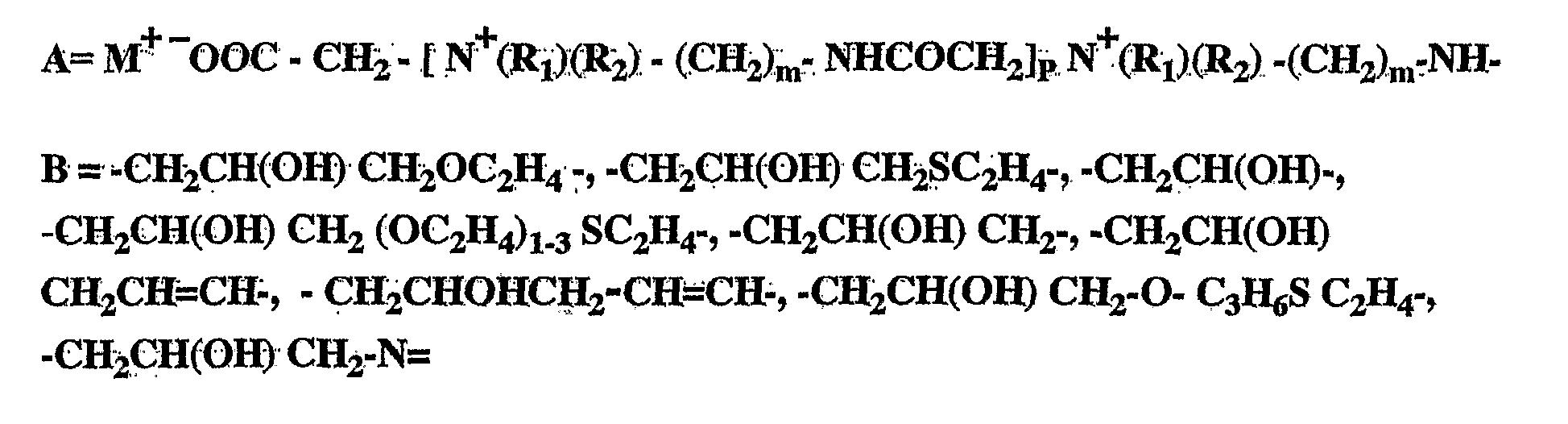


M = un ion alcalin ou néant sont obtenus en trois étapes : on fait réagir là glycidyldiàllyramine ou lès époxydes de formules suivantes :M = an alkali metal ion or nil are obtained in three stages: the glycidyl diethylamine or the epoxides of the following formulas are reacted:


Les éventuelles double liaisons allyliques du composé (VIT) sont ensuite perfluoroalkylées à l'aide des iodures de perfluoroalcane en- présence de 2,2'azobis(isobutyronitrile) et de lhydrosulfite de sodium Enfin, en traitant- le mélange à l'aide de thydroxyde de sodium ou de potassium-, on obtient les tensioaetifs perfluoroalkylés de type carboxylate de sodium ou- de potassium selon l'invention-. Le mélange est dilué avee une petite quantité de monobutyléther du diéïhyléήe glycol et complété avec de l'eau de telle sorte que Ia matière première active des tensiôactifs perfluoroalkylés carboxybétaïne de l'invention soit d'environ 40% avec une teneur en fluor d'environ 9% . Le pH du mélange est réglé entre 7 et 8 .Any allylic double bonds of the compound (VIT) are then perfluoroalkylated using perfluoroalkane iodides in the presence of 2,2'-azobis (isobutyronitrile) and sodium hydrosulfite. Finally, treating the mixture with the aid of sodium hydroxide or potassium hydroxide, the perfluoroalkyl surfactants of the sodium or potassium carboxylate type according to the invention are obtained. The mixture is diluted with a small amount of monobutyl ether of the diethylene glycol and supplemented with water so that the feedstock activates perfluoroalkylated carboxybetaine surfactants of the invention to be about 40% with a fluorine content of about 9%. The pH of the mixture is set between 7 and 8.
^ On remarquera que les enchaînements -CH2CH(I)CHj- et -CH=CH-CH2- éventuellement contenus dans B et D sont une description idéale, car selon le caractère acide ou basique du milieu réactionnel un pourcentage variable d'iode contenu dans la molécule pourra être éliminé pour conduire à un mélange de ces deux enchaînements:^ It is noted that the sequences -CH 2 CH (I) CH j - and -CH = CH-CH 2 - optionally contained in B and D are a perfect description, because depending on the acidic or basic character of the reaction medium a variable percentage iodine content in the molecule can be eliminated to lead to a mixture of these two sequences:
10 Les exemples suivants illustrent les procédés de préparation des nouveaux tensiôactifs perfluoroalkylés de la présente invention sans toutefois en limiter la- portée. Les parties et les pourcentages mentionnés sont en poids sauf indication contraire. Exemple 1 Préparation d'un tensioactif perfluoroalkylé de type carbobétaine correspondant àThe following examples illustrate the processes for preparing the novel perfluoroalkylated surfactants of the present invention without, however, limiting the scope thereof. Parts and percentages are by weight unless otherwise indicated. EXAMPLE 1 Preparation of a Perfluoroalkylated Surfactant of Carbobetaine Type Corresponding to
15 RF = C6F13 15 R F = C 6 F 13
A ≈ 0OC-E-CO-[NH - (CH2)3-N+(CH3)2 - CH2- CO]2- NH - (CH^-N^OH^ -A ≈ OOC-E-CO- [NH- (CH 2) 3 -N + (CH 3 ) 2 -CH 2 -CO] 2 -NH- (CH 2) n -NH 2 -
B ≈ - CH2CH(I)CH2OCH2CH(OH)CH2 etfou -CH=CH-CH2OCH2-CH(QH)CH2-B ≈ - CH 2 CH (I) CH 2 OCH 2 CH (OH) CH 2 and / or -CH = CH-CH 2 OCH 2 -CH (QH) CH 2 -
D = néantD = none

Dans un réacteur muni d'un réfrigérant et d'un agitateur, on introduit 4,62 pp d'anhydride 1,2- ^ cyelohexane diearboxylique et 5 pp de diméthylformamide. On ajoute ensuite lentement 3,06 pp de> N,N-diméthylpropylènediamine. La réaction est exothermique. La température s'élève jusqu'à 75°C. On maintient te mélange autour de 80°C pendant 3 heures. On ajoute au mélange 6,12 pp de N;N-diméthylpropylènediamine puis on ajoute goutte à goutte 7,35 pp de monoehloroacétate d'éthyle en maintenant la température autour de 80°C. Le mélange est 0 alors porté et maintenu à 100°C pendant 6 heures. Le milieu réactionnel est alors ramené à une température de 5O°C et on rajoute 5 pp d'alcool isopropylique. On ajoute ensuite lentement 3,42 pp de l-allylôxy-2,3-époxypropane. La réaction est légèrement exothermique. Le mélange est chauffé à 85°€ pendant 3 heures. On laisse revenir la température à 60°C puis on ajoute successivement 12,15 pp d'ïodure de perfluorohexane, 0,25 pp de 2,2'-azobis (îsobutyronîtrilè) et .3,0. pp d'hydrosύlfïte de sodium dissous dans 9,5 pp d'eau et on chauffe ensuite entre 75 et 8Q0C pendant 3 heures. Lorsque le mélange est revenu à température ambiante, on ajoute 3,8 g d'hydroxyde de potassium à 90% dissous dans 11,35 g d'eau. On ajoute alors 3,9 pp de monobutyléther du diéthylène.In a reactor equipped with a condenser and a stirrer, 4.62 pp of 1,2-dihexyl anhydride and 5 ppm of dimethylformamide are introduced. 3.06 pp of N, N-dimethylpropylenediamine are then added slowly. The reaction is exothermic. The temperature rises to 75 ° C. The mixture is kept at about 80 ° C for 3 hours. 6.12 pbw of N, N-dimethylpropylenediamine are added to the mixture and then 7.35 pbw of ethyl mono-chloroacetate are added dropwise while maintaining the temperature around 80.degree. The mixture was 0 then heated and maintained at 100 ° C for 6 hours. The reaction medium is then brought to a temperature of 50 ° C. and 5 pp of isopropyl alcohol are added. 3.42 μl of 1-allyloxy-2,3-epoxypropane are then slowly added. The reaction is slightly exothermic. The mixture is heated at 85 ° for 3 hours. Let the temperature return to 60 ° C then 12.15 parts of perfluorohexane iodide, 0.25 parts of 2,2'-azobis (isobutyronitrile) and 3.0 parts are successively added. pp of sodium hydrosulphide dissolved in 9.5 pp of water and then heated between 75 and 80 ° C. for 3 hours. When the mixture has returned to room temperature, 3.8 g of 90% potassium hydroxide dissolved in 11.35 g of water are added. 3.9 pp of diethylene monobutyl ether are then added.
Exemple 2Example 2
Préparation d'un tensioactif perflUoroallsylé de type carbobétaine correspondant àPreparation of a perfluoroallsylated surfactant of carbobetaine type corresponding to
A = OOC-E-CO-[NH - (CH^-N^CH,)^ - CH2- CO]2- NH - (CH2)3-N+(CH3)2 -A = OOC-E-CO- [NH - (CH 2 -N, CH 2 ) n -CH 2 -CO] 2 -NH- (CH 2 ) 3 -N + (CH 3 ) 2 -
B s - CHiCH(I)CH2OCH2CH(OH)CH2 et/ou -eH=CH-CH2OCHrCH(OH)CH2- D = néantB s - chich (I) CH 2 OCH 2 CH (OH) CH 2 and / or -eh = CH-CH 2 OCH r CH (OH) CH 2 - D = none

Dans .un réacteur muni d'un réfrigérant et d'un agitateur, on introduit 2,24 pp d'anhydride 2,3- pyridine dicarbôxylique à 97%. et 2,5 pp de diméthylformamide. On ajoute ensuite lentement 1,53 pp

Préparation d'untensioactif perfluoroalkylé de type earbobétaine correspondant àPreparation of a perfluoroalkyl surfactant of the earbobetaine type corresponding to
RF = C6F13 RF = C 6 F 13
A = "0OC-E-CO-[NH - (CH2)3-N+(CH3)2 - CH2- CO]2- NH - (CH2)3-N+(CH3)2 -A = "0OC-E-CO- [NH - (CH 2) 3 -N + (CH 3) 2 - CH 2 - CO] 2 - NH - (CH 2) 3 -N + (CH 3) 2 -
5 B = - CH2CH(I)CH2OCH2CH(OH)CH2 et/ou -CH=CH-CH2OCH2-CH(OH)CH2- D = néantB = - CH 2 CH (I) CH 2 OCH 2 CH (OH) CH 2 and / or -CH = CH-CH 2 OCH 2 -CH (OH) CH 2 - D = nil

Dans un réacteur muni d'un réfrigérant et d'un agitateur, on introduit 4,44 pp d'anhydride phtalîque et 5 pp de diméthyîformamide. On ajoute ensuite lentement 3,06 pp de N,N- diméthylpropylènediamine. La réaction est exothermique. La température s'élève jusqu'àIn a reactor equipped with a condenser and a stirrer, 4.44 pp of phthalic anhydride and 5 pp of dimethylformamide are introduced. 3.06 pp of N, N-dimethylpropylenediamine are then slowly added. The reaction is exothermic. The temperature rises to
15 79°C. On maintient le mélange autour de 80QC pendant 1 heure. On ajoute au mélange 6,12 pp de N,N-diméthylpropylènediamine puis on ajoute goutte à goutte 7,35 pp de monochloroacétate d'éthyle en maintenant la température autour de 8O°C. Le mélange est alors porté et maintenu à 10O°C pendant 6 heures. Le milieu réactionnel est alors ramené à une température de 50°C et on rajoute 5 pp d'alcool isopropylique. On ajoute ensuite 0 lentement 3,42 pp de l-alryloxy-2,3-époxypropane. La réaction est légèrement exothermique. Le mélange est chauffé à 85°C pendant 3 heures. On laisse revenir la température à 60°C puis on ajoute successivement 12,15 pp d'iodure de perfluorohexane, 0,25 pp de 2,2'-a£Qbis (isόbùtyronitrilë) et 3,0 pp d'hydrosulfite de sodium dissous dans 9,5 pp d'eau et on chauffe ensuite entre 75 et 80°C pendant 3 heures. Lorsque le mélange est revenu à température 5 ambiante, on ajoute 3,8 g d'hydroxyde de potassium à 90% dissous dans 11,35 g d'eau. On ajoute alors 4jO5 pp de monobutyléther du diéthylène.79 ° C. The mixture was maintained around 80 Q C for 1 hour. 6.12 pbw of N, N-dimethylpropylenediamine are added to the mixture and 7.35 pbw of ethyl monochloroacetate are added dropwise while maintaining the temperature around 80 ° C. The mixture is then heated and maintained at 100 ° C. for 6 hours. The reaction medium is then brought to a temperature of 50 ° C. and 5 pp of isopropyl alcohol are added. 3.42 μl of 1-Alryloxy-2,3-epoxypropane are then slowly added. The reaction is slightly exothermic. The mixture is heated at 85 ° C for 3 hours. The temperature is allowed to return to 60 ° C., then 12.15 parts of perfluorohexane iodide, 0.25 parts of 2,2'-α-bis (isobutyronitrile) and 3.0 parts of dissolved sodium hydrosulfite are successively added. in 9.5 pp of water and then heated at 75-80 ° C for 3 hours. When the mixture has returned to room temperature, 3.8 g of 90% potassium hydroxide dissolved in 11.35 g of water are added. 4 μg of diethylene monobutyl ether is then added.
Exemple 4Example 4
Préparation d'un tensioactif perfluoroalkylé de type earbobétaine correspondant à O RF ≈ ^gF13 Preparation of a perfluoroalkyl surfactant of the earbobetaine type corresponding to O RF ≈ gF 13
A = 0OC-E-CO-[NH - (CH2)3-N+(CH3)2 - CH2- CO]2- NH - (CH^-N^CHa^ -A = 0OC-E-CO- [NH - (CH 2) 3 -N + (CH 3) 2 - CH 2 - CO] 2 - NH - (CH ^ CH ^ -N ^ -
B ≈- CH2CH(î)ÇH2QCH2eH(OH)CH2 et/oir -CH=CRCH2QCH2-CH(OH)CH2- D = néant

Dans un réacteur muni d'un réfrigérant- et d'un agitateur, on introduit 3,42 pp d'anhydride glutarique et 5 pp de dirhéthylformamide. On ajoute ensuite lentement 3,06 pp de N3N- diméthylpropylènediamine. La réaction est exothermique. La température s'élève jusqu'à 78°C. On maintient le mélange autour de 8O°C pendant 1 heure. On ajoute au mélange 6,12 pp de N,N-dimëthyïpropylènedïamine puis on ajoute goutte à goutte 7,35 pp de monochloroacétate d'éthyïe en maintenant la température autour de 80°C. Le mélange est alors porté et maintenu à 1000G pendant 6. heures; Le milieu réactionnel est alors ramené à une température de 5O°C et on rajoute 5 pp d'alcool isopropylique. On ajoute ensuite lentement 3,42 pp de l-allyIoxy-2,3-époxypropane. La réaction est légèrement exothermique. Le mélange est chauffé à 85°C pendant 3 heures. On laisse revenir la température à 60°C puis on ajoute successivement 12,15 pp d'iodure de perfluorohexane, 0,25 pp dé 2,2'-azobis (isobutyronitriïe) et 3,0 pp d'hydrosulfite de sodium dissous dans 9,5 pp d'eau et on chauffe ensuite entre 75 et 8O°C pendant 3 heures. Lorsque le mélange est revenu à température ambiante, on ajoute 3,8 g d!hydroxyde dé potassium à 90% dissous dans 11,35 g d'eau. On ajoute alors 4,90 pp de monobutyiéther du diéthylène.3.52 g of glutaric anhydride and 5 g of dirhethylformamide are introduced into a reactor equipped with a condenser and a stirrer. 3.06 pp of N 3 N -dimethylpropylenediamine is then slowly added. The reaction is exothermic. The temperature rises to 78 ° C. The mixture is maintained at 80 ° C for 1 hour. 6.12 pbw of N, N-dimethylpropylenediamine is added to the mixture and then 7.35 pbw of ethyl monochloroacetate is added dropwise keeping the temperature around 80 ° C. The mixture is then heated and maintained at 100 ° C. for 6 hours; The reaction medium is then brought to a temperature of 50 ° C. and 5 pp of isopropyl alcohol are added. 3.42 μl of 1-allyloxy-2,3-epoxypropane are then slowly added. The reaction is slightly exothermic. The mixture is heated at 85 ° C for 3 hours. The temperature is allowed to return to 60 ° C., then 12.15 parts of perfluorohexane iodide, 0.25 parts of 2,2'-azobis (isobutyronitrile) and 3.0 parts of sodium hydrosulphite dissolved in 9 ml are added successively. 5 pp of water and then heated at 75 to 80 ° C for 3 hours. When the mixture has returned to room temperature, 3.8 gd is added ! 90% potassium hydroxide dissolved in 11.35 g of water. 4.90 pp of monobutyl ether of diethylene are then added.
Exemple 5 Préparation d'un tensioactif perfluoroalkylé de type carbobétaine correspondant àEXAMPLE 5 Preparation of a Perfluoroalkylated Surfactant of Carbobetaine Type Corresponding to

Dans un réacteur muni d'un réfrigérant et d'un agitateur, on introduit 3,00 pp d'anhydride succinique et 5 pp de diméthylformamide. On ajoute ensuite lentement 3,06 pp de N,N- diméthylpropylènediamine. La réaction est exothermique. La température s'élève jusqu'à 75°C. On maintient le mélange autour de 8O°C pendant 3 heures. On ajoute au mélange 6,12 pp de N,N-diméthylpropylènediamine puis on ajouté goutte à goutte 7,35 pp de monochloroacétate d'éthyle en maintenant la température autour de 80°C. Le mélange est alors porté et maintenu à 100°C pendant 6 heures. Le milieu réactionnel est alors ramené à une température de 50°C et on rajoute 5 pp d'alcool' isopropylique: On ajoute ensuite lentement 3,42 pp de l-allyloxy-23-époxypropane, La réaction est légèrement exothermique. Le mélange est chauffé à 85°C pendant 3 heures; On laisse revenir la température à, 60°C puis on ajoute successivement 14,44 pp un mélange d'iodures de perfluoroaicanes (43% C6F13,In a reactor equipped with a condenser and a stirrer, 3.00 μl of succinic anhydride and 5 μl of dimethylformamide are introduced. 3.06 pp of N, N-dimethylpropylenediamine are then slowly added. The reaction is exothermic. The temperature rises to 75 ° C. The mixture is maintained at 80 ° C for 3 hours. 6.12 μl of N, N-dimethylpropylenediamine are added to the mixture and then 7.35 μl of ethyl monochloroacetate are added dropwise while maintaining the temperature around 80 ° C. The mixture is then carried and maintained at 100 ° C for 6 hours. The reaction medium is then brought to a temperature of 50 ° C and add 5 pp alcohol isopropyl: then slowly added 3.42 pbw of l-allyloxy-23-epoxypropane, The reaction is slightly exothermic. The mixture is heated at 85 ° C for 3 hours; The temperature is allowed to return to 60 ° C., then a mixture of perfluoroocane iodides (43% C 6 F 13 ,

Exempïë 6Exempt 6
Préparation d'un tensioactiTperfluoroal%lê de type carbobéteiήe correspondant àPreparation of a surfactant-perperfluoroal% ee of carbobetee type corresponding to
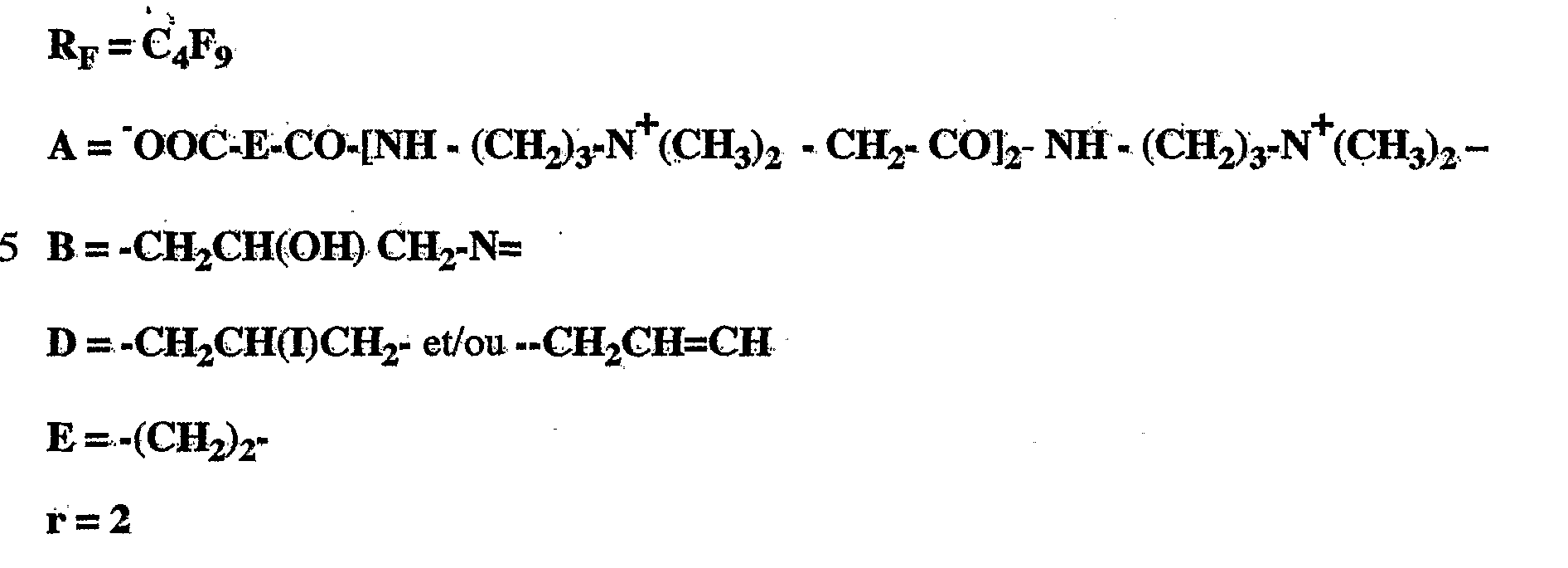
Dans un réacteur muni d'un réfrigérant et d'un agitateur, on introduit 2,00 pp d'anhydride succiriique et 3,33 pp de diméihylformarmde. On ajoute ensuite lentement 2,04 pp de N,N- diméthylpropylènediamine. La réaction est exothermique. La température s'élève jusqu'à 68°C. On maintient ie mélange autour de 80°C pendant 2 heures. On ajoute au mélange 4,08 pp de N,N-diméthylpropylènediamine puis on ajoute goutte à goutte 4,66 pp de monochloroacétate d'éthyle en maintenant la température autour de 80°C. Le mélange est alors porté et maintenu: à 100°C pendant 6 hextres. Le milieu réactioimel est alors ramené à une température de 50°C et on rajoute 3,33 pp d'alcool isoprdpylique. Qn ajoute ensuite lentement 2,98 pp de glycidyldiallylamine . La réaction est légèrement exothermique. Le mélange est chauffé à 85°C pendant 3 heures: On laisse revenir la température à 60°C puis on ajoute successivement 12,7 pp d'iodure de perfluorobutyle, 0,31 pp de 2,2'-az;obis (isobutyroπitrile); et 3,66 pp d'hydrosulfite de sodium dissous dans 11,59 pp d'eau et on Chauffe ensuite entre 75 et 80°C pendant 3 hetures. Lorsque le mélange est revenu à température ambiante, on ajoute 5,5 pp de monobutyléther du diéthylène et 0,48 pp d'hydraxyde de potassium à 90% dissous dans 14,Ql pp d'eau.In a reactor equipped with a condenser and an agitator, 2.00 pp of succyric anhydride and 3.33 pp of dimethylformamide are introduced. 2.04 μl of N, N-dimethylpropylenediamine are then slowly added. The reaction is exothermic. The temperature rises to 68 ° C. The mixture is maintained at about 80 ° C for 2 hours. 4.08 μl of N, N-dimethylpropylenediamine are added to the mixture and 4.66 μl of ethyl monochloroacetate are then added drop by drop while maintaining the temperature around 80 ° C. The mixture is then heated and maintained at 100 ° C. for 6 hexes. The reaction medium is then brought to a temperature of 50 ° C. and 3.33 pp of isopropyl alcohol is added. 2.98 g of glycidyldiallylamine are then slowly added. The reaction is slightly exothermic. The mixture is heated at 85 ° C. for 3 hours: The temperature is allowed to return to 60 ° C., then 12.7 μl of perfluorobutyl iodide, 0.31 μl of 2,2'-azobis (isobutyrritrile) are added successively. ); and 3.66 pp of sodium hydrosulfite dissolved in 11.59 pp of water and then heated to 75-80 ° C for 3 hours. When the mixture came back to At room temperature, 5.5 pp. of diethylene monobutyl ether and 0.48 pp. of 90% potassium hydroxide dissolved in 14.1 μl of water are added.
Exemple 7 Préparation d'un tensioactif perfluoroalkylé de type carbobétaine correspondant àEXAMPLE 7 Preparation of a Perfluoroalkylated Surfactant of Carbobetaine Type Corresponding to

Dans un réacteur muni d'un réfrigérant et d'un agitateur, on introduit 3,00 pp d'anhydride succinique et 5 pp de diméthylformamide. On ajoute ensuite lentement 3,06 pp de N,N- diméthylpropylènediamine. La réaction est exothermiquee. La température s'élève jusqu'à 75°C. On maintient le mélange autour de 80°C pendant 3 heures. On ajoute au mélange 6,12 pp de N,N-diméthylpropylènediamine puis on ajoute goutte à goutte 7,35 pp de monochloroacétate d'éthyle en maintenant la température autour de 80°C. Le mélange est alors porté et maintenu à 10O°C pendant 6 heures. Le milieu réactionnel est alors ramené à une température de 50°C et on rajoute 5 pp d'alcool isopropylique. On ajoute ensuite lentement 3,42 pp de l-allyloxy-2,3-époxypropane. La réaction est légèrement exothermique. Le mélange est chauffé à 85°C pendant 3 heures. On laisse revenir la température à 60°C puis on ajoute successivement 12,15 pp d'iσdure de perfluorohexane, 0,25 pp de 2,2'-azobis (isobutyroπitrile) et 3,0 pp d'hydrosulfite de sodium dissous dans 9,5 pp d'eau et on chauffe ensuite entre 75 et 80°C pendant 3 heures. Le mélange est alors refroidi à 30-40°C, on ajoute 3,8 pp de potasse caustique à 90% dissous dans 8,68 pp d'eau. Le mélange est chauffé à 70- 75°C pendant 4 heures. Lorsque le mélange est revenu à température ambiante, on ajoute 5,5 pp de monobutyléther du diéthylène glycol.In a reactor equipped with a condenser and a stirrer, 3.00 μl of succinic anhydride and 5 μl of dimethylformamide are introduced. 3.06 pp of N, N-dimethylpropylenediamine are then slowly added. The reaction is exothermic. The temperature rises to 75 ° C. The mixture is kept at about 80 ° C for 3 hours. 6.12 pp of N, N-dimethylpropylenediamine are added to the mixture and then 7.35 pp of ethyl monochloroacetate are added dropwise while maintaining the temperature around 80 ° C. The mixture is then heated and maintained at 100 ° C. for 6 hours. The reaction medium is then brought to a temperature of 50 ° C. and 5 pp of isopropyl alcohol are added. 3.42 μl of 1-allyloxy-2,3-epoxypropane are then slowly added. The reaction is slightly exothermic. The mixture is heated at 85 ° C for 3 hours. The temperature is allowed to return to 60 ° C., then 12.15 parts of perfluorohexane iodide, 0.25 parts of 2,2'-azobis (isobutyritrile) and 3.0 parts of sodium hydrosulfite, dissolved in 9 parts, are added successively. 5 pp of water and then heated to 75-80 ° C for 3 hours. The mixture is then cooled to 30-40 ° C, 3.8 pp of 90% caustic potash dissolved in 8.68 pp of water are added. The mixture is heated at 70-75 ° C for 4 hours. When the mixture has returned to room temperature, 5.5 pp of monobutyl ether of diethylene glycol is added.
Exemple 8 Préparation d'un tensioactif perfluoroalkylé de type carbobétaine correspondant àEXAMPLE 8 Preparation of a perfluoroalkyl surfactant of carbobetaine type corresponding to

Dans un réacteur muni d'un réfrigérant et d'un agitateur, on introduit 5,82 pp de diallylamine, puis on ajoute 5055 pp d'épichlorhydrine à 30°C. La réaction est exothermique. La température est maintenue autour de 40°C jusqu'à ce que la réaction soit complète (contrôle par chromatographie en phase gazeuse). On ajoute alors 18,36 pp de N,N- dimétJiylpropylènediamine,! on porte la température à 80-85°C pendant 4 heures, et on ajouteIn a reactor equipped with a condenser and a stirrer, 5.82 pp of diallylamine are introduced, then 5055 pp of epichlorohydrin are added at 30 ° C. The reaction is exothermic. The temperature is maintained around 40 ° C until the reaction is complete (control by gas chromatography). 18.36 μl of N, N-dimethylpropylenediamine are then added. bring the temperature to 80-85 ° C for 4 hours, and add
22,05 pp de monochloroacétate d'éthyle par portions de sorte que la température ne dépasse pas 100-110°C, Le mélange est chauffé à 90-5°C pendant 6 heures. On refroidit à 50°C et on ajoute successivement 0,93 pp de 2,2'-azobis (isobutyronitrile) et 9,4 pp d'hydrosulfite de sodium dissous dans 30 pp d'eau et 38,10 pp d'iodure de perfluorobutane. La réaction est exothermique et la température atteind 60-70°C. On maintient Ia température à 75-80°C pendant 3 heures. Le mélange est refroidi à 30-40°C, on ajoute 15 ppde potasse caustique à 90% dissous dans 27 pp d'eau. Le mélange est chauffé à 75-80°C pendant 4 heures puis est refroidi à 25-3O°C ; on ajoute alors 15,6 pp de monobutyléther du diéthylène glycol, puis on complète Ie mélange avec 22,19 pp d'eau.22.05 g of ethyl monochloroacetate in portions so that the temperature does not exceed 100-110 ° C, the mixture is heated at 90-5 ° C for 6 hours. The mixture is cooled to 50 ° C. and 0.93 μl of 2,2'-azobis (isobutyronitrile) and 9.4 μl of sodium hydrosulphite dissolved in 30 μl of water and 38.10 μl of sodium iodide are added successively. perfluorobutane. The reaction is exothermic and the temperature reaches 60-70 ° C. The temperature is maintained at 75-80 ° C for 3 hours. The mixture is cooled to 30-40 ° C, 15 pp of 90% caustic potash dissolved in 27 pp of water are added. The mixture is heated at 75-80 ° C for 4 hours and then cooled to 25 ° -30 ° C; 15.6 pp of diethylene glycol monobutyl ether are then added, and the mixture is then added to 22.19 pp of water.
Exemple 9 Préparation d'un tensioactif perfluoroalkylé de type carbobétaine correspondant àExample 9 Preparation of a Perfluoroalkylated Surfactant of Carbobetaine Type Corresponding to

Dans un réacteur muni d'un réfrigérant et d'un agitateur, on introduit 12,00 pp d'anhydride succinique et 20 pp de diméthylformamide. On ajoute ensuite lentement 12,24 pp de N,N- diméthylpropylènediamine. La réaction est exothermique. La température s'élève jusqu'à 8O°C. On maintient le mélange autour de 80°C pendant 1 heure. On ajoute au mélange 36,70 pp de N,N-diméthylpropylènediamine puis on ajoute goutte à goutte 44,10 pp de monochloroacétate d'éthylë en maintenant la température autour de 80°C. Le mélange est alors porté et maintenu à I00°C pendant 6 heures. Le milieu, réactïonnel est alors, ramené à une température de 6Q°C et on rajoute 20 pp d'alcool isopropy.Iique.. On ajoute ensuite lentement 13,68 pp de l-allyloxy-23-époχyprαpane. La réaction est légèrement exothermique. Le mélange est chauffé à 85-90°C pendant 3 heures. On laisse revenir la température à 60°C puis on ajoute successivement 48,60 pp d'iodure de. perfluorohexane, 1 ,00 pp de 2,2'-azohïs (isofcutyronîtrile) et 12,0 pp d'hydrosulfîte de sodium dissous, dans 38,00 pp d'eau ; la réaction est exothermique et la température s'élève, à 70-80°C. On maintient ensuite la température entre 75 et 80°C pendant 3 heures. Le mélange est alors- refroidi à 25-3O°C, on ajoute 22,00 pp de monobutyléther du dïéthylène. glycol et on complète le. mélange avec 29,66 0 pp d'eau.In a reactor equipped with a condenser and a stirrer, 12.00 μl of succinic anhydride and 20 μl of dimethylformamide are introduced. 12.24 μl of N, N-dimethylpropylenediamine are then slowly added. The reaction is exothermic. The temperature rises to 80 ° C. The mixture is kept at about 80 ° C for 1 hour. 36.70 μl of N, N-dimethylpropylenediamine are added to the mixture and 44.10 μl of ethyl monochloroacetate are then added dropwise, while maintaining the temperature around 80 ° C. The mixture is then heated and maintained at 100 ° C. for 6 hours. The reaction medium is then brought to a temperature of 60 ° C. and 20 μl of isopropyl alcohol are added. 13.68 μl of 1-allyloxy-23-epoxypropane is then slowly added. The reaction is slightly exothermic. The mixture is heated at 85-90 ° C for 3 hours. The temperature is allowed to return to 60.degree. C. and then 48.60 ppm of iodide are successively added. perfluorohexane, 1.00 pp of 2,2'-azo (isofcutyronitrile) and 12.0 pp of dissolved sodium hydrosulfite, in 38.00 pp of water; the reaction is exothermic and the temperature rises to 70-80 ° C. The temperature is then maintained between 75 and 80 ° C for 3 hours. The mixture is then cooled to 25 ° -30 ° C. and 22.00 μl of ethylene monobutyl ether are added. glycol and complete the. mixed with 29.66 0 pp of water.
Exemple 10Example 10
Préparation d'un tensioactif perfluoroalkylé de type cationique correspondant àPreparation of a Perfluoroalkylated Surfactant of Cationic Type Corresponding to
5 A ≈ CH3-CO-[NH -

B≈-CH2CH(I)CH2OCH2CH(OH)CH2 et/ou -CH=CH-CH2OCH2-CH(OH)CH2-B≈-CH 2 CH (I) CH 2 OCH 2 CH (OH) CH 2 and / or -CH = CH-CH 2 OCH 2 -CH (OH) CH 2 -
Er s= néant E ≈ néantEr = Either nil
Dans un réacteur muni d'un réfrigérant et d'un agitateur, on introduit 3,06 pp d'anhydride 0 acétique. On ajoute ensuite lentement 3,06 pp de N,N-diméthyIpropylènediamine. La réaction est exothermique. La température s'élève jusqu'à 75°C. On maintient le mélange autour de3.06 g of 0 acetic anhydride are introduced into a reactor equipped with a condenser and an agitator. 3.06 pp of N, N-dimethylpropylenediamine are then slowly added. The reaction is exothermic. The temperature rises to 75 ° C. We keep the mixture around
SO°C pendant 3 heures. On ajoute au mélange 6,12 pp de N,N-diméthytpropylènediamine puis on ajoute goutte à goutte 7,35 pp de monochloroacétate d'éthyle en maintenant la température autour de 80°C. Le mélange est alors porté et maintenu à 100°C pendant 6 heures. Le milieu 5 réactionnel est alors ramené à une température de 50°C et on rajoute 5 pp d'alcool isopropylique. On ajoute ensuite lentement 3,42 pp de l-attyloxy-2,3-époxypropane. La réaction est légèrement exothermique. Le mélange est chauffé à 85°C pendant 3 heures. On laisse revenir la température à 5O°C puis on ajoute successivement 12,15 pp d'iodure de perfluorohexane, 0,25 pp de 2,2'-azobis (isobutyronitrile) et 3,0 pp d'hydrosulfite de sodium Q dissous dans 9^5 pp d'eau et on chauffe ensuite entre 75 et 80°C pendant 3 heures. Lorsque le mélange est revenu à température ambiante,, on ajoute 3,8 g d'hydroxyde de potassium à 90% dissous dans 16,29 g d'eau. On ajoute alors 5,5 pp de monobutyléther du diéthylène. Exemple 11SO ° C for 3 hours. 6.12 g of N, N-dimethylpropylene diamine are added to the mixture and then 7.35 g of ethyl monochloroacetate are added dropwise while maintaining the temperature around 80 ° C. The mixture is then heated and maintained at 100 ° C. for 6 hours. The reaction medium is then brought to a temperature of 50 ° C. and 5 pp of isopropyl alcohol are added. 3.42 μl of 1-attyloxy-2,3-epoxypropane are then slowly added. The reaction is slightly exothermic. The mixture is heated at 85 ° C for 3 hours. The temperature is allowed to return to 50 ° C., then 12.15 parts of perfluorohexane iodide, 0.25 parts of 2,2'-azobis (isobutyronitrile) and 3.0 parts of sodium hydrosulphite dissolved in 9.5 g of water and then heated at 75-80 ° C for 3 hours. When the mixture has returned to room temperature, 3.8 g of 90% potassium hydroxide dissolved in 16.29 g of water are added. 5.5 pbw of diethylene monobutyl ether is then added. Example 11
Description et résultats d'une méthode de mesure de la résistance d'un film aqueux à la- surface d'un hydrocarbure : On prépare la solution à tester, iei un émulseur- AFFF 3%, en mélangeant les composés a) suivants : 6,0 pp d'un tensioactif fluoré, 12,0 pp d'un tensioactif anionique , 0,8 pp. d'unDescription and results of a method for measuring the resistance of an aqueous film to the surface of a hydrocarbon: The solution to be tested is prepared, ie a 3% AFFF-emulsifier, by mixing the following compounds a): 0 pp of a fluorinated surfactant, 12.0 pp of anionic surfactant, 0.8 pp. a
tensioactif de type amphotère , 30,0 pp de monobutyléther du diéthylène glycol et 51,2 p d'eau. Le pH est réglé entre 7 et'8; On- verse 50 ml de cyclohexane dans une boîte de Pétri et on pose une vis- de 2,5 mm de long au centre de la boîte, pointe en l'air. On fait ensuite tomber goutte à goutte 3 ml de la solution à tester sur le pointe de la vis, à l'aide d'une éprouvette. Dès la première goutte on déclenche le chronomètre : le temps utile à l'addition des 3 ml de solution est de 1 à 2 minutes; On éloigne la boîte de Pétri de l'éprouvettei on enlève la vis avec précaution et on attend 1 minute. On approche une allumette enflammée à 10 mm de la surface du liquide* puis on balaie la surface : si le cyclohexane ne s'enflamme pas, on touche la surface du cyclohexane avec une allumette enflammée au bord de la boîte de Pétri, tout en déclenchant le chronomètre, On note le temps nécessaire pour allumer le liquide, soit x secondes* et on retire l'allumette. On observe alors l'avancement du front de flamme, lorsque la totalité de la surface a pris feu, on arrête le chronomètre et on note le temps y. On utilise le couple x/y pour comparer la résistance au feu du film produit par différentes solutions sur le cyclohexane. Le tableau suivant regroupe les résultats obtenus pour Fémulseur AFFF 3% formulé avec les tensioactifs fluorés polymérisés selon- l'invention correspondant aux exemples 7 et 9, leur homologue monomère le FLUOTAN AM 600 (FR2.866.883) et un- tensioactif polymérisé de structure différente, le FLUOTAN A825 (EP 0390 905) :amphoteric surfactant, 30.0 pp of diethylene glycol monobutyl ether and 51.2 p water. The pH is adjusted between 7 and '8; 50 ml of cyclohexane is poured into a petri dish and a screw 2.5 mm long is placed in the center of the can, and pointed in the air. 3 ml of the test solution are then dripped onto the tip of the screw with the aid of a test tube. From the first drop, the stopwatch is triggered: the useful time for adding the 3 ml of solution is 1 to 2 minutes; Remove the Petri dish from the test tube, carefully remove the screw and wait for 1 minute. A lit match is approached 10 mm from the surface of the liquid * then the surface is swept: if the cyclohexane does not ignite, touch the surface of the cyclohexane with a match burning at the edge of the petri dish, while triggering the stopwatch, We note the time needed to turn on the liquid, ie x seconds * and we remove the match. We then observe the advancement of the flame front, when the entire surface has caught fire, stop the stopwatch and note the time y. The x / y couple is used to compare the fire resistance of the film produced by different solutions on cyclohexane. The following table groups together the results obtained for the AFFF 3% emulsifier formulated with the polymerized fluorinated surfactants according to the invention corresponding to Examples 7 and 9, their monomeric counterpart FLUOTAN AM 600 (FR2,866,883) and a polymerized surfactant of different structure. , FLUOTAN A825 (EP 0390 905):

b' Cocoamidopropylbétaïne (AMONYL 380BA / Seppic) b 'Cocamidopropylbetaine (Amonyl 380BA / Seppic)
Dans le. tableau ci-déssus, on peut voir de façon tout à fait inattendue que le tensioactif polymérisé de l'exemple 7 confère au film aqueux une plus grande résistance que celle induite par Fusage du FLUOTAN AM 600, analogue monomère du tensioactif de l'exemple 7, en dépit d'une tension superficielle plus élevée. Cette tendance se vérifié si l'on compare les résultats obtenus avec le FLUOTAN A825, et les exemples 7 et 9 : les tensioactifs polymérisés des exemples 7 et 9 induisent respectivement une résistance du film aqueux meilleure ou à peu près équivalente à celle obtenue avec le FLUOTAN A825, tensioactif polymérisé de structure différente, en dépit là aussi d'une tension superficielle beaucoup plus élevée. Ceci montre que la structure moléculaire des composés selon l'invention a un effet remarquable et inattendu sur la- résistance du film aqueux. In the. From the table above, it can be seen quite unexpectedly that the polymerized surfactant of Example 7 gives the aqueous film a greater resistance than that induced by the use of FLUOTAN AM 600, a monomer analogue of the surfactant of Example 7. , despite a higher surface tension. This trend is confirmed if one compares the results obtained with FLUOTAN A825, and Examples 7 and 9: the polymerized surfactants of Examples 7 and 9 respectively induce a resistance of the aqueous film better or approximately equivalent to that obtained with the FLUOTAN A825, a polymerized surfactant with a different structure, despite a much higher surface tension. This shows that the molecular structure of the compounds according to the invention has a remarkable and unexpected effect on the resistance of the aqueous film.
Claims



Priority Applications (1)
| Application Number | Priority Date | Filing Date | Title |
|---|---|---|---|
| EP06808202.3A EP1951381B1 (en) | 2005-11-23 | 2006-09-26 | Novel lipophobic perfluoroalkyl polyamides, preparation thereof and use thereof |
Applications Claiming Priority (2)
| Application Number | Priority Date | Filing Date | Title |
|---|---|---|---|
| FR0511823A FR2893629B1 (en) | 2005-11-23 | 2005-11-23 | NOVEL LIPOPHOBIC PERFLUOROALKYL POLYAMIDES AND THEIR OBTAINING AND USE |
| FR0511823 | 2005-11-23 |
Publications (1)
| Publication Number | Publication Date |
|---|---|
| WO2007060300A1 true WO2007060300A1 (en) | 2007-05-31 |
Family
ID=37198733
Family Applications (1)
| Application Number | Title | Priority Date | Filing Date |
|---|---|---|---|
| PCT/FR2006/002186 Ceased WO2007060300A1 (en) | 2005-11-23 | 2006-09-26 | Novel lipophobic perfluoroalkyl polyamides, preparation thereof and use thereof |
Country Status (3)
| Country | Link |
|---|---|
| EP (1) | EP1951381B1 (en) |
| FR (1) | FR2893629B1 (en) |
| WO (1) | WO2007060300A1 (en) |
Cited By (3)
| Publication number | Priority date | Publication date | Assignee | Title |
|---|---|---|---|---|
| US7692035B2 (en) | 2008-07-01 | 2010-04-06 | E. I. Du Pont De Nemours And Company | Fluorinated esters |
| US8173848B2 (en) | 2008-07-01 | 2012-05-08 | E.I. Du Pont De Nemours And Company | Fluorinated alcohols |
| US8263800B2 (en) | 2008-07-01 | 2012-09-11 | E. I. Du Pont De Nemours And Company | Partially fluorinated sulfonated surfactants |
Citations (24)
| Publication number | Priority date | Publication date | Assignee | Title |
|---|---|---|---|---|
| US3145222A (en) | 1961-02-23 | 1964-08-18 | Du Pont | Addition of polyfluoroalkyl iodides to unsaturated compounds and products produced thereby |
| US3475333A (en) | 1967-11-01 | 1969-10-28 | Nat Foam System Inc | Fire extinguishing |
| DE1928556A1 (en) | 1968-06-21 | 1969-12-18 | Angus George Co Ltd | Fire extinguishing foam concentrate |
| FR2088941A5 (en) | 1970-04-30 | 1972-01-07 | Ugine Kuhlmann | |
| DE2240263A1 (en) | 1971-08-18 | 1973-02-22 | Ici Ltd | IMPROVED FOAM |
| DE2325855A1 (en) | 1972-05-23 | 1973-12-06 | Ugine Kuhlmann | SUBSTANCE MIXTURE OF FLUORINATED SURFACE-ACTIVATED COMPOUNDS FOR THE MANUFACTURING OF DELETING MATERIALS |
| DE2559189A1 (en) | 1975-01-03 | 1976-07-08 | Ciba Geigy Ag | FLUORINE COMPOUNDS |
| US4042522A (en) | 1975-03-24 | 1977-08-16 | Ciba-Geigy Corporation | Aqueous wetting and film forming compositions |
| US4069244A (en) | 1975-01-03 | 1978-01-17 | Ciba-Geigy Corporation | Fluorinated amphoteric and cationic surfactants |
| US4090967A (en) | 1975-12-19 | 1978-05-23 | Ciba-Geigy Corporation | Aqueous wetting and film forming compositions |
| US4126633A (en) | 1973-09-12 | 1978-11-21 | Pennwalt Corporation | Fluorinated aliphatic sulfides |
| FR2390426A2 (en) | 1977-05-12 | 1978-12-08 | Ugine Kuhlmann | FLUORINE SULFOXYL AMPHOLYTE COMPOUNDS |
| DE2829594A1 (en) | 1977-07-05 | 1979-01-25 | Ici Ltd | FLUORINATED SURFACE AGENTS, THEIR PREPARATION AND THEIR USE IN AQUEOUS EXPANDABLE COMPOSITIONS WHICH CAN BE USED IN FIRE FIGHTING |
| DE2732555A1 (en) | 1977-07-19 | 1979-02-01 | Hoechst Ag | FOAM REMOVER |
| DE2749331A1 (en) | 1977-11-04 | 1979-05-10 | Hoechst Ag | FIRE EXTINGUISHERS |
| US4283533A (en) | 1979-11-09 | 1981-08-11 | E. I. Du Pont De Nemours And Company | N-type betaines of 2-hydroxy-1,1,2,3,3-pentahydroperfluoroalkylamines |
| FR2575165A1 (en) | 1984-12-26 | 1986-06-27 | Atochem | FLUORINATED TELOMERS WITH HYDROPHILIC GROUPS, PROCESS FOR PREPARING THEM AND THEIR USE AS SURFACTANTS AGAINST AQUEOUS MEDIA, IN PARTICULAR AS ADDITIVES TO PROTEIN FIRE EMITTING DEVICES |
| US4795590A (en) | 1985-05-28 | 1989-01-03 | Minnesota Mining And Manufacturing Company | Treatment of hazardous material with vapor suppressing, persistent, water-containing, polymeric air foam |
| EP0311570A2 (en) | 1987-10-09 | 1989-04-12 | Ciba-Geigy Ag | Polysaccharide/Perfluoroalkyl Complexes |
| WO1990003966A1 (en) * | 1988-10-10 | 1990-04-19 | Istvan Szonyi | Amidofluoranited compounds, method for producing and using said compounds |
| US5085786A (en) | 1991-01-24 | 1992-02-04 | Minnesota Mining And Manufacturing Company | Aqueous film-forming foamable solution useful as fire extinguishing concentrate |
| EP0780141A1 (en) | 1995-12-22 | 1997-06-25 | Total Walther Feuerschutz Löschmittel GmbH | Fire extinguishing foam based on a foam generating concentrate without glycolether or glycol |
| FR2839071A1 (en) | 2002-04-30 | 2003-10-31 | Stephane Szonyi | NOVEL ALKOLIPOPHOBIC PERFLUOROALKYL SURFACTANTS, THEIR OBTAINING AND THEIR USE AS PERFLUOROALKYLING AGENTS |
| FR2866883A1 (en) | 2004-02-27 | 2005-09-02 | Stephane Szonyi | New tensioactive perfluoroalkyl derivatives useful as hydrophobic agents, oleophobic agents or as additives in the extinguishing foam to improve their anti-fire resistance |
-
2005
- 2005-11-23 FR FR0511823A patent/FR2893629B1/en not_active Expired - Fee Related
-
2006
- 2006-09-26 EP EP06808202.3A patent/EP1951381B1/en not_active Not-in-force
- 2006-09-26 WO PCT/FR2006/002186 patent/WO2007060300A1/en not_active Ceased
Patent Citations (25)
| Publication number | Priority date | Publication date | Assignee | Title |
|---|---|---|---|---|
| US3145222A (en) | 1961-02-23 | 1964-08-18 | Du Pont | Addition of polyfluoroalkyl iodides to unsaturated compounds and products produced thereby |
| US3475333A (en) | 1967-11-01 | 1969-10-28 | Nat Foam System Inc | Fire extinguishing |
| DE1928556A1 (en) | 1968-06-21 | 1969-12-18 | Angus George Co Ltd | Fire extinguishing foam concentrate |
| FR2088941A5 (en) | 1970-04-30 | 1972-01-07 | Ugine Kuhlmann | |
| DE2240263A1 (en) | 1971-08-18 | 1973-02-22 | Ici Ltd | IMPROVED FOAM |
| DE2325855A1 (en) | 1972-05-23 | 1973-12-06 | Ugine Kuhlmann | SUBSTANCE MIXTURE OF FLUORINATED SURFACE-ACTIVATED COMPOUNDS FOR THE MANUFACTURING OF DELETING MATERIALS |
| FR2185668A1 (en) | 1972-05-23 | 1974-01-04 | Ugine Kuhlmann | |
| US4126633A (en) | 1973-09-12 | 1978-11-21 | Pennwalt Corporation | Fluorinated aliphatic sulfides |
| DE2559189A1 (en) | 1975-01-03 | 1976-07-08 | Ciba Geigy Ag | FLUORINE COMPOUNDS |
| US4069244A (en) | 1975-01-03 | 1978-01-17 | Ciba-Geigy Corporation | Fluorinated amphoteric and cationic surfactants |
| US4042522A (en) | 1975-03-24 | 1977-08-16 | Ciba-Geigy Corporation | Aqueous wetting and film forming compositions |
| US4090967A (en) | 1975-12-19 | 1978-05-23 | Ciba-Geigy Corporation | Aqueous wetting and film forming compositions |
| FR2390426A2 (en) | 1977-05-12 | 1978-12-08 | Ugine Kuhlmann | FLUORINE SULFOXYL AMPHOLYTE COMPOUNDS |
| DE2829594A1 (en) | 1977-07-05 | 1979-01-25 | Ici Ltd | FLUORINATED SURFACE AGENTS, THEIR PREPARATION AND THEIR USE IN AQUEOUS EXPANDABLE COMPOSITIONS WHICH CAN BE USED IN FIRE FIGHTING |
| DE2732555A1 (en) | 1977-07-19 | 1979-02-01 | Hoechst Ag | FOAM REMOVER |
| DE2749331A1 (en) | 1977-11-04 | 1979-05-10 | Hoechst Ag | FIRE EXTINGUISHERS |
| US4283533A (en) | 1979-11-09 | 1981-08-11 | E. I. Du Pont De Nemours And Company | N-type betaines of 2-hydroxy-1,1,2,3,3-pentahydroperfluoroalkylamines |
| FR2575165A1 (en) | 1984-12-26 | 1986-06-27 | Atochem | FLUORINATED TELOMERS WITH HYDROPHILIC GROUPS, PROCESS FOR PREPARING THEM AND THEIR USE AS SURFACTANTS AGAINST AQUEOUS MEDIA, IN PARTICULAR AS ADDITIVES TO PROTEIN FIRE EMITTING DEVICES |
| US4795590A (en) | 1985-05-28 | 1989-01-03 | Minnesota Mining And Manufacturing Company | Treatment of hazardous material with vapor suppressing, persistent, water-containing, polymeric air foam |
| EP0311570A2 (en) | 1987-10-09 | 1989-04-12 | Ciba-Geigy Ag | Polysaccharide/Perfluoroalkyl Complexes |
| WO1990003966A1 (en) * | 1988-10-10 | 1990-04-19 | Istvan Szonyi | Amidofluoranited compounds, method for producing and using said compounds |
| US5085786A (en) | 1991-01-24 | 1992-02-04 | Minnesota Mining And Manufacturing Company | Aqueous film-forming foamable solution useful as fire extinguishing concentrate |
| EP0780141A1 (en) | 1995-12-22 | 1997-06-25 | Total Walther Feuerschutz Löschmittel GmbH | Fire extinguishing foam based on a foam generating concentrate without glycolether or glycol |
| FR2839071A1 (en) | 2002-04-30 | 2003-10-31 | Stephane Szonyi | NOVEL ALKOLIPOPHOBIC PERFLUOROALKYL SURFACTANTS, THEIR OBTAINING AND THEIR USE AS PERFLUOROALKYLING AGENTS |
| FR2866883A1 (en) | 2004-02-27 | 2005-09-02 | Stephane Szonyi | New tensioactive perfluoroalkyl derivatives useful as hydrophobic agents, oleophobic agents or as additives in the extinguishing foam to improve their anti-fire resistance |
Non-Patent Citations (4)
| Title |
|---|
| R.E.BANKS, FLUOROCARBONS AND THEIR DERIVATIVES, 1964, pages 56 - 61 |
| W.Y.HUNG, J.FLUORINE CHEM., vol. 58, 1992, pages 1 - 8 |
| W.Y.HUNG; J.ZHUANG, CHIN.J.CHEM., vol. 9, 1991, pages 270 |
| W.Y.HUNG; J.ZHUANG, CHIN.J.CHEM., vol. 9, 1991, pages 373 |
Cited By (3)
| Publication number | Priority date | Publication date | Assignee | Title |
|---|---|---|---|---|
| US7692035B2 (en) | 2008-07-01 | 2010-04-06 | E. I. Du Pont De Nemours And Company | Fluorinated esters |
| US8173848B2 (en) | 2008-07-01 | 2012-05-08 | E.I. Du Pont De Nemours And Company | Fluorinated alcohols |
| US8263800B2 (en) | 2008-07-01 | 2012-09-11 | E. I. Du Pont De Nemours And Company | Partially fluorinated sulfonated surfactants |
Also Published As
| Publication number | Publication date |
|---|---|
| EP1951381B1 (en) | 2014-10-22 |
| FR2893629A1 (en) | 2007-05-25 |
| FR2893629B1 (en) | 2009-10-16 |
| EP1951381A1 (en) | 2008-08-06 |
Similar Documents
| Publication | Publication Date | Title |
|---|---|---|
| EP0017568B1 (en) | Fluorinated sulfobetaines and applications of their surface-active properties to extinguishing compositions | |
| EP0110749B1 (en) | Process for the preparation of addition products of epoxides and hydroxy compounds | |
| EP0189698B1 (en) | Fluorated telomers with hydrophilic groups, process for their preparation and their use as surface-active agents in an aqueous medium | |
| EP2652049A2 (en) | Fluorinated oligomers having pendant bromine-containing moieties | |
| EP0597747B1 (en) | Use of dienes as transfer agent during the preparation of polymers | |
| KR19990088134A (en) | Poly-perfluoroalkyl substituted polyamines as grease proofing agents for paper and foam stabilizers in aqueous fire-fighting foams | |
| EP0832884B1 (en) | Novel alco-oleophobic fluorinated surfactants, processes for preparing same and uses thereof | |
| WO2007060300A1 (en) | Novel lipophobic perfluoroalkyl polyamides, preparation thereof and use thereof | |
| EP0621057A1 (en) | Emulsifier for portable fire extinguishers | |
| FI77838B (en) | FOERFARANDE FOER RENING AV C7-C18-PERFLUORKOL FRAON BLANDNINGAR INNEHAOLLANDE VAETE. | |
| EP0390905B1 (en) | Amidofluorinated compounds, method for producing and using said compounds | |
| FR2660923A1 (en) | Reagent and process for the perhaloalkylation of a nucleophile using sulphur dioxide | |
| EP0755701B1 (en) | Fluoroproteinaceous emulsifier forming polyvalent film | |
| Mandracchia et al. | Fluoropolymer Based on a Polyaspartamide containing 1, 2, 4‐Oxadiazole Units: A Potential Artificial Oxygen (O2) Carrier | |
| Glossop et al. | Accessing the thiol toolbox: synthesis and structure–activity studies on fluoro-thiol conjugated antimicrobial peptides | |
| FR2739295A1 (en) | VERSATILE ANTI-FIRE EMULSE | |
| EP1740536B1 (en) | Novel perfluoroalkyl hydrophobic and oil-repellent surfactants derived from substituted amides, preparation and use thereof | |
| EP1499658A1 (en) | Oil and alcohol repellent perfluoroalkylated surfactants, method for obtaining same and use thereof as perfluoroalkylating agents | |
| FR2866027A1 (en) | New polyamines or perfluoroalkyl polyamide, containing only one perfluoroalkyl group, are lipophobic and/or alcophobic surfactants useful as additives in foam extinguishers | |
| FR2637506A1 (en) | New emulsifying liquids for the production of extinguishing foam; their production and their use | |
| CA2222355A1 (en) | Fluorinated hydrophilic polymers | |
| CN116789575A (en) | Degradable surfactant and preparation method thereof | |
| JPH0150224B2 (en) | ||
| CN108212216B (en) | A kind of polysulfonated cobalt phthalocyanine catalyst for liquefied petroleum gas desulfurization | |
| MC218A1 (en) | Process for the reduction of benzophenone substitution derivatives and products obtained by this process. |
Legal Events
| Date | Code | Title | Description |
|---|---|---|---|
| 121 | Ep: the epo has been informed by wipo that ep was designated in this application | ||
| WWE | Wipo information: entry into national phase |
Ref document number: 2006808202 Country of ref document: EP |
|
| NENP | Non-entry into the national phase |
Ref country code: DE |
|
| WWP | Wipo information: published in national office |
Ref document number: 2006808202 Country of ref document: EP |