WO2006037537A2 - D-pyranosyl-substituted phenyls, medicaments containing said compounds, use thereof, and method for the production thereof - Google Patents
D-pyranosyl-substituted phenyls, medicaments containing said compounds, use thereof, and method for the production thereofInfo
- Publication number
- WO2006037537A2 WO2006037537A2 PCT/EP2005/010488 EP2005010488W WO2006037537A2 WO 2006037537 A2 WO2006037537 A2 WO 2006037537A2 EP 2005010488 W EP2005010488 W EP 2005010488W WO 2006037537 A2 WO2006037537 A2 WO 2006037537A2
- Authority
- WO
- WIPO (PCT)
- Prior art keywords
- alkyl
- radicals
- groups
- aryl
- group
- Prior art date
- Legal status (The legal status is an assumption and is not a legal conclusion. Google has not performed a legal analysis and makes no representation as to the accuracy of the status listed.)
- Ceased
Links
- GRUUOLMLVZXSEI-UHFFFAOYSA-N CC[N](C)(C)C1CCCC1 Chemical compound CC[N](C)(C)C1CCCC1 GRUUOLMLVZXSEI-UHFFFAOYSA-N 0.000 description 1
- LTKFDQCRIPAPFK-ZDUVLXAVSA-N C[C@@]1(OC)O[C@@H]([C@@H]([C@@H](CO)O[C@H]2c(cc3Cc(cc4)ccc4OC)ccc3Cl)O)[C@H]2O[C@@]1(C)OC Chemical compound C[C@@]1(OC)O[C@@H]([C@@H]([C@@H](CO)O[C@H]2c(cc3Cc(cc4)ccc4OC)ccc3Cl)O)[C@H]2O[C@@]1(C)OC LTKFDQCRIPAPFK-ZDUVLXAVSA-N 0.000 description 1
Classifications
-
- C—CHEMISTRY; METALLURGY
- C07—ORGANIC CHEMISTRY
- C07H—SUGARS; DERIVATIVES THEREOF; NUCLEOSIDES; NUCLEOTIDES; NUCLEIC ACIDS
- C07H7/00—Compounds containing non-saccharide radicals linked to saccharide radicals by a carbon-to-carbon bond
- C07H7/04—Carbocyclic radicals
-
- A—HUMAN NECESSITIES
- A61—MEDICAL OR VETERINARY SCIENCE; HYGIENE
- A61P—SPECIFIC THERAPEUTIC ACTIVITY OF CHEMICAL COMPOUNDS OR MEDICINAL PREPARATIONS
- A61P1/00—Drugs for disorders of the alimentary tract or the digestive system
- A61P1/08—Drugs for disorders of the alimentary tract or the digestive system for nausea, cinetosis or vertigo; Antiemetics
-
- A—HUMAN NECESSITIES
- A61—MEDICAL OR VETERINARY SCIENCE; HYGIENE
- A61P—SPECIFIC THERAPEUTIC ACTIVITY OF CHEMICAL COMPOUNDS OR MEDICINAL PREPARATIONS
- A61P19/00—Drugs for skeletal disorders
- A61P19/06—Antigout agents, e.g. antihyperuricemic or uricosuric agents
-
- A—HUMAN NECESSITIES
- A61—MEDICAL OR VETERINARY SCIENCE; HYGIENE
- A61P—SPECIFIC THERAPEUTIC ACTIVITY OF CHEMICAL COMPOUNDS OR MEDICINAL PREPARATIONS
- A61P3/00—Drugs for disorders of the metabolism
-
- A—HUMAN NECESSITIES
- A61—MEDICAL OR VETERINARY SCIENCE; HYGIENE
- A61P—SPECIFIC THERAPEUTIC ACTIVITY OF CHEMICAL COMPOUNDS OR MEDICINAL PREPARATIONS
- A61P3/00—Drugs for disorders of the metabolism
- A61P3/04—Anorexiants; Antiobesity agents
-
- A—HUMAN NECESSITIES
- A61—MEDICAL OR VETERINARY SCIENCE; HYGIENE
- A61P—SPECIFIC THERAPEUTIC ACTIVITY OF CHEMICAL COMPOUNDS OR MEDICINAL PREPARATIONS
- A61P3/00—Drugs for disorders of the metabolism
- A61P3/06—Antihyperlipidemics
-
- A—HUMAN NECESSITIES
- A61—MEDICAL OR VETERINARY SCIENCE; HYGIENE
- A61P—SPECIFIC THERAPEUTIC ACTIVITY OF CHEMICAL COMPOUNDS OR MEDICINAL PREPARATIONS
- A61P3/00—Drugs for disorders of the metabolism
- A61P3/08—Drugs for disorders of the metabolism for glucose homeostasis
-
- A—HUMAN NECESSITIES
- A61—MEDICAL OR VETERINARY SCIENCE; HYGIENE
- A61P—SPECIFIC THERAPEUTIC ACTIVITY OF CHEMICAL COMPOUNDS OR MEDICINAL PREPARATIONS
- A61P3/00—Drugs for disorders of the metabolism
- A61P3/08—Drugs for disorders of the metabolism for glucose homeostasis
- A61P3/10—Drugs for disorders of the metabolism for glucose homeostasis for hyperglycaemia, e.g. antidiabetics
-
- A—HUMAN NECESSITIES
- A61—MEDICAL OR VETERINARY SCIENCE; HYGIENE
- A61P—SPECIFIC THERAPEUTIC ACTIVITY OF CHEMICAL COMPOUNDS OR MEDICINAL PREPARATIONS
- A61P3/00—Drugs for disorders of the metabolism
- A61P3/12—Drugs for disorders of the metabolism for electrolyte homeostasis
-
- A—HUMAN NECESSITIES
- A61—MEDICAL OR VETERINARY SCIENCE; HYGIENE
- A61P—SPECIFIC THERAPEUTIC ACTIVITY OF CHEMICAL COMPOUNDS OR MEDICINAL PREPARATIONS
- A61P43/00—Drugs for specific purposes, not provided for in groups A61P1/00-A61P41/00
-
- A—HUMAN NECESSITIES
- A61—MEDICAL OR VETERINARY SCIENCE; HYGIENE
- A61P—SPECIFIC THERAPEUTIC ACTIVITY OF CHEMICAL COMPOUNDS OR MEDICINAL PREPARATIONS
- A61P5/00—Drugs for disorders of the endocrine system
- A61P5/48—Drugs for disorders of the endocrine system of the pancreatic hormones
-
- A—HUMAN NECESSITIES
- A61—MEDICAL OR VETERINARY SCIENCE; HYGIENE
- A61P—SPECIFIC THERAPEUTIC ACTIVITY OF CHEMICAL COMPOUNDS OR MEDICINAL PREPARATIONS
- A61P7/00—Drugs for disorders of the blood or the extracellular fluid
- A61P7/10—Antioedematous agents; Diuretics
-
- A—HUMAN NECESSITIES
- A61—MEDICAL OR VETERINARY SCIENCE; HYGIENE
- A61P—SPECIFIC THERAPEUTIC ACTIVITY OF CHEMICAL COMPOUNDS OR MEDICINAL PREPARATIONS
- A61P9/00—Drugs for disorders of the cardiovascular system
- A61P9/04—Inotropic agents, i.e. stimulants of cardiac contraction; Drugs for heart failure
-
- A—HUMAN NECESSITIES
- A61—MEDICAL OR VETERINARY SCIENCE; HYGIENE
- A61P—SPECIFIC THERAPEUTIC ACTIVITY OF CHEMICAL COMPOUNDS OR MEDICINAL PREPARATIONS
- A61P9/00—Drugs for disorders of the cardiovascular system
- A61P9/10—Drugs for disorders of the cardiovascular system for treating ischaemic or atherosclerotic diseases, e.g. antianginal drugs, coronary vasodilators, drugs for myocardial infarction, retinopathy, cerebrovascula insufficiency, renal arteriosclerosis
-
- A—HUMAN NECESSITIES
- A61—MEDICAL OR VETERINARY SCIENCE; HYGIENE
- A61P—SPECIFIC THERAPEUTIC ACTIVITY OF CHEMICAL COMPOUNDS OR MEDICINAL PREPARATIONS
- A61P9/00—Drugs for disorders of the cardiovascular system
- A61P9/12—Antihypertensives
Definitions
- the present invention relates to D-pyranosyl-substituted phenyls of the general formula I.
- radicals R 1 to R 5 , X, Z and R 7a , R 7b , R 7 ° are defined below, including their tautomers, their stereoisomers, mixtures thereof and their salts.
- the subject of this invention relates to medicaments containing an inventive
- aromatic fluoroglycoside derivatives are proposed as antidiabetics because of their effect on SGLT.
- the exemplified compounds are exclusively O-phenylglycosides.
- a further object of the present invention is to show pyranosyl-substituted phenylene which has an increased inhibitory effect on the sodium-dependent glucose cotransporter SGLT2 in vitro and / or in vivo compared to known, structurally similar compounds and / or improved pharmacological or pharmacokinetic properties exhibit.
- a first object of the present invention are D-pyranosyl-substituted phenyls of the general formula I.
- R 1 is hydrogen, fluorine, chlorine, bromine, iodine, d- ⁇ -alkyl, C 2 - 6 alkynyl, C 2 .6 alkenyl, C. 3
- alkyl alkenyl, alkynyl, cycloalkyl and cycloalkenyl groups may be partly or completely fluorinated or mono- or disubstituted by identical or different substituents selected from chlorine, hydroxy, Ci -3 alkoxy, and C ⁇ alkyl, and
- cycloalkyl and cycloalkenyl radicals one or two methylene groups can be replaced independently of one another by O, S, CO, SO or SO 2 , and
- N-heterocycloalkyl radicals a methylene group may be replaced by CO or SO 2 , and
- R 2 is hydrogen, fluorine, chlorine, bromine, hydroxy, C 1-4 -alkyl, Ci. 4 -alkoxy, cyano or nitro, where alkyl radicals may be mono- or polysubstituted by fluorine, or
- R 1 and R 2 may be linked together such that R 1 and R 2 together form a C 3 -5-alkylene, C 3 .
- Form 5 alkenylene or butadienylene bridge which partially or completely fluorinated or mono- or disubstituted by identical or different substituents selected from chlorine, hydroxy, Ci -3 -
- Ci -3 alkyl May be alkoxy and Ci -3 alkyl which may be substituted, and in which one or two methylene groups are independently replaced by O, S, CO, SO, SO 2 or NR N replaced, and in the case of a butadienylene bridge one or two Methine groups can be replaced by an N atom,
- R 3 is hydrogen, fluorine, chlorine, bromine, iodine, Ci. 6 -alkyl, C 2 . 6 alkynyl, C 2-6 alkenyl, C 3 .i 0 -
- Cycloalkyl C ⁇ - cycloalkyl-ds-alkyl, C 5 .i 0 -Cycloalkenyl, C 5 .io-Cycloalkenyl-Ci. 3 -alkyl, aryl, heteroaryl, Ci. 4 -alkylcarbonyl, arylcarbonyl, heteroarylcarbonyl, aminocarbonyl, Ci- 4 alkylaminocarbonyl, di- (Ci -3 alkyl) aminocarbonyl, pyrrolidin-1 ylcarbonyl, piperidin-1 -ylcarbonyl, morpholin-4-ylcarbonyl, piperazin-1 -ylcarbonyl , 4- (Ci -4 -
- alkyl, alkenyl, alkynyl, cycloalkyl and cycloalkenyl radicals partially or completely fluorinated or once or twice with the same or different
- Substituents selected from chlorine, hydroxy, Ci. 3 alkoxy and d -3 alkyl may be substituted, and
- cycloalkyl and cycloalkenyl radicals one or two methylene groups can be replaced independently of one another by O, S, CO, SO or SO 2 , and
- N-heterocycloalkyl radicals a methylene group may be replaced by CO or SO 2 , and
- R 4 is hydrogen, fluorine, chlorine, bromine, iodine, cyano, nitro, C 1-3 alkyl, C -3 alkoxy, substituted by 1 to 3 fluorine atoms, methyl or methoxy, or
- R 3 and R 4 may be linked together such that R 3 and R 4 together form a C 3 .
- Bridge form partially or completely fluorinated or mono- or disubstituted by identical or different substituents selected from chlorine, hydroxy, Ci -3 - may be alkoxy and Ci -3 alkyl substituted, and in which one or two methylene groups are independently replaced by O , S, CO, SO, SO 2 or NR N may be replaced, and in the case of a butadienylene bridge one or two
- Methine groups can be replaced by an N atom
- R 5 is hydrogen, fluorine, chlorine, bromine, iodine, cyano, nitro, Ci. 3 alkyl, Ci -3 alkoxy, by 1 to 3
- Fluorine atoms substituted methyl or methoxy
- R N H 1 d 4- alkyl or C 1-4 -alkylcarbonyl, L independent. selected from the group consisting of fluorine, chlorine,
- R 7c independently of one another are selected from the group of hydrogen
- X is hydrogen, fluorine, chlorine, bromine, iodine, C 1-6 -alkyl, C 2 . 6 alkynyl, C 2 - 6 alkenyl, C 3 . 7 -
- a methylene group directly connected to the pyranose ring may be replaced by NR N , S, CO, SO or SO 2 , and
- alkyl, alkenyl, alkynyl, cycloalkyl and cycloalkenyl radicals partially or completely fluorinated or once or twice with the same or different
- Substituents selected from chloro, cyano, hydroxy, C 1-3 alkoxy, C 1-3 alkylsulphanyl, -NH 2, -NHR N, -NR N (Ci -3 alkyl), and d -3 alkyl may be substituted , and
- cycloalkyl and cycloalkenyl radicals one or two methylene groups can be replaced independently of one another by O, S, CO, SO or SO 2 , and
- Z is oxygen, methylene, dimethylmethylene, 1, 1-cyclopropylene, difluoromethylene or
- aryl groups mentioned in the definition of the abovementioned radicals are to be understood as meaning phenyl or naphthyl groups which may be independently of one another monosubstituted or disubstituted by identical or different radicals L; and - O -
- a pyrrolyl, furanyl, thienyl, imidazolyl, pyridyl, indolyl, benzofuranyl, benzothiophenyl, quinolinyl or isoquinolinyl group is to be understood,
- heteroaryl groups independently of one another may be monosubstituted or disubstituted by identical or different radicals L;
- N-heterocycloalkyl radical mentioned in the definition of the abovementioned radicals is understood to mean a saturated carbocyclic ring which has an imino group in the ring which contains a further imino group or an O or S atom in the ring can have, and
- alkyl groups may be straight-chain or branched
- the compounds of the general formula I according to the invention and their physiologically tolerable salts have valuable pharmacological properties, in particular an inhibiting action on the sodium-dependent glucose cotransporter SGLT, in particular SGLT2. Furthermore, compounds of the invention may have an inhibitory effect on the sodium-dependent glucose cotransporter SGLT1. Compared to a possible inhibitory effect on SGLT1, the compounds of the invention preferably selectively inhibit SGLT2.
- the present invention also relates to the physiologically tolerable salts of the compounds according to the invention with inorganic or organic acids. Therefore, the use of the compounds of the invention, including the physiologically acceptable salts, as a pharmaceutical is also an object of this invention.
- Another object of this invention are pharmaceutical compositions containing at least one compound of the invention or a physiologically acceptable salt according to the invention in addition to optionally one or more inert carriers and / or diluents.
- Another object of this invention is the use of at least one compound of the invention or a physiologically acceptable salt of such a compound for the manufacture of a medicament suitable for the treatment or prophylaxis of diseases or conditions which can be influenced by inhibition of the sodium-dependent glucose cotransporter SGLT, in particular SGLT2 are.
- Another object of this invention is the use of at least one compound of the invention for the manufacture of a medicament which is suitable for the treatment of metabolic diseases.
- Another object of this invention is the use of at least one compound of the invention for the manufacture of a medicament for inhibiting the sodium-dependent glucose cotransporter SGLT, in particular SGLT2.
- a process for the preparation of a medicament according to the invention is the subject of this invention, characterized in that a compound according to the invention is incorporated into one or more inert carriers and / or diluents by a non-chemical route.
- the present invention also provides a process for the preparation of the compounds of general formula I according to the invention, characterized in that
- R 1 is H, Ci 4 alkyl, (Ci- 18 alkyl) carbonyl, (Ci- 18 alkyl) oxycarbonyl, arylcarbonyl or aryl- (Cva-alkyO-carbonyl means, wherein the alkyl or aryl groups, one or more times may be substituted with halogen;
- R 8c independently of one another have meanings given above and below for the radicals R 7a , R 7b , R 7c , a benzyl group or a R a R b R c Si
- R 8a , R 8b , R 8c denote a cyclic ketal or acetal group or with two oxygen atoms of the pyranose ring a substituted 2,3-oxydioxane ring, in particular a 2, 3-dimethyl-2,3-di (Ci. 3 -alkoxy) -1, 4-dioxane ring, and wherein alkyl, aryl and / or benzyl groups one or more times with
- Halogen, Ci -3 alkyl, or CI_ 3 -alkoxy and benzyl groups may also by a di- (Ci 3 alkyl) amino group may be substituted;
- R a, R b, R ° may be the Ci -4 alkyl, aryl or aryl-Ci- 3 are independently alkyl, wherein the aryl or alkyl groups mono- or poly-substituted with halogen;
- aryl groups mentioned in the definition of the abovementioned radicals are phenyl or naphthyl groups, preferably phenyl groups;
- R 8a , R 8b , R 8c and R 1 to R 5 are as defined above and below, where at least one of R 8a , R 8b and R 80 is not hydrogen,
- a protective moiety used in the reactions described above according to process a) or b) is split off again and / or
- a compound of general formula I thus obtained is selectively derivatized or substituted on a hydroxy group and / or
- a compound of the general formula I thus obtained is converted into its salts, in particular for the pharmaceutical application into its physiologically tolerated salts.
- R 1 to R 5 , X, Z, L, R N , R 7a , R 7b , R 7c have the meanings given above and below.
- the compounds of the invention may be ⁇ -D-glucopyranosyl configured (Formula IA) or ⁇ -D-galactopyranosyl configured (Formula IB).
- the radical R 3 is preferably in the meta or para position to the -Z bridge. Therefore, compounds of the general formula IA according to the invention can preferably be described according to the following formulas IA.1 and IA.2, in particular of the formula IA.2:
- aryl used above and below, for example in the groups X, R 1 and R 3 preferably denotes phenyl.
- the aryl group, in particular the phenyl group may be monosubstituted or disubstituted by identical or different radicals L.
- heteroaryl used above and below, for example in the groups X, R 1 and R 3 , preferably denotes pyridinyl, pyrimidinyl, pyridazinyl, pyrazinyl, triazinyl, imidazolyl, pyrazolyl, triazolyl, tetrazolyl, oxazolyl, oxadiazolyl, thiazolyl or thiadiazolyl.
- the heteroaryl group may be monosubstituted or disubstituted by identical or different radicals L.
- R 1 is hydrogen, fluorine, chlorine, bromine, iodine, d- ⁇ -alkyl, C 2 - 6 alkynyl, C 2 . 6 -alkenyl, C 3-7 -cycloalkyl, C 5 . 7 cycloalkenyl, Ci -4 alkylcarbonyl, aminocarbonyl, C 1-4 alkyl- aminocarbonyl, di- (Ci. 3 alkyl) aminocarbonyl, Ci. 4- alkoxycarbonyl, Ci.
- alkyl, alkenyl, alkynyl, cycloalkyl and cycloalkenyl radicals are partially or completely fluorinated or mono- or disubstituted by identical or different substituents selected from chlorine, hydroxyl, Cv 3 -Akoxy and d.
- 3- alkyl may be substituted, and
- cycloalkyl and cycloalkenyl radicals one or two methylene groups can be replaced independently of one another by O, S 1 CO, SO or SO 2 , and
- N-heterocycloalkyl radicals where in N-heterocycloalkyl radicals a methylene group has been replaced by CO or SO 2 can.
- group R 1 is a cycloalkyl or cycloalkenyl radical in which one or two methylene groups are replaced independently of one another by O, S, CO, SO or SO 2
- preferred meanings of the radical R 1 are selected from the group consisting of tetrahydrofuranyl , Tetrahydrofuranonyl, tetrahydrothienyl, tetrahydropyranyl, tetrahydropyranonyl, dioxanyl and trioxanyl.
- group R 1 is an N-heterocycloalkyl radical in which a methylene group is substituted by CO or SO 2
- preferred meanings of the radical R 1 are selected from the group consisting of pyrrolidines, piperidinone, piperazinone and morpholinone.
- R 1 particularly preferably denotes hydrogen, fluorine, chlorine, bromine, iodine, C 1 . 6 alkyl, C 2-6 alkynyl, C 2 . 6 alkenyl, C 3 . 7 -cycloalkyl, C 5-7 -cycloalkenyl, Ci. 6 alkyloxy, C 3 . 7 -cycloalkyloxy or cyano, wherein in cycloalkyl and cycloalkenyl groups one or two methylene units can be replaced independently of one another by O or CO and alkyl, alkenyl and alkynyl radicals can be partially or completely fluorinated.
- R 1 examples of the most preferred R 1 are hydrogen, fluorine, chlorine, bromine, methyl, ethyl, isopropyl, trifluoromethyl, ethynyl, methoxy, cyclopentyloxy and cyano.
- the radical R 3 is preferably hydrogen, fluorine, chlorine, bromine, Ci. 6- alkyl, C 2 . 6 -alkynyl, C 2- 6 alkenyl, C 3-7 cycloalkyl, Ca-y-cycloalkyl-methyl, C. 5 7 -Cycloalkenyl, Ca-yCycloalkenyl-methyl, aryl, heteroaryl, Ci. 4 -alkylcarbonyl, aminocarbonyl, C ⁇ alkylaminocarbonyl, di- (Ci -3 alkyl) - aminocarbonyl, Ci. 4 alkoxycarbonyl, di- (Ci. 3 alkyl) amino, pyrrolidin-1-yl, piperidin-1-yl,
- Morpholin-4-yl Ci. 4- Alkylcarbonylamino, Ci. 6- alkoxy, C 3-7 -cycloalkyloxy, C 5 . 7- Cycloalkenyloxy, aryloxy, heteroaryloxy, Ci. 4 alkylsulfanyl, Ci -4 alkylsulfonyl, C ⁇ -Cycloalkylsulfanyl, C 3-7 - cycloalkylsulfonyl, C 5-7 -Cycloalkenylsulfanyl, C 5-7 -Cycloalkenylsulfonyl, hydroxy and cyano,
- alkyl, alkenyl, alkynyl, cycloalkyl and cycloalkenyl radicals are partially or completely fluorinated or mono- or disubstituted by identical or different substituents selected from chlorine, hydroxyl, C 1-3 alkoxy and Ci-3-alkyl substituted can, and
- cycloalkyl and cycloalkenyl radicals one or two methylene groups can be replaced independently of one another by O, S, CO, SO or SO 2 , and where in N-heterocycloalkyl radicals a methylene group may be replaced by CO or SO 2 ,
- aryl and heteroaryl are as defined above and aryl and heteroaryl groups may be independently of one another mono- or disubstituted by identical or different radicals L substituted.
- group R 3 is a cycloalkyl or cycloalkenyl radical in which one or two methylene groups are replaced independently of one another by O 1 S, CO 1 SO or SO 2 , preferred meanings of the group R 3 are selected from the group consisting of tetrahydrofuranyl , Tetrahydrofuranonyl, tetrahydrothienyl, tetrahydropyranyl, tetrahydropyranonyl, dioxanyl and trioxanyl.
- group R 3 is an N-heterocycloalkyl radical in which a methylene group is replaced by CO or SO 2
- preferred meanings of the radical R 3 are selected from the group consisting of pyrrolidines, piperidinone, piperazinone and morpholinone.
- R 3 are Ci- 6 alkyl, C 2 -6-alkynyl, Ci. 4 alkyloxy, C 3 . 7 -cycloalkyl, C 3-7 - cycloalkyloxy and hydroxy, wherein in the cycloalkyl groups one or two methylene units independently replaced by O or CO and alkyl radicals may be partially or completely fluorinated.
- radicals R 3 are methyl, ethyl, ethynyl, isopropyl, methoxy, ethoxy, isopropyloxy, difluoromethoxy, cyclopentyloxy, tetrahydrofuran-3-yloxy and hydroxy.
- the group X has one of the definitions given above and below, wherein X represents no hydroxy group and preferably no group which is converted under physiological conditions to a significant amount in a hydroxy group.
- the group X is not an alkylcarbonyloxy, (Het) arylcarbonyloxy, alkyloxycarbonyloxy or (Het) aryloxycarbonyloxy group, wherein (Het) aryl denotes an aryl or heteroaryl group.
- the group X is preferably hydrogen, fluorine, chlorine, C 1-6 alkyl, C 2 - 6 alkynyl, C 2 - 6 - alkenyl, C 3- 7 cycloalkyl CI.3-alkyl, Cs ⁇ cycloalkenyl ds-alkyl, aryl-d- 3- alkyl, heteroaryl-d. 3 -alkyl, Ci. 6 alkoxy, C 2- 6 alkenyloxy, C. 2 6- alkynyloxy, C 3 -7-cycloalkyloxy, C 5 .
- alkyl, alkenyl, alkynyl, cycloalkyl and cycloalkenyl radicals are partially or fully fluorinated or mono- or disubstituted by identical or different substituents selected from chlorine, cyano, hydroxy, d. 3 -alkoxy, C 1-3 -alkylsulfanyl, -NH 2, -NHR N, -NR N (Ci. 3 alkyl), and CI_ 3 alkyl can be substituted, and
- cycloalkyl and cycloalkenyl radicals one or two methylene groups can be replaced independently of one another by O, S, CO, SO or SO 2 , and
- aryl and heteroaryl are as defined above and aryl and heteroaryl groups may be independently of one another mono- or disubstituted by identical or different radicals L substituted.
- X is preferably hydrogen, chloro, cyano, Ci- 6 alkyl, C 2nd 6- alkynyl, C 2 -6-alkenyl, Cs-y-cycloalkenyl-ds-alkyl, aryl-d. 3 alkyl, heteroaryl-Ci -3 alkyl, aminocarbonyl, Ci- 4 alkylaminocarbonyl, hydroxycarbonyl, C.
- alkyl, alkenyl, alkynyl, cycloalkyl and cycloalkenyl radicals are partially or completely fluorinated or mono- or disubstituted by identical or different substituents selected from chlorine, cyano, hydroxy, Ci. 3- alkylsulfanyl, NHR N , d. 3- alkyl-NR N , Ci. 3- alkoxy and C 1-3 -alkyl may be substituted, and wherein methyl radicals may be partially or fully fluorinated or simply substituted with chlorine, and
- cycloalkyl and cycloalkenyl radicals one or two methylene groups can be replaced independently of one another by O, S, CO, SO or SO 2 , and
- aryl and heteroaryl are as defined above and aryl and heteroaryl groups may be independently of one another mono- or disubstituted by identical or different radicals L substituted.
- group X is a cycloalkyl or cycloalkenyl radical in which one or two methylene groups are independently replaced by O, S, CO, SO or SO 2
- preferred meanings of the group X are selected from the group consisting of tetrahydrofuranyl, tetrahydrofuranonyl , Tetrahydrothienyl, tetrahydropyranyl, tetrahydropyranonyl, dioxanyl and trioxanyl.
- radicals of the group X are hydrogen, chlorine, cyano, Ci. 6- alkyl, C 2 . 6 - alkynyl, C 2- 6 alkenyl, Ci- 6 alkylsulfonyl, hydroxycarbonyl, Ci. 4 alkoxycarbonyl, aminocarbonyl, and Ci- 4 alkylaminocarbonyl,
- alkyl radicals may be mono- or polyfluorinated or may be monosubstituted by hydroxy or cyano.
- radicals X are hydrogen, chlorine, cyano, methyl, ethyl, propyl, hydroxymethyl, prop-2-enyl, prop-2-ynyl, methylsulfonyl, aminocarbonyl, methylaminocarbonyl, hydroxycarbonyl and methoxycarbonyl.
- a selection of the most preferred groups X is hydrogen, chloro, methyl, hydroxymethyl and ethyl.
- X is preferably "d- ⁇ -alkoxy, C 2-6 alkenyloxy, C 2 represents - 6 alkynyloxy, C. 3 7- Cycloalkyloxy, C 5 . 7 -cycloalkenyloxy, aryloxy, aryl-C 1-3 -alkyloxy or heteroaryloxy,
- alkoxy, cycloalkyl and cycloalkenyl groups may be partly or completely fluorinated or mono- or disubstituted by identical or different substituents selected from hydroxy, Ci -3 alkoxy and Ci-C3 alkyl may be substituted, and
- Methylene groups can be replaced independently of one another by O, S, CO, SO or SO 2 , and wherein the terms aryl and heteroaryl are as defined above and aryl and heteroaryl groups may be independently of one another mono- or disubstituted by identical or different radicals L substituted.
- group X are kyloxy 6 -Al Cv, C 2-6 - alkenyloxy, C2 -6 alkynyloxy, C. 3 7- Cycloalkyloxy, aryl-Ci_ 3 -alkyloxy and aryloxy, wherein aryl is a phenyl or naphthyl group, especially phenyl, which may be mono- or disubstituted by identical or different substituents L.
- radical X are methoxy and ethoxy.
- X is preferably mercapto, d- 5 alkylsulfanyl, C 2 - 5 -Alkenylsulfanyl, C 2 - 5 -Alkinylsulfanyl, C 3-7 -Cycloalkylsulfanyl, C. 5 7 -cycloalkenylsulfanyl, arylsulfanyl or heteroarylsulfanyl,
- alkoxy, cycloalkyl and cycloalkenyl radicals are partially or completely fluorinated or mono- or disubstituted by identical or different substituents selected from hydroxy, Ci. 3- alkoxy and Ci. 3- alkyl may be substituted, and
- cycloalkyl and cycloalkenyl radicals one or two methylene groups can be replaced independently of one another by O, S, CO, SO or SO 2 , and
- aryl and heteroaryl are as defined above and aryl and heteroaryl
- Groups independently of one another may be substituted once or twice with the same or different radicals L.
- radical X preferred meanings of the radical X are mercapto, C 1 . 5 -alkylsulfanyl, C 2 -5-alkenylsulfanyl, C 2-5 -alkynylsulfanyl, C 3 . 7 -cycloalkylsulfanyl and arylsulfanyl, wherein aryl is a phenyl or naphthyl group, in particular phenyl, which may be monosubstituted or disubstituted by identical or different substituents L.
- X is preferably amino, Ci.s-alkylamino, N- (3 Ci. Alkyl) (Ci-C5 alkyl) -N- amino, amino, C 2 - 5 -alkenylamino, C 2 - 5 -alkynylamino, Ca-y-cycloalkylamino, Cs-y-cycloalkenylamino, arylamino or heteroarylamino,
- alkoxy, cycloalkyl and cycloalkenyl groups may be partly or completely fluorinated or mono- or disubstituted by identical or different substituents selected from hydroxy, alkoxy and d-3 d-3 alkyl can be substituted, and
- Methylene groups can be replaced independently of one another by O, S, CO, SO or SO 2 , and
- aryl and heteroaryl are as defined above and aryl and heteroaryl groups may be independently of one another mono- or disubstituted by identical or different radicals L substituted.
- preferred meanings of the group X are amino, C 1 - S - (Ci. 5 alkyl) alkylamino, N- -N- amino, (C 1 3 alkyl.) N- (Ci. 5 alkyl) -N- (Ci. 4 - alkylcarbonyl) amino and arylamino, while by aryl is a phenyl or naphthyl group, particularly phenyl, which is mono- or disubstituted by identical or different substituents L may be substituted.
- radical X are amino, methylamino, dimethylamino and methylcarbonylamino.
- X is fluorine
- X is preferably bromine, iodine, C 1-6 -alkylsulfonyloxy, arylsulfonyloxy or aryl-Ci. 3- alkyl-sulfonyloxy,
- alkyl radicals may be partially or fully fluorinated or mono- or di-chlorinated and wherein the abovementioned aryl groups may be monosubstituted or disubstituted by identical or different radicals L.
- L is preferably selected from the group fluorine, chlorine, bromine, iodine, Ci. 3- alkyl, difluoromethyl, trifluoromethyl and cyano. - -
- the compounds according to this sixth embodiment are suitable, in addition to their described pharmaceutical action, in particular as intermediates in the synthesis of compounds with SGLT 1, preferably SGLT2-inhibiting activity, in particular in the synthesis of further compounds according to the invention.
- the radicals X described here may also be linked to the pyranose ring with the stereochemistry inverted with respect to the desired product.
- radicals X are bromine, iodine, Ci. 4 - Alkylsulfonyloxy, phenylsulfonyloxy or phenylmethylsulfonyloxy, where the abovementioned alkyl radicals may be partially or fully fluorinated and where the abovementioned phenyl groups may be mono- or disubstituted by identical or different radicals L.
- L is preferably selected from the group fluorine, chlorine, bromine and methyl.
- X is trifluoromethylsulfonyloxy or iodine.
- Those compounds of the invention are preferred which have a group X according to the first, second, third, fourth and fifth embodiments described above, in particular having a group X according to the meanings given therein as preferred. In this case, very particular preference is given to the first, second, fourth and fifth embodiments.
- cycloalkyl or cycloalkenyl rings in the radicals or groups X, R 1 or R 3 are present in which two methylene groups have been replaced by O or S or have been replaced by CO, SO or SO 2 , these methylene groups are preferably not directly adjacent to one another connected. However, when two methylene groups are replaced by O and CO, they may be directly linked together to form a carboxy group.
- X, R 1 or R 3 is a cycloalkyl or cycloalkenyl group having one or two methylene groups replaced according to the invention
- the relevant group X, R 1 or R 3 preferably denotes a cycloalkyl or cycloalkenyl group, in which a methylene group is substituted by O, S, CO, SO or SO 2 or an ethylene group is substituted by -O-CO- or -CO-O-.
- radical R 2 are hydrogen, fluorine, chlorine, bromine, methyl, hydroxyl, methoxy, ethoxy, trifluoromethoxy, cyano, nitro and methyl substituted by 1 to 3 fluorine atoms.
- radical R 2 are hydrogen, fluorine, hydroxyl, methoxy, ethoxy and methyl, in particular hydrogen and methyl.
- R 1 and R 2 may be linked together such that R 1 and R 2 together preferably form a C 3-4 alkylene bridge in which one or two methylene units may independently of one another be replaced by O, NR N or CO or a butadienylene bridge in which a methine group may be replaced by a nitrogen atom, the bridging groups listed being partially or completely fluorinated or or disubstituted by identical or different substituents selected from chlorine, hydroxy, Ci -3 -alkoxy and C 1-3 alkyl may be substituted.
- the interconnected radicals R 1 and R 2 together with the phenyl ring to which they are attached form a bicyclic ring system selected from indane, dihydroindole, dihydrobenzofuran, tetrahydroquinoline, dihydroquinolinone, tetrahydroisoquinoline, dihydroisoquinolinone, tetrahydronaphthalene, naphthalene, quinoline or isoquinoline.
- radical R 4 are hydrogen and fluorine, in particular hydrogen.
- R 3 and R 4 may be linked together such that R 3 and R 4 together preferably a C 3 . 4 -alkylene bridge in which one or two methylene units may be replaced independently of one another by O, NR N or CO or a butadienylene bridge in which a methine group may be replaced by a nitrogen atom, wherein the bridging groups listed partially or completely fluorinated or mono- or disubstituted by identical or different substituents selected from chlorine, hydroxy, Ci- 3 alkoxy and Ci -3 alkyl may be substituted.
- the interconnected radicals R 3 and R 4 together with the phenyl ring to which they are attached form a bicyclic ring system selected from indane, dihydroindole, dihydrobenzofuran, tetrahydroquinoline, dihydroquinolinone, tetrahydroisoquinoline, dihydroisoquinolinone, tetrahydronaphthalene, naphthalene, quinoline or isoquinoline.
- radical R 5 are hydrogen and fluorine, in particular hydrogen.
- Preferred meanings of the radical Z are oxygen and methylene, in particular methylene.
- R 7a, R 7b, R 7c independently of one another preferably are hydrogen, (Ci- 8 alkyl) oxycarbonyl, (Ci-18 alkyl) carbonyl, benzoyl, particularly hydrogen or (C 1. 6 - alkyl) oxycarbonyl (Ci. 8-alkyl) carbonyl, particularly preferably hydrogen, methoxycarbonyl, ethoxycarbonyl, methylcarbonyl or ethylcarbonyl.
- R 7a , R 7b and R 7c are hydrogen.
- R 7a , R 7b and R 7c have a meaning other than hydrogen according to the invention, for example Ci. 8- Alkylcarbonyl, are preferably suitable as intermediates in the synthesis of compounds of formula I in which R 7a , R 7b and R 70 is hydrogen.
- the substituents L are independently of one another preferably selected from the group consisting of fluorine, chlorine, bromine, C 1-3 -alkyl, difluoromethyl, trifluoromethyl, C 1 . 3 alkoxy, difluoromethoxy, trifluoromethoxy and cyano, particularly preferably from the group consisting of fluorine, chlorine, methyl, trifluoromethyl, methoxy and difluoromethoxy. If the substituent L is connected to an N atom, preferred meanings L are selected from C 1-3 -alkyl, difluoromethyl and trifluoromethyl.
- Particularly preferred compounds of the general formula IA are selected from the group of the formulas IA.2a to IA.2d, in particular of the formula IA.2c:
- R 1 to R 5 , X, Z 1 R 7a , R 7b , R 7c are as defined above.
- R 1 is hydrogen, fluorine, chlorine, bromine, C 1-6 -alkyl, C 2 - 6 alkynyl, C 2 - 6 alkenyl, C ⁇ cycloalkyl,
- alkenyl and alkynyl radicals may be partially or completely fluorinated, more preferably hydrogen, fluorine, chlorine, bromine Methyl, ethyl, isopropyl, trifluoromethyl, ethynyl, methoxy, cyclopentyloxy or cyano, and - -
- R 3 is hydrogen, Ci. e- alkyl, C 2 -6-alkynyl, C 1-4 -alkyloxy, C 3 . 7 -cycloalkyl, C 3-7 -cycloalkyloxy or hydroxy, wherein in the cycloalkyl groups one or two methylene units are independently replaced by O or CO and alkyl radicals may be partially or completely fluorinated; particularly preferably methyl, ethyl, ethynyl, isopropyl, methoxy, ethoxy, isopropyloxy, difluoromethoxy, cyclopentyloxy,
- X according to a first embodiment hydrogen, chlorine, cyano, Ci -6- alkyl, C 2 -e-
- alkynyl C 2 - 6 alkenyl, C. 1 4 -alkylcarbonyl, hydroxycarbonyl, Ci -4 alkoxycarbonyl, aminocarbonyl, Ci -4 alkylaminocarbonyl or Ci. 6 alkylsulfonyl, where alkyl
- Radicals can be mono- or polyfluorinated or monosubstituted by hydroxy or cyano; particularly preferably hydrogen, chlorine, cyano, methyl, ethyl, hydroxymethyl, prop-2-enyl, prop-2-ynyl, methylsulfonyl, aminocarbonyl, methylaminocarbonyl, hydroxycarbonyl or methoxycarbonyl; or
- Substituents L may be substituted; particularly preferably mercapto, ethylsulfanyl or methylsulfanyl, or
- Arylamino where aryl is a phenyl or naphthyl group, in particular phenyl, which may be monosubstituted or disubstituted by identical or different substituents L; particularly preferably amino, methylamino, dimethylamino or methylcarbonylamino, or
- fluorine - -
- R 2 is hydrogen, fluorine, chlorine, bromine, methyl, hydroxyl, methoxy, ethoxy, trifluoromethoxy, cyano, nitro or methyl substituted by 1 to 3 fluorine atoms, particularly preferably hydrogen, fluorine, hydroxyl, methoxy, ethoxy or methyl, in particular hydrogen or Methyl means, and
- R 4 is hydrogen or fluorine, in particular hydrogen
- R 5 is hydrogen or fluorine, in particular hydrogen
- Z is oxygen or methylene, in particular methylene
- R 7c are independently hydrogen, (Ci -8-alkyl) oxycarbonyl, (C- ⁇ -i 8 alkyl) carbonyl or benzoyl, particularly hydrogen or oxycarbonyl, (C 1-8 (Ci-C6 alkyl.) - alkyl ) carbonyl, particularly preferably hydrogen, methoxycarbonyl,
- Ethoxycarbonyl methylcarbonyl or ethylcarbonyl, most preferably
- L independently fluorine, chlorine, bromine, Ci. 3 alkyl, difluoromethyl, trifluoromethyl, ci 3 alkoxy, difluoromethoxy, trifluoromethoxy and cyano and if the
- Substituent L joined to an N-atom is C 1-3 -alkyl, difluoromethyl or trifluoromethyl;
- those compounds are also preferred in which the phenyl group which bears the substituent R 3 has at least one further substituent R 4 and / or R 5 which is different from hydrogen. According to this variant, those compounds are also preferred which have a substituent R 4 meaning fluorine.
- the phenyl radical bearing the substituent R 3 is preferably at most twice fluorinated.
- Particularly preferred compounds of general formula I are selected from the group: (a) 1-chloro-2- (4-methoxy-benzyl) -4- (4-O-methyl- ⁇ -D-glucopyranos-1-yl) -benzene,
- halogen denotes an atom selected from the group consisting of F, Cl 1 Br and I, in particular F, Cl and Br.
- Ci. n- alkyl where n may have a value of 1 to 18, means a saturated, branched or unbranched hydrocarbon group having 1 to n carbon atoms.
- examples of such groups include methyl, ethyl, n-propyl, isopropyl, butyl, iso-butyl, sec-butyl, tert-butyl, n-pentyl, iso-pentyl, neo-pentyl, tert-pentyl, n-hexyl, iso-hexyl, etc.
- methylene means a -CH 2 group and the term methine means a CH group.
- butadienylene means the group
- C 2 . n- alkynyl where n has a value of 3 to 6, denotes a branched or unbranched hydrocarbon group having 2 to n C atoms and a C ⁇ C-
- Ci. ⁇ - alkoxy or Ci. n -Alkyloxy denotes a Ci. n -Alkyl-O-group, wherein Ci.
- n- alkyl is as defined above.
- examples of such groups include methoxy, ethoxy, n-propoxy, isopropoxy, n-butoxy, iso-butoxy, sec-butoxy, tert-butoxy, n-pentoxy, iso-pentoxy, neo-pentoxy, tert-pentoxy, n- Hexoxy, iso-hexoxy etc.
- groups include methylcarbonyl, ethylcarbonyl, n-propylcarbonyl, iso-propylcarbonyl, n-butylcarbonyl, iso-butylcarbonyl, sec-butylcarbonyl, tert-butylcarbonyl, n-pentylcarbonyl, iso-pentylcarbonyl, neo-pentylcarbonyl, tert-pentylcarbonyl, n-butyl Hexylcarbonyl, iso-hexylcarbonyl, etc.
- C 3-n -cycloalkyl denotes a saturated mono-, bi-, tri- or spirocarbocyclic group having 3 to n C atoms.
- groups include cyclopropyl, cyclobutyl, cyclopentyl, cyclohexyl, cycloheptyl, cyclooctyl, cyclononyl, cyclododecyl, decalinyl, bicyclo [3.2.1.] Octyl, spiro [4.5] decyl, norpinyl, norbornyl, norcaryl, adamantyl, etc.
- the term C 3 . 7- Cycloalkyl saturated monocyclic groups Preferably the term C 3 . 7- Cycloalkyl saturated monocyclic groups.
- C 3 - n -cycloalkyloxy refers to a C 3 . n -cycloalkyl-O-group, wherein C 3 - n -cycloalkyl is as defined above.
- Examples of such groups include cyclopropyloxy, cyclobutyloxy, cyclopentyloxy, cyclohexyloxy, cycloheptyloxy, etc.
- tri- (Ci. 4 alkyl) silyl comprises silyl groups having the same or two or three different alkyl groups.
- di- (Ci-C3 alkyl.) Amino comprises amino groups which have identical or two different alkyl groups.
- N-heterocycloalkyl denotes a saturated carbocyclic ring which has an imino group in the ring and which may additionally have a further imino group or an O or S atom in the ring.
- Examples of such N-heterocycloalkyl groups are pyrrolidine, piperidine, piperazine and morpholine.
- alkyl radicals may be present, this not only encompasses alkyl radicals in the groups which are directly alkyl, but also in other, alkyl radicals
- X, R 1 and R 3 in the meaning alkoxy, wherein alkyl radicals may be partially or completely fluorinated, also difluoromethoxy and trifluoromethoxy.
- the compounds according to the invention can be obtained using synthesis methods known in principle.
- the compounds are preferably obtained by the preparation process according to the invention which is explained in more detail below.
- the tetrahydropyran derivatives of the formula IIA according to the invention can be synthesized from D-gluconolactone or a derivative thereof by addition of the desired aryl compound in the form of an organometallic compound (Scheme 1).
- the reaction according to Scheme 1 is preferably carried out starting from a halobenzylbenzene compound of the general formula IV in which Hal is chlorine, bromine or iodine.
- the corresponding organometallic compound (V) can be prepared either via a so-called halogen-metal exchange or via an insertion of the metal into the carbon-halogen bond.
- the halogen-metal exchange with bromine- or iodine-substituted aromatics can be carried out, for example, with an organolithium compound, such as, for example, n-, sec- or tert-butyllithium, thereby yielding the corresponding lithiated aromatic compound.
- the analogous magnesium compound can also be generated via a halogen-metal exchange with a suitable Grignard compound such as isopropylmagnesium bromide or diisopropylmagnesium.
- a suitable Grignard compound such as isopropylmagnesium bromide or diisopropylmagnesium.
- the reactions are preferably between 0 and -100 ° C, particularly preferably between -30 and -8O 0 C, in an inert solvent or mixtures thereof, such as diethyl ether, tetrahydrofuran, toluene, hexane or methylene chloride, performed.
- the magnesium or lithium compounds thus obtained may optionally be metalated with metal salts, such as cerium trichloride, to form further organometallic compounds (V) suitable for addition.
- the organometallic compound (V) can also be prepared by insertion of a metal into the carbon-halogen bond of the haloaromatic IV.
- metals such as lithium or magnesium are suitable.
- the addition of the organometallic compound V to the gluconolactone or derivatives thereof of the formula VI is preferably carried out at temperatures between 0 and -100 0 C, more preferably at -30 to -8O 0 C, in an inert solvent or mixtures thereof to obtain the compound of Formula IIA.
- suitable solvents are diethyl ether, toluene, methylene chloride, hexane, tetrahydrofuran or mixtures thereof.
- the reactions can be done without further aids or - -
- R 8a , R 8b and R 8c are benzyl, substituted benzyl, trialkylsilyl, particularly preferably trimethylsilyl, triisopropylsilyl, 4-methoxybenzyl and benzyl.
- radical R 8a When two adjacent radicals of the group consisting of R 8a , R 8b and R 8c are linked together, these two radicals are preferably constituents of a benzylidene acetal, 4-methoxybenzylidene acetal, isopropyl acetal or represent a 2,3-dimethoxy-butylene group which exceeds the 2 and 3-position of the butane is linked to the adjacent oxygen atoms of the pyranose ring.
- the radical R ' is preferably
- the radical R ' is introduced after the addition of the organometallic compound V or a derivative thereof to the gluconolactone VI.
- the reaction solution is treated with an alcohol such as methanol or ethanol or water in the presence of an acid such as methanesulfonic acid, toluenesulfonic acid, sulfuric acid or hydrochloric acid.
- haloaromatics of formula IV and pyranosederivatives of formula VI can be carried out using standard transformations in organic chemistry or at least by methods known in the literature in organic synthesis (see, inter alia, J. March, Advanced Organic Reactions, Reactions, Mechanisms, and Structure, 4th Edition, John Wiley & Sons, Chichester / New York / Brisbane / Toronto / Singapore, 1992 and references cited therein).
- galactose derivatives which are substituted in the 4-position with exchangeable radicals X AG (Scheme 2) are suitable for the synthesis of the glucose derivatives themselves.
- the new radical X is preferably introduced by an S N 2- or S N 2-type reaction.
- the exchange can be carried out on both a suitable galactose derivative and on the complete aryl-grouped backbone (also referred to as aglycone).
- X A G in these reactions represents a leaving group such as trifluoromethylsulfonyl, tosyl, mesyl, iodine or bromine and is replaced by a C, N, O or S nucleophile, which is preferably introduced as an anion, with inversion of the stereochemistry ,
- the leaving group can also be formed in situ in the presence of the nucleophile, for example in Mitsunobu reactions.
- nucleophilic substitutions radical substitutions, for example, for introducing a hydrogen (eg Barton McCombie reaction), or even transition metal-catalyzed substitutions, such as with palladium or nickel catalysts, are used.
- Scheme 2 Introduction of the X residue from galactose derivatives
- R 8a , R 8b and R 8c are as defined above and represent, for example, independently of one another acetyl, pivaloyl, benzoyl, tert-butoxycarbonyl, benzyloxycarbonyl, trialkylsilyl, benzyl or substituted benzyl,
- Suitable reducing agents for the reaction are, for example, silanes, such as triethyl, tripropyl, triisopropyl or diphenylsilane, sodium borohydride, sodium cyanoborohydride, zinc borohydride, borane, lithium aluminum hydride, diisobutylaluminum hydride or samarium iodide.
- the reductions preferably take place in the presence of a suitable acid such as hydrochloric acid, toluenesulfonic acid, trifluoroacetic acid, acetic acid, boron trifluoride etherate, trimethylsilyl triflate, titanium tetrachloride, tin tetrachloride, scandium triflate or zinc iodide.
- a suitable acid such as hydrochloric acid, toluenesulfonic acid, trifluoroacetic acid, acetic acid, boron trifluoride etherate, trimethylsilyl triflate, titanium tetrachloride, tin tetrachloride, scandium triflate or zinc iodide.
- a solvent such as methylene chloride, chloroform, acetonitrile, toluene, hexane, diethyl ether, tetrahydrofuran, dioxane, ethanol, water or
- a particularly suitable combination of reagents consists for example of triethylsilane and boron trifluoride etherate, which is suitably used in acetonitrile or dichloromethane at temperatures of -60 0 C to 60 0 C used.
- hydrogen may be used in the presence of a transition metal catalyst, such as palladium on carbon or Raney nickel, in solvents such as tetrahydrofuran, ethyl acetate, methanol, ethanol, water or acetic acid for the transformation shown.
- R 8a to R 8c represent one of the protective groups defined above, such as an acyl, arylmethyl, acetal, ketal or silyl group, the protecting groups are cleaved off.
- the cleavage of an acyl, acetal or ketal protecting group used is carried out, for example, hydrolytically in an aqueous solvent, for example in water, isopropanol / water, acetic acid / water, tetrahydrofuran / water or dioxane / water, in the presence of an acid such as trifluoroacetic acid, Hydrochloric acid or sulfuric acid or in the case of acyl radicals in the presence of an alkali metal base such as lithium hydroxide, sodium hydroxide or potassium hydroxide at temperatures between 0 and 12O 0 C, preferably at temperatures between 10 and 100 0 C.
- an alkali metal base such as lithium hydroxide, sodium hydroxide or potassium hydroxide at temperatures between 0 and 12O 0 C, preferably at temperatures between 10 and 100 0 C.
- Trifluoracetylrestes preferably by treatment with an acid such as hydrochloric acid optionally in the presence of a solvent such as acetic acid at temperatures between 50 and 120 0 C or by treatment with sodium hydroxide, optionally in the presence of a solvent such as tetrahydrofuran or methanol at temperatures between 0 and 50 0 C.
- an acid such as hydrochloric acid
- a solvent such as acetic acid
- sodium hydroxide optionally in the presence of a solvent such as tetrahydrofuran or methanol at temperatures between 0 and 50 0 C.
- Trimethylsilylrestes for example in water, an aqueous solvent mixture or a lower alcohol such as methanol or ethanol in the presence a base such as lithium hydroxide, sodium hydroxide, potassium carbonate or sodium methylate.
- aqueous or alcoholic solvents are also acids, such as hydrochloric acid, trifluoroacetic acid or acetic acid.
- fluoride reagents such as tetrabutylammonium fluoride.
- cleavage of a benzyl, methoxybenzyl or Benzyloxycarbonylrestes is advantageously hydrogenolytically, for example with hydrogen in the presence of a catalyst such as palladium / carbon in a suitable solvent such as methanol, ethanol, ethyl acetate or glacial acetic acid, optionally with the addition of an acid such as hydrochloric acid at temperatures between 0 and 100 0 C, but preferably at room temperatures between 20 and 60 0 C, and at a hydrogen pressure of 1 to 7 bar, but preferably from 3 to 5 bar.
- cleavage of a 2,4-dimethoxybenzyl radical is preferably carried out in trifluoroacetic acid in the presence of anisole.
- tert-butyl or tert-Butyloxycarbonylrestes is preferably carried out by treatment with an acid such as trifluoroacetic acid or hydrochloric acid or by treatment with iodotrimethylsilane optionally with the use of a solvent such as methylene chloride, dioxane, methanol or diethyl ether.
- an acid such as trifluoroacetic acid or hydrochloric acid
- iodotrimethylsilane optionally with the use of a solvent such as methylene chloride, dioxane, methanol or diethyl ether.
- optionally present reactive groups such as ethynyl, hydroxy, amino, alkylamino or imino groups can be protected during the reaction by conventional protective groups, which after the reaction again such u.a. be split off above.
- the trimethylsilyl or triisopropylsilyl group may be considered as a protective group for an ethynyl group.
- protective radicals for an amino, alkylamino or imino group are the formyl, acetyl, trifluoroacetyl, ethoxycarbonyl, tert-butoxycarbonyl, benzyloxycarbonyl, benzyl, methoxybenzyl or 2,4-dimethoxybenzyl group.
- the compounds of the general formula I thus obtained can be derivatized selectively on a hydroxy group or the hydroxy group itself can be substituted. - -
- the compounds of general formula I obtained can be separated into their enantiomers and / or diastereomers.
- cis7trans mixtures can be separated into their cis and trans isomers, and compounds having at least one optically active carbon atom can be separated into their enantiomers.
- the cis- / trans mixtures obtained can be purified by chromatography into their cis and trans isomers, the compounds of general formula I which are obtained in racemates, by methods known per se (see Allinger NL and Eliel EL in " Topics in Stereochemistry ", Vol. 6, Wiley Interscience, 1971) in their optical antipodes and compounds of general formula I having at least 2 asymmetric carbon atoms due to their physicochemical differences according to known methods, eg by chromatography and / or fractional crystallization, into their diastereomers, which, if they are obtained in racemic form, can then be separated into the enantiomers as mentioned above.
- the enantiomer separation is preferably carried out by column separation on chiral phases or by recrystallization from an optically active solvent or by reacting with a, with the racemic compound, salts or derivatives such.
- Particularly common optically active acids are e.g.
- optically active alcohols are (+) - or (-) - menthol and, for example, (+) - or (-) - menthyloxycarbonyl as the optically active acyl radical in amides.
- the compounds of the formula I obtained can be converted into their salts, in particular for the pharmaceutical application, into their physiologically acceptable salts with inorganic or organic acids.
- suitable acids are hydrochloric acid, hydrobromic acid, sulfuric acid, methanesulfonic acid, phosphoric acid, fumaric acid, succinic acid, lactic acid, citric acid, tartaric acid or maleic acid.
- the compounds obtained can be converted into mixtures, for example in 1: 1 or 1: 2 mixtures with amino acids, in particular with alpha-amino acids such as proline or phenylalanine, which may have particularly favorable properties such as high crystallinity.
- the compounds according to the invention are also advantageously obtainable by the processes described in the following examples, these processes also being known to those skilled in the art, for example from the literature, in particular those described in WO 98/31697, WO 01/27128, WO 02/083066, WO 03/099836, WO 2004/063209 and WO 2004/052902 can be combined.
- the compounds of the general formula I and their physiologically tolerable salts according to the invention have valuable pharmacological properties, in particular an inhibitory effect on the sodium-dependent glucose cotransporter SGLT.
- compounds of formula IA are preferred.
- NM_003041 contains (CHO-hSGLT2 or HEK-hSGLT2). These cell lines transport sodium-dependent 14 C-labeled alpha-methyl-glucopyranoside ( 14 C-AMG, Amersham) into the cell interior.
- the SGLT-2 assay is performed as follows: CH0-hSGLT2 cells are transfected into Ham 's F12 medium (BioWhittaker) with 10% fetal calf serum and 250 ⁇ g / ml Zeocin (Invitrogen), HEK293-hSGLT2 cells in DMEM medium with 10% fetal calf serum and 250 ⁇ g / ml Zeocin (Invitrogen). cultured. The cells are detached from the culture flasks by washing twice with PBS and subsequent treatment with trypsin / EDTA. After addition of cell culture medium, the cells are centrifuged off, resuspended in culture medium and counted in a Casy cell counter.
- an analogous test is set up in which the cDNA for hSGLTI (Genbank Acc No. NM000343) is expressed instead of the hSGLT2 cDNA in CHO-K1 or HEK293 cells.
- the measurement of the cellular membrane potential can also be used for the biological testing of substances.
- the cell models described above can be used.
- 10,000 cells per well of a poly-D-lysine coated 384-well black plate with clear bottom are seeded in culture medium and incubated for 16 hours at 37 ° C, 5% CO 2 .
- the cells are then washed twice with glucose-free HBSS buffer (12.67 mol / l CaCl 2 , 4.93 mmol / l MgCl 2 , 4.07 mmol / l MgSO 4 , 4.41 mmol / l KH 2 PO 4 , pH 7.4) and overlaid with 20 ⁇ l of HBSS.
- glucose-free HBSS buffer (12.67 mol / l CaCl 2 , 4.93 mmol / l MgCl 2 , 4.07 mmol / l MgSO 4 , 4.41 mmol / l KH 2 PO 4 , pH 7.4
- 20 .mu.l loading buffer Membrane Potential Assay Kit Explorer R8126, Molecular Devices GmbH, Ismaning
- 20 .mu.l of the substance to be tested in a suitable concentration is for a further 30 min. incubated at 37 ° C, 5% CO 2 .
- the measurement is carried out in the
- Excitation wavelength is by adding 20 ⁇ l stimulation buffer (140 mM NaCl and 120 mM glucose).
- the depolarization of the cell caused by the glucose-induced Na + influx can be measured and quantified as a change in fluorescence.
- the compounds of the general formula I according to the invention can have, for example, EC50 values below 1000 nM, in particular below 200 nM, particularly preferably below 50 nM.
- the compounds of general formula I according to the invention and their corresponding pharmaceutically acceptable salts are in principle suitable for treating and / or preventing all those conditions or diseases caused by inhibition of SGLT activity ,
- the SGLT-2 activity can be influenced.
- compounds of the invention are in particular for the prophylaxis or treatment of diseases, in particular metabolic diseases, or conditions such as diabetes mellitus type 1 and type 2, diabetic complications (such as retinopathy, nephropathy or neuropathy, diabetic foot, ulcer, macroangiopathy), metabolic acidosis or ketosis, reactive hypoglycemia, hyperinsulinemia, glucose metabolism, insulin resistance, metabolic syndrome, dyslipidaemias of various genesis, atherosclerosis and related diseases, obesity, hypertension, chronic heart failure, edema, hyperuricemia suitable.
- these substances are suitable, the beta-cell degeneration such. To prevent apoptosis or necrosis of pancreatic beta cells.
- the substances are further suited to improve or restore the functionality of pancreatic cells, in addition to increase the number and size of pancreatic beta cells.
- the compounds of the invention are also useful as diuretics or antihypertensives and suitable for the prophylaxis and treatment of acute renal failure.
- the compounds according to the invention are particularly suitable for the prophylaxis or treatment of diabetes, in particular diabetes mellitus type 1 and type 2, and / or diabetic complications.
- the dosage required to achieve a corresponding effect in treatment or prophylaxis usually depends on the compound to be administered, on the patient, on the nature and severity of the disease or condition and on the nature and frequency of administration, and is at the discretion of the physician to be treated , Conveniently, the dosage when given intravenously in the range of 1 to 100 mg, - -
- the compounds of formula I according to the invention optionally in combination with other active substances, together with one or more inert conventional carriers and / or diluents, e.g.
- lactose cane sugar, microcrystalline cellulose, magnesium stearate, polyvinylpyrrolidone, citric acid, tartaric acid, water, water / ethanol, water / glycerine, water / sorbitol, water / polyethylene glycol, propylene glycol, cetylstearyl alcohol, carboxymethylcellulose or fatty substances such as hard fat or their suitable mixtures , incorporated into common pharmaceutical preparations such as tablets, dragees, capsules, powders, solutions, suspensions or suppositories.
- the compounds according to the invention can also be used in combination with other active substances, in particular for the treatment and / or prophylaxis of the diseases and conditions indicated above.
- Suitable further active substances for such combinations are, in particular, those which, for example, enhance the therapeutic activity of an SGLT antagonist according to the invention with regard to one of the indicated indications and / or which allow a reduction in the dosage of an SGLT antagonist according to the invention.
- Therapeutics suitable for such a combination include, for example, antidiabetic agents such as metformin, sulfonylureas (eg glibenclamide, tolbutamide, glimepiride), nateglinides, repaglinide, thiazolidinediones (eg rosiglitazone, pioglitazone), PPAR-gamma agonists (eg Gl 262570) and Antagonists, PPAR-gamma / alpha modulators (eg KRP 297), alpha-glucosidase inhibitors (eg acarbose, voglibose), DPPIV inhibitors (eg LAF237, MK-431), alpha2-antagonists, insulin and insulin analogues, GLP-1 and GLP-1 Analogs (eg, exendin-4) or amylin.
- antidiabetic agents such as metformin, sulfonylureas (
- active substances suitable as combination partners are inhibitors of protein tyrosine phosphatase 1, substances which influence deregulated glucose production in the liver, for example inhibitors of glucose-6-phosphatase, or fructose-1,6-bisphosphatase, glycogen phosphorylase, glucagon receptor antagonists and inhibitors of phosphoenolpyruvate carboxykinase, glycogen synthase kinase or pyruvate dehydrokinase, lipid lowering agents such as HMG-CoA reductase inhibitors (eg simvastatin, atorvastatin), fibrates (eg bezafibrate, fenofibrate), nicotinic acid and its derivatives, PPAR-alpha agonists, PPAR-delta agonists, ACAT inhibitors (eg Avasimibe) or cholesterol absorption inhibitors such as ezetimibe, bile acid-binding substances such as colestyramine, inhibitors of
- Receptor antagonists MC4 receptor agonists, NPY5 or NPY2 antagonists or ⁇ 3 agonists such as SB-418790 or AD-9677 as well as agonists of the 5HT2c receptor.
- angiotensin II receptor antagonists examples include candesartan cilexetil, potassium losartan, eprosartan mesylate, valsartan, telmisartan, irbesartan, EXP-3174, L-158809, EXP-3312, olmesartan, medoxomil, tasosartan, KT-3-671, G A-0113 , RU-64276, EMD-90423, BR-9701, etc.
- Angiotensin II receptor antagonists are preferably used for the treatment or prophylaxis of hypertension and diabetic complications, often in combination with a diuretic such as hydrochlorothiazide.
- uric acid synthesis inhibitors or uricosuric agents for the treatment or prophylaxis of gout, a combination with uric acid synthesis inhibitors or uricosuric agents is suitable.
- a combination with GABA receptor antagonists, Na-channel blockers, topiramate, protein kinase C inhibitors, advanced glycation endproduct inhibitors or aldose reductase inhibitors may be used.
- the dose for the previously mentioned combination partners is expediently 1/5 of the usually recommended lowest dosage up to 1/1 of the normally recommended dosage.
- another object of this invention relates to the use of a compound of the invention or a physiologically acceptable salt of such a compound in combination with at least one of the previously described as combination partners active ingredients for the preparation of a medicament, which is suitable for the treatment or prophylaxis of diseases or conditions by Inhibition of the sodium-dependent glucose cotransporter SGLT can be influenced.
- This is preferably a metabolic disorder, in particular one of the previously mentioned diseases or conditions, especially diabetes or diabetic complications.
- both agents are administered to the patient together; in a staggered use both active ingredients are administered to the patient in a period of less than or equal to 12, in particular less than or equal to 6 hours in succession.
- a further subject of this invention relates to a pharmaceutical composition
- a pharmaceutical composition comprising a compound according to the invention or a physiologically acceptable salt of such a compound and at least one of the active ingredients previously described as combination partners in addition to optionally one or more inert carriers and / or diluents.
- a pharmaceutical composition according to the invention comprises a combination of a compound of the formula I according to the invention or a physiologically acceptable salt of such a compound and at least one angiotensin II receptor antagonist in addition to optionally one or more inert carriers and / or diluents.
- the compound of the invention, or a physiologically acceptable salt, and the further active ingredient to be combined therewith can be present together in one dosage form, for example a tablet or capsule, or separately in two identical or different dosage forms, for example as so-called kit-of-parts.
- the solution is stirred for 8 h at room temperature and then neutralized with 1 M hydrochloric acid.
- active ingredient denotes one or more compounds according to the invention, including their salts.
- active ingredient also includes the other active substances.
- Composition 1 tablet contains: Active substance 100.0 mg - -
- Active ingredient, lactose and starch are mixed and uniformly moistened with an aqueous solution of polyvinylpyrrolidone. After screening of the moist mass (2.0 mm mesh size) and drying in a rack oven at 50 0 C is again sieved (1.5 mm mesh) and the lubricant mixed. The ready-to-use mixture is processed into tablets.
- Diameter 10 mm, biplan with facet on both sides and one-sided part notch.
- 1 tablet contains:
- the active substance mixed with milk sugar, corn starch and silicic acid is mixed with a
- 1 capsule contains:
- Active ingredient 150 0 mg
- Corn starch drink about 180. 0 mg
- the active ingredient is mixed with the excipients, passed through a sieve of 0.75 mm mesh size and mixed homogeneously in a suitable device.
- the final mixture is filled into size 1 hard gelatin capsules. Capsule filling: approx. 320 mg
- Capsule shell hard gelatin capsule size 1.
- Composition 1 suppository contains:
- Polyethylene glycol 1500 550.0 mg
- composition active substance 10.0 mg
- the active ingredient is dissolved in the required amount 0.01 N HCl, made isotonic with sodium chloride, sterile filtered and filled into 10 ml ampoules.
Landscapes
- Health & Medical Sciences (AREA)
- Chemical & Material Sciences (AREA)
- Engineering & Computer Science (AREA)
- Organic Chemistry (AREA)
- Bioinformatics & Cheminformatics (AREA)
- General Health & Medical Sciences (AREA)
- Life Sciences & Earth Sciences (AREA)
- Veterinary Medicine (AREA)
- Chemical Kinetics & Catalysis (AREA)
- General Chemical & Material Sciences (AREA)
- Medicinal Chemistry (AREA)
- Nuclear Medicine, Radiotherapy & Molecular Imaging (AREA)
- Pharmacology & Pharmacy (AREA)
- Animal Behavior & Ethology (AREA)
- Public Health (AREA)
- Diabetes (AREA)
- Hematology (AREA)
- Obesity (AREA)
- Cardiology (AREA)
- Heart & Thoracic Surgery (AREA)
- Endocrinology (AREA)
- Biotechnology (AREA)
- Genetics & Genomics (AREA)
- Molecular Biology (AREA)
- Hospice & Palliative Care (AREA)
- Emergency Medicine (AREA)
- Biochemistry (AREA)
- Urology & Nephrology (AREA)
- Child & Adolescent Psychology (AREA)
- Vascular Medicine (AREA)
- Otolaryngology (AREA)
- Pain & Pain Management (AREA)
- Rheumatology (AREA)
- Physical Education & Sports Medicine (AREA)
- Pharmaceuticals Containing Other Organic And Inorganic Compounds (AREA)
- Pyrane Compounds (AREA)
Abstract
Description
D-Pyranosyl-substituierte Phenyle, diese Verbindungen enthaltende Arzneimittel, deren Verwendung und Verfahren zu ihrer HerstellungD-pyranosyl-substituted phenyls, pharmaceutical compositions containing them, their use and processes for their preparation
Gegenstand der vorliegenden Erfindung sind D-Pyranosyl-substituierte Phenyle der allgemeinen Formel IThe present invention relates to D-pyranosyl-substituted phenyls of the general formula I.

wobei die Reste R1 bis R5, X, Z sowie R7a, R7b, R7° nachfolgend definiert sind, einschließlich deren Tautomere, deren Stereoisomere, deren Gemische und deren Salze. Ein weitererwherein the radicals R 1 to R 5 , X, Z and R 7a , R 7b , R 7 ° are defined below, including their tautomers, their stereoisomers, mixtures thereof and their salts. Another
Gegenstand dieser Erfindung betrifft Arzneimittel enthaltend eine erfindungsgemäßeThe subject of this invention relates to medicaments containing an inventive
Verbindung der Formel I sowie die Verwendung einer erfindungsgemäßen Verbindung zurCompound of formula I and the use of a compound of the invention for
Herstellung eines Arzneimittels zur Behandlung von Stoffwechselerkrankungen. Darüber hinaus sind Verfahren zur Herstellung eines Arzneimittels sowie einer erfindungsgemäßen Verbindung Gegenstand dieser Erfindung.Preparation of a medicament for the treatment of metabolic diseases. In addition, processes for the preparation of a medicament and of a compound according to the invention are the subject of this invention.
In der Literatur werden Verbindungen, die eine Hemmwirkung auf den natriumabhängigen Glucose-Cotransporter SGLT besitzen, zur Behandlung von Krankheiten, insbesondere von Diabetes vorgeschlagen.In the literature, compounds which have an inhibitory effect on the sodium-dependent glucose cotransporter SGLT are proposed for the treatment of diseases, in particular of diabetes.
Aus den internationalen Offenlegungsschriften WO 98/31697, WO 01/27128, WO 02/083066 und WO 03/099836 sind Glucopyranosyl-substituierte Aromaten sowie deren Herstellung und deren mögliche Aktivität als SGLT2-Inhibitoren bekannt.International Publications WO 98/31697, WO 01/27128, WO 02/083066 and WO 03/099836 disclose glucopyranosyl-substituted aromatics and their preparation and their possible activity as SGLT2 inhibitors.
In der Anmeldung WO 2004/052902 werden aromatische Fluorglycosid-Derivate wegen ihrer Wirkung auf SGLT als Antidiabetika vorgeschlagen. Bei den exemplarisch dargestellten Verbindungen handelt es sich ausschließlich um O-Phenylglycoside.In the application WO 2004/052902 aromatic fluoroglycoside derivatives are proposed as antidiabetics because of their effect on SGLT. The exemplified compounds are exclusively O-phenylglycosides.
Aufgabe der Erfindung Der vorliegenden Erfindung liegt die Aufgabe zugrunde, neue Pyranosyl-substituierte Phenyle aufzuzeigen, insbesondere solche, die eine Aktivität bezüglich des natriumabhängigen _ _OBJECT OF THE INVENTION It is an object of the present invention to disclose novel pyranosyl-substituted phenyls, in particular those which have an activity with respect to the sodium-dependent _ _
Glucose-Cotransporters SGLT1 insbesondere SGLT2 besitzen. Eine weitere Aufgabe der vorliegenden Erfindung besteht im Aufzeigen von Pyranosyl-substituierten Phenylen, die in vitro und/oder in vivo im Vergleich mit bekannten, strukturähnlichen Verbindungen eine erhöhte Hemmwirkung bezüglich des natriumabhängigen Glucose-Cotransporters SGLT2 besitzen und/oder verbesserte- pharmakologische oder pharmakokinetische Eigenschaften aufweisen.Glucose cotransporters SGLT 1 in particular SGLT2 own. A further object of the present invention is to show pyranosyl-substituted phenylene which has an increased inhibitory effect on the sodium-dependent glucose cotransporter SGLT2 in vitro and / or in vivo compared to known, structurally similar compounds and / or improved pharmacological or pharmacokinetic properties exhibit.
Femer ist es eine Aufgabe der vorliegenden Erfindung, neue Arzneimittel bereit zu stellen, welche zur Prophylaxe und/oder Behandlung von Stoffwechselerkrankungen, insbesondere von Diabetes geeignet sind.Furthermore, it is an object of the present invention to provide new medicaments which are suitable for the prophylaxis and / or treatment of metabolic diseases, in particular of diabetes.
Ebenfalls eine Aufgabe dieser Erfindung ist es, ein Verfahren zur Herstellung der erfindungsgemäßen Verbindungen bereit zu stellen.It is also an object of this invention to provide a process for preparing the compounds of the invention.
Weitere Aufgaben der vorliegenden Erfindung ergeben sich für den Fachmann unmittelbar aus den vorhergehenden und nachfolgenden Ausführungen.Other objects of the present invention will become apparent to those skilled in the art directly from the foregoing and following embodiments.
Gegenstand der ErfindungSubject of the invention
Ein erster Gegenstand der vorliegenden Erfindung sind D-Pyranosyl-substituierte Phenyle der allgemeinen Formel IA first object of the present invention are D-pyranosyl-substituted phenyls of the general formula I.

R1 Wasserstoff, Fluor, Chlor, Brom, lod, d-β-Alkyl, C2-6-Alkinyl, C2.6-Alkenyl, C3.R 1 is hydrogen, fluorine, chlorine, bromine, iodine, d-β-alkyl, C 2 - 6 alkynyl, C 2 .6 alkenyl, C. 3
10-Cycloalkyl, Ca-io-Cycloalkyl-d-a-alkyl, C5.io-Cycloalkenyl, C5.io-Cycloalkenyl-Ci. 3-alkyl, Ci-4-Alkylcarbonyl, Arylcarbonyl, Heteroarylcarbonyl, Aminocarbonyl, Ci-4- Alkylaminocarbonyl, Di-(Ci-3-Alkyl)aminocarbonyl, Pyrrolidin-1-ylcarbonyl, Piperidin-1- ylcarbonyl, Morpholin-4-ylcarbonyl, Piperazin-1-ylcarbonyl, 4-(Ci.4-Alkyl)piperazin-1- ylcarbonyl, Ci.4-Alkoxycarbonyl, Amino, Ci-4-Alkylamino, Di-(Ci-3-alkyl)amino, 10 -Cycloalkyl, Ca-io-cycloalkyl-da-alkyl, C 5 .io-Cycloalkenyl, C 5 .io-Cycloalkenyl-Ci. 3 alkyl, Ci -4 alkylcarbonyl, arylcarbonyl, heteroarylcarbonyl, aminocarbonyl, Ci -4 - alkylaminocarbonyl, di- (Ci 3 alkyl) aminocarbonyl, pyrrolidin-1-ylcarbonyl, piperidin-1-ylcarbonyl, morpholin-4-ylcarbonyl , piperazin-1-ylcarbonyl, 4- (Ci. 4 alkyl) piperazin-1-ylcarbonyl, Ci. 4 alkoxycarbonyl, amino, Ci -4 alkylamino, di- (Ci 3 alkyl) amino,
Pyrrolidin-1 -yl, Piperidin-1-yl, Morpholin-4-yl, Piperazin-1 -yl, 4-(C1.4-Alkyl)piperazin-1 - yl, Ci.4-Alkylcarbonylamino, Ci.6-Alkyloxy, C3-1o-Cycloalkyloxy, C5.i0-Cycloalkenyloxy, Aryloxy, Ci-4-Alkylsulfanyl, Ci-4-Alkylsulfinyl, Ci.4-Alkylsulfonyl, Ca^o-Cycloalkylsulfanyl, Ca-io-Cycloalkylsulfinyl, Cs-io-Cycloalkylsulfonyl, Cs-io-Cycloalkenylsulfanyl, C5.10- Cycloalkenylsulfinyl, Cs-io-Cycloalkenylsulfonyl, Arylsulfanyl, Arylsulfinyl, Arylsulfonyl, Hydroxy, Cyan oder Nitro bedeutet,Pyrrolidin-1-yl, piperidin-1-yl, morpholin-4-yl, piperazin-1-yl, 4- piperazin-1 (C 1 4 alkyl.) - yl, Ci. 4- Alkylcarbonylamino, Ci. 6 -Alkyloxy, C 3-1 o-cycloalkyloxy, C 5 .i 0 -Cycloalkenyloxy, aryloxy, Ci- 4 alkylsulfanyl, Ci -4 alkylsulfinyl, Ci. 4- alkylsulfonyl, C 1-8 -cycloalkylsulfanyl, coco-cycloalkylsulfinyl, C 3-10 -cycloalkylsulfonyl, C 3-10 -cycloalkenylsulfanyl, C 5 . 10 - cycloalkenylsulfinyl, Cs-io-cycloalkenylsulfonyl, arylsulfanyl, arylsulfinyl, arylsulfonyl, hydroxy, cyano or nitro,
wobei Alkyl-, Alkenyl-, Alkinyl-, Cycloalkyl- und Cycloalkenyl-Reste teilweise oder vollständig fluoriert oder ein- oder zweifach mit gleichen oder verschiedenen Substituenten ausgewählt aus Chlor, Hydroxy, Ci-3-Alkoxy und C^-Alkyl substituiert sein können, undmay be substituted with alkyl, alkenyl, alkynyl, cycloalkyl and cycloalkenyl groups may be partly or completely fluorinated or mono- or disubstituted by identical or different substituents selected from chlorine, hydroxy, Ci -3 alkoxy, and C ^ alkyl, and
wobei in Cycloalkyl- und Cycloalkenyl-Resten eine oder zwei Methylengruppen unabhängig voneinander durch O, S, CO, SO oder SO2 ersetzt sein können, undwherein in cycloalkyl and cycloalkenyl radicals one or two methylene groups can be replaced independently of one another by O, S, CO, SO or SO 2 , and
wobei in N-Heterocycloalkyl-Resten eine Methylengruppe durch CO oder SO2 ersetzt sein kann, undwherein in N-heterocycloalkyl radicals a methylene group may be replaced by CO or SO 2 , and
R2 Wasserstoff, Fluor, Chlor, Brom, Hydroxy, C1-4-Alkyl, Ci.4-Alkoxy, Cyan oder Nitro, wobei Alkyl-Reste ein- oder mehrfach mit Fluor substituiert sein können, oderR 2 is hydrogen, fluorine, chlorine, bromine, hydroxy, C 1-4 -alkyl, Ci. 4 -alkoxy, cyano or nitro, where alkyl radicals may be mono- or polysubstituted by fluorine, or
für den Fall, dass R1 und R2 an zwei miteinander benachbarte C-Atome des Phenylrings gebunden sind, können R1 und R2 derart miteinander verbunden sein, dass R1 und R2 zusammen eine C3-5-Alkylen-, C3.5-Alkenylen- oder Butadienylen- Brücke bilden, die teilweise oder vollständig fluoriert oder ein- oder zweifach mit gleichen oder verschiedenen Substituenten ausgewählt aus Chlor, Hydroxy, Ci-3-in the case that R 1 and R 2 are bonded to two adjacent C atoms of the phenyl ring, R 1 and R 2 may be linked together such that R 1 and R 2 together form a C 3 -5-alkylene, C 3 . Form 5 alkenylene or butadienylene bridge, which partially or completely fluorinated or mono- or disubstituted by identical or different substituents selected from chlorine, hydroxy, Ci -3 -
Alkoxy und Ci-3-Alkyl substituiert sein kann, und in der eine oder zwei Methylengruppen unabhängig voneinander durch O, S, CO, SO, SO2 oder NRN ersetzt sein können, und in der im Falle einer Butadienylen-Brücke eine oder zwei Methingruppen durch ein N-Atom ersetzt sein können,May be alkoxy and Ci -3 alkyl which may be substituted, and in which one or two methylene groups are independently replaced by O, S, CO, SO, SO 2 or NR N replaced, and in the case of a butadienylene bridge one or two Methine groups can be replaced by an N atom,
R3 Wasserstoff, Fluor, Chlor, Brom, lod, Ci.6-AIkyl, C2.6-Alkinyl, C2-6-Alkenyl, C3.i0-R 3 is hydrogen, fluorine, chlorine, bromine, iodine, Ci. 6 -alkyl, C 2 . 6 alkynyl, C 2-6 alkenyl, C 3 .i 0 -
Cycloalkyl, C^^-Cycloalkyl-d-s-alkyl, C5.i0-Cycloalkenyl, C5.io-Cycloalkenyl-Ci.3-alkyl, Aryl, Heteroaryl, Ci.4-Alkylcarbonyl, Arylcarbonyl, Heteroarylcarbonyl, Aminocarbonyl, Ci-4-Alkylaminocarbonyl, Di-(Ci -3-Alkyl)aminocarbonyl, Pyrrolidin-1 -ylcarbonyl, Piperidin-1 -ylcarbonyl, Morpholin-4-ylcarbonyl, Piperazin-1 -ylcarbonyl, 4-(Ci-4-Cycloalkyl, C ^^ - cycloalkyl-ds-alkyl, C 5 .i 0 -Cycloalkenyl, C 5 .io-Cycloalkenyl-Ci. 3 -alkyl, aryl, heteroaryl, Ci. 4 -alkylcarbonyl, arylcarbonyl, heteroarylcarbonyl, aminocarbonyl, Ci- 4 alkylaminocarbonyl, di- (Ci -3 alkyl) aminocarbonyl, pyrrolidin-1 ylcarbonyl, piperidin-1 -ylcarbonyl, morpholin-4-ylcarbonyl, piperazin-1 -ylcarbonyl , 4- (Ci -4 -
Alkyl)piperazin-1 -ylcarbonyl, Hydroxycarbonyl,

(Ci-4-Alkyl)piperazin-1 -yl, d-4-Alkylcarbonylamino, Arylcarbonylamino, Heteroaryl- carbonylamino, C^-Alkylsulfonylamino, Arylsulfonylamino, Ci.6-Alkoxy, C3-7- Cycloalkyloxy, C5-7-Cycloalkenyloxy, Aryloxy, Heteroaryloxy, Ci-4-Alkylsulfanyl, d.4- Alkylsulfinyl, d-4-Alkylsulfonyl,

wobei Alkyl-, Alkenyl-, Alkinyl-, Cycloalkyl- und Cycloalkenyl-Reste teilweise oder vollständig fluoriert oder ein- oder zweifach mit gleichen oder verschiedenenwherein alkyl, alkenyl, alkynyl, cycloalkyl and cycloalkenyl radicals partially or completely fluorinated or once or twice with the same or different
Substituenten ausgewählt aus Chlor, Hydroxy, Ci.3-Alkoxy und d-3-Alkyl substituiert sein können, undSubstituents selected from chlorine, hydroxy, Ci. 3 alkoxy and d -3 alkyl may be substituted, and
wobei in Cycloalkyl- und Cycloalkenyl-Resten eine oder zwei Methylengruppen unabhängig voneinander durch O, S, CO, SO oder SO2 ersetzt sein können, undwherein in cycloalkyl and cycloalkenyl radicals one or two methylene groups can be replaced independently of one another by O, S, CO, SO or SO 2 , and
wobei in N-Heterocycloalkyl-Resten eine Methylengruppe durch CO oder SO2 ersetzt sein kann, undwherein in N-heterocycloalkyl radicals a methylene group may be replaced by CO or SO 2 , and
R4 Wasserstoff, Fluor, Chlor, Brom, lod, Cyan, Nitro, C1-3-Alkyl, Ci-3-Alkoxy, durch 1 bis 3 Fluoratome substituiertes Methyl- oder Methoxy, oderR 4 is hydrogen, fluorine, chlorine, bromine, iodine, cyano, nitro, C 1-3 alkyl, C -3 alkoxy, substituted by 1 to 3 fluorine atoms, methyl or methoxy, or
für den Fall, dass R3 und R4 an zwei miteinander benachbarte C-Atome des Phenylrings gebunden sind, können R3 und R4 derart miteinander verbunden sein, dass R3 und R4 zusammen eine C3.5-Alkylen-, C3.5-Alkenylen- oder Butadienylen-in the case that R 3 and R 4 are bonded to two adjacent C atoms of the phenyl ring, R 3 and R 4 may be linked together such that R 3 and R 4 together form a C 3 . 5- alkylene, C 3 . 5- alkenylene or butadienylene
Brücke bilden, die teilweise oder vollständig fluoriert oder ein- oder zweifach mit gleichen oder verschiedenen Substituenten ausgewählt aus Chlor, Hydroxy, Ci-3- Alkoxy und Ci-3-Alkyl substituiert sein kann, und in der eine oder zwei Methylengruppen unabhängig voneinander durch O, S, CO, SO, SO2 oder NRN ersetzt sein können, und in der im Falle einer Butadienylen-Brücke eine oder zweiBridge form, partially or completely fluorinated or mono- or disubstituted by identical or different substituents selected from chlorine, hydroxy, Ci -3 - may be alkoxy and Ci -3 alkyl substituted, and in which one or two methylene groups are independently replaced by O , S, CO, SO, SO 2 or NR N may be replaced, and in the case of a butadienylene bridge one or two
Methingruppen durch ein N-Atom ersetzt sein können,Methine groups can be replaced by an N atom,
R5 Wasserstoff, Fluor, Chlor, Brom, lod, Cyan, Nitro, Ci.3-Alkyl, Ci-3-Alkoxy, durch 1 bis 3R 5 is hydrogen, fluorine, chlorine, bromine, iodine, cyano, nitro, Ci. 3 alkyl, Ci -3 alkoxy, by 1 to 3
Fluoratome substituiertes Methyl- oder Methoxy, undFluorine atoms substituted methyl or methoxy, and
RN H1 d.4-Alkyl oder C1-4-Alkylcarbonyl, L unabhängig. voneinander ausgewählt aus der Gruppe bestehend aus Fluor, Chlor,R N H 1 d. 4- alkyl or C 1-4 -alkylcarbonyl, L independent. selected from the group consisting of fluorine, chlorine,
Brom, lod, Ci-3-Alkyl, Difluormethyl, Trifluormethyl, Ci.3-Alkoxy, Difluormethoxy, Trifluormethoxy und Cyan,Bromine, iodine, ci- 3- alkyl, difluoromethyl, trifluoromethyl, Ci. 3 alkoxy, difluoromethoxy, trifluoromethoxy and cyano,
R7a, R7b,R 7a , R 7b ,
R7c unabhängig voneinander eine Bedeutung ausgewählt aus der Gruppe Wasserstoff,R 7c independently of one another are selected from the group of hydrogen,
(Ci.i8-Alkyl)carbonyl, (Ci-18-Alkyl)oxycarbonyl, Arylcarbonyl und Aryl-(d.3-alkyl)- carbonyl besitzen,(Ci.i 8 -alkyl) carbonyl, (Ci- 18 alkyl) oxycarbonyl, arylcarbonyl and aryl- (d-C3 alkyl.) - possess carbonyl,
X Wasserstoff, Fluor, Chlor, Brom, lod, C1-6-Alkyl, C2.6-Alkinyl, C2-6-Alkenyl, C3.7-X is hydrogen, fluorine, chlorine, bromine, iodine, C 1-6 -alkyl, C 2 . 6 alkynyl, C 2 - 6 alkenyl, C 3 . 7 -
Cycloalkyl-Ci-3-alkyl, C5.7-Cycloalkenyl-Ci.3-alkyl, Aryl-C1-3-alkyl, Heteroaryl-Ci-3-alkyl, Ci-6-Alkoxy, C2.6-Alkenyloxy, C2-6-Alkinyloxy, C3-7-Cycloalkyloxy, C5.7-Cycloalkenyloxy, Aryloxy, Heteroaryloxy, C^-Cycloalkyl-d-s-alkyloxy, C5-7-Cycloalkenyl-Ci-3-alkyloxy, Aryl-d.3-alkyloxy, Heteroaryl-C1-3-alkyloxy, Aminocarbonyl, Ci-4-Alkylaminocarbonyl-, Di-(Ci-3-Alkyl)aminocarbonyl, Hydroxycarbonyl, Ci-4-Alkoxycarbonyl, Aminocarbonyl-Cycloalkyl-C 1-3 -alkyl, C 5 . 7 -Cycloalkenyl-Ci. 3 alkyl, arylC 1-3 alkyl, heteroaryl-Ci -3 alkyl, Ci- 6 alkoxy, C 2nd 6 alkenyloxy, C 2 -6-alkynyloxy, C 3-7 cycloalkyloxy, C. 5 7 cycloalkenyloxy, aryloxy, heteroaryloxy, C ^ cycloalkyl-d-alkyloxy, 5- C 7 cycloalkenyl-Ci- 3 alkyloxy, aryl-d. 3 alkyloxy, heteroaryl C 1-3 alkyloxy, aminocarbonyl, Ci -4 alkylaminocarbonyl, di- (Ci -3 alkyl) aminocarbonyl, hydroxycarbonyl, Ci -4 alkoxycarbonyl, aminocarbonyl
Ci.3-alkyl-, Ci-4-Alkylaminocarbonyl-d.3-alkyl, Di-(d.3-Alkyl)aminocarbonyl-d.3-alkyl, Hydroxycarbonyl-d-3-alkyl, d^-Alkoxycarbonyl-d-s-alkyl, C3.7-Cycloalkyloxy-C1.3- alkyl, C5.7-Cycloalkenyloxy-Ci-3-alkyl, Aryloxy-d.3-alkyl, Heteroaryloxy-d.3-alkyl, C1.4- Alkylsulfonyloxy, Arylsulfonyloxy, Aryl-d.3-alkyl-sulfonyloxy oder Cyan,Ci. 3 alkyl, Ci- d-alkylaminocarbonyl. 4 3 alkyl, di (d. 3 alkyl) aminocarbonyl-d. 3- alkyl, hydroxycarbonyl-d- 3- alkyl, d ^ alkoxycarbonyl-ds-alkyl, C 3 . 7- Cycloalkyloxy-C 1 . 3 -alkyl, C 5 . 7 -cycloalkenyloxy-Ci -3 alkyl, aryloxy-d. 3 -alkyl, heteroaryloxy-d. 3 -alkyl, C 1 . 4 -alkylsulfonyloxy, arylsulfonyloxy, aryl-d. 3- alkyl-sulfonyloxy or cyano,
wobei eine unmittelbar mit dem Pyranosering verbundene Methylengruppe durch NRN, S, CO, SO oder SO2 ersetzt sein kann, undwherein a methylene group directly connected to the pyranose ring may be replaced by NR N , S, CO, SO or SO 2 , and
wobei Alkyl-, Alkenyl-, Alkinyl-, Cycloalkyl- und Cycloalkenyl-Reste teilweise oder vollständig fluoriert oder ein- oder zweifach mit gleichen oder verschiedenenwherein alkyl, alkenyl, alkynyl, cycloalkyl and cycloalkenyl radicals partially or completely fluorinated or once or twice with the same or different
Substituenten ausgewählt aus Chlor, Cyan, Hydroxy, C1-3-Alkoxy, C1-3-Alkylsulfanyl, -NH2, -NHRN, -NRN(Ci-3-Alkyl) und d-3-Alkyl substituiert sein können, undSubstituents selected from chloro, cyano, hydroxy, C 1-3 alkoxy, C 1-3 alkylsulphanyl, -NH 2, -NHR N, -NR N (Ci -3 alkyl), and d -3 alkyl may be substituted , and
wobei in Cycloalkyl- und Cycloalkenyl-Resten eine oder zwei Methylengruppen unabhängig voneinander durch O, S, CO, SO oder SO2 ersetzt sein können, undwherein in cycloalkyl and cycloalkenyl radicals one or two methylene groups can be replaced independently of one another by O, S, CO, SO or SO 2 , and
Z Sauerstoff, Methylen, Dimethylmethylen, 1 ,1 -Cyclopropylen, Difluormethylen oderZ is oxygen, methylene, dimethylmethylene, 1, 1-cyclopropylene, difluoromethylene or
Carbonyl bedeutet;Carbonyl means;
wobei unter den bei der Definition der vorstehend genannten Reste erwähnten Arylgruppen Phenyl- oder Naphthylgruppen zu verstehen sind, welche unabhängig voneinander ein- oder zweifach mit gleichen oder verschiedenen Resten L substituiert sein können; und — O —wherein the aryl groups mentioned in the definition of the abovementioned radicals are to be understood as meaning phenyl or naphthyl groups which may be independently of one another monosubstituted or disubstituted by identical or different radicals L; and - O -
unter den bei der Definition der vorstehend erwähnten Reste erwähnten Heteroarylgruppen eine Pyrrolyl-, Furanyl-, Thienyl-, Imidazolyl-, Pyridyl-, Indolyl-, Benzofuranyl-, Benzothio- phenyl-, Chinolinyl- oder Isochinolinylgruppe zu verstehen ist,among the heteroaryl groups mentioned in the definition of the abovementioned radicals, a pyrrolyl, furanyl, thienyl, imidazolyl, pyridyl, indolyl, benzofuranyl, benzothiophenyl, quinolinyl or isoquinolinyl group is to be understood,
oder eine Pyrrolyl-, Furanyl-, Thienyl-, Imidazolyl- oder Pyridylgruppe zu verstehen ist, in der eine oder zwei Methingruppen durch Stickstoffatome ersetzt sind,or a pyrrolyl, furanyl, thienyl, imidazolyl or pyridyl group in which one or two methine groups are replaced by nitrogen atoms,
oder eine Indolyl-, Benzofuranyl-, Benzothiophenyl-, Chinolinyl- oder Isochinolinylgruppe zu verstehen ist, in der eine bis drei Methingruppen durch Stickstoffatome ersetzt sind,or an indolyl, benzofuranyl, benzothiophenyl, quinolinyl or isoquinolinyl group in which one to three methine groups are replaced by nitrogen atoms,
wobei die vorstehend erwähnten Heteroarylgruppen unabhängig voneinander ein- oder zweifach mit gleichen oder verschiedenen Resten L substituiert sein können;wherein the above-mentioned heteroaryl groups independently of one another may be monosubstituted or disubstituted by identical or different radicals L;
wobei unter dem bei der Definition der vorstehend erwähnten Reste erwähnten N- Heterocycloalkyl-Rest ein gesättigter carbocyclischer Ring, der eine Imino-Gruppe im Ring aufweist, zu verstehen ist, der eine weitere Imino-Gruppe oder ein O- oder S-Atom im Ring aufweisen kann, undwherein the N-heterocycloalkyl radical mentioned in the definition of the abovementioned radicals is understood to mean a saturated carbocyclic ring which has an imino group in the ring which contains a further imino group or an O or S atom in the ring can have, and
wobei, soweit nichts anderes erwähnt wurde, die vorstehend erwähnten Alkylgruppen gerad- kettig oder verzweigt sein können,Unless otherwise stated, the abovementioned alkyl groups may be straight-chain or branched,
deren Tautomere, deren Stereoisomere, deren Gemische und deren Salze, insbesondere deren physiologisch verträglichen Salze.their tautomers, their stereoisomers, their mixtures and their salts, in particular their physiologically acceptable salts.
Die erfindungsgemäßen Verbindungen der allgemeinen Formel I und ihre physiologisch verträglichen Salze weisen wertvolle pharmakologische Eigenschaften auf, insbesondere eine Hemmwirkung auf den natriumabhängigen Glucose-Cotransporter SGLT, insbesondere SGLT2. Ferner können erfindunsgemäße Verbindungen eine Hemmwirkung auf den natriumabhängigen Glucose-Cotransporter SGLT1 aufweisen. Verglichen mit einer möglichen Hemmwirkung auf SGLT1 hemmen die erfindungsgemäßen Verbindungen vorzugsweise selektiv SGLT2.The compounds of the general formula I according to the invention and their physiologically tolerable salts have valuable pharmacological properties, in particular an inhibiting action on the sodium-dependent glucose cotransporter SGLT, in particular SGLT2. Furthermore, compounds of the invention may have an inhibitory effect on the sodium-dependent glucose cotransporter SGLT1. Compared to a possible inhibitory effect on SGLT1, the compounds of the invention preferably selectively inhibit SGLT2.
Gegenstand der vorliegenden Erfindung sind auch die physiologisch verträglichen Salze der erfindungsgemäßen Verbindungen mit anorganischen oder organischen Säuren. Daher ist die Verwendung der erfindungsgemäßen Verbindungen, einschließlich der physiologisch verträglichen Salze, als Arzneimittel ebenfalls ein Gegenstand dieser Erfindung.The present invention also relates to the physiologically tolerable salts of the compounds according to the invention with inorganic or organic acids. Therefore, the use of the compounds of the invention, including the physiologically acceptable salts, as a pharmaceutical is also an object of this invention.
Ein weiterer Gegenstand dieser Erfindung sind Arzneimittel, enthaltend mindestens eine erfindungsgemäße Verbindung oder ein erfindungsgemäßes physiologisch verträgliches Salz neben gegebenenfalls einem oder mehreren inerten Trägerstoffen und/oder Verdünnungs¬ mitteln.Another object of this invention are pharmaceutical compositions containing at least one compound of the invention or a physiologically acceptable salt according to the invention in addition to optionally one or more inert carriers and / or diluents.
Ebenfalls ein Gegenstand dieser Erfindung ist die Verwendung mindestens einer erfindungsgemäßen Verbindung oder eines physiologisch verträglichen Salzes solch einer Verbindung zur Herstellung eines Arzneimittels, das zur Behandlung oder Prophylaxe von Erkrankungen oder Zuständen geeignet ist, die durch Inhibierung des natriumabhängigen Glucose-Cotransporters SGLT, insbesondere SGLT2 beeinflussbar sind.Another object of this invention is the use of at least one compound of the invention or a physiologically acceptable salt of such a compound for the manufacture of a medicament suitable for the treatment or prophylaxis of diseases or conditions which can be influenced by inhibition of the sodium-dependent glucose cotransporter SGLT, in particular SGLT2 are.
Ein weiterer Gegenstand dieser Erfindung ist die Verwendung mindestens einer erfindungsgemäßen Verbindung zur Herstellung eines Arzneimittels, das zur Behandlung von Stoffwechselerkrankungen geeignet ist.Another object of this invention is the use of at least one compound of the invention for the manufacture of a medicament which is suitable for the treatment of metabolic diseases.
Ein weiterer Gegenstand dieser Erfindung ist die Verwendung mindestens einer erfindungsgemäßen Verbindung zur Herstellung eines Arzneimittels zur Inhibition des natriumabhängigen Glucose-Cotransporters SGLT, insbesondere SGLT2.Another object of this invention is the use of at least one compound of the invention for the manufacture of a medicament for inhibiting the sodium-dependent glucose cotransporter SGLT, in particular SGLT2.
Ferner ist ein Verfahren zur Herstellung eines erfindungsgemäßen Arzneimittels Gegenstand dieser Erfindung, dadurch gekennzeichnet, dass auf nicht-chemischem Wege eine erfindungsgemäße Verbindung in einen oder mehrere inerte Trägerstoffe und/oder Verdünnungsmittel eingearbeitet wird.Furthermore, a process for the preparation of a medicament according to the invention is the subject of this invention, characterized in that a compound according to the invention is incorporated into one or more inert carriers and / or diluents by a non-chemical route.
Gegenstand der vorliegenden Erfindung ist auch ein Verfahren zur Herstellung der erfindungsgemäßen Verbindungen der allgemeinen Formel I, dadurch gekennzeichnet, dassThe present invention also provides a process for the preparation of the compounds of general formula I according to the invention, characterized in that
a) zur Herstellung von Verbindungen der allgemeinen Formel I, die wie vor- und nachstehend definiert ist,a) for the preparation of compounds of general formula I, which is defined as above and below,
eine Verbindung der allgemeinen Formel Il
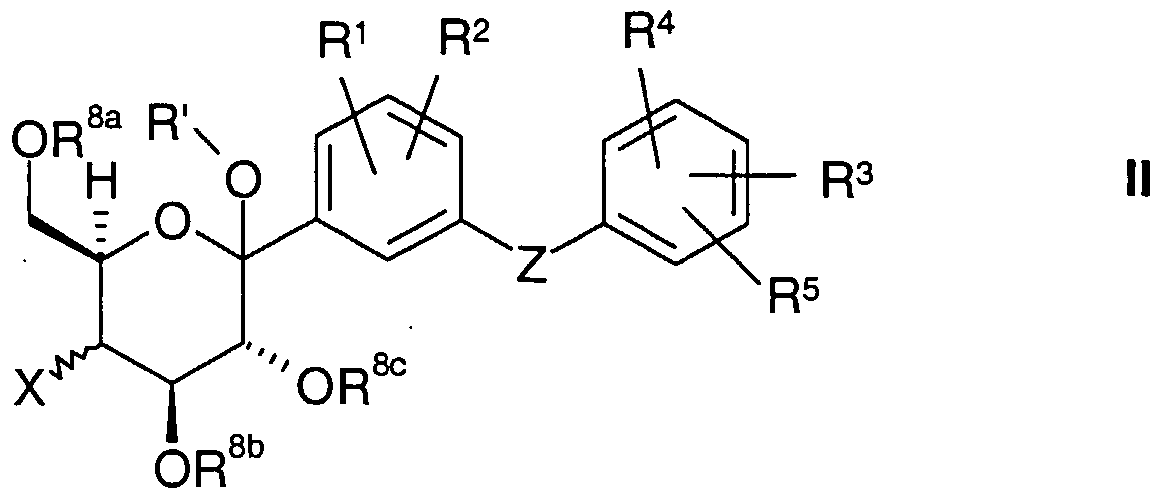
R1 H, Ci-4-Alkyl, (Ci-18-Alkyl)carbonyl, (Ci-18-Alkyl)oxycarbonyl, Arylcarbonyl oder Aryl- (Cva-alkyO-carbonyl bedeutet, worin die Alkyl- oder Arylgruppen ein- oder mehrfach mit Halogen substituiert sein können;R 1 is H, Ci 4 alkyl, (Ci- 18 alkyl) carbonyl, (Ci- 18 alkyl) oxycarbonyl, arylcarbonyl or aryl- (Cva-alkyO-carbonyl means, wherein the alkyl or aryl groups, one or more times may be substituted with halogen;
R8a, R8b,R 8a , R 8b ,
R8c unabhängig voneinander eine zuvor und nachstehend für die Reste R7a, R7b, R7c angegebenen Bedeutungen aufweisen, eine Benzyl-Gruppe oder eine RaRbRcSi-R 8c independently of one another have meanings given above and below for the radicals R 7a , R 7b , R 7c , a benzyl group or a R a R b R c Si
Gruppe oder eine Ketal- oder Acetalgruppe bedeuten, wobei jeweils zwei benachbarte Reste R8a, R8b, R8c eine cyclische Ketal- oder Acetalgruppe oder mit zwei Sauerstoffatomen des Pyranose-Rings einen substituierten 2,3-Oxydioxan- Ring, insbesondere einen 2,3-Dimethyl-2,3-di(Ci.3-alkoxy)-1 ,4-dioxan-Ring, bilden können, und wobei Alkyl-, Aryl- und/oder Benzylgruppen ein- oder mehrfach mitIn each case two adjacent radicals R 8a , R 8b , R 8c denote a cyclic ketal or acetal group or with two oxygen atoms of the pyranose ring a substituted 2,3-oxydioxane ring, in particular a 2, 3-dimethyl-2,3-di (Ci. 3 -alkoxy) -1, 4-dioxane ring, and wherein alkyl, aryl and / or benzyl groups one or more times with
Halogen, Ci-3-Alkyl oder Ci_3-Alkoxy substituiert sein können und Benzyl-Gruppen auch mit einer Di-(Ci-3-alkyl)amino-Gruppe substituiert sein können; undHalogen, Ci -3 alkyl, or CI_ 3 -alkoxy and benzyl groups may also by a di- (Ci 3 alkyl) amino group may be substituted; and
Ra, Rb, R° unabhängig voneinander Ci-4-Alkyl, Aryl oder Aryl-Ci-3-alkyl bedeuten, worin die Aryl- oder Alkylgruppen ein- oder mehrfach mit Halogen substituiert sein können;R a, R b, R ° may be the Ci -4 alkyl, aryl or aryl-Ci- 3 are independently alkyl, wherein the aryl or alkyl groups mono- or poly-substituted with halogen;
wobei unter den bei der Definition der vorstehend genannten Reste erwähnten Arylgruppen Phenyl- oder Naphthylgruppen, vorzugsweise Phenylgruppen zu verstehen sind;wherein the aryl groups mentioned in the definition of the abovementioned radicals are phenyl or naphthyl groups, preferably phenyl groups;
und in der die Reste X und R1 bis R5 und die Brücke Z wie vor- und nachstehend definiert sind;and in which the radicals X and R 1 to R 5 and the bridge Z are as defined above and below;
mit einem Reduktionsmittel in Gegenwart einer Säure umgesetzt wird, wobei die eventuell vorhandenen Schutzgruppen gleichzeitig oder nachträglich abgespalten werden; oderis reacted with a reducing agent in the presence of an acid, wherein the protective groups are optionally cleaved simultaneously or subsequently; or
b) zur Herstellung von Verbindungen der allgemeinen Formel I, in der R7a, R7b und R7c Wasserstoff bedeuten, - -b) for the preparation of compounds of general formula I in which R 7a , R 7b and R 7c are hydrogen, - -
in einer Verbindung der allgemeinen Formel IIIin a compound of general formula III

in der X, Z, R8a, R8b, R8c sowie R1 bis R5 wie zuvor und nachstehend definiert sind, wobei mindestens einer der Reste R8a, R8b und R80 nicht Wasserstoff bedeutet,in which X, Z, R 8a , R 8b , R 8c and R 1 to R 5 are as defined above and below, where at least one of R 8a , R 8b and R 80 is not hydrogen,
die nicht Wasserstoff bedeutenden Reste R8a, R8b bzw. R8c entfernt werden, insbesondere hydrolysiert werden; undthe radicals R 8a , R 8b or R 8c which are not hydrogen-significant are removed, in particular hydrolyzed; and
erforderlichenfalls ein bei den vorstehend beschriebenen Umsetzungen gemäß Verfahren a) oder b) verwendeter Schutzrest wieder abgespalten wird und/oderif necessary, a protective moiety used in the reactions described above according to process a) or b) is split off again and / or
gewünschtenfalls eine so erhaltene Verbindung der allgemeinen Formel I selektiv an einer Hydroxygruppe derivatisiert oder diese substituiert wird und/oderif desired, a compound of general formula I thus obtained is selectively derivatized or substituted on a hydroxy group and / or
gewünschtenfalls eine so erhaltene Verbindung der allgemeinen Formel I in ihre Stereoisomere aufgetrennt wird und/oderif desired, a compound of general formula I thus obtained is separated into its stereoisomers and / or
gewünschtenfalls eine so erhaltene Verbindung der allgemeinen Formel I in ihre Salze, insbesondere für die pharmazeutische Anwendung in ihre physiologisch verträglichen Salze, überführt wird.if desired, a compound of the general formula I thus obtained is converted into its salts, in particular for the pharmaceutical application into its physiologically tolerated salts.
Detailierte Beschreibung der ErfindungDetailed description of the invention
Sofern nicht anders angegeben besitzen die Gruppen, Reste und Substituenten, insbesondere R1 bis R5, X, Z, L, RN, R7a, R7b, R7cdie zuvor und nachfolgend angegebenen Bedeutungen.Unless stated otherwise, the groups, radicals and substituents, in particular R 1 to R 5 , X, Z, L, R N , R 7a , R 7b , R 7c have the meanings given above and below.
Kommen Reste, Substituenten oder Gruppen in einer Verbindung mehrfach vor, so können diese eine gleiche oder verschiedene Bedeutungen aufweisen. Die erfindungsgemäßen Verbindungen können ß-D-glucopyranosyl-konfiguriert (Formel IA) oder ß-D-galactopyranosyl-konfiguriert (Formel IB) sein.If radicals, substituents or groups in a compound occur several times, they may have the same or different meanings. The compounds of the invention may be β-D-glucopyranosyl configured (Formula IA) or β-D-galactopyranosyl configured (Formula IB).


Im Hinblick auf eine Inhibierung von SGLT2 und vorzugsweise eine höhere Selektivität der Hemmwirkung auf SGLT2 verglichen mit SGLT1 sind Verbindungen der Formel IA bevorzugt.With respect to inhibition of SGLT2 and preferably a higher selectivity of the inhibitory effect on SGLT2 compared to SGLT1, compounds of formula IA are preferred.
Der Rest R3 steht vorzugsweise in meta- oder para-Position zur -Z-Brücke. Daher können erfindungsgemäße Verbindungen der allgemeinen Formel IA vorzugsweise gemäß der folgenden Formeln IA.1 und IA.2, insbesondere der Formel IA.2, beschrieben werden:The radical R 3 is preferably in the meta or para position to the -Z bridge. Therefore, compounds of the general formula IA according to the invention can preferably be described according to the following formulas IA.1 and IA.2, in particular of the formula IA.2:
IA.1IA.1


Die vorstehend und nachfolgend verwendete, beispielsweise in den Gruppen X, R1 und R3 vorkommende Bezeichnung Aryl bedeutet vorzugsweise Phenyl. Gemäß der allgemeinen Definition und sofern nichts anderes angegeben ist, kann die Aryl-Gruppe, insbesondere die Phenylgruppe, ein- oder zweifach mit gleichen oder verschiedenen Resten L substituiert sein.The term aryl used above and below, for example in the groups X, R 1 and R 3 , preferably denotes phenyl. In accordance with the general definition and unless stated otherwise, the aryl group, in particular the phenyl group, may be monosubstituted or disubstituted by identical or different radicals L.
Die vorstehend und nachfolgend verwendete, beispielsweise in den Gruppen X, R1 und R3 vorkommende Bezeichnung Heteroaryl bedeutet vorzugsweise Pyridinyl, Pyrimidinyl, Pyridazinyl, Pyrazinyl, Triazinyl, Imidazolyl, Pyrazolyl, Triazolyl, Tetrazolyl, Oxazolyl, Oxadiazolyl, Thiazolyl oder Thiadiazolyl. Gemäß der allgemeinen Definition und sofern nichts anderes angegeben ist, kann die Heteroaryl-Gruppe ein- oder zweifach mit gleichen oder verschiedenen Resten L substituiert sein.The term heteroaryl used above and below, for example in the groups X, R 1 and R 3 , preferably denotes pyridinyl, pyrimidinyl, pyridazinyl, pyrazinyl, triazinyl, imidazolyl, pyrazolyl, triazolyl, tetrazolyl, oxazolyl, oxadiazolyl, thiazolyl or thiadiazolyl. In accordance with the general definition and unless stated otherwise, the heteroaryl group may be monosubstituted or disubstituted by identical or different radicals L.
Bevorzugt bedeutet R1 Wasserstoff, Fluor, Chlor, Brom, lod, d-β-Alkyl, C2-6-Alkinyl, C2.6- Alkenyl, C3-7-Cycloalkyl, C5.7-Cycloalkenyl, Ci-4-Alkylcarbonyl, Aminocarbonyl, C1-4-Alkyl- aminocarbonyl, Di-(Ci.3-Alkyl)aminocarbonyl, Ci.4-Alkoxycarbonyl, Ci.4-Alkylamino, Di-(C1-3- alkyl)amino, Pyrrolidin-1 -yl, Piperidin-1 -yl, Morpholin-4-yl, Ci-4-Alkylcarbonylamino, C1-6- Alkyloxy, C3.7-Cycloalkyloxy, C5.7-Cycloalkenyloxy, Ci.4-Alkylsulfanyl, C^-Alkylsulfonyl, C3- 7-Cycloalkylsulfanyl, C3.7-Cycloalkylsulfonyl, Cs^-Cycloalkenylsulfanyl, C5. 7-Cycloalkenylsulfonyl, Hydroxy und Cyan,Preferably, R 1 is hydrogen, fluorine, chlorine, bromine, iodine, d-β-alkyl, C 2 - 6 alkynyl, C 2 . 6 -alkenyl, C 3-7 -cycloalkyl, C 5 . 7 cycloalkenyl, Ci -4 alkylcarbonyl, aminocarbonyl, C 1-4 alkyl- aminocarbonyl, di- (Ci. 3 alkyl) aminocarbonyl, Ci. 4- alkoxycarbonyl, Ci. 4 alkylamino, di- (C 1-3 - alkyl) amino, pyrrolidin-1-yl, piperidin-1-yl, morpholin-4-yl, Ci -4 alkylcarbonylamino, C 1-6 - alkoxy, C 3rd 7- Cycloalkyloxy, C 5 . 7- Cycloalkenyloxy, Ci. 4 alkylsulphanyl, C ^ alkylsulfonyl, C 3- 7 -Cycloalkylsulfanyl, C 3 .7-cycloalkylsulphonyl, Cs ^ -Cycloalkenylsulfanyl, C. 5 7- cycloalkenylsulfonyl, hydroxy and cyano,
wobei Alkyl-, Alkenyl-, Alkinyl-, Cycloalkyl- und Cycloalkenyl-Reste teilweise oder vollständig fluoriert oder ein- oder zweifach mit gleichen oder verschiedenen Substituenten ausgewählt aus Chlor, Hydroxy, Cv3-AIkOXy und d.3-Alkyl substituiert sein können, undwherein alkyl, alkenyl, alkynyl, cycloalkyl and cycloalkenyl radicals are partially or completely fluorinated or mono- or disubstituted by identical or different substituents selected from chlorine, hydroxyl, Cv 3 -Akoxy and d. 3- alkyl may be substituted, and
wobei in Cycloalkyl- und Cycloalkenyl-Resten eine oder zwei Methylengruppen unabhängig voneinander durch O, S1 CO, SO oder SO2 ersetzt sein können, undwherein in cycloalkyl and cycloalkenyl radicals one or two methylene groups can be replaced independently of one another by O, S 1 CO, SO or SO 2 , and
wobei in N-Heterocycloalkyl-Resten eine Methylengruppe durch CO oder SO2 ersetzt sein kann.where in N-heterocycloalkyl radicals a methylene group has been replaced by CO or SO 2 can.
Bedeutet die Gruppe R1 einen Cycloalkyl- oder Cycloalkenyl-Rest, in dem eine oder zwei Methylengruppen unabhängig voneinander durch O, S, CO, SO oder SO2 ersetzt sind, so sind bevorzugte Bedeutungen des Rests R1 ausgewählt aus der Gruppe bestehend aus Tetrahydrofuranyl, Tetrahydrofuranonyl, Tetrahydrothienyl, Tetrahydropyranyl, Tetrahydropyranonyl, Dioxanyl und Trioxanyl.If the group R 1 is a cycloalkyl or cycloalkenyl radical in which one or two methylene groups are replaced independently of one another by O, S, CO, SO or SO 2 , preferred meanings of the radical R 1 are selected from the group consisting of tetrahydrofuranyl , Tetrahydrofuranonyl, tetrahydrothienyl, tetrahydropyranyl, tetrahydropyranonyl, dioxanyl and trioxanyl.
Bedeutet die Gruppe R1 einen N-Heterocycloalkyl-Rest, in dem eine Methylengruppe durch CO oder SO2 substituiert ist, so sind bevorzugte Bedeutungen des Rests R1 ausgewählt aus der Gruppe bestehend aus Pyrrolidinen, Piperidinon, Piperazinon und Morpholinon.If the group R 1 is an N-heterocycloalkyl radical in which a methylene group is substituted by CO or SO 2 , preferred meanings of the radical R 1 are selected from the group consisting of pyrrolidines, piperidinone, piperazinone and morpholinone.
Besonders bevorzugt bedeutet R1 Wasserstoff, Fluor, Chlor, Brom, lod, Ci.6-Alkyl, C2-6-Alkinyl, C2.6-Alkenyl, C3.7-Cycloalkyl, C5-7-Cycloalkenyl, Ci.6-Alkyloxy, C3.7-Cycloalkyloxy oder Cyan, wobei in Cycloalkyl- und Cycloalkenylgruppen eine oder zwei Methyleneinheiten unabhängig voneinander durch O oder CO ersetzt und Alkyl-, Alkenyl- und Alkinyl-Reste teilweise oder vollständig fluoriert sein können.R 1 particularly preferably denotes hydrogen, fluorine, chlorine, bromine, iodine, C 1 . 6 alkyl, C 2-6 alkynyl, C 2 . 6 alkenyl, C 3 . 7 -cycloalkyl, C 5-7 -cycloalkenyl, Ci. 6 alkyloxy, C 3 . 7 -cycloalkyloxy or cyano, wherein in cycloalkyl and cycloalkenyl groups one or two methylene units can be replaced independently of one another by O or CO and alkyl, alkenyl and alkynyl radicals can be partially or completely fluorinated.
Beispiele der ganz besonders bevorzugten R1 sind Wasserstoff, Fluor, Chlor, Brom, Methyl, Ethyl, Isopropyl, Trifluormethyl, Ethinyl, Methoxy, Cyclopentyloxy und Cyan.Examples of the most preferred R 1 are hydrogen, fluorine, chlorine, bromine, methyl, ethyl, isopropyl, trifluoromethyl, ethynyl, methoxy, cyclopentyloxy and cyano.
Der Rest R3 bedeutet vorzugsweise Wasserstoff, Fluor, Chlor, Brom, Ci.6-Alkyl, C2.6-Alkinyl, C2- 6-Alkenyl, C3-7-Cycloalkyl, Ca-y-Cycloalkyl-methyl, C5.7-Cycloalkenyl, Ca-yCycloalkenyl-methyl, Aryl, Heteroaryl, Ci.4-Alkylcarbonyl, Aminocarbonyl, C^-Alkylaminocarbonyl, Di-(Ci -3-Alkyl)- aminocarbonyl, Ci.4-Alkoxycarbonyl, Di-(Ci.3-alkyl)amino, Pyrrolidin-1 -yl, Piperidin-1 -yl,The radical R 3 is preferably hydrogen, fluorine, chlorine, bromine, Ci. 6- alkyl, C 2 . 6 -alkynyl, C 2- 6 alkenyl, C 3-7 cycloalkyl, Ca-y-cycloalkyl-methyl, C. 5 7 -Cycloalkenyl, Ca-yCycloalkenyl-methyl, aryl, heteroaryl, Ci. 4 -alkylcarbonyl, aminocarbonyl, C ^ alkylaminocarbonyl, di- (Ci -3 alkyl) - aminocarbonyl, Ci. 4 alkoxycarbonyl, di- (Ci. 3 alkyl) amino, pyrrolidin-1-yl, piperidin-1-yl,
Morpholin-4-yl, Ci.4-Alkylcarbonylamino, Ci.6-Alkoxy, C3-7-Cycloalkyloxy, C5.7-Cycloalkenyloxy, Aryloxy, Heteroaryloxy, Ci.4-Alkylsulfanyl, Ci-4-Alkylsulfonyl, C^-Cycloalkylsulfanyl, C3-7- Cycloalkylsulfonyl, C5-7-Cycloalkenylsulfanyl, C5-7-Cycloalkenylsulfonyl, Hydroxy und Cyan,Morpholin-4-yl, Ci. 4- Alkylcarbonylamino, Ci. 6- alkoxy, C 3-7 -cycloalkyloxy, C 5 . 7- Cycloalkenyloxy, aryloxy, heteroaryloxy, Ci. 4 alkylsulfanyl, Ci -4 alkylsulfonyl, C ^ -Cycloalkylsulfanyl, C 3-7 - cycloalkylsulfonyl, C 5-7 -Cycloalkenylsulfanyl, C 5-7 -Cycloalkenylsulfonyl, hydroxy and cyano,
wobei Alkyl-, Alkenyl-, Alkinyl-, Cycloalkyl- und Cycloalkenyl-Reste teilweise oder vollständig fluoriert oder ein- oder zweifach mit gleichen oder verschiedenen Substituenten ausgewählt aus Chlor, Hydroxy, C1-3-Alkoxy und Ci-3-Alkyl substituiert sein können, undwherein alkyl, alkenyl, alkynyl, cycloalkyl and cycloalkenyl radicals are partially or completely fluorinated or mono- or disubstituted by identical or different substituents selected from chlorine, hydroxyl, C 1-3 alkoxy and Ci-3-alkyl substituted can, and
wobei in Cycloalkyl- und Cycloalkenyl-Resten eine oder zwei Methylengruppen unabhängig voneinander durch O, S, CO, SO oder SO2 ersetzt sein können, und wobei in N-Heterocycloalkyl-Resten eine Methylengruppe durch CO oder SO2 ersetzt sein kann,wherein in cycloalkyl and cycloalkenyl radicals one or two methylene groups can be replaced independently of one another by O, S, CO, SO or SO 2 , and where in N-heterocycloalkyl radicals a methylene group may be replaced by CO or SO 2 ,
wobei die Begriffe Aryl und Heteroaryl wie zuvor definiert sind und Aryl- und Heteroaryl- Gruppen unabhängig voneinander ein- oder zweifach mit gleichen oder verschiedenen Resten L substituiert sein können.wherein the terms aryl and heteroaryl are as defined above and aryl and heteroaryl groups may be independently of one another mono- or disubstituted by identical or different radicals L substituted.
Bedeutet die Gruppe R3 einen Cycloalkyl- oder Cycloalkenyl-Rest, in dem eine oder zwei Methylengruppen unabhängig voneinander durch O1 S, CO1 SO oder SO2 ersetzt sind, so sind bevorzugte Bedeutungen der Gruppe R3 ausgewählt aus der Gruppe bestehend aus Tetrahydrofuranyl, Tetrahydrofuranonyl, Tetrahydrothienyl, Tetrahydropyranyl, Tetrahydropyranonyl, Dioxanyl und Trioxanyl.If the group R 3 is a cycloalkyl or cycloalkenyl radical in which one or two methylene groups are replaced independently of one another by O 1 S, CO 1 SO or SO 2 , preferred meanings of the group R 3 are selected from the group consisting of tetrahydrofuranyl , Tetrahydrofuranonyl, tetrahydrothienyl, tetrahydropyranyl, tetrahydropyranonyl, dioxanyl and trioxanyl.
Bedeutet die Gruppe R3 einen N-Heterocycloalkyl-Rest, in dem eine Methylengruppe durch CO oder SO2 ersetzt ist, so sind bevorzugte Bedeutungen des Rests R3 ausgewählt aus der Gruppe bestehend aus Pyrrolidinen, Piperidinon, Piperazinon und Morpholinon.If the group R 3 is an N-heterocycloalkyl radical in which a methylene group is replaced by CO or SO 2 , preferred meanings of the radical R 3 are selected from the group consisting of pyrrolidines, piperidinone, piperazinone and morpholinone.
Besonders bevorzugte R3 sind Ci-6-Alkyl, C2-6-Alkinyl, Ci.4-Alkyloxy, C3.7-Cycloalkyl, C3-7- Cycloalkyloxy und Hydroxy, wobei in den Cycloalkylgruppen eine oder zwei Methyleneinheiten unabhängig voneinander durch O oder CO ersetzt und Alkylreste teilweise oder vollständig fluoriert sein können.Particularly preferred R 3 are Ci- 6 alkyl, C 2 -6-alkynyl, Ci. 4 alkyloxy, C 3 . 7 -cycloalkyl, C 3-7 - cycloalkyloxy and hydroxy, wherein in the cycloalkyl groups one or two methylene units independently replaced by O or CO and alkyl radicals may be partially or completely fluorinated.
Ganz besonders bevorzugte Reste R3 sind Methyl, Ethyl, Ethinyl, Isopropyl, Methoxy, Ethoxy, Isopropyloxy, Difluormethoxy, Cyclopentyloxy, Tetrahydrofuran-3-yloxy und Hydroxy.Very particularly preferred radicals R 3 are methyl, ethyl, ethynyl, isopropyl, methoxy, ethoxy, isopropyloxy, difluoromethoxy, cyclopentyloxy, tetrahydrofuran-3-yloxy and hydroxy.
Die Gruppe X besitzt eine der zuvor und nachfolgend angeführten Definitionen, wobei X keine Hydroxy-Gruppe und vorzugsweise keine Gruppe bedeutet, die unter physiologischen Bedingungen zu einer signifikanten Menge in eine Hydroxy-Gruppe umgewandelt wird. Insbesondere ist die Gruppe X keine Alkylcarbonyloxy-, (Het)Arylcarbonyloxy-, Alkyloxycarbonyloxy- oder (Het)Aryloxycarbonyloxy-Gruppe, wobei (Het)Aryl eine Aryl- oder Heteroarylgruppe bezeichnet.The group X has one of the definitions given above and below, wherein X represents no hydroxy group and preferably no group which is converted under physiological conditions to a significant amount in a hydroxy group. In particular, the group X is not an alkylcarbonyloxy, (Het) arylcarbonyloxy, alkyloxycarbonyloxy or (Het) aryloxycarbonyloxy group, wherein (Het) aryl denotes an aryl or heteroaryl group.
Die Gruppe X bedeutet vorzugsweise Wasserstoff , Fluor, Chlor, C1-6-Alkyl, C2-6-Alkinyl, C2-6- Alkenyl, C3-7-Cycloalkyl-Ci.3-alkyl, Cs^-Cycloalkenyl-d-s-alkyl, Aryl-d-3-alkyl, Heteroaryl-d. 3-alkyl, Ci.6-Alkoxy, C2-6-Alkenyloxy, C2.6-Alkinyloxy, C3-7-Cycloalkyloxy, C5.7-Cycloalkenyloxy, Aryloxy, Heteroaryloxy, C^-Cycloalkyl-d-s-alkyloxy, C5-7-Cycloalkenyl-Ci-3-alkyloxy, Aryl-d. - 4 -The group X is preferably hydrogen, fluorine, chlorine, C 1-6 alkyl, C 2 - 6 alkynyl, C 2 - 6 - alkenyl, C 3- 7 cycloalkyl CI.3-alkyl, Cs ^ cycloalkenyl ds-alkyl, aryl-d- 3- alkyl, heteroaryl-d. 3 -alkyl, Ci. 6 alkoxy, C 2- 6 alkenyloxy, C. 2 6- alkynyloxy, C 3 -7-cycloalkyloxy, C 5 . 7 cycloalkenyloxy, aryloxy, heteroaryloxy, C ^ cycloalkyl-d-alkyloxy, C5-7-cycloalkenyl-Ci -3 alkyloxy, aryl-d. - 4 -
3-alkyloxy, Heteroaryl-Ci-3-alkyloxy, C^-Cycloalkyloxy-d-s-alkyl, C5.7-Cycloalkenyloxy-Ci. 3-alkyl, Aryloxy-Ci.3-alkyl, Heteroaryloxy-Ci.3-alkyl, Aminocarbonyl, Ci-4-Alkylaminocarbonyl, Ci-4-Alkylcarbonylamino-, N-(Ci-5-Alkyl)-N-(Ci.4-alkylcarbonyl)-amino, Hydroxycarbonyl, Cv4- Alkoxycarbonyl, Ci.6-Alkylsulfonyl, Aminocarbonyl-Ci-3-alkyl, Ci^-Alkylaminocarbonyl-Ci-a-alkyl, Di-(Ci-3-Alkyl)aminocarbonyl-Ci-3-alkyl, Ci-4-Alkoxycarbonyl-Ci.3alkyl, Amino, Ci.5-Alkylamino, N-(Ci-5-Alkyl)-N-(Ci.3-alkyl)-amino, Mercapto oder Cyan, 3 -alkyloxy, heteroaryl-C 1-3 -alkyloxy, C 1-4 -cycloalkyloxy-ds-alkyl, C 5 . 7- Cycloalkenyloxy-Ci. 3 -alkyl, aryloxy-Ci. 3- alkyl, heteroaryloxy-Ci. 3 alkyl, aminocarbonyl, Ci- 4 alkylaminocarbonyl, Ci- 4 alkylcarbonylamino, N- (Ci -5 alkyl) -N- (C 4 alkylcarbonyl.) Amino, hydroxycarbonyl, Cv 4 - alkoxycarbonyl, Ci. 6- alkylsulfonyl, aminocarbonyl-Ci- 3 -alkyl, Ci ^ -alkylaminocarbonyl-Ci-a-alkyl, di- (C 3 -alkyl) aminocarbonyl-C 3 -alkyl, Ci-4-alkoxycarbonyl-Ci. 3 alkyl, amino, Ci. 5 alkylamino, N- (Ci- 5 alkyl) -N- (Ci. 3 alkyl) amino, mercapto or cyano,
wobei Alkyl-, Alkenyl-, Alkinyl-, Cycloalkyl- und Cycloalkenyl-Reste teilweise oder vollständig fluoriert oder ein- oder zweifach mit gleichen oder verschiedenen Substituenten ausgewählt aus Chlor, Cyan, Hydroxy, d.3-Alkoxy, C1-3-Alkylsulfanyl, -NH2, -NHRN, -NRN(Ci.3-Alkyl) und Ci_3-Alkyl substituiert sein können, undwherein alkyl, alkenyl, alkynyl, cycloalkyl and cycloalkenyl radicals are partially or fully fluorinated or mono- or disubstituted by identical or different substituents selected from chlorine, cyano, hydroxy, d. 3 -alkoxy, C 1-3 -alkylsulfanyl, -NH 2, -NHR N, -NR N (Ci. 3 alkyl), and CI_ 3 alkyl can be substituted, and
wobei in den vorstehend genannten Cycloalkyl- und Cycloalkenyl-Resten eine oder zwei Methylengruppen unabhängig voneinander durch O, S, CO, SO oder SO2 ersetzt sein können, undwherein in the abovementioned cycloalkyl and cycloalkenyl radicals one or two methylene groups can be replaced independently of one another by O, S, CO, SO or SO 2 , and
wobei die Begriffe Aryl und Heteroaryl wie zuvor definiert sind und Aryl- und Heteroaryl- Gruppen unabhängig voneinander ein- oder zweifach mit gleichen oder verschiedenen Resten L substituiert sein können.wherein the terms aryl and heteroaryl are as defined above and aryl and heteroaryl groups may be independently of one another mono- or disubstituted by identical or different radicals L substituted.
Die erfindungsgemäßen Verbindungen lassen sich formal entsprechend der unterschiedlichen Bedeutungen der Gruppe X in verschiedene Ausführungsformen aufteilen:The compounds according to the invention can be formally divided into different embodiments according to the different meanings of the group X:
Gemäß einer ersten Ausführungsform bedeutet X vorzugsweise Wasserstoff, Chlor, Cyan, Ci- 6-Alkyl, C2.6-Alkinyl, C2-6-Alkenyl,

wobei Alkyl-, Alkenyl-, Alkinyl-, Cycloalkyl- und Cycloalkenyl-Reste teilweise oder vollständig fluoriert oder ein- oder zweifach mit gleichen oder verschiedenen Substituenten ausgewählt aus Chlor, Cyan, Hydroxy, Ci.3-Alkylsulfanyl, NHRN, d.3-Alkyl-NRN, Ci.3-Alkoxy und C1-3-Alkyl substituiert sein können, und wobei Methyl-Reste teilweise oder vollständig fluoriert oder einfach mit Chlor substituiert sein können, undwherein alkyl, alkenyl, alkynyl, cycloalkyl and cycloalkenyl radicals are partially or completely fluorinated or mono- or disubstituted by identical or different substituents selected from chlorine, cyano, hydroxy, Ci. 3- alkylsulfanyl, NHR N , d. 3- alkyl-NR N , Ci. 3- alkoxy and C 1-3 -alkyl may be substituted, and wherein methyl radicals may be partially or fully fluorinated or simply substituted with chlorine, and
wobei in den vorstehend genannten Cycloalkyl- und Cycloalkenyl-Resten eine oder zwei Methylengruppen unabhängig voneinander durch O, S, CO, SO oder SO2 ersetzt sein können, undwherein in the abovementioned cycloalkyl and cycloalkenyl radicals one or two methylene groups can be replaced independently of one another by O, S, CO, SO or SO 2 , and
wobei die Begriffe Aryl und Heteroaryl wie zuvor definiert sind und Aryl- und Heteroaryl- Gruppen unabhängig voneinander ein- oder zweifach mit gleichen oder verschiedenen Resten L substituiert sein können.wherein the terms aryl and heteroaryl are as defined above and aryl and heteroaryl groups may be independently of one another mono- or disubstituted by identical or different radicals L substituted.
Bedeutet die Gruppe X einen Cycloalkyl- oder Cycloalkenyl-Rest, in dem eine oder zwei Methylengruppen unabhängig voneinander durch O, S, CO, SO oder SO2 ersetzt sind, so sind bevorzugte Bedeutungen der Gruppe X ausgewählt aus der Gruppe bestehend aus Tetrahydrofuranyl, Tetrahydrofuranonyl, Tetrahydrothienyl, Tetrahydropyranyl, Tetrahydropyranonyl, Dioxanyl und Trioxanyl.If the group X is a cycloalkyl or cycloalkenyl radical in which one or two methylene groups are independently replaced by O, S, CO, SO or SO 2 , preferred meanings of the group X are selected from the group consisting of tetrahydrofuranyl, tetrahydrofuranonyl , Tetrahydrothienyl, tetrahydropyranyl, tetrahydropyranonyl, dioxanyl and trioxanyl.
Besonders bevorzugte Reste der Gruppe X sind Wasserstoff, Chlor, Cyan, Ci.6-Alkyl, C2.6- Alkinyl, C2-6-Alkenyl, Ci-6-Alkylsulfonyl, Hydroxycarbonyl, Ci.4-Alkoxycarbonyl, Aminocarbonyl und Ci-4-Alkylaminocarbonyl,Particularly preferred radicals of the group X are hydrogen, chlorine, cyano, Ci. 6- alkyl, C 2 . 6 - alkynyl, C 2- 6 alkenyl, Ci- 6 alkylsulfonyl, hydroxycarbonyl, Ci. 4 alkoxycarbonyl, aminocarbonyl, and Ci- 4 alkylaminocarbonyl,
wobei Alkyl-Reste ein- oder mehrfach fluoriert oder einfach mit Hydroxy oder Cyan substituiert sein können.wherein alkyl radicals may be mono- or polyfluorinated or may be monosubstituted by hydroxy or cyano.
Ganz besonders bevorzugte Reste X sind Wasserstoff, Chlor, Cyan, Methyl, Ethyl, Propyl, Hydroxymethyl, Prop-2-enyl, Prop-2-inyl, Methylsulf onyl, Aminocarbonyl, Methylaminocarbonyl, Hydroxycarbonyl und Methoxycarbonyl.Very particularly preferred radicals X are hydrogen, chlorine, cyano, methyl, ethyl, propyl, hydroxymethyl, prop-2-enyl, prop-2-ynyl, methylsulfonyl, aminocarbonyl, methylaminocarbonyl, hydroxycarbonyl and methoxycarbonyl.
Eine Auswahl der ganz besonders bevorzugten Gruppen X ist Wasserstoff , Chlor, Methyl, Hydroxymethyl und Ethyl.A selection of the most preferred groups X is hydrogen, chloro, methyl, hydroxymethyl and ethyl.
Gemäß einer zweiten Ausführungsform bedeutet X vorzugsweise „d-β-Alkoxy, C2-6-Alkenyloxy, C2-6-Alkinyloxy, C3.7-Cycloalkyloxy, C5.7-Cycloalkenyloxy, Aryloxy, Aryl-C1-3-alkyloxy oder Heteroaryloxy,In a second embodiment, X is preferably "d-β-alkoxy, C 2-6 alkenyloxy, C 2 represents - 6 alkynyloxy, C. 3 7- Cycloalkyloxy, C 5 . 7 -cycloalkenyloxy, aryloxy, aryl-C 1-3 -alkyloxy or heteroaryloxy,
wobei die vorstehend genannten Alkoxy-, Cycloalkyl- und Cycloalkenyl-Reste teilweise oder vollständig fluoriert oder ein- oder zweifach mit gleichen oder verschiedenen Substituenten ausgewählt aus Hydroxy, Ci-3-Alkoxy und Ci-3-Alkyl substituiert sein können, undwherein the above-mentioned alkoxy, cycloalkyl and cycloalkenyl groups may be partly or completely fluorinated or mono- or disubstituted by identical or different substituents selected from hydroxy, Ci -3 alkoxy and Ci-C3 alkyl may be substituted, and
wobei in den vorstehend genannten Cycloalkyl- und Cycloalkenyl-Resten eine oder zweiwherein in the aforementioned cycloalkyl and cycloalkenyl radicals one or two
Methylengruppen unabhängig voneinander durch O, S, CO, SO oder SO2 ersetzt sein können, und wobei die Begriffe Aryl und Heteroaryl wie zuvor definiert sind und Aryl- und Heteroaryl- Gruppen unabhängig voneinander ein- oder zweifach mit gleichen oder verschiedenen Resten L substituiert sein können.Methylene groups can be replaced independently of one another by O, S, CO, SO or SO 2 , and wherein the terms aryl and heteroaryl are as defined above and aryl and heteroaryl groups may be independently of one another mono- or disubstituted by identical or different radicals L substituted.
Gemäß dieser Ausführungsform bevorzugte Bedeutungen des Rests X sind Cv6-Al kyloxy, C2-6- Alkenyloxy, C2-6-Alkinyloxy, C3.7-Cycloalkyloxy, Aryl-Ci_3-alkyloxy und Aryloxy, wobei unter Aryl eine Phenyl- oder Naphthylgruppe, insbesondere Phenyl zu verstehen ist, welche ein- oder zweifach mit gleichen oder verschiedenen Substituenten L substituiert sein kann.According to this embodiment preferred meanings of the group X are kyloxy 6 -Al Cv, C 2-6 - alkenyloxy, C2 -6 alkynyloxy, C. 3 7- Cycloalkyloxy, aryl-Ci_ 3 -alkyloxy and aryloxy, wherein aryl is a phenyl or naphthyl group, especially phenyl, which may be mono- or disubstituted by identical or different substituents L.
Besonders bevorzugte Bedeutungen des Rests X sind hierbei Methoxy und Ethoxy.Particularly preferred meanings of the radical X here are methoxy and ethoxy.
Gemäß einer dritten Ausführungsform bedeutet X vorzugsweise Mercapto, d-5-Alkylsulfanyl, C2-5-Alkenylsulfanyl, C2-5-Alkinylsulfanyl, C3-7-Cycloalkylsulfanyl, C5.7-Cycloalkenylsulfanyl, Arylsulfanyl oder Heteroarylsulfanyl,In a third embodiment, X is preferably mercapto, d- 5 alkylsulfanyl, C 2 - 5 -Alkenylsulfanyl, C 2 - 5 -Alkinylsulfanyl, C 3-7 -Cycloalkylsulfanyl, C. 5 7 -cycloalkenylsulfanyl, arylsulfanyl or heteroarylsulfanyl,
wobei die vorstehend genannten Alkoxy-, Cycloalkyl- und Cycloalkenyl-Reste teilweise oder vollständig fluoriert oder ein- oder zweifach mit gleichen oder verschiedenen Substituenten ausgewählt aus Hydroxy, Ci.3-Alkoxy und Ci.3-Alkyl substituiert sein können, undwherein the abovementioned alkoxy, cycloalkyl and cycloalkenyl radicals are partially or completely fluorinated or mono- or disubstituted by identical or different substituents selected from hydroxy, Ci. 3- alkoxy and Ci. 3- alkyl may be substituted, and
wobei in den vorstehend genannten Cycloalkyl- und Cycloalkenyl-Resten eine oder zwei Methylengruppen unabhängig voneinander durch O, S, CO, SO oder SO2 ersetzt sein können, undwherein in the abovementioned cycloalkyl and cycloalkenyl radicals one or two methylene groups can be replaced independently of one another by O, S, CO, SO or SO 2 , and
wobei die Begriffe Aryl und Heteroaryl wie zuvor definiert sind und Aryl- und Heteroaryl-where the terms aryl and heteroaryl are as defined above and aryl and heteroaryl
Gruppen unabhängig voneinander ein- oder zweifach mit gleichen oder verschiedenen Resten L substituiert sein können.Groups independently of one another may be substituted once or twice with the same or different radicals L.
Gemäß dieser Ausführungsform bevorzugte Bedeutungen des Rests X sind Mercapto, C1.5- Alkylsulfanyl, C2-5-Alkenylsulfanyl, C2-5-Alkinylsulfanyl, C3.7-Cycloalkylsulfanyl und Arylsulfanyl, wobei unter Aryl eine Phenyl- oder Naphthylgruppe, insbesondere Phenyl zu verstehen ist, welche ein- oder zweifach mit gleichen oder verschiedenen Substituenten L substituiert sein kann.According to this embodiment, preferred meanings of the radical X are mercapto, C 1 . 5 -alkylsulfanyl, C 2 -5-alkenylsulfanyl, C 2-5 -alkynylsulfanyl, C 3 . 7 -cycloalkylsulfanyl and arylsulfanyl, wherein aryl is a phenyl or naphthyl group, in particular phenyl, which may be monosubstituted or disubstituted by identical or different substituents L.
Besonders bevorzugte Bedeutungen des Rests X sind hierbei Mercapto, Methylsulfanyl und Ethylsulfanyl.
Gemäß einer vierten Ausführungsform bedeutet X vorzugsweise Amino, Ci.s-Alkylamino, N- (Ci-5-Alkyl)-N-(Ci.3-alkyl)-amino,

wobei die vorstehend genannten Alkoxy-, Cycloalkyl- und Cycloalkenyl-Reste teilweise oder vollständig fluoriert oder ein- oder zweifach mit gleichen oder verschiedenen Substituenten ausgewählt aus Hydroxy, d-3-Alkoxy und d-3-Alkyl substituiert sein können, undwherein the above-mentioned alkoxy, cycloalkyl and cycloalkenyl groups may be partly or completely fluorinated or mono- or disubstituted by identical or different substituents selected from hydroxy, alkoxy and d-3 d-3 alkyl can be substituted, and
wobei in den vorstehend genannten Cycloalkyl- und Cycloalkenyl-Resten eine oder zweiwherein in the aforementioned cycloalkyl and cycloalkenyl radicals one or two
Methylengruppen unabhängig voneinander durch O, S, CO, SO oder SO2 ersetzt sein können, undMethylene groups can be replaced independently of one another by O, S, CO, SO or SO 2 , and
wobei die Begriffe Aryl und Heteroaryl wie zuvor definiert sind und Aryl- und Heteroaryl- Gruppen unabhängig voneinander ein- oder zweifach mit gleichen oder verschiedenen Resten L substituiert sein können.wherein the terms aryl and heteroaryl are as defined above and aryl and heteroaryl groups may be independently of one another mono- or disubstituted by identical or different radicals L substituted.
Gemäß dieser Ausführungsform bevorzugte Bedeutungen des Rests X sind Amino, C1-S- Alkylamino, N-(Ci.5-Alkyl)-N-(C1.3-alkyl)-amino,

Besonders bevorzugte Bedeutungen des Rests X sind hierbei Amino, Methylamino, Dimethylamino und Methylcarbonylamino.Particularly preferred meanings of the radical X here are amino, methylamino, dimethylamino and methylcarbonylamino.
Gemäß einer fünften Ausführungsform bedeutet X Fluor.According to a fifth embodiment, X is fluorine.
Gemäß einer sechsten Ausführungsform bedeutet X vorzugsweise Brom, lod, C1-6-Alkyl- sulfonyloxy, Arylsulfonyloxy oder Aryl-Ci.3-alkyl-sulfonyloxy,According to a sixth embodiment, X is preferably bromine, iodine, C 1-6 -alkylsulfonyloxy, arylsulfonyloxy or aryl-Ci. 3- alkyl-sulfonyloxy,
wobei die vorstehend genannten Alkyl-Reste teilweise oder vollständig fluoriert oder ein- oder zweifach chloriert sein können und wobei die vorstehend genannten Aryl-Gruppen ein- oder zweifach mit gleichen oder verschiedenen Resten L substituiert sein können. L ist vorzugsweise ausgewählt aus der Gruppe Fluor, Chlor, Brom, lod, Ci.3-Alkyl, Difluormethyl, Trifluormethyl und Cyan. - -wherein the abovementioned alkyl radicals may be partially or fully fluorinated or mono- or di-chlorinated and wherein the abovementioned aryl groups may be monosubstituted or disubstituted by identical or different radicals L. L is preferably selected from the group fluorine, chlorine, bromine, iodine, Ci. 3- alkyl, difluoromethyl, trifluoromethyl and cyano. - -
Die Verbindungen gemäß dieser sechsten Ausführungsform eignen sich über ihre beschriebene pharmazeutische Wirkung hinaus insbesondere als Zwischenprodukte in der Synthese von Verbindungen mit SGLT1 vorzugsweise SGLT2 inhibierender Wirkung, insbesondere in der Synthese weiterer erfindungsgemäßer Verbindungen. Im Fall der Verwendung als Zwischenprodukt zur Synthese von Verbindungen der allgemeinen Formel I können die hier beschriebenen Reste X auch mit der gegenüber dem gewünschten Produkt invertierten Stereochemie an den Pyranosering angeknüpft sein.The compounds according to this sixth embodiment are suitable, in addition to their described pharmaceutical action, in particular as intermediates in the synthesis of compounds with SGLT 1, preferably SGLT2-inhibiting activity, in particular in the synthesis of further compounds according to the invention. In the case of use as an intermediate for the synthesis of compounds of the general formula I, the radicals X described here may also be linked to the pyranose ring with the stereochemistry inverted with respect to the desired product.
Besonders bevorzugte Reste X gemäß dieser sechsten Ausführungsform sind Brom, lod, Ci.4- Alkylsulfonyloxy, Phenylsulfonyloxy oder Phenylmethylsulfonyloxy, wobei die vorstehend genannten Alkyl-Reste teilweise oder vollständig fluoriert sein können und wobei die vorstehend genannten Phenyl-Gruppen ein- oder zweifach mit gleichen oder verschiedenen Resten L substituiert sein können. L ist vorzugsweise ausgewählt ist aus der Gruppe Fluor, Chlor, Brom und Methyl.Particularly preferred radicals X according to this sixth embodiment are bromine, iodine, Ci. 4 - Alkylsulfonyloxy, phenylsulfonyloxy or phenylmethylsulfonyloxy, where the abovementioned alkyl radicals may be partially or fully fluorinated and where the abovementioned phenyl groups may be mono- or disubstituted by identical or different radicals L. L is preferably selected from the group fluorine, chlorine, bromine and methyl.
Ganz besonders bevorzugt ist hierbei X in der Bedeutung Trifluormethylsulfonyloxy oder lod.In this case, very particularly preferably X is trifluoromethylsulfonyloxy or iodine.
Diejenigen erfindungsgemäßen Verbindungen sind bevorzugt, die eine Gruppe X gemäß der zuvor beschriebenen ersten, zweiten, dritten, vierten und fünften Ausführungsform aufweisen, insbesondere die eine Gruppe X gemäß der darin als bevorzugt angegebenen Bedeutungen aufweisen. Ganz besonders bevorzugt sind hierbei die erste, zweite, vierte und fünfte Ausführungsform.Those compounds of the invention are preferred which have a group X according to the first, second, third, fourth and fifth embodiments described above, in particular having a group X according to the meanings given therein as preferred. In this case, very particular preference is given to the first, second, fourth and fifth embodiments.
Sind in den Resten oder Gruppen X, R1 oder R3 Cycloalkyl- oder Cycloalkenyl-Ringe vorhanden, in denen zwei Methylengruppen durch O oder S ersetzt sind oder durch CO, SO oder SO2 ersetzt sind, so sind diese Methylengruppen vorzugsweise nicht unmittelbar miteinander verbunden. Sind jedoch zwei Methylengruppen durch O und CO ersetzt, so können diese unmittelbar miteinander verbunden sein, so dass eine Carboxy-Gruppe gebildet wird. Für den Fall, dass X, R1 oder R3 eine Cycloalkyl- oder Cycloalkenyl-Gruppe mit einer oder zwei erfindungsgemäß ersetzten Methylengruppen ist, so bedeutet die betreffende Gruppe X, R1 bzw. R3 vorzugsweise eine Cycloalkyl- oder Cycloalkenyl-Gruppe, in der eine Methylengruppe durch O, S, CO, SO oder SO2 substituiert oder eine Ethylengruppe durch -O- CO- oder -CO-O- substituiert ist.If cycloalkyl or cycloalkenyl rings in the radicals or groups X, R 1 or R 3 are present in which two methylene groups have been replaced by O or S or have been replaced by CO, SO or SO 2 , these methylene groups are preferably not directly adjacent to one another connected. However, when two methylene groups are replaced by O and CO, they may be directly linked together to form a carboxy group. In the event that X, R 1 or R 3 is a cycloalkyl or cycloalkenyl group having one or two methylene groups replaced according to the invention, the relevant group X, R 1 or R 3 preferably denotes a cycloalkyl or cycloalkenyl group, in which a methylene group is substituted by O, S, CO, SO or SO 2 or an ethylene group is substituted by -O-CO- or -CO-O-.
Nachfolgend werden Bedeutungen weiterer Reste und Substituenten angegeben, die gemäß der allgemeinen Formel I, insbesondere der Formeln IA und IB als auch gemäß der zuvor beschriebenen Ausführungsformen als bevorzugt anzusehen sind: Bevorzugte Bedeutungen des Rests R2 sind Wasserstoff, Fluor, Chlor, Brom, Methyl, Hydroxy, Methoxy, Ethoxy, Trifluormethoxy, Cyan, Nitro und durch 1 bis 3 Fluoratome substituiertes Methyl.The following are meanings of further radicals and substituents which are to be regarded as being preferred according to the general formula I, in particular of the formulas IA and IB, as well as according to the embodiments described above: Preferred meanings of the radical R 2 are hydrogen, fluorine, chlorine, bromine, methyl, hydroxyl, methoxy, ethoxy, trifluoromethoxy, cyano, nitro and methyl substituted by 1 to 3 fluorine atoms.
Besonders bevorzugte Bedeutungen des Rests R2 sind Wasserstoff, Fluor, Hydroxy, Methoxy, Ethoxy und Methyl, insbesondere Wasserstoff und Methyl.Particularly preferred meanings of the radical R 2 are hydrogen, fluorine, hydroxyl, methoxy, ethoxy and methyl, in particular hydrogen and methyl.
Für den Fall, dass R1 und R2 an zwei miteinander benachbarte C-Atome des Phenylrings gebunden sind, können R1 und R2 derart miteinander verbunden sein, dass R1 und R2 zusammen vorzugsweise eine C3-4-Alkylen-Brücke bilden, in der eine oder zwei Methyleneinheiten unabhängig voneinander durch O, NRN oder CO ersetzt sein können oder eine Butadienylen-Brücke, in der eine Methin-Gruppe durch ein Stickstoffatom ersetzt sein kann, wobei die aufgeführten Brückengruppen teilweise oder vollständig fluoriert oder ein- oder zweifach mit gleichen oder verschiedenen Substituenten ausgewählt aus Chlor, Hydroxy, Ci-3-AIkOXy und C1-3-Alkyl substituiert sein können. Bevorzugt bilden hierbei die miteinander verbundenen Reste R1 und R2 zusammen mit dem Phenylring, mit dem diese verbunden sind, ein bicyclisches Ringsystem ausgewählt aus Indan, Dihydroindol, Dihydrobenzofuran, Tetrahydrochinolin, Dihydrochinolinon, Tetrahydroisochinolin, Dihydroisochinolinon, Tetrahydronaphthalin, Naphthalin, Chinolin oder Isochinolin.In the event that R 1 and R 2 are bonded to two adjacent C atoms of the phenyl ring, R 1 and R 2 may be linked together such that R 1 and R 2 together preferably form a C 3-4 alkylene bridge in which one or two methylene units may independently of one another be replaced by O, NR N or CO or a butadienylene bridge in which a methine group may be replaced by a nitrogen atom, the bridging groups listed being partially or completely fluorinated or or disubstituted by identical or different substituents selected from chlorine, hydroxy, Ci -3 -alkoxy and C 1-3 alkyl may be substituted. Preferably, the interconnected radicals R 1 and R 2 together with the phenyl ring to which they are attached form a bicyclic ring system selected from indane, dihydroindole, dihydrobenzofuran, tetrahydroquinoline, dihydroquinolinone, tetrahydroisoquinoline, dihydroisoquinolinone, tetrahydronaphthalene, naphthalene, quinoline or isoquinoline.
Bevorzugte Bedeutungen des Rests R4 sind Wasserstoff und Fluor, insbesondere Wasserstoff.Preferred meanings of the radical R 4 are hydrogen and fluorine, in particular hydrogen.
Für den Fall, dass R3 und R4 an zwei unmittelbar miteinander benachbarte C-Atome des Phenylrings gebunden sind, können R3 und R4 derart miteinander verbunden sein, dass R3 und R4 zusammen vorzugsweise eine C3.4-Alkylen-Brücke bilden, in der ein oder zwei Methyleneinheiten unabhängig voneinander durch O, NRN oder CO ersetzt sein können oder eine Butadienylen-Brücke, in der eine Methin-Gruppe durch ein Stickstoffatom ersetzt sein kann, wobei die aufgeführten Brückengruppen teilweise oder vollständig fluoriert oder ein- oder zweifach mit gleichen oder verschiedenen Substituenten ausgewählt aus Chlor, Hydroxy, Ci-3-Alkoxy und Ci-3-Alkyl substituiert sein können. Bevorzugt bilden hierbei die miteinander verbundenen Reste R3 und R4 zusammen mit dem Phenylring, mit dem diese verbunden sind, ein bicyclisches Ringsystem ausgewählt aus Indan, Dihydroindol, Dihydrobenzofuran, Tetrahydrochinolin, Dihydrochinolinon, Tetrahydroisochinolin, Dihydroisochinolinon, Tetrahydronaphthalin, Naphthalin, Chinolin oder Isochinolin.In the event that R 3 and R 4 are bonded to two directly adjacent C atoms of the phenyl ring, R 3 and R 4 may be linked together such that R 3 and R 4 together preferably a C 3 . 4 -alkylene bridge in which one or two methylene units may be replaced independently of one another by O, NR N or CO or a butadienylene bridge in which a methine group may be replaced by a nitrogen atom, wherein the bridging groups listed partially or completely fluorinated or mono- or disubstituted by identical or different substituents selected from chlorine, hydroxy, Ci- 3 alkoxy and Ci -3 alkyl may be substituted. Preferably, the interconnected radicals R 3 and R 4 together with the phenyl ring to which they are attached form a bicyclic ring system selected from indane, dihydroindole, dihydrobenzofuran, tetrahydroquinoline, dihydroquinolinone, tetrahydroisoquinoline, dihydroisoquinolinone, tetrahydronaphthalene, naphthalene, quinoline or isoquinoline.
Bevorzugte Bedeutungen des Rests R5 sind Wasserstoff und Fluor, insbesondere Wasserstoff . Bevorzugte Bedeutungen des Rests Z sind Sauerstoff und Methylen, insbesondere Methylen.Preferred meanings of the radical R 5 are hydrogen and fluorine, in particular hydrogen. Preferred meanings of the radical Z are oxygen and methylene, in particular methylene.
Die Substituenten R7a, R7b, R7c bedeuten unabhängig voneinander vorzugsweise Wasserstoff, (Ci-8-Alkyl)oxycarbonyl-, (Ci-18-Alkyl)carbonyl, Benzoyl, insbesondere Wasserstoff oder (C1.6- Alkyl)oxycarbonyl-, (Ci.8-Alkyl)carbonyl, besonders bevorzugt Wasserstoff, Methoxycarbonyl, Ethoxycarbonyl, Methylcarbonyl oder Ethylcarbonyl. Ganz besonders bevorzugt bedeuten R7a, R7b und R7c Wasserstoff.The substituents R 7a, R 7b, R 7c independently of one another preferably are hydrogen, (Ci- 8 alkyl) oxycarbonyl, (Ci-18 alkyl) carbonyl, benzoyl, particularly hydrogen or (C 1. 6 - alkyl) oxycarbonyl (Ci. 8-alkyl) carbonyl, particularly preferably hydrogen, methoxycarbonyl, ethoxycarbonyl, methylcarbonyl or ethylcarbonyl. Most preferably, R 7a , R 7b and R 7c are hydrogen.
Die Verbindungen der Formel I, in denen R7a, R7b und R7c eine erfindungsgemäße, von Wasserstoff verschiedene Bedeutung aufweisen, beispielsweise Ci.8-Alkylcarbonyl, eignen sich bevorzugt als Zwischenprodukte bei der Synthese von Verbindungen der Formel I in denen R7a, R7b und R70 Wasserstoff bedeuten.The compounds of the formula I in which R 7a , R 7b and R 7c have a meaning other than hydrogen according to the invention, for example Ci. 8- Alkylcarbonyl, are preferably suitable as intermediates in the synthesis of compounds of formula I in which R 7a , R 7b and R 70 is hydrogen.
Die Substituenten L sind unabhängig voneinander vorzugsweise ausgewählt aus der Gruppe bestehend aus Fluor, Chlor, Brom, Ci-3-Alkyl, Difluormethyl, Trifluormethyl, Ci.3-Alkoxy, Difluormethoxy, Trifluormethoxy und Cyan, besonders bevorzugt aus der Gruppe bestehend aus Fluor, Chlor, Methyl, Trifluormethyl, Methoxy und Difluormethoxy. Falls der Substituent L mit einem N-Atom verbunden ist, sind bevorzugte Bedeutungen L ausgewählt aus Ci-3-Alkyl, Difluormethyl und Trifluormethyl.The substituents L are independently of one another preferably selected from the group consisting of fluorine, chlorine, bromine, C 1-3 -alkyl, difluoromethyl, trifluoromethyl, C 1 . 3 alkoxy, difluoromethoxy, trifluoromethoxy and cyano, particularly preferably from the group consisting of fluorine, chlorine, methyl, trifluoromethyl, methoxy and difluoromethoxy. If the substituent L is connected to an N atom, preferred meanings L are selected from C 1-3 -alkyl, difluoromethyl and trifluoromethyl.
Besonders bevorzugte Verbindungen der allgemeinen Formel IA sind ausgewählt aus der Gruppe der Formeln IA.2a bis IA.2d, insbesondere der Formel IA.2c:Particularly preferred compounds of the general formula IA are selected from the group of the formulas IA.2a to IA.2d, in particular of the formula IA.2c:


in denen R1 bis R5, X, Z1 R7a, R7b, R7cwie zuvor definiert sind.in which R 1 to R 5 , X, Z 1 R 7a , R 7b , R 7c are as defined above.
Ganz besonders bevorzugt sind diejenigen Verbindungen der Formel I1 insbesondere der Formel IA oder IB und bezüglich der Formel IA insbesondere der Formeln IA.2a, IA.2b, IA.2c und IA.2d, insbesondere der Formel IA.2c, in denen die Reste R1 bis R5, X, Z, R7a, R7b, R7c die zuvor als bevorzugt angegebenen Bedeutungen aufweisen, insbesondere in denenVery particular preference is given to those compounds of the formula I 1 in particular of the formula IA or IB and with regard to the formula IA, in particular of the formulas IA.2a, IA.2b, IA.2c and IA.2d, in particular of the formula IA.2c, in which R 1 to R 5 , X, Z, R 7a , R 7b , R 7c have the meanings given above as preferred, in particular in which
R1 Wasserstoff, Fluor, Chlor, Brom, C1-6-AIkVl, C2-6-Alkinyl, C2-6-Alkenyl, C^-Cycloalkyl,R 1 is hydrogen, fluorine, chlorine, bromine, C 1-6 -alkyl, C 2 - 6 alkynyl, C 2 - 6 alkenyl, C ^ cycloalkyl,
C5.7-Cycloalkenyl, Ci.6-Alkyloxy, C3.7-Cycloalkyloxy oder Cyan bedeutet, wobei in Cycloalkyl- und Cycloalkenylgruppen ein oder zwei Methyleneinheiten unabhängig voneinander durch O oder CO ersetzt und Alkyl-, Alkenyl- und Alkinyl-Reste teilweise oder vollständig fluoriert sein können, besonders bevorzugt Wasserstoff, Fluor, Chlor, Brom, Methyl, Ethyl, Isopropyl, Trifluormethyl, Ethinyl, Methoxy, Cyclopentyloxy oder Cyan bedeutet, und - -C 5 . 7 -Cycloalkenyl, Ci. 6 alkyloxy, C 3 . 7 -cycloalkyloxy or cyano, wherein in cycloalkyl and cycloalkenyl one or two methylene units independently replaced by O or CO and alkyl, alkenyl and alkynyl radicals may be partially or completely fluorinated, more preferably hydrogen, fluorine, chlorine, bromine Methyl, ethyl, isopropyl, trifluoromethyl, ethynyl, methoxy, cyclopentyloxy or cyano, and - -
R3 Wasserstoff, Ci.e-Alkyl, C2-6-Alkinyl, C^-Alkyloxy, C3.7-Cycloalkyl, C3-7-Cycloalkyloxy oder Hydroxy bedeutet, wobei in den Cycloalkylgruppen ein oder zwei Methyleneinheiten unabhängig voneinander durch O oder CO ersetzt und Alkylreste teilweise oder vollständig fluoriert sein können; besonders bevorzugt Methyl, Ethyl, Ethinyl, Isopropyl, Methoxy, Ethoxy, Isopropyloxy, Difluormethoxy, Cyclopentyloxy,R 3 is hydrogen, Ci. e- alkyl, C 2 -6-alkynyl, C 1-4 -alkyloxy, C 3 . 7 -cycloalkyl, C 3-7 -cycloalkyloxy or hydroxy, wherein in the cycloalkyl groups one or two methylene units are independently replaced by O or CO and alkyl radicals may be partially or completely fluorinated; particularly preferably methyl, ethyl, ethynyl, isopropyl, methoxy, ethoxy, isopropyloxy, difluoromethoxy, cyclopentyloxy,
Tetrahydro-furan-3-yloxy oder Hydroxy bedeutet, undTetrahydrofuran-3-yloxy or hydroxy, and
X gemäß einer ersten Ausführungsform Wasserstoff, Chlor, Cyan, Ci-6-Alkyl, C2-e-X according to a first embodiment hydrogen, chlorine, cyano, Ci -6- alkyl, C 2 -e-
-Alkinyl, C2-6-Alkenyl, C1.4-Alkylcarbonyl, Hydroxycarbonyl, Ci-4-Alkoxycarbonyl, Aminocarbonyl, Ci-4-Alkylaminocarbonyl oder Ci.6-Alkylsulfonyl bedeutet, wobei Alkyl-Alkynyl, C 2 - 6 alkenyl, C. 1 4 -alkylcarbonyl, hydroxycarbonyl, Ci -4 alkoxycarbonyl, aminocarbonyl, Ci -4 alkylaminocarbonyl or Ci. 6 alkylsulfonyl, where alkyl
Reste ein- oder mehrfach fluoriert oder einfach mit Hydroxy oder Cyan substituiert sein können; besonders bevorzugt Wasserstoff, Chlor, Cyan, Methyl, Ethyl, Hydroxymethyl, Prop-2-enyl, Prop-2-inyl, Methylsulfonyl, Aminocarbonyl, Methylaminocarbonyl, Hydroxycarbonyl oder Methoxycarbonyl bedeutet; oderRadicals can be mono- or polyfluorinated or monosubstituted by hydroxy or cyano; particularly preferably hydrogen, chlorine, cyano, methyl, ethyl, hydroxymethyl, prop-2-enyl, prop-2-ynyl, methylsulfonyl, aminocarbonyl, methylaminocarbonyl, hydroxycarbonyl or methoxycarbonyl; or
gemäß einer zweiten Ausführungsform Ci.s-Alkyloxy, C2-5-Alkenyloxy, C2-5-Alkinyloxy, C3-7-Cycloalkyloxy, Aryl-Ci.3-alkyloxy oder Aryloxy bedeutet, wobei unter Aryl eine Phenyl- oder Naphthylgruppe, insbesondere Phenyl zu verstehen ist, welche ein- oder zweifach mit gleichen oder verschiedenen Substituenten L substituiert sein kann; besonders bevorzugt Ethoxy oder Methoxy bedeutet, oderaccording to a second embodiment Ci.s alkyloxy, C 2 - 5 alkenyloxy, C 2 - 5 alkynyloxy, C 3-7 cycloalkyloxy, aryl-Ci. 3 -alkyloxy or aryloxy, where aryl is a phenyl or naphthyl group, in particular phenyl, which may be monosubstituted or disubstituted by identical or different substituents L; particularly preferably ethoxy or methoxy, or
gemäß einer dritten Ausführungsform Mercapto, C^-Alkylsulfanyl, C2-5- Alkenylsulfanyl, C2-5-Alkinylsulfanyl, C3.7-Cycloalkylsulfanyl oder Arylsulfanyl bedeutet, wobei unter Aryl eine Phenyl- oder Naphthylgruppe, insbesondere Phenyl zu verstehen ist, welche ein- oder zweifach mit gleichen oder verschiedenenaccording to a third embodiment mercapto, C ^ alkylsulfanyl, C 2 - 5 alkenylsulfanyl, C 2 - 5 alkynylsulfanyl, C 3 . 7 -cycloalkylsulfanyl or arylsulfanyl, where aryl is a phenyl or naphthyl group, in particular phenyl, which is monosubstituted or disubstituted by identical or different substituents
Substituenten L substituiert sein kann; besonders bevorzugt Mercapto, Ethylsulfanyl oder Methylsulfanyl bedeutet, oderSubstituents L may be substituted; particularly preferably mercapto, ethylsulfanyl or methylsulfanyl, or
gemäß einer vierten Ausführungsform Amino, Ci-5-Alkylamino,

Arylamino bedeutet, wobei unter Aryl eine Phenyl- oder Naphthylgruppe, insbesondere Phenyl zu verstehen ist, welche ein- oder zweifach mit gleichen oder verschiedenen Substituenten L substituiert sein kann; besonders bevorzugt Amino, Methylamino, Dimethylamino oder Methylcarbonylamino bedeutet, oderArylamino, where aryl is a phenyl or naphthyl group, in particular phenyl, which may be monosubstituted or disubstituted by identical or different substituents L; particularly preferably amino, methylamino, dimethylamino or methylcarbonylamino, or
gemäß einer fünften Ausführungsform Fluor bedeutet; und - -according to a fifth embodiment, fluorine; and - -
R2 Wasserstoff, Fluor, Chlor, Brom, Methyl, Hydroxy, Methoxy, Ethoxy, Trifluormethoxy, Cyan, Nitro oder durch 1 bis 3 Fluoratome substituiertes Methyl bedeutet, besonders bevorzugt Wasserstoff, Fluor, Hydroxy, Methoxy, Ethoxy oder Methyl, insbesondere Wasserstoff oder Methyl bedeutet, undR 2 is hydrogen, fluorine, chlorine, bromine, methyl, hydroxyl, methoxy, ethoxy, trifluoromethoxy, cyano, nitro or methyl substituted by 1 to 3 fluorine atoms, particularly preferably hydrogen, fluorine, hydroxyl, methoxy, ethoxy or methyl, in particular hydrogen or Methyl means, and
R4 Wasserstoff oder Fluor, insbesondere Wasserstoff bedeutet, undR 4 is hydrogen or fluorine, in particular hydrogen, and
R5 Wasserstoff oder Fluor, insbesondere Wasserstoff bedeutet, undR 5 is hydrogen or fluorine, in particular hydrogen, and
Z Sauerstoff oder Methylen, insbesondere Methylen bedeutet, undZ is oxygen or methylene, in particular methylene, and
R7a, R7b,R 7a , R 7b ,
R7c unabhängig voneinander Wasserstoff, (Ci-8-Alkyl)oxycarbonyl-, (C-ι-i8-Alkyl)carbonyl oder Benzoyl, insbesondere Wasserstoff oder (Ci.6-Alkyl)oxycarbonyl-, (C1-8- Alkyl)carbonyl bedeuten, besonders bevorzugt Wasserstoff , Methoxycarbonyl,R 7c are independently hydrogen, (Ci -8-alkyl) oxycarbonyl, (C-ι-i 8 alkyl) carbonyl or benzoyl, particularly hydrogen or oxycarbonyl, (C 1-8 (Ci-C6 alkyl.) - alkyl ) carbonyl, particularly preferably hydrogen, methoxycarbonyl,
Ethoxycarbonyl, Methylcarbonyl oder Ethylcarbonyl, ganz besonders bevorzugtEthoxycarbonyl, methylcarbonyl or ethylcarbonyl, most preferably
Wasserstoff bedeuten, undMean hydrogen, and
L unabhängig voneinander Fluor, Chlor, Brom, Ci.3-Alkyl, Difluormethyl, Trifluormethyl, Ci-3-Alkoxy, Difluormethoxy, Trifluormethoxy und Cyan bedeuten und falls derL independently fluorine, chlorine, bromine, Ci. 3 alkyl, difluoromethyl, trifluoromethyl, ci 3 alkoxy, difluoromethoxy, trifluoromethoxy and cyano and if the
Substituent L mit einem N-Atom verbunden ist Ci-3-Alkyl, Difluormethyl oder Trifluormethyl bedeutet;Substituent L joined to an N-atom is C 1-3 -alkyl, difluoromethyl or trifluoromethyl;
einschließlich deren Tautomere, deren Stereoisomere, deren Gemische und deren Salze, insbesondere deren physiologisch verträglichen Salze.including their tautomers, their stereoisomers, their mixtures and their salts, in particular their physiologically acceptable salts.
Gemäß einer Variante der zuvor angeführten Ausführungsformen sind diejenigen Verbindungen auch bevorzugt, in denen die Phenylgruppe, die den Substituenten R3 trägt, mindestens einen weiteren, von Wasserstoff verschiedenen Substituenten R4 und/oder R5 aufweist. Nach dieser Variante sind diejenigen Verbindungen auch bevorzugt, die einen Substituenten R4 in der Bedeutung Fluor aufweisen.According to a variant of the abovementioned embodiments, those compounds are also preferred in which the phenyl group which bears the substituent R 3 has at least one further substituent R 4 and / or R 5 which is different from hydrogen. According to this variant, those compounds are also preferred which have a substituent R 4 meaning fluorine.
Der Phenylrest, der den Substituenten R3 trägt, ist vorzugsweise maximal zweifach fluoriert.The phenyl radical bearing the substituent R 3 is preferably at most twice fluorinated.
Besonders bevorzugte Verbindungen der allgemeinen Formel I sind ausgewählt aus der Gruppe : (a) 1 -Chlor-2-(4-methoxy-benzyl)-4-(4-0-methyl-ß-D-glucopyranos-1 -yl)-benzol,Particularly preferred compounds of general formula I are selected from the group: (a) 1-chloro-2- (4-methoxy-benzyl) -4- (4-O-methyl-β-D-glucopyranos-1-yl) -benzene,
(b) 1 -Chlor-2-(4-methoxy-benzyl)-4-(4-desoxy-ß-D-glucopyranos-1 -yl)-benzol,(b) 1-chloro-2- (4-methoxybenzyl) -4- (4-deoxy-β-D-glucopyranos-1-yl) benzene,
(c) 1 -Chlor-2-(4-methoxy-benzyl)-4-(4-O-ethyl-ß-D-glucopyranos-1 -yl)-benzol,(c) 1-chloro-2- (4-methoxy-benzyl) -4- (4-O-ethyl-β-D-glucopyranos-1-yl) -benzene,
(d) 1 -Chlor-2-(4-methoxy-benzyl)-4-(4-desoxy-4-fluor-ß-D-glucopyranos-1 -yl)-benzol, (e) 1 -Chlor-2-(4-methoxy-benzyl)-4-(4-desoxy-4-fluor-ß-D-galactopyranos-1 -yl)-benzol,(d) 1-Chloro-2- (4-methoxybenzyl) -4- (4-deoxy-4-fluoro-β-D-glucopyranos-1-yl) -benzene, (e) 1-Chloro-2-one (4-methoxybenzyl) -4- (4-deoxy-4-fluoro-β-D-galactopyranos-1-yl) benzene,
einschließlich deren Tautomere, deren Stereoisomere und deren Gemische.including their tautomers, their stereoisomers and mixtures thereof.
Im folgenden werden Begriffe, die zuvor und nachfolgend zur Beschreibung der erfindungsgemäßen Verbindungen verwendet werden, näher definiert.In the following, terms which are used previously and hereinafter for the description of the compounds according to the invention are defined in more detail.
Die Bezeichnung Halogen bezeichnet ein Atom ausgewählt aus der Gruppe bestehend aus F, Cl1 Br und I, insbesondere F, Cl und Br.The term halogen denotes an atom selected from the group consisting of F, Cl 1 Br and I, in particular F, Cl and Br.
Die austauschbar verwendeten Bezeichnungen "teilweise oder vollständig fluoriert sein kann" und "ein oder mehrfach fluoriert sein kann" bedeuten, dass die so bezeichnete Gruppe nicht fluoriert ist oder einen oder mehrere Fluor-Substituenten aufweist, wobei dies auch die vollständige Fluorierung der bezeichneten Gruppe mit einschließt.The terms "interchangeably used" "partially or fully fluorinated" and "mono- or polyfluorinated" mean that the group so designated is not fluorinated or has one or more fluorine substituents, including complete fluorination of the designated group includes.
Die Bezeichnung Ci.n-Alkyl, wobei n einen Wert von 1 bis 18 besitzen kann, bedeutet eine gesättigte, verzweigte oder unverzweigte Kohlenwasserstoffgruppe mit 1 bis n C-Atomen. Beispiele solcher Gruppen umfassen Methyl, Ethyl, n-Propyl, iso-Propyl, Butyl, iso-Butyl, sec- Butyl, tert-Butyl, n-Pentyl, iso-Pentyl, neo-Pentyl, tert-Pentyl, n-Hexyl, iso-Hexyl, etc..The name Ci. n- alkyl, where n may have a value of 1 to 18, means a saturated, branched or unbranched hydrocarbon group having 1 to n carbon atoms. Examples of such groups include methyl, ethyl, n-propyl, isopropyl, butyl, iso-butyl, sec-butyl, tert-butyl, n-pentyl, iso-pentyl, neo-pentyl, tert-pentyl, n-hexyl, iso-hexyl, etc.
Die Bezeichnung Methylen bedeutet eine -CH2-Gruppe und die Bezeichnung Methin bedeutet eine CH-Gruppe.The term methylene means a -CH 2 group and the term methine means a CH group.
Die Bezeichnung "Butadienylen" bedeutet die Gruppe

Der Begriff C2.n-Alkinyl, wobei n einen Wert von 3 bis 6 besitzt, bezeichnet eine verzweigte oder unverzweigte Kohlenwasserstoffgruppe mit 2 bis n C-Atomen und einer C≡C-The term C 2 . n- alkynyl, where n has a value of 3 to 6, denotes a branched or unbranched hydrocarbon group having 2 to n C atoms and a C≡C-
Dreifachbindung. Beispiele solcher Gruppen umfassen Ethinyl, 1 -Propinyl, 2-Propinyl, 1 - Butinyl, 2-Butinyl, 3-Butinyl, 1 -Pentinyl, 2-Pentinyl, 3-Pentinyl, 4-Pentinyl, 1 -Hexinyl, 2-Hexinyl, 3-Hexinyl, 4-Hexinyl-, 5-Hexinyl, 4-Methyl-2-pentinyl, etc.. Der Begriff Ci.π-Alkoxy oder Ci.n-Alkyloxy bezeichnet eine Ci.n-Alkyl-O-Gruppe, worin Ci.n-Alkyl wie oben definiert ist. Beispiele solcher Gruppen umfassen Methoxy, Ethoxy, n-Propoxy, iso- Propoxy, n-Butoxy, iso-Butoxy, sec-Butoxy, tert-Butoxy, n-Pentoxy, iso-Pentoxy, neo-Pentoxy, tert-Pentoxy, n-Hexoxy, iso-Hexoxy etc..Triple bond. Examples of such groups include ethynyl, 1-propynyl, 2-propynyl, 1-butynyl, 2-butynyl, 3-butynyl, 1-pentynyl, 2-pentynyl, 3-pentynyl, 4-pentynyl, 1-hexynyl, 2-hexynyl, 3-hexynyl, 4-hexynyl, 5-hexynyl, 4-methyl-2-pentynyl, etc. The term Ci. π- alkoxy or Ci. n -Alkyloxy denotes a Ci. n -Alkyl-O-group, wherein Ci. n- alkyl is as defined above. Examples of such groups include methoxy, ethoxy, n-propoxy, isopropoxy, n-butoxy, iso-butoxy, sec-butoxy, tert-butoxy, n-pentoxy, iso-pentoxy, neo-pentoxy, tert-pentoxy, n- Hexoxy, iso-hexoxy etc.
Der Begriff C-i-n-Alkylcarbonyl bezeichnet eine C1.n-Alkyl-C(=O)-Gruppe, worin d-n-Alkyl wie oben definiert ist. Beispiele solcher Gruppen umfassen Methylcarbonyl, Ethylcarbonyl, n- Propylcarbonyl, iso-Propylcarbonyl, n-Butylcarbonyl, iso-Butylcarbonyl, sec-Butylcarbonyl, tert- Butylcarbonyl, n-Pentylcarbonyl, iso-Pentylcarbonyl, neo-Pentylcarbonyl, tert-Pentylcarbonyl, n-Hexylcarbonyl, iso-Hexylcarbonyl, etc..The term Ci n -alkylcarbonyl refers to a C first n- alkyl-C (= O) group, wherein d- n- alkyl is as defined above. Examples of such groups include methylcarbonyl, ethylcarbonyl, n-propylcarbonyl, iso-propylcarbonyl, n-butylcarbonyl, iso-butylcarbonyl, sec-butylcarbonyl, tert-butylcarbonyl, n-pentylcarbonyl, iso-pentylcarbonyl, neo-pentylcarbonyl, tert-pentylcarbonyl, n-butyl Hexylcarbonyl, iso-hexylcarbonyl, etc.
Der Begriff C3-n-Cycloalkyl bezeichnet eine gesättigte mono-, bi-, tri- oder spirocarbocyclische Gruppe mit 3 bis n C-Atomen. Beispiele solcher Gruppen umfassen Cyclopropyl, Cyclobutyl, Cyclopentyl, Cyclohexyl, Cycloheptyl, Cyclooctyl, Cyclononyl, Cyclododecyl, Decalinyl, Bicyclo[3.2.1.]octyl, Spiro[4.5]decyl, Norpinyl, Norbonyl, Norcaryl, Adamantyl, etc.. Vorzugsweise umfasst der Begriff C3.7-Cycloalkyl gesättigte monocyclische Gruppen.The term C 3-n -cycloalkyl denotes a saturated mono-, bi-, tri- or spirocarbocyclic group having 3 to n C atoms. Examples of such groups include cyclopropyl, cyclobutyl, cyclopentyl, cyclohexyl, cycloheptyl, cyclooctyl, cyclononyl, cyclododecyl, decalinyl, bicyclo [3.2.1.] Octyl, spiro [4.5] decyl, norpinyl, norbornyl, norcaryl, adamantyl, etc. Preferably the term C 3 . 7- Cycloalkyl saturated monocyclic groups.
Der Begriff C3-n-Cycloalkyloxy bezeichnet eine C3.n-Cycloalkyl-O-Gruppe, worin C3-n-Cycloalkyl wie oben definiert ist. Beispiele solcher Gruppen umfassen Cyclopropyloxy, Cyclobutyloxy, Cyclopentyloxy, Cyclohexyloxy, Cycloheptyloxy, etc..The term C 3 - n -cycloalkyloxy refers to a C 3 . n -cycloalkyl-O-group, wherein C 3 - n -cycloalkyl is as defined above. Examples of such groups include cyclopropyloxy, cyclobutyloxy, cyclopentyloxy, cyclohexyloxy, cycloheptyloxy, etc.
Der Begriff C5.n-Cycloalkenyl bezeichnet eine Cs-n-Cycloalkyl-Gruppe, die wie oben definiert ist und zusätzlich mindestens eine ungesättigte C=C-Doppelbindung hat.The term C 5 . n -Cycloalkenyl denotes a Cs n -Cycloalkyl group which is as defined above and additionally has at least one unsaturated C = C double bond.
Der Begriff Ca-n-Cycloalkylcarbonyl bezeichnet eine C3-n-Cycloalkyl-C(=O)-Gruppe, worin C3.n- Cycloalkyl wie oben definiert ist.The term Ca-n-cycloalkylcarbonyl denotes a C3-n-cycloalkyl-C (= O) group, wherein C. 3 n - cycloalkyl as defined above.
Der Begriff Tri-(Ci.4-alkyl)silyl umfasst Silyl-Gruppen, die gleiche oder zwei oder drei verschiedene Alkylgruppen aufweisen.The term tri- (Ci. 4 alkyl) silyl comprises silyl groups having the same or two or three different alkyl groups.
Der Begriff Di-(Ci.3-alkyl)amino umfasst Amino-Gruppen, die gleiche oder zwei verschiedene Alkylgruppen aufweisen.The term di- (Ci-C3 alkyl.) Amino comprises amino groups which have identical or two different alkyl groups.
Der Begriff N-Heterocycloalkyl bezeichnet einen gesättigten carbocyclischen Ring, der eine Imino-Gruppe im Ring aufweist, und der zusätzlich eine weitere Imino-Gruppe oder ein O- oder S-Atom im Ring aufweisen kann. Beispiele solcher N-Heterocycloalkyl-Gruppen sind Pyrrolidin, Piperidin, Piperazin und Morpholin. FaIIs in Gruppen, beispielsweise in X, R1 oder R3, vorkommende Alkyl-Reste substituiert, beispielsweise fluoriert, sein können, so umfasst dies nicht nur Alkyl-Reste in den Gruppen die unmittelbar Alkyl bedeuten, sondern auch in anderen, Alkyl-Reste aufweisenden Bedeutungen, wie beispielsweise Alkoxy, Alkylcarbonyl, Alkoxyalkyl, etc.. So umfasst beispielsweise X, R1 und R3 in der Bedeutung Alkoxy, wobei Alkylreste teilweise oder vollständig fluoriert sein können, auch Difluormethoxy und Trifluormethoxy.The term N-heterocycloalkyl denotes a saturated carbocyclic ring which has an imino group in the ring and which may additionally have a further imino group or an O or S atom in the ring. Examples of such N-heterocycloalkyl groups are pyrrolidine, piperidine, piperazine and morpholine. If groups which are present in groups, for example in X, R 1 or R 3 , substituted, for example fluorinated, alkyl radicals may be present, this not only encompasses alkyl radicals in the groups which are directly alkyl, but also in other, alkyl radicals For example, X, R 1 and R 3 in the meaning alkoxy, wherein alkyl radicals may be partially or completely fluorinated, also difluoromethoxy and trifluoromethoxy.
Die vorstehend und nachfolgend verwendete Schreibweise, bei der in einer Phenyl-gruppe eine Bindung eines Substituenten zur Mitte des Phenylrings hin dargestellt ist, bedeutet, sofern nicht anders angegeben, dass dieser Substituent an jede freie, ein H-Atom tragende Position des Phenylrings gebunden sein kann.The notation used above and below, in which in a phenyl group is shown a bond of a substituent towards the center of the phenyl ring, unless otherwise indicated, means that this substituent is bonded to any free, H-atom bearing position of the phenyl ring can.
Die erfindungsgemäßen Verbindungen sind unter Anwendung im Prinzip bekannter Syntheseverfahren erhältlich. Bevorzugt werden die Verbindungen nach den im folgenden näher erläuterten erfindungsgemäßen Herstellungsverfahren erhalten.The compounds according to the invention can be obtained using synthesis methods known in principle. The compounds are preferably obtained by the preparation process according to the invention which is explained in more detail below.
Die nachfolgenden Beschreibungen bevorzugter Synthesemöglichkeiten beziehen sich auf Endprodukte in einer ß-D-Glucopyranosyl-Konfiguration, die durch die Formel IA beschrieben wird. Die Synthese der entsprechenden Vertreter der ß-D-Galactoyranosyl-Konfiguration, die durch die Formel IB beschrieben wird, ergibt sich für den Fachmann in analoger Anwendung, weshalb auf nähere Ausführungen und Syntheseschemata hierzu der Übersichtlichkeit halber verzichtet wird.The following descriptions of preferred synthetic options refer to final products in a β-D-glucopyranosyl configuration described by Formula IA. The synthesis of the corresponding representatives of the .beta.-D-galactoyranosyl configuration which is described by the formula IB results for the person skilled in the art in analogous application, for which reason detailed explanations and synthesis schemes are omitted here for the sake of clarity.
Die erfindungsgemäßen Tetrahydropyran-Derivate der Formel IIA können aus D- Gluconolacton oder eines Derivats davon durch Addition der gewünschten Aryl-Verbindung in Form einer Organometallverbindung (Schema 1 ) aufgebaut werden. The tetrahydropyran derivatives of the formula IIA according to the invention can be synthesized from D-gluconolactone or a derivative thereof by addition of the desired aryl compound in the form of an organometallic compound (Scheme 1).
Schema 1 : Addition einer Organometallverbindung an ein PyranonScheme 1: Addition of an organometallic compound to a pyranone

VIVI
IIAIIA
Die Reaktion gemäß Schema 1 wird vorzugsweise ausgehend von einer Halogen- Benzylbenzol-Verbindung der allgemeinen Formel IV, in der HaI Chlor-, Brom- oder lod bedeutet, durchgeführt. Ausgehend vom Halogenaromaten IV kann die entsprechende Organometallverbindung (V) entweder über einen so genannten Halogen-Metall-Austausch oder über eine Insertion des Metalls in die Kohlenstoff-Halogen-Bindung hergestellt werden. Der Halogen-Metallaustausch mit Brom- oder lod-substituierten Aromaten kann beispielweise mit einer Organolithiumverbindung wie z.B. n-, sec- oder tert-Butyllithium durchgeführt werden und liefert dabei den entsprechenden lithiierten Aromaten. Die analoge Magnesiumverbindung kann ebenfalls über einen Halogen-Metallaustausch mit einer geeigneten Grignard-Verbindung wie z.B. Isopropylmagnesiumbromid oder Diisopropylmagnesium generiert werden. Die Reaktionen werden vorzugsweise zwischen 0 und -100°C, besonders bevorzugt zwischen -30 und -8O0C, in einem inerten Lösungsmittel oder Gemischen daraus, wie beispielsweise Diethylether, Tetrahydrofuran, Toluol, Hexan oder Methylenchlorid, durchgeführt. Die so erhaltenen Magnesium- bzw. Lithium-Verbindungen können gegebenenfalls mit Metallsalzen, wie z.B. Certrichlorid, zu weiteren zur Addition geeigneten Organometallverbindungen (V) ummetalliert werden. Alternativ kann die Organometallverbindung (V) auch durch Insertion eines Metalls in die Kohlenstoff-Halogen-Bindung des Halogenaromaten IV dargestellt werden. Hierzu eignen sich Metalle wie z.B. Lithium oder Magnesium. Die Addition der Organometallverbindung V an das Gluconolacton bzw. Derivaten davon der Formel VI erfolgt vorzugsweise bei Temperaturen zwischen 0 und -1000C, besonders bevorzugt bei -30 bis -8O0C, in einem inerten Lösungsmittel oder Gemischen daraus unter Erhalt der Verbindung der Formel IIA. Als Lösungsmittel eignen sich z.B. Diethylether, Toluol, Methylenchlorid, Hexan, Tetrahydrofuran oder Gemische daraus. Die Reaktionen können ohne weitere Hilfsmittel oder - -The reaction according to Scheme 1 is preferably carried out starting from a halobenzylbenzene compound of the general formula IV in which Hal is chlorine, bromine or iodine. Starting from the haloaromatic IV, the corresponding organometallic compound (V) can be prepared either via a so-called halogen-metal exchange or via an insertion of the metal into the carbon-halogen bond. The halogen-metal exchange with bromine- or iodine-substituted aromatics can be carried out, for example, with an organolithium compound, such as, for example, n-, sec- or tert-butyllithium, thereby yielding the corresponding lithiated aromatic compound. The analogous magnesium compound can also be generated via a halogen-metal exchange with a suitable Grignard compound such as isopropylmagnesium bromide or diisopropylmagnesium. The reactions are preferably between 0 and -100 ° C, particularly preferably between -30 and -8O 0 C, in an inert solvent or mixtures thereof, such as diethyl ether, tetrahydrofuran, toluene, hexane or methylene chloride, performed. The magnesium or lithium compounds thus obtained may optionally be metalated with metal salts, such as cerium trichloride, to form further organometallic compounds (V) suitable for addition. Alternatively, the organometallic compound (V) can also be prepared by insertion of a metal into the carbon-halogen bond of the haloaromatic IV. For this purpose, metals such as lithium or magnesium are suitable. The addition of the organometallic compound V to the gluconolactone or derivatives thereof of the formula VI is preferably carried out at temperatures between 0 and -100 0 C, more preferably at -30 to -8O 0 C, in an inert solvent or mixtures thereof to obtain the compound of Formula IIA. Examples of suitable solvents are diethyl ether, toluene, methylene chloride, hexane, tetrahydrofuran or mixtures thereof. The reactions can be done without further aids or - -
im Fall von reaktionsträgen Kupplungspartnern in Gegenwart von Lewis-Säuren wie z.B. BF3 *OEt2 oder Me3SiCI durchgeführt werden (siehe M. Schlosser, Organometallics in Synthesis, John Wiley & Sons, Chichester/New York/Brisbane/Toronto/Singapore, 1994). Hierbei bevorzugte Bedeutungen der Gruppen R8a, R8b und R8c sind Benzyl, substituiertes Benzyl, Trialkylsilyl, besonders bevorzugt Trimethylsilyl, Triisopropylsilyl, 4-Methoxybenzyl und Benzyl. Wenn zwei benachbarte Reste der Gruppe bestehend aus R8a, R8b und R8c miteinander verknüpft sind, sind diese beiden Reste bevorzugt Bestandteil eines Benzylidenacetals, 4-Methoxybenzylidenacetals, Isopropylacetals oder stellen eine 2,3- Dimethoxy-butylengruppe dar, die über die 2 und 3-Position des Butans mit den benachbarten Sauerstoffatomen des Pyranoserings verknüpft ist. Der Rest R' bedeutet vorzugsweisein the case of inert coupling partners in the presence of Lewis acids such as BF 3 * OEt 2 or Me 3 SiCl (see M. Schlosser, Organometallics in Synthesis, John Wiley & Sons, Chichester / New York / Brisbane / Toronto / Singapore, 1994). Here, preferred meanings of the groups R 8a , R 8b and R 8c are benzyl, substituted benzyl, trialkylsilyl, particularly preferably trimethylsilyl, triisopropylsilyl, 4-methoxybenzyl and benzyl. When two adjacent radicals of the group consisting of R 8a , R 8b and R 8c are linked together, these two radicals are preferably constituents of a benzylidene acetal, 4-methoxybenzylidene acetal, isopropyl acetal or represent a 2,3-dimethoxy-butylene group which exceeds the 2 and 3-position of the butane is linked to the adjacent oxygen atoms of the pyranose ring. The radical R 'is preferably
Wasserstoff oder Ci-4-Alkyl, besonders bevorzugt Wasserstoff, Methyl oder Ethyl. Der Rest R' wird nach der Addition der metallorganischen Verbindung V oder eines Derivats davon an das Gluconolacton VI eingeführt. Dazu wird die Reaktionslösung mit einem Alkohol wie z.B. Methanol oder Ethanol oder Wasser in Gegenwart einer Säure wie z.B. Methansulfonsäure, Toluolsulfonsäure, Schwefelsäure oder Salzsäure behandelt.Is hydrogen or Ci- 4 alkyl, particularly preferably hydrogen, methyl or ethyl. The radical R 'is introduced after the addition of the organometallic compound V or a derivative thereof to the gluconolactone VI. For this purpose, the reaction solution is treated with an alcohol such as methanol or ethanol or water in the presence of an acid such as methanesulfonic acid, toluenesulfonic acid, sulfuric acid or hydrochloric acid.
Die Synthese von Halogenaromaten der Formel IV und Pyranosederivate der Formel VI kann unter Anwendung von Standardtransformationen in der Organischen Chemie oder zumindest von aus der Fachliteratur bekannten Methoden in der organischen Synthese durchgeführt werden (siehe u.a. J. March, Advanced Organic Reactions, Reactions, Mechanisms, and Structure, 4. Edition, John Wiley & Sons, Chichester/New York/Brisbane/Toronto/Singapore, 1992 und darin zitierte Literatur).The synthesis of haloaromatics of formula IV and pyranosederivatives of formula VI can be carried out using standard transformations in organic chemistry or at least by methods known in the literature in organic synthesis (see, inter alia, J. March, Advanced Organic Reactions, Reactions, Mechanisms, and Structure, 4th Edition, John Wiley & Sons, Chichester / New York / Brisbane / Toronto / Singapore, 1992 and references cited therein).
Zur Synthese der Glucosederivate eignen sich neben Glucosederivaten selbst z.B. Galactosederivate, die in 4-Position mit austauschbaren Resten XAG substituiert sind (Schema 2). Hierbei wird der neue Rest X bevorzugt durch eine SN2- oder SN2-artige Reaktion eingebracht. Der Austausch kann sowohl an einem geeigneten Galactose-Derivat als auch am vollständigen Gerüst mit Arylgruppe (die auch . als Aglycon bezeichnet wird) durchgeführt werden. XAG stellt in diesen Reaktionen eine Abgangsgruppe wie z.B. Trifluormethylsulfonyl, Tosyl, Mesyl, lod oder Brom dar und wird durch ein C-, N-, O- oder S-Nucleophil, das bevorzugt als Anion eingebracht wird, unter Inversion der Stereochemie ausgetauscht. Die Abgangsgruppe kann aber auch in situ in Gegenwart des Nucleophils, wie z.B. in Mitsunobu- Reaktionen, gebildet werden. Neben nucleophilen Substitutionen können radikalische Substitutionen, z.B. zum Einbringen eines Wasserstoffs (z.B. Barton-McCombie-Reaktion), oder auch Übergangsmetall-katalysierte Substitutionen, wie z.B. mit Palladium- oder Nickelkatalysatoren, zur Anwendung kommen. Schema 2: Einführung des Rests X ausgehend von Galactose-DerivatenIn addition to glucose derivatives, galactose derivatives which are substituted in the 4-position with exchangeable radicals X AG (Scheme 2) are suitable for the synthesis of the glucose derivatives themselves. Here, the new radical X is preferably introduced by an S N 2- or S N 2-type reaction. The exchange can be carried out on both a suitable galactose derivative and on the complete aryl-grouped backbone (also referred to as aglycone). X A G in these reactions represents a leaving group such as trifluoromethylsulfonyl, tosyl, mesyl, iodine or bromine and is replaced by a C, N, O or S nucleophile, which is preferably introduced as an anion, with inversion of the stereochemistry , However, the leaving group can also be formed in situ in the presence of the nucleophile, for example in Mitsunobu reactions. In addition to nucleophilic substitutions radical substitutions, for example, for introducing a hydrogen (eg Barton McCombie reaction), or even transition metal-catalyzed substitutions, such as with palladium or nickel catalysts, are used. Scheme 2: Introduction of the X residue from galactose derivatives

VII VIIIVII VIII
Zur Herstellung von Verbindungen der allgemeinen Formel IA wird gemäß dem erfindungsgemäßen Verfahren a) eine Verbindung der allgemeinen Formel IIAFor the preparation of compounds of general formula IA, according to the process a) of the invention, a compound of general formula IIA

in der X, Z und R1, R1 bis R5 wie zuvor definiert sind undin which X, Z and R 1 , R 1 to R 5 are as defined above and
R8a, R8b und R8c wie zuvor definiert sind und beispielsweise unabhängig voneinander Acetyl, Pivaloyl, Benzoyl, tert-Butoxycarbonyl, Benzyloxycarbonyl, Trialkylsilyl, Benzyl oder substituiertes Benzyl bedeuten,R 8a , R 8b and R 8c are as defined above and represent, for example, independently of one another acetyl, pivaloyl, benzoyl, tert-butoxycarbonyl, benzyloxycarbonyl, trialkylsilyl, benzyl or substituted benzyl,
mit einem Reduktionsmittel in Gegenwart einer Säure umgesetzt.^ reacted with a reducing agent in the presence of an acid. ^
Für die Umsetzung eignen sich als Reduktionsmittel beispielsweise Silane, wie Triethyl-, Tripropyl-, Triisopropyl- oder Diphenylsilan, Natriumborhydrid, Natriumcyanoborhydrid, Zinkborhydrid, Boran, Lithiumaluminiumhydrid, Diisobutylaluminiumhydrid oder Samariumiodid. Die Reduktionen finden vorzugsweise in Gegenwart einer geeigneten Säure, wie z.B. Salzsäure, Toluolsulfonsäure, Trifluoressigsäure, Essigsäure, Bortrifluoridetherat, Trimethylsilyltriflat, Titantetrachlorid, Zinntetrachlorid, Scandiumtriflat oder Zinkiodid statt. In Abhängigkeit vom Reduktionsmittel und der Säure kann die Reaktion in einem Lösungsmittel, wie beispielsweise Methylenchlorid, Chloroform, Acetonitril, Toluol, Hexan, Diethylether, Tetrahydrofuran, Dioxan, Ethanol, Wasser oder Gemischen daraus bei Temperaturen - -Suitable reducing agents for the reaction are, for example, silanes, such as triethyl, tripropyl, triisopropyl or diphenylsilane, sodium borohydride, sodium cyanoborohydride, zinc borohydride, borane, lithium aluminum hydride, diisobutylaluminum hydride or samarium iodide. The reductions preferably take place in the presence of a suitable acid such as hydrochloric acid, toluenesulfonic acid, trifluoroacetic acid, acetic acid, boron trifluoride etherate, trimethylsilyl triflate, titanium tetrachloride, tin tetrachloride, scandium triflate or zinc iodide. Depending on the reducing agent and the acid, the reaction may be carried out in a solvent such as methylene chloride, chloroform, acetonitrile, toluene, hexane, diethyl ether, tetrahydrofuran, dioxane, ethanol, water or mixtures thereof at temperatures - -
zwischen -60°C und 120°C durchgeführt werden. Ein besonders geeignete Reagenzienkombination besteht beispielsweise aus Triethylsilan und Bortrifluorid-Etherat, die zweckmäßigerweise in Acetonitril oder Dichlormethan bei Temperaturen von -6O0C bis 600C zum Einsatz kommt. Des Weiteren kann Wasserstoff in Gegenwart eines Übergangsmetallkatalysators, wie z.B. Palladium auf Kohle oder Raney-Nickel, in Lösungsmitteln wie Tetrahydrofuran, Ethylacetat, Methanol, Ethanol, Wasser oder Essigsäure, für die dargestellte Transformation angewendet werden.be carried out between -60 ° C and 120 ° C. A particularly suitable combination of reagents consists for example of triethylsilane and boron trifluoride etherate, which is suitably used in acetonitrile or dichloromethane at temperatures of -60 0 C to 60 0 C used. Further, hydrogen may be used in the presence of a transition metal catalyst, such as palladium on carbon or Raney nickel, in solvents such as tetrahydrofuran, ethyl acetate, methanol, ethanol, water or acetic acid for the transformation shown.
Alternativ werden zur Herstellung von Verbindungen der allgemeinen Formel IA gemäß dem erfindungsgemäßen Verfahren b) in einer Verbindung der allgemeinen Formel IHAAlternatively, for the preparation of compounds of the general formula IA according to the process b) according to the invention in a compound of the general formula IHA

in der X, Z und R1 bis R5 wie zuvor definiert sind und R8a bis R8c eine der zuvor definierten Schutzgruppen, wie z.B. eine Acyl-, Arylmethyl-, Acetal-, Ketal- oder Silylgruppe bedeuten, die Schutzgruppen abgespalten.in which X, Z and R 1 to R 5 are as defined above and R 8a to R 8c represent one of the protective groups defined above, such as an acyl, arylmethyl, acetal, ketal or silyl group, the protecting groups are cleaved off.
Die Abspaltung eines verwendeten Acyl-, Acetal- oder Ketal-Schutzrestes erfolgt beispielsweise hydrolytisch in einem wässrigen Lösungsmittel, z.B. in Wasser, Iso- propanol/Wasser, Essigsäure/Wasser, Tetrahydrofuran/Wasser oder Dioxan/Wasser, in Gegenwart einer Säure wie Trifluoressigsäure, Salzsäure oder Schwefelsäure oder im Fall von Acyl-Resten in Gegenwart einer Alkalibase wie Lithiumhydroxid, Natriumhydroxid oder Kaliumhydroxid bei Temperaturen zwischen 0 und 12O0C, vorzugsweise bei Temperaturen zwischen 10 und 1000C. Die Abspaltung eines Trifluoracetylrestes erfolgt vorzugsweise durch Behandlung mit einer Säure wie Salzsäure gegebenenfalls in Gegenwart eines Lösungsmittels wie Essigsäure bei Temperaturen zwischen 50 und 1200C oder durch Behandlung mit Natronlauge gegebenenfalls in Gegenwart eines Lösungsmittels wie Tetrahydrofuran oder Methanol bei Temperaturen zwischen 0 und 500C.The cleavage of an acyl, acetal or ketal protecting group used is carried out, for example, hydrolytically in an aqueous solvent, for example in water, isopropanol / water, acetic acid / water, tetrahydrofuran / water or dioxane / water, in the presence of an acid such as trifluoroacetic acid, Hydrochloric acid or sulfuric acid or in the case of acyl radicals in the presence of an alkali metal base such as lithium hydroxide, sodium hydroxide or potassium hydroxide at temperatures between 0 and 12O 0 C, preferably at temperatures between 10 and 100 0 C. The removal of a Trifluoracetylrestes preferably by treatment with an acid such as hydrochloric acid optionally in the presence of a solvent such as acetic acid at temperatures between 50 and 120 0 C or by treatment with sodium hydroxide, optionally in the presence of a solvent such as tetrahydrofuran or methanol at temperatures between 0 and 50 0 C.
Die Abspaltung eines Trimethylsilylrestes erfolgt beispielsweise in Wasser, einem wässrigen Lösemittelgemisch oder einem niederen Alkohol wie Methanol oder Ethanol in Gegenwart einer Base wie Lithiumhydroxid, Natriumhydroxid, Kaliumcarbonat oder Natriummethylat. In wässrigen oder alkoholischen Lösungsmitteln eignen sich ebenfalls Säuren, wie z.B. Salzsäure, Trifluoressigsäure oder Essigsäure. Zur Abspaltung in organischen Lösungsmitteln, wie beispielsweise Diethylether, Tetrahydrofuran oder Dichlormethan, eignen sich auch Fluoridreagenzien, wie z.B. Tetrabutylammoniumfluorid.The cleavage of a Trimethylsilylrestes for example in water, an aqueous solvent mixture or a lower alcohol such as methanol or ethanol in the presence a base such as lithium hydroxide, sodium hydroxide, potassium carbonate or sodium methylate. In aqueous or alcoholic solvents are also acids, such as hydrochloric acid, trifluoroacetic acid or acetic acid. For cleavage in organic solvents, such as diethyl ether, tetrahydrofuran or dichloromethane, are also fluoride reagents, such as tetrabutylammonium fluoride.
Die Abspaltung eines Benzyl-, Methoxybenzyl- oder Benzyloxycarbonylrestes erfolgt vorteilhaft hydrogenolytisch, z.B. mit Wasserstoff in Gegenwart eines Katalysators wie Palladium/Kohle in einem geeigneten Lösungsmittel wie Methanol, Ethanol, Essigsäureethylester oder Eisessig, gegebenenfalls unter Zusatz einer Säure wie Salzsäure bei Temperaturen zwischen 0 und 1000C, vorzugsweise jedoch bei Raumtemperaturen zwischen 20 und 600C, und bei einem Wasserstoffdruck von 1 bis 7 bar, vorzugsweise jedoch von 3 bis 5 bar. Die Abspaltung eines 2,4-Dimethoxybenzylrestes erfolgt jedoch vorzugsweise in Trifluoressigsäure in Gegenwart von Anisol.The cleavage of a benzyl, methoxybenzyl or Benzyloxycarbonylrestes is advantageously hydrogenolytically, for example with hydrogen in the presence of a catalyst such as palladium / carbon in a suitable solvent such as methanol, ethanol, ethyl acetate or glacial acetic acid, optionally with the addition of an acid such as hydrochloric acid at temperatures between 0 and 100 0 C, but preferably at room temperatures between 20 and 60 0 C, and at a hydrogen pressure of 1 to 7 bar, but preferably from 3 to 5 bar. However, cleavage of a 2,4-dimethoxybenzyl radical is preferably carried out in trifluoroacetic acid in the presence of anisole.
Die Abspaltung eines tert.-Butyl- oder tert.-Butyloxycarbonylrestes erfolgt vorzugsweise durch Behandlung mit einer Säure wie Trifluoressigsäure oder Salzsäure oder durch Behandlung mit Jodtrimethylsilan gegebenenfalls unter Verwendung eines Lösungsmittels wie Methylenchlorid, Dioxan, Methanol oder Diethylether.The elimination of a tert-butyl or tert-Butyloxycarbonylrestes is preferably carried out by treatment with an acid such as trifluoroacetic acid or hydrochloric acid or by treatment with iodotrimethylsilane optionally with the use of a solvent such as methylene chloride, dioxane, methanol or diethyl ether.
Bei den vorstehend beschriebenen Umsetzungen können gegebenenfalls vorhandene reaktive Gruppen wie Ethinyl-, Hydroxy-, Amino-, Alkylamino- oder Iminogruppen während der Umsetzung durch übliche Schutzgruppen geschützt werden, welche nach der Umsetzung wieder wie u.a. oben beschrieben abgespalten werden.In the reactions described above, optionally present reactive groups such as ethynyl, hydroxy, amino, alkylamino or imino groups can be protected during the reaction by conventional protective groups, which after the reaction again such u.a. be split off above.
Beispielsweise kommt als Schutzrest für eine Ethinylgruppe die Trimethylsilyl- oder Triisopropylsilylgruppe in Betracht.For example, the trimethylsilyl or triisopropylsilyl group may be considered as a protective group for an ethynyl group.
Beispielsweise kommen als Schutzrest für eine Hydroxygruppe die Trimethylsilyl-, Acetyl-, Trityl-, Benzyl- oder Tetrahydropyranylgruppe in Betracht.For example, come as a protective group for a hydroxy group, the trimethylsilyl, acetyl, trityl, benzyl or tetrahydropyranyl group into consideration.
Als Schutzreste für eine Amino-, Alkylamino- oder Iminogruppe kommen beispielsweise die Formyl-, Acetyl-, Trifluoracetyl-, Ethoxycarbonyl-, tert.-Butoxycarbonyl-, Benzyloxycarbonyl-, Benzyl-, Methoxybenzyl- oder 2,4-Dimethoxybenzylgruppeϊn Betracht.Examples of protective radicals for an amino, alkylamino or imino group are the formyl, acetyl, trifluoroacetyl, ethoxycarbonyl, tert-butoxycarbonyl, benzyloxycarbonyl, benzyl, methoxybenzyl or 2,4-dimethoxybenzyl group.
Des Weiteren können die so erhaltenen Verbindungen der allgemeinen Formel I selektiv an einer Hydroxygruppe derivatisiert oder die Hydroxygruppe selbst substituiert werden. - -Furthermore, the compounds of the general formula I thus obtained can be derivatized selectively on a hydroxy group or the hydroxy group itself can be substituted. - -
Ferner können die erhaltenen Verbindungen der allgemeinen Formel I, wie bereits eingangs erwähnt wurde, in ihre Enantiomeren und/oder Diastereomeren aufgetrennt werden. So können beispielsweise cis7trans-Gemische in ihre eis- und trans-lsomere, und Verbindungen mit mindestens einem optisch aktiven Kohlenstoffatom in ihre Enantiomeren aufgetrennt werden.Furthermore, as already mentioned, the compounds of general formula I obtained can be separated into their enantiomers and / or diastereomers. Thus, for example, cis7trans mixtures can be separated into their cis and trans isomers, and compounds having at least one optically active carbon atom can be separated into their enantiomers.
So lassen sich beispielsweise die erhaltenen cis-/trans-Gemische durch Chromatographie in ihre eis- und trans-lsomeren, die erhaltenen Verbindungen der allgemeinen Formel I, welche in Racematen auftreten, nach an sich bekannten Methoden (siehe Allinger N. L. und Eliel E. L. in "Topics in Stereochemistry", Vol. 6, Wiley Interscience, 1971 ) in ihre optischen Antipoden und Verbindungen der allgemeinen Formel I mit mindestens 2 asymmetrischen Kohlenstoffatomen auf Grund ihrer physikalisch-chemischen Unterschiede nach an sich bekannten Methoden, z.B. durch Chromatographie und/oder fraktionierte Kristallisation, in ihre Diastereomeren auftrennen, die, falls sie in racemischer Form anfallen, anschließend wie oben erwähnt in die Enantiomeren getrennt werden können.Thus, for example, the cis- / trans mixtures obtained can be purified by chromatography into their cis and trans isomers, the compounds of general formula I which are obtained in racemates, by methods known per se (see Allinger NL and Eliel EL in " Topics in Stereochemistry ", Vol. 6, Wiley Interscience, 1971) in their optical antipodes and compounds of general formula I having at least 2 asymmetric carbon atoms due to their physicochemical differences according to known methods, eg by chromatography and / or fractional crystallization, into their diastereomers, which, if they are obtained in racemic form, can then be separated into the enantiomers as mentioned above.
Die Enantiomerentrennung erfolgt vorzugsweise durch Säulentrennung an chiralen Phasen oder durch Umkristallisieren aus einem optisch aktiven Lösungsmittel oder durch Umsetzen mit einer, mit der racemischen Verbindung Salze oder Derivate wie z.B. Ester oder Amide bildenden optisch aktiven Substanz, insbesondere Säuren und ihre aktivierten Derivate oder Alkohole, und Trennen des auf diese Weise erhaltenen diastereomeren Salzgemisches oder Derivates, z.B. auf Grund von verschiedenen Löslichkeiten, wobei aus den reinen diastereomeren Salzen oder Derivaten die freien Antipoden durch Einwirkung geeigneter Mittel freigesetzt werden können. Besonders gebräuchliche, optisch aktive Säuren sind z.B. die D- und L-Formen von Weinsäure oder Dibenzoylweinsäure, Di-O-Tolylweinsäure, Äpfelsäure, Mandelsäure, Camphersulfonsäure, Glutaminsäure, Asparaginsäure oder Chinasäure. Als optisch aktiver Alkohol kommt beispielsweise (+)- oder (-)-Menthol und als optisch aktiver Acylrest in Amiden beispielsweise (+)-oder (-)-Menthyloxycarbonyl in Betracht.The enantiomer separation is preferably carried out by column separation on chiral phases or by recrystallization from an optically active solvent or by reacting with a, with the racemic compound, salts or derivatives such. Ester or amide-forming optically active substance, especially acids and their activated derivatives or alcohols, and separating the diastereomeric salt mixture or derivative thus obtained, e.g. due to different solubilities, wherein from the pure diastereomeric salts or derivatives the free antipodes can be released by the action of suitable agents. Particularly common optically active acids are e.g. the D and L forms of tartaric or dibenzoyltartaric, di-O-toluenoic, malic, mandelic, camphorsulfonic, glutamic, aspartic or quinic acids. Examples of optically active alcohols are (+) - or (-) - menthol and, for example, (+) - or (-) - menthyloxycarbonyl as the optically active acyl radical in amides.
Des Weiteren können die erhaltenen Verbindungen der Formel I in ihre Salze, insbesondere für die pharmazeutische Anwendung in ihre physiologisch verträglichen Salze mit anorganischen oder organischen Säuren, übergeführt werden. Als Säuren kommen hierfür beispielsweise Salzsäure, Bromwasserstoffsäure, Schwefelsäure, Methansulfonsäure, Phosphorsäure, Fumarsäure, Bernsteinsäure, Milchsäure, Zitronensäure, Weinsäure oder Maleinsäure in Betracht. - -Furthermore, the compounds of the formula I obtained can be converted into their salts, in particular for the pharmaceutical application, into their physiologically acceptable salts with inorganic or organic acids. Examples of suitable acids are hydrochloric acid, hydrobromic acid, sulfuric acid, methanesulfonic acid, phosphoric acid, fumaric acid, succinic acid, lactic acid, citric acid, tartaric acid or maleic acid. - -
Weiterhin können die erhaltenen Verbindungen in Gemische, beispielsweise in 1 :1 oder 1 :2 Gemische mit Aminosäuren, insbesondere mit alpha-Aminosäuren wie Prolin oder Phenylalanin, übergeführt werden, die besonders günstige Eigenschaften wie hohe Kristallinität aufweisen können.Furthermore, the compounds obtained can be converted into mixtures, for example in 1: 1 or 1: 2 mixtures with amino acids, in particular with alpha-amino acids such as proline or phenylalanine, which may have particularly favorable properties such as high crystallinity.
Die als Ausgangsstoffe verwendeten Verbindungen der allgemeinen Formeln Il und III sind teilweise literaturbekannt oder können nach an sich literaturbekannten Verfahren sowie in Analogie zu den in den Beispielen beschriebenen Verfahren, gegebenenfalls unter zusätzlicher Einführung von Schutzresten, erhalten werden.Some of the compounds of the general formulas II and III used as starting materials are known from the literature or can be obtained by processes known per se from the literature and analogously to the processes described in the Examples, if appropriate with additional introduction of protective radicals.
Die erfindungsgemäßen Verbindungen sind vorteilhaft auch nach den in den nachfolgenden Beispielen beschriebenen Verfahren zugänglich, wobei diese hierzu auch mit dem Fachmann beispielsweise aus der Literatur bekannten Verfahren, insbesondere den in den WO 98/31697, WO 01/27128, WO 02/083066, WO 03/099836, WO 2004/063209 und WO 2004/052902 beschriebenen Verfahren, kombiniert werden können.The compounds according to the invention are also advantageously obtainable by the processes described in the following examples, these processes also being known to those skilled in the art, for example from the literature, in particular those described in WO 98/31697, WO 01/27128, WO 02/083066, WO 03/099836, WO 2004/063209 and WO 2004/052902 can be combined.
Wie bereits eingangs erwähnt, weisen die erfindungsgemäßen Verbindungen der allgemeinen Formel I und ihre physiologisch verträglichen Salze wertvolle pharmakologische Eigenschaften auf, insbesondere eine Hemmwirkung auf den natriumabhängigen Glucose-Cotransporter SGLT. Im Hinblick auf eine Inhibierung von SGLT2 und vorzugsweise eine höhere Selektivität der Hemmwirkung auf SGLT2 verglichen mit SGLT1 sind Verbindungen der Formel IA bevorzugt.As already mentioned, the compounds of the general formula I and their physiologically tolerable salts according to the invention have valuable pharmacological properties, in particular an inhibitory effect on the sodium-dependent glucose cotransporter SGLT. With respect to inhibition of SGLT2 and preferably a higher selectivity of the inhibitory effect on SGLT2 compared to SGLT1, compounds of formula IA are preferred.
Die biologischen Eigenschaften der neuen Verbindungen können wie folgt geprüft werden:The biological properties of the new compounds can be tested as follows:
Die Fähigkeit der Substanzen die SGLT-2 Aktivität zu hemmen, kann in einem Versuchsaufbau gezeigt werden, in dem eine CHO-K1. Zelllinie (ATCC No. CCL 61 ) oder alternativ eine HEK293 Zelllinie (ATCC No. CRL-1573), die stabil mit einem Expressionsvektor pZeoSV (Invitrogen, EMBL accession number L36849) transfiziert ist, der die cDNA für die kodierende Sequenz des humanen Natrium Glucose Cotran sporters 2 (Genbank Acc.The ability of the substances to inhibit SGLT-2 activity can be demonstrated in an experimental setup in which a CHO-K1. Cell line (ATCC No. CCL 61) or alternatively a HEK293 cell line (ATCC No. CRL-1573) stably transfected with an expression vector pZeoSV (Invitrogen, EMBL accession number L36849) encoding the human sodium glucose coding sequence cDNA Cotran sporters 2 (Genbank Acc.
No.NM_003041 ) enthält (CHO-hSGLT2 bzw. HEK-hSGLT2). Diese Zelllinien transportieren Natrium-abhängig 14C-markiertes alpha-Methyl-Glucopyranosid (14C-AMG, Amersham) in das Zellinnere.No. NM_003041) contains (CHO-hSGLT2 or HEK-hSGLT2). These cell lines transport sodium-dependent 14 C-labeled alpha-methyl-glucopyranoside ( 14 C-AMG, Amersham) into the cell interior.
Der SGLT-2 Assay wird wie folgt durchgeführt: CH0-hSGLT2 Zellen werden in Ham's F12 Medium (BioWhittaker) mit 10% fötalem Kälberserum und 250 μg/ml Zeocin (Invitrogen), HEK293-hSGLT2 Zellen in DMEM Medium mit 10% fötalem Kälberserum und 250 μg/ml Zeocin (Invitrogen) kultiviert. Die Zellen werden von den Kulturflaschen durch zweimaliges Waschen mit PBS und anschließende Behandlung mit Trypsin/EDTA abgelöst. Nachzugabe von Zellkulturmedium werden die Zellen abzentrifugiert, in Kulturmedium resuspendiert und in einem Casy-cell- counter gezählt. Anschließend werden 40.000 Zellen pro Loch in eine weiße, Poly-D-Lysin beschichtete 96-Loch Platte ausgesät und über Nacht bei 37°C, 5% CO2 inkubiert. Die Zellen werden zweimal mit 250μl Assaypuffer (Hanks Balanced Salt Solution, 137 mM NaCI, 5,4 mM KCl, 2,8 mM CaCI2, 1 ,2 mM MgSO4 und 10 mM HEPES (pH7,4), 50μg/ml Gentamycin) gewaschen. In jedes Loch werden dann 250 μl Assaypuffer und 5 μl Testverbindung hinzugegeben und für weitere 15 Minuten im Brutschrank inkubiert. Als Negativkontrolle werden 5 μl 10% DMSO eingesetzt. Durch Zugabe von 5 μl 14C-AMG (0.05 μCi) in jedes Loch wird die Reaktion gestartet. Nach einer 2 stündigen Inkubation bei 37°C, 5% CO2 werden die Zellen wiederum mit 250 μl PBS (200C) gewaschen und anschließend durch Zugabe von 25 μl 0.1 N NaOH lysiert (5 min. bei 37°C). Pro Loch werden 200 μl MicroScint20 (Packard) hinzugefügt und für weitere 20 min bei 37°C inkubiert. Nach dieser Inkubation wird die Radioaktivität des aufgenommenen 14C-AMG in einem Topcount (Packard) mittels eines 14C- Szintillationsprogramms gemessen.The SGLT-2 assay is performed as follows: CH0-hSGLT2 cells are transfected into Ham 's F12 medium (BioWhittaker) with 10% fetal calf serum and 250 μg / ml Zeocin (Invitrogen), HEK293-hSGLT2 cells in DMEM medium with 10% fetal calf serum and 250 μg / ml Zeocin (Invitrogen). cultured. The cells are detached from the culture flasks by washing twice with PBS and subsequent treatment with trypsin / EDTA. After addition of cell culture medium, the cells are centrifuged off, resuspended in culture medium and counted in a Casy cell counter. Subsequently, 40,000 cells per well are seeded in a white, poly-D-lysine coated 96-well plate and incubated overnight at 37 ° C, 5% CO 2 . Cells are washed twice with 250μl assay buffer (Hanks Balanced Salt Solution, 137mM NaCl, 5.4mM KCl, 2.8mM CaCl 2 , 1, 2mM MgSO 4 and 10mM HEPES (pH 7.4), 50μg / ml gentamycin ) washed. 250 μl of assay buffer and 5 μl of test compound are then added to each well and incubated for an additional 15 minutes in the incubator. The negative control used is 5 μl of 10% DMSO. By adding 5 μl of 14 C-AMG (0.05 μCi) to each well, the reaction is started. After a 2 hour incubation at 37 ° C, 5% CO 2 , the cells are washed again with 250 ul PBS (20 0 C) and then lysed by addition of 25 ul 0.1 N NaOH (5 min at 37 ° C). 200 μl MicroScint20 (Packard) are added per well and incubated for a further 20 min at 37 ° C. After this incubation, the radioactivity of the ingested 14 C-AMG is measured in a Topcount (Packard) using a 14 C scintillation program.
Zur Bestimmung Aktivität gegenüber dem humanen SGLT1 wird ein analoger Test aufgebaut, in dem die cDNA für hSGLTI (Genbank Acc. No. NM000343) statt der hSGLT2 cDNA in CHO- K1 bzw. HEK293 Zellen exprimiert wird.In order to determine activity against the human SGLT1, an analogous test is set up in which the cDNA for hSGLTI (Genbank Acc No. NM000343) is expressed instead of the hSGLT2 cDNA in CHO-K1 or HEK293 cells.
Alternativ kann für hSGLTI und hSGLT2 auch die Messung des zellulären Membranpotentials zur biologischen Testung von Substanzen herangezogen werden. Hierzu können die weiter oben beschriebenen Zellmodelle angewendet werden. Für den Test werden 10.000 Zellen pro Loch einer poly-D-Lysin beschichteten schwarzen 384-Loch-Platte mit durchsichtigem Boden in Kulturmedium ausgesät und 16 Stunden bei 37°C, 5% CO2 inkubiert. Anschließend werden die Zellen zweimal mit glucosef reiem HBSS Puffer (12,67 mol/l CaCI2, 4,93 mmol/l MgCI2, 4,07 mmol/l MgSO4, 4,41 mmol/l KH2PO4; pH 7,4) gewaschen und mit 20μl HBSS überschichtet. Nach Zugabe von 20 μl Ladepuffer (Membrane Potential Assay Kit Explorer R8126, Molecular Devices GmbH, Ismaning) und 20 μl der zu testenden Substanz in geeigneter Konzentration wird für weitere 30 min. bei 37°C, 5% CO2 inkubiert. Die Messung erfolgt im Fluorescent Imaging Plate Reader (Molecular Devices GmbH, Ismaning) bei 485 nmAlternatively, for hSGLTI and hSGLT2, the measurement of the cellular membrane potential can also be used for the biological testing of substances. For this purpose, the cell models described above can be used. For the assay, 10,000 cells per well of a poly-D-lysine coated 384-well black plate with clear bottom are seeded in culture medium and incubated for 16 hours at 37 ° C, 5% CO 2 . The cells are then washed twice with glucose-free HBSS buffer (12.67 mol / l CaCl 2 , 4.93 mmol / l MgCl 2 , 4.07 mmol / l MgSO 4 , 4.41 mmol / l KH 2 PO 4 , pH 7.4) and overlaid with 20 μl of HBSS. After addition of 20 .mu.l loading buffer (Membrane Potential Assay Kit Explorer R8126, Molecular Devices GmbH, Ismaning) and 20 .mu.l of the substance to be tested in a suitable concentration is for a further 30 min. incubated at 37 ° C, 5% CO 2 . The measurement is carried out in the Fluorescent Imaging Plate Reader (Molecular Devices GmbH, Ismaning) at 485 nm
Anregungswellenlänge und wird durch Zugabe von 20μl Stimulationspuffer (140 mM NaCI und 120 mM Glucose) gestartet. Die durch den Glucose-induzierten Na+-Einstrom verursachte Depolarisation der Zelle kann als Fluoreszenzänderung gemessen und quantifiziert werden.Excitation wavelength and is by adding 20μl stimulation buffer (140 mM NaCl and 120 mM glucose). The depolarization of the cell caused by the glucose-induced Na + influx can be measured and quantified as a change in fluorescence.
Die erfindungsgemäßen Verbindungen der allgemeinen Formel I können beispielsweise EC50- Werte unter 1000 nM, insbesondere unter 200 nM, besonders bevorzugt unter 50 nM aufweisen.The compounds of the general formula I according to the invention can have, for example, EC50 values below 1000 nM, in particular below 200 nM, particularly preferably below 50 nM.
Im Hinblick auf die Fähigkeit, die SGLT Aktivität zu hemmen, sind die erfindungsgemäßen Verbindungen der allgemeinen Formel I und ihre entsprechenden pharmazeutisch akzeptablen Salze prinzipiell geeignet, alle diejenigen Zustände oder Krankheiten zu behandeln und/oder vorbeugend zu behandeln, die durch eine Hemmung der SGLT Aktivität, insbesondere der SGLT-2 Aktivität beeinflusst werden können. Daher sind erfindungsgemäße Verbindungen insbesondere zur Prophylaxe oder Behandlung von Krankheiten, insbesondere Stoffwechselerkrankungen, oder Zuständen wie Diabetes mellitus Typ 1 und Typ 2, diabetische Komplikationen (wie z.B. Retinopathie, Nephropathie oder Neuropathien, diabetischer Fuß, Ulcus, Makroangiopathien), metabolische Azidose oder Ketose, reaktiver Hypoglykämie, Hyperinsulinämie, Glukosestoffwechselstörung, Insulinresistenz, Metabolischem Syndrom, Dyslipidämien unterschiedlichster Genese, Atherosklerose und verwandte Erkrankungen, Adipositas, Bluthochdruck, chronisches Herzversagen, Ödeme, Hyperurikämie geeignet. Darüber hinaus sind diese Substanzen geeignet, die beta- Zelldegeneration wie z.B. Apoptose oder Nekrose von pankreatischen beta-Zellen zu verhindern. Die Substanzen sind weiter geeignet, die Funktionalität von pankreatischen Zellen zu verbessern oder wiederherzustellen, daneben die Anzahl und Größe von pankreatischen beta-Zellen zu erhöhen. Die erfindungsgemäßen Verbindungen sind ebenfalls als Diuretika oder Antihypertensiva einsetzbar und zur Prophylaxe und Behandlung des akuten Nierenversagens geeignet.In view of the ability to inhibit SGLT activity, the compounds of general formula I according to the invention and their corresponding pharmaceutically acceptable salts are in principle suitable for treating and / or preventing all those conditions or diseases caused by inhibition of SGLT activity , In particular, the SGLT-2 activity can be influenced. Therefore, compounds of the invention are in particular for the prophylaxis or treatment of diseases, in particular metabolic diseases, or conditions such as diabetes mellitus type 1 and type 2, diabetic complications (such as retinopathy, nephropathy or neuropathy, diabetic foot, ulcer, macroangiopathy), metabolic acidosis or ketosis, reactive hypoglycemia, hyperinsulinemia, glucose metabolism, insulin resistance, metabolic syndrome, dyslipidaemias of various genesis, atherosclerosis and related diseases, obesity, hypertension, chronic heart failure, edema, hyperuricemia suitable. In addition, these substances are suitable, the beta-cell degeneration such. To prevent apoptosis or necrosis of pancreatic beta cells. The substances are further suited to improve or restore the functionality of pancreatic cells, in addition to increase the number and size of pancreatic beta cells. The compounds of the invention are also useful as diuretics or antihypertensives and suitable for the prophylaxis and treatment of acute renal failure.
Ganz besonders sind die erfindungsgemäßen Verbindungen, einschließlich deren physiologisch verträglichen Salze, zur Prophylaxe oder Behandlung von Diabetes, insbesondere Diabetes mellitus Typ 1 und Typ 2, und/oder diabetischen Komplikationen geeignet.The compounds according to the invention, including their physiologically acceptable salts, are particularly suitable for the prophylaxis or treatment of diabetes, in particular diabetes mellitus type 1 and type 2, and / or diabetic complications.
Die zur Erzielung einer entsprechenden Wirkung bei der Behandlung oder Prophylaxe erforderliche Dosierung hängt üblicherweise von der zu verabreichenden Verbindung, vom Patienten, von der Art und Schwere der Krankheit oder des Zustandes und der Art und Häufigkeit der Verabreichung ab und liegt im Ermessen des zu behandelnden Arztes. Zweckmäßigerweise kann die Dosierung bei intravenöser Gabe im Bereich von 1 bis 100 mg, - -The dosage required to achieve a corresponding effect in treatment or prophylaxis usually depends on the compound to be administered, on the patient, on the nature and severity of the disease or condition and on the nature and frequency of administration, and is at the discretion of the physician to be treated , Conveniently, the dosage when given intravenously in the range of 1 to 100 mg, - -
vorzugsweise 1 bis 30 mg, und bei oraler Gabe im Bereich von 1 bis 1000 mg, vorzugsweise 1 bis 100 mg, jeweils 1 bis 4 x täglich, liegen. Hierzu lassen sich die erfindungsgemäß hergestellten Verbindungen der Formel I, gegebenenfalls in Kombination mit anderen Wirksubstanzen, zusammen mit einem oder mehreren inerten üblichen Trägerstoffen und/oder Verdünnungsmitteln, z.B. mit Maisstärke, Milchzucker, Rohrzucker, mikrokristalliner Zellulose, Magnesiumstearat, Polyvinylpyrrolidon, Zitronensäure, Weinsäure, Wasser, Wasser/Ethanol, Wasser/Glycerin, Wasser/Sorbit, Wasser/Polyethylenglykol, Propylenglykol, Cetylstearylalkohol, Carboxymethylcellulose oder fetthaltigen Substanzen wie Hartfett oder deren geeigneten Gemischen, in übliche galenische Zubereitungen wie Tabletten, Dragees, Kapseln, Pulver, Lösungen, Suspensionen oder Zäpfchen einarbeiten.preferably 1 to 30 mg, and in the case of oral administration in the range of 1 to 1000 mg, preferably 1 to 100 mg, in each case 1 to 4 times daily. For this purpose, the compounds of formula I according to the invention, optionally in combination with other active substances, together with one or more inert conventional carriers and / or diluents, e.g. with corn starch, lactose, cane sugar, microcrystalline cellulose, magnesium stearate, polyvinylpyrrolidone, citric acid, tartaric acid, water, water / ethanol, water / glycerine, water / sorbitol, water / polyethylene glycol, propylene glycol, cetylstearyl alcohol, carboxymethylcellulose or fatty substances such as hard fat or their suitable mixtures , incorporated into common pharmaceutical preparations such as tablets, dragees, capsules, powders, solutions, suspensions or suppositories.
Die erfindungsgemäßen Verbindungen können auch in Kombination mit anderen Wirkstoffen, insbesondere zur Behandlung und/oder Prophylaxe der zuvor angegebenen Krankheiten und Zustände verwendet werden. Für solche Kombinationen kommen als weitere Wirksubstanzen insbesondere solche in Betracht, die beispielsweise die therapeutische Wirksamkeit eines erfindungsgemäßen SGLT-Antagonisten im Hinblick auf eine der genannten Indikationen verstärken und/oder die eine Reduzierung der Dosierung eines erfindungsgemäßen SGLT- Antagonisten erlauben. Zu den zu einer solchen Kombination geeigneten Therapeutika gehören z.B. Antidiabetika, wie etwa Metformin, Sulfonylharnstoffe (z.B. Glibenclamid, Tolbutamid, Glimepiride), Nateglinide, Repaglinide, Thiazolidindione (z.B. Rosiglitazone, Pioglitazone), PPAR-gamma-Agonisten (z.B. Gl 262570) und -Antagonisten, PPAR- gamma/alpha Modulatoren (z.B. KRP 297), alpha-Glucosidasehemmer (z.B. Acarbose, Voglibose), DPPIV Inhibitoren (z.B. LAF237, MK-431 ), alpha2-Antagonisten, Insulin und Insulinanaloga, GLP-1 und GLP-1 Analoga (z.B. Exendin-4) oder Amylin. Daneben sind weitere als Kombinationspartner geeignete Wirkstoffe Inhibitoren der Proteintyrosin- phosphatase 1 , Substanzen, die eine deregulierte Glucoseproduktion in der Leber beeinflussen, wie z.B. Inhibitoren der Glucose-6-phosphatase, oder der Fructose-1 ,6- bisphosphatase, der Glycogenphosphorylase, Glucagonrezeptor Antagonisten und Inhibitoren der Phosphoenolpyruvatcarboxykinase, der Glykogensynthasekinase oder der Pyruvatdehydrokinase, Lipidsenker, wie etwa HMG-CoA-Reduktasehemmer (z.B. Simvastatin, Atorvastatin), Fibrate (z.B. Bezafibrat, Fenofibrat), Nikotinsäure und deren Derivate, PPAR- alpha Agonisten, PPAR-delta Agonisten, ACAT Inhibitoren (z.B. Avasimibe) oder Cholesterol- resorptionsinhibitoren wie zum Beispiel Ezetimibe, gallensäurebindende Substanzen wie zum Beispiel Colestyramin, Hemmstoffe des ilealen Gallensäuretransportes, HDL-erhöhende Verbindungen wie zum Beispiel Inhibitoren von CETP oder Regulatoren von ABC1 oder Wirkstoffe zur Behandlung von Obesitas, wie etwa Sibutramin oder Tetrahydrolipstatin, Dexfenfluramin, Axokine, Antagonisten des Cannabinoidi Rezeptors, MCH-1 — o / —The compounds according to the invention can also be used in combination with other active substances, in particular for the treatment and / or prophylaxis of the diseases and conditions indicated above. Suitable further active substances for such combinations are, in particular, those which, for example, enhance the therapeutic activity of an SGLT antagonist according to the invention with regard to one of the indicated indications and / or which allow a reduction in the dosage of an SGLT antagonist according to the invention. Therapeutics suitable for such a combination include, for example, antidiabetic agents such as metformin, sulfonylureas (eg glibenclamide, tolbutamide, glimepiride), nateglinides, repaglinide, thiazolidinediones (eg rosiglitazone, pioglitazone), PPAR-gamma agonists (eg Gl 262570) and Antagonists, PPAR-gamma / alpha modulators (eg KRP 297), alpha-glucosidase inhibitors (eg acarbose, voglibose), DPPIV inhibitors (eg LAF237, MK-431), alpha2-antagonists, insulin and insulin analogues, GLP-1 and GLP-1 Analogs (eg, exendin-4) or amylin. In addition, other active substances suitable as combination partners are inhibitors of protein tyrosine phosphatase 1, substances which influence deregulated glucose production in the liver, for example inhibitors of glucose-6-phosphatase, or fructose-1,6-bisphosphatase, glycogen phosphorylase, glucagon receptor antagonists and inhibitors of phosphoenolpyruvate carboxykinase, glycogen synthase kinase or pyruvate dehydrokinase, lipid lowering agents such as HMG-CoA reductase inhibitors (eg simvastatin, atorvastatin), fibrates (eg bezafibrate, fenofibrate), nicotinic acid and its derivatives, PPAR-alpha agonists, PPAR-delta agonists, ACAT inhibitors (eg Avasimibe) or cholesterol absorption inhibitors such as ezetimibe, bile acid-binding substances such as colestyramine, inhibitors of ileal bile acid transport, HDL-increasing compounds such as inhibitors of CETP or regulators of ABC1 or agents for the treatment of obesity, such as S ibutramine or tetrahydrolipstatin, dexfenfluramine, axokines, antagonists of the cannabinoidi receptor, MCH-1 - o / -
Rezeptorantagonisten, MC4 Rezeptor Agonisten, NPY5 oder NPY2 Antagonisten oder ß3- Agonisten wie SB-418790 oder AD-9677 ebenso wie Agonisten des 5HT2c Rezeptors.Receptor antagonists, MC4 receptor agonists, NPY5 or NPY2 antagonists or β3 agonists such as SB-418790 or AD-9677 as well as agonists of the 5HT2c receptor.
Daneben ist eine Kombination mit Medikamenten zur Beeinflussung des Bluthochdrucks, des chronischen Herzversagens oder der Atherosklerose wie z.B. A-Il Antagonisten oder ACE Inhibitoren, ECE-Inhibitoren, Diuretika, ß-Blocker, Ca-Antagonisten, zentral wirksamen Antihypertensiva, Antagonisten des alpha-2-adrenergen Rezeptors, Inhibitoren der neutralen Endopeptidase, Thrombozytenaggregationshemmer und anderen oder Kombinationen daraus geeignet. Beispiele von Angiotensin Il Rezeptor Antagonisten sind Candesartan Cilexetil, Kalium Losartan, Eprosartan Mesylat, Valsartan, Telmisartan, Irbesartan, EXP-3174, L- 158809, EXP-3312, Olmesartan, Medoxomil, Tasosartan, KT-3-671 , G A-0113, RU-64276, EMD-90423, BR-9701 , etc.. Angiotensin Il Rezeptor Antagonisten werden vorzugsweise zur Behandlung oder Prophylaxe von Bluthochdruck und diabetischen Komplikationen verwendet, oft in Kombination mit einem Diuretikum wie Hydrochlorothiazide.In addition, a combination with drugs for influencing hypertension, chronic heart failure or atherosclerosis such. A-II antagonists or ACE inhibitors, ECE inhibitors, diuretics, β-blockers, Ca antagonists, centrally acting antihypertensives, alpha-2 adrenergic receptor antagonists, neutral endopeptidase inhibitors, platelet aggregation inhibitors and others, or combinations thereof. Examples of angiotensin II receptor antagonists are candesartan cilexetil, potassium losartan, eprosartan mesylate, valsartan, telmisartan, irbesartan, EXP-3174, L-158809, EXP-3312, olmesartan, medoxomil, tasosartan, KT-3-671, G A-0113 , RU-64276, EMD-90423, BR-9701, etc. Angiotensin II receptor antagonists are preferably used for the treatment or prophylaxis of hypertension and diabetic complications, often in combination with a diuretic such as hydrochlorothiazide.
Zur Behandlung oder Prophylaxe der Gicht ist eine Kombination mit Harnsäuresynthese Inhibitoren oder Urikosurika geeignet.For the treatment or prophylaxis of gout, a combination with uric acid synthesis inhibitors or uricosuric agents is suitable.
Zur Behandlung oder Prophylaxe diabetischer Komplikationen kann eine Kombination mit GABA-Rezeptor-Antagonisten, Na-Kanal-Blockern, Topiramat, Protein-Kinase C Inhibitoren, advanced glycation endproduct Inhibitoren oder Aldose Reduktase Inhibitoren erfolgen.For the treatment or prophylaxis of diabetic complications, a combination with GABA receptor antagonists, Na-channel blockers, topiramate, protein kinase C inhibitors, advanced glycation endproduct inhibitors or aldose reductase inhibitors may be used.
Die Dosis für die zuvor angeführten Kombinationspartner beträgt hierbei zweckmäßigerweise 1/5 der üblicherweise empfohlenen niedrigsten Dosierung bis zu 1/1 der normalerweise empfohlenen Dosierung.The dose for the previously mentioned combination partners is expediently 1/5 of the usually recommended lowest dosage up to 1/1 of the normally recommended dosage.
Daher betrifft ein weiterer Gegenstand dieser Erfindung die Verwendung einer erfindungsgemäßen Verbindung oder eines physiologisch verträglichen Salzes solch einer Verbindung in Kombination mit mindestens einem der zuvor als Kombinationspartner beschriebenen Wirkstoffe zur Herstellung eines Arzneimittels, das zur Behandlung oder Prophylaxe von Erkrankungen oder Zuständen geeignet ist, die durch Inhibierung des natriumabhängigen Glucose-Cotransporters SGLT beeinflussbar sind. Hierbei handelt es sich vorzugsweise um eine Stoffwechselerkrankung, insbesondere eine der zuvor angeführten Erkrankungen oder Zustände, ganz besonders Diabetes oder diabetischer Komplikationen.Therefore, another object of this invention relates to the use of a compound of the invention or a physiologically acceptable salt of such a compound in combination with at least one of the previously described as combination partners active ingredients for the preparation of a medicament, which is suitable for the treatment or prophylaxis of diseases or conditions by Inhibition of the sodium-dependent glucose cotransporter SGLT can be influenced. This is preferably a metabolic disorder, in particular one of the previously mentioned diseases or conditions, especially diabetes or diabetic complications.
Die Verwendung der erfindungsgemäßen Verbindung, oder eines physiologisch verträglichen Salzes hiervon, in Kombination mit einem weiteren Wirkstoff kann zeitgleich oder zeitlich - -The use of the compound of the invention, or a physiologically acceptable salt thereof, in combination with another active ingredient can be carried out simultaneously or in time - -
versetzt, insbesondere aber zeitnah erfolgen. Bei einer zeitgleichen Verwendung werden beide Wirkstoffe dem Patienten zusammen verabreicht; bei einer zeitlich versetzten Verwendung werden beide Wirkstoffe dem Patienten in einem Zeitraum von kleiner gleich 12, insbesondere kleiner gleich 6 Stunden nacheinander verabreicht.offset, but in particular done promptly. When used concurrently, both agents are administered to the patient together; in a staggered use both active ingredients are administered to the patient in a period of less than or equal to 12, in particular less than or equal to 6 hours in succession.
Folglich betrifft ein weiterer Gegenstand dieser Erfindung ein Arzneimittel, das eine erfindungsgemäße Verbindung oder ein physiologisch verträgliches Salz solch einer Verbindung sowie mindestens einen der zuvor als Kombinationspartner beschriebenen Wirkstoffe neben gegebenenfalls einem oder mehreren inerten Trägerstoffen und/oder Verdünnungsmitteln aufweist.Accordingly, a further subject of this invention relates to a pharmaceutical composition comprising a compound according to the invention or a physiologically acceptable salt of such a compound and at least one of the active ingredients previously described as combination partners in addition to optionally one or more inert carriers and / or diluents.
So weist beispielsweise ein erfindungsgemäßes Arzneimittel eine Kombination aus einer erfindungsgemäßen Verbindung der Formel I oder eines physiologisch verträglichen Salzes solch einer Verbindung sowie mindestens einem Angiotensin Il Rezeptor Antagonisten neben gegebenenfalls einem oder mehreren inerten Trägerstoffen und/oder Verdünnungsmitteln auf.Thus, for example, a pharmaceutical composition according to the invention comprises a combination of a compound of the formula I according to the invention or a physiologically acceptable salt of such a compound and at least one angiotensin II receptor antagonist in addition to optionally one or more inert carriers and / or diluents.
Die erfindungsgemäße Verbindung, oder eines physiologisch verträglichen Salzes, und der damit zu kombinierende weitere Wirkstoff können zusammen in einer Darreichungsform, beispielsweise einer Tablette oder Kapsel, oder getrennt in zwei gleichen oder verschiedenen Darreichungsformen, beispielsweise als sogenanntes kit-of-parts, vorliegen.The compound of the invention, or a physiologically acceptable salt, and the further active ingredient to be combined therewith can be present together in one dosage form, for example a tablet or capsule, or separately in two identical or different dosage forms, for example as so-called kit-of-parts.
Vorstehend und nachfolgend werden in Strukturformeln H-Atome von Hydroxylgruppen nicht in jedem Fall explizit dargestellt. Die nachfolgenden Beispiele sollen die vorliegende Erfindung näher erläutern ohne diese zu beschränken: Above and below, in structural formulas, H atoms of hydroxyl groups are not explicitly shown in each case. The following examples are intended to illustrate the present invention without limiting it:
- -- -
Herstellung der Ausgangsverbindungen:Preparation of the starting compounds:
Beispiel IExample I

(5-Brom-2-chlor-phenyl)-(4-methoxy-phenyl)-methanon(5-Bromo-2-chloro-phenyl) - (4-methoxy-phenyl) -methanone
Zu einer Mischung von 100 g 5-Brom-2-chlor-benzoesäure in 500 ml Dichlormethan werden 38,3 ml Oxalylchlorid und 0,8 ml Dimethylformamid gegeben. Das Reaktionsgemisch wird 14 h gerührt, danach filtriert und von allen flüchtigen Bestandteilen im Rotationsverdampfer getrennt. Der Rückstand wird in 150 ml Dichlormethan gelöst, die Lösung auf -5°C abgekühlt, und es werden 46,5 g Anisol zugegeben. Danach werden 51 ,5 g Aluminiumtrichlorid portionsweise so zugegeben, dass die Temperatur nicht über 5°C steigt. Die Lösung wird noch 1 h bei 1 -5°C gerührt und anschließend auf Eis gegossen. Die organische Phase wird abgetrennt und die wässrige noch drei Mal mit Dichlormethan extrahiert. Die vereinigten organischen Phasen werden mit wässriger 1 M Salzsäure, zwei Mal mit 1 M Natronlauge und mit gesättigter Natriumchlorid-Lösung gewaschen. Danach wird die organische Phase getrocknet, das Lösungsmittel entfernt und der Rückstand in Ethanol umkristallisiert. Ausbeute: 86,3 g (64% der Theorie) Massenspektrum (ESI+): m/z = 325/327/329 (Brom+Chlor) [M+H]+ To a mixture of 100 g of 5-bromo-2-chloro-benzoic acid in 500 ml of dichloromethane are added 38.3 ml of oxalyl chloride and 0.8 ml of dimethylformamide. The reaction mixture is stirred for 14 h, then filtered and separated from all volatiles in a rotary evaporator. The residue is dissolved in 150 ml of dichloromethane, the solution is cooled to -5 ° C., and 46.5 g of anisole are added. Thereafter, 51.5 g of aluminum trichloride are added in portions so that the temperature does not rise above 5 ° C. The solution is stirred for 1 h at 1 -5 ° C and then poured onto ice. The organic phase is separated and the aqueous extracted three more times with dichloromethane. The combined organic phases are washed with aqueous 1 M hydrochloric acid, twice with 1 M sodium hydroxide solution and with saturated sodium chloride solution. Thereafter, the organic phase is dried, the solvent is removed and the residue recrystallized in ethanol. Yield: 86.3 g (64% of theory) Mass spectrum (ESI + ): m / z = 325/327/329 (bromine + chlorine) [M + H] +
Beispiel IlExample Il

4-Brom-1 -chlor-2-(4-methoxy-benzyl)-benzol4-Bromo-1-chloro-2- (4-methoxybenzyl) benzene
Eine Lösung von 86,2 g (5-Brom-2-chlor-phenyl)-(4-methoxy-phenyl)-methanon und 101 ,5 ml Triethylsilan in 75 ml Dichlormethan und 150 ml Acetonitril wird auf 100C abgekühlt. Dann werden unter Rühren 50,8 ml Bortrifluoriddiethyletherat so zugegeben, dass die Temperatur nicht über 200C steigt. Die Lösung wird 14 h bei Raumtemperatur gerührt, bevor noch einmal 9 ml Triethylsilan und 4,4 ml Bortrifluoriddiethyletherat zugegeben werden. Die Lösung wird weitere 3 h bei 45-50°C gerührt und dann auf Raumtemperatur abgekühlt. Es wird eine Lösung von 28 g Kaliumhydroxid in 70 ml Wasser zugesetzt und 2 h gerührt. Danach wird die organische Phase abgetrennt und die wässrige noch drei Mal mit Diisopropylether extrahiert. Die vereinten organischen Phasen werden zwei Mal mit 2 M Kalilauge und einmal mit wässriger Natriumchlorid-Lösung gewaschen und anschließend über Natriumsulfat getrocknet. Nach Entfernen des Lösungsmittels wird der Rückstand in Ethanol verrührt, wieder abgetrennt und bei 600C getrocknet. Ausbeute: 50,0 g (61 % der Theorie) Massenspektrum (ESI+): m/z = 310/312/314 (Brom+Chlor) [M+H]+ A solution of 86.2 g (5-bromo-2-chloro-phenyl) - (4-methoxy-phenyl) -methanone and 101, 5 ml of triethylsilane in 75 ml dichloromethane and 150 ml acetonitrile is cooled to 10 0 C. Then 50.8 ml Bortrifluoriddiethyletherat be added with stirring so that the temperature does not rise above 20 0 C. The solution is stirred for 14 h at room temperature, before 9 again ml of triethylsilane and 4.4 ml Bortrifluoriddiethyletherat be added. The solution is stirred for a further 3 h at 45-50 ° C and then cooled to room temperature. A solution of 28 g of potassium hydroxide in 70 ml of water is added and stirred for 2 h. Thereafter, the organic phase is separated and the aqueous extracted three more times with diisopropyl ether. The combined organic phases are washed twice with 2 M potassium hydroxide solution and once with aqueous sodium chloride solution and then dried over sodium sulfate. After removal of the solvent, the residue is stirred in ethanol, separated again and dried at 60 0 C. Yield: 50.0 g (61% of theory) Mass spectrum (ESI + ): m / z = 310/312/314 (bromine + chlorine) [M + H] +
Beispiel IIIExample III

2,3,4,6-Tetrakis-O-(trimethylsilyl)-D-glucopyranon2,3,4,6-tetrakis-O- (trimethylsilyl) -D-glucopyranone
Eine Lösung von 20 g D-Glucono-1 ,5-lacton und 98,5 ml N-Methylmorpholin in 200 ml Tetrahydrofuran wird auf -50C abgekühlt. Dann werden 85 ml Trimethylsilylchlorid so zugetropft, dass die Temperatur nicht über 5°C steigt. Die Lösung wird danach 1 h bei Raumtemperatur, 5 h bei 35°C und noch einmal 14 h bei Raumtemperatur gerührt. Nach Zugabe von 300 ml Toluol wird die Lösung im Eisbad abgekühlt, und es werden 500 mlA solution of 20 g D-glucono-1, 5-lactone and 98.5 ml N-methylmorpholine in 200 ml of tetrahydrofuran is cooled to -5 0 C. Then, 85 ml of trimethylsilyl chloride are added dropwise so that the temperature does not rise above 5 ° C. The solution is then stirred for 1 h at room temperature, 5 h at 35 ° C and another 14 h at room temperature. After addition of 300 ml of toluene, the solution is cooled in an ice bath, and it is 500 ml
Wasser so zugegeben, dass die Temperatur nicht über 100C steigt. Die organische Phase wird anschließend abgetrennt und jeweils einmal mit wässriger Natriumdihydrogenphosphatlösung, Wasser und gesättigter wässriger Natriumchloridlösung gewaschen. Das Lösungsmittel wird entfernt, der Rückstand in 250 ml Toluol aufgenommen und das Lösungsmittel erneut vollständig entfernt.Water added so that the temperature does not rise above 10 0 C. The organic phase is then separated off and washed once each with aqueous sodium dihydrogenphosphate solution, water and saturated aqueous sodium chloride solution. The solvent is removed, the residue is taken up in 250 ml of toluene and the solvent is completely removed again.
Ausbeute: 52,5 g (ca. 90% rein) Massenspektrum (ESI+): m/z = 467 [M+H]+ - -Yield: 52.5 g (about 90% pure) Mass Spectrum (ESI + ): m / z = 467 [M + H] + - -
Beispiel IVExample IV

1 -Chlor-4-(2,3,4,6-tetra-0-acetyl-1 -methoxy-D-glucopyranos-1 -yl)-2-(4-methoxybenzyl)-benzol1-Chloro-4- (2,3,4,6-tetra-O-acetyl-1-methoxy-D-glucopyranos-1-yl) -2- (4-methoxybenzyl) -benzene
Eine Lösung von 1 ,0 g 4-Brom-1 -chlor-2-(4-methoxy-benzyl)-benzol in 14 ml trockenem Diethylether wird unter Argon auf -800C abgekühlt. Zu der gekühlten Lösung werden 4,0 ml einer 1 ,7 M Lösung von tert-Butyllithium in Pentan langsam getropft, und dann wird die Lösung 30 min bei -800C gerührt. Diese Lösung wird nun über eine Umdrücknadel, die mit Trockeneis gekühlt wird, zu einer -80°C-kalten Lösung von 1 ,61 g 2,3,4,6-Tetrakis-O-(trimethylsilyl)-D- glucopyranon in 10 ml Diethylether getropft. Die resultierende Lösung wird 4 h bei -78°C gerührt. Danach wird eine Lösung von 0,4 ml Methansulfonsäure in 12 ml Methanol zugegeben und die Lösung 16 h bei Raumtemperatur gerührt. Die Lösung wird anschließend mit Ethyldiisopropylamin neutralisiert und eingeengt. Der Rückstand wird in Toluol aufgenommen und erneut eingeengt. Dann wird der Rückstand in 8 ml Toluol gelöst, und 3,4 ml Ethyldiisopropylamin werden zur Lösung gegeben. Die Lösung wird im Eisbad abgekühlt, und danach werden 1 ,4 ml Acetanhydrid und 0,04 g 4-Dimethylaminopyridin zugegeben. Die Lösung wird 6 h bei Raumtemperatur gerührt und dann mit wässriger Natriumhydrogencarbonatlösung versetzt. Die organische Phase wird abgetrennt und die wässrige mit Ethylacetat extrahiert. Nach Trocknen der vereinten organischen Extrakte über Natriumsulfat und Entfernen des Lösungsmittels wird der Rückstand über Kieselgel chromatografiert (Cyclohexan/Ethylacetat 6:1 ->1 :1 ). Ausbeute: 1 ,55 g (85% der Theorie) Massenspektrum (ESI+): m/z = 610/612 (Chlor) [M+NH4]+ - -A solution of 1, 0 g 4-bromo-1-chloro-2- (4-methoxy-benzyl) -benzene in 14 ml of dry diethyl ether mixture is cooled under argon to -80 0th To the cooled solution 4.0 mL of a 1, was slowly added dropwise 7 M solution of tert-butyllithium in pentane, and then the solution is stirred for 30 min at -80 0 C. This solution is then transferred to a -80 ° C. cold solution of 1.61 g of 2,3,4,6-tetrakis-O- (trimethylsilyl) -D-glucopyranone in 10 ml via a transfer needle cooled with dry ice Diethyl ether added dropwise. The resulting solution is stirred for 4 h at -78 ° C. Thereafter, a solution of 0.4 ml of methanesulfonic acid in 12 ml of methanol is added and the solution is stirred for 16 h at room temperature. The solution is then neutralized with ethyldiisopropylamine and concentrated. The residue is taken up in toluene and concentrated again. Then, the residue is dissolved in 8 ml of toluene, and 3.4 ml of ethyldiisopropylamine are added to the solution. The solution is cooled in an ice bath and then 1.4 ml of acetic anhydride and 0.04 g of 4-dimethylaminopyridine are added. The solution is stirred for 6 h at room temperature and then treated with aqueous sodium bicarbonate solution. The organic phase is separated and the aqueous extracted with ethyl acetate. After drying the combined organic extracts over sodium sulfate and removing the solvent, the residue is chromatographed on silica gel (cyclohexane / ethyl acetate 6: 1 → 1: 1). Yield: 1.55 g (85% of theory) Mass spectrum (ESI + ): m / z = 610/612 (chlorine) [M + NH 4 ] + - -
Beispiel VExample V

1 -Chlor-4-(2,3,4,6-tetra-0-acetyl-ß-D-glucopyranos-1 -yl)-2-(4-methoxy-benzyl)-benzol1-Chloro-4- (2,3,4,6-tetra-O-acetyl-β-D-glucopyranos-1-yl) -2- (4-methoxy-benzyl) -benzene
Eine Lösung von 1 ,44 g 1 -Chlor-4-(2,3,4,6-tetra-O-acetyl-1 -methoxy-D-glucopyranosyl)-2-(4- methoxybenzyl)-benzol in 20 ml Acetonitril und 44 μ\ Wasser wird im Eisbad abgekühlt. Dann werden 1 ,2 ml Triethylsilan und 0,26 ml Bortrifluoriddiethyletherat zugegeben. Die Lösung wird 1 h im Eisbad und danach bei Raumtemperatur gerührt. Nach 3 und 5 h werden noch einmal jeweils 0,72 ml Triethylsilan und 0,15 ml Bortrifluoriddiethyletherat zugegeben. Nach weiteren 12 h Rühren bei Raumtemperatur wird wässrige Natriumhydrogencarbonatlösung zugesetzt, 0,5 h gerührt und dann mit Ethylacetat extrahiert. Die organische Phase wird über Natriumsulfat getrocknet, konzentriert und über Kieselgel chromatografiert (Cyclohexan/Ethylacetat 8:1 ->1 :1 ). Sollte das Produkt danach noch nicht isomerenrein sein, kann das Produkt durch Umkristallisation in Ethanol von Isomeren gereinigt werden. Ausbeute: 1 ,12 g (82% der Theorie ) Massenspektrum (ESI+): m/z = 580/582 (Chlor) [M+NH4]+ A solution of 1.44 g of 1-chloro-4- (2,3,4,6-tetra-O-acetyl-1-methoxy-D-glucopyranosyl) -2- (4-methoxybenzyl) benzene in 20 ml of acetonitrile and 44 μ \ water is cooled in an ice bath. Then, 1.2 ml of triethylsilane and 0.26 ml of boron trifluoride diethyl etherate are added. The solution is stirred for 1 h in an ice bath and then at room temperature. After 3 and 5 h each again 0.72 ml of triethylsilane and 0.15 ml Bortrifluoriddiethyletherat be added. After stirring at room temperature for a further 12 h, aqueous sodium bicarbonate solution is added, stirred for 0.5 h and then extracted with ethyl acetate. The organic phase is dried over sodium sulfate, concentrated and chromatographed on silica gel (cyclohexane / ethyl acetate 8: 1 → 1: 1). If the product is not yet isomerically pure, the product can be purified from isomers by recrystallization in ethanol. Yield: 1.1 g (82% of theory) Mass spectrum (ESI + ): m / z = 580/582 (chlorine) [M + NH 4 ] +
Beispiel VIExample VI

1 -Chlor-2-(4-methoxy-benzyl)-4-(1 -ß-D-glucopyranosyl)-benzol - -1-Chloro-2- (4-methoxybenzyl) -4- (1-.beta.-D-glucopyranosyl) benzene - -
Zu einer Lösung von 1 ,00 g i -Chlor^-^.SAδ-tetra-O-acetyl-ß-D-glucopyranos-i-yl)^-^- methoxy-benzyl)-benzol in 20 ml Methanol werden 2 ml 4 M Kaliumhydroxidlösung gegeben.To a solution of 1.00 gi-chloro-SA-tetra-O-acetyl-β-D-glucopyranos-i-yl) - (- methoxy-benzyl) -benzene in 20 ml of methanol is added 2 ml of 4 Add potassium hydroxide solution.
Die Lösung wird 8 h bei Raumtemperatur gerührt und dann mit 1 M Salzsäure neutralisiert. DieThe solution is stirred for 8 h at room temperature and then neutralized with 1 M hydrochloric acid. The
Lösung wird vom Methanol befreit, mit wässriger Natriumchloridlösung versetzt und mitSolution is freed from methanol, treated with aqueous sodium chloride solution and with
Ethylacetat extrahiert. Die organische Phase wird über Natriumsulfat getrocknet und dasExtracted ethyl acetate. The organic phase is dried over sodium sulfate and the
Lösungsmittel entfernt. Der Rückstand wird über Kieselgel gereinigt (Dichlormethan/MethanolSolvent removed. The residue is purified over silica gel (dichloromethane / methanol
1 :0->3:1 ).1: 0-> 3: 1).
Ausbeute: 0,64 g (91 % der Theorie)Yield: 0.64 g (91% of theory)
Massenspektrum (ESI+): m/z = 412/414 (Chlor) [M+ NH4]+ Mass spectrum (ESI + ): m / z = 412/414 (chlorine) [M + NH 4 ] +
Beispiel VIIExample VII

1 -Chlor-2-(4-methoxy-benzyl)-4-[2,3-O-(2,3-dimethoxy-buta-2,3-diyl)-ß-D-glucopyranos-1 -yl]- benzol1-chloro-2- (4-methoxybenzyl) -4- [2,3-O- (2,3-dimethoxy-buta-2,3-diyl) -β-D-glucopyranos-1-yl] - benzene
Zu einer 60°C-warmen Lösung von 1 ,0 g 1 -Chlor-2-(4-methoxy-benzyl)-4-(1 -ß-D- glucopyranosyl)-benzol in 14 ml Methanol werden nacheinander 0,49 ml Butan-2,3-dion, 1 ,2 ml Orthoameisensäuremethylester und 0,64 ml Bortrifluoriddiethyletherat gegeben. Die Lösung wird 4 h bei 600C gerührt und danach auf Raumtemperatur abgekühlt. Bei Raumtemperatur werden 3 ml Triethylamin zugegeben, und die Lösung wird noch 0,5 h gerührt. Danach wird die Lösung eingeengt und der Rückstand über Kieselgel gereinigt (Cyclohexan/Ethylacetat 4:1 ->1 :1 ). Ausbeute: 0,70 g (54% der Theorie), daneben wird noch das 3,4-geschützte Glucosederivat (0,54 g, 42% der Theorie) isoliert. Massenspektrum (ESI+): m/z = 526/528 (Chlor) [M+NH4]+ To a 60 ° C warm solution of 1, 0 g 1-chloro-2- (4-methoxy-benzyl) -4- (1-β-D-glucopyranosyl) benzene in 14 ml of methanol are successively 0.49 ml Butane-2,3-dione, 1, 2 ml of methyl orthoformate and 0.64 ml Bortrifluoriddiethyletherat given. The solution is stirred for 4 h at 60 0 C and then cooled to room temperature. At room temperature, 3 ml of triethylamine are added, and the solution is stirred for 0.5 h. The solution is then concentrated and the residue is purified on silica gel (cyclohexane / ethyl acetate 4: 1 → 1: 1). Yield: 0.70 g (54% of theory), in addition, the 3,4-protected glucose derivative (0.54 g, 42% of theory) is also isolated. Mass spectrum (ESI + ): m / z = 526/528 (chlorine) [M + NH 4 ] +
Beispiel VIII - -Example VIII - -

1 -Chlor-2-(4-methoxy-benzyl)-4-[2,3-O-(2,3-dimethoxy-buta-2,3-diyl)-6-O-(2- trimethylsilylethoxymethyl)-ß-D-glucopyranos-1 -yl]-benzol1-Chloro-2- (4-methoxybenzyl) -4- [2,3-O- (2,3-dimethoxy-buta-2,3-diyl) -6-O- (2-trimethylsilylethoxymethyl) -β -D-glucopyranos-1-yl] benzene
Zu einer Lösung von 2,08 g 1 -ChIor-2-(4-methoxy-benzyl)-4-[2,3-O-(2,3-dimethoxy-buta-2,3- diyl)-ß-D -glucopyranos-1 -yl]-benzol und 0,8 ml Ethyldiisopropylamin in 15 ml Dichlormethan werden 0,72 ml 2-Trimethylsilylethoxymethylchlorid gegeben. Nach 8 h Rühren bei Raumtemperatur werden noch einmal 0,3 ml Ethyldiisopropylamin und 0,2 ml 2- Trimethylsilylethoxymethylchlorid zugegeben und weitere 5 h bei Raumtemperatur gerührt. Dann wird die Reaktionslösung mit Wasser versetzt und mit Dichlormethan extrahiert. Die vereinigten organischen Extrakte werden über Natriumsulfat getrocknet, und das Lösungsmittel wird entfernt. Der Rückstand wird über Kieselgel chromatografiert (Cyclohexan/Ethylacetat 1 :0->3:2). Ausbeute: 1 ,50 g (58% der Theorie)To a solution of 2.08 g of 1-chloro-2- (4-methoxy-benzyl) -4- [2,3-O- (2,3-dimethoxy-buta-2,3-diyl) -β-D -glucopyranos-1-yl] benzene and 0.8 ml of ethyldiisopropylamine in 15 ml of dichloromethane are added 0.72 ml of 2-trimethylsilylethoxymethyl chloride. After stirring for 8 h at room temperature, 0.3 ml of ethyldiisopropylamine and 0.2 ml of 2-trimethylsilylethoxymethyl chloride are again added and the mixture is stirred at room temperature for a further 5 h. Then the reaction solution is mixed with water and extracted with dichloromethane. The combined organic extracts are dried over sodium sulfate and the solvent is removed. The residue is chromatographed on silica gel (cyclohexane / ethyl acetate 1: 0 → 3: 2). Yield: 1.50 g (58% of theory)
Massenspektrum (ESI+): m/z = 656/658 (Chlor) [M+NH4]+ Mass spectrum (ESI + ): m / z = 656/658 (chlorine) [M + NH 4 ] +
Beispiel IXExample IX

1-Chlor-2-(4-methoxy-benzyl)-4-[2,3-O-(2,3-dimethoxy-buta-2,3-diyl)-4-O-(imidazol-1 -yl- thiocarbonyl)-6-0-(2-trimethylsilylethoxymethyl)-ß-D-glucopyranos-1 -yl]-benzol - -1-Chloro-2- (4-methoxybenzyl) -4- [2,3-O- (2,3-dimethoxybuta-2,3-diyl) -4-O- (imidazole-1-yl) thiocarbonyl) -6-0- (2-trimethylsilylethoxymethyl) -β-D-glucopyranos-1-yl] -benzene - -
Eine Lösung von 0,3 g 1-Chlor-2-(4-methoxy-benzyl)-4-[2,3-O-(2,3-dimethoxy-buta-2,3-diyl)-6- O-(2-trimethylsilylethoxymethyl)-ß-D-glucopyranos-1 -yl]-benzol und 0,21 gA solution of 0.3 g of 1-chloro-2- (4-methoxybenzyl) -4- [2,3-O- (2,3-dimethoxybuta-2,3-diyl) -6-O- (2-trimethylsilylethoxymethyl) -β-D-glucopyranos-1-yl] -benzene and 0.21 g
Thiocarbonyldiimidazol in 5 ml Toluol wird 5 h bei 900C gerührt. Dann wird die Reaktionslösung mit Wasser versetzt und mit Ethylacetat extrahiert. Die vereinigten organischen Extrakte werden über Natriumsulfat getrocknet, und das Lösungsmittel wird entfernt. Der Rückstand wird über Kieselgel chromatografiert (Cyclohexan/Ethylacetat 1 :0- >1 :1 ).Thiocarbonyldiimidazole in 5 ml of toluene is stirred at 90 0 C for 5 h. Then, the reaction solution is added with water and extracted with ethyl acetate. The combined organic extracts are dried over sodium sulfate and the solvent is removed. The residue is chromatographed on silica gel (cyclohexane / ethyl acetate 1: 0 → 1: 1).
Ausbeute: 0,22 g (63% der Theorie) Massenspektrum (ESI+): m/z = 749/751 (Chlor) [M+H]+ Yield: 0.22 g (63% of theory) Mass spectrum (ESI + ): m / z = 749/751 (chlorine) [M + H] +
Beispiel XExample X

1 -Chlor-2-(4-methoxy-benzyl)-4-[2,3-O-(2,3-dimethoxy-buta-2,3-diyl)-4-desoxy-6-O-(2- trimethylsilylethoxymethyl)-ß-D-glucopyranos-1 -yl]-benzol1-chloro-2- (4-methoxy-benzyl) -4- [2,3-O- (2,3-dimethoxybuta-2,3-diyl) -4-deoxy-6-O- (2 trimethylsilylethoxymethyl) -β-D-glucopyranos-1-yl] -benzene
Eine Lösung von 0,22 g 1 -Chlor-2-(4-methoxy-benzyl)-4-[2,3-0-(2,3-dimethoxy-buta-2,3-diyl)- 4-O-(imidazol-1 -yl-thiocarbonyl)-6-O-(2-trimethylsilylethoxymethyl)-ß-D-glucopyranos-1 -yl]- benzol in 1 ,4 ml Tris(trimethylsilyl)silan und 3 ml Toluol wird mit Argon gespült. Dann werden 17 mg Azobisisobutyronitril zugegeben, und die Lösung wird über Nacht bei 12O0C gerührt. Nach dem Abkühlen auf Raumtemperatur wird Methanol zugegeben und die Lösung eingeengt. Zum Rückstand wird 1 M Salzsäure gegeben und mit Ethylacetat extrahiert. Die vereinigten organischen Extrakte werden über Natriumsulfat getrocknet, und das Lösungsmittel wird entfernt. Der Rückstand wird über Kieselgel chromatografiert (Cyclohexan/Ethylacetat 1 :0->3:2). Ausbeute: 0,15 g (80% der Theorie) Massenspektrum (ESI+): m/z = 640/642 (Chlor) [M+H]+ - -A solution of 0.22 g of 1-chloro-2- (4-methoxybenzyl) -4- [2,3-O- (2,3-dimethoxybuta-2,3-diyl) -4-O- (imidazole-1-yl-thiocarbonyl) -6-O- (2-trimethylsilylethoxymethyl) -β-D-glucopyranos-1-yl] -benzene in 1.4 ml of tris (trimethylsilyl) silane and 3 ml of toluene is purged with argon , Then, 17 mg of azobisisobutyronitrile are added, and the solution is stirred at 12O 0 C overnight. After cooling to room temperature, methanol is added and the solution is concentrated. To the residue is added 1 M hydrochloric acid and extracted with ethyl acetate. The combined organic extracts are dried over sodium sulfate and the solvent is removed. The residue is chromatographed on silica gel (cyclohexane / ethyl acetate 1: 0 → 3: 2). Yield: 0.15 g (80% of theory) Mass spectrum (ESI + ): m / z = 640/642 (chlorine) [M + H] + - -
Beispiel XlExample Xl

1 -Chlor-2-(4-methoxy-benzyl)-4-[2,3-O-(2,3-dimethoxy-buta-2,3-diyl)-4-desoxy-4-fluor-6-O-(2- trimethylsilylethoxymethyl)-ß-D-galactopyranos-1 -yl]-benzol1-Chloro-2- (4-methoxybenzyl) -4- [2,3-O- (2,3-dimethoxy-buta-2,3-diyl) -4-deoxy-4-fluoro-6-O - (2-trimethylsilylethoxymethyl) -β-D-galactopyranos-1-yl] -benzene
Zu einer auf -300C gekühlten Lösung von 0,2 g 1 -Chlor-2-(4-methoxy-benzyl)-4-[2,3-O-(2,3- dimethoxy-buta-2,3-diyl)-6-0-(2-trimethylsilylethoxymethyl)-ß-D-glucopyranos-1 -yl]-benzol in 2 ml Dichlormethan werden 0,3 ml [Bis(2-methoxyethyl)amino]schwefeltrifluorid gegeben. Die Lösung wird langsam auf Raumtemperatur erwärmen gelassen und dann noch 16 h bei Raumtemperatur gerührt. Die Lösung wird dann im Eisbad abgekühlt, mit Dichlormethan verdünnt und mit wässriger Natriumhydrogencarbonatlösung versetzt. Die organische Phase wird abgetrennt und die organische mit Dichlormethan extrahiert. Die vereinigten organischen Phasen werden über Natriumsulfat getrocknet, und das Lösungsmittel wird entfernt. Der Rückstand wird über Kieselgel chromatografiert (Cyclohexan/Ethylacetat 1 :0->2:3). Ausbeute: 40 mg (20% der Theorie) Massenspektrum (ESI+): m/z = 658/660 (Chlor) [M+NH4]+ To a cooled to -30 0 C solution of 0.2 g of 1-chloro-2- (4-methoxy-benzyl) -4- [2,3-O- (2,3-dimethoxy-buta-2,3- diyl) -6-0- (2-trimethylsilylethoxymethyl) -β-D-glucopyranos-1-yl] -benzene in 2 ml of dichloromethane are added 0.3 ml of [bis (2-methoxyethyl) amino] sulfur trifluoride. The solution is allowed to warm slowly to room temperature and then stirred for 16 h at room temperature. The solution is then cooled in an ice bath, diluted with dichloromethane and treated with aqueous sodium bicarbonate solution. The organic phase is separated and the organic extracted with dichloromethane. The combined organic phases are dried over sodium sulfate and the solvent is removed. The residue is chromatographed on silica gel (cyclohexane / ethyl acetate 1: 0-> 2: 3). Yield: 40 mg (20% of theory) Mass spectrum (ESI + ): m / z = 658/660 (chlorine) [M + NH 4 ] +
Herstellung der Endverbindungen:Preparation of the end compounds:
Beispiel 1example 1

Zu einer Lösung von 0,35 g 1 -Chlor-2-(4-methoxy-benzyl)-4-[2,3-O-(2,3-dimethoxy-buta-2,3- diyl)-ß-D-glucopyranos-1 -yl]-benzol in 2,5 ml Dimethylformamid werden 0,14 g Silber(l)oxid und 70 //I Methyliodid gegeben. Das Gemisch wird 48 h bei Raumtemperatur gerührt und dann mit Ethylacetat verdünnt. Danach wird das Gemisch über Celite filtriert, Wasser zugegeben und mit Ethylacetat extrahiert. Nach Trocknen über Natriumsulfat wird das Lösungsmittel entfernt und der Rückstand über Kieselgel chromatografiert (Cyclhexan/Ethylacetat 5:1 ->1 :1 ). Das danach erhaltene 1 -Chlor-2-(4-methoxy-benzyl)-4-[2,3-O-(2,3-dimethoxy-buta-2,3-diyl)-4- O-methyl-ß-D-glucopyranos-1-yl]-benzol wird in 2,5 ml eines Trifluoressigsäure/Wasser- Gemischs (80:20) aufgenommen und die Lösung 1 h bei Raumtemperatur gerührt. Die Lösung wird mit Wasser verdünnt und mit 4 M Kalilauge alkalisch gestellt. Die wässrige Lösung wird mit Ethylacetat extrahiert, die vereinten Extrakte über Natriumsulfat getrocknet und das Lösungsmittel entfernt. Der Rückstand wird über Kieselgel chromatografiert (Dichlormethan/Methanol 1 :0->8:1 ). Ausbeute: 0,12 g (43% der Theorie) Massenspektrum (ESI+): m/z = 426/428 (Chlor) [M+NH4]+ To a solution of 0.35 g of 1-chloro-2- (4-methoxy-benzyl) -4- [2,3-O- (2,3-dimethoxy-buta-2,3-diyl) -β-D -glucopyranos-1-yl] -benzene in 2.5 ml of dimethylformamide are added 0.14 g of silver (I) oxide and 70 ml of methyl iodide. The mixture is stirred at room temperature for 48 h and then diluted with ethyl acetate. Thereafter, the mixture is filtered through Celite, water is added and extracted with ethyl acetate. After drying over sodium sulfate, the solvent is removed and the residue is chromatographed on silica gel (cyclohexane / ethyl acetate 5: 1 → 1: 1). The resulting 1-chloro-2- (4-methoxybenzyl) -4- [2,3-O- (2,3-dimethoxy-buta-2,3-diyl) -4-O-methyl-β-] D-glucopyranos-1-yl] -benzene is taken up in 2.5 ml of a trifluoroacetic acid / water mixture (80:20) and the solution is stirred for 1 h at room temperature. The solution is diluted with water and made alkaline with 4 M potassium hydroxide solution. The aqueous solution is extracted with ethyl acetate, the combined extracts are dried over sodium sulfate and the solvent is removed. The residue is chromatographed on silica gel (dichloromethane / methanol 1: 0-> 8: 1). Yield: 0.12 g (43% of theory) Mass spectrum (ESI + ): m / z = 426/428 (chlorine) [M + NH 4 ] +
Beispiel 2Example 2

Ausgehend von 1 -Chlor-2-(4-methoxy-benzyl)-4-[2,3-O-(2,3-dimethoxy-buta-2,3-diyl)-ß-D- galactopyranos-1 -yl]-benzol, welches analog den vorherigen Beispielen erhältlich ist, wird nach Schützung der 6-OH-Funktion mit einer säurelabilen Schutzgruppe, wie z.B. Methoxymethyl oder 2-Trimethylsilylethoxymethyl, und nach der in Beispiel 1 beschriebenen Umsetzung 1 - Chlor-2-(4-methoxy-benzyl)-4-(4-O-methyl-ß-D-galactopyranos-1 -yl)-benzol erhalten. - -Starting from 1-chloro-2- (4-methoxybenzyl) -4- [2,3-O- (2,3-dimethoxy-buta-2,3-diyl) -β-D-galactopyranos-1-yl ] benzene, which is obtainable analogously to the previous examples, after protection of the 6-OH function with an acid-labile protective group, such as methoxymethyl or 2-trimethylsilylethoxymethyl, and after the reaction described in Example 1 1-chloro-2- (4 -methoxy-benzyl) -4- (4-O-methyl-β-D-galactopyranos-1-yl) -benzene. - -
Beispiel 3Example 3

1 -Chlor-2-(4-methoxy-benzyl)-4-(4-desoxy-ß-D-glucopyranos-1-yl)-benzol1-Chloro-2- (4-methoxy-benzyl) -4- (4-deoxy-β-D-glucopyranos-1-yl) -benzene
Eine Lösung von 0,15 g 1 -Chlor-2-(4-methoxy-benzyl)-4-[2,3-0-(2,3-dimethoxy-buta-2,3-diyl)- 4-desoxy-6-O-(2-trimethylsilylethoxymethyl)-ß-D-glucopyranos-1 -yl]-benzol in einem Trifluoressigsäure/Wasser-Gemisch (80:20) wird 30 min bei Raumtemperatur gerührt. Die Lösung wird dann mit Wasser verdünnt und mit 4 M Kalilauge alkalisch gestellt. Die wässrige Lösung wird mit Ethylacetat extrahiert, die vereinten Extrakte über Natriumsulfat getrocknet und das Lösungsmittel entfernt. Der Rückstand wird über Kieselgel chromatografiert (Dichlormethan/Methanol 1 :0->4:1 ). Ausbeute: 0,12 g (43% der Theorie) Massenspektrum (ESI+): m/z = 396/398 (Chlor) [M+NH4]+ A solution of 0.15 g of 1-chloro-2- (4-methoxybenzyl) -4- [2,3-O- (2,3-dimethoxybuta-2,3-diyl) -4-deoxy] 6-O- (2-trimethylsilylethoxymethyl) -β-D-glucopyranos-1-yl] -benzene in a trifluoroacetic acid / water mixture (80:20) is stirred for 30 min at room temperature. The solution is then diluted with water and made alkaline with 4 M potassium hydroxide solution. The aqueous solution is extracted with ethyl acetate, the combined extracts are dried over sodium sulfate and the solvent is removed. The residue is chromatographed on silica gel (dichloromethane / methanol 1: 0 → 4: 1). Yield: 0.12 g (43% of theory) Mass spectrum (ESI + ): m / z = 396/398 (chlorine) [M + NH 4 ] +
Die folgende Verbindung kann analog Beispiel 3 erhalten werden:The following compound can be obtained analogously to Example 3:
(4) 1 -Chlor-2-(4-methoxy-benzyl)-4-(4-desoxy-4-fluor-ß-D-galactopyranos-1 -yl)-benzol(4) 1-Chloro-2- (4-methoxy-benzyl) -4- (4-deoxy-4-fluoro-β-D-galactopyranos-1-yl) -benzene

Analog den vorstehend genannten Beispielen und anderen literaturbekannten Verfahren werden auch folgende Verbindungen hergestellt:


Nachfolgend werden Beispiele zu Darreichungsformen beschrieben, worin die Angabe "Wirkstoff" eine oder mehrere erfindungsgemäße Verbindungen, einschließlich deren Salze bedeutet. Im Falle einer der beschriebenen Kombinationen mit einem oder mehreren weiteren Wirksubstanzen umfasst der Begriff "Wirkstoff" auch die weiteren Wirksubstanzen.The following describes examples of administration forms in which the term "active ingredient" denotes one or more compounds according to the invention, including their salts. In the case of one of the combinations described with one or more further active substances, the term "active ingredient" also includes the other active substances.
Beispiel AExample A
Tabletten mit 100 mg WirksubstanzTablets with 100 mg active substance
Zusammensetzung: 1 Tablette enthält: Wirksubstanz 100.0 mg - -Composition: 1 tablet contains: Active substance 100.0 mg - -
Milchzucker 80.0 mgLactose 80.0 mg
Maisstärke 34.0 mgCorn starch 34.0 mg
Polyvinylpyrrolidon 4.0 mgPolyvinylpyrrolidone 4.0 mg
Magnesiumstearat 2.0 mgMagnesium stearate 2.0 mg
220.0 mg220.0 mg
Herstellunqverfahren:Herstellunqverfahren:
Wirkstoff, Milchzucker und Stärke werden gemischt und mit einer wäßrigen Lösung des Polyvinylpyrrolidons gleichmäßig befeuchtet. Nach Siebung der feuchten Masse (2.0 mm-Maschenweite) und Trocknen im Hordentrockenschrank bei 500C wird erneut gesiebt (1.5 mm-Maschenweite) und das Schmiermittel zugemischt. Die pressfertige Mischung wird zu Tabletten verarbeitet.Active ingredient, lactose and starch are mixed and uniformly moistened with an aqueous solution of polyvinylpyrrolidone. After screening of the moist mass (2.0 mm mesh size) and drying in a rack oven at 50 0 C is again sieved (1.5 mm mesh) and the lubricant mixed. The ready-to-use mixture is processed into tablets.
Tablettengewicht: 220 mgTablet weight: 220 mg
Durchmesser: 10 mm, biplan mit beidseitiger Facette und einseitiger Teilkerbe.Diameter: 10 mm, biplan with facet on both sides and one-sided part notch.
Beispiel BExample B
Tabletten mit 150 mg WirksubstanzTablets with 150 mg active substance
Zusammensetzung:Composition:
1 Tablette enthält:1 tablet contains:
Wirksubstanz 150.0 mgActive substance 150.0 mg
Milchzucker pulv. 89.0 mgMilk sugar powder 89.0 mg
Maisstärke 40.0 mgCornstarch 40.0 mg
Kolloide Kieselgelsäure 10.0 mgColloidal silicic acid 10.0 mg
Polyvinylpyrrolidon 10.0 mgPolyvinylpyrrolidone 10.0 mg
Magnesiumstearat 1.0 mgMagnesium stearate 1.0 mg
300.0 mg300.0 mg
Herstellung:production:
Die mit Milchzucker, Maisstärke und Kieselsäure gemischte Wirksubstanz wird mit einerThe active substance mixed with milk sugar, corn starch and silicic acid is mixed with a
20%igen wäßrigen Polyvinylpyrrolidonlösung befeuchtet und durch ein Sieb mit 1.5 mm-Maschenweite geschlagen.Moistened 20% aqueous solution of polyvinylpyrrolidone and beaten through a sieve with 1.5 mm mesh size.
Das bei 45°C getrocknete Granulat wird nochmals durch dasselbe Sieb gerieben und mit der angegebenen Menge Magnesiumstearat gemischt. Aus der Mischung werden Tabletten gepreßt. - -The granules dried at 45 ° C are again rubbed through the same sieve and mixed with the stated amount of magnesium stearate. From the mixture tablets are pressed. - -
Tablettengewicht: 300 mg Stempel: 10 mm, flachTablet weight: 300 mg. Stamp: 10 mm, flat
Beispiel CExample C
Hartgelatine-Kapseln mit 150 mg WirksubstanzHard gelatine capsules with 150 mg active substance
Zusammensetzung:Composition:
1 Kapsel enthält:1 capsule contains:
Wirkstoff 150. 0 mgActive ingredient 150. 0 mg
Maisstärke getr. ca. 180. 0 mgCorn starch drink. about 180. 0 mg
Milchzucker pulv. ca. 87.0 mgMilk sugar powder approx. 87.0 mg
Magnesiumstearat 3.0 mg ca. 420. 0 mgMagnesium stearate 3.0 mg approx. 420. 0 mg
Herstellung:production:
Der Wirkstoff wird mit den Hilfsstoffen vermengt, durch ein Sieb von 0.75 mm-Maschenweite gegeben und in einem geeigneten Gerät homogen gemischt. Die Endmischung wird in Hartgelatine-Kapseln der Größe 1 abgefüllt. Kapselfüllung: ca. 320 mgThe active ingredient is mixed with the excipients, passed through a sieve of 0.75 mm mesh size and mixed homogeneously in a suitable device. The final mixture is filled into size 1 hard gelatin capsules. Capsule filling: approx. 320 mg
Kapselhülle: Hartgelatine-Kapsel Größe 1 .Capsule shell: hard gelatin capsule size 1.
Beispiel DExample D
Suppositorien mit 150 mg WirksubstanzSuppositories with 150 mg active substance
Zusammensetzung: 1 Zäpfchen enthält:Composition: 1 suppository contains:
Wirkstoff 150.0 mgActive ingredient 150.0 mg
Polyäthylenglykol 1500 550.0 mg Polyäthylenglykol 6000 460.0 mgPolyethylene glycol 1500 550.0 mg Polyethylene glycol 6000 460.0 mg
Polyoxyäthylensorbitanmonostearat 840.0 mgPolyoxyethylene sorbitan monostearate 840.0 mg
2000.0 mg2000.0 mg
Herstellung: Nach dem Aufschmelzen der Suppositorienmasse wird der Wirkstoff darin homogen verteilt und die Schmelze in vorgekühlte Formen gegossen. Beispiel EProduction: After the suppository mass has melted, the active ingredient is homogeneously distributed therein and the melt is poured into precooled molds. Example E
Ampullen mit 10 mg WirksubstanzAmpoules with 10 mg active substance
Zusammensetzung: Wirkstoff 10.0 mgComposition: active substance 10.0 mg
0.01 n Salzsäure s.q. Aqua bidest ad 2.0 ml0.01 n hydrochloric acid s.q. Aqua bidest ad 2.0 ml
Herstellung: Die Wirksubstanz wird in der erforderlichen Menge 0.01 n HCl gelöst, mit Kochsalz isotonisch gestellt, sterilfiltriert und in 2 ml Ampullen abgefüllt.Preparation: The active ingredient is dissolved in the required amount 0.01 N HCl, isotonic with saline, sterile filtered and filled into 2 ml ampoules.
Beispiel FExample F
Ampullen mit 50 mg WirksubstanzAmpoules with 50 mg active substance
Zusammensetzung:Composition:
Wirkstoff 50.0 mgActive ingredient 50.0 mg
0.01 n Salzsäure s.q. Aqua bidest ad 10.0 ml0.01 n hydrochloric acid s.q. Aqua bidest ad 10.0 ml
Herstellung:production:
Die Wirksubstanz wird in der erforderlichen Menge 0.01 n HCl gelöst, mit Kochsalz isotonisch gestellt, sterilfiltriert und in 10 ml Ampullen abgefüllt. The active ingredient is dissolved in the required amount 0.01 N HCl, made isotonic with sodium chloride, sterile filtered and filled into 10 ml ampoules.
Claims


Priority Applications (4)
| Application Number | Priority Date | Filing Date | Title |
|---|---|---|---|
| EP05797250A EP1797107B1 (en) | 2004-10-01 | 2005-09-28 | D-pyranosyl-substituted phenyls, medicaments containing said compounds, use thereof, and method for the production thereof |
| CA002574500A CA2574500A1 (en) | 2004-10-01 | 2005-09-28 | D-pyranosyl-substituted phenyls, medicaments containing said compounds, use thereof, and method for the production thereof |
| DE502005004966T DE502005004966D1 (en) | 2004-10-01 | 2005-09-28 | D-PYRANOSYL-SUBSTITUTED PHENYLES, MEDICAMENTS CONTAINING SUCH COMPOUNDS, THEIR USE AND METHOD FOR THE PRODUCTION THEREOF |
| JP2007533940A JP5102621B2 (en) | 2004-10-01 | 2005-09-28 | D-pyranosyl-substituted phenyl, drug containing the compound, use thereof, and production method thereof |
Applications Claiming Priority (2)
| Application Number | Priority Date | Filing Date | Title |
|---|---|---|---|
| DE102004048388A DE102004048388A1 (en) | 2004-10-01 | 2004-10-01 | D-pyranosyl-substituted phenyls, pharmaceutical compositions containing them, their use and processes for their preparation |
| DE102004048388.4 | 2004-10-01 |
Publications (3)
| Publication Number | Publication Date |
|---|---|
| WO2006037537A2 true WO2006037537A2 (en) | 2006-04-13 |
| WO2006037537A8 WO2006037537A8 (en) | 2006-06-08 |
| WO2006037537A3 WO2006037537A3 (en) | 2007-03-08 |
Family
ID=36062205
Family Applications (1)
| Application Number | Title | Priority Date | Filing Date |
|---|---|---|---|
| PCT/EP2005/010488 Ceased WO2006037537A2 (en) | 2004-10-01 | 2005-09-28 | D-pyranosyl-substituted phenyls, medicaments containing said compounds, use thereof, and method for the production thereof |
Country Status (8)
| Country | Link |
|---|---|
| US (1) | US7419959B2 (en) |
| EP (1) | EP1797107B1 (en) |
| JP (1) | JP5102621B2 (en) |
| AT (1) | ATE403661T1 (en) |
| CA (1) | CA2574500A1 (en) |
| DE (2) | DE102004048388A1 (en) |
| ES (1) | ES2312023T3 (en) |
| WO (1) | WO2006037537A2 (en) |
Cited By (46)
| Publication number | Priority date | Publication date | Assignee | Title |
|---|---|---|---|---|
| WO2007128761A2 (en) | 2006-05-04 | 2007-11-15 | Boehringer Ingelheim International Gmbh | Uses of dpp-iv inhibitors |
| WO2008034859A1 (en) * | 2006-09-21 | 2008-03-27 | Boehringer Ingelheim International Gmbh | Glucopyranosyl-substituted difluorobenzyl-benzene derivatives, medicaments containing such compounds, their use and process for their manufacture |
| WO2008055940A3 (en) * | 2006-11-09 | 2008-10-30 | Boehringer Ingelheim Int | Combination therapy with sglt-2 inhibitors and their pharmaceutical compositions |
| WO2009100936A3 (en) * | 2008-02-13 | 2009-10-22 | Sanofi-Aventis | Novel aromatic fluoroglycoside derivatives, pharmaceuticals comprising said compounds, and the use thereof |
| JP2009544572A (en) * | 2006-07-28 | 2009-12-17 | 田辺三菱製薬株式会社 | Novel SGLT inhibitor |
| JP2010508371A (en) * | 2006-11-06 | 2010-03-18 | ベーリンガー インゲルハイム インターナショナル ゲゼルシャフト ミット ベシュレンクテル ハフツング | Glucopyranosyl-substituted phenyl derivatives, pharmaceuticals containing the compounds, and uses and production methods thereof |
| JP2010519273A (en) * | 2007-02-21 | 2010-06-03 | ベーリンガー インゲルハイム インターナショナル ゲゼルシャフト ミット ベシュレンクテル ハフツング | Tetrasubstituted glucopyranosylated benzene derivatives, drugs containing such compounds, their use and methods for their production |
| US7781577B2 (en) | 2006-09-29 | 2010-08-24 | Lexicon Pharmaceuticals, Inc. | Inhibitors of sodium glucose co-transporter 2 and methods of their use |
| US7838499B2 (en) | 2007-08-23 | 2010-11-23 | Theracos, Inc. | Benzylbenzene derivatives and methods of use |
| US7846945B2 (en) | 2007-03-08 | 2010-12-07 | Lexicon Pharmaceuticals, Inc. | Piperdine-based inhibitors of sodium glucose co-transporter 2 and methods of their use |
| WO2011070592A2 (en) | 2009-12-09 | 2011-06-16 | Panacea Biotec Ltd. | Novel sugar derivatives |
| US8039441B2 (en) | 2006-08-15 | 2011-10-18 | Boehringer Ingelheim International Gmbh | Glucopyranosyl-substituted cyclopropylbenzene derivatives, pharmaceutical compositions containing such compounds, their use as SGLT inhibitors and process for their manufacture |
| US8129434B2 (en) | 2007-12-13 | 2012-03-06 | Theracos, Inc. | Benzylphenyl cyclohexane derivatives and methods of use |
| US8283454B2 (en) | 2008-08-22 | 2012-10-09 | Theracos, Inc. | Processes for the preparation of SGLT2 inhibitors |
| US8283326B2 (en) | 2006-10-27 | 2012-10-09 | Boehringer Ingelheim International Gmbh | Crystalline form of 4-(beta-D-glucopyranos-1-yl)-1-methyl-2-[4-((S)-tetrahydrofuran-3-yloxy)-benzyl]-benzene, a method for its preparation and the use thereof for preparing medicaments |
| WO2013038429A2 (en) | 2011-09-13 | 2013-03-21 | Panacea Biotec Ltd. | Novel sglt inhibitors |
| US8507450B2 (en) | 2005-09-08 | 2013-08-13 | Boehringer Ingelheim International Gmbh | Crystalline forms of 1-chloro-4-(β-D-glucopyranos-1-yl)-2-[4-ethynyl-benzyl)-benzene, methods for its preparation and the use thereof for preparing medicaments |
| US8551957B2 (en) | 2007-08-16 | 2013-10-08 | Boehringer Ingelheim International Gmbh | Pharmaceutical composition comprising a glucopyranosyl-substituted benzene derivate |
| US8557782B2 (en) | 2006-05-03 | 2013-10-15 | Boehringer Ingelheim International Gmbh | Glucopyranosyl-substituted benzonitrile derivatives, pharmaceutical compositions containing such compounds, their use and process for their manufacture |
| EP2668953A1 (en) | 2008-05-22 | 2013-12-04 | Bristol-Myers Squibb Company | Pharmaceutical compositions comprising an SGLT2 inhibitor with a supply of carbohydrate and/or an inhibitor of uric acid synthesis |
| JP2014512399A (en) * | 2011-04-25 | 2014-05-22 | ベイジン・プレリュード・ファーム・サイ・アンド・テック・カンパニー・リミテッド | Sodium-dependent glucose transport protein inhibitor and preparation method and use thereof |
| US8802842B2 (en) | 2009-09-30 | 2014-08-12 | Boehringer Ingelheim International Gmbh | Method for the preparation of a crystalline form |
| US8987323B2 (en) | 2010-06-12 | 2015-03-24 | Theracos, Inc. | Crystalline form of benzylbenzene SGLT2 inhibitor |
| US9024010B2 (en) | 2009-09-30 | 2015-05-05 | Boehringer Ingelheim International Gmbh | Processes for preparing of glucopyranosyl-substituted benzyl-benzene derivatives |
| US9061060B2 (en) | 2008-07-15 | 2015-06-23 | Theracos Inc. | Deuterated benzylbenzene derivatives and methods of use |
| US9127034B2 (en) | 2005-05-10 | 2015-09-08 | Boehringer Ingelheim International Gmbh | Processes for preparing of glucopyranosyl-substituted benzyl-benzene derivates and intermediates therein |
| US9193751B2 (en) | 2012-04-10 | 2015-11-24 | Theracos, Inc. | Process for the preparation of benzylbenzene SGLT2 inhibitors |
| US9192617B2 (en) | 2012-03-20 | 2015-11-24 | Boehringer Ingelheim International Gmbh | Pharmaceutical composition, methods for treating and uses thereof |
| US9464043B2 (en) | 2013-10-12 | 2016-10-11 | Theracos Sub, Llc | Preparation of hydroxy-benzylbenzene derivatives |
| US9555001B2 (en) | 2012-03-07 | 2017-01-31 | Boehringer Ingelheim International Gmbh | Pharmaceutical composition and uses thereof |
| US9949997B2 (en) | 2013-04-05 | 2018-04-24 | Boehringer Ingelheim International Gmbh | Pharmaceutical composition, methods for treating and uses thereof |
| US9949998B2 (en) | 2013-04-05 | 2018-04-24 | Boehringer Ingelheim International Gmbh | Pharmaceutical composition, methods for treating and uses thereof |
| US20180185291A1 (en) | 2011-03-07 | 2018-07-05 | Boehringer Ingelheim International Gmbh | Pharmaceutical compositions |
| US10406172B2 (en) | 2009-02-13 | 2019-09-10 | Boehringer Ingelheim International Gmbh | Pharmaceutical composition, methods for treating and uses thereof |
| WO2020016335A1 (en) | 2018-07-19 | 2020-01-23 | Astrazeneca Ab | Methods of treating hfpef employing dapagliflozin and compositions comprising the same |
| US10610489B2 (en) | 2009-10-02 | 2020-04-07 | Boehringer Ingelheim International Gmbh | Pharmaceutical composition, pharmaceutical dosage form, process for their preparation, methods for treating and uses thereof |
| WO2022022865A1 (en) | 2020-07-27 | 2022-02-03 | Astrazeneca Ab | Methods of treating chronic kidney disease with dapagliflozin |
| WO2022208172A1 (en) | 2021-04-01 | 2022-10-06 | Astrazeneca Uk Limited | Systems and methods for managing prediabetes with a gliflozin sodium-glucose cotransport 2 inhibitor pharmaceutical composition |
| US11666590B2 (en) | 2013-04-18 | 2023-06-06 | Boehringer Ingelheim International Gmbh | Pharmaceutical composition, methods for treating and uses thereof |
| WO2023144722A1 (en) | 2022-01-26 | 2023-08-03 | Astrazeneca Ab | Dapagliflozin for use in the treatment of prediabetes or reducing the risk of developing type 2 diabetes |
| US11813275B2 (en) | 2013-04-05 | 2023-11-14 | Boehringer Ingelheim International Gmbh | Pharmaceutical composition, methods for treating and uses thereof |
| US12263153B2 (en) | 2016-11-10 | 2025-04-01 | Boehringer Ingelheim International Gmbh | Pharmaceutical composition, methods for treating and uses thereof |
| WO2025125513A1 (en) | 2023-12-15 | 2025-06-19 | AstraZeneca Ireland Limited | Sglt2 inhibitors and baxdrostat for treating chronic kidney disease and hypertension |
| US12433906B2 (en) | 2013-04-05 | 2025-10-07 | Boehringer Ingelheim International Gmbh | Pharmaceutical composition, methods for treating and uses thereof |
| EP4674485A2 (en) | 2020-07-27 | 2026-01-07 | Astrazeneca AB | Dapagliflozin for use in methods of treating chronic kidney disease |
| US12527810B2 (en) | 2009-02-13 | 2026-01-20 | Boehringer Ingelheim International Gmbh | Pharmaceutical composition, methods for treating and uses thereof |
Families Citing this family (51)
| Publication number | Priority date | Publication date | Assignee | Title |
|---|---|---|---|---|
| UA86042C2 (en) * | 2003-08-01 | 2009-03-25 | Янссен Фармацевтика Н.В. | Substituted indazole-o-glucosides |
| ATE557013T1 (en) * | 2004-03-16 | 2012-05-15 | Boehringer Ingelheim Int | GLUCOPYRANOSYL-SUBSTITUTED BENZENE DERIVATIVES, MEDICINAL PRODUCTS CONTAINING THESE COMPOUNDS, THEIR USE AND METHOD FOR THEIR PRODUCTION |
| AR051446A1 (en) * | 2004-09-23 | 2007-01-17 | Bristol Myers Squibb Co | C-ARYL GLUCOSIDS AS SELECTIVE INHIBITORS OF GLUCOSE CONVEYORS (SGLT2) |
| CA2587639A1 (en) * | 2004-12-16 | 2006-06-22 | Boehringer Ingelheim International Gmbh | Glucopyranosyl-substituted benzene derivatives, medicaments containing such compounds, their use and process for their manufacture |
| ATE445608T1 (en) * | 2005-02-23 | 2009-10-15 | Boehringer Ingelheim Int | GLUCOPYRANOSYL-SUBSTITUTED ((HETERO)ARYLETHYNYL-BENZYL)-BENZENE DERIVATIVES AND THEIR USE AS INHIBITORS OF THE SODIUM-DEPENDENT GLUCOSE CO-TRANSPORTER TYPE 2 (SGLT2) |
| ATE453656T1 (en) * | 2005-04-15 | 2010-01-15 | Boehringer Ingelheim Int | GLUCOPYRANOSYL-SUBSTITUTED (HETEROARYLOXY-BENZYL)-BENZENE DERIVATIVES AS SGLT INHIBITORS |
| US7723309B2 (en) * | 2005-05-03 | 2010-05-25 | Boehringer Ingelheim International Gmbh | Crystalline forms of 1-chloro-4-(β-D-glucopyranos-1-yl)-2-[4-((R)-tetrahydrofuran-3-yloxy)-benzyl]-benzene, a method for its preparation and the use thereof for preparing medicaments |
| UA91546C2 (en) | 2005-05-03 | 2010-08-10 | Бьорінгер Інгельхайм Інтернаціональ Гмбх | Crystalline form of 1-chloro-4-(я-d-glucopyranos-1-yl)-2-[4-((s)-tetrahydrofuran-3-yloxy)-benzyl]-benzene, a method for its preparation and the use thereof for preparing medicaments |
| TW200726755A (en) * | 2005-07-07 | 2007-07-16 | Astellas Pharma Inc | A crystalline choline salt of an azulene derivative |
| ES2346347T3 (en) * | 2005-07-27 | 2010-10-14 | Boehringer Ingelheim International Gmbh | DERIVATIVES OF ((HETERO) CICLOALQUILETINIL-BENCIL) -BENZENE AND ITS USE AS INHIBITORS OF THE SODIUM DEPENDENT GLUCOSE COTRANSPORTADOR (SGLT). |
| CA2620566A1 (en) * | 2005-08-30 | 2007-03-08 | Boehringer Ingelheim International Gmbh | Glucopyranosyl-substituted benzyl-benzene derivatives, medicaments containing such compounds, their use and process for their manufacture |
| AR056195A1 (en) * | 2005-09-15 | 2007-09-26 | Boehringer Ingelheim Int | PROCEDURES TO PREPARE DERIVATIVES OF (ETINIL-BENCIL) -BENZENE REPLACED GLUCOPYRANOSIL AND INTERMEDIATE COMPOUNDS OF THE SAME |
| WO2007093610A1 (en) * | 2006-02-15 | 2007-08-23 | Boehringer Ingelheim International Gmbh | Glucopyranosyl-substituted benzonitrile derivatives, pharmaceutical compositions containing such compounds, their use and process for their manufacture |
| JP5230613B2 (en) * | 2006-05-23 | 2013-07-10 | テラコス・インコーポレイテッド | Glucose transporter inhibitor and method of use thereof |
| TWI403516B (en) | 2006-07-27 | 2013-08-01 | Chugai Pharmaceutical Co Ltd | To replace spirocyclic alcohol derivatives, and its use as a therapeutic agent for diabetes |
| TWI432446B (en) | 2006-07-27 | 2014-04-01 | Chugai Pharmaceutical Co Ltd | Fused ring spiroketal derivative and use thereof as anti-diabetic drug |
| US20100093744A1 (en) * | 2006-10-13 | 2010-04-15 | Chugai Seiyaku Kabushiki Kaisha | Thioglucose spiroketal derivative and use thereof as therapeutic agent for diabetes |
| KR101100072B1 (en) | 2006-12-21 | 2011-12-29 | 고토부키 세이야쿠 가부시키가이샤 | Method for preparing C-glycoside derivatives and synthetic intermediates thereof |
| US7795228B2 (en) * | 2006-12-28 | 2010-09-14 | Theracos, Inc. | Spiroheterocyclic glycosides and methods of use |
| JP5498392B2 (en) * | 2007-11-30 | 2014-05-21 | ベーリンガー インゲルハイム インターナショナル ゲゼルシャフト ミット ベシュレンクテル ハフツング | 1,5-Dihydro-pyrazolo [3,4-D] pyrimidin-4-one derivatives and their use as PDE9A modulators for the treatment of CNS disorders |
| ES2541141T3 (en) * | 2008-01-31 | 2015-07-16 | Astellas Pharma Inc. | Pharmaceutical composition for the treatment of fatty liver diseases |
| UA105362C2 (en) * | 2008-04-02 | 2014-05-12 | Бьорингер Ингельхайм Интернациональ Гмбх | 1-heterocyclyl-1, 5-dihydro-pyrazolo [3, 4-d] pyrimidin-4-one derivatives and their use as pde9a modulators |
| MY155418A (en) * | 2008-08-28 | 2015-10-15 | Pfizer | Dioxa-bicyclo[3.2.1]octane-2,3,4-triol derivatives |
| JP5453431B2 (en) | 2008-09-08 | 2014-03-26 | ベーリンガー インゲルハイム インターナショナル ゲゼルシャフト ミット ベシュレンクテル ハフツング | Pyrazolopyrimidines and their use for the treatment of CNS disorders |
| KR101921934B1 (en) * | 2009-02-13 | 2018-11-26 | 베링거 인겔하임 인터내셔날 게엠베하 | Pharmaceutical composition comprising glucopyranosyl diphenylmethane derivatives, pharmaceutical dosage form thereof, process for their preparation and uses thereof for improved glycemic control in a patient |
| PE20120505A1 (en) | 2009-03-31 | 2012-05-09 | Boehringer Ingelheim Int | DERIVATIVES OF 1-HETEROCICLIL-1,5-DIHIDRO-PIRAZOLO [3,4-D] PYRIMIDIN-4-ONA AS MODULATORS OF PDE9A |
| AR077859A1 (en) * | 2009-08-12 | 2011-09-28 | Boehringer Ingelheim Int | COMPOUNDS FOR THE TREATMENT OF CNS DISORDERS |
| WO2011048148A2 (en) | 2009-10-20 | 2011-04-28 | Novartis Ag | Glycoside derivative and uses thereof |
| US8163704B2 (en) | 2009-10-20 | 2012-04-24 | Novartis Ag | Glycoside derivatives and uses thereof |
| EA021983B1 (en) | 2009-11-02 | 2015-10-30 | Пфайзер Инк. | Dioxa-bicyclo[3.2.1]octane-2,3,4-triol derivatives |
| CN102134226B (en) * | 2010-01-26 | 2013-06-12 | 天津药物研究院 | Phenyl C-glucoside derivatives, preparation method and use thereof |
| WO2011107494A1 (en) | 2010-03-03 | 2011-09-09 | Sanofi | Novel aromatic glycoside derivatives, medicaments containing said compounds, and the use thereof |
| AP2012006631A0 (en) | 2010-08-12 | 2012-12-31 | Boehringer Ingelheim Int | 6-Cycloalkyl-1, 5-dihydro-pyrazolo[3,4-D] pyrimidin-4-one derivatives and their use as PDE9A inhibitors |
| US8809345B2 (en) | 2011-02-15 | 2014-08-19 | Boehringer Ingelheim International Gmbh | 6-cycloalkyl-pyrazolopyrimidinones for the treatment of CNS disorders |
| US8614195B2 (en) | 2011-04-14 | 2013-12-24 | Novartis Ag | Glycoside derivatives and uses thereof |
| KR20140019834A (en) | 2011-04-14 | 2014-02-17 | 노파르티스 아게 | Glycoside derivatives and uses thereof |
| WO2012174285A2 (en) * | 2011-06-14 | 2012-12-20 | The Regents Of The University Of California | Inhibitor probes for imaging sodium-glucose cotransporters in health and disease |
| WO2013090550A1 (en) * | 2011-12-15 | 2013-06-20 | National Health Research Institutes | Novel glycoside compounds |
| US9320727B2 (en) * | 2012-08-30 | 2016-04-26 | Taisho Pharmaceutical Co., Ltd | Combinations of SGLT 2 inhibitors and antihypertensive drugs |
| EP2933250B1 (en) | 2012-12-17 | 2017-08-09 | Tianjin Institute Of Pharmaceutical Research | Phenyl c-glucoside derivative containing deoxyglucose structure, preparation method and use thereof |
| EP2968258B1 (en) * | 2013-03-11 | 2020-02-12 | Janssen Pharmaceutica NV | Dual sglt1/sglt2 inhibitors |
| DK2981269T3 (en) | 2013-04-04 | 2023-10-23 | Boehringer Ingelheim Vetmedica Gmbh | TREATMENT OF METABOLISM DISORDERS IN HORSES |
| MX376097B (en) | 2013-12-17 | 2025-03-07 | Boehringer Ingelheim Vetmedica Gmbh | Treatment of metabolic disorders in feline animals |
| CA2932674C (en) * | 2014-01-23 | 2023-01-24 | Boehringer Ingelheim Vetmedica Gmbh | Treatment of metabolic disorders in canine animals |
| FI3721882T3 (en) | 2014-04-01 | 2024-09-24 | Boehringer Ingelheim Vetmedica Gmbh | Treatment of pituitary pars intermedia dysfunction in equine animals |
| EP4403230A3 (en) | 2014-09-25 | 2025-01-08 | Boehringer Ingelheim Vetmedica GmbH | Combination treatment of sglt2 inhibitors and dopamine agonists for preventing metabolic disorders in equine animals |
| AU2016310535B2 (en) | 2015-08-27 | 2021-08-19 | Boehringer Ingelheim Vetmedica Gmbh | Liquid pharmaceutical compositions comprising SGLT-2 inhibitors |
| US10696662B2 (en) | 2017-08-21 | 2020-06-30 | Janssen Pharmaceutica Nv | 5-fluoro-C-(aryl or heterocyclyl)-glycoside derivatives useful as dual SGLT1 / SGLT2 modulators |
| US20210238170A1 (en) * | 2018-05-09 | 2021-08-05 | Janssen Pharmaceutica Nv | 5,5-Difluoro- and 5-Fluoro-5-Methyl-C-Glycoside Derivatives Useful As Dual SGLT1 / SGLT2 Modulators |
| CN115991702B (en) * | 2021-12-09 | 2024-02-02 | 珠海市藤栢医药有限公司 | Aryl C-glucoside derivative, preparation method and application thereof |
| WO2023104201A1 (en) * | 2021-12-09 | 2023-06-15 | 珠海市藤栢医药有限公司 | Aryl c-glucoside derivative, preparation method therefor and use thereof |
Family Cites Families (13)
| Publication number | Priority date | Publication date | Assignee | Title |
|---|---|---|---|---|
| AU6024998A (en) | 1997-01-15 | 1998-08-07 | Glycomed Incorporated | Aryl c-glycoside compounds and sulfated esters thereof |
| US6515117B2 (en) | 1999-10-12 | 2003-02-04 | Bristol-Myers Squibb Company | C-aryl glucoside SGLT2 inhibitors and method |
| PH12000002657B1 (en) * | 1999-10-12 | 2006-02-21 | Bristol Myers Squibb Co | C-aryl glucoside SGLT2 inhibitors |
| JP4456768B2 (en) * | 2000-02-02 | 2010-04-28 | 壽製薬株式会社 | Drug containing C-glycoside |
| US6627611B2 (en) * | 2000-02-02 | 2003-09-30 | Kotobuki Pharmaceutical Co Ltd | C-glycosides and preparation of thereof as antidiabetic agents |
| US6936590B2 (en) * | 2001-03-13 | 2005-08-30 | Bristol Myers Squibb Company | C-aryl glucoside SGLT2 inhibitors and method |
| WO2002083066A2 (en) * | 2001-04-11 | 2002-10-24 | Bristol-Myers Squibb Company | Amino acid complexes of c-aryl glucosides for treatment of diabetes and method |
| JP2003051148A (en) * | 2001-08-06 | 2003-02-21 | Funai Electric Co Ltd | Disk unit |
| TWI254635B (en) * | 2002-08-05 | 2006-05-11 | Yamanouchi Pharma Co Ltd | Azulene derivative and salt thereof |
| DE10258007B4 (en) | 2002-12-12 | 2006-02-09 | Sanofi-Aventis Deutschland Gmbh | Aromatic fluoroglycoside derivatives, medicaments containing these compounds and methods for the preparation of these medicaments |
| ES2567571T3 (en) * | 2003-03-14 | 2016-04-25 | Astellas Pharma Inc. | C-glycoside derivatives and salts thereof |
| ATE557013T1 (en) * | 2004-03-16 | 2012-05-15 | Boehringer Ingelheim Int | GLUCOPYRANOSYL-SUBSTITUTED BENZENE DERIVATIVES, MEDICINAL PRODUCTS CONTAINING THESE COMPOUNDS, THEIR USE AND METHOD FOR THEIR PRODUCTION |
| WO2007093610A1 (en) * | 2006-02-15 | 2007-08-23 | Boehringer Ingelheim International Gmbh | Glucopyranosyl-substituted benzonitrile derivatives, pharmaceutical compositions containing such compounds, their use and process for their manufacture |
-
2004
- 2004-10-01 DE DE102004048388A patent/DE102004048388A1/en not_active Withdrawn
-
2005
- 2005-09-28 AT AT05797250T patent/ATE403661T1/en active
- 2005-09-28 EP EP05797250A patent/EP1797107B1/en not_active Not-in-force
- 2005-09-28 CA CA002574500A patent/CA2574500A1/en not_active Withdrawn
- 2005-09-28 WO PCT/EP2005/010488 patent/WO2006037537A2/en not_active Ceased
- 2005-09-28 ES ES05797250T patent/ES2312023T3/en active Active
- 2005-09-28 JP JP2007533940A patent/JP5102621B2/en not_active Expired - Fee Related
- 2005-09-28 DE DE502005004966T patent/DE502005004966D1/en active Active
- 2005-09-30 US US11/239,917 patent/US7419959B2/en not_active Expired - Lifetime
Cited By (73)
| Publication number | Priority date | Publication date | Assignee | Title |
|---|---|---|---|---|
| US10442795B2 (en) | 2005-05-10 | 2019-10-15 | Boehringer Ingelheim International Gmbh | Processes for preparing of glucopyranosyl-substituted benzyl-benzene derivatives and intermediates therein |
| US9127034B2 (en) | 2005-05-10 | 2015-09-08 | Boehringer Ingelheim International Gmbh | Processes for preparing of glucopyranosyl-substituted benzyl-benzene derivates and intermediates therein |
| US8507450B2 (en) | 2005-09-08 | 2013-08-13 | Boehringer Ingelheim International Gmbh | Crystalline forms of 1-chloro-4-(β-D-glucopyranos-1-yl)-2-[4-ethynyl-benzyl)-benzene, methods for its preparation and the use thereof for preparing medicaments |
| US8557782B2 (en) | 2006-05-03 | 2013-10-15 | Boehringer Ingelheim International Gmbh | Glucopyranosyl-substituted benzonitrile derivatives, pharmaceutical compositions containing such compounds, their use and process for their manufacture |
| WO2007128761A2 (en) | 2006-05-04 | 2007-11-15 | Boehringer Ingelheim International Gmbh | Uses of dpp-iv inhibitors |
| EP2351568A2 (en) | 2006-05-04 | 2011-08-03 | Boehringer Ingelheim International GmbH | Uses of dpp-iv inhibitors |
| JP2009544572A (en) * | 2006-07-28 | 2009-12-17 | 田辺三菱製薬株式会社 | Novel SGLT inhibitor |
| US8039441B2 (en) | 2006-08-15 | 2011-10-18 | Boehringer Ingelheim International Gmbh | Glucopyranosyl-substituted cyclopropylbenzene derivatives, pharmaceutical compositions containing such compounds, their use as SGLT inhibitors and process for their manufacture |
| JP2010504300A (en) * | 2006-09-21 | 2010-02-12 | ベーリンガー インゲルハイム インターナショナル ゲゼルシャフト ミット ベシュレンクテル ハフツング | Glucopyranosyl-substituted difluorobenzyl-benzene derivatives, pharmaceuticals containing the compounds and methods of use and preparation thereof |
| US7858587B2 (en) | 2006-09-21 | 2010-12-28 | Boehringer Ingelheim International Gmbh | Glucopyranosyl-substituted difluorobenzyl-benzene derivates, medicaments containing such compounds, their use and process for their manufacture |
| WO2008034859A1 (en) * | 2006-09-21 | 2008-03-27 | Boehringer Ingelheim International Gmbh | Glucopyranosyl-substituted difluorobenzyl-benzene derivatives, medicaments containing such compounds, their use and process for their manufacture |
| US7781577B2 (en) | 2006-09-29 | 2010-08-24 | Lexicon Pharmaceuticals, Inc. | Inhibitors of sodium glucose co-transporter 2 and methods of their use |
| US9365602B2 (en) | 2006-09-29 | 2016-06-14 | Lexicon Pharmaceuticals, Inc. | Sodium glucose co-transporter inhibitors and methods of their use |
| US8476413B2 (en) | 2006-09-29 | 2013-07-02 | Lexicon Pharmaceuticals, Inc. | Sulfanyl-tetrahydropyran-based compounds and methods of their use |
| US8283326B2 (en) | 2006-10-27 | 2012-10-09 | Boehringer Ingelheim International Gmbh | Crystalline form of 4-(beta-D-glucopyranos-1-yl)-1-methyl-2-[4-((S)-tetrahydrofuran-3-yloxy)-benzyl]-benzene, a method for its preparation and the use thereof for preparing medicaments |
| JP2010508371A (en) * | 2006-11-06 | 2010-03-18 | ベーリンガー インゲルハイム インターナショナル ゲゼルシャフト ミット ベシュレンクテル ハフツング | Glucopyranosyl-substituted phenyl derivatives, pharmaceuticals containing the compounds, and uses and production methods thereof |
| EP3037095A3 (en) * | 2006-11-09 | 2016-11-16 | Boehringer Ingelheim International GmbH | Combination therapy with sglt-2 inhibitors and their pharmaceutical compositions |
| JP2010509283A (en) * | 2006-11-09 | 2010-03-25 | ベーリンガー インゲルハイム インターナショナル ゲゼルシャフト ミット ベシュレンクテル ハフツング | Combination therapy with SGLT-2 inhibitors and pharmaceutical compositions thereof |
| WO2008055940A3 (en) * | 2006-11-09 | 2008-10-30 | Boehringer Ingelheim Int | Combination therapy with sglt-2 inhibitors and their pharmaceutical compositions |
| EA018495B1 (en) * | 2006-11-09 | 2013-08-30 | Бёрингер Ингельхайм Интернациональ Гмбх | Combination therapy with sglt-2 (sodium dependent glucose co-transporter) inhibitors and their pharmaceutical compositions |
| JP2010519273A (en) * | 2007-02-21 | 2010-06-03 | ベーリンガー インゲルハイム インターナショナル ゲゼルシャフト ミット ベシュレンクテル ハフツング | Tetrasubstituted glucopyranosylated benzene derivatives, drugs containing such compounds, their use and methods for their production |
| US7846945B2 (en) | 2007-03-08 | 2010-12-07 | Lexicon Pharmaceuticals, Inc. | Piperdine-based inhibitors of sodium glucose co-transporter 2 and methods of their use |
| US8551957B2 (en) | 2007-08-16 | 2013-10-08 | Boehringer Ingelheim International Gmbh | Pharmaceutical composition comprising a glucopyranosyl-substituted benzene derivate |
| US8575321B2 (en) | 2007-08-23 | 2013-11-05 | Theracos, Inc. | Benzylbenzene derivatives and methods of use |
| US7838499B2 (en) | 2007-08-23 | 2010-11-23 | Theracos, Inc. | Benzylbenzene derivatives and methods of use |
| US8106021B2 (en) | 2007-08-23 | 2012-01-31 | Theracos, Inc. | Benzylbenzene derivatives and methods of use |
| US8802637B2 (en) | 2007-08-23 | 2014-08-12 | Theracos, Inc. | Benzylbenzene derivatives and methods of use |
| US8129434B2 (en) | 2007-12-13 | 2012-03-06 | Theracos, Inc. | Benzylphenyl cyclohexane derivatives and methods of use |
| WO2009100936A3 (en) * | 2008-02-13 | 2009-10-22 | Sanofi-Aventis | Novel aromatic fluoroglycoside derivatives, pharmaceuticals comprising said compounds, and the use thereof |
| EP2668953A1 (en) | 2008-05-22 | 2013-12-04 | Bristol-Myers Squibb Company | Pharmaceutical compositions comprising an SGLT2 inhibitor with a supply of carbohydrate and/or an inhibitor of uric acid synthesis |
| US9061060B2 (en) | 2008-07-15 | 2015-06-23 | Theracos Inc. | Deuterated benzylbenzene derivatives and methods of use |
| US9006403B2 (en) | 2008-08-22 | 2015-04-14 | Theracos, Inc. | Processes for the preparation of SGLT2 inhibitors |
| US8283454B2 (en) | 2008-08-22 | 2012-10-09 | Theracos, Inc. | Processes for the preparation of SGLT2 inhibitors |
| US12115179B2 (en) | 2009-02-13 | 2024-10-15 | Boehringer Ingelheim International Gmbh | Pharmaceutical composition, methods for treating and uses thereof |
| US12527810B2 (en) | 2009-02-13 | 2026-01-20 | Boehringer Ingelheim International Gmbh | Pharmaceutical composition, methods for treating and uses thereof |
| US10406172B2 (en) | 2009-02-13 | 2019-09-10 | Boehringer Ingelheim International Gmbh | Pharmaceutical composition, methods for treating and uses thereof |
| US9024010B2 (en) | 2009-09-30 | 2015-05-05 | Boehringer Ingelheim International Gmbh | Processes for preparing of glucopyranosyl-substituted benzyl-benzene derivatives |
| US9873714B2 (en) | 2009-09-30 | 2018-01-23 | Boehringer Ingelheim International Gmbh | Processes for preparing of glucopyranosyl-substituted benzyl-benzene derivatives |
| US8802842B2 (en) | 2009-09-30 | 2014-08-12 | Boehringer Ingelheim International Gmbh | Method for the preparation of a crystalline form |
| US10610489B2 (en) | 2009-10-02 | 2020-04-07 | Boehringer Ingelheim International Gmbh | Pharmaceutical composition, pharmaceutical dosage form, process for their preparation, methods for treating and uses thereof |
| WO2011070592A2 (en) | 2009-12-09 | 2011-06-16 | Panacea Biotec Ltd. | Novel sugar derivatives |
| US10533032B2 (en) | 2010-06-12 | 2020-01-14 | Theracos Sub, Llc | Crystalline form of benzylbenzene SGLT2 inhibitor |
| US10981942B2 (en) | 2010-06-12 | 2021-04-20 | Theracos Sub, Llc | Crystalline form of benzylbenzene SGLT2 inhibitor |
| US9834573B2 (en) | 2010-06-12 | 2017-12-05 | Theracos Sub, Llc | Crystalline form of benzylbenzene SGLT2 inhibitor |
| US8987323B2 (en) | 2010-06-12 | 2015-03-24 | Theracos, Inc. | Crystalline form of benzylbenzene SGLT2 inhibitor |
| US10596120B2 (en) | 2011-03-07 | 2020-03-24 | Boehringer Ingelheim International Gmbh | Pharmaceutical compositions |
| US20180185291A1 (en) | 2011-03-07 | 2018-07-05 | Boehringer Ingelheim International Gmbh | Pharmaceutical compositions |
| US11564886B2 (en) | 2011-03-07 | 2023-01-31 | Boehringer Ingelheim International Gmbh | Pharmaceutical compositions |
| JP2014512399A (en) * | 2011-04-25 | 2014-05-22 | ベイジン・プレリュード・ファーム・サイ・アンド・テック・カンパニー・リミテッド | Sodium-dependent glucose transport protein inhibitor and preparation method and use thereof |
| WO2013038429A2 (en) | 2011-09-13 | 2013-03-21 | Panacea Biotec Ltd. | Novel sglt inhibitors |
| US9555001B2 (en) | 2012-03-07 | 2017-01-31 | Boehringer Ingelheim International Gmbh | Pharmaceutical composition and uses thereof |
| US9192617B2 (en) | 2012-03-20 | 2015-11-24 | Boehringer Ingelheim International Gmbh | Pharmaceutical composition, methods for treating and uses thereof |
| US9725478B2 (en) | 2012-04-10 | 2017-08-08 | Theracos Sub, Llc | Process for the preparation of benzylbenzene SGLT2 inhibitors |
| US9193751B2 (en) | 2012-04-10 | 2015-11-24 | Theracos, Inc. | Process for the preparation of benzylbenzene SGLT2 inhibitors |
| US11833166B2 (en) | 2013-04-05 | 2023-12-05 | Boehringer Ingelheim International Gmbh | Pharmaceutical composition, methods for treating and uses thereof |
| US10258637B2 (en) | 2013-04-05 | 2019-04-16 | Boehringer Ingelheim International Gmbh | Pharmaceutical composition, methods for treating and uses thereof |
| US11090323B2 (en) | 2013-04-05 | 2021-08-17 | Boehringer Ingelheim International Gmbh | Pharmaceutical composition, methods for treating and uses thereof |
| US12433906B2 (en) | 2013-04-05 | 2025-10-07 | Boehringer Ingelheim International Gmbh | Pharmaceutical composition, methods for treating and uses thereof |
| US9949997B2 (en) | 2013-04-05 | 2018-04-24 | Boehringer Ingelheim International Gmbh | Pharmaceutical composition, methods for treating and uses thereof |
| US11813275B2 (en) | 2013-04-05 | 2023-11-14 | Boehringer Ingelheim International Gmbh | Pharmaceutical composition, methods for treating and uses thereof |
| US9949998B2 (en) | 2013-04-05 | 2018-04-24 | Boehringer Ingelheim International Gmbh | Pharmaceutical composition, methods for treating and uses thereof |
| US11918596B2 (en) | 2013-04-05 | 2024-03-05 | Boehringer Ingelheim International Gmbh | Pharmaceutical composition, methods for treating and uses thereof |
| US12427162B2 (en) | 2013-04-18 | 2025-09-30 | Boehringer Ingelheim International Gmbh | Pharmaceutical composition, methods for treating and uses thereof |
| US11666590B2 (en) | 2013-04-18 | 2023-06-06 | Boehringer Ingelheim International Gmbh | Pharmaceutical composition, methods for treating and uses thereof |
| US10093616B2 (en) | 2013-10-12 | 2018-10-09 | Theracos Sub, Llc | Preparation of hydroxy-benzylbenzene derivatives |
| US9464043B2 (en) | 2013-10-12 | 2016-10-11 | Theracos Sub, Llc | Preparation of hydroxy-benzylbenzene derivatives |
| US12263153B2 (en) | 2016-11-10 | 2025-04-01 | Boehringer Ingelheim International Gmbh | Pharmaceutical composition, methods for treating and uses thereof |
| WO2020016335A1 (en) | 2018-07-19 | 2020-01-23 | Astrazeneca Ab | Methods of treating hfpef employing dapagliflozin and compositions comprising the same |
| WO2022022865A1 (en) | 2020-07-27 | 2022-02-03 | Astrazeneca Ab | Methods of treating chronic kidney disease with dapagliflozin |
| EP4674485A2 (en) | 2020-07-27 | 2026-01-07 | Astrazeneca AB | Dapagliflozin for use in methods of treating chronic kidney disease |
| WO2022208172A1 (en) | 2021-04-01 | 2022-10-06 | Astrazeneca Uk Limited | Systems and methods for managing prediabetes with a gliflozin sodium-glucose cotransport 2 inhibitor pharmaceutical composition |
| WO2023144722A1 (en) | 2022-01-26 | 2023-08-03 | Astrazeneca Ab | Dapagliflozin for use in the treatment of prediabetes or reducing the risk of developing type 2 diabetes |
| WO2025125513A1 (en) | 2023-12-15 | 2025-06-19 | AstraZeneca Ireland Limited | Sglt2 inhibitors and baxdrostat for treating chronic kidney disease and hypertension |
Also Published As
| Publication number | Publication date |
|---|---|
| US7419959B2 (en) | 2008-09-02 |
| DE502005004966D1 (en) | 2008-09-18 |
| ATE403661T1 (en) | 2008-08-15 |
| US20060074031A1 (en) | 2006-04-06 |
| JP2008514668A (en) | 2008-05-08 |
| DE102004048388A1 (en) | 2006-04-06 |
| JP5102621B2 (en) | 2012-12-19 |
| WO2006037537A3 (en) | 2007-03-08 |
| EP1797107B1 (en) | 2008-08-06 |
| WO2006037537A8 (en) | 2006-06-08 |
| CA2574500A1 (en) | 2006-04-13 |
| ES2312023T3 (en) | 2009-02-16 |
| EP1797107A2 (en) | 2007-06-20 |
Similar Documents
| Publication | Publication Date | Title |
|---|---|---|
| EP1797107B1 (en) | D-pyranosyl-substituted phenyls, medicaments containing said compounds, use thereof, and method for the production thereof | |
| EP1765842B1 (en) | D-xylopyranosyl-substituted phenyls, medicaments containing said compounds, the use thereof, and methods for producing the same | |
| EP1660509B1 (en) | Glucopyranosyloxy- pyrazoles, pharmaceutical compositions containing these compounds, the use thereof and processes for the preparation thereof | |
| EP1730131B1 (en) | Glucopyranosyl-substituted benzol derivatives, drugs containing said compounds, the use thereof and method for the production thereof | |
| WO2006018150A1 (en) | D-xylopyranosyl-phenyl-substituited cyclene, medicaments containing said compounds, use thereof and method for the production thereof | |
| EP1771460A1 (en) | Methylidene-d-xylopyranosyl-substituted and oxo-d-xylopyranosyl-substituted phenyls, medicaments containing these compounds, their use and method for the production thereof | |
| WO2006010557A1 (en) | D-glucopyranosyl phenyl-substituted cyclene, medicaments containing these compounds, their use, and method for the production thereof | |
| WO2005063785A2 (en) | Glucopyranosyloxy-substituted aromates, medicaments containing said compounds, the use thereof, and methods for producing the same | |
| DE102004012676A1 (en) | New glucopyranosyl-substituted benzene derivatives are sodium-dependent glucose cotransporter inhibitors, useful for treating e.g. metabolic disorders (type 1 and type 2 diabetes mellitus or metabolic acidosis) | |
| JP2008524162A (en) | Glucopyranosyl-substituted benzene derivative, drug containing the compound, use thereof and production method thereof | |
| DE102004039096A1 (en) | New D-xylopyranosyl-phenyl-substituted cycle compounds useful for treating e.g. diabetes mellitus, complications of diabetes, metabolic acidosis or ketosis | |
| DE102004046583A1 (en) | New D-xylopyranosyl-phenyl-substituted cycle compounds useful for treating e.g. diabetes mellitus, complications of diabetes, metabolic acidosis or ketosis | |
| DE102004032823A1 (en) | New D-xylopyranosyl-substituted phenyl compounds are sodium-dependent glucose cotransporter inhibitors useful to prevent or treat e.g. diabetes mellitus, complications of diabetes, metabolic acidosis or ketosis | |
| DE102004054603A1 (en) | New D-xylopyranosyl-substituted phenyl compounds are sodium-dependent glucose cotransporter inhibitors useful to prevent or treat e.g. diabetes mellitus, complications of diabetes, metabolic acidosis or ketosis | |
| DE102004046012A1 (en) | New D-glucopyranosylphenyl-substituted cyclic compounds useful as sodium-dependent glucose cotransporter inhibitors for treating metabolic diseases, e.g. diabetes | |
| DE102004036314A1 (en) | New D-glucopyranosylphenyl-substituted cyclic compounds useful as sodium-dependent glucose cotransporter inhibitors for treating metabolic diseases, e.g. diabetes | |
| DE102004040168A1 (en) | New glucopyranosyl-substituted benzene derivatives are sodium-dependent glucose cotransporter inhibitors, useful for treating e.g. metabolic disorders (type 1 and type 2 diabetes mellitus or metabolic acidosis) | |
| DE102004061145A1 (en) | New glucopyranosyl-substituted benzene derivatives are sodium-dependent glucose cotransporter inhibitors, useful for treating e.g. metabolic disorders (type 1 and type 2 diabetes mellitus or metabolic acidosis) | |
| DE10359960A1 (en) | New glucopyranosyloxy-pyrazole derivatives are sodium dependent glucose cotransporter inhibitors used for treating and preventing metabolic disorders, particularly diabetes | |
| DE10339549A1 (en) | New glucopyranosyloxy-pyrazole derivatives are sodium dependent glucose cotransporter inhibitors used for treating and preventing metabolic disorders, particularly diabetes |
Legal Events
| Date | Code | Title | Description |
|---|---|---|---|
| AK | Designated states |
Kind code of ref document: A2 Designated state(s): AE AG AL AM AT AU AZ BA BB BG BR BW BY BZ CA CH CN CO CR CU CZ DE DK DM DZ EC EE EG ES FI GB GD GE GH GM HR HU ID IL IN IS JP KE KG KM KP KR KZ LC LK LR LS LT LU LV LY MA MD MG MK MN MW MX MZ NA NG NI NO NZ OM PG PH PL PT RO RU SC SD SE SG SK SL SM SY TJ TM TN TR TT TZ UA UG US UZ VC VN YU ZA ZM ZW |
|
| AL | Designated countries for regional patents |
Kind code of ref document: A2 Designated state(s): BW GH GM KE LS MW MZ NA SD SL SZ TZ UG ZM ZW AM AZ BY KG KZ MD RU TJ TM AT BE BG CH CY CZ DE DK EE ES FI FR GB GR HU IE IS IT LT LU LV MC NL PL PT RO SE SI SK TR BF BJ CF CG CI CM GA GN GQ GW ML MR NE SN TD TG |
|
| CFP | Corrected version of a pamphlet front page | ||
| CR1 | Correction of entry in section i |
Free format text: IN PCT GAZETTE 15/2006 UNDER (71) FOR THE FIRST APPLICANT REPLACE "(FOR AE, AG, AL, ...)" BY "(FOR ALL DESIGNATED STATES EXCEPT DE, US)" |
|
| WWE | Wipo information: entry into national phase |
Ref document number: 2005797250 Country of ref document: EP |
|
| WWE | Wipo information: entry into national phase |
Ref document number: 2574500 Country of ref document: CA |
|
| WWE | Wipo information: entry into national phase |
Ref document number: 2007533940 Country of ref document: JP |
|
| NENP | Non-entry into the national phase |
Ref country code: DE |
|
| WWP | Wipo information: published in national office |
Ref document number: 2005797250 Country of ref document: EP |
|
| WWG | Wipo information: grant in national office |
Ref document number: 2005797250 Country of ref document: EP |