WO2002044230A2 - Compositions containing copolymers based on acryloyldimethyl aminoethylsulfonic acid and synergistic additives - Google Patents
Compositions containing copolymers based on acryloyldimethyl aminoethylsulfonic acid and synergistic additives Download PDFInfo
- Publication number
- WO2002044230A2 WO2002044230A2 PCT/EP2001/013859 EP0113859W WO0244230A2 WO 2002044230 A2 WO2002044230 A2 WO 2002044230A2 EP 0113859 W EP0113859 W EP 0113859W WO 0244230 A2 WO0244230 A2 WO 0244230A2
- Authority
- WO
- WIPO (PCT)
- Prior art keywords
- acid
- compositions according
- vinyl
- optionally
- copolymers
- Prior art date
- Legal status (The legal status is an assumption and is not a legal conclusion. Google has not performed a legal analysis and makes no representation as to the accuracy of the status listed.)
- Ceased
Links
Classifications
-
- A—HUMAN NECESSITIES
- A61—MEDICAL OR VETERINARY SCIENCE; HYGIENE
- A61K—PREPARATIONS FOR MEDICAL, DENTAL OR TOILETRY PURPOSES
- A61K8/00—Cosmetics or similar toiletry preparations
- A61K8/18—Cosmetics or similar toiletry preparations characterised by the composition
- A61K8/72—Cosmetics or similar toiletry preparations characterised by the composition containing organic macromolecular compounds
- A61K8/84—Cosmetics or similar toiletry preparations characterised by the composition containing organic macromolecular compounds obtained by reactions otherwise than those involving only carbon-carbon unsaturated bonds
- A61K8/89—Polysiloxanes
- A61K8/895—Polysiloxanes containing silicon bound to unsaturated aliphatic groups, e.g. vinyl dimethicone
-
- A—HUMAN NECESSITIES
- A61—MEDICAL OR VETERINARY SCIENCE; HYGIENE
- A61K—PREPARATIONS FOR MEDICAL, DENTAL OR TOILETRY PURPOSES
- A61K8/00—Cosmetics or similar toiletry preparations
- A61K8/18—Cosmetics or similar toiletry preparations characterised by the composition
- A61K8/72—Cosmetics or similar toiletry preparations characterised by the composition containing organic macromolecular compounds
- A61K8/81—Cosmetics or similar toiletry preparations characterised by the composition containing organic macromolecular compounds obtained by reactions involving only carbon-to-carbon unsaturated bonds
- A61K8/8141—Compositions of homopolymers or copolymers of compounds having one or more unsaturated aliphatic radicals, each having only one carbon-to-carbon double bond, and at least one being terminated by only one carboxyl radical, or of salts, anhydrides, esters, amides, imides or nitriles thereof; Compositions of derivatives of such polymers
- A61K8/8158—Homopolymers or copolymers of amides or imides, e.g. (meth) acrylamide; Compositions of derivatives of such polymers
-
- A—HUMAN NECESSITIES
- A61—MEDICAL OR VETERINARY SCIENCE; HYGIENE
- A61K—PREPARATIONS FOR MEDICAL, DENTAL OR TOILETRY PURPOSES
- A61K8/00—Cosmetics or similar toiletry preparations
- A61K8/18—Cosmetics or similar toiletry preparations characterised by the composition
- A61K8/72—Cosmetics or similar toiletry preparations characterised by the composition containing organic macromolecular compounds
- A61K8/81—Cosmetics or similar toiletry preparations characterised by the composition containing organic macromolecular compounds obtained by reactions involving only carbon-to-carbon unsaturated bonds
- A61K8/817—Compositions of homopolymers or copolymers of compounds having one or more unsaturated aliphatic radicals, each having only one carbon-to-carbon double bond, and at least one being terminated by a single or double bond to nitrogen or by a heterocyclic ring containing nitrogen; Compositions or derivatives of such polymers, e.g. vinylimidazol, vinylcaprolactame, allylamines (Polyquaternium 6)
- A61K8/8182—Copolymers of vinyl-pyrrolidones. Compositions of derivatives of such polymers
-
- A—HUMAN NECESSITIES
- A61—MEDICAL OR VETERINARY SCIENCE; HYGIENE
- A61K—PREPARATIONS FOR MEDICAL, DENTAL OR TOILETRY PURPOSES
- A61K8/00—Cosmetics or similar toiletry preparations
- A61K8/18—Cosmetics or similar toiletry preparations characterised by the composition
- A61K8/72—Cosmetics or similar toiletry preparations characterised by the composition containing organic macromolecular compounds
- A61K8/84—Cosmetics or similar toiletry preparations characterised by the composition containing organic macromolecular compounds obtained by reactions otherwise than those involving only carbon-carbon unsaturated bonds
- A61K8/86—Polyethers
-
- A—HUMAN NECESSITIES
- A61—MEDICAL OR VETERINARY SCIENCE; HYGIENE
- A61K—PREPARATIONS FOR MEDICAL, DENTAL OR TOILETRY PURPOSES
- A61K8/00—Cosmetics or similar toiletry preparations
- A61K8/18—Cosmetics or similar toiletry preparations characterised by the composition
- A61K8/72—Cosmetics or similar toiletry preparations characterised by the composition containing organic macromolecular compounds
- A61K8/84—Cosmetics or similar toiletry preparations characterised by the composition containing organic macromolecular compounds obtained by reactions otherwise than those involving only carbon-carbon unsaturated bonds
- A61K8/89—Polysiloxanes
- A61K8/891—Polysiloxanes saturated, e.g. dimethicone, phenyl trimethicone, C24-C28 methicone or stearyl dimethicone
- A61K8/894—Polysiloxanes saturated, e.g. dimethicone, phenyl trimethicone, C24-C28 methicone or stearyl dimethicone modified by a polyoxyalkylene group, e.g. cetyl dimethicone copolyol
-
- A—HUMAN NECESSITIES
- A61—MEDICAL OR VETERINARY SCIENCE; HYGIENE
- A61K—PREPARATIONS FOR MEDICAL, DENTAL OR TOILETRY PURPOSES
- A61K8/00—Cosmetics or similar toiletry preparations
- A61K8/18—Cosmetics or similar toiletry preparations characterised by the composition
- A61K8/72—Cosmetics or similar toiletry preparations characterised by the composition containing organic macromolecular compounds
- A61K8/91—Graft copolymers
-
- A—HUMAN NECESSITIES
- A61—MEDICAL OR VETERINARY SCIENCE; HYGIENE
- A61Q—SPECIFIC USE OF COSMETICS OR SIMILAR TOILETRY PREPARATIONS
- A61Q19/00—Preparations for care of the skin
-
- C—CHEMISTRY; METALLURGY
- C08—ORGANIC MACROMOLECULAR COMPOUNDS; THEIR PREPARATION OR CHEMICAL WORKING-UP; COMPOSITIONS BASED THEREON
- C08F—MACROMOLECULAR COMPOUNDS OBTAINED BY REACTIONS ONLY INVOLVING CARBON-TO-CARBON UNSATURATED BONDS
- C08F220/00—Copolymers of compounds having one or more unsaturated aliphatic radicals, each having only one carbon-to-carbon double bond, and only one being terminated by only one carboxyl radical or a salt, anhydride ester, amide, imide or nitrile thereof
- C08F220/02—Monocarboxylic acids having less than ten carbon atoms; Derivatives thereof
- C08F220/52—Amides or imides
- C08F220/54—Amides, e.g. N,N-dimethylacrylamide or N-isopropylacrylamide
- C08F220/58—Amides, e.g. N,N-dimethylacrylamide or N-isopropylacrylamide containing oxygen in addition to the carbonamido oxygen, e.g. N-methylolacrylamide, N-(meth)acryloylmorpholine
- C08F220/585—Amides, e.g. N,N-dimethylacrylamide or N-isopropylacrylamide containing oxygen in addition to the carbonamido oxygen, e.g. N-methylolacrylamide, N-(meth)acryloylmorpholine and containing other heteroatoms, e.g. 2-acrylamido-2-methylpropane sulfonic acid [AMPS]
-
- C—CHEMISTRY; METALLURGY
- C08—ORGANIC MACROMOLECULAR COMPOUNDS; THEIR PREPARATION OR CHEMICAL WORKING-UP; COMPOSITIONS BASED THEREON
- C08F—MACROMOLECULAR COMPOUNDS OBTAINED BY REACTIONS ONLY INVOLVING CARBON-TO-CARBON UNSATURATED BONDS
- C08F265/00—Macromolecular compounds obtained by polymerising monomers on to polymers of unsaturated monocarboxylic acids or derivatives thereof as defined in group C08F20/00
-
- C—CHEMISTRY; METALLURGY
- C08—ORGANIC MACROMOLECULAR COMPOUNDS; THEIR PREPARATION OR CHEMICAL WORKING-UP; COMPOSITIONS BASED THEREON
- C08F—MACROMOLECULAR COMPOUNDS OBTAINED BY REACTIONS ONLY INVOLVING CARBON-TO-CARBON UNSATURATED BONDS
- C08F265/00—Macromolecular compounds obtained by polymerising monomers on to polymers of unsaturated monocarboxylic acids or derivatives thereof as defined in group C08F20/00
- C08F265/04—Macromolecular compounds obtained by polymerising monomers on to polymers of unsaturated monocarboxylic acids or derivatives thereof as defined in group C08F20/00 on to polymers of esters
-
- C—CHEMISTRY; METALLURGY
- C08—ORGANIC MACROMOLECULAR COMPOUNDS; THEIR PREPARATION OR CHEMICAL WORKING-UP; COMPOSITIONS BASED THEREON
- C08F—MACROMOLECULAR COMPOUNDS OBTAINED BY REACTIONS ONLY INVOLVING CARBON-TO-CARBON UNSATURATED BONDS
- C08F265/00—Macromolecular compounds obtained by polymerising monomers on to polymers of unsaturated monocarboxylic acids or derivatives thereof as defined in group C08F20/00
- C08F265/10—Macromolecular compounds obtained by polymerising monomers on to polymers of unsaturated monocarboxylic acids or derivatives thereof as defined in group C08F20/00 on to polymers of amides or imides
-
- C—CHEMISTRY; METALLURGY
- C08—ORGANIC MACROMOLECULAR COMPOUNDS; THEIR PREPARATION OR CHEMICAL WORKING-UP; COMPOSITIONS BASED THEREON
- C08F—MACROMOLECULAR COMPOUNDS OBTAINED BY REACTIONS ONLY INVOLVING CARBON-TO-CARBON UNSATURATED BONDS
- C08F271/00—Macromolecular compounds obtained by polymerising monomers on to polymers of nitrogen-containing monomers as defined in group C08F26/00
- C08F271/02—Macromolecular compounds obtained by polymerising monomers on to polymers of nitrogen-containing monomers as defined in group C08F26/00 on to polymers of monomers containing heterocyclic nitrogen
-
- C—CHEMISTRY; METALLURGY
- C08—ORGANIC MACROMOLECULAR COMPOUNDS; THEIR PREPARATION OR CHEMICAL WORKING-UP; COMPOSITIONS BASED THEREON
- C08F—MACROMOLECULAR COMPOUNDS OBTAINED BY REACTIONS ONLY INVOLVING CARBON-TO-CARBON UNSATURATED BONDS
- C08F290/00—Macromolecular compounds obtained by polymerising monomers on to polymers modified by introduction of aliphatic unsaturated end or side groups
- C08F290/02—Macromolecular compounds obtained by polymerising monomers on to polymers modified by introduction of aliphatic unsaturated end or side groups on to polymers modified by introduction of unsaturated end groups
- C08F290/06—Polymers provided for in subclass C08G
-
- C—CHEMISTRY; METALLURGY
- C08—ORGANIC MACROMOLECULAR COMPOUNDS; THEIR PREPARATION OR CHEMICAL WORKING-UP; COMPOSITIONS BASED THEREON
- C08F—MACROMOLECULAR COMPOUNDS OBTAINED BY REACTIONS ONLY INVOLVING CARBON-TO-CARBON UNSATURATED BONDS
- C08F291/00—Macromolecular compounds obtained by polymerising monomers on to macromolecular compounds according to more than one of the groups C08F251/00 - C08F289/00
-
- C—CHEMISTRY; METALLURGY
- C08—ORGANIC MACROMOLECULAR COMPOUNDS; THEIR PREPARATION OR CHEMICAL WORKING-UP; COMPOSITIONS BASED THEREON
- C08L—COMPOSITIONS OF MACROMOLECULAR COMPOUNDS
- C08L51/00—Compositions of graft polymers in which the grafted component is obtained by reactions only involving carbon-to-carbon unsaturated bonds; Compositions of derivatives of such polymers
- C08L51/003—Compositions of graft polymers in which the grafted component is obtained by reactions only involving carbon-to-carbon unsaturated bonds; Compositions of derivatives of such polymers grafted on to macromolecular compounds obtained by reactions only involving unsaturated carbon-to-carbon bonds
-
- A—HUMAN NECESSITIES
- A61—MEDICAL OR VETERINARY SCIENCE; HYGIENE
- A61K—PREPARATIONS FOR MEDICAL, DENTAL OR TOILETRY PURPOSES
- A61K2800/00—Properties of cosmetic compositions or active ingredients thereof or formulation aids used therein and process related aspects
- A61K2800/40—Chemical, physico-chemical or functional or structural properties of particular ingredients
- A61K2800/54—Polymers characterized by specific structures/properties
-
- C—CHEMISTRY; METALLURGY
- C08—ORGANIC MACROMOLECULAR COMPOUNDS; THEIR PREPARATION OR CHEMICAL WORKING-UP; COMPOSITIONS BASED THEREON
- C08F—MACROMOLECULAR COMPOUNDS OBTAINED BY REACTIONS ONLY INVOLVING CARBON-TO-CARBON UNSATURATED BONDS
- C08F220/00—Copolymers of compounds having one or more unsaturated aliphatic radicals, each having only one carbon-to-carbon double bond, and only one being terminated by only one carboxyl radical or a salt, anhydride ester, amide, imide or nitrile thereof
- C08F220/02—Monocarboxylic acids having less than ten carbon atoms; Derivatives thereof
- C08F220/10—Esters
- C08F220/34—Esters containing nitrogen, e.g. N,N-dimethylaminoethyl (meth)acrylate
Definitions
- compositions containing copolymers based on acryloyldimethyltauric acid and synergistic additives are included in compositions containing copolymers based on acryloyldimethyltauric acid and synergistic additives.
- the invention relates to compositions containing copolymers based on acryloyldimethyltauric acid and synergistic additives selected from anionic, cationic, nonionic and betaine surfactants.
- the compositions show a pronounced thermoassociative behavior and are outstandingly suitable as thickeners.
- Such thickeners especially the "superabsorbers” based on polyacrylic acid, have been an integral part of the hygiene sector since their development in the 1970s.
- partially or fully neutralized polyacrylic acids and their water-soluble copolymers are used as consistency agents in many cosmetic formulations.
- the variety of possible structures and the associated diverse application possibilities are not least expressed in a large number of patents that have been registered worldwide since the mid-1970s.
- novel thickeners based on 2-acrylamido-2-methyl-1-propanesulfonic acid (AMPS) or their salts were introduced onto the market (EP 816 403 and WO 98/00094).
- AMPS 2-acrylamido-2-methyl-1-propanesulfonic acid
- thickeners are superior to the corresponding polycarboxylates (carbopoles) in many respects.
- thickener systems based on AMPS show excellent properties in pH ranges below pH 6, i.e. in a pH range in which it is no longer possible to work with conventional polycarboxylate thickeners.
- microgel structure inherent in the acryloyldimethyltauric acid thickeners leads to a particularly pleasant feeling on the skin. The easy processability and the favorable toxicological profile of the main monomer give these thickeners a high application potential.
- synergistic additives selected from anionic, cationic, betaine and nonionic surfactants
- thermoviscosification can also be implemented in formulations which contain a lot of electrolytes.
- the invention relates to compositions containing
- thermosensitive, macromonomers with a number average molecular weight greater than or equal to 200 g / mol
- Component selected from groups B) to G) is copolymerized, at least one of the structural elements selected from groups B) to G) having thermosensitive properties;
- At least one synergistic additive selected from anionic, cationic, nonionic and betaine surfactants.
- the copolymers preferably have a molecular weight of 10 3 g / mol to 10 9 g / mol, particularly preferably 10 4 to 10 7 g / mol, particularly preferably 5 * 10 4 to 5 * 10 6 g / mol.
- the Acryloyldimethyltauraten can be the inorganic or organic salts of Acryloyldimethyltaurinklare.
- the Li + , Na + , K + , Mg + ⁇ Ca ++ , Al +++ and / or NH 4 + salts are preferred.
- the monoalkylammonium, dialkylammonium, trialkylammonium and / or tetraalkylammonium salts where the alkyl substituents of the amines independently of one another can be (C 1 -C 22 ) -A! Alkyl radicals, which may optionally contain up to 3 (C 2 -C ⁇ o) -Hydroxyalkyl phenomenon can be occupied. Furthermore, one to three times ethoxylated ammonium compounds with different degrees of ethoxylation are preferred. It should be noted that mixtures of two or more of the abovementioned representatives or the free acryloyldimethyltauric acid are also within the meaning of the invention.
- the degree of neutralization of acryloyldimethyltauric acid in the copolymers can be between 0 and 100%, a degree of neutralization of above 80% is particularly preferred.
- the content of acryloyldimethyltauric acid or acryloyldimethyltaurates can be 0.1 to 99.9% by weight, preferably 20 to 99.5% by weight, particularly preferably 50 to 98% by weight.
- comonomers B All olefinically unsaturated, non-cationic monomers whose reaction parameters permit copolymerization with acryloyldimethyltauric acid and / or acryloyldimethyltaurates in the respective reaction media can be used as comonomers B).
- Preferred comonomers B) are unsaturated carboxylic acids and their anhydrides and salts, and also their esters with aliphatic, olefinic, cycloaliphatic, arylaliphatic or aromatic alcohols with a carbon number of 1 to 22.
- Acrylic acid, methacrylic acid, styrenesulfonic acid, maleic acid are particularly preferred. Fumaric acid, crotonic acid, itaconic acid and senecioic acid.
- Preferred counterions are Li + , Na + , K + , Mg ++ , Ca ++ , Al +++ , NH 4 + , monoalkylammonium, dialkylammonium, trialkylammonium and / or tetraalkyl- ammonium radicals, it being possible for the alkyl substituents of the amines to be (C 1 -C 22 ) -alkyl radicals independently of one another, which can optionally be occupied by up to 3 (C 2 -C- 0 ) -hydroxyalkyl groups. In addition, one to three times ethoxylated ammonium compounds with different degrees of ethoxylation can also be used. The degree of neutralization of the carboxylic acids can be between 0 and 100%.
- comonomers B) are open-chain N-vinylamides, preferably N-vinylformamide (VIFA), N-vinylmethylformamide, N-vinylmethylacetamide (VIMA) and N-vinylacetamide; cyclic N-vinylamides (N-vinyllactams) with a ring size of 3 to 9, preferably N-vinylpyrrolidone (NVP) and N-vinylcaprolactam; Amides of acrylic and methacrylic acid, preferably acrylamide, methacrylamide, N, N-dimethylacrylamide, N, N-diethylacrylamide and N, N-diisopropylacrylamide; alkoxylated acrylic and methacrylamides, preferably hydroxyethyl methacrylate, hydroxymethyl methacrylamide, hydroxyethyl methacrylamide, hydroxypropyl methacrylamide and succinic acid mono- [2- (methacryloyloxy) eth
- thermosensitive properties in the polymer so that the corresponding polymers have LCST and / or UCST properties.
- the following non-limiting list represents the best-known monomers which copolymers with thermosensitive properties can produce: N, N-diisopropylacrylamide, N-vinylpyrrolidone (NVP), methacrylic acid and vinyl acetate or vinyl alcohol units in the polymer.
- the copolymers are crosslinked, ie they contain comonomers B) with at least two polymerizable vinyl groups.
- Preferred crosslinkers are methylene bisacrylamide; methylenebismethacrylamide; Esters of unsaturated mono- and polycarboxylic acids with polyols, preferably diacrylates and triacrylates or methacrylates, particularly preferably butanediol and ethylene glycol diacrylate or methacrylate, trimethylolpropane triacrylate (TMPTA) and trimethylolpropane trimethacrylate (TMPTMA); Allyl compounds, preferably allyl (meth) acrylate, triallyl cyanurate, maleic acid diallyl ester, polyallyl ester, tetraallyloxyethane, triallylamine, tetraallylethylene diamine; Allyl esters of phosphoric acid; and / or vinylphosphonic acid derivatives.
- TMPTA Trimethylolpropane triacrylate
- the proportion by weight of comonomers B), based on the total mass of the copolymers, can be 0 to 99.9% by weight and is preferably 0.05 to 80% by weight, particularly preferably 0.05 to 70% by weight.
- Suitable comonomers C) are all olefinically unsaturated monomers with a cationic charge which are capable of forming copolymers in the selected reaction media with acryloyldimethyltauric acid or its salts.
- the resulting distribution of the cationic charges over the chains can be statistical, alternating, block-like or gradient-like.
- the cationic comonomers C) are also to be understood as meaning those which carry the cationic charge in the form of a betaine structure.
- Comonomers C) in the sense of the invention are also amino-functionalized precursors which can be converted into their corresponding quaternary derivatives by polymer-analogous reactions (e.g. reaction with DMS).
- comonomers C are diallyldimethylammonium chloride (DADMAC), [2- (methacryloyloxy) ethyl] trimethylammonium chloride (MAPTAC), [2- (acryloyloxy) ethyl] trimethylammonium chloride, [2-methacrylamidoethyl] trimethylammonium chloride, [2- (acrylamido) ethyl] trimethylammonium chloride, N-methyl-2-vinylpyridinium chloride and / or N-methyl-4-vinylpyridinium chloride.
- the proportion by weight of the comonomers C), based on the total mass of the copolymers, is preferably 0.1 to 99.8% by weight, particularly preferably 0.5 to 30% by weight and particularly preferably 1 to 20% by weight.
- Suitable polymerizable, silicon-containing components D) are all at least mono-olefinically unsaturated compounds which are capable of radical copolymerization under the reaction conditions chosen in each case.
- the distribution of the individual silicone-containing monomers across the resulting polymer chains does not necessarily have to be statistical.
- the formation of, for example, block (also multiblock) or gradient-like structures is also within the meaning of the invention. Combinations of two or more different silicone-containing representatives are also possible.
- the use of silicone-containing components with two or more polymerization-active groups leads to the formation of branched or cross-linked structures.
- Preferred silicon-containing components D) are those of the formula (I).
- R 1 represents a polymerizable function from the group of vinylically unsaturated compounds, which is suitable for building polymer structures by radical means.
- R 1 preferably represents a vinyl, allyl, methallyl, methylvinyl, acrylic, methacrylic, crotonyl, senecionyl, itaconyl, maleinyl, fumaryl or styryl radical, particularly preferably an acrylic or methacrylic radical.
- a suitable chemical bridge Y is required to link the silicone-containing polymer chain to the reactive end group R 1 .
- Preferred bridges Y are -O-, -C (O) -, -C (O) -O-, -S-, -O-CH 2 -CH (O -) - CH 2 OH, -0-CH 2 - CH (OH) -CH 2 -O-, -O-SO 2 -0-, -OS (O) -O-, -PH-, -P (CH 3 ) -, -PO 3 -, -NH-, -N (CH 3 ) -, -O ⁇ d-CsoJalkyl-O-, -O-phenyl-O-, -O-benzyl-O-, -O- (C 5 -C 8 ) cycloalkyl-O-, - O- (CC 5 o) alkenyl-O-, -O- (CH
- indices w and x in the above formula represent stoichiometric coefficients which are independently 0 to 500, preferably 10 to 250.
- the distribution of the repeating units over the chain can not only be purely statistical, but can also be block-like, alternating or gradient-like.
- R 2 stands for an aliphatic, olefinic, cycloaliphatic, arylaliphatic or aromatic (Ci - C 50 ) hydrocarbon radical (linear or branched) or -OH, -NH 2 , -N (CH 3 ) 2 , -R 7 or for the structural unit [-YR 1 ].
- R 7 stands for a Si-containing group, preferably for -O-Si (CH 3 ) 3 , -O-Si (Ph) 3 , -O-Si (O-Si (CH 3 ) 3 ) 2 CH 3 ) or -O-Si (O-Si (Ph) 3 ) 2 Ph).
- R 2 represents an element of the group [-YR 1 ], it is a matter of difunctional monomers which can be used to crosslink the polymer structures formed.
- Formula (I) describes not only vinylically functionalized, silicone-containing polymer species with a typical polymer distribution, but also defined compounds with discrete molecular weights.
- Vinyldimethoxysilyl endblocked polydimethylsiloxanes with f 10-500, preferably 10 to 250.
- suitable silicon-containing components can be up to 99.8% by weight, preferably 0.5 to 30% by weight, particularly preferably 1 to 20% by weight.
- Suitable polymerizable, fluorine-containing components E) are all at least mono-olefinically unsaturated compounds which are capable of radical copolymerization under the reaction conditions chosen in each case.
- the distribution of the individual fluorine-containing monomers across the resulting polymer chains does not necessarily have to be statistical.
- the formation of, for example, block (also multiblock) or gradient-like structures is also within the meaning of the invention.
- Combinations of two or more different fluorine-containing components E) are also possible, it being clear to the expert that monofunctional representatives lead to the formation of comb-shaped structures, whereas di-, tri- or polyfunctional components E) lead to at least partially crosslinked structures.
- Preferred fluorine-containing components E) are those of the formula (II).
- R 1 represents a polymerizable function from the group of vinylically unsaturated compounds, which is suitable for building polymer structures by radical means.
- a suitable chemical bridge Y is required to link the fluorine-containing group to the reactive end group R 1 .
- Preferred bridges Y are -O-, -C (O) -, -C (0) -O-, -S-, -O-CH 2 -CH (O -) - CH 2 OH, -O-CH 2 - CH (OH) -CH 2 -O-, -O-SO 2 -O-, -OS (O) -O-, -PH-, -P (CH 3 ) -, -PO 3 -, -NH-, -N (CH 3 ) -, -O- (C 1 -C 50 ) alkyl-O-, -O-phenyl-O-, -O-benzyl-O-, -O- (C 5 -C 8 ) cycloalkyl -O-, -O- (-C ⁇ -C 50 ) alkenyl-O-,
- n, m and o independently of one another are numbers from 0 to 200 and the distribution of the EO and PO units can be statistical or block-shaped.
- R and s are stoichiometric coefficients that independently represent numbers from 0 to 200.
- the proportion of fluorine-containing components can be up to 99.8% by weight, preferably 0.5 to 30% by weight, particularly preferably 1 to 20% by weight.
- the macromonomers F) are at least simple olefinically functionalized polymers with one or more discrete repeating units and a number average molecular weight greater than or equal to 200 g / mol. Mixtures of chemically different macromonomers F) can also be used in the copolymerization.
- the macromonomers are polymeric structures which are composed of one or more repeating unit (s) and have a molecular weight distribution which is characteristic of polymers.
- Preferred macromonomers F) are compounds of the formula (III).
- R 1 represents a polymerizable function from the group of vinylically unsaturated compounds which are suitable for building polymer structures by radical means.
- R 1 preferably represents a vinyl, allyl, methallyl, methylvinyl, acrylic, methacrylic, crotonyl, senecionyl, itaconyl, maleinyl, fumaryl or styryl radical.
- a suitable bridging group Y is required to connect the polymer chain to the reactive end group.
- Preferred bridges Y are -O-, -C (O) -, -C (O) -O-, -S-, -O-CH 2 -CH (O -) - CH 2 OH, -O-CH 2 - CH (OH) -CH 2 O-, -0-SO 2 -0-, -O-SO 2 -O-, -O-SO-O-, -PH-, -P (CH 3 ) -, -PO 3 -, -NH- and -N (CH 3 ) -, particularly preferably -O-.
- the polymeric middle part of the macromonomer is represented by the discrete repeat units A, B, C and D.
- the repeating units A, B, C and D are preferably but not limited to: acrylamide, methacrylamide, ethylene oxide, propylene oxide, AMPS, acrylic acid, methacrylic acid, methyl methacrylate, acrylonitrile, maleic acid, vinyl acetate (vinyl alcohol), N-vinylpyrrolidinone, N-vinylcaprolactam , Styrene, 1, 3-butadiene, isoprene, isobutene, diethylacrylamide and diisopropylacrylamide.
- indices v, w, x and z in formula (III) represent the stoichiometric coefficients relating to the repeating units A, B, C and D.
- v, w, x and z are independently 0 to 500, preferably 1 to 30, the The sum of the four coefficients must be ⁇ 1 on average.
- the distribution of the repeating units over the macromonomer chain can be statistical, block-like, alternating or gradient-like.
- R 2 denotes a linear or branched aliphatic, olefinic, cycloaliphatic, arylaliphatic or aromatic (Ct-Csc -hydrocarbon residue, OH, -NH 2 , -N (CH 3 ) 2 or is equal to the structural unit [-YR 1 ].
- R 2 is equal to [-YR 1 ]
- these are difunctional macromonomers which are suitable for crosslinking the copolymers.
- Particularly preferred macromonomers F) are acrylic or methacrylic monofunctionalized alkyl ethoxylates of the formula (IV).
- R 3 , R 4 , 5 and R 6 independently of one another are hydrogen or n-aliphatic, iso-aliphatic, olefinic, cycloaliphatic, arylaliphatic or aromatic (-C-C 3 o) hydrocarbon radicals.
- R 3 and R are preferably H or -CH 3 , particularly preferably H;
- R 5 is H or -CH 3 ;
- R ⁇ is an n-aliphatic, iso-aliphatic, olefinic, cycloaliphatic, arylaliphatic or aromatic (C 1 -C 30 ) hydrocarbon radical.
- v and w are in turn the stoichiometric coefficients relating to the ethylene oxide units (EO) and propylene oxide units (PO), v and w are independently 0 to 500, preferably 1 to 30, the sum of v and w having to be 1 on average.
- the distribution of the EO and PO units over the macromonomer chain can be statistical, block-like, alternating or gradient-like.
- Y stands for the bridges mentioned above.
- Particularly preferred macromonomers F) have the following structure according to formula (IV):
- Also particularly suitable as macromonomers F) are esters of (meth) acrylic acid with
- Genapol ® types are products from Clariant, GmbH.
- thermosensitive properties in the copolymers so that the corresponding polymers have LCST and / or UCST properties.
- the following non-limiting list represents macromonomers that can produce copolymers with thermosensitive properties.
- Acrylic or methacrylic fatty alcohol ethoxylate esters such as: (C ⁇ o-C 18 ) fatty alcohol polyglycol ethers with 8 EO units (Genapol ® C-080), Cn-oxo alcohol polyglycol ethers with 8 EO units (Genapol ® UD-080),
- the molecular weight of the macromonomers F) is preferably 200 g / mol to 10 ⁇ g / mol, particularly preferably 200 to 10 5 g / mol and particularly preferably 200 to 10,000 g / mol. Based on the total mass of the copolymers, suitable macromonomers up to 99.8% by weight can be used. The ranges 0.5 to 30% by weight and 70 to 99.5% by weight are preferably used. Fractions of 1 to 20% by weight and 65 to 95% by weight are particularly preferred.
- the copolymerization is carried out in the presence of at least one polymeric additive G), the additive G) being added to the polymerization medium in whole or in part in solution before the actual copolymerization.
- the use of several additives G) is also according to the invention.
- Crosslinked additives G) can also be used.
- additives G) or their mixtures only have to be wholly or partly soluble in the chosen polymerization medium.
- additive G) has several functions. On the one hand, it prevents the formation of over-crosslinked polymer fractions in the copolymer being formed in the actual polymerization step and, on the other hand, additive G) is statistically attacked by active radicals in accordance with the generally known mechanism of graft copolymerization. As a result, depending on the additive G), more or less large amounts of it are incorporated into the copolymers.
- suitable additives G) have the property of changing the solution parameters of the copolymers formed during the radical polymerization reaction in such a way that the average molecular weights are shifted to higher values. Compared with analog copolymers which were produced without the addition of additives G), those which were produced with the addition of additives G) advantageously show a significantly higher viscosity in aqueous solution.
- Preferred additives G) are homopolymers and copolymers which are soluble in water and / or alcohols. Copolymers are also to be understood as meaning those with more than two different types of monomers. Particularly preferred additives G) are homo- and copolymers of vinyl acetate, vinyl butyral, vinyl alcohol, N-vinylformamide, N-vinyl acetamide, N-vinyl pyrrolidone, ethylene oxide, propylene oxide, acryloyldimethyl tauric acid, N-vinyl caprolactone, N-vinyl methylacetamide, acrylamide, acrylic acid, methacrylic acid, N-vinyl morpholide, hydroxyethyl methacrylate, diallyldimethylammonium chloride (DADMAC) and / or [2- (methacryloyloxy) ethyl] trimethylammonium chloride (MAPTAC); Polyalkylene glycols and / or alkyl polyglycols
- additives G are polyvinylpyrrolidones (such as Luviskol K 5 ®, ® K20 and K30 ® from BASF), poly (N-vinylformamides), poly (N-vinylcaprolactams) and copolymers of N-vinylpyrrolidone, N-vinylformamide and / or Acrylic acid, which can also be partially or completely saponified.
- the molecular weight of the additives G) is preferably 10 2 to 10 7 g / mol, particularly preferably 0.5 * 10 4 to 10 6 g / mol.
- the amount of polymeric additive G) used is, based on the total mass of the monomers to be polymerized during the copolymerization, preferably 0.1 to 90% by weight, particularly preferably 1 to 20% by weight and particularly preferably 1.5 to 10% by weight .-%.
- all organic or inorganic solvents which are largely inert with respect to radical polymerization reactions and which advantageously permit the formation of medium or high molecular weights can be used as the polymerization medium.
- Water is preferred; lower alcohols; preferably methanol, ethanol, propanols, iso-, sec- and t-butanol, particularly preferably t-butanol; Hydrocarbons with 1 to 30 carbon atoms and mixtures of the aforementioned compounds.
- the polymerization reaction is preferably carried out in the temperature range between 0 and 150 ° C., particularly preferably between 10 and 100 ° C., both under normal pressure and under elevated or reduced pressure.
- the polymerization can also be carried out under a protective gas atmosphere, preferably under nitrogen.
- a protective gas atmosphere preferably under nitrogen.
- chemical polymerization initiators such as organic peroxides, for example benzoyl peroxide, tert-butyl hydroperoxide, Methyl ethyl ketone peroxide, cumene hydroperoxide, dilauroyl peroxide or azo initiators such as azodiisobutyronitrile (AIBN) can be used.
- organic peroxides for example benzoyl peroxide, tert-butyl hydroperoxide, Methyl ethyl ketone peroxide, cumene hydroperoxide, dilauroyl peroxide or azo initiators such as azodiisobutyronitrile (AIBN)
- AIBN azodiisobutyronitrile
- inorganic peroxy compounds such as (NH 4 ) 2 S 2 O 8 , K 2 S 2 Os or H 2 O 2 , optionally in combination with reducing agents (for example sodium bisulfite, ascorbic acid, iron (II) sulfate etc.) or Redox systems which contain an aliphatic or aromatic sulfonic acid (eg benzenesulfonic acid, toluenesulfonic acid etc.) as reducing component.
- reducing agents for example sodium bisulfite, ascorbic acid, iron (II) sulfate etc.
- Redox systems which contain an aliphatic or aromatic sulfonic acid (eg benzenesulfonic acid, toluenesulfonic acid etc.) as reducing component.
- the polymerization reaction can be carried out, for example, as precipitation polymerization, emulsion polymerization, bulk polymerization, solution polymerization or gel polymerization.
- the synergistic additives can be anionic, cationic, nonionic and / or betaine surfactants. Only the combination of copolymers and synergistic additives leads above unexpected threshold temperatures to the unexpectedly strong formation of thermo-reversible, associative superstructures and thus to a strong increase in viscosity.
- the person skilled in the art is largely free to select the synergistic additives, but the threshold temperature and the strength of the thermoassociating effect can advantageously be controlled via the choice of the copolymer / additive combinations.
- Preferred synergistic additives are polyalkylene glycols (preferably PEGs and MPEGs, PO / EO copolymers), alkyl polyglycols (preferably ® Genapol types, Clariant GmbH), alkyl sulfonates, preferably lauryl sulfonate, ether sulfates, preferably alkyl ether sulfates, particularly preferably lauryl ether sulfate, preferably alkyl quats (preferably Behenyl) ® KDMP, Clariant GmbH), cocoamidopropylbetaine (preferably ® Genagen GAB, Clariant), alkyldimethylbetaine (preferably ® Genagen LAB, Clariant GmbH) and mixtures of ether sulfates and betaines. Combinations of two or more representatives of the substance classes mentioned above are of course also in accordance with the invention.
- synergistic additives are polyalkylene glycols, particularly preferably PEGs and MPEGs, and alkyl polyglycols, particularly preferably the ® GenapoI types.
- Preferred PEGs and MPEGs are those with molecular weights above 300 g / mol and water-soluble alkyl polyglycols with (C 2 -C 22 ) alkyl chains.
- the weight ratio between copolymers and synergistic additives is preferably 1: 1000 to 1000: 1, particularly preferably 1: 100 to 100: 1, particularly preferably 1:10 to 10: 1, very particularly preferably 1: 5 to 5: 1.
- compositions according to the invention preferably contain 0.01 to 50% by weight, particularly preferably 0.1 to 25% by weight, particularly preferably 0.1 to 10% by weight, very particularly preferably 0.1 to 5% by weight, of copolymers of Component I) and 0.01 to 50% by weight, particularly preferably 0.1 to 25% by weight, particularly preferably 0.1 to 10% by weight, very particularly preferably 0.1 to 5% by weight , on synergistic additives of component II).
- thermoassociating effect of the compositions according to the invention can be controlled very well via the salt content of the compositions.
- the compositions preferably contain 0.1 to 25% by weight, particularly preferably 1 to 10% by weight, particularly preferably 1 to 5% by weight of salt.
- Table salt is preferred as the salt.
- compositions according to the invention have a very wide range of possible uses due to the large structural diversity of the copolymers and the various possible combinations with the synergistic additives, which can be tailored to almost any problem in which interface or surface effects play a role.
- the compositions according to the invention are preferably oil field chemicals, cosmetic agents, dermatological agents, pharmaceutical agents, washing and cleaning agents and crop protection agents.
- the invention furthermore relates to the use of the compositions according to the invention as thickeners.
- the invention furthermore relates to a process for thickening agents, characterized in that the agents are mixed with at least one of the compositions according to the invention.
- the invention furthermore relates to a process for thickening agents containing at least one of the copolymers, characterized in that the agents are mixed with at least one of the synergistic additives.
- the invention also relates to a process for thickening agents containing at least one of the synergistic additives, characterized in that the agents are mixed with at least one of the copolymers.
- compositions according to the invention or the individual components I) and II) can also be used in concentrated form, if appropriate also as a mixture of pure substances or pure substances.
- the amounts used are preferably such that the final concentrations of
- compositions correspond to the preferred values indicated above.
- Examples 1 to 9 relate to the copolymers.
- the copolymers form thermosensitive structures that allow the formation of associative structures above certain threshold temperatures.
- the polymer was tert in the precipitation process. Butanol made. The monomers were initially charged in t-butanol, the reaction mixture was rendered inert, and the reaction was then initiated after heating by adding DLP. The polymer was isolated by suction extraction of the solvent and subsequent vacuum drying.
- the polymer was tert in the precipitation process. Butanol made. The monomers were initially charged in t-butanol, the reaction mixture was rendered inert, and the reaction was then initiated after heating by adding DLP. The Polymer was isolated by suctioning off the solvent and then vacuum drying.
- the polymer was made in water by the gel polymerization process.
- the monomers were dissolved in water, the reaction mixture was rendered inert, and the reaction was then initiated after heating by adding sodium peroxodisulfate.
- the polymer gel was then crushed and the polymer isolated by vacuum drying.
- the polymer was made in water by the emulsion process.
- the monomers were emulsified in a water / cyclohexane using ® Span 80, the reaction mixture was rendered inert using N 2 and the reaction was then started after heating by adding sodium peroxodisulfate.
- the polymer emulsion was then evaporated (cyclohexane acts as a tug for water), thereby isolating the polymer.
- the polymer was tert in the precipitation process. Butanol made. The monomers were initially introduced into t-butanol, the reaction mixture was rendered inert, and the reaction was then initiated after heating by adding AIBN. The polymer was isolated by suction extraction of the solvent and subsequent vacuum drying.
- the polymer was made by the solution method in water. The monomers were dissolved in water, the reaction mixture was rendered inert, and the reaction was then initiated by a suitable redox couple after heating. The polymer solution was then evaporated and the polymer was then isolated by vacuum drying.
- the polymer was tert in the precipitation process. Butanol made. The monomers were initially introduced into t-butanol, the reaction mixture was rendered inert, and the reaction was then initiated after heating by adding AIBN. The polymer was isolated by suction extraction of the solvent and subsequent vacuum drying.
- the polymer was tert in the precipitation process. Butanol made. The monomers were initially charged in t-butanol, the reaction mixture was rendered inert, and the reaction was then initiated after heating by adding DLP. The polymer was isolated by evaporation of the solvent and subsequent vacuum drying.
- the polymer was made in an isopropanol / water mixture by the solution method.
- the monomers were placed in isopropanol / water, the reaction mixture was rendered inert, and the reaction was then initiated after heating by adding ABAH.
- the polymer was isolated by evaporation of the solvent mixture and subsequent vacuum drying.
- Examples 10 to 18 show the effect of synergistic additives on the viscosity behavior of selected copolymers. This shows that the threshold temperature and the strength of the thermoassociating effect can be controlled within wide limits.
- Examples 10 and 15 are comparative examples. The viscosities were determined up to 100 ° C with a Brookfield viscometer and up to 200 ° C with a Fann 50 viscometer. For simplification, only the temperatures at which there is a significant increase in viscosity are given has been observed (column T V j S k) and the maximum observed viscosity (column maximum viscosity)
- the ® Genapol types are alkyl polyglycols from Clariant GmbH.
- Comparative Examples 10 and 15 show that without the addition of a synergistic additive, no measurable thermoassociative effect is observed.
- Examples 10 to 13 document the influence of the amount of synergistic additive used on the threshold temperature of the thermal association and on its maximum viscosity.
- Example 14 shows that different additives change the threshold temperature as well as the viscosity for a given copolymer.
- Example 18 illustrates how the thermoassociative properties can be controlled via the salt content of the compositions.
Landscapes
- Health & Medical Sciences (AREA)
- Chemical & Material Sciences (AREA)
- Life Sciences & Earth Sciences (AREA)
- Chemical Kinetics & Catalysis (AREA)
- Medicinal Chemistry (AREA)
- Polymers & Plastics (AREA)
- Organic Chemistry (AREA)
- General Health & Medical Sciences (AREA)
- Animal Behavior & Ethology (AREA)
- Public Health (AREA)
- Veterinary Medicine (AREA)
- Birds (AREA)
- Epidemiology (AREA)
- Dermatology (AREA)
- Macromonomer-Based Addition Polymer (AREA)
- Compositions Of Macromolecular Compounds (AREA)
- Cosmetics (AREA)
- Detergent Compositions (AREA)
- Polymerisation Methods In General (AREA)
- Addition Polymer Or Copolymer, Post-Treatments, Or Chemical Modifications (AREA)
- Medicinal Preparation (AREA)
Abstract
Description
Beschreibungdescription
Zusammensetzungen, enthaltend Copolymere auf Basis von Acryloyldimethyltaurinsäure und synergistische Additive.Compositions containing copolymers based on acryloyldimethyltauric acid and synergistic additives.
Die Erfindung betrifft Zusammensetzung, enthaltend Copolymere auf Basis von Acryloyldimethyltaurinsäure sowie synergistische Additive, ausgewählt aus anionischen, kationischen, nichtionischen und betainischen Tensiden. Die Zusammensetzungen zeigen ein ausgeprägtes thermoassoziierendes Verhalten und sind hervorragend als Verdicker geeignet.The invention relates to compositions containing copolymers based on acryloyldimethyltauric acid and synergistic additives selected from anionic, cationic, nonionic and betaine surfactants. The compositions show a pronounced thermoassociative behavior and are outstandingly suitable as thickeners.
In den letzten Jahren erlangten wasserlösliche Polymere eine immer größer werdende Bedeutung in Industrie und Wissenschaft. Polyelektrolyte nehmen dabei mengenmäßig einen sehr großen Teil der jährlichen Gesamtproduktion ein. Sie finden z.B. Anwendung in der Papierverarbeitung, der Waschmittelindustrie, der Textilverarbeitung, dem Pflanzenschutz, der Erdölgewinnung oder als wichtige Kosmetikrohstoffe.In recent years, water-soluble polymers have become increasingly important in industry and science. In terms of quantity, polyelectrolytes take up a very large part of the total annual production. You will find e.g. Application in paper processing, the detergent industry, textile processing, crop protection, oil production or as important cosmetic raw materials.
Im kosmetischen Bereich kommen Polyelektrolyten seit fünfzehn Jahren eine stetig wachsende Bedeutung zu. Neben wasserlöslichen, oberflächenaktiven Stoffen gibt es in diesem Bereich einen hohen Bedarf an wasser- und ölverdickendenIn the cosmetics sector, polyelectrolytes have been growing in importance for fifteen years. In addition to water-soluble, surface-active substances, there is a high demand for water and oil thickeners in this area
Systemen. Derartige Verdicker, insbesondere die auf Basis der Polyacrylsäure hergestellten "Superabsorber", sind seit ihrer Entwicklung in den 70iger Jahren aus dem Hygienebereich nicht mehr wegzudenken. In ihren vernetzten Varianten werden teil- oder vollneutralisierte Polyacrylsäuren und deren wasserlösliche Copolymere in vielen Kosmetikformulierungen als Konsistenzgeber eingesetzt. Die Vielfalt der möglichen Strukturen und die damit verbundenen vielfältigen Anwendungs-möglichkeiten drücken sich nicht zuletzt in einer Vielzahl von Patenten aus, die seit Mitte der 70iger Jahre weltweit angemeldet wurden. In den 90iger Jahren wurden neuartige Verdicker auf Basis von 2-Acrylamido-2- methyl-1-propansulfonsäure (AMPS) bzw. deren Salzen in den Markt eingeführt (EP 816 403 und WO 98/ 00094). Sowohl als Homo- als auch in Form der Copolymere (®Aristoflex AVC, Clariant GmbH) sind derartige Verdicker den entsprechenden Polycarboxylaten (Carbopole) in vieler Hinsicht überlegen. Beispielsweise zeigen Verdickersysteme auf Basis von AMPS hervorragende Eigenschaften in pH-Bereichen unterhalb von pH 6, also in einem pH-Bereich, in dem mit herkömmlichen Polycarboxylat-Verdickern nicht mehr gearbeitet werden kann. Zudem führt die den Acryloyldimethyltaurinsäure-Verdickern eigene Mikrogelstruktur zu einem besonders angenehmen Hautgefühl. Die leichte Verarbeitbarkeit und das günstige toxikologische Profil des Hauptmonomeren verleihen diesen Verdickern ein hohes Anwendungspotential.Systems. Such thickeners, especially the "superabsorbers" based on polyacrylic acid, have been an integral part of the hygiene sector since their development in the 1970s. In their cross-linked variants, partially or fully neutralized polyacrylic acids and their water-soluble copolymers are used as consistency agents in many cosmetic formulations. The variety of possible structures and the associated diverse application possibilities are not least expressed in a large number of patents that have been registered worldwide since the mid-1970s. In the 1990s, novel thickeners based on 2-acrylamido-2-methyl-1-propanesulfonic acid (AMPS) or their salts were introduced onto the market (EP 816 403 and WO 98/00094). Both as homo- and in the form of the copolymers ( ® Aristoflex AVC, Clariant GmbH), such thickeners are superior to the corresponding polycarboxylates (carbopoles) in many respects. For example, thickener systems based on AMPS show excellent properties in pH ranges below pH 6, i.e. in a pH range in which it is no longer possible to work with conventional polycarboxylate thickeners. In addition, the microgel structure inherent in the acryloyldimethyltauric acid thickeners leads to a particularly pleasant feeling on the skin. The easy processability and the favorable toxicological profile of the main monomer give these thickeners a high application potential.
Im Laufe der letzten Jahre drängten Vertreter eines neuen Verdickerkonzeptes auf den Markt. Hierbei wurden in einem Polymer zwei unterschiedliche Eigenschaften kombiniert und damit neue Anwendungsfelder erschlossen. Verdickende Emulgatoren oder Dispergatoren sind nur zwei Beispiele dieser neuen Substanzklasse. Als Markennamen können die Permulene® TR-1 und TR-2 von BF-Goodrich oder die Aculyn®-Typen von Rohm und Haas genannt werden. Alle bisherigen Varianten basieren auf hydrophob modifizierten Varianten der herkömmlichen Polyacrylate.Over the past few years, representatives of a new thickener concept have been entering the market. Here, two different properties were combined in one polymer, opening up new fields of application. Thickening emulsifiers or dispersants are just two examples of this new class of substances. The brand names Permulene ® TR-1 and TR-2 from BF-Goodrich or the Aculyn ® types from Rohm and Haas can be mentioned. All previous versions are based on hydrophobically modified versions of the conventional polyacrylates.
Überraschenderweise wurde gefunden, dass Copolymere auf Basis von Acryloyldimethyltaurinsäure (AMPS) und/oder Acryloyldimethyltauraten in Kombination mit sogenannten synergistischen Additiven, ausgewählt aus anionischen, kationischen, betainischen und nichtionischen Tensiden, in wässrigen und organisch-wässrigen Medien einen reversiblen thermoassoziativen Effekt zeigen, was oberhalb bestimmter Schwellentemperaturen zu einer starken Erhöhung der Viskosität führt. Zusammensetzungen, enthaltend die Copolymere und die synergistischenSurprisingly, it was found that copolymers based on acryloyldimethyltauric acid (AMPS) and / or acryloyldimethyltaurates in combination with so-called synergistic additives, selected from anionic, cationic, betaine and nonionic surfactants, show a reversible thermoassociative effect in aqueous and organic-aqueous media, which is above certain threshold temperatures leads to a sharp increase in viscosity. Compositions containing the copolymers and the synergistic
Additive, sind hervorragend als Verdicker geeignet. Vorteilhafterweise ist diese Thermoviskosifizierung auch in stark elektrolythaltigen Formulierungen realisierbar.Additives are ideal as thickeners. Advantageously, this thermoviscosification can also be implemented in formulations which contain a lot of electrolytes.
Gegenstand der Erfindung sind Zusammensetzungen, enthaltendThe invention relates to compositions containing
I) mindestens ein wasserlösliches oder wasserquellbares Copolymer, erhältlich durch radikalische Copolymerisation von A) Acryloyldimethyltaurinsäure und/oder Acryloyldimethyltauraten, B) gegebenenfalls einem oder mehreren, olefinisch ungesättigten, nicht kationischen, gegebenenfalls vernetzenden, gegebenenfalls thermosensitiven, Comonomeren, die wenigstens ein Sauerstoff-, Stickstoff-, Schwefel- oder Phosphoratom aufweisen und ein Molekulargewicht kleiner 500 g/mol besitzen,I) at least one water-soluble or water-swellable copolymer, obtainable by radical copolymerization of A) acryloyldimethyltauric acid and / or acryloyldimethyltaurates, B) optionally one or more, olefinically unsaturated, non-cationic, optionally crosslinking, optionally thermosensitive, comonomers which have at least one oxygen, nitrogen, sulfur or phosphorus atom and have a molecular weight of less than 500 g / mol,
C) gegebenenfalls einem oder mehreren olefinisch ungesättigten, kationischen Comonomeren, die wenigstens ein Sauerstoff-, Stickstoff-, Schwefel- oder Phosphoratom aufweisen und ein Molekulargewicht kleiner 500 g/mol besitzen, D) gegebenenfalls einer oder mehreren mindestens monofunktionellen, zur radikalischen Polymerisation befähigten, siliziumhaltigen Komponente(n),C) optionally one or more olefinically unsaturated, cationic comonomers which have at least one oxygen, nitrogen, sulfur or phosphorus atom and have a molecular weight of less than 500 g / mol, D) optionally one or more at least monofunctional radicals capable of free-radical polymerization, silicon-containing component (s),
E) gegebenenfalls einer oder mehreren mindestens monofunktionellen, zur radikalischen Polymerisation befähigten, fluorhaltigen Komponente(n),E) optionally one or more at least monofunctional fluorine-containing component (s) capable of radical polymerization,
F) gegebenenfalls einem oder mehreren, gegebenenfalls thermosensitiven, Makromonomeren mit einem zahlenmittleren Molekulargewicht größer oder gleich 200 g/mol,F) optionally one or more, optionally thermosensitive, macromonomers with a number average molecular weight greater than or equal to 200 g / mol,
G) wobei die Copolymerisation gegebenenfalls in Gegenwart mindestens eines polymeren Additivs mit zahlenmittleren Molekulargewichten vonG) the copolymerization optionally in the presence of at least one polymeric additive with number-average molecular weights of
200 g/mol bis 109 g/mol erfolgt, H) mit der Maßgabe, dass die Komponente A) mit mindestens einer200 g / mol to 10 9 g / mol, H) with the proviso that component A) with at least one
Komponente ausgewählt aus den Gruppen B) bis G), copolymerisiert wird, wobei mindestens eine der aus den Gruppen B) bis G) ausgewählten Strukturelemente thermosensitive Eigenschaften besitzt; undComponent selected from groups B) to G) is copolymerized, at least one of the structural elements selected from groups B) to G) having thermosensitive properties; and
II) mindestens ein synergistisches Additiv, ausgewählt aus anionischen, kationischen, nichtionischen und betainischen Tensiden.II) at least one synergistic additive selected from anionic, cationic, nonionic and betaine surfactants.
Die Copolymere besitzen bevorzugt ein Molekulargewicht von 103 g/mol bis 109 g/mol, besonders bevorzugt von 104 bis 107 g/mol, insbesondere bevorzugt 5*104 bis 5*106 g/mol. Bei den Acryloyldimethyltauraten kann es sich um die anorganischen oder organischen Salze der Acryloyldimethyltaurinsäure handeln. Bevorzugt werden die Li+-, Na+-, K+-, Mg+\ Ca++-, Al+++- und/oder NH4 +-Salze. Ebenfalls bevorzugt sind die Monoalkylammonium-, Dialkylammonium-, Trialkylammonium- und/oder Tetraalkylammoniumsalze, wobei es sich bei den Alkylsubstituenten der Amine unabhängig voneinander um (Cι-C22)-A!kylreste handeln kann, die gegebenenfalls mit bis zu 3 (C2-Cιo)-Hydroxyalkylgruppen besetzt sein können. Weiterhin sind auch ein bis dreifach ethoxylierte Ammoniumverbindungen mit unterschiedlichem Ethoxylierungsgrad bevorzugt. Es sollte angemerkt werden, dass auch Mischungen von zwei- oder mehreren der oben genannten Vertreter oder die freie Acryloyldimethyltaurinsäure im Sinne der Erfindung sind.The copolymers preferably have a molecular weight of 10 3 g / mol to 10 9 g / mol, particularly preferably 10 4 to 10 7 g / mol, particularly preferably 5 * 10 4 to 5 * 10 6 g / mol. The Acryloyldimethyltauraten can be the inorganic or organic salts of Acryloyldimethyltaurinsäure. The Li + , Na + , K + , Mg + \ Ca ++ , Al +++ and / or NH 4 + salts are preferred. Also preferred are the monoalkylammonium, dialkylammonium, trialkylammonium and / or tetraalkylammonium salts, where the alkyl substituents of the amines independently of one another can be (C 1 -C 22 ) -A! Alkyl radicals, which may optionally contain up to 3 (C 2 -Cιo) -Hydroxyalkylgruppen can be occupied. Furthermore, one to three times ethoxylated ammonium compounds with different degrees of ethoxylation are preferred. It should be noted that mixtures of two or more of the abovementioned representatives or the free acryloyldimethyltauric acid are also within the meaning of the invention.
Der Neutralisationsgrad der Acryloyldimethyltaurinsäure in den Copolymeren kann zwischen 0 und 100 % betragen, besonders bevorzugt ist ein Neutralisationsgrad von oberhalb 80 %.The degree of neutralization of acryloyldimethyltauric acid in the copolymers can be between 0 and 100%, a degree of neutralization of above 80% is particularly preferred.
Bezogen auf die Gesamtmasse der Copolymere kann der Gehalt an Acryloyldimethyltaurinsäure bzw. Acryloyldimethyltauraten 0,1 bis 99,9 Gew.-%, bevorzugt 20 bis 99,5 Gew.-%, besonders bevorzugt 50 bis 98 Gew.-% betragen.Based on the total mass of the copolymers, the content of acryloyldimethyltauric acid or acryloyldimethyltaurates can be 0.1 to 99.9% by weight, preferably 20 to 99.5% by weight, particularly preferably 50 to 98% by weight.
Als Comonomere B) können alle olefinisch ungesättigten, nicht kationischen Monomere eingesetzt werden, deren Reaktionsparameter eine Copolymerisation mit Acryloyldimethyltaurinsäure und/oder Acryloyldimethyltauraten in den jeweiligen Reaktionsmedien erlauben. Als Comonomere B) bevorzugt sind ungesättigte Carbonsäuren und deren Anhydride und Salze, sowie deren Ester mit aliphatischen, olefinischen, cycloaliphatischen, arylaliphatischen oder aromatischen Alkoholen mit einer Kohlenstoffzahl von 1 bis 22. Als ungesättigte Carbonsäuren besonders bevorzugt sind Acrylsäure, Methacrylsäure, Styrolsulfonsäure, Maleinsäure, Fumarsäure, Crotonsäure, Itaconsäure und Seneciosäure.All olefinically unsaturated, non-cationic monomers whose reaction parameters permit copolymerization with acryloyldimethyltauric acid and / or acryloyldimethyltaurates in the respective reaction media can be used as comonomers B). Preferred comonomers B) are unsaturated carboxylic acids and their anhydrides and salts, and also their esters with aliphatic, olefinic, cycloaliphatic, arylaliphatic or aromatic alcohols with a carbon number of 1 to 22. Acrylic acid, methacrylic acid, styrenesulfonic acid, maleic acid are particularly preferred. Fumaric acid, crotonic acid, itaconic acid and senecioic acid.
Als Gegenionen bevorzugt sind Li+, Na+, K+, Mg++, Ca++, Al+++, NH4 +, Monoalkylammonium-, Dialkylammonium-, Trialkylammonium- und/oder Tetraalkyl- ammoniumreste, wobei es sich bei den Alkylsubstituenten der Amine unabhängig voneinander um (Cι-C22)-Alkylreste handeln kann, die gegebenenfalls mit bis zu 3 (C2-Cι0)-Hydroxyalkylgruppen besetzt sein können. Zusätzlich können auch ein bis dreifach ethoxylierte Ammoniumverbindungen mit unterschiedlichem Ethoxylierungsgrad Anwendung finden. Der Neutralisationsgrad der Carbonsäuren kann zwischen 0 und 100 % betragen.Preferred counterions are Li + , Na + , K + , Mg ++ , Ca ++ , Al +++ , NH 4 + , monoalkylammonium, dialkylammonium, trialkylammonium and / or tetraalkyl- ammonium radicals, it being possible for the alkyl substituents of the amines to be (C 1 -C 22 ) -alkyl radicals independently of one another, which can optionally be occupied by up to 3 (C 2 -C- 0 ) -hydroxyalkyl groups. In addition, one to three times ethoxylated ammonium compounds with different degrees of ethoxylation can also be used. The degree of neutralization of the carboxylic acids can be between 0 and 100%.
Als Comonomere B) weiterhin bevorzugt sind offenkettige N-Vinylamide, bevorzugt N-Vinylformamid (VIFA), N-Vinylmethylformamid, N-Vinylmethylacetamid (VIMA) und N-Vinylacetamid; cyclischen N-Vinylamide (N-Vinyllactame) mit einer Ringgröße von 3 bis 9, bevorzugt N-Vinylpyrrolidon (NVP) und N-Vinylcaprolactam; Amide der Acryl- und Methacrylsäure, bevorzugt Acrylamid, Methacrylamid, N,N- Dimethylacrylamid, N,N-Diethylacrylamid und N,N-Diisopropylacrylamid; alkoxylierte Acryl- und Methacrylamide, bevorzugt Hydroxyethylmethacrylat, Hydroxymethylmethacrylamid, Hydroxyethylmethacrylamid, Hydroxypropylmethacrylamid und Bernsteinsäuremono-[2-(methacryloyloxy)- ethylester]; N,N-Dimethylaminomethacrylat; Diethylamino-methylmethacrylat; Acryl- und Methacrylamidoglykolsäure; 2- und 4-Vinylpyridin; Vinylacetat; Methacrylsäureglycidylester; Styrol; Acrylnitril; Vinylchlorid; Stearylacrylat; Laurylmethacrylat; Vinylidenchlorid; und/oder Tetrafluorethylen. Als Comonomere B) ebenfalls geeignet sind anorganische Säuren und deren Salze und Ester. Bevorzugte Säuren sind Vinylphosphonsäure, Vinylsulfonsäure, Allylphosphonsäure und Methallylsulfonsäure.Also preferred as comonomers B) are open-chain N-vinylamides, preferably N-vinylformamide (VIFA), N-vinylmethylformamide, N-vinylmethylacetamide (VIMA) and N-vinylacetamide; cyclic N-vinylamides (N-vinyllactams) with a ring size of 3 to 9, preferably N-vinylpyrrolidone (NVP) and N-vinylcaprolactam; Amides of acrylic and methacrylic acid, preferably acrylamide, methacrylamide, N, N-dimethylacrylamide, N, N-diethylacrylamide and N, N-diisopropylacrylamide; alkoxylated acrylic and methacrylamides, preferably hydroxyethyl methacrylate, hydroxymethyl methacrylamide, hydroxyethyl methacrylamide, hydroxypropyl methacrylamide and succinic acid mono- [2- (methacryloyloxy) ethyl ester]; N, N-dimethylaminomethacrylate; Diethylamino-methyl; Acrylic and methacrylamidoglycolic acid; 2- and 4-vinyl pyridine; vinyl acetate; methacrylate; styrene; acrylonitrile; Vinyl chloride; stearyl; lauryl; vinylidene chloride; and / or tetrafluoroethylene. Also suitable as comonomers B) are inorganic acids and their salts and esters. Preferred acids are vinylphosphonic acid, vinylsulfonic acid, allylphosphonic acid and methallylsulfonic acid.
Dem Fachmann ist verständlich, dass einige, der hier aufgelisteten Monomere im Polymer zu thermosensitiven Eigenschaften führen, so dass die korrespondierenden Polymere LCST und/oder UCST-Eigenschaften besitzen. Folgende nicht limitierende Liste stellt die bekanntesten Monomere dar, die Copolymere mit thermosensitiven Eigenschaften hervorbringen können: N,N- Diisopropylacrylamid, N-Vinylpyrrolidon (NVP), Methacrylsäure und Vinylacetat bzw. Vinylalkohol-Einheiten im Polymer.The person skilled in the art will understand that some of the monomers listed here lead to thermosensitive properties in the polymer, so that the corresponding polymers have LCST and / or UCST properties. The following non-limiting list represents the best-known monomers which copolymers with thermosensitive properties can produce: N, N-diisopropylacrylamide, N-vinylpyrrolidone (NVP), methacrylic acid and vinyl acetate or vinyl alcohol units in the polymer.
In einer weiteren bevorzugten Ausführungsform sind die Copolymere vernetzt, d.h. sie enthalten Comonomere B) mit mindestens zwei polymerisationsfähigen Vinylgruppen. Bevorzugte Vernetzer sind Methylenbisacrylamid; Methylenbismethacrylamid; Ester ungesättigter Mono- und Polycarbonsäuren mit Polyolen, bevorzugt Diacrylate und Triacrylate bzw. -methacrylate, besonders bevorzugt Butandiol- und Ethylenglykoldiacrylat bzw. -methacrylat, Trimethylolpropantriacrylat (TMPTA) und Trimethylolpropantrimethacrylat (TMPTMA); Allylverbindungen, bevorzugt Allyl(meth)acrylat, Triallylcyanurat, Maleinsäurediallylester, Polyallylester, Tetraallyloxyethan, Triallylamin, Tetraallylethylendiamin; Allylester der Phosphorsäure; und/oder Vinylphosphonsäurederivate.In a further preferred embodiment, the copolymers are crosslinked, ie they contain comonomers B) with at least two polymerizable vinyl groups. Preferred crosslinkers are methylene bisacrylamide; methylenebismethacrylamide; Esters of unsaturated mono- and polycarboxylic acids with polyols, preferably diacrylates and triacrylates or methacrylates, particularly preferably butanediol and ethylene glycol diacrylate or methacrylate, trimethylolpropane triacrylate (TMPTA) and trimethylolpropane trimethacrylate (TMPTMA); Allyl compounds, preferably allyl (meth) acrylate, triallyl cyanurate, maleic acid diallyl ester, polyallyl ester, tetraallyloxyethane, triallylamine, tetraallylethylene diamine; Allyl esters of phosphoric acid; and / or vinylphosphonic acid derivatives.
Insbesondere bevorzugt als Vernetzer ist Trimethylolpropantriacrylat (TMPTA).Trimethylolpropane triacrylate (TMPTA) is particularly preferred as the crosslinking agent.
Der Gewichtsanteil der Comonomere B), bezogen auf die Gesamtmasse der Copolymere, kann 0 bis 99,9 Gew.-% betragen und beträgt bevorzugt 0,05 bis 80 Gew.-%, besonders bevorzugt 0,05 bis 70 Gew.-%.The proportion by weight of comonomers B), based on the total mass of the copolymers, can be 0 to 99.9% by weight and is preferably 0.05 to 80% by weight, particularly preferably 0.05 to 70% by weight.
Als Comonomere C) kommen alle olefinisch ungesättigten Monomere mit kationischer Ladung in Frage, die in der Lage sind, in den gewählten Reaktionsmedien mit Acryloyldimethyltaurinsäure oder deren Salze Copolymere zu bilden. Die dabei resultierende Verteilung der kationischen Ladungen über die Ketten hinweg kann statistisch, alternierend, block- oder gradientenartig sein. Es sei darauf hingewiesen werden, dass unter den kationischen Comonomeren C) auch solche zu verstehen sind, die die kationische Ladung in Form einer betainischen Struktur tragen. Comonomere C) im Sinne der Erfindung sind auch aminofunktionalisierte Precursor, die durch polymeranaloge Reaktionen (z.B. Reaktion mit DMS) in ihre entsprechenden quaternären Derivate überführt werden können.Suitable comonomers C) are all olefinically unsaturated monomers with a cationic charge which are capable of forming copolymers in the selected reaction media with acryloyldimethyltauric acid or its salts. The resulting distribution of the cationic charges over the chains can be statistical, alternating, block-like or gradient-like. It should be pointed out that the cationic comonomers C) are also to be understood as meaning those which carry the cationic charge in the form of a betaine structure. Comonomers C) in the sense of the invention are also amino-functionalized precursors which can be converted into their corresponding quaternary derivatives by polymer-analogous reactions (e.g. reaction with DMS).
Besonders bevorzugt als Comonomere C) sind Diallyldimethylammoniumchlorid (DADMAC), [2-(Methacryloyloxy)ethyl]trimethylammoniumchlorid (MAPTAC), [2-(Acryloyloxy)ethyl]trimethylammoniumchlorid, [2-Methacrylamidoethyl]trimethylammoniumchlorid, [2-(Acrylamido)ethyl]trimethylammoniumchlorid, N-Methyl-2-vinylpyridiniumchlorid und/oder N-Methyl-4-vinylpyridiniumchlorid.Particularly preferred as comonomers C) are diallyldimethylammonium chloride (DADMAC), [2- (methacryloyloxy) ethyl] trimethylammonium chloride (MAPTAC), [2- (acryloyloxy) ethyl] trimethylammonium chloride, [2-methacrylamidoethyl] trimethylammonium chloride, [2- (acrylamido) ethyl] trimethylammonium chloride, N-methyl-2-vinylpyridinium chloride and / or N-methyl-4-vinylpyridinium chloride.
Der Gewichtsanteil der Comonomeren C) beträgt, bezogen auf die Gesamtmasse der Copolymere, bevorzugt 0,1 bis 99,8 Gew.-%, besonders bevorzugt 0,5 bis 30 Gew.-% und insbesondere bevorzugt 1 bis 20 Gew.-%.The proportion by weight of the comonomers C), based on the total mass of the copolymers, is preferably 0.1 to 99.8% by weight, particularly preferably 0.5 to 30% by weight and particularly preferably 1 to 20% by weight.
Als polymerisationsfähige, siliziumhaltige Komponenten D) sind alle mindestens einfach olefinisch ungesättigten Verbindungen geeignet, die unter den jeweils gewählten Reaktionsbedingungen zur radikalischen Copolymerisation befähigt sind. Dabei muss die Verteilung der einzelnen silikonhaltigen Monomere über die entstehenden Polymerketten hinweg nicht notwendigerweise statistisch erfolgen. Auch die Ausbildung von beispielsweise block- (auch multiblock-) oder gradientenartigen Strukturen ist im Sinne der Erfindung. Kombinationen von zwei oder mehreren unterschiedlichen silikonhaltigen Vertretern sind auch möglich. Die Verwendung von silikonhaltigen Komponenten mit zwei oder mehr polymerisations- aktiven Gruppen führt zum Aufbau verzweigter oder vernetzter Strukturen.Suitable polymerizable, silicon-containing components D) are all at least mono-olefinically unsaturated compounds which are capable of radical copolymerization under the reaction conditions chosen in each case. The distribution of the individual silicone-containing monomers across the resulting polymer chains does not necessarily have to be statistical. The formation of, for example, block (also multiblock) or gradient-like structures is also within the meaning of the invention. Combinations of two or more different silicone-containing representatives are also possible. The use of silicone-containing components with two or more polymerization-active groups leads to the formation of branched or cross-linked structures.
Bevorzugte siliziumhaltige Komponenten D) sind solche gemäß Formel (I).Preferred silicon-containing components D) are those of the formula (I).
R1 - Y- [(Si(R3R4)-O-)w-(Si(R6R6)-0)x-]- R2 (I)R 1 - Y- [(Si (R 3 R 4 ) -O-) w - (Si (R 6 R 6 ) -0) x -] - R 2 (I)
Dabei stellt R1 eine polymerisationsfähige Funktion aus der Gruppe der vinylisch ungesättigten Verbindungen dar, die zum Aufbau polymerer Strukturen auf radikalischem Wege geeignet ist. Bevorzugt stellt R1 einen Vinyl-, Allyl-, Methallyl-, Methylvinyl-, Acryl-, Methacryl-, Crotonyl-, Senecionyl-, Itaconyl-, Maleinyl-, Fumaryl- oder Styrylrest, besonders bevorzugt einen Acryl- oder Methacrylrest, dar.R 1 represents a polymerizable function from the group of vinylically unsaturated compounds, which is suitable for building polymer structures by radical means. R 1 preferably represents a vinyl, allyl, methallyl, methylvinyl, acrylic, methacrylic, crotonyl, senecionyl, itaconyl, maleinyl, fumaryl or styryl radical, particularly preferably an acrylic or methacrylic radical.
Zur Anbindung der silikonhaltigen Polymerkette an die reaktive Endgruppe R1 ist eine geeignete chemische Brücke Y erforderlich. Bevorzugte Brücken Y sind -O-, -C(O)-, -C(O)-O-, -S-, -O-CH2-CH(O-)-CH2OH, -0-CH2-CH(OH)-CH2-O-, -O-SO2-0-, -O-S(O)-O-, -PH-, -P(CH3)-, -PO3-, -NH-, -N(CH3)-, -O^d-CsoJAlkyl-O-, -O-Phenyl-O-, -O-Benzyl-O-, -O-(C5-C8)Cycloalkyl-O-, -O-(C C5o)Alkenyl-O-, -O-(CH(CH3)-CH2-0)n-, -0-(CH2-CH2-O)n-, -O-([CH-CH2-O]n-[CH2-CH2-O]m)o-, wobei n, m und o unabhängig voneinander Zahlen von 0 bis 200 bedeuten und die Verteilung der EO- und PO-Einheiten statistisch oder blockförmig sein kann. Der polymere Mittelteil wird durch silikonhaltige Wiederholungseinheiten repräsentiert. R3, R4, R5 und R6 bedeuten unabhängig voneinander -CH3, -O-CH3, -C6H5 oder -0-C6H5.A suitable chemical bridge Y is required to link the silicone-containing polymer chain to the reactive end group R 1 . Preferred bridges Y are -O-, -C (O) -, -C (O) -O-, -S-, -O-CH 2 -CH (O -) - CH 2 OH, -0-CH 2 - CH (OH) -CH 2 -O-, -O-SO 2 -0-, -OS (O) -O-, -PH-, -P (CH 3 ) -, -PO 3 -, -NH-, -N (CH 3 ) -, -O ^ d-CsoJalkyl-O-, -O-phenyl-O-, -O-benzyl-O-, -O- (C 5 -C 8 ) cycloalkyl-O-, - O- (CC 5 o) alkenyl-O-, -O- (CH (CH 3 ) -CH 2 -0) n -, -0- (CH 2 -CH 2 -O) n -, -O - ([CH-CH 2 -O] n - [CH 2 -CH 2 -O] m ) o-, where n, m and o independently of one another are numbers from 0 to 200 and the distribution of the EO and PO units can be random or block-shaped. The polymer middle part is represented by silicone-containing repeat units. R 3 , R 4 , R 5 and R 6 independently of one another are -CH 3 , -O-CH 3 , -C 6 H 5 or -0-C 6 H 5 .
Die Indizes w und x in der obigen Formel repräsentieren stöchiometrische Koeffizienten, die unabhängig voneinander 0 bis 500, bevorzugt 10 bis 250, betragen. Die Verteilung der Wiederholungseinheiten über die Kette hinweg kann nicht nur rein statistisch, sondern auch blockartig, alternierend oder gradientenartig sein kann.The indices w and x in the above formula represent stoichiometric coefficients which are independently 0 to 500, preferably 10 to 250. The distribution of the repeating units over the chain can not only be purely statistical, but can also be block-like, alternating or gradient-like.
R2 steht für einen aliphatischen, olefinischen, cycloaliphatischen, arylaliphatischen oder aromatischen (Ci - C50)-Kohlenwasserstoffrest (linear oder verzweigt) oder -OH, -NH2, -N(CH3)2, -R7 oder für die Struktureinheit [-Y-R1]. Die Bedeutung der beiden Variablen Y und R1 wurde bereits erklärt. R7 steht für eine Si-haltige Gruppe, bevorzugt für -O-Si(CH3)3, -O-Si(Ph)3, -O-Si(O-Si(CH3)3)2CH3) oder -O-Si(O-Si(Ph)3)2Ph).R 2 stands for an aliphatic, olefinic, cycloaliphatic, arylaliphatic or aromatic (Ci - C 50 ) hydrocarbon radical (linear or branched) or -OH, -NH 2 , -N (CH 3 ) 2 , -R 7 or for the structural unit [-YR 1 ]. The meaning of the two variables Y and R 1 has already been explained. R 7 stands for a Si-containing group, preferably for -O-Si (CH 3 ) 3 , -O-Si (Ph) 3 , -O-Si (O-Si (CH 3 ) 3 ) 2 CH 3 ) or -O-Si (O-Si (Ph) 3 ) 2 Ph).
Wenn R2 ein Element der Gruppe [-Y-R1] darstellt, handelt es sich um difunktionelle, Monomere, die zur Vernetzung der entstehenden Polymerstrukturen herangezogen werden können.If R 2 represents an element of the group [-YR 1 ], it is a matter of difunctional monomers which can be used to crosslink the polymer structures formed.
Formel (I) beschreibt nicht nur vinylisch funktionalisierte, silikonhaltige Polymerspezies mit einer polymertypischen Verteilung, sondern auch definierte Verbindungen mit diskreten Molekulargewichten.Formula (I) describes not only vinylically functionalized, silicone-containing polymer species with a typical polymer distribution, but also defined compounds with discrete molecular weights.
Besonders bevorzugt als siliziumhaltige Komponenten D) sind die folgenden acrylisch- oder methacrylisch modifizierten Verbindungen:The following acrylic- or methacrylic-modified compounds are particularly preferred as silicon-containing components D):

CH3 CH3 CH3 CH3CH 3 CH3 CH 3 CH3
I 3 I 3
CH,=C- 0-C3H6 Si ! Si— C3H6-0— π— C=CH2 CH, = C- 0-C 3 H 6 Si! Si— C 3 H 6 -0— π— C = CH 2
CH3 CH3 OCH 3 CH 3 O
Methacryloxypropyl endgeblockte Polydimethylsiloxane mit f = 10 bis 500, bevorzugt 10 bis 250; undMethacryloxypropyl end-blocked polydimethylsiloxanes with f = 10 to 500, preferably 10 to 250; and

Vinyldimethoxysilyl endgeblockte Polydimethylsiloxane mit f = 10-500, bevorzugt 10 bis 250.Vinyldimethoxysilyl endblocked polydimethylsiloxanes with f = 10-500, preferably 10 to 250.
Bezogen auf die Gesamtmasse der Copolymere können geeignete siliziumhaltige Komponenten bis 99.8 Gew.-%, bevorzugt 0.5 bis 30 Gew.-%, insbesondere bevorzugt, 1 bis 20 Gew.-%.Based on the total mass of the copolymers, suitable silicon-containing components can be up to 99.8% by weight, preferably 0.5 to 30% by weight, particularly preferably 1 to 20% by weight.
Als polymerisationsfähige, fluorhaltige Komponenten E) sind alle mindestens einfach olefinisch ungesättigten Verbindungen geeignet, die unter den jeweils gewählten Reaktionsbedingungen zur radikalischen Copolymerisation befähigt sind. Dabei muss die Verteilung der einzelnen fluorhaltigen Monomere über die entstehenden Polymerketten hinweg nicht notwendigerweise statistisch erfolgen. Auch die Ausbildung von beispielsweise block- (auch multiblock-) oder gradientenartigen Strukturen ist im Sinne der Erfindung. Kombinationen von zwei oder mehreren unterschiedlichen, fluorhaltigen Komponenten E) ist auch möglich, wobei dem Experten klar ist, dass monofunktionelle Vertreter zur Bildung kammförmiger Strukturen führen, wohingegen di-, tri-, oder polyfunktionelle Komponenten E) zu zumindest teilvernetzten Strukturen führen. Bevorzugte fluorhaltige Komponenten E) sind solche gemäß Formel (II).Suitable polymerizable, fluorine-containing components E) are all at least mono-olefinically unsaturated compounds which are capable of radical copolymerization under the reaction conditions chosen in each case. The distribution of the individual fluorine-containing monomers across the resulting polymer chains does not necessarily have to be statistical. The formation of, for example, block (also multiblock) or gradient-like structures is also within the meaning of the invention. Combinations of two or more different fluorine-containing components E) are also possible, it being clear to the expert that monofunctional representatives lead to the formation of comb-shaped structures, whereas di-, tri- or polyfunctional components E) lead to at least partially crosslinked structures. Preferred fluorine-containing components E) are those of the formula (II).
R1-Y-CrH2rCsF2sCF3 (II)R 1 -YC r H 2r C s F 2s CF 3 (II)
Dabei stellt R1 eine polymerisationsfähige Funktion aus der Gruppe der vinylisch ungesättigten Verbindungen dar, die zum Aufbau polymerer Strukturen auf radikalischem Wege geeignet ist. Bevorzugt stellt R1 ein Vinyl-, Allyl-, Methallyl-, Methylvinyl-, Acryl- (CH2=CH-CO-), Methacryl- (CH2=C[CH3]-CO-), Crotonyl-, Senecionyl-, Itaconyl-, Maleinyl-, Fumaryl- oder Styrylrest, besonders bevorzugt einen Acryl- und Methacrylrest, dar.R 1 represents a polymerizable function from the group of vinylically unsaturated compounds, which is suitable for building polymer structures by radical means. R 1 is preferably vinyl, allyl, methallyl, methylvinyl, acrylic (CH 2 = CH-CO-), methacrylic (CH 2 = C [CH 3 ] -CO-), crotonyl, senecionyl , Itaconyl, maleinyl, fumaryl or styryl radical, particularly preferably an acrylic and methacrylic radical.
Zur Anbindung der fluorhaltigen Gruppierung an die reaktive Endgruppe R1 ist eine geeignete chemische Brücke Y erforderlich. Bevorzugte Brücken Y sind -O-, -C(O)-, -C(0)-O-, -S-, -O-CH2-CH(O-)-CH2OH, -O-CH2-CH(OH)-CH2-O-, -O-SO2-O-, -O-S(O)-O-, -PH-, -P(CH3)-, -PO3-, -NH-, -N(CH3)-, -O-(C1-C50)Alkyl-O-, -O-Phenyl-O-, -O-Benzyl-O-, -O-(C5-C8)Cycloalkyl-O-, -O-(Cι-C50)Alkenyl-O-,A suitable chemical bridge Y is required to link the fluorine-containing group to the reactive end group R 1 . Preferred bridges Y are -O-, -C (O) -, -C (0) -O-, -S-, -O-CH 2 -CH (O -) - CH 2 OH, -O-CH 2 - CH (OH) -CH 2 -O-, -O-SO 2 -O-, -OS (O) -O-, -PH-, -P (CH 3 ) -, -PO 3 -, -NH-, -N (CH 3 ) -, -O- (C 1 -C 50 ) alkyl-O-, -O-phenyl-O-, -O-benzyl-O-, -O- (C 5 -C 8 ) cycloalkyl -O-, -O- (-Cι-C 50 ) alkenyl-O-,
-O-(CH(CH3)-CH2-O)n-, -0-(CH2-CH2-O)n- und -O-([CH-CH2-O]n-[CH2-CH2-O]m)0-, wobei n, m und o unabhängig voneinander Zahlen von 0 bis 200 bedeuten und die Verteilung der EO- und PO-Einheiten statistisch oder blockförmig sein kann. Bei r und s handelt es sich um stöchiometrische Koeffizienten, die unabhängig voneinander Zahlen von 0 bis 200 bedeuten.-O- (CH (CH 3 ) -CH 2 -O) n -, -0- (CH 2 -CH 2 -O) n - and -O - ([CH-CH 2 -O] n - [CH 2 -CH 2 -O] m ) 0 -, where n, m and o independently of one another are numbers from 0 to 200 and the distribution of the EO and PO units can be statistical or block-shaped. R and s are stoichiometric coefficients that independently represent numbers from 0 to 200.
Bevorzugte fluorhaltige Komponenten E) gemäß Formel (II) sindPreferred fluorine-containing components E) according to formula (II) are
Perfluorhexylethanol-methacrylat,Perfluorohexylethanol methacrylate,
Perfluorhexoylpropanol-methacrylat, Perfluoroctyethanol-methacrylat,Perfluorohexoylpropanol methacrylate, perfluorooctyethanol methacrylate,
Perfluoroctylpropanol-methacrylat,Perfluoroctylpropanol methacrylate,
Perfluorhexylethanolylpolygycolether-methacrylat,Perfluorhexylethanolylpolygycolether methacrylate,
Perfluorhexoyl-propanolyl-poly-[ethylglykol-co-propylenglycolether]-acrylat,Perfluorhexoyl-propanolyl-poly [ethylene glycol-co-propylene glycol] acrylate,
Perfluoroctyethanolyl-poly-[ethylglykol-block-co-propylenglycolether]-methacrylat, Perfluoroctylpropanolyl-polypropylen-glycolether-methacrylat. Bezogen auf die Gesamtmasse der Copolymere kann der Anteil an fluorhaltigen Komponenten bis 99.8 Gew.-%, bevorzugt 0.5 bis 30 Gew.-%, insbesondere bevorzugt 1 bis 20 Gew.-%, betragen.Perfluorooctyethanolyl poly [ethyl glycol block co-propylene glycol ether] methacrylate, perfluorooctyl propanolyl polypropylene glycol ether methacrylate. Based on the total mass of the copolymers, the proportion of fluorine-containing components can be up to 99.8% by weight, preferably 0.5 to 30% by weight, particularly preferably 1 to 20% by weight.
Bei den Makromonomeren F) handelt sich um mindestens einfach olefinisch funktionalisierte Polymere mit einer oder mehreren diskreten Wiederholungseinheiten und einem zahlenmittleren Molekulargewicht größer oder gleich 200 g/mol. Bei der Copolymerisation können auch Mischungen chemisch unterschiedlicher Makromonomere F) eingesetzt werden. Bei den Makromonomeren handelt es sich um polymere Strukturen, die aus einer oder mehreren Wiederholungseinheit(en) aufgebaut sind und eine für Polymere charakteristische Molekulargewichtsverteilung aufweisen. Bevorzugt als Makromonomere F) sind Verbindungen gemäß Formel (IM).The macromonomers F) are at least simple olefinically functionalized polymers with one or more discrete repeating units and a number average molecular weight greater than or equal to 200 g / mol. Mixtures of chemically different macromonomers F) can also be used in the copolymerization. The macromonomers are polymeric structures which are composed of one or more repeating unit (s) and have a molecular weight distribution which is characteristic of polymers. Preferred macromonomers F) are compounds of the formula (III).
R1 - Y - [(A)v - (B)w - (C)x - (D)z] - R2 (III)R 1 - Y - [(A) v - (B) w - (C) x - (D) z ] - R 2 (III)
R1 stellt eine polymerisationsfähige Funktion aus der Gruppe der vinylisch ungesättigten Verbindungen darstellt, die zum Aufbau polymerer Strukturen auf radikalischem Wege geeignet sind. Bevorzugt stellt R1 einen Vinyl-, Allyl-, Methallyl-, Methylvinyl-, Acryl-, Methacryl-, Crotonyl-, Senecionyl-, Itaconyl-, Maleinyl-, Fumaryl- oder Styrylrest dar.R 1 represents a polymerizable function from the group of vinylically unsaturated compounds which are suitable for building polymer structures by radical means. R 1 preferably represents a vinyl, allyl, methallyl, methylvinyl, acrylic, methacrylic, crotonyl, senecionyl, itaconyl, maleinyl, fumaryl or styryl radical.
Zur Anbindung der Polymerkette an die reaktive Endgruppe ist eine geeignete verbrückende Gruppe Y erforderlich. Bevorzugte Brücken Y sind -O-, -C(O)-, -C(O)-O-, -S-, -O-CH2-CH(O-)-CH2OH, -O-CH2-CH(OH)-CH2O-, -0-SO2-0-, -O-SO2-O-, -O-SO-O-, -PH-, -P(CH3)-, -PO3-, -NH- und -N(CH3)-, besonders bevorzugt -O-.A suitable bridging group Y is required to connect the polymer chain to the reactive end group. Preferred bridges Y are -O-, -C (O) -, -C (O) -O-, -S-, -O-CH 2 -CH (O -) - CH 2 OH, -O-CH 2 - CH (OH) -CH 2 O-, -0-SO 2 -0-, -O-SO 2 -O-, -O-SO-O-, -PH-, -P (CH 3 ) -, -PO 3 -, -NH- and -N (CH 3 ) -, particularly preferably -O-.
Der polymere Mittelteil des Makromonomeren wird durch die diskreten Wiederholungseinheiten A, B, C und D repräsentiert. Bevorzugt aber nicht limitierend leiten sich die Wiederholungseinheiten A,B,C und D ab von: Acrylamid, Methacrylamid, Ethylenoxid, Propylenoxid, AMPS, Acrylsäure, Methacrylsäure, Methylmethacrylat, Acrylnitril, Maleinsäure, Vinylacetat (Vinylalkohol), N- Vinylpyrrolidinon, N-Vinylcaprolactam, Styrol, 1 ,3-Butadien, Isopren, Isobuten, Diethylacrylamid und Diisopropylacrylamid. Die Indizes v, w, x und z in Formel (III) repräsentieren die stöchiometrische Koeffizienten betreffend die Wiederholungseinheiten A, B, C und D. v, w, x und z betragen unabhängig voneinander 0 bis 500, bevorzugt 1 bis 30, wobei die Summe der vier Koeffizienten im Mittel ≥ 1 sein muss. Die Verteilung der Wiederholungseinheiten über die Makromonomerkette kann statistisch, blockartig, alternierend oder gradientenartig sein. R2 bedeutet einen linearen oder verzweigten aliphatischen, olefinischen, cycloaliphatischen, arylaliphatischen oder aromatischen (Ct-Csc -Kohlenwasser- stoffrest, OH, -NH2, -N(CH3)2 oder ist gleich der Struktureinheit [-Y-R1]. Im Falle von R2 gleich [-Y-R1] handelt es sich um difunktionelle Makromonomere, die zur Vernetzung der Copolymere geeignet sind.The polymeric middle part of the macromonomer is represented by the discrete repeat units A, B, C and D. The repeating units A, B, C and D are preferably but not limited to: acrylamide, methacrylamide, ethylene oxide, propylene oxide, AMPS, acrylic acid, methacrylic acid, methyl methacrylate, acrylonitrile, maleic acid, vinyl acetate (vinyl alcohol), N-vinylpyrrolidinone, N-vinylcaprolactam , Styrene, 1, 3-butadiene, isoprene, isobutene, diethylacrylamide and diisopropylacrylamide. The indices v, w, x and z in formula (III) represent the stoichiometric coefficients relating to the repeating units A, B, C and D. v, w, x and z are independently 0 to 500, preferably 1 to 30, the The sum of the four coefficients must be ≥ 1 on average. The distribution of the repeating units over the macromonomer chain can be statistical, block-like, alternating or gradient-like. R 2 denotes a linear or branched aliphatic, olefinic, cycloaliphatic, arylaliphatic or aromatic (Ct-Csc -hydrocarbon residue, OH, -NH 2 , -N (CH 3 ) 2 or is equal to the structural unit [-YR 1 ]. Im If R 2 is equal to [-YR 1 ], these are difunctional macromonomers which are suitable for crosslinking the copolymers.
Besonders bevorzugt als Makromonomere F) sind acrylisch- oder methacrylisch monofunktionalisierte Alkylethoxylate gemäß Formel (IV).Particularly preferred macromonomers F) are acrylic or methacrylic monofunctionalized alkyl ethoxylates of the formula (IV).

R3, R4, 5 und R6 bedeuten unabhängig voneinander Wasserstoff oder n-aliphatische, iso-aliphatische, olefinische, cycloaliphatische, arylaliphatische oder aromatische (Cι-C3o)-Kohlenwasserstoffreste. Bevorzugt sind R3 und R gleich H oder -CH3, besonders bevorzugt H; R5 ist gleich H oder -CH3; und Rβ ist gleich einem n-aliphatischen, iso-aliphatischen, olefinischen, cycloaliphatischen, arylaliphatischen oder aromatischen (C1-C30)- Kohlenwasserstoffrest. v und w sind wiederum die stöchiometrischen Koeffizienten betreffend die Ethylenoxideinheiten (EO) und Propylenoxideinheiten (PO), v und w betragen unabhängig voneinander 0 bis 500, bevorzugt 1 bis 30, wobei die Summe aus v und w im Mittel 1 sein muss. Die Verteilung der EO- und PO-Einheiten über die Makromonomerkette kann statistisch, blockartig, alternierend oder gradientenartig sein. Y steht für die obengenannten Brücken. Insbesondere bevorzugte Makromonomeren F) haben die folgende Struktur gemäß Formel (IV):R 3 , R 4 , 5 and R 6 independently of one another are hydrogen or n-aliphatic, iso-aliphatic, olefinic, cycloaliphatic, arylaliphatic or aromatic (-C-C 3 o) hydrocarbon radicals. R 3 and R are preferably H or -CH 3 , particularly preferably H; R 5 is H or -CH 3 ; and Rβ is an n-aliphatic, iso-aliphatic, olefinic, cycloaliphatic, arylaliphatic or aromatic (C 1 -C 30 ) hydrocarbon radical. v and w are in turn the stoichiometric coefficients relating to the ethylene oxide units (EO) and propylene oxide units (PO), v and w are independently 0 to 500, preferably 1 to 30, the sum of v and w having to be 1 on average. The distribution of the EO and PO units over the macromonomer chain can be statistical, block-like, alternating or gradient-like. Y stands for the bridges mentioned above. Particularly preferred macromonomers F) have the following structure according to formula (IV):

Weiterhin als Makromonomere F) insbesondere geeignet sind Ester der (Meth)acrylsäure mitAlso particularly suitable as macromonomers F) are esters of (meth) acrylic acid with
(Cιo-Cι8)-Fettalkoholpolyglykolethern mit 8 EO-Einheiten (Genapol® C-080) Cn-Oxoalkoholpolyglykolethem mit 8 EO-Einheiten (Genapol® UD-080) (Cι2-Cι4)-Fettalkoholpolyglykolethern m 17 EO-Einheiten (Genapol® LA-070) (Cι2-Cι4)-Fettalkoholpolyglykolethem m it 11 EO-Einheiten (Genapol® LA-110) (Ci6-Ci8)-FettalkoholpolygIykolethem m it 8 EO-Einheiten (Genapol® T-080) (Ci6-C-i8)-Fettalkoholpolyglykolethern m it 15 EO-Einheiten (Genapol® T-150) (Ci6-Ci8)-Fettalkoholpolyglykolethern m 1 11 EO-Einheiten (Genapol® T-110) (Ci6-Ci8)-Fettalkoholpolyglykolethern m 120 EO-Einheiten (Genapol® T-200) (Ci6-Ci8)-Fettalkoholpolyglykolethem m 125 EO-Einheiten (Genapol® T-250) (Ci8-C22)-Fettalkoholpolyglykolethem m 125 EO-Einheiten und/oder iso-(Ci6-Ci8)-Fettalkoholpolyglykolethern mit 25 EO-Einheiten.(Cιo-Cι 8 ) fatty alcohol polyglycol ethers with 8 EO units (Genapol ® C-080) Cn-oxo alcohol polyglycol ethers with 8 EO units (Genapol ® UD-080) (Cι 2 -Cι 4 ) fatty alcohol polyglycol ethers with 17 EO units (Genapol ® LA-070) (Cι 2 -Cι 4 ) fatty alcohol polyglycol ethers with 11 EO units (Genapol ® LA-110) (Ci 6 -Ci 8 ) -Fatty alcohol polyglycol ether with 8 EO units (Genapol ® T-080) (Ci 6 -Ci 8 ) -Fatty alcohol polyglycol ethers with 15 EO units (Genapol ® T-150) (Ci 6 -Ci 8 ) -Fatty alcohol polyglycol ethers m 1 11 EO -Units (Genapol ® T-110) (Ci 6 -Ci 8 ) fatty alcohol polyglycol ethers with 120 EO units (Genapol ® T-200) (Ci 6 -Ci 8 ) fatty alcohol polyglycol ethers with 125 EO units (Genapol ® T-250 ) (Ci 8 -C 22 ) fatty alcohol polyglycol ether with 125 EO units and / or iso- (Ci 6 -Ci 8 ) fatty alcohol polyglycol ethers with 25 EO units.
Bei den Genapol®-Typen handelt es sich um Produkte der Firma Clariant, GmbH.The Genapol ® types are products from Clariant, GmbH.
Dem Fachmann ist verständlich, dass einige, der hier aufgelisteten Monomere in den Copolymeren zu thermosensitiven Eigenschaften führen, so dass die korrespondierenden Polymere LCST und/oder UCST-Eigenschaften besitzen. Folgende nicht limitierende Liste stellt Makromonomere dar, die Copolymere mit thermosensitiven Eigenschaften hervorbringen können. Acryl- oder Methacryl-Fettalkoholethoxylatester, wie z.B.: (Cιo-C18)-Fettalkoholpolyglykolethern mit 8 EO-Einheiten (Genapol® C-080), Cn-Oxoalkoholpolyglykolethern mit 8 EO-Einheiten (Genapol® UD-080),The person skilled in the art will understand that some of the monomers listed here lead to thermosensitive properties in the copolymers, so that the corresponding polymers have LCST and / or UCST properties. The following non-limiting list represents macromonomers that can produce copolymers with thermosensitive properties. Acrylic or methacrylic fatty alcohol ethoxylate esters, such as: (Cιo-C 18 ) fatty alcohol polyglycol ethers with 8 EO units (Genapol ® C-080), Cn-oxo alcohol polyglycol ethers with 8 EO units (Genapol ® UD-080),
(Cι2-Cι4)-Fettalkoholpolyglykolethern mit 7 EO-Einheiten (Genapol® LA-070), (Ci6-C18)-Fettalkoholpolyglykolethern mit 8 EO-Einheiten (Genapol® T-080), (Ci6-C18)-Fettalkoholpolyglykolethern mit 25 EO-Einheiten (Genapol® T-250), iso-(Ci6-Ci8)-Fettalkoholpolyglykolethern mit 25 EO-Einheiten oder Polyglycol-B-1100-methacrylat, Polyglycol-OC-1100-methacrylat, ®MPEG-1000- acrylat, ®MPEG-2000-methacrylat, ®MPEG-5000-methacrylat oder vinylisch modifizierte Poly-(Diisopropylacrylamide), Polyvinylalkohole, Polyvinylpyrrolidinone und/oder Polyvinalycaprolactame.(Cι 2 -Cι 4 ) fatty alcohol polyglycol ethers with 7 EO units (Genapol ® LA-070), (Ci 6 -C 18 ) fatty alcohol polyglycol ethers with 8 EO units (Genapol ® T-080), (Ci 6 -C 18 ) Fatty alcohol polyglycol ethers with 25 EO units (Genapol ® T-250), iso (Ci 6 -Ci 8 ) fatty alcohol polyglycol ethers with 25 EO units or polyglycol B-1100 methacrylate, polyglycol OC 1100 methacrylate, ® MPEG-1000 acrylate, ® MPEG-2000 methacrylate, ® MPEG-5000 methacrylate or vinyl modified poly (diisopropylacrylamides), polyvinyl alcohols, polyvinyl pyrrolidinones and / or polyvinyl caprolactams.
Bevorzugt beträgt das Molekulargewicht der Makromonomeren F) 200 g/mol bis 10δ g/mol, besonders bevorzugt 200 bis 105 g/mol und insbesondere bevorzugt 200 bis 10000 g/mol. Bezogen auf die Gesamtmasse der Copolymere können geeignete Makromonomere bis zu 99,8 Gew.-% eingesetzt werden. Bevorzugt finden die Bereiche 0,5 bis 30 Gew.-% und 70 bis 99,5 Gew.-% Anwendung. Besonders bevorzugt sind Anteile von 1 bis 20 Gew.-% und 65 bis 95 Gew.-%.The molecular weight of the macromonomers F) is preferably 200 g / mol to 10 δ g / mol, particularly preferably 200 to 10 5 g / mol and particularly preferably 200 to 10,000 g / mol. Based on the total mass of the copolymers, suitable macromonomers up to 99.8% by weight can be used. The ranges 0.5 to 30% by weight and 70 to 99.5% by weight are preferably used. Fractions of 1 to 20% by weight and 65 to 95% by weight are particularly preferred.
In einer bevorzugten Ausführungsform wird die Copolymerisation in Gegenwart mindestens eines polymeren Additivs G) durchgeführt, wobei das Additiv G) vor der eigentlichen Copolymerisation dem Polymerisationsmedium ganz- oder teilweise gelöst zugegeben wird. Die Verwendung von mehreren Additiven G) ist ebenfalls erfindungsgemäß. Vernetzte Additive G) können ebenfalls verwendet werden.In a preferred embodiment, the copolymerization is carried out in the presence of at least one polymeric additive G), the additive G) being added to the polymerization medium in whole or in part in solution before the actual copolymerization. The use of several additives G) is also according to the invention. Crosslinked additives G) can also be used.
Die Additive G) bzw. deren Mischungen müssen lediglich ganz oder teilweise im gewählten Polymerisationsmedium löslich sein. Während des eigentlichen Polymerisationsschrittes hat das Additiv G) mehrere Funktionen. Einerseits verhindert es im eigentlichen Polymerisationsschritt die Bildung übervernetzter Polymeranteile im sich bildenden Copolymerisat und andererseits wird das Additiv G) gemäß dem allgemein bekannten Mechanismus der Pfropf-Copolymerisation statistisch von aktiven Radikalen angegriffen. Dies führt dazu, dass je nach Additiv G) mehr oder weniger große Anteile davon in die Copolymere eingebaut werden. Zudem besitzen geeignete Additive G) die Eigenschaft, die Lösungsparameter der sich bildenden Copolymere während der radikalischen Polymerisationsreaktion derart zu verändern, dass die mittleren Molekulargewichte zu höheren Werten verschoben werden. Verglichen mit analogen Copolymeren, die ohne den Zusatz der Additive G) hergestellt wurden, zeigen solche, die unter Zusatz von Additiven G) hergestellt wurden, vorteilhafterweise eine signifikant höhere Viskosität in wässriger Lösung.The additives G) or their mixtures only have to be wholly or partly soluble in the chosen polymerization medium. During the actual polymerization step, additive G) has several functions. On the one hand, it prevents the formation of over-crosslinked polymer fractions in the copolymer being formed in the actual polymerization step and, on the other hand, additive G) is statistically attacked by active radicals in accordance with the generally known mechanism of graft copolymerization. As a result, depending on the additive G), more or less large amounts of it are incorporated into the copolymers. In addition, suitable additives G) have the property of changing the solution parameters of the copolymers formed during the radical polymerization reaction in such a way that the average molecular weights are shifted to higher values. Compared with analog copolymers which were produced without the addition of additives G), those which were produced with the addition of additives G) advantageously show a significantly higher viscosity in aqueous solution.
Bevorzugt als Additive G) sind in Wasser und/oder Alkoholen lösliche Homo- und Copolymere. Unter Copolymeren sind dabei auch solche mit mehr als zwei verschiedenen Monomertypen zu verstehen. Besonders bevorzugt als Additive G) sind Homo- und Copolymere aus Vinylacetat, Vinylbutyral, Vinylalkohol, N-Vinylformamid, N-Vinylacetamid, N-Vinylpyrrolidon, Ethylenoxid, Propylenoxid, Acryloyldimethyltaurinsäure, N-Vinylcaprolacton, N-Vinylmethylacetamid, Acrylamid, Acrylsäure, Methacrylsäure, N-Vinylmorpholid, Hydroxyethylmethacrylat, Diallyldimethylammoniumchlorid (DADMAC) und/oder [2-(Methacryloyloxy)ethyl]trimethylammoniumchlorid (MAPTAC); Polyalkylenglykole und/oder Alkylpolyglykole.Preferred additives G) are homopolymers and copolymers which are soluble in water and / or alcohols. Copolymers are also to be understood as meaning those with more than two different types of monomers. Particularly preferred additives G) are homo- and copolymers of vinyl acetate, vinyl butyral, vinyl alcohol, N-vinylformamide, N-vinyl acetamide, N-vinyl pyrrolidone, ethylene oxide, propylene oxide, acryloyldimethyl tauric acid, N-vinyl caprolactone, N-vinyl methylacetamide, acrylamide, acrylic acid, methacrylic acid, N-vinyl morpholide, hydroxyethyl methacrylate, diallyldimethylammonium chloride (DADMAC) and / or [2- (methacryloyloxy) ethyl] trimethylammonium chloride (MAPTAC); Polyalkylene glycols and / or alkyl polyglycols.
Insbesondere bevorzugt als Additive G) sind Polyvinylpyrrolidone (z.B. Luviskol K 5®, K20® und K30® von BASF), Poly(N-Vinylformamide), Poly(N- Vinylcaprolactame) und Copolymere aus N-Vinylpyrrolidon, N-Vinylformamid und/oder Acrylsäure, die auch teilweise oder vollständig verseift sein können. Das Molekulargewicht der Additive G) beträgt bevorzugt 102 bis 107 g/mol, besonders bevorzugt 0,5*104 bis 106 g/mol.Particularly preferred additives G) are polyvinylpyrrolidones (such as Luviskol K 5 ®, ® K20 and K30 ® from BASF), poly (N-vinylformamides), poly (N-vinylcaprolactams) and copolymers of N-vinylpyrrolidone, N-vinylformamide and / or Acrylic acid, which can also be partially or completely saponified. The molecular weight of the additives G) is preferably 10 2 to 10 7 g / mol, particularly preferably 0.5 * 10 4 to 10 6 g / mol.
Die Einsatzmenge des polymeren Additivs G) beträgt, bezogen auf die Gesamtmasse der bei der Copolymerisation zu polymerisierenden Monomere, bevorzugt 0,1 bis 90 Gew.-%, besonders bevorzugt 1 bis 20 Gew.-% und insbesondere bevorzugt 1 ,5 bis 10 Gew.-%.The amount of polymeric additive G) used is, based on the total mass of the monomers to be polymerized during the copolymerization, preferably 0.1 to 90% by weight, particularly preferably 1 to 20% by weight and particularly preferably 1.5 to 10% by weight .-%.
Bei der Herstellung der Copolymere können alle organischen oder anorganischen Lösungsmittel, die sich bezüglich radikalischer Polymerisationsreaktionen weitestgehend inert verhalten und vorteilhafterweise die Bildung mittlerer oder hoher Molekulargewichte zulassen, als Polymerisationsmedium verwendet werden. Bevorzugt Verwendung finden Wasser; niedere Alkohole; bevorzugt Methanol, Ethanol, Propanole, iso-, sec- und t-Butanol, insbesondere bevorzugt t-Butanol; Kohlenwasserstoffe mit 1 bis 30 Kohlenstoffatomen und Mischungen der vorgenannten Verbindungen. Die Polymerisationsreaktion erfolgt bevorzugt im Temperaturbereich zwischen 0 und 150°C, besonders bevorzugt zwischen 10 und 100°C, sowohl bei Normaldruck als auch unter erhöhtem oder erniedrigtem Druck. Gegebenenfalls kann die Polymerisation auch unter einer Schutzgasatmosphäre, vorzugsweise unter Stickstoff, ausgeführt werden. Zur Auslösung der Polymerisation können energiereiche elektromagnetische Strahlen, mechanische Energie oder die üblichen chemischen Polymerisationsinitiatoren, wie organische Peroxide, z.B. Benzoylperoxid, tert.-Butylhydroperoxid, Methylethylketonperoxid, Cumolhydroperoxid, Dilauroylperoxid oder Azoinitiatoren, wie z.B. Azodiisobutyronitril (AIBN), verwendet werden.In the preparation of the copolymers, all organic or inorganic solvents which are largely inert with respect to radical polymerization reactions and which advantageously permit the formation of medium or high molecular weights can be used as the polymerization medium. Water is preferred; lower alcohols; preferably methanol, ethanol, propanols, iso-, sec- and t-butanol, particularly preferably t-butanol; Hydrocarbons with 1 to 30 carbon atoms and mixtures of the aforementioned compounds. The polymerization reaction is preferably carried out in the temperature range between 0 and 150 ° C., particularly preferably between 10 and 100 ° C., both under normal pressure and under elevated or reduced pressure. If necessary, the polymerization can also be carried out under a protective gas atmosphere, preferably under nitrogen. To initiate the polymerization, high-energy electromagnetic radiation, mechanical energy or the usual chemical polymerization initiators, such as organic peroxides, for example benzoyl peroxide, tert-butyl hydroperoxide, Methyl ethyl ketone peroxide, cumene hydroperoxide, dilauroyl peroxide or azo initiators such as azodiisobutyronitrile (AIBN) can be used.
Ebenfalls geeignet sind anorganische Peroxyverbindungen, wie z.B. (NH4)2S2O8, K2S2Os oder H2O2, gegebenenfalls in Kombination mit Reduktionsmitteln (z.B. Natriumhydrogensulfit, Ascorbinsäure, Eisen(ll)-sulfat etc.) oder Redoxsystemen, welche als reduzierende Komponente eine aliphatische oder aromatische Sulfonsäure (z.B. Benzolsulfonsäure, Toluolsulfonsäure etc.) enthalten. Die Polymerisationsreaktion kann z.B. als Fällungspolymerisation, Emulsionspolymerisation, Substanzpolymerisation, Lösungspolymerisation oder Gelpolymerisation geführt werden. Besonders vorteilhaft für das Eigenschaftsprofil der Copolymere ist die Fällungspolymerisation, bevorzugt in tert.-Butanol.Also suitable are inorganic peroxy compounds, such as (NH 4 ) 2 S 2 O 8 , K 2 S 2 Os or H 2 O 2 , optionally in combination with reducing agents (for example sodium bisulfite, ascorbic acid, iron (II) sulfate etc.) or Redox systems which contain an aliphatic or aromatic sulfonic acid (eg benzenesulfonic acid, toluenesulfonic acid etc.) as reducing component. The polymerization reaction can be carried out, for example, as precipitation polymerization, emulsion polymerization, bulk polymerization, solution polymerization or gel polymerization. Precipitation polymerization, preferably in tert-butanol, is particularly advantageous for the property profile of the copolymers.
Wesentlich für die Erfindung ist, dass die Copolymere (Komponente I)) in Kombination mit den sogenannten synergistischen Additiven (Komponente II)) ein unerwartet ausgeprägtes thermoassoziierendes Verhalten zeigen.It is essential for the invention that the copolymers (component I)) in combination with the so-called synergistic additives (component II)) show an unexpectedly pronounced thermoassociative behavior.
Bei den synergistischen Additiven kann es sich um anionische, kationische, nichtionische und/oder betainische Tenside handeln. Erst die Kombination von Copolymeren und synergistischen Additiven führt oberhalb bestimmter Schwellentemperaturen zur unerwartet starken Ausbildung von thermoreversiblen, assoziativen Überstrukturen und damit zu einer starken Viskositätserhöhung.The synergistic additives can be anionic, cationic, nonionic and / or betaine surfactants. Only the combination of copolymers and synergistic additives leads above unexpected threshold temperatures to the unexpectedly strong formation of thermo-reversible, associative superstructures and thus to a strong increase in viscosity.
Überraschenderweise ist der Fachmann in der Auswahl der synergistischen Additive weitgehend frei, jedoch kann vorteilhafterweise über die Wahl der Copolymer/Additiv-Kombinationen die Schwellentemperatur und die Stärke des thermoassoziierenden Effektes gesteuert werden.Surprisingly, the person skilled in the art is largely free to select the synergistic additives, but the threshold temperature and the strength of the thermoassociating effect can advantageously be controlled via the choice of the copolymer / additive combinations.
Bevorzugte synergistische Additive sind Polyalkylenglykole (bevorzugt PEGs und MPEGs, PO/EO-Copolymere), Alkylpolyglykole (bevorzugt ®Genapol-Typen, Clariant GmbH), Alkylsulfonate, bevorzugt Laurylsulfonat, Ethersulfate, bevorzugt Alkylethersulfate, besonders bevorzugt Laurylethersulfat, Alkylquats, bevorzugt Behenylquats (bevorzugt ®KDMP, Clariant GmbH), Cocoamidopropylbetain (bevorzugt ®Genagen GAB, Clariant), Alkyldimethylbetain (bevorzugt ®Genagen LAB, Clariant GmbH) und Mischungen von Ethersulfaten und Betainen. Selbstverständlich sind auch Kombinationen von zwei oder mehreren Vertretern der oben genannten Substanzklassen erfindungsgemäß.Preferred synergistic additives are polyalkylene glycols (preferably PEGs and MPEGs, PO / EO copolymers), alkyl polyglycols (preferably ® Genapol types, Clariant GmbH), alkyl sulfonates, preferably lauryl sulfonate, ether sulfates, preferably alkyl ether sulfates, particularly preferably lauryl ether sulfate, preferably alkyl quats (preferably Behenyl) ® KDMP, Clariant GmbH), cocoamidopropylbetaine (preferably ® Genagen GAB, Clariant), alkyldimethylbetaine (preferably ® Genagen LAB, Clariant GmbH) and mixtures of ether sulfates and betaines. Combinations of two or more representatives of the substance classes mentioned above are of course also in accordance with the invention.
Besonders bevorzugt synergistische Additive sind Polyalkylenglykole, besonders bevorzugt PEGs und MPEGs, und Alkylpolyglykole, besonders bevorzugt die ®GenapoItypen.Particularly preferred synergistic additives are polyalkylene glycols, particularly preferably PEGs and MPEGs, and alkyl polyglycols, particularly preferably the ® GenapoI types.
Bevorzugte PEGs und MPEGs sind solche mit Molekulargewichten oberhalb von 300 g/mol und wasserlösliche Alkylpolyglykole mit (C2-C22)-Alkylketten.Preferred PEGs and MPEGs are those with molecular weights above 300 g / mol and water-soluble alkyl polyglycols with (C 2 -C 22 ) alkyl chains.
In den erfindungsgemäßen Zusammensetzungen beträgt das Gewichtsverhältnis zwischen Copolymeren und synergistischen Additiven bevorzugt 1 :1000 bis 1000:1 , besonders bevorzugt 1 :100 bis 100:1 , insbesondere bevorzugt 1 :10 bis 10:1 , ganz besonders bevorzugt 1 : 5 bis 5:1.In the compositions according to the invention, the weight ratio between copolymers and synergistic additives is preferably 1: 1000 to 1000: 1, particularly preferably 1: 100 to 100: 1, particularly preferably 1:10 to 10: 1, very particularly preferably 1: 5 to 5: 1.
Die erfindungsgemäßen Zusammensetzungen enthalten bevorzugt 0.01 bis 50 Gew.-%, besonders bevorzugt 0.1 bis 25 Gew.-%, insbesondere bevorzugt 0,1 bis 10 Gew.-%, ganz besonders bevorzugt 0,1 bis 5 Gew.-% an Copolymeren der Komponente I) und 0,01 bis 50 Gew.-%, besonders bevorzugt 0,1 bis 25 Gew.-%, insbesondere bevorzugt 0,1 bis 10 Gew.-%, ganz besonders bevorzugt 0,1 bis 5 Gew.-%, an synergistischen Additiven der Komponente II).The compositions according to the invention preferably contain 0.01 to 50% by weight, particularly preferably 0.1 to 25% by weight, particularly preferably 0.1 to 10% by weight, very particularly preferably 0.1 to 5% by weight, of copolymers of Component I) and 0.01 to 50% by weight, particularly preferably 0.1 to 25% by weight, particularly preferably 0.1 to 10% by weight, very particularly preferably 0.1 to 5% by weight , on synergistic additives of component II).
Überraschenderweise wurde gefunden, dass sich der thermoassoziierende Effekt der erfindungsgemäßen Zusammensetzungen sehr gut über den Salzgehalt der Zusammensetzungen steuern lässt. Bevorzugt enthalten die Zusammensetzungen 0,1 bis 25 Gew.-%, besonders bevorzugt 1 bis 10 Gew.-%, insbesondere bevorzugt 1 bis 5 Gew.-% an Salz. Bevorzugt als Salz ist Kochsalz.Surprisingly, it was found that the thermoassociating effect of the compositions according to the invention can be controlled very well via the salt content of the compositions. The compositions preferably contain 0.1 to 25% by weight, particularly preferably 1 to 10% by weight, particularly preferably 1 to 5% by weight of salt. Table salt is preferred as the salt.
Die erfindungsgemäßen Zusammensetzungen besitzen über die große Strukturvielfalt der Copolymere und die vielfältigen Kombinationsmöglichkeiten mit den synergistischen Additiven sehr breite Einsatzmöglichkeiten, die auf nahezu jede Fragestellung, bei der Grenzflächen- bzw. Oberflächeneffekte eine Rolle spielen, zugeschnitten werden können. Bei den erfindungsgemäßen Zusammensetzungen handelt es sich bevorzugt um Ölfeldchemikalien, kosmetische Mittel, dermatologische Mittel, pharmazeutische Mittel, Wasch- und Reinigungsmittel und Pflanzenschutzmittel.The compositions according to the invention have a very wide range of possible uses due to the large structural diversity of the copolymers and the various possible combinations with the synergistic additives, which can be tailored to almost any problem in which interface or surface effects play a role. The compositions according to the invention are preferably oil field chemicals, cosmetic agents, dermatological agents, pharmaceutical agents, washing and cleaning agents and crop protection agents.
Weiterhin Gegenstand der Erfindung ist die Verwendung der erfindungsgemäßen Zusammensetzungen als Verdicker.The invention furthermore relates to the use of the compositions according to the invention as thickeners.
Weiterhin Gegenstand der Erfindung ist ein Verfahren zur Verdickung von Mitteln, dadurch gekennzeichnet, dass die Mittel mit mindestens einer der erfindungsgemäßen Zusammensetzungen versetzt werden.The invention furthermore relates to a process for thickening agents, characterized in that the agents are mixed with at least one of the compositions according to the invention.
Weiterhin Gegenstand der Erfindung ist ein Verfahren zur Verdickung von Mitteln, enthaltend mindestens eines der Copolymere, dadurch gekennzeichnet, dass die Mittel mit mindestens einem der synergistischen Additive versetzt werden.The invention furthermore relates to a process for thickening agents containing at least one of the copolymers, characterized in that the agents are mixed with at least one of the synergistic additives.
Ebenfalls Gegenstand der Erfindung ist ein Verfahren zur Verdickung von Mitteln, enthaltend mindestens eines der synergistischen Additive, dadurch gekennzeichnet, dass die Mittel mit mindestens einem der Copolymere versetzt werden.The invention also relates to a process for thickening agents containing at least one of the synergistic additives, characterized in that the agents are mixed with at least one of the copolymers.
Bei der erfindungsgemäßen Verwendung und den erfindungsgemäßen Verfahren zur Verdickung von Mitteln können die erfindungsgemäßen Zusammensetzungen bzw. die Einzelkomponenten I) und II) auch in konzentrierter Form, gegebenenfalls auch als Reinstoffmischung bzw. Reinstoffe, eingesetzt werden. Dabei werden die Einsatzmengen bevorzugt so bemessen, dass die Endkonzentrationen derIn the use according to the invention and the methods according to the invention for thickening agents, the compositions according to the invention or the individual components I) and II) can also be used in concentrated form, if appropriate also as a mixture of pure substances or pure substances. The amounts used are preferably such that the final concentrations of
Komponenenten I) und II) in den resultierenden Mitteln den oben angegebenen bevorzugten Werten entsprechen.Components I) and II) in the resulting compositions correspond to the preferred values indicated above.
Die nachfolgenden Beispiele dienen der Erläuterung der Erfindung, ohne sie jedoch darauf einzuschränken. Beispiele 1 bis 9:The following examples serve to illustrate the invention, but without restricting it. Examples 1 to 9:
Die Beispiele 1 bis 9 beziehen sich auf die Copolymere. In Kombination mit synergistischen Additiven bilden die Copolymere thermosensitive Strukturen aus, die oberhalb bestimmter Schwellentemperaturen die Bildung von Assoziativstrukturen ermöglichen.Examples 1 to 9 relate to the copolymers. In combination with synergistic additives, the copolymers form thermosensitive structures that allow the formation of associative structures above certain threshold temperatures.
Beispiel 1example 1

Das Polymer wurde nach dem Fällungsverfahren in tert. Butanol hergestellt. Dabei wurden die Monomere in t-Butanol vorgelegt, die Reaktionsmischung inertisiert und anschließend die Reaktion nach Anheizen durch Zugabe von DLP initiiert. Das Polymer wurde durch Absaugen des Lösungsmittels und durch anschließende Vakuumtrocknung isoliert.The polymer was tert in the precipitation process. Butanol made. The monomers were initially charged in t-butanol, the reaction mixture was rendered inert, and the reaction was then initiated after heating by adding DLP. The polymer was isolated by suction extraction of the solvent and subsequent vacuum drying.
Beispiel 2Example 2

Das Polymer wurde nach dem Fällungsverfahren in tert. Butanol hergestellt. Dabei wurden die Monomere in t-Butanol vorgelegt, die Reaktionsmischung inertisiert und anschließend die Reaktion nach Anheizen durch Zugabe von DLP initiiert. Das Polymer wurde durch Absaugen des Lösungsmittels und durch anschließende Vakuumtrocknung isoliert.The polymer was tert in the precipitation process. Butanol made. The monomers were initially charged in t-butanol, the reaction mixture was rendered inert, and the reaction was then initiated after heating by adding DLP. The Polymer was isolated by suctioning off the solvent and then vacuum drying.
Beispiel 3Example 3
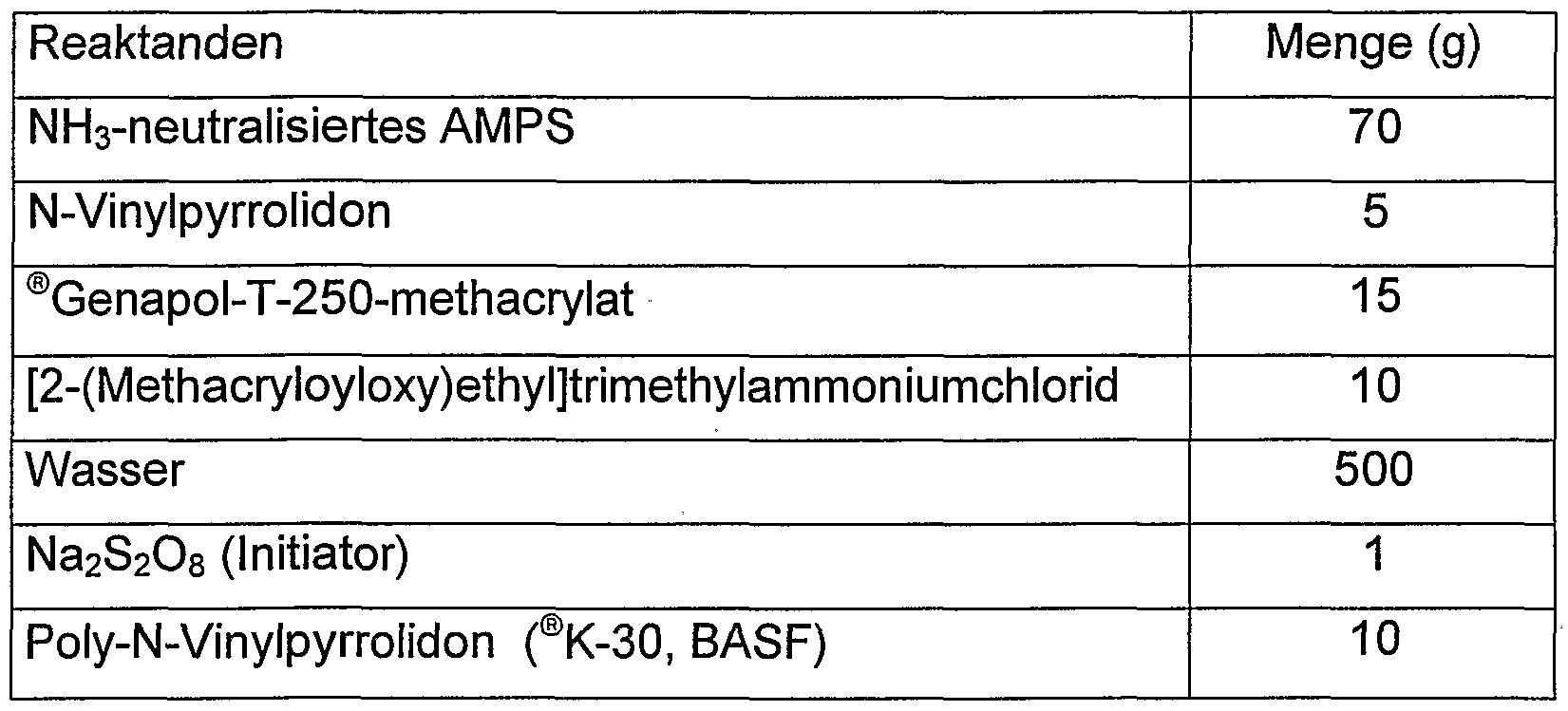
Das Polymer wurde nach dem Gelpolymerisationsverfahren in Wasser hergestellt. Dabei wurden die Monomere in Wasser gelöst, die Reaktionsmischung inertisiert und anschließend die Reaktion nach Anheizen durch Zugabe von Natriumperoxodisulfat initiiert. Das Polymergel wurde anschließend zerkleinert und das Polymer durch Vakuumtrocknung isoliert.The polymer was made in water by the gel polymerization process. The monomers were dissolved in water, the reaction mixture was rendered inert, and the reaction was then initiated after heating by adding sodium peroxodisulfate. The polymer gel was then crushed and the polymer isolated by vacuum drying.
Beispiel 4Example 4

Beispiel 5Example 5

Das Polymer wurde nach dem Fällungsverfahren in tert. Butanol hergestellt. Dabei wurden die Monomere in t-Butanol vorgelegt, die Reaktionsmischung inertisiert und anschließend die Reaktion nach Anheizen durch Zugabe von AIBN initiiert. Das Polymer wurde durch Absaugen des Lösungsmittels und durch anschließende Vakuumtrocknung isoliert.The polymer was tert in the precipitation process. Butanol made. The monomers were initially introduced into t-butanol, the reaction mixture was rendered inert, and the reaction was then initiated after heating by adding AIBN. The polymer was isolated by suction extraction of the solvent and subsequent vacuum drying.
Beispiel 6Example 6

Beispiel 7Example 7

Das Polymer wurde nach dem Fällungsverfahren in tert. Butanol hergestellt. Dabei wurden die Monomere in t-Butanol vorgelegt, die Reaktionsmischung inertisiert und anschließend die Reaktion nach Anheizen durch Zugabe von AIBN initiiert. Das Polymer wurde durch Absaugen des Lösungsmittels und durch anschließende Vakuumtrocknung isoliert.The polymer was tert in the precipitation process. Butanol made. The monomers were initially introduced into t-butanol, the reaction mixture was rendered inert, and the reaction was then initiated after heating by adding AIBN. The polymer was isolated by suction extraction of the solvent and subsequent vacuum drying.
Beispiel 8Example 8

Beispiel 9Example 9

Das Polymer wurde nach dem Lösungsverfahren in einem Isopropanol/Wasser- Gemisch hergestellt. Dabei wurden die Monomere in Isopropanol/Wasser vorgelegt, die Reaktionsmischung inertisiert und anschließend die Reaktion nach Anheizen durch Zugabe von ABAH initiiert. Das Polymer wurde durch Abdampfen des Lösungsmittelgemisches und durch anschließende Vakuumtrocknung isoliert.The polymer was made in an isopropanol / water mixture by the solution method. The monomers were placed in isopropanol / water, the reaction mixture was rendered inert, and the reaction was then initiated after heating by adding ABAH. The polymer was isolated by evaporation of the solvent mixture and subsequent vacuum drying.
Beispiele 10 bis 18:Examples 10 to 18:
Die Beispiele 10 bis 18 zeigen die Auswirkung von synergistischen Additiven auf das Viskositätsverhalten ausgewählter Copolymere. Dadurch wird gezeigt, dass sich die Schwellentemperatur und die Stärke des thermoassoziierenden Effektes in weiten Grenzen steuern lassen. Die Beispiele 10 und 15 sind Vergleichsbeispiele. Die Viskositäten wurden bis 100 °C mit einem Brookfield Viskosimeter und bis 200°C mit einem Fann 50 Viskosimeter bestimmt. Zur Vereinfachung werden hier nur die Temperaturen angegeben, bei denen ein signifikanter Viskositätsanstieg beobachtet worden ist (Spalte TVjSk) und die maximale beobachtete Viskosität (Spalte Maximale Viskosität)Examples 10 to 18 show the effect of synergistic additives on the viscosity behavior of selected copolymers. This shows that the threshold temperature and the strength of the thermoassociating effect can be controlled within wide limits. Examples 10 and 15 are comparative examples. The viscosities were determined up to 100 ° C with a Brookfield viscometer and up to 200 ° C with a Fann 50 viscometer. For simplification, only the temperatures at which there is a significant increase in viscosity are given has been observed (column T V j S k) and the maximum observed viscosity (column maximum viscosity)
Tabelle 1 : Beispiele 10 bis 18Table 1: Examples 10 to 18
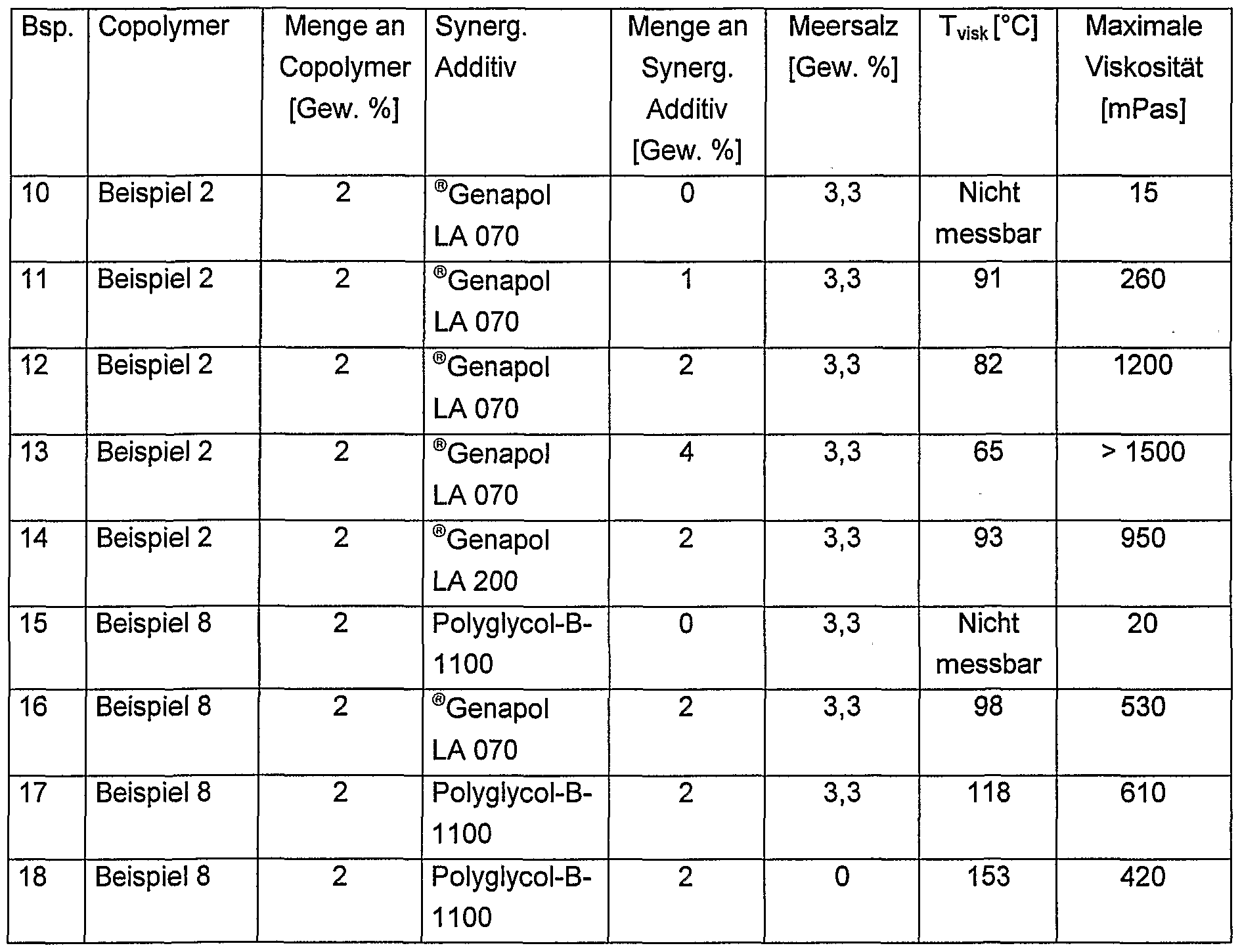
Bei den ®Genapol-Typen handelt es sich um Alkylpolyglykole der Fa. Clariant GmbH.The ® Genapol types are alkyl polyglycols from Clariant GmbH.
Die Vergleichsbeispiele 10 und 15 zeigen, dass ohne Zugabe eines synergistisches Additiv kein messbarer thermoassoziierender Effekt beobachtet wird.Comparative Examples 10 and 15 show that without the addition of a synergistic additive, no measurable thermoassociative effect is observed.
Die Beispiele 10 bis 13 dokumentieren den Einfluss der Einsatzmenge des synergistischen Additivs auf die Schwellentemperatur der Thermoassoziation und auf deren maximale Viskosität.Examples 10 to 13 document the influence of the amount of synergistic additive used on the threshold temperature of the thermal association and on its maximum viscosity.
Beispiel 14 zeigt, dass unterschiedliche Additive bei gegebenem Copolymer ebenso die Schwellentemperatur, wie auch die Viskosität verändern. Die Art und Funktionalität des erfindungsgemäßen Polymers hat, wie der Vergleich der Beispiele 12 und 16 zeigt, ebenfalls einen deutlichen Einfluss auf die Viskosität. Beispiel 18 illustriert, wie die thermoassoziativen Eigenschaften über den Salzgehalt der Zusammensetzungen gesteuert werden können. Example 14 shows that different additives change the threshold temperature as well as the viscosity for a given copolymer. The type and functionality of the polymer according to the invention, as the comparison of Examples 12 and 16 shows, also has a significant influence on the viscosity. Example 18 illustrates how the thermoassociative properties can be controlled via the salt content of the compositions.
Claims
Priority Applications (3)
| Application Number | Priority Date | Filing Date | Title |
|---|---|---|---|
| EP01998569A EP1354001A2 (en) | 2000-12-01 | 2001-11-28 | Compositions containing copolymers based on acryloyldimethyl aminoethylsulfonic acid and synergistic additives |
| BR0115764-7A BR0115764A (en) | 2000-12-01 | 2001-11-28 | Compositions containing acryloyl dimethyltauronic acid-based copolymers and synergistic additives |
| US10/433,119 US7053146B2 (en) | 2000-12-01 | 2001-11-28 | Compositions containing copolymers based on acryloyldimethyl aminoethylsulfonic acid and synergistic additives |
Applications Claiming Priority (32)
| Application Number | Priority Date | Filing Date | Title |
|---|---|---|---|
| DE10059821.8 | 2000-12-01 | ||
| DE10059827.7 | 2000-12-01 | ||
| DE10059821A DE10059821A1 (en) | 2000-12-01 | 2000-12-01 | Surfactant-free cosmetic, dermatological and pharmaceutical agents |
| DE10059830.7 | 2000-12-01 | ||
| DE10059830A DE10059830A1 (en) | 2000-12-01 | 2000-12-01 | Cationically modified comb polymers based on acryloyldimethyltauric acid |
| DE10059831.5 | 2000-12-01 | ||
| DE10059833.1 | 2000-12-01 | ||
| DE10059832A DE10059832A1 (en) | 2000-12-01 | 2000-12-01 | Grafted copolymers based on acryloyldimethyltauric acid |
| DE10059829A DE10059829A1 (en) | 2000-12-01 | 2000-12-01 | Grafted comb polymers based on acryloyldimethyltauric acid |
| DE10059819A DE10059819A1 (en) | 2000-12-01 | 2000-12-01 | Surfactant-containing cosmetic, dermatological and pharmaceutical agents |
| DE10059824A DE10059824A1 (en) | 2000-12-01 | 2000-12-01 | Electrolyte-containing cosmetic, pharmaceutical and dermatological agents |
| DE10059823.4 | 2000-12-01 | ||
| DE10059824.2 | 2000-12-01 | ||
| DE10059826A DE10059826A1 (en) | 2000-12-01 | 2000-12-01 | Cosmetic, pharmaceutical and dermatological agents |
| DE10059819.6 | 2000-12-01 | ||
| DE10059832.3 | 2000-12-01 | ||
| DE10059828A DE10059828A1 (en) | 2000-12-01 | 2000-12-01 | Comb-shaped copolymers based on acryloyldimethyltauric acid |
| DE10059833A DE10059833A1 (en) | 2000-12-01 | 2000-12-01 | Fluorine-modified comb polymers based on acryloyldimethylauric acid |
| DE10059825.0 | 2000-12-01 | ||
| DE10059822.6 | 2000-12-01 | ||
| DE10059827A DE10059827A1 (en) | 2000-12-01 | 2000-12-01 | Cosmetic and dermatological hair treatment products |
| DE10059826.9 | 2000-12-01 | ||
| DE10059818A DE10059818A1 (en) | 2000-12-01 | 2000-12-01 | Decorative cosmetic and dermatological means |
| DE10059818.8 | 2000-12-01 | ||
| DE10059831A DE10059831A1 (en) | 2000-12-01 | 2000-12-01 | Silicon-modified comb polymers based on acryloyldimethyltauric acid |
| DE10059823A DE10059823A1 (en) | 2000-12-01 | 2000-12-01 | Deodorants and antiperspirants |
| DE10059825A DE10059825A1 (en) | 2000-12-01 | 2000-12-01 | Use of comb-shaped copolymers based on acryloyldimethyltauric acid in cosmetic, pharmaceutical and dermatological agents |
| DE10059822A DE10059822A1 (en) | 2000-12-01 | 2000-12-01 | Acid cosmetic, pharmaceutical and dermatological agents |
| DE10059828.5 | 2000-12-01 | ||
| DE10059829.3 | 2000-12-01 | ||
| DE10127876.4 | 2001-06-11 | ||
| DE2001127876 DE10127876A1 (en) | 2001-06-11 | 2001-06-11 | Compositions useful as thermoassociative thickeners comprising acryloyldimethyltauric acid copolymer and anionic, cationic, nonionic or betaine surfactant |
Publications (2)
| Publication Number | Publication Date |
|---|---|
| WO2002044230A2 true WO2002044230A2 (en) | 2002-06-06 |
| WO2002044230A3 WO2002044230A3 (en) | 2002-10-31 |
Family
ID=27585601
Family Applications (1)
| Application Number | Title | Priority Date | Filing Date |
|---|---|---|---|
| PCT/EP2001/013859 Ceased WO2002044230A2 (en) | 2000-12-01 | 2001-11-28 | Compositions containing copolymers based on acryloyldimethyl aminoethylsulfonic acid and synergistic additives |
Country Status (4)
| Country | Link |
|---|---|
| US (1) | US7053146B2 (en) |
| EP (1) | EP1354001A2 (en) |
| JP (1) | JP2002327102A (en) |
| WO (1) | WO2002044230A2 (en) |
Cited By (24)
| Publication number | Priority date | Publication date | Assignee | Title |
|---|---|---|---|---|
| WO2003072622A1 (en) * | 2002-02-28 | 2003-09-04 | Toagosei Co., Ltd. | Water-soluble copolymer, polymeric flocculant, and method of dehydrating sludge |
| EP1357893A2 (en) * | 2000-12-01 | 2003-11-05 | Clariant GmbH | Acid cosmetic, dermatological and pharmaceutical agents |
| WO2004000248A3 (en) * | 2002-06-21 | 2004-03-18 | Henkel Kgaa | Thickened cosmetic composition |
| EP1400583A1 (en) * | 2002-09-19 | 2004-03-24 | Clariant GmbH | Liquid washing and cleaning agents with viscosity modifying polymers |
| EP1426436A1 (en) * | 2002-12-07 | 2004-06-09 | Clariant GmbH | Liquid bleaching component comprising amphiphilic polymers |
| WO2004050730A1 (en) * | 2002-12-02 | 2004-06-17 | Basf Aktiengesellschaft | Copolymers based on n-vinylamide as adjuvants and agents for using in the agrotechnical field |
| EP1477553A1 (en) * | 2003-05-16 | 2004-11-17 | Clariant GmbH | Liquid washing and cleaning agents with viscosity modifying polymers |
| FR2873122A1 (en) * | 2004-07-13 | 2006-01-20 | Oreal | NOVEL ETHYLENE COPOLYMERS, COMPOSITIONS COMPRISING THE SAME, AND PROCESSING METHOD |
| US7053146B2 (en) | 2000-12-01 | 2006-05-30 | Clariant Gmbh | Compositions containing copolymers based on acryloyldimethyl aminoethylsulfonic acid and synergistic additives |
| DE102005038107A1 (en) * | 2005-08-11 | 2007-02-22 | Süd-Chemie AG | Alkoxysilane-bearing LCST polymers |
| US7300914B2 (en) * | 2003-04-03 | 2007-11-27 | Clariant Produkte (Deutschland) Gmbh | Process for the preparation of stable polymer concentrates |
| WO2008154345A1 (en) * | 2007-06-06 | 2008-12-18 | 3M Innovative Properties Company | Fluorinated ether compositions and methods of using the same |
| WO2009071451A3 (en) * | 2007-12-03 | 2009-10-01 | Henkel Ag & Co. Kgaa | Reduction of the formation of biofilm by means of multifunctional copolymers |
| DE102008046075A1 (en) * | 2008-09-08 | 2010-03-11 | Evonik Röhm Gmbh | (Meth) acrylate monomer, polymer and coating agent |
| WO2010072777A2 (en) | 2008-12-23 | 2010-07-01 | Basf Se | Gel formulations that are stable for storage, comprising at least two substantially un-mixed hydrogels |
| EP2208510A1 (en) | 2009-01-15 | 2010-07-21 | L'oreal | Cosmetic or dermatological composition comprising a retinoid, a non-phosphated compound based on adenosine and a semi-crystalline polymer |
| WO2011073279A2 (en) | 2009-12-18 | 2011-06-23 | L'oreal | Cosmetic treatment method involving a compound capable of condensing in situ |
| US8691199B2 (en) | 2004-07-13 | 2014-04-08 | L'oreal | Ethylenic copolymers, compositions and methods of the same |
| WO2014111571A1 (en) | 2013-01-21 | 2014-07-24 | L'oreal | Cosmetic or dermatological emulsion comprising a merocyanine and an emulsifying system containing an amphiphilic polymer comprising at least one 2-acrylamidomethylpropanesulfonic acid unit |
| WO2014207715A2 (en) | 2013-06-27 | 2014-12-31 | L'oreal | Pemulen starch emulsified gel |
| US9421157B2 (en) | 2006-07-03 | 2016-08-23 | L'oreal | Use of C-glycoside derivatives as pro-desquamating active agents |
| WO2018078095A1 (en) | 2016-10-28 | 2018-05-03 | L'oreal | Composition comprising at least two fatty acid esters of (poly)glycerol, and use thereof in cosmetics |
| WO2018195614A1 (en) | 2017-04-28 | 2018-11-01 | L'oreal | Gel-cream hair care composition |
| FR3128118A1 (en) | 2021-10-14 | 2023-04-21 | L'oreal | Hair treatment method comprising the application of an oil-in-water emulsion comprising an aqueous phase, a fatty phase and a polymer |
Families Citing this family (31)
| Publication number | Priority date | Publication date | Assignee | Title |
|---|---|---|---|---|
| DE10059819A1 (en) * | 2000-12-01 | 2002-06-13 | Clariant Gmbh | Surfactant-containing cosmetic, dermatological and pharmaceutical agents |
| DE10059828A1 (en) * | 2000-12-01 | 2002-06-13 | Clariant Gmbh | Comb-shaped copolymers based on acryloyldimethyltauric acid |
| ITMI20011113A1 (en) * | 2001-05-25 | 2002-11-25 | Eni Spa | PROCEDURE FOR DECREASING THE PRODUCTION OF WATER IN OIL WELLS |
| US7030203B2 (en) * | 2001-09-28 | 2006-04-18 | 3M Innovative Properties Company | Water-in-oil emulsions with ethylene oxide groups, compositions, and methods |
| DE10163902A1 (en) * | 2001-12-22 | 2003-07-03 | Clariant Gmbh | Crystallization inhibitor for crop protection formulations |
| DE10213142A1 (en) * | 2002-03-23 | 2003-10-02 | Clariant Gmbh | Stable dispersion concentrates |
| US20060134051A1 (en) * | 2002-09-26 | 2006-06-22 | Xavier Blin | Glossy non-transfer composition comprising a sequenced polymer |
| MXPA03008714A (en) | 2002-09-26 | 2004-09-10 | Oreal | Sequenced polymers and cosmetic compositions comprising the same. |
| DE10261750A1 (en) * | 2002-12-30 | 2004-07-15 | Basf Ag | Ampholytic copolymer and its use |
| DE10315183A1 (en) * | 2003-04-03 | 2004-10-14 | Clariant Gmbh | Process for the preparation of stable polymer concentrates |
| DE10315182A1 (en) * | 2003-04-03 | 2004-10-14 | Clariant Gmbh | Production of a liquid concentrate comprising a vinylpyrrolidone/2-acrylamido-2-methylpropanesulfonate-type copolymer, e.g. for cosmetic use, comprises adding a solvent and distilling off the polymerization medium |
| US20050019298A1 (en) * | 2003-04-14 | 2005-01-27 | The Procter & Gamble Company | Transfer-resistant cosmetic compositions |
| FR2860143B1 (en) | 2003-09-26 | 2008-06-27 | Oreal | COSMETIC COMPOSITION COMPRISING A SEQUENCE POLYMER AND A NON-VOLATILE SILICONE OIL |
| GB0326181D0 (en) * | 2003-11-11 | 2003-12-17 | Unilever Plc | Antiperspirant compositions |
| US20050220731A1 (en) * | 2004-03-23 | 2005-10-06 | Philippe Ilekti | Nail varnish composition comprising at least one polymer and at least one plasticizer |
| US8728451B2 (en) | 2004-03-25 | 2014-05-20 | L'oreal | Styling composition comprising, in a predominantly aqueous medium, a pseudo-block polymer, processes employing same and uses thereof |
| JP2006335925A (en) * | 2005-06-03 | 2006-12-14 | Jsr Corp | Sulfonic acid group-containing polymer, method for producing the same, and polymer composition |
| ATE373462T1 (en) * | 2005-06-14 | 2007-10-15 | Kpss Kao Gmbh | COSMETIC COMPOSITION |
| FR2904320B1 (en) | 2006-07-27 | 2008-09-05 | Oreal | POLYMER SEQUENCES, AND PROCESS FOR THEIR PREPARATION |
| CA2699738A1 (en) * | 2007-09-27 | 2009-04-02 | Yvonne Dieckmann | Systemicity enhancers |
| US7829477B2 (en) * | 2007-10-29 | 2010-11-09 | E.I. Dupont De Nemours And Company | Fluorinated water soluble copolymers |
| US8629089B2 (en) | 2008-12-18 | 2014-01-14 | 3M Innovative Properties Company | Method of contacting hydrocarbon-bearing formations with fluorinated ether compositions |
| DE102009020299A1 (en) | 2009-05-07 | 2010-11-11 | Clariant International Ltd. | Comb polymers and their use in detergents and cleaners |
| US7939484B1 (en) * | 2009-10-27 | 2011-05-10 | Clariant International, Ltd. | Method for reducing the adhesion forces between hard surfaces and subsequently occurring soil |
| MX2013001095A (en) * | 2010-07-27 | 2013-03-12 | Clariant Finance Bvi Ltd | Compositions comprising hydrogen peroxide or hydrogen peroxide donor substances. |
| JP5979969B2 (en) * | 2012-05-12 | 2016-08-31 | 国立大学法人北海道大学 | Aqueous gel |
| FR3008614B1 (en) | 2013-07-19 | 2015-07-31 | Oreal | COLORING COMPOSITION COMPRISING PARTICULAR AMPHOTERE ACTIVE TENSIO AND SULFATE SURFACTANT |
| EP3021826B1 (en) | 2013-07-19 | 2018-01-17 | L'oreal | Dye composition comprising a particular amphoteric surfactant and an oxyethylenated amide surfactant or an oxyethylatenated fatty alcohol surfactant comprising less than 10 oe units and mixture thereof |
| WO2015007916A1 (en) | 2013-07-19 | 2015-01-22 | L'oreal | Dye composition comprising a particular amphoteric surfactant and a particular thickening polymer |
| JP2017002308A (en) * | 2016-06-15 | 2017-01-05 | 国立大学法人北海道大学 | Aqueous gel |
| CN118772332B (en) * | 2024-07-19 | 2026-01-30 | 安徽理工大学 | A hydrophobic flocculant, its preparation method and application |
Family Cites Families (19)
| Publication number | Priority date | Publication date | Assignee | Title |
|---|---|---|---|---|
| US3931089A (en) * | 1974-06-06 | 1976-01-06 | General Mills Chemicals, Inc. | Acid compositions comprised of polymeric 2-acrylamido-2-methylpropanesulfonic acid as thickener |
| US4859458A (en) | 1981-09-15 | 1989-08-22 | Morton Thiokol, Inc. | Hair conditioning polymers containing alkoxylated nitrogen salts of sulfonic acid |
| US4521578A (en) * | 1983-09-26 | 1985-06-04 | Dresser Industries, Inc. | Composition and method of preparation of novel aqueous drilling fluid additives |
| FR2599112B1 (en) * | 1986-05-21 | 1988-12-09 | Prepac Sarl | LIQUID DELIVERY VALVE |
| GB8820332D0 (en) * | 1988-08-26 | 1988-09-28 | Allied Colloids Ltd | Graft copolymers |
| GB9104878D0 (en) | 1991-03-08 | 1991-04-24 | Scott Bader Co | Thickeners for personal care products |
| US5292843A (en) * | 1992-05-29 | 1994-03-08 | Union Carbide Chemicals & Plastics Technology Corporation | Polymers containing macromonomers |
| FR2698004B1 (en) * | 1992-11-13 | 1995-01-20 | Oreal | Aqueous cosmetic or dermatological dispersion for the treatment of hair or skin, based on fatty acid esters of sugar or of alkyl sugar and crosslinked copolymers of acrylamide. |
| US5639841A (en) * | 1995-02-28 | 1997-06-17 | Union Carbide Chemicals & Plastics Technology Corporation | Polymers containing macromonomer mixtures |
| US5686514A (en) * | 1995-08-24 | 1997-11-11 | Sequentia, Inc. | Production and use of fire retardant dispersions as additives for building panels |
| FR2750326B1 (en) * | 1996-06-28 | 1998-07-31 | Oreal | ACID COSMETIC AND / OR DERMATOLOGICAL COMPOSITION CONTAINING A POLY (2-ACRYLAMIDO 2-METHYLPROPANE SULFONIC ACID) CROSSLINKED AND NEUTRALIZED AT LEAST 90% |
| DE19625810A1 (en) * | 1996-06-28 | 1998-01-02 | Hoechst Ag | Water-soluble or water-swellable polymers |
| FR2750325B1 (en) | 1996-06-28 | 1998-07-31 | Oreal | COSMETIC USE OF A POLY (2-ACRYLAMIDO 2- METHYLPROPANE SULFONIC) CROSSLINKED AND NEUTRALIZED AT LEAST 90% AND TOPICAL COMPOSITIONS CONTAINING THEM |
| FR2750327B1 (en) | 1996-06-28 | 1998-08-14 | Oreal | COMPOSITION FOR TOPICAL USE IN THE FORM OF OIL-IN-WATER EMULSION WITHOUT SURFACTANT CONTAINING A POLY (2-ACRYLAMIDO 2-METHYLPROPANE SULFONIC) CROSSLINKED AND NEUTRALIZED |
| DE19805121A1 (en) * | 1998-02-09 | 1999-08-12 | Basf Ag | Process for the preparation of dye-containing, aqueous polymer dispersions |
| DE19926355A1 (en) * | 1999-06-10 | 2000-12-14 | Clariant Gmbh | Water-soluble copolymers and their use for exploration and production of petroleum and natural gas |
| DE50015912D1 (en) * | 1999-07-15 | 2010-06-10 | Clariant Produkte Deutschland | Water-soluble polymers and their use in cosmetic and pharmaceutical compositions |
| US6415118B1 (en) | 1999-09-28 | 2002-07-02 | Canon Kabushiki Kaisha | Image forming apparatus with inclined guide for sheet material |
| JP2002327102A (en) | 2000-12-01 | 2002-11-15 | Clariant Gmbh | Composition containing copolymer based on acryloyldimethyltauric acid and synergistic additives |
-
2001
- 2001-09-27 JP JP2001296004A patent/JP2002327102A/en not_active Withdrawn
- 2001-11-28 US US10/433,119 patent/US7053146B2/en not_active Expired - Fee Related
- 2001-11-28 WO PCT/EP2001/013859 patent/WO2002044230A2/en not_active Ceased
- 2001-11-28 EP EP01998569A patent/EP1354001A2/en not_active Withdrawn
Cited By (27)
| Publication number | Priority date | Publication date | Assignee | Title |
|---|---|---|---|---|
| US7053146B2 (en) | 2000-12-01 | 2006-05-30 | Clariant Gmbh | Compositions containing copolymers based on acryloyldimethyl aminoethylsulfonic acid and synergistic additives |
| EP1357893A2 (en) * | 2000-12-01 | 2003-11-05 | Clariant GmbH | Acid cosmetic, dermatological and pharmaceutical agents |
| WO2003072622A1 (en) * | 2002-02-28 | 2003-09-04 | Toagosei Co., Ltd. | Water-soluble copolymer, polymeric flocculant, and method of dehydrating sludge |
| WO2004000248A3 (en) * | 2002-06-21 | 2004-03-18 | Henkel Kgaa | Thickened cosmetic composition |
| EP1400583A1 (en) * | 2002-09-19 | 2004-03-24 | Clariant GmbH | Liquid washing and cleaning agents with viscosity modifying polymers |
| WO2004050730A1 (en) * | 2002-12-02 | 2004-06-17 | Basf Aktiengesellschaft | Copolymers based on n-vinylamide as adjuvants and agents for using in the agrotechnical field |
| EP1426436A1 (en) * | 2002-12-07 | 2004-06-09 | Clariant GmbH | Liquid bleaching component comprising amphiphilic polymers |
| US7300914B2 (en) * | 2003-04-03 | 2007-11-27 | Clariant Produkte (Deutschland) Gmbh | Process for the preparation of stable polymer concentrates |
| EP1477553A1 (en) * | 2003-05-16 | 2004-11-17 | Clariant GmbH | Liquid washing and cleaning agents with viscosity modifying polymers |
| FR2873122A1 (en) * | 2004-07-13 | 2006-01-20 | Oreal | NOVEL ETHYLENE COPOLYMERS, COMPOSITIONS COMPRISING THE SAME, AND PROCESSING METHOD |
| EP1632508A3 (en) * | 2004-07-13 | 2006-04-26 | L'oreal | New ethylene copolymeres, compositions comprising the same and treatment method |
| US8691199B2 (en) | 2004-07-13 | 2014-04-08 | L'oreal | Ethylenic copolymers, compositions and methods of the same |
| US8722028B2 (en) | 2004-07-13 | 2014-05-13 | L'oreal | Ethylenic copolymers, compositions and methods of the same |
| DE102005038107A1 (en) * | 2005-08-11 | 2007-02-22 | Süd-Chemie AG | Alkoxysilane-bearing LCST polymers |
| US9421157B2 (en) | 2006-07-03 | 2016-08-23 | L'oreal | Use of C-glycoside derivatives as pro-desquamating active agents |
| WO2008154345A1 (en) * | 2007-06-06 | 2008-12-18 | 3M Innovative Properties Company | Fluorinated ether compositions and methods of using the same |
| WO2009071451A3 (en) * | 2007-12-03 | 2009-10-01 | Henkel Ag & Co. Kgaa | Reduction of the formation of biofilm by means of multifunctional copolymers |
| DE102008046075A1 (en) * | 2008-09-08 | 2010-03-11 | Evonik Röhm Gmbh | (Meth) acrylate monomer, polymer and coating agent |
| WO2010072777A2 (en) | 2008-12-23 | 2010-07-01 | Basf Se | Gel formulations that are stable for storage, comprising at least two substantially un-mixed hydrogels |
| EP2208510A1 (en) | 2009-01-15 | 2010-07-21 | L'oreal | Cosmetic or dermatological composition comprising a retinoid, a non-phosphated compound based on adenosine and a semi-crystalline polymer |
| WO2011073279A2 (en) | 2009-12-18 | 2011-06-23 | L'oreal | Cosmetic treatment method involving a compound capable of condensing in situ |
| WO2011073280A2 (en) | 2009-12-18 | 2011-06-23 | L'oreal | Cosmetic treatment method involving a durable compound capable of condensing in situ |
| WO2014111571A1 (en) | 2013-01-21 | 2014-07-24 | L'oreal | Cosmetic or dermatological emulsion comprising a merocyanine and an emulsifying system containing an amphiphilic polymer comprising at least one 2-acrylamidomethylpropanesulfonic acid unit |
| WO2014207715A2 (en) | 2013-06-27 | 2014-12-31 | L'oreal | Pemulen starch emulsified gel |
| WO2018078095A1 (en) | 2016-10-28 | 2018-05-03 | L'oreal | Composition comprising at least two fatty acid esters of (poly)glycerol, and use thereof in cosmetics |
| WO2018195614A1 (en) | 2017-04-28 | 2018-11-01 | L'oreal | Gel-cream hair care composition |
| FR3128118A1 (en) | 2021-10-14 | 2023-04-21 | L'oreal | Hair treatment method comprising the application of an oil-in-water emulsion comprising an aqueous phase, a fatty phase and a polymer |
Also Published As
| Publication number | Publication date |
|---|---|
| US7053146B2 (en) | 2006-05-30 |
| JP2002327102A (en) | 2002-11-15 |
| WO2002044230A3 (en) | 2002-10-31 |
| EP1354001A2 (en) | 2003-10-22 |
| US20040109838A1 (en) | 2004-06-10 |
Similar Documents
| Publication | Publication Date | Title |
|---|---|---|
| WO2002044230A2 (en) | Compositions containing copolymers based on acryloyldimethyl aminoethylsulfonic acid and synergistic additives | |
| EP1363956B1 (en) | Comb-shaped copolymers based on acryloyldimethyl taurine acid | |
| EP1339764B1 (en) | Silicon-modified comb polymers based on acryloyldimethyl taurine acid | |
| EP1339791B1 (en) | Acryoyldimethyltaurine acid-based grafted copolymers | |
| WO2002044227A2 (en) | Fluorine-modified comb polymers based on acryloydimethyltaurine acid (2-acrylamido-2-methyl-1-propane sulfonic acid) | |
| EP1339765A1 (en) | Cationically modified comb polymers based on acryloyldimethyl taurine acid | |
| EP1339790A1 (en) | Grafted comb polymers based on acryloyldimethyl taurine acid | |
| EP1339792B1 (en) | Surfactant-containing cosmetic, dermatological and pharmaceutical agents | |
| EP1339789B1 (en) | Cosmetic, pharmaceutical and dermatological products containing an electrolyte | |
| EP1345575B1 (en) | Cosmetic and dermatological hair-treatment agents | |
| DE10059818A1 (en) | Decorative cosmetic and dermatological means | |
| DE10059826A1 (en) | Cosmetic, pharmaceutical and dermatological agents | |
| DE10059825A1 (en) | Use of comb-shaped copolymers based on acryloyldimethyltauric acid in cosmetic, pharmaceutical and dermatological agents | |
| EP1339766A1 (en) | Surfactant-free cosmetic, dermatological and pharmaceutical agents | |
| DE10213142A1 (en) | Stable dispersion concentrates | |
| DE10127876A1 (en) | Compositions useful as thermoassociative thickeners comprising acryloyldimethyltauric acid copolymer and anionic, cationic, nonionic or betaine surfactant | |
| DE10029462A1 (en) | New water soluble polymers based on macromonomer with polyalkylene oxide units, useful as adjuvants in cosmetic, pharmaceutical and agrochemical compositions | |
| EP1464658B1 (en) | Process for preparing stable polymer concentrates | |
| WO2003067981A1 (en) | Plant protecting agents |
Legal Events
| Date | Code | Title | Description |
|---|---|---|---|
| AK | Designated states |
Kind code of ref document: A2 Designated state(s): BR US |
|
| AL | Designated countries for regional patents |
Kind code of ref document: A2 Designated state(s): AT BE CH CY DE DK ES FI FR GB GR IE IT LU MC NL PT SE TR |
|
| AK | Designated states |
Kind code of ref document: A3 Designated state(s): BR US |
|
| AL | Designated countries for regional patents |
Kind code of ref document: A3 Designated state(s): AT BE CH CY DE DK ES FI FR GB GR IE IT LU MC NL PT SE TR |
|
| 121 | Ep: the epo has been informed by wipo that ep was designated in this application | ||
| DFPE | Request for preliminary examination filed prior to expiration of 19th month from priority date (pct application filed before 20040101) | ||
| WWE | Wipo information: entry into national phase |
Ref document number: 2001998569 Country of ref document: EP |
|
| WWP | Wipo information: published in national office |
Ref document number: 2001998569 Country of ref document: EP |
|
| WWE | Wipo information: entry into national phase |
Ref document number: 10433119 Country of ref document: US |