WO2001037043A1 - Ultraviolet and vacuum ultraviolet transparent polymer compositions and their uses - Google Patents
Ultraviolet and vacuum ultraviolet transparent polymer compositions and their uses Download PDFInfo
- Publication number
- WO2001037043A1 WO2001037043A1 PCT/US2000/031560 US0031560W WO0137043A1 WO 2001037043 A1 WO2001037043 A1 WO 2001037043A1 US 0031560 W US0031560 W US 0031560W WO 0137043 A1 WO0137043 A1 WO 0137043A1
- Authority
- WO
- WIPO (PCT)
- Prior art keywords
- micron
- absorbance
- transparent material
- mole
- polymer
- Prior art date
- Legal status (The legal status is an assumption and is not a legal conclusion. Google has not performed a legal analysis and makes no representation as to the accuracy of the status listed.)
- Ceased
Links
Classifications
-
- G—PHYSICS
- G03—PHOTOGRAPHY; CINEMATOGRAPHY; ANALOGOUS TECHNIQUES USING WAVES OTHER THAN OPTICAL WAVES; ELECTROGRAPHY; HOLOGRAPHY
- G03F—PHOTOMECHANICAL PRODUCTION OF TEXTURED OR PATTERNED SURFACES, e.g. FOR PRINTING, FOR PROCESSING OF SEMICONDUCTOR DEVICES; MATERIALS THEREFOR; ORIGINALS THEREFOR; APPARATUS SPECIALLY ADAPTED THEREFOR
- G03F1/00—Originals for photomechanical production of textured or patterned surfaces, e.g., masks, photo-masks, reticles; Mask blanks or pellicles therefor; Containers specially adapted therefor; Preparation thereof
- G03F1/62—Pellicles, e.g. pellicle assemblies, e.g. having membrane on support frame; Preparation thereof
-
- G—PHYSICS
- G03—PHOTOGRAPHY; CINEMATOGRAPHY; ANALOGOUS TECHNIQUES USING WAVES OTHER THAN OPTICAL WAVES; ELECTROGRAPHY; HOLOGRAPHY
- G03F—PHOTOMECHANICAL PRODUCTION OF TEXTURED OR PATTERNED SURFACES, e.g. FOR PRINTING, FOR PROCESSING OF SEMICONDUCTOR DEVICES; MATERIALS THEREFOR; ORIGINALS THEREFOR; APPARATUS SPECIALLY ADAPTED THEREFOR
- G03F7/00—Photomechanical, e.g. photolithographic, production of textured or patterned surfaces, e.g. printing surfaces; Materials therefor, e.g. comprising photoresists; Apparatus specially adapted therefor
- G03F7/004—Photosensitive materials
-
- C—CHEMISTRY; METALLURGY
- C08—ORGANIC MACROMOLECULAR COMPOUNDS; THEIR PREPARATION OR CHEMICAL WORKING-UP; COMPOSITIONS BASED THEREON
- C08F—MACROMOLECULAR COMPOUNDS OBTAINED BY REACTIONS ONLY INVOLVING CARBON-TO-CARBON UNSATURATED BONDS
- C08F214/00—Copolymers of compounds having one or more unsaturated aliphatic radicals, each having only one carbon-to-carbon double bond, and at least one being terminated by a halogen
- C08F214/18—Monomers containing fluorine
-
- C—CHEMISTRY; METALLURGY
- C08—ORGANIC MACROMOLECULAR COMPOUNDS; THEIR PREPARATION OR CHEMICAL WORKING-UP; COMPOSITIONS BASED THEREON
- C08F—MACROMOLECULAR COMPOUNDS OBTAINED BY REACTIONS ONLY INVOLVING CARBON-TO-CARBON UNSATURATED BONDS
- C08F234/00—Copolymers of cyclic compounds having no unsaturated aliphatic radicals in a side chain and having one or more carbon-to-carbon double bonds in a heterocyclic ring
- C08F234/02—Copolymers of cyclic compounds having no unsaturated aliphatic radicals in a side chain and having one or more carbon-to-carbon double bonds in a heterocyclic ring in a ring containing oxygen
-
- G—PHYSICS
- G03—PHOTOGRAPHY; CINEMATOGRAPHY; ANALOGOUS TECHNIQUES USING WAVES OTHER THAN OPTICAL WAVES; ELECTROGRAPHY; HOLOGRAPHY
- G03F—PHOTOMECHANICAL PRODUCTION OF TEXTURED OR PATTERNED SURFACES, e.g. FOR PRINTING, FOR PROCESSING OF SEMICONDUCTOR DEVICES; MATERIALS THEREFOR; ORIGINALS THEREFOR; APPARATUS SPECIALLY ADAPTED THEREFOR
- G03F7/00—Photomechanical, e.g. photolithographic, production of textured or patterned surfaces, e.g. printing surfaces; Materials therefor, e.g. comprising photoresists; Apparatus specially adapted therefor
- G03F7/004—Photosensitive materials
- G03F7/0046—Photosensitive materials with perfluoro compounds, e.g. for dry lithography
-
- G—PHYSICS
- G03—PHOTOGRAPHY; CINEMATOGRAPHY; ANALOGOUS TECHNIQUES USING WAVES OTHER THAN OPTICAL WAVES; ELECTROGRAPHY; HOLOGRAPHY
- G03F—PHOTOMECHANICAL PRODUCTION OF TEXTURED OR PATTERNED SURFACES, e.g. FOR PRINTING, FOR PROCESSING OF SEMICONDUCTOR DEVICES; MATERIALS THEREFOR; ORIGINALS THEREFOR; APPARATUS SPECIALLY ADAPTED THEREFOR
- G03F7/00—Photomechanical, e.g. photolithographic, production of textured or patterned surfaces, e.g. printing surfaces; Materials therefor, e.g. comprising photoresists; Apparatus specially adapted therefor
- G03F7/004—Photosensitive materials
- G03F7/09—Photosensitive materials characterised by structural details, e.g. supports, auxiliary layers
- G03F7/091—Photosensitive materials characterised by structural details, e.g. supports, auxiliary layers characterised by antireflection means or light filtering or absorbing means, e.g. anti-halation, contrast enhancement
Definitions
- This invention concerns partially fluorinated and fully fluorinated polymers that are substantially transparent to ultraviolet radiation at wavelengths from approximately 187 nanometer to 260 nanometers.
- the semiconductor industry is the foundation of the trillion dollar electronics industry.
- the semiconductor industry continues to meet the demands of Moore's law, whereby integrated circuit density doubles every 18 months, in large part because of continuous improvement of optical lithography's ability to print smaller features on silicon.
- the circuit pattern is contained in the photomask, and an optical stepper is used to project this mask pattern into the photoresist layer on the silicon wafer.
- Current lithography is done using 248 nm light; lithography with 193 nm light is just entering early production.
- fluoropolymers have already been identified in the art as useful for optical applications such as light guides, anti-reflective coatings and layers, pellicles, and glues. Most of this work has been done at wavelengths above 200 nm where perfluoropolymer absorption is of little concern.
- WO 9836324 August 20, 1998, Mitsui Chemical Inc. discloses the use of resins consisting solely of C and F, optionally in combination with silicone polymers having siloxane backbones, as pellicle membranes having an absorbance/micrometer of 0.1 to 1.0 at UV wavelengths from 140 to 200 nm.
- WO 9822851 May 28, 1998, Mitsui Chemicals, Inc., claims the use of photodegradation-resistant, tacky polymers that immobilize dust particles when coated on the inside of a pellicle frame.
- These tacky materials have compositions consisting largely of low molecular weight -(CF2-CXR) copolymers in which X is halogen and R is -Cl or -CF3.
- Higher molecular weight polymers such as poly(perfluorobutenyl viny ether), poly[(tetrafluoroethylene/perfluoro-(2,2- dimethyl-l,3-dioxole)], poly(tetrafluoroethylene/hexafluoropropylene/vinylidene fluoride), poly(hexafluoropropylene/vinylidene fluoride), or poly(chlorotolyl fluoroethylene/vinylidene fluoride) are added as a minor component to improve creep resistance.
- Poly(vinylidene fluoride), poly(chlorotri- fluoroethylene), poly(tetrafluoroethylene/ethylene), commercially available poly(tetrafluoroethylene/hexafluoropropylene) compositions, and poly(ethylene/chlorotrifluoroethylene) are all such crystalline, optically hazy materials. More recent references have thus been directed at CytopTM and Teflon® AF because they combine perfluorination with outstanding optical clarity, solubility, and a complete lack of crystallinity. CytopTM and TeflonTM are less than ideal, however, because the difficulty of the their monomer syntheses make them extremely expensive.
- the ratio of monomers ranges from approximately 1:2 to approximately 2:1; perfluoro(2- methylene-4-methyl- 1 ,3 -dioxolane) and perfluoro(2,2-dimethyl- 1 ,3 -dioxole); perfluoro(2-methylene-4-methyl-l,3-dioxolane) and vinylidene fluoride in any ratio that gives an amorphous composition; perfluoro(2-methylene-4-methyl-l,3- dioxolane) with tetrafluoroethylene in any ratio that gives an amorphous composition; and the homopolymer of perfluor
- This invention further provides pellicles, anti-reflective coatings, optically clear glues, light guides and resists comprising the UV transparent material provided above.
- This invention further provides copolymer compositions comprising poly(hexafluoroisobutylene trifluoroethylene) with 40-60 mole % hexafluoroisobutylene and 60-40 mole % trifluoroethylene and copolymer compositions comprising poly(hexafluoroisobutylene:vinyl fluoride) with 40-60 mole % hexafluoroisobutylene and 60-40 mole % vinyl fluoride.
- Figure 2 describes the absorbance in units of inverse microns for Teflon® AF 1601 (Sample 7a) and CytopTM (Sample 13) versus wavelength lambda ( ⁇ ) in units of nanometers.
- Figure 3 describes the index of refraction n and the extinction coefficient k determined for a Teflon® AF 1601 film (Sample 7b) of thickness 2146 angstroms on a silicon substrate versus wavelength lambda in units of nanometers determined by VUV spectroscopic ellipsometry.
- Figure 4 describes the spectral transmission in absolute units versus the wavelength lambda in units of nanometers for a pellicle of Teflon® AF 1601 designed as an unsupported tuned etalon with a film thickness of 6059 angstroms. The interference fringes of the tuned etalon are clearly visible as a function of wavelength.
- Figure 5 describes the spectral reflectance in absolute units versus the wavelength lambda in units of nanometers for a pellicle of Teflon® AF 1601 designed as an unsupported tuned etalon with a film thickness of 6059 angstroms.
- the interference fringes of the tuned etalon are clearly visible as a function of wavelength, and a minimum in the pellicle reflectance is seen at 157 nm which contributes to the maximized pellicle transmission at this lithographic wavelength.
- Figure 6 describes transmission of a tuned etalon pellicle film of Teflon® AF 1601 at a lithographic wavelength of 157 nm as a function of the pellicle film thickness.
- the oscillations in the pellicle transmission with thickness arise due the thin film interference fringes in the film and give rise to pellicle transmission maxima and minima.
- the optimum tuned etalon pellicle design will correspond to the film with sufficient mechanical integrity and a thickness such that the transmission is at a maxima. Still as can be seen, pellicles designed from this material have substantially lower transmissions than the target transmission for a 157 nm pellicle.
- Figure 7 describes the absorbance in units of inverse microns for Teflon® AF 1200 (Sample 8), Teflon® AF 1601 (Sample 7a), and Teflon® AF 2400 (Sample5)versus wavelength lambda ( ⁇ ) in units of nanometers. Notice the dramatic decrease in the absorbance/micron as the PDD content of the polymer increases and the TFE content of the polymer decreases from 52% to 32% to 11%, and therefore the lengths of any (CF2) n runs in the polymer decreases.
- Figure 8 describes the absorbance in units of inverse microns for TFE:HFP
- TrFE:HFP TrFE:HFP
- ⁇ wavelength lambda
- Figure 9 describes the absorbance in units of inverse microns for VF 2 :PDD (Sample 2), VF 2 :HFP (Sample 1), HFIB:TrFE (Sample 3) and HFIB:VF (Sample 4) versus wavelength lambda ( ⁇ ) in units of nanometers.
- Figure 10 describes the index of refraction n and the extinction coefficient k determined for a HFIB:VF film (Sample 4a) of thickness 14,386 angstroms on a silicon substrate versus wavelength lambda in units of nanometers determined by VUV spectroscopic ellipsometry.
- Figure 11 describes the spectral transmission in absolute units versus the wavelength lambda in units of nanometers for a pellicle of HFIB:VF designed as an unsupported tuned etalon with a film thickness of 3660 angstroms. The interference fringes of the tuned etalon are clearly visible as a function of wavelength.
- Figure 12 describes the spectral reflectance in absolute units versus the wavelength lambda in units of nanometers for a pellicle of HFIB:VF designed as an unsupported tuned etalon with a film thickness of 3660 angstroms.
- the interference fringes of the tuned etalon are clearly visible as a function of wavelength, and a minimum in the pellicle reflectance is seen at 157 nm which contributes to the maximized pellicle transmission at this lithographic wavelength.
- Figure 13 describes transmission of a tuned etalon pellicle film of HFIB:VF with an absorbance per micron of 0.022 and an index of refraction of 1.5 at a lithographic wavelength of 157 nm as a function of the pellicle film thickness. Note that for pellicle film thicknesses up to 3660 angstroms, the maximum pellicle transmission is above the target specification of 98%.
- Figure 14 describes transmission of a tuned etalon pellicle film of a polymer with an absorbance per micron of 0.01 and an index of refraction of 1.5 at a lithographic wavelength of 157 nm as a function of the pellicle film thickness. Note that for pellicle film thicknesses up to 8371 angstroms, the maximum pellicle transmission is above the target specification of 98%.
- Figure 15 describes the absorbance in units of inverse microns for 5:6 TFP:TFE (Sample 17), HFIB:VF (Sample 18), 5:2 VF2:PFMVE (Sample 19), 7:5 VF2:PFPVE (Sample 21) and 79:21 VF2:HFP (Sample 22) versus wavelength lambda ( ⁇ ) in units of nanometers.
- Figure 16 describes the absorbance in units of inverse microns for 1:1 PDD:TrFE (Sample 9), 13:10 VF2:PFMVE (Sample 20), 2:5:2 HFP:PFMVE:VF2 (Sample 23), 10:7 HFIB:VF (Sample 24) and 6:5 PDD:PFMVE (Sample 25) versus wavelength lambda ( ⁇ ) in units of nanometers.
- Figure 17 describes the absorbance in units of inverse microns for 20:11 VF:C1DFE (Sample 26), 1:2 PDD:VF2 (Sample 27), 1:1 HFIB:VA (Sample 32), PMD (Sample 33) and PMD:PDD (Solution 34) versus wavelength lambda ( ⁇ ) in units of nanometers.
- Figure 18 describes the absorbance in units of inverse microns for 1 : 1
- CTFE:VF (Sample 6b), 5:2 VF2:TrFE (Sample 10), 10:23 PDD:CTFE (Sample 11), 5:4 VF2:CTFE (Sample 15) and 1 :1 PMD:TFE (Sample 18) versus wavelength lambda ( ⁇ ) in units of nanometers.
- Figure 19 describes the absorbance in units of inverse microns for 5:8 PDD:VF2 (Sample 29) and 41 :37:22 HFIB:VF:VF2 (Sample 19) versus wavelength lambda ( ⁇ ) in units of nanometers.
- fluorocarbon chains are more resistant than hydrocarbon chains to UV absorption and not surprisingly the industry has been moving increasingly towards perfluorination when seeking high UV transmission. But, as long as chain lengths still offering acceptable transparency can never exceed (CH 2 ) ⁇ or (CF 2 ) ⁇ , perfectly transparent polymers at 157 nm and somewhat longer wavelengths would seem precluded. Consistent with this, V. N. Vasilets, et al., J. Poly. Sci, Part A, Poly.
- the pellicle is a free standing polymer membrane, typically 0.8 micrometers in thickness, which is mounted on a typically 5 inch square frame.
- the pellicle film must have high transparency or transmission of light at the lithographic wavelength for efficient image formation and must neither darken nor burst with prolonged illumination in the optical stepper.
- Pellicles for current lithographic wavelengths utilize pellicles with > 99% transmission, through exploitation of polymers with very low optical absorption combined with thin film interference effects.
- the electronics industry likes to see greater than 98% transparency over an exposure lifetime of 75 million laser pulses of 0.1 mj/cm 2 , or a radiation dose of 7.5 kJ.
- a pellicle transmission of 98% corresponds to an absorbance A of approximately 0.01 per micrometer of film thickness.
- the absorbance is defined in Equation 1, where the Absorbance A per micron of film thickness, is defined as the base 10 logarithm of the ratio of the substrate transmission divided by the transmission of the Sample consisting of the polymer film sample on its substrate, this quantity divided by the polymer film thickness. Equation 1.
- the Absorbance A has units of inverse microns (or 1 /micron, where a micron, is a micrometer or um of polymer film thickness.
- the absorbance/micron of polymer films discussed here were measured for polymer films spun coated on to CaF 2 substrates using standard methods. The VUV transmission of each CaF 2 substrate was measured prior to the spin coating of the polymer film. Then the VUV transmission of the polymer film on that particular CaF 2 substrate was measured, and using the measured film thickness (reported in Table 2) and equation 1, the values of the absorbance/micron for the polymers, as a function of wavelength was determined, and the value of the absorbance/micron for a wavelengths of 157, 193, and 248 nm is tabulated in Table 2. For some materials, two films, of differing thicknesses are presented in the Table 2, and Absorbance/micron values for each film are also presented.
- VUV transmission of the CaF 2 substrates and the polymer films on the CaF 2 substrates were measured using a VUV spectrophotometer using a laser plasma light source, a sample chamber capable of both transmission and reflectance measurements, a 1 meter monochromator and a sodium salicylate phosphor coated 1024 element photodiode detector. This is discussed in greater detail in R. H. French, "Laser-Plasma Sourced, Temperature Dependent VUV Spectrophotometer Using Dispersive Analysis", Physica Scripta, 41, 4, 404-8, (1990) which is incorporated herein by reference.
- the absorbance per micron of a polymer will determine the average transmission of an unsupported pellicle film made from that polymer.
- the 157 nm transmission T of a pellicle in units of % as a function of the 157 nm absorbance, in units of inverse microns, of the polymer for an absorbance range from 0.4 to 0.0 is shown.
- the effects of thin film interference in the pellicle membrane are neglected in this calculation.
- the results for pellicle films of thicknesses ranging from 0.2 microns to 1 micron are shown, and demonstrate that for any particular polymer, the pellicle transmission can be increased, through the use of a thinner pellicle film thickness.
- k are determined from variable angle spectroscopic ellipsometry (VASE) at three incident angles covering the wavelength range from 186-800 nm, corresponding to an energy range of 1.5-6.65 eV, in combination with VUV ellipsometry (VUV- VASE) measurements performed at a single angle of incidence from 143-275 nm, corresponding to an energy range of 4.5-8.67 eV.
- VASE variable angle spectroscopic ellipsometry
- VUV- VASE VUV- VASE
- the transmission of a pellicle film of arbitrary thickness can be calculated by using an optical model for the unsupported pellicle film, at a specific polymer film thickness, and then calculating the pellicle film transmission and reflectance.
- the pellicle film thickness can be optimized such that the pellicle will exhibit a thin film interference maximum in the transmission spectrum at the desired lithographic wavelength.
- the transmission maxima of a properly tuned etalon pellicle film occur where the reflectance of the pellicle film exhibits minimum in the reflectance, and correspond to minimizing the pellicle's reflectance and maximizing its transmission at the lithographic wavelength.
- the relationship between the extinction coefficient k and the absorption coefficient ⁇ and the absorbance per micron A is given in Equation 2, where lambda is the wavelength of light. This relationship is useful in comparing results of absorbance measurements and ellipsometry measurements. This relationship for A is exact if light scattering in the polymer film (as may occur due to crystallinity of the polymer), thin film interference effects, and surface scattering effects are minimized.
- Polymeric materials with very low absorbance/micron or extinction coefficients and low values of the index of refraction also have very important applications as anti-reflection coatings and optical adhesives.
- a low absorbance material as taught here in can be used to reduce the light reflected from the surface of a transparent substrate of a relatively higher index of refraction. This decrease in the reflected light, leads to a concomitant increase in the light transmitted through the transparent substrate material.
- This anti reflective coating effect of these low absorbance/micron materials can be seen in the results for VF 2 :PDD, VF 2 :HFP, HFIB:TrFE, and HFIB:VF where the absorbance of the polymers on CaF 2 substrates for the case of very thin films, exhibits negative absorbance/micron.
- Polymers such as these can also be used as adhesives to join optical elements together, and since they have low optical absorbance/micron and low values of the index of refraction, they serve to reduce the reflectance of light at the air/substrate interfaces among the optical elements, and serve to direct more of the transmitted light from one optical element into subsequent optical elements in the system.
- the materials of the present invention are useful in the manufacture of transmissive optical elements, such as lenses and beam splitters, for use in the vacuum UV region.
- An additional area in which polymers play a critical role is as the photosensitive photoresist which captures the optical latent image.
- photoresists In the case of photoresists, light must penetrate the full thickness of the resist layer for a latent optical image, with well defined vertical side walls to be produced during optical imaging which then will produce the desired resist image in the developed polymer.
- a polymer When used as a resist at 157 nm, a polymer can have a considerably higher absorption coefficient of A ⁇ ⁇ 2-3 per micrometer of film thickness, if the resist thickness is limited to about 2000 A.
- WO 9836324 discloses carbon/fluorine polymers such as poly(tetrafluoroethylene/hexafluoropropylene) as pellicle membranes having absorption A/ ⁇ of 0.1 to 1 for use at 140 to 200 nm.
- the data in Table 1 above derived from literature sources, Whyts' report of high absorption and photodegradation of poly(hexafluoropropylene/tetrafluoroethylene) at 148 nm [V. N. Vasilets, et al, J Poly. Sci., Part A, Poly. Chem., 36, 2215 (1998), and the data in Table 2 which combines additional literature data with applicant's data, casts doubt on this disclosure.
- poly(tetrafluoroethylene:hexafluoropropylene), polymer 14 of Table 2 shows a relatively strong A/ ⁇ of 3.9 at 157 nm that fails not only the industry goals for pellicles (A/ ⁇ ⁇ 0.01) but also the much looser goals for resists (A/ ⁇ ⁇ 2-3).
- Japanese Patent 072952076 claims bilayer membranes of CytopTM and Teflon® AF 1600 as pellicle films. At 157 nm CytopTM has an A/ ⁇ of 1.9 (polymer 13, Table 2) and Teflon® AF 1600 an A/ ⁇ of 0.4 (polymer 7, Table 2). This is not surprising considering the data of Table 1 that shows significant UV light absorption at 160 nm whenever there are more than about 6 CF2 groups connected in a chain. Indeed, W. H. Buck and P. R. Resnick report that
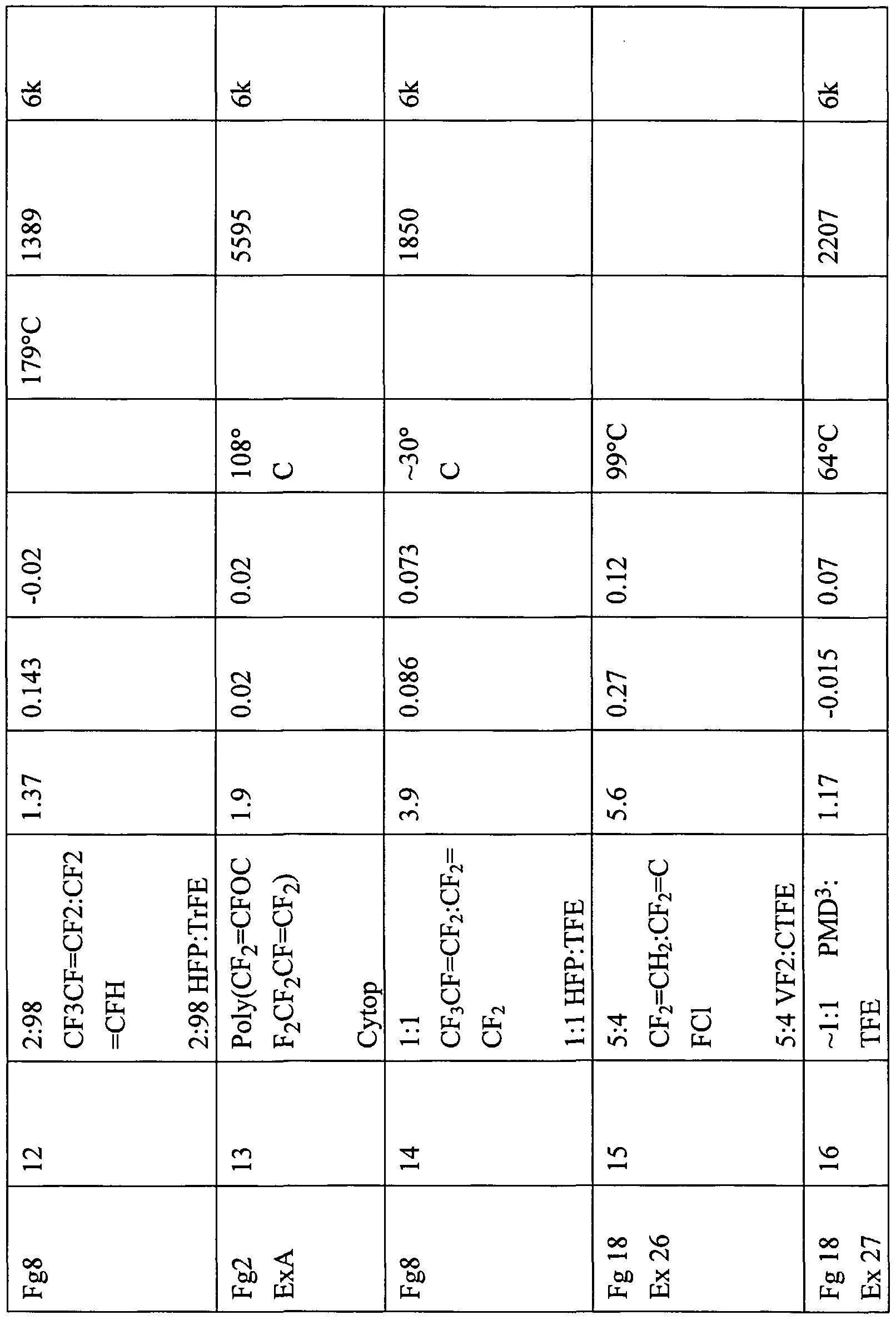
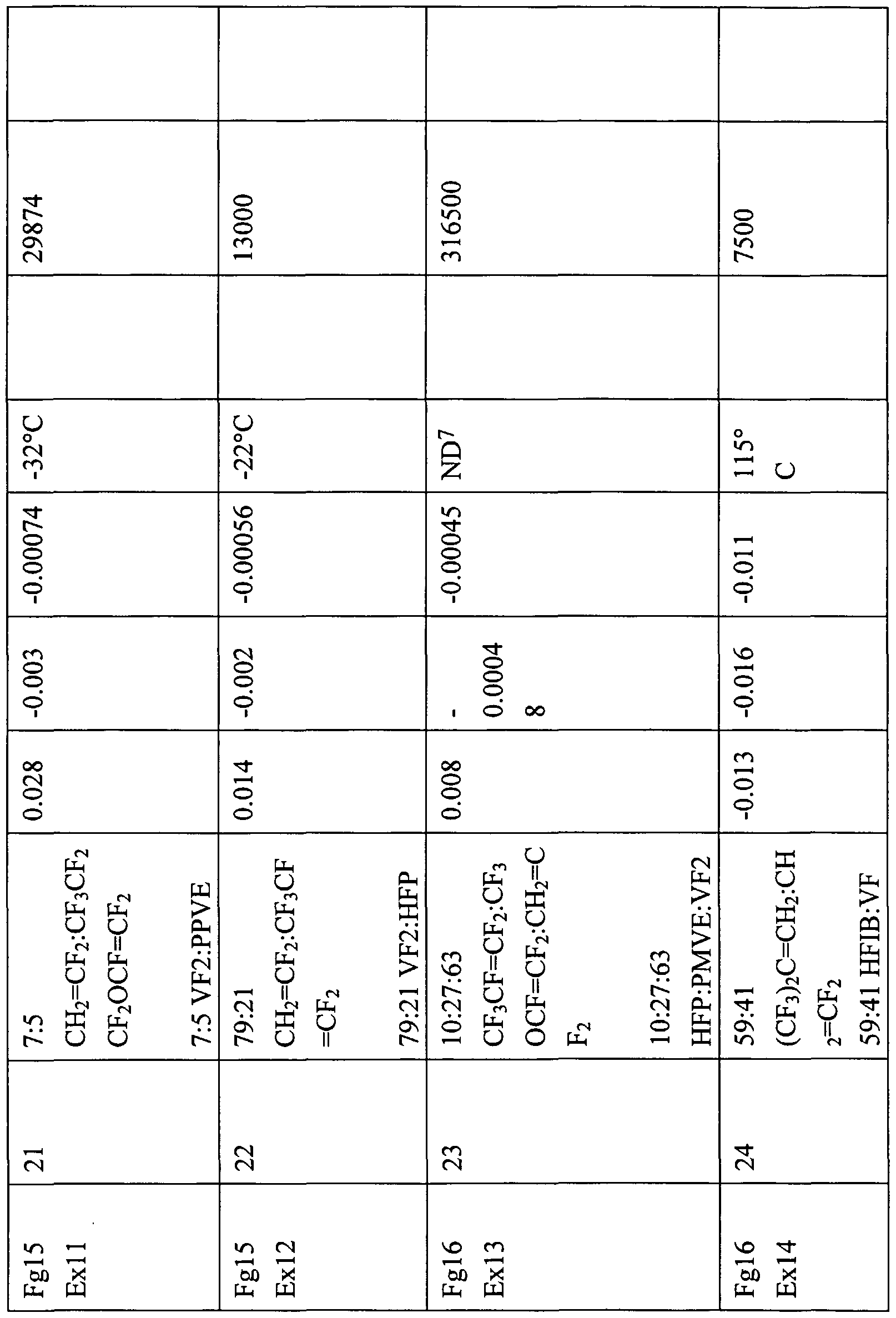
- Table 2 below lists absorbance/micrometer (A/ ⁇ ) at 157, 193, and 248 nm for partially and fully fluorinated polymer films that have been spin coated on CaF2 crystals. Polymers are listed in order of increasing absorption. In some cases, more than one sample of various polymers have been prepared within an Example. Therefore, Table entries are identified by both Example number (first column) and sample number. In addition, reference to Figures displaying spectra of various polymers are cross referenced in the Table.
- VF 2 :HFP, HFIB:TrFE, and HFIB:VF Three of the acyclic polymer structures listed in Table 2 show no detectable UV absorption at 157 nm (polymers VF 2 :HFP, HFIB:TrFE, and HFIB:VF). These are copolymers containing either vinylidene fluoride (VF2) or hexafluoroisobutylene (HFIB). VF 2 and HFIB have a unique structural feature in common. Taken by itself, for example, the hexafluoroisobutylene monomer can not form CH 2 runs longer than CH 2 CH 2 before the run is broken up by a -C(CF3) 2 - segment.
- VF2 vinylidene fluoride
- HFIB hexafluoroisobutylene
- the stiff five membered ring of PDD likely has a related effect by forcing conformations unfavorable for interaction. Comparing PDD/TFE copolymers 5, 7, and 8, absorption falls off from 0.6 to 0.4 to 0.0 as TFE content drops from 52 to 32 to 11 mole %. That is, transparency improves as increasing PDD content interrupts (CF 2 ) n runs. It is anticipated that other perfluorinated ring structures or partially fluorinated ring structures can be found that will serve the same interrupting function as PDD.
- Solutions of TFE:HFP and TrFE:HFP were spin coated at spin speeds of 6000 m onto CaF 2 substrates to produce polymer films of 1850 angstroms and 1389 angstroms thicknesses respectively. VUV absorbance measurements were then used to determine the absorbance per micron.
- TrFE in place of TFE demonstrates another example of decreasing the 157 nm absorbance/micron.
- the absorbance in units of inverse microns for TFE:HFP and TrFE:HFP versus wavelength lambda ( ⁇ ) in units of nanometers is shown in Figure 8.
- the presence of the CHF carbons in the CF 2 CFH monomer interrupts extended CF 2 runs.
- Polymer relatively transparent at 157 nm tend to be even more transparent at longer wavelengths, including the region of interest here, 187-260 nm.
- Films of thickness greater than about 250 nm can be prepared by placing monomer optionally diluted with solvent and/or initiator in the location where the film is desired. Polymerization can be initiated by appropriate physical and/or chemical means which leads to the deposition of polymer, as formed, in the desired location. The result, after subsequent solvent removal, is a film of polymer thicker than can be prepared by customary solvent coating techniques.
- poly[vinylidene fluoride/perfluoro(methyl vinyl ether)] is a tacky gum useful for glues but not useful as a self-supporting pellicle film.
- amo ⁇ hous fluoropolymer means a fluoropolymer that exhibits no melting point when analyzed by Differential Scanning Calorimetry. No melting point means no melting associated thermal event of greater than 1 Joule/gram.
- Listing a monomer as a precursor to transparent polymers is not meant to imply that it will either homopolymerize or form a copolymer with any other listed monomer.
- Hexafluoroisobutylene for example, does not form useful quantities of decent molecular weight homopolymer or copolymerize with tetrafluoroethylene under ordinary conditions.
- Teflon® AF 1200 DuPont, Wilmington, DE Teflon® AF 1600: DuPont Teflon® AF 2400: DuPont CytopTM: Asahi Glass, poly[perfluoro(butenyl vinyl ether)] -1:1 Poly (hexafluoropropylene tetrafluoroethylene) was made by the procedure described in US Patent 5,478,905, December 26, 1995.
- DP DP was prepared and used as a 0.05 to 0.2 molar solution in solvents such as VertrelTM XF (CF 3 CFHCFHCF 2 CF 3 ) or 3M's Performance Fluid PF-5080 (largely perfluorooctane).
- solvents such as VertrelTM XF (CF 3 CFHCFHCF 2 CF 3 ) or 3M's Performance Fluid PF-5080 (largely perfluorooctane).
- DP can be made conveniently by either a routine laboratory procedure [Chengue, et al, J. Org. Chem., 47, 2009 (1982)] or on demand by a jet mixer process (U.S. 5,962,746 of October 5, 1999). The reaction mixture was then recovered and the polymer isolated by evaporation or filtration. Polymer compositions were determined by elemental analysis or by NMR.
- the polymer films were prepared by spin coating of the polymer solutions onto CaF 2 substrates and then the polymer film on substrate samples were subjected to a post apply bake so as to assure that no residual solvents were remaining in the polymer film.
- the post apply bake temperature was in the range from 120°C to 250°C on a hot plate for two to five minutes or in a vacuum oven overnight.
- the spin speeds for the samples are listed in Table 2.
- Polymer film thicknesses were determined using single or multiple wavelength ellipsometry as discussed below, or by analysis using a Filmetrics Model F20 thin film measurement system (Filmetrics, Inc. 7675 Dagget St., Suite 140, San Diego, CA 92111-2255). Film Thicknesses are reported in Table 2. For some materials, two films, of differing thicknesses are presented in the table, and Absorbance/micron values for each film are presented.
- TeflonTM AF 1601 and CytopTM Solutions of Teflon ® AF 1601 were spin coated at spin speeds of 6000 m onto CaF 2 substrates to produce polymer films of 3323 angstroms thickness. VUV absorbance measurements were then used to determine the absorbance per micron.
- Teflon® AF 1601 is a 68:32 PDD:TFE polymer which is currently used as a polymer for pellicles designed for use at lithographic wavelengths of 248 nm and 193 nm.
- the absorbance/micron for 157 nm light is 0.42/microns as determined from VUV absorbance measurements. From Figure 1 this corresponds to pellicle transmissions below 70% for pellicle films of only 0.2 microns thickness, of course these results do not consider the additional effects of the thin film interference effects which arise from a properly designed pellicle film.
- VUV optical properties of Teflon® AF 1601 VUV ellipsometry was performed on a Teflon® AF 1601 polymer sample on a silicon wafer, and the index of refraction and extinction coefficient shown in Figure 3 was determined.
- the 157 nm index of refraction for Teflon® AF 1601 is 1.4251.
- the 157 nm extinction coefficient determined corresponds to an absorbance/micron of 0.35/micron and is also listed in Table 2.
- Teflon® AF 1601 optical properties and the methods of O. S. Heavens discussed above, one can design the tuned etalon pellicle film, whereby the reflectance of the unsupported pellicle film is minimized and the pellicle transmission is maximized.
- An etalon is a thin film in which thin film interference effects such as constructive and destructive interference of the light from the front and back surfaces of the constant thickness film gives rise to optical fringes in the wavelength dependence of the reflectance or transmission of the thin film (Principles of Optics, a book by Max Born and Emil Wolf, Pergamon Press, New York, 6th Edition, copyright 1980, PP 329-333).
- a 157 nm pellicle transmission is 65.7% while the 157 nm pellicle reflectance is 0.4%.
- the spectral transmission in absolute units versus the wavelength lambda in units of nanometers for a pellicle of Teflon® AF 1601 designed as an unsupported tuned etalon with a film thickness of 6059 angstroms is shown in Figure 4.
- the interference fringes of the tuned etalon are clearly visible as a function of wavelength.
- the spectral reflectance in absolute units versus the wavelength lambda in units of nanometers for the pellicle of Teflon® AF 1601 designed as an unsupported tuned etalon with a film thickness of 6059 angstroms is shown in Figure 5.
- the interference fringes of the tuned etalon are clearly visible as a function of wavelength, and a minimum in the pellicle reflectance is seen at 157 nm which contributes to the maximized pellicle transmission at this lithographic wavelength.
- the tuned etalon will not be optimized for maximum pellicle transmission and the 157 nm pellicle transmission will be 59.4% while the 157 nm pellicle reflectance increases to 8.1%.
- Pellicles designed from Teflon® AF 1601 are not able to achieve pellicle transmissions above 98%.
- Pellicles designed from CytopTM which has a much higher 157 nm absorbance/micron, will have even lower 157 nm pellicle transmissions. This demonstrates that methods are needed to produce polymers with dramatically lower 157 nm absorbance/micron so as to meet the desired 157 nm transmission of 98% for a pellicle film. Therefore we need polymers with substantially lower absorbance/micron.
- Teflon® AF 1200, 1601, and 2400 were spin coated at spin speeds of 6000 ⁇ m onto CaF substrates to produce polymer films of 4066 angstroms, 3323 angstroms and 2133 angstroms thicknesses respectively. VUV absorbance measurements were then used to determine the absorbance per micron.
- the absorbance in units of inverse microns for Teflon® AF 1200 versus wavelength lambda ( ⁇ ) in units of nanometers is shown in Figure 7 for Sample 8.
- the 157 nm absorbance/micron determined is 0.64/micron.
- the 193 nm absorbance/micron determined is 0.004/micron.
- the 248 nm absorbance/micron determined is -0.001/micron.
- the absorbance in units of inverse microns for Teflon® AF 1601 versus wavelength lambda ( ⁇ ) in units of nanometers is shown in Figure 7 for Sample 7a.
- the 157 nm absorbance/micron determined is 0.42/micron.
- the 193 nm absorbance/micron determined is 0.02/micron.
- the 248 nm absorbance/micron determined is 0.01 /micron.
- the absorbance in units of inverse microns for Teflon® AF 2400 versus wavelength lambda ( ⁇ ) in units of nanometers is shown in Figure 7 for Sample 5.
- the 157 nm absorbance/micron determined is 0.007/micron.
- the 193 nm absorbance/micron determined is -0.06/micron.
- the 248 nm absorbance/micron determined is -0.06/micron.
- Solutions of HFIB:TrFE were spin coated at spin speeds of 3000 ⁇ m and 6000 ⁇ m onto CaF 2 substrates to produce polymer films of 12,146 angstroms and 1500 angstroms thicknesses respectively. VUV absorbance measurements were then used to determine the absorbance per micron.
- the absorbance in units of inverse microns for 3:2 HFIB:TrFE versus wavelength lambda ( ⁇ ) in units of nanometers is shown in Figure 9 for Sample 3a.
- the 157 nm absorbance/micron determined from the thicker polymer film is 0.012/micron.
- the 193 nm absorbance/micron determined is 0.005/micron.
- the 248 nm absorbance/micron determined is -0.001/micron.
- reaction mixture was shaken overnight at ambient temperatures (18 to 26°C), removed as a thick gel from the autoclave, evaporated, pumped down further with a vacuum pump for 96 hours, and then dried 22 hours in a 75 °C vacuum oven. There was obtained 19 g of friable white solid with a T g of 58°C (nitrogen, 10°C/min, second heat) and no detectable T m .
- HFIB:VF Solutions of HFIB:VF were spin coated at spin speeds of 3000 ⁇ m and 6000 ⁇ m (revolutions per minute) onto CaF 2 substrates to produce polymer films of 14,386 angstroms and 2870 angstroms thicknesses respectively. VUV absorbance measurements were then used to determine the absorbance per micron.
- the absorbance in units of inverse microns for 1 :1 HFIB:VF versus wavelength lambda ( ⁇ ) in units of nanometers is shown in Figure 9 for Sample 4a.
- the 157 nm absorbance/micron determined from the thicker polymer film is 0.027/micron.
- the 193 nm absorbance/micron determined is 0.020/micron.
- the 248 nm absorbance/micron determined is 0.008/micron.
- VUV ellipsometry was performed on an HFIB:VF polymer sample on a silicon wafer, and the index of refraction and extinction coefficient shown in Figure 10 was determined.
- the 157 nm index of refraction for Teflon® AF 1601 is 1.50.
- the 157 nm extinction coefficient determined corresponds to an absorbance/micron of 0.022/micron and is also listed in Table 2.
- the interference fringes of the tuned etalon are clearly visible as a function of wavelength.
- the spectral reflectance in absolute units versus the wavelength lambda in units of nanometers for the pellicle of HFIB: VF designed as an unsupported tuned etalon with a film thickness of 3660 angstroms is shown in Figure 12.
- the interference fringes of the tuned etalon are clearly visible as a function of wavelength, and a minimum in the pellicle reflectance is seen at 157 nm which contributes to the maximized pellicle transmission at this lithographic wavelength.
- the tuned etalon is a 157 nm pellicle with a 157 nm pellicle transmission of 98%.
- Transmission of a tuned etalon pellicle film of HFIB: VF at a lithographic wavelength of 157 nm as a function of the pellicle film thickness is shown in Figure 13.
- the oscillations in the pellicle transmission with thickness arise due the thin film interference fringes in the film and give rise to pellicle transmission maxima and minima.
- Tg not detected second heat A viscous solution was prepared by rolling 4 g of poly(PDD/VF 2 ) with 16 g of hexafluorobenzene and filtering through an 0.45 micron glass fiber syringe filter
- VF :PDD Solutions of VF :PDD were spin coated at spin speeds of 6000 ⁇ m onto CaF 2 substrates to produce polymer films of 2097 angstroms thickness. VUV absorbance measurements were then used to determine the absorbance per micron.
- the 157 nm absorbance/micron determined from the thicker polymer film is -0.04/micron. For this very transparent material, this demonstrates an antireflective coating effect thereby producing an negative value of the 157 nm absorbance/micron.
- the 193 nm absorbance/micron determined is 0.02/micron.
- the 248 nm absorbance/micron determined is 0.08/micron.
- the 193 nm absorbance/micron determined is 0.005/micron.
- the 248 nm absorbance/micron determined is 0.003/micron.
- Figure 14 shows the transmission of a tuned etalon pellicle film of a polymer with an absorbance per micron of 0.01 and an index of refraction of 1.50 at a lithographic wavelength of 157 nm as a function of the pellicle film thickness. Note that for pellicle film thicknesses up to 8371 angstroms, the maximum pellicle transmission is above the target specification of 98%.
- EXAMPLE 7 TFE/TrP A. Polymerization of tetrafluoroethylene (TFE) with 3,3.3- trifluoropropene (TrP). A 240 ml autoclave was loaded with 20 ml of CF 2 C1CC1 2 F, chilled to ⁇ -20°C, and 10 ml of -0.17 M DP in
- the absorbance in units of inverse microns for 5:6 TFP:TFE versus wavelength lambda ( ⁇ ) in units of nanometers is shown in Figure 15 for Sample 17.
- the 157 nm absorbance/micron determined is 0.149/micron.
- the 193 nm absorbance/micron determined is 0.008/micron.
- the 248 nm absorbance/micron determined is -0.00085/micron.
- Pellicle polymer poly(HFIBZVF) was prepared as a film by dissolving 10 g of poly(HFIB/VF) (Example 2 A below) in 40 g of 2-heptanone, adding 1 g of decolorizing carbon + 1 g of chromatographic alumina + 1 g of chromatographic silica gel, filtering through an 0.45 ⁇ PTFE syringe filter, casting on TeflonTM FEP sheet with a 5 mil casting knife, and air drying.
- the poly(HFIB/VF) film prepared in this fashion could be lifted off the TeflonTM FEP sheet as clear, colorless film roughly 0.5 to 1 mil thick.
- Glue solution was prepared next. Solution was made by dissolving 0.1 g of the poly(TFE/TrP) prepared above in 1 g of hexafluorobenzene. This glue solution was used to make several -1/2" spots on an aluminum coupon measuring 1" wide by 3" long by 122 mil thick. These glue spots were air dried for 39 minutes and then the coupon was placed in a 60°C air oven for 8 minutes. As soon as the aluminum coupon was withdrawn hot from the oven, poly(HFIB VF) film samples were pressed down on top of the poly(TFE/TrP) deposits with light finger pressure. The poly(HFIB/VF) film visibly wetted and adhered to the poly(TFE/TrP) spots.
- ⁇ FIB Hexafluoroisobutylene
- VF Vinyl Fluoride
- Solution preparation and results A solution was made by rolling 10 g of the polymer with 40 g of 2-heptanone and filtering through a 0.45 ⁇ glass microfiber syringe filter (Whatman, AutovialTM). The filtrate was used to spin coat thick films on optical substrate for abso ⁇ tion measurements.
- HFIB VF were spin coated onto CaF 2 substrates to produce polymer films of 9239 angstroms thickness. VUV absorbance measurements were then used to determine the absorbance per micron.
- the absorbance in units of inverse microns for HFIB:VF versus wavelength lambda ( ⁇ ) in units of nanometers is shown in Figure 15 for Sample 18.
- the 157 nm absorbance/micron determined is 0.005/micron.
- the 193 nm absorbance/micron determined is -0.00082/micron.
- the 248 nm absorbance/micron determined is -0.002/micron.
- the autoclave was cooled evacuated and 26 g VF2 and 33 g PMVE added. After shaking overnight at ambient temperatures (18-26°C), the autoclave was vented, and viscous solution recovered. Excess solvent was evaporated under nitrogen and the polymer dried 72 hours under vacuum at room temperature and then for 28 hours at 75 °C in a vacuum oven, 33 g.
- Solution preparation and results A solution was made by rolling 4 g of this polymer with with 16 g of hexafluorobenzene. This solution was passed through a 0.45 ⁇ glass microfiber syringe filter (Whatman, AutovialTM) and the filtrate used to spin coat thick films on optical substrate for abso ⁇ tion measurements.
- a 0.45 ⁇ glass microfiber syringe filter Whatman, AutovialTM
- Solution preparation and results A solution was made by rolling 4 g of this polymer with with 16 g of hexafluorobenzene. This solution was passed through a 0.45 ⁇ glass microfiber syringe filter (Whatman, AutovialTM) and the filtrate used to spin coat thick films on optical substrate for abso ⁇ tion measurements. Solutions of 7:5 VF2:PPVE were spin coated onto CaF 2 substrates to produce polymer films of 29,874 angstroms thickness. VUV absorbance measurements were then used to determine the absorbance per micron.
- Sample 21 The 157 nm absorbance/micron determined is 0.028/micron. The 193 nm absorbance/micron determined is -0.003/micron. The 248 nm absorbance/micron determined is -0.00074/micron.
- Poly(HFIB/VF) was prepared as a polymer film by dissolving 10 g of poly(HFIB/VF) (Example 8 A above) in 40 g of 2-heptanone, adding 1 g of decolorizing carbon + 1 g of chromatographic alumina + 1 g of silica gel, filtering through an 0.45 ⁇ PTFE syringe filter, casting on TeflonTM FEP sheet with a 5 mil casting knife, and air drying.
- the poly(HFIB/VF) film prepared in this fashion could be lifted off the TeflonTM FEP sheet as clear, colorless film roughly 0.5 to 1 mil thick.
- Glue solution was prepared next. Solution was made by dissolving 0.1 g of the poly(VF2/PPVE) prepared above in 1 g of hexafluorobenzene. This glue solution was used to make a -1/2" spot on an aluminum coupon measuring 1" wide by 3" long by 122 mil thick. This glue spot was air dried for 39 minutes and then the coupon was placed in a 62°C oven under nitrogen for 13 minutes. As soon as the aluminum coupon was withdrawn hot from the oven, a poly(HFIB/VF) film sample was pressed down on top of the poly(VF2/PPVE) deposit with light finger pressure. Once, the aluminum coupon returned to room temperature, the poly(HFIB/VF) film tore when either pulled as in a lap shear or peeled back. The adhesive bond between the glue polymer [poly(VF2/PPVE)] and the pellicle polymer [poly(HFIB/VF)] was quite strong, exceeding the strength of the pellicle polymer.
- EXAMPLE 12 - VF2/HFP A. Poly(vinylidene fluoride/hexafluoropropylene) (VF2/HFP) Sample. A vinylidene fluoride/hexafluoropropylene sample made by the method of US Patent 4,985,520 of 1/15/91 was characterized.
- Solution preparation and results A solution was made by rolling 3 g of poly(VF2/HFP) with 17 g of 2-heptanone and filtering through a 0.45 ⁇ glass microfiber syringe filter (Whatman, AutovialTM). The filtrate used to spin coat thick films on optical substrate for abso ⁇ tion measurements.
- the absorbance in units of inverse microns for 79:21 VF2:HFP versus wavelength lambda ( ⁇ ) in units of nanometers is shown in Figure 15 for Sample 22.
- the 157 nm absorbance/micron determined is 0.014/micron.
- the 193 nm absorbance/micron determined is -0.002/micron.
- the 248 nm absorbance/micron determined is -0.00056/micron.
- the assembly was taken from the oven, cooled, the C-clamps removed, and the force required to pull the quartz slide away from the aluminum coupon measured in an Instron using a 3" jaw separation and a crosshead speed of 1 "/minute. A force of 133.3 lbs was required. A second similarly prepared sample required 121.6 pounds of force to pull apart for an average force of
- Poly(HFIB/VF) was prepared as a polymer film by dissolving 10 g of poly(HFIB/VF) (Example 2 A above) in 40 g of 2-heptanone, adding 1 g of decolorizing carbon + 1 g of chromatographic alumina + 1 g of silica gel, filtering through an 0.45 ⁇ PTFE syringe filter, casting on TeflonTM FEP sheet with a 5 mil casting knife, and air drying. The poly(HFIB/VF) film prepared in this fashion could be lifted off the TeflonTM FEP sheet as clear, colorless film roughly 0.5 to 1 mil thick.
- Glue solution was prepared next. Solution was made by dissolving 0.1 g of the poly(VF2/HFP) prepared above in 1 g of hexafluorobenzene.
- This glue solution was used to make a -1/2" spot on an aluminum coupon measuring 1 " wide by 3" long by 122 mil thick. This glue spot was air dried for 39 minutes and then the coupon was placed in a 62°C nitrogen blanketed oven for 13 minutes. As soon as the aluminum coupon was withdrawn hot from the oven, a poly(HFIB/VF) film sample was pressed down on top of the poly(VF2/HFP) deposit with light finger pressure. Once, the aluminum coupon returned to room temperature, the poly(HFIB/VF) film tore when pulled as in a lap shear.
- Hastelloy C autoclave was chilled to ⁇ -20°C and loaded with 20 ml of-0.17 M DP in CF 3 CFHCFHCF 2 CF 3 added.
- the autoclave was evacuated and loaded with 33 g perfluoro(methyl vinyl ether) (PMVE), 26 g vinylidene fluoride (VF2), 26 g of hexafluoropropylene (HFP), and 1 g of anhydrous hydrogen chloride (chain transfer agent).
- PMVE perfluoro(methyl vinyl ether)
- VF2 vinylidene fluoride
- HFP hexafluoropropylene
- chain transfer agent anhydrous hydrogen chloride
- Solution preparation and results A solution was made by rolling 4 g of this polymer with with 12 g of 2-heptanone to give a hazy solution. This solution was passed through a 0.45 ⁇ glass microfiber and TeflonTM syringe filters
- EXAMPLE 14 - HFIB/VF An 85 ml autoclave was loaded with two 3/8" diameter stainless steel balls, sealed, evacuated, chilled to ⁇ -20°C, and 10 ml of -0.17 M DP in
- Solution preparation and results A solution was made by rolling 12 g of this polymer with with 48 g of 2-heptanone. This solution was passed through a 0.45 ⁇ glass microfiber and TeflonTM syringe filters (Whatman, AutovialTM) and the filtrate used to spin coat thick films on optical substrate for abso ⁇ tion measurements.
- the absorbance in units of inverse microns for 10:7 HFIB:VF versus wavelength lambda ( ⁇ ) in units of nanometers is shown in Figure 16 for Sample 24.
- the 157 nm absorbance/micron determined is -0.013/micron.
- the 193 nm absorbance/micron determined is -0.016/micron.
- the 248 nm absorbance/micron determined is -0.011/micron.
- Solution preparation and results A solution was made by rolling 4 g of this polymer with with 16 g of heptanone. This solution was passed through a 0.45 ⁇ glass microfiber syringe filter (Whatman, AutovialTM) and the filtrate used to spin coat thick films on optical substrate for abso ⁇ tion measurements.
- a 0.45 ⁇ glass microfiber syringe filter Whatman, AutovialTM
- Solution preparation and results A solution was made by rolling 2 g of poly(PDD/VF2) with with 8 g of 2-hexafluorobenzene. This solution was passed through a 0.45 ⁇ glass microfiber syringe filter (Whatman, AutovialTM) and the filtrate used to spin coat thick films on optical substrate for abso ⁇ tion measurements.
- the absorbance in units of inverse microns for 1:2 PDD:VF2 versus wavelength lambda ( ⁇ ) in units of nanometers is shown in Figure 17 for Sample 27.
- the 157 nm absorbance/micron determined is 0.009/micron.
- the 193 nm absorbance/micron determined is 0.003/micron.
- the 248 nm absorbance/micron determined is -0.00030/micron.
- CF3CFHCFHCF 2 CF3 120 g of perfluorodimethyldioxole.
- the autoclave was pressured to 100 psi with nitrogen and evacuated ten times. Finally 58 g of vinylidene fluoride (VF2) were added and the autoclave shaken overnight at room temperature. The resulting thick gel was dried under nitrogen, then under pump vacuum, and finally for 4 days in a 75°C vacuum oven, giving 122 g of white resin.
- VF2 vinylidene fluoride
- Solution preparation A solution was made by rolling 1.70 g of the poly(PDD/VF2) with 15.3 g of hexafluorobenzene. Filtration through a 0.45 ⁇ glass fiber microfiber syringe filter (Whatman AutovialTM) gave clear, colorless solution. The filtrate was used to spin coat films on optical substrate for abso ⁇ tion measurements.
- a 400 ml autoclave was loaded with 200 ml deionized water, 0.05 g VazoTM 56 WSP initiator, and pressured to 100 psi with nitrogen and evacuated ten times.
- the autoclave was chilled to ⁇ -20°C, evacuated, and further loaded with 82 g of hexafluoroisobutylene (HFIB), 13 g of vinylidene fluoride (VF2), and 14 g of vinyl fluoride (VF).
- HFIB hexafluoroisobutylene
- VF2 vinylidene fluoride
- VF vinyl fluoride
- the absorbance in units of inverse microns for 41 :37:22 HFIB:VF:VF2 versus wavelength lambda ( ⁇ ) in units of nanometers is shown in Figure 19 for Sample 31.
- the 157 nm absorbance/micron determined is 0.016/micron.
- the 193 nm absorbance/micron determined is -0.010/micron.
- the 248 nm absorbance/micron determined is -0.002/micron.
- Tg 150°C? (weak, second heat)
- Solution preparation and results A solution was made by rolling 1 g of the polymer with 33 g of FluorinertTM Fc-75 and filtering through a 0.45 ⁇ glass microfiber syringe filter (Whatman, AutovialTM). The filtrate was used to spin coat thick films on optical substrate for abso ⁇ tion measurements.
- the absorbance in units of inverse microns for 1:1 PDD:TrFE versus wavelength lambda ( ⁇ ) in units of nanometers is shown in Figure 16 for Sample 9.
- the 157 nm absorbance/micron determined is 0.03/micron.
- the 193 nm absorbance/micron determined is -0.004/micron.
- the 248 nm absorbance/micron determined is -0.001/micron.
- Solution preparation and results A solution was made by rolling 2 g of this polymer with with 15 g of heptanone. This solution was passed through a 0.45 ⁇ glass fiber syringe filter (Whatman, AutovialTM) and the filtrate used to spin coat thick films on optical substrate for abso ⁇ tion measurements.
- a 0.45 ⁇ glass fiber syringe filter Whatman, AutovialTM
- the absorbance in units of inverse microns for 1 :1 CTFE:VF versus wavelength lambda ( ⁇ ) in units of nanometers is shown in Figure 18 for Sample 6b.
- the 157 nm absorbance/micron determined from the thicker film is 0.388/micron.
- the 193 nm absorbance/micron determined from the thicker film is 0.016/micron.
- the 248 nm absorbance/micron determined from the thicker film is 0.006/micron.
- the absorbance in units of inverse microns for 5:2 VF2:TrFE versus wavelength lambda ( ⁇ ) in units of nanometers is shown in Figure 18 for Sample 10.
- the 157 nm absorbance/micron determined is 0.924/micron.
- the 193 nm absorbance/micron determined is 0.188/micron.
- the 248 nm absorbance/micron determined is 0.083/micron.
- HFIBWinyl Acetate (VOAc) Copolymer A 400 ml autoclave was loaded with 50 ml of CF 2 C1CC1 2 F, 27 ml of vinyl acetate, and 50 ml of -0.1 M DP in CF 3 CFHCFHCF 2 CF 3 . The autoclave was chilled, evacuated, and futher loaded with 49 g of HFIB. Shaking overnight at room temperature gave a viscous pale yellow solution. The polymer was precipitated by addition to 400 ml of methyl alcohol. Filtration, drying under pump vacuum, and drying for 19 hours in a 75 °C vacuum oven gave 52 g of poly(HFIB/VOAc) having an inherent viscosity of 0.13 in acetone at 25°C.
- Solution preparation and results A solution was made by rolling 3.28 g of this polymer with with 34.91 g of l-methoxy-2-propanol acetate. This solution was passed through a 0.45 ⁇ glass fiber syringe filter (Whatman, AutovialTM) giving a slightly hazy pale yellow solution. The solution was treated with 0.4 g decolorizing carbon and filtered again and then with 0.58 g of silica gel and filtered a third time. The solution was still pale yellow but no longer hazy. The filtrate used to spin coat thick films on optical substrate for abso ⁇ tion measurements.
- Solutions of 1 : 1 HFIB:VA were spin coated onto CaF 2 substrates to produce polymer films of 1350 angstroms thickness. VUV absorbance measurements were then used to determine the absorbance per micron.
- the absorbance in units of inverse microns for 1 : 1 HFIB:VA versus wavelength lambda ( ⁇ ) in units of nanometers is shown in Figure 17 for Sample 32.
- the 157 nm absorbance/micron determined is 0.350/micron.
- the 193 nm absorbance/micron determined is -0.047/micron.
- the 248 nm absorbance/micron determined is -0.107/micron.
- Solution preparation Rolling 2.5 g of poly(HFP/TrFE) with 50 ml of propylene glycol methyl ether acetate gave a hazy solution. Filtration though an 0.45 ⁇ PTFE syringe filter (Whatman, AutovialTM) gave clear filtrate. The filtrate was used to spin coat thick films on optical substrate for abso ⁇ tion measurements.
- Hexafluoropropylene(HFP)/tetrafluoroethylene(TFE) copolymer was prepared by the method of US 5,478,905 of December 26, 1995. This polymer was 60 wt % HFP, 40 wt % TFE, and had an inherent viscosity of 0.407 dL/g (in FluorinertTM FC-75 solvent at 25°C).
- Solution preparation Rolling 31.6 g of HFP/TFE copolymer with 986 g of PF-5080 (Performance Fluid manufactured by 3M, believed to be largely perfluorooctanes) gave solution. Vacuum filtration through an 0.45 ⁇ filter gave clear solution. The filtrate was used to spin coat thick films on optical substrate for abso ⁇ tion measurements.
- PF-5080 Performance Fluid manufactured by 3M, believed to be largely perfluorooctanes
- Solutions of 1 :1 HFP:TFE were spin coated onto CaF2 substrates to produce polymer films of 1850 angstroms thickness. VUV absorbance measurements were then used to determine the absorbance per micron.
- the absorbance in units of inverse microns for 1 : 1 HFP:TFE versus wavelength lambda ( ⁇ ) in units of nanometers is shown in Figure 8 for Sample 14.
- the 157 nm absorbance/micron determined is 3.9/micron.
- the 193 nm absorbance/micron determined is 0.086/micron.
- the 248 nm absorbance/micron determined is 0.073/micron.
- EXAMPLE 26 - VF2/CTFE A 75 ml autoclave chilled to ⁇ -20°C was loaded with 25 ml of CF 2 C1CC1 2 F and 5 ml of -0.1 M DP in CF 3 CFHCFHCF 2 CF 3 .
- the autoclave was evacuated and loaded with 9.6 g of vinylidene fluoride (VF2) and 17 g of chlorotrifluoroethylene (CTFE). Shaking the autoclave overnight at room temperature gave viscous white fluid that was evaporated down to stretchy solid and then dried for for 1 hour under pump vacuum and for 30 hours in a 75°C vacuum oven. This gave 19 g of product.
- VF2 vinylidene fluoride
- CTFE chlorotrifluoroethylene
- Solution preparation Rolling 3 g poly(VF2/CTFE) with 20 g of 2-heptanone gave solution that was filtered though an 0.45 ⁇ glass fiber syringe filter (Whatman, AutovialTM). The filtrate was used to spin coat thick films on optical substrate for abso ⁇ tion measurements.
- EXAMPLE 27 - PMD/TFE A 75 ml autoclave chilled to ⁇ -20°C was loaded with 5ml of -0.14 M DP in CF 3 CFHCFHCF 2 CF 3 , 25 ml of CF 3 CFHCFHCF 2 CF 3 , and 11.6 ml of perfluoro(2-methylene-4-methyl- 1,3 -dioxolane) (PMD). The tube was evacuated and further loaded with 5 g of tetrafluoroethylene (TFE). Shaking overnight at room temperature gave a milky, viscous oil.
- TFE tetrafluoroethylene
- Solution preparation Rolling 2.14 g of poly(PMD/TFE) with 26.2 g of FluorinertTM FC-40 gave a hazy solution that was passed through an 0.45 ⁇ glass fiber filter (Whatman, AutovialTM), through an 0.45 ⁇ glass fiber syringe filter (Whatman, AutovialTM) after mixing with 0.2 g chromatographic silica + 0.2 g of decolorizing carbon, and finally through an 0.45 ⁇ PTFE syringe filter (Whatman, AutovialTM). The filtrate was used to spin coat thick films on optical substrate for abso ⁇ tion measurements.
- Sample 16 The 157 nm absorbance/micron determined is 1.17/micron. The 193 nm absorbance/micron determined is -0.015/micron. The 248 nm absorbance/micron determined is 0.07/micron.
- EXAMPLE 28 PMD A 1 ounce glass sample vial equipped with rubber septum was flushed with nitrogen, chilled on dry ice, and then 3 ml of perfluoro(2-methylene-4- methyl-l,3-dioxolane) and 0.5 ml of-0.17 M DP in CF 3 CFHCFHCF 2 CF 3 injected.
- the vial was set in water ice and allowed to warm slowly to room temperature over the next several hours with magnetic stirring. After -62 hours at room temperature the contents of the vial, a stiff foam, were dried under pump vacuum and then for 17 hours in a 150°C vacuum oven, giving 4.1 g of white fines after crushing with a spatula.
- Solution preparation Rolling 2 g of poly(PMD) with 18 g hexafluorobenezene gave a solution that was filtered through an 0.45 ⁇ glass fiber syringe filter (Whatman, AutovialTM). The filtrate was used to spin coat thick films on optical substrate for abso ⁇ tion measurements.
- Solution preparation Rolling 1 g of poly(PMD/TFE) with 19 g of hexafluorobenzene gave partial solution that was passed through a -1/4" deep pad of chromatographic silica in an 0.45 ⁇ glass fiber filter (Whatman, AutovialTM). A portion of this solution was sent for 19 F NMR which found the composition of the dissolved polymer to be 54 mole %PMD and 46 mole % vinylidene fluoride. The remaining filtrate was used to spin coat thick films on optical substrate for abso ⁇ tion measurements.
- SAMPLE 11 - PDD CTFE
- poly(PDD/CTFE) Poly(perfluorodimethyldioxole/chlorotrifluoroethylene), poly(PDD/CTFE), has been reported many times in the literature as for example in US 4,754,009.
- the poly(PDD/CTFE) used here was prepared by aqueous emulsion polymerization. Calc. (C 5 F 8 ⁇ 2) ⁇ o(C2F 3 Cl) 2 3 22.52% C 15.93% Cl
- Solution preparation Rolling 2.5 g of poly(PDD/CTFE) with 30 ml of hexafluorobenzene gave a pale yellow solution that was passed through an 0.45 ⁇ glass fiber filter (Whatman, AutovialTM). Because this solution was too viscous to easily spin coat, 11.2 g of this solution was diluted down with another 10.1 of hexafluorobenzene. This diluted solution was used to spin coat thick films on optical substrate for abso ⁇ tion measurements.
- the absorbance in units of inverse microns for 10:23 PDD:CTFE versus wavelength lambda ( ⁇ ) in units of nanometers is shown in Figure 18 for Sample 11.
- the 157 nm absorbance/micron determined is 1.44/micron.
- the 193 nm absorbance/micron determined is 0.018/micron.
- the 248 nm absorbance/micron determined is 0.046/micron.
Landscapes
- Physics & Mathematics (AREA)
- Chemical & Material Sciences (AREA)
- General Physics & Mathematics (AREA)
- Medicinal Chemistry (AREA)
- Polymers & Plastics (AREA)
- Organic Chemistry (AREA)
- Health & Medical Sciences (AREA)
- Chemical Kinetics & Catalysis (AREA)
- Engineering & Computer Science (AREA)
- Architecture (AREA)
- Structural Engineering (AREA)
- Preparing Plates And Mask In Photomechanical Process (AREA)
- Addition Polymer Or Copolymer, Post-Treatments, Or Chemical Modifications (AREA)
- Adhesives Or Adhesive Processes (AREA)
- Compositions Of Macromolecular Compounds (AREA)
Abstract
Description





Claims
Priority Applications (4)
| Application Number | Priority Date | Filing Date | Title |
|---|---|---|---|
| KR1020027006274A KR20020053083A (en) | 1999-11-17 | 2000-11-16 | Ultraviolet and Vacuum Ultraviolet Transparent Polymer Compositions and their Uses |
| EP00980452A EP1238310A1 (en) | 1999-11-17 | 2000-11-16 | Ultraviolet and vacuum ultraviolet transparent polymer compositions and their uses |
| US10/111,442 US6770404B1 (en) | 1999-11-17 | 2000-11-16 | Ultraviolet and vacuum ultraviolet transparent polymer compositions and their uses |
| JP2001539074A JP2003514955A (en) | 1999-11-17 | 2000-11-16 | Ultraviolet and vacuum ultraviolet permeable polymer compositions and their use |
Applications Claiming Priority (2)
| Application Number | Priority Date | Filing Date | Title |
|---|---|---|---|
| US16603799P | 1999-11-17 | 1999-11-17 | |
| US60/166,037 | 1999-11-17 |
Publications (1)
| Publication Number | Publication Date |
|---|---|
| WO2001037043A1 true WO2001037043A1 (en) | 2001-05-25 |
Family
ID=22601546
Family Applications (2)
| Application Number | Title | Priority Date | Filing Date |
|---|---|---|---|
| PCT/US2000/031560 Ceased WO2001037043A1 (en) | 1999-11-17 | 2000-11-16 | Ultraviolet and vacuum ultraviolet transparent polymer compositions and their uses |
| PCT/US2000/031599 Ceased WO2001037044A1 (en) | 1999-11-17 | 2000-11-16 | Ultraviolet and vacuum ultraviolet transparent polymer compositions and their uses |
Family Applications After (1)
| Application Number | Title | Priority Date | Filing Date |
|---|---|---|---|
| PCT/US2000/031599 Ceased WO2001037044A1 (en) | 1999-11-17 | 2000-11-16 | Ultraviolet and vacuum ultraviolet transparent polymer compositions and their uses |
Country Status (7)
| Country | Link |
|---|---|
| EP (2) | EP1238310A1 (en) |
| JP (2) | JP2003514956A (en) |
| KR (2) | KR20020053083A (en) |
| CN (1) | CN1391664A (en) |
| HK (1) | HK1052751A1 (en) |
| TW (1) | TW594378B (en) |
| WO (2) | WO2001037043A1 (en) |
Cited By (10)
| Publication number | Priority date | Publication date | Assignee | Title |
|---|---|---|---|---|
| EP1154320A1 (en) * | 2000-03-15 | 2001-11-14 | Asahi Glass Company Ltd. | Pellicle |
| WO2002059694A1 (en) * | 2001-01-26 | 2002-08-01 | Advanced Micro Devices, Inc. | A pellicle for use in small wavelength lithography and a method for making such a pellicule |
| WO2002093261A1 (en) * | 2001-05-14 | 2002-11-21 | E.I. Du Pont De Nemours And Company | Use of partially fluorinated polymers in applications requiring transparency in the ultraviolet and vacuum ultraviolet |
| US6593035B1 (en) | 2001-01-26 | 2003-07-15 | Advanced Micro Devices, Inc. | Pellicle for use in small wavelength lithography and a method for making such a pellicle using polymer films |
| EP1479702A1 (en) * | 2003-05-19 | 2004-11-24 | Atofina | Polymers of chlorotrifluoroethylene/vinylene carbonate/hexafluoropropene or tetrafluoroethylene/vinylene carbonate/hexafluoropropene |
| WO2005044939A1 (en) * | 2003-10-07 | 2005-05-19 | E.I. Du Pont De Nemours And Company | Fluoropolymer low reflecting layers for polastic lenses and devices |
| US6960381B2 (en) | 2002-08-23 | 2005-11-01 | Asahi Glass Company, Limited | Pellicle |
| US7276624B2 (en) | 2002-05-14 | 2007-10-02 | E. I. Du Pont De Nemours And Company | Fluorosulfates of hexafluoroisobutylene and its higher homologs |
| US7510770B2 (en) | 2005-03-31 | 2009-03-31 | Kabushiki Kaisha Topcon | Deep ultraviolet transmissive adhesive, and substrate produced by using such deep ultraviolet transmissive adhesive |
| US9187589B2 (en) | 2010-03-31 | 2015-11-17 | Daikin Industries, Ltd. | 2, 3, 3, 3-tetrafluoropropene copolymer |
Families Citing this family (19)
| Publication number | Priority date | Publication date | Assignee | Title |
|---|---|---|---|---|
| JP2001330943A (en) * | 2000-03-15 | 2001-11-30 | Asahi Glass Co Ltd | Pellicle |
| AU2003257654A1 (en) | 2002-08-21 | 2004-03-11 | Asahi Glass Company, Limited | Ultraviolet-permeable fluoropolymers and pellicles made by using the same |
| US7300743B2 (en) | 2003-03-06 | 2007-11-27 | E. I. Du Pont De Nemours And Company | Radiation durable organic compounds with high transparency in the vacuum ultraviolet, and method for preparing |
| JP4396525B2 (en) * | 2003-03-28 | 2010-01-13 | 旭硝子株式会社 | Fluorine-containing compound and fluorine-containing polymer |
| JP2005060664A (en) | 2003-07-31 | 2005-03-10 | Asahi Glass Co Ltd | Fluorine-containing compound, fluorine-containing polymer, method for producing the same, and resist composition containing the same |
| EP1679297B1 (en) | 2003-10-31 | 2009-08-05 | Asahi Glass Company, Limited | Fluorine compound, fluoropolymer, and process for producing the same |
| KR101141570B1 (en) | 2003-12-03 | 2012-05-03 | 아사히 가라스 가부시키가이샤 | Pellicle and novel fluorinated polymer |
| TW200613246A (en) | 2004-03-08 | 2006-05-01 | Du Pont | Highly purified liquid perfluoro-n-alkanes and method for preparing |
| JP2008527076A (en) * | 2004-12-30 | 2008-07-24 | スリーエム イノベイティブ プロパティズ カンパニー | Low refractive index coating composition and method of manufacture for use in antireflective polymer film coating |
| US7374812B2 (en) | 2004-12-30 | 2008-05-20 | 3M Innovative Properties Company | Low refractive index coating composition for use in antireflection polymer film coatings and manufacturing method |
| JP2006323178A (en) * | 2005-05-19 | 2006-11-30 | Shin Etsu Chem Co Ltd | Pellicle for lithography and method for manufacturing the same |
| JP4930380B2 (en) * | 2006-01-27 | 2012-05-16 | 旭硝子株式会社 | Fluoropolymer for chromatic aberration correction lens and chromatic aberration correction lens |
| JP4885241B2 (en) * | 2006-02-17 | 2012-02-29 | フリースケール セミコンダクター インコーポレイテッド | Method for patterning a layer using a pellicle |
| KR20140042813A (en) * | 2011-07-29 | 2014-04-07 | 아사히 가라스 가부시키가이샤 | Pellicle for lithography, photomask fitted with pellicle and exposure method |
| KR20150022777A (en) | 2012-05-28 | 2015-03-04 | 나미코스 코포레이션 | Glass container and method for manufacturing same |
| RU2712063C2 (en) * | 2015-08-21 | 2020-01-24 | ЭйДжиСи Инк. | Method of producing fluorinated polymer |
| JP7270620B2 (en) * | 2017-10-24 | 2023-05-10 | コーニング インコーポレイテッド | Light-diffusing optical fiber for guiding and scattering ultraviolet light |
| TWI740799B (en) * | 2019-04-16 | 2021-09-21 | 日商信越化學工業股份有限公司 | Pellicle frame with attached adhesive layer, pellicle, exposure master plate with attached pellicle, method for exposure, method for producing semiconductor device, and method for producing liquid crystal display panel |
| JP7395278B2 (en) * | 2019-07-31 | 2023-12-11 | 日東電工株式会社 | Photosensitive composition, device, and device manufacturing method |
Citations (4)
| Publication number | Priority date | Publication date | Assignee | Title |
|---|---|---|---|---|
| EP0416528A2 (en) * | 1989-09-06 | 1991-03-13 | E.I. Du Pont De Nemours And Company | Amorphous fluoropolymer pellicle films |
| WO1998022851A1 (en) * | 1996-11-19 | 1998-05-28 | Mitsui Chemicals, Inc. | Pellicle |
| WO1998036324A1 (en) * | 1997-02-13 | 1998-08-20 | Mitsui Chemicals, Inc. | Pellicle membrane for ultraviolet rays and pellicle |
| WO1998046658A1 (en) * | 1997-04-15 | 1998-10-22 | E.I. Du Pont De Nemours And Company | Vinyl fluoride interpolymers |
Family Cites Families (3)
| Publication number | Priority date | Publication date | Assignee | Title |
|---|---|---|---|---|
| JPS5838707A (en) * | 1981-08-20 | 1983-03-07 | イ−・アイ・デユポン・デ・ニモアス・アンド・カンパニ− | Amorphous copolymer of perfluoro-2,2-dimethyl- 1,3-dioxol |
| TW420770B (en) * | 1998-09-22 | 2001-02-01 | Mitsui Chemicals Inc | Pellicle film, method of preparing the same and exposure method |
| JP2000305255A (en) * | 1999-04-23 | 2000-11-02 | Shin Etsu Chem Co Ltd | Pellicle for fluorine excimer laser lithography |
-
2000
- 2000-11-16 EP EP00980452A patent/EP1238310A1/en not_active Withdrawn
- 2000-11-16 JP JP2001539075A patent/JP2003514956A/en active Pending
- 2000-11-16 WO PCT/US2000/031560 patent/WO2001037043A1/en not_active Ceased
- 2000-11-16 HK HK03105081.6A patent/HK1052751A1/en unknown
- 2000-11-16 EP EP00979193A patent/EP1238309A1/en not_active Withdrawn
- 2000-11-16 CN CN00815896A patent/CN1391664A/en active Pending
- 2000-11-16 KR KR1020027006274A patent/KR20020053083A/en not_active Ceased
- 2000-11-16 KR KR1020027006275A patent/KR20030008215A/en not_active Ceased
- 2000-11-16 JP JP2001539074A patent/JP2003514955A/en active Pending
- 2000-11-16 WO PCT/US2000/031599 patent/WO2001037044A1/en not_active Ceased
- 2000-11-17 TW TW089124424A patent/TW594378B/en not_active IP Right Cessation
Patent Citations (6)
| Publication number | Priority date | Publication date | Assignee | Title |
|---|---|---|---|---|
| EP0416528A2 (en) * | 1989-09-06 | 1991-03-13 | E.I. Du Pont De Nemours And Company | Amorphous fluoropolymer pellicle films |
| WO1998022851A1 (en) * | 1996-11-19 | 1998-05-28 | Mitsui Chemicals, Inc. | Pellicle |
| EP0877292A1 (en) * | 1996-11-19 | 1998-11-11 | Mitsui Chemicals, Inc. | Pellicle |
| WO1998036324A1 (en) * | 1997-02-13 | 1998-08-20 | Mitsui Chemicals, Inc. | Pellicle membrane for ultraviolet rays and pellicle |
| EP0907106A1 (en) * | 1997-02-13 | 1999-04-07 | Mitsui Chemicals, Inc. | Pellicle membrane for ultraviolet rays and pellicle |
| WO1998046658A1 (en) * | 1997-04-15 | 1998-10-22 | E.I. Du Pont De Nemours And Company | Vinyl fluoride interpolymers |
Cited By (17)
| Publication number | Priority date | Publication date | Assignee | Title |
|---|---|---|---|---|
| US6660346B2 (en) | 2000-03-15 | 2003-12-09 | Asahi Glass Company, Limited | Pellicle |
| EP1154320A1 (en) * | 2000-03-15 | 2001-11-14 | Asahi Glass Company Ltd. | Pellicle |
| US6548129B2 (en) | 2000-03-15 | 2003-04-15 | Asahi Glass Company, Limited | Pellicle |
| WO2002059694A1 (en) * | 2001-01-26 | 2002-08-01 | Advanced Micro Devices, Inc. | A pellicle for use in small wavelength lithography and a method for making such a pellicule |
| US6544693B2 (en) | 2001-01-26 | 2003-04-08 | Advanced Micro Devices, Inc. | Pellicle for use in small wavelength lithography and a method for making such a pellicle |
| US6593035B1 (en) | 2001-01-26 | 2003-07-15 | Advanced Micro Devices, Inc. | Pellicle for use in small wavelength lithography and a method for making such a pellicle using polymer films |
| US7438995B2 (en) | 2001-05-14 | 2008-10-21 | E.I. Du Pont De Nemours And Company | Use of partially fluorinated polymers in applications requiring transparency in the ultraviolet and vacuum ultraviolet |
| WO2002093261A1 (en) * | 2001-05-14 | 2002-11-21 | E.I. Du Pont De Nemours And Company | Use of partially fluorinated polymers in applications requiring transparency in the ultraviolet and vacuum ultraviolet |
| US7276624B2 (en) | 2002-05-14 | 2007-10-02 | E. I. Du Pont De Nemours And Company | Fluorosulfates of hexafluoroisobutylene and its higher homologs |
| US7301059B2 (en) | 2002-05-14 | 2007-11-27 | E.I. Du Pont De Nemours And Company | Fluorosulfates of hexafluoroisobutylene and its higher homologs and their derivatives |
| US7531689B2 (en) | 2002-05-14 | 2009-05-12 | E.I. Du Pont De Nemours And Company | Fluorosulfates of hexafluoroisobutylene and its higher homologs and their derivatives |
| US7579499B2 (en) | 2002-05-14 | 2009-08-25 | E. I. Du Pont De Nemours And Company | Fluorosulfates of hexafluoroisobutylene and its higher homologs and their derivatives |
| US6960381B2 (en) | 2002-08-23 | 2005-11-01 | Asahi Glass Company, Limited | Pellicle |
| EP1479702A1 (en) * | 2003-05-19 | 2004-11-24 | Atofina | Polymers of chlorotrifluoroethylene/vinylene carbonate/hexafluoropropene or tetrafluoroethylene/vinylene carbonate/hexafluoropropene |
| WO2005044939A1 (en) * | 2003-10-07 | 2005-05-19 | E.I. Du Pont De Nemours And Company | Fluoropolymer low reflecting layers for polastic lenses and devices |
| US7510770B2 (en) | 2005-03-31 | 2009-03-31 | Kabushiki Kaisha Topcon | Deep ultraviolet transmissive adhesive, and substrate produced by using such deep ultraviolet transmissive adhesive |
| US9187589B2 (en) | 2010-03-31 | 2015-11-17 | Daikin Industries, Ltd. | 2, 3, 3, 3-tetrafluoropropene copolymer |
Also Published As
| Publication number | Publication date |
|---|---|
| JP2003514956A (en) | 2003-04-22 |
| KR20030008215A (en) | 2003-01-24 |
| EP1238309A1 (en) | 2002-09-11 |
| JP2003514955A (en) | 2003-04-22 |
| WO2001037044A1 (en) | 2001-05-25 |
| EP1238310A1 (en) | 2002-09-11 |
| TW594378B (en) | 2004-06-21 |
| HK1052751A1 (en) | 2003-09-26 |
| KR20020053083A (en) | 2002-07-04 |
| CN1391664A (en) | 2003-01-15 |
Similar Documents
| Publication | Publication Date | Title |
|---|---|---|
| WO2001037043A1 (en) | Ultraviolet and vacuum ultraviolet transparent polymer compositions and their uses | |
| US6824930B1 (en) | Ultraviolet and vacuum ultraviolet transparent polymer compositions and their uses | |
| US7438995B2 (en) | Use of partially fluorinated polymers in applications requiring transparency in the ultraviolet and vacuum ultraviolet | |
| US6770404B1 (en) | Ultraviolet and vacuum ultraviolet transparent polymer compositions and their uses | |
| EP0416528A2 (en) | Amorphous fluoropolymer pellicle films | |
| French et al. | Novel hydrofluorocarbon polymers for use as pellicles in 157 nm semiconductor photolithography: fundamentals of transparency | |
| JP2952962B2 (en) | Pollution prevention equipment | |
| TW500972B (en) | Pellicle | |
| US7129009B2 (en) | Polymer-liquid compositions useful in ultraviolet and vacuum ultraviolet uses | |
| TWI828958B (en) | Coating compositions containing fluoropolymers | |
| US6960381B2 (en) | Pellicle | |
| WO1990014219A1 (en) | Perfluoropolymer coated pellicles | |
| EP1298491B1 (en) | Resist composition | |
| TWI889741B (en) | Monitor protective film | |
| JP2001330943A (en) | Pellicle | |
| US20030073795A1 (en) | Pellicle film for lithography | |
| JP4352666B2 (en) | Pellicle and exposure processing method using the same | |
| JP2007086731A (en) | Composition for resist protective film | |
| KR20050065600A (en) | Process for production of fluoropolymers and photoresist composition | |
| JP2748432B2 (en) | Adhesive for optical element | |
| WO2002092670A2 (en) | Fluoropolymer compositions comprising a fluor-containing liquid | |
| JP2007056134A (en) | Resist-protecting film | |
| JP2018119019A (en) | Coating composition and production method of photoresist laminate | |
| WO2016190221A1 (en) | Coating composition and process for producing layered photoresist object |
Legal Events
| Date | Code | Title | Description |
|---|---|---|---|
| AK | Designated states |
Kind code of ref document: A1 Designated state(s): CN JP KR US |
|
| AL | Designated countries for regional patents |
Kind code of ref document: A1 Designated state(s): AT BE CH CY DE DK ES FI FR GB GR IE IT LU MC NL PT SE TR |
|
| 121 | Ep: the epo has been informed by wipo that ep was designated in this application | ||
| DFPE | Request for preliminary examination filed prior to expiration of 19th month from priority date (pct application filed before 20040101) | ||
| WWE | Wipo information: entry into national phase |
Ref document number: 10111442 Country of ref document: US |
|
| WWE | Wipo information: entry into national phase |
Ref document number: 2000980452 Country of ref document: EP |
|
| ENP | Entry into the national phase |
Ref country code: JP Ref document number: 2001 539074 Kind code of ref document: A Format of ref document f/p: F |
|
| WWE | Wipo information: entry into national phase |
Ref document number: 1020027006274 Country of ref document: KR |
|
| WWP | Wipo information: published in national office |
Ref document number: 1020027006274 Country of ref document: KR |
|
| WWP | Wipo information: published in national office |
Ref document number: 2000980452 Country of ref document: EP |
|
| WWW | Wipo information: withdrawn in national office |
Ref document number: 2000980452 Country of ref document: EP |