WO2001021701A1 - Improved polyester formulations containing halogenated imide(s), pentaerythritol ester(s) and reinforcing fiber - Google Patents
Improved polyester formulations containing halogenated imide(s), pentaerythritol ester(s) and reinforcing fiber Download PDFInfo
- Publication number
- WO2001021701A1 WO2001021701A1 PCT/US2000/024377 US0024377W WO0121701A1 WO 2001021701 A1 WO2001021701 A1 WO 2001021701A1 US 0024377 W US0024377 W US 0024377W WO 0121701 A1 WO0121701 A1 WO 0121701A1
- Authority
- WO
- WIPO (PCT)
- Prior art keywords
- composition
- group
- mole
- pentaerythritol
- acid
- Prior art date
- Legal status (The legal status is an assumption and is not a legal conclusion. Google has not performed a legal analysis and makes no representation as to the accuracy of the status listed.)
- Ceased
Links
Classifications
-
- C—CHEMISTRY; METALLURGY
- C08—ORGANIC MACROMOLECULAR COMPOUNDS; THEIR PREPARATION OR CHEMICAL WORKING-UP; COMPOSITIONS BASED THEREON
- C08K—Use of inorganic or non-macromolecular organic substances as compounding ingredients
- C08K5/00—Use of organic ingredients
- C08K5/04—Oxygen-containing compounds
- C08K5/10—Esters; Ether-esters
- C08K5/101—Esters; Ether-esters of monocarboxylic acids
- C08K5/103—Esters; Ether-esters of monocarboxylic acids with polyalcohols
-
- C—CHEMISTRY; METALLURGY
- C08—ORGANIC MACROMOLECULAR COMPOUNDS; THEIR PREPARATION OR CHEMICAL WORKING-UP; COMPOSITIONS BASED THEREON
- C08K—Use of inorganic or non-macromolecular organic substances as compounding ingredients
- C08K5/00—Use of organic ingredients
- C08K5/02—Halogenated hydrocarbons
-
- C—CHEMISTRY; METALLURGY
- C08—ORGANIC MACROMOLECULAR COMPOUNDS; THEIR PREPARATION OR CHEMICAL WORKING-UP; COMPOSITIONS BASED THEREON
- C08K—Use of inorganic or non-macromolecular organic substances as compounding ingredients
- C08K5/00—Use of organic ingredients
- C08K5/16—Nitrogen-containing compounds
- C08K5/34—Heterocyclic compounds having nitrogen in the ring
- C08K5/3412—Heterocyclic compounds having nitrogen in the ring having one nitrogen atom in the ring
- C08K5/3415—Five-membered rings
- C08K5/3417—Five-membered rings condensed with carbocyclic rings
Definitions
- HDT heat deflection temperatures
- PCT is a high-melting polyester with a melting point of about 290°C and, consequently, is very challenging to formulate while retaining good molecular weight.
- flammability characteristics are very important. Flame retardants are expensive and generally reduce the properties of the base resin.
- United States Patent No. 4,548,956 by Schwarz et al discloses the use of a pentaerythritol with a foamed polystyrene system and hexabromocyclodecane.
- United States Patent 5,041 ,470 by Gelorme et al discloses photocurable adhesives where pentaerythritol is used.
- United States Patent 5,712,336 by Gareiss et al discloses polyester resins used in thermoplastic molding materials. The resins require decabromodiphenylethane. Pentraerythritol compounds are used as lubricants.
- United States Patent 5,258,434 by Hanabusa discloses the use of a pentaerythritol a flame retardant (FR) in polybutylene terephthalate to improve mold release, heat resistance and mechanical properties.
- FR flame retardant
- United States Patent 4,506,050 by Hergenrother et al discloses the use of a pentaerythritol compound in PET as a plasticizer.
- United States Patent 5,095,060 by Haaf discloses use of a pentaerythritol as a viscosity reducer in an FR blend of polyphenylene ether and polyetherimide siloxane.
- This invention relates to a polymer composition comprised of:
- (A) a polyester comprising: (1 ) terephthalic acid in the amount of 85 to 100 mole % based on the mole percentages of the dicarboxylic acid component equaling a total of 100 mole %. (2) a glycol component comprising from about 60 to 100 mole % of an alcohol selected from the group consisting of butylene glycol, ethylene glycol and 1 ,4- cyclohexanedimethanol;
- a preferred embodiment of this invention comprises one or more antimony containing flame retardant synergists.
- the polymer composition of this invention has improved flammability characteristics. It is the object of this invention to reduce the amount of flame retardant required to obtain the desired flammability characteristics.
- Another preferred embodiment of this invention comprises a phosphorous compound in an amount in excess of that normally required for stabilizers.
- This invention relates to an improvement in the flammability characteristics of a fiber reinforced polyester formulation as shown by UL- 94 flammability testing.
- the polyester comprise 90 mole % or more of terephthalic acid based on the mole percentages of the dicarboxylic acid component of the polyester equaling a total of 100 mole %.
- terephthalic acid suitable synthetic equivalents, such as dimethyl terephthalate, are included.
- the polyester useful in this invention comprises 0 to 15 mole %, preferably 0 to 10 mole %, of dicarboxylic acids other than terephthalic acid, based on the mole percentages of the dicarboxylic acid component of the polyester equaling a total of 100 mole %.
- the other dicarboxylic acids include, but are not limited to, aromatic dicarboxylic acids preferably having
- 4 to 40 carbon atoms more preferably, 8 to 14 carbon atoms; aliphatic dicarboxylic acids having, preferably 4 to 40 carbon atoms, more preferably, 4 to 12 carbon atoms; or cycloaliphatic dicarboxylic acids having 4 to 40 carbon atoms, more preferably, 8 to 12 carbon atoms.
- dicarboxylic acids useful in forming the copolyester of the invention include, but are not limited to, isophthalic acid, naphthalenedicarboxylic acid, cyclohexanedicarboxylic acid, 1 ,4-cyclohexanediacetic acid, diphenyl-4, 4' -dicarboxylic acid, naphthalenedicarboxylate, succinic acid, glutaric acid, adipic acid, azelaic acid, sebacic acid, and the like.
- isophthalic acid naphthalenedicarboxylic acid, cyclohexanedicarboxylic acid and naphthalenedicarboxyate are preferred, either singly or in combination.
- cyclohexanedicarboxylic acid is used as a comonomer in the context of the invention, trans-, cis-, or cis/trans mixtures may be used.
- Any of the naphthalenedicarboxylic acid isomers or mixtures of isomers may be used.
- Some preferred naphthalenedicarboxylic acid isomers include 2,6-, 2,7- 1 ,4- and 1 ,5- isomers.
- dicarboxylic acids includes the corresponding acid anhydrides, esters, and acid chlorides of these acids.
- the mole percentages of the acids of the polyester referred to herein equal a total of 100 mole %.
- the mole percentages of the glycols referred to herein equal a total of 100 mole %.
- the preferred halogenated flame retardant of the invention is a halogenated organic compound containing at least one imide group and having a melting point greater than 240°C.
- imide-group containing compounds include N.N'-arylenediphthalimides wherein the arylene group includes phenylene, diphenylene, naphthylene and sulfone bridged bisphenyls, tetrabrominated phthalimides,
- Preferred imide group containing compounds are those corresponding to the following formula:
- n and m may be 1 or 0, X may be halogen, particularly chlorine or bromine, or hydrogen, and
- N,N'-alkylenebis(tetrahalophthalimides) suitable in the present invention and a process for their production are described in U.S. Pat. No. 4,087,441 , incorporated herein by reference.
- the preferred N,N'- alkylenebis(tetrahalophthalimides) are represented by the formula:
- R represents a Ci-C ⁇ alkyl group, preferably a C -C ⁇ alkyl group, and most preferably an ethyl group, and Hal which may be the same or different, represents a halogen atom, preferably Br or Cl, and most preferably Br.
- N,N'- alkylenebis(tetrahalophthalimide) is particularly preferred.
- N,N'-ethylenebis(tetrabromophthalimide) (R is an ethyl group and Hal is a Br atom).
- the sum of all flame retardants used in this invention is 5-30%, preferably 10-20%, by weight of the total composition.
- One or more flame retardants may be used within the context of this invention.
- pentaerythritol ester known by one skilled in the art is included within the context of this invention.
- Mixed pentaerythritol esters are also useful within the context of this invention.
- suitable pentaerythritol esters include, but are not limited to, are pentaerythritol monohexylester, pentaerythritol monooctylester, pentaerythritol monononylester, pentaerythritol monodecylester, pentaerythritol monododecylester, pentaerythritol monomyristylester, pentaerythritol monohexadecylester, pentaerythritol monostearylester, pentaerythritol monooleylester, pentaerythritol monoisostearyl- and -isopalmitiacid ester; the corresponding
- Aromatic esters of pentaerythritol and benzoate esters of pentaerythritol are preferred. Benzoate esters of pentaerythritol are more preferred. The (tetra)benzoate ester of penaerythritol is even more preferred. The pentaerythritol esters can be easily prepared and many representatives of these compounds are commercially available, f i.
- Reolube LP 3600 a pentaerythritol tetrapelargonate
- Reolube LPE 504 a pentaerythritol tetraoctylester
- Reolube LPE 602 a pentaerythritol tetraheptylester
- Ketjenlube 12 a pentaerythritol tetradecyl/dodecylester having a statistical C10/C12-distribution
- Henkel AG under the tradename Edenor Ke 230 (a pentaerythritol tetraisopalmitic acid ester) and pentaerythritol tetraisostearic acid ester.
- Pentaerythritol esters be present in the invention in the amount of 0 to 10 weight %, preferably 1 to
- melt stability of the composition of the invention can be further improved by addition of certain amounts of a phosphorous-based compound.
- phosphorous-based compounds include, but are not limited to, one or more phosphites or phosphonites wherein at least one of the P-O bonds is attached to an aryl radical. Such compounds may be represented by the formulas
- R ⁇ R 2 and R 3 is an aryl radical of 6 to 30 carbon atoms and any other(s) of R ⁇ , R 2 and R3 are H or alkyl of 1 to 30 carbon atoms, or
- R 4 , R5 and Re is an aryl radical of 6 to 30 carbon atoms.
- phosphorous-based compounds which may be used include, but are not limited to, Ultranox® 633 phosphite, (General Electric Chemicals), lrgafos®168 phosphite (Ciba-Geigy Corporation), Ethanox® 398 phosphonite (Ethyl Corporation) and Sandostab® P-EPQ phosphonite (Sandoz Chemicals).
- the phosphorous based compounds may be present in amounts equal to or greater than 0.5 % of the total polymer composition. This amount is in excess of the normal amount used as a stabilizer, suggesting that the excess phosphorous compound may be catalysing the action
- additives such as other stabilizers, other flame retardants (FR), flame retardant synergists, tougheners, epoxy compounds, branching agents, mold release agents, nucleating agents, reinforcing agents such as reinforcing fibers, fillers, antioxidants and colorants such as carbon black, might also be desirable in such formulations. These may be added either during or after polymerization to form a copolyester composition, depending on the chemical structure of the additive.
- 0.1 to 5.0 weight %, preferably less than 2.0 weight %, of one or more branching agents is included within the context of this invention, including but not limited to, trimellitic acid, trimellitic anhydride, pyromellitic anhydride, multifunctional epoxy compounds and multi-functional phenoxy compounds, and the like. If the branching agent is a phenoxy compound, 2.0 to 5.0 weight % is preferred.
- reinforcing agents are glass fibers, carbon fibers, mica, clay, talc, wollastonite, and calcium carbonate.
- a particularly preferred reinforcing agent is glass fiber. It is preferable that the glass fibers be present in the polyester composition at from 0 1 to 45%, preferably 1 0 to 40%, by weight based on the total weight of said polyester composition
- Glass fibers suitable for use in the polyester compositions of the invention may be in the form of glass filaments, threads, fibers, or whiskers, etc., and may vary in length from about 1/8 inch to about 2 inches.
- copolyester composition of the invention may be blended and/or mixed by any suitable technology known in the art
- Compounding temperatures must be at least the melting point of the polyester.
- the polyester can be mixed dry in any suitable blender or tumbler with the other components and the mixture melt- extruded.
- the extrudate can be chopped. If desired the reinforcing material can be omitted initially and added after the first melt extrusion, and the resulting mixture can then be melt extruded.
- the copolyester of this invention may be melt processed and extruded, injection molded or compression molded into a variety of shapes and forms including fibers, molded parts, bottles, pellets, containers, sheeting, film and the like.
- the product is especially suitable as an injection molding material for producing molded articles.
- I.V Inherent viscosity or "I.V.” - refers to inherent viscosity expressed in dL/g measured as described herein;
- Good melt stability is characterized by a loss of less than about 15% of the original Mn and Mw, after exposure for 10 minutes, the original molecular weights being defined as that at zero time. Blends with less than this degree of melt stability may still be useful, but are correspondingly inferior;
- the fiber reinforced PCT blends of this work were prepared by extrusion compounding using a twin screw extruder at temperatures of 305°C.
- the resulting pellets were injection molded into tensile and flexural bars for use in mechanical and flammability property testing.
- Melt stability was determined on these blends by drying a small sample of the compounded pellets. Adequate drying can be obtained by drying in a vacuum oven overnight at 80°C, or by drying for 4 hours at 125°C in a hot air circulating oven.
- the dried pellets were then loaded into a Tinius Olsen melt indexer or capillary rheometer and held for 10 minutes at 305°C melt temperature, then analyzed by gel permeation chromatography.
- the melt stability of these blends was shown by the retention of number average molecular weight (Mn) and weight average molecular weight (Mw) after 10 minutes at 305°C.
- Blends A-l in Table 1 are described as follows:
- Blend A is described as follows: 30.0% GF2 16.0% FR1 2.0% FRS2 4.0% PL B
- Blend B is described as follows:
- Blend A Same as Blend A except that ST5 is added at 0.1 %
- Blend D is described as follows:
- Blend E Same as Blend A except that ST6 is increased to 1.0% Blend E is described as follows:
- Blend D Same as Blend D except that ST5 is added at 0.1 % ⁇
- Blend F is described as follows:
- Blend D Same as Blend D except that ST5 is added at 0.25%
- Blend G is described as follows:
- Blend H is described as follows: Same as Blend G except that ST5 is added at 0.1 %
- Blend I is described as follows:
- Blend G Same as Blend G except that ST5 is added at 0.25% TABLE 1
- Table 1 illustrates the fact that many properties such as viscosity and molecular weight/branching are at a minimum with intermediate levels of phosphite. Also that flammability improves with phosphite present.
- Blends J-N in Table 2 are described as follows: Blend J is described as follows:
- Blend K is described as follows:
- Blend L is described as follows:
- Blend M is described as follows:
- Blend K Same as Blend K except that ST7 is replaced by ST 5.
- Blend N is described as follows:
- Blends P-S in Table 3 are described as follows: Blend P is described as follows:
- Blend R Same as Blend R except that PL J is added at 3.0%
- Blends T-AA in Tables 4a and 4b are described as follows:
- Blend T is described as follows: 30.0% GF2 12.0% FR1
- PCT in an amount sufficient for the composition to total 100 weight%
- Blend U is described as follows: Same as Blend T except that additives are adjusted as follows:
- Blend T Same as Blend T except that additives are adjusted as follows: 2.5% RIM 1 3.5% RIM 2
- Blend W is described as follows:
- Blend T Same as Blend T except that additives are adjusted as follows: 2.5% RIM 1 3.5% RIM 2 1.0% RIM 3
- Blend T Same as Blend T except that additives are adjusted as follows: 3.5% RIM 1 2.5% RIM 2 1.0% RIM 3 0.5% ST5
- Blend Y is described as follows: Same as Blend T except that additives are adjusted as follows:
- Blend Z is described as follows:
- Tables 4a and 4b illustrates the fact that a) PL A has the least effect on physical properties of the above 3 variables b) Increasing ST5 from 0.5 to 1.0 % increases branching, as a catalyst would, rather than decreasing it as a stabilizer might be expected to do. c) All three variables improved FR performance, with PL A stronger than ST5 but weaker than the FR1 change.
- Blends BB-CC in Table 5 are described as follows:
- Table 5 illustrates the fact that phosphite (ST5) increase from 0 to 0.25 in FR1/ST8 system improves properties while reducing branching.
- Blends DD-EE in Table 6 are described as follows:
- Blend DD is described as follows: 30.0% GF2 14.0% FR2
Landscapes
- Chemical & Material Sciences (AREA)
- Health & Medical Sciences (AREA)
- Chemical Kinetics & Catalysis (AREA)
- Medicinal Chemistry (AREA)
- Polymers & Plastics (AREA)
- Organic Chemistry (AREA)
- Compositions Of Macromolecular Compounds (AREA)
Abstract
This invention relates to a polymer composition comprised of: (A) a polyester comprising: (1) terephthalic acid in the amount of 85 to 100 mole % based on the mole percentages of the dicarboxylic acid component equaling a total of 100 mole %; (2) a glycol component comprising from about 60 to 100 mole % of an alcohol selected from the group consisting of butylene glycol, ethylene glycol and 1,4-cyclohexanedimethanol; (B) one or more halogenated flame retardants; (C) one or more pentaerythritol esters; and (D) reinforcing fiber.
Description
IMPROVED POLYESTER FORMULATIONS CONTAINING
HALOGENATED IMIDE(S), PENTAERYTHRITOL ESTER(S)
AND REINFORCING FIBER CROSS REFERENCE TO RELATED APPLICATIONS
This application claims priority upon provisional application Serial No. 60/155,726 filed September 23, 1999, and the 60/155,726 application is herein incorporated by this reference in its entirety.
FIELD OF THE INVENTION
This invention relates to an improvement in flammability characteristics of a fiber reinforced flame retardant (FR) polyester formulation.
BACKGROUND OF THE INVENTION
Certain electronics must be soldered at high temperatures and require high heat deflection temperatures (HDT) materials. Such materials typically have high melting points and thus must be melt processed at relatively high temperatures. PCT is a high-melting polyester with a melting point of about 290°C and, consequently, is very challenging to formulate while retaining good molecular weight. In addition to good melt stability and good dimensional stability, flammability characteristics are very important. Flame retardants are expensive and generally reduce the properties of the base resin. United States Patent No. 4,548,956 by Schwarz et al discloses the use of a pentaerythritol with a foamed polystyrene system and hexabromocyclodecane.
United States Patent 5,041 ,470 by Gelorme et al discloses photocurable adhesives where pentaerythritol is used. United States Patent 5,712,336 by Gareiss et al discloses polyester resins used in thermoplastic molding materials. The resins require
decabromodiphenylethane. Pentraerythritol compounds are used as lubricants.
United States Patent 5,258,434 by Hanabusa discloses the use of a pentaerythritol a flame retardant (FR) in polybutylene terephthalate to improve mold release, heat resistance and mechanical properties.
United States Patent 4,548,964 by Yoshida et al discloses the use of a pentaerythritol compound in PET to improve feeding and mold release.
United States Patent 4,506,050 by Hergenrother et al discloses the use of a pentaerythritol compound in PET as a plasticizer. United States Patent 5,095,060 by Haaf discloses use of a pentaerythritol as a viscosity reducer in an FR blend of polyphenylene ether and polyetherimide siloxane.
United States Patent 4,126, 593 by Takahashi discloses use of pentaerythritol esters to coat inorganic filler particles to achieve better dispersion of the particles in a thermoplastic resin.
BRIEF SUMMARY OF THE INVENTION
This invention relates to a polymer composition comprised of:
(A) a polyester comprising: (1 ) terephthalic acid in the amount of 85 to 100 mole % based on the mole percentages of the dicarboxylic acid component equaling a total of 100 mole %. (2) a glycol component comprising from about 60 to 100 mole % of an alcohol selected from the group consisting of butylene glycol, ethylene glycol and 1 ,4- cyclohexanedimethanol;
(B) one or more halogenated flame retardants;
(C) one or more pentaerythritol esters; and
(D) reinforcing fiber.
A preferred embodiment of this invention comprises one or more antimony containing flame retardant synergists.
The polymer composition of this invention has improved flammability characteristics. It is the object of this invention to reduce the amount of flame retardant required to obtain the desired flammability characteristics.
Another preferred embodiment of this invention comprises a phosphorous compound in an amount in excess of that normally required for stabilizers.
Preferred embodiments may also have improved dimensional stability, and improved melt stability.
DETAILED DESCRIPTION
This invention relates to an improvement in the flammability characteristics of a fiber reinforced polyester formulation as shown by UL- 94 flammability testing.
It is. preferred in this invention that the polyester comprise 90 mole % or more of terephthalic acid based on the mole percentages of the dicarboxylic acid component of the polyester equaling a total of 100 mole %. By terephthalic acid, suitable synthetic equivalents, such as dimethyl terephthalate, are included.
The polyester useful in this invention comprises 0 to 15 mole %, preferably 0 to 10 mole %, of dicarboxylic acids other than terephthalic acid, based on the mole percentages of the dicarboxylic acid component of the polyester equaling a total of 100 mole %. The other dicarboxylic acids include, but are not limited to, aromatic dicarboxylic acids preferably having
4 to 40 carbon atoms, more preferably, 8 to 14 carbon atoms; aliphatic dicarboxylic acids having, preferably 4 to 40 carbon atoms, more preferably, 4 to 12 carbon atoms; or cycloaliphatic dicarboxylic acids having 4 to 40 carbon atoms, more preferably, 8 to 12 carbon atoms.
Particularly preferred examples of other dicarboxylic acids useful in forming the copolyester of the invention include, but are not limited to, isophthalic acid, naphthalenedicarboxylic acid, cyclohexanedicarboxylic acid, 1 ,4-cyclohexanediacetic acid, diphenyl-4, 4' -dicarboxylic acid, naphthalenedicarboxylate, succinic acid, glutaric acid, adipic acid, azelaic acid, sebacic acid, and the like.
Of these, isophthalic acid, naphthalenedicarboxylic acid, cyclohexanedicarboxylic acid and naphthalenedicarboxyate are preferred, either singly or in combination. When cyclohexanedicarboxylic acid is used as a comonomer in the context of the invention, trans-, cis-, or cis/trans mixtures may be used. Any of the naphthalenedicarboxylic acid isomers or mixtures of isomers may be used. Some preferred naphthalenedicarboxylic acid isomers include 2,6-, 2,7- 1 ,4- and 1 ,5- isomers. It should be understood that "dicarboxylic acids", includes the corresponding acid anhydrides, esters, and acid chlorides of these acids. In the acid component of this invention, the mole percentages of the acids of the polyester referred to herein equal a total of 100 mole %.
In the glycol component of this invention, the mole percentages of the glycols referred to herein equal a total of 100 mole %.
In the invention, it is preferred that the glycol component of the copolyester of the invention contain from about 80 to 100 mole %, preferably 90 to 100 mole %, of an alcohol selected from the group consisting of ethylene glycol, butylene glycol and/or one or more of the isomers of 1 ,4-cyclohexanedimethanol.
While ethylene glycol, butylene glycol and 1 ,4- cyclohexanedimethanol may be used singly, or in any combination, it is preferred that each be used separately as the primary glycol component of the copolyester of the invention in the amount of about 80 to 100 mole %, preferably 90 to 100 mole %.
Preferably, the copolyesters of this invention may be based on trans-, or cis/trans mixtures of 1 ,4-cyclohexanedimethanol. For example, a . 30/70 cis/trans mixture of the isomers may be readily used.
The glycol component may comprise up to 20 mole %, and more preferably, up to 10 mole %, of one or more other aliphatic or alicyclic glycols as secondary alcohols.
Such secondary or additional diols include cycloaliphatic diols preferably having 6 to 20 carbon atoms or aliphatic diols preferably having 2 to 20 carbon atoms. Examples of such diols are: ethylene glycol, diethylene glycol, triethylene glycol, propane-1 ,3-diol, butane-1 ,4-diol, pentane-1 ,5-diol, hexane-1 ,6-diol, 3-methylpentanediol-(2,4), 2- methylpentanediol-(1 ,4), 2,2,4-trimethylpentane-diol-(1 ,3), 2-ethylhexane- diol-(1 ,3), 2,2-diethylpropane-diol-(1 ,3), hexanediol-(1 ,3), 1 ,4-di- (hydroxyethoxy)-benzene, 2,2-bis-(4-hydroxycyclohexyl)-propane, 2,4-dihydroxy-1 ,1 ,3,3-tetramethyl-cyclobutane, 2,2-bis-(3-hydroxyethoxy- phenyl)-propane, decalin diol and 2,2-bis-(4-hydroxypropoxyphenyl)- propane.
It is more preferred that the one or more secondary glycols are selected from 1 ,4-cyclohexanedimethanol, ethylene glycol, diethylene glycol, triethylene glycol, propanediol, butanediol, pentanediol, hexanediol, and tetramethylcyclobutanediol.
When the copolyester contains ethylene glycol as the secondary glycol, it is preferable that the ethylene glycol be present in an amount less than 20 mole %, more preferably, less than 10 mole %. When the copolyester contains 1 ,4-cyclohexanedimethanol as the secondary glycol, it is preferable that 1 ,4-cyclohexanedimethanol be present in an amount less than 20 mole %, more preferably, less than 10 mole %.
Copolyesters containing substantially only 1 ,4-cyclohexanedimethanol and terephthalic acid or substantially only 1 ,4- cyclohexanedimethanol, isophthalic and terephthalic acid are preferred. The polyester resins useful in the blend of this invention are well known and are commercially available. By the term "polyester", copolyesters are also intended. Methods for their preparation are described, for example, in United States Patents 2,465,319 and 3,047,539. For example, the polyesters can be prepared by direct condensation of terephthalic acid or ester interchange using dimethyl terephthalate with the selected glycol.
Typical catalysts which may be used to make these copolyesters include titanium alkoxides, dibutyl tin dilaurate, combinations of zinc, manganese, or magnesium acetates or benzoates with antimony oxide or antimony triacetate. The polyesters of the invention preferably have an inherent viscosity of 0.1 to 2.0 dl_ g, more preferably 0.3 to 1.5 dUg, and even more preferably, 0.4 to 1.2 dL/g as measured at a temperature of 25°C for a 0.5 gram sample in 100 ml of a solvent consisting of 60% by weight phenol and 40% by weight tetrachloroethane. The polyester resins of the invention are crystalline to the extent that they exhibit a melting point (Tm) as measured by DSC (differential scanning calorimetry) analysis. Melting points of the halogenated imides of the invention are also determined by DSC.
It is preferred that the copolyester useful herein have a melting point of greater than 260°C, more preferably greater than 270°C. Preferably, the copolyester has a melting point of 260°C to 310°C.
The invention is meant to incorporate all melt processing methods known in the art.
As used herein, the term "melt processing" refers to any processing step commonly used in the art for polyesters or copolyesters which occurs
after the polyesters or copolyesters are heated to their melting temperature or melting point. This includes, but is not limited to, injection molding, calendering, extrusion, and rotational molding.
It is also preferred within the context of this invention that the polymer composition of the invention undergoes less than a 50%, preferably 25%, and more preferably 15% loss in number average molecular weight as determined by gel permeation chromatography when melt processed at 25°C above the crystalline melting temperature (Tm) for
10 minutes. The second component of the composition is any halogenated flame retardant known in the art which is compatible with the components of this invention.
The preferred halogenated flame retardant of the invention is a halogenated organic compound containing at least one imide group and having a melting point greater than 240°C. Useful families of imide-group containing compounds include N.N'-arylenediphthalimides wherein the arylene group includes phenylene, diphenylene, naphthylene and sulfone bridged bisphenyls, tetrabrominated phthalimides,
N,N'bis(dibromocyclohexane dicarboxyimides) with various bridging groups, and N,N'-alkylenebis(tetrahalophthalimides).
Preferred imide group containing compounds are those corresponding to the following formula:

R is a Ci to Cε alkyl group, a single bond, a phenylene group, a toluene group, a cyclohexylene group, a bis phenyl methane group, a bis cyclohexylmethane group, or a naphthylene group.
The N,N'-alkylenebis(tetrahalophthalimides) suitable in the present invention and a process for their production are described in U.S. Pat. No. 4,087,441 , incorporated herein by reference. The preferred N,N'- alkylenebis(tetrahalophthalimides) are represented by the formula:

wherein R represents a Ci-Cβ alkyl group, preferably a C -Cδ alkyl group, and most preferably an ethyl group, and Hal which may be the same or different, represents a halogen atom, preferably Br or Cl, and most preferably Br.
The most particularly preferred N,N'- alkylenebis(tetrahalophthalimide) is
N,N'-ethylenebis(tetrabromophthalimide) (R is an ethyl group and Hal is a Br atom). These types of imide group containing components are described in United States Patent Nos. 3,624,024 and 3,873,567 and British Pat. No.
1 ,287,934.
Other suitable imide group containing compounds include 1 ,4,5,6- tetrabromo-2,3-phthaloimide; N methylol-tetrabromophthalimide; N,N-bis- (1 ,4,5,6-tetrabromo-2,3-phthaloimide); N,N'-p-phenylene-diphthalimide;
N,N'-di-phthalimidodiphenyl; bis-(N phenyl-phthalimido)sulphone; N,N'-p- phenylene-di-tetrachlorophthalimide; 4,4'-di-tetrachlorophthalimidodiphenyl;
N-(tetrachlorophthalimido)-tetrachlorophthalimide, N, N'-p-phenylene-di- tetrabromophthalimide; N.N'-di-tetrabromophthalimidodiphenyl; N- (tetrabromophthalimido)-tetrabromophthalimide; N,N'-bis-(5,6- dibromocyclohexane-2,3-dicarboximide); and N,N'-(1 ,2ethane)-bis-(5,6 dibromocyclohexane-2,3-dicarboximide).
Further suitable imide containing compounds are disclosed in U.S. Pat. Nos 3,868,388; 3,873,567; 3,915,930; 3,923,734; 4,001 ,179 and 4,003,862. Suitable imides are also disclosed in British Pat. No. 1 ,287,934 and are incorporated herein by reference. Preferred imides have a melting point above 240°C, preferably above 300°C, including bis-imides made from aromatic or aliphatic diamines, including ethylene diamine, or hydrazine, and tetrabromophthalic anhydride or acid are preferred. Again, the most preferred flame retardant is the imide from reacting tetrabromo phthalic acid (anhydride) with ethylene diamine. This is sold commercially as Saytex BT-93 and BT-93W. This flame retardant has a high bromine content. It is thermally stable to processing temperatures characteristic of PCT, and does not soften below the PCT melting point. This class of phthalimides has an advantage over other high temperature bromine sources like decabromodiphenyl in that they are not singled out as having the same environmental concerns (dioxins/furans).
It is preferred that the sum of all flame retardants used in this invention is 5-30%, preferably 10-20%, by weight of the total composition. One or more flame retardants may be used within the context of this invention.
Brominated phthalimides are high melting materials, in contrast to other brominated flame retardants, and provide superior HDT. However, the combination of PCT and BPI is especially challenging from a melt stability standpoint. The preferred FR synergists with PCT/BPI system are not the
same as with lower melting point materials like PBT (Tm=220°C) or PET (Tm=250°C).
A number of patents describe processes for preparing brominated phthalimides, for example, United States Patents 4,997,953; 5,076,970; 5,290,945; 5, 137,948; and 5,317,048, all of which are incorporated herein by reference.
Any pentaerythritol ester known by one skilled in the art is included within the context of this invention. Mixed pentaerythritol esters are also useful within the context of this invention. Examples of suitable pentaerythritol esters include, but are not limited to, are pentaerythritol monohexylester, pentaerythritol monooctylester, pentaerythritol monononylester, pentaerythritol monodecylester, pentaerythritol monododecylester, pentaerythritol monomyristylester, pentaerythritol monohexadecylester, pentaerythritol monostearylester, pentaerythritol monooleylester, pentaerythritol monoisostearyl- and -isopalmitiacid ester; the corresponding dihexyl-, dioctyl-, dinonyl-, didecyl-, didodecyl-, dimyristyl- dihexadecyl-, distearyl-, dioleyl-, diisostearyl- and diisopalmitic acid esters of the pentaerythritol; the corresponding trihexyl-, trioctyl-, trinonyl- tridecyl-, tridodecyl-, trimyristyl-, trihexadecyl-, tristearyl-, trioleyl-, triisostearyl- and triisopalmitic acid esters of pentaerythritol as well as the corresponding tetrahexyl-, tetraoctyl-, tetranonyl-, tetradecyl- tetradodecyl, tetramyristyl-, tetrahexadexyl-, tetrastearyl-, tetraoleyl-, tetraisostearyl- and tetraisopalmitic acid esters of pentaerythritol; or esters including combinations of any of the ester groups described herein.
Aromatic esters of pentaerythritol and benzoate esters of pentaerythritol are preferred. Benzoate esters of pentaerythritol are more preferred. The (tetra)benzoate ester of penaerythritol is even more preferred.
The pentaerythritol esters can be easily prepared and many representatives of these compounds are commercially available, f i. from Ciba-Geigy under the tradename Reolube LP 3600 (a pentaerythritol tetrapelargonate), Reolube LPE 504 (a pentaerythritol tetraoctylester), Reolube LPE 602 (a pentaerythritol tetraheptylester), from Akzo under the tradename Ketjenlube 12 (a pentaerythritol tetradecyl/dodecylester having a statistical C10/C12-distribution), and from Henkel AG under the tradename Edenor Ke 230 (a pentaerythritol tetraisopalmitic acid ester) and pentaerythritol tetraisostearic acid ester. It is preferred that pentaerythritol esters be present in the invention in the amount of 0 to 10 weight %, preferably 1 to 5 weight %, based on the total weight of the composition.
The polymer composition of this invention may also achieves improved dimensional stability and improved melt stability due, at least in part, to use of a flame retardant synergist. Antimony compounds are preferred. Sodium antimonate is more preferred. Even more preferred is NaSbO3 that is substantially free of Sb+3 or less than 1 mole % of Sb+3 based on the total mole percentages of antimony in the sodium antimonate. Sodium antimonate is normally justified in the art as being a sodium- neutralized version of Sb2O3 but the importance of Sb+3 level and the desire to reduce rather than increase the amount of synergist suggest this different mechanism, reducing catalytic activity of the Sb species.
It is even more preferred that the ratio of flame retardant (brominated phthalimide(s)) to flame retardant synergist (sodium antimonate) is optimized at a much higher weight ratio (5:1 to 10:1 , preferably 8:1 ) than is commonly practiced in the art (3:1 to 4:1 ).
It can also be shown that melt stability of the composition of the invention can be further improved by addition of certain amounts of a phosphorous-based compound. The phosphorous-based compounds include, but are not limited to, one or more phosphites or phosphonites
wherein at least one of the P-O bonds is attached to an aryl radical. Such compounds may be represented by the formulas
/OR2
R,0 — P Phosphite
0R3
where at least one of R^ R2 and R3 is an aryl radical of 6 to 30 carbon atoms and any other(s) of Rι, R2 and R3 are H or alkyl of 1 to 30 carbon atoms, or
40
Phosphonite
R50' 'ORe
where at least one of R4, R5 and Re is an aryl radical of 6 to 30 carbon atoms.
Phosphites are preferred within the context of this invention. Even more preferred are, for example, commonly available symmetrical triaryl esters of phosphorous acid which may be used are triphenyl phosphite; tris(nonylphenyl) phosphite; and tris(2,4-di-t- butylphenyl) phosphite (Irgafos 168). The most preferred symmetrical ester of phosphorous acid is bis(2,4-di-t-butylphenyl) pentaerythritol diphosphite (Ultranox® 626 - a trademark of General Electric Co.).
Examples of phosphorous-based compounds which may be used include, but are not limited to, Ultranox® 633 phosphite, (General Electric Chemicals), lrgafos®168 phosphite (Ciba-Geigy Corporation), Ethanox® 398 phosphonite (Ethyl Corporation) and Sandostab® P-EPQ phosphonite (Sandoz Chemicals).
In this invention, the phosphorous based compounds may be present in amounts equal to or greater than 0.5 % of the total polymer composition. This amount is in excess of the normal amount used as a stabilizer, suggesting that the excess phosphorous compound may be catalysing the action
It is understood that other additives such as other stabilizers, other flame retardants (FR), flame retardant synergists, tougheners, epoxy compounds, branching agents, mold release agents, nucleating agents, reinforcing agents such as reinforcing fibers, fillers, antioxidants and colorants such as carbon black, might also be desirable in such formulations. These may be added either during or after polymerization to form a copolyester composition, depending on the chemical structure of the additive.
Such additives are generally present at 0.1 to about 40 weight %, preferably 0.1 to about 20 weight %, based on the total weight of the copolyester composition.
It is also preferable that 0.1 to 5.0 weight %, preferably less than 2.0 weight %, of one or more branching agents is included within the context of this invention, including but not limited to, trimellitic acid, trimellitic anhydride, pyromellitic anhydride, multifunctional epoxy compounds and multi-functional phenoxy compounds, and the like. If the branching agent is a phenoxy compound, 2.0 to 5.0 weight % is preferred.
Examples of reinforcing agents are glass fibers, carbon fibers, mica, clay, talc, wollastonite, and calcium carbonate. A particularly preferred reinforcing agent is glass fiber. It is preferable that the glass fibers be
present in the polyester composition at from 0 1 to 45%, preferably 1 0 to 40%, by weight based on the total weight of said polyester composition Glass fibers suitable for use in the polyester compositions of the invention may be in the form of glass filaments, threads, fibers, or whiskers, etc., and may vary in length from about 1/8 inch to about 2 inches.
Chopped glass strands having a length of about 1/8 inch to about 1 /4 inch are preferred. Such glass fibers are well known in the art. Of course, the size of these glass fibers may be greatly diminished depending on the blending means employed, even to lengths of 300 to 700 microns or lower. It is preferred that the glass fibers are coated with polyurethane
The polyester compositions of the invention may be reinforced with a mixture of glass and other reinforcing agents as described above, such as mica or talc, and/or with other additives.
The components of the copolyester composition of the invention may be blended and/or mixed by any suitable technology known in the art
Compounding temperatures must be at least the melting point of the polyester. For example, the polyester can be mixed dry in any suitable blender or tumbler with the other components and the mixture melt- extruded. The extrudate can be chopped. If desired the reinforcing material can be omitted initially and added after the first melt extrusion, and the resulting mixture can then be melt extruded.
The copolyester of this invention may be melt processed and extruded, injection molded or compression molded into a variety of shapes and forms including fibers, molded parts, bottles, pellets, containers, sheeting, film and the like. The product is especially suitable as an injection molding material for producing molded articles.
Unless otherwise specified, all parts, percentages, ratios, etc , are by weight. Weight of reinforcing glass fibers is based on total composition weight.
This invention can be further illustrated by the following examples of preferred embodiments thereof, although it will be understood that these examples are included merely for purposes of illustration and are not intended to limit the scope of the invention unless otherwise specifically indicated. The starting materials are commercially available unless otherwise indicated.
The following definitions of terms are applicable throughout this invention unless otherwise specified:
Dimensional Stability - judged by observation of the dimensions of molded electronic parts after being subjected to typical Infrared Reflow
Soldering time - temperature profiles used for Surface Mount Electronics, preferably while stressed by loading with contact pins. Also, the retention of pull-out resistance force of the inserted contact pins is measured after exposure to soldering temperatures; Flammability Measurement - UL94 - Flammability tests were performed following the procedure of Underwriter's Laboratory Bulletin 94 entitled 'Tests for Flammability of Plastic Materials, UL94"; a rating of "VO" means that a flame will self-extinguish within 10 seconds after each ignition without dripping molten polymer; a rating of "V1 " means that a flame will self-extinguish within 30 seconds after each ignition without dripping molten polymer; a rating of "V2" means that a flame will self-extinguish within 30 seconds after each ignition and may have flaming drips which ignite dry absorbent surgical cotton; other details are described more fully in UL94; Flame Retardant 1 - (FR1 ) - N,N'- ethylenebis(tetrabromophthalimide) which is reaction product of ethylene diamine and tetrabromophthalic anhydride; flame retardant of the invention;
Flame Retardant 2 - (FR2) - brominated polystyrene; comparative flame retardant;
Flame Retardant 3 - (FR3) - decabromodiphenylether); comparative flame retardant;
Flame Retardant Synergist 1 - (FRS1 ) - sodium antimonate, 5 μm, has about 3% Sb+3; Flame Retardant Synergist 2 - (FRS2) - sodium antimonate, 5 μm, has less than 1 % Sb+3 ;
Glass Fibers Type 1 - (GF1 ) - 14 microns diameter, amino silane coupler, and thermoset epoxy coating;
Glass Fibers Type 2 - (GF2) -10 micron diameter, amino silane coupler, and thermoplastic polyurethane coating;
GPC - gel permeation chromatography;
HDT - heat deflection temperature as determined according to ASTM Method D648 at 264 psi loading;
Inherent viscosity or "I.V." - refers to inherent viscosity expressed in dL/g measured as described herein;
Melting Point - determined by DSC (differential scanning calorimeter);
Molecular Weight - number average molecular weight unless otherwise specified; Mn - number average molecular weight determined by GPC analysis
Mw - weight average molecular weight determined by GPC analysis
Mz - z - average molecular weight; the next highest statistical moment of the molecular weight distribution as determined by GPC analysis
Melt stability was determined on these blends by drying a small sample of the compounded pellets. Adequate drying can be obtained by drying in a vacuum oven overnight at 80°C, or by drying for 4 hours at 125°C in a hot air circulating oven. The dried pellets were then loaded into a Tinius Olsen melt indexer or capillary rheometer and held for 10 minutes at 305°C melt temperature, then analyzed by gel permeation chromatography. The melt stability of these blends was shown by the
retention of number average molecular weight (Mn) and weight average molecular weight (Mw) after 10 minutes at 305°C. Good melt stability is characterized by a loss of less than about 15% of the original Mn and Mw, after exposure for 10 minutes, the original molecular weights being defined as that at zero time. Blends with less than this degree of melt stability may still be useful, but are correspondingly inferior;
PCT - poly(cyclohexylenedimethylene terephthalate);
Plasticizer A - (PL A) - PETB - pentaerythritol tetrabenzoate;
Plasticizer B - (PL B) - (polyethylene glycol dilaurate); Rubber Impact Modifier 1 - (RIM1 ) - epoxy functional rubber, ethyl- methyl acrylate glycidyl methacrylate copolymer
Rubber Impact Modifier 2 - (RIM2) - ethyl-methyl acrylate copolymer
Rubber Impact Modifier 3 - (RIM3) - Surlyn 8527 - sodium neutralized ionomer Stabilizer 1 - (ST 1 ) - polyethylene glycol with epoxy functional end- caps;
Stabilizer 2 - (ST 2) - multifunctional bisphenol F epoxy;
Stabilizer 3 - (ST 3) - epoxy resin (polymer of tris(4- glycidyloxyphenyl) methane); Stabilizer 4 - (ST 4) - tetrakis -[triethylene -(3,5-di-tert-butyl-4- hydroxyhydro-cynnamate)];
Stabilizer 5 - (ST 5) - [bis(2,4-di-t-butylphenyl)pentaerythritol diphosphite
Stabilizer 6 - (ST 6) - epoxy creosol novolac resin Stabilizer 7 - (ST 7) - Bis(2,4-dicumylphenyl) pentaerythritol diphosphite
Stabilizer 8 - (ST 8) - Phenoxy resin
Tensile Strength - measured by ASTM-D638
All percentages expressed herein refer to weight percentages unless otherwise specified.
EXAMPLES
The fiber reinforced PCT blends of this work were prepared by extrusion compounding using a twin screw extruder at temperatures of 305°C. The resulting pellets were injection molded into tensile and flexural bars for use in mechanical and flammability property testing. Melt stability was determined on these blends by drying a small sample of the compounded pellets. Adequate drying can be obtained by drying in a vacuum oven overnight at 80°C, or by drying for 4 hours at 125°C in a hot air circulating oven. The dried pellets were then loaded into a Tinius Olsen melt indexer or capillary rheometer and held for 10 minutes at 305°C melt temperature, then analyzed by gel permeation chromatography. The melt stability of these blends was shown by the retention of number average molecular weight (Mn) and weight average molecular weight (Mw) after 10 minutes at 305°C.
The blends in the Examples below are described as follows. Percentages are by weight of the total composition.
EXAMPLE 1
Blends A-l in Table 1 are described as follows:
Blend A is described as follows: 30.0% GF2 16.0% FR1 2.0% FRS2 4.0% PL B
0.5% polyethylene wax 0.25% ST4 0.5% ST6, and PCT in an amount sufficient for the composition to total 100 weight%
Blend B is described as follows:
Same as Blend A except that ST5 is added at 0.1 %
Blend C is described as follows: Same as Blend A except that ST5 is added at 0.25%
Blend D is described as follows:
Same as Blend A except that ST6 is increased to 1.0% Blend E is described as follows:
Same as Blend D except that ST5 is added at 0.1 %ι
Blend F is described as follows:
Same as Blend D except that ST5 is added at 0.25%
Blend G is described as follows:
Same as Blend A except that ST6 is increased to 1.5%
Blend H is described as follows: Same as Blend G except that ST5 is added at 0.1 %
Blend I is described as follows:
Same as Blend G except that ST5 is added at 0.25%
TABLE 1
I

*Melt viscosity is measured at 305°C at 5 minutes using a shear rate of 400 reciprocal seconds
*T5 is 5 minutes
*T10 is 10 minutes
*400s-1 is shear rate in reciprocal seconds
*tbt is total bum time in seconds
Table 1 illustrates the fact that many properties such as viscosity and molecular weight/branching are at a minimum with intermediate levels of phosphite. Also that flammability improves with phosphite present.
EXAMPLE 2
Blends J-N in Table 2 are described as follows: Blend J is described as follows:
30.0% GF1 14.0% FR2 3.5% FRS1 3.75% PL B, 2.0% Talc,
0.5% polyethylene wax, 0.5% ST 3, 0.25% ST 4, 0.25% ST 7, and PCT in an amount sufficient for the composition to total 100 weight%
Blend K is described as follows:
Same as Blend J except that ST7 is reduced to 0.1 %. Blend L is described as follows:
Same as Blend J except that ST7 is reduced to 0.0%
Blend M is described as follows:
Same as Blend K except that ST7 is replaced by ST 5.
Blend N is described as follows:
Same as Blend J except that ST7 is replaced by ST 5.
TABLE 2

*T5 is 5 minutes. T10 is 10 minutes
*400 S-1 is shear rate in reciprocal seconds
*Delta is difference
*tbt is total bum time in seconds Table 2 shows varying ST5 & ST7 in a bromine-polystyrene (FR2) epoxy (ST3) system gives possibly opposite branching effect (weak) and unclear effect on burn times.
EXAMPLE 3
Blends P-S in Table 3 are described as follows: Blend P is described as follows:
40.0% GF2 12.0% FR1 1.75% FRS2 3.5% PL B 0.25% ST4
0.5% ST6, and PCT in an amount sufficient for the composition to total 100 weight%
Blend Q is described as follows: Same as Blend P except that PL J is added at 3.0%.
Blend R is described as follows:
Same as Blend P except that FR1 is increased to 16.0%. Blend S is described as follows:
Same as Blend R except that PL J is added at 3.0%
TABLE 3

*T5 is 5 minutes. T10 is 10 minutes
*400 S-1 is shear rate in reciprocal seconds
*Delta is difference
*tbt is total bum time in seconds
Table 3 illustrates the fact that in a halogenated phthalimide (FR1 )/phenoxy (ST6) system, no phosphite, that addition of pentaerythritol benzoate (PL A) can improve burn time (and increase branching behavior) allowing use of less flame retardant and getting superior physical properties as a result.
EXAMPLE 4
Example 4 consists of a Taguchi designed experiment of 8 samples in 6 variables. Direct measurements of properties are given in Table 4a. Analysis of the effect of each variable is done by subtracting the average result from the four blends with low value of a variable from the average result from the four blends with high value for that variable. The Taguchi design is such that, to first order, the effect of the other variables is thus eliminated. The results of this analysis are given in Table 4b.
Blends T-AA in Tables 4a and 4b are described as follows:
Blend T is described as follows: 30.0% GF2 12.0% FR1
2.0% FRS2 7.0% PL B 3.0% ST 8
0.5%) polyethylene wax 0.25% ST4
2.5% RIM 1 2.5% RIM 2 0.0% RIM 3 0.5% ST5 0.0% PL A
15.0% FR1 , and
PCT in an amount sufficient for the composition to total 100 weight%
Blend U is described as follows: Same as Blend T except that additives are adjusted as follows:
2.5% RIM 1 2.5% RIM 2 0.0% RIM 3 1.0% ST5 0.5% PL A
17.0% FR1
Blend V is described as follows:
Same as Blend T except that additives are adjusted as follows: 2.5% RIM 1 3.5% RIM 2
1.0% RIM 3 0.5% ST5 0.0% PL A 17.0% FR1
Blend W is described as follows:
Same as Blend T except that additives are adjusted as follows: 2.5% RIM 1 3.5% RIM 2 1.0% RIM 3
1.0% ST5 0.5% PL A 15.0% FR1 Blend X is described as follows:
Same as Blend T except that additives are adjusted as follows: 3.5% RIM 1 2.5% RIM 2 1.0% RIM 3 0.5% ST5
0.5% PL A 15.0% FR1
Blend Y is described as follows: Same as Blend T except that additives are adjusted as follows:
3.5% RIM 1 2.5% RIM 2 1.0% RIM 3 1.0% ST5 0.0% PL A
17.0% FR1
Blend Z is described as follows:
Same as Blend T except that additives are adjusted as follows: 3.5% RIM 1
3.5% RIM 2 0.0% RIM 3 0.5% ST5 0.5% PL A 17.0% FR1
Blend AA is described as follows:
Same as Blend T except that additives are adjusted as follows: 3.5% RIM 1 3.5% RIM 2
0.0% RIM 3 1.0% ST5 0.0% PL A 15.0% FR1
TABLE 4a
0

*T10 is 10 minutes
*tbt is total burn time in seconds

TABLE 4b
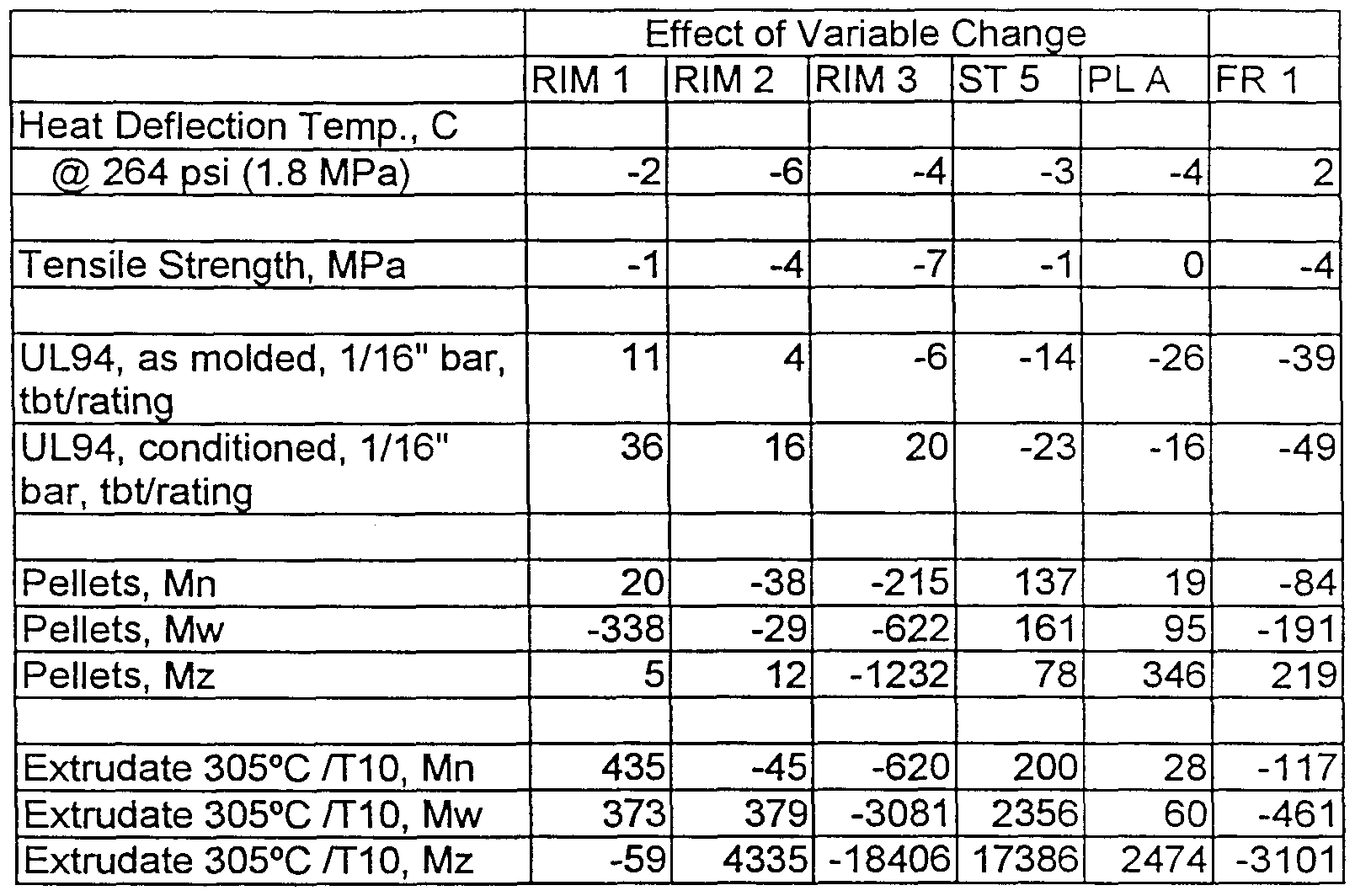
*T10 is 10 minutes
*tbt is total burn time in seconds
Tables 4a and 4b illustrates the fact that a) PL A has the least effect on physical properties of the above 3 variables b) Increasing ST5 from 0.5 to 1.0 % increases branching, as a catalyst would, rather than decreasing it as a stabilizer might be expected to do. c) All three variables improved FR performance, with PL A stronger than ST5 but weaker than the FR1 change.
EXAMPLE 5
Blends BB-CC in Table 5 are described as follows:
Blend BB is described as follows: 30.0% GF2 16.0% FR1
2.0% FRS2
4.0% PL B
3.0% ST 8
0.5%) polyethylene wax
0.25% ST4
0.25% ST5, and PCT in an amount sufficient for the composition to total 100 weight%
Blend CC is described as follows:
Same as Blend A except that ST5 is reduced to 0.0%
TABLE 5

*T10 is 10 minutes
Table 5 illustrates the fact that phosphite (ST5) increase from 0 to 0.25 in FR1/ST8 system improves properties while reducing branching.
EXAMPLE 6
Blends DD-EE in Table 6 are described as follows:
Blend DD is described as follows: 30.0% GF2 14.0% FR2
3.5% FRS1
3.75% PL B
0.5% polyethylene wax
0.5% ST 3
0.25% ST4
0.25% ST5, and PCT in an amount sufficient for the composition to total 100 weight%
Blend EE is described as follows:
Same as Blend DD except that ST 3 is reduced to 0.0%.
TABLE 6

*T10 is 10 minutes
*tbt is total burn time in seconds
Table 6 illustrates the fact that a phosphite (ST5) increase from 0 to
0.25 in FR2/ST3 system improves physical properties, reduces branching, and slightly increases burn time at 1/32" bar
The invention has been described in detail with particular reference to preferred embodiments thereof, but it will be understood that variations and modifications can be effected within the spirit and scope of the invention.
Claims
1. A polymer composition comprised of:
(A) a polyester comprising: (1 ) terephthalic acid in the amount of 85 to 100 mole % based on the mole percentages of the dicarboxylic acid component equaling a total of 100 mole %. (2) a glycol component comprising from about 60 to 100 mole % of an alcohol selected from the group consisting of butylene glycol, ethylene glycol and 1 ,4- cyclohexanedimethanol;
(B) one or more halogenated flame retardants;
(C) one or more pentaerythritol esters; and
(D) reinforcing fiber.
2. The composition of Claim 1 wherein said one of said dicarboxylic acids comprises terephthalic acid in an amount of 90 to 100 mole %.
3. The composition of Claim 1 wherein said acid component comprises repeat units of from 0 to 15 mole % or less of one or more other dicarboxylic acids.
4. The composition of Claim 3 wherein said one or more dicarboxylic acids is selected from cyclohexanedicarboxylic acid, isophthalic acid, 1 ,4-cyclohexanediacetic acid, diphenyl-4,4' -dicarboxylic acid, succinic acid, glutaric acid, adipic acid, azelaic acid, naphthalenedicarboxylic acid, or sebacic acid.
5. The composition of Claim 4 wherein said one or more dicarboxylic acid is selected from isophthalic acid, naphthalenedicarboxylic acid, cyclohexanedicarboxylic acid or naphthalene dicarboxylate.
6. The composition of Claim 5 wherein said one or more dicarboxylic acid is selected from isophthalic acid and naphthalenedicarboxylic acid.
7. The composition of Claim 6 wherein said dicarboxylic acid comprises isophthalic acid.
8. The composition of Claim 3 wherein said acid component comprises cyclohexanedicarboxylic acid.
9. The composition of Claim 6 wherein said acid component comprises naphthalenedicarboxylic acid.
10. The composition of Claim 1 wherein said glycol component comprises 80 to 100 mole % ethylene glycol.
11. The composition of Claim 10 wherein said glycol component comprises 90 to 100 mole % ethylene glycol.
12. The composition of Claim 10 wherein said glycol component comprises one or more other glycols selected from the group consisting of cycloaliphatic diols having 6 to 20 carbon atoms and aliphatic diols having 2 to 20 carbon atoms.
13. The composition of Claim 12 wherein said one or more other glycols is selected from the group consisting of diethylene glycol, triethylene
glycol, propane-1 ,3-diol, butane-1 ,4-diol, pentane-1 ,5-diol, hexane- 1 ,6-diol, 3-methylpentanediol-(2,4), 2-methylpentanediol-(1 ,4), 2,2,4- trimethylpentane-diol-(1 ,3), 2-ethylhexanediol-(1 ,3), 2,2- diethylpropane-diol-(1 ,3), hexanediol-(1 ,3), 1 ,4-di-(hydroxyethoxy)- benzene, 2,2-bis-(4-hydroxycyclohexyl)-propane,
2,4-dihydroxy-1 , 1 ,3,3-tetramethyl-cyclobutane, 2,2-bis-(3-hydroxy- ethoxyphenyi)-propane, decalin diol and 2,2-bis-(4-hydroxypropoxyphenyl)-propane.
14. The composition of Claim 13 wherein said one or more other glycols is selected from the group consisting of ethylene glycol, diethylene glycol, triethylene glycol, propanediol, butanediol, pentanediol, hexanediol, and tetramethylcyclobutaπediol.
15. The composition of Claim 1 wherein said glycol component comprises 80 to 100 mole % butylene glycol.
16. The composition of Claim 15 wherein said glycol component comprises 90 to 100 mole % butylene glycol.
17. The composition of Claim 15 wherein said glycol component comprises one or more other glycols selected from the group consisting of cycloaliphatic diols having 6 to 20 carbon atoms and aliphatic diols having 2 to 20 carbon atoms.
18. The composition of Claim 17 wherein said one or more other glycols is selected from the group consisting of ethylene glycol, diethylene glycol, triethylene glycol, propane-1 ,3-diol, butane-1 ,4-diol, pentane- 1 ,5-diol, hexane-1 ,6-diol, 3-methylpentanediol-(2,4), 2- methylpentanediol-(1 ,4), 2,2,4-trimethylpentane-diol-(1 ,3),
2-ethylhexanediol-(1 ,3), 2,2-diethylpropane-diol-(1 ,3), hexanediol- (1 ,3), 1 ,4-di-(hydroxyethoxy)-benzene, 2,2-bis-(4- hydroxycyclohexyl)-propane, 2,4-dihydroxy-1 ,1 ,3,3-tetramethyl- cyclobutane, 2,2-bis-(3-hydroxyethoxyphenyl)-propane, decalin diol and 2,2-bis-(4-hydroxypropoxyphenyl)-propane.
19. The composition of Claim 18 wherein said one or more other glycols is selected from the group consisting of ethylene glycol, diethylene glycol, triethylene glycol, propanediol, butanediol, pentanediol, hexanediol, and tetramethylcyclobutanediol.
20. The composition of Claim 1 wherein said glycol component comprises 80 to 100 mole % 1 ,4-cyclohexanedimethanol.
21. The composition of Claim 20 wherein said glycol component comprises 90 to 100 mole % 1 ,4-cyclohexanedimethanol.
22. The composition of Claim 20 wherein said glycol component comprises up to 20 mole % of one or more other aliphatic or alicydic glycols.
23. The composition of Claim 21 wherein said glycol component comprises up to 10 mole % of one or more other aliphatic or alicydic glycols.
24. The composition of Claim 22 wherein said one or more other glycols is selected from the group consisting of cycloaliphatic diols having 6 to 20 carbon atoms and aliphatic diols having 2 to 20 carbon atoms.
5. The composition of Claim 24 wherein said one or more other glycols is selected from the group consisting of diethylene glycol, triethylene glycol, propane-1 ,3-diol, butane-1 ,4-diol, pentane-1 ,5-diol, hexane- 1 ,6-diol, 3-methylpentanediol-(2,4), 2-methylpentanediol-(1 ,4), 2,2,4- trimethylpentane-diol-(1 ,3), 2-ethylhexanediol-(1 ,3), 2,2- diethylpropane-diol-(1 ,3), hexanediol-(1 ,3), 1 ,4-di-(hydroxyethoxy)- benzene, 2,2-bis-(4-hydroxycyclohexyl)-propane, 2,4-dihydroxy-1 ,1 ,3,3-tetramethyl-cyclobutane, 2,2-bis-(3-hydroxy- ethoxyphenyl)-propane, decalin dioi and 2,2-bis-(4-hydroxypropoxyphenyl)-propane.
26. The composition of Claim 25 wherein said one or more other glycols is selected from the group consisting of ethylene glycol, diethylene glycol, triethylene glycol, propanediol, butanediol, pentanediol, hexanediol, and tetramethylcyclobutanediol.
27. The composition of Claim 13 wherein said one or more other glycols comprises ethylene glycol in an amount less than 20 mole %.
28. The composition of Claim 27 wherein said one or more other glycols comprises ethylene glycol in an amount less than 10 mole %.
29. The composition of Claim 1 wherein said copolyester has a melting point of 260°C or more.
30. The composition of Claim 29 wherein said copolyester has a melting point of 270°C or more.
31. The composition of Claim 29 wherein said copolyester has a melting point of 260°C to 310°C.
32. The composition of Claim 1 wherein said polymer composition undergoes less than a 50% loss in number average molecular weight as determined by gel permeation chromatography when melt processed at about 25°C above the crystalline melting temperature for 10 minutes.
33. The composition of Claim 32 wherein said polymer composition undergoes less than a 25% loss in number average molecular weight as determined by gel permeation chromatography when melt processed at about 25°C above the crystalline melting temperature for 10 minutes.
34. The composition of Claim 1 comprising one or more additives selected from the group consisting of stabilizers, flame retardants, flame retardant synergists, tougheners, epoxy compounds, mold release agents, nucleating agents, reinforcing agents and branching agents.
35. The composition of Claim 1 wherein said halogenated flame retardants contain at least one imide group have a melting point above 240°C.
36. The composition of Claim 35 wherein said halogenated flame retardants at least one imide group have a melting point above 300°C.
37. The composition of Claim 36 wherein said organic compounds containing at least one imide group comprise N,N'- arylenediphthalimides wherein the arylene group includes phenylene, diphenylene, naphthylene and sulfone bridged
bisphenyls; tetrabrominated phthalimides;
N,N'bis(dibromocyclohexanedicarboxyimides) with bridging groups; and N,N'-alkylenebis(tetrahalophthalimides).
38. The composition of Claim 37 wherein said imide group containing compounds have the following formula:
wherein both n and m are either 1 or 0; X is selected from halogen, and hydrogen, but is halogen when R is alkyl, and


R is selected from the group consisting of one or more of a Ci to C6 alkyl group, a single bond, a phenylene group, a toluene group, a cyclohexylene group, a bis phenyl methane group, a bis cyclohexylmethane group, and a naphthylene group.
39. The composition of Claim 37 wherein said imide group containing compounds are N,N'-alkylenebis(tetrahalophthalimides) having the formula:

40. The composition of Claims 38 or 39 wherein said halogen atom is selected from the group consisting of chlorine and bromine.
41. The composition of Claim 40 wherein said halogen or halogen atom is bromine.
42. The composition of Claim 39 wherein R is ethyl.
43. The composition of Claim 39 wherein said imide group containing compounds are brominated phthalimides made from aromatic or aliphatic diamines and from tetrabromophthalic anhydride or tetrabromophthalic acid.
44. The composition of Claim 43 wherein said diamines are selected from the group consisting of ethylene diamine and hydrazine.
45. The composition of Claim 43 wherein said imide group containing compound is N, N'-ethylenebis(tetrabromophthalimide).
46. The composition of Claim 1 wherein said one or more pentaerythritol esters are mixed esters.
47. The composition of Claim 1 wherein said one or more pentaerythritol esters are selected from the group consisting of pentaerythritol monohexylester, pentaerythritol monooctylester, pentaerythritol monononylester, pentaerythritol monodecylester, pentaerythritol monododecylester, pentaerythritol monomyristylester, pentaerythritol
monohexadecylester, pentaerythritol monostearylester, pentaerythritol monooleylester, pentaerythritol monoisostearyl- and - isopalmitiacid ester; dihexyl-, dioctyl-, dinonyl-, didecyl-, didodecyl-, dimyristyl-, dihexadecyl-, distearyl-, dioleyl-, diisostearyl- and diisopalmitic acid esters of the pentaerythritol; trihexyl-, trioctyl-, trinonyl-, tridecyl-, tridodecyl-, trimyristyl-, trihexadecyl-, tristearyl-, trioleyl-, triisostearyl- and triisopalmitic acid esters of pentaerythritol; tetrahexyl-, tetraoctyl-, tetranonyl- tetradecyl-, tetradodecyl, tetramyristyl-, tetrahexadexyl-, tetrastearyl-, tetraoleyl-, tetraisostearyl- and tetraisopalmitic acid esters of pentaerythritol.
48. The composition of Claim 1 wherein said pentaerythritol is present in the amount of 0 to 10 weight % based on the total weight of the composition.
49. The composition of Claim 1 wherein said pentaerythritol is present in the amount of 1 to 5 weight % based on the total weight of the composition.
50. The composition of Claim 1 wherein said pentaerythritol ester is selected from the group consisting of aromatic esters and benzoate esters.
51. The composition of Claim 50 wherein said pentaerythritol ester is an aromatic ester.
52. The composition of Claim 50 wherein said pentaerythritol ester is a benzoate ester.
53. The composition of Claim 48 wherein said imide group containing compound is N, N'-ethylenebis(tetrabromophthalimide).
54. The composition of Claim 1 wherein comprising sodium antimonate that is substantially free of Sb+3.
55. The composition of Claim 53 wherein comprising sodium antimonate that contains less than 1 mole percent of Sb+3 based on the total mole % of antimony present in the sodium antimonate.
56. The composition of Claim 1 wherein further comprising sodium antimonate the amount of halogenated imide and sodium antimonate in the composition results in a weight ratio of 5:1 to 10:1.
57. The composition of Claim 56 wherein the amount of brominated phthalimide(s) and sodium antimonate present in said composition results in a weight ratio of 8:1 of brominated phthalimide(s):sodium antimonate.
58. The composition of Claim 1 wherein no phosphorous based compound is present.
59. The composition of Claim 1 additionally comprising one or more phosphorous based compounds.
60. The composition of Claim 59 wherein said phosphorous based compound is present in the amount of greater than 0.5 % by weight based on the total weight of the composition.
61 . The composition of Claim 60 wherein said phosphorous based compounds are selected from the group consisting of phosphites and phosphoπites.
62. The composition of Claim 61 wherein said phosphorous based compounds are one or more phosphites.
63. The composition of Claim 62 wherein said one or more phosphites is bis(2,4-di-t-butylphenyl)pentaerythritol diphosphite.
64. The polyester composition of Claim 62 further comprising an amount equal to or greater than 0.75% by weight of a phosphite compound based on the total weight of the composition.
65. A polyester composition comprised of:
(A) a polyester comprising:
(1 ) terephthalic acid in the amount of from about 85 to 100 mole %, based on the mole percentages of the dicarboxylic acid component equaling a total of 100 mole %,
(2) 1 ,4-cyclohexanedimethanol in the amount of from about 60 to 100 mole %, based on the mole percentages of the glycol component equaling a total of 100 mole %, (B) one or more brominated phthalimides,
(C) one or more benzoate esters of pentaerythritol; and
(D) reinforcing fiber.
66. The polyester composition of Claim 65 wherein said brominated phthalimide is N,N'-ethylenebis(tetrabromophthalimide).
67. The composition of Claim 1 comprising reinforcing agents selected from the group consisting of mica, clay, talc, wollastonite, and calcium carbonate.
68. The polyester composition of Claim 1 wherein said reinforcing fiber is selected from the group consisting of carbon fibers and glass fibers.
69. The composition of Claim 1 wherein said reinforcing fiber is glass fiber.
70. The composition of Claim 69 wherein said glass fibers are present at from 0.1 to 45% by weight based on the total weight of the polymer composition.
71. The composition of Claim 69 wherein said glass fibers are chopped glass strands having a length of from about 1/8 inch to about 2 inches.
72. The composition of Claim 71 wherein said glass fibers are chopped glass strands having a length of from about 1/8 inch to about 1/4 inch.
73. The composition of Claim 69 wherein said glass fibers are coated with polyurethane.
Applications Claiming Priority (4)
| Application Number | Priority Date | Filing Date | Title |
|---|---|---|---|
| US15572699P | 1999-09-23 | 1999-09-23 | |
| US60/155,726 | 1999-09-23 | ||
| US45095399A | 1999-11-30 | 1999-11-30 | |
| US09/450,953 | 1999-11-30 |
Publications (1)
| Publication Number | Publication Date |
|---|---|
| WO2001021701A1 true WO2001021701A1 (en) | 2001-03-29 |
Family
ID=26852565
Family Applications (1)
| Application Number | Title | Priority Date | Filing Date |
|---|---|---|---|
| PCT/US2000/024377 Ceased WO2001021701A1 (en) | 1999-09-23 | 2000-09-05 | Improved polyester formulations containing halogenated imide(s), pentaerythritol ester(s) and reinforcing fiber |
Country Status (1)
| Country | Link |
|---|---|
| WO (1) | WO2001021701A1 (en) |
Cited By (1)
| Publication number | Priority date | Publication date | Assignee | Title |
|---|---|---|---|---|
| CN110945046A (en) * | 2017-07-05 | 2020-03-31 | 巴斯夫欧洲公司 | TPU pipe |
Citations (3)
| Publication number | Priority date | Publication date | Assignee | Title |
|---|---|---|---|---|
| EP0604078A1 (en) * | 1992-12-22 | 1994-06-29 | General Electric Company | Glass filled flame retardant polyester compositions with improved color |
| EP0736571A1 (en) * | 1995-04-03 | 1996-10-09 | Basf Aktiengesellschaft | Flame-resistant thermoplastic moulding compositions |
| EP0796743A1 (en) * | 1996-03-20 | 1997-09-24 | General Electric Company | Flame retardant composition for laser marking |
-
2000
- 2000-09-05 WO PCT/US2000/024377 patent/WO2001021701A1/en not_active Ceased
Patent Citations (3)
| Publication number | Priority date | Publication date | Assignee | Title |
|---|---|---|---|---|
| EP0604078A1 (en) * | 1992-12-22 | 1994-06-29 | General Electric Company | Glass filled flame retardant polyester compositions with improved color |
| EP0736571A1 (en) * | 1995-04-03 | 1996-10-09 | Basf Aktiengesellschaft | Flame-resistant thermoplastic moulding compositions |
| EP0796743A1 (en) * | 1996-03-20 | 1997-09-24 | General Electric Company | Flame retardant composition for laser marking |
Cited By (1)
| Publication number | Priority date | Publication date | Assignee | Title |
|---|---|---|---|---|
| CN110945046A (en) * | 2017-07-05 | 2020-03-31 | 巴斯夫欧洲公司 | TPU pipe |
Similar Documents
| Publication | Publication Date | Title |
|---|---|---|
| US6277905B1 (en) | Process for improving the toughness of PCT formulations by adding rubber impact modifiers | |
| EP1697451B1 (en) | Flame-retardant polyester composition | |
| US4035333A (en) | Flame-resistant resin composition | |
| JP4150666B2 (en) | Flame-retardant polyester composition, method for producing the same, and article obtained from the composition | |
| EP0497818B1 (en) | Poly(1,4-cyclohexylenedimethylene terephthalate) with improved melt stability | |
| JPS5930184B2 (en) | Flame retardant polyester composition | |
| JPH0424383B2 (en) | ||
| WO2001027200A2 (en) | Reinforced pct formulations containing halogenated imides and impact modifiers | |
| WO2001021701A1 (en) | Improved polyester formulations containing halogenated imide(s), pentaerythritol ester(s) and reinforcing fiber | |
| WO2001021703A1 (en) | Process for improving flammability characteristics of polyester formulations by adding pentaerythritol ester(s) | |
| JP2675578B2 (en) | Styrenic resin composition with excellent flame retardancy | |
| WO2001021704A1 (en) | Process for improving the oven aging stability of pct formulations by addition of phenoxy compound(s) | |
| JP2002532604A (en) | Extrudable masterbatch | |
| WO2001021702A1 (en) | Improved pct formulations containing halogenated imides, phenoxy compound(s) and reinforcing fibers | |
| JP2003511504A (en) | Improved PCT formulations containing halogenated imides, sodium antimonate and reinforcing fibers | |
| JP3000589B2 (en) | Polyester resin composition | |
| WO2001021700A1 (en) | Process for improving the melt stability of halogenated imides in pct formulations by addition of sodium antimonate | |
| JPH0627246B2 (en) | Flame-retardant aromatic polyester resin composition | |
| JP3310153B2 (en) | Flame retardant polyester resin composition with improved melt stability | |
| JPH1149939A (en) | Thermoplastic polyester resin composition | |
| JPH05214227A (en) | Polyethylene terephthalate resin composition | |
| JPS62151451A (en) | polyester composition | |
| JPH07157640A (en) | Polyester composition | |
| JPS59142246A (en) | Flame retardant polyester resin composition | |
| JPS6047058A (en) | Polyester resin composition |
Legal Events
| Date | Code | Title | Description |
|---|---|---|---|
| AK | Designated states |
Kind code of ref document: A1 Designated state(s): BR CN JP MX |
|
| AL | Designated countries for regional patents |
Kind code of ref document: A1 Designated state(s): AT BE CH CY DE DK ES FI FR GB GR IE IT LU MC NL PT SE |
|
| 121 | Ep: the epo has been informed by wipo that ep was designated in this application | ||
| DFPE | Request for preliminary examination filed prior to expiration of 19th month from priority date (pct application filed before 20040101) | ||
| 122 | Ep: pct application non-entry in european phase | ||
| NENP | Non-entry into the national phase |
Ref country code: JP |