POLYPEPTIDES THAT BIND HIV gpl20 AND RELATED NUCLEIC ACIDS, ANTIBODIES, COMPOSITIONS, AND METHODS OP USE
TECHNICAL FIELD OF THE INVENTION The present invention relates to polypeptides with homology to regions of domains of the human chemokine receptors CCR5, CXCR4, and STRL33, as well as domains of CD4 that bind with human immunodeficiency virus (HIV) , • in particular HIV-1 glycoprotein 120 (gpl20) envelope protein. The present invention also relates to nucleic acids encoding such polypeptides, antibodies, compositions comprising such polypeptides, nucleic acids or antibodies, and methods of using the same.
BACKGROUND OF THE INVENTION
There are seven transmembrane chemokine receptors that act as cofactors for HIV infection. The cof ctors enable entry of HIV-1 into CD4* T cells and macrophages (Premack et al., Nature Medicine 2: 1174-78 (1996); and Zhang et al., Nature 383 : 768 (1996)).
The presence of chemokines has an inhibitory effect on HIV-1 attachment to, and infection of, susceptible cells. Additionally, some mutations in chemokine receptors have been shown to result in resistance to HIV-1 infection. For example, a 32-nucleotide deletion within the CCR5 gene has been described in subjects who remained uninfected despite repeated exposures to HIV-1 (Huang et al., Nature Medicine 2: 1240-43 (1996)).
Evidence also exists for the physical association of a ternary complex between chemokine receptors, CD4, and HIV-1 gpl20 envelope glycoprotein on cell membranes
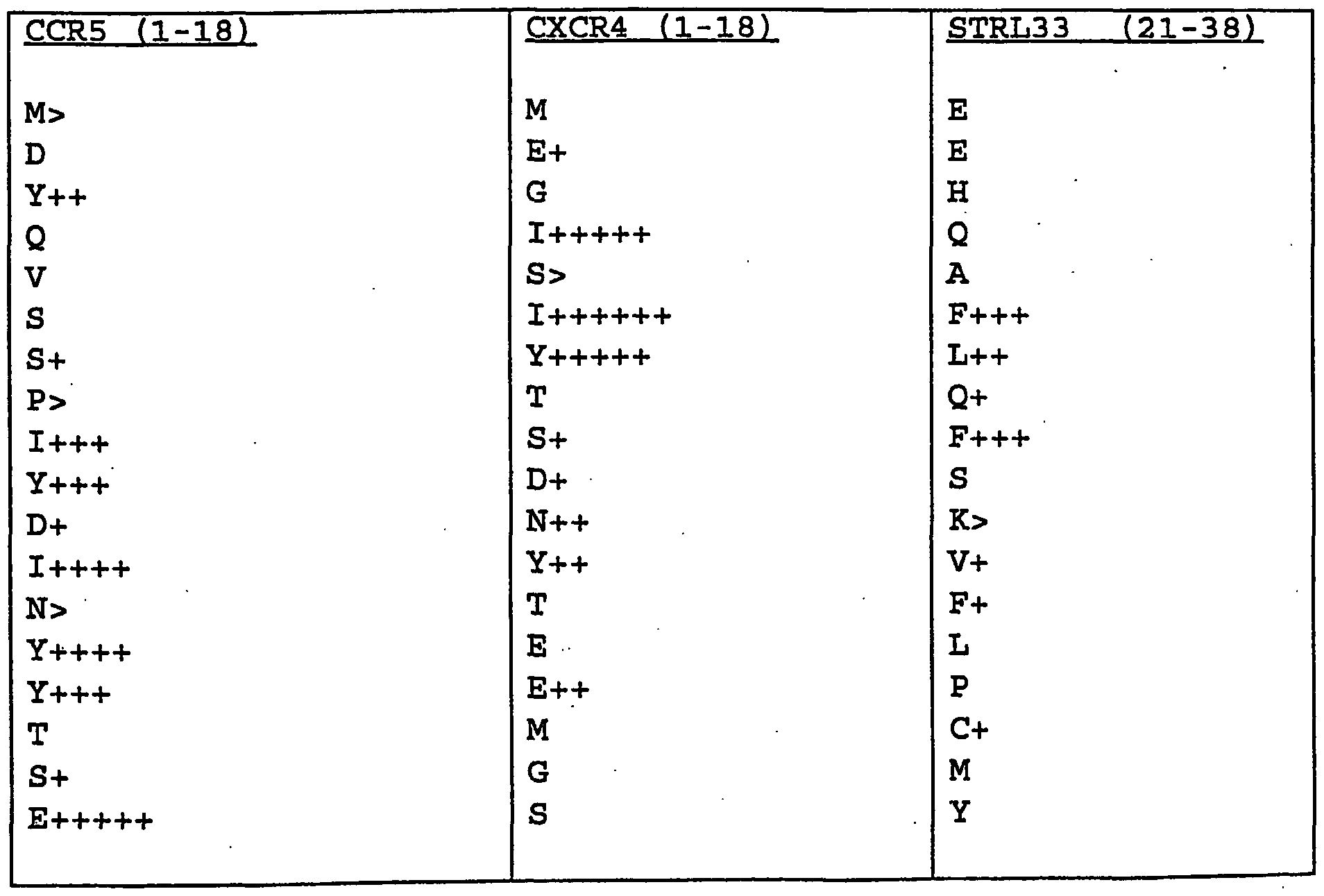
(Lapham et al., Science 274: 602-05 (1996)). Receptor signaling and cell activation are probably not required for the anti-HIV-1 effect of chemokines since a RANTES analog lacking the first eight amino-terminal amino acids, RANTES (9-68), lacked chemotactiσ and leukocyte- activating properties, but bound to multiple chemokine receptors and inhibited infection by macrophage-tropic HIV-1 (Arenzana-Seladedos et al., Nature 383: 400 (1996)). Cumulatively, the above described results suggest that the interaction between gpl20, CD4, and at least one chemokine receptor is obligatory for HIV-1 infection. Accordingly, reagents that interfere with the binding of gpl20 to chemokine receptors and to CD4 are used in the biological and medical arts. However, there presently exists a need for additional reagents that can compete with one or more proteins of the gpl20-CD4-chemokine receptor complex to assist in basic biological or viral research, and to assist in medical intervention in the HIV-1 pandemic. It is an object of the present invention to provide such reagents. This and other objects and advantages, including additional inventive features, will be apparent from the description provided herein.
BRIEF SUMMARY OF THE INVENTION
The present invention provides a polypeptide that binds with HIV gpl20 under physiological conditions. Multiple embodiments of the present inventive polypeptide are provided, and each embodiment possesses a degree of homology to at least one of the human CCR5, CXCR4 and
STRL33 chemokine receptors, and the human CD4 cell- surface protein.
In a first embodiment, the present invention provides a polypeptide comprising the amino acid sequence YDIXYYXXE, wherein X is any synthetic or naturally occurring amino acid residue, and the polypeptide comprises less than about 100 contiguous amino acids that are identical to, or, in the alternative, substantially identical to, the amino acid sequence of the human CCR5 chemokine receptor. A preferred polypeptide of this first embodiment comprises the amino acid sequence YDIN*YYT*S*E. A more preferred polypeptide of this first embodiment comprises the amino acid sequence YDINYYTSE, wherein each letter is the standard one-letter abbreviation for an amino acid residue (i.e., for example, N denotes asparaginyl, T denotyes threoninyl, and S denotes serinyl) . The polypeptide of the first embodiment can comprise the amino acid sequence M*D*YQ*V*S*SP*IYDIN*YYT*S*E. Preferably, the polypeptide comprises the amino acid sequence MDYQVSSPIYDINYYTSE. In a second embodiment, the present invention provides a polypeptide comprising the amino acid sequence XEXIXIYXXXNYXXX, wherein X is any synthetic or naturally occurring amino acid and wherein said polypeptide comprises less than about 100 contiguous amino acid that are identical to or substantially identical to the amino acid sequence of the human CXCR4 chemokine receptor. The polypeptide can consist essentially of, or consist of, the sequence EXIXIYXXXNY. Preferably, the polypeptide comprises the sequence M*EG*IS*IYT*S*D*NYT*E*E*.
Preferably, M*EG*IS*IYT*S*D*NYT*E*E* is M*EGISIYTSDNYT*E*E* .
In a third embodiment, the present invention provides a polypeptide comprising the amino acid sequence EHQAFLQFS, wherein said polypeptide comprises less than about 100 contiguous amino acids that are identical to or substantially identical to the amino acid sequence of the human STRL33 chemokine receptor. The polypeptide can consist essentially of, or consist of, the sequence EHQAFLQFS.
In a fourth embodiment, the present invention provides a polypeptide comprising at least a portion of an amino acid sequence selected from the group consisting of LPPLYSLVFIFGFVGNML, QWDFGNTMCQLLTGLYFIGFFS, SQYQFWKNFQTLKIVILG, APYNIVLLLNTFQEFFGLNNCS, and
YAFVGEKFRNYLLVFFQK, wherein said polypeptide comprises less than about 100 contiguous amino acids that are identical to or substantially identical to the amino acid sequence of the human CCR5 chemokine receptor. In a fifth embodiment, the present invention provides a polypeptide comprising at least a portion of an amino acid sequence selected from the group consisting of LL TIPDFIFANVSEADD, WFQFQHIMVGLILPGIV, and IDSFILLEIIKQGCEFEN, wherein said polypeptide comprises less than about 100 contiguous amino acids that are identical to or substantially identical to the amino acid sequence of the human CXCR4 chemokine receptor.
In a sixth embodiment, the present invention provides a polypeptide comprising at least a portion of an amino acid sequence selected from the group consisting of LVISIFYHKLQSLTDVFL, PFAYAGIHE VFGQVMC,
EAISTWLATQMTLGFFL, LTMIVCYSVIIKTLLHAG, MAVFLLTQMPFNLMKFIRSTHW, HWEYYAMTSFHYTIMVTE, ACLNPVLYAFVSLKFRKN and SKTFSASHNVEATSMFQL, wherein said polypeptide comprises less than about 100 contiguous amino acids that are identical to or substantially identical to the amino acid sequence of the human STRL33 chemokine receptor.
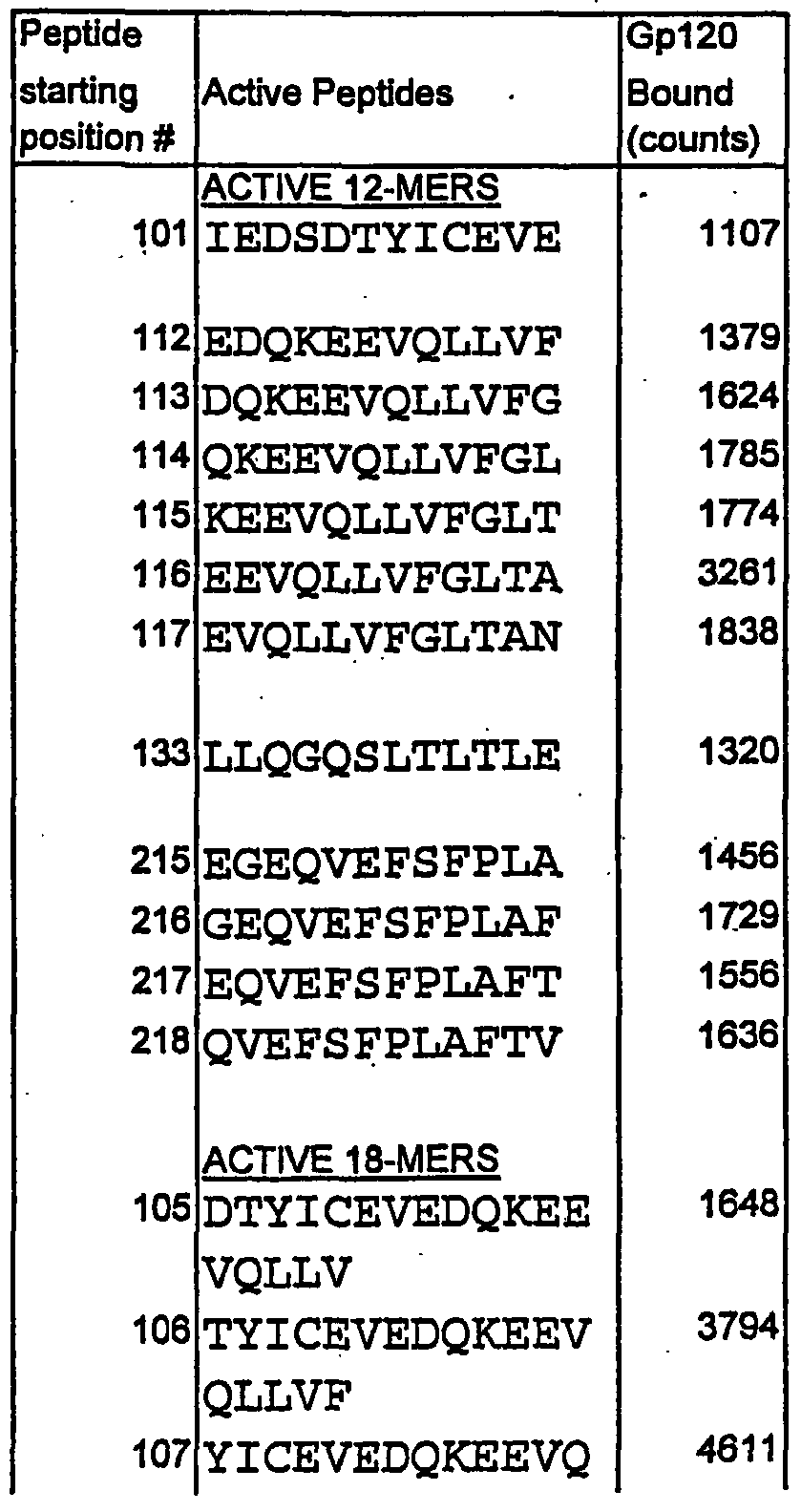
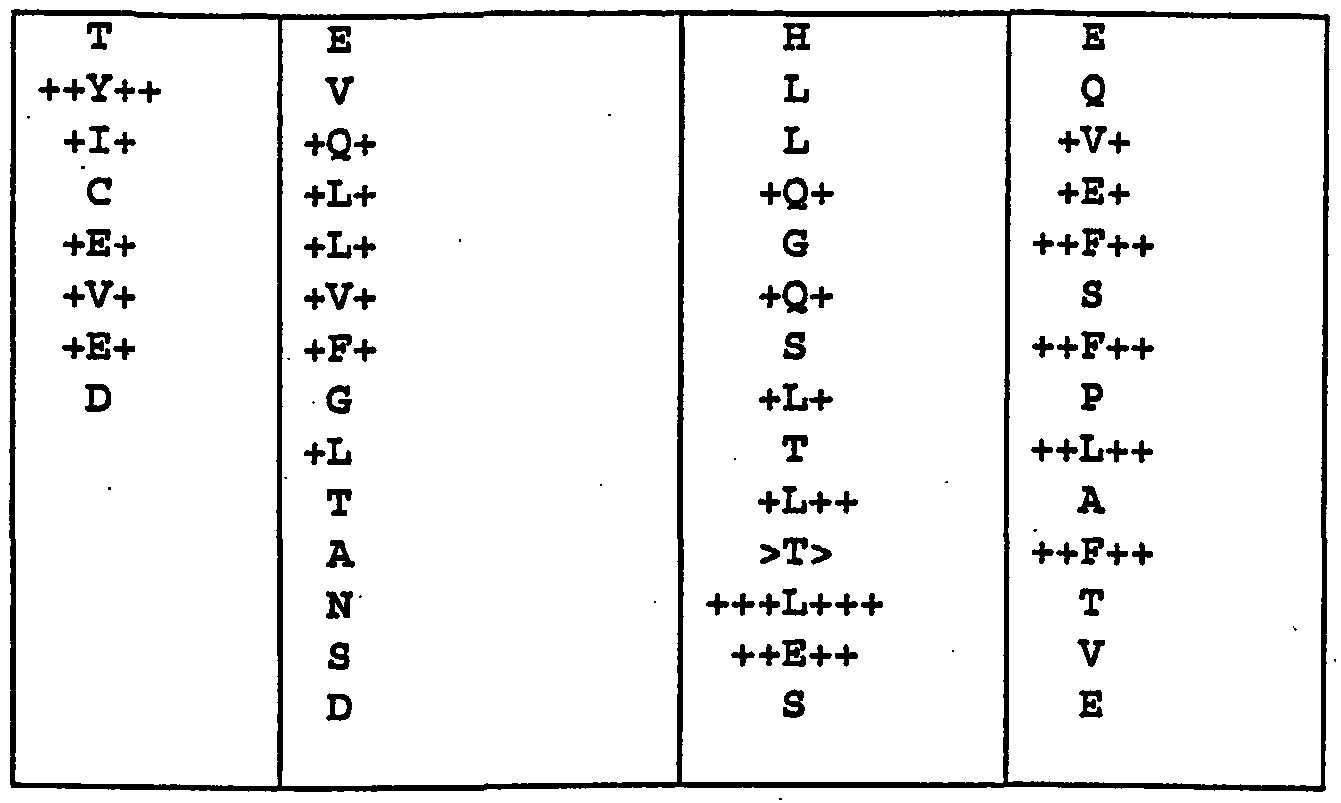
In a seventh embodiment, the present invention provides a polypeptide comprising at least a portion of an amino acid sequence selected from the group consisting of DTYICEVED, EEVQLLVFGLTANSD, THLLQGQSLTLTLES, and GEQVEFSFPLAFTVE, wherein said polypeptide comprises less than about 100 contiguous amino acids that are identical to or substantially identical to the amino acid sequence of the human CD4 cell-surface protein.
In the fourth to seventh embodiments, any selected portion of the polypeptide can comprise from 1 to about 6 conservative amino acid substitutions. In an alternative, the polypeptide can be partially defined by an absence of a polypeptide sequence, outside the region of the portion selected from the foregoing sequences, that has five, or ten, contiguous amino acid residues that have a sequence that consists of an amino acid sequence that is identical to or substantially identical to the protein to which the polypeptide has homology (i.e., CCR5, CXCR4, STRL33, or CD4) . In yet another alternative, the polypeptide can lack a sequence of five or ten contiguous amino acids which are identical to or substantially identical to the sequence of the protein with which the sequence has homology except that one or more conservatively or neutrally substituted amino acids
replace part of the sequence of the protein to which the polypeptide has homology. Additionally, any embodiment of the present inventive polypeptide can also comprise a pharmaceutically acceptable substituent. Any embodiment of the present inventive polypeptide can be incorporated into a composition, which further comprises a carrier. Any suitable embodiment of the present inventive polypeptide can be encoded by a nucleic acid that can be expressed in a cell. In this regard, the present invention further provides a vector comprising such a nucleic acid. The nucleic acids and vectors also can be incorporated into a composition comprising a carrier.
Additionally, the present invention provides a method of making an antibody to a polypeptide of the present invention. The present invention also provides a method of prophylactically or therapeutically treating an HIV infection in a mammal.
Additionally, the present invention provides an anti-idiotypic antibody comprising an internal image of a portion of gpl20, as well as a method of selecting such an antibody.
The present invention also provides a method of making an antibody to a portion of the gpl20 protein that binds with a portion of CCR5, CXCR4, STRL33, or CD4, as well as the immunizing compound used to make the antibody, and the antibody itself. In another embodiment of the present invention, a method of removing HIV-1 from a bodily fluid is provided.
BRIEF DESCRIPTION OF THE DRAWINGS Figure 1 depicts a listing of synthetic amino acids available (from Bachem, King of Prussia, PA) for incorporation into polypeptides of the present invention.
DETAILED DESCRIPTION OF THE INVENTION The present invention provides a polypeptide that binds with gpl20 of HIV, in particular HIV-1, more particularly HIV-l^, under physiological conditions. The polypeptide has a number of uses including, but not limited to, the use of the polypeptide to elucidate the mechanism by which HIV, such as HIV-1, attaches to and/br infects a particular cell, to induce an immune response in a mammal, in particular a human, to HIV, in particular HIV-1, and to inhibit the replication of HIV, in particular HIV-1, in an infected mammal, in particular a human.
Multiple embodiments of the present inventive polypeptide are provided. Each embodiment of the polypeptide has a degree of homology to at least one of the human CCR5, CXCR4. and STRL33 chemokine receptors, or the human CD4 cell-surface protein. In each embodiment provided herein, a letter indicates the standard amino acid designated by that letter, and a letter followed directly by an asterisk (*) preferably represents the amino acid represented by the letter (e.g., N represents asparaginyl and T represents threoninyl) , or a synthetic or naturally occurring conservative or neutral substitution therefor. Additionally, in accordance with convention, all amino acid sequences provided herein are given either from left to right, or top to bottom, such
that the first amino acid is amino-terminal and the last is carboxyl-terminal. The synthesis of polypeptides, either synthetically (i.e., chemically) or biologically, is within the skill in the art. It is within the skill of the ordinary artisan to select synthetic and naturally occurring amino acids that make conservative or neutral substitutions for any particular naturally occurring amino acids. The skilled artisan desirably will consider the context in which any particular amino acid substitution is made, in addition to considering the hydrophobicity or polarity of the side-chain, the general size of the side chain, and the pK value of side-chains with acidic or basic character under physiological conditions. For example, lysine, arginine, and histidine are often suitably substituted for each other, and more often arginine and lysine. As is known in the art, this is because all three amino acids have basic side chains, whereas the pK value for the side-chains of lysine and arginine are much closer to each other (about 10 and 12) than to histidine (about 6) . Similarly, glycine, alanine, valine, leucine, and isoleucine are often suitably substituted for each other, with the proviso that glycine is frequently not suitably substituted for the other members of the group. This is because each of these amino acids are relatively hydrophobic when incorporated into a polypeptide, but glycine 's lack of an α-carbon allows the phi and psi angles of rotation (around the α-carbon) so much conformational freedom that glycinyl residues can trigger changes in conformation or secondary structure that do not often occur when the other amino acids are
substituted for each other. Other groups of amino acids frequently suitably substituted for each other include, but are not limited to, the group consisting of glutamic and aspartic acids; the group consisting of phenylalanine, tyrosine and tryptophan; and the group consisting of serine, threonine and, optionally, tyrosine. Additionally, the skilled artisan can readily group synthetic amino acids with naturally occurring amino acids. In the context of the present invention, a polypeptide is "substantially identical" to another polypeptide if it comprises at least about 80% identical amino acids. Desirably, at least about 50% of the non-identical amino acids are conservative or neutral substitutions. Also, desirably, the polypeptides differ in length (i.e., due to deletion mutations) by no more than about 10%.
In a first embodiment, the present invention provides a polypeptide comprising the amino acid sequence YDIXYYXXE, wherein X is any synthetic or naturally occurring amino acid residue, and the polypeptide comprises less than about 100 contiguous amino acids, preferably less than about 50 amino acids, more preferably less than about 25 amino acids, and yet more preferably less than about 13 amino acids that are identical to, or, in the alternative, substantially identical to, the amino acid sequence of the human CCR5 chemokine receptor.
Preferably, the polypeptide of the first embodiment comprises YDIXYYXXE, wherein the amino moiety of the amino-terminal tyrosinyl residue is not bound to another
amino acid residue via a peptidic bond, and the carboxyl moiety of the glutamyl residue is not bound to another amino acid residue via a peptidic bond. However, the polypeptide can consist essentially of YDIXYYXXE and, optionally, can be modified by one or more pharmaceutically acceptable substituents, such as, for example, t-boc or a saccharide.
More particularly, the polypeptide comprises the amino acid sequence YDIN*YYT*S*E. Preferably, N* is asparaginyl, T* is threoninyl, and S* is serinyl.
The polypeptide of the first embodiment can comprise a dodecapeptide selected from the amino acid sequence M*D*YQ*V*S*SP*IYDIN*YYT*S*E. More preferably, the polypeptide of the first embodiment comprises the amino acid sequence MDYQVSSPIYDINYYTSE.
In a second embodiment, the present invention provides a polypeptide comprising the amino acid sequence XEXIXIYXXXNYXXX/ wherein X is any synthetic or naturally occurring amino acid, and the polypeptide comprises less than about 100 contiguous amino acids,, preferably less than about 50 amino acids, and more preferably less than about 25 amino acids, that are identical to or substantially identical to the amino acid sequence of the human CXCR4 chemokine receptor. Optionally, the polypeptide consists essentially of, or consists of, the sequence EXIXIYXXXNY.
In a preferred polypeptide of this second embodiment, the polypeptide comprises the amino acid sequence M*EG*IS*IYT*S*D*NYT*E*E*. Preferably, M*EG*IS*IYT*S*D*NYT*E*E* is M*EGISIYTSDNYT*E*E* .
In a third embodiment, the present invention provides a polypeptide comprising the amino acid sequence EHQAFLQFS, wherein the polypeptide comprises less than about 100 contiguous amino acid residues, preferably less than about 50 contiguous amino acid residues, more preferably less than about 25 contiguous amino acid residues, that are identical to or substantially identical to the amino acid sequence of the human STRL33 chemokine receptor. The polypeptide can consist essentially of, or consist of, the sequence EHQAFLQFS.
The first three embodiments of the present invention provide, among other things, polypeptides having substantial identity or identity to the amino-terminal regions of the chemokine receptors CCR5, CXCR4, and STRL33. These first three embodiments form a first group of embodiments of the present invention. The present invention also provides, in a second group of embodiments, polypeptides having substantial identity or identity to an internal region of the human chemokine receptors CCR5, CXCR4, and STRL33, as well as to the leukocyte cell-surface protein CD4.
This second group of embodiments provides a polypeptide that binds with HIV gpl20 under physiological conditions and comprises at least a portion of or .all of an amino acid sequence selected from the group consisting of LPPLYSLVFIFGFVGNML, QWDFGNTMCQLLTGLYFIGFFS, SQYQFWKNFQTLKIVILG, APYNIVLLLNTFQEFFGLNNCS, and YAFVGEKFRNYLLVFFQK, wherein the polypeptide comprises less than about 100 amino acids that are identical to or substantially identical to the amino acid sequence of the human CCR5 chemokine receptor; or selected from the group
consisting of LLLTIPDFIFANVSEADD (165-182) , WFQFQHIMVGLILPGIV (197-214) , and IDSFILLEIIKQGCEFEN (261-278) , wherein the polypeptide comprises less than about 100 amino acids that are identical to or substantially identical to the amino acid sequence of the human CXCR4 chemokine receptor; or selected from the group consisting of LVISIFYHKLQSLTDVFL (53-70), PFWAYAGIHEWVFGQVMC (85-102), EAISTWLATQMTLGFFL (185-202) , LTMIVCYSVIIKTLLHAG (205- 222) , MAVFLLTQMPFNLMKFIRSTHW (237-258) ,
HWEYYAMTSFHYTIMVTE (257-274) , ACLNPVLYAFVSLKFRKN (281- 298) and SKTFSASHNVEATSMFQL (325-342) , wherein the polypeptide comprises less than about 100 amino acids that are identical to a substantially identical to the amino acid sequence of the human STRL33 chemokine receptor; or selected from the group consisting of DTYICEVED, EEVQLLVFGLTANSD, THLLQGQSLTLTLES, and GEQVEFSFPLAFTVE, wherein the polypeptide binds with HIV gpl20 under physiological conditions and comprises less than about 100 amino acids that are identical to or substantially identical to the amino acid sequence of the human CD4 cell-surface protein. Optionally, the recited amino acid sequences can comprise 1 to about 6 conservative or neutral amino acid substitutions.
The polypeptides of this second group of embodiments preferably comprise less than about 50 amino acid residues, and more preferably less than about 25 amino acid residues, and yet more preferably no additional amino acid residues, that are identical to a protein that naturally has the recited amino acid sequence. The
polypeptide can be alternatively characterized by an absence of a region, outside the above-recited amino acid sequences, that has about five, or about ten, contiguous amino acid residues that have a sequence that consists of an amino identical and conservatively substituted residues as an amino acid sequence of the protein to which the polypeptide of the compound has homology.
Any embodiment of the present inventive polypeptide can also comprise a pharmaceutically acceptable substituent, attachment of which is within the skill in the art. The pharmaceutically acceptability of substituents are understood by those skilled in the art. For example, a pharmaceutically acceptable substituent can be a biopolymer, such as a polypeptide, an RNA, a DNA, or a polysaccharide. Suitable polypeptides comprise fusion proteins, an antibody or fragment thereof, a cell adhesion molecule or a fragment thereof, or a peptide hormone. Suitable polysaccharides comprise polyglucose moieties, such as starch and their derivatives, such as heparin. The pharmaceutically acceptable substituent also can be any suitable lipid or lipid-containing moiety, such as a lipid of a liposome or a vesicle, or even a lipophilic moiety, such as a prostaglandin, a steroid hormone, or a derivative thereof. Additionally, the pharmaceutically acceptable substituent can be a nucleotide or nucleoside, such as nicotine adenine dinucleotide or thymine, an amino acid residue, a saccharide or disaccharide, or the residue of another biomolecule naturally occurring in a cell, such as inositol, a vitamin, such as vitamin C, thiamine, or nicotinic acid. Synthetic organic moieties also can be
pharmaceutically acceptable substituents, such as t-butyl carbonyl, an acetyl moiety, quinine, polystyrene and other biologically acceptable polymers. Optionally, a pharmaceutically acceptable substituent can be selected from the group consisting of a CJ-CJ,, alkyl, a C2-C18 alkenyl, a Ca-Cιa alkynyl, a C3-Clβ aryl, a C7-Clβ alkaryl, a C7-C18 aralkyl, and a C3-Clβ cycloalkyl, wherein any of the foregoing moieties that are cyclic comprise from 0 to 2 atoms per carbocydic ring, which can be the same or different, and are selected from the group consisting of nitrogen, oxygen, and sulfur.
Any of the substituents from this group can be substituted by one to six substituent moieties, which can be the same or different, selected from the group consisting of an amino moiety, a carbamate moiety, a carbonate moiety, hydroxyl, a phosphamate moiety, a phosphate moiety, a phosphonate moiety, a pyrophosphate moiety, a triphosphate moiety, a sulfamate moiety, a sulfate moiety, a sulfonate moiety, a C
1-C
8 monoalkylamine moiety, a
dialkylamine moiety, and a C
x-C
a trialkylamine moiety.
Any embodiment of the present inventive polypeptide can be encoded by a nucleic acid and can be expressed in a cell. The skilled artisan will recognize that the encoded polypeptide as well as any pharmaceutically acceptable substituent to be incorporated into the polypeptide, e.g., a formyl or acetyl substituent on an amino-terminal methionine or a saccharide, will preferably be produced by a cell that can express the polypeptide of the present invention. Accordingly, the
amino acids incorporated into the polypeptide encoded by the nucleic acid are preferably naturally occurring.
A nucleic acid as described above can be cloned into any suitable vector and can be used to transduce, transform, or transfect any suitable host. The selection of vectors and methods to construct them are commonly known to persons of ordinary skill in the art and are described in general technical references (see, in general, "Recombinant DNA Part D," Methods in Enzymology, Vol. 153, Wu and Grossman, eds., Academic Press (1987)). Desirably, the vector comprises regulatory sequences, such as transcription and translation initiation and termination codons, which are specific to the type of host (e.g., bacterium, fungus, plant, or animal) into which the vector is to be inserted, as appropriate and taking into consideration whether the vector is DNA or RNA. Preferably, the vector comprises regulatory sequences that are specific to the genus of the host. Most preferably, the vector comprises regulatory sequences that are specific to the species of the host and is optimized for the expression of an above-described polypeptide.
Constructs of vectors, which are circular or linear, can be prepared to contain an entire nucleic acid sequence as described above or a portion thereof ligated to a replication system that is functional in a prokaryotic or eukaryotic host cell. Replication systems can be derived from ColEl, 2 mμ plasmid, λ, SV40, bovine papilloma virus, and the like. Suitable vectors include those designed for propagation and expansion, or for expression, or both. A
preferred cloning vector is selected from the group consisting of the pUC series, the pBluescript series (Stratagene, LaJolla, CA) , the pET series (Novagen, Madison, WI) , the pGEX series (Pharmacia Biotech, Uppsala, Sweden) , and the pEX series (Clonetech, Palo
Alto, CA) . Examples of animal expression vectors include pEUK-Cl, pMAM and pMAMneo (Clonetech, Palo Alto, CA) .
An expression vector can comprise a native or normative promoter operably linked to a nucleic acid molecule encoding an above-described polypeptide. The selection of promoters, e.g., strong, weak, inducible, tissue-specific and developmental-specific, is within the skill in the art. Similarly, the combining of a nucleic acid molecule as described above with a promoter is also within the skill in the art.
The skilled artisan will also recognize that the polypeptide has ability to bind th gpl20 protein, which is most often found outside of cells. Accordingly, the present inventive nucleic acid advantageously can comprise a nucleic acid sequence that encodes a signal sequence such that a signal sequence is .translated as a fusion protein with the polypeptide of the present inventive polypeptide to form a signal sequence- polypeptide fusion. The signal sequence can cause secretion of the entire polypeptide, including the signal sequence (which is a pharmaceutically acceptable substituent) , or can be cleaved from the polypeptide (i.e., the polypeptide of the compound) prior to, or during, secretion so that at least the present inventive polypeptide is secreted out of a cell in which the nucleic acid is expressed.
Alternatively, the nucleic acid comprises or encodes an antisense nucleic acid molecule or a ribozyme that is specific for a specified amino acid sequence of an above- described polypeptide . A nucleic acid sequence introduced in antisense suppression generally is substantially identical to at least a portion of the endogenous gene or gene to be repressed, but need not be identical. Thus, the vectors can be designed such that the inhibitory effect applies to other proteins within a family of genes exhibiting homology or substantial homology to the target gene. The introduced sequence also need not be full-length relative to either of the primary transcription product or the fully processed mRNA. Generally, higher homology can be used to compensate for the use of a shorter sequence.
Furthermore, the introduced sequence need not have the same intron or exon pattern, and homology of non-coding segments will be equally effective.
Ribozymes also have been reported to have use as a means to inhibit expression of endogenous genes. It is possible to design ribozymes that specifically pair with virtually any target RNA and cleave the phosphodiester backbone at a specific location, thereby functionally inactivating the target RNA. In carrying out this cleavage, the ribozyme is not itself altered and is, thus, capable of recycling and cleaving other molecules, making it a true enzyme. The inclusion of ribozyme sequences within antisense RNAs confers RNA-cleaving activity upon them, thereby increasing the activity of the constructs. The design and use of target RNA-
specific ribozymes is described in Haseloff et al., Nature 334: 585-591 (1988).
Further provided by the present invention is a composition comprising an above-described polypeptide or nucleic acid and a carrier therefor. Another composition provided by the present invention is a composition comprising an antibody to an above-described polypeptide or an anti-antibody to an above-described polypeptide. Any embodiment of the present invention including the present inventive polypeptide, nucleic acid, antibody, and anti-antibody, can be incorporated into a composition comprising a carrier. The carrier can serve any function. For example, the carrier can increase the solubility of the present inventive polypeptide, nucleic acid or antibody in aqueous solutions. Additionally, the carrier can protect the present inventive polypeptide, nucleic acid or antibody from environmental insults, such as dehydration, oxidation, and photolysis. Moreover, the carrier can serve as an adjuvant, or as a timed-release control means in a biological system.
Antibodies can be generated in accordance with methods known in the art. See, for example, Benjamin, In Immunology: a short course, Wiley-Liss, NY, 1996, pp. 436-437; Kuby, In Immunology, 3rd. ed. , Freeman, NY, 1997, pp. 455-456; Greenspan et al., FASEB J. 7: 437-443 (1993); and Poskitt, Vaccine 9: 792-796 (1991). Anti- antibodies (i.e., anti-idiotypic antibodies) also can be generated in accordance with methods known in the art (see, for example, Benjamin, In Immunology: a short course, Wiley-Liss, NY, 1996, pp. 436-437; Kuby, In Immunology, 3rd. ed., Freeman, NY, 1997, pp. 455-456;
Greenspan et al., FASEB J. , 7, 437-443, 1993; Poskitt, Vaccine, 9, 792-796, 1991; and Madiyalakan et al., Hybridonor 14: 199-203 (1995) ("Anti-idiotype induction therapy" ) ) . Such antibodies can be obtained and employed either in solution-phase or coupled to a desired solid- phase matrix. Having in hand such antibodies, one skilled in the art will further appreciate that such antibodies, using well-established procedures (e.g., such as described by Hariow and Lane (1988, supra) , are useful in the detection, quantification, or purification of gpl20 or HIV, particularly HIV-1, conjugates of each and host cells transformed to produce a gpl20 receptor or a derivative thereof. Such antibodies are also useful in a method of prevention or treatment of a viral infection and in a method of inducing an immune response to HIV as provided herein.
In view of the above, an above-described polypeptide can be administered to an animal. The animal generates anti-polypeptide antibodies. Among the anti-polypeptide antibodies generated or induced in the animal are antibodies that have an internal image of gpl20. In accordance with well-known methods, polyclonal or monoclonal antibodies can be obtained, isolated and selected. Selection of an anti-polypeptide antibody that has an internal image of gpl20 can be based upon competition between the anti-polypeptide antibody and gpl20 for binding to an above-described polypeptide, or upon the ability of the anti-polypeptide antibody to bind to a free polypeptide as opposed to a polypeptide bound to gpl20. Such an anti-antibody can be administered to
an animal to prevent or treat an HIV infection in accordance with methods provided herein.
Although nonhuman anti-idiotypic antibodies, such as an anti-polypeptide antibody that has an internal image of gpl20 and, therefore, is anti-idiotypic to gpl20, are useful for prophylaxis in humans, their favorable properties might, in certain instances, can be further enhanced and/or their adverse properties further diminished, through "humanization" strategies, such as those recently reviewed by Vaughan, Nature Biotech.. 16, 535-539, 1998.
Prior to administration to an animal, such as a mammal, in particular a human, an above-described polypeptide, nucleic acid, antibody or anti-antibody can be formulated into various compositions by combination with appropriate carriers, in particular, pharmaceutically acceptable carriers or diluents, and can be formulated to be appropriate for either human or veterinary applications . The present invention also provides a method of making an antibody. The method comprises administering an immunogenic amount of an above-described polypeptide or nucleic acid to an animal, such as a mammal, in particular a human. Determining the quantity of a polypeptide or nucleic acid that is immunogenic will depend in part on the degree of similarity to a protein or other molecule of the inoculated animal, the route of administration of the polypeptide or nucleic acid, and the size of the polypeptide administered or encoded by the administered nucleic acid. If necessary, the polypeptide or nucleic acid can be mixed with or ligated
to a substance (or an adjuvant) that enhances its i munogenicity. Such calculations and procedures are within the skill of the ordinary artisan. Additionally, the present inventive method preferably can be used to induce an immune response against HIV, particularly HIV-l, in a mammal, particularly a human.
In view of the above, the present invention further provides a method of prophylactically or therapeutically treating an HIV infection in a mammal, particularly a human, in need thereof. The method comprises administering to the mammal an HIV replication-inhibiting effective amount of an above-described polypeptide, nucleic -acid, or an anti-antibody to an above-described polypeptide or a nucleic acid encoding such a polypeptide .
The present invention also provides a method of prophylactically or therapeutically treating HIV infection in a mammal. The method comprises administering to the mammal an effective amount of an above-described polypeptide or nucleic acid. Prior to administration to an animal, such as a mammal, in particular a human, an above-described polypeptide or nucleic acid can be formulated into various compositions by combination with appropriate carriers, in particular, pharmaceutically acceptable carriers or diluents, and can be formulated to be appropriate for either human or veterinary applications .
Thus, a composition for use in the method of the present invention can comprise one or more of the polypeptides, nucleic acids, antibodies or anti- antibodies described herein, preferably in combination
with a pharmaceutically acceptable carrier. Pharmaceutically acceptable carriers are well-known to those skilled in the art, as are suitable methods of administration. The choice of carrier will be determined, in part, by whether a polypeptide or a nucleic acid is to be administered, as well as by the particular method used to administer the composition. Optionally, the carrier can be selected to increase the solubility of the composition or mixture, e.g., a liposome or polysaccharide. One skilled in the art will also appreciate that various routes of administering a composition are available, and, although more than one route can be used for administration, a particular xoute can provide a more immediate and more effective reaction than another route. Accordingly, there are a wide variety of suitable formulations of compositions that can be used in the present inventive methods.
A composition in accordance with the present invention, alone or in further combination with one or more other active agents, can be made into a formulation suitable for parenteral administration, preferably intraperitoneal administration. Such a formulation can include aqueous and nonaqueous, isotonic sterile injection solutions, which can contain antioxidants, buffers, bacteriostats, and solutes that render the formulation isotonic with the blood of the intended recipient, and aqueous and nonaqueous sterile suspensions that can include suspending agents, solubilizers, thickening agents, stabilizers, and preservatives. The formulations can be presented in unit dose or multi-dose sealed containers, such as ampules and vials, and can be
stored in a freeze-dried (lyophilized) condition requiring only the addition of the sterile liquid carrier, for example, water, for injections, immediately prior to use. Extemporaneously injectable solutions and suspensions can be prepared from sterile powders, granules, and tablets,- as described herein.
A formulation suitable for oral administration can consist of liquid solutions, such as an effective amount of the compound dissolved in diluents, such as water, saline, or fruit juice; capsules, sachets or tablets, each containing a predetermined amount of the active ingredient, as solid or granules; solutions or suspensions in an aqueous liquid; and oil-in-water emulsions or water-in-oil emulsions. Tablet forms can include one or more of lactose, mannitol, corn starch, potato starch, microcrystalline cellulose, acacia, gelatin, colloidal silicon dioxide, croscarmellose sodium, talc, magnesium stearate, stearic acid, and other excipients, colorants, diluents, buffering agents, moistening agents, preservatives, flavoring agents, and pharmacologically compatible carriers.
Similarly, a formulation suitable for oral administration can include lozenge forms, which can comprise the active ingredient in a flavor, usually sucrose and acacia or tragacanth; pastilles comprising the active ingredient in an inert base, such as gelatin and glycerin, or sucrose and acacia; and mouthwashes comprising the active ingredient in a suitable liquid carrier; as well as creams, emulsions, gels, and the like containing, in addition to the active ingredient, such carriers as are known in the art.
An aerosol formulation suitable for administration via inhalation also can be made. The aerosol formulation can be placed into a pressurized acceptable propellant, such as dichlorodifluoromethane, propane, nitrogen, and the like.
A formulation suitable for topical application can be in the form of creams, ointments, or lotions.
A formulation for rectal administration can be presented as a suppository with a suitable base comprising, for example, cocoa butter or a salicylate. A formulation suitable for vaginal administration can be presented as a pessary, tampon, cream, gel, paste, foam, or spray formula containing, in addition to the active ingredient, such carriers as are known in the art to be appropriate .
Important general considerations for design of delivery systems and compositions, and for routes of administration, for polypeptide drugs also apply (Eppstein, CRC Crit. Rev. Therapeutic Drug Carrier Systems 5, 99-139, 1988; Siddiqui et al . , CRC Crit. Rev. Therapeutic Druσ Carrier Systems 3, 195-208, 1987); Banga et al., Int. J. Pharmaceutics 48, 15-50, 1988; Sanders, Eur. J. Druσ Metab. Pharmacokinetics 15, 95-102, 1990; Verhoef, Eur. J. Drug Metab. Pharmacokinetics 15, 83-93, 1990) . The appropriate delivery system for a given polypeptide will depend upon its particular nature, the particular clinical application, and the site of drug action. As with any protein drug, oral delivery will likely present special problems, due primarily to instability in the gastrointestinal tract and poor absorption and bioavailability of intact, bioactive drug
therefrom. Therefore, especially in the case of oral delivery, but also possibly in conjunction with other routes of delivery, it will be necessary to use an absorption-enhancing agent in combination with a given polypeptide. A wide variety of absorption-enhancing agents have been investigated and/or applied in combination with protein drugs for oral delivery and for delivery by other routes (Verhoef, 1990, supra: van Hoogdalem, Pharmac. Ther. 44, 407-43, 1989; Davis, O . Pharm. Pharmacol. 44 (Suppl. 1), 186-90, 1992). Most commonly, typical enhancers fall into the general categories of (a) chelators, such as EDTA, salicylates, and N-acyl derivatives of collagen, (b) surfactants, such as lauryl sulfate and polyoxyethylene-9-lauryl ether, (c) bile salts, such as glycholate and taurocholate, and derivatives, such as taurodihydrofusidate, (d) fatty acids, such as oleic acid and capric acid, and their derivatives, such as acylcarnitines, monoglycerides, and diglyσerides, (e) non-surfactants, such as unsaturated cyclic ureas, (f) saponins, (g) cyclodextrins, and (h) phospholipids.
Other approaches to enhancing oral delivery of protein drugs can include the aforementioned chemical modifications to enhance stability to gastrointestinal enzymes and/or increased lipophilicity. Alternatively, the protein drug can be administered in combination with other drugs or substances that directly inhibit proteases and/or other potential sources of enzymatic degradation of proteins. Yet another alternative approach to prevent or delay gastrointestinal absorption of protein drugs is to incorporate them into a delivery system that is
designed to protect the protein from contact with the proteolytic enzymes in the intestinal lumen and to release the intact protein only upon reaching an area favorable for its absorption. A more specific example of this strategy is the use of biodegradable microcapsules or microspheres, both to protect vulnerable drugs from degradation, as well as to effect a prolonged release of active drug (Deasy, iβ Microencapsulation and Related Processes. Swarbrick, ed., Marcell Dekker, Inc.: New York, 1984, pp. 1-60, 88-89, 208-11) . Microcapsules also can provide a useful way to effect a prolonged delivery of a protein drug after injection (Maulding, J Controlled Release 6, 167-76, 1987).
The dose administered to an animal, such as a mammal, particularly a human, in the context of the present invention should be sufficient to effect a therapeutic or prophylactic response in the individual over a reasonable time frame. The dose will be determined by the particular polypeptide, nucleic acid, antibody, or anti-antibody administered, the severity of any existing disease state, as well as the body weight and age of the individual. The size of the dose also will be determined by the existence of any adverse side effects that may accompany the use of the particular polypeptide, nucleic acid, antibody or anti-antibody employed. It is always desirable, whenever possible, to keep adverse side effects to a minimum.
The dosage can be in unit dosage form, such as a tablet or capsule. The term "unit dosage form" as used herein refers to physically discrete units suitable as unitary dosages for human and animal subjects, each unit
containing a predetermined quantity of a vector, alone or in combination with other active agents, calculated in an amount sufficient to produce the desired effect in association with a pharmaceutically acceptable diluent, carrier, or vehicle. The specifications for the unit dosage forms of the present invention depend on the particular embodiment employed and the effect to be achieved, as well as the pharmacodynamics associated with each polypeptide, nucleic acid or anti-antibody in the host. The dose administered should be an "HIV infection inhibiting amount" of an above-described polypeptide or nucleic acid or an "immune response-inducing effective amount" of an above-described polypeptide, an above- described nucleic acid, or an antibody as appropriate. Another composition provided by the present invention is a composition comprising a solid support matrix to which is attached an above-described polypeptide, or an anti-antibody to an above-described polypeptide. The solid matrix can comprise other functional reagents including, for example, polyethylene glycol, dextran, albumin and the like, whose intended e fector functions may include one or more of the following: to improve stability of the conjugate; to increase the half-life of the conjugate; to increase resistance of the conjugate to proteolysis; to decrease the immunogenicity of the conjugate; to provide a means to attach or immobilize a functional polypeptide or anti- antibody onto a solid support matrix (e.g., see, for example, Harris, in PolvfEthylene Glycol) Chemistry; Biotechn-i al and Biomedical Applications, Harris, ed. , Plenum Press: New York (1992), pp. 1-14). Conjugates
furthermore may comprise a polypeptide or anti-antibody coupled to an effector molecule, each of which, optionally, may have different functions (e.g., such as a toxin molecule (or an immunological reagent) and a polyethylene glycol (or dextran or albumin) molecule) . Diverse applications and uses of functional proteins and polypeptides, attached to or immobilized on a solid support matrix, are exemplified more specifically for poly(ethylene glycol) conjugated proteins or peptides in a review by Holmberg et al. (In Polv(.Ethylene Glvcol) Chemistry: Biotechnical and Biomedical Applications. Harris, ed., Plenum Press: New York, 1992, pp. 303-324). In addition, the present invention provides a method of removing HIV from a bodily fluid of an animal. The method comprises extracorporeally contacting the bodily fluid of the animal with a solid-support matrix to which is attached an above-described polypeptide or an anti- antibody to an above-described polypeptide. Alternatively, the bodily fluid can be contacted with the polypeptide or anti-antibody in solution and then .the solution can be contacted with a solid support matrix to which is attached a means to remove the polypeptide or anti-antibody to which is bound HIV gpl20 from the bodily fluid. Methods of attaching an herein-described polypeptide, or an anti-antibody to a solid support matrix are known in the art. "Attached" is used herein to refer to attachment to (or coupling to) and immobilization in or on a solid support matrix. See, for example, Harris, in Poly (Ethylene Glvcol) Chemistry; Biotechnical and Biomedical Applications, Harris, ed. ,
Plenum Press: New York (1992), pp. 1-14) and international patent application WO 91/02714 (Saxinger) . Diverse applications and uses of functional polypeptides attached to or immobilized on a solid support matrix are exemplified more specifically for poly(ethylene glycol) conjugated proteins or peptides in a review by Holmberg et al. (In Polv (Ethylene Glycol) Chemistry; Biotechnical and Biomedical Applications, Harris, ed., Plenum Press: New York, 1992, pp. 303-324). The present invention also provides a method of making an antibody that binds to gpl20 of HIV under physiological conditions. The method comprises labeling an embodiment of the present inventive compound to obtain a labeled compound. Labeling compounds are within the skill of the ordinary artisan. For example, the present inventive compound can be labeled with radioactive atom, such as ιasI in the same or a similar manner as was performed in the examples provided below. Alternatively, an enzyme, such as horseradish peroxidase, can be attached to or incorporated into the present inventive compound. Then by exposing a chromogenic or photogenic compound to the compound, a signal indicative of the presence and quantity of the compound present can be generated. In another alternative, a polyhistidinyl moiety can be attached to, or incorporated into, the present inventive moiety so that the present inventive compound will react with high affinity to transition metal ions such as nickel, copper, or zinc ions; this reaction can be used as the basis to quantify the amount of the present inventive compound present at a particular location. In yet another alternative, the present
inventive compound can be used as antigen to a standard antibody that specifically recognizes an antigenic epitope of the present inventive compound. As is well- known, the standard antibody can itself be labeled or used in conjunction with an additional antibody that is labeled with an enzyme, radioisotope, or other suitable means. The skilled artisan will recognize that there is a plethora of other suitable means and methods to label the present inventive compound. This present inventive method of making an antibody that binds to a gpl20 envelope protein of HIV further comprises providing a library of synthetic peptides. The library consists of a multiplicity of synthetically- produced polypeptides that are homologous, and preferably essentially identical (i.e., having the same primary amino acid residue sequence, ignoring blocking groups, phosphorylation of serinyl, threoninyl, and tyrosinyl residues, hydroxylation of prolinyl residues, and the like) or identical, to a continuous region of an HIV gpl20 envelope protein. The .polypeptides of the library can be any suitable length. While larger regions allow faster scanning and tend to preserve non-linear epitopes; shorter length polypeptides allow more sensitive screening of the primary sequence of the gpl20 protein. However, polypeptides that are too short can lose essential secondary structure or cleave reactive sites into one or more pieces. Preferably, a mixture of short and long polypeptides are incorporated into the library, however, the library can consist of polypeptides of a single length (measured in amino acid residues) . For the sake of convenience the library can be split into
multiple parts, and screened by parts. Typically, the polypeptides of the library will be between about 6 and about 45 amino acid residues in length.
Typically, the library will comprise a series of polypeptides each having an identical sequence to that of gpl20 but having an amino-terminus a particular number of amino acids downstream of the amino-terminus of the prior polypeptide (see, examples section below) . The distance, measured in amino acid residues, is referred to as the offset. Preferably, libraries that are characterized by the existence of an offset, the offset is not greater than the product of length of the longest polypeptide measured in amino acid residues and 1.5, preferably 1.0, and more preferably 0.5. The library can be alternatively characterized by the existence of an offset not greater than 30, preferably 15, and more preferably 4.
Each polypeptide of the library is substantially isolated from every other polypeptide of said library and is located in a known position. For example, each polypeptide can be bound to a solid support and that is in a vessel or that can be placed in a vessel. The vessel preferably enables each polypeptide to be covered in a liquid that does not contact any other oligonucleotide of the library. By way of example, each polypeptide can be bound to a bead that is placed in a vessel (or tube) or can be bound to the well of a multi- well assay plate. Alternatively, an array of polypeptides can be fashioned, for example on a microchip device (as is presently used in some DNA sequencing
devices and methods) , and the entire array can be bathed in a single solution.
Each polypeptide is then individually contacted with the labeled compound such that a portion of the labeled compound can bind with the polypeptide of the library. In this way, a bound population of each labeled compound of the present invention and an unbound population of the labeled compound is generated. The phrase individually contacted means that each polypeptide has the opportunity to bind with the labeled compound and the quantity of labeled compound bound by each can be determined.
The method then comprises removing substantially all of the unbound labeled compound from the position occupied by each polypeptide. That is, the solution comprising the labeled compound is separated from the polypeptides of the library and the bound population of the labeled compound. This can be done by any suitable method, e..g., by aspiration and one or more washing steps comprising adding a quantity of liquid sufficient to cover all the surfaces that were contacted by the labeled compound and aspirating away substantially all of the wash liquid.
The amount of labeled compound that remains co-localized with each polypeptide of the library is then measured to determine the quantity of labeled compound bound by each polypeptide. The amount of the present inventive compound bound by each polypeptide can be directly evaluated to identify a portion of the HIV gpl20 envelope protein that binds to an (HIV) -receptor selected from the group consisting of CCR5, CXCR4, STRL33, and CD4. This information is then used to identify and
provide an immunizing compound. The immunizing compound comprises a polypeptide comprising an amino acid sequence that is homologous to, or preferably is essentially identical to, or identical to, the portion of the HIV-1 gpl20 envelope protein that binds with CD4, CCR5, CXCR4, and/or STRL33. The immunizing protein can be provided by processing gpl20, e.g., proteolytically digesting gpl20 that has been isolated from a preparation of HIV-1. Preferably, however, the immunizing compound is prepared synthetically, or by genetic engineering, or by a combination of genetic engineering and synthetic methods. The immunizing compound can comprise a pharmaceutically acceptable substituent, can be encoded by a nucleic acid that can be expressed in a cell, can be mixed with a carrier, and is an inventive aspect of the present invention.
An immunogenic quantity of the immunizing compound is then inserted into an animal (e.g., a human, or a rodent, a canine, a feline, or a ruminant) in a manner consistent with the discussion of a method of raising an antibody to the present inventive compounds that are homologous to portions of CCR5, CXCR4, STRL33, and CD4, above. The insertion of the immunizing compound causes the inoculated animal to produce an antibody that binds with said portion of the HIV gpl20 envelope protein.
Thus the present invention also provides an antibody that binds to an HIV gpl20 envelope protein, as well as an antigen binding protein comprising one or more complementarity determining regions of the antibody (e.g., a Fab, a Fab2,, an Fv, a single-chain antibody, a
diabody, and humanized variants of all of the above, all of which are within the skill in the art) .
The antibody or variant thereof is preferably useful in detecting or diagnosing the presence of HIV gpl20 envelope protein, and thus HIV, in an animal. The antibody is also preferably prevents or attenuates infection of an animal exposed to HIV, to whom an effective quantity of the antibody or a variant thereof, has been administered or produced in response to inoculation with the immunizing compound. The antibody preferably also is useful in treating or preventing (i.e., inhibiting) HIV infection in an animal to whom a suitable dose has been administered or in which a suitable quantity of antibody has been produced. The antibody is also useful in the study of HIV infection of mammalian cells, the host range specificities of HIV infection, and preferably, the mechanism by which antibodies neutralize infectious viruses.
EXAMPLES
The following examples further illustrate the present invention but, of course, should not be construed as limiting the scope of the claimed invention in any way. Synthetic peptide arrays were constructed in 96-well microtiter plates in accordance with the method set forth in WO 91/02714 (Saxinger) , and used to test the binding of HIV-lu envelope gpl20 that had been labeled with radioactive iodine (radiolabeling by standard methods) . After incubating the radiolabeled gpl20 in a well with each. synthetic peptide, a washing step was performed to
remove unbound label, and the relative level of radioactivity remaining in each well of the plate was evaluated to determine the relative affinity of each peptide for the gpl20. The synthesis of the peptides and the quantity of binding between the synthetic peptides and the gpl20 were found to be suitably reproducible, precise, and sensitive. Initial screening of the entire primary sequence of the chemokine and CD4 receptor molecules was taken 18 amino acid residues at a time. The authenticity of the binding signals generated by this technique has been repeatedly demonstrated by showing that antibodies to CCR5 and CXCR4 are able to inhibit the binding of radiolabeled gpl20 to the polypeptides derived from CCR5 and CXCR4 that show a high affinity for binding with gpl20. Additionally, the accuracy of the binding assay used hereinbelow is demonstrated by Example 7.
Example 1 This example identifies segments of the CCR5 co-receptor that bind with gpl20.
The first column in the table below indicates the number of the amino acid in the wild-type CCR5 receptor. The second column explicitly identifies the peptide sequence. The third column indicates the radioactive counts recorded in twenty minutes (i.e., the cpm x 20) after the background or non-specific counts had been subtracted. The fourth column contains an X in each row for which the listed polypeptide bound with high affinity to gρl20. The fifth and final column contains an X in each row wherein the listed sequence binds with
substantial affinity but is weak in comparison to other samples, particularly adjacent samples.
SEQ SEG PEPTIDE Counts Peak non- Peak per 20' Activity activity
Average- background e pty (control) 7 f
1- -18 MDYQVSSPIYDINYYTSE 73J X
5- -22 VSSPIYDINYYTSEPCQK 382 X
9- -26 lYDINYYTSEPCQKINVK 228 X
13 -30 NYYTSEPCQKINVKQIAA e
17-34 SEPCQKINVKQIAARLLP -44 1-38 QKINVKQIAARLLPPLYS 20 5 -42 VKQIAARLLPPLYSLVFI 18 9-46 AARLLPPLYSLVFIFGFV 33 3 -50 LPPLYSLVFIFGFVGNML 705 X 7-54 YSLVFIFGFVGNMLVILI 347 X 1-58 FIFGFVGNMLVILILINC 343 X 5-62 FVGNMLVILILINCKRLK 62 9-66 MLVILILINCKRLKSMTD 84 3 -70 LILINCKRLKSMTDIYLL 2 7-74 NCKRLKSMTDIYLLNLAI 25 1-78 LKSMTDIYLLNLAISDLF 210 5-82 TDI YLLNLAI SDLFFLLT 38 9-86 LLNLAI SDLFFLLTVPFW 144 3 -90 AISDLFFLLTVPFWAHYA 41 7-94 LFFLLTVPFWAHYAAAQW 173 1-98 LTVPFWAHYAAAQWDFGN 306 5- FWAHYAAAQWDFGNTMCQ 212 9- YAAAQWDFGNTMCQLLTG 494 X 3 - QWDFGNTMCQLLTGLYFI 1019 X 7- GNTMCQLLTGLYFIGFFS 941 X 01- CQLLTGLYFIGFFSGIFF 489 X 05- TGLYFIGFFSGIFFI ILL 80 09- FIGFFSGIFFIILLTIDR 76 13- FSGIFFIILLTIDRYLAV 83 17- FFI ILLTIDRYLAWHAV 77 21- LLTIDRYLAWHAVFALK 31 25- DRYLAWHAVFALKARTV 62 29- AWHAVFALKARTVTFGV 34 33 - AVFALKARTVTFGWTSV 63
137- LKARTVTFGWTSVITWV 74
141- TVTFGWTSVITWWAVF -25
145- GWTSVITWWAVFASLP 69
149- SVITWWAVFASLPGIIF 46
153- WWAVFASLPGIIFTRSQ 871
157- VFASLPGIIFTRSQKEGL 541
161- LPGIIFTRSQKEGLHYTC 118
165- IFTRSQKEGLHYTCSSHF
169- SQKEGLHYTCSSHFPYSQ 304 x
173- GLHYTCSSHFPYSQYQFW 301 x
177- TCSSHFPYSQYQFWKNFQ 367 X
181- HFPYSQYQFWKNFQTLKI 1008 X
185- SQYQFWKNFQTLKIVILG 15721
189- FWKNFQTLKIVILGLVLP 40
193- FQTLKIVILGLVLPLLVM 45
197- KIVILGLVLPLLVMVICY 65
201- LGLVLPLLVMVICYSGIL 180
205- LPLLVMVICYSGILKTLL 68
209- VMVICYSGILKTLLRCRN -8
213- CYSGILKTLLRCRNEKKR 70
217- ILKTLLRCRNEKKRHRAV 19
221- LLROiNEKKRHRAVRLIF 1021
225- RNEKKRHRAVRLIFTIMI 23
229- KRHRAVRLIFTIMIVYFL 36
233- AVRLIFTIMIVYFLFWAP 62
237- IFTIMIVYFLFWAPYNIV 121
241- MIVYFLFWAPYNIVΓ.T.T.N 214
245- FLFWAPYNIVLLLNTFQE 616 X
249- APYNIVLLLNTFQEFFGL 1962 X
253- IVTiTiT.NTFQEFFGLNNCS 2134 X
257- LNTFQEFFGLNNCSSSNR 293
261- QEFFGLNNCSSSNRLDQA 63
265- GLNNCSSSNRLDQAMQVT -31
269- CSSSNRLDQAMQVTETLG 90
273- NRLDQAMQVTETLGMTHC 10
277- QAMQVTETLGMTHCCINP 81
281- VTETLGMTHCCINPIIYA 15
285- LGMTHCCINPIIYAFVGE 282 X
289- HCCINPIIYAFVGEKFRN 200 X
293- NPIIYAFVGEKFRNYLLV 162 X
297- YAFVGEKFRNYLLVFFQK 596
301- GEKFRNYLLVFFQKHIAK 69
305- RNYLLVFFQKHIAKRFCK 65
309- LVFFQKHIAKRFCKCCSI 761
313- QKHIAKRFCKCCSIFQQE 23
317- AKRFCKCCSIFQQEAPER 64
321- CKCCSIFQQEAPERASSV 53
325- SIFQQEAPERASSVYTRS 100
329- QEAPERASSVYTRSTGEQ 84
333- ERASSVYTRSTGEQEISV 84
337- SVYTRSTGEQEISVGL 47
These data indicate that, in addition to polypeptide sequences derived from positions 1-18 of the CCR5 receptor, the polypeptide sequences LPPLYSLVFIFGFVGNML, QWDFGNTMCQLLTGLYFIGFFS, SQYQFWKNFQTLKIVILG,
APYNIVLLLNTFQEFFGLNNCS, and YAFVGEKFRNYLLVFFQK comprise multiple subsequences, each which is capable of binding to HIV-1 envelope gpl20.
Example 2
This example identifies segments of the CXCR4 co-receptor that bind with gpl20.
The first column in the table below indicates the number of the amino acid in the wild-type CXCR4 receptor. The second column explicitly identifies the peptide sequence. The third and fourth columns indicate the radioactive counts recorded in twenty minutes (i.e., the cpm x 20) after the background or non-specific counts had been subtracted. The fifth column contains an X in each row for which the listed polypeptide bound with high affinity to gpl20. The sixth and final column contains an X in each row wherein the listed sequence binds with substantial affinity but is weak in comparison to other samples, particularly adjacent samples.
SEQ SEG PEPTIDE M jor Minor
Activity Activity
Peak Peak empty (control)
1— 18 MEGISIYTSDNYTEEMGS
5--22 SIYTSDNYTEEMGSGDYD
9--26 SDNYTEEMGSGDYDSMKE
13-30 TEEMGSGDYDSMKEPCFR
17-34 GSGDYDSMKEPCFREENA
21-38 YDSMKEPCFREENANFNK
25-42 KEPCFREENANFNKIFLP
29-46 FREENANFNKIFLPTIYS
33-50 NANFNKIFLPTIYSIIFL
37-54 NKIFLPTIYSIIFLTGIV
41-58 LPTIYSIIFLTGIVGNGL
45-62 YSIIFLTGIVGNGLVILV
49-66 FLTGIVGNGLVILVMGYQ
53-70 IVGNGLVILVMGYQKKLR
57-74 GLVILVMGYQKKLRSMTD
61-78 LVMGYQKKLRSMTDKYRL
65-82 YQKKLRSMTDKYRLHLSV
69-86 L SMTDKYRLHLSVADLL
73-90 TDKYRLHLSVADLLFVIT
77-94 RLHLSVADLLFVITLPFW
81-98 SVADLLFVITLPFWAVDA
85-102 LLFVITLPFWAVDAVANW
89-106 ITLPFWAVDAVANWYFGN
93-110 FWAVDAVANWYFGNFLCK
97-114 DAVANWYFGNFLCKAVHV
101-118 NWYFGNFLCKAVHVIYTV
105-122 GNFLCKAVHVIYTVNLYS
109-126 CKAVHVIYTVNLYSSVLI
113-130 HVIYTVNLYSSVLILAFI
117-134 TVNLYSSVLILAFISLDR
121-138 YSSVLILAFISLDRYLAI
125-142 LILAFISLDRYLAIVHAT
129-146 FISLDRYLAIVHATNSQR
13 -150 DRYLAIVHATNSQRPRKL
137-154 AIVHATNSQRPRKLLAEK
141-158 ATNSQRPRKLLAEKWYV
145-162 QRPRKLLAEKWYVGVWI
149-166 KLLAEKWYVGVWIPALL 153-170 EKWYVGVWIPALLLTIP 157-174 YVGVWIPALLLTIPDFIF 161-178 WIPALLLTIPDFIFANVS 165-182 LLLTIPDFIFANVSEADD 169-186 IPDFIFANVSEADDRYIC 173-190 IFANVSEADDRYICDRFY 177-194 VSEADDRYICDRFYPNDL 181-198 DDRYICDRFYPNDLWWV 185-202 ICDRFYPNDLWWVFQFQ 189-206 FYPNDLWVWFQFQHIMV 193-210 DLWVWFQFQHIMVGLIL 197-214 WFQFQHIMVGLILPGIV 201-218 FQHIMVGLILPGIVILSC 205-222 MVGLILPGIVILSCYCII 209-226 ILPGIVILSCYCIIISKL 213-230 IVILSCYCIIISKLSHSK 217-234 SCYCIIISKLSHSKGHQK 221-238 IIISKLSHSKGHQKRKAL 225-242 KLSHSKGHQKRKALKTTV 229-246 SKGHQKRKALKTTVILIL 233-250 QKRKALKTTVILILAFFA 237-254 ALKTTVILILAFFACWLP 241-258 TVILILAFFACWLPYYIG 245-262 ILAFFACWLPYYIGISID 249-266 FACWLPYYIGISIDSFIL 253-270 LPYYIGISIDSFI LEII 257-274 IGISIDSFILLEIIKQGC 261-278 IDSFILLEIIKQGCEFEN 265-282 ILLEIIKQGCEFENTVHK 269-286 IIKQGCEFENTVHKWISI 273-290 GCEFENTVHKWISITEAL 277-294 ENTVHKWISITEALAFFH 281
.-298 HKWISITEALAFFHCCLN 285-302 SITEALAFFHCCLNPILY 289-306 ALAFFHCCLNPILYAFLG 293-310 FHCCLNPILYAFLGAKFK 297-314 LNPILYAFLGAKFKTSAQ 301-318 LYAFLGAKFKTSAQHALT 305-322 LGAKFKTSAQHALTSVSR 309-326 FKTSAQHALTSVSRGSSL 313-330 AQHALTSVSRGSSLKILS
317-334 LTSVSRGSSLKILSKGKR
321-338 SRGSSLKILSKGKRGGHS
325-3 2 SLKILSKGKRGGHSSVST
329-346 LSKGKRGGHSSVSTESES
333-350 KRGGHSSVSTESESSSFH
These data indicate that, in addition to polypeptide sequences derived from positions 1-18 of the CXCR4 receptor, the polypeptide sequences LLLTIPDFIFANVSEADD (165-182) , WFQFQHIMVGLILPGIV (197-214) , and IDSFILLEIIKQGCEFEN (261-278) comprise multiple subsequences, which is capable of binding to HIV-1 envelope gpl20.
Example 3
This example identifies segments of the STRL33 co-receptor that bind with gpl20.
The first column in the table below indicates the number of the amino acid in the wild-type STRL33 receptor. The second column explicitly identifies the peptide sequence. The third and fourth columns indicate the radioactive counts recorded in twenty minutes (i.e., the cpm x 20) after the background or non-specific counts had been subtracted. The fifth column contains an X in each row for which the listed polypeptide bound with high affinity to gpl20. The sixth and final column contains an X in each row wherein the listed sequence binds with substantial affinity but is weak in comparison to other samples, particularly adjacent samples.
Major Minor
SEQ SEG PEPTIDE Activity Activity
Peak Peak
empty (control)
1--18 MAEHDYHEDYGFSSFNDS X
5--22 DYHEDYGFSSFNDSSQEE X
9--26 DYGFSSFNDSSQEEHQAF
13-30 SSFNDSSQEEHQAFLQFS X
17-34 DSSQEEHQAFLQFSKVFL X
21-38 EEHQAFLQFSKVFLPCMY X
25-42 AFLQFSKVFLPCMYLWF X
29-46 FSKVFLPCMYLWFVCGL
33-50 FLPCMYLWFVCGLVGNS
37-54 MYLWFVCGLVGNSLVLV
41-58 VFVCGLVGNSLVLVISIF
45-62 GLVGNSLVLVISIFYHKL
49-66 NSLVLVISIFYHKLQSLT
53-70 LVISIFYHKLQSLTDVFL X
57-74 IFYHKLQSLTDVFLVNLP X
61-78 KLQSLTDVFLVNLPLADL
65-82 LTDVFLVNLPLADLVFVC
69-86 FLVNIiPLADLVFVCTLPF
73-90 LPLADLVFVCTLPFWAYA X
77-94 DLVFVCTLPFWAYAGIHE X
81-98 VCTLPFWAYAGIHEWVFG X
85-102 PFWAYAGIHEWVFGQVMC
89-106 YAGIHEWVFGQVMCKSLL X
93-110 HEWVFGQVMCKSLLGIYT X
97-114 FGQVMCKSLLGIYTINFY X
101-118 MCKSLLGIYTINFYTSML
105-122 LLGIYTINFYTSMLILTC
109-126 YTINFYTSMLILTCITVD
113-130 FYTSMLILTCITVDRFIV
117-134 MLILTCITVDRFIVWKA
121-138 TCITVDRFIVWKATKAY
125-142 VDRFIWVKATKAYNQQA
129-146 IVWKATKAYNQQAKRMT
133-150 KATKAYNQQAKRMTWGKV
137-15 AYNQQAKRMTWGKVTSLL
141-158 QAKRMTWGKVTSLLIWVI
145-162 MTWGKVTSLLIWVISLLV
149 -166 KVTSLLIWVISLLVSLPQ
153 - 170 LLIWVISLLVSLPQIIYG
157-174 VI SLLVSLPQI I YGNVFN
161-178 LVSLPQIIYGNVFNLDKL
165 -182 PQIIYGNVFNLDKLICGY
169 -186 YGNVFNLDKLICGYHDEA
173 -190 FNLDKLICGYHDEAISTV X
177- 194 KLICGYHDEAISTWLAT X
181-198 GYHDEAIST LATQMTL X
185 -202 EAISTWLATQMTLGFFL
189 -206 TWLATQMTLGFFLPLLT X
193 -210 ATQMTLGFFLPLLTMIVC X
197-214 TLGFFLPLLTMIVCYSVI
201-218 FLPLLTMIVCYSVIIKTL X
205-222 LTMIVCYSVIIKTLLHAG
209 -226 VCYSVIIKTLLHAGGFQK X
213 -230 VI IKTLLHAGGFQKHRSL
217-234 TLLHAGGFQKHRSLKIIF
221-238 AGGFQKHRSLKIIFLVMA
225 -242 QKHRSLKIIFLVMAVFLL
229-246 SLKIIFLVMAVFLLTQMP
233 -250 IFLVMAVFLLTQMPFNLM
237 -254 MAVFLLTQMPFNLMKFIR X
241-258 LLTQMPFNLMKFIRSTHW X
245-262 MPFNLMKFI STHWEYYA X
249-266 LMKFIRSTHWEYYAMTSF
253 -270 IRSTHWEYYAMTSFHYTI X
257-274 HWEYYAMTSFHYTIMVTE
261-278 YAMTSFHYTIMVTEAIAY X
265 -282 SFHYTIMVTEAIAYLRAC
269-286 TIMVTEAIAYLRACLNPV
273 -290 TEAI AYLRACLNPVLYAF
277-294 AYLRACLNPVLYAFVSLK X
281-298 ACLNPVLYAFVSLKFRKN
285 -302 PVLYAFVSLKFRKNFWKL X
289-306 AFVSLKFRKNFWKLVKDI
293 -310 LKFRKNFWKLVKDIGCLP
297-314 KNFWKLVKDIGCLPYLGV
301-318 KLVKDIGCLPYLGVSHQW
305 -322 DIGCLPYLGVSHQWKSSE
309-326 LPYLGVSHQWKSSEDNSK
313 -330 GVSHQWKSSEDNSKTFSA
317-334 QWKSSEDNSKTFSASHNV 321-338 SEDNSKTFSASHNVEATS 325-342 SKTFSASHNVEATSMFQL
These data indicate that, in addition to polypeptide sequences derived from positions 9-26 of the STRL33 receptor, the polypeptide sequences LVISIFYHKLQSLTDVFL (53-70) , PFWAYAGIHEWVFGQVMC (85-102) , EAISTWLATQMTLGFFL (185-202) , LTMIVCYSVIIKTLLHAG (205-222) , MAVFLLTQMPFNLMKFIRSTHW (237-258), HWEYYAMTSFHYTIMVTE (257-274) , ACLNPVLYAFVSLKFRKN (281-298) and SKTFSASHNVEATSMFQL (325-342) comprise multiple subsequences, which is capable of binding to HIV-1 envelope gpl20.
Example 4
This example identifies segments of the human CD4 protein that bind with gpl20.
The second column in the in the table below identifies the amino acid residue sequence of the polypeptide employed in the assay. The first column identifies the sequence coordinates of human CD4 that have an identical amino acid sequence. The third column indicates the number of radioactive decays (i.e., counts) that were counted, which is indicative of the affinity of the synthetic polypeptide for the gpl20 protein. In the table below, polypeptides retaining more than 4,000 counts identify fragments that have a substantial capability to bind with gpl20. Polypeptides retaining more than 6,000 counts have more substantial binding affinity. Polypeptides retaining at least about 10,000 counts have a substantial and strong capacity to bind to
gpl20. Of course, fragments corresponding to amino acid coordinates 101-121 and 106-126 have a substantial, strong, and dominant capacity to bind to gpl20.
Bl ( 1) 1-21 MNRGVPFRHLLLVLQLALLPA 3587
CI ( 2) 6-26 PFRHLLLVLQLALLPAATQGK 4355
Dl ( 3) 11-31 LLVLQLALLPAATQGKKWLG 1735
El ( 4) 16-36 LALLPAATQGKKWLGKKGDT 759
FI ( 5) 21-41 AATQGKKWLGKKGDTVELTC 1562
Gl ( 6) 26-46 KKWLGKKGDTVELTCTASQK 1910
HI ( 7) 31-51 GKKGDTVELTCTASQKKSIQF 1831
A2 ( 8) 36-56 TVELTCTASQKKSIQFHWKNS 1732
B2 ( 9) 41-61 CTASQKKSIQFHWKNSNQIKI 1717
C2 ( 10) 4,6-66 KKSIQFHWKNSNQIKILGNQG 2182
D2 < 11) ■ 51-71 FHWKNSNQIKILGNQGSFLTK 1835
Ξ2 ( 12) 56-76 SNQIKILGNQGSFLTKGPSKL 1487
F2 ( 13) 61-81 ILGNQGSFLTKGPSKLNDRAD 1467
G2 < 14) 66-86 GSFLTKGPSKLNDRADSRRSL 1844
H2 < 15) 71-91- KGPSKLNDRADSRRSLWDQGN 1912
A3 < 16) 76-96 LNDRADSRRSLWDQGNFPLII 1753
B3 < 17) 81-101 DSRRSLWDQGNFPLIIKNLKI 2224
C3 < 18) 86-106 LWDQGNFPLIIKNLKIEDSDT 3264
D3 ( 19) 91-111 NFPLIIKNLKIEDSDTYICEV 11646
E3 ( 20) 96-116 IKNLKIEDSDTYICEVEDQKE 8439
F3 | 21) 101-121 IEDSDTYICEVEDQKEEVQLL 6803
G3 ( 22) 106-126 TYICEVEDQKEEVQLLVFGLT 44965
H3 |r23) 111-131 VEDQKEEVQLLVFGLTANSDT 36249
A4 I 24) 116-136 EEVQLLVFGLTANSDTHLLQG 14171
B4 [25) 12Ϊ.-141 LVFGLTANSDTHLLQGQSLTL 3683
C4 [26) 126-146 TANSDTHLLQGQSLTLTLESP 6114
D4 [27) 131-151 THLLQGQSLTLTLESPPGSSP 2552
Ξ4 [28) 136-156 GQSLTLTLESPPGSSPSVQCR 1538
F4 [29) 141-161 LTLESPPGSSPSVQCRSPRGK 1476
G4 [30) 146-166 PPGSSPSVQCRSPRGKNIQGG 1496
H4 [3D 151-171 PSVQCRSPRGKNIQGGKTLSV 1400
A5 [32) 156-176 RSPRGKNIQGGKTLSVSQLEL 2066
B5 (33) 161-181 KNIQGGKTLSVSQLELQDSGT 3078
C5 (34) 166-186 GKTLSVSQLELQDSGTWTCTV 2618
D5 (35) 171-191 VSQLELQDSGTWTCTVLQNQK 3879
E5 (36) 176-196 LQDSGTWTCTVLQNQKKVEFK 2456
F5 (37) 181-201 TWTCTVLQNQKKVEFKIDIW 4030
G5 (38) 186-206 VLQNQKKVEFKIDIWLAFQK 9737
H5 (39) 191-211 KKVEFKIDIWLAFQKASSIV 6313
A6 (40) 196-216 KIDIWLAFQKASSIVYKKEG 3681
201-221 VLAFQKASSIVYKKEGEQVEF 3566
206-226 KASSIVYKKEGEQVEFSFPLA 14347
211-231 VYKKEGEQVEFSFPLAFTVEK 14740
216-236 GEQVEFSFPLAFTVEKLTGSG 18549
221-241 FSFPLAFTVEKLTGSGELWWQ 9673
226-246 AFTVEKLTGSGELWWQAERAS 3992
231-251 KLTGSGELWWQAERASSSKSW 1878
236-256 GELWWQAERASSSKSWITFDL 2730
241-261 QAERASSSKSWITFDLKNKEV 2588
246-266 SSSKSWITFDLKNKEVSVKRV 1761
251-271 WITFDLKNKEVSVKRVTQDPK 2126
256-276 LKNKEVSVKRVTQDPKLQMGK 2288
261-281 VSVKRVTQDPKLQMGKKLPLH 1848
266-286 VTQDPKLQMGKKLPLHLTLPQ 2075
271-291 KLQMGKKLPLHLTLPQALPQY 1949
276-296 KKLPLHLTLPQALPQYAGSGN 1922
281-301 HLTLPQALPQYAGSGNLTLAL 2394
286-306 QALPQYAGSGNLTLALEAKTG 2364
291-311 YAGSGNLTLALEAKTGKLHQE 1830
296-316 NLTLALEAKTGKLHQEVNLW 1676
301-321 LEAKTGKLHQEVNLWMRATQ 1729
306-326 GKLHQEVNLWMRATQLQKNL 1776
311-331 EVNLWMRATQLQKNLTCEVW 2183
316-336 VMRATQLQKNLTCEVWGPTSP 2144
32Ϊ-341 QLQKNLTCEVWGPTSPKLMLS 1856
326-346 LTCEVWGPTSPKLMLSLKLEN 2412
331-351 WGPTSPKLMLSLKLENKEAKV 2414
336-356 PKLMLSLKLENKEAKVSKREK 1656
341-361 SLKLENKEAKVSKREKAVWVL 1663
346-366 NKEAKVSKREKAVWVLNPEAG 1735
351-371 VSKREKAVWVLNPEAGMWQCL 2034
356-376 KAVWVLNPEAGMWQCLLSDSG 3133
361-381 LNPEAGMWQCLLSDSGQVLLE 6316
366-386 GMWQCLLSDSGQVLLESNIKV 4185
371-391 LLSDSGQVLLESNIKVLPTWS 2375
376-396 GQVLLESNIKVLPTWSTPVQP 2089
381-401 ESNIKVLPTWSTPVQPMALIV 1992
386-406 VLPTWSTPVQPMALIVLGGVA 2197
391-411 STPVQPMALIVLGGVAGLLLF 2527
396-416 PMALIVLGGVAGLLLFIGLGI 3067
401-421 VLGGVAGLLLFIGLGIFFCVR 3738
406-426 AGLLLFIGLGIFFCVRCRHRR 2099
411-431 FIGLGIFFCVRCRHRRRQAER 1900
416-436 IFFCVRCRHRRRQAERMSQIK 2085
421-441 RCRHRRRQAERMSQIKRLLSE 2075
426-446 RRQAERMSQIKRLLSEKKTCQ 1607
Hll(87) 431-451 RMSQIKRLLSEKKTCQCPHRF 2020
A12(88) 436-456 KRLLSEKKTCQCPHRFQKTCS 1674
B12(89) 441-458 EKKTCQCPHRFQKTCSPI 2006
Al ( 0) empty (control) 2075
Example 5
This example shows the binding of "'i-HIV-l^ gpl20 to the amino termini of CCR5, CXCR4, and STRL33 as a function of the dependence on position and length- Synthetic peptide arrays of nonapeptides, dodecapeptides, pentadecapeptides and octadecapeptides derived from CCR5 (panel A) , CXCR4 (panel B) and STRL33 (panel C) amino terminal domains were prepared and utilized to test the binding of XMI-HIV-1« envelope gpl20. Ordinal sequence position numbers are given in accordance with the sequence data provided by the Genbank database for CCR5 (accession No. gl457946, gi|l457946), CXCR4 (accession No. g539677, gi|400654, sp|P30991) and STRL33 (accession No. g2209288, gi|2209288). The counts shown are the counts detected in each well minus the background counts (i.e., counts observed in the assay when no polypeptide was bound to the well of the 96-well assay plate) .
Panel A Peptide Sequence Scanning Binding Results For Window Length
Windows CCR5 (counts bound - background (no peptide))
(In each sequence row 9-,
Initial 12-, 15-, 18-mers share the
Sequence same initial starting point)
'# xxxxxxxxx 9 9 xxxxxxxxxxxx 12 12 xxxxxxxxxxxxxx 15 15 xxxxxxxxxxxxxxxxxx 18 18
1 MDYQVSSPIYDINYYTSE 543 2682 4976 5880
2 DYQVSSPIYDINYYTSEP 1552 3089 5401 6363
3 YQVSSPIYDINYYTSEPC 2533 5305 5415 6119
4 QVSSPIYDINYYTSEPCQ 490 1959 4594 5645
5 VSSPIYDINYYTSEPCQK 509 1629 3280 3521
6 SSPIYDINYYTSEPCQKI 671 1739 3498 3285
7 SPIYDINYYTSEPCQKIN 1503 3463 4575 3234
8 PIYDINYYTSEPCQKINV 1186 2285 2682 2036
9 lYDINYYTSEPCQKINVK 1359 2702 2516 1261
10 YDINYYTSEPCQKINVKQ 4379 5245 3052 1913
11 DINYYTSEPCQKINVKQI 1396 1361 1144 712
12 INYYTSEPCQKINVKQIA 1384 1190 707 684
13 NYYTSEPCQKINVKQIAA 1548 977 760 595
14 YYTSEPCQKINVKQIAAR 1029 1052 847 638
15 YTSEPCQKINVKQIA 567 507 459
16 TSEPCQKINVKQIAA 440 427 509
17 SEPCQKINVKQIAAR 434 430 426
18 EPCQKINVKQIA 397 432
19 PCQKINVKQIAA 386 385
20 CQKENVKQIAAR 435 581
21 QKINVKQIA 453
22 KINVKQIAA 487
23 INVKQIAAR 474
Panel B Peptide Sequence Scanning Binding Results For Window
Windows Length
CXCR4
(In each sequence row 9-, 12-, 15-, 18- (counts bound -1 background) mers share the same initial starting point)
Initial
Sequence ά xxxxxxxxx 9 9 xxxxxxxxxxxx 12 12 xxxxxxxxxxxxxxx 15 15 xxxxxxxxxxxxxxxxxx 18 18
1 MEGISIYTSD YTEEMGS 591 334 3275 2079
2 EGISIYTSDNYTEEMGSG a 886 7255 1548
3 GISIYTSDNYTEEMGSGD 454 2644 3274 1217
4 ISIYTSDNYTΕEMGSGDY 466 3973 2202 861
5 SIYTSDNYTEEMGSGDYD a 288 168 239
6 IYTSDNYTEEMGSGDYDS 332 335 195 173
7 YTSDNYTEEMGSGDYDSM 181 161 201 103 a
8 TSDNYTEEMGSGDYDSMK 54 119 38
9 SDNYTEEMGSGDYDSMKE 151 149 124 161
10 DNYIΕEMGSGDYDSM EP 67 121 57 102
11 NYTEEMGSGDYDSMKEPC a 100 30 134
12 YTEEMGSGDYDSMKEPCF 68 213 70 103
13 TEEMGSGDYDSMKEPCFR 146 67 23 47
14 EEMGSGDYDSMKEPCFRE a 61 121 130
15 EMGSGDYDSMKEPCFREE 64 36 69 64
16 MGSGDYDSMKEPCFREEN 57 68 64 129
17 GSGDYDSMKEPCFREENA a 155 172 155
18 SGDYDSMKEPCFREENAN 100 118 186 89
19 GDYDSMKEPCFREENANF 53 167 198 134 a
20 DYDSMKEPCFREENANFN 167 146 75
21 YDSMKEPCFREENANFNK 171 144 80 89
22 DSMKEPCFREENANFNKI 85 144 146 40 a
23 SMKEPCFREENANFN 119 55
24 MKEPCFREENANFNK 188 133 74
25 KEPCFREENANFNKI 165 105 93 a
26 EPCFREENANFN 69
27 PCFREENANFNK 104 108
28 CFREENANFNKI 103 66
29 REENANFNK 58 a ot done
Panel C Peptide Sequence Scanning Binding Results For Window Length
Windows
ST L33 (counts bound - background)
(In each sequence row 9-, 12- Initial 15-, 18-mers share the same Sequence # initial starting point.)
xxxxxxxxx 9 9 xxxxxxxxxxxx 12 12 xxxxxxxxxxxxxxx 15 15 xxxxxxxxxxxxxxxxxxl8 18
1 MAEHDYHEDYGFSSFNDS 160 625 1239 1386
2 AEHDYHEDVGFSSFNDSS 354 697 1095 1014
3 EHDYHEDYGFSSFNDSSQ 509 937 2235 1219
4 HDYHEDYGFSSFNDSSQE 708 1427 1772 1500
5 DYHEDYGFSSFNDSSQEE 851 1554 1240 1191
6 YHEDYGFSSFNDSSQEEH 728 1950 1357 985
7 HEDYGFSSFNDSSQEEHQ 729 1077 947 537
8 EDYGFSSFNDSSQEEHQA 953 817 1152 548
9 DYGFSSFNDSSQEEHQAF 701 573 595 440
10- YGFSSFNDSSQEEHQAFL 345 745 645 1138
11 GFSSFNDSSQEEHQAFLQ 171 480 270 1639
12 FSSFNDSSQEEHQAFLQF 249 403 361 3608
13 SSFNDSSQEEHQAFLQFS 243 277 902 6038
14 SFNDSSQEEHQAFLQFSK 304 303 969 4537
15 FNDSSQEEHQAFLQFSKV 246 470 4089 4678
16 NDSSQEEHQAFLQFS 180 497 6160
17 DSSQEEHQAFLQFSK 147 882 4588
18 SSQEEHQAFLQFSKV 287 4455 4732
19 SQEEHQAFLQFS 647 7512
20 QEEHQAFLQFSK 1109 5672
21 EEHQAFLQFSKV 6060 5598
22 EHQAFLQFS 7505
23 HQAFLQFSK 2761
24 QAFLQFSKV 2600
Example 6
This example shows '"i-HIV-l^ gpl20 binding to N-terminal peptide variants of CCR5 , CXCR4 and STRL33
Octadecapeptide alanine replacement variants of maximum gpl20 binding activity peaks were synthesized and tested for 12SI-HIV-1IAI gpl20 binding. Each binding value presented is the average of two separate synthesis and binding experiments. Relative percentage of Control = {[(mean counts/Control counts)] x 100%} ± average deviation. Background counts (no peptide, see Example 7) were subtracted from all values. Data for CCR5 are presented in Panel A; data for CXCR4 are presented in Panel B; and data for STRL33 are presented in Panel C.
Panel A. ^I-HTV-ILAI gpl20 binding to N-terminal peptide variants of CCR5
CCR5 variantpeptides (1-18) Relative % ofControla
Control MDYQVSSPIYDINYYTSE 100
MIA ADYQVSSPIYDINYYTSE 167 ± 4
D2A MAYQVSSPIYDINYYTSE 125 ± 8
Y3A MDAQVSSPIYDINYYTSE 51 ± 2
Q4A MDYAVSSPIYDINYΎTSE 104 ± 7
V5A MDYQASSPIYDINYYTSE 82 ± 3
S6A MDYQVASPIYDINYΎTSE 124 ± 3
S7A MDYQVSAPIYDINYYTSE 56 ± 2
P8A MDYQVSSAIYDINYYTSE 157 ± 2
I9A MDYQVSSPAYDINYYTSE 24 ± 7
Y10A MDYQVSSPIADINYYTSE 19 ± 6
D11A MDYQVSSPIYAINYYTSE 63 ± 22
I12A MDYQVSSPIYDANYYTSE 14 ± 1
N13A MDYQVSSPIYDIAYYTSE 253 ± 19
Y14A MDYQVSSPIYDINAYTSE 15 ± 0.3
Y15A MDYQVSSPIYDINYATSE 21 ± 5
T16A MDYQVSSPIYDINYYASE 78 ± 34
S17A MDYQVSSPIYDINYYTAE 64 ± 6
E18A MDYQVSSPIYDINYYTSA 4 ± 2
Panel B ^I-HTV-ILA! gpl20 bindingtoN-terminalpeptide variants of CXCR4
CXCR4 variantpeptides (1-18) Relative % ofControl8
Control MEGISIYTSDNYTEEMGS 100
MIA AEGISIYTSDNYTEEMGS 118 ± 18
E2A MAGISIYTSDNYTEEMGS 36 ± 0.3
G3A MEAISIYTSDNYTEEMGS 101 -fc 3
I4A MEGASIYTSDNYTEEMGS 6 ± 03
S5A MEGIAIYTSDNYTEEMGS 133 ■k 5
I6A MEGISAYTSDNYTEEMGS - 1
Y7A MEGISIATSDNYTEEMGS 7 ± 0.4
T8A MEGISIYASDNYTEEMGS 97 ± 10
S9A MEGISIYTADNYTEEMGS 70 -fc 4
D10A MEGISIYTSANYTEEMGS 71 -b 8
NilA MEGISIYTSDAYTEEMGS 38 ± 0.4
Y12A MEGISIYTSDNATEEMGS 28 ± 2
T13A MEGISIYTSDNYAEEMGS 70 ± 6
E14A MEGISIYTSDNYTAEMGS 72 ± 1
E15A MEGISIYTSDNYTEAMGS 56 ± 7
M16A MEGISIYTSDNYTEEAGS 88 ± 4
G17A MEGISIYTSDNYTEEMAS 68 ± 8
S18A MEGISIYTSDNYTEEMGA 79 ± 1
1 The percent binding for the wild-type peptide was- defined as 100%.
Panel C ^I-HTV-ILA! gpl20 binding to N-terminal peptide variants of
STRL33
STRL33 variant peptides (21-38) Relative % of Control8
Control EEHQAFLQFSKVFLPCMY 100
E21A AEHQAFLQFS VFLPCMY 81 ± 2
E22A EAHQAFLQFSKVFLPCMY 70 ± 1
H23A EEAQAFLQFSKVFLPCMY 99 ± 1
Q24A EEHAAFLQFSKVFLPCMY 72 ± 1
A25A EEHQAFLQFSKVFLPCMY 101 ± 1
F26A EEHQAALQFSKVFLPCMY 32 ± 0.1
L27A EEHQAFAQFSKVFLPCMY 37 ± 2
Q28A EEHQAFLAFSKVFLPCMY 44 ± 0.4
F29A EEHQAFLQASKVFLPCMY 20 ± 1
S30A EEHQAFLQFAKVFLPCMY 92 ± 2
K31A EEHQAFLQFSAVFLPCMY 162 ± 2
V32A EEHQAFLQFSKAFLPCMY 51 ± 3
F33A EEHQAFLQFSKVALPCMY 45 ± 2
L34A EEHQAFLQFSKVFAPCMY 76 ± 1
P35A EEHQAFLQFSKVFLACMY 82 ± 3
C36A EEHQAFLQFSKVFLPAMY 53 ± 5
M37A EEHQAFLQFSKVFLPCAY 112 ± 4
Y38A EEHQAFLQFSKVFLPCMA 83 ± 2 a The percent binding for the wild-type peptide was i defined as 100%.
Example 7 This example demonstrates that the binding of HIV-1 gpl20 envelope protein to the polypeptides of the present invention and to the chemokine receptors from which the present inventive polypeptides were originally derived or inspired is conserved across the various species of HIV-1. This example also demonstrates that a step subsequent to initial binding of gpl20 to CCR5, CXCR4, STRL33, and CD4 is the most likely source of the phenomenon of host-range selectivity. Additionally, this example demonstrates that the underlying method is accurate in that receptor variants that are predicted to have an altered affinity for binding with gpl20, do in
fact have a statistically similar alteration in affinity where comparable changes in the receptors have been identified in other work and the affinity for binding of gpl20/effect on infectivity has been measured. This example examines the effect of particular mutations of CCR5 that were studied in the work underlying the present invention and that were also studied by other artisans in the field.
The following table identifies a mutation in the first column. The first letter designates the wild-type amino acid present at the position indicated by the number, and the letter A which terminates all entries in the first column indicates that the amino acid residue present in that position in the mutant polypeptide is alaninyl. For example, the first data row (i.e., the second row of the table) contains the entry Y3A in the first column, which indicates that the tyrosine residue at position 3 of the wild-type CCR5 is substituted by an alanine residue. The second column provides the percentage of binding exhibited by a mutant polypeptide compared to a wild-type polypeptide, when the methods used to elucidate the present invention are used in conjunction with radiolabeled HIV-l^ gpl20 envelope protein. The third through seventh columns provide similar data that have been extracted from the work of others in the field using a strain of HIV-1 virus indicated at the top of each column. For example, row 2 of the following table indicates that when the mutation Y3A is effected in the human CCR5 chemokine receptor, then the resulting CCR5 polypeptide has 51.4% of the ability to bind HIV-l^
gpl20 envelope protein in comparison to an equivalent wild-type peptide. Similarly, HIV-1^ binds to the mutant polypeptide with 79% of the affinity of a non-mutated CCR5 chemokine receptor.
Statistical analysis of these data indicates that the similarity between the binding affinity of each mutant peptide for gpl20 elucidated in this study is not more than about 25% likely to be causally unrelated to the effects observed for YU2, and not more than about 4% likely to be causally unrelated to the effects observed for each of the other viruses listed in the table above.
Additionally, the affinity measurements generated by the underlying technique has been demonstrated to be accurate by (repetitively) showing that antibodies that specifically bind to radiolabeled gpl20 are capable of preventing the binding of gpl20 to polypeptides that have shown high affinity for binding with gpl20 in the experiments upon which the present invention is predicated. Thus, this example shows that the binding with chemokine receptors HIV-1 can be inhibited by the present inventive polypeptides, irrespective of the strain of HIV-1 from which the gpl20 protein is obtained.
Example 8
This example provides a characterization of the critical amino acids in the amino-terminal segments of CCR5, CXCR4, and STRL33 that are essential for the ability of these polypeptides to bind with gpl20.
In this example, the effect on binding that occurs to due successive replacement of each amino acid with alanine is indicated, wherein a (+) signifies a decrease in binding affinity and a (>) signifies an enhancement in
10 binding affinity. As is clear from inspection, the sequences are shown with that amino-terminus at top and the carboxyl-terminus at bottom.
This example employs the same technique as Example 4 and provides information similar to that available from Example 4.
The data below compares the ability of synthetic fragments of CD4 to bind to labeled gpl20. 9-mer, 12-mer, 15-mer, 18-mer, and 21-mers were selected based on the data from Examples 4. The relative binding affinities of each group of polypeptides can be determined by inspection of the number of counts of radiolabeled gpl20 that were retained by each N-mer. Data supporting these conclusions are provided by Examples 10 and 11.
113 DQKEEVQLLVFGLTA 3905
114 QKEEVQLLVFGLTAN 3770
115 KEEVQLLVFGLTANS 3485
116 ΞEVQLLVFGLTANSD 6423
117 EVQLLVFGLTANSDT 2689
130 DTHLLQGQSLTLTLE 1622
131 THLLQGQSLTLTLES 1874
132 HLLQGQSLTLTLESP 1277
213 KKEGEQVEFS FPLAF 1921
214 KEGEQVEFSFPLAFT 3253
215 EGEQVEFSFPLAFTV 3270
216 GEQVEFS FPLAFTVE 4656
217 EQVEFSFPLAFTVEK 4135
218 QVEFSFPLAFTVEKL 2047!
ACTIVE21-MERS
90 GNFPLIIKNLKIEDS 5248 DTYICE
91 NFPLIIKNLKIEDSD 7803
TYICEV
92 FPLIIKNLKIEDSDT 13919
YICEVE 93 PLIIKNLKIEDSDTY 20145
ICEVED 94 LIIKNLKIEDSDTYI 17108
CEVEDQ 95 IIKNLKIEDSDTYIC 11892
EVEDQK 96 IKNLKIEDSDTYICE 15073
VEDQKE 97 KNLKIEDSDTYICEV 8789
EDQKEE
89ILKIEDSDTYICEVED 5519
QKEEVQ 100IKIEDSDTYICEVEDQ 6325
KEEVQL 101IIEDSDTYICEVEDQK 12064
EEVQLL 102IEDSDTYICEVEDQKE 4933
EVQLLV 103IDSDTYICEVEDQKEE 30277
VQLLVF 104|SDTYICEVEDQKEEV 30319
QLLVFG 105IDTYICEVEDQKEEVQ 25424
LLVFGL 106ITYICEVEDQKEEVQL 20191
LVFGLT 107|γiCEVEDQKEEVQLL 22884
VFGLTA 1081ICEVEDQKEEVQLLV 7276
FGLTAN 109ICEVEDQKEEVQLLVF 3517
GLTANS
123 FGLTANSDTHLLQGQ 11529
SLTLTL
124 GLTANSDTHLLQGQS 14065
LTLTLE
125 LTANSDTHLLQGQSL 17113
TLTLES
126 TANSDTHLLQGQSLT 23595
Example 10
This example provides data which enables those skilled in the art to arrive at the conclusions indicated in Examples 9 and 12. In this example, the counts of radiolabeled gp-120 retained by each peptide indicated in the left hand column are given in the right hand.column. The first panel (panel A) provides data for 21-mers of CD4.
Panel A PEPTIDE COUNTS
L DQGNFPLIIKNLKIEDSDT 731 WDQGNFPLIIKNLKIEDSDTY 889 DQGNFPLIIKNLKIEDSDTYI 1138
QGNFPLIIKNLKIEDSDTYIC 2242
GNFPLIIKNLKIEDSDTYICE 5248
NFPLIIKNLKIEDSDTYICEV 7803
FPLIIKNLKIEDSDTYICEVE 13919
PLIIKNLKIEDSDTYICEVED 20145
LIIKNLKIEDSDTYICEVEDQ 17108
IIKNLKIEDSDTYICEVEDQK 11892
IKNLKIEDSDTYICEVEDQKE 15073
KNLKIEDSDTYICEVEDQKEE 8789
NLKIEDSDTYICEVEDQKEEV 2016
LKIEDSDTYICEVEDQKEEVQ 5519
KIEDSDTYICEVEDQKEEVQL 6325
IEDSDTYICEVEDQKEEVQLL 12064
EDSDTYICEVEDQKEEVQLLV 4933
DSDTYICEVEDQKEEVQLLVF 30277
SDTYICEVEDQKEEVQLLVFG 30319
DTYICEVEDQKEEVQLLVFGL 25424
TYICEVEDQKEEVQLLVFGLT 20191
YICEVEDQKEEVQLLVFGLTA 22884
ICEVEDQKEEVQLLVFGLTAN 7276
CEVEDQKEEVQLLVFGLTANS 3517
EVEDQKEEVQLLVFGLTANSD 1687
VEDQKEEVQLLVFGLTANSDT 646
EDQKEEVQLLVFGLTANSDTH 562
DQKEEVQLLVFGLTANSDTHL 599
QKEEVQLLVFGLTANSDTHLL 573
KEEVQLLVFGLTANSDTHLLQ 682
EEVQLLVFGLTANSDTHLLQG 690
EVQLLVFGLTANSDTHLLQGQ 589
VQLLVFGLTANSDTHLLQGQS 1099
QLLVFGLTANSDTHLLQGQSL 2057
LLVFGLTANSDTHLLQGQSLT 860
LVFGLTANSDTHLLQGQSLTL 4677
VFGLTANSDTHLLQGQSLTLT 2762
FGLTANSDTHLLQGQSLTLTL 11529
GLTANSDTHLLQGQSLTLTLE 14065
LTANSDTHLLQGQSLTLTLES 17113
TANSDTHLLQGQSLTLTLESP 23595
Empty (Control) 515
TWTCTVLQNQKKVEFKIDIW 1430
WTCTVLQNQKKVEFKIDIWL 1616
TCTVLQNQKKVEFKIDIWLA 1092
CTVLQNQKKVEFKIDIWLAF 2909
TVLQNQKKVEFKIDIWLAFQ 3273
VLQNQKKVEFKIDIWLAFQK 1323
LQNQKKVEFKIDIWLAFQKA 1256
QNQKKVEFKIDIWLAFQKAS 1808
NQKKVEFKIDIWLAFQKASS 1507
QKKVEFKIDIWLAFQKASSI 759
KKVEFKIDIWLAFQKASSIV 782
KVEFKIDIWLAFQKASSIVY 635
VEFKIDIWLAFQKASSIVYK 725
EFKIDIWLAFQKASSIVYKK 649
FKIDIWLAFQKASSIVYKKE 593
KIDIWLAFQKASSIVYKKEG 1394
IDIWLAFQKASSIVYKKEGE 962
DIWLAFQKASSIVYKKEGEQ 788
IWLAFQKASSIVYKKEGEQV 646
WLAFQKASSIVYKKEGEQVE 772
VLAFQKASSIVYKKEGEQVEF 1793
LAFQKASSIVYKKEGEQVEFS 1410
AFQKASSIVYKKEGEQVEFSF 3775
FQKASSIVYKKEGEQVEFSFP 9382
QKASSIVYKKEGEQVEFSFPL 24959
KASSIVYKKEGEQVEFSFPLA 30873
ASSIVYKKEGEQVEFSFPLAF 25146
SSIVYKKEGEQVEFSFPLAFT 28068
SIVYKKEGEQVEFSFPLAFTV 8165
IVYKKEGEQVEFSFPLAFTVE 15620
VYKKEGEQVEFSFPLAFTVEK 2429
YKKEGEQVEFSFPLAFTVEKL 735
KKEGEQVEFSFPLAFTVEKLT 1847
JKEGEQVEFSFPLAFTVEKLTG 972
EGEQVEFSFPLAFTVEKLTGS 739
GEQVEFSFPLAFTVEKLTGSG 652
EQVEFSFPLAFTVEKLTGSGE 765
QVEFSFPLAFTVEKLTGSGEL 741
VEFSFPLAFTVEKLTGSGELW 633
EFSFPLAFTVEKLTGSGELWW 681
FSFPLAFTVEKLTGSGELWWQ 4163
SFPLAFTVEKLTGSGEL QA 2284
FPLAFTVEKLTGSGEL WQAE 6276
PLAFTVEKLTGSGEL WQAER 2647
LAFTVEKLTGSGELW QAERA 3577
AFTVEKLTGSGEL QAERAS 1739
Empty (control) 617
These second and third panels (panels B and C) provide data for 18-mers of a small region of CD4.
PanelB
PEPTIDE COUNTS
LWDQGNFPLIIKNLK 502
WDQGNFPLIIKNLKI 534
DQGNFPLIIKNLKIE 635
QGNFPLIIKNLKIED 509
GNFPLIIKNLKIEDS 624
NFPLIIKNLKIEDSD 654
FPLIIKNLKIEDSDT 539
PLIIKNLKIEDSDTY 661
LIIKNLKIEDSDTYI 542
IIKNLKIEDSDTYIC 664
IKNLKIEDSDTYICE 568
KNLKIEDSDTYICEV 562
NLKIEDSDTYICEVE 1160
LKIEDSDTYICEVED 846
KIEDSDTYICEVEDQ 1088
IEDSDTYICEVEDQK 1143
EDSDTYICEVEDQKE 815
DSDTYICEVEDQKEE 973
SDTYICEVEDQKEEV 993
DTYICEVEDQKEEVQ 1071
TYICEVEDQKEEVQL 956
YICEVEDQKEEVQLL 1064
ICEVEDQKEEVQLLV 1084
CEVEDQKEEVQLLVF 1729
EVEDQKEEVQLLVFG 2805
VEDQKEEVQLLVFGL 3816
EDQKEEVQLLVFGLT 3633
DQKEEVQLLVFGLTA 3905
QKEEVQLLVFGLTAN 3770
'KEEVQLLVFGLTANS 3485
EEVQLLVFGLTANSD 6423
EVQLLVFGLTANSDT 2689
VQLLVFGLTANSDTH 1006
QLLVFGLTANSDTHL 865
LLVFGLTANSDTHLL 599
LVFGLTANSDTHLLQ 609
VFGLTANSDTHLLQG 532
FGLTANSDTHLLQGQ 625
GLTANSDTHLLQGQS 532
LTANSDTHLLQGQSL 634
TANSDTHLLQGQSLT 513
ANSDTHLLQGQSLTL 542
NSDTHLLQGQSLTLT 631
SDTHLLQGQSLTLTL 747
DTHLLQGQSLTLTLE 1622
THLLQGQSLTLTLES 1874
HLLQGQSLTLTLESP 1277 LWDQGNFPLIIKNLKIED 582
WDQGNFPLIIKNLKIEDS 626
DQGNFPLIIKNLKIEDSD 598
QGNFPLIIKNLKIEDSDT 564
GNFPLIIKNLKIEDSDTY 557
NFPLIIKNLKIEDSDTYI 627
FPLIIKNLKIEDSDTYIC 509
PLIIKNLKIEDSDTYICE 624
LIIKNLKIEDSDTYICEV 634
IIKNLKIEDSDTYICEVE 751
IKNLKIEDSDTYICEVED 699
KNLKIEDSDTYICEVEDQ 708
NLKIEDSDTYICEVEDQK 863
LKIEDSDTYICEVEDQKE 872
KIEDSDTYICEVEDQKEE 858
IEDSDTYICEVEDQKEEV 1230 EDSDTYICEVEDQKEEVQ 788
DSDTYICEVEDQKEEVQL 961
SDTYICEVEDQKEEVQLL 870
DTYICEVEDQKEEVQLLV 1648
TYICEVEDQKEEVQLLVF 3794
YICEVEDQKEEVQLLVFG 4611
ICEVEDQKEEVQLLVFGL 3898
CEVEDQKEEVQLLVFGLT 3797
EVEDQKEEVQLLVFGLTA 3647
VEDQKEEVQLLVFGLTAN 3913
EDQKEEVQLLVFGLTANS 3416
DQKEEVQLLVFGLTANSD 3317
QKEEVQLLVFGLTANSDT 3671
KEEVQLLVFGLTANSDTH 1271
EEVQLLVFGLTANSDTHL 783
EVQLLVFGLTANSDTHLL 667
VQLLVFGLTANSDTHLLQ 673
QLLVFGLTANSDTHLLQG 574
LLVFGLTANSDTHLLQGQ 568
TVFGLTANSDTHLLQGQS 564
VFGLTANSDTHLLQGQSL 531
FGLTANSDTHLLQGQSLT 591
GLTANSDTHLLQGQSLTL 572
LTANSDTHLLQGQSLTLT 528
TA SDTHLLQGQSLTLTL 891
ANSDTHLLQGQSLTLTLE 1540
NSDTHLLQGQSLTLTLES 1726
SDTHLLQGQSLTLTLESP 1260
Empty (control) 575
Panel C
PEPTIDE COUNTS
TCTVLQNQKKVEFK 566
TCTVLQNQKKVEFKI 510
CTVLQNQKKVEFKID 608
TVLQNQKKVEFKIDI 587
VLQNQKKVEFKIDIV 605
LQNQKKVEFKIDIW 644
QNQKKVEFKIDIWL 636
NQKKVEFKIDIWLA 860
QKKVEFKIDIWLAF 1333
KKVEFKIDIWLAFQ 951
KVEFKIDIWLAFQK 1051
VEFKIDIWLAFQKA 1005
EFKIDIWLAFQKAS 1188
FKIDIWLAFQKASS 1001
KIDIWLAFQKASSI 956
IDIWLAFQKASSIV 865
DIWLAFQKASSIVY 776
IWLAFQKASSIVYK 783
WLAFQKASSIVYKK 577
VLAFQKASSIVYKKE 634
LAFQKASSIVYKKEG 593
AFQKASSIVYKKEGE 544
FQKASSΓVYKKEGEQ 637
QKASSIVYKKEGEQV 519
KASSIVYKKEGEQVE 563
ASSIVYKKEGEQVEF 589
SSIVYKKEGEQVEFS 558
SIVYKKEGEQVEFSF 651
IVYKKEGEQVEFSFP 615
VYKKEGEQVEFSFPL 714
YKKEGEQVEFSFPLA 687
KKEGEQVEFSFPLAF 1921
KEGEQVEFSFPLAFT 3253
EGEQVEFSFPLAFTV 3270
GEQVEFSFPLAFTVE 4656
EQVEFSFPLAFTVEK 4135
QVEFSFPLAFTVEKL 2047
VEFSFPLAFTVEKLT 899
EFSFPLAFTVEKLTG 920
FSFPLAFTVEKLTGS 672
SFPLAFTVEKLTGSG 565
FPLAFTVEKLTGSGE 556
PLAFTVEKLTGSGEL 612
LAFTVEKLTGSGEL 579
AFTVEKLTGSGEL W 586
FTVEKLTGSGELWWQ 625
TVEKLTGSGELWWQA 550
VEKLTGSGELWWQAE 735
EKLTGSGELWWQAER 683 TCTVLQNQKKVEFKIDI 588
TCTVLQNQKKVEFKIDIV 571
CTVLQNQKKVEFKIDIW 553
TVLQNQKKVEFKIDIWL 655
VLQNQKKVEFKIDIWLA 724
LQNQKKVEFKIDIWLAF 938
QNQKKVEFKIDIWLAFQ 917
NQKKVEFKIDIWLAFQK 889
QKKVEFKIDIWLAFQKA 1013
KKVEFKIDIWLAFQKAS 912
KVEFKIDIWLAFQKASS 1011
VEFKIDIWLAFQKASSI 819
EFKIDIWLAFQKASSIV 799
FKIDIWLAFQKASSIVY 843
KIDIWLAFQKASSIVYK 779
IDIWLAFQKASSIVYKK 711
DIWLAFQKASSIVYKKE 660
IWLAFQKASSIVYKKEG 531
WLAFQKASSIVYKKEGE 560
VLAFQKASSIVYKKEGEQ 549
LAFQKASSIVYKKEGEQV 665
AFQKASSIVYKKEGEQVE 514
FQKASSIVYKKEGEQVEF 528
QKASSIVYKKEGEQVEFS 602
KASSIVYKKEGEQVEFSF 536
ASSIVYKKEGEQVEFSFP 701
SSIVYKKEGEQVEFSFPL 756
SIVYKKEGEQVEFSFPLA 771
IVYKKEGEQVEFSFPLAF 5382
VYKKEGEQVEFSFPLAFT 4307
YKKEGEQVEFSFPLAFTV 4839
KKEGEQVEFSFPLAFTVE 4683
KEGEQVEFSFPLAFTVEK 3117
EGEQVEFSFPLAFTVEKL 2164
GEQVEFSFPLAFTVEKLT 1643
EQVEFSFPLAFTVEKLTG 798
QVEFSFPLAFTVEKLTGS 736
VEFSFPLAFTVEKLTGSG 533
EFSFPLAFTVEKLTGSGE 668
FSFPLAFTVEKLTGSGEL 613
SFPLAFTVEKLTGSGELW 656
FPLAFTVEKLTGSGELWW 586
PliAFTVEKLTGSGELWWQ 650
LAFTVEKLTGSGELWWQA 866
AFTVEKLTGSGEL WQAE 788
FTVEKLTGSGELWWQAER 1143
Empty (control) 556
The fourth and fifth panels (Panels D and E) provide data for select 9-mers and 12-mers ofCD4.
PanelD
PEPTIDE COUNTS
DQGNFPLII 662
QGNFPLIIK 508
GNFPLIIKN 600
NFPLIIKNL 561
FPLIIKNLK 601
PLIIKNLKI 697
LIIKNLKIE 515
IIKNLKIED 658
IKNLKIEDS 557
KNLKIEDSD 612
NLKIEDSDT 512
LKIEDSDTY 492
KIEDSDTYI 603
IEDSDTYIC 567
EDSDTYICE 650
DSDTYICEV 712
SDTYICEVE 819
DTYICEVED 1043
TYICEVEDQ 805
YICEVEDQK 728
ICEVEDQKE 596
CEVEDQKEE 555
EVEDQKEEV 587
VEDQKEEVQ 521
EDQKEEVQL 564
DQKEEVQLL 589
QKEEVQLLV 636
KEEVQLLVF 1273
EEVQLLVFG 3170
EVQLLVFGL 2146
VQLLVFGLT 815
QLLVFGLTA 822
LLVFGLTAN 576
LVFGLTANS 522
VFGLTANSD 549
FGLTANSDT 563
GLTANSDTH 481
LTANSDTHL 596
TANSDTHLL 554
ANSDTHLLQ 642
NSDTHLLQG 561
SDTHLLQGQ 526
DTHLLQGQS 578
THLLQGQSL 512
HLLQGQSLT 564
LLQGQSLTL 568
LQGQSLTLT 501
QGQSLTLTL 594
GQSLTLTLE 777
DQGNFPLIIKNL 604
QGNFPLIIKNLK 533
GNFPLIIKNLKI 547
NFPLIIKNLKIE 647
FPLIIKNLKIED 511
PLIIKNLKIEDS 565
LIIKNLKIEDSD 619
IIKNLKIEDSDT 511
IKNLKIEDSDTY 574
KNLKIEDSDTYI 523
NLKIEDSDTYIC 639
LKIEDSDTYICE 635
KIEDSDTYICEV 601
IEDSDTYICEVE 1107
EDSDTYICEVED 956
DSDTYICEVEDQ 937
SDTYICEVEDQK 846
DTYICEVEDQKE 720
TYICEVEDQKEE 818
YICEVEDQKEEV 734
ICEVEDQKEEVQ 585
CEVEDQKEEVQL 561
EVEDQKEEVQLL 508
VEDQKEEVQLLV 657
EDQKEEVQLLVF 1379
DQKEEVQLLVFG 1624
QKEEVQLLVFGL 1785
KEEVQLLVFGLT 1774
EEVQLLVFGLTA 3261
EVQLLVFGLTAN 1838
VQLLVFGLTANS 747
QLLVFGLTANSD 721
LLVFGLTANSDT 533
LVFGLTANSDTH 586
VFGLTANSDTHL 548
FGLTANSDTHLL 571
GLTANPDTHLLQ 574
LTANSDTHLLQG 534
TANSDTHLLQGQ 549
ANSDTHLLQGQS 559
NSDTHLLQGQSL 585
SDTHLLQGQSLT 540
DTHLLQGQSLTL 527
THLLQGQSLTLT 646
HLLQGQSLTLTL 701
LLQGQSLTLTLE 1320
Empty (control) 581
PanelE
PEPTIDE COUNTS
TVLQNQKKV 534
VLQNQKKVE 556
LQNQKKVEF 565
QNQKKVEFK 537
NQKKVEFKI 597
QKKVEFKID 575
KKVEFKIDI 501
KVEFKIDIV 555
VEFKIDIW 548
EFKIDIWL 665
FKIDIWLA 568
KIDIWLAF 665
IDIWLAFQ 691
DIWLAFQK 686
IWLAFQKA 602
WLAFQKAS 600
VLAFQKASS 466
LAFQKASSI 592
AFQKASSIV 595
FQKASSIVY 568
QKASSIVYK 494
KASSIVYKK 498
ASSIVYKKE 600
SSIVYKKEG 515
SIVYKKEGE 566
IVYKKEGEQ 534
VYKKEGEQV 490
YKKEGEQVE 518
KKEGEQVEF 546
KEGEQVEFS 595
EGEQVEFSF 735
GEQVEFSFP 697
EQVEFSFPL 1032
QVEFSFPLA 1205
VEFS:PLAF 1064
EFSFPLAFT 658
FSFPLAFTV 472
SFPLAFTVE 619
FPLAFTVEK 569
PLAFTVEKL 597
LAFTVEKLT 501
AFTVEKLTG 517
FTVEKLTGS 574
TVEKLTGSG 487
VEKLTGSGE 585
EKLTGSGEL 541
KLTGSGELW 491
LTGSGEL W 550
TGSGELWWQ 507
TVLQNQKKVEFK 563
VLQNQKKVEFKI 503
LQNQKKVEFKID 508
QNQKKVEFKIDI 559
NQKKVEFKIDIV 532
QKKVEFKIDIW 595
KKVEFKIDI L 597
KVEFKIDIWLA 560
VEFKIDIWLAF 681
EFKIDIWLAFQ 659
FKIDIWLAFQK 736
KIDIWLAFQKA 689
IDIWLAFQKAS 630
DIWLAFQKASS 746
IWLAFQKASSI 548
WLAFQKASSIV 567
VLAFQKASSIVY 548
LAFQKASSIVYK 465
AFQKASSIVYKK 597
FQKASSIVYKKE 577
QKASSIVYKKEG 596
KASSIVYKKEGE 559
ASSIVYKKEGEQ 523
SSIVYKKEGEQV 615
SIVYKKEGEQVE 543
IVYKKEGEQVEF 533
VYKKEGEQVEFS 584
YKKEGEQVEFSF 548
KKEGEQVEFSFP 598
KEGEQVEFSFPL 710
EGEQVEFSFPLA 1456
GEQVEFSFPLAF 1729
EQVEFSFPLAFT 1556
QVEFSFPLAFTV 1636
VEFSFPLAFTVE 518
EFSFPLAFTVEK 585
FSFPLAFTVEKL 573
SFPLAFTVEKLT 528
FPLAFTVEKLTG 622
PLAFTVEKLTGS 528
LAFTVEKLTGSG 608
AFTVEKLTGSGE 511
FTVEKLTGSGEL 530
TVEKLTGSGELW 573
VEKLTGSGEL W 477
EKLTGSGEL Q 543
Empty 571 (control)
Panels F and G provide data on sequential alanine replacements for selected CD4 polypeptides.
Panel F
PEPTIDE COUNTS
ZZZZZZDTYICEVED 5844
ZZZZZZATYICEVED 5921
ZZZZZZDAYICEVED 6362
ZZZZZZDTAICEVED 1301
ZZZZZZDTYACEVED 2583
ZZZZZZDTYIAEVED 4483
ZZZZZZDTYICAVED 3154
ZZZZZZDTYICEAED 3432
ZZZZZZDTYICEVAD 3595
ZZZZZZDTYICEVEA 5942
ZZZZZZDTYICEVED 4973
ZZZZZZDTYICEVED 4775
ZZZZZZATYICEVED 4962
ZZZZZZDAYICEVED 4163
ZZZZZZDTAICEVED 1384
ZZZZZZDTYACEVED 3085
ZZZZZZDTYIAEVED 5128
ZZZZZZDTYICAVED 2587
ZZZZZZDTYICEAED 2499
ZZZZZZDTYICEVAD 2706
ZZZZZZDTYICEVEA 6345
ZZZZZZDTYICEVED 5564
EEVQLLVFGLTANSD 18582
AEVQLLVFGLTANSD 16220
EAVQLLVFGLTANSD 14220
EEAQLLVFGLTANSD 18124
EEVALLVFGLTANSD 10890
EEVQALVFGLTANSD 11258
EEVQLAVFGLTANSD 11954
EEVQLLAFGLTANSD 13317
EEVQLLVAGLTANSD 9573
EEVQLLVFALTANSD 19348
EEVQLLVFGATANSD 10408
EEVQLLVFGLAANSD 19973
EEVQLLVFGLTTNSD 20100 EEVQLLVFGLTAASD 19390 EEVQLLVFGLTANAD 17684 EEVQLLVFGLTANSA 18227 EEVQLLVFGLTANSD 19738 EEVQLLVFGLTANSD 21338 AEVQLLVFGLTANSD 14590 EAVQLLVFGLTANSD 13213 EEAQLLVFGLTANSD 16296 EEVALLVFGLTANSD 13415 EEVQALVFGLTANSD 12603 EEVQLAVFGLTANSD 13690 EEVQLLAFGLTANSD 16286 EEVQLLVAGLTANSD 11480 EEVQLLVFALTANSD 18254 EEVQLLVFGATANSD 19978 EEVQLLVFGLAANSD 18863 EEVQLLVFGLTTNSD 20021 EEVQLLVFGLTAASD 19200 EEVQLLVFGLTANAD 17928 EEVQLLVFGLTANSA 22206 EEVQLLVFGLTANSD 18721 THLLQGQSLTLTLES 7756 AHLLQGQSLTLTLES 8602 TALLQGQSLTLTLES 6931 THALQGQSLTLTLES 7683 THLAQGQSLTLTLES 7701 THLLAGQSLTLTLES 4578 THLLQAQSLTLTLES 8471 THLLQGASLTLTLES 4238 THLLQGQALTLTLES 8659 THLLQGQSATLTLES 4430 THLLQGQSLALTLES 8158 THLLQGQSLTATLES 4380 THLLQGQSLTLALES 11699 THLLQGQSLTLTAES 862 THLLQGQSLTLTLAS 2596 THLLQGQSLTLTLEA 5849 THLLQGQSLTLTLES 6545 THLLQGQSLTLTLES 4787 AHLLQGQSLTLTLES 5826 TALLQGQSLTLTLES 5012 THALQGQSLTLTLES 5059 THLAQGQSLTLTLES 5120 THLLAGQSLTLTLES 2956
THLLQAQSLTLTLES 6393 THLLQGASLTLTLES 1933 THLLQGQALTLTLES 5151 THLLQGQSATLTLES 1391 THLLQGQSLALTLES 4749 THLLQGQSLTATLES 813 THLLQGQSLTLALES 8147 THLLQGQSLTLTAES 797 THLLQGQSLTLTLAS 2193 THLLQGQSLTLTLEA 7984 THLLQGQSLTLTLES 5947 Empty (control) 569
Panel G PEPTIDE COUNTS
GEQVEFSFPLAFTVE 20691 AEQVEFSFPLAFTVE 18546 GAQVEFSFPLAFTVE 17733 GEAVEFSFPLAFTVE 17500 GEQAEFSFPLAFTVE 14764 GEQVAFSFPLAFTVE 16668 GEQVEASFPLAFTVE 6793 GEQVEFAFPLAFTVE 21681 GEQVEFSAPLAFTVE 7767 GEQVEFSFALAFTVE 20480 GEQVEFSFPAAFTVE 10024 GEQVEFSFPLTFTVE 17397 GEQVEFSFPLAATVE 10130 GEQVEFSFPLAFAVE 20627 GEQVEFSFPLAFTAE 18797 GEQVEFSFPLAFTVA 18371 GEQVEFSFPLAFTVE 17662 GEQVEFSFPLAFTVE 19190 AEQVEFSFPLAFTVE 18042 GAQVEFSFPLAFTVE 18079 GEAVEFSFPLAFTVE 19756 GEQAEFSFPLAFTVE 13000 GEQVAFSFPLAFTVE 13930 GEQVEASFPLAFTVE 6533 GEQVEFAFPLAFTVE 20072 GEQVEFSAPLAFTVE 7378 GEQVEFSFALAFTVE 19480 GEQVEFSFPAAFTVE 10589
GEQVEFSFPLTFTVE 18318 GEQVEFSFPLAATVE 9572 GEQVEFSFPLAFAVE 19516 GEQVEFSFPLAFTAE 16765 GEQVEFSFPLAFTVA 18187 GEQVEFSFPLAFTVE 18219 ZZZZZZDTYICEVED 5017 ZZZZZZDTYICEVEZ 5421 ZZZZZZDTYICEVZZ 2166 ZZZZZZDTYICEZZZ 922 ZZZZZZDTYIZZZZZ 564 ZZZZZZZTYICEVED 3031 EEVQLLVFGLTANSD 23357 EEVQLLVFGLTANSZ 15808 EEVQLLVFGLTANZZ 16496 EEVQLLVFGLTAZZZ 14097 EEVQLLVFGLTZZZZ 16473 EEVQLLVFGLZZZZZ 10516 EEVQLLVFGZZZZZZ 10372 EEVQLLVFZZZZZZZ 7333 EEVQLLVZZZZZZZZ 1098 ZEVQLLVFGLTANSD 16716 ZZVQLLVFGLTANSD 5281 ZZZQLLVFGLTANSD 4310 ZZZZLLVFGLTANSD 1026 ZZZZZLVFGLTANSD 664 ZZZZZZVFGLTANSD 779 ZZZZZZZFGLTANSD 760 ZZZZZZZZGLTANSD 657 EEVQLLVFGLTANSD 18040 THLLQGQSLTLTLES 10850 THLLQGQSLTLTLEZ' 10269 THLLQGQSLTLTLZZ 4668 THLLQGQSLTLTZZZ 908 THLLQGQSLTLZZZZ 844 THLLQGQSLTZZZZZ 475 THLLQGQSLZZZZZZ 548 THLLQGQSZZZZZZZ 570 THLLQGQZZZZZZZZ 442 ZHLLQGQSLTLTLES 11445 ZZLLQGQSLTLTLES 11631 ZZZLQGQSLTLTLES 7993 ZZZZQGQSLTLTLES 6887 ZZZZZGQSLTLTLES 3305 ZZZZZZQSLTLTLES 4453
ZZZZZZZSLTLTLES 1086 ZZZZZZZZLTLTLES 1201 THLLQGQSLTLTLES 9756 GEQVEFSFPLAFTVE 18856 GEQVEFSFPLAFTVZ 16222 GEQVEFSFPLAFTZZ 12535 GEQVEFSFPLAFZZZ 11384 GEQVEFSFPLAZZZZ 5846 GEQVEFSFPLZZZZZ 4749 GEQVEFSFPZZZZZZ 2208 GEQVEFSFZZZZZZZ 3277 GEQVEFSZZZZZZZZ 742 ZEQVEFSFPLAFTVE 19736 ZZQVEFSFPLAFTVE 18684 ZZZVEFSFPLAFTVE 12892 ZZZZEFSFPLAFTVE 12166 ZZZZZFSFPLAFTVE 2134 ZZZZZZSFPLAFTVE 1454 ZZZZZZZFPLAFTVE 1391' ZZZZZZZZPLAFTVE 1489 GEQVEFSFPLAFTVE 18867 empty (control) 580
Example 11
This example characterizes CD4 receptor sequences found to have HIV gpl20 binding activity in screening tests. Panel A displays information obtained from sequential replacement of amino acid residues by alaninyl residues. In panel A, a (+) signifies a decrease in binding affinity whereas a (>) indicates that replacement of the residue by an alaninyl residue yields an increase in binding affinity. Sequences are shown with amino- ter inus at the top and the carboxyl-terminus at the bottom. Right and left sides are from independent assays.
Panel A.
Panel B indicates the effect on binding affinity when successive amino acid residues are deleted, either from the amino-terminus (right side-symbols) or the carboxyl- terminus from the bottom (left side-symbol) . A (+) signifies a decrease in binding affinity, and the underlined residues indicate which residue was the last residue to be serially deleted.
Panel B.
All publications cited herein are hereby incorporated by reference to the same extent as if each publication were individually and specifically indicated to be incorporated by reference and were set forth in its entirety herein.
While this invention has been described with an emphasis upon preferred embodiments, it will be obvious to those of ordinary skill in the art that variations of the preferred embodiments can be used and that it is intended that the invention can be practiced otherwise than as specifically described herein. Accordingly, this invention includes all modifications- encompassed within the spirit and scope of the invention as defined by the following claims.