WO2000020461A1 - Method for treatment of vulcanized rubber - Google Patents
Method for treatment of vulcanized rubber Download PDFInfo
- Publication number
- WO2000020461A1 WO2000020461A1 PCT/AU1999/000845 AU9900845W WO0020461A1 WO 2000020461 A1 WO2000020461 A1 WO 2000020461A1 AU 9900845 W AU9900845 W AU 9900845W WO 0020461 A1 WO0020461 A1 WO 0020461A1
- Authority
- WO
- WIPO (PCT)
- Prior art keywords
- solution
- rubber
- blend
- sulfur
- fatty acid
- Prior art date
- Legal status (The legal status is an assumption and is not a legal conclusion. Google has not performed a legal analysis and makes no representation as to the accuracy of the status listed.)
- Ceased
Links
Classifications
-
- C—CHEMISTRY; METALLURGY
- C08—ORGANIC MACROMOLECULAR COMPOUNDS; THEIR PREPARATION OR CHEMICAL WORKING-UP; COMPOSITIONS BASED THEREON
- C08J—WORKING-UP; GENERAL PROCESSES OF COMPOUNDING; AFTER-TREATMENT NOT COVERED BY SUBCLASSES C08B, C08C, C08F, C08G or C08H
- C08J11/00—Recovery or working-up of waste materials
- C08J11/04—Recovery or working-up of waste materials of polymers
- C08J11/10—Recovery or working-up of waste materials of polymers by chemically breaking down the molecular chains of polymers or breaking of crosslinks, e.g. devulcanisation
- C08J11/18—Recovery or working-up of waste materials of polymers by chemically breaking down the molecular chains of polymers or breaking of crosslinks, e.g. devulcanisation by treatment with organic material
- C08J11/22—Recovery or working-up of waste materials of polymers by chemically breaking down the molecular chains of polymers or breaking of crosslinks, e.g. devulcanisation by treatment with organic material by treatment with organic oxygen-containing compounds
- C08J11/26—Recovery or working-up of waste materials of polymers by chemically breaking down the molecular chains of polymers or breaking of crosslinks, e.g. devulcanisation by treatment with organic material by treatment with organic oxygen-containing compounds containing carboxylic acid groups, their anhydrides or esters
-
- C—CHEMISTRY; METALLURGY
- C08—ORGANIC MACROMOLECULAR COMPOUNDS; THEIR PREPARATION OR CHEMICAL WORKING-UP; COMPOSITIONS BASED THEREON
- C08J—WORKING-UP; GENERAL PROCESSES OF COMPOUNDING; AFTER-TREATMENT NOT COVERED BY SUBCLASSES C08B, C08C, C08F, C08G or C08H
- C08J11/00—Recovery or working-up of waste materials
- C08J11/04—Recovery or working-up of waste materials of polymers
- C08J11/10—Recovery or working-up of waste materials of polymers by chemically breaking down the molecular chains of polymers or breaking of crosslinks, e.g. devulcanisation
- C08J11/16—Recovery or working-up of waste materials of polymers by chemically breaking down the molecular chains of polymers or breaking of crosslinks, e.g. devulcanisation by treatment with inorganic material
-
- C—CHEMISTRY; METALLURGY
- C08—ORGANIC MACROMOLECULAR COMPOUNDS; THEIR PREPARATION OR CHEMICAL WORKING-UP; COMPOSITIONS BASED THEREON
- C08J—WORKING-UP; GENERAL PROCESSES OF COMPOUNDING; AFTER-TREATMENT NOT COVERED BY SUBCLASSES C08B, C08C, C08F, C08G or C08H
- C08J2321/00—Characterised by the use of unspecified rubbers
-
- Y—GENERAL TAGGING OF NEW TECHNOLOGICAL DEVELOPMENTS; GENERAL TAGGING OF CROSS-SECTIONAL TECHNOLOGIES SPANNING OVER SEVERAL SECTIONS OF THE IPC; TECHNICAL SUBJECTS COVERED BY FORMER USPC CROSS-REFERENCE ART COLLECTIONS [XRACs] AND DIGESTS
- Y02—TECHNOLOGIES OR APPLICATIONS FOR MITIGATION OR ADAPTATION AGAINST CLIMATE CHANGE
- Y02W—CLIMATE CHANGE MITIGATION TECHNOLOGIES RELATED TO WASTEWATER TREATMENT OR WASTE MANAGEMENT
- Y02W30/00—Technologies for solid waste management
- Y02W30/50—Reuse, recycling or recovery technologies
- Y02W30/62—Plastics recycling; Rubber recycling
Definitions
- the present invention relates to a method for the treatment of vulcanized rubber, in particular waste rubber, and a chemical solution for use in such a treatment method.
- the invention relates to a method for reclaiming waste rubber such as rubber crumb from used tyres, tyre tubing, hosing or other scrap, by devulcanization.
- Sulfur vulcanization of a rubber polymer is a chemical process which forms a three dimensional network by interconnecting polymer chains, such as through sulfur atoms.
- Various other vulcanization systems are also possible including processes where the cross- linking entity is a carbon-carbon bond, a divalent organic radical, or a polyvalent metal. These processes produce vulcanized rubber having increased elasticity and decreased plasticity. In this regard, vulcanized rubber generally retracts forcibly to its moulded shape after being deformed by some type of mechanical force.
- Alkali processes for reclaiming rubber are also known and are generally considered to provide some advantages over the above mentioned acid processes.
- sulfur contained in the waste rubber is not removed by alkali processes, but rather the bonding between the sulfur and the rubber is altered.
- scrap vulcanized rubber after scrap vulcanized rubber has been reclaimed through an alkali process, it typically loses toughness and elasticity, and generally becomes susceptible to plastic deformation.
- the present invention aims to provide an alternative method for the treatment and reclaiming of vulcanized rubber and solutions for use in such a method.
- a method for the treatment of vulcanized rubber comprising the steps of: providing a treatment solution of sulfur in a fatty acid or ester or a salt thereof; blending the solution with particulate vulcanized rubber; and heating the blend for a time period and at a sufficient temperature and pressure to substantially de vulcanize the rubber.
- an oil-base softening agent is added to the blend prior to heating of the blend to soften the rubber during treatment.
- the addition of softening agent is particularly preferred if the rubber being treated is dry. On the other hand, if the rubber is relatively fresh scrap, the softening agent may not be required.
- An appropriate amount of softening agent may generally be determined empirically from the nature of the rubber.
- the mixing vessel be cooled, for example by water cooling. Cooling of the blend advantageously ensures that the blend does not become sticky and, therefore, unable to be thoroughly blended.
- the blend may be heated for any suitable time period depending on, for example, the degree of vulcanization of the rubber being treated and/or the particle size of the particulate rubber. However, the blend is typically heated for a time period of from about 1 hour to about 8 hours, preferably from about 4 hours to about 8 hours.
- the temperature at which the blend is heated is advantageously chosen to avoid burning of the rubber being treated.
- the blend is preferably heated at a temperature of from about 180°C to about 200°C.
- the pressure at which the treatment is conducted may be determined based on the degree of vulcanization of the rubber and depending on the selected time period and temperature of treatment. In a preferred embodiment, the treatment is carried out at a pressure of from about 18 to about 20 kg/cm 2 .
- the amounts of the constituents of the blend will generally depend on the particular characteristics of the rubber to be treated. For example, the amount of solution of sulfur and fatty acid or ester or salt thereof may vary depending on the degree of vulcanization of the rubber. In a preferred embodiment the blend comprise about 100 parts particulate rubber, 4 to 6 parts softening agent and 2 to 4 parts treatment solution.
- the particulate rubber may be of any suitable particle size. Generally, the smaller the particle size the more effective and efficient the reaction. In a preferred embodiment the rubber is rubber crumb having a particle size of less than 6mm. Most preferably the rubber is powdered rubber.
- the solution of sulfur and fatty acid or ester or salt thereof preferably comprises a solution of sulfur and fatty acid or ester or salt thereof in a ratio of 1 :4.
- concentration of sulfur in the solution may vary depending on the degree of vulcanization of the rubber.
- the fatty acid or ester or salt thereof is an unsaturated fatty acid or ester or salt thereof. More preferably the fatty acid is oleic acid.
- the solution is preferably prepared by adding powdered ventilated sulfur to oleic acid which has been heated to approximately 160°C while stirring the solution. After the addition of the sulfur, typically in a ratio of sulfur to oleic acid of 1:4, the temperature of the solution is increased until the sulfur is completely dissolved in the oleic acid. Generally, it has been found that a temperature of 180°C is sufficient to dissolve the sulfur in the oleic acid. Alternatively, the sulfur may be added to cold oleic acid, and the solution subsequently heated to dissolve the sulfur. Accordingly, the invention also provides a solution for treating vulcanized rubber, the solution comprising: a fatty acid or ester or a salt thereof; and sulfur.
- the oil based softening agent may comprise any suitable softening agent.
- the softening agent is an aromatic oil.
- a filtered sump oil may be used as the oil based softening agent.
- the heating of the blend may be achieved by any suitable means.
- heating is achieved in an autoclave, most preferably a rotating autoclave.
- Rotation facilitates an even heating of the blend being treated.
- a "Maxiterm" autoclave has been found appropriate for this purpose.
- the entire process or at least a substantial part of the process may be achieved using a continuous process.
- the treatment process may comprise conveying the material to be treated through a number of treatment stages, each of which carries out a step in the process of the invention.
- the blend When heating is conducted in an autoclave the blend is preferably placed in trays having a depth of approximately 10cm. The blend is preferably evenly spread in the tray to a depth of approximately 5cm.
- the blend is cooled or allowed to cool.
- cooling may be effected using a water cooling system.
- the blend is transferred to a milling station where it is milled, again preferably with water cooling.
- Most preferably the treated rubber is milled a plurality of times, for example three times.
- the milled rubber is preferably then heated, for example in an oven, up to about 130°C. Following heating, the rubber is once again cooled and remilled.
- the remilled rubber which is substantially 100% reclaimed rubber, may then be formed into pallets for sale.
- waste rubber treated by the method according to the invention produces reclaimed rubber which may be similar to crude rubber and can advantageously be used in the manufacture of rubber articles.
- the reclaimed rubber may be revulcanized in the normal manner, or it may be mixed with synthetic rubber or natural rubber as required.
- lOOOg of oleic acid was introduced to a cold reactor and 250g of powered ventilated sulfur was added thereto with stirring. The reactor was closed with continual mixing of the solution. The solution was then heated to between 160°C and 180°C to completely dissolve the sulfur in the oleic acid. The solution is then allowed to cool.
- the solution was periodically checked to see whether the sulfur had dissolved. Generally, the solution was checked at about 150°C, 160°C and 170°C by placing a drop of the liquid on a glass plate. If the drop was not clear, the sulfur was not completely dissolved. Heating was continued until a clear and transparent drop was achieved on the glass plate.
- Rubber Devulcanization Process Car tyre crumb rubber particles and chemical additives were weighed to the specified formulation. The ingredients were well mixed in a rotational mixer. The blend was then placed in layers in a device and heated. The resulting product was then milled on a two roll mill.
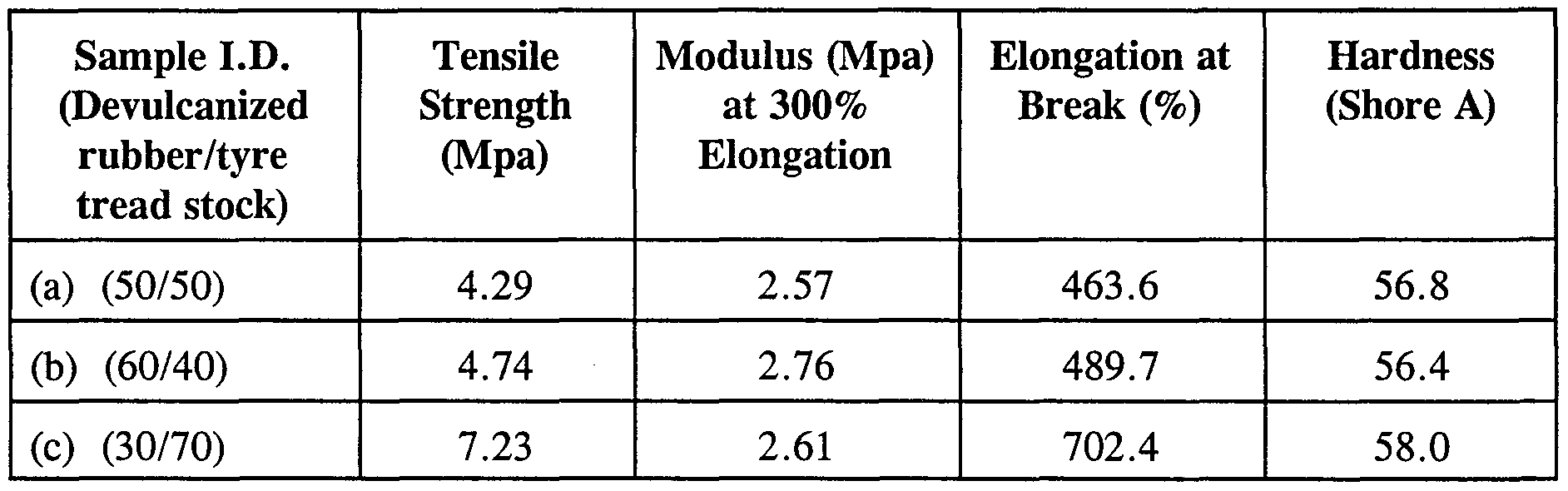
- the treated rubber was mixed with curatives at three levels, viz
- Test specimens were cut to ASTM D412 Die C from cured samples and conditioned at 23° C, 50% humidity for 24 hours.
- Testing machine LLOYD 2000R with computer interface
- the rubber devulcanization process is capable of producing a product that is compatible with rubber compounds.
- the performance of these compounds can be optimised with regard to the cure system, polymer type, filler level, sulfur level and level of addition of the devulcanized material.
Landscapes
- Chemical & Material Sciences (AREA)
- Polymers & Plastics (AREA)
- Health & Medical Sciences (AREA)
- Sustainable Development (AREA)
- Chemical Kinetics & Catalysis (AREA)
- Medicinal Chemistry (AREA)
- Life Sciences & Earth Sciences (AREA)
- Organic Chemistry (AREA)
- Separation, Recovery Or Treatment Of Waste Materials Containing Plastics (AREA)
- Compositions Of Macromolecular Compounds (AREA)
- Addition Polymer Or Copolymer, Post-Treatments, Or Chemical Modifications (AREA)
- Processes Of Treating Macromolecular Substances (AREA)
- Processing And Handling Of Plastics And Other Materials For Molding In General (AREA)
Abstract
Description

Claims
Priority Applications (11)
| Application Number | Priority Date | Filing Date | Title |
|---|---|---|---|
| AU64531/99A AU749046B2 (en) | 1998-10-01 | 1999-10-01 | Method for treatment of vulcanized rubber |
| JP2000574572A JP2002526606A (en) | 1998-10-01 | 1999-10-01 | Processing method of vulcanized rubber |
| EP19990952157 EP1127078A4 (en) | 1998-10-01 | 1999-10-01 | Method for treatment of vulcanized rubber |
| MXPA01003341A MXPA01003341A (en) | 1998-10-01 | 1999-10-01 | Method for treatment of vulcanized rubber. |
| HK02100181.7A HK1038758A1 (en) | 1998-10-01 | 1999-10-01 | Method for treatment of vulcanized rubber |
| BR9914218A BR9914218A (en) | 1998-10-01 | 1999-10-01 | Process for the treatment of vulcanized rubber, and, solution for the treatment of vulcanized rubber |
| CA 2346022 CA2346022A1 (en) | 1998-10-01 | 1999-10-01 | Method for treatment of vulcanized rubber |
| APAP/P/2001/002130A AP2001002130A0 (en) | 1998-10-01 | 1999-10-01 | Method for treatment of vulcanized rubber. |
| IL14235299A IL142352A0 (en) | 1998-10-01 | 1999-10-01 | Method for treatment of vulcanized rubber |
| NZ511418A NZ511418A (en) | 1998-10-01 | 1999-10-01 | Method for devulcanizing treatment of vulcanized rubber |
| KR1020017004230A KR20010088837A (en) | 1998-10-01 | 1999-10-01 | Method for treatment of vulcanized rubber |
Applications Claiming Priority (2)
| Application Number | Priority Date | Filing Date | Title |
|---|---|---|---|
| AUPP6275 | 1998-10-01 | ||
| AUPP6275A AUPP627598A0 (en) | 1998-10-01 | 1998-10-01 | Method for treatment of vulcanized rubber |
Publications (1)
| Publication Number | Publication Date |
|---|---|
| WO2000020461A1 true WO2000020461A1 (en) | 2000-04-13 |
Family
ID=3810493
Family Applications (1)
| Application Number | Title | Priority Date | Filing Date |
|---|---|---|---|
| PCT/AU1999/000845 Ceased WO2000020461A1 (en) | 1998-10-01 | 1999-10-01 | Method for treatment of vulcanized rubber |
Country Status (16)
| Country | Link |
|---|---|
| EP (1) | EP1127078A4 (en) |
| JP (1) | JP2002526606A (en) |
| KR (1) | KR20010088837A (en) |
| CN (1) | CN1326469A (en) |
| AP (1) | AP2001002130A0 (en) |
| AU (1) | AUPP627598A0 (en) |
| BR (1) | BR9914218A (en) |
| CA (1) | CA2346022A1 (en) |
| CZ (1) | CZ20011180A3 (en) |
| HK (1) | HK1038758A1 (en) |
| IL (1) | IL142352A0 (en) |
| MX (1) | MXPA01003341A (en) |
| NZ (1) | NZ511418A (en) |
| RU (1) | RU2001111822A (en) |
| TR (1) | TR200100924T2 (en) |
| WO (1) | WO2000020461A1 (en) |
Cited By (4)
| Publication number | Priority date | Publication date | Assignee | Title |
|---|---|---|---|---|
| EP1027975A3 (en) * | 1999-02-10 | 2002-02-06 | R & D Technology, Inc. | Method for converting elastomers and use of the ground elastomer particles |
| US6680110B1 (en) | 1998-02-10 | 2004-01-20 | R & D Technology, Inc. | Particle size reduction using supercritical materials |
| US6743836B2 (en) | 2000-01-26 | 2004-06-01 | R&D Technology, Inc. | Method for predispersing compounding ingredients |
| US6815510B2 (en) | 2001-11-19 | 2004-11-09 | Michael W. Rouse | Elastomer reclaiming composition and method |
Families Citing this family (4)
| Publication number | Priority date | Publication date | Assignee | Title |
|---|---|---|---|---|
| JP2011153272A (en) * | 2010-01-28 | 2011-08-11 | Bridgestone Corp | Method for decomposing and recovering vulcanized rubber |
| CA2928491C (en) * | 2013-10-29 | 2018-04-17 | 6732667 Manitoba Inc. | Automatic devulcanizing and plasticizing device and method for using same |
| US10179479B2 (en) | 2015-05-19 | 2019-01-15 | Bridgestone Americas Tire Operations, Llc | Plant oil-containing rubber compositions, tread thereof and race tires containing the tread |
| JP7283797B2 (en) * | 2021-10-01 | 2023-05-30 | 公立大学法人公立鳥取環境大学 | Method for producing softened rubber |
Citations (4)
| Publication number | Priority date | Publication date | Assignee | Title |
|---|---|---|---|---|
| JPS5558234A (en) * | 1978-10-25 | 1980-04-30 | Bridgestone Corp | Vulcanizable rubber composition |
| JPS6243441A (en) * | 1985-08-21 | 1987-02-25 | Riken Vitamin Co Ltd | Rubber compounded composition |
| US4895911A (en) * | 1988-10-06 | 1990-01-23 | The Goodyear Tire & Rubber Company | Tall oil fatty acid mixture in rubber |
| JPH0331335A (en) * | 1989-06-28 | 1991-02-12 | Nippon Zeon Co Ltd | rubber composition |
Family Cites Families (1)
| Publication number | Priority date | Publication date | Assignee | Title |
|---|---|---|---|---|
| US2809944A (en) * | 1956-06-11 | 1957-10-15 | Us Rubber Reclaiming Co | Processes for the reclaiming of rubber and for the production of hard rubber products and the like, and the products thereof |
-
1998
- 1998-10-01 AU AUPP6275A patent/AUPP627598A0/en not_active Abandoned
-
1999
- 1999-10-01 JP JP2000574572A patent/JP2002526606A/en active Pending
- 1999-10-01 BR BR9914218A patent/BR9914218A/en not_active IP Right Cessation
- 1999-10-01 IL IL14235299A patent/IL142352A0/en unknown
- 1999-10-01 TR TR200100924T patent/TR200100924T2/en unknown
- 1999-10-01 KR KR1020017004230A patent/KR20010088837A/en not_active Ceased
- 1999-10-01 CN CN99813353A patent/CN1326469A/en active Pending
- 1999-10-01 AP APAP/P/2001/002130A patent/AP2001002130A0/en unknown
- 1999-10-01 RU RU2001111822/04A patent/RU2001111822A/en not_active Application Discontinuation
- 1999-10-01 CA CA 2346022 patent/CA2346022A1/en not_active Abandoned
- 1999-10-01 HK HK02100181.7A patent/HK1038758A1/en unknown
- 1999-10-01 WO PCT/AU1999/000845 patent/WO2000020461A1/en not_active Ceased
- 1999-10-01 MX MXPA01003341A patent/MXPA01003341A/en unknown
- 1999-10-01 EP EP19990952157 patent/EP1127078A4/en not_active Withdrawn
- 1999-10-01 NZ NZ511418A patent/NZ511418A/en not_active IP Right Cessation
- 1999-10-01 CZ CZ20011180A patent/CZ20011180A3/en unknown
Patent Citations (4)
| Publication number | Priority date | Publication date | Assignee | Title |
|---|---|---|---|---|
| JPS5558234A (en) * | 1978-10-25 | 1980-04-30 | Bridgestone Corp | Vulcanizable rubber composition |
| JPS6243441A (en) * | 1985-08-21 | 1987-02-25 | Riken Vitamin Co Ltd | Rubber compounded composition |
| US4895911A (en) * | 1988-10-06 | 1990-01-23 | The Goodyear Tire & Rubber Company | Tall oil fatty acid mixture in rubber |
| JPH0331335A (en) * | 1989-06-28 | 1991-02-12 | Nippon Zeon Co Ltd | rubber composition |
Non-Patent Citations (5)
| Title |
|---|
| DATABASE WPI Derwent World Patents Index; AN 1980-42239C/24 * |
| DATABASE WPI Derwent World Patents Index; AN 1990-083087/11 * |
| DATABASE WPI Derwent World Patents Index; AN 1991-084541/12 * |
| DERWENT JAPIO ONLINE ABSTRACT, No. 87-043441, & JP 62043441 A (RIKEN VITAMIN CO LTD) 25 February 1987. * |
| See also references of EP1127078A4 * |
Cited By (4)
| Publication number | Priority date | Publication date | Assignee | Title |
|---|---|---|---|---|
| US6680110B1 (en) | 1998-02-10 | 2004-01-20 | R & D Technology, Inc. | Particle size reduction using supercritical materials |
| EP1027975A3 (en) * | 1999-02-10 | 2002-02-06 | R & D Technology, Inc. | Method for converting elastomers and use of the ground elastomer particles |
| US6743836B2 (en) | 2000-01-26 | 2004-06-01 | R&D Technology, Inc. | Method for predispersing compounding ingredients |
| US6815510B2 (en) | 2001-11-19 | 2004-11-09 | Michael W. Rouse | Elastomer reclaiming composition and method |
Also Published As
| Publication number | Publication date |
|---|---|
| CZ20011180A3 (en) | 2001-10-17 |
| JP2002526606A (en) | 2002-08-20 |
| CA2346022A1 (en) | 2000-04-13 |
| EP1127078A4 (en) | 2002-10-31 |
| IL142352A0 (en) | 2002-03-10 |
| BR9914218A (en) | 2002-04-23 |
| CN1326469A (en) | 2001-12-12 |
| RU2001111822A (en) | 2003-07-20 |
| AP2001002130A0 (en) | 2001-06-30 |
| HK1038758A1 (en) | 2002-03-28 |
| AUPP627598A0 (en) | 1998-10-22 |
| NZ511418A (en) | 2002-07-26 |
| MXPA01003341A (en) | 2003-05-15 |
| EP1127078A1 (en) | 2001-08-29 |
| TR200100924T2 (en) | 2001-08-21 |
| KR20010088837A (en) | 2001-09-28 |
Similar Documents
| Publication | Publication Date | Title |
|---|---|---|
| US8697761B2 (en) | Method and apparatus for regenerating vulcanized rubber | |
| US6992116B2 (en) | Devulcanization of cured rubber | |
| Mohaved et al. | A novel industrial technique for recycling ethylene-propylene-diene waste rubber | |
| AU2002322876B2 (en) | Process for regeneration of rubber from scrap | |
| WO2000020461A1 (en) | Method for treatment of vulcanized rubber | |
| AU2002322876A1 (en) | Process for regeneration of rubber from scrap | |
| EP3514200A1 (en) | A method of devulcanizing a rubber vulcanizate | |
| Mondal et al. | Back to the origin: A spick‐and‐span sustainable approach for the devulcanization of ground tire rubber | |
| Isayev | Recycling of natural and synthetic isoprene rubbers | |
| AU749046B2 (en) | Method for treatment of vulcanized rubber | |
| US2966468A (en) | Process of reclaiming scrap vulcanized rubber | |
| US6407144B1 (en) | Combination biological and microwave treatments of used rubber products | |
| WO1999048960A1 (en) | Process for the manufacture of quality reclaimed rubber | |
| JP4338365B2 (en) | Rubber composition for tire | |
| RU2086577C1 (en) | Method of processing rubber-cure wastes of high-molecular siloxane rubbers | |
| Saiwari et al. | Tires back into tires: devulcanization of tire rubbers | |
| US2102741A (en) | Process for treating vulcanized rubber | |
| Saiwari et al. | Comparative investigation of the de-vulcanization parameters of tire rubbers | |
| WO2025145012A1 (en) | Rubber blends containing regenerated rubber | |
| Hassim et al. | Fatigue Crack Growth of Recycled Rubber in Natural Rubber/butadiene Rubber Blends | |
| Blow et al. | Fatty acid softeners in rubber compounding | |
| JP2024163786A (en) | Rubber composition | |
| JP2000044605A (en) | Plasticizing of cross-linked hydrogenated nbr | |
| LV13339B (en) | Rubber compositions with surface/crack activation and devulcanization | |
| PL124549B2 (en) | Method of manufacture of recaleimed butyl rubber cross-linked with phenol-formaldehyde resins using boiler-steam method |
Legal Events
| Date | Code | Title | Description |
|---|---|---|---|
| WWE | Wipo information: entry into national phase |
Ref document number: 99813353.1 Country of ref document: CN |
|
| ENP | Entry into the national phase |
Ref document number: 1999 64531 Country of ref document: AU Kind code of ref document: A |
|
| AK | Designated states |
Kind code of ref document: A1 Designated state(s): AE AL AM AT AU AZ BA BB BG BR BY CA CH CN CR CU CZ DE DK DM EE ES FI GB GD GE GH GM HR HU ID IL IN IS JP KE KG KP KR KZ LC LK LR LS LT LU LV MD MG MK MN MW MX NO NZ PL PT RO RU SD SE SG SI SK SL TJ TM TR TT TZ UA UG US UZ VN YU ZA ZW |
|
| AL | Designated countries for regional patents |
Kind code of ref document: A1 Designated state(s): GH GM KE LS MW SD SL SZ TZ UG ZW AM AZ BY KG KZ MD RU TJ TM AT BE CH CY DE DK ES FI FR GB GR IE IT LU MC NL PT SE BF BJ CF CG CI CM GA GN GW ML MR NE SN TD TG |
|
| 121 | Ep: the epo has been informed by wipo that ep was designated in this application | ||
| DFPE | Request for preliminary examination filed prior to expiration of 19th month from priority date (pct application filed before 20040101) | ||
| ENP | Entry into the national phase |
Ref document number: 2346022 Country of ref document: CA Ref document number: 2346022 Country of ref document: CA Kind code of ref document: A |
|
| WWE | Wipo information: entry into national phase |
Ref document number: PA/a/2001/003341 Country of ref document: MX Ref document number: PV2001-1180 Country of ref document: CZ |
|
| WWE | Wipo information: entry into national phase |
Ref document number: 142352 Country of ref document: IL |
|
| ENP | Entry into the national phase |
Ref document number: 2000 574572 Country of ref document: JP Kind code of ref document: A |
|
| WWE | Wipo information: entry into national phase |
Ref document number: 1020017004230 Country of ref document: KR Ref document number: 2001/00924 Country of ref document: TR |
|
| WWE | Wipo information: entry into national phase |
Ref document number: IN/PCT/2001/473/KOL Country of ref document: IN Ref document number: 1200100387 Country of ref document: VN |
|
| WWE | Wipo information: entry into national phase |
Ref document number: 2001/03491 Country of ref document: ZA Ref document number: 64531/99 Country of ref document: AU Ref document number: 200103491 Country of ref document: ZA |
|
| WWE | Wipo information: entry into national phase |
Ref document number: 1999952157 Country of ref document: EP Ref document number: 511418 Country of ref document: NZ |
|
| REG | Reference to national code |
Ref country code: DE Ref legal event code: 8642 |
|
| WWP | Wipo information: published in national office |
Ref document number: 1999952157 Country of ref document: EP |
|
| WWP | Wipo information: published in national office |
Ref document number: 1020017004230 Country of ref document: KR |
|
| WWP | Wipo information: published in national office |
Ref document number: PV2001-1180 Country of ref document: CZ |
|
| WWG | Wipo information: grant in national office |
Ref document number: 64531/99 Country of ref document: AU |
|
| WWW | Wipo information: withdrawn in national office |
Ref document number: 1999952157 Country of ref document: EP |
|
| WWR | Wipo information: refused in national office |
Ref document number: 1020017004230 Country of ref document: KR |