WO1999012896A1 - Aromatic c16-c20-substituted tetrahydro prostaglandins useful as fp agonists - Google Patents
Aromatic c16-c20-substituted tetrahydro prostaglandins useful as fp agonists Download PDFInfo
- Publication number
- WO1999012896A1 WO1999012896A1 PCT/US1998/018340 US9818340W WO9912896A1 WO 1999012896 A1 WO1999012896 A1 WO 1999012896A1 US 9818340 W US9818340 W US 9818340W WO 9912896 A1 WO9912896 A1 WO 9912896A1
- Authority
- WO
- WIPO (PCT)
- Prior art keywords
- ring
- compounds
- preferred
- dihydro
- prostaglandin
- Prior art date
- Legal status (The legal status is an assumption and is not a legal conclusion. Google has not performed a legal analysis and makes no representation as to the accuracy of the status listed.)
- Ceased
Links
- 0 Cc1c(CC[C@@](CCC(C(CCCCCCC(*)=O)[C@](C2)O)[C@]2O)O)cccc1 Chemical compound Cc1c(CC[C@@](CCC(C(CCCCCCC(*)=O)[C@](C2)O)[C@]2O)O)cccc1 0.000 description 1
Classifications
-
- C—CHEMISTRY; METALLURGY
- C07—ORGANIC CHEMISTRY
- C07C—ACYCLIC OR CARBOCYCLIC COMPOUNDS
- C07C405/00—Compounds containing a five-membered ring having two side-chains in ortho position to each other, and having oxygen atoms directly attached to the ring in ortho position to one of the side-chains, one side-chain containing, not directly attached to the ring, a carbon atom having three bonds to hetero atoms with at the most one bond to halogen, and the other side-chain having oxygen atoms attached in gamma-position to the ring, e.g. prostaglandins ; Analogues or derivatives thereof
-
- A—HUMAN NECESSITIES
- A61—MEDICAL OR VETERINARY SCIENCE; HYGIENE
- A61P—SPECIFIC THERAPEUTIC ACTIVITY OF CHEMICAL COMPOUNDS OR MEDICINAL PREPARATIONS
- A61P19/00—Drugs for skeletal disorders
-
- A—HUMAN NECESSITIES
- A61—MEDICAL OR VETERINARY SCIENCE; HYGIENE
- A61P—SPECIFIC THERAPEUTIC ACTIVITY OF CHEMICAL COMPOUNDS OR MEDICINAL PREPARATIONS
- A61P19/00—Drugs for skeletal disorders
- A61P19/08—Drugs for skeletal disorders for bone diseases, e.g. rachitism, Paget's disease
-
- A—HUMAN NECESSITIES
- A61—MEDICAL OR VETERINARY SCIENCE; HYGIENE
- A61P—SPECIFIC THERAPEUTIC ACTIVITY OF CHEMICAL COMPOUNDS OR MEDICINAL PREPARATIONS
- A61P19/00—Drugs for skeletal disorders
- A61P19/08—Drugs for skeletal disorders for bone diseases, e.g. rachitism, Paget's disease
- A61P19/10—Drugs for skeletal disorders for bone diseases, e.g. rachitism, Paget's disease for osteoporosis
-
- A—HUMAN NECESSITIES
- A61—MEDICAL OR VETERINARY SCIENCE; HYGIENE
- A61P—SPECIFIC THERAPEUTIC ACTIVITY OF CHEMICAL COMPOUNDS OR MEDICINAL PREPARATIONS
- A61P27/00—Drugs for disorders of the senses
- A61P27/02—Ophthalmic agents
- A61P27/06—Antiglaucoma agents or miotics
-
- A—HUMAN NECESSITIES
- A61—MEDICAL OR VETERINARY SCIENCE; HYGIENE
- A61P—SPECIFIC THERAPEUTIC ACTIVITY OF CHEMICAL COMPOUNDS OR MEDICINAL PREPARATIONS
- A61P43/00—Drugs for specific purposes, not provided for in groups A61P1/00-A61P41/00
Definitions
- the subject invention relates to certain novel analogs of the naturally occurring prostaglandins. Specifically, the subject invention relates to novel Prostaglandin F analogs. The subject invention further relates to methods of using said novel Prostaglandin F analogs. Preferred uses include methods of treating bone disorders and glaucoma.
- Naturally occurring prostaglandins are C-20 unsaturated fatty acids.
- PGF 2 ⁇ the naturally occurring Prostaglandin F in humans, is characterized by hydroxyl groups at the Cg and C-
- PGF 2 ⁇ has the following formula:
- Naturally occurring prostaglandins are known to possess a wide range of pharmacological properties. For example, prostaglandins have been shown to: relax smooth muscle, which results in vasodilatation and bronchodilatation, to inhibit gastric acid secretion, to inhibit platelet aggregation, to reduce intraocular pressure, and to induce labor. Although naturally occurring prostaglandins are characterized by their activity against a particular prostaglandin receptor, they generally are not specific for any one prostaglandin receptor. Therefore, naturally-occurring prostaglandins are known to cause side effects such as inflammation, as well as surface irritation when administered systemically.
- Prostaglandins are known to be potent stimulators of bone resorption.
- PGF 2 ⁇ has also been shown to be a stimulator of bone resorption but not as potent as PGE 2 .
- the PGF 2 ⁇ has little effect on bone formation. It has been suggested that some of the effects of PGF 2 ⁇ on bone resorption, formation and cell replication may be mediated by an increase in endogenous PGE 2 production.
- the invention provides novel PGF analogs.
- the present invention relates to compounds having a structure according to the following formula:
- R, R 2 , R 3 , R 4 , X, Y, and Z are defined below.
- This invention also includes optical isomers, diastereomers and enantiomers of the formula above, and pharmaceutically-acceptable salts, biohydrolyzable amides, esters, and imides thereof.
- the compounds of the present invention are useful for the treatment of a variety of diseases and conditions, such as bone disorders and glaucoma. Accordingly, the invention further provides pharmaceutical compositions comprising these compounds. The invention still further provides methods of treatment for bone disorders and glaucoma using theses compounds or the compositions containing them.
- acyl' is a group suitable for acylating a nitrogen atom to form an amide or carbamate or an oxygen atom to form an ester group.
- Preferred acyl groups include benz ⁇ yl, acetyl, tert-butyl acetyl, para-phenyl benzoyl, and trifiuoroacetyl. More preferred acyl groups include acetyl and benzoyl. The most preferred acyl group is acetyl.
- Alkyl is a saturated or unsaturated hydrocarbon chain having 1 to 18 carbon atoms, preferably 1 to 12, more preferably 1 to 6, more preferably still 1 to 4 carbon atoms. Alkyl chains may be straight or branched. Preferred branched alkyl have one or two branches, preferably one branch. Preferred alkyl are saturated. Unsaturated alkyl have one or more double bonds and/or one or more triple bonds. Preferred unsaturated alkyl have one or two double bonds or one triple bond, more preferably one double bond. Alkyl chains may be unsubstituted or substituted with from 1 to 4 substituents. Preferred alkyl are unsubstituted.
- Preferred substituted alkyl are mono-, di-, or trisubstituted.
- Preferred alkyl substituents include methyl, ethyl, propyl and butyl, halo, hydroxy, alkoxy (e.g., methoxy, ethoxy, propoxy, butoxy, pentoxy), aryloxy (e.g., phenoxy, chlorophenoxy, tolyloxy, methoxyphenoxy, benzyloxy, alkyloxycarbonylphenoxy, acyloxyphenoxy), acyloxy (e.g., propionyloxy, benzoyloxy, acetoxy), carbamoyloxy, carboxy, mercapto, alkylthio, acylthio, arylthio (e.g., phenylthio, chlorophenylthio, alkylphenylthio, alkoxyphenylthio, benzylthio, alkyloxycarbonylphenylthi
- Aromatic ring is an aromatic hydrocarbon ring system.
- Aromatic rings are monocyclic or fused bicyclic ring systems. Monocyclic aromatic rings contain from about 5 to about 10 carbon atoms, preferably from 5 to 7 carbon atoms, and most preferably from 5 to 6 carbon atoms in the ring.
- Bicyclic aromatic rings contain from 8 to 12 carbon atoms, preferably 9 or 10 carbon atoms in the ring.
- Aromatic rings may be unsubstituted or substituted with from 1 to 4 substituents on the ring.
- Preferred aromatic ring substituents include: halo, cyano, alkyl, heteroaikyl, haloalkyl, phenyl, phenoxy or any combination thereof. More preferred substituents include halo and haloalkyl.
- Preferred aromatic rings include naphthyl and phenyl. The most preferred aromatic ring is phenyl.
- Carbocyclic aliphatic ring is a saturated or unsaturated hydrocarbon ring. Carbocyclic aliphatic rings are not aromatic. Carbocyclic aliphatic rings are monocyclic, or are fused, spiro, or bridged bicyclic ring systems. Monocyclic carbocyclic aliphatic rings contain from about 4 to about 10 carbon atoms, preferably from 4 to 7 carbon atoms, and most preferably from 5 to 6 carbon atoms in the ring. Bicyclic carbocyclic aliphatic rings contain from 8 to 12 carbon atoms, preferably from 9 to 10 carbon atoms in the ring.
- Carbocyclic aliphatic rings may be unsubstituted or substituted with from 1 to 4 substituents on the ring.
- Preferred carbocyclic aliphatic ring substituents include: halo, cyano, alkyl, heteroaikyl, haloalkyl, phenyl, phenoxy or any combination thereof. More preferred substituents include halo and haloalkyl.
- Preferred carbocyclic aliphatic rings include cyclopentyl, cyclohexyl, cyclohexenyl, cycloheptyl, and cyclooctyl. More preferred carbocyclic aliphatic rings include cyclohexyl, cycloheptyl, and cyclooctyl. The most preferred carbocyclic aliphatic ring is cycloheptyl.
- Halo is fluoro, chloro, bromo or iodo. Preferred halo are fluoro, chloro and bromo; more preferred are chloro and fluoro, especially fluoro.
- Haloalkyl is a straight, branched, or cyclic hydrocarbon substituted with one or more halo substituents.
- Preferred haloalkyl are C-1-C12; more preferred are C ⁇ -Cg; more preferred still are C1-C3.
- Preferred halo substituents are fluoro and chloro. The most preferred haloalkyl is trifluoromethyl.
- Heteroaikyl is a saturated or unsaturated chain containing carbon and at least one heteroatom, wherein no two heteroatoms are adjacent. Heteroaikyl chains contain from 1 to 18 member atoms (carbon and heteroatoms) in the chain, preferably 1 to 12, more preferably 1 to 6, more preferably still 1 to 4. Heteroaikyl chains may be straight or branched. Preferred branched heteroaikyl have one or two branches, preferably one branch. Preferred heteroaikyl are saturated. Unsaturated heteroaikyl have one or more double bonds and/or one or more triple bonds. Preferred unsaturated heteroaikyl have one or two double bonds or one triple bond, more preferably one double bond.
- Heteroaikyl chains may be unsubstituted or substituted with from 1 to 4 substituents.
- Preferred heteroaikyl are unsubstituted.
- Preferred heteroaikyl substituents include methyl, ethyl, propyl and butyl, halo, hydroxy, alkoxy (e.g., methoxy, ethoxy, propoxy, butoxy, pentoxy), aryloxy (e.g., phenoxy, chlorophenoxy, tolyloxy, methoxyphenoxy, benzyloxy, alkyloxycarbonylphenoxy, acyloxyphenoxy), acyloxy (e.g., propionyloxy, benzoyloxy, acetoxy), carbamoyloxy, carboxy, mercapto, alkylthio, acylthio, aryithio (e.g., phenylthio, chlorophenylthio, alkylphenylthio, alk
- Heteroatom is a nitrogen, sulfur, or oxygen atom. Groups containing more than one heteroatom may contain different heteroatoms.
- Heterocyclic aliphatic ring is a saturated or unsaturated ring containing carbon and from 1 to about 4 heteroatoms in the ring, wherein no two heteroatoms are adjacent in the ring and no carbon in the ring that has a heteroatom attached to it also has a hydroxyl, amino, or thiol group attached to it. Heterocyclic aliphatic rings are not aromatic. Heterocyclic aliphatic rings are monocyclic, or are fused or bridged bicyclic ring systems. Monocyclic heterocyclic aliphatic rings contain from about 4 to about 10 member atoms (carbon and heteroatoms), preferably from 4 to 7, and most preferably from 5 to 6 in the ring.
- Bicyclic heterocyclic aliphatic rings contain from 8 to 12 member atoms, preferably 9 or 10 in the ring. Heterocyclic aliphatic rings may be unsubstituted or substituted with from 1 to 4 substituents on the ring. Preferred heterocyclic aliphatic ring substituents include: halo, cyano, alkyl, heteroaikyl, haloalkyl, phenyl, phenoxy or any combination thereof. More preferred substituents include halo and haloalkyl. Preferred heterocyclic aliphatic rings include piperzyl, morpholinyl, tetrahydrofuranyl, tetrahydropyranyl and piperdyl.
- Heteroaromatic ring is an aromatic ring system containing carbon and from 1 to about 4 heteroatoms in the ring. Heteroaromatic rings are monocyclic or fused bicyclic ring systems. Monocyclic heteroaromatic rings contain from about 5 to about 10 member atoms (carbon and heteroatoms), preferably from 5 to 7, and most preferably from 5 to 6 in the ring. Bicyclic heteroaromatic rings contain from 8 to 12 member atoms, preferably 9 or 10 in the ring. Heteroaromatic rings may be unsubstituted or substituted with from 1 to 4 substituents on the ring.
- Preferred heteroaromatic ring substituents include: halo, cyano, alkyl, heteroaikyl, haloalkyl, phenyl, phenoxy or any combination thereof. More preferred substituents include halo, haloalkyl, and phenyl.
- Preferred heteroaromatic rings include thienyl, thiazolo, purinyl, pyrimidyl, pyridyl, and furanyl. More preferred heteroaromatic rings include thienyl, furanyl, and pyridyl. The most preferred heteroaromatic ring is thienyl.
- “Lower alkyl” is an alkyl chain radical comprised of 1 to 6, preferably 1 to 4 carbon atoms.
- Phenyl is a monocyclic aromatic ring which may or may not be substituted with from about 1 to about 4 substituents.
- the substituents may be substituted at the ortho, meta or para position on the phenyl ring, or any combination thereof.
- Preferred phenyl substituents include: halo, cyano, alkyl, heteroaikyl, haloalkyl, phenyl, phenoxy or any combination thereof. More preferred substituents on the phenyl ring include halo and haloalkyl.
- the most preferred substituent is halo.
- the preferred substitution pattern on the phenyl ring is ortho or meta.
- the most preferred substitution pattern on the phenyl ring is ortho.
- the subject invention i owing structure:
- R-j is CO2H, C(O)NHOH, CO2R5, CH2OH, S(O) 2 R5, C(O)NHR5, C(O)NHS(O)2R ⁇ , or tetrazole; wherein R5 is alkyl, heteroaikyl, carbocyclic aliphatic ring, heterocyclic aliphatic ring, aromatic ring, or heteroaromatic ring.
- R 5 is CH3, C 2 H 5 , C3H7.
- R ⁇ is CO 2 H, C(O)NHOH, CO 2 CH 3 , CO2C2H5, CO2C3H7, CO2C4H9, CO2C3H7O2, and C(O)NHS(O)2Rs. More preferred R1 is CO2H, C(O)NHOH, CO2CH3, and CO2C3H5. Most preferred R1 is CO2H and CO 2 CH 3 .
- R2 is H or lower alkyl. Preferred R2 is H and CH3. Most preferred R2 is H.
- X is NR6R7, ORs, SRg, S(O)Rg, S(0)2Rg, or F; wherein Rg, R7, and Re are independently selected from the group consisting of H, acyl, alkyl, heteroaikyl, carbocyclic aliphatic ring, heterocyclic aliphatic ring, aromatic ring, and heteroaromatic ring; and wherein Rg is alkyl, heteroaikyl, carbocyclic aliphatic ring, heterocyclic aliphatic ring, aromatic ring, or heteroaromatic ring.
- Preferred Rg and R7 are H, CH3 and C2H5.
- Preferred Rg is H, CH3, C2H5, and C3H7.
- Preferred Rg is CH3 and C2H5.
- Preferred X is NR6R7 and ORg. Most preferred X is OH.
- R3 and R4 are independently H, CH3, C2H5, OR-I Q. SR-I Q. or OH, except that both R3 and R4 are not OH; wherein R-J Q is alkyl, heteroaikyl, carbocyclic aliphatic ring, heterocyclic aliphatic ring, aromatic ring, or heteroaromatic ring, R-J Q having from 1 to about 8 member atoms.
- Preferred R3 and R4 are H.
- Y is (CH2) n ; n being an integer from 0 to about 3. Preferred n is 0,1 , and 2. Most preferred n is 1.
- Z is carbocyclic aliphatic ring, heterocyclic aliphatic ring, monocyclic heteroaromatic ring, or substituted phenyl when n is 0, 2, or 3; and Z is carbocyclic aliphatic ring, heterocyclic aliphatic ring, or substituted phenyl when n is 1.
- Preferred Z is monocyclic. More preferred Z is substituted phenyl and monocyclic heteroaromatic ring. The most preferred Z is substituted phenyl and substituted or unsubstituted thienyl.
- the invention also includes optical isomers, diastereomers and enantiomers of the above structure.
- stereochemistry is not defined (Cn, C 12 , C 15 , and C 16 )
- both epimers are envisioned.
- Preferred stereochemistry at all such stereocenters of the compounds of the invention mimic that of naturally occurring PGF 2a .
- novel PGF analogs of the subject invention are useful for treating bone disorders, especially those that require a significant increase in bone mass, bone volume, or bone strength.
- the compounds of the subject invention have been found to provide the following advantages over known bone disorder therapies: (1) An increase trabecular number through formation of new trabeculae; (2) An increase in bone mass and bone volume while maintaining a more normal bone turnover rate; and (3) An increase in bone formation at the endosteal surface without increasing cortical porosity.
- testing of the subject compounds in animals is carried out using various assays known to those skilled in the art.
- the bone activity of the subject compounds can be conveniently demonstrated using an assay designed to test the ability of the subject compounds to increase bone volume, mass, or density.
- An example of such assays is the ovariectomized rat assay.
- ovariectomized rat assay In the ovariectomized rat assay, six-month old rats are ovariectomized, aged 2 months, and then dosed once a day subcutaneously with a test compound. Upon completion of the study, bone mass and/or density can be measured by dual energy x- ray absorptometry (DXA) or peripheral quantitative computed tomography (pQCT), or micro computed tomography (mCT). Alternatively, static and dynamic histomorphometry can be used to measure the increase in bone volume or formation.
- DXA dual energy x- ray absorptometry
- pQCT peripheral quantitative computed tomography
- mCT micro computed tomography
- static and dynamic histomorphometry can be used to measure the increase in bone volume or formation.
- Pharmacological activity for glaucoma can be demonstrated using assays designed to test the ability of the subject compounds to decrease intraocular pressure. Examples of such assays are described in the following reference, incorporated herein: C. liljebris, G. Selen, B. Resul, J. Stemschantz, and U. hacksell, "Derivatives of 17- Phenyl-18,19,20-trinorprostaglandin F20 Isopropyl Ester: Potential Antiglaucoma Agents", Journal of Medicinal Chemistry. Vol. 38 No. 2 (1995), pp. 289-304.
- Compounds depicted by S1f are available from compounds of the type depicted by S1e via standard reduction reactions.
- Compounds depicted by Formula I are available from compounds of S1f via simultaneous saturation of the double bonds of S1f.
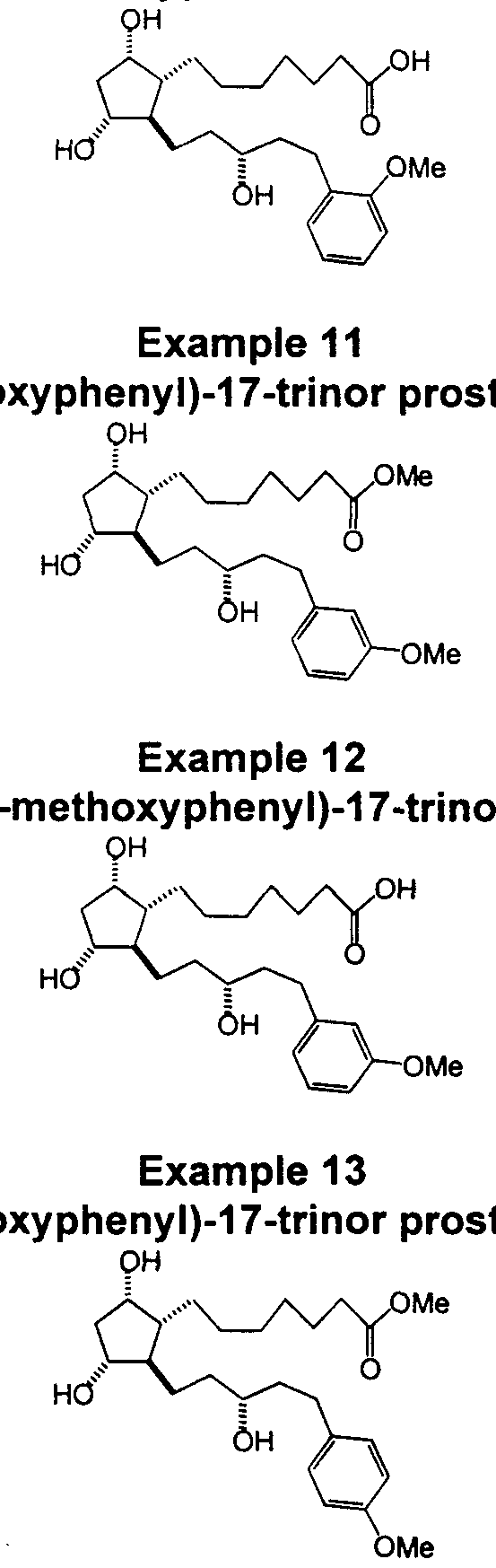
- Compounds depicted by Formula I are exemplified in Examples 2, 4, 5, 7, 9, 11, 13, 16, 18, 20, 22, 24, 26, and 28.
- Compounds depicted by Formula II are prepared through a simple deesterification protocol of the compounds of Formula I.
- Compounds depicted by Formula II are exemplified in Examples 1 , 3, 6, 8, 10, 12, 14, 15, 17, 19, 21 , 23, 25, 27, and 29.
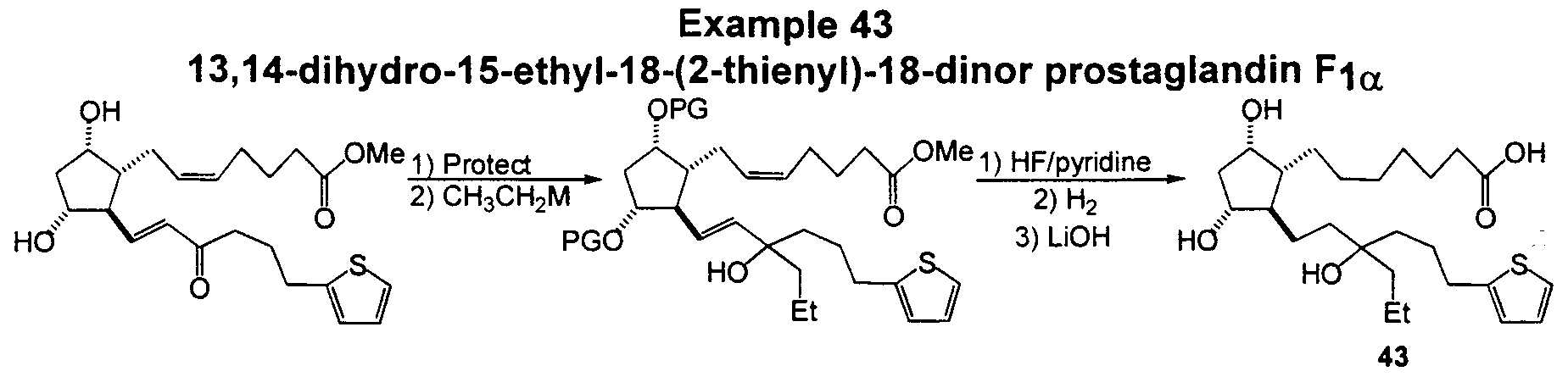
- Compounds depicted by Formula III can be prepared from compounds such of S1e via the addition of a carbon nucleophile followed by saturation and saponification.
- Compounds depicted by Formula III are exemplified in Examples 43 and 44.
- Compounds depicted by Formula IV can be prepared via imine formation followed by imine reduction, ⁇ /-alkylation, hydrogenation, and saponification. Additional compounds depicted by Formula IV can be prepared via imine formation, as previously mentioned, followed by nucleophilic addition to the resulting imine followed by double bond saturation and saponification.
- Compounds depicted by Formula IV are exemplified in Examples 48, 49, and 50.
- Compounds depicted by Formula V and Formula VII can be prepared through dihydroxyl protection of compounds of S1e followed by standard nucleophilic reduction of the ketone. The resulting free alcohol can be activated and displaced with nucleophiles such as, but not limited to, fluoride, alkoxide or sulfide to give compounds depicted by Formula V or Formula VII.
- nucleophiles such as, but not limited to, fluoride, alkoxide or sulfide to give compounds depicted by Formula V or Formula VII.
- Compounds depicted by Formula V are exemplified in Examples 36, 37, and 38.
- Compounds depicted by Formula VII are exemplified in Examples 39, 40, 41 , 42, and 45.
- Compounds depicted by Formula VIII are prepared by the selective oxidation of compounds of Formula VII with the proviso that X must be sulfur.
- Compounds depicted by Formula VIII are exemplified in Examples 46 and 47.
- Compounds of the type depicted by Formula VI can be prepared from either compounds of Formula I or Formula II (compounds depicted by Formula II may require carboxylate activation) through nucleophilic addition to an activated carboxylate to produce an amide or new ester linkage to give the resulting hydroxamic acid, sulfonamide, or ester.
- Compounds depicted by Formula VI are exemplified in Examples 30 - 35.
- inert solvents are used, preferably in dried form.
- tetrahydrofuran THF
- benzophenone diisopropylamine is distilled from calcium hydride and all other solvents are purchased as the appropriate grade.
- Chromatography is performed on silica gel (70-230 mesh; Aldrich) or (230-400 mesh; Merck) as appropriate.
- Thin layer chromatography analysis is performed on glass mounted silica gel plates (200-300 mesh; Baker) and visualized using UV, 5% phosphomoiybdic acid in EtOH, potassium permanganate in water, iodine, p-anisaldehyde in ethanol, or ammonium molybdate/cerric sulfate in 10% aqueous H2SO4.
- the reaction is quenched with water at 0°C and the pH is adjusted to 3.5 - 4.0 with 1N HCI.
- the water phase is extracted with EtOAc and the combined organic phase is dried over MgSO4 and is concentrated in vacuo to give a reddish-brown syrup containing crude acid.
- To a well stirred solution of crude acid in ether and MeOH at 0°C is added TMS- diazomethane until a yellow color persists. The addition of 1 drop of glacial acetic acid, and thin layer chromatography verifies the reaction has gone to completion.
- the reaction solution is concentrated in vacuo and purified via flash chromatography on silica gel eluting with 30% EtOAc in hexanes yielding 1f. f.
- methyl 7-(2,4-dihydroxy-5-formyl-cyclopentyl)hept-5-enoate (1g): In a round- bottomed flask with a magnetic stir bar is placed an amount of the ketal, 1f. To this flask is added a sufficient amount of a mixture of 2 parts acetone to 1 part 1 N HCI to bring the ketal completely into solution. This material is stirred until, by TLC, the starting material is consumed, typically overnight. The crude mixture, containing the product 1g, is extracted with ether, and the ether extract re-esterified in situ with, preferably, TMS-diazo ethane. The organic extracts were concentrated under reduced pressure at 0°C and used immediately without further purification.
- Methyl 3-(2-fluorophenyl)propionate (1i) In a Parr vessel is placed 2- fluorocinnamic acid (1h) (1.0 equiv) and palladium on carbon in a 1/1 methanol/ethyl acetate solution. The heterogeneous solution is placed on a Parr shaker and treated with hydrogen (50 psi) until uptake has ceased. The mixture is filtered through Celite and concentrated under reduced pressure. The residue is taken up in diethyl ether and treated with diazomethane until a yellow color persists. The solution is concentrated under reduced pressure to give the crude methyl ester.
- methyl-3-(2-fluorophenyl)propionate (1.1 equiv.) in anhydrous THF.
- the mixture is allowed to warm to room temperature over the next 6 hours.
- the mixture is treated with a saturated solution of ammonium chloride and extracted with CH2CI2.
- the organic layer is washed with water followed by brine.
- the combined aqueous layers are back extracted with CH2CI2 and the organic layers combined, dried over anhydrous MgSO4, filtered, and concentrated under reduced pressure.
- Example 30 Utilizing substantially the method of Example 30 (and using the appropriate ester), the following subject compounds of Examples 31 and 32 are obtained.
- Example 23 is converted to the anhydride followed by treatment with methanesulfonylamide as disclosed in A.D. Kemp and H. Stephen, J. Chem. Soc. (1948) p. 110.
- Example 33 Utilizing substantially the method of Example 33 (and using the appropriate acid), the following subject compounds of Examples 34 and 35 are obtained.
- Example 27 The precursor to Example 27 corresponding to 1k from Example 1 is protected and reduced to give the 9, 11 -protected bis ether.
- the resulting compound is treated with diethylaminosulfur trifluoride (DSAT) (as disclosed in the following references: Org. React. Vol. 35 (1988) p. 513; J. Org. Chem. Vol. 40 (1975) p. 574; and references cited therein) to give 13,14-dihydro-15-fluoro-17-(3-methylphenyl)-17-trinor prostaglandin F-
- DSAT diethylaminosulfur trifluoride
- Examples 37 and 38 are prepared in a manner substantially similar to Example 36 using the appropriate intermediate corresponding to 1k (from Example 5 and Example 25 respectively) in Example 1 followed by standard esterification with the appropriate alcohol.
- Example 23 corresponding to 1 k from Example 1 is protected and reduced to give the 9, 11 -protected bis ether.
- This compound is treated with methanesulfonyl chloride (1.2 equiv) and base (1.2 equiv) (as disclosed in the following references: J.C.S. Chem. Comm. (1975) p. 658; Tetrahedron Lett. (1975) p. 3183; and references cited therein) to generate the intermediate mesylate, which is then treated immediately with nucleophiles (sodium thiomethoxide) (as disclosed in Tetrahedron Lett. Vol. 23 (1982) p. 3463 and references cited therein.) to give the protected thioalkyl ether.
- nucleophiles sodium thiomethoxide
- Example 40 is prepared in a manner substantially similar to Example 39 (from a precursor corresponding to 1 k from Example 7) followed by conversion to the hydroxamic acid as shown in Example 30.
- Example 41 is prepared in a substantially similar manner as Example 39 (from a precursor corresponding to 1k from Example 21) followed by conversion to the sulfonamide as shown in Example 33.
- Example 19 The precursor to Example 19 corresponding to 1k from Example 1 is protected and reduced to give the 9,11 -protected bis ether.
- This compound is treated with methanesulfonyl chloride (1.2 equiv.) and base (1.2 equiv.) (as disclosed in the following references: J.C.S. Chem. Comm. (1975) p. 658; Tetrahedron Lett. (1975) p. 3183; and references cited therein.) to generate the intermediate mesylate, which is then treated immediately with sodium ethoxide to give the protected alkyl ether. Subsequent transformation as described in Example 1 provides 13,14-dihydro-15-ethoxy-17-((2- trifluoromethyl)phenyl)-17-trinor prostaglandin F ⁇
- Example 17 The precursor to Example 17 corresponding to 1k from Example 1 is protected and reduced to give the 9,11 -protected bis ether.
- the resulting protected diol is treated with one of a variety of carbon nucleophiles, such as ethyl magnesium bromide to give the resulting tertiary alcohol.
- Deprotection followed by the transformation outlined in Example 1 provides 13, 14-dihydro-15-ethyl-18-(2-thienyl)-18-dinor prostaglandin F-
- Example 43 Utilizing substantially the method of Example 43 (and using the appropriate carbon nucleophile), the following subject compound of Example 44 is obtained.
- Example 45 The compound of Example 45 is prepared by utilizing the protocol outlined in Example 43 (from the precursor corresponding to 1 k for Example 13) followed by O- alkylation of the resulting C15 alkoxide with a variety of alkyl halides (iodomethane in this example). This is followed by deprotection, hydrogenation, and saponificiation as outlined in Example 43 and Example 1 to give 13,14-dihydro-15-ethyl-15-methoxy-17-(4- methoxyphenyl)-17-trinor prostaglandin F ⁇ ⁇
- Example 39 The thiomethyl ether of Example 39 is treated with the appropriate oxidizing agent as disclosed in the following references: Tetrahedron Lett. (1982) p. 3467; Prostaglandins Vol. 24 (1982) p. 801 ; Tetrahedron Lett. Vol. 23 (1982) p. 1023; and references cited therein.
- Example 47 Utilizing substantially the method of Example 46 (and using the appropriate thioether), the following subject compound of Example 47 is obtained.
- Example 12 The intermediate of Example 12 corresponding to 1k is condensed with methyl amine followed by reduction with sodium cyanoborohydride to give 13,14-dihydro-15- ⁇ /- methylamino-17-(3-methoxyphenyl)-17-trinor prostaglandin F ⁇ ⁇ , after saponification and deprotection.
- the compound of Example 49 is prepared from the compound of Example 48 by simple alkylation with iodomethane.
- Example 48 The intermediate imine of Example 48 is treated with methylcerium (excess) (for examples of cerium-mediated nucleophilic additions see the following references: J. Org. Chem.. Vol. 49 (1984) p. 3904; J. Am. Chem. Soc, Vol. 111 (1989) p. 4392; and references therein) to give 13,14-dihydro-15-aminomethyl-15-methyl-17-(3-methoxyphenyl)-17-trinor prostaglandin F-
- methylcerium excess
- compositions of the subject invention comprise a safe and effective amount of the subject compounds, and a pharmaceutically-acceptable carrier.
- safe and effective amount means an amount of a compound sufficient to significantly induce a positive modification in the condition to be treated, but low enough to avoid serious side effects (at a reasonable benefit/risk ratio), within the scope of sound medical judgment.
- a safe and effective amount of a compound will vary with the particular condition being treated, the age and physical condition of the patient being treated, the severity of the condition, the duration of the treatment, the nature of concurrent therapy, the particular pharmaceutically-acceptable carrier utilized, and like factors within the knowledge and expertise of the attending physician.
- compositions of the subject invention contain a pharmaceutically-acceptable carrier.
- pharmaceutically-acceptable carrier means one or more compatible solid or liquid filler diluents or encapsulating substances which are suitable for administration to a subject.
- compatible means that the components of the composition are capable of being commingled with the compound, and with each other, in a manner such that there is no interaction which would substantially reduce the pharmaceutical efficacy of the composition under ordinary use situations.
- Pharmaceutically-acceptable carriers must, of course, be of sufficiently high purity and sufficiently low toxicity to render them suitable for administration to the subject being treated.
- substances which can serve as pharmaceutically-acceptable carriers or components thereof are sugars, such as lactose, glucose and sucrose; starches, such as cornstarch and potato starch; cellulose and its derivatives, such as sodium carboxymethyl cellulose, ethyl cellulose, cellulose acetate; powdered tragacanth; malt; gelatin; talc; solid lubricants, such as stearic acid, magnesium stearate; calcium sulfate; vegetable oils, such as peanut oil, cottonseed oil, sesame oil, olive oil, corn oil and oil of theobroma; polyols such as propylene glycol, glycerin, sorbitol, mannitol, and polyethylene glycol; alginic acid; emulsifiers, such as the Tweens®; wetting agents such as sodium lauryl sulfate; coloring agents; flavoring agents, excipients; tableting agents; stabilizers; antioxidants; preservatives;
- a pharmaceutically-acceptable carrier to be used in conjunction with a compound is basically determined by the way the compound is to be administered.
- the compounds of the present invention may be administered systemically. Routes of administration include transdermal; oral; parenterally, including subcutaneous or intravenous injection; topical; and/or intranasal.
- the appropriate amount of the compound to be used may be determined by routine experimentation with animal models. Such models include, but are not limited to the intact and ovariectomized rat models, the ferret, canine, and non human primate models as well as disuse models.
- Preferred unit dosage forms for injection include sterile solutions of water, physiological saline, or mixtures thereof.
- the pH of said solutions should be adjusted to about 7.4.
- Suitable carriers for injection or surgical implants include hydrogels, controlled- or sustained release devises, polylactic acid, and collagen matrices.
- Suitable pharmaceutically-acceptable carriers for topical application include those suited for use in lotions, creams, gels and the like. If the compound is to be administered perorally, the preferred unit dosage form is tablets, capsules and the like.
- the pharmaceutically-acceptable carriers suitable for the preparation of unit dosage forms for oral administration are well-known in the art. Their selection will depend on secondary considerations like taste, cost, and shelf stability, which are not critical for the purposes of the subject invention, and can be made without difficulty by those skilled in the art.
- the compounds of the present invention are useful in treating many medical disorders, including for example, ocular disorders, hypertension, fertility control, nasal congestion, neurogenic bladder disorder, gastrointestinal disorders, dermatological disorders, and osteoporosis.
- the compounds of the present invention are useful in increasing bone volume and trabecular number through formation of new trabeculae, increasing bone mass while maintaining a normalized bone turnover rate, and formation of bone at the endosteal surface without removing bone from the existing cortex. Thus, these compounds are useful in the treatment and prevention of bone disorders.
- the preferred routes of administration for treating bone disorders are transdermal and intranasal.
- Other preferred routes of administration include rectal, sublingual, and oral.
- the dosage range of the compound for systemic administration is from about 0.01 to about 1000 ⁇ g/kg body weight, preferably from about 0.1 to about 100 ⁇ g/kg per body weight, most preferably from about 1 to about 50 ⁇ g/kg body weight per day.
- the transdermal dosages will be designed to attain similar serum or plasma levels, based upon techniques known to those skilled in the art of pharmacokinetics and transdermal formulations.
- Plasma levels for systemic administration are expected to be in the range of 0.01 to 100 nanograms/ml, more preferably from 0.05 to 50 ng/ml, and most preferably from 0.1 to 10 ng/ml. While these dosages are based upon a daily administration rate, weekly or monthly accumulated dosages may also be used to calculate the clinical requirements.
- Dosages may be varied based on the patient being treated, the condition being treated, the severity of the condition being treated, the route of administration, etc. to achieve the desired effect.
- the compounds of the present invention are also useful in decreasing intraocular pressure. Thus, these compounds are useful in the treatment of glaucoma.
- the preferred route of administration for treating glaucoma is topically.
- composition and method examples do not limit the invention, but provide guidance to the skilled artisan to prepare and use the compounds, compositions and methods of the invention. In each case other compounds within the invention may be substituted for the example compound shown below with similar results. The skilled practitioner will appreciate that the examples provide guidance and may be varied based on the condition being treated and the patient.
- compositions in the form of tablets are prepared by conventional methods, such as mixing and direct compaction, formulated as follows:
- Example B When administered orally once daily, the above composition substantially increases bone volume in a patient suffering from osteoporosis.
- compositions in liquid form are prepared by conventional methods, formulated as follows:
- the above composition substantially increases bone volume in a patient suffering from osteoporosis.
- Topical pharmaceutical compositions for lowering intraocular pressure are prepared by conventional methods and formulated as follows:
Landscapes
- Health & Medical Sciences (AREA)
- Organic Chemistry (AREA)
- Chemical & Material Sciences (AREA)
- Physical Education & Sports Medicine (AREA)
- General Health & Medical Sciences (AREA)
- Public Health (AREA)
- Medicinal Chemistry (AREA)
- Nuclear Medicine, Radiotherapy & Molecular Imaging (AREA)
- Chemical Kinetics & Catalysis (AREA)
- Pharmacology & Pharmacy (AREA)
- Life Sciences & Earth Sciences (AREA)
- Animal Behavior & Ethology (AREA)
- Engineering & Computer Science (AREA)
- General Chemical & Material Sciences (AREA)
- Veterinary Medicine (AREA)
- Bioinformatics & Cheminformatics (AREA)
- Orthopedic Medicine & Surgery (AREA)
- Rheumatology (AREA)
- Ophthalmology & Optometry (AREA)
- Pharmaceuticals Containing Other Organic And Inorganic Compounds (AREA)
- Organic Low-Molecular-Weight Compounds And Preparation Thereof (AREA)
- Heterocyclic Compounds Containing Sulfur Atoms (AREA)
- Acyclic And Carbocyclic Compounds In Medicinal Compositions (AREA)
- Medicines That Contain Protein Lipid Enzymes And Other Medicines (AREA)
Abstract
Description






Claims

Priority Applications (14)
| Application Number | Priority Date | Filing Date | Title |
|---|---|---|---|
| DE69832513T DE69832513T2 (en) | 1997-09-09 | 1998-09-04 | AROMATIC C16-C20 SUBSTITUTED TETRAHYDRO PROSTAGLANDINES USE AS FP AGONISTE |
| HU0004436A HUP0004436A3 (en) | 1997-09-09 | 1998-09-04 | Aromatic c16-c20-substituted tetrahydro prostaglandins useful as fp agonists |
| BR9811779-3A BR9811779A (en) | 1997-09-09 | 1998-09-04 | Tetrahydro prostaglandins are replaced by aromatic c16-c20 useful as fp agonists |
| PL98339213A PL339213A1 (en) | 1997-09-09 | 1998-09-04 | Aromatic c16-c20-substituted tetrahydroprostaglandines useful as fp agonists |
| NZ503736A NZ503736A (en) | 1997-09-09 | 1998-09-04 | Aromatic C16-C20-substituted tetrahydro prostaglandins useful as FP agonists |
| AT98944720T ATE310721T1 (en) | 1997-09-09 | 1998-09-04 | AROMATIC C16-C20-SUBSTITUTED TETRAHYDRO-PROSTAGLANDINS USABLE LIKE FP AGONISTS |
| KR1020007002512A KR20010023837A (en) | 1997-09-09 | 1998-09-04 | Aromatic c16-c20-substituted tetrahydro prostaglandins useful as fp agonists |
| SK336-2000A SK3362000A3 (en) | 1997-09-09 | 1998-09-04 | A compound analogous to prostaglandin f and use thereof |
| JP2000510708A JP2001515883A (en) | 1997-09-09 | 1998-09-04 | Aromatic C16-C20 substituted tetrahydroprostaglandins useful as FP agonists |
| IL13479298A IL134792A0 (en) | 1997-09-09 | 1998-09-04 | Aromatic c16-c20-substituted tetrahydro prostaglandins useful as fp agonists |
| CA002303763A CA2303763C (en) | 1997-09-09 | 1998-09-04 | Aromatic c16-c20-substituted tetrahydro prostaglandins useful as fp agonists |
| EP98944720A EP1021402B1 (en) | 1997-09-09 | 1998-09-04 | Aromatic c16-c20-substituted tetrahydro prostaglandins useful as fp agonists |
| AU92194/98A AU741014B2 (en) | 1997-09-09 | 1998-09-04 | Aromatic C16-C20-substituted tetrahydro prostaglandins useful as FP agonists |
| NO20001142A NO20001142L (en) | 1997-09-09 | 2000-03-06 | Aromatic C16-C20 substituted tetrahydro-prostaglandins useful as FP agonists |
Applications Claiming Priority (2)
| Application Number | Priority Date | Filing Date | Title |
|---|---|---|---|
| US5824697P | 1997-09-09 | 1997-09-09 | |
| US60/058,246 | 1997-09-09 |
Publications (1)
| Publication Number | Publication Date |
|---|---|
| WO1999012896A1 true WO1999012896A1 (en) | 1999-03-18 |
Family
ID=22015602
Family Applications (1)
| Application Number | Title | Priority Date | Filing Date |
|---|---|---|---|
| PCT/US1998/018340 Ceased WO1999012896A1 (en) | 1997-09-09 | 1998-09-04 | Aromatic c16-c20-substituted tetrahydro prostaglandins useful as fp agonists |
Country Status (23)
| Country | Link |
|---|---|
| US (1) | US6107338A (en) |
| EP (1) | EP1021402B1 (en) |
| JP (1) | JP2001515883A (en) |
| KR (1) | KR20010023837A (en) |
| CN (1) | CN1269785A (en) |
| AR (1) | AR017077A1 (en) |
| AT (1) | ATE310721T1 (en) |
| AU (1) | AU741014B2 (en) |
| BR (1) | BR9811779A (en) |
| CA (1) | CA2303763C (en) |
| CO (1) | CO4970730A1 (en) |
| DE (1) | DE69832513T2 (en) |
| ES (1) | ES2253826T3 (en) |
| HU (1) | HUP0004436A3 (en) |
| IL (1) | IL134792A0 (en) |
| NO (1) | NO20001142L (en) |
| NZ (1) | NZ503736A (en) |
| PE (1) | PE123199A1 (en) |
| PL (1) | PL339213A1 (en) |
| SK (1) | SK3362000A3 (en) |
| TR (1) | TR200000670T2 (en) |
| WO (1) | WO1999012896A1 (en) |
| ZA (1) | ZA988231B (en) |
Cited By (21)
| Publication number | Priority date | Publication date | Assignee | Title |
|---|---|---|---|---|
| WO2000051980A1 (en) * | 1999-03-05 | 2000-09-08 | The Procter & Gamble Company | C16 unsaturated fp-selective prostaglandins analogs |
| WO2001010873A1 (en) * | 1999-08-04 | 2001-02-15 | The Procter & Gamble Company | Novel 2-decarboxy-2-phosphinico prostaglandin f analogs |
| WO2001074313A3 (en) * | 2000-03-31 | 2002-02-21 | Procter & Gamble | Compositions and methods for treating hair loss using c16 - c20 aromatic tetrahydro prostaglandins |
| WO2001074315A3 (en) * | 2000-03-31 | 2002-02-21 | Procter & Gamble | Compositions and methods for treating hair loss using non-naturally occurring prostaglandins |
| WO2002092099A1 (en) * | 2001-05-17 | 2002-11-21 | Allergan, Inc. | Prostanoic acid derivatives as agents for lowering intraocular pressure |
| US6894175B1 (en) | 1999-08-04 | 2005-05-17 | The Procter & Gamble Company | 2-Decarboxy-2-phosphinico prostaglandin derivatives and methods for their preparation and use |
| WO2010096123A2 (en) | 2008-10-29 | 2010-08-26 | Aerie Pharmaceuticals, Inc. | Amino acid salts of prostaglandins |
| US8642644B2 (en) | 2004-10-21 | 2014-02-04 | Duke University | Ophthamological drugs |
| US8822527B2 (en) | 2011-10-17 | 2014-09-02 | Biotheryx, Inc. | Substituted biaryl alkyl amides |
| WO2014144781A1 (en) | 2013-03-15 | 2014-09-18 | Aerie Pharmaceuticals, Inc. | Combination therapy |
| US9006291B2 (en) | 2009-02-03 | 2015-04-14 | Pharma Patent Holding Inc. | Composition, method and kit for enhancing hair |
| US9346837B2 (en) | 2000-03-31 | 2016-05-24 | Duke University | Cosmetic and pharmaceutical compositions and methods using 2-decarboxy-2-phosphinico derivatives |
| US9643927B1 (en) | 2015-11-17 | 2017-05-09 | Aerie Pharmaceuticals, Inc. | Process for the preparation of kinase inhibitors and intermediates thereof |
| US9888287B2 (en) | 2004-07-30 | 2018-02-06 | Broadband Itv, Inc. | Video-on-demand content delivery system for providing video-on-demand services to TV services subscribers |
| US10112920B2 (en) | 2008-07-25 | 2018-10-30 | Aerie Pharmaceuticals, Inc. | Beta- and gamma-amino-isoquinoline amide compounds and substituted benzamide compounds |
| US10174017B2 (en) | 2009-05-01 | 2019-01-08 | Aerie Pharmaceuticals, Inc. | Dual mechanism inhibitors for the treatment of disease |
| US10472327B2 (en) | 2007-01-10 | 2019-11-12 | Aerie Pharmaceuticals, Inc. | 6-aminoisoquinoline compounds |
| US10555014B2 (en) | 2004-07-30 | 2020-02-04 | Broadband Itv, Inc. | System for addressing on-demand TV program content on TV services platform of a digital TV services provider |
| US10858339B2 (en) | 2017-03-31 | 2020-12-08 | Aerie Pharmaceuticals, Inc. | Aryl cyclopropyl-amino-isoquinolinyl amide compounds |
| US11389441B2 (en) | 2016-08-31 | 2022-07-19 | Aerie Pharmaceuticals, Inc. | Ophthalmic compositions |
| US11427563B2 (en) | 2018-09-14 | 2022-08-30 | Aerie Pharmaceuticals, Inc. | Aryl cyclopropyl-amino-isoquinolinyl amide compounds |
Families Citing this family (7)
| Publication number | Priority date | Publication date | Assignee | Title |
|---|---|---|---|---|
| KR20010074981A (en) * | 1998-09-14 | 2001-08-09 | 우에노 도시오 | ω-SUBSTITUTED PHENYL-PROSTAGLANDIN E DERIVATIVES AND DRUGS CONTAINING THE SAME AS THE ACTIVE INGREDIENT |
| US6376533B1 (en) * | 2000-10-20 | 2002-04-23 | Allergan Sales, Inc. | Omega-cycloalkyl 17-heteroaryl prostaglandin E2 analogs as EP2-receptor agonists |
| US6586462B2 (en) | 2000-10-20 | 2003-07-01 | Allergan, Inc. | ω-Cycloalkyl 17-heteroaryl prostaglandin E2 analogs as EP2-receptor agonists |
| US20070254920A1 (en) * | 2006-04-26 | 2007-11-01 | Aerie Pharmaceuticals, Inc. | Prodrug derivatives of acids using alcohols with homotopic hydroxy groups and methods for their preparation and use |
| US8722739B2 (en) | 2008-10-29 | 2014-05-13 | Novaer Holdings, Inc. | Amino acid salts of prostaglandins |
| US8623918B2 (en) * | 2008-10-29 | 2014-01-07 | Novaer Holdings, Inc. | Amino acid salts of prostaglandins |
| CN104140410B (en) * | 2013-05-09 | 2017-12-15 | 江苏豪森药业集团有限公司 | The preparation method of Lubiprostone 1 |
Citations (9)
| Publication number | Priority date | Publication date | Assignee | Title |
|---|---|---|---|---|
| DE2355731A1 (en) * | 1972-11-08 | 1974-05-22 | Pfizer | NEW 15 SUBSTITUTED OMEGA PENTANOR PROSTAGLANDINE |
| DE2409460A1 (en) * | 1973-02-28 | 1974-08-29 | Ono Pharmaceutical Co | PROSTAGLAND COMPOUNDS AND METHOD OF MANUFACTURING THEREOF |
| DE2365101A1 (en) * | 1973-12-21 | 1975-07-10 | Schering Ag | NEW PROSTANIC ACID DERIVATIVES AND METHOD FOR THEIR PRODUCTION |
| US4011262A (en) * | 1972-07-13 | 1977-03-08 | Pfizer Inc. | 13,14-Dihydro-15-substituted-ω-pentanorprostaglandins of the two series |
| DE2737808A1 (en) * | 1976-08-27 | 1978-03-16 | Pfizer | 2-SUBSTITUTED ARYL HETEROCYCLIC OMEGA PENTANOR PROSTAGLANDIN |
| US4621100A (en) * | 1981-09-25 | 1986-11-04 | The Upjohn Company | Treatment of osteoporosis with prostaglandins |
| WO1995018102A1 (en) * | 1993-12-28 | 1995-07-06 | Allergan | Cyclopentane(ene) heptenoic or heptanoic acids and derivatives thereof useful as therapeutic agents |
| WO1997023225A1 (en) * | 1995-12-22 | 1997-07-03 | Alcon Laboratories, Inc. | Combinations of dp and fp type prostaglandins for lowering iop |
| US5703108A (en) * | 1996-02-28 | 1997-12-30 | Pfizer Inc. | Bone deposition by certain prostaglandin agonists |
Family Cites Families (9)
| Publication number | Priority date | Publication date | Assignee | Title |
|---|---|---|---|---|
| DE2460990A1 (en) * | 1974-12-21 | 1976-07-01 | Hoechst Ag | NEW PROSTAGLANDIN ANALOGS AND PROCEDURES FOR THEIR PRODUCTION |
| DE4024347A1 (en) * | 1990-07-27 | 1992-01-30 | Schering Ag | CYCLOPENTANE DERIVATIVES, METHOD FOR THE PRODUCTION THEREOF AND THEIR PHARMACEUTICAL USE |
| AU7672096A (en) * | 1995-06-07 | 1998-06-03 | Alcon Laboratories, Inc. | Conformationally rigid aryl- or heteroaryl prostaglandins for use in glaucoma therapy |
| US5741810A (en) * | 1996-02-29 | 1998-04-21 | Allergan | Cyclopentane heptan(ene)oic acid, 2- heteroarylalkenyl derivatives as therapeutic agents |
| WO1997047595A1 (en) * | 1996-06-10 | 1997-12-18 | R-Tech Ueno, Ltd. | Endothelin antagonist |
| ATE221048T1 (en) * | 1996-09-17 | 2002-08-15 | Asahi Glass Co Ltd | FLUORINATED PROSTAGLAND DERIVATIVES AND MEDICATIONS |
| US6353000B1 (en) * | 1996-11-12 | 2002-03-05 | Alcon Laboratories, Inc. | 11-halo prostaglandins for the treatment of glaucoma or ocular hypertension |
| WO1998020881A1 (en) * | 1996-11-12 | 1998-05-22 | Alcon Laboratories, Inc | 15-ketal prostaglandins for the treatment of glaucoma or ocular hypertension |
| WO1998050024A1 (en) * | 1997-05-09 | 1998-11-12 | The Mount Sinai School Of Medicine Of The City University Of New York | 8-iso-prostaglandins for glaucoma therapy |
-
1998
- 1998-09-04 BR BR9811779-3A patent/BR9811779A/en not_active IP Right Cessation
- 1998-09-04 EP EP98944720A patent/EP1021402B1/en not_active Expired - Lifetime
- 1998-09-04 KR KR1020007002512A patent/KR20010023837A/en not_active Ceased
- 1998-09-04 NZ NZ503736A patent/NZ503736A/en unknown
- 1998-09-04 JP JP2000510708A patent/JP2001515883A/en not_active Withdrawn
- 1998-09-04 US US09/148,374 patent/US6107338A/en not_active Expired - Lifetime
- 1998-09-04 AT AT98944720T patent/ATE310721T1/en not_active IP Right Cessation
- 1998-09-04 CN CN98808989A patent/CN1269785A/en active Pending
- 1998-09-04 AU AU92194/98A patent/AU741014B2/en not_active Expired
- 1998-09-04 WO PCT/US1998/018340 patent/WO1999012896A1/en not_active Ceased
- 1998-09-04 SK SK336-2000A patent/SK3362000A3/en unknown
- 1998-09-04 PL PL98339213A patent/PL339213A1/en unknown
- 1998-09-04 TR TR2000/00670T patent/TR200000670T2/en unknown
- 1998-09-04 DE DE69832513T patent/DE69832513T2/en not_active Expired - Lifetime
- 1998-09-04 ES ES98944720T patent/ES2253826T3/en not_active Expired - Lifetime
- 1998-09-04 CA CA002303763A patent/CA2303763C/en not_active Expired - Lifetime
- 1998-09-04 HU HU0004436A patent/HUP0004436A3/en unknown
- 1998-09-04 IL IL13479298A patent/IL134792A0/en unknown
- 1998-09-08 AR ARP980104481A patent/AR017077A1/en unknown
- 1998-09-08 PE PE1998000845A patent/PE123199A1/en not_active Application Discontinuation
- 1998-09-09 CO CO98051813A patent/CO4970730A1/en unknown
- 1998-09-09 ZA ZA988231A patent/ZA988231B/en unknown
-
2000
- 2000-03-06 NO NO20001142A patent/NO20001142L/en not_active Application Discontinuation
Patent Citations (9)
| Publication number | Priority date | Publication date | Assignee | Title |
|---|---|---|---|---|
| US4011262A (en) * | 1972-07-13 | 1977-03-08 | Pfizer Inc. | 13,14-Dihydro-15-substituted-ω-pentanorprostaglandins of the two series |
| DE2355731A1 (en) * | 1972-11-08 | 1974-05-22 | Pfizer | NEW 15 SUBSTITUTED OMEGA PENTANOR PROSTAGLANDINE |
| DE2409460A1 (en) * | 1973-02-28 | 1974-08-29 | Ono Pharmaceutical Co | PROSTAGLAND COMPOUNDS AND METHOD OF MANUFACTURING THEREOF |
| DE2365101A1 (en) * | 1973-12-21 | 1975-07-10 | Schering Ag | NEW PROSTANIC ACID DERIVATIVES AND METHOD FOR THEIR PRODUCTION |
| DE2737808A1 (en) * | 1976-08-27 | 1978-03-16 | Pfizer | 2-SUBSTITUTED ARYL HETEROCYCLIC OMEGA PENTANOR PROSTAGLANDIN |
| US4621100A (en) * | 1981-09-25 | 1986-11-04 | The Upjohn Company | Treatment of osteoporosis with prostaglandins |
| WO1995018102A1 (en) * | 1993-12-28 | 1995-07-06 | Allergan | Cyclopentane(ene) heptenoic or heptanoic acids and derivatives thereof useful as therapeutic agents |
| WO1997023225A1 (en) * | 1995-12-22 | 1997-07-03 | Alcon Laboratories, Inc. | Combinations of dp and fp type prostaglandins for lowering iop |
| US5703108A (en) * | 1996-02-28 | 1997-12-30 | Pfizer Inc. | Bone deposition by certain prostaglandin agonists |
Non-Patent Citations (1)
| Title |
|---|
| G.L. BUNDY ET AL.: "Synthesis of 17-phenyl-18,19,20-trinorprostaglandins I. The PG1 series.", PROSTAGLANDINS, vol. 9, no. 1, January 1975 (1975-01-01), STONEHAM, MA US, pages 1 - 4, XP002084674 * |
Cited By (71)
| Publication number | Priority date | Publication date | Assignee | Title |
|---|---|---|---|---|
| WO2000051980A1 (en) * | 1999-03-05 | 2000-09-08 | The Procter & Gamble Company | C16 unsaturated fp-selective prostaglandins analogs |
| USRE43372E1 (en) | 1999-03-05 | 2012-05-08 | Duke University | C16 unsaturated FP-selective prostaglandins analogs |
| US6586463B2 (en) | 1999-03-05 | 2003-07-01 | The Procter & Gamble Company | C16 unsaturated FP-selective prostaglandins analogs |
| US6894175B1 (en) | 1999-08-04 | 2005-05-17 | The Procter & Gamble Company | 2-Decarboxy-2-phosphinico prostaglandin derivatives and methods for their preparation and use |
| WO2001010873A1 (en) * | 1999-08-04 | 2001-02-15 | The Procter & Gamble Company | Novel 2-decarboxy-2-phosphinico prostaglandin f analogs |
| US6372730B1 (en) | 1999-08-04 | 2002-04-16 | The Procter & Gamble Company | 2-decarboxy-2-phosphinico Prostaglandin F analogs |
| US7115659B2 (en) | 1999-08-04 | 2006-10-03 | The Procter & Gamble Company | Method of treating a condition by administering a prostaglandin derivative |
| JP2003506454A (en) * | 1999-08-04 | 2003-02-18 | ザ プロクター アンド ギャンブル カンパニー | Novel 2-decarboxy-2-phosphinicoprostaglandin F analogs |
| US7074942B2 (en) | 1999-08-04 | 2006-07-11 | The Procter & Gamble Company | 2-decarboxy-2-phosphinico prostaglandin derivatives and methods for their preparation and use |
| US7388029B2 (en) | 2000-03-31 | 2008-06-17 | Duke University | Compositions and methods for treating hair loss using non-naturally occurring prostaglandins |
| JP2012046545A (en) * | 2000-03-31 | 2012-03-08 | Duke Univ | Composition and method for treating hair loss using c16 to c20 aromatic tetrahydro prostaglandin |
| JP2003528899A (en) * | 2000-03-31 | 2003-09-30 | ザ プロクター アンド ギャンブル カンパニー | A composition for treating alopecia using a prostaglandin that does not naturally occur and a method for treating the same |
| JP2003528897A (en) * | 2000-03-31 | 2003-09-30 | ザ プロクター アンド ギャンブル カンパニー | Composition for treating alopecia using C16-C20 aromatic tetrahydroprostaglandins and method for treating the same |
| JP2017101083A (en) * | 2000-03-31 | 2017-06-08 | デューク ユニバーシティ | Compositions and methods for treating hair loss using non-naturally occurring prostaglandins |
| US9579270B2 (en) | 2000-03-31 | 2017-02-28 | Duke University | Compositions and methods for treating hair loss using non-naturally occurring prostaglandins |
| US7407987B2 (en) * | 2000-03-31 | 2008-08-05 | Duke University | Compositions and methods for treating hair loss using C16-C20 aromatic tetrahydro prostaglandins |
| JP2020023579A (en) * | 2000-03-31 | 2020-02-13 | デューク ユニバーシティ | Compositions and methods for treating hair loss using non-naturally occurring prostaglandins |
| JP2012046546A (en) * | 2000-03-31 | 2012-03-08 | Duke Univ | Composition and method for treating hair loss using non-naturally occurring prostaglandin |
| US9346837B2 (en) | 2000-03-31 | 2016-05-24 | Duke University | Cosmetic and pharmaceutical compositions and methods using 2-decarboxy-2-phosphinico derivatives |
| WO2001074315A3 (en) * | 2000-03-31 | 2002-02-21 | Procter & Gamble | Compositions and methods for treating hair loss using non-naturally occurring prostaglandins |
| US20190175475A1 (en) * | 2000-03-31 | 2019-06-13 | Duke University | Compositions and methods for treating hair loss using non-naturally occurring prostaglandins |
| JP2014043451A (en) * | 2000-03-31 | 2014-03-13 | Univ Duke | Compositions for treating hair loss using non-naturally occurring prostaglandins, and treatment methods therefor |
| JP2019001828A (en) * | 2000-03-31 | 2019-01-10 | デューク ユニバーシティ | Compositions and methods for treating hair loss using non-naturally occurring prostaglandins |
| WO2001074313A3 (en) * | 2000-03-31 | 2002-02-21 | Procter & Gamble | Compositions and methods for treating hair loss using c16 - c20 aromatic tetrahydro prostaglandins |
| US8906962B2 (en) | 2000-03-31 | 2014-12-09 | Duke University | Compositions and methods for treating hair loss using non-naturally occurring prostaglandins |
| US9675539B2 (en) | 2000-03-31 | 2017-06-13 | Duke University | Cosmetic and pharmaceutical compositions and methods using 2-decarboxy-2-phosphinico derivatives |
| JP2015134831A (en) * | 2000-03-31 | 2015-07-27 | デューク ユニバーシティ | Compositions for treating hair loss using non-naturally occurring prostaglandins, and treatment methods therefor |
| JP2004530687A (en) * | 2001-05-17 | 2004-10-07 | アラーガン、インコーポレイテッド | Prostanoic acid derivatives as intraocular pressure reducing agents |
| WO2002092099A1 (en) * | 2001-05-17 | 2002-11-21 | Allergan, Inc. | Prostanoic acid derivatives as agents for lowering intraocular pressure |
| US9888287B2 (en) | 2004-07-30 | 2018-02-06 | Broadband Itv, Inc. | Video-on-demand content delivery system for providing video-on-demand services to TV services subscribers |
| US10555014B2 (en) | 2004-07-30 | 2020-02-04 | Broadband Itv, Inc. | System for addressing on-demand TV program content on TV services platform of a digital TV services provider |
| US8642644B2 (en) | 2004-10-21 | 2014-02-04 | Duke University | Ophthamological drugs |
| US10899714B2 (en) | 2007-01-10 | 2021-01-26 | Aerie Pharmaceuticals, Inc. | 6-aminoisoquinoline compounds |
| US10472327B2 (en) | 2007-01-10 | 2019-11-12 | Aerie Pharmaceuticals, Inc. | 6-aminoisoquinoline compounds |
| US10112920B2 (en) | 2008-07-25 | 2018-10-30 | Aerie Pharmaceuticals, Inc. | Beta- and gamma-amino-isoquinoline amide compounds and substituted benzamide compounds |
| US11021456B2 (en) | 2008-07-25 | 2021-06-01 | Aerie Pharmaceuticals, Inc. | Beta- and gamma-amino-isoquinoline amide compounds and substituted benzamide compounds |
| US10882840B2 (en) | 2008-07-25 | 2021-01-05 | Aerie Pharmaceuticals, Inc. | Beta- and gamma-amino-isoquinoline amide compounds and substituted benzamide compounds |
| US10532993B2 (en) | 2008-07-25 | 2020-01-14 | Aerie Pharmaceuticals, Inc. | Beta- and gamma-amino-isoquinoline amide compounds and substituted benzamide compounds |
| WO2010096123A2 (en) | 2008-10-29 | 2010-08-26 | Aerie Pharmaceuticals, Inc. | Amino acid salts of prostaglandins |
| US9006291B2 (en) | 2009-02-03 | 2015-04-14 | Pharma Patent Holding Inc. | Composition, method and kit for enhancing hair |
| US10654844B2 (en) | 2009-05-01 | 2020-05-19 | Aerie Pharmaceuticals, Inc. | Dual mechanism inhibitors for the treatment of disease |
| US10174017B2 (en) | 2009-05-01 | 2019-01-08 | Aerie Pharmaceuticals, Inc. | Dual mechanism inhibitors for the treatment of disease |
| US11028081B2 (en) | 2009-05-01 | 2021-06-08 | Aerie Pharmaceuticals, Inc. | Dual mechanism inhibitors for the treatment of disease |
| US10316029B2 (en) | 2009-05-01 | 2019-06-11 | Aerie Pharmaceuticals, Inc. | Dual mechanism inhibitors for the treatment of disease |
| US11618748B2 (en) | 2009-05-01 | 2023-04-04 | Aerie Pharmaceuticals, Inc. | Dual mechanism inhibitors for the treatment of disease |
| US10106491B2 (en) | 2011-10-17 | 2018-10-23 | Biotheryx, Inc. | Substituted biaryl alkyl amides |
| US9546131B2 (en) | 2011-10-17 | 2017-01-17 | Biotheryx, Inc. | Substituted biaryl alkyl amides |
| US8822527B2 (en) | 2011-10-17 | 2014-09-02 | Biotheryx, Inc. | Substituted biaryl alkyl amides |
| US10588901B2 (en) | 2013-03-15 | 2020-03-17 | Aerie Pharmaceuticals, Inc. | Combination therapy |
| US11185538B2 (en) | 2013-03-15 | 2021-11-30 | Aerie Pharmaceuticals, Inc. | Compositions for treating glaucoma or reducing intraocular pressure |
| EP3461484A1 (en) | 2013-03-15 | 2019-04-03 | Aerie Pharmaceuticals, Inc. | Combination therapy |
| US9993470B2 (en) | 2013-03-15 | 2018-06-12 | Aerie Pharmaceuticals, Inc. | Combination therapy |
| EP4335507A2 (en) | 2013-03-15 | 2024-03-13 | Aerie Pharmaceuticals, Inc. | Combination therapy |
| US9931336B2 (en) | 2013-03-15 | 2018-04-03 | Aerie Pharmaceuticals, Inc. | Combination therapy |
| WO2014144781A1 (en) | 2013-03-15 | 2014-09-18 | Aerie Pharmaceuticals, Inc. | Combination therapy |
| EP3811943A1 (en) | 2013-03-15 | 2021-04-28 | Aerie Pharmaceuticals, Inc. | Compound for use in the treatment of ocular disorders |
| US11020385B2 (en) | 2013-03-15 | 2021-06-01 | Aerie Pharmaceuticals, Inc. | Combination therapy |
| US9849122B2 (en) | 2013-03-15 | 2017-12-26 | Aerie Pharmaceuticals, Inc. | Combination therapy |
| US9415043B2 (en) | 2013-03-15 | 2016-08-16 | Aerie Pharmaceuticals, Inc. | Combination therapy |
| US10568878B2 (en) | 2013-03-15 | 2020-02-25 | Aerie Pharmaceuticals, Inc. | Combination therapy |
| US11197853B2 (en) | 2013-03-15 | 2021-12-14 | Aerie Pharmaceuticals, Inc. | Combination therapy |
| EP4218759A2 (en) | 2013-03-15 | 2023-08-02 | Aerie Pharmaceuticals, Inc. | Combination therapy |
| US9643927B1 (en) | 2015-11-17 | 2017-05-09 | Aerie Pharmaceuticals, Inc. | Process for the preparation of kinase inhibitors and intermediates thereof |
| US11389441B2 (en) | 2016-08-31 | 2022-07-19 | Aerie Pharmaceuticals, Inc. | Ophthalmic compositions |
| US11590123B2 (en) | 2016-08-31 | 2023-02-28 | Aerie Pharmaceuticals, Inc. | Ophthalmic compositions |
| US11707460B2 (en) | 2016-08-31 | 2023-07-25 | Aerie Pharmaceuticals, Inc. | Ophthalmic compositions |
| US11312700B2 (en) | 2017-03-31 | 2022-04-26 | Aerie Pharmaceuticals, Inc. | Aryl cyclopropyl-amino-isoquinolinyl amide compounds |
| US10858339B2 (en) | 2017-03-31 | 2020-12-08 | Aerie Pharmaceuticals, Inc. | Aryl cyclopropyl-amino-isoquinolinyl amide compounds |
| US12018012B2 (en) | 2017-03-31 | 2024-06-25 | Aerie Pharmaceuticals, Inc. | Aryl cyclopropyl-amino-isoquinolinyl amide compounds |
| US11427563B2 (en) | 2018-09-14 | 2022-08-30 | Aerie Pharmaceuticals, Inc. | Aryl cyclopropyl-amino-isoquinolinyl amide compounds |
| US11891376B2 (en) | 2018-09-14 | 2024-02-06 | Aerie Pharmaceuticals, Inc. | Aryl cyclopropyl-amino-isoquinolinyl amide compounds |
Also Published As
| Publication number | Publication date |
|---|---|
| ZA988231B (en) | 1999-03-09 |
| US6107338A (en) | 2000-08-22 |
| DE69832513D1 (en) | 2005-12-29 |
| PL339213A1 (en) | 2000-12-04 |
| BR9811779A (en) | 2000-09-12 |
| CA2303763C (en) | 2007-04-24 |
| JP2001515883A (en) | 2001-09-25 |
| NO20001142D0 (en) | 2000-03-06 |
| HUP0004436A3 (en) | 2001-09-28 |
| CN1269785A (en) | 2000-10-11 |
| EP1021402B1 (en) | 2005-11-23 |
| IL134792A0 (en) | 2001-04-30 |
| CA2303763A1 (en) | 1999-03-18 |
| AR017077A1 (en) | 2001-08-22 |
| NZ503736A (en) | 2002-06-28 |
| DE69832513T2 (en) | 2006-07-13 |
| CO4970730A1 (en) | 2000-11-07 |
| ATE310721T1 (en) | 2005-12-15 |
| TR200000670T2 (en) | 2000-11-21 |
| EP1021402A1 (en) | 2000-07-26 |
| PE123199A1 (en) | 2000-02-02 |
| SK3362000A3 (en) | 2000-10-09 |
| KR20010023837A (en) | 2001-03-26 |
| ES2253826T3 (en) | 2006-06-01 |
| AU9219498A (en) | 1999-03-29 |
| AU741014B2 (en) | 2001-11-22 |
| HUP0004436A2 (en) | 2001-05-28 |
| NO20001142L (en) | 2000-05-04 |
Similar Documents
| Publication | Publication Date | Title |
|---|---|---|
| EP1021402B1 (en) | Aromatic c16-c20-substituted tetrahydro prostaglandins useful as fp agonists | |
| CA2303801C (en) | Aromatic c16-c20-substituted tetrahydro prostaglandins useful as fp agonists | |
| AU731153B2 (en) | Aromatic C16-C20-substituted tetrahydro prostaglandins useful as FP agonists | |
| EP1159266B1 (en) | C-16 unsaturated fp-selective prostaglandins analogs | |
| US6410780B1 (en) | C11 oxymyl and hydroxylamino prostaglandins useful as medicaments | |
| EP1066254B1 (en) | C11 oxymyl and hydroxylamino prostaglandins useful as fp agonists | |
| US6444840B1 (en) | C11 oxymyl and hydroxylamino prostaglandins useful as FP agonists | |
| MXPA00002431A (en) | Aromatic c16 | |
| MXPA00009630A (en) | C11 oxymyl and hydroxylamino prostaglandins useful as medicaments | |
| CZ2000848A3 (en) | Compound analogous to prostaglandin F and use thereof | |
| MXPA00002433A (en) | Aromatic c16 |
Legal Events
| Date | Code | Title | Description |
|---|---|---|---|
| WWE | Wipo information: entry into national phase |
Ref document number: 134792 Country of ref document: IL Ref document number: 98808989.0 Country of ref document: CN |
|
| AK | Designated states |
Kind code of ref document: A1 Designated state(s): AL AM AT AT AU AZ BA BB BG BR BY CA CH CN CU CZ CZ DE DE DK DK EE EE ES FI FI GB GE GH GM HR HU ID IL IS JP KE KG KP KR KZ LC LK LR LS LT LU LV MD MG MK MN MW MX NO NZ PL PT RO RU SD SE SG SI SK SK SL TJ TM TR TT UA UG UZ VN YU ZW |
|
| AL | Designated countries for regional patents |
Kind code of ref document: A1 Designated state(s): GH GM KE LS MW SD SZ UG ZW AM AZ BY KG KZ MD RU TJ TM AT BE CH CY DE DK ES FI FR GB GR IE IT LU MC NL PT SE BF BJ CF CG CI CM GA GN GW ML MR NE SN TD TG |
|
| 121 | Ep: the epo has been informed by wipo that ep was designated in this application | ||
| DFPE | Request for preliminary examination filed prior to expiration of 19th month from priority date (pct application filed before 20040101) | ||
| WWE | Wipo information: entry into national phase |
Ref document number: 1200000178 Country of ref document: VN |
|
| ENP | Entry into the national phase |
Ref document number: 2303763 Country of ref document: CA Ref document number: 2303763 Country of ref document: CA Kind code of ref document: A |
|
| WWE | Wipo information: entry into national phase |
Ref document number: 3362000 Country of ref document: SK Ref document number: PV2000-848 Country of ref document: CZ Ref document number: 92194/98 Country of ref document: AU Ref document number: 2000/00670 Country of ref document: TR |
|
| ENP | Entry into the national phase |
Ref document number: 2000 510708 Country of ref document: JP Kind code of ref document: A |
|
| WWE | Wipo information: entry into national phase |
Ref document number: PA/a/2000/002431 Country of ref document: MX Ref document number: 1020007002512 Country of ref document: KR |
|
| WWE | Wipo information: entry into national phase |
Ref document number: 503736 Country of ref document: NZ |
|
| WWE | Wipo information: entry into national phase |
Ref document number: 1998944720 Country of ref document: EP |
|
| REG | Reference to national code |
Ref country code: DE Ref legal event code: 8642 |
|
| WWP | Wipo information: published in national office |
Ref document number: 1998944720 Country of ref document: EP |
|
| WWP | Wipo information: published in national office |
Ref document number: PV2000-848 Country of ref document: CZ |
|
| WWP | Wipo information: published in national office |
Ref document number: 1020007002512 Country of ref document: KR |
|
| WWG | Wipo information: grant in national office |
Ref document number: 92194/98 Country of ref document: AU |
|
| WWR | Wipo information: refused in national office |
Ref document number: 1020007002512 Country of ref document: KR |
|
| WWR | Wipo information: refused in national office |
Ref document number: PV2000-848 Country of ref document: CZ |
|
| WWG | Wipo information: grant in national office |
Ref document number: 1998944720 Country of ref document: EP |