WO1994010852A1 - Processes for making high-yield solid coffee extracts with improved aroma characteristics - Google Patents
Processes for making high-yield solid coffee extracts with improved aroma characteristics Download PDFInfo
- Publication number
- WO1994010852A1 WO1994010852A1 PCT/US1993/010405 US9310405W WO9410852A1 WO 1994010852 A1 WO1994010852 A1 WO 1994010852A1 US 9310405 W US9310405 W US 9310405W WO 9410852 A1 WO9410852 A1 WO 9410852A1
- Authority
- WO
- WIPO (PCT)
- Prior art keywords
- coffee extract
- coffee
- solid
- extract
- melt
- Prior art date
- Legal status (The legal status is an assumption and is not a legal conclusion. Google has not performed a legal analysis and makes no representation as to the accuracy of the status listed.)
- Ceased
Links
Classifications
-
- A—HUMAN NECESSITIES
- A23—FOODS OR FOODSTUFFS; TREATMENT THEREOF, NOT COVERED BY OTHER CLASSES
- A23F—COFFEE; TEA; THEIR SUBSTITUTES; MANUFACTURE, PREPARATION, OR INFUSION THEREOF
- A23F5/00—Coffee; Coffee substitutes; Preparations thereof
- A23F5/24—Extraction of coffee; Coffee extracts; Making instant coffee
- A23F5/36—Further treatment of dried coffee extract; Preparations produced thereby, e.g. instant coffee
-
- A—HUMAN NECESSITIES
- A23—FOODS OR FOODSTUFFS; TREATMENT THEREOF, NOT COVERED BY OTHER CLASSES
- A23F—COFFEE; TEA; THEIR SUBSTITUTES; MANUFACTURE, PREPARATION, OR INFUSION THEREOF
- A23F5/00—Coffee; Coffee substitutes; Preparations thereof
- A23F5/24—Extraction of coffee; Coffee extracts; Making instant coffee
- A23F5/36—Further treatment of dried coffee extract; Preparations produced thereby, e.g. instant coffee
- A23F5/38—Agglomerating, flaking or tabletting or granulating
-
- A—HUMAN NECESSITIES
- A23—FOODS OR FOODSTUFFS; TREATMENT THEREOF, NOT COVERED BY OTHER CLASSES
- A23F—COFFEE; TEA; THEIR SUBSTITUTES; MANUFACTURE, PREPARATION, OR INFUSION THEREOF
- A23F5/00—Coffee; Coffee substitutes; Preparations thereof
- A23F5/46—Coffee flavour; Coffee oil; Flavouring of coffee or coffee extract
Definitions
- the invention relates to processes for improving the aroma and yield of solid coffee extracts.
- Solid soluble coffee products are generally the dried extracts from roast ground coffee extraction/percolation processes. Such extracts are sold to consumers as instant/soluble coffee.
- Solid coffee extracts can be in the form of spray dried, freeze dried, agglomerated, or film evaporated particles.
- Dried extracts of soluble coffee solids typically have low intensity aromas relative to roast ground coffee. Accordingly, since it is desirable to have solid coffee extracts with roast ground coffee-like aromas, the vast majority of solid coffee extracts sold to consumers (i.e., instant coffee crystals, instant coffee powder, freeze dried instant coffee) are aromatized before being packaged. Aromatization involves adding coffee aroma volatiles and an aroma carrier (i.e., coffee oils) to the solid coffee extracts.
- an aroma carrier i.e., coffee oils
- Aromatization has several drawbacks. First, it involves additional manufacturing steps. Such steps typically involve extracting coffee oil from roasted coffee beans, discarding the extracted coffee beans, adding coffee aroma volatiles to the extracted coffee oil, and then adding the aromatized oil to the solid coffee extract. Aromatization with added oils can also hamper the flowability of the solid coffee extract. The added oils can also form oily films on the surfaces of coffee beverages made from the aromatized coffee extract.
- the instant invention provides a process for preparing solid coffee extract materials exhibiting improved aroma and flavor strength characteristics.
- Solid coffee extract initially containing less than about 6% water and derived from roasted coffee beans is roasted by heating to a temperature of at least about 155°C for less than about 20 minutes. This roasting produces a coffee extract melt having gaseous carbon dioxide dispersed therein. This carbon dioxide is generated from within the heated extract thereby gasifying the extract.
- the gasified coffee extract melt is then cooled under conditions which are sufficient to form a solid coffee extract foam. This foam is then reduced to form water- soluble particles of improved solid coffee extract.
- the present invention is also directed to the improved solid coffee extract prepared by the process herein. As noted such solid coffee extract materials exhibit enhanced aroma and flavor strength characteristics
- Figure 1 is a graph showing solid coffee extract temperatures during extrusion of the extract through the several zones of a twin screw extruder.
- Figure 2 is a graph showing the extruder barrel temperatures used to obtain the solid coffee extract temperatures shown in Figure 1.
- Figures 1 and 2 provide temperature profiles for Example 1 set forth hereinafter.
- Figure 3 is a graph showing energy absorbance of solid coffee extract roasted at temperatures ranging from about 60o to 200°C.
- the graph shows the endothermic and exothermic chemical reactions beginning at about 155oC that generate carbon dioxide, aroma compounds, flavor compounds and color compounds within the heated extract.
- Solid coffee extracts suitable for use in the process are obtained from roasted coffee by conventional methods. Such extracts are typically in the form of spray dried, freeze dried, agglomerated, or film evaporated particles of soluble coffee solids.
- the extracts used should generally initially contain less than about 6% water, preferably less than about 3% water. A lower water content may help minimize hydrolysis reactions that can occur during the roasting step described hereinafter. Hydrolysis reactions can add off-flavors/aromas to the solid coffee extract.
- the solid coffee extract can be combined with food additives prior to the roasting step.
- Such additives include sugars, amino acids, cocoa materials and roasted coffee products such as roast ground coffee.
- solid coffee extract is heated to form a coffee extract melt.
- the heating generates carbon dioxide, flavor compounds, aroma compounds and color compounds from within the coffee extract melt.
- the solid coffee extract is heated to at least about 155°C, preferably to between about 155° and 250°C, most preferably to between about 160° and 190°C.
- the extract is maintained at such temperatures for less than about 20 minutes, preferably for between about 1 and 10 minutes, most preferably for between about 2 and 6 minutes.
- the solid coffee extract can be heated under ambient, vacuum or pressurized conditions. Particular time and temperature combinations are easily determined by the skilled artisan without undue experimentation. Typical combinations are described hereinafter in Examples 1 and 2.
- the roasting step can be carried out in any conventional heating apparatus having a means to heat the solid coffee extract at the temperatures and for the time periods described hereinbefore.
- the extract is heated in a closed container.
- the roasting step can be a batch or continuous process step, preferably a continuous process step involving an extruder.
- Example 1 describes the continuous process when an extruder is utilized.
- Example 2 describes a batch process utilizing a convection oven.
- the process involves the use of an extruder as the heating apparatus.
- Solid coffee extract is fed through and heated within the extruder.
- the necessary heat for use in the extruder can be supplied externally. It can also be generated in whole or in part by dissipation of heat generated from within the coffee extract itself by the mechanical working of the extract within the extruder. Typically, some external heat will be desired to heat the extract within the early stages of the extruder. As shown in Figure 2, heating within an extruder
- 2 ⁇ typically involves temperature control within numerous heating zones that make up a time and temperature profile for the overall extruder operation. These time/temperature profiles must be set so as to maintain in the coffee extract in the extruder the essential time and temperature characteristics described hereinbefore.
- the less preferred batch heating step is simpler than the continuous extruder heating step.
- Solid coffee extract is roasted in a heating apparatus such as a convection oven, drum drier, infrared heater, or the like. Roasting proceeds at the time and critical temperatures recited hereinbefore. From a manufacturing standpoint, batch heating is less efficient than continuous extruder heating.
- heat- or reaction- generated carbon dioxide begins to visibly evolve from within the coffee extract which at that point has melted. Much of the carbon dioxide becomes trapped within the melted coffee extract thereby forming a gasified coffee extract melt having a foam-like appearance.
- the gasified coffee extract melt is then ready for the cooling step described hereinafter.
- the chemical compounds developed during the roasting step may be generated from compounds left unreacted during the roasting of green coffee beans.
- the chemical compounds may also be generated from compounds formed during extraction/percolation processes. Either way, such compounds when heat treated in the roasting step react to form the aroma, flavor and color compounds described herein.
- Aroma compounds generated during the roasting step transform a bland smelling solid coffee extract into an extract having a roast ground coffee-like aroma.
- the instant process therefore reduces or obviates the need to separately aromatize the solid coffee extract prior to or during packaging.
- Flavor compounds generated during the roasting step increase the flavor strength of the roasted coffee extract. Consequently, yields from the solid coffee extract are increased from about 30 to 50% over conventional solid coffee extracts not subjected to the process herein.
- yield refers to the weight of solid coffee extract that must be reconstituted with water to make a single cup of an instant/soluble coffee beverage.
- “High-yield” products are those requiring less extract to make coffee beverages.) Although some of the compounds responsible for enhancing flavor and aroma have not been quantified or identified, examples of known compounds that are increased in connection with the roasting procedure include ethanal (up to about a 200% increase), 3-methyl-butanal (up to about a 300% increase), 2-methyl-butanal (up to about a 200% increase) and 2,3- pentanedione (up to about a 300% increase).
- Color compounds generated during the roasting step provide dark cup color to the reconstituted instant/soluble coffee beverage product. This provides an acceptably dark cup color when from about 30 to 50% less of the high-yield solid coffee extract is used to make a cup of the coffee beverage. Cup color is important to consumer perceptions. Coffee beverages with darker cup colors are perceived by consumers as having richer, stronger flavor.
- acidity which is generated during the roasting step provides the necessary acidity when from about 30 to 50% less of the high-yield solid coffee extract is reconstituted to make a single cup of an instant/soluble coffee beverage.
- Figure 3 helps to illustrate a key discovery that forms the basis for the present invention, i.e., that heating solid coffee extracts to temperatures heretofore considered harmful to coffee flavor will actually benefit coffee flavor and aroma.
- Figure 3 is a graph showing the exothermic heat released from a solid coffee extract heated over a temperature range of from about 60° to 250° C. As shown in the graph, a rapid and sudden release of exothermic heat from the solid coffee extract can be seen beginning at about 155°C. It has been discovered that this exothermic heat is due primarily to chemical reactions within the solid coffee extract that generate carbon dioxide, flavor compounds and aroma compounds.
- CO2 gasification has been used to non-chemically alter the color (i.e., more gas results in lighter color) and rate of dissolution of a coffee glass derived from a melted coffee composition.
- CO2 gasification can also be achieved by heating a solid coffee extract to at least about 155°C.
- carbon dioxide gas can either be injected into a melted coffee composition or generated within the composition by adding food grade foaming agents such as ammonia bicarbonate, potassium bicarbonate, and calcium carbonate to the composition.
- Patent 5,079,026, Issued January 7, 1992 discloses a process of gasifying via injection or foaming agents, a melted composition of coffee extract and water to achieve a freeze-dried appearance and good solubility of a resulting coffee glass
- melting temperatures should range from 60° to 130° C.
- gasification can be achieved by merely heating the extract to at least about 155°C, thereby eliminating the need to inject carbon dioxide or add foaming agents.
- Color control of the product, which affects final brew color, is brought about by chemical reaction as well as by gasification. Gasification alone will not provide the dark brew color made possible by the process herein.
- the gasified coffee extract melt is cooled under conditions which are sufficient to form a solid gasified coffee foam.
- the melted gasified coffee extract can be given shape prior to
- Shaping the gasified melted extract after the roasting step can be achieved by forcing the melt through a defined space.
- the defined space is an orifice or slit with an opening of from about 0.159 to 0.635cm.
- the defined space can be positioned at the extruder exit.
- the melt can be cooled under vacuum, ambient or pressurized conditions.
- the cooling step immediately follows the roasting or roasting and shaping steps.
- the gasified coffee extract melt should generally be solidified within about 5 minutes, preferably within about 2 minutes, most preferably within about 1 minute after completion of the heating step. .
- Means for rapidly cooling the melted extract include contacting the coffee extract melt with liquid nitrogen, cool inert gases, or other rapid cooling medium.
- inert gases include nitrogen, carbon dioxide, air and mixtures thereof.
- the cooling means should generally be capable of solidifying the melted extract within the time parameters described herein.
- the solid gasified coffee foam produced by the cooling step hereinbefore described can be ground and sized into improved water soluble coffee extract particles. This can be accomplished by any conventional type of grinding or milling procedure which will break the solid gasified coffee foam into particles of a size typically used for "instant" coffee products. This will frequently involve production of coffee extract particles which are 3000 microns in diameter or less.
- the instant/soluble coffee extract produced by the instant process can be admixed with roasted coffee products such as roast ground coffee, flaked coffee, mixtures thereof, and the like. These admixtures can be used in coffee singles or filter packs.
- the high-yield solid coffee extract when added to roasted coffee products such as roast ground coffee, increases the yield of the coffee product.
- the instant/soluble coffee product can also be admixed with other solid coffee extracts to optimize brewed coffee attributes.
- attributes include cup color, acidity, flavor strength, aroma and rate of dissolution with hot water.
- Three 5kg lots (lots A, B and C) of solid coffee extract are fed through a Baker-Perkins MFP-50 twin screw extruder. Each lot is a spray dried powder derived from the aqueous extract of roasted coffee beans. Each lot contains about 3% water. Temperature profiles for the solid coffee extract being heated/extruded are shown in Figure 1. Temperature profiles for the extruder barrel are shown in Figure 2. Lines A, B and C in each figure represent lots A, B and C respectively. Feed flow rates, screw speeds, roasting times and barrel pressures are listed in Table 1.
- the heated, melted coffee extract within the extruder is forced through a 0.635cm orifice positioned at the extruder exit.
- the extract melt is immediately cooled using a liquid nitrogen bath as it exits the orifice. Solidification or cooling times are less than about 60 seconds.
- the solidified extract solid gasified coffee foam
- the solidified extract is coarsely ground and sized using U.S. Standard screen sizes #16 (1.18mm), #30 (0.60mm) and "on pan.”
- a 25kg batch of solid coffee extract is placed in a closed metal container.
- the solid coffee extract is a spray dried powder containing about 3% water and derived from the aqueous extract of roasted coffee beans.
- the solid coffee extract is heated in a convection oven until carbon dioxide gas begins to visibly and rapidly evolve from the extract (extract temperature about 170°C).
- Roasting time is 5 minutes.
- the extract is removed from the heat and immediately contacted with liquid nitrogen until a solid gasified coffee foam is formed. Solidification or cooling time is about 180 seconds.
- the resulting solid gasified coffee foam is coarsely ground and sized using U.S. Standard screen sizes #16 (1.18mm), #30 (0.60mm) and "on pan".
Landscapes
- Life Sciences & Earth Sciences (AREA)
- Chemical & Material Sciences (AREA)
- Engineering & Computer Science (AREA)
- Food Science & Technology (AREA)
- Polymers & Plastics (AREA)
- Tea And Coffee (AREA)
Abstract
Solid coffee extract derived from the aqueous extract of roasted coffee beans is heated to not less than about 155 °C for less about 20 minutes to form a coffee extract melt. The coffee extract melt contains increased amounts of flavor compounds, aroma compounds, carbon dioxide gas and color compounds. The coffee extract melt, gasified as a consequence of the heating step with carbon dioxide and having a foamy appearance, is quickly cooled to form a solid gasified coffee foam. The solid gasified coffee foam can be reduced into water soluble particles of improved solid coffee extract suitable for use as an instant/soluble coffee product. The instant/soluble coffee product is a high-yield product such that less of the coffee product by weight can be reconstituted to make a single cup of an instant/soluble coffee beverage. The high-yield instant/soluble coffee product has an enhanced coffee aroma which reduces or obviates the need to separately aromatize the product prior to or during packaging.
Description
PROCESSES FOR MAKING HIGH- YIELD SOLID COFFEE EXTRACTS WITH IMPROVED AROMA CHARACTERISTICS
FIELD OF THE INVENTION
The invention relates to processes for improving the aroma and yield of solid coffee extracts.
BACKGROUND OF THE INVENTION
Solid soluble coffee products are generally the dried extracts from roast ground coffee extraction/percolation processes. Such extracts are sold to consumers as instant/soluble coffee. Solid coffee extracts can be in the form of spray dried, freeze dried, agglomerated, or film evaporated particles.
Dried extracts of soluble coffee solids typically have low intensity aromas relative to roast ground coffee. Accordingly, since it is desirable to have solid coffee extracts with roast ground coffee-like aromas, the vast majority of solid coffee extracts sold to consumers (i.e., instant coffee crystals, instant coffee powder, freeze dried instant coffee) are aromatized before being packaged. Aromatization involves adding coffee aroma volatiles and an aroma carrier (i.e., coffee oils) to the solid coffee extracts.
Aromatization has several drawbacks. First, it involves additional manufacturing steps. Such steps typically involve extracting coffee oil from roasted coffee beans, discarding the extracted coffee beans, adding coffee aroma volatiles to the extracted coffee oil, and then adding the aromatized oil to the solid coffee extract. Aromatization with added oils can also hamper the flowability of the solid coffee extract. The added oils can also form oily films on the surfaces of coffee beverages made from the aromatized coffee extract.
Given the foregoing, there is a continuing need to provide processes for making solid coffee extracts that require little or no aromatization. It is therefore an object of this invention to provide a process for improving the aroma of solid coffee extracts. It is a further object of this invention to provide a process for increasing the flavor strength of solid coffee extracts which thereby results in a higher-yield solid coffee extract.
SUMMARY OF THE INVENTION
The instant invention provides a process for preparing solid coffee extract materials exhibiting improved aroma and flavor strength characteristics. Solid coffee extract initially containing less than about 6% water and derived from roasted coffee beans is roasted by heating to a temperature of at least about 155°C for less than about 20 minutes. This roasting produces a coffee extract melt having gaseous carbon dioxide dispersed therein. This carbon dioxide is generated from within the heated extract thereby gasifying the extract. The gasified coffee extract melt is then cooled under conditions which are sufficient to form a solid coffee extract foam. This foam is then reduced to form water- soluble particles of improved solid coffee extract.
The present invention is also directed to the improved solid coffee extract prepared by the process herein. As noted such solid coffee extract materials exhibit enhanced aroma and flavor strength characteristics
BRIEF DESCRIPTION OF THE DRAWINGS
Figure 1 is a graph showing solid coffee extract temperatures during extrusion of the extract through the several zones of a twin screw extruder. Figure 2 is a graph showing the extruder barrel temperatures used to obtain the solid coffee extract temperatures shown in Figure 1. Figures 1 and 2 provide temperature profiles for Example 1 set forth hereinafter.
Figure 3 is a graph showing energy absorbance of solid coffee extract roasted at temperatures ranging from about 60o to 200°C. The graph shows the endothermic and exothermic chemical reactions beginning at about 155oC that generate carbon dioxide, aroma compounds, flavor compounds and color compounds within the heated extract.
DETAILED DESCRIPTION OF THE INVENTION
The materials used in the process of the present invention, as well as the steps thereof, are described in detail as follows. As used herein, all ratios and percentages are based on weight unless otherwise specified. A) Solid Coffee Extract Starting Material
Solid coffee extracts suitable for use in the process are obtained from roasted coffee by conventional methods. Such extracts are typically in the form of spray dried, freeze dried, agglomerated, or film evaporated particles of soluble
coffee solids. The extracts used should generally initially contain less than about 6% water, preferably less than about 3% water. A lower water content may help minimize hydrolysis reactions that can occur during the roasting step described hereinafter. Hydrolysis reactions can add off-flavors/aromas to the solid coffee extract.
The solid coffee extract can be combined with food additives prior to the roasting step. Such additives include sugars, amino acids, cocoa materials and roasted coffee products such as roast ground coffee. B) Roasting Solid Coffee Extract
In the roasting step, solid coffee extract is heated to form a coffee extract melt. The heating generates carbon dioxide, flavor compounds, aroma compounds and color compounds from within the coffee extract melt.
Specifically, the solid coffee extract is heated to at least about 155°C, preferably to between about 155° and 250°C, most preferably to between about 160° and 190°C. The extract is maintained at such temperatures for less than about 20 minutes, preferably for between about 1 and 10 minutes, most preferably for between about 2 and 6 minutes. The solid coffee extract can be heated under ambient, vacuum or pressurized conditions. Particular time and temperature combinations are easily determined by the skilled artisan without undue experimentation. Typical combinations are described hereinafter in Examples 1 and 2.
The roasting step can be carried out in any conventional heating apparatus having a means to heat the solid coffee extract at the temperatures and for the time periods described hereinbefore. Preferably, the extract is heated in a closed container. The roasting step can be a batch or continuous process step, preferably a continuous process step involving an extruder. Example 1 describes the continuous process when an extruder is utilized. Example 2 describes a batch process utilizing a convection oven.
Preferably, the process involves the use of an extruder as the heating apparatus. Solid coffee extract is fed through and heated within the extruder. The necessary heat for use in the extruder can be supplied externally. It can also be generated in whole or in part by dissipation of heat generated from within the coffee extract itself by the mechanical working of the extract within the extruder. Typically, some external heat will be desired to heat the extract within the early stages of the extruder. As shown in Figure 2, heating within an extruder
2δ
typically involves temperature control within numerous heating zones that make up a time and temperature profile for the overall extruder operation. These time/temperature profiles must be set so as to maintain in the coffee extract in the extruder the essential time and temperature characteristics described hereinbefore.
The less preferred batch heating step is simpler than the continuous extruder heating step. Solid coffee extract is roasted in a heating apparatus such as a convection oven, drum drier, infrared heater, or the like. Roasting proceeds at the time and critical temperatures recited hereinbefore. From a manufacturing standpoint, batch heating is less efficient than continuous extruder heating.
Beginning at about 155°C during the roasting step, heat- or reaction- generated carbon dioxide begins to visibly evolve from within the coffee extract which at that point has melted. Much of the carbon dioxide becomes trapped within the melted coffee extract thereby forming a gasified coffee extract melt having a foam-like appearance. The gasified coffee extract melt is then ready for the cooling step described hereinafter.
Surprisingly, certain compounds within the solid coffee extract undergo sudden and rapid chemical reactions when the extract is heated to not less than about 155°C. These reactions generate color compounds, aroma compounds and flavor compounds within the solid coffee extract. It is believed that many of these chemical reactions are similar to the roasting-related reactions that occur during the roasting of green coffee beans. Roasting-related reactions in green coffee beans, however, begin at about 230°C. Roasting-related reactions are described in Sivetz et al., "Coffee Technology". AVI Publishing Company, Westport, Connecticut, pages 250-263 (1979), which is incorporated herein by reference.
It is believed that that the chemical compounds developed during the roasting step may be generated from compounds left unreacted during the roasting of green coffee beans. The chemical compounds may also be generated from compounds formed during extraction/percolation processes. Either way, such compounds when heat treated in the roasting step react to form the aroma, flavor and color compounds described herein.
Aroma compounds generated during the roasting step transform a bland smelling solid coffee extract into an extract having a roast ground coffee-like aroma. The instant process therefore reduces or obviates the need to separately
aromatize the solid coffee extract prior to or during packaging.
Flavor compounds generated during the roasting step increase the flavor strength of the roasted coffee extract. Consequently, yields from the solid coffee extract are increased from about 30 to 50% over conventional solid coffee extracts not subjected to the process herein. (The term "yield" as used herein refers to the weight of solid coffee extract that must be reconstituted with water to make a single cup of an instant/soluble coffee beverage. "High-yield" products are those requiring less extract to make coffee beverages.) Although some of the compounds responsible for enhancing flavor and aroma have not been quantified or identified, examples of known compounds that are increased in connection with the roasting procedure include ethanal (up to about a 200% increase), 3-methyl-butanal (up to about a 300% increase), 2-methyl-butanal (up to about a 200% increase) and 2,3- pentanedione (up to about a 300% increase).
Color compounds generated during the roasting step provide dark cup color to the reconstituted instant/soluble coffee beverage product. This provides an acceptably dark cup color when from about 30 to 50% less of the high-yield solid coffee extract is used to make a cup of the coffee beverage. Cup color is important to consumer perceptions. Coffee beverages with darker cup colors are perceived by consumers as having richer, stronger flavor.
Likewise, acidity which is generated during the roasting step provides the necessary acidity when from about 30 to 50% less of the high-yield solid coffee extract is reconstituted to make a single cup of an instant/soluble coffee beverage.
The aroma and flavor strength benefits resulting from the process herein are especially surprising since the coffee art teaches away from high temperature treatment of solid coffee extracts. The art teaches that such high temperature treatment may promote the evolution and degradation of coffee flavor and aroma compounds thereby resulting in coffee extracts that have less flavor strength, less aroma, and more off-flavors. For example, Schlicter et al. U.S. Patent 3,615,666; Issued October 26, 1971, discloses a process wherein steamed coffee distillates are heated to between 80° and 140°C over 20 minutes to 6.0 hours. According to Schlichter et al., heating the distillates in this manner results in the additional formation of certain desirable coffee volatiles within the distillate. Schlichter et al. further indicates that coffee distillates should not be exposed to temperatures exceeding 140°C. Such higher temperatures, according
to Schlichter, can result in degradation of aromatic coffee compounds within the distillates thereby resulting in the formation of undesirable off-flavors.
Figure 3 helps to illustrate a key discovery that forms the basis for the present invention, i.e., that heating solid coffee extracts to temperatures heretofore considered harmful to coffee flavor will actually benefit coffee flavor and aroma. Figure 3 is a graph showing the exothermic heat released from a solid coffee extract heated over a temperature range of from about 60° to 250° C. As shown in the graph, a rapid and sudden release of exothermic heat from the solid coffee extract can be seen beginning at about 155°C. It has been discovered that this exothermic heat is due primarily to chemical reactions within the solid coffee extract that generate carbon dioxide, flavor compounds and aroma compounds.
It is known that carbon dioxide can be used to gasify melted coffee compositions. CO2 gasification, for example, has been used to non-chemically alter the color (i.e., more gas results in lighter color) and rate of dissolution of a coffee glass derived from a melted coffee composition. However, it was heretofore not known that CO2 gasification can also be achieved by heating a solid coffee extract to at least about 155°C. It is known that carbon dioxide gas can either be injected into a melted coffee composition or generated within the composition by adding food grade foaming agents such as ammonia bicarbonate, potassium bicarbonate, and calcium carbonate to the composition. U.S. Patent 5,079,026, Issued January 7, 1992, discloses a process of gasifying via injection or foaming agents, a melted composition of coffee extract and water to achieve a freeze-dried appearance and good solubility of a resulting coffee glass According to Arora et al., melting temperatures should range from 60° to 130° C. In the process of the present invention, gasification can be achieved by merely heating the extract to at least about 155°C, thereby eliminating the need to inject carbon dioxide or add foaming agents. Color control of the product, which affects final brew color, is brought about by chemical reaction as well as by gasification. Gasification alone will not provide the dark brew color made possible by the process herein. C) Solidifying the Melted Coffee Extract
After the roasting step, the gasified coffee extract melt is cooled under conditions which are sufficient to form a solid gasified coffee foam. After the roasting step, the melted gasified coffee extract can be given shape prior to
gi r BSTITUTE SHEET (RULE 26)
cooling. Shaping the gasified melted extract after the roasting step can be achieved by forcing the melt through a defined space. Preferably, the defined space is an orifice or slit with an opening of from about 0.159 to 0.635cm. When an extruder is utilized, the defined space can be positioned at the extruder exit.
To solidify the gasified coffee extract melt, the melt can be cooled under vacuum, ambient or pressurized conditions. Preferably, the cooling step immediately follows the roasting or roasting and shaping steps. The gasified coffee extract melt should generally be solidified within about 5 minutes, preferably within about 2 minutes, most preferably within about 1 minute after completion of the heating step. .
Means for rapidly cooling the melted extract include contacting the coffee extract melt with liquid nitrogen, cool inert gases, or other rapid cooling medium. Nonlimiting examples of inert gases include nitrogen, carbon dioxide, air and mixtures thereof. The cooling means should generally be capable of solidifying the melted extract within the time parameters described herein. D) High- Yield Soluble/Instant Coffee Product
The solid gasified coffee foam produced by the cooling step hereinbefore described can be ground and sized into improved water soluble coffee extract particles. This can be accomplished by any conventional type of grinding or milling procedure which will break the solid gasified coffee foam into particles of a size typically used for "instant" coffee products. This will frequently involve production of coffee extract particles which are 3000 microns in diameter or less.
These water soluble coffee extract particles so produced have improved aroma, flavor strength, brew color and acidity characteristics. Such improvements result in a very desirable high-yield instant/soluble coffee extract. That is, smaller amounts by weight of the instant/soluble coffee extract can be reconstituted with water to make a single cup of coffee.
The instant/soluble coffee extract produced by the instant process can be admixed with roasted coffee products such as roast ground coffee, flaked coffee, mixtures thereof, and the like. These admixtures can be used in coffee singles or filter packs. The high-yield solid coffee extract, when added to roasted coffee products such as roast ground coffee, increases the yield of the coffee product.
The instant/soluble coffee product can also be admixed with other solid
coffee extracts to optimize brewed coffee attributes. Such attributes include cup color, acidity, flavor strength, aroma and rate of dissolution with hot water.
EXAMPLE 1
Three 5kg lots (lots A, B and C) of solid coffee extract are fed through a Baker-Perkins MFP-50 twin screw extruder. Each lot is a spray dried powder derived from the aqueous extract of roasted coffee beans. Each lot contains about 3% water. Temperature profiles for the solid coffee extract being heated/extruded are shown in Figure 1. Temperature profiles for the extruder barrel are shown in Figure 2. Lines A, B and C in each figure represent lots A, B and C respectively. Feed flow rates, screw speeds, roasting times and barrel pressures are listed in Table 1.
Table 1
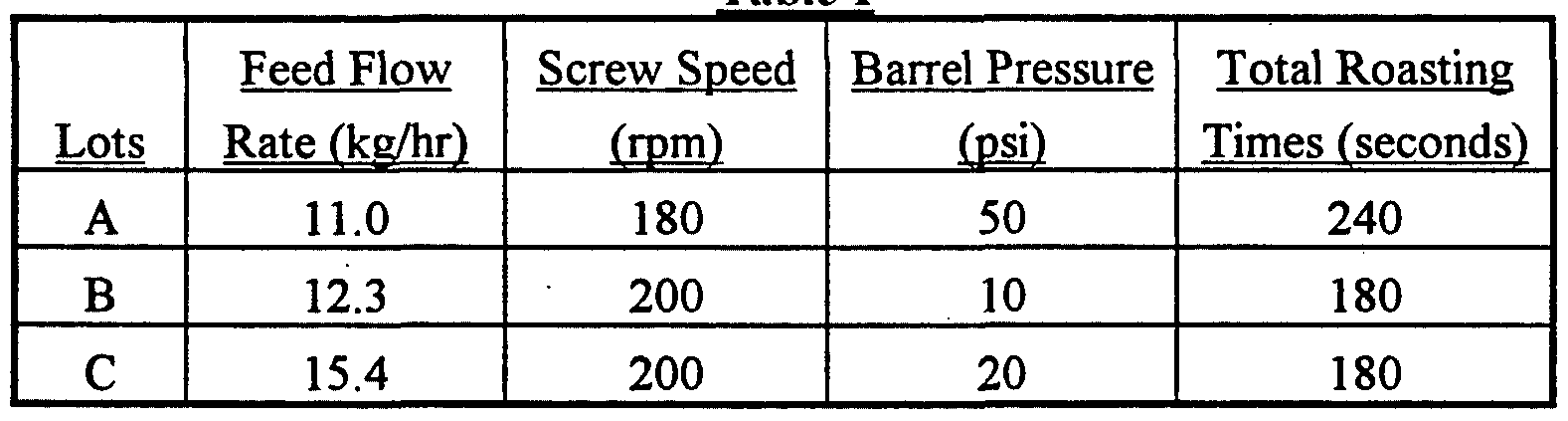
The heated, melted coffee extract within the extruder is forced through a 0.635cm orifice positioned at the extruder exit. The extract melt is immediately cooled using a liquid nitrogen bath as it exits the orifice. Solidification or cooling times are less than about 60 seconds. The solidified extract (solid gasified coffee foam) is coarsely ground and sized using U.S. Standard screen sizes #16 (1.18mm), #30 (0.60mm) and "on pan."
EXAMPLE 2
A 25kg batch of solid coffee extract is placed in a closed metal container. The solid coffee extract is a spray dried powder containing about 3% water and derived from the aqueous extract of roasted coffee beans. The solid coffee extract is heated in a convection oven until carbon dioxide gas begins to visibly and rapidly evolve from the extract (extract temperature about 170°C). Roasting time is 5 minutes. The extract is removed from the heat and immediately contacted with liquid nitrogen until a solid gasified coffee foam is formed. Solidification or cooling time is about 180 seconds. The resulting solid gasified coffee foam is coarsely ground and sized using U.S. Standard screen sizes #16 (1.18mm), #30 (0.60mm) and "on pan".
Claims
1. A process for making a high-yield solid coffee extract with an improved aroma, which process comprises the steps of: a) heating a solid coffee extract which is derived from roasted coffee beans and which initially contains less than about 6% by weight of water to a temperature of at least about 155°C for less than about 20 minutes to produce a coffee extract melt having gaseous carbon dioxide dispersed therein; and immediately thereafter b) cooling the gasified coffee extract melt under conditions sufficient to form a solid coffee extract foam; and c) reducing said solid coffee extract foam into water-soluble particles of improved solid coffee extract.
2. The process according to Claim 1 wherein the solid coffee extract heated in step (a) is maintained at a temperature of between about 155° and 250°C for between about 1 and 10 minutes.
3. The process according to Claim 2 wherein the solid coffee extract heated in step (a) initially contains less than about 3% by weight of water.
4. The process according to Claim 3 wherein the coffee extract melt is solidified within about 5 minutes after the heating step (a) is concluded.
5. The process according to Claim 3 wherein the coffee extract being melted is subjected to mechanical working.
6. The process according to Claim 5 wherein the heating step is carried out in an extruder which forces the coffee extract melt through an orifice to form a shaped coffee extract melt.
7. The process according to Claim 6 wherein the shaped coffee extract melt is solidified within about 2 minutes.
8. The process according to Claim 7 wherein the gasified solid coffee extract foam is reduced to particles of 3000 microns or less.
SHEET RULE 2S
9. A high-yield solid coffee extract with improved aroma, which extract is made by the process comprising the steps of a) heating a solid coffee extract which is derived from roasted coffee beans and which initially contains less than about 6% by weight of water to a temperature of at least about 155°C for less than about 20 minutes to produce a coffee extract melt having gaseous carbon dioxide dispersed therein; and immediately thereafter b) cooling the gasified coffee extract melt under conditions sufficient to form a solid coffee extract foam; and c) reducing said solid coffee extract foam into water-soluble particles of improved solid coffee extract.
10. The high-yield solid coffee extract according to Claim 9 wherein the solid coffee extract heated in step (a) is maintained at a temperature of between about 155° and 250°C for between about 1 and 10 minutes.
11. The high-yield solid coffee extract according to Claim 10 wherein the solid coffee extract heated in step (a) initially contains less than about 3% by weight of water.
12. The high-yield solid coffee extract according to Claim 11 wherein the coffee extract melt is solidified within about 5 minutes after the heating step (a) is concluded.
13. The high-yield solid coffee extract according to Claim 11 wherein the coffee extract being melted is subjected to mechanical working.
14. The high-yield solid coffee extract according to Claim 13 wherein the heating step is carried out in an extruder which forces the coffee extract melt through an orifice to form a shaped coffee extract melt.
15. The high-yield solid coffee extract according to Claim 14 wherein the shaped coffee extract melt is solidified within about 2 minutes.
16. The high-yield solid coffee extract according to Claim 15 wherein the gasified solid coffee extract foam is reduced to particles of 3000 microns or less.
SUBSTlTlfT€ SHEET (RULE 26)
Priority Applications (1)
| Application Number | Priority Date | Filing Date | Title |
|---|---|---|---|
| AU55433/94A AU5543394A (en) | 1992-11-18 | 1993-10-29 | Processes for making high-yield solid coffee extracts with improved aroma characteristics |
Applications Claiming Priority (2)
| Application Number | Priority Date | Filing Date | Title |
|---|---|---|---|
| US97793392A | 1992-11-18 | 1992-11-18 | |
| US07/977,933 | 1992-11-18 |
Publications (1)
| Publication Number | Publication Date |
|---|---|
| WO1994010852A1 true WO1994010852A1 (en) | 1994-05-26 |
Family
ID=25525661
Family Applications (1)
| Application Number | Title | Priority Date | Filing Date |
|---|---|---|---|
| PCT/US1993/010405 Ceased WO1994010852A1 (en) | 1992-11-18 | 1993-10-29 | Processes for making high-yield solid coffee extracts with improved aroma characteristics |
Country Status (2)
| Country | Link |
|---|---|
| AU (1) | AU5543394A (en) |
| WO (1) | WO1994010852A1 (en) |
Cited By (11)
| Publication number | Priority date | Publication date | Assignee | Title |
|---|---|---|---|---|
| WO1996024255A1 (en) * | 1995-02-08 | 1996-08-15 | Societe Des Produits Nestle S.A. | Soluble instant coffee and process for preparation |
| US5741538A (en) * | 1996-02-22 | 1998-04-21 | The Procter & Gamble Company | Low density soluble coffee products having increased particle strength and rapid hot water solubility |
| US5958497A (en) * | 1995-02-08 | 1999-09-28 | Nestec S.A. | Chicory extract powder products and extract production processes and apparatus |
| EP0985350A3 (en) * | 1998-09-09 | 2000-03-22 | Kraft Foods, Inc. | Soluble coffee having intensified flavor and color and method of making same |
| US6399131B2 (en) | 1999-09-08 | 2002-06-04 | Kraft Foods Holdings, Inc. | Soluble coffee having intensified flavor and color and method of making same from a coffee extract |
| EP1228694A1 (en) * | 2001-02-02 | 2002-08-07 | Societe Des Produits Nestle S.A. | Aromatizing agent |
| EP1627568A1 (en) * | 2004-08-17 | 2006-02-22 | Kraft Foods Holdings, Inc. | Foaming soluble coffee powder containing pressurized gas |
| US7736683B2 (en) | 2004-08-17 | 2010-06-15 | Kraft Food Global Brands Llc | Method to increase the foaming capacity of spray-dried powders |
| US8043645B2 (en) | 2008-07-09 | 2011-10-25 | Starbucks Corporation | Method of making beverages with enhanced flavors and aromas |
| US8323719B2 (en) | 2004-08-17 | 2012-12-04 | Kraft Foods Global Brands Llc | Non-carbohydrate foaming compositions and methods of making the same |
| WO2013041891A1 (en) | 2011-09-20 | 2013-03-28 | Gvozdanovic, Ivo | Flavoured confectionery products and process for their preparation |
Citations (5)
| Publication number | Priority date | Publication date | Assignee | Title |
|---|---|---|---|---|
| US2929717A (en) * | 1957-11-15 | 1960-03-22 | Roderick K Eskew | Dehydrating coffee extract |
| FR2156044A1 (en) * | 1971-10-04 | 1973-05-25 | Gen Foods Corp | |
| US4154864A (en) * | 1974-12-17 | 1979-05-15 | Societe D'assistance Technique Pour Produits Nestle S.A. | Extracts of vegetable materials |
| EP0354810A2 (en) * | 1988-08-12 | 1990-02-14 | Kraft General Foods, Inc. | Coffee glass and products |
| US5079026A (en) * | 1988-08-12 | 1992-01-07 | Kraft General Foods, Inc. | Oil or colloidal containing gasified coffee product and process |
-
1993
- 1993-10-29 WO PCT/US1993/010405 patent/WO1994010852A1/en not_active Ceased
- 1993-10-29 AU AU55433/94A patent/AU5543394A/en not_active Abandoned
Patent Citations (5)
| Publication number | Priority date | Publication date | Assignee | Title |
|---|---|---|---|---|
| US2929717A (en) * | 1957-11-15 | 1960-03-22 | Roderick K Eskew | Dehydrating coffee extract |
| FR2156044A1 (en) * | 1971-10-04 | 1973-05-25 | Gen Foods Corp | |
| US4154864A (en) * | 1974-12-17 | 1979-05-15 | Societe D'assistance Technique Pour Produits Nestle S.A. | Extracts of vegetable materials |
| EP0354810A2 (en) * | 1988-08-12 | 1990-02-14 | Kraft General Foods, Inc. | Coffee glass and products |
| US5079026A (en) * | 1988-08-12 | 1992-01-07 | Kraft General Foods, Inc. | Oil or colloidal containing gasified coffee product and process |
Cited By (26)
| Publication number | Priority date | Publication date | Assignee | Title |
|---|---|---|---|---|
| WO1996024255A1 (en) * | 1995-02-08 | 1996-08-15 | Societe Des Produits Nestle S.A. | Soluble instant coffee and process for preparation |
| US5958497A (en) * | 1995-02-08 | 1999-09-28 | Nestec S.A. | Chicory extract powder products and extract production processes and apparatus |
| US5972409A (en) * | 1995-02-08 | 1999-10-26 | Nestec S.A. | Soluble instant coffee prepared from extract obtained from green coffee |
| US5741538A (en) * | 1996-02-22 | 1998-04-21 | The Procter & Gamble Company | Low density soluble coffee products having increased particle strength and rapid hot water solubility |
| US5922385A (en) * | 1996-02-22 | 1999-07-13 | The Procter & Gamble Company | Process for preparing low density soluble coffee products having increased particle strength and rapid hot water solubility |
| EP0985350A3 (en) * | 1998-09-09 | 2000-03-22 | Kraft Foods, Inc. | Soluble coffee having intensified flavor and color and method of making same |
| US6120831A (en) * | 1998-09-09 | 2000-09-19 | Kraft Foods, Inc. | Soluble coffee having intensified flavor and color and method of making same |
| US6399131B2 (en) | 1999-09-08 | 2002-06-04 | Kraft Foods Holdings, Inc. | Soluble coffee having intensified flavor and color and method of making same from a coffee extract |
| EP1228694A1 (en) * | 2001-02-02 | 2002-08-07 | Societe Des Produits Nestle S.A. | Aromatizing agent |
| WO2002074096A3 (en) * | 2001-02-02 | 2002-11-28 | Nestle Sa | Aromatizing agent |
| US7736683B2 (en) | 2004-08-17 | 2010-06-15 | Kraft Food Global Brands Llc | Method to increase the foaming capacity of spray-dried powders |
| US7713565B2 (en) | 2004-08-17 | 2010-05-11 | Kraft Foods Holdings, Inc. | Method of preparing a foaming soluble coffee powder |
| EP1627568A1 (en) * | 2004-08-17 | 2006-02-22 | Kraft Foods Holdings, Inc. | Foaming soluble coffee powder containing pressurized gas |
| US8323719B2 (en) | 2004-08-17 | 2012-12-04 | Kraft Foods Global Brands Llc | Non-carbohydrate foaming compositions and methods of making the same |
| US8114457B2 (en) | 2008-07-09 | 2012-02-14 | Starbucks Corporation | Methods of making beverages with enhanced flavors and aromas |
| US8114458B2 (en) | 2008-07-09 | 2012-02-14 | Starbucks Corporation | Methods of making beverages with enhanced flavors and aromas |
| US8114459B2 (en) | 2008-07-09 | 2012-02-14 | Starbucks Corporation | Methods of making beverages with enhanced flavors and aromas |
| US8043645B2 (en) | 2008-07-09 | 2011-10-25 | Starbucks Corporation | Method of making beverages with enhanced flavors and aromas |
| US8414953B2 (en) | 2008-07-09 | 2013-04-09 | Starbucks Corporation | Beverages with enhanced flavors and aromas |
| US8524306B2 (en) | 2008-07-09 | 2013-09-03 | Starbucks Corporation | Beverages with enhanced flavors and aromas |
| US8535748B2 (en) | 2008-07-09 | 2013-09-17 | Starbucks Corporation | Beverages with enhanced flavors and aromas |
| US8541042B2 (en) | 2008-07-09 | 2013-09-24 | Starbucks Corporation | Beverages with enhanced flavors and aromas |
| US10154675B2 (en) | 2008-07-09 | 2018-12-18 | Starbucks Corporation | Soluble coffee products for producing beverages with enhanced flavors and aromas |
| US11160291B2 (en) | 2008-07-09 | 2021-11-02 | Starbucks Corporation | Soluble coffee products for producing beverages with enhanced flavors and aromas |
| US12207667B2 (en) | 2008-07-09 | 2025-01-28 | Starbucks Corporation | Soluble coffee products for producing beverages with enhanced flavors and aromas |
| WO2013041891A1 (en) | 2011-09-20 | 2013-03-28 | Gvozdanovic, Ivo | Flavoured confectionery products and process for their preparation |
Also Published As
| Publication number | Publication date |
|---|---|
| AU5543394A (en) | 1994-06-08 |
Similar Documents
| Publication | Publication Date | Title |
|---|---|---|
| US4919962A (en) | Coffee flakes and process | |
| AU688970B2 (en) | Encapsulation of volatile aroma compounds | |
| US8765206B2 (en) | Instant freeze-dried coffee and regular roasted coffee composition and method of making same | |
| US5079026A (en) | Oil or colloidal containing gasified coffee product and process | |
| US5750178A (en) | Method of making coffee particles containing aroma | |
| WO1994010852A1 (en) | Processes for making high-yield solid coffee extracts with improved aroma characteristics | |
| US4324808A (en) | Process for preparing freeze dried soluble coffee | |
| AU626805B2 (en) | A process for hydrolyzing partially extracted roasted and ground coffee | |
| US5538750A (en) | Method of producing an instantly soluble tea powder | |
| US6120831A (en) | Soluble coffee having intensified flavor and color and method of making same | |
| EP0809443B1 (en) | Soluble instant coffee and process for preparation | |
| US4100305A (en) | Method of making an improved coffee volatiles concentrate | |
| US4130669A (en) | Method of making an improved tea volatiles concentrate | |
| CA2758711C (en) | Tea leaves for extraction of green tea beverage | |
| US4338349A (en) | Reincorporation of cocoa aroma | |
| KR20010050383A (en) | Soluble Coffee Having Intensified Flavor and Color and Method of Making Same from a Coffee Extract | |
| US5035908A (en) | Evaporative process for producing coffee glass | |
| CA1332315C (en) | Gasified coffee product and process | |
| EP0354810B1 (en) | Coffee glass and products | |
| US3438784A (en) | Freeze-drying of granular coffee extract | |
| CA1063864A (en) | Process for producing roasted and ground coffee | |
| CA1337853C (en) | Coffee glass and process for producing same | |
| CA1332313C (en) | Coffee glass and evaporative process for producing same | |
| GB2607790A (en) | Spray-dried coffee product and production method | |
| IE892330L (en) | Coffee glass & process for producing same |
Legal Events
| Date | Code | Title | Description |
|---|---|---|---|
| AK | Designated states |
Kind code of ref document: A1 Designated state(s): AU BB BG BR BY CA CZ FI HU JP KP KR KZ LK LV MG MN MW NO NZ PL RO RU SD SK UA UZ VN |
|
| AL | Designated countries for regional patents |
Kind code of ref document: A1 Designated state(s): AT BE CH DE DK ES FR GB GR IE IT LU MC NL PT SE BF BJ CF CG CI CM GA GN ML MR NE SN TD TG |
|
| DFPE | Request for preliminary examination filed prior to expiration of 19th month from priority date (pct application filed before 20040101) | ||
| 121 | Ep: the epo has been informed by wipo that ep was designated in this application | ||
| 122 | Ep: pct application non-entry in european phase | ||
| NENP | Non-entry into the national phase |
Ref country code: CA |