WO1988005823A2 - Mycobacterium tuberculosis genes encoding protein antigens - Google Patents
Mycobacterium tuberculosis genes encoding protein antigens Download PDFInfo
- Publication number
- WO1988005823A2 WO1988005823A2 PCT/US1988/000281 US8800281W WO8805823A2 WO 1988005823 A2 WO1988005823 A2 WO 1988005823A2 US 8800281 W US8800281 W US 8800281W WO 8805823 A2 WO8805823 A2 WO 8805823A2
- Authority
- WO
- WIPO (PCT)
- Prior art keywords
- protein
- mycobacterium tuberculosis
- tuberculosis
- dna
- isolated
- Prior art date
- Legal status (The legal status is an assumption and is not a legal conclusion. Google has not performed a legal analysis and makes no representation as to the accuracy of the status listed.)
- Ceased
Links
Classifications
-
- C—CHEMISTRY; METALLURGY
- C07—ORGANIC CHEMISTRY
- C07K—PEPTIDES
- C07K14/00—Peptides having more than 20 amino acids; Gastrins; Somatostatins; Melanotropins; Derivatives thereof
- C07K14/195—Peptides having more than 20 amino acids; Gastrins; Somatostatins; Melanotropins; Derivatives thereof from bacteria
- C07K14/35—Peptides having more than 20 amino acids; Gastrins; Somatostatins; Melanotropins; Derivatives thereof from bacteria from Mycobacteriaceae (F)
-
- A—HUMAN NECESSITIES
- A61—MEDICAL OR VETERINARY SCIENCE; HYGIENE
- A61K—PREPARATIONS FOR MEDICAL, DENTAL OR TOILETRY PURPOSES
- A61K39/00—Medicinal preparations containing antigens or antibodies
Definitions
- Tuberculosis was the major cause of infectious mortality in Europe and the United States in the 19th and early 20th centuries. Dubos, R. and J. Dubos, The White Plague: Tuberculosis, Man and Society, Little Brown & Co., Boston, MA, (1952). Today, it remains a significant global health problem.
- tuberculosis remains widespread and constitutes a health problem of major proportions, particularly in developing countries.
- the World Health Organization estimates that there are ten million new cases of active tuberculosis per year and an annual mortality of approximately three million. Joint International Union against Tuberculosis and World Health Organization Study Group, Tubercle, 63:157-169 (1982).
- Tuberculosis is caused by Mycobacterium (M.) tuberculosis or Mycobacterium (M.) bovis, which are the 'tubercle bacilli' of the family Mycobacteriaceae.
- M. bovis is a species which causes tuberculosis in cattle and is transmissible to humans and other animals, in whom it causes tuberculosis. At present, nearly all tuberculosis is caused by respiratory infection with M. tuberculosis. Infection may be asymptomatic in some, but in other individuals, it produces pulmonary lesions which lead to severe debilitation or death. Resistance to tuberculosis is provided by cell-mediated immune mechanisms.
- Mycobacteria are aerobic, acid-fast, non-spore- forming, non-motile bacili with high lipid contents and slow generation times.
- M. leprae is the etiologic agent of leprosy and, among the other mycobacteria, the only major pathogen. Bloom, B.R. and T. Godal, Review of Infectious Diseases, 5:765-780 (1983). However, other mycobacterial species are capable of causing disease. Wallace, R.J. et.al., Review of Infectious Diseases, 5:657-679 (1984).
- M.avium for example, causes tuberculosis in fowl and in other birds. Members of the M.
- PPD purified protein derivative
- BCG Bacille Calmette Guerin
- M. bovis Bacille Calmette Guerin
- numerous studies have shown that BCG has protective efficacy against tuberculosis. These studies are reviewed by F. Luelmo in American Review of Respiratory Diseases, 125 (pt. 2):70-72 (1982).
- F. Luelmo in American Review of Respiratory Diseases, 125 (pt. 2):70-72 (1982).
- World Health Organization WHO Technical Report Series 651 (1980).
- Presently available approaches to diagnosing, preventing and treating tuberculosis are limited in their effectiveness and must be improved if a solution is to be found for the important public health problem tuberculosis represents worldwide.
- the present invention is based on the isolation of genes encoding immunogenic protein antigens of the tubercle bacillus Mycobacterium tuberculosis (M. tuberculosis). Genes encoding such protein antigens have been isolated from a recombinant DNA expression library of M. tuberculosis DNA. Genes encoding proteins of four additional mycobacteria have also been isolated and restriction maps produced. in particular, genes encoding five immunodominant protein antigens of the tuberculosis bacillus (i.e., those M.
- tuberculosis proteins of molecular weight 12,000 daltons (l2kD), 14kD, 19kD, 65kD and 71kD have been isolated by probing a lambda gtll expression library of M. tuberculosis DNA with monoclonal antibodies directed against M. tuberculosis-specific antigens.
- Recombinant DNA clones producing the specific antigenic determinants recognized by the monoclonal antigens were also isolated in this manner.
- DNA from such recombinant lambda gtll clones was mapped with restriction endonucleases; the restriction maps for genes encoding the five immunodominant protein antigens (i.e., genes encoding the 12kD, 14kD, 19kD, 65kD and 71kD proteins) were deduced.
- the nucleotide sequence of three of the genes have been determined and, in each case, the amino acid sequence of the encoded protein has been deduced.
- Figure 1 shows restriction maps of M. tuberculosis DNA. Recombinant DNA clones isolated with monoclonal antibodies directed against the 12kD, 14kD, 19kD, 65kD and 71kD protein antigens were mapped with restriction endonucleases. The insert DNA endpoints are designated left (L) or right (R) in relation to lac Z transcripts which traverse the insert from right to left. Restriction sites are represented as follows: A, Sal I; B, BamHI; E, EcoRI; G, BglII; K, KpnI; P, PvuI; S, Sad; X, XhoI.
- Figure 2 shows arrays of antigens from M.
- tuberculosis recombinant DNA clones probed with rabbit hyperimmune serum The code of the recombinant DNA clones shown on the numbers filter is: 1, Y3275; 2, Y3274; 3, Y3279; 4, Y3277; 5, Y3247; 6, Y3272; 7, Y3150; 8, Y3254; 9, Y3147; 10, Y3163; 11, Y3179; 12, Y3191; 13, Y3252; 14, Y3178; 15, Y3180; 16, Y3143; 17, lambda gtll.
- Clones 1, 5, 6, 7, 9 and 16 are M. tuberculosis recombinants described in the following section. Clones 10, 11, 14 and 15 are M.
- Clones 2, 3, 4, 8, 12, 13 are uncharacterized recombinants from the lambda gtll M. tuberculosis and M. leprae libraries. Clone 17 is a nonrecombinant lambda gtll control.
- Figure 3 shows arrays of recombinant mycobacterial antigens probed with monoclonal antibodies to assess the extent of cross-reactivity between recombinant protein antigen of M. tuberculosis and of M. leprae.
- the array of clones is identical to that shown in Figure 2.
- Antibody probes and the antigen sizes recognized are: 1, IT-11 (71kD); 2, IT-31 (65kD); 3, IT-16 (19kD); 4, IT-1 (14kD); 5, IT-3 (12kD).
- Figure 4 shows restriction maps of DNA encoding four proteins (71kD, 65kD, 19kD and 14kD) of M. tuberculosis and four proteins (71kD, 65kD, 19kD and 14kD) of M. bovis BCG.
- Figure 5 is a comparison of restriction maps of the gene encoding the 65kD protein of 6 mycobacteria (M. leprae, M. tuberculosis, M. africanum, M. bovis BCG, M. smegmatis, M. avium). Restriction sites are as follows: B, BamHl; K, KpnI; N, SacI; P, PvuI; S,
- Figure 6 is the nucleotide sequence of the region containing the M. tuberculosis 19kD gene.
- the deduced amino acid sequence of the encoded protein is also represented (protein start position, nucleotide 1110; protein stop position, nucleotide
- Figure 7 is the nucleotide sequence of the region containing the M. tuberculosis 71kD gene and the deduced amino acid sequence of the encoded protein.
- Figure 8 is the nucleotide sequence of the region containing the M. tuberculosis 65kD gene.
- the deduced amino acid sequences of the two long open reading frames are presented in one letter code over (540) or under (517) the appropriate triplets.
- the invention described herein is based on the isolation of genes encoding immunogenic protein antigens of the bacillus M. tuberculosis, which is the major etiologic agent of tuberculosis.
- it is based on the isolation, using monoclonal antibodies directed against M. tuberculosis-specific antigens, of genes encoding five immunogenic protein antigens of the tuberculosis bacillus; these five antigens are immunodominant.
- Immunogenic antigens are those which elicit a response from the immune system.
- Immunodominant protein antigens are immunogenic antigens against which the immune system directs a significant portion of its response.
- Genes encoding M. tuberculosis antigens of molecular weight 12,000 daltons (12kD), 14kD, 19kD, 65kD and 71kD were isolated in this manner.
- M. bovis BCG DNA clones were also isolated for the genes encoding the 71kD, 65kD, 19kD and 14kD proteins.
- restriction endonuclease maps were determined for DNA segments containing each of the genes. Restriction maps for each of these genes is represented in Figure 4.
- a recombinant DNA expression library of M. tuberculosis DNA was constructed using lambda gtll.
- the library was constructed with M. tuberculosis genomic DNA fragments in such a way that all protein-coding sequences would be represented and expressed. Young, R.A., B.R. Bloom, C.M. Grosskinsky, J. Ivanyi, D. Thomas and R.W. Davis, Proceedings of the National Academy of Sciences, USA, 82:2583-2587 (1985).
- Lambda gtll is a bacteriophage vector which is capable of driving the expression of foreign insert DNA with E. coli transcription and translation signals.
- Lambda gtll expresses the insert DNA as a fusion protein connected to the E. coli Beta-galactosidase polypeptide. This approach ensures that the foreign DNA sequence will be efficiently transcribed and translated in E. coli. This approach is also useful in addressing the problem of the highly unstable nature of most foreign proteins; fusion proteins are often more resistant to proteolytic degradation than is the foreign polypeptide alone.
- Lambda gtll and the E. coli strain used (Y1090) have been described previously. Young, R.A.
- the library constructed in this manner has a titer of 1 ⁇ 10 10 pfu/ml. and contains approximately 40% recombinants with an average insert size of 4kB.
- cloned lambda gtll recombinants were arrayed on lawns of E. coli Y1090. The phage were grown, antigen expression was induced and the antigens were blotted and probed with serum. Detection of signal-producing plaques was performed with a biotinylated secondary antibody system (Vectastain, Vector Laboratories, Burlingame, CA) or with an alkaline phosphatase conjugated secondary antibody system (Protoblot, Promega Biotec, Madison, WI), both used according to manufacturer's instructions. Signal-producing clones were isolated using antibodies directed against protein antigens of molecular weight 12kD, 14kD, 19kD and 65kD and 71kD.
- Figure 1 shows the genomic DNA restriction map deduced for each of the genes encoding the five M. tuberculosis antigens and illustrates how each of the cloned DNAs aligns with that map. All clones isolated with monoclonal antibodies directed against any single antigen align with a single genomic DNA segment. This indicates that all clones were isolated because they express the protein of interest rather than an unrelated polypeptide containing a similar or identical epitope. In addition, this result suggests that each antigen is the product of a single gene.
- each DNA insert in the recombinant clones was determined by restriction analysis . Only among the clones for the 65kD antigen were the inserts found in both possible orientations relative to the direction of lac Z transcription in lambda gtll. This suggests that this protein can be expressed in E. coli from signals independent of those provided by lac Z. Similar results have been obtained for recombinant DNA clones encoding the 65kD antigens of M. bovis and M. leprae. Thole, J.E.R. et al., Infectious Immunology, 50 : 800-806 ( 1985 ) ; Young , R.A. et al . ,
- the nucleotide sequences of three regions of the M. tuberculosis DNA were determined: 1) the region containing the M. tuberculosis 19kD gene; 2) the region containing the M. tuberculosis 71kD gene; and 3) the region containing the 65kD gene.
- the three sequences are represented in Figures 6-8. Sequences were determined using standard techniques, which are described in the Exemplification.
- the response of a second animal to an antigen preparation of M. tuberculosis was assessed by examining the reactivity of rabbit anti-M. tuberculosis hyperimmune sera with recombinant antigens.
- Cloned lambda gtll recombinants were arrayed on lawns of E. coli and probed with the rabbit hyperimmune serum.
- Anti-M. tuberculosis hyperimmune serum produced by repeated immunization of rabbits with M. tuberculosis H37Rv culture filtrate, was provided by J. Bennedsen (Statens Seruminstitut, Copenhagen, Denmark). These sera were used at 1:100 dilution.
- the M. tuberculosis lambda gtll recombinant DNA library was screened with the rabbit serum. Forty signal-producing clones were isolated, arrayed on lawns of E. coli Y1090 and probed with monoclonal antibodies directed against each of the 5 recombinant M. tuberculosis protein antigens. Remarkably, 17 of the 40 clones (43%) reacted strongly with at least one of the four anti-65kD monoclonal antibodies tested.
- a single recombinant DNA clone containing most or all of the gene of interest was used to express antigen in the following manner.
- the recombinant phage clones were arrayed on a lawn of E. coli Y1090, which was then grown and induced for antigen expression.
- FIG. 3 shows the array of DNA clones used and the results obtained with the anti-M tuberculosis antibodies IT-1, IT-3, IT-11, IT-16, and IT-31, which recognized proteins of 14kD, 12kD, 71kD, 19kD and 65kD respectively.
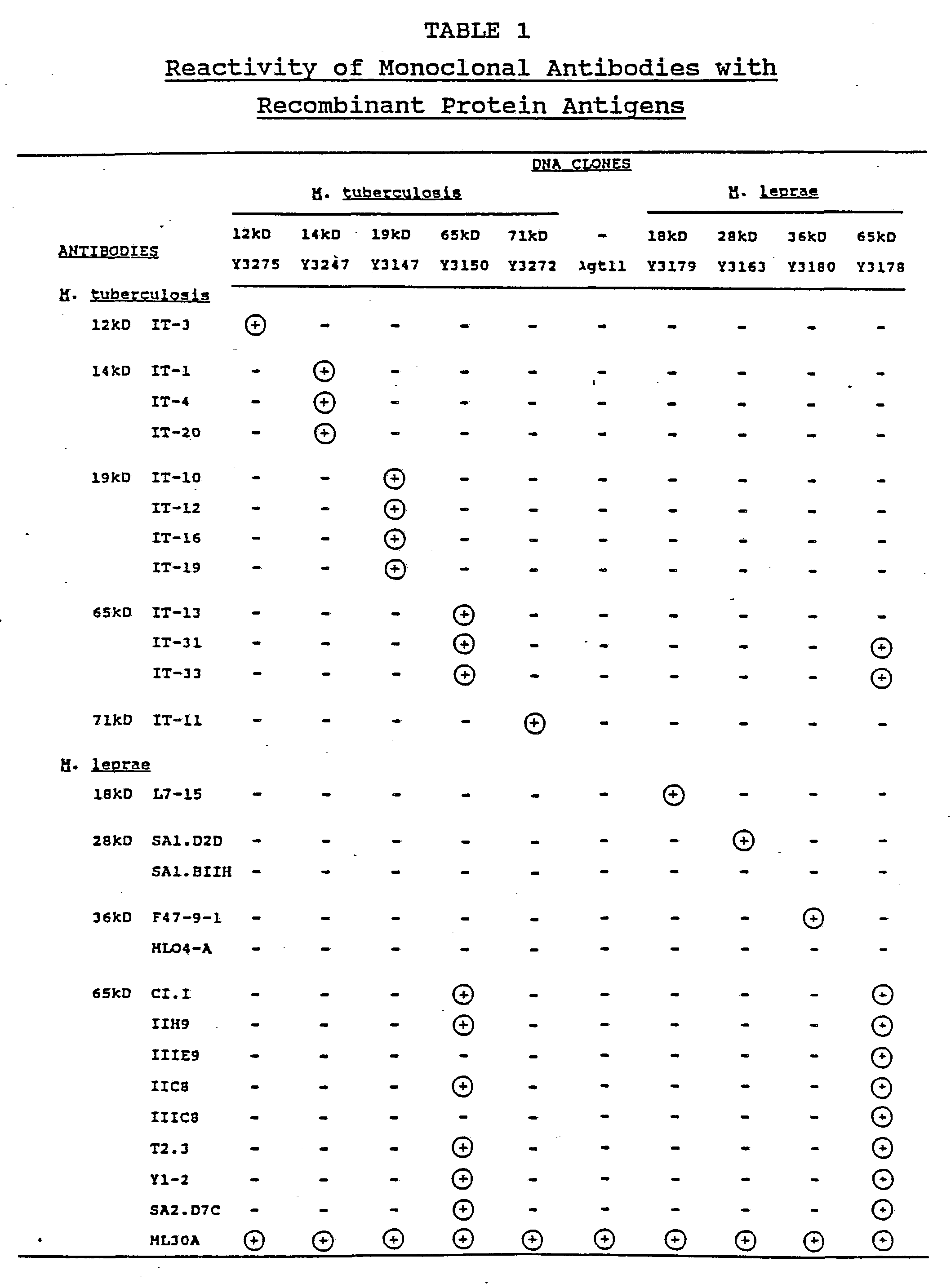
- Table 1 details the full results of these cross-screening experiments, showing the reactivity of antigen expressed from individual recombinant DNA clones with each of the individual monoclonal antibodies. Clones were scored as positive only if the signal produced was clearly greater than the background signal produced by the non-recombinant lambda gtll clone included in/each array.
- the 65kD antigen is among the most immunodominant of the protein antigens of M. tuberculosis. Eleven of the 25 different M. tuberculosis and M. leprae monoclonal antibodies examined in this study recognized the 65kD recombinant antigen from one or both mycobacteria. In addition, almost half of the recombinant DNA clones isolated with rabbit polyclonal anti-M. tuberculosis sera express the 65kD antigen, reflecting the predominance of antibody to this antigen in these sera.
- 65kD antigen plays an important role in the human response to tuberculosis. Antibodies directed against this protein can be detected in the serum of patients with tuberculosis.
- the 65kD antigen is present in purified protein derivatives (PPD's) of M. tuberculosis, M. bovis, and other mycobacteria. Thole, J.E.R. et al., Infection Immunity, 50:800-806 (1985).
- helper T cell clones reactive with recombinant 65kD antigen have been isolated from patients with tuberculosis, indicating that this antigen is involved in the cell-mediated as well as the humoral immune response to tuberculosis.
- the 65kD antigen appears to elicit antibody and T cell responses similar to those observed for the M. tuberculosis antigen.
- Both serum antibodies and T cells directed against the 65kD M. leprae antigen have been observed in patients with leprosy. Britton, W.J. et al., Journal of Immunology, 135:4171-4177 (1985); Mustafa, A.S. et al., Nature, 319:63-66 (1986).
- T cell clones from leprosy patients have been found to respond to recombinant 65kD protein of M. bovis, as well as to PPD's from both M. bovis BCG and M.
- genes encoding proteins of additional mycobacteria were isolated. DNA clones containing genes encoding the following proteins were isolated: Mycobacterium Protein Clone M. bovis BCG 71kD PL1-101
- M. africanum 65kD PL1-301 For purposes of comparison, genes encoding the following proteins were isolated for M. tuberculosis and M. leprae:
- Figure 4 presents a comparison of the restriction maps for four genes of M. tuberculosis with the restriction maps for four genes of M. bovis BCG which encode proteins of the same molecular weight.
- the restriction sites on the two genes e.g., those on the M. tuberculosis gene and those on the M. bovis gene which encodes a protein of the same molecular weight
- the sequence of the genes of the two mycobacteria are very similar and, therefore, the proteins they encode are also very similar.
- Figure 5 presents a comparison of the restriction map for the gene encoding the 65kD protein for the six mycobacteria.
- the restriction maps for the genes encoding the 65kD protein of M. tuberculosis, M. africanum, M. bovis BCG, M. smegmatis and M. avium are essentially identical.
- the fact that there is no detectable difference among these mycobacteria at the level of the restriction map is an indication that, at least at this level, the encoded proteins are the same.
- the map of the M. leprae 65kD gene has several identical restriction sites in common with those of the other mycobacteria; it also has two sites not found in the other genes and lacks three sites present in the others. This indicates that, at the level of the restriction map, there are similarities in the DNA (and the encoded protein).
- the nucleotide sequence of three of the five genes has been determined.
- the sequence of the remaining genes can be determined using well-known methods, such as that of Sanger et al. Sanger, F. et. al., Proceedings of the National Academy of Sciences, USA, 74:5463-5467 (1977).
- the amino acid sequence of each of the immunodominant proteins has been deduced from the nucleotide sequence of the three genes and can be done for the others.
- Proteins antigens encoded by an entire gene, or amino acid sequences (e.g., peptides, protein fragments) which make up the antigenic determinant of a M. tuberculosis antigen may be used in serodiagnostic tests and skin tests.
- M. tuberculosis antigen i.e., M. tuberculosis-specific antigenic determinants
- Such antigens would be highly specific to the tuberculosis bacillus and the tests in which they are used would also be highly specific.
- M. tuberculosis-specific T cells A mixture of peptides recognized by helper T cells can serve as a specific skin test antigen useful in assessing immunological status (delayed hypersensitivity) of infected individuals and those with whom they come in contact. This specific skin test antigen would be useful in evaluating rapidly the immunological efficacy of anti-tuberculosis vaccines. It is reasonable to expect that the products encoded by M. tuberculosis genes, particularly those shown to be recognized by helper T cells, are themselves immunogenic and thus useful components of vaccines against tuberculosis. These products include proteins and portions of such proteins
- polypeptides and peptides are examples of genes encoding products (e.g., polypeptides) which provide immunological protection into viruses such as vaccinia virus, or bacteria, such as cultivatable mycobacteria, thus producing a vaccine capable of engendering long-lasting and very specific immunity.
- the genes encoding five immunodominant protein antigens of the tuberculosis bacillus, described herein, are useful for that purpose; genes encoding the 65kD, 19kD and 71kD antigens, or a portion thereof, are particularly valuable in vaccine construction.
- the recombinant DNA library of M. tuberculosis genomic DNA fragments in the lambda gtll vector was constructed as described above. Recombinant phage lambda RY3143 and lambda RY3146 were used. Young, R.A. et al., Proceedings of the National Academy of Sciences, USA, 82:2583-2587 (1985). Subclones of the mycobacterial DNA inserts in these recombinant phage were constructed in pUC19 or M13mp9 vectors using standard recombinant DNA techniques. Messing, J. and J. Viera, Gene, 19:269-276 (1982). Maniatis, T.
- Recombinant clones expressing antigens reactive with the 65kD antigen specific monoclonal antibodies IT-13, IT-31, and IT-33 were isolated as described above.
- a pool of the three antibodies was used; it contained a 1:1000 dilution of each antibody to screen a total of about 8 ⁇ 10 5 recombinant phage from the lambda gtll-M. tuberculosis library.
- the phage were allowed to grow and induced to synthesize the foreign proteins as described previously.
- the filters were then reacted with a 1:1000 dilution of one of the monoclonal hybridoma antibodies as described above.
- the lambda gtll-M. tuberculosis library was screened with the monoclonal antibodies specific for the 65kD antigen and clones reactive with them were isolated essentially as described by Young et al. Young, R.A. et al., Proceedings of the National Academy of Sciences, USA, 82:2583-2587 (1985). Briefly, for each 150mm LB plate, 0.6ml of a fresh overnight culture of Y1090 was infected with 1-2 ⁇ 10 5 plaque forming units of the library.
- the plaques were overlaid with a dry nitrocellulose filter which had been saturated with 10mM isopropyl-B-D-thiogalactopyranoside (IPTG).
- IPTG 10mM isopropyl-B-D-thiogalactopyranoside
- the plates were incubated an additional 3.5-4 hours at 37 o C and then removed to room temperature and the position of the filters marked.
- the filters were washed briefly in TBST (50 mM Tris-HCl, pH 8, 150mM NaCl, 0.05% Tween 20) and then incubated in TBST + 20% fetal calf serum. After 30 minutes at room temperature, the filters were transferred to TBST plus antibody.
- the antibody mix contained a 1:1000 dilution of IT-13, IT-31, and IT-33.
- the filters were incubated with the antibody solution overnight at 4 o C with gentle agitation, washed in TBST and reacted with biotinylated goat anti-mouse immunoglobulin, the Vectastain ABC reagent, and developer as described by the manufacturer (Vector Laboratories). After the color had developed the filters were washed with several changes of water and air dried. Phage corresponding to positive signals were twice plaque purified.
- Crude lysates of cells expressing plasmid encoded proteins were made by harvesting cells from overnight cultures and resuspending the cells in 10 mM Tris pH7.5/10 mM EDTA containing 100 ug lysozyme/ml. After 10 minutes at room temperature, SDS was added to a final concentration of 0.5%. A protease inhibitor (Trasylol, Boehringer Mannheim) was added to all crude lysates at a final concentration of 0.3%. The crude protein preparations were electrophoresed on 10% polyacrylamide-SDS
- B-galactosidase assays were also carried out. Cells were grown in LB broth or LB broth plus 2.5mM IPTG to an OD 600 of about 0.3. Crude lysates were made and b-galactosidase activity assayed as described by Miller. Miller, J.H., Experiments in Molecular Genetics, Cold Spring Harbor Laboratory, Cold Spring Harbor, NY (1972).
Landscapes
- Chemical & Material Sciences (AREA)
- Organic Chemistry (AREA)
- Health & Medical Sciences (AREA)
- General Health & Medical Sciences (AREA)
- Biochemistry (AREA)
- Biophysics (AREA)
- Life Sciences & Earth Sciences (AREA)
- Genetics & Genomics (AREA)
- Medicinal Chemistry (AREA)
- Molecular Biology (AREA)
- Proteomics, Peptides & Aminoacids (AREA)
- Gastroenterology & Hepatology (AREA)
- Peptides Or Proteins (AREA)
- Measuring Or Testing Involving Enzymes Or Micro-Organisms (AREA)
- Preparation Of Compounds By Using Micro-Organisms (AREA)
Abstract
Description


Claims
Applications Claiming Priority (2)
| Application Number | Priority Date | Filing Date | Title |
|---|---|---|---|
| US1000787A | 1987-02-02 | 1987-02-02 | |
| US010,007 | 1987-02-02 |
Publications (2)
| Publication Number | Publication Date |
|---|---|
| WO1988005823A2 true WO1988005823A2 (en) | 1988-08-11 |
| WO1988005823A3 WO1988005823A3 (en) | 1988-11-03 |
Family
ID=21743281
Family Applications (1)
| Application Number | Title | Priority Date | Filing Date |
|---|---|---|---|
| PCT/US1988/000281 Ceased WO1988005823A2 (en) | 1987-02-02 | 1988-02-01 | Mycobacterium tuberculosis genes encoding protein antigens |
Country Status (3)
| Country | Link |
|---|---|
| EP (1) | EP0345299A1 (en) |
| AU (1) | AU1548388A (en) |
| WO (1) | WO1988005823A2 (en) |
Cited By (33)
| Publication number | Priority date | Publication date | Assignee | Title |
|---|---|---|---|---|
| GR880100104A (en) * | 1987-02-26 | 1988-12-16 | Scripps Clinic Res | Mycetobacterial products derived from recompositions and peptides |
| WO1989012455A1 (en) * | 1988-06-15 | 1989-12-28 | Whitehead Institute For Biomedical Research | Stress proteins and uses therefor |
| FR2645878A1 (en) * | 1989-04-17 | 1990-10-19 | Inst Nat Sante Rech Med | NUCLEOTIDE SEQUENCES OF ACTINOMYCETALS, APPLICATIONS FOR THE SYNTHESIS OR DETECTION OF NUCLEIC ACIDS, PRODUCTS OF EXPRESSION OF SUCH SEQUENCES AND APPLICATION AS IMMUNOGENIC COMPOSITIONS |
| FR2651505A1 (en) * | 1989-09-06 | 1991-03-08 | Pasteur Institut | Nucleic acid fragments derived from a genome of an appropriate mycobacterium, their applications in the diagnosis of infections caused by mycobacteria and plasmids containing the said fragments |
| EP0305488A4 (en) * | 1987-02-26 | 1991-06-05 | Scripps Clinic And Research Foundation | Mycobacterial recombinants and peptides |
| WO1991014448A1 (en) * | 1990-03-27 | 1991-10-03 | Aktiebolaget Astra | New proteins, peptides and corresponding dna or rna sequences and probes useful for diagnosing tuberculosis |
| WO1993014118A1 (en) * | 1992-01-17 | 1993-07-22 | Medical Research Council | Peptide fragments of hsp71 of m. tuberculosis and their use in diagnosis of tuberculosis |
| FR2694754A1 (en) * | 1992-08-12 | 1994-02-18 | Bio Merieux | Mycobacteria DNA fragments, amplification primers, hybridization probes, reagents and method for detecting detection of mycobacteria. |
| WO1996005223A1 (en) * | 1994-08-12 | 1996-02-22 | The Regents Of The University Of California | Abundant extracellular products and methods for their production and use |
| US6013660A (en) * | 1996-10-02 | 2000-01-11 | The Regents Of The University Of California | Externally targeted prophylactic and chemotherapeutic method and agents |
| WO2000055194A3 (en) * | 1999-03-18 | 2001-06-28 | Corixa Corp | Tuberculosis antigens and methods of use therefor |
| US6290969B1 (en) | 1995-09-01 | 2001-09-18 | Corixa Corporation | Compounds and methods for immunotherapy and diagnosis of tuberculosis |
| US6335183B1 (en) | 1988-06-15 | 2002-01-01 | Whitehead Institute For Biomedical Research | Stress proteins and uses therefor |
| US6338852B1 (en) | 1995-09-01 | 2002-01-15 | Corixa Corporation | Compounds and methods for diagnosis of tuberculosis |
| US6458366B1 (en) | 1995-09-01 | 2002-10-01 | Corixa Corporation | Compounds and methods for diagnosis of tuberculosis |
| US6465633B1 (en) | 1998-12-24 | 2002-10-15 | Corixa Corporation | Compositions and methods of their use in the treatment, prevention and diagnosis of tuberculosis |
| US6495347B1 (en) | 1999-07-08 | 2002-12-17 | Stressgen Biotechnologies Corporation | Induction of a Th1-like response in vitro |
| US6497880B1 (en) | 1998-12-08 | 2002-12-24 | Stressgen Biotechnologies Corporation | Heat shock genes and proteins from Neisseria meningitidis, Candida glabrata and Aspergillus fumigatus |
| US6524825B1 (en) | 1997-08-05 | 2003-02-25 | Stressgen Biotechnologies, Inc. | Immune responses against HPV antigens elicited by compositions comprising an HPV antigen and a stress protein or an expression vector capable of expression of these proteins |
| US6592877B1 (en) | 1995-09-01 | 2003-07-15 | Corixa Corporation | Compounds and methods for immunotherapy and diagnosis of tuberculosis |
| US6752993B1 (en) | 1993-11-23 | 2004-06-22 | The Regents Of The University Of California | Abundant extracellular product vaccines and methods for their production and use |
| US6761894B1 (en) | 1993-11-23 | 2004-07-13 | The Regents Of The University Of California | Abundant extracellular products and methods for their production and use |
| US6797491B2 (en) | 2000-06-26 | 2004-09-28 | Stressgen Biotechnologies Corporation | Human papilloma virus treatment |
| WO2004071387A3 (en) * | 2003-02-14 | 2005-03-24 | Novartis Ag | Hsp60 from arthrobacter |
| US6875435B2 (en) | 2000-01-14 | 2005-04-05 | Whitehead Institute For Biomedical Research | In vivo CTL elicitation by heat shock protein fusion proteins maps to a discrete domain and is CD4+ T cell-independent |
| US6921534B2 (en) | 2001-02-05 | 2005-07-26 | Stressgen Biotechnologies Corporation | Hepatitis B virus treatment |
| US7157089B1 (en) | 1996-11-26 | 2007-01-02 | Stressgen Biotechnologies Corporation | Immune responses using compositions containing stress proteins |
| US7300660B2 (en) | 1993-11-23 | 2007-11-27 | The Regents Of The University Of California | Abundant extracellular products and methods for their production and use |
| US7608277B2 (en) * | 2004-12-01 | 2009-10-27 | Gene Therapy Systems, Inc. | Tuberculosis nucleic acids, polypeptides and immunogenic compositions |
| US7982025B2 (en) | 1999-10-07 | 2011-07-19 | Corixa Corporation | Fusion proteins of Mycobacterium tuberculosis |
| WO2013044059A3 (en) * | 2011-09-23 | 2015-02-26 | Forsyth Dental Infirmary For Children | A vaccine and therapeutic delivery system |
| US9925257B2 (en) | 2011-09-23 | 2018-03-27 | Forsyth Dental Infirmary For Children | Vaccine and therapeutic delivery system |
| CN109975543A (en) * | 2019-03-01 | 2019-07-05 | 中国疾病预防控制中心传染病预防控制所 | The application of mycobacteria Ku albumen |
Families Citing this family (2)
| Publication number | Priority date | Publication date | Assignee | Title |
|---|---|---|---|---|
| DE68914883T2 (en) * | 1988-06-02 | 1994-08-18 | Nippon Zeon Co | Poultry mycoplasma antigens and recombinant vectors containing the gene, and diagnostics and vaccines using them. |
| RU2141665C1 (en) * | 1998-04-14 | 1999-11-20 | Научно-исследовательский ветеринарный институт Нечерноземной зоны РФ | Method of detection of tuberculosis mycobacterium |
-
1988
- 1988-02-01 EP EP88902999A patent/EP0345299A1/en not_active Withdrawn
- 1988-02-01 AU AU15483/88A patent/AU1548388A/en not_active Abandoned
- 1988-02-01 WO PCT/US1988/000281 patent/WO1988005823A2/en not_active Ceased
Non-Patent Citations (11)
| Title |
|---|
| Biological Abstracts, volume 82, no. 2, 1986, (Philadelphia, PA, US), B.R. Bloom et al.: "Genes for the protein antigens of the tuberculosis and leprosy bacilli", see page AB-532 * |
| Biological Abstracts/RRM, no. 30116549, T.M. Buchanan et al.: "Recombinant Escherichia-coli fr expression and production of species-specific epitopes of Mycobacterium-leprae and Mycobacterium-tuberculosis", see title and terms, & Abstracts of the Annual Meeting of the American Society for Microbiology (US), 1986, vol. 86, no. 0, p. 122 * |
| Chemical Abstracts, volume 105, no. 19, 10 November 1986, (Columbus, Ohio, US), S. Bhattacharya et al.: "Expression of Mycobacterium tuberculosis genes in Escherichia coli", see page 198 * |
| Infection and Immunity, volume 49, no. 2, August 1985, American Society for Microbiology, T.P. Gillis et al.: "Immunochemical characterization of a protein associated with Mycobacterium leprae cell wall", pages 371-377 * |
| Infection and Immunity, volume 50, no. 3, December 1985, American Society for Microbiology, J.E.R. Thole et al.: "Cloning of Mycobacterium bovis BCG DNA and expression of antigens in Escherichia coli", pages 800-806 * |
| Infection and Immunity, volume 51, no. 2, February 1986, American Society for Microbiology, (Washington, DC, US), H.D. Engers et al.: "Results of a World Health Organization-sponsered workshop to characterize antigens recognized by mycobacterium-specific monoclonal antibodies", pages 718-720 * |
| Infection and Immunity, volume 55, no. 6, June 1987, American Society for Microbiology, D.B. Young et al.: "Screening of a recombinant Mycobacterial DNA library with polyclonal antiserum and molecular weight analysis of expressed antigens", pages 1421-1425 * |
| Nature, volume 316, 1 August 1985, (London, GB), R.A. Young et al.: "Genes for the major protein antigens of the leprosy parasite Mycobacterium leprae", pages 450-452 * |
| Nature, volume 319, no. 6048, 2 January 1986, (London, GB), A.S. Mustafa et al.: "Human T-cell clones recognize a major M. leprae protein antigen expressed in E. coli", pages 63-66 * |
| Proc. Natl. Acad. Sci. USA, volume 82, May 1985, R.A. Young et al.: "Dissection of Mycobacterium tuberculosis antigens using recombinant DNA", pages 2583-2587 * |
| Proc. Natl. Acad. Sci. USA, volume 84, March 1987, R.N. Husson et al.: "Genes for the major protein antigens of Mycobacterium tuberculosis: The etiologic agents of tuberculosis and leprosy share an immunodominant antigen", pages 1679-1683 * |
Cited By (58)
| Publication number | Priority date | Publication date | Assignee | Title |
|---|---|---|---|---|
| EP0305488A4 (en) * | 1987-02-26 | 1991-06-05 | Scripps Clinic And Research Foundation | Mycobacterial recombinants and peptides |
| GR880100104A (en) * | 1987-02-26 | 1988-12-16 | Scripps Clinic Res | Mycetobacterial products derived from recompositions and peptides |
| US6482614B1 (en) | 1988-06-15 | 2002-11-19 | Whitehead Institute For Biomedical Research | Stress proteins and uses therefor |
| WO1989012455A1 (en) * | 1988-06-15 | 1989-12-28 | Whitehead Institute For Biomedical Research | Stress proteins and uses therefor |
| US6335183B1 (en) | 1988-06-15 | 2002-01-01 | Whitehead Institute For Biomedical Research | Stress proteins and uses therefor |
| US5817459A (en) * | 1989-04-17 | 1998-10-06 | Institut National De La Sante Et De La Recherche Mediale-Inserm | Nucleotide sequences of actinomycetales, oligonucleotides of said sequences and their use for detecting the presence of actinomycetales |
| US5877273A (en) * | 1989-04-17 | 1999-03-02 | Institut National De La Sante Et De La Recherche Mediale-Inserm & Institute Pasteur | Peptides encoded by nuclease sequences of actinomycetales and application as immunogenic compositions |
| FR2645878A1 (en) * | 1989-04-17 | 1990-10-19 | Inst Nat Sante Rech Med | NUCLEOTIDE SEQUENCES OF ACTINOMYCETALS, APPLICATIONS FOR THE SYNTHESIS OR DETECTION OF NUCLEIC ACIDS, PRODUCTS OF EXPRESSION OF SUCH SEQUENCES AND APPLICATION AS IMMUNOGENIC COMPOSITIONS |
| WO1990012875A1 (en) * | 1989-04-17 | 1990-11-01 | Institut National De La Sante Et De La Recherche Medicale (Inserm) | Nucleotidic sequences of actinomycetales, applications to the synthesis or detection of nucleic acids, products of expression of such sequences and application as immunogenic compositions |
| US7501234B2 (en) | 1989-06-15 | 2009-03-10 | Whitehead Institute For Biomedical Research | Stress proteins and uses therefor |
| FR2651505A1 (en) * | 1989-09-06 | 1991-03-08 | Pasteur Institut | Nucleic acid fragments derived from a genome of an appropriate mycobacterium, their applications in the diagnosis of infections caused by mycobacteria and plasmids containing the said fragments |
| WO1991014448A1 (en) * | 1990-03-27 | 1991-10-03 | Aktiebolaget Astra | New proteins, peptides and corresponding dna or rna sequences and probes useful for diagnosing tuberculosis |
| WO1993014118A1 (en) * | 1992-01-17 | 1993-07-22 | Medical Research Council | Peptide fragments of hsp71 of m. tuberculosis and their use in diagnosis of tuberculosis |
| US5849901A (en) * | 1992-08-12 | 1998-12-15 | Bio Merieux | DNA fragments of mycobacteria, amplification primers hybridization probes, reagents and method for the detection of mycobacteria |
| US5589585A (en) * | 1992-08-12 | 1996-12-31 | Bio Merieux | DNA fragments, probes and amplification primers of the 65 kD antigen of mycobacteria |
| FR2694754A1 (en) * | 1992-08-12 | 1994-02-18 | Bio Merieux | Mycobacteria DNA fragments, amplification primers, hybridization probes, reagents and method for detecting detection of mycobacteria. |
| US6761894B1 (en) | 1993-11-23 | 2004-07-13 | The Regents Of The University Of California | Abundant extracellular products and methods for their production and use |
| US6752993B1 (en) | 1993-11-23 | 2004-06-22 | The Regents Of The University Of California | Abundant extracellular product vaccines and methods for their production and use |
| US7300660B2 (en) | 1993-11-23 | 2007-11-27 | The Regents Of The University Of California | Abundant extracellular products and methods for their production and use |
| WO1996005223A1 (en) * | 1994-08-12 | 1996-02-22 | The Regents Of The University Of California | Abundant extracellular products and methods for their production and use |
| US6592877B1 (en) | 1995-09-01 | 2003-07-15 | Corixa Corporation | Compounds and methods for immunotherapy and diagnosis of tuberculosis |
| US6949246B2 (en) | 1995-09-01 | 2005-09-27 | Corixa Corporation | Compounds and methods for diagnosis of tuberculosis |
| US7927609B2 (en) | 1995-09-01 | 2011-04-19 | Corixa Corporation | Compounds and methods for immunotherapy and diagnosis of tuberculosis |
| US6458366B1 (en) | 1995-09-01 | 2002-10-01 | Corixa Corporation | Compounds and methods for diagnosis of tuberculosis |
| US7238358B2 (en) | 1995-09-01 | 2007-07-03 | Corixa Corporation | Compounds and methods for immunotherapy and diagnosis of tuberculosis |
| US7989605B2 (en) | 1995-09-01 | 2011-08-02 | Corixa Corporation | Compounds and methods for immunotherapy and diagnosis of tuberculosis |
| US7122196B2 (en) | 1995-09-01 | 2006-10-17 | Corixa Corporation | Compounds and methods for diagnosis of tuberculosis |
| US6338852B1 (en) | 1995-09-01 | 2002-01-15 | Corixa Corporation | Compounds and methods for diagnosis of tuberculosis |
| US6290969B1 (en) | 1995-09-01 | 2001-09-18 | Corixa Corporation | Compounds and methods for immunotherapy and diagnosis of tuberculosis |
| US6962710B2 (en) | 1995-09-01 | 2005-11-08 | Corixa Corporation | Compounds and methods for immunotherapy and diagnosis of tuberculosis |
| US6013660A (en) * | 1996-10-02 | 2000-01-11 | The Regents Of The University Of California | Externally targeted prophylactic and chemotherapeutic method and agents |
| US7157089B1 (en) | 1996-11-26 | 2007-01-02 | Stressgen Biotechnologies Corporation | Immune responses using compositions containing stress proteins |
| US6900035B2 (en) | 1997-08-05 | 2005-05-31 | Stressgen Biotechnologies, Inc. | Immune responses against HPV antigens elicited by compositions comprising an HPV antigen and a stress protein or an expression vector capable of expression of these proteins |
| US7262014B2 (en) | 1997-08-05 | 2007-08-28 | Stressgen Biotechnologies Corporation | Immune responses against HPV antigens elicited by compositions comprising an HPV antigen and a stress protein or an expression vector capable of expression of these proteins |
| US6524825B1 (en) | 1997-08-05 | 2003-02-25 | Stressgen Biotechnologies, Inc. | Immune responses against HPV antigens elicited by compositions comprising an HPV antigen and a stress protein or an expression vector capable of expression of these proteins |
| US6497880B1 (en) | 1998-12-08 | 2002-12-24 | Stressgen Biotechnologies Corporation | Heat shock genes and proteins from Neisseria meningitidis, Candida glabrata and Aspergillus fumigatus |
| US6465633B1 (en) | 1998-12-24 | 2002-10-15 | Corixa Corporation | Compositions and methods of their use in the treatment, prevention and diagnosis of tuberculosis |
| WO2000055194A3 (en) * | 1999-03-18 | 2001-06-28 | Corixa Corp | Tuberculosis antigens and methods of use therefor |
| US6657055B2 (en) | 1999-07-08 | 2003-12-02 | Stressgen Biotechnologies Corporation | Induction of a Th1-like response in vitro |
| US6495347B1 (en) | 1999-07-08 | 2002-12-17 | Stressgen Biotechnologies Corporation | Induction of a Th1-like response in vitro |
| US7982025B2 (en) | 1999-10-07 | 2011-07-19 | Corixa Corporation | Fusion proteins of Mycobacterium tuberculosis |
| US6875435B2 (en) | 2000-01-14 | 2005-04-05 | Whitehead Institute For Biomedical Research | In vivo CTL elicitation by heat shock protein fusion proteins maps to a discrete domain and is CD4+ T cell-independent |
| US7501125B2 (en) | 2000-01-14 | 2009-03-10 | Whitehead Institute For Biomedical Research | Vivo CTL elicitation by heat shock protein fusion proteins maps to a discrete domain and is CD4+ T cell-independent |
| US7754449B2 (en) | 2000-06-26 | 2010-07-13 | Nventa Biopharmaceuticals Corporation | Human papilloma virus treatment |
| US7211411B2 (en) | 2000-06-26 | 2007-05-01 | Nventa Biopharmaceuticals Corporation | Human papilloma virus treatment |
| US6797491B2 (en) | 2000-06-26 | 2004-09-28 | Stressgen Biotechnologies Corporation | Human papilloma virus treatment |
| US6921534B2 (en) | 2001-02-05 | 2005-07-26 | Stressgen Biotechnologies Corporation | Hepatitis B virus treatment |
| US7803924B2 (en) | 2003-02-14 | 2010-09-28 | Novartis Ag | HSP60 from arthrobacter |
| AU2004212322B2 (en) * | 2003-02-14 | 2008-01-17 | Novartis Tiergesundheit Ag | Hsp60 from arthrobacter |
| US7297783B2 (en) | 2003-02-14 | 2007-11-20 | Novartis Animal Health Us, Inc. | Hsp60 from arthrobacter |
| WO2004071387A3 (en) * | 2003-02-14 | 2005-03-24 | Novartis Ag | Hsp60 from arthrobacter |
| US7608277B2 (en) * | 2004-12-01 | 2009-10-27 | Gene Therapy Systems, Inc. | Tuberculosis nucleic acids, polypeptides and immunogenic compositions |
| WO2013044059A3 (en) * | 2011-09-23 | 2015-02-26 | Forsyth Dental Infirmary For Children | A vaccine and therapeutic delivery system |
| US9376686B2 (en) | 2011-09-23 | 2016-06-28 | Forsyth Dental Infirmary For Children | Vaccine and therapeutic delivery system |
| US9884108B2 (en) | 2011-09-23 | 2018-02-06 | Forsyth Dental Infirmary For Children | Vaccine and therapeutic delivery system |
| US9925257B2 (en) | 2011-09-23 | 2018-03-27 | Forsyth Dental Infirmary For Children | Vaccine and therapeutic delivery system |
| CN109975543A (en) * | 2019-03-01 | 2019-07-05 | 中国疾病预防控制中心传染病预防控制所 | The application of mycobacteria Ku albumen |
| CN109975543B (en) * | 2019-03-01 | 2022-02-11 | 中国疾病预防控制中心传染病预防控制所 | Application of Mycobacterial Ku protein |
Also Published As
| Publication number | Publication date |
|---|---|
| EP0345299A1 (en) | 1989-12-13 |
| WO1988005823A3 (en) | 1988-11-03 |
| AU1548388A (en) | 1988-08-24 |
Similar Documents
| Publication | Publication Date | Title |
|---|---|---|
| WO1988005823A2 (en) | Mycobacterium tuberculosis genes encoding protein antigens | |
| Thole et al. | Use of recombinant antigens expressed in Escherichia coli K-12 to map B-cell and T-cell epitopes on the immunodominant 65-kilodalton protein of Mycobacterium bovis BCG | |
| Dallo et al. | Identification of P1 gene domain containing epitope (s) mediating Mycoplasma pneumoniae cytoadherence. | |
| US6221363B1 (en) | Vaccine for the prevention of lyme disease | |
| EP0540457A1 (en) | Improvements in Borrelia burgdorferi diagnosis and prophylaxis | |
| AU4495389A (en) | Immunogenically active fractions of borrelia burgdorferi | |
| DE69122240T2 (en) | ANTIG-EFFECTING PROTEINS BY BORRELIA BURGDORFERI | |
| Radford et al. | Cloning of a species-specific antigen of Mycobacterium bovis | |
| US20160052974A1 (en) | Novel genes and proteins of brachyspira hyodysenteriae and uses thereof | |
| El-Zaatari et al. | Identification and characterization of Mycobacterium paratuberculosis recombinant proteins expressed in E. coli | |
| US6610301B1 (en) | Immunologically active proteins from Borrelia burgdorferi, nucleic acids which encode them, and their use in test kits and as vaccines | |
| US20100297178A1 (en) | Novel genes and proteins of brachyspira hyodysenteriae and use of same for diagnosis and therapy | |
| Feng et al. | A 55-kilodalton antigen encoded by a gene on a Borrelia burgdorferi 49-kilobase plasmid is recognized by antibodies in sera from patients with Lyme disease | |
| WO1992012235A1 (en) | FLAGELLA-LESS $i(BORRELIA) | |
| EP1882035A2 (en) | Genes and proteins of brachyspira hyodysenteriae and use of same for diagnosis and therapy | |
| Hiltke et al. | Characterization of a novel lipoprotein expressed by Haemophilus ducreyi | |
| US8460681B2 (en) | Sequences of Brachyspira, immunogenic compounds, methods for preparation and use thereof | |
| US20110064761A1 (en) | Novel sequences of brachyspira, immunogenic compositions, methods for preparation and use thereof | |
| RU2102081C1 (en) | Immunogenic composition against laima borreliosis, method to immunize mammals against borreliosis laima, method to obtain protein pc borrelia burgdorferi, diagnostic agent to reveal b burgdorferi and method to reveal antibodies to b burgdorferi | |
| US6248583B1 (en) | Chromosomally-encoded membrane protein of borrelia burgdorferi | |
| US5776692A (en) | Mycobacterial genus-specific DNA probe and its expressed product | |
| CHANG | to Enzyme-Linked Immunosorbent Assays | |
| CA2695306A1 (en) | Genes and proteins of brachyspira hyodysenteriae and uses thereof | |
| SG182199A1 (en) | Genes and proteins of brachyspira hyodysenteriae and uses thereof |
Legal Events
| Date | Code | Title | Description |
|---|---|---|---|
| AK | Designated states |
Kind code of ref document: A2 Designated state(s): AU JP |
|
| AL | Designated countries for regional patents |
Kind code of ref document: A2 Designated state(s): AT BE CH DE FR GB IT LU NL SE |
|
| AK | Designated states |
Kind code of ref document: A3 Designated state(s): AU JP |
|
| AL | Designated countries for regional patents |
Kind code of ref document: A3 Designated state(s): AT BE CH DE FR GB IT LU NL SE |
|
| WWE | Wipo information: entry into national phase |
Ref document number: 1988902999 Country of ref document: EP |
|
| WWP | Wipo information: published in national office |
Ref document number: 1988902999 Country of ref document: EP |
|
| WWW | Wipo information: withdrawn in national office |
Ref document number: 1988902999 Country of ref document: EP |