US7670917B2 - Semiconductor device made by using a laser anneal to incorporate stress into a channel region - Google Patents

Semiconductor device made by using a laser anneal to incorporate stress into a channel region Download PDF

Info

Publication number
US7670917B2
US7670917B2 US11/853,328 US85332807A US7670917B2 US 7670917 B2 US7670917 B2 US 7670917B2 US 85332807 A US85332807 A US 85332807A US 7670917 B2 US7670917 B2 US 7670917B2
Authority
US
United States
Prior art keywords
source
drains
anneal
gate electrodes
laser anneal
Prior art date
Legal status (The legal status is an assumption and is not a legal conclusion. Google has not performed a legal analysis and makes no representation as to the accuracy of the status listed.)
Active, expires
Application number
US11/853,328
Other versions
US20090065880A1 (en
Inventor
Amitabh Jain
Manoj Mehrotra
Current Assignee (The listed assignees may be inaccurate. Google has not performed a legal analysis and makes no representation or warranty as to the accuracy of the list.)
Texas Instruments Inc
Original Assignee
Texas Instruments Inc
Priority date (The priority date is an assumption and is not a legal conclusion. Google has not performed a legal analysis and makes no representation as to the accuracy of the date listed.)
Filing date
Publication date
Application filed by Texas Instruments Inc filed Critical Texas Instruments Inc
Priority to US11/853,328 priority Critical patent/US7670917B2/en
Assigned to TEXAS INSTRUMENTS INCORPORATED reassignment TEXAS INSTRUMENTS INCORPORATED ASSIGNMENT OF ASSIGNORS INTEREST (SEE DOCUMENT FOR DETAILS). Assignors: CHEN, YUANNING, JAIN, AMITABH, KOHLI, PUNEET, MEHROTRA, MANOJ
Publication of US20090065880A1 publication Critical patent/US20090065880A1/en
Application granted granted Critical
Publication of US7670917B2 publication Critical patent/US7670917B2/en
Active legal-status Critical Current
Adjusted expiration legal-status Critical

Links

Images

Classifications

    • HELECTRICITY
    • H10SEMICONDUCTOR DEVICES; ELECTRIC SOLID-STATE DEVICES NOT OTHERWISE PROVIDED FOR
    • H10PGENERIC PROCESSES OR APPARATUS FOR THE MANUFACTURE OR TREATMENT OF DEVICES COVERED BY CLASS H10
    • H10P30/00Ion implantation into wafers, substrates or parts of devices
    • H10P30/20Ion implantation into wafers, substrates or parts of devices into semiconductor materials, e.g. for doping
    • H10P30/21Ion implantation into wafers, substrates or parts of devices into semiconductor materials, e.g. for doping of electrically active species
    • HELECTRICITY
    • H10SEMICONDUCTOR DEVICES; ELECTRIC SOLID-STATE DEVICES NOT OTHERWISE PROVIDED FOR
    • H10DINORGANIC ELECTRIC SEMICONDUCTOR DEVICES
    • H10D30/00Field-effect transistors [FET]
    • H10D30/60Insulated-gate field-effect transistors [IGFET]
    • H10D30/791Arrangements for exerting mechanical stress on the crystal lattice of the channel regions
    • H10D30/792Arrangements for exerting mechanical stress on the crystal lattice of the channel regions comprising applied insulating layers, e.g. stress liners
    • HELECTRICITY
    • H10SEMICONDUCTOR DEVICES; ELECTRIC SOLID-STATE DEVICES NOT OTHERWISE PROVIDED FOR
    • H10DINORGANIC ELECTRIC SEMICONDUCTOR DEVICES
    • H10D30/00Field-effect transistors [FET]
    • H10D30/60Insulated-gate field-effect transistors [IGFET]
    • H10D30/791Arrangements for exerting mechanical stress on the crystal lattice of the channel regions
    • H10D30/794Arrangements for exerting mechanical stress on the crystal lattice of the channel regions comprising conductive materials, e.g. silicided source, drain or gate electrodes
    • HELECTRICITY
    • H10SEMICONDUCTOR DEVICES; ELECTRIC SOLID-STATE DEVICES NOT OTHERWISE PROVIDED FOR
    • H10DINORGANIC ELECTRIC SEMICONDUCTOR DEVICES
    • H10D64/00Electrodes of devices having potential barriers
    • H10D64/01Manufacture or treatment
    • H10D64/013Manufacture or treatment of electrodes having a conductor capacitively coupled to a semiconductor by an insulator
    • H10D64/01302Manufacture or treatment of electrodes having a conductor capacitively coupled to a semiconductor by an insulator the insulator being formed after the semiconductor body, the semiconductor being silicon
    • H10D64/01304Manufacture or treatment of electrodes having a conductor capacitively coupled to a semiconductor by an insulator the insulator being formed after the semiconductor body, the semiconductor being silicon characterised by the conductor
    • H10D64/01306Manufacture or treatment of electrodes having a conductor capacitively coupled to a semiconductor by an insulator the insulator being formed after the semiconductor body, the semiconductor being silicon characterised by the conductor the conductor comprising a layer of silicon contacting the insulator, e.g. polysilicon
    • H10D64/01308Manufacture or treatment of electrodes having a conductor capacitively coupled to a semiconductor by an insulator the insulator being formed after the semiconductor body, the semiconductor being silicon characterised by the conductor the conductor comprising a layer of silicon contacting the insulator, e.g. polysilicon the conductor further comprising a non-elemental silicon additional conductive layer, e.g. a metal silicide layer formed by the reaction of silicon with an implanted metal
    • HELECTRICITY
    • H10SEMICONDUCTOR DEVICES; ELECTRIC SOLID-STATE DEVICES NOT OTHERWISE PROVIDED FOR
    • H10DINORGANIC ELECTRIC SEMICONDUCTOR DEVICES
    • H10D64/00Electrodes of devices having potential barriers
    • H10D64/01Manufacture or treatment
    • H10D64/021Manufacture or treatment using multiple gate spacer layers, e.g. bilayered sidewall spacers
    • HELECTRICITY
    • H10SEMICONDUCTOR DEVICES; ELECTRIC SOLID-STATE DEVICES NOT OTHERWISE PROVIDED FOR
    • H10DINORGANIC ELECTRIC SEMICONDUCTOR DEVICES
    • H10D84/00Integrated devices formed in or on semiconductor substrates that comprise only semiconducting layers, e.g. on Si wafers or on GaAs-on-Si wafers
    • H10D84/01Manufacture or treatment
    • H10D84/0123Integrating together multiple components covered by H10D12/00 or H10D30/00, e.g. integrating multiple IGBTs
    • H10D84/0126Integrating together multiple components covered by H10D12/00 or H10D30/00, e.g. integrating multiple IGBTs the components including insulated gates, e.g. IGFETs
    • H10D84/0165Integrating together multiple components covered by H10D12/00 or H10D30/00, e.g. integrating multiple IGBTs the components including insulated gates, e.g. IGFETs the components including complementary IGFETs, e.g. CMOS devices
    • H10D84/0167Manufacturing their channels
    • HELECTRICITY
    • H10SEMICONDUCTOR DEVICES; ELECTRIC SOLID-STATE DEVICES NOT OTHERWISE PROVIDED FOR
    • H10DINORGANIC ELECTRIC SEMICONDUCTOR DEVICES
    • H10D84/00Integrated devices formed in or on semiconductor substrates that comprise only semiconducting layers, e.g. on Si wafers or on GaAs-on-Si wafers
    • H10D84/01Manufacture or treatment
    • H10D84/02Manufacture or treatment characterised by using material-based technologies
    • H10D84/03Manufacture or treatment characterised by using material-based technologies using Group IV technology, e.g. silicon technology or silicon-carbide [SiC] technology
    • H10D84/038Manufacture or treatment characterised by using material-based technologies using Group IV technology, e.g. silicon technology or silicon-carbide [SiC] technology using silicon technology, e.g. SiGe
    • HELECTRICITY
    • H10SEMICONDUCTOR DEVICES; ELECTRIC SOLID-STATE DEVICES NOT OTHERWISE PROVIDED FOR
    • H10PGENERIC PROCESSES OR APPARATUS FOR THE MANUFACTURE OR TREATMENT OF DEVICES COVERED BY CLASS H10
    • H10P30/00Ion implantation into wafers, substrates or parts of devices
    • H10P30/20Ion implantation into wafers, substrates or parts of devices into semiconductor materials, e.g. for doping
    • H10P30/202Ion implantation into wafers, substrates or parts of devices into semiconductor materials, e.g. for doping characterised by the semiconductor materials
    • H10P30/204Ion implantation into wafers, substrates or parts of devices into semiconductor materials, e.g. for doping characterised by the semiconductor materials into Group IV semiconductors
    • HELECTRICITY
    • H10SEMICONDUCTOR DEVICES; ELECTRIC SOLID-STATE DEVICES NOT OTHERWISE PROVIDED FOR
    • H10PGENERIC PROCESSES OR APPARATUS FOR THE MANUFACTURE OR TREATMENT OF DEVICES COVERED BY CLASS H10
    • H10P30/00Ion implantation into wafers, substrates or parts of devices
    • H10P30/20Ion implantation into wafers, substrates or parts of devices into semiconductor materials, e.g. for doping
    • H10P30/208Ion implantation into wafers, substrates or parts of devices into semiconductor materials, e.g. for doping of electrically inactive species
    • HELECTRICITY
    • H10SEMICONDUCTOR DEVICES; ELECTRIC SOLID-STATE DEVICES NOT OTHERWISE PROVIDED FOR
    • H10PGENERIC PROCESSES OR APPARATUS FOR THE MANUFACTURE OR TREATMENT OF DEVICES COVERED BY CLASS H10
    • H10P34/00Irradiation with electromagnetic or particle radiation of wafers, substrates or parts of devices
    • H10P34/40Irradiation with electromagnetic or particle radiation of wafers, substrates or parts of devices with high-energy radiation
    • H10P34/42Irradiation with electromagnetic or particle radiation of wafers, substrates or parts of devices with high-energy radiation with electromagnetic radiation, e.g. laser annealing

Definitions

  • the invention is directed, in general, to a semiconductor device having a stress in a channel region thereof; and, more specifically, to a semiconductor device made by using a laser anneal to incorporate that stress into the channel region.
  • a characteristic that limits scalability and device performance is electron and/or hole mobility (e.g., also referred to as channel mobility) throughout the channel region of transistors. As devices continue to shrink in size, the channel region also continues to shrink in size, which can limit channel mobility.
  • strain is introduced into the channel region, which can improve electron and/or hole mobility.
  • Different types of strain including expansive strain, uniaxial tensile strain, and compressive strain, have been introduced into channel regions of various types of transistors in order to determine their effect on electron and/or hole mobility.
  • certain types of strain improve mobility whereas other types degrade mobility.
  • One process known and used to create strain within the channel region is to form a layer of strain inducing material over the gate structure.
  • the strain inducing material is then subjected to a furnace thermal annealing process to create the strain within the channel region. While the stress induced by such processes has shown an improvement in transistor performance, further improvements in device performance may be desired, as devices continue to become even smaller.
  • one aspect of the invention provides a method of manufacturing a semiconductor device.
  • the method comprises forming silicon gate electrodes over a semiconductor substrate, including forming amorphous regions in the silicon gate electrodes, and forming source/drain regions adjacent each of the silicon gate electrodes.
  • An oxide layer is deposited over the silicon gate electrodes and the source/drains, and a nitride layer is deposited over the oxide layer.
  • a laser anneal is conducted on at least the silicon gate electrodes subsequent to depositing the nitride layer at a temperature ranging from about 1100° C. to about 1350° C. for a period of time ranging from about 300 microseconds to about 2000 microseconds.
  • the semiconductor device is subjected to a thermal anneal subsequent to conducting the laser anneal at a temperature ranging from about 1000° C. to about 1100° C. for a time ranging from about 0.6 seconds to about 2.0 seconds.
  • a method of manufacturing a semiconductor device comprising forming gate electrodes over a semiconductor substrate, forming source/drains adjacent each of the gate electrodes, and depositing a stress inducing layer over the gate electrodes.
  • a laser anneal is conducted on at least the gate electrodes subsequent to depositing the stress inducing layer, at a temperature of at least about 1100° C. for a period of time of at least about 300 microseconds, and the semiconductor device is subjected to a thermal anneal subsequent to conducting the laser anneal.
  • a semiconductor device comprising polysilicon gate electrodes located over a semiconductor substrate, source/drains located adjacent the polysilicon gate electrodes, and a channel region located between each of the source/drains, wherein the channel region has a stress incorporated therein.
  • the stress is incorporated by forming the polysilicon gate electrodes including forming an amorphous region in each of the polysilicon gate electrodes, depositing an oxide layer over the silicon gate electrodes and the source/drains, and depositing a nitride layer over the oxide layer.
  • a laser anneal is conducted on the silicon gate electrodes subsequent to depositing the nitride layer, at a temperature ranging from about 1100° C. to about 1350° C.
  • the laser anneal at least partially recrystallizes the amorphous region in each of the silicon gate electrodes.
  • the semiconductor device is subjected to a thermal anneal subsequent to conducting the laser anneal at a temperature ranging from about 1000° C. to about 1100° C. for a time ranging from about 0.6 seconds to about 2.0 seconds.
  • FIG. 1 illustrates an embodiment of a semiconductor device of the invention
  • FIG. 2 illustrates the semiconductor device of FIG. 1 after the formation of a protective layer
  • FIG. 3 illustrates the semiconductor device of FIG. 2 after the formation of a stress inducing layer
  • FIG. 4 illustrates the semiconductor device of FIG. 3 undergoing a laser anneal
  • FIG. 5 illustrates a graph comparing I off /I D Lin data of conventional devices with I off /I D Lin data of devices fabricated in accordance with embodiments of the invention.
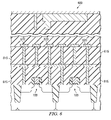
  • FIG. 6 illustrates an integrated circuit (IC) incorporating the semiconductor device fabricated in accordance with the invention and as illustrated in FIG. 1 .
  • the invention recognizes the benefit of annealing a stress inducing layer, such as a nitride cap layer, located over a gate electrode using a short (less than one second) laser anneal prior to conducting a thermal anneal. Due to the extreme high temperatures that can be achieved with the laser anneal, more stress can be incorporated into the channel region under the gate electrode.
  • the embodiments discussed herein not only achieve more stress than conventional processes, but they do so without causing excess diffusion of source/drain dopants due to the limited amount of time that the gate electrodes are subjected to the laser anneal.
  • the added stress as achieved by the invention, enhances transistor performance.
  • FIG. 1 illustrates a semiconductor device 100 as provided by the embodiments discussed herein. Reference is made throughout this discussion to the structural elements of FIG. 1 .
  • the device 100 may be a MOS device, such as an nMOS, or it may have both nMOS and pMOS type of devices configured as a CMOS device. The embodiments described herein are not limited to only nMOS or PMOS devices, but are applicable to any sub-micron device where channel stress is beneficial.
  • the device 100 includes a substrate 110 , which may be any layer located over a silicon wafer, such as an epitaxial layer, or it may be a doped region of the silicon wafer itself. Isolation structures 120 are located in the substrate 110 .
  • Gate structures 130 include a gate electrode 140 and a gate dielectric 150 that isolates the gate structure 130 from wells 155 and 158 , respectively. Conventional processes and materials may be used to form these structures. In the illustrated embodiment, at least one of the two gate structures 130 is configured as an nMOS device.
  • the device further includes source/drains 170 , which may include source/drain extensions 180 .
  • the source/drains 170 and extensions 180 may be formed using conventional dopants and implantation processes.
  • the gate electrodes 140 include an amorphous region 142 .
  • the way in which this amorphous region may be formed can vary, depending on the fabrication process. For example, the in one embodiment, the amorphous region may be formed during the implantation of the dopants that form source/drains 170 .
  • the impact of the dopants on the gate electrode 140 can destroy the crystalline structure to form the amorphous region 142 . In such instances, the depth of the amorphous region will depend on the extent of the implantation. As explained below, these regions are recrystallized during subsequent processes.
  • the amorphous region may be formed during the deposition of the material, e.g., polysilicon, used to form the gate electrodes 140 .
  • the material e.g., polysilicon
  • a channel region 190 having a stress as provided herein, is located between the source/drains 170 . Due to the advantages provided by the embodiments herein, the amount of stress that is incorporated into the channel region 190 is greater for than the stress achievable using conventional processes.
  • FIG. 2 illustrates the device 100 after the deposition of an optional protective layer 210 .
  • the protective layer 210 may be a single layer or multiple layers of silicon oxide.
  • conventional processes may be used to form the optional protective layer 210 .
  • the layer 210 may serve as an etch stop on which to stop an etch process used to remove overlying layers, such as a nitride layer.
  • the layer 210 prevents the etch from proceeding into the underlying silicon.
  • the thickness of the protective layer 210 may vary, but should have a thickness and etch selectivity sufficient to function as an etch stop layer. For example, the thickness may range from about 50 angstroms to about 100 angstroms.
  • FIG. 3 illustrates the device 100 after the deposition of a stress inducing layer 310 .
  • a stress inducing layer 310 may be a single layer or may be one of a multiple number of layers that form a laminated layer of material that is used to incorporate stress into the substrate 110 , including the channel region 190 , upon the annealing process discussed herein.
  • the stress inducing layer 310 may be the first of several stress inducing layers that are formed over the gate structures 130 and the adjacent source/drains 170 .
  • the stress inducing layer 310 is a nitride layer, which includes any layer that comprises nitrogen, and it may be formed using conventional processes.
  • the nitride layer may be a silicon nitride formed by chemical vapor deposition (CVD), or in another embodiment, the nitride layer may be an oxynitride layer.
  • Deposition conditions might vary depending on the type of deposition tool being used. However, in one embodiment, SiH4 is flowed at a rate ranging from about 50 sccm to about 700 sccm and either N2 or NH3 is flowed at a rate ranging from about 500 sccm to about 6000 sccm. These gases may be flowed with an inert gas, such as argon or helium at a rate of about 15 liters/sec.
  • an inert gas such as argon or helium
  • the deposition pressure may range from about 1 torr to about 50 torr, and the temperature may range from about 300° C. to about 500° C. Additionally, if the stress inducing layer 310 is laminated, the lamination or deposition time for the stress inducing layer 310 may range from about 1 second to about 20 seconds, depending on the targeted thickness. In another embodiment, the stress inducing layer 310 may include other stress inducing materials known to those skilled in the art, such as a silicon-rich nitride or silicon carbide, either of which may be deposited using conventional processes.
  • the dopants in the source/drains 170 and extensions 180 have not been activated nor have the amorphous regions 142 in the gate electrodes 140 been recrystallized.
  • the laser anneal used to incorporate stress into the channel 190 can also be used to at least partially activate the dopants and recrystallize the amorphous region 142 .
  • the thickness of the stress layer 310 may vary, but the thickness should be sufficient to impart stress into the channel region 190 , and yet not be so thick that does it can accommodate the pitch or distance between the gate electrodes 140 .
  • the stress inducing layer 310 may have a thickness of about 100 to about 800 angstroms. This range of thickness has been found, depending on the size and pitch of the gate structures 130 , to impart the desired amount of stress and is capable of being deposited between the gate structures 130 .
  • the dopants in the source/drains 170 and extensions 180 have not been activated nor have the amorphous regions 142 in the gate electrodes 140 been recrystallized.
  • the laser anneal used to incorporated stress into the channel 190 can also be used to at least partially activate the dopants and recrystallize the amorphous region 142 .
  • the thickness of the stress layer 310 may vary, but the thickness should be sufficient to impart stress into the channel region 190 , and yet not be so thick that does it accomodate the pitch or distance between the gate electrodes 140 .
  • the stress inducing layer 310 may have a thickness has been found, depending on the size and pitch of the gate structures 130 to impart the desired amount of stress and is capable of being deposited between the gate structures 130 .
  • FIG. 4 illustrates the device 100 of FIG. 3 during a laser anneal process 410 .
  • the laser anneal process 410 in one embodiment can be used to incorporate a stress 415 into the channel region 190 .
  • the laser anneal process 410 is conducted prior to conventional thermal anneals typically used to activate source/drains 170 or recrystallize amorphous regions located in the gate electrodes 140 or the source/drains 170 .
  • a short laser anneal is conducted on at least the gate electrodes 140 subsequent to depositing a nitride layer over gate electrodes 140 .
  • the laser anneal is conducted at a temperature of at least about 1100° C. and for a period of time of at least about 300 microseconds.
  • the power or wattage used will depend on the type of laser being used, for example, the wattage may be about 3000 watts.
  • the anneal temperature achieved by the laser anneal 410 ranges from about 1100° C. to about 1350° C. for a period ranging from about 300 microseconds to about 2000 microseconds.
  • the anneal temperature of the laser anneal 410 may be about 1300° C. and the anneal time may range from about 600 microseconds to about 800 microseconds.
  • the stated times are dwell times or residence times during which the laser energy impinges any given gate electrode 140 .
  • the laser can be rastered across the wafer on which the device 100 is located to target the individual gate electrodes 140 such that each experiences substantially the same dwell or residence time.
  • the above-stated temperature ranges are beneficial, because they incorporate a greater amount of stress 415 into the channel region 190 when compared to devices that are annealed using only conventional, furnace anneal processes, as discussed below. In turn, this enhances transistor performance over those conventional devices.
  • the laser anneal 410 causes the amorphous regions 142 to at least partially, if not totally, recrystallize and activate the dopants in the source/drains 170 . Whatever regrowth process is occurring in the gate electrode 140 , it is growing at a much higher temperature than those achieved using conventional furnace thermal anneals. It is believed that this high temperature growth causes greater mismatch in the thermal coefficient of expansion between the stress inducing layer 310 and the gate electrode 140 .
  • the intrinsic stress that the gate electrode 140 receives is by virtue of the regrowth mechanism, and its regrowing when the silicon is recrystallizing in the presence of the stress inducing layer 310 , which imparts the stress 415 into the channel 190 .
  • the higher the temperature the more the mismatch and the more stress transferred to the channel region 190 .
  • the stated period of times are also beneficial because the period must be long enough to cause the amorphous region to recrystallize and impart the stress 415 into the channel region 190 , but not yet too long such that excess diffusion of the dopants or melting of the substrate 110 might occur.
  • the stress inducing layer 310 may be removed using a conventional etch process that is selective to the underlying protective layer 210 .
  • the removal of the stress inducing layer 310 at this point is beneficial in those instances where no further stress induction or dopant activation is needed, thereby rendering a thermal anneal unnecessary.
  • the protective layer 210 is also present, it also may be removed with a conventional etch chemistry so that silicide contacts may be formed.
  • the stress inducing layer 410 may be left in place until a subsequent thermal anneal is conducted.
  • the device 100 may be subjected to an optional thermal anneal subsequent to conducting the laser anneal 410 .
  • a thermal anneal is an anneal that is conducted in a conventional furnace, such as one that might be used in a rapid thermal anneal process or a flash lamp anneal.
  • the thermal anneal is conducted at a temperature of about 1040° C. for a time of about 1.9 seconds, though other temperatures and times may also be used.
  • the above-stated temperature and time have been found beneficial in achieving completion of activation of the dopants or recrystallization in those instances where further activation or recrystallization is necessary.
  • FIG. 5 illustrates a graph comparing I off /I D Lin data of conventional devices, represented by line 510 , with I off /I D Lin data of devices fabricated in accordance with embodiments discussed herein, represented by line 515 .
  • I off is the leakage current of a transistor.
  • the I on or I D Lin ) be has high as possible.
  • the I off value it is beneficial if the I on can be improved.
  • the I off /I D Lin of line 515 shows an improvement over the I off /I D Lin of line 510 , which equates to an improvement in transistor performance.
  • the I on was improved over conventional devices from an I on value of about 251 to about 263. In this case, the leakage current was more easily overcome by an increase in the I on current.
  • FIG. 6 illustrates the device 100 configured as or incorporated into an integrated circuit (IC) 600 .
  • the IC 600 includes devices 100 manufactured in a manner as discussed above and configured as complementary transistors.
  • Dielectric layers 615 which may be formed using conventional processes and materials, are located over the transistors; and interconnects 620 , which may be conventional interconnects, such as damascene or dual damascene (both of which are illustrated), are formed over and within the dielectric layers 615 .
  • the interconnects 620 connect other circuit components in the IC 600 . Those who are skilled in the art would understand how to incorporate the device 100 into the IC 600 .

Landscapes

  • Insulated Gate Type Field-Effect Transistor (AREA)
  • Metal-Oxide And Bipolar Metal-Oxide Semiconductor Integrated Circuits (AREA)

Abstract

In one aspect there is provided a method of manufacturing a semiconductor device comprising forming gate electrodes over a semiconductor substrate, forming source/drains adjacent the gate electrodes, depositing a stress inducing layer over the gate electrodes. A laser anneal is conducted on at least the gate electrodes subsequent to depositing the stress inducing layer at a temperature of at least about 1100° C. for a period of time of at least about 300 microseconds, and the semiconductor device is subjected to a thermal anneal subsequent to conducting the laser anneal.

Description

TECHNICAL FIELD OF THE INVENTION
The invention is directed, in general, to a semiconductor device having a stress in a channel region thereof; and, more specifically, to a semiconductor device made by using a laser anneal to incorporate that stress into the channel region.
BACKGROUND OF THE INVENTION
There exists a continuing need to improve semiconductor device performance and further scale semiconductor devices. A characteristic that limits scalability and device performance is electron and/or hole mobility (e.g., also referred to as channel mobility) throughout the channel region of transistors. As devices continue to shrink in size, the channel region also continues to shrink in size, which can limit channel mobility.
One technique that improves scaling limits and device performance is the introduction of strain into the channel region, which can improve electron and/or hole mobility. Different types of strain, including expansive strain, uniaxial tensile strain, and compressive strain, have been introduced into channel regions of various types of transistors in order to determine their effect on electron and/or hole mobility. For some devices, certain types of strain improve mobility whereas other types degrade mobility.
One process known and used to create strain within the channel region is to form a layer of strain inducing material over the gate structure. The strain inducing material is then subjected to a furnace thermal annealing process to create the strain within the channel region. While the stress induced by such processes has shown an improvement in transistor performance, further improvements in device performance may be desired, as devices continue to become even smaller.
SUMMARY OF THE INVENTION
To address the above-discussed deficiencies of the prior art, one aspect of the invention provides a method of manufacturing a semiconductor device. In this embodiment, the method comprises forming silicon gate electrodes over a semiconductor substrate, including forming amorphous regions in the silicon gate electrodes, and forming source/drain regions adjacent each of the silicon gate electrodes. An oxide layer is deposited over the silicon gate electrodes and the source/drains, and a nitride layer is deposited over the oxide layer. A laser anneal is conducted on at least the silicon gate electrodes subsequent to depositing the nitride layer at a temperature ranging from about 1100° C. to about 1350° C. for a period of time ranging from about 300 microseconds to about 2000 microseconds. The semiconductor device is subjected to a thermal anneal subsequent to conducting the laser anneal at a temperature ranging from about 1000° C. to about 1100° C. for a time ranging from about 0.6 seconds to about 2.0 seconds.
In another embodiment there is provided a method of manufacturing a semiconductor device comprising forming gate electrodes over a semiconductor substrate, forming source/drains adjacent each of the gate electrodes, and depositing a stress inducing layer over the gate electrodes. A laser anneal is conducted on at least the gate electrodes subsequent to depositing the stress inducing layer, at a temperature of at least about 1100° C. for a period of time of at least about 300 microseconds, and the semiconductor device is subjected to a thermal anneal subsequent to conducting the laser anneal.
In another embodiment, there is provided a semiconductor device. The semiconductor device comprises polysilicon gate electrodes located over a semiconductor substrate, source/drains located adjacent the polysilicon gate electrodes, and a channel region located between each of the source/drains, wherein the channel region has a stress incorporated therein. The stress is incorporated by forming the polysilicon gate electrodes including forming an amorphous region in each of the polysilicon gate electrodes, depositing an oxide layer over the silicon gate electrodes and the source/drains, and depositing a nitride layer over the oxide layer. A laser anneal is conducted on the silicon gate electrodes subsequent to depositing the nitride layer, at a temperature ranging from about 1100° C. to about 1350° C. for a period of time ranging from about 600 microseconds to about 800 microseconds. The laser anneal at least partially recrystallizes the amorphous region in each of the silicon gate electrodes. The semiconductor device is subjected to a thermal anneal subsequent to conducting the laser anneal at a temperature ranging from about 1000° C. to about 1100° C. for a time ranging from about 0.6 seconds to about 2.0 seconds.
BRIEF DESCRIPTION OF THE DRAWINGS
For a more complete understanding of the invention, reference is now made to the following descriptions taken in conjunction with the accompanying drawings, in which:
FIG. 1 illustrates an embodiment of a semiconductor device of the invention;
FIG. 2 illustrates the semiconductor device of FIG. 1 after the formation of a protective layer;
FIG. 3 illustrates the semiconductor device of FIG. 2 after the formation of a stress inducing layer;
FIG. 4 illustrates the semiconductor device of FIG. 3 undergoing a laser anneal;
FIG. 5 illustrates a graph comparing Ioff/ID Lin data of conventional devices with Ioff/ID Lin data of devices fabricated in accordance with embodiments of the invention; and
FIG. 6 illustrates an integrated circuit (IC) incorporating the semiconductor device fabricated in accordance with the invention and as illustrated in FIG. 1.
DETAILED DESCRIPTION
The invention recognizes the benefit of annealing a stress inducing layer, such as a nitride cap layer, located over a gate electrode using a short (less than one second) laser anneal prior to conducting a thermal anneal. Due to the extreme high temperatures that can be achieved with the laser anneal, more stress can be incorporated into the channel region under the gate electrode. The embodiments discussed herein not only achieve more stress than conventional processes, but they do so without causing excess diffusion of source/drain dopants due to the limited amount of time that the gate electrodes are subjected to the laser anneal. The added stress, as achieved by the invention, enhances transistor performance.
FIG. 1 illustrates a semiconductor device 100 as provided by the embodiments discussed herein. Reference is made throughout this discussion to the structural elements of FIG. 1. The device 100 may be a MOS device, such as an nMOS, or it may have both nMOS and pMOS type of devices configured as a CMOS device. The embodiments described herein are not limited to only nMOS or PMOS devices, but are applicable to any sub-micron device where channel stress is beneficial. The device 100 includes a substrate 110, which may be any layer located over a silicon wafer, such as an epitaxial layer, or it may be a doped region of the silicon wafer itself. Isolation structures 120 are located in the substrate 110. Gate structures 130 include a gate electrode 140 and a gate dielectric 150 that isolates the gate structure 130 from wells 155 and 158, respectively. Conventional processes and materials may be used to form these structures. In the illustrated embodiment, at least one of the two gate structures 130 is configured as an nMOS device.
Sidewall spacers 160, which also may be conventional, are formed on the sidewalls of the gate structures 130. The device further includes source/drains 170, which may include source/drain extensions 180. The source/drains 170 and extensions 180 may be formed using conventional dopants and implantation processes. The gate electrodes 140 include an amorphous region 142. The way in which this amorphous region may be formed can vary, depending on the fabrication process. For example, the in one embodiment, the amorphous region may be formed during the implantation of the dopants that form source/drains 170. The impact of the dopants on the gate electrode 140 can destroy the crystalline structure to form the amorphous region 142. In such instances, the depth of the amorphous region will depend on the extent of the implantation. As explained below, these regions are recrystallized during subsequent processes.
In another embodiment, the amorphous region may be formed during the deposition of the material, e.g., polysilicon, used to form the gate electrodes 140. In this aspect, it should be understood that even if deposited as 100% pure amorphous material, some recrystallization may occur, thereby causing some recrystallized material to be present.
A channel region 190, having a stress as provided herein, is located between the source/drains 170. Due to the advantages provided by the embodiments herein, the amount of stress that is incorporated into the channel region 190 is greater for than the stress achievable using conventional processes.
FIG. 2 illustrates the device 100 after the deposition of an optional protective layer 210. When present, the protective layer 210, in one embodiment, may be a single layer or multiple layers of silicon oxide. Moreover, conventional processes may be used to form the optional protective layer 210. The layer 210 may serve as an etch stop on which to stop an etch process used to remove overlying layers, such as a nitride layer. The layer 210 prevents the etch from proceeding into the underlying silicon. The thickness of the protective layer 210 may vary, but should have a thickness and etch selectivity sufficient to function as an etch stop layer. For example, the thickness may range from about 50 angstroms to about 100 angstroms.
FIG. 3 illustrates the device 100 after the deposition of a stress inducing layer 310. As used herein a stress inducing layer 310 may be a single layer or may be one of a multiple number of layers that form a laminated layer of material that is used to incorporate stress into the substrate 110, including the channel region 190, upon the annealing process discussed herein. The stress inducing layer 310 may be the first of several stress inducing layers that are formed over the gate structures 130 and the adjacent source/drains 170. In one embodiment, the stress inducing layer 310 is a nitride layer, which includes any layer that comprises nitrogen, and it may be formed using conventional processes. For example in one embodiment, the nitride layer may be a silicon nitride formed by chemical vapor deposition (CVD), or in another embodiment, the nitride layer may be an oxynitride layer. Deposition conditions might vary depending on the type of deposition tool being used. However, in one embodiment, SiH4 is flowed at a rate ranging from about 50 sccm to about 700 sccm and either N2 or NH3 is flowed at a rate ranging from about 500 sccm to about 6000 sccm. These gases may be flowed with an inert gas, such as argon or helium at a rate of about 15 liters/sec. The deposition pressure may range from about 1 torr to about 50 torr, and the temperature may range from about 300° C. to about 500° C. Additionally, if the stress inducing layer 310 is laminated, the lamination or deposition time for the stress inducing layer 310 may range from about 1 second to about 20 seconds, depending on the targeted thickness. In another embodiment, the stress inducing layer 310 may include other stress inducing materials known to those skilled in the art, such as a silicon-rich nitride or silicon carbide, either of which may be deposited using conventional processes.
In the illustrated embodiment of FIG. 3, the dopants in the source/drains 170 and extensions 180 have not been activated nor have the amorphous regions 142 in the gate electrodes 140 been recrystallized. However, after the formation of the stress inducing layer 310, the laser anneal used to incorporate stress into the channel 190, in one embodiment, can also be used to at least partially activate the dopants and recrystallize the amorphous region 142. The thickness of the stress layer 310 may vary, but the thickness should be sufficient to impart stress into the channel region 190, and yet not be so thick that does it can accommodate the pitch or distance between the gate electrodes 140. For example, in one embodiment, the stress inducing layer 310 may have a thickness of about 100 to about 800 angstroms. This range of thickness has been found, depending on the size and pitch of the gate structures 130, to impart the desired amount of stress and is capable of being deposited between the gate structures 130.
In the illustrated embodiment of FIG. 3, the dopants in the source/drains 170 and extensions 180 have not been activated nor have the amorphous regions 142 in the gate electrodes 140 been recrystallized. However, after the formation of the stress inducing layer 310, the laser anneal used to incorporated stress into the channel 190, in one embodiment, can also be used to at least partially activate the dopants and recrystallize the amorphous region 142. The thickness of the stress layer 310 may vary, but the thickness should be sufficient to impart stress into the channel region 190, and yet not be so thick that does it accomodate the pitch or distance between the gate electrodes 140. For example, in one embodiment, the stress inducing layer 310 may have a thickness has been found, depending on the size and pitch of the gate structures 130 to impart the desired amount of stress and is capable of being deposited between the gate structures 130.
FIG. 4 illustrates the device 100 of FIG. 3 during a laser anneal process 410. The laser anneal process 410, in one embodiment can be used to incorporate a stress 415 into the channel region 190. The laser anneal process 410 is conducted prior to conventional thermal anneals typically used to activate source/drains 170 or recrystallize amorphous regions located in the gate electrodes 140 or the source/drains 170.
In one aspect, a short laser anneal is conducted on at least the gate electrodes 140 subsequent to depositing a nitride layer over gate electrodes 140. Here, the laser anneal is conducted at a temperature of at least about 1100° C. and for a period of time of at least about 300 microseconds. The power or wattage used will depend on the type of laser being used, for example, the wattage may be about 3000 watts. In another embodiment, the anneal temperature achieved by the laser anneal 410 ranges from about 1100° C. to about 1350° C. for a period ranging from about 300 microseconds to about 2000 microseconds. In one particular embodiment, the anneal temperature of the laser anneal 410 may be about 1300° C. and the anneal time may range from about 600 microseconds to about 800 microseconds.
The stated times are dwell times or residence times during which the laser energy impinges any given gate electrode 140. The laser can be rastered across the wafer on which the device 100 is located to target the individual gate electrodes 140 such that each experiences substantially the same dwell or residence time.
The above-stated temperature ranges are beneficial, because they incorporate a greater amount of stress 415 into the channel region 190 when compared to devices that are annealed using only conventional, furnace anneal processes, as discussed below. In turn, this enhances transistor performance over those conventional devices. Additionally, the laser anneal 410 causes the amorphous regions 142 to at least partially, if not totally, recrystallize and activate the dopants in the source/drains 170. Whatever regrowth process is occurring in the gate electrode 140, it is growing at a much higher temperature than those achieved using conventional furnace thermal anneals. It is believed that this high temperature growth causes greater mismatch in the thermal coefficient of expansion between the stress inducing layer 310 and the gate electrode 140. The intrinsic stress that the gate electrode 140 receives is by virtue of the regrowth mechanism, and its regrowing when the silicon is recrystallizing in the presence of the stress inducing layer 310, which imparts the stress 415 into the channel 190. Thus, the higher the temperature the more the mismatch and the more stress transferred to the channel region 190. The stated period of times are also beneficial because the period must be long enough to cause the amorphous region to recrystallize and impart the stress 415 into the channel region 190, but not yet too long such that excess diffusion of the dopants or melting of the substrate 110 might occur.
In one aspect, following the laser anneal 410 and before a thermal anneal is conducted, the stress inducing layer 310 may be removed using a conventional etch process that is selective to the underlying protective layer 210. The removal of the stress inducing layer 310 at this point is beneficial in those instances where no further stress induction or dopant activation is needed, thereby rendering a thermal anneal unnecessary. In those instances where the protective layer 210 is also present, it also may be removed with a conventional etch chemistry so that silicide contacts may be formed. In another embodiment, however, the stress inducing layer 410 may be left in place until a subsequent thermal anneal is conducted.
In another embodiment, the device 100 may be subjected to an optional thermal anneal subsequent to conducting the laser anneal 410. As used herein, a thermal anneal is an anneal that is conducted in a conventional furnace, such as one that might be used in a rapid thermal anneal process or a flash lamp anneal. In one aspect, the thermal anneal is conducted at a temperature of about 1040° C. for a time of about 1.9 seconds, though other temperatures and times may also be used. The above-stated temperature and time have been found beneficial in achieving completion of activation of the dopants or recrystallization in those instances where further activation or recrystallization is necessary.
Following the thermal anneal, conventional processes may be used to deposit dielectric layers over the gate structures 130 and form interconnects within those dielectric layers to interconnect the gate electrodes in the appropriate manner.
FIG. 5 illustrates a graph comparing Ioff/ID Lin data of conventional devices, represented by line 510, with Ioff/ID Lin data of devices fabricated in accordance with embodiments discussed herein, represented by line 515. Ioff is the leakage current of a transistor. For any given leakage, it is desirable that the Ion (or ID Lin) be has high as possible. Thus, for any given Ioff value it is beneficial if the Ion can be improved. As seen in FIG. 5, the Ioff/ID Lin of line 515 shows an improvement over the Ioff/ID Lin of line 510, which equates to an improvement in transistor performance. For example, for an Ioff value of −7.5, the Ion was improved over conventional devices from an Ion value of about 251 to about 263. In this case, the leakage current was more easily overcome by an increase in the Ion current.
FIG. 6 illustrates the device 100 configured as or incorporated into an integrated circuit (IC) 600. The IC 600 includes devices 100 manufactured in a manner as discussed above and configured as complementary transistors. Dielectric layers 615, which may be formed using conventional processes and materials, are located over the transistors; and interconnects 620, which may be conventional interconnects, such as damascene or dual damascene (both of which are illustrated), are formed over and within the dielectric layers 615. The interconnects 620 connect other circuit components in the IC 600. Those who are skilled in the art would understand how to incorporate the device 100 into the IC 600.
Those skilled in the art will appreciate that other and further additions, deletions, substitutions and modifications may be made to the described embodiments without departing from the scope the disclosure set forth herein.

Claims (17)

1. A method of manufacturing a semiconductor device, comprising:
forming silicon gate electrodes located over a semiconductor substrate, including forming amorphous regions in the silicon gate electrodes;
forming source/drain regions adjacent each of the silicon gate electrodes;
depositing an oxide layer over the silicon gate electrodes and the source/drains;
depositing a nitride layer over the oxide layer;
conducting a laser anneal on at least the silicon gate electrodes subsequent to depositing the nitride layer, the laser anneal being conducted at a temperature ranging from about 1100° C. to about 1350° C. for a period of time ranging from about 300 microseconds to about 2000 microseconds;
removing the nitride layer following the laser anneal; and
subjecting the semiconductor device to a non-laser thermal anneal subsequent to conducting the laser anneal and after removing the nitride layer, the thermal anneal being conducted at a temperature ranging from about 1000° C. to about 1100° C. for a time ranging from about 0.6 seconds to about 2.0 seconds.
2. The method of claim 1, wherein the laser anneal recrystallizes at least a portion of the amorphous region and incorporates a stress into a channel region located between the source/drains.
3. The method of claim 1, wherein the nitride layer is deposited with a range of thickness of about 100 Å to about 800 Å.
4. The method of claim 1, wherein the thermal anneal is conducted by furnace heating at a temperature of about 1040° C. for a time of about 1.9 seconds.
5. The method of claim 2, wherein the laser anneal at least partially activates dopants in the source/drains; and wherein the thermal anneal completes recrystallization of the amorphous region and activation of the source/drains.
6. The method of claim 1, wherein the laser anneal is conducted at a temperature of about 1300° C. and for a time ranging from about 600 microseconds to about 800 microseconds.
7. The method of claim 1, wherein the semiconductor device is an integrated circuit, the gate electrodes and the source/drains form portions of transistors, and the method further includes forming dielectric layers over the transistors; and forming interconnect structures in the dielectric layers.
8. A method of manufacturing a semiconductor device, comprising:
forming gate electrodes over a semiconductor substrate;
forming source/drains adjacent each of the gate electrodes;
depositing a stress inducing layer over the gate electrodes;
conducting a laser anneal on at least the gate electrodes subsequent to depositing the stress inducing layer, the laser anneal being conducted at a temperature of at least about 1100° C. for a period of time of at least about 300 microseconds;
removing the stress inducing layer; and
subjecting the semiconductor device to a non-laser thermal anneal subsequent to conducting the laser anneal and removing the stress inducing layer.
9. The method of claim 8, wherein the laser anneal incorporates a stress into a channel region located between the source/drains.
10. The method of claim 8, wherein the stress inducing layer is a nitride layer having a thickness that ranges from about 100 Å to about 800 Å.
11. The method of claim 8, wherein the thermal anneal is conducted by furnace heating at a temperature of about 1040° C. for a time of about 1.9 seconds.
12. The method of claim 9, wherein the laser anneal at least partially activates dopants in the source/drains; and wherein the thermal anneal completes recrystallization of the amorphous region and activation of the source/drains.
13. The method of claim 8, wherein the laser anneal is conducted at a temperature of about 1300° C.; and the laser anneal is conducted for a time ranging from about 600 microseconds to about 800 microseconds.
14. The method of claim 8, wherein the semiconductor device is an integrated circuit, the gate electrodes and the source/drains form portions of transistors, and the method further includes forming source/drain regions adjacent the gate electrodes, the gate electrodes and source/drains forming portions of transistors; forming dielectric layers over the transistors; and forming interconnect structures in the dielectric layers.
15. A method of manufacturing a semiconductor device, comprising:
providing first and second gate structures formed over respective well regions isolated by isolation structures in a silicon substrate; each gate structure including a gate electrode and a gate dielectric that isolates the gate electrode from the well; the gate electrode formed by deposition and patterning of polysilicon; and at least one of the gate structures configured as an nMOS transistor device;
forming sidewall spacers on the sidewalls of the gate structures;
forming source/drains and source/drain extensions adjacent the respective gate structures by implantation of dopant into the substrate; the gate electrodes having amorphous regions established during at least one of the deposition of the polysilicon or the implantation of dopant to form the source/drains and source/drain extensions; and a channel region being defined between the source/drains;
depositing one or more layers of silicon dioxide as a protective layer over the gate structures, and over the adjacent source/drains and source/drain extensions;
depositing one or more layers of nitride material as a stress inducing layer over the protective layer and over the gate structures, and over the adjacent source/drains and source/drain extensions; the protective layer and stress inducing layer being deposited prior to activating the source/drains or source/drain extensions, and prior to recrystallization of the amorphous regions;
prior to performing any source/drain activation thermal anneal, performing a laser anneal on at least the gate electrodes subsequent to depositing the stress inducing layer to incorporate stress into the channel region, the laser anneal also at least partially recrystallizing the amorphous regions and activating the dopants in the source/drains and source/drain extensions; the laser anneal being conducted at a temperature of at least 1100° C. for a dwell time of not more than 2000 microseconds for each gate electrode;
removing the stress inducing layer following the laser anneal, using an etchant that is selective to the underlying protective layer; and
following the laser anneal and removal of the stress inducing layer, performing a non-laser thermal anneal to complete recrystallization of the amorphous regions and activation of the dopants in the source/drains and source/drain extensions.
16. The method of claim 15, wherein the laser anneal is conducted at a temperature less than 1350° C. for a dwell time of 600 to 800 microseconds.
17. The method of claim 16, wherein the thermal anneal is conducted by furnace heating at a temperature of 1000° C. to 1100° C. for a time of 0.6 to 2.0 seconds.
US11/853,328 2007-09-11 2007-09-11 Semiconductor device made by using a laser anneal to incorporate stress into a channel region Active 2027-12-03 US7670917B2 (en)

Priority Applications (1)

Application Number Priority Date Filing Date Title
US11/853,328 US7670917B2 (en) 2007-09-11 2007-09-11 Semiconductor device made by using a laser anneal to incorporate stress into a channel region

Applications Claiming Priority (1)

Application Number Priority Date Filing Date Title
US11/853,328 US7670917B2 (en) 2007-09-11 2007-09-11 Semiconductor device made by using a laser anneal to incorporate stress into a channel region

Publications (2)

Publication Number Publication Date
US20090065880A1 US20090065880A1 (en) 2009-03-12
US7670917B2 true US7670917B2 (en) 2010-03-02

Family

ID=40430934

Family Applications (1)

Application Number Title Priority Date Filing Date
US11/853,328 Active 2027-12-03 US7670917B2 (en) 2007-09-11 2007-09-11 Semiconductor device made by using a laser anneal to incorporate stress into a channel region

Country Status (1)

Country Link
US (1) US7670917B2 (en)

Cited By (1)

* Cited by examiner, † Cited by third party
Publication number Priority date Publication date Assignee Title
US8772118B2 (en) 2011-07-08 2014-07-08 Texas Instruments Incorporated Offset screen for shallow source/drain extension implants, and processes and integrated circuits

Families Citing this family (1)

* Cited by examiner, † Cited by third party
Publication number Priority date Publication date Assignee Title
US7858482B2 (en) * 2008-03-31 2010-12-28 Freescale Semiconductor, Inc. Method of forming a semiconductor device using stress memorization

Citations (3)

* Cited by examiner, † Cited by third party
Publication number Priority date Publication date Assignee Title
US20030025167A1 (en) * 2001-07-31 2003-02-06 International Business Machines Corporation Activating in-situ doped gate on high dielectric constant materials
US20070108525A1 (en) * 2005-11-14 2007-05-17 International Business Machines Corporation Structure and method to increase strain enhancement with spacerless fet and dual liner process
US20080230841A1 (en) * 2007-03-21 2008-09-25 Chartered Semiconductor Manufacturing Ltd. Integrated circuit system employing stress memorization transfer

Patent Citations (3)

* Cited by examiner, † Cited by third party
Publication number Priority date Publication date Assignee Title
US20030025167A1 (en) * 2001-07-31 2003-02-06 International Business Machines Corporation Activating in-situ doped gate on high dielectric constant materials
US20070108525A1 (en) * 2005-11-14 2007-05-17 International Business Machines Corporation Structure and method to increase strain enhancement with spacerless fet and dual liner process
US20080230841A1 (en) * 2007-03-21 2008-09-25 Chartered Semiconductor Manufacturing Ltd. Integrated circuit system employing stress memorization transfer

Cited By (1)

* Cited by examiner, † Cited by third party
Publication number Priority date Publication date Assignee Title
US8772118B2 (en) 2011-07-08 2014-07-08 Texas Instruments Incorporated Offset screen for shallow source/drain extension implants, and processes and integrated circuits

Also Published As

Publication number Publication date
US20090065880A1 (en) 2009-03-12

Similar Documents

Publication Publication Date Title
US7601575B2 (en) Integration of pre-S/D anneal selective nitride/oxide composite cap for improving transistor performance
US7416605B2 (en) Anneal of epitaxial layer in a semiconductor device
US20090289284A1 (en) High shrinkage stress silicon nitride (SiN) layer for NFET improvement
KR101354661B1 (en) Method of fabricating semiconductor device
KR100839359B1 (en) PMOS transistor manufacturing method and complementary MOS transistor manufacturing method
CN100468663C (en) Gate electrode for MOS transistor
JP5332947B2 (en) Manufacturing method of semiconductor device
JP2010021525A (en) Manufacturing method for semiconductor device
US7018888B2 (en) Method for manufacturing improved sidewall structures for use in semiconductor devices
US8153537B1 (en) Method for fabricating semiconductor devices using stress engineering
US8101476B2 (en) Stress memorization dielectric optimized for NMOS and PMOS
US20100015766A1 (en) Complementary stress memorization technique layer method
US6387784B1 (en) Method to reduce polysilicon depletion in MOS transistors
US7479466B2 (en) Method of heating semiconductor wafer to improve wafer flatness
US20040087121A1 (en) Method of forming a nickel silicide region in a doped silicon-containing semiconductor area
US7670917B2 (en) Semiconductor device made by using a laser anneal to incorporate stress into a channel region
US20050118770A1 (en) Method for introducing hydrogen into a channel region of a metal oxide semiconductor (MOS) device
WO2004114413A1 (en) Semiconductor device and its manufacturing method
JP2001119021A (en) Method for manufacturing semiconductor device
JP2004111736A (en) Semiconductor device and manufacturing method thereof
KR100620235B1 (en) Titanium Silicide Manufacturing Method
KR100678318B1 (en) How to form pulley silicide gates
TW201214575A (en) Metal gate transistor and method for fabricating the same
KR101009350B1 (en) Polysilicon doping method and manufacturing method of dual-poly gate using same
JP2010258305A (en) Manufacturing method of semiconductor device

Legal Events

Date Code Title Description
AS Assignment

Owner name: TEXAS INSTRUMENTS INCORPORATED, TEXAS

Free format text: ASSIGNMENT OF ASSIGNORS INTEREST;ASSIGNORS:KOHLI, PUNEET;CHEN, YUANNING;JAIN, AMITABH;AND OTHERS;REEL/FRAME:022142/0689;SIGNING DATES FROM 20070827 TO 20070905

Owner name: TEXAS INSTRUMENTS INCORPORATED,TEXAS

Free format text: ASSIGNMENT OF ASSIGNORS INTEREST;ASSIGNORS:KOHLI, PUNEET;CHEN, YUANNING;JAIN, AMITABH;AND OTHERS;SIGNING DATES FROM 20070827 TO 20070905;REEL/FRAME:022142/0689

STCF Information on status: patent grant

Free format text: PATENTED CASE

FPAY Fee payment

Year of fee payment: 4

MAFP Maintenance fee payment

Free format text: PAYMENT OF MAINTENANCE FEE, 8TH YEAR, LARGE ENTITY (ORIGINAL EVENT CODE: M1552)

Year of fee payment: 8

MAFP Maintenance fee payment

Free format text: PAYMENT OF MAINTENANCE FEE, 12TH YEAR, LARGE ENTITY (ORIGINAL EVENT CODE: M1553); ENTITY STATUS OF PATENT OWNER: LARGE ENTITY

Year of fee payment: 12