US6911108B2 - Photon welding devices for joining plastic parts - Google Patents
Photon welding devices for joining plastic parts Download PDFInfo
- Publication number
- US6911108B2 US6911108B2 US10/037,414 US3741402A US6911108B2 US 6911108 B2 US6911108 B2 US 6911108B2 US 3741402 A US3741402 A US 3741402A US 6911108 B2 US6911108 B2 US 6911108B2
- Authority
- US
- United States
- Prior art keywords
- light pipe
- component
- work piece
- photon
- welding
- Prior art date
- Legal status (The legal status is an assumption and is not a legal conclusion. Google has not performed a legal analysis and makes no representation as to the accuracy of the status listed.)
- Expired - Fee Related
Links
- 238000003466 welding Methods 0.000 title claims abstract description 61
- 229920003023 plastic Polymers 0.000 title claims abstract description 58
- 239000004033 plastic Substances 0.000 title claims abstract description 49
- 230000001427 coherent effect Effects 0.000 claims abstract description 13
- 239000011248 coating agent Substances 0.000 claims abstract description 6
- 238000000576 coating method Methods 0.000 claims abstract description 6
- 238000000034 method Methods 0.000 claims description 34
- 238000001816 cooling Methods 0.000 claims description 30
- VYPSYNLAJGMNEJ-UHFFFAOYSA-N silicon dioxide Inorganic materials O=[Si]=O VYPSYNLAJGMNEJ-UHFFFAOYSA-N 0.000 claims description 17
- 239000000463 material Substances 0.000 claims description 14
- 235000012239 silicon dioxide Nutrition 0.000 claims description 12
- 229910052782 aluminium Inorganic materials 0.000 claims description 9
- XAGFODPZIPBFFR-UHFFFAOYSA-N aluminium Chemical compound [Al] XAGFODPZIPBFFR-UHFFFAOYSA-N 0.000 claims description 9
- 238000002844 melting Methods 0.000 claims description 9
- 230000008018 melting Effects 0.000 claims description 9
- 239000010453 quartz Substances 0.000 claims description 9
- PCHJSUWPFVWCPO-UHFFFAOYSA-N gold Chemical compound [Au] PCHJSUWPFVWCPO-UHFFFAOYSA-N 0.000 claims description 7
- 229910052737 gold Inorganic materials 0.000 claims description 7
- 239000010931 gold Substances 0.000 claims description 7
- 229910052736 halogen Inorganic materials 0.000 claims description 7
- 229910052721 tungsten Inorganic materials 0.000 claims description 6
- 239000010937 tungsten Substances 0.000 claims description 6
- 150000002367 halogens Chemical class 0.000 claims description 5
- WFKWXMTUELFFGS-UHFFFAOYSA-N tungsten Chemical compound [W] WFKWXMTUELFFGS-UHFFFAOYSA-N 0.000 claims description 5
- BQCADISMDOOEFD-UHFFFAOYSA-N Silver Chemical compound [Ag] BQCADISMDOOEFD-UHFFFAOYSA-N 0.000 claims description 4
- 229910052709 silver Inorganic materials 0.000 claims description 4
- 239000004332 silver Substances 0.000 claims description 4
- 210000001503 joint Anatomy 0.000 claims description 3
- 239000000377 silicon dioxide Substances 0.000 claims description 3
- XLYOFNOQVPJJNP-UHFFFAOYSA-N water Substances O XLYOFNOQVPJJNP-UHFFFAOYSA-N 0.000 claims description 3
- VYZAMTAEIAYCRO-UHFFFAOYSA-N Chromium Chemical compound [Cr] VYZAMTAEIAYCRO-UHFFFAOYSA-N 0.000 claims description 2
- 230000000694 effects Effects 0.000 claims description 2
- 239000011521 glass Substances 0.000 claims description 2
- 239000005340 laminated glass Substances 0.000 claims description 2
- 238000001228 spectrum Methods 0.000 claims description 2
- 238000010521 absorption reaction Methods 0.000 claims 3
- 230000008878 coupling Effects 0.000 claims 1
- 238000010168 coupling process Methods 0.000 claims 1
- 238000005859 coupling reaction Methods 0.000 claims 1
- 230000005855 radiation Effects 0.000 description 19
- 230000008569 process Effects 0.000 description 10
- 230000007246 mechanism Effects 0.000 description 7
- 239000000758 substrate Substances 0.000 description 7
- 239000000155 melt Substances 0.000 description 5
- JNDMLEXHDPKVFC-UHFFFAOYSA-N aluminum;oxygen(2-);yttrium(3+) Chemical compound [O-2].[O-2].[O-2].[Al+3].[Y+3] JNDMLEXHDPKVFC-UHFFFAOYSA-N 0.000 description 3
- 230000006835 compression Effects 0.000 description 3
- 238000007906 compression Methods 0.000 description 3
- 239000007789 gas Substances 0.000 description 3
- 238000010438 heat treatment Methods 0.000 description 3
- 230000003287 optical effect Effects 0.000 description 3
- -1 polyethylene Polymers 0.000 description 3
- 229910019901 yttrium aluminum garnet Inorganic materials 0.000 description 3
- XKRFYHLGVUSROY-UHFFFAOYSA-N Argon Chemical compound [Ar] XKRFYHLGVUSROY-UHFFFAOYSA-N 0.000 description 2
- OKTJSMMVPCPJKN-UHFFFAOYSA-N Carbon Chemical compound [C] OKTJSMMVPCPJKN-UHFFFAOYSA-N 0.000 description 2
- 239000004698 Polyethylene Substances 0.000 description 2
- 238000013459 approach Methods 0.000 description 2
- 230000005540 biological transmission Effects 0.000 description 2
- 229910052799 carbon Inorganic materials 0.000 description 2
- 230000005670 electromagnetic radiation Effects 0.000 description 2
- 239000005350 fused silica glass Substances 0.000 description 2
- 229910052751 metal Inorganic materials 0.000 description 2
- 239000002184 metal Substances 0.000 description 2
- 229920000573 polyethylene Polymers 0.000 description 2
- 230000009467 reduction Effects 0.000 description 2
- 239000000523 sample Substances 0.000 description 2
- 238000012360 testing method Methods 0.000 description 2
- IJGRMHOSHXDMSA-UHFFFAOYSA-N Atomic nitrogen Chemical compound N#N IJGRMHOSHXDMSA-UHFFFAOYSA-N 0.000 description 1
- UFHFLCQGNIYNRP-UHFFFAOYSA-N Hydrogen Chemical compound [H][H] UFHFLCQGNIYNRP-UHFFFAOYSA-N 0.000 description 1
- 230000009471 action Effects 0.000 description 1
- 239000000853 adhesive Substances 0.000 description 1
- 230000001070 adhesive effect Effects 0.000 description 1
- 229910052786 argon Inorganic materials 0.000 description 1
- 230000000712 assembly Effects 0.000 description 1
- 238000000429 assembly Methods 0.000 description 1
- 238000004140 cleaning Methods 0.000 description 1
- 239000000112 cooling gas Substances 0.000 description 1
- 229910001873 dinitrogen Inorganic materials 0.000 description 1
- 238000002474 experimental method Methods 0.000 description 1
- 238000001914 filtration Methods 0.000 description 1
- CPBQJMYROZQQJC-UHFFFAOYSA-N helium neon Chemical compound [He].[Ne] CPBQJMYROZQQJC-UHFFFAOYSA-N 0.000 description 1
- 229910052743 krypton Inorganic materials 0.000 description 1
- DNNSSWSSYDEUBZ-UHFFFAOYSA-N krypton atom Chemical compound [Kr] DNNSSWSSYDEUBZ-UHFFFAOYSA-N 0.000 description 1
- 239000007788 liquid Substances 0.000 description 1
- 239000012528 membrane Substances 0.000 description 1
- 238000012986 modification Methods 0.000 description 1
- 230000004048 modification Effects 0.000 description 1
- 239000013307 optical fiber Substances 0.000 description 1
- 239000002985 plastic film Substances 0.000 description 1
- 230000002035 prolonged effect Effects 0.000 description 1
- 239000010979 ruby Substances 0.000 description 1
- 229910001750 ruby Inorganic materials 0.000 description 1
- 238000007789 sealing Methods 0.000 description 1
- 238000012163 sequencing technique Methods 0.000 description 1
- 239000000126 substance Substances 0.000 description 1
- 229920003002 synthetic resin Polymers 0.000 description 1
- 239000000057 synthetic resin Substances 0.000 description 1
- 238000012546 transfer Methods 0.000 description 1
- 239000012780 transparent material Substances 0.000 description 1
- 230000032258 transport Effects 0.000 description 1
Images




Classifications
-
- B—PERFORMING OPERATIONS; TRANSPORTING
- B29—WORKING OF PLASTICS; WORKING OF SUBSTANCES IN A PLASTIC STATE IN GENERAL
- B29C—SHAPING OR JOINING OF PLASTICS; SHAPING OF MATERIAL IN A PLASTIC STATE, NOT OTHERWISE PROVIDED FOR; AFTER-TREATMENT OF THE SHAPED PRODUCTS, e.g. REPAIRING
- B29C66/00—General aspects of processes or apparatus for joining preformed parts
- B29C66/80—General aspects of machine operations or constructions and parts thereof
- B29C66/81—General aspects of the pressing elements, i.e. the elements applying pressure on the parts to be joined in the area to be joined, e.g. the welding jaws or clamps
- B29C66/816—General aspects of the pressing elements, i.e. the elements applying pressure on the parts to be joined in the area to be joined, e.g. the welding jaws or clamps characterised by the mounting of the pressing elements, e.g. of the welding jaws or clamps
- B29C66/8161—General aspects of the pressing elements, i.e. the elements applying pressure on the parts to be joined in the area to be joined, e.g. the welding jaws or clamps characterised by the mounting of the pressing elements, e.g. of the welding jaws or clamps said pressing elements being supported or backed-up by springs or by resilient material
-
- B—PERFORMING OPERATIONS; TRANSPORTING
- B29—WORKING OF PLASTICS; WORKING OF SUBSTANCES IN A PLASTIC STATE IN GENERAL
- B29C—SHAPING OR JOINING OF PLASTICS; SHAPING OF MATERIAL IN A PLASTIC STATE, NOT OTHERWISE PROVIDED FOR; AFTER-TREATMENT OF THE SHAPED PRODUCTS, e.g. REPAIRING
- B29C65/00—Joining or sealing of preformed parts, e.g. welding of plastics materials; Apparatus therefor
- B29C65/02—Joining or sealing of preformed parts, e.g. welding of plastics materials; Apparatus therefor by heating, with or without pressure
- B29C65/14—Joining or sealing of preformed parts, e.g. welding of plastics materials; Apparatus therefor by heating, with or without pressure using wave energy, i.e. electromagnetic radiation, or particle radiation
- B29C65/1403—Joining or sealing of preformed parts, e.g. welding of plastics materials; Apparatus therefor by heating, with or without pressure using wave energy, i.e. electromagnetic radiation, or particle radiation characterised by the type of electromagnetic or particle radiation
- B29C65/1412—Infrared [IR] radiation
-
- B—PERFORMING OPERATIONS; TRANSPORTING
- B29—WORKING OF PLASTICS; WORKING OF SUBSTANCES IN A PLASTIC STATE IN GENERAL
- B29C—SHAPING OR JOINING OF PLASTICS; SHAPING OF MATERIAL IN A PLASTIC STATE, NOT OTHERWISE PROVIDED FOR; AFTER-TREATMENT OF THE SHAPED PRODUCTS, e.g. REPAIRING
- B29C65/00—Joining or sealing of preformed parts, e.g. welding of plastics materials; Apparatus therefor
- B29C65/02—Joining or sealing of preformed parts, e.g. welding of plastics materials; Apparatus therefor by heating, with or without pressure
- B29C65/14—Joining or sealing of preformed parts, e.g. welding of plastics materials; Apparatus therefor by heating, with or without pressure using wave energy, i.e. electromagnetic radiation, or particle radiation
- B29C65/1429—Joining or sealing of preformed parts, e.g. welding of plastics materials; Apparatus therefor by heating, with or without pressure using wave energy, i.e. electromagnetic radiation, or particle radiation characterised by the way of heating the interface
- B29C65/1435—Joining or sealing of preformed parts, e.g. welding of plastics materials; Apparatus therefor by heating, with or without pressure using wave energy, i.e. electromagnetic radiation, or particle radiation characterised by the way of heating the interface at least passing through one of the parts to be joined, i.e. transmission welding
-
- B—PERFORMING OPERATIONS; TRANSPORTING
- B29—WORKING OF PLASTICS; WORKING OF SUBSTANCES IN A PLASTIC STATE IN GENERAL
- B29C—SHAPING OR JOINING OF PLASTICS; SHAPING OF MATERIAL IN A PLASTIC STATE, NOT OTHERWISE PROVIDED FOR; AFTER-TREATMENT OF THE SHAPED PRODUCTS, e.g. REPAIRING
- B29C65/00—Joining or sealing of preformed parts, e.g. welding of plastics materials; Apparatus therefor
- B29C65/02—Joining or sealing of preformed parts, e.g. welding of plastics materials; Apparatus therefor by heating, with or without pressure
- B29C65/14—Joining or sealing of preformed parts, e.g. welding of plastics materials; Apparatus therefor by heating, with or without pressure using wave energy, i.e. electromagnetic radiation, or particle radiation
- B29C65/1429—Joining or sealing of preformed parts, e.g. welding of plastics materials; Apparatus therefor by heating, with or without pressure using wave energy, i.e. electromagnetic radiation, or particle radiation characterised by the way of heating the interface
- B29C65/1464—Joining or sealing of preformed parts, e.g. welding of plastics materials; Apparatus therefor by heating, with or without pressure using wave energy, i.e. electromagnetic radiation, or particle radiation characterised by the way of heating the interface making use of several radiators
-
- B—PERFORMING OPERATIONS; TRANSPORTING
- B29—WORKING OF PLASTICS; WORKING OF SUBSTANCES IN A PLASTIC STATE IN GENERAL
- B29C—SHAPING OR JOINING OF PLASTICS; SHAPING OF MATERIAL IN A PLASTIC STATE, NOT OTHERWISE PROVIDED FOR; AFTER-TREATMENT OF THE SHAPED PRODUCTS, e.g. REPAIRING
- B29C65/00—Joining or sealing of preformed parts, e.g. welding of plastics materials; Apparatus therefor
- B29C65/02—Joining or sealing of preformed parts, e.g. welding of plastics materials; Apparatus therefor by heating, with or without pressure
- B29C65/14—Joining or sealing of preformed parts, e.g. welding of plastics materials; Apparatus therefor by heating, with or without pressure using wave energy, i.e. electromagnetic radiation, or particle radiation
- B29C65/1487—Joining or sealing of preformed parts, e.g. welding of plastics materials; Apparatus therefor by heating, with or without pressure using wave energy, i.e. electromagnetic radiation, or particle radiation making use of light guides
-
- B—PERFORMING OPERATIONS; TRANSPORTING
- B29—WORKING OF PLASTICS; WORKING OF SUBSTANCES IN A PLASTIC STATE IN GENERAL
- B29C—SHAPING OR JOINING OF PLASTICS; SHAPING OF MATERIAL IN A PLASTIC STATE, NOT OTHERWISE PROVIDED FOR; AFTER-TREATMENT OF THE SHAPED PRODUCTS, e.g. REPAIRING
- B29C65/00—Joining or sealing of preformed parts, e.g. welding of plastics materials; Apparatus therefor
- B29C65/02—Joining or sealing of preformed parts, e.g. welding of plastics materials; Apparatus therefor by heating, with or without pressure
- B29C65/14—Joining or sealing of preformed parts, e.g. welding of plastics materials; Apparatus therefor by heating, with or without pressure using wave energy, i.e. electromagnetic radiation, or particle radiation
- B29C65/1496—Joining or sealing of preformed parts, e.g. welding of plastics materials; Apparatus therefor by heating, with or without pressure using wave energy, i.e. electromagnetic radiation, or particle radiation making use of masks
-
- B—PERFORMING OPERATIONS; TRANSPORTING
- B29—WORKING OF PLASTICS; WORKING OF SUBSTANCES IN A PLASTIC STATE IN GENERAL
- B29C—SHAPING OR JOINING OF PLASTICS; SHAPING OF MATERIAL IN A PLASTIC STATE, NOT OTHERWISE PROVIDED FOR; AFTER-TREATMENT OF THE SHAPED PRODUCTS, e.g. REPAIRING
- B29C65/00—Joining or sealing of preformed parts, e.g. welding of plastics materials; Apparatus therefor
- B29C65/78—Means for handling the parts to be joined, e.g. for making containers or hollow articles, e.g. means for handling sheets, plates, web-like materials, tubular articles, hollow articles or elements to be joined therewith; Means for discharging the joined articles from the joining apparatus
- B29C65/7858—Means for handling the parts to be joined, e.g. for making containers or hollow articles, e.g. means for handling sheets, plates, web-like materials, tubular articles, hollow articles or elements to be joined therewith; Means for discharging the joined articles from the joining apparatus characterised by the feeding movement of the parts to be joined
- B29C65/7861—In-line machines, i.e. feeding, joining and discharging are in one production line
- B29C65/7864—In-line machines, i.e. feeding, joining and discharging are in one production line using a feeding table which moves to and fro
-
- B—PERFORMING OPERATIONS; TRANSPORTING
- B29—WORKING OF PLASTICS; WORKING OF SUBSTANCES IN A PLASTIC STATE IN GENERAL
- B29C—SHAPING OR JOINING OF PLASTICS; SHAPING OF MATERIAL IN A PLASTIC STATE, NOT OTHERWISE PROVIDED FOR; AFTER-TREATMENT OF THE SHAPED PRODUCTS, e.g. REPAIRING
- B29C65/00—Joining or sealing of preformed parts, e.g. welding of plastics materials; Apparatus therefor
- B29C65/78—Means for handling the parts to be joined, e.g. for making containers or hollow articles, e.g. means for handling sheets, plates, web-like materials, tubular articles, hollow articles or elements to be joined therewith; Means for discharging the joined articles from the joining apparatus
- B29C65/7858—Means for handling the parts to be joined, e.g. for making containers or hollow articles, e.g. means for handling sheets, plates, web-like materials, tubular articles, hollow articles or elements to be joined therewith; Means for discharging the joined articles from the joining apparatus characterised by the feeding movement of the parts to be joined
- B29C65/7861—In-line machines, i.e. feeding, joining and discharging are in one production line
- B29C65/7867—In-line machines, i.e. feeding, joining and discharging are in one production line using carriers, provided with holding means, said carriers moving in a closed path
-
- B—PERFORMING OPERATIONS; TRANSPORTING
- B29—WORKING OF PLASTICS; WORKING OF SUBSTANCES IN A PLASTIC STATE IN GENERAL
- B29C—SHAPING OR JOINING OF PLASTICS; SHAPING OF MATERIAL IN A PLASTIC STATE, NOT OTHERWISE PROVIDED FOR; AFTER-TREATMENT OF THE SHAPED PRODUCTS, e.g. REPAIRING
- B29C66/00—General aspects of processes or apparatus for joining preformed parts
- B29C66/003—Protecting areas of the parts to be joined from overheating
-
- B—PERFORMING OPERATIONS; TRANSPORTING
- B29—WORKING OF PLASTICS; WORKING OF SUBSTANCES IN A PLASTIC STATE IN GENERAL
- B29C—SHAPING OR JOINING OF PLASTICS; SHAPING OF MATERIAL IN A PLASTIC STATE, NOT OTHERWISE PROVIDED FOR; AFTER-TREATMENT OF THE SHAPED PRODUCTS, e.g. REPAIRING
- B29C66/00—General aspects of processes or apparatus for joining preformed parts
- B29C66/01—General aspects dealing with the joint area or with the area to be joined
- B29C66/02—Preparation of the material, in the area to be joined, prior to joining or welding
- B29C66/024—Thermal pre-treatments
- B29C66/0242—Heating, or preheating, e.g. drying
-
- B—PERFORMING OPERATIONS; TRANSPORTING
- B29—WORKING OF PLASTICS; WORKING OF SUBSTANCES IN A PLASTIC STATE IN GENERAL
- B29C—SHAPING OR JOINING OF PLASTICS; SHAPING OF MATERIAL IN A PLASTIC STATE, NOT OTHERWISE PROVIDED FOR; AFTER-TREATMENT OF THE SHAPED PRODUCTS, e.g. REPAIRING
- B29C66/00—General aspects of processes or apparatus for joining preformed parts
- B29C66/01—General aspects dealing with the joint area or with the area to be joined
- B29C66/05—Particular design of joint configurations
- B29C66/10—Particular design of joint configurations particular design of the joint cross-sections
- B29C66/12—Joint cross-sections combining only two joint-segments; Tongue and groove joints; Tenon and mortise joints; Stepped joint cross-sections
- B29C66/122—Joint cross-sections combining only two joint-segments, i.e. one of the parts to be joined comprising only two joint-segments in the joint cross-section
- B29C66/1222—Joint cross-sections combining only two joint-segments, i.e. one of the parts to be joined comprising only two joint-segments in the joint cross-section comprising at least a lapped joint-segment
-
- B—PERFORMING OPERATIONS; TRANSPORTING
- B29—WORKING OF PLASTICS; WORKING OF SUBSTANCES IN A PLASTIC STATE IN GENERAL
- B29C—SHAPING OR JOINING OF PLASTICS; SHAPING OF MATERIAL IN A PLASTIC STATE, NOT OTHERWISE PROVIDED FOR; AFTER-TREATMENT OF THE SHAPED PRODUCTS, e.g. REPAIRING
- B29C66/00—General aspects of processes or apparatus for joining preformed parts
- B29C66/01—General aspects dealing with the joint area or with the area to be joined
- B29C66/05—Particular design of joint configurations
- B29C66/10—Particular design of joint configurations particular design of the joint cross-sections
- B29C66/12—Joint cross-sections combining only two joint-segments; Tongue and groove joints; Tenon and mortise joints; Stepped joint cross-sections
- B29C66/122—Joint cross-sections combining only two joint-segments, i.e. one of the parts to be joined comprising only two joint-segments in the joint cross-section
- B29C66/1224—Joint cross-sections combining only two joint-segments, i.e. one of the parts to be joined comprising only two joint-segments in the joint cross-section comprising at least a butt joint-segment
-
- B—PERFORMING OPERATIONS; TRANSPORTING
- B29—WORKING OF PLASTICS; WORKING OF SUBSTANCES IN A PLASTIC STATE IN GENERAL
- B29C—SHAPING OR JOINING OF PLASTICS; SHAPING OF MATERIAL IN A PLASTIC STATE, NOT OTHERWISE PROVIDED FOR; AFTER-TREATMENT OF THE SHAPED PRODUCTS, e.g. REPAIRING
- B29C66/00—General aspects of processes or apparatus for joining preformed parts
- B29C66/50—General aspects of joining tubular articles; General aspects of joining long products, i.e. bars or profiled elements; General aspects of joining single elements to tubular articles, hollow articles or bars; General aspects of joining several hollow-preforms to form hollow or tubular articles
- B29C66/51—Joining tubular articles, profiled elements or bars; Joining single elements to tubular articles, hollow articles or bars; Joining several hollow-preforms to form hollow or tubular articles
- B29C66/53—Joining single elements to tubular articles, hollow articles or bars
- B29C66/534—Joining single elements to open ends of tubular or hollow articles or to the ends of bars
- B29C66/5346—Joining single elements to open ends of tubular or hollow articles or to the ends of bars said single elements being substantially flat
- B29C66/53461—Joining single elements to open ends of tubular or hollow articles or to the ends of bars said single elements being substantially flat joining substantially flat covers and/or substantially flat bottoms to open ends of container bodies
-
- B—PERFORMING OPERATIONS; TRANSPORTING
- B29—WORKING OF PLASTICS; WORKING OF SUBSTANCES IN A PLASTIC STATE IN GENERAL
- B29C—SHAPING OR JOINING OF PLASTICS; SHAPING OF MATERIAL IN A PLASTIC STATE, NOT OTHERWISE PROVIDED FOR; AFTER-TREATMENT OF THE SHAPED PRODUCTS, e.g. REPAIRING
- B29C66/00—General aspects of processes or apparatus for joining preformed parts
- B29C66/50—General aspects of joining tubular articles; General aspects of joining long products, i.e. bars or profiled elements; General aspects of joining single elements to tubular articles, hollow articles or bars; General aspects of joining several hollow-preforms to form hollow or tubular articles
- B29C66/61—Joining from or joining on the inside
-
- B—PERFORMING OPERATIONS; TRANSPORTING
- B29—WORKING OF PLASTICS; WORKING OF SUBSTANCES IN A PLASTIC STATE IN GENERAL
- B29C—SHAPING OR JOINING OF PLASTICS; SHAPING OF MATERIAL IN A PLASTIC STATE, NOT OTHERWISE PROVIDED FOR; AFTER-TREATMENT OF THE SHAPED PRODUCTS, e.g. REPAIRING
- B29C66/00—General aspects of processes or apparatus for joining preformed parts
- B29C66/80—General aspects of machine operations or constructions and parts thereof
- B29C66/81—General aspects of the pressing elements, i.e. the elements applying pressure on the parts to be joined in the area to be joined, e.g. the welding jaws or clamps
- B29C66/812—General aspects of the pressing elements, i.e. the elements applying pressure on the parts to be joined in the area to be joined, e.g. the welding jaws or clamps characterised by the composition, by the structure, by the intensive physical properties or by the optical properties of the material constituting the pressing elements, e.g. constituting the welding jaws or clamps
- B29C66/8126—General aspects of the pressing elements, i.e. the elements applying pressure on the parts to be joined in the area to be joined, e.g. the welding jaws or clamps characterised by the composition, by the structure, by the intensive physical properties or by the optical properties of the material constituting the pressing elements, e.g. constituting the welding jaws or clamps characterised by the intensive physical properties or by the optical properties of the material constituting the pressing elements, e.g. constituting the welding jaws or clamps
- B29C66/81266—Optical properties, e.g. transparency, reflectivity
- B29C66/81267—Transparent to electromagnetic radiation, e.g. to visible light
-
- B—PERFORMING OPERATIONS; TRANSPORTING
- B29—WORKING OF PLASTICS; WORKING OF SUBSTANCES IN A PLASTIC STATE IN GENERAL
- B29C—SHAPING OR JOINING OF PLASTICS; SHAPING OF MATERIAL IN A PLASTIC STATE, NOT OTHERWISE PROVIDED FOR; AFTER-TREATMENT OF THE SHAPED PRODUCTS, e.g. REPAIRING
- B29C66/00—General aspects of processes or apparatus for joining preformed parts
- B29C66/80—General aspects of machine operations or constructions and parts thereof
- B29C66/81—General aspects of the pressing elements, i.e. the elements applying pressure on the parts to be joined in the area to be joined, e.g. the welding jaws or clamps
- B29C66/814—General aspects of the pressing elements, i.e. the elements applying pressure on the parts to be joined in the area to be joined, e.g. the welding jaws or clamps characterised by the design of the pressing elements, e.g. of the welding jaws or clamps
- B29C66/8141—General aspects of the pressing elements, i.e. the elements applying pressure on the parts to be joined in the area to be joined, e.g. the welding jaws or clamps characterised by the design of the pressing elements, e.g. of the welding jaws or clamps characterised by the surface geometry of the part of the pressing elements, e.g. welding jaws or clamps, coming into contact with the parts to be joined
- B29C66/81411—General aspects of the pressing elements, i.e. the elements applying pressure on the parts to be joined in the area to be joined, e.g. the welding jaws or clamps characterised by the design of the pressing elements, e.g. of the welding jaws or clamps characterised by the surface geometry of the part of the pressing elements, e.g. welding jaws or clamps, coming into contact with the parts to be joined characterised by its cross-section, e.g. transversal or longitudinal, being non-flat
- B29C66/81425—General aspects of the pressing elements, i.e. the elements applying pressure on the parts to be joined in the area to be joined, e.g. the welding jaws or clamps characterised by the design of the pressing elements, e.g. of the welding jaws or clamps characterised by the surface geometry of the part of the pressing elements, e.g. welding jaws or clamps, coming into contact with the parts to be joined characterised by its cross-section, e.g. transversal or longitudinal, being non-flat being stepped, e.g. comprising a shoulder
-
- B—PERFORMING OPERATIONS; TRANSPORTING
- B29—WORKING OF PLASTICS; WORKING OF SUBSTANCES IN A PLASTIC STATE IN GENERAL
- B29C—SHAPING OR JOINING OF PLASTICS; SHAPING OF MATERIAL IN A PLASTIC STATE, NOT OTHERWISE PROVIDED FOR; AFTER-TREATMENT OF THE SHAPED PRODUCTS, e.g. REPAIRING
- B29C66/00—General aspects of processes or apparatus for joining preformed parts
- B29C66/80—General aspects of machine operations or constructions and parts thereof
- B29C66/81—General aspects of the pressing elements, i.e. the elements applying pressure on the parts to be joined in the area to be joined, e.g. the welding jaws or clamps
- B29C66/814—General aspects of the pressing elements, i.e. the elements applying pressure on the parts to be joined in the area to be joined, e.g. the welding jaws or clamps characterised by the design of the pressing elements, e.g. of the welding jaws or clamps
- B29C66/8141—General aspects of the pressing elements, i.e. the elements applying pressure on the parts to be joined in the area to be joined, e.g. the welding jaws or clamps characterised by the design of the pressing elements, e.g. of the welding jaws or clamps characterised by the surface geometry of the part of the pressing elements, e.g. welding jaws or clamps, coming into contact with the parts to be joined
- B29C66/81427—General aspects of the pressing elements, i.e. the elements applying pressure on the parts to be joined in the area to be joined, e.g. the welding jaws or clamps characterised by the design of the pressing elements, e.g. of the welding jaws or clamps characterised by the surface geometry of the part of the pressing elements, e.g. welding jaws or clamps, coming into contact with the parts to be joined comprising a single ridge, e.g. for making a weakening line; comprising a single tooth
-
- B—PERFORMING OPERATIONS; TRANSPORTING
- B29—WORKING OF PLASTICS; WORKING OF SUBSTANCES IN A PLASTIC STATE IN GENERAL
- B29C—SHAPING OR JOINING OF PLASTICS; SHAPING OF MATERIAL IN A PLASTIC STATE, NOT OTHERWISE PROVIDED FOR; AFTER-TREATMENT OF THE SHAPED PRODUCTS, e.g. REPAIRING
- B29C66/00—General aspects of processes or apparatus for joining preformed parts
- B29C66/80—General aspects of machine operations or constructions and parts thereof
- B29C66/81—General aspects of the pressing elements, i.e. the elements applying pressure on the parts to be joined in the area to be joined, e.g. the welding jaws or clamps
- B29C66/814—General aspects of the pressing elements, i.e. the elements applying pressure on the parts to be joined in the area to be joined, e.g. the welding jaws or clamps characterised by the design of the pressing elements, e.g. of the welding jaws or clamps
- B29C66/8141—General aspects of the pressing elements, i.e. the elements applying pressure on the parts to be joined in the area to be joined, e.g. the welding jaws or clamps characterised by the design of the pressing elements, e.g. of the welding jaws or clamps characterised by the surface geometry of the part of the pressing elements, e.g. welding jaws or clamps, coming into contact with the parts to be joined
- B29C66/81431—General aspects of the pressing elements, i.e. the elements applying pressure on the parts to be joined in the area to be joined, e.g. the welding jaws or clamps characterised by the design of the pressing elements, e.g. of the welding jaws or clamps characterised by the surface geometry of the part of the pressing elements, e.g. welding jaws or clamps, coming into contact with the parts to be joined comprising a single cavity, e.g. a groove
-
- B—PERFORMING OPERATIONS; TRANSPORTING
- B29—WORKING OF PLASTICS; WORKING OF SUBSTANCES IN A PLASTIC STATE IN GENERAL
- B29C—SHAPING OR JOINING OF PLASTICS; SHAPING OF MATERIAL IN A PLASTIC STATE, NOT OTHERWISE PROVIDED FOR; AFTER-TREATMENT OF THE SHAPED PRODUCTS, e.g. REPAIRING
- B29C66/00—General aspects of processes or apparatus for joining preformed parts
- B29C66/80—General aspects of machine operations or constructions and parts thereof
- B29C66/81—General aspects of the pressing elements, i.e. the elements applying pressure on the parts to be joined in the area to be joined, e.g. the welding jaws or clamps
- B29C66/818—General aspects of the pressing elements, i.e. the elements applying pressure on the parts to be joined in the area to be joined, e.g. the welding jaws or clamps characterised by the cooling constructional aspects, or by the thermal or electrical insulating or conducting constructional aspects of the welding jaws or of the clamps ; comprising means for compensating for the thermal expansion of the welding jaws or of the clamps
- B29C66/8181—General aspects of the pressing elements, i.e. the elements applying pressure on the parts to be joined in the area to be joined, e.g. the welding jaws or clamps characterised by the cooling constructional aspects, or by the thermal or electrical insulating or conducting constructional aspects of the welding jaws or of the clamps ; comprising means for compensating for the thermal expansion of the welding jaws or of the clamps characterised by the cooling constructional aspects
- B29C66/81811—General aspects of the pressing elements, i.e. the elements applying pressure on the parts to be joined in the area to be joined, e.g. the welding jaws or clamps characterised by the cooling constructional aspects, or by the thermal or electrical insulating or conducting constructional aspects of the welding jaws or of the clamps ; comprising means for compensating for the thermal expansion of the welding jaws or of the clamps characterised by the cooling constructional aspects of the welding jaws
- B29C66/81812—General aspects of the pressing elements, i.e. the elements applying pressure on the parts to be joined in the area to be joined, e.g. the welding jaws or clamps characterised by the cooling constructional aspects, or by the thermal or electrical insulating or conducting constructional aspects of the welding jaws or of the clamps ; comprising means for compensating for the thermal expansion of the welding jaws or of the clamps characterised by the cooling constructional aspects of the welding jaws the welding jaws being cooled from the outside, e.g. by blowing a gas or spraying a liquid
-
- B—PERFORMING OPERATIONS; TRANSPORTING
- B29—WORKING OF PLASTICS; WORKING OF SUBSTANCES IN A PLASTIC STATE IN GENERAL
- B29C—SHAPING OR JOINING OF PLASTICS; SHAPING OF MATERIAL IN A PLASTIC STATE, NOT OTHERWISE PROVIDED FOR; AFTER-TREATMENT OF THE SHAPED PRODUCTS, e.g. REPAIRING
- B29C66/00—General aspects of processes or apparatus for joining preformed parts
- B29C66/80—General aspects of machine operations or constructions and parts thereof
- B29C66/82—Pressure application arrangements, e.g. transmission or actuating mechanisms for joining tools or clamps
- B29C66/822—Transmission mechanisms
- B29C66/8226—Cam mechanisms; Wedges; Eccentric mechanisms
-
- B—PERFORMING OPERATIONS; TRANSPORTING
- B29—WORKING OF PLASTICS; WORKING OF SUBSTANCES IN A PLASTIC STATE IN GENERAL
- B29C—SHAPING OR JOINING OF PLASTICS; SHAPING OF MATERIAL IN A PLASTIC STATE, NOT OTHERWISE PROVIDED FOR; AFTER-TREATMENT OF THE SHAPED PRODUCTS, e.g. REPAIRING
- B29C66/00—General aspects of processes or apparatus for joining preformed parts
- B29C66/80—General aspects of machine operations or constructions and parts thereof
- B29C66/82—Pressure application arrangements, e.g. transmission or actuating mechanisms for joining tools or clamps
- B29C66/824—Actuating mechanisms
- B29C66/8242—Pneumatic or hydraulic drives
-
- B—PERFORMING OPERATIONS; TRANSPORTING
- B29—WORKING OF PLASTICS; WORKING OF SUBSTANCES IN A PLASTIC STATE IN GENERAL
- B29C—SHAPING OR JOINING OF PLASTICS; SHAPING OF MATERIAL IN A PLASTIC STATE, NOT OTHERWISE PROVIDED FOR; AFTER-TREATMENT OF THE SHAPED PRODUCTS, e.g. REPAIRING
- B29C66/00—General aspects of processes or apparatus for joining preformed parts
- B29C66/80—General aspects of machine operations or constructions and parts thereof
- B29C66/83—General aspects of machine operations or constructions and parts thereof characterised by the movement of the joining or pressing tools
- B29C66/832—Reciprocating joining or pressing tools
- B29C66/8322—Joining or pressing tools reciprocating along one axis
-
- B—PERFORMING OPERATIONS; TRANSPORTING
- B29—WORKING OF PLASTICS; WORKING OF SUBSTANCES IN A PLASTIC STATE IN GENERAL
- B29C—SHAPING OR JOINING OF PLASTICS; SHAPING OF MATERIAL IN A PLASTIC STATE, NOT OTHERWISE PROVIDED FOR; AFTER-TREATMENT OF THE SHAPED PRODUCTS, e.g. REPAIRING
- B29C66/00—General aspects of processes or apparatus for joining preformed parts
- B29C66/80—General aspects of machine operations or constructions and parts thereof
- B29C66/84—Specific machine types or machines suitable for specific applications
- B29C66/843—Machines for making separate joints at the same time in different planes; Machines for making separate joints at the same time mounted in parallel or in series
- B29C66/8432—Machines for making separate joints at the same time mounted in parallel or in series
-
- B—PERFORMING OPERATIONS; TRANSPORTING
- B29—WORKING OF PLASTICS; WORKING OF SUBSTANCES IN A PLASTIC STATE IN GENERAL
- B29C—SHAPING OR JOINING OF PLASTICS; SHAPING OF MATERIAL IN A PLASTIC STATE, NOT OTHERWISE PROVIDED FOR; AFTER-TREATMENT OF THE SHAPED PRODUCTS, e.g. REPAIRING
- B29C66/00—General aspects of processes or apparatus for joining preformed parts
- B29C66/90—Measuring or controlling the joining process
- B29C66/91—Measuring or controlling the joining process by measuring or controlling the temperature, the heat or the thermal flux
- B29C66/912—Measuring or controlling the joining process by measuring or controlling the temperature, the heat or the thermal flux by measuring the temperature, the heat or the thermal flux
- B29C66/9121—Measuring or controlling the joining process by measuring or controlling the temperature, the heat or the thermal flux by measuring the temperature, the heat or the thermal flux by measuring the temperature
- B29C66/91221—Measuring or controlling the joining process by measuring or controlling the temperature, the heat or the thermal flux by measuring the temperature, the heat or the thermal flux by measuring the temperature of the parts to be joined
-
- B—PERFORMING OPERATIONS; TRANSPORTING
- B29—WORKING OF PLASTICS; WORKING OF SUBSTANCES IN A PLASTIC STATE IN GENERAL
- B29C—SHAPING OR JOINING OF PLASTICS; SHAPING OF MATERIAL IN A PLASTIC STATE, NOT OTHERWISE PROVIDED FOR; AFTER-TREATMENT OF THE SHAPED PRODUCTS, e.g. REPAIRING
- B29C66/00—General aspects of processes or apparatus for joining preformed parts
- B29C66/90—Measuring or controlling the joining process
- B29C66/91—Measuring or controlling the joining process by measuring or controlling the temperature, the heat or the thermal flux
- B29C66/914—Measuring or controlling the joining process by measuring or controlling the temperature, the heat or the thermal flux by controlling or regulating the temperature, the heat or the thermal flux
- B29C66/9141—Measuring or controlling the joining process by measuring or controlling the temperature, the heat or the thermal flux by controlling or regulating the temperature, the heat or the thermal flux by controlling or regulating the temperature
- B29C66/91411—Measuring or controlling the joining process by measuring or controlling the temperature, the heat or the thermal flux by controlling or regulating the temperature, the heat or the thermal flux by controlling or regulating the temperature of the parts to be joined, e.g. the joining process taking the temperature of the parts to be joined into account
-
- B—PERFORMING OPERATIONS; TRANSPORTING
- B29—WORKING OF PLASTICS; WORKING OF SUBSTANCES IN A PLASTIC STATE IN GENERAL
- B29C—SHAPING OR JOINING OF PLASTICS; SHAPING OF MATERIAL IN A PLASTIC STATE, NOT OTHERWISE PROVIDED FOR; AFTER-TREATMENT OF THE SHAPED PRODUCTS, e.g. REPAIRING
- B29C66/00—General aspects of processes or apparatus for joining preformed parts
- B29C66/90—Measuring or controlling the joining process
- B29C66/91—Measuring or controlling the joining process by measuring or controlling the temperature, the heat or the thermal flux
- B29C66/914—Measuring or controlling the joining process by measuring or controlling the temperature, the heat or the thermal flux by controlling or regulating the temperature, the heat or the thermal flux
- B29C66/9161—Measuring or controlling the joining process by measuring or controlling the temperature, the heat or the thermal flux by controlling or regulating the temperature, the heat or the thermal flux by controlling or regulating the heat or the thermal flux, i.e. the heat flux
- B29C66/91641—Measuring or controlling the joining process by measuring or controlling the temperature, the heat or the thermal flux by controlling or regulating the temperature, the heat or the thermal flux by controlling or regulating the heat or the thermal flux, i.e. the heat flux the heat or the thermal flux being non-constant over time
- B29C66/91643—Measuring or controlling the joining process by measuring or controlling the temperature, the heat or the thermal flux by controlling or regulating the temperature, the heat or the thermal flux by controlling or regulating the heat or the thermal flux, i.e. the heat flux the heat or the thermal flux being non-constant over time following a heat-time profile
- B29C66/91645—Measuring or controlling the joining process by measuring or controlling the temperature, the heat or the thermal flux by controlling or regulating the temperature, the heat or the thermal flux by controlling or regulating the heat or the thermal flux, i.e. the heat flux the heat or the thermal flux being non-constant over time following a heat-time profile by steps
-
- B—PERFORMING OPERATIONS; TRANSPORTING
- B29—WORKING OF PLASTICS; WORKING OF SUBSTANCES IN A PLASTIC STATE IN GENERAL
- B29C—SHAPING OR JOINING OF PLASTICS; SHAPING OF MATERIAL IN A PLASTIC STATE, NOT OTHERWISE PROVIDED FOR; AFTER-TREATMENT OF THE SHAPED PRODUCTS, e.g. REPAIRING
- B29C66/00—General aspects of processes or apparatus for joining preformed parts
- B29C66/90—Measuring or controlling the joining process
- B29C66/92—Measuring or controlling the joining process by measuring or controlling the pressure, the force, the mechanical power or the displacement of the joining tools
- B29C66/924—Measuring or controlling the joining process by measuring or controlling the pressure, the force, the mechanical power or the displacement of the joining tools by controlling or regulating the pressure, the force, the mechanical power or the displacement of the joining tools
- B29C66/9241—Measuring or controlling the joining process by measuring or controlling the pressure, the force, the mechanical power or the displacement of the joining tools by controlling or regulating the pressure, the force, the mechanical power or the displacement of the joining tools by controlling or regulating the pressure, the force or the mechanical power
-
- B—PERFORMING OPERATIONS; TRANSPORTING
- B29—WORKING OF PLASTICS; WORKING OF SUBSTANCES IN A PLASTIC STATE IN GENERAL
- B29C—SHAPING OR JOINING OF PLASTICS; SHAPING OF MATERIAL IN A PLASTIC STATE, NOT OTHERWISE PROVIDED FOR; AFTER-TREATMENT OF THE SHAPED PRODUCTS, e.g. REPAIRING
- B29C66/00—General aspects of processes or apparatus for joining preformed parts
- B29C66/90—Measuring or controlling the joining process
- B29C66/96—Measuring or controlling the joining process characterised by the method for implementing the controlling of the joining process
- B29C66/961—Measuring or controlling the joining process characterised by the method for implementing the controlling of the joining process involving a feedback loop mechanism, e.g. comparison with a desired value
-
- B—PERFORMING OPERATIONS; TRANSPORTING
- B29—WORKING OF PLASTICS; WORKING OF SUBSTANCES IN A PLASTIC STATE IN GENERAL
- B29C—SHAPING OR JOINING OF PLASTICS; SHAPING OF MATERIAL IN A PLASTIC STATE, NOT OTHERWISE PROVIDED FOR; AFTER-TREATMENT OF THE SHAPED PRODUCTS, e.g. REPAIRING
- B29C65/00—Joining or sealing of preformed parts, e.g. welding of plastics materials; Apparatus therefor
- B29C65/02—Joining or sealing of preformed parts, e.g. welding of plastics materials; Apparatus therefor by heating, with or without pressure
- B29C65/14—Joining or sealing of preformed parts, e.g. welding of plastics materials; Apparatus therefor by heating, with or without pressure using wave energy, i.e. electromagnetic radiation, or particle radiation
- B29C65/1403—Joining or sealing of preformed parts, e.g. welding of plastics materials; Apparatus therefor by heating, with or without pressure using wave energy, i.e. electromagnetic radiation, or particle radiation characterised by the type of electromagnetic or particle radiation
- B29C65/1412—Infrared [IR] radiation
- B29C65/1416—Near-infrared radiation [NIR]
-
- B—PERFORMING OPERATIONS; TRANSPORTING
- B29—WORKING OF PLASTICS; WORKING OF SUBSTANCES IN A PLASTIC STATE IN GENERAL
- B29C—SHAPING OR JOINING OF PLASTICS; SHAPING OF MATERIAL IN A PLASTIC STATE, NOT OTHERWISE PROVIDED FOR; AFTER-TREATMENT OF THE SHAPED PRODUCTS, e.g. REPAIRING
- B29C65/00—Joining or sealing of preformed parts, e.g. welding of plastics materials; Apparatus therefor
- B29C65/02—Joining or sealing of preformed parts, e.g. welding of plastics materials; Apparatus therefor by heating, with or without pressure
- B29C65/14—Joining or sealing of preformed parts, e.g. welding of plastics materials; Apparatus therefor by heating, with or without pressure using wave energy, i.e. electromagnetic radiation, or particle radiation
- B29C65/16—Laser beams
-
- B—PERFORMING OPERATIONS; TRANSPORTING
- B29—WORKING OF PLASTICS; WORKING OF SUBSTANCES IN A PLASTIC STATE IN GENERAL
- B29C—SHAPING OR JOINING OF PLASTICS; SHAPING OF MATERIAL IN A PLASTIC STATE, NOT OTHERWISE PROVIDED FOR; AFTER-TREATMENT OF THE SHAPED PRODUCTS, e.g. REPAIRING
- B29C65/00—Joining or sealing of preformed parts, e.g. welding of plastics materials; Apparatus therefor
- B29C65/02—Joining or sealing of preformed parts, e.g. welding of plastics materials; Apparatus therefor by heating, with or without pressure
- B29C65/14—Joining or sealing of preformed parts, e.g. welding of plastics materials; Apparatus therefor by heating, with or without pressure using wave energy, i.e. electromagnetic radiation, or particle radiation
- B29C65/16—Laser beams
- B29C65/1603—Laser beams characterised by the type of electromagnetic radiation
- B29C65/1606—Ultraviolet [UV] radiation, e.g. by ultraviolet excimer lasers
-
- B—PERFORMING OPERATIONS; TRANSPORTING
- B29—WORKING OF PLASTICS; WORKING OF SUBSTANCES IN A PLASTIC STATE IN GENERAL
- B29C—SHAPING OR JOINING OF PLASTICS; SHAPING OF MATERIAL IN A PLASTIC STATE, NOT OTHERWISE PROVIDED FOR; AFTER-TREATMENT OF THE SHAPED PRODUCTS, e.g. REPAIRING
- B29C65/00—Joining or sealing of preformed parts, e.g. welding of plastics materials; Apparatus therefor
- B29C65/02—Joining or sealing of preformed parts, e.g. welding of plastics materials; Apparatus therefor by heating, with or without pressure
- B29C65/14—Joining or sealing of preformed parts, e.g. welding of plastics materials; Apparatus therefor by heating, with or without pressure using wave energy, i.e. electromagnetic radiation, or particle radiation
- B29C65/16—Laser beams
- B29C65/1603—Laser beams characterised by the type of electromagnetic radiation
- B29C65/1612—Infrared [IR] radiation, e.g. by infrared lasers
- B29C65/1616—Near infrared radiation [NIR], e.g. by YAG lasers
-
- B—PERFORMING OPERATIONS; TRANSPORTING
- B29—WORKING OF PLASTICS; WORKING OF SUBSTANCES IN A PLASTIC STATE IN GENERAL
- B29C—SHAPING OR JOINING OF PLASTICS; SHAPING OF MATERIAL IN A PLASTIC STATE, NOT OTHERWISE PROVIDED FOR; AFTER-TREATMENT OF THE SHAPED PRODUCTS, e.g. REPAIRING
- B29C66/00—General aspects of processes or apparatus for joining preformed parts
- B29C66/01—General aspects dealing with the joint area or with the area to be joined
- B29C66/349—Cooling the welding zone on the welding spot
-
- B—PERFORMING OPERATIONS; TRANSPORTING
- B29—WORKING OF PLASTICS; WORKING OF SUBSTANCES IN A PLASTIC STATE IN GENERAL
- B29C—SHAPING OR JOINING OF PLASTICS; SHAPING OF MATERIAL IN A PLASTIC STATE, NOT OTHERWISE PROVIDED FOR; AFTER-TREATMENT OF THE SHAPED PRODUCTS, e.g. REPAIRING
- B29C66/00—General aspects of processes or apparatus for joining preformed parts
- B29C66/70—General aspects of processes or apparatus for joining preformed parts characterised by the composition, physical properties or the structure of the material of the parts to be joined; Joining with non-plastics material
- B29C66/73—General aspects of processes or apparatus for joining preformed parts characterised by the composition, physical properties or the structure of the material of the parts to be joined; Joining with non-plastics material characterised by the intensive physical properties of the material of the parts to be joined, by the optical properties of the material of the parts to be joined, by the extensive physical properties of the parts to be joined, by the state of the material of the parts to be joined or by the material of the parts to be joined being a thermoplastic or a thermoset
- B29C66/739—General aspects of processes or apparatus for joining preformed parts characterised by the composition, physical properties or the structure of the material of the parts to be joined; Joining with non-plastics material characterised by the intensive physical properties of the material of the parts to be joined, by the optical properties of the material of the parts to be joined, by the extensive physical properties of the parts to be joined, by the state of the material of the parts to be joined or by the material of the parts to be joined being a thermoplastic or a thermoset characterised by the material of the parts to be joined being a thermoplastic or a thermoset
- B29C66/7392—General aspects of processes or apparatus for joining preformed parts characterised by the composition, physical properties or the structure of the material of the parts to be joined; Joining with non-plastics material characterised by the intensive physical properties of the material of the parts to be joined, by the optical properties of the material of the parts to be joined, by the extensive physical properties of the parts to be joined, by the state of the material of the parts to be joined or by the material of the parts to be joined being a thermoplastic or a thermoset characterised by the material of the parts to be joined being a thermoplastic or a thermoset characterised by the material of at least one of the parts being a thermoplastic
- B29C66/73921—General aspects of processes or apparatus for joining preformed parts characterised by the composition, physical properties or the structure of the material of the parts to be joined; Joining with non-plastics material characterised by the intensive physical properties of the material of the parts to be joined, by the optical properties of the material of the parts to be joined, by the extensive physical properties of the parts to be joined, by the state of the material of the parts to be joined or by the material of the parts to be joined being a thermoplastic or a thermoset characterised by the material of the parts to be joined being a thermoplastic or a thermoset characterised by the material of at least one of the parts being a thermoplastic characterised by the materials of both parts being thermoplastics
-
- B—PERFORMING OPERATIONS; TRANSPORTING
- B29—WORKING OF PLASTICS; WORKING OF SUBSTANCES IN A PLASTIC STATE IN GENERAL
- B29C—SHAPING OR JOINING OF PLASTICS; SHAPING OF MATERIAL IN A PLASTIC STATE, NOT OTHERWISE PROVIDED FOR; AFTER-TREATMENT OF THE SHAPED PRODUCTS, e.g. REPAIRING
- B29C66/00—General aspects of processes or apparatus for joining preformed parts
- B29C66/80—General aspects of machine operations or constructions and parts thereof
- B29C66/82—Pressure application arrangements, e.g. transmission or actuating mechanisms for joining tools or clamps
- B29C66/822—Transmission mechanisms
- B29C66/8223—Worm or spindle mechanisms
-
- B—PERFORMING OPERATIONS; TRANSPORTING
- B29—WORKING OF PLASTICS; WORKING OF SUBSTANCES IN A PLASTIC STATE IN GENERAL
- B29C—SHAPING OR JOINING OF PLASTICS; SHAPING OF MATERIAL IN A PLASTIC STATE, NOT OTHERWISE PROVIDED FOR; AFTER-TREATMENT OF THE SHAPED PRODUCTS, e.g. REPAIRING
- B29C66/00—General aspects of processes or apparatus for joining preformed parts
- B29C66/90—Measuring or controlling the joining process
- B29C66/91—Measuring or controlling the joining process by measuring or controlling the temperature, the heat or the thermal flux
- B29C66/914—Measuring or controlling the joining process by measuring or controlling the temperature, the heat or the thermal flux by controlling or regulating the temperature, the heat or the thermal flux
- B29C66/9141—Measuring or controlling the joining process by measuring or controlling the temperature, the heat or the thermal flux by controlling or regulating the temperature, the heat or the thermal flux by controlling or regulating the temperature
- B29C66/91441—Measuring or controlling the joining process by measuring or controlling the temperature, the heat or the thermal flux by controlling or regulating the temperature, the heat or the thermal flux by controlling or regulating the temperature the temperature being non-constant over time
- B29C66/91443—Measuring or controlling the joining process by measuring or controlling the temperature, the heat or the thermal flux by controlling or regulating the temperature, the heat or the thermal flux by controlling or regulating the temperature the temperature being non-constant over time following a temperature-time profile
- B29C66/91445—Measuring or controlling the joining process by measuring or controlling the temperature, the heat or the thermal flux by controlling or regulating the temperature, the heat or the thermal flux by controlling or regulating the temperature the temperature being non-constant over time following a temperature-time profile by steps
-
- B—PERFORMING OPERATIONS; TRANSPORTING
- B29—WORKING OF PLASTICS; WORKING OF SUBSTANCES IN A PLASTIC STATE IN GENERAL
- B29C—SHAPING OR JOINING OF PLASTICS; SHAPING OF MATERIAL IN A PLASTIC STATE, NOT OTHERWISE PROVIDED FOR; AFTER-TREATMENT OF THE SHAPED PRODUCTS, e.g. REPAIRING
- B29C66/00—General aspects of processes or apparatus for joining preformed parts
- B29C66/90—Measuring or controlling the joining process
- B29C66/92—Measuring or controlling the joining process by measuring or controlling the pressure, the force, the mechanical power or the displacement of the joining tools
- B29C66/922—Measuring or controlling the joining process by measuring or controlling the pressure, the force, the mechanical power or the displacement of the joining tools by measuring the pressure, the force, the mechanical power or the displacement of the joining tools
- B29C66/9231—Measuring or controlling the joining process by measuring or controlling the pressure, the force, the mechanical power or the displacement of the joining tools by measuring the pressure, the force, the mechanical power or the displacement of the joining tools by measuring the displacement of the joining tools
-
- B—PERFORMING OPERATIONS; TRANSPORTING
- B29—WORKING OF PLASTICS; WORKING OF SUBSTANCES IN A PLASTIC STATE IN GENERAL
- B29C—SHAPING OR JOINING OF PLASTICS; SHAPING OF MATERIAL IN A PLASTIC STATE, NOT OTHERWISE PROVIDED FOR; AFTER-TREATMENT OF THE SHAPED PRODUCTS, e.g. REPAIRING
- B29C66/00—General aspects of processes or apparatus for joining preformed parts
- B29C66/90—Measuring or controlling the joining process
- B29C66/92—Measuring or controlling the joining process by measuring or controlling the pressure, the force, the mechanical power or the displacement of the joining tools
- B29C66/929—Measuring or controlling the joining process by measuring or controlling the pressure, the force, the mechanical power or the displacement of the joining tools characterized by specific pressure, force, mechanical power or displacement values or ranges
-
- B—PERFORMING OPERATIONS; TRANSPORTING
- B29—WORKING OF PLASTICS; WORKING OF SUBSTANCES IN A PLASTIC STATE IN GENERAL
- B29C—SHAPING OR JOINING OF PLASTICS; SHAPING OF MATERIAL IN A PLASTIC STATE, NOT OTHERWISE PROVIDED FOR; AFTER-TREATMENT OF THE SHAPED PRODUCTS, e.g. REPAIRING
- B29C66/00—General aspects of processes or apparatus for joining preformed parts
- B29C66/90—Measuring or controlling the joining process
- B29C66/94—Measuring or controlling the joining process by measuring or controlling the time
- B29C66/944—Measuring or controlling the joining process by measuring or controlling the time by controlling or regulating the time
-
- B—PERFORMING OPERATIONS; TRANSPORTING
- B29—WORKING OF PLASTICS; WORKING OF SUBSTANCES IN A PLASTIC STATE IN GENERAL
- B29C—SHAPING OR JOINING OF PLASTICS; SHAPING OF MATERIAL IN A PLASTIC STATE, NOT OTHERWISE PROVIDED FOR; AFTER-TREATMENT OF THE SHAPED PRODUCTS, e.g. REPAIRING
- B29C66/00—General aspects of processes or apparatus for joining preformed parts
- B29C66/90—Measuring or controlling the joining process
- B29C66/96—Measuring or controlling the joining process characterised by the method for implementing the controlling of the joining process
-
- B—PERFORMING OPERATIONS; TRANSPORTING
- B29—WORKING OF PLASTICS; WORKING OF SUBSTANCES IN A PLASTIC STATE IN GENERAL
- B29K—INDEXING SCHEME ASSOCIATED WITH SUBCLASSES B29B, B29C OR B29D, RELATING TO MOULDING MATERIALS OR TO MATERIALS FOR MOULDS, REINFORCEMENTS, FILLERS OR PREFORMED PARTS, e.g. INSERTS
- B29K2995/00—Properties of moulding materials, reinforcements, fillers, preformed parts or moulds
- B29K2995/0018—Properties of moulding materials, reinforcements, fillers, preformed parts or moulds having particular optical properties, e.g. fluorescent or phosphorescent
- B29K2995/0026—Transparent
- B29K2995/0027—Transparent for light outside the visible spectrum
Definitions
- the present invention relates to an apparatus for welding plastic parts, and more specifically, for devices to weld plastic parts using Through Transmissive Infrared Radiation (TTIR).
- TTIR Through Transmissive Infrared Radiation
- plastic assemblies can be welded together by one of the many methods for welding or joining plastics currently available. These methods include ultrasonic welding, adhesives, fasteners, friction, hot plates, induced welding, microwave welding, or radiant heaters. Although these methods sometimes produce welds of adequate strength, often they are not adequate and each has some drawbacks. For example, vibration during frictional welding can damage installed electronic devices or the plastic pieces. Furthermore, part size and positioning accuracy are limited because one part must move relative to the other during the procedure. Melt residue deposited on hot-plate tooling requires frequent cleaning. On the other hand, the relative high temperatures required for non-contact, radiant heaters could degrade materials at the weld joints or overheat sensitive electronics.
- weld plastics include the use of coherent light sources like lasers (Nakamata), or non-coherent light sources like halogen lamps (Grimm et al).
- Nakamata (U.S. Pat. No. 4,636,609 “Process for joining different kinds of synthetic resins.”) shows a TTIR method of joining different plastics by using a substrate plastic doped with an absorbing element (e.g. carbon) to decrease the transmissivity of the plastic and thus absorb the energy, produced by the radiant source.
- the energy absorbed by the substrate plastic generates enough heat to bring the component to its melting point. Because the substrate plastic is in intimate contact with another piece of the same material (but without an absorbing element), when the substrate melts, so does the other component (this component is typically transparent). Radiant energy from the monochromatic source (a laser) is directed through the transparent plastic to the substrate plastic.
- Heating in the substrate plastic is transferred to the transparent plastic by conduction in the area where both components meet.
- both the substrate and the transparent component are melted, the two pieces are pressed together, the source of radiation is terminated, and then the assembly is allowed to cool producing a satisfactory weld.
- a laser is the only radiant source specified in this patent.
- a neodymium-doped YAG (Yttrium Aluminum Garnet) laser with a radiant output at a wavelength of 1060 nm (nanometers) is the most suitable according to the inventor.
- a neodymium-doped glass laser, a ruby laser, a helium-neon gas laser, a krypton gas laser, an argon gas laser, a hydrogen gas laser, or a nitrogen gas laser may also be used.
- Nakamata contends that laser radiation sources with a wavelength of 1060 nm (the neodymium-doped YAG wavelength) or less is necessary. Wavelengths longer than the aforementioned 1060 nm cannot be transmitted through the otherwise transparent plastic according to the inventor.
- Nakamata teaches that 5 to 100 watts of laser power are necessary to affect satisfactory welds. No melting occurs at power levels less than 5 watts, and laser power levels in excess of 100 watts may vaporize or significantly alter the properties of the transparent plastic.
- Grimm is the inventor of two related TTIR method patents (U.S. Pat. Nos. 5,840,147 and 5,843,265) assigned to the Edison Welding Institute and licensed to Quantum Group Inc.
- Grimm utilizes a similar scheme as Nakamata to bond two plastic pieces. That is, a base layer of plastic is absorbing and is heated by incident radiation. A second plastic piece, which is to be bonded to the base layer, is essentially transparent to the radiation employed and is placed on top of the base layer. Incoming radiation, as in Nakamata, is routed through the almost transparent top piece and into the absorbing base layer. Bonding occurs when the base piece melts at the interface with the top piece. Pressure is applied to press the two parts together, the radiation is terminated, and the assembly is allowed to cool.
- Grimm's bonding method is similar to Nakamata's except for the radiation source. Nakamata employs a laser, and Grimm uses a source of non-coherent electromagnetic radiation.
- Grimm utilized a source of, non-coherent electromagnetic radiation, a quartz-halogen-tungsten lamp, which can be described as an approximately gray body emitter.
- a quartz-halogen-tungsten lamp which can be described as an approximately gray body emitter.
- Grimm cites a problem with his radiation source, his source is a broadband emitter that generates substantial amounts of long wavelength IR (Infrared) that are absorbed in his supposedly transparent plastic piece. This causes the same problem that Nakamata . experienced in his transparent plastic with high power lasers (power levels greater than 100 watts).
- Grimm employs the inventive step of utilizing an extra piece of transparent plastic placed between his source and the work piece to absorb the long wavelength energy.
- Grimm devises a method of cooling (forced convection) this extra piece of plastic to dissipate the heat generated in this kind of filtering technique.
- Nakamata and Grimm may be employed for critical bonding applications providing the thermal energy delivered by the welding process can be limited.
- a very narrow bond line is a practical method of achieving hermeticity at limited power levels.
- Nakamata's sealing method can provide a narrow bond line because of the non-diverging nature of a laser beam (i.e. a laser with a wavelength of 808 ⁇ 10 nm has a 0.8 mm beam diameter).
- Grimm provides a wider beam by using a lamp and reflector system with the weld at the focal length of the lamp/reflector system. In both of these approaches, either the optical source or the work piece (or both) must move in the appropriate trajectory to accomplish the bond at the required location.
- This photon welding apparatus which is capable of producing a narrow or controlled bond line, is used to bond a transparent or translucent plastic top layer to a base piece molded of a plastic that contains carbon or similar material to absorb incident photon energy.
- the base piece consists of a cavity that may contain sensitive chemicals, membranes, or other vulnerable components.
- the base geometry is not limited to a circular structure; this photon welder readily processes square, rectangular, polygonal or other geometrical shapes. It is convenient that the vertical wall of the cavity contain an interior shoulder or ledge on which the transparent or translucent top or cap rests.
- the cap may be molded, or it may be blanked out of plastic sheet. If the internal ledge for positioning the cap is not feasible, external fixturing to keep the two parts of the assembly in registration may be employed.
- Photon energy (produced by a non-coherent light source) is introduced in a very specific pattern around the periphery of the package along with a compressive force exerted by a light pipe or a thin mask.
- the light pipe is made of fused silica (silicon dioxide) or other suitable material, and may be round, square or any other geometry.
- the end of these light pipes is machined so that a thin raised section of quartz conforms to the weld location desired and can be as little as a fraction of a millimeter wide, at the package's periphery.
- the width of the thin raised section is governed by the width of the weld bond desired.
- the raised section of the light pipe is in contact with the cap during the weld cycle and transmits photon energy from the light pipe into the transparent or translucent layer. All surfaces at the end of the light pipe that are not in contact with the work piece are coated with a metallic (gold, silver, aluminum, chrome, etc.) reflecting layer. This reflecting layer returns photons not participating in the weld back to the optical source. Therefore, in this process photon energy is delivered in a precise pattern by this optical mask to the work piece to generate the desired narrow controlled bond line.
- a convenient photon source is a quartz halogen tungsten lamp which is optically coupled to the free end (machined flat and fire polished) of the light pipe with the aid of an elliptical, parabolic, or other suitable reflector structure. These lamps exhibit spectra that peak in the infrared at about 1000 nm for filament temperatures about 3000 K and can be used to produce quality welds in the apparatus described. Lamp life may be prolonged by operating the lamp at reduced power and still obtain satisfactory welds.
- a compressive force In addition to photon energy, a compressive force must be applied to the two components being bonded. This compressive force is applied during the bonding step and for a short period measured in seconds after the photon radiation ceases.
- One of several methods that can be utilized to apply a compressive force consists of placing the components to be bonded into spring loaded nests. The components are then brought into direct contact with the free end of the light pipe structure. As the springs are compressed, the force required for a proper weld is then applied on the components and precisely only on the areas to be welded. Data collected through a lot of experimentation indicates that forces of about 45 N (Newtons) are needed for components within 25 to 30 mm in overall width or diameter.
- the light pipe and photon source may move and apply the compression force to the work piece. Alternatively, the work piece may move and be compressed against the masked end of the light pipe with a calibrated force. Air cylinders, solenoids, springs, cams or similar mechanical actuators may provide the controlled force.
- a number of system parameters must be controlled for satisfactory bonds, these parameters include exposure time, initial component temperature, compressive force applied, temperature of the light pipe, and level of irradiance applied.
- the compression force applied to a work piece of about 25 mm diameter and a thickness of 1 mm during and after the bonding process must be maintained at 45 N.
- the same part requires photon exposure times of 10 seconds and a post-weld compressive force to be maintained for an extra 5 seconds to allow stress relief of the bond.
- the exposure time for bonding can be reduced to about 5 seconds with a post-weld force to be maintained for only 3 seconds.
- the temperature of the light pipe and mask is another parameter that must be controlled.
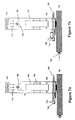
- FIGS. 1 a and 1 b are cross-sectional views showing an apparatus designed with the principles described in the present invention
- FIGS. 2 a and 2 b are cross-sectional views showing a second apparatus designed with the principles described in the present invention
- FIG. 3 is a cross-sectional view showing a radiant source bonding two components of the work piece in accordance to the basic embodiment of the process according to the present invention
- FIG. 3 a is a detailed view of an embodiment of the bottom component of FIG. 3 and FIG. 3 b is a detailed view of an alternative embodiment of a bottom component.
- FIGS. 4 a and 4 b are cross-sectional views of two light pipes designed to conform to the principles established in the present invention and FIGS. 4 c and 4 d are end views of the respective masked ends of the light pipes of FIGS. 4 a and 4 b;
- FIGS. 5 a , 5 c , 5 e and 5 g are cross-sectional views showing various cooling schemes for the light pipes and FIGS. 5 b , 5 d , 5 f and 5 h are end views of the respective cooling schemes;
- FIGS. 6 a and 6 b are cross-sectional views showing a third apparatus designed with the principles described in the present invention.
- FIGS. 7 a through 7 h are cross-sectional views showing a step-by-step welding process of a fourth apparatus designed with the principles described in the present invention.
- FIG. 8 is a top view of a fully automated conveyor system where plastic components are processed continuously under an apparatus similar to those described on FIGS. 1 , 2 , 6 , and 7 ;
- FIG. 9 is a cross-sectional view of a welding apparatus used on a system such as the one described in FIG. 8 .
- FIGS. 1 a and 1 b show an embodiment of a photon welder, which comprises several features of the current invention.
- a component 110 made with highly absorptive radiation characteristics is placed in intimate contact with another component 109 that allows transmission of radiant energy into a nest or base 114 with means to provide a force 111 ( FIG. 1 b ), which could be provided by springs 117 , or a linear actuator or other device that will produce the same result.
- a movable plate 115 provided with bushings 116 is pushed upward by a pneumatic piston 119 as FIG. 1 a shows.
- the plate carries the nest 114 upward in a linear motion and maintains alignment to a light pipe 105 or a thin mask composed of a transparent material such as silicon dioxide and a reflective material placed on all locations except where the welding of the components is desired.
- the plate moves along shafts 124 extending from a base 121 to aid on the alignment of the components to be welded and the light pipe or thin mask.
- the movable plate 115 activates a contact switch or a proximity sensor (not shown) which turns on the light source 101 supported by a plate 122 .
- An elliptical reflector 102 directs light produced by the source towards the light pipe 105 .
- a fan 112 provides cooling 113 to the reflector 102 continuously.
- radiation 104 impinging on the entrance of the light pipe 105 , travels through the pipe 106 , through the exit of it, and then through the first component 109 that comprises part of the assembly to be bonded.
- the radiation is absorbed by the second component 110 of the assembly causing it to melt and transfer energy upward to the top component by convection and conduction, which melts a portion of the top component.
- the melted area cools to a bond during a dwell time of 1 to 4 seconds.
- a timed controller retracts the movable plate 115 to its original position as shown on FIG. 1 a .
- the temperature of the light pipe is controlled by a temperature sensor 130 , which activates a fan or blower 118 providing cooling air to the exit end of the light pipe.
- FIGS. 2 a and 2 b show another embodiment of a welding device designed with the principles established by the invention.
- the linear motion is provided to a light pipe 205 , a light source 201 , a reflector 202 , and a fan 212 , by a piston 219 located on a retaining plate 226 .
- a movable plate 223 provided with bearings 216 slides downwards on shafts 224 , extending from a base 221 , simultaneously with the a movable plate 222 .
- the light pipe 205 with its shaped and masked end comes in contact with the components to be bonded 209 and 210 in a nest 214 with means to provide a force 211 ( FIG.
- a contact switch or a proximity sensor activate the light source 201 .
- Light produced by the source 201 is directed by the elliptical reflector 202 , towards the light pipe 205 .
- the fan 212 provides cooling 213 to the reflector 202 continuously.
- Radiation 204 ( FIG. 2 b ) impinging on the entrance of the light pipe 205 travels through the pipe 206 ( FIG. 2 b ) the exit of it, and then through the first component 209 that comprises the assembly to be bonded. Finally the radiation is absorbed by the second component 210 of the assembly causing it to melt and thus bond with the first component of the assembly.
- a timed controller retracts the movable plate assembly ( 222 / 223 and connecting shafts 225 ), to its original position as shown on FIG. 2 a .
- the temperature of the light pipe is controlled by a temperature sensor 230 , which activates a fan or blower 218 providing cooling air to the exit end of the light pipe.
- FIGS. 3 through 3 b illustrate a third embodiment of the invention.
- a quartz-halogen tungsten lamp 301 typically 410 to 1000 watts in machines, although not limited to these powers
- Photons 304 reflected by the walls of the metal reflector is directed towards the entrance of a light pipe 305 made of fused silica (quartz).
- Photons 304 produced by the light source 301 travel the length of the entire light pipe 306 .
- An exit is provided for the photons 304 at predetermined areas at the end of the light pipe 305 .
- a highly reflective material 353 acting as a mask 308 , placed at the end of the light pipe prevents photons from exiting through unwanted areas.
- a force 311 is applied , the light source 301 is energized, the photons 304 , reflected by the reflector's surface 303 , are transmitted by the light pipe 305 through an unmasked area 336 and through the material of the top component 309 , and finally absorbed by the material of the bottom component 310 . Because both the top plastic component 309 and the bottom plastic component 310 are in intimate thermal contact, when the bottom photon absorbing plastic component 310 melts, the top transparent plastic component 309 melts too as the heat is transmitted to it by conduction and convection.
- FIGS. 4 a and 4 b depict two basic light pipe configurations where a point of entry is provided for the light 427 , a path 405 for the light is provided, and a masked area 408 to prevent radiation from striking unwanted sections is placed at the point of exit of the light pipe.
- the masked area of the light pipe is coated with a highly reflective material such as gold or aluminum.
- the weld location 428 is determined by a small area on the periphery of the quartz light pipe, which is not coated with reflective material ( FIGS. 4 c and 4 d ).
- FIGS. 5 a through 5 h describe several embodiments of this invention, which provide thermal management to an end of a light pipe 505 because the light pipe absorbs heat during each weld.
- These embodiments include ( FIGS. 5 a and 5 b ) the use of heat dissipaters or heat sinks 531 provided with radial fins 532 ;
- FIGS. 5 c and 5 d show a water cooled heat exchanger 533 , wrapped around the light pipe with water 534 , forced through it to maintain the temperature of the light pipe at appropriate levels; heat pipes 535 ( FIGS. 5 e and 5 f ) can be utilized along with a fan 537 to help remove the heat from the light pipe 536 , thus cooling the light pipe;
- FIG. 5 g and 5 h show an annulus 538 , where compressed air is channeled through openings to cool the light pipe 539 .
- FIGS. 6 a and 6 b depict a manual welding device based on the principles established by the invention.
- a component 610 made with high absorptive radiation characteristics is placed in intimate contact with another component that allows transmission of radiant energy into a nest 614 with means to provide a force 611 ( FIG. 6 b ) with springs 617 or other device that will produce the same result.
- a movable plate 615 provided with bushings 616 , is pushed upwards by a cam 641 mounted on a shaft 640 turned manually. As FIG. 6 b shows, the plate carries along the nest 614 upward in a linear motion and maintains alignment to the light pipe by shafts 624 extending from a base 621 .
- the movable plate 615 When in contact with a shaped and masked end of a light pipe 605 , the movable plate 615 , activates a contact switch or a proximity sensor (not shown) which turns on light source 601 .
- Light produced by the source is directed by an elliptical reflector 602 , towards the light pipe 605 .
- a fan 612 provides cooling 613 to the reflector 602 continuously.
- Radiation 604 ( FIG. 6 b ), impinging on the entrance of the light pipe 605 , travels 606 through the pipe, the exit of it, and then through the first component 609 that comprises the assembly to be bonded. Finally the radiation is absorbed by the second component 610 of the assembly causing it to melt and thus bond with the first component of the assembly.
- a temperature sensor 630 initiates cooling.
- a small fan 618 ( FIG. 6 a ) provides cooling air to the exit end of the light pipe.
- FIGS. 7 a through 7 h present another welding apparatus where a light pipe 705 remains in a fixed position, while a linear actuator 745 ( FIG. 7 d ), provides a linear motion to a nest 714 , held in a drawer-like fixture 742 .
- FIG. 7 a presents the device in its initial position right after power has been turned on. Both a reflector's cooling fan 712 , and a light pipe cooling mechanism 718 are on at this point.
- Sensors (not shown) provide feedback to the system to activate a pneumatic piston 743 to move the drawer mechanism 742 along a base 721 , out and away from the welding area.
- the nest holds components to be welded 709 and 710 ( FIG. 7 b ).
- the operator pushes a momentary switch 744 , to initiate the welding process.
- a sensor (not shown) ascertains that the work piece is in the correct position
- the pneumatic piston 743 returns the drawer 742 back to its position within the welding area.
- the linear actuator 745 or a similar device that provides the same motion lifts the holding nest 714 , to the welding position ( FIG. 7 d ). This action is sensed by yet another sensor (not shown) which stops the cooling mechanism to the light pipe 718 .
- the linear actuator 745 provides the required clamping force.
- a proximity sensor or a mechanical switch (not shown) triggers a radiant source 701 on.
- a timer (not shown) provides the mean to control the time the plastic components are to be irradiated.
- the fan 712 provides continuous cooling 713 to a reflector 702 .
- a temperature probe 730 (not shown) attached to a temperature control (not shown) provides feedback to a programmable device (not shown).
- the linear actuator lowers the components ( FIG. 7 f ), which triggers the light pipe cooling mechanism 718 on.
- the pneumatic piston 743 moves the drawer-like mechanism 742 out and away from the welding area.
- the operator removes welded plastic components 751 from the holding nest 714 , and inserts a new pair of components to be welded ( FIG. 7 h ).
- the cycle is repeated when the operator pushes the momentary switch 744 .
- An electronic control box provided with a touch panel (not shown), allows full programming of the step-wise welding process presented on FIG. 8.
- a conveyor belt-driven system 800 in combination with miniature pneumatic pistons and sensors is utilized to move the components to be welded. Unwelded plastic components are assembled and then placed on holding nests 801 . The conveyor moves the nests under a pre-heating system 802 for some pre-determined time, then under a photonic welder 803 , where bonding is performed. Bonded components exit the welder and then complete the cycle by returning to the point of origin for loading and unloading of the components.
- a sequence control system using PLC programming provides the controls for moving a palette containing the plastic parts to be welded, positioning the parts in a pre-heat station, and then positioning the parts in the welding station.
- welding parameters including time duration, light intensity, retaining force
- error messages indicate if any of the welding parameters are out of tolerance.
- the plastic part temperatures are increased by about 50° C.
- This preheat has been determined for reservoir components made of polyethylene in both square and circular geometry's of 25 to 30 mm (per square side or diameter), Data obtained on preheat showed the following, small preheat produces excellent quality welds, but only a small reduction in weld time; a proper preheat (typically about 50° C.) results in the time reduction to weld the 3 mm thick infrared transparent polyethylene parts from nine to six seconds; and excessive preheat results in overwelded parts with visible distortion of the normally undisturbed exterior surface. If the preheat varies outside of the specified range (plus or minus 10° C.) around a predetermined temperature (which is adjustable depending on the plastic part geometry and material) then an error message will signal the system to stop.
- the conveyor transports the palette and plastic parts to the welding station.
- the plastic parts are lifted to position the parts under the welding lens.
- Three different welding lenses have been tested. These are: a thin laminated glass lens with an embedded gold, silver or aluminum mask; a machined quartz lens with aluminum coating mask; and light pipes up to two, inches in diameter with masks at the end to allow light only in the weld region. Data obtained on weld force has determined that 7 to 10 pounds provide highest quality welds for polyethylene. Lower forces result in incomplete welds around the periphery, and higher forces distort the normally clean exterior surface. Both the force magnitude, and duration of force are controlled. The part is raised by a pneumatic system to the lens were the predetermined force is applied.
- the welding lights are activated and the welding is commenced for a predetermined time.
- the PLC program controls both the force and the welding times, and if these are out of range then an error message detects the deviation.
- the welding light is turned off the force application continues for one second and cooling air is applied to the welding lens for three seconds.
- the software allows different sequencing times depending on the plastic part geometry and materials.
- FIG. 9 shows a photon welder where a belt driven mechanism 901 such as the one described on FIG. 8 , moves a nest 902 carrying unwelded components 903 .
- Air driven pistons 904 push the unwelded components against a short light pipe 905 .
- quartz halogen lamps 906 contained within elliptical reflectors 907 are turned on for some pre-determined time controlled by a fully programmable control station (not shown).
- the light is then trapped by long cylindrical light pipes 908 which direct the light towards short light pipes 905 that have been masked with aluminum or gold to conform the areas of the parts to be welded, while the bonding takes place, a continuous stream of air cools both ends of the light pipes.
- the stream of air is provided by jets 909 .
- Cooling for the reflectors and a chamber 911 where the light pipes and reflectors are contained is provided by the various fans 910 .
- the pneumatic pistons retract allowing the welded components to be carried away by the nest 902 .
Landscapes
- Engineering & Computer Science (AREA)
- Mechanical Engineering (AREA)
- Physics & Mathematics (AREA)
- Electromagnetism (AREA)
- Thermal Sciences (AREA)
- Health & Medical Sciences (AREA)
- Toxicology (AREA)
- Manufacturing & Machinery (AREA)
- Fluid Mechanics (AREA)
- Lining Or Joining Of Plastics Or The Like (AREA)
Abstract
Description
Claims (48)
Priority Applications (1)
| Application Number | Priority Date | Filing Date | Title |
|---|---|---|---|
| US10/037,414 US6911108B2 (en) | 2001-01-06 | 2002-01-04 | Photon welding devices for joining plastic parts |
Applications Claiming Priority (2)
| Application Number | Priority Date | Filing Date | Title |
|---|---|---|---|
| US26001201P | 2001-01-06 | 2001-01-06 | |
| US10/037,414 US6911108B2 (en) | 2001-01-06 | 2002-01-04 | Photon welding devices for joining plastic parts |
Publications (2)
| Publication Number | Publication Date |
|---|---|
| US20030094240A1 US20030094240A1 (en) | 2003-05-22 |
| US6911108B2 true US6911108B2 (en) | 2005-06-28 |
Family
ID=26714106
Family Applications (1)
| Application Number | Title | Priority Date | Filing Date |
|---|---|---|---|
| US10/037,414 Expired - Fee Related US6911108B2 (en) | 2001-01-06 | 2002-01-04 | Photon welding devices for joining plastic parts |
Country Status (1)
| Country | Link |
|---|---|
| US (1) | US6911108B2 (en) |
Cited By (6)
| Publication number | Priority date | Publication date | Assignee | Title |
|---|---|---|---|---|
| US20070047932A1 (en) * | 2005-08-31 | 2007-03-01 | Branson Ultrasonics Corporation | Waveguide for plastics welding using an incoherent infrared light source |
| US20080060740A1 (en) * | 2006-09-07 | 2008-03-13 | O'neill Patrick F | System and method for wetsuit assembly |
| US20090219327A1 (en) * | 2006-02-28 | 2009-09-03 | Chizuo Ozawa | Inkjet Printer |
| US20130215618A1 (en) * | 2010-10-04 | 2013-08-22 | Hamamatsu Photonics K.K. | Light source |
| US9999546B2 (en) | 2014-06-16 | 2018-06-19 | Illinois Tool Works Inc. | Protective headwear with airflow |
| US11812816B2 (en) | 2017-05-11 | 2023-11-14 | Illinois Tool Works Inc. | Protective headwear with airflow |
Families Citing this family (8)
| Publication number | Priority date | Publication date | Assignee | Title |
|---|---|---|---|---|
| US20040056006A1 (en) * | 1998-10-01 | 2004-03-25 | The Welding Institute | Welding method |
| DE102004004985B4 (en) * | 2004-01-30 | 2006-03-23 | Lpkf Laser & Electronics Ag | Method and device for transmission welding of two thermoplastic components |
| JP2012086411A (en) * | 2010-10-18 | 2012-05-10 | Sony Corp | Method and device for thermocompression bonding |
| JP6073643B2 (en) * | 2012-10-25 | 2017-02-01 | 株式会社小糸製作所 | Vehicle lamp and manufacturing method thereof |
| DE102016116137A1 (en) * | 2016-08-30 | 2018-03-01 | HELLA GmbH & Co. KGaA | Method and device for joining a lens with a housing of a lighting device for a motor vehicle |
| DE102019120595A1 (en) * | 2019-07-30 | 2021-02-04 | Airbus Operations Gmbh | Transmission welding process, transmission welding device and transmission welding arrangement |
| US11845202B2 (en) * | 2021-02-17 | 2023-12-19 | Expert Tooling and Automation, LTD | Near-field microwave heating system and method |
| US11801586B2 (en) * | 2021-03-02 | 2023-10-31 | Extol Inc. | Laser part retention system and method |
Citations (6)
| Publication number | Priority date | Publication date | Assignee | Title |
|---|---|---|---|---|
| US4233493A (en) * | 1974-05-21 | 1980-11-11 | Nath Guenther | Apparatus for applying intense light radiation to a limited area |
| US4636609A (en) | 1984-04-10 | 1987-01-13 | Toyota Jidosha Kabushiki Kaisha | Process for joining different kinds of synthetic resins |
| US5278731A (en) * | 1992-09-10 | 1994-01-11 | General Electric Company | Fiber optic lighting system using conventional headlamp structures |
| US5426308A (en) * | 1993-05-28 | 1995-06-20 | Lesco, Inc. | Ultraviolet curing device having movable reflector |
| US5840147A (en) | 1995-06-07 | 1998-11-24 | Edison Welding Institute | Plastic joining method |
| US6596122B1 (en) * | 1998-07-10 | 2003-07-22 | Edison Welding Institute, Inc. | Simultaneous butt and lap joints |
-
2002
- 2002-01-04 US US10/037,414 patent/US6911108B2/en not_active Expired - Fee Related
Patent Citations (7)
| Publication number | Priority date | Publication date | Assignee | Title |
|---|---|---|---|---|
| US4233493A (en) * | 1974-05-21 | 1980-11-11 | Nath Guenther | Apparatus for applying intense light radiation to a limited area |
| US4636609A (en) | 1984-04-10 | 1987-01-13 | Toyota Jidosha Kabushiki Kaisha | Process for joining different kinds of synthetic resins |
| US5278731A (en) * | 1992-09-10 | 1994-01-11 | General Electric Company | Fiber optic lighting system using conventional headlamp structures |
| US5426308A (en) * | 1993-05-28 | 1995-06-20 | Lesco, Inc. | Ultraviolet curing device having movable reflector |
| US5840147A (en) | 1995-06-07 | 1998-11-24 | Edison Welding Institute | Plastic joining method |
| US5843265A (en) | 1995-06-07 | 1998-12-01 | Edison Welding Institute | Joining method |
| US6596122B1 (en) * | 1998-07-10 | 2003-07-22 | Edison Welding Institute, Inc. | Simultaneous butt and lap joints |
Cited By (9)
| Publication number | Priority date | Publication date | Assignee | Title |
|---|---|---|---|---|
| US20070047932A1 (en) * | 2005-08-31 | 2007-03-01 | Branson Ultrasonics Corporation | Waveguide for plastics welding using an incoherent infrared light source |
| US20090219327A1 (en) * | 2006-02-28 | 2009-09-03 | Chizuo Ozawa | Inkjet Printer |
| US8025387B2 (en) * | 2006-02-28 | 2011-09-27 | Mastermind Co., Ltd. | Inkjet printer |
| US20080060740A1 (en) * | 2006-09-07 | 2008-03-13 | O'neill Patrick F | System and method for wetsuit assembly |
| US20130215618A1 (en) * | 2010-10-04 | 2013-08-22 | Hamamatsu Photonics K.K. | Light source |
| US9360187B2 (en) * | 2010-10-04 | 2016-06-07 | Hamamatsu Photonics K. K. | Light source |
| US9999546B2 (en) | 2014-06-16 | 2018-06-19 | Illinois Tool Works Inc. | Protective headwear with airflow |
| US11166852B2 (en) | 2014-06-16 | 2021-11-09 | Illinois Tool Works Inc. | Protective headwear with airflow |
| US11812816B2 (en) | 2017-05-11 | 2023-11-14 | Illinois Tool Works Inc. | Protective headwear with airflow |
Also Published As
| Publication number | Publication date |
|---|---|
| US20030094240A1 (en) | 2003-05-22 |
Similar Documents
| Publication | Publication Date | Title |
|---|---|---|
| US6911108B2 (en) | Photon welding devices for joining plastic parts | |
| US5843265A (en) | Joining method | |
| JP3303259B2 (en) | Method and apparatus for bonding resin by laser | |
| CN100348404C (en) | Method and apparatus for welding thermoplastic molded parts | |
| CN100450755C (en) | Method and device for connecting three-D shaped plastic workpiece by laser beam | |
| US6544022B2 (en) | Heat staking head with radiant heat source | |
| US20100307676A1 (en) | Method and apparatus for laser welding thermoplastic resin members | |
| EP2923821B1 (en) | Method for direct infrared laser welding | |
| US20050167407A1 (en) | Process and apparatus for joining components using laser radiation | |
| US6099291A (en) | Heat staking apparatus with radiant heat source | |
| TW436448B (en) | Device for welding the ends of tubular containers made from plastic, in particular tubes | |
| US7591698B2 (en) | Vehicle lighting device manufacturing method for positioning and welding a cover to a housing | |
| US20110298160A1 (en) | Method for manufacturing resin molding and laser beam irradiation apparatus | |
| GB2345263A (en) | Infrared bonding of transparent plastics articles | |
| US20110203726A1 (en) | Method for manufacturing resin molding | |
| CN112739527B (en) | Laser welding system and method | |
| JPS6264528A (en) | Joining of synthetic resin material and different material | |
| AU736009B2 (en) | Scanning laser demolding of ophthalmic lenses | |
| JP2003311831A (en) | Method of forming uneven pattern | |
| JP2004074734A (en) | Plastic welding method | |
| GB2278571A (en) | Joining members using heat from a light source | |
| CN205733436U (en) | Laser synchronization welder | |
| KR102868708B1 (en) | Connection method using a laser transmission bonding technology, an apparatus for bonding as well as a part made of a laser transmissive bonded first plastic part and a second plastic part | |
| JPH088527A (en) | Infrared heating device | |
| WO2003019983A1 (en) | Infrared welder |
Legal Events
| Date | Code | Title | Description |
|---|---|---|---|
| AS | Assignment |
Owner name: QUANTUM GROUP INC., CALIFORNIA Free format text: ASSIGNMENT OF ASSIGNORS INTEREST;ASSIGNOR:SARMIENTO, PEDRO;REEL/FRAME:013374/0796 Effective date: 20020920 |
|
| AS | Assignment |
Owner name: QUANTUM GROUP, INC., CALIFORNIA Free format text: ASSIGNMENT OF ASSIGNORS INTEREST;ASSIGNOR:SARMIENTO, PEDRO A.;REEL/FRAME:013768/0918 Effective date: 20030616 |
|
| CC | Certificate of correction | ||
| REMI | Maintenance fee reminder mailed | ||
| LAPS | Lapse for failure to pay maintenance fees | ||
| STCH | Information on status: patent discontinuation |
Free format text: PATENT EXPIRED DUE TO NONPAYMENT OF MAINTENANCE FEES UNDER 37 CFR 1.362 |
|
| FP | Lapsed due to failure to pay maintenance fee |
Effective date: 20090628 |