US2608502A - Honeycomb structure and method of making same - Google Patents
Honeycomb structure and method of making same Download PDFInfo
- Publication number
- US2608502A US2608502A US728920A US72892047A US2608502A US 2608502 A US2608502 A US 2608502A US 728920 A US728920 A US 728920A US 72892047 A US72892047 A US 72892047A US 2608502 A US2608502 A US 2608502A
- Authority
- US
- United States
- Prior art keywords
- sheets
- areas
- spaced
- assembly
- bonded
- Prior art date
- Legal status (The legal status is an assumption and is not a legal conclusion. Google has not performed a legal analysis and makes no representation as to the accuracy of the status listed.)
- Expired - Lifetime
Links
- 238000004519 manufacturing process Methods 0.000 title claims description 13
- 239000000463 material Substances 0.000 claims description 37
- 210000004027 cell Anatomy 0.000 claims description 19
- 239000004744 fabric Substances 0.000 claims description 13
- 230000001413 cellular effect Effects 0.000 claims description 10
- KXGFMDJXCMQABM-UHFFFAOYSA-N 2-methoxy-6-methylphenol Chemical compound [CH]OC1=CC=CC([CH])=C1O KXGFMDJXCMQABM-UHFFFAOYSA-N 0.000 claims description 9
- 239000005011 phenolic resin Substances 0.000 claims description 9
- 229920001568 phenolic resin Polymers 0.000 claims description 9
- 210000003850 cellular structure Anatomy 0.000 claims description 7
- 230000015572 biosynthetic process Effects 0.000 claims description 6
- 238000010276 construction Methods 0.000 claims description 5
- 238000007493 shaping process Methods 0.000 claims description 2
- 239000011162 core material Substances 0.000 description 15
- 229920005989 resin Polymers 0.000 description 11
- 239000011347 resin Substances 0.000 description 11
- 230000000873 masking effect Effects 0.000 description 10
- 229920000742 Cotton Polymers 0.000 description 4
- 229920000298 Cellophane Polymers 0.000 description 3
- 230000004888 barrier function Effects 0.000 description 3
- 210000002421 cell wall Anatomy 0.000 description 3
- 229910000838 Al alloy Inorganic materials 0.000 description 2
- 229910000861 Mg alloy Inorganic materials 0.000 description 2
- 230000001070 adhesive effect Effects 0.000 description 2
- XAGFODPZIPBFFR-UHFFFAOYSA-N aluminium Chemical compound [Al] XAGFODPZIPBFFR-UHFFFAOYSA-N 0.000 description 2
- 230000000694 effects Effects 0.000 description 2
- 230000005484 gravity Effects 0.000 description 2
- 238000012986 modification Methods 0.000 description 2
- 230000004048 modification Effects 0.000 description 2
- 230000000087 stabilizing effect Effects 0.000 description 2
- PITMOJXAHYPVLG-UHFFFAOYSA-N 2-acetyloxybenzoic acid;n-(4-ethoxyphenyl)acetamide;1,3,7-trimethylpurine-2,6-dione Chemical compound CCOC1=CC=C(NC(C)=O)C=C1.CC(=O)OC1=CC=CC=C1C(O)=O.CN1C(=O)N(C)C(=O)C2=C1N=CN2C PITMOJXAHYPVLG-UHFFFAOYSA-N 0.000 description 1
- 239000000853 adhesive Substances 0.000 description 1
- 230000004075 alteration Effects 0.000 description 1
- 239000003795 chemical substances by application Substances 0.000 description 1
- 238000001816 cooling Methods 0.000 description 1
- 238000005520 cutting process Methods 0.000 description 1
- 238000013461 design Methods 0.000 description 1
- 238000003780 insertion Methods 0.000 description 1
- 230000037431 insertion Effects 0.000 description 1
- 238000010030 laminating Methods 0.000 description 1
- 229910052751 metal Inorganic materials 0.000 description 1
- 239000002184 metal Substances 0.000 description 1
- 238000000034 method Methods 0.000 description 1
- ISWSIDIOOBJBQZ-UHFFFAOYSA-N phenol group Chemical group C1(=CC=CC=C1)O ISWSIDIOOBJBQZ-UHFFFAOYSA-N 0.000 description 1
- 229920003023 plastic Polymers 0.000 description 1
- 239000004033 plastic Substances 0.000 description 1
- 238000000926 separation method Methods 0.000 description 1
- 210000004722 stifle Anatomy 0.000 description 1
- 238000006467 substitution reaction Methods 0.000 description 1
- 238000012360 testing method Methods 0.000 description 1
- 239000002966 varnish Substances 0.000 description 1
- 238000005303 weighing Methods 0.000 description 1
Images
Classifications
-
- B—PERFORMING OPERATIONS; TRANSPORTING
- B29—WORKING OF PLASTICS; WORKING OF SUBSTANCES IN A PLASTIC STATE IN GENERAL
- B29D—PRODUCING PARTICULAR ARTICLES FROM PLASTICS OR FROM SUBSTANCES IN A PLASTIC STATE
- B29D99/00—Subject matter not provided for in other groups of this subclass
- B29D99/0089—Producing honeycomb structures
-
- B—PERFORMING OPERATIONS; TRANSPORTING
- B31—MAKING ARTICLES OF PAPER, CARDBOARD OR MATERIAL WORKED IN A MANNER ANALOGOUS TO PAPER; WORKING PAPER, CARDBOARD OR MATERIAL WORKED IN A MANNER ANALOGOUS TO PAPER
- B31D—MAKING ARTICLES OF PAPER, CARDBOARD OR MATERIAL WORKED IN A MANNER ANALOGOUS TO PAPER, NOT PROVIDED FOR IN SUBCLASSES B31B OR B31C
- B31D3/00—Making articles of cellular structure, e.g. insulating board
- B31D3/02—Making articles of cellular structure, e.g. insulating board honeycombed structures, i.e. the cells having an essentially hexagonal section
- B31D3/0223—Making honeycomb cores, e.g. by piling a plurality of web sections or sheets
- B31D3/023—Making honeycomb cores, e.g. by piling a plurality of web sections or sheets by cutting webs longitudinally into strips, piling these strips and uniting them along lines perpendicular to the cuts
-
- Y—GENERAL TAGGING OF NEW TECHNOLOGICAL DEVELOPMENTS; GENERAL TAGGING OF CROSS-SECTIONAL TECHNOLOGIES SPANNING OVER SEVERAL SECTIONS OF THE IPC; TECHNICAL SUBJECTS COVERED BY FORMER USPC CROSS-REFERENCE ART COLLECTIONS [XRACs] AND DIGESTS
- Y10—TECHNICAL SUBJECTS COVERED BY FORMER USPC
- Y10T—TECHNICAL SUBJECTS COVERED BY FORMER US CLASSIFICATION
- Y10T156/00—Adhesive bonding and miscellaneous chemical manufacture
- Y10T156/10—Methods of surface bonding and/or assembly therefor
- Y10T156/1002—Methods of surface bonding and/or assembly therefor with permanent bending or reshaping or surface deformation of self sustaining lamina
- Y10T156/1003—Methods of surface bonding and/or assembly therefor with permanent bending or reshaping or surface deformation of self sustaining lamina by separating laminae between spaced secured areas [e.g., honeycomb expanding]
-
- Y—GENERAL TAGGING OF NEW TECHNOLOGICAL DEVELOPMENTS; GENERAL TAGGING OF CROSS-SECTIONAL TECHNOLOGIES SPANNING OVER SEVERAL SECTIONS OF THE IPC; TECHNICAL SUBJECTS COVERED BY FORMER USPC CROSS-REFERENCE ART COLLECTIONS [XRACs] AND DIGESTS
- Y10—TECHNICAL SUBJECTS COVERED BY FORMER USPC
- Y10T—TECHNICAL SUBJECTS COVERED BY FORMER US CLASSIFICATION
- Y10T156/00—Adhesive bonding and miscellaneous chemical manufacture
- Y10T156/10—Methods of surface bonding and/or assembly therefor
- Y10T156/1002—Methods of surface bonding and/or assembly therefor with permanent bending or reshaping or surface deformation of self sustaining lamina
- Y10T156/1043—Subsequent to assembly
- Y10T156/1044—Subsequent to assembly of parallel stacked sheets only
-
- Y—GENERAL TAGGING OF NEW TECHNOLOGICAL DEVELOPMENTS; GENERAL TAGGING OF CROSS-SECTIONAL TECHNOLOGIES SPANNING OVER SEVERAL SECTIONS OF THE IPC; TECHNICAL SUBJECTS COVERED BY FORMER USPC CROSS-REFERENCE ART COLLECTIONS [XRACs] AND DIGESTS
- Y10—TECHNICAL SUBJECTS COVERED BY FORMER USPC
- Y10T—TECHNICAL SUBJECTS COVERED BY FORMER US CLASSIFICATION
- Y10T29/00—Metal working
- Y10T29/49—Method of mechanical manufacture
- Y10T29/49826—Assembling or joining
- Y10T29/49879—Spaced wall tube or receptacle
-
- Y—GENERAL TAGGING OF NEW TECHNOLOGICAL DEVELOPMENTS; GENERAL TAGGING OF CROSS-SECTIONAL TECHNOLOGIES SPANNING OVER SEVERAL SECTIONS OF THE IPC; TECHNICAL SUBJECTS COVERED BY FORMER USPC CROSS-REFERENCE ART COLLECTIONS [XRACs] AND DIGESTS
- Y10—TECHNICAL SUBJECTS COVERED BY FORMER USPC
- Y10T—TECHNICAL SUBJECTS COVERED BY FORMER US CLASSIFICATION
- Y10T428/00—Stock material or miscellaneous articles
- Y10T428/24—Structurally defined web or sheet [e.g., overall dimension, etc.]
- Y10T428/24149—Honeycomb-like
-
- Y—GENERAL TAGGING OF NEW TECHNOLOGICAL DEVELOPMENTS; GENERAL TAGGING OF CROSS-SECTIONAL TECHNOLOGIES SPANNING OVER SEVERAL SECTIONS OF THE IPC; TECHNICAL SUBJECTS COVERED BY FORMER USPC CROSS-REFERENCE ART COLLECTIONS [XRACs] AND DIGESTS
- Y10—TECHNICAL SUBJECTS COVERED BY FORMER USPC
- Y10T—TECHNICAL SUBJECTS COVERED BY FORMER US CLASSIFICATION
- Y10T428/00—Stock material or miscellaneous articles
- Y10T428/24—Structurally defined web or sheet [e.g., overall dimension, etc.]
- Y10T428/24744—Longitudinal or transverse tubular cavity or cell
-
- Y—GENERAL TAGGING OF NEW TECHNOLOGICAL DEVELOPMENTS; GENERAL TAGGING OF CROSS-SECTIONAL TECHNOLOGIES SPANNING OVER SEVERAL SECTIONS OF THE IPC; TECHNICAL SUBJECTS COVERED BY FORMER USPC CROSS-REFERENCE ART COLLECTIONS [XRACs] AND DIGESTS
- Y10—TECHNICAL SUBJECTS COVERED BY FORMER USPC
- Y10T—TECHNICAL SUBJECTS COVERED BY FORMER US CLASSIFICATION
- Y10T428/00—Stock material or miscellaneous articles
- Y10T428/24—Structurally defined web or sheet [e.g., overall dimension, etc.]
- Y10T428/24802—Discontinuous or differential coating, impregnation or bond [e.g., artwork, printing, retouched photograph, etc.]
- Y10T428/24826—Spot bonds connect components
Definitions
- My invention relates to honeycomb structural material and more particularly a method of forming a cellular structure of, resin impregnated fabric material bonded together at longitudinally spaced intervals under heat and'pressure with intervening spaces prevented from bonding by being masked from contactual engagement with the bondable resin impregnated material by strips of non-bondable material placed therebetween at spaced intervals prior to bonding.
- the present invention has overcome these disadvantages by providing an inexpensive methd of producing a honeycomb structure from relatively dense material that possesses distinct advantages as a stabilizing medium by reason of the fact that the inherent strength of the dense material is fully utilized and all of the advantages of light-weight construction are attained in a cellular assembly characterized by a specific gravity of from .10 to .035.
- the present invention provides a" honeycomb structural material and a method of making wherein a plurality of sheets of 'flexiblephenolic impregnated material are bonded together at spaced intervals with the non-bonding of the intervening areas effected by havingspaced strips of non-bondable material placed between the impregnated sheets prior tobonding as an assembly and expanded and cured to form a stiff cellular structurehaving cell walls capableof supporting relatively heavy loads.
- y 1 i It is one of the'obj'ects of the present invention to provide honeycomb core material comprised of strips of resin impregnated material bonded together at spaced intervals and cured by the application of heat and pressure to form a cellular assembly having a plurality of supporting walls of predetermined shape and size.
- Another object is to provide a structural material having an assembly of cell walls in which i 5 Claims (Grist-110) V said wall members are bonded together so as to allow for expansion and angular adjustment to effect a shaped structure on curing.
- a still further object of my invention is to provide a method of making structural material comprised of strips of flexible resin impregnated material bonded together at spaced bond areas by the application of heat, shaped and. expanded and stifiened by curing so as to produce a cellular assembly having a predetermined specific gravity and strength ratio.
- Another object of this invention i to provide a method of making honeycomb structural material having a plurality of Walls bonded together to provide an expansible structure capable of being formed to a variety of shapes and curvatures.
- a still further object of this invention is to provide a method of making a relatively stifl? cellular stabilizing'structure by the bonding together of sheets of bondable material at spaced bond areas with the intervening areas masked against bonding by the insertion of strips of nonbondable masking material, cutting the assembly to the desired widths of finished product, separating the material at the non-bonded areas to form cells having bonded and non-bonded wall areas. withthe masking material positioned adjacent said non-bonded areas, and fixing of the geometry of the cells by curing.
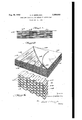
- Figure 1 is a sectional view of the sheets and masking strips that form the cellular structure in assembled position prior to bonding.
- Figure 2 is .a perspective View of an assembly of the core material-with the top sheet turned back to show positioning of the masking strips.
- Figure3 is a perspective view of the finished product. r
- the assembly l0 consists of a plurality of thin resin impregnated fabric sheets HI placed: in stacked formation and prevented from contacting each other at predetermined spaced intervalsby adhesion barriers formed as masking strips I2 cut to predetermined widths and placed'therebetween.
- Masking strips lz are of cellophane, or a like flexible material that will bond areas I3.
- the spacing and width of each bond area 13 is predetermined so that when the sheets I! are suitably brought together at said bond areas arranged at spaced intervals between successive pairs of sheets throughout the assembly m and bonded together a plurality of uniformly sized and spaced collapsed cells are formed. Separation of the sheets II at the nonbonded areas effects expansion of the cells l4 ( Figure 3) having double and single wall areas with the non-bondable masking strips 12 spaced adjacent thereto.
- Thegeometrical pattern of the cell is determined by the: arrangement and spacing of the bond areas-. In most instances,- thestandard hexagonal form of cell will-be foundmost satisfactory, such as in forming core material for use with eithenfiat or saddle-shaped surface'sheets, whereas a trapezoidal cell formation is best adapted to the formingof double curvatures.
- the "methodof producing is to assemble the sheets H'and determine the areas to beexposed forbonding, shown as unmasked areas 13 in Figure: 1, and cover the intervening'spaces witha bond preventing agent formed as masking strips l2 -of cellophane, or like material, so-that only the unmasked areas of the assembly I 0' will bond-togethe'r when heated.
- Theassembly E0 of sheets H and masking material 12 isthenplaced in a press and heated to substantially-305 1 for approximately five (5) minuteslunder" pressure toeffectbonding of-:the sheets to each other-at the longitudinallyspaced bond areas
- a method of making honeycomb structural material which comprises bonding sheets of phenolic resin impregnated fabric material together at. areas spaced longitudinally of the sheets by the application of heat and pressure and preventing adhesion therebetween at intervening spaces with strips of non-bendable ma: terial spaced longitudinallyof said sheets: to form an, assembly of sheets havin alternately arranged bonds spaced parallel to each other throughout the assembly with intervening areas of the said sheets non-"bonded areas, shaping the assembly to the desired'wldth and contour by 'working transversely of the bonded and nonbonded areas, then separatingthe unbonded areas away from each other so as to form acellular structure, and curing said cellular structure, to fix the position and formation of thecells. 4
- a method of making alow. density cellular core material comprising forming a 'stackffo'f alternate, layers of resin impregnatedfabric sheet materialand barrier strips of relatively thin and adhesive resistant material, arranging. saidstrips in each layer in laterally spaced relationship to one another to define apluralityof b ond-area's therebetween with the width of said bondareas being-always less than the-widths of saidstripis', and said strips andbond areas being arranged in staggered relationship insuccessive layers, applying heat and pressure to said stack,,,thereby" bonding. said sheets. of, resin, impregnated fabric together at said spaced bond areas, then expanding said stack.
- a method of making a low density cellular core, material comprising, forming .a, stack of alternate layers. of cotton fabric. impregnated with phenolic resin and barrier strips of cellophane, arranging said strips ineachlayer in laterally spaced relationship to one anotherto definaaplurality of bond areas therebetween with.
- the width of said bond areasf being always lessthan the width of said strips, and said strips and bondareas being-arranged in staggered relationship in successive layers,- applying heat :and pressure to said-stack, thereby bonding said cottonfabric impregnated with phenolic resin together at said spaced bond areas, said bond being effected by the adhesive properties of said impregnated resin, then expanding said stack generally normal to the plane of said layers, causing said cotton fabric material impregnated with phenolic resin to separate in their unbonded areas so as to form a cellular structure, and finally curing said resin impregnated in said cotton fabric material while holding said stack in said expanded condition thereby fixing the position and formation of the cells.
- a cellular core construction comprising a plurality of sheets of fabricmaterial impregnated with phenolic resin, each sheet being bonded to its adjacent sheets at regularly spaced intervals and spaced therefrom at intervening spaced intervals to form a plurality of open ended cells, each said cell having a pair of double thickness walls connected by walls of single thickness.
- a cellular core construction comprising a plurality of sheets of fabric material impregnated with phenolic resin, said resin bonding each said sheet to its adjacent sheets at regularly spaced intervals with portions of said sheets intermediate of said bonded intervals being spaced apart to form a plurality of substantially hexagonally shaped open-ended cells, said cells having a pair of opposed walls of double thickness and two pairs or opposed walls of single thickness, said phenolic resin being cured, there- 6 by adds strength to said core and fixes said cell shape.
Landscapes
- Engineering & Computer Science (AREA)
- Mechanical Engineering (AREA)
- Laminated Bodies (AREA)
Description
Aug- 1952 H. R. MERRIMAN HONEYCOMB STRUCTURE AND METHOD OF MAKING SAME Filed Feb. 15, 1947 Patented Aug. 26, 1952 HONEYCOMB STRUCTURE AND METHOD OF MAKING SAME Y Helen R. Merriman, Riderwood; Md., assignor to TheGlenn L. Martin Company, Middle River, Md., a corporation of Maryland Application February 15, 1947, Serial No. 728,920
My invention relates to honeycomb structural material and more particularly a method of forming a cellular structure of, resin impregnated fabric material bonded together at longitudinally spaced intervals under heat and'pressure with intervening spaces prevented from bonding by being masked from contactual engagement with the bondable resin impregnated material by strips of non-bondable material placed therebetween at spaced intervals prior to bonding.
In the construction of a light-Weight sandwich panel in which outer high density surface sheets such asv aluminum or magnesium alloy stock are separated by a core material, it has been found that the structural roperties of the finished. panel depend on the flexural strength weight ratio of the materials used. Therefore, structural efiiciency of such a panel structure can be enhanced by the use of a core material having astifiness and weight criterion proportional to the strength of the surface sheets. Prior to this timeythe core materials available have limited the scope of application of such sandwich panels due to their high cost of production and the lack of flexural stiffness attained in the finishedprodnot. The present invention has overcome these disadvantages by providing an inexpensive methd of producing a honeycomb structure from relatively dense material that possesses distinct advantages as a stabilizing medium by reason of the fact that the inherent strength of the dense material is fully utilized and all of the advantages of light-weight construction are attained in a cellular assembly characterized by a specific gravity of from .10 to .035.
The present invention provides a" honeycomb structural material and a method of making wherein a plurality of sheets of 'flexiblephenolic impregnated material are bonded together at spaced intervals with the non-bonding of the intervening areas effected by havingspaced strips of non-bondable material placed between the impregnated sheets prior tobonding as an assembly and expanded and cured to form a stiff cellular structurehaving cell walls capableof supporting relatively heavy loads. y 1 i It is one of the'obj'ects of the present invention to provide honeycomb core material comprised of strips of resin impregnated material bonded together at spaced intervals and cured by the application of heat and pressure to form a cellular assembly having a plurality of supporting walls of predetermined shape and size.
Another object is to provide a structural material having an assembly of cell walls in which i 5 Claims (Grist-110) V said wall members are bonded together so as to allow for expansion and angular adjustment to effect a shaped structure on curing.
A still further object of my invention is to provide a method of making structural material comprised of strips of flexible resin impregnated material bonded together at spaced bond areas by the application of heat, shaped and. expanded and stifiened by curing so as to produce a cellular assembly having a predetermined specific gravity and strength ratio.
Another object of this invention i to provide a method of making honeycomb structural material having a plurality of Walls bonded together to provide an expansible structure capable of being formed to a variety of shapes and curvatures.
A still further object of this invention is to provide a method of making a relatively stifl? cellular stabilizing'structure by the bonding together of sheets of bondable material at spaced bond areas with the intervening areas masked against bonding by the insertion of strips of nonbondable masking material, cutting the assembly to the desired widths of finished product, separating the material at the non-bonded areas to form cells having bonded and non-bonded wall areas. withthe masking material positioned adjacent said non-bonded areas, and fixing of the geometry of the cells by curing.
Other objects of this invention will become apparent from the following description when taken in conjunction with, the accompanying drawing in which like numbers refer to like parts in different views;
In the drawing:
Figure 1 is a sectional view of the sheets and masking strips that form the cellular structure in assembled position prior to bonding.
Figure 2 is .a perspective View of an assembly of the core material-with the top sheet turned back to show positioning of the masking strips.
Figure3 is a perspective view of the finished product. r
Referring now to Figure 1, I have illustrated an assembly ID of sheets of fabric material adapted for bonding together at longitudinally spacedintervals. The assembly l0 consists of a plurality of thin resin impregnated fabric sheets HI placed: in stacked formation and prevented from contacting each other at predetermined spaced intervalsby adhesion barriers formed as masking strips I2 cut to predetermined widths and placed'therebetween. Masking strips lz are of cellophane, or a like flexible material that will bond areas I3. The spacing and width of each bond area 13 is predetermined so that when the sheets I! are suitably brought together at said bond areas arranged at spaced intervals between successive pairs of sheets throughout the assembly m and bonded together a plurality of uniformly sized and spaced collapsed cells are formed. Separation of the sheets II at the nonbonded areas effects expansion of the cells l4 (Figure 3) having double and single wall areas with the non-bondable masking strips 12 spaced adjacent thereto.
I have found that when used as core material between metal surface sheets that the most efiicient structure is obtained by the use of sheets formed from cotton fabric weighing substantially 12 grams per square foot, impregnated with phenolic laminating varnish to a content of substantially fifty percent by weight. width of the sheets is not critical and can be varied to suit the particular capacity of the press usedin bonding the assembly of sheets together. Forinstance, in the quantity production of sandwich material for commercial use, it will be found economical to form the original assembly as a relatively; wide slab adaptable to being cut into aplurality of conventional core thicknesses, such as ,1% and of an inch The pack thick-- ness of: assembly 10 and the number of sheets bonded together at any one time will likewise dependon the desired width of finished structure. Thegeometrical pattern of the cell is determined by the: arrangement and spacing of the bond areas-. In most instances,- thestandard hexagonal form of cell will-be foundmost satisfactory, such as in forming core material for use with eithenfiat or saddle-shaped surface'sheets, whereas a trapezoidal cell formation is best adapted to the formingof double curvatures.
The "methodof producing is to assemble the sheets H'and determine the areas to beexposed forbonding, shown as unmasked areas 13 in Figure: 1, and cover the intervening'spaces witha bond preventing agent formed as masking strips l2 -of cellophane, or like material, so-that only the unmasked areas of the assembly I 0' will bond-togethe'r when heated. Theassembly E0 of sheets H and masking material 12 isthenplaced in a press and heated to substantially-305 1 for approximately five (5) minuteslunder" pressure toeffectbonding of-:the sheets to each other-at the longitudinallyspaced bond areas The assembly H! .of bonded sheets H and non-bonded strips iZ-is. then removed from the oven and after cooling is out or sliced intostrips of the desired thicknesses. In those instances where a stabilizingocore suitable for use between sheets having curved surfaces is desired, strips of material of V therequired. core thickness are best cutto the The by a suitable stretching form of conventional design and heated to substantially 300 F. for approximately twenty (20) minutes to stiffen the cell walls and fix the geometry of the fully expanded cells to provide the finished structure shown in Figure 3. Removal, if desired, of the masking material from the finished panel can be readily effected with a blast of air'from a conventional air line.
Tests have proved that a hexagonal cell diameter of substantially 0.43 inch is the most suitable spacing for use with aluminum or magnesium alloy face sheets of from 0.016 to 0.051 of an inch in thickness; however, it is recognized that in caseswhere the weight and strength limitations permit this dimension may be varied.
Although several modifications of my invention havebeen shown and described in detail, it will be appreciated that certain changes, alterations, modifications and substitutions can be made without departing from the spirit and scope of the appended claims.
I claim as my invention:
1. A method of making honeycomb structural material which comprises bonding sheets of phenolic resin impregnated fabric material together at. areas spaced longitudinally of the sheets by the application of heat and pressure and preventing adhesion therebetween at intervening spaces with strips of non-bendable ma: terial spaced longitudinallyof said sheets: to form an, assembly of sheets havin alternately arranged bonds spaced parallel to each other throughout the assembly with intervening areas of the said sheets non-"bonded areas, shaping the assembly to the desired'wldth and contour by 'working transversely of the bonded and nonbonded areas, then separatingthe unbonded areas away from each other so as to form acellular structure, and curing said cellular structure, to fix the position and formation of thecells. 4
2'. A method of making alow. density cellular core material comprising forming a 'stackffo'f alternate, layers of resin impregnatedfabric sheet materialand barrier strips of relatively thin and adhesive resistant material, arranging. saidstrips in each layer in laterally spaced relationship to one another to define apluralityof b ond-area's therebetween with the width of said bondareas being-always less than the-widths of saidstripis', and said strips andbond areas being arranged in staggered relationship insuccessive layers, applying heat and pressure to said stack,,,thereby" bonding. said sheets. of, resin, impregnated fabric together at said spaced bond areas, then expanding said stack. generally normal to .the planeof said layers, causinglsaid sheetsto separate in their unbonded areas' so as to formja cellular structure, and finally curing said resin impregnated fabric while holding saidsta'ckin said-expanded conditionfor' fixing the position and formation of the. cells.
3'. A method of making a low density cellular core, material comprising, forming .a, stack of alternate layers. of cotton fabric. impregnated with phenolic resin and barrier strips of cellophane, arranging said strips ineachlayer in laterally spaced relationship to one anotherto definaaplurality of bond areas therebetween with. the width of said bond areasfbeing always lessthan the width of said strips, and said strips and bondareas being-arranged in staggered relationship in successive layers,- applying heat :and pressure to said-stack, thereby bonding said cottonfabric impregnated with phenolic resin together at said spaced bond areas, said bond being effected by the adhesive properties of said impregnated resin, then expanding said stack generally normal to the plane of said layers, causing said cotton fabric material impregnated with phenolic resin to separate in their unbonded areas so as to form a cellular structure, and finally curing said resin impregnated in said cotton fabric material while holding said stack in said expanded condition thereby fixing the position and formation of the cells.
4. A cellular core construction comprising a plurality of sheets of fabricmaterial impregnated with phenolic resin, each sheet being bonded to its adjacent sheets at regularly spaced intervals and spaced therefrom at intervening spaced intervals to form a plurality of open ended cells, each said cell having a pair of double thickness walls connected by walls of single thickness.
5. A cellular core construction comprising a plurality of sheets of fabric material impregnated with phenolic resin, said resin bonding each said sheet to its adjacent sheets at regularly spaced intervals with portions of said sheets intermediate of said bonded intervals being spaced apart to form a plurality of substantially hexagonally shaped open-ended cells, said cells having a pair of opposed walls of double thickness and two pairs or opposed walls of single thickness, said phenolic resin being cured, there- 6 by adds strength to said core and fixes said cell shape.
HELEN R. MERRIMAN.
REFERENCES CITED The following references are of record in the file of this patent:
UNITED STATES PATENTS Number Name Date 1,002,132 Brown Aug. 29, 1911 1,019,406 Baekeland Mar. 5, 1912 1,924,472 Thomson Aug. 29, 1933 2,369,006 Banks Feb. 6, 1945 2,381,074 Muller et a1. Aug. 7, 1945 2,426,058 Scogland Aug. 19, 1947 2,428,979 May Oct. 14, 1947 2,454,719 Scogland Nov. 23, 1948 2,477,852 Bacon Aug. 2, 1949 FOREIGN PATENTS Number Country Date 545,090 Great Britain May 11, 1942 OTHER REFERENCES Ser. No. 212,075, Dornier (A.P.C.), published May 11, 1943.
Honeycomb Core in Sandwich Structure," article by Meyer et al., published in Modern Plastics, July 1945, page 136.
Claims (2)
1. A METHOD OF MAKING HONEYCOMB STRUCTURAL MATERIAL WHICH COMPRISES BONDING SHEETS OF PHENOLIC RESIN IMPREGNATED FABRIC MATERIAL TOGETHER AT AREAS SPACED LONGITUDINALLY OF THE SHEETS BY THE APPLICATION OF HEAT AND PRESSURE AND PREVENTING ADHESION THEREBETWEEN AT INTERVENING SPACES WITH STRIPS OF NON-BONDABLE MATERIAL SPACED LONGITUDINALLY OF SAID SHEETS TO FORM AN ASSEMBLY OF SHEETS HAVING ALTERNATELY ARRANGED BONDS SPACED PARALLEL TO EACH OTHER THROUGHOUT THE ASSEMBLY WITH INTERVENING AREAS OF THE SAID SHEETS NON-BONDED AREAS, SHAPING THE ASSEMBLY TO THE DESIRED WIDTH AND CONTOUR BY WORKING TRANSVERSELY OF THE BONDED AND NONBONDED AREAS, THEN SEPARATING THE UNBONDED AREAS AWAY FROM EACH OTHER SO AS TO FORM A CELLULAR STRUCTURE, AND CURING SAID CELLULAR STRUCTURE TO FIX THE POSITION AND FORMATION OF THE CELLS.
4. A CELLULAR CORE CONSTRUCTION COMPRISING A PLURALITY OF SHEETS OF FABRIC MATERIAL IMPREGNATED WITH PHENOLIC RESIN, EACH SHEET BEING BONDED TO ITS ADJACENT SHEETS AT REGULARLY SPACED INTERVALS AND SPACED THEREFROM AT INTERVENING SPACED INTERVALS TO FORM A PLURALITY OF OPEN ENDED CELLS, EACH SAID CELL HAVING A PAIR OF DOUBLE THICKNESS WALLS CONNECTED BY WALLS OF SINGLE THICKNESS.
Priority Applications (1)
| Application Number | Priority Date | Filing Date | Title |
|---|---|---|---|
| US728920A US2608502A (en) | 1947-02-15 | 1947-02-15 | Honeycomb structure and method of making same |
Applications Claiming Priority (1)
| Application Number | Priority Date | Filing Date | Title |
|---|---|---|---|
| US728920A US2608502A (en) | 1947-02-15 | 1947-02-15 | Honeycomb structure and method of making same |
Publications (1)
| Publication Number | Publication Date |
|---|---|
| US2608502A true US2608502A (en) | 1952-08-26 |
Family
ID=24928806
Family Applications (1)
| Application Number | Title | Priority Date | Filing Date |
|---|---|---|---|
| US728920A Expired - Lifetime US2608502A (en) | 1947-02-15 | 1947-02-15 | Honeycomb structure and method of making same |
Country Status (1)
| Country | Link |
|---|---|
| US (1) | US2608502A (en) |
Cited By (35)
| Publication number | Priority date | Publication date | Assignee | Title |
|---|---|---|---|---|
| US2674295A (en) * | 1950-12-13 | 1954-04-06 | Method of and means fob expanding | |
| US2734842A (en) * | 1949-02-23 | 1956-02-14 | Process of manufacturing spaced plate arc extinguishers | |
| US2742388A (en) * | 1954-06-18 | 1956-04-17 | Russell Reinforced Plastics Co | Reinforced plastic structural member |
| US2748048A (en) * | 1954-03-30 | 1956-05-29 | Russell Refinforced Plastics C | Plastic structural member |
| US2771384A (en) * | 1955-01-31 | 1956-11-20 | Victory Plastics Co | Protective material |
| US2778761A (en) * | 1952-01-09 | 1957-01-22 | Frieder | Laminated plastic assembly |
| US2803578A (en) * | 1954-01-14 | 1957-08-20 | California Reinforced Plastics | Extensible zigzag pack and method of making same |
| US2885772A (en) * | 1954-09-14 | 1959-05-12 | Northrop Aircraft Inc | Pre-contouring honeycomb cores before expansion of the honeycomb |
| US2887425A (en) * | 1954-03-26 | 1959-05-19 | Hexcel Products Inc | Method of making rubber honeycomb product |
| US2910153A (en) * | 1955-09-06 | 1959-10-27 | James R Campbell | Structural panel of honeycomb type |
| US2911076A (en) * | 1953-05-26 | 1959-11-03 | Stribuload Inc | Structural panel construction |
| US2973294A (en) * | 1957-09-09 | 1961-02-28 | Hexcel Products Inc | Fan-shaped honeycomb and method of making same |
| US2999306A (en) * | 1956-11-19 | 1961-09-12 | Reynolds Metals Co | Hot pressure welded honeycomb passageway panels and like structures |
| US3007834A (en) * | 1960-06-17 | 1961-11-07 | Dow Chemical Co | Honeycomb fabrication |
| US3016315A (en) * | 1958-10-08 | 1962-01-09 | Carl D Hall Jr | Honeycomb structure and method |
| US3031013A (en) * | 1954-08-26 | 1962-04-24 | Russell Reinforced Plastics Co | Plastic structural member |
| US3079654A (en) * | 1959-08-22 | 1963-03-05 | Ver Leichtmetall Werke | Process and means relating to manufacture of hollow cast bodies |
| US3178335A (en) * | 1960-08-18 | 1965-04-13 | Forschungszentrum Der Luftfabr | Honeycomb structure |
| US3248275A (en) * | 1959-05-15 | 1966-04-26 | Continental Can Co | Resin impregnated fiber honeycomb product |
| US3416985A (en) * | 1967-06-30 | 1968-12-17 | Gen Electric | Method for making a gas transfer device |
| US3508754A (en) * | 1967-09-28 | 1970-04-28 | Chromographic Press Inc | Stacked sheet article with release coated removable areas |
| US3519510A (en) * | 1967-05-26 | 1970-07-07 | Edward J Ardolino | Formation of structural honeycomb |
| US3887418A (en) * | 1973-05-14 | 1975-06-03 | Peter J Jurisich | Honeycomb product and process for manufacture |
| US4118263A (en) * | 1976-12-30 | 1978-10-03 | Cook William H Jun | Method of manufacturing structural honeycomb with integral heat radiation shields, and the resulting product thereof |
| US4783356A (en) * | 1986-03-20 | 1988-11-08 | Nudvuck Enterprises | Vacuum-type insulation article having an elastic outer member and a method of manufacturing the same |
| US4843664A (en) * | 1987-08-20 | 1989-07-04 | Her Majesty The Queen In Right Of Canada, As Represented By The Minister Of National Defense | Expanding insulating pad |
| US4957577A (en) * | 1988-04-04 | 1990-09-18 | Plascore, Inc. | Method for making welded honeycomb core |
| US5043039A (en) * | 1989-01-25 | 1991-08-27 | Hunter Douglas Inc. | Method of manufacture of expandable and collapsible cellular shades of sheer fabric |
| US5288538A (en) * | 1992-12-16 | 1994-02-22 | Reynolds Metals Company | Expandable honeycomb core structural member |
| US5894044A (en) * | 1997-04-21 | 1999-04-13 | The Procter & Gamble Company | Honeycomb structure and method of making |
| US6599609B2 (en) | 2000-12-08 | 2003-07-29 | Jeffrey Don Johnson | Flanged honeycomb core and method of making same |
| DE102004008969A1 (en) * | 2004-02-24 | 2005-09-15 | Conteyor Multibag Systems N.V. | Multi-chamber subdivision element |
| US20110070458A1 (en) * | 2008-05-09 | 2011-03-24 | Dalian Jiaotong University | Magnesium alloy honeycomb board and preparation method thereof |
| LU92548B1 (en) * | 2014-09-17 | 2016-03-18 | Euro Composites | HONEYCOMB, ESPECIALLY DEFORMABLE HONEYCOMB, FOR LIGHTWEIGHT COMPONENTS, CORRESPONDING PRODUCTION PROCESS AND SANDWICH COMPONENT |
| US20180111183A1 (en) * | 2016-10-21 | 2018-04-26 | Rolls-Royce Plc | Complementary structure |
Citations (10)
| Publication number | Priority date | Publication date | Assignee | Title |
|---|---|---|---|---|
| US1002132A (en) * | 1911-01-11 | 1911-08-29 | M A Brown Paper Box Company | Reticulated-sheet packing material. |
| US1019406A (en) * | 1910-11-30 | 1912-03-05 | Gen Bakelite Company | Composite cardboard. |
| US1924472A (en) * | 1930-11-28 | 1933-08-29 | Thomson George Miller | Method of and means for manufacturing sound absorbing material |
| GB545090A (en) * | 1940-11-22 | 1942-05-11 | Boulton Aircraft Ltd | Improvements in and relating to the forming of tubular or like members from impregnated fibrous material |
| US2369006A (en) * | 1941-10-27 | 1945-02-06 | Banks John Leon Menzies Stone | Structural material |
| US2381074A (en) * | 1942-04-29 | 1945-08-07 | Us Rubber Co | Method of making inflatable hose |
| US2426058A (en) * | 1945-03-19 | 1947-08-19 | Studebaker Corp | Plastic sheet material and method |
| US2428979A (en) * | 1944-05-25 | 1947-10-14 | Dufay Chromex Ltd | Structural element made from paper and like sheets |
| US2454719A (en) * | 1943-11-11 | 1948-11-23 | Studebaker Corp | Method of making cored laminated plastic sheets |
| US2477852A (en) * | 1945-07-04 | 1949-08-02 | Owens Corning Fiberglass Corp | Structural panel construction |
-
1947
- 1947-02-15 US US728920A patent/US2608502A/en not_active Expired - Lifetime
Patent Citations (10)
| Publication number | Priority date | Publication date | Assignee | Title |
|---|---|---|---|---|
| US1019406A (en) * | 1910-11-30 | 1912-03-05 | Gen Bakelite Company | Composite cardboard. |
| US1002132A (en) * | 1911-01-11 | 1911-08-29 | M A Brown Paper Box Company | Reticulated-sheet packing material. |
| US1924472A (en) * | 1930-11-28 | 1933-08-29 | Thomson George Miller | Method of and means for manufacturing sound absorbing material |
| GB545090A (en) * | 1940-11-22 | 1942-05-11 | Boulton Aircraft Ltd | Improvements in and relating to the forming of tubular or like members from impregnated fibrous material |
| US2369006A (en) * | 1941-10-27 | 1945-02-06 | Banks John Leon Menzies Stone | Structural material |
| US2381074A (en) * | 1942-04-29 | 1945-08-07 | Us Rubber Co | Method of making inflatable hose |
| US2454719A (en) * | 1943-11-11 | 1948-11-23 | Studebaker Corp | Method of making cored laminated plastic sheets |
| US2428979A (en) * | 1944-05-25 | 1947-10-14 | Dufay Chromex Ltd | Structural element made from paper and like sheets |
| US2426058A (en) * | 1945-03-19 | 1947-08-19 | Studebaker Corp | Plastic sheet material and method |
| US2477852A (en) * | 1945-07-04 | 1949-08-02 | Owens Corning Fiberglass Corp | Structural panel construction |
Cited By (41)
| Publication number | Priority date | Publication date | Assignee | Title |
|---|---|---|---|---|
| US2734842A (en) * | 1949-02-23 | 1956-02-14 | Process of manufacturing spaced plate arc extinguishers | |
| US2674295A (en) * | 1950-12-13 | 1954-04-06 | Method of and means fob expanding | |
| US2778761A (en) * | 1952-01-09 | 1957-01-22 | Frieder | Laminated plastic assembly |
| US2911076A (en) * | 1953-05-26 | 1959-11-03 | Stribuload Inc | Structural panel construction |
| US2803578A (en) * | 1954-01-14 | 1957-08-20 | California Reinforced Plastics | Extensible zigzag pack and method of making same |
| US2887425A (en) * | 1954-03-26 | 1959-05-19 | Hexcel Products Inc | Method of making rubber honeycomb product |
| US2748048A (en) * | 1954-03-30 | 1956-05-29 | Russell Refinforced Plastics C | Plastic structural member |
| US2742388A (en) * | 1954-06-18 | 1956-04-17 | Russell Reinforced Plastics Co | Reinforced plastic structural member |
| US3031013A (en) * | 1954-08-26 | 1962-04-24 | Russell Reinforced Plastics Co | Plastic structural member |
| US2885772A (en) * | 1954-09-14 | 1959-05-12 | Northrop Aircraft Inc | Pre-contouring honeycomb cores before expansion of the honeycomb |
| US2771384A (en) * | 1955-01-31 | 1956-11-20 | Victory Plastics Co | Protective material |
| US2910153A (en) * | 1955-09-06 | 1959-10-27 | James R Campbell | Structural panel of honeycomb type |
| US2999306A (en) * | 1956-11-19 | 1961-09-12 | Reynolds Metals Co | Hot pressure welded honeycomb passageway panels and like structures |
| US2973294A (en) * | 1957-09-09 | 1961-02-28 | Hexcel Products Inc | Fan-shaped honeycomb and method of making same |
| US3016315A (en) * | 1958-10-08 | 1962-01-09 | Carl D Hall Jr | Honeycomb structure and method |
| US3248275A (en) * | 1959-05-15 | 1966-04-26 | Continental Can Co | Resin impregnated fiber honeycomb product |
| US3079654A (en) * | 1959-08-22 | 1963-03-05 | Ver Leichtmetall Werke | Process and means relating to manufacture of hollow cast bodies |
| US3007834A (en) * | 1960-06-17 | 1961-11-07 | Dow Chemical Co | Honeycomb fabrication |
| US3178335A (en) * | 1960-08-18 | 1965-04-13 | Forschungszentrum Der Luftfabr | Honeycomb structure |
| US3519510A (en) * | 1967-05-26 | 1970-07-07 | Edward J Ardolino | Formation of structural honeycomb |
| US3416985A (en) * | 1967-06-30 | 1968-12-17 | Gen Electric | Method for making a gas transfer device |
| US3508754A (en) * | 1967-09-28 | 1970-04-28 | Chromographic Press Inc | Stacked sheet article with release coated removable areas |
| US3887418A (en) * | 1973-05-14 | 1975-06-03 | Peter J Jurisich | Honeycomb product and process for manufacture |
| US4118263A (en) * | 1976-12-30 | 1978-10-03 | Cook William H Jun | Method of manufacturing structural honeycomb with integral heat radiation shields, and the resulting product thereof |
| US4783356A (en) * | 1986-03-20 | 1988-11-08 | Nudvuck Enterprises | Vacuum-type insulation article having an elastic outer member and a method of manufacturing the same |
| US4843664A (en) * | 1987-08-20 | 1989-07-04 | Her Majesty The Queen In Right Of Canada, As Represented By The Minister Of National Defense | Expanding insulating pad |
| US4957577A (en) * | 1988-04-04 | 1990-09-18 | Plascore, Inc. | Method for making welded honeycomb core |
| US5043039A (en) * | 1989-01-25 | 1991-08-27 | Hunter Douglas Inc. | Method of manufacture of expandable and collapsible cellular shades of sheer fabric |
| US5288538A (en) * | 1992-12-16 | 1994-02-22 | Reynolds Metals Company | Expandable honeycomb core structural member |
| US5894044A (en) * | 1997-04-21 | 1999-04-13 | The Procter & Gamble Company | Honeycomb structure and method of making |
| US6599609B2 (en) | 2000-12-08 | 2003-07-29 | Jeffrey Don Johnson | Flanged honeycomb core and method of making same |
| DE102004008969A1 (en) * | 2004-02-24 | 2005-09-15 | Conteyor Multibag Systems N.V. | Multi-chamber subdivision element |
| US20070172631A1 (en) * | 2004-02-24 | 2007-07-26 | Conteyor Multibag Systems N.V. | Multichamber dividing element |
| US20110070458A1 (en) * | 2008-05-09 | 2011-03-24 | Dalian Jiaotong University | Magnesium alloy honeycomb board and preparation method thereof |
| LU92548B1 (en) * | 2014-09-17 | 2016-03-18 | Euro Composites | HONEYCOMB, ESPECIALLY DEFORMABLE HONEYCOMB, FOR LIGHTWEIGHT COMPONENTS, CORRESPONDING PRODUCTION PROCESS AND SANDWICH COMPONENT |
| WO2016042107A1 (en) * | 2014-09-17 | 2016-03-24 | Euro-Composites S.A. | Honeycomb, in particular deformable honeycomb, for lightweight components, corresponding production method, and sandwich component |
| JP2017529471A (en) * | 2014-09-17 | 2017-10-05 | ユーロ‐コンポジテス エス.ア. | Honeycomb for lightweight components, in particular deformable honeycomb, corresponding production method, and sandwich component |
| RU2684796C2 (en) * | 2014-09-17 | 2019-04-15 | Евро-Композитс С.А. | Honeycomb, in particular deformable honeycomb, for lightweight components, corresponding production method and sandwich component |
| US11001029B2 (en) | 2014-09-17 | 2021-05-11 | Euro-Composites S.A. | Honeycomb, in particular deformable honeycomb, for lightweight components, corresponding production method, and sandwich component |
| US12083777B2 (en) | 2014-09-17 | 2024-09-10 | Euro-Composites S.A. | Honeycomb, in particular deformable honeycomb, for lightweight components, corresponding production method, and sandwich component |
| US20180111183A1 (en) * | 2016-10-21 | 2018-04-26 | Rolls-Royce Plc | Complementary structure |
Similar Documents
| Publication | Publication Date | Title |
|---|---|---|
| US2608502A (en) | Honeycomb structure and method of making same | |
| US2644777A (en) | Composite structural material | |
| US2477852A (en) | Structural panel construction | |
| CA1037216A (en) | Cuspated sheets | |
| US4631221A (en) | Sheet-like sandwich molding | |
| US3887418A (en) | Honeycomb product and process for manufacture | |
| US5981025A (en) | Composite structure | |
| US2493032A (en) | Gridded core material and method | |
| US3642566A (en) | Quasi-isotropic sandwich core | |
| US3006798A (en) | Method of making honeycomb | |
| US20060108059A1 (en) | Method for fabricating a laminated fiber metal composite | |
| GB1425327A (en) | Shaped roof lining sor motor vehicle saloon bodies | |
| US2422998A (en) | Method of making laminated corrugated articles | |
| US4126725A (en) | High pressure laminates | |
| US3669820A (en) | Cellular structure | |
| US2737227A (en) | Moldable laminate material and method and apparatus for making same | |
| US3549449A (en) | Method for the preparation of a composite plastic - containing product and article produced thereby | |
| AU1057297A (en) | Molded panels with integrally molded open cell grids | |
| US3616162A (en) | Autogenously interconnected and compressed polystyrene pearls | |
| US4876134A (en) | Laminated panel having a stainless steel foil core and a process for producing the panel | |
| US7758487B2 (en) | Technology for continuous folding of sheet materials into a honeycomb-like configuration | |
| CN112223804A (en) | Method for forming and preparing laminated composite material honeycomb | |
| US3441959A (en) | Textured panel and process of producing same | |
| SE7901778L (en) | ENERGY ABSORBER AND PROCEDURE FOR MANUFACTURE THEREOF | |
| US3567563A (en) | Lightweight,high strength core material in a structural panel |