US2091410A - Internal combustion engine - Google Patents
Internal combustion engine Download PDFInfo
- Publication number
- US2091410A US2091410A US56580A US5658035A US2091410A US 2091410 A US2091410 A US 2091410A US 56580 A US56580 A US 56580A US 5658035 A US5658035 A US 5658035A US 2091410 A US2091410 A US 2091410A
- Authority
- US
- United States
- Prior art keywords
- cylinder
- cylinders
- port
- intake
- internal combustion
- Prior art date
- Legal status (The legal status is an assumption and is not a legal conclusion. Google has not performed a legal analysis and makes no representation as to the accuracy of the status listed.)
- Expired - Lifetime
Links
- 238000002485 combustion reaction Methods 0.000 title description 18
- 239000000203 mixture Substances 0.000 description 23
- 239000000446 fuel Substances 0.000 description 20
- 230000006835 compression Effects 0.000 description 10
- 238000007906 compression Methods 0.000 description 10
- 238000004880 explosion Methods 0.000 description 4
- 238000010276 construction Methods 0.000 description 3
- 239000007789 gas Substances 0.000 description 2
- 238000000034 method Methods 0.000 description 2
- 230000004048 modification Effects 0.000 description 2
- 238000012986 modification Methods 0.000 description 2
- 230000001105 regulatory effect Effects 0.000 description 2
- 241001052209 Cylinder Species 0.000 description 1
- 238000004891 communication Methods 0.000 description 1
- 230000001276 controlling effect Effects 0.000 description 1
- 239000012530 fluid Substances 0.000 description 1
- 239000000295 fuel oil Substances 0.000 description 1
- 239000011874 heated mixture Substances 0.000 description 1
Images

Classifications
-
- F—MECHANICAL ENGINEERING; LIGHTING; HEATING; WEAPONS; BLASTING
- F02—COMBUSTION ENGINES; HOT-GAS OR COMBUSTION-PRODUCT ENGINE PLANTS
- F02B—INTERNAL-COMBUSTION PISTON ENGINES; COMBUSTION ENGINES IN GENERAL
- F02B75/00—Other engines
- F02B75/16—Engines characterised by number of cylinders, e.g. single-cylinder engines
- F02B75/18—Multi-cylinder engines
- F02B75/22—Multi-cylinder engines with cylinders in V, fan, or star arrangement
- F02B75/228—Multi-cylinder engines with cylinders in V, fan, or star arrangement with cylinders arranged in parallel banks
-
- F—MECHANICAL ENGINEERING; LIGHTING; HEATING; WEAPONS; BLASTING
- F02—COMBUSTION ENGINES; HOT-GAS OR COMBUSTION-PRODUCT ENGINE PLANTS
- F02M—SUPPLYING COMBUSTION ENGINES IN GENERAL WITH COMBUSTIBLE MIXTURES OR CONSTITUENTS THEREOF
- F02M69/00—Low-pressure fuel-injection apparatus ; Apparatus with both continuous and intermittent injection; Apparatus injecting different types of fuel
-
- F—MECHANICAL ENGINEERING; LIGHTING; HEATING; WEAPONS; BLASTING
- F02—COMBUSTION ENGINES; HOT-GAS OR COMBUSTION-PRODUCT ENGINE PLANTS
- F02B—INTERNAL-COMBUSTION PISTON ENGINES; COMBUSTION ENGINES IN GENERAL
- F02B75/00—Other engines
- F02B75/02—Engines characterised by their cycles, e.g. six-stroke
- F02B2075/022—Engines characterised by their cycles, e.g. six-stroke having less than six strokes per cycle
- F02B2075/027—Engines characterised by their cycles, e.g. six-stroke having less than six strokes per cycle four
-
- F—MECHANICAL ENGINEERING; LIGHTING; HEATING; WEAPONS; BLASTING
- F02—COMBUSTION ENGINES; HOT-GAS OR COMBUSTION-PRODUCT ENGINE PLANTS
- F02B—INTERNAL-COMBUSTION PISTON ENGINES; COMBUSTION ENGINES IN GENERAL
- F02B2720/00—Engines with liquid fuel
- F02B2720/15—Mixture compressing engines with ignition device and mixture formation in the cylinder
- F02B2720/153—Mixture compressing engines with ignition device and mixture formation in the cylinder with injection of an air-fuel mixture under pressure during the suction or compression stroke
Definitions
- This invention relates to internal combustion engines, with particular reference to the use of low grade fuel, cold mixtures or very lean mixtures. Its primary object is to insure positive ignition and proper timing in an engine of this type under all conditions of speed and load.
- the present invention a comparatively small quantity of easily ignited fuel mixture is caused to envelope the spark plug gap.
- the intensive heat of the explosion of the easily ignited fuel is much hotter than could possibly be obtained from electric ignition. Consequently the low grade fuel, lean mixture or cold charge will be 5 readily ignited, which eliminates slow burning, incompleteness of burning, fouling of spark plugs and loss in power.
- the engine is much more flexible; that is, the lowering of the compression, which is the result of closing the throttle, will not cause poor combustion or failure of ignition.
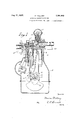
- Fig. 1 is a vertical transverse sectional view of the invention taken centrally of one of the power units and centrally of the intake ports, at approximately the beginning of the intake stroke.
- Fig. 2 is a similar view, showing a slightly modified form of the invention, after the intake stroke is partially'completed.
- the engine to which' the invention pertains comprises a crank case 5, within which a crank shaft 6 is mounted.
- Each power unit comprises two pistons I and 8, which are reciprocable within the cylinders 9 and Ill.
- the cylinder I I] is preferably larger than the cylinder 9.
- the engine may have any desired number of power units corresponding to the numher of cylinders in a conventional engine, but since these units are all alike, it has been deemed necessary to illustrate only one.
- the larger piston 8 has a connecting rod ll formed with a bearing member l2 on the crank pin l3 of the shaft 6.
- This bearing member has a cap l4 secured by bolts or the like.
- the smaller piston 'I has a connecting rod l5 connected to a pin l6 mounted in an extension I! of the bearing member l2.
- the cylinder 9 has a fuel inlet port l8 and a I 5 port l9 connecting it to the cylinder Ill. These ports are shown in Fig. 1 as closed by a sleeve valve 29 which encircles the piston 1 within the cylinder 9. They are adapted to be alternately opened, however, as the sleeve valve is moved to 10 bring the ports 2
- the cylinder l D has a fuel inlet port 23 controlled by a valve 24, which is adapted to be opened by a cam 25 on a cam shaft 26. It is deemed unnec- 15 essary to show the exhaust port or exhaust valve in the cylinder l9, since they are of conventional construction and do not constitute parts of the invention.
- Highly combustible fuel mixture is supplied to the portl8 from a carburetor 21 and a low grade fuel mixture, lean mixture or cold charge is supplied to the port'23 by a carburetor 28.
- the throttle valves 29 and 30, controlling the two sources of fuel mixture are connected by a rod 25 3
- the valves 29 and 39, and the ports l8 and 23, are so'regulated that the amount of fuel mixture supplied to the two cylindersis at all times substantially proportional to the capacitiesof the respective 3o cylinders
- the length of the rod 3i may be so determined that the-valve 29 will be open enough for idling when the valve 30 is completely closed. It is understood that a hot spot 38 adjacent the port it may be used to make 35 the mixture in the smaller cylinder more easily ignited.
- crank pin l3 moves in a circular pathwhile the pin It moves in an elliptical path indicated by the dotted line a.
- the smaller piston 1 always leads the larger piston 8.
- these pistons are both approximately in upper dead center position and about to begin the intake or suction stroke.
- theintake stroke is partially completed.
- the eccentric 32 on the shaft 33 which rotates at half the speed of the crank shaft 6, has actuated the sleeve valve 29, through the medium of the connecting rod 34, to uncover the intake port I8.
- the cam 25 on the shaft 26, 50 which also rotates at half the speed of the crank shaft 6, has opened the valve 24.
- valve 24 and the port It are closed and the port I9 is uncovered.
- This condition ob- 55 tains substantially throughout the compression, power and exhaust strokes. There will be practically no flow of gases through the port l9 during the compression stroke, because the two cylinders have been filled, each with its own fuel mixture, at substantially the same pressure and in volume proportional to the capacities of the cylinders.
- the highly combustible or heated mixture in the cylinder 9 is easily ignited by a spark plug 35 and the ignition is timed in the usual manner, so that the spark occurs when the piston l is nearly in its uppermost position. Burning gases resulting from the explosion in the cylinder 9 then surge through the port 59 and ignite the low grade mixture in the cylinder it.
- the smaller piston leads the larger one and the port between the two cylinders is open at all times except during the intake or suction stroke. There is no difierence in compression between the two cylinders, so that there is practically no flow of mixture between them until after the spark oc-- without depending upon the operation of the valve between them.
- the single sleeve valve performs two functions, one being to control the admission of fuel to the smaller cylinder and theother to close communication between the two cylinders during the intake stroke only, for the purpose of isolating the two different fuels used during the intake stroke.
- A- four-cycle lntemal combustion .engine comprising two cylinders with a port connecting their upper ends, pistons reciprocable in the respective cylinders, means for supplying a highly aoeiaaio combustible mixture to onecylinder and other gaseous fluid to the other cylinder in volumes proportional to the .capacities of the cylinders, and means for closing said port during the suction stroke, leaving it open during the compression, power and exhaust strokes.
- a four-cycle internal combustion engine comprising two cylinders with a port connecting their upper ends, pistons reciprocable in the respective cylinders, with one piston slightly leading the other, means for supplying a highly com bustible mixture to the leading cylinder and low grade mixture to the other cylinder in volumes proportional to the capacities of the cylinders, I
- An internal combustion engine comprising two cylinders of different diameters with a port connecting their upper ends, separate intake ports for supplying different fuel tothe two cylinders, pistons reciprocable in the respective cylinders with the smaller piston leading the other one, a sleeve valve encircling the smaller piston within its cylinder, means for operating the sleeve valve to uncover the port into the smaller cylinder during the intake stroke only and to. uncover the connecting port substantially throughout the remaining time of operation, and means for opening the intake port to the larger cylinder in synchronism with the opening of the intake port to the smaller cylinder.
- a four-cycle engine comprising two cylinders of different diameters with a port connecting their upper ends, pistons reciprocable in the respective cylinders, means for supplying a highly combustible mixture to the smaller cylinder and a low grade mixture to the larger cylinder, a sleeve valve encircling the smaller piston within the cylinder, and means for operating said sleeve valve to open the fuel inlet to the smaller cylinderduring the suction stroke only and to open the connecting port during substantially all the releading the larger one, separate intake ports for the two cylinders for supplying highly combusti ble fuel mixture to the smaller cylinder and low grade mixture to the other, a sleeve valve encircling the' piston within the smaller cylinder, means for operating the sleeve valve to uncover the intake port to the smaller cylinder during the intake stroke only and to uncover the connecting portduring substantially all the remaining time, 7 and means for opening the intake port to the larger cylinder in synchronism with the opening of the intake port to the smaller
- An internal. combustion engine comprising two cylinders, one larger than the other, with a port connecting their upper ends, separate intake ports for supplying fuel to the two cylinders whereby a heated charge may be supplied to the smaller cylinder and a cold charge may be supplied to the larger cylinder, and electrical means for igniting the heated charge within the smaller cylinder and by the explosionthereof igniting the cold charge in the larger cylinder.
- An internal combustion engine comprising two cylinders, one larger than the other, with a port connecting their upper ends, means for supplying a heated charge to the smaller cylinder and. a cold charge to the larger cylinder, means for closing said connecting port during the suction stroke only, and electrical means for igniting the heated charge within the smaller cylinder and by the explosion thereof igniting the cold charge in the larger cylinder.
- An internal combustion engine comprising two cylinders, one larger than the other, with a port connecting their upper ends, pistons reciprocable within the respectivecylinders, means for supplying a heated charge to the smaller cylinder. and a cold charge to the larger cylinder, a sleeve valve encircling the smaller piston Within its cylinder, means for operating said valve to close said connecting port during the suction stroke only, and electrical means for igniting the heated charge within the smaller-cylinder and by the explosion thereof igniting the cold charge in the larger cylinder.
- a four-cycle internal combustion engine comprising two cylinders, pistons reciprocable in 1 the respective cylinders, each cylinder having a separate intake port, another port connecting the upper ends of said cylinders, electric ignition means for one cylinder, and mechanically operated valve means to maintain said intake ports open during the intake stroke only and the connecting port closed during substantially all of the intake stroke and open substantially from the beginning of the compression until the end of the exhaust stroke.
- a four-cycle internal combustion engine comprising two cylinders, each having a separate intake port, another port connecting the upper ends of the cylinders, pistons reciprocable in the respective cylinders, electric ignition means for one cylinder, and mechanically operated valve means to open said intake ports during the intake stroke in proportion to the capacities of the respective cylinders and to maintain the connecting port closed approximately during the intake stroke only.
- a four-cycle internal combustion engine comprising two cylinders, each having a separate intake port, another port connecting the upper ends of the cylinders, pistons reciprocable in the respective cylinders, electric ignition means for one cylinder, and mechanically operated valve means to maintain said intake ports open during the intake stroke only and the connecting port closed during substantially all of the intake stroke and open substantially from the beginning of the compression stroke until the end of the exhaust stroke, the piston in the cylinder with electric ignition having 'a lead over the other piston which is equivalent to the normal time of flame propagation from one cylinder to the other.
- a four-cycle internal combustion engine comprising two cylinders, each having a separate intake port, another port connecting the upper ends of the cylinders, pistons reciprocable in the respective cylinders, electric ignition means for one cylinder, and mechanically operated valve means to open said intake ports during the intake stroke in proportion to the capacities of the respective cylinders and to maintain the connecting port closed approximately during the intake stroke only, the piston in the cylinder with electr c ignition having-a lead over the other piston which is equivalent to the normal time of flame propagation from one cylinder to the other.
- An internal combustion engine comprising two cylinders, pistons reciprocable in the two cylinders with one leading the other, means for simultaneously. charging the two cylinders, and for igniting the charge in the leading cylinder, expanding it into the other cylinder as a result of .the combustion and thereby igniting the charge in said other cylinder, the lead of one piston over the other being equivalent to the normal time of flame propagation from one cylinder to the other.
Landscapes
- Engineering & Computer Science (AREA)
- Chemical & Material Sciences (AREA)
- Combustion & Propulsion (AREA)
- Mechanical Engineering (AREA)
- General Engineering & Computer Science (AREA)
- Combustion Methods Of Internal-Combustion Engines (AREA)
Description
Aug. 31, 1937. M. MALLORY INTERNAL COMBUSTION ENGINE 2 Sheet s-Sheet 1 Original Filed Dec. 28, 1935 Aug. 31, 1937. M. MALLORY INTERNAL COMBUSTION ENGINE Original Filed Dec. 28, 1935 I 26 F v 2 I "J I 22' .27 I 2? I l 2 Sheets-Sheet 2 Patented Aug. 31, 1937 UNITED STATES PATENT OFFICE Application December 28, 1935, Serial No. 56,580
Renewed December 12, 1936 14'Claims.
This invention relates to internal combustion engines, with particular reference to the use of low grade fuel, cold mixtures or very lean mixtures. Its primary object is to insure positive ignition and proper timing in an engine of this type under all conditions of speed and load.
In designing engines for the use of low grade fuel, lean mixtures or cold charges, it is difficult to secure satisfactory ignition, especially when the engine is being started or is not working under full load or full compression. This is because a cold charge, low grade fuel, or lean mixture is difficult to ignite. Even though it does ignite, the burning will not be complete and it will be slow, resulting in loss of power. The spark plugs will also become fouled and cause the engine to miss.
Inthe present invention, a comparatively small quantity of easily ignited fuel mixture is caused to envelope the spark plug gap. The intensive heat of the explosion of the easily ignited fuel is much hotter than could possibly be obtained from electric ignition. Consequently the low grade fuel, lean mixture or cold charge will be 5 readily ignited, which eliminates slow burning, incompleteness of burning, fouling of spark plugs and loss in power. With this principle of ignition, the engine is much more flexible; that is, the lowering of the compression, which is the result of closing the throttle, will not cause poor combustion or failure of ignition.
The invention .will be more particularly described in connection with the accompanying drawings, in which,-
Fig. 1 is a vertical transverse sectional view of the invention taken centrally of one of the power units and centrally of the intake ports, at approximately the beginning of the intake stroke.
Fig. 2 is a similar view, showing a slightly modified form of the invention, after the intake stroke is partially'completed.
As shown in the drawings, the engine to which' the invention pertains comprises a crank case 5, within which a crank shaft 6 is mounted. Each power unit comprises two pistons I and 8, which are reciprocable within the cylinders 9 and Ill. The cylinder I I] is preferably larger than the cylinder 9. The engine may have any desired number of power units corresponding to the numher of cylinders in a conventional engine, but since these units are all alike, it has been deemed necessary to illustrate only one.
The larger piston 8 has a connecting rod ll formed with a bearing member l2 on the crank pin l3 of the shaft 6. This bearing member has a cap l4 secured by bolts or the like. The smaller piston 'I has a connecting rod l5 connected to a pin l6 mounted in an extension I! of the bearing member l2.
) The cylinder 9 has a fuel inlet port l8 and a I 5 port l9 connecting it to the cylinder Ill. These ports are shown in Fig. 1 as closed by a sleeve valve 29 which encircles the piston 1 within the cylinder 9. They are adapted to be alternately opened, however, as the sleeve valve is moved to 10 bring the ports 2| and 22 in the valve successively into registry with the respective ports I8 and I9. The cylinder l D has a fuel inlet port 23 controlled by a valve 24, which is adapted to be opened by a cam 25 on a cam shaft 26. It is deemed unnec- 15 essary to show the exhaust port or exhaust valve in the cylinder l9, since they are of conventional construction and do not constitute parts of the invention.
Highly combustible fuel mixture is supplied to the portl8 from a carburetor 21 and a low grade fuel mixture, lean mixture or cold charge is supplied to the port'23 bya carburetor 28. The throttle valves 29 and 30, controlling the two sources of fuel mixture, are connected by a rod 25 3|, so that they open simultaneously. The valves 29 and 39, and the ports l8 and 23, are so'regulated that the amount of fuel mixture supplied to the two cylindersis at all times substantially proportional to the capacitiesof the respective 3o cylinders The length of the rod 3i, however, may be so determined that the-valve 29 will be open enough for idling when the valve 30 is completely closed. It is understood that a hot spot 38 adjacent the port it may be used to make 35 the mixture in the smaller cylinder more easily ignited.
It will be noted that the crank pin l3 moves in a circular pathwhile the pin It moves in an elliptical path indicated by the dotted line a. The smaller piston 1 always leads the larger piston 8. In Fig. 1, these pistons are both approximately in upper dead center position and about to begin the intake or suction stroke. In Fig. 2, theintake stroke is partially completed. In the meantime, the eccentric 32 on the shaft 33, which rotates at half the speed of the crank shaft 6, has actuated the sleeve valve 29, through the medium of the connecting rod 34, to uncover the intake port I8. The cam 25 on the shaft 26, 50 which also rotates at half the speed of the crank shaft 6, has opened the valve 24.
At or near the beginning of the compression stroke, the valve 24 and the port It are closed and the port I9 is uncovered. This condition ob- 55 tains substantially throughout the compression, power and exhaust strokes. There will be practically no flow of gases through the port l9 during the compression stroke, because the two cylinders have been filled, each with its own fuel mixture, at substantially the same pressure and in volume proportional to the capacities of the cylinders.
The highly combustible or heated mixture in the cylinder 9 is easily ignited by a spark plug 35 and the ignition is timed in the usual manner, so that the spark occurs when the piston l is nearly in its uppermost position. Burning gases resulting from the explosion in the cylinder 9 then surge through the port 59 and ignite the low grade mixture in the cylinder it. Thus, there is a two-stage ignition and the slight time interval between the two stages approximates the lead of the piston I over the piston 8, so that a proper timing of the spark controls the ignition in both cylinders to obtain the greatest efliciency from its two stages.
In the modification shown in Fig. 2, the'carburetor 28 of Fig. 1 is omitted and air alone is taken in through the port .23. The plug 36 of Fig. 1 is removed and an injector 31 is substituted. After the cylinder I0 is filled with air, low grade fuel oil is injected, and the'amountof each charge may be regulated and timed according to the speed or power desired. If I desire, I can use the injector 31 so that it discharges into the port 30 directly into the air stream during the suction stroke of the engine. v
The advantages resulting from my improved construction and method of operation, as above described, are that low grade fuel or cold charges maybe used and can be ignited successfully without excessively high compression. At the same time, smooth operation and the utmost flexibility are possible. Complete combustion is also assured. I am aware that other inventors have had these objects in view, but their constructions have in every instance lacked the essential combination necessary to achieve the desired result.
It will be noted that, in my constructiom'the smaller piston leads the larger one and the port between the two cylinders is open at all times except during the intake or suction stroke. There is no difierence in compression between the two cylinders, so that there is practically no flow of mixture between them until after the spark oc-- without depending upon the operation of the valve between them. The single sleeve valve performs two functions, one being to control the admission of fuel to the smaller cylinder and theother to close communication between the two cylinders during the intake stroke only, for the purpose of isolating the two different fuels used during the intake stroke.
While I have described the-larger cylinder as receiving low gradefuel, it may if desired be altematively supplied with air or a very lean mixture, such as could not be ignited by the usual method. It is also to be understood that the invention embraces othei' modifications which are included within the scope of the appended claims.
I claim: r
1. A- four-cycle lntemal combustion .engine comprising two cylinders with a port connecting their upper ends, pistons reciprocable in the respective cylinders, means for supplying a highly aoeiaaio combustible mixture to onecylinder and other gaseous fluid to the other cylinder in volumes proportional to the .capacities of the cylinders, and means for closing said port during the suction stroke, leaving it open during the compression, power and exhaust strokes.
2. A four-cycle internal combustion engine comprising two cylinders with a port connecting their upper ends, pistons reciprocable in the respective cylinders, with one piston slightly leading the other, means for supplying a highly com bustible mixture to the leading cylinder and low grade mixture to the other cylinder in volumes proportional to the capacities of the cylinders, I
covers the intake port, and means for openingthe intake'port to the second cylinder in proportion to the opening of the intake port to the first cyl inder.
4. An internal combustion engine comprising two cylinders of different diameters with a port connecting their upper ends, separate intake ports for supplying different fuel tothe two cylinders, pistons reciprocable in the respective cylinders with the smaller piston leading the other one, a sleeve valve encircling the smaller piston within its cylinder, means for operating the sleeve valve to uncover the port into the smaller cylinder during the intake stroke only and to. uncover the connecting port substantially throughout the remaining time of operation, and means for opening the intake port to the larger cylinder in synchronism with the opening of the intake port to the smaller cylinder.
5. A four-cycle engine comprising two cylinders of different diameters with a port connecting their upper ends, pistons reciprocable in the respective cylinders, means for supplying a highly combustible mixture to the smaller cylinder and a low grade mixture to the larger cylinder, a sleeve valve encircling the smaller piston within the cylinder, and means for operating said sleeve valve to open the fuel inlet to the smaller cylinderduring the suction stroke only and to open the connecting port during substantially all the releading the larger one, separate intake ports for the two cylinders for supplying highly combusti ble fuel mixture to the smaller cylinder and low grade mixture to the other, a sleeve valve encircling the' piston within the smaller cylinder, means for operating the sleeve valve to uncover the intake port to the smaller cylinder during the intake stroke only and to uncover the connecting portduring substantially all the remaining time, 7 and means for opening the intake port to the larger cylinder in synchronism with the opening of the intake port to the smaller cylinder.
7. An internal. combustion engine comprising two cylinders, one larger than the other, with a port connecting their upper ends, separate intake ports for supplying fuel to the two cylinders whereby a heated charge may be supplied to the smaller cylinder and a cold charge may be supplied to the larger cylinder, and electrical means for igniting the heated charge within the smaller cylinder and by the explosionthereof igniting the cold charge in the larger cylinder.
8. An internal combustion engine comprising two cylinders, one larger than the other, with a port connecting their upper ends, means for supplying a heated charge to the smaller cylinder and. a cold charge to the larger cylinder, means for closing said connecting port during the suction stroke only, and electrical means for igniting the heated charge within the smaller cylinder and by the explosion thereof igniting the cold charge in the larger cylinder.
9. An internal combustion engine comprising two cylinders, one larger than the other, with a port connecting their upper ends, pistons reciprocable within the respectivecylinders, means for supplying a heated charge to the smaller cylinder. and a cold charge to the larger cylinder, a sleeve valve encircling the smaller piston Within its cylinder, means for operating said valve to close said connecting port during the suction stroke only, and electrical means for igniting the heated charge within the smaller-cylinder and by the explosion thereof igniting the cold charge in the larger cylinder.
10. A four-cycle internal combustion engine comprising two cylinders, pistons reciprocable in 1 the respective cylinders, each cylinder having a separate intake port, another port connecting the upper ends of said cylinders, electric ignition means for one cylinder, and mechanically operated valve means to maintain said intake ports open during the intake stroke only and the connecting port closed during substantially all of the intake stroke and open substantially from the beginning of the compression until the end of the exhaust stroke. I
11. A four-cycle internal combustion engine comprising two cylinders, each having a separate intake port, another port connecting the upper ends of the cylinders, pistons reciprocable in the respective cylinders, electric ignition means for one cylinder, and mechanically operated valve means to open said intake ports during the intake stroke in proportion to the capacities of the respective cylinders and to maintain the connecting port closed approximately during the intake stroke only.
12. A four-cycle internal combustion engine comprising two cylinders, each having a separate intake port, another port connecting the upper ends of the cylinders, pistons reciprocable in the respective cylinders, electric ignition means for one cylinder, and mechanically operated valve means to maintain said intake ports open during the intake stroke only and the connecting port closed during substantially all of the intake stroke and open substantially from the beginning of the compression stroke until the end of the exhaust stroke, the piston in the cylinder with electric ignition having 'a lead over the other piston which is equivalent to the normal time of flame propagation from one cylinder to the other.
13. A four-cycle internal combustion engine comprising two cylinders, each having a separate intake port, another port connecting the upper ends of the cylinders, pistons reciprocable in the respective cylinders, electric ignition means for one cylinder, and mechanically operated valve means to open said intake ports during the intake stroke in proportion to the capacities of the respective cylinders and to maintain the connecting port closed approximately during the intake stroke only, the piston in the cylinder with electr c ignition having-a lead over the other piston which is equivalent to the normal time of flame propagation from one cylinder to the other.
14. An internal combustion engine comprising two cylinders, pistons reciprocable in the two cylinders with one leading the other, means for simultaneously. charging the two cylinders, and for igniting the charge in the leading cylinder, expanding it into the other cylinder as a result of .the combustion and thereby igniting the charge in said other cylinder, the lead of one piston over the other being equivalent to the normal time of flame propagation from one cylinder to the other.
' MARION MALLORY.
Priority Applications (1)
| Application Number | Priority Date | Filing Date | Title |
|---|---|---|---|
| US56580A US2091410A (en) | 1935-12-28 | 1935-12-28 | Internal combustion engine |
Applications Claiming Priority (1)
| Application Number | Priority Date | Filing Date | Title |
|---|---|---|---|
| US56580A US2091410A (en) | 1935-12-28 | 1935-12-28 | Internal combustion engine |
Publications (1)
| Publication Number | Publication Date |
|---|---|
| US2091410A true US2091410A (en) | 1937-08-31 |
Family
ID=22005355
Family Applications (1)
| Application Number | Title | Priority Date | Filing Date |
|---|---|---|---|
| US56580A Expired - Lifetime US2091410A (en) | 1935-12-28 | 1935-12-28 | Internal combustion engine |
Country Status (1)
| Country | Link |
|---|---|
| US (1) | US2091410A (en) |
Cited By (9)
| Publication number | Priority date | Publication date | Assignee | Title |
|---|---|---|---|---|
| US4168678A (en) * | 1977-08-30 | 1979-09-25 | Toyota Jidosha Kogyo Kabushiki Kaisha | Internal combustion engine with auxiliary piston for generating turbulence |
| US4599863A (en) * | 1980-10-10 | 1986-07-15 | Marttila Andrew R | Compound internal combustion and external combustion engine |
| US4715326A (en) * | 1986-09-08 | 1987-12-29 | Southwest Research Institute | Multicylinder catalytic engine |
| US5592904A (en) * | 1993-05-03 | 1997-01-14 | Negre; Guy | Method and devices for controlling the combustion of a four stroke engine |
| US6543225B2 (en) | 2001-07-20 | 2003-04-08 | Scuderi Group Llc | Split four stroke cycle internal combustion engine |
| US6722127B2 (en) | 2001-07-20 | 2004-04-20 | Carmelo J. Scuderi | Split four stroke engine |
| US6952923B2 (en) | 2003-06-20 | 2005-10-11 | Branyon David P | Split-cycle four-stroke engine |
| US6986329B2 (en) | 2003-07-23 | 2006-01-17 | Scuderi Salvatore C | Split-cycle engine with dwell piston motion |
| US20130061823A1 (en) * | 2011-09-14 | 2013-03-14 | GM Global Technology Operations LLC | Engine assembly including multiple bore center pitch dimensions |
-
1935
- 1935-12-28 US US56580A patent/US2091410A/en not_active Expired - Lifetime
Cited By (34)
| Publication number | Priority date | Publication date | Assignee | Title |
|---|---|---|---|---|
| US4168678A (en) * | 1977-08-30 | 1979-09-25 | Toyota Jidosha Kogyo Kabushiki Kaisha | Internal combustion engine with auxiliary piston for generating turbulence |
| US4599863A (en) * | 1980-10-10 | 1986-07-15 | Marttila Andrew R | Compound internal combustion and external combustion engine |
| US4715326A (en) * | 1986-09-08 | 1987-12-29 | Southwest Research Institute | Multicylinder catalytic engine |
| US5592904A (en) * | 1993-05-03 | 1997-01-14 | Negre; Guy | Method and devices for controlling the combustion of a four stroke engine |
| US20090250046A1 (en) * | 2001-07-20 | 2009-10-08 | Scuderi Carmelo J | Split four stroke engine |
| US7017536B2 (en) | 2001-07-20 | 2006-03-28 | Scuderi Carmelo J | Split four stroke engine |
| US20040050046A1 (en) * | 2001-07-20 | 2004-03-18 | Scuderi Carmelo J. | Split four stroke engine |
| US6722127B2 (en) | 2001-07-20 | 2004-04-20 | Carmelo J. Scuderi | Split four stroke engine |
| US6880502B2 (en) | 2001-07-20 | 2005-04-19 | Carmelo J. Scuderi | Split four stroke engine |
| US20050139178A1 (en) * | 2001-07-20 | 2005-06-30 | Scuderi Group, Llc | Split four stroke engine |
| US7628126B2 (en) | 2001-07-20 | 2009-12-08 | Scuderi Group, Llc | Split four stroke engine |
| US6609371B2 (en) | 2001-07-20 | 2003-08-26 | Scuderi Group Llc | Split four stroke engine |
| US6543225B2 (en) | 2001-07-20 | 2003-04-08 | Scuderi Group Llc | Split four stroke cycle internal combustion engine |
| US20060168957A1 (en) * | 2001-07-20 | 2006-08-03 | Scuderi Group, Llc | Split four stroke engine |
| US20090283061A1 (en) * | 2003-06-20 | 2009-11-19 | Branyon David P | Split-Cycle Four-Stroke Engine |
| US20090241927A1 (en) * | 2003-06-20 | 2009-10-01 | Scuderi Group, Llc | Split-Cycle Four-Stroke Engine |
| US8006656B2 (en) | 2003-06-20 | 2011-08-30 | Scuderi Group, Llc | Split-cycle four-stroke engine |
| US20070272221A1 (en) * | 2003-06-20 | 2007-11-29 | Branyon David P | Split-cycle four-stroke engine |
| US20090150060A1 (en) * | 2003-06-20 | 2009-06-11 | Branyon David P | Split-cycle four-stroke engine |
| US20090199829A1 (en) * | 2003-06-20 | 2009-08-13 | Branyon David P | Split-Cycle Four-Stroke Engine |
| US7588001B2 (en) | 2003-06-20 | 2009-09-15 | Scuderi Group, Llc | Split-cycle four-stroke engine |
| US20090229587A1 (en) * | 2003-06-20 | 2009-09-17 | Branyon David P | Split-cycle four-stroke engine |
| US20090241926A1 (en) * | 2003-06-20 | 2009-10-01 | Scuderi Group, Llc | Split-cycle four-stroke engine |
| US7954463B2 (en) | 2003-06-20 | 2011-06-07 | Scuderi Group, Llc | Split-cycle four-stroke engine |
| US7954461B2 (en) | 2003-06-20 | 2011-06-07 | Scuderi Group, Llc | Split-cycle four-stroke engine |
| US20090272368A1 (en) * | 2003-06-20 | 2009-11-05 | Branyon David P | Split-Cycle Four-Stroke Engine |
| US20050268609A1 (en) * | 2003-06-20 | 2005-12-08 | Scuderi Group, Llc | Split-cycle four-stroke engine |
| US6952923B2 (en) | 2003-06-20 | 2005-10-11 | Branyon David P | Split-cycle four-stroke engine |
| US7810459B2 (en) | 2003-06-20 | 2010-10-12 | Scuderi Group, Llc | Split-cycle four-stroke engine |
| US6986329B2 (en) | 2003-07-23 | 2006-01-17 | Scuderi Salvatore C | Split-cycle engine with dwell piston motion |
| US20060011154A1 (en) * | 2003-07-23 | 2006-01-19 | Scuderi Group, Llc | Split-cycle engine with dwell piston motion |
| US7121236B2 (en) | 2003-07-23 | 2006-10-17 | Scuderi Salvatore C | Split-cycle engine with dwell piston motion |
| US20130061823A1 (en) * | 2011-09-14 | 2013-03-14 | GM Global Technology Operations LLC | Engine assembly including multiple bore center pitch dimensions |
| US8763570B2 (en) * | 2011-09-14 | 2014-07-01 | GM Global Technology Operations LLC | Engine assembly including multiple bore center pitch dimensions |
Similar Documents
| Publication | Publication Date | Title |
|---|---|---|
| US2773490A (en) | High expansion, spark ignited, gas burning, internal combustion engines | |
| US2173081A (en) | Internal combustion engine | |
| US1825817A (en) | Stratifying arrangement for internal combustion engines | |
| US1239523A (en) | Internal-combustion engine. | |
| US2091411A (en) | Internal combustion engine | |
| US2091410A (en) | Internal combustion engine | |
| US1751385A (en) | Internal-combustion engine | |
| US1498757A (en) | Internal-combustion engine | |
| US2345056A (en) | Internal combustion engine | |
| US2199706A (en) | Internal combustion engine | |
| US2280712A (en) | Internal combustion engine | |
| US2048051A (en) | Internal combustion engine | |
| US2415506A (en) | Internal-combustion engine | |
| US1645170A (en) | Internal-combustion engine | |
| US2110248A (en) | Synchro-cross-expansion engine | |
| US1894667A (en) | Internal combustion engine | |
| US2103564A (en) | Internal combustion engine | |
| US1907354A (en) | Two-cycle internal combustion engine | |
| US2796054A (en) | Two cycle engine charge recirculator | |
| US1758429A (en) | Internal-combustion engine | |
| US2154856A (en) | Internal combustion engine | |
| US2905159A (en) | Internal combustion engine | |
| US2150185A (en) | Two-cycle engine | |
| US2346207A (en) | Two-cycle internal combustion engine | |
| US2121921A (en) | Internal combustion engine |