US20230225184A1 - Organic electroluminescent materials and devices - Google Patents
Organic electroluminescent materials and devices Download PDFInfo
- Publication number
- US20230225184A1 US20230225184A1 US18/068,707 US202218068707A US2023225184A1 US 20230225184 A1 US20230225184 A1 US 20230225184A1 US 202218068707 A US202218068707 A US 202218068707A US 2023225184 A1 US2023225184 A1 US 2023225184A1
- Authority
- US
- United States
- Prior art keywords
- ring
- group
- compound
- formula
- membered
- Prior art date
- Legal status (The legal status is an assumption and is not a legal conclusion. Google has not performed a legal analysis and makes no representation as to the accuracy of the status listed.)
- Pending
Links
Images


Classifications
-
- H—ELECTRICITY
- H10—SEMICONDUCTOR DEVICES; ELECTRIC SOLID-STATE DEVICES NOT OTHERWISE PROVIDED FOR
- H10K—ORGANIC ELECTRIC SOLID-STATE DEVICES
- H10K85/00—Organic materials used in the body or electrodes of devices covered by this subclass
- H10K85/30—Coordination compounds
- H10K85/341—Transition metal complexes, e.g. Ru(II)polypyridine complexes
- H10K85/342—Transition metal complexes, e.g. Ru(II)polypyridine complexes comprising iridium
-
- C—CHEMISTRY; METALLURGY
- C07—ORGANIC CHEMISTRY
- C07F—ACYCLIC, CARBOCYCLIC OR HETEROCYCLIC COMPOUNDS CONTAINING ELEMENTS OTHER THAN CARBON, HYDROGEN, HALOGEN, OXYGEN, NITROGEN, SULFUR, SELENIUM OR TELLURIUM
- C07F15/00—Compounds containing elements of Groups 8, 9, 10 or 18 of the Periodic Table
- C07F15/0006—Compounds containing elements of Groups 8, 9, 10 or 18 of the Periodic Table compounds of the platinum group
- C07F15/0033—Iridium compounds
-
- C—CHEMISTRY; METALLURGY
- C09—DYES; PAINTS; POLISHES; NATURAL RESINS; ADHESIVES; COMPOSITIONS NOT OTHERWISE PROVIDED FOR; APPLICATIONS OF MATERIALS NOT OTHERWISE PROVIDED FOR
- C09K—MATERIALS FOR MISCELLANEOUS APPLICATIONS, NOT PROVIDED FOR ELSEWHERE
- C09K11/00—Luminescent materials, e.g. electroluminescent or chemiluminescent
- C09K11/02—Use of particular materials as binders, particle coatings or suspension media therefor
- C09K11/025—Use of particular materials as binders, particle coatings or suspension media therefor non-luminescent particle coatings or suspension media
-
- C—CHEMISTRY; METALLURGY
- C09—DYES; PAINTS; POLISHES; NATURAL RESINS; ADHESIVES; COMPOSITIONS NOT OTHERWISE PROVIDED FOR; APPLICATIONS OF MATERIALS NOT OTHERWISE PROVIDED FOR
- C09K—MATERIALS FOR MISCELLANEOUS APPLICATIONS, NOT PROVIDED FOR ELSEWHERE
- C09K11/00—Luminescent materials, e.g. electroluminescent or chemiluminescent
- C09K11/06—Luminescent materials, e.g. electroluminescent or chemiluminescent containing organic luminescent materials
-
- H—ELECTRICITY
- H10—SEMICONDUCTOR DEVICES; ELECTRIC SOLID-STATE DEVICES NOT OTHERWISE PROVIDED FOR
- H10K—ORGANIC ELECTRIC SOLID-STATE DEVICES
- H10K50/00—Organic light-emitting devices
- H10K50/10—OLEDs or polymer light-emitting diodes [PLED]
- H10K50/11—OLEDs or polymer light-emitting diodes [PLED] characterised by the electroluminescent [EL] layers
-
- H—ELECTRICITY
- H10—SEMICONDUCTOR DEVICES; ELECTRIC SOLID-STATE DEVICES NOT OTHERWISE PROVIDED FOR
- H10K—ORGANIC ELECTRIC SOLID-STATE DEVICES
- H10K85/00—Organic materials used in the body or electrodes of devices covered by this subclass
- H10K85/60—Organic compounds having low molecular weight
- H10K85/615—Polycyclic condensed aromatic hydrocarbons, e.g. anthracene
- H10K85/622—Polycyclic condensed aromatic hydrocarbons, e.g. anthracene containing four rings, e.g. pyrene
-
- H—ELECTRICITY
- H10—SEMICONDUCTOR DEVICES; ELECTRIC SOLID-STATE DEVICES NOT OTHERWISE PROVIDED FOR
- H10K—ORGANIC ELECTRIC SOLID-STATE DEVICES
- H10K85/00—Organic materials used in the body or electrodes of devices covered by this subclass
- H10K85/60—Organic compounds having low molecular weight
- H10K85/649—Aromatic compounds comprising a hetero atom
- H10K85/654—Aromatic compounds comprising a hetero atom comprising only nitrogen as heteroatom
-
- H—ELECTRICITY
- H10—SEMICONDUCTOR DEVICES; ELECTRIC SOLID-STATE DEVICES NOT OTHERWISE PROVIDED FOR
- H10K—ORGANIC ELECTRIC SOLID-STATE DEVICES
- H10K85/00—Organic materials used in the body or electrodes of devices covered by this subclass
- H10K85/60—Organic compounds having low molecular weight
- H10K85/649—Aromatic compounds comprising a hetero atom
- H10K85/657—Polycyclic condensed heteroaromatic hydrocarbons
- H10K85/6572—Polycyclic condensed heteroaromatic hydrocarbons comprising only nitrogen in the heteroaromatic polycondensed ring system, e.g. phenanthroline or carbazole
-
- H—ELECTRICITY
- H10—SEMICONDUCTOR DEVICES; ELECTRIC SOLID-STATE DEVICES NOT OTHERWISE PROVIDED FOR
- H10K—ORGANIC ELECTRIC SOLID-STATE DEVICES
- H10K85/00—Organic materials used in the body or electrodes of devices covered by this subclass
- H10K85/60—Organic compounds having low molecular weight
- H10K85/649—Aromatic compounds comprising a hetero atom
- H10K85/657—Polycyclic condensed heteroaromatic hydrocarbons
- H10K85/6576—Polycyclic condensed heteroaromatic hydrocarbons comprising only sulfur in the heteroaromatic polycondensed ring system, e.g. benzothiophene
-
- C—CHEMISTRY; METALLURGY
- C07—ORGANIC CHEMISTRY
- C07B—GENERAL METHODS OF ORGANIC CHEMISTRY; APPARATUS THEREFOR
- C07B2200/00—Indexing scheme relating to specific properties of organic compounds
- C07B2200/05—Isotopically modified compounds, e.g. labelled
-
- C—CHEMISTRY; METALLURGY
- C09—DYES; PAINTS; POLISHES; NATURAL RESINS; ADHESIVES; COMPOSITIONS NOT OTHERWISE PROVIDED FOR; APPLICATIONS OF MATERIALS NOT OTHERWISE PROVIDED FOR
- C09K—MATERIALS FOR MISCELLANEOUS APPLICATIONS, NOT PROVIDED FOR ELSEWHERE
- C09K2211/00—Chemical nature of organic luminescent or tenebrescent compounds
- C09K2211/10—Non-macromolecular compounds
- C09K2211/1018—Heterocyclic compounds
- C09K2211/1025—Heterocyclic compounds characterised by ligands
- C09K2211/1029—Heterocyclic compounds characterised by ligands containing one nitrogen atom as the heteroatom
-
- C—CHEMISTRY; METALLURGY
- C09—DYES; PAINTS; POLISHES; NATURAL RESINS; ADHESIVES; COMPOSITIONS NOT OTHERWISE PROVIDED FOR; APPLICATIONS OF MATERIALS NOT OTHERWISE PROVIDED FOR
- C09K—MATERIALS FOR MISCELLANEOUS APPLICATIONS, NOT PROVIDED FOR ELSEWHERE
- C09K2211/00—Chemical nature of organic luminescent or tenebrescent compounds
- C09K2211/10—Non-macromolecular compounds
- C09K2211/1018—Heterocyclic compounds
- C09K2211/1025—Heterocyclic compounds characterised by ligands
- C09K2211/1029—Heterocyclic compounds characterised by ligands containing one nitrogen atom as the heteroatom
- C09K2211/1033—Heterocyclic compounds characterised by ligands containing one nitrogen atom as the heteroatom with oxygen
-
- C—CHEMISTRY; METALLURGY
- C09—DYES; PAINTS; POLISHES; NATURAL RESINS; ADHESIVES; COMPOSITIONS NOT OTHERWISE PROVIDED FOR; APPLICATIONS OF MATERIALS NOT OTHERWISE PROVIDED FOR
- C09K—MATERIALS FOR MISCELLANEOUS APPLICATIONS, NOT PROVIDED FOR ELSEWHERE
- C09K2211/00—Chemical nature of organic luminescent or tenebrescent compounds
- C09K2211/18—Metal complexes
- C09K2211/185—Metal complexes of the platinum group, i.e. Os, Ir, Pt, Ru, Rh or Pd
-
- H—ELECTRICITY
- H10—SEMICONDUCTOR DEVICES; ELECTRIC SOLID-STATE DEVICES NOT OTHERWISE PROVIDED FOR
- H10K—ORGANIC ELECTRIC SOLID-STATE DEVICES
- H10K2101/00—Properties of the organic materials covered by group H10K85/00
- H10K2101/90—Multiple hosts in the emissive layer
-
- H—ELECTRICITY
- H10—SEMICONDUCTOR DEVICES; ELECTRIC SOLID-STATE DEVICES NOT OTHERWISE PROVIDED FOR
- H10K—ORGANIC ELECTRIC SOLID-STATE DEVICES
- H10K50/00—Organic light-emitting devices
- H10K50/10—OLEDs or polymer light-emitting diodes [PLED]
- H10K50/11—OLEDs or polymer light-emitting diodes [PLED] characterised by the electroluminescent [EL] layers
- H10K50/115—OLEDs or polymer light-emitting diodes [PLED] characterised by the electroluminescent [EL] layers comprising active inorganic nanostructures, e.g. luminescent quantum dots
-
- H—ELECTRICITY
- H10—SEMICONDUCTOR DEVICES; ELECTRIC SOLID-STATE DEVICES NOT OTHERWISE PROVIDED FOR
- H10K—ORGANIC ELECTRIC SOLID-STATE DEVICES
- H10K50/00—Organic light-emitting devices
- H10K50/10—OLEDs or polymer light-emitting diodes [PLED]
- H10K50/11—OLEDs or polymer light-emitting diodes [PLED] characterised by the electroluminescent [EL] layers
- H10K50/12—OLEDs or polymer light-emitting diodes [PLED] characterised by the electroluminescent [EL] layers comprising dopants
Definitions
- the present disclosure generally relates to organometallic compounds and formulations and their various uses including as emitters in devices such as organic light emitting diodes and related electronic devices.
- Opto-electronic devices that make use of organic materials are becoming increasingly desirable for various reasons. Many of the materials used to make such devices are relatively inexpensive, so organic opto-electronic devices have the potential for cost advantages over inorganic devices. In addition, the inherent properties of organic materials, such as their flexibility, may make them well suited for particular applications such as fabrication on a flexible substrate. Examples of organic opto-electronic devices include organic light emitting diodes/devices (OLEDs), organic phototransistors, organic photovoltaic cells, and organic photodetectors. For OLEDs, the organic materials may have performance advantages over conventional materials.
- OLEDs organic light emitting diodes/devices
- OLEDs organic phototransistors
- organic photovoltaic cells organic photovoltaic cells
- organic photodetectors organic photodetectors
- OLEDs make use of thin organic films that emit light when voltage is applied across the device. OLEDs are becoming an increasingly interesting technology for use in applications such as flat panel displays, illumination, and backlighting.
- phosphorescent emissive molecules are full color display. Industry standards for such a display call for pixels adapted to emit particular colors, referred to as “saturated” colors. In particular, these standards call for saturated red, green, and blue pixels.
- the OLED can be designed to emit white light. In conventional liquid crystal displays emission from a white backlight is filtered using absorption filters to produce red, green and blue emission. The same technique can also be used with OLEDs.
- the white OLED can be either a single emissive layer (EML) device or a stack structure. Color may be measured using CIE coordinates, which are well known to the art.
- the present disclosure provides a compound comprising a first ligand L A of Formula I,
- Ring A is a 5-membered or 6-membered heterocyclic ring
- moiety G has a structure of
- Y is selected from the group consisting of BR, BRR′, NR, PR, O, S, Se, C ⁇ O, C ⁇ S, C ⁇ Se, C ⁇ NR, C ⁇ CRR′, S ⁇ O, SO 2 , CR, CRR′, SiRR′, and GeRR′;
- R A , R B , R C , R D each independently represents mono to the maximum allowable substitution, or no substitutions;
- each R A , R B , R C , R, and R′ is independently a hydrogen or a substituent selected from the group consisting of deuterium, halogen, alkyl, cycloalkyl, heteroalkyl, heterocycloalkyl, boryl, arylalkyl, alkoxy, aryloxy, amino, silyl, germyl, alkenyl, cycloalkenyl, heteroalkenyl, alkynyl, aryl, heteroaryl, acyl, carboxylic acid, ether, ester, nitrile, isonitrile, sulfanyl, sulfinyl, sulfonyl, phosphino, selenyl, and combinations thereof;
- R Z is silyl or germyl
- L A is coordinated to Ir through the indicated dashed lines in Formula I to form a 5-membered chelate ring;
- Ir may be coordinated to other ligands
- L A may be joined with other ligands to form a tridentate, tetradentate, pentadentate, or hexadentate ligand;
- any two of R A , R B , R C , R D , R 1 , R 2 , R 3 , R, and R′ may be joined or fused to form a ring, with the proviso that R* does not form a ring with a R A substituent and R** does not form a ring with a R B or R C substituent.
- the present disclosure provides a formulation comprising a compound comprising a first ligand L A of Formula I as described herein.
- the present disclosure provides an OLED having an organic layer comprising a compound comprising a first ligand L A of Formula I as described herein.
- the present disclosure provides a consumer product comprising an OLED with an organic layer comprising a compound comprising a first ligand L A of Formula I as described herein.
- FIG. 1 shows an organic light emitting device
- FIG. 2 shows an inverted organic light emitting device that does not have a separate electron transport layer.
- organic includes polymeric materials as well as small molecule organic materials that may be used to fabricate organic opto-electronic devices.
- Small molecule refers to any organic material that is not a polymer, and “small molecules” may actually be quite large. Small molecules may include repeat units in some circumstances. For example, using a long chain alkyl group as a substituent does not remove a molecule from the “small molecule” class. Small molecules may also be incorporated into polymers, for example as a pendent group on a polymer backbone or as a part of the backbone. Small molecules may also serve as the core moiety of a dendrimer, which consists of a series of chemical shells built on the core moiety.
- the core moiety of a dendrimer may be a fluorescent or phosphorescent small molecule emitter.
- a dendrimer may be a “small molecule,” and it is believed that all dendrimers currently used in the field of OLEDs are small molecules.
- top means furthest away from the substrate, while “bottom” means closest to the substrate.
- first layer is described as “disposed over” a second layer, the first layer is disposed further away from substrate. There may be other layers between the first and second layer, unless it is specified that the first layer is “in contact with” the second layer.
- a cathode may be described as “disposed over” an anode, even though there are various organic layers in between.
- solution processable means capable of being dissolved, dispersed, or transported in and/or deposited from a liquid medium, either in solution or suspension form.
- a ligand may be referred to as “photoactive” when it is believed that the ligand directly contributes to the photoactive properties of an emissive material.
- a ligand may be referred to as “ancillary” when it is believed that the ligand does not contribute to the photoactive properties of an emissive material, although an ancillary ligand may alter the properties of a photoactive ligand.
- a first “Highest Occupied Molecular Orbital” (HOMO) or “Lowest Unoccupied Molecular Orbital” (LUMO) energy level is “greater than” or “higher than” a second HOMO or LUMO energy level if the first energy level is closer to the vacuum energy level.
- IP ionization potentials
- a higher HOMO energy level corresponds to an IP having a smaller absolute value (an IP that is less negative).
- a higher LUMO energy level corresponds to an electron affinity (EA) having a smaller absolute value (an EA that is less negative).
- the LUMO energy level of a material is higher than the HOMO energy level of the same material.
- a “higher” HOMO or LUMO energy level appears closer to the top of such a diagram than a “lower” HOMO or LUMO energy level.
- a first work function is “greater than” or “higher than” a second work function if the first work function has a higher absolute value. Because work functions are generally measured as negative numbers relative to vacuum level, this means that a “higher” work function is more negative. On a conventional energy level diagram, with the vacuum level at the top, a “higher” work function is illustrated as further away from the vacuum level in the downward direction. Thus, the definitions of HOMO and LUMO energy levels follow a different convention than work functions.
- halo halogen
- halide halogen
- fluorine chlorine, bromine, and iodine
- acyl refers to a substituted carbonyl radical (C(O)—R s ).
- esters refers to a substituted oxycarbonyl (—O—C(O)—R s or —C(O)—O—R s ) radical.
- ether refers to an —OR s radical.
- sulfanyl or “thio-ether” are used interchangeably and refer to a —SR s radical.
- sulfinyl refers to a —S(O)—R s radical.
- sulfonyl refers to a —SO 2 —R s radical.
- phosphino refers to a —P(R s ) 3 radical, wherein each R s can be same or different.
- sil refers to a —Si(R s ) 3 radical, wherein each R s can be same or different.
- germane refers to a —Ge(R s ) 3 radical, wherein each R s can be same or different.
- boryl refers to a —B(R S ) 2 radical or its Lewis adduct —B(R s ) 3 radical, wherein R s can be same or different.
- R s can be hydrogen or a substituent selected from the group consisting of deuterium, halogen, alkyl, cycloalkyl, heteroalkyl, heterocycloalkyl, arylalkyl, alkoxy, aryloxy, amino, silyl, alkenyl, cycloalkenyl, heteroalkenyl, alkynyl, aryl, heteroaryl, and combination thereof.
- Preferred R s is selected from the group consisting of alkyl, cycloalkyl, aryl, heteroaryl, and combination thereof.
- alkyl refers to and includes both straight and branched chain alkyl radicals.
- Preferred alkyl groups are those containing from one to fifteen carbon atoms and includes methyl, ethyl, propyl, 1-methylethyl, butyl, 1-methylpropyl, 2-methylpropyl, pentyl, 1-methylbutyl, 2-methylbutyl, 3-methylbutyl, 1,1-dimethylpropyl, 1,2-dimethylpropyl, 2,2-dimethylpropyl, and the like. Additionally, the alkyl group may be optionally substituted.
- cycloalkyl refers to and includes monocyclic, polycyclic, and spiro alkyl radicals.
- Preferred cycloalkyl groups are those containing 3 to 12 ring carbon atoms and includes cyclopropyl, cyclopentyl, cyclohexyl, bicyclo[3.1.1]heptyl, spiro[4.5]decyl, spiro[5.5]undecyl, adamantyl, and the like. Additionally, the cycloalkyl group may be optionally substituted.
- heteroalkyl or “heterocycloalkyl” refer to an alkyl or a cycloalkyl radical, respectively, having at least one carbon atom replaced by a heteroatom.
- the at least one heteroatom is selected from O, S, N, P, B, Si and Se, preferably, O, S or N.
- the heteroalkyl or heterocycloalkyl group may be optionally substituted.
- alkenyl refers to and includes both straight and branched chain alkene radicals.
- Alkenyl groups are essentially alkyl groups that include at least one carbon-carbon double bond in the alkyl chain.
- Cycloalkenyl groups are essentially cycloalkyl groups that include at least one carbon-carbon double bond in the cycloalkyl ring.
- heteroalkenyl refers to an alkenyl radical having at least one carbon atom replaced by a heteroatom.
- the at least one heteroatom is selected from O, S, N, P, B, Si, and Se, preferably, O, S, or N.
- alkenyl, cycloalkenyl, or heteroalkenyl groups are those containing two to fifteen carbon atoms. Additionally, the alkenyl, cycloalkenyl, or heteroalkenyl group may be optionally substituted.
- alkynyl refers to and includes both straight and branched chain alkyne radicals.
- Alkynyl groups are essentially alkyl groups that include at least one carbon-carbon triple bond in the alkyl chain.
- Preferred alkynyl groups are those containing two to fifteen carbon atoms. Additionally, the alkynyl group may be optionally substituted.
- aralkyl or “arylalkyl” are used interchangeably and refer to an alkyl group that is substituted with an aryl group. Additionally, the aralkyl group may be optionally substituted.
- heterocyclic group refers to and includes aromatic and non-aromatic cyclic radicals containing at least one heteroatom.
- the at least one heteroatom is selected from O, S, N, P, B, Si, and Se, preferably, O, S, or N.
- Hetero-aromatic cyclic radicals may be used interchangeably with heteroaryl.
- Preferred hetero-non-aromatic cyclic groups are those containing 3 to 7 ring atoms which includes at least one hetero atom, and includes cyclic amines such as morpholino, piperidino, pyrrolidino, and the like, and cyclic ethers/thio-ethers, such as tetrahydrofuran, tetrahydropyran, tetrahydrothiophene, and the like. Additionally, the heterocyclic group may be optionally substituted.
- aryl refers to and includes both single-ring aromatic hydrocarbyl groups and polycyclic aromatic ring systems.
- the polycyclic rings may have two or more rings in which two carbons are common to two adjoining rings (the rings are “fused”) wherein at least one of the rings is an aromatic hydrocarbyl group, e.g., the other rings can be cycloalkyls, cycloalkenyls, aryl, heterocycles, and/or heteroaryls.
- Preferred aryl groups are those containing six to thirty carbon atoms, preferably six to twenty carbon atoms, more preferably six to twelve carbon atoms. Especially preferred is an aryl group having six carbons, ten carbons or twelve carbons.
- Suitable aryl groups include phenyl, biphenyl, triphenyl, triphenylene, tetraphenylene, naphthalene, anthracene, phenalene, phenanthrene, fluorene, pyrene, chrysene, perylene, and azulene, preferably phenyl, biphenyl, triphenyl, triphenylene, fluorene, and naphthalene. Additionally, the aryl group may be optionally substituted.
- heteroaryl refers to and includes both single-ring aromatic groups and polycyclic aromatic ring systems that include at least one heteroatom.
- the heteroatoms include, but are not limited to O, S, N, P, B, Si, and Se. In many instances, O, S, or N are the preferred heteroatoms.
- Hetero-single ring aromatic systems are preferably single rings with 5 or 6 ring atoms, and the ring can have from one to six heteroatoms.
- the hetero-polycyclic ring systems can have two or more rings in which two atoms are common to two adjoining rings (the rings are “fused”) wherein at least one of the rings is a heteroaryl, e.g., the other rings can be cycloalkyls, cycloalkenyls, aryl, heterocycles, and/or heteroaryls.
- the hetero-polycyclic aromatic ring systems can have from one to six heteroatoms per ring of the polycyclic aromatic ring system.
- Preferred heteroaryl groups are those containing three to thirty carbon atoms, preferably three to twenty carbon atoms, more preferably three to twelve carbon atoms.
- Suitable heteroaryl groups include dibenzothiophene, dibenzofuran, dibenzoselenophene, furan, thiophene, benzofuran, benzothiophene, benzoselenophene, carbazole, indolocarbazole, pyridylindole, pyrrolodipyridine, pyrazole, imidazole, triazole, oxazole, thiazole, oxadiazole, oxatriazole, dioxazole, thiadiazole, pyridine, pyridazine, pyrimidine, pyrazine, triazine, oxazine, oxathiazine, oxadiazine, indole, benzimidazole, indazole, indoxazine, benzoxazole, benzisoxazole, benzothiazole, quinoline, isoquinoline, cinnoline, qui
- aryl and heteroaryl groups listed above the groups of triphenylene, naphthalene, anthracene, dibenzothiophene, dibenzofuran, dibenzoselenophene, carbazole, indolocarbazole, imidazole, pyridine, pyrazine, pyrimidine, triazine, and benzimidazole, and the respective aza-analogs of each thereof are of particular interest.
- alkyl, cycloalkyl, heteroalkyl, heterocycloalkyl, alkenyl, cycloalkenyl, heteroalkenyl, alkynyl, aralkyl, heterocyclic group, aryl, and heteroaryl, as used herein, are independently unsubstituted, or independently substituted, with one or more general substituents.
- the General Substituents are selected from the group consisting of deuterium, halogen, alkyl, cycloalkyl, heteroalkyl, heterocycloalkyl, arylalkyl, alkoxy, aryloxy, amino, silyl, germyl, boryl, alkenyl, cycloalkenyl, heteroalkenyl, alkynyl, aryl, heteroaryl, acyl, carboxylic acid, ether, ester, nitrile, isonitrile, sulfanyl, selenyl, sulfinyl, sulfonyl, phosphino, and combinations thereof.
- the Preferred General Substituents are selected from the group consisting of deuterium, fluorine, alkyl, cycloalkyl, heteroalkyl, alkoxy, aryloxy, amino, silyl, germyl, boryl, alkenyl, cycloalkenyl, heteroalkenyl, aryl, heteroaryl, nitrile, isonitrile, sulfanyl, boryl, and combinations thereof.
- the More Preferred General Substituents are selected from the group consisting of deuterium, fluorine, alkyl, cycloalkyl, alkoxy, aryloxy, amino, silyl, aryl, heteroaryl, sulfanyl, and combinations thereof.
- the Most Preferred General Substituents are selected from the group consisting of deuterium, fluorine, alkyl, cycloalkyl, aryl, heteroaryl, and combinations thereof.
- substitution refers to a substituent other than H that is bonded to the relevant position, e.g., a carbon or nitrogen.
- R 1 represents mono-substitution
- one R 1 must be other than H (i.e., a substitution).
- R 1 represents di-substitution, then two of R 1 must be other than H.
- R 1 represents zero or no substitution
- R 1 can be a hydrogen for available valencies of ring atoms, as in carbon atoms for benzene and the nitrogen atom in pyrrole, or simply represents nothing for ring atoms with fully filled valencies, e.g., the nitrogen atom in pyridine.
- the maximum number of substitutions possible in a ring structure will depend on the total number of available valencies in the ring atoms.
- substitution includes a combination of two to four of the listed groups.
- substitution includes a combination of two to three groups.
- substitution includes a combination of two groups.
- Preferred combinations of substituent groups are those that contain up to fifty atoms that are not hydrogen or deuterium, or those which include up to forty atoms that are not hydrogen or deuterium, or those that include up to thirty atoms that are not hydrogen or deuterium. In many instances, a preferred combination of substituent groups will include up to twenty atoms that are not hydrogen or deuterium.
- aza-dibenzofuran i.e. aza-dibenzofuran, aza-dibenzothiophene, etc.
- azatriphenylene encompasses both dibenzo[f,h]quinoxaline and dibenzo[f,h]quinoline.
- deuterium refers to an isotope of hydrogen.
- Deuterated compounds can be readily prepared using methods known in the art. For example, U.S. Pat. No. 8,557,400, Patent Pub. No. WO 2006/095951, and U.S. Pat. Application Pub. No. US 2011/0037057, which are hereby incorporated by reference in their entireties, describe the making of deuterium-substituted organometallic complexes. Further reference is made to Ming Yan, et al., Tetrahedron 2015, 71, 1425-30 and Atzrodt et al., Angew. Chem. Int. Ed. (Reviews) 2007, 46, 7744-65, which are incorporated by reference in their entireties, describe the deuteration of the methylene hydrogens in benzyl amines and efficient pathways to replace aromatic ring hydrogens with deuterium, respectively.
- a pair of adjacent substituents can be optionally joined or fused into a ring.
- the preferred ring is a five, six, or seven-membered carbocyclic or heterocyclic ring, includes both instances where the portion of the ring formed by the pair of substituents is saturated and where the portion of the ring formed by the pair of substituents is unsaturated.
- “adjacent” means that the two substituents involved can be on the same ring next to each other, or on two neighboring rings having the two closest available substitutable positions, such as 2, 2′ positions in a biphenyl, or 1, 8 position in a naphthalene, as long as they can form a stable fused ring system.
- the present disclosure provides a compound comprising a first ligand L A of Formula I,
- Ring A is a 5-membered or 6-membered heterocyclic ring
- moiety G has a structure of
- Y is selected from the group consisting of BR, BRR′, NR, PR, O, S, Se, C ⁇ O, C ⁇ S, C ⁇ Se, C ⁇ NR, C ⁇ CRR′, S ⁇ O, SO 2 , CR, CRR′, SiRR′, and GeRR′;
- R A , R B , R C , and R D each independently represents mono to the maximum allowable substitution, or no substitutions;
- each R A , R B , R C , R, and R′ is independently a hydrogen or a substituent selected from the group consisting of the General Substituents defined herein;
- R Z is silyl or germyl
- L A is coordinated to Ir through the indicated dashed lines in Formula I to form a 5-membered chelate ring;
- Ir may be coordinated to other ligands
- L A may be joined with other ligands to form a tridentate, tetradentate, pentadentate, or hexadentate ligand;
- any two of R A , R B , R C , R D , R 1 , R 2 , R 3 , R, and R′ may be joined or fused to form a ring, with the proviso that R* does not form a ring with a R A substituent and R** does not form a ring with a R B or R C substituent.
- each R A , R B , R C , R, and R′ is independently a hydrogen or a substituent selected from the group consisting of the Preferred Substituents defined herein. In some embodiments, each R A , R B , R C , R, and R′ is independently a hydrogen or a substituent selected from the group consisting of the More Preferred Substituents defined herein. In some embodiments, each R A , R B , R C , R, and R′ is independently a hydrogen or a substituent selected from the group consisting of the Most Preferred Substituents defined herein.
- each R D is independently a hydrogen or a substituent selected from the group consisting of the Preferred Substituents defined herein. In some embodiments, each R D is independently a hydrogen or a substituent selected from the group consisting of the More Preferred Substituents defined herein. In some embodiments, each R D is independently a hydrogen or a substituent selected from the group consisting of the Most Preferred Substituents defined herein.
- R C is a monocyclic ring structure substituted with acyclic group.
- the acyclic group is further substituted with a cyclic structure.
- the acyclic group may have at least 3 carbons.
- the acyclic group may have at least 4 carbons.
- the acyclic group may have at least 5 carbons.
- the acyclic group may have at least 6 carbons.
- the monocyclic ring structure may be monocyclic aromatic ring.
- the monocyclic aromatic ring may be benzene, pyridine, pyrimidine, pyridazine, pyrazine, triazine, imidazole, pyrazole, pyrrole, oxazole, furan, thiophene, or thiazole.
- R B or R C of Formula II when ring A is a monocyclic 6-membered aromatic ring, none of R B or R C of Formula II is a nitrile. In some embodiments, when ring A is a monocyclic 6-membered aromatic ring, none of R B or R C is a nitrile.
- At least one R A is substituted aryl. In some embodiments, at least one R A is substituted phenyl.
- Ring A is selected from the group consisting of pyridine, pyrimidine, pyridazine, pyrazine, triazine, imidazole, pyrazole, pyrrole, oxazole, and thiazole.
- the first ligand L A has a structure of Formula V, G- , wherein each of X 1 , X 2 , X 3 , and X 4 is independently C or N.
- R A bonded to X 1 is substituted aryl.
- R A bonded to X 2 is substituted aryl.
- R A bonded to X 3 is substituted aryl.
- R A bonded to X 4 is substituted aryl.
- each of X 1 , X 2 , X 3 , and X 4 is C. In some embodiments of Formula V, at least one of X 1 , X 2 , X 3 , or X 4 is N.
- each of X 1 , X 2 , X 3 , and X 4 is C, and one R A bonded to X 3 is substituted aryl.
- the substituted aryl is a monocyclic 5-membered or 6-membered aromatic ring.
- the substituted aryl is benzene, pyridine, pyrimidine, pyridazine, pyrazine, triazine, imidazole, pyrazole, pyrrole, oxazole, furan, thiophene, or thiazole.
- the substituted aryl is a substituted phenyl group.
- the substituted phenyl group is ortho substituted with a partially or fully deuterated alkyl or cycloalkyl group.
- ring A is ortho substituted by a second partially or fully deuterated alkyl or cycloalkyl group.
- two R A are joined or fused together to form a ring.
- the first ligand L A has a structure of Formula VI,
- R A′ is hydrogen or a substituent selected from the group consisting of the General Substituents.
- R A′ is substituted aryl. In some embodiments of Formula VI, two R A are joined or fused together to form a ring. In some embodiments of Formula VI, two R A are joined or fused together to form a benzo ring.
- Y is O. In some embodiments, Y is S. In some embodiments, Y is selected from the group consisting of O, S, and Se.
- Y is selected from the group consisting of NR and PR.
- Y is selected from the group consisting of C ⁇ X, S ⁇ O, and SO 2 , wherein X is O, S, Se, NR, or CRR′.
- Y is selected from the group consisting of BRR′, CRR′, SiRR′, and GeRR′.
- moiety G has a structure of Formula II.
- ring D is a 5-membered or 6-membered aryl or heteroaryl ring. In some embodiments where moiety G has a structure of Formula II, ring D is a 5-membered ring.
- ring D is a 6-membered ring.
- each of X 5 , X 6 , X 7 , and X 8 is C.
- moiety G has a structure of Formula II
- at least one of X 5 , X 6 , X 7 , or X 8 is N.
- moiety G has a structure of Formula II
- exactly one of X 5 , X 6 , X 7 , or X 8 is N.
- each of X 9 , X 10 , and X 11 is C. In some embodiments where moiety G has a structure of Formula II, at least one of X 9 , X 10 , or X 11 is N.
- each of X 5 , X 6 , X 7 , X 8 , X 9 , X 10 , and X 11 is C.
- at least one of X 5 , X 6 , X 7 , X 8 , X 9 , X 10 , and X 11 is N.
- exactly one of X 5 , X 6 , X 7 , X 8 , X 9 , X 10 , and X 11 is N.
- each R D is independently a hydrogen or a substituent selected from the group consisting of deuterium, fluorine, alkyl, heteroalkyl, alkoxy, aryloxy, amino, silyl, boryl, alkenyl, cycloalkenyl, heteroalkenyl, nitrile, isonitrile, sulfanyl, and combinations thereof.
- moiety G has a structure of Formula III. In some embodiments where moiety G has a structure of Formula III, at least one R* is an aromatic cyclic group.
- R* is —CR 1 R 2 R 3 . In some embodiments where moiety G has a structure of Formula III, at least one R* is —SiR 1 R 2 R 3 . In some embodiments where moiety G has a structure of Formula III, at least one R* is —GeR 1 R 2 R 3 . In some such embodiments, R 1 , R 2 , and R 3 are each independently selected from the group consisting of alkyl, heteroalkyl, cycloalkyl, and heterocycloalkyl.
- R B is R**. In some embodiments where moiety G has a structure of Formula III, exactly one R B is R**.
- R C is R**. In some embodiments where moiety G has a structure of Formula III, exactly one R C is R**.
- R C at C 1 is R**.
- R C at C 2 is R**.
- R C at C 3 is R**.
- R** is selected from the group consisting of
- the ligand L A is selected from the group consisting of the structures of the following LIST 1:
- ring D is a 5-membered or 6-membered carbocyclic or heterocyclic ring
- each of R D′ , R AA , and R CC independently represents mono to the maximum allowable substitution, or no substitutions
- each R D′ , R AA , R CC R A1 , R A2 , and R A3 is independently a hydrogen or a substituent selected from the group consisting of the General Substituents defined herein;
- any two adjacent R D′ , R AA , R CC , R A1 , R A2 , or R A3 can be joined to form a ring.
- the ligand L A is selected from the group consisting of L Ai-m , wherein i is an integer from 1 to 2040, and m is an integer from 1 to 41, and each of L Ai-1 to L Ai-41 has the structure defined in the following LIST 2:
- moieties R 1 , R 2 , and G x are defined in the following LIST 3:
- R F1 to R F58 have the structures defined in the following LIST 4:
- G 1 to G 20 have the structures defined in the following LIST 5:
- the compound has a formula selected from the group consisting of Ir(L A ) 3 , Ir(L A )(L B ) 2 , Ir(L A ) 2 (L B ), Ir(L A ) 2 (L C ), and Ir(L A )(L B )(L C ); and wherein L A , L B , and L C are different from each other.
- L B is a substituted or unsubstituted phenylpyridine
- L C is a substituted or unsubstituted acetylacetonate
- L B and L C are each independently selected from the group consisting of the structures of the following LIST 6:
- L B and L C are each independently selected from the group consisting of the structures of the following LIST 7:
- R a ′, R b ′, R c ′, R d ′, and R e ′ each independently represents zero, mono, or up to a maximum allowed number of substitution to its associated ring;
- R a ′, R b ′, R c ′, R d ′, and R e ′ each independently hydrogen or a substituent selected from the group consisting of deuterium, halide, alkyl, cycloalkyl, heteroalkyl, arylalkyl, alkoxy, aryloxy, amino, silyl, boryl, alkenyl, cycloalkenyl, heteroalkenyl, alkynyl, aryl, heteroaryl, acyl, carbonyl, carboxylic acid, ester, nitrile, isonitrile, sulfanyl, sulfinyl, sulfonyl, phosphino, boryl, and combinations thereof; and
- R a ′, R b ′, R c ′, R d ′, and R e ′ can be fused or joined to form a ring or form a multidentate ligand.
- the compound can have the formula Ir(L A ) 3 , the formula Ir(L A )(L Bk ) 2 , the formula Jr(L A ) 2 (L Bk ), the formula Ir(L A ) 2 (L Cj-I ), the formula Ir(L A ) 2 (L Cj-I j), the formula Ir(L A )(L Bk )(L Cj-I ), or the formula Ir(L A )(L Bk )(L Cj-II ), wherein L A is a ligand with respect to Formula I as defined here; L Bk is defined herein; and L Cj-I and L Cj-II are each defined herein.
- L A can be selected from L Ai-m , wherein i is an integer from 1 to 2040 and m is an integer from 1 to 41;
- L B can be selected from L Bk , wherein k is an integer from 1 to 324;
- L C can be selected from L Cj-I or L Cj-II , wherein j is an integer from 1 to 1416;
- the compound when the compound has formula Ir(L Ai-m ) 3 , the compound is selected from the group consisting of Ir(L A1-1 ) 3 to Ir(L A2040-41 ) 3 ;
- the compound when the compound has formula Ir(L Ai-m )(L Bk ) 2 , the compound is selected from the group consisting of Ir(L A1-1 )(L B1 ) 2 to Ir(L A2040-41 )(L B324 ) 2 ;
- the compound when the compound has formula Ir(L Ai-m ) 2 (L Bk ), the compound is selected from the group consisting of Ir(L A1-1 ) 2 (L B1 ) to Ir(L A2040-41 ) 2 (L B324 );
- the compound when the compound has formula Ir(L Ai-m ) 2 (L Cj-I ), the compound is selected from the group consisting of Ir(L A1-1 ) 2 (L C1-I ) to Ir(L A2040-41 ) 2 (L C1416-I ); and
- the compound when the compound has formula Ir(L Ai-m ) 2 (L Cj-II ), the compound is selected from the group consisting of Ir(L A1-1 ) 2 (L C1-II ) to Ir(L A2040-41 ) 2 (L C1416-II );
- each L Bk has the structure defined in the following LIST 8:
- each L Cj-I has a structure based on
- each L Cj-II has a structure based on formula
- R 201 and R 202 are each independently defined in the following LIST 9:
- R D1 to R D246 have the structures defined in the following LIST 10:
- the compound is selected from the group consisting of only those compounds whose L Bk corresponds to one of the following: L B 1, L B 2, L B18 , L B28 , L B38 , L B108 , L B118 , L B122 , L B124 , L B126 , L B128 , L B130 , L B132 , L B134 , L B136 , L B138 , L B140 , L B142 , L B144 , L B156 , L B158 , L B160 , L B162 , L B164 , L B168 , L B172 , L B175 , L B204 , L B206 , L B214 , L B216 , L B218 , L B220 , L B222 , L B231 , L B233 , L B235 , L B237 , L B240 , L B242 , L B244 , L B246 , L B248 , L B
- the compound is selected from the group consisting of only those compounds whose L Bk corresponds to one of the following: L B1 , L B2 , L B18 , L B28 , L B38 , L B108 , L B118 , L B122 , L B126 , L B128 , L B132 , L B136 , L B138 , L B142 , L B156 , L B162 , L B204 , L B206 , L B214 , L B216 , L B218 , L B220 , L B231 , L B233 , L B237 , L B264 , L B265 , L B266 , L B267 , L B268 , L B269 , and L B270 .
- the compound is selected from the group consisting of only those compounds having L Cj-I or L Cj-II ligand whose corresponding R 201 and R 202 are defined to be one of the following structures: R D1 , R D3 , R D4 , R D5 , R D9 , R D10 , R D17 , R D18 , R D20 , R D22 , R D37 , R D40 , R D41 , R D42 , R D43 , R D48 , R D49 , R D50 , R D54 , R D55 , R D58 , R D59 , R D78 , R D79 , R D81 , R D87 , R D88 , R D89 , R D93 , R D116 , R D17 , R D118 , R D119 , R D120 , R D133 , R D134 , R D135 , R D136 , R D143 , R D144
- the compound is selected from the group consisting of only those compounds having L Cj-I or L Cj-II ligand whose corresponding R 201 and R 202 are defined to be one of selected from the following structures: R D1 , R D3 , R D4 , R D5 , R D9 , R D10 , R D17 , R D22 , R D43 , R D50 , R D78 , R D116 , R D118 , R D133 , R D134 , R D135 , R D136 , R D143 , R D144 , R D145 , R D146 , R D149 , R D151 , R D154 , R D155 R D190 , R D193 , R D200 , R D201 , R D206 , R D210 , R D214 , R D215 , R D216 , R D218 , R D219 , R D220 , R D227 , R D2
- the compound is selected from the group consisting of only those compounds having one of the following structures for the L Cj-I ligand set forth in the following LIST 11:
- the compound is selected from the group consisting of the structures of the following
- the compound having a first ligand L A of Formula I described herein can be at least 30% deuterated, at least 40% deuterated, at least 50% deuterated, at least 60% deuterated, at least 70% deuterated, at least 80% deuterated, at least 90% deuterated, at least 95% deuterated, at least 99% deuterated, or 100% deuterated.
- percent deuteration has its ordinary meaning and includes the percent of possible hydrogen atoms (e.g., positions that are hydrogen, deuterium, or halogen) that are replaced by deuterium atoms.
- the ligand L A has a first substituent R I , where the first substituent R I has a first atom a-I that is the farthest away from the metal Ir among all atoms in the ligand L A .
- the ligand L B if present, has a second substituent R II , where the second substituent R II has a first atom a-II that is the farthest away from the metal Ir among all atoms in the ligand L B .
- the ligand L C if present, has a third substituent R III , where the third substituent R III has a first atom a-III that is the farthest away from the metal Ir among all atoms in the ligand L C .
- vectors V D1 , V D2 , and V D3 can be defined that are defined as follows.
- V D1 represents the direction from the metal Ir to the first atom a-I and the vector V D1 has a value D 1 that represents the straight line distance between the metal Ir and the first atom a-I in the first substituent R I .
- V D2 represents the direction from the metal Ir to the first atom a-II and the vector V D2 has a value D 2 that represents the straight line distance between the metal Ir and the first atom a-II in the second substituent R II .
- V D3 represents the direction from the metal Ir to the first atom a-III and the vector V D3 has a value D 3 that represents the straight line distance between the metal Ir and the first atom a-III in the third substituent R III .
- a sphere having a radius r is defined whose center is the metal Ir and the radius r is the smallest radius that will allow the sphere to enclose all atoms in the compound that are not part of the substituents R I , R II and R III ; and where at least one of D 1 , D 2 , and D 3 is greater than the radius r by at least 1.5 ⁇ . In some embodiments, at least one of D 1 , D 2 , and D 3 is greater than the radius r by at least 2.9, 3.0, 4.3, 4.4, 5.2, 5.9, 7.3, 8.8, 10.3, 13.1, 17.6, or 19.1 ⁇ .
- the compound has a transition dipole moment axis and angles are defined between the transition dipole moment axis and the vectors V D1 , V D2 , and V D3 , where at least one of the angles between the transition dipole moment axis and the vectors V D1 , V D2 , and V D3 is less than 40°. In some embodiments, at least one of the angles between the transition dipole moment axis and the vectors V D1 , V D2 , and V D3 is less than 30°. In some embodiments, at least one of the angles between the transition dipole moment axis and the vectors V D1 , V D2 , and V D3 is less than 20°.
- At least one of the angles between the transition dipole moment axis and the vectors V D1 , V D2 , and V D3 is less than 15°. In some embodiments, at least one of the angles between the transition dipole moment axis and the vectors V D1 , V D2 , and V D3 is less than 10°. In some embodiments, at least two of the angles between the transition dipole moment axis and the vectors V D1 , V D2 , and V D3 are less than 20°. In some embodiments, at least two of the angles between the transition dipole moment axis and the vectors V D1 , V D2 , and V D3 are less than 15°. In some embodiments, at least two of the angles between the transition dipole moment axis and the vectors V D1 , V D2 , and V D3 are less than 10°.
- all three angles between the transition dipole moment axis and the vectors V D1 , V D2 , and V D3 are less than 20°. In some embodiments, all three angles between the transition dipole moment axis and the vectors V D1 , V D2 , and V D3 are less than 15°. In some embodiments, all three angles between the transition dipole moment axis and the vectors V D1 , V D2 , and V D3 are less than 10°.
- the compound has a vertical dipole ratio (VDR) of 0.33 or less. In some embodiments of such heteroleptic compounds, the compound has a VDR of 0.30 or less. In some embodiments of such heteroleptic compounds, the compound has a VDR of 0.25 or less. In some embodiments of such heteroleptic compounds, the compound has a VDR of 0.20 or less. In some embodiments of such heteroleptic compounds, the compound has a VDR of 0.15 or less.
- VDR vertical dipole ratio
- the present disclosure also provides an OLED device comprising a first organic layer that contains a compound as disclosed in the above compounds section of the present disclosure.
- the OLED comprises: an anode; a cathode; and an organic layer disposed between the anode and the cathode, where the organic layer comprises a compound having a first ligand L A of Formula I described herein.
- the organic layer may be an emissive layer and the compound as described herein may be an emissive dopant or a non-emissive dopant.
- the emissive layer comprises one or more quantum dots.
- the organic layer may further comprise a host, wherein the host comprises a triphenylene containing benzo-fused thiophene or benzo-fused furan, wherein any substituent in the host is an unfused substituent independently selected from the group consisting of C n H 2n+1 , OC n H 2n+1 , OAr 1 , N(C n H 2n+1 ) 2 , N(Ar 1 )(Ar 2 ), CH ⁇ CH—C n H 2n+1 , C ⁇ CC n H 2n+1 , Ar 1 , Ar 1 —Ar 2 , C n H 2n —Ar 1 , or no substitution, wherein n is an integer from 1 to 10; and wherein Ar 1 and Ar 2 are independently selected from the group consisting of benzene, biphenyl, naphthalene, triphenylene, carbazole, and heteroaromatic analogs thereof.
- the host comprises a triphenylene containing benzo-fused
- the organic layer may further comprise a host, wherein host comprises at least one chemical group selected from the group consisting of triphenylene, carbazole, indolocarbazole, dibenzothiophene, dibenzofuran, dibenzoselenophene, 5 ⁇ ,2-benzo[d]benzo[4,5]imidazo[3,2-a]imidazole, 5,9-dioxa-13b-boranaphtho[3,2,1-de]anthracene, triazine, boryl, silyl, aza-triphenylene, aza-carbazole, aza-indolocarbazole, aza-dibenzothiophene, aza-dibenzofuran, aza-dibenzoselenophene, aza-5 ⁇ ,2-benzo[d]benzo[4,5]imidazo[3,2-a]imidazole, and aza-(5,9-dioxa-13b-boranaph
- the host may be selected from the HOST Group consisting of:
- the organic layer may further comprise a host, wherein the host comprises a metal complex.
- the emissive layer can comprise two hosts, a first host and a second host.
- the first host is a hole transporting host
- the second host is an electron transporting host.
- the first host and the second host can form an exciplex.
- the compound as described herein may be a sensitizer; wherein the device may further comprise an acceptor; and wherein the acceptor may be selected from the group consisting of fluorescent emitter, delayed fluorescence emitter, and combination thereof.
- the OLED of the present disclosure may also comprise an emissive region containing a compound as disclosed in the above compounds section of the present disclosure.
- the emissive region can comprise a compound having a first ligand L A of Formula I described herein.
- the enhancement layer comprises a plasmonic material exhibiting surface plasmon resonance that non-radiatively couples to the emitter material and transfers excited state energy from the emitter material to non-radiative mode of surface plasmon polariton.
- the enhancement layer is provided no more than a threshold distance away from the organic emissive layer, wherein the emitter material has a total non-radiative decay rate constant and a total radiative decay rate constant due to the presence of the enhancement layer and the threshold distance is where the total non-radiative decay rate constant is equal to the total radiative decay rate constant.
- the OLED further comprises an outcoupling layer.
- the outcoupling layer is disposed over the enhancement layer on the opposite side of the organic emissive layer.
- the outcoupling layer is disposed on opposite side of the emissive layer from the enhancement layer but still outcouples energy from the surface plasmon mode of the enhancement layer.
- the outcoupling layer scatters the energy from the surface plasmon polaritons. In some embodiments this energy is scattered as photons to free space. In other embodiments, the energy is scattered from the surface plasmon mode into other modes of the device such as but not limited to the organic waveguide mode, the substrate mode, or another waveguiding mode.
- one or more intervening layer can be disposed between the enhancement layer and the outcoupling layer.
- the examples for intervening layer(s) can be dielectric materials, including organic, inorganic, perovskites, oxides, and may include stacks and/or mixtures of these materials.
- the enhancement layer modifies the effective properties of the medium in which the emitter material resides resulting in any or all of the following: a decreased rate of emission, a modification of emission line-shape, a change in emission intensity with angle, a change in the stability of the emitter material, a change in the efficiency of the OLED, and reduced efficiency roll-off of the OLED device. Placement of the enhancement layer on the cathode side, anode side, or on both sides results in OLED devices which take advantage of any of the above-mentioned effects.
- the OLEDs according to the present disclosure may include any of the other functional layers often found in OLEDs.
- the enhancement layer can be comprised of plasmonic materials, optically active metamaterials, or hyperbolic metamaterials.
- a plasmonic material is a material in which the real part of the dielectric constant crosses zero in the visible or ultraviolet region of the electromagnetic spectrum.
- the plasmonic material includes at least one metal.
- the metal may include at least one of Ag, Al, Au, Ir, Pt, Ni, Cu, W, Ta, Fe, Cr, Mg, Ga, Rh, Ti, Ru, Pd, In, Bi, Ca alloys or mixtures of these materials, and stacks of these materials.
- a metamaterial is a medium composed of different materials where the medium as a whole acts differently than the sum of its material parts.
- optically active metamaterials as materials which have both negative permittivity and negative permeability.
- Hyperbolic metamaterials are anisotropic media in which the permittivity or permeability are of different sign for different spatial directions.
- Optically active metamaterials and hyperbolic metamaterials are strictly distinguished from many other photonic structures such as Distributed Bragg Reflectors (“DBRs”) in that the medium should appear uniform in the direction of propagation on the length scale of the wavelength of light.
- DBRs Distributed Bragg Reflectors
- the dielectric constant of the metamaterials in the direction of propagation can be described with the effective medium approximation. Plasmonic materials and metamaterials provide methods for controlling the propagation of light that can enhance OLED performance in a number of ways.
- the enhancement layer is provided as a planar layer.
- the enhancement layer has wavelength-sized features that are arranged periodically, quasi-periodically, or randomly, or sub-wavelength-sized features that are arranged periodically, quasi-periodically, or randomly.
- the wavelength-sized features and the sub-wavelength-sized features have sharp edges.
- the outcoupling layer has wavelength-sized features that are arranged periodically, quasi-periodically, or randomly, or sub-wavelength-sized features that are arranged periodically, quasi-periodically, or randomly.
- the outcoupling layer may be composed of a plurality of nanoparticles and in other embodiments the outcoupling layer is composed of a pluraility of nanoparticles disposed over a material.
- the outcoupling may be tunable by at least one of varying a size of the plurality of nanoparticles, varying a shape of the plurality of nanoparticles, changing a material of the plurality of nanoparticles, adjusting a thickness of the material, changing the refractive index of the material or an additional layer disposed on the plurality of nanoparticles, varying a thickness of the enhancement layer, and/or varying the material of the enhancement layer.
- the plurality of nanoparticles of the device may be formed from at least one of metal, dielectric material, semiconductor materials, an alloy of metal, a mixture of dielectric materials, a stack or layering of one or more materials, and/or a core of one type of material and that is coated with a shell of a different type of material.
- the outcoupling layer is composed of at least metal nanoparticles wherein the metal is selected from the group consisting of Ag, Al, Au, Ir, Pt, Ni, Cu, W, Ta, Fe, Cr, Mg, Ga, Rh, Ti, Ru, Pd, In, Bi, Ca, alloys or mixtures of these materials, and stacks of these materials.
- the plurality of nanoparticles may have additional layer disposed over them.
- the polarization of the emission can be tuned using the outcoupling layer. Varying the dimensionality and periodicity of the outcoupling layer can select a type of polarization that is preferentially outcoupled to air. In some embodiments the outcoupling layer also acts as an electrode of the device.
- the present disclosure also provides a consumer product comprising an organic light-emitting device (OLED) having an anode; a cathode; and an organic layer disposed between the anode and the cathode, wherein the organic layer may comprise a compound as disclosed in the above compounds section of the present disclosure.
- OLED organic light-emitting device
- the consumer product comprises an OLED having an anode; a cathode; and an organic layer disposed between the anode and the cathode, wherein the organic layer may comprise a compound having a first ligand L A of Formula I described herein.
- the consumer product can be one of a flat panel display, a computer monitor, a medical monitor, a television, a billboard, a light for interior or exterior illumination and/or signaling, a heads-up display, a fully or partially transparent display, a flexible display, a laser printer, a telephone, a cell phone, tablet, a phablet, a personal digital assistant (PDA), a wearable device, a laptop computer, a digital camera, a camcorder, a viewfinder, a micro-display that is less than 2 inches diagonal, a 3-D display, a virtual reality or augmented reality display, a vehicle, a video wall comprising multiple displays tiled together, a theater or stadium screen, a light therapy device, and a sign.
- PDA personal digital assistant
- an OLED comprises at least one organic layer disposed between and electrically connected to an anode and a cathode.
- the anode injects holes and the cathode injects electrons into the organic layer(s).
- the injected holes and electrons each migrate toward the oppositely charged electrode.
- an “exciton,” which is a localized electron-hole pair having an excited energy state is formed.
- Light is emitted when the exciton relaxes via a photoemissive mechanism.
- the exciton may be localized on an excimer or an exciplex. Non-radiative mechanisms, such as thermal relaxation, may also occur, but are generally considered undesirable.
- the initial OLEDs used emissive molecules that emitted light from their singlet states (“fluorescence”) as disclosed, for example, in U.S. Pat. No. 4,769,292, which is incorporated by reference in its entirety. Fluorescent emission generally occurs in a time frame of less than 10 nanoseconds.
- FIG. 1 shows an organic light emitting device 100 .
- Device 100 may include a substrate 110 , an anode 115 , a hole injection layer 120 , a hole transport layer 125 , an electron blocking layer 130 , an emissive layer 135 , a hole blocking layer 140 , an electron transport layer 145 , an electron injection layer 150 , a protective layer 155 , a cathode 160 , and a barrier layer 170 .
- Cathode 160 is a compound cathode having a first conductive layer 162 and a second conductive layer 164 .
- Device 100 may be fabricated by depositing the layers described, in order. The properties and functions of these various layers, as well as example materials, are described in more detail in U.S. Pat. No. 7,279,704 at cols. 6-10, which are incorporated by reference.
- each of these layers are available.
- a flexible and transparent substrate-anode combination is disclosed in U.S. Pat. No. 5,844,363, which is incorporated by reference in its entirety.
- An example of a p-doped hole transport layer is m-MTDATA doped with F 4 -TCNQ at a molar ratio of 50:1, as disclosed in U.S. Patent Application Publication No. 2003/0230980, which is incorporated by reference in its entirety.
- Examples of emissive and host materials are disclosed in U.S. Pat. No. 6,303,238 to Thompson et al., which is incorporated by reference in its entirety.
- An example of an n-doped electron transport layer is BPhen doped with Li at a molar ratio of 1:1, as disclosed in U.S. Patent Application Publication No. 2003/0230980, which is incorporated by reference in its entirety.
- the theory and use of blocking layers is described in more detail in U.S. Pat. No. 6,097,147 and U.S. Patent Application Publication No.
- FIG. 2 shows an inverted OLED 200 .
- the device includes a substrate 210 , a cathode 215 , an emissive layer 220 , a hole transport layer 225 , and an anode 230 .
- Device 200 may be fabricated by depositing the layers described, in order. Because the most common OLED configuration has a cathode disposed over the anode, and device 200 has cathode 215 disposed under anode 230 , device 200 may be referred to as an “inverted” OLED. Materials similar to those described with respect to device 100 may be used in the corresponding layers of device 200 .
- FIG. 2 provides one example of how some layers may be omitted from the structure of device 100 .
- FIGS. 1 and 2 The simple layered structure illustrated in FIGS. 1 and 2 is provided by way of non-limiting example, and it is understood that embodiments of the present disclosure may be used in connection with a wide variety of other structures.
- the specific materials and structures described are exemplary in nature, and other materials and structures may be used.
- Functional OLEDs may be achieved by combining the various layers described in different ways, or layers may be omitted entirely, based on design, performance, and cost factors. Other layers not specifically described may also be included. Materials other than those specifically described may be used. Although many of the examples provided herein describe various layers as comprising a single material, it is understood that combinations of materials, such as a mixture of host and dopant, or more generally a mixture, may be used. Also, the layers may have various sublayers.
- hole transport layer 225 transports holes and injects holes into emissive layer 220 , and may be described as a hole transport layer or a hole injection layer.
- an OLED may be described as having an “organic layer” disposed between a cathode and an anode. This organic layer may comprise a single layer, or may further comprise multiple layers of different organic materials as described, for example, with respect to FIGS. 1 and 2 .
- OLEDs comprised of polymeric materials (PLEDs) such as disclosed in U.S. Pat. No. 5,247,190 to Friend et al., which is incorporated by reference in its entirety.
- PLEDs polymeric materials
- OLEDs having a single organic layer may be used.
- OLEDs may be stacked, for example as described in U.S. Pat. No. 5,707,745 to Forrest et al, which is incorporated by reference in its entirety.
- the OLED structure may deviate from the simple layered structure illustrated in FIGS. 1 and 2 .
- the substrate may include an angled reflective surface to improve out-coupling, such as a mesa structure as described in U.S. Pat. No. 6,091,195 to Forrest et al., and/or a pit structure as described in U.S. Pat. No. 5,834,893 to Bulovic et al., which are incorporated by reference in their entireties.
- any of the layers of the various embodiments may be deposited by any suitable method.
- preferred methods include thermal evaporation, ink-jet, such as described in U.S. Pat. Nos. 6,013,982 and 6,087,196, which are incorporated by reference in their entireties, organic vapor phase deposition (OVPD), such as described in U.S. Pat. No. 6,337,102 to Forrest et al., which is incorporated by reference in its entirety, and deposition by organic vapor jet printing (OVJP, also referred to as organic vapor jet deposition (OVJD)), such as described in U.S. Pat. No. 7,431,968, which is incorporated by reference in its entirety.
- OVPD organic vapor phase deposition
- OJP organic vapor jet printing
- OJD organic vapor jet deposition
- deposition methods include spin coating and other solution based processes. Solution based processes are preferably carried out in nitrogen or an inert atmosphere.
- preferred methods include thermal evaporation.
- Preferred patterning methods include deposition through a mask, cold welding such as described in U.S. Pat. Nos. 6,294,398 and 6,468,819, which are incorporated by reference in their entireties, and patterning associated with some of the deposition methods such as ink-jet and organic vapor jet printing (OVJP). Other methods may also be used. The materials to be deposited may be modified to make them compatible with a particular deposition method.
- substituents such as alkyl and aryl groups, branched or unbranched, and preferably containing at least 3 carbons, may be used in small molecules to enhance their ability to undergo solution processing.
- Substituents having 20 carbons or more may be used, and 3-20 carbons are a preferred range.
- Materials with asymmetric structures may have better solution processability than those having symmetric structures, because asymmetric materials may have a lower tendency to recrystallize.
- Dendrimer substituents may be used to enhance the ability of small molecules to undergo solution processing.
- Devices fabricated in accordance with embodiments of the present disclosure may further optionally comprise a barrier layer.
- a barrier layer One purpose of the barrier layer is to protect the electrodes and organic layers from damaging exposure to harmful species in the environment including moisture, vapor and/or gases, etc.
- the barrier layer may be deposited over, under or next to a substrate, an electrode, or over any other parts of a device including an edge.
- the barrier layer may comprise a single layer, or multiple layers.
- the barrier layer may be formed by various known chemical vapor deposition techniques and may include compositions having a single phase as well as compositions having multiple phases. Any suitable material or combination of materials may be used for the barrier layer.
- the barrier layer may incorporate an inorganic or an organic compound or both.
- the preferred barrier layer comprises a mixture of a polymeric material and a non-polymeric material as described in U.S. Pat. No. 7,968,146, PCT Pat. Application Nos. PCT/US2007/023098 and PCT/US2009/042829, which are herein incorporated by reference in their entireties.
- the aforesaid polymeric and non-polymeric materials comprising the barrier layer should be deposited under the same reaction conditions and/or at the same time.
- the weight ratio of polymeric to non-polymeric material may be in the range of 95:5 to 5:95.
- the polymeric material and the non-polymeric material may be created from the same precursor material.
- the mixture of a polymeric material and a non-polymeric material consists essentially of polymeric silicon and inorganic silicon.
- Devices fabricated in accordance with embodiments of the present disclosure can be incorporated into a wide variety of electronic component modules (or units) that can be incorporated into a variety of electronic products or intermediate components. Examples of such electronic products or intermediate components include display screens, lighting devices such as discrete light source devices or lighting panels, etc. that can be utilized by the end-user product manufacturers. Such electronic component modules can optionally include the driving electronics and/or power source(s). Devices fabricated in accordance with embodiments of the present disclosure can be incorporated into a wide variety of consumer products that have one or more of the electronic component modules (or units) incorporated therein.
- a consumer product comprising an OLED that includes the compound of the present disclosure in the organic layer in the OLED is disclosed.
- Such consumer products would include any kind of products that include one or more light source(s) and/or one or more of some type of visual displays.
- Some examples of such consumer products include flat panel displays, curved displays, computer monitors, medical monitors, televisions, billboards, lights for interior or exterior illumination and/or signaling, heads-up displays, fully or partially transparent displays, flexible displays, rollable displays, foldable displays, stretchable displays, laser printers, telephones, mobile phones, tablets, phablets, personal digital assistants (PDAs), wearable devices, laptop computers, digital cameras, camcorders, viewfinders, micro-displays (displays that are less than 2 inches diagonal), 3-D displays, virtual reality or augmented reality displays, vehicles, video walls comprising multiple displays tiled together, theater or stadium screen, a light therapy device, and a sign.
- control mechanisms may be used to control devices fabricated in accordance with the present disclosure, including passive matrix and active matrix. Many of the devices are intended for use in a temperature range comfortable to humans, such as 18 degrees C. to 30 degrees C., and more preferably at room temperature (20-25° C.), but could be used outside this temperature range, for example, from ⁇ 40 degree C. to +80° C.
- the materials and structures described herein may have applications in devices other than OLEDs.
- other optoelectronic devices such as organic solar cells and organic photodetectors may employ the materials and structures.
- organic devices such as organic transistors, may employ the materials and structures.
- the OLED has one or more characteristics selected from the group consisting of being flexible, being rollable, being foldable, being stretchable, and being curved. In some embodiments, the OLED is transparent or semi-transparent. In some embodiments, the OLED further comprises a layer comprising carbon nanotubes.
- the OLED further comprises a layer comprising a delayed fluorescent emitter.
- the OLED comprises a RGB pixel arrangement or white plus color filter pixel arrangement.
- the OLED is a mobile device, a hand held device, or a wearable device.
- the OLED is a display panel having less than 10 inch diagonal or 50 square inch area.
- the OLED is a display panel having at least 10 inch diagonal or 50 square inch area.
- the OLED is a lighting panel.
- the compound can be an emissive dopant.
- the compound can produce emissions via phosphorescence, fluorescence, thermally activated delayed fluorescence, i.e., TADF (also referred to as E-type delayed fluorescence; see, e.g., U.S. application Ser. No. 15/700,352, which is hereby incorporated by reference in its entirety), triplet-triplet annihilation, or combinations of these processes.
- the emissive dopant can be a racemic mixture, or can be enriched in one enantiomer.
- the compound can be homoleptic (each ligand is the same).
- the compound can be heteroleptic (at least one ligand is different from others).
- the ligands can all be the same in some embodiments.
- at least one ligand is different from the other ligands.
- every ligand can be different from each other. This is also true in embodiments where a ligand being coordinated to a metal can be linked with other ligands being coordinated to that metal to form a tridentate, tetradentate, pentadentate, or hexadentate ligands.
- the coordinating ligands are being linked together, all of the ligands can be the same in some embodiments, and at least one of the ligands being linked can be different from the other ligand(s) in some other embodiments.
- the compound can be used as a phosphorescent sensitizer in an OLED where one or multiple layers in the OLED contains an acceptor in the form of one or more fluorescent and/or delayed fluorescence emitters.
- the compound can be used as one component of an exciplex to be used as a sensitizer.
- the compound must be capable of energy transfer to the acceptor and the acceptor will emit the energy or further transfer energy to a final emitter.
- the acceptor concentrations can range from 0.001% to 100%.
- the acceptor could be in either the same layer as the phosphorescent sensitizer or in one or more different layers.
- the acceptor is a TADF emitter.
- the acceptor is a fluorescent emitter.
- the emission can arise from any or all of the sensitizer, acceptor, and final emitter.
- a formulation comprising the compound described herein is also disclosed.
- the OLED disclosed herein can be incorporated into one or more of a consumer product, an electronic component module, and a lighting panel.
- the organic layer can be an emissive layer and the compound can be an emissive dopant in some embodiments, while the compound can be a non-emissive dopant in other embodiments.
- a formulation that comprises the novel compound disclosed herein is described.
- the formulation can include one or more components selected from the group consisting of a solvent, a host, a hole injection material, hole transport material, electron blocking material, hole blocking material, and an electron transport material, disclosed herein.
- the present disclosure encompasses any chemical structure comprising the novel compound of the present disclosure, or a monovalent or polyvalent variant thereof.
- the inventive compound, or a monovalent or polyvalent variant thereof can be a part of a larger chemical structure.
- Such chemical structure can be selected from the group consisting of a monomer, a polymer, a macromolecule, and a supramolecule (also known as supermolecule).
- a “monovalent variant of a compound” refers to a moiety that is identical to the compound except that one hydrogen has been removed and replaced with a bond to the rest of the chemical structure.
- a “polyvalent variant of a compound” refers to a moiety that is identical to the compound except that more than one hydrogen has been removed and replaced with a bond or bonds to the rest of the chemical structure. In the instance of a supramolecule, the inventive compound can also be incorporated into the supramolecule complex without covalent bonds.
- the materials described herein as useful for a particular layer in an organic light emitting device may be used in combination with a wide variety of other materials present in the device.
- emissive dopants disclosed herein may be used in conjunction with a wide variety of hosts, transport layers, blocking layers, injection layers, electrodes and other layers that may be present.
- the materials described or referred to below are non-limiting examples of materials that may be useful in combination with the compounds disclosed herein, and one of skill in the art can readily consult the literature to identify other materials that may be useful in combination.
- a charge transport layer can be doped with conductivity dopants to substantially alter its density of charge carriers, which will in turn alter its conductivity.
- the conductivity is increased by generating charge carriers in the matrix material, and depending on the type of dopant, a change in the Fermi level of the semiconductor may also be achieved.
- Hole-transporting layer can be doped by p-type conductivity dopants and n-type conductivity dopants are used in the electron-transporting layer.
- Non-limiting examples of the conductivity dopants that may be used in an OLED in combination with materials disclosed herein are exemplified below together with references that disclose those materials: EP01617493, EP01968131, EP2020694, EP2684932, US20050139810, US20070160905, US20090167167, US2010288362, WO06081780, WO2009003455, WO2009008277, WO2009011327, WO2014009310, US2007252140, US2015060804, US20150123047, and US2012146012.
- a hole injecting/transporting material to be used in the present disclosure is not particularly limited, and any compound may be used as long as the compound is typically used as a hole injecting/transporting material.
- the material include, but are not limited to: a phthalocyanine or porphyrin derivative; an aromatic amine derivative; an indolocarbazole derivative; a polymer containing fluorohydrocarbon; a polymer with conductivity dopants; a conducting polymer, such as PEDOT/PSS; a self-assembly monomer derived from compounds such as phosphonic acid and silane derivatives; a metal oxide derivative, such as MoO x ; a p-type semiconducting organic compound, such as 1,4,5,8,9,12-Hexaazatriphenylenehexacarbonitrile; a metal complex, and a cross-linkable compounds.
- aromatic amine derivatives used in HIL or HTL include, but not limit to the following general structures:
- Each of Ar 1 to Ar 9 is selected from the group consisting of aromatic hydrocarbon cyclic compounds such as benzene, biphenyl, triphenyl, triphenylene, naphthalene, anthracene, phenalene, phenanthrene, fluorene, pyrene, chrysene, perylene, and azulene; the group consisting of aromatic heterocyclic compounds such as dibenzothiophene, dibenzofuran, dibenzoselenophene, furan, thiophene, benzofuran, benzothiophene, benzoselenophene, carbazole, indolocarbazole, pyridylindole, pyrrolodipyridine, pyrazole, imidazole, triazole, oxazole, thiazole, oxadiazole, oxatriazole, dioxazole, thiadiazole, pyridine, pyridazine
- Each Ar may be unsubstituted or may be substituted by a substituent selected from the group consisting of deuterium, halogen, alkyl, cycloalkyl, heteroalkyl, heterocycloalkyl, arylalkyl, alkoxy, aryloxy, amino, silyl, alkenyl, cycloalkenyl, heteroalkenyl, alkynyl, aryl, heteroaryl, acyl, carboxylic acids, ether, ester, nitrile, isonitrile, sulfanyl, sulfinyl, sulfonyl, phosphino, and combinations thereof.
- a substituent selected from the group consisting of deuterium, halogen, alkyl, cycloalkyl, heteroalkyl, heterocycloalkyl, arylalkyl, alkoxy, aryloxy, amino, silyl, alkenyl, cycloalkenyl, heteroalkeny
- Ar 1 to Ar 9 is independently selected from the group consisting of:
- k is an integer from 1 to 20;
- X 101 to X 108 is C (including CH) or N;
- Z 101 is NAr 1 , O, or S;
- Ar 1 has the same group defined above.
- metal complexes used in HIL or HTL include, but are not limited to the following general formula:
- Met is a metal, which can have an atomic weight greater than 40;
- (Y 101 -Y 102 ) is a bidentate ligand, Y 1I and Y 102 are independently selected from C, N, O, P, and S;
- L 101 is an ancillary ligand;
- k′ is an integer value from 1 to the maximum number of ligands that may be attached to the metal; and
- k′+k′′ is the maximum number of ligands that may be attached to the metal.
- (Y 101 -Y 102 ) is a 2-phenylpyridine derivative. In another aspect, (Y 101 -Y 102 ) is a carbene ligand. In another aspect, Met is selected from Ir, Pt, Os, and Zn. In a further aspect, the metal complex has a smallest oxidation potential in solution vs. Fc + /Fc couple less than about 0.6 V.
- Non-limiting examples of the HIL and HTL materials that may be used in an OLED in combination with materials disclosed herein are exemplified below together with references that disclose those materials: CN102702075, DE102012005215, EP01624500, EP01698613, EP01806334, EP01930964, EP01972613, EP01997799, EP02011790, EP02055700, EP02055701, EP1725079, EP2085382, EP2660300, EP650955, JP07-073529, JP2005112765, JP2007091719, JP2008021687, JP2014-009196, KR20110088898, KR20130077473, TW201139402, U.S. Ser.
- An electron blocking layer may be used to reduce the number of electrons and/or excitons that leave the emissive layer.
- the presence of such a blocking layer in a device may result in substantially higher efficiencies, and/or longer lifetime, as compared to a similar device lacking a blocking layer.
- a blocking layer may be used to confine emission to a desired region of an OLED.
- the EBL material has a higher LUMO (closer to the vacuum level) and/or higher triplet energy than the emitter closest to the EBL interface.
- the EBL material has a higher LUMO (closer to the vacuum level) and/or higher triplet energy than one or more of the hosts closest to the EBL interface.
- the compound used in EBL contains the same molecule or the same functional groups used as one of the hosts described below.
- the light emitting layer of the organic EL device of the present disclosure preferably contains at least a metal complex as light emitting material, and may contain a host material using the metal complex as a dopant material.
- the host material are not particularly limited, and any metal complexes or organic compounds may be used as long as the triplet energy of the host is larger than that of the dopant. Any host material may be used with any dopant so long as the triplet criteria is satisfied.
- metal complexes used as host are preferred to have the following general formula:
- Met is a metal
- (Y 103 -Y 104 ) is a bidentate ligand, Y 103 and Y 104 are independently selected from C, N, O, P, and S
- L 101 is an another ligand
- k′ is an integer value from 1 to the maximum number of ligands that may be attached to the metal
- k′+k′′ is the maximum number of ligands that may be attached to the metal.
- the metal complexes are:
- (O—N) is a bidentate ligand, having metal coordinated to atoms O and N.
- Met is selected from Ir and Pt.
- (Y 103 -Y 104 ) is a carbene ligand.
- the host compound contains at least one of the following groups selected from the group consisting of aromatic hydrocarbon cyclic compounds such as benzene, biphenyl, triphenyl, triphenylene, tetraphenylene, naphthalene, anthracene, phenalene, phenanthrene, fluorene, pyrene, chrysene, perylene, and azulene; the group consisting of aromatic heterocyclic compounds such as dibenzothiophene, dibenzofuran, dibenzoselenophene, furan, thiophene, benzofuran, benzothiophene, benzoselenophene, carbazole, indolocarbazole, pyridylindole, pyrrolodipyridine, pyrazole, imidazole, triazole, oxazole, thiazole, oxadiazole, oxatriazole, dioxazole, thiadia
- Each option within each group may be unsubstituted or may be substituted by a substituent selected from the group consisting of deuterium, halogen, alkyl, cycloalkyl, heteroalkyl, heterocycloalkyl, arylalkyl, alkoxy, aryloxy, amino, silyl, alkenyl, cycloalkenyl, heteroalkenyl, alkynyl, aryl, heteroaryl, acyl, carboxylic acids, ether, ester, nitrile, isonitrile, sulfanyl, sulfinyl, sulfonyl, phosphino, and combinations thereof.
- the host compound contains at least one of the following groups in the molecule:
- R 101 is selected from the group consisting of hydrogen, deuterium, halogen, alkyl, cycloalkyl, heteroalkyl, heterocycloalkyl, arylalkyl, alkoxy, aryloxy, amino, silyl, alkenyl, cycloalkenyl, heteroalkenyl, alkynyl, aryl, heteroaryl, acyl, carboxylic acids, ether, ester, nitrile, isonitrile, sulfanyl, sulfinyl, sulfonyl, phosphino, and combinations thereof, and when it is aryl or heteroaryl, it has the similar definition as Ar's mentioned above.
- k is an integer from 0 to 20 or 1 to 20.
- X 101 to X 108 are independently selected from C (including CH) or N.
- Z 101 and Z 102 are independently selected from NR 101 , O, or S.
- Non-limiting examples of the host materials that may be used in an OLED in combination with materials disclosed herein are exemplified below together with references that disclose those materials: EP2034538, EP2034538A, EP2757608, JP2007254297, KR20100079458, KR20120088644, KR20120129733, KR20130115564, TW201329200, US20030175553, US20050238919, US20060280965, US20090017330, US20090030202, US20090167162, US20090302743, US20090309488, US20100012931, US20100084966, US20100187984, US2010187984, US2012075273, US2012126221, US2013009543, US2013105787, US2013175519, US2014001446, US20140183503, US20140225088, US2014034914, U.S.
- One or more additional emitter dopants may be used in conjunction with the compound of the present disclosure.
- the additional emitter dopants are not particularly limited, and any compounds may be used as long as the compounds are typically used as emitter materials.
- suitable emitter materials include, but are not limited to, compounds which can produce emissions via phosphorescence, fluorescence, thermally activated delayed fluorescence, i.e., TADF (also referred to as E-type delayed fluorescence), triplet-triplet annihilation, or combinations of these processes.
- Non-limiting examples of the emitter materials that may be used in an OLED in combination with materials disclosed herein are exemplified below together with references that disclose those materials: CN103694277, CN1696137, EB01238981, EP01239526, EP01961743, EP1239526, EP1244155, EP1642951, EP1647554, EP1841834, EP1841834B, EP2062907, EP2730583, JP2012074444, JP2013110263, JP4478555, KR1020090133652, KR20120032054, KR20130043460, TW201332980, U.S. Ser. No. 06/699,599, U.S. Ser. No.
- a hole blocking layer may be used to reduce the number of holes and/or excitons that leave the emissive layer.
- the presence of such a blocking layer in a device may result in substantially higher efficiencies and/or longer lifetime as compared to a similar device lacking a blocking layer.
- a blocking layer may be used to confine emission to a desired region of an OLED.
- the HBL material has a lower HOMO (further from the vacuum level) and/or higher triplet energy than the emitter closest to the HBL interface.
- the HBL material has a lower HOMO (further from the vacuum level) and/or higher triplet energy than one or more of the hosts closest to the HBL interface.
- compound used in HBL contains the same molecule or the same functional groups used as host described above.
- compound used in HBL contains at least one of the following groups in the molecule:
- Electron transport layer may include a material capable of transporting electrons. Electron transport layer may be intrinsic (undoped), or doped. Doping may be used to enhance conductivity. Examples of the ETL material are not particularly limited, and any metal complexes or organic compounds may be used as long as they are typically used to transport electrons.
- compound used in ETL contains at least one of the following groups in the molecule:
- R 101 is selected from the group consisting of hydrogen, deuterium, halogen, alkyl, cycloalkyl, heteroalkyl, heterocycloalkyl, arylalkyl, alkoxy, aryloxy, amino, silyl, alkenyl, cycloalkenyl, heteroalkenyl, alkynyl, aryl, heteroaryl, acyl, carboxylic acids, ether, ester, nitrile, isonitrile, sulfanyl, sulfinyl, sulfonyl, phosphino, and combinations thereof, when it is aryl or heteroaryl, it has the similar definition as Ar's mentioned above.
- Ar 1 to Ar 3 has the similar definition as Ar's mentioned above.
- k is an integer from 1 to 20.
- X 101 to X 108 is selected from C (including CH) or N.
- the metal complexes used in ETL contains, but not limit to the following general formula:
- (O—N) or (N—N) is a bidentate ligand, having metal coordinated to atoms O, N or N, N; L 101 is another ligand; k′ is an integer value from 1 to the maximum number of ligands that may be attached to the metal.
- Non-limiting examples of the ETL materials that may be used in an OLED in combination with materials disclosed herein are exemplified below together with references that disclose those materials: CN103508940, EP01602648, EP01734038, EP01956007, JP2004-022334, JP2005149918, JP2005-268199, KR0117693, KR20130108183, US20040036077, US20070104977, US2007018155, US20090101870, US20090115316, US20090140637, US20090179554, US2009218940, US2010108990, US2011156017, US2011210320, US2012193612, US2012214993, US2014014925, US2014014927, US20140284580, U.S.
- the CGL plays an essential role in the performance, which is composed of an n-doped layer and a p-doped layer for injection of electrons and holes, respectively. Electrons and holes are supplied from the CGL and electrodes. The consumed electrons and holes in the CGL are refilled by the electrons and holes injected from the cathode and anode, respectively; then, the bipolar currents reach a steady state gradually.
- Typical CGL materials include n and p conductivity dopants used in the transport layers.
- the hydrogen atoms can be partially or fully deuterated.
- the minimum amount of hydrogen of the compound being deuterated is selected from the group consisting of 30%, 40%, 50%, 60%, 70%, 80%, 90%, 95%, 99%, and 100%.
- any specifically listed substituent such as, without limitation, methyl, phenyl, pyridyl, etc. may be undeuterated, partially deuterated, and fully deuterated versions thereof.
- classes of substituents such as, without limitation, alkyl, aryl, cycloalkyl, heteroaryl, etc. also may be undeuterated, partially deuterated, and fully deuterated versions thereof.
- the reaction mixture was heated at 53° C. for 40 hours the cooled to room temperature.
- Dichloromethane 500 mL was added and the solution filtered through a pad of Celite® (25 g), rinsing with dichloromethane (2 ⁇ 50 mL). The filtrate was concentrated under reduced pressure. The residue was dissolved in dichloromethane (100 mL) then precipitated with methanol (300 mL). The suspension was filtered to give the target compound (5.7 g, 96% yield) as a yellow solid.
- the reaction mixture was heated at 75° C. for 4 hours then cooled to room temperature.
- the solid was filtered and washed with methanol (3 ⁇ 25 mL).
- the crude material was purified on a Bichi Pure Flash (3 stacked 120 g Sorbtech silica gel cartridges), topped with basic alumina (50 g), eluting with 0-50% toluene in hexanes. Pure fractions were concentrated under reduced pressure.
- the residue was dissolved in dichloromethane (10 volumes) then precipitated by addition of methanol (150 volumes).
- the suspension was stirred for 10 minutes, filtered and the solid washed with methanol (3 ⁇ 20 mL).
- the solid was dried in a vacuum at 60° C.
- Tri-ethylamine (1.34 g, 13.24 mmol, 3.0 equiv) was added to a mixture of [Ir(5-(tert-butyl)-2-(phenyl-2′-yl)pyridin-1-yl( ⁇ 1H)) 2 (MeOH) 2 ] trifluoromethanesulfonate (3.65 g, 4.41 mmol, 1.0 equiv) and 4-(4-(4,4-dimethylcyclohexyl-1-d)-2-(methyl-d 3 )phenyl-6-d)-5-(methyl-d 3 )-2-(6-phenyldibenzo[b,d]furan-4-yl)-pyridine (2.4 g, 4.41 mmol, 1.0 equiv) in acetone (100 mL).
- All device examples were fabricated by high vacuum ( ⁇ 10 ⁇ 7 Torr) thermal evaporation (VTE).
- the anode electrode was 800 ⁇ of indium tin oxide (ITO).
- the cathode consisted of 10 A of Liq (8-quinolinolato lithium) followed by 1000 ⁇ of A1. All devices were encapsulated with a glass lid sealed with an epoxy resin in a nitrogen glove box ( ⁇ 1 ppm of H 2 O and O 2 ) immediately after fabrication, and a moisture getter was incorporated inside the package.
- HATCN hole injection layer
- HTL hole transport layer
- EBL electron blocking layer
- EML electron blocking layer
- ETM 12 wt % emitter doped in a host as the emissive layer (EML) wherein the host comprised a 60/40 wt % mixture of H1/H2, and 350 ⁇ of 35% ETM in Liq as the electron transport layer (ETL).
- HATCN, HTM, EBL, H1, H2, and ETM have the following structures:
- inventive compounds exhibit longer device lifetimes, and these improvements are beyond any value that could be attributed to experimental error and are significant.
Landscapes
- Chemical & Material Sciences (AREA)
- Organic Chemistry (AREA)
- Engineering & Computer Science (AREA)
- Materials Engineering (AREA)
- Physics & Mathematics (AREA)
- Spectroscopy & Molecular Physics (AREA)
- Crystallography & Structural Chemistry (AREA)
- Inorganic Chemistry (AREA)
- Optics & Photonics (AREA)
- Detergent Compositions (AREA)
- Developing Agents For Electrophotography (AREA)
Abstract
A compound comprising a first ligand LA of Formula I,is provided. In Formula I, Ring A is a 5-membered or 6-membered ring, and moiety G has a structure ofwherethe dashed line marked with * is coordinated to Ir; the dashed line marked with # is bonded to Ring A; Y is selected from the group consisting of BR, BRR′, NR, PR, O, S, Se, C═O, C═S, C═Se, C═NR, C═CRR′, S═O, SO2, CR, CRR′, SiRR′, and GeRR′. Formulations, OLEDs, and consumer products containing the compound are also provided.
Description
- This application claims priority under 35 U.S.C. § 119(e) to U.S. Provisional Application No. 63/298,306, filed on Jan. 11, 2022, the entire contents of which are incorporated herein by reference.
- The present disclosure generally relates to organometallic compounds and formulations and their various uses including as emitters in devices such as organic light emitting diodes and related electronic devices.
- Opto-electronic devices that make use of organic materials are becoming increasingly desirable for various reasons. Many of the materials used to make such devices are relatively inexpensive, so organic opto-electronic devices have the potential for cost advantages over inorganic devices. In addition, the inherent properties of organic materials, such as their flexibility, may make them well suited for particular applications such as fabrication on a flexible substrate. Examples of organic opto-electronic devices include organic light emitting diodes/devices (OLEDs), organic phototransistors, organic photovoltaic cells, and organic photodetectors. For OLEDs, the organic materials may have performance advantages over conventional materials.
- OLEDs make use of thin organic films that emit light when voltage is applied across the device. OLEDs are becoming an increasingly interesting technology for use in applications such as flat panel displays, illumination, and backlighting.
- One application for phosphorescent emissive molecules is a full color display. Industry standards for such a display call for pixels adapted to emit particular colors, referred to as “saturated” colors. In particular, these standards call for saturated red, green, and blue pixels. Alternatively, the OLED can be designed to emit white light. In conventional liquid crystal displays emission from a white backlight is filtered using absorption filters to produce red, green and blue emission. The same technique can also be used with OLEDs. The white OLED can be either a single emissive layer (EML) device or a stack structure. Color may be measured using CIE coordinates, which are well known to the art.
- In one aspect, the present disclosure provides a compound comprising a first ligand LA of Formula I,
-

- Ring A is a 5-membered or 6-membered heterocyclic ring;
- moiety G has a structure of
-

- wherein:
- the dashed line marked with * is coordinated to Ir;
- the dashed line marked with # is bonded to Ring A;
- Y is selected from the group consisting of BR, BRR′, NR, PR, O, S, Se, C═O, C═S, C═Se, C═NR, C═CRR′, S═O, SO2, CR, CRR′, SiRR′, and GeRR′;
- RA, RB, RC, RD each independently represents mono to the maximum allowable substitution, or no substitutions;
- each RA, RB, RC, R, and R′ is independently a hydrogen or a substituent selected from the group consisting of deuterium, halogen, alkyl, cycloalkyl, heteroalkyl, heterocycloalkyl, boryl, arylalkyl, alkoxy, aryloxy, amino, silyl, germyl, alkenyl, cycloalkenyl, heteroalkenyl, alkynyl, aryl, heteroaryl, acyl, carboxylic acid, ether, ester, nitrile, isonitrile, sulfanyl, sulfinyl, sulfonyl, phosphino, selenyl, and combinations thereof;
- (i) when moiety G has a structure of Formula II: then,
-
- ring D is a 5-membered or 6-membered carbocyclic or heterocyclic ring;
- each of X5, X6, X7, X8, X9, X10, and X11 is independently C or N;
- at least two of X5, X6, X7, and X8 are C;
- at least two of X9, X10, and X11 are C;
- at least one RA is not hydrogen;
- each RD is independently a hydrogen or a substituent selected from the group consisting of deuterium, halogen, alkyl, heteroalkyl, boryl, arylalkyl, alkoxy, aryloxy, amino, silyl, germyl, alkenyl, cycloalkenyl, heteroalkenyl, alkynyl, acyl, carboxylic acid, ether, ester, nitrile, isonitrile, sulfanyl, sulfinyl, sulfonyl, phosphino, selenyl, and combinations thereof;
- Ring B is attached to Ring A and Ir by C; and
- when Y is S, ring D is not 2,6-dimethylphenyl;
- (ii) when moiety G has a structure of Formula III: then,
-
- C1, C2, and C3 are carbon atoms;
- at least one RA is R*;
- R* is an aromatic cyclic group or —ZR1R2R3.
- Z is C, Si, or Ge;
- R1, R2, and R3 are each independently selected from the group consisting of alkyl, heteroalkyl, cycloalkyl, heterocycloalkyl, aryl, and heteroaryl;
- at least one RB or RC is R**;
- R** is an aromatic cyclic group;
- if RC is R**, then it is attached to C1, C2, or C3, with the proviso that the compound does not comprise a ligand of Formula IV,
-

- where RZ is silyl or germyl;
wherein: - LA is coordinated to Ir through the indicated dashed lines in Formula I to form a 5-membered chelate ring;
- Ir may be coordinated to other ligands;
- LA may be joined with other ligands to form a tridentate, tetradentate, pentadentate, or hexadentate ligand; and
- any two of RA, RB, RC, RD, R1, R2, R3, R, and R′ may be joined or fused to form a ring, with the proviso that R* does not form a ring with a RA substituent and R** does not form a ring with a RB or RC substituent.
- In another aspect, the present disclosure provides a formulation comprising a compound comprising a first ligand LA of Formula I as described herein.
- In yet another aspect, the present disclosure provides an OLED having an organic layer comprising a compound comprising a first ligand LA of Formula I as described herein.
- In yet another aspect, the present disclosure provides a consumer product comprising an OLED with an organic layer comprising a compound comprising a first ligand LA of Formula I as described herein.
-
FIG. 1 shows an organic light emitting device. -
FIG. 2 shows an inverted organic light emitting device that does not have a separate electron transport layer. - Unless otherwise specified, the below terms used herein are defined as follows:
- As used herein, the term “organic” includes polymeric materials as well as small molecule organic materials that may be used to fabricate organic opto-electronic devices. “Small molecule” refers to any organic material that is not a polymer, and “small molecules” may actually be quite large. Small molecules may include repeat units in some circumstances. For example, using a long chain alkyl group as a substituent does not remove a molecule from the “small molecule” class. Small molecules may also be incorporated into polymers, for example as a pendent group on a polymer backbone or as a part of the backbone. Small molecules may also serve as the core moiety of a dendrimer, which consists of a series of chemical shells built on the core moiety. The core moiety of a dendrimer may be a fluorescent or phosphorescent small molecule emitter. A dendrimer may be a “small molecule,” and it is believed that all dendrimers currently used in the field of OLEDs are small molecules.
- As used herein, “top” means furthest away from the substrate, while “bottom” means closest to the substrate. Where a first layer is described as “disposed over” a second layer, the first layer is disposed further away from substrate. There may be other layers between the first and second layer, unless it is specified that the first layer is “in contact with” the second layer. For example, a cathode may be described as “disposed over” an anode, even though there are various organic layers in between.
- As used herein, “solution processable” means capable of being dissolved, dispersed, or transported in and/or deposited from a liquid medium, either in solution or suspension form.
- A ligand may be referred to as “photoactive” when it is believed that the ligand directly contributes to the photoactive properties of an emissive material. A ligand may be referred to as “ancillary” when it is believed that the ligand does not contribute to the photoactive properties of an emissive material, although an ancillary ligand may alter the properties of a photoactive ligand.
- As used herein, and as would be generally understood by one skilled in the art, a first “Highest Occupied Molecular Orbital” (HOMO) or “Lowest Unoccupied Molecular Orbital” (LUMO) energy level is “greater than” or “higher than” a second HOMO or LUMO energy level if the first energy level is closer to the vacuum energy level. Since ionization potentials (IP) are measured as a negative energy relative to a vacuum level, a higher HOMO energy level corresponds to an IP having a smaller absolute value (an IP that is less negative). Similarly, a higher LUMO energy level corresponds to an electron affinity (EA) having a smaller absolute value (an EA that is less negative). On a conventional energy level diagram, with the vacuum level at the top, the LUMO energy level of a material is higher than the HOMO energy level of the same material. A “higher” HOMO or LUMO energy level appears closer to the top of such a diagram than a “lower” HOMO or LUMO energy level.
- As used herein, and as would be generally understood by one skilled in the art, a first work function is “greater than” or “higher than” a second work function if the first work function has a higher absolute value. Because work functions are generally measured as negative numbers relative to vacuum level, this means that a “higher” work function is more negative. On a conventional energy level diagram, with the vacuum level at the top, a “higher” work function is illustrated as further away from the vacuum level in the downward direction. Thus, the definitions of HOMO and LUMO energy levels follow a different convention than work functions.
- The terms “halo,” “halogen,” and “halide” are used interchangeably and refer to fluorine, chlorine, bromine, and iodine.
- The term “acyl” refers to a substituted carbonyl radical (C(O)—Rs).
- The term “ester” refers to a substituted oxycarbonyl (—O—C(O)—Rs or —C(O)—O—Rs) radical.
- The term “ether” refers to an —ORs radical.
- The terms “sulfanyl” or “thio-ether” are used interchangeably and refer to a —SRs radical.
- The term “selenyl” refers to a —SeRs radical.
- The term “sulfinyl” refers to a —S(O)—Rs radical.
- The term “sulfonyl” refers to a —SO2—Rs radical.
- The term “phosphino” refers to a —P(Rs)3 radical, wherein each Rs can be same or different.
- The term “silyl” refers to a —Si(Rs)3 radical, wherein each Rs can be same or different.
- The term “germyl” refers to a —Ge(Rs)3 radical, wherein each Rs can be same or different.
- The term “boryl” refers to a —B(RS)2 radical or its Lewis adduct —B(Rs)3 radical, wherein Rs can be same or different.
- In each of the above, Rs can be hydrogen or a substituent selected from the group consisting of deuterium, halogen, alkyl, cycloalkyl, heteroalkyl, heterocycloalkyl, arylalkyl, alkoxy, aryloxy, amino, silyl, alkenyl, cycloalkenyl, heteroalkenyl, alkynyl, aryl, heteroaryl, and combination thereof. Preferred Rs is selected from the group consisting of alkyl, cycloalkyl, aryl, heteroaryl, and combination thereof.
- The term “alkyl” refers to and includes both straight and branched chain alkyl radicals. Preferred alkyl groups are those containing from one to fifteen carbon atoms and includes methyl, ethyl, propyl, 1-methylethyl, butyl, 1-methylpropyl, 2-methylpropyl, pentyl, 1-methylbutyl, 2-methylbutyl, 3-methylbutyl, 1,1-dimethylpropyl, 1,2-dimethylpropyl, 2,2-dimethylpropyl, and the like. Additionally, the alkyl group may be optionally substituted.
- The term “cycloalkyl” refers to and includes monocyclic, polycyclic, and spiro alkyl radicals. Preferred cycloalkyl groups are those containing 3 to 12 ring carbon atoms and includes cyclopropyl, cyclopentyl, cyclohexyl, bicyclo[3.1.1]heptyl, spiro[4.5]decyl, spiro[5.5]undecyl, adamantyl, and the like. Additionally, the cycloalkyl group may be optionally substituted.
- The terms “heteroalkyl” or “heterocycloalkyl” refer to an alkyl or a cycloalkyl radical, respectively, having at least one carbon atom replaced by a heteroatom. Optionally the at least one heteroatom is selected from O, S, N, P, B, Si and Se, preferably, O, S or N. Additionally, the heteroalkyl or heterocycloalkyl group may be optionally substituted.
- The term “alkenyl” refers to and includes both straight and branched chain alkene radicals. Alkenyl groups are essentially alkyl groups that include at least one carbon-carbon double bond in the alkyl chain. Cycloalkenyl groups are essentially cycloalkyl groups that include at least one carbon-carbon double bond in the cycloalkyl ring. The term “heteroalkenyl” as used herein refers to an alkenyl radical having at least one carbon atom replaced by a heteroatom. Optionally the at least one heteroatom is selected from O, S, N, P, B, Si, and Se, preferably, O, S, or N. Preferred alkenyl, cycloalkenyl, or heteroalkenyl groups are those containing two to fifteen carbon atoms. Additionally, the alkenyl, cycloalkenyl, or heteroalkenyl group may be optionally substituted.
- The term “alkynyl” refers to and includes both straight and branched chain alkyne radicals. Alkynyl groups are essentially alkyl groups that include at least one carbon-carbon triple bond in the alkyl chain. Preferred alkynyl groups are those containing two to fifteen carbon atoms. Additionally, the alkynyl group may be optionally substituted.
- The terms “aralkyl” or “arylalkyl” are used interchangeably and refer to an alkyl group that is substituted with an aryl group. Additionally, the aralkyl group may be optionally substituted.
- The term “heterocyclic group” refers to and includes aromatic and non-aromatic cyclic radicals containing at least one heteroatom. Optionally the at least one heteroatom is selected from O, S, N, P, B, Si, and Se, preferably, O, S, or N. Hetero-aromatic cyclic radicals may be used interchangeably with heteroaryl. Preferred hetero-non-aromatic cyclic groups are those containing 3 to 7 ring atoms which includes at least one hetero atom, and includes cyclic amines such as morpholino, piperidino, pyrrolidino, and the like, and cyclic ethers/thio-ethers, such as tetrahydrofuran, tetrahydropyran, tetrahydrothiophene, and the like. Additionally, the heterocyclic group may be optionally substituted.
- The term “aryl” refers to and includes both single-ring aromatic hydrocarbyl groups and polycyclic aromatic ring systems. The polycyclic rings may have two or more rings in which two carbons are common to two adjoining rings (the rings are “fused”) wherein at least one of the rings is an aromatic hydrocarbyl group, e.g., the other rings can be cycloalkyls, cycloalkenyls, aryl, heterocycles, and/or heteroaryls. Preferred aryl groups are those containing six to thirty carbon atoms, preferably six to twenty carbon atoms, more preferably six to twelve carbon atoms. Especially preferred is an aryl group having six carbons, ten carbons or twelve carbons. Suitable aryl groups include phenyl, biphenyl, triphenyl, triphenylene, tetraphenylene, naphthalene, anthracene, phenalene, phenanthrene, fluorene, pyrene, chrysene, perylene, and azulene, preferably phenyl, biphenyl, triphenyl, triphenylene, fluorene, and naphthalene. Additionally, the aryl group may be optionally substituted.
- The term “heteroaryl” refers to and includes both single-ring aromatic groups and polycyclic aromatic ring systems that include at least one heteroatom. The heteroatoms include, but are not limited to O, S, N, P, B, Si, and Se. In many instances, O, S, or N are the preferred heteroatoms. Hetero-single ring aromatic systems are preferably single rings with 5 or 6 ring atoms, and the ring can have from one to six heteroatoms. The hetero-polycyclic ring systems can have two or more rings in which two atoms are common to two adjoining rings (the rings are “fused”) wherein at least one of the rings is a heteroaryl, e.g., the other rings can be cycloalkyls, cycloalkenyls, aryl, heterocycles, and/or heteroaryls. The hetero-polycyclic aromatic ring systems can have from one to six heteroatoms per ring of the polycyclic aromatic ring system. Preferred heteroaryl groups are those containing three to thirty carbon atoms, preferably three to twenty carbon atoms, more preferably three to twelve carbon atoms. Suitable heteroaryl groups include dibenzothiophene, dibenzofuran, dibenzoselenophene, furan, thiophene, benzofuran, benzothiophene, benzoselenophene, carbazole, indolocarbazole, pyridylindole, pyrrolodipyridine, pyrazole, imidazole, triazole, oxazole, thiazole, oxadiazole, oxatriazole, dioxazole, thiadiazole, pyridine, pyridazine, pyrimidine, pyrazine, triazine, oxazine, oxathiazine, oxadiazine, indole, benzimidazole, indazole, indoxazine, benzoxazole, benzisoxazole, benzothiazole, quinoline, isoquinoline, cinnoline, quinazoline, quinoxaline, naphthyridine, phthalazine, pteridine, xanthene, acridine, phenazine, phenothiazine, phenoxazine, benzofuropyridine, furodipyridine, benzothienopyridine, thienodipyridine, benzoselenophenopyridine, and selenophenodipyridine, preferably dibenzothiophene, dibenzofuran, dibenzoselenophene, carbazole, indolocarbazole, imidazole, pyridine, triazine, benzimidazole, 1,2-azaborine, 1,3-azaborine, 1,4-azaborine, borazine, and aza-analogs thereof. Additionally, the heteroaryl group may be optionally substituted.
- Of the aryl and heteroaryl groups listed above, the groups of triphenylene, naphthalene, anthracene, dibenzothiophene, dibenzofuran, dibenzoselenophene, carbazole, indolocarbazole, imidazole, pyridine, pyrazine, pyrimidine, triazine, and benzimidazole, and the respective aza-analogs of each thereof are of particular interest.
- The terms alkyl, cycloalkyl, heteroalkyl, heterocycloalkyl, alkenyl, cycloalkenyl, heteroalkenyl, alkynyl, aralkyl, heterocyclic group, aryl, and heteroaryl, as used herein, are independently unsubstituted, or independently substituted, with one or more general substituents.
- In many instances, the General Substituents are selected from the group consisting of deuterium, halogen, alkyl, cycloalkyl, heteroalkyl, heterocycloalkyl, arylalkyl, alkoxy, aryloxy, amino, silyl, germyl, boryl, alkenyl, cycloalkenyl, heteroalkenyl, alkynyl, aryl, heteroaryl, acyl, carboxylic acid, ether, ester, nitrile, isonitrile, sulfanyl, selenyl, sulfinyl, sulfonyl, phosphino, and combinations thereof.
- In some instances, the Preferred General Substituents are selected from the group consisting of deuterium, fluorine, alkyl, cycloalkyl, heteroalkyl, alkoxy, aryloxy, amino, silyl, germyl, boryl, alkenyl, cycloalkenyl, heteroalkenyl, aryl, heteroaryl, nitrile, isonitrile, sulfanyl, boryl, and combinations thereof.
- In some instances, the More Preferred General Substituents are selected from the group consisting of deuterium, fluorine, alkyl, cycloalkyl, alkoxy, aryloxy, amino, silyl, aryl, heteroaryl, sulfanyl, and combinations thereof.
- In yet other instances, the Most Preferred General Substituents are selected from the group consisting of deuterium, fluorine, alkyl, cycloalkyl, aryl, heteroaryl, and combinations thereof.
- The terms “substituted” and “substitution” refer to a substituent other than H that is bonded to the relevant position, e.g., a carbon or nitrogen. For example, when R1 represents mono-substitution, then one R1 must be other than H (i.e., a substitution). Similarly, when R1 represents di-substitution, then two of R1 must be other than H. Similarly, when R1 represents zero or no substitution, R1, for example, can be a hydrogen for available valencies of ring atoms, as in carbon atoms for benzene and the nitrogen atom in pyrrole, or simply represents nothing for ring atoms with fully filled valencies, e.g., the nitrogen atom in pyridine. The maximum number of substitutions possible in a ring structure will depend on the total number of available valencies in the ring atoms.
- As used herein, “combinations thereof” indicates that one or more members of the applicable list are combined to form a known or chemically stable arrangement that one of ordinary skill in the art can envision from the applicable list. For example, an alkyl and deuterium can be combined to form a partial or fully deuterated alkyl group; a halogen and alkyl can be combined to form a halogenated alkyl substituent; and a halogen, alkyl, and aryl can be combined to form a halogenated arylalkyl. In one instance, the term substitution includes a combination of two to four of the listed groups. In another instance, the term substitution includes a combination of two to three groups. In yet another instance, the term substitution includes a combination of two groups. Preferred combinations of substituent groups are those that contain up to fifty atoms that are not hydrogen or deuterium, or those which include up to forty atoms that are not hydrogen or deuterium, or those that include up to thirty atoms that are not hydrogen or deuterium. In many instances, a preferred combination of substituent groups will include up to twenty atoms that are not hydrogen or deuterium.
- The “aza” designation in the fragments described herein, i.e. aza-dibenzofuran, aza-dibenzothiophene, etc. means that one or more of the C—H groups in the respective aromatic ring can be replaced by a nitrogen atom, for example, and without any limitation, azatriphenylene encompasses both dibenzo[f,h]quinoxaline and dibenzo[f,h]quinoline. One of ordinary skill in the art can readily envision other nitrogen analogs of the aza-derivatives described above, and all such analogs are intended to be encompassed by the terms as set forth herein.
- As used herein, “deuterium” refers to an isotope of hydrogen. Deuterated compounds can be readily prepared using methods known in the art. For example, U.S. Pat. No. 8,557,400, Patent Pub. No. WO 2006/095951, and U.S. Pat. Application Pub. No. US 2011/0037057, which are hereby incorporated by reference in their entireties, describe the making of deuterium-substituted organometallic complexes. Further reference is made to Ming Yan, et al., Tetrahedron 2015, 71, 1425-30 and Atzrodt et al., Angew. Chem. Int. Ed. (Reviews) 2007, 46, 7744-65, which are incorporated by reference in their entireties, describe the deuteration of the methylene hydrogens in benzyl amines and efficient pathways to replace aromatic ring hydrogens with deuterium, respectively.
- It is to be understood that when a molecular fragment is described as being a substituent or otherwise attached to another moiety, its name may be written as if it were a fragment (e.g. phenyl, phenylene, naphthyl, dibenzofuryl) or as if it were the whole molecule (e.g. benzene, naphthalene, dibenzofuran). As used herein, these different ways of designating a substituent or attached fragment are considered to be equivalent.
- In some instance, a pair of adjacent substituents can be optionally joined or fused into a ring. The preferred ring is a five, six, or seven-membered carbocyclic or heterocyclic ring, includes both instances where the portion of the ring formed by the pair of substituents is saturated and where the portion of the ring formed by the pair of substituents is unsaturated. As used herein, “adjacent” means that the two substituents involved can be on the same ring next to each other, or on two neighboring rings having the two closest available substitutable positions, such as 2, 2′ positions in a biphenyl, or 1, 8 position in a naphthalene, as long as they can form a stable fused ring system.
- In one aspect, the present disclosure provides a compound comprising a first ligand LA of Formula I,
-

- Ring A is a 5-membered or 6-membered heterocyclic ring;
- moiety G has a structure of
-

- wherein:
- the dashed line marked with * is coordinated to Ir;
- the dashed line marked with # is bonded to Ring A;
- Y is selected from the group consisting of BR, BRR′, NR, PR, O, S, Se, C═O, C═S, C═Se, C═NR, C═CRR′, S═O, SO2, CR, CRR′, SiRR′, and GeRR′;
- RA, RB, RC, and RD each independently represents mono to the maximum allowable substitution, or no substitutions;
- each RA, RB, RC, R, and R′ is independently a hydrogen or a substituent selected from the group consisting of the General Substituents defined herein;
- (i) when moiety G has a structure of Formula II: then,
-
- ring D is a 5-membered or 6-membered carbocyclic or heterocyclic ring;
- each of X5, X6, X7, X8, X9, X10, and X11 is independently C or N;
- at least two of X5, X6, X7, and X8 are C;
- at least two of X9, X10, and X11 are C;
- at least one RA is not hydrogen;
- each RD is independently a hydrogen or a substituent selected from the group consisting of the General Substituents defined herein;
- Ring B is attached to Ring A and Ir by C; and
- when Y is S, ring D is not 2,6-dimethylphenyl;
- (ii) when moiety G has a structure of Formula III: then,
-
- C1, C2, and C3 are carbon atoms;
- at least one RA is R*;
- R* is an aromatic cyclic group or —ZR1R2R3.
- Z is C, Si, or Ge;
- R1, R2, and R3 are each independently selected from the group consisting of alkyl, heteroalkyl, cycloalkyl, heterocycloalkyl, aryl, and heteroaryl;
- at least one RB or RC is R**;
- R** is an aromatic cyclic group;
- if RC is R**, then it is attached to C1, C2, or C3, with the proviso that the compound does not comprise a ligand of Formula IV,
-

- where RZ is silyl or germyl;
wherein: - LA is coordinated to Ir through the indicated dashed lines in Formula I to form a 5-membered chelate ring;
- Ir may be coordinated to other ligands; and
- LA may be joined with other ligands to form a tridentate, tetradentate, pentadentate, or hexadentate ligand; and
- any two of RA, RB, RC, RD, R1, R2, R3, R, and R′ may be joined or fused to form a ring, with the proviso that R* does not form a ring with a RA substituent and R** does not form a ring with a RB or RC substituent.
- In some embodiments, each RA, RB, RC, R, and R′ is independently a hydrogen or a substituent selected from the group consisting of the Preferred Substituents defined herein. In some embodiments, each RA, RB, RC, R, and R′ is independently a hydrogen or a substituent selected from the group consisting of the More Preferred Substituents defined herein. In some embodiments, each RA, RB, RC, R, and R′ is independently a hydrogen or a substituent selected from the group consisting of the Most Preferred Substituents defined herein.
- In some embodiments, each RD is independently a hydrogen or a substituent selected from the group consisting of the Preferred Substituents defined herein. In some embodiments, each RD is independently a hydrogen or a substituent selected from the group consisting of the More Preferred Substituents defined herein. In some embodiments, each RD is independently a hydrogen or a substituent selected from the group consisting of the Most Preferred Substituents defined herein.
- In some embodiments where moiety G has a structure of Formula III, when ring A is an imidazole or benzimidazole group, RC is a monocyclic ring structure substituted with acyclic group. In some such embodiments, the acyclic group is further substituted with a cyclic structure. In some such embodiments, the acyclic group may have at least 3 carbons. In some such embodiments, the acyclic group may have at least 4 carbons. In some such embodiments, the acyclic group may have at least 5 carbons. In some such embodiments, the acyclic group may have at least 6 carbons. In some such embodiments, the monocyclic ring structure may be monocyclic aromatic ring. In some such embodiments, the monocyclic aromatic ring may be benzene, pyridine, pyrimidine, pyridazine, pyrazine, triazine, imidazole, pyrazole, pyrrole, oxazole, furan, thiophene, or thiazole.
- In some embodiments, when ring A is a monocyclic 6-membered aromatic ring, none of RB or RC of Formula II is a nitrile. In some embodiments, when ring A is a monocyclic 6-membered aromatic ring, none of RB or RC is a nitrile.
- In some embodiments, at least one RA is substituted aryl. In some embodiments, at least one RA is substituted phenyl.
- In some embodiments, Ring A is selected from the group consisting of pyridine, pyrimidine, pyridazine, pyrazine, triazine, imidazole, pyrazole, pyrrole, oxazole, and thiazole.
-

- In some embodiments, the first ligand LA has a structure of Formula V, G- , wherein each of X1, X2, X3, and X4 is independently C or N.
- In some embodiments of Formula V, RA bonded to X1 is substituted aryl. In some embodiments of Formula V, RA bonded to X2 is substituted aryl. In some embodiments of Formula V, RA bonded to X3 is substituted aryl. In some embodiments of Formula V, RA bonded to X4 is substituted aryl.
- In some embodiments of Formula V, each of X1, X2, X3, and X4 is C. In some embodiments of Formula V, at least one of X1, X2, X3, or X4 is N.
- In some embodiments of Formula V, each of X1, X2, X3, and X4 is C, and one RA bonded to X3 is substituted aryl. In some such embodiments, the substituted aryl is a monocyclic 5-membered or 6-membered aromatic ring. In some such embodiments, the substituted aryl is benzene, pyridine, pyrimidine, pyridazine, pyrazine, triazine, imidazole, pyrazole, pyrrole, oxazole, furan, thiophene, or thiazole. In some such embodiments, the substituted aryl is a substituted phenyl group. In some such embodiments, the substituted phenyl group is ortho substituted with a partially or fully deuterated alkyl or cycloalkyl group. In some such embodiments, ring A is ortho substituted by a second partially or fully deuterated alkyl or cycloalkyl group.
- In some embodiments of Formula V, two RA are joined or fused together to form a ring.
- In some embodiments, the first ligand LA has a structure of Formula VI,
-

- wherein RA′is hydrogen or a substituent selected from the group consisting of the General Substituents.
- In some embodiments of Formula VI, RA′is substituted aryl. In some embodiments of Formula VI, two RA are joined or fused together to form a ring. In some embodiments of Formula VI, two RA are joined or fused together to form a benzo ring.
- In some embodiments, Y is O. In some embodiments, Y is S. In some embodiments, Y is selected from the group consisting of O, S, and Se.
- In some embodiments, Y is selected from the group consisting of NR and PR.
- In some embodiments, Y is selected from the group consisting of C═X, S═O, and SO2, wherein X is O, S, Se, NR, or CRR′.
- In some embodiments, Y is selected from the group consisting of BRR′, CRR′, SiRR′, and GeRR′.
- In some embodiments, moiety G has a structure of Formula II.
- In some embodiments where moiety G has a structure of Formula II, ring D is a 5-membered or 6-membered aryl or heteroaryl ring. In some embodiments where moiety G has a structure of Formula II, ring D is a 5-membered ring.
- In some embodiments where moiety G has a structure of Formula II, ring D is a 6-membered ring.
- In some embodiments where moiety G has a structure of Formula II, each of X5, X6, X7, and X8 is C.
- In some embodiments where moiety G has a structure of Formula II, at least one of X5, X6, X7, or X8 is N. In some embodiments where moiety G has a structure of Formula II, exactly one of X5, X6, X7, or X8 is N.
- In some embodiments where moiety G has a structure of Formula II, each of X9, X10, and X11 is C. In some embodiments where moiety G has a structure of Formula II, at least one of X9, X10, or X11 is N.
- In some embodiments where moiety G has a structure of Formula II, each of X5, X6, X7, X8, X9, X10, and X11 is C. In some embodiments where moiety G has a structure of Formula II, at least one of X5, X6, X7, X8, X9, X10, and X11 is N. In some embodiments where moiety G has a structure of Formula II, exactly one of X5, X6, X7, X8, X9, X10, and X11 is N.
- In some embodiments where moiety G has a structure of Formula II, each RD is independently a hydrogen or a substituent selected from the group consisting of deuterium, fluorine, alkyl, heteroalkyl, alkoxy, aryloxy, amino, silyl, boryl, alkenyl, cycloalkenyl, heteroalkenyl, nitrile, isonitrile, sulfanyl, and combinations thereof.
- In some embodiments, moiety G has a structure of Formula III. In some embodiments where moiety G has a structure of Formula III, at least one R* is an aromatic cyclic group.
- In some embodiments where moiety G has a structure of Formula III, at least one R* is —CR1R2R3. In some embodiments where moiety G has a structure of Formula III, at least one R* is —SiR1R2R3. In some embodiments where moiety G has a structure of Formula III, at least one R* is —GeR1R2R3. In some such embodiments, R1, R2, and R3 are each independently selected from the group consisting of alkyl, heteroalkyl, cycloalkyl, and heterocycloalkyl.
- In some embodiments where moiety G has a structure of Formula III, at least one RB is R**. In some embodiments where moiety G has a structure of Formula III, exactly one RB is R**.
- In some embodiments where moiety G has a structure of Formula III, at least one RC is R**. In some embodiments where moiety G has a structure of Formula III, exactly one RC is R**.
- In some embodiments where moiety G has a structure of Formula III, RC at C1 is R**.
- In some embodiments where moiety G has a structure of Formula III, RC at C2 is R**.
- In some embodiments where moiety G has a structure of Formula III, RC at C3 is R**.
- In some embodiments where moiety G has a structure of Formula III, R** is selected from the group consisting
-


- In some embodiments, the ligand LA is selected from the group consisting of the structures of the following LIST 1:
-


- wherein:
- ring D is a 5-membered or 6-membered carbocyclic or heterocyclic ring;
- each of RD′, RAA, and RCC independently represents mono to the maximum allowable substitution, or no substitutions;
- each RD′, RAA, RCC RA1, RA2, and RA3 is independently a hydrogen or a substituent selected from the group consisting of the General Substituents defined herein; and
- any two adjacent RD′, RAA, RCC, RA1, RA2, or RA3 can be joined to form a ring.
- In some embodiments, the ligand LA is selected from the group consisting of LAi-m, wherein i is an integer from 1 to 2040, and m is an integer from 1 to 41, and each of LAi-1 to LAi-41 has the structure defined in the following LIST 2:
-


- wherein for each i from 1 to 2040, moieties R1, R2, and Gx are defined in the following LIST 3:
-
Ligand R1 R2 GX LA1 RF1 RF1 G1 LA2 RF1 RF2 G1 LA3 RF1 RF3 G1 LA4 RF1 RF4 G1 LA5 RF1 RF5 G1 LA6 RF1 RF6 G1 LA7 RF1 RF7 G1 LA8 RF1 RF8 G1 LA9 RF1 RF9 G1 LA10 RF1 RF10 G1 LA11 RF1 RF11 G1 LA12 RF1 RF12 G1 LA13 RF1 RF13 G1 LA14 RF1 RF14 G1 LA15 RF1 RF15 G1 LA16 RF1 RF16 G1 LA17 RF1 RF17 G1 LA18 RF1 RF18 G1 LA19 RF1 RF19 G1 LA20 RF1 RF20 G1 LA21 RF1 RF21 G1 LA22 RF1 RF22 G1 LA23 RF1 RF23 G1 LA24 RF1 RF24 G1 LA25 RF1 RF25 G1 LA26 RF1 RF26 G1 LA27 RF1 RF27 G1 LA28 RF1 RF28 G1 LA29 RF1 RF29 G1 LA30 RF1 RF30 G1 LA31 RF1 RF31 G1 LA32 RF1 RF32 G1 LA33 RF1 RF33 G1 LA34 RF1 RF34 G1 LA35 RF1 RF35 G1 LA36 RF1 RF36 G1 LA37 RF1 RF37 G1 LA38 RF1 RF38 G1 LA39 RF1 RF39 G1 LA40 RF1 RF40 G1 LA41 RF1 RF41 G1 LA42 RF1 RF42 G1 LA43 RF1 RF43 G1 LA44 RF1 RF44 G1 LA45 RF1 RF45 G1 LA46 RF1 RF46 G1 LA47 RF1 RF47 G1 LA48 RF1 RF48 G1 LA49 RF1 RF49 G1 LA50 RF1 RF50 G1 LA51 RF1 RF51 G1 LA52 RF1 RF52 G1 LA53 RF1 RF53 G1 LA54 RF1 RF54 G1 LA55 RF1 RF55 G1 LA56 RF1 RF56 G1 LA57 RF9 RF1 G1 LA58 RF9 RF2 G1 LA59 RF9 RF3 G1 LA60 RF9 RF4 G1 LA61 RF9 RF5 G1 LA62 RF9 RF6 G1 LA63 RF9 RF7 G1 LA64 RF9 RF8 G1 LA65 RF9 RF9 G1 LA66 RF9 RF10 G1 LA67 RF9 RF11 G1 LA68 RF9 RF12 G1 LA69 RF9 RF13 G1 LA70 RF9 RF14 G1 LA71 RF9 RF15 G1 LA72 RF9 RF16 G1 LA73 RF9 RF17 G1 LA74 RF9 RF18 G1 LA75 RF9 RF19 G1 LA76 RF9 RF20 G1 LA77 RF9 RF21 G1 LA78 RF9 RF22 G1 LA79 RF9 RF23 G1 LA80 RF9 RF24 G1 LA81 RF9 RF25 G1 LA82 RF9 RF26 G1 LA83 RF9 RF27 G1 LA84 RF9 RF28 G1 LA85 RF9 RF29 G1 LA86 RF9 RF30 G1 LA87 RF9 RF31 G1 LA88 RF9 RF32 G1 LA89 RF9 RF33 G1 LA90 RF9 RF34 G1 LA91 RF9 RF35 G1 LA92 RF9 RF36 G1 LA93 RF9 RF37 G1 LA94 RF9 RF38 G1 LA95 RF9 RF39 G1 LA96 RF9 RF40 G1 LA97 RF9 RF41 G1 LA98 RF9 RF42 G1 LA99 RF9 RF43 G1 LA100 RF9 RF44 G1 LA101 RF9 RF45 G1 LA102 RF9 RF46 G1 LA103 RF9 RF47 G1 LA104 RF9 RF48 G1 LA105 RF9 RF49 G1 LA106 RF9 RF50 G1 LA107 RF9 RF51 G1 LA108 RF9 RF52 G1 LA109 RF9 RF53 G1 LA110 RF9 RF54 G1 LA111 RF9 RF55 G1 LA112 RF9 RF56 G1 LA113 RF14 RF1 G1 LA114 RF14 RF2 G1 LA115 RF14 RF3 G1 LA116 RF14 RF4 G1 LA117 RF14 RF5 G1 LA118 RF14 RF6 G1 LA119 RF14 RF7 G1 LA120 RF14 RF8 G1 LA121 RF14 RF9 G1 LA122 RF14 RF10 G1 LA123 RF14 RF11 G1 LA124 RF14 RF12 G1 LA125 RF14 RF13 G1 LA126 RF14 RF14 G1 LA127 RF14 RF15 G1 LA128 RF14 RF16 G1 LA129 RF14 RF17 G1 LA130 RF14 RF18 G1 LA131 RF14 RF19 G1 LA132 RF14 RF20 G1 LA133 RF14 RF21 G1 LA134 RF14 RF22 G1 LA135 RF14 RF23 G1 LA136 RF14 RF24 G1 LA137 RF14 RF25 G1 LA138 RF14 RF26 G1 LA139 RF14 RF27 G1 LA140 RF14 RF28 G1 LA141 RF14 RF29 G1 LA142 RF14 RF30 G1 LA143 RF14 RF31 G1 LA144 RF14 RF32 G1 LA145 RF14 RF33 G1 LA146 RF14 RF34 G1 LA147 RF14 RF35 G1 LA148 RF14 RF36 G1 LA149 RF14 RF37 G1 LA150 RF14 RF38 G1 LA151 RF14 RF39 G1 LA152 RF14 RF40 G1 LA153 RF14 RF41 G1 LA154 RF14 RF42 G1 LA155 RF14 RF43 G1 LA156 RF14 RF44 G1 LA157 RF14 RF45 G1 LA158 RF14 RF46 G1 LA159 RF14 RF47 G1 LA160 RF14 RF48 G1 LA161 RF14 RF49 G1 LA162 RF14 RF50 G1 LA163 RF14 RF51 G1 LA164 RF14 RF52 G1 LA165 RF14 RF53 G1 LA166 RF14 RF54 G1 LA167 RF14 RF55 G1 LA168 RF14 RF56 G1 LA169 RF14 RF57 G1 LA170 RF14 RF58 G1 LA171 RF1 RF1 G3 LA172 RF1 RF2 G3 LA173 RF1 RF3 G3 LA174 RF1 RF4 G3 LA175 RF1 RF5 G3 LA176 RF1 RF6 G3 LA177 RF1 RF7 G3 LA178 RF1 RF8 G3 LA179 RF1 RF9 G3 LA180 RF1 RF10 G3 LA181 RF1 RF11 G3 LA182 RF1 RF12 G3 LA183 RF1 RF13 G3 LA184 RF1 RF14 G3 LA185 RF1 RF15 G3 LA186 RF1 RF16 G3 LA187 RF1 RF17 G3 LA188 RF1 RF18 G3 LA189 RF1 RF19 G3 LA190 RF1 RF20 G3 LA191 RF1 RF21 G3 LA192 RF1 RF22 G3 LA193 RF1 RF23 G3 LA194 RF1 RF24 G3 LA195 RF1 RF25 G3 LA196 RF1 RF26 G3 LA197 RF1 RF27 G3 LA198 RF1 RF28 G3 LA199 RF1 RF29 G3 LA200 RF1 RF30 G3 LA201 RF1 RF31 G3 LA202 RF1 RF32 G3 LA203 RF1 RF33 G3 LA204 RF1 RF34 G3 LA205 RF1 RF35 G3 LA206 RF1 RF36 G3 LA207 RF1 RF37 G3 LA208 RF1 RF38 G3 LA209 RF1 RF39 G3 LA210 RF1 RF40 G3 LA211 RF1 RF41 G3 LA212 RF11 RF42 G3 LA213 RF11 RF43 G3 LA214 RF11 RF44 G3 LA215 RF11 RF45 G3 LA216 RF11 RF46 G3 LA217 RF11 RF47 G3 LA218 RF11 RF48 G3 LA219 RF11 RF49 G3 LA220 RF11 RF50 G3 LA221 RF11 RF51 G3 LA222 RF11 RF52 G3 LA223 RF11 RF53 G3 LA224 RF11 RF54 G3 LA225 RF11 RF55 G3 LA226 RF9 RF56 G3 LA227 RF9 RF1 G3 LA228 RF9 RF2 G3 LA229 RF9 RF3 G3 LA230 RF9 RF4 G3 LA231 RF9 RF5 G3 LA232 RF9 RF6 G3 LA233 RF9 RF7 G3 LA234 RF9 RF8 G3 LA235 RF9 RF9 G3 LA236 RF9 RF10 G3 LA237 RF9 RF11 G3 LA238 RF9 RF12 G3 LA239 RF9 RF13 G3 LA240 RF9 RF14 G3 LA241 RF9 RF15 G3 LA242 RF9 RF16 G3 LA243 RF9 RF17 G3 LA244 RF9 RF18 G3 LA245 RF9 RF19 G3 LA246 RF9 RF20 G3 LA247 RF9 RF21 G3 LA248 RF9 RF22 G3 LA249 RF9 RF23 G3 LA250 RF9 RF24 G3 LA251 RF9 RF25 G3 LA252 RF9 RF26 G3 LA253 RF9 RF27 G3 LA254 RF9 RF28 G3 LA255 RF9 RF29 G3 LA256 RF9 RF30 G3 LA257 RF9 RF31 G3 LA258 RF9 RF32 G3 LA259 RF9 RF33 G3 LA260 RF9 RF34 G3 LA261 RF9 RF35 G3 LA262 RF9 RF36 G3 LA263 RF9 RF37 G3 LA264 RF9 RF38 G3 LA265 RF9 RF39 G3 LA266 RF9 RF40 G3 LA267 RF9 RF41 G3 LA268 RF9 RF42 G3 LA269 RF9 RF43 G3 LA270 RF9 RF44 G3 LA271 RF9 RF45 G3 LA272 RF9 RF46 G3 LA273 RF9 RF47 G3 LA274 RF9 RF48 G3 LA275 RF9 RF49 G3 LA276 RF9 RF50 G3 LA277 RF9 RF51 G3 LA278 RF9 RF52 G3 LA279 RF9 RF53 G3 LA280 RF9 RF54 G3 LA281 RF9 RF55 G3 LA282 RF9 RF56 G3 LA283 RF14 RF1 G3 LA284 RF14 RF2 G3 LA285 RF14 RF3 G3 LA286 RF14 RF4 G3 LA287 RF14 RF5 G3 LA288 RF14 RF6 G3 LA289 RF14 RF7 G3 LA290 RF14 RF8 G3 LA291 RF14 RF9 G3 LA292 RF14 RF10 G3 LA293 RF14 RF11 G3 LA294 RF14 RF12 G3 LA295 RF14 RF13 G3 LA296 RF14 RF14 G3 LA297 RF14 RF15 G3 LA298 RF14 RF16 G3 LA299 RF14 RF17 G3 LA300 RF14 RF18 G3 LA301 RF14 RF19 G3 LA302 RF14 RF20 G3 LA303 RF14 RF21 G3 LA304 RF14 RF22 G3 LA305 RF14 RF23 G3 LA306 RF14 RF24 G3 LA307 RF14 RF25 G3 LA308 RF14 RF26 G3 LA309 RF14 RF27 G3 LA310 RF14 RF28 G3 LA311 RF14 RF29 G3 LA312 RF14 RF30 G3 LA313 RF14 RF31 G3 LA314 RF14 RF32 G3 LA315 RF14 RF33 G3 LA316 RF14 RF34 G3 LA317 RF14 RF35 G3 LA318 RF14 RF36 G3 LA319 RF14 RF37 G3 LA320 RF14 RF38 G3 LA321 RF14 RF39 G3 LA322 RF14 RF40 G3 LA323 RF14 RF41 G3 LA324 RF14 RF42 G3 LA325 RF14 RF43 G3 LA326 RF14 RF44 G3 LA327 RF14 RF45 G3 LA328 RF14 RF46 G3 LA329 RF14 RF47 G3 LA330 RF14 RF48 G3 LA331 RF14 RF49 G3 LA332 RF14 RF50 G3 LA333 RF14 RF51 G3 LA334 RF14 RF52 G3 LA335 RF14 RF53 G3 LA336 RF14 RF54 G3 LA337 RF14 RF55 G3 LA338 RF14 RF56 G3 LA339 RF14 RF57 G3 LA340 RF14 RF58 G3 LA341 RF1 RF1 G5 LA342 RF1 RF2 G5 LA343 RF1 RF3 G5 LA344 RF1 RF4 G5 LA345 RF1 RF5 G5 LA346 RF1 RF6 G5 LA347 RF1 RF7 G5 LA348 RF1 RF8 G5 LA349 RF1 RF9 G5 LA350 RF1 RF10 G5 LA351 RF1 RF11 G5 LA352 RF1 RF12 G5 LA353 RF1 RF13 G5 LA354 RF1 RF14 G5 LA355 RF1 RF15 G5 LA356 RF1 RF16 G5 LA357 RF1 RF17 G5 LA358 RF1 RF18 G5 LA359 RF1 RF19 G5 LA360 RF1 RF20 G5 LA361 RF1 RF21 G5 LA362 RF1 RF22 G5 LA363 RF1 RF23 G5 LA364 RF1 RF24 G5 LA365 RF1 RF25 G5 LA366 RF1 RF26 G5 LA367 RF1 RF27 G5 LA368 RF1 RF28 G5 LA369 RF1 RF29 G5 LA370 RF1 RF30 G5 LA371 RF1 RF31 G5 LA372 RF1 RF32 G5 LA373 RF1 RF33 G5 LA374 RF1 RF34 G5 LA375 RF1 RF35 G5 LA376 RF1 RF36 G5 LA377 RF1 RF37 G5 LA378 RF1 RF38 G5 LA379 RF1 RF39 G5 LA380 RF1 RF40 G5 LA381 RF1 RF41 G5 LA382 RF1 RF42 G5 LA383 RF1 RF43 G5 LA384 RF1 RF44 G5 LA385 RF1 RF45 G5 LA386 RF1 RF46 G5 LA387 RF1 RF47 G5 LA388 RF1 RF48 G5 LA389 RF1 RF49 G5 LA390 RF1 RF50 G5 LA391 RF1 RF51 G5 LA392 RF1 RF52 G5 LA393 RF1 RF53 G5 LA394 RF1 RF54 G5 LA395 RF1 RF55 G5 LA396 RF1 RF56 G5 LA397 RF9 RF1 G5 LA398 RF9 RF2 G5 LA399 RF9 RF3 G5 LA400 RF9 RF4 G5 LA401 RF9 RF5 G5 LA402 RF9 RF6 G5 LA403 RF9 RF7 G5 LA404 RF9 RF8 G5 LA405 RF9 RF9 G5 LA406 RF9 RF10 G5 LA407 RF9 RF11 G5 LA408 RF9 RF12 G5 LA409 RF9 RF13 G5 LA410 RF9 RF14 G5 LA411 RF9 RF15 G5 LA412 RF9 RF16 G5 LA413 RF9 RF17 G5 LA414 RF9 RF18 G5 LA415 RF9 RF19 G5 LA416 RF9 RF20 G5 LA417 RF9 RF21 G5 LA418 RF9 RF22 G5 LA419 RF9 RF23 G5 LA420 RF9 RF24 G5 LA421 RF9 RF25 G5 LA422 RF9 RF26 G5 LA423 RF9 RF27 G5 LA424 RF9 RF28 G5 LA425 RF9 RF29 G5 LA426 RF9 RF30 G5 LA427 RF9 RF31 G5 LA428 RF9 RF32 G5 LA429 RF9 RF33 G5 LA430 RF9 RF34 G5 LA431 RF9 RF35 G5 LA432 RF9 RF36 G5 LA433 RF9 RF37 G5 LA434 RF9 RF38 G5 LA435 RF9 RF39 G5 LA436 RF9 RF40 G5 LA437 RF9 RF41 G5 LA438 RF9 RF42 G5 LA439 RF9 RF43 G5 LA440 RF9 RF44 G5 LA441 RF9 RF45 G5 LA442 RF9 RF46 G5 LA443 RF9 RF47 G5 LA444 RF9 RF48 G5 LA445 RF9 RF49 G5 LA446 RF9 RF50 G5 LA447 RF9 RF51 G5 LA448 RF9 RF52 G5 LA449 RF9 RF53 G5 LA450 RF9 RF54 G5 LA451 RF9 RF55 G5 LA452 RF9 RF56 G5 LA453 RF14 RF1 G5 LA454 RF14 RF2 G5 LA455 RF14 RF3 G5 LA456 RF14 RF4 G5 LA457 RF14 RF5 G5 LA458 RF14 RF6 G5 LA459 RF14 RF7 G5 LA460 RF14 RF8 G5 LA461 RF14 RF9 G5 LA462 RF14 RF10 G5 LA463 RF14 RF11 G5 LA464 RF14 RF12 G5 LA465 RF14 RF13 G5 LA466 RF14 RF14 G5 LA467 RF14 RF15 G5 LA468 RF14 RF16 G5 LA469 RF14 RF17 G5 LA470 RF14 RF18 G5 LA471 RF14 RF19 G5 LA472 RF14 RF20 G5 LA473 RF14 RF21 G5 LA474 RF14 RF22 G5 LA475 RF14 RF23 G5 LA476 RF14 RF24 G5 LA477 RF14 RF25 G5 LA478 RF14 RF26 G5 LA479 RF14 RF27 G5 LA480 RF14 RF28 G5 LA481 RF14 RF29 G5 LA482 RF14 RF30 G5 LA483 RF14 RF31 G5 LA484 RF14 RF32 G5 LA485 RF14 RF33 G5 LA486 RF14 RF34 G5 LA487 RF14 RF35 G5 LA488 RF14 RF36 G5 LA489 RF14 RF37 G5 LA490 RF14 RF38 G5 LA491 RF14 RF39 G5 LA492 RF14 RF40 G5 LA493 RF14 RF41 G5 LA494 RF14 RF42 G5 LA495 RF14 RF43 G5 LA496 RF14 RF44 G5 LA497 RF14 RF45 G5 LA498 RF14 RF46 G5 LA499 RF14 RF47 G5 LA500 RF14 RF48 G5 LA501 RF14 RF49 G5 LA502 RF14 RF50 G5 LA503 RF14 RF51 G5 LA504 RF14 RF52 G5 LA505 RF14 RF53 G5 LA506 RF14 RF54 G5 LA507 RF14 RF55 G5 LA508 RF14 RF56 G5 LA509 RF14 RF57 G5 LA510 RF14 RF58 G5 LA511 RF1 RF1 G7 LA512 RF1 RF2 G7 LA513 RF1 RF3 G7 LA514 RF1 RF4 G7 LA515 RF1 RF5 G7 LA516 RF1 RF6 G7 LA517 RF1 RF7 G7 LA518 RF1 RF8 G7 LA519 RF1 RF9 G7 LA520 RF1 RF10 G7 LA521 RF1 RF11 G7 LA522 RF1 RF12 G7 LA523 RF1 RF13 G7 LA524 RF1 RF14 G7 LA525 RF1 RF15 G7 LA526 RF1 RF16 G7 LA524 RF1 RF17 G7 LA528 RF1 RF18 G7 LA529 RF1 RF19 G7 LA530 RF1 RF20 G7 LA531 RF1 RF21 G7 LA532 RF1 RF22 G7 LA533 RF1 RF23 G7 LA534 RF1 RF24 G7 LA535 RF1 RF25 G7 LA536 RF1 RF26 G7 LA537 RF1 RF27 G7 LA538 RF1 RF28 G7 LA539 RF1 RF29 G7 LA540 RF1 RF30 G7 LA541 RF1 RF31 G7 LA542 RF1 RF32 G7 LA543 RF1 RF33 G7 LA544 RF1 RF34 G7 LA545 RF1 RF35 G7 LA546 RF1 RF36 G7 LA547 RF1 RF37 G7 LA548 RF1 RF38 G7 LA549 RF1 RF39 G7 LA550 RF1 RF40 G7 LA551 RF1 RF41 G7 LA552 RF1 RF42 G7 LA553 RF1 RF43 G7 LA554 RF1 RF44 G7 LA555 RF1 RF45 G7 LA556 RF1 RF46 G7 LA557 RF1 RF47 G7 LA558 RF1 RF48 G7 LA559 RF1 RF49 G7 LA560 RF1 RF50 G7 LA561 RF1 RF51 G7 LA562 RF1 RF52 G7 LA563 RF1 RF53 G7 LA564 RF1 RF54 G7 LA565 RF1 RF55 G7 LA566 RF1 RF56 G7 LA567 RF9 RF1 G7 LA568 RF9 RF2 G7 LA569 RF9 RF3 G7 LA570 RF9 RF4 G7 LA571 RF9 RF5 G7 LA572 RF9 RF6 G7 LA573 RF9 RF7 G7 LA574 RF9 RF8 G7 LA575 RF9 RF9 G7 LA576 RF9 RF10 G7 LA577 RF9 RF11 G7 LA578 RF9 RF12 G7 LA579 RF9 RF13 G7 LA580 RF9 RF14 G7 LA581 RF9 RF15 G7 LA582 RF9 RF16 G7 LA583 RF9 RF17 G7 LA584 RF9 RF18 G7 LA585 RF9 RF19 G7 LA586 RF9 RF20 G7 LA587 RF9 RF21 G7 LA588 RF9 RF22 G7 LA589 RF9 RF23 G7 LA590 RF9 RF24 G7 LA591 RF9 RF25 G7 LA592 RF9 RF26 G7 LA593 RF9 RF27 G7 LA594 RF9 RF28 G7 LA595 RF9 RF29 G7 LA596 RF9 RF30 G7 LA597 RF9 RF31 G7 LA598 RF9 RF32 G7 LA599 RF9 RF33 G7 LA600 RF9 RF34 G7 LA601 RF9 RF35 G7 LA602 RF9 RF36 G7 LA603 RF9 RF37 G7 LA604 RF9 RF38 G7 LA605 RF9 RF39 G7 LA606 RF9 RF40 G7 LA607 RF9 RF41 G7 LA608 RF9 RF42 G7 LA609 RF9 RF43 G7 LA610 RF9 RF44 G7 LA611 RF9 RF45 G7 LA612 RF9 RF46 G7 LA613 RF9 RF47 G7 LA614 RF9 RF48 G7 LA615 RF9 RF49 G7 LA616 RF9 RF50 G7 LA617 RF9 RF51 G7 LA618 RF9 RF52 G7 LA619 RF9 RF53 G7 LA620 RF9 RF54 G7 LA621 RF9 RF55 G7 LA622 RF9 RF56 G7 LA623 RF14 RF1 G7 LA624 RF14 RF2 G7 LA625 RF14 RF3 G7 LA626 RF14 RF4 G7 LA627 RF14 RF5 G7 LA628 RF14 RF6 G7 LA629 RF14 RF7 G7 LA630 RF14 RF8 G7 LA631 RF14 RF9 G7 LA632 RF14 RF10 G7 LA633 RF14 RF11 G7 LA634 RF14 RF12 G7 LA635 RF14 RF13 G7 LA636 RF14 RF14 G7 LA637 RF14 RF15 G7 LA638 RF14 RF16 G7 LA639 RF14 RF17 G7 LA640 RF14 RF18 G7 LA641 RF14 RF19 G7 LA642 RF14 RF20 G7 LA643 RF14 RF21 G7 LA644 RF14 RF22 G7 LA645 RF14 RF23 G7 LA646 RF14 RF24 G7 LA647 RF14 RF25 G7 LA648 RF14 RF26 G7 LA649 RF14 RF27 G7 LA650 RF14 RF28 G7 LA651 RF14 RF29 G7 LA652 RF14 RF30 G7 LA653 RF14 RF31 G7 LA654 RF14 RF32 G7 LA655 RF14 RF33 G7 LA656 RF14 RF34 G7 LA657 RF14 RF35 G7 LA658 RF14 RF36 G7 LA659 RF14 RF37 G7 LA660 RF14 RF38 G7 LA661 RF14 RF39 G7 LA662 RF14 RF40 G7 LA663 RF14 RF41 G7 LA664 RF14 RF42 G7 LA665 RF14 RF43 G7 LA666 RF14 RF44 G7 LA667 RF14 RF45 G7 LA668 RF14 RF46 G7 LA669 RF14 RF47 G7 LA670 RF14 RF48 G7 LA671 RF14 RF49 G7 LA672 RF14 RF50 G7 LA673 RF14 RF51 G7 LA674 RF14 RF52 G7 LA675 RF14 RF53 G7 LA676 RF14 RF54 G7 LA677 RF14 RF55 G7 LA678 RF14 RF56 G7 LA679 RF14 RF57 G7 LA680 RF14 RF58 G7 LA681 RF1 RF1 G8 LA682 RF1 RF2 G8 LA683 RF1 RF3 G8 LA684 RF1 RF4 G8 LA685 RF1 RF5 G8 LA686 RF1 RF6 G8 LA687 RF1 RF7 G8 LA688 RF1 RF8 G8 LA689 RF1 RF9 G8 LA690 RF1 RF10 G8 LA691 RF1 RF11 G8 LA692 RF1 RF12 G8 LA693 RF1 RF13 G8 LA694 RF1 RF14 G8 LA695 RF1 RF15 G8 LA696 RF1 RF16 G8 LA697 RF1 RF17 G8 LA698 RF1 RF18 G8 LA699 RF1 RF19 G8 LA700 RF1 RF20 G8 LA701 RF1 RF21 G8 LA702 RF1 RF22 G8 LA703 RF1 RF23 G8 LA704 RF1 RF24 G8 LA705 RF1 RF25 G8 LA706 RF1 RF26 G8 LA707 RF1 RF27 G8 LA708 RF1 RF28 G8 LA709 RF1 RF29 G8 LA710 RF1 RF30 G8 LA711 RF1 RF31 G8 LA712 RF1 RF32 G8 LA713 RF1 RF33 G8 LA714 RF1 RF34 G8 LA715 RF1 RF35 G8 LA716 RF1 RF36 G8 LA717 RF1 RF37 G8 LA718 RF1 RF38 G8 LA719 RF1 RF39 G8 LA720 RF1 RF40 G8 LA721 RF1 RF41 G8 LA722 RF1 RF42 G8 LA723 RF1 RF43 G8 LA724 RF1 RF44 G8 LA725 RF1 RF45 G8 LA726 RF1 RF46 G8 LA727 RF1 RF47 G8 LA728 RF1 RF48 G8 LA729 RF1 RF49 G8 LA730 RF1 RF50 G8 LA731 RF1 RF51 G8 LA732 RF1 RF52 G8 LA733 RF1 RF53 G8 LA734 RF1 RF54 G8 LA735 RF1 RF55 G8 LA736 RF1 RF56 G8 LA737 RF9 RF1 G8 LA738 RF9 RF2 G8 LA739 RF9 RF3 G8 LA740 RF9 RF4 G8 LA741 RF9 RF5 G8 LA742 RF9 RF6 G8 LA743 RF9 RF7 G8 LA744 RF9 RF8 G8 LA745 RF9 RF9 G8 LA746 RF9 RF10 G8 LA747 RF9 RF11 G8 LA748 RF9 RF12 G8 LA749 RF9 RF13 G8 LA750 RF9 RF14 G8 LA751 RF9 RF15 G8 LA752 RF9 RF16 G8 LA753 RF9 RF17 G8 LA754 RF9 RF18 G8 LA755 RF9 RF19 G8 LA756 RF9 RF20 G8 LA757 RF9 RF21 G8 LA758 RF9 RF22 G8 LA759 RF9 RF23 G8 LA760 RF9 RF24 G8 LA761 RF9 RF25 G8 LA762 RF9 RF26 G8 LA763 RF9 RF27 G8 LA764 RF9 RF28 G8 LA765 RF9 RF29 G8 LA766 RF9 RF30 G8 LA767 RF9 RF31 G8 LA768 RF9 RF32 G8 LA769 RF9 RF33 G8 LA770 RF9 RF34 G8 LA771 RF9 RF35 G8 LA772 RF9 RF36 G8 LA773 RF9 RF37 G8 LA774 RF9 RF38 G8 LA775 RF9 RF39 G8 LA776 RF9 RF40 G8 LA777 RF9 RF41 G8 LA778 RF9 RF42 G8 LA779 RF9 RF43 G8 LA780 RF9 RF44 G8 LA781 RF9 RF45 G8 LA782 RF9 RF46 G8 LA783 RF9 RF47 G8 LA784 RF9 RF48 G8 LA785 RF9 RF49 G8 LA786 RF9 RF50 G8 LA787 RF9 RF51 G8 LA788 RF9 RF52 G8 LA789 RF9 RF53 G8 LA790 RF9 RF54 G8 LA791 RF9 RF55 G8 LA792 RF9 RF56 G8 LA793 RF14 RF1 G8 LA794 RF14 RF2 G8 LA795 RF14 RF3 G8 LA796 RF14 RF4 G8 LA797 RF14 RF5 G8 LA798 RF14 RF6 G8 LA799 RF14 RF7 G8 LA800 RF14 RF8 G8 LA801 RF14 RF9 G8 LA802 RF14 RF10 G8 LA803 RF14 RF11 G8 LA804 RF14 RF12 G8 LA805 RF14 RF13 G8 LA806 RF14 RF14 G8 LA807 RF14 RF15 G8 LA808 RF14 RF16 G8 LA809 RF14 RF17 G8 LA810 RF14 RF18 G8 LA811 RF14 RF19 G8 LA812 RF14 RF20 G8 LA813 RF14 RF21 G8 LA814 RF14 RF22 G8 LA815 RF14 RF23 G8 LA816 RF14 RF24 G8 LA817 RF14 RF25 G8 LA818 RF14 RF26 G8 LA819 RF14 RF27 G8 LA820 RF14 RF28 G8 LA821 RF14 RF29 G8 LA822 RF14 RF30 G8 LA823 RF14 RF31 G8 LA824 RF14 RF32 G8 LA825 RF14 RF33 G8 LA826 RF14 RF34 G8 LA827 RF14 RF35 G8 LA828 RF14 RF36 G8 LA829 RF14 RF37 G8 LA830 RF14 RF38 G8 LA831 RF14 RF39 G8 LA832 RF14 RF40 G8 LA833 RF14 RF41 G8 LA834 RF14 RF42 G8 LA835 RF14 RF43 G8 LA836 RF14 RF44 G8 LA837 RF14 RF45 G8 LA838 RF14 RF46 G8 LA839 RF14 RF47 G8 LA840 RF14 RF48 G8 LA841 RF14 RF49 G8 LA842 RF14 RF50 G8 LA843 RF14 RF51 G8 LA844 RF14 RF52 G8 LA845 RF14 RF53 G8 LA846 RF14 RF54 G8 LA847 RF14 RF55 G8 LA848 RF14 RF56 G8 LA849 RF14 RF57 G8 LA850 RF14 RF58 G8 LA851 RF1 RF1 G9 LA852 RF1 RF2 G9 LA853 RF1 RF3 G9 LA854 RF1 RF4 G9 LA855 RF1 RF5 G9 LA856 RF1 RF6 G9 LA857 RF1 RF7 G9 LA858 RF1 RF8 G9 LA859 RF1 RF9 G9 LA860 RF1 RF10 G9 LA861 RF1 RF11 G9 LA862 RF1 RF12 G9 LA863 RF1 RF13 G9 LA864 RF1 RF14 G9 LA865 RF1 RF15 G9 LA866 RF1 RF16 G9 LA867 RF1 RF17 G9 LA868 RF1 RF18 G9 LA869 RF1 RF19 G9 LA870 RF1 RF20 G9 LA871 RF1 RF21 G9 LA872 RF1 RF22 G9 LA873 RF1 RF23 G9 LA874 RF1 RF24 G9 LA875 RF1 RF25 G9 LA876 RF1 RF26 G9 LA877 RF1 RF27 G9 LA878 RF1 RF28 G9 LA879 RF1 RF29 G9 LA880 RF1 RF30 G9 LA881 RF1 RF31 G9 LA882 RF1 RF32 G9 LA883 RF1 RF33 G9 LA884 RF1 RF34 G9 LA885 RF1 RF35 G9 LA886 RF1 RF36 G9 LA887 RF1 RF37 G9 LA888 RF1 RF38 G9 LA889 RF1 RF39 G9 LA890 RF1 RF40 G9 LA891 RF1 RF41 G9 LA892 RF1 RF42 G9 LA893 RF1 RF43 G9 LA894 RF1 RF44 G9 LA895 RF1 RF45 G9 LA896 RF1 RF46 G9 LA897 RF1 RF47 G9 LA898 RF1 RF48 G9 LA899 RF1 RF49 G9 LA900 RF1 RF50 G9 LA901 RF1 RF51 G9 LA902 RF1 RF52 G9 LA903 RF1 RF53 G9 LA904 RF1 RF54 G9 LA905 RF1 RF55 G9 LA906 RF1 RF56 G9 LA907 RF9 RF1 G9 LA908 RF9 RF2 G9 LA909 RF9 RF3 G9 LA910 RF9 RF4 G9 LA911 RF9 RF5 G9 LA912 RF9 RF6 G9 LA913 RF9 RF7 G9 LA914 RF9 RF8 G9 LA915 RF9 RF9 G9 LA916 RF9 RF10 G9 LA917 RF9 RF11 G9 LA918 RF9 RF12 G9 LA919 RF9 RF13 G9 LA920 RF9 RF14 G9 LA921 RF9 RF15 G9 LA922 RF9 RF16 G9 LA923 RF9 RF17 G9 LA924 RF9 RF18 G9 LA925 RF9 RF19 G9 LA926 RF9 RF20 G9 LA927 RF9 RF21 G9 LA928 RF9 RF22 G9 LA929 RF9 RF23 G9 LA930 RF9 RF24 G9 LA931 RF9 RF25 G9 LA932 RF9 RF26 G9 LA933 RF9 RF27 G9 LA934 RF9 RF28 G9 LA935 RF9 RF29 G9 LA936 RF9 RF30 G9 LA937 RF9 RF31 G9 LA938 RF9 RF32 G9 LA939 RF9 RF33 G9 LA940 RF9 RF34 G9 LA941 RF9 RF35 G9 LA942 RF9 RF36 G9 LA943 RF9 RF37 G9 LA944 RF9 RF38 G9 LA945 RF9 RF39 G9 LA946 RF9 RF40 G9 LA947 RF9 RF41 G9 LA958 RF9 RF42 G9 LA959 RF9 RF43 G9 LA950 RF9 RF44 G9 LA951 RF9 RF45 G9 LA952 RF9 RF46 G9 LA953 RF9 RF47 G9 LA954 RF9 RF48 G9 LA955 RF9 RF49 G9 LA956 RF9 RF50 G9 LA957 RF9 RF51 G9 LA958 RF9 RF52 G9 LA959 RF9 RF53 G9 LA960 RF9 RF54 G9 LA961 RF9 RF55 G9 LA962 RF9 RF56 G9 LA963 RF14 RF1 G9 LA964 RF14 RF2 G9 LA965 RF14 RF3 G9 LA966 RF14 RF4 G9 LA967 RF14 RF5 G9 LA968 RF14 RF6 G9 LA969 RF14 RF7 G9 LA970 RF14 RF8 G9 LA971 RF14 RF9 G9 LA972 RF14 RF10 G9 LA973 RF14 RF11 G9 LA974 RF14 RF12 G9 LA975 RF14 RF13 G9 LA976 RF14 RF14 G9 LA977 RF14 RF15 G9 LA978 RF14 RF16 G9 LA979 RF14 RF17 G9 LA980 RF14 RF18 G9 LA981 RF14 RF19 G9 LA982 RF14 RF20 G9 LA983 RF14 RF21 G9 LA984 RF14 RF22 G9 LA985 RF14 RF23 G9 LA986 RF14 RF24 G9 LA987 RF14 RF25 G9 LA988 RF14 RF26 G9 LA989 RF14 RF27 G9 LA990 RF14 RF28 G9 LA991 RF14 RF29 G9 LA992 RF14 RF30 G9 LA993 RF14 RF31 G9 LA994 RF14 RF32 G9 LA995 RF14 RF33 G9 LA996 RF14 RF34 G9 LA997 RF14 RF35 G9 LA998 RF14 RF36 G9 LA999 RF14 RF37 G9 LA1000 RF14 RF38 G9 LA1001 RF14 RF39 G9 LA1002 RF14 RF40 G9 LA1003 RF14 RF41 G9 LA1004 RF14 RF42 G9 LA1005 RF14 RF43 G9 LA1006 RF14 RF44 G9 LA1007 RF14 RF45 G9 LA1008 RF14 RF46 G9 LA1009 RF14 RF47 G9 LA1010 RF14 RF48 G9 LA1011 RF14 RF49 G9 LA1012 RF14 RF50 G9 LA1013 RF14 RF51 G9 LA1014 RF14 RF52 G9 LA1015 RF14 RF53 G9 LA1016 RF14 RF54 G9 LA1017 RF14 RF55 G9 LA1018 RF14 RF56 G9 LA1019 RF14 RF57 G9 LA1020 RF14 RF58 G9 LA1021 RF1 RF1 G10 LA1022 RF1 RF2 G10 LA1023 RF1 RF3 G10 LA1024 RF1 RF4 G10 LA1025 RF1 RF5 G10 LA1026 RF1 RF6 G10 LA1027 RF1 RF7 G10 LA1028 RF1 RF8 G10 LA1029 RF1 RF9 G10 LA1030 RF1 RF10 G10 LA1031 RF1 RF11 G10 LA1032 RF1 RF12 G10 LA1033 RF1 RF13 G10 LA1034 RF1 RF14 G10 LA1035 RF1 RF15 G10 LA1036 RF1 RF16 G10 LA1037 RF1 RF17 G10 LA1038 RF1 RF18 G10 LA1039 RF1 RF19 G10 LA1040 RF1 RF20 G10 LA1041 RF1 RF21 G10 LA1042 RF1 RF22 G10 LA1043 RF1 RF23 G10 LA1044 RF1 RF24 G10 LA1045 RF1 RF25 G10 LA1046 RF1 RF26 G10 LA1047 RF1 RF27 G10 LA1048 RF1 RF28 G10 LA1049 RF1 RF29 G10 LA1050 RF1 RF30 G10 LA1051 RF1 RF31 G10 LA1052 RF1 RF32 G10 LA1053 RF1 RF33 G10 LA1054 RF1 RF34 G10 LA1055 RF1 RF35 G10 LA1056 RF1 RF36 G10 LA1057 RF1 RF37 G10 LA1058 RF1 RF38 G10 LA1059 RF1 RF39 G10 LA1060 RF1 RF40 G10 LA1061 RF1 RF41 G10 LA1062 RF1 RF42 G10 LA1063 RF1 RF43 G10 LA1064 RF1 RF44 G10 LA1065 RF1 RF45 G10 LA1066 RF1 RF46 G10 LA1067 RF1 RF47 G10 LA1068 RF1 RF48 G10 LA1069 RF1 RF49 G10 LA1070 RF1 RF50 G10 LA1071 RF1 RF51 G10 LA1072 RF1 RF52 G10 LA1073 RF1 RF53 G10 LA1074 RF1 RF54 G10 LA1075 RF1 RF55 G10 LA1076 RF1 RF56 G10 LA1077 RF9 RF1 G10 LA1078 RF9 RF2 G10 LA1079 RF9 RF3 G10 LA1080 RF9 RF4 G10 LA1081 RF9 RF5 G10 LA1082 RF9 RF6 G10 LA1083 RF9 RF7 G10 LA1084 RF9 RF8 G10 LA1085 RF9 RF9 G10 LA1086 RF9 RF10 G10 LA1087 RF9 RF11 G10 LA1088 RF9 RF12 G10 LA1089 RF9 RF13 G10 LA1090 RF9 RF14 G10 LA1091 RF9 RF15 G10 LA1092 RF9 RF16 G10 LA1093 RF9 RF17 G10 LA1094 RF9 RF18 G10 LA1095 RF9 RF19 G10 LA1096 RF9 RF20 G10 LA1097 RF9 RF21 G10 LA1098 RF9 RF22 G10 LA1099 RF9 RF23 G10 LA1100 RF9 RF24 G10 LA1101 RF9 RF25 G10 LA1102 RF9 RF26 G10 LA1103 RF9 RF27 G10 LA1104 RF9 RF28 G10 LA1105 RF9 RF29 G10 LA1106 RF9 RF30 G10 LA1107 RF9 RF31 G10 LA1108 RF9 RF32 G10 LA1109 RF9 RF33 G10 LA1110 RF9 RF34 G10 LA1111 RF9 RF35 G10 LA1112 RF9 RF36 G10 LA1113 RF9 RF37 G10 LA1114 RF9 RF38 G10 LA1115 RF9 RF39 G10 LA1116 RF9 RF40 G10 LA1117 RF9 RF41 G10 LA1118 RF9 RF42 G10 LA1119 RF9 RF43 G10 LA1120 RF9 RF44 G10 LA1121 RF9 RF45 G10 LA1122 RF9 RF46 G10 LA1123 RF9 RF47 G10 LA1124 RF9 RF48 G10 LA1125 RF9 RF49 G10 LA1126 RF9 RF50 G10 LA1127 RF9 RF51 G10 LA1128 RF9 RF52 G10 LA1129 RF9 RF53 G10 LA1130 RF9 RF54 G10 LA1131 RF9 RF55 G10 LA1132 RF9 RF56 G10 LA1133 RF14 RF1 G10 LA1134 RF14 RF2 G10 LA1135 RF14 RF3 G10 LA1136 RF14 RF4 G10 LA1137 RF14 RF5 G10 LA1138 RF14 RF6 G10 LA1139 RF14 RF7 G10 LA1140 RF14 RF8 G10 LA1141 RF14 RF9 G10 LA1142 RF14 RF10 G10 LA1143 RF14 RF11 G10 LA1144 RF14 RF12 G10 LA1145 RF14 RF13 G10 LA1146 RF14 RF14 G10 LA1147 RF14 RF15 G10 LA1148 RF14 RF16 G10 LA1149 RF14 RF17 G10 LA1150 RF14 RF18 G10 LA1151 RF14 RF19 G10 LA1152 RF14 RF20 G10 LA1153 RF14 RF21 G10 LA1154 RF14 RF22 G10 LA1155 RF14 RF23 G10 LA1156 RF14 RF24 G10 LA1157 RF14 RF25 G10 LA1158 RF14 RF26 G10 LA1159 RF14 RF27 G10 LA1160 RF14 RF28 G10 LA1161 RF14 RF29 G10 LA1162 RF14 RF30 G10 LA1163 RF14 RF31 G10 LA1164 RF14 RF32 G10 LA1165 RF14 RF33 G10 LA1166 RF14 RF34 G10 LA1167 RF14 RF35 G10 LA1168 RF14 RF36 G10 LA1169 RF14 RF37 G10 LA1170 RF14 RF38 G10 LA1171 RF14 RF39 G10 LA1172 RF14 RF40 G10 LA1173 RF14 RF41 G10 LA1174 RF14 RF42 G10 LA1175 RF14 RF43 G10 LA1176 RF14 RF44 G10 LA1177 RF14 RF45 G10 LA1178 RF14 RF46 G10 LA1179 RF14 RF47 G10 LA1180 RF14 RF48 G10 LA1181 RF14 RF49 G10 LA1182 RF14 RF50 G10 LA1183 RF14 RF51 G10 LA1184 RF14 RF52 G10 LA1185 RF14 RF53 G10 LA1186 RF14 RF54 G10 LA1187 RF14 RF55 G10 LA1188 RF14 RF56 G10 LA1189 RF14 RF57 G10 LA1190 RF14 RF58 G10 LA1191 RF1 RF1 G11 LA1192 RF1 RF2 G11 LA1193 RF1 RF3 G11 LA1194 RF1 RF4 G11 LA1195 RF1 RF5 G11 LA1196 RF1 RF6 G11 LA1197 RF1 RF7 G11 LA1198 RF1 RF8 G11 LA1199 RF1 RF9 G11 LA1200 RF1 RF10 G11 LA1201 RF1 RF11 G11 LA1202 RF1 RF12 G11 LA1203 RF1 RF13 G11 LA1204 RF1 RF14 G11 LA1205 RF1 RF15 G11 LA1206 RF1 RF16 G11 LA1207 RF1 RF17 G11 LA1208 RF1 RF18 G11 LA1209 RF1 RF19 G11 LA1210 RF1 RF20 G11 LA1211 RF1 RF21 G11 LA1212 RF1 RF22 G11 LA1213 RF1 RF23 G11 LA1214 RF1 RF24 G11 LA1215 RF1 RF25 G11 LA1216 RF1 RF26 G11 LA1217 RF1 RF27 G11 LA1218 RF1 RF28 G11 LA1219 RF1 RF29 G11 LA1220 RF1 RF30 G11 LA1221 RF1 RF31 G11 LA1222 RF1 RF32 G11 LA1223 RF1 RF33 G11 LA1224 RF1 RF34 G11 LA1225 RF1 RF35 G11 LA1226 RF1 RF36 G11 LA1227 RF1 RF37 G11 LA1228 RF1 RF38 G11 LA1229 RF1 RF39 G11 LA1230 RF1 RF40 G11 LA1231 RF1 RF41 G11 LA1232 RF1 RF42 G11 LA1233 RF1 RF43 G11 LA1234 RF1 RF44 G11 LA1235 RF1 RF45 G11 LA1236 RF1 RF46 G11 LA1237 RF1 RF47 G11 LA1238 RF1 RF48 G11 LA1239 RF1 RF49 G11 LA1240 RF1 RF50 G11 LA1241 RF1 RF51 G11 LA1242 RF1 RF52 G11 LA1243 RF1 RF53 G11 LA1244 RF1 RF54 G11 LA1245 RF1 RF55 G11 LA1246 RF1 RF56 G11 LA1247 RF9 RF1 G11 LA1248 RF9 RF2 G11 LA1249 RF9 RF3 G11 LA1250 RF9 RF4 G11 LA1251 RF9 RF5 G11 LA1252 RF9 RF6 G11 LA1253 RF9 RF7 G11 LA1254 RF9 RF8 G11 LA1255 RF9 RF9 G11 LA1256 RF9 RF10 G11 LA1257 RF9 RF11 G11 LA1258 RF9 RF12 G11 LA1259 RF9 RF13 G11 LA1260 RF9 RF14 G11 LA1261 RF9 RF15 G11 LA1262 RF9 RF16 G11 LA1263 RF9 RF17 G11 LA1264 RF9 RF18 G11 LA1265 RF9 RF19 G11 LA1266 RF9 RF20 G11 LA1267 RF9 RF21 G11 LA1268 RF9 RF22 G11 LA1269 RF9 RF23 G11 LA1270 RF9 RF24 G11 LA1271 RF9 RF25 G11 LA1272 RF9 RF26 G11 LA1273 RF9 RF27 G11 LA1274 RF9 RF28 G11 LA1275 RF9 RF29 G11 LA1276 RF9 RF30 G11 LA1277 RF9 RF31 G11 LA1278 RF9 RF32 G11 LA1279 RF9 RF33 G11 LA1280 RF9 RF34 G11 LA1281 RF9 RF35 G11 LA1282 RF9 RF36 G11 LA1283 RF9 RF37 G11 LA1284 RF9 RF38 G11 LA1285 RF9 RF39 G11 LA1286 RF9 RF40 G11 LA1287 RF9 RF41 G11 LA1288 RF9 RF42 G11 LA1289 RF9 RF43 G11 LA1290 RF9 RF44 G11 LA1291 RF9 RF45 G11 LA1292 RF9 RF46 G11 LA1293 RF9 RF47 G11 LA1294 RF9 RF48 G11 LA1295 RF9 RF49 G11 LA1296 RF9 RF50 G11 LA1297 RF9 RF51 G11 LA1298 RF9 RF52 G11 LA1299 RF9 RF53 G11 LA1300 RF9 RF54 G11 LA1301 RF9 RF55 G11 LA1302 RF9 RF56 G11 LA1303 RF14 RF1 G11 LA1304 RF14 RF2 G11 LA1305 RF14 RF3 G11 LA1306 RF14 RF4 G11 LA1307 RF14 RF5 G11 LA1308 RF14 RF6 G11 LA1309 RF14 RF7 G11 LA1310 RF14 RF8 G11 LA1311 RF14 RF9 G11 LA1312 RF14 RF10 G11 LA1313 RF14 RF11 G11 LA1314 RF14 RF12 G11 LA1315 RF14 RF13 G11 LA1316 RF14 RF14 G11 LA1317 RF14 RF15 G11 LA1318 RF14 RF16 G11 LA1319 RF14 RF17 G11 LA1320 RF14 RF18 G11 LA1321 RF14 RF19 G11 LA1322 RF14 RF20 G11 LA1323 RF14 RF21 G11 LA1324 RF14 RF22 G11 LA1325 RF14 RF23 G11 LA1326 RF14 RF24 G11 LA1327 RF14 RF25 G11 LA1328 RF14 RF26 G11 LA1329 RF14 RF27 G11 LA1330 RF14 RF28 G11 LA1331 RF14 RF29 G11 LA1332 RF14 RF30 G11 LA1333 RF14 RF31 G11 LA1334 RF14 RF32 G11 LA1335 RF14 RF33 G11 LA1336 RF14 RF34 G11 LA1337 RF14 RF35 G11 LA1338 RF14 RF36 G11 LA1339 RF14 RF37 G11 LA1340 RF14 RF38 G11 LA1341 RF14 RF39 G11 LA1342 RF14 RF40 G11 LA1343 RF14 RF41 G11 LA1344 RF14 RF42 G11 LA1345 RF14 RF43 G11 LA1346 RF14 RF44 G11 LA1347 RF14 RF45 G11 LA1348 RF14 RF46 G11 LA1349 RF14 RF47 G11 LA1350 RF14 RF48 G11 LA1351 RF14 RF49 G11 LA1352 RF14 RF50 G11 LA1353 RF14 RF51 G11 LA1354 RF14 RF52 G11 LA1355 RF14 RF53 G11 LA1356 RF14 RF54 G11 LA1357 RF14 RF55 G11 LA1358 RF14 RF56 G11 LA1359 RF14 RF57 G11 LA1360 RF14 RF58 G11 LA1361 RF1 RF1 G12 LA1362 RF1 RF2 G12 LA1363 RF1 RF3 G12 LA1364 RF1 RF4 G12 LA1365 RF1 RF5 G12 LA1366 RF1 RF6 G12 LA1367 RF1 RF7 G12 LA1368 RF1 RF8 G12 LA1369 RF1 RF9 G12 LA1370 RF1 RF10 G12 LA1371 RF1 RF11 G12 LA1372 RF1 RF12 G12 LA1373 RF1 RF13 G12 LA1374 RF1 RF14 G12 LA1375 RF1 RF15 G12 LA1376 RF1 RF16 G12 LA1377 RF1 RF17 G12 LA1378 RF1 RF18 G12 LA1379 RF1 RF19 G12 LA1380 RF1 RF20 G12 LA1381 RF1 RF21 G12 LA1382 RF1 RF22 G12 LA1383 RF1 RF23 G12 LA1384 RF1 RF24 G12 LA1385 RF1 RF25 G12 LA1386 RF1 RF26 G12 LA1387 RF1 RF27 G12 LA1388 RF1 RF28 G12 LA1389 RF1 RF29 G12 LA1390 RF1 RF30 G12 LA1391 RF1 RF31 G12 LA1392 RF1 RF32 G12 LA1393 RF1 RF33 G12 LA1394 RF1 RF34 G12 LA1395 RF1 RF35 G12 LA1396 RF1 RF36 G12 LA1397 RF1 RF37 G12 LA1398 RF1 RF38 G12 LA1399 RF1 RF39 G12 LA1400 RF1 RF40 G12 LA1401 RF1 RF41 G12 LA1402 RF1 RF42 G12 LA1403 RF1 RF43 G12 LA1404 RF1 RF44 G12 LA1405 RF1 RF45 G12 LA1406 RF1 RF46 G12 LA1407 RF1 RF47 G12 LA1408 RF1 RF48 G12 LA1409 RF1 RF49 G12 LA1410 RF1 RF50 G12 LA1411 RF1 RF51 G12 LA1412 RF1 RF52 G12 LA1413 RF1 RF53 G12 LA1414 RF1 RF54 G12 LA1415 RF1 RF55 G12 LA1416 RF1 RF56 G12 LA1417 RF9 RF1 G12 LA1418 RF9 RF2 G12 LA1419 RF9 RF3 G12 LA1420 RF9 RF4 G12 LA1421 RF9 RF5 G12 LA1422 RF9 RF6 G12 LA1423 RF9 RF7 G12 LA1424 RF9 RF8 G12 LA1425 RF9 RF9 G12 LA1426 RF9 RF10 G12 LA1427 RF9 RF11 G12 LA1428 RF9 RF12 G12 LA1429 RF9 RF13 G12 LA1430 RF9 RF14 G12 LA1431 RF9 RF15 G12 LA1432 RF9 RF16 G12 LA1433 RF9 RF17 G12 LA1434 RF9 RF18 G12 LA1435 RF9 RF19 G12 LA1436 RF9 RF20 G12 LA1437 RF9 RF21 G12 LA1438 RF9 RF22 G12 LA1439 RF9 RF23 G12 LA1440 RF9 RF24 G12 LA1441 RF9 RF25 G12 LA1442 RF9 RF26 G12 LA1443 RF9 RF27 G12 LA1444 RF9 RF28 G12 LA1445 RF9 RF29 G12 LA1446 RF9 RF30 G12 LA1447 RF9 RF31 G12 LA1448 RF9 RF32 G12 LA1449 RF9 RF33 G12 LA1450 RF9 RF34 G12 LA1451 RF9 RF35 G12 LA1452 RF9 RF36 G12 LA1453 RF9 RF37 G12 LA1454 RF9 RF38 G12 LA1455 RF9 RF39 G12 LA1456 RF9 RF40 G12 LA1457 RF9 RF41 G12 LA1458 RF9 RF42 G12 LA1459 RF9 RF43 G12 LA1460 RF9 RF44 G12 LA1461 RF9 RF45 G12 LA1462 RF9 RF46 G12 LA1463 RF9 RF47 G12 LA1464 RF9 RF48 G12 LA1465 RF9 RF49 G12 LA1466 RF9 RF50 G12 LA1467 RF9 RF51 G12 LA1468 RF9 RF52 G12 LA1469 RF9 RF53 G12 LA1470 RF9 RF54 G12 LA1471 RF9 RF55 G12 LA1472 RF9 RF56 G12 LA1473 RF14 RF1 G12 LA1474 RF14 RF2 G12 LA1475 RF14 RF3 G12 LA1476 RF14 RF4 G12 LA1477 RF14 RF5 G12 LA1478 RF14 RF6 G12 LA1479 RF14 RF7 G12 LA1480 RF14 RF8 G12 LA1481 RF14 RF9 G12 LA1482 RF14 RF10 G12 LA1483 RF14 RF11 G12 LA1484 RF14 RF12 G12 LA1485 RF14 RF13 G12 LA1486 RF14 RF14 G12 LA1487 RF14 RF15 G12 LA1488 RF14 RF16 G12 LA1489 RF14 RF17 G12 LA1490 RF14 RF18 G12 LA1491 RF14 RF19 G12 LA1492 RF14 RF20 G12 LA1493 RF14 RF21 G12 LA1494 RF14 RF22 G12 LA1495 RF14 RF23 G12 LA1496 RF14 RF24 G12 LA1497 RF14 RF25 G12 LA1498 RF14 RF26 G12 LA1499 RF14 RF27 G12 LA1500 RF14 RF28 G12 LA1501 RF14 RF29 G12 LA1502 RF14 RF30 G12 LA1503 RF14 RF31 G12 LA1504 RF14 RF32 G12 LA1505 RF14 RF33 G12 LA1506 RF14 RF34 G12 LA1507 RF14 RF35 G12 LA1508 RF14 RF36 G12 LA1509 RF14 RF37 G12 LA1510 RF14 RF38 G12 LA1511 RF14 RF39 G12 LA1512 RF14 RF40 G12 LA1513 RF14 RF41 G12 LA1514 RF14 RF42 G12 LA1515 RF14 RF43 G12 LA1516 RF14 RF44 G12 LA1517 RF14 RF45 G12 LA1518 RF14 RF46 G12 LA1519 RF14 RF47 G12 LA1520 RF14 RF48 G12 LA1521 RF14 RF49 G12 LA1522 RF14 RF50 G12 LA1523 RF14 RF51 G12 LA1524 RF14 RF52 G12 LA1525 RF14 RF53 G12 LA1526 RF14 RF54 G12 LA1527 RF14 RF55 G12 LA1528 RF14 RF56 G12 LA1529 RF14 RF57 G12 LA1530 RF14 RF58 G12 LA1531 RF1 RF1 G13 LA1532 RF1 RF2 G13 LA1533 RF1 RF3 G13 LA1534 RF1 RF4 G13 LA1535 RF1 RF5 G13 LA1536 RF1 RF6 G13 LA1537 RF1 RF7 G13 LA1538 RF1 RF8 G13 LA1539 RF1 RF9 G13 LA1540 RF1 RF10 G13 LA1541 RF1 RF11 G13 LA1542 RF1 RF12 G13 LA1543 RF1 RF13 G13 LA1544 RF1 RF14 G13 LA1545 RF1 RF15 G13 LA1546 RF1 RF16 G13 LA1547 RF1 RF17 G13 LA1548 RF1 RF18 G13 LA1549 RF1 RF19 G13 LA1550 RF1 RF20 G13 LA1551 RF1 RF21 G13 LA1552 RF1 RF22 G13 LA1553 RF1 RF23 G13 LA1554 RF1 RF24 G13 LA1555 RF1 RF25 G13 LA1556 RF1 RF26 G13 LA1557 RF1 RF27 G13 LA1558 RF1 RF28 G13 LA1559 RF1 RF29 G13 LA1560 RF1 RF30 G13 LA1561 RF1 RF31 G13 LA1562 RF1 RF32 G13 LA1563 RF1 RF33 G13 LA1564 RF1 RF34 G13 LA1565 RF1 RF35 G13 LA1566 RF1 RF36 G13 LA1567 RF1 RF37 G13 LA1568 RF1 RF38 G13 LA1569 RF1 RF39 G13 LA1570 RF1 RF40 G13 LA1571 RF1 RF41 G13 LA1572 RF1 RF42 G13 LA1573 RF1 RF43 G13 LA1574 RF1 RF44 G13 LA1575 RF1 RF45 G13 LA1576 RF1 RF46 G13 LA1577 RF1 RF47 G13 LA1578 RF1 RF48 G13 LA1579 RF1 RF49 G13 LA1580 RF1 RF50 G13 LA1581 RF1 RF51 G13 LA1582 RF1 RF52 G13 LA1583 RF1 RF53 G13 LA1584 RF1 RF54 G13 LA1585 RF1 RF55 G13 LA1586 RF1 RF56 G13 LA1587 RF9 RF1 G13 LA1588 RF9 RF2 G13 LA1589 RF9 RF3 G13 LA1590 RF9 RF4 G13 LA1591 RF9 RF5 G13 LA1592 RF9 RF6 G13 LA1593 RF9 RF7 G13 LA1594 RF9 RF8 G13 LA1595 RF9 RF9 G13 LA1596 RF9 RF10 G13 LA1597 RF9 RF11 G13 LA1598 RF9 RF12 G13 LA1599 RF9 RF13 G13 LA1600 RF9 RF14 G13 LA1601 RF9 RF15 G13 LA1602 RF9 RF16 G13 LA1603 RF9 RF17 G13 LA1604 RF9 RF18 G13 LA1605 RF9 RF19 G13 LA1606 RF9 RF20 G13 LA1607 RF9 RF21 G13 LA1608 RF9 RF22 G13 LA1609 RF9 RF23 G13 LA1610 RF9 RF24 G13 LA1611 RF9 RF25 G13 LA1612 RF9 RF26 G13 LA1613 RF9 RF27 G13 LA1614 RF9 RF28 G13 LA1615 RF9 RF29 G13 LA1616 RF9 RF30 G13 LA1617 RF9 RF31 G13 LA1618 RF9 RF32 G13 LA1619 RF9 RF33 G13 LA1620 RF9 RF34 G13 LA1621 RF9 RF35 G13 LA1622 RF9 RF36 G13 LA1623 RF9 RF37 G13 LA1624 RF9 RF38 G13 LA1625 RF9 RF39 G13 LA1626 RF9 RF40 G13 LA1627 RF9 RF41 G13 LA1628 RF9 RF42 G13 LA1629 RF9 RF43 G13 LA1630 RF9 RF44 G13 LA1631 RF9 RF45 G13 LA1632 RF9 RF46 G13 LA1633 RF9 RF47 G13 LA1634 RF9 RF48 G13 LA1635 RF9 RF49 G13 LA1636 RF9 RF50 G13 LA1637 RF9 RF51 G13 LA1638 RF9 RF52 G13 LA1639 RF9 RF53 G13 LA1640 RF9 RF54 G13 LA1641 RF9 RF55 G13 LA1642 RF9 RF56 G13 LA1643 RF14 RF1 G13 LA1644 RF14 RF2 G13 LA1645 RF14 RF3 G13 LA1646 RF14 RF4 G13 LA1647 RF14 RF5 G13 LA1648 RF14 RF6 G13 LA1649 RF14 RF7 G13 LA1650 RF14 RF8 G13 LA1651 RF14 RF9 G13 LA1652 RF14 RF10 G13 LA1653 RF14 RF11 G13 LA1654 RF14 RF12 G13 LA1655 RF14 RF13 G13 LA1656 RF14 RF14 G13 LA1657 RF14 RF15 G13 LA1658 RF14 RF16 G13 LA1659 RF14 RF17 G13 LA1660 RF14 RF18 G13 LA1661 RF14 RF19 G13 LA1662 RF14 RF20 G13 LA1663 RF14 RF21 G13 LA1664 RF14 RF22 G13 LA1665 RF14 RF23 G13 LA1666 RF14 RF24 G13 LA1667 RF14 RF25 G13 LA1668 RF14 RF26 G13 LA1669 RF14 RF27 G13 LA1670 RF14 RF28 G13 LA1671 RF14 RF29 G13 LA1672 RF14 RF30 G13 LA1673 RF14 RF31 G13 LA1674 RF14 RF32 G13 LA1675 RF14 RF33 G13 LA1676 RF14 RF34 G13 LA1677 RF14 RF35 G13 LA1678 RF14 RF36 G13 LA1679 RF14 RF37 G13 LA1680 RF14 RF38 G13 LA1681 RF14 RF39 G13 LA1682 RF14 RF40 G13 LA1683 RF14 RF41 G13 LA1684 RF14 RF42 G13 LA1685 RF14 RF43 G13 LA1686 RF14 RF44 G13 LA1687 RF14 RF45 G13 LA1688 RF14 RF46 G13 LA1689 RF14 RF47 G13 LA1690 RF14 RF48 G13 LA1691 RF14 RF49 G13 LA1692 RF14 RF50 G13 LA1693 RF14 RF51 G13 LA1694 RF14 RF52 G13 LA1695 RF14 RF53 G13 LA1696 RF14 RF54 G13 LA1697 RF14 RF55 G13 LA1698 RF14 RF56 G13 LA1699 RF14 RF57 G13 LA1700 RF14 RF58 G13 LA1701 RF1 RF1 G14 LA1702 RF1 RF2 G14 LA1703 RF1 RF3 G14 LA1704 RF1 RF4 G14 LA1705 RF1 RF5 G14 LA1706 RF1 RF6 G14 LA1707 RF1 RF7 G14 LA1708 RF1 RF8 G14 LA1709 RF1 RF9 G14 LA1710 RF1 RF10 G14 LA1711 RF1 RF11 G14 LA1712 RF1 RF12 G14 LA1713 RF1 RF13 G14 LA1714 RF1 RF14 G14 LA1715 RF1 RF15 G14 LA1716 RF1 RF16 G14 LA1717 RF1 RF17 G14 LA1718 RF1 RF18 G14 LA1719 RF1 RF19 G14 LA1720 RF1 RF20 G14 LA1721 RF1 RF21 G14 LA1722 RF1 RF22 G14 LA1723 RF1 RF23 G14 LA1724 RF1 RF24 G14 LA1725 RF1 RF25 G14 LA1726 RF1 RF26 G14 LA1727 RF1 RF27 G14 LA1728 RF1 RF28 G14 LA1729 RF1 RF29 G14 LA1730 RF1 RF30 G14 LA1731 RF1 RF31 G14 LA1732 RF1 RF32 G14 LA1733 RF1 RF33 G14 LA1734 RF1 RF34 G14 LA1735 RF1 RF35 G14 LA1736 RF1 RF36 G14 LA1737 RF1 RF37 G14 LA1738 RF1 RF38 G14 LA1739 RF1 RF39 G14 LA1740 RF1 RF40 G14 LA1741 RF1 RF41 G14 LA1742 RF1 RF42 G14 LA1743 RF1 RF43 G14 LA1744 RF1 RF44 G14 LA1745 RF1 RF45 G14 LA1746 RF1 RF46 G14 LA1747 RF1 RF47 G14 LA1748 RF1 RF48 G14 LA1749 RF1 RF49 G14 LA1750 RF1 RF50 G14 LA1751 RF1 RF51 G14 LA1752 RF1 RF52 G14 LA1753 RF1 RF53 G14 LA1754 RF1 RF54 G14 LA1755 RF1 RF55 G14 LA1756 RF1 RF56 G14 LA1757 RF9 RF1 G14 LA1758 RF9 RF2 G14 LA1759 RF9 RF3 G14 LA1760 RF9 RF4 G14 LA1761 RF9 RF5 G14 LA1762 RF9 RF6 G14 LA1763 RF9 RF7 G14 LA1764 RF9 RF8 G14 LA1765 RF9 RF9 G14 LA1766 RF9 RF10 G14 LA1767 RF9 RF11 G14 LA1768 RF9 RF12 G14 LA1769 RF9 RF13 G14 LA1770 RF9 RF14 G14 LA1771 RF9 RF15 G14 LA1772 RF9 RF16 G14 LA1773 RF9 RF17 G14 LA1774 RF9 RF18 G14 LA1775 RF9 RF19 G14 LA1776 RF9 RF20 G14 LA1777 RF9 RF21 G14 LA1778 RF9 RF22 G14 LA1779 RF9 RF23 G14 LA1780 RF9 RF24 G14 LA1781 RF9 RF25 G14 LA1782 RF9 RF26 G14 LA1783 RF9 RF27 G14 LA1784 RF9 RF28 G14 LA1785 RF9 RF29 G14 LA1786 RF9 RF30 G14 LA1787 RF9 RF31 G14 LA1788 RF9 RF32 G14 LA1789 RF9 RF33 G14 LA1790 RF9 RF34 G14 LA1791 RF9 RF35 G14 LA1792 RF9 RF36 G14 LA1793 RF9 RF37 G14 LA1794 RF9 RF38 G14 LA1795 RF9 RF39 G14 LA1796 RF9 RF40 G14 LA1797 RF9 RF41 G14 LA1798 RF9 RF42 G14 LA1799 RF9 RF43 G14 LA1800 RF9 RF44 G14 LA1801 RF9 RF45 G14 LA1802 RF9 RF46 G14 LA1803 RF9 RF47 G14 LA1804 RF9 RF48 G14 LA1805 RF9 RF49 G14 LA1806 RF9 RF50 G14 LA1807 RF9 RF51 G14 LA1808 RF9 RF52 G14 LA1809 RF9 RF53 G14 LA1810 RF9 RF54 G14 LA1811 RF9 RF55 G14 LA1812 RF9 RF56 G14 LA1813 RF14 RF1 G14 LA1814 RF14 RF2 G14 LA1815 RF14 RF3 G14 LA1816 RF14 RF4 G14 LA1817 RF14 RF5 G14 LA1818 RF14 RF6 G14 LA1819 RF14 RF7 G14 LA1820 RF14 RF8 G14 LA1821 RF14 RF9 G14 LA1822 RF14 RF10 G14 LA1823 RF14 RF11 G14 LA1824 RF14 RF12 G14 LA1825 RF14 RF13 G14 LA1826 RF14 RF14 G14 LA1827 RF14 RF15 G14 LA1828 RF14 RF16 G14 LA1829 RF14 RF17 G14 LA1830 RF14 RF18 G14 LA1831 RF14 RF19 G14 LA1832 RF14 RF20 G14 LA1833 RF14 RF21 G14 LA1834 RF14 RF22 G14 LA1835 RF14 RF23 G14 LA1836 RF14 RF24 G14 LA1837 RF14 RF25 G14 LA1838 RF14 RF26 G14 LA1839 RF14 RF27 G14 LA1840 RF14 RF28 G14 LA1841 RF14 RF29 G14 LA1842 RF14 RF30 G14 LA1843 RF14 RF31 G14 LA1844 RF14 RF32 G14 LA1845 RF14 RF33 G14 LA1846 RF14 RF34 G14 LA1847 RF14 RF35 G14 LA1848 RF14 RF36 G14 LA1849 RF14 RF37 G14 LA1850 RF14 RF38 G14 LA1851 RF14 RF39 G14 LA1852 RF14 RF40 G14 LA1853 RF14 RF41 G14 LA1854 RF14 RF42 G14 LA1855 RF14 RF43 G14 LA1856 RF14 RF44 G14 LA1857 RF14 RF45 G14 LA1858 RF14 RF46 G14 LA1859 RF14 RF47 G14 LA1860 RF14 RF48 G14 LA1861 RF14 RF49 G14 LA1862 RF14 RF50 G14 LA1863 RF14 RF51 G14 LA1864 RF14 RF52 G14 LA1865 RF14 RF53 G14 LA1866 RF14 RF54 G14 LA1867 RF14 RF55 G14 LA1868 RF14 RF56 G14 LA1869 RF14 RF57 G14 LA1870 RF14 RF58 G14 LA1871 RF1 RF1 G15 LA1872 RF1 RF2 G15 LA1873 RF1 RF3 G15 LA1874 RF1 RF4 G15 LA1875 RF1 RF5 G15 LA1876 RF1 RF6 G15 LA1877 RF1 RF7 G15 LA1878 RF1 RF8 G15 LA1879 RF1 RF9 G15 LA1880 RF1 RF10 G15 LA1881 RF1 RF11 G15 LA1882 RF1 RF12 G15 LA1883 RF1 RF13 G15 LA1884 RF1 RF14 G15 LA1885 RF1 RF15 G15 LA1886 RF1 RF16 G15 LA1887 RF1 RF17 G15 LA1888 RF1 RF18 G15 LA1889 RF1 RF19 G15 LA1890 RF1 RF20 G15 LA1891 RF1 RF21 G15 LA1892 RF1 RF22 G15 LA1893 RF1 RF23 G15 LA1894 RF1 RF24 G15 LA1895 RF1 RF25 G15 LA1896 RF1 RF26 G15 LA1897 RF1 RF27 G15 LA1898 RF1 RF28 G15 LA1899 RF1 RF29 G15 LA1900 RF1 RF30 G15 LA1901 RF1 RF31 G15 LA1902 RF1 RF32 G15 LA1903 RF1 RF33 G15 LA1904 RF1 RF34 G15 LA1905 RF1 RF35 G15 LA1906 RF1 RF36 G15 LA1907 RF1 RF37 G15 LA1908 RF1 RF38 G15 LA1909 RF1 RF39 G15 LA1910 RF1 RF40 G15 LA1911 RF1 RF41 G15 LA1912 RF1 RF42 G15 LA1913 RF1 RF43 G15 LA1914 RF1 RF44 G15 LA1915 RF1 RF45 G15 LA1916 RF1 RF46 G15 LA1917 RF1 RF47 G15 LA1918 RF1 RF48 G15 LA1919 RF1 RF49 G15 LA1920 RF1 RF50 G15 LA1921 RF1 RF51 G15 LA1922 RF1 RF52 G15 LA1923 RF1 RF53 G15 LA1924 RF1 RF54 G15 LA1925 RF1 RF55 G15 LA1926 RF1 RF56 G15 LA1927 RF9 RF1 G15 LA1928 RF9 RF2 G15 LA1929 RF9 RF3 G15 LA1930 RF9 RF4 G15 LA1931 RF9 RF5 G15 LA1932 RF9 RF6 G15 LA1933 RF9 RF7 G15 LA1934 RF9 RF8 G15 LA1935 RF9 RF9 G15 LA1936 RF9 RF10 G15 LA1937 RF9 RF11 G15 LA1938 RF9 RF12 G15 LA1939 RF9 RF13 G15 LA1940 RF9 RF14 G15 LA1941 RF9 RF15 G15 LA1942 RF9 RF16 G15 LA1943 RF9 RF17 G15 LA1944 RF9 RF18 G15 LA1945 RF9 RF19 G15 LA1946 RF9 RF20 G15 LA1947 RF9 RF21 G15 LA1948 RF9 RF22 G15 LA1949 RF9 RF23 G15 LA1950 RF9 RF24 G15 LA1951 RF9 RF25 G15 LA1952 RF9 RF26 G15 LA1953 RF9 RF27 G15 LA1954 RF9 RF28 G15 LA1955 RF9 RF29 G15 LA1956 RF9 RF30 G15 LA1957 RF9 RF31 G15 LA1958 RF9 RF32 G15 LA1959 RF9 RF33 G15 LA1960 RF9 RF34 G15 LA1961 RF9 RF35 G15 LA1962 RF9 RF36 G15 LA1963 RF9 RF37 G15 LA1964 RF9 RF38 G15 LA1965 RF9 RF39 G15 LA1966 RF9 RF40 G15 LA1967 RF9 RF41 G15 LA1968 RF9 RF42 G15 LA1969 RF9 RF43 G15 LA1970 RF9 RF44 G15 LA1971 RF9 RF45 G15 LA1972 RF9 RF46 G15 LA1973 RF9 RF47 G15 LA1974 RF9 RF48 G15 LA1975 RF9 RF49 G15 LA1976 RF9 RF50 G15 LA1977 RF9 RF51 G15 LA1978 RF9 RF52 G15 LA1979 RF9 RF53 G15 LA1980 RF9 RF54 G15 LA1981 RF9 RF55 G15 LA1982 RF9 RF56 G15 LA1983 RF14 RF1 G15 LA1984 RF14 RF2 G15 LA1985 RF14 RF3 G15 LA1986 RF14 RF4 G15 LA1987 RF14 RF5 G15 LA1988 RF14 RF6 G15 LA1989 RF14 RF7 G15 LA1990 RF14 RF8 G15 LA1991 RF14 RF9 G15 LA1992 RF14 RF10 G15 LA1993 RF14 RF11 G15 LA1994 RF14 RF12 G15 LA1995 RF14 RF13 G15 LA1996 RF14 RF14 G15 LA1997 RF14 RF15 G15 LA1998 RF14 RF16 G15 LA1999 RF14 RF17 G15 LA2000 RF14 RF18 G15 LA2001 RF14 RF19 G15 LA2002 RF14 RF20 G15 LA2003 RF14 RF21 G15 LA2004 RF14 RF22 G15 LA2005 RF14 RF23 G15 LA2006 RF14 RF24 G15 LA2007 RF14 RF25 G15 LA2008 RF14 RF26 G15 LA2009 RF14 RF27 G15 LA2010 RF14 RF28 G15 LA2011 RF14 RF29 G15 LA2012 RF14 RF30 G15 LA2013 RF14 RF31 G15 LA2014 RF14 RF32 G15 LA2015 RF14 RF33 G15 LA2016 RF14 RF34 G15 LA2017 RF14 RF35 G15 LA2018 RF14 RF36 G15 LA2019 RF14 RF37 G15 LA2020 RF14 RF38 G15 LA2021 RF14 RF39 G15 LA2022 RF14 RF40 G15 LA2023 RF14 RF41 G15 LA2024 RF14 RF42 G15 LA2025 RF14 RF43 G15 LA2026 RF14 RF44 G15 LA2027 RF14 RF45 G15 LA2028 RF14 RF46 G15 LA2029 RF14 RF47 G15 LA2030 RF14 RF48 G15 LA2031 RF14 RF49 G15 LA2032 RF14 RF50 G15 LA2033 RF14 RF51 G15 LA2034 RF14 RF52 G15 LA2035 RF14 RF53 G15 LA2036 RF14 RF54 G15 LA2037 RF14 RF55 G15 LA2038 RF14 RF56 G15 LA2039 RF14 RF57 G15 LA2040 RF14 RF58 G15 - wherein RF1 to RF58 have the structures defined in the following LIST 4:
-


- wherein G1 to G20 have the structures defined in the following LIST 5:
-


- In some embodiments, the compound has a formula selected from the group consisting of Ir(LA)3, Ir(LA)(LB)2, Ir(LA)2(LB), Ir(LA)2(LC), and Ir(LA)(LB)(LC); and wherein LA, LB, and LC are different from each other.
- In some embodiments, LB is a substituted or unsubstituted phenylpyridine, and LC is a substituted or unsubstituted acetylacetonate.
- In some embodiments, LB and LC are each independently selected from the group consisting of the structures of the following LIST 6:
-


- wherein:
-
- T is selected from the group consisting of B, Al, Ga, and In;
- K1′is a direct bond or is selected from the group consisting of NRe, PRe, O, S, and Se;
- each of Y1 to Y13 is independently selected from the group consisting of C and N;
- Y′ is selected from the group consisting of BRe, BReRf, NRe, PRe, P(O)Re, O, S, Se, C═O, C═S, C═Se, C═NRe, C═CReRf, S═O, SO2, CReRf, SiReRf, and GeReRf;
- Re and Rf can be fused or joined to form a ring;
- each Ra, Rb, Rc, and Rd independently represents from mono to the maximum allowed number of substitutions, or no substitution;
- each of Ra1, Rb1, Rc1, Rd1, Ra, Rb, Rc, Rd, Re, and Rf is independently a hydrogen or a subsituent selected from the group consisting of deuterium, halide, alkyl, cycloalkyl, heteroalkyl, arylalkyl, alkoxy, aryloxy, amino, silyl, germyl, boryl, alkenyl, cycloalkenyl, heteroalkenyl, alkynyl, aryl, heteroaryl, acyl, carbonyl, carboxylic acid, ester, nitrile, isonitrile, sulfanyl, selenyl, sulfinyl, sulfonyl, phosphino, and combinations thereof; and any two substituents of Ra1, Rb1, Rc1, Rd1, Ra, Rb, Rc, and Rd can be fused or joined to form a ring or form a multidentate ligand.
- In some embodiments, LB and LC are each independently selected from the group consisting of the structures of the following LIST 7:
-


- wherein:
- Ra′, Rb′, Rc′, Rd′, and Re′ each independently represents zero, mono, or up to a maximum allowed number of substitution to its associated ring;
- Ra′, Rb′, Rc′, Rd′, and Re′ each independently hydrogen or a substituent selected from the group consisting of deuterium, halide, alkyl, cycloalkyl, heteroalkyl, arylalkyl, alkoxy, aryloxy, amino, silyl, boryl, alkenyl, cycloalkenyl, heteroalkenyl, alkynyl, aryl, heteroaryl, acyl, carbonyl, carboxylic acid, ester, nitrile, isonitrile, sulfanyl, sulfinyl, sulfonyl, phosphino, boryl, and combinations thereof; and
- two substituents of Ra′, Rb′, Rc′, Rd′, and Re′ can be fused or joined to form a ring or form a multidentate ligand.
- In some embodiments, the compound can have the formula Ir(LA)3, the formula Ir(LA)(LBk)2, the formula Jr(LA)2(LBk), the formula Ir(LA)2(LCj-I), the formula Ir(LA)2(LCj-Ij), the formula Ir(LA)(LBk)(LCj-I), or the formula Ir(LA)(LBk)(LCj-II), wherein LA is a ligand with respect to Formula I as defined here; LBk is defined herein; and LCj-Iand LCj-II are each defined herein.
- In some embodiments, LA can be selected from LAi-m, wherein i is an integer from 1 to 2040 and m is an integer from 1 to 41; LB can be selected from LBk, wherein k is an integer from 1 to 324; and LC can be selected from LCj-I or LCj-II, wherein j is an integer from 1 to 1416;
- wherein:
- when the compound has formula Ir(LAi-m)3, the compound is selected from the group consisting of Ir(LA1-1)3 to Ir(LA2040-41)3;
- when the compound has formula Ir(LAi-m)(LBk)2, the compound is selected from the group consisting of Ir(LA1-1)(LB1)2 to Ir(LA2040-41)(LB324)2;
- when the compound has formula Ir(LAi-m)2(LBk), the compound is selected from the group consisting of Ir(LA1-1)2(LB1) to Ir(LA2040-41)2(LB324);
- when the compound has formula Ir(LAi-m)2(LCj-I), the compound is selected from the group consisting of Ir(LA1-1)2(LC1-I) to Ir(LA2040-41)2(LC1416-I); and
- when the compound has formula Ir(LAi-m)2(LCj-II), the compound is selected from the group consisting of Ir(LA1-1)2(LC1-II) to Ir(LA2040-41)2(LC1416-II);
- wherein each LBk has the structure defined in the following LIST 8:
-


-


-


- wherein each LCj-I has a structure based on
-

- and
each LCj-II has a structure based on formula -

- wherein for each LCj in LCj-I and LCj-II, R201 and R202 are each independently defined in the following LIST 9:
-
LCj R201 R202 LCj R201 R202 LCj R201 R202 LCj R201 R202 LC1 RD1 RD1 LC193 RD1 RD3 LC385 RD17 RD40 LC577 RD143 RD120 LC2 RD2 RD2 LC194 RD1 RD4 LC386 RD17 RD41 LC578 RD143 RD133 LC3 RD3 RD3 LC195 RD1 RD5 LC387 RD17 RD42 LC579 RD143 RD134 LC4 RD4 RD4 LC196 RD1 RD9 LC388 RD17 RD43 LC580 RD143 RD135 LC5 RD5 RD5 LC197 RD1 RD10 LC389 RD17 RD48 LC581 RD143 RD136 LC6 RD6 RD6 LC198 RD1 RD17 LC390 RD17 RD49 LC582 RD143 RD144 LC7 RD7 RD7 LC199 RD1 RD18 LC391 RD17 RD50 LC583 RD143 RD145 LC8 RD8 RD8 LC200 RD1 RD20 LC392 RD17 RD54 LC584 RD143 RD146 LC9 RD9 RD9 LC201 RD1 RD22 LC393 RD17 RD55 LC585 RD143 RD147 LC10 RD10 RD10 LC202 RD1 RD37 LC394 RD17 RD58 LC586 RD143 RD149 LC11 RD11 RD11 LC203 RD1 RD40 LC395 RD17 RD59 LC587 RD143 RD151 LC12 RD12 RD12 LC204 RD1 RD41 LC396 RD17 RD78 LC588 RD143 RD154 LC13 RD13 RD13 LC205 RD1 RD42 LC397 RD17 RD79 LC589 RD143 RD155 LC14 RD14 RD14 LC206 RD1 RD43 LC398 RD17 RD81 LC590 RD143 RD161 LC15 RD15 RD15 LC207 RD1 RD48 LC399 RD17 RD87 LC591 RD143 RD175 LC16 RD16 RD16 LC208 RD1 RD49 LC400 RD17 RD88 LC592 RD144 RD3 LC17 RD17 RD17 LC209 RD1 RD50 LC401 RD17 RD89 LC593 RD144 RD5 LC18 RD18 RD18 LC210 RD1 RD54 LC402 RD17 RD93 LC594 RD144 RD17 LC19 RD19 RD19 LC211 RD1 RD55 LC403 RD17 RD116 LC595 RD144 RD18 LC20 RD20 RD20 LC212 RD1 RD58 LC404 RD17 RD17 LC596 RD144 RD20 LC21 RD21 RD21 LC213 RD1 RD59 LC405 RD17 RD118 LC597 RD144 RD22 LC22 RD22 RD22 LC214 RD1 RD78 LC406 RD17 RD119 LC598 RD144 RD37 LC23 RD23 RD23 LC215 RD1 RD79 LC407 RD17 RD120 LC599 RD144 RD40 LC24 RD24 RD24 LC216 RD1 RD81 LC408 RD17 RD133 LC600 RD144 RD41 LC25 RD25 RD25 LC217 RD1 RD87 LC409 RD17 RD134 LC601 RD144 RD42 LC26 RD26 RD26 LC218 RD1 RD88 LC410 RD17 RD135 LC602 RD144 RD43 LC27 RD27 RD27 LC219 RD1 RD89 LC411 RD17 RD136 LC603 RD144 RD48 LC28 RD28 RD28 LC220 RD1 RD93 LC412 RD17 RD143 LC604 RD144 RD49 LC29 RD29 RD29 LC221 RD1 RD116 LC413 RD17 RD144 LC605 RD144 RD54 LC30 RD30 RD30 LC222 RD1 RD117 LC414 RD17 RD145 LC606 RD144 RD58 LC31 RD31 RD31 LC223 RD1 RD118 LC415 RD17 RD146 LC607 RD144 RD59 LC32 RD32 RD32 LC224 RD1 RD119 LC416 RD17 RD147 LC608 RD144 RD78 LC33 RD33 RD33 LC225 RD1 RD120 LC417 RD17 RD149 LC609 RD144 RD79 LC34 RD34 RD34 LC226 RD1 RD133 LC418 RD17 RD151 LC610 RD144 RD81 LC35 RD35 RD35 LC227 RD1 RD134 LC419 RD17 RD154 LC611 RD144 RD87 LC36 RD36 RD36 LC228 RD1 RD135 LC420 RD17 RD155 LC612 RD144 RD88 LC37 RD37 RD37 LC229 RD1 RD136 LC421 RD17 RD161 LC613 RD144 RD55 LC38 RD38 RD38 LC230 RD1 RD143 LC422 RD17 RD175 LC614 RD144 RD93 LC39 RD36 RD39 LC231 RD1 RD144 LC423 RD50 RD3 LC615 RD144 RD116 LC40 RD40 RD40 LC232 RD1 RD145 LC424 RD50 RD5 LC616 RD144 RD117 LC41 RD41 RD41 LC233 RD1 RD146 LC425 RD50 RD18 LC617 RD144 RD118 LC42 RD42 RD42 LC234 RD1 RD147 LC426 RD50 RD20 LC618 RD144 RD119 LC43 RD43 RD43 LC235 RD1 RD149 LC427 RD50 RD22 LC619 RD144 RD120 LC44 RD44 RD44 LC236 RD1 RD151 LC428 RD50 RD37 LC620 RD144 RD133 LC45 RD45 RD45 LC237 RD1 RD154 LC429 RD50 RD40 LC621 RD144 RD134 LC46 RD46 RD46 LC238 RD1 RD155 LC430 RD50 RD41 LC622 RD144 RD135 LC47 RD47 RD47 LC239 RD1 RD161 LC431 RD50 RD42 LC623 RD144 RD136 LC48 RD48 RD48 LC240 RD1 RD175 LC432 RD50 RD43 LC624 RD144 RD145 LC49 RD49 RD49 LC241 RD4 RD3 LC433 RD50 RD48 LC625 RD144 RD146 LC50 RD50 RD50 LC242 RD4 RD5 LC434 RD50 RD49 LC626 RD144 RD147 LC51 RD51 RD51 LC243 RD4 RD9 LC435 RD50 RD54 LC627 RD144 RD149 LC52 RD52 RD52 LC244 RD4 RD10 LC436 RD50 RD55 LC628 RD144 RD151 LC53 RD53 RD53 LC245 RD4 RD17 LC437 RD50 RD58 LC629 RD144 RD154 LC54 RD54 RD54 LC246 RD4 RD18 LC438 RD50 RD59 LC630 RD144 RD155 LC55 RD55 RD55 LC247 RD4 RD20 LC439 RD50 RD78 LC631 RD144 RD161 LC56 RD56 RD56 LC248 RD4 RD22 LC440 RD50 RD79 LC632 RD144 RD175 LC57 RD57 RD57 LC249 RD4 RD37 LC441 RD50 RD81 LC633 RD145 RD3 LC58 RD58 RD58 LC250 RD4 RD40 LC442 RD50 RD87 LC634 RD145 RD5 LC59 RD59 RD59 LC251 RD4 RD41 LC443 RD50 RD88 LC635 RD145 RD17 LC60 RD60 RD60 LC252 RD4 RD42 LC444 RD50 RD89 LC636 RD145 RD18 LC61 RD61 RD61 LC253 RD4 RD43 LC445 RD50 RD93 LC637 RD145 RD20 LC62 RD62 RD62 LC254 RD4 RD48 LC446 RD50 RD116 LC638 RD145 RD22 LC63 RD63 RD63 LC255 RD4 RD49 LC447 RD50 RD117 LC639 RD145 RD37 LC64 RD64 RD64 LC256 RD4 RD50 LC448 RD50 RD118 LC640 RD145 RD40 LC65 RD65 RD65 LC257 RD4 RD54 LC449 RD50 RD119 LC641 RD145 RD41 LC66 RD66 RD66 LC258 RD4 RD55 LC450 RD50 RD120 LC642 RD145 RD2 LC67 RD67 RD67 LC259 RD4 RD58 LC451 RD50 RD133 LC643 RD145 RD3 LC68 RD68 RD68 LC260 RD4 RD59 LC452 RD50 RD134 LC644 RD145 RD48 LC69 RD69 RD69 LC261 RD4 RD78 LC453 RD50 RD135 LC645 RD145 RD49 LC70 RD70 RD70 LC262 RD4 RD79 LC454 RD50 RD136 LC646 RD145 RD54 LC71 RD71 RD71 LC263 RD4 RD81 LC455 RD50 RD143 LC647 RD145 RD58 LC72 RD72 RD72 LC264 RD4 RD87 LC456 RD50 RD144 LC648 RD145 RD59 LC73 RD73 RD73 LC265 RD4 RD88 LC457 RD50 RD145 LC649 RD145 RD78 LC74 RD74 RD74 LC266 RD4 RD89 LC458 RD50 RD146 LC650 RD145 RD79 LC75 RD75 RD75 LC267 RD4 RD93 LC459 RD50 RD147 LC651 RD145 RD81 LC76 RD76 RD76 LC268 RD4 RD116 LC460 RD50 RD149 LC652 RD145 RD87 LC77 RD77 RD77 LC269 RD4 RD17 LC461 RD50 RD151 LC653 RD145 RD88 LC78 RD78 RD78 LC270 RD4 RD118 LC462 RD50 RD154 LC654 RD145 RD89 LC79 RD79 RD79 LC271 RD4 RD119 LC463 RD50 RD155 LC655 RD145 RD93 LC80 RD80 RD80 LC272 RD4 RD120 LC464 RD50 RD161 LC656 RD145 RD116 LC81 RD81 RD81 LC273 RD4 RD133 LC465 RD50 RD175 LC657 RD145 RD117 LC82 RD82 RD82 LC274 RD4 RD134 LC466 RD55 RD3 LC658 RD145 RD118 LC83 RD83 RD83 LC275 RD4 RD135 LC467 RD55 RD5 LC659 RD145 RD119 LC84 RD84 RD84 LC276 RD4 RD136 LC468 RD55 RD18 LC660 RD145 RD120 LC85 RD85 RD85 LC277 RD4 RD143 LC469 RD55 RD20 LC661 RD145 RD133 LC86 RD86 RD86 LC278 RD4 RD144 LC470 RD55 RD22 LC662 RD145 RD134 LC87 RD87 RD87 LC279 RD4 RD145 LC471 RD55 RD37 LC663 RD145 RD135 LC88 RD88 RD88 LC280 RD4 RD146 LC472 RD55 RD40 LC664 RD145 RD136 LC89 RD89 RD89 LC281 RD4 RD147 LC473 RD55 RD41 LC665 RD145 RD146 LC90 RD90 RD90 LC282 RD4 RD149 LC474 RD55 RD42 LC666 RD145 RD147 LC91 RD91 RD91 LC283 RD4 RD151 LC475 RD55 RD43 LC667 RD145 RD149 LC92 RD92 RD92 LC284 RD4 RD154 LC476 RD55 RD48 LC668 RD145 RD151 LC93 RD93 RD93 LC285 RD4 RD155 LC477 RD55 RD49 LC669 RD145 RD154 LC94 RD94 RD94 LC286 RD4 RD161 LC478 RD55 RD54 LC670 RD145 RD155 LC95 RD95 RD95 LC287 RD4 RD175 LC479 RD55 RD58 LC671 RD145 RD161 LC96 RD96 RD96 LC288 RD9 RD3 LC480 RD55 RD59 LC672 RD145 RD175 LC97 RD97 RD97 LC289 RD9 RD5 LC481 RD55 RD78 LC673 RD146 RD3 LC98 RD98 RD98 LC290 RD9 RD10 LC482 RD55 RD79 LC674 RD146 RD5 LC99 RD99 RD99 LC291 RD9 RD17 LC483 RD55 RD81 LC675 RD146 RD17 LC100 RD100 RD100 LC292 RD9 RD18 LC484 RD55 RD87 LC676 RD146 RD18 LC101 RD101 RD101 LC293 RD9 RD20 LC485 RD55 RD88 LC677 RD146 RD20 LC102 RD102 RD102 LC294 RD9 RD22 LC486 RD55 RD89 LC678 RD146 RD22 LC103 RD103 RD103 LC295 RD9 RD37 LC487 RD55 RD93 LC679 RD146 RD37 LC104 RD104 RD104 LC296 RD9 RD40 LC488 RD55 RD116 LC680 RD146 RD40 LC105 RD105 RD105 LC297 RD9 RD41 LC489 RD55 RD117 LC681 RD146 RD41 LC106 RD106 RD106 LC298 RD9 RD42 LC490 RD55 RD118 LC682 RD146 RD42 LC107 RD107 RD107 LC299 RD9 RD43 LC491 RD55 RD119 LC683 RD146 RD43 LC108 RD108 RD108 LC300 RD9 RD48 LC492 RD55 RD120 LC684 RD146 RD48 LC109 RD109 RD109 LC301 RD9 RD49 LC493 RD55 RD133 LC685 RD146 RD49 LC110 RD110 RD110 LC302 RD9 RD50 LC494 RD55 RD134 LC686 RD146 RD54 LC111 RD111 RD111 LC303 RD9 RD54 LC495 RD55 RD135 LC687 RD146 RD58 LC112 RD112 RD112 LC304 RD9 RD55 LC496 RD55 RD136 LC688 RD146 RD59 LC113 RD113 RD113 LC305 RD9 RD58 LC497 RD55 RD143 LC689 RD146 RD78 LC114 RD114 RD114 LC306 RD9 RD59 LC498 RD55 RD144 LC690 RD146 RD79 LC115 RD115 RD115 LC307 RD9 RD78 LC499 RD55 RD145 LC691 RD146 RD81 LC116 RD116 RD116 LC308 RD9 RD79 LC500 RD55 RD146 LC692 RD146 RD87 LC117 RD117 RD117 LC309 RD9 RD81 LC501 RD55 RD147 LC693 RD146 RD88 LC118 RD118 RD118 LC310 RD9 RD87 LC502 RD55 RD149 LC694 RD146 RD89 LC119 RD119 RD119 LC311 RD9 RD88 LC503 RD55 RD151 LC695 RD146 RD93 LC120 RD120 RD120 LC312 RD9 RD89 LC504 RD55 RD154 LC696 RD146 RD117 LC121 RD121 RD121 LC313 RD9 RD93 LC505 RD55 RD155 LC697 RD146 RD118 LC122 RD122 RD122 LC314 RD9 RD116 LC506 RD55 RD161 LC698 RD146 RD119 LC123 RD123 RD123 LC315 RD9 RD117 LC507 RD55 RD175 LC699 RD146 RD120 LC124 RD124 RD124 LC316 RD9 RD118 LC508 RD116 RD3 LC700 RD146 RD133 LC125 RD125 RD125 LC317 RD9 RD119 LC509 RD116 RD5 LC701 RD146 RD134 LC126 RD126 RD126 LC318 RD9 RD120 LC510 RD116 RD17 LC702 RD146 RD135 LC127 RD127 RD127 LC319 RD9 RD133 LC511 RD116 RD18 LC703 RD146 RD136 LC128 RD128 RD128 LC320 RD9 RD134 LC512 RD116 RD20 LC704 RD146 RD146 LC129 RD129 RD129 LC321 RD9 RD135 LC513 RD116 RD22 LC705 RD146 RD147 LC130 RD130 RD130 LC322 RD9 RD136 LC514 RD116 RD37 LC706 RD146 RD149 LC131 RD131 RD131 LC323 RD9 RD143 LC515 RD116 RD40 LC707 RD146 RD151 LC132 RD132 RD132 LC324 RD9 RD144 LC516 RD116 RD41 LC708 RD146 RD154 LC133 RD133 RD133 LC325 RD9 RD145 LC517 RD116 RD42 LC709 RD146 RD155 LC134 RD134 RD134 LC326 RD9 RD146 LC518 RD116 RD43 LC710 RD146 RD161 LC135 RD135 RD135 LC327 RD9 RD147 LC519 RD116 RD48 LC711 RD146 RD175 LC136 RD136 RD136 LC328 RD9 RD149 LC520 RD116 RD49 LC712 RD133 RD3 LC137 RD137 RD137 LC329 RD9 RD151 LC521 RD116 RD54 LC713 RD133 RD5 LC138 RD138 RD138 LC330 RD9 RD154 LC522 RD116 RD58 LC714 RD133 RD3 LC139 RD139 RD139 LC331 RD9 RD155 LC523 RD116 RD59 LC715 RD133 RD18 LC140 RD140 RD140 LC332 RD9 RD161 LC524 RD116 RD78 LC716 RD133 RD20 LC141 RD141 RD141 LC333 RD9 RD175 LC525 RD116 RD79 LC717 RD133 RD22 LC142 RD142 RD142 LC334 RD10 RD3 LC526 RD116 RD81 LC718 RD133 RD37 LC143 RD143 RD143 LC335 RD10 RD5 LC527 RD116 RD87 LC719 RD133 RD40 LC144 RD144 RD144 LC336 RD10 RD17 LC528 RD116 RD88 LC720 RD133 RD41 LC145 RD145 RD145 LC337 RD10 RD18 LC529 RD116 RD89 LC721 RD133 RD42 LC146 RD146 RD146 LC338 RD10 RD20 LC530 RD116 RD93 LC722 RD133 RD43 LC147 RD147 RD147 LC339 RD10 RD22 LC531 RD116 RD117 LC723 RD133 RD48 LC148 RD148 RD148 LC340 RD10 RD37 LC532 RD116 RD118 LC724 RD133 RD49 LC149 RD149 RD149 LC341 RD10 RD40 LC533 RD116 RD119 LC725 RD133 RD54 LC150 RD150 RD150 LC342 RD10 RD41 LC534 RD116 RD120 LC726 RD133 RD58 LC151 RD151 RD151 LC343 RD10 RD42 LC535 RD116 RD133 LC727 RD133 RD59 LC152 RD152 RD152 LC344 RD10 RD13 LC536 RD116 RD134 LC728 RD133 RD78 LC153 RD153 RD153 LC345 RD10 RD48 LC537 RD116 RD13S LC729 RD133 RD79 LC154 RD154 RD154 LC346 RD10 RD49 LC538 RD116 RD136 LC730 RD133 RD81 LC155 RD155 RD155 LC347 RD10 RD50 LC539 RD116 RD143 LC731 RD133 RD87 LC156 RD156 RD156 LC348 RD10 RD54 LC540 RD116 RD144 LC732 RD133 RD88 LC157 RD157 RD157 LC349 RD10 RD55 LC541 RD116 RD145 LC733 RD133 RD89 LC158 RD158 RD158 LC350 RD10 RD58 LC542 RD116 RD146 LC734 RD133 RD93 LC159 RD159 RD159 LC351 RD10 RD59 LC543 RD116 RD147 LC735 RD133 RD117 LC160 RD160 RD160 LC352 RD10 RD78 LC544 RD116 RD149 LC736 RD133 RD118 LC161 RD161 RD161 LC353 RD10 RD79 LC545 RD116 RD151 LC737 RD133 RD119 LC162 RD162 RD162 LC354 RD10 RD81 LC546 RD116 RD154 LC738 RD133 RD120 LC163 RD163 RD163 LC355 RD10 RD87 LC547 RD116 RD155 LC739 RD133 RD133 LC164 RD164 RD164 LC356 RD10 RD88 LC548 RD116 RD161 LC740 RD133 RD134 LC165 RD165 RD165 LC357 RD10 RD89 LC549 RD116 RD175 LC741 RD133 RD135 LC166 RD166 RD166 LC358 RD10 RD93 LC550 RD143 RD3 LC742 RD133 RD136 LC167 RD167 RD167 LC359 RD10 RD116 LC551 RD143 RD5 LC743 RD133 RD146 LC168 RD168 RD168 LC360 RD10 RD117 LC552 RD143 RD17 LC744 RD133 RD147 LC169 RD169 RD169 LC361 RD10 RD118 LC553 RD143 RD18 LC745 RD133 RD149 LC170 RD170 RD170 LC362 RD10 RD119 LC554 RD143 RD20 LC746 RD133 RD151 LC171 RD171 RD171 LC363 RD10 RD120 LC555 RD143 RD22 LC747 RD133 RD154 LC172 RD172 RD172 LC364 RD10 RD133 LC556 RD143 RD37 LC748 RD133 RD155 LC173 RD173 RD173 LC365 RD10 RD134 LC557 RD143 RD40 LC749 RD133 RD161 LC174 RD174 RD174 LC366 RD10 RD135 LC558 RD143 RD41 LC750 RD133 RD175 LC175 RD175 RD175 LC367 RD10 RD136 LC559 RD143 RD2 LC751 RD175 RD3 LC176 RD176 RD176 LC368 RD10 RD143 LC560 RD143 RD3 LC752 RD175 RD5 LC177 RD177 RD177 LC369 RD10 RD144 LC561 RD143 RD48 LC753 RD175 RD18 LC178 RD178 RD178 LC370 RD10 RD145 LC562 RD143 RD49 LC754 RD175 RD20 LC179 RD179 RD179 LC371 RD10 RD146 LC563 RD143 RD54 LC755 RD175 RD22 LC180 RD180 RD180 LC372 RD10 RD147 LC564 RD143 RD58 LC756 RD175 RD37 LC181 RD181 RD181 LC373 RD10 RD149 LC565 RD143 RD59 LC757 RD175 RD40 LC182 RD182 RD182 LC374 RD10 RD151 LC566 RD143 RD78 LC758 RD175 RD41 LC183 RD183 RD183 LC375 RD10 RD154 LC567 RD143 RD79 LC759 RD175 RD2 LC184 RD184 RD184 LC376 RD10 RD155 LC568 RD143 RD81 LC760 RD175 RD3 LC185 RD185 RD185 LC377 RD10 RD161 LC569 RD143 RD87 LC761 RD175 RD48 LC186 RD186 RD186 LC378 RD10 RD175 LC570 RD143 RD88 LC762 RD175 RD49 LC187 RD187 RD187 LC379 RD17 RD3 LC571 RD143 RD89 LC763 RD175 RD54 LC188 RD188 RD188 LC380 RD17 RD5 LC572 RD143 RD93 LC764 RD175 RD58 LC189 RD189 RD189 LC381 RD17 RD18 LC573 RD143 RD116 LC765 RD175 RD59 LC190 RD190 RD190 LC382 RD17 RD20 LC574 RD143 RD117 LC766 RD175 RD78 LC191 RD191 RD191 LC383 RD17 RD22 LC575 RD143 RD118 LC767 RD175 RD79 LC192 RD192 RD192 LC384 RD17 RD37 LC576 RD143 RD119 LC768 RD175 RD81 LC769 RD193 RD193 LC877 RD1 RD193 LC985 RD4 RD193 LC1093 RD9 RD193 LC770 RD194 RD194 LC878 RD1 RD194 LC986 RD4 RD194 LC1094 RD9 RD194 LC771 RD195 RD195 LC879 RD1 RD195 LC987 RD4 RD195 LC1095 RD9 RD195 LC772 RD196 RD196 LC880 RD1 RD196 LC988 RD4 RD196 LC1096 RD9 RD196 LC773 RD197 RD197 LC881 RD1 RD197 LC989 RD4 RD197 LC1097 RD9 RD197 LC774 RD198 RD198 LC882 RD1 RD198 LC990 RD4 RD198 LC1098 RD9 RD198 LC775 RD199 RD199 LC883 RD1 RD199 LC991 RD4 RD199 LC1099 RD9 RD199 LC776 RD200 RD200 LC884 RD1 RD200 LC992 RD4 RD200 LC1100 RD9 RD200 LC777 RD201 RD201 LC885 RD1 RD201 LC993 RD4 RD201 LC1101 RD9 RD201 LC778 RD202 RD202 LC886 RD1 RD202 LC994 RD4 RD202 LC1102 RD9 RD202 LC779 RD203 RD203 LC887 RD1 RD203 LC995 RD4 RD203 LC1103 RD9 RD203 LC780 RD204 RD204 LC888 RD1 RD204 LC996 RD4 RD204 LC1104 RD9 RD204 LC781 RD205 RD205 LC889 RD1 RD205 LC997 RD4 RD205 LC1105 RD9 RD205 LC782 RD206 RD206 LC890 RD1 RD206 LC998 RD4 RD206 LC1106 RD9 RD206 LC783 RD207 RD207 LC891 RD1 RD207 LC999 RD4 RD207 LC1107 RD9 RD207 LC784 RD208 RD208 LC892 RD1 RD208 LC1000 RD4 RD208 LC1108 RD9 RD208 LC785 RD209 RD209 LC893 RD1 RD209 LC1001 RD4 RD209 LC1109 RD9 RD209 LC786 RD210 RD210 LC894 RD1 RD210 LC1002 RD4 RD210 LC1110 RD9 RD210 LC787 RD211 RD211 LC895 RD1 RD211 LC1003 RD4 RD211 LC1111 RD9 RD211 LC788 RD212 RD212 LC896 RD1 RD212 LC1004 RD4 RD212 LC1112 RD9 RD212 LC789 RD213 RD213 LC897 RD1 RD213 LC1005 RD4 RD213 LC1113 RD9 RD213 LC790 RD214 RD214 LC898 RD1 RD214 LC1006 RD4 RD214 LC1114 RD9 RD214 LC791 RD215 RD215 LC899 RD1 RD215 LC1007 RD4 RD215 LC1115 RD9 RD215 LC792 RD216 RD216 LC900 RD1 RD216 LC1008 RD4 RD216 LC1116 RD9 RD216 LC793 RD217 RD217 LC901 RD1 RD217 LC1009 RD4 RD217 LC1117 RD9 RD217 LC794 RD218 RD218 LC902 RD1 RD218 LC1010 RD4 RD218 LC1118 RD9 RD218 LC795 RD219 RD219 LC903 RD1 RD219 LC1011 RD4 RD219 LC1119 RD9 RD219 LC796 RD220 RD220 LC904 RD1 RD220 LC1012 RD4 RD220 LC1120 RD9 RD220 LC797 RD221 RD221 LC905 RD1 RD221 LC1013 RD4 RD221 LC1121 RD9 RD221 LC798 RD222 RD222 LC906 RD1 RD222 LC1014 RD4 RD222 LC1122 RD9 RD222 LC799 RD223 RD223 LC907 RD1 RD223 LC1015 RD4 RD223 LC1123 RD9 RD223 LC800 RD224 RD224 LC908 RD1 RD224 LC1016 RD4 RD224 LC1124 RD9 RD224 LC801 RD225 RD225 LC909 RD1 RD225 LC1017 RD4 RD225 LC1125 RD9 RD225 LC802 RD226 RD226 LC910 RD1 RD226 LC1018 RD4 RD226 LC1126 RD9 RD226 LC803 RD227 RD227 LC911 RD1 RD227 LC1019 RD4 RD227 LC1127 RD9 RD227 LC804 RD228 RD228 LC912 RD1 RD228 LC1020 RD4 RD228 LC1128 RD9 RD228 LC805 RD229 RD229 LC913 RD1 RD229 LC1021 RD4 RD229 LC1129 RD9 RD229 LC806 RD230 RD230 LC914 RD1 RD230 LC1022 RD4 RD230 LC1130 RD9 RD230 LC807 RD231 RD231 LC915 RD1 RD231 LC1023 RD4 RD231 LC1131 RD9 RD231 LC808 RD232 RD232 LC916 RD1 RD232 LC1024 RD4 RD232 LC1132 RD9 RD232 LC809 RD233 RD233 LC917 RD1 RD233 LC1025 RD4 RD233 LC1133 RD9 RD233 LC810 RD234 RD234 LC918 RD1 RD234 LC1026 RD4 RD234 LC1134 RD9 RD234 LC811 RD235 RD235 LC919 RD1 RD235 LC1027 RD4 RD235 LC1135 RD9 RD235 LC812 RD236 RD236 LC920 RD1 RD236 LC1028 RD4 RD236 LC1136 RD9 RD236 LC813 RD237 RD237 LC921 RD1 RD237 LC1029 RD4 RD237 LC1137 RD9 RD237 LC814 RD238 RD238 LC922 RD1 RD238 LC1030 RD4 RD238 LC1138 RD9 RD238 LC815 RD239 RD239 LC923 RD1 RD239 LC1031 RD4 RD239 LC1139 RD9 RD239 LC816 RD240 RD240 LC924 RD1 RD240 LC1032 RD4 RD240 LC1140 RD9 RD240 LC817 RD241 RD241 LC925 RD1 RD241 LC1033 RD4 RD241 LC1141 RD9 RD241 LC818 RD242 RD242 LC926 RD1 RD242 LC1034 RD4 RD242 LC1142 RD9 RD242 LC819 RD243 RD243 LC927 RD1 RD243 LC1035 RD4 RD243 LC1143 RD9 RD243 LC820 RD244 RD244 LC928 RD1 RD244 LC1036 RD4 RD244 LC1144 RD9 RD244 LC821 RD245 RD245 LC929 RD1 RD245 LC1037 RD4 RD245 LC1145 RD9 RD245 LC822 RD246 RD246 LC930 RD1 RD246 LC1038 RD4 RD246 LC1146 RD9 RD246 LC823 RD17 RD193 LC931 RD50 RD193 LC1039 RD145 RD193 LC1147 RD168 RD193 LC824 RD17 RD194 LC932 RD50 RD194 LC1040 RD145 RD194 LC1148 RD168 RD194 LC825 RD17 RD195 LC933 RD50 RD195 LC1041 RD145 RD195 LC1149 RD168 RD195 LC826 RD17 RD196 LC934 RD50 RD196 LC1042 RD145 RD196 LC1150 RD168 RD196 LC827 RD17 RD197 LC935 RD50 RD197 LC1043 RD145 RD197 LC1151 RD168 RD197 LC828 RD17 RD198 LC936 RD50 RD198 LC1044 RD145 RD198 LC1152 RD168 RD198 LC829 RD17 RD199 LC937 RD50 RD199 LC1045 RD145 RD199 LC1153 RD168 RD199 LC830 RD17 RD200 LC938 RD50 RD200 LC1046 RD145 RD200 LC1154 RD168 RD200 LC831 RD17 RD201 LC939 RD50 RD201 LC1047 RD145 RD201 LC1155 RD168 RD201 LC832 RD17 RD202 LC940 RD50 RD202 LC1048 RD145 RD202 LC1156 RD168 RD202 LC833 RD17 RD203 LC941 RD50 RD203 LC1049 RD145 RD203 LC1157 RD168 RD203 LC834 RD17 RD204 LC942 RD50 RD204 LC1050 RD145 RD204 LC1158 RD168 RD204 LC835 RD17 RD205 LC943 RD50 RD205 LC1051 RD145 RD205 LC1159 RD168 RD205 LC836 RD17 RD206 LC944 RD50 RD206 LC1052 RD145 RD206 LC1160 RD168 RD206 LC837 RD17 RD207 LC945 RD50 RD207 LC1053 RD145 RD207 LC1161 RD168 RD207 LC838 RD17 RD208 LC946 RD50 RD208 LC1054 RD145 RD208 LC1162 RD168 RD208 LC839 RD17 RD209 LC947 RD50 RD209 LC1055 RD145 RD209 LC1163 RD168 RD209 LC840 RD17 RD210 LC948 RD50 RD210 LC1056 RD145 RD210 LC1164 RD168 RD210 LC841 RD17 RD211 LC949 RD50 RD211 LC1057 RD145 RD211 LC1165 RD168 RD211 LC842 RD17 RD212 LC950 RD50 RD212 LC1058 RD145 RD212 LC1166 RD168 RD212 LC843 RD17 RD213 LC951 RD50 RD213 LC1059 RD145 RD213 LC1167 RD168 RD213 LC844 RD17 RD214 LC952 RD50 RD214 LC1060 RD145 RD214 LC1168 RD168 RD214 LC845 RD17 RD215 LC953 RD50 RD215 LC1061 RD145 RD215 LC1169 RD168 RD215 LC846 RD17 RD216 LC954 RD50 RD216 LC1062 RD145 RD216 LC1170 RD168 RD216 LC847 RD17 RD217 LC955 RD50 RD217 LC1063 RD145 RD217 LC1171 RD168 RD217 LC848 RD17 RD218 LC956 RD50 RD218 LC1064 RD145 RD218 LC1172 RD168 RD218 LC849 RD17 RD219 LC957 RD50 RD219 LC1065 RD145 RD219 LC1173 RD168 RD219 LC850 RD17 RD220 LC958 RD50 RD220 LC1066 RD145 RD220 LC1174 RD168 RD220 LC851 RD17 RD221 LC959 RD50 RD221 LC1067 RD145 RD221 LC1175 RD168 RD221 LC852 RD17 RD222 LC960 RD50 RD222 LC1068 RD145 RD222 LC1176 RD168 RD222 LC853 RD17 RD223 LC961 RD50 RD223 LC1069 RD145 RD223 LC1177 RD168 RD223 LC854 RD17 RD224 LC962 RD50 RD224 LC1070 RD145 RD224 LC1178 RD168 RD224 LC855 RD17 RD225 LC963 RD50 RD225 LC1071 RD145 RD225 LC1179 RD168 RD225 LC856 RD17 RD226 LC964 RD50 RD226 LC1072 RD145 RD226 LC1180 RD168 RD226 LC857 RD17 RD227 LC965 RD50 RD227 LC1073 RD145 RD227 LC1181 RD168 RD227 LC858 RD17 RD228 LC966 RD50 RD228 LC1074 RD145 RD228 LC1182 RD168 RD228 LC859 RD17 RD229 LC967 RD50 RD229 LC1075 RD145 RD229 LC1183 RD168 RD229 LC860 RD17 RD230 LC968 RD50 RD230 LC1076 RD145 RD230 LC1184 RD168 RD230 LC861 RD17 RD231 LC969 RD50 RD231 LC1077 RD145 RD231 LC1185 RD168 RD231 LC862 RD17 RD232 LC970 RD50 RD232 LC1078 RD145 RD232 LC1186 RD168 RD232 LC863 RD17 RD233 LC971 RD50 RD233 LC1079 RD145 RD233 LC1187 RD168 RD233 LC864 RD17 RD234 LC972 RD50 RD234 LC1080 RD145 RD234 LC1188 RD168 RD234 LC865 RD17 RD235 LC973 RD50 RD235 LC1081 RD145 RD235 LC1189 RD168 RD235 LC866 RD17 RD236 LC974 RD50 RD236 LC1082 RD145 RD236 LC1190 RD168 RD236 LC867 RD17 RD237 LC975 RD50 RD237 LC1083 RD145 RD237 LC1191 RD168 RD237 LC868 RD17 RD238 LC976 RD50 RD238 LC1084 RD145 RD238 LC1192 RD168 RD238 LC869 RD17 RD239 LC977 RD50 RD239 LC1085 RD145 RD239 LC1193 RD168 RD239 LC870 RD17 RD240 LC978 RD50 RD240 LC1086 RD145 RD240 LC1194 RD168 RD240 LC871 RD17 RD241 LC979 RD50 RD241 LC1087 RD145 RD241 LC1195 RD168 RD241 LC872 RD17 RD242 LC980 RD50 RD242 LC1088 RD145 RD242 LC1196 RD168 RD242 LC873 RD17 RD243 LC981 RD50 RD243 LC1089 RD145 RD243 LC1197 RD168 RD243 LC874 RD17 RD244 LC982 RD50 RD244 LC1090 RD145 RD244 LC1198 RD168 RD244 LC875 RD17 RD245 LC983 RD50 RD245 LC1091 RD145 RD245 LC1199 RD168 RD245 LC876 RD17 RD246 LC984 RD50 RD246 LC1092 RD145 RD246 LC1200 RD168 RD246 LC1201 RD10 RD193 LC1255 RD55 RD193 LC1309 RD37 RD193 LC1363 RD143 RD193 LC1202 RD10 RD194 LC1256 RD55 RD194 LC1310 RD37 RD194 LC1364 RD143 RD194 LC1203 RD10 RD195 LC1257 RD55 RD195 LC1311 RD37 RD195 LC1365 RD143 RD195 LC1204 RD10 RD196 LC1258 RD55 RD196 LC1312 RD37 RD196 LC1366 RD143 RD196 LC1205 RD10 RD197 LC1259 RD55 RD197 LC1313 RD37 RD197 LC1367 RD143 RD197 LC1206 RD10 RD198 LC1260 RD55 RD198 LC1314 RD37 RD198 LC1368 RD143 RD198 LC1207 RD10 RD199 LC1261 RD55 RD199 LC1315 RD37 RD199 LC1369 RD143 RD199 LC1208 RD10 RD200 LC1262 RD55 RD200 LC1316 RD37 RD200 LC1370 RD143 RD200 LC1209 RD10 RD201 LC1263 RD55 RD201 LC1317 RD37 RD201 LC1371 RD143 RD201 LC1210 RD10 RD202 LC1264 RD55 RD202 LC1318 RD37 RD202 LC1372 RD143 RD202 LC1211 RD10 RD203 LC1265 RD55 RD203 LC1319 RD37 RD203 LC1373 RD143 RD203 LC1212 RD10 RD204 LC1266 RD55 RD204 LC1320 RD37 RD204 LC1374 RD143 RD204 LC1213 RD10 RD205 LC1267 RD55 RD205 LC1321 RD37 RD205 LC1375 RD143 RD205 LC1214 RD10 RD206 LC1268 RD55 RD206 LC1322 RD37 RD206 LC1376 RD143 RD206 LC1215 RD10 RD207 LC1269 RD55 RD207 LC1323 RD37 RD207 LC1377 RD143 RD207 LC1216 RD10 RD208 LC1270 RD55 RD208 LC1324 RD37 RD208 LC1378 RD143 RD208 LC1217 RD10 RD209 LC1271 RD55 RD209 LC1325 RD37 RD209 LC1379 RD143 RD209 LC1218 RD10 RD210 LC1272 RD55 RD210 LC1326 RD37 RD210 LC1380 RD143 RD210 LC1219 RD10 RD211 LC1273 RD55 RD211 LC1327 RD37 RD211 LC1381 RD143 RD211 LC1220 RD10 RD212 LC1274 RD55 RD212 LC1328 RD37 RD212 LC1382 RD143 RD212 LC1221 RD10 RD213 LC1275 RD55 RD213 LC1329 RD37 RD213 LC1383 RD143 RD213 LC1222 RD10 RD214 LC1276 RD55 RD214 LC1330 RD37 RD214 LC1384 RD143 RD214 LC1223 RD10 RD215 LC1277 RD55 RD215 LC1331 RD37 RD215 LC1385 RD143 RD215 LC1224 RD10 RD216 LC1278 RD55 RD216 LC1332 RD37 RD216 LC1386 RD143 RD216 LC1225 RD10 RD217 LC1279 RD55 RD217 LC1333 RD37 RD217 LC1387 RD143 RD217 LC1226 RD10 RD218 LC1280 RD55 RD218 LC1334 RD37 RD218 LC1388 RD143 RD218 LC1227 RD10 RD219 LC1281 RD55 RD219 LC1335 RD37 RD219 LC1389 RD143 RD219 LC1228 RD10 RD220 LC1282 RD55 RD220 LC1336 RD37 RD220 LC1390 RD143 RD220 LC1229 RD10 RD221 LC1283 RD55 RD221 LC133? RD37 RD221 LC1391 RD143 RD221 LC1230 RD10 RD222 LC1284 RD55 RD222 LC1338 RD37 RD222 LC1392 RD143 RD222 LC1231 RD10 RD223 LC1285 RD55 RD223 LC1339 RD37 RD223 LC1393 RD143 RD223 LC1232 RD10 RD224 LC1286 RD55 RD224 LC1340 RD37 RD224 LC1394 RD143 RD224 LC1233 RD10 RD225 LC1287 RD55 RD225 LC1341 RD37 RD225 LC1395 RD143 RD225 LC1234 RD10 RD226 LC1288 RD55 RD226 LC1342 RD37 RD226 LC1396 RD143 RD226 LC1235 RD10 RD227 LC1289 RD55 RD227 LC1343 RD37 RD227 LC1397 RD143 RD227 LC1236 RD10 RD228 LC1290 RD55 RD228 LC1344 RD37 RD228 LC1398 RD143 RD228 LC1237 RD10 RD229 LC1291 RD55 RD229 LC1345 RD37 RD229 LC1399 RD143 RD229 LC1238 RD10 RD230 LC1292 RD55 RD230 LC1346 RD37 RD230 LC1400 RD143 RD230 LC1239 RD10 RD231 LC1293 RD55 RD231 LC1347 RD37 RD231 LC1401 RD143 RD231 LC1240 RD10 RD232 LC1294 RD55 RD232 LC1348 RD37 RD232 LC1402 RD143 RD232 LC1241 RD10 RD233 LC1295 RD55 RD233 LC1349 RD37 RD233 LC1403 RD143 RD233 LC1242 RD10 RD234 LC1296 RD55 RD234 LC1350 RD37 RD234 LC1404 RD143 RD234 LC1243 RD10 RD235 LC1297 RD55 RD235 LC1351 RD37 RD235 LC1405 RD143 RD235 LC1244 RD10 RD236 LC1298 RD55 RD236 LC1352 RD37 RD236 LC1406 RD143 RD236 LC1245 RD10 RD237 LC1299 RD55 RD237 LC1353 RD37 RD237 LC1407 RD143 RD237 LC1246 RD10 RD238 LC1300 RD55 RD238 LC1354 RD37 RD238 LC1408 RD143 RD238 LC1247 RD10 RD239 LC1301 RD55 RD239 LC1355 RD37 RD239 LC1409 RD143 RD239 LC1248 RD10 RD240 LC1302 RD55 RD240 LC1356 RD37 RD240 LC1410 RD143 RD240 LC1249 RD10 RD241 LC1303 RD55 RD241 LC1357 RD37 RD241 LC1411 RD143 RD241 LC1250 RD10 RD242 LC1304 RD55 RD242 LC1358 RD37 RD242 LC1412 RD143 RD242 LC1251 RD10 RD243 LC1305 RD55 RD243 LC1359 RD37 RD243 LC1413 RD143 RD243 LC1252 RD10 RD244 LC1306 RD55 RD244 LC1360 RD37 RD244 LC1414 RD143 RD244 LC1253 RD10 RD245 LC1307 RD55 RD245 LC1361 RD37 RD245 LC1415 RD143 RD245 LC1254 RD10 RD246 LC1308 RD55 RD246 LC1362 RD37 RD246 LC1416 RD143 RD246 - wherein RD1 to RD246 have the structures defined in the following LIST 10:
-


-


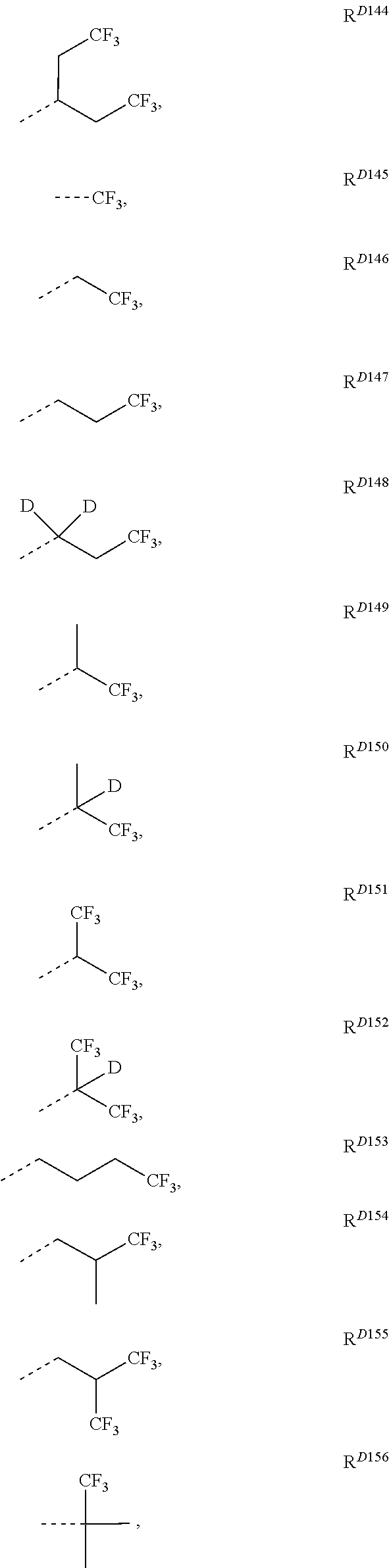


- In some embodiments, the compound is selected from the group consisting of only those compounds whose LBk corresponds to one of the following: LB1, LB2, LB18, LB28, LB38, LB108, LB118, LB122, LB124, LB126, LB128, LB130, LB132, LB134, LB136, LB138, LB140, LB142, LB144, LB156, LB158, LB160, LB162, LB164, LB168, LB172, LB175, LB204, LB206, LB214, LB216, LB218, LB220, LB222, LB231, LB233, LB235, LB237, LB240, LB242, LB244, LB246, LB248, LB250, LB252, LB254, LB256, LB258, LB260, LB262, LB264, LB265, LB266, LB267, LB268, LB269, and LB270.
- In some embodiments, the compound is selected from the group consisting of only those compounds whose LBk corresponds to one of the following: LB1, LB2, LB18, LB28, LB38, LB108, LB118, LB122, LB126, LB128, LB132, LB136, LB138, LB142, LB156, LB162, LB204, LB206, LB214, LB216, LB218, LB220, LB231, LB233, LB237, LB264, LB265, LB266, LB267, LB268, LB269, and LB270.
- In some embodiments, the compound is selected from the group consisting of only those compounds having LCj-I or LCj-II ligand whose corresponding R201 and R202 are defined to be one of the following structures: RD1, RD3, RD4, RD5, RD9, RD10, RD17, RD18, RD20, RD22, RD37, RD40, RD41, RD42, RD43, RD48, RD49, RD50, RD54, RD55, RD58, RD59, RD78, RD79, RD81, RD87, RD88, RD89, RD93, RD116, RD17, RD118, RD119, RD120, RD133, RD134, RD135, RD136, RD143, RD144, RD145, RD146, RD147, RD149, RD151, RD154, RD155, RD161, RD175 RD190, RD193, RD200, RD201, RD206, RD210, RD214, RD215, RD216, RD218, RD219, RD220, RD227, RD237, RD241, RD242, RD245 and RD246.
- In some embodiments, the compound is selected from the group consisting of only those compounds having LCj-I or LCj-II ligand whose corresponding R201 and R202 are defined to be one of selected from the following structures: RD1, RD3, RD4, RD5, RD9, RD10, RD17, RD22, RD43, RD50, RD78, RD116, RD118, RD133, RD134, RD135, RD136, RD143, RD144, RD145, RD146, RD149, RD151, RD154, RD155 RD190, RD193, RD200, RD201, RD206, RD210, RD214, RD215, RD216, RD218, RD219, RD220, RD227, RD237, RD241, RD242, RD245, and RD246.
- In some embodiments, the compound is selected from the group consisting of only those compounds having one of the following structures for the LCj-I ligand set forth in the following LIST 11:
-


- In some embodiments, the compound is selected from the group consisting of the structures of the following
-


-


- In some embodiments, the compound having a first ligand LA of Formula I described herein can be at least 30% deuterated, at least 40% deuterated, at least 50% deuterated, at least 60% deuterated, at least 70% deuterated, at least 80% deuterated, at least 90% deuterated, at least 95% deuterated, at least 99% deuterated, or 100% deuterated. As used herein, percent deuteration has its ordinary meaning and includes the percent of possible hydrogen atoms (e.g., positions that are hydrogen, deuterium, or halogen) that are replaced by deuterium atoms.
- In some embodiments of heteroleptic compound having the formula of Ir(LA)p(LB)q(LC)r wherein p is 1, 2, or 3, q is 0, 1 or 2, r is 0 1 or 2, and p+q+r=3; the ligand LA has a first substituent RI, where the first substituent RI has a first atom a-I that is the farthest away from the metal Ir among all atoms in the ligand LA. Additionally, the ligand LB, if present, has a second substituent RII, where the second substituent RII has a first atom a-II that is the farthest away from the metal Ir among all atoms in the ligand LB. Furthermore, the ligand LC, if present, has a third substituent RIII, where the third substituent RIII has a first atom a-III that is the farthest away from the metal Ir among all atoms in the ligand LC.
- In such heteroleptic compounds, vectors VD1, VD2, and VD3 can be defined that are defined as follows. VD1 represents the direction from the metal Ir to the first atom a-I and the vector VD1 has a value D1 that represents the straight line distance between the metal Ir and the first atom a-I in the first substituent RI. VD2 represents the direction from the metal Ir to the first atom a-II and the vector VD2 has a value D2 that represents the straight line distance between the metal Ir and the first atom a-II in the second substituent RII. VD3 represents the direction from the metal Ir to the first atom a-III and the vector VD3 has a value D3 that represents the straight line distance between the metal Ir and the first atom a-III in the third substituent RIII.
- In such heteroleptic compounds, a sphere having a radius r is defined whose center is the metal Ir and the radius r is the smallest radius that will allow the sphere to enclose all atoms in the compound that are not part of the substituents RI, RII and RIII; and where at least one of D1, D2, and D3 is greater than the radius r by at least 1.5 Å. In some embodiments, at least one of D1, D2, and D3 is greater than the radius r by at least 2.9, 3.0, 4.3, 4.4, 5.2, 5.9, 7.3, 8.8, 10.3, 13.1, 17.6, or 19.1 Å.
- In some embodiments of such heteroleptic compound, the compound has a transition dipole moment axis and angles are defined between the transition dipole moment axis and the vectors VD1, VD2, and VD3, where at least one of the angles between the transition dipole moment axis and the vectors VD1, VD2, and VD3 is less than 40°. In some embodiments, at least one of the angles between the transition dipole moment axis and the vectors VD1, VD2, and VD3 is less than 30°. In some embodiments, at least one of the angles between the transition dipole moment axis and the vectors VD1, VD2, and VD3 is less than 20°. In some embodiments, at least one of the angles between the transition dipole moment axis and the vectors VD1, VD2, and VD3 is less than 15°. In some embodiments, at least one of the angles between the transition dipole moment axis and the vectors VD1, VD2, and VD3 is less than 10°. In some embodiments, at least two of the angles between the transition dipole moment axis and the vectors VD1, VD2, and VD3 are less than 20°. In some embodiments, at least two of the angles between the transition dipole moment axis and the vectors VD1, VD2, and VD3 are less than 15°. In some embodiments, at least two of the angles between the transition dipole moment axis and the vectors VD1, VD2, and VD3 are less than 10°.
- In some embodiments, all three angles between the transition dipole moment axis and the vectors VD1, VD2, and VD3 are less than 20°. In some embodiments, all three angles between the transition dipole moment axis and the vectors VD1, VD2, and VD3 are less than 15°. In some embodiments, all three angles between the transition dipole moment axis and the vectors VD1, VD2, and VD3 are less than 10°.
- In some embodiments of such heteroleptic compounds, the compound has a vertical dipole ratio (VDR) of 0.33 or less. In some embodiments of such heteroleptic compounds, the compound has a VDR of 0.30 or less. In some embodiments of such heteroleptic compounds, the compound has a VDR of 0.25 or less. In some embodiments of such heteroleptic compounds, the compound has a VDR of 0.20 or less. In some embodiments of such heteroleptic compounds, the compound has a VDR of 0.15 or less.
- One of ordinarily skill in the art would readily understand the meaning of the terms transition dipole moment axis of a compound and vertical dipole ratio of a compound. Nevertheless, the meaning of these terms can be found in U.S. Pat. No. 10,672,997 whose disclosure is incorporated herein by reference in its entirety. In U.S. Pat. No. 10,672,997, horizontal dipole ratio (HDR) of a compound, rather than VDR, is discussed. However, one skilled in the art readily understands that VDR=1−HDR.
- In another aspect, the present disclosure also provides an OLED device comprising a first organic layer that contains a compound as disclosed in the above compounds section of the present disclosure.
- In some embodiments, the OLED comprises: an anode; a cathode; and an organic layer disposed between the anode and the cathode, where the organic layer comprises a compound having a first ligand LA of Formula I described herein.
- In some embodiments, the organic layer may be an emissive layer and the compound as described herein may be an emissive dopant or a non-emissive dopant.
- In some embodiments, the emissive layer comprises one or more quantum dots.
- In some embodiments, the organic layer may further comprise a host, wherein the host comprises a triphenylene containing benzo-fused thiophene or benzo-fused furan, wherein any substituent in the host is an unfused substituent independently selected from the group consisting of CnH2n+1, OCnH2n+1, OAr1, N(CnH2n+1)2, N(Ar1)(Ar2), CH═CH—CnH2n+1, C≡CCnH2n+1, Ar1, Ar1—Ar2, CnH2n—Ar1, or no substitution, wherein n is an integer from 1 to 10; and wherein Ar1 and Ar2 are independently selected from the group consisting of benzene, biphenyl, naphthalene, triphenylene, carbazole, and heteroaromatic analogs thereof.
- In some embodiments, the organic layer may further comprise a host, wherein host comprises at least one chemical group selected from the group consisting of triphenylene, carbazole, indolocarbazole, dibenzothiophene, dibenzofuran, dibenzoselenophene, 5λ,2-benzo[d]benzo[4,5]imidazo[3,2-a]imidazole, 5,9-dioxa-13b-boranaphtho[3,2,1-de]anthracene, triazine, boryl, silyl, aza-triphenylene, aza-carbazole, aza-indolocarbazole, aza-dibenzothiophene, aza-dibenzofuran, aza-dibenzoselenophene, aza-5λ,2-benzo[d]benzo[4,5]imidazo[3,2-a]imidazole, and aza-(5,9-dioxa-13b-boranaphtho[3,2,1-de]anthracene).
- In some embodiments, the host may be selected from the HOST Group consisting of:
-


- and combinations thereof.
- In some embodiments, the organic layer may further comprise a host, wherein the host comprises a metal complex.
- In some embodiments, the emissive layer can comprise two hosts, a first host and a second host. In some embodiments, the first host is a hole transporting host, and the second host is an electron transporting host. In some embodiments, the first host and the second host can form an exciplex.
- In some embodiments, the compound as described herein may be a sensitizer; wherein the device may further comprise an acceptor; and wherein the acceptor may be selected from the group consisting of fluorescent emitter, delayed fluorescence emitter, and combination thereof.
- In yet another aspect, the OLED of the present disclosure may also comprise an emissive region containing a compound as disclosed in the above compounds section of the present disclosure.
- In some embodiments, the emissive region can comprise a compound having a first ligand LA of Formula I described herein.
- In some embodiments, at least one of the anode, the cathode, or a new layer disposed over the organic emissive layer functions as an enhancement layer. The enhancement layer comprises a plasmonic material exhibiting surface plasmon resonance that non-radiatively couples to the emitter material and transfers excited state energy from the emitter material to non-radiative mode of surface plasmon polariton. The enhancement layer is provided no more than a threshold distance away from the organic emissive layer, wherein the emitter material has a total non-radiative decay rate constant and a total radiative decay rate constant due to the presence of the enhancement layer and the threshold distance is where the total non-radiative decay rate constant is equal to the total radiative decay rate constant. In some embodiments, the OLED further comprises an outcoupling layer. In some embodiments, the outcoupling layer is disposed over the enhancement layer on the opposite side of the organic emissive layer. In some embodiments, the outcoupling layer is disposed on opposite side of the emissive layer from the enhancement layer but still outcouples energy from the surface plasmon mode of the enhancement layer. The outcoupling layer scatters the energy from the surface plasmon polaritons. In some embodiments this energy is scattered as photons to free space. In other embodiments, the energy is scattered from the surface plasmon mode into other modes of the device such as but not limited to the organic waveguide mode, the substrate mode, or another waveguiding mode. If energy is scattered to the non-free space mode of the OLED other outcoupling schemes could be incorporated to extract that energy to free space. In some embodiments, one or more intervening layer can be disposed between the enhancement layer and the outcoupling layer. The examples for intervening layer(s) can be dielectric materials, including organic, inorganic, perovskites, oxides, and may include stacks and/or mixtures of these materials.
- The enhancement layer modifies the effective properties of the medium in which the emitter material resides resulting in any or all of the following: a decreased rate of emission, a modification of emission line-shape, a change in emission intensity with angle, a change in the stability of the emitter material, a change in the efficiency of the OLED, and reduced efficiency roll-off of the OLED device. Placement of the enhancement layer on the cathode side, anode side, or on both sides results in OLED devices which take advantage of any of the above-mentioned effects. In addition to the specific functional layers mentioned herein and illustrated in the various OLED examples shown in the figures, the OLEDs according to the present disclosure may include any of the other functional layers often found in OLEDs.
- The enhancement layer can be comprised of plasmonic materials, optically active metamaterials, or hyperbolic metamaterials. As used herein, a plasmonic material is a material in which the real part of the dielectric constant crosses zero in the visible or ultraviolet region of the electromagnetic spectrum. In some embodiments, the plasmonic material includes at least one metal. In such embodiments the metal may include at least one of Ag, Al, Au, Ir, Pt, Ni, Cu, W, Ta, Fe, Cr, Mg, Ga, Rh, Ti, Ru, Pd, In, Bi, Ca alloys or mixtures of these materials, and stacks of these materials. In general, a metamaterial is a medium composed of different materials where the medium as a whole acts differently than the sum of its material parts. In particular, we define optically active metamaterials as materials which have both negative permittivity and negative permeability. Hyperbolic metamaterials, on the other hand, are anisotropic media in which the permittivity or permeability are of different sign for different spatial directions. Optically active metamaterials and hyperbolic metamaterials are strictly distinguished from many other photonic structures such as Distributed Bragg Reflectors (“DBRs”) in that the medium should appear uniform in the direction of propagation on the length scale of the wavelength of light. Using terminology that one skilled in the art can understand: the dielectric constant of the metamaterials in the direction of propagation can be described with the effective medium approximation. Plasmonic materials and metamaterials provide methods for controlling the propagation of light that can enhance OLED performance in a number of ways.
- In some embodiments, the enhancement layer is provided as a planar layer. In other embodiments, the enhancement layer has wavelength-sized features that are arranged periodically, quasi-periodically, or randomly, or sub-wavelength-sized features that are arranged periodically, quasi-periodically, or randomly. In some embodiments, the wavelength-sized features and the sub-wavelength-sized features have sharp edges.
- In some embodiments, the outcoupling layer has wavelength-sized features that are arranged periodically, quasi-periodically, or randomly, or sub-wavelength-sized features that are arranged periodically, quasi-periodically, or randomly. In some embodiments, the outcoupling layer may be composed of a plurality of nanoparticles and in other embodiments the outcoupling layer is composed of a pluraility of nanoparticles disposed over a material. In these embodiments the outcoupling may be tunable by at least one of varying a size of the plurality of nanoparticles, varying a shape of the plurality of nanoparticles, changing a material of the plurality of nanoparticles, adjusting a thickness of the material, changing the refractive index of the material or an additional layer disposed on the plurality of nanoparticles, varying a thickness of the enhancement layer, and/or varying the material of the enhancement layer. The plurality of nanoparticles of the device may be formed from at least one of metal, dielectric material, semiconductor materials, an alloy of metal, a mixture of dielectric materials, a stack or layering of one or more materials, and/or a core of one type of material and that is coated with a shell of a different type of material. In some embodiments, the outcoupling layer is composed of at least metal nanoparticles wherein the metal is selected from the group consisting of Ag, Al, Au, Ir, Pt, Ni, Cu, W, Ta, Fe, Cr, Mg, Ga, Rh, Ti, Ru, Pd, In, Bi, Ca, alloys or mixtures of these materials, and stacks of these materials. The plurality of nanoparticles may have additional layer disposed over them. In some embodiments, the polarization of the emission can be tuned using the outcoupling layer. Varying the dimensionality and periodicity of the outcoupling layer can select a type of polarization that is preferentially outcoupled to air. In some embodiments the outcoupling layer also acts as an electrode of the device.
- In yet another aspect, the present disclosure also provides a consumer product comprising an organic light-emitting device (OLED) having an anode; a cathode; and an organic layer disposed between the anode and the cathode, wherein the organic layer may comprise a compound as disclosed in the above compounds section of the present disclosure.
- In some embodiments, the consumer product comprises an OLED having an anode; a cathode; and an organic layer disposed between the anode and the cathode, wherein the organic layer may comprise a compound having a first ligand LA of Formula I described herein.
- In some embodiments, the consumer product can be one of a flat panel display, a computer monitor, a medical monitor, a television, a billboard, a light for interior or exterior illumination and/or signaling, a heads-up display, a fully or partially transparent display, a flexible display, a laser printer, a telephone, a cell phone, tablet, a phablet, a personal digital assistant (PDA), a wearable device, a laptop computer, a digital camera, a camcorder, a viewfinder, a micro-display that is less than 2 inches diagonal, a 3-D display, a virtual reality or augmented reality display, a vehicle, a video wall comprising multiple displays tiled together, a theater or stadium screen, a light therapy device, and a sign.
- Generally, an OLED comprises at least one organic layer disposed between and electrically connected to an anode and a cathode. When a current is applied, the anode injects holes and the cathode injects electrons into the organic layer(s). The injected holes and electrons each migrate toward the oppositely charged electrode. When an electron and hole localize on the same molecule, an “exciton,” which is a localized electron-hole pair having an excited energy state, is formed. Light is emitted when the exciton relaxes via a photoemissive mechanism. In some cases, the exciton may be localized on an excimer or an exciplex. Non-radiative mechanisms, such as thermal relaxation, may also occur, but are generally considered undesirable.
- Several OLED materials and configurations are described in U.S. Pat. Nos. 5,844,363, 6,303,238, and 5,707,745, which are incorporated herein by reference in their entirety.
- The initial OLEDs used emissive molecules that emitted light from their singlet states (“fluorescence”) as disclosed, for example, in U.S. Pat. No. 4,769,292, which is incorporated by reference in its entirety. Fluorescent emission generally occurs in a time frame of less than 10 nanoseconds.
- More recently, OLEDs having emissive materials that emit light from triplet states (“phosphorescence”) have been demonstrated. Baldo et al., “Highly Efficient Phosphorescent Emission from Organic Electroluminescent Devices,” Nature, vol. 395, 151-154, 1998; (“Baldo-I”) and Baldo et al., “Very high-efficiency green organic light-emitting devices based on electrophosphorescence,” Appl. Phys. Lett., vol. 75, No. 3, 4-6 (1999) (“Baldo-II”), are incorporated by reference in their entireties. Phosphorescence is described in more detail in U.S. Pat. No. 7,279,704 at cols. 5-6, which are incorporated by reference.
-
FIG. 1 shows an organiclight emitting device 100. The figures are not necessarily drawn to scale.Device 100 may include asubstrate 110, ananode 115, ahole injection layer 120, ahole transport layer 125, anelectron blocking layer 130, anemissive layer 135, ahole blocking layer 140, anelectron transport layer 145, anelectron injection layer 150, aprotective layer 155, acathode 160, and abarrier layer 170.Cathode 160 is a compound cathode having a firstconductive layer 162 and a secondconductive layer 164.Device 100 may be fabricated by depositing the layers described, in order. The properties and functions of these various layers, as well as example materials, are described in more detail in U.S. Pat. No. 7,279,704 at cols. 6-10, which are incorporated by reference. - More examples for each of these layers are available. For example, a flexible and transparent substrate-anode combination is disclosed in U.S. Pat. No. 5,844,363, which is incorporated by reference in its entirety. An example of a p-doped hole transport layer is m-MTDATA doped with F4-TCNQ at a molar ratio of 50:1, as disclosed in U.S. Patent Application Publication No. 2003/0230980, which is incorporated by reference in its entirety. Examples of emissive and host materials are disclosed in U.S. Pat. No. 6,303,238 to Thompson et al., which is incorporated by reference in its entirety. An example of an n-doped electron transport layer is BPhen doped with Li at a molar ratio of 1:1, as disclosed in U.S. Patent Application Publication No. 2003/0230980, which is incorporated by reference in its entirety. U.S. Pat. Nos. 5,703,436 and 5,707,745, which are incorporated by reference in their entireties, disclose examples of cathodes including compound cathodes having a thin layer of metal such as Mg:Ag with an overlying transparent, electrically-conductive, sputter-deposited ITO layer. The theory and use of blocking layers is described in more detail in U.S. Pat. No. 6,097,147 and U.S. Patent Application Publication No. 2003/0230980, which are incorporated by reference in their entireties. Examples of injection layers are provided in U.S. Patent Application Publication No. 2004/0174116, which is incorporated by reference in its entirety. A description of protective layers may be found in U.S. Patent Application Publication No. 2004/0174116, which is incorporated by reference in its entirety.
-
FIG. 2 shows aninverted OLED 200. The device includes asubstrate 210, acathode 215, anemissive layer 220, ahole transport layer 225, and ananode 230.Device 200 may be fabricated by depositing the layers described, in order. Because the most common OLED configuration has a cathode disposed over the anode, anddevice 200 hascathode 215 disposed underanode 230,device 200 may be referred to as an “inverted” OLED. Materials similar to those described with respect todevice 100 may be used in the corresponding layers ofdevice 200.FIG. 2 provides one example of how some layers may be omitted from the structure ofdevice 100. - The simple layered structure illustrated in
FIGS. 1 and 2 is provided by way of non-limiting example, and it is understood that embodiments of the present disclosure may be used in connection with a wide variety of other structures. The specific materials and structures described are exemplary in nature, and other materials and structures may be used. Functional OLEDs may be achieved by combining the various layers described in different ways, or layers may be omitted entirely, based on design, performance, and cost factors. Other layers not specifically described may also be included. Materials other than those specifically described may be used. Although many of the examples provided herein describe various layers as comprising a single material, it is understood that combinations of materials, such as a mixture of host and dopant, or more generally a mixture, may be used. Also, the layers may have various sublayers. The names given to the various layers herein are not intended to be strictly limiting. For example, indevice 200,hole transport layer 225 transports holes and injects holes intoemissive layer 220, and may be described as a hole transport layer or a hole injection layer. In one embodiment, an OLED may be described as having an “organic layer” disposed between a cathode and an anode. This organic layer may comprise a single layer, or may further comprise multiple layers of different organic materials as described, for example, with respect toFIGS. 1 and 2 . - Structures and materials not specifically described may also be used, such as OLEDs comprised of polymeric materials (PLEDs) such as disclosed in U.S. Pat. No. 5,247,190 to Friend et al., which is incorporated by reference in its entirety. By way of further example, OLEDs having a single organic layer may be used. OLEDs may be stacked, for example as described in U.S. Pat. No. 5,707,745 to Forrest et al, which is incorporated by reference in its entirety. The OLED structure may deviate from the simple layered structure illustrated in
FIGS. 1 and 2 . For example, the substrate may include an angled reflective surface to improve out-coupling, such as a mesa structure as described in U.S. Pat. No. 6,091,195 to Forrest et al., and/or a pit structure as described in U.S. Pat. No. 5,834,893 to Bulovic et al., which are incorporated by reference in their entireties. - Unless otherwise specified, any of the layers of the various embodiments may be deposited by any suitable method. For the organic layers, preferred methods include thermal evaporation, ink-jet, such as described in U.S. Pat. Nos. 6,013,982 and 6,087,196, which are incorporated by reference in their entireties, organic vapor phase deposition (OVPD), such as described in U.S. Pat. No. 6,337,102 to Forrest et al., which is incorporated by reference in its entirety, and deposition by organic vapor jet printing (OVJP, also referred to as organic vapor jet deposition (OVJD)), such as described in U.S. Pat. No. 7,431,968, which is incorporated by reference in its entirety. Other suitable deposition methods include spin coating and other solution based processes. Solution based processes are preferably carried out in nitrogen or an inert atmosphere. For the other layers, preferred methods include thermal evaporation. Preferred patterning methods include deposition through a mask, cold welding such as described in U.S. Pat. Nos. 6,294,398 and 6,468,819, which are incorporated by reference in their entireties, and patterning associated with some of the deposition methods such as ink-jet and organic vapor jet printing (OVJP). Other methods may also be used. The materials to be deposited may be modified to make them compatible with a particular deposition method. For example, substituents such as alkyl and aryl groups, branched or unbranched, and preferably containing at least 3 carbons, may be used in small molecules to enhance their ability to undergo solution processing. Substituents having 20 carbons or more may be used, and 3-20 carbons are a preferred range. Materials with asymmetric structures may have better solution processability than those having symmetric structures, because asymmetric materials may have a lower tendency to recrystallize. Dendrimer substituents may be used to enhance the ability of small molecules to undergo solution processing.
- Devices fabricated in accordance with embodiments of the present disclosure may further optionally comprise a barrier layer. One purpose of the barrier layer is to protect the electrodes and organic layers from damaging exposure to harmful species in the environment including moisture, vapor and/or gases, etc. The barrier layer may be deposited over, under or next to a substrate, an electrode, or over any other parts of a device including an edge. The barrier layer may comprise a single layer, or multiple layers. The barrier layer may be formed by various known chemical vapor deposition techniques and may include compositions having a single phase as well as compositions having multiple phases. Any suitable material or combination of materials may be used for the barrier layer. The barrier layer may incorporate an inorganic or an organic compound or both. The preferred barrier layer comprises a mixture of a polymeric material and a non-polymeric material as described in U.S. Pat. No. 7,968,146, PCT Pat. Application Nos. PCT/US2007/023098 and PCT/US2009/042829, which are herein incorporated by reference in their entireties. To be considered a “mixture”, the aforesaid polymeric and non-polymeric materials comprising the barrier layer should be deposited under the same reaction conditions and/or at the same time. The weight ratio of polymeric to non-polymeric material may be in the range of 95:5 to 5:95. The polymeric material and the non-polymeric material may be created from the same precursor material. In one example, the mixture of a polymeric material and a non-polymeric material consists essentially of polymeric silicon and inorganic silicon.
- Devices fabricated in accordance with embodiments of the present disclosure can be incorporated into a wide variety of electronic component modules (or units) that can be incorporated into a variety of electronic products or intermediate components. Examples of such electronic products or intermediate components include display screens, lighting devices such as discrete light source devices or lighting panels, etc. that can be utilized by the end-user product manufacturers. Such electronic component modules can optionally include the driving electronics and/or power source(s). Devices fabricated in accordance with embodiments of the present disclosure can be incorporated into a wide variety of consumer products that have one or more of the electronic component modules (or units) incorporated therein. A consumer product comprising an OLED that includes the compound of the present disclosure in the organic layer in the OLED is disclosed. Such consumer products would include any kind of products that include one or more light source(s) and/or one or more of some type of visual displays. Some examples of such consumer products include flat panel displays, curved displays, computer monitors, medical monitors, televisions, billboards, lights for interior or exterior illumination and/or signaling, heads-up displays, fully or partially transparent displays, flexible displays, rollable displays, foldable displays, stretchable displays, laser printers, telephones, mobile phones, tablets, phablets, personal digital assistants (PDAs), wearable devices, laptop computers, digital cameras, camcorders, viewfinders, micro-displays (displays that are less than 2 inches diagonal), 3-D displays, virtual reality or augmented reality displays, vehicles, video walls comprising multiple displays tiled together, theater or stadium screen, a light therapy device, and a sign. Various control mechanisms may be used to control devices fabricated in accordance with the present disclosure, including passive matrix and active matrix. Many of the devices are intended for use in a temperature range comfortable to humans, such as 18 degrees C. to 30 degrees C., and more preferably at room temperature (20-25° C.), but could be used outside this temperature range, for example, from −40 degree C. to +80° C.
- More details on OLEDs, and the definitions described above, can be found in U.S. Pat. No. 7,279,704, which is incorporated herein by reference in its entirety.
- The materials and structures described herein may have applications in devices other than OLEDs. For example, other optoelectronic devices such as organic solar cells and organic photodetectors may employ the materials and structures. More generally, organic devices, such as organic transistors, may employ the materials and structures.
- In some embodiments, the OLED has one or more characteristics selected from the group consisting of being flexible, being rollable, being foldable, being stretchable, and being curved. In some embodiments, the OLED is transparent or semi-transparent. In some embodiments, the OLED further comprises a layer comprising carbon nanotubes.
- In some embodiments, the OLED further comprises a layer comprising a delayed fluorescent emitter. In some embodiments, the OLED comprises a RGB pixel arrangement or white plus color filter pixel arrangement. In some embodiments, the OLED is a mobile device, a hand held device, or a wearable device. In some embodiments, the OLED is a display panel having less than 10 inch diagonal or 50 square inch area. In some embodiments, the OLED is a display panel having at least 10 inch diagonal or 50 square inch area. In some embodiments, the OLED is a lighting panel.
- In some embodiments, the compound can be an emissive dopant. In some embodiments, the compound can produce emissions via phosphorescence, fluorescence, thermally activated delayed fluorescence, i.e., TADF (also referred to as E-type delayed fluorescence; see, e.g., U.S. application Ser. No. 15/700,352, which is hereby incorporated by reference in its entirety), triplet-triplet annihilation, or combinations of these processes. In some embodiments, the emissive dopant can be a racemic mixture, or can be enriched in one enantiomer. In some embodiments, the compound can be homoleptic (each ligand is the same). In some embodiments, the compound can be heteroleptic (at least one ligand is different from others). When there are more than one ligand coordinated to a metal, the ligands can all be the same in some embodiments. In some other embodiments, at least one ligand is different from the other ligands. In some embodiments, every ligand can be different from each other. This is also true in embodiments where a ligand being coordinated to a metal can be linked with other ligands being coordinated to that metal to form a tridentate, tetradentate, pentadentate, or hexadentate ligands. Thus, where the coordinating ligands are being linked together, all of the ligands can be the same in some embodiments, and at least one of the ligands being linked can be different from the other ligand(s) in some other embodiments.
- In some embodiments, the compound can be used as a phosphorescent sensitizer in an OLED where one or multiple layers in the OLED contains an acceptor in the form of one or more fluorescent and/or delayed fluorescence emitters. In some embodiments, the compound can be used as one component of an exciplex to be used as a sensitizer. As a phosphorescent sensitizer, the compound must be capable of energy transfer to the acceptor and the acceptor will emit the energy or further transfer energy to a final emitter. The acceptor concentrations can range from 0.001% to 100%. The acceptor could be in either the same layer as the phosphorescent sensitizer or in one or more different layers. In some embodiments, the acceptor is a TADF emitter. In some embodiments, the acceptor is a fluorescent emitter. In some embodiments, the emission can arise from any or all of the sensitizer, acceptor, and final emitter.
- According to another aspect, a formulation comprising the compound described herein is also disclosed.
- The OLED disclosed herein can be incorporated into one or more of a consumer product, an electronic component module, and a lighting panel. The organic layer can be an emissive layer and the compound can be an emissive dopant in some embodiments, while the compound can be a non-emissive dopant in other embodiments.
- In yet another aspect of the present disclosure, a formulation that comprises the novel compound disclosed herein is described. The formulation can include one or more components selected from the group consisting of a solvent, a host, a hole injection material, hole transport material, electron blocking material, hole blocking material, and an electron transport material, disclosed herein.
- The present disclosure encompasses any chemical structure comprising the novel compound of the present disclosure, or a monovalent or polyvalent variant thereof. In other words, the inventive compound, or a monovalent or polyvalent variant thereof, can be a part of a larger chemical structure. Such chemical structure can be selected from the group consisting of a monomer, a polymer, a macromolecule, and a supramolecule (also known as supermolecule). As used herein, a “monovalent variant of a compound” refers to a moiety that is identical to the compound except that one hydrogen has been removed and replaced with a bond to the rest of the chemical structure. As used herein, a “polyvalent variant of a compound” refers to a moiety that is identical to the compound except that more than one hydrogen has been removed and replaced with a bond or bonds to the rest of the chemical structure. In the instance of a supramolecule, the inventive compound can also be incorporated into the supramolecule complex without covalent bonds.
- D. Combination of the Compounds of the Present Disclosure with Other Materials
- The materials described herein as useful for a particular layer in an organic light emitting device may be used in combination with a wide variety of other materials present in the device. For example, emissive dopants disclosed herein may be used in conjunction with a wide variety of hosts, transport layers, blocking layers, injection layers, electrodes and other layers that may be present. The materials described or referred to below are non-limiting examples of materials that may be useful in combination with the compounds disclosed herein, and one of skill in the art can readily consult the literature to identify other materials that may be useful in combination.
- A charge transport layer can be doped with conductivity dopants to substantially alter its density of charge carriers, which will in turn alter its conductivity. The conductivity is increased by generating charge carriers in the matrix material, and depending on the type of dopant, a change in the Fermi level of the semiconductor may also be achieved. Hole-transporting layer can be doped by p-type conductivity dopants and n-type conductivity dopants are used in the electron-transporting layer.
- Non-limiting examples of the conductivity dopants that may be used in an OLED in combination with materials disclosed herein are exemplified below together with references that disclose those materials: EP01617493, EP01968131, EP2020694, EP2684932, US20050139810, US20070160905, US20090167167, US2010288362, WO06081780, WO2009003455, WO2009008277, WO2009011327, WO2014009310, US2007252140, US2015060804, US20150123047, and US2012146012.
-


- A hole injecting/transporting material to be used in the present disclosure is not particularly limited, and any compound may be used as long as the compound is typically used as a hole injecting/transporting material. Examples of the material include, but are not limited to: a phthalocyanine or porphyrin derivative; an aromatic amine derivative; an indolocarbazole derivative; a polymer containing fluorohydrocarbon; a polymer with conductivity dopants; a conducting polymer, such as PEDOT/PSS; a self-assembly monomer derived from compounds such as phosphonic acid and silane derivatives; a metal oxide derivative, such as MoOx; a p-type semiconducting organic compound, such as 1,4,5,8,9,12-Hexaazatriphenylenehexacarbonitrile; a metal complex, and a cross-linkable compounds.
- Examples of aromatic amine derivatives used in HIL or HTL include, but not limit to the following general structures:
-

- Each of Ar1 to Ar9 is selected from the group consisting of aromatic hydrocarbon cyclic compounds such as benzene, biphenyl, triphenyl, triphenylene, naphthalene, anthracene, phenalene, phenanthrene, fluorene, pyrene, chrysene, perylene, and azulene; the group consisting of aromatic heterocyclic compounds such as dibenzothiophene, dibenzofuran, dibenzoselenophene, furan, thiophene, benzofuran, benzothiophene, benzoselenophene, carbazole, indolocarbazole, pyridylindole, pyrrolodipyridine, pyrazole, imidazole, triazole, oxazole, thiazole, oxadiazole, oxatriazole, dioxazole, thiadiazole, pyridine, pyridazine, pyrimidine, pyrazine, triazine, oxazine, oxathiazine, oxadiazine, indole, benzimidazole, indazole, indoxazine, benzoxazole, benzisoxazole, benzothiazole, quinoline, isoquinoline, cinnoline, quinazoline, quinoxaline, naphthyridine, phthalazine, pteridine, xanthene, acridine, phenazine, phenothiazine, phenoxazine, benzofuropyridine, furodipyridine, benzothienopyridine, thienodipyridine, benzoselenophenopyridine, and selenophenodipyridine; and the group consisting of 2 to 10 cyclic structural units which are groups of the same type or different types selected from the aromatic hydrocarbon cyclic group and the aromatic heterocyclic group and are bonded to each other directly or via at least one of oxygen atom, nitrogen atom, sulfur atom, silicon atom, phosphorus atom, boron atom, chain structural unit and the aliphatic cyclic group. Each Ar may be unsubstituted or may be substituted by a substituent selected from the group consisting of deuterium, halogen, alkyl, cycloalkyl, heteroalkyl, heterocycloalkyl, arylalkyl, alkoxy, aryloxy, amino, silyl, alkenyl, cycloalkenyl, heteroalkenyl, alkynyl, aryl, heteroaryl, acyl, carboxylic acids, ether, ester, nitrile, isonitrile, sulfanyl, sulfinyl, sulfonyl, phosphino, and combinations thereof.
- In one aspect, Ar1 to Ar9 is independently selected from the group consisting of:
-

- wherein k is an integer from 1 to 20; X101 to X108 is C (including CH) or N; Z101 is NAr1, O, or S; Ar1 has the same group defined above.
- Examples of metal complexes used in HIL or HTL include, but are not limited to the following general formula:
-

- wherein Met is a metal, which can have an atomic weight greater than 40; (Y101-Y102) is a bidentate ligand, Y1I and Y102 are independently selected from C, N, O, P, and S; L101 is an ancillary ligand; k′ is an integer value from 1 to the maximum number of ligands that may be attached to the metal; and k′+k″ is the maximum number of ligands that may be attached to the metal.
- In one aspect, (Y101-Y102) is a 2-phenylpyridine derivative. In another aspect, (Y101-Y102) is a carbene ligand. In another aspect, Met is selected from Ir, Pt, Os, and Zn. In a further aspect, the metal complex has a smallest oxidation potential in solution vs. Fc+/Fc couple less than about 0.6 V.
- Non-limiting examples of the HIL and HTL materials that may be used in an OLED in combination with materials disclosed herein are exemplified below together with references that disclose those materials: CN102702075, DE102012005215, EP01624500, EP01698613, EP01806334, EP01930964, EP01972613, EP01997799, EP02011790, EP02055700, EP02055701, EP1725079, EP2085382, EP2660300, EP650955, JP07-073529, JP2005112765, JP2007091719, JP2008021687, JP2014-009196, KR20110088898, KR20130077473, TW201139402, U.S. Ser. No. 06/517,957, US20020158242, US20030162053, US20050123751, US20060182993, US20060240279, US20070145888, US20070181874, US20070278938, US20080014464, US20080091025, US20080106190, US20080124572, US20080145707, US20080220265, US20080233434, US20080303417, US2008107919, US20090115320, US20090167161, US2009066235, US2011007385, US20110163302, US2011240968, US2011278551, US2012205642, US2013241401, US20140117329, US2014183517, U.S. Pat. Nos. 5,061,569, 5,639,914, WO05075451, WO07125714, WO08023550, WO08023759, WO2009145016, WO2010061824, WO2011075644, WO2012177006, WO2013018530, WO2013039073, WO2013087142, WO2013118812, WO2013120577, WO2013157367, WO2013175747, WO2014002873, WO2014015935, WO2014015937, WO2014030872, WO2014030921, WO2014034791, WO2014104514, WO2014157018.
-


- An electron blocking layer (EBL) may be used to reduce the number of electrons and/or excitons that leave the emissive layer. The presence of such a blocking layer in a device may result in substantially higher efficiencies, and/or longer lifetime, as compared to a similar device lacking a blocking layer. Also, a blocking layer may be used to confine emission to a desired region of an OLED. In some embodiments, the EBL material has a higher LUMO (closer to the vacuum level) and/or higher triplet energy than the emitter closest to the EBL interface. In some embodiments, the EBL material has a higher LUMO (closer to the vacuum level) and/or higher triplet energy than one or more of the hosts closest to the EBL interface. In one aspect, the compound used in EBL contains the same molecule or the same functional groups used as one of the hosts described below.
- The light emitting layer of the organic EL device of the present disclosure preferably contains at least a metal complex as light emitting material, and may contain a host material using the metal complex as a dopant material. Examples of the host material are not particularly limited, and any metal complexes or organic compounds may be used as long as the triplet energy of the host is larger than that of the dopant. Any host material may be used with any dopant so long as the triplet criteria is satisfied.
- Examples of metal complexes used as host are preferred to have the following general formula:
-

- wherein Met is a metal; (Y103-Y104) is a bidentate ligand, Y103 and Y104 are independently selected from C, N, O, P, and S; L101 is an another ligand; k′ is an integer value from 1 to the maximum number of ligands that may be attached to the metal; and k′+k″ is the maximum number of ligands that may be attached to the metal.
- In one aspect, the metal complexes are:
-

- wherein (O—N) is a bidentate ligand, having metal coordinated to atoms O and N.
- In another aspect, Met is selected from Ir and Pt. In a further aspect, (Y103-Y104) is a carbene ligand.
- In one aspect, the host compound contains at least one of the following groups selected from the group consisting of aromatic hydrocarbon cyclic compounds such as benzene, biphenyl, triphenyl, triphenylene, tetraphenylene, naphthalene, anthracene, phenalene, phenanthrene, fluorene, pyrene, chrysene, perylene, and azulene; the group consisting of aromatic heterocyclic compounds such as dibenzothiophene, dibenzofuran, dibenzoselenophene, furan, thiophene, benzofuran, benzothiophene, benzoselenophene, carbazole, indolocarbazole, pyridylindole, pyrrolodipyridine, pyrazole, imidazole, triazole, oxazole, thiazole, oxadiazole, oxatriazole, dioxazole, thiadiazole, pyridine, pyridazine, pyrimidine, pyrazine, triazine, oxazine, oxathiazine, oxadiazine, indole, benzimidazole, indazole, indoxazine, benzoxazole, benzisoxazole, benzothiazole, quinoline, isoquinoline, cinnoline, quinazoline, quinoxaline, naphthyridine, phthalazine, pteridine, xanthene, acridine, phenazine, phenothiazine, phenoxazine, benzofuropyridine, furodipyridine, benzothienopyridine, thienodipyridine, benzoselenophenopyridine, and selenophenodipyridine; and the group consisting of 2 to 10 cyclic structural units which are groups of the same type or different types selected from the aromatic hydrocarbon cyclic group and the aromatic heterocyclic group and are bonded to each other directly or via at least one of oxygen atom, nitrogen atom, sulfur atom, silicon atom, phosphorus atom, boron atom, chain structural unit and the aliphatic cyclic group. Each option within each group may be unsubstituted or may be substituted by a substituent selected from the group consisting of deuterium, halogen, alkyl, cycloalkyl, heteroalkyl, heterocycloalkyl, arylalkyl, alkoxy, aryloxy, amino, silyl, alkenyl, cycloalkenyl, heteroalkenyl, alkynyl, aryl, heteroaryl, acyl, carboxylic acids, ether, ester, nitrile, isonitrile, sulfanyl, sulfinyl, sulfonyl, phosphino, and combinations thereof.
- In one aspect, the host compound contains at least one of the following groups in the molecule:
-
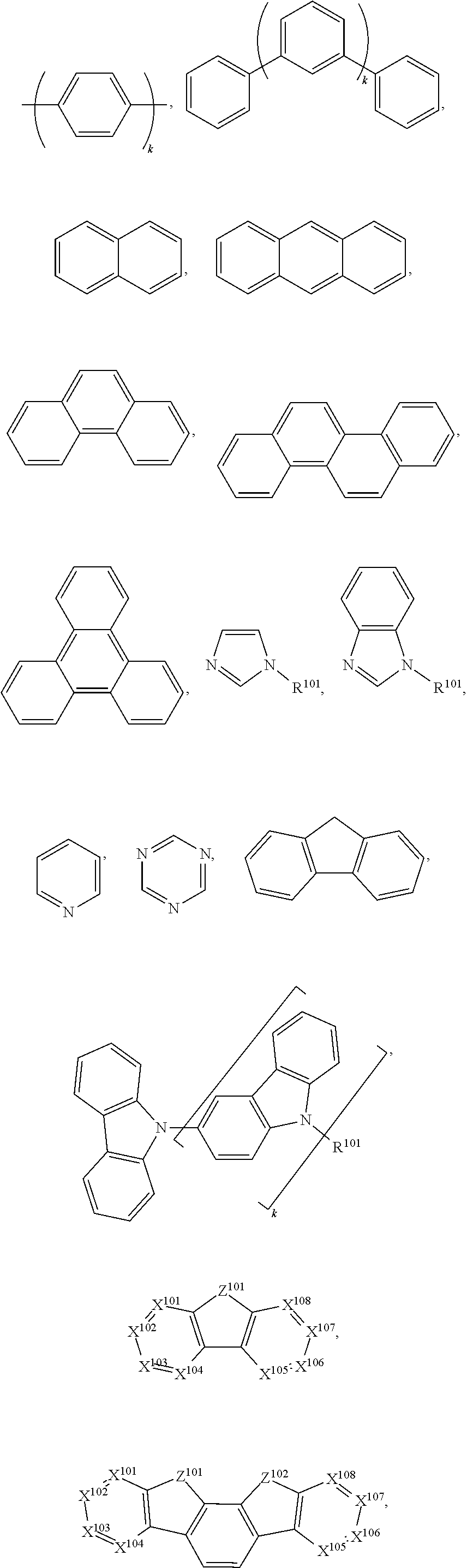

- wherein R101 is selected from the group consisting of hydrogen, deuterium, halogen, alkyl, cycloalkyl, heteroalkyl, heterocycloalkyl, arylalkyl, alkoxy, aryloxy, amino, silyl, alkenyl, cycloalkenyl, heteroalkenyl, alkynyl, aryl, heteroaryl, acyl, carboxylic acids, ether, ester, nitrile, isonitrile, sulfanyl, sulfinyl, sulfonyl, phosphino, and combinations thereof, and when it is aryl or heteroaryl, it has the similar definition as Ar's mentioned above. k is an integer from 0 to 20 or 1 to 20. X101 to X108 are independently selected from C (including CH) or N. Z101 and Z102 are independently selected from NR101, O, or S.
- Non-limiting examples of the host materials that may be used in an OLED in combination with materials disclosed herein are exemplified below together with references that disclose those materials: EP2034538, EP2034538A, EP2757608, JP2007254297, KR20100079458, KR20120088644, KR20120129733, KR20130115564, TW201329200, US20030175553, US20050238919, US20060280965, US20090017330, US20090030202, US20090167162, US20090302743, US20090309488, US20100012931, US20100084966, US20100187984, US2010187984, US2012075273, US2012126221, US2013009543, US2013105787, US2013175519, US2014001446, US20140183503, US20140225088, US2014034914, U.S. Pat. No. 7,154,114, WO2001039234, WO2004093207, WO2005014551, WO2005089025, WO2006072002, WO2006114966, WO2007063754, WO2008056746, WO2009003898, WO2009021126, WO2009063833, WO2009066778, WO2009066779, WO2009086028, WO2010056066, WO2010107244, WO2011081423, WO2011081431, WO2011086863, WO2012128298, WO2012133644, WO2012133649, WO2013024872, WO2013035275, WO2013081315, WO2013191404, WO2014142472, US20170263869, US20160163995, U.S. Pat. No. 9,466,803,
-


- One or more additional emitter dopants may be used in conjunction with the compound of the present disclosure. Examples of the additional emitter dopants are not particularly limited, and any compounds may be used as long as the compounds are typically used as emitter materials. Examples of suitable emitter materials include, but are not limited to, compounds which can produce emissions via phosphorescence, fluorescence, thermally activated delayed fluorescence, i.e., TADF (also referred to as E-type delayed fluorescence), triplet-triplet annihilation, or combinations of these processes.
- Non-limiting examples of the emitter materials that may be used in an OLED in combination with materials disclosed herein are exemplified below together with references that disclose those materials: CN103694277, CN1696137, EB01238981, EP01239526, EP01961743, EP1239526, EP1244155, EP1642951, EP1647554, EP1841834, EP1841834B, EP2062907, EP2730583, JP2012074444, JP2013110263, JP4478555, KR1020090133652, KR20120032054, KR20130043460, TW201332980, U.S. Ser. No. 06/699,599, U.S. Ser. No. 06/916,554, US20010019782, US20020034656, US20030068526, US20030072964, US20030138657, US20050123788, US20050244673, US2005123791, US2005260449, US20060008670, US20060065890, US20060127696, US20060134459, US20060134462, US20060202194, US20060251923, US20070034863, US20070087321, US20070103060, US20070111026, US20070190359, US20070231600, US2007034863, US2007104979, US2007104980, US2007138437, US2007224450, US2007278936, US20080020237, US20080233410, US20080261076, US20080297033, US200805851, US2008161567, US2008210930, US20090039776, US20090108737, US20090115322, US20090179555, US2009085476, US2009104472, US20100090591, US20100148663, US20100244004, US20100295032, US2010102716, US2010105902, US2010244004, US2010270916, US20110057559, US20110108822, US20110204333, US2011215710, US2011227049, US2011285275, US2012292601, US20130146848, US2013033172, US2013165653, US2013181190, US2013334521, US20140246656, US2014103305, U.S. Pat. Nos. 6,303,238, 6,413,656, 6,653,654, 6,670,645, 6,687,266, 6,835,469, 6,921,915, 7,279,704, 7,332,232, 7,378,162, 7,534,505, 7,675,228, 7,728,137, 7,740,957, 7,759,489, 7,951,947, 8,067,099, 8,592,586, 8,871,361, WO06081973, WO06121811, WO07018067, WO07108362, WO07115970, WO07115981, WO08035571, WO2002015645, WO2003040257, WO2005019373, WO2006056418, WO2008054584, WO2008078800, WO2008096609, WO2008101842, WO2009000673, WO2009050281, WO2009100991, WO2010028151, WO2010054731, WO2010086089, WO2010118029, WO2011044988, WO2011051404, WO2011107491, WO2012020327, WO2012163471, WO2013094620, WO2013107487, WO2013174471, WO2014007565, WO2014008982, WO2014023377, WO2014024131, WO2014031977, WO2014038456, WO2014112450.
-


- A hole blocking layer (HBL) may be used to reduce the number of holes and/or excitons that leave the emissive layer. The presence of such a blocking layer in a device may result in substantially higher efficiencies and/or longer lifetime as compared to a similar device lacking a blocking layer. Also, a blocking layer may be used to confine emission to a desired region of an OLED. In some embodiments, the HBL material has a lower HOMO (further from the vacuum level) and/or higher triplet energy than the emitter closest to the HBL interface. In some embodiments, the HBL material has a lower HOMO (further from the vacuum level) and/or higher triplet energy than one or more of the hosts closest to the HBL interface.
- In one aspect, compound used in HBL contains the same molecule or the same functional groups used as host described above.
- In another aspect, compound used in HBL contains at least one of the following groups in the molecule:
-

- wherein k is an integer from 1 to 20; L101 is another ligand, k′ is an integer from 1 to 3.
- Electron transport layer (ETL) may include a material capable of transporting electrons. Electron transport layer may be intrinsic (undoped), or doped. Doping may be used to enhance conductivity. Examples of the ETL material are not particularly limited, and any metal complexes or organic compounds may be used as long as they are typically used to transport electrons.
- In one aspect, compound used in ETL contains at least one of the following groups in the molecule:
-

- wherein R101 is selected from the group consisting of hydrogen, deuterium, halogen, alkyl, cycloalkyl, heteroalkyl, heterocycloalkyl, arylalkyl, alkoxy, aryloxy, amino, silyl, alkenyl, cycloalkenyl, heteroalkenyl, alkynyl, aryl, heteroaryl, acyl, carboxylic acids, ether, ester, nitrile, isonitrile, sulfanyl, sulfinyl, sulfonyl, phosphino, and combinations thereof, when it is aryl or heteroaryl, it has the similar definition as Ar's mentioned above. Ar1 to Ar3 has the similar definition as Ar's mentioned above. k is an integer from 1 to 20. X101 to X108 is selected from C (including CH) or N.
- In another aspect, the metal complexes used in ETL contains, but not limit to the following general formula:
-

- wherein (O—N) or (N—N) is a bidentate ligand, having metal coordinated to atoms O, N or N, N; L101 is another ligand; k′ is an integer value from 1 to the maximum number of ligands that may be attached to the metal.
- Non-limiting examples of the ETL materials that may be used in an OLED in combination with materials disclosed herein are exemplified below together with references that disclose those materials: CN103508940, EP01602648, EP01734038, EP01956007, JP2004-022334, JP2005149918, JP2005-268199, KR0117693, KR20130108183, US20040036077, US20070104977, US2007018155, US20090101870, US20090115316, US20090140637, US20090179554, US2009218940, US2010108990, US2011156017, US2011210320, US2012193612, US2012214993, US2014014925, US2014014927, US20140284580, U.S. Pat. Nos. 6,656,612, 8,415,031, WO2003060956, WO2007111263, WO2009148269, WO2010067894, WO2010072300, WO2011074770, WO2011105373, WO2013079217, WO2013145667, WO2013180376, WO2014104499, WO2014104535,
-


- In tandem or stacked OLEDs, the CGL plays an essential role in the performance, which is composed of an n-doped layer and a p-doped layer for injection of electrons and holes, respectively. Electrons and holes are supplied from the CGL and electrodes. The consumed electrons and holes in the CGL are refilled by the electrons and holes injected from the cathode and anode, respectively; then, the bipolar currents reach a steady state gradually. Typical CGL materials include n and p conductivity dopants used in the transport layers.
- In any above-mentioned compounds used in each layer of the OLED device, the hydrogen atoms can be partially or fully deuterated. The minimum amount of hydrogen of the compound being deuterated is selected from the group consisting of 30%, 40%, 50%, 60%, 70%, 80%, 90%, 95%, 99%, and 100%. Thus, any specifically listed substituent, such as, without limitation, methyl, phenyl, pyridyl, etc. may be undeuterated, partially deuterated, and fully deuterated versions thereof. Similarly, classes of substituents such as, without limitation, alkyl, aryl, cycloalkyl, heteroaryl, etc. also may be undeuterated, partially deuterated, and fully deuterated versions thereof.
- It is understood that the various embodiments described herein are by way of example only and are not intended to limit the scope of the invention. For example, many of the materials and structures described herein may be substituted with other materials and structures without deviating from the spirit of the invention. The present invention as claimed may therefore include variations from the particular examples and preferred embodiments described herein, as will be apparent to one of skill in the art. It is understood that various theories as to why the invention works are not intended to be limiting.
-

- To a mixture of [Jr(5-(methyl-d3)-(2-phenyl-2′-yl)pyridin-1′-yl(-1H))2(MeOH)2] trifluoro-methanesulfonate (4.13 g, 5.52 mmol, 1.0 equiv) and 4-(4-(4,4-di-methylcyclohexyl-1-d)-2-(methyl-d3)phenyl-6-d)-5-(methyl-d3)-2-(6-phenyldi-benzo[b,d]furan-4-yl)pyridine (3.0 g, 5.52 mmol, 1.0 equiv) in acetone (100 mL) was added triethylamine (1.67 g, 16.5 mmol, 3.0 equiv). The reaction mixture was heated at 53° C. for 40 hours the cooled to room temperature. Dichloromethane (500 mL) was added and the solution filtered through a pad of Celite® (25 g), rinsing with dichloromethane (2×50 mL). The filtrate was concentrated under reduced pressure. The residue was dissolved in dichloromethane (100 mL) then precipitated with methanol (300 mL). The suspension was filtered to give the target compound (5.7 g, 96% yield) as a yellow solid.
- A solution of crude compound (5.4 g, 99% LCMS purity) in dichloromethane (20 mL) was purified on a Bichi automated chromatography system (330 g and 220 g stacked Sorbtech silica gel cartridges), eluting with a gradient of 0-40% dichloromethane in hexanes. Pure factions were concentrated under reduced pressure. The residue was filtered through a column of basic alumina (640 g), eluting with 50-100% dichloromethane in hexanes. The filtrate was concentrated under reduced pressure. The residue was dissolved in dichloromethane (1 L), partially concentrated to ˜200 mL then precipitated with methanol (1 L). The solid was filtered and dried in a vacuum oven at 50° C. overnight to give bis[5-(methyl-d3)-2-(phenyl-2′-yl)-pyridin-1-yl]-[((4-(4-(4,4-di-methylcyclohexyl-1-d)-2-(methyl-d3)phenyl-6-d)-5-(methyl-d3)-2-(6-phenyldi-benzo[b,d]furan-3-yl)-4′-yl)pyridin-1-yl)iridium(III) (3.9 g, 99.9% UPLC purity) as a yellow solid.
-

- A 250 mL 4-neck flask, equipped with a thermocouple, condense and stir-bar, was charged with [Ir(5-(methyl-d3)-2-phenylpyridine(−1H))2(MeOH)2] trifluoronethanesulfonate (5.0 g, 6.7 mmol, 1.0 equiv), 2-(dibenzo[b,d]furan-4-yl)-4-(4-(4,4-dimethyl cyclohexyl-1-d)-2-(methyl-d3)phenyl)-5-(methyl-d3)pyridine (6.41 g, 13.7 mmol, 2.05 equiv) and ethanol (200 mL). The reaction mixture was heated at 75° C. for 4 hours then cooled to room temperature. The solid was filtered and washed with methanol (3×25 mL). The crude material was purified on a Bichi Pure Flash (3 stacked 120 g Sorbtech silica gel cartridges), topped with basic alumina (50 g), eluting with 0-50% toluene in hexanes. Pure fractions were concentrated under reduced pressure. The residue was dissolved in dichloromethane (10 volumes) then precipitated by addition of methanol (150 volumes). The suspension was stirred for 10 minutes, filtered and the solid washed with methanol (3×20 mL). The solid was dried in a vacuum at 60° C. overnight to give bis[5-(methyl-d3)-2-(phenyl-2′-yl)pyridin-1-yl]-[2-(dibenzo[b,d]-furan-3′-yl-4-yl)-4-(4-(4,4-dimethylcyclohexyl-1-d)-2-(methyl-d3)phenyl)-5-(methyl-d3)pyridin-1-yl]iridium(III) (2.10 g, 31% yield, 99.9% UPLC purity) as a yellow solid.
-

- Tri-ethylamine (1.34 g, 13.24 mmol, 3.0 equiv) was added to a mixture of [Ir(5-(tert-butyl)-2-(phenyl-2′-yl)pyridin-1-yl(−1H))2(MeOH)2] trifluoromethanesulfonate (3.65 g, 4.41 mmol, 1.0 equiv) and 4-(4-(4,4-dimethylcyclohexyl-1-d)-2-(methyl-d3)phenyl-6-d)-5-(methyl-d3)-2-(6-phenyldibenzo[b,d]furan-4-yl)-pyridine (2.4 g, 4.41 mmol, 1.0 equiv) in acetone (100 mL). The reaction mixture heated at 53° C. for 40 hours. The cooled reaction mixture was concentrated under reduced pressure and the residue diluted with dichloro-methane (100 mL). The solution was filtered through a pad of Celite® (30 g), rinsing with dichloromethane (2×50 mL), and the filtrate concentrated under reduced pressure. The residue was dissolved in dichloromethane (100 mL) and precipitated with methanol (300 mL). The solid was filtered and dried in a vacuum oven at −50° C. overnight to give the target compound (4.6 g, 90% yield) as a yellow solid. (KHP2021-2-081-B-L)
- Crude material (4.4 g, 97% HPLC purity) was purified on a Bichi automated chromatography system (2 stacked 330 g, Sorbtech silica gel car-tridges), loading with dichloromethane (40 mL) and eluting with a gradient of 0-10-30% dichloromethane in hexanes. Pure factions were concentrated under reduced pressure. The residue was filtered through basic alumina (600 g), eluting with 50-100% dichloromethane in hexanes, and the filtrate concentrated under reduced pressure. The residue was dissolved in dichloromethane (60 mL) and precipitated with methanol (300 mL). The solid was dried in avacuum oven at −50° C. overnight to give bis[5-(tert-butyl)-2-(phenyl-2′-yl)-pyridin-1-yl]-[4-(4-(4,4-dimethyl-cyclo-hexyl-1-d)-(2-(methyl-d3)phenyl-6-d)-5-(methyl-d)-2-((6-phenyl-dibenzo[b,d] furan-3-yl)-4′-yl)pyridin-1-yl]iridium(III) (3.95 g, 99.8% UPLC purity) as a yellow solid.
-

- A 500 mL 4-neck flask, equipped with a thermocouple, condenser and stir bar, was charged with [Ir(5-(tert-butyl)-2-(phenyl-2′-yl)pyridin-1-yl(−1H))2(MeOH)2] trifluoromethane-sulfonate (9.0 g, 10.9 mmol, 1.0 equiv), 2-(dibenzo[b,d]furan-4-yl)-4-(4-(4,4-dimethylcyclohexyl-1-d)-2-(methyl-d3)phenyl)-5-(methyl-d3)pyridine (5.61 g, 12.0 mmol, 2.1 equiv), triethylamine (3.31 g, 32.7 mmol, 3.0 equiv) and acetone (220 mL). The reaction mixture was heated at 50° C. overnight then cooled to room temperature. Dichloromethane (500 mL) was added until the solid dissolved. The mixture was filtered through a pad of Celite® (40 g), rinsing the pad with dichloromethane (500 mL). The filtrate was concentrated under reduced pressure. The residue was suspended in dichloromethane (100 mL, 5 volumes) and stirred at 40° C. for 15 minutes. The product was precipitated by addition of methanol (500 mL, 25 volumes). The suspension was stirred for 60 minutes at 40° C. then filtered. The solid was washed with methanol (3×25 mL) then dried in a vacuum at 50° C. overnight to give target compound (11.66 g, 99% yield, 98.3% UPLC purity) as a yellow solid.
- Crude material (−11.6 g, 98.6% HPLC purity) was purified on a Bichi Pure Flash automated chromatography system (6 stacked 330 g silica gel cartridges), eluting with 0-70% toluene in hexanes, to give partially pure product. The recovered material (˜10 g) was filtered through a pad of silica gel (30 g) topped with basic alumina (300 g), eluting with 50% dichloromethane in hexanes. Product fractions were concentrated under reduced pressure. The residue was dissolved in dichloromethane (100 mL, 10 volumes) then precipitated by addition of methanol (500 mL, 50 volumes) to give bis[5-(tert-butyl)-2-(phenyl-2′-yl)pyridin-1-yl]-[(2-(dibenzo[b,d]furan-3-yl)-4′-yl)-4-(4-(4,4-dimethylcyclohexyl-1-d)-2-(methyl-d3)phenyl)-5-(methyl-d3)pyridin-1-yl]iridium(III) (7.66 g, 66% yield, 99.8% UPLC purity) as a yellow solid.
- All device examples were fabricated by high vacuum (<10−7 Torr) thermal evaporation (VTE). The anode electrode was 800 Å of indium tin oxide (ITO). The cathode consisted of 10 A of Liq (8-quinolinolato lithium) followed by 1000 Å of A1. All devices were encapsulated with a glass lid sealed with an epoxy resin in a nitrogen glove box (<1 ppm of H2O and O2) immediately after fabrication, and a moisture getter was incorporated inside the package.
- The organic stack of the device examples consisted of sequentially, from the ITO surface, 100 Å of HATCN as the hole injection layer (HIL), 400 Å of hole transport material HTM as the hole transport layer (HTL), 50 Å of EBL as an electron blocking layer (EBL), 400 Å of 12 wt % emitter doped in a host as the emissive layer (EML) wherein the host comprised a 60/40 wt % mixture of H1/H2, and 350 Å of 35% ETM in Liq as the electron transport layer (ETL). As used herein, HATCN, HTM, EBL, H1, H2, and ETM have the following structures:
-


- After fabrication, the device spectral and JVL performance were measured at a driving current density of 10 mA/cm2 and the devices were life tested at a constant current density of 80 mAcm2. The resulting data are summarized in Table 1 below. Comparative and Inventive compounds have similar EQE, but Inventive compound demonstrated better device lifetime.
-
TABLE 1 LT95 Emitter λmax (nm) (Relative values) Inventive Compound 1 526 1.24 Comparative Compound 1 527 1.00 Inventive Compound 2 527 1.10 Comparative Compound 2 528 1.00 - Overall, the inventive compounds exhibit longer device lifetimes, and these improvements are beyond any value that could be attributed to experimental error and are significant.
Claims (20)
1. A compound comprising a first ligand LA of Formula I:

wherein:
Ring A is a 5-membered or 6-membered heterocyclic ring;
moiety G has a structure of

wherein:
the dashed line marked with * is coordinated to Ir;
the dashed line marked with # is bonded to Ring A;
Y is selected from the group consisting of BR, BRR′, NR, PR, O, S, Se, C═O, C═S, C═Se, C═NR, C═CRR′, S═O, SO2, CR, CRR′, SiRR′, and GeRR′;
RA, RB, RC, and RD each independently represents mono to the maximum allowable substitution, or no substitutions;
each RA, RB, RC, R, and R′ is independently a hydrogen or a substituent selected from the group consisting of deuterium, halogen, alkyl, cycloalkyl, heteroalkyl, heterocycloalkyl, boryl, arylalkyl, alkoxy, aryloxy, amino, silyl, germyl, alkenyl, cycloalkenyl, heteroalkenyl, alkynyl, aryl, heteroaryl, acyl, carboxylic acid, ether, ester, nitrile, isonitrile, sulfanyl, sulfinyl, sulfonyl, phosphino, selenyl, and combinations thereof;
(i) when moiety G has a structure of Formula I: then,
ring D is a 5-membered or 6-membered carbocyclic or heterocyclic ring;
each of X5, X6, X7, X8, X9, X10, and X11 is independently C or N;
at least two of X5, X6, X7, and X8 are C;
at least two of X9, X10, and X11 are C;
at least one RA is not hydrogen;
each RD is independently a hydrogen or a substituent selected from the group consisting of deuterium, halogen, alkyl, heteroalkyl, boryl, arylalkyl, alkoxy, aryloxy, amino, silyl, germyl, alkenyl, cycloalkenyl, heteroalkenyl, alkynyl, acyl, carboxylic acid, ether, ester, nitrile, isonitrile, sulfanyl, sulfinyl, sulfonyl, phosphino, selenyl, and combinations thereof;
Ring B is attached to Ring A and Ir by C; and
when Y is S, ring D is not 2,6-dimethylphenyl;
(ii) when moiety G has a structure of Formula III: then,
C1, C2, and C3 are carbon atoms;
at least one RA is R*;
R* is an aromatic cyclic group or —ZR1R2R3;
Z is C, Si, or Ge;
R1, R2, and R3 are each independently selected from the group consisting of alkyl, heteroalkyl, cycloalkyl, heterocycloalkyl, aryl, and heteroaryl;
at least one RB or RC is R**;
R** is an aromatic cyclic group;
if RC is R**, then it is attached to C1, C2, or C3, with the proviso that the compound does not
comprise a ligand of Formula IV,

where RZ is silyl or germyl;
wherein:
LA is coordinated to Ir through the indicated dashed lines in Formula I to form a 5-membered chelate ring;
Ir may be coordinated to other ligands;
LA may be joined with other ligands to form a tridentate, tetradentate, pentadentate, or hexadentate ligand; and
any two of RA, RB, RC, RD, R1, R2, R3, R, and R′ may be joined or fused to form a ring, with the proviso that R* does not form a ring with a RA substituent and R** does not form a ring with a RB or RC substituent.
2. The compound of claim 1 , wherein each RA, RB, RC, RD, R, and R′ is independently a hydrogen or a substituent selected from the group consisting of deuterium, fluorine, alkyl, cycloalkyl, heteroalkyl, alkoxy, aryloxy, amino, silyl, boryl, alkenyl, cycloalkenyl, heteroalkenyl, aryl, heteroaryl, nitrile, isonitrile, sulfanyl, boryl, and combinations thereof.
3. The compound of claim 1 , wherein the first ligand LA has a structure of Formula V,

or a structure of Formula VI,

wherein each of X1, X2, X3, and X4 is independently C or N; and wherein RA′is hydrogen or a substituent selected from the group consisting of deuterium, halogen, alkyl, heteroalkyl, boryl, arylalkyl, alkoxy, aryloxy, amino, silyl, germyl, alkenyl, cycloalkenyl, heteroalkenyl, alkynyl, acyl, carboxylic acid, ether, ester, nitrile, isonitrile, sulfanyl, sulfinyl, sulfonyl, phosphino, selenyl, and combinations thereof.
4. The compound of claim 3 , wherein two RA are joined or fused together to form a ring; and/or wherein each of X1, X2, X3, and X4 is C or wherein at least one of X1, X2, X3, or X4 is N.
5. The compound of claim 1 , wherein Y is O, S, Se, NR, BRR′, CRR′, or SiRR′; and/or wherein at least one RA is a substituted aryl.
6. The compound of claim 1 , wherein moiety G has a structure of Formula II.
7. The compound of claim 6 , wherein ring D is a 5-membered or 6-membered aryl or heteroaryl ring; and/or wherein each of X5, X6, X7, X8, X9, X10, and X11 is C or at least one of X5, X6, X7, X8, X9, X10, and X11 is N.
8. The compound of claim 1 , wherein moiety G has a structure of Formula III.
9. The compound of claim 8 , wherein at least one R* is an aromatic cyclic group, or —CR1R2R3, or —SiR1R2R3, and wherein at least one RC is R**.
10. The compound of claim 9 , wherein R** is selected from the group consisting of
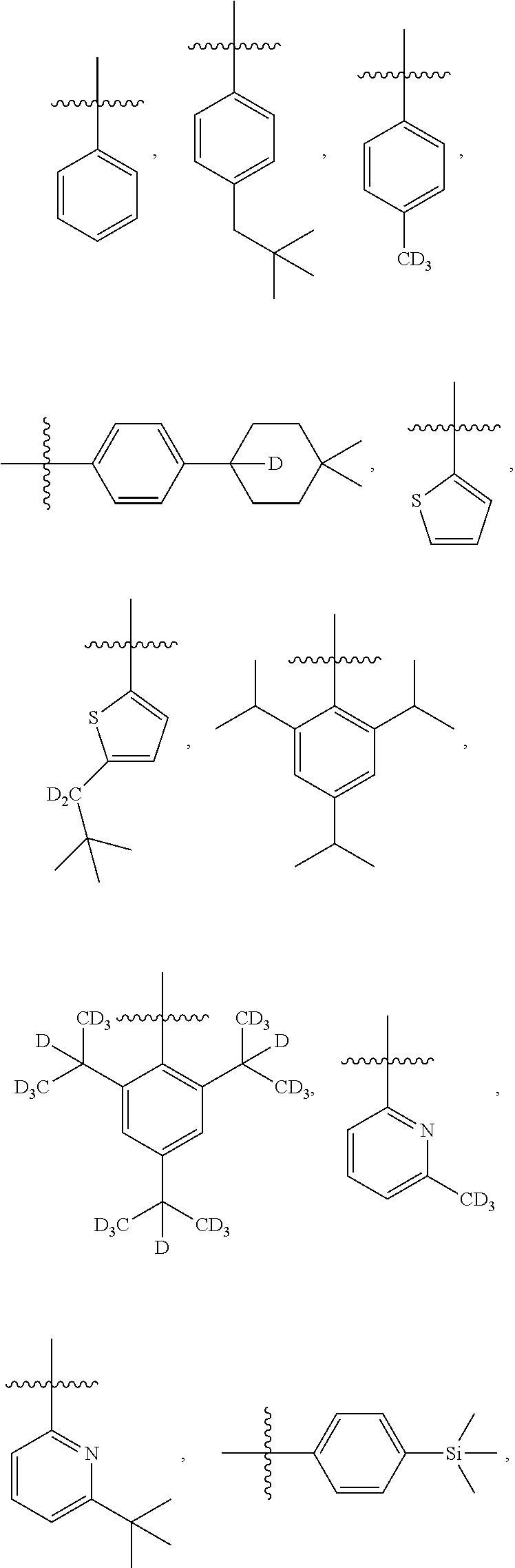

11. The compound of claim 1 , wherein the ligand LA is selected from the group consisting of:


wherein:
ring D is a 5-membered or 6-membered carbocyclic or heterocyclic ring;
each of RD, RA, and RCC independently represents mono to the maximum allowable substitution, or no substitutions;
each RD′, RAA, RCC, RA1, RA2, and RA3 is independently a hydrogen or a substituent selected from the group consisting of deuterium, halogen, alkyl, cycloalkyl, heteroalkyl, heterocycloalkyl, boryl, arylalkyl, alkoxy, aryloxy, amino, silyl, germyl, alkenyl, cycloalkenyl, heteroalkenyl, alkynyl, aryl, heteroaryl, acyl, carboxylic acid, ether, ester, nitrile, isonitrile, sulfanyl, sulfinyl, sulfonyl, phosphino, selenyl, and combinations thereof; and
any two adjacent RD′, RAA, RCC, RA1, RA2, or RA3 can be joined to form a ring.
12. The compound of claim 1 , wherein the ligand LA is selected from the group consisting of LAi-m, wherein i is an integer from 1 to 2040, and m is an integer from 1 to 41, and each of LAi-1 to LAi-41 has the structure defined below:


wherein for each i from 1 to 2040, moieties R1, R2, and GX, are defined as follows:
wherein RF1 to RF58 have the following structures:


wherein G1 to G20 have the following structures:


13. The compound of claim 1 , wherein the compound has a formula selected from the group consisting of Ir(LA)3, Ir(LA)(LB)2, Ir(LA)2(LB), Ir(LA)2(LC), and Ir(LA)(LB)(LC); and wherein LA, LB, and LC are different from each other.
14. The compound of claim 13 , wherein LB and LC are each independently selected from the group consisting of:


wherein:
T is selected from the group consisting of B, Al, Ga, and In;
K1′ is a direct bond or is selected from the group consisting of NRe, PRe, O, S, and Se;
each of Y1 to Y13 is independently selected from the group consisting of C and N;
Y′ is selected from the group consisting of BRe, BReRf, NRe, PRe, P(O)Re, O, S, Se, C═O, C═S, C═Se, C═NRe, C═CReRf, S═O, SO2, CReRf, SiReRf, and GeReRf′;
Re and Rf can be fused or joined to form a ring;
each Ra, Rb, Rc, and Rd independently represents from mono to the maximum allowed number of substitutions, or no substitution;
each of Ra1, Rb1, Rc1, Rd1, Ra, Rb, Rc, Rd, Re, and Rf is independently a hydrogen or a substituent selected from the group consisting of deuterium, halide, alkyl, cycloalkyl, heteroalkyl, arylalkyl, alkoxy, aryloxy, amino, silyl, germyl, boryl, alkenyl, cycloalkenyl, heteroalkenyl, alkynyl, aryl, heteroaryl, acyl, carbonyl, carboxylic acid, ester, nitrile, isonitrile, sulfanyl, selenyl, sulfinyl, sulfonyl, phosphino, and combinations thereof; and
any two substituents of Ra1, Rb1, Rc1, Rd1, Ra, Rb, Rc, and Rd can be fused or joined to form a ring or form a multidentate ligand.
15. The compound of claim 13 , wherein LA can be selected from LAi-m, wherein i is an integer from 1 to 2040 and m is an integer from 1 to 41; LB can be selected from LBk, wherein k is an integer from 1 to 324; and LC can be selected from LCj-I or LCj-II, wherein j is an integer from 1 to 1416;
wherein:
when the compound has formula Ir(LAi-m)3, the compound is selected from the group consisting of Ir(LA1-1)3 to Ir(LA2040-41)3;
when the compound has formula Ir(LAi-m)(LBk)2, the compound is selected from the group consisting of Ir(LA1-1)(LB1)2 to Ir(LA2040-41)(LB324)2;
when the compound has formula Ir(LAi-m)2(LBk), the compound is selected from the group consisting of Ir(LA1-1)2(LB1) to Ir(LA2040-41)2(LB324);
when the compound has formula Ir(LAi-m)2(LCj-I), the compound is selected from the group consisting of Ir(LA1-1)2(LC1-I) to Ir(LA2040-41)2(LC1416-I); and
when the compound has formula Ir(LAi-m)2(LCj-II), the compound is selected from the group consisting of Ir(LA1-1)2(LC1-II) to Ir(LA2040-41)2(LC1416-II);
wherein each LBk has the structure defined as follows:


wherein each LCj-I has a structure based on formula

and
each LCj-II has a structure based on formula

wherein for each LCj in LCj-I and LCj-II, R201 and R202 are
each independently defined as follows:
wherein RD1 to RD246 have the following structures:


16. The compound of claim 1 , wherein the compound is selected from the group consisting of:


17. An organic light emitting device (OLED) comprising:
an anode;
a cathode; and
an organic layer disposed between the anode and the cathode, wherein the organic layer comprises a compound comprising a first ligand LA of Formula I:
wherein:

Ring A is a 5-membered or 6-membered heterocyclic ring;
moiety G has a structure of

wherein:
the dashed line marked with * is coordinated to Ir;
the dashed line marked with # is bonded to Ring A;
Y is selected from the group consisting of BR, BRR′, NR, PR, O, S, Se, C═O, C═S, C═Se, C═NR, C═CRR′, S═O, SO2, CR, CRR′, SiRR′, and GeRR′;
RA, RB, RC, and RD each independently represents mono to the maximum allowable substitution, or no substitutions;
each RA, RB, RC, R, and R′ is independently a hydrogen or a substituent selected from the group consisting of deuterium, halogen, alkyl, cycloalkyl, heteroalkyl, heterocycloalkyl, boryl, arylalkyl, alkoxy, aryloxy, amino, silyl, germyl, alkenyl, cycloalkenyl, heteroalkenyl, alkynyl, aryl, heteroaryl, acyl, carboxylic acid, ether, ester, nitrile, isonitrile, sulfanyl, sulfinyl, sulfonyl, phosphino, selenyl, and combinations thereof;
(i) when moiety G has a structure of Formula I: then,
ring D is a 5-membered or 6-membered carbocyclic or heterocyclic ring;
each of X5, X6, X7, X8, X9, X10, and X11 is independently C or N;
at least two of X5, X6, X7, and X8 are C;
at least two of X9, X10, and X11 are C;
at least one RA is not hydrogen;
each RD is independently a hydrogen or a substituent selected from the group consisting of deuterium, halogen, alkyl, heteroalkyl, boryl, arylalkyl, alkoxy, aryloxy, amino, silyl, germyl, alkenyl, cycloalkenyl, heteroalkenyl, alkynyl, acyl, carboxylic acid, ether, ester, nitrile, isonitrile, sulfanyl, sulfinyl, sulfonyl, phosphino, selenyl, and combinations thereof;
Ring B is attached to Ring A and Ir by C; and
when Y is S, ring D is not 2,6-dimethylphenyl;
(ii) when moiety G has a structure of Formula III: then,
C1, C2, and C3 are carbon atoms;
at least one RA is R*;
R* is an aromatic cyclic group or —ZR1R2R3;
Z is C, Si, or Ge;
R1, R2, and R3 are each independently selected from the group consisting of alkyl, heteroalkyl, cycloalkyl, heterocycloalkyl, aryl, and heteroaryl;
at least one RB or RC is R**;
R** is an aromatic cyclic group;
if RC is R**, then it is attached to C1, C2, or C3, with the proviso that the compound does not
comprise a ligand of Formula IV,

where RZ is silyl or germyl;
wherein:
LA is coordinated to Ir through the indicated dashed lines in Formula I to form a 5-membered chelate ring;
Ir may be coordinated to other ligands;
LA may be joined with other ligands to form a tridentate, tetradentate, pentadentate, or hexadentate ligand; and
any two of RA, RB, RC, RD, R1, R2, R3, R, and R′ may be joined or fused to form a ring, with the proviso that R* does not form a ring with a RA substituent and R** does not form a ring with a RB or RC substituent.
18. The OLED of claim 17 , wherein the organic layer further comprises a host, wherein host comprises at least one chemical moiety selected from the group consisting of triphenylene, carbazole, indolocarbazole, dibenzothiophene, dibenzofuran, dibenzoselenophene, 5λ2-benzo[d]benzo[4,5]imidazo[3,2-a]imidazole, 5,9-dioxa-13b-boranaphtho[3,2,1-de]anthracene, triazine, aza-triphenylene, aza-carbazole, aza-indolocarbazole, aza-dibenzothiophene, aza-dibenzofuran, aza-dibenzoselenophene, aza-5λ2-benzo[d]benzo[4,5]imidazo[3,2-a]imidazole, and aza-(5,9-dioxa-13b-boranaphtho[3,2,1-de]anthracene).
19. The OLED of claim 18 , wherein the host is selected from the group consisting of:


and combinations thereof.
20. A consumer prodcut comprising an organic light-emitting device (OLED) comprising:
an anode;
a cathode; and
an organic layer disposed between the anode and the cathode, wherein the organic layer comprises a compound comprising a first ligand LA of Formula I:

wherein:
Ring A is a 5-membered or 6-membered heterocyclic ring;
moiety G has a structure of

wherein:
the dashed line marked with * is coordinated to Ir;
the dashed line marked with # is bonded to Ring A;
Y is selected from the group consisting of BR, BRR′, NR, PR, O, S, Se, C═O, C═S, C═Se, C═NR, C═CRR′, S═O, SO2, CR, CRR′, SiRR′, and GeRR′;
RA, RB, RC, and RD each independently represents mono to the maximum allowable substitution, or no substitutions;
each RA, RB, RC, R, and R′ is independently a hydrogen or a substituent selected from the group consisting of deuterium, halogen, alkyl, cycloalkyl, heteroalkyl, heterocycloalkyl, boryl, arylalkyl, alkoxy, aryloxy, amino, silyl, germyl, alkenyl, cycloalkenyl, heteroalkenyl, alkynyl, aryl, heteroaryl, acyl, carboxylic acid, ether, ester, nitrile, isonitrile, sulfanyl, sulfinyl, sulfonyl, phosphino, selenyl, and combinations thereof;
(i) when moiety G has a structure of Formula I: then,
ring D is a 5-membered or 6-membered carbocyclic or heterocyclic ring;
each of X5, X6, X7, X8, X9, X10, and X11 is independently C or N;
at least two of X5, X6, X7, and X8 are C;
at least two of X9, X10, and X11 are C;
at least one RA is not hydrogen;
each RD is independently a hydrogen or a substituent selected from the group consisting of deuterium, halogen, alkyl, heteroalkyl, boryl, arylalkyl, alkoxy, aryloxy, amino, silyl, germyl, alkenyl, cycloalkenyl, heteroalkenyl, alkynyl, acyl, carboxylic acid, ether, ester, nitrile, isonitrile, sulfanyl, sulfinyl, sulfonyl, phosphino, selenyl, and combinations thereof;
Ring B is attached to Ring A and Ir by C; and
when Y is S, ring D is not 2,6-dimethylphenyl;
(ii) when moiety G has a structure of Formula III: then,
C1, C2, and C3 are carbon atoms;
at least one RA is R*;
R* is an aromatic cyclic group or  ZR1R2R3;
Z is C, Si, or Ge;
R1, R2, and R3 are each independently selected from the group consisting of alkyl, heteroalkyl, cycloalkyl, heterocycloalkyl, aryl, and heteroaryl;
at least one RB or RC is R**;
R** is an aromatic cyclic group;
if RC is R**, then it is attached to C1, C2, or C3, with the proviso that the compound does not comprise a ligand of Formula IV,

where RZ is silyl or germyl;
wherein:
LA is coordinated to Ir through the indicated dashed lines in Formula I to form a 5-membered chelate ring;
Ir may be coordinated to other ligands;
LA may be joined with other ligands to form a tridentate, tetradentate, pentadentate, or hexadentate ligand; and
any two of RA, RB, RC, RD, R1, R2, R3, R, and R′ may be joined or fused to form a ring, with the proviso that R* does not form a ring with a RA substituent and R** does not form a ring with a RB or RC substituent.
Priority Applications (3)
| Application Number | Priority Date | Filing Date | Title |
|---|---|---|---|
| US18/068,707 US20230225184A1 (en) | 2022-01-11 | 2022-12-20 | Organic electroluminescent materials and devices |
| KR1020230003458A KR20230108714A (en) | 2022-01-11 | 2023-01-10 | Organic electroluminescent materials and devices |
| CN202310037902.1A CN116425801A (en) | 2022-01-11 | 2023-01-10 | Organic electroluminescent material and device |
Applications Claiming Priority (2)
| Application Number | Priority Date | Filing Date | Title |
|---|---|---|---|
| US202263298306P | 2022-01-11 | 2022-01-11 | |
| US18/068,707 US20230225184A1 (en) | 2022-01-11 | 2022-12-20 | Organic electroluminescent materials and devices |
Publications (1)
| Publication Number | Publication Date |
|---|---|
| US20230225184A1 true US20230225184A1 (en) | 2023-07-13 |
Family
ID=87069353
Family Applications (1)
| Application Number | Title | Priority Date | Filing Date |
|---|---|---|---|
| US18/068,707 Pending US20230225184A1 (en) | 2022-01-11 | 2022-12-20 | Organic electroluminescent materials and devices |
Country Status (3)
| Country | Link |
|---|---|
| US (1) | US20230225184A1 (en) |
| KR (1) | KR20230108714A (en) |
| CN (1) | CN116425801A (en) |
Cited By (2)
| Publication number | Priority date | Publication date | Assignee | Title |
|---|---|---|---|---|
| EP4549448A1 (en) * | 2023-11-02 | 2025-05-07 | Samsung Electronics Co., Ltd. | Organometallic compound, organic light-emitting device including the same, and electronic apparatus including organic light-emitting device |
| WO2025210013A1 (en) | 2024-04-04 | 2025-10-09 | Merck Patent Gmbh | Compounds for electronic devices, in particular compounds for oleds |
Families Citing this family (1)
| Publication number | Priority date | Publication date | Assignee | Title |
|---|---|---|---|---|
| CN117777207B (en) * | 2024-02-23 | 2024-05-28 | 吉林奥来德光电材料股份有限公司 | An organic metal iridium complex and an organic electroluminescent device containing the same |
-
2022
- 2022-12-20 US US18/068,707 patent/US20230225184A1/en active Pending
-
2023
- 2023-01-10 KR KR1020230003458A patent/KR20230108714A/en active Pending
- 2023-01-10 CN CN202310037902.1A patent/CN116425801A/en active Pending
Cited By (2)
| Publication number | Priority date | Publication date | Assignee | Title |
|---|---|---|---|---|
| EP4549448A1 (en) * | 2023-11-02 | 2025-05-07 | Samsung Electronics Co., Ltd. | Organometallic compound, organic light-emitting device including the same, and electronic apparatus including organic light-emitting device |
| WO2025210013A1 (en) | 2024-04-04 | 2025-10-09 | Merck Patent Gmbh | Compounds for electronic devices, in particular compounds for oleds |
Also Published As
| Publication number | Publication date |
|---|---|
| CN116425801A (en) | 2023-07-14 |
| KR20230108714A (en) | 2023-07-18 |
Similar Documents
| Publication | Publication Date | Title |
|---|---|---|
| US11999886B2 (en) | Organic electroluminescent materials and devices | |
| US20220306669A1 (en) | Organic electroluminescent materials and devices | |
| US20220275013A1 (en) | Organic electroluminescent materials and devices | |
| US20230225184A1 (en) | Organic electroluminescent materials and devices | |
| US12201013B2 (en) | Organic electroluminescent materials and devices | |
| US20220173337A1 (en) | Organic electroluminescent materials and devices | |
| US12018036B2 (en) | Heteroleptic organic electroluminescent materials and devices | |
| US20260001900A1 (en) | Organic electroluminescent materials and devices | |
| US20220324892A1 (en) | Organic electroluminescent materials and devices | |
| US20230348510A1 (en) | Organic electroluminescent materials and devices | |
| US20260035399A1 (en) | Organic electroluminescent materials and devices | |
| US20230092059A1 (en) | Organic electroluminescent materials and devices | |
| US20230124626A1 (en) | Organic electroluminescent materials and devices | |
| US20230008665A1 (en) | Organic electroluminescent materials and devices | |
| US20240196728A1 (en) | Organic electroluminescent materials and devices | |
| US20230143449A1 (en) | Organic electroluminescent materials and devices | |
| US20230391811A1 (en) | Organic electroluminescent materials and devices | |
| US12312365B2 (en) | Organic electroluminescent materials and devices | |
| US20220271240A1 (en) | Organic electroluminescent materials and devices | |
| US12486451B2 (en) | Organic electroluminescent materials and devices | |
| US20210288269A1 (en) | Organic electroluminescent materials and devices | |
| US11827651B2 (en) | Organic electroluminescent materials and devices | |
| US20240016051A1 (en) | Organic electroluminescent materials and devices | |
| US20230020526A1 (en) | Organic electroluminescent materials and devices | |
| US20230263048A1 (en) | Organic electroluminescent materials and devices |
Legal Events
| Date | Code | Title | Description |
|---|---|---|---|
| AS | Assignment |
Owner name: UNIVERSAL DISPLAY CORPORATION, NEW JERSEY Free format text: NUNC PRO TUNC ASSIGNMENT;ASSIGNORS:BOUDREAULT, PIERRE-LUC T.;ALLEYNE, BERT;DYATKIN, ALEXEY BORISOVICH;AND OTHERS;SIGNING DATES FROM 20221219 TO 20221220;REEL/FRAME:062165/0566 |
|
| STPP | Information on status: patent application and granting procedure in general |
Free format text: DOCKETED NEW CASE - READY FOR EXAMINATION |
|
| STPP | Information on status: patent application and granting procedure in general |
Free format text: NON FINAL ACTION MAILED |
|
| STPP | Information on status: patent application and granting procedure in general |
Free format text: RESPONSE TO NON-FINAL OFFICE ACTION ENTERED AND FORWARDED TO EXAMINER |
|
| STPP | Information on status: patent application and granting procedure in general |
Free format text: NON FINAL ACTION COUNTED, NOT YET MAILED |