US20140308225A1 - Use of Oleogels in UV Absorber Compositions - Google Patents
Use of Oleogels in UV Absorber Compositions Download PDFInfo
- Publication number
- US20140308225A1 US20140308225A1 US14/358,790 US201214358790A US2014308225A1 US 20140308225 A1 US20140308225 A1 US 20140308225A1 US 201214358790 A US201214358790 A US 201214358790A US 2014308225 A1 US2014308225 A1 US 2014308225A1
- Authority
- US
- United States
- Prior art keywords
- compound
- oil
- formula
- esters
- alkyl
- Prior art date
- Legal status (The legal status is an assumption and is not a legal conclusion. Google has not performed a legal analysis and makes no representation as to the accuracy of the status listed.)
- Abandoned
Links
- 0 [1*]OC1=CC(O)=C(C2=NC(C3=CC=C(O[2*])C=C3O)=NC(C)=N2)C=C1 Chemical compound [1*]OC1=CC(O)=C(C2=NC(C3=CC=C(O[2*])C=C3O)=NC(C)=N2)C=C1 0.000 description 10
- RMQKXNOOYIKJCU-UHFFFAOYSA-N CCCCC(CCCC)COC(=O)C1=CC=C(NC2=NC(NC3=CC=C(C(=O)NC(C)(C)C)C=C3)=NC(NC3=CC=C(C(=O)OCC(CCCC)CCCC)C=C3)=N2)C=C1 Chemical compound CCCCC(CCCC)COC(=O)C1=CC=C(NC2=NC(NC3=CC=C(C(=O)NC(C)(C)C)C=C3)=NC(NC3=CC=C(C(=O)OCC(CCCC)CCCC)C=C3)=N2)C=C1 RMQKXNOOYIKJCU-UHFFFAOYSA-N 0.000 description 5
- YBGZDTIWKVFICR-JLHYYAGUSA-N CCCCC(CC)COC(=O)/C=C/C1=CC=C(OC)C=C1 Chemical compound CCCCC(CC)COC(=O)/C=C/C1=CC=C(OC)C=C1 YBGZDTIWKVFICR-JLHYYAGUSA-N 0.000 description 3
- FMJSMJQBSVNSBF-UHFFFAOYSA-N CCCCC(CC)COC(=O)C(C#N)=C(C1=CC=CC=C1)C1=CC=CC=C1 Chemical compound CCCCC(CC)COC(=O)C(C#N)=C(C1=CC=CC=C1)C1=CC=CC=C1 FMJSMJQBSVNSBF-UHFFFAOYSA-N 0.000 description 3
- FMRHJJZUHUTGKE-UHFFFAOYSA-N CCCCC(CC)COC(=O)C1=C(O)C=CC=C1 Chemical compound CCCCC(CC)COC(=O)C1=C(O)C=CC=C1 FMRHJJZUHUTGKE-UHFFFAOYSA-N 0.000 description 3
- JGUMTYWKIBJSTN-UHFFFAOYSA-N CCCCC(CC)COC(=O)C1=CC=C(NC2=NC(NC3=CC=C(C(=O)OCC(CC)CCCC)C=C3)=NC(NC3=CC=C(C(=O)OCC(CC)CCCC)C=C3)=N2)C=C1 Chemical compound CCCCC(CC)COC(=O)C1=CC=C(NC2=NC(NC3=CC=C(C(=O)OCC(CC)CCCC)C=C3)=NC(NC3=CC=C(C(=O)OCC(CC)CCCC)C=C3)=N2)C=C1 JGUMTYWKIBJSTN-UHFFFAOYSA-N 0.000 description 3
- XVAMCHGMPYWHNL-UHFFFAOYSA-N CCCCC(CC)COC1=CC=C(C2=NC(C3=CC=C(OC)C=C3)=NC(C3=C(O)C=C(OCC(CC)CCCC)C=C3)=N2)C(O)=C1 Chemical compound CCCCC(CC)COC1=CC=C(C2=NC(C3=CC=C(OC)C=C3)=NC(C3=C(O)C=C(OCC(CC)CCCC)C=C3)=N2)C(O)=C1 XVAMCHGMPYWHNL-UHFFFAOYSA-N 0.000 description 3
- AUAJZVNLUWKOBV-UHFFFAOYSA-N CCCCC1=CC=C(C(=O)CC(=O)C2=CC=C(OC)C=C2)C=C1 Chemical compound CCCCC1=CC=C(C(=O)CC(=O)C2=CC=C(OC)C=C2)C=C1 AUAJZVNLUWKOBV-UHFFFAOYSA-N 0.000 description 3
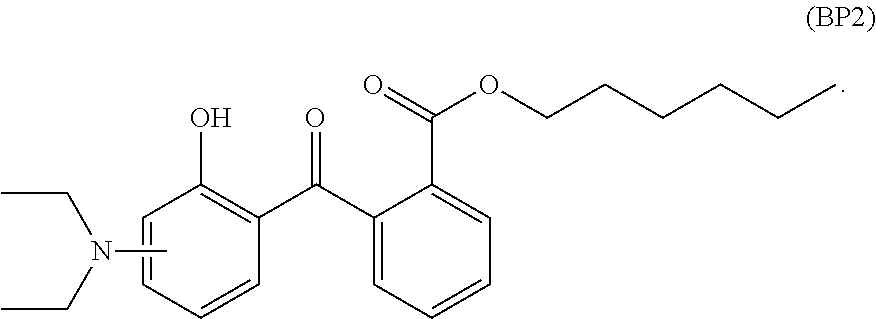
- KYIPCVKUWLLROC-UHFFFAOYSA-N CCCCCCOC(=O)C1=CC=CC=C1C(=O)C1=C(O)C=CC=C1.CCN(C)CC Chemical compound CCCCCCOC(=O)C1=CC=CC=C1C(=O)C1=C(O)C=CC=C1.CCN(C)CC KYIPCVKUWLLROC-UHFFFAOYSA-N 0.000 description 3
- DXGLGDHPHMLXJC-UHFFFAOYSA-N COC1=CC(O)=C(C(=O)C2=CC=CC=C2)C=C1 Chemical compound COC1=CC(O)=C(C(=O)C2=CC=CC=C2)C=C1 DXGLGDHPHMLXJC-UHFFFAOYSA-N 0.000 description 3
- XJFKFJBPFQKCLE-UHFFFAOYSA-Q CC(Cc1cc(C=C)cc([NH+]2Nc(cccc3)c3[N-]2)c1O)C[SH+](C=C)(O[SH+](C)(C)C)O[SH+](C)(C)C Chemical compound CC(Cc1cc(C=C)cc([NH+]2Nc(cccc3)c3[N-]2)c1O)C[SH+](C=C)(O[SH+](C)(C)C)O[SH+](C)(C)C XJFKFJBPFQKCLE-UHFFFAOYSA-Q 0.000 description 1
- PPKLFMPYOSRQQP-UHFFFAOYSA-N CC1=CC(CC(C)C[Si](C)(O[Si](C)(C)C)O[Si](C)(C)C)=C(O)C(N2=NC3=CC=CC=C3C2)=C1 Chemical compound CC1=CC(CC(C)C[Si](C)(O[Si](C)(C)C)O[Si](C)(C)C)=C(O)C(N2=NC3=CC=CC=C3C2)=C1 PPKLFMPYOSRQQP-UHFFFAOYSA-N 0.000 description 1
- CEIHWRKHBCVHIS-UHFFFAOYSA-N CC1=CC(CC(C)C[Si](C)(O[Si](C)(C)C)O[Si](C)(C)C)=C(O)C(N2CC3=CC=CC=C3N2)=C1 Chemical compound CC1=CC(CC(C)C[Si](C)(O[Si](C)(C)C)O[Si](C)(C)C)=C(O)C(N2CC3=CC=CC=C3N2)=C1 CEIHWRKHBCVHIS-UHFFFAOYSA-N 0.000 description 1
- RQBWABUBQBPGCA-HAJGFYFRSA-N CCCCC(CC)CCC1=C/C(=C(/C#N)C(=O)OCC)CC(C)(C)C1.CCCCCCCCOC(=O)C(/C=C/C=C/N(CC)CC)S(=O)(=O)C1=CC=CC=C1 Chemical compound CCCCC(CC)CCC1=C/C(=C(/C#N)C(=O)OCC)CC(C)(C)C1.CCCCCCCCOC(=O)C(/C=C/C=C/N(CC)CC)S(=O)(=O)C1=CC=CC=C1 RQBWABUBQBPGCA-HAJGFYFRSA-N 0.000 description 1
Classifications
-
- A—HUMAN NECESSITIES
- A61—MEDICAL OR VETERINARY SCIENCE; HYGIENE
- A61K—PREPARATIONS FOR MEDICAL, DENTAL OR TOILETRY PURPOSES
- A61K8/00—Cosmetics or similar toiletry preparations
- A61K8/02—Cosmetics or similar toiletry preparations characterised by special physical form
- A61K8/04—Dispersions; Emulsions
- A61K8/042—Gels
-
- A—HUMAN NECESSITIES
- A61—MEDICAL OR VETERINARY SCIENCE; HYGIENE
- A61K—PREPARATIONS FOR MEDICAL, DENTAL OR TOILETRY PURPOSES
- A61K8/00—Cosmetics or similar toiletry preparations
- A61K8/18—Cosmetics or similar toiletry preparations characterised by the composition
- A61K8/30—Cosmetics or similar toiletry preparations characterised by the composition containing organic compounds
- A61K8/31—Hydrocarbons
-
- A—HUMAN NECESSITIES
- A61—MEDICAL OR VETERINARY SCIENCE; HYGIENE
- A61K—PREPARATIONS FOR MEDICAL, DENTAL OR TOILETRY PURPOSES
- A61K8/00—Cosmetics or similar toiletry preparations
- A61K8/18—Cosmetics or similar toiletry preparations characterised by the composition
- A61K8/30—Cosmetics or similar toiletry preparations characterised by the composition containing organic compounds
- A61K8/33—Cosmetics or similar toiletry preparations characterised by the composition containing organic compounds containing oxygen
- A61K8/34—Alcohols
-
- A—HUMAN NECESSITIES
- A61—MEDICAL OR VETERINARY SCIENCE; HYGIENE
- A61K—PREPARATIONS FOR MEDICAL, DENTAL OR TOILETRY PURPOSES
- A61K8/00—Cosmetics or similar toiletry preparations
- A61K8/18—Cosmetics or similar toiletry preparations characterised by the composition
- A61K8/30—Cosmetics or similar toiletry preparations characterised by the composition containing organic compounds
- A61K8/33—Cosmetics or similar toiletry preparations characterised by the composition containing organic compounds containing oxygen
- A61K8/34—Alcohols
- A61K8/342—Alcohols having more than seven atoms in an unbroken chain
-
- A—HUMAN NECESSITIES
- A61—MEDICAL OR VETERINARY SCIENCE; HYGIENE
- A61K—PREPARATIONS FOR MEDICAL, DENTAL OR TOILETRY PURPOSES
- A61K8/00—Cosmetics or similar toiletry preparations
- A61K8/18—Cosmetics or similar toiletry preparations characterised by the composition
- A61K8/30—Cosmetics or similar toiletry preparations characterised by the composition containing organic compounds
- A61K8/33—Cosmetics or similar toiletry preparations characterised by the composition containing organic compounds containing oxygen
- A61K8/37—Esters of carboxylic acids
-
- A—HUMAN NECESSITIES
- A61—MEDICAL OR VETERINARY SCIENCE; HYGIENE
- A61K—PREPARATIONS FOR MEDICAL, DENTAL OR TOILETRY PURPOSES
- A61K8/00—Cosmetics or similar toiletry preparations
- A61K8/18—Cosmetics or similar toiletry preparations characterised by the composition
- A61K8/30—Cosmetics or similar toiletry preparations characterised by the composition containing organic compounds
- A61K8/33—Cosmetics or similar toiletry preparations characterised by the composition containing organic compounds containing oxygen
- A61K8/37—Esters of carboxylic acids
- A61K8/375—Esters of carboxylic acids the alcohol moiety containing more than one hydroxy group
-
- A—HUMAN NECESSITIES
- A61—MEDICAL OR VETERINARY SCIENCE; HYGIENE
- A61K—PREPARATIONS FOR MEDICAL, DENTAL OR TOILETRY PURPOSES
- A61K8/00—Cosmetics or similar toiletry preparations
- A61K8/18—Cosmetics or similar toiletry preparations characterised by the composition
- A61K8/30—Cosmetics or similar toiletry preparations characterised by the composition containing organic compounds
- A61K8/49—Cosmetics or similar toiletry preparations characterised by the composition containing organic compounds containing heterocyclic compounds
- A61K8/494—Cosmetics or similar toiletry preparations characterised by the composition containing organic compounds containing heterocyclic compounds with more than one nitrogen as the only hetero atom
- A61K8/4966—Triazines or their condensed derivatives
-
- A—HUMAN NECESSITIES
- A61—MEDICAL OR VETERINARY SCIENCE; HYGIENE
- A61K—PREPARATIONS FOR MEDICAL, DENTAL OR TOILETRY PURPOSES
- A61K8/00—Cosmetics or similar toiletry preparations
- A61K8/18—Cosmetics or similar toiletry preparations characterised by the composition
- A61K8/72—Cosmetics or similar toiletry preparations characterised by the composition containing organic macromolecular compounds
- A61K8/84—Cosmetics or similar toiletry preparations characterised by the composition containing organic macromolecular compounds obtained by reactions otherwise than those involving only carbon-carbon unsaturated bonds
- A61K8/89—Polysiloxanes
- A61K8/891—Polysiloxanes saturated, e.g. dimethicone, phenyl trimethicone, C24-C28 methicone or stearyl dimethicone
-
- A—HUMAN NECESSITIES
- A61—MEDICAL OR VETERINARY SCIENCE; HYGIENE
- A61K—PREPARATIONS FOR MEDICAL, DENTAL OR TOILETRY PURPOSES
- A61K8/00—Cosmetics or similar toiletry preparations
- A61K8/18—Cosmetics or similar toiletry preparations characterised by the composition
- A61K8/92—Oils, fats or waxes; Derivatives thereof, e.g. hydrogenation products thereof
- A61K8/922—Oils, fats or waxes; Derivatives thereof, e.g. hydrogenation products thereof of vegetable origin
-
- A—HUMAN NECESSITIES
- A61—MEDICAL OR VETERINARY SCIENCE; HYGIENE
- A61Q—SPECIFIC USE OF COSMETICS OR SIMILAR TOILETRY PREPARATIONS
- A61Q17/00—Barrier preparations; Preparations brought into direct contact with the skin for affording protection against external influences, e.g. sunlight, X-rays or other harmful rays, corrosive materials, bacteria or insect stings
- A61Q17/04—Topical preparations for affording protection against sunlight or other radiation; Topical sun tanning preparations
Definitions
- Emulsions are mixtures of oils or oil soluble substances and water or water soluble components and represent the most important product type of skin care products.
- lipids Since particularly individuals with skin barrier disorders are dependent on physiological lipids in high dosage problem solutions for this specific group gain more and more importance. These lipids still are based on the application of appropriate oils, a minimum content of additives and convenient application features. For this purpose oleogels are recommended which are also known as lipogels.
- Oleogels are semisolid, semitransparent or transparent systems containing so called gel formers and an oil or a lipid as non-continuous (stationary) phase.
- the gel former develops a three-dimensional meshwork wherein the oil is immobilized.
- This typical structure can be compared with a liquid-impregnated sponge wherein the sponge represents the gel former thus enabling to assimilate large amounts of lipids.
- oleogels are generally free of water.
- Sun screen compositions comprising an oil phase have a significant influence on the properties of the UV filters, i.e. changes in both the wave length of maximum absorbance ( ⁇ max ) and molar absorptivity ( ⁇ ) can be observed for many of the sunscreen systems.
- Oleogels can therefore advantageously be used in sunscreens. Surprisingly it was found that the use of oleogels in sunscreens which contain at least one UV filter will increase the sun protection factor of sunscreen compositions.
- the present invention relates to the use of oleogels (a) for increasing the sun protection factor of sunscreens comprising at least one organic or inorganic UV filter (b).
- the stationary phase (oil or lipid) of the oleogels (a) are preferably selected from
- the stationary phase of the oleogel (a) is selected from Dibutyl Adipate Diethylhexyl Carbonate.
- the gel former of the oleogels (a) according to the present invention is preferably selected from
- the gel former of the oleogels (a) is selected from stearalkonium hectorrite in combination with propylene carbonate.
- UV filters (b) are preferably selected from
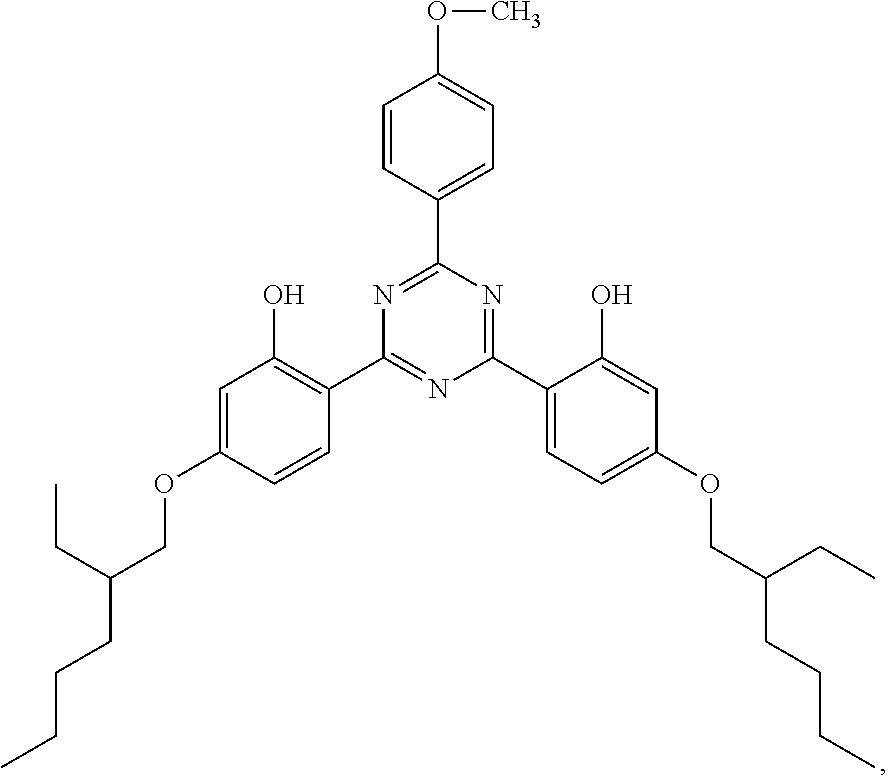
- triazine derivatives (b 1 ) are selected from compounds of formula
- triazine derivatives (b 1 ) is Bis-ethylhexyloxy methoxy-phenyl triazine (BEMT) corresponding to formula
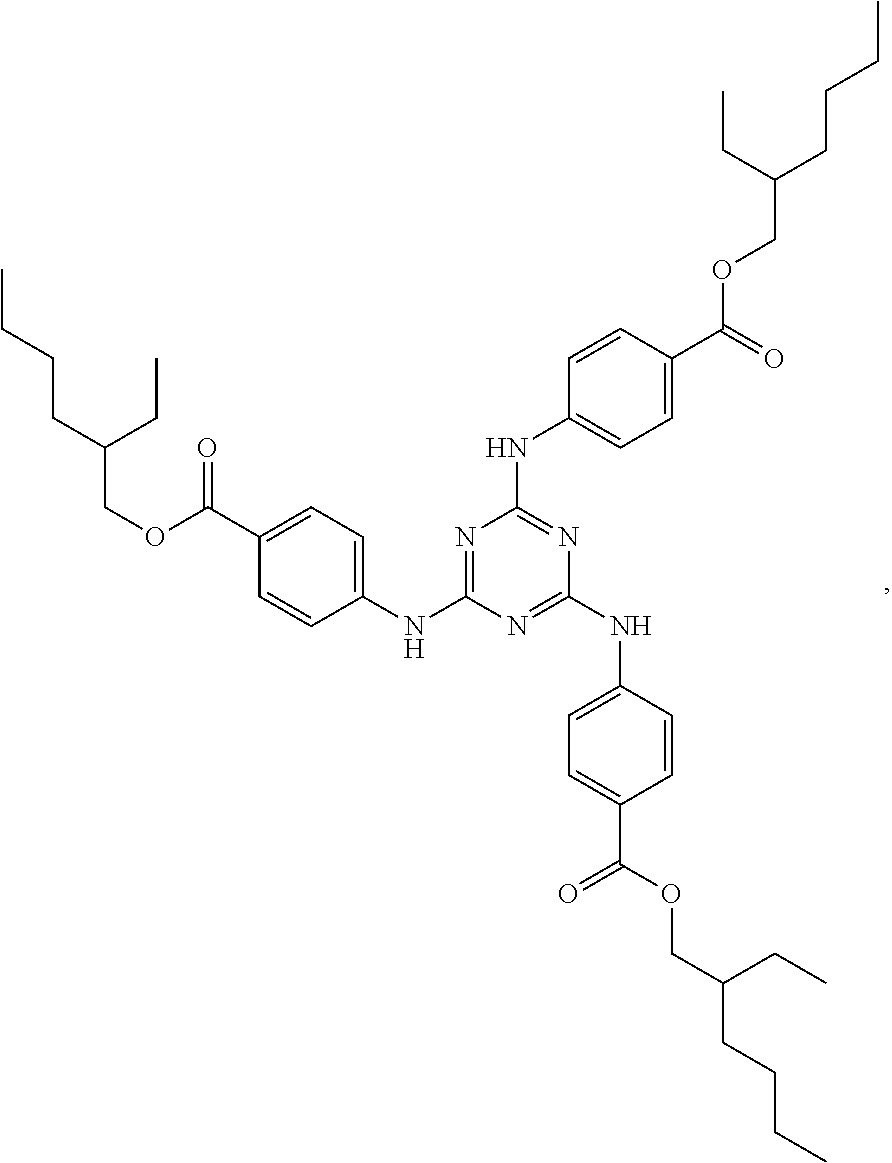
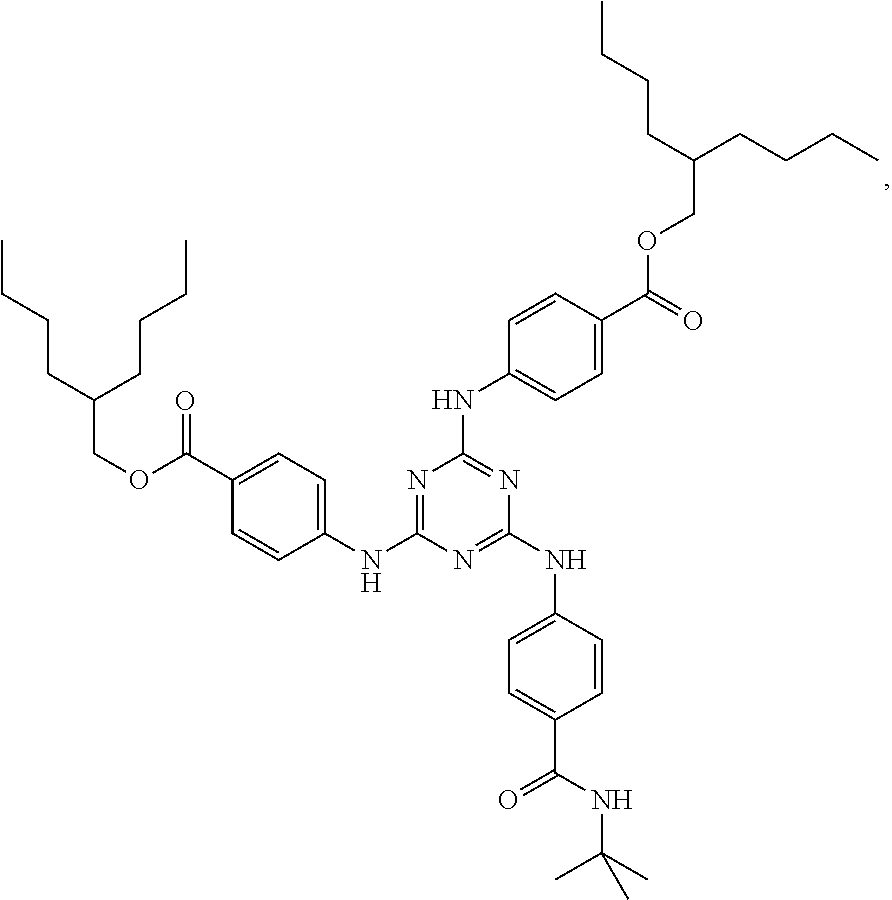
- triazine derivatives (b 1 ) which correspond to the compounds of formula
- EHT Ethylhexyl triazone
- hydroxybenzophenone derivatives (b 2 ) are amino-substituted hydroxybenzophenones corresponding to the formula
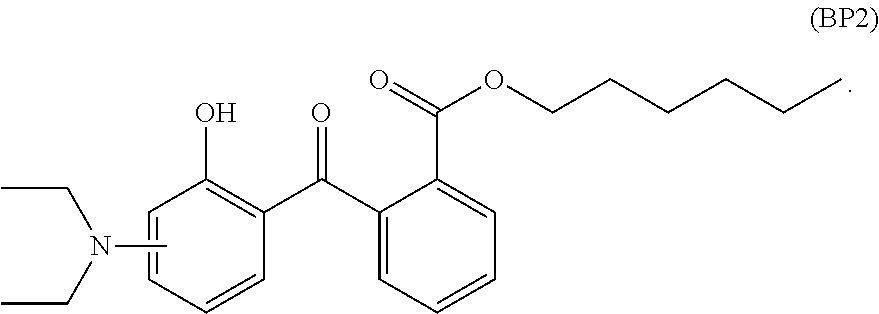
- More preferred representative of amino-substituted hydroxybenzophenones is Diethylamino hydroxybenzoyl hexyl benzoate (DHHB) corresponding to formula
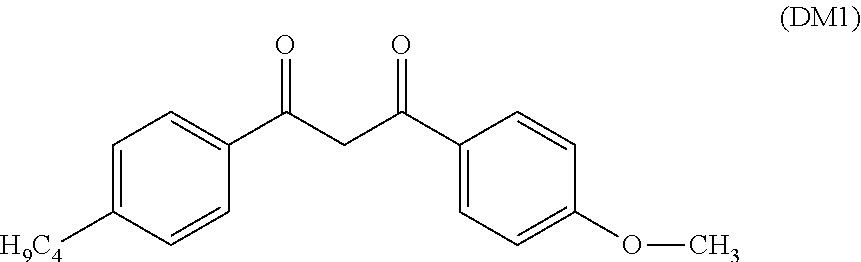
- MDBM Butyl methoxy dibenzoyl methane
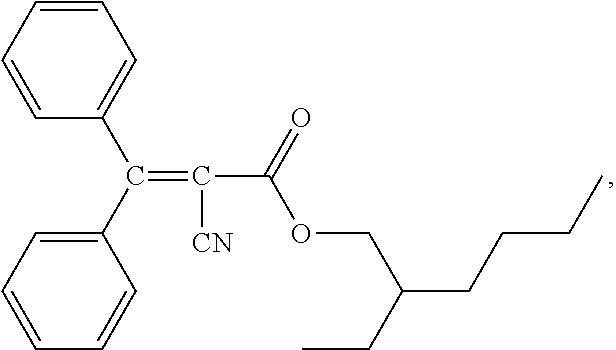
- Preferred representative of substituted acrylates (b 4 ) is Octocrylene (OCR) corresponding to the formula
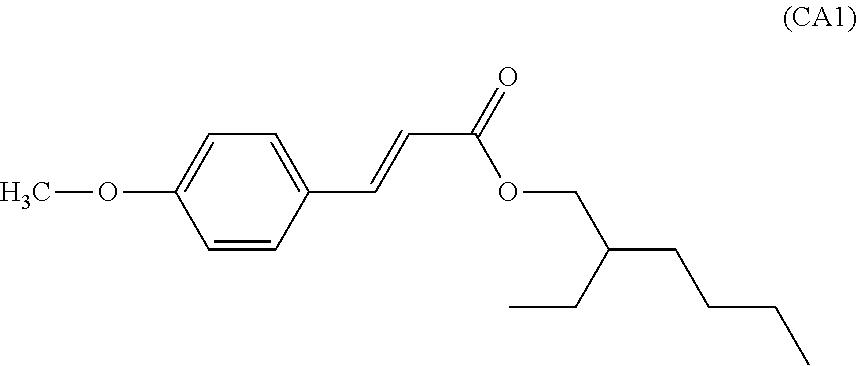
- EHMC Ethylhexylmethoxy cinnamate
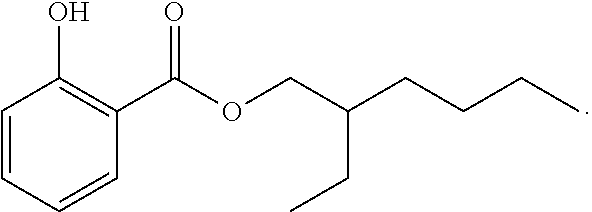
- Preferred representative of salicylic acid derivatives (b 6 ) is Ethylhexyl salicylate corresponding to the formula
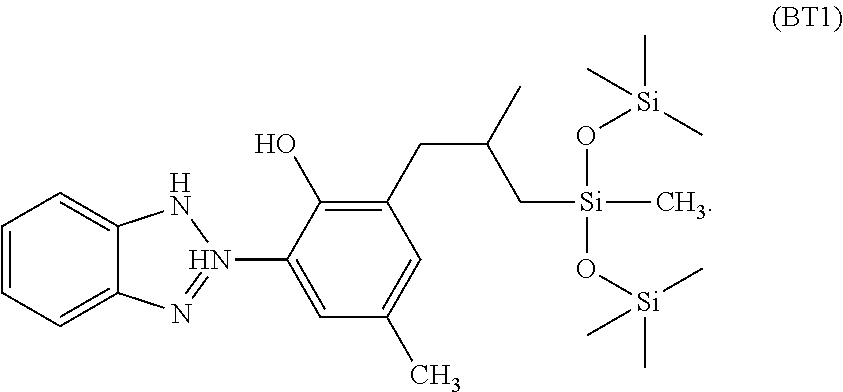
- Preferred representative of benzotriazole derivatives (b 7 ) is Drometrizole Trisiloxane corresponding to formula
- the inorganic pigments (b 8 ) are selected from oil-dispersed TiO 2 .
- UV filters (b 1 )-(b 8 ) are used in mixtures.
- oil-soluble or oil-miscible UV filters commercially used worldwide are listed in Table 1 below. All of them might be used in any combination within oleogel formulations. The concentrations may be varied as well according to the registration status in the different regions.
- the present invention relates to use of a combination of
- Oils as representatives for the non-continuous phase are for example (sp i ) Guerbet alcohols, based on fatty alcohols having from 6 to 18, preferably from 8 to 10, carbon atoms; (sp 2 ) esters of linear C 6 -C 24 fatty acids with linear C 3 -C 24 alcohols, (sp 3 ) esters of branched C 6 -C 13 carboxylic acids with linear C 6 -C 24 fatty alcohols, (sp 4 ) esters of linear C 6 -C 24 fatty acids with branched alcohols, especially 2-ethylhexanol, (sp 5 ) esters of hydroxycarboxylic acids with linear or branched C 6 -C 22 fatty alcohols, especially dioctyl malates; (sp 6 ) esters of linear and/or branched fatty acids with polyhydric alcohols, (for example propylene glycol, dimer diol or trimer triol) and/or Guerbet alcohols; (
- That group of substances comprises the esterification products of fatty acids having from 8 to 24 carbon atoms, for example caproic acid, caprylic acid, 2-ethylhexanoic acid, capric acid, lauric acid, isotridecanoic acid, myristic acid, palmitic acid, palmitoleic acid, stearic acid, isostearic acid, oleic acid, elaidic acid, petroselinic acid, linoleic acid, linolenic acid, elaeostearic acid, arachidic acid, gadoleic acid, behenic acid and erucic acid and technical-grade mixtures thereof (obtained, for example, in the pressure removal of natural fats and oils, in the reduction of aldehydes from Roelen's oxosynthesis or in the dimerisation of unsaturated fatty acids) with alcohols, for example isopropyl alcohol, caproic alcohol, capryl alcohol, 2-ethylhexyl
- Preferred oil components of the Oleogels as used in the present invention are Dibutyl Adipate and Diethylhexyl Carbonate.
- the oil components can be used in an amount of, for example, from 1 to 60% by weight, especially from 5 to 50% by weight and preferably from 10 to 35% by weight, based on the total weight of the composition.
- the UV absorber(s) (b) can be added to the oleogel before preparing the oleogel of substantially uniform appearance. It is also possible to add the UV absorber(s) (b) to the preformed stable oleogel according to the invention, with stirring, the UV absorber(s) (b) thus being distributed in the Oleogel.
- the subject of the present invention relates to a stable cosmetic composition, characterized in that it comprises
- the sunscreen composition according to the present invention is especially useful for the protection of organic materials that are sensitive to ultraviolet light, especially human and animal skin and hair, against the action of UV radiation.
- Such UV filter combinations are accordingly suitable as light-protective agents in cosmetic, pharmaceutical and veterinary medicine preparations.
- the cosmetic preparation may also comprise, in addition to the UV absorber combinations according to the invention, one or more further UV protective agents of the following substance classes:
- p-aminobenzoic acid derivatives benzophenone derivatives, 3-imidazol-4-yl acrylic acid and esters; benzofuran derivatives, polymeric UV absorbers, cinnamic acid derivatives, camphor derivatives, menthyl o-aminobenzoate; merocyanine derivatives; or encapsulated UV absorbers.
- UV absorbers described in “Sunscreens”, Eds. N. J. Lowe, N. A. Shaath, Marcel Dekker, Inc., New York and Basle or in Cosmetics & Toiletries (107), 50ff (1992) also can be used as additional UV protective substances.
- UV filter substances and adjuvants which can be additionally used with the UV absorbers of formula MBM-01-MBM-12 according to the present invention
- Helioguard 365 from Milbelle AG, isolated mycosporine like amino acids from the red alga porphyra umbilicalis (INCI: Porphyra Umbilicalis ) that are encapsulated into liposomes) 37 alpha-lipoic-acid as described in DE 10229995 38 synthetic organic polymers as described in EP 1 371 358, [0033]-[0041] 39 phyllosilicates as described in EP 1371357 [0034]-[0037] 40 silica compounds as described in EP1371356, [0033]-[0041] 42 latex particles as described in DE10138496 [0027]-[0040] 43 1H-Benzimidazole-4,6-disulfonic acid, 2,2′-(1,4-phenylene)bis-, 180898-37-7 disodium salt; Bisimidazylate (Neo Heliopan APC) 44 Di-2-ethylhexyl-3,5-dimethoxy-4-hydroxy
- BEMT Tinosorb S, Bis-Ethylhexyloxyphenol Methoxyphenyl Triazine encapsulated in a polymer matrix, for example in PMMA, as described in IP.com Journal (2009), 9(1B), 17, can also be used as additional UV protective substance.
- (A) and (B) can be either in E- or Z-configuration.
- each of the above-mentioned light-protective agents can be used in admixture with the UV absorber combination according to the invention. It will be understood in that connection that, in addition to the UV absorber combination according to the invention, it is also possible for more than one of the additional light-protective agents to be used, for example, two, three, four, five or six further light-protective agents. Preference is given to the use of mixing ratios of UV absorbers according to the invention/further light-protective agents of from 1:99 to 99:1, especially from 1:95 to 95:1 and preferably from 10:90 to 90:10, based on weight. Of special interest are mixing ratios of from 20:80 to 80:20, especially from 40:60 to 60:40 and preferably of approximately 50:50. Such mixtures can be used, inter alia, to improve solubility.
- the cosmetic compositions contain, for example, from 0.1 to 30% by weight, preferably from 0.1 to 15% by weight and especially from 0.5 to 10% by weight, based on the total weight of the composition, of the UV absorber combination according to the present invention and at least one cosmetically tolerable adjuvant.
- the cosmetic compositions can be prepared by physically mixing the UV absorbers with the adjuvant using customary methods, for example by simply stirring together the individual components, especially by making use of the dissolution properties of already known cosmetic UV absorbers, for example OMC, salicylic acid isooctyl ester, inter alia.
- the UV absorber can be used, for example, without further treatment.
- compositions according to the invention may in addition contain, as further adjuvants and additives, mild surfactants, super-fatting agents, pearlescent waxes, consistency regulators, thickeners, polymers, silicone compounds, fats, waxes, stabilisers, biogenic active ingredients, deodorising active ingredients, anti-dandruff agents, film formers, swelling agents, antioxidants, hydrotropic agents, preservatives, insect repellents, self-tanning agents, solubilizers, perfume oils, colorants, bacteria-inhibiting agents and the like.
- mild surfactants super-fatting agents
- pearlescent waxes consistency regulators, thickeners, polymers, silicone compounds, fats, waxes, stabilisers, biogenic active ingredients, deodorising active ingredients, anti-dandruff agents, film formers, swelling agents, antioxidants, hydrotropic agents, preservatives, insect repellents, self-tanning agents, solubilizers, perfume oils, colorants, bacteria-inhibiting agents and the like.
- Cosmetic formulations according to the invention are contained in a wide variety of cosmetic preparations. There come into consideration, for example, especially the following preparations: skin-care preparations, skin-tanning preparations, depigmenting preparations or insect-repellents
- the cosmetic preparation according to the invention is distinguished by excellent protection of human skin against the damaging effect of sunlight.
- Oleogels of constant UV absorber composition but differing in emollient polarity are prepared.
- six formulations with different oils are sent to in vivo sun protection factor (SPF) determination. They all show extremely high SPF-values combined with a very high variability, making a meaningful evaluation impossible.
- SPPF sun protection factor
- Bentone 27 is a hydrophobically modified sheet silicate.
- the average dimensions of a clay platelet are 80 ⁇ 800 ⁇ 1 nm. Addition of Propylene Carbonate helps in developing the network structure of the gel-forming agent in the oil.
- the UV absorber composition employed in all formulations is 5% Uvinul A plus, 2.5% Uvinul T150 and 3% Tinosorb S. Using the latest version of the BASF Sunscreen Simulator, for this composition a calculated SPF of 20.8 is obtained.
Landscapes
- Health & Medical Sciences (AREA)
- Life Sciences & Earth Sciences (AREA)
- Public Health (AREA)
- Veterinary Medicine (AREA)
- Animal Behavior & Ethology (AREA)
- General Health & Medical Sciences (AREA)
- Epidemiology (AREA)
- Birds (AREA)
- Emergency Medicine (AREA)
- Chemical & Material Sciences (AREA)
- Dispersion Chemistry (AREA)
- Dermatology (AREA)
- Oil, Petroleum & Natural Gas (AREA)
- Cosmetics (AREA)
Abstract
Description
- Most of nowadays skin-care products are based on emulsions (crèmes, lotions and milks). Emulsions are mixtures of oils or oil soluble substances and water or water soluble components and represent the most important product type of skin care products.
- In addition there still exist skin-care products with only an oily phase which are preferably recommended for problem skins and are therefore used in the dermatological cosmetics. In terms of applicability an oily skin surface is inconvenient and leaves an unpleasant feeling. These problems have been solved with the development of emulsions which increase the penetration of lipids into the skin and reduce the concentration of oils and lipids in the products. However, the presence of water in the formulations involved new problems: it became necessary to preserve the aqueous phase of the emulsions, some ingredients are sensitive to water and it was indispensible to stabilize the emulsions against long-term influences of temperature and storage.
- These problems were successfully resolved with the use of indifferent ingredients like mineral oils and waxes and additional additives. Many of these additives are not tolerated by sensitive skin. Individuals with neurodermitic skin e.g. will not tolerate the long-term use of ethoxylated alcohols which belong to the most widely used emulsifiers. Allergy sufferers have problems with appropriate preservatives etc.
- Since particularly individuals with skin barrier disorders are dependent on physiological lipids in high dosage problem solutions for this specific group gain more and more importance. These lipids still are based on the application of appropriate oils, a minimum content of additives and convenient application features. For this purpose oleogels are recommended which are also known as lipogels.
- Oleogels are semisolid, semitransparent or transparent systems containing so called gel formers and an oil or a lipid as non-continuous (stationary) phase. The gel former develops a three-dimensional meshwork wherein the oil is immobilized. This typical structure can be compared with a liquid-impregnated sponge wherein the sponge represents the gel former thus enabling to assimilate large amounts of lipids. In contrast to hydrogels oleogels are generally free of water.
- Sun screen compositions comprising an oil phase have a significant influence on the properties of the UV filters, i.e. changes in both the wave length of maximum absorbance (λmax) and molar absorptivity (ε) can be observed for many of the sunscreen systems.
- Oleogels can therefore advantageously be used in sunscreens. Surprisingly it was found that the use of oleogels in sunscreens which contain at least one UV filter will increase the sun protection factor of sunscreen compositions.
- Therefore, the present invention relates to the use of oleogels (a) for increasing the sun protection factor of sunscreens comprising at least one organic or inorganic UV filter (b).
- The stationary phase (oil or lipid) of the oleogels (a) are preferably selected from
-
- (sp1) Guerbet alcohols,
- (sp2) esters of linear C6-C24 fatty acids with linear C3-C24 alcohols,
- (sp3) esters of branched C6-C13carboxylic acids with linear C6-C24 fatty alcohols,
- (sp4) esters of linear C6-C24 fatty acids with branched alcohols,
- (sp5) esters of hydroxycarboxylic acids with linear or branched C6-C22 fatty alcohols,
- (sp6) esters of linear and/or branched fatty acids with polyhydric alcohols,
- (sp7) triglycerides based on C6-C10 fatty acids,
- (sp8) liquid mono-/di-/tri-glyceride mixtures based on C6-C18 fatty acids,
- (sp9) esters of C6-C24 fatty alcohols and/or Guerbet alcohols with aromatic carboxylic acids,
- (sp10) esters of C2-C12dicarboxylic acids with linear or branched alcohols having from 1 to 22 carbon atoms or polyols having from 2 to 10 carbon atoms and from 2 to 6 hydroxy groups,
- (sp11) vegetable oils,
- (sp12) branched primary alcohols,
- (sp13) substituted cyclohexanes,
- (sp14) linear and branched C6-C22 fatty alcohol carbonates,
- (sp15) Guerbet carbonates,
- (sp16) esters of benzoic acid with linear and/or branched C6-C22alcohols,
- (sp17) linear or branched, symmetric or asymmetric dialkyl ethers having a total of from 12 to 36 carbon atoms,
- (sp18) silicone oils,
- (sp19) aliphatic or naphthenic hydrocarbons,
- (sp20) monoesters of fatty acids with alcohols having from 3 to 24 carbon atoms,
- (sp21) isopropyl myristate,
- (sp22) isononanoic acid C16-C18alkyl esters,
- (sp23) stearic acid 2-ethylhexyl ester,
- (sp24) cetyl oleate,
- (sp25) glycerol tricaprylate,
- (sp26) coconut fatty alcohol caprinate/caprylate
- (sp27) n-butyl stearate
- (sp28) dicarboxylic acid esters,
- (sp29) diol esters,
- (sp30) polyols and
- (sp31) di- and/or trivalent metal salts.
- Most preferably the stationary phase of the oleogel (a) is selected from Dibutyl Adipate Diethylhexyl Carbonate.
- The gel former of the oleogels (a) according to the present invention is preferably selected from
-
- (gf1) stearalkonium hectorite (bentonite),
- (gf2) gelatine,
- (gf3) silica,
- (gf4) montmorillonite,
- (gf5) monoglyceridees and diglycerides,
- (gf6) polysaccharides,
- (gf7) pectins and
- (gf8) specific polymers.
- Most preferably the gel former of the oleogels (a) is selected from stearalkonium hectorrite in combination with propylene carbonate.
- The UV filters (b) according to the present invention are preferably selected from
-
- (b1) triazine derivatives,
- (b2) hydroxybenzophenone derivatives,
- (b3) Methoxydibenzoylmethane derivatives,
- (b4) substituted acrylates,
- (b5) cinnamic acid derivatives,
- (b6) salicylic acid derivatives,
- (b7) benzotriazole derivatives; and
- (b8) inorganic pigments.
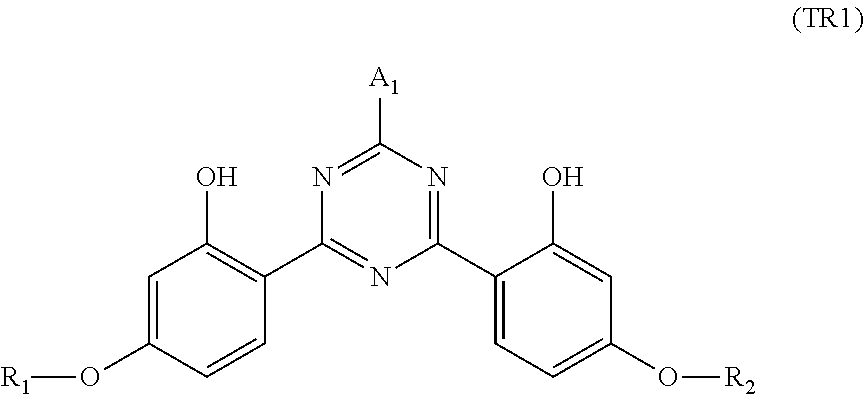
- More preferably the triazine derivatives (b1) are selected from compounds of formula
-
- wherein
-
- R1 and R2 are each independently of the other C1-C18alkyl; C2-C18alkenyl; or a radical of formula —CH2—CH(—OH)—CH2—O-T1;
- A1 is a radical of formula
-

-
-
- R3 is hydrogen; or C1-C10alkyl,
- R4 is hydrogen; M; or C1-C5alkyl;
- R5 is C1-C18alkyl; and
- M is a metal cation.
-
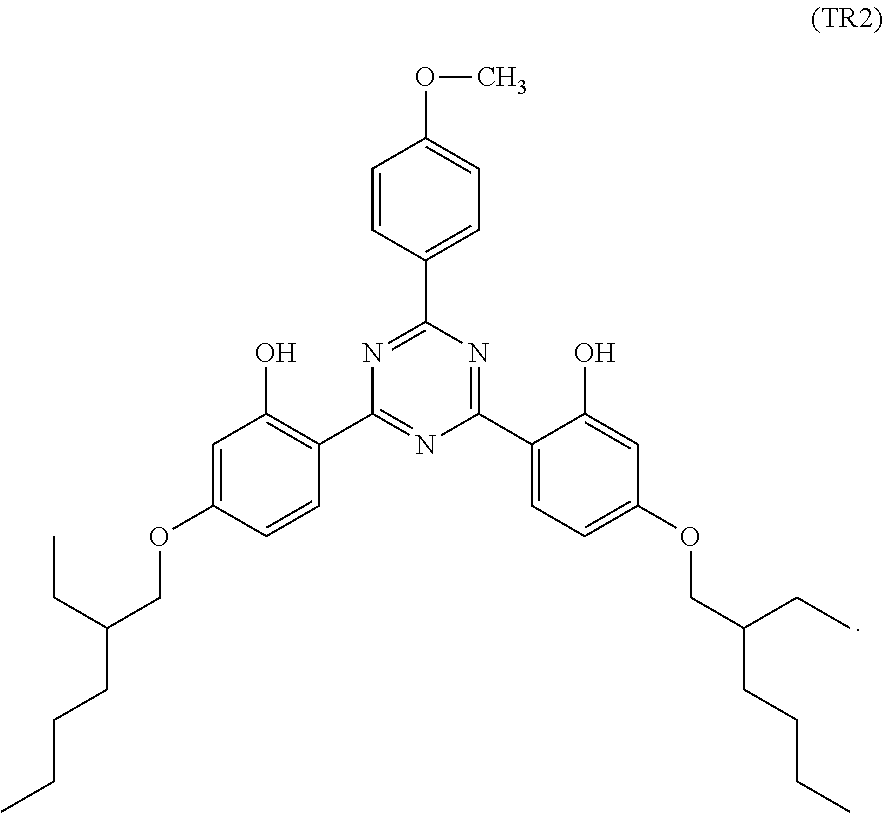
- Most preferred representative of the triazine derivatives (b1) is Bis-ethylhexyloxy methoxy-phenyl triazine (BEMT) corresponding to formula
-

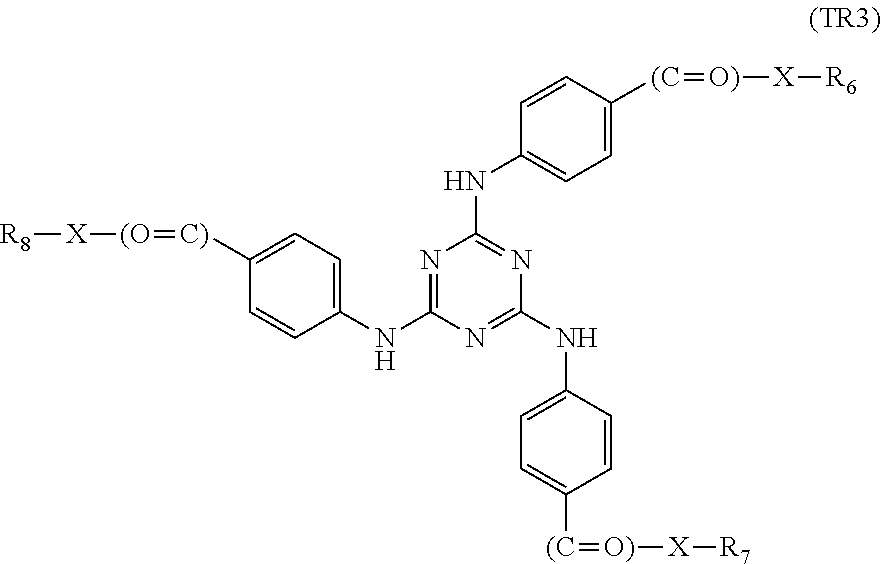
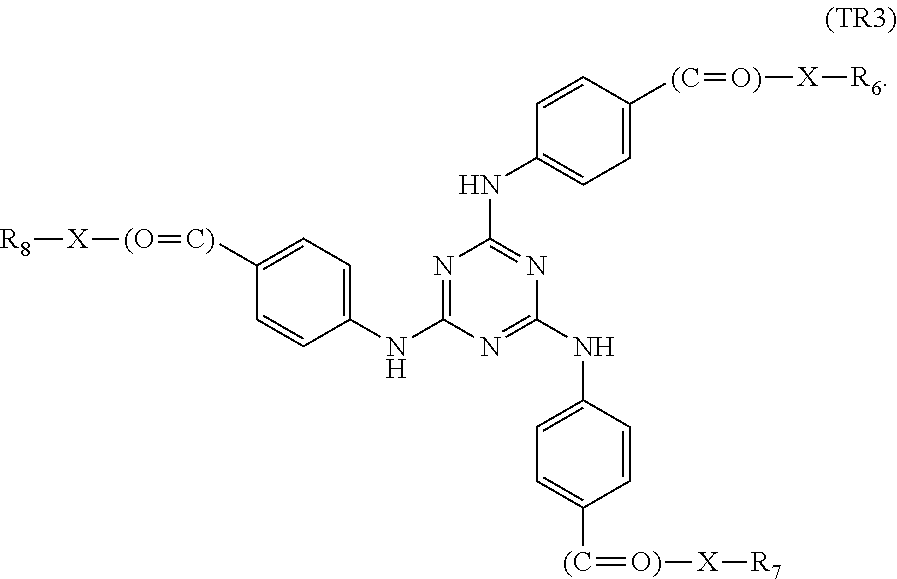
- Also preferred are triazine derivatives (b1) which correspond to the compounds of formula
-
- wherein
-
- R6, R7 and R8 independently of each other are C1-C20alkyl, C6-C10aryl, heteroaryl, optionally substituted;
- X is O; or NR9; and
- R9 is hydrogen; C1-C20alkyl, C6-C10aryl, heteroaryl, optionally substituted,
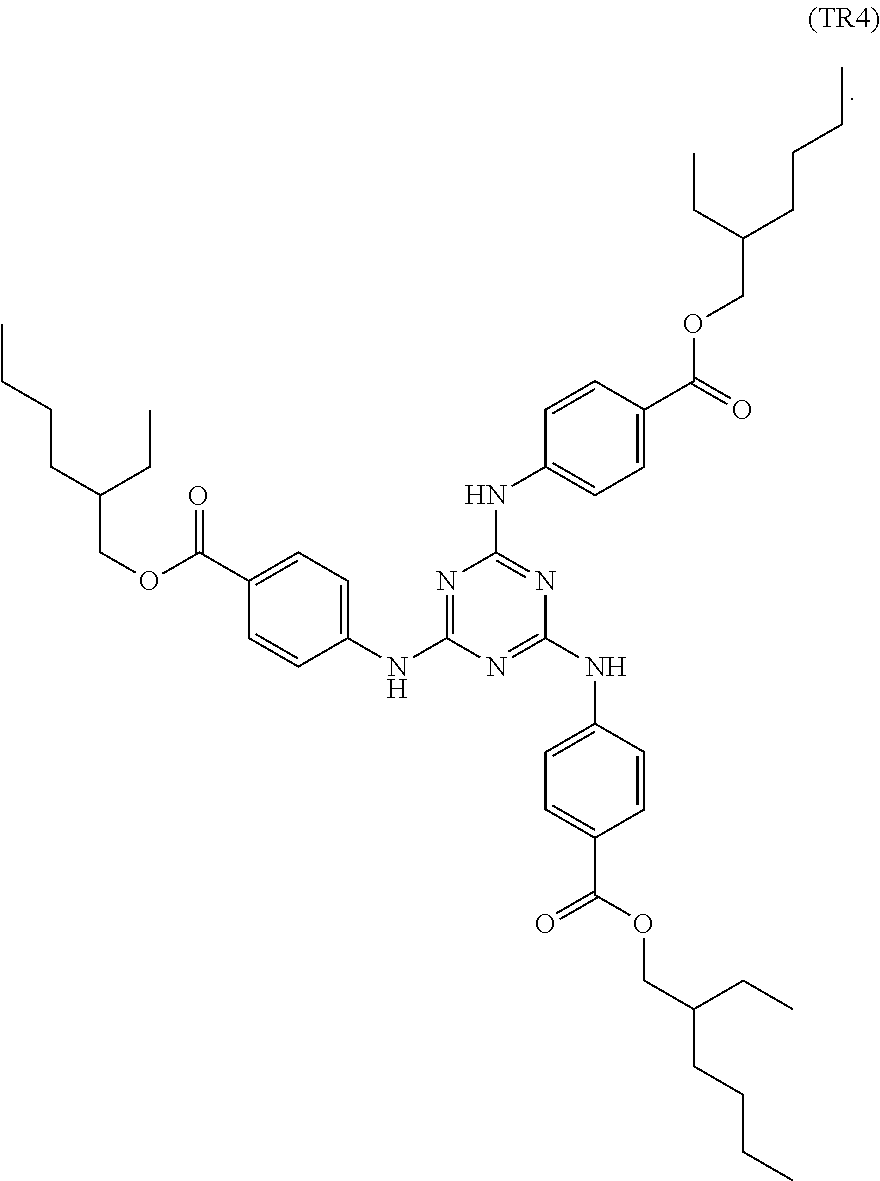
- Most preferred representative is Ethylhexyl triazone (EHT) corresponding to formula
-
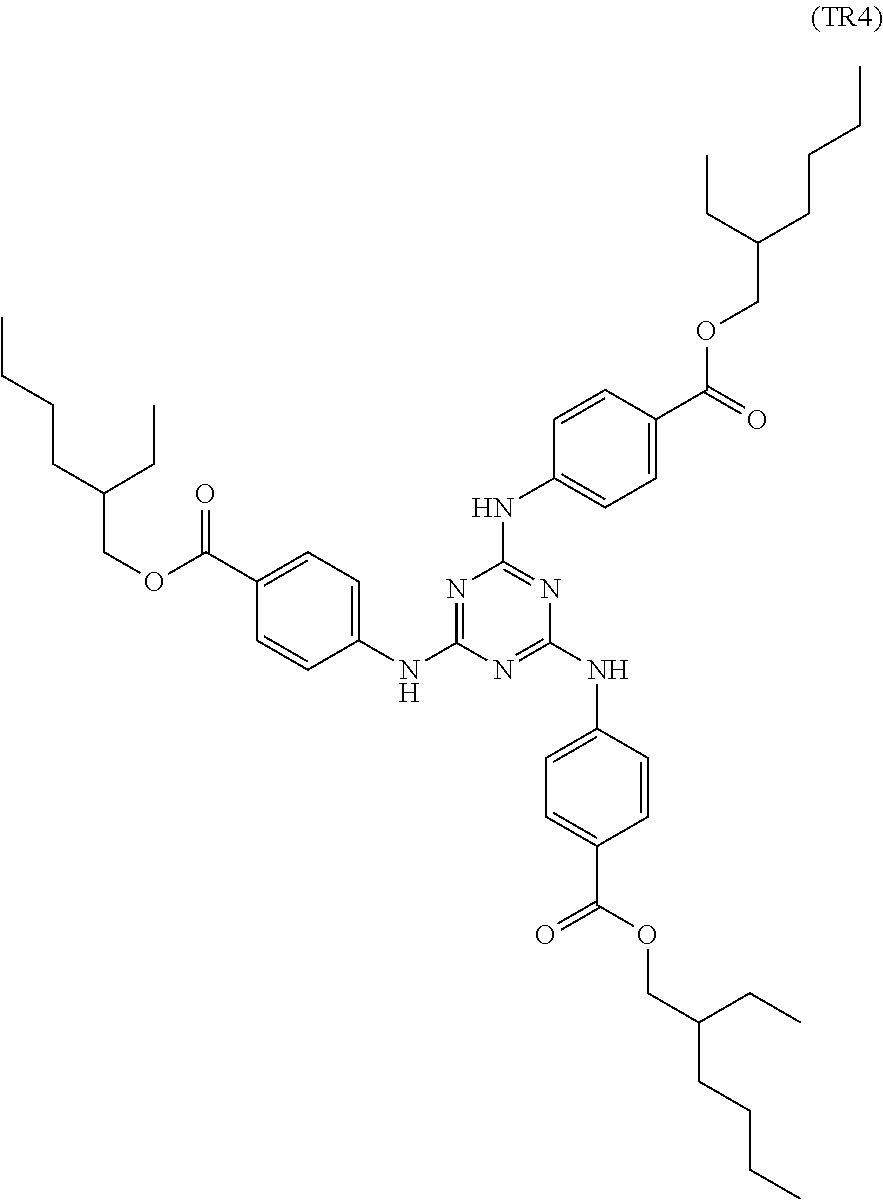
- or Diethylhexyl butamido triazone (DBT) corresponding to formula
-

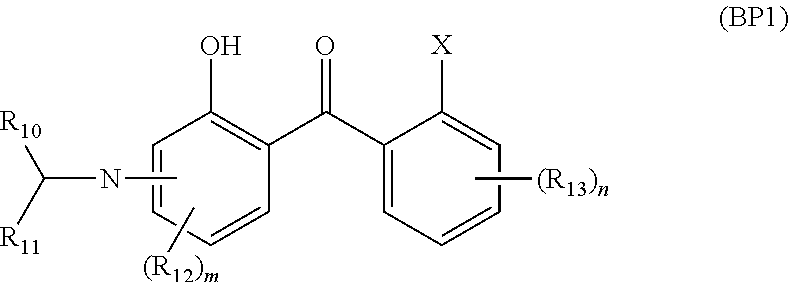
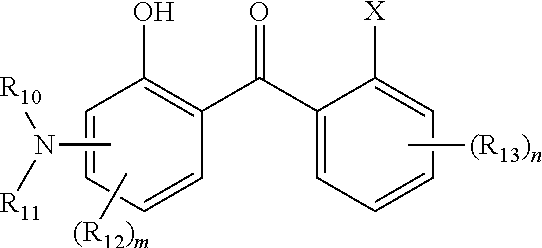
- Preferably the hydroxybenzophenone derivatives (b2) are amino-substituted hydroxybenzophenones corresponding to the formula
-
- wherein
-
- R10 and R11, independently from each other are hydrogen, C1-C20alkyl, C2-C10alkenyl, C3-C10cycloalkyl, C3-C10cycloalkenyl, where the substituents R10 and R11 together with the nitrogen atom to which they are bonded may form a 5- or 6-membered ring;
- R12 and R13 independently from each other are C1C20alkyl; C2-C10alkenyl; C3-C10cycloalkyl; C3-C10cycloalkenyl; C1-C12alkoxy; C1-C20alkoxycarbonyl; C1-C12alkylamino; C1-C12dialkylamino; aryl; heteroaryl, optionally substituted; substituents which confer solubility in water, chosen from the group consisting of a nitrile group, carboxylate, sulfonate and ammonium radicals;
- X is hydrogen; COOR14; or CONR15R16;
- R14 to R16 are hydrogen; C1-C20alkyl; C2-C10alkenyl; C3-C10cycloalkyl; C3-C10cycloalkenyl, or —(Y—O)o—Z, C6-C10aryl;
- Y is —(CH2)2—; —(CH2)3—, —(CH2)4—; or —CH(CH3)—CH2—;
- Z is —CH2—CH3; —CH2—CH2—CH3; —CH2—CH2—CH2—CH3; or —CH(CH3)—CH3;
- m is from 0 to 3;
- n is from 0 to 4; and
- o is from 1 to 20.
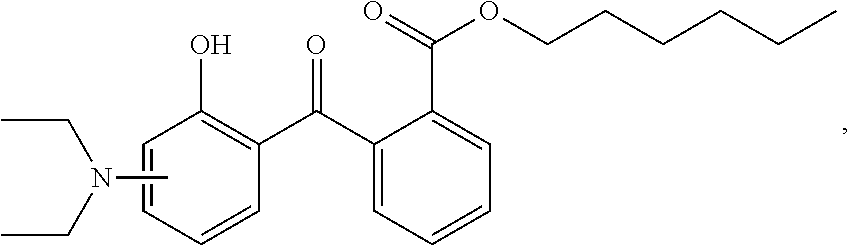
- More preferred representative of amino-substituted hydroxybenzophenones (b2) is Diethylamino hydroxybenzoyl hexyl benzoate (DHHB) corresponding to formula
-
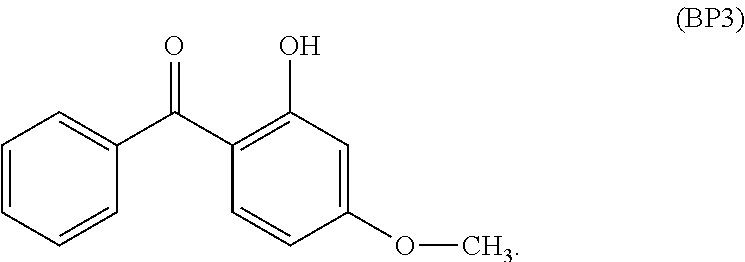
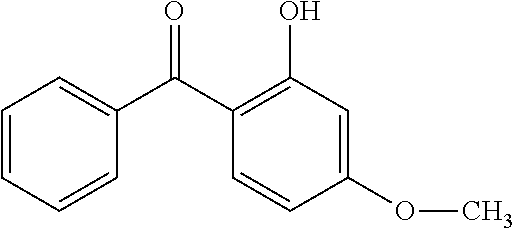
- Further preferred representative of (b2) is Benzophenone-3 (B-3) corresponding to formula
-
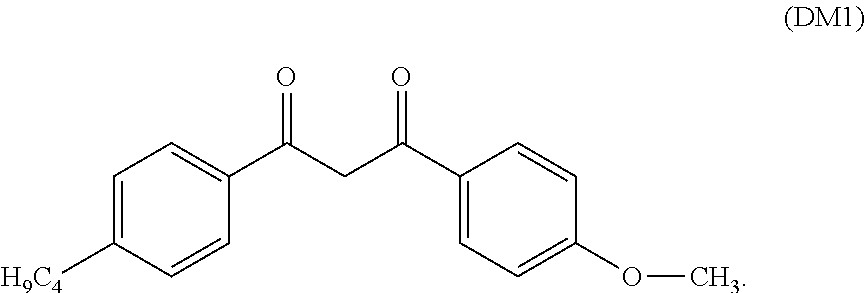
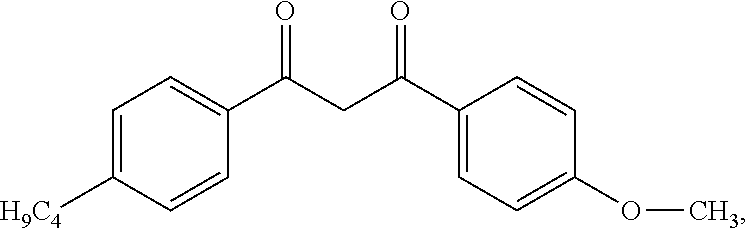
- Preferred representative of the methoxydibenzoylmethane derivatives (b3) is Butyl methoxy dibenzoyl methane (BMDBM) corresponding the formula
-
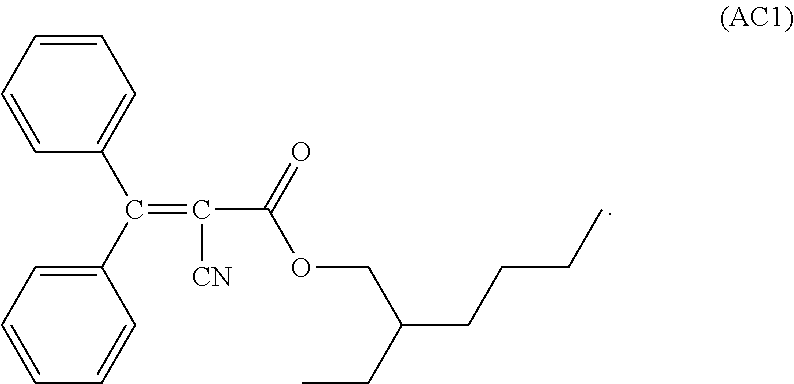
- Preferred representative of substituted acrylates (b4) is Octocrylene (OCR) corresponding to the formula
-
- Preferred representative of cinnamic acid derivatives (b5) is Ethylhexylmethoxy cinnamate (EHMC) corresponding to the formula
-

- Preferred representative of salicylic acid derivatives (b6) is Ethylhexyl salicylate corresponding to the formula
-

- Preferred representative of benzotriazole derivatives (b7) is Drometrizole Trisiloxane corresponding to formula
-

- Preferably the inorganic pigments (b8) are selected from oil-dispersed TiO2.
- More preferably the UV filters (b1)-(b8) are used in mixtures.
- The oil-soluble or oil-miscible UV filters commercially used worldwide are listed in Table 1 below. All of them might be used in any combination within oleogel formulations. The concentrations may be varied as well according to the registration status in the different regions.
-
TABLE 1 Oil-soluble or oil-miscible UV filters INCI* name and Registration status, max. incorporation level abbreviation USAN* λmax USA Japan Europe Australia Ethylhexyl dimethyl Padimate-O 311 nm 8% 10% 8% 8% PABA (ED-PABA) Homomenthyl Homosalate 306 nm 15% 10% 10% 15% salicylate (HMS) Ethylhexyl Octisalate 305 nm 5% 10% 5% 5% salicylate (EHS) Isoamylmethoxy Amiloxate 308 nm TEA* 10% 10% 10% cinnamate (IMC) Ethylhexylmethoxy Octinoxate 311 nm 7.5% 20% 10% 10% cinnamate (EHMC) Octocrylene (OCR) Octocrylene 303 nm 10% 10% 10% 10% Polysilicone — 312 nm — 10% 10% 10% 15 (BMP) Benzophenone-3 (B-3) Oxybenzone 324 nm 6% 5% 10% 10% 4-Methyl benzylidene Enzacamene 300 nm TEA* — 4% 4% camphor (MBC) Ethylhexyl — 314 nm TEA* 3% 5% 5% triazone (EHT) Diethylhexyl butamido — 311 nm — — 10% — triazone (DBT) Menthyl anthranilate (MA) Meradimate 336 nm 5% — — 5% Butyl methoxy dibenzoyl Avobenzone 357 nm 3% 10% 5% 5% methane (BMDBM) Diethylamino — 354 nm — — 10% — hydroxybenzoyl hexyl benzoate (DHHB) Drometrizole — 303 & — 10% 15% 15% Trisiloxane (DTS) 341 nm Bis-ethylhexyloxy Bemotrizinol 310 & TEA* 3% 10% 10% methoxyphenyl 343 nm triazine (BEMT) - Examples of mixtures of 2 UV-filters which are preferably used according to the present invention:
-
- (Mix01) compound (TR2) and compound (CA1);
- (Mix02) compound (TR2) and compound (TR4);
- (Mix03) compound (TR2) and compound (TR5);
- (Mix04) compound (TR2) and compound (AC1);
- (Mix05) compound (BP1) and compound (CA1);
- (Mix06) compound (BP1) and compound (TR4);
- (Mix07) compound (BP1) and compound (TR5);
- (Mix08) compound (BP1) and compound (AC1);
- (Mix09) compound (TR2) and compound (BP1);
- (Mix10) compound (TR4) and compound (CA1);
- (Mix11) compound (TR5) and compound (CA1);
- (Mix12) compound (DM1) and compound (TR4);
- (Mix13) compound (DM1) and compound (TR5);
- (Mix14) compound (DM1) and compound (AC1);
- (Mix15) oil-dispersed TiO2 and compound (TR2):
- (Mix16) oil-dispersed TiO2 and compound (BP1);
- (Mix17) oil-dispersed TiO2 and compound (TR4);
- (Mix18) oil-dispersed TiO2 and compound (TR5);
- (Mix19) oil-dispersed TiO2 and compound (CA1);
- (Mix20) oil-dispersed TiO2 and compound (AC1);
- (Mix21) oil-dispersed ZnO and compound (TR2);
- (Mix22) oil-dispersed ZnO and compound (TR2);
- (Mix23) oil-dispersed ZnO and compound (BP1);
- (Mix24) oil-dispersed ZnO and compound (TR4);
- (Mix25) oil-dispersed ZnO and compound (TR5);
- (Mix26) oil-dispersed TiO2 and oil-dispersed ZnO;
- (Mix27) compound (DM1) and compound (AC1);
- (Mix28) compound (DM1) and compound (TR2);
- Examples of mixtures of 3 UV-filters which are preferably used according to the present invention:
-
- (Mix29): compound (DM1) and compound (AC1); and compound (TR2);
- (Mix30): compound (DM1) and compound (AC1); and compound (TR4);
- (Mix31): compound (DM1) and compound (AC1); and compound (TR5);
- (Mix32): compound (CA1) and compound (BP2); and compound (TR4);
- (Mix33): compound (CA1) and compound (BP2); and compound (TR5);
- (Mix34): compound (CA1) and compound (BP2); and compound (TR2);
- (Mix35): compound (DM1) and compound (BP3); and compound (AC1);
- (Mix36): compound (CA1) and compound (BP2); and compound (BP3);
- (Mix37): compound (TR2) and compound (TR4); and compound (BP2);
- Examples of mixtures of 4 UV-filters which are preferably used according to the present invention:
-
- (Mix38): compound (DM1) and compound (AC1); and compound (TR2); and compound (TR4);
- (Mix39): compound (DM1) and compound (AC1); and compound (TR2); and compound (TR5);
- (Mix40): compound (CA1) and compound (BP2); and compound (TR2); and compound (TR4);
- (Mix41): compound (CA1) and compound (BP2); and compound (TR2); and compound (TR5);
- (Mix42): compound (CA1) and compound (BP2); and compound (BP3); and compound (TR2);
- (Mix43): compound (CA1) and compound (BP2); and compound (TR2); and compound (TR5).
- Examples of mixtures of 5 UV-filters which are preferably used according to the present invention:
-
- (Mix44): compound (CA1) and compound (BP2); and compound (TR2); and compound (TR4); and compound (ES1);
- (Mix45): compound (CA1) and compound (BP2); and compound (TR2); and compound (TR5); and compound (ES1);
- (Mix46): compound (DM1) and compound (AC1); and compound (TR2); and compound (TR4); and compound (ES1);
- (Mix47): compound (CA1) and compound (AC1); and compound (TR2); and compound (TR5); and compound (ES1).
- Most preferably mixtures of (Mix37) comprising the compound (TR2) and compound (TR4) and compound (BP2) are used.
- Most preferably the present invention relates to use of a combination of
-
- (a) the oleogel formed from (gf1) stearalkonium hectorite and the stationary phase selected from Dibutyl Adipate and Diethylhexyl Carbonate; and
- (b) (Mix37) comprising compound (TR2) and compound (TR4) and compound (BP2).
- Oils as representatives for the non-continuous phase are for example (spi) Guerbet alcohols, based on fatty alcohols having from 6 to 18, preferably from 8 to 10, carbon atoms; (sp2) esters of linear C6-C24 fatty acids with linear C3-C24 alcohols, (sp3) esters of branched C6-C13carboxylic acids with linear C6-C24 fatty alcohols, (sp4) esters of linear C6-C24 fatty acids with branched alcohols, especially 2-ethylhexanol, (sp5) esters of hydroxycarboxylic acids with linear or branched C6-C22 fatty alcohols, especially dioctyl malates; (sp6) esters of linear and/or branched fatty acids with polyhydric alcohols, (for example propylene glycol, dimer diol or trimer triol) and/or Guerbet alcohols; (sp7) triglycerides based on C6-C10 fatty acids; (sp8) liquid mono-/di-/tri-glyceride mixtures based on C6-C18 fatty acids; (sp9) esters of C6-C24 fatty alcohols and/or Guerbet alcohols with aromatic carboxylic acids, especially benzoic acid; (sp10) esters of C2-C12dicarboxylic acids with linear or branched alcohols having from 1 to 22 carbon atoms or polyols having from 2 to 10 carbon atoms and from 2 to 6 hydroxy groups; (sp11) vegetable oils, such as sunflower oil, olive oil, soybean oil, rapeseed oil, almond oil, jojoba oil, orange oil, wheat germ oil, peach kernel oil and the liquid components of coconut oil; (sp12) branched primary alcohols; (sp13) substituted cyclohexanes; (sp14) linear and branched C6-C22 fatty alcohol carbonates; (sp15) Guerbet carbonates; (sp16) esters of benzoic acid with linear and/or branched C6-C22alcohols (e.g. Finsolv® TN); (sp17) linear or branched, symmetric or asymmetric dialkyl ethers having a total of from 12 to 36 carbon atoms, especially from 12 to 24 carbon atoms, for example di-n-octyl ether, di-n-decyl ether, di-n-nonyl ether, di-n-undecyl ether, di-n-dodecyl ether, n-hexyl n-octyl ether, n-octyl n-decyl ether, n-decyl n-undecyl ether, n-undecyl n-dodecyl ether, n-hexyl n-undecyl ether, di-tert-butyl ether, diisopentyl ether, di-3-ethyldecyl ether, tert-butyl n-octyl ether, isopentyl n-octyl ether and 2-methyl pentyl-n-octyl ether; (sp18) silicone oils; (sp19) aliphatic or naphthenic hydrocarbons; (sp20) monoesters of fatty acids with alcohols having from 3 to 24 carbon atoms. That group of substances comprises the esterification products of fatty acids having from 8 to 24 carbon atoms, for example caproic acid, caprylic acid, 2-ethylhexanoic acid, capric acid, lauric acid, isotridecanoic acid, myristic acid, palmitic acid, palmitoleic acid, stearic acid, isostearic acid, oleic acid, elaidic acid, petroselinic acid, linoleic acid, linolenic acid, elaeostearic acid, arachidic acid, gadoleic acid, behenic acid and erucic acid and technical-grade mixtures thereof (obtained, for example, in the pressure removal of natural fats and oils, in the reduction of aldehydes from Roelen's oxosynthesis or in the dimerisation of unsaturated fatty acids) with alcohols, for example isopropyl alcohol, caproic alcohol, capryl alcohol, 2-ethylhexyl alcohol, capric alcohol, lauryl alcohol, isotridecyl alcohol, myristyl alcohol, cetyl alcohol, palmoleyl alcohol, stearyl alcohol, isostearyl alcohol, oleyl alcohol, elaidyl alcohol, petroselinyl alcohol, linoyl alcohol, linolenyl alcohol, elaeostearyl alcohol, arachidyl alcohol, gadoleyl alcohol, behenyl alcohol, erucyl alcohol and brassidyl alcohol and technical-grade mixtures thereof (obtained, for example, in the high-pressure hydrogenation of technical-grade methyl esters based on fats and oils or aldehydes from Roelen's oxosynthesis and as monomer fractions in the dimerisation of unsaturated fatty alcohols); (sp21) isopropyl myristate; (sp22) isononanoic acid C16-C18alkyl esters, (sp23) stearic acid 2-ethylhexyl ester; (sp24) cetyl oleate; (sp25) glycerol tricaprylate; (sp26) coconut fatty alcohol caprinate/caprylate; (sp27) n-butyl stearate; (sp28) dicarboxylic acid esters, such as di-n-butyl adipate, di(2-ethylhexyl) adipate, di(2-ethylhexyl)succinate and diisotridecyl acetate; (sp29) diol esters, such as ethylene glycol dioleate, ethylene glycol diisotridecanoate, propylene glycol di(2-ethylhexanoate), propylene glycol diisostearate, propylene glycol dipelargonate, butanediol diisostearate and neopentyl glycol dicaprylate; (sp30) polyols like ethanol, isopropanol, propylene glycol, hexylene glycol, glycerol and sorbitol; (sp31) di- and/or trivalent metal salts (alkaline earth metal, Al3+ inter alia) of one or more alkyl carboxylic acids.
- Preferred oil components of the Oleogels as used in the present invention are Dibutyl Adipate and Diethylhexyl Carbonate.
- The oil components can be used in an amount of, for example, from 1 to 60% by weight, especially from 5 to 50% by weight and preferably from 10 to 35% by weight, based on the total weight of the composition.
- The respective formation of the oleogel is carried out according to operating conditions known to those skilled in the art. Reference will be made in particular to the examples below.
- In particular, depending on the composition envisaged, the UV absorber(s) (b) can be added to the oleogel before preparing the oleogel of substantially uniform appearance. It is also possible to add the UV absorber(s) (b) to the preformed stable oleogel according to the invention, with stirring, the UV absorber(s) (b) thus being distributed in the Oleogel.
- Needless to say, a person skilled in the art will know to take into account the characteristics of the UV absorber(s) used, adapting the operating conditions of the process, in particular the temperature, so as possibly not to adversely affect the properties of the active ingredient(s).
- Lastly, the subject of the present invention relates to a stable cosmetic composition, characterized in that it comprises
-
- (a) a stable oleogel and
- (b) at least one organic or inorganic UV filter.
- The sunscreen composition according to the present invention is especially useful for the protection of organic materials that are sensitive to ultraviolet light, especially human and animal skin and hair, against the action of UV radiation. Such UV filter combinations are accordingly suitable as light-protective agents in cosmetic, pharmaceutical and veterinary medicine preparations.
- The cosmetic preparation may also comprise, in addition to the UV absorber combinations according to the invention, one or more further UV protective agents of the following substance classes:
- p-aminobenzoic acid derivatives, benzophenone derivatives, 3-imidazol-4-yl acrylic acid and esters; benzofuran derivatives, polymeric UV absorbers, cinnamic acid derivatives, camphor derivatives, menthyl o-aminobenzoate; merocyanine derivatives; or encapsulated UV absorbers.
- The UV absorbers described in “Sunscreens”, Eds. N. J. Lowe, N. A. Shaath, Marcel Dekker, Inc., New York and Basle or in Cosmetics & Toiletries (107), 50ff (1992) also can be used as additional UV protective substances.
- Special preference is given to the light-protective agents indicated in the following Table 2:
-
TABLE 2 Suitable UV filter substances and adjuvants which can be additionally used with the UV absorbers of formula MBM-01-MBM-12 according to the present invention No. Chemical Name CAS No. 1 (+/−)-1,7,7-trimethyl-3-[(4-methylphenyl)methylene]bicyclo- 36861-47-9 [2.2.1]heptan-2-one; p-methyl benzylidene camphor 2 1,7,7-trimethyl-3-(phenylmethylene)bicyclo[2.2.1]heptan-2-one; 15087-24-8 benzylidene camphor 3 (2-Hydroxy-4-methoxyphenyl)(4-methylphenyl)methanone 1641-17-4 4 2,4-dihydroxybenzophenone 131-56-6 5 2,2′,4,4′-tetrahydroxybenzophenone 131-55-5 6 2-Hydroxy-4-methoxy benzophenone; 131-57-7 7 2-Hydroxy-4-methoxy benzophenone-5-sulfonic acid 4065-45-6 8 2,2′-dihydroxy-4,4′-dimethoxybenzophenone 131-54-4 9 2,2′-Dihydroxy-4-methoxybenzophenone 131-53-3 10 Alpha-(2-oxoborn-3-ylidene)toluene-4-sulphonic acid and its salts 56039-58-8 (Mexoryl SL) 12 Methyl N,N,N-trimethyl-4-[(4,7,7-trimethyl-3-oxobicyclo[2,2,1]hept-2- 52793-97-2 ylidene)methyl]anilinium sulphate (Mexoryl SO) 14 2-ethylhexyl 4-(dimethylamino)benzoate 21245-02-3 16 4-aminobenzoic acid 150-13-0 17 Benzoic acid, 4-amino-, ethyl ester, polymer with oxirane 113010-52-9 18 2-Propenamide, N-[[4-[(4,7,7-trimethyl-3-oxobicyclo[2.2.1]hept-2- 147897-12-9 ylidene)methyl]phenyl]methyl]-, homopolymer 19 Triethanolamine salicylate 2174-16-5 20 3,3′-(1,4-phenylenedimethylene)bis[7,7-dimethyl-2-oxo- 90457-82-2 bicyclo[2.2.1]heptane-1 methanesulfonic acid] (Cibafast H) 22 Phenol, 2-(2H-benzotriazol-2-yl)-4-methyl-6-[2-methyl-3-[1,3,3,3- 155633-54-8 tetramethyl-1-[(trimethylsilyl)oxy]disiloxanyl]propyl]-; drometrizole trisiloxane (Mexoryl XL) 23 Dimethicodiethylbenzalmalonate; Polysilicone 15 (Parsol SLX) 207574-74-1 24 Benzenesulfonic acid, 3-(2H-benzotriazol-2-yl)-4-hydroxy-5-(1- 92484-48-5 methylpropyl)-, monosodium salt (Tinogard HS) 25 1-Dodecanaminium, N-[3-[[4-(dimethylamino)benzoyl]amino]- 156679-41-3 propyl]N,N-dimethyl-, salt with 4-methylbenzenesulfonic acid (1:1) (Escalol HP610) 26 1-Propanaminium, N,N,N-trimethyl-3-[(1-oxo-3-phenyl-2-propenyl)- 177190-98-6 amino]-, chloride 27 1H-Benzimidazole-4,6-disulfonic acid, 2,2′-(1,4-phenylene)bis- 170864-82-1 28 1-Propanaminium, 3-[[3-[3-(2H-benzotriazol-2-yl)-5-(1,1-dimethyl- 340964-15-0 ethyl)-4-hydroxyphenyl]-1-oxopropyl]amino]-N,N-diethyl-N-methyl-, methyl sulfate (salt) 29 2-Propenoic acid, 3-(1H-imidazol-4-yl)- 104-98-3 30 Benzoic acid, 2-hydroxy-, [4-(1-methylethyl)phenyl]methyl ester 94134-93-7 31 1,2,3-Propanetriol, 1-(4-aminobenzoate) (Glyceryl PABA) 136-44-7 32 Benzeneacetic acid, 3,4-dimethoxy-a-oxo- 4732-70-1 33 2-Propenoic acid, 2-cyano-3,3-diphenyl-, ethyl ester 5232-99-5 34 Anthralinic acid, p-menth-3-yl ester 134-09-8 35 sterols (cholesterol, lanosterol, phytosterols), as described in WO0341675 36 mycosporines and/or mycosporine-like amino acids as described in WO2002039974, e.g. Helioguard 365 from Milbelle AG, isolated mycosporine like amino acids from the red alga porphyra umbilicalis (INCI: Porphyra Umbilicalis) that are encapsulated into liposomes) 37 alpha-lipoic-acid as described in DE 10229995 38 synthetic organic polymers as described in EP 1 371 358, [0033]-[0041] 39 phyllosilicates as described in EP 1371357 [0034]-[0037] 40 silica compounds as described in EP1371356, [0033]-[0041] 42 latex particles as described in DE10138496 [0027]-[0040] 43 1H-Benzimidazole-4,6-disulfonic acid, 2,2′-(1,4-phenylene)bis-, 180898-37-7 disodium salt; Bisimidazylate (Neo Heliopan APC) 44 Di-2-ethylhexyl-3,5-dimethoxy-4-hydroxy-benzalmalonate (Oxynex ST, EMD Chemicals, as described in US 20040247536) 45 T-LiteTM MAX: Titanium Dioxide (and) Dimethoxydiphenylsilane (and) Triethoxycaprylylsilane Crosspolymer (and) Hydrated Silica (and) Aluminum Hydroxyde 46 T-Lite SF: Titanium Dioxide (and) Aluminum Hydroxide (and) Dimethicone/Methicone Copolymer 47 T-Lite SF-S: Titanium Dioxide (and) Hydrated Silica (and) Dimethicone/Methicone Copolymer (and) Aluminum Hydroxide 48 Z-COTE ® MAX: Zinc Oxide (and) Diphenyl Capryl Methicone 49 Z-COTE HP1: Zinc Oxide (and) Triethoxycaprylylsilane 50 1,1-[(2,2′-Dimethylpropoxy)carbonyl]-4,4-diphenyl-1,3-butadiene 363602-15-7 51 UV filter capsules containing an organic sunscreen as described in DE102007035567 or WO 2009012871 - In addition, BEMT (Tinosorb S, Bis-Ethylhexyloxyphenol Methoxyphenyl Triazine) encapsulated in a polymer matrix, for example in PMMA, as described in IP.com Journal (2009), 9(1B), 17, can also be used as additional UV protective substance.
- The following compounds can also be used as additional UV protective substances: Merocyanine derivatives as described in WO 2004/006878:
-
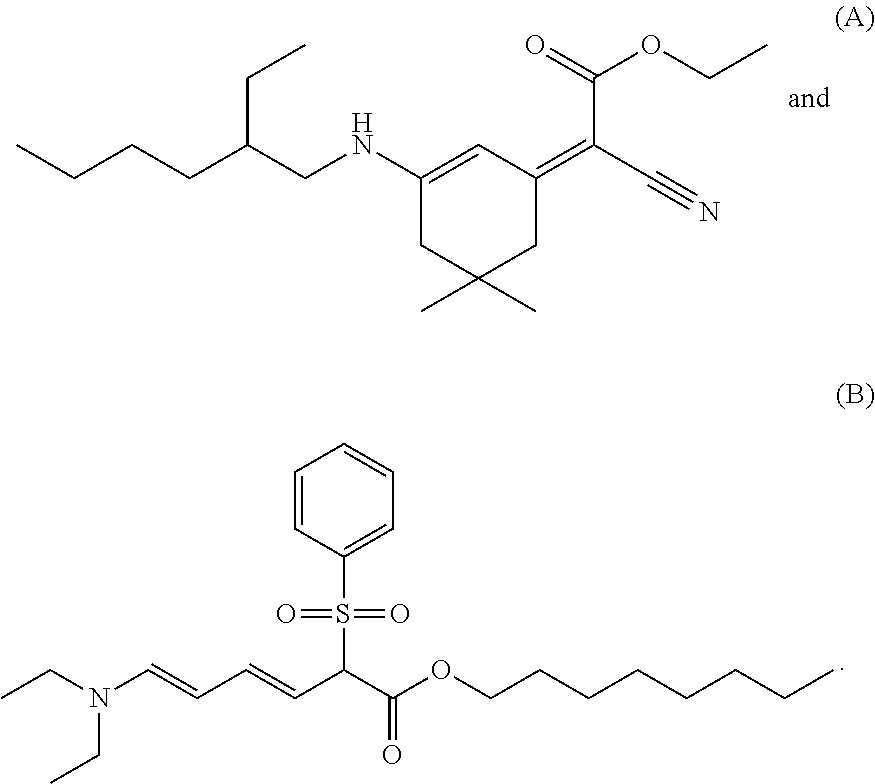
- (A) and (B) can be either in E- or Z-configuration.
- Each of the above-mentioned light-protective agents, especially the light-protective agents in the above Tables indicated as being preferred, can be used in admixture with the UV absorber combination according to the invention. It will be understood in that connection that, in addition to the UV absorber combination according to the invention, it is also possible for more than one of the additional light-protective agents to be used, for example, two, three, four, five or six further light-protective agents. Preference is given to the use of mixing ratios of UV absorbers according to the invention/further light-protective agents of from 1:99 to 99:1, especially from 1:95 to 95:1 and preferably from 10:90 to 90:10, based on weight. Of special interest are mixing ratios of from 20:80 to 80:20, especially from 40:60 to 60:40 and preferably of approximately 50:50. Such mixtures can be used, inter alia, to improve solubility.
- Appropriate mixtures can be used especially advantageously in a cosmetic composition according to the invention.
- The cosmetic compositions contain, for example, from 0.1 to 30% by weight, preferably from 0.1 to 15% by weight and especially from 0.5 to 10% by weight, based on the total weight of the composition, of the UV absorber combination according to the present invention and at least one cosmetically tolerable adjuvant.
- The cosmetic compositions can be prepared by physically mixing the UV absorbers with the adjuvant using customary methods, for example by simply stirring together the individual components, especially by making use of the dissolution properties of already known cosmetic UV absorbers, for example OMC, salicylic acid isooctyl ester, inter alia. The UV absorber can be used, for example, without further treatment.
- The compositions according to the invention may in addition contain, as further adjuvants and additives, mild surfactants, super-fatting agents, pearlescent waxes, consistency regulators, thickeners, polymers, silicone compounds, fats, waxes, stabilisers, biogenic active ingredients, deodorising active ingredients, anti-dandruff agents, film formers, swelling agents, antioxidants, hydrotropic agents, preservatives, insect repellents, self-tanning agents, solubilizers, perfume oils, colorants, bacteria-inhibiting agents and the like.
- Cosmetic formulations according to the invention are contained in a wide variety of cosmetic preparations. There come into consideration, for example, especially the following preparations: skin-care preparations, skin-tanning preparations, depigmenting preparations or insect-repellents
- The cosmetic preparation according to the invention is distinguished by excellent protection of human skin against the damaging effect of sunlight.
- The present invention will now be illustrated with the aid of examples, which should not however, under any circumstances, be interpreted as limiting as regards the scope of the invention.
- In the text herein below, except where otherwise specified, the percentages indicated are percentages by weight.
- Oleogels of constant UV absorber composition but differing in emollient polarity are prepared. In a first trial, six formulations with different oils are sent to in vivo sun protection factor (SPF) determination. They all show extremely high SPF-values combined with a very high variability, making a meaningful evaluation impossible.
- Using the same UV absorber composition, two oils are selected and the gel-former concentration is varied from zero up to the concentration used in the first study and one intermediate concentration in addition, resulting in six different samples. Again, the formulations are sent for in vivo SPF determination.
- As oils Dibutyl Adipate and Diethylhexyl Carbonate (stationary phase) are used, the properties of which are listed in Table EX1. The results are summarized in Table EX2 and the complete information for the six formulations is shown in Table EX3.
-
TABLE EX1 Oil properties Interf. tension to water, γ (mN/m) Log Poctanol/water δ(MPa1/2) Dibutyl Adipate 14.3 3.9 18.9 Diethylhexyl Carbonate 29.1 6.8 17.1 - The smaller the interfacial tension of the oil towards water [1], the more polar it is. This is in line with the values of Log Poctanol/water. The calculated Hildebrand solubility parameters δ are quite similar for both oils, indicating that their solubilizing capacities should be comparable.
- As gel-former Steralkonium Hectorite (Bentone 27) is used in combination with Propylene Carbonate. Bentone 27 is a hydrophobically modified sheet silicate. The average dimensions of a clay platelet are 80×800×1 nm. Addition of Propylene Carbonate helps in developing the network structure of the gel-forming agent in the oil.
- Results of In Vivo SPF Measurements
- The UV absorber composition employed in all formulations is 5% Uvinul A plus, 2.5% Uvinul T150 and 3% Tinosorb S. Using the latest version of the BASF Sunscreen Simulator, for this composition a calculated SPF of 20.8 is obtained.
- The results of the in vivo SPF screenings, performed in two testing institutions, are shown in Table 2.
-
TABLE EX2 Results of in vivo SPF Screenings Concentration of Bentone 27 0% 6.5% 13% SPF with Dibutyl Adipate 7.1 ± 2.9 27.7 ± 7.3 30.8 ± 7.6 SPF with Diethylhexyl Carbonate 10.8 ± 1.4 28.4 ± 5.7 24.1 ± 6.9 - It is evident from Table EX2 that the formulations without the gel-forming agent show SPF values much smaller than expected from the calculation, whereas addition of gel-former leads to a dramatic increase of the SPF, exceeding the expected value. Obviously, it does not matter for the in vivo results, whether the concentration of Bentone 27 is 6.5% or 13%.
-
TABLE EX3 Compositions of Formulations and in vivo SPF Screening Results OG-01 OG-02 OG-03 OG-04 OG-05 OG-06 INCI-Name (%) (%) (%) (%) (%) (%) Part A Diethylamino 5.00 5.00 5.00 5.00 5.00 5.00 Hydroxybenzoyl Hexyl Benzoate Ethylhexyl 2.50 2.50 2.50 2.50 2.50 2.50 Triazone Bis-Ethylhexy- 3.00 3.00 3.00 3.00 3.00 3.00 loxyphenol Methoxyphenyl Triazine Dibutyl Adipate 86.80 78.15 69.50 Diethylhexyl Carbonate 86.80 78.15 69.50 Part B Stearalkonium 6.50 13.00 6.50 13.00 Hectorite Part C Propylene Carbonate 2.15 4.30 2.15 4.30 In vivo SPF Proderm 7.1 ± 27.7 ± 30.8 ± 10.8 ± 28.4 ± 24.1 ± Screening Results 2.9 7.3 7.6 1.4 5.7 6.9 Institute Schrader 4.9 ± n.d. 56.7 ± 8.3 ± n.d. 30.4 ± 2.2 15.9 1.9 6.8 - Results of Viscosity Measurements
- For low viscosities a Brookfield DV-III with LV spindles was used, and for high viscosities a Brookfield DV-III Ultra with RV spindles.
-
TABLE EX4 Results of Viscosity Measurements Concentration of Bentone 27 0% 3.25% 6.5% 13% Viscosity with Dibutyl Adipate 18 32 513 5 · 105 mPa · s mPa · s mPa · s mPa · s Viscosity with Diethylhexyl 21 62 1560 n.d. Carbonate mPa · s mPa · s mPa · s - The results in Table EX4 show a dramatic increase of the viscosity with higher gel-former concentrations.
Claims (25)







Priority Applications (1)
| Application Number | Priority Date | Filing Date | Title |
|---|---|---|---|
| US14/358,790 US20140308225A1 (en) | 2011-11-23 | 2012-11-20 | Use of Oleogels in UV Absorber Compositions |
Applications Claiming Priority (5)
| Application Number | Priority Date | Filing Date | Title |
|---|---|---|---|
| US201161563048P | 2011-11-23 | 2011-11-23 | |
| EP11190241 | 2011-11-23 | ||
| EP11190241.7 | 2011-11-23 | ||
| PCT/EP2012/073095 WO2013076075A2 (en) | 2011-11-23 | 2012-11-20 | Use of oleogels in uv absorber compositions |
| US14/358,790 US20140308225A1 (en) | 2011-11-23 | 2012-11-20 | Use of Oleogels in UV Absorber Compositions |
Related Parent Applications (1)
| Application Number | Title | Priority Date | Filing Date |
|---|---|---|---|
| PCT/EP2012/073095 A-371-Of-International WO2013076075A2 (en) | 2011-11-23 | 2012-11-20 | Use of oleogels in uv absorber compositions |
Related Child Applications (1)
| Application Number | Title | Priority Date | Filing Date |
|---|---|---|---|
| US17/484,062 Division US20220008298A1 (en) | 2011-11-23 | 2021-09-24 | Oleogels in uv absorber compositions |
Publications (1)
| Publication Number | Publication Date |
|---|---|
| US20140308225A1 true US20140308225A1 (en) | 2014-10-16 |
Family
ID=48470368
Family Applications (2)
| Application Number | Title | Priority Date | Filing Date |
|---|---|---|---|
| US14/358,790 Abandoned US20140308225A1 (en) | 2011-11-23 | 2012-11-20 | Use of Oleogels in UV Absorber Compositions |
| US17/484,062 Pending US20220008298A1 (en) | 2011-11-23 | 2021-09-24 | Oleogels in uv absorber compositions |
Family Applications After (1)
| Application Number | Title | Priority Date | Filing Date |
|---|---|---|---|
| US17/484,062 Pending US20220008298A1 (en) | 2011-11-23 | 2021-09-24 | Oleogels in uv absorber compositions |
Country Status (8)
| Country | Link |
|---|---|
| US (2) | US20140308225A1 (en) |
| EP (2) | EP3546025A3 (en) |
| JP (1) | JP6227543B2 (en) |
| KR (1) | KR102109007B1 (en) |
| CN (2) | CN109223589A (en) |
| BR (1) | BR112014012138A2 (en) |
| IN (1) | IN2014CN04545A (en) |
| WO (1) | WO2013076075A2 (en) |
Cited By (1)
| Publication number | Priority date | Publication date | Assignee | Title |
|---|---|---|---|---|
| US20240058227A1 (en) * | 2020-12-17 | 2024-02-22 | Oleon Nv | Transparent gel |
Families Citing this family (5)
| Publication number | Priority date | Publication date | Assignee | Title |
|---|---|---|---|---|
| FR3083097B1 (en) | 2018-06-28 | 2020-11-27 | Oreal | COSMETIC OR DERMATOLOGICAL COMPOSITION COMPRISING A MEROCYANINE AND AN OILY PHASE CONTAINING AT LEAST ONE ALKYL OR ALKYLENE CARBONATE |
| EP3920881A1 (en) * | 2019-02-04 | 2021-12-15 | Symrise AG | Antimicrobial activity of fatty acid esters and combinations thereof |
| EP3937894B1 (en) * | 2019-03-15 | 2026-04-08 | Basf Se | Efficient sunscreen compositions with diethylamino hydroxybenzoyl hexyl benzoate, butyl methoxydibenzoylmethane and organic particulate uv filter |
| JP7612326B2 (en) * | 2019-12-16 | 2025-01-14 | ロレアル | Stable compositions containing specific combinations of ingredients |
| CN114522119B (en) * | 2022-03-16 | 2025-02-14 | 上海家化联合股份有限公司 | Compositions containing water-dispersible sunscreens and uses thereof |
Citations (9)
| Publication number | Priority date | Publication date | Assignee | Title |
|---|---|---|---|---|
| US5679327A (en) * | 1995-08-25 | 1997-10-21 | Johnson Products Co., Inc. | Hair straightening emulsion |
| US5846550A (en) * | 1995-05-30 | 1998-12-08 | L'oreal | Composition in the form of an anhydrous gel with a wax-free fatty phase, containing an organomodified clay, expanded thermoplastic hollow particles and a pyrogenous silica, and its uses in topical application |
| US20040258637A1 (en) * | 2001-08-29 | 2004-12-23 | Beiersdorf Ag | Stabilization of oxidation-sensitive or UV-sensitive active ingredients |
| US7060257B2 (en) * | 2001-12-20 | 2006-06-13 | Beiersdorf Ag | Cosmetic or dermatological light-protective formulation comprising a water-soluble UV filter substance and a benzoxazole derivative |
| US20070166262A1 (en) * | 2003-09-15 | 2007-07-19 | Pratley Stuart K | Leave-on hair care composition |
| US20080124293A1 (en) * | 2006-11-24 | 2008-05-29 | Kpss-Kao Professional Salon Services Gmbh | Composition for keratin fibres |
| US7427406B2 (en) * | 2000-07-07 | 2008-09-23 | Cognis Deutschland Gmbh & Co. Kg | Aerosols |
| US20100028275A1 (en) * | 2006-09-27 | 2010-02-04 | Cognis Ip Management Gmbh | Alkyl Benzoate Mixtures |
| WO2010091963A2 (en) * | 2009-01-29 | 2010-08-19 | Basf Se | Stabilization of cosmetic compositions |
Family Cites Families (13)
| Publication number | Priority date | Publication date | Assignee | Title |
|---|---|---|---|---|
| EP0680746B1 (en) * | 1994-05-04 | 2001-10-24 | Spirig Pharma AG | Sunscreen composition |
| FR2720636B1 (en) * | 1994-06-03 | 1996-07-26 | Oreal | Photoprotective cosmetic compositions containing specific oils and uses. |
| DE19737737C2 (en) * | 1997-08-29 | 1999-09-23 | Henkel Kgaa | Use of dialkyl carbonates |
| DE19817045A1 (en) * | 1998-04-17 | 1999-10-21 | Henkel Kgaa | Use of esters as dispersants or solvents for light protection filters and light protection pigments |
| FR2783711B1 (en) * | 1998-09-25 | 2000-11-10 | Oreal | PHOTOPROTECTIVE COSMETIC COMPOSITIONS AND USES |
| FR2816506B1 (en) * | 2000-11-16 | 2003-01-10 | Thierry Bernoud | COSMETIC COMPOSITION THICKENED BY POLYAMIDE RESIN |
| WO2003053393A1 (en) * | 2001-12-20 | 2003-07-03 | Beiersdorf Ag | Cosmetic and dermatological light-protective formulations comprising hydroxybenzophenones and benzoxazole derivatives |
| AU2003250866B2 (en) | 2002-07-10 | 2008-10-02 | Ciba Holding Inc. | Merocyanine derivatives for cosmetic use |
| FR2868297B1 (en) * | 2004-04-06 | 2006-06-02 | Oreal | ANHYDROUS COSMETIC COMPOSITION COMPRISING A POLYMERIC GELIFER, A NON-VOLATILE OIL AND METHYL POLYMETHACRYLATE PARTICLES |
| US20100048737A1 (en) * | 2006-09-19 | 2010-02-25 | Basf Se | Cosmetic preparations based on molecularly imprinted polymers |
| CA2748441C (en) * | 2009-01-05 | 2017-10-03 | Ernest T. Armstrong | Vitamin d promoting sunscreen |
| EP2451427B1 (en) * | 2009-07-07 | 2018-04-25 | Basf Se | Uv filter combinations comprising benzylidene malonates |
| CN102038616B (en) * | 2009-10-21 | 2015-11-25 | 赢创德固赛有限公司 | Stable water-in-oil emulsion system |
-
2012
- 2012-11-20 US US14/358,790 patent/US20140308225A1/en not_active Abandoned
- 2012-11-20 IN IN4545CHN2014 patent/IN2014CN04545A/en unknown
- 2012-11-20 WO PCT/EP2012/073095 patent/WO2013076075A2/en not_active Ceased
- 2012-11-20 EP EP18213408.0A patent/EP3546025A3/en active Pending
- 2012-11-20 KR KR1020147016592A patent/KR102109007B1/en active Active
- 2012-11-20 EP EP12788208.2A patent/EP2782548A2/en not_active Ceased
- 2012-11-20 CN CN201811206003.5A patent/CN109223589A/en active Pending
- 2012-11-20 BR BR112014012138A patent/BR112014012138A2/en not_active Application Discontinuation
- 2012-11-20 CN CN201280056921.9A patent/CN104039299A/en active Pending
- 2012-11-20 JP JP2014542799A patent/JP6227543B2/en active Active
-
2021
- 2021-09-24 US US17/484,062 patent/US20220008298A1/en active Pending
Patent Citations (9)
| Publication number | Priority date | Publication date | Assignee | Title |
|---|---|---|---|---|
| US5846550A (en) * | 1995-05-30 | 1998-12-08 | L'oreal | Composition in the form of an anhydrous gel with a wax-free fatty phase, containing an organomodified clay, expanded thermoplastic hollow particles and a pyrogenous silica, and its uses in topical application |
| US5679327A (en) * | 1995-08-25 | 1997-10-21 | Johnson Products Co., Inc. | Hair straightening emulsion |
| US7427406B2 (en) * | 2000-07-07 | 2008-09-23 | Cognis Deutschland Gmbh & Co. Kg | Aerosols |
| US20040258637A1 (en) * | 2001-08-29 | 2004-12-23 | Beiersdorf Ag | Stabilization of oxidation-sensitive or UV-sensitive active ingredients |
| US7060257B2 (en) * | 2001-12-20 | 2006-06-13 | Beiersdorf Ag | Cosmetic or dermatological light-protective formulation comprising a water-soluble UV filter substance and a benzoxazole derivative |
| US20070166262A1 (en) * | 2003-09-15 | 2007-07-19 | Pratley Stuart K | Leave-on hair care composition |
| US20100028275A1 (en) * | 2006-09-27 | 2010-02-04 | Cognis Ip Management Gmbh | Alkyl Benzoate Mixtures |
| US20080124293A1 (en) * | 2006-11-24 | 2008-05-29 | Kpss-Kao Professional Salon Services Gmbh | Composition for keratin fibres |
| WO2010091963A2 (en) * | 2009-01-29 | 2010-08-19 | Basf Se | Stabilization of cosmetic compositions |
Non-Patent Citations (5)
| Title |
|---|
| Andersen. Int J Toxicol. 2006;25 Suppl 1:129-34. Abstract only. * |
| CAO. Cosmetic Science Technology 2006. pg. B-M * |
| Opinion. https://ec.europa.eu/health/ph_risk/committees/04_sccp/docs/sccp_o_130.pdf. Published: 4/15/2008. * |
| Sasol. http://www.sasoltechdata.com/MarketingBrochures/Cosmetics.pdf. Published:03/2010. * |
| Thau. J. Soc. Cosmetic Chemists, 16, 359-363 (1965). * |
Cited By (1)
| Publication number | Priority date | Publication date | Assignee | Title |
|---|---|---|---|---|
| US20240058227A1 (en) * | 2020-12-17 | 2024-02-22 | Oleon Nv | Transparent gel |
Also Published As
| Publication number | Publication date |
|---|---|
| CN104039299A (en) | 2014-09-10 |
| CN109223589A (en) | 2019-01-18 |
| BR112014012138A2 (en) | 2017-05-30 |
| WO2013076075A2 (en) | 2013-05-30 |
| JP2014533708A (en) | 2014-12-15 |
| KR20140103959A (en) | 2014-08-27 |
| EP2782548A2 (en) | 2014-10-01 |
| JP6227543B2 (en) | 2017-11-08 |
| EP3546025A2 (en) | 2019-10-02 |
| IN2014CN04545A (en) | 2015-09-18 |
| EP3546025A3 (en) | 2021-09-15 |
| US20220008298A1 (en) | 2022-01-13 |
| KR102109007B1 (en) | 2020-05-11 |
| WO2013076075A3 (en) | 2013-09-26 |
Similar Documents
| Publication | Publication Date | Title |
|---|---|---|
| US20220008298A1 (en) | Oleogels in uv absorber compositions | |
| EP4251121B1 (en) | Topical composition | |
| ES2487497T3 (en) | Use of transmission dyes to protect human skin from tanning and against aging | |
| EP3288525B1 (en) | Topical sunscreen emulsions | |
| JP7318028B2 (en) | Cosmetic or dermatological composition containing merocyanine and acrylic polymer | |
| AU2010228581A1 (en) | Sunscreen cosmetic | |
| US20250360070A1 (en) | Sunscreen composition based on bemt and two or more pigmentary uv-filters | |
| CN105101946B (en) | Cosmetic or dermatological composition comprising merocyanine and an oily phase comprising at least one specific amide compound | |
| JP2025169464A (en) | Non-sticky sunscreen composition | |
| KR20200101411A (en) | Topical composition | |
| KR20160110760A (en) | UV block cosmetic composition containing anionic surfactant and polymeric surfactant | |
| KR20200101412A (en) | Topical composition | |
| WO2022122842A1 (en) | Reduction of stickiness of cosmetic compositions comprising bisoctrizole | |
| WO2020083966A1 (en) | Topical composition comprising a liquid uvb-filter oil | |
| KR102276764B1 (en) | Use of oleogels in uv absorber compositions | |
| EP4444256A1 (en) | Improve the water resistance of cosmetic compositions comprising ensulizole | |
| WO2022122841A1 (en) | Reduction of stickiness of cosmetic compositions comprising octocrylene |
Legal Events
| Date | Code | Title | Description |
|---|---|---|---|
| AS | Assignment |
Owner name: BASF SE, GERMANY Free format text: ASSIGNMENT OF ASSIGNORS INTEREST;ASSIGNORS:HERZOG, BERND;DESHAYES, CYRILLE;SIGNING DATES FROM 20121221 TO 20130213;REEL/FRAME:032911/0292 |
|
| STPP | Information on status: patent application and granting procedure in general |
Free format text: NON FINAL ACTION MAILED |
|
| STPP | Information on status: patent application and granting procedure in general |
Free format text: RESPONSE TO NON-FINAL OFFICE ACTION ENTERED AND FORWARDED TO EXAMINER |
|
| STPP | Information on status: patent application and granting procedure in general |
Free format text: FINAL REJECTION MAILED |
|
| STPP | Information on status: patent application and granting procedure in general |
Free format text: DOCKETED NEW CASE - READY FOR EXAMINATION |
|
| STPP | Information on status: patent application and granting procedure in general |
Free format text: NON FINAL ACTION MAILED |
|
| STPP | Information on status: patent application and granting procedure in general |
Free format text: RESPONSE TO NON-FINAL OFFICE ACTION ENTERED AND FORWARDED TO EXAMINER |
|
| STPP | Information on status: patent application and granting procedure in general |
Free format text: FINAL REJECTION MAILED |
|
| STCB | Information on status: application discontinuation |
Free format text: ABANDONED -- FAILURE TO RESPOND TO AN OFFICE ACTION |
|
| STCB | Information on status: application discontinuation |
Free format text: ABANDONED -- FAILURE TO RESPOND TO AN OFFICE ACTION |