US20080063937A1 - Organic electrolyte solution including silane compound and lithium battery employing the same - Google Patents
Organic electrolyte solution including silane compound and lithium battery employing the same Download PDFInfo
- Publication number
- US20080063937A1 US20080063937A1 US11/848,919 US84891907A US2008063937A1 US 20080063937 A1 US20080063937 A1 US 20080063937A1 US 84891907 A US84891907 A US 84891907A US 2008063937 A1 US2008063937 A1 US 2008063937A1
- Authority
- US
- United States
- Prior art keywords
- groups
- carbon atoms
- unsubstituted
- substituted
- group
- Prior art date
- Legal status (The legal status is an assumption and is not a legal conclusion. Google has not performed a legal analysis and makes no representation as to the accuracy of the status listed.)
- Granted
Links
- 0 [1*]O[Si]1(O[2*])OCO1 Chemical compound [1*]O[Si]1(O[2*])OCO1 0.000 description 9
- RMPBTTGHNITCQJ-UHFFFAOYSA-N CCO[Si]1(OCC)OCC=CCO1.CCO[Si]1(OCC)OCCCCO1.CCO[Si]1(OCC)OCCO[Si](OCC)(OCC)OCCO1.CO[Si]1(OC)OCCCCO1.CO[Si]1(OC)OCCO[Si](OC)(OC)OCCO1 Chemical compound CCO[Si]1(OCC)OCC=CCO1.CCO[Si]1(OCC)OCCCCO1.CCO[Si]1(OCC)OCCO[Si](OCC)(OCC)OCCO1.CO[Si]1(OC)OCCCCO1.CO[Si]1(OC)OCCO[Si](OC)(OC)OCCO1 RMPBTTGHNITCQJ-UHFFFAOYSA-N 0.000 description 3
- QWGKQTLWMSOJIQ-UHFFFAOYSA-N C.CO[Si]1(OC)OCCCCO1 Chemical compound C.CO[Si]1(OC)OCCCCO1 QWGKQTLWMSOJIQ-UHFFFAOYSA-N 0.000 description 1
- NKSJNEHGWDZZQF-UHFFFAOYSA-N C=C[Si](OC)(OC)OC Chemical compound C=C[Si](OC)(OC)OC NKSJNEHGWDZZQF-UHFFFAOYSA-N 0.000 description 1
- XWFOTOBOXLBHOZ-UHFFFAOYSA-N CCO[Si]1(C)OCC2(CO1)CO[Si](OCC)(OCC)OC2 Chemical compound CCO[Si]1(C)OCC2(CO1)CO[Si](OCC)(OCC)OC2 XWFOTOBOXLBHOZ-UHFFFAOYSA-N 0.000 description 1
- VKFDSXIKNYNUJN-UHFFFAOYSA-N CCO[Si]1(OCC)OCC=CCO1 Chemical compound CCO[Si]1(OCC)OCC=CCO1 VKFDSXIKNYNUJN-UHFFFAOYSA-N 0.000 description 1
- KVXIVPQSJOZMIO-UHFFFAOYSA-N CCO[Si]1(OCC)OCCCCO1 Chemical compound CCO[Si]1(OCC)OCCCCO1 KVXIVPQSJOZMIO-UHFFFAOYSA-N 0.000 description 1
- FDJUHGRPJUJGPA-UHFFFAOYSA-N CO[Si]1(C)OCC2(CO1)CO[Si](OC)(OC)OC2 Chemical compound CO[Si]1(C)OCC2(CO1)CO[Si](OC)(OC)OC2 FDJUHGRPJUJGPA-UHFFFAOYSA-N 0.000 description 1
Images


Classifications
-
- H—ELECTRICITY
- H01—ELECTRIC ELEMENTS
- H01M—PROCESSES OR MEANS, e.g. BATTERIES, FOR THE DIRECT CONVERSION OF CHEMICAL ENERGY INTO ELECTRICAL ENERGY
- H01M10/00—Secondary cells; Manufacture thereof
- H01M10/05—Accumulators with non-aqueous electrolyte
- H01M10/056—Accumulators with non-aqueous electrolyte characterised by the materials used as electrolytes, e.g. mixed inorganic/organic electrolytes
- H01M10/0564—Accumulators with non-aqueous electrolyte characterised by the materials used as electrolytes, e.g. mixed inorganic/organic electrolytes the electrolyte being constituted of organic materials only
- H01M10/0566—Liquid materials
- H01M10/0567—Liquid materials characterised by the additives
-
- H—ELECTRICITY
- H01—ELECTRIC ELEMENTS
- H01M—PROCESSES OR MEANS, e.g. BATTERIES, FOR THE DIRECT CONVERSION OF CHEMICAL ENERGY INTO ELECTRICAL ENERGY
- H01M10/00—Secondary cells; Manufacture thereof
- H01M10/05—Accumulators with non-aqueous electrolyte
- H01M10/056—Accumulators with non-aqueous electrolyte characterised by the materials used as electrolytes, e.g. mixed inorganic/organic electrolytes
- H01M10/0564—Accumulators with non-aqueous electrolyte characterised by the materials used as electrolytes, e.g. mixed inorganic/organic electrolytes the electrolyte being constituted of organic materials only
- H01M10/0566—Liquid materials
-
- H—ELECTRICITY
- H01—ELECTRIC ELEMENTS
- H01M—PROCESSES OR MEANS, e.g. BATTERIES, FOR THE DIRECT CONVERSION OF CHEMICAL ENERGY INTO ELECTRICAL ENERGY
- H01M10/00—Secondary cells; Manufacture thereof
- H01M10/05—Accumulators with non-aqueous electrolyte
- H01M10/052—Li-accumulators
- H01M10/0525—Rocking-chair batteries, i.e. batteries with lithium insertion or intercalation in both electrodes; Lithium-ion batteries
-
- H—ELECTRICITY
- H01—ELECTRIC ELEMENTS
- H01M—PROCESSES OR MEANS, e.g. BATTERIES, FOR THE DIRECT CONVERSION OF CHEMICAL ENERGY INTO ELECTRICAL ENERGY
- H01M10/00—Secondary cells; Manufacture thereof
- H01M10/05—Accumulators with non-aqueous electrolyte
- H01M10/056—Accumulators with non-aqueous electrolyte characterised by the materials used as electrolytes, e.g. mixed inorganic/organic electrolytes
- H01M10/0564—Accumulators with non-aqueous electrolyte characterised by the materials used as electrolytes, e.g. mixed inorganic/organic electrolytes the electrolyte being constituted of organic materials only
- H01M10/0566—Liquid materials
- H01M10/0569—Liquid materials characterised by the solvents
-
- H—ELECTRICITY
- H01—ELECTRIC ELEMENTS
- H01M—PROCESSES OR MEANS, e.g. BATTERIES, FOR THE DIRECT CONVERSION OF CHEMICAL ENERGY INTO ELECTRICAL ENERGY
- H01M6/00—Primary cells; Manufacture thereof
- H01M6/14—Cells with non-aqueous electrolyte
- H01M6/16—Cells with non-aqueous electrolyte with organic electrolyte
- H01M6/162—Cells with non-aqueous electrolyte with organic electrolyte characterised by the electrolyte
- H01M6/168—Cells with non-aqueous electrolyte with organic electrolyte characterised by the electrolyte by additives
-
- H—ELECTRICITY
- H01—ELECTRIC ELEMENTS
- H01M—PROCESSES OR MEANS, e.g. BATTERIES, FOR THE DIRECT CONVERSION OF CHEMICAL ENERGY INTO ELECTRICAL ENERGY
- H01M2220/00—Batteries for particular applications
- H01M2220/30—Batteries in portable systems, e.g. mobile phone, laptop
-
- Y—GENERAL TAGGING OF NEW TECHNOLOGICAL DEVELOPMENTS; GENERAL TAGGING OF CROSS-SECTIONAL TECHNOLOGIES SPANNING OVER SEVERAL SECTIONS OF THE IPC; TECHNICAL SUBJECTS COVERED BY FORMER USPC CROSS-REFERENCE ART COLLECTIONS [XRACs] AND DIGESTS
- Y02—TECHNOLOGIES OR APPLICATIONS FOR MITIGATION OR ADAPTATION AGAINST CLIMATE CHANGE
- Y02E—REDUCTION OF GREENHOUSE GAS [GHG] EMISSIONS, RELATED TO ENERGY GENERATION, TRANSMISSION OR DISTRIBUTION
- Y02E60/00—Enabling technologies; Technologies with a potential or indirect contribution to GHG emissions mitigation
- Y02E60/10—Energy storage using batteries
Definitions
- the present invention relates to lithium batteries. More particularly, the invention relates to organic electrolyte solutions including silane compounds and to lithium batteries employing the organic electrolyte solutions.
- Portable electronic devices such as video cameras, cellular phones, and notebook PCs, are being developed to be more light-weight and to have higher performance.
- batteries used as driving power sources has been conducted.
- re-chargeable (secondary) lithium batteries have been actively studied since they can be rapidly re-charged and have energy densities per unit weight three times greater than those of conventional lead storage batteries, nickel-cadmium batteries, nickel hydrogen batteries, nickel zinc batteries, etc.
- organic electrolyte solutions obtained by dissolving lithium salts in organic solvents are used in lithium batteries. At this time, it is preferable to use organic solvents having high ion conductivities, high dielectric constants, and low viscosities.
- mixed solvents such as a mixed solvent including both a high dielectric constant organic solvent and a low dielectric constant organic solvent, a mixed solvent including a high dielectric constant organic solvent and a low viscosity organic solvent, and the like.
- a carbonate-based non-aqueous polar solvent When a carbonate-based non-aqueous polar solvent is used in a lithium secondary battery, excess charges are used due to the reaction between the carbon of the anode and the electrolyte solution during initial charging.
- a passivation layer such as a solid electrolyte interface (SEI) film, on a surface of the anode.
- SEI film serves to prevent further decomposition of the electrolyte solution and maintains stable charging/discharging.
- the SEI film also serves as an ion tunnel through which only lithium ions pass. That is, the SEI film prevents the cointercalation of lithium ions with the organic solvents that solvate the lithium ions and move together with the lithium ions into the carbon anode. This prevents the degradation of the anode structure.
- the SEI film gradually cracks and delaminates from the surface of the electrode due to volumetric expansion and shrinkage of the active material during the charge/discharge cycles of the battery.
- the electrolyte directly contacts the active material, thus continuously decomposing the electrolyte.
- the SEI film cracks, the crack continuously extends during charging/discharging of the battery, thereby degrading the active material.
- the active material contains metal, such as silicon
- the active material degrades further due to great volumetric changes during charge/discharge cycles.
- the repeated volumetric shrinkage and expansion of the active material cause the agglomeration of silicon particles.
- a method of preventing the decomposition of a solvent has been proposed whereby a vinylene carbonate derivative is added as an additive to an electrolyte solution and a film is formed on the surface of the anode through a reduction/decomposition reaction of the additive.
- Vinylene carbonate has a structure similar to ethylene carbonate but contains a double bond.
- vinylene carbonate receives electrons at high voltages, disrupting the double bond in the vinylene carbonate molecule, thereby creating radicals and initiating polymerization. That is, vinylene carbonate provides a polymer through an electrochemical polymerization reaction.
- the thus-prepared polymer forms a nonconductive film on the surface of the anode, thereby more effectively preventing contact between the anode and the solvent.
- Electrolyte solutions including vinyl sulfone, etc. have also been proposed. When a double bond in the vinyl sulfone, etc. is disrupted by reduction, radical polymerization is initiated, thereby forming a film on a surface of the anode.
- Organic electrolyte solutions for lithium batteries including at least one silane compound as an additive have also been proposed.
- an organic electrolyte solution can prevent direct contact between a metal active material and an electrolyte, thereby improving battery reliability and enhancing the capacity retention ratio.
- a lithium battery using the organic electrolyte solution has improved charge/discharge characteristics.
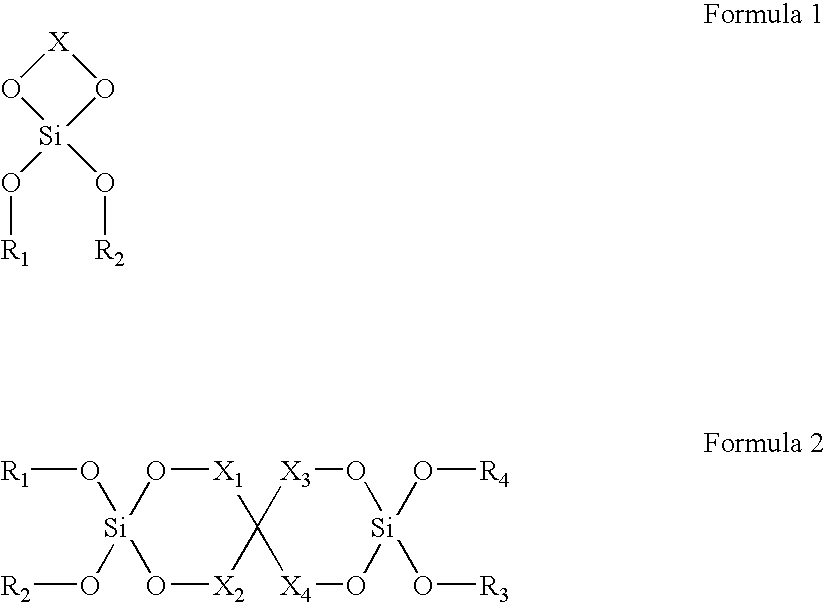
- an organic electrolyte solution includes a lithium salt, an organic solvent, and a silane compound additive represented by Formula 1 or Formula 2 below.
- X is selected from substituted or unsubstituted C 1 to C 6 alkylene groups, substituted or unsubstituted C 6 to C 30 cycloalkylene groups, substituted or unsubstituted C 6 to C 30 arylene groups, substituted or unsubstituted C 2 to C 30 heteroarylene groups, and substituted or unsubstituted C 2 to C 30 alkenylene groups.
- R 1 and R 2 are each independently selected from substituted or unsubstituted C 1 to C 20 alkyl groups, substituted or unsubstituted C 3 to C 20 cycloalkyl groups, substituted or unsubstituted C 5 to C 30 heterocycloalkyl groups, substituted or unsubstituted C 1 to C 20 alkoxy groups, substituted or unsubstituted C 6 to C 30 aryl groups, substituted or unsubstituted C 6 to C 30 aralkyl groups, and substituted or unsubstituted C 2 to C 30 heteroaryl groups.
- X 1 , X 2 , X 3 and X 4 are each independently selected from single bonds, substituted or unsubstituted C 1 to C 6 alkylene groups, substituted or unsubstituted C 6 to C 30 cycloalkylene groups, substituted or unsubstituted C 6 to C 30 arylene groups, substituted or unsubstituted C 2 to C 30 heteroarylene groups, and substituted or unsubstituted C 2 to C 30 alkenylene groups.
- R 1 , R 2 , R 3 and R 4 are each independently selected from substituted or unsubstituted C 1 to C 20 alkyl groups, substituted or unsubstituted C 3 to C 20 cycloalkyl groups, substituted or unsubstituted C 5 to C 30 heterocycloalkyl groups, substituted or unsubstituted C 1 to C 20 alkoxy groups, substituted or unsubstituted C 6 to C 30 aryl groups, substituted or unsubstituted C 6 to C 30 aralkyl groups, and substituted or unsubstituted C 2 to C 30 heteroaryl groups.
- the silane compound may be present in an amount ranging from about 0.5 to about 20 parts by weight based on 100 parts by weight of the organic solvent.
- the concentration of the lithium salt in the organic electrolyte solution may range from about 0.5 to about 2.0 M.
- the organic solvent may include a high dielectric constant solvent and a low boiling point solvent.
- a lithium battery includes a cathode, an anode, and an organic electrolyte solution including a lithium salt, an organic solvent, and a silane compound represented by Formula 1 or Formula 2 below.
- X is selected from substituted or unsubstituted C 1 to C 6 alkylene groups, substituted or unsubstituted C 6 to C 30 cycloalkylene groups, substituted or unsubstituted C 6 to C 30 arylene groups, substituted or unsubstituted C 2 to C 30 heteroarylene groups, and substituted or unsubstituted C 2 to C 30 alkenylene groups.
- R 1 and R 2 are each independently selected from substituted or unsubstituted C 1 to C 20 alkyl groups, substituted or unsubstituted C 3 to C 20 cycloalkyl groups, substituted or unsubstituted C 5 to C 30 heterocycloalkyl groups, substituted or unsubstituted C 1 to C 20 alkoxy groups, substituted or unsubstituted C 6 to C 30 aryl groups, substituted or unsubstituted C 6 to C 30 aralkyl groups, and substituted or unsubstituted C 2 to C 30 heteroaryl groups.
- X 1 , X 2 , X 3 and X 4 are each independently selected from single bonds, substituted or unsubstituted C 1 to C 6 alkylene groups, substituted or unsubstituted C 6 to C 30 cycloalkylene groups, substituted or unsubstituted C 6 to C 30 arylene groups, substituted or unsubstituted C 2 to C 30 heteroarylene groups, and substituted or unsubstituted C 2 to C 30 alkenylene groups.
- R 1 , R 2 , R 3 and R 4 are each independently selected from substituted or unsubstituted C 1 to C 20 alkyl groups, substituted or unsubstituted C 3 to C 20 cycloalkyl groups, substituted or unsubstituted C 5 to C 30 heterocycloalkyl groups, substituted or unsubstituted C 1 to C 20 alkoxy groups, substituted or unsubstituted C 6 to C 30 aryl groups, substituted or unsubstituted C 6 to C 30 aralkyl groups, and substituted or unsubstituted C 2 to C 30 heteroaryl groups.
- FIG. 1 is a graph comparing the capacity retention ratios of lithium batteries employing organic electrolyte solutions prepared according to Examples 1 and 2 and Comparative Examples 1 and 2;
- FIG. 2 is a graph comparing the capacity retention ratios of lithium batteries employing organic electrolyte solutions prepared according to Examples 3 through 5 and Comparative Example 1;
- FIG. 3 is a graph comparing the capacity retention ratios of lithium batteries employing organic electrolyte solutions prepared according to Examples 7 through 9 and Comparative Example 4;
- FIG. 4 is a schematic cross-sectional view of lithium battery according to one embodiment of the present invention.
- an organic electrolyte solution includes a new silane compound.
- a lithium battery employs the organic electrolyte solution.
- An organic electrolyte solution according to one embodiment of the present invention prevents crack formation caused by volumetric changes in the anode active material during charging/discharging of the battery. This improves charge/discharge characteristics, resulting in improved battery stability, reliability, and charge/discharge efficiency.
- a silane compound according to one embodiment of the present invention is structured such that one side of the silane compound includes an alkoxy group directly connected to a silicon atom, and the other side includes a hydrocarbon ring in which a ring carbon atom is connected to the silicon atom via an oxygen atom.
- the silane compound may be represented by Formula 1 or Formula 2 below.
- X is selected from substituted or unsubstituted C 1 to C 6 alkylene groups, substituted or unsubstituted C 6 to C 30 cycloalkylene groups, substituted or unsubstituted C 6 to C 30 arylene groups, substituted or unsubstituted C 2 to C 30 heteroarylene groups, and substituted or unsubstituted C 2 to C 30 alkenylene groups.
- R 1 and R 2 are each independently selected from substituted or unsubstituted C 1 to C 20 alkyl groups, substituted or unsubstituted C 3 to C 20 cycloalkyl groups, substituted or unsubstituted C 5 to C 30 heterocycloalkyl groups, substituted or unsubstituted C 1 to C 20 alkoxy groups, substituted or unsubstituted C 6 to C 30 aryl groups, substituted or unsubstituted C 6 to C 30 aralkyl groups, and substituted or unsubstituted C 2 to C 30 heteroaryl groups.
- X 1 , X 2 , X 3 and X 4 are each independently selected from single bonds, substituted or unsubstituted C 1 to C 6 alkylene groups, substituted or unsubstituted C 6 to C 30 cycloalkylene groups, substituted or unsubstituted C 6 to C 30 arylene groups, substituted or unsubstituted C 2 to C 30 heteroarylene groups, and substituted or unsubstituted C 2 to C 30 alkenylene groups.
- R 1 , R 2 , R 3 and R 4 are each independently selected from substituted or unsubstituted C 1 to C 20 alkyl groups, substituted or unsubstituted C 3 to C 20 cycloalkyl groups, substituted or unsubstituted C 5 to C 30 heterocycloalkyl groups, substituted or unsubstituted C 1 to C 20 alkoxy groups, substituted or unsubstituted C 6 to C 30 aryl groups, substituted or unsubstituted C 6 to C 30 aralkyl groups, and substituted or unsubstituted C 2 to C 30 heteroaryl groups.
- the aryl group may be a monovalent aromatic ring system and may include two or more ring systems.
- the two or more ring systems may be attached to each other or fused.
- the heteroaryl group may be an aryl group in which at least one carbon atom is substituted by at least one atom selected from N, O, S, and P.
- the cycloalkyl group may be an alkyl group having a ring system
- the heterocycloalkyl group may be a cycloalkyl group in which at least one carbon atom is substituted by at least one atom selected from N, O, S, and P.
- the alkyl group, the alkoxy group, the aryl group, the heteroaryl group, the cycloalkyl group, and the heterocycloalkyl group may be substituted with at least one substituent selected from —F; —Cl; —Br; —CN; —NO 2 ; —OH; unsubstituted C 1 to C 20 alkyl groups; C 1 to C 20 alkyl groups substituted with —F, —Cl, —Br, —CN, —NO 2 , or —OH; unsubstituted C 1 to C 20 alkoxy groups; C 1 to C 20 alkoxy groups substituted with —F, —Cl, —Br, —CN, —NO 2 , or —OH; unsubstituted C 6 to C 30 aryl groups; C 6 to C 30 aryl groups substituted with —F, —Cl, —Br, —CN, —NO 2 , or —OH; un
- X may be selected from straight, branched, or cyclic alkyl, alkenyl, or alkynyl groups of 1 to 6 carbon atoms.
- R 1 and R 2 may each independently be selected from straight, branched, or cyclic alkyl groups of 1 to 4 carbon atoms.
- X 1 , X 2 , X 3 , and X 4 may each independently be selected from single bonds or straight, branched, or cyclic alkyl, alkenyl, or alkynyl groups of 1 to 4 carbon atoms.
- R 1 , R 2 , R 3 , and R 4 may each independently be selected from straight, branched, or cyclic alkyl groups of 1 to 4 carbon atoms.
- the alkoxy group directly connected to the silicon atom in the silane compound reacts with a hydroxyl group, etc. present on the surface of the active material.
- the silane compound is chemically adsorbed onto the surface of the active material by a covalent bond.
- the silane compound, together with a metal active material may form a M-O—Si—R linkage where M is the metal active material and R is a substituent.
- the silane compound can form a monolayer on the surface of the active material.
- the hydrocarbon ring structure including the silicon atom and the oxygen atom in the silane compound according to one embodiment of the present invention has an affinity with lithium ions.
- the hydrocarbon ring structure captures lithium ions and facilitates diffusion of the electrolyte and the lithium ions into the silane compound monolayer.
- the monolayer (a kind of a passivation layer) made of the silane compound is present on a surface of the active material, the charge/discharge rate of lithium is not significantly affected due to the easy diffusion of lithium ions into the monolayer.
- the silane compound of Formula 2 has an interconnected structure of two hydrocarbon rings. It is expected that the hydrocarbon ring structure intended for forming a SEI film and covering a surface of the electrode can prevent or reduce crack formation on the surface of the electrode.
- the silane compound monolayer can prevent direct contact between the active material and the electrolyte. That is, the silane compound monolayer can prevent crack formation caused by volumetric changes in the anode active material during lithium intercalation/deintercalation.
- An organic electrolyte solution according to an embodiment of the present invention includes a lithium salt, an organic solvent, and a silane compound represented by Formula 1 or Formula 2 above.
- the silane compound may be present in an amount ranging from about 0.5 to about 20 parts by weight based on 100 parts by weight of the organic solvent. In another embodiment, the silane compound may be present in an amount ranging from about 1 to about 15 parts by weight based on 100 parts by weight of the organic solvent. If the silane compound is present in an amount exceeding about 20 parts by weight, charge/discharge characteristics may deteriorate due to a shortage of effective material influencing the performance of the battery. On the other hand, if the silane compound is present in an amount less than about 0.5 parts by weight, it may be difficult to sufficiently achieve the desired effect.
- the organic solvent may include a high dielectric constant solvent and a low boiling point solvent.
- the high dielectric constant solvent is not particularly limited and may be any such solvent commonly used in the pertinent art.
- suitable high dielectric constant solvents include cyclic carbonates (e.g., ethylene carbonate, propylene carbonate, or butylene carbonate), gamma-butyrolactone, and the like.
- the low boiling point solvent may also be any such solvent commonly used in the pertinent art.
- suitable low boiling point solvents include non-cyclic carbonates (e.g., dimethyl carbonate, ethylmethyl carbonate, diethyl carbonate, or dipropyl carbonate), dimethoxyethane, diethoxyethane, fatty acid ester derivatives, and the like.
- the high dielectric constant solvent and the low boiling point solvent may be mixed in a volume ratio ranging from about 1:1 to about 1:9. If the mixture ratio of the high dielectric constant solvent and the low boiling point solvent is outside this range, discharge capacity and charge/discharge cycle life may be reduced.
- the lithium salt is also not limited and may be any lithium salt commonly used in lithium batteries.
- suitable lithium salts include LiClO 4 , LiCF 3 SO 3 , LiPF 6 , LiN(CF 3 SO 2 ), LiBF 4 , LiC(CF 3 SO 2 ) 3 , and LiN(C 2 F 5 SO 2 ) 2 .
- the concentration of the lithium salt in the organic electrolyte solution may range from about 0.5 to about 2M. If the concentration of the lithium salt is less than about 0.5 M, the conductivity of the organic electrolyte solution may be reduced, thereby degrading the performance of the organic electrolyte solution. On the other hand, if the concentration of the lithium salt exceeds about 2.0 M, the viscosity of the organic electrolyte solution may increase, thereby decreasing lithium ion mobility.
- a lithium battery according to one embodiment of the present invention includes a cathode, an anode, and an organic electrolyte solution according to an embodiment of the present invention.
- the shape of the lithium battery is not particularly limited.
- the lithium battery of the present invention may be a lithium primary battery as well as a lithium secondary battery, such as a lithium ion battery, a lithium ion polymer battery, and a lithium sulfur battery.
- the lithium battery of the present invention can be manufactured as follows.
- a cathode active material, a conducting agent, a binder, and a solvent are mixed to prepare a cathode active material composition.
- the cathode active material composition is coated directly on an aluminum current collector and dried to prepare a cathode plate.
- the cathode active material composition may be cast on a separate support to form a film, which is then separated from the support and laminated on an aluminum current collector to prepare a cathode plate.
- the cathode active material is not limited and may be any lithium-containing metal oxide commonly used in the pertinent art.
- suitable cathode active materials include LiCoO 2 , LiMn x O 2x , LiNi x-1 Mn x O 2x (where x is 1 or 2), Ni 1-x-y Co x Mn y O 2 (where 0 ⁇ x ⁇ 0.5, 0 ⁇ y ⁇ 0.5), and the like.
- a suitable conducting agent is carbon black.
- suitable binders include vinylidene fluoride/hexafluoropropylene copolymers, polyvinylidenefluoride, polyacrylonitrile, polymethylmethacrylate, polytetrafluoroethylene, styrene butadiene rubber-based polymers, and mixtures thereof.
- suitable solvents include N-methylpyrrolidone, acetone, water, and the like. The cathode active material, the conducting agent, the binder, and the solvent are each used in an amount commonly used in lithium batteries.
- An anode plate is prepare in a manner similar to the above-described preparation of the cathode plate. That is, an anode active material, a conducting agent, a binder, and a solvent are mixed to prepare an anode active material composition.
- the anode active material composition is coated directly on a copper current collector to form an anode plate.
- the anode active material composition is cast on a separate support to form a film which is then separated from the support and laminated on a copper current collector to prepare an anode plate.
- the anode active material, the conducting agent, the binder, and the solvent are each used in an amount commonly used in lithium batteries.
- Nonlimiting examples of suitable anode active materials include silicon metal, silicon thin films, lithium metal, lithium alloys, carbonaceous materials, and graphite.
- the conducting agent, the binder, and the solvent in the anode active material composition are the same as those in the cathode active material composition.
- the cathode active material composition and the anode active material composition may further include a plasticizer to form pores in the electrode plates.
- any separator commonly used in lithium batteries may be used.
- a separator having low resistance to ion mobility of the electrolyte and good electrolyte impregnation properties may be used.
- the separator may be made of a material selected from glass fiber, polyester, Teflon, polyethylene, polypropylene, polytetrafluoroethylene (PTFE), and combinations thereof.
- the separator may also be made of a woven or non-woven material.
- a coilable separator made of a material such as polyethylene or polypropylene may be used in lithium ion batteries, and a separator having good organic electrolyte impregnation properties may be used in lithium ion polymer batteries.
- a polymer resin, a filler, and a solvent are mixed to prepare a separator composition.
- the separator composition is directly coated on an electrode and dried to form a separator film.
- the separator composition is cast on a separate support and dried to form a separator film which is separated from the support and laminated on an electrode.
- the polymer resin is not particularly limited, and may be selected from any binder materials used in electrode plates.
- suitable polymer resins include vinylidenefluoride/hexafluoropropylene copolymers, polyvinylidenefluoride, polyacrylonitrile, polymethylmethacrylate, and mixtures thereof.
- a vinylidenefluoride/hexafluoropropylene copolymer containing from about 8 to about 25 wt % hexafluoropropylene is used.
- the separator 4 is disposed between the cathode plate 2 and anode plate 3 to form a battery structure.
- the battery structure is wound or folded and encased in a cylindrical or square battery case 5 and sealed with a cap assembly 6 .
- An organic electrolyte solution according to an embodiment of the present invention is then injected into the case to complete a lithium ion battery 1 .
- the battery structure is stacked in the form of a bicell structure and impregnated with an organic electrolyte solution according to an embodiment of the present invention.
- the resultant structure is received in a pouch and sealed to complete a lithium ion polymer battery.
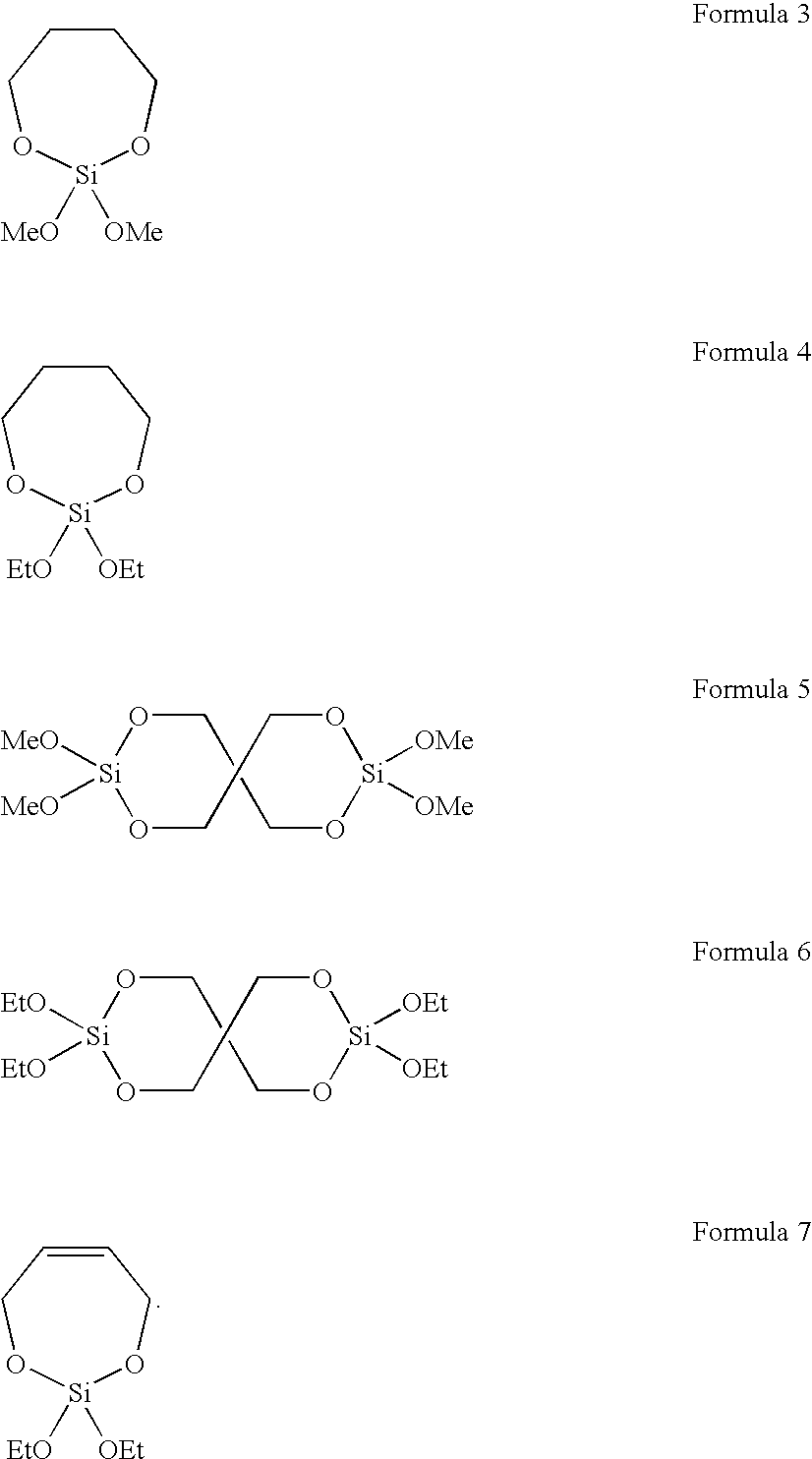
- 1,4-butanediol and tetramethylorthosilicate were incubated at room temperature in the presence of t-BuOK (1.5 wt % in methanol) for 1-2 hours to distill methanol and the resultant polymer compound was thermally decomposed under vacuum of 2-4 mmHg at 120° C. for one hour to give 2,2-dimethoxy-1,3,2-dioxasilaphane represented by Formula 3 below.
- Pentaerythritol and tetramethylorthosilicate were incubated at 115° C. in the presence of t-BuOK for 2.5 hours to give 3,3,9,9-tetramethoxy-2,4,8,10-tetraoxa-3,9-disilapiro[5.5]undecane represented by Formula 5 below:
- Pentaerythritol and tetraethylorthosilicate were incubated at 150° C. in the presence of t-BuOK for 2.5 hours to give 3,3,9,9-tetraethoxy-2,4,8,10-tetraoxa-3,9-disilapiro[5.5]undecane represented by Formula 6 below:
- Cis-2-butene-1,4-diol and tetraethylorthosilicate were incubated at room temperature in the presence of t-BuOK (0.5-1.5 wt % in ethanol) to remove ethanol, and the resultant polymer compound was thermally decomposed under vacuum at 120-140° C. to give 2,2-diethoxy-4,7-dihydro-1,3,2-dioxasilaphane represented by Formula 7 below:
- An organic electrolyte solution was prepared by adding the 2,2-dimethoxy-1,3,2-dioxasilaphane of Synthesis Example 1 as an additive to a mixed organic solvent including 30 vol % of ethylene carbonate and 70 vol % of diethyl carbonate. Three solutions were prepared in which the 2,2-dimethoxy-1,3,2-dioxasilaphane was added in amounts of 1, 2, and 3 parts by weight based on 100 parts by weight of the organic solvent. 1.3M LiPF 6 was used as a lithium salt.
- a silicon/graphite composite was used as the anode material.
- 1 g of silicon powder having an average particle size of 2 ⁇ m and 2 g of graphite powder having an average particle size of 6 ⁇ m were mixed in a mortar, and the resultant mixture, together with 20 g of steel balls, was placed in a stainless milling chamber and mechanically milled with a SPEX mill 8000M for one hour to obtain a silicon/graphite composite.
- the silicon/graphite composite, carbon black as a conducting agent, and PVDF (polyvinylidene fluoride) as a binder were weighed in a ratio of 75:15:10 and mixed in a mortar, and NMP (N-methylpyrrolidone) was added thereto to make slurries. Each slurry was coated on a copper foil having a thickness of 20 ⁇ m, dried at 85° C., and vacuum-dried at 120° C. for three hours to obtain an anode.
- LiCoO 2 lithium cobalt oxide
- Pouch cells (2 cm ⁇ 3 cm) were manufactured using the above-manufactured cathodes and anodes, separators, and the above-prepared organic electrolyte solutions.
- An organic electrolyte solution was prepared using a mixed organic solvent including 30 vol % of ethylene carbonate and 70 vol % of diethyl carbonate and 1.3 M LiPF 6 as a lithium salt. No additive was used.
- Lithium ion batteries were manufactured as in Example 1 except that the organic electrolyte solution according to Comparative Example 1 was used.
- An organic electrolyte solution was prepared by adding 3 wt % of vinyl triethoxy silane represented by Formula 8 below as an additive to a mixed organic solvent including 30 vol % of ethylene carbonate and 70 vol % of diethyl carbonate. 1.3 M LiPF 6 was used as a lithium salt.
- Lithium ion batteries were manufactured as in Example 1 except that the organic electrolyte solution prepared according to Comparative Example 2 was used.
- Each of the lithium ion batteries manufactured according to Examples 1-5 and Comparative Examples 1-2 was subjected to a constant-current charge at a 0.5 C rate until the cell voltage reached 4.2 V. Then, each battery was charged at a constant voltage of 4.2V until the current was reduced to 0.05 C. Then, a constant-current discharge was performed at a 0.5 C rate until the voltage reached 3.0V to thereby obtain charge/discharge capacities. Cycle life tests for the batteries were performed under the above-described conditions, and capacity retention ratios were calculated. The capacity retention ratios were calculated using Equation 1 below.
- Capacity retention ratio(%) (discharge capacity at 100 th cycle/discharge capacity at 5 th cycle) ⁇ 100 Equation 1
- the charge/discharge efficiencies at the 1 st and 100 th cycles of the batteries manufactured according to Examples 1-5 were 10-20% greater than those of the batteries manufactured according to Comparative Example 1 (electrolyte with no additive).
- the capacity retention ratios of the batteries manufactured according to Examples 1-5 were 5-12% greater than those of the batteries manufactured according to Comparative Example 2 (electrolyte using a vinyl triethoxysilane additive).
- An organic electrolyte solution was prepared by adding the 2,2-diethoxy-1,3,2-dioxasilaphane of Synthesis Example 2 as an additive to a mixed organic solvent including 30 vol % of ethylene carbonate and 70 vol % of diethyl carbonate. Three solutions were prepared in which the additive was added in amounts of 1, 3, and 5 parts by weight based on 100 parts by weight of the organic solvent. 1.3 M LiPF 6 was used as a lithium salt.
- Silicon thin films were used as anode materials. Each silicon thin film was manufactured by depositing amorphous silicon on the surface of a rolled copper foil (20 ⁇ m in thickness) using RF sputtering (radio frequency sputtering). Each thin film electrode had a thickness of 0.15 ⁇ m.
- Lithium electrodes were manufactured as opposite electrodes. Each lithium electrode was manufactured by pressing metal lithium having a thickness of 500 ⁇ m on a copper foil having a thickness of 20 ⁇ m. Pouch cells (1 cm ⁇ 2 cm) were manufactured using the anodes, separators, the lithium electrodes used as the opposite electrodes, and the organic electrolyte solution prepared according to Example 7.
- Lithium ion batteries were manufactured as in Example 7 except that the organic electrolyte solution prepared according to Comparative Example 1 was used.
- the charge/discharge efficiencies at the 1 st and 100 th cycles of the batteries manufactured according to Examples 7-9 were 20-40% greater than those of the batteries manufactured according to Comparative Example 4 (electrolyte with no additive).
- the batteries manufactured according to Examples 7-9 exhibited good capacity retention ratios, which are comparable to the capacity retention ratios of the batteries employing the Si/graphite composite electrodes illustrated in FIGS. 1 and 2 .
- These results show that when a silicon thin film electrode is used, the alkoxy group of a silane compound of the present invention easily binds to the silicon thin film electrode, thereby forming a stable SEI film. This effectively prevents crack formation due to volumetric changes in the metal active material during charging/discharging and enhances the conduction characteristics of lithium ions.
- the organic electrolyte solutions according to the present invention use new silane compounds and prevent crack formation caused by volumetric changes in the anode active material during charging/discharging of the battery. This improves charge/discharge characteristics, thereby improving battery stability, reliability, and charge/discharge efficiency, which is a dramatic improvement over conventional organic electrolyte solutions, which have higher irreversible capacities due to the decomposition of polar solvents.
Landscapes
- Chemical & Material Sciences (AREA)
- Engineering & Computer Science (AREA)
- Manufacturing & Machinery (AREA)
- Chemical Kinetics & Catalysis (AREA)
- Electrochemistry (AREA)
- General Chemical & Material Sciences (AREA)
- Physics & Mathematics (AREA)
- Condensed Matter Physics & Semiconductors (AREA)
- General Physics & Mathematics (AREA)
- Inorganic Chemistry (AREA)
- Materials Engineering (AREA)
- Secondary Cells (AREA)
Abstract
Description
- This application claims priority to and the benefit of Korean Patent Application No. 10-2006-0084818, filed on Sep. 4, 2006 in the Korean Intellectual Property Office, the entire content of which is incorporated herein by reference.
- 1. Field of the Invention
- The present invention relates to lithium batteries. More particularly, the invention relates to organic electrolyte solutions including silane compounds and to lithium batteries employing the organic electrolyte solutions.
- 2. Description of the Related Art
- Portable electronic devices, such as video cameras, cellular phones, and notebook PCs, are being developed to be more light-weight and to have higher performance. As such, much research into batteries used as driving power sources has been conducted. In particular, re-chargeable (secondary) lithium batteries have been actively studied since they can be rapidly re-charged and have energy densities per unit weight three times greater than those of conventional lead storage batteries, nickel-cadmium batteries, nickel hydrogen batteries, nickel zinc batteries, etc.
- Conventional lithium batteries are operated at high operating voltages, and thus, conventional aqueous electrolyte solutions cannot be used due to the vigorous reaction of the aqueous solutions with the lithium used as the anodes. Accordingly, organic electrolyte solutions obtained by dissolving lithium salts in organic solvents are used in lithium batteries. At this time, it is preferable to use organic solvents having high ion conductivities, high dielectric constants, and low viscosities. However, it is difficult to obtain a single organic solvent satisfying all these requirements, and thus, the use of mixed solvents has been proposed, such as a mixed solvent including both a high dielectric constant organic solvent and a low dielectric constant organic solvent, a mixed solvent including a high dielectric constant organic solvent and a low viscosity organic solvent, and the like.
- When a carbonate-based non-aqueous polar solvent is used in a lithium secondary battery, excess charges are used due to the reaction between the carbon of the anode and the electrolyte solution during initial charging. Such an irreversible reaction forms a passivation layer, such as a solid electrolyte interface (SEI) film, on a surface of the anode. The SEI film serves to prevent further decomposition of the electrolyte solution and maintains stable charging/discharging. The SEI film also serves as an ion tunnel through which only lithium ions pass. That is, the SEI film prevents the cointercalation of lithium ions with the organic solvents that solvate the lithium ions and move together with the lithium ions into the carbon anode. This prevents the degradation of the anode structure.
- However, the SEI film gradually cracks and delaminates from the surface of the electrode due to volumetric expansion and shrinkage of the active material during the charge/discharge cycles of the battery. As a result, the electrolyte directly contacts the active material, thus continuously decomposing the electrolyte. Once the SEI film cracks, the crack continuously extends during charging/discharging of the battery, thereby degrading the active material. In particular, when the active material contains metal, such as silicon, the active material degrades further due to great volumetric changes during charge/discharge cycles. Furthermore, the repeated volumetric shrinkage and expansion of the active material cause the agglomeration of silicon particles.
- To address these problems, various compounds having characteristic structures capable of making denser and more rigid SEI films have been proposed. For example, a method of preventing the decomposition of a solvent has been proposed whereby a vinylene carbonate derivative is added as an additive to an electrolyte solution and a film is formed on the surface of the anode through a reduction/decomposition reaction of the additive. Vinylene carbonate has a structure similar to ethylene carbonate but contains a double bond. Thus, vinylene carbonate receives electrons at high voltages, disrupting the double bond in the vinylene carbonate molecule, thereby creating radicals and initiating polymerization. That is, vinylene carbonate provides a polymer through an electrochemical polymerization reaction. The thus-prepared polymer forms a nonconductive film on the surface of the anode, thereby more effectively preventing contact between the anode and the solvent.
- Electrolyte solutions including vinyl sulfone, etc. have also been proposed. When a double bond in the vinyl sulfone, etc. is disrupted by reduction, radical polymerization is initiated, thereby forming a film on a surface of the anode.
- Organic electrolyte solutions for lithium batteries including at least one silane compound as an additive have also been proposed.
- In one embodiment of the present invention, an organic electrolyte solution can prevent direct contact between a metal active material and an electrolyte, thereby improving battery reliability and enhancing the capacity retention ratio.
- In another embodiment of the present invention, a lithium battery using the organic electrolyte solution has improved charge/discharge characteristics.
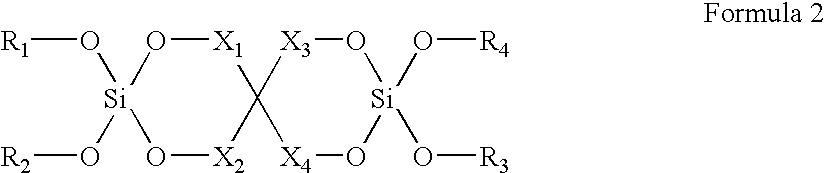
- According to one embodiment of the present invention, an organic electrolyte solution includes a lithium salt, an organic solvent, and a silane compound additive represented by Formula 1 or Formula 2 below.
-

- In
Formula 1, X is selected from substituted or unsubstituted C1 to C6 alkylene groups, substituted or unsubstituted C6 to C30 cycloalkylene groups, substituted or unsubstituted C6 to C30 arylene groups, substituted or unsubstituted C2 to C30 heteroarylene groups, and substituted or unsubstituted C2 to C30 alkenylene groups. R1 and R2 are each independently selected from substituted or unsubstituted C1 to C20 alkyl groups, substituted or unsubstituted C3 to C20 cycloalkyl groups, substituted or unsubstituted C5 to C30 heterocycloalkyl groups, substituted or unsubstituted C1 to C20 alkoxy groups, substituted or unsubstituted C6 to C30 aryl groups, substituted or unsubstituted C6 to C30 aralkyl groups, and substituted or unsubstituted C2 to C30 heteroaryl groups. -
- In
Formula 2, X1, X2, X3 and X4 are each independently selected from single bonds, substituted or unsubstituted C1 to C6 alkylene groups, substituted or unsubstituted C6 to C30 cycloalkylene groups, substituted or unsubstituted C6 to C30 arylene groups, substituted or unsubstituted C2 to C30 heteroarylene groups, and substituted or unsubstituted C2 to C30 alkenylene groups. R1, R2, R3 and R4 are each independently selected from substituted or unsubstituted C1 to C20 alkyl groups, substituted or unsubstituted C3 to C20 cycloalkyl groups, substituted or unsubstituted C5 to C30 heterocycloalkyl groups, substituted or unsubstituted C1 to C20 alkoxy groups, substituted or unsubstituted C6 to C30 aryl groups, substituted or unsubstituted C6 to C30 aralkyl groups, and substituted or unsubstituted C2 to C30 heteroaryl groups. - According to an embodiment of the present invention, the silane compound may be present in an amount ranging from about 0.5 to about 20 parts by weight based on 100 parts by weight of the organic solvent.
- According to another embodiment of the present invention, the concentration of the lithium salt in the organic electrolyte solution may range from about 0.5 to about 2.0 M.
- According to another embodiment of the present invention, the organic solvent may include a high dielectric constant solvent and a low boiling point solvent.
- According to another embodiment of the present invention, a lithium battery includes a cathode, an anode, and an organic electrolyte solution including a lithium salt, an organic solvent, and a silane compound represented by Formula 1 or Formula 2 below.
-

- In
Formula 1, X is selected from substituted or unsubstituted C1 to C6 alkylene groups, substituted or unsubstituted C6 to C30 cycloalkylene groups, substituted or unsubstituted C6 to C30 arylene groups, substituted or unsubstituted C2 to C30 heteroarylene groups, and substituted or unsubstituted C2 to C30 alkenylene groups. R1 and R2 are each independently selected from substituted or unsubstituted C1 to C20 alkyl groups, substituted or unsubstituted C3 to C20 cycloalkyl groups, substituted or unsubstituted C5 to C30 heterocycloalkyl groups, substituted or unsubstituted C1 to C20 alkoxy groups, substituted or unsubstituted C6 to C30 aryl groups, substituted or unsubstituted C6 to C30 aralkyl groups, and substituted or unsubstituted C2 to C30 heteroaryl groups. -

- In
Formula 2, X1, X2, X3 and X4 are each independently selected from single bonds, substituted or unsubstituted C1 to C6 alkylene groups, substituted or unsubstituted C6 to C30 cycloalkylene groups, substituted or unsubstituted C6 to C30 arylene groups, substituted or unsubstituted C2 to C30 heteroarylene groups, and substituted or unsubstituted C2 to C30 alkenylene groups. R1, R2, R3 and R4 are each independently selected from substituted or unsubstituted C1 to C20 alkyl groups, substituted or unsubstituted C3 to C20 cycloalkyl groups, substituted or unsubstituted C5 to C30 heterocycloalkyl groups, substituted or unsubstituted C1 to C20 alkoxy groups, substituted or unsubstituted C6 to C30 aryl groups, substituted or unsubstituted C6 to C30 aralkyl groups, and substituted or unsubstituted C2 to C30 heteroaryl groups. - The above and other features and advantages of the present invention will become more apparent by reference to the following detailed description when considered in conjunction with the attached drawings in which:
-
FIG. 1 is a graph comparing the capacity retention ratios of lithium batteries employing organic electrolyte solutions prepared according to Examples 1 and 2 and Comparative Examples 1 and 2; -
FIG. 2 is a graph comparing the capacity retention ratios of lithium batteries employing organic electrolyte solutions prepared according to Examples 3 through 5 and Comparative Example 1; -
FIG. 3 is a graph comparing the capacity retention ratios of lithium batteries employing organic electrolyte solutions prepared according to Examples 7 through 9 and Comparative Example 4; and -
FIG. 4 is a schematic cross-sectional view of lithium battery according to one embodiment of the present invention. - According to one embodiment of the present invention, an organic electrolyte solution includes a new silane compound. In another embodiment, a lithium battery employs the organic electrolyte solution.
- An organic electrolyte solution according to one embodiment of the present invention prevents crack formation caused by volumetric changes in the anode active material during charging/discharging of the battery. This improves charge/discharge characteristics, resulting in improved battery stability, reliability, and charge/discharge efficiency.
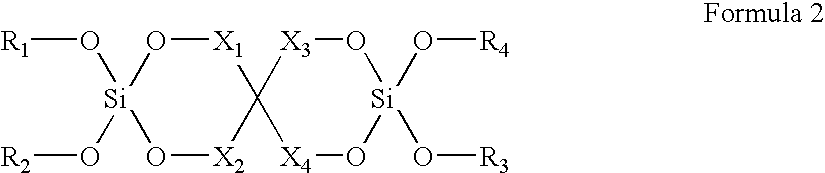
- A silane compound according to one embodiment of the present invention is structured such that one side of the silane compound includes an alkoxy group directly connected to a silicon atom, and the other side includes a hydrocarbon ring in which a ring carbon atom is connected to the silicon atom via an oxygen atom. In one embodiment, for example, the silane compound may be represented by Formula 1 or Formula 2 below.
-

- In
Formula 1, X is selected from substituted or unsubstituted C1 to C6 alkylene groups, substituted or unsubstituted C6 to C30 cycloalkylene groups, substituted or unsubstituted C6 to C30 arylene groups, substituted or unsubstituted C2 to C30 heteroarylene groups, and substituted or unsubstituted C2 to C30 alkenylene groups. R1 and R2 are each independently selected from substituted or unsubstituted C1 to C20 alkyl groups, substituted or unsubstituted C3 to C20 cycloalkyl groups, substituted or unsubstituted C5 to C30 heterocycloalkyl groups, substituted or unsubstituted C1 to C20 alkoxy groups, substituted or unsubstituted C6 to C30 aryl groups, substituted or unsubstituted C6 to C30 aralkyl groups, and substituted or unsubstituted C2 to C30 heteroaryl groups. -
- In
Formula 2, X1, X2, X3 and X4 are each independently selected from single bonds, substituted or unsubstituted C1 to C6 alkylene groups, substituted or unsubstituted C6 to C30 cycloalkylene groups, substituted or unsubstituted C6 to C30 arylene groups, substituted or unsubstituted C2 to C30 heteroarylene groups, and substituted or unsubstituted C2 to C30 alkenylene groups. R1, R2, R3 and R4 are each independently selected from substituted or unsubstituted C1 to C20 alkyl groups, substituted or unsubstituted C3 to C20 cycloalkyl groups, substituted or unsubstituted C5 to C30 heterocycloalkyl groups, substituted or unsubstituted C1 to C20 alkoxy groups, substituted or unsubstituted C6 to C30 aryl groups, substituted or unsubstituted C6 to C30 aralkyl groups, and substituted or unsubstituted C2 to C30 heteroaryl groups. - In
Formulae - The cycloalkyl group may be an alkyl group having a ring system, and the heterocycloalkyl group may be a cycloalkyl group in which at least one carbon atom is substituted by at least one atom selected from N, O, S, and P.
- In Formulae 1 and 2 above, the alkyl group, the alkoxy group, the aryl group, the heteroaryl group, the cycloalkyl group, and the heterocycloalkyl group may be substituted with at least one substituent selected from —F; —Cl; —Br; —CN; —NO2; —OH; unsubstituted C1 to C20 alkyl groups; C1 to C20 alkyl groups substituted with —F, —Cl, —Br, —CN, —NO2, or —OH; unsubstituted C1 to C20 alkoxy groups; C1 to C20 alkoxy groups substituted with —F, —Cl, —Br, —CN, —NO2, or —OH; unsubstituted C6 to C30 aryl groups; C6 to C30 aryl groups substituted with —F, —Cl, —Br, —CN, —NO2, or —OH; unsubstituted C2 to C30 heteroaryl groups; C2 to C30 heteroaryl groups substituted with —F, —Cl, —Br, —CN, —NO2, or —OH; unsubstituted C5 to C20 cycloalkyl groups; C5 to C20 cycloalkyl groups substituted with —F, —Cl, —Br, —CN, —NO2, or —OH; unsubstituted C5 to C30 heterocycloalkyl groups; and C5 to C30 heterocycloalkyl groups substituted with —F, —Cl, —Br, —CN, —NO2, or —OH.
- In on embodiment, in
Formula 1 above, X may be selected from straight, branched, or cyclic alkyl, alkenyl, or alkynyl groups of 1 to 6 carbon atoms. R1 and R2 may each independently be selected from straight, branched, or cyclic alkyl groups of 1 to 4 carbon atoms. - According to one embodiment, in
Formula 2 above, X1, X2, X3, and X4 may each independently be selected from single bonds or straight, branched, or cyclic alkyl, alkenyl, or alkynyl groups of 1 to 4 carbon atoms. R1, R2, R3, and R4 may each independently be selected from straight, branched, or cyclic alkyl groups of 1 to 4 carbon atoms. - According to one embodiment of the present invention, the alkoxy group directly connected to the silicon atom in the silane compound reacts with a hydroxyl group, etc. present on the surface of the active material. Thus, the silane compound is chemically adsorbed onto the surface of the active material by a covalent bond. For example, the silane compound, together with a metal active material, may form a M-O—Si—R linkage where M is the metal active material and R is a substituent. Through the chemical adsorption, the silane compound can form a monolayer on the surface of the active material.
- The hydrocarbon ring structure including the silicon atom and the oxygen atom in the silane compound according to one embodiment of the present invention has an affinity with lithium ions. Thus, the hydrocarbon ring structure captures lithium ions and facilitates diffusion of the electrolyte and the lithium ions into the silane compound monolayer. As such, although the monolayer (a kind of a passivation layer) made of the silane compound is present on a surface of the active material, the charge/discharge rate of lithium is not significantly affected due to the easy diffusion of lithium ions into the monolayer.
- The silane compound of
Formula 2 has an interconnected structure of two hydrocarbon rings. It is expected that the hydrocarbon ring structure intended for forming a SEI film and covering a surface of the electrode can prevent or reduce crack formation on the surface of the electrode. - Therefore, the silane compound monolayer can prevent direct contact between the active material and the electrolyte. That is, the silane compound monolayer can prevent crack formation caused by volumetric changes in the anode active material during lithium intercalation/deintercalation.
- An organic electrolyte solution according to an embodiment of the present invention includes a lithium salt, an organic solvent, and a silane compound represented by
Formula 1 orFormula 2 above. - In an organic electrolyte solution according to one embodiment, the silane compound may be present in an amount ranging from about 0.5 to about 20 parts by weight based on 100 parts by weight of the organic solvent. In another embodiment, the silane compound may be present in an amount ranging from about 1 to about 15 parts by weight based on 100 parts by weight of the organic solvent. If the silane compound is present in an amount exceeding about 20 parts by weight, charge/discharge characteristics may deteriorate due to a shortage of effective material influencing the performance of the battery. On the other hand, if the silane compound is present in an amount less than about 0.5 parts by weight, it may be difficult to sufficiently achieve the desired effect.
- In an organic electrolyte solution according to another embodiment, the organic solvent may include a high dielectric constant solvent and a low boiling point solvent. The high dielectric constant solvent is not particularly limited and may be any such solvent commonly used in the pertinent art. Nonlimiting examples of suitable high dielectric constant solvents include cyclic carbonates (e.g., ethylene carbonate, propylene carbonate, or butylene carbonate), gamma-butyrolactone, and the like.
- The low boiling point solvent may also be any such solvent commonly used in the pertinent art. Nonlimiting examples of suitable low boiling point solvents include non-cyclic carbonates (e.g., dimethyl carbonate, ethylmethyl carbonate, diethyl carbonate, or dipropyl carbonate), dimethoxyethane, diethoxyethane, fatty acid ester derivatives, and the like.
- In one embodiment of the present invention, the high dielectric constant solvent and the low boiling point solvent may be mixed in a volume ratio ranging from about 1:1 to about 1:9. If the mixture ratio of the high dielectric constant solvent and the low boiling point solvent is outside this range, discharge capacity and charge/discharge cycle life may be reduced.
- The lithium salt is also not limited and may be any lithium salt commonly used in lithium batteries. Nonlimiting examples of suitable lithium salts include LiClO4, LiCF3SO3, LiPF6, LiN(CF3SO2), LiBF4, LiC(CF3SO2)3, and LiN(C2F5SO2)2.
- In one embodiment, the concentration of the lithium salt in the organic electrolyte solution may range from about 0.5 to about 2M. If the concentration of the lithium salt is less than about 0.5 M, the conductivity of the organic electrolyte solution may be reduced, thereby degrading the performance of the organic electrolyte solution. On the other hand, if the concentration of the lithium salt exceeds about 2.0 M, the viscosity of the organic electrolyte solution may increase, thereby decreasing lithium ion mobility.
- Hereinafter, a lithium battery employing an organic electrolyte solution according to the present invention and a method of manufacturing the same will be described.
- A lithium battery according to one embodiment of the present invention includes a cathode, an anode, and an organic electrolyte solution according to an embodiment of the present invention. The shape of the lithium battery is not particularly limited. Furthermore, the lithium battery of the present invention may be a lithium primary battery as well as a lithium secondary battery, such as a lithium ion battery, a lithium ion polymer battery, and a lithium sulfur battery.
- The lithium battery of the present invention can be manufactured as follows.
- First, a cathode active material, a conducting agent, a binder, and a solvent are mixed to prepare a cathode active material composition. The cathode active material composition is coated directly on an aluminum current collector and dried to prepare a cathode plate. Alternatively, the cathode active material composition may be cast on a separate support to form a film, which is then separated from the support and laminated on an aluminum current collector to prepare a cathode plate.
- The cathode active material is not limited and may be any lithium-containing metal oxide commonly used in the pertinent art. Nonlimiting examples of suitable cathode active materials include LiCoO2, LiMnxO2x, LiNix-1MnxO2x (where x is 1 or 2), Ni1-x-yCoxMnyO2 (where 0≦x≦0.5, 0≦y≦0.5), and the like.
- One nonlimiting example of a suitable conducting agent is carbon black. Nonlimiting examples of suitable binders include vinylidene fluoride/hexafluoropropylene copolymers, polyvinylidenefluoride, polyacrylonitrile, polymethylmethacrylate, polytetrafluoroethylene, styrene butadiene rubber-based polymers, and mixtures thereof. Nonlimiting examples of suitable solvents include N-methylpyrrolidone, acetone, water, and the like. The cathode active material, the conducting agent, the binder, and the solvent are each used in an amount commonly used in lithium batteries.
- An anode plate is prepare in a manner similar to the above-described preparation of the cathode plate. That is, an anode active material, a conducting agent, a binder, and a solvent are mixed to prepare an anode active material composition. The anode active material composition is coated directly on a copper current collector to form an anode plate. Alternatively, the anode active material composition is cast on a separate support to form a film which is then separated from the support and laminated on a copper current collector to prepare an anode plate. The anode active material, the conducting agent, the binder, and the solvent are each used in an amount commonly used in lithium batteries.
- Nonlimiting examples of suitable anode active materials include silicon metal, silicon thin films, lithium metal, lithium alloys, carbonaceous materials, and graphite. The conducting agent, the binder, and the solvent in the anode active material composition are the same as those in the cathode active material composition. In some embodiments, the cathode active material composition and the anode active material composition may further include a plasticizer to form pores in the electrode plates.
- Any separator commonly used in lithium batteries may be used. In particular, a separator having low resistance to ion mobility of the electrolyte and good electrolyte impregnation properties may be used. For example, the separator may be made of a material selected from glass fiber, polyester, Teflon, polyethylene, polypropylene, polytetrafluoroethylene (PTFE), and combinations thereof. The separator may also be made of a woven or non-woven material. In more detail, a coilable separator made of a material such as polyethylene or polypropylene may be used in lithium ion batteries, and a separator having good organic electrolyte impregnation properties may be used in lithium ion polymer batteries. These separators can be manufactured as follows.
- A polymer resin, a filler, and a solvent are mixed to prepare a separator composition. The separator composition is directly coated on an electrode and dried to form a separator film. Alternatively, the separator composition is cast on a separate support and dried to form a separator film which is separated from the support and laminated on an electrode.
- The polymer resin is not particularly limited, and may be selected from any binder materials used in electrode plates. Nonlimiting examples of suitable polymer resins include vinylidenefluoride/hexafluoropropylene copolymers, polyvinylidenefluoride, polyacrylonitrile, polymethylmethacrylate, and mixtures thereof. In one embodiment, a vinylidenefluoride/hexafluoropropylene copolymer containing from about 8 to about 25 wt % hexafluoropropylene is used.
- As shown in
FIG. 4 , theseparator 4 is disposed between thecathode plate 2 andanode plate 3 to form a battery structure. The battery structure is wound or folded and encased in a cylindrical orsquare battery case 5 and sealed with acap assembly 6. An organic electrolyte solution according to an embodiment of the present invention is then injected into the case to complete alithium ion battery 1. - Alternatively, the battery structure is stacked in the form of a bicell structure and impregnated with an organic electrolyte solution according to an embodiment of the present invention. The resultant structure is received in a pouch and sealed to complete a lithium ion polymer battery.
- Hereinafter, the present invention will be described with reference to the following examples. However, it is understood that the following examples are presented for illustrative purposes only and are not intended to limit the scope of the invention.
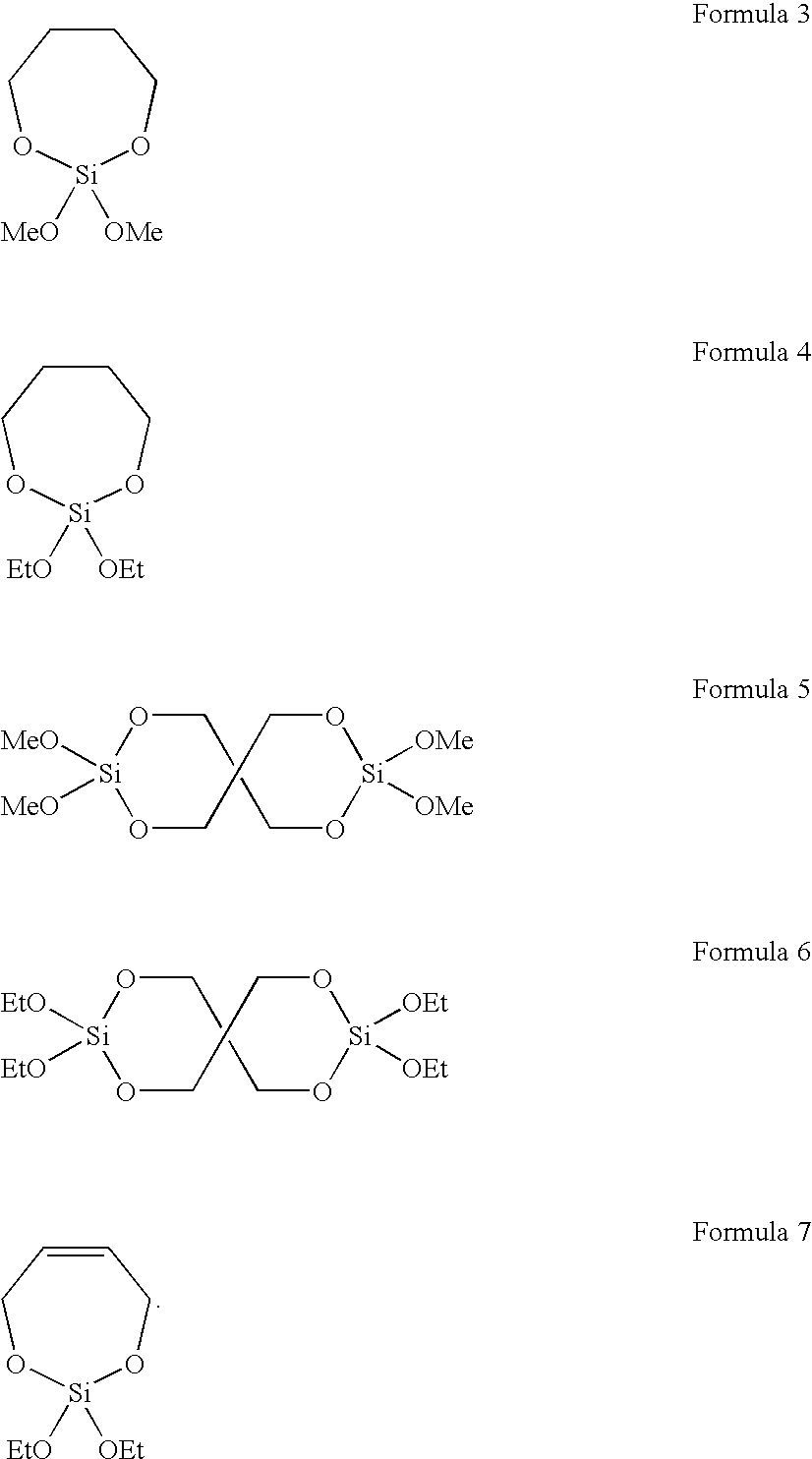
- 1,4-butanediol and tetramethylorthosilicate were incubated at room temperature in the presence of t-BuOK (1.5 wt % in methanol) for 1-2 hours to distill methanol and the resultant polymer compound was thermally decomposed under vacuum of 2-4 mmHg at 120° C. for one hour to give 2,2-dimethoxy-1,3,2-dioxasilaphane represented by
Formula 3 below. -

- 2,2-diethoxy-1,3,2-dioxasilaphane represented by
Formula 4 below was synthesized as in Synthesis Example 1 except that tetraethylorthosilicate was used instead of tetramethylorthosilicate: -

- Pentaerythritol and tetramethylorthosilicate were incubated at 115° C. in the presence of t-BuOK for 2.5 hours to give 3,3,9,9-tetramethoxy-2,4,8,10-tetraoxa-3,9-disilapiro[5.5]undecane represented by
Formula 5 below: -

- Pentaerythritol and tetraethylorthosilicate were incubated at 150° C. in the presence of t-BuOK for 2.5 hours to give 3,3,9,9-tetraethoxy-2,4,8,10-tetraoxa-3,9-disilapiro[5.5]undecane represented by
Formula 6 below: -

- Cis-2-butene-1,4-diol and tetraethylorthosilicate were incubated at room temperature in the presence of t-BuOK (0.5-1.5 wt % in ethanol) to remove ethanol, and the resultant polymer compound was thermally decomposed under vacuum at 120-140° C. to give 2,2-diethoxy-4,7-dihydro-1,3,2-dioxasilaphane represented by
Formula 7 below: -

- An organic electrolyte solution was prepared by adding the 2,2-dimethoxy-1,3,2-dioxasilaphane of Synthesis Example 1 as an additive to a mixed organic solvent including 30 vol % of ethylene carbonate and 70 vol % of diethyl carbonate. Three solutions were prepared in which the 2,2-dimethoxy-1,3,2-dioxasilaphane was added in amounts of 1, 2, and 3 parts by weight based on 100 parts by weight of the organic solvent. 1.3M LiPF6 was used as a lithium salt.
- A silicon/graphite composite was used as the anode material. For this, 1 g of silicon powder having an average particle size of 2 μm and 2 g of graphite powder having an average particle size of 6 μm were mixed in a mortar, and the resultant mixture, together with 20 g of steel balls, was placed in a stainless milling chamber and mechanically milled with a SPEX mill 8000M for one hour to obtain a silicon/graphite composite. The silicon/graphite composite, carbon black as a conducting agent, and PVDF (polyvinylidene fluoride) as a binder were weighed in a ratio of 75:15:10 and mixed in a mortar, and NMP (N-methylpyrrolidone) was added thereto to make slurries. Each slurry was coated on a copper foil having a thickness of 20 μm, dried at 85° C., and vacuum-dried at 120° C. for three hours to obtain an anode.
- 95 wt % of lithium cobalt oxide (LiCoO2) powder having an average particle size of 20 μm and 3 wt % of amorphous carbon powder as cathode active materials, 2 wt % of PVdF as a binder, and NMP were mixed to make slurries. Each slurry was coated on an aluminum foil having a thickness of 15 μm and vacuum-dried in a 120° C. oven for about 10 hours to obtain a cathode.
- Pouch cells (2 cm×3 cm) were manufactured using the above-manufactured cathodes and anodes, separators, and the above-prepared organic electrolyte solutions.
- Organic electrolyte solutions and lithium ion batteries were prepared as in Example 1 except that the 2,2-diethoxy-1,3,2-dioxasilaphane of Synthesis Example 2 was used instead of the 2,2-dimethoxy-1,3,2-dioxasilaphane of Synthesis Example 1.
- Organic electrolyte solutions and lithium ion batteries were prepared as in Example 1 except that the 3,3,9,9-tetramethoxy-2,4,8,10-tetraoxa-3,9-disilapiro[5.5]undecane of Synthesis Example 3 was used instead of the 2,2-dimethoxy-1,3,2-dioxasilaphane of Synthesis Example 1.
- Organic electrolyte solutions and lithium ion batteries were prepared as in Example 1 except that the 3,3,9,9-tetraethoxy-2,4,8,10-tetraoxa-3,9-disilapiro[5.5]undecane of Synthesis Example 4 was used instead of the 2,2-dimethoxy-1,3,2-dioxasilaphane of Synthesis Example 1.
- Organic electrolyte solutions and lithium ion batteries were prepared as in Example 1 except that the 2,2-diethoxy-4,7-dihydro-1,3,2-dioxasilaphane of Synthesis Example 5 was used instead of the 2,2-dimethoxy-1,3,2-dioxasilaphane of Synthesis Example 1.
- An organic electrolyte solution was prepared using a mixed organic solvent including 30 vol % of ethylene carbonate and 70 vol % of diethyl carbonate and 1.3 M LiPF6 as a lithium salt. No additive was used.
- Lithium ion batteries were manufactured as in Example 1 except that the organic electrolyte solution according to Comparative Example 1 was used.
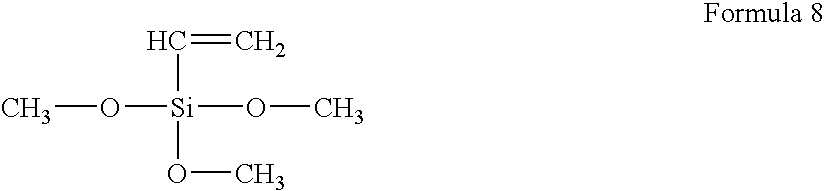
- An organic electrolyte solution was prepared by adding 3 wt % of vinyl triethoxy silane represented by
Formula 8 below as an additive to a mixed organic solvent including 30 vol % of ethylene carbonate and 70 vol % of diethyl carbonate. 1.3 M LiPF6 was used as a lithium salt. -
- Lithium ion batteries were manufactured as in Example 1 except that the organic electrolyte solution prepared according to Comparative Example 2 was used.
- Each of the lithium ion batteries manufactured according to Examples 1-5 and Comparative Examples 1-2 was subjected to a constant-current charge at a 0.5 C rate until the cell voltage reached 4.2 V. Then, each battery was charged at a constant voltage of 4.2V until the current was reduced to 0.05 C. Then, a constant-current discharge was performed at a 0.5 C rate until the voltage reached 3.0V to thereby obtain charge/discharge capacities. Cycle life tests for the batteries were performed under the above-described conditions, and capacity retention ratios were calculated. The capacity retention ratios were calculated using
Equation 1 below. -
Capacity retention ratio(%)=(discharge capacity at 100th cycle/discharge capacity at 5th cycle)×100Equation 1 - The experimental results are summarized in Table 1 below and in
FIGS. 1 and 2 . -
TABLE 1 Capacity at Capacity at Capacity at Capacity 1st cycle 5th cycle 100th cycle retention Sample (mAh) (mAh) (mAh) ratio (%) Comparative 19 17.6 9 51 Example 1 Comparative 19 17 11 65 Example 2 Example 1 (1 pbw) 19 17.6 12 68 Example 1 (2 pbw) 19 18.1 13 72 Example 1 (3 pbw) 19 17.3 13 75 Example 2 (1 pbw) 19 17.4 12 69 Example 2 (2 pbw) 19 16.9 12 71 Example 2 (3 pbw) 19 17.1 12 70 Example 3 (1 pbw) 19 17.5 10 57 Example 3 (2 pbw) 19 17.4 12 69 Example 3 (3 pbw) 19 17.1 12 70 Example 4 (1 pbw) 19 18.4 9 49 Example 4 (2 pbw) 18 17.6 12 68 Example 4 (3 pbw) 19 18.2 12 66 Example 5 (3 pbw) 18.6 16.7 9 54 pbw: parts by weight - Referring to
FIGS. 1 and 2 , the charge/discharge efficiencies at the 1st and 100th cycles of the batteries manufactured according to Examples 1-5 were 10-20% greater than those of the batteries manufactured according to Comparative Example 1 (electrolyte with no additive). The capacity retention ratios of the batteries manufactured according to Examples 1-5 were 5-12% greater than those of the batteries manufactured according to Comparative Example 2 (electrolyte using a vinyl triethoxysilane additive). These results show that the silane compounds of the present invention effectively prevent crack formation caused by volumetric changes of the metal active material upon charging/discharging. The results also show that the silane compounds of the present invention induce reversible intercalation/deintercalation of lithium ions, thereby enhancing cycle life. - An organic electrolyte solution was prepared by adding the 2,2-diethoxy-1,3,2-dioxasilaphane of Synthesis Example 2 as an additive to a mixed organic solvent including 30 vol % of ethylene carbonate and 70 vol % of diethyl carbonate. Three solutions were prepared in which the additive was added in amounts of 1, 3, and 5 parts by weight based on 100 parts by weight of the organic solvent. 1.3 M LiPF6 was used as a lithium salt.
- Silicon thin films were used as anode materials. Each silicon thin film was manufactured by depositing amorphous silicon on the surface of a rolled copper foil (20 μm in thickness) using RF sputtering (radio frequency sputtering). Each thin film electrode had a thickness of 0.15 μm.
- Lithium electrodes were manufactured as opposite electrodes. Each lithium electrode was manufactured by pressing metal lithium having a thickness of 500 μm on a copper foil having a thickness of 20 μm. Pouch cells (1 cm×2 cm) were manufactured using the anodes, separators, the lithium electrodes used as the opposite electrodes, and the organic electrolyte solution prepared according to Example 7.
- Organic electrolyte solutions and lithium ion batteries were prepared as in Example 7 except that the 3,3,9,9-tetraethoxy-2,4,8,10-tetraoxa-3,9-disilapiro[5.5]undecane of Synthesis Example 4 was used instead of the 2,2-diethoxy-1,3,2-dioxasilaphane of Synthesis Example 2.
- Organic electrolyte solutions and lithium ion batteries were prepared as in Example 7 except that the 2,2-diethoxy-4,7-dihydro-1,3,2-dioxasilaphane of Synthesis Example 5 was used instead of the 2,2-diethoxy-1,3,2-dioxasilaphane of Synthesis Example 2.
- Lithium ion batteries were manufactured as in Example 7 except that the organic electrolyte solution prepared according to Comparative Example 1 was used.
- Charge/discharge characteristics of each of the lithium ion batteries manufactured according to Examples 7-9 and Comparative Example 4 were tested. A constant-current charge was performed on the Li electrode at a current of 147 uA per 1 g of active material until the voltage reached 0.01V. Then, each battery was charged at a constant voltage of 0.01V until the current was reduced to 15 μA per 1 g of active material. Discharge was performed at a constant current of 147 μA until the voltage reached 1.5V. At the 1 st through 3rd cycles, charge/discharge was performed at a rate of 0.2 C to facilitate the formation of a SEI film. From the 4th cycle, charge/discharge was performed at a rate of 0.5 C. In order to compare cycle life characteristics, a capacity retention ratio of the capacity at the 100th cycle to the capacity at the 4th cycle was measured and the results are summarized in Table 2 below and in
FIG. 3 . -
TABLE 2 Capacity at Capacity at Capacity at 1st 4th 100th Capacity cycle cycle cycle retention Sample (mAh) (mAh) (mAh) ratio (%) Comparative 2398 2515 981 39 Example 4 Example 7 (1 pbw) 2622.9 2656 1699.6 64 Example 7 (3 pbw) 2765.5 2803 2131.3 76 Example 7 (5 pbw) 2477.3 2590 1553.8 60 Example 8 (1 pbw) 2483 2554 1609 63 Example 8 (3 pbw) 2542 2647 1509 57 Example 8 (5 pbw) 2394 2622 1547 59 Example 9 (3 pbw) 2808.3 2902 1756.4 60.5 pbw: parts by weight - Referring to
FIG. 3 , the charge/discharge efficiencies at the 1st and 100th cycles of the batteries manufactured according to Examples 7-9 were 20-40% greater than those of the batteries manufactured according to Comparative Example 4 (electrolyte with no additive). Thus, the batteries manufactured according to Examples 7-9 exhibited good capacity retention ratios, which are comparable to the capacity retention ratios of the batteries employing the Si/graphite composite electrodes illustrated inFIGS. 1 and 2 . These results show that when a silicon thin film electrode is used, the alkoxy group of a silane compound of the present invention easily binds to the silicon thin film electrode, thereby forming a stable SEI film. This effectively prevents crack formation due to volumetric changes in the metal active material during charging/discharging and enhances the conduction characteristics of lithium ions. - The organic electrolyte solutions according to the present invention use new silane compounds and prevent crack formation caused by volumetric changes in the anode active material during charging/discharging of the battery. This improves charge/discharge characteristics, thereby improving battery stability, reliability, and charge/discharge efficiency, which is a dramatic improvement over conventional organic electrolyte solutions, which have higher irreversible capacities due to the decomposition of polar solvents.
- While the present invention has been illustrated and described with reference to certain exemplary embodiments, it will be understood by those of ordinary skill in the art that various modifications and changes may be made to the described embodiments without departing from the spirit and scope of the present invention as defined by the following claims.
Claims (17)


Applications Claiming Priority (2)
| Application Number | Priority Date | Filing Date | Title |
|---|---|---|---|
| KR1020060084818A KR100754378B1 (en) | 2006-09-04 | 2006-09-04 | Organic Electrolyte and Lithium Battery Containing Silane Compound |
| KR10-2006-0084818 | 2006-09-04 |
Publications (2)
| Publication Number | Publication Date |
|---|---|
| US20080063937A1 true US20080063937A1 (en) | 2008-03-13 |
| US8968920B2 US8968920B2 (en) | 2015-03-03 |
Family
ID=38615979
Family Applications (1)
| Application Number | Title | Priority Date | Filing Date |
|---|---|---|---|
| US11/848,919 Expired - Fee Related US8968920B2 (en) | 2006-09-04 | 2007-08-31 | Organic electrolyte solution including silane compound and lithium battery employing the same |
Country Status (4)
| Country | Link |
|---|---|
| US (1) | US8968920B2 (en) |
| JP (1) | JP5207687B2 (en) |
| KR (1) | KR100754378B1 (en) |
| CN (1) | CN101140994B (en) |
Cited By (15)
| Publication number | Priority date | Publication date | Assignee | Title |
|---|---|---|---|---|
| US20100273066A1 (en) * | 2007-08-23 | 2010-10-28 | Excellatron Solid State Llc | Rechargeable Lithium Air Battery Cell Having Electrolyte with Alkylene Additive |
| US20140038063A1 (en) * | 2011-04-27 | 2014-02-06 | Showa Denko K.K. | Nonaqueous electrolyte solution for secondary battery and nonaqueous electrolyte secondary battery |
| US20140045076A1 (en) * | 2011-04-28 | 2014-02-13 | Showa Denko K.K. | Nonaqueous electrolyte solution for secondary battery and nonaqueous electrolyte secondary battery |
| WO2020037236A1 (en) * | 2018-08-17 | 2020-02-20 | Massachusetts Institute Of Technology | Degradable polymers of a cyclic silyl ether and uses thereof |
| US20210147598A1 (en) * | 2019-11-15 | 2021-05-20 | Massachusetts Institute Of Technology | Functional oligomers and functional polymers including hydroxylated polymers and conjugates thereof and uses thereof |
| US11338038B2 (en) | 2017-06-30 | 2022-05-24 | Massachusetts Institute Of Technology | Branched multi-functional macromonomers and related polymers and uses thereof |
| US11752221B2 (en) | 2017-06-30 | 2023-09-12 | Massachusetts Institute Of Technology | Brush-arm star polymer imaging agents and uses thereof |
| US11827744B2 (en) | 2016-10-04 | 2023-11-28 | Massachusetts Institute Of Technology | Bottlebrush copolymers and uses thereof |
| CN117501505A (en) * | 2022-05-07 | 2024-02-02 | 宁德时代新能源科技股份有限公司 | A secondary battery and electrical device containing silicate ester |
| US12030980B2 (en) | 2021-02-01 | 2024-07-09 | Massachusetts Institute Of Technology | Reprocessable compositions |
| US12042513B2 (en) | 2020-01-10 | 2024-07-23 | Massachusetts Institute Of Technology | Proteolysis targeting chimeric molecules (PROTACs) with functional handles and uses thereof |
| US12084415B2 (en) | 2021-12-20 | 2024-09-10 | Massachusetts Institute Of Technology | Biomolecule-polymer-pharmaceutical agent conjugates for delivering the pharmaceutical agent |
| EP4240784A4 (en) * | 2020-11-09 | 2025-02-12 | Massachusetts Institute of Technology | CROSS-LINKING COMONOMERS FOR HIGH-PERFORMANCE DEGRADABLE THERMOSETS |
| US12414997B2 (en) | 2018-04-13 | 2025-09-16 | Massachusetts Institute Of Technology | Brush prodrugs and uses thereof |
| US12478683B2 (en) | 2019-10-16 | 2025-11-25 | Massachusetts Institute Of Technology | Brush prodrugs and uses thereof |
Families Citing this family (5)
| Publication number | Priority date | Publication date | Assignee | Title |
|---|---|---|---|---|
| KR101386165B1 (en) * | 2007-10-26 | 2014-04-17 | 삼성에스디아이 주식회사 | Organic electrolytic solution comprising vinyl based compound and lithium battery employing the same |
| JP6003086B2 (en) * | 2012-02-27 | 2016-10-05 | 株式会社Gsユアサ | Lithium secondary battery |
| JP6051537B2 (en) * | 2012-02-27 | 2016-12-27 | 株式会社Gsユアサ | Lithium secondary battery |
| CN113161619B (en) * | 2021-04-29 | 2023-04-11 | 厦门大学 | Weak-polarity system electrolyte and application thereof |
| CN113964385B (en) * | 2021-10-19 | 2024-01-26 | 远景动力技术(江苏)有限公司 | Electrolyte and its preparation method and use |
Citations (8)
| Publication number | Priority date | Publication date | Assignee | Title |
|---|---|---|---|---|
| US4148773A (en) * | 1977-12-28 | 1979-04-10 | General Electric Company | Polycarbonate composition containing siloxane plasticizer |
| US5352548A (en) * | 1992-07-27 | 1994-10-04 | Sanyo Electric Co., Ltd. | Secondary battery |
| US5712059A (en) * | 1995-09-26 | 1998-01-27 | Valence Technology, Inc. | Carbonaceous electrode and compatible electrolyte solvent |
| US5714281A (en) * | 1994-07-29 | 1998-02-03 | Sony Corporation | Non-aqueous liquid electrolyte secondary cell |
| US5786493A (en) * | 1996-07-16 | 1998-07-28 | Huels Aktiengesellschaft | Cyclic silane esters and solvolysis products thereof, and processes for the preparation of the cyclic silane esters and the solvolysis products |
| US20020012850A1 (en) * | 2000-06-07 | 2002-01-31 | Merck Patentgesellschaft | Silane compounds as additive in electrolytes for electrochemical cells |
| US6440876B1 (en) * | 2000-10-10 | 2002-08-27 | The Boc Group, Inc. | Low-K dielectric constant CVD precursors formed of cyclic siloxanes having in-ring SI—O—C, and uses thereof |
| US7588859B1 (en) * | 2004-02-11 | 2009-09-15 | Bookeun Oh | Electrolyte for use in electrochemical devices |
Family Cites Families (11)
| Publication number | Priority date | Publication date | Assignee | Title |
|---|---|---|---|---|
| JPH06136031A (en) | 1991-09-11 | 1994-05-17 | Tonen Corp | Production of propylene-ethylene block copolymer |
| JP3633225B2 (en) * | 1997-08-19 | 2005-03-30 | 宇部興産株式会社 | Nonaqueous electrolyte for lithium secondary battery and lithium secondary battery |
| KR100400216B1 (en) * | 1997-12-23 | 2003-11-14 | 삼성전자주식회사 | Organic electrolyte solution for lithium secondary battery and lithium secondary battery employing the solution |
| JP2000243440A (en) * | 1999-02-19 | 2000-09-08 | Mitsui Chemicals Inc | Nonaqueous electrolytic solution and secondary battery using same |
| JP2000348766A (en) * | 1999-04-02 | 2000-12-15 | Mitsui Chemicals Inc | Nonaqueous electrolytic solution for lithium secondary battery and secondary battery using it |
| CN1075814C (en) * | 1999-06-11 | 2001-12-05 | 华南理工大学 | Process for preparing dihydroxyl silicate monomer and its polymers |
| KR20010011330A (en) | 1999-07-27 | 2001-02-15 | 김종배 | Crude extract from Viscum album coloratum, protein and lectins isolated therefrom |
| JP2001266938A (en) * | 2000-03-15 | 2001-09-28 | Toshiba Corp | Non-aqueous electrolyte secondary battery |
| KR100337660B1 (en) * | 2000-03-25 | 2002-05-24 | 권영한 | Method for fabricating polymer electrolyte composite and Li polymer secondary battery using the same |
| KR100884795B1 (en) | 2002-08-31 | 2009-02-23 | 삼성에스디아이 주식회사 | Polymer electrolyte and lithium battery using same |
| US7851092B2 (en) * | 2005-03-02 | 2010-12-14 | U Chicago Argonne Llc | Redox shuttles for overcharge protection of lithium batteries |
-
2006
- 2006-09-04 KR KR1020060084818A patent/KR100754378B1/en not_active Expired - Fee Related
-
2007
- 2007-08-29 JP JP2007222754A patent/JP5207687B2/en not_active Expired - Fee Related
- 2007-08-30 CN CN2007101471986A patent/CN101140994B/en not_active Expired - Fee Related
- 2007-08-31 US US11/848,919 patent/US8968920B2/en not_active Expired - Fee Related
Patent Citations (8)
| Publication number | Priority date | Publication date | Assignee | Title |
|---|---|---|---|---|
| US4148773A (en) * | 1977-12-28 | 1979-04-10 | General Electric Company | Polycarbonate composition containing siloxane plasticizer |
| US5352548A (en) * | 1992-07-27 | 1994-10-04 | Sanyo Electric Co., Ltd. | Secondary battery |
| US5714281A (en) * | 1994-07-29 | 1998-02-03 | Sony Corporation | Non-aqueous liquid electrolyte secondary cell |
| US5712059A (en) * | 1995-09-26 | 1998-01-27 | Valence Technology, Inc. | Carbonaceous electrode and compatible electrolyte solvent |
| US5786493A (en) * | 1996-07-16 | 1998-07-28 | Huels Aktiengesellschaft | Cyclic silane esters and solvolysis products thereof, and processes for the preparation of the cyclic silane esters and the solvolysis products |
| US20020012850A1 (en) * | 2000-06-07 | 2002-01-31 | Merck Patentgesellschaft | Silane compounds as additive in electrolytes for electrochemical cells |
| US6440876B1 (en) * | 2000-10-10 | 2002-08-27 | The Boc Group, Inc. | Low-K dielectric constant CVD precursors formed of cyclic siloxanes having in-ring SI—O—C, and uses thereof |
| US7588859B1 (en) * | 2004-02-11 | 2009-09-15 | Bookeun Oh | Electrolyte for use in electrochemical devices |
Cited By (22)
| Publication number | Priority date | Publication date | Assignee | Title |
|---|---|---|---|---|
| US20100273066A1 (en) * | 2007-08-23 | 2010-10-28 | Excellatron Solid State Llc | Rechargeable Lithium Air Battery Cell Having Electrolyte with Alkylene Additive |
| US20140038063A1 (en) * | 2011-04-27 | 2014-02-06 | Showa Denko K.K. | Nonaqueous electrolyte solution for secondary battery and nonaqueous electrolyte secondary battery |
| US20140045076A1 (en) * | 2011-04-28 | 2014-02-13 | Showa Denko K.K. | Nonaqueous electrolyte solution for secondary battery and nonaqueous electrolyte secondary battery |
| US11827744B2 (en) | 2016-10-04 | 2023-11-28 | Massachusetts Institute Of Technology | Bottlebrush copolymers and uses thereof |
| US12186396B2 (en) | 2017-06-30 | 2025-01-07 | Massachusetts Institute Of Technology | Branched multi-functional macromonomers and related polymers and uses thereof |
| US11338038B2 (en) | 2017-06-30 | 2022-05-24 | Massachusetts Institute Of Technology | Branched multi-functional macromonomers and related polymers and uses thereof |
| US11752221B2 (en) | 2017-06-30 | 2023-09-12 | Massachusetts Institute Of Technology | Brush-arm star polymer imaging agents and uses thereof |
| US12414997B2 (en) | 2018-04-13 | 2025-09-16 | Massachusetts Institute Of Technology | Brush prodrugs and uses thereof |
| WO2020037236A1 (en) * | 2018-08-17 | 2020-02-20 | Massachusetts Institute Of Technology | Degradable polymers of a cyclic silyl ether and uses thereof |
| US10988491B2 (en) | 2018-08-17 | 2021-04-27 | Massachusetts Institute Of Technology | Degradable polymers of a cyclic silyl ether and uses thereof |
| US11897905B2 (en) | 2018-08-17 | 2024-02-13 | Massachusetts Institute Of Technology | Degradable polymers of a cyclic silyl ether and uses thereof |
| US12478683B2 (en) | 2019-10-16 | 2025-11-25 | Massachusetts Institute Of Technology | Brush prodrugs and uses thereof |
| US20210147598A1 (en) * | 2019-11-15 | 2021-05-20 | Massachusetts Institute Of Technology | Functional oligomers and functional polymers including hydroxylated polymers and conjugates thereof and uses thereof |
| US12054570B2 (en) * | 2019-11-15 | 2024-08-06 | Massachusetts Institute Of Technology | Functional oligomers and functional polymers including hydroxylated polymers and conjugates thereof and uses thereof |
| US20240425633A1 (en) * | 2019-11-15 | 2024-12-26 | Massachusetts Institute Of Technology | Functional oligomers and functional polymers including hydroxylated polymers and conjugates thereof and uses thereof |
| US12365752B2 (en) * | 2019-11-15 | 2025-07-22 | Massachusetts Institute Of Technology | Functional oligomers and functional polymers including hydroxylated polymers and conjugates thereof and uses thereof |
| US12042513B2 (en) | 2020-01-10 | 2024-07-23 | Massachusetts Institute Of Technology | Proteolysis targeting chimeric molecules (PROTACs) with functional handles and uses thereof |
| EP4240784A4 (en) * | 2020-11-09 | 2025-02-12 | Massachusetts Institute of Technology | CROSS-LINKING COMONOMERS FOR HIGH-PERFORMANCE DEGRADABLE THERMOSETS |
| US12030980B2 (en) | 2021-02-01 | 2024-07-09 | Massachusetts Institute Of Technology | Reprocessable compositions |
| US12084415B2 (en) | 2021-12-20 | 2024-09-10 | Massachusetts Institute Of Technology | Biomolecule-polymer-pharmaceutical agent conjugates for delivering the pharmaceutical agent |
| EP4318715A4 (en) * | 2022-05-07 | 2025-03-26 | Contemporary Amperex Technology (Hong Kong) Limited | Secondary battery containing silicate ester and electrical device |
| CN117501505A (en) * | 2022-05-07 | 2024-02-02 | 宁德时代新能源科技股份有限公司 | A secondary battery and electrical device containing silicate ester |
Also Published As
| Publication number | Publication date |
|---|---|
| JP2008066301A (en) | 2008-03-21 |
| KR100754378B1 (en) | 2007-08-31 |
| US8968920B2 (en) | 2015-03-03 |
| CN101140994A (en) | 2008-03-12 |
| CN101140994B (en) | 2012-01-18 |
| JP5207687B2 (en) | 2013-06-12 |
Similar Documents
| Publication | Publication Date | Title |
|---|---|---|
| US8968920B2 (en) | Organic electrolyte solution including silane compound and lithium battery employing the same | |
| EP2302725B1 (en) | Lithium battery containing a non-aqueous electrolyte and an additive | |
| US7217480B2 (en) | Organic electrolytic solution and lithium battery using the same | |
| US8372548B2 (en) | Organic electrolytic solution and lithium battery employing the same | |
| US9088036B2 (en) | Rechargeable lithium battery | |
| CN100524935C (en) | Organic electrolytic solution and lithium battery using the same | |
| US20090011340A1 (en) | Organic electrolytic solution and lithium battery employing the same | |
| US20200251778A1 (en) | Electrolyte for lithium secondary battery and lithium secondary battery comprising same | |
| CN102290562A (en) | Lithium battery and method of manufacturing same | |
| US20080044735A1 (en) | Silane compound, organic electrolyte solution using the silane compound, and lithium battery using the organic electrolyte solution | |
| US20250062407A1 (en) | Organic electrolyte, and secondary battery comprising same | |
| CN112018443B (en) | Additive, electrolyte for lithium secondary battery, and lithium secondary battery including the electrolyte | |
| US7989109B2 (en) | Organic electrolytic solution and lithium battery employing the same | |
| US7514182B2 (en) | Organic electrolytic solution and lithium battery using the same | |
| US20240421293A1 (en) | Lithium and manganese rich positive active material compositions | |
| US12074271B2 (en) | Lithium secondary battery including electrolyte additive for lithium secondary battery | |
| JP2005285492A (en) | Nonaqueous electrolyte solution and lithium secondary battery using it | |
| US8026006B2 (en) | Organic electrolyte solution including electrografting monomer and lithium battery using the same | |
| US20230216088A1 (en) | Electrolyte for Lithium Secondary Battery and Lithium Secondary Battery Including the Same | |
| US20200127321A1 (en) | Lithium secondary battery including isocyanate compound | |
| US11264644B2 (en) | Lithium battery | |
| KR20200073119A (en) | Electrolyte for lithium secondary battery and lithium secondary battery including the same | |
| US20190020070A1 (en) | Lithium battery | |
| US10923767B2 (en) | Organic electrolyte solution and lithium battery including organic electrolyte solution | |
| US11508990B2 (en) | Lithium secondary battery |
Legal Events
| Date | Code | Title | Description |
|---|---|---|---|
| AS | Assignment |
Owner name: SAMSUNG SDI CO., LTD., KOREA, REPUBLIC OF Free format text: ASSIGNMENT OF ASSIGNORS INTEREST;ASSIGNORS:LEE, SEOK-SOO;RYU, YOUNG-GYOON;KIM, HAN-SU;AND OTHERS;REEL/FRAME:019827/0619 Effective date: 20070823 |
|
| FEPP | Fee payment procedure |
Free format text: PAYOR NUMBER ASSIGNED (ORIGINAL EVENT CODE: ASPN); ENTITY STATUS OF PATENT OWNER: LARGE ENTITY |
|
| STCF | Information on status: patent grant |
Free format text: PATENTED CASE |
|
| MAFP | Maintenance fee payment |
Free format text: PAYMENT OF MAINTENANCE FEE, 4TH YEAR, LARGE ENTITY (ORIGINAL EVENT CODE: M1551); ENTITY STATUS OF PATENT OWNER: LARGE ENTITY Year of fee payment: 4 |
|
| FEPP | Fee payment procedure |
Free format text: MAINTENANCE FEE REMINDER MAILED (ORIGINAL EVENT CODE: REM.); ENTITY STATUS OF PATENT OWNER: LARGE ENTITY |
|
| LAPS | Lapse for failure to pay maintenance fees |
Free format text: PATENT EXPIRED FOR FAILURE TO PAY MAINTENANCE FEES (ORIGINAL EVENT CODE: EXP.); ENTITY STATUS OF PATENT OWNER: LARGE ENTITY |
|
| STCH | Information on status: patent discontinuation |
Free format text: PATENT EXPIRED DUE TO NONPAYMENT OF MAINTENANCE FEES UNDER 37 CFR 1.362 |
|
| FP | Lapsed due to failure to pay maintenance fee |
Effective date: 20230303 |