US20040077706A1 - Ligands for monoamine receptors and transporters, and methods of use thereof - Google Patents
Ligands for monoamine receptors and transporters, and methods of use thereof Download PDFInfo
- Publication number
- US20040077706A1 US20040077706A1 US10/607,457 US60745703A US2004077706A1 US 20040077706 A1 US20040077706 A1 US 20040077706A1 US 60745703 A US60745703 A US 60745703A US 2004077706 A1 US2004077706 A1 US 2004077706A1
- Authority
- US
- United States
- Prior art keywords
- compound
- aryl
- alkyl
- heteroaryl
- occurrence
- Prior art date
- Legal status (The legal status is an assumption and is not a legal conclusion. Google has not performed a legal analysis and makes no representation as to the accuracy of the status listed.)
- Granted
Links
- 238000000034 method Methods 0.000 title claims description 90
- 239000003446 ligand Substances 0.000 title abstract description 31
- 150000001875 compounds Chemical class 0.000 claims abstract description 482
- VYFYYTLLBUKUHU-UHFFFAOYSA-N dopamine Chemical compound NCCC1=CC=C(O)C(O)=C1 VYFYYTLLBUKUHU-UHFFFAOYSA-N 0.000 claims abstract description 162
- QZAYGJVTTNCVMB-UHFFFAOYSA-N serotonin Chemical compound C1=C(O)C=C2C(CCN)=CNC2=C1 QZAYGJVTTNCVMB-UHFFFAOYSA-N 0.000 claims abstract description 118
- 238000003556 assay Methods 0.000 claims abstract description 105
- 229960003638 dopamine Drugs 0.000 claims abstract description 81
- 102000006441 Dopamine Plasma Membrane Transport Proteins Human genes 0.000 claims abstract description 52
- 108010044266 Dopamine Plasma Membrane Transport Proteins Proteins 0.000 claims abstract description 52
- 229940076279 serotonin Drugs 0.000 claims abstract description 52
- 208000037265 diseases, disorders, signs and symptoms Diseases 0.000 claims abstract description 29
- 241000124008 Mammalia Species 0.000 claims abstract description 21
- 201000010099 disease Diseases 0.000 claims abstract description 20
- 208000018737 Parkinson disease Diseases 0.000 claims abstract description 12
- 201000000980 schizophrenia Diseases 0.000 claims abstract description 11
- 206010012335 Dependence Diseases 0.000 claims abstract description 10
- 208000019901 Anxiety disease Diseases 0.000 claims abstract description 9
- 206010020772 Hypertension Diseases 0.000 claims abstract description 9
- 208000019695 Migraine disease Diseases 0.000 claims abstract description 9
- 208000008589 Obesity Diseases 0.000 claims abstract description 9
- 230000036506 anxiety Effects 0.000 claims abstract description 9
- 206010027599 migraine Diseases 0.000 claims abstract description 9
- 235000020824 obesity Nutrition 0.000 claims abstract description 9
- 208000024827 Alzheimer disease Diseases 0.000 claims abstract description 8
- 208000002972 Hepatolenticular Degeneration Diseases 0.000 claims abstract description 8
- 206010065390 Inflammatory pain Diseases 0.000 claims abstract description 8
- 208000028017 Psychotic disease Diseases 0.000 claims abstract description 8
- 201000001880 Sexual dysfunction Diseases 0.000 claims abstract description 8
- 208000000323 Tourette Syndrome Diseases 0.000 claims abstract description 8
- 208000016620 Tourette disease Diseases 0.000 claims abstract description 8
- 206010047700 Vomiting Diseases 0.000 claims abstract description 8
- 208000018839 Wilson disease Diseases 0.000 claims abstract description 8
- 208000004296 neuralgia Diseases 0.000 claims abstract description 8
- 208000021722 neuropathic pain Diseases 0.000 claims abstract description 8
- 231100000872 sexual dysfunction Toxicity 0.000 claims abstract description 8
- 125000003118 aryl group Chemical group 0.000 claims description 202
- 125000000217 alkyl group Chemical group 0.000 claims description 176
- 125000001072 heteroaryl group Chemical group 0.000 claims description 131
- 102000015554 Dopamine receptor Human genes 0.000 claims description 93
- 108050004812 Dopamine receptor Proteins 0.000 claims description 93
- -1 OR2 Chemical group 0.000 claims description 84
- 229910052739 hydrogen Inorganic materials 0.000 claims description 81
- 239000000203 mixture Substances 0.000 claims description 81
- 125000000753 cycloalkyl group Chemical group 0.000 claims description 73
- 230000000694 effects Effects 0.000 claims description 54
- 108010078791 Carrier Proteins Proteins 0.000 claims description 45
- 102000040125 5-hydroxytryptamine receptor family Human genes 0.000 claims description 40
- 108091032151 5-hydroxytryptamine receptor family Proteins 0.000 claims description 40
- 108060003345 Adrenergic Receptor Proteins 0.000 claims description 37
- 102000017910 Adrenergic receptor Human genes 0.000 claims description 37
- 125000003710 aryl alkyl group Chemical group 0.000 claims description 26
- 125000004475 heteroaralkyl group Chemical group 0.000 claims description 21
- 125000003342 alkenyl group Chemical group 0.000 claims description 20
- 238000009472 formulation Methods 0.000 claims description 15
- 241000282414 Homo sapiens Species 0.000 claims description 12
- 229910052760 oxygen Inorganic materials 0.000 claims description 12
- 229910052717 sulfur Inorganic materials 0.000 claims description 11
- 208000035475 disorder Diseases 0.000 claims description 9
- 239000000546 pharmaceutical excipient Substances 0.000 claims description 9
- 125000003709 fluoroalkyl group Chemical group 0.000 claims description 8
- 208000006096 Attention Deficit Disorder with Hyperactivity Diseases 0.000 claims description 7
- 208000036864 Attention deficit/hyperactivity disease Diseases 0.000 claims description 7
- 206010013954 Dysphoria Diseases 0.000 claims description 7
- 208000005793 Restless legs syndrome Diseases 0.000 claims description 7
- 206010046543 Urinary incontinence Diseases 0.000 claims description 7
- 230000036592 analgesia Effects 0.000 claims description 7
- 208000015802 attention deficit-hyperactivity disease Diseases 0.000 claims description 7
- 208000002551 irritable bowel syndrome Diseases 0.000 claims description 7
- 230000002175 menstrual effect Effects 0.000 claims description 7
- 206010036596 premature ejaculation Diseases 0.000 claims description 7
- 208000011580 syndromic disease Diseases 0.000 claims description 7
- 125000004432 carbon atom Chemical group C* 0.000 claims description 6
- 125000003854 p-chlorophenyl group Chemical group [H]C1=C([H])C(*)=C([H])C([H])=C1Cl 0.000 claims description 5
- 125000004199 4-trifluoromethylphenyl group Chemical group [H]C1=C([H])C(=C([H])C([H])=C1*)C(F)(F)F 0.000 claims description 4
- 241000283073 Equus caballus Species 0.000 claims description 4
- 241000288906 Primates Species 0.000 claims description 4
- 241000282465 Canis Species 0.000 claims 3
- 241000282324 Felis Species 0.000 claims 3
- 238000003786 synthesis reaction Methods 0.000 abstract description 98
- 230000015572 biosynthetic process Effects 0.000 abstract description 96
- 238000011282 treatment Methods 0.000 abstract description 16
- 150000002391 heterocyclic compounds Chemical class 0.000 abstract description 9
- 238000012216 screening Methods 0.000 abstract description 8
- 230000001413 cellular effect Effects 0.000 abstract description 7
- 102000008092 Norepinephrine Plasma Membrane Transport Proteins Human genes 0.000 abstract description 2
- 108010049586 Norepinephrine Plasma Membrane Transport Proteins Proteins 0.000 abstract description 2
- 102000019208 Serotonin Plasma Membrane Transport Proteins Human genes 0.000 abstract description 2
- 108010012996 Serotonin Plasma Membrane Transport Proteins Proteins 0.000 abstract description 2
- 230000004071 biological effect Effects 0.000 abstract description 2
- XEKOWRVHYACXOJ-UHFFFAOYSA-N Ethyl acetate Chemical compound CCOC(C)=O XEKOWRVHYACXOJ-UHFFFAOYSA-N 0.000 description 258
- VLKZOEOYAKHREP-UHFFFAOYSA-N n-Hexane Chemical compound CCCCCC VLKZOEOYAKHREP-UHFFFAOYSA-N 0.000 description 142
- 239000011541 reaction mixture Substances 0.000 description 119
- YMWUJEATGCHHMB-UHFFFAOYSA-N Dichloromethane Chemical compound ClCCl YMWUJEATGCHHMB-UHFFFAOYSA-N 0.000 description 105
- 235000019439 ethyl acetate Nutrition 0.000 description 105
- 239000000243 solution Substances 0.000 description 99
- 210000004027 cell Anatomy 0.000 description 88
- 102000005962 receptors Human genes 0.000 description 87
- 108020003175 receptors Proteins 0.000 description 87
- HEDRZPFGACZZDS-MICDWDOJSA-N Trichloro(2H)methane Chemical compound [2H]C(Cl)(Cl)Cl HEDRZPFGACZZDS-MICDWDOJSA-N 0.000 description 82
- 238000003756 stirring Methods 0.000 description 73
- 238000006243 chemical reaction Methods 0.000 description 71
- XLYOFNOQVPJJNP-UHFFFAOYSA-N water Substances O XLYOFNOQVPJJNP-UHFFFAOYSA-N 0.000 description 68
- RTZKZFJDLAIYFH-UHFFFAOYSA-N Diethyl ether Chemical group CCOCC RTZKZFJDLAIYFH-UHFFFAOYSA-N 0.000 description 67
- YXFVVABEGXRONW-UHFFFAOYSA-N Toluene Chemical compound CC1=CC=CC=C1 YXFVVABEGXRONW-UHFFFAOYSA-N 0.000 description 60
- 239000003921 oil Substances 0.000 description 60
- 235000019198 oils Nutrition 0.000 description 59
- KWYUFKZDYYNOTN-UHFFFAOYSA-M Potassium hydroxide Chemical compound [OH-].[K+] KWYUFKZDYYNOTN-UHFFFAOYSA-M 0.000 description 57
- 229910001868 water Inorganic materials 0.000 description 56
- OKKJLVBELUTLKV-UHFFFAOYSA-N Methanol Chemical compound OC OKKJLVBELUTLKV-UHFFFAOYSA-N 0.000 description 55
- VYPSYNLAJGMNEJ-UHFFFAOYSA-N Silicium dioxide Chemical compound O=[Si]=O VYPSYNLAJGMNEJ-UHFFFAOYSA-N 0.000 description 53
- PMZURENOXWZQFD-UHFFFAOYSA-L Sodium Sulfate Chemical compound [Na+].[Na+].[O-]S([O-])(=O)=O PMZURENOXWZQFD-UHFFFAOYSA-L 0.000 description 46
- 239000012044 organic layer Substances 0.000 description 44
- LFQSCWFLJHTTHZ-UHFFFAOYSA-N Ethanol Chemical compound CCO LFQSCWFLJHTTHZ-UHFFFAOYSA-N 0.000 description 42
- 239000007832 Na2SO4 Substances 0.000 description 39
- 229910052938 sodium sulfate Inorganic materials 0.000 description 39
- 239000010410 layer Substances 0.000 description 38
- 102000004310 Ion Channels Human genes 0.000 description 35
- 108090000862 Ion Channels Proteins 0.000 description 35
- 239000003814 drug Substances 0.000 description 35
- WYURNTSHIVDZCO-UHFFFAOYSA-N Tetrahydrofuran Chemical compound C1CCOC1 WYURNTSHIVDZCO-UHFFFAOYSA-N 0.000 description 33
- 229940079593 drug Drugs 0.000 description 31
- CSNNHWWHGAXBCP-UHFFFAOYSA-L Magnesium sulfate Chemical compound [Mg+2].[O-][S+2]([O-])([O-])[O-] CSNNHWWHGAXBCP-UHFFFAOYSA-L 0.000 description 29
- 108090000623 proteins and genes Proteins 0.000 description 29
- 238000010898 silica gel chromatography Methods 0.000 description 29
- 108010052285 Membrane Proteins Proteins 0.000 description 27
- 102000018697 Membrane Proteins Human genes 0.000 description 26
- 239000000556 agonist Substances 0.000 description 26
- 239000011324 bead Substances 0.000 description 26
- HEMHJVSKTPXQMS-UHFFFAOYSA-M Sodium hydroxide Chemical compound [OH-].[Na+] HEMHJVSKTPXQMS-UHFFFAOYSA-M 0.000 description 24
- 239000007787 solid Substances 0.000 description 24
- QGZKDVFQNNGYKY-UHFFFAOYSA-N Ammonia Chemical compound N QGZKDVFQNNGYKY-UHFFFAOYSA-N 0.000 description 23
- 239000002858 neurotransmitter agent Substances 0.000 description 23
- 150000003839 salts Chemical class 0.000 description 23
- 239000013058 crude material Substances 0.000 description 22
- 125000001424 substituent group Chemical group 0.000 description 22
- 239000001257 hydrogen Substances 0.000 description 21
- 210000002569 neuron Anatomy 0.000 description 21
- 230000014509 gene expression Effects 0.000 description 20
- 239000008194 pharmaceutical composition Substances 0.000 description 20
- 239000000047 product Substances 0.000 description 20
- 238000012360 testing method Methods 0.000 description 20
- 238000005160 1H NMR spectroscopy Methods 0.000 description 19
- UIIMBOGNXHQVGW-UHFFFAOYSA-M Sodium bicarbonate Chemical compound [Na+].OC([O-])=O UIIMBOGNXHQVGW-UHFFFAOYSA-M 0.000 description 18
- 150000001408 amides Chemical class 0.000 description 18
- 230000027455 binding Effects 0.000 description 18
- 229910052681 coesite Inorganic materials 0.000 description 18
- 229910052906 cristobalite Inorganic materials 0.000 description 18
- 239000000377 silicon dioxide Substances 0.000 description 18
- 229910052682 stishovite Inorganic materials 0.000 description 18
- 229910052905 tridymite Inorganic materials 0.000 description 18
- 235000019441 ethanol Nutrition 0.000 description 17
- 102000003688 G-Protein-Coupled Receptors Human genes 0.000 description 16
- 108090000045 G-Protein-Coupled Receptors Proteins 0.000 description 16
- ISWSIDIOOBJBQZ-UHFFFAOYSA-N Phenol Chemical compound OC1=CC=CC=C1 ISWSIDIOOBJBQZ-UHFFFAOYSA-N 0.000 description 16
- 239000012230 colorless oil Substances 0.000 description 16
- 239000002904 solvent Substances 0.000 description 16
- 238000001644 13C nuclear magnetic resonance spectroscopy Methods 0.000 description 15
- CSCPPACGZOOCGX-UHFFFAOYSA-N Acetone Chemical compound CC(C)=O CSCPPACGZOOCGX-UHFFFAOYSA-N 0.000 description 15
- IAZDPXIOMUYVGZ-UHFFFAOYSA-N Dimethylsulphoxide Chemical compound CS(C)=O IAZDPXIOMUYVGZ-UHFFFAOYSA-N 0.000 description 15
- KFZMGEQAYNKOFK-UHFFFAOYSA-N Isopropanol Chemical compound CC(C)O KFZMGEQAYNKOFK-UHFFFAOYSA-N 0.000 description 15
- JGFZNNIVVJXRND-UHFFFAOYSA-N N,N-Diisopropylethylamine (DIPEA) Chemical compound CCN(C(C)C)C(C)C JGFZNNIVVJXRND-UHFFFAOYSA-N 0.000 description 15
- 238000004587 chromatography analysis Methods 0.000 description 15
- VEXZGXHMUGYJMC-UHFFFAOYSA-N Hydrochloric acid Chemical compound Cl VEXZGXHMUGYJMC-UHFFFAOYSA-N 0.000 description 14
- 230000004913 activation Effects 0.000 description 14
- 150000001412 amines Chemical class 0.000 description 14
- 230000008859 change Effects 0.000 description 14
- 125000000623 heterocyclic group Chemical group 0.000 description 14
- 150000002431 hydrogen Chemical class 0.000 description 14
- 238000013518 transcription Methods 0.000 description 14
- 230000035897 transcription Effects 0.000 description 14
- RIOQSEWOXXDEQQ-UHFFFAOYSA-N triphenylphosphine Chemical compound C1=CC=CC=C1P(C=1C=CC=CC=1)C1=CC=CC=C1 RIOQSEWOXXDEQQ-UHFFFAOYSA-N 0.000 description 14
- 108091006027 G proteins Proteins 0.000 description 13
- 102000030782 GTP binding Human genes 0.000 description 13
- 108091000058 GTP-Binding Proteins 0.000 description 13
- PEDCQBHIVMGVHV-UHFFFAOYSA-N Glycerine Chemical compound OCC(O)CO PEDCQBHIVMGVHV-UHFFFAOYSA-N 0.000 description 13
- 241000700159 Rattus Species 0.000 description 13
- 108700008625 Reporter Genes Proteins 0.000 description 13
- 239000004480 active ingredient Substances 0.000 description 13
- FJDQFPXHSGXQBY-UHFFFAOYSA-L caesium carbonate Chemical compound [Cs+].[Cs+].[O-]C([O-])=O FJDQFPXHSGXQBY-UHFFFAOYSA-L 0.000 description 13
- 239000000725 suspension Substances 0.000 description 13
- SFLSHLFXELFNJZ-QMMMGPOBSA-N (-)-norepinephrine Chemical compound NC[C@H](O)C1=CC=C(O)C(O)=C1 SFLSHLFXELFNJZ-QMMMGPOBSA-N 0.000 description 12
- 239000003153 chemical reaction reagent Substances 0.000 description 12
- ZPUCINDJVBIVPJ-LJISPDSOSA-N cocaine Chemical compound O([C@H]1C[C@@H]2CC[C@@H](N2C)[C@H]1C(=O)OC)C(=O)C1=CC=CC=C1 ZPUCINDJVBIVPJ-LJISPDSOSA-N 0.000 description 12
- 239000010779 crude oil Substances 0.000 description 12
- 230000003834 intracellular effect Effects 0.000 description 12
- 125000005647 linker group Chemical group 0.000 description 12
- 229910052943 magnesium sulfate Inorganic materials 0.000 description 12
- 239000000463 material Substances 0.000 description 12
- SFLSHLFXELFNJZ-UHFFFAOYSA-N norepinephrine Natural products NCC(O)C1=CC=C(O)C(O)=C1 SFLSHLFXELFNJZ-UHFFFAOYSA-N 0.000 description 12
- 229960002748 norepinephrine Drugs 0.000 description 12
- 239000000741 silica gel Substances 0.000 description 12
- 229910002027 silica gel Inorganic materials 0.000 description 12
- 239000005557 antagonist Substances 0.000 description 11
- 125000004122 cyclic group Chemical group 0.000 description 11
- OAYLNYINCPYISS-UHFFFAOYSA-N ethyl acetate;hexane Chemical compound CCCCCC.CCOC(C)=O OAYLNYINCPYISS-UHFFFAOYSA-N 0.000 description 11
- 239000000126 substance Substances 0.000 description 11
- 108020004414 DNA Proteins 0.000 description 10
- 239000012267 brine Substances 0.000 description 10
- 239000002552 dosage form Substances 0.000 description 10
- 238000003818 flash chromatography Methods 0.000 description 10
- 230000006870 function Effects 0.000 description 10
- IXCSERBJSXMMFS-UHFFFAOYSA-N hydrogen chloride Substances Cl.Cl IXCSERBJSXMMFS-UHFFFAOYSA-N 0.000 description 10
- 229910000041 hydrogen chloride Inorganic materials 0.000 description 10
- 125000000325 methylidene group Chemical group [H]C([H])=* 0.000 description 10
- 239000000843 powder Substances 0.000 description 10
- 108090000765 processed proteins & peptides Proteins 0.000 description 10
- HPALAKNZSZLMCH-UHFFFAOYSA-M sodium;chloride;hydrate Chemical compound O.[Na+].[Cl-] HPALAKNZSZLMCH-UHFFFAOYSA-M 0.000 description 10
- 241001465754 Metazoa Species 0.000 description 9
- DNIAPMSPPWPWGF-UHFFFAOYSA-N Propylene glycol Chemical compound CC(O)CO DNIAPMSPPWPWGF-UHFFFAOYSA-N 0.000 description 9
- 125000000304 alkynyl group Chemical group 0.000 description 9
- 102000006240 membrane receptors Human genes 0.000 description 9
- 229910000069 nitrogen hydride Inorganic materials 0.000 description 9
- 235000018102 proteins Nutrition 0.000 description 9
- 102000004169 proteins and genes Human genes 0.000 description 9
- 230000004044 response Effects 0.000 description 9
- 229910000030 sodium bicarbonate Inorganic materials 0.000 description 9
- 239000011780 sodium chloride Substances 0.000 description 9
- WEVYAHXRMPXWCK-UHFFFAOYSA-N Acetonitrile Chemical compound CC#N WEVYAHXRMPXWCK-UHFFFAOYSA-N 0.000 description 8
- UHOVQNZJYSORNB-UHFFFAOYSA-N Benzene Chemical compound C1=CC=CC=C1 UHOVQNZJYSORNB-UHFFFAOYSA-N 0.000 description 8
- 108010001857 Cell Surface Receptors Proteins 0.000 description 8
- XYFCBTPGUUZFHI-UHFFFAOYSA-N Phosphine Chemical compound P XYFCBTPGUUZFHI-UHFFFAOYSA-N 0.000 description 8
- JUJWROOIHBZHMG-UHFFFAOYSA-N Pyridine Chemical compound C1=CC=NC=C1 JUJWROOIHBZHMG-UHFFFAOYSA-N 0.000 description 8
- CDBYLPFSWZWCQE-UHFFFAOYSA-L Sodium Carbonate Chemical compound [Na+].[Na+].[O-]C([O-])=O CDBYLPFSWZWCQE-UHFFFAOYSA-L 0.000 description 8
- 238000010521 absorption reaction Methods 0.000 description 8
- 210000004556 brain Anatomy 0.000 description 8
- 229910000024 caesium carbonate Inorganic materials 0.000 description 8
- 239000003937 drug carrier Substances 0.000 description 8
- 239000000284 extract Substances 0.000 description 8
- 230000003993 interaction Effects 0.000 description 8
- 239000007788 liquid Substances 0.000 description 8
- 239000011159 matrix material Substances 0.000 description 8
- 125000006239 protecting group Chemical group 0.000 description 8
- 230000001105 regulatory effect Effects 0.000 description 8
- 239000007921 spray Substances 0.000 description 8
- 239000003826 tablet Substances 0.000 description 8
- XYSRHOKREWGGFE-UHFFFAOYSA-N 1-(4-chlorophenyl)cyclobutane-1-carboxylic acid Chemical compound C=1C=C(Cl)C=CC=1C1(C(=O)O)CCC1 XYSRHOKREWGGFE-UHFFFAOYSA-N 0.000 description 7
- IJGRMHOSHXDMSA-UHFFFAOYSA-N Atomic nitrogen Chemical compound N#N IJGRMHOSHXDMSA-UHFFFAOYSA-N 0.000 description 7
- UFHFLCQGNIYNRP-UHFFFAOYSA-N Hydrogen Chemical compound [H][H] UFHFLCQGNIYNRP-UHFFFAOYSA-N 0.000 description 7
- 230000001154 acute effect Effects 0.000 description 7
- 150000001299 aldehydes Chemical group 0.000 description 7
- 229910021529 ammonia Inorganic materials 0.000 description 7
- 238000013459 approach Methods 0.000 description 7
- 239000011575 calcium Substances 0.000 description 7
- 239000003795 chemical substances by application Substances 0.000 description 7
- 238000001816 cooling Methods 0.000 description 7
- 239000006071 cream Substances 0.000 description 7
- 229960004132 diethyl ether Drugs 0.000 description 7
- 150000002148 esters Chemical group 0.000 description 7
- 239000000706 filtrate Substances 0.000 description 7
- 125000005842 heteroatom Chemical group 0.000 description 7
- 238000004949 mass spectrometry Methods 0.000 description 7
- 239000012528 membrane Substances 0.000 description 7
- 210000004379 membrane Anatomy 0.000 description 7
- 239000002674 ointment Substances 0.000 description 7
- 239000001301 oxygen Substances 0.000 description 7
- 229920001223 polyethylene glycol Polymers 0.000 description 7
- 230000008569 process Effects 0.000 description 7
- 102000004196 processed proteins & peptides Human genes 0.000 description 7
- 239000002287 radioligand Substances 0.000 description 7
- 239000011593 sulfur Substances 0.000 description 7
- OYPRJOBELJOOCE-UHFFFAOYSA-N Calcium Chemical compound [Ca] OYPRJOBELJOOCE-UHFFFAOYSA-N 0.000 description 6
- 108091006146 Channels Proteins 0.000 description 6
- YLQBMQCUIZJEEH-UHFFFAOYSA-N Furan Chemical compound C=1C=COC=1 YLQBMQCUIZJEEH-UHFFFAOYSA-N 0.000 description 6
- 108700002232 Immediate-Early Genes Proteins 0.000 description 6
- AFVFQIVMOAPDHO-UHFFFAOYSA-N Methanesulfonic acid Chemical compound CS(O)(=O)=O AFVFQIVMOAPDHO-UHFFFAOYSA-N 0.000 description 6
- 102000014415 Muscarinic acetylcholine receptor Human genes 0.000 description 6
- 108050003473 Muscarinic acetylcholine receptor Proteins 0.000 description 6
- NINIDFKCEFEMDL-UHFFFAOYSA-N Sulfur Chemical compound [S] NINIDFKCEFEMDL-UHFFFAOYSA-N 0.000 description 6
- QAOWNCQODCNURD-UHFFFAOYSA-N Sulfuric acid Chemical compound OS(O)(=O)=O QAOWNCQODCNURD-UHFFFAOYSA-N 0.000 description 6
- 108700029229 Transcriptional Regulatory Elements Proteins 0.000 description 6
- 239000002253 acid Substances 0.000 description 6
- 230000009471 action Effects 0.000 description 6
- 125000004414 alkyl thio group Chemical group 0.000 description 6
- QVGXLLKOCUKJST-UHFFFAOYSA-N atomic oxygen Chemical compound [O] QVGXLLKOCUKJST-UHFFFAOYSA-N 0.000 description 6
- 229910052791 calcium Inorganic materials 0.000 description 6
- 125000003178 carboxy group Chemical group [H]OC(*)=O 0.000 description 6
- 229960003920 cocaine Drugs 0.000 description 6
- 238000004440 column chromatography Methods 0.000 description 6
- FAMRKDQNMBBFBR-BQYQJAHWSA-N diethyl azodicarboxylate Substances CCOC(=O)\N=N\C(=O)OCC FAMRKDQNMBBFBR-BQYQJAHWSA-N 0.000 description 6
- 239000006260 foam Substances 0.000 description 6
- 125000000524 functional group Chemical group 0.000 description 6
- RAXXELZNTBOGNW-UHFFFAOYSA-N imidazole Natural products C1=CNC=N1 RAXXELZNTBOGNW-UHFFFAOYSA-N 0.000 description 6
- 231100000252 nontoxic Toxicity 0.000 description 6
- 230000003000 nontoxic effect Effects 0.000 description 6
- 150000002894 organic compounds Chemical class 0.000 description 6
- 239000006072 paste Substances 0.000 description 6
- BWHMMNNQKKPAPP-UHFFFAOYSA-L potassium carbonate Chemical compound [K+].[K+].[O-]C([O-])=O BWHMMNNQKKPAPP-UHFFFAOYSA-L 0.000 description 6
- 238000002360 preparation method Methods 0.000 description 6
- RMAQACBXLXPBSY-UHFFFAOYSA-N silicic acid Chemical compound O[Si](O)(O)O RMAQACBXLXPBSY-UHFFFAOYSA-N 0.000 description 6
- FVAUCKIRQBBSSJ-UHFFFAOYSA-M sodium iodide Chemical compound [Na+].[I-] FVAUCKIRQBBSSJ-UHFFFAOYSA-M 0.000 description 6
- 238000006467 substitution reaction Methods 0.000 description 6
- 125000000472 sulfonyl group Chemical group *S(*)(=O)=O 0.000 description 6
- 230000001225 therapeutic effect Effects 0.000 description 6
- BAYGVMXZJBFEMB-UHFFFAOYSA-N 4-(trifluoromethyl)phenol Chemical compound OC1=CC=C(C(F)(F)F)C=C1 BAYGVMXZJBFEMB-UHFFFAOYSA-N 0.000 description 5
- 108010010803 Gelatin Proteins 0.000 description 5
- DBMJMQXJHONAFJ-UHFFFAOYSA-M Sodium laurylsulphate Chemical compound [Na+].CCCCCCCCCCCCOS([O-])(=O)=O DBMJMQXJHONAFJ-UHFFFAOYSA-M 0.000 description 5
- CZMRCDWAGMRECN-UGDNZRGBSA-N Sucrose Chemical compound O[C@H]1[C@H](O)[C@@H](CO)O[C@@]1(CO)O[C@@H]1[C@H](O)[C@@H](O)[C@H](O)[C@@H](CO)O1 CZMRCDWAGMRECN-UGDNZRGBSA-N 0.000 description 5
- 229930006000 Sucrose Natural products 0.000 description 5
- 125000003545 alkoxy group Chemical group 0.000 description 5
- 239000003963 antioxidant agent Substances 0.000 description 5
- 235000006708 antioxidants Nutrition 0.000 description 5
- 125000004429 atom Chemical group 0.000 description 5
- 239000002585 base Substances 0.000 description 5
- 230000008901 benefit Effects 0.000 description 5
- 239000002775 capsule Substances 0.000 description 5
- 239000000969 carrier Substances 0.000 description 5
- 230000001684 chronic effect Effects 0.000 description 5
- 210000000805 cytoplasm Anatomy 0.000 description 5
- 238000007865 diluting Methods 0.000 description 5
- 239000012636 effector Substances 0.000 description 5
- MMXKVMNBHPAILY-UHFFFAOYSA-N ethyl laurate Chemical compound CCCCCCCCCCCC(=O)OCC MMXKVMNBHPAILY-UHFFFAOYSA-N 0.000 description 5
- 239000008273 gelatin Substances 0.000 description 5
- 229920000159 gelatin Polymers 0.000 description 5
- 235000019322 gelatine Nutrition 0.000 description 5
- 235000011852 gelatine desserts Nutrition 0.000 description 5
- 235000011187 glycerol Nutrition 0.000 description 5
- 239000008187 granular material Substances 0.000 description 5
- 125000002887 hydroxy group Chemical group [H]O* 0.000 description 5
- 230000001965 increasing effect Effects 0.000 description 5
- 238000002347 injection Methods 0.000 description 5
- 239000007924 injection Substances 0.000 description 5
- 238000007911 parenteral administration Methods 0.000 description 5
- 230000035790 physiological processes and functions Effects 0.000 description 5
- 229920000642 polymer Polymers 0.000 description 5
- 239000003755 preservative agent Substances 0.000 description 5
- 125000002924 primary amino group Chemical group [H]N([H])* 0.000 description 5
- 238000000746 purification Methods 0.000 description 5
- 238000010791 quenching Methods 0.000 description 5
- 230000000171 quenching effect Effects 0.000 description 5
- 239000011347 resin Substances 0.000 description 5
- 229920005989 resin Polymers 0.000 description 5
- 238000002390 rotary evaporation Methods 0.000 description 5
- 230000019491 signal transduction Effects 0.000 description 5
- 239000012279 sodium borohydride Substances 0.000 description 5
- 229910000033 sodium borohydride Inorganic materials 0.000 description 5
- 229910000104 sodium hydride Inorganic materials 0.000 description 5
- 239000000758 substrate Substances 0.000 description 5
- 239000005720 sucrose Substances 0.000 description 5
- 235000000346 sugar Nutrition 0.000 description 5
- 239000000829 suppository Substances 0.000 description 5
- 239000000454 talc Substances 0.000 description 5
- 235000012222 talc Nutrition 0.000 description 5
- 229910052623 talc Inorganic materials 0.000 description 5
- 230000000699 topical effect Effects 0.000 description 5
- DTQVDTLACAAQTR-UHFFFAOYSA-N trifluoroacetic acid Substances OC(=O)C(F)(F)F DTQVDTLACAAQTR-UHFFFAOYSA-N 0.000 description 5
- 239000003981 vehicle Substances 0.000 description 5
- VEFLKXRACNJHOV-UHFFFAOYSA-N 1,3-dibromopropane Chemical compound BrCCCBr VEFLKXRACNJHOV-UHFFFAOYSA-N 0.000 description 4
- HZAXFHJVJLSVMW-UHFFFAOYSA-N 2-Aminoethan-1-ol Chemical compound NCCO HZAXFHJVJLSVMW-UHFFFAOYSA-N 0.000 description 4
- ZOOGRGPOEVQQDX-UUOKFMHZSA-N 3',5'-cyclic GMP Chemical compound C([C@H]1O2)OP(O)(=O)O[C@H]1[C@@H](O)[C@@H]2N1C(N=C(NC2=O)N)=C2N=C1 ZOOGRGPOEVQQDX-UUOKFMHZSA-N 0.000 description 4
- DUUGKQCEGZLZNO-UHFFFAOYSA-N 5-hydroxyindoleacetic acid Chemical compound C1=C(O)C=C2C(CC(=O)O)=CNC2=C1 DUUGKQCEGZLZNO-UHFFFAOYSA-N 0.000 description 4
- HBAQYPYDRFILMT-UHFFFAOYSA-N 8-[3-(1-cyclopropylpyrazol-4-yl)-1H-pyrazolo[4,3-d]pyrimidin-5-yl]-3-methyl-3,8-diazabicyclo[3.2.1]octan-2-one Chemical class C1(CC1)N1N=CC(=C1)C1=NNC2=C1N=C(N=C2)N1C2C(N(CC1CC2)C)=O HBAQYPYDRFILMT-UHFFFAOYSA-N 0.000 description 4
- GUBGYTABKSRVRQ-XLOQQCSPSA-N Alpha-Lactose Chemical compound O[C@@H]1[C@@H](O)[C@@H](O)[C@@H](CO)O[C@H]1O[C@@H]1[C@@H](CO)O[C@H](O)[C@H](O)[C@H]1O GUBGYTABKSRVRQ-XLOQQCSPSA-N 0.000 description 4
- 241000416162 Astragalus gummifer Species 0.000 description 4
- BHPQYMZQTOCNFJ-UHFFFAOYSA-N Calcium cation Chemical compound [Ca+2] BHPQYMZQTOCNFJ-UHFFFAOYSA-N 0.000 description 4
- 229910020323 ClF3 Inorganic materials 0.000 description 4
- 102000004190 Enzymes Human genes 0.000 description 4
- 108090000790 Enzymes Proteins 0.000 description 4
- BRLQWZUYTZBJKN-UHFFFAOYSA-N Epichlorohydrin Chemical compound ClCC1CO1 BRLQWZUYTZBJKN-UHFFFAOYSA-N 0.000 description 4
- GUBGYTABKSRVRQ-QKKXKWKRSA-N Lactose Natural products OC[C@H]1O[C@@H](O[C@H]2[C@H](O)[C@@H](O)C(O)O[C@@H]2CO)[C@H](O)[C@@H](O)[C@H]1O GUBGYTABKSRVRQ-QKKXKWKRSA-N 0.000 description 4
- 108090000543 Ligand-Gated Ion Channels Proteins 0.000 description 4
- 102000004086 Ligand-Gated Ion Channels Human genes 0.000 description 4
- 229910002651 NO3 Inorganic materials 0.000 description 4
- 108091034117 Oligonucleotide Proteins 0.000 description 4
- KDLHZDBZIXYQEI-UHFFFAOYSA-N Palladium on carbon Substances [Pd] KDLHZDBZIXYQEI-UHFFFAOYSA-N 0.000 description 4
- GLUUGHFHXGJENI-UHFFFAOYSA-N Piperazine Chemical compound C1CNCCN1 GLUUGHFHXGJENI-UHFFFAOYSA-N 0.000 description 4
- NQRYJNQNLNOLGT-UHFFFAOYSA-N Piperidine Chemical compound C1CCNCC1 NQRYJNQNLNOLGT-UHFFFAOYSA-N 0.000 description 4
- KYQCOXFCLRTKLS-UHFFFAOYSA-N Pyrazine Chemical compound C1=CN=CC=N1 KYQCOXFCLRTKLS-UHFFFAOYSA-N 0.000 description 4
- KAESVJOAVNADME-UHFFFAOYSA-N Pyrrole Chemical compound C=1C=CNC=1 KAESVJOAVNADME-UHFFFAOYSA-N 0.000 description 4
- 229920002472 Starch Polymers 0.000 description 4
- YTPLMLYBLZKORZ-UHFFFAOYSA-N Thiophene Chemical compound C=1C=CSC=1 YTPLMLYBLZKORZ-UHFFFAOYSA-N 0.000 description 4
- 229920001615 Tragacanth Polymers 0.000 description 4
- JOJSWXJNGSXOLM-UHFFFAOYSA-N [3-(1,3-benzodioxol-5-yloxymethyl)piperidin-1-yl]-[1-(4-chlorophenyl)cyclobutyl]methanone Chemical compound C1=CC(Cl)=CC=C1C1(C(=O)N2CC(COC=3C=C4OCOC4=CC=3)CCC2)CCC1 JOJSWXJNGSXOLM-UHFFFAOYSA-N 0.000 description 4
- 230000003213 activating effect Effects 0.000 description 4
- 150000004781 alginic acids Chemical class 0.000 description 4
- HUMNYLRZRPPJDN-UHFFFAOYSA-N benzaldehyde Chemical compound O=CC1=CC=CC=C1 HUMNYLRZRPPJDN-UHFFFAOYSA-N 0.000 description 4
- 239000006227 byproduct Substances 0.000 description 4
- 229910001424 calcium ion Inorganic materials 0.000 description 4
- 125000002915 carbonyl group Chemical group [*:2]C([*:1])=O 0.000 description 4
- 230000001086 cytosolic effect Effects 0.000 description 4
- 239000003085 diluting agent Substances 0.000 description 4
- 239000003995 emulsifying agent Substances 0.000 description 4
- 239000000839 emulsion Substances 0.000 description 4
- 210000003527 eukaryotic cell Anatomy 0.000 description 4
- 230000005714 functional activity Effects 0.000 description 4
- 239000000499 gel Substances 0.000 description 4
- 229910052736 halogen Inorganic materials 0.000 description 4
- 150000002367 halogens Chemical group 0.000 description 4
- 238000004128 high performance liquid chromatography Methods 0.000 description 4
- 229940088597 hormone Drugs 0.000 description 4
- 229930195733 hydrocarbon Natural products 0.000 description 4
- 150000002430 hydrocarbons Chemical class 0.000 description 4
- 239000005457 ice water Substances 0.000 description 4
- 150000002500 ions Chemical class 0.000 description 4
- 150000002576 ketones Chemical class 0.000 description 4
- 239000008101 lactose Substances 0.000 description 4
- 239000012280 lithium aluminium hydride Substances 0.000 description 4
- 239000000314 lubricant Substances 0.000 description 4
- HQKMJHAJHXVSDF-UHFFFAOYSA-L magnesium stearate Chemical compound [Mg+2].CCCCCCCCCCCCCCCCCC([O-])=O.CCCCCCCCCCCCCCCCCC([O-])=O HQKMJHAJHXVSDF-UHFFFAOYSA-L 0.000 description 4
- 229960001797 methadone Drugs 0.000 description 4
- QARBMVPHQWIHKH-UHFFFAOYSA-N methanesulfonyl chloride Chemical compound CS(Cl)(=O)=O QARBMVPHQWIHKH-UHFFFAOYSA-N 0.000 description 4
- 150000007522 mineralic acids Chemical class 0.000 description 4
- 125000000449 nitro group Chemical group [O-][N+](*)=O 0.000 description 4
- 229910052757 nitrogen Inorganic materials 0.000 description 4
- 150000007524 organic acids Chemical class 0.000 description 4
- 229910000073 phosphorus hydride Inorganic materials 0.000 description 4
- 239000006187 pill Substances 0.000 description 4
- VUNPWIPIOOMCPT-UHFFFAOYSA-N piperidin-3-ylmethanol Chemical compound OCC1CCCNC1 VUNPWIPIOOMCPT-UHFFFAOYSA-N 0.000 description 4
- UMJSCPRVCHMLSP-UHFFFAOYSA-N pyridine Natural products COC1=CC=CN=C1 UMJSCPRVCHMLSP-UHFFFAOYSA-N 0.000 description 4
- 230000022532 regulation of transcription, DNA-dependent Effects 0.000 description 4
- 239000000523 sample Substances 0.000 description 4
- 235000017557 sodium bicarbonate Nutrition 0.000 description 4
- 235000019698 starch Nutrition 0.000 description 4
- 238000007920 subcutaneous administration Methods 0.000 description 4
- 150000008163 sugars Chemical class 0.000 description 4
- 208000024891 symptom Diseases 0.000 description 4
- 238000002560 therapeutic procedure Methods 0.000 description 4
- 235000010487 tragacanth Nutrition 0.000 description 4
- 239000000196 tragacanth Substances 0.000 description 4
- 229940116362 tragacanth Drugs 0.000 description 4
- 125000002023 trifluoromethyl group Chemical group FC(F)(F)* 0.000 description 4
- PYOKUURKVVELLB-UHFFFAOYSA-N trimethyl orthoformate Chemical compound COC(OC)OC PYOKUURKVVELLB-UHFFFAOYSA-N 0.000 description 4
- 238000005406 washing Methods 0.000 description 4
- 239000001993 wax Substances 0.000 description 4
- 239000000080 wetting agent Substances 0.000 description 4
- SGEOBUJTURUUJE-UHFFFAOYSA-N (6-propan-2-yloxypyridin-3-yl)boronic acid Chemical compound CC(C)OC1=CC=C(B(O)O)C=N1 SGEOBUJTURUUJE-UHFFFAOYSA-N 0.000 description 3
- KWTSXDURSIMDCE-QMMMGPOBSA-N (S)-amphetamine Chemical compound C[C@H](N)CC1=CC=CC=C1 KWTSXDURSIMDCE-QMMMGPOBSA-N 0.000 description 3
- HZMRYIISYHOTSF-UHFFFAOYSA-N 1-(3-chlorophenyl)cyclobutane-1-carbonitrile Chemical compound ClC1=CC=CC(C2(CCC2)C#N)=C1 HZMRYIISYHOTSF-UHFFFAOYSA-N 0.000 description 3
- XQONXPWVIZZJIL-UHFFFAOYSA-N 1-(4-chlorophenyl)cyclobutane-1-carbonitrile Chemical compound C1=CC(Cl)=CC=C1C1(C#N)CCC1 XQONXPWVIZZJIL-UHFFFAOYSA-N 0.000 description 3
- KKMVJOZLYNVVSK-UHFFFAOYSA-N 1-(4-methoxyphenyl)cyclobutane-1-carbonitrile Chemical compound C1=CC(OC)=CC=C1C1(C#N)CCC1 KKMVJOZLYNVVSK-UHFFFAOYSA-N 0.000 description 3
- LLDLYOWQFUBLBJ-UHFFFAOYSA-N 1-[[1-(4-chlorophenyl)cyclobutyl]methyl]piperidin-3-ol Chemical compound C1C(O)CCCN1CC1(C=2C=CC(Cl)=CC=2)CCC1 LLDLYOWQFUBLBJ-UHFFFAOYSA-N 0.000 description 3
- ZCECDJPMXUAMJE-UHFFFAOYSA-N 1-phenylcyclobutane-1-carbaldehyde Chemical compound C=1C=CC=CC=1C1(C=O)CCC1 ZCECDJPMXUAMJE-UHFFFAOYSA-N 0.000 description 3
- XNIOWJUQPMKCIJ-UHFFFAOYSA-N 2-(benzylamino)ethanol Chemical compound OCCNCC1=CC=CC=C1 XNIOWJUQPMKCIJ-UHFFFAOYSA-N 0.000 description 3
- FLAYZKKEOIAALB-UHFFFAOYSA-N 2-bromo-1-(4-chlorophenyl)ethanone Chemical compound ClC1=CC=C(C(=O)CBr)C=C1 FLAYZKKEOIAALB-UHFFFAOYSA-N 0.000 description 3
- BATWMLJNUQONEL-UHFFFAOYSA-N 3-[(4-methoxyphenoxy)methyl]piperidine Chemical compound C1=CC(OC)=CC=C1OCC1CNCCC1 BATWMLJNUQONEL-UHFFFAOYSA-N 0.000 description 3
- 229920001817 Agar Polymers 0.000 description 3
- 241000283690 Bos taurus Species 0.000 description 3
- FBPFZTCFMRRESA-FSIIMWSLSA-N D-Glucitol Natural products OC[C@H](O)[C@H](O)[C@@H](O)[C@H](O)CO FBPFZTCFMRRESA-FSIIMWSLSA-N 0.000 description 3
- FBPFZTCFMRRESA-JGWLITMVSA-N D-glucitol Chemical compound OC[C@H](O)[C@@H](O)[C@H](O)[C@H](O)CO FBPFZTCFMRRESA-JGWLITMVSA-N 0.000 description 3
- 241000282412 Homo Species 0.000 description 3
- 240000007472 Leucaena leucocephala Species 0.000 description 3
- 235000010643 Leucaena leucocephala Nutrition 0.000 description 3
- MZRVEZGGRBJDDB-UHFFFAOYSA-N N-Butyllithium Chemical compound [Li]CCCC MZRVEZGGRBJDDB-UHFFFAOYSA-N 0.000 description 3
- KBHCPIJKJQNHPN-UHFFFAOYSA-N N=NP(O)=O Chemical group N=NP(O)=O KBHCPIJKJQNHPN-UHFFFAOYSA-N 0.000 description 3
- 229910019142 PO4 Inorganic materials 0.000 description 3
- PCNDJXKNXGMECE-UHFFFAOYSA-N Phenazine Natural products C1=CC=CC2=NC3=CC=CC=C3N=C21 PCNDJXKNXGMECE-UHFFFAOYSA-N 0.000 description 3
- 239000002202 Polyethylene glycol Substances 0.000 description 3
- 108010071563 Proto-Oncogene Proteins c-fos Proteins 0.000 description 3
- 102000007568 Proto-Oncogene Proteins c-fos Human genes 0.000 description 3
- CZPWVGJYEJSRLH-UHFFFAOYSA-N Pyrimidine Chemical compound C1=CN=CN=C1 CZPWVGJYEJSRLH-UHFFFAOYSA-N 0.000 description 3
- RWRDLPDLKQPQOW-UHFFFAOYSA-N Pyrrolidine Chemical compound C1CCNC1 RWRDLPDLKQPQOW-UHFFFAOYSA-N 0.000 description 3
- FAPWRFPIFSIZLT-UHFFFAOYSA-M Sodium chloride Chemical compound [Na+].[Cl-] FAPWRFPIFSIZLT-UHFFFAOYSA-M 0.000 description 3
- PZWUWUBLVQQSHC-UHFFFAOYSA-N [1-(4-chlorophenyl)cyclobutyl]-[3-(pyridin-3-yloxymethyl)piperidin-1-yl]methanone Chemical compound C1=CC(Cl)=CC=C1C1(C(=O)N2CC(COC=3C=NC=CC=3)CCC2)CCC1 PZWUWUBLVQQSHC-UHFFFAOYSA-N 0.000 description 3
- 235000010419 agar Nutrition 0.000 description 3
- 235000010443 alginic acid Nutrition 0.000 description 3
- 229920000615 alginic acid Polymers 0.000 description 3
- WNROFYMDJYEPJX-UHFFFAOYSA-K aluminium hydroxide Chemical compound [OH-].[OH-].[OH-].[Al+3] WNROFYMDJYEPJX-UHFFFAOYSA-K 0.000 description 3
- 229940024606 amino acid Drugs 0.000 description 3
- 235000001014 amino acid Nutrition 0.000 description 3
- 150000001413 amino acids Chemical class 0.000 description 3
- 229940025084 amphetamine Drugs 0.000 description 3
- 238000004458 analytical method Methods 0.000 description 3
- 239000007864 aqueous solution Substances 0.000 description 3
- 235000012216 bentonite Nutrition 0.000 description 3
- XSCHRSMBECNVNS-UHFFFAOYSA-N benzopyrazine Natural products N1=CC=NC2=CC=CC=C21 XSCHRSMBECNVNS-UHFFFAOYSA-N 0.000 description 3
- 230000003851 biochemical process Effects 0.000 description 3
- 239000000872 buffer Substances 0.000 description 3
- 210000003169 central nervous system Anatomy 0.000 description 3
- KRKNYBCHXYNGOX-UHFFFAOYSA-N citric acid Chemical compound OC(=O)CC(O)(C(O)=O)CC(O)=O KRKNYBCHXYNGOX-UHFFFAOYSA-N 0.000 description 3
- 238000000576 coating method Methods 0.000 description 3
- 239000003086 colorant Substances 0.000 description 3
- 238000013270 controlled release Methods 0.000 description 3
- 230000008878 coupling Effects 0.000 description 3
- 238000010168 coupling process Methods 0.000 description 3
- 238000005859 coupling reaction Methods 0.000 description 3
- 125000004093 cyano group Chemical group *C#N 0.000 description 3
- 238000010511 deprotection reaction Methods 0.000 description 3
- UAOMVDZJSHZZME-UHFFFAOYSA-N diisopropylamine Chemical compound CC(C)NC(C)C UAOMVDZJSHZZME-UHFFFAOYSA-N 0.000 description 3
- 239000006185 dispersion Substances 0.000 description 3
- 229940052760 dopamine agonists Drugs 0.000 description 3
- 239000003210 dopamine receptor blocking agent Substances 0.000 description 3
- 239000003136 dopamine receptor stimulating agent Substances 0.000 description 3
- 125000006575 electron-withdrawing group Chemical group 0.000 description 3
- 239000000945 filler Substances 0.000 description 3
- 239000007850 fluorescent dye Substances 0.000 description 3
- 239000003269 fluorescent indicator Substances 0.000 description 3
- 239000007903 gelatin capsule Substances 0.000 description 3
- 239000003102 growth factor Substances 0.000 description 3
- 239000000122 growth hormone Substances 0.000 description 3
- 238000000338 in vitro Methods 0.000 description 3
- 238000011065 in-situ storage Methods 0.000 description 3
- 230000006698 induction Effects 0.000 description 3
- 239000003701 inert diluent Substances 0.000 description 3
- 239000004615 ingredient Substances 0.000 description 3
- 230000005764 inhibitory process Effects 0.000 description 3
- 238000001990 intravenous administration Methods 0.000 description 3
- 239000006210 lotion Substances 0.000 description 3
- 238000004519 manufacturing process Methods 0.000 description 3
- 229910052751 metal Inorganic materials 0.000 description 3
- 239000002184 metal Substances 0.000 description 3
- 125000004170 methylsulfonyl group Chemical group [H]C([H])([H])S(*)(=O)=O 0.000 description 3
- 239000004530 micro-emulsion Substances 0.000 description 3
- 239000012457 nonaqueous media Substances 0.000 description 3
- 230000002474 noradrenergic effect Effects 0.000 description 3
- QIQXTHQIDYTFRH-UHFFFAOYSA-N octadecanoic acid Chemical compound CCCCCCCCCCCCCCCCCC(O)=O QIQXTHQIDYTFRH-UHFFFAOYSA-N 0.000 description 3
- 238000002515 oligonucleotide synthesis Methods 0.000 description 3
- 239000004006 olive oil Substances 0.000 description 3
- 210000000056 organ Anatomy 0.000 description 3
- 125000001181 organosilyl group Chemical group [SiH3]* 0.000 description 3
- 230000036961 partial effect Effects 0.000 description 3
- 238000010647 peptide synthesis reaction Methods 0.000 description 3
- 239000003208 petroleum Substances 0.000 description 3
- 239000010452 phosphate Substances 0.000 description 3
- NBIIXXVUZAFLBC-UHFFFAOYSA-K phosphate Chemical compound [O-]P([O-])([O-])=O NBIIXXVUZAFLBC-UHFFFAOYSA-K 0.000 description 3
- ACVYVLVWPXVTIT-UHFFFAOYSA-M phosphinate Chemical group [O-][PH2]=O ACVYVLVWPXVTIT-UHFFFAOYSA-M 0.000 description 3
- 229910000027 potassium carbonate Inorganic materials 0.000 description 3
- 230000002035 prolonged effect Effects 0.000 description 3
- 229960004063 propylene glycol Drugs 0.000 description 3
- 238000001243 protein synthesis Methods 0.000 description 3
- 238000010992 reflux Methods 0.000 description 3
- 230000000862 serotonergic effect Effects 0.000 description 3
- 235000012239 silicon dioxide Nutrition 0.000 description 3
- 235000019333 sodium laurylsulphate Nutrition 0.000 description 3
- 235000010356 sorbitol Nutrition 0.000 description 3
- 239000000600 sorbitol Substances 0.000 description 3
- 239000004094 surface-active agent Substances 0.000 description 3
- 239000000375 suspending agent Substances 0.000 description 3
- 239000006188 syrup Substances 0.000 description 3
- 235000020357 syrup Nutrition 0.000 description 3
- 238000004809 thin layer chromatography Methods 0.000 description 3
- 210000001519 tissue Anatomy 0.000 description 3
- 230000002103 transcriptional effect Effects 0.000 description 3
- 230000001052 transient effect Effects 0.000 description 3
- 230000014616 translation Effects 0.000 description 3
- 125000001889 triflyl group Chemical group FC(F)(F)S(*)(=O)=O 0.000 description 3
- PUPZLCDOIYMWBV-UHFFFAOYSA-N (+/-)-1,3-Butanediol Chemical compound CC(O)CCO PUPZLCDOIYMWBV-UHFFFAOYSA-N 0.000 description 2
- YFXFXUHBQMBARD-UHFFFAOYSA-N (1-benzylazepan-3-yl)methanol Chemical compound C1C(CO)CCCCN1CC1=CC=CC=C1 YFXFXUHBQMBARD-UHFFFAOYSA-N 0.000 description 2
- JNYAEWCLZODPBN-JGWLITMVSA-N (2r,3r,4s)-2-[(1r)-1,2-dihydroxyethyl]oxolane-3,4-diol Chemical compound OC[C@@H](O)[C@H]1OC[C@H](O)[C@H]1O JNYAEWCLZODPBN-JGWLITMVSA-N 0.000 description 2
- GXRILDIAHADHNS-UHFFFAOYSA-N 1-(4-fluorophenyl)cyclobutane-1-carbonitrile Chemical compound C1=CC(F)=CC=C1C1(C#N)CCC1 GXRILDIAHADHNS-UHFFFAOYSA-N 0.000 description 2
- VHVNRKVCVKVKHW-UHFFFAOYSA-N 1-[2-(4-chlorophenyl)ethyl]-3-[[4-(trifluoromethyl)phenoxy]methyl]piperidine Chemical compound C1=CC(C(F)(F)F)=CC=C1OCC1CN(CCC=2C=CC(Cl)=CC=2)CCC1 VHVNRKVCVKVKHW-UHFFFAOYSA-N 0.000 description 2
- TXEXRDCNIRSTDD-UHFFFAOYSA-N 1-[[1-(4-chlorophenyl)cyclobutyl]methyl]-3-[(4-fluorophenoxy)methyl]piperidine Chemical compound C1=CC(F)=CC=C1OCC1CN(CC2(CCC2)C=2C=CC(Cl)=CC=2)CCC1 TXEXRDCNIRSTDD-UHFFFAOYSA-N 0.000 description 2
- DJGIITKNTHQYPX-UHFFFAOYSA-N 1-benzylazepan-2-one Chemical compound O=C1CCCCCN1CC1=CC=CC=C1 DJGIITKNTHQYPX-UHFFFAOYSA-N 0.000 description 2
- VBICKXHEKHSIBG-UHFFFAOYSA-N 1-monostearoylglycerol Chemical compound CCCCCCCCCCCCCCCCCC(=O)OCC(O)CO VBICKXHEKHSIBG-UHFFFAOYSA-N 0.000 description 2
- IIZPXYDJLKNOIY-JXPKJXOSSA-N 1-palmitoyl-2-arachidonoyl-sn-glycero-3-phosphocholine Chemical compound CCCCCCCCCCCCCCCC(=O)OC[C@H](COP([O-])(=O)OCC[N+](C)(C)C)OC(=O)CCC\C=C/C\C=C/C\C=C/C\C=C/CCCCC IIZPXYDJLKNOIY-JXPKJXOSSA-N 0.000 description 2
- PYRKKGOKRMZEIT-UHFFFAOYSA-N 2-[6-(2-cyclopropylethoxy)-9-(2-hydroxy-2-methylpropyl)-1h-phenanthro[9,10-d]imidazol-2-yl]-5-fluorobenzene-1,3-dicarbonitrile Chemical compound C1=C2C3=CC(CC(C)(O)C)=CC=C3C=3NC(C=4C(=CC(F)=CC=4C#N)C#N)=NC=3C2=CC=C1OCCC1CC1 PYRKKGOKRMZEIT-UHFFFAOYSA-N 0.000 description 2
- DFRAKBCRUYUFNT-UHFFFAOYSA-N 3,8-dicyclohexyl-2,4,7,9-tetrahydro-[1,3]oxazino[5,6-h][1,3]benzoxazine Chemical compound C1CCCCC1N1CC(C=CC2=C3OCN(C2)C2CCCCC2)=C3OC1 DFRAKBCRUYUFNT-UHFFFAOYSA-N 0.000 description 2
- VLXUUHNIFYPKBG-UHFFFAOYSA-N 3-(phenoxymethyl)piperidine Chemical compound C1CCNCC1COC1=CC=CC=C1 VLXUUHNIFYPKBG-UHFFFAOYSA-N 0.000 description 2
- UNXMBORXRDCZGL-UHFFFAOYSA-N 3-[[1-[[1-(4-chlorophenyl)cyclobutyl]methyl]piperidin-3-yl]methoxy]pyridine Chemical compound C1=CC(Cl)=CC=C1C1(CN2CC(COC=3C=NC=CC=3)CCC2)CCC1 UNXMBORXRDCZGL-UHFFFAOYSA-N 0.000 description 2
- GRFNBEZIAWKNCO-UHFFFAOYSA-N 3-pyridinol Chemical compound OC1=CC=CN=C1 GRFNBEZIAWKNCO-UHFFFAOYSA-N 0.000 description 2
- 239000003310 5-hydroxyindoleacetic acid Substances 0.000 description 2
- RVWZUOPFHTYIEO-UHFFFAOYSA-N 5-hydroxyindoleacetic acid Natural products C1=C(O)C=C2C(C(=O)O)=CNC2=C1 RVWZUOPFHTYIEO-UHFFFAOYSA-N 0.000 description 2
- GDUANFXPOZTYKS-UHFFFAOYSA-N 6-bromo-8-[(2,6-difluoro-4-methoxybenzoyl)amino]-4-oxochromene-2-carboxylic acid Chemical compound FC1=CC(OC)=CC(F)=C1C(=O)NC1=CC(Br)=CC2=C1OC(C(O)=O)=CC2=O GDUANFXPOZTYKS-UHFFFAOYSA-N 0.000 description 2
- KDCGOANMDULRCW-UHFFFAOYSA-N 7H-purine Chemical compound N1=CNC2=NC=NC2=C1 KDCGOANMDULRCW-UHFFFAOYSA-N 0.000 description 2
- UJOBWOGCFQCDNV-UHFFFAOYSA-N 9H-carbazole Chemical compound C1=CC=C2C3=CC=CC=C3NC2=C1 UJOBWOGCFQCDNV-UHFFFAOYSA-N 0.000 description 2
- QTBSBXVTEAMEQO-UHFFFAOYSA-M Acetate Chemical compound CC([O-])=O QTBSBXVTEAMEQO-UHFFFAOYSA-M 0.000 description 2
- 102000008873 Angiotensin II receptor Human genes 0.000 description 2
- 108050000824 Angiotensin II receptor Proteins 0.000 description 2
- PAYRUJLWNCNPSJ-UHFFFAOYSA-N Aniline Chemical compound NC1=CC=CC=C1 PAYRUJLWNCNPSJ-UHFFFAOYSA-N 0.000 description 2
- CIWBSHSKHKDKBQ-JLAZNSOCSA-N Ascorbic acid Chemical compound OC[C@H](O)[C@H]1OC(=O)C(O)=C1O CIWBSHSKHKDKBQ-JLAZNSOCSA-N 0.000 description 2
- KXDAEFPNCMNJSK-UHFFFAOYSA-N Benzamide Chemical compound NC(=O)C1=CC=CC=C1 KXDAEFPNCMNJSK-UHFFFAOYSA-N 0.000 description 2
- 239000004322 Butylated hydroxytoluene Substances 0.000 description 2
- NLZUEZXRPGMBCV-UHFFFAOYSA-N Butylhydroxytoluene Chemical compound CC1=CC(C(C)(C)C)=C(O)C(C(C)(C)C)=C1 NLZUEZXRPGMBCV-UHFFFAOYSA-N 0.000 description 2
- 108090000312 Calcium Channels Proteins 0.000 description 2
- 102000003922 Calcium Channels Human genes 0.000 description 2
- VTYYLEPIZMXCLO-UHFFFAOYSA-L Calcium carbonate Chemical compound [Ca+2].[O-]C([O-])=O VTYYLEPIZMXCLO-UHFFFAOYSA-L 0.000 description 2
- 108010035563 Chloramphenicol O-acetyltransferase Proteins 0.000 description 2
- 229920002261 Corn starch Polymers 0.000 description 2
- 241000699800 Cricetinae Species 0.000 description 2
- 108010036281 Cyclic Nucleotide-Gated Cation Channels Proteins 0.000 description 2
- 102000012003 Cyclic Nucleotide-Gated Cation Channels Human genes 0.000 description 2
- FBPFZTCFMRRESA-KVTDHHQDSA-N D-Mannitol Chemical compound OC[C@@H](O)[C@@H](O)[C@H](O)[C@H](O)CO FBPFZTCFMRRESA-KVTDHHQDSA-N 0.000 description 2
- 208000020401 Depressive disease Diseases 0.000 description 2
- OKKJLVBELUTLKV-MZCSYVLQSA-N Deuterated methanol Chemical compound [2H]OC([2H])([2H])[2H] OKKJLVBELUTLKV-MZCSYVLQSA-N 0.000 description 2
- FEWJPZIEWOKRBE-JCYAYHJZSA-N Dextrotartaric acid Chemical compound OC(=O)[C@H](O)[C@@H](O)C(O)=O FEWJPZIEWOKRBE-JCYAYHJZSA-N 0.000 description 2
- KCXVZYZYPLLWCC-UHFFFAOYSA-N EDTA Chemical compound OC(=O)CN(CC(O)=O)CCN(CC(O)=O)CC(O)=O KCXVZYZYPLLWCC-UHFFFAOYSA-N 0.000 description 2
- LVGKNOAMLMIIKO-UHFFFAOYSA-N Elaidinsaeure-aethylester Natural products CCCCCCCCC=CCCCCCCCC(=O)OCC LVGKNOAMLMIIKO-UHFFFAOYSA-N 0.000 description 2
- 239000001856 Ethyl cellulose Substances 0.000 description 2
- ZZSNKZQZMQGXPY-UHFFFAOYSA-N Ethyl cellulose Chemical compound CCOCC1OC(OC)C(OCC)C(OCC)C1OC1C(O)C(O)C(OC)C(CO)O1 ZZSNKZQZMQGXPY-UHFFFAOYSA-N 0.000 description 2
- QUSNBJAOOMFDIB-UHFFFAOYSA-N Ethylamine Chemical compound CCN QUSNBJAOOMFDIB-UHFFFAOYSA-N 0.000 description 2
- OHCQJHSOBUTRHG-KGGHGJDLSA-N FORSKOLIN Chemical compound O=C([C@@]12O)C[C@](C)(C=C)O[C@]1(C)[C@@H](OC(=O)C)[C@@H](O)[C@@H]1[C@]2(C)[C@@H](O)CCC1(C)C OHCQJHSOBUTRHG-KGGHGJDLSA-N 0.000 description 2
- 241000206672 Gelidium Species 0.000 description 2
- WQZGKKKJIJFFOK-GASJEMHNSA-N Glucose Natural products OC[C@H]1OC(O)[C@H](O)[C@@H](O)[C@@H]1O WQZGKKKJIJFFOK-GASJEMHNSA-N 0.000 description 2
- 102000018899 Glutamate Receptors Human genes 0.000 description 2
- 108010027915 Glutamate Receptors Proteins 0.000 description 2
- 102100031000 Hepatoma-derived growth factor Human genes 0.000 description 2
- 101001083798 Homo sapiens Hepatoma-derived growth factor Proteins 0.000 description 2
- SIKJAQJRHWYJAI-UHFFFAOYSA-N Indole Chemical compound C1=CC=C2NC=CC2=C1 SIKJAQJRHWYJAI-UHFFFAOYSA-N 0.000 description 2
- 239000005089 Luciferase Substances 0.000 description 2
- FYYHWMGAXLPEAU-UHFFFAOYSA-N Magnesium Chemical compound [Mg] FYYHWMGAXLPEAU-UHFFFAOYSA-N 0.000 description 2
- 229930195725 Mannitol Natural products 0.000 description 2
- 102000016193 Metabotropic glutamate receptors Human genes 0.000 description 2
- 108010010914 Metabotropic glutamate receptors Proteins 0.000 description 2
- 239000012359 Methanesulfonyl chloride Substances 0.000 description 2
- YNAVUWVOSKDBBP-UHFFFAOYSA-N Morpholine Chemical compound C1COCCN1 YNAVUWVOSKDBBP-UHFFFAOYSA-N 0.000 description 2
- GXCLVBGFBYZDAG-UHFFFAOYSA-N N-[2-(1H-indol-3-yl)ethyl]-N-methylprop-2-en-1-amine Chemical compound CN(CCC1=CNC2=C1C=CC=C2)CC=C GXCLVBGFBYZDAG-UHFFFAOYSA-N 0.000 description 2
- 102000005665 Neurotransmitter Transport Proteins Human genes 0.000 description 2
- 108010084810 Neurotransmitter Transport Proteins Proteins 0.000 description 2
- CTQNGGLPUBDAKN-UHFFFAOYSA-N O-Xylene Chemical compound CC1=CC=CC=C1C CTQNGGLPUBDAKN-UHFFFAOYSA-N 0.000 description 2
- ZCQWOFVYLHDMMC-UHFFFAOYSA-N Oxazole Chemical compound C1=COC=N1 ZCQWOFVYLHDMMC-UHFFFAOYSA-N 0.000 description 2
- 208000002193 Pain Diseases 0.000 description 2
- 108010067902 Peptide Library Proteins 0.000 description 2
- NBIIXXVUZAFLBC-UHFFFAOYSA-N Phosphoric acid Chemical compound OP(O)(O)=O NBIIXXVUZAFLBC-UHFFFAOYSA-N 0.000 description 2
- 229920002732 Polyanhydride Polymers 0.000 description 2
- ATUOYWHBWRKTHZ-UHFFFAOYSA-N Propane Chemical compound CCC ATUOYWHBWRKTHZ-UHFFFAOYSA-N 0.000 description 2
- ZTHYODDOHIVTJV-UHFFFAOYSA-N Propyl gallate Chemical compound CCCOC(=O)C1=CC(O)=C(O)C(O)=C1 ZTHYODDOHIVTJV-UHFFFAOYSA-N 0.000 description 2
- WTKZEGDFNFYCGP-UHFFFAOYSA-N Pyrazole Chemical compound C=1C=NNC=1 WTKZEGDFNFYCGP-UHFFFAOYSA-N 0.000 description 2
- SMWDFEZZVXVKRB-UHFFFAOYSA-N Quinoline Chemical compound N1=CC=CC2=CC=CC=C21 SMWDFEZZVXVKRB-UHFFFAOYSA-N 0.000 description 2
- 206010070834 Sensitisation Diseases 0.000 description 2
- 235000021355 Stearic acid Nutrition 0.000 description 2
- QAOWNCQODCNURD-UHFFFAOYSA-L Sulfate Chemical compound [O-]S([O-])(=O)=O QAOWNCQODCNURD-UHFFFAOYSA-L 0.000 description 2
- 102000014384 Type C Phospholipases Human genes 0.000 description 2
- 108010079194 Type C Phospholipases Proteins 0.000 description 2
- XLOMVQKBTHCTTD-UHFFFAOYSA-N Zinc monoxide Chemical compound [Zn]=O XLOMVQKBTHCTTD-UHFFFAOYSA-N 0.000 description 2
- QIZUHDILAYVPJT-UHFFFAOYSA-N [1-(4-chlorophenyl)cyclobutyl]-[3-(hydroxymethyl)azepan-1-yl]methanone Chemical compound C1C(CO)CCCCN1C(=O)C1(C=2C=CC(Cl)=CC=2)CCC1 QIZUHDILAYVPJT-UHFFFAOYSA-N 0.000 description 2
- LBIIPHCJJIRYGS-UHFFFAOYSA-N [1-(4-chlorophenyl)cyclobutyl]-[3-[(4-fluorophenoxy)methyl]piperidin-1-yl]methanone Chemical compound C1=CC(F)=CC=C1OCC1CN(C(=O)C2(CCC2)C=2C=CC(Cl)=CC=2)CCC1 LBIIPHCJJIRYGS-UHFFFAOYSA-N 0.000 description 2
- JLCPHMBAVCMARE-UHFFFAOYSA-N [3-[[3-[[3-[[3-[[3-[[3-[[3-[[3-[[3-[[3-[[3-[[5-(2-amino-6-oxo-1H-purin-9-yl)-3-[[3-[[3-[[3-[[3-[[3-[[5-(2-amino-6-oxo-1H-purin-9-yl)-3-[[5-(2-amino-6-oxo-1H-purin-9-yl)-3-hydroxyoxolan-2-yl]methoxy-hydroxyphosphoryl]oxyoxolan-2-yl]methoxy-hydroxyphosphoryl]oxy-5-(5-methyl-2,4-dioxopyrimidin-1-yl)oxolan-2-yl]methoxy-hydroxyphosphoryl]oxy-5-(6-aminopurin-9-yl)oxolan-2-yl]methoxy-hydroxyphosphoryl]oxy-5-(6-aminopurin-9-yl)oxolan-2-yl]methoxy-hydroxyphosphoryl]oxy-5-(6-aminopurin-9-yl)oxolan-2-yl]methoxy-hydroxyphosphoryl]oxy-5-(6-aminopurin-9-yl)oxolan-2-yl]methoxy-hydroxyphosphoryl]oxyoxolan-2-yl]methoxy-hydroxyphosphoryl]oxy-5-(5-methyl-2,4-dioxopyrimidin-1-yl)oxolan-2-yl]methoxy-hydroxyphosphoryl]oxy-5-(4-amino-2-oxopyrimidin-1-yl)oxolan-2-yl]methoxy-hydroxyphosphoryl]oxy-5-(5-methyl-2,4-dioxopyrimidin-1-yl)oxolan-2-yl]methoxy-hydroxyphosphoryl]oxy-5-(5-methyl-2,4-dioxopyrimidin-1-yl)oxolan-2-yl]methoxy-hydroxyphosphoryl]oxy-5-(6-aminopurin-9-yl)oxolan-2-yl]methoxy-hydroxyphosphoryl]oxy-5-(6-aminopurin-9-yl)oxolan-2-yl]methoxy-hydroxyphosphoryl]oxy-5-(4-amino-2-oxopyrimidin-1-yl)oxolan-2-yl]methoxy-hydroxyphosphoryl]oxy-5-(4-amino-2-oxopyrimidin-1-yl)oxolan-2-yl]methoxy-hydroxyphosphoryl]oxy-5-(4-amino-2-oxopyrimidin-1-yl)oxolan-2-yl]methoxy-hydroxyphosphoryl]oxy-5-(6-aminopurin-9-yl)oxolan-2-yl]methoxy-hydroxyphosphoryl]oxy-5-(4-amino-2-oxopyrimidin-1-yl)oxolan-2-yl]methyl [5-(6-aminopurin-9-yl)-2-(hydroxymethyl)oxolan-3-yl] hydrogen phosphate Polymers Cc1cn(C2CC(OP(O)(=O)OCC3OC(CC3OP(O)(=O)OCC3OC(CC3O)n3cnc4c3nc(N)[nH]c4=O)n3cnc4c3nc(N)[nH]c4=O)C(COP(O)(=O)OC3CC(OC3COP(O)(=O)OC3CC(OC3COP(O)(=O)OC3CC(OC3COP(O)(=O)OC3CC(OC3COP(O)(=O)OC3CC(OC3COP(O)(=O)OC3CC(OC3COP(O)(=O)OC3CC(OC3COP(O)(=O)OC3CC(OC3COP(O)(=O)OC3CC(OC3COP(O)(=O)OC3CC(OC3COP(O)(=O)OC3CC(OC3COP(O)(=O)OC3CC(OC3COP(O)(=O)OC3CC(OC3COP(O)(=O)OC3CC(OC3COP(O)(=O)OC3CC(OC3COP(O)(=O)OC3CC(OC3COP(O)(=O)OC3CC(OC3CO)n3cnc4c(N)ncnc34)n3ccc(N)nc3=O)n3cnc4c(N)ncnc34)n3ccc(N)nc3=O)n3ccc(N)nc3=O)n3ccc(N)nc3=O)n3cnc4c(N)ncnc34)n3cnc4c(N)ncnc34)n3cc(C)c(=O)[nH]c3=O)n3cc(C)c(=O)[nH]c3=O)n3ccc(N)nc3=O)n3cc(C)c(=O)[nH]c3=O)n3cnc4c3nc(N)[nH]c4=O)n3cnc4c(N)ncnc34)n3cnc4c(N)ncnc34)n3cnc4c(N)ncnc34)n3cnc4c(N)ncnc34)O2)c(=O)[nH]c1=O JLCPHMBAVCMARE-UHFFFAOYSA-N 0.000 description 2
- JEDZLBFUGJTJGQ-UHFFFAOYSA-N [Na].COCCO[AlH]OCCOC Chemical compound [Na].COCCO[AlH]OCCOC JEDZLBFUGJTJGQ-UHFFFAOYSA-N 0.000 description 2
- OIPILFWXSMYKGL-UHFFFAOYSA-N acetylcholine Chemical compound CC(=O)OCC[N+](C)(C)C OIPILFWXSMYKGL-UHFFFAOYSA-N 0.000 description 2
- 229960004373 acetylcholine Drugs 0.000 description 2
- 230000002378 acidificating effect Effects 0.000 description 2
- DZBUGLKDJFMEHC-UHFFFAOYSA-N acridine Chemical compound C1=CC=CC2=CC3=CC=CC=C3N=C21 DZBUGLKDJFMEHC-UHFFFAOYSA-N 0.000 description 2
- 239000012190 activator Substances 0.000 description 2
- 125000002015 acyclic group Chemical group 0.000 description 2
- 239000000654 additive Substances 0.000 description 2
- 239000002671 adjuvant Substances 0.000 description 2
- UCTWMZQNUQWSLP-UHFFFAOYSA-N adrenaline Chemical compound CNCC(O)C1=CC=C(O)C(O)=C1 UCTWMZQNUQWSLP-UHFFFAOYSA-N 0.000 description 2
- 239000003905 agrochemical Substances 0.000 description 2
- 150000001298 alcohols Chemical class 0.000 description 2
- 239000000783 alginic acid Substances 0.000 description 2
- 229960001126 alginic acid Drugs 0.000 description 2
- 125000001931 aliphatic group Chemical group 0.000 description 2
- PNEYBMLMFCGWSK-UHFFFAOYSA-N aluminium oxide Inorganic materials [O-2].[O-2].[O-2].[Al+3].[Al+3] PNEYBMLMFCGWSK-UHFFFAOYSA-N 0.000 description 2
- 125000003277 amino group Chemical group 0.000 description 2
- 230000008485 antagonism Effects 0.000 description 2
- 230000002567 autonomic effect Effects 0.000 description 2
- UKEIQQPQNDQZRC-UHFFFAOYSA-N azepan-3-ylmethanol Chemical compound OCC1CCCCNC1 UKEIQQPQNDQZRC-UHFFFAOYSA-N 0.000 description 2
- 239000000440 bentonite Substances 0.000 description 2
- 229910000278 bentonite Inorganic materials 0.000 description 2
- SVPXDRXYRYOSEX-UHFFFAOYSA-N bentoquatam Chemical compound O.O=[Si]=O.O=[Al]O[Al]=O SVPXDRXYRYOSEX-UHFFFAOYSA-N 0.000 description 2
- WPYMKLBDIGXBTP-UHFFFAOYSA-N benzoic acid Chemical compound OC(=O)C1=CC=CC=C1 WPYMKLBDIGXBTP-UHFFFAOYSA-N 0.000 description 2
- SESFRYSPDFLNCH-UHFFFAOYSA-N benzyl benzoate Chemical compound C=1C=CC=CC=1C(=O)OCC1=CC=CC=C1 SESFRYSPDFLNCH-UHFFFAOYSA-N 0.000 description 2
- WQZGKKKJIJFFOK-VFUOTHLCSA-N beta-D-glucose Chemical compound OC[C@H]1O[C@@H](O)[C@H](O)[C@@H](O)[C@@H]1O WQZGKKKJIJFFOK-VFUOTHLCSA-N 0.000 description 2
- 239000011230 binding agent Substances 0.000 description 2
- 229920002988 biodegradable polymer Polymers 0.000 description 2
- 239000004621 biodegradable polymer Substances 0.000 description 2
- 229910052796 boron Inorganic materials 0.000 description 2
- 239000006172 buffering agent Substances 0.000 description 2
- 235000010354 butylated hydroxytoluene Nutrition 0.000 description 2
- 229940095259 butylated hydroxytoluene Drugs 0.000 description 2
- 125000002837 carbocyclic group Chemical group 0.000 description 2
- 229910052799 carbon Inorganic materials 0.000 description 2
- 239000001768 carboxy methyl cellulose Substances 0.000 description 2
- 239000012876 carrier material Substances 0.000 description 2
- 150000001768 cations Chemical class 0.000 description 2
- 230000005779 cell damage Effects 0.000 description 2
- 230000030833 cell death Effects 0.000 description 2
- 208000037887 cell injury Diseases 0.000 description 2
- 210000000170 cell membrane Anatomy 0.000 description 2
- 230000036755 cellular response Effects 0.000 description 2
- 235000010980 cellulose Nutrition 0.000 description 2
- 229920002678 cellulose Polymers 0.000 description 2
- 239000001913 cellulose Substances 0.000 description 2
- 239000002738 chelating agent Substances 0.000 description 2
- OSASVXMJTNOKOY-UHFFFAOYSA-N chlorobutanol Chemical compound CC(C)(O)C(Cl)(Cl)Cl OSASVXMJTNOKOY-UHFFFAOYSA-N 0.000 description 2
- 238000003776 cleavage reaction Methods 0.000 description 2
- 239000011248 coating agent Substances 0.000 description 2
- 229940110456 cocoa butter Drugs 0.000 description 2
- 235000019868 cocoa butter Nutrition 0.000 description 2
- 230000001276 controlling effect Effects 0.000 description 2
- 238000007796 conventional method Methods 0.000 description 2
- 239000008120 corn starch Substances 0.000 description 2
- 235000012343 cottonseed oil Nutrition 0.000 description 2
- 239000012043 crude product Substances 0.000 description 2
- 125000000392 cycloalkenyl group Chemical group 0.000 description 2
- 230000003111 delayed effect Effects 0.000 description 2
- 238000000586 desensitisation Methods 0.000 description 2
- 238000011161 development Methods 0.000 description 2
- 235000005911 diet Nutrition 0.000 description 2
- 230000000378 dietary effect Effects 0.000 description 2
- 230000004069 differentiation Effects 0.000 description 2
- 239000002270 dispersing agent Substances 0.000 description 2
- 230000002825 dopamine reuptake Effects 0.000 description 2
- 239000008298 dragée Substances 0.000 description 2
- 238000007878 drug screening assay Methods 0.000 description 2
- 230000004064 dysfunction Effects 0.000 description 2
- 239000003623 enhancer Substances 0.000 description 2
- UREBWPXBXRYXRJ-UHFFFAOYSA-N ethyl acetate;methanol Chemical compound OC.CCOC(C)=O UREBWPXBXRYXRJ-UHFFFAOYSA-N 0.000 description 2
- 235000019325 ethyl cellulose Nutrition 0.000 description 2
- 229920001249 ethyl cellulose Polymers 0.000 description 2
- LVGKNOAMLMIIKO-QXMHVHEDSA-N ethyl oleate Chemical compound CCCCCCCC\C=C/CCCCCCCC(=O)OCC LVGKNOAMLMIIKO-QXMHVHEDSA-N 0.000 description 2
- 229940093471 ethyl oleate Drugs 0.000 description 2
- 238000001914 filtration Methods 0.000 description 2
- 239000000796 flavoring agent Substances 0.000 description 2
- 238000001943 fluorescence-activated cell sorting Methods 0.000 description 2
- 230000004907 flux Effects 0.000 description 2
- 108091006104 gene-regulatory proteins Proteins 0.000 description 2
- 102000034356 gene-regulatory proteins Human genes 0.000 description 2
- 239000008103 glucose Substances 0.000 description 2
- 230000036541 health Effects 0.000 description 2
- BXWNKGSJHAJOGX-UHFFFAOYSA-N hexadecan-1-ol Chemical compound CCCCCCCCCCCCCCCCO BXWNKGSJHAJOGX-UHFFFAOYSA-N 0.000 description 2
- KDCIHNCMPUBDKT-UHFFFAOYSA-N hexane;propan-2-one Chemical compound CC(C)=O.CCCCCC KDCIHNCMPUBDKT-UHFFFAOYSA-N 0.000 description 2
- 239000005556 hormone Substances 0.000 description 2
- 230000007062 hydrolysis Effects 0.000 description 2
- 238000006460 hydrolysis reaction Methods 0.000 description 2
- 230000002209 hydrophobic effect Effects 0.000 description 2
- 235000010979 hydroxypropyl methyl cellulose Nutrition 0.000 description 2
- 239000001866 hydroxypropyl methyl cellulose Substances 0.000 description 2
- UFVKGYZPFZQRLF-UHFFFAOYSA-N hydroxypropyl methyl cellulose Chemical compound OC1C(O)C(OC)OC(CO)C1OC1C(O)C(O)C(OC2C(C(O)C(OC3C(C(O)C(O)C(CO)O3)O)C(CO)O2)O)C(CO)O1 UFVKGYZPFZQRLF-UHFFFAOYSA-N 0.000 description 2
- 229920003088 hydroxypropyl methyl cellulose Polymers 0.000 description 2
- 238000001802 infusion Methods 0.000 description 2
- 230000000977 initiatory effect Effects 0.000 description 2
- 230000037041 intracellular level Effects 0.000 description 2
- 230000006662 intracellular pathway Effects 0.000 description 2
- 238000007918 intramuscular administration Methods 0.000 description 2
- 238000010255 intramuscular injection Methods 0.000 description 2
- AWJUIBRHMBBTKR-UHFFFAOYSA-N isoquinoline Chemical compound C1=NC=CC2=CC=CC=C21 AWJUIBRHMBBTKR-UHFFFAOYSA-N 0.000 description 2
- 210000003734 kidney Anatomy 0.000 description 2
- 235000010445 lecithin Nutrition 0.000 description 2
- 239000000787 lecithin Substances 0.000 description 2
- 229940067606 lecithin Drugs 0.000 description 2
- 239000002502 liposome Substances 0.000 description 2
- 239000008297 liquid dosage form Substances 0.000 description 2
- 239000011777 magnesium Substances 0.000 description 2
- 229910052749 magnesium Inorganic materials 0.000 description 2
- 235000019359 magnesium stearate Nutrition 0.000 description 2
- 239000000594 mannitol Substances 0.000 description 2
- 235000010355 mannitol Nutrition 0.000 description 2
- 238000000816 matrix-assisted laser desorption--ionisation Methods 0.000 description 2
- 238000005259 measurement Methods 0.000 description 2
- 230000001404 mediated effect Effects 0.000 description 2
- 108020004999 messenger RNA Proteins 0.000 description 2
- 230000004060 metabolic process Effects 0.000 description 2
- 125000002496 methyl group Chemical group [H]C([H])([H])* 0.000 description 2
- 239000003068 molecular probe Substances 0.000 description 2
- 230000036651 mood Effects 0.000 description 2
- 238000000465 moulding Methods 0.000 description 2
- 230000003551 muscarinic effect Effects 0.000 description 2
- DYGBNAYFDZEYBA-UHFFFAOYSA-N n-(cyclopropylmethyl)-2-[4-(4-methoxybenzoyl)piperidin-1-yl]-n-[(4-oxo-1,5,7,8-tetrahydropyrano[4,3-d]pyrimidin-2-yl)methyl]acetamide Chemical compound C1=CC(OC)=CC=C1C(=O)C1CCN(CC(=O)N(CC2CC2)CC=2NC(=O)C=3COCCC=3N=2)CC1 DYGBNAYFDZEYBA-UHFFFAOYSA-N 0.000 description 2
- 125000005151 nonafluorobutanesulfonyl group Chemical group FC(C(C(S(=O)(=O)*)(F)F)(F)F)(C(F)(F)F)F 0.000 description 2
- 230000009871 nonspecific binding Effects 0.000 description 2
- OQCDKBAXFALNLD-UHFFFAOYSA-N octadecanoic acid Natural products CCCCCCCC(C)CCCCCCCCC(O)=O OQCDKBAXFALNLD-UHFFFAOYSA-N 0.000 description 2
- 235000008390 olive oil Nutrition 0.000 description 2
- 230000036407 pain Effects 0.000 description 2
- QNGNSVIICDLXHT-UHFFFAOYSA-N para-ethylbenzaldehyde Natural products CCC1=CC=C(C=O)C=C1 QNGNSVIICDLXHT-UHFFFAOYSA-N 0.000 description 2
- 230000037361 pathway Effects 0.000 description 2
- 239000002304 perfume Substances 0.000 description 2
- 230000002093 peripheral effect Effects 0.000 description 2
- RDOWQLZANAYVLL-UHFFFAOYSA-N phenanthridine Chemical compound C1=CC=C2C3=CC=CC=C3C=NC2=C1 RDOWQLZANAYVLL-UHFFFAOYSA-N 0.000 description 2
- 125000001997 phenyl group Chemical group [H]C1=C([H])C([H])=C(*)C([H])=C1[H] 0.000 description 2
- 238000000206 photolithography Methods 0.000 description 2
- 125000003367 polycyclic group Polymers 0.000 description 2
- 229920005862 polyol Polymers 0.000 description 2
- 150000003077 polyols Chemical class 0.000 description 2
- 229910001414 potassium ion Inorganic materials 0.000 description 2
- 239000003380 propellant Substances 0.000 description 2
- 208000020016 psychiatric disease Diseases 0.000 description 2
- PBMFSQRYOILNGV-UHFFFAOYSA-N pyridazine Chemical compound C1=CC=NN=C1 PBMFSQRYOILNGV-UHFFFAOYSA-N 0.000 description 2
- LEHBURLTIWGHEM-UHFFFAOYSA-N pyridinium chlorochromate Chemical compound [O-][Cr](Cl)(=O)=O.C1=CC=[NH+]C=C1 LEHBURLTIWGHEM-UHFFFAOYSA-N 0.000 description 2
- 238000003653 radioligand binding assay Methods 0.000 description 2
- 239000000376 reactant Substances 0.000 description 2
- 230000007017 scission Effects 0.000 description 2
- 230000035945 sensitivity Effects 0.000 description 2
- 230000008313 sensitization Effects 0.000 description 2
- 238000000926 separation method Methods 0.000 description 2
- 230000013275 serotonin uptake Effects 0.000 description 2
- 239000008159 sesame oil Substances 0.000 description 2
- 235000011803 sesame oil Nutrition 0.000 description 2
- 239000012419 sodium bis(2-methoxyethoxy)aluminum hydride Substances 0.000 description 2
- 229910000029 sodium carbonate Inorganic materials 0.000 description 2
- 235000009518 sodium iodide Nutrition 0.000 description 2
- GEHJYWRUCIMESM-UHFFFAOYSA-L sodium sulfite Chemical compound [Na+].[Na+].[O-]S([O-])=O GEHJYWRUCIMESM-UHFFFAOYSA-L 0.000 description 2
- 239000007909 solid dosage form Substances 0.000 description 2
- 239000008247 solid mixture Substances 0.000 description 2
- 239000007790 solid phase Substances 0.000 description 2
- 239000008107 starch Substances 0.000 description 2
- 229940032147 starch Drugs 0.000 description 2
- 239000008117 stearic acid Substances 0.000 description 2
- 239000008174 sterile solution Substances 0.000 description 2
- 238000005556 structure-activity relationship Methods 0.000 description 2
- 238000010254 subcutaneous injection Methods 0.000 description 2
- 239000003765 sweetening agent Substances 0.000 description 2
- OJCLHERKFHHUTB-UHFFFAOYSA-N tert-butyl 3-(hydroxymethyl)piperidine-1-carboxylate Chemical compound CC(C)(C)OC(=O)N1CCCC(CO)C1 OJCLHERKFHHUTB-UHFFFAOYSA-N 0.000 description 2
- 231100001274 therapeutic index Toxicity 0.000 description 2
- FYSNRJHAOHDILO-UHFFFAOYSA-N thionyl chloride Chemical compound ClS(Cl)=O FYSNRJHAOHDILO-UHFFFAOYSA-N 0.000 description 2
- 229930192474 thiophene Natural products 0.000 description 2
- JOXIMZWYDAKGHI-UHFFFAOYSA-N toluene-4-sulfonic acid Chemical compound CC1=CC=C(S(O)(=O)=O)C=C1 JOXIMZWYDAKGHI-UHFFFAOYSA-N 0.000 description 2
- VZCYOOQTPOCHFL-UHFFFAOYSA-N trans-butenedioic acid Natural products OC(=O)C=CC(O)=O VZCYOOQTPOCHFL-UHFFFAOYSA-N 0.000 description 2
- 230000003363 transsynaptic effect Effects 0.000 description 2
- XOOUIPVCVHRTMJ-UHFFFAOYSA-L zinc stearate Chemical compound [Zn+2].CCCCCCCCCCCCCCCCCC([O-])=O.CCCCCCCCCCCCCCCCCC([O-])=O XOOUIPVCVHRTMJ-UHFFFAOYSA-L 0.000 description 2
- SNICXCGAKADSCV-JTQLQIEISA-N (-)-Nicotine Chemical compound CN1CCC[C@H]1C1=CC=CN=C1 SNICXCGAKADSCV-JTQLQIEISA-N 0.000 description 1
- QIJRTFXNRTXDIP-UHFFFAOYSA-N (1-carboxy-2-sulfanylethyl)azanium;chloride;hydrate Chemical compound O.Cl.SCC(N)C(O)=O QIJRTFXNRTXDIP-UHFFFAOYSA-N 0.000 description 1
- QGVLYPPODPLXMB-UBTYZVCOSA-N (1aR,1bS,4aR,7aS,7bS,8R,9R,9aS)-4a,7b,9,9a-tetrahydroxy-3-(hydroxymethyl)-1,1,6,8-tetramethyl-1,1a,1b,4,4a,7a,7b,8,9,9a-decahydro-5H-cyclopropa[3,4]benzo[1,2-e]azulen-5-one Chemical compound C1=C(CO)C[C@]2(O)C(=O)C(C)=C[C@H]2[C@@]2(O)[C@H](C)[C@@H](O)[C@@]3(O)C(C)(C)[C@H]3[C@@H]21 QGVLYPPODPLXMB-UBTYZVCOSA-N 0.000 description 1
- ZXESEEHASSZRIH-GOSISDBHSA-N (3r)-1-[1-(4-chlorophenyl)cyclobutyl]-3-(phenoxymethyl)piperidine Chemical compound C1=CC(Cl)=CC=C1C1(N2C[C@H](COC=3C=CC=CC=3)CCC2)CCC1 ZXESEEHASSZRIH-GOSISDBHSA-N 0.000 description 1
- FFLPIVZNYJKKDM-GFCCVEGCSA-N (3r)-1-phenylmethoxycarbonylpiperidine-3-carboxylic acid Chemical compound C1[C@H](C(=O)O)CCCN1C(=O)OCC1=CC=CC=C1 FFLPIVZNYJKKDM-GFCCVEGCSA-N 0.000 description 1
- VLXUUHNIFYPKBG-LLVKDONJSA-N (3r)-3-(phenoxymethyl)piperidine Chemical compound C([C@H]1CNCCC1)OC1=CC=CC=C1 VLXUUHNIFYPKBG-LLVKDONJSA-N 0.000 description 1
- OOKAZRDERJMRCJ-KOUAFAAESA-N (3r)-7-[(1s,2s,4ar,6s,8s)-2,6-dimethyl-8-[(2s)-2-methylbutanoyl]oxy-1,2,4a,5,6,7,8,8a-octahydronaphthalen-1-yl]-3-hydroxy-5-oxoheptanoic acid Chemical compound C1=C[C@H](C)[C@H](CCC(=O)C[C@@H](O)CC(O)=O)C2[C@@H](OC(=O)[C@@H](C)CC)C[C@@H](C)C[C@@H]21 OOKAZRDERJMRCJ-KOUAFAAESA-N 0.000 description 1
- GVJHHUAWPYXKBD-IEOSBIPESA-N (R)-alpha-Tocopherol Natural products OC1=C(C)C(C)=C2O[C@@](CCC[C@H](C)CCC[C@H](C)CCCC(C)C)(C)CCC2=C1C GVJHHUAWPYXKBD-IEOSBIPESA-N 0.000 description 1
- RTHCYVBBDHJXIQ-MRXNPFEDSA-N (R)-fluoxetine Chemical compound O([C@H](CCNC)C=1C=CC=CC=1)C1=CC=C(C(F)(F)F)C=C1 RTHCYVBBDHJXIQ-MRXNPFEDSA-N 0.000 description 1
- 108091032973 (ribonucleotides)n+m Proteins 0.000 description 1
- 229940058015 1,3-butylene glycol Drugs 0.000 description 1
- ADFXKUOMJKEIND-UHFFFAOYSA-N 1,3-dicyclohexylurea Chemical compound C1CCCCC1NC(=O)NC1CCCCC1 ADFXKUOMJKEIND-UHFFFAOYSA-N 0.000 description 1
- FLBAYUMRQUHISI-UHFFFAOYSA-N 1,8-naphthyridine Chemical compound N1=CC=CC2=CC=CN=C21 FLBAYUMRQUHISI-UHFFFAOYSA-N 0.000 description 1
- LQIAZOCLNBBZQK-UHFFFAOYSA-N 1-(1,2-Diphosphanylethyl)pyrrolidin-2-one Chemical compound PCC(P)N1CCCC1=O LQIAZOCLNBBZQK-UHFFFAOYSA-N 0.000 description 1
- VUDQSRFCCHQIIU-UHFFFAOYSA-N 1-(3,5-dichloro-2,6-dihydroxy-4-methoxyphenyl)hexan-1-one Chemical compound CCCCCC(=O)C1=C(O)C(Cl)=C(OC)C(Cl)=C1O VUDQSRFCCHQIIU-UHFFFAOYSA-N 0.000 description 1
- LHDVRQVWVNPIKF-UHFFFAOYSA-N 1-(4-chlorophenyl)-2-[3-(phenoxymethyl)piperidin-1-yl]ethanol Chemical compound C=1C=C(Cl)C=CC=1C(O)CN(C1)CCCC1COC1=CC=CC=C1 LHDVRQVWVNPIKF-UHFFFAOYSA-N 0.000 description 1
- DIMWEQJSSZPBIU-UHFFFAOYSA-N 1-(4-chlorophenyl)-2-[3-(phenoxymethyl)piperidin-1-yl]ethanone Chemical compound C1=CC(Cl)=CC=C1C(=O)CN1CC(COC=2C=CC=CC=2)CCC1 DIMWEQJSSZPBIU-UHFFFAOYSA-N 0.000 description 1
- SDWDQYKUDOQRGV-UHFFFAOYSA-N 1-(4-phenylmethoxybut-2-ynyl)piperidin-1-ium;chloride Chemical compound Cl.C1CCCCN1CC#CCOCC1=CC=CC=C1 SDWDQYKUDOQRGV-UHFFFAOYSA-N 0.000 description 1
- IKSNDOVDVVPSMA-UHFFFAOYSA-N 1-(bromomethyl)-4-(trifluoromethyl)benzene Chemical compound FC(F)(F)C1=CC=C(CBr)C=C1 IKSNDOVDVVPSMA-UHFFFAOYSA-N 0.000 description 1
- IDUSMQWWTUUDJO-UHFFFAOYSA-N 1-[1-(4-chlorophenyl)cyclobutyl]-2-[3-(phenoxymethyl)piperidin-1-yl]ethanol Chemical compound C1CCC1(C=1C=CC(Cl)=CC=1)C(O)CN(C1)CCCC1COC1=CC=CC=C1 IDUSMQWWTUUDJO-UHFFFAOYSA-N 0.000 description 1
- BUAMXNFCUCOYMX-UHFFFAOYSA-N 1-[1-(4-chlorophenyl)cyclobutyl]-2-[3-(phenoxymethyl)piperidin-1-yl]ethanone Chemical compound C1=CC(Cl)=CC=C1C1(C(=O)CN2CC(COC=3C=CC=CC=3)CCC2)CCC1 BUAMXNFCUCOYMX-UHFFFAOYSA-N 0.000 description 1
- UCSLSNRKIZBQTJ-UHFFFAOYSA-N 1-[1-(4-chlorophenyl)cyclobutyl]-2-[3-[[4-(trifluoromethyl)phenoxy]methyl]piperidin-1-yl]ethanol Chemical compound C1CCC1(C=1C=CC(Cl)=CC=1)C(O)CN(C1)CCCC1COC1=CC=C(C(F)(F)F)C=C1 UCSLSNRKIZBQTJ-UHFFFAOYSA-N 0.000 description 1
- OBWDYFAXOVMXDE-UHFFFAOYSA-N 1-[1-(4-chlorophenyl)cyclobutyl]-2-[3-[[4-(trifluoromethyl)phenoxy]methyl]piperidin-1-yl]ethanone Chemical compound C1=CC(C(F)(F)F)=CC=C1OCC1CN(CC(=O)C2(CCC2)C=2C=CC(Cl)=CC=2)CCC1 OBWDYFAXOVMXDE-UHFFFAOYSA-N 0.000 description 1
- ZXESEEHASSZRIH-UHFFFAOYSA-N 1-[1-(4-chlorophenyl)cyclobutyl]-3-(phenoxymethyl)piperidine Chemical compound C1=CC(Cl)=CC=C1C1(N2CC(COC=3C=CC=CC=3)CCC2)CCC1 ZXESEEHASSZRIH-UHFFFAOYSA-N 0.000 description 1
- YVVFVHUNJJNLAU-UHFFFAOYSA-N 1-[2-(2-chlorophenyl)-2-methylpropyl]-3-[[4-(trifluoromethyl)phenoxy]methyl]piperidine Chemical compound C=1C=CC=C(Cl)C=1C(C)(C)CN(C1)CCCC1COC1=CC=C(C(F)(F)F)C=C1 YVVFVHUNJJNLAU-UHFFFAOYSA-N 0.000 description 1
- YGNMMUKPQOFWAS-UHFFFAOYSA-N 1-[[1-(4-chlorophenyl)cyclobutyl]methyl]-3-[1-[4-(trifluoromethyl)phenoxy]ethyl]piperidine Chemical compound C1CCN(CC2(CCC2)C=2C=CC(Cl)=CC=2)CC1C(C)OC1=CC=C(C(F)(F)F)C=C1 YGNMMUKPQOFWAS-UHFFFAOYSA-N 0.000 description 1
- ZKQRZHISAKOCCY-UHFFFAOYSA-N 1-[[1-(4-chlorophenyl)cyclobutyl]methyl]-3-[2-[4-(trifluoromethyl)phenoxy]ethyl]piperidine Chemical compound C1=CC(C(F)(F)F)=CC=C1OCCC1CN(CC2(CCC2)C=2C=CC(Cl)=CC=2)CCC1 ZKQRZHISAKOCCY-UHFFFAOYSA-N 0.000 description 1
- JITHQISGLAXAPR-UHFFFAOYSA-N 1-[[1-(4-chlorophenyl)cyclobutyl]methyl]-3-[2-[4-(trifluoromethyl)phenyl]ethyl]piperidine Chemical compound C1=CC(C(F)(F)F)=CC=C1CCC1CN(CC2(CCC2)C=2C=CC(Cl)=CC=2)CCC1 JITHQISGLAXAPR-UHFFFAOYSA-N 0.000 description 1
- YVZKFWAZFYMROL-UHFFFAOYSA-N 1-[[1-(4-chlorophenyl)cyclobutyl]methyl]-3-[[4-(trifluoromethyl)phenoxy]methyl]azepane Chemical compound C1=CC(C(F)(F)F)=CC=C1OCC1CN(CC2(CCC2)C=2C=CC(Cl)=CC=2)CCCC1 YVZKFWAZFYMROL-UHFFFAOYSA-N 0.000 description 1
- SIBBXPVBOMHCGI-UHFFFAOYSA-N 1-[[1-(4-chlorophenyl)cyclobutyl]methyl]-3-[[4-(trifluoromethyl)phenoxy]methyl]piperidine Chemical compound C1=CC(C(F)(F)F)=CC=C1OCC1CN(CC2(CCC2)C=2C=CC(Cl)=CC=2)CCC1 SIBBXPVBOMHCGI-UHFFFAOYSA-N 0.000 description 1
- LDMOEFOXLIZJOW-UHFFFAOYSA-N 1-dodecanesulfonic acid Chemical class CCCCCCCCCCCCS(O)(=O)=O LDMOEFOXLIZJOW-UHFFFAOYSA-N 0.000 description 1
- DHIDUDPFTZJPCQ-UHFFFAOYSA-N 1-phenylcyclobutane-1-carbonitrile Chemical compound C=1C=CC=CC=1C1(C#N)CCC1 DHIDUDPFTZJPCQ-UHFFFAOYSA-N 0.000 description 1
- WJFKNYWRSNBZNX-UHFFFAOYSA-N 10H-phenothiazine Chemical compound C1=CC=C2NC3=CC=CC=C3SC2=C1 WJFKNYWRSNBZNX-UHFFFAOYSA-N 0.000 description 1
- TZMSYXZUNZXBOL-UHFFFAOYSA-N 10H-phenoxazine Chemical compound C1=CC=C2NC3=CC=CC=C3OC2=C1 TZMSYXZUNZXBOL-UHFFFAOYSA-N 0.000 description 1
- BAXOFTOLAUCFNW-UHFFFAOYSA-N 1H-indazole Chemical compound C1=CC=C2C=NNC2=C1 BAXOFTOLAUCFNW-UHFFFAOYSA-N 0.000 description 1
- MNNIAZJOCMTFJN-UHFFFAOYSA-N 2,2-dimethylpropyl 3-(1-hydroxyethyl)piperidine-1-carboxylate Chemical compound CC(O)C1CCCN(C(=O)OCC(C)(C)C)C1 MNNIAZJOCMTFJN-UHFFFAOYSA-N 0.000 description 1
- VEPOHXYIFQMVHW-XOZOLZJESA-N 2,3-dihydroxybutanedioic acid (2S,3S)-3,4-dimethyl-2-phenylmorpholine Chemical compound OC(C(O)C(O)=O)C(O)=O.C[C@H]1[C@@H](OCCN1C)c1ccccc1 VEPOHXYIFQMVHW-XOZOLZJESA-N 0.000 description 1
- QEBYEVQKHRUYPE-UHFFFAOYSA-N 2-(2-chlorophenyl)-5-[(1-methylpyrazol-3-yl)methyl]-4-[[methyl(pyridin-3-ylmethyl)amino]methyl]-1h-pyrazolo[4,3-c]pyridine-3,6-dione Chemical compound C1=CN(C)N=C1CN1C(=O)C=C2NN(C=3C(=CC=CC=3)Cl)C(=O)C2=C1CN(C)CC1=CC=CN=C1 QEBYEVQKHRUYPE-UHFFFAOYSA-N 0.000 description 1
- GTIKLPYCSAMPNG-UHFFFAOYSA-N 2-(3-chlorophenyl)acetonitrile Chemical compound ClC1=CC=CC(CC#N)=C1 GTIKLPYCSAMPNG-UHFFFAOYSA-N 0.000 description 1
- KOCJYANUSHYJHQ-UHFFFAOYSA-N 2-(4-chlorophenyl)-1-[3-(phenoxymethyl)piperidin-1-yl]propan-2-ol Chemical compound C=1C=C(Cl)C=CC=1C(O)(C)CN(C1)CCCC1COC1=CC=CC=C1 KOCJYANUSHYJHQ-UHFFFAOYSA-N 0.000 description 1
- SSFDAZXGUKDEAH-UHFFFAOYSA-N 2-(4-chlorophenyl)-2-methylpropanoic acid Chemical compound OC(=O)C(C)(C)C1=CC=C(Cl)C=C1 SSFDAZXGUKDEAH-UHFFFAOYSA-N 0.000 description 1
- JHQBLYITVCBGTO-UHFFFAOYSA-N 2-(4-fluorophenyl)acetonitrile Chemical compound FC1=CC=C(CC#N)C=C1 JHQBLYITVCBGTO-UHFFFAOYSA-N 0.000 description 1
- PACGLQCRGWFBJH-UHFFFAOYSA-N 2-(4-methoxyphenyl)acetonitrile Chemical compound COC1=CC=C(CC#N)C=C1 PACGLQCRGWFBJH-UHFFFAOYSA-N 0.000 description 1
- QZYGREZDLJVVSV-UHFFFAOYSA-N 2-[1-[(2-methylpropan-2-yl)oxycarbonyl]piperidin-3-yl]acetic acid Chemical compound CC(C)(C)OC(=O)N1CCCC(CC(O)=O)C1 QZYGREZDLJVVSV-UHFFFAOYSA-N 0.000 description 1
- VUFMAHIDSIHTHT-UHFFFAOYSA-N 2-[[4-(trifluoromethyl)phenoxy]methyl]-1,4-oxazepane Chemical compound C1=CC(C(F)(F)F)=CC=C1OCC1OCCCNC1 VUFMAHIDSIHTHT-UHFFFAOYSA-N 0.000 description 1
- 125000005273 2-acetoxybenzoic acid group Chemical group 0.000 description 1
- WKGFWVPSZSRWKS-UHFFFAOYSA-N 2-amino-n-(3',6'-dihydroxy-3-oxospiro[2-benzofuran-1,9'-xanthene]-5-yl)acetamide Chemical compound C12=CC=C(O)C=C2OC2=CC(O)=CC=C2C21OC(=O)C1=CC(NC(=O)CN)=CC=C21 WKGFWVPSZSRWKS-UHFFFAOYSA-N 0.000 description 1
- UXGVMFHEKMGWMA-UHFFFAOYSA-N 2-benzofuran Chemical compound C1=CC=CC2=COC=C21 UXGVMFHEKMGWMA-UHFFFAOYSA-N 0.000 description 1
- VPJXQGSRWJZDOB-UHFFFAOYSA-O 2-carbamoyloxyethyl(trimethyl)azanium Chemical compound C[N+](C)(C)CCOC(N)=O VPJXQGSRWJZDOB-UHFFFAOYSA-O 0.000 description 1
- JNODDICFTDYODH-UHFFFAOYSA-N 2-hydroxytetrahydrofuran Chemical compound OC1CCCO1 JNODDICFTDYODH-UHFFFAOYSA-N 0.000 description 1
- VHMICKWLTGFITH-UHFFFAOYSA-N 2H-isoindole Chemical compound C1=CC=CC2=CNC=C21 VHMICKWLTGFITH-UHFFFAOYSA-N 0.000 description 1
- MGADZUXDNSDTHW-UHFFFAOYSA-N 2H-pyran Chemical compound C1OC=CC=C1 MGADZUXDNSDTHW-UHFFFAOYSA-N 0.000 description 1
- ZQJXSIOFSZYGMH-UHFFFAOYSA-N 3-(benzylamino)propan-1-ol Chemical compound OCCCNCC1=CC=CC=C1 ZQJXSIOFSZYGMH-UHFFFAOYSA-N 0.000 description 1
- UVVUONVLAXNWHL-UHFFFAOYSA-N 3-(phenoxymethyl)-1-[(1-phenylcyclobutyl)methyl]piperidine Chemical compound C1CCN(CC2(CCC2)C=2C=CC=CC=2)CC1COC1=CC=CC=C1 UVVUONVLAXNWHL-UHFFFAOYSA-N 0.000 description 1
- FTFMYOXNANMQIN-UHFFFAOYSA-N 3-[(4-methoxyphenoxy)methyl]-1-[(1-phenylcyclobutyl)methyl]piperidine Chemical compound C1=CC(OC)=CC=C1OCC1CN(CC2(CCC2)C=2C=CC=CC=2)CCC1 FTFMYOXNANMQIN-UHFFFAOYSA-N 0.000 description 1
- NKJWQKIHPADPRG-UHFFFAOYSA-N 3-[1-(4-chlorophenyl)cyclobutanecarbonyl]cyclohexane-1-carbaldehyde Chemical compound C1=CC(Cl)=CC=C1C1(C(=O)C2CC(CCC2)C=O)CCC1 NKJWQKIHPADPRG-UHFFFAOYSA-N 0.000 description 1
- WMNCXGQXIYXQLC-UHFFFAOYSA-N 4-benzyl-2-(chloromethyl)-1,4-oxazepane Chemical compound C1CCOC(CCl)CN1CC1=CC=CC=C1 WMNCXGQXIYXQLC-UHFFFAOYSA-N 0.000 description 1
- GVWRZZNYCOTWNN-UHFFFAOYSA-N 4-benzyl-2-(chloromethyl)morpholine Chemical compound C1COC(CCl)CN1CC1=CC=CC=C1 GVWRZZNYCOTWNN-UHFFFAOYSA-N 0.000 description 1
- IYPZVKPEFFQGSG-UHFFFAOYSA-N 4-benzyl-2-[[4-(trifluoromethyl)phenoxy]methyl]-1,4-oxazepane Chemical compound C1=CC(C(F)(F)F)=CC=C1OCC1OCCCN(CC=2C=CC=CC=2)C1 IYPZVKPEFFQGSG-UHFFFAOYSA-N 0.000 description 1
- IVYMIRMKXZAHRV-UHFFFAOYSA-N 4-chlorophenylacetonitrile Chemical compound ClC1=CC=C(CC#N)C=C1 IVYMIRMKXZAHRV-UHFFFAOYSA-N 0.000 description 1
- RHMPLDJJXGPMEX-UHFFFAOYSA-N 4-fluorophenol Chemical compound OC1=CC=C(F)C=C1 RHMPLDJJXGPMEX-UHFFFAOYSA-N 0.000 description 1
- FJKROLUGYXJWQN-UHFFFAOYSA-N 4-hydroxybenzoic acid Chemical compound OC(=O)C1=CC=C(O)C=C1 FJKROLUGYXJWQN-UHFFFAOYSA-N 0.000 description 1
- GDRVFDDBLLKWRI-UHFFFAOYSA-N 4H-quinolizine Chemical compound C1=CC=CN2CC=CC=C21 GDRVFDDBLLKWRI-UHFFFAOYSA-N 0.000 description 1
- VKLKXFOZNHEBSW-UHFFFAOYSA-N 5-[[3-[(4-morpholin-4-ylbenzoyl)amino]phenyl]methoxy]pyridine-3-carboxamide Chemical compound O1CCN(CC1)C1=CC=C(C(=O)NC=2C=C(COC=3C=NC=C(C(=O)N)C=3)C=CC=2)C=C1 VKLKXFOZNHEBSW-UHFFFAOYSA-N 0.000 description 1
- GJCOSYZMQJWQCA-UHFFFAOYSA-N 9H-xanthene Chemical compound C1=CC=C2CC3=CC=CC=C3OC2=C1 GJCOSYZMQJWQCA-UHFFFAOYSA-N 0.000 description 1
- 102000009346 Adenosine receptors Human genes 0.000 description 1
- 108050000203 Adenosine receptors Proteins 0.000 description 1
- 102000005369 Aldehyde Dehydrogenase Human genes 0.000 description 1
- 108020002663 Aldehyde Dehydrogenase Proteins 0.000 description 1
- 108020004774 Alkaline Phosphatase Proteins 0.000 description 1
- 102000002260 Alkaline Phosphatase Human genes 0.000 description 1
- 239000005995 Aluminium silicate Substances 0.000 description 1
- NLXLAEXVIDQMFP-UHFFFAOYSA-N Ammonia chloride Chemical class [NH4+].[Cl-] NLXLAEXVIDQMFP-UHFFFAOYSA-N 0.000 description 1
- 235000003276 Apios tuberosa Nutrition 0.000 description 1
- 244000105624 Arachis hypogaea Species 0.000 description 1
- 235000010777 Arachis hypogaea Nutrition 0.000 description 1
- 235000010744 Arachis villosulicarpa Nutrition 0.000 description 1
- 102000003823 Aromatic-L-amino-acid decarboxylases Human genes 0.000 description 1
- 108090000121 Aromatic-L-amino-acid decarboxylases Proteins 0.000 description 1
- 108090000363 Bacterial Luciferases Proteins 0.000 description 1
- BVKZGUZCCUSVTD-UHFFFAOYSA-M Bicarbonate Chemical compound OC([O-])=O BVKZGUZCCUSVTD-UHFFFAOYSA-M 0.000 description 1
- ZOXJGFHDIHLPTG-UHFFFAOYSA-N Boron Chemical compound [B] ZOXJGFHDIHLPTG-UHFFFAOYSA-N 0.000 description 1
- 102000010183 Bradykinin receptor Human genes 0.000 description 1
- 108050001736 Bradykinin receptor Proteins 0.000 description 1
- COVZYZSDYWQREU-UHFFFAOYSA-N Busulfan Chemical compound CS(=O)(=O)OCCCCOS(C)(=O)=O COVZYZSDYWQREU-UHFFFAOYSA-N 0.000 description 1
- OKTJSMMVPCPJKN-UHFFFAOYSA-N Carbon Chemical compound [C] OKTJSMMVPCPJKN-UHFFFAOYSA-N 0.000 description 1
- 239000004215 Carbon black (E152) Substances 0.000 description 1
- BVKZGUZCCUSVTD-UHFFFAOYSA-L Carbonate Chemical compound [O-]C([O-])=O BVKZGUZCCUSVTD-UHFFFAOYSA-L 0.000 description 1
- 229920002134 Carboxymethyl cellulose Polymers 0.000 description 1
- 102000014914 Carrier Proteins Human genes 0.000 description 1
- 229930186147 Cephalosporin Natural products 0.000 description 1
- 101000709520 Chlamydia trachomatis serovar L2 (strain 434/Bu / ATCC VR-902B) Atypical response regulator protein ChxR Proteins 0.000 description 1
- 102000009660 Cholinergic Receptors Human genes 0.000 description 1
- 108010009685 Cholinergic Receptors Proteins 0.000 description 1
- KRKNYBCHXYNGOX-UHFFFAOYSA-K Citrate Chemical compound [O-]C(=O)CC(O)(CC([O-])=O)C([O-])=O KRKNYBCHXYNGOX-UHFFFAOYSA-K 0.000 description 1
- 108091033380 Coding strand Proteins 0.000 description 1
- 102100024133 Coiled-coil domain-containing protein 50 Human genes 0.000 description 1
- 206010010904 Convulsion Diseases 0.000 description 1
- 241000699802 Cricetulus griseus Species 0.000 description 1
- 229920002785 Croscarmellose sodium Polymers 0.000 description 1
- 108700020473 Cyclic AMP Receptor Proteins 0.000 description 1
- 102000008130 Cyclic AMP-Dependent Protein Kinases Human genes 0.000 description 1
- 108010049894 Cyclic AMP-Dependent Protein Kinases Proteins 0.000 description 1
- KZSNJWFQEVHDMF-SCSAIBSYSA-N D-valine Chemical compound CC(C)[C@@H](N)C(O)=O KZSNJWFQEVHDMF-SCSAIBSYSA-N 0.000 description 1
- SUZLHDUTVMZSEV-UHFFFAOYSA-N Deoxycoleonol Natural products C12C(=O)CC(C)(C=C)OC2(C)C(OC(=O)C)C(O)C2C1(C)C(O)CCC2(C)C SUZLHDUTVMZSEV-UHFFFAOYSA-N 0.000 description 1
- HCYAFALTSJYZDH-UHFFFAOYSA-N Desimpramine Chemical compound C1CC2=CC=CC=C2N(CCCNC)C2=CC=CC=C21 HCYAFALTSJYZDH-UHFFFAOYSA-N 0.000 description 1
- 206010012735 Diarrhoea Diseases 0.000 description 1
- YXHKONLOYHBTNS-UHFFFAOYSA-N Diazomethane Chemical compound C=[N+]=[N-] YXHKONLOYHBTNS-UHFFFAOYSA-N 0.000 description 1
- 235000019739 Dicalciumphosphate Nutrition 0.000 description 1
- 241000224495 Dictyostelium Species 0.000 description 1
- 241000168726 Dictyostelium discoideum Species 0.000 description 1
- 241000196324 Embryophyta Species 0.000 description 1
- 108090000371 Esterases Proteins 0.000 description 1
- OTMSDBZUPAUEDD-UHFFFAOYSA-N Ethane Chemical compound CC OTMSDBZUPAUEDD-UHFFFAOYSA-N 0.000 description 1
- PIICEJLVQHRZGT-UHFFFAOYSA-N Ethylenediamine Chemical compound NCCN PIICEJLVQHRZGT-UHFFFAOYSA-N 0.000 description 1
- 244000166102 Eucalyptus leucoxylon Species 0.000 description 1
- 235000004694 Eucalyptus leucoxylon Nutrition 0.000 description 1
- 241000206602 Eukaryota Species 0.000 description 1
- 239000004606 Fillers/Extenders Substances 0.000 description 1
- 108090000331 Firefly luciferases Proteins 0.000 description 1
- UIOFUWFRIANQPC-JKIFEVAISA-N Floxacillin Chemical compound N([C@@H]1C(N2[C@H](C(C)(C)S[C@@H]21)C(O)=O)=O)C(=O)C1=C(C)ON=C1C1=C(F)C=CC=C1Cl UIOFUWFRIANQPC-JKIFEVAISA-N 0.000 description 1
- BDAGIHXWWSANSR-UHFFFAOYSA-M Formate Chemical compound [O-]C=O BDAGIHXWWSANSR-UHFFFAOYSA-M 0.000 description 1
- 102000005915 GABA Receptors Human genes 0.000 description 1
- 108010005551 GABA Receptors Proteins 0.000 description 1
- AEMRFAOFKBGASW-UHFFFAOYSA-N Glycolic acid Polymers OCC(O)=O AEMRFAOFKBGASW-UHFFFAOYSA-N 0.000 description 1
- 102000002068 Glycopeptides Human genes 0.000 description 1
- 108010015899 Glycopeptides Proteins 0.000 description 1
- 102000003886 Glycoproteins Human genes 0.000 description 1
- 108090000288 Glycoproteins Proteins 0.000 description 1
- 102000009465 Growth Factor Receptors Human genes 0.000 description 1
- 108010009202 Growth Factor Receptors Proteins 0.000 description 1
- 108010078321 Guanylate Cyclase Proteins 0.000 description 1
- 102000014469 Guanylate cyclase Human genes 0.000 description 1
- 239000004705 High-molecular-weight polyethylene Substances 0.000 description 1
- 101000822895 Homo sapiens 5-hydroxytryptamine receptor 1A Proteins 0.000 description 1
- 101000911390 Homo sapiens Coagulation factor VIII Proteins 0.000 description 1
- 101000910772 Homo sapiens Coiled-coil domain-containing protein 50 Proteins 0.000 description 1
- 101001033280 Homo sapiens Cytokine receptor common subunit beta Proteins 0.000 description 1
- 101000801254 Homo sapiens Tumor necrosis factor receptor superfamily member 16 Proteins 0.000 description 1
- 101100273566 Humulus lupulus CCL10 gene Proteins 0.000 description 1
- CPELXLSAUQHCOX-UHFFFAOYSA-N Hydrogen bromide Chemical compound Br CPELXLSAUQHCOX-UHFFFAOYSA-N 0.000 description 1
- 206010020651 Hyperkinesia Diseases 0.000 description 1
- 208000000269 Hyperkinesis Diseases 0.000 description 1
- 206010021118 Hypotonia Diseases 0.000 description 1
- DGAQECJNVWCQMB-PUAWFVPOSA-M Ilexoside XXIX Chemical compound C[C@@H]1CC[C@@]2(CC[C@@]3(C(=CC[C@H]4[C@]3(CC[C@@H]5[C@@]4(CC[C@@H](C5(C)C)OS(=O)(=O)[O-])C)C)[C@@H]2[C@]1(C)O)C)C(=O)O[C@H]6[C@@H]([C@H]([C@@H]([C@H](O6)CO)O)O)O.[Na+] DGAQECJNVWCQMB-PUAWFVPOSA-M 0.000 description 1
- WTDRDQBEARUVNC-LURJTMIESA-N L-DOPA Chemical compound OC(=O)[C@@H](N)CC1=CC=C(O)C(O)=C1 WTDRDQBEARUVNC-LURJTMIESA-N 0.000 description 1
- WTDRDQBEARUVNC-UHFFFAOYSA-N L-Dopa Natural products OC(=O)C(N)CC1=CC=C(O)C(O)=C1 WTDRDQBEARUVNC-UHFFFAOYSA-N 0.000 description 1
- QAQJMLQRFWZOBN-LAUBAEHRSA-N L-ascorbyl-6-palmitate Chemical compound CCCCCCCCCCCCCCCC(=O)OC[C@H](O)[C@H]1OC(=O)C(O)=C1O QAQJMLQRFWZOBN-LAUBAEHRSA-N 0.000 description 1
- 239000011786 L-ascorbyl-6-palmitate Substances 0.000 description 1
- QIVBCDIJIAJPQS-VIFPVBQESA-N L-tryptophane Chemical compound C1=CC=C2C(C[C@H](N)C(O)=O)=CNC2=C1 QIVBCDIJIAJPQS-VIFPVBQESA-N 0.000 description 1
- 206010023644 Lacrimation increased Diseases 0.000 description 1
- JVTAAEKCZFNVCJ-UHFFFAOYSA-M Lactate Chemical compound CC(O)C([O-])=O JVTAAEKCZFNVCJ-UHFFFAOYSA-M 0.000 description 1
- 229910010084 LiAlH4 Inorganic materials 0.000 description 1
- WHXSMMKQMYFTQS-UHFFFAOYSA-N Lithium Chemical compound [Li] WHXSMMKQMYFTQS-UHFFFAOYSA-N 0.000 description 1
- 108060001084 Luciferase Proteins 0.000 description 1
- 240000003183 Manihot esculenta Species 0.000 description 1
- 235000016735 Manihot esculenta subsp esculenta Nutrition 0.000 description 1
- DUGOZIWVEXMGBE-UHFFFAOYSA-N Methylphenidate Chemical group C=1C=CC=CC=1C(C(=O)OC)C1CCCCN1 DUGOZIWVEXMGBE-UHFFFAOYSA-N 0.000 description 1
- 229920000168 Microcrystalline cellulose Polymers 0.000 description 1
- 102000010909 Monoamine Oxidase Human genes 0.000 description 1
- 108010062431 Monoamine oxidase Proteins 0.000 description 1
- 241000699666 Mus <mouse, genus> Species 0.000 description 1
- 241000699670 Mus sp. Species 0.000 description 1
- UQOFGTXDASPNLL-XHNCKOQMSA-N Muscarine Chemical compound C[C@@H]1O[C@H](C[N+](C)(C)C)C[C@H]1O UQOFGTXDASPNLL-XHNCKOQMSA-N 0.000 description 1
- 108091008604 NGF receptors Proteins 0.000 description 1
- 206010028813 Nausea Diseases 0.000 description 1
- 102000007339 Nerve Growth Factor Receptors Human genes 0.000 description 1
- 108010040718 Neurokinin-1 Receptors Proteins 0.000 description 1
- 102000019315 Nicotinic acetylcholine receptors Human genes 0.000 description 1
- 108050006807 Nicotinic acetylcholine receptors Proteins 0.000 description 1
- NHNBFGGVMKEFGY-UHFFFAOYSA-N Nitrate Chemical compound [O-][N+]([O-])=O NHNBFGGVMKEFGY-UHFFFAOYSA-N 0.000 description 1
- 238000000636 Northern blotting Methods 0.000 description 1
- 108091028043 Nucleic acid sequence Proteins 0.000 description 1
- 208000021384 Obsessive-Compulsive disease Diseases 0.000 description 1
- 240000007817 Olea europaea Species 0.000 description 1
- 102000016979 Other receptors Human genes 0.000 description 1
- 235000019483 Peanut oil Nutrition 0.000 description 1
- 241001494479 Pecora Species 0.000 description 1
- 229930182555 Penicillin Natural products 0.000 description 1
- OAICVXFJPJFONN-UHFFFAOYSA-N Phosphorus Chemical compound [P] OAICVXFJPJFONN-UHFFFAOYSA-N 0.000 description 1
- 206010035039 Piloerection Diseases 0.000 description 1
- RVGRUAULSDPKGF-UHFFFAOYSA-N Poloxamer Chemical compound C1CO1.CC1CO1 RVGRUAULSDPKGF-UHFFFAOYSA-N 0.000 description 1
- 229920003171 Poly (ethylene oxide) Polymers 0.000 description 1
- 239000004952 Polyamide Substances 0.000 description 1
- 239000004698 Polyethylene Substances 0.000 description 1
- 229920000954 Polyglycolide Polymers 0.000 description 1
- 229920001710 Polyorthoester Polymers 0.000 description 1
- 239000004743 Polypropylene Substances 0.000 description 1
- ZLMJMSJWJFRBEC-UHFFFAOYSA-N Potassium Chemical compound [K] ZLMJMSJWJFRBEC-UHFFFAOYSA-N 0.000 description 1
- WUGQZFFCHPXWKQ-UHFFFAOYSA-N Propanolamine Chemical compound NCCCO WUGQZFFCHPXWKQ-UHFFFAOYSA-N 0.000 description 1
- XBDQKXXYIPTUBI-UHFFFAOYSA-M Propionate Chemical compound CCC([O-])=O XBDQKXXYIPTUBI-UHFFFAOYSA-M 0.000 description 1
- 108090000412 Protein-Tyrosine Kinases Proteins 0.000 description 1
- 102000004022 Protein-Tyrosine Kinases Human genes 0.000 description 1
- 235000004443 Ricinus communis Nutrition 0.000 description 1
- WBTCZXYOKNRFQX-UHFFFAOYSA-N S1(=O)(=O)NC1=O Chemical group S1(=O)(=O)NC1=O WBTCZXYOKNRFQX-UHFFFAOYSA-N 0.000 description 1
- 235000019485 Safflower oil Nutrition 0.000 description 1
- 206010039897 Sedation Diseases 0.000 description 1
- BUGBHKTXTAQXES-UHFFFAOYSA-N Selenium Chemical compound [Se] BUGBHKTXTAQXES-UHFFFAOYSA-N 0.000 description 1
- LUSZGTFNYDARNI-UHFFFAOYSA-N Sesamol Natural products OC1=CC=C2OCOC2=C1 LUSZGTFNYDARNI-UHFFFAOYSA-N 0.000 description 1
- 241000543375 Sideroxylon Species 0.000 description 1
- 235000002595 Solanum tuberosum Nutrition 0.000 description 1
- 244000061456 Solanum tuberosum Species 0.000 description 1
- 208000006011 Stroke Diseases 0.000 description 1
- 102100037346 Substance-P receptor Human genes 0.000 description 1
- 241000282898 Sus scrofa Species 0.000 description 1
- 102100034333 Synaptic vesicular amine transporter Human genes 0.000 description 1
- 101710164184 Synaptic vesicular amine transporter Proteins 0.000 description 1
- FEWJPZIEWOKRBE-UHFFFAOYSA-N Tartaric acid Natural products [H+].[H+].[O-]C(=O)C(O)C(O)C([O-])=O FEWJPZIEWOKRBE-UHFFFAOYSA-N 0.000 description 1
- 244000269722 Thea sinensis Species 0.000 description 1
- FZWLAAWBMGSTSO-UHFFFAOYSA-N Thiazole Chemical compound C1=CSC=N1 FZWLAAWBMGSTSO-UHFFFAOYSA-N 0.000 description 1
- 206010070863 Toxicity to various agents Diseases 0.000 description 1
- 206010044565 Tremor Diseases 0.000 description 1
- QIVBCDIJIAJPQS-UHFFFAOYSA-N Tryptophan Natural products C1=CC=C2C(CC(N)C(O)=O)=CNC2=C1 QIVBCDIJIAJPQS-UHFFFAOYSA-N 0.000 description 1
- 102000005506 Tryptophan Hydroxylase Human genes 0.000 description 1
- 108010031944 Tryptophan Hydroxylase Proteins 0.000 description 1
- ROFVXGGUISEHAM-UHFFFAOYSA-N URB597 Chemical compound NC(=O)C1=CC=CC(C=2C=C(OC(=O)NC3CCCCC3)C=CC=2)=C1 ROFVXGGUISEHAM-UHFFFAOYSA-N 0.000 description 1
- 241000251539 Vertebrata <Metazoa> Species 0.000 description 1
- 240000008042 Zea mays Species 0.000 description 1
- 235000005824 Zea mays ssp. parviglumis Nutrition 0.000 description 1
- 235000002017 Zea mays subsp mays Nutrition 0.000 description 1
- MMWCIQZXVOZEGG-HOZKJCLWSA-N [(1S,2R,3S,4S,5R,6S)-2,3,5-trihydroxy-4,6-diphosphonooxycyclohexyl] dihydrogen phosphate Chemical compound O[C@H]1[C@@H](O)[C@H](OP(O)(O)=O)[C@@H](OP(O)(O)=O)[C@H](O)[C@H]1OP(O)(O)=O MMWCIQZXVOZEGG-HOZKJCLWSA-N 0.000 description 1
- IUTYUDPWXQZWTH-YOFSQIOKSA-N [(1s,5r)-8-methyl-8-azabicyclo[3.2.1]octan-3-yl] 2,2-diphenylacetate Chemical compound C([C@H]1CC[C@@H](C2)N1C)C2OC(=O)C(C=1C=CC=CC=1)C1=CC=CC=C1 IUTYUDPWXQZWTH-YOFSQIOKSA-N 0.000 description 1
- DGEZNRSVGBDHLK-UHFFFAOYSA-N [1,10]phenanthroline Chemical compound C1=CN=C2C3=NC=CC=C3C=CC2=C1 DGEZNRSVGBDHLK-UHFFFAOYSA-N 0.000 description 1
- VRKHAXPYSSJWOM-UHFFFAOYSA-N [1-(4-chlorophenyl)cyclobutyl]-[2-[[4-(trifluoromethyl)phenoxy]methyl]-1,4-oxazepan-4-yl]methanone Chemical compound C1=CC(C(F)(F)F)=CC=C1OCC1OCCCN(C(=O)C2(CCC2)C=2C=CC(Cl)=CC=2)C1 VRKHAXPYSSJWOM-UHFFFAOYSA-N 0.000 description 1
- LBYXFJUZUYPYOF-UHFFFAOYSA-N [1-(4-chlorophenyl)cyclobutyl]-[3-(1-hydroxyethyl)piperidin-1-yl]methanone Chemical compound C1C(C(O)C)CCCN1C(=O)C1(C=2C=CC(Cl)=CC=2)CCC1 LBYXFJUZUYPYOF-UHFFFAOYSA-N 0.000 description 1
- LIBHGOKACLKUOV-UHFFFAOYSA-N [1-(4-chlorophenyl)cyclobutyl]-[3-(hydroxymethyl)piperidin-1-yl]methanol Chemical compound C1C(CO)CCCN1C(O)C1(C=2C=CC(Cl)=CC=2)CCC1 LIBHGOKACLKUOV-UHFFFAOYSA-N 0.000 description 1
- LNOOXJZAFVWHEY-UHFFFAOYSA-N [1-(4-chlorophenyl)cyclobutyl]-[3-[1-[4-(trifluoromethyl)phenoxy]ethyl]piperidin-1-yl]methanone Chemical compound C1CCN(C(=O)C2(CCC2)C=2C=CC(Cl)=CC=2)CC1C(C)OC1=CC=C(C(F)(F)F)C=C1 LNOOXJZAFVWHEY-UHFFFAOYSA-N 0.000 description 1
- QCPUUSJLFZPLQZ-UHFFFAOYSA-N [1-(4-chlorophenyl)cyclobutyl]-[3-[[4-(trifluoromethyl)phenoxy]methyl]azepan-1-yl]methanone Chemical compound C1=CC(C(F)(F)F)=CC=C1OCC1CN(C(=O)C2(CCC2)C=2C=CC(Cl)=CC=2)CCCC1 QCPUUSJLFZPLQZ-UHFFFAOYSA-N 0.000 description 1
- LBXRECULFPNSND-UHFFFAOYSA-N [1-(4-chlorophenyl)cyclobutyl]-[3-[[4-(trifluoromethyl)phenyl]sulfanylmethyl]piperidin-1-yl]methanone Chemical compound C1=CC(C(F)(F)F)=CC=C1SCC1CN(C(=O)C2(CCC2)C=2C=CC(Cl)=CC=2)CCC1 LBXRECULFPNSND-UHFFFAOYSA-N 0.000 description 1
- UWQCKHMTRPNENA-UHFFFAOYSA-N [1-[1-(4-chlorophenyl)cyclobutanecarbonyl]piperidin-3-yl]methyl methanesulfonate Chemical compound C1C(COS(=O)(=O)C)CCCN1C(=O)C1(C=2C=CC(Cl)=CC=2)CCC1 UWQCKHMTRPNENA-UHFFFAOYSA-N 0.000 description 1
- XBXLVUVRDMWAIA-UHFFFAOYSA-N [1-[[1-(4-chlorophenyl)cyclobutyl]methyl]azepan-3-yl]methanol Chemical compound C1C(CO)CCCCN1CC1(C=2C=CC(Cl)=CC=2)CCC1 XBXLVUVRDMWAIA-UHFFFAOYSA-N 0.000 description 1
- 230000005856 abnormality Effects 0.000 description 1
- 239000002250 absorbent Substances 0.000 description 1
- 230000002745 absorbent Effects 0.000 description 1
- 239000003655 absorption accelerator Substances 0.000 description 1
- 150000001241 acetals Chemical class 0.000 description 1
- 229940022663 acetate Drugs 0.000 description 1
- QTBSBXVTEAMEQO-UHFFFAOYSA-N acetic acid Substances CC(O)=O QTBSBXVTEAMEQO-UHFFFAOYSA-N 0.000 description 1
- DPXJVFZANSGRMM-UHFFFAOYSA-N acetic acid;2,3,4,5,6-pentahydroxyhexanal;sodium Chemical compound [Na].CC(O)=O.OCC(O)C(O)C(O)C(O)C=O DPXJVFZANSGRMM-UHFFFAOYSA-N 0.000 description 1
- 150000007513 acids Chemical class 0.000 description 1
- 125000002252 acyl group Chemical group 0.000 description 1
- 125000004442 acylamino group Chemical group 0.000 description 1
- 108060000200 adenylate cyclase Proteins 0.000 description 1
- 102000030621 adenylate cyclase Human genes 0.000 description 1
- 230000002411 adverse Effects 0.000 description 1
- 239000008272 agar Substances 0.000 description 1
- 238000013019 agitation Methods 0.000 description 1
- 125000002723 alicyclic group Chemical group 0.000 description 1
- 239000003513 alkali Substances 0.000 description 1
- 150000001336 alkenes Chemical class 0.000 description 1
- 125000003282 alkyl amino group Chemical group 0.000 description 1
- 150000005215 alkyl ethers Chemical class 0.000 description 1
- 208000026935 allergic disease Diseases 0.000 description 1
- 102000004305 alpha Adrenergic Receptors Human genes 0.000 description 1
- 108090000861 alpha Adrenergic Receptors Proteins 0.000 description 1
- 229940087168 alpha tocopherol Drugs 0.000 description 1
- AZDRQVAHHNSJOQ-UHFFFAOYSA-N alumane Chemical class [AlH3] AZDRQVAHHNSJOQ-UHFFFAOYSA-N 0.000 description 1
- 229910052782 aluminium Inorganic materials 0.000 description 1
- XAGFODPZIPBFFR-UHFFFAOYSA-N aluminium Chemical compound [Al] XAGFODPZIPBFFR-UHFFFAOYSA-N 0.000 description 1
- 229910000147 aluminium phosphate Inorganic materials 0.000 description 1
- 235000012211 aluminium silicate Nutrition 0.000 description 1
- 125000003368 amide group Chemical group 0.000 description 1
- 125000005021 aminoalkenyl group Chemical group 0.000 description 1
- 125000005014 aminoalkynyl group Chemical group 0.000 description 1
- 229940126575 aminoglycoside Drugs 0.000 description 1
- 125000004397 aminosulfonyl group Chemical group NS(=O)(=O)* 0.000 description 1
- 239000002269 analeptic agent Substances 0.000 description 1
- 235000019728 animal nutrition Nutrition 0.000 description 1
- 239000003242 anti bacterial agent Substances 0.000 description 1
- 230000000844 anti-bacterial effect Effects 0.000 description 1
- 239000003429 antifungal agent Substances 0.000 description 1
- 229940121375 antifungal agent Drugs 0.000 description 1
- 239000004599 antimicrobial Substances 0.000 description 1
- 230000009118 appropriate response Effects 0.000 description 1
- 230000037007 arousal Effects 0.000 description 1
- 235000010323 ascorbic acid Nutrition 0.000 description 1
- 229960005070 ascorbic acid Drugs 0.000 description 1
- 239000011668 ascorbic acid Substances 0.000 description 1
- 235000010385 ascorbyl palmitate Nutrition 0.000 description 1
- 238000011914 asymmetric synthesis Methods 0.000 description 1
- MNFORVFSTILPAW-UHFFFAOYSA-N azetidin-2-one Chemical class O=C1CCN1 MNFORVFSTILPAW-UHFFFAOYSA-N 0.000 description 1
- 150000001540 azides Chemical group 0.000 description 1
- 238000003287 bathing Methods 0.000 description 1
- 230000006399 behavior Effects 0.000 description 1
- SRSXLGNVWSONIS-UHFFFAOYSA-M benzenesulfonate Chemical compound [O-]S(=O)(=O)C1=CC=CC=C1 SRSXLGNVWSONIS-UHFFFAOYSA-M 0.000 description 1
- 229960002903 benzyl benzoate Drugs 0.000 description 1
- AGEZXYOZHKGVCM-UHFFFAOYSA-N benzyl bromide Chemical compound BrCC1=CC=CC=C1 AGEZXYOZHKGVCM-UHFFFAOYSA-N 0.000 description 1
- 102000012740 beta Adrenergic Receptors Human genes 0.000 description 1
- 108010079452 beta Adrenergic Receptors Proteins 0.000 description 1
- 102000005936 beta-Galactosidase Human genes 0.000 description 1
- 108010005774 beta-Galactosidase Proteins 0.000 description 1
- 230000033228 biological regulation Effects 0.000 description 1
- 239000012472 biological sample Substances 0.000 description 1
- 239000008280 blood Substances 0.000 description 1
- 210000004369 blood Anatomy 0.000 description 1
- 230000036772 blood pressure Effects 0.000 description 1
- 210000004204 blood vessel Anatomy 0.000 description 1
- 230000036760 body temperature Effects 0.000 description 1
- 230000037396 body weight Effects 0.000 description 1
- UWTDFICHZKXYAC-UHFFFAOYSA-N boron;oxolane Chemical compound [B].C1CCOC1 UWTDFICHZKXYAC-UHFFFAOYSA-N 0.000 description 1
- 239000008366 buffered solution Substances 0.000 description 1
- 239000001273 butane Substances 0.000 description 1
- 235000019437 butane-1,3-diol Nutrition 0.000 description 1
- 235000019282 butylated hydroxyanisole Nutrition 0.000 description 1
- 229910000019 calcium carbonate Inorganic materials 0.000 description 1
- 235000010216 calcium carbonate Nutrition 0.000 description 1
- FATUQANACHZLRT-KMRXSBRUSA-L calcium glucoheptonate Chemical compound [Ca+2].OC[C@@H](O)[C@@H](O)[C@H](O)[C@@H](O)C(O)C([O-])=O.OC[C@@H](O)[C@@H](O)[C@H](O)[C@@H](O)C(O)C([O-])=O FATUQANACHZLRT-KMRXSBRUSA-L 0.000 description 1
- 239000001506 calcium phosphate Substances 0.000 description 1
- 235000012241 calcium silicate Nutrition 0.000 description 1
- CJZGTCYPCWQAJB-UHFFFAOYSA-L calcium stearate Chemical compound [Ca+2].CCCCCCCCCCCCCCCCCC([O-])=O.CCCCCCCCCCCCCCCCCC([O-])=O CJZGTCYPCWQAJB-UHFFFAOYSA-L 0.000 description 1
- 235000013539 calcium stearate Nutrition 0.000 description 1
- 239000008116 calcium stearate Substances 0.000 description 1
- 150000001721 carbon Chemical group 0.000 description 1
- 235000010948 carboxy methyl cellulose Nutrition 0.000 description 1
- 150000001732 carboxylic acid derivatives Chemical class 0.000 description 1
- 150000001735 carboxylic acids Chemical class 0.000 description 1
- 239000008112 carboxymethyl-cellulose Substances 0.000 description 1
- 239000004359 castor oil Substances 0.000 description 1
- 239000003054 catalyst Substances 0.000 description 1
- 230000003197 catalytic effect Effects 0.000 description 1
- 238000005341 cation exchange Methods 0.000 description 1
- 238000000423 cell based assay Methods 0.000 description 1
- 230000003915 cell function Effects 0.000 description 1
- 230000003833 cell viability Effects 0.000 description 1
- 229920002301 cellulose acetate Polymers 0.000 description 1
- 229940124587 cephalosporin Drugs 0.000 description 1
- 150000001780 cephalosporins Chemical class 0.000 description 1
- 229960000541 cetyl alcohol Drugs 0.000 description 1
- 238000012512 characterization method Methods 0.000 description 1
- 229910052729 chemical element Inorganic materials 0.000 description 1
- 230000035605 chemotaxis Effects 0.000 description 1
- 229960004926 chlorobutanol Drugs 0.000 description 1
- 150000005827 chlorofluoro hydrocarbons Chemical class 0.000 description 1
- QZHPTGXQGDFGEN-UHFFFAOYSA-N chromene Chemical compound C1=CC=C2C=C[CH]OC2=C1 QZHPTGXQGDFGEN-UHFFFAOYSA-N 0.000 description 1
- 239000003593 chromogenic compound Substances 0.000 description 1
- WCZVZNOTHYJIEI-UHFFFAOYSA-N cinnoline Chemical compound N1=NC=CC2=CC=CC=C21 WCZVZNOTHYJIEI-UHFFFAOYSA-N 0.000 description 1
- 239000004927 clay Substances 0.000 description 1
- 238000012761 co-transfection Methods 0.000 description 1
- OHCQJHSOBUTRHG-UHFFFAOYSA-N colforsin Natural products OC12C(=O)CC(C)(C=C)OC1(C)C(OC(=O)C)C(O)C1C2(C)C(O)CCC1(C)C OHCQJHSOBUTRHG-UHFFFAOYSA-N 0.000 description 1
- 238000004040 coloring Methods 0.000 description 1
- 238000006258 combinatorial reaction Methods 0.000 description 1
- 230000002860 competitive effect Effects 0.000 description 1
- 229940125773 compound 10 Drugs 0.000 description 1
- 239000007891 compressed tablet Substances 0.000 description 1
- 238000007906 compression Methods 0.000 description 1
- 230000006835 compression Effects 0.000 description 1
- 235000008504 concentrate Nutrition 0.000 description 1
- 239000012141 concentrate Substances 0.000 description 1
- 230000002153 concerted effect Effects 0.000 description 1
- 230000003750 conditioning effect Effects 0.000 description 1
- 239000000039 congener Substances 0.000 description 1
- 230000036461 convulsion Effects 0.000 description 1
- 235000005822 corn Nutrition 0.000 description 1
- 235000005687 corn oil Nutrition 0.000 description 1
- 239000002285 corn oil Substances 0.000 description 1
- 229940099112 cornstarch Drugs 0.000 description 1
- 239000002385 cottonseed oil Substances 0.000 description 1
- 229960000913 crospovidone Drugs 0.000 description 1
- 235000010947 crosslinked sodium carboxy methyl cellulose Nutrition 0.000 description 1
- 239000001767 crosslinked sodium carboxy methyl cellulose Substances 0.000 description 1
- 239000012045 crude solution Substances 0.000 description 1
- 239000013078 crystal Substances 0.000 description 1
- QPJDMGCKMHUXFD-UHFFFAOYSA-N cyanogen chloride Chemical compound ClC#N QPJDMGCKMHUXFD-UHFFFAOYSA-N 0.000 description 1
- 229960001305 cysteine hydrochloride Drugs 0.000 description 1
- 230000009089 cytolysis Effects 0.000 description 1
- 230000034994 death Effects 0.000 description 1
- 231100000517 death Toxicity 0.000 description 1
- 230000006735 deficit Effects 0.000 description 1
- 238000009795 derivation Methods 0.000 description 1
- 229960003914 desipramine Drugs 0.000 description 1
- 238000001514 detection method Methods 0.000 description 1
- NEFBYIFKOOEVPA-UHFFFAOYSA-K dicalcium phosphate Chemical compound [Ca+2].[Ca+2].[O-]P([O-])([O-])=O NEFBYIFKOOEVPA-UHFFFAOYSA-K 0.000 description 1
- 229940038472 dicalcium phosphate Drugs 0.000 description 1
- 229910000390 dicalcium phosphate Inorganic materials 0.000 description 1
- 235000014113 dietary fatty acids Nutrition 0.000 description 1
- ZBCBWPMODOFKDW-UHFFFAOYSA-N diethanolamine Chemical compound OCCNCCO ZBCBWPMODOFKDW-UHFFFAOYSA-N 0.000 description 1
- HPNMFZURTQLUMO-UHFFFAOYSA-N diethylamine Chemical compound CCNCC HPNMFZURTQLUMO-UHFFFAOYSA-N 0.000 description 1
- UGMCXQCYOVCMTB-UHFFFAOYSA-K dihydroxy(stearato)aluminium Chemical compound CCCCCCCCCCCCCCCCCC(=O)O[Al](O)O UGMCXQCYOVCMTB-UHFFFAOYSA-K 0.000 description 1
- 229940043279 diisopropylamine Drugs 0.000 description 1
- IEJIGPNLZYLLBP-UHFFFAOYSA-N dimethyl carbonate Chemical compound COC(=O)OC IEJIGPNLZYLLBP-UHFFFAOYSA-N 0.000 description 1
- KPUWHANPEXNPJT-UHFFFAOYSA-N disiloxane Chemical class [SiH3]O[SiH3] KPUWHANPEXNPJT-UHFFFAOYSA-N 0.000 description 1
- 239000007884 disintegrant Substances 0.000 description 1
- 238000006073 displacement reaction Methods 0.000 description 1
- 238000010494 dissociation reaction Methods 0.000 description 1
- 230000005593 dissociations Effects 0.000 description 1
- 238000004090 dissolution Methods 0.000 description 1
- POULHZVOKOAJMA-UHFFFAOYSA-M dodecanoate Chemical compound CCCCCCCCCCCC([O-])=O POULHZVOKOAJMA-UHFFFAOYSA-M 0.000 description 1
- 230000003291 dopaminomimetic effect Effects 0.000 description 1
- 239000006196 drop Substances 0.000 description 1
- 238000002651 drug therapy Methods 0.000 description 1
- 235000013399 edible fruits Nutrition 0.000 description 1
- 230000005264 electron capture Effects 0.000 description 1
- 230000008030 elimination Effects 0.000 description 1
- 238000003379 elimination reaction Methods 0.000 description 1
- 230000008451 emotion Effects 0.000 description 1
- 230000006397 emotional response Effects 0.000 description 1
- 230000001804 emulsifying effect Effects 0.000 description 1
- 238000005516 engineering process Methods 0.000 description 1
- BJXYHBKEQFQVES-NWDGAFQWSA-N enpatoran Chemical compound N[C@H]1CN(C[C@H](C1)C(F)(F)F)C1=C2C=CC=NC2=C(C=C1)C#N BJXYHBKEQFQVES-NWDGAFQWSA-N 0.000 description 1
- 239000002702 enteric coating Substances 0.000 description 1
- 238000009505 enteric coating Methods 0.000 description 1
- 238000001952 enzyme assay Methods 0.000 description 1
- 239000002532 enzyme inhibitor Substances 0.000 description 1
- JBKVHLHDHHXQEQ-UHFFFAOYSA-N epsilon-caprolactam Chemical compound O=C1CCCCCN1 JBKVHLHDHHXQEQ-UHFFFAOYSA-N 0.000 description 1
- 125000004185 ester group Chemical group 0.000 description 1
- BEFDCLMNVWHSGT-UHFFFAOYSA-N ethenylcyclopentane Chemical compound C=CC1CCCC1 BEFDCLMNVWHSGT-UHFFFAOYSA-N 0.000 description 1
- DQYBDCGIPTYXML-UHFFFAOYSA-N ethoxyethane;hydrate Chemical compound O.CCOCC DQYBDCGIPTYXML-UHFFFAOYSA-N 0.000 description 1
- 229940093499 ethyl acetate Drugs 0.000 description 1
- 125000001495 ethyl group Chemical group [H]C([H])([H])C([H])([H])* 0.000 description 1
- FAMRKDQNMBBFBR-UHFFFAOYSA-N ethyl n-ethoxycarbonyliminocarbamate Chemical compound CCOC(=O)N=NC(=O)OCC FAMRKDQNMBBFBR-UHFFFAOYSA-N 0.000 description 1
- DEFVIWRASFVYLL-UHFFFAOYSA-N ethylene glycol bis(2-aminoethyl)tetraacetic acid Chemical compound OC(=O)CN(CC(O)=O)CCOCCOCCN(CC(O)=O)CC(O)=O DEFVIWRASFVYLL-UHFFFAOYSA-N 0.000 description 1
- 238000011156 evaluation Methods 0.000 description 1
- 238000001704 evaporation Methods 0.000 description 1
- 230000008020 evaporation Effects 0.000 description 1
- 230000029142 excretion Effects 0.000 description 1
- 239000003885 eye ointment Substances 0.000 description 1
- 239000000194 fatty acid Substances 0.000 description 1
- 229930195729 fatty acid Natural products 0.000 description 1
- 239000006052 feed supplement Substances 0.000 description 1
- 238000002189 fluorescence spectrum Methods 0.000 description 1
- 229960002464 fluoxetine Drugs 0.000 description 1
- WBJINCZRORDGAQ-UHFFFAOYSA-N formic acid ethyl ester Natural products CCOC=O WBJINCZRORDGAQ-UHFFFAOYSA-N 0.000 description 1
- 125000002485 formyl group Chemical group [H]C(*)=O 0.000 description 1
- 238000001640 fractional crystallisation Methods 0.000 description 1
- 239000012458 free base Substances 0.000 description 1
- VZCYOOQTPOCHFL-OWOJBTEDSA-L fumarate(2-) Chemical compound [O-]C(=O)\C=C\C([O-])=O VZCYOOQTPOCHFL-OWOJBTEDSA-L 0.000 description 1
- 238000002825 functional assay Methods 0.000 description 1
- JKFAIQOWCVVSKC-UHFFFAOYSA-N furazan Chemical compound C=1C=NON=1 JKFAIQOWCVVSKC-UHFFFAOYSA-N 0.000 description 1
- 230000004927 fusion Effects 0.000 description 1
- 239000007789 gas Substances 0.000 description 1
- 238000004817 gas chromatography Methods 0.000 description 1
- 210000001035 gastrointestinal tract Anatomy 0.000 description 1
- YQEMORVAKMFKLG-UHFFFAOYSA-N glycerine monostearate Natural products CCCCCCCCCCCCCCCCCC(=O)OC(CO)CO YQEMORVAKMFKLG-UHFFFAOYSA-N 0.000 description 1
- SVUQHVRAGMNPLW-UHFFFAOYSA-N glycerol monostearate Natural products CCCCCCCCCCCCCCCCC(=O)OCC(O)CO SVUQHVRAGMNPLW-UHFFFAOYSA-N 0.000 description 1
- 150000002334 glycols Chemical class 0.000 description 1
- UYTPUPDQBNUYGX-UHFFFAOYSA-N guanine Chemical class O=C1NC(N)=NC2=C1N=CN2 UYTPUPDQBNUYGX-UHFFFAOYSA-N 0.000 description 1
- 229940093915 gynecological organic acid Drugs 0.000 description 1
- 150000004820 halides Chemical class 0.000 description 1
- 150000002390 heteroarenes Chemical class 0.000 description 1
- IPCSVZSSVZVIGE-UHFFFAOYSA-M hexadecanoate Chemical compound CCCCCCCCCCCCCCCC([O-])=O IPCSVZSSVZVIGE-UHFFFAOYSA-M 0.000 description 1
- UQEAIHBTYFGYIE-UHFFFAOYSA-N hexamethyldisiloxane Chemical class C[Si](C)(C)O[Si](C)(C)C UQEAIHBTYFGYIE-UHFFFAOYSA-N 0.000 description 1
- 102000055647 human CSF2RB Human genes 0.000 description 1
- 102000057593 human F8 Human genes 0.000 description 1
- 210000005260 human cell Anatomy 0.000 description 1
- 239000003906 humectant Substances 0.000 description 1
- 125000004435 hydrogen atom Chemical group [H]* 0.000 description 1
- QAOWNCQODCNURD-UHFFFAOYSA-M hydrogensulfate Chemical compound OS([O-])(=O)=O QAOWNCQODCNURD-UHFFFAOYSA-M 0.000 description 1
- VLECDMDGMKPUSK-UHFFFAOYSA-N hydron;piperidin-3-ol;chloride Chemical compound Cl.OC1CCCNC1 VLECDMDGMKPUSK-UHFFFAOYSA-N 0.000 description 1
- XLYOFNOQVPJJNP-UHFFFAOYSA-M hydroxide Chemical compound [OH-] XLYOFNOQVPJJNP-UHFFFAOYSA-M 0.000 description 1
- UWYVPFMHMJIBHE-OWOJBTEDSA-N hydroxymaleic acid group Chemical group O/C(/C(=O)O)=C/C(=O)O UWYVPFMHMJIBHE-OWOJBTEDSA-N 0.000 description 1
- 238000005286 illumination Methods 0.000 description 1
- 150000003949 imides Chemical class 0.000 description 1
- 230000006872 improvement Effects 0.000 description 1
- 238000001727 in vivo Methods 0.000 description 1
- PZOUSPYUWWUPPK-UHFFFAOYSA-N indole Natural products CC1=CC=CC2=C1C=CN2 PZOUSPYUWWUPPK-UHFFFAOYSA-N 0.000 description 1
- RKJUIXBNRJVNHR-UHFFFAOYSA-N indolenine Natural products C1=CC=C2CC=NC2=C1 RKJUIXBNRJVNHR-UHFFFAOYSA-N 0.000 description 1
- HOBCFUWDNJPFHB-UHFFFAOYSA-N indolizine Chemical compound C1=CC=CN2C=CC=C21 HOBCFUWDNJPFHB-UHFFFAOYSA-N 0.000 description 1
- 230000001939 inductive effect Effects 0.000 description 1
- 239000007972 injectable composition Substances 0.000 description 1
- 230000000266 injurious effect Effects 0.000 description 1
- 150000007529 inorganic bases Chemical class 0.000 description 1
- 238000003780 insertion Methods 0.000 description 1
- 230000037431 insertion Effects 0.000 description 1
- 239000000543 intermediate Substances 0.000 description 1
- 238000001361 intraarterial administration Methods 0.000 description 1
- 238000000185 intracerebroventricular administration Methods 0.000 description 1
- 239000007927 intramuscular injection Substances 0.000 description 1
- 238000007912 intraperitoneal administration Methods 0.000 description 1
- 238000007913 intrathecal administration Methods 0.000 description 1
- 238000010253 intravenous injection Methods 0.000 description 1
- 229940125425 inverse agonist Drugs 0.000 description 1
- INQOMBQAUSQDDS-UHFFFAOYSA-N iodomethane Chemical compound IC INQOMBQAUSQDDS-UHFFFAOYSA-N 0.000 description 1
- 108010024941 iodothyronine deiodinase type II Proteins 0.000 description 1
- 230000007794 irritation Effects 0.000 description 1
- ZLTPDFXIESTBQG-UHFFFAOYSA-N isothiazole Chemical compound C=1C=NSC=1 ZLTPDFXIESTBQG-UHFFFAOYSA-N 0.000 description 1
- 239000007951 isotonicity adjuster Substances 0.000 description 1
- CTAPFRYPJLPFDF-UHFFFAOYSA-N isoxazole Chemical compound C=1C=NOC=1 CTAPFRYPJLPFDF-UHFFFAOYSA-N 0.000 description 1
- ZLVXBBHTMQJRSX-VMGNSXQWSA-N jdtic Chemical compound C1([C@]2(C)CCN(C[C@@H]2C)C[C@H](C(C)C)NC(=O)[C@@H]2NCC3=CC(O)=CC=C3C2)=CC=CC(O)=C1 ZLVXBBHTMQJRSX-VMGNSXQWSA-N 0.000 description 1
- NLYAJNPCOHFWQQ-UHFFFAOYSA-N kaolin Chemical compound O.O.O=[Al]O[Si](=O)O[Si](=O)O[Al]=O NLYAJNPCOHFWQQ-UHFFFAOYSA-N 0.000 description 1
- 230000004317 lacrimation Effects 0.000 description 1
- 150000003951 lactams Chemical class 0.000 description 1
- JYTUSYBCFIZPBE-AMTLMPIISA-M lactobionate Chemical compound [O-]C(=O)[C@H](O)[C@@H](O)[C@@H]([C@H](O)CO)O[C@@H]1O[C@H](CO)[C@H](O)[C@H](O)[C@H]1O JYTUSYBCFIZPBE-AMTLMPIISA-M 0.000 description 1
- 229940099584 lactobionate Drugs 0.000 description 1
- 150000002596 lactones Chemical class 0.000 description 1
- 229940070765 laurate Drugs 0.000 description 1
- 231100000518 lethal Toxicity 0.000 description 1
- 230000001665 lethal effect Effects 0.000 description 1
- QDLAGTHXVHQKRE-UHFFFAOYSA-N lichenxanthone Natural products COC1=CC(O)=C2C(=O)C3=C(C)C=C(OC)C=C3OC2=C1 QDLAGTHXVHQKRE-UHFFFAOYSA-N 0.000 description 1
- 239000006194 liquid suspension Substances 0.000 description 1
- 229910052744 lithium Inorganic materials 0.000 description 1
- 244000144972 livestock Species 0.000 description 1
- 238000011068 loading method Methods 0.000 description 1
- 230000033001 locomotion Effects 0.000 description 1
- 239000007937 lozenge Substances 0.000 description 1
- 210000004072 lung Anatomy 0.000 description 1
- VTHJTEIRLNZDEV-UHFFFAOYSA-L magnesium dihydroxide Chemical compound [OH-].[OH-].[Mg+2] VTHJTEIRLNZDEV-UHFFFAOYSA-L 0.000 description 1
- 239000000347 magnesium hydroxide Substances 0.000 description 1
- 229910001862 magnesium hydroxide Inorganic materials 0.000 description 1
- NXPHGHWWQRMDIA-UHFFFAOYSA-M magnesium;carbanide;bromide Chemical compound [CH3-].[Mg+2].[Br-] NXPHGHWWQRMDIA-UHFFFAOYSA-M 0.000 description 1
- 238000012423 maintenance Methods 0.000 description 1
- 208000024714 major depressive disease Diseases 0.000 description 1
- VZCYOOQTPOCHFL-UPHRSURJSA-N maleic acid Chemical compound OC(=O)\C=C/C(O)=O VZCYOOQTPOCHFL-UPHRSURJSA-N 0.000 description 1
- 230000000873 masking effect Effects 0.000 description 1
- 230000028161 membrane depolarization Effects 0.000 description 1
- 108020004084 membrane receptors Proteins 0.000 description 1
- 230000003340 mental effect Effects 0.000 description 1
- 210000001259 mesencephalon Anatomy 0.000 description 1
- 239000002207 metabolite Substances 0.000 description 1
- HZVOZRGWRWCICA-UHFFFAOYSA-N methanediyl Chemical compound [CH2] HZVOZRGWRWCICA-UHFFFAOYSA-N 0.000 description 1
- YHEXYLBZBBRUPR-UHFFFAOYSA-N methyl 1-benzyl-2-oxoazepane-3-carboxylate Chemical compound O=C1C(C(=O)OC)CCCCN1CC1=CC=CC=C1 YHEXYLBZBBRUPR-UHFFFAOYSA-N 0.000 description 1
- 229960001344 methylphenidate Drugs 0.000 description 1
- 244000005700 microbiome Species 0.000 description 1
- 229940016286 microcrystalline cellulose Drugs 0.000 description 1
- 235000019813 microcrystalline cellulose Nutrition 0.000 description 1
- 239000008108 microcrystalline cellulose Substances 0.000 description 1
- 239000004005 microsphere Substances 0.000 description 1
- 235000013336 milk Nutrition 0.000 description 1
- 239000008267 milk Substances 0.000 description 1
- 210000004080 milk Anatomy 0.000 description 1
- 230000003278 mimic effect Effects 0.000 description 1
- 230000002297 mitogenic effect Effects 0.000 description 1
- 238000002156 mixing Methods 0.000 description 1
- 230000004048 modification Effects 0.000 description 1
- 238000012986 modification Methods 0.000 description 1
- 239000007932 molded tablet Substances 0.000 description 1
- 230000004001 molecular interaction Effects 0.000 description 1
- ZPMVHWNPNMNBAP-UHFFFAOYSA-N molport-000-724-116 Chemical compound Cl.C1C(C2)CC(C3)CC2CC13C(C=C12)=CC=C1N1CCNC3CCCC2=C31 ZPMVHWNPNMNBAP-UHFFFAOYSA-N 0.000 description 1
- 238000012544 monitoring process Methods 0.000 description 1
- CQDGTJPVBWZJAZ-UHFFFAOYSA-N monoethyl carbonate Chemical compound CCOC(O)=O CQDGTJPVBWZJAZ-UHFFFAOYSA-N 0.000 description 1
- 230000008450 motivation Effects 0.000 description 1
- 239000002324 mouth wash Substances 0.000 description 1
- 102000051367 mu Opioid Receptors Human genes 0.000 description 1
- 210000004400 mucous membrane Anatomy 0.000 description 1
- 230000036640 muscle relaxation Effects 0.000 description 1
- IJDNQMDRQITEOD-UHFFFAOYSA-N n-butane Chemical compound CCCC IJDNQMDRQITEOD-UHFFFAOYSA-N 0.000 description 1
- OFBQJSOFQDEBGM-UHFFFAOYSA-N n-pentane Natural products CCCCC OFBQJSOFQDEBGM-UHFFFAOYSA-N 0.000 description 1
- 201000003631 narcolepsy Diseases 0.000 description 1
- 230000008693 nausea Effects 0.000 description 1
- 210000005036 nerve Anatomy 0.000 description 1
- 210000003061 neural cell Anatomy 0.000 description 1
- 230000001537 neural effect Effects 0.000 description 1
- 230000003472 neutralizing effect Effects 0.000 description 1
- 229960002715 nicotine Drugs 0.000 description 1
- SNICXCGAKADSCV-UHFFFAOYSA-N nicotine Natural products CN1CCCC1C1=CC=CN=C1 SNICXCGAKADSCV-UHFFFAOYSA-N 0.000 description 1
- QJGQUHMNIGDVPM-UHFFFAOYSA-N nitrogen group Chemical group [N] QJGQUHMNIGDVPM-UHFFFAOYSA-N 0.000 description 1
- XXPANQJNYNUNES-UHFFFAOYSA-N nomifensine Chemical compound C12=CC=CC(N)=C2CN(C)CC1C1=CC=CC=C1 XXPANQJNYNUNES-UHFFFAOYSA-N 0.000 description 1
- 229960001073 nomifensine Drugs 0.000 description 1
- 231100000344 non-irritating Toxicity 0.000 description 1
- 239000002736 nonionic surfactant Substances 0.000 description 1
- 235000014571 nuts Nutrition 0.000 description 1
- ZQPPMHVWECSIRJ-KTKRTIGZSA-M oleate Chemical compound CCCCCCCC\C=C/CCCCCCCC([O-])=O ZQPPMHVWECSIRJ-KTKRTIGZSA-M 0.000 description 1
- 229940049964 oleate Drugs 0.000 description 1
- JRZJOMJEPLMPRA-UHFFFAOYSA-N olefin Natural products CCCCCCCC=C JRZJOMJEPLMPRA-UHFFFAOYSA-N 0.000 description 1
- 235000005985 organic acids Nutrition 0.000 description 1
- 150000007530 organic bases Chemical class 0.000 description 1
- 150000002895 organic esters Chemical class 0.000 description 1
- 239000012074 organic phase Substances 0.000 description 1
- 210000001672 ovary Anatomy 0.000 description 1
- SFJGCXYXEFWEBK-UHFFFAOYSA-N oxazepine Chemical compound O1C=CC=CC=N1 SFJGCXYXEFWEBK-UHFFFAOYSA-N 0.000 description 1
- 230000003647 oxidation Effects 0.000 description 1
- 238000007254 oxidation reaction Methods 0.000 description 1
- 230000001590 oxidative effect Effects 0.000 description 1
- MUMZUERVLWJKNR-UHFFFAOYSA-N oxoplatinum Chemical compound [Pt]=O MUMZUERVLWJKNR-UHFFFAOYSA-N 0.000 description 1
- 125000004430 oxygen atom Chemical group O* 0.000 description 1
- IPCSVZSSVZVIGE-UHFFFAOYSA-N palmitic acid group Chemical group C(CCCCCCCCCCCCCCC)(=O)O IPCSVZSSVZVIGE-UHFFFAOYSA-N 0.000 description 1
- 239000012188 paraffin wax Substances 0.000 description 1
- 239000004031 partial agonist Substances 0.000 description 1
- 239000002245 particle Substances 0.000 description 1
- 235000010603 pastilles Nutrition 0.000 description 1
- 239000000312 peanut oil Substances 0.000 description 1
- 150000002960 penicillins Chemical class 0.000 description 1
- 230000000737 periodic effect Effects 0.000 description 1
- 210000001428 peripheral nervous system Anatomy 0.000 description 1
- 238000002823 phage display Methods 0.000 description 1
- 239000002831 pharmacologic agent Substances 0.000 description 1
- 229950000688 phenothiazine Drugs 0.000 description 1
- GJSGGHOYGKMUPT-UHFFFAOYSA-N phenoxathiine Chemical compound C1=CC=C2OC3=CC=CC=C3SC2=C1 GJSGGHOYGKMUPT-UHFFFAOYSA-N 0.000 description 1
- WVDDGKGOMKODPV-ZQBYOMGUSA-N phenyl(114C)methanol Chemical compound O[14CH2]C1=CC=CC=C1 WVDDGKGOMKODPV-ZQBYOMGUSA-N 0.000 description 1
- WLJVXDMOQOGPHL-UHFFFAOYSA-N phenylacetic acid Chemical compound OC(=O)CC1=CC=CC=C1 WLJVXDMOQOGPHL-UHFFFAOYSA-N 0.000 description 1
- QGVLYPPODPLXMB-QXYKVGAMSA-N phorbol Natural products C[C@@H]1[C@@H](O)[C@]2(O)[C@H]([C@H]3C=C(CO)C[C@@]4(O)[C@H](C=C(C)C4=O)[C@@]13O)C2(C)C QGVLYPPODPLXMB-QXYKVGAMSA-N 0.000 description 1
- 150000003905 phosphatidylinositols Chemical class 0.000 description 1
- 150000003003 phosphines Chemical class 0.000 description 1
- 235000011007 phosphoric acid Nutrition 0.000 description 1
- 229910052698 phosphorus Inorganic materials 0.000 description 1
- 239000011574 phosphorus Substances 0.000 description 1
- 108091008695 photoreceptors Proteins 0.000 description 1
- LFSXCDWNBUNEEM-UHFFFAOYSA-N phthalazine Chemical compound C1=NN=CC2=CC=CC=C21 LFSXCDWNBUNEEM-UHFFFAOYSA-N 0.000 description 1
- 230000000704 physical effect Effects 0.000 description 1
- 230000005371 pilomotor reflex Effects 0.000 description 1
- 229910003446 platinum oxide Inorganic materials 0.000 description 1
- 229960000502 poloxamer Drugs 0.000 description 1
- 229920001983 poloxamer Polymers 0.000 description 1
- 229920002647 polyamide Polymers 0.000 description 1
- 239000004417 polycarbonate Substances 0.000 description 1
- 229920000515 polycarbonate Polymers 0.000 description 1
- 229920000728 polyester Polymers 0.000 description 1
- 229920000573 polyethylene Polymers 0.000 description 1
- 229920001184 polypeptide Polymers 0.000 description 1
- 229920001155 polypropylene Polymers 0.000 description 1
- 229920001296 polysiloxane Polymers 0.000 description 1
- 235000013809 polyvinylpolypyrrolidone Nutrition 0.000 description 1
- 229920000523 polyvinylpolypyrrolidone Polymers 0.000 description 1
- 235000013855 polyvinylpyrrolidone Nutrition 0.000 description 1
- 239000001267 polyvinylpyrrolidone Substances 0.000 description 1
- 229920000036 polyvinylpyrrolidone Polymers 0.000 description 1
- 239000011591 potassium Substances 0.000 description 1
- 229910052700 potassium Inorganic materials 0.000 description 1
- XAEFZNCEHLXOMS-UHFFFAOYSA-M potassium benzoate Chemical compound [K+].[O-]C(=O)C1=CC=CC=C1 XAEFZNCEHLXOMS-UHFFFAOYSA-M 0.000 description 1
- 229920001592 potato starch Polymers 0.000 description 1
- 244000144977 poultry Species 0.000 description 1
- 230000002335 preservative effect Effects 0.000 description 1
- 230000002265 prevention Effects 0.000 description 1
- 150000003138 primary alcohols Chemical class 0.000 description 1
- 150000003141 primary amines Chemical class 0.000 description 1
- 210000001236 prokaryotic cell Anatomy 0.000 description 1
- 239000001294 propane Substances 0.000 description 1
- 238000011321 prophylaxis Methods 0.000 description 1
- 239000000473 propyl gallate Substances 0.000 description 1
- 235000010388 propyl gallate Nutrition 0.000 description 1
- 229940075579 propyl gallate Drugs 0.000 description 1
- 235000013772 propylene glycol Nutrition 0.000 description 1
- 238000000159 protein binding assay Methods 0.000 description 1
- 230000004853 protein function Effects 0.000 description 1
- 230000006916 protein interaction Effects 0.000 description 1
- CPNGPNLZQNNVQM-UHFFFAOYSA-N pteridine Chemical compound N1=CN=CC2=NC=CN=C21 CPNGPNLZQNNVQM-UHFFFAOYSA-N 0.000 description 1
- 150000004040 pyrrolidinones Chemical class 0.000 description 1
- 238000011002 quantification Methods 0.000 description 1
- 150000003856 quaternary ammonium compounds Chemical class 0.000 description 1
- 150000003242 quaternary ammonium salts Chemical class 0.000 description 1
- JWVCLYRUEFBMGU-UHFFFAOYSA-N quinazoline Chemical compound N1=CN=CC2=CC=CC=C21 JWVCLYRUEFBMGU-UHFFFAOYSA-N 0.000 description 1
- 150000003254 radicals Chemical class 0.000 description 1
- 230000008707 rearrangement Effects 0.000 description 1
- 229940047431 recombinate Drugs 0.000 description 1
- 238000011084 recovery Methods 0.000 description 1
- 238000001953 recrystallisation Methods 0.000 description 1
- 210000000664 rectum Anatomy 0.000 description 1
- 230000003014 reinforcing effect Effects 0.000 description 1
- 239000003340 retarding agent Substances 0.000 description 1
- 210000000880 retinal rod photoreceptor cell Anatomy 0.000 description 1
- 230000002441 reversible effect Effects 0.000 description 1
- 238000007363 ring formation reaction Methods 0.000 description 1
- 235000005713 safflower oil Nutrition 0.000 description 1
- 239000003813 safflower oil Substances 0.000 description 1
- YGSDEFSMJLZEOE-UHFFFAOYSA-M salicylate Chemical compound OC1=CC=CC=C1C([O-])=O YGSDEFSMJLZEOE-UHFFFAOYSA-M 0.000 description 1
- 229960001860 salicylate Drugs 0.000 description 1
- 239000012266 salt solution Substances 0.000 description 1
- 229920006395 saturated elastomer Polymers 0.000 description 1
- 230000000698 schizophrenic effect Effects 0.000 description 1
- 150000003335 secondary amines Chemical class 0.000 description 1
- 230000003248 secreting effect Effects 0.000 description 1
- 230000036280 sedation Effects 0.000 description 1
- 229910052711 selenium Inorganic materials 0.000 description 1
- 239000011669 selenium Substances 0.000 description 1
- 150000003346 selenoethers Chemical class 0.000 description 1
- 238000012163 sequencing technique Methods 0.000 description 1
- 238000013207 serial dilution Methods 0.000 description 1
- 238000007493 shaping process Methods 0.000 description 1
- 108010085082 sigma receptors Proteins 0.000 description 1
- 230000011664 signaling Effects 0.000 description 1
- 150000004760 silicates Chemical class 0.000 description 1
- 238000004088 simulation Methods 0.000 description 1
- 210000003491 skin Anatomy 0.000 description 1
- 239000011734 sodium Substances 0.000 description 1
- 229910052708 sodium Inorganic materials 0.000 description 1
- WBHQBSYUUJJSRZ-UHFFFAOYSA-M sodium bisulfate Chemical compound [Na+].OS([O-])(=O)=O WBHQBSYUUJJSRZ-UHFFFAOYSA-M 0.000 description 1
- 229910000342 sodium bisulfate Inorganic materials 0.000 description 1
- 229940100996 sodium bisulfate Drugs 0.000 description 1
- 235000019812 sodium carboxymethyl cellulose Nutrition 0.000 description 1
- 229920001027 sodium carboxymethylcellulose Polymers 0.000 description 1
- 239000001509 sodium citrate Substances 0.000 description 1
- NLJMYIDDQXHKNR-UHFFFAOYSA-K sodium citrate Chemical compound O.O.[Na+].[Na+].[Na+].[O-]C(=O)CC(O)(CC([O-])=O)C([O-])=O NLJMYIDDQXHKNR-UHFFFAOYSA-K 0.000 description 1
- HRZFUMHJMZEROT-UHFFFAOYSA-L sodium disulfite Chemical compound [Na+].[Na+].[O-]S(=O)S([O-])(=O)=O HRZFUMHJMZEROT-UHFFFAOYSA-L 0.000 description 1
- 229940001584 sodium metabisulfite Drugs 0.000 description 1
- 235000010262 sodium metabisulphite Nutrition 0.000 description 1
- RYYKJJJTJZKILX-UHFFFAOYSA-M sodium octadecanoate Chemical compound [Na+].CCCCCCCCCCCCCCCCCC([O-])=O RYYKJJJTJZKILX-UHFFFAOYSA-M 0.000 description 1
- 239000008109 sodium starch glycolate Substances 0.000 description 1
- 229940079832 sodium starch glycolate Drugs 0.000 description 1
- 229920003109 sodium starch glycolate Polymers 0.000 description 1
- 229940001482 sodium sulfite Drugs 0.000 description 1
- 235000010265 sodium sulphite Nutrition 0.000 description 1
- 239000002594 sorbent Substances 0.000 description 1
- 235000010199 sorbic acid Nutrition 0.000 description 1
- 239000004334 sorbic acid Substances 0.000 description 1
- 229940075582 sorbic acid Drugs 0.000 description 1
- 239000003549 soybean oil Substances 0.000 description 1
- 235000012424 soybean oil Nutrition 0.000 description 1
- 230000009870 specific binding Effects 0.000 description 1
- 239000007858 starting material Substances 0.000 description 1
- 239000008223 sterile water Substances 0.000 description 1
- 239000003206 sterilizing agent Substances 0.000 description 1
- 230000000638 stimulation Effects 0.000 description 1
- 239000007929 subcutaneous injection Substances 0.000 description 1
- 210000003523 substantia nigra Anatomy 0.000 description 1
- 125000000547 substituted alkyl group Chemical group 0.000 description 1
- 125000005346 substituted cycloalkyl group Chemical group 0.000 description 1
- KDYFGRWQOYBRFD-UHFFFAOYSA-L succinate(2-) Chemical compound [O-]C(=O)CCC([O-])=O KDYFGRWQOYBRFD-UHFFFAOYSA-L 0.000 description 1
- BDHFUVZGWQCTTF-UHFFFAOYSA-M sulfonate Chemical compound [O-]S(=O)=O BDHFUVZGWQCTTF-UHFFFAOYSA-M 0.000 description 1
- 125000006296 sulfonyl amino group Chemical group [H]N(*)S(*)(=O)=O 0.000 description 1
- 125000003375 sulfoxide group Chemical group 0.000 description 1
- 150000008053 sultones Chemical class 0.000 description 1
- 230000002459 sustained effect Effects 0.000 description 1
- 238000013268 sustained release Methods 0.000 description 1
- 239000012730 sustained-release form Substances 0.000 description 1
- 210000000225 synapse Anatomy 0.000 description 1
- 230000000946 synaptic effect Effects 0.000 description 1
- 238000007910 systemic administration Methods 0.000 description 1
- 230000009885 systemic effect Effects 0.000 description 1
- 235000002906 tartaric acid Nutrition 0.000 description 1
- 239000011975 tartaric acid Substances 0.000 description 1
- 229940095064 tartrate Drugs 0.000 description 1
- NEZJCDLNARUJSX-SNVBAGLBSA-N tert-butyl (3r)-3-(methylsulfonyloxymethyl)piperidine-1-carboxylate Chemical compound CC(C)(C)OC(=O)N1CCC[C@@H](COS(C)(=O)=O)C1 NEZJCDLNARUJSX-SNVBAGLBSA-N 0.000 description 1
- KQQIWUGMUDTBLJ-CQSZACIVSA-N tert-butyl (3r)-3-(phenoxymethyl)piperidine-1-carboxylate Chemical compound C1N(C(=O)OC(C)(C)C)CCC[C@H]1COC1=CC=CC=C1 KQQIWUGMUDTBLJ-CQSZACIVSA-N 0.000 description 1
- KQQIWUGMUDTBLJ-UHFFFAOYSA-N tert-butyl 3-(phenoxymethyl)piperidine-1-carboxylate Chemical compound C1N(C(=O)OC(C)(C)C)CCCC1COC1=CC=CC=C1 KQQIWUGMUDTBLJ-UHFFFAOYSA-N 0.000 description 1
- CTVHINDANRPFIL-UHFFFAOYSA-N tert-butyl 3-formylpiperidine-1-carboxylate Chemical compound CC(C)(C)OC(=O)N1CCCC(C=O)C1 CTVHINDANRPFIL-UHFFFAOYSA-N 0.000 description 1
- 150000003512 tertiary amines Chemical class 0.000 description 1
- RAOIDOHSFRTOEL-UHFFFAOYSA-N tetrahydrothiophene Chemical compound C1CCSC1 RAOIDOHSFRTOEL-UHFFFAOYSA-N 0.000 description 1
- 229940124597 therapeutic agent Drugs 0.000 description 1
- 230000004797 therapeutic response Effects 0.000 description 1
- GVIJJXMXTUZIOD-UHFFFAOYSA-N thianthrene Chemical compound C1=CC=C2SC3=CC=CC=C3SC2=C1 GVIJJXMXTUZIOD-UHFFFAOYSA-N 0.000 description 1
- 239000002562 thickening agent Substances 0.000 description 1
- 150000007970 thio esters Chemical class 0.000 description 1
- 125000003396 thiol group Chemical group [H]S* 0.000 description 1
- QERYCTSHXKAMIS-UHFFFAOYSA-N thiophene-2-carboxylic acid Chemical compound OC(=O)C1=CC=CS1 QERYCTSHXKAMIS-UHFFFAOYSA-N 0.000 description 1
- AOBORMOPSGHCAX-DGHZZKTQSA-N tocofersolan Chemical compound OCCOC(=O)CCC(=O)OC1=C(C)C(C)=C2O[C@](CCC[C@H](C)CCC[C@H](C)CCCC(C)C)(C)CCC2=C1C AOBORMOPSGHCAX-DGHZZKTQSA-N 0.000 description 1
- 229960000984 tocofersolan Drugs 0.000 description 1
- 238000011200 topical administration Methods 0.000 description 1
- 125000002088 tosyl group Chemical group [H]C1=C([H])C(=C([H])C([H])=C1C([H])([H])[H])S(*)(=O)=O 0.000 description 1
- 231100000331 toxic Toxicity 0.000 description 1
- 230000002588 toxic effect Effects 0.000 description 1
- 231100000419 toxicity Toxicity 0.000 description 1
- 230000001988 toxicity Effects 0.000 description 1
- 238000010361 transduction Methods 0.000 description 1
- 230000026683 transduction Effects 0.000 description 1
- 230000009466 transformation Effects 0.000 description 1
- 150000003852 triazoles Chemical class 0.000 description 1
- ITMCEJHCFYSIIV-UHFFFAOYSA-M triflate Chemical compound [O-]S(=O)(=O)C(F)(F)F ITMCEJHCFYSIIV-UHFFFAOYSA-M 0.000 description 1
- GETQZCLCWQTVFV-UHFFFAOYSA-N trimethylamine Chemical compound CN(C)C GETQZCLCWQTVFV-UHFFFAOYSA-N 0.000 description 1
- FIQMHBFVRAXMOP-UHFFFAOYSA-N triphenylphosphane oxide Chemical compound C=1C=CC=CC=1P(C=1C=CC=CC=1)(=O)C1=CC=CC=C1 FIQMHBFVRAXMOP-UHFFFAOYSA-N 0.000 description 1
- 238000003828 vacuum filtration Methods 0.000 description 1
- 239000000003 vaginal tablet Substances 0.000 description 1
- 229940070710 valerate Drugs 0.000 description 1
- NQPDZGIKBAWPEJ-UHFFFAOYSA-N valeric acid Chemical compound CCCCC(O)=O NQPDZGIKBAWPEJ-UHFFFAOYSA-N 0.000 description 1
- MIBSKSYCRFWIRU-UHFFFAOYSA-N vanoxerine dihydrochloride Chemical compound Cl.Cl.C1=CC(F)=CC=C1C(C=1C=CC(F)=CC=1)OCCN1CCN(CCCC=2C=CC=CC=2)CC1 MIBSKSYCRFWIRU-UHFFFAOYSA-N 0.000 description 1
- 208000019553 vascular disease Diseases 0.000 description 1
- 230000024883 vasodilation Effects 0.000 description 1
- 229940124549 vasodilator Drugs 0.000 description 1
- 239000003071 vasodilator agent Substances 0.000 description 1
- 235000015112 vegetable and seed oil Nutrition 0.000 description 1
- 235000019871 vegetable fat Nutrition 0.000 description 1
- 239000008158 vegetable oil Substances 0.000 description 1
- 210000001048 venom Anatomy 0.000 description 1
- 239000002435 venom Substances 0.000 description 1
- 231100000611 venom Toxicity 0.000 description 1
- 229920002554 vinyl polymer Polymers 0.000 description 1
- 238000010792 warming Methods 0.000 description 1
- 238000010626 work up procedure Methods 0.000 description 1
- 239000011787 zinc oxide Substances 0.000 description 1
- 235000014692 zinc oxide Nutrition 0.000 description 1
- 239000002076 α-tocopherol Substances 0.000 description 1
- 235000004835 α-tocopherol Nutrition 0.000 description 1
- 108020001612 μ-opioid receptors Proteins 0.000 description 1
Images

Classifications
-
- C—CHEMISTRY; METALLURGY
- C40—COMBINATORIAL TECHNOLOGY
- C40B—COMBINATORIAL CHEMISTRY; LIBRARIES, e.g. CHEMICAL LIBRARIES
- C40B40/00—Libraries per se, e.g. arrays, mixtures
- C40B40/04—Libraries containing only organic compounds
-
- A—HUMAN NECESSITIES
- A61—MEDICAL OR VETERINARY SCIENCE; HYGIENE
- A61P—SPECIFIC THERAPEUTIC ACTIVITY OF CHEMICAL COMPOUNDS OR MEDICINAL PREPARATIONS
- A61P1/00—Drugs for disorders of the alimentary tract or the digestive system
-
- A—HUMAN NECESSITIES
- A61—MEDICAL OR VETERINARY SCIENCE; HYGIENE
- A61P—SPECIFIC THERAPEUTIC ACTIVITY OF CHEMICAL COMPOUNDS OR MEDICINAL PREPARATIONS
- A61P1/00—Drugs for disorders of the alimentary tract or the digestive system
- A61P1/08—Drugs for disorders of the alimentary tract or the digestive system for nausea, cinetosis or vertigo; Antiemetics
-
- A—HUMAN NECESSITIES
- A61—MEDICAL OR VETERINARY SCIENCE; HYGIENE
- A61P—SPECIFIC THERAPEUTIC ACTIVITY OF CHEMICAL COMPOUNDS OR MEDICINAL PREPARATIONS
- A61P13/00—Drugs for disorders of the urinary system
- A61P13/10—Drugs for disorders of the urinary system of the bladder
-
- A—HUMAN NECESSITIES
- A61—MEDICAL OR VETERINARY SCIENCE; HYGIENE
- A61P—SPECIFIC THERAPEUTIC ACTIVITY OF CHEMICAL COMPOUNDS OR MEDICINAL PREPARATIONS
- A61P15/00—Drugs for genital or sexual disorders; Contraceptives
-
- A—HUMAN NECESSITIES
- A61—MEDICAL OR VETERINARY SCIENCE; HYGIENE
- A61P—SPECIFIC THERAPEUTIC ACTIVITY OF CHEMICAL COMPOUNDS OR MEDICINAL PREPARATIONS
- A61P15/00—Drugs for genital or sexual disorders; Contraceptives
- A61P15/10—Drugs for genital or sexual disorders; Contraceptives for impotence
-
- A—HUMAN NECESSITIES
- A61—MEDICAL OR VETERINARY SCIENCE; HYGIENE
- A61P—SPECIFIC THERAPEUTIC ACTIVITY OF CHEMICAL COMPOUNDS OR MEDICINAL PREPARATIONS
- A61P25/00—Drugs for disorders of the nervous system
-
- A—HUMAN NECESSITIES
- A61—MEDICAL OR VETERINARY SCIENCE; HYGIENE
- A61P—SPECIFIC THERAPEUTIC ACTIVITY OF CHEMICAL COMPOUNDS OR MEDICINAL PREPARATIONS
- A61P25/00—Drugs for disorders of the nervous system
- A61P25/04—Centrally acting analgesics, e.g. opioids
-
- A—HUMAN NECESSITIES
- A61—MEDICAL OR VETERINARY SCIENCE; HYGIENE
- A61P—SPECIFIC THERAPEUTIC ACTIVITY OF CHEMICAL COMPOUNDS OR MEDICINAL PREPARATIONS
- A61P25/00—Drugs for disorders of the nervous system
- A61P25/06—Antimigraine agents
-
- A—HUMAN NECESSITIES
- A61—MEDICAL OR VETERINARY SCIENCE; HYGIENE
- A61P—SPECIFIC THERAPEUTIC ACTIVITY OF CHEMICAL COMPOUNDS OR MEDICINAL PREPARATIONS
- A61P25/00—Drugs for disorders of the nervous system
- A61P25/14—Drugs for disorders of the nervous system for treating abnormal movements, e.g. chorea, dyskinesia
- A61P25/16—Anti-Parkinson drugs
-
- A—HUMAN NECESSITIES
- A61—MEDICAL OR VETERINARY SCIENCE; HYGIENE
- A61P—SPECIFIC THERAPEUTIC ACTIVITY OF CHEMICAL COMPOUNDS OR MEDICINAL PREPARATIONS
- A61P25/00—Drugs for disorders of the nervous system
- A61P25/18—Antipsychotics, i.e. neuroleptics; Drugs for mania or schizophrenia
-
- A—HUMAN NECESSITIES
- A61—MEDICAL OR VETERINARY SCIENCE; HYGIENE
- A61P—SPECIFIC THERAPEUTIC ACTIVITY OF CHEMICAL COMPOUNDS OR MEDICINAL PREPARATIONS
- A61P25/00—Drugs for disorders of the nervous system
- A61P25/22—Anxiolytics
-
- A—HUMAN NECESSITIES
- A61—MEDICAL OR VETERINARY SCIENCE; HYGIENE
- A61P—SPECIFIC THERAPEUTIC ACTIVITY OF CHEMICAL COMPOUNDS OR MEDICINAL PREPARATIONS
- A61P25/00—Drugs for disorders of the nervous system
- A61P25/24—Antidepressants
-
- A—HUMAN NECESSITIES
- A61—MEDICAL OR VETERINARY SCIENCE; HYGIENE
- A61P—SPECIFIC THERAPEUTIC ACTIVITY OF CHEMICAL COMPOUNDS OR MEDICINAL PREPARATIONS
- A61P25/00—Drugs for disorders of the nervous system
- A61P25/28—Drugs for disorders of the nervous system for treating neurodegenerative disorders of the central nervous system, e.g. nootropic agents, cognition enhancers, drugs for treating Alzheimer's disease or other forms of dementia
-
- A—HUMAN NECESSITIES
- A61—MEDICAL OR VETERINARY SCIENCE; HYGIENE
- A61P—SPECIFIC THERAPEUTIC ACTIVITY OF CHEMICAL COMPOUNDS OR MEDICINAL PREPARATIONS
- A61P29/00—Non-central analgesic, antipyretic or antiinflammatory agents, e.g. antirheumatic agents; Non-steroidal antiinflammatory drugs [NSAID]
-
- A—HUMAN NECESSITIES
- A61—MEDICAL OR VETERINARY SCIENCE; HYGIENE
- A61P—SPECIFIC THERAPEUTIC ACTIVITY OF CHEMICAL COMPOUNDS OR MEDICINAL PREPARATIONS
- A61P3/00—Drugs for disorders of the metabolism
- A61P3/04—Anorexiants; Antiobesity agents
-
- A—HUMAN NECESSITIES
- A61—MEDICAL OR VETERINARY SCIENCE; HYGIENE
- A61P—SPECIFIC THERAPEUTIC ACTIVITY OF CHEMICAL COMPOUNDS OR MEDICINAL PREPARATIONS
- A61P35/00—Antineoplastic agents
-
- A—HUMAN NECESSITIES
- A61—MEDICAL OR VETERINARY SCIENCE; HYGIENE
- A61P—SPECIFIC THERAPEUTIC ACTIVITY OF CHEMICAL COMPOUNDS OR MEDICINAL PREPARATIONS
- A61P43/00—Drugs for specific purposes, not provided for in groups A61P1/00-A61P41/00
-
- A—HUMAN NECESSITIES
- A61—MEDICAL OR VETERINARY SCIENCE; HYGIENE
- A61P—SPECIFIC THERAPEUTIC ACTIVITY OF CHEMICAL COMPOUNDS OR MEDICINAL PREPARATIONS
- A61P9/00—Drugs for disorders of the cardiovascular system
- A61P9/12—Antihypertensives
-
- C—CHEMISTRY; METALLURGY
- C07—ORGANIC CHEMISTRY
- C07C—ACYCLIC OR CARBOCYCLIC COMPOUNDS
- C07C255/00—Carboxylic acid nitriles
- C07C255/45—Carboxylic acid nitriles having cyano groups bound to carbon atoms of rings other than six-membered aromatic rings
- C07C255/46—Carboxylic acid nitriles having cyano groups bound to carbon atoms of rings other than six-membered aromatic rings to carbon atoms of non-condensed rings
-
- C—CHEMISTRY; METALLURGY
- C07—ORGANIC CHEMISTRY
- C07D—HETEROCYCLIC COMPOUNDS
- C07D205/00—Heterocyclic compounds containing four-membered rings with one nitrogen atom as the only ring hetero atom
- C07D205/02—Heterocyclic compounds containing four-membered rings with one nitrogen atom as the only ring hetero atom not condensed with other rings
-
- C—CHEMISTRY; METALLURGY
- C07—ORGANIC CHEMISTRY
- C07D—HETEROCYCLIC COMPOUNDS
- C07D207/00—Heterocyclic compounds containing five-membered rings not condensed with other rings, with one nitrogen atom as the only ring hetero atom
- C07D207/02—Heterocyclic compounds containing five-membered rings not condensed with other rings, with one nitrogen atom as the only ring hetero atom with only hydrogen or carbon atoms directly attached to the ring nitrogen atom
- C07D207/04—Heterocyclic compounds containing five-membered rings not condensed with other rings, with one nitrogen atom as the only ring hetero atom with only hydrogen or carbon atoms directly attached to the ring nitrogen atom having no double bonds between ring members or between ring members and non-ring members
- C07D207/06—Heterocyclic compounds containing five-membered rings not condensed with other rings, with one nitrogen atom as the only ring hetero atom with only hydrogen or carbon atoms directly attached to the ring nitrogen atom having no double bonds between ring members or between ring members and non-ring members with radicals, containing only hydrogen and carbon atoms, attached to ring carbon atoms
-
- C—CHEMISTRY; METALLURGY
- C07—ORGANIC CHEMISTRY
- C07D—HETEROCYCLIC COMPOUNDS
- C07D207/00—Heterocyclic compounds containing five-membered rings not condensed with other rings, with one nitrogen atom as the only ring hetero atom
- C07D207/02—Heterocyclic compounds containing five-membered rings not condensed with other rings, with one nitrogen atom as the only ring hetero atom with only hydrogen or carbon atoms directly attached to the ring nitrogen atom
- C07D207/04—Heterocyclic compounds containing five-membered rings not condensed with other rings, with one nitrogen atom as the only ring hetero atom with only hydrogen or carbon atoms directly attached to the ring nitrogen atom having no double bonds between ring members or between ring members and non-ring members
- C07D207/08—Heterocyclic compounds containing five-membered rings not condensed with other rings, with one nitrogen atom as the only ring hetero atom with only hydrogen or carbon atoms directly attached to the ring nitrogen atom having no double bonds between ring members or between ring members and non-ring members with hydrocarbon radicals, substituted by hetero atoms, attached to ring carbon atoms
-
- C—CHEMISTRY; METALLURGY
- C07—ORGANIC CHEMISTRY
- C07D—HETEROCYCLIC COMPOUNDS
- C07D207/00—Heterocyclic compounds containing five-membered rings not condensed with other rings, with one nitrogen atom as the only ring hetero atom
- C07D207/02—Heterocyclic compounds containing five-membered rings not condensed with other rings, with one nitrogen atom as the only ring hetero atom with only hydrogen or carbon atoms directly attached to the ring nitrogen atom
- C07D207/04—Heterocyclic compounds containing five-membered rings not condensed with other rings, with one nitrogen atom as the only ring hetero atom with only hydrogen or carbon atoms directly attached to the ring nitrogen atom having no double bonds between ring members or between ring members and non-ring members
- C07D207/08—Heterocyclic compounds containing five-membered rings not condensed with other rings, with one nitrogen atom as the only ring hetero atom with only hydrogen or carbon atoms directly attached to the ring nitrogen atom having no double bonds between ring members or between ring members and non-ring members with hydrocarbon radicals, substituted by hetero atoms, attached to ring carbon atoms
- C07D207/09—Radicals substituted by nitrogen atoms, not forming part of a nitro radical
-
- C—CHEMISTRY; METALLURGY
- C07—ORGANIC CHEMISTRY
- C07D—HETEROCYCLIC COMPOUNDS
- C07D211/00—Heterocyclic compounds containing hydrogenated pyridine rings, not condensed with other rings
- C07D211/04—Heterocyclic compounds containing hydrogenated pyridine rings, not condensed with other rings with only hydrogen or carbon atoms directly attached to the ring nitrogen atom
- C07D211/06—Heterocyclic compounds containing hydrogenated pyridine rings, not condensed with other rings with only hydrogen or carbon atoms directly attached to the ring nitrogen atom having no double bonds between ring members or between ring members and non-ring members
- C07D211/08—Heterocyclic compounds containing hydrogenated pyridine rings, not condensed with other rings with only hydrogen or carbon atoms directly attached to the ring nitrogen atom having no double bonds between ring members or between ring members and non-ring members with hydrocarbon or substituted hydrocarbon radicals directly attached to ring carbon atoms
- C07D211/10—Heterocyclic compounds containing hydrogenated pyridine rings, not condensed with other rings with only hydrogen or carbon atoms directly attached to the ring nitrogen atom having no double bonds between ring members or between ring members and non-ring members with hydrocarbon or substituted hydrocarbon radicals directly attached to ring carbon atoms with radicals containing only carbon and hydrogen atoms attached to ring carbon atoms
- C07D211/12—Heterocyclic compounds containing hydrogenated pyridine rings, not condensed with other rings with only hydrogen or carbon atoms directly attached to the ring nitrogen atom having no double bonds between ring members or between ring members and non-ring members with hydrocarbon or substituted hydrocarbon radicals directly attached to ring carbon atoms with radicals containing only carbon and hydrogen atoms attached to ring carbon atoms with only hydrogen atoms attached to the ring nitrogen atom
-
- C—CHEMISTRY; METALLURGY
- C07—ORGANIC CHEMISTRY
- C07D—HETEROCYCLIC COMPOUNDS
- C07D211/00—Heterocyclic compounds containing hydrogenated pyridine rings, not condensed with other rings
- C07D211/04—Heterocyclic compounds containing hydrogenated pyridine rings, not condensed with other rings with only hydrogen or carbon atoms directly attached to the ring nitrogen atom
- C07D211/06—Heterocyclic compounds containing hydrogenated pyridine rings, not condensed with other rings with only hydrogen or carbon atoms directly attached to the ring nitrogen atom having no double bonds between ring members or between ring members and non-ring members
- C07D211/08—Heterocyclic compounds containing hydrogenated pyridine rings, not condensed with other rings with only hydrogen or carbon atoms directly attached to the ring nitrogen atom having no double bonds between ring members or between ring members and non-ring members with hydrocarbon or substituted hydrocarbon radicals directly attached to ring carbon atoms
- C07D211/10—Heterocyclic compounds containing hydrogenated pyridine rings, not condensed with other rings with only hydrogen or carbon atoms directly attached to the ring nitrogen atom having no double bonds between ring members or between ring members and non-ring members with hydrocarbon or substituted hydrocarbon radicals directly attached to ring carbon atoms with radicals containing only carbon and hydrogen atoms attached to ring carbon atoms
- C07D211/16—Heterocyclic compounds containing hydrogenated pyridine rings, not condensed with other rings with only hydrogen or carbon atoms directly attached to the ring nitrogen atom having no double bonds between ring members or between ring members and non-ring members with hydrocarbon or substituted hydrocarbon radicals directly attached to ring carbon atoms with radicals containing only carbon and hydrogen atoms attached to ring carbon atoms with acylated ring nitrogen atom
-
- C—CHEMISTRY; METALLURGY
- C07—ORGANIC CHEMISTRY
- C07D—HETEROCYCLIC COMPOUNDS
- C07D211/00—Heterocyclic compounds containing hydrogenated pyridine rings, not condensed with other rings
- C07D211/04—Heterocyclic compounds containing hydrogenated pyridine rings, not condensed with other rings with only hydrogen or carbon atoms directly attached to the ring nitrogen atom
- C07D211/06—Heterocyclic compounds containing hydrogenated pyridine rings, not condensed with other rings with only hydrogen or carbon atoms directly attached to the ring nitrogen atom having no double bonds between ring members or between ring members and non-ring members
- C07D211/08—Heterocyclic compounds containing hydrogenated pyridine rings, not condensed with other rings with only hydrogen or carbon atoms directly attached to the ring nitrogen atom having no double bonds between ring members or between ring members and non-ring members with hydrocarbon or substituted hydrocarbon radicals directly attached to ring carbon atoms
- C07D211/18—Heterocyclic compounds containing hydrogenated pyridine rings, not condensed with other rings with only hydrogen or carbon atoms directly attached to the ring nitrogen atom having no double bonds between ring members or between ring members and non-ring members with hydrocarbon or substituted hydrocarbon radicals directly attached to ring carbon atoms with substituted hydrocarbon radicals attached to ring carbon atoms
-
- C—CHEMISTRY; METALLURGY
- C07—ORGANIC CHEMISTRY
- C07D—HETEROCYCLIC COMPOUNDS
- C07D211/00—Heterocyclic compounds containing hydrogenated pyridine rings, not condensed with other rings
- C07D211/04—Heterocyclic compounds containing hydrogenated pyridine rings, not condensed with other rings with only hydrogen or carbon atoms directly attached to the ring nitrogen atom
- C07D211/06—Heterocyclic compounds containing hydrogenated pyridine rings, not condensed with other rings with only hydrogen or carbon atoms directly attached to the ring nitrogen atom having no double bonds between ring members or between ring members and non-ring members
- C07D211/08—Heterocyclic compounds containing hydrogenated pyridine rings, not condensed with other rings with only hydrogen or carbon atoms directly attached to the ring nitrogen atom having no double bonds between ring members or between ring members and non-ring members with hydrocarbon or substituted hydrocarbon radicals directly attached to ring carbon atoms
- C07D211/18—Heterocyclic compounds containing hydrogenated pyridine rings, not condensed with other rings with only hydrogen or carbon atoms directly attached to the ring nitrogen atom having no double bonds between ring members or between ring members and non-ring members with hydrocarbon or substituted hydrocarbon radicals directly attached to ring carbon atoms with substituted hydrocarbon radicals attached to ring carbon atoms
- C07D211/20—Heterocyclic compounds containing hydrogenated pyridine rings, not condensed with other rings with only hydrogen or carbon atoms directly attached to the ring nitrogen atom having no double bonds between ring members or between ring members and non-ring members with hydrocarbon or substituted hydrocarbon radicals directly attached to ring carbon atoms with substituted hydrocarbon radicals attached to ring carbon atoms with hydrocarbon radicals, substituted by singly bound oxygen or sulphur atoms
-
- C—CHEMISTRY; METALLURGY
- C07—ORGANIC CHEMISTRY
- C07D—HETEROCYCLIC COMPOUNDS
- C07D211/00—Heterocyclic compounds containing hydrogenated pyridine rings, not condensed with other rings
- C07D211/04—Heterocyclic compounds containing hydrogenated pyridine rings, not condensed with other rings with only hydrogen or carbon atoms directly attached to the ring nitrogen atom
- C07D211/06—Heterocyclic compounds containing hydrogenated pyridine rings, not condensed with other rings with only hydrogen or carbon atoms directly attached to the ring nitrogen atom having no double bonds between ring members or between ring members and non-ring members
- C07D211/08—Heterocyclic compounds containing hydrogenated pyridine rings, not condensed with other rings with only hydrogen or carbon atoms directly attached to the ring nitrogen atom having no double bonds between ring members or between ring members and non-ring members with hydrocarbon or substituted hydrocarbon radicals directly attached to ring carbon atoms
- C07D211/18—Heterocyclic compounds containing hydrogenated pyridine rings, not condensed with other rings with only hydrogen or carbon atoms directly attached to the ring nitrogen atom having no double bonds between ring members or between ring members and non-ring members with hydrocarbon or substituted hydrocarbon radicals directly attached to ring carbon atoms with substituted hydrocarbon radicals attached to ring carbon atoms
- C07D211/26—Heterocyclic compounds containing hydrogenated pyridine rings, not condensed with other rings with only hydrogen or carbon atoms directly attached to the ring nitrogen atom having no double bonds between ring members or between ring members and non-ring members with hydrocarbon or substituted hydrocarbon radicals directly attached to ring carbon atoms with substituted hydrocarbon radicals attached to ring carbon atoms with hydrocarbon radicals, substituted by nitrogen atoms
-
- C—CHEMISTRY; METALLURGY
- C07—ORGANIC CHEMISTRY
- C07D—HETEROCYCLIC COMPOUNDS
- C07D211/00—Heterocyclic compounds containing hydrogenated pyridine rings, not condensed with other rings
- C07D211/04—Heterocyclic compounds containing hydrogenated pyridine rings, not condensed with other rings with only hydrogen or carbon atoms directly attached to the ring nitrogen atom
- C07D211/06—Heterocyclic compounds containing hydrogenated pyridine rings, not condensed with other rings with only hydrogen or carbon atoms directly attached to the ring nitrogen atom having no double bonds between ring members or between ring members and non-ring members
- C07D211/08—Heterocyclic compounds containing hydrogenated pyridine rings, not condensed with other rings with only hydrogen or carbon atoms directly attached to the ring nitrogen atom having no double bonds between ring members or between ring members and non-ring members with hydrocarbon or substituted hydrocarbon radicals directly attached to ring carbon atoms
- C07D211/18—Heterocyclic compounds containing hydrogenated pyridine rings, not condensed with other rings with only hydrogen or carbon atoms directly attached to the ring nitrogen atom having no double bonds between ring members or between ring members and non-ring members with hydrocarbon or substituted hydrocarbon radicals directly attached to ring carbon atoms with substituted hydrocarbon radicals attached to ring carbon atoms
- C07D211/30—Heterocyclic compounds containing hydrogenated pyridine rings, not condensed with other rings with only hydrogen or carbon atoms directly attached to the ring nitrogen atom having no double bonds between ring members or between ring members and non-ring members with hydrocarbon or substituted hydrocarbon radicals directly attached to ring carbon atoms with substituted hydrocarbon radicals attached to ring carbon atoms with hydrocarbon radicals, substituted by doubly bound oxygen or sulfur atoms or by two oxygen or sulfur atoms singly bound to the same carbon atom
- C07D211/32—Heterocyclic compounds containing hydrogenated pyridine rings, not condensed with other rings with only hydrogen or carbon atoms directly attached to the ring nitrogen atom having no double bonds between ring members or between ring members and non-ring members with hydrocarbon or substituted hydrocarbon radicals directly attached to ring carbon atoms with substituted hydrocarbon radicals attached to ring carbon atoms with hydrocarbon radicals, substituted by doubly bound oxygen or sulfur atoms or by two oxygen or sulfur atoms singly bound to the same carbon atom by oxygen atoms
-
- C—CHEMISTRY; METALLURGY
- C07—ORGANIC CHEMISTRY
- C07D—HETEROCYCLIC COMPOUNDS
- C07D211/00—Heterocyclic compounds containing hydrogenated pyridine rings, not condensed with other rings
- C07D211/04—Heterocyclic compounds containing hydrogenated pyridine rings, not condensed with other rings with only hydrogen or carbon atoms directly attached to the ring nitrogen atom
- C07D211/06—Heterocyclic compounds containing hydrogenated pyridine rings, not condensed with other rings with only hydrogen or carbon atoms directly attached to the ring nitrogen atom having no double bonds between ring members or between ring members and non-ring members
- C07D211/36—Heterocyclic compounds containing hydrogenated pyridine rings, not condensed with other rings with only hydrogen or carbon atoms directly attached to the ring nitrogen atom having no double bonds between ring members or between ring members and non-ring members with hetero atoms or with carbon atoms having three bonds to hetero atoms with at the most one bond to halogen, e.g. ester or nitrile radicals, directly attached to ring carbon atoms
- C07D211/40—Oxygen atoms
-
- C—CHEMISTRY; METALLURGY
- C07—ORGANIC CHEMISTRY
- C07D—HETEROCYCLIC COMPOUNDS
- C07D211/00—Heterocyclic compounds containing hydrogenated pyridine rings, not condensed with other rings
- C07D211/04—Heterocyclic compounds containing hydrogenated pyridine rings, not condensed with other rings with only hydrogen or carbon atoms directly attached to the ring nitrogen atom
- C07D211/06—Heterocyclic compounds containing hydrogenated pyridine rings, not condensed with other rings with only hydrogen or carbon atoms directly attached to the ring nitrogen atom having no double bonds between ring members or between ring members and non-ring members
- C07D211/36—Heterocyclic compounds containing hydrogenated pyridine rings, not condensed with other rings with only hydrogen or carbon atoms directly attached to the ring nitrogen atom having no double bonds between ring members or between ring members and non-ring members with hetero atoms or with carbon atoms having three bonds to hetero atoms with at the most one bond to halogen, e.g. ester or nitrile radicals, directly attached to ring carbon atoms
- C07D211/40—Oxygen atoms
- C07D211/42—Oxygen atoms attached in position 3 or 5
-
- C—CHEMISTRY; METALLURGY
- C07—ORGANIC CHEMISTRY
- C07D—HETEROCYCLIC COMPOUNDS
- C07D211/00—Heterocyclic compounds containing hydrogenated pyridine rings, not condensed with other rings
- C07D211/04—Heterocyclic compounds containing hydrogenated pyridine rings, not condensed with other rings with only hydrogen or carbon atoms directly attached to the ring nitrogen atom
- C07D211/06—Heterocyclic compounds containing hydrogenated pyridine rings, not condensed with other rings with only hydrogen or carbon atoms directly attached to the ring nitrogen atom having no double bonds between ring members or between ring members and non-ring members
- C07D211/36—Heterocyclic compounds containing hydrogenated pyridine rings, not condensed with other rings with only hydrogen or carbon atoms directly attached to the ring nitrogen atom having no double bonds between ring members or between ring members and non-ring members with hetero atoms or with carbon atoms having three bonds to hetero atoms with at the most one bond to halogen, e.g. ester or nitrile radicals, directly attached to ring carbon atoms
- C07D211/60—Carbon atoms having three bonds to hetero atoms with at the most one bond to halogen, e.g. ester or nitrile radicals
-
- C—CHEMISTRY; METALLURGY
- C07—ORGANIC CHEMISTRY
- C07D—HETEROCYCLIC COMPOUNDS
- C07D233/00—Heterocyclic compounds containing 1,3-diazole or hydrogenated 1,3-diazole rings, not condensed with other rings
- C07D233/04—Heterocyclic compounds containing 1,3-diazole or hydrogenated 1,3-diazole rings, not condensed with other rings having one double bond between ring members or between a ring member and a non-ring member
-
- C—CHEMISTRY; METALLURGY
- C07—ORGANIC CHEMISTRY
- C07D—HETEROCYCLIC COMPOUNDS
- C07D233/00—Heterocyclic compounds containing 1,3-diazole or hydrogenated 1,3-diazole rings, not condensed with other rings
- C07D233/04—Heterocyclic compounds containing 1,3-diazole or hydrogenated 1,3-diazole rings, not condensed with other rings having one double bond between ring members or between a ring member and a non-ring member
- C07D233/06—Heterocyclic compounds containing 1,3-diazole or hydrogenated 1,3-diazole rings, not condensed with other rings having one double bond between ring members or between a ring member and a non-ring member with only hydrogen atoms or radicals containing only hydrogen and carbon atoms, directly attached to ring carbon atoms
- C07D233/08—Heterocyclic compounds containing 1,3-diazole or hydrogenated 1,3-diazole rings, not condensed with other rings having one double bond between ring members or between a ring member and a non-ring member with only hydrogen atoms or radicals containing only hydrogen and carbon atoms, directly attached to ring carbon atoms with alkyl radicals, containing more than four carbon atoms, directly attached to ring carbon atoms
- C07D233/10—Heterocyclic compounds containing 1,3-diazole or hydrogenated 1,3-diazole rings, not condensed with other rings having one double bond between ring members or between a ring member and a non-ring member with only hydrogen atoms or radicals containing only hydrogen and carbon atoms, directly attached to ring carbon atoms with alkyl radicals, containing more than four carbon atoms, directly attached to ring carbon atoms with only hydrogen atoms or radicals containing only hydrogen and carbon atoms, directly attached to ring nitrogen atoms
-
- C—CHEMISTRY; METALLURGY
- C07—ORGANIC CHEMISTRY
- C07D—HETEROCYCLIC COMPOUNDS
- C07D265/00—Heterocyclic compounds containing six-membered rings having one nitrogen atom and one oxygen atom as the only ring hetero atoms
- C07D265/28—1,4-Oxazines; Hydrogenated 1,4-oxazines
- C07D265/30—1,4-Oxazines; Hydrogenated 1,4-oxazines not condensed with other rings
-
- C—CHEMISTRY; METALLURGY
- C07—ORGANIC CHEMISTRY
- C07D—HETEROCYCLIC COMPOUNDS
- C07D267/00—Heterocyclic compounds containing rings of more than six members having one nitrogen atom and one oxygen atom as the only ring hetero atoms
- C07D267/02—Seven-membered rings
- C07D267/08—Seven-membered rings having the hetero atoms in positions 1 and 4
- C07D267/10—Seven-membered rings having the hetero atoms in positions 1 and 4 not condensed with other rings
-
- C—CHEMISTRY; METALLURGY
- C07—ORGANIC CHEMISTRY
- C07D—HETEROCYCLIC COMPOUNDS
- C07D303/00—Compounds containing three-membered rings having one oxygen atom as the only ring hetero atom
- C07D303/02—Compounds containing oxirane rings
- C07D303/08—Compounds containing oxirane rings with hydrocarbon radicals, substituted by halogen atoms, nitro radicals or nitroso radicals
-
- C—CHEMISTRY; METALLURGY
- C07—ORGANIC CHEMISTRY
- C07D—HETEROCYCLIC COMPOUNDS
- C07D401/00—Heterocyclic compounds containing two or more hetero rings, having nitrogen atoms as the only ring hetero atoms, at least one ring being a six-membered ring with only one nitrogen atom
- C07D401/02—Heterocyclic compounds containing two or more hetero rings, having nitrogen atoms as the only ring hetero atoms, at least one ring being a six-membered ring with only one nitrogen atom containing two hetero rings
- C07D401/06—Heterocyclic compounds containing two or more hetero rings, having nitrogen atoms as the only ring hetero atoms, at least one ring being a six-membered ring with only one nitrogen atom containing two hetero rings linked by a carbon chain containing only aliphatic carbon atoms
-
- C—CHEMISTRY; METALLURGY
- C07—ORGANIC CHEMISTRY
- C07D—HETEROCYCLIC COMPOUNDS
- C07D401/00—Heterocyclic compounds containing two or more hetero rings, having nitrogen atoms as the only ring hetero atoms, at least one ring being a six-membered ring with only one nitrogen atom
- C07D401/02—Heterocyclic compounds containing two or more hetero rings, having nitrogen atoms as the only ring hetero atoms, at least one ring being a six-membered ring with only one nitrogen atom containing two hetero rings
- C07D401/12—Heterocyclic compounds containing two or more hetero rings, having nitrogen atoms as the only ring hetero atoms, at least one ring being a six-membered ring with only one nitrogen atom containing two hetero rings linked by a chain containing hetero atoms as chain links
-
- C—CHEMISTRY; METALLURGY
- C07—ORGANIC CHEMISTRY
- C07D—HETEROCYCLIC COMPOUNDS
- C07D405/00—Heterocyclic compounds containing both one or more hetero rings having oxygen atoms as the only ring hetero atoms, and one or more rings having nitrogen as the only ring hetero atom
- C07D405/02—Heterocyclic compounds containing both one or more hetero rings having oxygen atoms as the only ring hetero atoms, and one or more rings having nitrogen as the only ring hetero atom containing two hetero rings
- C07D405/06—Heterocyclic compounds containing both one or more hetero rings having oxygen atoms as the only ring hetero atoms, and one or more rings having nitrogen as the only ring hetero atom containing two hetero rings linked by a carbon chain containing only aliphatic carbon atoms
-
- C—CHEMISTRY; METALLURGY
- C07—ORGANIC CHEMISTRY
- C07D—HETEROCYCLIC COMPOUNDS
- C07D405/00—Heterocyclic compounds containing both one or more hetero rings having oxygen atoms as the only ring hetero atoms, and one or more rings having nitrogen as the only ring hetero atom
- C07D405/02—Heterocyclic compounds containing both one or more hetero rings having oxygen atoms as the only ring hetero atoms, and one or more rings having nitrogen as the only ring hetero atom containing two hetero rings
- C07D405/12—Heterocyclic compounds containing both one or more hetero rings having oxygen atoms as the only ring hetero atoms, and one or more rings having nitrogen as the only ring hetero atom containing two hetero rings linked by a chain containing hetero atoms as chain links
-
- C—CHEMISTRY; METALLURGY
- C07—ORGANIC CHEMISTRY
- C07D—HETEROCYCLIC COMPOUNDS
- C07D413/00—Heterocyclic compounds containing two or more hetero rings, at least one ring having nitrogen and oxygen atoms as the only ring hetero atoms
- C07D413/02—Heterocyclic compounds containing two or more hetero rings, at least one ring having nitrogen and oxygen atoms as the only ring hetero atoms containing two hetero rings
- C07D413/06—Heterocyclic compounds containing two or more hetero rings, at least one ring having nitrogen and oxygen atoms as the only ring hetero atoms containing two hetero rings linked by a carbon chain containing only aliphatic carbon atoms
-
- C—CHEMISTRY; METALLURGY
- C40—COMBINATORIAL TECHNOLOGY
- C40B—COMBINATORIAL CHEMISTRY; LIBRARIES, e.g. CHEMICAL LIBRARIES
- C40B30/00—Methods of screening libraries
- C40B30/04—Methods of screening libraries by measuring the ability to specifically bind a target molecule, e.g. antibody-antigen binding, receptor-ligand binding
-
- C—CHEMISTRY; METALLURGY
- C40—COMBINATORIAL TECHNOLOGY
- C40B—COMBINATORIAL CHEMISTRY; LIBRARIES, e.g. CHEMICAL LIBRARIES
- C40B50/00—Methods of creating libraries, e.g. combinatorial synthesis
- C40B50/14—Solid phase synthesis, i.e. wherein one or more library building blocks are bound to a solid support during library creation; Particular methods of cleavage from the solid support
-
- C—CHEMISTRY; METALLURGY
- C07—ORGANIC CHEMISTRY
- C07B—GENERAL METHODS OF ORGANIC CHEMISTRY; APPARATUS THEREFOR
- C07B2200/00—Indexing scheme relating to specific properties of organic compounds
- C07B2200/11—Compounds covalently bound to a solid support
-
- C—CHEMISTRY; METALLURGY
- C07—ORGANIC CHEMISTRY
- C07C—ACYCLIC OR CARBOCYCLIC COMPOUNDS
- C07C2601/00—Systems containing only non-condensed rings
- C07C2601/04—Systems containing only non-condensed rings with a four-membered ring
Definitions
- Dopamine, norepinephrine and serotonin are mammalian monoamine neurotransmitters that play important roles in a wide variety of physiological processes. Therefore, compounds that selectively modulate the activity of these three neurotransmitters, either individually, in pairs, or as a group, promise to serve as agents effective in the treatment of a wide range of maladies, conditions and diseases that afflict mammals due to atypical activities of these neurotransmitters.
- depression is believed to result from dysfunction in the noradrenergic, dopaminergic, or serotonergic systems.
- the noradrenergic system appears to be associated with increased drive, whereas the serotonergic system relates more to changes in mood. Therefore, it is possible that the different symptoms of depression may benefit from drugs acting mainly on one or the other of these neurotransmitter systems.
- a single compound that selectively affects both the noradrenergic and serotonergic systems should prove effective in the treatment of depression comprising symptoms related to dysfunction in both systems.
- Dopamine plays a major role in addiction. Many of the concepts that apply to dopamine apply to other neurotransmitters as well. As a chemical messenger, dopamine is similar to adrenaline. Dopamine affects brain processes that control movement, emotional response, and ability to experience pleasure and pain. Regulation of dopamine plays a crucial role in our mental and physical health. Neurons containing the neurotransmitter dopamine are clustered in the midbrain in an area called the substantia nigra. In Parkinson's disease, the dopamine-transmitting neurons in this area die. As a result, the brains of people with Parkinson's disease contain almost no dopamine. To help relieve their symptoms, these patients are given L-DOPA, a drug that can be converted in the brain to dopamine.
- L-DOPA L-DOPA
- dopamine agonists drugs that bind to dopamine receptors in place of dopamine and directly stimulate those receptors.
- Some dopamine agonists are currently used to treat Parkinson's disease. These drugs can stimulate dopamine receptors even in someone without dopamine-secreting neurons.
- dopamine antagonists are drugs that bind but don't stimulate dopamine receptors. Antagonists can prevent or reverse the actions of dopamine by keeping dopamine from activating receptors.
- Dopamine antagonists are traditionally used to treat schizophrenia and related mental disorders.
- a person with schizophrenia may have an overactive dopamine system.
- Dopamine antagonists can help regulate this system by “turning down” dopamine activity.
- Cocaine and other drugs of abuse can alter dopamine function. Such drugs may have very different actions. The specific action depends on which dopamine receptors and brain regions the drugs stimulate or block, and how well the compounds mimic dopamine. Drugs such as cocaine and amphetamine produce their effects by changing the flow of neurotransmitters. These drugs are defined as indirect acting because they depend on the activity of neurons. In contrast, some drugs bypass neurotransmitters altogether and act directly on receptors.
- Certain drugs increase dopamine concentrations by preventing dopamine reuptake, leaving more dopamine in the synapse.
- An example is the widely abused stimulant drug, cocaine.
- Another example is methylphenidate, used therapeutically to treat childhood hyperkinesis and symptoms of narcolepsy.
- Sensitization or desensitization normally occurs with drug exposure.
- addiction or mental illness can tamper with the reuptake system. This disrupts the normal levels of neurotransmitters in the brain and can lead to faulty desensitization or sensitization. If this happens in a region of the brain that serves emotion or motivation, the individual can suffer severe consequences.
- cocaine prevents dopamine reuptake by binding to proteins that normally transport dopamine. Not only does cocaine “bully” dopamine out of the way, it also hangs on to the transport proteins much longer than dopamine does. As a result, more dopamine remains to stimulate neurons, which causes a prolonged feelings of pleasure and excitement. Amphetamine also increases dopamine levels. Again, the result is over-stimulation of these pleasure-pathway nerves in the brain.
- Dopamine activity is implicated in the reinforcing effects of cocaine, amphetamine and natural rewards. However, dopamine abnormalities are also believed to underlie some of the core attention deficits seen in acute schizophrenics.
- Norepinephrine also called noradrenaline, is a neurotransmitter that also acts as a hormone. As a neurotransmitter, norepinephrine helps to regulate arousal, dreaming, and moods. As a hormone, it acts to increase blood pressure, constrict blood vessels and increase heart rate-responses that occur when we feel stress.
- Serotonin (5-hydroxytryptamine, 5-HT) is widely distributed in animals and plants, occurring in vertebrates, fruits, nuts, and venoms. A number of congeners of serotonin are also found in nature and have been shown to possess a variety of peripheral and central nervous system activities. Serotonin may be obtained from a variety of dietary sources; however, endogenous 5-HT is synthesized in situ from tryptophan through the actions of the enzymes tryptophan hydroxylase and aromatic L-amino acid decarboxylase. Both dietary and endogenous 5-HT are rapidly metabolized and inactivated by monoamine oxidase and aldehyde dehydrogenase to the major metabolite, 5-hydroxyindoleacetic acid (5-HIAA).
- 5-HIAA 5-hydroxyindoleacetic acid
- Serotonin is implicated in the etiology or treatment of various disorders, particularly those of the central nervous system, including anxiety, depression, obsessive-compulsive disorder, schizophrenia, stroke, obesity, pain, hypertension, vascular disorders, migraine, and nausea. Recently, understanding of the role of 5-HT in these and other disorders has advanced rapidly due to increasing understanding of the physiological role of various serotonin receptor subtypes.
- One aspect of the present invention relates to heterocyclic compounds.
- a second aspect of the present invention relates to the use of the heterocyclic compounds as ligands for various mammalian cellular receptors, including dopamine, serotonin, or norepinephrine transporters.
- the compounds of the present invention will find use in the treatment of numerous ailments, conditions and diseases which afflict mammals, including but not limited to addiction, anxiety, depression, sexual dysfunction, hypertension, migraine, Alzheimer's disease, obesity, emesis, psychosis, analgesia, schizophrenia, Parkinson's disease, restless leg syndrome, sleeping disorders, attention deficit hyperactivity disorder, irritable bowel syndrome, premature ejaculation, menstrual dysphoria syndrome, urinary incontinence, inflammatory pain, neuropathic pain, Lesche-Nyhane disease, Wilson's disease, and Tourette's syndrome.
- An additional aspect of the present invention relates to the synthesis of combinatorial libraries of the heterocyclic compounds, and the screening of those libraries for biological activity, e.g., in assays based on dopamine transporters.
- FIG. 1 depicts an ORTEP drawing of compound 124, which was the basis for the assignment of its absolute stereochemistry.
- the present invention provides heterocyclic compounds, and combinatorial libraries thereof. Furthermore, the present invention provides heterocyclic compounds that are ligands for dopamine, serotonin, or norepinephrine receptors or transporters, and methods of use thereof for the treatment of numerous ailments, conditions and diseases which afflict mammals, including but not limited to addiction, anxiety, depression, sexual dysfunction, hypertension, migraine, Alzheimer's disease, obesity, emesis, psychosis, analgesia, schizophrenia, Parkinson's disease, restless leg syndrome, sleeping disorders, attention deficit hyperactivity disorder, irritable bowel syndrome, premature ejaculation, menstrual dysphoria syndrome, urinary incontinence, inflammatory pain, neuropathic pain, Lesche-Nyhane disease, Wilson's disease, and Tourette's syndrome.
- the present invention also relates to pharmaceutical formulations of the heterocyclic compounds.
- compounds of the present invention are ligands for mammalian receptors for dopamine, norepinephrine, serotonin, any two of these three neurotransmitters or all of them.
- compounds of the present invention are ligands for mammalian transporters of dopamine, norepinephrine, serotonin, any two of these three neurotransmitters or all of them.
- compounds of the present invention are agonists of mammalian receptors for dopamine, norepinephrine, serotonin, any two of these three neurotransmitters or all of them.
- compounds of the present invention are antagonists or inverse agonists of mammalian receptors for dopamine, norepinephrine, serotonin, any two of these three neurotransmitters or all of them.
- compounds of the present invention are agonists of mammalian transporters of dopamine, norepinephrine, serotonin, any two of these three neurotransmitters or all of them.
- compounds of the present invention are antagonists or inverse agonists of mammalian transporters of dopamine, norepinephrine, serotonin, any two of these three neurotransmitters or all of them.
- compounds of the present invention are ligands for mammalian dopamine receptors. In certain embodiments, compounds of the present invention are ligands for mammalian dopamine transporters. In certain embodiments, compounds of the present invention are agonists of mammalian dopamine receptors. In certain embodiments, compounds of the present invention are antagonists or inverse agonists of mammalian dopamine receptors. In certain embodiments, compounds of the present invention are agonists of mammalian dopamine transporters. In certain embodiments, compounds of the present invention are antagonists or inverse agonists of mammalian dopamine transporters.
- the mammalian dopamine receptor and transporter are members of a family of cell surface proteins that permit intracellular transduction of extracellular signals.
- Cell surface proteins provide eukaryotic and prokaryotic cells a means to detect extracellular signals and transduce such signals intracellularly in a manner that ultimately results in a cellular response or a concerted tissue or organ response.
- Cell surface proteins by intracellularly transmitting information regarding the extracellular environment via specific intracellular pathways induce an appropriate response to a particular stimulus. The response may be immediate and transient, slow and sustained, or some mixture thereof.
- eukaryotic cells are extraordinarly sensitive to their environment.
- Extracellular signal molecules such as growth hormones, vasodilators and neurotransmitters exert their effects, at least in part, via interaction with cell surface proteins. For example, some extracellular signal molecules cause changes in transcription of target gene via changes in the levels of secondary messengers, such as cAMP. Other signals, indirectly alter gene expression by activating the expression of genes, such as immediate-early genes that encode regulatory proteins, which in turn activate expression of other genes that encode transcriptional regulatory proteins. For example, neuron gene expression is modulated by numerous extracellular signals, including neurotransmitters and membrane electrical activity.
- Transsynaptic signals cause rapid responses in neurons that occur over a period of time ranging from milleseconds, such as the opening of ligand-gated channels, to seconds and minutes, such as second messenger-mediated events.
- Genes in neural cells that are responsive to transsynaptic stimulation and membrane electrical activity include genes, called immediate early genes, whose transcription is activated rapidly, within minutes, and transiently (see, e.g., Sheng et al. (1990) Neuron 4: 477-485), and genes whose expression requires protein synthesis and whose expression is induced or altered over the course of hours.
- Cell surface receptors and ion channels are among the cell surface proteins that respond to extracellular signals and initiate the events that lead to this varied gene expression and response. Ion channels and cell surface-localized receptors are ubiquitous and physiologically important cell surface membrane proteins. They play a central role in regulating intracellular levels of various ions and chemicals, many of which are important for cell viability and function.
- Cell surface-localized receptors are membrane spanning proteins that bind extracellular signalling molecules or changes in the extracellular environment and transmit the signal via signal transduction pathways to effect a cellular response.
- Cell surface receptors bind circulating signal polypeptides, such as neurotransmitters, growth factors and hormones, as the initiating step in the induction of numerous intracellular pathways.
- Receptors are classified on the basis of the particular type of pathway that is induced.
- HBGF heparin binding growth factor
- G protein coupled receptors and G proteins include those that bind growth factors and have intrinsic tyrosine kinase activity, such as the heparin binding growth factor (HBGF) receptors, and those that couple to effector proteins through guanine nucleotide binding regulatory proteins, which are referred to as G protein coupled receptors and G proteins, respectively.
- HBGF heparin binding growth factor
- G protein transmembrane signaling pathways consist of three proteins: receptors, G proteins and effectors.
- G proteins which are the intermediaries in transmembrane signaling pathways, are heterodimers and consist of alpha, beta and gamma subunits. Among the members of a family of G proteins the alpha subunits differ. Functions of G proteins are regulated by the cyclic association of GTP with the alpha subunit followed by hydrolysis of GTP to GDP and dissociation of GDP.
- G protein coupled receptors are a diverse class of receptors that mediate signal transduction by binding to G proteins.
- Signal transduction is initiated via ligand binding to the cell membrane receptor, which stimulates binding of the receptor to the G protein.
- the receptor G protein interaction releases GDP, which is specifically bound to the G protein, and permits the binding of GTP, which activates the G protein.
- Activated G protein dissociates from the receptor and activates the effector protein, which regulates the intracellular levels of specific second messengers. Examples of such effector proteins include adenyl cyclase, guanyl cyclase, phospholipase C, and others.
- G protein-coupled receptors which are glycoproteins, are known to share certain structural similarities and homologies (see, e-g., Gilman, A. G., Ann. Rev. Biochem. 56: 615-649 (1987), Strader, C. D. et al. The FASEB Journal 3: 1825-1832 (1989), Kobilka, B. K., et al. Nature 329:75-79 (1985) and Young et al. Cell 45: 711-719 (1986)).
- G protein-coupled receptors that have been identified and cloned are the substance P receptor, the angiotensin receptor, the alpha- and beta-adrenergic receptors and the serotonin receptors.
- G protein-coupled receptors share a conserved structural motif.
- the general and common structural features of the G protein-coupled receptors are the existence of seven hydrophobic stretches of about 20-25 amino acids each surrounded by eight hydrophilic regions of variable length. It has been postulated that each of the seven hydrophobic regions forms a transmembrane alpha helix and the intervening hydrophilic regions form alternately intracellularly and extracellularly exposed loops.
- the third cytosolic loop between transmembrane domains five and six is the intracellular domain responsible for the interaction with G proteins.
- G protein-coupled receptors are known to be inducible. This inducibility was originally described in lower eukaryotes.
- the cAMP receptor of the cellular slime mold, Dictyostelium is induced during differentiation (Klein et al., Science 241: 1467-1472 (1988).
- cAMP induces high level expression of its G protein-coupled receptor.
- This receptor transduces the signal to induce the expression of the other genes involved in chemotaxis, which permits multicellular aggregates to align, organize and form stalks (see, Firtel, R. A., et al. Cell 58: 235-239 (1989) and Devreotes, P., Science 245: 1054-1058 (1989)).
- cell surface proteins includes molecules that occur on the surface of cells, interact with the extracellular environment, and transmit or transduce information regarding the environment intracellularly.
- extracellular signals includes a molecule or a change in the environment that is transduced intracellularly via cell surface proteins that interact, directly or indirectly, with the signal.
- An extracellular signal is any compound or substance that in some manner specifically alters the activity of a cell surface protein. Examples of such signals include, but are not limited to, molecules such as acetylcholine, growth factors, hormones and other mitogenic substances, such as phorbol mistric acetate (PMA), that bind to cell surface receptors and ion channels and modulate the activity of such receptors and channels.
- Extracellular signals also includes as yet unidentified substances that modulate the activity of a cell surface protein and thereby affect intracellular functions and that are potential pharmacological agents that may be used to treat specific diseases by modulating the activity of specific cell surface receptors.
- Ed 50 means the dose of a drug which produces 50% of its maximum response or effect. Alternatively, the dose which produces a pre-determined response in 50% of test subjects or preparations.
- LD 50 means the dose of a drug which is lethal in 50% of test subjects.
- therapeutic index refers to the therapeutic index of a drug defined as LD 50 /ED 50 .
- SAR structure-activity relationship
- agonist refers to a compound that mimics the action of natural transmitter or, when the natural transmitter is not known, causes changes at the receptor complex in the absence of other receptor ligands.
- antagonist refers to a compound that binds to a receptor site, but does not cause any physiological changes unless another receptor ligand is present.
- inverse agonist refers to a compound that binds to a constitutively active receptor site and reduces its physiological function.
- competitive antagonist refers to an antagonist, the effects of which can be overcome by increased concentration of an agonist.
- partial agonist refers to a compound that binds to a receptor site but does not produce the maximal effect regardless of its concentration.
- ligand refers to a compound that binds at the receptor site.
- heteroatom as used herein means an atom of any element other than carbon or hydrogen. Preferred heteroatoms are boron, nitrogen, oxygen, phosphorus, sulfur and selenium.
- the term “electron-withdrawing group” is recognized in the art, and denotes the tendency of a substituent to attract valence electrons from neighboring atoms, i.e., the substituent is electronegative with respect to neighboring atoms.
- a quantification of the level of electron-withdrawing capability is given by the Hammett sigma ( ⁇ ) constant. This well known constant is described in many references, for instance, J. March, Advanced Organic Chemistry, McGraw Hill Book Company, New York, (1977 edition) pp. 251-259.
- Exemplary electron-withdrawing groups include nitro, acyl, formyl, sulfonyl, trifluoromethyl, cyano, chloride, and the like.
- Exemplary electron-donating groups include amino, methoxy, and the like.
- alkyl refers to the radical of saturated aliphatic groups, including straight-chain alkyl groups, branched-chain alkyl groups, cycloalkyl (alicyclic) groups, alkyl substituted cycloalkyl groups, and cycloalkyl substituted alkyl groups.
- a straight chain or branched chain alkyl has 30 or fewer carbon atoms in its backbone (e.g., C 1 -C 30 for straight chain, C 3 -C 30 for branched chain), and more preferably 20 or fewer.
- preferred cycloalkyls have from 3-10 carbon atoms in their ring structure, and more preferably have 5, 6 or 7 carbons in the ring structure.
- lower alkyl as used herein means an alkyl group, as defined above, but having from one to ten carbons, more preferably from one to six carbon atoms in its backbone structure. Likewise, “lower alkenyl” and “lower alkynyl” have similar chain lengths. Preferred alkyl groups are lower alkyls. In preferred embodiments, a substituent designated herein as alkyl is a lower alkyl.
- aralkyl refers to an alkyl group substituted with an aryl group (e.g., an aromatic or heteroaromatic group).
- alkenyl and alkynyl refer to unsaturated aliphatic groups analogous in length and possible substitution to the alkyls described above, but that contain at least one double or triple bond respectively.
- aryl as used herein includes 5-, 6- and 7-membered single-ring aromatic groups that may include from zero to four heteroatoms, for example, benzene, pyrrole, furan, thiophene, imidazole, oxazole, thiazole, triazole, pyrazole, pyridine, pyrazine, pyridazine and pyrimidine, and the like.
- aryl groups having heteroatoms in the ring structure may also be referred to as “aryl heterocycles” or “heteroaromatics.”
- the aromatic ring can be substituted at one or more ring positions with such substituents as described above, for example, halogen, azide, alkyl, aralkyl, alkenyl, alkynyl, cycloalkyl, hydroxyl, alkoxyl, amino, nitro, sulfhydryl, imino, amido, phosphonate, phosphinate, carbonyl, carboxyl, silyl, ether, alkylthio, sulfonyl, sulfonamido, ketone, aldehyde, ester, heterocyclyl, aromatic or heteroaromatic moieties, —CF 3 , —CN, or the like.
- aryl also includes polycyclic ring systems having two or more cyclic rings in which two or more carbons are common to two adjoining rings (the rings are “fused rings”) wherein at least one of the rings is aromatic, e.g., the other cyclic rings can be cycloalkyls, cycloalkenyls, cycloalkynyls, aryls and/or heterocyclyls.
- ortho, meta and para apply to 1,2-, 1,3- and 1,4-disubstituted benzenes, respectively.
- 1,2-dimethylbenzene and ortho-dimethylbenzene are synonymous.
- heterocyclyl or “heterocyclic group” refer to 3- to 10-membered ring structures, more preferably 3- to 7-membered rings, whose ring structures include one to four heteroatoms. Heterocycles can also be polycycles.
- Heterocyclyl groups include, for example, thiophene, thianthrene, furan, pyran, isobenzofuran, chromene, xanthene, phenoxathiin, pyrrole, imidazole, pyrazole, isothiazole, isoxazole, pyridine, pyrazine, pyrimidine, pyridazine, indolizine, isoindole, indole, indazole, purine, quinolizine, isoquinoline, quinoline, phthalazine, naphthyridine, quinoxaline, quinazoline, cinnoline, pteridine, carbazole, carboline, phenanthridine, acridine, pyrimidine, phenanthroline, phenazine, phenarsazine, phenothiazine, furazan, phenoxazine, pyrrolidine, o
- the heterocyclic ring can be substituted at one or more positions with such substituents as described above, as for example, halogen, alkyl, aralkyl, alkenyl, alkynyl, cycloalkyl, hydroxyl, amino, nitro, sulfhydryl, imino, amido, phosphonate, phosphinate, carbonyl, carboxyl, silyl, ether, alkylthio, sulfonyl, ketone, aldehyde, ester, a heterocyclyl, an aromatic or heteroaromatic moiety, —CF 3 , —CN, or the like.
- substituents as described above, as for example, halogen, alkyl, aralkyl, alkenyl, alkynyl, cycloalkyl, hydroxyl, amino, nitro, sulfhydryl, imino, amido, phosphonate, phosphinate, carbonyl, carboxy
- polycyclyl or “polycyclic group” refer to two or more rings (e.g., cycloalkyls, cycloalkenyls, cycloalkynyls, aryls and/or heterocyclyls) in which two or more carbons are common to two adjoining rings, e.g., the rings are “fused rings”. Rings that are joined through non-adjacent atoms are termed “bridged” rings.
- Each of the rings of the polycycle can be substituted with such substituents as described above, as for example, halogen, alkyl, aralkyl, alkenyl, alkynyl, cycloalkyl, hydroxyl, amino, nitro, sulfhydryl, imino, amido, phosphonate, phosphinate, carbonyl, carboxyl, silyl, ether, alkylthio, sulfonyl, ketone, aldehyde, ester, a heterocyclyl, an aromatic or heteroaromatic moiety, —CF 3 , —CN, or the like.
- substituents as described above, as for example, halogen, alkyl, aralkyl, alkenyl, alkynyl, cycloalkyl, hydroxyl, amino, nitro, sulfhydryl, imino, amido, phosphonate, phosphinate, carbonyl, carboxyl, si
- nitro means —NO 2 ;
- halogen designates —F, —Cl, —Br or —I;
- sulfhydryl means —SH;
- hydroxyl means —OH; and
- sulfonyl means —SO 2 —.
- amine and “amino” are art-recognized and refer to both unsubstituted and substituted amines, e.g., a moiety that can be represented by the general formula:
- R 9 , R 10 and R′ 10 each independently represent a group permitted by the rules of valence.
- acylamino is art-recognized and refers to a moiety that can be represented by the general formula:
- R 9 represents a group permitted by the rules of valence
- R′ 11 represents hydrogen, alkyl, cycloalkyl, alkenyl, aryl, heteroaryl, aralkyl, or heteroaralkyl.
- amido is art recognized as an amino-substituted carbonyl and includes a moiety that can be represented by the general formula:
- R 9 , R 10 are as defined above.
- Preferred embodiments of the amide will not include imides which may be unstable.
- alkylthio refers to an alkyl group, as defined above, having a sulfur radical attached thereto.
- the “alkylthio” moiety is represented by one of —S-alkyl, —S-alkenyl, —S-alkynyl, and —S—(CH 2 ) m —R 8 , wherein m is an integer less than or equal to ten, and R 8 is alkyl, cycloalkyl, alkenyl, aryl, or heteroaryl.
- Representative alkylthio groups include methylthio, ethyl thio, and the like.
- carbonyl is art recognized and includes such moieties as can be represented by the general formula:
- X is a bond or represents an oxygen or a sulfur
- R 11 represents a hydrogen, an alkyl, an alkenyl, —(CH 2 ) m —R 8 or a pharmaceutically acceptable salt
- R′ 11 represents a hydrogen, an alkyl, an alkenyl or —(CH 2 ) m —R 8 , where m and R 8 are as defined above.
- X is an oxygen and R 11 or R′ 11 is not hydrogen
- the formula represents an “ester”.
- X is an oxygen
- R 11 is as defined above, the moiety is referred to herein as a carboxyl group, and particularly when R 11 is a hydrogen, the formula represents a “carboxylic acid”.
- alkoxyl refers to an alkyl group, as defined above, having an oxygen radical attached thereto.
- Representative alkoxyl groups include methoxy, ethoxy, propyloxy, tert-butoxy and the like.
- An “ether” is two hydrocarbons covalently linked by an oxygen. Accordingly, the substituent of an alkyl that renders that alkyl an ether is or resembles an alkoxyl, such as can be represented by one of —O-alkyl, —O-alkenyl, —O-alkynyl, —O—(CH 2 ) m —R 8 , where m and R 8 are described above.
- R 41 is an electron pair, hydrogen, alkyl, cycloalkyl, or aryl.
- triflyl, tosyl, mesyl, and nonaflyl are art-recognized and refer to trifluoromethanesulfonyl, p-toluenesulfonyl, methanesulfonyl, and nonafluorobutanesulfonyl groups, respectively.
- triflate, tosylate, mesylate, and nonaflate are art-recognized and refer to trifluoromethanesulfonate ester, p-toluenesulfonate ester, methanesulfonate ester, and nonafluorobutanesulfonate ester functional groups and molecules that contain said groups, respectively.
- sulfonyl refers to a moiety that can be represented by the general formula:
- R 44 is selected from the group consisting of hydrogen, alkyl, alkenyl, alkynyl, cycloalkyl, heterocyclyl, aryl, or heteroaryl.
- sulfoxido refers to a moiety that can be represented by the general formula:
- R 44 is selected from the group consisting of hydrogen, alkyl, alkenyl, alkynyl, cycloalkyl, heterocyclyl, aralkyl, or aryl.
- a “selenoalkyl” refers to an alkyl group having a substituted seleno group attached thereto.
- Exemplary “selenoethers” which may be substituted on the alkyl are selected from one of —Se-alkyl, —Se-alkenyl, —Se-alkynyl, and —Se—(CH 2 ) m —R 8 , m and R 8 being defined above.
- Analogous substitutions can be made to alkenyl and alkynyl groups to produce, for example, aminoalkenyls, aminoalkynyls, amidoalkenyls, amidoalkynyls, iminoalkenyls, iminoalkynyls, thioalkenyls, thioalkynyls, carbonyl-substituted alkenyls or alkynyls.
- each expression e.g. alkyl, m, n, etc., when it occurs more than once in any structure, is intended to be independent of its definition elsewhere in the same structure.
- substitution or “substituted with” includes the implicit proviso that such substitution is in accordance with permitted valence of the substituted atom and the substituent, and that the substitution results in a stable compound, e.g., which does not spontaneously undergo transformation such as by rearrangement, cyclization, elimination, etc.
- the term “substituted” is contemplated to include all permissible substituents of organic compounds.
- the permissible substituents include acyclic and cyclic, branched and unbranched, carbocyclic and heterocyclic, aromatic and nonaromatic substituents of organic compounds.
- Illustrative substituents include, for example, those described herein above.
- the permissible substituents can be one or more and the same or different for appropriate organic compounds.
- the heteroatoms such as nitrogen may have hydrogen substituents and/or any permissible substituents of organic compounds described herein which satisfy the valences of the heteroatoms. This invention is not intended to be limited in any manner by the permissible substituents of organic compounds.
- protecting group means temporary substituents which protect a potentially reactive functional group from undesired chemical transformations.
- protecting groups include esters of carboxylic acids, silyl ethers of alcohols, and acetals and ketals of aldehydes and ketones, respectively.
- the field of protecting group chemistry has been reviewed (Greene, T. W.; Wuts, P. G. M. Protective Groups in Organic Synthesis, 2 nd ed.; Wiley: New York, 1991).
- Certain compounds of the present invention may exist in particular geometric or stereoisomeric forms.
- the present invention contemplates all such compounds, including cis- and trans-isomers, R- and S-enantiomers, diastereomers, (D)-isomers, (L)-isomers, the racemic mixtures thereof, and other mixtures thereof, as falling within the scope of the invention.
- Additional asymmetric carbon atoms may be present in a substituent such as an alkyl group. All such isomers, as well as mixtures thereof, are intended to be included in this invention.
- a particular enantiomer of a compound of the present invention may be prepared by asymmetric synthesis, or by derivation with a chiral auxiliary, where the resulting diastereomeric mixture is separated and the auxiliary group cleaved to provide the pure desired enantiomers.
- the molecule contains a basic functional group, such as amino, or an acidic functional group, such as carboxyl
- diastereomeric salts are formed with an appropriate optically-active acid or base, followed by resolution of the diastereomers thus formed by fractional crystallization or chromatographic means well known in the art, and subsequent recovery of the pure enantiomers.
- mixtures of stereoisomers may be resolved using chiral chromatographic means.
- Contemplated equivalents of the compounds described above include compounds which otherwise correspond thereto, and which have the same general properties thereof, wherein one or more simple variations of substituents are made which do not adversely affect the efficacy of the compound in binding to monoamine transporters.
- the compounds of the present invention may be prepared by the methods illustrated in the general reaction schemes as, for example, described below, or by modifications thereof, using readily available starting materials, reagents and conventional synthesis procedures. In these reactions, it is also possible to make use of variants which are in themselves known, but are not mentioned here.
- the chemical elements are identified in accordance with the Periodic Table of the Elements, CAS version, Handbook of Chemistry and Physics, 67th Ed., 1986-87, inside cover.
- the term “hydrocarbon” is contemplated to include all permissible compounds having at least one hydrogen and one carbon atom.
- the permissible hydrocarbons include acyclic and cyclic, branched and unbranched, carbocyclic and heterocyclic, aromatic and nonaromatic organic compounds which can be substituted or unsubstituted.
- a compound of the present invention is represented by A:
- X represents C(R 3 ) 2 , O, S, SO, SO 2 , NR 2 , NC(O)R 7 , NC(O)OR 2 , NS(O) 2 R 7 , or C ⁇ O;
- Z represents C(R 3 ) 2 , C(O), O, NR, NC(O)OR, S, SO, or SO 2 ;
- m is 1, 2, 3, 4 or 5;
- n 1 or 2;
- p is 0, 1, 2, or 3;
- y is 0, 1, or 2;
- R represents H, alkyl, cycloalkyl, aryl, heteroaryl, aralkyl, or heteroaralkyl;
- R 1 represents H, alkyl, aryl, heteroaryl, aralkyl, or heteroaralkyl;
- R and R 1 may be connected through a covalent bond
- R 2 represents independently for each occurrence H, alkyl, fluoroalkyl, aryl, heteroaryl, or cycloalkyl;
- R 3 represents independently for each occurrence H, alkyl, aryl, OR 2 , OC(O)R 2 , CH 2 OR 2 , or CO 2 R 2 ; wherein any two instances of R 3 may be connected by a covalent tether whose backbone consists of 1, 2, 3, or 4 carbon atoms;
- R 4 represents independently for each occurrence H, alkyl, cycloalkyl, aryl, heteroaryl, alkenyl, or OR;
- R 5 and R 6 are selected independently for each occurrence from the group consisting of H, alkyl, (CH 2 ) p Y, aryl, heteroaryl, F, OR 2 , and OC(O)R 2 ; or an instance of CR 5 R 6 taken together is C(O);
- R 7 represents alkyl, cycloalkyl, aryl, heteroaryl, aralkyl, or heteroaralkyl;
- R 8 and R 9 are selected independently for each occurrence from the group consisting of H, alkyl, (CH 2 ) p Y, aryl, heteroaryl, F, OR 2 , and OC(O)R 2 ; or an instance of CR 8 R 9 taken together is C(O);
- Y represents independently for each occurrence OR 2 , N(R 2 ) 2 , SR 2 , S(O)R 2 , S(O) 2 R 2 , or P(O)(OR 2 ) 2 ;
- any two instances of R 2 may be connected through a covalent bond
- a covalent bond may connect R 4 and an instance of R 5 or R 6 ;
- any two instances of R 5 and R 6 may be connected through a covalent bond
- any two geminal or vicinal instances of R 8 and R 9 may be connected through a covalent bond
- the stereochemical configuration at any stereocenter of a compound represented by A is R, S, or a mixture of these configurations.
- the compounds of the present invention are represented by A and the attendant definitions, wherein X is C(R 3 ) 2 , O, or NR 2 .
- the compounds of the present invention are represented by A and the attendant definitions, wherein X is C(R 3 ) 2 .
- the compounds of the present invention are represented by A and the attendant definitions, wherein Z is O or NR.
- the compounds of the present invention are represented by A and the attendant definitions, wherein m is 2 or 3.
- the compounds of the present invention are represented by A and the attendant defniitions, wherein n is 1.
- the compounds of the present invention are represented by A and the attendant definitions, wherein y is 1.
- the compounds of the present invention are represented by A and the attendant definitions, wherein R 1 represents aryl.
- the compounds of the present invention are represented by A and the attendant definitions, wherein R 3 represents independently for each occurrence H or alkyl.
- the compounds of the present invention are represented by A and the attendant definitions, wherein R 4 represents cycloalkyl, aryl, or heteroaryl.
- the compounds of the present invention are represented by A and the attendant definitions, wherein R 5 and R 6 are selected independently for each occurrence from the group consisting of H, alkyl, OR 2 , aryl, heteroaryl, and F.
- the compounds of the present invention are represented by A and the attendant definitions, wherein R 8 and R 9 are selected independently for each occurrence from the group consisting of H, alkyl, OR 2 , aryl, heteroaryl, and F.
- the compounds of the present invention are represented by A and the attendant definitions, wherein X is C(R 3 ) 2 , O, or NR 2 ; and Z is O or NR.
- the compounds of the present invention are represented by A and the attendant definitions, wherein X is C(R 3 ) 2 , O, or NR 2 ; Z is O or NR; and m is 2 or 3.
- the compounds of the present invention are represented by A and the attendant definitions, wherein X is C(R 3 ) 2 , O, or NR 2 ; Z is O or NR; and n is 1.
- the compounds of the present invention are represented by A and the attendant definitions, wherein X is C(R 3 ) 2 , O, or NR 2 ; Z is O or NR; and y is 1.
- the compounds of the present invention are represented by A and the attendant definitions, wherein X is C(R 3 ) 2 , O, or NR 2 ; Z is O or NR; m is 2 or 3; n is 1; and y is 1.
- the compounds of the present invention are represented by A and the attendant definitions, wherein X is C(R 3 ) 2 , O, or NR 2 ; Z is O or NR; m is 2 or 3; n is 1; y is 1; and R 1 is aryl.
- the compounds of the present invention are represented by A and the attendant definitions, wherein X is C(R 3 ) 2 , O, or NR 2 ; Z is O or NR; m is 2 or 3; n is 1; y is 1; R 1 is aryl; and R 3 is H or alkyl.
- the compounds of the present invention are represented by A and the attendant definitions, wherein X is C(R 3 ) 2 , O, or NR 2 ; Z is O or NR; m is 2 or 3; n is 1; y is 1; R 1 is aryl; R 3 is H or alkyl; and R 4 is cycloalkyl, aryl, or heteroaryl.
- the compounds of the present invention are represented by A and the attendant definitions, wherein X is C(R 3 ) 2 , O, or NR 2 ; Z is O or NR; m is 2 or 3; n is 1; y is 1; R 1 is aryl; R 3 is H or alkyl; R 4 is cycloalkyl, aryl, or heteroaryl; and R 5 and R 6 are selected independently for each occurrence from the group consisting of H, alkyl, OR 2 , aryl, heteroaryl, and F.
- the compounds of the present invention are represented by A and the attendant definitions, wherein X is C(R 3 ) 2 , O, or NR 2 ; Z is O or NR; m is 2 or 3; n is 1; y is 1; R 1 is aryl; R 3 is H or alkyl; R 4 is cycloalkyl, aryl, or heteroaryl; R 5 and R 6 are selected independently for each occurrence from the group consisting of H, alkyl, OR 2 , aryl, heteroaryl, and F; and R 8 and R 9 are selected independently for each occurrence from the group consisting of H, alkyl, OR 2 , aryl, heteroaryl, and F.
- the compounds of the present invention are represented by A and the attendant definitions, wherein X is CH 2 ; Z is O; m is 2; n is 1; y is 1; R 1 is 4-trifluoromethylphenyl or 3,4-methylenedioxyphenyl; R 3 is H; R 4 is 4-chlorophenyl; R 5 and R 6 are selected independently for each occurrence from the group consisting of H and alkyl; and R 8 and R 9 are H.
- the compounds of the present invention are represented by A and the attendant definitions, wherein X is CH 2 ; Z is O; m is 3; n is 1; y is 1; R 1 is 4-trifluoromethylphenyl; R 3 is H; R 4 is 4-chlorophenyl; R 5 and R 6 are selected independently for each occurrence from the group consisting of H, OH, and alkyl; and R 8 and R 9 are H.
- certain compounds according to structure A have EC 50 values less than 1 ⁇ M, more preferably less than 100 nM, and most preferably less than 10 nM.
- certain compounds according to structure A have EC 50 values less than 1 ⁇ M, more preferably less than 100 nM, and most preferably less than 10 nM.
- certain compounds according to structure A have IC 50 values less than 1 ⁇ M, more preferably less than 100 nM, and most preferably less than 10 nM.
- certain compounds according to structure A have IC 50 values less than 1 ⁇ M, more preferably less than 100 nM, and most preferably less than 10 nM.
- compounds according to structure A are effective in the treatment of mammals suffering from addiction, anxiety, depression, sexual dysfunction, hypertension, migraine, Alzheimer's disease, obesity, emesis, psychosis, analgesia, schizophrenia, Parkinson's disease, restless leg syndrome, sleeping disorders, attention deficit hyperactivity disorder, irritable bowel syndrome, premature ejaculation, menstrual dysphoria syndrome, urinary incontinence, inflammatory pain, neuropathic pain, Lesche-Nyhane disease, Wilson's disease, or Tourette's syndrome.
- a compound of the present invention is represented by B:
- Z represents C(R 3 ) 2 , C(O), O, NR, NC(O)OR, S, SO, or SO 2 ;
- m is 1, 2, 3, 4 or 5;
- p is 0, 1, 2, or 3;
- y is 0, 1 or 2;
- R represents H, alkyl, cycloalkyl, aryl, heteroaryl, aralkyl, or heteroaralkyl;
- R 1 represents H, alkyl, aryl, heteroaryl, aralkyl, or heteroaralkyl;
- R and R 1 may be connected through a covalent bond
- R 2 represents independently for each occurrence H, alkyl, fluoroalkyl, aryl, heteroaryl, or cycloalkyl;
- R 3 represents independently for each occurrence H, alkyl, aryl, OR 2 , OC(O)R 2 , CH 2 OR 2 , or CO 2 R 2 ;
- R 4 represents independently for each occurrence H, alkyl, cycloalkyl, aryl, heteroaryl, alkenyl, or OR;
- R 5 and R 6 are selected independently for each occurrence from the group consisting of H, alkyl, (CH 2 ) p Y, aryl, heteroaryl, F, OR 2 , and OC(O)R 2 ; or an instance of CR 5 R 6 taken together is C(O);
- R 8 and R 9 are selected independently for each occurrence from the group consisting of H, alkyl, (CH 2 ) p Y, aryl, heteroaryl, F, OR 2 , and OC(O)R 2 ; or an instance of CR 8 R 9 taken together is C(O);
- Y represents independently for each occurrence OR 2 , N(R 2 ) 2 , SR 2 , S(O)R 2 , S(O) 2 R 2 , or P(O)(OR 2 ) 2 ;
- any two instances of R 2 may be connected through a covalent bond
- a covalent bond may connect R 4 and an instance of R 5 or R 6 ;
- any two geminal or vicinal instances of R 8 and R 9 may be connected through a covalent bond
- the stereochemical configuration at any stereocenter of a compound represented by B is R, S, or a mixture of these configurations.
- the compounds of the present invention are represented by B and the attendant definitions, wherein Z is O or NR.
- the compounds of the present invention are represented by B and the attendant definitions, wherein m is 3.
- the compounds of the present invention are represented by B and the attendant definitions, wherein y is 1.
- the compounds of the present invention are represented by B and the attendant definitions, wherein R 1 represents aryl.
- the compounds of the present invention are represented by B and the attendant definitions, wherein R 3 represents independently for each occurrence H or alkyl.
- the compounds of the present invention are represented by B and the attendant definitions, wherein R 4 represents cycloalkyl, aryl, or heteroaryl.
- the compounds of the present invention are represented by B and the attendant definitions, wherein R 5 and R 6 are selected independently for each occurrence from the group consisting of H, alkyl, OR 2 , aryl, heteroaryl, and F.
- the compounds of the present invention are represented by B and the attendant definitions, wherein R 8 and R 9 are selected independently for each occurrence from the group consisting of H, alkyl, OR 2 , aryl, heteroaryl, and F.
- the compounds of the present invention are represented by B and the attendant definitions, wherein Z is O or NR; and m is 3.
- the compounds of the present invention are represented by B and the attendant definitions, wherein Z is O or NR; and y is 1.
- the compounds of the present invention are represented by B and the attendant definitions, wherein Z is O or NR; m is 3; and y is 1.
- the compounds of the present invention are represented by B and the attendant definitions, wherein Z is O or NR; m is 3; y is 1; and R 1 is aryl.
- the compounds of the present invention are represented by B and the attendant definitions, wherein Z is O or NR; m is 3; y is 1; R 1 is aryl; and R 3 is H or alkyl.
- the compounds of the present invention are represented by B and the attendant definitions, wherein Z is O or NR; m is 3; y is 1; R 1 is aryl; R 3 is H or alkyl; and R 4 is cycloalkyl, aryl, or heteroaryl.
- the compounds of the present invention are represented by B and the attendant definitions, wherein Z is O or NR; m is 3; y is 1; R 1 is aryl; R 3 is H or alkyl; R 4 is cycloalkyl, aryl, or heteroaryl; and R 5 and R 6 are selected independently for each occurrence from the group consisting of H, alkyl, OR 2 , aryl, heteroaryl, and F.
- the compounds of the present invention are represented by B and the attendant definitions, wherein Z is O or NR; m is 3; y is 1; R 1 is aryl; R 3 is H or alkyl; R 4 is cycloalkyl, aryl, or heteroaryl; R 5 and R 6 are selected independently for each occurrence from the group consisting of H, alkyl, OR 2 , aryl, heteroaryl, and F; and R 8 and R 9 are selected independently for each occurrence from the group consisting of H, alkyl, OR 2 , aryl, heteroaryl, and F.
- certain compounds according to structure B have EC 50 values less than 1 ⁇ M, more preferably less than 100 nM, and most preferably less than 10 nM.
- certain compounds according to structure B have EC 50 values less than 1 ⁇ M, more preferably less than 100 nM, and most preferably less than 10 nM.
- certain compounds according to structure B have IC 50 values less than 1 ⁇ M, more preferably less than 100 nM, and most preferably less than 10 nM.
- certain compounds according to structure B have IC 50 values less than 1 ⁇ M, more preferably less than 100 nM, and most preferably less than 10 nM.
- compounds according to structure B are effective in the treatment of mammals suffering from addiction, anxiety, depression, sexual dysfunction, hypertension, migraine, Alzheimer's disease, obesity, emesis, psychosis, analgesia, schizophrenia, Parkinson's disease, restless leg syndrome, sleeping disorders, attention deficit hyperactivity disorder, irritable bowel syndrome, premature ejaculation, menstrual dysphoria syndrome, urinary incontinence, inflammatory pain, neuropathic pain, Lesche-Nyhane disease, Wilson's disease, or Tourette's syndrome.
- a compound of the present invention is represented by C:
- Z represents C(R 3 ) 2 , C(O), O, NR, NC(O)OR, S, SO, or SO 2 ;
- m is 1, 2, 3, 4 or 5;
- p is 0, 1, 2, or 3;
- y is 0, 1 or 2;
- R represents H, alkyl, cycloalkyl, aryl, heteroaryl, aralkyl, or heteroaralkyl;
- R 1 represents H, alkyl, aryl, heteroaryl, aralkyl, or heteroaralkyl;
- R and R 1 may be connected through a covalent bond
- R 2 represents independently for each occurrence H, alkyl, fluoroalkyl, aryl, heteroaryl, or cycloalkyl;
- R 3 represents independently for each occurrence H, alkyl, aryl, OR 2 , OC(O)R 2 , CH 2 OR 2 , or CO 2 R 2 ;
- R 4 represents independently for each occurrence H, alkyl, cycloalkyl, aryl, heteroaryl, alkenyl, or OR;
- R 5 and R 6 are selected independently for each occurrence from the group consisting of H, alkyl, (CH 2 ) p Y, aryl, heteroaryl, F, OR 2 , and OC(O)R 2 ; or an instance of CR 5 R 6 taken together is C(O);
- R 8 and R 9 are selected independently for each occurrence from the group consisting of H, alkyl, (CH 2 ) p Y, aryl, heteroaryl, F, OR 2 , and OC(O)R 2 ; or an instance of CR 8 R 9 taken together is C(O);
- Y represents independently for each occurrence OR 2 , N(R 2 ) 2 , SR 2 , S(O)R 2 , S(O) 2 R 2 , or P(O)(OR 2 ) 2 ;
- any two instances of R 2 may be connected through a covalent bond
- a covalent bond may connect R 4 and an instance of R 5 or R 6 ;
- any two instances of R 5 and R 6 may be connected through a covalent bond
- any two geminal or vicinal instances of R 8 and R 9 may be connected through a covalent bond
- the stereochemical configuration at any stereocenter of a compound represented by C is R or S, or a mixture of these configurations.
- the compounds of the present invention are represented by C and the attendant definitions, wherein Z is O or NR.
- the compounds of the present invention are represented by C and the attendant definitions, wherein m is 3.
- the compounds of the present invention are represented by C and the attendant definitions, wherein y is 1.
- the compounds of the present invention are represented by C and the attendant definitions, wherein R 1 represents aryl.
- the compounds of the present invention are represented by C and the attendant definitions, wherein R 3 represents independently for each occurrence H or alkyl.
- the compounds of the present invention are represented by C and the attendant definitions, wherein R 4 represents cycloalkyl, aryl, or heteroaryl.
- the compounds of the present invention are represented by C and the attendant definitions, wherein R 5 and R 6 are selected independently for each occurrence from the group consisting of H, alkyl, OR 2 , aryl, heteroaryl, and F.
- the compounds of the present invention are represented by C and the attendant definitions, wherein R 8 and R 9 are selected independently for each occurrence from the group consisting of H, alkyl, OR 2 , aryl, heteroaryl, and F.
- the compounds of the present invention are represented by C and the attendant definitions, wherein Z is O or NR; and m is 3.
- the compounds of the present invention are represented by C and the attendant definitions, wherein Z is O or NR; and y is 1.
- the compounds of the present invention are represented by C and the attendant definitions, wherein Z is O or NR; m is 3; and y is 1.
- the compounds of the present invention are represented by C and the attendant definitions, wherein Z is O or NR; m is 3; y is 1; and R 1 is aryl.
- the compounds of the present invention are represented by C and the attendant definitions, wherein Z is O or NR; m is 3; y is 1; R 1 is aryl; and R 3 is H or alkyl.
- the compounds of the present invention are represented by C and the attendant definitions, wherein Z is O or NR; m is 3; y is 1; R 1 is aryl; R 3 is H or alkyl; and R 4 is cycloalkyl, aryl, or heteroaryl.
- the compounds of the present invention are represented by C and the attendant definitions, wherein Z is O or NR; m is 3; y is 1; R 1 is aryl; R 3 is H or alkyl; R 4 is cycloalkyl, aryl, or heteroaryl; and R 5 and R 6 are selected independently for each occurrence from the group consisting of H, alkyl, OR 2 , aryl, heteroaryl, and F.
- the compounds of the present invention are represented by C and the attendant definitions, wherein Z is O or NR; m is 3; y is 1; R 1 is aryl; R 3 is H or alkyl; R 4 is cycloalkyl, aryl, or heteroaryl; R 5 and R 6 are selected independently for each occurrence from the group consisting of H, alkyl, OR 2 , aryl, heteroaryl, and F; and R 8 and R 9 are selected independently for each occurrence from the group consisting of H, alkyl, OR 2 , aryl, heteroaryl, and F.
- certain compounds according to structure C have EC 50 values less than 1 ⁇ M, more preferably less than 100 nM, and most preferably less than 10 nM.
- certain compounds according to structure C have EC 50 values less than 1 ⁇ M, more preferably less than 100 nM, and most preferably less than 10 nM.
- certain compounds according to structure C have IC 50 values less than 1 ⁇ M, more preferably less than 100 nM, and most preferably less than 10 nM.
- certain compounds according to structure C have IC 50 values less than 1 ⁇ M, more preferably less than 100 nM, and most preferably less than 10 nM.
- compounds according to structure C are effective in the treatment of mammals suffering from addiction, anxiety, depression, sexual dysfunction, hypertension, migraine, Alzheimer's disease, obesity, emesis, psychosis, analgesia, schizophrenia, Parkinson's disease, restless leg syndrome, sleeping disorders, attention deficit hyperactivity disorder, irritable bowel syndrome, premature ejaculation, menstrual dysphoria syndrome, urinary incontinence, inflammatory pain, neuropathic pain, Lesche-Nyhane disease, Wilson's disease, or Tourette's syndrome.
- a compound of the present invention is represented by D:
- X represents O, S, SO, SO 2 , NR 2 , NC(O)R 7 , NC(O)OR 2 , NS(O) 2 R 7 , or C ⁇ O;
- Z represents C(R 3 ) 2 , C(O), O, NR, NC(O)OR, S, SO, or SO 2 ;
- m is 1, 2, 3, 4 or 5;
- p is 0, 1, 2, or 3;
- y is 0, 1, or 2;
- R represents H, alkyl, cycloalkyl, aryl, heteroaryl, aralkyl, or heteroaralkyl;
- R 1 represents H, alkyl, aryl, heteroaryl, aralkyl, or heteroaralkyl;
- R and R 1 may be connected through a covalent bond
- R 2 represents independently for each occurrence H, alkyl, fluoroalkyl, aryl, heteroaryl, or cycloalkyl;
- R 3 represents independently for each occurrence H, alkyl, aryl, OR 2 , OC(O)R 2 , CH 2 OR 2 , or CO 2 R 2 ;
- R represents independently for each occurrence H, alkyl, cycloalkyl, aryl, heteroaryl, alkenyl, or OR;
- R 5 and R 6 are selected independently for each occurrence from the group consisting of H, alkyl, (CH 2 ) p Y, aryl, heteroaryl, F, OR 2 , and OC(O)R 2 ; or an instance of CR 5 R 6 taken together is C(O);
- R 7 represents alkyl, cycloalkyl, aryl, heteroaryl, aralkyl, or heteroaralkyl;
- R 8 and R 9 are selected independently for each occurrence from the group consisting of H, alkyl, (CH 2 ) p Y, aryl, heteroaryl, F, OR 2 , and OC(O)R 2 ; or an instance of CR 8 R 9 taken together is C(O);
- Y represents independently for each occurrence OR 2 , N(R 2 ) 2 , SR 2 , S(O)R 2 , S(O) 2 R 2 , or P(O)(OR 2 ) 2 ;
- any two instances of R 2 may be connected through a covalent bond
- a covalent bond may connect R 4 and an instance of R 5 or R 6 ;
- any two instances of R 5 and R 6 may be connected through a covalent bond
- any two geminal or vicinal instances of R 8 and R 9 may be connected through a covalent bond
- the stereochemical configuration at any stereocenter of a compound represented by D is R, S, or a mixture of these configurations.
- the compounds of the present invention are represented by D and the attendant definitions, wherein X is O or NR 2 .
- the compounds of the present invention are represented by D and the attendant definitions, wherein Z is O or NR.
- the compounds of the present invention are represented by D and the attendant definitions, wherein m is 3.
- the compounds of the present invention are represented by D and the attendant definitions, wherein y is 1.
- the compounds of the present invention are represented by D and the attendant definitions, wherein R 1 represents aryl.
- the compounds of the present invention are represented by D and the attendant definitions, wherein R 3 represents independently for each occurrence H or alkyl.
- the compounds of the present invention are represented by D and the attendant definitions, wherein R 4 represents cycloalkyl, aryl, or heteroaryl.
- the compounds of the present invention are represented by D and the attendant definitions, wherein R 5 and R 6 are selected independently for each occurrence from the group consisting of H, alkyl, OR 2 , aryl, heteroaryl, and F.
- the compounds of the present invention are represented by D and the attendant definitions, wherein R 8 and R 9 are selected independently for each occurrence from the group consisting of H, alkyl, OR 2 , aryl, heteroaryl, and F.
- the compounds of the present invention are represented by D and the attendant definitions, wherein X is O or NR 2 ; and Z is O or NR.
- the compounds of the present invention are represented by D and the attendant definitions, wherein X is O or NR 2 ; Z is O or NR; and m is 3.
- the compounds of the present invention are represented by D and the attendant definitions, wherein X is O or NR 2 ; Z is O or NR; and y is 1.
- the compounds of the present invention are represented by D and the attendant definitions, wherein X is O or NR 2 ; Z is O or NR; m is 3; and y is 1.
- the compounds of the present invention are represented by D and the attendant definitions, wherein X is O or NR 2 ; Z is O or NR; m is 3; y is 1; and R 1 is aryl.
- the compounds of the present invention are represented by D and the attendant definitions, wherein X is O or NR 2 ; Z is O or NR; m is 3; y is 1; R 1 is aryl; and R 3 is H or alkyl.
- the compounds of the present invention are represented by D and the attendant definitions, wherein X is O or NR 2 ; Z is O or NR; m is 3; y is 1; R 1 is aryl; R 3 is H or alkyl; and R 4 is cycloalkyl, aryl, or heteroaryl.
- the compounds of the present invention are represented by D and the attendant definitions, wherein X is O or NR 2 ; Z is O or NR; m is 3; y is 1; R 1 is aryl; R 3 is H or alkyl; R 4 is cycloalkyl, aryl, or heteroaryl; and R 5 and R 6 are selected independently for each occurrence from the group consisting of H, alkyl, OR 2 , aryl, heteroaryl, and F.
- the compounds of the present invention are represented by D and the attendant definitions, wherein X is O or NR 2 ; Z is O or NR; m is 3; y is 1; R 1 is aryl; R 3 is H or alkyl; R 4 is cycloalkyl, aryl, or heteroaryl; R 5 and R 6 are selected independently for each occurrence from the group consisting of H, alkyl, OR 2 , aryl, heteroaryl, and F; and R 8 and R 9 are selected independently for each occurrence from the group consisting of H, alkyl, OR 2 , aryl, heteroaryl, and F.
- certain compounds according to structure D have EC 50 values less than 1 ⁇ M, more preferably less than 100 nM, and most preferably less than 10 nM.
- certain compounds according to structure D have EC 50 values less than 1 ⁇ M, more preferably less than 100 nM, and most preferably less than 10 nM.
- certain compounds according to structure D have IC 50 values less than 1 ⁇ M, more preferably less than 100 nM, and most preferably less than 10 nM.
- certain compounds according to structure D have IC 50 values less than 1 ⁇ M, more preferably less than 100 nM, and most preferably less than 10 nM.
- compounds according to structure D are effective in the treatment of mammals suffering from addiction, anxiety, depression, sexual dysfunction, hypertension, migraine, Alzheimer's disease, obesity, emesis, psychosis, analgesia, schizophrenia, Parkinson's disease, restless leg syndrome, sleeping disorders, attention deficit hyperactivity disorder, irritable bowel syndrome, premature ejaculation, menstrual dysphoria syndrome, urinary incontinence, inflammatory pain, neuropathic pain, Lesche-Nyhane disease, Wilson's disease, or Tourette's syndrome.
- the present invention relates to a compound represented by any of the structures outlined above, wherein said compound is a single stereoisomer.
- the present invention relates to a formulation, comprising a compound represented by any of the structures outlined above; and a pharmaceutically acceptable excipient.
- the present invention relates to ligands for receptors or transporters of dopamine, serotonin, or norepinephrine, wherein the ligands are represented by any of the structures outlined above, and any of the sets of definitions associated with one of those structures.
- the ligands of the present invention are antagonists or agonists of receptors or transporters of dopamine, serotonin, or norepinephrine.
- the ligands of the present invention preferably exert their effect on the dopamine, serotonin, or norepinephrine receptors or transporters at a concentration less than about 1 micromolar, more preferably at a concentration less than about 100 nanomolar, and most preferably at a concentration less than 10 nanomolar.
- the selectivity of a ligand for dopamine receptors or transporters renders that ligand an effective therapeutic agent for an acute or chronic ailment, disease or malady.
- the selectivity of a ligand for dopamine receptors or transporters consists of a binding affinity for dopamine receptors or transporters at least a factor of ten greater than its binding affinity for receptors or transporters of other neurotransmitters.
- the selectivity of a ligand for dopamine receptors or transporters consists of a binding affinity for dopamine receptors or transporters at least a factor of one hundred greater than its binding affinity for receptors or transporters of other neurotransmitters.
- the selectivity of a ligand for dopamine receptors or transporters consists of a binding affinity for dopamine receptors or transporters at least a factor of one thousand greater than its binding affinity for receptors or transporters of other neurotransmitters.
- the present invention contemplates pharmaceutical formulations of the ligands of the present invention.
- the pharmaceutical formulations will comprise ligands of the present invention that selectively effect dopamine receptors or transporters, and thereby have a therapeutic effect on an acute or chronic ailment, disease or malady that is at least in part due to biochemical or physiological processes associated with dopamine receptors or transporters.
- the Background of the Invention teaches examples of acute or chronic ailments, diseases or maladies that are caused or exacerbated by biochemical or physiological processes associated with dopamine receptors or transporters.
- the present invention contemplates pharmaceutical formulations of ligands of the present invention that will be of medicinal value against the aforementioned acute or chronic ailments, diseases or maladies.
- Assaying processes are well known in the art in which a reagent is added to a sample, and measurements of the sample and reagent are made to identify sample attributes stimulated by the reagent.
- one such assay process concerns determining in a chromogenic assay the amount of an enzyme present in a biological sample or solution.
- Such assays are based on the development of a colored product in the reaction solution. The reaction develops as the enzyme catalyzes the conversion of a colorless chromogenic substrate to a colored product.
- Another assay useful in the present invention concerns determining the ability of a ligand to bind to a biological receptor utilizing a technique well known in the art referred to as a radioligand binding assay.
- This assay accurately determines the specific binding of a radioligand to a targeted receptor through the delineation of its total and nonspecific binding components.
- Total binding is defined as the amount of radioligand that remains following the rapid separation of the radioligand bound in a receptor preparation (cell homogenates or recombinate receptors) from that which is unbound.
- the nonspecific binding component is defined as the amount of radioligand that remains following separation of the reaction mixture consisting of receptor, radioligand and an excess of unlabeled ligand.
- radioligand binding assay for ⁇ -opioid receptor, see Wang, J. B. et al. FEBS Letters 1994, 338, 217.
- Assays useful in the present invention concern determining the activity of receptors the activation of which initiates subsequent intracellular events in which intracellular stores of calcium ions are released for use as a second messenger.
- Activation of some G-protein-coupled receptors stimulates the formation of inositol triphosphate (IP3, a G-protein-coupled receptor second messenger) through phospholipase C-mediated hydrolysis of phosphatidylinositol, Berridge and Irvine (1984). Nature 312:315-21.
- IP3 in turn stimulates the release of intracellular calcium ion stores.
- G-protein-coupled receptor function A change in cytoplasmic calcium ion levels caused by release of calcium ions from intracellular stores is used to determine G-protein-coupled receptor function. This is another type of indirect assay.
- G-protein-coupled receptors are muscarinic acetylcholine receptors (mAChR), adrenergic receptors, sigma receptors, serotonin receptors, dopamine receptors, angiotensin receptors, adenosine receptors, bradykinin receptors, metabotropic excitatory amino acid receptors and the like.
- Cells expressing such G-protein-coupled receptors may exhibit increased cytoplasmic calcium levels as a result of contribution from both intracellular stores and via activation of ion channels, in which case it may be desirable although not necessary to conduct such assays in calcium-free buffer, optionally supplemented with a chelating agent such as EGTA, to distinguish fluorescence response resulting from calcium release from internal stores.
- Another type of indirect assay involves determining the activity of receptors which, when activated, result in a change in the level of intracellular cyclic nucleotides, e.g., cAMP, cGMP. For example, activation of some dopamine, serotonin, metabotropic glutamate receptors and muscarinic acetylcholine receptors results in a decrease in the cAMP or cGMP levels of the cytoplasm.
- cyclic nucleotide-gated ion channels e.g., rod photoreceptor cell channels and olfactory neuron channels [see, Altenhofen, W. et al. (1991) Proc. Natl. Acad. Sci U.S.A. 88:9868-9872 and Dhallan et al. (1990) Nature 347:184-187] that are permeable to cations upon activation by binding of cAMP or cGMP.
- a change in cytoplasmic ion levels caused by a change in the amount of cyclic nucleotide activation of photo-receptor or olfactory neuron channels is used to determine function of receptors that cause a change in cAMP or cGMP levels when activated.
- activation of the receptor results in a decrease in cyclic nucleotide levels, it may be preferable to expose the cells to agents that increase intracellular cyclic nucleotide levels, e.g., forskolin, prior to adding a receptor-activating compound to the cells in the assay.
- Cell for this type of assay can be made by co-transfection of a host cell with DNA encoding a cyclic nucleotide-gated ion channel and a DNA encoding a receptor (e.g., certain metabotropic glutamate receptors, muscarinic acetylcholine receptors, dopamine receptors, serotonin receptors and the like, which, when activated, causes a change in cyclic nucleotide levels in the cytoplasm.
- a receptor e.g., certain metabotropic glutamate receptors, muscarinic acetylcholine receptors, dopamine receptors, serotonin receptors and the like, which, when activated, causes a change in cyclic nucleotide levels in the cytoplasm.
- Any cell expressing a receptor protein which is capable, upon activation, of directly increasing the intracellular concentration of calcium, such as by opening gated calcium channels, or indirectly affecting the concentration of intracellular calcium as by causing initiation of a reaction which utilizes Ca ⁇ 2+> as a second messenger (e.g., G-protein-coupled receptors), may form the basis of an assay.
- Cells endogenously expressing such receptors or ion channels and cells which may be transfected with a suitable vector encoding one or more such cell surface proteins are known to those of skill in the art or may be identified by those of skill in the art.
- HEK human embryonic kidney
- CRL1573 Chinese hamster ovary (CHO) cells (ATCC Nos. CRL9618, CCL61, CRL9096), PC12 cells (ATCC No. CRL1721) and COS-7 cells (ATCC No. CRL1651).
- Preferred cells for heterologous cell surface protein expression are those that can be readily and efficiently transfected.
- Preferred cells include HEK 293 cells, such as those described in U.S. Pat. No. 5,024,939.
- Any compound which is known to activate ion channels or receptors of interest may be used to initiate an assay. Choosing an appropriate ion channel- or receptor-activating reagent depending on the ion channel or receptor of interest is within the skill of the art.
- Direct depolarization of the cell membrane to determine calcium channel activity may be accomplished by adding a potassium salt solution having a concentration of potassium ions such that the final concentration of potassium ions in the cell-containing well is in the range of about 50-150 mM (e.g., 50 mM KCl).
- ligands are known which have affinity for and activate such receptors.
- nicotinic acetyloholine receptors are known to be activated by nicotine or acetylcholine; similarly, muscarinic and acetylcholine receptors may be activated by addition of muscarine or carbamylcholine.
- Agonist assays may be carried out on cells known to possess ion channels and/or receptors to determine what effect, if any, a compound has on activation or potentiation of ion channels or receptors of interest. Agonist assays also may be carried out using a reagent known to possess ion channel- or receptor-activating capacity to determine whether a cell expresses the respective functional ion channel or receptor of interest.
- a functional receptor or ion channel with agonist typically activates a transient reaction; and prolonged exposure to an agonist may desensitize the receptor or ion channel to subsequent activation.
- assays for determining ion channel or receptor function should be initiated by addition of agonist (i.e., in a reagent solution used to initiate the reaction).
- the potency of a compound having agonist activity is determined by the detected change in some observable in the cells (typically an increase, although activation of certain receptors causes a decrease) as compared to the level of the observable in either the same cell, or substantially identical cell, which is treated substantially identically except that reagent lacking the agonist (i.e., control) is added to the well.
- an agonist assay is performed to test whether or not a cell expresses the functional receptor or ion channel of interest
- known agonist is added to test-cell-containing wells and to wells containing control cells (substantially identical cell that lacks the specific receptors or ion channels) and the levels of observable are compared.
- cells lacking the ion channel and/or receptor of interest should exhibit substantially no increase in observable in response to the known agonist.
- a substantially identical cell may be derived from the same cells from which recombinant cells are prepared but which have not been modified by introduction of heterologous DNA. Alternatively, it may be a cell in which the specific receptors or ion channels are removed. Any statistically or otherwise significant difference in the level of observable indicates that the test compound has in some manner altered the activity of the specific receptor or ion channel or that the test cell possesses the specific functional receptor or ion channel.
- individual wells contain a distinct cell type, or distinct recombinant cell line expressing a homogeneous population of a receptor or ion channel of interest, so that the compound having unidentified activity may be screened to determine whether it possesses modulatory activity with respect to one or more of a variety of functional ion channels or receptors. It is also contemplated that each of the individual wells may contain the same cell type so that multiple compounds (obtained from different reagent sources in the apparatus or contained within different wells) can be screened and compared for modulating activity with respect to one particular receptor or ion channel type.
- Antagonist assays may be carried out by incubating cells having functional ion channels and/or receptors in the presence and absence of one or more compounds, added to the solution bathing the cells in the respective wells of the microtiter plate for an amount of time sufficient (to the extent that the compound has affinity for the ion channel and/or receptor of interest) for the compound(s) to bind to the receptors and/or ion channels, then activating the ion channels or receptors by addition of known agonist, and measuring the level of observable in the cells as compared to the level of observable in either the same cell, or substantially identical cell, in the absence of the putative antagonist.
- the assays are thus useful for rapidly screening compounds to identify those that modulate any receptor or ion channel in a cell.
- assays can be used to test functional ligand-receptor or ligand-ion channel interactions for cell receptors including ligand-gated ion channels, voltage-gated ion channels, G-protein-coupled receptors and growth factor receptors.
- assays may encompass measuring a detectable change of a solution as a consequence of a cellular event which allows a compound, capable of differential characteristics, to change its characteristics in response to the cellular event.
- various assays may be performed. For example, assays for determining the capacity of a compound to induce cell injury or cell death may be carried out by loading the cells with a pH-sensitive fluorescent indicator such as BCECF (Molecular Probes, Inc., Eugene, Oreg. 97402, Catalog #B1150) and measuring cell injury or cell death as a function of changing fluorescence over time.
- BCECF pH-sensitive fluorescent indicator
- the function of receptors whose activation results in a change in the cyclic nucleotide levels of the cytoplasm may be directly determined in assays of cells that express such receptors and that have been injected with a fluorescent compound that changes fluorescence upon binding cAMP.
- the fluorescent compound comprises cAMP-dependent-protein kinase in which the catalytic and regulatory subunits are each labelled with a different fluorescent-dye [Adams et al. (1991) Nature 349:694-697].
- cAMP binds to the regulatory subunits, the fluorescence emission spectrum changes; this change can be used as an indication of a change in cAMP concentration.
- the function of certain neurotransmitter transporters which are present at the synaptic cleft at the junction between two neurons may be determined by the development of fluorescence in the cytoplasm of such neurons when conjugates of an amine acid and fluorescent indicator (wherein the fluorescent indicator of the conjugate is an acetoxymethyl ester derivative e.g., 5-(aminoacetamido)fluorescein; Molecular Probes, Catalog #A1363) are transported by the neurotransmitter transporter into the cytoplasm of the cell where the ester group is cleaved by esterase activity and the conjugate becomes fluorescent.
- the fluorescent indicator of the conjugate is an acetoxymethyl ester derivative e.g., 5-(aminoacetamido)fluorescein; Molecular Probes, Catalog #A1363
- a reporter gene construct is inserted into an eukaryotic cell to produce a recombinant cell which has present on its surface a cell surface protein of a specific type.
- the cell surface receptor may be endogenously expressed or it may be expressed from a heterologous gene that has been introduced into the cell.
- Methods for introducing heterologous DNA into eukaryotic cells are-well known in the art and any such method may be used.
- DNA encoding various cell surface proteins is known to those of skill in the art or it may be cloned by any method known to those of skill in the art.
- the recombinant cell is contacted with a test compound and the level of reporter gene expression is measured.
- the contacting may be effected in any vehicle and the testing may be by any means using any protocols, such as serial dilution, for assessing specific molecular interactions known to those of skill in the art.
- the level of gene expression is measured.
- the amount of time to effect such interactions may be empirically determined, such as by running a time course and measuring the level of transcription as a function of time.
- the amount of transcription may be measured using any method known to those of skill in the art to be suitable.
- specific mRNA expression may be detected using Northern blots or specific protein product may be identified by a characteristic stain.
- the amount of transcription is then compared to the amount of transcription in either the same cell in the absence of the test. compound or it may be compared with the amount of transcription in a substantially identical cell that lacks the specific receptors.
- a substantially identical cell may be derived from the same cells from which the recombinant cell was prepared but which had not been modified by introduction of heterologous DNA. Alternatively, it may be a cell in which the specific receptors are removed. Any statistically or otherwise significant difference in the amount of transcription indicates that the test compound has in some manner altered the activity of the specific receptor.
- the assay may be repeated and modified by the introduction of a step in which the recombinant cell is first tested for the ability of a known agonist or activator of the specific receptor to activate transcription if the transcription is induced, the test compound is then assayed for its ability to inhibit, block or otherwise affect the activity of the agonist.
- the transcription based assay is useful for identifying compounds that interact with any cell surface protein whose activity ultimately alters gene expression.
- the assays can be used to test functional ligand-receptor or ligand-ion channel interactions for a number of categories of cell surface-localized receptors, including: ligand-gated ion channels and voltage-gated ion channels, and G protein-coupled receptors.
- Any transfectable cell that can express the desired cell surface protein in a manner such the protein functions to intracellularly transduce an extracellular signal may be used.
- the cells may be selected such that they endogenously express the cell surface protein or may be genetically engineered to do so. Many such cells are known to those of skill in the art. Such cells include, but are not limited to Ltk ⁇ > cells, PC12 cells and COS-7 cells.
- cell surface protein that is known to those of skill in the art or that may be identified by those of skill in the art may used in the assay.
- the cell surface protein may endogenously expressed on the selected cell or it may be expressed from cloned DNA.
- Exemplary cell surface proteins include, but are not limited to, cell surface receptors and ion channels.
- Cell surface receptors include, but are not limited to, muscarinic receptors (e.g., human M2 (GenBank accession #M16404); rat M3 (GenBank accession #M16407); human M4 (GenBank accession #M16405); human M5 (Bonner et al.
- Neuronal nicotinic acetylcholine receptors e.g., the alpha 2, alpha 3 and beta 2 subtypes disclosed in U.S. Ser. No. 504,455 (filed Apr. 3, 1990), hereby expressly incorporated by reference herein in its entirety
- the rat alpha 2 subunit Wanga et al. (1988) Science 240:330-334
- the rat alpha 3 subunit Boulter et al. (1986) Nature 319:368-374
- the rat alpha 4 subunit Goldman et al. (1987) cell 48:965-973
- the rat alpha 5 subunit Boulter et al.
- adrenergic receptors e.g., human beta 1 (Frielle et al. (1987) Proc. Natl. Acad. Sci. 84.:7920-7924); human alpha 2 (Kobilka et al. (1987) Science 238:650-656); hamster beta 2 (Dixon et al. (1986) Nature 321:75-79); and the like); dopamine receptors (e.g., human D2 (Stormann et al. (1990) Molec. Pharm. 37:1-6); rat (Bunzow et al.
- NGF receptors e.g., human NGF receptors (Johnson et al. (1986) Cell 47:545-554); and the like); serotonin receptors (e.g., human 5HT1a (Kobilka et al. (1987) Nature 329:75-79); rat 5HT2 (Julius et al. (1990) PNAS 87:928-932); rat 5HT1c (Julius et al. (1988) Science 241:558-564); and the like).
- NGF receptors e.g., human NGF receptors (Johnson et al. (1986) Cell 47:545-554); and the like
- serotonin receptors e.g., human 5HT1a (Kobilka et al. (1987) Nature 329:75-79); rat 5HT2 (Julius et al. (1990) PNAS 87:928-932); rat 5HT1c (Julius et al
- Reporter gene constructs are prepared by operatively linking a reporter gene with at least one transcriptional regulatory element. If only one transcriptional regulatory element is included, it must be a regulatable promoter. At least one of the selected transcriptional regulatory elements must be indirectly or directly regulated by the activity of the selected cell-surface receptor whereby activity of the receptor can be monitored via transcription of the reporter genes.
- the construct may contain additional transcriptional regulatory elements, such as a FIRE sequence, or other sequence, that is not necessarily regulated by the cell surface protein, but is selected for its ability to reduce background level transcription or to amplify the transduced signal and to thereby increase the sensitivity and reliability of the assay.
- additional transcriptional regulatory elements such as a FIRE sequence, or other sequence, that is not necessarily regulated by the cell surface protein, but is selected for its ability to reduce background level transcription or to amplify the transduced signal and to thereby increase the sensitivity and reliability of the assay.
- a reporter gene includes any gene that expresses a detectable gene product, which may be RNA or protein. Preferred reporter genes are those that are readily detectable. The reporter gene may also be included in the construct in the form of a fusion gene with a gene that includes desired transcriptional regulatory sequences or exhibits other desirable properties.
- reporter genes include, but are not limited to CAT (chloramphenicol acetyl transferase) (Alton and Vapnek (1979), Nature 282: 864-869) luciferase, and other enzyme detection systems, such as beta-galactosidase; firefly luciferase (deWet et al. (1987), Mol. Cell. Biol. 7:725-737); bacterial luciferase (Engebrecht and Silverman (1984), PNAS 1: 4154-4158; Baldwin et al. (1984), Biochemistry 23: 3663-3667); alkaline phosphatase (Toh et al. (1989) Eur. J. Biochem. 182: 231-238, Hall et al. (1983) J. Mol. Appl. Gen. 2: 101).
- CAT chloramphenicol acetyl transferase
- Transcriptional control elements include, but are not limited to, promoters, enhancers, and repressor and activator binding sites.
- Suitable transcriptional regulatory elements may be derived from the transcriptional regulatory regions of genes whose expression is rapidly induced, generally within minutes, of contact between the cell surface protein and the effector protein that modulates the activity of the cell surface protein. Examples of such genes include, but are not limited to, the immediate early genes (see, Sheng et al. (1990) Neuron 4: 477-485), such as c-fos, Immediate early genes are genes that are rapidly induced upon binding of a ligand to a cell surface protein.
- the transcriptional control elements that are preferred for use in the gene constructs include transcriptional control elements from immediate early genes, elements derived from other genes that exhibit some or all of the characteristics of the immediate early genes, or synthetic elements that are constructed such that genes in operative linkage therewith exhibit such characteristics.
- the characteristics of preferred genes from which the transcriptional control elements are derived include, but are not limited to, low or undetectable expression in quiescent cells, rapid induction at the transcriptional level within minutes of extracellular simulation, induction that is transient and independent of new protein synthesis, subsequent shut-off of transcription requires new protein synthesis, and mRNAs transcribed from these genes have a short half-life. It is not necessary for all of these properties to be present.
- the present invention provides pharmaceutically acceptable compositions which comprise a therapeutically-effective amount of one or more of the compounds described above, formulated together with one or more pharmaceutically acceptable carriers (additives) and/or diluents.
- the pharmaceutical compositions of the present invention may be specially formulated for administration in solid or liquid form, including those adapted for the following: (1) oral administration, for example, drenches (aqueous or non-aqueous solutions or suspensions), tablets, e.g., those targeted for buccal, sublingual, and systemic absorption, boluses, powders, granules, pastes for application to the tongue, hard gelatin capsules, soft gelatin capsules, mouth sprays, syrups, emulsions, micro-emulsions; (2) parenteral administration, for example, by subcutaneous, intramuscular, intravenous or epidural injection as, for example, a sterile solution or suspension, or sustained-release formulation; (3) topical application, for example, as
- terapéuticaally-effective amount means that amount of a compound, material, or composition comprising a compound of the present invention which is effective for producing some desired therapeutic effect in at least a sub-population of cells in an animal at a reasonable benefit/risk ratio applicable to any medical treatment.
- phrases “pharmaceutically acceptable” is employed herein to refer to those compounds, materials, compositions, and/or dosage forms which are, within the scope of sound medical judgment, suitable for use in contact with the tissues of human beings and animals without excessive toxicity, irritation, allergic response, or other problem or complication, commensurate with a reasonable benefit/risk ratio.
- pharmaceutically-acceptable carrier means a pharmaceutically-acceptable material, composition or vehicle, such as a liquid or solid filler, diluent, excipient, manufacturing aid (e.g., lubricant, talc magnesium, calcium or zinc stearate, or stearic acid), or solvent encapsulating material, involved in carrying or transporting the subject compound from one organ, or portion of the body, to another organ, or portion of the body.
- manufacturing aid e.g., lubricant, talc magnesium, calcium or zinc stearate, or stearic acid
- solvent encapsulating material involved in carrying or transporting the subject compound from one organ, or portion of the body, to another organ, or portion of the body.
- Each carrier must be “acceptable” in the sense of being compatible with the other ingredients of the formulation and not injurious to the patient.
- materials which can serve as pharmaceutically-acceptable carriers include: (1) sugars, such as lactose, glucose and sucrose; (2) starches, such as corn starch and potato starch; (3) cellulose, and its derivatives, such as sodium carboxymethyl cellulose, ethyl cellulose and cellulose acetate; (4) powdered tragacanth; (5) malt; (6) gelatin; (7) talc; (8) excipients, such as cocoa butter and suppository waxes; (9) oils, such as peanut oil, cottonseed oil, safflower oil, sesame oil, olive oil, corn oil and soybean oil; (10) glycols, such as propylene glycol; (11) polyols, such as glycerin, sorbitol, mannitol and polyethylene glycol; (12) esters, such as ethyl oleate and ethyl laurate; (13) agar; (14) buffering agents, such as magnesium hydroxide and aluminum hydrox
- certain embodiments of the present compounds may contain a basic functional group, such as amino or alkylamino, and are, thus, capable of forming pharmaceutically-acceptable salts with pharmaceutically-acceptable acids.
- pharmaceutically-acceptable salts refers to the relatively non-toxic, inorganic and organic acid addition salts of compounds of the present invention. These salts can be prepared in situ in the administration vehicle or the dosage form manufacturing process, or by separately reacting a purified compound of the invention in its free base form with a suitable organic or inorganic acid, and isolating the salt thus formed during subsequent purification.
- Representative salts include the hydrobromide, hydrochloride, sulfate, bisulfate, phosphate, besylate, nitrate, acetate, valerate, oleate, palmitate, stearate, laurate, benzoate, lactate, phosphate, tosylate, citrate, maleate, fumarate, succinate, tartrate, napthylate, mesylate, glucoheptonate, lactobionate, and laurylsulphonate salts and the like.
- sulfate bisulfate
- phosphate besylate
- nitrate acetate
- valerate valerate
- oleate palmitate
- stearate laurate
- benzoate lactate
- phosphate tosylate
- citrate maleate
- fumarate succinate
- tartrate napthylate
- mesylate glucoheptonate
- lactobionate lactobionate
- the pharmaceutically acceptable salts of the subject compounds include the conventional nontoxic salts or quaternary ammonium salts of the compounds, e.g., from non-toxic organic or inorganic acids.
- such conventional nontoxic salts include those derived from inorganic acids such as hydrochloride, hydrobromic, sulfuric, sulfamic, phosphoric, nitric, and the like; and the salts prepared from organic acids such as acetic, propionic, succinic, glycolic, stearic, lactic, malic, tartaric, citric, ascorbic, palmitic, maleic, hydroxymaleic, phenylacetic, glutamic, benzoic, salicyclic, sulfanilic, 2-acetoxybenzoic, fumaric, toluenesulfonic, benzenesulfonic, methanesulfonic, ethane disulfonic, oxalic, isothionic, and the like.
- the compounds of the present invention may contain one or more acidic functional groups and, thus, are capable of forming pharmaceutically-acceptable salts with pharmaceutically-acceptable bases.
- pharmaceutically-acceptable salts refers to the relatively non-toxic, inorganic and organic base addition salts of compounds of the present invention. These salts can likewise be prepared in situ in the administration vehicle or the dosage form manufacturing process, or by separately reacting the purified compound in its free acid form with a suitable base, such as the hydroxide, carbonate or bicarbonate of a pharmaceutically-acceptable metal cation, with ammonia, or with a pharmaceutically-acceptable organic primary, secondary or tertiary amine.
- a suitable base such as the hydroxide, carbonate or bicarbonate of a pharmaceutically-acceptable metal cation, with ammonia, or with a pharmaceutically-acceptable organic primary, secondary or tertiary amine.
- Representative alkali or alkaline earth salts include the lithium, sodium, potassium, calcium, magnesium, and aluminum salts and the like.
- Representative organic amines useful for the formation of base addition salts include ethylamine, diethylamine, ethylenediamine, ethanolamine, diethanolamine, piperazine and the like. (See, for example, Berge et al., supra)
- wetting agents such as sodium lauryl sulfate and magnesium stearate, as well as coloring agents, release agents, coating agents, sweetening, flavoring and perfuming agents, preservatives and antioxidants can also be present in the compositions.
- antioxidants examples include: (1) water soluble antioxidants, such as ascorbic acid, cysteine hydrochloride, sodium bisulfate, sodium metabisulfite, sodium sulfite and the like; (2) oil-soluble antioxidants, such as ascorbyl palmitate, butylated hydroxyanisole (BHA), butylated hydroxytoluene (BHT), lecithin, propyl gallate, alpha-tocopherol, and the like; and (3) metal chelating agents, such as citric acid, ethylenediamine tetraacetic acid (EDTA), sorbitol, tartaric acid, phosphoric acid, and the like.
- water soluble antioxidants such as ascorbic acid, cysteine hydrochloride, sodium bisulfate, sodium metabisulfite, sodium sulfite and the like
- oil-soluble antioxidants such as ascorbyl palmitate, butylated hydroxyanisole (BHA), butylated hydroxytoluene (BHT), le
- Formulations of the present invention include those suitable for oral, nasal, topical (including buccal and sublingual), rectal, vaginal and/or parenteral administration.
- the formulations may conveniently be presented in unit dosage form and may be prepared by any methods well known in the art of pharmacy.
- the amount of active ingredient which can be combined with a carrier material to produce a single dosage form will vary depending upon the host being treated, the particular mode of administration.
- the amount of active ingredient which can be combined with a carrier material to produce a single dosage form will generally be that amount of the compound which produces a therapeutic effect. Generally, out of one hundred percent, this amount will range from about 0.1 percent to about ninety-nine percent of active ingredient, preferably from about 5 percent to about 70 percent, most preferably from about 10 percent to about 30 percent.
- Methods of preparing these formulations or compositions include the step of bringing into association a compound of the present invention with the carrier and, optionally, one or more accessory ingredients.
- the formulations are prepared by uniformly and intimately bringing into association a compound of the present invention with liquid carriers, or finely divided solid carriers, or both, and then, if necessary, shaping the product.
- Formulations of the invention suitable for oral administration may be in the form of capsules, cachets, pills, tablets, lozenges (using a flavored basis, usually sucrose and acacia or tragacanth), powders, granules, or as a solution or a suspension in an aqueous or non-aqueous liquid, or as an oil-in-water or water-in-oil liquid emulsion, or as an elixir or syrup, or as pastilles (using an inert base, such as gelatin and glycerin, or sucrose and acacia) and/or as mouth washes and the like, each containing a predetermined amount of a compound of the present invention as an active ingredient.
- a compound of the present invention may also be administered as a bolus, electuary or paste.
- the active ingredient is mixed with one or more pharmaceutically-acceptable carriers, such as sodium citrate or dicalcium phosphate, and/or any of the following: (1) fillers or extenders, such as starches, lactose, sucrose, glucose, mannitol, and/or silicic acid; (2) binders, such as, for example, carboxymethylcellulose, alginates, gelatin, polyvinyl pyrrolidone, sucrose and/or acacia; (3) humectants, such as glycerol; (4) disintegrating agents, such as agar-agar, calcium carbonate, potato or tapioca starch, alginic acid, corn starch, certain silicates, and sodium carbonate; (5) solution retarding agents, such as paraffin; (6) absorption accelerators, such as quaternary ammonium compounds, and
- compositions may also comprise buffering agents.
- Solid compositions of a similar type may also be employed as fillers in soft and hard-shelled gelatin capsules using such excipients as lactose or milk sugars, as well as high molecular weight polyethylene glycols and the like.
- a tablet may be made by compression or molding, optionally with one or more accessory ingredients.
- Compressed tablets may be prepared using binder (for example, gelatin or hydroxypropylmethyl cellulose), lubricant, inert diluent, preservative, disintegrant (for example, sodium starch glycolate or cross-linked sodium carboxymethyl cellulose), surface-active or dispersing agent.
- Molded tablets may be made by molding in a suitable machine a mixture of the powdered compound moistened with an inert liquid diluent.
- the tablets, and other solid dosage forms of the pharmaceutical compositions of the present invention may optionally be scored or prepared with coatings and shells, such as enteric coatings and other coatings well known in the pharmaceutical-formulating art. They may also be formulated so as to provide slow or controlled release of the active ingredient therein using, for example, hydroxypropylmethyl cellulose in varying proportions to provide the desired release profile, other polymer matrices, liposomes and/or microspheres. They may be formulated for rapid release, e.g., freeze-dried.
- compositions may be sterilized by, for example, filtration through a bacteria-retaining filter, or by incorporating sterilizing agents in the form of sterile solid compositions which can be dissolved in sterile water, or some other sterile injectable medium immediately before use.
- These compositions may also optionally contain opacifying agents and may be of a composition that they release the active ingredient(s) only, or preferentially, in a certain portion of the gastrointestinal tract, optionally, in a delayed manner.
- embedding compositions which can be used include polymeric substances and waxes.
- the active ingredient can also be in micro-encapsulated form, if appropriate, with one or more of the above-described excipients.
- Liquid dosage forms for oral administration of the compounds of the invention include pharmaceutically acceptable emulsions, microemulsions, solutions, suspensions, syrups and elixirs.
- the liquid dosage forms may contain inert diluents commonly used in the art, such as, for example, water or other solvents, solubilizing agents and emulsifiers, such as ethyl alcohol, isopropyl alcohol, ethyl carbonate, ethyl acetate, benzyl alcohol, benzyl benzoate, propylene glycol, 1,3-butylene glycol, oils (in particular, cottonseed, groundnut, corn, germ, olive, castor and sesame oils), glycerol, tetrahydrofuryl alcohol, polyethylene glycols and fatty acid esters of sorbitan, and mixtures thereof.
- inert diluents commonly used in the art, such as, for example, water or other solvents, solubilizing agents and
- the oral compositions can also include adjuvants such as wetting agents, emulsifying and suspending agents, sweetening, flavoring, coloring, perfuming and preservative agents.
- adjuvants such as wetting agents, emulsifying and suspending agents, sweetening, flavoring, coloring, perfuming and preservative agents.
- Suspensions in addition to the active compounds, may contain suspending agents as, for example, ethoxylated isostearyl alcohols, polyoxyethylene sorbitol and sorbitan esters, microcrystalline cellulose, aluminum metahydroxide, bentonite, agar-agar and tragacanth, and mixtures thereof.
- suspending agents as, for example, ethoxylated isostearyl alcohols, polyoxyethylene sorbitol and sorbitan esters, microcrystalline cellulose, aluminum metahydroxide, bentonite, agar-agar and tragacanth, and mixtures thereof.
- Formulations of the pharmaceutical compositions of the invention for rectal or vaginal administration may be presented as a suppository, which may be prepared by mixing one or more compounds of the invention with one or more suitable nonirritating excipients or carriers comprising, for example, cocoa butter, polyethylene glycol, a suppository wax or a salicylate, and which is solid at room temperature, but liquid at body temperature and, therefore, will melt in the rectum or vaginal cavity and release the active compound.
- suitable nonirritating excipients or carriers comprising, for example, cocoa butter, polyethylene glycol, a suppository wax or a salicylate, and which is solid at room temperature, but liquid at body temperature and, therefore, will melt in the rectum or vaginal cavity and release the active compound.
- Formulations of the present invention which are suitable for vaginal administration also include pessaries, tampons, vaginal tablets, creams, gels, pastes, foams or spray formulations containing such carriers as are known in the art to be appropriate.
- Dosage forms for the topical or transdermal administration of a compound of this invention include powders, sprays, ointments, pastes, creams, lotions, gels, solutions, patches and inhalants.
- the active compound may be mixed under sterile conditions with a pharmaceutically-acceptable carrier, and with any preservatives, buffers, or propellants which may be required.
- the ointments, pastes, creams and gels may contain, in addition to an active compound of this invention, excipients, such as animal and vegetable fats, oils, waxes, paraffins, starch, tragacanth, cellulose derivatives, polyethylene glycols, silicones, bentonites, silicic acid, talc and zinc oxide, or mixtures thereof.
- excipients such as animal and vegetable fats, oils, waxes, paraffins, starch, tragacanth, cellulose derivatives, polyethylene glycols, silicones, bentonites, silicic acid, talc and zinc oxide, or mixtures thereof.
- Powders and sprays can contain, in addition to a compound of this invention, excipients such as lactose, talc, silicic acid, aluminum hydroxide, calcium silicates and polyamide powder, or mixtures of these substances.
- Sprays can additionally contain customary propellants, such as chlorofluorohydrocarbons and volatile unsubstituted hydrocarbons, such as butane and propane.
- Transdermal patches have the added advantage of providing controlled delivery of a compound of the present invention to the body.
- dosage forms can be made by dissolving or dispersing the compound in the proper medium.
- Absorption enhancers can also be used to increase the flux of the compound across the skin. The rate of such flux can be controlled by either providing a rate controlling membrane or dispersing the compound in a polymer matrix or gel.
- Ophthalmic formulations are also contemplated as being within the scope of this invention.
- compositions of this invention suitable for parenteral administration comprise one or more compounds of the invention in combination with one or more pharmaceutically-acceptable sterile isotonic aqueous or nonaqueous solutions, dispersions, suspensions or emulsions, or sterile powders which may be reconstituted into sterile injectable solutions or dispersions just prior to use, which may contain sugars, alcohols, antioxidants, buffers, bacteriostats, solutes which render the formulation isotonic with the blood of the intended recipient or suspending or thickening agents.
- aqueous and nonaqueous carriers examples include water, ethanol, polyols (such as glycerol, propylene glycol, polyethylene glycol, and the like), and suitable mixtures thereof, vegetable oils, such as olive oil, and injectable organic esters, such as ethyl oleate.
- polyols such as glycerol, propylene glycol, polyethylene glycol, and the like
- vegetable oils such as olive oil
- injectable organic esters such as ethyl oleate.
- Proper fluidity can be maintained, for example, by the use of coating materials, such as lecithin, by the maintenance of the required particle size in the case of dispersions, and by the use of surfactants.
- compositions may also contain adjuvants such as preservatives, wetting agents, emulsifying agents and dispersing agents. Prevention of the action of microorganisms upon the subject compounds may be ensured by the inclusion of various antibacterial and antifungal agents, for example, paraben, chlorobutanol, phenol sorbic acid, and the like. It may also be desirable to include isotonic agents, such as sugars, sodium chloride, and the like into the compositions. In addition, prolonged absorption of the injectable pharmaceutical form may be brought about by the inclusion of agents which delay absorption such as aluminum monostearate and gelatin.
- adjuvants such as preservatives, wetting agents, emulsifying agents and dispersing agents.
- Injectable depot forms are made by forming microencapsule matrices of the subject compounds in biodegradable polymers such as polylactide-polyglycolide. Depending on the ratio of drug to polymer, and the nature of the particular polymer employed, the rate of drug release can be controlled. Examples of other biodegradable polymers include poly(orthoesters) and poly(anhydrides). Depot injectable formulations are also prepared by entrapping the drug in liposomes or microemulsions which are compatible with body tissue.
- biodegradable polymers such as polylactide-polyglycolide.
- Depot injectable formulations are also prepared by entrapping the drug in liposomes or microemulsions which are compatible with body tissue.
- the compounds of the present invention are administered as pharmaceuticals, to humans and animals, they can be given per se or as a pharmaceutical composition containing, for example, 0.1 to 99% (more preferably, 10 to 30%) of active ingredient in combination with a pharmaceutically acceptable carrier.
- the preparations of the present invention may be given orally, parenterally, topically, or rectally. They are of course given in forms suitable for each administration route. For example, they are administered in tablets or capsule form, by injection, inhalation, eye lotion, ointment, suppository, etc. administration by injection, infusion or inhalation; topical by lotion or ointment; and rectal by suppositories. Oral administrations are preferred.
- parenteral administration and “administered parenterally” as used herein means modes of administration other than enteral and topical administration, usually by injection, and includes, without limitation, intravenous, intramuscular, intraarterial, intrathecal, intracapsular, intraorbital, intracardiac, intradermal, intraperitoneal, transtracheal, subcutaneous, subcuticular, intraarticulare, subcapsular, subarachnoid, intraspinal and intrasternal injection and infusion.
- systemic administration means the administration of a compound, drug or other material other than directly into the central nervous system, such that it enters the patient's system and, thus, is subject to metabolism and other like processes, for example, subcutaneous administration.
- These compounds may be administered to humans and other animals for therapy by any suitable route of administration, including orally, nasally, as by, for example, a spray, rectally, intravaginally, parenterally, intracisternally and topically, as by powders, ointments or drops, including buccally and sublingually.
- the compounds of the present invention which may be used in a suitable hydrated form, and/or the pharmaceutical compositions of the present invention, are formulated into pharmaceutically-acceptable dosage forms by conventional methods known to those of skill in the art.
- compositions of this invention may be varied so as to obtain an amount of the active ingredient which is effective to achieve the desired therapeutic response for a particular patient, composition, and mode of administration, without being toxic to the patient.
- the selected dosage level will depend upon a variety of factors including the activity of the particular compound of the present invention employed, or the ester, salt or amide thereof, the route of administration, the time of administration, the rate of excretion or metabolism of the particular compound being employed, the rate and extent of absorption, the duration of the treatment, other drugs, compounds and/or materials used in combination with the particular compound employed, the age, sex, weight, condition, general health and prior medical history of the patient being treated, and like factors well known in the medical arts.
- a physician or veterinarian having ordinary skill in the art can readily determine and prescribe the effective amount of the pharmaceutical composition required.
- the physician or veterinarian could start doses of the compounds of the invention employed in the pharmaceutical composition at levels lower than that required in order to achieve the desired therapeutic effect and gradually increase the dosage until the desired effect is achieved.
- a suitable daily dose of a compound of the invention will be that amount of the compound which is the lowest dose effective to produce a therapeutic effect. Such an effective dose will generally depend upon the factors described above. Generally, oral, intravenous, intracerebroventricular and subcutaneous doses of the compounds of this invention for a patient, when used for the indicated effects, will range from about 0.0001 to about 100 mg per kilogram of body weight per day.
- the effective daily dose of the active compound may be administered as two, three, four, five, six or more sub-doses administered separately at appropriate intervals throughout the day, optionally, in unit dosage forms. Preferred dosing is one administration per day.
- composition While it is possible for a compound of the present invention to be administered alone, it is preferable to administer the compound as a pharmaceutical formulation (composition).
- the present invention provides pharmaceutically acceptable compositions which comprise a therapeutically-effective amount of one or more of the subject compounds, as described above, formulated together with one or more pharmaceutically acceptable carriers (additives) and/or diluents.
- compositions of the present invention may be specially formulated for administration in solid or liquid form, including those adapted for the following: (1) oral administration, for example, drenches (aqueous or non-aqueous solutions or suspensions), tablets, boluses, powders, granules, pastes for application to the tongue; (2) parenteral administration, for example, by subcutaneous, intramuscular or intravenous injection as, for example, a sterile solution or suspension; (3) topical application, for example, as a cream, ointment or spray applied to the skin, lungs, or mucous membranes; or (4) intravaginally or intrarectally, for example, as a pessary, cream or foam; (5) sublingually or buccally; (6) ocularly; (7) transdermally; or (8) nasally.
- oral administration for example, drenches (aqueous or non-aqueous solutions or suspensions), tablets, boluses, powders, granules, pastes for application to the tongue
- the compounds according to the invention may be formulated for administration in any convenient way for use in human or veterinary medicine, by analogy with other pharmaceuticals.
- treatment is intended to encompass also prophylaxis, therapy and cure.
- the patient receiving this treatment is any animal in need, including primates, in particular humans, and other mammals such as equines, cattle, swine and sheep; and poultry and pets in general.
- the compound of the invention can be administered as such or in admixtures with pharmaceutically acceptable carriers and can also be administered in conjunction with antimicrobial agents such as penicillins, cephalosporins, aminoglycosides and glycopeptides.
- Conjunctive therapy thus includes sequential, simultaneous and separate administration of the active compound in a way that the therapeutical effects of the first administered one is not entirely disappeared when the subsequent is administered.
- the addition of the active compound of the invention to animal feed is preferably accomplished by preparing an appropriate feed premix containing the active compound in an effective amount and incorporating the premix into the complete ration.
- an intermediate concentrate or feed supplement containing the active ingredient can be blended into the feed.
- feed premixes and complete rations are described in reference books (such as “Applied Animal Nutrition”, W. H. Freedman and CO., San Francisco, U.S.A., 1969 or “Livestock Feeds and Feeding” O and B books, Corvallis, Oreg., U.S.A., 1977).
- a combinatorial library for the purposes of the present invention is a mixture of chemically related compounds which may be screened together for a desired property; said libraries may be in solution or covalently linked to a solid support.
- the preparation of many related compounds in a single reaction greatly reduces and simplifies the number of screening processes which need to be carried out. Screening for the appropriate biological, pharmaceutical, agrochemical or physical property may be done by conventional methods.
- Diversity in a library can be created at a variety of different levels.
- the substrate aryl groups used in a combinatorial approach can be diverse in terms of the core aryl moiety, e.g., a variegation in terms of the ring structure, and/or can be varied with respect to the other substituents.
- a library of substituted diversomers can be synthesized using the subject reactions adapted to the techniques described in the Still et al. PCT publication WO 94/08051, e.g., being linked to a polymer bead by a hydrolyzable or photolyzable group, e.g., located at one of the positions of substrate.
- the library is synthesized on a set of beads, each bead including a set of tags identifying the particular diversomer on that bead.
- the beads can be dispersed on the surface of a permeable membrane, and the diversomers released from the beads by lysis of the bead linker.
- the diversomer from each bead will diffuse across the membrane to an assay zone, where it will interact with an enzyme assay.
- MS mass spectrometry
- a compound selected from a combinatorial library can be irradiated in a MALDI step in order to release the diversomer from the matrix, and ionize the diversomer for MS analysis.
- the libraries of the subject method can take the multipin library format.
- Geysen and co-workers (Geysen et al. (1984) PNAS 81:3998-4002) introduced a method for generating compound libraries by a parallel synthesis on polyacrylic acid-grated polyethylene pins arrayed in the microtitre plate format.
- the Geysen technique can be used to synthesize and screen thousands of compounds per week using the multipin method, and the tethered compounds may be reused in many assays.
- Appropriate linker moieties can also been appended to the pins so that the compounds may be cleaved from the supports after synthesis for assessment of purity and further evaluation (c.f., Bray et al. (1990) Tetrahedron Lett 31:5811-5814; Valerio et al. (1991) Anal Biochem 197:168-177; Bray et al. (1991) Tetrahedron Lett 32:6163-6166).
- a variegated library of compounds can be provided on a set of beads utilizing the strategy of divide-couple-recombine (see, e.g., Houghten (1985) PNAS 82:5131-5135; and U.S. Pat. Nos. 4,631,211; 5,440,016; 5,480,971).
- the beads are divided into separate groups equal to the number of different substituents to be added at a particular position in the library, the different substituents coupled in separate reactions, and the beads recombined into one pool for the next iteration.
- the divide-couple-recombine strategy can be carried out using an analogous approach to the so-called “tea bag” method first developed by Houghten, where compound synthesis occurs on resin sealed inside porous polypropylene bags (Houghten et al. (1986) PNAS 82:5131-5135). Substituents are coupled to the compound-bearing resins by placing the bags in appropriate reaction solutions, while all common steps such as resin washing and deprotection are performed simultaneously in one reaction vessel. At the end of the synthesis, each bag contains a single compound.
- a scheme of combinatorial synthesis in which the identity of a compound is given by its locations on a synthesis substrate is termed a spatially-addressable synthesis.
- the combinatorial process is carried out by controlling the addition of a chemical reagent to specific locations on a solid support (Dower et al. (1991) Annu Rep Med Chem 26:271-280; Fodor, S. P. A. (1991) Science 251:767; Pirrung et al. (1992) U.S. Pat. No. 5,143,854; Jacobs et al. (1994) Trends Biotechnol 12:19-26).
- the spatial resolution of photolithography affords miniaturization. This technique can be carried out through the use protection/deprotection reactions with photolabile protecting groups.
- a synthesis substrate is prepared for coupling through the covalent attachment of photolabile nitroveratryloxycarbonyl (NVOC) protected amino linkers or other photolabile linkers.
- Light is used to selectively activate a specified region of the synthesis support for coupling. Removal of the photolabile protecting groups by light (deprotection) results in activation of selected areas. After activation, the first of a set of amino acid analogs, each bearing a photolabile protecting group on the amino terminus, is exposed to the entire surface. Coupling only occurs in regions that were addressed by light in the preceding step.
- the reaction is stopped, the plates washed, and the substrate is again illuminated through a second mask, activating a different region for reaction with a second protected building block.
- the pattern of masks and the sequence of reactants define the products and their locations. Since this process utilizes photolithography techniques, the number of compounds that can be synthesized is limited only by the number of synthesis sites that can be addressed with appropriate resolution. The position of each compound is precisely known; hence, its interactions with other molecules can be directly assessed.
- the subject method utilizes a compound library provided with an encoded tagging system.
- a recent improvement in the identification of active compounds from combinatorial libraries employs chemical indexing systems using tags that uniquely encode the reaction steps a given bead has undergone and, by inference, the structure it carries.
- this approach mimics phage display libraries, where activity derives from expressed peptides, but the structures of the active peptides are deduced from the corresponding genomic DNA sequence.
- the first encoding of synthetic combinatorial libraries employed DNA as the code.
- a variety of other forms of encoding have been reported, including encoding with sequenceable bio-oligomers (e.g., oligonucleotides and peptides), and binary encoding with additional non-sequenceable tags.
- a combinatorial library of nominally 7 7 ( 823,543) peptides composed of all combinations of Arg, Gln, Phe, Lys, Val, D-Val and Thr (three-letter amino acid code), each of which was encoded by a specific dinucleotide (TA, TC, CT, AT, TT, CA and AC, respectively), was prepared by a series of alternating rounds of peptide and oligonucleotide synthesis on solid support.
- the amine linking functionality on the bead was specifically differentiated toward peptide or oligonucleotide synthesis by simultaneously preincubating the beads with reagents that generate protected OH groups for oligonucleotide synthesis and protected NH 2 groups for peptide synthesis (here, in a ratio of 1:20).
- the tags each consisted of 69-mers, 14 units of which carried the code.
- the bead-bound library was incubated with a fluorescently labeled antibody, and beads containing bound antibody that fluoresced strongly were harvested by fluorescence-activated cell sorting (FACS).
- FACS fluorescence-activated cell sorting
- compound libraries can be derived for use in the subject method, where the oligonucleotide sequence of the tag identifies the sequential combinatorial reactions that a particular bead underwent, and therefore provides the identity of the compound on the bead.
- oligonucleotide tags permits extremelyly sensitive tag analysis. Even so, the method requires careful choice of orthogonal sets of protecting groups required for alternating co-synthesis of the tag and the library member. Furthermore, the chemical lability of the tag, particularly the phosphate and sugar anomeric linkages, may limit the choice of reagents and conditions that can be employed for the synthesis of non-oligomeric libraries. In preferred embodiments, the libraries employ linkers permitting selective detachment of the test compound library member for assay.
- Peptides have also been employed as tagging molecules for combinatorial libraries.
- Two exemplary approaches are described in the art, both of which employ branched linkers to solid phase upon which coding and ligand strands are alternately elaborated.
- orthogonality in synthesis is achieved by employing acid-labile protection for the coding strand and base-labile protection for the compound strand.
- branched linkers are employed so that the coding unit and the test compound can both be attached to the same functional group on the resin.
- a cleavable linker can be placed between the branch point and the bead so that cleavage releases a molecule containing both code and the compound (Ptek et al. (1991) Tetrahedron Lett 32:3891-3894).
- the cleavable linker can be placed so that the test compound can be selectively separated from the bead, leaving the code behind. This last construct is particularly valuable because it permits screening of the test compound without potential interference of the coding groups. Examples in the art of independent cleavage and sequencing of peptide library members and their corresponding tags has confirmed that the tags can accurately predict the peptide structure.
- An alternative form of encoding the test compound library employs a set of non-sequencable electrophoric tagging molecules that are used as a binary code (Ohlmeyer et al. (1993) PNAS 90:10922-10926).
- Exemplary tags are haloaromatic alkyl ethers that are detectable as their trimethylsilyl ethers at less than femtomolar levels by electron capture gas chromatography (ECGC). Variations in the length of the alkyl chain, as well as the nature and position of the aromatic halide substituents, permit the synthesis of at least 40 such tags, which in principle can encode 2 40 (e.g., upwards of 10 12 ) different molecules.
- Both libraries were constructed using an orthogonal attachment strategy in which the library member was linked to the solid support by a photolabile linker and the tags were attached through a linker cleavable only by vigorous oxidation. Because the library members can be repetitively partially photoeluted from the solid support, library members can be utilized in multiple assays. Successive photoelution also permits a very high throughput iterative screening strategy: first, multiple beads are placed in 96-well microtiter plates; second, compounds are partially detached and transferred to assay plates; third, a metal binding assay identifies the active wells; fourth, the corresponding beads are rearrayed singly into new microtiter plates; fifth, single active compounds are identified; and sixth, the structures are decoded.
- Compound 10 could be separated into enantiomers 66 and 67 using a chiral AD column (75:25 MeOH:acetonitrile).
- Benzyl-protected amine 14 (92.5 mg, 0.253 mmole) was dissolved in MeOH (8.0 mL). To this solution 10% Pd/C (78 mg) was added. The system was alternately evacuated and filled with hydrogen from a balloon. The reaction mixture was stirred vigorously under hydrogen for 5 h. The system was purged with nitrogen and the reaction mixture was filtered. The filtrate was concentrated to yield 15 was a yellow oil (43.6 mg, 0.159 mmole, 63%). LRMS: M+ 275.
- reaction mixture was purified by chromatography (PTLC, SiO 2 , 20 cm ⁇ 20 cm, 1 mm, 2:1 hexane-EtOAc) which provided 28 (170 mg, 186 mg theoretical, 91%) as a colorless oil: R f 0.61 (SiO 2 , 2:1 hexane-EtOAc); LRMS m/z 368 (M + , C 23 H 29 ClN 2 , requires 368).
- N-Boc-protected 37 (342 mg, 0.92 mmol) was then stirred in 40% TFA/DCM (5 mL) for one hour before concentrating in vacuo. The resulting residue was diluted with dichloromethane, washed with saturated aqueous sodium bicarbonate. The organic layer was then dried (MgSO 4 ), filtered and concentrated in vacuo.
- amide 1 (5.0 g) was dissolved in dichloromethane (50 mL) and cooled to 0° C. To this solution was added pyridine (5.0 mL) followed by dropwise addition of methanesulfonyl chloride (2.05 g, 17.9 mmol). The reaction was stirred at for 1 h and then at room temperature overnight. The reaction mixture was washed successively with water, 1 N HCl, water, sat. sodium bicarbonate solution, and water (100 mL each). The reaction mixture was washed successively with water, sat. sodium bicarbonate solution, and water (100 mL each).
- LDA was prepared as follows: Diisopropyl amine (15.2 mL, 110 mmol) freshly distilled under N 2 and over CaH 2 was added to 110 mL of anhydrous THF in a dry flask, and the solution was cooled to 0° C. in an ice bath. nBuLi (73.3 mL, 111 mmol) was added dropwise, and the reaction was stirred at 0° C. for 1 hour. The freshly prepared LDA was added dropwise to a ⁇ 70° C. solution of 1-benzyl-azepan-2-one (10.98 g, 544.0 mmol) dissolved in anhydrous Et 2 O (70 mL). The reaction was stirred at ⁇ 70° C.
- Compound 4 was administered i.v. to a group of 3 ICR derived male or female mice ( ⁇ 22 gms) and observed for the presence of acute toxic symptoms (mortality, convulsions, tremors, muscle relaxation, sedation, etc.) and autonomic effects (diarrhea, salvation, lacrimation, vasodilation, piloerection, etc) during first 5 min (i.v). The number of animal deaths was observed at the subsequent 3, 24, 48, 72 hours after compound treatment.
- Compound 4 was administered at doses of 5, 10, 20, and 30 mk/kg. No obvious change was observed in autonomic signs of behavior for all four doses. After monitoring daily for 3 days, no mortality was observed.
- Uptake Profile Functional Assays (IC 50 , nM) (antagonism, EC 50 , nM) NE DA 5-HT NE DA 5-HT Compound Uptake Uptake Uptake Uptake Uptake Uptake Uptake Uptake 35 >1,000 >1,000 >1,000 NA NA NA 28 ⁇ 1,000 ⁇ 1,000 ⁇ 1,000 ⁇ 100 ⁇ 1,000 20 ⁇ 1,000 ⁇ 1,000 NA NA NA 21 ⁇ 100 ⁇ 100 ⁇ 1,000 NA NA NA NA 7 >1,000 ⁇ 100 >1,000 NA ⁇ 100 NA 15 >1,000 >1,000 >1,000 NA NA NA 16 >1,000 >1,000 >1,000 NA NA NA NA 11 >1,000 ⁇ 1,000 >1,000 NA NA NA NA 1 >1,000 >1,000 NA NA NA NA NA 2 >1,000 ⁇ 1,000 >1,000 NA ⁇ 100 NA 4 >1,000 ⁇ 1,000 >1,000 NA ⁇ 1,000 NA 5 NA ⁇ 1,000 NA NA NA NA NA 33 ⁇ 1,000 ⁇ 100 ⁇ 1,000 NA NA NA NA 34 ⁇ 1,000 ⁇ 1,000 ⁇ 1,000 NA NA NA NA NA 32 ⁇ 1,000 >1,000 >1,000 NA NA NA 23 ⁇ 1,000 ⁇ 100 >
- Compound 84 was synthesized from 4-fluorophenol (0.29 g, 2.60 mmol), cesium carbonate (1.27 g, 3.89 mmol) and compound 43 (1.0 g, 2.60 mmol), using the method described for the synthesis of compound 44 to give 0.60 g of the desired product 84.
- C 23 H 25 ClFNO 2 , LRMS (m/z) 402 (MH+).
- Compound 85 was synthesized from 3-hydroxypyridine (0.25 g, 2.60 mmol), cesium carbonate (1.27 g, 3.89 mmol) and compound 43 (1.0 g, 2.60 mmol), using the method described for the synthesis of compound 44 to give 0.52 g of the desired product 85.
- C 22 H 25 ClN 2 O 2 , LRMS (m/z) 385 (MH+).
- Amide 88 was prepared from commercially-available 3-hydroxypiperidine hydrochloride and 1-(4-chloro-phenyl)-cyclobutane carboxylic acid, using the procedure outlined for the synthesis of 1 in Example 1: 3-hydroxypiperidine hydrochloride (1.0 g, 7.29 mmol), 1-(4-chlorophenyl)-1-cyclobutane carboxylic acid (2.29 g, 10.9 mmol), PyBroP (5.08 g, 10.9 mmol), iPr 2 NEt (6.33 mL, 36.3 mmol), DCM (40 mL).
- Amide 106 was reduced as per the procedure for the reduction of 88, see Example 50: 106 (91 mg, 0.202 mmol), Red-Al (0.212 mL, 0.706 mmol), toluene (1 mL). Purification by flash column chromatography using 1% 2M NH 3 in EtOH/DCM provided the desired amine 107. LRMS calculated for C 24 H 27 ClF 3 NO 437.17, found 437.71.
- Amide 108 was prepared from commercially-available (R)-ethyl nipecotate L-tartrate and 1-(4-chlorophenyl)-1-cyclobutane carboxylic acid, using the procedure outlined for the synthesis of 1 in Example 1: (R)-ethyl nipecotate L-tartrate (10.0 g, 32.6 mmol), 1-(4-chlorophenyl)-1-cyclobutane carboxylic acid (10.3 g, 48.9 mmol), PyBroP (22.8 g, 48.9 mmol), iPr 2 NEt (28.0 mL, 163 mmol), DCM (170 mL). Purification by flash column chromatography using 35% ethyl acetate/hexane provided the desired amide 108 (5.1 g, 45%).
- the aqueous layer was then basified by the addition of saturated aqueous NaHCO 3 .
- the resulting mixture was filtered through a pad of celite, washing with ethyl acetate.
- the layers were separated and the aqueous layer further washed with ethyl acetate.
- the combined organic layers were dried (MgSO 4 ), filtered, concentrated in vacuo and the resulting residue purified by flash column chromatography using a gradient of 2 to 4% 2M NH 3 in EtOH/DCM to provide the desired 109 (2.87 g, 67%).
- Alcohol 109 could be converted to the desired 110 using the procedure outlined for the conversion of 36 to 37 in Example 22 with the substitution of sesamol for ⁇ , ⁇ , ⁇ -trifluoro-p-cresol.
- Mesylate formation 109 (2.82 g, 9.61 mmol), iPr 2 NEt (4.18 mL, 24.0 mmol), MsCl (0.818 mL, 10.6 mmol), DCM (44 mL). After purification by flash column chromatography using 2% 2M NH 3 in EtOH/DCM the desired mesylate was provided (3.46 g, 97%).
- the HCl salt of 110 could be prepared by dissolving the basic amine in acetonitrile and adding an excess of 2M HCl. The acetonitrile could then be removed in vacuo and the sample frozen and liopholized to provide the desired salt as a white solid. LRMS calculated for C 24 H 28 ClNO 3 (free base) 413.18, found 413.88.
- [0557] 113 was prepared from ethyl (S)-nipecotate D-tartrate and 1-(4-chloro-phenyl)-cyclobutanecarboxylic acid, using the procedure outlined in Example 73 for the synthesis of 110.
- the HCl salt of 113 could be prepared by dissolving the basic amine in acetonitrile and adding an excess of 2 M HCl. The acetonitrile could then be removed in vacuo and the sample frozen and lyopholized to provide the desired salt as a white solid. LRMS calculated for C 24 H 28 ClNO 3 (free base) 413.18, found 413.44.
- Amide 108 was prepared from commercially-available (R)-ethyl nipecotate L-tartrate and 1-(4-chlorophenyl)-1-cyclobutane carboxylic acid, using the procedure outlined for the synthesis of 1 in Example 1: (R)-ethyl nipecotate L-tartrate (17.0 g, 55 mmol), 1-(4-chlorophenyl)-1-cyclobutane carboxylic acid (17.43 g, 83 mmol), PyBroP (38.51 g, 83 mmol), iPr 2 NEt (68 mL), DCM (240 mL). Purification by flash column chromatography using 10% ethyl acetate/hexane provided the desired amide 108 (9.56 g, 44%).
- Alcohol 109 could be converted to the desired 114 using the procedure outlined for the conversion of 36 to 37 in Example 22.
- Mesylate formation 109 (7.25 g, 25 mmol), iPr 2 NEt (10.90 mL, 63.0 mmol), MsCl (2.11 mL, 27 mmol), DCM (100 mL).
- iPr 2 NEt 10.90 mL, 63.0 mmol
- MsCl (2.11 mL, 27 mmol
- DCM 100 mL
- [0567] 115 was prepared from ethyl (S)-nipecotate D-tartrate and 1-(4-chloro-phenyl)-cyclobutanecarboxylic acid, using the procedure outlined in Example 75 for the synthesis of 114.
- 116 was reduced as per the procedure outlined for the reduction of amide 38 to amine 39 in Example 22: 116 (39 mg, 0.0839 mmol), Red-Al (0.088 mL, 0.294 mmol), toluene (0.5 mL). Purification by flash column chromatography using 1% 2M NH 3 in EtOH/DCM provided 118 (18 mg, 47%). LRMS calculated for C 25 H 29 ClF 3 NO 451.19, found 451.28.
- 117 was reduced as per the procedure outlined for the reduction of amide 38 to amine 39 in Example 22: 117 (38 mg, 0.0817 mmol), Red-Al (0.086 mL, 0.286 mmol), toluene (0.5 mL). Purification by flash column chromatography using 1% 2M NH 3 in EtOH/DCM provided 119 (15 mg, 41%). LRMS calculated for C 25 H 29 ClF 3 NO 451.19, found 451.85.
- 2-(4-chlorophenyl)-2-methyl propionyl chloride was prepared as follows: To a flask containing 2-(4-chlorophenyl)-2-methyl propionic acid (15.0 g, 75.6 mmol) was added thionyl chloride (approx. 6 mL). Dichloromethane (20 mL) was then added before adding an additional portion of thionyl chloride (approx. 12 mL). The reaction was allowed to heat to 40° C. for two hours before cooling to room temperature and concentrating in vacuo (azeotroping with tetrahydrofuran). The resulting acid chloride was used in the following acylation step without further purification or characterization.
- Alcohol 121 could be converted to the desired 122 using the procedure outlined for the conversion of 36 to 37 in Example 22.
- Mesylate formation 121 (4.48 g, 15.9 mmol), iPr 2 NEt (6.94 mL, 39.8 mmol), MsCl (1.36 mL, 17.5 mmol), DCM (71 mL).
- iPr 2 NEt 6.94 mL, 39.8 mmol
- MsCl (1.36 mL, 17.5 mmol
- DCM 71 mL
- the crude material was purified by flash chromatography (80:16:4 hexane:EtOAc:2.0 M NH 3 in EtOH) to give the alcohol as a 1:1 mixture of diastereomers (2.5 g).
- the acid chloride was prepared from the corresponding acid (8.5 g, 40/7 mmol) by treatment with oxalyl chloride (35.5 mL, 407 mmol) and DMF (1 drop) in a 50 mL round-bottom flask at 20° C. for 3 h.
- the acid chloride was concentrated in vacuo and used immediately.
- a 250 mL round-bottom flask was charged with amine tartrate (2.5 g, 8.16 mmol), EtOAc (50 mL) and saturated NaHCO 3 (50 mL). Acid chloride (40.7 mmol) was added while stirring vigorously.
- Cis-3-(tert-Butyl-dimethyl-silanyloxymethyl)-1-[1-(4-chloro-phenyl)-cyclobutanecarbonyl]-piperidine-2-carboxylic acid isopropyl ester (460 mg, 0.9 mmol) was dissolved in 10 mL of THF. Lithium aluminum hydride (171 mg, 4.5 mmol) was added slowly and the suspension was brought to reflux for 1 hr. The suspension was cooled to 0° C. and cold 0.5 M NaOH (0.75 mL) was added dropwise.
- This modified route uses an ethoxyethyl group rather than a tert-butyl-dimethyl-silanyl group for blocking the hydroxyl function of the starting material 3-hydroxymethyl-pyridine-2-carboxylic acid isopropyl ester.
- the ethoxyethyl group unlike the tert-butyl-dimethyl-silanyl group, is stable to the lithium aluminum hydride reduction.
- a triisopropyl-silanyl group for the functionalization of the hydroxymethyl group at the 2 position of the piperidine system, the alcohol functions remain differentially blocked.
- Ethyl (R)-nipecotate L-tartrate (15.0 g, 48.8 mmol) was added to a stirred mixture of dichloromethane and saturated sodium bicarbonate solution (100 mL each) at 0° C. After 10 min 1-(4-chloro-phenyl)-cyclobutanecarbonyl chloride (11.13 g, 48.8 mmol) was slowly added at 0° C. The reaction was then allowed to stir for 2 h at room temperature. The organic layer was separated and the aqueous layer was washed once with dichloromethane (100 mL).
Landscapes
- Chemical & Material Sciences (AREA)
- Organic Chemistry (AREA)
- Health & Medical Sciences (AREA)
- Life Sciences & Earth Sciences (AREA)
- General Chemical & Material Sciences (AREA)
- Medicinal Chemistry (AREA)
- Chemical Kinetics & Catalysis (AREA)
- Engineering & Computer Science (AREA)
- General Health & Medical Sciences (AREA)
- Bioinformatics & Cheminformatics (AREA)
- Animal Behavior & Ethology (AREA)
- Pharmacology & Pharmacy (AREA)
- Public Health (AREA)
- Veterinary Medicine (AREA)
- Nuclear Medicine, Radiotherapy & Molecular Imaging (AREA)
- Biomedical Technology (AREA)
- Neurology (AREA)
- Neurosurgery (AREA)
- Molecular Biology (AREA)
- Biochemistry (AREA)
- Pain & Pain Management (AREA)
- Psychiatry (AREA)
- Immunology (AREA)
- Hospice & Palliative Care (AREA)
- Reproductive Health (AREA)
- Endocrinology (AREA)
- Structural Engineering (AREA)
- Cardiology (AREA)
- Otolaryngology (AREA)
- Hematology (AREA)
- Rheumatology (AREA)
- Heart & Thoracic Surgery (AREA)
- Urology & Nephrology (AREA)
- Psychology (AREA)
- Diabetes (AREA)
- Child & Adolescent Psychology (AREA)
- Obesity (AREA)
- Gynecology & Obstetrics (AREA)
- Pharmaceuticals Containing Other Organic And Inorganic Compounds (AREA)
- Pyrrole Compounds (AREA)
Abstract
One aspect of the present invention relates to heterocyclic compounds. A second aspect of the present invention relates to the use of the heterocyclic compounds as ligands for various mammalian cellular receptors, including dopamine, serotonin, or norepinephrine transporters. The compounds of the present invention will find use in the treatment of numerous ailments, conditions and diseases which afflict mammals, including but not limited to addiction, anxiety, depression, sexual dysfunction, hypertension, migraine, Alzheimer's disease, obesity, emesis, psychosis, schizophrenia, Parkinson's disease, inflammatory pain, neuropathic pain, Lesche-Nyhane disease, Wilson's disease, and Tourette's syndrome. An additional aspect of the present invention relates to the synthesis of combinatorial libraries of the heterocyclic compounds, and the screening of those libraries for biological activity, e.g., in assays based on dopamine transporters.
Description
- This application claims the benefit of priority to: U.S. Provisional Patent Application serial No. 60/231,667, filed Sep. 11, 2000; U.S. Provisional Patent Application serial No. 60/273,530, filed Mar. 5, 2001; and U.S. Provisional Patent Application serial No. 60/298,057, filed Jun. 13, 2001.
- Dopamine, norepinephrine and serotonin are mammalian monoamine neurotransmitters that play important roles in a wide variety of physiological processes. Therefore, compounds that selectively modulate the activity of these three neurotransmitters, either individually, in pairs, or as a group, promise to serve as agents effective in the treatment of a wide range of maladies, conditions and diseases that afflict mammals due to atypical activities of these neurotransmitters.
- For example, depression is believed to result from dysfunction in the noradrenergic, dopaminergic, or serotonergic systems. Furthermore, the noradrenergic system appears to be associated with increased drive, whereas the serotonergic system relates more to changes in mood. Therefore, it is possible that the different symptoms of depression may benefit from drugs acting mainly on one or the other of these neurotransmitter systems. On the other hand, a single compound that selectively affects both the noradrenergic and serotonergic systems should prove effective in the treatment of depression comprising symptoms related to dysfunction in both systems.
- Dopamine plays a major role in addiction. Many of the concepts that apply to dopamine apply to other neurotransmitters as well. As a chemical messenger, dopamine is similar to adrenaline. Dopamine affects brain processes that control movement, emotional response, and ability to experience pleasure and pain. Regulation of dopamine plays a crucial role in our mental and physical health. Neurons containing the neurotransmitter dopamine are clustered in the midbrain in an area called the substantia nigra. In Parkinson's disease, the dopamine-transmitting neurons in this area die. As a result, the brains of people with Parkinson's disease contain almost no dopamine. To help relieve their symptoms, these patients are given L-DOPA, a drug that can be converted in the brain to dopamine.
- Certain drugs are known as dopamine agonists. These drugs bind to dopamine receptors in place of dopamine and directly stimulate those receptors. Some dopamine agonists are currently used to treat Parkinson's disease. These drugs can stimulate dopamine receptors even in someone without dopamine-secreting neurons. In contrast to dopamine agonists, dopamine antagonists are drugs that bind but don't stimulate dopamine receptors. Antagonists can prevent or reverse the actions of dopamine by keeping dopamine from activating receptors.
- Dopamine antagonists are traditionally used to treat schizophrenia and related mental disorders. A person with schizophrenia may have an overactive dopamine system. Dopamine antagonists can help regulate this system by “turning down” dopamine activity.
- Cocaine and other drugs of abuse can alter dopamine function. Such drugs may have very different actions. The specific action depends on which dopamine receptors and brain regions the drugs stimulate or block, and how well the compounds mimic dopamine. Drugs such as cocaine and amphetamine produce their effects by changing the flow of neurotransmitters. These drugs are defined as indirect acting because they depend on the activity of neurons. In contrast, some drugs bypass neurotransmitters altogether and act directly on receptors.
- Use of these two types of drugs can lead to very different results in treating the same disease. As mentioned earlier, people with Parkinson's disease lose neurons that contain dopamine. To compensate for this loss, the body produces more dopamine receptors on other neurons. Indirect agonists are not very effective in treating the disease since they depend on the presence of dopamine neurons. In contrast, direct agonists are more effective because they stimulate dopamine receptors even when dopamine neurons are missing.
- Certain drugs increase dopamine concentrations by preventing dopamine reuptake, leaving more dopamine in the synapse. An example is the widely abused stimulant drug, cocaine. Another example is methylphenidate, used therapeutically to treat childhood hyperkinesis and symptoms of narcolepsy.
- Sensitization or desensitization normally occurs with drug exposure. However, addiction or mental illness can tamper with the reuptake system. This disrupts the normal levels of neurotransmitters in the brain and can lead to faulty desensitization or sensitization. If this happens in a region of the brain that serves emotion or motivation, the individual can suffer severe consequences. For example, cocaine prevents dopamine reuptake by binding to proteins that normally transport dopamine. Not only does cocaine “bully” dopamine out of the way, it also hangs on to the transport proteins much longer than dopamine does. As a result, more dopamine remains to stimulate neurons, which causes a prolonged feelings of pleasure and excitement. Amphetamine also increases dopamine levels. Again, the result is over-stimulation of these pleasure-pathway nerves in the brain.
- Dopamine activity is implicated in the reinforcing effects of cocaine, amphetamine and natural rewards. However, dopamine abnormalities are also believed to underlie some of the core attention deficits seen in acute schizophrenics.
- Norepinephrine, also called noradrenaline, is a neurotransmitter that also acts as a hormone. As a neurotransmitter, norepinephrine helps to regulate arousal, dreaming, and moods. As a hormone, it acts to increase blood pressure, constrict blood vessels and increase heart rate-responses that occur when we feel stress.
- Serotonin (5-hydroxytryptamine, 5-HT) is widely distributed in animals and plants, occurring in vertebrates, fruits, nuts, and venoms. A number of congeners of serotonin are also found in nature and have been shown to possess a variety of peripheral and central nervous system activities. Serotonin may be obtained from a variety of dietary sources; however, endogenous 5-HT is synthesized in situ from tryptophan through the actions of the enzymes tryptophan hydroxylase and aromatic L-amino acid decarboxylase. Both dietary and endogenous 5-HT are rapidly metabolized and inactivated by monoamine oxidase and aldehyde dehydrogenase to the major metabolite, 5-hydroxyindoleacetic acid (5-HIAA).
- Serotonin is implicated in the etiology or treatment of various disorders, particularly those of the central nervous system, including anxiety, depression, obsessive-compulsive disorder, schizophrenia, stroke, obesity, pain, hypertension, vascular disorders, migraine, and nausea. Recently, understanding of the role of 5-HT in these and other disorders has advanced rapidly due to increasing understanding of the physiological role of various serotonin receptor subtypes.
- It is currently estimated that up to 30% of clinically diagnosed cases of depression are resistant to all forms of drug therapy. To achieve an effective therapy for such patients, it is logical to develop drugs that possess reuptake inhibition profiles different from those of drugs currently available on the market. For example, the exact role of dopamine in depressive illness is far from clear; however, intervention in the dopainine system may hold promise for the treatment of a subset of major depression.
- One aspect of the present invention relates to heterocyclic compounds. A second aspect of the present invention relates to the use of the heterocyclic compounds as ligands for various mammalian cellular receptors, including dopamine, serotonin, or norepinephrine transporters. The compounds of the present invention will find use in the treatment of numerous ailments, conditions and diseases which afflict mammals, including but not limited to addiction, anxiety, depression, sexual dysfunction, hypertension, migraine, Alzheimer's disease, obesity, emesis, psychosis, analgesia, schizophrenia, Parkinson's disease, restless leg syndrome, sleeping disorders, attention deficit hyperactivity disorder, irritable bowel syndrome, premature ejaculation, menstrual dysphoria syndrome, urinary incontinence, inflammatory pain, neuropathic pain, Lesche-Nyhane disease, Wilson's disease, and Tourette's syndrome. An additional aspect of the present invention relates to the synthesis of combinatorial libraries of the heterocyclic compounds, and the screening of those libraries for biological activity, e.g., in assays based on dopamine transporters.
- FIG. 1 depicts an ORTEP drawing of
compound 124, which was the basis for the assignment of its absolute stereochemistry. - The present invention provides heterocyclic compounds, and combinatorial libraries thereof. Furthermore, the present invention provides heterocyclic compounds that are ligands for dopamine, serotonin, or norepinephrine receptors or transporters, and methods of use thereof for the treatment of numerous ailments, conditions and diseases which afflict mammals, including but not limited to addiction, anxiety, depression, sexual dysfunction, hypertension, migraine, Alzheimer's disease, obesity, emesis, psychosis, analgesia, schizophrenia, Parkinson's disease, restless leg syndrome, sleeping disorders, attention deficit hyperactivity disorder, irritable bowel syndrome, premature ejaculation, menstrual dysphoria syndrome, urinary incontinence, inflammatory pain, neuropathic pain, Lesche-Nyhane disease, Wilson's disease, and Tourette's syndrome. The present invention also relates to pharmaceutical formulations of the heterocyclic compounds.
- In certain embodiments, compounds of the present invention are ligands for mammalian receptors for dopamine, norepinephrine, serotonin, any two of these three neurotransmitters or all of them. In certain embodiments, compounds of the present invention are ligands for mammalian transporters of dopamine, norepinephrine, serotonin, any two of these three neurotransmitters or all of them. In certain embodiments, compounds of the present invention are agonists of mammalian receptors for dopamine, norepinephrine, serotonin, any two of these three neurotransmitters or all of them. In certain embodiments, compounds of the present invention are antagonists or inverse agonists of mammalian receptors for dopamine, norepinephrine, serotonin, any two of these three neurotransmitters or all of them. In certain embodiments, compounds of the present invention are agonists of mammalian transporters of dopamine, norepinephrine, serotonin, any two of these three neurotransmitters or all of them. In certain embodiments, compounds of the present invention are antagonists or inverse agonists of mammalian transporters of dopamine, norepinephrine, serotonin, any two of these three neurotransmitters or all of them.
- In certain embodiments, compounds of the present invention are ligands for mammalian dopamine receptors. In certain embodiments, compounds of the present invention are ligands for mammalian dopamine transporters. In certain embodiments, compounds of the present invention are agonists of mammalian dopamine receptors. In certain embodiments, compounds of the present invention are antagonists or inverse agonists of mammalian dopamine receptors. In certain embodiments, compounds of the present invention are agonists of mammalian dopamine transporters. In certain embodiments, compounds of the present invention are antagonists or inverse agonists of mammalian dopamine transporters.
- The mammalian dopamine receptor and transporter are members of a family of cell surface proteins that permit intracellular transduction of extracellular signals. Cell surface proteins provide eukaryotic and prokaryotic cells a means to detect extracellular signals and transduce such signals intracellularly in a manner that ultimately results in a cellular response or a concerted tissue or organ response. Cell surface proteins, by intracellularly transmitting information regarding the extracellular environment via specific intracellular pathways induce an appropriate response to a particular stimulus. The response may be immediate and transient, slow and sustained, or some mixture thereof. By virtue of an array of varied membrane surface proteins, eukaryotic cells are exquisitely sensitive to their environment.
- Extracellular signal molecules, such as growth hormones, vasodilators and neurotransmitters, exert their effects, at least in part, via interaction with cell surface proteins. For example, some extracellular signal molecules cause changes in transcription of target gene via changes in the levels of secondary messengers, such as cAMP. Other signals, indirectly alter gene expression by activating the expression of genes, such as immediate-early genes that encode regulatory proteins, which in turn activate expression of other genes that encode transcriptional regulatory proteins. For example, neuron gene expression is modulated by numerous extracellular signals, including neurotransmitters and membrane electrical activity. Transsynaptic signals cause rapid responses in neurons that occur over a period of time ranging from milleseconds, such as the opening of ligand-gated channels, to seconds and minutes, such as second messenger-mediated events. Genes in neural cells that are responsive to transsynaptic stimulation and membrane electrical activity, include genes, called immediate early genes, whose transcription is activated rapidly, within minutes, and transiently (see, e.g., Sheng et al. (1990) Neuron 4: 477-485), and genes whose expression requires protein synthesis and whose expression is induced or altered over the course of hours.
- Cell surface receptors and ion channels are among the cell surface proteins that respond to extracellular signals and initiate the events that lead to this varied gene expression and response. Ion channels and cell surface-localized receptors are ubiquitous and physiologically important cell surface membrane proteins. They play a central role in regulating intracellular levels of various ions and chemicals, many of which are important for cell viability and function.
- Cell surface-localized receptors are membrane spanning proteins that bind extracellular signalling molecules or changes in the extracellular environment and transmit the signal via signal transduction pathways to effect a cellular response. Cell surface receptors bind circulating signal polypeptides, such as neurotransmitters, growth factors and hormones, as the initiating step in the induction of numerous intracellular pathways. Receptors are classified on the basis of the particular type of pathway that is induced. Included among these classes of receptors are those that bind growth factors and have intrinsic tyrosine kinase activity, such as the heparin binding growth factor (HBGF) receptors, and those that couple to effector proteins through guanine nucleotide binding regulatory proteins, which are referred to as G protein coupled receptors and G proteins, respectively.
- The G protein transmembrane signaling pathways consist of three proteins: receptors, G proteins and effectors. G proteins, which are the intermediaries in transmembrane signaling pathways, are heterodimers and consist of alpha, beta and gamma subunits. Among the members of a family of G proteins the alpha subunits differ. Functions of G proteins are regulated by the cyclic association of GTP with the alpha subunit followed by hydrolysis of GTP to GDP and dissociation of GDP.
- G protein coupled receptors are a diverse class of receptors that mediate signal transduction by binding to G proteins. Signal transduction is initiated via ligand binding to the cell membrane receptor, which stimulates binding of the receptor to the G protein. The receptor G protein interaction releases GDP, which is specifically bound to the G protein, and permits the binding of GTP, which activates the G protein. Activated G protein dissociates from the receptor and activates the effector protein, which regulates the intracellular levels of specific second messengers. Examples of such effector proteins include adenyl cyclase, guanyl cyclase, phospholipase C, and others.
- G protein-coupled receptors, which are glycoproteins, are known to share certain structural similarities and homologies (see, e-g., Gilman, A. G., Ann. Rev. Biochem. 56: 615-649 (1987), Strader, C. D. et al. The FASEB Journal 3: 1825-1832 (1989), Kobilka, B. K., et al. Nature 329:75-79 (1985) and Young et al. Cell 45: 711-719 (1986)). Among the G protein-coupled receptors that have been identified and cloned are the substance P receptor, the angiotensin receptor, the alpha- and beta-adrenergic receptors and the serotonin receptors. G protein-coupled receptors share a conserved structural motif. The general and common structural features of the G protein-coupled receptors are the existence of seven hydrophobic stretches of about 20-25 amino acids each surrounded by eight hydrophilic regions of variable length. It has been postulated that each of the seven hydrophobic regions forms a transmembrane alpha helix and the intervening hydrophilic regions form alternately intracellularly and extracellularly exposed loops. The third cytosolic loop between transmembrane domains five and six is the intracellular domain responsible for the interaction with G proteins.
- G protein-coupled receptors are known to be inducible. This inducibility was originally described in lower eukaryotes. For example, the cAMP receptor of the cellular slime mold, Dictyostelium, is induced during differentiation (Klein et al., Science 241: 1467-1472 (1988). During the Dictyostelium discoideum differentiation pathway, cAMP, induces high level expression of its G protein-coupled receptor. This receptor transduces the signal to induce the expression of the other genes involved in chemotaxis, which permits multicellular aggregates to align, organize and form stalks (see, Firtel, R. A., et al. Cell 58: 235-239 (1989) and Devreotes, P., Science 245: 1054-1058 (1989)).
- For convenience, certain terms employed in the specification, examples, and appended claims are collected here.
- The term “cell surface proteins” includes molecules that occur on the surface of cells, interact with the extracellular environment, and transmit or transduce information regarding the environment intracellularly.
- The term “extracellular signals” includes a molecule or a change in the environment that is transduced intracellularly via cell surface proteins that interact, directly or indirectly, with the signal. An extracellular signal is any compound or substance that in some manner specifically alters the activity of a cell surface protein. Examples of such signals include, but are not limited to, molecules such as acetylcholine, growth factors, hormones and other mitogenic substances, such as phorbol mistric acetate (PMA), that bind to cell surface receptors and ion channels and modulate the activity of such receptors and channels. Extracellular signals also includes as yet unidentified substances that modulate the activity of a cell surface protein and thereby affect intracellular functions and that are potential pharmacological agents that may be used to treat specific diseases by modulating the activity of specific cell surface receptors.
- The term “Ed 50” means the dose of a drug which produces 50% of its maximum response or effect. Alternatively, the dose which produces a pre-determined response in 50% of test subjects or preparations.
- The term “LD 50” means the dose of a drug which is lethal in 50% of test subjects.
- The term “therapeutic index” refers to the therapeutic index of a drug defined as LD 50/ED50.
- The term “structure-activity relationship (SAR)” refers to the way in which altering the molecular structure of drugs alters their interaction with a receptor, enzyme, etc.
- The term “agonist” refers to a compound that mimics the action of natural transmitter or, when the natural transmitter is not known, causes changes at the receptor complex in the absence of other receptor ligands.
- The term “antagonist” refers to a compound that binds to a receptor site, but does not cause any physiological changes unless another receptor ligand is present.
- The term “inverse agonist” refers to a compound that binds to a constitutively active receptor site and reduces its physiological function.
- The term “competitive antagonist” refers to an antagonist, the effects of which can be overcome by increased concentration of an agonist.
- The term “partial agonist” refers to a compound that binds to a receptor site but does not produce the maximal effect regardless of its concentration.
- The term “ligand” refers to a compound that binds at the receptor site.
- The term “heteroatom” as used herein means an atom of any element other than carbon or hydrogen. Preferred heteroatoms are boron, nitrogen, oxygen, phosphorus, sulfur and selenium.
- The term “electron-withdrawing group” is recognized in the art, and denotes the tendency of a substituent to attract valence electrons from neighboring atoms, i.e., the substituent is electronegative with respect to neighboring atoms. A quantification of the level of electron-withdrawing capability is given by the Hammett sigma (σ) constant. This well known constant is described in many references, for instance, J. March, Advanced Organic Chemistry, McGraw Hill Book Company, New York, (1977 edition) pp. 251-259. The Hammett constant values are generally negative for electron donating groups (σ[P]=−0.66 for NH2) and positive for electron withdrawing groups (σ[P]=0.78 for a nitro group), σ[P] indicating para substitution. Exemplary electron-withdrawing groups include nitro, acyl, formyl, sulfonyl, trifluoromethyl, cyano, chloride, and the like. Exemplary electron-donating groups include amino, methoxy, and the like.
- The term “alkyl” refers to the radical of saturated aliphatic groups, including straight-chain alkyl groups, branched-chain alkyl groups, cycloalkyl (alicyclic) groups, alkyl substituted cycloalkyl groups, and cycloalkyl substituted alkyl groups. In preferred embodiments, a straight chain or branched chain alkyl has 30 or fewer carbon atoms in its backbone (e.g., C 1-C30 for straight chain, C3-C30 for branched chain), and more preferably 20 or fewer. Likewise, preferred cycloalkyls have from 3-10 carbon atoms in their ring structure, and more preferably have 5, 6 or 7 carbons in the ring structure.
- Unless the number of carbons is otherwise specified, “lower alkyl” as used herein means an alkyl group, as defined above, but having from one to ten carbons, more preferably from one to six carbon atoms in its backbone structure. Likewise, “lower alkenyl” and “lower alkynyl” have similar chain lengths. Preferred alkyl groups are lower alkyls. In preferred embodiments, a substituent designated herein as alkyl is a lower alkyl.
- The term “aralkyl”, as used herein, refers to an alkyl group substituted with an aryl group (e.g., an aromatic or heteroaromatic group).
- The terms “alkenyl” and “alkynyl” refer to unsaturated aliphatic groups analogous in length and possible substitution to the alkyls described above, but that contain at least one double or triple bond respectively.
- The term “aryl” as used herein includes 5-, 6- and 7-membered single-ring aromatic groups that may include from zero to four heteroatoms, for example, benzene, pyrrole, furan, thiophene, imidazole, oxazole, thiazole, triazole, pyrazole, pyridine, pyrazine, pyridazine and pyrimidine, and the like. Those aryl groups having heteroatoms in the ring structure may also be referred to as “aryl heterocycles” or “heteroaromatics.” The aromatic ring can be substituted at one or more ring positions with such substituents as described above, for example, halogen, azide, alkyl, aralkyl, alkenyl, alkynyl, cycloalkyl, hydroxyl, alkoxyl, amino, nitro, sulfhydryl, imino, amido, phosphonate, phosphinate, carbonyl, carboxyl, silyl, ether, alkylthio, sulfonyl, sulfonamido, ketone, aldehyde, ester, heterocyclyl, aromatic or heteroaromatic moieties, —CF 3, —CN, or the like. The term “aryl” also includes polycyclic ring systems having two or more cyclic rings in which two or more carbons are common to two adjoining rings (the rings are “fused rings”) wherein at least one of the rings is aromatic, e.g., the other cyclic rings can be cycloalkyls, cycloalkenyls, cycloalkynyls, aryls and/or heterocyclyls.
- The terms ortho, meta and para apply to 1,2-, 1,3- and 1,4-disubstituted benzenes, respectively. For example, the
names 1,2-dimethylbenzene and ortho-dimethylbenzene are synonymous. - The terms “heterocyclyl” or “heterocyclic group” refer to 3- to 10-membered ring structures, more preferably 3- to 7-membered rings, whose ring structures include one to four heteroatoms. Heterocycles can also be polycycles. Heterocyclyl groups include, for example, thiophene, thianthrene, furan, pyran, isobenzofuran, chromene, xanthene, phenoxathiin, pyrrole, imidazole, pyrazole, isothiazole, isoxazole, pyridine, pyrazine, pyrimidine, pyridazine, indolizine, isoindole, indole, indazole, purine, quinolizine, isoquinoline, quinoline, phthalazine, naphthyridine, quinoxaline, quinazoline, cinnoline, pteridine, carbazole, carboline, phenanthridine, acridine, pyrimidine, phenanthroline, phenazine, phenarsazine, phenothiazine, furazan, phenoxazine, pyrrolidine, oxolane, thiolane, oxazole, piperidine, piperazine, morpholine, lactones, lactams such as azetidinones and pyrrolidinones, sultams, sultones, and the like. The heterocyclic ring can be substituted at one or more positions with such substituents as described above, as for example, halogen, alkyl, aralkyl, alkenyl, alkynyl, cycloalkyl, hydroxyl, amino, nitro, sulfhydryl, imino, amido, phosphonate, phosphinate, carbonyl, carboxyl, silyl, ether, alkylthio, sulfonyl, ketone, aldehyde, ester, a heterocyclyl, an aromatic or heteroaromatic moiety, —CF 3, —CN, or the like.
- The terms “polycyclyl” or “polycyclic group” refer to two or more rings (e.g., cycloalkyls, cycloalkenyls, cycloalkynyls, aryls and/or heterocyclyls) in which two or more carbons are common to two adjoining rings, e.g., the rings are “fused rings”. Rings that are joined through non-adjacent atoms are termed “bridged” rings. Each of the rings of the polycycle can be substituted with such substituents as described above, as for example, halogen, alkyl, aralkyl, alkenyl, alkynyl, cycloalkyl, hydroxyl, amino, nitro, sulfhydryl, imino, amido, phosphonate, phosphinate, carbonyl, carboxyl, silyl, ether, alkylthio, sulfonyl, ketone, aldehyde, ester, a heterocyclyl, an aromatic or heteroaromatic moiety, —CF 3, —CN, or the like.
- As used herein, the term “nitro” means —NO 2; the term “halogen” designates —F, —Cl, —Br or —I; the term “sulfhydryl” means —SH; the term “hydroxyl” means —OH; and the term “sulfonyl” means —SO2—.
- The terms “amine” and “amino” are art-recognized and refer to both unsubstituted and substituted amines, e.g., a moiety that can be represented by the general formula:

- wherein R 9, R10 and R′10 each independently represent a group permitted by the rules of valence.
- The term “acylamino” is art-recognized and refers to a moiety that can be represented by the general formula:

- wherein R 9 represents a group permitted by the rules of valence, and R′11 represents hydrogen, alkyl, cycloalkyl, alkenyl, aryl, heteroaryl, aralkyl, or heteroaralkyl.
- The term “amido” is art recognized as an amino-substituted carbonyl and includes a moiety that can be represented by the general formula:

- wherein R 9, R10 are as defined above. Preferred embodiments of the amide will not include imides which may be unstable.
- The term “alkylthio” refers to an alkyl group, as defined above, having a sulfur radical attached thereto. In preferred embodiments, the “alkylthio” moiety is represented by one of —S-alkyl, —S-alkenyl, —S-alkynyl, and —S—(CH 2)m—R8, wherein m is an integer less than or equal to ten, and R8 is alkyl, cycloalkyl, alkenyl, aryl, or heteroaryl. Representative alkylthio groups include methylthio, ethyl thio, and the like.
- The term “carbonyl” is art recognized and includes such moieties as can be represented by the general formula:

- wherein X is a bond or represents an oxygen or a sulfur, and R 11 represents a hydrogen, an alkyl, an alkenyl, —(CH2)m—R8 or a pharmaceutically acceptable salt, R′11 represents a hydrogen, an alkyl, an alkenyl or —(CH2)m—R8, where m and R8 are as defined above. Where X is an oxygen and R11 or R′11 is not hydrogen, the formula represents an “ester”. Where X is an oxygen, and R11 is as defined above, the moiety is referred to herein as a carboxyl group, and particularly when R11 is a hydrogen, the formula represents a “carboxylic acid”. Where X is an oxygen, and R′11 is hydrogen, the formula represents a “formate”. In general, where the oxygen atom of the above formula is replaced by sulfur, the formula represents a “thiolcarbonyl” group. Where X is a sulfur and R11 or R′11 is not hydrogen, the formula represents a “thiolester.” Where X is a sulfur and R11 is hydrogen, the formula represents a “thiolcarboxylic acid.” Where X is a sulfur and R11′ is hydrogen, the formula represents a “thiolformate.” On the other hand, where X is a bond, and R11 is not hydrogen, the above formula represents a “ketone” group. Where X is a bond, and R11 is hydrogen, the above formula represents an “aldehyde” group.
- The terms “alkoxyl” or “alkoxy” as used herein refers to an alkyl group, as defined above, having an oxygen radical attached thereto. Representative alkoxyl groups include methoxy, ethoxy, propyloxy, tert-butoxy and the like. An “ether” is two hydrocarbons covalently linked by an oxygen. Accordingly, the substituent of an alkyl that renders that alkyl an ether is or resembles an alkoxyl, such as can be represented by one of —O-alkyl, —O-alkenyl, —O-alkynyl, —O—(CH 2)m—R8, where m and R8 are described above.
- The term “sulfonate” is art recognized and includes a moiety that can be represented by the general formula:

- in which R 41 is an electron pair, hydrogen, alkyl, cycloalkyl, or aryl.
- The terms triflyl, tosyl, mesyl, and nonaflyl are art-recognized and refer to trifluoromethanesulfonyl, p-toluenesulfonyl, methanesulfonyl, and nonafluorobutanesulfonyl groups, respectively. The terms triflate, tosylate, mesylate, and nonaflate are art-recognized and refer to trifluoromethanesulfonate ester, p-toluenesulfonate ester, methanesulfonate ester, and nonafluorobutanesulfonate ester functional groups and molecules that contain said groups, respectively.
- The abbreviations Me, Et, Ph, Tf, Nf, Ts, Ms represent methyl, ethyl, phenyl, trifluoromethanesulfonyl, nonafluorobutanesulfonyl, p-toluenesulfonyl and methanesulfonyl, respectively. A more comprehensive list of the abbreviations utilized by organic chemists of ordinary skill in the art appears in the first issue of each volume of the Journal of Organic Chemistry; this list is typically presented in a table entitled Standard List of Abbreviations. The abbreviations contained in said list, and all abbreviations utilized by organic chemists of ordinary skill in the art are hereby incorporated by reference.
- The term “sulfate” is art recognized and includes a moiety that can be represented by the general formula:

- in which R 41 is as defined above.
- The term “sulfonylamino” is art recognized and includes a moiety that can be represented by the general formula:

- The term “sulfamoyl” is art-recognized and includes a moiety that can be represented by the general formula:

- The term “sulfonyl”, as used herein, refers to a moiety that can be represented by the general formula:

- in which R 44 is selected from the group consisting of hydrogen, alkyl, alkenyl, alkynyl, cycloalkyl, heterocyclyl, aryl, or heteroaryl.
- The term “sulfoxido” as used herein, refers to a moiety that can be represented by the general formula:

- in which R 44 is selected from the group consisting of hydrogen, alkyl, alkenyl, alkynyl, cycloalkyl, heterocyclyl, aralkyl, or aryl.
- A “selenoalkyl” refers to an alkyl group having a substituted seleno group attached thereto. Exemplary “selenoethers” which may be substituted on the alkyl are selected from one of —Se-alkyl, —Se-alkenyl, —Se-alkynyl, and —Se—(CH 2)m—R8, m and R8 being defined above.
- Analogous substitutions can be made to alkenyl and alkynyl groups to produce, for example, aminoalkenyls, aminoalkynyls, amidoalkenyls, amidoalkynyls, iminoalkenyls, iminoalkynyls, thioalkenyls, thioalkynyls, carbonyl-substituted alkenyls or alkynyls.
- As used herein, the definition of each expression, e.g. alkyl, m, n, etc., when it occurs more than once in any structure, is intended to be independent of its definition elsewhere in the same structure.
- It will be understood that “substitution” or “substituted with” includes the implicit proviso that such substitution is in accordance with permitted valence of the substituted atom and the substituent, and that the substitution results in a stable compound, e.g., which does not spontaneously undergo transformation such as by rearrangement, cyclization, elimination, etc.
- As used herein, the term “substituted” is contemplated to include all permissible substituents of organic compounds. In a broad aspect, the permissible substituents include acyclic and cyclic, branched and unbranched, carbocyclic and heterocyclic, aromatic and nonaromatic substituents of organic compounds. Illustrative substituents include, for example, those described herein above. The permissible substituents can be one or more and the same or different for appropriate organic compounds. For purposes of this invention, the heteroatoms such as nitrogen may have hydrogen substituents and/or any permissible substituents of organic compounds described herein which satisfy the valences of the heteroatoms. This invention is not intended to be limited in any manner by the permissible substituents of organic compounds.
- The phrase “protecting group” as used herein means temporary substituents which protect a potentially reactive functional group from undesired chemical transformations. Examples of such protecting groups include esters of carboxylic acids, silyl ethers of alcohols, and acetals and ketals of aldehydes and ketones, respectively. The field of protecting group chemistry has been reviewed (Greene, T. W.; Wuts, P. G. M. Protective Groups in Organic Synthesis, 2nd ed.; Wiley: New York, 1991).
- Certain compounds of the present invention may exist in particular geometric or stereoisomeric forms. The present invention contemplates all such compounds, including cis- and trans-isomers, R- and S-enantiomers, diastereomers, (D)-isomers, (L)-isomers, the racemic mixtures thereof, and other mixtures thereof, as falling within the scope of the invention. Additional asymmetric carbon atoms may be present in a substituent such as an alkyl group. All such isomers, as well as mixtures thereof, are intended to be included in this invention.
- If, for instance, a particular enantiomer of a compound of the present invention is desired, it may be prepared by asymmetric synthesis, or by derivation with a chiral auxiliary, where the resulting diastereomeric mixture is separated and the auxiliary group cleaved to provide the pure desired enantiomers. Alternatively, where the molecule contains a basic functional group, such as amino, or an acidic functional group, such as carboxyl, diastereomeric salts are formed with an appropriate optically-active acid or base, followed by resolution of the diastereomers thus formed by fractional crystallization or chromatographic means well known in the art, and subsequent recovery of the pure enantiomers. Further, mixtures of stereoisomers may be resolved using chiral chromatographic means.
- Contemplated equivalents of the compounds described above include compounds which otherwise correspond thereto, and which have the same general properties thereof, wherein one or more simple variations of substituents are made which do not adversely affect the efficacy of the compound in binding to monoamine transporters. In general, the compounds of the present invention may be prepared by the methods illustrated in the general reaction schemes as, for example, described below, or by modifications thereof, using readily available starting materials, reagents and conventional synthesis procedures. In these reactions, it is also possible to make use of variants which are in themselves known, but are not mentioned here.
- For purposes of this invention, the chemical elements are identified in accordance with the Periodic Table of the Elements, CAS version, Handbook of Chemistry and Physics, 67th Ed., 1986-87, inside cover. Also for purposes of this invention, the term “hydrocarbon” is contemplated to include all permissible compounds having at least one hydrogen and one carbon atom. In a broad aspect, the permissible hydrocarbons include acyclic and cyclic, branched and unbranched, carbocyclic and heterocyclic, aromatic and nonaromatic organic compounds which can be substituted or unsubstituted.
- In certain embodiments, a compound of the present invention is represented by A:

- wherein
- X represents C(R 3)2, O, S, SO, SO2, NR2, NC(O)R7, NC(O)OR2, NS(O)2R7, or C═O;
- Z represents C(R 3)2, C(O), O, NR, NC(O)OR, S, SO, or SO2;
- m is 1, 2, 3, 4 or 5;
- n is 1 or 2;
- p is 0, 1, 2, or 3;
- y is 0, 1, or 2;
- R represents H, alkyl, cycloalkyl, aryl, heteroaryl, aralkyl, or heteroaralkyl;
- R 1 represents H, alkyl, aryl, heteroaryl, aralkyl, or heteroaralkyl;
- R and R 1 may be connected through a covalent bond;
- R 2 represents independently for each occurrence H, alkyl, fluoroalkyl, aryl, heteroaryl, or cycloalkyl;
- R 3 represents independently for each occurrence H, alkyl, aryl, OR2, OC(O)R2, CH2OR2, or CO2R2; wherein any two instances of R3 may be connected by a covalent tether whose backbone consists of 1, 2, 3, or 4 carbon atoms;
- R 4 represents independently for each occurrence H, alkyl, cycloalkyl, aryl, heteroaryl, alkenyl, or OR;
- R 5 and R6 are selected independently for each occurrence from the group consisting of H, alkyl, (CH2)pY, aryl, heteroaryl, F, OR2, and OC(O)R2; or an instance of CR5R6 taken together is C(O);
- R 7 represents alkyl, cycloalkyl, aryl, heteroaryl, aralkyl, or heteroaralkyl;
- R 8 and R9 are selected independently for each occurrence from the group consisting of H, alkyl, (CH2)pY, aryl, heteroaryl, F, OR2, and OC(O)R2; or an instance of CR8R9 taken together is C(O);
- Y represents independently for each occurrence OR 2, N(R2)2, SR2, S(O)R2, S(O)2R2, or P(O)(OR2)2;
- any two instances of R 2 may be connected through a covalent bond;
- a covalent bond may connect R 4 and an instance of R5 or R6;
- any two instances of R 5 and R6 may be connected through a covalent bond;
- any two geminal or vicinal instances of R 8 and R9 may be connected through a covalent bond; and
- the stereochemical configuration at any stereocenter of a compound represented by A is R, S, or a mixture of these configurations.
- In certain embodiments, the compounds of the present invention are represented by A and the attendant definitions, wherein X is C(R 3)2, O, or NR2.
- In certain embodiments, the compounds of the present invention are represented by A and the attendant definitions, wherein X is C(R 3)2.
- In certain embodiments, the compounds of the present invention are represented by A and the attendant definitions, wherein Z is O or NR.
- In certain embodiments, the compounds of the present invention are represented by A and the attendant definitions, wherein m is 2 or 3.
- In certain embodiments, the compounds of the present invention are represented by A and the attendant defniitions, wherein n is 1.
- In certain embodiments, the compounds of the present invention are represented by A and the attendant definitions, wherein y is 1.
- In certain embodiments, the compounds of the present invention are represented by A and the attendant definitions, wherein R 1 represents aryl.
- In certain embodiments, the compounds of the present invention are represented by A and the attendant definitions, wherein R 3 represents independently for each occurrence H or alkyl.
- In certain embodiments, the compounds of the present invention are represented by A and the attendant definitions, wherein R 4 represents cycloalkyl, aryl, or heteroaryl.
- In certain embodiments, the compounds of the present invention are represented by A and the attendant definitions, wherein R 5 and R6 are selected independently for each occurrence from the group consisting of H, alkyl, OR2, aryl, heteroaryl, and F.
- In certain embodiments, the compounds of the present invention are represented by A and the attendant definitions, wherein R 8 and R9 are selected independently for each occurrence from the group consisting of H, alkyl, OR2, aryl, heteroaryl, and F.
- In certain embodiments, the compounds of the present invention are represented by A and the attendant definitions, wherein X is C(R 3)2, O, or NR2; and Z is O or NR.
- In certain embodiments, the compounds of the present invention are represented by A and the attendant definitions, wherein X is C(R 3)2, O, or NR2; Z is O or NR; and m is 2 or 3.
- In certain embodiments, the compounds of the present invention are represented by A and the attendant definitions, wherein X is C(R 3)2, O, or NR2; Z is O or NR; and n is 1.
- In certain embodiments, the compounds of the present invention are represented by A and the attendant definitions, wherein X is C(R 3)2, O, or NR2; Z is O or NR; and y is 1.
- In certain embodiments, the compounds of the present invention are represented by A and the attendant definitions, wherein X is C(R 3)2, O, or NR2; Z is O or NR; m is 2 or 3; n is 1; and y is 1.
- In certain embodiments, the compounds of the present invention are represented by A and the attendant definitions, wherein X is C(R 3)2, O, or NR2; Z is O or NR; m is 2 or 3; n is 1; y is 1; and R1 is aryl.
- In certain embodiments, the compounds of the present invention are represented by A and the attendant definitions, wherein X is C(R 3)2, O, or NR2; Z is O or NR; m is 2 or 3; n is 1; y is 1; R1 is aryl; and R3 is H or alkyl.
- In certain embodiments, the compounds of the present invention are represented by A and the attendant definitions, wherein X is C(R 3)2, O, or NR2; Z is O or NR; m is 2 or 3; n is 1; y is 1; R1 is aryl; R3 is H or alkyl; and R4 is cycloalkyl, aryl, or heteroaryl.
- In certain embodiments, the compounds of the present invention are represented by A and the attendant definitions, wherein X is C(R 3)2, O, or NR2; Z is O or NR; m is 2 or 3; n is 1; y is 1; R1 is aryl; R3 is H or alkyl; R4 is cycloalkyl, aryl, or heteroaryl; and R5 and R6 are selected independently for each occurrence from the group consisting of H, alkyl, OR2, aryl, heteroaryl, and F.
- In certain embodiments, the compounds of the present invention are represented by A and the attendant definitions, wherein X is C(R 3)2, O, or NR2; Z is O or NR; m is 2 or 3; n is 1; y is 1; R1 is aryl; R3 is H or alkyl; R4 is cycloalkyl, aryl, or heteroaryl; R5 and R6 are selected independently for each occurrence from the group consisting of H, alkyl, OR2, aryl, heteroaryl, and F; and R8 and R9 are selected independently for each occurrence from the group consisting of H, alkyl, OR2, aryl, heteroaryl, and F.
- In certain embodiments, the compounds of the present invention are represented by A and the attendant definitions, wherein X is CH 2; Z is O; m is 2; n is 1; y is 1; R1 is 4-trifluoromethylphenyl or 3,4-methylenedioxyphenyl; R3 is H; R4 is 4-chlorophenyl; R5 and R6 are selected independently for each occurrence from the group consisting of H and alkyl; and R8 and R9 are H.
- In certain embodiments, the compounds of the present invention are represented by A and the attendant definitions, wherein X is CH 2; Z is O; m is 3; n is 1; y is 1; R1 is 4-trifluoromethylphenyl; R3 is H; R4 is 4-chlorophenyl; R5 and R6 are selected independently for each occurrence from the group consisting of H, OH, and alkyl; and R8 and R9 are H.
- In assays based on mammalian dopamine, serotonin, or norepinephrine receptors or transporters, certain compounds according to structure A have EC 50 values less than 1 μM, more preferably less than 100 nM, and most preferably less than 10 nM.
- In assays based on mammalian dopamine receptors or transporters, certain compounds according to structure A have EC 50 values less than 1 μM, more preferably less than 100 nM, and most preferably less than 10 nM.
- In assays based on mammalian dopamine, serotonin, or norepinephrine receptors or transporters, certain compounds according to structure A have IC 50 values less than 1 μM, more preferably less than 100 nM, and most preferably less than 10 nM.
- In assays based on mammalian dopamine receptors or transporters, certain compounds according to structure A have IC 50 values less than 1 μM, more preferably less than 100 nM, and most preferably less than 10 nM.
- In certain embodiments, compounds according to structure A are effective in the treatment of mammals suffering from addiction, anxiety, depression, sexual dysfunction, hypertension, migraine, Alzheimer's disease, obesity, emesis, psychosis, analgesia, schizophrenia, Parkinson's disease, restless leg syndrome, sleeping disorders, attention deficit hyperactivity disorder, irritable bowel syndrome, premature ejaculation, menstrual dysphoria syndrome, urinary incontinence, inflammatory pain, neuropathic pain, Lesche-Nyhane disease, Wilson's disease, or Tourette's syndrome.
- In certain embodiments, a compound of the present invention is represented by B:

- wherein
- Z represents C(R 3)2, C(O), O, NR, NC(O)OR, S, SO, or SO2;
- m is 1, 2, 3, 4 or 5;
- p is 0, 1, 2, or 3;
- y is 0, 1 or 2;
- R represents H, alkyl, cycloalkyl, aryl, heteroaryl, aralkyl, or heteroaralkyl;
- R 1 represents H, alkyl, aryl, heteroaryl, aralkyl, or heteroaralkyl;
- R and R 1 may be connected through a covalent bond;
- R 2 represents independently for each occurrence H, alkyl, fluoroalkyl, aryl, heteroaryl, or cycloalkyl;
- R 3 represents independently for each occurrence H, alkyl, aryl, OR2, OC(O)R2, CH2OR2, or CO2R2;
- R 4 represents independently for each occurrence H, alkyl, cycloalkyl, aryl, heteroaryl, alkenyl, or OR;
- R 5 and R6 are selected independently for each occurrence from the group consisting of H, alkyl, (CH2)pY, aryl, heteroaryl, F, OR2, and OC(O)R2; or an instance of CR5R6 taken together is C(O);
- R 8 and R9 are selected independently for each occurrence from the group consisting of H, alkyl, (CH2)pY, aryl, heteroaryl, F, OR2, and OC(O)R2; or an instance of CR8R9 taken together is C(O);
- Y represents independently for each occurrence OR 2, N(R2)2, SR2, S(O)R2, S(O)2R2, or P(O)(OR2)2;
- any two instances of R 2 may be connected through a covalent bond;
- a covalent bond may connect R 4 and an instance of R5 or R6;
- any two instances of R 5 and R6 may be connected through a covalent bond;
- any two geminal or vicinal instances of R 8 and R9 may be connected through a covalent bond; and
- the stereochemical configuration at any stereocenter of a compound represented by B is R, S, or a mixture of these configurations.
- In certain embodiments, the compounds of the present invention are represented by B and the attendant definitions, wherein Z is O or NR.
- In certain embodiments, the compounds of the present invention are represented by B and the attendant definitions, wherein m is 3.
- In certain embodiments, the compounds of the present invention are represented by B and the attendant definitions, wherein y is 1.
- In certain embodiments, the compounds of the present invention are represented by B and the attendant definitions, wherein R 1 represents aryl.
- In certain embodiments, the compounds of the present invention are represented by B and the attendant definitions, wherein R 3 represents independently for each occurrence H or alkyl.
- In certain embodiments, the compounds of the present invention are represented by B and the attendant definitions, wherein R 4 represents cycloalkyl, aryl, or heteroaryl.
- In certain embodiments, the compounds of the present invention are represented by B and the attendant definitions, wherein R 5 and R6 are selected independently for each occurrence from the group consisting of H, alkyl, OR2, aryl, heteroaryl, and F.
- In certain embodiments, the compounds of the present invention are represented by B and the attendant definitions, wherein R 8 and R9 are selected independently for each occurrence from the group consisting of H, alkyl, OR2, aryl, heteroaryl, and F.
- In certain embodiments, the compounds of the present invention are represented by B and the attendant definitions, wherein Z is O or NR; and m is 3.
- In certain embodiments, the compounds of the present invention are represented by B and the attendant definitions, wherein Z is O or NR; and y is 1.
- In certain embodiments, the compounds of the present invention are represented by B and the attendant definitions, wherein Z is O or NR; m is 3; and y is 1.
- In certain embodiments, the compounds of the present invention are represented by B and the attendant definitions, wherein Z is O or NR; m is 3; y is 1; and R 1 is aryl.
- In certain embodiments, the compounds of the present invention are represented by B and the attendant definitions, wherein Z is O or NR; m is 3; y is 1; R 1 is aryl; and R3 is H or alkyl.
- In certain embodiments, the compounds of the present invention are represented by B and the attendant definitions, wherein Z is O or NR; m is 3; y is 1; R 1 is aryl; R3 is H or alkyl; and R4 is cycloalkyl, aryl, or heteroaryl.
- In certain embodiments, the compounds of the present invention are represented by B and the attendant definitions, wherein Z is O or NR; m is 3; y is 1; R 1 is aryl; R3 is H or alkyl; R4 is cycloalkyl, aryl, or heteroaryl; and R5 and R6 are selected independently for each occurrence from the group consisting of H, alkyl, OR2, aryl, heteroaryl, and F.
- In certain embodiments, the compounds of the present invention are represented by B and the attendant definitions, wherein Z is O or NR; m is 3; y is 1; R 1 is aryl; R3 is H or alkyl; R4 is cycloalkyl, aryl, or heteroaryl; R5 and R6 are selected independently for each occurrence from the group consisting of H, alkyl, OR2, aryl, heteroaryl, and F; and R8 and R9 are selected independently for each occurrence from the group consisting of H, alkyl, OR2, aryl, heteroaryl, and F.
- In assays based on mammalian dopamine, serotonin, or norepinephrine receptors or transporters, certain compounds according to structure B have EC 50 values less than 1 μM, more preferably less than 100 nM, and most preferably less than 10 nM.
- In assays based on mammalian dopamine receptors or transporters, certain compounds according to structure B have EC 50 values less than 1 μM, more preferably less than 100 nM, and most preferably less than 10 nM.
- In assays based on mammalian dopamine, serotonin, or norepinephrine receptors or transporters, certain compounds according to structure B have IC 50 values less than 1 μM, more preferably less than 100 nM, and most preferably less than 10 nM.
- In assays based on mammalian dopamine receptors or transporters, certain compounds according to structure B have IC 50 values less than 1 μM, more preferably less than 100 nM, and most preferably less than 10 nM.
- In certain embodiments, compounds according to structure B are effective in the treatment of mammals suffering from addiction, anxiety, depression, sexual dysfunction, hypertension, migraine, Alzheimer's disease, obesity, emesis, psychosis, analgesia, schizophrenia, Parkinson's disease, restless leg syndrome, sleeping disorders, attention deficit hyperactivity disorder, irritable bowel syndrome, premature ejaculation, menstrual dysphoria syndrome, urinary incontinence, inflammatory pain, neuropathic pain, Lesche-Nyhane disease, Wilson's disease, or Tourette's syndrome.
- In certain embodiments, a compound of the present invention is represented by C:

- wherein
- Z represents C(R 3)2, C(O), O, NR, NC(O)OR, S, SO, or SO2;
- m is 1, 2, 3, 4 or 5;
- p is 0, 1, 2, or 3;
- y is 0, 1 or 2;
- R represents H, alkyl, cycloalkyl, aryl, heteroaryl, aralkyl, or heteroaralkyl;
- R 1 represents H, alkyl, aryl, heteroaryl, aralkyl, or heteroaralkyl;
- R and R 1 may be connected through a covalent bond;
- R 2 represents independently for each occurrence H, alkyl, fluoroalkyl, aryl, heteroaryl, or cycloalkyl;
- R 3 represents independently for each occurrence H, alkyl, aryl, OR2, OC(O)R2, CH2OR2, or CO2R2;
- R 4 represents independently for each occurrence H, alkyl, cycloalkyl, aryl, heteroaryl, alkenyl, or OR;
- R 5 and R6 are selected independently for each occurrence from the group consisting of H, alkyl, (CH2)pY, aryl, heteroaryl, F, OR2, and OC(O)R2; or an instance of CR5R6 taken together is C(O);
- R 8 and R9 are selected independently for each occurrence from the group consisting of H, alkyl, (CH2)pY, aryl, heteroaryl, F, OR2, and OC(O)R2; or an instance of CR8R9 taken together is C(O);
- Y represents independently for each occurrence OR 2, N(R2)2, SR2, S(O)R2, S(O)2R2, or P(O)(OR2)2;
- any two instances of R 2 may be connected through a covalent bond;
- a covalent bond may connect R 4 and an instance of R5 or R6;
- any two instances of R 5 and R6 may be connected through a covalent bond;
- any two geminal or vicinal instances of R 8 and R9 may be connected through a covalent bond; and
- the stereochemical configuration at any stereocenter of a compound represented by C is R or S, or a mixture of these configurations.
- In certain embodiments, the compounds of the present invention are represented by C and the attendant definitions, wherein Z is O or NR.
- In certain embodiments, the compounds of the present invention are represented by C and the attendant definitions, wherein m is 3.
- In certain embodiments, the compounds of the present invention are represented by C and the attendant definitions, wherein y is 1.
- In certain embodiments, the compounds of the present invention are represented by C and the attendant definitions, wherein R 1 represents aryl.
- In certain embodiments, the compounds of the present invention are represented by C and the attendant definitions, wherein R 3 represents independently for each occurrence H or alkyl.
- In certain embodiments, the compounds of the present invention are represented by C and the attendant definitions, wherein R 4 represents cycloalkyl, aryl, or heteroaryl.
- In certain embodiments, the compounds of the present invention are represented by C and the attendant definitions, wherein R 5 and R6 are selected independently for each occurrence from the group consisting of H, alkyl, OR2, aryl, heteroaryl, and F.
- In certain embodiments, the compounds of the present invention are represented by C and the attendant definitions, wherein R 8 and R9 are selected independently for each occurrence from the group consisting of H, alkyl, OR2, aryl, heteroaryl, and F.
- In certain embodiments, the compounds of the present invention are represented by C and the attendant definitions, wherein Z is O or NR; and m is 3.
- In certain embodiments, the compounds of the present invention are represented by C and the attendant definitions, wherein Z is O or NR; and y is 1.
- In certain embodiments, the compounds of the present invention are represented by C and the attendant definitions, wherein Z is O or NR; m is 3; and y is 1.
- In certain embodiments, the compounds of the present invention are represented by C and the attendant definitions, wherein Z is O or NR; m is 3; y is 1; and R 1 is aryl.
- In certain embodiments, the compounds of the present invention are represented by C and the attendant definitions, wherein Z is O or NR; m is 3; y is 1; R 1 is aryl; and R3 is H or alkyl.
- In certain embodiments, the compounds of the present invention are represented by C and the attendant definitions, wherein Z is O or NR; m is 3; y is 1; R 1 is aryl; R3 is H or alkyl; and R4 is cycloalkyl, aryl, or heteroaryl.
- In certain embodiments, the compounds of the present invention are represented by C and the attendant definitions, wherein Z is O or NR; m is 3; y is 1; R 1 is aryl; R3 is H or alkyl; R4 is cycloalkyl, aryl, or heteroaryl; and R5 and R6 are selected independently for each occurrence from the group consisting of H, alkyl, OR2, aryl, heteroaryl, and F.
- In certain embodiments, the compounds of the present invention are represented by C and the attendant definitions, wherein Z is O or NR; m is 3; y is 1; R 1 is aryl; R3 is H or alkyl; R4 is cycloalkyl, aryl, or heteroaryl; R5 and R6 are selected independently for each occurrence from the group consisting of H, alkyl, OR2, aryl, heteroaryl, and F; and R8 and R9 are selected independently for each occurrence from the group consisting of H, alkyl, OR2, aryl, heteroaryl, and F.
- In assays based on mammalian dopamine, serotonin, or norepinephrine receptors or transporters, certain compounds according to structure C have EC 50 values less than 1 μM, more preferably less than 100 nM, and most preferably less than 10 nM.
- In assays based on mammalian dopamine receptors or transporters, certain compounds according to structure C have EC 50 values less than 1 μM, more preferably less than 100 nM, and most preferably less than 10 nM.
- In assays based on mammalian dopamine, serotonin, or norepinephrine receptors or transporters, certain compounds according to structure C have IC 50 values less than 1 μM, more preferably less than 100 nM, and most preferably less than 10 nM.
- In assays based on mammalian dopamine receptors or transporters, certain compounds according to structure C have IC 50 values less than 1 μM, more preferably less than 100 nM, and most preferably less than 10 nM.
- In certain embodiments, compounds according to structure C are effective in the treatment of mammals suffering from addiction, anxiety, depression, sexual dysfunction, hypertension, migraine, Alzheimer's disease, obesity, emesis, psychosis, analgesia, schizophrenia, Parkinson's disease, restless leg syndrome, sleeping disorders, attention deficit hyperactivity disorder, irritable bowel syndrome, premature ejaculation, menstrual dysphoria syndrome, urinary incontinence, inflammatory pain, neuropathic pain, Lesche-Nyhane disease, Wilson's disease, or Tourette's syndrome.
- In certain embodiments, a compound of the present invention is represented by D:

- wherein
- X represents O, S, SO, SO 2, NR2, NC(O)R7, NC(O)OR2, NS(O)2R7, or C═O;
- Z represents C(R 3)2, C(O), O, NR, NC(O)OR, S, SO, or SO2;
- m is 1, 2, 3, 4 or 5;
- p is 0, 1, 2, or 3;
- y is 0, 1, or 2;
- R represents H, alkyl, cycloalkyl, aryl, heteroaryl, aralkyl, or heteroaralkyl;
- R 1 represents H, alkyl, aryl, heteroaryl, aralkyl, or heteroaralkyl;
- R and R 1 may be connected through a covalent bond;
- R 2 represents independently for each occurrence H, alkyl, fluoroalkyl, aryl, heteroaryl, or cycloalkyl;
- R 3 represents independently for each occurrence H, alkyl, aryl, OR2, OC(O)R2, CH2OR2, or CO2R2;
- R represents independently for each occurrence H, alkyl, cycloalkyl, aryl, heteroaryl, alkenyl, or OR;
- R 5 and R6 are selected independently for each occurrence from the group consisting of H, alkyl, (CH2)pY, aryl, heteroaryl, F, OR2, and OC(O)R2; or an instance of CR5R6 taken together is C(O);
- R 7 represents alkyl, cycloalkyl, aryl, heteroaryl, aralkyl, or heteroaralkyl;
- R 8 and R9 are selected independently for each occurrence from the group consisting of H, alkyl, (CH2)pY, aryl, heteroaryl, F, OR2, and OC(O)R2; or an instance of CR8R9 taken together is C(O);
- Y represents independently for each occurrence OR 2, N(R2)2, SR2, S(O)R2, S(O)2R2, or P(O)(OR2)2;
- any two instances of R 2 may be connected through a covalent bond;
- a covalent bond may connect R 4 and an instance of R5 or R6;
- any two instances of R 5 and R6 may be connected through a covalent bond;
- any two geminal or vicinal instances of R 8 and R9 may be connected through a covalent bond; and
- the stereochemical configuration at any stereocenter of a compound represented by D is R, S, or a mixture of these configurations.
- In certain embodiments, the compounds of the present invention are represented by D and the attendant definitions, wherein X is O or NR 2.
- In certain embodiments, the compounds of the present invention are represented by D and the attendant definitions, wherein Z is O or NR.
- In certain embodiments, the compounds of the present invention are represented by D and the attendant definitions, wherein m is 3.
- In certain embodiments, the compounds of the present invention are represented by D and the attendant definitions, wherein y is 1.
- In certain embodiments, the compounds of the present invention are represented by D and the attendant definitions, wherein R 1 represents aryl.
- In certain embodiments, the compounds of the present invention are represented by D and the attendant definitions, wherein R 3 represents independently for each occurrence H or alkyl.
- In certain embodiments, the compounds of the present invention are represented by D and the attendant definitions, wherein R 4 represents cycloalkyl, aryl, or heteroaryl.
- In certain embodiments, the compounds of the present invention are represented by D and the attendant definitions, wherein R 5 and R6 are selected independently for each occurrence from the group consisting of H, alkyl, OR2, aryl, heteroaryl, and F.
- In certain embodiments, the compounds of the present invention are represented by D and the attendant definitions, wherein R 8 and R9 are selected independently for each occurrence from the group consisting of H, alkyl, OR2, aryl, heteroaryl, and F.
- In certain embodiments, the compounds of the present invention are represented by D and the attendant definitions, wherein X is O or NR 2; and Z is O or NR.
- In certain embodiments, the compounds of the present invention are represented by D and the attendant definitions, wherein X is O or NR 2; Z is O or NR; and m is 3.
- In certain embodiments, the compounds of the present invention are represented by D and the attendant definitions, wherein X is O or NR 2; Z is O or NR; and y is 1.
- In certain embodiments, the compounds of the present invention are represented by D and the attendant definitions, wherein X is O or NR 2; Z is O or NR; m is 3; and y is 1.
- In certain embodiments, the compounds of the present invention are represented by D and the attendant definitions, wherein X is O or NR 2; Z is O or NR; m is 3; y is 1; and R1 is aryl.
- In certain embodiments, the compounds of the present invention are represented by D and the attendant definitions, wherein X is O or NR 2; Z is O or NR; m is 3; y is 1; R1 is aryl; and R3 is H or alkyl.
- In certain embodiments, the compounds of the present invention are represented by D and the attendant definitions, wherein X is O or NR 2; Z is O or NR; m is 3; y is 1; R1 is aryl; R3 is H or alkyl; and R4 is cycloalkyl, aryl, or heteroaryl.
- In certain embodiments, the compounds of the present invention are represented by D and the attendant definitions, wherein X is O or NR 2; Z is O or NR; m is 3; y is 1; R1 is aryl; R3 is H or alkyl; R4 is cycloalkyl, aryl, or heteroaryl; and R5 and R6 are selected independently for each occurrence from the group consisting of H, alkyl, OR2, aryl, heteroaryl, and F.
- In certain embodiments, the compounds of the present invention are represented by D and the attendant definitions, wherein X is O or NR 2; Z is O or NR; m is 3; y is 1; R1 is aryl; R3 is H or alkyl; R4 is cycloalkyl, aryl, or heteroaryl; R5 and R6 are selected independently for each occurrence from the group consisting of H, alkyl, OR2, aryl, heteroaryl, and F; and R8 and R9 are selected independently for each occurrence from the group consisting of H, alkyl, OR2, aryl, heteroaryl, and F.
- In assays based on mammalian dopamine, serotonin, or norepinephrine receptors or transporters, certain compounds according to structure D have EC 50 values less than 1 μM, more preferably less than 100 nM, and most preferably less than 10 nM.
- In assays based on mammalian dopamine receptors or transporters, certain compounds according to structure D have EC 50 values less than 1 μM, more preferably less than 100 nM, and most preferably less than 10 nM.
- In assays based on mammalian dopamine, serotonin, or norepinephrine receptors or transporters, certain compounds according to structure D have IC 50 values less than 1 μM, more preferably less than 100 nM, and most preferably less than 10 nM.
- In assays based on mammalian dopamine receptors or transporters, certain compounds according to structure D have IC 50 values less than 1 μM, more preferably less than 100 nM, and most preferably less than 10 nM.
- In certain embodiments, compounds according to structure D are effective in the treatment of mammals suffering from addiction, anxiety, depression, sexual dysfunction, hypertension, migraine, Alzheimer's disease, obesity, emesis, psychosis, analgesia, schizophrenia, Parkinson's disease, restless leg syndrome, sleeping disorders, attention deficit hyperactivity disorder, irritable bowel syndrome, premature ejaculation, menstrual dysphoria syndrome, urinary incontinence, inflammatory pain, neuropathic pain, Lesche-Nyhane disease, Wilson's disease, or Tourette's syndrome.
- In certain embodiments, the present invention relates to a compound represented by any of the structures outlined above, wherein said compound is a single stereoisomer.
- In certain embodiments, the present invention relates to a formulation, comprising a compound represented by any of the structures outlined above; and a pharmaceutically acceptable excipient.
- In certain embodiments, the present invention relates to ligands for receptors or transporters of dopamine, serotonin, or norepinephrine, wherein the ligands are represented by any of the structures outlined above, and any of the sets of definitions associated with one of those structures. In certain embodiments, the ligands of the present invention are antagonists or agonists of receptors or transporters of dopamine, serotonin, or norepinephrine. In any event, the ligands of the present invention preferably exert their effect on the dopamine, serotonin, or norepinephrine receptors or transporters at a concentration less than about 1 micromolar, more preferably at a concentration less than about 100 nanomolar, and most preferably at a concentration less than 10 nanomolar.
- In certain embodiments, the selectivity of a ligand for dopamine receptors or transporters renders that ligand an effective therapeutic agent for an acute or chronic ailment, disease or malady. In certain embodiments, the selectivity of a ligand for dopamine receptors or transporters consists of a binding affinity for dopamine receptors or transporters at least a factor of ten greater than its binding affinity for receptors or transporters of other neurotransmitters. In certain embodiments, the selectivity of a ligand for dopamine receptors or transporters consists of a binding affinity for dopamine receptors or transporters at least a factor of one hundred greater than its binding affinity for receptors or transporters of other neurotransmitters. In certain embodiments, the selectivity of a ligand for dopamine receptors or transporters consists of a binding affinity for dopamine receptors or transporters at least a factor of one thousand greater than its binding affinity for receptors or transporters of other neurotransmitters.
- The present invention contemplates pharmaceutical formulations of the ligands of the present invention. In certain embodiments, the pharmaceutical formulations will comprise ligands of the present invention that selectively effect dopamine receptors or transporters, and thereby have a therapeutic effect on an acute or chronic ailment, disease or malady that is at least in part due to biochemical or physiological processes associated with dopamine receptors or transporters. The Background of the Invention (see above) teaches examples of acute or chronic ailments, diseases or maladies that are caused or exacerbated by biochemical or physiological processes associated with dopamine receptors or transporters. One of ordinary skill in the art will be able to accumulate, by reference to the scientific literature, a more comprehensive list of acute or chronic ailments, diseases or maladies that are caused or exacerbated by biochemical or physiological processes associated with dopamine receptors or transporters. The present invention contemplates pharmaceutical formulations of ligands of the present invention that will be of medicinal value against the aforementioned acute or chronic ailments, diseases or maladies.
- Assaying processes are well known in the art in which a reagent is added to a sample, and measurements of the sample and reagent are made to identify sample attributes stimulated by the reagent. For example, one such assay process concerns determining in a chromogenic assay the amount of an enzyme present in a biological sample or solution. Such assays are based on the development of a colored product in the reaction solution. The reaction develops as the enzyme catalyzes the conversion of a colorless chromogenic substrate to a colored product.
- Another assay useful in the present invention concerns determining the ability of a ligand to bind to a biological receptor utilizing a technique well known in the art referred to as a radioligand binding assay. This assay accurately determines the specific binding of a radioligand to a targeted receptor through the delineation of its total and nonspecific binding components. Total binding is defined as the amount of radioligand that remains following the rapid separation of the radioligand bound in a receptor preparation (cell homogenates or recombinate receptors) from that which is unbound. The nonspecific binding component is defined as the amount of radioligand that remains following separation of the reaction mixture consisting of receptor, radioligand and an excess of unlabeled ligand. Under this condition, the only radioligand that remains represents that which is bound to components other that receptor. The specific radioligand bound is determined by subtracting the nonspecific from total radioactivity bound. For a specific example of radioligand binding assay for μ-opioid receptor, see Wang, J. B. et al. FEBS Letters 1994, 338, 217.
- Assays useful in the present invention concern determining the activity of receptors the activation of which initiates subsequent intracellular events in which intracellular stores of calcium ions are released for use as a second messenger. Activation of some G-protein-coupled receptors stimulates the formation of inositol triphosphate (IP3, a G-protein-coupled receptor second messenger) through phospholipase C-mediated hydrolysis of phosphatidylinositol, Berridge and Irvine (1984). Nature 312:315-21. IP3 in turn stimulates the release of intracellular calcium ion stores.
- A change in cytoplasmic calcium ion levels caused by release of calcium ions from intracellular stores is used to determine G-protein-coupled receptor function. This is another type of indirect assay. Among G-protein-coupled receptors are muscarinic acetylcholine receptors (mAChR), adrenergic receptors, sigma receptors, serotonin receptors, dopamine receptors, angiotensin receptors, adenosine receptors, bradykinin receptors, metabotropic excitatory amino acid receptors and the like. Cells expressing such G-protein-coupled receptors may exhibit increased cytoplasmic calcium levels as a result of contribution from both intracellular stores and via activation of ion channels, in which case it may be desirable although not necessary to conduct such assays in calcium-free buffer, optionally supplemented with a chelating agent such as EGTA, to distinguish fluorescence response resulting from calcium release from internal stores. Another type of indirect assay involves determining the activity of receptors which, when activated, result in a change in the level of intracellular cyclic nucleotides, e.g., cAMP, cGMP. For example, activation of some dopamine, serotonin, metabotropic glutamate receptors and muscarinic acetylcholine receptors results in a decrease in the cAMP or cGMP levels of the cytoplasm.
- Furthermore, there are cyclic nucleotide-gated ion channels, e.g., rod photoreceptor cell channels and olfactory neuron channels [see, Altenhofen, W. et al. (1991) Proc. Natl. Acad. Sci U.S.A. 88:9868-9872 and Dhallan et al. (1990) Nature 347:184-187] that are permeable to cations upon activation by binding of cAMP or cGMP. A change in cytoplasmic ion levels caused by a change in the amount of cyclic nucleotide activation of photo-receptor or olfactory neuron channels is used to determine function of receptors that cause a change in cAMP or cGMP levels when activated. In cases where activation of the receptor results in a decrease in cyclic nucleotide levels, it may be preferable to expose the cells to agents that increase intracellular cyclic nucleotide levels, e.g., forskolin, prior to adding a receptor-activating compound to the cells in the assay. Cell for this type of assay can be made by co-transfection of a host cell with DNA encoding a cyclic nucleotide-gated ion channel and a DNA encoding a receptor (e.g., certain metabotropic glutamate receptors, muscarinic acetylcholine receptors, dopamine receptors, serotonin receptors and the like, which, when activated, causes a change in cyclic nucleotide levels in the cytoplasm.
- Any cell expressing a receptor protein which is capable, upon activation, of directly increasing the intracellular concentration of calcium, such as by opening gated calcium channels, or indirectly affecting the concentration of intracellular calcium as by causing initiation of a reaction which utilizes Ca<2+> as a second messenger (e.g., G-protein-coupled receptors), may form the basis of an assay. Cells endogenously expressing such receptors or ion channels and cells which may be transfected with a suitable vector encoding one or more such cell surface proteins are known to those of skill in the art or may be identified by those of skill in the art. Although essentially any cell which expresses endogenous ion channel and/or receptor activity may be used, it is preferred to use cells transformed or transfected with heterologous DNAs encoding such ion channels and/or receptors so as to express predominantly a single type of ion channel or receptor. Many cells that may be genetically engineered to express a heterologous cell surface protein are known. Such cells include, but are not limited to, baby hamster kidney (BHK) cells (ATCC No. CCL10), mouse L cells (ATCC No. CCLI.3), DG44 cells [see, Chasin (1986) Cell. Molec. Genet. 12:555] human embryonic kidney (HEK) cells (ATCC No. CRL1573), Chinese hamster ovary (CHO) cells (ATCC Nos. CRL9618, CCL61, CRL9096), PC12 cells (ATCC No. CRL1721) and COS-7 cells (ATCC No. CRL1651). Preferred cells for heterologous cell surface protein expression are those that can be readily and efficiently transfected. Preferred cells include HEK 293 cells, such as those described in U.S. Pat. No. 5,024,939.
- Any compound which is known to activate ion channels or receptors of interest may be used to initiate an assay. Choosing an appropriate ion channel- or receptor-activating reagent depending on the ion channel or receptor of interest is within the skill of the art. Direct depolarization of the cell membrane to determine calcium channel activity may be accomplished by adding a potassium salt solution having a concentration of potassium ions such that the final concentration of potassium ions in the cell-containing well is in the range of about 50-150 mM (e.g., 50 mM KCl). With respect to ligand-gated receptors and ligand-gated ion channels, ligands are known which have affinity for and activate such receptors. For example, nicotinic acetyloholine receptors are known to be activated by nicotine or acetylcholine; similarly, muscarinic and acetylcholine receptors may be activated by addition of muscarine or carbamylcholine.
- Agonist assays may be carried out on cells known to possess ion channels and/or receptors to determine what effect, if any, a compound has on activation or potentiation of ion channels or receptors of interest. Agonist assays also may be carried out using a reagent known to possess ion channel- or receptor-activating capacity to determine whether a cell expresses the respective functional ion channel or receptor of interest.
- Contacting a functional receptor or ion channel with agonist typically activates a transient reaction; and prolonged exposure to an agonist may desensitize the receptor or ion channel to subsequent activation. Thus, in general, assays for determining ion channel or receptor function should be initiated by addition of agonist (i.e., in a reagent solution used to initiate the reaction). The potency of a compound having agonist activity is determined by the detected change in some observable in the cells (typically an increase, although activation of certain receptors causes a decrease) as compared to the level of the observable in either the same cell, or substantially identical cell, which is treated substantially identically except that reagent lacking the agonist (i.e., control) is added to the well. Where an agonist assay is performed to test whether or not a cell expresses the functional receptor or ion channel of interest, known agonist is added to test-cell-containing wells and to wells containing control cells (substantially identical cell that lacks the specific receptors or ion channels) and the levels of observable are compared. Depending on the assay, cells lacking the ion channel and/or receptor of interest should exhibit substantially no increase in observable in response to the known agonist. A substantially identical cell may be derived from the same cells from which recombinant cells are prepared but which have not been modified by introduction of heterologous DNA. Alternatively, it may be a cell in which the specific receptors or ion channels are removed. Any statistically or otherwise significant difference in the level of observable indicates that the test compound has in some manner altered the activity of the specific receptor or ion channel or that the test cell possesses the specific functional receptor or ion channel.
- In an example of drug screening assays for identifying compounds which have the ability to modulate ion channels or receptors of interest, individual wells (or duplicate wells, etc.) contain a distinct cell type, or distinct recombinant cell line expressing a homogeneous population of a receptor or ion channel of interest, so that the compound having unidentified activity may be screened to determine whether it possesses modulatory activity with respect to one or more of a variety of functional ion channels or receptors. It is also contemplated that each of the individual wells may contain the same cell type so that multiple compounds (obtained from different reagent sources in the apparatus or contained within different wells) can be screened and compared for modulating activity with respect to one particular receptor or ion channel type.
- Antagonist assays, including drug screening assays, may be carried out by incubating cells having functional ion channels and/or receptors in the presence and absence of one or more compounds, added to the solution bathing the cells in the respective wells of the microtiter plate for an amount of time sufficient (to the extent that the compound has affinity for the ion channel and/or receptor of interest) for the compound(s) to bind to the receptors and/or ion channels, then activating the ion channels or receptors by addition of known agonist, and measuring the level of observable in the cells as compared to the level of observable in either the same cell, or substantially identical cell, in the absence of the putative antagonist.
- The assays are thus useful for rapidly screening compounds to identify those that modulate any receptor or ion channel in a cell. In particular, assays can be used to test functional ligand-receptor or ligand-ion channel interactions for cell receptors including ligand-gated ion channels, voltage-gated ion channels, G-protein-coupled receptors and growth factor receptors.
- Those of ordinary skill in the art will recognize that assays may encompass measuring a detectable change of a solution as a consequence of a cellular event which allows a compound, capable of differential characteristics, to change its characteristics in response to the cellular event. By selecting a particular compound which is capable of differential characteristics upon the occurrence of a cellular event, various assays may be performed. For example, assays for determining the capacity of a compound to induce cell injury or cell death may be carried out by loading the cells with a pH-sensitive fluorescent indicator such as BCECF (Molecular Probes, Inc., Eugene, Oreg. 97402, Catalog #B1150) and measuring cell injury or cell death as a function of changing fluorescence over time.
- In a further example of useful assays, the function of receptors whose activation results in a change in the cyclic nucleotide levels of the cytoplasm may be directly determined in assays of cells that express such receptors and that have been injected with a fluorescent compound that changes fluorescence upon binding cAMP. The fluorescent compound comprises cAMP-dependent-protein kinase in which the catalytic and regulatory subunits are each labelled with a different fluorescent-dye [Adams et al. (1991) Nature 349:694-697]. When cAMP binds to the regulatory subunits, the fluorescence emission spectrum changes; this change can be used as an indication of a change in cAMP concentration.
- The function of certain neurotransmitter transporters which are present at the synaptic cleft at the junction between two neurons may be determined by the development of fluorescence in the cytoplasm of such neurons when conjugates of an amine acid and fluorescent indicator (wherein the fluorescent indicator of the conjugate is an acetoxymethyl ester derivative e.g., 5-(aminoacetamido)fluorescein; Molecular Probes, Catalog #A1363) are transported by the neurotransmitter transporter into the cytoplasm of the cell where the ester group is cleaved by esterase activity and the conjugate becomes fluorescent.
- In practicing an assay of this type, a reporter gene construct is inserted into an eukaryotic cell to produce a recombinant cell which has present on its surface a cell surface protein of a specific type. The cell surface receptor may be endogenously expressed or it may be expressed from a heterologous gene that has been introduced into the cell. Methods for introducing heterologous DNA into eukaryotic cells are-well known in the art and any such method may be used. In addition, DNA encoding various cell surface proteins is known to those of skill in the art or it may be cloned by any method known to those of skill in the art.
- The recombinant cell is contacted with a test compound and the level of reporter gene expression is measured. The contacting may be effected in any vehicle and the testing may be by any means using any protocols, such as serial dilution, for assessing specific molecular interactions known to those of skill in the art. After contacting the recombinant cell for a sufficient time to effect any interactions, the level of gene expression is measured. The amount of time to effect such interactions may be empirically determined, such as by running a time course and measuring the level of transcription as a function of time. The amount of transcription may be measured using any method known to those of skill in the art to be suitable. For example, specific mRNA expression may be detected using Northern blots or specific protein product may be identified by a characteristic stain. The amount of transcription is then compared to the amount of transcription in either the same cell in the absence of the test. compound or it may be compared with the amount of transcription in a substantially identical cell that lacks the specific receptors. A substantially identical cell may be derived from the same cells from which the recombinant cell was prepared but which had not been modified by introduction of heterologous DNA. Alternatively, it may be a cell in which the specific receptors are removed. Any statistically or otherwise significant difference in the amount of transcription indicates that the test compound has in some manner altered the activity of the specific receptor.
- If the test compound does not appear to enhance, activate or induce the activity of the cell surface protein, the assay may be repeated and modified by the introduction of a step in which the recombinant cell is first tested for the ability of a known agonist or activator of the specific receptor to activate transcription if the transcription is induced, the test compound is then assayed for its ability to inhibit, block or otherwise affect the activity of the agonist.
- The transcription based assay is useful for identifying compounds that interact with any cell surface protein whose activity ultimately alters gene expression. In particular, the assays can be used to test functional ligand-receptor or ligand-ion channel interactions for a number of categories of cell surface-localized receptors, including: ligand-gated ion channels and voltage-gated ion channels, and G protein-coupled receptors.
- Any transfectable cell that can express the desired cell surface protein in a manner such the protein functions to intracellularly transduce an extracellular signal may be used. The cells may be selected such that they endogenously express the cell surface protein or may be genetically engineered to do so. Many such cells are known to those of skill in the art. Such cells include, but are not limited to Ltk<−> cells, PC12 cells and COS-7 cells.
- The preparation of cells which express a receptor or ion channel and a reporter gene expression construct, and which are useful for testing compounds to assess their activities, is exemplified in the Examples provided herewith by reference to mammalian Ltk<−> and COS-7 cell lines, which express the Type I human muscarinic (HM1) receptor and which are transformed with either a c-fos promoter-CAT reporter gene expression construct or a c-fos promoter-luciferase reporter gene expression construct.
- Any cell surface protein that is known to those of skill in the art or that may be identified by those of skill in the art may used in the assay. The cell surface protein may endogenously expressed on the selected cell or it may be expressed from cloned DNA. Exemplary cell surface proteins include, but are not limited to, cell surface receptors and ion channels. Cell surface receptors include, but are not limited to, muscarinic receptors (e.g., human M2 (GenBank accession #M16404); rat M3 (GenBank accession #M16407); human M4 (GenBank accession #M16405); human M5 (Bonner et al. (1988) Neuron 1:403-410); and the like); neuronal nicotinic acetylcholine receptors (e.g., the
alpha 2,alpha 3 andbeta 2 subtypes disclosed in U.S. Ser. No. 504,455 (filed Apr. 3, 1990), hereby expressly incorporated by reference herein in its entirety); the rat alpha 2 subunit (Wada et al. (1988) Science 240:330-334); the rat alpha 3 subunit (Boulter et al. (1986) Nature 319:368-374); the rat alpha 4 subunit (Goldman et al. (1987) cell 48:965-973); the rat alpha 5 subunit (Boulter et al. (1990) J. Biol. Chem. 265:4472-4482); the rat beta 2 subunit (Deneris et al. (1988) Neuron 1:45-54); the rat beta 3 subunit (Deneris et al. (1989) J. Biol. Chem. 264: 6268-6272); the rat beta 4 subunit (Duvoisin et al. (1989) Neuron 3:487-496); combinations of the rat alpha subunits, beta subunits and alpha and beta subunits; GABA receptors (e.g., the bovine alpha 1 and beta 1 subunits (Schofield et al. (1987) Nature 328:221-227); the bovine alpha 2 and alpha 3 subunits (Levitan et al. (1988) Nature 335:76-79); the gamma-subunit (Pritchett et al. (1989) Nature 338:582-585); the beta 2 and beta 3 subunits (Ymer et alo (1989) EMBO J. 8:1665-1670); the delta subunit (Shivers, B. D. (1989) Neuron 3:327-337); and the like); glutamate receptors (e.g., receptor isolated from rat brain (Hollmann et al. (1989) Nature 342:643-648); and the like); adrenergic receptors (e.g., human beta 1 (Frielle et al. (1987) Proc. Natl. Acad. Sci. 84.:7920-7924); human alpha 2 (Kobilka et al. (1987) Science 238:650-656); hamster beta 2 (Dixon et al. (1986) Nature 321:75-79); and the like); dopamine receptors (e.g., human D2 (Stormann et al. (1990) Molec. Pharm. 37:1-6); rat (Bunzow et al. (1988) Nature 336:783-787); and the like); NGF receptors (e.g., human NGF receptors (Johnson et al. (1986) Cell 47:545-554); and the like); serotonin receptors (e.g., human 5HT1a (Kobilka et al. (1987) Nature 329:75-79); rat 5HT2 (Julius et al. (1990) PNAS 87:928-932); rat 5HT1c (Julius et al. (1988) Science 241:558-564); and the like). - Reporter gene constructs are prepared by operatively linking a reporter gene with at least one transcriptional regulatory element. If only one transcriptional regulatory element is included, it must be a regulatable promoter. At least one of the selected transcriptional regulatory elements must be indirectly or directly regulated by the activity of the selected cell-surface receptor whereby activity of the receptor can be monitored via transcription of the reporter genes.
- The construct may contain additional transcriptional regulatory elements, such as a FIRE sequence, or other sequence, that is not necessarily regulated by the cell surface protein, but is selected for its ability to reduce background level transcription or to amplify the transduced signal and to thereby increase the sensitivity and reliability of the assay.
- Many reporter genes and transcriptional regulatory elements are known to those of skill in the art and others may be identified or synthesized by methods known to those of skill in the art.
- A reporter gene includes any gene that expresses a detectable gene product, which may be RNA or protein. Preferred reporter genes are those that are readily detectable. The reporter gene may also be included in the construct in the form of a fusion gene with a gene that includes desired transcriptional regulatory sequences or exhibits other desirable properties.
- Examples of reporter genes include, but are not limited to CAT (chloramphenicol acetyl transferase) (Alton and Vapnek (1979), Nature 282: 864-869) luciferase, and other enzyme detection systems, such as beta-galactosidase; firefly luciferase (deWet et al. (1987), Mol. Cell. Biol. 7:725-737); bacterial luciferase (Engebrecht and Silverman (1984), PNAS 1: 4154-4158; Baldwin et al. (1984), Biochemistry 23: 3663-3667); alkaline phosphatase (Toh et al. (1989) Eur. J. Biochem. 182: 231-238, Hall et al. (1983) J. Mol. Appl. Gen. 2: 101).
- Transcriptional control elements include, but are not limited to, promoters, enhancers, and repressor and activator binding sites. Suitable transcriptional regulatory elements may be derived from the transcriptional regulatory regions of genes whose expression is rapidly induced, generally within minutes, of contact between the cell surface protein and the effector protein that modulates the activity of the cell surface protein. Examples of such genes include, but are not limited to, the immediate early genes (see, Sheng et al. (1990) Neuron 4: 477-485), such as c-fos, Immediate early genes are genes that are rapidly induced upon binding of a ligand to a cell surface protein. The transcriptional control elements that are preferred for use in the gene constructs include transcriptional control elements from immediate early genes, elements derived from other genes that exhibit some or all of the characteristics of the immediate early genes, or synthetic elements that are constructed such that genes in operative linkage therewith exhibit such characteristics. The characteristics of preferred genes from which the transcriptional control elements are derived include, but are not limited to, low or undetectable expression in quiescent cells, rapid induction at the transcriptional level within minutes of extracellular simulation, induction that is transient and independent of new protein synthesis, subsequent shut-off of transcription requires new protein synthesis, and mRNAs transcribed from these genes have a short half-life. It is not necessary for all of these properties to be present.
- In another aspect, the present invention provides pharmaceutically acceptable compositions which comprise a therapeutically-effective amount of one or more of the compounds described above, formulated together with one or more pharmaceutically acceptable carriers (additives) and/or diluents. As described in detail below, the pharmaceutical compositions of the present invention may be specially formulated for administration in solid or liquid form, including those adapted for the following: (1) oral administration, for example, drenches (aqueous or non-aqueous solutions or suspensions), tablets, e.g., those targeted for buccal, sublingual, and systemic absorption, boluses, powders, granules, pastes for application to the tongue, hard gelatin capsules, soft gelatin capsules, mouth sprays, syrups, emulsions, micro-emulsions; (2) parenteral administration, for example, by subcutaneous, intramuscular, intravenous or epidural injection as, for example, a sterile solution or suspension, or sustained-release formulation; (3) topical application, for example, as a cream, ointment, or a controlled-release patch or spray applied to the skin; (4) intravaginally or intrarectally, for example, as a pessary, cream or foam; (5) sublingually; (6) ocularly; (7) transdermally; or (8) nasally.
- The phrase “therapeutically-effective amount” as used herein means that amount of a compound, material, or composition comprising a compound of the present invention which is effective for producing some desired therapeutic effect in at least a sub-population of cells in an animal at a reasonable benefit/risk ratio applicable to any medical treatment.
- The phrase “pharmaceutically acceptable” is employed herein to refer to those compounds, materials, compositions, and/or dosage forms which are, within the scope of sound medical judgment, suitable for use in contact with the tissues of human beings and animals without excessive toxicity, irritation, allergic response, or other problem or complication, commensurate with a reasonable benefit/risk ratio.
- The phrase “pharmaceutically-acceptable carrier” as used herein means a pharmaceutically-acceptable material, composition or vehicle, such as a liquid or solid filler, diluent, excipient, manufacturing aid (e.g., lubricant, talc magnesium, calcium or zinc stearate, or stearic acid), or solvent encapsulating material, involved in carrying or transporting the subject compound from one organ, or portion of the body, to another organ, or portion of the body. Each carrier must be “acceptable” in the sense of being compatible with the other ingredients of the formulation and not injurious to the patient. Some examples of materials which can serve as pharmaceutically-acceptable carriers include: (1) sugars, such as lactose, glucose and sucrose; (2) starches, such as corn starch and potato starch; (3) cellulose, and its derivatives, such as sodium carboxymethyl cellulose, ethyl cellulose and cellulose acetate; (4) powdered tragacanth; (5) malt; (6) gelatin; (7) talc; (8) excipients, such as cocoa butter and suppository waxes; (9) oils, such as peanut oil, cottonseed oil, safflower oil, sesame oil, olive oil, corn oil and soybean oil; (10) glycols, such as propylene glycol; (11) polyols, such as glycerin, sorbitol, mannitol and polyethylene glycol; (12) esters, such as ethyl oleate and ethyl laurate; (13) agar; (14) buffering agents, such as magnesium hydroxide and aluminum hydroxide; (15) alginic acid; (16) water; (17) isotonic saline; (18) Ringer's solution; (19) ethyl alcohol; (20) pH buffered solutions; (21) polyesters, polycarbonates and/or polyanhydrides; and (22) other non-toxic compatible substances employed in pharmaceutical formulations.
- As set out above, certain embodiments of the present compounds may contain a basic functional group, such as amino or alkylamino, and are, thus, capable of forming pharmaceutically-acceptable salts with pharmaceutically-acceptable acids. The term “pharmaceutically-acceptable salts” in this respect, refers to the relatively non-toxic, inorganic and organic acid addition salts of compounds of the present invention. These salts can be prepared in situ in the administration vehicle or the dosage form manufacturing process, or by separately reacting a purified compound of the invention in its free base form with a suitable organic or inorganic acid, and isolating the salt thus formed during subsequent purification. Representative salts include the hydrobromide, hydrochloride, sulfate, bisulfate, phosphate, besylate, nitrate, acetate, valerate, oleate, palmitate, stearate, laurate, benzoate, lactate, phosphate, tosylate, citrate, maleate, fumarate, succinate, tartrate, napthylate, mesylate, glucoheptonate, lactobionate, and laurylsulphonate salts and the like. (See, for example, Berge et al. (1977) “Pharmaceutical Salts”, J. Pharm. Sci. 66:1-19)
- The pharmaceutically acceptable salts of the subject compounds include the conventional nontoxic salts or quaternary ammonium salts of the compounds, e.g., from non-toxic organic or inorganic acids. For example, such conventional nontoxic salts include those derived from inorganic acids such as hydrochloride, hydrobromic, sulfuric, sulfamic, phosphoric, nitric, and the like; and the salts prepared from organic acids such as acetic, propionic, succinic, glycolic, stearic, lactic, malic, tartaric, citric, ascorbic, palmitic, maleic, hydroxymaleic, phenylacetic, glutamic, benzoic, salicyclic, sulfanilic, 2-acetoxybenzoic, fumaric, toluenesulfonic, benzenesulfonic, methanesulfonic, ethane disulfonic, oxalic, isothionic, and the like.
- In other cases, the compounds of the present invention may contain one or more acidic functional groups and, thus, are capable of forming pharmaceutically-acceptable salts with pharmaceutically-acceptable bases. The term “pharmaceutically-acceptable salts” in these instances refers to the relatively non-toxic, inorganic and organic base addition salts of compounds of the present invention. These salts can likewise be prepared in situ in the administration vehicle or the dosage form manufacturing process, or by separately reacting the purified compound in its free acid form with a suitable base, such as the hydroxide, carbonate or bicarbonate of a pharmaceutically-acceptable metal cation, with ammonia, or with a pharmaceutically-acceptable organic primary, secondary or tertiary amine. Representative alkali or alkaline earth salts include the lithium, sodium, potassium, calcium, magnesium, and aluminum salts and the like. Representative organic amines useful for the formation of base addition salts include ethylamine, diethylamine, ethylenediamine, ethanolamine, diethanolamine, piperazine and the like. (See, for example, Berge et al., supra)
- Wetting agents, emulsifiers and lubricants, such as sodium lauryl sulfate and magnesium stearate, as well as coloring agents, release agents, coating agents, sweetening, flavoring and perfuming agents, preservatives and antioxidants can also be present in the compositions.
- Examples of pharmaceutically-acceptable antioxidants include: (1) water soluble antioxidants, such as ascorbic acid, cysteine hydrochloride, sodium bisulfate, sodium metabisulfite, sodium sulfite and the like; (2) oil-soluble antioxidants, such as ascorbyl palmitate, butylated hydroxyanisole (BHA), butylated hydroxytoluene (BHT), lecithin, propyl gallate, alpha-tocopherol, and the like; and (3) metal chelating agents, such as citric acid, ethylenediamine tetraacetic acid (EDTA), sorbitol, tartaric acid, phosphoric acid, and the like.
- Formulations of the present invention include those suitable for oral, nasal, topical (including buccal and sublingual), rectal, vaginal and/or parenteral administration. The formulations may conveniently be presented in unit dosage form and may be prepared by any methods well known in the art of pharmacy. The amount of active ingredient which can be combined with a carrier material to produce a single dosage form will vary depending upon the host being treated, the particular mode of administration. The amount of active ingredient which can be combined with a carrier material to produce a single dosage form will generally be that amount of the compound which produces a therapeutic effect. Generally, out of one hundred percent, this amount will range from about 0.1 percent to about ninety-nine percent of active ingredient, preferably from about 5 percent to about 70 percent, most preferably from about 10 percent to about 30 percent.
- Methods of preparing these formulations or compositions include the step of bringing into association a compound of the present invention with the carrier and, optionally, one or more accessory ingredients. In general, the formulations are prepared by uniformly and intimately bringing into association a compound of the present invention with liquid carriers, or finely divided solid carriers, or both, and then, if necessary, shaping the product.
- Formulations of the invention suitable for oral administration may be in the form of capsules, cachets, pills, tablets, lozenges (using a flavored basis, usually sucrose and acacia or tragacanth), powders, granules, or as a solution or a suspension in an aqueous or non-aqueous liquid, or as an oil-in-water or water-in-oil liquid emulsion, or as an elixir or syrup, or as pastilles (using an inert base, such as gelatin and glycerin, or sucrose and acacia) and/or as mouth washes and the like, each containing a predetermined amount of a compound of the present invention as an active ingredient. A compound of the present invention may also be administered as a bolus, electuary or paste.
- In solid dosage forms of the invention for oral administration (capsules, tablets, pills, dragees, powders, granules, trouches and the like), the active ingredient is mixed with one or more pharmaceutically-acceptable carriers, such as sodium citrate or dicalcium phosphate, and/or any of the following: (1) fillers or extenders, such as starches, lactose, sucrose, glucose, mannitol, and/or silicic acid; (2) binders, such as, for example, carboxymethylcellulose, alginates, gelatin, polyvinyl pyrrolidone, sucrose and/or acacia; (3) humectants, such as glycerol; (4) disintegrating agents, such as agar-agar, calcium carbonate, potato or tapioca starch, alginic acid, corn starch, certain silicates, and sodium carbonate; (5) solution retarding agents, such as paraffin; (6) absorption accelerators, such as quaternary ammonium compounds, and surfactants, such as poloxamer and sodium lauryl sulfate; (7) wetting agents, such as, for example, cetyl alcohol, glycerol monostearate, and non-ionic surfactants; (8) absorbents, such as kaolin and bentonite clay; (9) lubricants, such a talc, calcium stearate, magnesium stearate, solid polyethylene glycols, sodium lauryl sulfate, zinc stearate, sodium stearate, stearic acid and mixtures thereof; (10) coloring agents; and (11) controlled release agents, such as crospovidone or ethyl cellulose. In the case of capsules, tablets and pills, the pharmaceutical compositions may also comprise buffering agents. Solid compositions of a similar type may also be employed as fillers in soft and hard-shelled gelatin capsules using such excipients as lactose or milk sugars, as well as high molecular weight polyethylene glycols and the like.
- A tablet may be made by compression or molding, optionally with one or more accessory ingredients. Compressed tablets may be prepared using binder (for example, gelatin or hydroxypropylmethyl cellulose), lubricant, inert diluent, preservative, disintegrant (for example, sodium starch glycolate or cross-linked sodium carboxymethyl cellulose), surface-active or dispersing agent. Molded tablets may be made by molding in a suitable machine a mixture of the powdered compound moistened with an inert liquid diluent.
- The tablets, and other solid dosage forms of the pharmaceutical compositions of the present invention, such as dragees, capsules, pills and granules, may optionally be scored or prepared with coatings and shells, such as enteric coatings and other coatings well known in the pharmaceutical-formulating art. They may also be formulated so as to provide slow or controlled release of the active ingredient therein using, for example, hydroxypropylmethyl cellulose in varying proportions to provide the desired release profile, other polymer matrices, liposomes and/or microspheres. They may be formulated for rapid release, e.g., freeze-dried. They may be sterilized by, for example, filtration through a bacteria-retaining filter, or by incorporating sterilizing agents in the form of sterile solid compositions which can be dissolved in sterile water, or some other sterile injectable medium immediately before use. These compositions may also optionally contain opacifying agents and may be of a composition that they release the active ingredient(s) only, or preferentially, in a certain portion of the gastrointestinal tract, optionally, in a delayed manner. Examples of embedding compositions which can be used include polymeric substances and waxes. The active ingredient can also be in micro-encapsulated form, if appropriate, with one or more of the above-described excipients.
- Liquid dosage forms for oral administration of the compounds of the invention include pharmaceutically acceptable emulsions, microemulsions, solutions, suspensions, syrups and elixirs. In addition to the active ingredient, the liquid dosage forms may contain inert diluents commonly used in the art, such as, for example, water or other solvents, solubilizing agents and emulsifiers, such as ethyl alcohol, isopropyl alcohol, ethyl carbonate, ethyl acetate, benzyl alcohol, benzyl benzoate, propylene glycol, 1,3-butylene glycol, oils (in particular, cottonseed, groundnut, corn, germ, olive, castor and sesame oils), glycerol, tetrahydrofuryl alcohol, polyethylene glycols and fatty acid esters of sorbitan, and mixtures thereof.
- Besides inert diluents, the oral compositions can also include adjuvants such as wetting agents, emulsifying and suspending agents, sweetening, flavoring, coloring, perfuming and preservative agents.
- Suspensions, in addition to the active compounds, may contain suspending agents as, for example, ethoxylated isostearyl alcohols, polyoxyethylene sorbitol and sorbitan esters, microcrystalline cellulose, aluminum metahydroxide, bentonite, agar-agar and tragacanth, and mixtures thereof.
- Formulations of the pharmaceutical compositions of the invention for rectal or vaginal administration may be presented as a suppository, which may be prepared by mixing one or more compounds of the invention with one or more suitable nonirritating excipients or carriers comprising, for example, cocoa butter, polyethylene glycol, a suppository wax or a salicylate, and which is solid at room temperature, but liquid at body temperature and, therefore, will melt in the rectum or vaginal cavity and release the active compound.
- Formulations of the present invention which are suitable for vaginal administration also include pessaries, tampons, vaginal tablets, creams, gels, pastes, foams or spray formulations containing such carriers as are known in the art to be appropriate.
- Dosage forms for the topical or transdermal administration of a compound of this invention include powders, sprays, ointments, pastes, creams, lotions, gels, solutions, patches and inhalants. The active compound may be mixed under sterile conditions with a pharmaceutically-acceptable carrier, and with any preservatives, buffers, or propellants which may be required.
- The ointments, pastes, creams and gels may contain, in addition to an active compound of this invention, excipients, such as animal and vegetable fats, oils, waxes, paraffins, starch, tragacanth, cellulose derivatives, polyethylene glycols, silicones, bentonites, silicic acid, talc and zinc oxide, or mixtures thereof.
- Powders and sprays can contain, in addition to a compound of this invention, excipients such as lactose, talc, silicic acid, aluminum hydroxide, calcium silicates and polyamide powder, or mixtures of these substances. Sprays can additionally contain customary propellants, such as chlorofluorohydrocarbons and volatile unsubstituted hydrocarbons, such as butane and propane.
- Transdermal patches have the added advantage of providing controlled delivery of a compound of the present invention to the body. Such dosage forms can be made by dissolving or dispersing the compound in the proper medium. Absorption enhancers can also be used to increase the flux of the compound across the skin. The rate of such flux can be controlled by either providing a rate controlling membrane or dispersing the compound in a polymer matrix or gel.
- Ophthalmic formulations, eye ointments, powders, solutions and the like, are also contemplated as being within the scope of this invention.
- Pharmaceutical compositions of this invention suitable for parenteral administration comprise one or more compounds of the invention in combination with one or more pharmaceutically-acceptable sterile isotonic aqueous or nonaqueous solutions, dispersions, suspensions or emulsions, or sterile powders which may be reconstituted into sterile injectable solutions or dispersions just prior to use, which may contain sugars, alcohols, antioxidants, buffers, bacteriostats, solutes which render the formulation isotonic with the blood of the intended recipient or suspending or thickening agents.
- Examples of suitable aqueous and nonaqueous carriers which may be employed in the pharmaceutical compositions of the invention include water, ethanol, polyols (such as glycerol, propylene glycol, polyethylene glycol, and the like), and suitable mixtures thereof, vegetable oils, such as olive oil, and injectable organic esters, such as ethyl oleate. Proper fluidity can be maintained, for example, by the use of coating materials, such as lecithin, by the maintenance of the required particle size in the case of dispersions, and by the use of surfactants.
- These compositions may also contain adjuvants such as preservatives, wetting agents, emulsifying agents and dispersing agents. Prevention of the action of microorganisms upon the subject compounds may be ensured by the inclusion of various antibacterial and antifungal agents, for example, paraben, chlorobutanol, phenol sorbic acid, and the like. It may also be desirable to include isotonic agents, such as sugars, sodium chloride, and the like into the compositions. In addition, prolonged absorption of the injectable pharmaceutical form may be brought about by the inclusion of agents which delay absorption such as aluminum monostearate and gelatin.
- In some cases, in order to prolong the effect of a drug, it is desirable to slow the absorption of the drug from subcutaneous or intramuscular injection. This may be accomplished by the use of a liquid suspension of crystalline or amorphous material having poor water solubility. The rate of absorption of the drug then depends upon its rate of dissolution which, in turn, may depend upon crystal size and crystalline form. Alternatively, delayed absorption of a parenterally-administered drug form is accomplished by dissolving or suspending the drug in an oil vehicle.
- Injectable depot forms are made by forming microencapsule matrices of the subject compounds in biodegradable polymers such as polylactide-polyglycolide. Depending on the ratio of drug to polymer, and the nature of the particular polymer employed, the rate of drug release can be controlled. Examples of other biodegradable polymers include poly(orthoesters) and poly(anhydrides). Depot injectable formulations are also prepared by entrapping the drug in liposomes or microemulsions which are compatible with body tissue.
- When the compounds of the present invention are administered as pharmaceuticals, to humans and animals, they can be given per se or as a pharmaceutical composition containing, for example, 0.1 to 99% (more preferably, 10 to 30%) of active ingredient in combination with a pharmaceutically acceptable carrier.
- The preparations of the present invention may be given orally, parenterally, topically, or rectally. They are of course given in forms suitable for each administration route. For example, they are administered in tablets or capsule form, by injection, inhalation, eye lotion, ointment, suppository, etc. administration by injection, infusion or inhalation; topical by lotion or ointment; and rectal by suppositories. Oral administrations are preferred.
- The phrases “parenteral administration” and “administered parenterally” as used herein means modes of administration other than enteral and topical administration, usually by injection, and includes, without limitation, intravenous, intramuscular, intraarterial, intrathecal, intracapsular, intraorbital, intracardiac, intradermal, intraperitoneal, transtracheal, subcutaneous, subcuticular, intraarticulare, subcapsular, subarachnoid, intraspinal and intrasternal injection and infusion.
- The phrases “systemic administration,” “administered systemically,” “peripheral administration” and “administered peripherally” as used herein mean the administration of a compound, drug or other material other than directly into the central nervous system, such that it enters the patient's system and, thus, is subject to metabolism and other like processes, for example, subcutaneous administration.
- These compounds may be administered to humans and other animals for therapy by any suitable route of administration, including orally, nasally, as by, for example, a spray, rectally, intravaginally, parenterally, intracisternally and topically, as by powders, ointments or drops, including buccally and sublingually.
- Regardless of the route of administration selected, the compounds of the present invention, which may be used in a suitable hydrated form, and/or the pharmaceutical compositions of the present invention, are formulated into pharmaceutically-acceptable dosage forms by conventional methods known to those of skill in the art.
- Actual dosage levels of the active ingredients in the pharmaceutical compositions of this invention may be varied so as to obtain an amount of the active ingredient which is effective to achieve the desired therapeutic response for a particular patient, composition, and mode of administration, without being toxic to the patient.
- The selected dosage level will depend upon a variety of factors including the activity of the particular compound of the present invention employed, or the ester, salt or amide thereof, the route of administration, the time of administration, the rate of excretion or metabolism of the particular compound being employed, the rate and extent of absorption, the duration of the treatment, other drugs, compounds and/or materials used in combination with the particular compound employed, the age, sex, weight, condition, general health and prior medical history of the patient being treated, and like factors well known in the medical arts.
- A physician or veterinarian having ordinary skill in the art can readily determine and prescribe the effective amount of the pharmaceutical composition required. For example, the physician or veterinarian could start doses of the compounds of the invention employed in the pharmaceutical composition at levels lower than that required in order to achieve the desired therapeutic effect and gradually increase the dosage until the desired effect is achieved.
- In general, a suitable daily dose of a compound of the invention will be that amount of the compound which is the lowest dose effective to produce a therapeutic effect. Such an effective dose will generally depend upon the factors described above. Generally, oral, intravenous, intracerebroventricular and subcutaneous doses of the compounds of this invention for a patient, when used for the indicated effects, will range from about 0.0001 to about 100 mg per kilogram of body weight per day.
- If desired, the effective daily dose of the active compound may be administered as two, three, four, five, six or more sub-doses administered separately at appropriate intervals throughout the day, optionally, in unit dosage forms. Preferred dosing is one administration per day.
- While it is possible for a compound of the present invention to be administered alone, it is preferable to administer the compound as a pharmaceutical formulation (composition).
- In another aspect, the present invention provides pharmaceutically acceptable compositions which comprise a therapeutically-effective amount of one or more of the subject compounds, as described above, formulated together with one or more pharmaceutically acceptable carriers (additives) and/or diluents. As described in detail below, the pharmaceutical compositions of the present invention may be specially formulated for administration in solid or liquid form, including those adapted for the following: (1) oral administration, for example, drenches (aqueous or non-aqueous solutions or suspensions), tablets, boluses, powders, granules, pastes for application to the tongue; (2) parenteral administration, for example, by subcutaneous, intramuscular or intravenous injection as, for example, a sterile solution or suspension; (3) topical application, for example, as a cream, ointment or spray applied to the skin, lungs, or mucous membranes; or (4) intravaginally or intrarectally, for example, as a pessary, cream or foam; (5) sublingually or buccally; (6) ocularly; (7) transdermally; or (8) nasally.
- The compounds according to the invention may be formulated for administration in any convenient way for use in human or veterinary medicine, by analogy with other pharmaceuticals.
- The term “treatment” is intended to encompass also prophylaxis, therapy and cure.
- The patient receiving this treatment is any animal in need, including primates, in particular humans, and other mammals such as equines, cattle, swine and sheep; and poultry and pets in general.
- The compound of the invention can be administered as such or in admixtures with pharmaceutically acceptable carriers and can also be administered in conjunction with antimicrobial agents such as penicillins, cephalosporins, aminoglycosides and glycopeptides. Conjunctive therapy, thus includes sequential, simultaneous and separate administration of the active compound in a way that the therapeutical effects of the first administered one is not entirely disappeared when the subsequent is administered.
- The addition of the active compound of the invention to animal feed is preferably accomplished by preparing an appropriate feed premix containing the active compound in an effective amount and incorporating the premix into the complete ration.
- Alternatively, an intermediate concentrate or feed supplement containing the active ingredient can be blended into the feed. The way in which such feed premixes and complete rations can be prepared and administered are described in reference books (such as “Applied Animal Nutrition”, W. H. Freedman and CO., San Francisco, U.S.A., 1969 or “Livestock Feeds and Feeding” O and B books, Corvallis, Oreg., U.S.A., 1977).
- The subject reactions readily lend themselves to the creation of combinatorial libraries of compounds for the screening of pharmaceutical, agrochemical or other biological or medically-related activity or material-related qualities. A combinatorial library for the purposes of the present invention is a mixture of chemically related compounds which may be screened together for a desired property; said libraries may be in solution or covalently linked to a solid support. The preparation of many related compounds in a single reaction greatly reduces and simplifies the number of screening processes which need to be carried out. Screening for the appropriate biological, pharmaceutical, agrochemical or physical property may be done by conventional methods.
- Diversity in a library can be created at a variety of different levels. For instance, the substrate aryl groups used in a combinatorial approach can be diverse in terms of the core aryl moiety, e.g., a variegation in terms of the ring structure, and/or can be varied with respect to the other substituents.
- A variety of techniques are available in the art for generating combinatorial libraries of small organic molecules. See, for example, Blondelle et al. (1995) Trends Anal. Chem. 14:83; the Affymax U.S. Pat. Nos. 5,359,115 and 5,362,899: the Ellman U.S. Pat. No. 5,288,514: the Still et al. PCT publication WO 94/08051; Chen et al. (1994) JACS 116:2661: Kerr et al. (1993) JACS 115:252; PCT publications WO92/10092, WO93/09668 and WO91/07087; and the Lerner et al. PCT publication WO93/20242). Accordingly, a variety of libraries on the order of about 16 to 1,000,000 or more diversomers can be synthesized and screened for a particular activity or property.
- In an exemplary embodiment, a library of substituted diversomers can be synthesized using the subject reactions adapted to the techniques described in the Still et al. PCT publication WO 94/08051, e.g., being linked to a polymer bead by a hydrolyzable or photolyzable group, e.g., located at one of the positions of substrate. According to the Still et al. technique, the library is synthesized on a set of beads, each bead including a set of tags identifying the particular diversomer on that bead. In one embodiment, which is particularly suitable for discovering enzyme inhibitors, the beads can be dispersed on the surface of a permeable membrane, and the diversomers released from the beads by lysis of the bead linker. The diversomer from each bead will diffuse across the membrane to an assay zone, where it will interact with an enzyme assay. Detailed descriptions of a number of combinatorial methodologies are provided below.
- A growing trend in the field of combinatorial chemistry is to exploit the sensitivity of techniques such as mass spectrometry (MS), e.g., which can be used to characterize sub-femtomolar amounts of a compound, and to directly determine the chemical constitution of a compound selected from a combinatorial library. For instance, where the library is provided on an insoluble support matrix, discrete populations of compounds can be first released from the support and characterized by MS. In other embodiments, as part of the MS sample preparation technique, such MS techniques as MALDI can be used to release a compound from the matrix, particularly where a labile bond is used originally to tether the compound to the matrix. For instance, a bead selected from a library can be irradiated in a MALDI step in order to release the diversomer from the matrix, and ionize the diversomer for MS analysis.
- The libraries of the subject method can take the multipin library format. Briefly, Geysen and co-workers (Geysen et al. (1984) PNAS 81:3998-4002) introduced a method for generating compound libraries by a parallel synthesis on polyacrylic acid-grated polyethylene pins arrayed in the microtitre plate format. The Geysen technique can be used to synthesize and screen thousands of compounds per week using the multipin method, and the tethered compounds may be reused in many assays. Appropriate linker moieties can also been appended to the pins so that the compounds may be cleaved from the supports after synthesis for assessment of purity and further evaluation (c.f., Bray et al. (1990) Tetrahedron Lett 31:5811-5814; Valerio et al. (1991) Anal Biochem 197:168-177; Bray et al. (1991) Tetrahedron Lett 32:6163-6166).
- In yet another embodiment, a variegated library of compounds can be provided on a set of beads utilizing the strategy of divide-couple-recombine (see, e.g., Houghten (1985) PNAS 82:5131-5135; and U.S. Pat. Nos. 4,631,211; 5,440,016; 5,480,971). Briefly, as the name implies, at each synthesis step where degeneracy is introduced into the library, the beads are divided into separate groups equal to the number of different substituents to be added at a particular position in the library, the different substituents coupled in separate reactions, and the beads recombined into one pool for the next iteration.
- In one embodiment, the divide-couple-recombine strategy can be carried out using an analogous approach to the so-called “tea bag” method first developed by Houghten, where compound synthesis occurs on resin sealed inside porous polypropylene bags (Houghten et al. (1986) PNAS 82:5131-5135). Substituents are coupled to the compound-bearing resins by placing the bags in appropriate reaction solutions, while all common steps such as resin washing and deprotection are performed simultaneously in one reaction vessel. At the end of the synthesis, each bag contains a single compound.
- A scheme of combinatorial synthesis in which the identity of a compound is given by its locations on a synthesis substrate is termed a spatially-addressable synthesis. In one embodiment, the combinatorial process is carried out by controlling the addition of a chemical reagent to specific locations on a solid support (Dower et al. (1991) Annu Rep Med Chem 26:271-280; Fodor, S. P. A. (1991) Science 251:767; Pirrung et al. (1992) U.S. Pat. No. 5,143,854; Jacobs et al. (1994) Trends Biotechnol 12:19-26). The spatial resolution of photolithography affords miniaturization. This technique can be carried out through the use protection/deprotection reactions with photolabile protecting groups.
- The key points of this technology are illustrated in Gallop et al. (1994) J Med Chem 37:1233-1251. A synthesis substrate is prepared for coupling through the covalent attachment of photolabile nitroveratryloxycarbonyl (NVOC) protected amino linkers or other photolabile linkers. Light is used to selectively activate a specified region of the synthesis support for coupling. Removal of the photolabile protecting groups by light (deprotection) results in activation of selected areas. After activation, the first of a set of amino acid analogs, each bearing a photolabile protecting group on the amino terminus, is exposed to the entire surface. Coupling only occurs in regions that were addressed by light in the preceding step. The reaction is stopped, the plates washed, and the substrate is again illuminated through a second mask, activating a different region for reaction with a second protected building block. The pattern of masks and the sequence of reactants define the products and their locations. Since this process utilizes photolithography techniques, the number of compounds that can be synthesized is limited only by the number of synthesis sites that can be addressed with appropriate resolution. The position of each compound is precisely known; hence, its interactions with other molecules can be directly assessed.
- In a light-directed chemical synthesis, the products depend on the pattern of illumination and on the order of addition of reactants. By varying the lithographic patterns, many different sets of test compounds can be synthesized simultaneously; this characteristic leads to the generation of many different masking strategies.
- In yet another embodiment, the subject method utilizes a compound library provided with an encoded tagging system. A recent improvement in the identification of active compounds from combinatorial libraries employs chemical indexing systems using tags that uniquely encode the reaction steps a given bead has undergone and, by inference, the structure it carries. Conceptually, this approach mimics phage display libraries, where activity derives from expressed peptides, but the structures of the active peptides are deduced from the corresponding genomic DNA sequence. The first encoding of synthetic combinatorial libraries employed DNA as the code. A variety of other forms of encoding have been reported, including encoding with sequenceable bio-oligomers (e.g., oligonucleotides and peptides), and binary encoding with additional non-sequenceable tags.
- 1) Tagging with seguenceable bio-oligomers
- The principle of using oligonucleotides to encode combinatorial synthetic libraries was described in 1992 (Brenner et al. (1992) PNAS 89:5381-5383), and an example of such a library appeared the following year (Needles et al. (1993) PNAS 90:10700-10704). A combinatorial library of nominally 77 (=823,543) peptides composed of all combinations of Arg, Gln, Phe, Lys, Val, D-Val and Thr (three-letter amino acid code), each of which was encoded by a specific dinucleotide (TA, TC, CT, AT, TT, CA and AC, respectively), was prepared by a series of alternating rounds of peptide and oligonucleotide synthesis on solid support. In this work, the amine linking functionality on the bead was specifically differentiated toward peptide or oligonucleotide synthesis by simultaneously preincubating the beads with reagents that generate protected OH groups for oligonucleotide synthesis and protected NH2 groups for peptide synthesis (here, in a ratio of 1:20). When complete, the tags each consisted of 69-mers, 14 units of which carried the code. The bead-bound library was incubated with a fluorescently labeled antibody, and beads containing bound antibody that fluoresced strongly were harvested by fluorescence-activated cell sorting (FACS). The DNA tags were amplified by PCR and sequenced, and the predicted peptides were synthesized. Following such techniques, compound libraries can be derived for use in the subject method, where the oligonucleotide sequence of the tag identifies the sequential combinatorial reactions that a particular bead underwent, and therefore provides the identity of the compound on the bead.
- The use of oligonucleotide tags permits exquisitely sensitive tag analysis. Even so, the method requires careful choice of orthogonal sets of protecting groups required for alternating co-synthesis of the tag and the library member. Furthermore, the chemical lability of the tag, particularly the phosphate and sugar anomeric linkages, may limit the choice of reagents and conditions that can be employed for the synthesis of non-oligomeric libraries. In preferred embodiments, the libraries employ linkers permitting selective detachment of the test compound library member for assay.
- Peptides have also been employed as tagging molecules for combinatorial libraries. Two exemplary approaches are described in the art, both of which employ branched linkers to solid phase upon which coding and ligand strands are alternately elaborated. In the first approach (Kerr J M et al. (1993) J Am Chem Soc 115:2529-2531), orthogonality in synthesis is achieved by employing acid-labile protection for the coding strand and base-labile protection for the compound strand.
- In an alternative approach (Nikolaiev et al. (1993) Pept Res 6:161-170), branched linkers are employed so that the coding unit and the test compound can both be attached to the same functional group on the resin. In one embodiment, a cleavable linker can be placed between the branch point and the bead so that cleavage releases a molecule containing both code and the compound (Ptek et al. (1991) Tetrahedron Lett 32:3891-3894). In another embodiment, the cleavable linker can be placed so that the test compound can be selectively separated from the bead, leaving the code behind. This last construct is particularly valuable because it permits screening of the test compound without potential interference of the coding groups. Examples in the art of independent cleavage and sequencing of peptide library members and their corresponding tags has confirmed that the tags can accurately predict the peptide structure.
- 2) Non-sequenceable Tagging: Binary Encoding
- An alternative form of encoding the test compound library employs a set of non-sequencable electrophoric tagging molecules that are used as a binary code (Ohlmeyer et al. (1993) PNAS 90:10922-10926). Exemplary tags are haloaromatic alkyl ethers that are detectable as their trimethylsilyl ethers at less than femtomolar levels by electron capture gas chromatography (ECGC). Variations in the length of the alkyl chain, as well as the nature and position of the aromatic halide substituents, permit the synthesis of at least 40 such tags, which in principle can encode 240 (e.g., upwards of 1012) different molecules. In the original report (Ohlmeyer et al., supra) the tags were bound to about 1% of the available amine groups of a peptide library via a photocleavable o-nitrobenzyl linker. This approach is convenient when preparing combinatorial libraries of peptide-like or other amine-containing molecules. A more versatile system has, however, been developed that permits encoding of essentially any combinatorial library. Here, the compound would be attached to the solid support via the photocleavable linker and the tag is attached through a catechol ether linker via carbene insertion into the bead matrix (Nestler et al. (1994) J Org Chem 59:4723-4724). This orthogonal attachment strategy permits the selective detachment of library members for assay in solution and subsequent decoding by ECGC after oxidative detachment of the tag sets.
- Although several amide-linked libraries in the art employ binary encoding with the electrophoric tags attached to amine groups, attaching these tags directly to the bead matrix provides far greater versatility in the structures that can be prepared in encoded combinatorial libraries. Attached in this way, the tags and their linker are nearly as unreactive as the bead matrix itself. Two binary-encoded combinatorial libraries have been reported where the electrophoric tags are attached directly to the solid phase (Ohlmeyer et al. (1995) PNAS 92:6027-6031) and provide guidance for generating the subject compound library. Both libraries were constructed using an orthogonal attachment strategy in which the library member was linked to the solid support by a photolabile linker and the tags were attached through a linker cleavable only by vigorous oxidation. Because the library members can be repetitively partially photoeluted from the solid support, library members can be utilized in multiple assays. Successive photoelution also permits a very high throughput iterative screening strategy: first, multiple beads are placed in 96-well microtiter plates; second, compounds are partially detached and transferred to assay plates; third, a metal binding assay identifies the active wells; fourth, the corresponding beads are rearrayed singly into new microtiter plates; fifth, single active compounds are identified; and sixth, the structures are decoded.
- The invention now being generally described, it will be more readily understood by reference to the following examples, which are included merely for purposes of illustration of certain aspects and embodiments of the present invention, and are not intended to limit the invention.
-

- To a stirred solution of piperdin-3-yl methanol (5.0 g, 0.043 moles) and 1-(4-chloro-phenyl)-cyclobutane carboxylic acid (13.58 g, 0.065 moles) in anhydrous dichloromethane (100 mL) was added di-isopropyl ethyl amine (22.47 mL, 0.219 moles) dropwise. After completion of addition solid PyBroP (30.07 g, 0.065 moles) was added to the stirring reaction mixture. The reaction mixture continued stirring at RT for 10 h and was quenched with 10% KOH (aq.). The aqueous layer was extracted with EtOAc (3×200 mL). The combined organic layers were dried over Na 2SO4 and concentrated to yield an oil. This crude material was purified using silica gel chromatography (4:1 hexane:EtOAc-1:1 hexane EtOAc) to yield 1 as a brown oil (7 g, 0.028 moles, 53%). 1H (CDCl3) δ 7.26 (4H, s), 4.45 (2H, d, J=12.3 Hz), 3.93 (4H, m), 3.4-1.03 (11H, m). LRMS: M+ 308.
-

- A solution of amide 1 (300 mg, 0.977 mmoles) dissolved in anhydrous toluene (10 mL) was cooled to 0° C. RedAl (691 mg, 3.4 mmoles) was added dropwise to the cooled stirring reaction mixture. After completion of addition the reaction continued stirring at RT. After 12 h, 10% KOH was added to the reaction mixture. The aqueous layer was extracted with EtOAc (3×5 mL). The combined organic layers were dried over Na 2SO4 and concentrated to yield an oil. The crude material was purified using silica gel chromatography (4:1 hexanes:EtOAc-4:1 EtOAc:hexanes) to yield 2 (230 mg, 0.785 mmole, 80%). 1H (CDCl3) δ 7.32-7.12 (4H, m), 3.66-3.47 (2H, m), 2.80-1.28 (17H, m). LRMS: M+ 293.
-

- A solution of 1 (2.07 g, 6.72 mmoles), triphenylphosphine (2.64 g, 10.08 mmole), and phenol (1.27 g, 13.44 mmoles) dissolved in anhydrous ether (50 mL) was cooled in a brine bath to −5° C. DEAD (1.60 mL, 10.08 mmoles) dissolved in ether (10 mL) was added to the cooled stirring reaction mixture. After completion of addition, the reaction mixture continued stirring at −5° C. After 4 h, the reaction mixture was concentrated and crude material was dissolved in a hexane/ethyl acetate mixture (70% hexanes:30% ethyl acetate, 30 mL). Phosphine by-products precipitated and were filtered off. The filtrate was concentrated to yield an oil. This oil was purified using silica gel chromatography (100% hexanes-1:1 hexanes:EtOAc) to yield the amine 3 (840 mg, 2.19 mmole, 32%). LRMS: M+ 384.
-

- A solution of amide 3 (0.5 g, 1.3 mmole) dissolved in anhydrous toluene (15 mL) was cooled to 0° C. RedAl (920 mg, 4.55 mmole) was added dropwise to the cooled stirring reaction mixture. After completion of addition, the reaction continued stirring at RT. After 12 h, 10% KOH was added to the reaction mixture. The aqueous layer was extracted with EtOAc (3×20 mL). The combined organic layers were dried over Na 2SO4 and concentrated to yield an oil. The crude material was purified using silica gel chromatography (100% hexanes -9:1 hexanes:EtOAc) to yield 4 (300 mg, 0.811 mmoles, 62%). Enantiomers 5 and 6 were isolated on a chiral AD column (100% MeOH). 1H (CDCl3) δ 7.35-6.86 (9H, m), 3.80-3.64 (2H, m), 2.65-1.15 (15H, m). 13C (CDCl3) δ 159.3, 148.6, 131.0, 129.7, 128.0, 127.8, 120.7, 114.7, 70.7, 69.0, 59.2, 56.6, 47.3, 36.4, 31.9, 31.8, 27.0, 45.0, 16.3. LRMS: M+ 370.
-

- A solution of 2 (50 mg, 0.170 mmoles), triphenylphosphine (66.88 g, 0.340 mmoles), and phenol (55.12 mg, 0.340 mmoles) dissolved in anhydrous ether (1.0 mL) was cooled in a brine bath to −5° C. DEAD (40.14 μL, 0.255 mmoles) dissolved in ether (0.5 mL) was added to the cooled stirring reaction mixture. After completion of addition, the reaction mixture continued stirring at −5° C. After 4 h, the reaction mixture was concentrated and crude material was dissolved in a hexane/ethyl acetate mixture (70% hexanes:30% ethyl acetate, 30 mL). Phosphine by-products precipitated and were filtered off. Filtrate was concentrated to yield an oil. This oil was purified using silica gel chromatography (4:1 hexanes:EtOAc) to yield 7 (42 mg, 0.096 mmoles, 56%). LRMS: M+ 438.
-

-

- To a stirred solution of piperidin-3-yl methanol (1.0 g, 8.7 mmoles) and 4-chloro-phenyl)-acetic acid (2.22 g, 13.0 mmoles) in anhydrous dichloromethane (20 mL) was added di-isopropyl ethyl amine (4.55 mL, 26.0 mmoles) dropwise. After completion of addition, solid PyBroP (6.06 g, 13.0 moles) was added to the stirring reaction mixture. The reaction mixture continued stirring at RT for 10 h and was quenched with 10% KOH (aq.). The aqueous layer was extracted with EtOAc (3×20 mL). The combined organic layers were dried over Na 2SO4 and concentrated to yield an oil. This crude material was purified using silica gel chromatography (4:1 hexane:EtOAc-95:5 hexane EtOAc) to yield 9 as an oil (2.47 g, 0.028 moles, 9.25 mmole, 93%). LRMS: M+ 267.
-

- A solution of 9 (333 mg, 1.24 mmoles), triphenylphosphine (483 mg, 1.86 mmoles), and phenol (403 mg, 2.49 mmoles) dissolved in anhydrous ether (4.5 mL) was cooled in a brine bath to −5° C. DEAD (325 mg, 1.86 mmoles) dissolved in ether (0.5 mL) was added to the cooled stirring reaction mixture. After completion of addition, the reaction mixture continued stirring at −5° C. After 4 h, the reaction mixture was concentrated and crude material was dissolved in a hexane/ethyl acetate mixture (70% hexanes:30% ethyl acetate, 30 mL). Phosphine by-products precipitated and were filtered off. Filtrate was concentrated to yield an oil. This crude material was purified using silica gel chromatography (100% hexanes-100% EtOAc) to yield 10 as an oil (249 mg, 0.606 mmoles, 49%). LRMS: M+ 411.

-
Compound 10 could be separated into enantiomers 66 and 67 using a chiral AD column (75:25 MeOH:acetonitrile). -

- A solution of amide 10 (100 mg, 0.243 mmole) dissolved in anhydrous toluene (5 mL) was cooled to 0° C. RedAl (172 mg, 0.852 mmole) was added dropwise to the cooled stirring reaction mixture. After completion of addition, the reaction continued stirring at RT. After 12 h, 10% KOH was added to the reaction mixture. The aqueous layer was extracted with EtOAc (3×2 mL). The combined organic layers were dried over Na 2SO4 and concentrated to yield an oil. The crude material was purified using a silica gel prep plate (100% hexanes-9:1 hexanes:EtOAc) to yield 8 (42 mg, 0.106 mmole, 43%). LRMS: M+ 396.
-

-

- To a stirring solution of benzaldehyde (19.15 mL, 188.3 mmole) dissolved in anhydrous MeOH (375 mL) was added 3-amino-1-propanol (15.13 mL, 197.8 mmole) dropwise. After completion of addition, the reaction mixture was heated to 75° C. After 1 h, the reaction mixture was cooled down to RT and placed in an ice bath. Solid NaBH 4 was added over 20 min. After completion of addition, the reaction mixture continued stirring at RT. After 10 h, the reaction mixture was concentrated and the white crude material was taken up in dichloromethane (300 mL). The organic layer was extracted with water (200 mL). The aqueous layer was acidified with 10% HCl and then extracted with dichloromethane (3×200 mL). The combined organic layers were dried over Na2SO4 and concentrated to yield 12 as a yellow oil (23 g, 0.14 moles, 70%). 1H (CD3OD) δ 7.40-7.20 (5H, m), 4.98 (2H, s), 3.75 (2H, s), 3.64 (1H, t, J=6.2 Hz), 2.70 (2H, t, J=7.1 Hz), 1.77 (2H, m). LRMS: M+ 165.
-

- A solution of alcohol 12 (3.0 g, 18.18 mmoles) and epichlorohydrin (14.22 mL, 181.8 mmoles) was heated to 40° C. After 2.5 h, the reaction was cooled down to RT and the excess epichlorohydrin was evaporated in vacuo. Sulfuric acid (5.52 mL) was added slowly to the crude mixture. After completion of addition, the reaction flask was placed in a preheated oil bath (150° C.). The reaction mixture was heated for 30 minutes, cooled down to RT, and quenched with ice. The aqueous layer was basified with 10% KOH and extracted with EtOAc (3×300 mL). The combined organic layers were dried over Na 2SO4 and concentrated to yield a crude oil. This oil was purified using silica gel chromatography (70:28:2 hexanes:DCM:2M NH3 in EtOH) to obtain the oxazepine 13 (1.47 g, 6.13 mmole, 34%). LRMS: 239.
-

- To a solution of KOH (131 mg, 2.3 mmoles) in DMSO (2 mL) was added 4-trifluoromethylphenol (189 mg, 1.17 mmoles) followed by the halide 13 (280 mg, 1.17 mmoles). After completion of addition, the reaction mixture was heated to 55° C. After 12 h, the reaction mixture was cooled to RT and quenched with water. The aqueous layer was extracted with EtOAc (3×2 mL) and the combined organic layers were dried over Na 2SO4 and concentrated to yield a crude oil. The crude material was purified using silica gel chromatography (9:1 hexane:EtOAc-85:15 hexanes:EtOAc) to yield 14 (113.5 mg, 0.31 mmole, 26%). LRMS: M+ 366.
-

- Benzyl-protected amine 14 (92.5 mg, 0.253 mmole) was dissolved in MeOH (8.0 mL). To this
solution 10% Pd/C (78 mg) was added. The system was alternately evacuated and filled with hydrogen from a balloon. The reaction mixture was stirred vigorously under hydrogen for 5 h. The system was purged with nitrogen and the reaction mixture was filtered. The filtrate was concentrated to yield 15 was a yellow oil (43.6 mg, 0.159 mmole, 63%). LRMS: M+ 275. -

- To a stirred solution of 15 (43 mg, 0.158 mmole) and 1-(4-chloro-phenyl)-cyclobutane carboxylic acid (50 mg, 0.237 mmole) in anhydrous dichloromethane (4 mL) was added di-isopropyl ethyl amine (82.6 μL, 0.474 mmoles) dropwise. After completion of addition, solid PyBroP (110.5 g, 0.237 moles) was added to the stirring reaction mixture. The reaction mixture continued stirring at RT for 10 h, and was quenched with 10% KOH (aq.). The aqueous layer was extracted with EtOAc (3×8 mL). The combined organic layers were dried over Na 2SO4 and concentrated to yield an oil. This crude material was purified using silica gel chromatography (4:1 hexane:EtOAc-1:1 hexane EtOAc) to yield 16 as a brown oil (53.3 mg, 0.113 mmole, 72%). LRMS: M+ 468.
-

- A solution of amide 16 (53.3 mg, 0.114 mmole) in anhydrous toluene (1.5 mL) was cooled to 0° C. RedAl (80.54 mg, 0.399 mmole) was added dropwise to the cooled stirring reaction mixture. After completion of addition, the reaction continued stirring at RT. After 12 h, 10% KOH was added to the reaction mixture. The aqueous layer was extracted with EtOAc (3×2 mL). The combined organic layers were dried over Na 2SO4 and concentrated to yield an oil. The crude material was purified using silica gel chromatography (85:15 hexanes:EtOAc) to yield 11 (30 mg, 0.066 mmole, 59%) LRMS: M+ 453.
-

- A mixture of 17 (0.942 g, 4.48 mmol) and thionyl chloride (2 mL) were heated at reflux for 3 h. The reaction mixture was concentrated, diluted with THF (2 mL), and concentrated in vacuo to give a brownish-yellow oil. The oil was dissolved in THF (15 mL) and then cooled to 0° C. Next, diazomethane (generated at 0° C. from 2 g 1-methyl-3-nitro-1-nitrososguanidine in 15 mL diethyl ether and 1.36 g sodium hydroxide in 15 mL water) was added. The resulting solution was maintained at 0° C. overnight. Hydrochloric acid (5 mL; 4 M) was carefully added. The reaction mixture was maintained at 0° C. for 1 h, and then concentrated to a yellow oil. The oil was purified by column chromatography on silica gel eluting with hexane/ethyl acetate (90:10) to give 18 as a colorless oil.
- To a solution of 18 (96 mg, 0.393 mmol) in acetone (0.5 mL) was added sodium iodide (59 mg, 0.393 mmol). After 5 min at room temperature, the mixture was added to a mixture of 19 (100 mg, 0.328 mmol) and potassium carbonate (226 mg) in acetone (0.5 mL). The resulting mixture was heated at 50° C. for 18 h. The reaction mixture was poured into water (20 mL) and extracted with ethyl acetate (2×20 mL). The organic extracts were combined, washed with brine (15 mL), dried over anhydrous sodium sulfate, filtered, and concentrated to a yellow oil. The oil was purified by column chromatography on silica gel eluting with hexane/ethyl acetate/2 N ammonia in ethanol (80:16:4) to give 20 as a colorless oil.
-

- To a solution of 20 (56 mg, 0.141 mmol) in methanol (1 mL) at 0° C. was added sodium borohydride (11 mg, 0.282 mmol). The reaction mixture was maintained at room temperature for 2 h. The reaction mixture was poured into water (10 mL) and extracted with ethyl acetate (2×15 mL). The organic extracts were combined, washed with brine (10 mL), dried over anhydrous sodium sulfate, filtered, and concentrated to give a colorless oil. The oil was purified by column chromatography on silica gel eluting with hexane:ethyl acetate:2 N ammonia in ethanol (80:16:4) to give 21 as a colorless oil.
-

- To a solution of 18 (96 mg, 0.396 mmol) in acetone (1.0 mL) was added sodium iodide (59 mg, 0.393 mmol). After 5 min at room temperature, the mixture was added to a mixture of 22 (123 mg, 0.330 mmol) and potassium carbonate (228 mg) in 0.5 mL acetone. The resulting mixture was heated at 50° C. for 18 h. The reaction mixture was poured into water (20 mL) and extracted with ethyl acetate (2×20 mL). The organic extracts were combined, washed with brine (15 mL), dried over anhydrous sodium sulfate, filtered, and concentrated to give a yellow oil. The oil was purified by column chromatography on silica gel eluting with hexane:ethyl acetate:2 N ammonia in ethanol (80:16:4) to give 23 as a colorless oil.
-

- To a solution of 23 (121 mg, 0.26 mmol) in 2 mL methanol at room temperature was added sodium borohydride (20 mg, 0.52 mmol). The reaction mixture was maintained at room temperature for 2 h. The reaction mixture was poured into water (20 mL), and extracted with ethyl acetate (2×20 mL). The organic extracts were combined, washed with brine (15 mL), dried over anhydrous sodium sulfate, filtered, and concentrated to a colorless oil. The oil was purified by column chromatography on silica gel eluting with hexane:ethyl acetate:2 N ammonia in ethanol (80:16:4) to give 24 as a colorless oil.
-

- A solution of R-Cbz-nipecotic acid (0.038 mol, 10.0 g) and aniline (4.0 equiv, 0.15 mmol, 14 mL) in CH 2Cl2 at 0° C. was treated with DCC (1.5 equiv, 0.057 mol, 12.0 g) under Ar. The reaction mixture was allowed to warm to 25° C. and stirred for 12 h. The reaction mixture was then filtered to remove the dicyclohexyl urea, and the solvent was removed in vacuo. Chromatography (SiO2, 2.5 cm×30.5 cm, 1:1 hexane-EtOAc) provided 25 (10.0 g, 12.8 g theoretical, 78%) as a white foam: Rf 0.45 (SiO2, 1:1 hexane-EtOAc): LRMS m/z 338 (M+, C20H22N2O3, requires 338).
-

- A solution of 25 (0.015 mol, 5.0 g) and Pd—C 30% (100 mg) in CH 3OH at 25° C. was added to a Paar hydrogenator low pressure reaction vessel. The mixture was reacted at 55 psi with vigorous shaking until hydrogen uptake subsided (2 h). The catalyst was filtered through a pad of Celite. The filtrate was concentrated in vacuo which provided 26 (3.0 g, 3.0 g theoretical, 99%) as a white foam: LRMS m/z 204 (M+, C12H16N2O, requires 204).
-

- A solution of 26 (2.95 mmol, 603 mg), 1-(4-chlorophenyl)-1-cyclobutane carboxylic acid (1.5 equiv, 4.43 mmol, 932 mg) and iPr 2NEt (3.0 equiv, 8.85 mmol, 1.5 mL) in CH2Cl2 (10 mL) was treated with PyBroP (1.5 equiv, 4.43 mmol, 2.07 g) under Ar at 0° C. After warming to 25° C., and stirring for 12 h, the reaction mixture was quenched with 10% aqueous HCl and extracted with EtOAc (3×25 mL). The organic layer was then washed with NaHCO3(sat) and dried with NaCl(sat) and MgSO4(s). Chromatography (SiO2, 2.5 cm×30.5 cm, 2:1 hexane-EtOAc) provided 27 (0.851 g, 1.17 g theoretical, 73%) as a white foam: Rf 0.17 (SiO2, 2:1 hexane-EtOAc); LRMS m/z 396 (M+, C23H25ClN2O2, requires 396).
-

- A solution of 27 (0.504 mmol, 200 mg) in toluene (2 mL) at 0° C. was treated with 3.0 M Red-Al (3.5 equiv, 1.76 mmol) under Ar. The reaction mixture stirred for 12 h, and returned to 25° C. The reaction mixture was then cooled to 0° C., quenched with 10% aqueous NaOH and extracted with EtOAc (3×25 mL). The organics were dried with NaCl (sat) and Na2SO4(s). The reaction mixture was purified by chromatography (PTLC, SiO2, 20 cm×20 cm, 1 mm, 2:1 hexane-EtOAc) which provided 28 (170 mg, 186 mg theoretical, 91%) as a colorless oil: Rf 0.61 (SiO2, 2:1 hexane-EtOAc); LRMS m/z 368 (M+, C23H29ClN2, requires 368).
-

- A solution of 3-hydroxymethyl-piperidine-1-carboxylic acid tert-butyl ester (4.64 mmol, 1.00 g), phenol (3.0 equiv, 13.92 mmol, 1.2 mL) and triphenylphosphine (3.0 equiv, 13.92 mmol, 3.65 g) in THF at 0° C. was treated with DEAD (3.0 equiv, 13.92 mol, 2.2 mL) under Ar. The reaction mixture was allowed to warm to 25° C., and stirred for 5 h. The reaction mixture was quenched with 10% NaOH (20 mL) and then extracted with EtOAc (2×25 mL). The combined organics were dried with NaCl (sat) and Na2SO4(s). The solvents were removed in vacuo and chromatography (SiO2, 2.5 cm×30.5 cm, 6:1 hexane-EtOAc) provided 29 (0.626 g, 1.35 g theoretical, 46%) as a white solid: Rf 0.46 (SiO2, 6:1 hexane-EtOAc); LRMS m/z 291 (M+, C17H25NO3, requires 291).
-

- A solution of 29 (0.343 mmol, 100 mg) in CH 2Cl2 (500 μL) at 0° C. was treated with TFA (500 μL). The reaction mixture was allowed to warm to 25° C., and stirred for 1 h. The solvent was removed under a stream of N2 which provided 30 (105 mg, 105 mg theoretical, 99%) as a white solid: LRMS m/z 192 (M+, C12H18NO+, requires 192).
-

- A solution of 3-phenoxymethyl-piperidine 30 (0.343 mmol, 105 mg), 2-bromo-4′-chloroacetophenone (31) (1.5 equiv, 0.515 mmol, 120 mg) and K 2CO3 (3.0 equiv, 1.03 mmol, 142 mg) in CH3CN was heated to 60° C. and stirred for 12 h. The reaction mixture was quenched with H2O (10 mL), and then extracted with EtOAc (2×15 mL). The combined organics were dried with NaCl(sat) and Na2SO4(s). The solvents were removed in vacuo and chromatography (PTLC, SiO2, 20 cm×20 cm, 1 mm, 9:1 hexane-acetone) provided 32 (106 mg, 118 g theoretical, 46%) as a colorless oil: Rf 0.52 (SiO2, 9:1 hexane-acetone); LRMS m/z 344 (M+, C20H22ClNO2, requires 344).
-

- A solution of 32 (0.259 mmol, 89 mg) in CH 3OH was treated with NaBH4 (3.0 equiv, 0.777 mmol, 30 mg) at 0° C. and stirred for 2 h. The reaction mixture was quenched with 10% HCl (5 mL) and then neutralized with NaHCO3(sat) and extracted with EtOAc (2×10 mL). The combined organics were dried with NaCl(sat) and Na2SO4(s). The solvents were removed in vacuo and chromatography (PTLC, SiO2, 20 cm×20 cm, 1 mm, 9:1 EtOAc-CH3OH) provided 33 (72 mg, 90 mg theoretical, 80%) as a colorless oil: Rf 0.60 (SiO2, 9:1 EtOAc-CH3OH); LRMS m/z 346 (M+, C20H24ClNO2, requires 346).
-

- A solution of 30 (0.343 mmol, 105 mg) and 1-phenyl-cyclobutanecarbaldehyde (1.5 equiv, 0.515 mmol, 83 mg) in benzene were heated to reflux utilizing a Dean-Stark trap. The benzene was replaced three times. After the last reflux period, the solvents were removed in vacuo. The resulting oil was dissolved in THF (1 mL) and treated with NaCNBH 3 (3.0 equiv, 1.03 mmol, 65 mg) and trimethylorthoformate (1 mL) at 25° C. After stirring for 12 h, the reaction mixture was quenched with 10% HCl (5 mL) and then neutralized with NaHCO3(sat) and extracted with EtOAc (2×10 mL). The combined organics were dried with NaCl(sat) and Na2SO4(s). The solvents were removed in vacuo, and chromatography (PTLC, SiO2, 20 cm×20 cm, 1 mm, 3:1 hexanes-EtOAc) provided 34 (68 mg, 115 mg theoretical, 59%) as a colorless oil: Rf 0.54 (SiO2, 3:1 hexanes-EtOAc); LRMS m/z 335 (M+, C23H29NO, requires 335).
-

- A solution of the 28 (0.228 mmol, 84 mg) in THF (1 mL) at −78° C. was treated with 1.6 M nBuLi (1.5 equiv, 0.342 mmol, 214 μL) under Ar. The reaction mixture was warmed to 0° C. for 30 min and then cooled again to −78° C. CH 3I (1.5 equiv, 0.342 mmol, 21 μL) was then added and the reaction mixture stirred at 0° C. for 5 min. The reaction was quenched with NaHCO3(sat) and extracted with EtOAc. The combined organics were dried with NaCl(sat) and Na2SO4(s). The solvents were removed in vacuo and chromatography (PTLC, SiO2, 20 cm×20 cm, 1 mm, 3:1 hexanes-EtOAc) provided 35 (87 mg, 87 mg theoretical, 99%) as a yellow oil: Rf 0.38 (SiO2, 3:1 hexanes-EtOAc); LRMS m/z 383 (M+, C24H31ClN2, requires 383).
-

- To a solution of N-Boc-3-piperidine acetic acid (500 mg, 2.1 mmol) in THF (10 mL) at room temperature was added BH 3-THF complex (5.1 mL of a 1.0 M solution, 5.1 mmol) dropwise. The reaction was allowed to stir at this temperature for two-and-a-half hours before quenching by the addition of 2 M HCl (approx. 10 mL). This mixture was allowed to stir for fifteen minutes before neutralizing by the addition of 2 M NaOH and extracting with ethyl acetate. The organic layer was dried (MgSO4), filtered and concentrated in vacuo to provide the desired product 36 (488 mg, 100%) which required no further purification. LRMS calculated for C12H23NO3 229.17, found 229.71.
- To a solution of primary alcohol 36 (300 mg, 1.3 mmol) in dichloromethane (6 mL) at room temperature was added iPr 2NEt (0.57 mL, 3.3 mmol) followed by MsCl (0.11 mL, 1.4 mmol). The reaction mixture was allowed to stir for one hour before concentrating and purifying the resulting residue by flash column chromatography using a gradient of 30 to 50% ethyl acetate/petroleum ether to provide the desired mesylate (not shown) (336 mg, 83%). LRMS calculated for C13H25NO5S 307.15, found 307.34. To the mesylate (336 mg, 1.1 mmol) in DMF (5 mL) was added α,α,α-trifluoro-p-cresol (355 mg, 2.2 mmol) followed by Cs2CO3 (1.8 g, 5.5 mmol). The reaction mixture was heated to 75° C. for thirty minutes before cooling to room temperature, diluting with ethyl acetate and washing several times with brine. The organic layer was then dried (MgSO4), filtered and concentrated in vacuo. The resulting residue was purified by flash column chromatography using a gradient of 6 to 10% acetone/hexane to provide 37 (342 mg, 84%). LRMS calculated for C19H26F3NO3 373.19, found 373.96.
- N-Boc-protected 37 (342 mg, 0.92 mmol) was then stirred in 40% TFA/DCM (5 mL) for one hour before concentrating in vacuo. The resulting residue was diluted with dichloromethane, washed with saturated aqueous sodium bicarbonate. The organic layer was then dried (MgSO 4), filtered and concentrated in vacuo. To the resulting free amine (not shown) in dichloromethane (5 mL) was then added 1-(4-chlorophenyl)-1-cyclobutane carboxylic acid (289 mg, 1.4 mmol) and iPr2NEt (0.80 mL, 4.6 mmol) followed by PyBroP (641 mg, 1.4 mmol). The resulting solution was allowed to stir overnight at room temperature before quenching with 10% KOH and washing with ethyl acetate. The organic layer was then dried (MgSO4), filtered, concentrated in vacuo and the resulting residue purified by flash column chromatography using a gradient of 20 to 30% ethyl acetate/hexane to provide amide 38 (238 mg, 56% for two steps). LRMS calculated for C25H27ClF3NO2 465.17, found 466.18.
- To amide 38 (100 mg, 0.22 mmol) in toluene (1 mL) was cautiously added Red-Al (0.23 mL, 0.75 mmol). The resulting solution was allowed to stir at room temperature for one hour before diluting with ethyl acetate and quenching with 10% aqueous KOH. The layers were separated and the aqueous layer further washed with ethyl acetate. The combined organic layers were then dried (MgSO 4), filtered, concentrated in vacuo and the resulting residue purified by flash column chromatography using 1% 2M NH3 in EtOH/DCM to provide amine 39 (54 mg, 56%). LRMS calculated for C25H29ClF3NO 451.19, found 451.48. 1H NMR (300 MHz, CDCl3): δ 7.53 (d, J=8.5 Hz, 2H), 7.18 (d, J=8.4 Hz, 2H), 7.07 (d, J=8.3 Hz, 2H), 6.89 (d, J=8.54 Hz, 2H), 3.72-3.83 (m, 2H), 2.40-2.65 (m, 2H), 2.38 (m, 1H), 1.95-2.26 (m, 7H), 1.39-1.88 (m, 8H), 0.80-0.93 (m, 1H). 13C NMR (75 MHz, CDCl3): δ 161.4, 148.5, 137.4, 130.8, 127.7, 127.6, 126.8, 122.8 (m), 114.4, 68.6, 66.0, 61.7, 56.4, 46.9, 33.2, 33.1, 31.6, 31.4, 30.5, 25.2, 15.9.
-

- To 3-piperidine methanol (1.0 g, 8.7 mmol) in dichloromethane (40 mL) was added 2-(4-chlorophenyl)-2-methyl propionic acid (2.6 g, 13.0 mmol) and iPr 2NEt (4.5 mL, 26.0 mmol) followed by PyBroP (6.1 g, 13.0 mmol). The resulting solution was allowed to stir overnight at room temperature before diluting with ethyl acetate and quenching with 10% KOH. The layers were separated and the aqueous layer further washed with ethyl acetate. The combined organic layers were then dried (MgSO4), filtered and concentrated in vacuo. The resulting residue was purified by flash column chromatography using a gradient of 40 to 50% ethyl acetate/petroleum ether to provide amide 40 (1.92 g, 75%). LRMS calculated for C16H22ClNO2 295.13, found 295.85.
- To a solution of 40 (536 mg, 1.8 mmol) in dichloromethane (8 mL) at room temperature was added iPr 2NEt (0.79 mL, 4.5 mmol) followed by MsCl (0.15 mL, 2.0 mmol). The reaction mixture was allowed to stir for one hour before concentrating and purifying the resulting residue by flash column chromatography using a gradient of 30 to 50% ethyl acetate/petroleum ether to provide the desired mesylate (not shown) (569 mg, 84%). LRMS calculated for C17H24ClNO4S 373.11, found 374.45. To the mesylate (569 mg, 1.5 mmol) in DMF (7 mL) was added α,α,α-trifluoro-p-cresol (259 mg, 1.6 mmol) followed by Cs2CO3 (1.5 g, 4.6 mmol). The reaction mixture was heated to 75° C. for two hours before cooling to room temperature, diluting with ethyl acetate and washing several times with brine. The organic layer was then dried (MgSO4), filtered and concentrated in vacuo. The resulting residue was purified by flash column chromatography using 30% ethyl acetate/hexane to provide ether 41 (477 mg, 71%). LRMS calculated for C23H25ClF3NO2 439.15, found 440.27.
- To 41 (100 mg, 0.23 mmol) in toluene (1 mL) was cautiously added Red-Al (0.24 mL, 0.80 mmol). The resulting solution was allowed to stir at room temperature for one hour before adding an additional portion of Red-Al (0.10 mL, 0.34 mmol) and stirring at room temperature overnight. The reaction was then diluted with ethyl acetate and quenched with 10% aqueous KOH. The layers were separated and the aqueous layer further washed with ethyl acetate. The combined organic layers were then dried (MgSO 4), filtered, concentrated in vacuo and the resulting residue purified by flash column chromatography using 0.5% 2M NH3 in EtOH/DCM to provide amine 42 (52 mg, 54%). LRMS calculated for C23H27ClF3NO 425.17, found 425.78. 1H NMR (300 MHz, CDCl3): 7.57 (d, J=8.7 Hz, 2H), 7.35 (d, J=8.8 Hz, 2H), 7.27 (d, J=8.7 Hz, 2H), 6.93 (d, J=8.5 Hz, 2H), 3.72-3.84 (m, 2H), 2.53-2.55 (m, 1H), 2.41 (m, 3H), 2.13-2.21 (m, 1H), 2.01-2.03 (m, 2H), 1.48-1.71 (m, 3H), 1.32 (s, 6H), 1.06-1.19 (m, 1H).
-

- To a solution of 3-piperidinemethanol (5.0 g, 43.4 mmol), 1-(4-chlorophenyl)-1-cyclobutanecarboxylic acid (9.14 g, 43.4 mmole), and diisopropylethylamine (11.22 g, 86.8 mmol) in dichloromethane (100 mL) at 0° C. was added PyBroP® (22.26 g, 47.8 mmol). The reaction was stirred at 0° C. for 1 h and then at room temperature for 4 h. The reaction mixture was washed successively with water, 1 N HCl, water, sat. sodium bicarbonate solution, and water (100 mL each). The organic layer was dried over anhydrous sodium sulfate, filtered and concentrated by rotary evaporation. The residue was purified by chromatography on silica gel, eluting with dichloromethane/methanol (96:4) to give 5.8 g of the
amide 1 as a thick gum. - The amide 1 (5.0 g) was dissolved in dichloromethane (50 mL) and cooled to 0° C. To this solution was added pyridine (5.0 mL) followed by dropwise addition of methanesulfonyl chloride (2.05 g, 17.9 mmol). The reaction was stirred at for 1 h and then at room temperature overnight. The reaction mixture was washed successively with water, 1 N HCl, water, sat. sodium bicarbonate solution, and water (100 mL each). The reaction mixture was washed successively with water, sat. sodium bicarbonate solution, and water (100 mL each). The organic layer was dried over anhydrous sodium sulfate, filtered and concentrated by rotary evaporation. The residue was purified by chromatography on silica gel, eluting with hexane/ethyl acetate (2:1) to give 4.45 g of 43 as a tan gum. C 18H24ClNO4S, MS (m/z)=386 (MH+).
- To a solution of 43 (1.0 g, 2.59 mmol) in acetonitrile (25 mL) was added sesamol (0.36 g, 2.59 mmol) and cesium carbonate (1.27 g, 3.89 mmol). The reaction was stirred and refluxed for 20 h. After cooling to room temperature, the reaction mixture was filtered and most of the solvent was removed by rotary evaporation. The residue was partitioned between dichloromethane and water, and the organic layer was washed with sat. sodium carbonate (2×50 mL) and water. The organic layer was dried over anhydrous sodium sulfate, filtered and concentrated by rotary evaporation. The residue was purified by chromatography on silica gel, eluting with dichloromethane/methanol (98:2) to give 0.68 g of the amide 44 as a crystalline solid. C 24H26ClNO4, MS (m/z)=428 (MH+).
-

- A solution of 3.018 g (19.2 mmol) of 1-phenylcyclobutanecarbonitrile in 60 mL of toluene was cooled to −70° C. and 38 mL of 1 M DIBAL-H in hexane was added dropwise in 30 min. The mixture was stirred at −70° C. for 30 min and at ambient temperature for 4 hours, whereupon 3 mL of ethyl formate was added and stirring was continued for 1 hour. The mixture was poured into saturated ammonium chloride solution (70 mL); after 30 min, 2M aqueous sulfuric acid (100 mL) was added and the product was isolated with ether (3×75 mL). The organic phase was dried over MgSO 4 and filtered. Evaporation to dryness furnished the crude product which was purified by column chromatography leading to 2.5 g aldehyde 47, 83% yield. 1H NMR (CDCl3) 1.92-2.13 (m, 2H), 2.40-2.51 (m, 2H), 2.74-2.83 (m, 2H), 7.18-7.22 (m, 2H), 7.28-7.34 (m, 1H), 7.39-7.45 (m, 2H), 9.58 (s, 1H). 13C NMR (CDCl3) 16.1, 28.6, 57.8, 126.7, 127.3, 129.1, 141.2, 199.7.
-

- A solution of 3.27 g (22.2 mmol) of (4-methoxyphenyl)acetonitrile and 4.93 g (24.4 mmol) of 1,3-dibromopropane in 15 mL of ether was added dropwise into 1.17 g (48.8 mmol) of NaH in 60 mL of DMSO. The temperature was held between 25° and 35° by water bath cooling. The mixture was stirred at room temperature for 18 hours. The mixture was cooled in ice water and 3 mL of 2-propanol was added dropwise, followed by the addition of 50 mL of water. The mixture was extracted with hexane (3×100 mL), and the combined extracts were washed with water (3×75 mL), dried over anhydrous magnesium sulfate, filtered, and concentrated to yield 2.6 g (62%) product as colorless oil. 1H NMR (CDCl3) δ 2.01-2.14 (m, 1H), 2.35-2.50 (m, 1H), 2.55-2.66 (m, 2H), 2.77-2.87 (m, 2H), 3.83 (s, 3H), 6.94 (d, J=9.0 Hz, 2H), 7.36 (d, J=9.0 Hz, 2H). 13C NMR (CDCl3) δ 17.3, 35.1, 39.9, 55.6, 114.5, 124.9, 127.0, 132.1, 159.4.
-

- A solution of 3.37 g (22.2 mmol) of 4-Chlorobenzyl cyanide and 4.93 g (24.4 mmol) of 1,3-dibromopropane in 15 mL of ether was added dropwise into 1.17 g (48.8 mmol) of NaH in 60 mL of DMSO. The temperature was held between 25° and 35° by water bath cooling. The mixture was stirred at room temperature for 18 hours. The mixture was cooled in ice water and 3 mL of 2-propanol was added dropwise, followed by the addition of 50 mL of water. The mixture was extracted with hexane (3×100 mL), and the combined extracts were washed with water (3×75 mL), dried over anhydrous magnesium sulfate, filtered, and concentrated to yield 2.9 g (70%) product as colorless oil. 1H NMR (CDCl3) δ 2.04-2.15 (m, 1H), 2.39-2.52 (m, 1H), 2.55-2.65 (m, 2H), 2.79-2.88 (m, 2H), 7.38 (s, 4H). 13C NMR (CDCl3) 17.3, 34.9, 40.0, 124.2, 127.3, 129.4, 134.1, 138.6.
-

- A solution of 3.37 g (22.2 mmol) of 3-Chlorobenzyl cyanide and 4.93 g (24.4 mmol) of 1,3-dibromopropane in 15 mL of ether was added dropwise into 1.17 g (48.8 mmol) of NaH in 60 mL of DMSO. The temperature was held between 25° and 35° by water bath cooling. The mixture was stirred at room temperature for 18 hours. The mixture was cooled in ice water and 3 mL of 2-propanol was added dropwise, followed by the addition of 50 mL of water. The mixture was extracted with hexane (3×100 mL), and the combined extracts were washed with water (3×75 mL), dried over anhydrous magnesium sulfate, filtered, and concentrated to yield 3.0 g (71%) product as colorless oil. 1H NMR (CDCl3) δ 2.04-2.16 (m, 1H), 2.38-2.50 (m, 1H), 2.56-2.67 (m, 2H), 2.79-2.89 (m, 2H), 7.29-7.36 (m, 3H), 7.41-7.43 (m, 1H). 13C NMR (CDCl3) 17.3, 34.8, 40.1, 124.2, 126.2, 128.4, 130.5, 135.2, 142.0.
-

- A solution of 3.00 g (22.2 mmol) of 4-fluorophenylacetonitrile and 4.93 g (24.4 mmol) of 1,3-dibromopropane in 15 mL of ether was added dropwise into 1.17 g (48.8 mmol) of NaH in 60 mL of DMSO. The temperature was held between 25° and 35° by water bath cooling. The mixture was stirred at room temperature for 18 hours. The mixture was cooled in ice water and 3 mL of 2-propanol was added dropwise, followed by the addition of 50 mL of water. The mixture was extracted with hexane (3×100 mL), and the combined extracts were washed with water (3×75 mL), dried over anhydrous magnesium sulfate, filtered, and concentrated to yield 2.35 g (61%) product as colorless oil. 1H NMR (CDCl3) δ 2.03-2.16 (m, 1H), 2.38-2.53 (m, 1H), 2.58-2.67 (m, 2H), 2.80-2.90 (m, 2H), 7.11 (dd, J=9.0, 8.4 Hz, 2H), 7.41 (dd, J=9.1, 5.1 Hz, 2H). 13C NMR (CDCl3) 17.3, 35.0, 39.9, 116.1 (d, J=21.5 Hz), 124.5, 127.7, 135.9, 162.5 (d, J=230 Hz).
-

- To a stirring 0° C. suspension of NaH (18.3 g, 763 mmol) in THF (195 mL) was added by addition funnel azepan-2-one (75.0 g, 667 mmol) in THF. An additional 2L of solvent was added as the reaction progressed in order to maintain agitation of the very viscous reaction suspension. Following addition, the reaction was allowed to warm to room temperature, and when the evolution of H 2 gas ceased after stirring overnight, benzyl bromide was added dropwise by addition funnel and the reaction was stirred overnight. The crude product was filtered through Celite and concentrated in vacuo. Recrystallization from hexanes and ethyl acetate provided pure 1-benzyl-azepan-2-one as a white fluffy solid. 1H NMR (CDCl3, 300 MHz) 7.38-7.24 (5H, m), 4.61 (2H, s), 3.33-3.29 (2H, m), 2.65-2.61 (2H, m), 1.77-1.66 (4H, m), 1.56-1.46 (2H, m) ppm. 13C NMR (CDCl3, 75 MHz) 176.13, 138.06, 128.67, 128.31, 127.43, 51.20, 49.04, 37.33, 30.12, 28.26, 23.58 ppm.

- LDA was prepared as follows: Diisopropyl amine (15.2 mL, 110 mmol) freshly distilled under N 2 and over CaH2 was added to 110 mL of anhydrous THF in a dry flask, and the solution was cooled to 0° C. in an ice bath. nBuLi (73.3 mL, 111 mmol) was added dropwise, and the reaction was stirred at 0° C. for 1 hour. The freshly prepared LDA was added dropwise to a −70° C. solution of 1-benzyl-azepan-2-one (10.98 g, 544.0 mmol) dissolved in anhydrous Et2O (70 mL). The reaction was stirred at −70° C. for 1 hour, then dimethyl carbonate (4.55 mL, 544 mmol) was added dropwise. The reaction was allowed to warm to room temperature overnight. The reaction was judged complete by HPLC, and was slowly poured into 5N HCl stirring in an ice bath. The organic layer was extracted. The aqueous layer was washed with CH2Cl2 two times, and the combined organics were dried with Na2SO4 and concentrated in vacuo. Crude material was purified on an automated flash column with 80:20 Hexanes:EtOAc to obtain 10.85 g, (77%) of 1-benzyl-2-oxo-azepane-3-carboxylic acid methyl ester as a pale yellow oil. 1H NMR (CDCl3, 300 MHz) 7.42-7.10 (5H, broad s), 4.61 (1H, d, J=14.7 Hz), 4.50 (1H, d, J=14.7 Hz), 3.74 (3H, s), 3.7-3.64 (1H, m), 3.40-3.13 (2H, m), 2.12-1.98 (1H, m), 1.92-1.73 (2H, m), 1.66-1.42 (2H, m), 1.32-1.16 (1H, m) ppm. 13C NMR (CDCl3, 75 MHz) 171.94, 171.04, 137.28, 128.55, 128.24, 127.43, 52.15 (2), 51.27, 48.31, 27.87, 27.41, 25.91 ppm. LRMS: 261.73.

- 1-Benzyl-2-oxo-azepan-2-carboxylic acid methyl ester (0.2154 g, 0.8243 mmol) dissolved in anhydrous THF (2.9 mL) was added to a stirring suspension of LiAlH 4 in THF (1.5 mL) over approx. 1.5 hours. The reaction was stirred overnight. The reaction was judged complete by TLC and was quenched by the sequential addition of H2O (0.4 mL), then 2N NaOH (1.0 mL) and H2O (0.4 mL). The reaction was stirred at room temperature for 30 minutes, then was filtered, dried with Na2SO4, and concentrated in vacuo. Crude material was purified by automated silica gel chromatography with 15:85:5 CH2Cl2:Hexanes:2N NH3 in ethyl alcohol to obtain 0.1062 g (59%) of pure (1-benzyl-azepan-3-yl)-methanol. 1H NMR (CDCl3, 300 MHz) 7.40-7.23 (5H, m), 3.65 (2H, s), 3.54 (1H, dd, J=10.4, 3.5 Hz), 3.43 (1H, dd, J=10.4, 5.4 Hz), 2.82 (1H, J=13.3, 3.1 Hz), 2.77 (2H, m), 2.44 (1H, ddd, J=12.2, 8.6, 3.3 Hz), 1.90-1.45 (6H, m) ppm. 13C NMR (CDCl3, 75 MHz) 139.14, 128.97, 128.14, 126.91, 67.20, 63.85, 58.49, 56.87, 39.59, 29.68, 29.43, 25.23 ppm. LRMS: 219.64.

- (1-Benzyl-azepan-3-yl)-methanol (0.0922 g, 0.4192 mmol) dissolved in MeOH (1 mL) was added to a stirring suspension of 10% Pd/C (14.4 mg) in 5 mL MeOH. The reaction was purged with H 2, and the reaction was stirred at room temperature overnight. The reaction was judged complete by 1H-NMR analysis of an aliquot from the reaction. The reaction was filtered through a pad of Celite wet with MeOH and was rinsed with MeOH, and concentrated in vacuo to obtain pure azepan-3-yl-methanol in 60% yield (0.0323 g), which was used in the next step without further purification. 1H NMR (CDCl3, 300 MHz, partial) 3.14-2.70 (4H, m), 1.92-1.73 (4H, m), 1.68-1.42 (3H, m) ppm. 13C NMR (CDCl3, 75 MHz) 67.32, 52.01, 50.33, 41.31, 31.05, 29.76, 25.44 ppm.

- iPrEtN (1.78 mL, 10.2 mmol) and pyBrOP (2.39 g, 5.12 mmol) were added at room temperature to a stirring solution of azepan-3-yl-methanol (0.4392 g, 3.41 mmol) and 1-(4-Chlorophenyl)-cyclobutanecarboxylic acid (1.0778 g, 5.12 mmol) in CH 2Cl2 under N2. When the reaction was complete, the reaction was subjected to aqueous work-up. Silica gel purification (4:1 to 2:3 Hexanes:Ethyl acetate) provided the desired product in 95% yield (1.0395 g). LRMS: 321.91.

- To a room temperature solution of [1-(4-Chloro-phenyl)-cyclobutyl]-(3-hydroxymethyl-azepan-1-yl)-methanone (0.3307 g, 1.15 mmol) in tetrahydrofuran (5.75 mL, 0.2M) under N 2 was added triphenyl phosphine (0.9050 g, 3.45 mmol) and 4-trifluoromethylphenol (0.56 mL, 3.45 mmol). The solution was cooled to 0° C., then diethyl azodicarboxylate (0.54 mL, 3.1 mmol) was added dropwise over 10 minutes. When the reaction was complete by HPLC (2 hours), ethyl acetate and 10% aqueous NaOH was added. The organics were removed, dried with Na2SO4, concentrated, then taken up in Hexanes/ethyl acetate (70:30) and filtered to remove triphenyl phosphine oxide. The remaining yellow oil was purified by silica gel chromatography (3:1 to 2:3 Hexanes:ethyl acetate). The product was further purified by silica gel chromatography with 9:1 hexanes:ethyl acetate to obtain pure product in 26% yield (0.1301 g). Partial 1H NMR (CDCl3, 300 MHz) 7.55 (2H, t, J=8.7 Hz), 7.36-7.26 (4H, m), 6.92 (2H, dd, J=34.9, 8.7 Hz), 4.00-3.85 (2H, m), ppm. Partial 13C NMR (CDCl3, 75 MHz) 174.95, 161.66, 142.17, 132.35, 129.10, 126.95, 126.77, 114.61, 114.61, 71.50, 71.10ppm. LRMS: 465.26.

- To a stirring 0° C. solution of [1-(4-Chloro-phenyl)-cyclobutyl]-[3-(4-trifluoromethyl-phenoxymethyl)-azepan-1-yl]-methanone (0.13 g, 0.28 mmol) under N 2 in toluene (2.8 mL, 0.1M) was added sodium bis(2-methoxyethoxy)aluminum hydride (65+ weight % in toluene) (0.30 mL, 0.98 mmol) dropwise with stirring. When the reaction was complete by HPLC, the reaction was quenched with H2O. 10% NaOH and ethyl acetate were added, and the organic was removed, dried with Na2SO4, and concentrated. The crude reaction mixture was purified by silica gel chromatography (90:8:2 Hexanes:methylene chloride:2N NH3 in ethyl alcohol). A 40% yield (0.0504 g) of pure material was obtained as well as other impure fractions. 1H NMR (CDCl3, 300 MHz) 7.54 (2H, d, J=8.9 Hz), 7.22 (2H, d, J=8.4 Hz), 7.09 (2H, d, J=8.3 Hz), 6.87 (2H, d, J=8.8 Hz), 3.62-3.45 (2H, m), 2.89 (1H, d, J=13.7 Hz), 2.80 (1H, d, J=13.7 Hz), 2.60 (1H, td, J=13.3, 3.7 Hz), 2.55-2.36 (3H, m), 2.30-2.10 (4H, m), 2.08-1.90 (2H, m), 1.90-1.25 (7H, m) ppm. 13C NMR (CDCl3, 75 MHz) 161.75, 148.53, 130.96, 128.00, 127.91, 127.03, 126.98, 122.98, 114.61, 71.38, 70.53, 60.37, 58.81, 48.07, 39.52, 31.84, 31.64, 30.23, 29.50, 24.97, 16.24 ppm. LRMS: 451.53.
-

- To a stirring 0° C. solution of [1-(4-Chloro-phenyl)-cyclobutyl]-(3-hydroxymethyl-azepan-1-yl)-methanone (0.075 g, 0.26 mmol) under N 2 in toluene (2.6 mL, 0.1M) was added sodium bis(2-methoxyethoxy)aluminum hydride (65+ weight % in toluene) (0.28 mL, 0.91 mmol) dropwise with stirring. When the reaction was complete by HPLC, the reaction was quenched with H2O. 10% NaOH and ethyl acetate were added, and the organic was removed, dried with Na2SO4, and concentrated. The crude reaction mixture was purified by silica gel chromatography (90:8:2 Hexanes:methylene chloride:2N NH3 in ethyl alcohol). A 39% yield (0.0290 g) of pure material was obtained as well as other impure fractions. 1H NMR (CDCl3, 300 MHz) 7.28-7.25 (2H, m), 7.15-7.09 (2H, m), 3.44 (1H, dd, J=10.5, 4.5 Hz), 3.27 (1H, dd, J=10.3, 5.5 Hz), 2.89 (1H, d, J=13.9 Hz), 2.83 (1H, d, J=13.9 Hz), 2.72-2.60 (1H, m), 2.50-1.10 (16H, m) ppm. 13C NMR (CDCl3, 75 MHz) 146.5, 131.22, 128.10, 127.93, 70.95, 67.49, 61.85, 59.10, 47.62, 40.59, 32.12, 31.90, 29.92, 25.41, 16.20 ppm. LRMS: 308.24.
-

- To a solution of 54 (TFA salt 35.7 mg 0.11 mmol) in trimethyl orthoformate (0.5 mL) was added 1-phenylcyclobutanecarboxaldehyde (18 mg, 011 mmol). After stirring at room temperature for one hour, 0.1 g of (polystyrylmethyl)trimethylammonium cyanoborohydride (2.85 mmol/g) was added, and the reaction mixture was agitated at room temperature for 18 hours. Another 18 mg of 1-phenylcyclobutanecarboxaldehyde was added into the reaction mixture. After shaking at room temperature for 18 hours, the reaction mixture was filtered and the resin was washed with MeOH (3×0.5 mL). After conditioning a SPE column (SCX cation exchange, 0.5 g of sorbent, 2.0 mequiv/g) with MeOH (5 mL), the reaction contents were loaded onto the column. The column was washed with MeOH (2×5 mL), and eluted with 4 mL of 2 M ammonia in MeOH. The effluent was collected into a receiving tube, concentrated and dried in vacuo to afford 25 mg of 55, 65% yield, LRMS m/z 366.
-
Compound 4 was administered i.v. to a group of 3 ICR derived male or female mice (˜22 gms) and observed for the presence of acute toxic symptoms (mortality, convulsions, tremors, muscle relaxation, sedation, etc.) and autonomic effects (diarrhea, salvation, lacrimation, vasodilation, piloerection, etc) during first 5 min (i.v). The number of animal deaths was observed at the subsequent 3, 24, 48, 72 hours after compound treatment. -
Compound 4 was administered at doses of 5, 10, 20, and 30 mk/kg. No obvious change was observed in autonomic signs of behavior for all four doses. After monitoring daily for 3 days, no mortality was observed. - The ability of compounds of the invention to displace norephinephrine ligands in vitro was determined by the methods of Galli et al. ( J. Exp. Biol. 198:2197, 1995) using desipramine (IC50=920 nM) as a reference compound. The displacement of dopamine, and serotonin ligands in vitro was determined by the methods of Gu et al. (J. Biol. Chem. 269;7124, 1994) using GBR-12909 (IC50(DA uptake)=490 nM, IC50 (5-HT uptake)=110 nM) as a reference compound. Functional activity of the compounds was determined in vitro in cellular assays using recombinant human cell lines. Measurements of functional activity for serotonin uptake inhibition was determined in human HEK-293 cell lines according to the procedures of Gu H. et al. (J. Biol. Chem. 269: 27124, 1994) using fluoxetine (EC50=57 nM) as the reference compound. Determination of fluctional activity for norephinephrine uptake inhibition was accomplished using a MDCK cell lines according to the methods of Galli A. et al. (J. Exp. Biol. 198:2197, 1995) with desiprmaine (EC50=7 nM) as a reference compound. For determination of dopamine functional activity, a hDAT cell line was used as described by Giros B. et al. (Mol. Pharmacol. 42:383, 1992) with nomifensine (EC50=11 nM) as the reference compound.
Uptake Profile Functional Assays (IC50, nM) (antagonism, EC50, nM) NE DA 5-HT NE DA 5-HT Compound Uptake Uptake Uptake Uptake Uptake Uptake 35 >1,000 >1,000 >1,000 NA NA NA 28 <1,000 <1,000 <1,000 <1,000 <100 <1,000 20 <1,000 <1,000 <1,000 NA NA NA 21 <100 <100 <1,000 NA NA NA 7 >1,000 <100 >1,000 NA <100 NA 15 >1,000 >1,000 >1,000 NA NA NA 16 >1,000 >1,000 >1,000 NA NA NA 11 >1,000 <1,000 >1,000 NA NA NA 1 >1,000 >1,000 >1,000 NA NA NA 2 >1,000 <1,000 >1,000 NA <100 NA 4 >1,000 <1,000 >1,000 NA <1,000 NA 5 NA <1,000 NA NA NA NA 33 <1,000 <100 <1,000 NA NA NA 34 <1,000 <1,000 <1,000 NA NA NA 6 NA <1,000 NA NA NA NA 32 <1,000 >1,000 >1,000 NA NA NA 23 <1,000 <100 >1,000 NA NA NA 24 <10 <10 <1,000 NA NA NA 39 <100 <10 >1,000 NA NA NA 55 >1,000 <1,000 >1,000 NA NA NA 72 NA <1,000 NA NA NA NA 76 <1,000 <1,000 >1,000 NA NA NA 89 <1,000 <1000 >1,000 NA NA NA 42 <1,000 <100 >1,000 NA NA NA 80 >1,000 >1,000 >1,000 NA NA NA 81 >1,000 >1,000 >1,000 NA NA NA 82 <1,000 <100 <1,000 NA NA NA 8 >1,000 >1,000 NA NA NA NA 78 <1,000 <1,000 >1,000 NA NA NA 79 <1,000 <1,000 <100 NA NA NA 83 <1,000 <100 <1,000 <1,000 <10 <100 86 <1,000 <100 <1,000 <1,000 <10 <1,000 93 >1,000 >1,000 <1,000 NA NA NA 95 >1,000 <1,000 <1,000 NA NA NA 99 <1,000 <100 <1,000 <1,000 <10 >1,000 102 >1,000 <100 >1,000 <10 <10 >1,000 105 <100 <10 <1,000 NA NA NA 107 <1,000 <1,000 >1,000 NA NA NA 110 <1,000 <100 <1,000 <1,000 <10 >1,000 113 <1,000 <100 <1,000 <1,000 <10 >1,000 114 <1,000 <100 >1,000 <1,000 <10 >1,000 115 <1,000 <100 >1,000 <1,000 <10 >1,000 118 <1,000 <10 >1,000 <100 <10 >1,000 119 <100 <10 >1,000 <100 <10 >1,000 122 >1,000 <1,000 >1,000 NA NA NA 128 <1,000 <100 <1,000 <1,000 <10 <1,000 123 <1,000 <10 <1,000 <1,000 <10 <1,000 129 <100 <10 >1,000 <100 <10 <100 130 <1,000 <100 <1,000 <100 <10 >1,000 82 <1,000 <100 <1,000 <1,000 <100 NA 131 <1,000 <100 <1,000 NA NA NA 132 <100 <10 <1,000 NA NA NA 133 <1,000 <1,000 >1,000 NA NA NA 125 <100 <10 <1,000 <1,000 <10 <1,000 124 <100 <10 <1,000 <1,000 <10 <1,000 127 <100 <10 >1,000 <1,000 <10 >1,000 126 <100 <10 <1,000 <1,000 <10 <1,000 136 <1,000 <1,000 <100 NA NA NA 140 <100 <100 <100 NA NA NA 141 <1,000 <1,000 <1,000 NA NA NA 142 <1,000 <1,000 <100 NA NA NA 143 <100 <100 <10 NA NA NA 144 <100 <10 <10 NA NA NA 145 <1,000 <1,000 <1,000 NA NA NA 147 <100 <1,000 >1,000 NA NA NA 150 >1,000 >1,000 >1,000 NA NA NA 151 <1,000 <1,000 <1,000 NA NA NA 152 <1,000 <1,000 <100 NA NA NA 153 <100 <100 <10 NA NA NA 154 <100 <10 <10 NA NA NA 155 >1,000 <100 >1,000 NA NA NA 158 >1,000 <1,000 >1,000 NA NA NA 159 <1,000 <100 <1,000 NA NA NA 163 >1,000 <10 <1,000 NA NA NA 162 >1,000 <100 <1,000 NA NA NA 160 >1,000 <100 <1,000 NA NA NA 161 <1,000 <10 <1,000 NA NA NA 164 <1,000 <10 <100 NA NA NA 165 <100 <10 <100 NA NA NA 166 <100 <10 >1,000 NA NA NA 167 >1,000 >1,000 >1,000 NA NA NA 170 <1,000 <10 <1,000 NA NA NA 171 <1,000 <10 <1,000 NA NA NA 168 <1,000 <100 >1,000 NA NA NA 169 >1,000 <1,000 >1,000 NA NA NA 173 >1,000 >1,000 <100 NA NA NA 175 >1,000 <1,000 <1,000 NA NA NA 174 <1,000 <100 <100 NA NA NA 189 >1,000 >1,000 >1,000 NA NA NA 180 <1,000 <1,000 <1,000 NA NA NA 181 <1,000 >1,000 <100 NA NA NA 183 <1,000 <1,000 <1,000 NA NA NA 182 >1,000 <100 <1,000 NA NA NA 186 <1,000 <1,000 <1,000 NA NA NA 185 >1,000 <1,000 >1,000 NA NA NA 184 <1,000 <1,000 <1,000 NA NA NA 191 >1,000 >1,000 >1,000 NA NA NA 233 <100 <10 <10 <10 <10 <10 192 <1,000 <10 <1,000 NA NA NA 193 <10 <10 <1,000 NA NA NA 194 <100 <10 <1,000 NA NA NA 195 <1,000 <100 <1,000 NA NA NA 196 <100 <100 <10 NA NA NA 197 <1,000 <1,000 <10 NA NA NA 201 <1,000 <10 <1,000 NA NA NA 206 <1,000 <100 <1,000 NA NA NA 210 <100 <10 <1,000 NA NA NA 212 <1,000 <100 <1,000 NA NA NA 213 <1,000 <1,000 <100 NA NA NA 218 >1,000 <10 <1,000 NA NA NA 220 <1,000 <1,000 <100 NA NA NA 222 >1,000 >1,000 <1,000 NA NA NA 227 >1,000 <1,000 <1,000 NA NA NA 224 >1,000 >1,000 >1,000 >1,000 >1,000 <1,000 228 >1,000 >1,000 >1,000 NA NA NA 230 >1,000 <100 >1,000 NA NA NA 176 >1,000 <1,000 <1,000 NA NA NA 178 <1,000 <1,000 <1,000 NA NA NA 179 <1,000 >1,000 <1,000 NA NA NA 177 >1,000 >1,000 <1,000 NA NA NA 225 >1,000 <10 <1,000 >1,000 >1,000 >1,000 232 <1,000 <1,000 <1,000 NA NA NA -

- To a stirred solution of N-BOC-3-piperidinemethanol (0.50 g, 0.002 mmole) in DCM (10 mL) was added dropwise pyridine (2.42 mL, 0.03 mmole) followed by the addition of methanesulfonyl chloride (0.774 mL, 0.01 mmole). The reaction mixture continued stirring at RT overnight. The reaction mixture was quenched with water. The aqueous layer was extracted with EtOAc (3×5 mL). Combined organic layers were dried over Na 2SO4 and concentrated to yield a crude oil, 68, which was used in the next step without further purification. LRMS: 193 (M+-BOC group).
-

- A solution of 68 (0.7 g, 2.4 mmole), Cs 2CO3 (3.91 g, 12 mmole), and phenol (0.452 g, 4.8 mmole) in DMF (10 mL) was heated to 75° C. After 2 h the reaction mixture was cooled down to RT and quenched with water. The aqueous layer was extracted with EtOAc (3×20 mL). Combined organic layers were dried over Na2SO4 and concentrated to yield a crude oil. Chromatography with basic alumina (95:5 hexane:Et2O) afforded 69 (196.6 mg) as an oil. 1H (300 MHz, CDCl3) δ 7.33-7.27 (2H. m), 6.99-6.90 (3H, m), 3.86-3.80 (2H, m), 2.98-2.77 (4H, m), 2.0-1.20 (5H, M), 1.50 (s, 9H).
-

- Compound 69 (98.3 mg) was dissolved in DCM (2 mL) and cooled to 0° C. in an ice bath. TFA (0.8 mL) was added dropwise to the stirred cooled reaction mixture. After completion of addition the reaction continued stirring at RT. Reaction progress was monitored by TLC and upon reaction completion reaction mixture was concentrated to yield the TFA salt of 70 (98.3 mg). LRMS: M+ 192.
-

- A solution of 70 (98.3 mg, 0.336 mmole), 1-(4-chloro-phenyl)-cyclobutanecarboxylic acid (106.3 mg, 0.505 mmole), diisopropylethyl amine (0.234 mL, 1.34 mmole) in DCM (2 mL) was stirred at RT. PyBroP (235.4 mg, 0.505 mmole) was added and the reaction mixture continued stirring at RT. After 6 h the reaction mixture was quenched with 10% KOH. Aqueous layer was extracted with EtOAc (3×2 mL). Combined organic layers were dried over Na 2SO4 and concentrated to yield a crude oil. Silica gel chromatography (4:1 hexane:EtOAc-1:4 hexane:EtOAc) afforded 71 (64.6 mg) as an oil. LRMS: M+384. 1H (300 MHz, CDCl3) δ 7.39-7.29 (4H, m), 6.97 (2H, m), 6.90 (2H, m), 6.82 (1H, m), 4.58 (2H, d, J=12.5 Hz), 3.81-3.24 (4H, m), 2.97-1.161 (11H, m).
-

- A solution of 71 (62.8 mg, 0.16 mmole) in toluene (3 mL) was cooled to 0° C. in an ice bath. RedAl (155.7 mg, 0.57 mmole) was added to the cooled reaction mixture. After completion of addition the reaction mixture continued stirring at RT. After 2 h the reaction mixture was quenched with water. The aqueous layer was extracted with EtOAc (3×2 mL). Combined organic layers were dried over Na 2SO4 and concentrated to yield a crude oil. Silica gel chromatography (9:1 hexane:Et2O) afforded 72 (52 mg) as an oil. LRMS: M+371.
-

- A solution of 68 (0.7 g, 2.4 mmole), Cs 2CO3 (3.91 g, 12 mmole), and 4-trifluoromethyl phenol (0.389 g, 2.4 mmole) in DMF (10 mL) was heated to 75° C. After 4 h the reaction mixture was cooled down to RT and quenched with water. The aqueous layer was extracted with EtOAc (3×20 mL). Combined organic layers were dried over Na2SO4 and concentrated to yield a crude oil. Chromatography with basic alumina (95:5 hexane:Et2O) afforded 73 (70.3 mg) as an oil. LRMS: M+ 360.
-

- Compound 73 (66.9 mg) was dissolved in DCM (2 mL) and cooled to 0° C. in an ice bath. TFA (0.8 mL) was added dropwise to the stirred cooled reaction mixture. After completion of addition the reaction continued stirring at RT. Reaction progress was monitored by TLC and upon reaction completion reaction mixture was concentrated to yield the TFA salt of 74 (98.3 mg). LRMS: M+260.
-

- A solution of 74 (98.3 mg, 0.362 mmole), 1-(4-chloro-phenyl)-cyclobutanecarboxylic acid (114.3 mg, 0.543 mmole), diisopropylethyl amine (0.252 mL, 1.45 mmole) in DCM (2 mL) was stirred at RT. PyBroP (253.1 mg, 0.543 mmole) was added and the reaction mixture continued stirring at RT. After 12 h the reaction mixture was quenched with 10% KOH. Aqueous layer was extracted with EtOAc (3×2 mL). Combined organic layers were dried over Na 2SO4 and concentrated to yield a crude oil. Silica gel chromatography (100% hexane-100% EtOAc) afforded 75 (20 mg) as an oil. LRMS: M+ 452.
-

- A solution of 75 (450 mg, 0.996 mmole) in toluene (15 mL) was cooled to 0° C. in an ice bath. RedAl (950.6 mg, 3.48 mmole) was added to the cooled reaction mixture. After completion of addition the reaction mixture continued stirring at RT. After 2 h the reaction mixture was quenched with water. The aqueous layer was extracted with EtOAc (3×20 mL). Combined organic layers were dried over Na 2SO4 and concentrated to yield a crude oil. Silica gel chromatography (85:15 hexane:EtOAc) afforded 76 (134 mg) as an oil. LRMS: M+437.
-

- A solution of 43 (1.4 g, 3.6 mmole), Cs 2CO3 (5.86 g, 18 mmole), and 4-trifluoromethylthiol phenol (0.646 g, 3.6 mmole) in CH3CN (50 mL) was heated to 75° C. After 4 h the reaction mixture was cooled down to RT and quenched with water. The aqueous layer was extracted with EtOAc (3×30 mL). Combined organic layers were dried over Na2SO4 and concentrated to yield a crude oil. Chromatography using silica gel (4:1 hexane:EtOAc) afforded 77 (196.6 mg) as an oil. LRMS: M+467.
-

- A solution of 77 (500 mg, 1.07 mmole) in toluene (13 mL) was cooled to 0° C. in an ice bath. RedAl (750 mg, 3.74 mmole) was added to the cooled reaction mixture. After completion of addition the reaction mixture continued stirring at RT. After 1.5 h the reaction mixture was quenched with water. The aqueous layer was extracted with EtOAc (20 mL, 3×). Combined organic layers were dried over Na 2SO4 and concentrated to yield a crude oil. Silica gel chromatography (90:10 hexane:EtOAc) afforded 78 (180 mg) as an oil. LRMS: M+452.
-

- A solution of 32 (0.343 mmol, 118 mg) in THF (1 mL) was treated with CH 3MgBr (3.0 M in ether) (3.0 equiv, 1.03 mmol, 343 μL) at 0° C. and stirred for 12 h. The reaction mixture was quenched with 10% HCl (5 mL) and then neutralized with NaHCO3(sat) and extracted with EtOAc (2×10 mL). The combined organics were dried with NaCl(sat) and Na2SO4(s). The solvents were removed in vacuo and chromatography (PTLC, SiO2, 20 cm×20 cm, 1 mm, 3:1 Hexane-EtOAc) provided 79 (29 mg, 123 mg theoretical, 24%) as a colorless oil: Rf 0.44 (SiO2, 3:1 Hexane-EtOAc); LRMS m/z 361 (M++1, C21H26ClNO2, requires 361).
-

- To amide 40 (100 mg, 0.34 mmol) in toluene (1 mL) was cautiously added Red-Al (0.36 mL, 1.2 mmol). The resulting solution was allowed to stir at room temperature overnight. The reaction was then diluted with ethyl acetate and quenched with 10% aqueous KOH. The layers were separated and the aqueous layer further washed with ethyl acetate. The combined organic layers were then dried (MgSO 4), filtered, concentrated in vacuo and the resulting residue purified by flash column chromatography using 4% 2M NH3 in EtOH/DCM to provide the desired amine 80 (44 mg, 46%). LRMS calculated for C16H24ClNO 281.15, found (M+) 282.82. 1H NMR (300 MHz, CDCl3): 7.34 (d, J=8.7 Hz, 2H), 7.28 (d, J=8.7 Hz, 2H), 3.47-3.61 (m, 2H), 2.47-2.52 (m, 1H), 2.42 (s, 2H), 2.12-2.29 (m, 4H), 1.38-1.70 (m, 4H), 1.33 (s, 3H), 1.32 (s, 3H), 1.15-1.22 (m, 1H). 13C NMR (75 MHz, CDCl3): 147.0, 131.4, 127.8, 127.6, 71.3, 67.1, 59.8, 56.6, 39.1, 37.5, 27.0, 26.9, 26.6, 24.5.
-

- To a suspension of lithium aluminum hydride (0.089 g, 2.34 mmol) in anhydrous tetrahydrofuran (25 mL) at 0° C. was added 44 (0.50 g, 1.17 mmol). The reaction mixture was then stirred and refluxed for 6 h. The mixture was cooled to 0° C., and the reaction was quenched with slow addition of water. The resulting salts were removed by vacuum filtration through Celite, and the filtrate was partitioned between water and diethyl ether (50 mL each). The aqueous layer was extracted well with diethyl ether (4×50 mL), and the combined organic portions were dried over anhydrous magnesium sulfate, filtered and concentrated by rotary evaporation. The organic residue was purified by flash chromatographey on silica gel, eluting with dichloromethane/2.0 M ammonia in ethyl alcohol (96:4) to give 83 (0.15 g, 31%) as a pale yellow gum; C 24H28ClNO3, LRMS (m/z)=414 (MH+).
-

- Compound 84 was synthesized from 4-fluorophenol (0.29 g, 2.60 mmol), cesium carbonate (1.27 g, 3.89 mmol) and compound 43 (1.0 g, 2.60 mmol), using the method described for the synthesis of compound 44 to give 0.60 g of the desired product 84. C 23H25ClFNO2, LRMS (m/z)=402 (MH+).
-

- Compound 85 was synthesized from 3-hydroxypyridine (0.25 g, 2.60 mmol), cesium carbonate (1.27 g, 3.89 mmol) and compound 43 (1.0 g, 2.60 mmol), using the method described for the synthesis of compound 44 to give 0.52 g of the desired product 85. C 22H25ClN2O2, LRMS (m/z)=385 (MH+).
-

- Compound 86 was synthesized from compound 84 (0.50 g, 1.25 mmol) and lithium aluminum hydride (0.10 g), using the method described for the synthesis of compound 83 to give 0.24 g of the desired product 86. C 23H27ClFNO, LRMS (m/z)=388 (MH+).
-

- Compound 87 was synthesized from compound 85 (0.50 g, 1.25 mmol) and lithium aluminum hydride (0.10 g), using the method described for the synthesis of compound 83 to give 0.19 g of the desired product 87. C 22H27ClN2O, LRMS (m/z)=371 (MH+).
-

- The synthesis of amide 88 from commercially-available 3-hydroxypiperidine hydrochloride and 1-(4-chloro-phenyl)-cyclobutanecarboxylic acid is described in Example 72.
- To amide 88 (100 mg, 0.34 mmol) in toluene (1 mL) was cautiously added Red-Al (0.36 mL, 1.2 mmol). The resulting solution was allowed to stir at room temperature for one and one half hours before diluting with ethyl acetate and quenching with 10% aqueous KOH. The layers were separated and the aqueous layer further washed with ethyl acetate. The combined organic layers were then dried (MgSO 4), filtered and concentrated in vacuo. The resulting residue was purified by flash column chromatography using 4% 2M NH3 in EtOH/DCM to provide the desired amine 89 (51 mg, 54%). LRMS calculated for C16H22ClNO 279.14, found (M+) 280.87. 1H NMR (300 MHz, CDCl3): 7.28 (d, J=8.3 Hz, 2H), 7.11 (d, J=8.3 Hz, 2H), 3.67-3.69 (m, 1H), 2.73 (m, 1H), 2.66 (s, 2H), 2.14-2.44 (m, 7H), 1.97-2.11 (m, 2H), 1.79-1.90 (m, 1H), 1.24-1.66 (m, 4H). 13C NMR (75 MHz, CDCl3): 147.6, 131.1, 127.9, 127.4, 68.2, 66.0, 62.2, 55.3, 46.9, 31.8, 31.7, 30.8, 21.2, 16.0.
-

- To a stirred solution of pyridinium chlorochromate (210 mg, 0.98 mmole) in anhydrous dichloromethane (5 mL) was added alcohol 1 (200 mg, 0.65 mmole) dissolved in anhydrous dichloromethane (5 mL). After completion of addition the reaction mixture continued stirring at RT for 5 h. The reaction mixture was then filtered though a presaturated silica gel plug (1:1 hexane:EtOAc) to obtain the aldehyde 90 as a clear oil (100 mg, 50%).
-

- To a stirring solution of triphenylphosphine (2.2 g, 8.4 mmole) in anydrous diethylether (8 mL) was added 4-trifluoromethyl-benzyl bromide (2 g, 8.4 mmole) dissolved in anydrous diethylether (7 mL). The reaction mixture continued stirring at RT for 72 h. The phosphine salt, B, was collected via filtration of the reaction mixture. The salt, white solid, was dried under vacuum (2.52 g).
- A solution of B (2.5 mmol, 754 mg) in THF (10 mL) was treated with nBuLi (1.6M in hexanes, 3.7 mmole, 2.3 mL) at −78° C. The solution was warmed to 0° C. for 30 min and then cooled again to −78° C. A solution of 90 (3.7 mmol, 1.85 g) in THF (10 mL) was added to the above reaction mixture at −78° C. The reaction was stirred for 2 h. The reaction mixture was quenched with water and then extracted with EtOAc (3×20 mL). The combined organics were dried over Na 2SO4(s). The solvents were removed in vacuo and the crude material was purified using silica gel chromatography (100% hexanes-85:15 hexanes:EtOAc) to provide 91 (176 mg, 17%) as an oil. LRMS: M+ 415.
-

- A solution of 91 (592 mmol, 190 mg) in CH 3OH (5 mL) was treated with 10% Pd—C (60 mg) and H2 (Parr Hydrogenator, 65 psi). The reaction was shaken for 4 h. The reaction mixture was filtered, and the solvents were removed in vacuo to provide 92 (180 mg). 1H (300 MHz, CDCl3) δ 7.55 (2H, t, J=9 Hz), 7.38-7.29 (m, 3H), 7.24 (2H, d, J=7.3 Hz), 7.14 (2H, d, J=9 Hz), 4.64 (2H, m), 4.42 (2H, m), 3.80-0.78 (m, 15H).
-

- A solution of amide 92 (180 mg, 0.50 mmole) in anhydrous toluene (5 mL) was cooled to 0° C. RedAl (356 mg, 1.76 mmole) was added to the cooled stirring reaction mixture. After completion of addition, the reaction continued stirring at RT. After 2 h, the reaction mixture was diluted with EtOAc and quenched with water. The aqueous layer was extracted with EtOAc (3×10 mL). The combined organic layers were dried over Na 2SO4 and concentrated to yield an oil. The crude material was purified using silica gel chromatography (100% hexane-80:20 Hexanes:EtOAc) to yield 93. LRMS: M+ 402.
-

- The olefin 91 (100 mg, 0.28 mmole) was dissolved in anhydrous dichloromethane (3 mL) and placed in a two-neck flask. To this solution platinum oxide (16 mg, 0.07 mmole) was added. The system was alternately evacuated and filled with nitrogen, then hydrogen from a balloon. The reaction mixture was stirred vigorously under hydrogen for 4 h. The crude solution was filtered and concentrated to yield 94 as a milky white oil (97 mg, 77%). 1H (300 MHz, CDCl3) δ 7.55 (2H, d, J=8.3 Hz), 7.34-7.31 (m, 4H), 7.17 (2H, d, J=7.6 Hz), 4.62 (2H, m), 4.41 (2H, m), 3.00-0.85 (m, 15H).
-

- A solution of amide 94 (97 mg, 0.27 mmole) in anhydrous toluene (2 mL) was cooled to 0° C. RedAl (192 mg, 0.94 mmole) was added to the cooled stirring reaction mixture. After completion of addition, the reaction continued stirring at RT. After 2 h, the reaction mixture was diluted with EtOAc (4 mL) and quenched with water. The aqueous layer was extracted with EtOAc (3×5 mL). The combined organic layers were dried over Na 2SO4 and concentrated to yield an oil. The crude material was purified using silica gel chromatography (100% hexane-80:20:0.2% hexanes:EtOAc:2M NH3 in EtOH) to yield 95. LRMS: M+435.
-

- To a cooled solution of N-BOC-piperidine-3-carboxaldehyde dissolved in diethyl ether (50 mL) was added the methyl grignard reagant (10.55 mL, 10.5 mmol, 1 M in diethyl ether). After completion of addition the reaction mixture continued stirring at 0° C. for 15 min. and was then warmed to RT. After 15 min. of stirring at RT the reaction mixture was quenched with water. The aqueous layer was extracted with EtOAc (3×100 mL). The combined organic layer was then dried over Na 2SO4, filtered and concentrated in vacuo. The resulting residue was purified by silica gel chromatography using a gradient (100% hexanes-1:1 hexanes:EtOAc) to obtain the desired alcohol 96. 1H NMR (300 MHz, CDCl3): δ 3.94 (m, 1H), 3.65 (t, 1H, J=6.1 Hz), 2.73 (m, 2H), 2.65 (m, 2H), 1.94 (m, 2H), 1.70 (m, 2H), 1.50 (s, 9H), 1.29 (m, 3H).
-

- To a cooled solution of the protected amine 96 (750 mg, 3.3 mmol) dissolved in DCM (4 mL) was added concentrated TFA (4 mL) dropwise. After completion of addition the reaction continued stirring at 0° C. After 1.5 h the reaction mixture was concentrated in vacuo to yield the TFA salt as a brown oil.
- This salt was dissolved in DCM (16.5 mL) and solid 1-(4-chloro-phenyl)-cyclobutane carboxylic acid (1.43 g, 4.95 mmole) followed by di-isopropyl ethyl amine (2.3 mL 13.2 mmol) were added. After completion of addition solid PyBroP (2.29 g, 4.95 mmole) was added to the stirring reaction mixture. The reaction mixture continued stirring at RT for 10 h and was quenched with water and 10% KOH. The aqueous layer was extracted with EtOAc (3×20 mL). Combined organic layers were dried over Na 2SO4 and concentrated to yield an oil. This crude material was purified using silica gel chromatography (1:1 hexane:EtOAc) to yield 97 as an oil. LRMS: M+ 321.
-

- A solution of 97 (300 mg, 0.932 mmoles), triphenylphosphine (370 mg, 1.40 mmole), and phenol (300 mg, 1.86 mmoles) dissolved in anhydrous ether (2.5 mL) was cooled in a brine bath to −5° C. DEAD (240 mg, 1.40 mmoles) dissolved in ether (2.5 mL) was added to the cooled stirring reaction mixture. After completion of addition the reaction mixture continued stirring at −5° C. After 4 h the reaction mixture was concentrated and crude material was dissolved in a hexane/ethyl acetate mixture (70% hexanes:30% ethyl acetate, 30 mL). Phosphine by-products precipitated and were filtered off. Filtrate was concentrated to yield an oil. This oil was purified using silica gel chromatography (3:2 hexanes:EtOAc-100% EtOAc) to yield 98. LRMS: M+ 367.
-

- A solution of 98 (215 mg, 0.461 mmoles) dissolved in anhydrous toluene (2.3 mL) was cooled to 0° C. RedAl (326 mg, 1.62 mmoles) was added dropwise to the cooled stirring reaction mixture. After completion of addition the reaction continued stirring at RT. After 1.5 h water was added to the reaction mixture. The aqueous layer was extracted with
EtOAc 3× (5 mL). Combined organic layers were dried over Na2SO4 and concentrated to yield an oil. The crude material was purified using silica gel chromatography (1:1 Hexanes:EtOAc) to yield 99. 1H NMR (300 MHz, CDCl3): δ 7.54 (dd, 2H, J=8.7 Hz), 7.27 (d, 2H, J=6.2 Hz), 7.10 (m, 2H), 6.86 (d, 2H, J=8.5 Hz), 4.10 (m, 1H), 2.69-1.08 (m, 20H). -

- To a stirring solution of benzaldehyde (41.60 g, 393 mmole) dissolved in anhydrous MeOH (350 mL) was added 2-amino ethanol (20 g, 327 mmole) dropwise. After completion of addition the reaction mixture was heated to 75° C. After 0.5 h the reaction mixture was cooled to RT and placed in an ice bath. Solid NaBH 4 (18.58 g, 491 mmole) was added over 20 min. After completion of addition the reaction mixture continued stirring at RT. After 10 h the reaction mixture was concentrated and the white crude material was taken up in DCM (300 mL). The organic layer was extracted with water (1×200 mL). The aqueous layer was acidified with 10% HCl and then extracted with DCM (3×200 mL). Combined organic layers were dried over Na2SO4 and concentrated to yield 2-benzyl aminoethanol (55.21 g, 0.363 moles, 92%). LRMS: M+ 152.
-

- A solution of 2-benzyl aminoethanol (7.0 g, 46.3 mmoles) and epichlorohydrin (42.8 g, 463 mmoles) was heated to 40° C. After 2.5 h the reaction was cooled to RT and the excess epichlorohydrin was evaporated in vacuo. Sulfuric acid (14 mL) was added slowly to the crude mixture. After completion of addition the reaction flask was placed in a preheated oil bath (150° C.). The reaction mixture was heated for 30 minutes, cooled to RT, and quenched with ice. The aqueous layer was basified with 10% KOH and extracted with
EtOAc 3× (300 mL). Combined organic layers were dried over Na2SO4 and concentrated to yield a crude oil. This oil was purified using silica gel chromatography (90:8:2 hexanes:DCM:2M NH3 in EtOH) to obtain the morpholine (3.41 g, 15.16 mmole, 33%). 13C NMR (100 MHz, CDCl3) δ 137.7, 129.4, 128.6, 127.6, 75.4, 67.1, 63.4, 56.1, 53.0, 45.2. LRMS: 225. -

- 4-Benzyl-2-chloromethyl-morpholine (316 mg, 1.40 mmole) dissolved in acetic acid (3.16 mL) was hydrogenated in the presence of palladium on charcoal (10%, 94.8 mg) under pressure (50 psi) at RT. After 5 h the reaction catalyst was removed by filtration and the filtrate was concentrated to yield 2-chloromethyl-morpholine as an oil. 13C NMR (100 MHz, CDCl3) δ 74.6, 66.5, 47.0, 44.7, 44.1. LRMS: M+ 136.
-

- To a solution of 2-chloromethyl-morpholine (163 mg, 1.2 mmole) and EDCI (280 mg, 1.8 mmole) dissolved in DCM (5 mL) was added solid 1-(4-chloro-phenyl)-cyclobutane carboxylic acid (304 mg, 1.44 mmole) followed by di-isopropyl ethyl amine (310 mg, 2.4 mmol). The reaction mixture continued stirring at RT for 10 h and was quenched with water. The aqueous layer was extracted with EtOAc (3×10 mL). Combined organic layers were dried over Na 2SO4 and concentrated to yield an oil. This crude material was purified using silica gel chromatography (1:1 hexane:EtOAc) to yield 100 (100 mg, 12.7%). LRMS: M+ 328.
-

- To a solution of KOH (34 mg, 0.61 mmoles) dissolved in DMSO (1.5 mL) was added the phenol (49 mg, 0.30 mmoles) followed by the halide 100 (100 mg, 0.30 mmoles). After completion of addition the reaction mixture was heated to 55° C. After 12 h the reaction mixture was cooled to RT and quenched with water. The aqueous layer was extracted with
EtOAc 3× (2 mL) and combined organic layers were dried over Na2SO4 and concentrated to yield a crude oil. The crude material was purified using silica gel chromatography (1:1 hexane:EtOAc) to yield 101 (16 mg, 0.035 mmole, 12.3%). LRMS: M+ 353. -

- To a cooled solution of LAH (0.053 mL, 0.053 mmol, 1 M solution in THF) in anhydrous THF was added 101 (16 g, 0.035 mmole) dissolved in anhydrous THF (0.175 mL). After completion of addition the reaction continued stirring at RT. After 4 h the reaction mixture was quenched with 5% HCl (aq.). The aqueous layer was extracted with EtOAc (3×2 mL) and combined organic layers were dried over Na 2SO4 and then concentrated to yield an oil. The crude material was purified using a silica gel prep plate (90:10 Hexanes:EtOAc) to yield 102. LRMS: M+ 440.
-

- Hydrogen chloride gas was gently bubbled into a solution of azetidine-3-carboxylic acid (1 g, 9.85 mmole) in methanol (20 mL). After 3 min. the HCl gas source was removed from the solution and the reaction flask was capped. The reaction mixture continued stirring at RT. After 2 days the reaction mixture was concentrated in vacuo to yield the HCl salt as a yellow oil (762 mg, 4.60 mmole, 47%). 13C NMR (100 MHz, CDCl3) δ 171.1, 53.2, 48.2, 34.7.
-

- To a stirred solution of azetidine-3-carboxylic acid methyl ester hydrochloride (762 mg, 4.60 mmoles) and 1-(4-chloro-phenyl)-cyclobutane carboxylic acid (2.09 g, 9.90 mmoles) in anhydrous DCM (20 mL) was added di-isopropyl ethyl amine (4.6 mL, 26.4 mmoles) dropwise. After completion of addition solid PyBroP (4.63 g, 9.94 mmoles) was added to the stirring reaction mixture. The reaction mixture continued stirring at RT for 10 h and was quenched with water. The aqueous layer was extracted with EtOAc (3×20 mL). Combined organic layers were dried over Na 2SO4 and concentrated to yield an oil. This crude material was purified using silica gel chromatography (9:1 hexanes:EtOAc-1:1 hexane:EtOAc) to yield the desired amide (1.0 g, 65%). 1H NMR (300 MHz, CDCl3): δ 7.38-7.29 (m, 4H), 4.16 (m, 2H), 3.88 (m, 1H), 3.72 (s, 3H), 3.31-1.63 (m, 8H). LRMS: M+309.
-

- To a cooled (0° C.) solution of LAH (9.8 mL, 9.8 mmol, 1 M solution in THF) in anhydrous THF was added the ester (1 g, 3.0 mmole) dissolved in anhydrous THF (20 mL). After completion of addition the reaction continued stirring at RT. After 3 h the reaction mixture was quenched with 10% HCl (aq.). The aqueous layer was extracted with EtOAc (3×200 mL) and combined organic layers were dried over Na 2SO4 and then concentrated to yield 103 as an oil. LRMS: M+ 265.
-

- To a solution of primary alcohol 103 (1.8 g, 6.77 mmol) in DCM (30 mL) at room temperature was added iPr 2NEt (3 mL, 16.93 mmol) followed by MsCl (0.6 mL, 7.44 mmol). The reaction mixture was allowed to stir for one hour before purifying the crude mixture using a presaturated silica gel plug (4:1 hexanes:EtOAc) to provide the desired mesylate 104, which was used in the next reaction without further purification. LRMS: M+ 344.
-

- To the mesylate 104 (2.3 g, 6.70 mmol) in anhydrous acetonitrile (33 mL) was added α,α,α-trifluoro-p-cresol (1.1 g, 6.70 mmol) followed by Cs 2CO3 (10.90 g, 33.44 mmol). The reaction mixture was heated to 75° C. and the reaction progress was monitored by HPLC. Upon completion the reaction mixture was quenched with water and the aqueous layer was extracted with EtOAc (3×20 mL). The combined organic layer was then dried over Na2SO4, filtered and concentrated in vacuo. The resulting residue was purified by silica gel chromatography using a gradient (30% hexanes:70% EtOAc) to obtain the desired ether 105. LRMS: M+410.
-

- Amide 88 was prepared from commercially-available 3-hydroxypiperidine hydrochloride and 1-(4-chloro-phenyl)-cyclobutane carboxylic acid, using the procedure outlined for the synthesis of 1 in Example 1: 3-hydroxypiperidine hydrochloride (1.0 g, 7.29 mmol), 1-(4-chlorophenyl)-1-cyclobutane carboxylic acid (2.29 g, 10.9 mmol), PyBroP (5.08 g, 10.9 mmol), iPr 2NEt (6.33 mL, 36.3 mmol), DCM (40 mL). Purification by flash column chromatography using 40% ethyl acetate/petroleum ether provided the desired amide 88 (1.74 g, 82%). 13C NMR (75 MHz, CDCl3): δ (major rotamer only) 174.4, 141.9, 132.1, 128.9, 126.4, 65.8, 51.9, 49.3, 45.5, 32.6, 31.9, 22.0, 15.2.
- To amide 88 (200 mg, 0.68 mmol) in DMF (3 mL) was cautiously added sodium hydride (82 mg, 2.0 mmol). The resulting mixture was allowed to stir at room temperature for 45 minutes before adding 4-(trifluoromethyl)benzoyl bromide (179 mg, 0.75 mmol). The reaction was allowed to continue stirring at room temperature overnight before diluting with ethyl acetate and quenching with a saturated aqueous sodium chloride solution. The layers were separated and the aqueous layer further washed with ethyl acetate. The combined organic layers were then dried (MgSO 4), filtered, concentrated in vacuo and the resulting residue purified by flash column chromatography using 30% ethyl acetate/hexane to provide the desired ether 106 (192 mg, 62%).
- Amide 106 was reduced as per the procedure for the reduction of 88, see Example 50: 106 (91 mg, 0.202 mmol), Red-Al (0.212 mL, 0.706 mmol), toluene (1 mL). Purification by flash column chromatography using 1% 2M NH 3 in EtOH/DCM provided the desired amine 107. LRMS calculated for C24H27ClF3NO 437.17, found 437.71. 1H NMR (300 MHz, CDCl3): δ 7.58 (d, J=8.0 Hz, 2H), 7.36 (d, J=7.9 Hz, 2H), 7.22 (d, J=8.3 Hz, 2H), 7.06 (d, J=7.9 Hz, 2H), 4.36 (s, 2H), 3.2 (m, 1H), 2.66-2.71 (m, 1H), 2.50-2.55 (m, 1H), 2.35-2.37 (m, 2H), 1.97-2.26 (m, 6H), 1.77-1.94 (m, 3H), 1.53-1.58 (m, 1H), 1.29-1.44 (m, 1H), 1.04-1.18 (m, 1H).
-

- Amide 108 was prepared from commercially-available (R)-ethyl nipecotate L-tartrate and 1-(4-chlorophenyl)-1-cyclobutane carboxylic acid, using the procedure outlined for the synthesis of 1 in Example 1: (R)-ethyl nipecotate L-tartrate (10.0 g, 32.6 mmol), 1-(4-chlorophenyl)-1-cyclobutane carboxylic acid (10.3 g, 48.9 mmol), PyBroP (22.8 g, 48.9 mmol), iPr 2NEt (28.0 mL, 163 mmol), DCM (170 mL). Purification by flash column chromatography using 35% ethyl acetate/hexane provided the desired amide 108 (5.1 g, 45%).
- To a flask containing LiAlH 4 (1.66 g, 43.8 mmol), charged with Argon at 0° C. was added tetrahydrofuran (50 mL). After the addition was complete, the suspension was allowed to warm to room temperature for five minutes before recooling to 0° C. Next, a solution of amide 108 (5.1 g, 14.6 mmol) in tetrahydrofuran (25 mL) was added over five minutes. After continuing at this temperature for fifteen minutes, the reaction was allowed to warm to room temperature and stir overnight before recooling to 0° C. and cautiously quenching by the addition of 1N H2SO4. The aqueous layer was then basified by the addition of saturated aqueous NaHCO3. The resulting mixture was filtered through a pad of celite, washing with ethyl acetate. The layers were separated and the aqueous layer further washed with ethyl acetate. The combined organic layers were dried (MgSO4), filtered, concentrated in vacuo and the resulting residue purified by flash column chromatography using a gradient of 2 to 4% 2M NH3 in EtOH/DCM to provide the desired 109 (2.87 g, 67%). 1H NMR (300 MHz, CDCl3): δ 7.26-7.29 (m, 2H), 7.12-7.16 (m, 2H), 3.58-3.64 (m, 1H), 3.47-3.53 (m, 1H), 3.00 (m, 1H), 2.64 (s, 2H), 2.43-2.48 (m, 1H), 2.15-2.32 (m, 7H), 1.99-2.09 (m, 1H), 1.79-1.92 (m, 1H), 1.36-1.69 (m, 4H), 1.16-1.29 (m, 1H). 13C NMR (75 MHz, CDCl3): δ 147.9, 131.0, 127.9, 127.4, 69.1, 67.6, 59.7, 56.2, 46.7, 37.0, 31.8, 31.5, 27.2, 24.3, 15.9.
- Alcohol 109 could be converted to the desired 110 using the procedure outlined for the conversion of 36 to 37 in Example 22 with the substitution of sesamol for α,α,α-trifluoro-p-cresol. Mesylate formation: 109 (2.82 g, 9.61 mmol), iPr 2NEt (4.18 mL, 24.0 mmol), MsCl (0.818 mL, 10.6 mmol), DCM (44 mL). After purification by flash column chromatography using 2% 2M NH3 in EtOH/DCM the desired mesylate was provided (3.46 g, 97%). Mesylate displacement: mesylate (3.46 g, 9.31 mmol), Cs2CO3 (7.59 g, 23.4 mmol), sesamol (1.29 g, 9.31 mmol), DMF (50 mL). Purification by flash column chromatography using 1% 2M NH3 in EtOH/DCM followed by a second column using a gradient of 10 to 20% ethyl acetate/hexane provided the desired 110. LRMS calculated for C24H28ClNO3 413.18, found (M+) 414.27. 1H NMR (300 MHz, CDCl3): δ 7.21 (d, J=8.5 Hz, 2H), 7.07 (d, J=8.4 Hz, 2H), 6.69 (d, J=8.4 Hz, 1H), 6.43 (d, J=2.4 Hz, 1H), 6.23 (dd, J=2.4, 8.4 Hz, 1H), 5.89 (s, 2H), 3.53-3.65 (m, 2H), 2.44-2.57 (m, 3H), 2.16-2.31 (m, 5H), 1.79-2.08 (m, 5H), 1.56-1.62 (m, 1H), 1.42-1.48 (m, 2H), 0.95-1.09 (m, 1H). 13C NMR (75 MHz, CDCl3): δ 154.6, 148.3, 148.1, 141.3, 130.7, 127.7, 127.5, 107.8, 105.4, 101.0, 97.9, 71.4, 68.7, 58.9, 56.3, 47.0, 36.1, 31.6, 26.7, 24.6, 16.0. ee determination: 96.4%
- The HCl salt of 110 could be prepared by dissolving the basic amine in acetonitrile and adding an excess of 2M HCl. The acetonitrile could then be removed in vacuo and the sample frozen and liopholized to provide the desired salt as a white solid. LRMS calculated for C 24H28ClNO3 (free base) 413.18, found 413.88. 1H NMR (300 MHz, CDCl3): δ 7.31-7.39 (m, 4H), 6.63 (d, J=8.4 Hz, 1H), 6.31 (d, J=2.0 Hz, 1H), 6.11-6.15 (m, 1H), 5.86 (s, 2H), 3.66 (dd, J=3.8, 9.5 Hz, 1H), 3.48-3.54 (m, 3H), 3.08-3.22 (m, 2H), 2.76-2.91 (m, 1H), 2.20-2.64 (m, 7H), 2.05-2.15 (m, 1H), 1.84-1.94 (m, 1H), 1.63-1.75 (m, 2H), 1.15-1.28 (m, 1H). 13C NMR (75 MHz, CDCl3): δ 153.7, 148.2, 144.1, 141.9, 132.8, 129.2, 127.8, 107.8, 105.3, 101.1, 97.9, 70.1, 68.0, 57.4, 54.9, 44.2, 33.3, 32.8, 24.6, 21.8, 15.8. [α]=−6.1 (c=0.74, MeOH).
-

- 113 was prepared from ethyl (S)-nipecotate D-tartrate and 1-(4-chloro-phenyl)-cyclobutanecarboxylic acid, using the procedure outlined in Example 73 for the synthesis of 110.
- Preparation of 111: (S)-ethyl nipecotate L-tartrate (10.3 g, 33.6 mmol), 1-(4-chlorophenyl)-1-cyclobutane carboxylic acid (10.6 g, 50.4 mmol), PyBroP (23.5 g, 50.4 mmol), iPr 2NEt (29.3 mL, 168 mmol), DCM (170 mL). Purification by flash column chromatography using 35% ethyl acetate/hexane provided the desired amide 111 (5.5 g, 47%).
- Preparation of 112: 111 (5.50 g, 15.8 mmol), LiAlH 4 (1.79 g, 47.3 mmol), THF (75 mL). Purification by flash column chromatography using a gradient of 2 to 4% 2M NH3 in EtOH/DCM provided the desired 112 (3.79 g, 82%).
- Preparation of 113. Mesylate formation: amino alcohol (3.79 g, 12.9 mmol), iPr 2NEt (5.63 mL, 32.3 mmol), MsCl (1.10 mL, 14.2 mmol), DCM (60 mL). After purification by flash column chromatography using 2% 2M NH3 in EtOH/DCM the desired mesylate was provided (4.73 g, 98%). Mesylate displacement: mesylate (4.73 g, 12.7 mmol), Cs2CO3 (10.3 g, 31.8 mmol), sesamol (1.76 g, 12.7 mmol), DMF (65 mL). Purification by flash column chromatography using a gradient of 5 to 10% ethyl acetate/hexane followed by a second column using 1% 2M NH3 in EtOH/DCM provided the desired 113 (3.52 g, 67%). LRMS calculated for C24H28ClNO3 413.18, found 413.73. 1H NMR (300 MHz, CDCl3): δ 7.20 (d, J=8.6 Hz, 2H), 7.07 (d, J=8.3 Hz, 2H), 6.69 (d, J=8.5 Hz, 1H), 6.43 (d, J=2.4 Hz, 1H), 6.23 (dd, J=2.4, 8.4 Hz, 1H), 5.89 (s, 2H), 3.54-3.65 (m, 2H), 2.34-2.57 (m, 3H), 2.16-2.31 (m, 5H), 1.74-2.08 (m, 5H), 1.56-1.62 (m, 1H), 1.35-1.51 (m, 2H), 0.97-1.09 (m, 1H). 13C NMR (75 MHz, CDCl3): δ 154.6, 148.3, 148.1, 141.3, 130.7, 127.7, 127.5, 107.8, 105.4, 101.0, 97.9, 71.5, 68.7, 58.9, 56.3, 47.0, 36.1, 31.6, 26.7, 24.6, 16.0. ee determination: 98.7%
- The HCl salt of 113 could be prepared by dissolving the basic amine in acetonitrile and adding an excess of 2 M HCl. The acetonitrile could then be removed in vacuo and the sample frozen and lyopholized to provide the desired salt as a white solid. LRMS calculated for C 24H28ClNO3 (free base) 413.18, found 413.44. 1H NMR (300 MHz, CDCl3): δ 7.32-7.37 (m, 4H), 6.62 (d, J=8.4 Hz, 1H), 6.31 (d, J=2.4 Hz, 1H), 6.11-6.15 (m, 1H), 5.86 (s, 2H), 3.64-3.69 (m, 1H), 3.49-3.54 (m, 3H), 3.10-3.23 (m, 2H), 2.81 (m, 1H), 2.26-2.61 (m, 7H), 2.03-2.14 (m, 1H), 1.83-1.93 (m, 1H), 1.63-1.74 (m, 2H), 1.14-1.27 (m, 1H). 13C NMR (75 MHz, CDCl3): δ. 153.7, 148.2, 144.0, 141.9, 132.8, 129.2, 127.8, 107.8, 105.3, 101.1, 97.9, 70.1, 68.0, 57.4, 54.9, 44.2, 33.4, 32.8, 24.6, 21.8, 15.8. [α]=+5.4 (c=0.78, MeOH).
-

- Amide 108 was prepared from commercially-available (R)-ethyl nipecotate L-tartrate and 1-(4-chlorophenyl)-1-cyclobutane carboxylic acid, using the procedure outlined for the synthesis of 1 in Example 1: (R)-ethyl nipecotate L-tartrate (17.0 g, 55 mmol), 1-(4-chlorophenyl)-1-cyclobutane carboxylic acid (17.43 g, 83 mmol), PyBroP (38.51 g, 83 mmol), iPr 2NEt (68 mL), DCM (240 mL). Purification by flash column chromatography using 10% ethyl acetate/hexane provided the desired amide 108 (9.56 g, 44%).
- To a flask containing LiAlH 4 (2.75 g, 72.0 mmol), charged with Argon at 0° C. was added tetrahydrofuran (50 mL). After the addition was complete, the suspension was cooled to 0° C. Next, a solution of amide 108 (9.56 g, 24 mmol) in tetrahydrofuran (50 mL) was added dropwise. After completion of addition, the reaction was allowed to warm to room temperature and stir overnight before quenching by the addition of EtOAc and water. The aqueous layer was extracted with EtOAc (3×300 mL). The combined organic layers were dried (MgSO4), filtered, concentrated in vacuo and the resulting residue purified by flash column chromatography using a gradient of 0 to 4% 2M NH3 in EtOH/DCM to provide the desired 109 (5.36 g, 76%). 1H NMR (300 MHz, CDCl3): δ 7.26-7.29 (m, 2H), 7.12-7.16 (m, 2H), 3.58-3.64 (m, 1H), 3.47-3.53 (m, 1H), 3.00 (m, 1H), 2.64 (s, 2H), 2.43-2.48 (m, 1H), 2.15-2.32 (m, 7H), 1.99-2.09 (m, 1H), 1.79-1.92 (m, 1H), 1.36-1.69 (m, 4H), 1.16-1.29 (m, 1H). 13C NMR (75 MHz, CDCl3): δ 147.9, 131.0, 127.9, 127.4, 69.1, 67.6, 59.7, 56.2, 46.7, 37.0, 31.8, 31.5, 27.2, 24.3, 15.9.
- Alcohol 109 could be converted to the desired 114 using the procedure outlined for the conversion of 36 to 37 in Example 22. Mesylate formation: 109 (7.25 g, 25 mmol), iPr 2NEt (10.90 mL, 63.0 mmol), MsCl (2.11 mL, 27 mmol), DCM (100 mL). After purification by flash column chromatography using a gradient of 0 to 4% 2M NH3 in EtOH/DCM the desired mesylate was provided (8.42 g, 90%). Mesylate displacement: mesylate (8.42 g, 22.60 mmol), Cs2CO3 (18.40 g, 56.5 mmol), phenol (4.03 g, 24.9 mmol), DMF (100 mL). Purification by silica gel column chromatography using a gradient of 0 to 5% ethyl acetate/hexane provided the desired 114. The enantiomeric excess could be determined via a chiral AD coloum (100% MeOH) and was found to be 98%. LRMS: M+438. 1H NMR (300 MHz, CDCl3): δ 7.56 (2H, d, J=8.6 Hz), 7.23 (2H, d, J=8.5 Hz), 7.10 (2H, d, J=7.7 Hz), 6.91 (2H, d, J=9.0 Hz), 4.74 (2H, m), 2.68-1.49 (17H, m).
-

- 115 was prepared from ethyl (S)-nipecotate D-tartrate and 1-(4-chloro-phenyl)-cyclobutanecarboxylic acid, using the procedure outlined in Example 75 for the synthesis of 114.
- Preparation of 111: (S)-ethyl nipecotate L-tartrate (11.96 g, 38.8 mmol), 1-(4-chlorophenyl)-1-cyclobutane carboxylic acid (12.23 g, 58 mmol), PyBroP (27.16 g, 58.0 mmol), iPr 2NEt (34 mL, 194 mmol), DCM (170 mL). Purification by flash column chromatography using 35% ethyl acetate/hexane provided the desired amide 111 (7.73 g, 56%).
- Preparation of 112: 111 (7.73 g, 22 mmol), LiAlH 4 (2.51 g, 66 mmol), THF (75 mL). Purification by flash column chromatography using a gradient of 1 to 4% 2M NH3 in EtOH/DCM provided the desired 112 (4.78 g, 74%).
- Preparation of 115. Mesylate formation: amino alcohol (4.78 g, 16 mmol), iPr 2NEt (7.10 mL, 40 mmol), MsCl (1.40 mL, 18 mmol), DCM (66 mL). After purification by flash column chromatography using a gradient of 1-4% 2M NH3 in EtOH/DCM the desired mesylate was provided (4.74 g, 80%). Mesylate displacement: mesylate (4.74 g, 13.0 mmol), Cs2CO3 (10.6 g, 33 mmol), phenol (2.27 g, 14 mmol), DMF (60 mL). The compound was purified using silica gel chromatography using a gradient of 0 to 5% ethyl acetate/hexane provided the desired 115. The enantiomeric excess could be determined via a chiral AD column (100% MeOH) and was found to be 94%. LRMS: M+438. 1H NMR (300 MHz, CDCl3): δ 7.56 (2H, d, J=8.6 Hz), 7.23 (2H, d, J=8.5 Hz), 7.10 (2H, d, J=7.7 Hz), 6.91 (2H, d, J=9.0 Hz), 4.74 (2H, m), 2.68-1.49 (17H, m). 13C (partial, 100 MHz, CDCl3): δ 161.2, 144.4, 128.0, 127.8, 17.1, 114.6, 70.9, 69.0, 58.6, 36.2, 32.0, 31.8, 26.9, 24.9, 16.3.
-

- The two enantiomers of amide 38 were separated on a 2 cm AD chiral column using 85% hexane (with 0.2% diethylamine)/15% isopropyl alcohol with a flow rate of 6 mL/min. 116 retention time approx. 31 minutes. LRMS calculated for C 25H27ClF3NO2 465.17, found 465.55. 117 retention time approx. 41 minutes. LRMS calculated for C25H27ClF3NO2 465.17, found 465.68.
- 116 was reduced as per the procedure outlined for the reduction of amide 38 to amine 39 in Example 22: 116 (39 mg, 0.0839 mmol), Red-Al (0.088 mL, 0.294 mmol), toluene (0.5 mL). Purification by flash column chromatography using 1% 2M NH 3 in EtOH/DCM provided 118 (18 mg, 47%). LRMS calculated for C25H29ClF3NO 451.19, found 451.28.
- 117 was reduced as per the procedure outlined for the reduction of amide 38 to amine 39 in Example 22: 117 (38 mg, 0.0817 mmol), Red-Al (0.086 mL, 0.286 mmol), toluene (0.5 mL). Purification by flash column chromatography using 1% 2M NH 3 in EtOH/DCM provided 119 (15 mg, 41%). LRMS calculated for C25H29ClF3NO 451.19, found 451.85.
-

- 2-(4-chlorophenyl)-2-methyl propionyl chloride was prepared as follows: To a flask containing 2-(4-chlorophenyl)-2-methyl propionic acid (15.0 g, 75.6 mmol) was added thionyl chloride (approx. 6 mL). Dichloromethane (20 mL) was then added before adding an additional portion of thionyl chloride (approx. 12 mL). The reaction was allowed to heat to 40° C. for two hours before cooling to room temperature and concentrating in vacuo (azeotroping with tetrahydrofuran). The resulting acid chloride was used in the following acylation step without further purification or characterization.
- To a solution of (R)-ethyl nipecotate L-tartrate (5.8 g, 18.9 mmol) in saturated aqueous NaHCO 3 (50 mL) was added a solution of 2-(4-chlorophenyl)-2-methyl propionyl chloride (assume 100% yield from above preparation, 75.6 mmol) in ethyl acetate (50 mL). The reaction was allowed to stir at room temperature for two hours before further diluting with ethyl acetate and saturated aqueous NaHCO3. The layers were separated and the aqueous layer further washed with ethyl acetate. The combined organic extracts were dried (MgSO4), filtered, concentrated in vacuo and the resulting residue purified by flash column chromatography using a gradient of 20 to 35% ethyl acetatehexane to provide the desired amide 120 (6.3 g, 99%).
- The reduction of 120 to 121 could be accomplished as per the procedure for the reduction of 108 to 109 outlined in Example 75 above: 120 (6.30 g, 18.7 mmol), LiAlH 4 (2.13 g, 56.1 mmol), THF (85 mL). Purification by flash column chromatography using a gradient of 2 to 4% 2M NH3 in EtOH/DCM provided the desired amide 121 (1.74 g, 82%). LRMS calculated for C16H24ClNO 281.15, found 281.96. 1H NMR (300 MHz, CDCl3): δ 7.32 (m, 4H), 3.49-3.64 (m, 2H), 2.74 (m, 1H), 2.48-2.53 (m, 1H), 2.43 (s, 2H), 2.14-2.31 (m, 3H), 1.65-1.73 (m, 2H), 1.53-1.64 (m, 1H), 1.41-1.50 (m, 1H), 1.35 (s, 3H), 1.34 (s, 3H), 1.21 (m, 1H). 13C NMR (75 MHz, CDCl3): δ 147.0, 131.0, 127.8, 127.6, 71.3, 67.3, 59.8, 56.6, 39.1, 37.5, 27.0, 26.8, 26.6, 24.6.
- Alcohol 121 could be converted to the desired 122 using the procedure outlined for the conversion of 36 to 37 in Example 22. Mesylate formation: 121 (4.48 g, 15.9 mmol), iPr 2NEt (6.94 mL, 39.8 mmol), MsCl (1.36 mL, 17.5 mmol), DCM (71 mL). After purification by flash column chromatography using 2% 2M NH3 in EtOH/DCM the desired mesylate was provided (5.71 g, 100%). Mesylate displacement: mesylate (5.71 g, 15.9 mmol), Cs2CO3 (12.9 g, 39.6 mmol), α,α,α-trifluoro-p-cresol (2.57 g, 15.9 mmol), DMF (81 mL). Purification by flash column chromatography using a gradient of 0.5 to 1% 2M NH3 in EtOH/DCM provided the desired 122 (2.67 g, 40%). LRMS calculated for C23H27ClF3NO 425.17, found (M+) 426.26. 1H NMR (300 MHz, CDCl3): δ 7.56 (d, J=8.7 Hz, 2H), 7.35 (d, J=8.7 Hz, 2H), 7.26 (d, J=8.7 Hz, 2H), 6.92 (d, J=8.7 Hz, 2H), 3.71-3.83 (m, 2H), 2.50-2.55 (m, 1H), 2.35-2.45 (m, 3H), 2.13-2.20 (m, 1H), 2.00-2.02 (m, 2H), 1.45-1.70 (m, 3H), 1.31 (s, 6H), 1.05-1.15 (m, 1H). 13C NMR (75 MHz, CDCl3): δ 161.5, 147.3, 131.2, 127.7, 126.8, 126.7, 126.3, 122.5 (m), 114.3, 71.0, 70.6, 59.0, 56.6, 39.3, 36.1, 26.6, 26.5, 24.7.
-

- Oxalyl chloride (18.5 mL) in 250 mL of CH 2Cl2 was cooled down to −78° C., and DMSO (22.7 mL) was added slowly. The reaction mixture was stirred for 10 minutes. The primary alcohol (30.0 g) in 300 mL of CH2Cl2 was added dropwise to the cooled stirring reaction mixture. After completion of addition the reaction mixture was stirred for an additional 15 minutes. At last, triethylamine (66.0 mL) was added slowly. The reaction mixture was warmed to r.t. and stirred for 2 hours. The reaction mixture was washed with 500 mL of brine, 1.0 M NaHSO4 (2×100 mL), dried over anhydrous Na2SO4, and filtered. After removal of the solvent, the aldehyde was purified by a flash column chromatography (silica gel, Hexane/EtOAc, 8:2, yield, 95%).

- Sodium hydride (4.12 g, 60% in mineral oil) in 100 mL of DMSO was heated at 55° C. for 90 minutes and then cooled down to 0° C. A solution of trimethylsulfonium iodide (21.62 g) in 100 mL of THF was added dropwise and the resulting mixture was stirred for additional 15 minutes. The aldehyde (10.0 g) in 100 mL of DMSO was then added. The reaction mixture was stirred first at 0° C. for 15 minutes then at r.t. for 90 minutes. The mixture was quenched with 50 mL of water and extracted with hexane (3×100 mL). The combined organic layer was washed with brine, dried over anhydrous Na 2SO4, filtered, and concentrated. The epoxide was used in the next step without purification (yield: 94%).

- The epoxide (1.0 g) was dissolved in 50 mL of piperidine in a sealed tube. The reaction mixture was heated at 70° C. overnight. Removal of excess piperidine gave the secondary alcohol (1.37 g). LRMS 312. The crude product was taken to the next step without further purification.

- To the secondary alcohol (1.37 g) in 10 mL of CH 2Cl2 was added 1.86 mL of N,N-Diisopropylethylamine (2 eq.). The mixture was cooled down to 0° C., then methanesulfonyl chloride (0.619 mL, 1.5 eq.) was added. The reaction mixture was stirred at r.t. for 2 hours and the solvent was removed. The crude residual was dissolved in 20 mL of CH3CN and 3.66 g of potassuim carbonate (5 eq.) and 1.72 g of α,α,α,trifluoro-p-cresol (2 eq.) were added. The mixture was heated at 60° C. overnight. The reaction mixture was quenched with 10% NaOH (5 mL) and extracted with EtOAc (3×10 mL). The combined organic layer was washed with brine and dried over Na2SO4. After filtration and removal of the solvent, the flash column chromatography (silica gel, Hexane/EtOAc, 4:1) gave the phenyl ether as a colorless oil (400 mg, LRMS 456,).

- To the phenyl ether (400 mg) in 1 mL of CH 2CL2, 1.5 mL of Trifluoroacetic acid was added at 0° C. The mixture was stirred at r.t. for 1 hour. The solvent was removed. 5 mL of 10% NaOH was added and aqueous solution was extracted with EtOAc (3×10 mL). The organic layer was washed with brine and dried over Na2SO4. After removal of the solvent, the residual was used in the next step. The crude product obtained from previous step (313 mg), potassium carbonate (608 mg, 5 eq.) and 1-(1-Bromomethyl-cyclobutyl)-4-chloro-benzene (685 mg, 3 eq.), were dissolved in 2.0 mL of CH3CN. The reaction mixture was stirred at 70° C. overnight. The reaction mixture was quenched with 10% NaOH (5 mL) and extracted with EtOAc (3×10 mL). The combined organic layer was washed with brine and dried over Na2SO4. After filtration and removal of the solvent, the preparative TLC (silica gel, hexane/EtOAc 7:3) gave 1-[2-{3-1-[(4-Chloro-phenyl)-cyclobutylmethyl]-cyclohexyl}-2-4-trifluoromethyl-phenoxy)-ethyl]-piperidine as a colorless oil (LRMS 535).
-

- A 250 mL round-bottom flask was charged with K 2CO3 (13.5 g, 97.6 mmol), piperidine (10 g, 32.5 mmol), and a 1:1 mixture of THF/H2O (100 mL). A 50 mL addition funnel was placed on the flask and charged with CbzCl (6.67 g, 39.0 mmol). The flask was cooled to 0° C. and then CbzCl was added dropwise over 5 minutes. The reaction mixture was warmed to 20° C. and stirred for 12 h. The reaction mixture was extracted with EtOAc (250 mL) and the organic layer was washed with saturated NaCl (250 mL), dried (MgSO4), filtered and concentrated in vacuo. The crude material (9.5 g, 100% yield) was carried on without further purification.
-

- A 250 mL round-bottom flask was charged with alcohol (4.17 g, 16.7 mmol), DCM (100 mL) and diisopropylethylamine (7.3 mL (42 mmol). The flask was cooled to 0° C. and methanesulfonyl chloride (1.55 mL, 20 mmol) was added dropwise. The reaction was warmed to 20° C. and stirred for 12 h. The reaction mixture was diluted with DCM (150 mL). The organic layer was washed with 5% HCl (250 mL), saturated NaCl (250 mL), dried (MgSO 4), filtered and concentrated in vacuo. The crude material was purified by flash chromatography (silica gel, hexanes/EtOAc 2:1) to give pure product (5.46 g, 100% yield).
-

- A 250 mL round-bottom flask was charged with mesylate (4.17 g, 12.7 mmol), α,α,α-trifluoromethyl-p-cresol (2.27 g, 14.0 mmol), MeCN (100 mL) and Cs 2CO3 (10.4 g, 31.8 mmol). The reaction mixture was heated to reflux for 12 h. The reaction mixture was cooled and diluted with EtOAc (250 mL). The organic layer was washed with H2O (250 mL), saturated NaCl (250 mL), dried (Na2SO4), filtered and concentrated in vacuo. The crude material was purified by flash chromatography (silica gel, hexanes/EtOAc 3:1) to give pure product (3.97 g, 79% yield).
-

- A 100 mL round-bottom flask was charged with Cbz-protected amine (4.0 g, 10 mmol) and methanol (20 mL). The flask was blanketed under argon and 10% w/w palladium on carbon (1.08 g, 1 mmol) was added. The flask was placed under hydrogen gas (1 atmosphere) and stirred for 3 h. The reaction mixture was filtered through celite and concentrated in vacuo to give crude product (2.91 g, 79% yield) that was used without purification.
-

- A 50 mL pear-bottom flask was charged with α-chloroketone (700 mg, 2.9 mmol), acetone (10 mL) and sodium iodide (432 mg, 2.9 mmol). The reaction mixture was heated to reflux for 10 minutes and then a solution of amine (622 mg, 2.4 mmol) in acetone (15 mL) was added followed by Cs 2CO3 (1.6 g, 4.8 mmol). The reaction mixture was heated to reflux for 6 h and then diluted with EtOAc (50 mL). The organic layer was washed with saturated NaCl (50 mL), dried (Na2SO4), filtered and concentrated in vacuo. The crude material was purified by flash chromatography (silica gel, hexanes/EtOAc 85:15 w/5% 2.0 M NH3 in EtOH) to give 123 (622 mg, 56% yield).
-

- A 100 mL round-bottom flask was charged with 123 (622 mg, 1.33 mmol), methanol (10 mL) and sodium borohydride (56 mg, 1.47 mmol). The reaction mixture was stirred for 2 h and then quenched with H 2O (10 mL) and extracted with EtOAc (50 mL). The organic layer was washed with 5% HCl (50 mL), saturated NaCl (50 mL), dried (Na2SO4), filtered and concentrated in vacuo. The curde material was purified by flash chromatography (hexanes/EtOAc 1:1 w/5% 2.0 M NH3 in EtOH) to give the alcohol as a 1:1 mixture of diastereomers (534 mg). The diastereomers were separated by first recrystalization from hot methanol to give 124 (140 mg) followed by preparatory HPLC (chiral AD column, hexanes/ethanol/diethylamine 95:5:0.1) to give additional 124 (70 mg, RT=33 min) and 125 (212 mg, RT=39 min).
-

-

- A solution of amine 74 (7.6 g) and potassium carbonate (8.40 g) in acetone (50 mL) was stirred at RT for 30 min. The α-chloroketone (5 g) dissolved in acetone (50 mL) was stirred at RT in a separate reaction vessel. After 5 min. of stirring, the α-chloroketone solution was added to the reaction mixture containing the amine and potassium carbonate. After completion of addition the reaction mixture was heated to 50 C. After 18 h the reaction mixture was poured into water (400 mL) and the aqueous layer was extracted with EtOAc. Combined organics were dried (Na 2SO4), filtered and concentrated in vacuo. The crude material was purified by flash chromatography (silica gel, hexanes/EtOAc 80:16 w/4% 2.0 M NH3 in EtOH) to give 128 (8 g).
-

- A 100 mL round-bottom flask was charged with 128 (4.65 g, 9.98 mmol), methanol (69 mL) and sodium borohydride (566 mg, 14.98 mmol). Progress of the reaction was monitored by TLC. Upon completion, the reaction mixture was concentrated to yield a yellow residue. This residue was taken up in EtOAc and then diluted with water. The aqueous layer was extracted with EtOAc (3×50 mL). The combined organic layers were dried (Na 2SO4), filtered and concentrated in vacuo. The crude material was purified by flash chromatography (80:16:4 hexane:EtOAc:2.0 M NH3 in EtOH) to give the alcohol as a 1:1 mixture of diastereomers (2.5 g). The diastereomers were separated by first recrystalization from methanol to give isomer 126 .followed by preparatory HPLC (chiral AD collumn, hexanes/ethanoI/diethylamine 95:5:0.1) to give additional pure isomer 126 (RT=28 min) and pure isomer 127 (RT=45 min).
-

- The acid chloride was prepared from the corresponding acid (8.5 g, 40/7 mmol) by treatment with oxalyl chloride (35.5 mL, 407 mmol) and DMF (1 drop) in a 50 mL round-bottom flask at 20° C. for 3 h. The acid chloride was concentrated in vacuo and used immediately. A 250 mL round-bottom flask was charged with amine tartrate (2.5 g, 8.16 mmol), EtOAc (50 mL) and saturated NaHCO 3 (50 mL). Acid chloride (40.7 mmol) was added while stirring vigorously. The reaction was stirred for 1 h and then the organic layer was separated, dried (Na2SO4), filtered and concentrated in vacuo. The crude material was purified by flash chromatography (silica gel, hexanes/EtOAc 3:1) to give pure product (2.35 g, 82% yield).
-

- A 100 mL round-bottom flask was charged with ester (2.35 g, 6.7 mmol) and THF (30 mL). The reaction flask was cooled to 0° C. and a 1.0 M solution of LAH in THF (20.2 mL, 20.2 mmol) was added dropwise. The reaction mixture was allowed to warm to 20° C. and stirred for 12 h. The reaction mixture was quenched slowly with 10% HCl (1 mL). The pH was adjusted to 8 with 10% NaOH and extracted with EtOAc (2×50 mL). The organic layer was washed with saturated NaCl (50 mL), dried (Na 2SO4), filtered and concentrated in vacuo. The crude material was purified by flash chromatography (silica gel, DCM w/5% 2.0 M NH3 in EtOH) to give pure product (1.9 g, 88% yield).
-

- A 100 mL round-bottom flask was charged with NaH (237 mg, 7.76 mmol) and THF (25 mL). The reaction flask was cooled to 0° C. and alcohol was added (1.9 g, 6.5 mmol). The reaction mixture was stirred for 15 minutes and then benzylbromide (1.86 g, 7.76 mmol) was added. The reaction was heated to 60° C. and stirred for 12 h. The reaction mixture was cooled to 20° C., quenched with water (25 mL) and extracted with EtOAc (50 mL). The organic layer was washed with saturated NaCl (50 mL), dried (Na 2SO4), filtered and concentrated in vacuo. The crude material was purified by flash chromatography (silica gel, hexanes/EtOAc 3:1) to give 129 (2.3 g, 78% yield). 1H-NMR (CDCl3) (300 MHz) δ 7.65 (d, 2H), 7.42 (d, 2H), 7.24 (d, 2H), 7.15 (d, 2H), 5.51 (s, 2H), 3.24 (m, 2H), 2.63 (s, 2H), 2.50 (d, 1H), 2.40-2.18 (m, 5H), 2.07 (m, 2H), 1.96 (m, 3H), 1.58 (m, 1H), 1.43 (m, 2H), 0.98 (m, 1H). 1C-NMR (CDCl3) (300 MHz) δ 148.7, 143.2, 131.0, 127.9, 127.8, 127.6, 125.6, 125.5, 74.1, 72.3, 69.0, 59.6, 56.5, 47.4, 36.9, 31.8, 27.3, 25.1, 16.3. MS (APCI) m/z 451.8 [MH]+.
-

- A 250 mL round-bottom flask was charged with amine tartrate (3.44 g, 11.2 mmol), EtOAc (50 mL) and saturated NaHCO 3 (50 mL). Acid chloride (56.0 mmol) was added while stirring vigorously. The reaction was stirred for 1 h and then the organic layer was separated, dried (Na2SO4), filtered and concentrated in vacuo. The crude material was purified by flash chromatography (silica gel, hexanes/EtOAc 3:1) to give pure product (3.8 g, 97% yield)

- A 100 mL round-bottom flask was charged with ester (3.80 g, 10.9 mmol) and THF (25 mL). The reaction flask was cooled to 0° C. and a 1.0 M solution of LAH in THF (32.6 mL, 32.6 mmol) was added dropwise. The reaction mixture was allowed to warm to 20° C. and stirred for 12 h. The reaction mixture was quenched slowly with 10% HCl (1 mL). The pH was adjusted to 8 with 10% NaOH and extracted with EtOAc (2×50 mL). The organic layer was washed with saturated NaCl (50 mL), dried (Na 2SO4), filtered and concentrated in vacuo. The crude material was purified by flash chromatography (silica gel, DCM w/5% 2.0 M NH3 in EtOH) to give pure product (2.8 g, 88% yield).

- A 100 mL round-bottom flask was charged with NaH (348 mg, 11.4 mmol) and THF (35 mL). The reaction flask was cooled to 0° C. and alcohol (2.8 g, 9.5 mmol) was added. The reaction mixture was stirred for 15 minutes and then benzylbromide (2.73 g, 11.4 mmol) was added. The reaction was heated to 60° C. and stirred for 12 h. The reaction mixture was cooled to 20° C., quenched with water (25 mL) and extracted with EtOAc (50 mL). The organic layer was washed with saturated NaCl (50 mL), dried (Na 2SO4), filtered and concentrated in vacuo. The crude material was purified by flash chromatography (silica gel, hexanes/EtOAc 3:1) to give 130 (3.1 g, 73% yield). 1H-NMR (CDCl3) (300 MHz) δ 7.65 (d, 2H), 7.42 (d, 2H), 7.24 (d, 2H), 7.15 (d, 2H), 5.51 (s, 2H), 3.24 (m, 2H), 2.63 (s, 2H), 2.50 (d, 1H), 2.40-2.18 (m, 5H), 2.07 (m, 2H), 1.96 (m, 3H), 1.58 (m, 1H), 1.43 (m, 2H), 0.98 (m, 1H). 13C-NMR (CDCl3) (300 MHz) δ 148.7, 143.2, 131.0, 127.9, 127.8, 127.6, 125.6, 125.5, 74.1, 72.3, 69.0, 59.6, 56.5, 47.4, 36.9, 31.8, 27.3, 25.1, 16.3. MS (APCI) m/z 451.8 [MH]+.
-

- 3-Hydroxymethyl-pyridine-2-carboxylic acid isopropyl ester (1.0 g, 5.1 mmol, prepared as in Ornstein, et al., J. Med. Chem. 1989, 32, 827) was converted to its t-butyldimethylsilyl ether under standard conditions (5.6 mmol Me2Si(t-Bu)Cl, 11.2 mmol imidazole, 25 mL DMF, room temperature, overnight). Dilution with 50 mL of water, addition of 100 mL ether, and extractive workup gave, after concentration of the organic layers in vacuo and chromatography on silica gel, the desired compound, 3-(tert-Butyl-dimethyl-silanyloxymethyl)-pyridine-2-carboxylic acid isopropyl ester (1.15 g, 73%). MS 310 (M+1); 1H NMR (300 MHz, CDCl3): δ 8.59 (br. d, J=4.6 Hz, 1H), 8.17 (br.d, J=8.0 Hz, 1H), 7.41 (dd, J=8.0, 4.6 Hz, 1H), 5.22 (m, 1H), 5.02 (s, 2H), 1.39 (d, J=6.4 Hz, 6H), 0.91 (s, 9H), 0.03 (s, 6H).

- 3-(tert-Butyl-dimethyl-silanyloxymethyl)-pyridine-2-carboxylic acid isopropyl ester (800 mg, 2.6 mmol) was dissolved in 6 mL of methanol in a pressure hydrogenation vessel to which 100 Mg of PtO 2 was added (Rh on alumina may also be used). The vessel was shaken under 50 psi of hydrogen for 5 hrs. The suspension was filtered through Celite and the solution was concentrated in vacuo to provide the desired compound, cis-3-(tert-butyl-dimethyl-silanyloxymethyl)-piperidine-2-carboxylic acid isopropyl ester. MS 316 (M+1). Without further purification the product was acylated under standard conditions with 1-(4-chloro-phenyl)-cyclobutanecarbonyl chloride (itself prepared from the carboxylic acid using excess thionyl chloride at reflux for 1 hr. followed by concentration in vacuo). Water/ether extractive workup gave, after concentration of the organic layers in vacuo and chromatography on silica gel, the desired compound, cis-3-(tert-Butyl-dimethyl-silanyloxymethyl)-1-[1-(4-chloro-phenyl)-cyclobutanecarbonyl]-piperidine-2-carboxylic acid isopropyl ester (720 mg, 55% for two steps) MS 508 (M+1). The cis stereochemistry was assigned based upon a 1H NMR coupling constant of 4 Hz for the proton at C-2 of the piperidine ring.

- Cis-3-(tert-Butyl-dimethyl-silanyloxymethyl)-1-[1-(4-chloro-phenyl)-cyclobutanecarbonyl]-piperidine-2-carboxylic acid isopropyl ester (460 mg, 0.9 mmol) was dissolved in 10 mL of THF. Lithium aluminum hydride (171 mg, 4.5 mmol) was added slowly and the suspension was brought to reflux for 1 hr. The suspension was cooled to 0° C. and cold 0.5 M NaOH (0.75 mL) was added dropwise. The slurry was vigorously stirred at room temperature for 30 minutes, filtered through Celite, and the solution was concentrated in vacuo to provide, after chromatography on silica gel, the desilylated and reduced compound, cis-{1-[1-(4-Chloro-phenyl)-cyclobutylmethyl]-3-hydroxymethyl-piperidin-2-yl}-methanol (176 mg, 60%) MS 324 (M+1).

- Cis-{1-[1-(4-Chloro-phenyl)-cyclobutylmethyl]-3-hydroxymethyl-piperidin-2-yl}-methanol (95 mg, 0.29 mmol) was dissolved in 5 mL of THF. KOtBu (0.58 mmol, 66 mg) and 1-fluoro-4-trifluoromethyl-benzene (0.29 mmol, 48 mg) was added and the solution was brought to reflux for 4 hours. Water/ether extractive workup gave, after concentration of the organic layers in vacuo and chromatography on silica gel, the desired mono-arylated compound, cis-[1-[1-(4-chloro-phenyl)-cyclobutylmethyl]-3-(4-trifluoromethyl-phenoxymethyl)-piperidin-2-yl]-methanol (82) (39 mg, 28%). The enantiomeric mixture of compounds was separated by preparative HPLC using a Chiralpak OD™ column from Chiral Technologies, Inc., eluting with an 85:15 mixture of hexane and isopropyl alcohol containing ca. 0.2% diethylamine. The products (131 and 132) were isolated and converted individually into their HCl salts by exposure to a solution of HCl in ether. Data for HCl salt form: MS 468 (M+1). 1H NMR (300 MHz, CDCl3): δ 9.23 (br. s, 1 H, NH of protonated tertiary amine), 7.56 (d, J=7.4 Hz, 2H), 7.39-7.49 (m, 4 H), 6.85 (d, J=7.4 Hz, 2H), 3.6-3.95 (br. m, 7H), 1.45-3.25 (br. overlapping multiplets, total 14 H). 13C NMR (CDCl3, 75 MHz): δ 160.4, 143.0, 133.5, 129.7, 128.2, 127.3 (CF3), 124.2, 114.8, 114.6, 68.3, 65.0, 63.4, 56.0, 50.6, 45.1, 33.9, 32.9, 30.9, 21.5, 19.1, 16.1.
- To confirm the identity of the final products as the enantiomers of cis-[1-[1-(4-chloro-phenyl)-cyclobutylmethyl]-3-(4-trifluoromethyl-phenoxymethyl)-piperidin-2-yl]-methanol rather than the regioisomers [1-[1-(4-chloro-phenyl)-cyclobutylmethyl]-2-(4-trifluoromethyl-phenoxymethyl)-piperidin-3-yl]-methanol, the
Scheme 1 synthesis was modified as shown inScheme 2. Experimental procedures employed are standard and generally follow procedures outlined forScheme 1 with the exception that the hydroxyl “protecting group” strategies are altered in a straightforward fashion. This modified route uses an ethoxyethyl group rather than a tert-butyl-dimethyl-silanyl group for blocking the hydroxyl function of the starting material 3-hydroxymethyl-pyridine-2-carboxylic acid isopropyl ester. The ethoxyethyl group, unlike the tert-butyl-dimethyl-silanyl group, is stable to the lithium aluminum hydride reduction. By employing a triisopropyl-silanyl group for the functionalization of the hydroxymethyl group at the 2 position of the piperidine system, the alcohol functions remain differentially blocked. Thus it was unambiguously determined that the aryl ether present in the final product is off the 3 position rather than the two position of the piperidine ring system. This modified synthesis of cis-1-[1-(4-Chloro-phenyl)-cyclobutylmethyl]-3-(4-trifluoromethyl-phenoxymethyl)-piperidin-2-yl]-methanol (82 as the racemate, 131 and 132 as single enantiomers) is shown inScheme 2.

- 3-Hydroxymethyl-pyridine-2-carboxylic acid isopropyl ester (5.2 g, 26.6 mmol) prepared as in Ornstein, et al., J. Med. Chem. 1989, 32, 827) was converted to ethoxyethyl ether under standard conditions (excess ethyl vinyl ether, ca. 10 mL; 75 mL dry methylene chloride, catalytic pyridinium p-toluene sulfonate). Dilution with 100 mL of water, addition of 250 mL ether, and extractive workup gave, after concentration of the organic layers in vacuo and chromatography on silica gel, the desired compound 3-(1-Ethoxy-ethoxymethyl)-pyridine-2-carboxylic acid isopropyl ester, 6.13 g (86%). Data: MS 268 (M+1); 1H NMR (300 MHz, CDCl3): δ 8.63 (br. d, J=4.6 Hz, 1H), 8.09 (br. d, J=7.9 Hz, 1H), 7.43 (dd, J=7.9, 4.6 Hz), 5.17 (m, 1H), 5.02 and 4.94 (AB d, J=14.9 Hz, 2 H), 4.81 (q, J=7.0 Hz, 1H), 3.50-3.75 (m, 2H), 1.40-1.45 (overlapping doublets, 9H), 1.21 (t, J=7.0 Hz, 3H); 13C NMR (CDCl3, 75 MHz): δ 165.7, 147.9, 146.3, 136.8, 136.1, 126.0, 100.1, 69.6, 63.7, 61.4, 21.9, 20.1, 15.4.
- Hydrogenation of compound 3-(1-ethoxy-ethoxymethyl)-pyridine-2-carboxylic acid isopropyl ester, following the method used for the corresponding silyl ether as in
scheme 1, gave the desired product 3-(1-ethoxy-ethoxymethyl)-piperidine-2-carboxylic acid isopropyl ester. The starting pyridine compound (5.1 g, 19.1 mmol) was dissolved in 60 mL of methanol in a pressure hydrogenation vessel to which 2 g of PtO2 was added. The vessel was shaken under 60 psi of hydrogen for 5 days. The suspension was filtered through Celite and the solution was concentrated in vacuo to provide the desired compound, 3-(1-ethoxy-ethoxymethyl)-piperidine-2-carboxylic acid isopropyl ester (5.1 g, ca. 100%). Data: MS 274 (M+1); 1H NMR (300 MHz, CDCl3): δ 5.50 (br. s, 1H, NH), 5.07 (m, 1H, CH of ester), 4.60-4.64 (overlapping q's, J=7.0 Hz, 1 H), 3.41-3.73 (m, 5H), 3.10 (m, 1H), 2.69 (m, 1H), 2.30 (m, 1H), 1.80-1.95 (m, 2H), 1.41-1.63 (m, 3H), 1.19-1.30 (m, 12 H); 13C NMR (CDCl3, 75 MHz): δ 172.4, 172.3, 100.0, 99.9, 68.1, 68.0, 64.4, 63.7, 61.1, 61.0, 60.4, 46.0, 45.9, 36.81, 36.76, 26.3, 26.1, 22.14, 22.07, 22.0, 21.9, 19.92, 19.85, 15.45, 15.39. - Acylation and LAH reduction, were accomplished following the same procedures used in the
scheme 1 route, affording the desired products in 88% (15 mmol scale of the amine) and 73% yields (13.5 mmol scale of the amide), respectively. Mass spectral data for these intermediates are as follows: 1-[1-(4-chloro-phenyl)-cyclobutanecarbonyl]-3-(1-ethoxy-ethoxymethyl)-piperidine-2-carboxylic acid isopropyl ester MS 466 (M+1), [1-[1-(4-Chloro-phenyl)-cyclobutylmethyl]-3-(1-ethoxy-ethoxymethyl)-piperidin-2-yl]-methanol MS 396 (M+1). Protection of the alcohol function as the triisopropylsilyl ester followed the procedure for the t-butyldimethylsilyl ester protection in scheme 1 (92 yield, 12.2 mmol scale of the alcohol, 1-[1-(4-chloro-phenyl)-cyclobutylmethyl]-3-(1-ethoxy-ethoxymethyl)-2-triisopropylsilanyloxymethyl-piperidine MS 552 (M+1). Hydrolysis of the ethoxyethyl function (11.1 mmol starting ether, 50 mL MeOH, 5 mL TFA, 30 min, concentrated in vacuo) gave the free alcohol Chloro-phenyl)-cyclobutylmethyl]-2-triisopropylsilanyloxymethyl-piperidin-3-yl}-methanol in 88% yield after chromatographic purification on silica gel. Data: MS 480 (M+1). This alcohol (960 mg, 2.0 mmol) was dissolved in 15 mL of THF. KOtBu (4.1 mmol) and 1-Fluoro-4-trifluoromethyl-benzene (5.1 mmol) was added and the solution was brought to reflux for 4 hours. Water/ether extractive workup gave, after concentration of the organic layers in vacuo and chromatography on silica gel, the desired arylated compound 1-[1-(4-chloro-phenyl)-cyclobutylmethyl]-3-(4-trifluoromethyl-phenoxymethyl)-2-triisopropylsilanyloxymethyl-piperidine (968 mg, 78%); Data: MS 624 (M+1). Finally, this compound (746 mg, 1.19 mmol) was dissolved in 5 mL of tetrahydrofuran and 1.5 mL of a 1M solution of tetrabutylammonium fluoride in THF was added dropwise via syringe. The solution was stirred overnight at ambient temperature. Water/ether extractive workup gave, after concentration of the organic layers in vacuo and chromatography on silica gel, the desired compound 82. The final products obtained via the route in Scheme 2 (131 and 132, obtained after HPLC purification as described above, 82 as the racemate) were identical in all respects to products obtained via the route inScheme 1. -

- Ethyl (R)-nipecotate L-tartrate (15.0 g, 48.8 mmol) was added to a stirred mixture of dichloromethane and saturated sodium bicarbonate solution (100 mL each) at 0° C. After 10 min 1-(4-chloro-phenyl)-cyclobutanecarbonyl chloride (11.13 g, 48.8 mmol) was slowly added at 0° C. The reaction was then allowed to stir for 2 h at room temperature. The organic layer was separated and the aqueous layer was washed once with dichloromethane (100 mL). The organic material was combined and washed once with water (100 mL), dried over anhydrous sodium sulfate, filtered and concentrated by rotary evaporation. The residue was purified by chromatography on silica gel, eluting with hexane/ethyl acetate (2:1) to give 9.2 g of the amidester as a thick clear gum; C 19H24ClNO3, LRMS (m/z)=350 (MH+).
-

- To a solution of the amidester (6.0 g, 17.2 mmol) in absolute ethanol (100 mL) at 0° C. was slowly added sodium borohydride (0.65 g, 17.2 mmol). The reaction was then allowed to warm to room temperature and stirred overnight. The reaction was quenched by slow addition of water, and then most of the ethanol was removed by rotary evaporation. The residue was partitioned between dichloromethane and water (100 mL each), and the aqueous layer was extracted once with dichloromethane (100 mL). The organic material was combined and dried over anhydrous sodium sulfate, filtered and concentrated by rotary evaporation. The residue was purified by chromatography on silica gel, eluting with dichloromethane/methanol (98:2) to give 4.9 g of the alcohol as a thick clear gum; C 17H22ClNO2, LRMS (m/z)=308 (MH+).
-

- The alcohol derivative (4.5 g, 14.7 mmol)) was dissolved in dichloromethane (100 mL) and cooled to 0° C. To this solution was added triethylamine (5.0 mL) followed by dropwise addition of methanesulfonyl chloride (1.68 g, 14.7 mmol) at 0° C. The reaction was stirred at 0° C. for 1 h and then at room temperature for 4 h. The reaction mixture was washed successively with water, 1 N HCl, water, sat. sodium bicarbonate solution, and water (100 mL each). The organic layer was dried over anhydrous sodium sulfate, filtered and concentrated by rotary evaporation. The residue gave 5.0 g of the mesylate as a thick yellow gum which was used in the following step without further purification; C 18H24ClNO4S, LRMS (m/z)=386 (MH+).
-

- To a solution of the mesylate (4.0 g, 10.4 mmol) in acetonitrile (100 mL) was added 4-fluorophenol (1.17 g, 10.4 mmol) and cesium carbonate (3.40 g, 10.4 mmol). The reaction was stirred and refluxed for 20 h. After cooling to room temperature, the reaction mixture was filtered and most of the solvent was removed by rotary evaporation. The residue was partitioned between dichloromethane and water, and the organic layer was washed with sat. sodium carbonate (2×50 mL) and water. The organic layer was dried over anhydrous sodium sulfate, filtered and concentrated by rotary evaporation. The residue was purified by chromatography on silica gel, eluting with dichloromethane/methanol (98:2) to give 3.2 g of the amide as a white solid; C 23H25ClFNO2, LRMS (m/z)=402 (MH+).
-

- To a suspension of lithium aluminum hydride (0.19 g, 5.0 mmol) in anhydrous tetrahydrofuran (50 mL) at 0° C. was added the amide (2.0 g, 4.99 mmol). The reaction mixture was then stirred at 0° C. for 4 h. The reaction mixture was then quenched at 0° C. with slow addition of water and 1 N NaOH. The residue was extracted well with ethyl acetate (4×100 mL), and the combined organic portions were dried over anhydrous magnesium sulfate, filtered and concentrated by rotary evaporation. The organic residue was purified by flash chromatographey on silica gel, eluting with dichloromethane/2.0 M ammonia in ethyl alcohol (98:2) to give 1.35 g of 133 as a pale yellow oil; C 23H27ClFNO, LRMS (m/z)=388 (MH+). Enantiomeric excess was determined via Chiral HPLC using a Chiralpak®AD Column (Chiral Technologies, Inc.; 10 μm, 4.6 mm I.D.×250 mm) eluting with methanol/water/diethylamine (95:5:0.1) with a flow rate of 1.0 ml/min. and was found to be >98% (retention time of 133: 9.51 min.).
-

- To a solution of 3-piperidinemethanol (5.0 g, 43.4 mmol), 1-(4-chlorophenyl)-1-cyclobutanecarboxylic acid (9.14 g, 43.4 mmol), and diisopropylethylamine (11.22 g, 86.8 mmol) in dichloromethane (100 mL) at 0° C. was added PyBroP® (22.26 g, 47.8 mmol). The reaction was stirred at 0° C. for 1 h and then at room temperature for 4 h. The reaction mixture was washed successively with water, 1 N HCl, water, sat. sodium bicarbonate solution, and water (100 mL each). The organic layer was dried over anhydrous sodium sulfate, filtered and concentrated by rotary evaporation. The residue was purified by chromatography on silica gel, eluting with dichloromethane/methanol (96:4) to give 5.8 g of the hydroxyl amide as a thick gum.
- The hydroxyl amide (5.0 g) was dissolved in dichloromethane (50 mL) and cooled to 0° C. To this solution was added pyridine (5.0 mL) followed by dropwise addition of methanesulfonyl chloride (2.05 g, 17.9 mmol). The reaction was stirred at for 1 h and then at room temperature overnight. The reaction mixture was washed successively with water, 1 N HCl, water, sat. sodium bicarbonate solution, and water (100 mL each). The reaction mixture was washed successively with water, sat. sodium bicarbonate solution, and water (100 mL each). The organic layer was dried over anhydrous sodium sulfate, filtered and concentrated by rotary evaporation. The residue was purified by chromatography on silica gel, eluting with hexane/ethyl acetate (2:1) to give 4.45 g of the mesylate amide as a tan gum; C 18H24ClNO4S, LRMS (m/z)=386 (MH+).
- To a solution of mesylate amide (1.0 g, 2.60 mmol) in acetonitrile (25 mL) was added 4-fluorophenol (0.29 g, 2.60 mmol) and cesium carbonate (1.27 g, 3.90 mmol). The reaction was stirred and refluxed for 20 h. After cooling to room temperature, the reaction mixture was filtered and most of the solvent was removed by rotary evaporation. The residue was partitioned between dichloromethane and water, and the organic layer was washed with sat. sodium carbonate (2×50 mL) and water. The organic layer was dried over anhydrous sodium sulfate, filtered and concentrated by rotary evaporation. The residue was purified by chromatography on silica gel, eluting with dichloromethane/methanol (98:2) to give the ether amide (0.54 g, 52%) as a crystalline solid; C 23H25ClFNO2, LRMS (m/z)=402 (MH+).
- Ether amide was separated via Chiral HPLC using a Chiralpak®AD Column (Chiral Technologies, Inc.; 21 mm I.D.×250 mm) eluting with hexane/2-propanol (85:15) to give enantiomers A and B.
- Compounds 133 and 134 were separated via Chiral HPLC using a Chiralpak®AD Column (Chiral Technologies, Inc.; 10 μm, 4.6 mm I.D.×250 mm) eluting with methanol/water/diethylamine (95:5:0.1) with a flow rate of 1.0 ml/min. Retention time of 133: 9.51 min. Retention time of 134: 10.8 min.
-

- To the Wang resin (12 g, 1.1 mmol/g) in a 250 mL peptide synthesis vessel was added 120 mL of 0.4 N CDI in anhydrous THF, and shaken at room temperature for 17 hours. The resin was thoroughly washed with CH 2Cl2 (3×100 mL ) and THF (3×100 mL) to remove the excess CDI and then treated with 120 mL of 0.4 N 3-piperidinemethanol in THF at room temperature for 17 hours. The resulting
resin 1 was washed with DMF (3×100 mL), MeOH (4×100 mL), and CH2Cl2 (4×100 mL) and dried in vacuo. To thealcohol resin 1 was added methanesulfonyl chloride (5.11 ml, 66 mmol) in 100 mL CH2Cl2 followed by 20 mL of pyridine, and the resulting slurry was shaken at room temperature for 17 hours. The resulting mesylateresin 2 was washed with DMF (3×100 mL), MeOH (4×100 mL), and CH2Cl2 (4×100 mL) and dried in vacuo. -

- To mesylate resin 2 (1.0 g, 1.1 mmol) was added cesium carbonate (1.79 g, 5.5 mmol) followed by 4-methoxyphenol (0.682 g, 5.5 mmol) in 10 mL of DMF, and the mixture was shaken at 75° C. for 24 hours. The resulting
resin 3 was extensively washed with DMF (3×10 mL), water (3×10 mL), MeOH (4×10 mL), and CH2Cl2 (4×10 mL). The resin was dried in vacuo and treated with a solution of 50% TFA in CH2Cl2 at room temperature for 30 min to release polymer-bound 3-(4-Methoxy-phenoxymethyl)piperidine. Removal of the volatiles under a stream of nitrogen followed by drying in vacou afforded 1 as a TFA salt, LRMS m/z 222.Piperidine derivatives 


- Twelve piperidines (1 to 12) were dissolved in TMOF (4 mL), and respectively dispensed into 96-well reaction block from
column 1 tocolumn 12 at 0.5 ml/well (Scheme 1). Eight aldehydes (A to H) in TMOF were respectively dispensed into eight rows, from row A to row H at 0.33 ml/well (containing 0.11 mmol aldehyde). The mixtures were shaken at rt for one hour, then (polystyrylmethyl)trimethylammonium cyanoborohydride (4.25 mmol/g) was dispensed into 96 wells at 0.1 g/well. The mixtures were shaken at rt for 24 hours. Eight aldehydes were dispensed again into the reaction block, and the shaking continued for another 24 hours. The reaction mixtures were filtered and the resins were washed with MeOH (3×0.5 ml/well). After conditioning SPE columns (SCX cation exchange, 0.5 g of sorbent, 2.0 mequiv/g) with 5 mL of MeOH, the reaction contents were loaded onto the column. The column was washed with 2×5 mL of MeOH, and eluted with 4 mL of 2.0 M ammonia in MeOH. The effluents were collected into receiving tubes, concentrated and dried in vacou to afford 96 final compounds, which were submitted to HPLC and mass spectra analyses.
- The compounds prepared in the combinatorial library in Example 98 were screened for their ability to inhibit the uptake of human monoamines. The ability of test compounds in this library to displace norephinephrine ligands in vitro was determined by the methods of Galli et al ( J. Exp. Biol. 198:2197, 1995) using desipramine (IC50=920 nM) as a reference compound. The displacement of dopamine, and serotonin ligands in vitro was determined by the methods of Gu et al (J. Biol. Chem. 269;7124, 1994) using GBR-12909 (IC50(DA uptake)=490 nM, IC50 (5-HT uptake)=110 nM) as a reference compound. The test compounds were tested at 1 μM (n=1) for dopamine (DA) uptake, norephinephrine (NE) uptake, and serotonin (5-HT) uptake. The table is a representation of their % inhibition at that test concentration.
Uptake Profile (% Inhibition @ 1 μM) DA 5-HT Well # uptake NE uptake uptake A1 90 87 49 A2 91 61 56 A3 86 78 59 A4 91 67 42 A5 96 64 73 A6 90 94 44 A7 92 70 60 A8 90 60 32 A9 93 89 48 A10 93 71 56 A11 74 81 53 A12 84 51 31 B1 88 88 48 B2 93 68 60 B3 85 85 52 B4 89 73 64 B5 97 68 77 B6 88 73 59 B7 94 60 59 B8 92 69 60 B9 74 71 60 B10 92 69 78 B11 78 68 75 B12 76 60 62 C1 79 71 42 C2 90 52 54 C3 90 72 58 C4 85 61 57 C5 97 67 77 C6 86 64 55 C7 91 66 53 C8 87 55 57 C9 91 75 59 C10 95 74 86 C11 61 57 78 C12 78 66 68 D1 67 54 30 D2 78 57 55 D3 71 76 51 D4 86 61 46 D5 87 57 73 D6 70 65 29 D7 83 61 54 D8 83 58 68 D9 76 69 59 D10 81 61 92 D11 52 54 39 D12 68 52 76 E1 75 67 55 E2 86 47 63 E3 83 70 65 E4 86 55 67 E5 97 65 75 E6 81 77 67 E7 86 72 56 E8 92 53 73 E9 85 57 71 E10 92 54 73 E11 63 64 60 E12 80 50 83 F1 76 70 64 F2 77 56 51 F3 80 84 64 F4 87 66 59 F5 90 65 67 F6 77 68 70 F7 74 60 70 F8 87 60 82 F9 85 65 56 F10 84 46 52 F11 89 56 57 F12 77 49 75 G1 88 82 78 G2 97 64 51 G3 90 77 75 G4 99 74 78 G5 93 62 62 G6 91 85 74 G7 94 68 70 G8 99 87 74 G9 96 91 73 G10 95 85 65 G11 89 79 81 G12 89 64 73 H1 65 65 39 H2 86 59 61 H3 77 77 54 H4 89 70 64 H5 87 69 80 H6 81 72 53 H7 82 44 52 H8 86 55 67 H9 87 65 56 H10 89 56 74 H11 85 60 47 H12 72 43 45 -

- A solution of 3-(4-trifluoromethyl-phenoxymethyl)-piperidine (0.189 mmol, 49 mg), 2-bromo-4′-chloroacetophenone (1.5 equiv, 0.284 mmol, 66 mg) and K 2CO3 (2.0 equiv, 0.378 mmol, 52 mg) in CH3CN (1 mL) was heated to 60° C. and stirred for 12 h. The reaction mixture was quenched with H2O (10 mL) and then extracted with EtOAc (2×15 mL). The combined organics were dried with NaCl(sat) and Na2SO4(s). The solvents were removed in vacuo and chromatography (PTLC, SiO2, 20 cm×20 cm, 1 mm, 5:1 hexane-EtOAc) provided 135 (37 mg, 78 mg theoretical, 47%) as a colorless oil: Rf 0.38 (SiO2, 5:1 hexane-EtOAc); LRMS m/z 412 (M++1, C20H21ClF3NO2, requires 412).
-

- A solution of 135 (0.0898 mmol, 37 mg) in CH 3OH (400 μL) was treated with NABH4 (3.0 equiv, 0.269 mmol, 10 mg) at 0° C. The reaction mixture was allowed to warm to rt and stirred for 12 h. The reaction mixture was quenched with
pH 7 phosphate buffer (5 mL) and extracted with EtOAc (2×10 mL). The combined organics were dried with NaCl(sat) and Na2SO4(s). The solvents were removed in vacuo and chromatography (PTLC, SiO2, 20 cm×20 cm, 1 mm, 6:1 Hexane-EtOAc) provided 136 (23 mg, 37 mg theoretical, 62%) as a colorless oil: Rf 0.32 (SiO2, 6:1 Hexane-EtOAc); LRMS m/z 414 (M++1, C21H23ClF3NO2, requires 414). -

- A solution of Ph 3PCH2Ph+Cl− (1.5 equiv, 1.82 mmol, 708 mg) in THF (4 mL) was treated with nBuLi (1.5 equiv, 1.6M, 1.82 mmol, 1.14 mL) at −78° C. The solution was warmed to 0° C. for 30 min and then cooled again to −78° C. A solution of CBZ-piperdine-3-carbaldehyde (1.21 mmol, 300 mg) in THF (2 mL) was added to the above reaction mixture at −78° C. The reaction stirred for 12 h. The reaction mixture was quenched with 10% HCl (10 mL) and then extracted with EtOAc (2×25 mL). The combined organics were dried with NaCl(sat) and Na2SO4(s). The solvents were removed in vacuo and chromatography (Isco Combi-Flash, 110 g cartridge, 9:1 Hexane-EtOAc) provided 137 (328 mg, 388 mg theoretical, 85%) as a colorless oil: Rf 0.41 (SiO2, 6:1 hexane-EtOAc); LRMS m/z 322 (M++1, C21H23NO2, requires 322).
-

- A solution of 137 (0.815 mmol, 262 mg) in CH 3OH (10 mL) was treated with 30% Pd—C (50 mg) and H2 (Parr Hydrogenator, 65 psi). The reaction was shaken for 4 h. The reaction mixture was filtered through celite, and the solvents were removed in vacuo to provide 138 (154 mg, 154 mg theoretical, quantitative) as a colorless oil: LRMS m/z 190 (M++1, C13H19N, requires 190).
-

- A solution of 138 (0.481 mmol, 91 mg), 2-bromo-4′-chloroacetophenone (1.5 equiv, 0.722 mmol, 169 mg) and K 2CO3 (2.0 equiv, 0.962 mmol, 133 mg) in CH3CN (1 mL) was heated to 60° C. and stirred for 12 h. The reaction mixture was quenched with H2O (10 mL) and then extracted with EtOAc (2×25 mL). The combined organics were dried with NaCl(sat) and Na2SO4(s). The solvents were removed in vacuo and chromatography (PTLC, SiO2, 20 cm×20 cm, 1 mm, 5:1 hexane-EtOAc) provided 139 (139 mg, 164 mg theoretical, 85%) as a colorless oil: Rf 0.37 (SiO2, 5:1 hexane-EtOAc); LRMS m/z 342 (M++1, C21H24ClNO, requires 342).
-

- A solution of 139 (0.407 mmol, 139 mg) in CH 3OH (1 mL) was treated with NaBH4 (3.0 equiv, 1.22 mmol, 46 mg) at 0° C. The reaction mixture was allowed to warm to rt and stirred for 12 h. The reaction mixture was quenched with
pH 7 phosphate buffer (5 mL) and extracted with EtOAc (1×10 mL). The combined organics were dried with NaCl(sat) and Na2SO4(s). The solvents were removed in vacuo and chromatography (PTLC, SiO2, 20 cm×20 cm, 1 mm, 3:1 Hexane-EtOAc) provided 140 (74 mg, 140 mg theoretical, 53%) as a colorless oil: Rf 0.36 (SiO2, 3:1 Hexane-EtOAc); LRMS m/z 344 (M++1, C21H26ClNO, requires 344). -

- 140 was dissolved in 90:10 hexane (0.2% DEA) and isopropanol at a concentration of 90 mg/mL. The compounds were separated on a Chiralpak AD column using the same solvent system as above providing the following retention times: 141 (20.5 min), 142 (24.1 min), 143 (29.4 min) and 144 (60.1 min). Syntheses starting with chiral R and S Ethyl nipecotate tartrates confirmed the stereochemistry at the 3-position of the piperidine ring. The resulting diastereomers were separated utilizing the same conditions.
-

- A solution of Ph 3PCH2Ph+Cl− (1.5 equiv, 5.12 mmol, 1.99 g) in THF (10 mL) was treated with nBuLi (1.5 equiv, 1.6M, 3.25 mmol, 2.04 mL) at −78° C. The solution was warmed to 0° C. for 30 min and then cooled again to −78° C. A solution of CBZ-piperdine-3-carboxaldehyde (3.41 mmol, 844 mg) in THF (5 mL) was added to the above reaction mixture at −78° C. The reaction stirred for 12 h. The reaction mixture was quenched with 10% HCl (20 mL) and then extracted with EtOAc (2×50 mL). The combined organics were dried with NaCl(sat) and Na2SO4(s). The solvents were removed in vacuo and chromatography (Isco Combi-Flash, 35 g cartridge, 9:1 Hexane-EtOAc) provided the olefin (647 mg, 1.10 mg theoretical, 59%) as a colorless oil: Rf 0.41 (SiO2, 6:1 hexane-EtOAc); LRMS m/z 322 (M++1, C21H23NO2, requires 322).
-

- A solution of the olefin (0.0638 mol, 20.51 g) in CH 3OH (120 mL) was treated 30% Pd—C (200 mg) and H2 (Parr Hydrogenator, 65 psi). The reaction was shaken for 4 h. The reaction mixture was filtered through celite, and the solvents were removed in vacuo to provide 3-phenethyl-piperidine (12.08 g, 12.08 g theoretical, quantitative) as a colorless oil: LRMS m/z 190 (M++1, C13H19N, requires 190).
-

- A solution of 3-phenethyl piperidine (0.0158 mol, 3.00 g), 2-bromo-4′-chloroacetophenone (1.0 equiv, 0.0158 mmol, 3.69 g) and KF (50% wt on celite) (8.0 equiv, 0.127 mol, 14.73 g) in CH 3CN (50 mL) was stirred at rt for 12 h. The reaction mixture was then filtered, and the solvents were removed in vacuo. Chromatography (Isco Combi-Flash, 35 g cartridge, 7:1 Hexane-EtOAc) provided 145 (2.88 g, 5.40 g theoretical, 53%) as a colorless oil: Rf 0.37 (SiO2, 5:1 hexane-EtOAc); LRMS m/z 342 (M++1, C21H24ClNO, requires 342).
-

- A solution of 145 (8.16 mmol, 2.79 g) in CH 3OH (40 mL) was treated with NaBH4 (2.0 equiv, 16.32 mmol, 617 mg) at 0° C. The reaction mixture was allowed to warm to rt and stirred for 12 h. The reaction mixture was quenched with
pH 7 phosphate buffer (100 mL) and extracted with EtOAc (2×100 mL). The combined organics were dried with NaCl(sat) and Na2SO4(s). The solvents were removed in vacuo and chromatography (Isco Combi-Flash, 110 g cartridge, CH2Cl2 with 2% CH3OH) provided 143 and 144 as a mixture of diastereomers (1.91 g, 2.81 g theoretical, 68%) as a colorless oil: Rf 0.36 (SiO2, 3:1 Hexane-EtOAc); LRMS m/z 344 (M++1, C21H26ClNO, requires 344). 143 and 144 were separated on a Chiralpak AD column using 85:15 hexane (0.2% DEA) and isopropanol as the eluent. The retention times are as follow: 143 (30.35 min) and 144 (65.32 min). -

- A solution of Ph 3PCH2Ph+Cl− (3.0 equiv, 28.05 mmol, 10.90 g) in THF (20 mL) was treated with nBuLi (3.0 equiv, 2.5M, 28.05 mol, 11.2 mL) at −78° C. The solution was warmed to 0° C. for 30 min and then cooled again to −78° C. A solution of S-piperdine carboxaldehyde (9.35 mmol, 2.31 g) in THF (20 mL) was added to the above reaction mixture at −78° C. The reaction stirred for 12 h. The reaction mixture was quenched with 10% HCl (10 mL) and then extracted with EtOAc (2×25 mL). The combined organics were dried with NaCl(sat) and Na2SO4(s). The solvents were removed in vacuo and chromatography (Isco Combi-Flash, 110 g cartridge, 9:1 Hexane-EtOAc) provided the olefin (1.36 g, 3.01 g theoretical, 45%) as a colorless oil: Rf 0.41 (SiO2, 6:1 hexane-EtOAc); LRMS m/z 322 (M++1, C21H23NO2, requires 322).
-

- A solution of the olefin (4.23 mmol, 1.36 mg) in CH 3OH (10 mL) was treated 30% Pd—C (50 mg) and H2 (Parr Hydrogenator, 65 psi). The reaction was shaken for 4 h. The reaction mixture was filtered through celite, and the solvents were removed in vacuo to provide 3-phenethyl-piperidine (801 mg, 801 mg theoretical, quantitative) as a colorless oil: LRMS m/z 190 (M++1, Cl13H19N, requires 190).
-

- A solution of (S)-3-phenethyl-piperidine (4.23 mmol, 801 mg), 2-bromo-4′-chloroacetophenone (1.5 equiv, 6.35 mmol, 1.48 g) and K 2CO3 (2.0 equiv, 8.46 mmol, 1.17 g) in CH3CN (10 mL) was heated to 60° C. and stirred for 12 h. The reaction mixture was quenched with H2O (25 mL) and then extracted with EtOAc (2×50 mL). The combined organics were dried with NaCl(sat) and Na2SO4(s). The solvents were removed in vacuo and chromatography (Isco Combi-Flash, 110 g cartridge, 9:1 Hexane-EtOAc) provided the desired product (0.556 mg, 1.45 mg theoretical, 38%) as a colorless oil: Rf 0.37 (SiO2, 5:1 hexane-EtOAc); LRMS m/z 342 (M++1, C21H24ClNO, requires 342).
-

- A solution of the ketone (1.63 mmol, 556 mg) in CH 3OH (5 mL) was treated with NaBH4 (3.0 equiv, 4.89 mmol, 185 mg) at 0° C. The reaction mixture was allowed to warm to rt and stirred for 12 h. The reaction mixture was quenched with
pH 7 phosphate buffer (20 mL) and extracted with EtOAc (2×30 mL). The combined organics were dried with NaCl(sat) and Na2SO4(s). The solvents were removed in vacuo and chromatography (Isco Combi-Flash, 35 g cartridge, 1:1 Hexane-EtOAc) provided 141 and 142 as a mixture of diastereomers (366 mg, 561 mg theoretical, 65%) as a colorless oil: Rf 0.36 (SiO2, 3:1 Hexane-EtOAc); LRMS m/z 344 (M++1, C21H26ClNO, requires 344). 141 and 142 were separated on a Chiralpak AD column using 85:15 hexane (0.2% DEA) and isopropanol as the eluent. The retention times are as follow: 141 (20.19 min) and 142 (23.22 min). -

- A solution of 3-phenethyl piperdine (0.449 mmol, 85 mg) and 1-(4-chloro-phenyl)-cyclobutanecarboxylic acid (1.5 equiv, 0.674 mmol, 142 mg) in CH 2Cl2 (1 mL) was treated with PyBrOP (1.5 equiv, 0.674 mmol, 314 mg) and iPr2Net (3.0 equiv, 1.35 mmol, 235 μL) at 0° C. The reaction mixture stirred for 12 h while warming to rt. The reaction mixture was quenched with 10% HCl (10 mL) and then extracted with EtOAc (2×15 mL). The combined organics were washed with NaHCO3(sat) and dried with NaCl(sat) and Na2SO4(s). The solvents were removed in vacuo and chromatography (PTLC, SiO2, 20 cm×20 cm, 1 mm, 6:1 hexane-EtOAc) provided 146 (114 mg, 171 mg theoretical, 67%) as a colorless oil: Rf 0.36 (SiO2, 6:1 hexane-EtOAc); LRMS m/z 382 (M++1, C24H28ClNO, requires 382).
-

- A solution of 146 (0.262 mmol, 100 mg) in toluene (1 mL) at 0° C. was treated with 3.0 M Red-Al (65% wt in toluene) (3.0 equiv, 0.815 mmol) under Ar. The reaction mixture stirred for 12 h and returned to 25° C. The reaction mixture was then cooled to 0° C., quenched with 10% aqueous NaOH and extracted with 3×EtOAc (25 mL). The organics were dried with NaCl (sat) and Na2SO4(s). The reaction mixture was purified by chromatography (PTLC, SiO2, 20 cm×20 cm, 1 mm, 6:1 hexane-acetone) which provided 147 (80 mg, 96 mg theoretical, 83%) as a colorless oil: Rf 0.48 (SiO2, 6:1 hexane-acetone); LRMS m/z 369 (M++1, C24H30ClN, requires 369).
-

- A solution of the wittig salt (1.5 equiv, 12.03 mmol, 6.03 g) in THF (40 mL) was treated with nBuLi (1.5 equiv, 2.5M, 12.03 mmol, 4.8 mL) at −78° C. The solution was warmed to 0° C. for 30 min and then cooled again to −78° C. A solution of piperidine-3-carbaldehyde (8.02 mmol, 1.98 g) in THF (10 mL) was added to the above reaction mixture at −78° C. The reaction stirred for 12 h. The reaction mixture was quenched with 10% HCl (20 mL) and then extracted with EtOAc (2×50 mL). The combined organics were dried with NaCl (sat) and Na2SO4(s). The solvents were removed in vacuo and chromatography (Isco Combi-Flash, 110 g cartridge, 9:1 Hexane-EtOAc) provided 148 (2.08 g, 3.21 g theoretical, 67%) as a colorless oil: Rf 0.44 (SiO2, 6:1 hexane-EtOAc); LRMS m/z 390 (M++1, C22H22F3NO2, requires 390).
-

- A solution of 148 (5.34 mmol, 2.08 g) in CH 3OH (30 mL) was treated with 30% Pd—C (500 mg) and H2 (Parr Hydrogenator, 65 psi). The reaction was shaken for 4 h. The reaction mixture was filtered through celite, and the solvents were removed in vacuo to provide 149 (2.08 g, 2.08 g theoretical, quantitative) as a colorless oil: LRMS m/z 258 (M++1, C14H18F3N, requires 258).
-

- A solution of 149 (0.777 mmol, 200 mg), 2-bromo-4′-chloroacetophenone (1.0 equiv, 0.777 mmol, 182 mg) and KF (50% wt on celite) (7.0 equiv, 5.44 mol, 632 mg) in CH 3CN (5 mL) was stirred for 12 h. The reaction mixture was filtered, and the solvents were removed in vacuo. Chromatography (Isco Combi-Flash, 35 g cartridge, 2:1 Hexane-EtOAc) provided 150 (178 mg, 318 mg theoretical, 56%) as a colorless oil: Rf 0.24 (SiO2, 2:1 hexane-EtOAc); LRMS m/z 410 (M++1, C22H23ClF3NO, requires 410).
-

- A solution of 150 (0.398 mmol, 163 mg) in CH 3OH (2 mL) was treated with NaBH4 (1.5 equiv, 0.597 mmol, 23 mg) at 0° C. The reaction mixture was allowed to warm to rt and stirred for 12 h. The reaction mixture was quenched with
pH 7 phosphate buffer (5 mL) and extracted with EtOAc (2×10 mL). The combined organics were dried with NaCl(sat) and Na2SO4(s). The solvents were removed in vacuo and chromatography (Isco Combi-Flash, 35 g cartridge, 1:1 Hexane-EtOAc) provided 151, 152, 153, and 154 as a mixture of diastereomers (124 mg, 164 mg theoretical, 76%) as a colorless oil: Rf 0.38 (SiO2, 2:1 Hexane-EtOAc); LRMS m/z 412 (M++1, C22H25ClF3NO, requires 412). -

- The four diastereomers were dissolved in 90:10 hexane (0.2% DEA) and isopropanol at a concentration of 100 mg/mL. The compounds were separated on a Chiralpak AD column using 85:15 hexane (0.2% DEA) and isopropanol providing the following retention times: 151 (23.75 min), 152 (23.75 min), 153 (29.27 min) and 154 (45.1 min). Since 151 and 152 eluted as one peak, the compounds were separated using a Chiralpak AD column using 90:10 methanol, acetonitrile (0.1% DEA) providing the following retention times 151 (9.26 min), and 152 (10.68 min).
-

- A solution of 149 (0.411 mmol, 106 mg), 2-chloro-1-[1-(4-chloro-phenyl)-cyclobutyl]-ethanone (1.0 equiv, 0.411 mmol, 100 mg) and KF (50% wt on Celite) (7.0 equiv, 2.88 mol, 335 mg) in CH 3CN (3 mL) was stirred for 12 h. The reaction mixture was filtered, and the solvents were removed in vacuo. Chromatography (Isco Combi-Flash, 10 g cartridge, 2:1 Hexane-EtOAc) provided 155 (136 mg, 168 mg theoretical, 81%) as a colorless oil: Rf 0.38 (SiO2, 2:1 hexane-EtOAc); LRMS m/z 465 (M++1, C26H29CWF3NO, requires 465).
- Animals
- Male Sprague-Dawley rats, (Iffa Crédo, Saint-Germain/L'Arbresle, France), weighing 200-250 g at the beginning of the study, were used.
- During acclimatization period, rats were housed, 2 or 3 per cage, in Makrolon type III cages, in the animal room (temperature: 20±2° C., humidity: minimum 45%, air changes: >12 per hour, light/dark cycle of 12 h/12 h [on at 7:00 A.M.]). Animals were allowed a minimum of 5 days period before experiment for acclimatization.
- Rats received food (Trouw Nutrition, Vigny, France) and water (tap water in water bottle) ad libitum. Rats were placed on a sawdust bedding in their cages (Goldchips, Trouw Nutrition, Vigny, France). On the day before experiments, food was withdrawn to have animals fasted overnight.
- Preparation of the test substance(s) suspension and of the reference compound
- On the day of experiment, test item(s) were solubilized in 5% dextrose (w/v)/polyethylene glycol (PEG) 400 (4:1 v/v).
- Administrations
- All test compounds were administered at 20 mg/kg as a single i.p. dose.
- Locomotor activity measurements
- Twenty, 60 and 120 minutes after administration, rats were placed in a plastic box 30×30 cm in a room with low light intensity (maximum 50 lux). Locomotor activity was determined during 20 min periods using a video image analyzer (Videotrack, View Point, France). Number of occurences, distance and duration of fast and slow movements, number of occurences and duration of periods of inactivity and number of rears were measured.
- Results
- Rats treated with compounds 114, 115, 113, and 110 exhibit a significant increase in locomotor activity compared to control animals at 60 minutes after i.p. administration at a dose of 20 mg/kg.
- An in vivo evaluation was carried out to determine the maximum tolerated dose of numerous test compounds in two animal species (mouse and rat). The compounds were administered i.v. and the animals were then observed for 72 h.
Compounds 114, 115, 113, 110, 124, 125, 129, and 130 were solubilized in 5% dextrose (w/v)/polyethylene glycol 400 (4:1 v/v). Compounds 126, 127, 131, and 132 were solubilized in 10% hydroxypropyl-β-cyclodextrin (w/v). - Compounds 114, 115, 113, 110, 125, 127, 131, 130, and 132 administered at 30 mg/kg i.v. were well tolerated by the animals and did not cause any mortality after 72 h in mice and rats. Compound 129 administered i.v. was well tolerated by mice and rats after 72 h at 20 mg/kg and 30 mg/kg respectively.
Compounds 124 and 126 administered at 10 mg/kg i.v. were well tolerated by the animals and did not cause any mortality after 72 h in mice and rats. - Compounds 143 and 144 administered at 5 mg/kg i.v. were tolerated by the animals and did not cause any mortality after 72 h in mice and rats.
-

- To 3-hydroxypiperidine hydrochloride (1.0 g, 7.3 mmol) in DCM (40 mL) was added 1-(4-chlorophenyl)-1-cyclobutane carboxylic acid (2.3 g, 10.9 mmol) and iPr 2NEt (6.3 mL, 36.3 mmol) followed by PyBroP (5.1 g, 10.9 mmol). The resulting solution was allowed to stir overnight at room temperature before diluting with ethyl acetate and quenching with 10% KOH. The layers were separated and the aqueous layer further washed with ethyl acetate. The combined organic layers were then dried (MgSO4), filtered and concentrated in vacuo. The resulting residue was purified by flash column chromatography using 40% ethyl acetate/petroleum ether to provide the desired amide 156 (1.74 g, 82%).
- To a solution of 156 (500 mg, 1.7 mmol) in DMF (10 mL) at room temperature was added NaH (205 mg, 60% wt., 5.1 mmol) and the suspension allowed to heat to 70° C. After stirring at this temperature for 40 minutes, 4-fluorobenzenetrifluoride was added and the reaction allowed to continue at this temperature for two and one half hours before adding an additional portion of 4-fluorobenzenetrifluoride (0.10 mL) and stirring for an additional hour. The reaction mixture was then diluted with ethyl acetate and quenched by the addition of brine. The organic layer was separated and the aqueous layer further washed with ethyl acetate. The combined organic extracts were then dried (MgSO 4), filtered and concentrated in vacuo. The resulting residue was purified by flash column chromatography using 20% ethyl acetate/petroleum ether to provide the desired ether 157 (246 mg, 33%). LRMS calculated for C23H23ClF3NO2 437.14, found (M+) 438.60.
- To amide 157 (100 mg, 0.23 mmol) in toluene (1 mL) was cautiously added Red-Al (0.24 mL, 0.80 mmol). The resulting solution was allowed to stir at room temperature for one hour before adding an additional portion of Red-Al (0.10 mL, 0.34 mmol) and stirring at room temperature overnight. The reaction was then diluted with ethyl acetate and quenched with 10% aqueous KOH. The layers were separated and the aqueous layer further washed with ethyl acetate. The combined organic layers were then dried (MgSO 4), filtered and concentrated in vacuo. The resulting residue was purified by flash column chromatography using 1% 2M NH3 in EtOH/DCM to provide the desired amine 158 (69 mg, 71%). LRMS calculated for C23H25ClF3NO 423.16, found (M+) 424.31. 1H NMR (300 MHz, CDCl3): 7.50 (d, J=8.9 Hz, 2H), 7.24 (d, J=8.4 Hz, 2H), 7.08 (d, J=8.3 Hz, 2H), 6.71 (d, J=8.5 Hz, 2H), 4.06-4.16 (m, 1H), 2.71-2.76 (m, 1H), 2.53-2.58 (m, 2H), 2.42-2.46 (m, 1H), 1.92-2.25 (m, 8H), 1.75-1.88 (m, 1H), 1.60-1.68 (m, 1H), 1.41-1.56 (m, 1H), 1.25-1.38 (m, 1H). 13C NMR (75 MHz, CDCl3): 160.0, 148.2, 130.9, 127.8, 127.6, 126.9, 122.6 (m), 119.1, 115.2, 73.1, 67.8, 59.2, 55.6, 47.0, 31.6, 31.2, 29.8, 23.7, 15.9.
-

- Into a round-bottom flask under argon fitted with an addition funnel and thermometer was added anhydrous dimethylsulfoxide (60 mL) and sodium hydride (1.17 g, 48.8 mmol, 95%). Then a solution of (4-chlorophenyl)acetonitrile (3.37 g, 22.2 mmol) and 2-bromoethyl ether (90%, 3.41 mL, 24.4 mmol) in diethyl ether (15 mL) was added slowly, while maintaining the reaction temperature at 20-30° C. The reaction mixture was maintained at room temperature for overnight. The reaction mixture was carefully quenched with water (50 mL) and then extracted with hexane (3×100 mL). The organic extracts were combined, washed with water (3×75 mL), brine (50 mL), dried over anhydrous magnesium sulfate, filtered, and concentrated to give a pale yellow oil. The oil was purified by column chromatography on silica gel using hexane/ethyl acetate (80:20) to give 4.7 g of 4-(4-chlorophenyl)tetrahydropyran-4-carbonitrile, as a colorless oil. 1H NMR (CDCl3, 300 MHz): δ 2.00-2.15 (m, 4H); 3.89 (dt, 2H, J1=12.6 Hz, J2=3 Hz); 4.05-4.11 (m, 2H); 7.37-7.45 (m, 4H); 13C NMR (CDCl3, 300 MHz): δ 36.66 (2C), 41.51, 64.98 (2C), 121.40, 127.03, 129.37, 134.31, 138.46.
- Into a round-bottom flask was added 4-(4-chlorophenyl)tetrahydropyran-4-carbonitrile (0.442 g, 2 mmol), bis-(hydroxyethyl)ether (6 mL), and potassium hydroxide (0.337 g, 5.96 mmol). The reaction mixture was heated at 215° C. for 3 h. The reaction mixture was allowed to cool to room temperature, carefully quenched with water (20 mL) and then washed with diethyl ether (2×20 mL). The aqeuous layer was made acidic with the addition of concentrated HCl. The aqueous layer was extracted with diethyl ether (2×20 mL). These extracts were combined, washed with brine (15 mL), dried over anhydrous sodium sulfate, filtered, and concentrated to give 0.32 g of 4-(4-chlorophenyl)tetrahydropyran-4-carboxylic acid, as a tan solid. 1H NMR (d4-methanol, 300 MHz): δ 1.86-1.96 (m, 2H); 2.45-2.51 (m, 2H); 3.56-3.65 (m, 2H); 3.86-3.93 (m, 2H); 7.33-7.44 (m, 4H); 13C NMR (d4-methanol, 300 MHz): δ 35.62 (2C), 66.76 (2C), 128.79, 129.77, 134.22, 143.34, 177.29.
- Into a round-bottom flask was added 3-(4-trifluoromethylphenoxymethyl)piperidine (29.8 mg, 0.115 mmol), dichloromethane (0.5 mL), 4-(4-chlorophenyl)tetrahydropyran-4-carboxylic acid (30.4 mg, 0.127 mmol), diisopropylethylamine (0.0442 mL, 0.254 mmol), and bromotris(dimethylamino)phosphonium hexafluorophosphate (0.049 g, 0.127 mmol). The reaction mixture was stirred at room temperature overnight. The reaction mixture was diluted with 5% aqueous hydrochloric acid (10 mL) and then extracted with ethyl acetate (2×20 mL). The extracts were combined, washed with brine (7 mL), dried over anhydrous sodium sulfate, filtered, and concentrated to give a colorless oil. The oil was purified by column chromatography on silica gel using hexane/ethyl acetate (2:1) to give 30.8 mg of the amide, as a colorless oil.
- Into a round-bottom flask was added the amide (30.8 mg, 0.064 mmol), tetrahydrofuran (2 mL), lithium aluminum hydride (0.160 mL of a 1M THF solution, 0.160 mmol). The reaction mixture was heated at reflux for 1 h and then allowed to cool to room temperature. The reaction mixture was carefully quenched with 2.5% aqueous sodium potassium tartrate (10 mL) and then extracted with ethyl acetate (2×10 mL). The extracts were combined, washed with brine (5 mL), dried over anhydrous sodium sulfate, filtered, and concentrated to give a colorless oil. The oil was purified by column chromatography on silica gel using hexane/ethyl acetate/2N ammonia in ethanol (85:14:1) to give 17.8 mg of 159, as a colorless oil. 1H NMR (CDCl3, 300 MHz): δ 1.02-1.10 (m, 1H); 1.39-1.66 (m, 3H); 1.82-1.94 (m, 4H); 2.04-2.12 (m, 3H); 2.25-2.41 (m, 4H); 3.47-3.53 (m, 2H); 3.68-3.77 (m, 4H); 6.89 (d, 2H, J=8.4 Hz); 7.23-7.31 (m, 4H); 7.54 (d, 2H, J=8.4 Hz); 13C NMR (CDCl3, 300 MHz): δ 25.09, 26.74, 34.10, 36.45, 41.34, 56.87, 59.41, 64.41, 70.27, 70.85, 114.56, 122.63, 122.90, 127.03, 128.43, 128.93, 131.83, 143.53, 161.67.
-

- The methyl ketone was prepared from the corresponding nitrile as follows. To a solution of the carbonitrile (40 g) in 100 mL toluene solution was added 200 mL MeMgBr ether solution (3.0 M, 3 eq.). The reaction mixture was heated to boiling under nitrogen with a 95° C. oil bath to distill away the ether solvent and subsequently kept under that temperature overnight. The reaction mixture was cooled to room temperature and then poured into a second flask containing 500 mL water. It was acidified by the addition of 5 M hydrochloric acid (500 mL) and the mixture was brought to reflux for 2 h. The product was extracted into ether (3×200 mL) and the organic layers were combined and dried with Na 2SO4. The solvent was then evaporated to supply pure methyl ketone (40 g, 92%). 1H NMR (CDCl3, 300 MHz): δ (ppm) 7.36 (d, 2H), 7.19 (d, 2H), 2.72-2.81 (m, 2 H), 2.35-2.45 (m, 2H), 1.95 (s, 3H), 1.86-1.94 (m, 2H); 13C NMR (CDCl3, 300 MHz): δ (ppm) 208.3, 141.9, 132.9, 129.1, 127.9, 59.0, 30.7, 24.6, 16.1.
- The bromo ketone was prepared as follows. A mixture of methyl ketone (21.2 g, 0.102 mol) and methanol (80 mL) was cooled to 5° C. and acetic acid containing 30% HBr (0.8 mL) was added. Bromine (5 mL, 0.097 mol) was then added dropwise to this solution over a 20 min period while the temperature was maintained at 5° C. The reaction was kept at that temperature overnight. The reaction mixture was then poured into 250 mL water and the product was extracted into ether (3×250 mL). The organic layers were combined and dried with Na 2SO4. The solvent was evaporated to supply pure bromo ketone (28 g, 96%), 1H NMR (CDCl3, 300 MHz): δ (ppm) 7.40 (d, 2H), 7.22 (d, 2H), 3.90 (s, 2H), 2.51-2.90 (m, 2 H), 2.04-2.45 (m, 2H), 1.95-2.04 (m, 2H); 13C NMR (CDCl3, 300 MHz): δ (ppm) 201.2, 140.6, 133.6, 129.4, 128.5, 57.8, 31.7, 31.4, 16.3.
- Into a 500 mL three-necked flask, equipped with a magnetic stir bar, a nitrogen inlet, was charged with 150 mL anhydrous THF, (R)-2-methyl-CBS-oxazaborolidine (1.0 M in toluene, 4.35 mL, 4.35 mmol) and borane-methyl sulfide (2.0 M in THF, 2.2 mL, 4.4 mmol). The reaction flask was cooled to 0° C. A solution of the bromo ketone (25 g, 87 mmol) in anhydrous THF (50 mL) and more borane-methyl sulfide (2.0 M in THF, 28.2 mL, 56.4 mmol) were added simultaneously over a period of 2 h while the reaction was maintained at 0° C. Following the addition, the reaction was warmed up to room temperature and stirred for 10 h. The reaction was cooled to 0° C. again and MeOH (25 mL) was carefully added (gas evolution!). The reaction mixture concentrated in vacuo (Me 2S was trapped and oxidized with household bleach) and the residue dissolved in toluene (250 mL). The solution was washed with H2SO4 (0.2 M, 3×100 mL) and water (3×100 mL), dried (Na2SO4) and concentrated. The product was purified by column chromatography on silica gel using hexane/ethyl acetate (95:5) to give the (R)-bromo alcohol (23.1 g, 92%) as colorless oil, [α]25 D=−7.98 (c=1.19, CHCl3), 99.5% ee; 1H NMR (CDCl3, 300 MHz): δ (ppm) 7.32 (d, 2H), 7.14 (d, 2H), 4.09-4.13 (dd, 1H), 3.43-3.47 (dd, 1 H), 2.86-2.93 (t, 1H), 2.59-2.65 (m, 1H), 2.28-2.44 (m, 3H), 2.01-2.10 (m, 1H), 1.90-1.92 (m, 1H); 13C NMR (CDCl3, 300 MHz): δ (ppm) 143.5, 132.4, 128.8, 128.4, 50.1, 37.4, 31.2, 30.6, 16.2.
- Into a 500 mL three-necked flask, equipped with a magnetic stir bar, a nitrogen inlet, was charged with 150 ml anhydrous THF, (s)-2-methyl-CBS-oxazaborolidine (1.0 M in toluene, 4.35 mL, 4.35 mmol) and borane-methyl sulfide (2.0 M in THF, 2.2 mL, 4.4 mmol). The reaction flask was cooled to 0° C. A solution of the bromo ketone (25 g, 87 mmol) in anhydrous THF (50 mL) and more borane-methyl sulfide (2.0 M in THF, 28.2 mL, 56.4 mmol) were added simultaneously over a period of 2 h while the reaction was maintained at 0° C. Following the addition, the reaction was warmed up to room temperature and stirred for 10 h. The reaction was cooled to 0° C. again and MeOH (25 mL) was carefully added (gas evolution!). The reaction mixture concentrated in vacuo (Me 2S was trapped and oxidized with household bleach) and the residue dissolved in toluene (250 mL). The solution was washed H2SO4 (0.2 M, 3×100 mL) and water (3×100 mL), dried (Na2SO4) and concentrated. The product was purified by column chromatography on silica gel using hexane/ethyl acetate (95:5) to give the (S)-bromo alcohol (24.8 g, 99%) as colorless oil, [α]25 D=+8.24 (c=0.85, CHCl3), 99.2% ee; 1H NMR (CDCl3, 300 MHz): δ (ppm) 7.32 (d, 2H), 7.14 (d, 2H), 4.09-4.13 (dd, 1H), 3.43-3.47 (dd, 1 H), 2.86-2.93 (t, 1H), 2.59-2.65 (m, 1H), 2.28-2.44 (m, 3H), 2.01-2.10 (m, 1H), 1.90-1.92 (m, 1H); 13C NMR (CDCl3, 300 MHz): δ (ppm) 143.5, 132.4, 128.8, 128.4, 50.0, 37.4, 31.2, 30.6, 16.1.
-

- A 500 mL round bottom flask was charged with 2R-bromo-1-[1-(4-chloro-phenyl)-cyclobutyl]-ethanol (4.86 g; 16.8 mmol), THF (100 mL), MeOH (100 mL) and potassium carbonate (4.63 g; 33.6 mmol). The reaction mixture was stirred at 20° C. for 3 hours and then diluted with hexanes, filtered and concentrated in vacuo. The crude material was purified by flash chromatography (hexanes/EtOAc 97:3) to give pure product (3.0 g; 86% yield).
- The enantiomeric epoxide (2S-2-[1-(4-Chloro-phenyl)-cyclobutyl]-oxirane) was also prepared according to the procedure described above, using 2S-bromo-1-[1-(4-chloro-phenyl)-cyclobutyl]-ethanol (5.0 g, 17.3 mmol), THF (100 mL), MeOH (100 mL), and potassium carbonate (4.77 g, 34.5 mmol). The crude material was purified by flash chromatography (hexanes/EtOAc 97:3) to give pure product (2.85 g; 79% yield).
-

- A 25 mL RB flask was charged with amine (3.79 g; 14.6 mmol) and 2R-2-[1-(4-Chloro-phenyl)-cyclobutyl]-oxirane (3.05 g; 14.6 mmol) and heated to 95° C. with stirring for 12 hours. The reaction mixture was cooled to 20° C. and the crude material was purified by flash chromatography (hexanes/EtOAc 1:1 w/5% 2.0 M NH 3 in EtOH) to give pure material (5.79 g; 85% yield). The diastereomeric purity was determined to be 96.9% de based on chiral HPLC analysis.
-

- A 25 mL RB flask was charged with amine (1.0 g; 3.86 mmol) and 2R-2-[1-(4-chloro-phenyl)-cyclobutyl]-oxirane (0.8 g; 3.86 mmol), CH 3CN (4 mL) and heated to 95° C. with stirring for 5 hours. The reaction mixture was cooled to 20° C. and concentrated in vacuo. The crude material was purified via crystallization from hot methanol to yield pure product (998 mg, 56%). The diastereomeric purity was determined to be 100% de based on chiral HPLC analysis. 1H (300 MHz, CDCl3) δ 7.55 (d, 2H, J=9 Hz), 7.30 (d, 2H, J=6.5 Hz), 7.13 (d, 2H, J=9 Hz), 6.94 (d, 2H, 9 Hz), 3.94-3.76 (m, 4H), 2.95-1.55 (m, 16H); 13C (100 MHz, CDCl3) δ 161.7, 145.2, 131.7, 128.9, 128.1, 127.1, 114.6, 71.3, 71.1, 59.7, 59.0, 53.0, 48.9, 36.8, 31.0, 29.3, 27.3, 25.0, 16.3; IR (NaCl, cm−): 3423, 2942, 1617, 1521, 1334, 1260, 1108, 1068, 836; MH+ (468).
-

- A 25 mL RB flask was charged with amine (239 mg; 0.92 mmol) and 2S-2-[1-(4-chloro-phenyl)-cyclobutyl]-oxirane (192 mg; 0.92 mmol), CH 3CN, and heated to 95° C. with stirring for 3 hours. The reaction mixture was cooled to 20° C. and concentrated. The crude material was purified by flash chromatography (hexanes/EtOAc 1:1 w/5% 2.0 M NH3 in EtOH) to give pure material (324 g; 74% yield, 5de: 99.6%). 1H (300 MHz, CDCl3) δ 7.55 (d, 2H, J=9 Hz), 7.30 (d, 2H, J=6.5 Hz), 7.13 (d, 2H, J=9 Hz), 6.94 (d, 2H, 9 Hz), 3.94-3.76 (m, 4H), 2.95-1.55 (m, 16H); 13C (100 MHz, CDCl3) δ 161.7, 145.2, 131.7, 128.9, 128.1, 127.1, 114.6, 71.3, 71.1, 59.7, 59.0, 53.0, 48.9, 36.8, 31.0, 29.3, 27.3, 25.0, 16.3; IR (NaCl, cm−1): 3423, 2942, 1617, 1521, 1334, 1260, 1108, 1068, 836; MH+ (468).
-

- A 25 mL RB flask was charged with amine (1.5 g; 5.79 mmol) and 2S-2-[1-(4-chloro-phenyl)-cyclobutyl]-oxirane (1.2 g; 5.79 mmol) and heated to 95° C. with stirring for 5 hours. The reaction mixture was cooled to 20° C. and the crude material was purified by flash chromatography (hexanes/EtOAc 1:1 w/5% 2.0 M NH 3 in EtOH) to give pure material (2.31 g; 85% yield). The diastereomeric purity was determined to be 99.42% de based on chiral HPLC analysis. 1H (300 MHz, CDCl3) δ 7.58 (m, 2H), 7.31 (m, 2H), 7.17 (m, 2H), 6.98 (m, 2H), 3.94-3.82 (m, 3H), 3.11 (m, 2H), 2.60-1.63 (m, 15H); 13C (100 MHz, CDCl3) δ 161.7, 145.2, 131.8, 128.9, 28.1, 127.1, 114.6, 71.2, 59.6, 56.0, 49.0, 36.6, 31.0, 29.1, 27.4, 25.3, 16.3; IR (NaCl, cm−1): 3428, 2932, 1623, 1320, 1259, 1155, 1105, 1061, 836; MH+ (467).
-

- The alcohol (107.6 mg, 0.230 mmol) was dissolved in THF (2.5 mL). Methyl iodide (0.072 mL, 1.15 mmol) and potassium tert-butoxide (39 mg, 0.345 mmol) were added. The reaction continued stirring at RT and was monitored by HPLC. After completion the reaction mixture was diluted with water and the aqueous layer was extracted with EtOAc (3×, 20 mL). Combined organic layers were dried over Na 2SO4 and concentrated. The crude material was purified using silica gel chromatography (80:16:4 hexanes; EtOAc:2M ammonia in EtOH) to yield pure product. MH+=481.
-

- 1S-1-{2-[1-(4-Chloro-phenyl)-cyclobutyl]-2-methoxy-ethyl}-(3R)-3-(4-trifluoromethyl-phenoxymethyl)-piperidine was prepared according to the procedure in Example 133: alcohol (100 mg, 0.21 mmol), potassium tert-butoxide (36 mg, 0.32 mmol), MeI (151.6 mg, 1.07 mmol), THF (2.2 mL). The crude material was purified using silica gel chromatography (80:16:4 hexanes:EtOAc:2M ammonia in EtOH) to yield pure product. MH +=481.
-

- 1R-1-{2-[1-(4-Chloro-phenyl)-cyclobutyl]-2-methoxy-ethyl}-(3S)-3-(4-trifluoromethyl-phenoxymethyl)-piperidine was prepared according to the procedure in Example 133: alcohol (289 mg, 0.62 mmol), potassium tert-butoxide (104 mg, 0.93 mmol), MeI (430 mg, 3.0 mmol), THF (5 mL). The crude material was purified using silica gel chromatography (1:1 hexanes:EtOAc in 2M ammonia in EtOH) to yield pure product (256 mg, 86%).
-

- 1S-1-{2-[1-(4-Chloro-phenyl)-cyclobutyl]-2-methoxy-ethyl}-(3S)-3-(4-trifluoromethyl-phenoxymethyl)-piperidine was prepared according to the procedure in Example 133: alcohol (200 mg, 0.43 mmol), potassium tert-butoxide (78 mg, 0.64 mmol), MeI (303 mg, 2.1 mmol), THF (5 mL). The crude material was purified using silica gel chromatography (1:1 hexanes:EtOAc in 2M ammonia in EtOH) to yield pure product (196 mg, 95%).
-

- Sodium hydride (583 mg, 14.6 mmol) in DMSO (6 mL) was heated to 55° C. for 1 h. The reaction mixture is cooled to 0° C. and Me 3SI (3 g, 14.62 mmol) dissolved in THF (9.8 mL) was added dropwise. 1-Benzyl-piperidine-3-one (1.5 g, 6.64 mmol) dissolved in DMSO (10 mL) was added 15 minutes later. After completion of addition the reaction proceded at RT. After 30 min. the reaction was quenched with water. The aqueous layer was extracted with hexanes. Combined organic layers were dried over Na2SO4 and concentrated. The crude material was purified using silica gel chromatography (9:1 DCM:hexanes in 2 M ammonia in EtOH) to yield 5-benzyl-1-oxa-5-aza-spiro[2.5]octane (960 mg, 71%). MH+ (204).
- 5-benzyl-1-oxa-5-aza-spiro[2.5]octane (960 mg, 4.74 mmol) dissolved in dioxane (3 mL) was added dropwise to a hot (105 C) stirring solution of NaOH (189 mg, 4.74 mmole), p-trifluoro-cresol (2.30 g, 14.2 mmol), and dioxane (3 mL). After completion of addition the reaction mixture was stirred at 110 C for 6 h and at RT for 12 h. The reaction mixture was diluted with 10% NaOH and extracted with diethyl ether. Combined organic layers were concentrated to yield a brown oil. The crude material was purified using silica gel chromatography (4:1 hexane:EtOAc in 2M ammonia in EtOH) to yield 1-benzyl-3-(4-trifluoromethyl-phenoxymethyl)-piperidin-3-ol (100 mg, 6%). MH + (365).
- The amine (100 mg 0.274 mmol) was dissolved in EtOH (3 mL). 10% Pd/C catalyst (37 mg) was added to the solution. The reaction mixture was stirred under H 2 atmosphere at 50 psi for 5 h. The catalyst was removed via filtration and the filtrate was concentrated to afford the desired compound as a yellow oil (75 mg, 100%).
- Into a round-bottom flask was added 3-(4-trifluoromethyl-phenoxymethyl)-piperidin-3-ol (100 mg, 0.36 mmol), dichloromethane (5 mL), diisopropylethylamine (0.190 mL, 1.08 mmol), 1-(4-chloro-phenyl)-cyclobutanecarboxylic acid (113.4 mg, 0.54 mmole), and PyBroP (0.252 g, 0.54 mmol). The reaction mixture was stirred at room temperature overnight. The reaction mixture was diluted with water and then extracted with ethyl acetate (3×10 mL). The extracts were combined, dried over anhydrous sodium sulfate, filtered, and concentrated to give a yellow oil. The oil was purified by column chromatography on silica gel using hexane/ethyl acetate (4:1) to give [1-(4-Chloro-phenyl)-cyclobutyl]-[3-hydroxy-3-(4-trifluoromethyl-phenoxymethyl)-piperidin-1-yl]-methanone (18.7 mg, 11%). MH + (468).
- The amide (18.7 mg, 0.40 mmol) was dissolved in THF (1 mL) and cooled in an ice bath. LAH (1M in THF, 0.048 mL, 0.048 mmol) was added to the cooled stirring reaction mixture. After completion of addition the reaction stirred at RT. After 12 h the reaction mixture was quenched with water. The aqueous layer was extracted with EtOAc (3×5 mL). The combined organic layers were dried over Na 2SO4 and concentrated. The crude material was purified using silica gel prep plate (4:1 hexane EtOAc in 2M ammonia in EtOH) to yield the desired compound (167). MH+ (454).
-

- The starting acid 1-(2-methoxy-phenyl)-cyclobutanecarboxylic acid has been described (S. L. Mnhzhoyan et al. Pharm. Chem., Eng. Translation, 1980, 14 (2), 114-118). A mixture of this acid (145 mg, 0.70 mmol) and thionyl chloride (2 mL) was heated at reflux for 3 hr. The reaction mixture was concentrated in vacuo, diluted with THF (2 mL), reconcentrated, and residual solvent was removed by vaccuum. The material was dissolved in 2 mL THF, cooled to 0° C., and treated with excess diazomethane in ether (generated from 0.5 g 1-methyl-3-nitro-1-nitrosoguanidine in 3 mL ether and 0.34 g NaOH in 3 mL of water). The solution was stirred overnight at 0 C, and then HCl (1 mL of a 4M solution in dioxane) was added and the mixture was kept at that temperature for 1 hr. The solution was concentrated in vacuo and purified on silica gel (9:1 ethyl acetate/hexane) to give 2-chloro-1-[1-(2-methoxy-phenyl)-cyclobutyl]-ethanone as a colorless oil (92 mg, 55%). Data for this chloroketone: MS 239 (M+1); 1H NMR (300 MHz, CDCl3): δ 6.85-7.4 (m, 4H), 3.89 and 3.86 (singlets, total 5 H), 2.0-2.9 (m, 6H).
- 2-Chloro-1-[1-(2-methoxy-phenyl)-cyclobutyl]-ethanone (55 mg) in 2 mL acetonitrile was treated with freshly flamed-dried KF on Celite (200 mg) and 3-(4-trifluoromethyl-phenoxymethyl)-piperidine (66 mg, 1.1 equiv). The mixture was stirred overnight, diluted with THF (5 mL), filtered, concentrated in vacuo and purified on silica gel to give the desired 1-[1-(2-methoxy-phenyl)-cyclobutyl]-2-[3-(4-trifluoromethyl-phenoxymethyl)-piperidin-1-yl]-ethanone (32 mg, 30%). Data for this amino ketone: MS 462 (M+1); 1H NMR (300 MHz, CDCl3) partial: δ 6.8-7.6 (m, 8H), 3.85-3.95 (m, 2H, methylene adjacent to aryl ether), 3.09 (s, 2H, methylene adjacent to keto and amine moieties).
- 1-[1-(2-Methoxy-phenyl)-cylobutyl]-2-[3-(4-trifluoromethyl-phenoxymethyl)-piperidin-1-yl]-ethanone (15 mg) was dissolved in 2 mL of dry methanol and solid sodium borohydride (10 equiv.) was added in portions. Water (5 mL) was added and the mixture was extracted with ether and the ether extracts were concentrated in vacuo and purified on silica gel to give the desired 1-[1-(2-methoxy-phenyl)-cyclobutyl]-2-[3-(4-trifluoromethyl-phenoxymethyl)-piperidin-1-yl]-ethanol (9 mg, 60%). Data for this mixture of diastereomeric amino alcohols: MS 464 (M+1); 1H NMR (300 MHz, CDCl3) partial: δ 6.8-7.6 (m, 8H), 3.85-3.95 (m, 2H, methylene adjacent to aryl ether), the δ3.09 singlet for the starting material was absent.
-
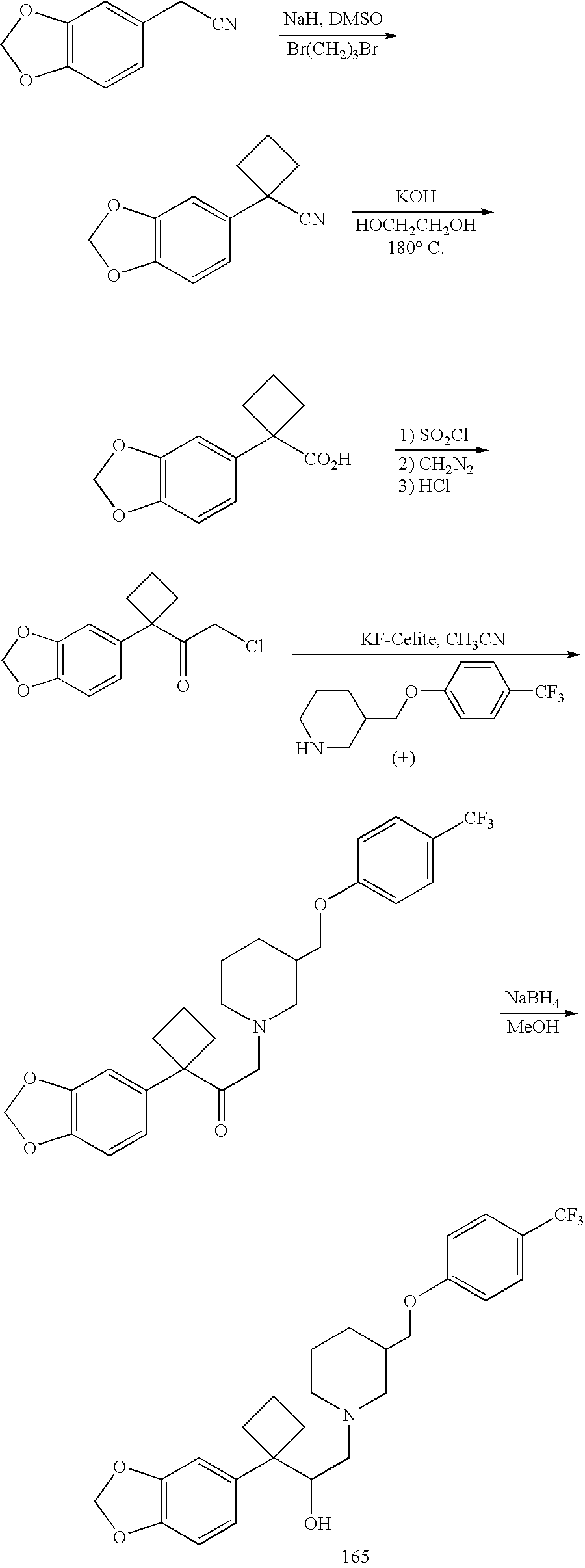
- A mixture of benzo[1,3]dioxol-5-yl-acetonitrile (1.60 g, 9.94 mmol) and the dibromide (1.11 mL, 1.1 equiv.) in 10 mL of DMSO was added to a mixture of NaH (1 g 60% suspension, 2.5 equiv.) in 30 mL of DMSO at room temperature. After 24 hours the reaction was quenched by addition of 50 mL of pH 7.0 buffer solution, the mixture was extracted with ether, and the ether extracts were concentrated in vacuo and purified on silica gel (85:15 hexane:ethyl acetate) to give the desired 1-benzo[1,3]dioxol-5-yl-cyclobutanecarbonitrile (1.41 g, 71%). Data for this nitrile: MS 202 (M+1); 1H NMR (300 MHz, CDCl3): δ 6.8-6.9 (m, 3H), 5.98 (s, 2H), 2.0-2.85 (m, 6H); 13C NMR (75 MHz, CDCl3): δ 148.5, 147.5, 134.0, 124.7, 119.2, 106.5, 101.6, 40.2, 35.0, 17.2.
- 1-Benzo[1,3]dioxol-5-yl-cyclobutanecarbonitrile (1.2 g) was slurried in ethylene glycol (10 mL) in a pressure tube and a large excess of KOH (1 g) was added. The tube was sealed and heated at 180° C. for 24 hours, cooled, poured into 100 mL of water, acidified with 1N HCl, extracted with ether, and the ether extracts were concentrated in vacuo and chromatographed on silica gel with an ethyl acetate:hexane:acetic acid mixture to give the desired 1-benzo[1,3]dioxol-5-yl-cyclobutanecarboxylic acid (850 mg, 65%). Data for this acid: MS 220 (M); 1H NMR (300 MHz, CDCl3): δ 11.4-11.8 (br. s, 1H), 2.78-6.85 (m, 3H), 5.95 (s, 2H) 2.75-2.85 (m, 2H), 2.40-2.55 (m, 2H), 1.8-2.2 (m, 2H); 13C NMR (75 MHz, CDCl3): δ 182.9, 147.9, 146.7, 137.2, 119.8, 108.2, 107.5, 101.3, 52.2, 32.6, 16.7.
- 1-Benzo[1,3]dioxol-5-yl-cyclobutanecarboxylic acid was converted to the corresponding chloroketone following the same procedure used for the conversion of 1-(2-Methoxy-phenyl)-cyclobutanecarboxylic acid to give 2-Chloro-1-[1-(2-methoxy-phenyl)-cyclobutyl]-ethanone. 300 mg of 1-benzo[1,3]dioxol-5-yl-cyclobutanecarboxylic acid thus provided 285 mg (83%) of 1-(1-Benzo[1,3]dioxol-5-yl-cyclobutyl)-2-chloro-ethanone. Data for this chloride: 1H NMR (300 MHz, CDCl3): δ 6.7-6.85 (m, 3H), 5.98 (s, 2H), 4.03 (s, 2H), 2.75-2.85 (m, 2H), 2.35-2.45 (m, 2H), 1.85-2.0 (m, 2H); 13C NMR (75 MHz, CDCl3): δ 201.9, 148.6, 147.1, 135.8, 119.8, 108.9, 107.0, 101.6, 57.7, 45.4, 31.2, 16.2.
- 1-(1-Benzo[1,3]dioxol-5-yl-cyclobutyl)-2-chloro-ethanone was used for the alkylation of 3-(4-Trifluoromethyl-phenoxymethyl)-piperidine by the same method used for the alkylation of 2-Chloro-1-[1-(2-methoxy-phenyl)-cyclobutyl]-ethanone with this amine. 100 mg of 1-(1-Benzo[1,3]dioxol-5-yl-cyclobutyl)-2-chloro-ethanone was used to prepare 85 mg of 1-(1-benzo[1,3]dioxol-5-yl-cyclobutyl)-2-[3-(4-trifluoromethyl-phenoxymethyl)-piperidin-1-yl]-ethanone (45%) by the KF-Celite method described in Example 138. Data for this amino ketone: MS 476(M+1); 1H NMR (300 MHz, CDCl3) partial: δ 6.7-7.7 (m, 7H), 6.0 (s, 2H), 3.85-3.95 (m, 2H, methylene adjacent to aryl ether), 3.1 (s, 2H, methylene adjacent to keto and amine moieties).
- 1-(1-Benzo[1,3]dioxol-5-yl-cyclobutyl)-2-[3-(4-trifluoromethyl-phenoxymethyl)-piperidin-1-yl]-ethanone (15 mg) was dissolved in 2 mL of dry methanol and solid sodium borohydride (10 equiv.) was added in portions. Water (5 mL) was added and the mixture was extracted with ether and the ether extracts were concentrated in vacuo and purified on silica gel to give the desired 1-(1-benzo[1,3]dioxol-5-yl-cyclobutyl)-2-[3-(4-trifluoromethyl-phenoxymethyl)-piperidin-1-yl]-ethanol (10 mg, 66%). Data for this mixture of diastereomeric amino alcohols: MS 478 (M+1); 1H NMR (300 MHz, CDCl3) partial: δ 6.7-7.8 (m, 7H), 3.85-3.95 (m, 2H, methylene adjacent to aryl ether), the δ 3.1 singlet for the starting material was absent.
-

- The starting nitrile, 1-(4-Trifluoromethyl-phenyl)-cyclobutanecarbonitrile, has been described (Parke Davis & Co., U.S. Pat. No. 3,536,656; 1970 and Chemical Abstracts 1970, 73, 109539). To the carbonitrile (2 g) in 5 mL of toluene in a pressure tube was added 10 mL of 3M MeMgBr ether solution (3 equiv.). The tube was sealed and the reaction mixture was heated at 95° C. for 24 hr, cooled to room temperature, poured into 50 mL of water, acidified with 25 mL of 5 M HCl, and this solution was heated at 70° C. for 2 h, cooled, and extracted with ether. The extracts were dried, filtered, concentrated, and purified on silica gel to give pure 1-[1-(4-trifluoromethyl-phenyl)-cyclobutyl]-ethanone (1.9 g, 88%). Data for this ketone: MS 242 (M); 1H NMR (300 MHz, CDCl3) δ 7.6 (d, 8.0 Hz, 2H), 7.4 (d, 8.0 Hz, 2H), 2.75-2.85 (m, 2H), 2.35-2.5 (m, 2H), 1.8-2.0 (3H s and 2H m overlapping); 13C NMR (75 MHz, CDCl3): δ 207.7, 147.5, 129.5, 126.9, 126.1, 125.9 (CF3), 59.5, 30.9, 24.6, 16.1.
- 1-[1-(4-Trifluoromethyl-phenyl)-cyclobutyl]-ethanone (1.06 g) in methanol (8 mL) was cooled to 0° C. Acetic acid containing 30% HBr (0.35 mL) was added, and then precisely 1 molar equivalent of bromine was added dropwise. The reaction mixture was maintained at 0° C. overnight, poured into 20 mL of water, and extracted with ether. The extracts were dried, filtered, concentrated, and purified on silica gel to give pure 2-bromo-1-[1-(4-trifluoromethyl-phenyl)-cyclobutyl]-ethanone (1.12 g, 80%). Data for this bromoketone: MS 321 (M); 1H NMR (300 MHz, CDCl3) δ 7.82 (d, 8 Hz, 2H), 7.39 (d, 8 Hz, 2H), 3.82 (s, 2H), 2.80-2.95 (m, 2H), 2.45-2.60 (m, 2H), 1.90-2.10 (m, 2H).
- 2-Bromo-1-[1-(4-trifluoromethyl-phenyl)-cyclobutyl]-ethanone was used for the alkylation of 3-(4-Trifluoromethyl-phenoxymethyl)-piperidine by the same method used for the alkylation of 2-Chloro-1-[1-(2-methoxy-phenyl)-cyclobutyl]-ethanone with this amine. 100 mg of 2-Bromo-1-[1-(4-trifluoromethyl-phenyl)-cyclobutyl]-ethanone was converted to 96 mg of 2-[3-(4-trifluoromethyl-phenoxymethyl)-piperidin-1-yl]-1-[1-(4-trifluoromethyl-phenyl)-cyclobutyl]-ethanone (62%) by the KF-Celite method described in Example 138. Data for this amino ketone: MS 500(M+1); 1H NMR (300 MHz, CDCl3): δ 7.61 (d, 8.3 Hz, 2H), 7.52 (d, 8.7 Hz, 2H), 7.38 (d, 8.3 Hz, 2H), 6.91 (d, 8.7 Hz, 2H), 3.75-3.85 (m, 2H, methylene adjacent to aryl ether), 3.06 (s, 2H), 1.0-2.9 (various overlapping multiplets totaling 15 H); 13C NMR (75 MHz, CDCl3): δ 207.0, 161.7, 147.3, 128.6, 127.8, 127.11, 127.06, 126.99, 125.93, 125.88, 114.6, 71.2, 63.2, 58.3, 57.2, 54.2, 36.2, 31.2, 31.1, 27.0, 24.8, 16.5.
- 2-[3-(4-Trifluoromethyl-phenoxymethyl)-piperidin-1-yl]-1-[1-(4-trifluoromethyl-phenyl)-cyclobutyl]-ethanone (30 mg) was dissolved in 3 mL of dry methanol and solid sodium borohydride (10 equiv.) was added in portions. Water (10 mL) was added and the mixture was extracted with ether and the ether extracts were concentrated in vacuo and purified on silica gel to give the desired 2-[3-(4-Trifluoromethyl-phenoxymethyl)-piperidin-1-yl]-1-[1-(4-trifluoromethyl-phenyl)-cyclobutyl]-ethanol (21 mg, 67%). Data for this mixture of diastereomeric amino alcohols: MS 502 (M+1); 1H NMR (300 MHz, CDCl3): δ 7.5-7.6 (m, 4H), 7.29-7.35 (m, 2H), 6.89-6.96 (overlapping doublets, total 2 H), 3.8-4.0 (m, 4H, 1 of which is exchanged upon exposure to D2O), 1.1-3.1 9 (various overlapping multiplets totaling 17 H); 13C NMR (75 MHz, CDCl3): δ 207 peak in starting ketone is absent. Most peaks are doubled (adjacent equal intensity peaks) due to diastereoisomerism: δ 161.7, 151.0, 128.6 & 128.5, 128.0 & 127.8, 127.15 & 127.10, 126.45, 124.91 & 124.87, 123.30, 122.86, 114.63, 71.2 & 71.1, 59.7 & 59.5, 58.99 & 58.97, 55.96, 49.31 & 49.28, 36.8 & 36.6, 31.0, 29.5 & 29.4, 27.33 & 27.26, 25.24 & 25.03, 16.42.
- The effect of 124 and 126 on spontaneous locomotor activity in rats was determined according to the procedures outlined by Silverman et al. (Motor Activity. In “Animal behavior in the laboratory”, Chapman and Hall eds, London, p. 79-92, 1978) and Boissier et al. ( Arch. Int. Pharmacodyn. 1965, 158, 212.)
- Test items and test item vehicles were administered to male Sprague-Dawley rats (n=10) as a single i.p. dose (vehicle A=10% hydroxypropyl-β-cyclodextrin in water; vehicle B=4:1 5% aqueous dextrose:PEG 400). Twenty, 60 and 120 minutes following administration, rats were placed in a plastic box 30×30 cm in a room with low light intensity (maximum 50 lux). Locomotor activity was determined during 20 minute periods using video image analyzers. Images recorded with video cameras were digitalized and displacements of the center of gravity of the digital image spot were tracked and analyzed. When the speed of displacement of the center of gravity of the spot was below 4.26 cm/sec, the movement was considered as inactivity. When this speed was between 4.26 and 6.75 cm/sec, the movement was considered as a small movement. When this speed was above 6.75 cm/sec, the movement was considered as a large movement. The number of occurrences, distance and duration of fast and slow movements, number of occurrences and duration of periods of inactivity and number of rears were measured.
- Results
-
Compounds 126 and 124, when dosed at 5 and 10 mg/kg, exhibit a significant increase in locomotor activity compared to control animals.Methyl- 126 126 124 124 phenidate, (5 mg/kg (10 mg/kg (5 mg/kg (10 mg/kg (10 mg/kg in Vehicle in Vehicle in Vehicle in Vehicle in Vehicle Vehicle A Vehicle B A) A) B) B) B) Large 20 min: 20 min: 20 min: 20 min: 20 min: 20 min: 20 min: Movement 303.7 ± 28.0 317.4 ± 15.5 287.0 ± 34.4 364.7 ± 52.7 228.7 ± 22.5 391.5 ± 63.3 974.3 ± 125.5 Occurrences 60 min: 60 min: 60 min: 60 min: 60 min: 60 min: 60 min: 104.9 ± 11.7 99.4 ± 19.7 204.4 ± 36.3 644.5 ± 127.3 74.3 ± 14.8 427.6 ± 95.8 423.9 ± 75.9 120 min: 120 min: 120 min: 120 min: 120 min: 120 min: 120 min: 65.1 ± 8.9 43.4 ± 7.9 293.8 ± 68.9 752.7 ± 129.4 168.5 ± 61.5 603.5 ± 97.4 191.8 ± 37.1 180 min: 180 min: 180 min: 180 min: 40.6 ± 17.1 22.8 ± 9.4 270.5 ± 73.8 212.5 ± 65.1 Small 20 min: 20 min: 20 min: 20 min: 20 min: 20 min: 20 min: Movement 767.3 ± 46.7 697.2 ± 36.8 711.6 ± 65.7 904.3 ± 110.8 589.2 ± 50.4 919.6 ± 96.4 1537.0 ± 97.3 Occurrences 60 min: 60 min: 60 min: 60 min: 60 min: 60 min: 60 min: 357.9 ± 47.3 307.8 ± 56.4 563.5 ± 85.0 1218.7 ± 178.9 232.8 ± 33.6 965.2 ± 153.9 992.0 ± 126.7 120 min: 120 min: 120 min: 120 min: 120 min: 120 min: 120 min: 256.3 ± 42.9 140.3 ± 22.3 717.4 ± 138.6 1358.1 ± 137.1 443.1 ± 100.6 1201.4 ± 160.9 555.0 ± 87.0 180 min: 180 min: 180 min: 180 min: 114.4 ± 38.6 103.2 ± 42.0 651.4 ± 141.2 484.5 ± 114.1 - The objective of this study was to assess the antidepressant effects of
test compounds 124, 125, 126, and 127 in the behavioral despair assay in rats using a modification of a method described by Porsolt R. D., Anton G., Blavet N., Jalfre M., Behavioural despair in rats: a new model sensitive to antidepressant treatment, Eur. J. Pharmacol., 1978, 47, 379-391. The animals were preconditioned in a pretest session, where the rats were individually forced to swim inside a vertical plexiglass cylinder containing water maintained at 19-20° C. After 15 minutes in the water, they were allowed to dry for 15 minutes in a heated enclosure. Twenty four hours later, the compounds were administered intraperitoneal to the animals. One hour after administration of the test compound, animals were put back into the cylinder containing water. The total duration of immobility was measured during the last 4 minutes of a 6 minute test.Compound Dose (mg/kg) % variation 126 10 99 2.5 45 127 67 2.5 25 124 10 91 2.5 6 125 10 55 Nomifensine 3 78 - The results are expressed as the percentage of variation of the total duration of immobility calculated from the mean value of the vehicle-treated group (% variation=[(immobility duration of vehicle−immobility duration of test compound)/(immobility duration of vehicle)]×100%). Only compounds which exhibit a statistically significant variation >30% are considered effective in this in vivo model.
- Results
- Based on the aforementioned criterion for effectiveness, all four compounds are effective at a dose of 10 mg/kg; compound 126 is also effective at 2.5 mg/kg.
- The objective of this study was to assess the antidepressant effects of
test compounds 124, 125, 126, and 127 in the behavioral despair assay in rats according to the methods described by Porsolt R. D., Anton G., Blavet N., Jalfre M., Behavioural despair in rats: a new model sensitive to antidepressant treatment, Eur. J. Pharmacol., 1978, 47, 379-391. The animals were preconditioned in a pretest session, where the rats were individually forced to swim inside a vertical plexiglass cylinder containing water maintained at 19-20° C. After 15 minutes in the water, they were allowed to dry for 15 minutes in a heated enclosure. Twenty four hours later, they were replaced in the cylinder and the total duration of immobility was measured during a 5 minute test (test session). The test compounds and vehicle were administered as a series of 3 intraperitoneal injections 24 h, 5 h and 1 h before the 5 minute test on the second day.Compound Dose (mg/kg) % variation 124 2.5 59 2.0 71 1.0 29 125 2.5 12 126 1.0 58 126 2.5 76 0.75 47 0.25 9 127 1.0 14 127 3.0 64 2.5 39 2.0 39 Imipramine 30 55 - The results are expressed as the percentage of variation of the total duration of immobility calculated from the mean value of the vehicle-treated group (% variation=[(immobility duration of vehicle−immobility duration of test compound)/(immobility duration of vehicle)]×100%). Only compounds which exhibit a statistically significant variation >30% are considered effective in this in vivo model.
- Results
- Based on the aforementioned criterion for effectiveness,
compounds 124, 126, and 127 were effective at a dose of 2.5 mg/kg; compound 126 was also effective at a dose of 1.0 mg/kg. - The absolute stereochemistry of 124 was determined to be (3S,1′S), by both asymmetric synthesis and X-Ray crystallography. The method of enantiospecific prepartion of 124 is depicted in
Schemes 

- The (3S, 1′R) diastereomer, 125, was prepared by coupling the R-epoxide with the S-piperdine (See Scheme 3). This compound had a unique 1H-NMR and 13C-NMR compared to 124 as expected for a diastereomer. This compound had a measured optical rotation of [α]D=−1545.6° (c=2.26; CHCl3; 589 nm, 21° C.).

- The (3R,1′S) diastereomer, 126, was prepared by coupling the S-epoxide with the R-piperdine (See Scheme 3). This compound had identical 1H-NMR and 13C-NMR to its enantiomer, 125. This compound had a measured optical rotation of [α]D=+1479.1° (c=1.13; CHCl3; 589 nm, 21° C.).
- The (3R,1′R) diastereomer, 127, was prepared by coupling the R-epoxide with the R-piperdine (See Scheme 3). This compound had identical 1H-NMR and 13C-NMR to its enantiomer, 124. This compound had a measured optical rotation of [α]D=+258.7° (c=1.50; CHCl3; 589 nm, 21° C.).
- References Cited in Example 144
- 1) (a) Corey, E. J.; Bakshi, R. K.; Shibata, S. J. Am. Chem. Soc. 1987, 109, 5551. (b) Corey, E. J.; Bakshi, R. K.; Shibata, S.; Chen, C.-P.; Singh, V. K. J. Am. Chem. Soc., 1987, 109, 7925. (c) Corey, E. J.; Shibata, S.; Bakshi, R. K. J. Org. Chem., 1988, 53, 2861.
- 2) Marnus, P.; Thurston, L. S. J. Org. Chem. 1991, 56, 1166.
-

- To a solution of (R)-3-Methanesulfonyloxymethyl-piperidine-1-carboxylic acid tert-butyl ester (3.522 g, 12 mmol) in CH 3CN (100 mL) at room temperature was added 4-(trifluoromethoxy)phenol (1.555 mL, 12 mmol) and Cs2CO3 (7.820 g, 24 mmol). The mixture was heated at reflux for 20 hours. After cooling to room temperature, the mixture was filtered and concentrated in vacuo. The residue was dissolved in 250 mL EtOAc, and washed with water (125 mL), saturated Na2CO3 (125 mL), and water (125 mL), The organic layer was dried over Na2SO4, filtered and concentrated in vacuo. The residue was purified by flash column chromatography using a gradient of 0 to 25% EtOAc in hexane to provide the phenyl ether (3.40 g, 81%). 1H NMR (300 MHz, CDCl3): δ 7.14 (d, J=9.0 Hz, 2H), 6.88 (d, J=9.0 Hz, 2H), 3.76-3.91 (m, 4H), 2.92 (br s, 2H), 1.99-2.05 (m, 1H), 1.87-1.92 (m, 1H), 1.67-1.74 (m, 1H), 1.46 (s, 9H), 1.27-1.40 (m, 2H). 13C NMR (CDCl3): δ 157.7, 155.2, 142.9, 122.7, 120.0, 115.4, 79.7, 70.6, 47.1, 44.4, 36.0, 28.6, 27.5, 24.5.
- A solution of the phenyl ether (3.40 g, 9.60 mmol) in CH 2Cl2 (30 mL) at 0° C. was treated with TFA (30 mL). The reaction mixture was allowed to warm up to 25° C., and stirred for 1 hour. The solvent was removed Na2SO4. The residue was dissolved in CH2Cl2 (50 mL), washed with saturated NaHCO3 (50 mL) and brine (50 mL). The organic layer was dried over Na2SO4, filtered and concentrated in vacuo to yield the secondary amine (2.31 g, 88%). LRMS m/z 276 (M+, C13H16F3NO2 +, requires 276).
- To a solution of the secondary amine (1.0 g, 3.63 mmol), 1-(4-methoxy-phenyl)-cyclobutanecarboxylic acid (0.824 g, 4.0 mmol) and HOBt (0.612 g, 4.0 mmol) in DMF (8.0 mL) was added 1-[3-(dimethylamino)propyl]-3-ethylcarbodiimide methiodide (1.19 g, 4.0 mmol). The mixture was stirred at room temperature for 20 hours. Then, the reaction mixture was poured into water (30 mL), extracted with EtOAc (3×30 mL). The organic layer was washed with saturated NaHCO 3 (30 mL), brine (30 mL), and brine (30 mL), dried over Na2SO4, and concentrated in vacuo. The residue was purified by flash column chromatography using a gradient of 0 to 25% EtOAc/hexane to provide the corresponding amide (1.40 g, 83%). 1H NMR (CDCl3): δ 7.33 (d, J=8.7 Hz, 2H), 7.15 (d, J=8.7 Hz, 2H), 6.76-6.91 (m, 4H), 4.50 (br s, 1H), 3.80 (s, 3H), 3.28-3.65 (m, 3H), 2.30-2.94 (m, 6H), 1.73-2.06 (m, 4H), 1.25-1.45 (m, 3H). 13C NMR (CD Cl3): d 174.6, 158.3, 157.5, 142.9, 135.9, 126.4, 122.7, 120.0, 115.4, 115.2, 114.3, 70.5, 55.4, 52.0, 49.0, 46.3, 45.6, 43.2, 36.0, 33.1, 32.4, 27.4, 24.6, 24.0, 15.6.
- To a solution of the amide (0.70 g, 1.51 mmol) in THF (20 mL) was added LiAlH 4 (0.058 g, 1.51 mmol) at −70° C. After addition, the reaction mixture was heated at reflux for 3 hours. Then, the mixture was cooled to 0° C. , and quenched with 2 N NaOH (0.3 mL) and water (0.3 mL). The mixture was filtered and concentrated in vacuo. The residue was purified by flash column chromatography, eluting with CH2Cl2/MeOH to provide free amine 170 (0.58 g, 86%, >99.9% ee). 1H NMR (300 MHz, CDCl3): δ 7.12-7.19 (m, 4H), 6.89 (d, J=2.6 Hz, 2H), 6.85 (d, J=2.6 Hz, 2H), 3.82 (s, 3H), 3.65-3.78 (m, 2H), 2.63 (AB quartet, J=13.5 Hz, 2 H), 1.11-2.54 (m, 15H). 13C NMR (CDCl3): δ 158.0, 157.5, 142.7, 142.2, 127.3, 122.6, 120.0, 115.4, 113.3, 71.3, 69.4, 59.1, 56.6, 55.4, 47.0, 36.3, 32.0, 31.9, 27.0, 24.9, 16.3. LRMS m/z 450 (M+, C25H30F3NO3 +, requires 450).
-

- Compound 171 was prepared using the procedure outlined in Example 145, starting with the (S)-3-methanesulfonyloxymethyl-piperidine-1-carboxylic acid tert-butyl ester. The chiral purity of 171 was determined to be 98.4% ee using chiral HPLC analysis.
-

- The epoxide (10.0 g) was dissolved in 200 mL of 2.0 M dimethylamine in THF in a sealed tube. The mixture was stirred at 60° C. for 48 hours. After removal of the solvent, the residual was purified on column chromatography (silica gel, EtOAc to EtOAc/MeOH, 1:1). 5.56 g of amino alcohol was obtained (LRMS 273).

- The amino alcohol (8.95 g, 32.9 mmol) was dissolved in 80 mL of CH 2Cl2 and cooled down at 0° C. Then N,N-diisopropylethylamine (11.46 mL, 2 eq.) and methanesulfonyl chloride (3.06 mL, 1.2 eq.) were added. The reaction mixture was stirred at r.t. for 6 hours. To the mixture was added 20 mL of water and the aqueous layer was extracted with EtOAc (3×100 mL). The organic layer was washed with brine and dried over Na2SO4. After filtration and evaporation, the crude residual (10.5 g) was dissolved in 90 mL of CH3CN. To the solution the potassuim cabonate (20.7 g, 5 eq.) and α,α,α-trifluoro-p-cresol (9.72 g, 2 eq.) were added and the mixture was stirred at 60° C. overnight. The mixture was quenched with water (50 mL), extracted with EtOAc (2×60 mL). The combined organic phase was washed with brine (2×50 mL) and dried over Na2SO4. After filtration and removal of the solvent, silica gel flash column chromatography gave the diastereomeric phenyl ethers.

- To the diastereomer shown (25 mg, 0.06 mmol) in CH 2Cl2 (1.0 mL), trifluoroacetic acid (1.0 mL) was added at 0° C. After completion of addition the reaction mixutre continued stirring at r.t. for 20 minutes. The solvent was removed and the residual was dried in vacuo for 2 hours. The resulting oil was dissolved in 1.0 mL of DMF. To this solution 1-(4-chlorophenyl)-1-cyclobutanecarboxylic acid (15.2 mg, 1.2 eq.), 1-[3-(dimethylamino)propyl]-3-ethylcarbodiimide methiodine (21.4, 1.2 eq.) and HOBt were added. The mixture was stirred at r.t. overnight. The reaction was quenched with 20 mL of EtOAc and 5 mL of 10% aqueous NaOH. The organic layer was washed with 5 mL of brine and dried over Na2SO4. The preparative TLC (silica gel, EtOAc/Hexane, 2:1) gave (±)-173 (27 mg, yield 89%). LRMS 509.

- To a solution of (±)-173 (25 mg, 0.05 mmol) in 3 mL of dry THF was added LiAlH 4 (4 mg) at r.t. The mixture was refluxed for 2 hour. The reaction mixture was quenched with 5 mL of water and extracted with EtOAc (3×10 mL). The combined organic layer was washed with brine (2×5 mL) and dried over Na2SO4. The preparative TLC (silica gel, EtOAc) gave (±)-174 (13 mg, yield 51%). LRMS 495.

- Employing the same procedures, compound the diastereomer shown (25 mg) was converted into compound (±)-175 (10 mg, LRMS 495).
-

- Racemic 3-(4-Trifluoromethyl-phenoxymethyl)-piperidine (100 mg, 0.39 mmol), R-2,3-Dihydro-benzo[1,4]dioxine-2-carboxylic acid (73 mg, 0.41 mmol), the amide coupling agent BrOP (225 mg, 0.58 mmol), and diisopropylethylamine (150 mg, 1.16 mmol) were dissolved in 2 mL of anhydrous dichloromethane. Concomitantly, racemic 3-(4-Trifluoromethyl-phenoxymethyl)-piperidine (100 mg, 0.39 mmol), S-2,3-Dihydro-benzo[1,4]dioxine-2-carboxylic acid (73 mg, 0.41 mmol), the amide coupling agent BrOP (225 mg, 0.58 mmol), and diisopropylethylamine (150 mg, 1.16 mmol) were dissolved in 2 mL of anhydrous dichloromethane. Each mixture was kept at room temperature overnight, diluted with 10 mL of water, and 10 mL of ether. Extractive workup gave in each case, after concentration of the organic layers in vacuo and chromatography on silica gel using a EtOAc-hexane gradient column, the desired amide intermediate in 75-88% yield.
- Each intermediate amide mixture was dissolved in 5 mL of THF at 0° C. and excess lithium aluminum hydride (100 mg, ca. 7 equivalents) was added. The solutions were heated to reflux for 5 minutes, cooled to 0° C., and quenched by dropwise addition of 0.5 mL 1M NaOH. Additional THF (10 mL) was added to each, and the suspensions were stirred at room temperature for 30 minutes and then filtered though a plug of sodium sulfate. The solutions thus obtained were concentrated in vacuo and the residues were purified by preparative HPLC using a Chiralpak AD™ column from Chiral Technologies, Inc., eluting with an 99:1 mixture of hexane and isopropyl alcohol containing ca. 0.1% diethylamine. Each mixture of diastereomers was separated in this fashion, and the pairs of amines were obtained in 50-65% total yield from each corresponding amide mixture (176, 177, 178, and 179). Data for each diastereomer: MS 408 (M ++1). 1H and 1C (DEPT) NMR data for each isomer was consistent with the assigned structure. Particularly diagnostic in distinguishing the diastereomers by NMR was the observance of a pair of doublets in the 1H spectrum that appear at δ=3.09 ppm (J=10 Hz) and δ=2.80 ppm (J=10 Hz) for one diastereomer and δ=2.98 ppm (J=7 Hz) and δ=2.91 ppm (J=7 Hz) for the other diastereomer.
-

- 2-(4-Chloro-phenoxymethyl)-oxirane (50 mg) and of 3-(4-Trifluoromethyl-phenoxymethyl)-piperidine (70 mg, 1.0 equivalent) in 4 mL of methanol were heated in a sealed tube at 100° C. for 16 hours, cooled to room temperature, transferred to a round-bottomed flask, and concentrated in vacuo. The crude residue was purified by flash chromatography on silica gel using as eluent a gradient of ethyl acetate in hexane containing 1% ammonium hydroxide. 95 mg of 1-(4-Chloro-phenoxy)-3-[3-(4-trifluoromethyl-phenoxymethyl)-piperidin-1-yl]-propan-2-ol was obtained (79%). Data for this mixture of amino alcohol diastereomers: MS 444 (M ++1).
-

- 3-(4-Trifluoromethyl-phenoxymethyl)-piperidine (50 mg, 0.19 mmol), (1H-Indol-3-yl)-acetic acid (73 mg, 0.21 mmol), the amide coupling agent BrOP (123 mg, 0.32 mmol), and diisopropylethylamine (75 mg, 0.58 mmol) were dissolved in 2 mL of anhydrous dichloromethane. The mixture was kept at room temperature overnight, diluted with 10 mL of water, and 10 mL of ether. Extractive workup gave in each case, after concentration of the organic layers in vacuo and chromatography on silica gel using a EtOAc-hexane gradient column, the desired amide intermediate (71 mg, 90%). This amide was dissolved in 5 mL of THF at 0° C. and excess lithium aluminum hydride (50 mg, ca. 8 equivalents) was added. The solution was heated to reflux for 5 minutes, cooled to 0° C., and quenched by dropwise addition of 0.5 mL 1M NaOH. Additional THF (10 mL) was added, and the suspension was stirred at room temperature for 30 minutes and then filtered though a plug of sodium sulfate. The solution thus obtained was concentrated in vacuo and the residue was purified by flash chromatography on silica gel using as eluent a gradient of ethyl acetate in hexane containing 1% ammonium hydroxide. 53 mg of 3-{2-[3-(4-Trifluoromethyl-phenoxymethyl)-piperidin-1-yl]-ethyl}-1H-indole, 180, was obtained (77%). Data for this compound: MS 403 (M ++1).
-

- Following exactly the same two step procedure used in the previous example for the preparation of 3-{2-[3-(4-Trifluoromethyl-phenoxymethyl)-piperidin-1-yl]-ethyl}-1H-indole but using biphenyl-4-yl-acetic acid in place of (1H-Indol-3-yl)-acetic acid, 1-(2-Biphenyl-4-yl-ethyl)-3-(4-trifluoromethyl-phenoxymethyl)-piperidine was obtained in 54% overall yield from 0.19 mmol of 3-(4-Trifluoromethyl-phenoxymethyl)-piperidine, 181. Data for this compound: MS 440 (M ++1).
-

- To a solution of (S)-3-styryl-piperidine-1-carboxylic acid benzyl ester (411 mg, 1.28 mmol, in 5 mL of THF) was added 3.86 mL of a 0.5 M THF solution of 9-borabicyclononane. The solution was brought to reflux and then cooled to room temperature after 3 hours. 2 mL of 30% hydrogen peroxide solution and 2 mL of 3M NaOH were added dropwise. The solution was stirred for 30 minutes, diluted with water (20 mL) and ether (30 mL). Extractive workup gave, after concentration of the organic layers in vacuo and chromatography on silica gel using as eluent an EtOAc-hexane gradient, the desired alcohol intermediate (69 mg, 85%; MS 340=M ++1). This alcohol (350 mg, 1.03 mmol) was dissolved in 5 mL of methylene chloride and treated with 1.1 equivalents of the Dess-Martin periodinane. After 2 hours at room temperature, 1 mL of isopropanol was added, and then after 5
minutes 5 mL of 1M NaOH was added. After 20 minutes, to the mixture was added 30 mL of ether and 30 mL of water. Extractive workup gave, after concentration of the organic layers in vacuo and chromatography on silica gel using as eluent an EtOAc-hexane gradient, the desired ketone intermediate (S)-3-(2-Oxo-2-phenyl-ethyl)-piperidine-1-carboxylic acid benzyl ester (337 mg, 97%; MS 338=M++1). - (S)-[3-(2-Oxo-2-phenyl-ethyl)-piperidine-1-carboxylic acid benzyl ester] (266 mg, 0.79 mmol) was dissolved in 2 mL of methanol in a small vessel for pressurized hydrogenation. 200 mg of 5% palladium on carbon was added. The vessel was charged with 50 psi of hydrogen and shaken for two hours. The vessel was evacuated, filtered, and the residue was concentrated in vacuo to yield 155 mg of the desired product (S)-[1-Phenyl-2-piperidin-3-yl-ethanone] (97%; MS 204=M ++1).
- (S)-[1-Phenyl-2-piperidin-3-yl-ethanone] (142 mg, 0.70 mmol) and 1-(4-Chloro-phenyl)-cyclobutanecarboxylic acid (148 mg, 0.70 mmol) were dissolved in 5 mL of methylene chloride and treated with the amide coupling agent BrOP (1.05 mmol), and diisopropylethylamine (2.1 mmol). The mixture was kept at room temperature overnight, diluted with 20 mL of water, and 50 mL of ether. Extractive workup gave, after concentration of the organic layers in vacuo and chromatography on silica gel using a EtOAc-hexane gradient column, the desired amide intermediate 2-{1-[1-(4-Chloro-phenyl)-cyclobutanecarbonyl]-piperidin-3-yl}-1-phenyl-ethanone (254 mg, 92%). This amide was dissolved in 10 mL of THF at 0° C. and excess lithium aluminum hydride (245 mg) was added. The solution was heated to reflux for 5 minutes, cooled to 0° C., and quenched by dropwise addition of 1.5 mL 1M NaOH. Additional THF (10 mL) was added, and the suspension was stirred at room temperature for 30 minutes and then filtered though a plug of sodium sulfate. The solution thus obtained was concentrated in vacuo and the residue was purified by flash chromatography on silica gel using as eluent a gradient of ethyl acetate in hexane containing 1% ammonium hydroxide. 205 mg of (S)-[2-{1-[1-(4-Chloro-phenyl)-cyclobutylmethyl]-piperidin-3-yl}-1-phenyl-ethanol], 182, was obtained (83%). 1H and 13C NMR data was consistent with the assigned structure. Data for this compound as a mixture of diastereomers: MS 384 (M++1).
-

- (S)-[2-{1-[1-(4-Chloro-phenyl)-cyclobutylmethyl]-piperidin-3-yl}-1-phenyl-ethanol] (29 mg, 0.075 mmol) was dissolved in 2 mL of methylene chloride and treated with 1.1 equivalents of the Dess-Martin periodinane. After 2 hours at room temperature, 0.5 mL of isopropanol was added, and then after 5
minutes 1 mL of 1M NaOH was added. After 20 minutes, to the mixture was added 20 mL of ether and 20 mL of water. Extractive workup gave, after concentration of the organic layers in vacuo and chromatography on silica gel using as eluent an EtOAc-hexane gradient with 1% ammonium hydroxide, the desired product (S)-[2-{1-[1-(4-Chloro-phenyl)-cyclobutylmethyl]-piperidin-3-yl}-1-phenyl-ethanone], 183, (15 mg, 53%). Data for this ketone: MS 382 (M++1). -

- (S)-[2-{1-[1-(4-Chloro-phenyl)-cyclobutylmethyl]-piperidin-3-yl}-1-phenyl-ethanol] (38 mg, 0.100 mmol) was dissolved in 1 mL of THF and cooled to 0° C. Potassium tert-butoxide was added (112 mg, 1.0 mmol) followed by methyl iodide in large excess (ca. 0.5 mL). After 30 minutes at 0° C., water (5 mL) and ether (5 mL) were added. Extractive workup gave, after concentration of the organic layers in vacuo and chromatography on silica gel using as eluent an EtOAc-hexane gradient with 1% ammonium hydroxide, the desired product 1-[1-(4-Chloro-phenyl)-cyclobutylmethyl]-3-(2-methoxy-2-phenyl-ethyl)-piperidine, 184, (28 mg, 70%). Data for this compound: MS 398 (M ++1).
-

- (S)-[2-{1-[1-(4-Chloro-phenyl)-cyclobutylmethyl]-piperidin-3-yl}-1-phenyl-ethanone] (10 mg, 0.027 mmol) was dissolved in 1 mL of anhydrous THF and cooled to 0° C. Methyl magnesium bromide solution (0.27 mL of a 1M solution in THF, 0.27 mmol) was added via syringe. After 30 minutes the reaction was quenched by adding 0.5 mL of 1M NaHSO 4 solution. Water (4 mL) and ether (10 mL) were added. Extractive workup gave, after concentration of the organic layers in vacuo and chromatography on silica gel using as eluent an EtOAc-hexane gradient with 1% ammonium hydroxide, the desired product (S)-[1-{1-[1-(4-Chloro-phenyl)-cyclobutylmethyl]-piperidin-3-yl}-2-phenyl-propan-2-ol], 185, (8 mg, 75%). Data for this compound: MS 398 (M++1).
-

- (S)-2-{1-[1-(4-Chloro-phenyl)-cyclobutanecarbonyl]-piperidin-3-yl}-1-phenyl-ethanone (12.7 mg, 0.032 mmol) in 1 mL of THF was treated with 5 equivalents of methylene Wittig reagent at room temperature. The crude mixture was concentrated in vacuo, dissolved in a minimal amount of methylene chloride, and then this product mixture purified by flash column chromatography on silica gel using a gradient elution with an EtOAc-hexane mixture. The desired olefin was obtained (10.4 mg, 82%) and was immediately dissolved in 1 mL of methanol in a small vessel for pressurized hydrogenation. 20 mg of 10% palladium on carbon was added. The vessel was charged with 50 psi of hydrogen and shaken for 6 hours. The vessel was evacuated, filtered, and the residue was concentrated in vacuo to yield 10.3 mg of the desired product (99%). This unpurified product was dissolved in 1 mL of THF at 0° C. and excess lithium aluminum hydride (0.30 mL of a 1M solution in ether, ca. 10 equiv.) was added. The solution was heated to reflux for 5 minutes, cooled to 0° C., and quenched by dropwise addition of 0.5 mL 1M NaOH. Additional THF (2 mL) was added, and the suspension was stirred at room temperature for 30 minutes and then filtered though a plug of sodium sulfate. The solution thus obtained was concentrated in vacuo and the residue was purified by flash chromatography on silica gel using as eluent a gradient of ethyl acetate in hexane containing 1% ammonium hydroxide. (S)-1-[1-(4-Chloro-phenyl)-cyclobutylmethyl]-3-(2-phenyl-propyl)-piperidine, 186, was obtained (7.2 mg, 72%). Data for this compound: MS 382 (M ++1).
-

- 3-(4-Trifluoromethyl-phenoxymethyl)-piperidine (122 mg, 0.47 mmol), 4-Oxo-cyclohexanecarboxylic acid (67 mg, 0.47 mmol) the amide coupling agent BrOP (274 mg, 0.71 mmol), and diisopropylethylamine (183 mg, 1.41 mmol) were dissolved in 2 mL of anhydrous dichloromethane. The mixture was kept at room temperature overnight, diluted with 10 mL of water, and 10 mL of ether. Extractive workup gave, after concentration of the organic layers in vacuo and chromatography on silica gel using a EtOAc-hexane gradient column, the desired amide intermediate, 4-[3-(4-Trifluoromethyl-phenoxymethyl)-piperidine-1-carbonyl]-cyclohexanone (136 mg, 75%; MS 384=M ++1).
- A portion of this ketone (105 mg, 0.27 mmol) amide mixture was dissolved in 2 mL of THF at 0° C. and p-Cl-phenyl magnesium bromide (0.68 mL of a 1M solution, 2.5 equivalents) was added via syringe. After 30 minutes, 2 mL of 1M NaHSO 4 solution was added, followed by 15 mL of water and 15 mL of ether. Extractive workup gave, after concentration of the organic layers in vacuo and chromatography on silica gel using a EtOAc-hexane gradient column, the desired Grignard adduct [4-(4-Chloro-phenyl)-4-hydroxy-cyclohexyl]-[3-(4-trifluoromethyl-phenoxymethyl)-piperidin-1-yl]-methanone (88 mg, 65%; MS 478=M+1 minus water). A portion of this material (41 mg, 0.083 mmol) was dissolved in 2 mL of THF and excess lithium aluminum hydride (31 mg, ca. 10 equivalents) was added. The solution was heated to reflux for 5 minutes, cooled to 0° C., and quenched by dropwise addition of 1 mL 1M NaOH. Additional THF (10 mL) was added, and the suspension was stirred at room temperature for 30 minutes and then filtered though a plug of sodium sulfate. The solution thus obtained was concentrated in vacuo and the residue was purified by flash chromatography on silica gel using as eluent a gradient of ethyl acetate in hexane containing 1% ammonium hydroxide. 1-(4-Chloro-phenyl)-4-[3-(4-trifluoromethyl-phenoxymethyl)-piperidin-1-ylmethyl]-cyclohexanol (187) was obtained (28 mg, 70%). MS 482 (M++1), 464 (M++1 minus water).
-

- 4-[3-(4-Trifluoromethyl-phenoxymethyl)-piperidine-1-carbonyl]-cyclohexanone (27 mg, 0.070 mmol) was dissolved in 1 mL of THF and excess lithium aluminum hydride (27 mg, ca. 10 equivalents) was added. The solution was heated to reflux for 5 minutes, cooled to 0° C., and quenched by dropwise addition of 0.5 mL 1M NaOH. Additional THF (10 mL) was added, and the suspension was stirred at room temperature for 30 minutes and then filtered though a plug of sodium sulfate. The solution thus obtained was concentrated in vacuo and the residue was purified by flash chromatography on silica gel using as eluent a gradient of ethyl acetate in hexane containing 1% ammonium hydroxide. 4-[3-(4-Trifluoromethyl-phenoxymethyl)-piperidin-1-ylmethyl]-cyclohexanol, 188, (16 mg, 61%) was obtained. Data for this compound: MS 372 (M ++1).
-

- Following the procedure described in Example 72, 1-Bromomethyl-3,5-bis-trifluoromethyl-benzene was used to alkylate 56 mg (0.19 mmol) of [1-(4-Chloro-phenyl)-cyclobutyl]-(3-hydroxy-piperidin-1-yl)-methanone, forming the ether adduct [3-(3,5-Bis-trifluoromethyl-benzyloxy)-piperidin-1-yl]-[1-(4-chloro-phenyl)-cyclobutyl]-methanone (39 mg, 39%). A portion of this compound (22 mg, 0.043 mmol) was dissolved in 1 mL of THF and excess lithium aluminum hydride (16 mg, ca. 10 equivalents) was added. The solution was heated to reflux for 5 minutes, cooled to 0° C., and quenched by dropwise addition of 0.5 mL 1M NaOH. Additional THF (10 mL) was added, the suspension was stirred at room temperature for 30 minutes, and then was filtered though a plug of sodium sulfate. The solution thus obtained was concentrated in vacuo and the residue was purified by flash chromatography on silica gel using as eluent a gradient of ethyl acetate in hexane containing 1% ammonium hydroxide. 3-(3,5-Bis-trifluoromethyl-benzyloxy)-1-[1-(4-chloro-phenyl)-cyclobutylmethyl]-piperidine, 189, was obtained (12 mg, 56%). Data for this compound: MS 506 (M ++1).
-

- A solution of 3-(4-trifluoromethyl-phenoxymethyl)-piperidine (0.220 minol, 57 mg) and cyclohexyl-hydroxy-phenyl-acetic acid (1.2 equiv, 0.264 mmol, 62 mg) in CH 2Cl2 (1 mL) was treated with BrOP (1.5 equiv, 0.330 mmol, 314 mg) and iPr2NEt (3.0 equiv, 0.660 mmol, 115 μL) at 0° C. The reaction mixture stirred for 12 h while warming to rt. The reaction mixture was quenched with 10% HCl (10 mL) and then extracted with EtOAc (2×15 mL). The combined organics were washed with NaHCO3(sat) and dried with NaCl(sat) and Na2SO4(s). The solvents were removed in vacuo and chromatography (PTLC, SiO2, 20 cm×20 cm, 1 mm, 5:1 hexane-thyl acetate) provided 190 (45 mg, 105 mg theoretical, 43%) as a colorless oil: Rf 0.45 (SiO2, 5:1 hexane-ethyl acetate); LRMS m/z 476 (M++1, C27H32F3NO3 requires 476).
-

- A solution of 190 (0.095 mmol, 45 mg) in THF (500 μL) at 0° C. was treated with LiAlH 4 (5.0 equiv, 0.475 mmol, 18 mg) under Ar. The reaction mixture stirred for 12 h and returned to 25° C. The reaction mixture was then cooled to 0° C., quenched with 10% aqueous NaOH and extracted with 3×EtOAc (25 mL). The organics were dried with NaCl(sat) and Na2SO4(s). The reaction mixture was purified by chromatography (PTLC, SiO2, 20 cm×20 cm, 1 mm, 4:1 hexane-ethyl acetate) which provided 191 (34 mg, 44 mg theoretical, 77%) as a colorless oil: Rf 0.38 (SiO2, 4:1 hexane-ethyl acetate); LRMS m/z 462 (M++1, C27H34F3NO2 requires 462).
-

- A solution of 155 (0.293 mmol, 136 mg) in CH 3OH (2 mL) was treated with NaBH4 (3.0 equiv, 0.879 mmol, 33 mg) at 0° C. The reaction mixture was allowed to warm to rt and stirred for 12 h. The reaction mixture was quenched with
pH 7 phosphate buffer (10 mL) and extracted with EtOAc (2×10 mL). The combined organics were dried with NaCl(sat) and Na2SO4(s). The solvents were removed in vacuo and chromatography (Isco Combi-Flash, 35 g cartridge, 2:1 hexane-ethyl acetate) provided a mixture of diastereomers (192, 193, 194, and 195) (120 mg, 137 mg theoretical, 88%) as a colorless oil: Rf 0.35 (SiO2, 2:1 hexane-ethyl acetate); LRMS m/z 467 (M++1, C26H31ClF3NO requires 467). The four diastereomers were separated on a Chiralpak AD column by utilizing the following procedure. The mixture was dissolved in 90:10 hexane (0.1% diethylamine) and isopropanol at a concentration of 90 mg/mL. 192 (first peak) and 193 (fourth peak) were separated by using a 99% hexane(0.1% diethylamine) and 1% isopropanol solvent system. The middle peak was collected and concentrated in vacuo and then separated using 95% hexane(0.1% diethylamine) and 5% isopropanol to provide 194 (second peak) and 195 (third peak). -

- A solution of 233 (0.378 mmol, 130 mg) in THF (1 mL) and CH 3I (1 mL) was treated with tBuOK (5.0 equiv, 1.89 mmol, 212 mg) at 25° C. The reaction mixture stirred for 10 min. The reaction mixture was quenched with
pH 7 phosphate buffer (10 mL) and extracted with EtOAc (2×10 mL). The combined organics were dried with NaCl(sat) and Na2SO4(s). The solvents were removed in vacuo and the residue was purified by chromatography (PTLC, SiO2, 20 cm×20 cm, 1 mm, 3:1 hexane-acetone) which provided 196 (100 mg, 135 mg theoretical, 74%) as a colorless oil: Rf 0.48 (SiO2, 3:1 hexane-acetone); LRMS m/z 359 (M++1, C22H28ClNO requires 359). -

- A solution of piperidine-ketone (0.693 mmol, 237 mg) in THF (1 mL) was added to a solution of CH 3MgCI (3.0 M in THF) (5.0 equiv, 3.47 mmol, 1.16 mL) in THF (1 mL) at 0° C. The reaction mixture stirred for 1 h. The reaction mixture was quenched with 10% NaOH (10 mL) and extracted with EtOAc (2×10 mL). The combined organics were dried with NaCl(sat) and Na2SO4(s). The solvents were removed in vacuo and the residue was purified by chromatography (PTLC, SiO2, 20 cm×20 cm, 1 mm, 3:1 hexane-acetone) which provided 197 (220 mg, 248 mg theoretical, 89%) as a colorless oil: Rf 0.44 (SiO2, 3:1 hexane-acetone); LRMS m/z 359 (M++1, C22H28ClNO requires 359).
-

- A solution of the Wittig salt (1.5 equiv, 12.02 mmol, 6.22 g) in THF (40 mL) was treated with nBuLi (1.5 equiv, 2.5M, 12.02 mmol, 4.8 mL) at −78 OC. The solution was warmed to 0° C. for 30 min and then cooled again to −78° C. A solution of piperidine-3-carbaldehyde (8.01 mmol, 1.98 g) in THF (10 mL) was added to the above reaction mixture at −78° C. The reaction stirred for 12 h. The reaction mixture was quenched with 10% HCl (20 mL) and then extracted with EtOAc (2×50 mL). The combined organics were dried with NaCl (sat) and Na2SO4(s). The solvents were removed in vacuo and chromatography (Isco Combi-Flash, 110 g cartridge, 19:1 hexane-ethyl acetate) provided 198 (1.79 g, 3.25 g theoretical, 55%) as a colorless oil: Rf 0.42 (SiO2, 6:1 hexane-EtOAc); LRMS m/z 406 (M++1, C22H22F3NO3 requires 406).
-

- A solution of 198 (4.42 mmol, 1.79 g) in CH 3OH (60 mL) was treated 30% Pd—C (500 mg) and H2 (Parr Hydrogenator, starting 65 psi). The reaction was shaken for 4 h. The reaction mixture was filtered through celite, and the solvents were removed in vacuo to provide 199 (1.21 g, 1.21 g theoretical, quantitative) as a colorless oil: LRMS m/z 274 (M++1, C14H18F3NO requires 274).
-

- A solution of 199 (3.66 mmol, 1.00 g), 2-bromo-4′-chloroacetophenone (1.0 equiv, 3.66 mmol, 855 mg) and KF (50% wt on celite) (8.0 equiv, 29.28 mol, 1.70 g) in CH 3CN (12 mL) was stirred for 12 h at 25° C. The reaction mixture was filtered, and the solvents were removed in vacuo. Chromatography (Isco Combi-Flash, 35 g cartridge, 6:1 hexane-acetone) provided 200 (400 mg, 1.57 g theoretical, 25%) as a colorless oil: Rf 0.49 (SiO2, 6:1 hexane-acetone); LRMS m/z 429 (M++1, C22H23ClF3NO2 requires 429).
-

- A solution of 200 (0.829 mmol, 353 mg) in CH 3OH (4 mL) was treated with NaBH4 (1.5 equiv, 1.24 mmol, 47 mg) at 0° C. The reaction mixture was allowed to warm to rt and stirred for 12 h. The reaction mixture was quenched with
pH 7 phosphate buffer (5 mL) and extracted with EtOAc (2×10 mL). The combined organics were dried with NaCl(sat) and Na2SO4(s). The solvents were removed in vacuo and chromatography (Isco Combi-Flash, 35 g cartridge, 2:3 hexane-ethyl acetate) provided 201 (200 mg, 355 mg theoretical, 56%) as a colorless oil: Rf 0.36 (SiO2, 2:3 hexanethyl acetate); LRMS m/z 429 (M++1, C22H25ClF3NO2 requires 429). -

- A solution of (4-trifluoromethoxy)-acetophenyl nitrile (9.94 mmol, 2.00 g), dibromopropane (1.1 equiv, 10.93 mmol, 1.1 mL) and NaH (60% wt in mineral oil) (2.5 equiv, 24.85 mol, 1.00 g) in DMSO (35 mL) was stirred for 12 h. The reaction mixture was quenched with
pH 7 phosphate buffer (50 mL) and extracted with EtOAc (2×50 mL). The combined organics were dried with NaCl(sat) and Na2SO4(s). The solvents were removed in vacuo and chromatography (Isco Combi-Flash, 110 g cartridge, 6.5:1 hexane-ethyl acetate) provided 202 (1.77 g, 2.42 g theoretical, 73%) as a colorless oil. -

- A solution of 202 (4.11 mmol, 1.00 g) in toluene (5 mL) was treated with CH 3MgBr (3.0 M in ether) (3.0 equiv, 12.33 mol, 4.2 mL). The reaction was stirred for 12 h at 95° C. The reaction mixture was quenched with 6 M HCl and stirred for 1 h at 95° C. The reaction mixture was extracted with EtOAc (2×50 mL). The combined organics were dried with NaCl(sat) and Na2SO4(s). The solvents were removed in vacuo and chromatography (Isco Combi-Flash, 110 g cartridge, 30:1 hexane-ethyl acetate) provided 203 (0.939 g, 1.06 g theoretical, 89%) as a colorless oil.
-

- A solution of 203 (1.94 mmol, 500 mg) in CH 3OH (5 mL) was cooled to 0° C. and treated with AcOH (30% HBr) (50 μL). Br2 (1.94 mmol, 100 μL) was then added slowly at 0° C. The reaction mixture was stirred for 12 h at 5° C. The reaction mixture was quenched with H2O (40 mL) and extracted with EtOAc (2×50 mL). The combined organics were dried with NaCl(sat) and Na2SO4(s). The solvents were removed in vacuo to give 204 (500 mg, 654 mg theoretical, 76%) as a colorless oil.
-

- A solution of 3-(4-trifluoromethyl-phenoxymethyl)-piperidine (0.359 mmol, 93 mg), 204 (1.0 equiv, 0.430 mmol, 145 mg) and KF (50% wt on celite) (7.0 equiv, 2.51 mol, 292 mg) in CH 3CN (2 mL) was stirred for 12 h at 25° C. The reaction mixture was filtered, and the solvents were removed in vacuo. Chromatography (Isco Combi-Flash, 10 g cartridge, 2:1 hexane-ethyl acetate) provided 205 (126 mg, 185 mg theoretical, 68%) as a colorless oil: Rf 0.34 (SiO2, 2:1 hexane-ethyl acetate); LRMS m/z 516 (M++1, C26H27F6NO3 requires 516).
-

- A solution of 205 (0.244 mmol, 126 mg) in CH 3OH (1 mL) was treated with NaBH4 (1.5 equiv, 0.366 mmol, 14 mg) at 0° C. The reaction mixture was allowed to warm to rt and stirred for 12 h. The reaction mixture was quenched with
pH 7 phosphate buffer (10 mL) and extracted with EtOAc (2×10 mL). The combined organics were dried with NaCl(sat) and Na2SO4(s). The solvents were removed in vacuo and chromatography (Isco Combi-Flash, 35 g cartridge, 2:1 hexane-ethyl acetate) provided 206 (107 mg, 126 mg theoretical, 85%) as a colorless oil: Rf 0.33 (SiO2, 2:1 hexane-ethyl acetate); LRMS m/z 518 (M++1, C26H29F6NO3 requires 518). -

- A solution of 3-iodomethylpiperidine-1-carboxylic acid benzyl ester (2.78 mmol, 1.00 g), 4-trifluoromethoxy-phenol (1.1 equiv, 3.06 mmol, 545 mg) and Cs 2CO3 (3.0 equiv, 3.06 mmol, 2.72 g) in CH3CN (10 mL) was heated to 65° C. The solution was stirred for 12 h. The reaction mixture was quenched with H2O (20 mL) and then extracted with EtOAc (2×50 mL). The combined organics were dried with NaCl(sat) and Na2SO4(s). The solvents were removed in vacuo and chromatography (Isco Combi-Flash, 110 g cartridge, 6:1 hexane-ethyl acetate) provided 207 (277 mg, 1.14 g theoretical, 24%) as a colorless oil: Rf 0.32 (SiO2, 6:1 hexane-ethyl acetate); LRMS m/z 410 (M++1, C21H22F3NO4 requires 410).
-

- A solution of 207 (0.677 mmol, 277 mg) and Pd—C 30% (50 mg) in CH 3OH (5 mL) at 25° C. were added to a Paar hydrogenator low pressure reaction vessel. The mixture was reacted at 65 psi with vigorous shaking until hydrogen uptake subsided (2 h). The catalyst was filtered through a pad of celite. The filtrate was concentrated in vacuo which provided 208 (125 mg, 186 mg theoretical, 67%) as colorless oil: LRMS m/z 276 (M+, C13H16F3NO2 requires 276).
-

- A solution of 208 (0.301 mmol, 83 mg), 2-bromo-1-[1-(4-chloro-phenyl)-cyclobutyl]-ethanone (1.4 equiv, 0.417 mmol, 120 mg) and KF (50% wt on celite) (7.0 equiv, 2.11 mol, 245 mg) in CH 3CN (2 mL) was stirred for 12 h at 25° C. The reaction mixture was filtered, and the solvents were removed in vacuo. Chromatography (Isco Combi-Flash, 10 g cartridge, 2:1 hexane-ethyl acetate) provided 209 (98 mg, 145 mg theoretical, 68%) as a colorless oil: Rf 0.46 (SiO2, 2:1 hexane-ethyl acetate); LRMS m/z 483 (M++1, C25H27ClF3NO3 requires 483).
-

- A solution of 209 (0.203 mmol, 98 mg) in CH 3OH (1 mL) was treated with NaBH4 (1.5 equiv, 0.305 mmol, 12 mg) at 0° C. The reaction mixture was allowed to warm to rt and stirred for 12 h. The reaction mixture was quenched with
pH 7 phosphate buffer (10 mL) and extracted with EtOAc (2×10 mL). The combined organics were dried with NaCl(sat) and Na2SO4(s). The solvents were removed in vacuo and chromatography (Isco Combi-Flash, 10 g cartridge, 2:1 hexane-ethyl acetate) provided 210 (93 mg, 98 mg theoretical, 95%) as a colorless oil: Rf 0.42 (SiO2, 2:1 hexaneethyl acetate); LRMS m/z 485 (M++1, C25H29ClF3NO3 requires 485). -

- A solution of 208 (0.236 mmol, 65 mg), 204 (1.4 equiv, 0.323 mmol, 109 mg) and KF (50% wt on celite) (7.0 equiv, 1.65 mol, 192 mg) in CH 3CN (2 mL) was stirred for 12 h at 25° C. The reaction mixture was filtered, and the solvents were removed in vacuo. Chromatography (Isco Combi-Flash, 10 g cartridge, 2:1 hexane-ethyl acetate) provided 211 (101 mg, 125 mg theoretical, 81%) as a colorless oil: Rf 0.52 (SiO2, 2:1 hexane-ethyl acetate); LRMS m/z 532 (M++1, C26H27F6NO4 requires 532).
-

- A solution of 211 (0.190 mmol, 101 mg) in CH 3OH (1 mL) was treated with NaBH4 (1.5 equiv, 0.285 mmol, 11 mg) at 0° C. The reaction mixture was allowed to warm to rt and stirred for 12 h. The reaction mixture was quenched with
pH 7 phosphate buffer (10 mL) and extracted with EtOAc (2×10 mL). The combined organics were dried with NaCl(sat) and Na2SO4(s). The solvents were removed in vacuo and chromatography (Isco Combi-Flash, 10 g cartridge, 2:1 hexane-ethyl acetate) provided 212 (101 mg, 101 mg theoretical, 99%) as a colorless oil: Rf 0.49 (SiO2, 2:1 hexane-ethyl acetate); LRMS m/z 535 (M++1, C26H29F6NO4 requires 535). -

- A solution of piperidine-phenyl ketone (0.493 mmol, 168 mg), CH 3NH2 (2.0 M in THF) (4.0 equiv, 1.97 mmol, 1 mL), NaCNBH3 (4.0 equiv, 1.97 mmol, 123 mg) in 5% AcOH in CH3OH (2 mL) was stirred at 40° C. for 12 h. The reaction mixture was quenched with 10% NaOH (10 mL) and extracted with EtOAc (2×10 mL). The combined organics were dried with NaCl(sat) and Na2SO4(s). The solvents were removed in vacuo and the residue was purified by chromatography (PTLC, SiO2, 20 cm×20 cm, 1 mm, 9:1 CH2Cl2—CH3OH) which provided 213 (28 mg, 175 mg theoretical, 16%) as a colorless oil: Rf 0.35 (SiO2, 9:1 CH2Cl2—CH3OH); LRMS m/z 358 (M++1, C22H29ClN2 requires 358).
-

- A solution of S-Cbz-nipecotic acid (3.80 mmol, 1.00 g) and aniline (1.1 equiv, 4.18 mmol, 381 μL) in CH 2Cl2 (10 mL) at 0° C. was treated with DCC (1.5 equiv, 5.70 mmol, 1.18 g) under Ar. The reaction mixture was allowed to warm to 25° C. and stirred for 12 h. The reaction mixture was then filtered to remove the urea and the solvents were removed in vacuo. Chromatography (Isco Combi-Flash, 110 g cartridge, 3:1 hexane-ethyl acetate) provided the desired product (1.29 g, 1.29 g theoretical, 99%) as a white foam: Rf 0.45 (SiO2, 1:1 hexane-ethyl acetate): LRMS m/z 338 (M++1, C20H22N2O3 requires 338).
-

- A solution of 3-(S)-Phenylcarbamoyl-piperidine-1-carboxylic acid benzyl ester (1.80 molt 608 mg) and Pd—C 30% (100 mg) in CH 3OH (10 mL) at 25° C. were added to a Paar hydrogenator low pressure reaction vessel. The mixture was reacted at 55 psi with vigorous shaking until hydrogen uptake subsided (2 h). The catalyst was filtered through a pad of celite. The filtrate was concentrated in vacuo which provided piperidine-3-carboxylic acid phenylamide (367 mg, 367 mg theoretical, 99%) as a white foam: LRMS m/z 205 (M++1, C12H16N2O requires 205).
-

- A solution of the piperidine-3-carboxylic acid phenylamide (1.80 mmol, 367 mg), 1-(4-Chlorophenyl)-1-cyclobutane carboxylic acid (1.2 equiv, 2.16 mmol, 455 mg) and iPr 2NEt (3.0 equiv, 5.40 mmol, 0.941 mL) in CH2Cl2 (5 mL) was treated with BroP (1.5 equiv, 2.70 mmol, 2.07 g) under Ar at 0° C. After warming to 25° C. and stirring for 12 h, the reaction mixture was quenched with 10% aqueous HCl and extracted with 3×EtOAc (25 mL). The organic layer was then washed with NaHCO3(sat) and dried with NaCl(sat) and MgSO4(s). Chromatography (Isco Combi-Flash, 35 g cartridge, 3:2 hexane-ethyl acetate) provided 214 (632 mg, 714 mg theoretical, 89%) as a white foam: Rf 0.17 (SiO2, 2:1 hexane-ethyl acetate); LRMS m/z 397 (M++1, C23H25ClN2O2 requires 397).
-

- A solution of 214 (0.504 mmol, 200 mg) in THF (2 mL) at 0° C. was treated with LiAlH 4 (3.0 equiv, 1.51 mmol, 57 mg) under Ar. The reaction mixture stirred for 12 h and returned to 25° C. The reaction mixture was then cooled to 0° C., quenched with 10% aqueous NaOH and extracted with 3×EtOAc (25 mL). The organics were dried with NaCl(sat) and Na2SO4(s). The reaction mixture was purified by chromatography (Isco Combi-Flash, 10 g cartridge, 8:2 hexane-ethyl acetate) which provided 215 (88 mg, 186 mg theoretical, 47%) as a colorless oil: Rf 0.61 (SiO2, 2:1 hexane-ethyl acetate); LRMS m/z 369 (M++1, C23H29ClN2 requires 369).
-

- A solution of the 215 (0.238 mmol, 88 mg) in THF (1 mL) at −78° C. was treated with 1.6 M nBuLi (1.5 equiv, 0.358 mmol, 224 μL) under Ar. The reaction mixture was warmed to 0° C. for 30 min and then cooled again to −78° C. CH 3I (1.5 equiv, 0.358 mmol, 22 μL) was then added and the reaction mixture stirred at 0° C. for 5 min. The reaction was quenched with NaHCO3(sat) and extracted with EtOAc. The combined organics were dried with NaCl(sat) and Na2SO4(s). The solvents were removed in vacuo and chromatography (PTLC, SiO2, 20 cm×20 cm, 1 mm, 6:1 hexanes-ethyl acetate) provided 216 (30 mg, 91 mg theoretical, 33%) as a yellow oil: Rf 0.38 (SiO2, 3:1 hexanes-EtOAc); LRMS m/z 384 (M++1, C24H31ClN2 requires 384).
-

- A solution of 208 (0.579 mmol, 150 mg), 2-bromo-1-(4-chloro-phenyl)-2-methyl-propan-1-one (1.2 equiv, 0.695 mmol, 182 mg) and KF (50% wt on celite) (7.0 equiv, 4.05 mol, 471 mg) in CH 3CN (2 mL) was stirred for 12 h at 25° C. The reaction mixture was filtered, and the solvents were removed in vacuo. Chromatography (Isco Combi-Flash, 10 g cartridge, 3:1 hexane-ethyl acetate) provided 217 (35 mg, 255 mg theoretical, 14%) as a colorless oil: Rf 0.31 (SiO2, 3:1 hexane-ethyl acetate); LRMS m/z 441 (M++1, C23H25ClF3NO2 requires 441).
-

- A solution of 217 (0.068 mmol, 30 mg) in CH 3OH (1 mL) was treated with NaBH4 (4.0 equiv, 0.264 mmol, 10 mg) at 0° C. The reaction mixture was allowed to warm to rt and stirred for 12 h. The reaction mixture was quenched with
pH 7 phosphate buffer (10 mL) and extracted with EtOAc (2×10 mL). The combined organics were dried with NaCl(sat) and Na2SO4(s). The solvents were removed in vacuo and chromatography (PTLC, SiO2, 20 cm×20 cm, 1 mm, 1:1 hexanes-ethyl acetate) provided 218 (93 mg, 98 mg theoretical, 95%) as a colorless oil: Rf 0.38 (SiO2, 1:1 hexane-ethyl acetate); LRMS m/z 443 (M++1, C23H27ClF3NO2 requires 443). -
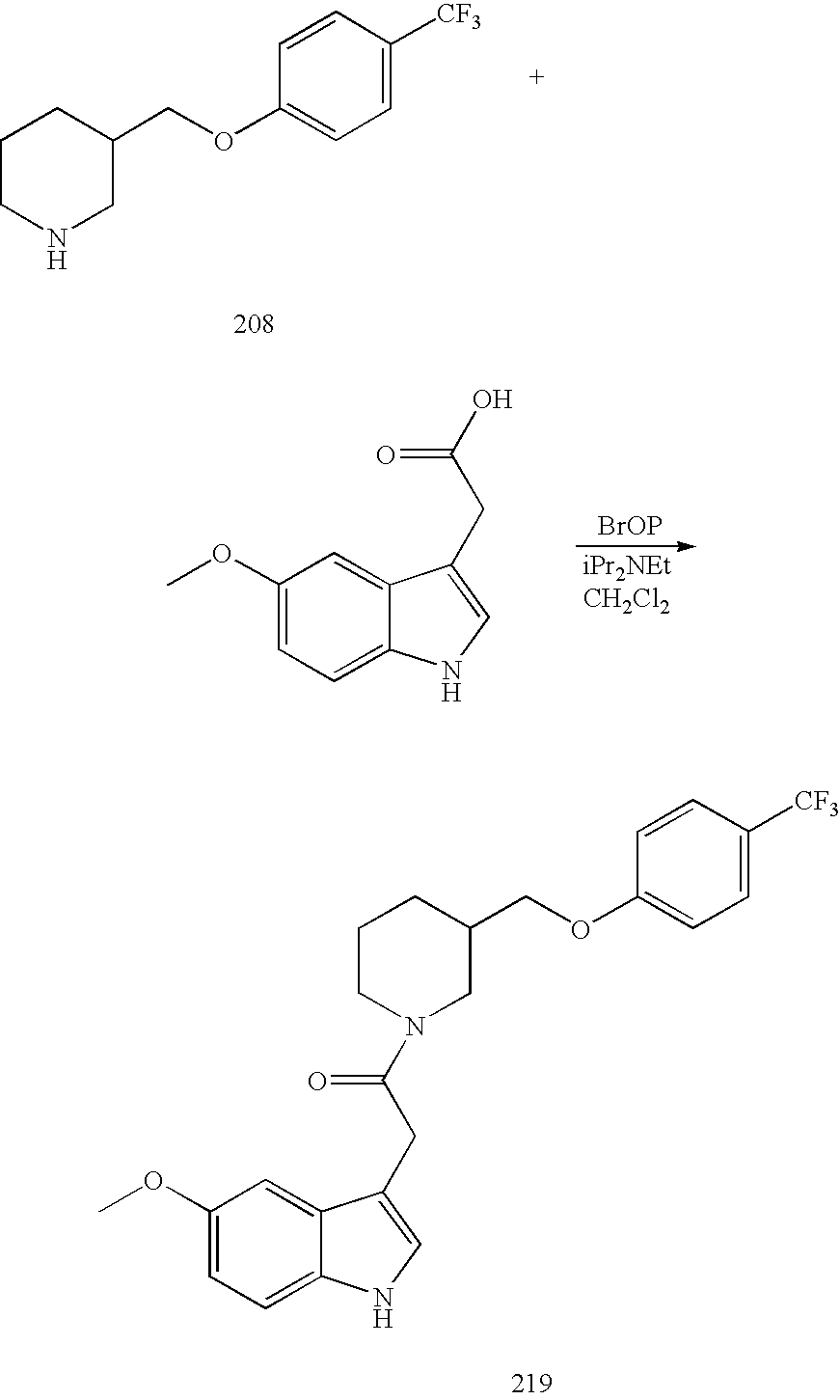
- A solution of 208 (1.93 mmol, 500 mg) and (5-methoxy-1H-indol-3-yl)-acetic acid (1.2 equiv, 2.32 mmol, 476 mg) in CH 2Cl2 (5 mL) was treated with BrOP (1.5 equiv, 2.90 mmol, 1.13 g) and iPr2NEt (3.0 equiv, 5.79 mmol, 1.00 mL) at 0° C. The reaction mixture stirred for 12 h while warming to rt. The reaction mixture was quenched with 10% HCl (10 mL) and then extracted with EtOAc (2×15 mL). The combined organics were washed with NaHCO3(sat) and dried with NaCl(sat) and Na2SO4(s). The solvents were removed in vacuo and chromatography (Isco Combi-Flash, 110 g cartridge, 3:1 hexane-ethyl acetate) provided 219 (617 mg, 862 mg theoretical, 72%) as a colorless oil: Rf 0.33 (SiO2, 3:1 hexane-ethyl acetate); LRMS m/z 447 (M++1, C24H25F3N2O3 requires 447).
-

- A solution of 219 (0.343 mmol, 153 mg) in THF (2 mL) at 0° C. was treated with LiAlH 4 (3.0 equiv, 1.028 mmol, 39 mg) under Ar. The reaction mixture stirred for 12 h and returned to 25° C. The reaction mixture was then cooled to 0° C., quenched with 10% aqueous NaOH and extracted with 3×EtOAc (25 mL). The organics were dried with NaCl(sat) and Na2SO4(s). The reaction mixture was purified by chromatography (Isco Combi-Flash, 10 g cartridge, 9:1 CH2Cl2—CH3OH) which provided 220 (128 mg, 148 mg theoretical, 86%) as a colorless oil: Rf 0.16 (SiO2, 9:1 CH2Cl2—CH3OH); LRMS m/z 433 (M++1, C24H27F3N2O2) requires 433).
-

- A solution of 208 (0.197 mmol, 51 mg), 2-chloro-1-(5-chloro-1H-indol-3-yl)-ethanone (1.0 equiv, 0.197 mmol, 45 mg) and and KF (50% wt on celite) (7.0 equiv, 1.38 mol, 160 mg) in CH 3CN (2 mL) was stirred for 12 h at 25° C. The reaction mixture was filtered, and the solvents were removed in vacuo. Chromatography (Isco Combi-Flash, 10 g cartridge, 3:1 hexane-ethyl acetate) provided 221 (53 mg, 89 mg theoretical, 60%) as a colorless oil: Rf 0.34 (SiO2, 3:1 hexane-ethyl acetate); LRMS m/z 451 (M++1, C23H22F3N2O2 requires 451).
-

- A solution of 221 (0.118 mmol, 53 mg) in CH 3OH (1 mL) was treated with NaBH4 (3.0 equiv, 0.354 mmol, 13 mg) at 0° C. The reaction mixture was allowed to warm to rt and stirred for 12 h. The reaction mixture was quenched with
pH 7 phosphate buffer (10 mL) and extracted with EtOAc (2×10 mL). The combined organics were dried with NaCl(sat) and Na2SO4(s). The solvents were removed in vacuo and chromatography (Isco Combi-Flash, 10 g cartridge, 2:1 hexane-ethyl acetate) provided 222 (23 mg, 53 mg theoretical, 43%) as a colorless oil: Rf 0.33 (SiO2, 2:1 hexane-ethyl acetate); LRMS m/z 454 (M++1, C23H24F3N2O2 requires 454). -

- A solution of 74 (0.683 mmol, 177 mg), 2-bromo-1-[1-(2-trifluoromethoxy-phenyl0-cyclobutyl]-ethanone (1.0 equiv, 0.683 mmol, 200 mg) and KF (50% wt on celite) (7.0 equiv, 4.78 mol, 560 mg) in CH 3CN (4 mL) was stirred for 12 h at 25° C. The reaction mixture was filtered, and the solvents were removed in vacuo. Chromatography (Isco Combi-Flash, 25 g cartridge, 3:1 hexane-ethyl acetate) provided 223 (193 mg, 352 mg theoretical, 55%) as a colorless oil: Rf 0.55 (SiO2, 2:1 hexane-ethyl acetate); LRMS m/z 516 (M++1, C26H27F6NO3 requires 516).
-

- A solution of 223 (0.374 mmol, 193 mg) in CH 3OH (1 mL) was treated with NaBH4 (3.0 equiv, 1.12 mmol, 42 mg) at 0° C. The reaction mixture was allowed to warm to rt and stirred for 12 h. The reaction mixture was quenched with
pH 7 phosphate buffer (10 mL) and extracted with EtOAc (2×10 mL). The combined organics were dried with NaCl(sat) and Na2SO4(s). The solvents were removed in vacuo and chromatography (Isco Combi-Flash, 10 g cartridge, 2:1 hexane-ethyl acetate) provided 224 and 225 (174 mg, 194 mg theoretical, 90%) as a colorless oil: Rf 0.48 (SiO2, 2:1 hexane-ethyl acetate); LRMS m/z 518 (M++1, C26H29F6NO3 requires 518). The two diastereomers were then separated on a Chiracel OD column: 224 and 225 were dissolved in hexane at a concentration of 85 mg/mL; and the compounds were separated by using a 99.5% hexane and 0.5% isopropanol solvent system providing 224 (first peak) and 225 (second peak). -

- A solution of 3(S)-(4-trifluoromethyl-phenoxymethyl)-piperidine (0.683 mmol, 177 mg), 2-bromo-1-[1-(2-trifluoromethoxy-phenyl0-cyclobutyl]-ethanone (1.0 equiv, 0.683 mmol, 200 mg) and KF (50% wt on celite) (7.0 equiv, 4.78 mol, 556 mg) in CH 3CN (4 mL) was stirred for 12 h at 25° C. The reaction mixture was filtered, and the solvents were removed in vacuo. Chromatography (Isco Combi-Flash, 25 g cartridge, 3:1 hexane-ethyl acetate) provided 226 (160 mg, 352 mg theoretical, 45%) as a colorless oil: Rf 0.55 (SiO2, 2:1 hexane-ethyl acetate); LRMS m/z 516 (M++1, C26H27F6NO3 requires 516).
-

- A solution of 226 (0.374 mmol, 193 mg) in CH 3OH (1 mL) was treated with NaBH4 (3.0 equiv, 1.12 mmol, 42 mg) at 0° C. The reaction mixture was allowed to warm to rt and stirred for 12 h. The reaction mixture was quenched with
pH 7 phosphate buffer (10 mL) and extracted with EtOAc (2×10 mL). The combined organics were dried with NaCl(sat) and Na2SO4(s). The solvents were removed in vacuo and chromatography (Isco Combi-Flash, 10 g cartridge, 2:1 hexane-ethyl acetate) provided 227 and 228 (140 mg, 160 mg theoretical, 88%) as a colorless oil: Rf 0.48 (SiO2, 2:1 hexane-ethyl acetate); LRMS m/z 518 (M++1, C26H29F6NO3 requires 518). The two diastereomers were separated on a Chiracel OD column: 227 and 228 were dissolved in hexane at a concentration of 70 mg/mL; and the compounds were separated by using a 99.5% hexane and 0.5% isopropanol solvent system providing 227 (first peak) and 228 (second peak). -

- A solution of methanesulfonic acid 1-[1-(4-chloro-phenyl)-cyclobutanecarbonyl]-piperidin-3-ylmethyl ester (2.46 mmol, 950 mg) and NaN 3 (10 equiv, 24.6 mmol, 1.60 g) in DMF (10 mL) was heated at 70° C. for 48 h. The reaction mixture was quenched with H2O (50 mL) and then extracted with EtOAc (2×50 mL). The combined organics were dried with NaCl(sat) and Na2SO4(s). The solvents were removed in vacuo and chromatography (Isco Combi-Flash, 110 g cartridge, 2:1 hexane-ethyl acetate) provided 229 (725 mg, 819 mg theoretical, 89%) as a pale yellow oil: Rf 0.68 (SiO2, 1:1 hexane-ethyl acetate); LRMS m/z 333 (M++1, C17H23ClN4O requires 333).
-

- A solution of 229 (0.225 mmol, 75 mg) in THF (1 mL) at 0° C. was treated with LiAlH 4 (3.0 equiv, 0.676 mmol, 26 mg) under Ar. The reaction mixture stirred at 60° C. for 12 h. The reaction mixture was then cooled to 0° C., quenched with 10% aqueous NaOH and extracted with 2×EtOAc (15 mL). The organics were dried with NaCl(sat) and Na2SO4(s). The solvents were removed to provide 230 (57 mg, 66 mg theoretical, 86%) as a colorless oil: LRMS m/z 293 (M++1, C17H25ClN2 requires 293).
-

- 2-[3-(Benzo[1,3]dioxol-5-yloxymethyl)-piperidin-1-yl]-1-[1-(2-methoxy-phenyl)-cyclobutyl]-ethanone (ketone not shown) was prepared according to the procedures outlined in Example 138, using 231 (150 mg, 0.638 mmol), KF-Celite (50% weight on Celite; 520 mg, 0.638 mmol), and 2-chloro-1-[1-(2-methoxy-phenyl)-cyclobutyl]-ethanone (152 mg, 0.638 mmol) in acetonitrile (4 mL); yield: 71 mg; MS +(437).
- 2-[3-(Benzo[1,3]dioxol-5-yloxymethyl)-piperidin-1-yl]-1-[1-(2-methoxy-phenyl)-cyclobutyl]-ethanol (232) was prepared according to the procedures outlined in Example 138, using sodium borohydride (17 mg, 0.453 mmol), and 2-[3-(benzo[1,3]dioxol-5-yloxymethyl)-piperidin-1-yl]-1-[1-(2-methoxy-phenyl)-cyclobutyl]-ethanone (100 mg, 0.227 mmol) in MeOH (1.6 mL); MS +(440).
-

- Following the same procedures used for the asymmetric reduction of 2-Bromo-1-[1-(4-chloro-phenyl)-cyclobutyl]-ethanone (See Example 127), 500 mg samples of 2-Chloro-1-[1-(2-methoxy-phenyl)-cyclobutyl]-ethanone were reduced to the enantiomerically enriched alcohols with borane-methyl sulfide in the presence of S-2-methyl CBS-oxazaborolidine or R-2-methyl CBS-oxazaborolidine. Each isomer of 2-Chloro-1-[1-(2-methoxy-phenyl)-cyclobutyl]-ethanol was obtained in approximately 70% yield and ca. 90% e.e. based on chiral HPLC analysis. 240 mg of each chloroalcohol was converted to the corresponding epoxide using 1.1 equivalents of cesium carbonate in 5 mL of THF at 50° C. for 3 hours. Dilution with 20 mL of water, addition of 30 mL ether, and extractive workup gave in each instance, after concentration of the organic layers in vacuo and chromatography on silica gel, each of the desired epoxides (176 mg and 184 mg, 86% and 90% yield).


- 50 mg of R-2-[1-(2-Methoxy-phenyl)-cyclobutyl]-oxirane and 63 mg of R-3-(4-Trifluoromethyl-phenoxymethyl)-piperidine in 4 mL of methanol were heated in a sealed tube at 100° C. for 16 hours, cooled to room temperature, transferred to a round-bottomed flask, and concentrated in vacuo. The crude residue was purified by preparative HPLC using a Chiralpak AD™ column from Chiral Technologies, Inc., eluting with a 98:2 mixture of hexane and isopropyl alcohol containing ca. 0.1% diethylamine. 43 mg of the R,R′ isomer of 1-[1-(2-Methoxy-phenyl)-cyclobutyl]-2-[3-(4-trifluoromethyl-phenoxymnethyl)-piperidin-1-yl]-ethanol (236) was obtained (38%).
- In the same fashion, 50 mg of R-2-[1-(2-Methoxy-phenyl)-cyclobutyl]-oxirane and 63 mg of S-3-(4-Trifluoromethyl-phenoxymethyl)-piperidine gave the S,R′ isomer of 1-[1-(2-Methoxy-phenyl)-cyclobutyl]-2-[3-(4-trifluoromethyl-phenoxymethyl)-piperidin-1-yl]-ethanol (234) (35%), 50 mg of S-2-[1-(2-Methoxy-phenyl)-cyclobutyl]-oxirane and 63 mg of R-3-(4-Trifluoromethyl-phenoxymethyl)-piperidine gave the R,S′ isomer of 1-[1-(2-Methoxy-phenyl)-cyclobutyl]-2-[3-(4-trifluoromethyl-phenoxymethyl)-piperidin-1-yl]-ethanol (235) (40%), and 50 mg of S-2-[1-(2-Methoxy-phenyl)-cyclobutyl]-oxirane and 63 mg of S-3-(4-Trifluoromethyl-phenoxymethyl)-piperidine gave the S,S′ isomer of 1-[1-(2-Methoxy-phenyl)-cyclobutyl]-2-[3-(4-trifluoromethyl-phenoxymethyl)-piperidin-1-yl]-ethanol (237) (41%). 1H and 13C (DEPT) NMR data for each isomer was consistent with the assigned structure. Data for each diastereomer: MS 464 (M++1).
-

- A solution of (S)-piperidine-ketone (0.292 mmol, 100 mg) in THF (1 mL) was added to a solution of CH 3MgCl (1.0 M in THF) (1.5 equiv, 0.44 mmol, 0.44 mL) in THF (1 mL) at 0° C. The reaction mixture stirred for 1 h. The reaction mixture was quenched with 10% NaOH (10 mL) and extracted with EtOAc (2×10 mL). The combined organics were dried with NaCl(sat) and Na2SO4(s). The solvents were removed in vacuo and the residue was purified by chromatography (PTLC, SiO2, 20 cm×20 cm, 1 mm, 3:1 hexane-acetone) which provided desired product (40 mg, 38%) as a colorless oil: Rf 0.44 (SiO2, 3:1 hexane-acetone); LRMS m/z 359 (M++1, C22H28ClNO requires 359).
-

- A solution of (−)-2-pyrrolidinemethanol (20 mmol, 2.0 g), CbzCl (2.0 equiv, 40 mmol, 6 mL) and K 2CO3 (1.5 equiv, 30 mmol, 4.1 g) in THF/H2O (1:1) (66 mL) at 0° C. was allowed to warm to 25° C. and stirred for 12 h. Ethyl acetate (100 mL) was added and the layers were separated. The organic layer was washed with 10% aqueous HCl and then washed with NaHCO3(sat) and dried with NaCl(sat) and Na2SO4(s). The solvents were removed in vacuo and chromatography (Isco Combi-Flash, 110 g cartridge, 1:1 Hexane-EtOAc) provided 240 (3.74 g, 4.71 g theoretical, 79%) as a colorless oil: LRMS m/z 236 (M++1, C13H17NO3, requires 236).
-

- A solution of (−)-2-pyrrolidinemethanol (20 mmol, 2.0 g), CbzCl (2.0 equiv, 40 mmol, 6 mL) and K 2CO3 (1.5 equiv, 30 mmol, 4.1 g) in THF/H2O (1:1) (66 mL) at 0° C. was allowed to warm to 25° C. and stirred for 12 h. Ethyl acetate (100 mL) was added and the layers were separated. The organic layer was washed with 10% aqueous HCl and then washed with NaHCO3(sat) and dried with NaCl(sat) and Na2SO4(s). The solvents were removed in vacuo and chromatography (Isco Combi-Flash, 110 g cartridge, 1:1 Hexane-EtOAc) provided 241 (4.38 g, 4.71 g theoretical, 93%) as a colorless oil: LRMS m/z 236 (M++1, C13H17NO3, requires 236).
-

- A solution of 240 (4.2 mmol, 1.0 g), MsCl (1.5 equiv, 6.4 mmol, 0.5 mL) and iPr 2NEt (1.5 equiv, 6.4 mmol, 1.1 mL) in CH2Cl2 (14 mL) at 0° C. was allowed to warm to 25° C. and stirred for 12 h. The reaction mixture was quenched with 10% HCl (20 mL) and then extracted with EtOAc (2×50 mL). The combined organics were dried with NaCl(sat) and Na2SO4(s). The solvents were removed in vacuo and chromatography (Isco Combi-Flash, 110 g cartridge, 1:1 Hexane-EtOAc) provided 242 as a colorless oil: LRMS m/z 314 (M++1, C14H19NO5S, requires 314).
-

- A solution of 241 (4.2 mmol, 1.0 g), MsCl (1.5 equiv, 6.4 mmol, 0.5 mL) and iPr 2NEt (1.5 equiv, 6.4 mmol, 1.1 mL) in CH2Cl2 (14 mL) at 0° C. was allowed to warm to 25° C. and stirred for 12 h. The reaction mixture was quenched with 10% HCl (20 mL) and then extracted with EtOAc (2×50 mL). The combined organics were dried with NaCl(sat) and Na2SO4(s). The solvents were removed in vacuo and chromatography (Isco Combi-Flash, 110 g cartridge, 1:1 Hexane-EtOAc) provided 243 as a colorless oil: LRMS m/z 314 (M++1, C14H19NO5S, requires 314).
-

- A solution of 242 (3.8 mmol, 1.2 g), α,α,α-trifluoro-p-cresol (1.5 equiv, 5.7 mmol, 0.9 g) and Cs 2CO3 (2.0 equiv, 7.6 mmol, 2.5 g) in CH3CN (13 mL) was heated to 90° C. and stirred for 12 h. Ethyl acetate (100 mL) and H2O (100 mL) were added and the layers were separated. The organic layer was dried with NaCl(sat) and Na2SO4(s). The solvents were removed in vacuo and chromatography (Isco Combi-Flash, 110 g cartridge, 9:1 Hexane-EtOAc) provided 244 (0.762 g, 1.44 g theoretical, 53%) as a colorless oil: LRMS m/z 380 (M++1, C20H20F3NO3, requires 380).
-

- A solution of 243 (3.8 mmol, 1.2 g), α,α,α-trifluoro-p-cresol (1.5 equiv, 5.7 mmol, 0.9 g) and Cs 2CO3 (2.0 equiv, 7.6 mmol, 2.5 g) in CH3CN (13 mL) was heated to 90° C. and stirred for 12 h. Ethyl acetate (100 mL) and H2O (100 mL) were added and the layers were separated. The organic layer was dried with NaCl(sat) and Na2SO4(s). The solvents were removed in vacuo and chromatography (Isco Combi-Flash, 110 g cartridge, 9:1 Hexane-EtOAc) provided 245 (0.421 g, 1.44 g theoretical, 29%) as a colorless oil: LRMS m/z 380 (M++1, C20H20F3NO3, requires 380).
-

- A solution of 244 (1.3 mmol, 486 mg) in CH 3OH (13 mL) was treated 30% Pd—C (81 mg) and H2 (Hydrogen balloon). The reaction was stirred for 5 h. The reaction mixture was filtered through celite, and the solvents were removed in vacuo to provide 246 (319 mg, 319 mg theoretical, quantitative) as a colorless oil: LRMS m/z 246 (M++1, C12H14F3NO, requires 246).
-

- A solution of 245 (1.1 mmol, 421 mg) in CH 3OH (11 mL) was treated 30% Pd—C (70 mg) and H2 (Hydrogen balloon). The reaction was stirred for 5 h. The reaction mixture was filtered through celite, and the solvents were removed in vacuo to provide 247 (270 mg, 270 mg theoretical, quantitative) as a colorless oil: LRMS m/z 246 (M++1, C12H14F3NO, requires 246).
-

- A solution of the 246 (1.3 mmol, 310 mg), 1-(4-Chlorophenyl)-1-cyclobutane carboxylic acid (1.5 equiv, 1.9 mmol, 400 mg) and iPr 2NEt (3.0 equiv, 4.0 mmol, 0.7 mL) in CH2Cl2 (5 mL) was treated with PyBroP (1.5 equiv, 1.9 mmol, 890 mg) under Ar at 0° C. After warming to 25° C. and stirring for 12 h, the reaction mixture was quenched with 10% aqueous HCl and extracted with 3×EtOAc (25 mL). The organic layer was then washed with NaHCO3(sat) and dried with NaCl(sat) and Na2SO4(s). The solvents were removed in vacuo and chromatography (Isco Combi-Flash, 110 g cartridge, 3:1 Hexane-EtOAc) provided 248 (406 mg, 569 mg theoretical, 71%) as a colorless oil: LRMS m/z 439 (M++1, C23H23ClF3NO2, requires 439).
-

- A solution of the 247 (1.1 mmol, 280 mg), 1-(4-Chlorophenyl)-1-cyclobutane carboxylic acid (1.5 equiv, 1.7 mmol, 358 mg) and iPr 2NEt (3.0 equiv, 3.4 mmol, 0.6 mL) in CH2Cl2 (4 mL) was treated with PyBroP (1.5 equiv, 1.7 mmol, 792 mg) under Ar at 0° C. After warming to 25° C. and stirring for 12 h, the reaction mixture was quenched with 10% aqueous HCl and extracted with 3×EtOAc (25 mL). The organic layer was then washed with NaHCO3(sat) and dried with NaCl(sat) and Na2SO4(s). The solvents were removed in vacuo and chromatography (Isco Combi-Flash, 110 g cartridge, 3:1 Hexane-EtOAc) provided 249 (230 mg, 482 mg theoretical, 48%) as a colorless oil: LRMS m/z 439 (M++1, C23H23ClF3NO2, requires 439).
-

- A solution of 248 (0.23 mmol, 100 mg) in THF (1 mL) at 25° C. was treated with LiAlH 4 (3.0 equiv, 0.69 mmol, 26 mg) under Ar. The reaction mixture stirred for 12 h at 60° C. The reaction mixture was then cooled to 0° C., quenched with 10% aqueous NaOH and extracted with 3×EtOAc (25 mL). The organics were dried with NaCl(sat) and Na2SO4(s). The solvents were removed in vacuo and chromatography (Isco Combi-Flash, 25 g cartridge, 3:1 Hexane-EtOAc) provided 250 (65 mg, 97 mg theoretical, 67%) as a colorless oil: LRMS m/z 425 (M++1, C23H25ClF3NO, requires 425).
-

- A solution of 249 (0.23 mmol, 100 mg) in THF (1 mL) at 25° C. was treated with LiAlH 4 (3.0 equiv, 0.69 mmol, 26 mg) under Ar. The reaction mixture stirred for 12 h at 60° C. The reaction mixture was then cooled to 0° C., quenched with 10% aqueous NaOH and extracted with 3×EtOAc (25 mL). The organics were dried with NaCl(sat) and Na2SO4(s). The solvents were removed in vacuo and chromatography (Isco Combi-Flash, 25 g cartridge, 3:1 Hexane-EtOAc) provided 251 (73 mg, 97 mg theoretical, 75%) as a colorless oil: LRMS m/z 425 (M++1, C23H25ClF3NO, requires 425).
-

- A solution of the amine (1.2 equiv, 1.58 mmol, 300 mg) and the epoxide (1.32 mmol, 275 mg) in CH 3CN (2 mL) was stirred for 12 h at 95° C. The reaction mixture was quenched with H2O and extracted with 3×EtOAc (25 mL). The organics were dried with NaCl(sat) and Na2SO4(s). The solvents were removed in vacuo and chromatography (Isco Combi-Flash, 10 g cartridge, 1:1 Hexane-EtOAc) provided 252 (439 mg, 525 mg theoretical, 84%) as a colorless oil: Rf 0.42 (SiO2, 1:1 hexane-ethyl acetate); LRMS m/z 399 (M++1, C25H32ClNO, requires 399).
-

- A solution of (R)-3-phenethyl piperidine (1.0 equiv, 2.14 mmol, 405 mg), alcohol (2.14 mmol, 619 mg) and K 2CO3 (1.5 equiv, 3.21 immol, 444 mg), in CH3CN (2 mL) was stirred for 12 h at 95° C. in a sealed pressure tube. The reaction mixture was quenched with H2O and extracted with 3×EtOAc (25 mL). The organics were dried with NaCl(sat) and Na2SO4(s). The solvents were removed in vacuo and chromatography (Isco Combi-Flash, 25 g cartridge, Hexane-EtOAc (45%)) provided 253 (852 mg, 760 mg theoretical, 89%) as a colorless oil: Rf 0.38 (SiO2, hexane-ethyl acetate (45%)); LRMS m/z 399 (M++1, C25H32ClNO, requires 399).
-

- A solution of the mesylate (2.29 mmol, 884 mg) and NaN 3 (10 equiv, 22.9 mmol, 1.49 g) in DMF (10 mL) was heated at 70° C. for 48 h. The reaction mixture was quenched with H2O (50 mL) and then extracted with EtOAc (2×50 mL). The combined organics were dried with NaCl(sat) and Na2SO4(s). The solvents were removed in vacuo which provided 254 (762 mg, 650 mg theoretical, 85%) as a pale yellow oil: Rf 0.68 (SiO2, 1:1 hexane-ethyl acetate); LRMS m/z 333 (M++1, C17H23ClN4O requires 333).
-

- A solution of 254 (0.451 mmol, 150 mg) in THF (2 mL) at 0° C. was treated with LiAlH 4 (3.0 equiv, 1.35 mmol, 51 mg) under Ar. The reaction mixture stirred for 12 h and returned to 60° C. The reaction mixture was then cooled to 0° C., quenched with 10% aqueous NaOH and extracted with 2×EtOAc (25 mL). The organics were dried with NaCl(sat) and Na2SO4(s). The solvents were removed to provide 255 as a colorless oil: LRMS m/z 293 (M++1, C17H25ClN2 requires 293).
-

- A solution of triphenyl phosphine (1.5 equiv, 30 mmol, 7.87 g) and imidazole (1.5 equiv, 30 mmol, 2.05 g) in CH 2Cl2 (50 mL) at 0° C. was treated with I2 (1.5 equiv, 30 mmol, 7.61 g). After 5 min, the alcohol (20 mmol, 5.00 g) in CH2Cl2 (10 mL) was added at 0° C. The reaction stirred for 1 h at 25. The reaction mixture was quenched with 10% aqueous HCl and extracted with 3×EtOAc (75 mL). The organics were washed with H2O then dried with NaCl(sat) and Na2SO4(s). The solvents were removed in vacuo and chromatography (Isco Combi-Flash, 110 g cartridge, 7:1 Hexane-EtOAc) provided the desired compound (5.90 g, 7.18 g theoretical, 82%) as a colorless oil: LRMS m/z 360 (M++1, C14H18ClNO2, requires 360).
-

- A solution of the the amine (1.93 mmol, 500 mg), morpholine-2,4-dicarboxylic acid 4-tert-butyl ester (1.1 equiv, 2.12 mmol, 490 mg) and iPr 2NEt (3.0 equiv, 5.79 mmol, 1.00 mL) in CH2Cl2 (10 mL) was treated with BroP (1.5 equiv, 2.90 mmol, 1.13 g) under Ar at 0° C. After warming to 25° C. and stirring for 12 h, the reaction mixture was quenched with 10% aqueous HCl and extracted with 3×EtOAc (25 mL). The organic layer was then washed with NaHCO3(sat) and dried with NaCl(sat) and Na2SO4(s). The solvents were removed in vacuo and chromatography (Isco Combi-Flash, 110 g cartridge, 1:1 Hexane-EtOAc) provided the desired compound (632 mg, 912 mg theoretical, 69%) as a colorless oil: LRMS m/z 474 (M++1, C23H31F3N2O5, requires 474).
-

- A solution of the amide (1.93 mmol, 500 mg) in CH 2Cl2 (0.5 mL) was treated with TFA (0.5 mL) under Ar at 0° C. After stirring for 1 h, the solvents were removed in vacuo, and the residue was dissolved in EtOAc (25 mL). The organic layer was then washed with NaHCO3(sat) and dried with NaCl(sat) and Na2SO4(s). The solvents were removed in vacuo which provided 256 (74 mg, 74 mg theoretical, quantitative) as a colorless oil: LRMS m/z 373 (M++1, C18H23F3N2O3, requires 373).
-

- A solution of the amide (0.849 mmol, 316 mg) in THF (2 mL) at 0° C. was treated with LiAlH 4 (3.0 equiv, 2.55 mmol, 97 mg) under Ar. The reaction mixture stirred for 12 h and returned to 60° C. The reaction mixture was then cooled to 0° C., quenched with 10% aqueous NaOH and extracted with 2×EtOAc (25 mL). The organics were dried with NaCl(sat) and Na2SO4(s). After removing the solvents, the residue was dissolved in THF/H2O (3 mL) and treated with K2CO3 (3.0 equiv, 2.55 mmol, 352 mg) and CbzCl (1.5 equiv, 1.27 mmol, 182 μL). The reaction mixture was quenched with H2O and extracted with 3×EtOAc (10 mL). The organics were dried with NaCl(sat) and Na2SO4(s). The solvents were removed in vacuo and chromatography (Isco Combi-Flash, 25 g cartridge, CH2Cl2—CH3OH (10%)) provided the desired compound (166 mg, 418 mg theoretical, 40%) as a colorless oil: LRMS m/z 494 (M++1, C26H31F3N2O4, requires 494).
-

- A solution of the amine (0.337 mmol, 166 mg) in CH 3OH (2 mL) was treated 30% Pd—C (50 mg) and H2 (Hydrogen balloon). The reaction was stirred for 5 h. The reaction mixture was filtered through celite, and the solvents were removed in vacuo to provide 257 (114 mg, 121 mg theoretical, 94%) as a colorless oil: LRMS m/z 359 (M++1, C18H25F3N2O2, requires 359).
-

- A solution of the amine (0.318 mmol, 114 mg), 1-bromo-4-chloro-benzene (1.0 equiv, 0.318 mmol, 61 mg), BINAP (4.0 mol %, 0.0127 mmol, 8 mg) and NaOtBu (1.4 equiv, 0.445 mmol, 43 mg) in toluene (0.5 mL) was treated with Pd 2(DBA)3 (2.0 mol %, 0.00636 mmol, 6 mg) under Ar at 0° C. The reaction was heated to 70° C. for 12 h. The reaction mixture was quenched with
pH 7 buffer solution and extracted with 3×EtOAc (10 mL). The organic layer was then dried with NaCl(sat) and Na2SO4(s). The solvents were removed in vacuo and chromatography (Isco Combi-Flash, 10 g cartridge, 1:1 Hexane-EtOAc) provided 258 (100 mg, 149 mg theoretical, 67%) as a colorless oil: Rf 0.37 (SiO2, 1:1 hexane-ethyl acetate); LRMS m/z 470 (M++1, C24H28ClF3N2O2, requires 470). - The effect of 124 and 126 on spontaneous locomotor activity in rats was determined according to the procedures outlined by Silverman et al. (Motor Activity. In “Animal behavior in the laboratory”, Chapman and Hall eds, London, p. 79-92, 1978) and Boissier et al. ( Arch. Int. Pharmacodyn. 1965, 158, 212.)
- Test items and test item vehicles were administered to male Sprague-Dawley rats (n=10) as a single i.p. dose. One, three, five, eight and twenty four hours following administration, rats were placed in a plastic box 30×30 cm in a room with low light intensity (maximum 50 lux). Locomotor activity was determined during 20 minute periods using video image analyzers. Images recorded with video cameras were digitalized and displacements of the center of gravity of the digital image spot were tracked and analyzed. When the speed of displacement of the center of gravity of the spot was below 4.26 cm/sec, the movement was considered as inactivity. When this speed was between 4.26 and 6.75 cm/sec, the movement was considered as a small movement. When this speed was above 6.75 cm/sec, the movement was considered as a large movement. The number of occurrences, distance and duration of fast and slow movements, number of occurrences and duration of periods of inactivity and number of rears were measured.
-
Compounds 124 and 126, when dosed at 10 mg/kg, showed a significant increase in locomotor activity compared to control animals at all times tested.Methyl- 126 124 phenidate, 10 mg/ kg 10 mg/ kg 10 mg/kg (Dosed in (Dosed in (Dosed in Vehicle A Vehicle B Vehicle A) Vehicle B) Vehicle B) Large 1 hour: 1 hour: 1 hour: 1 hour: 1 hour: Movement 294 ± 47 236 ± 50 774 ± 110 655 ± 83 958 ± 118 Occurrences 3 hours: 3 hours: 3 hours: 3 hours: 3 hours: 108 ± 25 139 ± 32 956 ± 93 751 ± 122 504 ± 114 5 hours: 5 hours: 5 hours: 5 hours: 5 hours: 114 ± 56 68 ± 26 866 ± 117 616 ± 82 196 ± 62 8 hours: 8 hours: 8 hours: 8 hours: 8 hours: 64 ± 26 89 ± 18 746 ± 95 455 ± 69 71 ± 20 24 hours: 24 hours: 24 hours: 24 hours: 24 hours: 215 ± 38 124 ± 30 1012 ± 81 440 ± 55 335 ± 68 Small 1 hour: 1 hour: 1 hour: 1 hour: 1 hour: Movement 815 ± 86 661 ± 96 1357 ± 125 1258 ± 83 1595 ± 83 Occurrences 3 hours: 3 hours: 3 hours: 3 hours: 3 hours: 488 ± 77 564 ± 77 1610 ± 73 1386 ± 96 1072 ± 122 5 hours: 5 hours: 5 hours: 5 hours: 5 hours: 461 ± 108 329 ± 99 1575 ± 90 1277 ± 100 612 ± 108 8 hours: 8 hours: 8 hours: 8 hours: 8 hours: 309 ± 80 441 ± 59 1489 ± 111 1042 ± 109 358 ± 65 24 hours: 24 hours: 24 hours: 24 hours: 24 hours: 642 ± 82 486 ± 71 1544 ± 75 934 ± 87 790 ± 81 - All of the patents and publications cited herein are hereby incorporated by reference.
- Those skilled in the art will recognize, or be able to ascertain using no more than routine experimentation, many equivalents to the specific embodiments of the invention described herein. Such equivalents are intended to be encompassed by the following claims.
Claims (172)
1. A compound represented by A:

wherein
X represents C(R3)2, O, S, SO, SO2, NR2, NC(O)R7, NC(O)OR2, NS(O)2R7, or C═O;
Z represents C(R3)2, C(O), O, NR, NC(O)OR, S, SO, or SO2;
m is 1, 2, 3, 4 or 5;
n is 1 or 2;
p is 0, 1, 2, or 3;
y is 0, 1, or 2;
R represents H, alkyl, cycloalkyl, aryl, heteroaryl, aralkyl, or heteroaralkyl;
R1 represents H, alkyl, aryl, heteroaryl, aralkyl, or heteroaralkyl;
R and R1 may be connected through a covalent bond;
R2 represents independently for each occurrence H, alkyl, fluoroalkyl, aryl, heteroaryl, or cycloalkyl;
R3 represents independently for each occurrence H, alkyl, aryl, OR2, OC(O)R2, CH2OR2, or CO2R2; wherein any two instances of R3 may be connected by a covalent tether whose backbone consists of 1, 2, 3, or 4 carbon atoms;
R4 represents independently for each occurrence H, alkyl, cycloalkyl, aryl, heteroaryl, alkenyl, or OR;
R5 and R are selected independently for each occurrence from the group consisting of H, alkyl, (CH2)pY, aryl, heteroaryl, F, OR2, and OC(O)R2; or an instance of CR5R6 taken together is C(O);
R7 represents alkyl, cycloalkyl, aryl, heteroaryl, aralkyl, or heteroaralkyl;
R8 and R9 are selected independently for each occurrence from the group consisting of H, alkyl, (CH2)pY, aryl, heteroaryl, F, OR2, and OC(O)R2; or an instance of CR8R9 taken together is C(O);
Y represents independently for each occurrence OR2, N(R2)2, SR2, S(O)R2, S(O)2R2, or P(O)(OR2)2;
any two instances of R2 may be connected through a covalent bond;
a covalent bond may connect R4 and an instance of R5 or R6;
any two instances of R5 and R6 may be connected through a covalent bond;
any two geminal or vicinal instances of R8 and R9 may be connected through a covalent bond; and
the stereochemical configuration at any stereocenter of a compound represented by A is R, S, or a mixture of these configurations.
2. The compound of claim 1 , wherein X is C(R3)2, O, or NR2.
3. The compound of claim 1 , wherein X is C(R3)2.
4. The compound of claim 1 , wherein Z is O or NR.
5. The compound of claim 1 , wherein m is 2 or 3.
6. The compound of claim 1 , wherein n is 1.
7. The compound of claim 1 , wherein y is 1.
8. The compound of claim 1 , wherein R1 represents aryl.
9. The compound of claim 1 , wherein R3 represents independently for each occurrence H or alkyl.
10. The compound of claim 1 , wherein R4 represents cycloalkyl, aryl, or heteroaryl.
11. The compound of claim 1 , wherein R5 and R6 are selected independently for each occurrence from the group consisting of H, alkyl, OR2, aryl, heteroaryl, and F.
12. The compound of claim 1 , wherein R8 and R9 are selected independently for each occurrence from the group consisting of H, alkyl, OR2, aryl, heteroaryl, and F.
13. The compound of claim 1 , wherein X is C(R3)2, O, or NR2; and Z is O or NR.
14. The compound of claim 1 , wherein X is C(R3)2, O, or NR2; Z is O or NR; and m is 2 or 3.
15. The compound of claim 1 , wherein X is C(R3)2, O, or NR2; Z is O or NR; and n is 1.
16. The compound of claim 1 , wherein X is C(R3)2, O, or NR2; Z is O or NR; and y is 1.
17. The compound of claim 1 , wherein X is C(R3)2, O, or NR2; Z is O or NR; m is 2 or 3; n is 1; and y is 1.
18. The compound of claim 1 , wherein X is C(R3)2, O, or NR2; Z is O or NR; m is 2 or 3; n is 1; y is 1; and R1 is aryl.
19. The compound of claim 1 , wherein X is C(R3)2, O, or NR2; Z is O or NR; m is 2 or 3; n is 1; y is 1; R1 is aryl; and R3 is H or alkyl.
20. The compound of claim 1 , wherein X is C(R3)2, O, or NR2; Z is O or NR; m is 2 or 3; n is 1; y is 1; R1 is aryl; R3 is H or alkyl; and R4 is cycloalkyl, aryl, or heteroaryl.
21. The compound of claim 1 , wherein X is C(R3)2, O, or NR2; Z is O or NR; m is 2 or 3; n is 1; y is 1; R1 is aryl; R3 is H or alkyl; R4 is cycloalkyl, aryl, or heteroaryl; and R5 and R6 are selected independently for each occurrence from the group consisting of H, alkyl, OR2, aryl, heteroaryl, and F.
22. The compound of claim 1 , wherein X is C(R3)2, O, or NR2; Z is O or NR; m is 2 or 3; n is 1; y is 1; R1 is aryl; R3 is H or alkyl; R4 is cycloalkyl, aryl, or heteroaryl; R5 and R6 are selected independently for each occurrence from the group consisting of H, alkyl, OR2, aryl, heteroaryl, and F; and R8 and R9 are selected independently for each occurrence from the group consisting of H, alkyl, OR2, aryl, heteroaryl, and F.
23. The compound of claim 1 , wherein X is CH2; Z is O; m is 2; n is 1; y is 1; R1 is 4-trifluoromethylphenyl or 3,4-methylenedioxyphenyl; R3 is H; R is 4-chlorophenyl; R5 and R6 are selected independently for each occurrence from the group consisting of H and alkyl; and R8 and R9 are H.
24. The compound of claim 1 , wherein X is CH2; Z is O; m is 3; n is 1; y is 1; R1 is 4-trifluoromethylphenyl; R3 is H; R4 is 4-chlorophenyl; R5 and R6 are selected independently for each occurrence from the group consisting of H, OH, and alkyl; and R8 and R9 are H.
25. The compound of claim 1 , wherein said compound has an EC50 less than 1 μM in an assay based on a mammalian dopamine, serotonin, or norepinephrine receptor or transporter.
26. The compound of claim 1 , wherein said compound has an EC50 less than 100 nM in an assay based on a mammalian dopamine, serotonin, or norepinephrine receptor or transporter.
27. The compound of claim 1 , wherein said compound has an EC50 less than 10 nM in an assay based on a mammalian dopamine, serotonin, or norepinephrine receptor or transporter.
28. The compound of claim 1 , wherein said compound has an EC50 less than 1 μM in an assay based on a mammalian dopamine receptor or transporter.
29. The compound of claim 1 , wherein said compound has an EC50 less than 100 nM in an assay based on a mammalian dopamine receptor or transporter.
30. The compound of claim 1 , wherein said compound has an EC50 less than 10 nM in an assay based on a mammalian dopamine receptor or transporter.
31. The compound of claim 1 , wherein said compound has an IC50 less than 1 μM in an assay based on a mammalian dopamine, serotonin, or norepinephrine receptor or transporter.
32. The compound of claim 1 , wherein said compound has an IC50 less than 100 nM in an assay based on a mammalian dopamine, serotonin, or norepinephrine receptor or transporter.
33. The compound of claim 1 , wherein said compound has an IC50 less than 10 nM in an assay based on a mammalian dopamine, serotonin, or norepinephrine receptor or transporter.
34. The compound of claim 1 , wherein said compound has an IC50 less than 1 μM in an assay based on a mammalian dopamine receptor or transporter.
35. The compound of claim 1 , wherein said compound has an IC50 less than 100 nM in an assay based on a mammalian dopamine receptor or transporter.
36. The compound of claim 1 , wherein said compound has an IC50 less than 10 nM in an assay based on a mammalian dopamine receptor or transporter.
37. A compound represented by B:

wherein
Z represents C(R3)2, C(O), O, NR, NC(O)OR, S, SO, or SO2;
m is 1, 2, 3, 4 or S;
p is 0, 1, 2, or 3;
y is 0, 1 or 2;
R represents H, alkyl, cycloalkyl, aryl, heteroaryl, aralkyl, or heteroaralkyl;
R1 represents H, alkyl, aryl, heteroaryl, aralkyl, or heteroaralkyl;
R and R1 may be connected through a covalent bond;
R2 represents independently for each occurrence H, alkyl, fluoroalkyl, aryl, heteroaryl, or cycloalkyl;
R3 represents independently for each occurrence H, alkyl, aryl, OR2, OC(O)R2, CH2OR2, or CO2R2;
R4 represents independently for each occurrence H, alkyl, cycloalkyl, aryl, heteroaryl, alkenyl, or OR;
R5 and R6 are selected independently for each occurrence from the group consisting of H, alkyl, (CH2)pY, aryl, heteroaryl, F, OR2, and OC(O)R2; or an instance of CR5R6 taken together is C(O);
R8 and R9 are selected independently for each occurrence from the group consisting of H, alkyl, (CH2)pY, aryl, heteroaryl, F, OR2, and OC(O)R2; or an instance of CR8R9 taken together is C(O);
Y represents independently for each occurrence OR2, N(R2)2, SR2, S(O)R2, S(O)2R2, or P(O)(OR2)2;
any two instances of R2 may be connected through a covalent bond;
a covalent bond may connect R4 and an instance of R5 or R6;
any two instances of R5 and R6 may be connected through a covalent bond;
any two geminal or vicinal instances of R8 and R9 may be connected through a covalent bond; and
the stereochemical configuration at any stereocenter of a compound represented by B is R, S, or a mixture of these configurations.
38. The compound of claim 37 , wherein Z is O or NR.
39. The compound of claim 37 , wherein m is 3.
40. The compound of claim 37 , wherein y is 1.
41. The compound of claim 37 , wherein R1 represents aryl.
42. The compound of claim 37 , wherein R3 represents independently for each occurrence H or alkyl.
43. The compound of claim 37 , wherein R4 represents cycloalkyl, aryl, or heteroaryl.
44. The compound of claim 37 , wherein R5 and R6 are selected independently for each occurrence from the group consisting of H, alkyl, OR2, aryl, heteroaryl, and F.
45. The compound of claim 37 , wherein R8 and R9 are selected independently for each occurrence from the group consisting of H, alkyl, OR2, aryl, heteroaryl, and F.
46. The compound of claim 37 , wherein Z is O or NR; and m is 3.
47. The compound of claim 37 , wherein Z is O or NR; and y is 1.
48. The compound of claim 37 , wherein Z is O or NR; m is 3; and y is 1.
49. The compound of claim 37 , wherein Z is O or NR; m is 3; y is 1; and R1 is aryl.
50. The compound of claim 37 , wherein Z is O or NR; m is 3; y is 1; R1 is aryl; and R3 is H or alkyl.
51. The compound of claim 37 , wherein Z is O or NR; m is 3; y is 1; R1 is aryl; R3 is H or alkyl; and R4 is cycloalkyl, aryl, or heteroaryl.
52. The compound of claim 37 , wherein Z is O or NR; m is 3; y is 1; R1 is aryl; R3 is H or alkyl; R4 is cycloalkyl, aryl, or heteroaryl; and R5 and R6 are selected independently for each occurrence from the group consisting of H, alkyl, OR2, aryl, heteroaryl, and F.
53. The compound of claim 37 , wherein Z is O or NR; m is 3; y is 1; R1 is aryl; R3 is H or alkyl; R4 is cycloalkyl, aryl, or heteroaryl; R5 and R6 are selected independently for each occurrence from the group consisting of H, alkyl, OR2, aryl, heteroaryl, and F; and R8 and R9 are selected independently for each occurrence from the group consisting of H, alkyl, OR2, aryl, heteroaryl, and F.
54. The compound of claim 37 , wherein said compound has an EC50 less than 1 μM in an assay based on a mammalian dopamine, serotonin, or norepinephrine receptor or transporter.
55. The compound of claim 37 , wherein said compound has an EC50 less than 100 nM in an assay based on a mammalian dopamine, serotonin, or norepinephrine receptor or transporter.
56. The compound of claim 37 , wherein said compound has an EC50 less than 10 nM in an assay based on a mammalian dopamine, serotonin, or norepinephrine receptor or transporter.
57. The compound of claim 37 , wherein said compound has an EC50 less than 1 μM in an assay based on a mammalian dopamine receptor or transporter.
58. The compound of claim 37 , wherein said compound has an EC50 less than 100 nM in an assay based on a mammalian dopamine receptor or transporter.
59. The compound of claim 37 , wherein said compound has an EC50 less than 10 nM in an assay based on a mammalian dopamine receptor or transporter.
60. The compound of claim 37 , wherein said compound has an IC50 less than 1 μM in an assay based on a mammalian dopamine, serotonin, or norepinephrine receptor or transporter.
61. The compound of claim 37 , wherein said compound has an IC50 less than 100 nM in an assay based on a mammalian dopamine, serotonin, or norepinephrine receptor or transporter.
62. The compound of claim 37 , wherein said compound has an IC50 less than 10 nM in an assay based on a mammalian dopamine, serotonin, or norepinephrine receptor or transporter.
63. The compound of claim 37 , wherein said compound has an IC50 less than 1 μM in an assay based on a mammalian dopamine receptor or transporter.
64. The compound of claim 37 , wherein said compound has an IC50 less than 100 nM in an assay based on a mammalian dopamine receptor or transporter.
65. The compound of claim 37 , wherein said compound has an IC50 less than 10 nM in an assay based on a mammalian dopamine receptor or transporter.
66. A compound represented by C:

wherein
Z represents C(R3)2, C(O), O, NR, NC(O)OR, S, SO, or SO2;
m is 1, 2, 3, 4 or 5;
p is 0, 1, 2, or 3;
y is 0, 1 or 2;
R represents H, alkyl, cycloalkyl, aryl, heteroaryl, aralkyl, or heteroaralkyl;
R1 represents H, alkyl, aryl, heteroaryl, aralkyl, or heteroaralkyl;
R and R1 may be connected through a covalent bond;
R2 represents independently for each occurrence H, alkyl, fluoroalkyl, aryl, heteroaryl, or cycloalkyl;
R3 represents independently for each occurrence H, alkyl, aryl, OR2, OC(O)R2, CH2OR2, or CO2R2;
R4 represents independently for each occurrence H, alkyl, cycloalkyl, aryl, heteroaryl, alkenyl, or OR;
R5 and R6 are selected independently for each occurrence from the group consisting of H, alkyl, (CH2)pY, aryl, heteroaryl, F, OR2, and OC(O)R2; or an instance of CR5R6 taken together is C(O);
R8 and R9 are selected independently for each occurrence from the group consisting of H, alkyl, (CH2)pY, aryl, heteroaryl, F, OR2, and OC(O)R2; or an instance of CR8R9 taken together is C(O);
Y represents independently for each occurrence OR2, N(R2)2, SR2, S(O)R2, S(O)2R2, or P(O)(OR2)2;
any two instances of R2 may be connected through a covalent bond;
a covalent bond may connect R4 and an instance of R5 or R6;
any two instances of R5 and R6 may be connected through a covalent bond;
any two geminal or vicinal instances of R8 and R9 may be connected through a covalent bond; and
the stereochemical configuration at any stereocenter of a compound represented by C is R or S, or a mixture of these configurations.
67. The compound of claim 66 , wherein Z is O or NR.
68. The compound of claim 66 , wherein m is 3.
69. The compound of claim 66 , wherein y is 1.
70. The compound of claim 66 , wherein R1 represents aryl.
71. The compound of claim 66 , wherein R3 represents independently for each occurrence H or alkyl.
72. The compound of claim 66 , wherein R4 represents cycloalkyl, aryl, or heteroaryl.
73. The compound of claim 66 , wherein R5 and R6 are selected independently for each occurrence from the group consisting of H, alkyl, OR2, aryl, heteroaryl, and F.
74. The compound of claim 66 , wherein R8 and R9 are selected independently for each occurrence from the group consisting of H, alkyl, OR2, aryl, heteroaryl, and F.
75. The compound of claim 66 , wherein Z is O or NR; and m is 3.
76. The compound of claim 66 , wherein Z is O or NR; and y is 1.
77. The compound of claim 66 , wherein Z is O or NR; m is 3; and y is 1.
78. The compound of claim 66 , wherein Z is O or NR; m is 3; y is 1; and R1 is aryl.
79. The compound of claim 66 , wherein Z is O or NR; m is 3; y is 1; R1 is aryl; and R3 is H or alkyl.
80. The compound of claim 66 , wherein Z is O or NR; m is 3; y is 1; R1 is aryl; R3 is H or alkyl; and R4 is cycloalkyl, aryl, or heteroaryl.
81. The compound of claim 66 , wherein Z is O or NR; m is 3; y is 1; R1 is aryl; R3 is H or alkyl; R4 is cycloalkyl, aryl, or heteroaryl; and R5 and R6 are selected independently for each occurrence from the group consisting of H, alkyl, OR2, aryl, heteroaryl, and F.
82. The compound of claim 66 , wherein Z is O or NR; m is 3; y is 1; R1 is aryl; R3 is H or alkyl; R4 is cycloalkyl, aryl, or heteroaryl; R5 and R6 are selected independently for each occurrence from the group consisting of H, alkyl, OR2, aryl, heteroaryl, and F; and R8 and R9 are selected independently for each occurrence from the group consisting of H, alkyl, OR2, aryl, heteroaryl, and F.
83. The compound of claim 66 , wherein said compound has an EC50 less than 1 μM in an assay based on a mammalian dopamine, serotonin, or norepinephrine receptor or transporter.
84. The compound of claim 66 , wherein said compound has an EC50 less than 100 nM in an assay based on a mammalian dopamine, serotonin, or norepinephrine receptor or transporter.
85. The compound of claim 66 , wherein said compound has an EC50 less than 10 nM in an assay based on a mammalian dopamine, serotonin, or norepinephrine receptor or transporter.
86. The compound of claim 66 , wherein said compound has an EC50 less than 1 μM in an assay based on a mammalian dopamine receptor or transporter.
87. The compound of claim 66 , wherein said compound has an EC50 less than 100 nM in an assay based on a mammalian dopamine receptor or transporter.
88. The compound of claim 66 , wherein said compound has an EC50 less than 10 nM in an assay based on a mammalian dopamine receptor or transporter.
89. The compound of claim 66 , wherein said compound has an IC50 less than 1 μM in an assay based on a mammalian dopamine, serotonin, or norepinephrine receptor or transporter.
90. The compound of claim 66 , wherein said compound has an IC50 less than 100 nM in an assay based on a mammalian dopamine, serotonin, or norepinephrine receptor or transporter.
91. The compound of claim 66 , wherein said compound has an IC50 less than 10 nM in an assay based on a mammalian dopamine, serotonin, or norepinephrine receptor or transporter.
92. The compound of claim 66 , wherein said compound has an IC50 less than 1 μM in an assay based on a mammalian dopamine receptor or transporter.
93. The compound of claim 66 , wherein said compound has an IC50 less than 100 nM in an assay based on a mammalian dopamine receptor or transporter.
94. The compound of claim 66 , wherein said compound has an IC50 less than 10 nM in an assay based on a mammalian dopamine receptor or transporter.
95. A compound represented by D:

wherein
X represents O, S, SO, SO2, NR2, NC(O)R7, NC(O)OR2, NS(O)2R7, or C═O;
Z represents C(R3)2, C(O), O, NR, NC(O)OR, S, SO, or SO2;
m is 1, 2, 3, 4 or 5;
p is 0, 1, 2, or 3;
y is 0, 1, or 2;
R represents H, alkyl, cycloalkyl, aryl, heteroaryl, aralkyl, or heteroaralkyl;
R1 represents H, alkyl, aryl, heteroaryl, aralkyl, or heteroaralkyl;
R and R1 may be connected through a covalent bond;
R2 represents independently for each occurrence H, alkyl, fluoroalkyl, aryl, heteroaryl, or cycloalkyl;
R3 represents independently for each occurrence H, alkyl, aryl, OR2, OC(O)R2, CH2OR2, or CO2R2;
R4 represents independently for each occurrence H, alkyl, cycloalkyl, aryl, heteroaryl, alkenyl, or OR;
R5 and R6 are selected independently for each occurrence from the group consisting of H, alkyl, (CH2)pY, aryl, heteroaryl, F, OR2, and OC(O)R2; or an instance of CR5R6 taken together is C(O);
R7 represents alkyl, cycloalkyl, aryl, heteroaryl, aralkyl, or heteroaralkyl;
R8 and R9 are selected independently for each occurrence from the group consisting of H, alkyl, (CH2)pY, aryl, heteroaryl, F, OR2, and OC(O)R2; or an instance of CR8R9 taken together is C(O);
Y represents independently for each occurrence OR2, N(R2)2, SR2, S(O)R2, S(O)2R2, or P(O)(OR2)2;
any two instances of R2 may be connected through a covalent bond;
a covalent bond may connect R4 and an instance of R5 or R6;
any two instances of R5 and R6 may be connected through a covalent bond;
any two geminal or vicinal instances of R8 and R9 may be connected through a covalent bond; and
the stereochemical configuration at any stereocenter of a compound represented by D is R, S, or a mixture of these configurations.
96. The compound of claim 95 , wherein X is O or NR2.
97. The compound of claim 95 , wherein Z is O or NR.
98. The compound of claim 95 , wherein m is 3.
99. The compound of claim 95 , wherein y is 1.
100. The compound of claim 95 , wherein R1 represents aryl.
101. The compound of claim 95 , wherein R3 represents independently for each occurrence H or alkyl.
102. The compound of claim 95 , wherein R4 represents cycloalkyl, aryl, or heteroaryl.
103. The compound of claim 95 , wherein R5 and R6 are selected independently for each occurrence from the group consisting of H, alkyl, OR2, aryl, heteroaryl, and F.
104. The compound of claim 95 , wherein R8 and R9 are selected independently for each occurrence from the group consisting of H, alkyl, OR2, aryl, heteroaryl, and F.
105. The compound of claim 95 , wherein X is O or NR2; and Z is O or NR.
106. The compound of claim 95 , wherein X is O or NR2; Z is O or NR; and m is 3.
107. The compound of claim 95 , wherein X is O or NR2; Z is O or NR; and y is 1.
108. The compound of claim 95 , wherein X is O or NR2; Z is O or NR; m is 3; and y is 1.
109. The compound of claim 95 , wherein X is O or NR2; Z is O or NR; m is 3; y is 1; and R1 is aryl.
110. The compound of claim 95 , wherein X is O or NR2; Z is O or NR; m is 3; y is 1; R1 is aryl; and R3 is H or alkyl.
111. The compound of claim 95 , wherein X is O or NR2; Z is O or NR; m is 3; y is 1; R1 is aryl; R3 is H or alkyl; and R4 is cycloalkyl, aryl, or heteroaryl.
112. The compound of claim 95 , wherein X is O or NR2; Z is O or NR; m is 3; y is 1; R1 is aryl; R3 is H or alkyl; R4 is cycloalkyl, aryl, or heteroaryl; and R5 and R6 are selected independently for each occurrence from the group consisting of H, alkyl, OR2, aryl, heteroaryl, and F.
113. The compound of claim 95 , wherein X is O or NR2; Z is O or NR; m is 3; y is 1; R1 is aryl; R3 is H or alkyl; R4 is cycloalkyl, aryl, or heteroaryl; R5 and R6 are selected independently for each occurrence from the group consisting of H, alkyl, OR2, aryl, heteroaryl, and F; and R8 and R9 are selected independently for each occurrence from the group consisting of H, alkyl, OR2, aryl, heteroaryl, and F.
114. The compound of claim 95 , wherein said compound has an EC50 less than 1 μM in an assay based on a mammalian dopamine, serotonin, or norepinephrine receptor or transporter.
115. The compound of claim 95 , wherein said compound has an EC50 less than 100 nM in an assay based on a mammalian dopamine, serotonin, or norepinephrine receptor or transporter.
116. The compound of claim 95 , wherein said compound has an EC50 less than 10 nM in an assay based on a mammalian dopamine, serotonin, or norepinephrine receptor or transporter.
117. The compound of claim 95 , wherein said compound has an EC50 less than 1 μM in an assay based on a mammalian dopamine receptor or transporter.
118. The compound of claim 95 , wherein said compound has an EC50 less than 100 nM in an assay based on a mammalian dopamine receptor or transporter.
119. The compound of claim 95 , wherein said compound has an EC50 less than 10 nM in an assay based on a mammalian dopamine receptor or transporter.
120. The compound of claim 95 , wherein said compound has an IC50 less than 1 μM in an assay based on a mammalian dopamine, serotonin, or norepinephrine receptor or transporter.
121. The compound of claim 95 , wherein said compound has an IC50 less than 100 nM in an assay based on a mammalian dopamine, serotonin, or norepinephrine receptor or transporter.
122. The compound of claim 95 , wherein said compound has an IC50 less than 10 nM in an assay based on a mammalian dopamine, serotonin, or norepinephrine receptor or transporter.
123. The compound of claim 95 , wherein said compound has an IC50 less than 1 μM in an assay based on a mammalian dopamine receptor or transporter.
124. The compound of claim 95 , wherein said compound has an IC50 less than 100 nM in an assay based on a mammalian dopamine receptor or transporter.
125. The compound of claim 95 , wherein said compound has an IC50 less than 10 nM in an assay based on a mammalian dopamine receptor or transporter.
126. The compound of claim 1 , 37, 66, or 95, wherein said compound is a single stereoisomer.
127. A formulation, comprising a compound of claim 1 , 37, 66, or 95; and a pharmaceutically acceptable excipient.
128. A method of modulating the activity of a dopamine, serotonin, or norepinephrine receptor or transporter in a mammal, comprising the step of:
administering to said mammal a therapeutically effective amount of a compound of claim 1 , 37, 66, or 95.
129. The method of claim 128 , wherein said mammal is a primate, equine, canine or feline.
130. The method of claim 128 , wherein said mammal is a human.
131. The method of claim 128 , wherein said compound is administered orally.
132. The method of claim 128 , wherein said compound is administered intravenously.
133. The method of claim 128 , wherein said compound is administered sublingually.
134. The method of claim 128 , wherein said compound is administered ocularly.
135. The method of claim 128 , wherein said compound is administered transdermally.
136. The method of claim 128 , wherein said compound is administered rectally.
137. The method of claim 128 , wherein said compound is administered vaginally.
138. The method of claim 128 , wherein said compound is administered topically.
139. The method of claim 128 , wherein said compound is administered intramuscularly.
140. The method of claim 128 , wherein said compound is administered subcutaneously.
141. The method of claim 128 , wherein said compound is administered buccally.
142. The method of claim 128 , wherein said compound is administered nasally.
143. A method of modulating the activity of a dopamine receptor or transporter in a mammal, comprising the step of:
administering to said mammal a therapeutically effective amount of a compound of claim 1 , 37, 66, or 95.
144. The method of claim 143 , wherein said mammal is a primate, equine, canine or feline.
145. The method of claim 143 , wherein said mammal is a human.
146. The method of claim 143 , wherein said compound is administered orally.
147. The method of claim 143 , wherein said compound is administered intravenously.
148. The method of claim 143 , wherein said compound is administered sublingually.
149. The method of claim 143 , wherein said compound is administered ocularly.
150. The method of claim 143 , wherein said compound is administered transdermally.
151. The method of claim 143 , wherein said compound is administered rectally.
152. The method of claim 143 , wherein said compound is administered vaginally.
153. The method of claim 143 , wherein said compound is administered topically.
154. The method of claim 143 , wherein said compound is administered intramuscularly.
155. The method of claim 143 , wherein said compound is administered subcutaneously.
156. The method of claim 143 , wherein said compound is administered buccally.
157. The method of claim 143 , wherein said compound is administered nasally.
158. A method of treating a mammal suffering from addiction, anxiety, depression, sexual dysfunction, hypertension, migraine, Alzheimer's disease, obesity, emesis, psychosis, analgesia, schizophrenia, Parkinson's disease, restless leg syndrome, sleeping disorders, attention deficit hyperactivity disorder, irritable bowel syndrome, premature ejaculation, menstrual dysphoria syndrome, urinary incontinence, inflammatory pain, neuropathic pain, Lesche-Nyhane disease, Wilson's disease, or Tourette's syndrome, comprising the step of:
administering to said mammal a therapeutically effective amount of a compound of claim 1 , 37, 66, or 95.
159. The method of claim 158 , wherein said mammal is a primate, equine, canine or feline.
160. The method of claim 158 , wherein said mammal is a human.
161. The method of claim 158 , wherein said compound is administered orally.
162. The method of claim 158 , wherein said compound is administered intravenously.
163. The method of claim 158 , wherein said compound is administered sublingually.
164. The method of claim 158 , wherein said compound is administered ocularly.
165. The method of claim 158 , wherein said compound is administered transdermally.
166. The method of claim 158 , wherein said compound is administered rectally.
167. The method of claim 158 , wherein said compound is administered vaginally.
168. The method of claim 158 , wherein said compound is administered topically.
169. The method of claim 158 , wherein said compound is administered intramuscularly.
170. The method of claim 158 , wherein said compound is administered subcutaneously.
171. The method of claim 158 , wherein said compound is administered buccally.
172. The method of claim 158 , wherein said compound is administered nasally.
Priority Applications (2)
| Application Number | Priority Date | Filing Date | Title |
|---|---|---|---|
| US10/607,457 US7132551B2 (en) | 2000-09-11 | 2003-06-26 | Ligands for monoamine receptors and transporters, and methods of use thereof |
| US10/771,519 US7294637B2 (en) | 2000-09-11 | 2004-02-04 | Method of treating addiction or dependence using a ligand for a monamine receptor or transporter |
Applications Claiming Priority (5)
| Application Number | Priority Date | Filing Date | Title |
|---|---|---|---|
| US23166700P | 2000-09-11 | 2000-09-11 | |
| US27353001P | 2001-03-05 | 2001-03-05 | |
| US29805701P | 2001-06-13 | 2001-06-13 | |
| US09/951,130 US7517892B2 (en) | 2000-09-11 | 2001-09-12 | Ligands for monoamine receptors and transporters, and methods of use thereof |
| US10/607,457 US7132551B2 (en) | 2000-09-11 | 2003-06-26 | Ligands for monoamine receptors and transporters, and methods of use thereof |
Related Parent Applications (1)
| Application Number | Title | Priority Date | Filing Date |
|---|---|---|---|
| US09/951,130 Division US7517892B2 (en) | 2000-09-11 | 2001-09-12 | Ligands for monoamine receptors and transporters, and methods of use thereof |
Related Child Applications (1)
| Application Number | Title | Priority Date | Filing Date |
|---|---|---|---|
| US10/771,519 Continuation-In-Part US7294637B2 (en) | 2000-09-11 | 2004-02-04 | Method of treating addiction or dependence using a ligand for a monamine receptor or transporter |
Publications (2)
| Publication Number | Publication Date |
|---|---|
| US20040077706A1 true US20040077706A1 (en) | 2004-04-22 |
| US7132551B2 US7132551B2 (en) | 2006-11-07 |
Family
ID=27398216
Family Applications (3)
| Application Number | Title | Priority Date | Filing Date |
|---|---|---|---|
| US09/951,130 Expired - Lifetime US7517892B2 (en) | 2000-09-11 | 2001-09-12 | Ligands for monoamine receptors and transporters, and methods of use thereof |
| US10/607,457 Expired - Lifetime US7132551B2 (en) | 2000-09-11 | 2003-06-26 | Ligands for monoamine receptors and transporters, and methods of use thereof |
| US12/403,311 Expired - Fee Related US7816375B2 (en) | 2000-09-11 | 2009-03-12 | Ligands for monoamine receptors and transporters, and methods of use thereof |
Family Applications Before (1)
| Application Number | Title | Priority Date | Filing Date |
|---|---|---|---|
| US09/951,130 Expired - Lifetime US7517892B2 (en) | 2000-09-11 | 2001-09-12 | Ligands for monoamine receptors and transporters, and methods of use thereof |
Family Applications After (1)
| Application Number | Title | Priority Date | Filing Date |
|---|---|---|---|
| US12/403,311 Expired - Fee Related US7816375B2 (en) | 2000-09-11 | 2009-03-12 | Ligands for monoamine receptors and transporters, and methods of use thereof |
Country Status (6)
| Country | Link |
|---|---|
| US (3) | US7517892B2 (en) |
| EP (1) | EP1318988A2 (en) |
| JP (1) | JP2004509103A (en) |
| AU (2) | AU9087301A (en) |
| CA (1) | CA2422055A1 (en) |
| WO (1) | WO2002022572A2 (en) |
Cited By (3)
| Publication number | Priority date | Publication date | Assignee | Title |
|---|---|---|---|---|
| US20080213271A1 (en) * | 2005-05-05 | 2008-09-04 | Center For Addiction And Mental Health | Compositions and Methods For Modulating Dopamine Nerutransmission |
| GB2447949A (en) * | 2007-03-29 | 2008-10-01 | Renasci Developments Ltd | A method for identifying a compound for treating a disorder or condition associated with dysfunction of monoamine neurotransmission |
| EP3870292A1 (en) | 2018-10-26 | 2021-09-01 | The Research Foundation for The State University of New York | Combination serotonin specific reuptake inhibitor and serotonin 1a receptor partial agonist for reducing l-dopa-induced dyskinesia |
Families Citing this family (65)
| Publication number | Priority date | Publication date | Assignee | Title |
|---|---|---|---|---|
| GB0013060D0 (en) * | 2000-05-31 | 2000-07-19 | Astrazeneca Ab | Chemical compounds |
| GB0021670D0 (en) * | 2000-09-04 | 2000-10-18 | Astrazeneca Ab | Chemical compounds |
| US7294637B2 (en) | 2000-09-11 | 2007-11-13 | Sepracor, Inc. | Method of treating addiction or dependence using a ligand for a monamine receptor or transporter |
| EP1318988A2 (en) * | 2000-09-11 | 2003-06-18 | Sepracor, Inc. | Ligands for monoamine receptors and transporters, and methods of use thereof (neurotransmission) |
| GB0117899D0 (en) | 2001-07-23 | 2001-09-12 | Astrazeneca Ab | Chemical compounds |
| SE0102809D0 (en) * | 2001-08-22 | 2001-08-22 | Astrazeneca Ab | Novel compounds |
| JP4544999B2 (en) | 2002-11-25 | 2010-09-15 | 持田製薬株式会社 | Respiratory disease therapeutic agent comprising 4-hydroxypiperidine derivative as active ingredient |
| US7153858B2 (en) * | 2003-01-31 | 2006-12-26 | Epix Delaware, Inc. | Arylpiperazinyl compounds |
| US7338975B2 (en) | 2003-02-12 | 2008-03-04 | Bristol-Myers Squibb Co. | Lactams as modulators of chemokine receptor activity |
| GB0320983D0 (en) * | 2003-09-08 | 2003-10-08 | Biofocus Plc | Compound libraries |
| JP2007509168A (en) * | 2003-10-22 | 2007-04-12 | ジョージタウン ユニヴァーシティー | Heterocyclic compounds selective for dopamine, norepinephrine and serotonin transporters and their therapeutic use |
| JP4867350B2 (en) * | 2003-12-19 | 2012-02-01 | 宇部興産株式会社 | Process for producing 4-substituted-4-cyanotetrahydropyran compounds |
| US7414052B2 (en) | 2004-03-30 | 2008-08-19 | Wyeth | Phenylaminopropanol derivatives and methods of their use |
| US7517899B2 (en) | 2004-03-30 | 2009-04-14 | Wyeth | Phenylaminopropanol derivatives and methods of their use |
| TWI350168B (en) * | 2004-05-07 | 2011-10-11 | Incyte Corp | Amido compounds and their use as pharmaceuticals |
| CA2584502A1 (en) | 2004-06-24 | 2006-01-05 | Incyte Corporation | 2-methylpropanamides and their use as pharmaceuticals |
| AU2005282155A1 (en) | 2004-09-07 | 2006-03-16 | Universite Laval | Composition and method for inducing or restoring locomotor functions in an animal |
| WO2006077025A2 (en) * | 2005-01-18 | 2006-07-27 | F. Hoffmann-La Roche Ag | Morpholines as 5ht2c agonists |
| CN101163676A (en) * | 2005-02-23 | 2008-04-16 | 普雷萨药品公司 | Dopamine transporter inhibitors for the treatment of movement disorders and other CNS indications |
| WO2006133559A1 (en) * | 2005-06-14 | 2006-12-21 | Merck Frosst Canada Ltd. | Reversible inhibitors of monoamine oxidase a and b |
| BRPI0706365A2 (en) * | 2006-01-06 | 2011-03-22 | Sepracor Inc | CYCLEalkylamines as monoamine reuptake inhibitors |
| JP2010501566A (en) * | 2006-08-21 | 2010-01-21 | プレクサ ファーマシューティカルズ, インコーポレイテッド | Multitransmitter transporter inhibitors for use in the treatment of central nervous system disorders |
| WO2008074703A1 (en) | 2006-12-19 | 2008-06-26 | F. Hoffmann-La Roche Ag | Heteroaryl pyrrolidinyl and piperidinyl ketone derivatives |
| US20100010092A1 (en) * | 2006-12-19 | 2010-01-14 | Arless Ltd. | Use of modafinil to treat restless leg syndrome |
| CA2678577A1 (en) | 2007-02-26 | 2008-09-04 | Vitae Pharmaceuticals, Inc. | Cyclic urea and carbamate inhibitors of 11.beta.-hydroxysteroid dehydrogenase 1 |
| TWI457122B (en) * | 2007-07-20 | 2014-10-21 | Orion Corp | 2,3-dihydrobenzo[1,4]dioxin-2-ylmethyl derivatives as alpha2c antagonists for use in the treatment of peripheric and central nervous system diseases |
| JP5470557B2 (en) | 2007-07-26 | 2014-04-16 | ヴァイティー ファーマシューティカルズ,インコーポレイテッド | Synthesis of inhibitors of 11β-hydroxysteroid dehydrogenase type 1 |
| AR069207A1 (en) | 2007-11-07 | 2010-01-06 | Vitae Pharmaceuticals Inc | CYCLIC UREAS AS INHIBITORS OF THE 11 BETA - HIDROXI-ESTEROIDE DESHIDROGENASA 1 |
| US8440658B2 (en) | 2007-12-11 | 2013-05-14 | Vitae Pharmaceuticals, Inc. | Cyclic urea inhibitors of 11β-hydroxysteroid dehydrogenase 1 |
| JP2011506441A (en) | 2007-12-12 | 2011-03-03 | アムジエン・インコーポレーテツド | Glycine transporter-1 inhibitor |
| TW200934490A (en) | 2008-01-07 | 2009-08-16 | Vitae Pharmaceuticals Inc | Lactam inhibitors of 11 &abgr;-hydroxysteroid dehydrogenase 1 |
| WO2009094169A1 (en) | 2008-01-24 | 2009-07-30 | Vitae Pharmaceuticals, Inc. | Cyclic carbazate and semicarbazide inhibitors of 11beta-hydroxysteroid dehydrogenase 1 |
| CA2714532A1 (en) | 2008-02-11 | 2009-08-20 | Vitae Pharmaceuticals, Inc. | 1,3-oxazepan-2-one and 1,3-diazepan-2-one inhibitors of 11.beta.-hydroxysteroid dehydrogenase 1 |
| US8598160B2 (en) | 2008-02-15 | 2013-12-03 | Vitae Pharmaceuticals, Inc. | Cycloalkyl lactame derivatives as inhibitors of 11-beta-hydroxysteroid dehydrogenase 1 |
| JP5396918B2 (en) * | 2008-03-14 | 2014-01-22 | Jsr株式会社 | Carbonate group-containing compound and method for producing the same (co) polymer |
| WO2009117109A1 (en) * | 2008-03-18 | 2009-09-24 | Vitae Pharmaceuticals, Inc. | Inhibitors of 11beta-hydroxysteroid dehydrogenase type 1 |
| RU2531272C2 (en) | 2008-05-01 | 2014-10-20 | Вайтаи Фармасьютиклз, Инк. | Cyclic inhibitors of 11beta-hydroxysteroid-dehydrogenase 1 |
| EP2291370B1 (en) | 2008-05-01 | 2013-11-27 | Vitae Pharmaceuticals, Inc. | Cyclic inhibitors of 11beta-hydroxysteroid dehydrogenase 1 |
| JP5696037B2 (en) | 2008-05-01 | 2015-04-08 | ヴァイティー ファーマシューティカルズ,インコーポレイテッド | Cyclic inhibitor of 11β-hydroxysteroid dehydrogenase 1 |
| US8242111B2 (en) | 2008-05-01 | 2012-08-14 | Vitae Pharmaceuticals, Inc. | Cyclic inhibitors of 11β-hydroxysteroid dehydrogenase 1 |
| NZ590495A (en) | 2008-07-25 | 2012-10-26 | Vitae Pharmaceuticals Inc | Dihydropyridin-phenyl-3-oxazinan-2-ones as inhibitors of 11beta-hydroxysteroid dehydrogenase 1 |
| WO2010010157A2 (en) | 2008-07-25 | 2010-01-28 | Boehringer Ingelheim International Gmbh | INHIBITORS OF 11beta-HYDROXYSTEROID DEHYDROGENASE 1 |
| WO2010048016A1 (en) * | 2008-10-21 | 2010-04-29 | Merck Sharp & Dohme Corp. | 2,3-disubstituted piperidine orexin receptor antagonists |
| EP2348846B1 (en) * | 2008-10-21 | 2013-08-28 | Merck Sharp & Dohme Corp. | Disubstituted azepan orexin receptor antagonists |
| JP5679997B2 (en) | 2009-02-04 | 2015-03-04 | ベーリンガー インゲルハイム インターナショナル ゲゼルシャフト ミット ベシュレンクテル ハフツング | Cyclic inhibitor of 11β-hydroxysteroid dehydrogenase 1 |
| WO2010120889A1 (en) * | 2009-04-14 | 2010-10-21 | Ampla Pharmaceuticals Inc. | Treatment of metabolic syndrome with cyclic amides |
| TW201039034A (en) * | 2009-04-27 | 2010-11-01 | Chunghwa Picture Tubes Ltd | Pixel structure and the method of forming the same |
| US8680093B2 (en) | 2009-04-30 | 2014-03-25 | Vitae Pharmaceuticals, Inc. | Cyclic inhibitors of 11beta-hydroxysteroid dehydrogenase 1 |
| GEP20156309B (en) * | 2009-04-30 | 2015-07-10 | Vitae Pharmaceuticals Inc | Cyclic inhibitors of 11beta-hydroxysteroid dehydrogenase 1 |
| US8927539B2 (en) | 2009-06-11 | 2015-01-06 | Vitae Pharmaceuticals, Inc. | Cyclic inhibitors of 11β-hydroxysteroid dehydrogenase 1 based on the 1,3-oxazinan-2-one structure |
| EP2448928B1 (en) | 2009-07-01 | 2014-08-13 | Vitae Pharmaceuticals, Inc. | Cyclic inhibitors of 11beta-hydroxysteroid dehydrogenase 1 |
| WO2011159760A1 (en) | 2010-06-16 | 2011-12-22 | Vitae Pharmaceuticals, Inc. | Substituted 5-,6- and 7-membered heterocycles, medicaments containing such compounds, and their use |
| RS56332B1 (en) * | 2010-06-24 | 2017-12-29 | Chemocentryx Inc | C5ar antagonists |
| WO2011161128A1 (en) | 2010-06-25 | 2011-12-29 | Boehringer Ingelheim International Gmbh | Azaspirohexanones as inhibitors of 11-beta-hsd1 for the treatment of metabolic disorders |
| MX2013001612A (en) | 2010-08-10 | 2013-07-05 | Abbvie Inc | Novel trpv3 modulators. |
| WO2012059416A1 (en) | 2010-11-02 | 2012-05-10 | Boehringer Ingelheim International Gmbh | Pharmaceutical combinations for the treatment of metabolic disorders |
| US9012651B2 (en) | 2011-03-24 | 2015-04-21 | Abbvie Inc. | TRPV3 modulators |
| CN104254522A (en) * | 2011-10-24 | 2014-12-31 | 艾伯维公司 | Methanol derivatives as trpv3 modulators |
| WO2013062964A2 (en) * | 2011-10-24 | 2013-05-02 | Abbvie Inc. | Novel trpv3 modulators |
| CN103665043B (en) | 2012-08-30 | 2017-11-10 | 江苏豪森药业集团有限公司 | A kind of tenofovir prodrug and its application in medicine |
| RU2637928C2 (en) * | 2016-02-08 | 2017-12-08 | Закрытое Акционерное Общество "Вертекс" | Arylcycloalkylamines derivatives neuroprotector (versions), substances with combined neuroprotector, analgetic and antidepressive action, pharmaceutical compositions based thereon |
| US10676456B2 (en) * | 2017-03-12 | 2020-06-09 | Xiaodong Wang | Polycyclic amines as opioid receptor modulators |
| KR102231203B1 (en) * | 2019-10-25 | 2021-03-22 | 서울대학교산학협력단 | Composition for the prevention or treatment of depression comprising protein expression inhibitor and use thereof |
| EP4175630A4 (en) | 2020-07-01 | 2024-12-11 | Ecstasy LLC | Polycyclic amines for opioid receptor modulation |
| WO2025071368A1 (en) * | 2023-09-27 | 2025-04-03 | 주식회사 비엔에이치리서치 | Polymorphs of nitrogen-containing heterocyclic compounds, and uses thereof |
Citations (18)
| Publication number | Priority date | Publication date | Assignee | Title |
|---|---|---|---|---|
| US3806595A (en) * | 1971-08-09 | 1974-04-23 | Ici Ltd | Method of producing anorexia |
| US3876769A (en) * | 1967-11-24 | 1975-04-08 | Ici Ltd | Morpholine derivatives in the treatment of depression |
| US3959273A (en) * | 1966-12-28 | 1976-05-25 | Imperial Chemical Industries Limited | Morpholine derivatives |
| US4033951A (en) * | 1973-12-13 | 1977-07-05 | Imperial Chemical Industries Limited | Morpholine derivative of a 1,4-benzothiazin-3-one |
| US4241059A (en) * | 1979-12-17 | 1980-12-23 | E. R. Squibb & Sons, Inc. | 6-[(Aryloxy)methyl]-2-morpholinemethanol derivatives and use thereof |
| US4593036A (en) * | 1984-02-07 | 1986-06-03 | A/S Ferrosan | (-)-Trans-4-(4-fluorophenyl)-3-[(4-methoxyphenoxy)methyl]-1-methylpiperidine useful as 5-HT potentiator |
| US4605654A (en) * | 1984-12-20 | 1986-08-12 | P. F. Medicament | 2-(arylalkyloxymethyl)morpholines and the central nervous system compositions |
| US5328917A (en) * | 1990-07-18 | 1994-07-12 | Novo Nordisk A/S | Piperidine compounds for treating anoxia, cerebral ischemia migraine or epilepsy |
| US5521180A (en) * | 1993-02-10 | 1996-05-28 | Yamanouchi Pharmaceutical Co., Ltd. | Morpholine derivative |
| US6100937A (en) * | 1998-05-29 | 2000-08-08 | Conexant Systems, Inc. | Method and system for combining multiple images into a single higher-quality image |
| US6110937A (en) * | 1997-04-03 | 2000-08-29 | Syntex Usa, Inc. | Phenoxymethyl piperidine derivatives for the treatment of neuropathic pain |
| US6124317A (en) * | 1995-12-22 | 2000-09-26 | Warner-Lambert Company | 2-substituted piperidine analogs and their use as subtype-selective NMDA receptor antagonists |
| US6124323A (en) * | 1995-12-22 | 2000-09-26 | Warner-Lambert Company | 4-substituted piperidine analogs and their use as subtype selective NMDA receptor antagonists |
| US6703508B2 (en) * | 2000-12-04 | 2004-03-09 | Sepracor, Inc. | Methods for the stereoselective synthesis of substituted piperidines |
| US6885895B1 (en) * | 2001-04-26 | 2005-04-26 | Advanced Bionics Corporation | Methods and systems for electrical and/or drug stimulation as a therapy for erectile dysfunction |
| US6901296B1 (en) * | 2001-05-25 | 2005-05-31 | Advanced Bionics Corporation | Methods and systems for direct electrical current stimulation as a therapy for cancer and other neoplastic diseases |
| US6901294B1 (en) * | 2001-05-25 | 2005-05-31 | Advanced Bionics Corporation | Methods and systems for direct electrical current stimulation as a therapy for prostatic hypertrophy |
| US20050240229A1 (en) * | 2001-04-26 | 2005-10-27 | Whitehurst Tood K | Methods and systems for stimulation as a therapy for erectile dysfunction |
Family Cites Families (63)
| Publication number | Priority date | Publication date | Assignee | Title |
|---|---|---|---|---|
| NL237057A (en) | ||||
| US2831862A (en) * | 1956-02-27 | 1958-04-22 | Lakeside Lab Inc | Ethers of n-alkyl-3-hydroxypiperidine and salts thereof |
| FR1221294A (en) | 1958-03-13 | 1960-06-01 | Boehringer Sohn Ingelheim | Process for preparing substituted tetrahydro-oxazines |
| GB1138405A (en) | 1966-12-28 | 1969-01-01 | Ici Ltd | Morpholine derivatives |
| FR1535615A (en) | 1967-06-26 | 1968-08-09 | Ct Europ De Rech S Mauvernay | Process for obtaining tetrahydro-1, 4-oxazines substituted in 2, 4 and in 2, 2, 4 |
| GB1260886A (en) | 1969-06-20 | 1972-01-19 | Ici Ltd | Process for aryloxymethylmorpholine derivatives |
| GB1382965A (en) | 1972-08-11 | 1975-02-05 | Ici Ltd | Morpholine derivatives |
| GB1382526A (en) | 1972-08-11 | 1975-02-05 | Ici Ltd | Morpholine derivatives |
| GB1427097A (en) | 1973-10-18 | 1976-03-03 | Ici Ltd | Optically-active morpholine derivatives |
| GB1452701A (en) | 1974-05-07 | 1976-10-13 | Ici Ltd | Morpholine derivatives |
| US4031221A (en) * | 1974-06-17 | 1977-06-21 | American Hoechst Corporation | Method of treating pain and hypertension |
| SE7514779L (en) | 1975-01-06 | 1976-07-07 | Sumitomo Chemical Co | NEW MORPHOLI DERIVATIVES. |
| DE2728898A1 (en) | 1977-06-27 | 1979-01-18 | Thomae Gmbh Dr K | NEW MORPHOLINE DERIVATIVES |
| FR2471378A1 (en) | 1979-12-14 | 1981-06-19 | Lafon Labor | Alkylated 2:phenyl morpholine derivs. - having antidepressant and cardiovascular activity, prepd. by cyclising hydroxyalkyl phenyl ethanol(s) |
| EP0076089A3 (en) | 1981-09-28 | 1983-05-25 | Beecham Group Plc | Azabicycloalkane derivatives, process for their preparation, and a pharmaceutical composition containing them |
| FR2517305B1 (en) | 1981-12-01 | 1985-10-25 | Lafon Labor | NOVEL 2-PHENYL-MORPHOLINE DERIVATIVES AND THEIR USE IN THERAPEUTICS |
| FR2534915B1 (en) | 1982-10-26 | 1985-10-25 | Lafon Labor | NOVEL 2- (PHENOXYMETHYL) -MORPHOLINE DERIVATIVES, USE IN THERAPEUTICS AND METHOD OF PREPARATION |
| FR2553411B1 (en) | 1983-10-14 | 1986-08-01 | Lafon Labor | 2-HALOGENOPHENYL-MORPHOLINE DERIVATIVES, METHOD OF PREPARATION AND THERAPEUTIC USE |
| FR2553410B1 (en) | 1983-10-14 | 1986-05-16 | Lafon Labor | NOVEL 2-TOLYL-MORPHOLINE DERIVATIVES USEFUL IN THERAPEUTICS |
| FR2564462B1 (en) | 1984-05-16 | 1986-11-21 | Lafon Labor | 2-PHENYL-MORPHOLINE DERIVATIVES USEFUL IN THERAPEUTICS |
| EP0190496A3 (en) * | 1984-12-13 | 1987-05-27 | Beecham Group Plc | Piperidine derivatives having a gastro-intestinal activity |
| DE3600390A1 (en) | 1986-01-09 | 1987-07-16 | Hoechst Ag | DIARYLALKYL-SUBSTITUTED ALKYLAMINE, METHOD FOR THE PRODUCTION THEREOF, THEIR USE AND MEDICINAL PRODUCTS CONTAINING THE SAME |
| US5208232A (en) * | 1986-11-03 | 1993-05-04 | Novo Nordisk A/S | Piperidine compounds and their preparation and use |
| IE66332B1 (en) * | 1986-11-03 | 1995-12-27 | Novo Nordisk As | Piperidine compounds and their preparation and use |
| US5227379A (en) * | 1986-11-03 | 1993-07-13 | Novo Nordisk A/S | Piperidine compounds and their preparation and use |
| US5017585A (en) * | 1986-11-03 | 1991-05-21 | Novo Nordisk A/S | Method of treating calcium overload |
| DE3715763A1 (en) | 1987-05-12 | 1988-11-24 | Hoechst Ag | DIARYLALKYL-SUBSTITUTED ALKYLAMINE, METHOD FOR THE PRODUCTION THEREOF, THEIR USE AND MEDICINAL PRODUCTS CONTAINING THE SAME |
| JPH07116138B2 (en) * | 1987-11-30 | 1995-12-13 | 鐘淵化学工業株式会社 | Process for producing optically active 1-benzyl-3-hydroxypyrrolidine |
| US5231104A (en) * | 1988-07-08 | 1993-07-27 | Pfizer Inc. | 1-arylethyl-3-substituted piperidines |
| GB8816365D0 (en) * | 1988-07-08 | 1988-08-10 | Pfizer Ltd | Therapeutic agents |
| ES2087097T3 (en) * | 1989-04-19 | 1996-07-16 | Otsuka Pharma Co Ltd | DERIVATIVES OF PHENYLCARBOXYLIC ACIDS CONTAINING A HETEROCICLE. |
| DK640289D0 (en) * | 1989-12-18 | 1989-12-18 | Ferrosan As | NEW HETEROCYCLIC CHEMISTRY |
| GB8929331D0 (en) * | 1989-12-29 | 1990-02-28 | Shell Int Research | Piperidine derivatives |
| IE912759A1 (en) | 1990-08-06 | 1992-02-12 | Smith Kline French Lab | Compounds |
| FR2667317B1 (en) * | 1990-10-02 | 1992-12-04 | Synthelabo | 2-AMINOPYRIMIDINE-4-CARBOXAMIDE DERIVATIVES, THEIR PREPARATION AND THEIR THERAPEUTIC APPLICATION. |
| WO1993015052A1 (en) | 1992-01-28 | 1993-08-05 | Smithkline Beecham Plc | Compounds as calcium channel antagonists |
| GB9226111D0 (en) | 1992-12-15 | 1993-02-10 | Smithkline Beecham Plc | Madicaments |
| EP0607076A1 (en) * | 1993-01-15 | 1994-07-20 | Synthelabo | 9H-Imidazo 1,2-a benzimidazole derivatives with GABA activity |
| GB9314973D0 (en) | 1993-07-20 | 1993-09-01 | Smithkline Beecham Plc | Medicaments |
| EP0639568A1 (en) | 1993-08-19 | 1995-02-22 | Novo Nordisk A/S | Piperidine compounds, their preparation and use in the treatment of neurodegenerative disorders |
| DE4335718A1 (en) * | 1993-10-20 | 1995-04-27 | Merck Patent Gmbh | Cyclic amine derivatives |
| US5547967A (en) * | 1993-12-08 | 1996-08-20 | Kali-Chemie Pharma Gmbh | (Phenylalkylaminoalkyloxy)-heteroaryl-compounds, processes and intermediates for their production and pharmaceutical compositions containing them |
| ES2102295B1 (en) * | 1994-03-18 | 1998-04-01 | Ferrer Int | NEW COMPOUNDS DERIVED FROM N-BENZOILMETIL-PIPERIDINA. |
| GB9411052D0 (en) | 1994-06-02 | 1994-07-20 | Smithkline Beecham Plc | Medicaments |
| GB9411045D0 (en) | 1994-06-02 | 1994-07-20 | Smithkline Beecham Plc | Compounds and use |
| ES2117557B1 (en) * | 1996-02-29 | 1999-07-01 | Ferrer Int | NEW PROCEDURE FOR OBTAINING (-) - TRANS -N-P-FLUOROBENZOILMETIL-4- (P-FLUOROFENIL) -3- ((3,4- (METHYLENDIOXI) PHENOXI) METHYL) -PIPERIDINE. |
| US6147088A (en) * | 1996-05-20 | 2000-11-14 | Merck & Co., Inc. | Antagonists of gonadotropin releasing hormone |
| WO1998051668A1 (en) | 1997-05-14 | 1998-11-19 | Neurosearch A/S | Piperidine derivatives as neurotransmitter re-uptake inhibitors |
| JPH11269172A (en) * | 1998-03-24 | 1999-10-05 | Yamanouchi Pharmaceut Co Ltd | 2-(1-piperidiylalkanoly)-1,2,3,4-tetrahydroisoquinoline derivative or its salt |
| US6303627B1 (en) * | 1998-06-19 | 2001-10-16 | Eli Lilly And Company | Inhibitors of serotonin reuptake |
| CA2340341A1 (en) * | 1998-08-12 | 2000-02-24 | Smithkline Beecham Corporation | Calcilytic compounds |
| US6677332B1 (en) * | 1999-05-25 | 2004-01-13 | Sepracor, Inc. | Heterocyclic analgesic compounds and methods of use thereof |
| WO2000071518A2 (en) | 1999-05-25 | 2000-11-30 | Sepracor, Inc. | Heterocyclic analgesic compounds and their use |
| AU1018801A (en) * | 1999-10-29 | 2001-05-14 | Novo Nordisk A/S | Use of 3,4-substituted piperidines |
| RU2002126554A (en) * | 2000-03-06 | 2004-03-20 | Акадиа Фармасьютикалз, Инк. (Us) | ASACYCLIC COMPOUNDS FOR USE IN THE TREATMENT OF SEROTONIN-MEDIATED DISEASES |
| AU2001238690A1 (en) | 2000-03-14 | 2001-09-24 | Sepracor, Inc. | 3-substituted piperidines comprising urea functionality, and methods of use thereof |
| AU2001216218A1 (en) * | 2000-05-25 | 2001-12-11 | Sepracor, Inc. | Heterocyclic analgesic compounds and method of use thereof |
| EP1318988A2 (en) | 2000-09-11 | 2003-06-18 | Sepracor, Inc. | Ligands for monoamine receptors and transporters, and methods of use thereof (neurotransmission) |
| US7294637B2 (en) | 2000-09-11 | 2007-11-13 | Sepracor, Inc. | Method of treating addiction or dependence using a ligand for a monamine receptor or transporter |
| WO2002022579A2 (en) * | 2000-09-11 | 2002-03-21 | Sepracor, Inc. | Antipsychotic sulfonamide-heterocycles, and methods of use thereof |
| US6653478B2 (en) | 2000-10-27 | 2003-11-25 | Ortho-Mcneil Pharmaceutical, Inc. | Substituted benzimidazol-2-ones as vasopressin receptor antagonists and neuropeptide Y modulators |
| EP1347960B1 (en) * | 2001-01-04 | 2004-11-17 | Ferrer Internacional, S.A. | Process for preparing (+) trans-4-p-fluorophenyl-3-hydroxymethyl-1 |
| AU2002360561A1 (en) | 2001-12-11 | 2003-06-23 | Sepracor, Inc. | 4-substituted piperidines, and methods of use thereof |
-
2001
- 2001-09-12 EP EP01970926A patent/EP1318988A2/en not_active Withdrawn
- 2001-09-12 AU AU9087301A patent/AU9087301A/en active Pending
- 2001-09-12 CA CA002422055A patent/CA2422055A1/en not_active Abandoned
- 2001-09-12 JP JP2002526825A patent/JP2004509103A/en not_active Withdrawn
- 2001-09-12 WO PCT/US2001/028654 patent/WO2002022572A2/en not_active Ceased
- 2001-09-12 AU AU2001290873A patent/AU2001290873B2/en not_active Expired - Fee Related
- 2001-09-12 US US09/951,130 patent/US7517892B2/en not_active Expired - Lifetime
-
2003
- 2003-06-26 US US10/607,457 patent/US7132551B2/en not_active Expired - Lifetime
-
2009
- 2009-03-12 US US12/403,311 patent/US7816375B2/en not_active Expired - Fee Related
Patent Citations (18)
| Publication number | Priority date | Publication date | Assignee | Title |
|---|---|---|---|---|
| US3959273A (en) * | 1966-12-28 | 1976-05-25 | Imperial Chemical Industries Limited | Morpholine derivatives |
| US3876769A (en) * | 1967-11-24 | 1975-04-08 | Ici Ltd | Morpholine derivatives in the treatment of depression |
| US3806595A (en) * | 1971-08-09 | 1974-04-23 | Ici Ltd | Method of producing anorexia |
| US4033951A (en) * | 1973-12-13 | 1977-07-05 | Imperial Chemical Industries Limited | Morpholine derivative of a 1,4-benzothiazin-3-one |
| US4241059A (en) * | 1979-12-17 | 1980-12-23 | E. R. Squibb & Sons, Inc. | 6-[(Aryloxy)methyl]-2-morpholinemethanol derivatives and use thereof |
| US4593036A (en) * | 1984-02-07 | 1986-06-03 | A/S Ferrosan | (-)-Trans-4-(4-fluorophenyl)-3-[(4-methoxyphenoxy)methyl]-1-methylpiperidine useful as 5-HT potentiator |
| US4605654A (en) * | 1984-12-20 | 1986-08-12 | P. F. Medicament | 2-(arylalkyloxymethyl)morpholines and the central nervous system compositions |
| US5328917A (en) * | 1990-07-18 | 1994-07-12 | Novo Nordisk A/S | Piperidine compounds for treating anoxia, cerebral ischemia migraine or epilepsy |
| US5521180A (en) * | 1993-02-10 | 1996-05-28 | Yamanouchi Pharmaceutical Co., Ltd. | Morpholine derivative |
| US6124317A (en) * | 1995-12-22 | 2000-09-26 | Warner-Lambert Company | 2-substituted piperidine analogs and their use as subtype-selective NMDA receptor antagonists |
| US6124323A (en) * | 1995-12-22 | 2000-09-26 | Warner-Lambert Company | 4-substituted piperidine analogs and their use as subtype selective NMDA receptor antagonists |
| US6110937A (en) * | 1997-04-03 | 2000-08-29 | Syntex Usa, Inc. | Phenoxymethyl piperidine derivatives for the treatment of neuropathic pain |
| US6100937A (en) * | 1998-05-29 | 2000-08-08 | Conexant Systems, Inc. | Method and system for combining multiple images into a single higher-quality image |
| US6703508B2 (en) * | 2000-12-04 | 2004-03-09 | Sepracor, Inc. | Methods for the stereoselective synthesis of substituted piperidines |
| US6885895B1 (en) * | 2001-04-26 | 2005-04-26 | Advanced Bionics Corporation | Methods and systems for electrical and/or drug stimulation as a therapy for erectile dysfunction |
| US20050240229A1 (en) * | 2001-04-26 | 2005-10-27 | Whitehurst Tood K | Methods and systems for stimulation as a therapy for erectile dysfunction |
| US6901296B1 (en) * | 2001-05-25 | 2005-05-31 | Advanced Bionics Corporation | Methods and systems for direct electrical current stimulation as a therapy for cancer and other neoplastic diseases |
| US6901294B1 (en) * | 2001-05-25 | 2005-05-31 | Advanced Bionics Corporation | Methods and systems for direct electrical current stimulation as a therapy for prostatic hypertrophy |
Cited By (7)
| Publication number | Priority date | Publication date | Assignee | Title |
|---|---|---|---|---|
| US20080213271A1 (en) * | 2005-05-05 | 2008-09-04 | Center For Addiction And Mental Health | Compositions and Methods For Modulating Dopamine Nerutransmission |
| US20110091467A1 (en) * | 2005-05-05 | 2011-04-21 | Center Of Addiction And Mental Health | Compositions and methods for modulating dopamine neurotransmission |
| US8304519B2 (en) | 2005-05-05 | 2012-11-06 | Centre For Addiction And Mental Health | Compositions and methods for modulating dopamine neurotransmission |
| US8552152B2 (en) | 2005-05-05 | 2013-10-08 | Centre For Addiction And Mental Health | Compositions and methods for modulating dopamine neurotransmission |
| GB2447949A (en) * | 2007-03-29 | 2008-10-01 | Renasci Developments Ltd | A method for identifying a compound for treating a disorder or condition associated with dysfunction of monoamine neurotransmission |
| GB2447949B (en) * | 2007-03-29 | 2010-03-31 | Renasci Consultancy Ltd | A method for identifying a compound for treating a disorder or condition associated with dysfunction of monoamine neurotransmission |
| EP3870292A1 (en) | 2018-10-26 | 2021-09-01 | The Research Foundation for The State University of New York | Combination serotonin specific reuptake inhibitor and serotonin 1a receptor partial agonist for reducing l-dopa-induced dyskinesia |
Also Published As
| Publication number | Publication date |
|---|---|
| US7132551B2 (en) | 2006-11-07 |
| US20030050309A1 (en) | 2003-03-13 |
| US20090258901A1 (en) | 2009-10-15 |
| JP2004509103A (en) | 2004-03-25 |
| EP1318988A2 (en) | 2003-06-18 |
| AU9087301A (en) | 2002-03-26 |
| AU2001290873B2 (en) | 2006-07-27 |
| CA2422055A1 (en) | 2002-03-21 |
| US7816375B2 (en) | 2010-10-19 |
| US7517892B2 (en) | 2009-04-14 |
| WO2002022572A3 (en) | 2002-08-01 |
| WO2002022572A2 (en) | 2002-03-21 |
Similar Documents
| Publication | Publication Date | Title |
|---|---|---|
| US7517892B2 (en) | Ligands for monoamine receptors and transporters, and methods of use thereof | |
| US7294637B2 (en) | Method of treating addiction or dependence using a ligand for a monamine receptor or transporter | |
| AU2001290873A1 (en) | Ligands for monoamine receptors and transporters, and methods of use thereof (neurotransmission) | |
| US7812035B2 (en) | 4-substituted piperidines, and methods of use thereof | |
| US6699866B2 (en) | Thiazole and other heterocyclic ligands for mammalian dopamine, muscarinic and serotonin receptors and transporters, and methods of use thereof | |
| AU777760B2 (en) | Heterocyclic analgesic compounds and methods of use thereof | |
| US6645980B1 (en) | Heterocyclic analgesic compounds and methods of use thereof | |
| US6476050B2 (en) | 3-substituted piperidines comprising urea functionality, and methods of use thereof | |
| US20070225331A1 (en) | 4,4-Disubstituted piperidines, and methods of use thereof | |
| US6635661B2 (en) | Heterocyclic analgesic compounds and methods of use thereof | |
| US6703383B2 (en) | Antipsychotic sulfonamide-heterocycles, and methods of use thereof | |
| US20030073681A1 (en) | 2-substituted piperidines that are ligands for monoamine receptors and transporters | |
| US6713479B2 (en) | Piperidine-piperazine ligands for neurotransmitter receptors | |
| US6677332B1 (en) | Heterocyclic analgesic compounds and methods of use thereof |
Legal Events
| Date | Code | Title | Description |
|---|---|---|---|
| STCF | Information on status: patent grant |
Free format text: PATENTED CASE |
|
| FPAY | Fee payment |
Year of fee payment: 4 |
|
| FPAY | Fee payment |
Year of fee payment: 8 |
|
| MAFP | Maintenance fee payment |
Free format text: PAYMENT OF MAINTENANCE FEE, 12TH YEAR, LARGE ENTITY (ORIGINAL EVENT CODE: M1553) Year of fee payment: 12 |