US11968891B2 - Organic electroluminescence device and heterocyclic compound for organic electroluminescence device - Google Patents

Organic electroluminescence device and heterocyclic compound for organic electroluminescence device Download PDF

Info

Publication number
US11968891B2
US11968891B2 US16/382,346 US201916382346A US11968891B2 US 11968891 B2 US11968891 B2 US 11968891B2 US 201916382346 A US201916382346 A US 201916382346A US 11968891 B2 US11968891 B2 US 11968891B2
Authority
US
United States
Prior art keywords
substituted
carbon atoms
formula
group
unsubstituted
Prior art date
Legal status (The legal status is an assumption and is not a legal conclusion. Google has not performed a legal analysis and makes no representation as to the accuracy of the status listed.)
Active, expires
Application number
US16/382,346
Other versions
US20190393422A1 (en
Inventor
Naoya Sakamoto
Current Assignee (The listed assignees may be inaccurate. Google has not performed a legal analysis and makes no representation or warranty as to the accuracy of the list.)
Samsung Display Co Ltd
Original Assignee
Samsung Display Co Ltd
Priority date (The priority date is an assumption and is not a legal conclusion. Google has not performed a legal analysis and makes no representation as to the accuracy of the date listed.)
Filing date
Publication date
Application filed by Samsung Display Co Ltd filed Critical Samsung Display Co Ltd
Assigned to SAMSUNG DISPLAY CO., LTD. reassignment SAMSUNG DISPLAY CO., LTD. ASSIGNMENT OF ASSIGNORS INTEREST (SEE DOCUMENT FOR DETAILS). Assignors: SAKAMOTO, NAOYA
Publication of US20190393422A1 publication Critical patent/US20190393422A1/en
Priority to US18/612,303 priority Critical patent/US12497389B2/en
Application granted granted Critical
Publication of US11968891B2 publication Critical patent/US11968891B2/en
Active legal-status Critical Current
Adjusted expiration legal-status Critical

Links

Images

Classifications

    • HELECTRICITY
    • H10SEMICONDUCTOR DEVICES; ELECTRIC SOLID-STATE DEVICES NOT OTHERWISE PROVIDED FOR
    • H10KORGANIC ELECTRIC SOLID-STATE DEVICES
    • H10K50/00Organic light-emitting devices
    • H10K50/10OLEDs or polymer light-emitting diodes [PLED]
    • H10K50/11OLEDs or polymer light-emitting diodes [PLED] characterised by the electroluminescent [EL] layers
    • H10K50/12OLEDs or polymer light-emitting diodes [PLED] characterised by the electroluminescent [EL] layers comprising dopants
    • HELECTRICITY
    • H10SEMICONDUCTOR DEVICES; ELECTRIC SOLID-STATE DEVICES NOT OTHERWISE PROVIDED FOR
    • H10KORGANIC ELECTRIC SOLID-STATE DEVICES
    • H10K85/00Organic materials used in the body or electrodes of devices covered by this subclass
    • H10K85/60Organic compounds having low molecular weight
    • H10K85/649Aromatic compounds comprising a hetero atom
    • H10K85/657Polycyclic condensed heteroaromatic hydrocarbons
    • CCHEMISTRY; METALLURGY
    • C07ORGANIC CHEMISTRY
    • C07DHETEROCYCLIC COMPOUNDS
    • C07D405/00Heterocyclic compounds containing both one or more hetero rings having oxygen atoms as the only ring hetero atoms, and one or more rings having nitrogen as the only ring hetero atom
    • C07D405/14Heterocyclic compounds containing both one or more hetero rings having oxygen atoms as the only ring hetero atoms, and one or more rings having nitrogen as the only ring hetero atom containing three or more hetero rings
    • CCHEMISTRY; METALLURGY
    • C07ORGANIC CHEMISTRY
    • C07DHETEROCYCLIC COMPOUNDS
    • C07D409/00Heterocyclic compounds containing two or more hetero rings, at least one ring having sulfur atoms as the only ring hetero atoms
    • C07D409/14Heterocyclic compounds containing two or more hetero rings, at least one ring having sulfur atoms as the only ring hetero atoms containing three or more hetero rings
    • CCHEMISTRY; METALLURGY
    • C09DYES; PAINTS; POLISHES; NATURAL RESINS; ADHESIVES; COMPOSITIONS NOT OTHERWISE PROVIDED FOR; APPLICATIONS OF MATERIALS NOT OTHERWISE PROVIDED FOR
    • C09KMATERIALS FOR MISCELLANEOUS APPLICATIONS, NOT PROVIDED FOR ELSEWHERE
    • C09K11/00Luminescent materials, e.g. electroluminescent or chemiluminescent
    • C09K11/06Luminescent materials, e.g. electroluminescent or chemiluminescent containing organic luminescent materials
    • HELECTRICITY
    • H10SEMICONDUCTOR DEVICES; ELECTRIC SOLID-STATE DEVICES NOT OTHERWISE PROVIDED FOR
    • H10KORGANIC ELECTRIC SOLID-STATE DEVICES
    • H10K85/00Organic materials used in the body or electrodes of devices covered by this subclass
    • H10K85/60Organic compounds having low molecular weight
    • H10K85/649Aromatic compounds comprising a hetero atom
    • H10K85/654Aromatic compounds comprising a hetero atom comprising only nitrogen as heteroatom
    • HELECTRICITY
    • H10SEMICONDUCTOR DEVICES; ELECTRIC SOLID-STATE DEVICES NOT OTHERWISE PROVIDED FOR
    • H10KORGANIC ELECTRIC SOLID-STATE DEVICES
    • H10K85/00Organic materials used in the body or electrodes of devices covered by this subclass
    • H10K85/60Organic compounds having low molecular weight
    • H10K85/649Aromatic compounds comprising a hetero atom
    • H10K85/657Polycyclic condensed heteroaromatic hydrocarbons
    • H10K85/6572Polycyclic condensed heteroaromatic hydrocarbons comprising only nitrogen in the heteroaromatic polycondensed ring system, e.g. phenanthroline or carbazole
    • HELECTRICITY
    • H10SEMICONDUCTOR DEVICES; ELECTRIC SOLID-STATE DEVICES NOT OTHERWISE PROVIDED FOR
    • H10KORGANIC ELECTRIC SOLID-STATE DEVICES
    • H10K85/00Organic materials used in the body or electrodes of devices covered by this subclass
    • H10K85/60Organic compounds having low molecular weight
    • H10K85/649Aromatic compounds comprising a hetero atom
    • H10K85/657Polycyclic condensed heteroaromatic hydrocarbons
    • H10K85/6574Polycyclic condensed heteroaromatic hydrocarbons comprising only oxygen in the heteroaromatic polycondensed ring system, e.g. cumarine dyes
    • HELECTRICITY
    • H10SEMICONDUCTOR DEVICES; ELECTRIC SOLID-STATE DEVICES NOT OTHERWISE PROVIDED FOR
    • H10KORGANIC ELECTRIC SOLID-STATE DEVICES
    • H10K85/00Organic materials used in the body or electrodes of devices covered by this subclass
    • H10K85/60Organic compounds having low molecular weight
    • H10K85/649Aromatic compounds comprising a hetero atom
    • H10K85/657Polycyclic condensed heteroaromatic hydrocarbons
    • H10K85/6576Polycyclic condensed heteroaromatic hydrocarbons comprising only sulfur in the heteroaromatic polycondensed ring system, e.g. benzothiophene
    • CCHEMISTRY; METALLURGY
    • C09DYES; PAINTS; POLISHES; NATURAL RESINS; ADHESIVES; COMPOSITIONS NOT OTHERWISE PROVIDED FOR; APPLICATIONS OF MATERIALS NOT OTHERWISE PROVIDED FOR
    • C09KMATERIALS FOR MISCELLANEOUS APPLICATIONS, NOT PROVIDED FOR ELSEWHERE
    • C09K2211/00Chemical nature of organic luminescent or tenebrescent compounds
    • C09K2211/10Non-macromolecular compounds
    • C09K2211/1018Heterocyclic compounds
    • CCHEMISTRY; METALLURGY
    • C09DYES; PAINTS; POLISHES; NATURAL RESINS; ADHESIVES; COMPOSITIONS NOT OTHERWISE PROVIDED FOR; APPLICATIONS OF MATERIALS NOT OTHERWISE PROVIDED FOR
    • C09KMATERIALS FOR MISCELLANEOUS APPLICATIONS, NOT PROVIDED FOR ELSEWHERE
    • C09K2211/00Chemical nature of organic luminescent or tenebrescent compounds
    • C09K2211/10Non-macromolecular compounds
    • C09K2211/1018Heterocyclic compounds
    • C09K2211/1025Heterocyclic compounds characterised by ligands
    • C09K2211/1029Heterocyclic compounds characterised by ligands containing one nitrogen atom as the heteroatom
    • CCHEMISTRY; METALLURGY
    • C09DYES; PAINTS; POLISHES; NATURAL RESINS; ADHESIVES; COMPOSITIONS NOT OTHERWISE PROVIDED FOR; APPLICATIONS OF MATERIALS NOT OTHERWISE PROVIDED FOR
    • C09KMATERIALS FOR MISCELLANEOUS APPLICATIONS, NOT PROVIDED FOR ELSEWHERE
    • C09K2211/00Chemical nature of organic luminescent or tenebrescent compounds
    • C09K2211/10Non-macromolecular compounds
    • C09K2211/1018Heterocyclic compounds
    • C09K2211/1025Heterocyclic compounds characterised by ligands
    • C09K2211/1059Heterocyclic compounds characterised by ligands containing three nitrogen atoms as heteroatoms
    • CCHEMISTRY; METALLURGY
    • C09DYES; PAINTS; POLISHES; NATURAL RESINS; ADHESIVES; COMPOSITIONS NOT OTHERWISE PROVIDED FOR; APPLICATIONS OF MATERIALS NOT OTHERWISE PROVIDED FOR
    • C09KMATERIALS FOR MISCELLANEOUS APPLICATIONS, NOT PROVIDED FOR ELSEWHERE
    • C09K2211/00Chemical nature of organic luminescent or tenebrescent compounds
    • C09K2211/10Non-macromolecular compounds
    • C09K2211/1018Heterocyclic compounds
    • C09K2211/1025Heterocyclic compounds characterised by ligands
    • C09K2211/1088Heterocyclic compounds characterised by ligands containing oxygen as the only heteroatom
    • CCHEMISTRY; METALLURGY
    • C09DYES; PAINTS; POLISHES; NATURAL RESINS; ADHESIVES; COMPOSITIONS NOT OTHERWISE PROVIDED FOR; APPLICATIONS OF MATERIALS NOT OTHERWISE PROVIDED FOR
    • C09KMATERIALS FOR MISCELLANEOUS APPLICATIONS, NOT PROVIDED FOR ELSEWHERE
    • C09K2211/00Chemical nature of organic luminescent or tenebrescent compounds
    • C09K2211/10Non-macromolecular compounds
    • C09K2211/1018Heterocyclic compounds
    • C09K2211/1025Heterocyclic compounds characterised by ligands
    • C09K2211/1092Heterocyclic compounds characterised by ligands containing sulfur as the only heteroatom
    • HELECTRICITY
    • H10SEMICONDUCTOR DEVICES; ELECTRIC SOLID-STATE DEVICES NOT OTHERWISE PROVIDED FOR
    • H10KORGANIC ELECTRIC SOLID-STATE DEVICES
    • H10K2101/00Properties of the organic materials covered by group H10K85/00
    • H10K2101/20Delayed fluorescence emission
    • HELECTRICITY
    • H10SEMICONDUCTOR DEVICES; ELECTRIC SOLID-STATE DEVICES NOT OTHERWISE PROVIDED FOR
    • H10KORGANIC ELECTRIC SOLID-STATE DEVICES
    • H10K50/00Organic light-emitting devices
    • H10K50/10OLEDs or polymer light-emitting diodes [PLED]
    • H10K50/11OLEDs or polymer light-emitting diodes [PLED] characterised by the electroluminescent [EL] layers
    • HELECTRICITY
    • H10SEMICONDUCTOR DEVICES; ELECTRIC SOLID-STATE DEVICES NOT OTHERWISE PROVIDED FOR
    • H10KORGANIC ELECTRIC SOLID-STATE DEVICES
    • H10K50/00Organic light-emitting devices
    • H10K50/10OLEDs or polymer light-emitting diodes [PLED]
    • H10K50/14Carrier transporting layers
    • H10K50/15Hole transporting layers
    • HELECTRICITY
    • H10SEMICONDUCTOR DEVICES; ELECTRIC SOLID-STATE DEVICES NOT OTHERWISE PROVIDED FOR
    • H10KORGANIC ELECTRIC SOLID-STATE DEVICES
    • H10K50/00Organic light-emitting devices
    • H10K50/10OLEDs or polymer light-emitting diodes [PLED]
    • H10K50/14Carrier transporting layers
    • H10K50/16Electron transporting layers
    • HELECTRICITY
    • H10SEMICONDUCTOR DEVICES; ELECTRIC SOLID-STATE DEVICES NOT OTHERWISE PROVIDED FOR
    • H10KORGANIC ELECTRIC SOLID-STATE DEVICES
    • H10K50/00Organic light-emitting devices
    • H10K50/10OLEDs or polymer light-emitting diodes [PLED]
    • H10K50/17Carrier injection layers
    • HELECTRICITY
    • H10SEMICONDUCTOR DEVICES; ELECTRIC SOLID-STATE DEVICES NOT OTHERWISE PROVIDED FOR
    • H10KORGANIC ELECTRIC SOLID-STATE DEVICES
    • H10K50/00Organic light-emitting devices
    • H10K50/10OLEDs or polymer light-emitting diodes [PLED]
    • H10K50/17Carrier injection layers
    • H10K50/171Electron injection layers
    • HELECTRICITY
    • H10SEMICONDUCTOR DEVICES; ELECTRIC SOLID-STATE DEVICES NOT OTHERWISE PROVIDED FOR
    • H10KORGANIC ELECTRIC SOLID-STATE DEVICES
    • H10K50/00Organic light-emitting devices
    • H10K50/10OLEDs or polymer light-emitting diodes [PLED]
    • H10K50/18Carrier blocking layers

Definitions

  • Embodiments relates to an organic electroluminescence device and a heterocyclic compound used for the organic electroluminescence device.
  • the organic electroluminescence display is a self-luminescent display in which holes and electrons injected from a first electrode and a second electrode recombine in an emission layer, and a light-emitting material which is an organic compound included in the emission layer emits light to attain display.
  • An organic electroluminescence device may include, e.g., an organic device including a first electrode, a hole transport layer on the first electrode, an emission layer on the hole transport layer, an electron transport layer on the emission layer, and a second electrode on the electron transport layer. Holes are injected from the first electrode, and the injected holes move via the hole transport layer and are injected into the emission layer. Meanwhile, electrons are injected from the second electrode, and the injected electrons move via the electron transport layer and are injected into the emission layer. The holes and electrons injected into the emission layer recombine to produce excitons in the emission layer.
  • the organic electroluminescence device emits light using light generated by the transition of the excitons to a ground state.
  • the embodiments may be realized by providing an organic electroluminescence device including a first electrode; a hole transport region on the first electrode; an emission layer on the hole transport region; an electron transport region on the emission layer; and a second electrode on the electron transport region, wherein the emission layer includes a heterocyclic compound that includes a nitrogen-containing monocycle, at least one linker, and two or more carbazole moieties, the at least one linker is a substituted or unsubstituted dibenzofuran group or a substituted or unsubstituted dibenzothiophene group, and at least one of the carbazole moieties and the nitrogen-containing monocycle are bonded to the at least one linker in an ortho relationship.
  • the emission layer includes a heterocyclic compound that includes a nitrogen-containing monocycle, at least one linker, and two or more carbazole moieties
  • the at least one linker is a substituted or unsubstituted dibenzofuran group or a substituted or unsubstituted
  • the embodiments may be realized by providing an organic electroluminescence device including a first electrode; a hole transport region on the first electrode; an emission layer on the hole transport region; an electron transport region on the emission layer; and a second electrode on the electron transport region, wherein the emission layer includes a heterocyclic compound represented by the following Formula 1:
  • Z 1 to Z 3 are each independently CR 1 or N, at least one of Z 1 to Z 3 is N, R 1 is a hydrogen atom, a deuterium atom, a substituted or unsubstituted alkyl group having 1 to 10 carbon atoms, a substituted or unsubstituted aryl group having 6 to 30 ring carbon atoms, or a substituted or unsubstituted heteroaryl group having 2 to 30 ring carbon atoms, Ar 1 to Ar 3 are each independently a group represented by the following Formula 2, a substituted or unsubstituted aryl group having 6 to 30 ring carbon atoms, or a substituted or unsubstituted heteroaryl group having 2 to 30 carbon atoms for forming a ring, and at least one of Ar 1 to Ar 3 is a group represented by Formula 2:
  • X 1 is O or S
  • n is an integer of 1 to 3
  • a” to “c” are each independently an integer of 0 to 4
  • d is an integer of 0 to 2
  • R 2 to R 5 are each independently a hydrogen atom, a deuterium atom, a halogen atom, a substituted or unsubstituted alkyl group having 1 to 10 carbon atoms, a substituted or unsubstituted aryl group having 6 to 30 ring carbon atoms, or a substituted or unsubstituted heteroaryl group having 2 to 30 ring carbon atoms, when only one of Ar 1 to Ar 3 is a group represented by Formula 2 above, “n” is 2 or 3, and at least one of the carbazole moieties in Formula 2 is bonded in an ortho relationship with respect to the nitrogen-containing monocycle of Formula 1.
  • the embodiments may be realized by providing a heterocyclic compound represented by the following Formula 1:
  • Z 1 to Z 3 are each independently CR 1 or N, at least one of Z 1 to Z 3 is N, R 1 is a hydrogen atom, a deuterium atom, a substituted or unsubstituted alkyl group having 1 to 10 carbon atoms, a substituted or unsubstituted aryl group having 6 to 30 ring carbon atoms, or a substituted or unsubstituted heteroaryl group having 2 to 30 ring carbon atoms, Ar 1 to Ar 3 are each independently a group represented by the following Formula 2, a substituted or unsubstituted aryl group having 6 to 30 ring carbon atoms, or a substituted or unsubstituted heteroaryl group having 2 to 30 ring carbon atoms, and at least one of Ar 1 to Ar 3 is a group represented by Formula 2:
  • X 1 is O or S
  • n is an integer of 1 to 3
  • a” to “c” are each independently an integer of 0 to 4
  • d is an integer of 0 to 2
  • R 2 to R 5 are each independently a hydrogen atom, a deuterium atom, a halogen atom, a substituted or unsubstituted alkyl group having 1 to 10 carbon atoms, a substituted or unsubstituted aryl group having 6 to 30 ring carbon atoms, or a substituted or unsubstituted heteroaryl group having 2 to 30 ring carbon atoms, when only one of Ar 1 to Ar 3 is a group represented by Formula 2 above, “n” is 2 or 3, and at least one of the carbazole moieties in Formula 2 is bonded in an ortho relationship with respect to the nitrogen-containing monocycle of Formula 1.
  • FIG. 1 illustrates a cross-sectional view of an organic electroluminescence device according to an embodiment
  • FIG. 2 illustrates a cross-sectional view of an organic electroluminescence device according to an embodiment
  • FIG. 3 illustrates a cross-sectional view of an organic electroluminescence device according to an embodiment.
  • FIG. 1 illustrates a cross-sectional view of an organic electroluminescence device according to an embodiment.
  • FIG. 2 illustrates a cross-sectional view of an organic electroluminescence device according to an embodiment.
  • FIG. 3 illustrates a cross-sectional view of an organic electroluminescence device according to an embodiment.
  • an organic electroluminescence device 10 may include a first electrode EL 1 , a hole transport region HTR, an emission layer EML, an electron transport region ETR, and a second electrode EL 2 .
  • the first electrode EL 1 has conductivity.
  • the first electrode EL 1 may be a pixel electrode or an anode.
  • the first electrode EL 1 may be a transmissive electrode, a transflective electrode, or a reflective electrode. If the first electrode EL 1 is the transmissive electrode, the first electrode EL 1 may include a transparent metal oxide such as indium tin oxide (ITO), indium zinc oxide (IZO), zinc oxide (ZnO), or indium tin zinc oxide (ITZO).
  • ITO indium tin oxide
  • IZO indium zinc oxide
  • ZnO zinc oxide
  • ITZO indium tin zinc oxide
  • the first electrode EL 1 may include Ag, Mg, Cu, Al, Pt, Pd, Au, Ni, Nd, Ir, Cr, Li, Ca, LiF/Ca, LiF/Al, Mo, Ti, a compound thereof, or a mixture thereof (for example, a mixture of Ag and Mg). Also, the first electrode EL 1 may include a plurality of layers including the reflective layer or transflective layer formed using the above materials, or a transparent layer formed using ITO, IZO, ZnO, or ITZO. For example, the first electrode EL 1 may have a three-layer structure of ITO/Ag/ITO.
  • the thickness of the first electrode EL 1 may be from about 1,000 ⁇ to about 10,000 ⁇ , for example, from about 1,000 ⁇ to about 3,000 ⁇ .
  • the hole transport region HTR is provided on the first electrode EL 1 .
  • the hole transport region HTR may include at least one of a hole injection layer HIL, a hole transport layer HTL, a hole buffer layer, or an electron blocking layer EBL.
  • the thickness of the hole transport region HTR may be, for example, from about 1,000 ⁇ to about 1,500 ⁇
  • the hole transport region HTR may have a single layer formed using a single material, a single layer formed using a plurality of different materials, or a multilayer structure including a plurality of layers formed using a plurality of different materials.
  • the hole transport region HTR may have the structure of a single layer such as a hole injection layer HIL and a hole transport layer HTL, and may have a structure of a single layer formed using a hole injection material and a hole transport material.
  • the hole transport region HTR may have a structure of a single layer formed using a plurality of different materials, or a structure laminated from the first electrode EL 1 of hole injection layer HIL/hole transport layer HTL, hole injection layer HIL/hole transport layer HTL/hole buffer layer, hole injection layer HIL/hole buffer layer, hole transport layer HTL/hole buffer layer, or hole injection layer HIL/hole transport layer HTL/electron blocking layer EBL.
  • the hole transport region HTR may be formed using various methods such as a vacuum deposition method, a spin coating method, a cast method, a Langmuir-Blodgett (LB) method, an inkjet printing method, a laser printing method, and a laser induced thermal imaging (LITI) method.
  • a vacuum deposition method such as a vacuum deposition method, a spin coating method, a cast method, a Langmuir-Blodgett (LB) method, an inkjet printing method, a laser printing method, and a laser induced thermal imaging (LITI) method.
  • LB Langmuir-Blodgett
  • LITI laser induced thermal imaging
  • the hole injection layer HIL may include, for example, a phthalocyanine compound such as copper phthalocyanine; N,N′-diphenyl-N,N′-bis-[4-(phenyl-m-tolyl-amino)-phenyl]-biphenyl-4,4′-diamine (DNTPD), 4,4′,4′′-tris(3-methylphenylphenylamino) triphenylamine (m-MTDATA), 4,4′,4′′-tris(N,N-diphenylamino)triphenylamine (TDATA), 4,4′,4′′-tris ⁇ N-(2-naphthyl)-N-phenylamino ⁇ -triphenylamine (2-TNATA), poly(3,4-ethylenedioxythiophene)/poly(4-styrenesulfonate) (PEDOT/PSS), polyaniline/dodecylbenzenesulfonic acid (PANI/DB
  • the hole transport layer HTL may include, for example, carbazole derivatives such as N-phenyl carbazole and polyvinyl carbazole, fluorine-based derivatives, N,N′-bis(3-methylphenyl)-N,N′-diphenyl-[1,1-biphenyl]-4,4′-diamine (TPD), triphenylamine-based derivatives such as 4,4′,4′′-tris(N-carbazolyl)triphenylamine (TCTA), N,N′-di(1-naphthalene-1-yl)-N,N′-diphenyl-benzidine (NPB), 4,4′-cyclohexylidene bis[N,N-bis(4-methylphenyl)benzenamine] (TAPC), 4,4′-bis[N,N′-(3-tolyl)amino]-3,3′-dimethylbiphenyl (HMTPD), 1,3-bis(N-carbazolyl)
  • the thickness of the hole transport region HTR may be from about 100 ⁇ to about 10,000 ⁇ , for example, from about 100 ⁇ to about 1,000 ⁇ . If the hole transport region HTR includes both the hole injection layer HIL and the hole transport layer HTL, the thickness of the hole injection layer HIL may be from about 100 ⁇ to about 10,000 ⁇ , for example, from about 100 ⁇ to about 1,000 ⁇ , and the thickness of the hole transport layer HTL may be from about 30 ⁇ to about 1,000 ⁇ . If the thicknesses of the hole transport region HTR, the hole injection layer HIL, and the hole transport layer HTL satisfy the above-described ranges, satisfactory hole transport properties may be obtained without substantial increase of a driving voltage.
  • the hole transport region HTR may further include a charge generating material in addition to the above-described materials to increase conductivity.
  • the charge generating material may be dispersed uniformly or non-uniformly in the hole transport region HTR.
  • the charge generating material may be, for example, a p-dopant.
  • the p-dopant may be one of quinone derivatives, metal oxides, or cyano group-containing compounds.
  • Examples of the p-dopant may include quinone derivatives such as tetracyanoquinodimethane (TCNQ) and 2,3,5,6-tetrafluoro-tetracyanoquinodimethane (F4-TCNQ), metal oxides such as tungsten oxide, and molybdenum oxide.
  • quinone derivatives such as tetracyanoquinodimethane (TCNQ) and 2,3,5,6-tetrafluoro-tetracyanoquinodimethane (F4-TCNQ)
  • metal oxides such as tungsten oxide, and molybdenum oxide.
  • the hole transport region HTR may further include at least one of a hole buffer layer or an electron blocking layer in addition to the hole injection layer HIL and the hole transport layer HTL.
  • the hole buffer layer may compensate a resonance distance according to the wavelength of light emitted from the emission layer EML and increase light emission efficiency.
  • Materials included in the hole transport region HTR may be used as materials included in the hole buffer layer.
  • the electron blocking layer is a layer preventing electron injection from the electron transport region ETR to the hole transport region HTR.
  • the emission layer EML may be provided on the hole transport region HTR.
  • the emission layer EML may have a thickness of about 100 ⁇ to about 1,000 ⁇ , e.g., about 100 ⁇ to about 300 ⁇ .
  • the emission layer EML may have a single layer formed using a single material, a single layer formed using a plurality of different materials, or a multilayer structure having a plurality of layers formed using a plurality of different materials.
  • the emission layer EML may include, e.g., a heterocyclic compound including a nitrogen-containing monocycle, a (e.g., at least one) linker, and two or more carbazole moieties.
  • the linker may be, e.g., a substituted or unsubstituted dibenzofuran group or a substituted or unsubstituted dibenzothiophene.
  • At least one of the carbazole moieties and the nitrogen-containing monocycle may be bonded the linker in an ortho relationship.
  • the nitrogen-containing monocycle and the carbazole moieties may be connected via the linker, and at least one of the carbazole moieties and the nitrogen-containing monocycle are bonded to the linker in ortho relationship.
  • the nitrogen-containing monocycle may be bound to one ring atom of the linker, and one of the carbazole moieties may be bound to another ring atom of the linker, which other ring atom of the linker is directly adjacent to the one ring atom of the linker on the ring (e.g., the one ring atom of the linker may be at a 3-position of the linker and the other ring atom of the linker may be at a 4-position of the linker).
  • the heterocyclic compound may include two linkers.
  • the heterocyclic compound may include one or two linkers. If the heterocyclic compound includes one linker, each of two or more carbazole moieties may be bonded to the linker. If the heterocyclic compound includes two linkers, at least one carbazole moiety may be bonded each of the linkers.
  • the nitrogen-containing monocycle may be, e.g., a substituted or unsubstituted pyridine group, a substituted or unsubstituted pyrimidine group, or a substituted or unsubstituted triazine group.
  • the nitrogen-containing monocycle may be, e.g., a substituted or unsubstituted triazine group.
  • the nitrogen-containing monocycle may be substituted with at least one substituted or unsubstituted phenyl group.
  • the nitrogen-containing monocycle may be unsubstituted or may be di-substituted with two substituted or unsubstituted phenyl groups.
  • the nitrogen-containing monocycle may be substituted with one substituted or unsubstituted phenyl group.
  • the nitrogen-containing monocycle may be, e.g., substituted with one or two unsubstituted phenyl groups.
  • the heterocyclic compound may be, e.g., represented by the following Formula 1.
  • Z 1 to Z 3 may each independently be, e.g., CR 1 or N, at least one of Z 1 to Z 3 is N.
  • R 1 may be, e.g., a hydrogen atom, a deuterium atom, a substituted or unsubstituted alkyl group having 1 to 10 carbon atoms, a substituted or unsubstituted aryl group having 6 to 30 ring carbon atoms, or a substituted or unsubstituted heteroaryl group having 2 to 30 ring carbon atoms.
  • Ar 1 to Ar 3 may each independently be, e.g., a group represented by Formula 2, below, a substituted or unsubstituted aryl group having 6 to 30 ring carbon atoms, or a substituted or unsubstituted heteroaryl group having 2 to 30 ring carbon atoms.
  • at least one of Ar 1 to Ar 3 may be a group represented by Formula 2. It may be understood that the substituted or unsubstituted aryl group having 6 to 30 ring carbon atoms and the substituted or unsubstituted heteroaryl group having 2 to 30 ring carbon atoms are different from the group represented by Formula 2.
  • X 1 may be, e.g., O or S.
  • n may be, e.g., an integer of 1 to 3
  • a” to “c” may each independently be, e.g., an integer of 0 to 4
  • d may be, e.g., an integer of 0 to 2.
  • R 2 to R 5 may each independently be, e.g., a hydrogen atom, a deuterium atom, a halogen atom, a substituted or unsubstituted alkyl group having 1 to 10 carbon atoms, a substituted or unsubstituted aryl group having 6 to 30 ring carbon atoms, or a substituted or unsubstituted heteroaryl group having 2 to 30 ring carbon atoms.
  • R 2 to R 5 may each independently be, e.g., a deuterium atom, a halogen atom, a substituted or unsubstituted alkyl group having 1 to 10 carbon atoms, a substituted or unsubstituted aryl group having 6 to 30 ring carbon atoms, or a substituted or unsubstituted heteroaryl group having 2 to 30 ring carbon atoms.
  • n of Formula 2 when n of Formula 2 is 1, the compound represented by Formula 1 may include another carbazole moiety thereon.
  • substituted or unsubstituted may mean substituted with at least one substituent selected from a deuterium atom, a halogen atom, a cyano group, a nitro group, an amino group, a silyl group, a boron group, a phosphine group, an alkyl group, an alkenyl group, an aryl group, and a heterocycle, or unsubstituted.
  • substituents may be substituted or unsubstituted.
  • a biphenyl group may be interpreted as an aryl group, or a phenyl group substituted with a phenyl group.
  • the halogen atom may include a fluorine atom, a chlorine atom, a bromine atom and an iodine atom.
  • the alkyl may be a linear, branched or cyclic type.
  • the carbon number of the alkyl may be from 1 to 30, from 1 to 20, 1 to 10, or from 1 to 4.
  • the alkyl may include methyl, ethyl, n-propyl, isopropyl, n-butyl, s-butyl, t-butyl, i-butyl, 2-ethylbutyl, 3,3-dimethylbutyl, n-pentyl, i-pentyl, neopentyl, t-pentyl, cyclopentyl, I-methylpentyl, 3-methylpentyl, 2-ethylpentyl, 4-methyl-2-pentyl, n-hexyl, 1-methylhexyl, 2-ethylhexyl, 2-butylhexyl, cyclohexyl, 4-methylcyclohexyl, 4-t-butyl
  • the aryl group means an optional functional group or substituent derived from an aromatic hydrocarbon ring.
  • the aryl group may be a monocyclic aryl group or a heterocyclic aryl group.
  • the carbon number for forming a ring in the aryl group may be, 6 to 30, 6 to 20, or 6 to 15.
  • Examples of the aryl group may include phenyl, naphthyl, fluorenyl, anthracenyl, phenanthryl, biphenyl, terphenyl, quaterphenyl, quinqphenyl, sexiphenyl, biphenylene, triphenylene, pyrenyl, benzofluoranthenyl, chrysenyl, etc.
  • the fluorenyl group may be substituted, and two substituents may be combined with each other to form a spiro structure. If the fluorenyl group is substituted, examples are shown below.
  • the heteroaryl group may be a heteroaryl group including at least one of O, N, P, Si or S as a heteroatom. If the heteroaryl group includes two heteroatoms, two heteroatoms may be the same or different.
  • the carbon number for forming a ring of the heteroaryl group may be 2 to 30 or 2 to 20.
  • the heteroaryl group may be a monocyclic heteroaryl group or a polycyclic heteroaryl group.
  • the polycyclic heteroaryl group may have, for example, a two-ring or a three-ring structure.
  • heteroaryl group may include thiophene, furan, pyrrole, imidazole, thiazole, oxazole, oxadiazole, triazole, pyridine, bipyridine, pyrimidine, triazine, triazole, acridyl, pyridazine, pyrazinyl, quinoline, quinazoline, quinoxaline, phenoxazine, phthalazine, pyrido pyrimidine, pyrido pyrazine, pyrazino pyrazine, isoquinoline, indole, carbazole, N-arylcarbazole, N-heteroarylcarbazole, N-alkylcarbazole, benzoxazole, benzoimidazole, benzothiazole, benzocarbazole, benzothiophene, dibenzothiophene, thienothiophene, benzofuran,
  • the silyl group includes an alkyl silyl group and an aryl silyl group.
  • Examples of the silyl group may include trimethylsilyl, triethylsilyl, t-butyldimethylsilyl, vinyldimethylsilyl, propyldimethylsilyl, triphenylsilyl, diphenylsilyl, phenylsilyl, etc.
  • the boron group includes an alkyl boron group and an aryl boron group.
  • Examples of the boron group may include trimethylboron, triethylboron, t-butyldimethylboron, triphenylboron, diphenylboron, phenylboron, etc.
  • the alkenyl group may be a linear chain or a branched chain.
  • the carbon number is not specifically limited, but may be from 2 to 30, 2 to 20, or 2 to 10.
  • Examples of the alkenyl group may include vinyl, I-butenyl, 1-pentenyl, 1,3-butadienyl aryl, styrenyl, styrylvinyl, etc.
  • the carbon number of the amino group is not specifically limited, but may be 1 to 30.
  • the amino group may include an alkyl amino group and an aryl amino group. Examples of the amino group include a methylamino group, a dimethylamino group, a phenylamino group, a diphenylamino group, a naphthylamino group, a 9-methyl-anthracenylamino group, a triphenylamino group, etc.
  • R 1 may be, e.g., a hydrogen atom.
  • Z 1 to Z 3 may be each independently CH or N.
  • each (e.g., all) of Z 1 to Z 3 may be N.
  • At least one among Ar 1 to Ar 3 that is not represented by Formula 2 may be, e.g., a substituted or unsubstituted aryl group having 6 to 30 ring carbon atoms.
  • at least one among Ar 1 to Ar 3 that is not represented by Formula 2 may be, e.g., substituted or unsubstituted phenyl group, a substituted or unsubstituted biphenyl group, a substituted or unsubstituted terphenyl group, a substituted or unsubstituted naphthyl group, a substituted or unsubstituted anthracene group, or a substituted or unsubstituted phenanthrene group.
  • At least one of the carbazole moieties in Formula 2 may be bonded in the ortho relationship with respect to the nitrogen-containing monocycle of Formula 1.
  • X 1 may be O. In an implementation, X 1 may be S.
  • the 2, 3, or 4 R 2 groups may be the same or different, if “b” is 2, 3, or 4, the 2, 3, or 4 R 3 groups may be the same or different, if “c” is 2, 3, or 4, the 2, 3, or 4 R 4 groups may be the same or different, and if “d” is 2, the 2 R 5 groups may be the same or different.
  • R 2 may not be a hydrogen atom
  • R 3 may not be a hydrogen atom
  • R 4 may not be a hydrogen atom
  • R 5 may not be a hydrogen atom
  • R 2 may be, e.g., a deuterium atom, a halogen atom, a substituted or unsubstituted alkyl group having 1 to 5 carbon atoms, a substituted or unsubstituted phenyl group, a substituted or unsubstituted biphenyl group, a substituted or unsubstituted naphthyl group, or a substituted or unsubstituted heteroaryl group having 2 to 15 ring carbon atoms.
  • R 3 may be a deuterium atom, a halogen atom, a substituted or unsubstituted alkyl group having 1 to 5 carbon atoms, a substituted or unsubstituted phenyl group, a substituted or unsubstituted biphenyl group, a substituted or unsubstituted naphthyl group, or a substituted or unsubstituted heteroaryl group having 2 to 15 ring carbon atoms.
  • R 4 may be a deuterium atom, a halogen atom, a substituted or unsubstituted alkyl group having 1 to 5 carbon atoms, a substituted or unsubstituted phenyl group, a substituted or unsubstituted biphenyl group, a substituted or unsubstituted naphthyl group, or a substituted or unsubstituted heteroaryl group having 2 to 15 ring carbon atoms.
  • R 5 may be a deuterium atom, a halogen atom, a substituted or unsubstituted alkyl group having 1 to 5 carbon atoms, a substituted or unsubstituted phenyl group, a substituted or unsubstituted biphenyl group, a substituted or unsubstituted naphthyl group, or a substituted or unsubstituted heteroaryl group having 2 to 15 ring carbon atoms.
  • each (e.g., all) of “a” to “d” may be 0.
  • the compound represented by Formula 1 may be represented by the following Formula 1-1.
  • Z 1 to Z 3 , Ar 1 , Ar 2 , R 2 to R 5 , “a” to “d” and X 1 may be defined the same as those of Formulae 1 and 2.
  • “d” may be 0 or 1.
  • Ar 1 and Ar 2 may each independently be, e.g., a substituted or unsubstituted aryl group having 6 to 18 ring carbon atoms or a substituted or unsubstituted heteroaryl group having 2 to 15 ring carbon atoms.
  • Ar 1 and Ar 2 may be each independently a substituted or unsubstituted phenyl group, a substituted or unsubstituted biphenyl group, a substituted or unsubstituted terphenyl group, a substituted or unsubstituted naphthyl group, a substituted or unsubstituted anthracene group, a substituted or unsubstituted phenanthrene group, a substituted or unsubstituted dibenzofuran group, or a substituted or unsubstituted dibenzothiophene group.
  • At least one of the two carbazole moieties of Formula 1-1 may be bonded in an ortho relationship with respect to the nitrogen-containing monocycle (e.g., including Z 1 to Z 3 ).
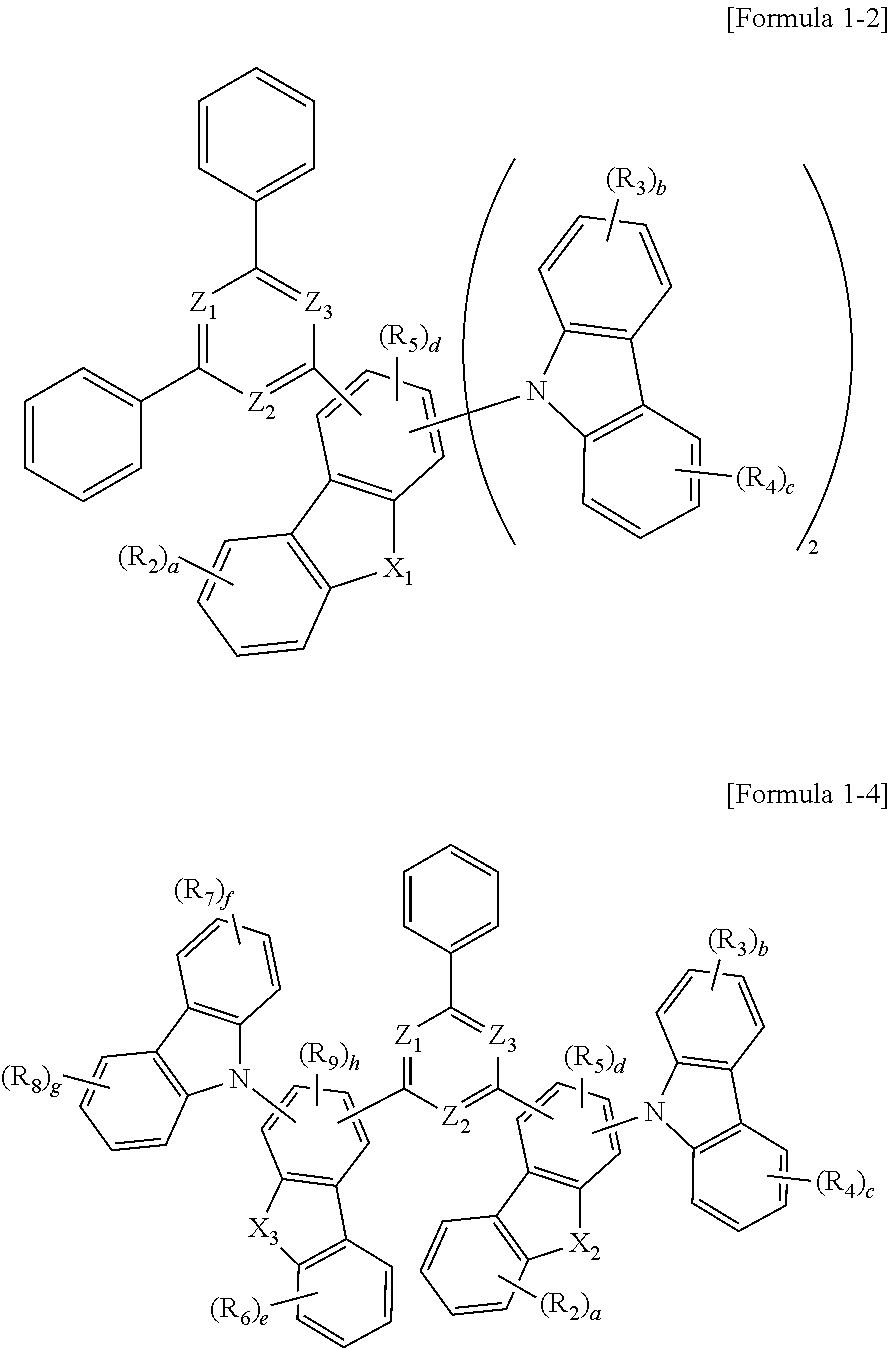
  • the compound represented by Formula 1 may be represented by the following Formula 1-2.
  • Z 1 to Z 3 , R 2 to R 5 , “a” to “d” and X 1 may be defined the same as those of Formulae 1 and 2.
  • “d” may be 0 or 1.
  • each of “a” to “d” may be 0.
  • At least one of two carbazole moieties in Formula 1-2 may be bonded in an ortho relationship with respect to the nitrogen-containing monocycle (e.g., including Z 1 to Z 3 ).
  • the compound represented by Formula 1 may be represented by the following Formula 1-3.
  • X 2 and X 3 may each independently be, e.g., O or S.
  • R 2 to R 9 may each independently be, a hydrogen atom, a deuterium atom, a halogen atom, a substituted or unsubstituted alkyl group having 1 to 10 carbon atoms, a substituted or unsubstituted aryl group having 6 to 30 ring carbon atoms, or a substituted or unsubstituted heteroaryl group having 2 to 30 ring carbon atoms.
  • a to “c” and “e” to “g” may each independently be, e.g., an integer of 0 to 4, “d” and “h” may each independently be, e.g., an integer of 0 to 2.
  • Z 1 to Z 3 , and Ar 1 may be defined the same as those of Formula 1.
  • X 2 and X 3 may be the same.
  • Ar 1 may be, e.g., a substituted or unsubstituted aryl group having 6 to 18 ring carbon atoms.
  • Ar 1 may be, e.g., a substituted or unsubstituted phenyl group, a substituted or unsubstituted biphenyl group, a substituted or unsubstituted terphenyl group, a substituted or unsubstituted naphthyl group, a substituted or unsubstituted anthracene group, or a substituted or unsubstituted phenanthrene group.
  • At least one of two carbazole moieties in Formula 1-3 may be bonded in an ortho relationship with respect to the nitrogen-containing monocycle (e.g., including Z 1 to Z 3 ).
  • the compound represented by Formula 1-3 may be represented by the following Formula 1-4.
  • X 2 and X 3 may each independently be, e.g., O or S.
  • R 2 to R 9 may each independently be, e.g., a hydrogen atom, a deuterium atom, a halogen atom, a substituted or unsubstituted alkyl group having 1 to 10 carbon atoms, a substituted or unsubstituted aryl group having 6 to 30 ring carbon atoms, or a substituted or unsubstituted heteroaryl group having 2 to 30 ring carbon atoms, “a” to “c” and “e” to “g” may each independently be, e.g., an integer of 0 to 4, “d” and “h” may each independently be, e.g., an integer of 0 to 2.
  • Z 1 to Z 3 may be defined the same as those Formula 1.
  • X 2 and X 3 may be the same.
  • At least one of two carbazole moieties in Formula 1-4 is substituted in ortho relationship with respect to a ring including Z 1 to Z 3 .
  • the compound represented by Formula 1 may be represented by the following Formula 1-5 or Formula 1-6.
  • Z 1 to Z 3 , Ar 1 , Ar 2 , R 2 , R 5 , “a”, “d” and X 1 may be defined the same as those of Formulae 1 and 2.
  • “d” may be 0 or 1.
  • the compound represented by Formula 1 may be represented by one of the following Formulae 1-7 to 1-9.
  • Z 1 to Z 3 , Art, Ar 2 , R 2 , R 5 , “a”, “d” and X 1 may be defined the same as those of Formulae 1 and 2.
  • the compound represented by Formula 1 may be represented by one of the following Formulae 1-10 to 1-12.
  • Z 1 to Z 3 , Ar 1 , Ar 2 , R 2 , R 5 , “a”, “d” and X 1 may be defined the same as those of Formulae 1 and 2.
  • the compound represented by Formula 1 may be represented by the following Formula 1-13 or Formula 1-14.
  • Z 1 to Z 3 , Ar 1 , Ar 2 , R 2 , R 5 , “a”, “d” and X 1 may be defined the same as those of Formulae 1 and 2.
  • the compound represented by Formula 1 may be represented by one of the following Formulae 1-15 to 1-17.
  • Z 1 to Z 3 , An, Ar 2 , R 2 , R 5 , “a”, and “d” may be defined the same as those of Formula 1, and X 2 and X 3 may be O or S.
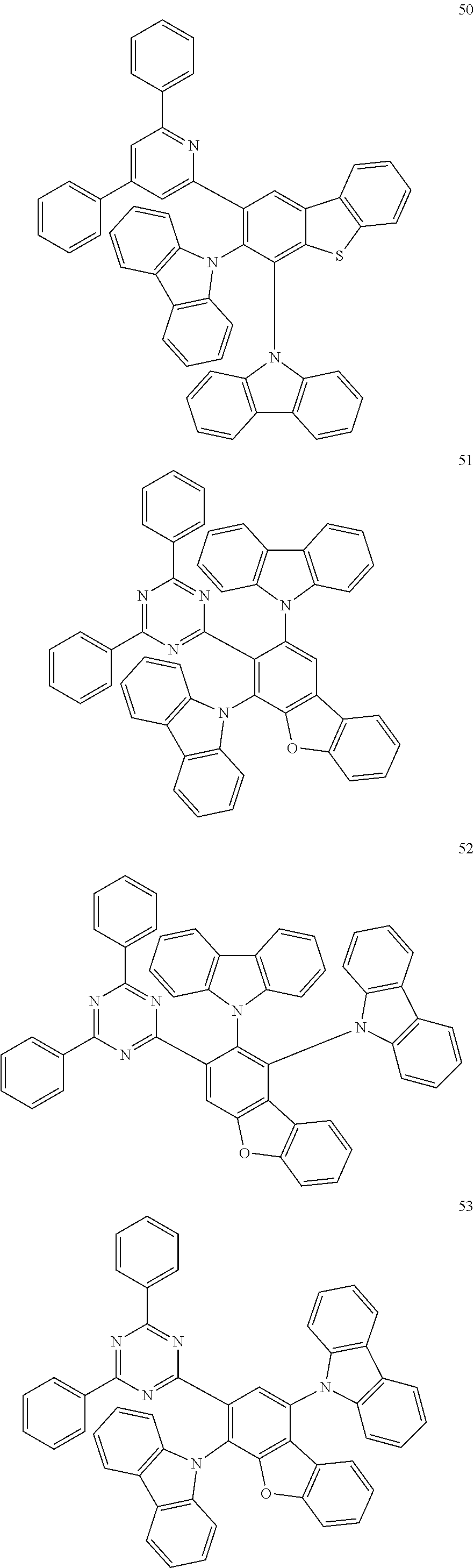
  • the heterocyclic compound may be, e.g., a compound of the following Compound Group 1.
  • the emission layer EML may include one kind or two or more kinds of the heterocyclic compound. In an implementation, the emission layer EML may further include other suitable materials in addition to the heterocyclic compound.
  • the emission layer EML may include a host and a dopant, and the dopant may include the heterocyclic compound.
  • the heterocyclic compound represented by Formula 1 may be included in the emission layer EML as a dopant.
  • the heterocyclic compound represented by Formula 1 may be included in the emission layer EML as a dopant for thermally activated delayed fluorescence.
  • the emission layer EML includes the heterocyclic compound and may be a blue emission layer emitting blue light having a wavelength region of less than about 470 nm.
  • the heterocyclic compound may be included in the emission layer EML as a dopant emitting deep blue light having a wavelength region of about 440 nm to about 470 nm, or about 450 nm to about 470 nm.
  • the host material may include suitable materials.
  • suitable materials for example, at least one of bis[2-(diphenylphosphino)phenyl] ether oxide (DPEPO), 4,4′-bis(carbazol-9-yl)biphenyl (CBP), 1,3-bis(carbazol-9-yl)benzene (mCP), 2,8-bis(diphenylphosphoryl)dibenzo[b,d]furan (PPF), 4,4′,4′′-tris(carbazol-9-yl)-triphenylamine (TcTa) or 1,3,5-tris(N-phenylbenzimidazole-2-yl)benzene (TPBi) may be included.
  • DPEPO bis[2-(diphenylphosphino)phenyl] ether oxide
  • CBP 4,4′-bis(carbazol-9-yl)biphenyl
  • mCP 1,3-bis(carbazol-9-yl)benzene
  • PPF 2,8
  • tris(8-hydroxyquinolino)aluminum Alq 3
  • PVK poly(N-vinylcarbazole)
  • ADN 9,10-di(naphthalene-2-yl)anthracene
  • TCTA 4,4′,4′′-tris(carbazol-9-yl)-triphenylamine
  • TPBi 1,3,5-tris(N-phenylbenzimidazole-2-yl)benzene
  • TPADN 3-tert-butyl-9,10-di(naphth-2-yl)anthracene
  • DSA 4,4′-bis(9-carbazolyl)-2,2′-dimethyl-biphenyl
  • CDBP 4,4′-bis(naphthalen-2-yl)anthracene
  • MADN 2-methyl-9,10-bis(naphthalen-2
  • the emission layer EML may further include as a dopant, at least one of N,N,N′,N′-tetraphenyl-pyrene-1,6-diamine (TPD), 4,4′-bis(2-(9-ethyl-9H-carbazol-3-yl)vinyl)-1,1′-biphenyl (BCzVBi); 4,4′-bis(9-ethyl-3-carbazovinylene)-1,1′-biphenyl, 10-phenyl-10H,10′H-spiro[acridine-9,9′-anthracene]-10′-one (ACRSA), 3,4,5,6-tetra-9H-carbazol-9-yl-1,2-benzenedicarbonitrile (4CzPN), 2,4,5,6-tetra-9H-carbazol-9-yl-isophthalonitrile (4CzIPN), bis[4-9,9-dimethyl-9,10-
  • TPD N,N,N′,N
  • the emission layer EML may further include, as known dopant materials, styryl derivatives (for example, 1,4-bis[2-(3-N-ethylcarbazoryl)vinyl]benzene (BCzVB), 4-(di-p-tolylamino)-4′-[(di-p-tolylamino)styryl]stilbene (DPAVB), and N-(4-((E)-2-(6-((E)-4-(diphenylamino)styryl)naphthalen-2-yl)vinyl)phenyl)-N-phenylbenzenamine (N-BDAVBi)), perylene and the derivatives thereof (for example, 2,5,8,11-tetra-t-butylperylene (TBP)), pyrene and the derivatives thereof (for example, 1,1-dipyrene, 1,4-dipyrenylbenzene, 1,4-bis(N,N-diphenylamino)
  • the emission layer EML may be a blue emission layer that emits blue light.
  • the emission layer EML may be a fluorescence emission layer radiating fluorescence.
  • the emission layer EML may be a delayed fluorescence emission layer radiating delayed fluorescence.
  • the electron transport region ETR is provided on the emission layer EML.
  • the electron transport region ETR may include at least one of a hole blocking layer HBL, an electron transport layer ETL, or an electron injection layer EIL.
  • the electron transport region ETR may have a single layer formed using a single material, a single layer formed using a plurality of different materials, or a multilayer structure having a plurality of layers formed using a plurality of different materials.
  • the electron transport region ETR may have a single layer structure of an electron injection layer EIL or an electron transport layer ETL, or a single layer structure formed using an electron injection material and an electron transport material. Further, the electron transport region ETR may have a single layer structure having a plurality of different materials, or a structure laminated from the emission layer EML of electron transport layer ETL/electron injection layer EIL, or hole blocking layer HBL/electron transport layer ETL/electron injection layer EIL.
  • the thickness of the electron transport region ETR may be, for example, from about 1,000 ⁇ to about 1,500 ⁇ .
  • the electron transport region ETR may be formed using various methods such as a vacuum deposition method, a spin coating method, a cast method, a Langmuir-Blodgett (LB) method, an inkjet printing method, a laser printing method, and a laser induced thermal imaging (LITI) method.
  • a vacuum deposition method such as a vacuum deposition method, a spin coating method, a cast method, a Langmuir-Blodgett (LB) method, an inkjet printing method, a laser printing method, and a laser induced thermal imaging (LITI) method.
  • LB Langmuir-Blodgett
  • LITI laser induced thermal imaging
  • the electron transport region ETR may include tris(8-hydroxyquinolinato)aluminum (Alq 3 ), 1,3,5-tri[(3-pyridyl)-phen-3-yl]benzene, 2,4,6-tris(3′-(pyridin-3-yl)biphenyl-3-yl)-1,3,5-triazine, 2-(4-(N-phenylbenzoimidazolyl-1-ylphenyl)-9,10-dinaphthylanthracene, 1,3,5-tri(1-phenyl-1H-benzo[d]imidazol-2-yl)phenyl (TPBi), 2,9-dimethyl-4,7-diphenyl-1,10-phenanthroline (BCP), 4,7-diphenyl-1,10-phenanthroline (Bphen), 3-(4-biphenylyl)-4-phenyl-5-tert-butyl
  • the thickness of the electron transport layers ETL may be from about 100 ⁇ to about 1,000 ⁇ , for example, from about 150 ⁇ to about 500 ⁇ . If the thickness of the electron transport layers ETL satisfies the above-described range, satisfactory electron transport properties may be obtained without substantial increase of a driving voltage.
  • the electron transport layer ETL may use LiF, lithium quinolate (LiQ), Li 2 O, BaO, NaCl, CsF, a metal in lanthanides such as Yb, or a metal halide such as RbCI, and RbI.
  • the electron injection layer EIL may also be formed using a mixture material of an electron transport material and an insulating organo metal salt.
  • the organo metal salt may be a material having an energy band gap of about 4 eV or more.
  • the organo metal salt may include, for example, metal acetates, metal benzoates, metal acetoacetates, metal acetylacetonates, or metal stearates.
  • the thickness of the electron injection layer EIL may be from about 1 ⁇ to about 100 ⁇ , from about 3 ⁇ to about 90 ⁇ . If the thickness of the electron injection layer EIL satisfies the above-described range, satisfactory electron injection properties may be obtained without substantial increase of a driving voltage.
  • the electron transport region ETR may include a hole blocking layer as described above.
  • the hole blocking layer may include, for example, 2,9-dimethyl-4,7-diphenyl-1,10-phenanthroline (BCP), 4,7-diphenyl-1,10-phenanthroline (Bphen), or bis[2-(diphenylphosphino)phenyl]ether oxide (DPEPO).
  • the second electrode EL 2 is provided on the electron transport region ETR.
  • the second electrode EL 2 may be a common electrode or a cathode.
  • the second electrode EL 2 may be a transmissive electrode, a transflective electrode or a reflective electrode. If the second electrode EL 2 is the transmissive electrode, the second electrode EL 2 may include a transparent metal oxide, for example, ITO, IZO, ZnO, ITZO, etc.
  • the second electrode EL 2 may include Ag, Mg, Cu, Al, Pt, Pd, Au, Ni, Nd, Ir, Cr, Li, Ca, LiF/Ca, LiF/AI, Mo, Ti, a compound including thereof, or a mixture thereof (for example, a mixture of Ag and Mg).
  • the second electrode EL 2 may have a multilayered structure including a reflective layer or a transflective layer formed using the above-described materials and a transparent conductive layer formed using ITO, IZO, ZnO, ITZO, etc.
  • the second electrode EL 2 may be connected with an auxiliary electrode. If the second electrode EL 2 is connected with the auxiliary electrode, the resistance of the second electrode EL 2 may decrease.
  • holes injected from the first electrode EL 1 may move via the hole transport region HTR to the emission layer EML, and electrons injected from the second electrode EL 2 may move via the electron transport region ETR to the emission layer EML.
  • the electrons and the holes are recombined in the emission layer EML to produce excitons, and the excitons may emit light via transition from an excited state to a ground state.
  • the first electrode EL 1 may be a reflective electrode and the second electrode EL 2 may be a transmissive electrode or a transflective electrode. If the organic electroluminescence device 10 is a bottom emission type, the first electrode EL 1 may be a transmissive electrode or a transflective electrode and the second electrode EL 2 may be a reflective electrode.
  • the organic electroluminescence device 10 may include the heterocyclic compound represented by Formula 1, and thus, high efficiency and blue emission (e.g., deep blue emission) may be achieved at the same time.
  • high efficiency and blue emission e.g., deep blue emission
  • An embodiment provides a heterocyclic compound represented by Formula 1.
  • the above-described explanation on Formula 1 will be applied unless otherwise explained.
  • the heterocyclic compound according to an embodiment may be represented by the following Formula 1.
  • Z 1 to Z 3 may each independently be, e.g., CR 1 or N. In an implementation, at least one of Z 1 to Z 3 may be N.
  • R 1 may be, e.g., a hydrogen atom, a deuterium atom, a substituted or unsubstituted alkyl group having 1 to 10 carbon atoms, a substituted or unsubstituted aryl group having 6 to 30 ring carbon atoms, or a substituted or unsubstituted heteroaryl group having 2 to 30 ring carbon atoms.
  • Ar 1 to Ar 3 may each independently be, e.g., a group represented by Formula 2, a substituted or unsubstituted aryl group having 6 to 30 ring carbon atoms, or a substituted or unsubstituted heteroaryl group having 2 to 30 ring carbon atoms. In an implementation, at least one of Ar 1 to Ar 3 may be a group represented by Formula 2.
  • X 1 may be, e.g., O or S “n” may be, e.g., an integer of 1 to 3, “a” to “c” may each independently be, e.g., an integer of 0 to 4, and “d” may be, e.g., an integer of 0 to 2.
  • R 2 to R 5 may each independently be, e.g., a hydrogen atom, a deuterium atom, a halogen atom, a substituted or unsubstituted alkyl group having 1 to 10 carbon atoms, a substituted or unsubstituted aryl group having 6 to 30 ring carbon atoms, or a substituted or unsubstituted heteroaryl group having 2 to 30 ring carbon atoms.
  • n may be 2 or 3.
  • at least one of the carbazole moieties in Formula 2 may be bonded in ortho relationship with respect to the nitrogen-containing monocycle of Formula 1.
  • the heterocyclic compound according to an embodiment may be a compound of Compound Group 1, above.
  • the heterocyclic compound according to an embodiment may have a difference between a singlet energy level and a triplet energy level of about 0.2 eV or less, and as a result, may be used as a material for thermally activated delayed fluorescence.
  • the heterocyclic compound according to an embodiment may be applied as a material for an organic electroluminescence device and may contribute to the increase of efficiency.
  • Heterocyclic compounds according to embodiments may be synthesized, e.g., as follows.
  • Compound 29 was synthesized by conducting the same procedure for synthesizing Compound 23 except for using 2-chloro-4,6-diphenylpyrimidine instead of 2-chloro-4,6-diphenyl-1,3,5-triazine.
  • Organic electroluminescence devices of Examples 1 to 4 were manufactured using Compounds 1, 24, 107 and 109 as dopant materials for an emission layer.
  • S1 level and T1 level of the Example Compounds and the Comparative Compounds were calculated by a non-empirical molecular orbital method. Particularly, the calculation was conducted using B3LYP as a functional, and 6-31G(d) as a basis function by using Gaussian09 of Gaussian Co. The results are shown in Table 1 below.
  • ⁇ E ST represents the difference between a singlet energy level and a triplet energy level.
  • Example Compounds exhibited low ⁇ E ST values and are thought to be appropriately used as materials for thermally activated delayed fluorescence.
  • the Comparative Compounds exhibited relatively high ⁇ E ST values, and are not thought to be appropriately used as materials for thermally activated delayed fluorescence.
  • Each of the organic electroluminescence devices of Examples 1 to 8 and Comparative Examples 1 to 3 was manufactured by forming a first electrode using ITO to a thickness of about 150 nm, a hole injection layer using HAT-CN to a thickness of about 10 nm, a hole transport layer using NPB to a thickness of about 80 nm, an electron blocking layer using mCP to a thickness of about 5 nm, an emission layer using DPEPO doped with 18% of the Example Compound or the Comparative Compound to a thickness of about 20 nm, a hole blocking layer using DPEPO to a thickness of about 10 nm, an electron transport layer using TPBi to a thickness of about 30 nm, an electron injection layer using LiF to a thickness of about 0.5 nm, and a second electrode using Al to a thickness of about 100 nm. Each layer was formed by a deposition method in vacuum.
  • the maximum emission wavelength (e.g., wavelength of maximum emission) and external quantum efficiency of each of the organic electroluminescence devices according to Examples 1 to 8 and Comparative Examples 1 to 3 were measured and are shown in Table 2 below.
  • EQE in Table 2 means values at about 10 mA/cm 2 .
  • a luminous brightness measurement apparatus, C9920-11 of HAMAMATSU Photonics Co. was used.
  • Example Compound 1 470 9
  • Example 2 Example Compound 24 463 11
  • Example 3 Example Compound 107 459 14
  • Example 4 Example Compound 109 461 13
  • Example 5 Example Compound 23 460 13
  • Example 6 Example Compound 29 452 10
  • Example 7 Example Compound 131 464 15
  • Example 8 Example Compound 133 462 14 Comparative Example 1 Comparative Compound X-1 474 5 Comparative Example 2 Comparative Compound X-2 472 2 Comparative Example 3 Comparative Compound X-3 466 3
  • Examples 1 to 8 exhibited increased efficiency when compared with Comparative Examples 1 to 3. These results were thought to be obtained because an azine group functioned an electron acceptor and a carbazole group functioned an electron donor in the example compounds, and the Example Compounds showed the properties of a material for thermally activated delayed fluorescence. Further, the azine group and the carbazole group were bonded in an ortho relationship, and the electron acceptor and the electron donor were twisted, HOMO and LUMO were efficiently separated, and the properties of a material for thermally activated delayed fluorescence were shown.
  • Comparative Example 1 since an azine group and a carbazolyl group were not bonded in ortho relationship, the donor and the acceptor were insufficiently twisted, and TADF was not shown.
  • Comparative Examples 2 and 3 ⁇ E ST values were relatively large and only one carbazole group was included. Thus, the function of an electron donor was weak, reverse intersystem crossing was insufficiently arisen, and the properties as a material for thermally activated delayed fluorescence were now exhibited.
  • the heterocyclic compound according to an embodiment may be utilized as a dopant of thermally activated delayed fluorescence for emitting deep blue color.
  • the organic electroluminescence device including the heterocyclic compound according to an embodiment may facilitate emission of deep blue color and may have excellent efficiency at the same time.
  • the organic electroluminescence device according to an embodiment may have excellent efficiency.
  • the heterocyclic compound according to an embodiment may be applied to an organic electroluminescence device and may contribute to high efficiency.

Landscapes

  • Chemical & Material Sciences (AREA)
  • Organic Chemistry (AREA)
  • Physics & Mathematics (AREA)
  • Engineering & Computer Science (AREA)
  • Materials Engineering (AREA)
  • Spectroscopy & Molecular Physics (AREA)
  • Optics & Photonics (AREA)
  • Electroluminescent Light Sources (AREA)

Abstract

An organic electroluminescence device and a heterocyclic compound, the device including a first electrode; a hole transport region on the first electrode; an emission layer on the hole transport region; an electron transport region on the emission layer; and a second electrode on the electron transport region, wherein the emission layer includes a heterocyclic compound that includes a nitrogen-containing monocycle, at least one linker, and two or more carbazole moieties, the at least one linker is a substituted or unsubstituted dibenzofuran group or a substituted or unsubstituted dibenzothiophene group, and at least one of the carbazole moieties and the nitrogen-containing monocycle are bonded to the at least one linker in an ortho relationship.

Description

CROSS-REFERENCE TO RELATED APPLICATION
Korean Patent Application No. 10-2018-0073189, filed on Jun. 26, 2018, in the Korean Intellectual Property Office, and entitled: “Organic Electroluminescence Device and Heterocyclic Compound for Organic Electroluminescence Device,” is incorporated by reference herein in its entirety.
BACKGROUND 1. Field
Embodiments relates to an organic electroluminescence device and a heterocyclic compound used for the organic electroluminescence device.
2. Description of the Related Art
The development of an organic electroluminescence display as an image display device is being actively conducted. Different from a liquid crystal display device, the organic electroluminescence display is a self-luminescent display in which holes and electrons injected from a first electrode and a second electrode recombine in an emission layer, and a light-emitting material which is an organic compound included in the emission layer emits light to attain display.
An organic electroluminescence device may include, e.g., an organic device including a first electrode, a hole transport layer on the first electrode, an emission layer on the hole transport layer, an electron transport layer on the emission layer, and a second electrode on the electron transport layer. Holes are injected from the first electrode, and the injected holes move via the hole transport layer and are injected into the emission layer. Meanwhile, electrons are injected from the second electrode, and the injected electrons move via the electron transport layer and are injected into the emission layer. The holes and electrons injected into the emission layer recombine to produce excitons in the emission layer. The organic electroluminescence device emits light using light generated by the transition of the excitons to a ground state.
SUMMARY
The embodiments may be realized by providing an organic electroluminescence device including a first electrode; a hole transport region on the first electrode; an emission layer on the hole transport region; an electron transport region on the emission layer; and a second electrode on the electron transport region, wherein the emission layer includes a heterocyclic compound that includes a nitrogen-containing monocycle, at least one linker, and two or more carbazole moieties, the at least one linker is a substituted or unsubstituted dibenzofuran group or a substituted or unsubstituted dibenzothiophene group, and at least one of the carbazole moieties and the nitrogen-containing monocycle are bonded to the at least one linker in an ortho relationship.
The embodiments may be realized by providing an organic electroluminescence device including a first electrode; a hole transport region on the first electrode; an emission layer on the hole transport region; an electron transport region on the emission layer; and a second electrode on the electron transport region, wherein the emission layer includes a heterocyclic compound represented by the following Formula 1:
Figure US11968891-20240423-C00001
in Formula 1, Z1 to Z3 are each independently CR1 or N, at least one of Z1 to Z3 is N, R1 is a hydrogen atom, a deuterium atom, a substituted or unsubstituted alkyl group having 1 to 10 carbon atoms, a substituted or unsubstituted aryl group having 6 to 30 ring carbon atoms, or a substituted or unsubstituted heteroaryl group having 2 to 30 ring carbon atoms, Ar1 to Ar3 are each independently a group represented by the following Formula 2, a substituted or unsubstituted aryl group having 6 to 30 ring carbon atoms, or a substituted or unsubstituted heteroaryl group having 2 to 30 carbon atoms for forming a ring, and at least one of Ar1 to Ar3 is a group represented by Formula 2:
Figure US11968891-20240423-C00002
in Formula 2, X1 is O or S, “n” is an integer of 1 to 3, “a” to “c” are each independently an integer of 0 to 4, “d” is an integer of 0 to 2, and R2 to R5 are each independently a hydrogen atom, a deuterium atom, a halogen atom, a substituted or unsubstituted alkyl group having 1 to 10 carbon atoms, a substituted or unsubstituted aryl group having 6 to 30 ring carbon atoms, or a substituted or unsubstituted heteroaryl group having 2 to 30 ring carbon atoms, when only one of Ar1 to Ar3 is a group represented by Formula 2 above, “n” is 2 or 3, and at least one of the carbazole moieties in Formula 2 is bonded in an ortho relationship with respect to the nitrogen-containing monocycle of Formula 1.
The embodiments may be realized by providing a heterocyclic compound represented by the following Formula 1:
Figure US11968891-20240423-C00003
wherein, in Formula 1, Z1 to Z3 are each independently CR1 or N, at least one of Z1 to Z3 is N, R1 is a hydrogen atom, a deuterium atom, a substituted or unsubstituted alkyl group having 1 to 10 carbon atoms, a substituted or unsubstituted aryl group having 6 to 30 ring carbon atoms, or a substituted or unsubstituted heteroaryl group having 2 to 30 ring carbon atoms, Ar1 to Ar3 are each independently a group represented by the following Formula 2, a substituted or unsubstituted aryl group having 6 to 30 ring carbon atoms, or a substituted or unsubstituted heteroaryl group having 2 to 30 ring carbon atoms, and at least one of Ar1 to Ar3 is a group represented by Formula 2:
Figure US11968891-20240423-C00004
in Formula 2, X1 is O or S, “n” is an integer of 1 to 3, “a” to “c” are each independently an integer of 0 to 4, “d” is an integer of 0 to 2, and R2 to R5 are each independently a hydrogen atom, a deuterium atom, a halogen atom, a substituted or unsubstituted alkyl group having 1 to 10 carbon atoms, a substituted or unsubstituted aryl group having 6 to 30 ring carbon atoms, or a substituted or unsubstituted heteroaryl group having 2 to 30 ring carbon atoms, when only one of Ar1 to Ar3 is a group represented by Formula 2 above, “n” is 2 or 3, and at least one of the carbazole moieties in Formula 2 is bonded in an ortho relationship with respect to the nitrogen-containing monocycle of Formula 1.
BRIEF DESCRIPTION OF THE DRAWINGS
Features will be apparent to those of skill in the art by describing in detail exemplary embodiments with reference to the attached drawings in which:
FIG. 1 illustrates a cross-sectional view of an organic electroluminescence device according to an embodiment;
FIG. 2 illustrates a cross-sectional view of an organic electroluminescence device according to an embodiment; and
FIG. 3 illustrates a cross-sectional view of an organic electroluminescence device according to an embodiment.
DETAILED DESCRIPTION
Example embodiments will now be described more fully hereinafter with reference to the accompanying drawings; however, they may be embodied in different forms and should not be construed as limited to the embodiments set forth herein. Rather, these embodiments are provided so that this disclosure will be thorough and complete, and will fully convey exemplary implementations to those skilled in the art.
In the drawing figures, the dimensions of layers and regions may be exaggerated for clarity of illustration. Like reference numerals refer to like elements throughout.
It will be understood that, although the terms first, second, etc. may be used herein to describe various elements, these elements should not be limited by these terms. These terms are only used to distinguish one element from another element. For example, a first element discussed below could be termed a second element, and similarly, a second element could be termed a first element. As used herein, the singular forms are intended to include the plural forms as well, unless the context clearly indicates otherwise.
It will be further understood that the terms “includes,” “including,” “comprises” or “comprising,” when used in this specification, specify the presence of stated features, numerals, steps, operations, elements, parts, or a combination thereof, but do not preclude the presence or addition of one or more other features, numerals, steps, operations, elements, parts, or a combination thereof. It will also be understood that when a layer, a film, a region, a plate, etc. is referred to as being “on” another part, it can be “directly on” the other part, or intervening layers may also be present.
First, organic electroluminescence devices according to exemplary embodiments will be explained referring to FIG. 1 to FIG. 3 .
FIG. 1 illustrates a cross-sectional view of an organic electroluminescence device according to an embodiment. FIG. 2 illustrates a cross-sectional view of an organic electroluminescence device according to an embodiment. FIG. 3 illustrates a cross-sectional view of an organic electroluminescence device according to an embodiment.
Referring to FIG. 1 to FIG. 3 , an organic electroluminescence device 10 according to an embodiment may include a first electrode EL1, a hole transport region HTR, an emission layer EML, an electron transport region ETR, and a second electrode EL2.
The first electrode EL1 has conductivity. The first electrode EL1 may be a pixel electrode or an anode. The first electrode EL1 may be a transmissive electrode, a transflective electrode, or a reflective electrode. If the first electrode EL1 is the transmissive electrode, the first electrode EL1 may include a transparent metal oxide such as indium tin oxide (ITO), indium zinc oxide (IZO), zinc oxide (ZnO), or indium tin zinc oxide (ITZO). If the first electrode EL1 is the transflective electrode or the reflective electrode, the first electrode EL1 may include Ag, Mg, Cu, Al, Pt, Pd, Au, Ni, Nd, Ir, Cr, Li, Ca, LiF/Ca, LiF/Al, Mo, Ti, a compound thereof, or a mixture thereof (for example, a mixture of Ag and Mg). Also, the first electrode EL1 may include a plurality of layers including the reflective layer or transflective layer formed using the above materials, or a transparent layer formed using ITO, IZO, ZnO, or ITZO. For example, the first electrode EL1 may have a three-layer structure of ITO/Ag/ITO.
The thickness of the first electrode EL1 may be from about 1,000 Å to about 10,000 Å, for example, from about 1,000 Å to about 3,000 Å.
The hole transport region HTR is provided on the first electrode EL1. The hole transport region HTR may include at least one of a hole injection layer HIL, a hole transport layer HTL, a hole buffer layer, or an electron blocking layer EBL. The thickness of the hole transport region HTR may be, for example, from about 1,000 Å to about 1,500 Å
The hole transport region HTR may have a single layer formed using a single material, a single layer formed using a plurality of different materials, or a multilayer structure including a plurality of layers formed using a plurality of different materials.
For example, the hole transport region HTR may have the structure of a single layer such as a hole injection layer HIL and a hole transport layer HTL, and may have a structure of a single layer formed using a hole injection material and a hole transport material. In an implementation, the hole transport region HTR may have a structure of a single layer formed using a plurality of different materials, or a structure laminated from the first electrode EL1 of hole injection layer HIL/hole transport layer HTL, hole injection layer HIL/hole transport layer HTL/hole buffer layer, hole injection layer HIL/hole buffer layer, hole transport layer HTL/hole buffer layer, or hole injection layer HIL/hole transport layer HTL/electron blocking layer EBL.
The hole transport region HTR may be formed using various methods such as a vacuum deposition method, a spin coating method, a cast method, a Langmuir-Blodgett (LB) method, an inkjet printing method, a laser printing method, and a laser induced thermal imaging (LITI) method.
The hole injection layer HIL may include, for example, a phthalocyanine compound such as copper phthalocyanine; N,N′-diphenyl-N,N′-bis-[4-(phenyl-m-tolyl-amino)-phenyl]-biphenyl-4,4′-diamine (DNTPD), 4,4′,4″-tris(3-methylphenylphenylamino) triphenylamine (m-MTDATA), 4,4′,4″-tris(N,N-diphenylamino)triphenylamine (TDATA), 4,4′,4″-tris {N-(2-naphthyl)-N-phenylamino}-triphenylamine (2-TNATA), poly(3,4-ethylenedioxythiophene)/poly(4-styrenesulfonate) (PEDOT/PSS), polyaniline/dodecylbenzenesulfonic acid (PANI/DBSA), polyaniline/camphor sulfonic acid (PANI/CSA), polyaniline/poly(4-styrenesulfonate) (PANI/PSS), N,N′-dinaphthalene-1-yl)-N,N′-diphenyl-benzidine (NPB), triphenylamine-containing polyether ketone (TPAPEK), 4-isopropyl-4′-methyldiphenyliodonium tetrakis(pentafluorophenyl)borate, dipyrazino[2,3-f: 2′,3′-h]quinoxaline-2,3,6,7,10,11-hexacarbonitrile (HAT-CN), etc.
The hole transport layer HTL may include, for example, carbazole derivatives such as N-phenyl carbazole and polyvinyl carbazole, fluorine-based derivatives, N,N′-bis(3-methylphenyl)-N,N′-diphenyl-[1,1-biphenyl]-4,4′-diamine (TPD), triphenylamine-based derivatives such as 4,4′,4″-tris(N-carbazolyl)triphenylamine (TCTA), N,N′-di(1-naphthalene-1-yl)-N,N′-diphenyl-benzidine (NPB), 4,4′-cyclohexylidene bis[N,N-bis(4-methylphenyl)benzenamine] (TAPC), 4,4′-bis[N,N′-(3-tolyl)amino]-3,3′-dimethylbiphenyl (HMTPD), 1,3-bis(N-carbazolyl)benzene (mCP), etc.
The thickness of the hole transport region HTR may be from about 100 Å to about 10,000 Å, for example, from about 100 Å to about 1,000 Å. If the hole transport region HTR includes both the hole injection layer HIL and the hole transport layer HTL, the thickness of the hole injection layer HIL may be from about 100 Å to about 10,000 Å, for example, from about 100 Å to about 1,000 Å, and the thickness of the hole transport layer HTL may be from about 30 Å to about 1,000 Å. If the thicknesses of the hole transport region HTR, the hole injection layer HIL, and the hole transport layer HTL satisfy the above-described ranges, satisfactory hole transport properties may be obtained without substantial increase of a driving voltage.
The hole transport region HTR may further include a charge generating material in addition to the above-described materials to increase conductivity. The charge generating material may be dispersed uniformly or non-uniformly in the hole transport region HTR. The charge generating material may be, for example, a p-dopant. In an implementation, the p-dopant may be one of quinone derivatives, metal oxides, or cyano group-containing compounds. Examples of the p-dopant may include quinone derivatives such as tetracyanoquinodimethane (TCNQ) and 2,3,5,6-tetrafluoro-tetracyanoquinodimethane (F4-TCNQ), metal oxides such as tungsten oxide, and molybdenum oxide.
As described above, the hole transport region HTR may further include at least one of a hole buffer layer or an electron blocking layer in addition to the hole injection layer HIL and the hole transport layer HTL. The hole buffer layer may compensate a resonance distance according to the wavelength of light emitted from the emission layer EML and increase light emission efficiency. Materials included in the hole transport region HTR may be used as materials included in the hole buffer layer. The electron blocking layer is a layer preventing electron injection from the electron transport region ETR to the hole transport region HTR.
The emission layer EML may be provided on the hole transport region HTR. In an implementation, the emission layer EML may have a thickness of about 100 Å to about 1,000 Å, e.g., about 100 Å to about 300 Å. In an implementation, the emission layer EML may have a single layer formed using a single material, a single layer formed using a plurality of different materials, or a multilayer structure having a plurality of layers formed using a plurality of different materials.
The emission layer EML may include, e.g., a heterocyclic compound including a nitrogen-containing monocycle, a (e.g., at least one) linker, and two or more carbazole moieties. In an implementation, the linker may be, e.g., a substituted or unsubstituted dibenzofuran group or a substituted or unsubstituted dibenzothiophene.
At least one of the carbazole moieties and the nitrogen-containing monocycle may be bonded the linker in an ortho relationship. For example, the nitrogen-containing monocycle and the carbazole moieties may be connected via the linker, and at least one of the carbazole moieties and the nitrogen-containing monocycle are bonded to the linker in ortho relationship. For example, the nitrogen-containing monocycle may be bound to one ring atom of the linker, and one of the carbazole moieties may be bound to another ring atom of the linker, which other ring atom of the linker is directly adjacent to the one ring atom of the linker on the ring (e.g., the one ring atom of the linker may be at a 3-position of the linker and the other ring atom of the linker may be at a 4-position of the linker).
In an implementation, if two carbazole moieties are included, only one of the two may be bonded in the ortho relationship with respect to the nitrogen-containing monocycle, and the other carbazole moiety may be bonded in meta or para relationship with respect to the nitrogen-containing monocycle. In an implementation, each (e.g., both) of the two carbazole moieties may be bonded to the linker in the ortho relationship with respect to the nitrogen-containing monocycle. In an implementation, the heterocyclic compound may include two linkers.
In an implementation, the heterocyclic compound may include one or two linkers. If the heterocyclic compound includes one linker, each of two or more carbazole moieties may be bonded to the linker. If the heterocyclic compound includes two linkers, at least one carbazole moiety may be bonded each of the linkers.
In an implementation, the nitrogen-containing monocycle may be, e.g., a substituted or unsubstituted pyridine group, a substituted or unsubstituted pyrimidine group, or a substituted or unsubstituted triazine group. In an implementation, the nitrogen-containing monocycle may be, e.g., a substituted or unsubstituted triazine group.
In an implementation, the nitrogen-containing monocycle may be substituted with at least one substituted or unsubstituted phenyl group. In an implementation, if the heterocyclic compound includes one linker, the nitrogen-containing monocycle may be unsubstituted or may be di-substituted with two substituted or unsubstituted phenyl groups. In an implementation, if the heterocyclic compound includes two linkers, the nitrogen-containing monocycle may be substituted with one substituted or unsubstituted phenyl group. In an implementation, the nitrogen-containing monocycle may be, e.g., substituted with one or two unsubstituted phenyl groups.
In an implementation, the heterocyclic compound may be, e.g., represented by the following Formula 1.
Figure US11968891-20240423-C00005
In Formula 1, Z1 to Z3 may each independently be, e.g., CR1 or N, at least one of Z1 to Z3 is N. R1 may be, e.g., a hydrogen atom, a deuterium atom, a substituted or unsubstituted alkyl group having 1 to 10 carbon atoms, a substituted or unsubstituted aryl group having 6 to 30 ring carbon atoms, or a substituted or unsubstituted heteroaryl group having 2 to 30 ring carbon atoms. Ar1 to Ar3 may each independently be, e.g., a group represented by Formula 2, below, a substituted or unsubstituted aryl group having 6 to 30 ring carbon atoms, or a substituted or unsubstituted heteroaryl group having 2 to 30 ring carbon atoms. In an implementation, at least one of Ar1 to Ar3 may be a group represented by Formula 2. It may be understood that the substituted or unsubstituted aryl group having 6 to 30 ring carbon atoms and the substituted or unsubstituted heteroaryl group having 2 to 30 ring carbon atoms are different from the group represented by Formula 2.
Figure US11968891-20240423-C00006
In Formula 2, X1 may be, e.g., O or S. “n” may be, e.g., an integer of 1 to 3, “a” to “c” may each independently be, e.g., an integer of 0 to 4, and “d” may be, e.g., an integer of 0 to 2. R2 to R5 may each independently be, e.g., a hydrogen atom, a deuterium atom, a halogen atom, a substituted or unsubstituted alkyl group having 1 to 10 carbon atoms, a substituted or unsubstituted aryl group having 6 to 30 ring carbon atoms, or a substituted or unsubstituted heteroaryl group having 2 to 30 ring carbon atoms. In an implementation, R2 to R5 may each independently be, e.g., a deuterium atom, a halogen atom, a substituted or unsubstituted alkyl group having 1 to 10 carbon atoms, a substituted or unsubstituted aryl group having 6 to 30 ring carbon atoms, or a substituted or unsubstituted heteroaryl group having 2 to 30 ring carbon atoms. In an implementation, when n of Formula 2 is 1, the compound represented by Formula 1 may include another carbazole moiety thereon.
In the description,
Figure US11968891-20240423-P00001
means a part to be connected or a bonding location (e.g., at a location of Ar1 to Ar3 of Formula 1).
In the description, “substituted or unsubstituted” may mean substituted with at least one substituent selected from a deuterium atom, a halogen atom, a cyano group, a nitro group, an amino group, a silyl group, a boron group, a phosphine group, an alkyl group, an alkenyl group, an aryl group, and a heterocycle, or unsubstituted. In addition, each of the substituent illustrated above may be substituted or unsubstituted. For example, a biphenyl group may be interpreted as an aryl group, or a phenyl group substituted with a phenyl group.
In the description, the halogen atom may include a fluorine atom, a chlorine atom, a bromine atom and an iodine atom.
In the description, the alkyl may be a linear, branched or cyclic type. The carbon number of the alkyl may be from 1 to 30, from 1 to 20, 1 to 10, or from 1 to 4. The alkyl may include methyl, ethyl, n-propyl, isopropyl, n-butyl, s-butyl, t-butyl, i-butyl, 2-ethylbutyl, 3,3-dimethylbutyl, n-pentyl, i-pentyl, neopentyl, t-pentyl, cyclopentyl, I-methylpentyl, 3-methylpentyl, 2-ethylpentyl, 4-methyl-2-pentyl, n-hexyl, 1-methylhexyl, 2-ethylhexyl, 2-butylhexyl, cyclohexyl, 4-methylcyclohexyl, 4-t-butylcyclohexyl, n-heptyl, 1-methylheptyl, 2,2-dimethylheptyl, 2-ethylheptyl, 2-butylheptyl, n-octyl, t-octyl, 2-ethyloctyl, 2-butyloctyl, 2-hexyloctyl, 3,7-dimethyloctyl, cyclooctyl, n-nonyl, n-decyl, adamantyl, 2-ethyldecyl, 2-butyldecyl, 2-hexyldecyl, 2-octyldecyl, n-undecyl, n-dodecyl, 2-ethyldodecyl, 2-butyldodecyl, 2-hexyldocecyl, 2-octyldodecyl, n-tridecyl, n-tetradecyl, c-pentadecyl, n-hexadecyl, 2-ethylhexadecyl, 2-butylhexadecyl, 2-hexylhexadecyl, 2-octylhexadecyl, n-heptadecyl, n-octadecyl, n-nonadecyl, n-eicosyl, 2-ethyleicosyl, 2-butyleicosyl, 2-hexyleicosyl, 2-octyleicosyl, n-henicosyl, n-docosyl, n-tricosyl, n-tetracosyl, n-pentacosyl, n-hexacosyl, n-heptacosyl, n-octacosyl, n-nonacosyl, n-triacontyl, etc.
In the description, the aryl group means an optional functional group or substituent derived from an aromatic hydrocarbon ring. The aryl group may be a monocyclic aryl group or a heterocyclic aryl group. The carbon number for forming a ring in the aryl group may be, 6 to 30, 6 to 20, or 6 to 15. Examples of the aryl group may include phenyl, naphthyl, fluorenyl, anthracenyl, phenanthryl, biphenyl, terphenyl, quaterphenyl, quinqphenyl, sexiphenyl, biphenylene, triphenylene, pyrenyl, benzofluoranthenyl, chrysenyl, etc.
In the description, the fluorenyl group may be substituted, and two substituents may be combined with each other to form a spiro structure. If the fluorenyl group is substituted, examples are shown below.
Figure US11968891-20240423-C00007
In the description, the heteroaryl group may be a heteroaryl group including at least one of O, N, P, Si or S as a heteroatom. If the heteroaryl group includes two heteroatoms, two heteroatoms may be the same or different. The carbon number for forming a ring of the heteroaryl group may be 2 to 30 or 2 to 20. The heteroaryl group may be a monocyclic heteroaryl group or a polycyclic heteroaryl group. The polycyclic heteroaryl group may have, for example, a two-ring or a three-ring structure. Examples of the heteroaryl group may include thiophene, furan, pyrrole, imidazole, thiazole, oxazole, oxadiazole, triazole, pyridine, bipyridine, pyrimidine, triazine, triazole, acridyl, pyridazine, pyrazinyl, quinoline, quinazoline, quinoxaline, phenoxazine, phthalazine, pyrido pyrimidine, pyrido pyrazine, pyrazino pyrazine, isoquinoline, indole, carbazole, N-arylcarbazole, N-heteroarylcarbazole, N-alkylcarbazole, benzoxazole, benzoimidazole, benzothiazole, benzocarbazole, benzothiophene, dibenzothiophene, thienothiophene, benzofuran, phenanthroline, thiazole, isooxazole, oxadiazole, thiadiazole, phenothiazine, dibenzosilole, dibenzofuran, etc.
In the description, the silyl group includes an alkyl silyl group and an aryl silyl group. Examples of the silyl group may include trimethylsilyl, triethylsilyl, t-butyldimethylsilyl, vinyldimethylsilyl, propyldimethylsilyl, triphenylsilyl, diphenylsilyl, phenylsilyl, etc.
In the description, the boron group includes an alkyl boron group and an aryl boron group. Examples of the boron group may include trimethylboron, triethylboron, t-butyldimethylboron, triphenylboron, diphenylboron, phenylboron, etc.
In the description, the alkenyl group may be a linear chain or a branched chain. The carbon number is not specifically limited, but may be from 2 to 30, 2 to 20, or 2 to 10. Examples of the alkenyl group may include vinyl, I-butenyl, 1-pentenyl, 1,3-butadienyl aryl, styrenyl, styrylvinyl, etc.
In the description, the carbon number of the amino group is not specifically limited, but may be 1 to 30. The amino group may include an alkyl amino group and an aryl amino group. Examples of the amino group include a methylamino group, a dimethylamino group, a phenylamino group, a diphenylamino group, a naphthylamino group, a 9-methyl-anthracenylamino group, a triphenylamino group, etc.
In an implementation, R1 may be, e.g., a hydrogen atom. For example, Z1 to Z3 may be each independently CH or N.
In an implementation, each (e.g., all) of Z1 to Z3 may be N.
In an implementation, at least one among Ar1 to Ar3 that is not represented by Formula 2 may be, e.g., a substituted or unsubstituted aryl group having 6 to 30 ring carbon atoms. In an implementation, at least one among Ar1 to Ar3 that is not represented by Formula 2 may be, e.g., substituted or unsubstituted phenyl group, a substituted or unsubstituted biphenyl group, a substituted or unsubstituted terphenyl group, a substituted or unsubstituted naphthyl group, a substituted or unsubstituted anthracene group, or a substituted or unsubstituted phenanthrene group.
In an implementation, if only one of Ar1 to Ar3 is represented by Formula 2, “n” of Formula 2 is 2 or 3.
In an implementation, at least one of the carbazole moieties in Formula 2 may be bonded in the ortho relationship with respect to the nitrogen-containing monocycle of Formula 1.
In an implementation, X1 may be O. In an implementation, X1 may be S.
If “a” is 2, 3, or 4, the 2, 3, or 4 R2 groups may be the same or different, if “b” is 2, 3, or 4, the 2, 3, or 4 R3 groups may be the same or different, if “c” is 2, 3, or 4, the 2, 3, or 4 R4 groups may be the same or different, and if “d” is 2, the 2 R5 groups may be the same or different.
In an implementation, if “a” is 1, R2 may not be a hydrogen atom, if “b” is 1, R3 may not be a hydrogen atom, if “c” is 1, R4 may not be a hydrogen atom, and/or if “d” is 1, R5 may not be a hydrogen atom.
In an implementation, if “a” is 1, 2, 3, or 4, R2 may be, e.g., a deuterium atom, a halogen atom, a substituted or unsubstituted alkyl group having 1 to 5 carbon atoms, a substituted or unsubstituted phenyl group, a substituted or unsubstituted biphenyl group, a substituted or unsubstituted naphthyl group, or a substituted or unsubstituted heteroaryl group having 2 to 15 ring carbon atoms.
In an implementation, if “b” is 1, 2, 3, or 4, R3 may be a deuterium atom, a halogen atom, a substituted or unsubstituted alkyl group having 1 to 5 carbon atoms, a substituted or unsubstituted phenyl group, a substituted or unsubstituted biphenyl group, a substituted or unsubstituted naphthyl group, or a substituted or unsubstituted heteroaryl group having 2 to 15 ring carbon atoms.
In an implementation, if “c” is 1, 2, 3, or 4, R4 may be a deuterium atom, a halogen atom, a substituted or unsubstituted alkyl group having 1 to 5 carbon atoms, a substituted or unsubstituted phenyl group, a substituted or unsubstituted biphenyl group, a substituted or unsubstituted naphthyl group, or a substituted or unsubstituted heteroaryl group having 2 to 15 ring carbon atoms.
In an implementation, if “d” is 1 or 2, R5 may be a deuterium atom, a halogen atom, a substituted or unsubstituted alkyl group having 1 to 5 carbon atoms, a substituted or unsubstituted phenyl group, a substituted or unsubstituted biphenyl group, a substituted or unsubstituted naphthyl group, or a substituted or unsubstituted heteroaryl group having 2 to 15 ring carbon atoms.
In an implementation, each (e.g., all) of “a” to “d” may be 0.
In an implementation, the compound represented by Formula 1 may be represented by the following Formula 1-1.
Figure US11968891-20240423-C00008
In Formula 1-1, Z1 to Z3, Ar1, Ar2, R2 to R5, “a” to “d” and X1 may be defined the same as those of Formulae 1 and 2. In an implementation, “d” may be 0 or 1.
In an implementation, in Formula 1-1, Ar1 and Ar2 may each independently be, e.g., a substituted or unsubstituted aryl group having 6 to 18 ring carbon atoms or a substituted or unsubstituted heteroaryl group having 2 to 15 ring carbon atoms. For example, Ar1 and Ar2 may be each independently a substituted or unsubstituted phenyl group, a substituted or unsubstituted biphenyl group, a substituted or unsubstituted terphenyl group, a substituted or unsubstituted naphthyl group, a substituted or unsubstituted anthracene group, a substituted or unsubstituted phenanthrene group, a substituted or unsubstituted dibenzofuran group, or a substituted or unsubstituted dibenzothiophene group.
At least one of the two carbazole moieties of Formula 1-1 may be bonded in an ortho relationship with respect to the nitrogen-containing monocycle (e.g., including Z1 to Z3).
In an implementation, the compound represented by Formula 1 may be represented by the following Formula 1-2.
Figure US11968891-20240423-C00009
In Formula 1-2, Z1 to Z3, R2 to R5, “a” to “d” and X1 may be defined the same as those of Formulae 1 and 2. In an implementation, “d” may be 0 or 1.
In an implementation, in Formula 1-2, each of “a” to “d” may be 0.
At least one of two carbazole moieties in Formula 1-2 may be bonded in an ortho relationship with respect to the nitrogen-containing monocycle (e.g., including Z1 to Z3).
In an implementation, the compound represented by Formula 1 may be represented by the following Formula 1-3.
Figure US11968891-20240423-C00010
In Formula 1-3, X2 and X3 may each independently be, e.g., O or S. R2 to R9 may each independently be, a hydrogen atom, a deuterium atom, a halogen atom, a substituted or unsubstituted alkyl group having 1 to 10 carbon atoms, a substituted or unsubstituted aryl group having 6 to 30 ring carbon atoms, or a substituted or unsubstituted heteroaryl group having 2 to 30 ring carbon atoms. “a” to “c” and “e” to “g” may each independently be, e.g., an integer of 0 to 4, “d” and “h” may each independently be, e.g., an integer of 0 to 2. Z1 to Z3, and Ar1 may be defined the same as those of Formula 1.
In an implementation, in Formula 1-3, X2 and X3 may be the same.
In an implementation, in Formula 1-3, Ar1 may be, e.g., a substituted or unsubstituted aryl group having 6 to 18 ring carbon atoms. In an implementation, Ar1 may be, e.g., a substituted or unsubstituted phenyl group, a substituted or unsubstituted biphenyl group, a substituted or unsubstituted terphenyl group, a substituted or unsubstituted naphthyl group, a substituted or unsubstituted anthracene group, or a substituted or unsubstituted phenanthrene group.
At least one of two carbazole moieties in Formula 1-3 may be bonded in an ortho relationship with respect to the nitrogen-containing monocycle (e.g., including Z1 to Z3).
In an implementation, the compound represented by Formula 1-3 may be represented by the following Formula 1-4.
Figure US11968891-20240423-C00011
In Formula 1-4, X2 and X3 may each independently be, e.g., O or S. R2 to R9 may each independently be, e.g., a hydrogen atom, a deuterium atom, a halogen atom, a substituted or unsubstituted alkyl group having 1 to 10 carbon atoms, a substituted or unsubstituted aryl group having 6 to 30 ring carbon atoms, or a substituted or unsubstituted heteroaryl group having 2 to 30 ring carbon atoms, “a” to “c” and “e” to “g” may each independently be, e.g., an integer of 0 to 4, “d” and “h” may each independently be, e.g., an integer of 0 to 2. Z1 to Z3 may be defined the same as those Formula 1.
In an implementation, in Formula 1-4, X2 and X3 may be the same.
At least one of two carbazole moieties in Formula 1-4 is substituted in ortho relationship with respect to a ring including Z1 to Z3.
In an implementation, the compound represented by Formula 1 may be represented by the following Formula 1-5 or Formula 1-6.
Figure US11968891-20240423-C00012
In Formulae 1-5 and 1-6, Z1 to Z3, Ar1, Ar2, R2, R5, “a”, “d” and X1 may be defined the same as those of Formulae 1 and 2. In an implementation, “d” may be 0 or 1.
In an implementation, the compound represented by Formula 1 may be represented by one of the following Formulae 1-7 to 1-9.
Figure US11968891-20240423-C00013
In Formulae 1-7 to 1-9, Z1 to Z3, Art, Ar2, R2, R5, “a”, “d” and X1 may be defined the same as those of Formulae 1 and 2.
In an implementation, the compound represented by Formula 1 may be represented by one of the following Formulae 1-10 to 1-12.
Figure US11968891-20240423-C00014
In Formulae 1-10 to 1-12, Z1 to Z3, Ar1, Ar2, R2, R5, “a”, “d” and X1 may be defined the same as those of Formulae 1 and 2.
In an implementation, the compound represented by Formula 1 may be represented by the following Formula 1-13 or Formula 1-14.
Figure US11968891-20240423-C00015
In Formulae 1-13 and 1-14, Z1 to Z3, Ar1, Ar2, R2, R5, “a”, “d” and X1 may be defined the same as those of Formulae 1 and 2.
In an implementation, the compound represented by Formula 1 may be represented by one of the following Formulae 1-15 to 1-17.
Figure US11968891-20240423-C00016
In Formulae 1-15 to 1-17, Z1 to Z3, An, Ar2, R2, R5, “a”, and “d” may be defined the same as those of Formula 1, and X2 and X3 may be O or S.
In an implementation, the heterocyclic compound may be, e.g., a compound of the following Compound Group 1.
Figure US11968891-20240423-C00017
Figure US11968891-20240423-C00018
Figure US11968891-20240423-C00019
Figure US11968891-20240423-C00020
Figure US11968891-20240423-C00021
Figure US11968891-20240423-C00022
Figure US11968891-20240423-C00023
Figure US11968891-20240423-C00024
Figure US11968891-20240423-C00025
Figure US11968891-20240423-C00026
Figure US11968891-20240423-C00027
Figure US11968891-20240423-C00028
Figure US11968891-20240423-C00029
Figure US11968891-20240423-C00030
Figure US11968891-20240423-C00031
Figure US11968891-20240423-C00032
Figure US11968891-20240423-C00033
Figure US11968891-20240423-C00034
Figure US11968891-20240423-C00035
Figure US11968891-20240423-C00036
Figure US11968891-20240423-C00037
Figure US11968891-20240423-C00038
Figure US11968891-20240423-C00039
Figure US11968891-20240423-C00040
Figure US11968891-20240423-C00041
Figure US11968891-20240423-C00042
Figure US11968891-20240423-C00043
Figure US11968891-20240423-C00044
Figure US11968891-20240423-C00045
Figure US11968891-20240423-C00046
Figure US11968891-20240423-C00047
Figure US11968891-20240423-C00048
Figure US11968891-20240423-C00049
Figure US11968891-20240423-C00050
Figure US11968891-20240423-C00051
Figure US11968891-20240423-C00052
Figure US11968891-20240423-C00053
Figure US11968891-20240423-C00054
Figure US11968891-20240423-C00055
Figure US11968891-20240423-C00056
Figure US11968891-20240423-C00057
Figure US11968891-20240423-C00058
Figure US11968891-20240423-C00059
Figure US11968891-20240423-C00060
Figure US11968891-20240423-C00061
Figure US11968891-20240423-C00062
Figure US11968891-20240423-C00063
Figure US11968891-20240423-C00064
Figure US11968891-20240423-C00065
Figure US11968891-20240423-C00066
Figure US11968891-20240423-C00067
Figure US11968891-20240423-C00068
Figure US11968891-20240423-C00069
Figure US11968891-20240423-C00070
Figure US11968891-20240423-C00071
Figure US11968891-20240423-C00072
Figure US11968891-20240423-C00073
Figure US11968891-20240423-C00074
Figure US11968891-20240423-C00075
Figure US11968891-20240423-C00076
Figure US11968891-20240423-C00077
Figure US11968891-20240423-C00078
Figure US11968891-20240423-C00079
In an implementation, the emission layer EML may include one kind or two or more kinds of the heterocyclic compound. In an implementation, the emission layer EML may further include other suitable materials in addition to the heterocyclic compound.
In an implementation, the emission layer EML may include a host and a dopant, and the dopant may include the heterocyclic compound. In an implementation, the heterocyclic compound represented by Formula 1 may be included in the emission layer EML as a dopant. In an implementation, the heterocyclic compound represented by Formula 1 may be included in the emission layer EML as a dopant for thermally activated delayed fluorescence. The emission layer EML includes the heterocyclic compound and may be a blue emission layer emitting blue light having a wavelength region of less than about 470 nm. For example, the heterocyclic compound may be included in the emission layer EML as a dopant emitting deep blue light having a wavelength region of about 440 nm to about 470 nm, or about 450 nm to about 470 nm.
In an implementation, the host material may include suitable materials. For example, at least one of bis[2-(diphenylphosphino)phenyl] ether oxide (DPEPO), 4,4′-bis(carbazol-9-yl)biphenyl (CBP), 1,3-bis(carbazol-9-yl)benzene (mCP), 2,8-bis(diphenylphosphoryl)dibenzo[b,d]furan (PPF), 4,4′,4″-tris(carbazol-9-yl)-triphenylamine (TcTa) or 1,3,5-tris(N-phenylbenzimidazole-2-yl)benzene (TPBi) may be included. For example, tris(8-hydroxyquinolino)aluminum (Alq3), 4,4′-bis(N-carbazolyl)-1,1′-biphenyl (CBP), poly(N-vinylcarbazole) (PVK), 9,10-di(naphthalene-2-yl)anthracene (ADN), 4,4′,4″-tris(carbazol-9-yl)-triphenylamine (TCTA), 1,3,5-tris(N-phenylbenzimidazole-2-yl)benzene (TPBi), 3-tert-butyl-9,10-di(naphth-2-yl)anthracene (TBADN), distyrylarylene (DSA), 4,4′-bis(9-carbazolyl)-2,2′-dimethyl-biphenyl (CDBP), 2-methyl-9,10-bis(naphthalen-2-yl)anthracene (MADN), bis[2-(diphenylphosphino)phenyl]ether oxide (DPEPO), hexaphenyl cyclotriphosphazene (CP1), 1,4-bis(triphenylsilyl)benzene (UGH2), hexaphenylcyclotrisiloxane (DPSiO3), octaphenylcyclotetra siloxane (DPSiO4), 2,8-bis(diphenylphosphoryl)dibenzofuran (PPF), etc., may be used as the host material.
In an implementation, in addition to the heterocyclic compound, the emission layer EML may further include as a dopant, at least one of N,N,N′,N′-tetraphenyl-pyrene-1,6-diamine (TPD), 4,4′-bis(2-(9-ethyl-9H-carbazol-3-yl)vinyl)-1,1′-biphenyl (BCzVBi); 4,4′-bis(9-ethyl-3-carbazovinylene)-1,1′-biphenyl, 10-phenyl-10H,10′H-spiro[acridine-9,9′-anthracene]-10′-one (ACRSA), 3,4,5,6-tetra-9H-carbazol-9-yl-1,2-benzenedicarbonitrile (4CzPN), 2,4,5,6-tetra-9H-carbazol-9-yl-isophthalonitrile (4CzIPN), bis[4-9,9-dimethyl-9,10-dihydroacridine]phenyl]sulfone (DMAC-DPS), and 2-phenoxazine-4,6-diphenyl-1,3,5-triazine (PSZ-TRZ). In addition, the emission layer EML may further include, as known dopant materials, styryl derivatives (for example, 1,4-bis[2-(3-N-ethylcarbazoryl)vinyl]benzene (BCzVB), 4-(di-p-tolylamino)-4′-[(di-p-tolylamino)styryl]stilbene (DPAVB), and N-(4-((E)-2-(6-((E)-4-(diphenylamino)styryl)naphthalen-2-yl)vinyl)phenyl)-N-phenylbenzenamine (N-BDAVBi)), perylene and the derivatives thereof (for example, 2,5,8,11-tetra-t-butylperylene (TBP)), pyrene and the derivatives thereof (for example, 1,1-dipyrene, 1,4-dipyrenylbenzene, 1,4-bis(N,N-diphenylamino)pyrene), etc.
The emission layer EML may be a blue emission layer that emits blue light. The emission layer EML may be a fluorescence emission layer radiating fluorescence. The emission layer EML may be a delayed fluorescence emission layer radiating delayed fluorescence.
The electron transport region ETR is provided on the emission layer EML. The electron transport region ETR may include at least one of a hole blocking layer HBL, an electron transport layer ETL, or an electron injection layer EIL.
The electron transport region ETR may have a single layer formed using a single material, a single layer formed using a plurality of different materials, or a multilayer structure having a plurality of layers formed using a plurality of different materials.
For example, the electron transport region ETR may have a single layer structure of an electron injection layer EIL or an electron transport layer ETL, or a single layer structure formed using an electron injection material and an electron transport material. Further, the electron transport region ETR may have a single layer structure having a plurality of different materials, or a structure laminated from the emission layer EML of electron transport layer ETL/electron injection layer EIL, or hole blocking layer HBL/electron transport layer ETL/electron injection layer EIL. The thickness of the electron transport region ETR may be, for example, from about 1,000 Å to about 1,500 Å.
The electron transport region ETR may be formed using various methods such as a vacuum deposition method, a spin coating method, a cast method, a Langmuir-Blodgett (LB) method, an inkjet printing method, a laser printing method, and a laser induced thermal imaging (LITI) method.
If the electron transport region ETR includes an electron transport layer ETL, the electron transport region ETR may include tris(8-hydroxyquinolinato)aluminum (Alq3), 1,3,5-tri[(3-pyridyl)-phen-3-yl]benzene, 2,4,6-tris(3′-(pyridin-3-yl)biphenyl-3-yl)-1,3,5-triazine, 2-(4-(N-phenylbenzoimidazolyl-1-ylphenyl)-9,10-dinaphthylanthracene, 1,3,5-tri(1-phenyl-1H-benzo[d]imidazol-2-yl)phenyl (TPBi), 2,9-dimethyl-4,7-diphenyl-1,10-phenanthroline (BCP), 4,7-diphenyl-1,10-phenanthroline (Bphen), 3-(4-biphenylyl)-4-phenyl-5-tert-butylphenyl-1,2,4-triazole (TAZ), 4-(naphthalen-1-yl)-3,5-diphenyl-4H-1,2,4-triazole (NTAZ), 2-(4-biphenylyl)-5-(4-tert-butylphenyl)-1,3,4-oxadiazole (tBu-PBD), bis(2-methyl-8-quinolinolato-N1,O8)-(1,1′-biphenyl-4-olato)aluminum (BAlq), berylliumbis(benzoquinolin-10-olate (Bebq2), 9,10-di(naphthalene-2-yl)anthracene (ADN), and a mixture thereof. The thickness of the electron transport layers ETL may be from about 100 Å to about 1,000 Å, for example, from about 150 Å to about 500 Å. If the thickness of the electron transport layers ETL satisfies the above-described range, satisfactory electron transport properties may be obtained without substantial increase of a driving voltage.
If the electron transport region ETR includes an electron injection layer EIL, the electron transport layer ETL may use LiF, lithium quinolate (LiQ), Li2O, BaO, NaCl, CsF, a metal in lanthanides such as Yb, or a metal halide such as RbCI, and RbI. The electron injection layer EIL may also be formed using a mixture material of an electron transport material and an insulating organo metal salt. The organo metal salt may be a material having an energy band gap of about 4 eV or more. Particularly, the organo metal salt may include, for example, metal acetates, metal benzoates, metal acetoacetates, metal acetylacetonates, or metal stearates. The thickness of the electron injection layer EIL may be from about 1 Å to about 100 Å, from about 3 Å to about 90 Å. If the thickness of the electron injection layer EIL satisfies the above-described range, satisfactory electron injection properties may be obtained without substantial increase of a driving voltage.
The electron transport region ETR may include a hole blocking layer as described above. The hole blocking layer may include, for example, 2,9-dimethyl-4,7-diphenyl-1,10-phenanthroline (BCP), 4,7-diphenyl-1,10-phenanthroline (Bphen), or bis[2-(diphenylphosphino)phenyl]ether oxide (DPEPO).
The second electrode EL2 is provided on the electron transport region ETR. The second electrode EL2 may be a common electrode or a cathode. The second electrode EL2 may be a transmissive electrode, a transflective electrode or a reflective electrode. If the second electrode EL2 is the transmissive electrode, the second electrode EL2 may include a transparent metal oxide, for example, ITO, IZO, ZnO, ITZO, etc.
If the second electrode EL2 is the transflective electrode or the reflective electrode, the second electrode EL2 may include Ag, Mg, Cu, Al, Pt, Pd, Au, Ni, Nd, Ir, Cr, Li, Ca, LiF/Ca, LiF/AI, Mo, Ti, a compound including thereof, or a mixture thereof (for example, a mixture of Ag and Mg). The second electrode EL2 may have a multilayered structure including a reflective layer or a transflective layer formed using the above-described materials and a transparent conductive layer formed using ITO, IZO, ZnO, ITZO, etc.
In an implementation, the second electrode EL2 may be connected with an auxiliary electrode. If the second electrode EL2 is connected with the auxiliary electrode, the resistance of the second electrode EL2 may decrease.
In the organic electroluminescence device 10, according to the application of a voltage to each of the first electrode EL1 and second electrode EL2, holes injected from the first electrode EL1 may move via the hole transport region HTR to the emission layer EML, and electrons injected from the second electrode EL2 may move via the electron transport region ETR to the emission layer EML. The electrons and the holes are recombined in the emission layer EML to produce excitons, and the excitons may emit light via transition from an excited state to a ground state.
If the organic electroluminescence device 10 is a top emission type, the first electrode EL1 may be a reflective electrode and the second electrode EL2 may be a transmissive electrode or a transflective electrode. If the organic electroluminescence device 10 is a bottom emission type, the first electrode EL1 may be a transmissive electrode or a transflective electrode and the second electrode EL2 may be a reflective electrode.
The organic electroluminescence device 10 according to an embodiment may include the heterocyclic compound represented by Formula 1, and thus, high efficiency and blue emission (e.g., deep blue emission) may be achieved at the same time.
An embodiment provides a heterocyclic compound represented by Formula 1. The above-described explanation on Formula 1 will be applied unless otherwise explained. For example, the heterocyclic compound according to an embodiment may be represented by the following Formula 1.
Figure US11968891-20240423-C00080
In Formula 1, Z1 to Z3 may each independently be, e.g., CR1 or N. In an implementation, at least one of Z1 to Z3 may be N. In an implementation, R1 may be, e.g., a hydrogen atom, a deuterium atom, a substituted or unsubstituted alkyl group having 1 to 10 carbon atoms, a substituted or unsubstituted aryl group having 6 to 30 ring carbon atoms, or a substituted or unsubstituted heteroaryl group having 2 to 30 ring carbon atoms. In an implementation, Ar1 to Ar3 may each independently be, e.g., a group represented by Formula 2, a substituted or unsubstituted aryl group having 6 to 30 ring carbon atoms, or a substituted or unsubstituted heteroaryl group having 2 to 30 ring carbon atoms. In an implementation, at least one of Ar1 to Ar3 may be a group represented by Formula 2.
Figure US11968891-20240423-C00081
In Formula 2, X1 may be, e.g., O or S “n” may be, e.g., an integer of 1 to 3, “a” to “c” may each independently be, e.g., an integer of 0 to 4, and “d” may be, e.g., an integer of 0 to 2. R2 to R5 may each independently be, e.g., a hydrogen atom, a deuterium atom, a halogen atom, a substituted or unsubstituted alkyl group having 1 to 10 carbon atoms, a substituted or unsubstituted aryl group having 6 to 30 ring carbon atoms, or a substituted or unsubstituted heteroaryl group having 2 to 30 ring carbon atoms. In an implementation, if only one of Ar1 to Ar3 is a group represented by Formula 2, “n” may be 2 or 3. In an implementation, at least one of the carbazole moieties in Formula 2 may be bonded in ortho relationship with respect to the nitrogen-containing monocycle of Formula 1.
In an implementation, the heterocyclic compound according to an embodiment may be a compound of Compound Group 1, above.
The heterocyclic compound according to an embodiment may have a difference between a singlet energy level and a triplet energy level of about 0.2 eV or less, and as a result, may be used as a material for thermally activated delayed fluorescence. The heterocyclic compound according to an embodiment may be applied as a material for an organic electroluminescence device and may contribute to the increase of efficiency.
The following Examples and Comparative Examples are provided in order to highlight characteristics of one or more embodiments, but it will be understood that the Examples and Comparative Examples are not to be construed as limiting the scope of the embodiments, nor are the Comparative Examples to be construed as being outside the scope of the embodiments. Further, it will be understood that the embodiments are not limited to the particular details described in the Examples and Comparative Examples.
Synthetic Examples
Heterocyclic compounds according to embodiments may be synthesized, e.g., as follows.
1. Synthesis of Compound 1
Figure US11968891-20240423-C00082
Figure US11968891-20240423-C00083
(Synthesis of Intermediate A)
Under an argon (Ar) atmosphere, in a 500 ml, three-neck flask, 2,4-dibromo-1,3,5-trifluorobenzene (10.00 g), (2-hydroxyphenyl)boronic acid (4.76 g), tetrakis(triphenylphosphine)palladium(0) (Pd(PPh3)4, 1.99 g), and potassium carbonate (K2CO3, 9.54 g) were dissolved in a mixed solvent of degassed toluene/ethanol/water (10:1:2, 180 ml), followed by stirring at about 80° C. for about 10 hours. After finishing the reaction, water was added, and organic layers extracted with CH2Cl2 were collected and dried with MgSO4. Solvents were distilled off under a reduced pressure. The crude product thus obtained was separated by silica gel column chromatography to obtain 8.57 g (yield 82%) of Intermediate A. The molecular weight of Intermediate A measured by FAB-MS was 303.
(Synthesis of Intermediate B)
Under an argon (Ar) atmosphere, in a 300 ml, three-neck flask, Intermediate A (8.50 g) and K2CO3 (7.75 g) were dissolved in dehydrated DMSO (100 ml), followed by stirring at about 110° C. for about 6 hours. After decreasing the temperature to ambient temperature, the reaction solution was poured into 1,000 ml of water and stirred. The precipitate thus produced was recovered by suction filtration, dissolved in CH2Cl2 (300 ml) and dried with MgSO4, and solvents were removed by distillation under a reduced pressure. The crude product thus obtained was separated by silica gel column chromatography and recrystallization to obtain 3.57 g (yield 45%) of Intermediate B. The molecular weight of Intermediate B measured by FAB-MS was 283.
(Synthesis of Intermediate C)
Under an argon (Ar) atmosphere, in a 200 ml, three neck flask, Intermediate B (3.50 g), bis(pinacolato)diboron (3.14 g), [1,1′-bis(diphenylphosphino)ferrocene]dichloropalladium(II) dichloromethane adduct (PdCl2(dppf), 1.01 g), and potassium acetate (KOAc, 2.43 g) were dissolved in dehydrated 1,4-dioxane (70 ml), followed by stirring at about 90° C. for about 8 hours. After cooling in air, water was added, and organic layers extracted with CH2Cl2 were collected and dried with MgSO4. Solvents were removed by distillation under a reduced pressure. The crude product thus obtained was separated by silica gel column chromatography to obtain 3.18 g (yield 78%) of Intermediate C. The molecular weight of Intermediate C measured by FAB-MS was 330.
(Synthesis of Intermediate D)
Under an argon (Ar) atmosphere, in a 200 ml, three-neck flask, Intermediate C (3.00 g), 2-chloro-4,6-diphenyl-1,3,5-triazine (2.43 g), Pd(PPh3)4 (0.53 g), and tripotassium phosphate (K3PO4, 3.86 g) were dissolved in a mixed solvent of degassed toluene/ethanol/water (10:1:2, 60 ml), followed by stirring at about 80° C. for about 10 hours. After finishing the reaction, water was added, and organic layers extracted with CH2Cl2 were collected and dried with MgSO4. Solvents were distilled off under a reduced pressure. The crude product thus obtained was separated by silica gel column chromatography to obtain 2.85 g (yield 72%) of Intermediate D. The molecular weight of Intermediate D measured by FAB-MS was 435.
(Synthesis of Compound 1)
Under an argon (Ar) atmosphere, in a 200 ml, three-neck flask, Intermediate D (2.80 g), carbazole (2.15 g), and K2CO3 (4.45 g) were dissolved in dehydrated DMSO (30 ml), followed by stirring at about 150° C. for about 6 hours. After decreasing the temperature to ambient temperature, the reaction solution was poured into 300 ml of water and stirred. The precipitate thus produced was recovered by suction filtration, dissolved in CH2Cl2 (150 ml), and dried with MgSO4, and solvents were removed by distillation under a reduced pressure. The crude product thus obtained was separated by recrystallization to obtain 3.75 g (yield 80%) of Compound 1. The molecular weight of Compound 1 measured by FAB-MS was 729.
2. Synthesis of Compound 24
Figure US11968891-20240423-C00084
(Synthesis of Intermediate E)
Under an argon (Ar) atmosphere, in a 200 ml, three-neck flask, 1,4-difluoro-2-iododibenzo[b,d]thiophene (5.00 g), bis(pinacolato)diboron (3.66 g), PdCl2(dppf) (1.18 g), and KOAc (2.84 g) were dissolved in dehydrated 1,4-dioxane (80 ml), followed by stirring at about 90° C. for about 8 hours. After cooling in the air, water was added, and organic layers extracted with CH2Cl2 were collected and dried with MgSO4. Then, solvents were removed by distillation under a reduced pressure. The crude product thus obtained was separated by silica gel column chromatography to obtain 3.10 g (yield 62%) of Intermediate E. The molecular weight of Intermediate E measured by FAB-MS was 346.
(Synthesis of Intermediate F)
Under an argon (Ar) atmosphere, in a 200 ml, three-neck flask, Intermediate E (3.00 g), 2-chloro-4,6-diphenyl-1,3,5-triazine (2.32 g), Pd(PPh3)4 (0.50 g), and K3PO4 (3.68 g) were dissolved in a mixed solvent of degassed toluene/ethanol/water (10:1:2, 50 ml), followed by stirring at about 80° C. for about 10 hours. After finishing the reaction, water was added, and organic layers extracted with CH2Cl2 were collected and dried with MgSO4. Solvents were distilled off under a reduced pressure. The crude product thus obtained was separated by silica gel column chromatography to obtain 2.74 g (yield 70%) of Intermediate F. The molecular weight of Intermediate F measured by FAB-MS was 451.
(Synthesis of Compound 24)
Under an argon (Ar) atmosphere, in a 200 ml, three-neck flask, Intermediate F (2.70 g), carbazole (2.61 g), and K2CO3 (5.39 g) were dissolved in dehydrated DMSO (30 ml), followed by stirring at about 150° C. for about 6 hours. After decreasing the temperature to ambient temperature, the reaction solution was poured into 300 ml of water and stirred. The precipitate thus produced was recovered by suction filtration, dissolved in CH2Cl2 (150 ml) and dried with MgSO4, and solvents were removed by distillation under a reduced pressure. The crude product thus obtained was separated by recrystallization to obtain 4.94 g (yield 85%) of Compound 24. The molecular weight of Compound 24 measured by FAB-MS was 745.
3. Synthesis of Compound 107
Figure US11968891-20240423-C00085
(Synthesis of Intermediate G)
Under an argon (Ar) atmosphere, in a 500 ml, three-neck flask, 1-bromo-2,4-difluoro-3-iodobenzene (10.00 g), (2-hydroxyphenyl)boronic acid (4.33 g), Pd(PPh3)4 (1.81 g), and K2CO3 (8.69 g) were dissolved in a mixed solvent of degassed toluene/ethanol/water (10:1:2, 160 ml), followed by stirring at about 80° C. for about 10 hours. After finishing the reaction, water was added, and organic layers extracted with CH2Cl2 were collected and dried with MgSO4. Solvents were distilled off under a reduced pressure. The crude product thus obtained was separated by silica gel column chromatography to obtain 7.69 g (yield 86%) of Intermediate G. The molecular weight of Intermediate G measured by FAB-MS was 285.
(Synthesis of Intermediate H)
Under an argon (Ar) atmosphere, in a 300 ml, three-neck flask, Intermediate G (7.60 g) and K2CO3 (7.37 g) were dissolved in dehydrated DMSO (100 ml), followed by stirring at about 110° C. for about 6 hours. After decreasing the temperature to ambient temperature, the reaction solution was poured into 1,000 ml of water and stirred. The precipitate thus produced was recovered by suction filtration, dissolved in CH2Cl2 (300 ml) and dried with MgSO4, and solvents were removed by distillation under a reduced pressure. The crude product thus obtained was separated by silica gel column chromatography and recrystallization to obtain 2.69 g (yield 38%) of Intermediate H. The molecular weight of Intermediate H measured by FAB-MS was 265.
(Synthesis of Intermediate 1)
Under an argon (Ar) atmosphere, in a 200 ml, three neck flask, Intermediate H (2.60 g), bis(pinacolato)diboron (2.49 g), PdCl2(dppf) (0.80 g), and KOAc (1.93 g) were dissolved in dehydrated 1,4-dioxane (50 ml), followed by stirring at about 90° C. for about 8 hours. After cooling in air, water was added, and organic layers extracted with CH2Cl2 were collected and dried with MgSO4. Solvents were removed by distillation under a reduced pressure. The crude product thus obtained was separated by silica gel column chromatography to obtain 1.84 g (yield 60%) of Intermediate I. The molecular weight of Intermediate I measured by FAB-MS was 312.
(Synthesis of Intermediate J)
Under an argon (Ar) atmosphere, in a 200 ml, three-neck flask, Intermediate I (3.00 g), 2,4-dichloro-6-phenyl-1,3,5-triazine (0.65 g), Pd(PPh3)4 (0.33 g), and K3PO4 (2.45 g) were dissolved in a mixed solvent of degassed toluene/ethanol/water (10:1:2, 50 ml), followed by stirring at about 80° C. for about 10 hours. After finishing the reaction, water was added, and organic layers extracted with CH2Cl2 were collected and dried with MgSO4. Solvents were distilled off under a reduced pressure. The crude product thus obtained was separated by silica gel column chromatography to obtain 2.27 g (yield 75%) of Intermediate J. The molecular weight of Intermediate J measured by FAB-MS was 525.
(Synthesis of Compound 107)
Under an argon (Ar) atmosphere, in a 200 ml, three-neck flask, Intermediate J (2.20 g), carbazole (1.40 g), and K2CO3 (2.89 g) were dissolved in dehydrated DMSO (30 ml), followed by stirring at about 150° C. for about 6 hours. After decreasing the temperature to ambient temperature, the reaction solution was poured into 300 ml of water and stirred. The precipitate thus produced was recovered by suction filtration, dissolved in CH2Cl2 (150 ml) and dried with MgSO4, and solvents were removed by distillation under a reduced pressure. The crude product thus obtained was separated by recrystallization to obtain 2.75 g (yield 80%) of Compound 107. The molecular weight of Compound 107 measured by FAB-MS was 819.
4. Synthesis of Compound 109
Figure US11968891-20240423-C00086
Figure US11968891-20240423-C00087
(Synthesis of Intermediate K)
Under an argon (Ar) atmosphere, in a 500 ml, three-neck flask, 1,5-dibromo-2,4-difluorobenzene (10.00 g), (2-hydroxyphenyl)boronic acid (5.07 g), Pd(PPh3)4 (2.13 g), and K2CO3 (10.17 g) were dissolved in a mixed solvent of degassed toluene/ethanol/water (10:1:2, 180 ml), followed by stirring at about 80° C. for about 10 hours. After finishing the reaction, water was added, and organic layers extracted with CH2Cl2 were collected and dried with MgSO4. Solvents were distilled off under a reduced pressure. The crude product thus obtained was separated by silica gel column chromatography to obtain 8.91 g (yield 85%) of Intermediate K. The molecular weight of Intermediate K measured by FAB-MS was 285.
(Synthesis of Intermediate L)
Under an argon (Ar) atmosphere, in a 300 ml, three-neck flask, Intermediate K (8.90 g) and K2CO3 (8.63 g) were dissolved in dehydrated DMSO (100 ml), followed by stirring at about 110° C. for about 6 hours. After decreasing the temperature to ambient temperature, the reaction solution was poured into 1,000 ml of water and stirred. The precipitate thus produced was recovered by suction filtration, dissolved in CH2Cl2 (300 ml) and dried with MgSO4, and solvents were removed by distillation under a reduced pressure. The crude product thus obtained was separated by silica gel column chromatography and recrystallization to obtain 7.20 g (yield 87%) of Intermediate L. The molecular weight of Intermediate L measured by FAB-MS was 265.
(Synthesis of Intermediate M)
Under an argon (Ar) atmosphere, in a 500 ml, three neck flask, Intermediate L (7.20 g), bis(pinacolato)diboron (6.89 g), PdCl2(dppf) (2.22 g), and KOAc (5.33 g) were dissolved in dehydrated 1,4-dioxane (140 ml), followed by stirring at about 90° C. for about 8 hours. After cooling in air, water was added, and organic layers extracted with CH2Cl2 were collected and dried with MgSO4. Solvents were removed by distillation under a reduced pressure. The crude product thus obtained was separated by silica gel column chromatography to obtain 4.41 g (yield 52%) of Intermediate M. The molecular weight of Intermediate M measured by FAB-MS was 312.
(Synthesis of Intermediate N)
Under an argon (Ar) atmosphere, in a 300 ml, three-neck flask, Intermediate M (4.40 g), 2,4-dichloro-6-phenyl-1,3,5-triazine (1.59 g), Pd(PPh3)4, (0.81 g), and K3PO4 (5.98 g) were dissolved in a mixed solvent of degassed toluene/ethanol/water (10:1:2, 70 ml), followed by stirring at about 80° C. for about 10 hours. After finishing the reaction, water was added, and organic layers extracted with CH2Cl2 were collected and dried with MgSO4. Solvents were distilled off under a reduced pressure. The crude product thus obtained was separated by silica gel column chromatography to obtain 5.04 g (yield 68%) of Intermediate N. The molecular weight of Intermediate N measured by FAB-MS was 525.
(Synthesis of Compound 109)
Under an argon (Ar) atmosphere, in a 200 ml, three-neck flask, Intermediate N (2.50 g), carbazole (1.59 g), and K2CO3 (3.28 g) were dissolved in dehydrated DMSO (30 ml), followed by stirring at about 150° C. for about 6 hours. After decreasing the temperature to ambient temperature, the reaction solution was poured into 300 ml of water and stirred. The precipitate thus produced was recovered by suction filtration, dissolved in CH2Cl2 (150 ml) and dried with MgSO4, and solvents were removed by distillation under a reduced pressure. The crude product thus obtained was separated by recrystallization to obtain 3.08 g (yield 79%) of Compound 109. The molecular weight of Compound 109 measured by FAB-MS was 819.
5. Synthesis of Compound 133
Figure US11968891-20240423-C00088
(Synthesis of Intermediate O)
Under an argon (Ar) atmosphere, in a 500 ml, three-neck flask, 2,4-dichloro-6-phenyl-1,3,5-triazine (5.00 g), 2,3,4-trifluorophenylboronic acid (7.78 g), Pd(PPh3)4 (2.55 g), and K2CO3 (12.2 g) were dissolved in a mixed solvent of degassed toluene/ethanol/water (10:1:2, 200 ml), followed by stirring at about 80° C. for about 8 hours. After finishing the reaction, water was added, and organic layers extracted with CH2Cl2 were collected and dried with MgSO4. Solvents were distilled off under a reduced pressure. The crude product thus obtained was separated by recrystallization to obtain 4.24 g (yield 46%) of Intermediate 0. The molecular weight of Intermediate O measured by FAB-MS was 417.
(Synthesis of Intermediate P)
Under an argon (Ar) atmosphere, in a 500 ml, three-neck flask, Intermediate O (4.00 g), 2-bromophenol (3.32 g), and K2CO3 (5.30 g) were dissolved in dehydrated DMSO (150 ml), followed by stirring at about 60° C. for about 3 hours. After decreasing the temperature to ambient temperature, the reaction solution was poured into 1,000 ml of water and stirred. The precipitate thus produced was recovered by suction filtration, dissolved in CH2Cl2 (300 ml) and dried with MgSO4, and solvents were removed by distillation under a reduced pressure. The crude product thus obtained was separated by recrystallization to obtain 4.15 g (yield 60%) of Intermediate P. The molecular weight of Intermediate P measured by FAB-MS was 723.
(Synthesis of Intermediate Q)
Under an Ar atmosphere, in a 300 ml, three-neck flask, Intermediate P (4.00 g), carbazole (1.85 g), and K2CO3 (3.06 g) were dissolved in dehydrated DMSO (50 ml), followed by stirring at about 100° C. for about 3 hours. After decreasing the temperature to ambient temperature, the reaction solution was poured into 300 ml of water and stirred. The precipitate thus produced was recovered by suction filtration, dissolved in CH2Cl2 (200 ml) and dried with MgSO4, and solvents were removed by distillation under a reduced pressure. The crude product thus obtained was separated by recrystallization to obtain 5.34 g (yield 95%) of Intermediate Q. The molecular weight of Intermediate Q measured by FAB-MS was 1,017.
(Synthesis of Compound 133)
Under an Ar atmosphere, in a 500 ml, three-neck flask, Intermediate Q (5.00 g), Pd(OAc)2 (0.11 g), K2CO3 (2.04 g), and PPh3 (0.26 g) were dissolved in dehydrated dimethylacetamide (50 ml), followed by stirring at about 140° C. for about 1 hour. After decreasing the temperature to ambient temperature, the reaction solution was poured into 300 ml of water and stirred. The precipitate thus produced was recovered by suction filtration, dissolved in CH2Cl2 (200 ml) and dried with MgSO4, and solvents were removed by distillation under a reduced pressure. The crude product thus obtained was separated by recrystallization to obtain 3.36 g (yield 80%) of Compound 133. The molecular weight of Compound 133 measured by FAB-MS was 855.
6. Synthesis of Compound 131
Figure US11968891-20240423-C00089
(Synthesis of Intermediate R)
Under an Ar atmosphere, in a 500 ml, three-neck flask, 2,4-dichloro-6-phenyl-1,3,5-triazine (5.00 g), 2,4,5-trifluorophenylboronic acid (7.78 g), Pd(PPh3)4 (2.55 g), and K2CO3 (12.2 g) were dissolved in a mixed solvent of degassed toluene/ethanol/water (10:1:2, 200 ml), followed by stirring at about 80° C. for about 8 hours. After finishing the reaction, water was added, and organic layers extracted with CH2Cl2 were collected and dried with MgSO4. Solvents were distilled off under a reduced pressure. The crude product thus obtained was separated by recrystallization to obtain 4.80 g (yield 52%) of Intermediate R. The molecular weight of Intermediate R measured by FAB-MS was 417.
(Synthesis of Intermediate S)
Under an Ar atmosphere, in a 500 ml, three-neck flask, Intermediate R (4.00 g), 2-bromophenol (3.32 g), and K2CO3 (5.30 g) were dissolved in dehydrated DMSO (150 ml), followed by stirring at about 60° C. for about 3 hours. After decreasing the temperature to ambient temperature, the reaction solution was poured into 1,000 ml of water and stirred. The precipitate thus produced was recovered by suction filtration, dissolved in CH2Cl2 (300 ml) and dried with MgSO4, and solvents were removed by distillation under a reduced pressure. The crude product thus obtained was separated by recrystallization to obtain 4.51 g (yield 65%) of Intermediate S. The molecular weight of Intermediate S measured by FAB-MS was 723.
(Synthesis of Intermediate T)
Under an Ar atmosphere, in a 300 ml, three-neck flask, Intermediate S (4.00 g), carbazole (1.85 g), and K2CO3 (3.06 g) were dissolved in dehydrated DMSO (50 ml), followed by stirring at about 100° C. for about 3 hours. After decreasing the temperature to ambient temperature, the reaction solution was poured into 300 ml of water and stirred. The precipitate thus produced was recovered by suction filtration, dissolved in CH2Cl2 (200 ml) and dried with MgSO4, and solvents were removed by distillation under a reduced pressure. The crude product thus obtained was separated by recrystallization to obtain 5.06 g (yield 90%) of Intermediate T. The molecular weight of Intermediate T measured by FAB-MS was 1,017.
(Synthesis of Compound 131)
Under an Ar atmosphere, in a 500 ml, three-neck flask, Intermediate T (5.00 g), Pd(OAc)2 (0.11 g), K2CO3 (2.04 g), and PPh3 (0.26 g) were dissolved in dehydrated dimethylacetamide (50 ml), followed by stirring at about 140° C. for about 1 hour. After decreasing the temperature to ambient temperature, the reaction solution was poured into 300 ml of water and stirred. The precipitate thus produced was isolated by suction filtration, dissolved in CH2Cl2 (200 ml) and dried with MgSO4, and solvents were removed by distillation under a reduced pressure. The crude product thus obtained was separated by recrystallization to obtain 3.45 g (yield 82%) of Compound 131. The molecular weight of Compound 131 measured by FAB-MS was 855.
7. Synthesis of Compound 23
Figure US11968891-20240423-C00090
Figure US11968891-20240423-C00091
(Synthesis of Intermediate U)
Under an Ar atmosphere, in a 300 ml, three-neck flask, 2-chloro-4,6-diphenyl-1,3,5-triazine (5.00 g), 2,3,4-trifluorophenylboronic acid (3.29 g), Pd(PPh3)4 (1.08 g), and K2CO3 (5.16 g) were dissolved in a mixed solvent of degassed toluene/ethanol/water (10:1:2, 100 ml), followed by stirring at about 80° C. for about 8 hours. After finishing the reaction, water was added, and organic layers extracted with CH2Cl2 were collected and dried with MgSO4. Solvents were distilled off under a reduced pressure. The crude product thus obtained was separated by recrystallization to obtain 4.07 g (yield 60%) of Intermediate U. The molecular weight of Intermediate U measured by FAB-MS was 363.
(Synthesis of Intermediate V)
Under an Ar atmosphere, in a 500 ml, three-neck flask, Intermediate U (4.00 g), 2-bromophenol (1.90 g), and K2CO3 (3.80 g) were dissolved in dehydrated DMSO (50 ml), followed by stirring at about 60° C. for about 3 hours. After decreasing the temperature to ambient temperature, the reaction solution was poured into 300 ml of water and stirred. The precipitate thus produced was recovered by suction filtration, dissolved in CH2Cl2 (200 ml) and dried with MgSO4, and solvents were removed by distillation under a reduced pressure. The crude product thus obtained was separated by recrystallization to obtain 4.09 g (yield 72%) of Intermediate V. The molecular weight of Intermediate V measured by FAB-MS was 516.
(Synthesis of Intermediate W)
Under an Ar atmosphere, in a 500 ml, three-neck flask, Intermediate V (4.00 g), Pd(OAc)2 (0.08 g), K2CO3 (1.61 g), and PPh3 (0.20 g) were dissolved in dehydrated dimethylacetamide (40 ml), followed by stirring at about 140° C. for about 1 hour. After decreasing the temperature to ambient temperature, the reaction solution was poured into 300 ml of water and stirred. The precipitate thus produced was recovered by suction filtration, dissolved in CH2Cl2 (200 ml) and dried with MgSO4, and solvents were removed by distillation under a reduced pressure. The crude product thus obtained was separated by recrystallization to obtain 2.36 g (yield 70%) of Intermediate W. The molecular weight of Intermediate W measured by FAB-MS was 435.
(Synthesis of Compound 23)
Under an Ar atmosphere, in a 300 ml, three-neck flask, Intermediate W (2.00 g), carbazole (1.54 g), and K2CO3 (3.17 g) were dissolved in dehydrated DMSO (30 ml), followed by stirring at about 180° C. for about 8 hours. After decreasing the temperature to ambient temperature, the reaction solution was poured into 300 ml of water and stirred. The precipitate thus produced was recovered by suction filtration, dissolved in CH2Cl2 (200 ml) and dried with MgSO4, and solvents were removed by distillation under a reduced pressure. The crude product thus obtained was separated by recrystallization to obtain 1.94 g (yield 58%) of Compound 23. The molecular weight of Compound 23 measured by FAB-MS was 729.
8. Synthesis of Compound 29
Figure US11968891-20240423-C00092
Figure US11968891-20240423-C00093
Compound 29 was synthesized by conducting the same procedure for synthesizing Compound 23 except for using 2-chloro-4,6-diphenylpyrimidine instead of 2-chloro-4,6-diphenyl-1,3,5-triazine.
Device Manufacturing Examples
Organic electroluminescence devices of Examples 1 to 4 were manufactured using Compounds 1, 24, 107 and 109 as dopant materials for an emission layer.
Example Compounds
Figure US11968891-20240423-C00094
Figure US11968891-20240423-C00095
Using Compounds X-1 to X-3 below as dopant materials for an emission layer, organic electroluminescence devices of Comparative Examples 1 to 3 were manufactured.
[Comparative Compounds]
Figure US11968891-20240423-C00096
S1 level and T1 level of the Example Compounds and the Comparative Compounds were calculated by a non-empirical molecular orbital method. Particularly, the calculation was conducted using B3LYP as a functional, and 6-31G(d) as a basis function by using Gaussian09 of Gaussian Co. The results are shown in Table 1 below. ΔEST represents the difference between a singlet energy level and a triplet energy level.
TABLE 1
S1 energy T1 energy
level (eV) level (eV) ΔEST
Example Compound 1 2.84 2.75 0.11
Example Compound 24 2.97 2.87 0.10
Example Compound 107 2.97 2.90 0.07
Example Compound 109 2.96 2.87 0.09
Example Compound 23 2.91 2.81 0.10
Example Compound 29 3.01 2.90 0.11
Example Compound 131 2.92 2.85 0.07
Example Compound 133 2.89 2.81 0.08
Comparative Compound X-1 2.76 2.58 0.18
Comparative Compound X-2 2.75 2.56 0.19
Comparative Compound X-3 2.89 2.74 0.15
Referring to the results of Table 1, all Example Compounds exhibited low ΔEST values and are thought to be appropriately used as materials for thermally activated delayed fluorescence. The Comparative Compounds exhibited relatively high ΔEST values, and are not thought to be appropriately used as materials for thermally activated delayed fluorescence.
Each of the organic electroluminescence devices of Examples 1 to 8 and Comparative Examples 1 to 3 was manufactured by forming a first electrode using ITO to a thickness of about 150 nm, a hole injection layer using HAT-CN to a thickness of about 10 nm, a hole transport layer using NPB to a thickness of about 80 nm, an electron blocking layer using mCP to a thickness of about 5 nm, an emission layer using DPEPO doped with 18% of the Example Compound or the Comparative Compound to a thickness of about 20 nm, a hole blocking layer using DPEPO to a thickness of about 10 nm, an electron transport layer using TPBi to a thickness of about 30 nm, an electron injection layer using LiF to a thickness of about 0.5 nm, and a second electrode using Al to a thickness of about 100 nm. Each layer was formed by a deposition method in vacuum.
The maximum emission wavelength (e.g., wavelength of maximum emission) and external quantum efficiency of each of the organic electroluminescence devices according to Examples 1 to 8 and Comparative Examples 1 to 3 were measured and are shown in Table 2 below. EQE in Table 2 means values at about 10 mA/cm2. For the evaluation of the emission properties of the organic electroluminescence devices thus manufactured, a luminous brightness measurement apparatus, C9920-11 of HAMAMATSU Photonics Co. was used.
TABLE 2
λmax EQE
Emission layer dopant material (nm) (%)
Example 1 Example Compound 1 470 9
Example 2 Example Compound 24 463 11
Example 3 Example Compound 107 459 14
Example 4 Example Compound 109 461 13
Example 5 Example Compound 23 460 13
Example 6 Example Compound 29 452 10
Example 7 Example Compound 131 464 15
Example 8 Example Compound 133 462 14
Comparative Example 1 Comparative Compound X-1 474 5
Comparative Example 2 Comparative Compound X-2 472 2
Comparative Example 3 Comparative Compound X-3 466 3
Referring to the results of Table 2, Examples 1 to 8 exhibited increased efficiency when compared with Comparative Examples 1 to 3. These results were thought to be obtained because an azine group functioned an electron acceptor and a carbazole group functioned an electron donor in the example compounds, and the Example Compounds showed the properties of a material for thermally activated delayed fluorescence. Further, the azine group and the carbazole group were bonded in an ortho relationship, and the electron acceptor and the electron donor were twisted, HOMO and LUMO were efficiently separated, and the properties of a material for thermally activated delayed fluorescence were shown.
Meanwhile, in Comparative Example 1, since an azine group and a carbazolyl group were not bonded in ortho relationship, the donor and the acceptor were insufficiently twisted, and TADF was not shown. In Comparative Examples 2 and 3, ΔEST values were relatively large and only one carbazole group was included. Thus, the function of an electron donor was weak, reverse intersystem crossing was insufficiently arisen, and the properties as a material for thermally activated delayed fluorescence were now exhibited.
The heterocyclic compound according to an embodiment may be utilized as a dopant of thermally activated delayed fluorescence for emitting deep blue color.
The organic electroluminescence device including the heterocyclic compound according to an embodiment may facilitate emission of deep blue color and may have excellent efficiency at the same time.
The organic electroluminescence device according to an embodiment may have excellent efficiency.
The heterocyclic compound according to an embodiment may be applied to an organic electroluminescence device and may contribute to high efficiency.
Example embodiments have been disclosed herein, and although specific terms are employed, they are used and are to be interpreted in a generic and descriptive sense only and not for purpose of limitation. In some instances, as would be apparent to one of ordinary skill in the art as of the filing of the present application, features, characteristics, and/or elements described in connection with a particular embodiment may be used singly or in combination with features, characteristics, and/or elements described in connection with other embodiments unless otherwise specifically indicated. Accordingly, it will be understood by those of skill in the art that various changes in form and details may be made without departing from the spirit and scope of the present invention as set forth in the following claims.

Claims (23)

What is claimed is:
1. An organic electroluminescence device, comprising:
a first electrode;
a hole transport region on the first electrode;
an emission layer on the hole transport region;
an electron transport region on the emission layer; and
a second electrode on the electron transport region,
wherein:
the emission layer includes a heterocyclic compound that includes a nitrogen-containing monocycle, at least one linker, and two or more carbazole moieties,
the at least one linker is a substituted or unsubstituted dibenzofuran group or a substituted or unsubstituted dibenzothiophene group,
at least one of the carbazole moieties and the nitrogen-containing monocycle are bonded to the at least one linker in an ortho relationship to one of the six-membered rings of the dibenzofuran group of the substituted or unsubstituted dibenzofuran group or the dibenzothiophene group of the substituted or unsubstituted dibenzothiophene group, and
the other of the six-membered rings of the dibenzofuran group of the substituted or unsubstituted dibenzofuran group or the dibenzothiophene group of the substituted or unsubstituted dibenzothiophene group is not substituted with a heteroaryl group.
2. The organic electroluminescence device as claimed in claim 1, wherein the nitrogen-containing monocycle is a substituted or unsubstituted pyridine group, a substituted or unsubstituted pyrimidine group, or a substituted or unsubstituted triazine group.
3. The organic electroluminescence device as claimed in claim 1, wherein the heterocyclic compound includes one or two linkers.
4. The organic electroluminescence device as claimed in claim 1, wherein the nitrogen-containing monocycle is substituted with at least one substituted or unsubstituted phenyl group.
5. The organic electroluminescence device as claimed in claim 1, wherein:
the emission layer includes a host and a dopant, and
the dopant includes the heterocyclic compound.
6. The organic electroluminescence device as claimed in claim 5, wherein the dopant is a thermally activated delayed fluorescence dopant.
7. The organic electroluminescence device as claimed in claim 1, wherein the heterocyclic compound is represented by the following Formula 1:
Figure US11968891-20240423-C00097
in Formula 1,
Z1 to Z3 are each independently CR1 or N,
at least one of Z1 to Z3 is N,
R1 is a hydrogen atom, a deuterium atom, a substituted or unsubstituted alkyl group having 1 to 10 carbon atoms, a substituted or unsubstituted aryl group having 6 to 30 ring carbon atoms, or a substituted or unsubstituted heteroaryl group having 2 to 30 ring carbon atoms,
Ar1 to Ar3 are each independently a group represented by the following Formula 2, a substituted or unsubstituted aryl group having 6 to 30 ring carbon atoms, or a substituted or unsubstituted heteroaryl group having 2 to 30 ring carbon atoms, and
at least one of Ar1 to Ar3 is a group represented by Formula 2:
Figure US11968891-20240423-C00098
in Formula 2,
X1 is O or S,
“n” is an integer of 1 to 3,
“a” to “c” are each independently an integer of 0 to 4,
“d” is an integer of 0 to 2, and
R2 is a hydrogen atom, a deuterium atom, a halogen atom, a substituted or unsubstituted alkyl group having 1 to 10 carbon atoms, or a substituted or unsubstituted aryl group having 6 to 30 ring carbon atoms, and
R3 to R5 are each independently a hydrogen atom, a deuterium atom, a halogen atom, a substituted or unsubstituted alkyl group having 1 to 10 carbon atoms, a substituted or unsubstituted aryl group having 6 to 30 ring carbon atoms, or a substituted or unsubstituted heteroaryl group having 2 to 30 ring carbon atoms.
8. The organic electroluminescence device as claimed in claim 7, wherein each of Z1 to Z3 is N.
9. The organic electroluminescence device as claimed in claim 7, wherein the compound represented by Formula 1 is represented by the following Formula 1-1:
Figure US11968891-20240423-C00099
in Formula 1-1,
Z1 to Z3, Ar1, Ar2, R2 to R5, “a” to “c” and X1 are defined the same as those of Formula 1 and Formula 2, and
“d” is 0 or 1.
10. The organic electroluminescence device as claimed in claim 7, wherein the compound represented by Formula 1 is represented by the following Formula 1-2:
Figure US11968891-20240423-C00100
in Formula 1-2,
Z1 to Z3, R2 to R5, “a” to “c” and X1 are defined the same as those of Formula 1 and Formula 2, and
“d” is 0 or 1.
11. The organic electroluminescence device as claimed in claim 7, wherein the compound represented by Formula 1 is represented by the following Formula 1-3:
Figure US11968891-20240423-C00101
in Formula 1-3,
X2 and X3 are each independently O or S,
R2 is a hydrogen atom, a deuterium atom, a halogen atom, a substituted or unsubstituted alkyl group having 1 to 10 carbon atoms, or a substituted or unsubstituted aryl group having 6 to 30 ring carbon atoms,
R3 to R9 are each independently a hydrogen atom, a deuterium atom, a halogen atom, a substituted or unsubstituted alkyl group having 1 to 10 carbon atoms, a substituted or unsubstituted aryl group having 6 to 30 ring carbon atoms, or a substituted or unsubstituted heteroaryl group having 2 to 30 ring carbon atoms,
“a” to “c” and “e” to “g” are each independently an integer of 0 to 4,
“d” and “h” are each independently an integer of 0 to 2, and
Z1 to Z3, and Ar1 are defined the same as those of Formula 1.
12. The organic electroluminescence device as claimed in claim 7, wherein the compound represented by Formula 1 is represented by the following Formula 1-4:
Figure US11968891-20240423-C00102
in Formula 1-4,
X2 and X3 are each independently O or S,
R2 is a hydrogen atom, a deuterium atom, a halogen atom, a substituted or unsubstituted alkyl group having 1 to 10 carbon atoms, or a substituted or unsubstituted aryl group having 6 to 30 ring carbon atoms,
R3 to R9 are each independently a hydrogen atom, a deuterium atom, a halogen atom, a substituted or unsubstituted alkyl group having 1 to 10 carbon atoms, a substituted or unsubstituted aryl group having 6 to 30 ring carbon atoms, or a substituted or unsubstituted heteroaryl group having 2 to 30 ring carbon atoms,
“a” to “c” and “e” to “g” are each independently an integer of 0 to 4,
“d” and “h” are each independently an integer of 0 to 2, and
Z1 to Z3 are defined the same as those of Formula 1.
13. The organic electroluminescence device as claimed in claim 1, wherein the heterocyclic compound is a compound of the following Compound Group 1:
Figure US11968891-20240423-C00103
Figure US11968891-20240423-C00104
Figure US11968891-20240423-C00105
Figure US11968891-20240423-C00106
Figure US11968891-20240423-C00107
Figure US11968891-20240423-C00108
Figure US11968891-20240423-C00109
Figure US11968891-20240423-C00110
Figure US11968891-20240423-C00111
Figure US11968891-20240423-C00112
Figure US11968891-20240423-C00113
Figure US11968891-20240423-C00114
Figure US11968891-20240423-C00115
Figure US11968891-20240423-C00116
Figure US11968891-20240423-C00117
Figure US11968891-20240423-C00118
Figure US11968891-20240423-C00119
Figure US11968891-20240423-C00120
Figure US11968891-20240423-C00121
Figure US11968891-20240423-C00122
Figure US11968891-20240423-C00123
Figure US11968891-20240423-C00124
Figure US11968891-20240423-C00125
Figure US11968891-20240423-C00126
Figure US11968891-20240423-C00127
Figure US11968891-20240423-C00128
Figure US11968891-20240423-C00129
Figure US11968891-20240423-C00130
Figure US11968891-20240423-C00131
Figure US11968891-20240423-C00132
Figure US11968891-20240423-C00133
Figure US11968891-20240423-C00134
Figure US11968891-20240423-C00135
Figure US11968891-20240423-C00136
Figure US11968891-20240423-C00137
Figure US11968891-20240423-C00138
Figure US11968891-20240423-C00139
Figure US11968891-20240423-C00140
Figure US11968891-20240423-C00141
Figure US11968891-20240423-C00142
Figure US11968891-20240423-C00143
Figure US11968891-20240423-C00144
Figure US11968891-20240423-C00145
Figure US11968891-20240423-C00146
Figure US11968891-20240423-C00147
Figure US11968891-20240423-C00148
Figure US11968891-20240423-C00149
Figure US11968891-20240423-C00150
Figure US11968891-20240423-C00151
Figure US11968891-20240423-C00152
Figure US11968891-20240423-C00153
Figure US11968891-20240423-C00154
Figure US11968891-20240423-C00155
14. An organic electroluminescence device, comprising:
a first electrode;
a hole transport region on the first electrode;
an emission layer on the hole transport region;
an electron transport region on the emission layer; and
a second electrode on the electron transport region,
wherein the emission layer includes a heterocyclic compound represented by the following Formula 1:
Figure US11968891-20240423-C00156
in Formula 1,
Z1 to Z3 are each independently CR1 or N,
at least one of Z1 to Z3 is N,
R1 is a hydrogen atom, a deuterium atom, a substituted or unsubstituted alkyl group having 1 to 10 carbon atoms, a substituted or unsubstituted aryl group having 6 to 30 ring carbon atoms, or a substituted or unsubstituted heteroaryl group having 2 to 30 ring carbon atoms,
Ar1 to Ar3 are each independently a group represented by the following Formula 2, a substituted or unsubstituted aryl group having 6 to 30 ring carbon atoms, or a substituted or unsubstituted heteroaryl group having 2 to 30 carbon atoms for forming a ring, and
at least one of Ar1 to Ar3 is a group represented by Formula 2:
Figure US11968891-20240423-C00157
in Formula 2,
X1 is O or S,
“n” is an integer of 1 to 3,
“a” to “c” are each independently an integer of 0 to 4,
“d” is an integer of 0 to 2, and
R2 is a hydrogen atom, a deuterium atom, a halogen atom, a substituted or unsubstituted alkyl group having 1 to 10 carbon atoms, or a substituted or unsubstituted aryl group having 6 to 30 ring carbon atoms,
R3 to R5 are each independently a hydrogen atom, a deuterium atom, a halogen atom, a substituted or unsubstituted alkyl group having 1 to 10 carbon atoms, a substituted or unsubstituted aryl group having 6 to 30 ring carbon atoms, or a substituted or unsubstituted heteroaryl group having 2 to 30 ring carbon atoms,
when only one of Ar1 to Ar3 is a group represented by Formula 2 above, “n” is 2 or 3, and
at least one of the carbazole moieties in Formula 2 is bonded in an ortho relationship with respect to the nitrogen-containing monocycle of Formula 1.
15. The organic electroluminescence device as claimed in claim 14, wherein each of Z1 to Z3 is N.
16. The organic electroluminescence device as claimed in claim 14, wherein the compound represented by Formula 1 is represented by Formula 1-1 or Formula 1-3:
Figure US11968891-20240423-C00158
in Formulae 1-1 and 1-3,
Z1 to Z3, Ar1, Ar2, R2 to R5, “a” to “d” and X1 are defined the same as those of Formula 1 and Formula 2, and
in Formula 1-3,
X2 and X3 are each independently O or S,
R6 to R9 are each independently a hydrogen atom, a deuterium atom, a halogen atom, a substituted or unsubstituted alkyl group having 1 to 10 carbon atoms, a substituted or unsubstituted aryl group having 6 to 30 ring carbon atoms, or a substituted or unsubstituted heteroaryl group having 2 to 30 ring carbon atoms,
“e” to “g” are each independently an integer of 0 to 4, and
“h” is an integer of 0 to 2.
17. The organic electroluminescence device as claimed in claim 14, wherein the compound represented by Formula 1 is represented by the following Formula 1-2 or Formula 1-4:
Figure US11968891-20240423-C00159
in Formulae 1-2 and 1-4,
Z1 to Z3, R2 to R5, “a” to “d” and X1 are defined the same as those of Formulae 1 and 2, and
in Formula 1-4,
X2 and X3 are each independently O or S,
R6 to R9 are each independently a hydrogen atom, a deuterium atom, a halogen atom, a substituted or unsubstituted alkyl group having 1 to 10 carbon atoms, a substituted or unsubstituted aryl group having 6 to 30 ring carbon atoms, or a substituted or unsubstituted heteroaryl group having 2 to 30 ring carbon atoms,
“e” to “g” are each independently an integer of 0 to 4, and
“h” is an integer of 0 to 2.
18. The organic electroluminescence device as claimed in claim 14, wherein the heterocyclic compound is a compound of the following Compound Group 1:
Figure US11968891-20240423-C00160
Figure US11968891-20240423-C00161
Figure US11968891-20240423-C00162
Figure US11968891-20240423-C00163
Figure US11968891-20240423-C00164
Figure US11968891-20240423-C00165
Figure US11968891-20240423-C00166
Figure US11968891-20240423-C00167
Figure US11968891-20240423-C00168
Figure US11968891-20240423-C00169
Figure US11968891-20240423-C00170
Figure US11968891-20240423-C00171
Figure US11968891-20240423-C00172
Figure US11968891-20240423-C00173
Figure US11968891-20240423-C00174
Figure US11968891-20240423-C00175
Figure US11968891-20240423-C00176
Figure US11968891-20240423-C00177
Figure US11968891-20240423-C00178
Figure US11968891-20240423-C00179
Figure US11968891-20240423-C00180
Figure US11968891-20240423-C00181
Figure US11968891-20240423-C00182
Figure US11968891-20240423-C00183
Figure US11968891-20240423-C00184
Figure US11968891-20240423-C00185
Figure US11968891-20240423-C00186
Figure US11968891-20240423-C00187
Figure US11968891-20240423-C00188
Figure US11968891-20240423-C00189
Figure US11968891-20240423-C00190
Figure US11968891-20240423-C00191
Figure US11968891-20240423-C00192
Figure US11968891-20240423-C00193
Figure US11968891-20240423-C00194
Figure US11968891-20240423-C00195
Figure US11968891-20240423-C00196
Figure US11968891-20240423-C00197
Figure US11968891-20240423-C00198
Figure US11968891-20240423-C00199
Figure US11968891-20240423-C00200
Figure US11968891-20240423-C00201
Figure US11968891-20240423-C00202
Figure US11968891-20240423-C00203
Figure US11968891-20240423-C00204
Figure US11968891-20240423-C00205
Figure US11968891-20240423-C00206
Figure US11968891-20240423-C00207
Figure US11968891-20240423-C00208
Figure US11968891-20240423-C00209
Figure US11968891-20240423-C00210
Figure US11968891-20240423-C00211
Figure US11968891-20240423-C00212
19. A heterocyclic compound represented by the following Formula 1:
Figure US11968891-20240423-C00213
wherein, in Formula 1,
Z1 to Z3 are each independently CR1 or N,
at least one of Z1 to Z3 is N,
R1 is a hydrogen atom, a deuterium atom, a substituted or unsubstituted alkyl group having 1 to 10 carbon atoms, a substituted or unsubstituted aryl group having 6 to 30 ring carbon atoms, or a substituted or unsubstituted heteroaryl group having 2 to 30 ring carbon atoms,
Ar1 to Ar3 are each independently a group represented by the following Formula 2, a substituted or unsubstituted aryl group having 6 to 30 ring carbon atoms, or a substituted or unsubstituted heteroaryl group having 2 to 30 ring carbon atoms, and
at least one of Ar1 to Ar3 is a group represented by Formula 2:
Figure US11968891-20240423-C00214
in Formula 2,
X1 is O or S,
“n” is an integer of 1 to 3,
“a” to “c” are each independently an integer of 0 to 4,
“d” is an integer of 0 to 2, and
R2 is a hydrogen atom, a deuterium atom, a halogen atom, a substituted or unsubstituted alkyl group having 1 to 10 carbon atoms, or a substituted or unsubstituted aryl group having 6 to 30 ring carbon atoms,
R3 to R5 are each independently a hydrogen atom, a deuterium atom, a halogen atom, a substituted or unsubstituted alkyl group having 1 to 10 carbon atoms, a substituted or unsubstituted aryl group having 6 to 30 ring carbon atoms, or a substituted or unsubstituted heteroaryl group having 2 to 30 ring carbon atoms,
when only one of Ar1 to Ar3 is a group represented by Formula 2 above, “n” is 2 or 3, and
at least one of the carbazole moieties in Formula 2 is bonded in an ortho relationship with respect to the nitrogen-containing monocycle of Formula 1.
20. The heterocyclic compound as claimed in claim 19, wherein each of Z1 to Z3 is N.
21. The heterocyclic compound as claimed in claim 19, wherein the compound represented by Formula 1 is represented by the following Formula 1-1 or Formula 1-3:
Figure US11968891-20240423-C00215
in Formulae 1-1 and 1-3,
Z1 to Z3, Ar1, Ar2, R2 to R5, “a” to “d” and X1 are defined the same as those of Formulae 1 and 2, and
in Formula 1-3,
X2 and X3 are each independently O or S,
R6 to R9 are each independently a hydrogen atom, a deuterium atom, a halogen atom, a substituted or unsubstituted alkyl group having 1 to 10 carbon atoms, a substituted or unsubstituted aryl group having 6 to 30 ring carbon atoms, or a substituted or unsubstituted heteroaryl group having 2 to 30 ring carbon atoms,
“e” to “g” are each independently an integer of 0 to 4, and
“h” is an integer of 0 to 2.
22. The heterocyclic compound as claimed in claim 19, wherein the compound represented by Formula 1 is represented by the following Formula 1-2 or Formula 1-4:
Figure US11968891-20240423-C00216
in Formulae 1-2 and 1-4,
Z1 to Z3, R2 to R5, “a” to “d” and X1 are defined the same as those of Formulae 1 and 2, and
in Formula 1-4,
X2 and X3 are each independently O or S,
R6 to R9 are each independently a hydrogen atom, a deuterium atom, a halogen atom, a substituted or unsubstituted alkyl group having 1 to 10 carbon atoms, a substituted or unsubstituted aryl group having 6 to 30 ring carbon atoms, or a substituted or unsubstituted heteroaryl group having 2 to 30 ring carbon atoms,
“e” to “g” are each independently an integer of 0 to 4, and
“h” is an integer of 0 to 2.
23. The heterocyclic compound as claimed in claim 19, wherein the heterocyclic compound is a compound of the following Compound Group 1:
Figure US11968891-20240423-C00217
Figure US11968891-20240423-C00218
Figure US11968891-20240423-C00219
Figure US11968891-20240423-C00220
Figure US11968891-20240423-C00221
Figure US11968891-20240423-C00222
Figure US11968891-20240423-C00223
Figure US11968891-20240423-C00224
Figure US11968891-20240423-C00225
Figure US11968891-20240423-C00226
Figure US11968891-20240423-C00227
Figure US11968891-20240423-C00228
Figure US11968891-20240423-C00229
Figure US11968891-20240423-C00230
Figure US11968891-20240423-C00231
Figure US11968891-20240423-C00232
Figure US11968891-20240423-C00233
Figure US11968891-20240423-C00234
Figure US11968891-20240423-C00235
Figure US11968891-20240423-C00236
Figure US11968891-20240423-C00237
Figure US11968891-20240423-C00238
Figure US11968891-20240423-C00239
Figure US11968891-20240423-C00240
Figure US11968891-20240423-C00241
Figure US11968891-20240423-C00242
Figure US11968891-20240423-C00243
Figure US11968891-20240423-C00244
Figure US11968891-20240423-C00245
Figure US11968891-20240423-C00246
Figure US11968891-20240423-C00247
Figure US11968891-20240423-C00248
Figure US11968891-20240423-C00249
Figure US11968891-20240423-C00250
Figure US11968891-20240423-C00251
Figure US11968891-20240423-C00252
Figure US11968891-20240423-C00253
Figure US11968891-20240423-C00254
Figure US11968891-20240423-C00255
Figure US11968891-20240423-C00256
Figure US11968891-20240423-C00257
Figure US11968891-20240423-C00258
Figure US11968891-20240423-C00259
Figure US11968891-20240423-C00260
Figure US11968891-20240423-C00261
Figure US11968891-20240423-C00262
Figure US11968891-20240423-C00263
Figure US11968891-20240423-C00264
Figure US11968891-20240423-C00265
Figure US11968891-20240423-C00266
Figure US11968891-20240423-C00267
Figure US11968891-20240423-C00268
Figure US11968891-20240423-C00269
US16/382,346 2018-06-26 2019-04-12 Organic electroluminescence device and heterocyclic compound for organic electroluminescence device Active 2040-12-02 US11968891B2 (en)

Priority Applications (1)

Application Number Priority Date Filing Date Title
US18/612,303 US12497389B2 (en) 2018-06-26 2024-03-21 Organic electroluminescence device and heterocyclic compound for organic electroluminescence device

Applications Claiming Priority (2)

Application Number Priority Date Filing Date Title
KR10-2018-0073189 2018-06-26
KR1020180073189A KR102569556B1 (en) 2018-06-26 2018-06-26 Organic electroluminescence device and heterocyclic compound for organic electroluminescence device

Related Child Applications (1)

Application Number Title Priority Date Filing Date
US18/612,303 Continuation US12497389B2 (en) 2018-06-26 2024-03-21 Organic electroluminescence device and heterocyclic compound for organic electroluminescence device

Publications (2)

Publication Number Publication Date
US20190393422A1 US20190393422A1 (en) 2019-12-26
US11968891B2 true US11968891B2 (en) 2024-04-23

Family

ID=67060329

Family Applications (2)

Application Number Title Priority Date Filing Date
US16/382,346 Active 2040-12-02 US11968891B2 (en) 2018-06-26 2019-04-12 Organic electroluminescence device and heterocyclic compound for organic electroluminescence device
US18/612,303 Active US12497389B2 (en) 2018-06-26 2024-03-21 Organic electroluminescence device and heterocyclic compound for organic electroluminescence device

Family Applications After (1)

Application Number Title Priority Date Filing Date
US18/612,303 Active US12497389B2 (en) 2018-06-26 2024-03-21 Organic electroluminescence device and heterocyclic compound for organic electroluminescence device

Country Status (4)

Country Link
US (2) US11968891B2 (en)
EP (2) EP4029864B1 (en)
KR (1) KR102569556B1 (en)
CN (2) CN110642847B (en)

Cited By (1)

* Cited by examiner, † Cited by third party
Publication number Priority date Publication date Assignee Title
US20230292607A1 (en) * 2017-12-20 2023-09-14 Samsung Electronics Co., Ltd. Condensed cyclic compound, composition including the condensed cyclic compound, and organic light-emitting device including the composition

Families Citing this family (13)

* Cited by examiner, † Cited by third party
Publication number Priority date Publication date Assignee Title
KR102633613B1 (en) * 2018-02-12 2024-02-07 삼성디스플레이 주식회사 Organic electroluminescence device and heterocyclic compound for organic electroluminescence device
KR102322698B1 (en) * 2018-06-22 2021-11-09 엘티소재주식회사 Heterocyclic compound, organic light emitting device comprising the same, composition for organic layer of organic light emitting device and method for manufacturing organic light emitting device
KR102089307B1 (en) * 2018-09-19 2020-03-16 엘티소재주식회사 Heterocyclic compound and organic light emitting device comprising the same
WO2020060286A1 (en) 2018-09-21 2020-03-26 주식회사 엘지화학 Novel heterocyclic compound and organic light emitting device using same
KR102198227B1 (en) * 2018-09-21 2021-01-04 주식회사 엘지화학 Novel hetero-cyclic compound and organic light emitting device comprising the same
KR102446401B1 (en) * 2019-09-11 2022-09-22 주식회사 엘지화학 Novel compound and organic light emitting device comprising the same
US20210119168A1 (en) * 2019-10-01 2021-04-22 Samsung Display Co., Ltd. Organic electroluminescence device
KR102556834B1 (en) 2019-10-01 2023-07-19 삼성디스플레이 주식회사 Organic electroluminescence device
WO2021127381A1 (en) * 2019-12-19 2021-06-24 Kyulux, Inc. Composition of matter for use in organic light-emitting diodes
CN114846010A (en) * 2019-12-30 2022-08-02 Lt素材株式会社 Heterocyclic compound, organic light-emitting device comprising same, method for producing same, and composition for organic layer
CN117603195A (en) * 2023-05-19 2024-02-27 陕西莱特光电材料股份有限公司 Organic compounds and organic electroluminescent devices and electronic devices containing the same
CN119638684B (en) * 2025-02-14 2025-05-20 吉林奥来德光电材料股份有限公司 Phosphorescent host material, preparation method and organic electroluminescent device
CN119954788B (en) * 2025-04-10 2025-07-25 吉林奥来德光电材料股份有限公司 Phosphorescent host material, preparation method and organic electroluminescent device

Citations (14)

* Cited by examiner, † Cited by third party
Publication number Priority date Publication date Assignee Title
US20110240983A1 (en) * 2008-12-12 2011-10-06 Canon Kabushiki Kaisha Triazine compound and organic light emitting device using the same
KR20150134248A (en) 2014-05-21 2015-12-01 삼성전자주식회사 Carbazole-based compound and organic light emitting device including the same
WO2016129672A1 (en) 2015-02-13 2016-08-18 コニカミノルタ株式会社 Aromatic heterocyclic derivative, and organic electroluminescent element, illumination device, and display device using aromatic heterocyclic derivative
WO2017011531A2 (en) 2015-07-13 2017-01-19 President And Fellows Of Harvard College Organic light-emitting diode materials
WO2017018795A2 (en) 2015-07-27 2017-02-02 희성소재(주) Heterocyclic compound and organic light emitting diode using same
US9604972B2 (en) 2011-09-09 2017-03-28 Idemitsu Kosan Co., Ltd. Nitrogen-containing heteroaromatic ring compound
US9670185B2 (en) 2012-12-07 2017-06-06 Universal Display Corporation Organic electroluminescent materials and devices
US20170194574A1 (en) 2016-01-06 2017-07-06 Konica Minolta, Inc. Organic Electroluminescent Element, Method For Producing Organic Electroluminescent Element, Display, And Lighting Device
US9732069B2 (en) 2014-05-21 2017-08-15 Samsung Electronics Co., Ltd. Carbazole compound and organic light emitting device including the same
KR20180007243A (en) 2016-07-12 2018-01-22 삼성에스디아이 주식회사 Compound for organic optoelectronic device, composition for organic optoelectronic device and organic optoelectronic device and display device
KR101856728B1 (en) 2017-08-10 2018-05-10 주식회사 엘지화학 Organic light emitting device
KR20180062208A (en) 2016-11-30 2018-06-08 희성소재 (주) Hetero-cyclic compound and organic light emitting device using the same
US20180166634A1 (en) * 2016-12-14 2018-06-14 Samsung Electronics Co., Ltd. Organic light-emitting device and compound
CN108424411A (en) 2017-09-30 2018-08-21 北京绿人科技有限责任公司 Triaizine compounds and its application with symmetrical structure and organic electroluminescence device

Patent Citations (21)

* Cited by examiner, † Cited by third party
Publication number Priority date Publication date Assignee Title
US20110240983A1 (en) * 2008-12-12 2011-10-06 Canon Kabushiki Kaisha Triazine compound and organic light emitting device using the same
US9604972B2 (en) 2011-09-09 2017-03-28 Idemitsu Kosan Co., Ltd. Nitrogen-containing heteroaromatic ring compound
US9670185B2 (en) 2012-12-07 2017-06-06 Universal Display Corporation Organic electroluminescent materials and devices
US9732069B2 (en) 2014-05-21 2017-08-15 Samsung Electronics Co., Ltd. Carbazole compound and organic light emitting device including the same
KR20150134248A (en) 2014-05-21 2015-12-01 삼성전자주식회사 Carbazole-based compound and organic light emitting device including the same
EP3257850A1 (en) 2015-02-13 2017-12-20 Konica Minolta, Inc. Aromatic heterocyclic derivative, and organic electroluminescent element, illumination device, and display device using aromatic heterocyclic derivative
WO2016129672A1 (en) 2015-02-13 2016-08-18 コニカミノルタ株式会社 Aromatic heterocyclic derivative, and organic electroluminescent element, illumination device, and display device using aromatic heterocyclic derivative
US20180037546A1 (en) 2015-02-13 2018-02-08 Konica Minolta, Inc. Aromatic heterocyclic derivative, and organic electroluminescent element, illumination device, and display device using aromatic heterocyclic derivative
KR20170102000A (en) 2015-02-13 2017-09-06 코니카 미놀타 가부시키가이샤 Aromatic heterocyclic derivatives, organic electroluminescent devices using the same, lighting devices and display devices
WO2017011531A2 (en) 2015-07-13 2017-01-19 President And Fellows Of Harvard College Organic light-emitting diode materials
US20180212158A1 (en) * 2015-07-13 2018-07-26 President And Fellows Of Harvard College Organic light-emitting diode materials
WO2017018795A2 (en) 2015-07-27 2017-02-02 희성소재(주) Heterocyclic compound and organic light emitting diode using same
KR20170082447A (en) 2016-01-06 2017-07-14 코니카 미놀타 가부시키가이샤 Organic electroluminescent element, method for manufacturing the same, display device, and lighting device
EP3200255A2 (en) 2016-01-06 2017-08-02 Konica Minolta, Inc. Organic electroluminescent element, method for producing organic electroluminescent element, display, and lighting device
US20170194574A1 (en) 2016-01-06 2017-07-06 Konica Minolta, Inc. Organic Electroluminescent Element, Method For Producing Organic Electroluminescent Element, Display, And Lighting Device
KR20180007243A (en) 2016-07-12 2018-01-22 삼성에스디아이 주식회사 Compound for organic optoelectronic device, composition for organic optoelectronic device and organic optoelectronic device and display device
US11084806B2 (en) 2016-07-12 2021-08-10 Samsung Sdi Co., Ltd. Compound for organic optoelectronic device, composition for organic optoelectronic device, organic optoelectronic device, and display device
KR20180062208A (en) 2016-11-30 2018-06-08 희성소재 (주) Hetero-cyclic compound and organic light emitting device using the same
US20180166634A1 (en) * 2016-12-14 2018-06-14 Samsung Electronics Co., Ltd. Organic light-emitting device and compound
KR101856728B1 (en) 2017-08-10 2018-05-10 주식회사 엘지화학 Organic light emitting device
CN108424411A (en) 2017-09-30 2018-08-21 北京绿人科技有限责任公司 Triaizine compounds and its application with symmetrical structure and organic electroluminescence device

Non-Patent Citations (3)

* Cited by examiner, † Cited by third party
Title
Dias, Fernando, et al., "Photophysics of thermally activated delayed fluorescence molecules," Methods and Applications in Fluorescence, vol. 5, Mar. 2017, 26 pages.
EPO Extended Search Report dated Nov. 13, 2019, issued in European Patent Application No. 19182182.6, (11 pages).
European Partial Search Report for patent application No. 19182182.6, dated Aug. 9, 2019, 10 pages.

Cited By (1)

* Cited by examiner, † Cited by third party
Publication number Priority date Publication date Assignee Title
US20230292607A1 (en) * 2017-12-20 2023-09-14 Samsung Electronics Co., Ltd. Condensed cyclic compound, composition including the condensed cyclic compound, and organic light-emitting device including the composition

Also Published As

Publication number Publication date
EP4029864B1 (en) 2025-07-30
US20240251671A1 (en) 2024-07-25
KR102569556B1 (en) 2023-08-23
CN110642847B (en) 2024-10-15
CN110642847A (en) 2020-01-03
EP4029864A1 (en) 2022-07-20
EP3587415B1 (en) 2022-03-16
US12497389B2 (en) 2025-12-16
KR20200001641A (en) 2020-01-07
CN119143738A (en) 2024-12-17
US20190393422A1 (en) 2019-12-26
EP3587415A1 (en) 2020-01-01

Similar Documents

Publication Publication Date Title
US12497389B2 (en) Organic electroluminescence device and heterocyclic compound for organic electroluminescence device
US12391668B2 (en) Organic electroluminescence device and polycyclic compound for organic electroluminescence device
US11653561B2 (en) Organic electroluminescence device and fused polycyclic compound for organic electroluminescence device
US12133454B2 (en) Organic electroluminescence device and polycyclic compound for organic electroluminescence device
US11462690B2 (en) Organic electroluminescence device and polycyclic compound for organic electroluminescence device
US20190312210A1 (en) Organic electroluminescence device and polycyclic compound for organic electroluminescence device
US20200044159A1 (en) Organic electroluminescence device and polycyclic compound for organic electroluminescence device
US20190363263A1 (en) Organic electroluminescence device and monoamine compound for organic electroluminescence device
US11563187B2 (en) Nitrogen-containing compound-containing compound and organic electroluminescence device including the same
US12150378B2 (en) Luminescence device and polycyclic compound for luminescence device
US10673000B2 (en) Heterocyclic compound and organic electroluminescence device including the same
US20210399227A1 (en) Organic electroluminescence device and fused polycyclic compound for organic electroluminescence device
US10741774B2 (en) Heterocyclic compound and organic electroluminescence device including the same
US11251380B2 (en) Organic electroluminescence device and polycyclic compound for organic electroluminescence device
US11450821B2 (en) Organic electroluminescence device and polycyclic compound for organic electroluminescence device
US12439820B2 (en) Organic electroluminescence device and amine compound for organic electroluminescence device
US11985893B2 (en) Organic electroluminescence device and aromatic compound for organic electroluminescence device
US11309511B2 (en) Organic electroluminescence device and nitrogen-containing compound for organic electroluminescence device
US11569457B2 (en) Organic electroluminescence device and polycyclic compound for organic electroluminescence device
US11335862B2 (en) Organic electroluminescence device and polycyclic compound for organic electroluminescence device
US11527726B2 (en) Organic electroluminescence device and compound for organic electroluminescence device
US12528820B2 (en) Luminescence device and polycyclic compound for luminescence device
US11271169B2 (en) Nitrogen-containing compound and organic electroluminescence device including the same

Legal Events

Date Code Title Description
AS Assignment

Owner name: SAMSUNG DISPLAY CO., LTD., KOREA, REPUBLIC OF

Free format text: ASSIGNMENT OF ASSIGNORS INTEREST;ASSIGNOR:SAKAMOTO, NAOYA;REEL/FRAME:048867/0672

Effective date: 20190301

FEPP Fee payment procedure

Free format text: ENTITY STATUS SET TO UNDISCOUNTED (ORIGINAL EVENT CODE: BIG.); ENTITY STATUS OF PATENT OWNER: LARGE ENTITY

STPP Information on status: patent application and granting procedure in general

Free format text: NON FINAL ACTION MAILED

STPP Information on status: patent application and granting procedure in general

Free format text: RESPONSE TO NON-FINAL OFFICE ACTION ENTERED AND FORWARDED TO EXAMINER

STPP Information on status: patent application and granting procedure in general

Free format text: FINAL REJECTION MAILED

STPP Information on status: patent application and granting procedure in general

Free format text: DOCKETED NEW CASE - READY FOR EXAMINATION

STPP Information on status: patent application and granting procedure in general

Free format text: NON FINAL ACTION MAILED

STPP Information on status: patent application and granting procedure in general

Free format text: FINAL REJECTION MAILED

STPP Information on status: patent application and granting procedure in general

Free format text: DOCKETED NEW CASE - READY FOR EXAMINATION

STPP Information on status: patent application and granting procedure in general

Free format text: NOTICE OF ALLOWANCE MAILED -- APPLICATION RECEIVED IN OFFICE OF PUBLICATIONS

ZAAB Notice of allowance mailed

Free format text: ORIGINAL CODE: MN/=.

STPP Information on status: patent application and granting procedure in general

Free format text: PUBLICATIONS -- ISSUE FEE PAYMENT VERIFIED

STCF Information on status: patent grant

Free format text: PATENTED CASE