US11802242B2 - Quantum rod, and light-emitting device, optical member, and apparatus, including the same - Google Patents
Quantum rod, and light-emitting device, optical member, and apparatus, including the same Download PDFInfo
- Publication number
- US11802242B2 US11802242B2 US17/334,563 US202117334563A US11802242B2 US 11802242 B2 US11802242 B2 US 11802242B2 US 202117334563 A US202117334563 A US 202117334563A US 11802242 B2 US11802242 B2 US 11802242B2
- Authority
- US
- United States
- Prior art keywords
- group
- substituted
- unsubstituted
- independently
- quantum rod
- Prior art date
- Legal status (The legal status is an assumption and is not a legal conclusion. Google has not performed a legal analysis and makes no representation as to the accuracy of the status listed.)
- Active, expires
Links
Images


Classifications
-
- H—ELECTRICITY
- H10—SEMICONDUCTOR DEVICES; ELECTRIC SOLID-STATE DEVICES NOT OTHERWISE PROVIDED FOR
- H10K—ORGANIC ELECTRIC SOLID-STATE DEVICES
- H10K50/00—Organic light-emitting devices
- H10K50/10—OLEDs or polymer light-emitting diodes [PLED]
- H10K50/11—OLEDs or polymer light-emitting diodes [PLED] characterised by the electroluminescent [EL] layers
- H10K50/115—OLEDs or polymer light-emitting diodes [PLED] characterised by the electroluminescent [EL] layers comprising active inorganic nanostructures, e.g. luminescent quantum dots
-
- C—CHEMISTRY; METALLURGY
- C09—DYES; PAINTS; POLISHES; NATURAL RESINS; ADHESIVES; COMPOSITIONS NOT OTHERWISE PROVIDED FOR; APPLICATIONS OF MATERIALS NOT OTHERWISE PROVIDED FOR
- C09K—MATERIALS FOR MISCELLANEOUS APPLICATIONS, NOT PROVIDED FOR ELSEWHERE
- C09K11/00—Luminescent materials, e.g. electroluminescent or chemiluminescent
- C09K11/02—Use of particular materials as binders, particle coatings or suspension media therefor
-
- B—PERFORMING OPERATIONS; TRANSPORTING
- B82—NANOTECHNOLOGY
- B82B—NANOSTRUCTURES FORMED BY MANIPULATION OF INDIVIDUAL ATOMS, MOLECULES, OR LIMITED COLLECTIONS OF ATOMS OR MOLECULES AS DISCRETE UNITS; MANUFACTURE OR TREATMENT THEREOF
- B82B3/00—Manufacture or treatment of nanostructures by manipulation of individual atoms or molecules, or limited collections of atoms or molecules as discrete units
- B82B3/0061—Methods for manipulating nanostructures
- B82B3/0066—Orienting nanostructures
-
- C—CHEMISTRY; METALLURGY
- C09—DYES; PAINTS; POLISHES; NATURAL RESINS; ADHESIVES; COMPOSITIONS NOT OTHERWISE PROVIDED FOR; APPLICATIONS OF MATERIALS NOT OTHERWISE PROVIDED FOR
- C09K—MATERIALS FOR MISCELLANEOUS APPLICATIONS, NOT PROVIDED FOR ELSEWHERE
- C09K11/00—Luminescent materials, e.g. electroluminescent or chemiluminescent
- C09K11/02—Use of particular materials as binders, particle coatings or suspension media therefor
- C09K11/025—Use of particular materials as binders, particle coatings or suspension media therefor non-luminescent particle coatings or suspension media
-
- C—CHEMISTRY; METALLURGY
- C09—DYES; PAINTS; POLISHES; NATURAL RESINS; ADHESIVES; COMPOSITIONS NOT OTHERWISE PROVIDED FOR; APPLICATIONS OF MATERIALS NOT OTHERWISE PROVIDED FOR
- C09K—MATERIALS FOR MISCELLANEOUS APPLICATIONS, NOT PROVIDED FOR ELSEWHERE
- C09K11/00—Luminescent materials, e.g. electroluminescent or chemiluminescent
- C09K11/06—Luminescent materials, e.g. electroluminescent or chemiluminescent containing organic luminescent materials
- C09K11/07—Luminescent materials, e.g. electroluminescent or chemiluminescent containing organic luminescent materials having chemically-interreactive components, e.g. reactive chemiluminescent compositions
-
- C—CHEMISTRY; METALLURGY
- C09—DYES; PAINTS; POLISHES; NATURAL RESINS; ADHESIVES; COMPOSITIONS NOT OTHERWISE PROVIDED FOR; APPLICATIONS OF MATERIALS NOT OTHERWISE PROVIDED FOR
- C09K—MATERIALS FOR MISCELLANEOUS APPLICATIONS, NOT PROVIDED FOR ELSEWHERE
- C09K19/00—Liquid crystal materials
- C09K19/04—Liquid crystal materials characterised by the chemical structure of the liquid crystal components, e.g. by a specific unit
- C09K19/06—Non-steroidal liquid crystal compounds
- C09K19/08—Non-steroidal liquid crystal compounds containing at least two non-condensed rings
- C09K19/10—Non-steroidal liquid crystal compounds containing at least two non-condensed rings containing at least two benzene rings
- C09K19/12—Non-steroidal liquid crystal compounds containing at least two non-condensed rings containing at least two benzene rings at least two benzene rings directly linked, e.g. biphenyls
-
- C—CHEMISTRY; METALLURGY
- C09—DYES; PAINTS; POLISHES; NATURAL RESINS; ADHESIVES; COMPOSITIONS NOT OTHERWISE PROVIDED FOR; APPLICATIONS OF MATERIALS NOT OTHERWISE PROVIDED FOR
- C09K—MATERIALS FOR MISCELLANEOUS APPLICATIONS, NOT PROVIDED FOR ELSEWHERE
- C09K19/00—Liquid crystal materials
- C09K19/04—Liquid crystal materials characterised by the chemical structure of the liquid crystal components, e.g. by a specific unit
- C09K19/38—Polymers
- C09K19/3833—Polymers with mesogenic groups in the side chain
- C09K19/3876—Polyoxyalkylene polymers
- C09K19/388—Polyepoxides
-
- G—PHYSICS
- G02—OPTICS
- G02F—OPTICAL DEVICES OR ARRANGEMENTS FOR THE CONTROL OF LIGHT BY MODIFICATION OF THE OPTICAL PROPERTIES OF THE MEDIA OF THE ELEMENTS INVOLVED THEREIN; NON-LINEAR OPTICS; FREQUENCY-CHANGING OF LIGHT; OPTICAL LOGIC ELEMENTS; OPTICAL ANALOGUE/DIGITAL CONVERTERS
- G02F1/00—Devices or arrangements for the control of the intensity, colour, phase, polarisation or direction of light arriving from an independent light source, e.g. switching, gating or modulating; Non-linear optics
- G02F1/01—Devices or arrangements for the control of the intensity, colour, phase, polarisation or direction of light arriving from an independent light source, e.g. switching, gating or modulating; Non-linear optics for the control of the intensity, phase, polarisation or colour
- G02F1/015—Devices or arrangements for the control of the intensity, colour, phase, polarisation or direction of light arriving from an independent light source, e.g. switching, gating or modulating; Non-linear optics for the control of the intensity, phase, polarisation or colour based on semiconductor elements having potential barriers, e.g. having a PN or PIN junction
- G02F1/017—Structures with periodic or quasi periodic potential variation, e.g. superlattices, quantum wells
-
- G—PHYSICS
- G02—OPTICS
- G02F—OPTICAL DEVICES OR ARRANGEMENTS FOR THE CONTROL OF LIGHT BY MODIFICATION OF THE OPTICAL PROPERTIES OF THE MEDIA OF THE ELEMENTS INVOLVED THEREIN; NON-LINEAR OPTICS; FREQUENCY-CHANGING OF LIGHT; OPTICAL LOGIC ELEMENTS; OPTICAL ANALOGUE/DIGITAL CONVERTERS
- G02F1/00—Devices or arrangements for the control of the intensity, colour, phase, polarisation or direction of light arriving from an independent light source, e.g. switching, gating or modulating; Non-linear optics
- G02F1/01—Devices or arrangements for the control of the intensity, colour, phase, polarisation or direction of light arriving from an independent light source, e.g. switching, gating or modulating; Non-linear optics for the control of the intensity, phase, polarisation or colour
- G02F1/13—Devices or arrangements for the control of the intensity, colour, phase, polarisation or direction of light arriving from an independent light source, e.g. switching, gating or modulating; Non-linear optics for the control of the intensity, phase, polarisation or colour based on liquid crystals, e.g. single liquid crystal display cells
- G02F1/133—Constructional arrangements; Operation of liquid crystal cells; Circuit arrangements
- G02F1/1333—Constructional arrangements; Manufacturing methods
- G02F1/1335—Structural association of cells with optical devices, e.g. polarisers or reflectors
- G02F1/1336—Illuminating devices
-
- H—ELECTRICITY
- H10—SEMICONDUCTOR DEVICES; ELECTRIC SOLID-STATE DEVICES NOT OTHERWISE PROVIDED FOR
- H10K—ORGANIC ELECTRIC SOLID-STATE DEVICES
- H10K50/00—Organic light-emitting devices
- H10K50/80—Constructional details
- H10K50/85—Arrangements for extracting light from the devices
-
- B—PERFORMING OPERATIONS; TRANSPORTING
- B82—NANOTECHNOLOGY
- B82Y—SPECIFIC USES OR APPLICATIONS OF NANOSTRUCTURES; MEASUREMENT OR ANALYSIS OF NANOSTRUCTURES; MANUFACTURE OR TREATMENT OF NANOSTRUCTURES
- B82Y20/00—Nanooptics, e.g. quantum optics or photonic crystals
-
- B—PERFORMING OPERATIONS; TRANSPORTING
- B82—NANOTECHNOLOGY
- B82Y—SPECIFIC USES OR APPLICATIONS OF NANOSTRUCTURES; MEASUREMENT OR ANALYSIS OF NANOSTRUCTURES; MANUFACTURE OR TREATMENT OF NANOSTRUCTURES
- B82Y30/00—Nanotechnology for materials or surface science, e.g. nanocomposites
-
- B—PERFORMING OPERATIONS; TRANSPORTING
- B82—NANOTECHNOLOGY
- B82Y—SPECIFIC USES OR APPLICATIONS OF NANOSTRUCTURES; MEASUREMENT OR ANALYSIS OF NANOSTRUCTURES; MANUFACTURE OR TREATMENT OF NANOSTRUCTURES
- B82Y40/00—Manufacture or treatment of nanostructures
-
- C—CHEMISTRY; METALLURGY
- C09—DYES; PAINTS; POLISHES; NATURAL RESINS; ADHESIVES; COMPOSITIONS NOT OTHERWISE PROVIDED FOR; APPLICATIONS OF MATERIALS NOT OTHERWISE PROVIDED FOR
- C09K—MATERIALS FOR MISCELLANEOUS APPLICATIONS, NOT PROVIDED FOR ELSEWHERE
- C09K19/00—Liquid crystal materials
- C09K19/04—Liquid crystal materials characterised by the chemical structure of the liquid crystal components, e.g. by a specific unit
- C09K2019/0444—Liquid crystal materials characterised by the chemical structure of the liquid crystal components, e.g. by a specific unit characterized by a linking chain between rings or ring systems, a bridging chain between extensive mesogenic moieties or an end chain group
-
- C—CHEMISTRY; METALLURGY
- C09—DYES; PAINTS; POLISHES; NATURAL RESINS; ADHESIVES; COMPOSITIONS NOT OTHERWISE PROVIDED FOR; APPLICATIONS OF MATERIALS NOT OTHERWISE PROVIDED FOR
- C09K—MATERIALS FOR MISCELLANEOUS APPLICATIONS, NOT PROVIDED FOR ELSEWHERE
- C09K19/00—Liquid crystal materials
- C09K19/04—Liquid crystal materials characterised by the chemical structure of the liquid crystal components, e.g. by a specific unit
- C09K19/06—Non-steroidal liquid crystal compounds
- C09K19/08—Non-steroidal liquid crystal compounds containing at least two non-condensed rings
- C09K19/10—Non-steroidal liquid crystal compounds containing at least two non-condensed rings containing at least two benzene rings
- C09K19/12—Non-steroidal liquid crystal compounds containing at least two non-condensed rings containing at least two benzene rings at least two benzene rings directly linked, e.g. biphenyls
- C09K2019/121—Compounds containing phenylene-1,4-diyl (-Ph-)
- C09K2019/122—Ph-Ph
-
- H—ELECTRICITY
- H10—SEMICONDUCTOR DEVICES; ELECTRIC SOLID-STATE DEVICES NOT OTHERWISE PROVIDED FOR
- H10K—ORGANIC ELECTRIC SOLID-STATE DEVICES
- H10K2101/00—Properties of the organic materials covered by group H10K85/00
- H10K2101/30—Highest occupied molecular orbital [HOMO], lowest unoccupied molecular orbital [LUMO] or Fermi energy values
-
- H—ELECTRICITY
- H10—SEMICONDUCTOR DEVICES; ELECTRIC SOLID-STATE DEVICES NOT OTHERWISE PROVIDED FOR
- H10K—ORGANIC ELECTRIC SOLID-STATE DEVICES
- H10K2102/00—Constructional details relating to the organic devices covered by this subclass
- H10K2102/301—Details of OLEDs
- H10K2102/331—Nanoparticles used in non-emissive layers, e.g. in packaging layer
-
- H—ELECTRICITY
- H10—SEMICONDUCTOR DEVICES; ELECTRIC SOLID-STATE DEVICES NOT OTHERWISE PROVIDED FOR
- H10K—ORGANIC ELECTRIC SOLID-STATE DEVICES
- H10K59/00—Integrated devices, or assemblies of multiple devices, comprising at least one organic light-emitting element covered by group H10K50/00
- H10K59/30—Devices specially adapted for multicolour light emission
- H10K59/38—Devices specially adapted for multicolour light emission comprising colour filters or colour changing media [CCM]
Definitions
- One or more embodiments relate to a quantum rod, and a light-emitting device, an optical member, and an apparatus, each including the quantum rod.
- Quantum dots are nanocrystals of semiconductor materials and exhibit a quantum confinement effect. When quantum dots reach an excited energy state by receiving light from an excitation source, they emit energy according to a corresponding energy band gap by themselves. In this regard, even in the case of the same material, the wavelength varies depending on the particle size, and accordingly, by adjusting the size of the quantum dots, light having the desired wavelength range may be obtained, and desired (e.g., excellent) color purity and high luminescence efficiency may be obtained. Thus, the quantum dots may be applicable to various suitable devices.
- a quantum dot can be utilized as a material that performs various suitable optical functions (for example, a photo-conversion function) in optical members.
- Quantum dots as nano-sized semiconductor nanocrystals, may have different energy band gaps by adjusting the size and composition of the nanocrystals, and thus may emit light of various suitable emission wavelengths.
- An optical member including such quantum dots may have a thin-film shape, for example, a thin-film shape patterned for each subpixel.
- Such an optical member may be utilized as a color conversion member of a device including various suitable light sources.
- quantum dots are mainly in the form of dots (e.g., three-dimensional particles), and, in order to improve the device efficiency by improving the out-coupling phenomenon, there is a need to develop nanoparticles in the form of rods or plates (for example, quantum rods) and arrange these nanoparticles in a desired orientation or alignment.
- a magnetic field may be applied (method A), a micro groove may be formed on a substrate (method B), or a method utilizing self assembly (method C), etc. may be utilized.
- method A an electrode is separately inserted for in-plane orientation, and a very large electric field is required.
- method B the degree of the orientation alignment is not high enough, and the groove causes a physical damage to the substrate and thus the device characteristics may deteriorate.
- method C the time for alignment is long and the method cannot be applicable to a large device substrate.
- aspects according to one or more embodiments are directed toward a device and an apparatus, each having enhanced stability, in which, when quantum rods including nanoparticles with liquid crystalline ligands introduced thereonto, are applied to a light-emitting device, the quantum rods are aligned with a high degree of in-plane orientation.
- a quantum rod includes a nanoparticle, and at least one liquid crystal ligand linked to the surface of the nanoparticle, the liquid crystal ligand is represented by Formula 1: R 1 -(L 1 ) b1 -(A 1 ) a1 -(L 2 ) b2 -(A 2 ) a2 -(L 3 ) b3 -T 1 Formula 1
- a light-emitting device includes a first electrode
- an optical member includes the quantum rod.
- an apparatus includes the quantum rod.
- FIG. 1 is a schematic diagram schematically illustrating the structure of a quantum rod according to an embodiment
- FIG. 2 is a schematic view of a light-emitting device according to another embodiment
- FIG. 3 is a cross-sectional view schematically illustrating an emission layer including quantum rods aligned by a liquid crystal ligand in a light-emitting device according to an embodiment
- FIG. 4 is a diagram showing hole injection characteristics of Example 1 and Comparative Example 1;
- FIG. 5 is a diagram showing electron injection characteristics of Example 1 and Comparative Example 1.
- FIG. 1 is a schematic diagram schematically illustrating the structure of a quantum rod 1 according to an embodiment.
- the quantum rod 1 includes a nanoparticle 10 and at least one liquid crystal ligand 20 linked to the surface of the nanoparticle 10 , and the liquid crystal ligand is represented by Formula 1: R 1 -(L 1 ) b1 -(A 1 ) a1 -(L 2 ) b2 -(A 2 ) a2 -(L 3 ) b3 -T 1 Formula 1
- a 1 and A 2 may each independently be selected from a benzene group, a pentalene group, an indene group, a naphthalene group, an azulene group, a heptalene group, an indacene group, an acenaphthalene group, a fluorene group, a spiro-bifluorene group, a spiro-benzofluorene-fluorene group, a benzofluorene group, a dibenzofluorene group, a phenalene group, a phenanthrene group, an anthracene group, a fluoranthene group, a pyrene group, a chrysene group, a naphthacene group, a picene group, a perylene group, a pyrrole group, a thiophene group, a furan group, a silole group, an imidazo
- *-(A 1 ) a1 -*′ and *-(A 2 ) a2 -*′ may each independently be a group represented by one of Formulae A-1 to A-21:
- the spacer group may link A 1 , which is a core group, with R 1 , which is an anchoring group, or link A 2 , which is a core group, with T 1 , which is a terminal group.
- the spacer group may be selected from *—N(Q 1 )-*′, *—O—*′, *—S—*′, *—Si(Q 1 )(Q 2 )-*′, a divalent C 1 -C 20 alkyl group, and a divalent C 1 -C 20 alkoxy group; and a divalent C 1 -C 20 alkyl group and a divalent C 1 -C 20 alkoxy group, each substituted with at least one selected from deuterium, —F, —Cl, —Br, —I, a hydroxyl group, a cyano group, a C 1 -C 10 alkyl group, a C 1 -C 10 alkoxy group, —NCO, —NCS, —OCN, and —SCN,
- Each of c1 and c2 may represent the number of S p , and when c1 and/or c2 is 2 or more, two or more of S p (s) may be identical to or different from each other.
- *-(L 1 ) b1 -*′, *-(L 2 ) b2 -*′, and *-(L 3 ) b3 -*′ may each independently be a group represented by one of Formulae L-1 to L-64:
- anchoring group refers to a binding group that allows the liquid crystal ligand 20 to be adsorbed onto the nanoparticle 10 when the liquid crystal ligand 20 is coordinated with the nanoparticle 10 .
- R 1 in Formula 1 may be selected from *—(O—Si(R a )(R b )) d1 —O—Si(R c )(R d )(R e ), *—P( ⁇ O)(OR a ) 2 , *—O(R a ), *—C( ⁇ O)(OR a ), *—S(R a ), and *—N(R a )(R b ),
- R 1 may be *—S(R a ),
- R 1 may be an alkylsiloxane group, an alkylphosphonic acid group, a catechol group, a carboxylic acid group, a thiol group, or an amine group.
- T 1 in Formula 1 may be selected from a cyano group, a substituted or unsubstituted C 1 -C 60 alkyl group, a substituted or unsubstituted C 2 -C 60 alkenyl group, a substituted or unsubstituted C 2 -C 60 alkynyl group, and a substituted or unsubstituted C 1 -C 60 alkoxy group.
- T 1 in Formula 1 may be a photoreactive group.
- photoreactive group refers to a group (photoreactive group) in which a polymerization reaction occurs when irradiated with light.
- the photoreactive group may change the alignment thereof by polarization.
- At least one substituent of the substituted C 3 -C 60 carbocyclic group, the substituted C 1 -C 60 heterocyclic group, the substituted C 1 -C 60 alkyl group, the substituted C 2 -C 60 alkenyl group, the substituted C 2 -C 60 alkynyl group, and the substituted C 1 -C 60 alkoxy group may be selected from deuterium, —F, —Cl, —Br, —I, a hydroxyl group, a cyano group, a nitro group, an amidino group, a hydrazine group, a hydrazone group, a C 1 -C 60 alkyl group, a C 2 -C 60 alkenyl group, a C 2 -C 60 alkynyl group, a C 1 -C 60 alkoxy group, a C 3 -C 10 cycloalkyl group, a C 1 -C 10 heterocycloalkyl group, a C 3
- liquid crystal ligand 20 may be at least one selected from ligand 1 to ligand 4:
- the quantum rod 1 includes the nanoparticle 10 and a liquid crystal ligand 20 linked to the surface of the nanoparticle 10 .
- the liquid crystal ligand 20 may adjust the orientation alignment due to the inclusion of the photoreactive group of which orientation alignment is adjustable by polarized light.
- the linking of A 1 and A 2 , which are core groups, with the anchoring group (R 1 ) in the liquid crystal ligand 20 , and the linking between A 1 with A 2 may be made by the linker group (L 1 , L 2 , or L 3 ), and the linker group may have a conjugation structure.
- the quantum rod 1 includes the core groups (A 1 and A 2 ) in the liquid crystal structure of the liquid crystal ligand 20 , compared to the cases in which the core groups are not present, the quantum rod may align in one direction. That is, the core groups (A 1 and A 2 ) in the liquid crystal structure of the liquid crystal ligand 20 may enable a plurality of the quantum rods 1 to be aligned along the same direction.
- the liquid crystal compound is directly linked in the form of a ligand to the nanoparticle. Accordingly, compared to a case in which the liquid crystal compound is simply mixed with the nanoparticle, the one-direction alignment of the quantum rod 1 may be easily made due to the ligand. That is, the liquid crystal ligand 20 may be directly attached to the nanoparticle 10 , so that the orientation may be desired (e.g., excellent).
- the quantum rod 1 has orientation (e.g., may be aligned along a desired orientation) while being included in the emission layer, and thus, the efficiency of the light-emitting device may be increased.
- the nanoparticle 10 is a spherical (or a rod-shaped) semiconductor nanomaterial having a size of several nm to several hundreds of nm, and may include a core including a material having a small band gap and a shell located to surround the core.
- the nanoparticle 10 may have a core-shell structure including a core including a first semiconductor crystal and a shell including a second semiconductor crystal, or may be a perovskite compound.
- the first semiconductor crystal and the second semiconductor crystal may each independently include a Group 12-Group 16-based compound (e.g., a Group II-VI based compound), a Group 13-Group 15-based compound (e.g., a Group III-V based compound), a Group 14-Group 16-based compound (e.g., a Group IV-VI based compound), a Group 14-based compound (e.g., a Group IV based compound), a Group 11-Group 13-Group 16-based compound (e.g., a Group I-III-VI based compound), a Group 11-Group 12-Group 13-Group 16-based compound (e.g., a Group I-II-III-VI based compound), or any combination thereof.
- a Group 12-Group 16-based compound e.g., a Group II-VI based compound
- a Group 13-Group 15-based compound e.g., a Group III-V based compound
- a Group 14-Group 16-based compound e.g.,
- the first semiconductor crystal and the second semiconductor crystal may each independently include CdS, CdSe, CdTe, ZnS, ZnSe, ZnTe, ZnO, HgS, HgSe, HgTe, MgS, MgSe; CdSeS, CdSeTe, CdSTe, ZnSeS, ZnSeTe, ZnSTe, HgSeS, HgSeTe, HgSTe, CdZnS, CdZnSe, CdZnTe, CdHgS, CdHgSe, CdHgTe, HgZnS, HgZnSe, HgZnTe MgZnS, MgZnSe; CdZnSeS, CdZnSeTe, CdZnSTe, CdHgSeS, CdHgSeTe, CdHgSTe, HgZnSeS, HgZn
- the first semiconductor crystal may include GaN, GaP, GaAs, GaSb, AlN, AlP, AlAs, AlSb, InN, InP, InAs, InSb, GaNP, GaNAs, GaNSb, GaPAs, GaPSb, AlNP, AlNAs, AlNSb, AlPAs, AlPSb, InGaP, InAlP, InNP, InNAs, InNSb, InPAs, InPSb, GaAlNP GaAlNAs, GaAlNSb, GaAlPAs, GaAlPSb, GaInNP, GaInNAs, GaInNSb, GaInPAs, GaInPSb, InAlNP, InAlNAs, InAlNSb, InAlPAs, InAlPSb, or any combination thereof, and the second semiconductor crystal may include CdS, CdSe, CdTe, ZnS, ZnSe, ZnTe, ZnO, HgS, HgSe, HgT
- the perovskite compound is a material having a three-dimensional crystal structure associated with the crystal structure of CaTiO 3 .
- the perovskite compound may be represented by Formula 4: [A][B m ][X] 3 Formula 4
- the average diameter (D50) of the nanoparticle 10 may be from about 5 nm to about 100 nm, and the aspect ratio thereof may be from about 1.1:1 to about 20:1.
- the nanoparticle 10 may be a one-dimensional particle having a length (e.g., while sizes in other dimensions are negligible) or a two-dimensional particle in the form of a plate.
- the D50 of the quantum rod 1 may be from about 5 nm to about 1000 nm, for example, from about 50 nm to about 1000 nm, or from about 100 nm to about 500 nm. In an embodiment, the D50 of the quantum rod 1 may be from about 100 nm to about 200 nm. When the D50 of the quantum rod 1 satisfies the above-described ranges, the quantum rod 1 may have a desired (e.g., excellent) dispersion degree while a relatively large amount of nanoparticle 10 may be dispersed.
- the aspect ratio (e.g., ratio between the length and the diameter) of the quantum rod 1 may be from about 1.1:1 to about 20:1.
- the quantum rod 1 may be a one-dimensional particle having a length or a two-dimensional particle in the form of a plate.
- FIG. 2 is a schematic cross-sectional view of a light-emitting device 100 according to an embodiment.
- the light-emitting device 100 includes a first electrode 110 , a second electrode 190 facing the first electrode 110 , and an emission layer 150 located between the first electrode 110 and the second electrode 190 , wherein the emission layer 150 includes the quantum rod 1 .
- the quantum rod 1 may be the same as described above.
- the light-emitting device 100 may further include at least one of a hole transport region 130 located between the first electrode 110 and the emission layer 150 , or an electron transport region 170 located between the emission layer 150 and the second electrode 190 .
- the first electrode 110 may be formed by depositing or sputtering a material for forming the first electrode 110 on the substrate.
- the material for forming the first electrode 110 may be selected from materials with a high work function to facilitate hole injection.
- a substrate may be additionally located under the first electrode 110 or above the second electrode 190 .
- the substrate may be a glass substrate or a plastic substrate, each having desired (e.g., excellent) mechanical strength, thermal stability, transparency, surface smoothness, ease of handling, and/or water resistance.
- the first electrode 110 may be a reflective electrode, a semi-transmissive electrode, or a transmissive electrode.
- a material for forming the first electrode 110 may be selected from indium tin oxide (ITO), indium zinc oxide (IZO), tin oxide (SnO 2 ), zinc oxide (ZnO), and any combination thereof, but embodiments of the present disclosure are not limited thereto.
- a material for forming the first electrode 110 may be selected from magnesium (Mg), silver (Ag), aluminum (Al), aluminum-lithium (Al—Li), calcium (Ca), magnesium-indium (Mg—In), magnesium-silver (Mg—Ag), and any combination thereof, but embodiments of the present disclosure are not limited thereto.
- the first electrode 110 may have a single-layered structure or a multi-layered structure including two or more layers.
- the first electrode 110 may have a three-layered structure of ITO/Ag/ITO, but the structure of the first electrode 110 is not limited thereto.
- the hole transport region 130 may have i) a single-layered structure including (e.g., consisting of) a single material, ii) a single-layered structure including a plurality of different materials, or iii) a multi-layered structure having a plurality of layers including a plurality of different materials.
- the hole transport region 130 may include at least one layer selected from a hole injection layer, a hole transport layer, an emission auxiliary layer, and an electron blocking layer.
- the hole transport region 130 may have a single-layered structure including a single layer including a plurality of different materials, or a multi-layered structure having a hole injection layer/hole transport layer structure, a hole injection layer/hole transport layer/emission auxiliary layer structure, a hole injection layer/emission auxiliary layer structure, a hole transport layer/emission auxiliary layer structure, or a hole injection layer/hole transport layer/electron blocking layer structure, wherein for each structure, constituting layers are sequentially stacked from the first electrode 110 in the respective stated order, but the structure of the hole transport region is not limited thereto.
- the hole transport region may include at least one selected from m-MTDATA, TDATA, 2-TNATA, NPB(NPD), ⁇ -NPB, TPD, spiro-TPD, spiro-NPB, methylated-NPB, TAPC, HMTPD, 4,4′,4′′-tris(N-carbazolyl)triphenylamine (TCTA), polyaniline/dodecylbenzenesulfonic acid (PANI/DBSA), poly(3,4-ethylenedioxythiophene)/poly(4-styrenesulfonate) (PEDOT/PSS), polyaniline/camphor sulfonic acid (PANI/CSA), polyaniline/poly(4-styrenesulfonate) (PANI/PSS), a compound represented by Formula 201, and a compound represented by Formula 202:
- R 201 and R 202 in Formula 202 may optionally be linked to each other via a single bond, a dimethyl-methylene group, or a diphenyl-methylene group
- R 203 and R 204 may optionally be linked to each other via a single bond, a dimethyl-methylene group, or a diphenyl-methylene group.
- xa1 to xa4 may each independently be 0, 1, or 2.
- xa5 may be 1, 2, 3, or 4.
- R 201 to R 204 and Q 201 may each independently be selected from: a phenyl group, a biphenyl group, a terphenyl group, a pentalenyl group, an indenyl group, a naphthyl group, an azulenyl group, a heptalenyl group, an indacenyl group, an acenaphthyl group, a fluorenyl group, a spiro-bifluorenyl group, a benzofluorenyl group, a dibenzofluorenyl group, a phenalenyl group, a phenanthrenyl group, an anthracenyl group, a fluoranthenyl group, a triphenylenyl group, a pyrenyl group, a chrysenyl group, a naphthacenyl group, a picenyl group,
- At least one selected from R 201 to R 203 in Formula 201 may each independently be selected from:
- R 201 and R 202 may be linked to each other via a single bond, and/or ii) R 203 and R 204 may be linked to each other via a single bond.
- At least one of R 201 to R 204 in Formula 202 may be selected from;
- the compound represented by Formula 201 may be represented by Formula 201A below:
- the compound represented by Formula 201 may be represented by Formula 201A(1) below, but embodiments of the present disclosure are not limited thereto:
- the compound represented by Formula 201 may be represented by Formula 201A-1 below, but embodiments of the present disclosure are not limited thereto:
- the compound represented by Formula 202 may be represented by Formula 202A below:
- the compound represented by Formula 202 may be represented by Formula 202A-1 below:
- the hole transport region 130 may include at least one compound selected from Compounds HT1 to HT39, but embodiments of the present disclosure are not limited thereto:
- the hole transport region 130 may include a metal oxide.
- a thickness of the hole transport region 130 may be in a range of about 100 ⁇ to about 10,000 ⁇ , for example, about 100 ⁇ to about 1,000 ⁇ . When the thickness of the hole transport region 130 is within the ranges described above, satisfactory hole transportation characteristics may be obtained without a substantial increase in driving voltage.
- the emission auxiliary layer may increase light-emission efficiency by compensating for an optical resonance distance according to the wavelength of light emitted by an emission layer, and the electron blocking layer may block the flow of electrons from an electron transport region.
- the emission auxiliary layer and the electron blocking layer may include the materials as described above.
- the emission layer 150 may be a single layer or may have a structure in which two or more layers are stacked. In an embodiment, the emission layer 150 may have a single-layered structure or a structure in which two to ten layers are stacked.
- the emission layer 150 includes at least one quantum rod 1 described above.
- the emission layer 150 may include a plurality of quantum rods 1 described above.
- Quantum rods may be dispersed in a naturally coordinated form in a dispersion medium such as an organic solvent or polymer resin, and the dispersion medium may be any transparent medium that does not affect the wavelength conversion performance of the quantum rods, does not change by light or reflect light, and does not cause absorption of light.
- a dispersion medium such as an organic solvent or polymer resin
- the dispersion medium may be any transparent medium that does not affect the wavelength conversion performance of the quantum rods, does not change by light or reflect light, and does not cause absorption of light.
- the organic solvent may include at least one of toluene, chloroform, or ethanol
- the polymer resin may include epoxy, silicone, polyethylene, and/or acrylate.
- a quantum rod Unlike a bulky material (e.g., a material with a larger size), a quantum rod has a discontinuous band gap energy due to the quantum confinement effect.
- a gap between energy bands varies according to the size of the quantum rod, and even when the quantum rod including the same material is utilized, light with different wavelengths may be emitted when the size thereof is different. The smaller the size of the quantum rod, the greater the band gap energy. Accordingly, light having a shorter wavelength may be emitted.
- the size of the quantum rod is adjusted by appropriately changing the growth condition of the nanocrystal to obtain light of the desired wavelength range. Therefore, by introducing such a quantum rod into a light-emitting device, a light-emitting device having high light efficiency (e.g., light-emitting efficiency) and color purity may be implemented.
- FIG. 3 is a cross-sectional view schematically illustrating the emission layer 150 including the quantum rod 1 aligned by the liquid crystal ligand 20 in a light-emitting device according to an embodiment.
- the emission layer 150 may further include a substrate 2 , and a plurality of quantum rods 1 may be arranged in the same orientation on the substrate 2 .
- the quantum rods 1 may be uniformly aligned. That is, the quantum rods 1 may be uniformly aligned as a result of the alignment of the liquid crystal ligands 10 .
- the substrate 2 may have a structure having a groove or may include an alignment layer. That is, a groove may be formed on the substrate 2 , and the quantum rods 1 may be aligned by the groove. Or, a separate alignment layer may be formed on the substrate 2 to align the quantum rods 1 .
- the quantum rods 1 may be aligned with the substrate 2 by interaction.
- any alignment layer that is utilized in liquid crystal display apparatuses of the related art may be utilized without particular limitation.
- the electron transport region 170 may have i) a single-layered structure including (e.g., consisting of) a single material, ii) a single-layered structure including a plurality of different materials, or iii) a multi-layered structure having a plurality of layers including a plurality of different materials.
- the electron transport region 170 may include at least one layer selected from a buffer layer, a hole blocking layer, an electron control layer, an electron transport layer (ETL), and an electron injection layer, but embodiments of the present disclosure are not limited thereto.
- the electron transport region 170 may have an electron transport layer/electron injection layer structure, a hole blocking layer/electron transport layer/electron injection layer structure, an electron control layer/electron transport layer/electron injection layer structure, or a buffer layer/electron transport layer/electron injection layer structure, wherein for each structure, constituting layers are sequentially stacked from the emission layer in the respective stated order.
- embodiments of the structure of the electron transport region are not limited thereto.
- the electron transport region 170 may include a metal-free compound containing at least one ⁇ electron-depleted nitrogen-containing ring.
- ⁇ electron-depleted nitrogen-containing ring refers to a C 1 -C 60 heterocyclic group having at least one *—N ⁇ *′ moiety as a ring-forming moiety.
- the “ ⁇ electron-depleted nitrogen-containing ring” may be i) a 5-membered to 7-membered heteromonocyclic group having at least one *—N ⁇ *′ moiety, ii) a heteropolycyclic group in which two or more 5-membered to 7-membered heteromonocyclic groups each having at least one *—N ⁇ *′ moiety are condensed with each other, or iii) a heteropolycyclic group in which at least one of 5-membered to 7-membered heteromonocyclic groups, each having at least one *—N ⁇ *′ moiety, is condensed with at least one C 5 -C 60 carbocyclic group.
- Non-limiting examples of the ⁇ electron-deficient nitrogen-containing ring are an imidazole ring, a pyrazole ring, a thiazole ring, an isothiazole ring, an oxazole ring, an isoxazole ring, a pyridine ring, a pyrazine ring, a pyrimidine ring, a pyridazine ring, an indazole ring, a purine ring, a quinoline ring, an isoquinoline ring, a benzoquinoline ring, a phthalazine ring, a naphthyridine ring, a quinoxaline ring, a quinazoline ring, a cinnoline ring, a phenanthridine ring, an acridine ring, a phenanthroline ring, a phenazine ring, a benzimidazole ring, an iso
- the electron transport region 170 may include a compound represented by Formula 601 below: [Ar 601 ] xe11 -[(L 601 ) xe1 -R 601 ] xe21 Formula 601
- At least one of Ar 601 (s) in the number of xe11 and R 601 (s) in the number of xe21 may include the ⁇ electron-deficient nitrogen-containing ring.
- Ar 601 in Formula 601 may be selected from:
- xe11 in Formula 601 is 2 or more, two or more Ar 601 (s) may be linked to each other via a single bond.
- Ar 601 in Formula 601 may be an anthracene group.
- the compound represented by Formula 601 may be represented by Formula 601-1:
- L 601 and L 611 to L 613 in Formulae 601 and 601-1 may each independently be selected from:
- xe1 and xe611 to xe613 in Formulae 601 and 601-1 may each independently be 0, 1, or 2.
- R 601 and R 611 to R 613 in Formulae 601 and 601-1 may each independently be selected from:
- a phenyl group a biphenyl group, a terphenyl group, a naphthyl group, a fluorenyl group, a spiro-bifluorenyl group, a benzofluorenyl group, a dibenzofluorenyl group, a phenanthrenyl group, an anthracenyl group, a fluoranthenyl group, a triphenylenyl group, a pyrenyl group, a chrysenyl group, a perylenyl group, a pentaphenyl group, a hexacenyl group, a pentacenyl group, a thiophenyl group, a furanyl group, a carbazolyl group, an indolyl group, an isoindolyl group, a benzofuranyl group, a benzothiophenyl group, a dibenzofuranyl group,
- the electron transport region 170 may include at least one compound selected from Compounds ET1 to ET36, but embodiments of the present disclosure are not limited thereto:
- the electron transport region 170 may include at least one selected from 2,9-dimethyl-4,7-diphenyl-1,10-phenanthroline (BCP), 4,7-dphenyl-1,10-phenanthroline (Bphen), Alq 3 , BAlq, 3-(biphenyl-4-yl)-5-(4-tert-butylphenyl)-4-phenyl-4H-1,2,4-triazole (TAZ), and NTAZ.
- BCP 2,9-dimethyl-4,7-diphenyl-1,10-phenanthroline
- Bphen 4,7-dphenyl-1,10-phenanthroline
- Alq 3 a compound having at least one selected from 2,9-dimethyl-4,7-diphenyl-1,10-phenanthroline (Bphen), Alq 3 , BAlq, 3-(biphenyl-4-yl)-5-(4-tert-butylphenyl)-4-phenyl-4H-1,2,4-triazole
- Thicknesses of the buffer layer, the hole blocking layer, and the electron control layer may each independently be in a range of about 20 ⁇ to about 1,000 ⁇ , for example, about 30 ⁇ to about 300 ⁇ . When the thicknesses of the buffer layer, the hole blocking layer, and the electron control layer are within these ranges, desired (e.g., excellent) hole blocking characteristics or desired (e.g., excellent) electron control characteristics may be obtained without a substantial increase in driving voltage.
- a thickness of the electron transport layer may be in a range of about 100 ⁇ to about 1,000 ⁇ , for example, about 150 ⁇ to about 500 ⁇ . When the thickness of the electron transport layer is within the ranges described above, the electron transport layer may have satisfactory electron transport characteristics without a substantial increase in driving voltage.
- the electron transport region 170 may further include, in addition to the materials described above, a metal-containing material.
- the metal-containing material may include at least one selected from an alkali metal complex and an alkaline earth-metal complex.
- the alkali metal complex may include a metal ion selected from a Li ion, a Na ion, a K ion, a Rb ion, and a Cs ion
- the alkaline earth-metal complex may include a metal ion selected from a Be ion, a Mg ion, a Ca ion, a Sr ion, and a Ba ion.
- a ligand coordinated with the metal ion of the alkali metal complex or the alkaline earth-metal complex may be selected from a hydroxy quinoline, a hydroxy isoquinoline, a hydroxy benzoquinoline, a hydroxy acridine, a hydroxy phenanthridine, a hydroxy phenyloxazole, a hydroxy phenylthiazole, a hydroxy diphenyloxadiazole, a hydroxy diphenylthiadiazole, a hydroxy phenylpyridine, a hydroxy phenylbenzimidazole, a hydroxy phenylbenzothiazole, a bipyridine, a phenanthroline, and a cyclopentadiene, but embodiments of the present disclosure are not limited thereto.
- the metal-containing material may include a Li complex.
- the Li complex may include, for example, Compound ET-D1 (lithium quinolate, LiQ) or ET-D2:
- the electron transport region 170 may include an electron injection layer that facilitates the injection of electrons from the second electrode 190 .
- the electron injection layer may directly contact the second electrode 190 .
- the electron injection layer may have i) a single-layered structure including (e.g., consisting of) a single material, ii) a single-layered structure including a plurality of different materials, or iii) a multi-layered structure having a plurality of layers including a plurality of different materials.
- the electron injection layer may include an alkali metal, an alkaline earth metal, a rare earth metal, an alkali metal compound, an alkaline earth-metal compound, a rare earth metal compound, an alkali metal complex, an alkaline earth-metal complex, a rare earth metal complex, or any combinations thereof.
- the alkali metal may be selected from Li, Na, K, Rb, and Cs. In an embodiment, the alkali metal may be Li, Na, and/or Cs. In one or more embodiments, the alkali metal may be Li and/or Cs, but embodiments of the present disclosure are not limited thereto.
- the alkaline earth metal may be selected from Mg, Ca, Sr, and Ba.
- the rare earth metal may be selected from Sc, Y, Ce, Tb, Yb, and Gd.
- the alkali metal compound, the alkaline earth-metal compound, and the rare earth metal compound may be selected from oxides and halides (for example, fluorides, chlorides, bromides, and/or iodides) of the alkali metal, the alkaline earth-metal, and the rare earth metal.
- oxides and halides for example, fluorides, chlorides, bromides, and/or iodides
- the alkali metal compound may be selected from alkali metal oxides, such as Li 2 O, Cs 2 O, and/or K 2 O, and alkali metal halides, such as LiF, NaF, CsF, KF, LiI, NaI, CsI, KI, and/or RbI.
- the alkali metal compound may be selected from LiF, Li 2 O, NaF, LiI, NaI, CsI, and KI, but embodiments of the present disclosure are not limited thereto.
- the alkaline earth-metal compound may be selected from alkaline earth-metal oxides, such as BaO, SrO, CaO, Ba x Sr 1-x O (0 ⁇ x ⁇ 1), and/or Ba x Ca 1-x O (0 ⁇ x ⁇ 1).
- the alkaline earth-metal compound may be selected from BaO, SrO, and CaO, but embodiments of the present disclosure are not limited thereto.
- the rare earth metal compound may be selected from YbF 3 , ScF 3 , Sc 2 O 3 , Y 2 O 3 , Ce 2 O 3 , GdF 3 and TbF 3 .
- the rare earth metal compound may be selected from YbF 3 , ScF 3 , TbF 3 , YbI 3 , ScI 3 , and TbI 3 , but embodiments of the present disclosure are not limited thereto.
- the alkali metal complex, the alkaline earth-metal complex, and the rare earth metal complex may include an ion of alkali metal, alkaline earth-metal, and rare earth metal as described above, and a ligand coordinated with a metal ion of the alkali metal complex, the alkaline earth-metal complex, or the rare earth metal complex may be selected from hydroxy quinoline, hydroxy isoquinoline, hydroxy benzoquinoline, hydroxy acridine, hydroxy phenanthridine, hydroxy phenyloxazole, hydroxy phenylthiazole, hydroxy diphenyloxadiazole, hydroxy diphenylthiadiazole, hydroxy phenylpyridine, hydroxy phenylbenzimidazole, hydroxy phenylbenzothiazole, bipyridine, phenanthroline, and cyclopentadiene, but embodiments of the present disclosure are not limited thereto.
- the electron injection layer may consist of an alkali metal, an alkaline earth metal, a rare earth metal, an alkali metal compound, an alkaline earth-metal compound, a rare earth metal compound, an alkali metal complex, an alkaline earth-metal complex, a rare earth metal complex, or any combinations thereof, as described above.
- the electron injection layer may further include an organic material.
- the electron injection layer further includes the organic material
- the alkali metal, the alkaline earth metal, the rare earth metal, the alkali metal compound, the alkaline earth-metal compound, the rare earth metal compound, the alkali metal complex, the alkaline earth-metal complex, the rare earth metal complex, or any combination thereof may be homogeneously or non-homogeneously dispersed in a matrix including the organic material.
- the electron injection layer may include a co-deposition material of KI and Yb or a co-deposition material of RbI and Yb.
- the weight ratio of KI and Yb in the co-deposition material of KI and Yb may be from 1:9 to 9:1.
- the weight ratio of RbI and Yb in the co-deposition material of RbI and Yb may be from 1:9 to 9:1.
- a thickness of the electron injection layer may be in a range of about 1 ⁇ to about 100 ⁇ , for example, about 3 ⁇ to about 90 ⁇ . When the thickness of the electron injection layer is within the ranges described above, the electron injection layer may have satisfactory electron injection characteristics without a substantial increase in driving voltage.
- the light-emitting device 100 includes a second electrode 190 opposite the first electrode 110 .
- the second electrode 190 is the same as described above.
- the second electrode 190 may be a cathode which is an electron injection electrode, and in this regard, a material for forming the second electrode 190 may be selected from a metal, an alloy, an electrically conductive compound, and a combination thereof, which have a relatively low work function.
- the second electrode 190 may include at least one selected from lithium (Li), silver (Ag), magnesium (Mg), aluminum (Al), aluminum-lithium (Al—Li), calcium (Ca), ytterbium (Yb), silver-magnesium (Ag—Mg), silver-ytterbium (Ag—Yb), magnesium-indium (Mg—In), ITO, and IZO, but embodiments of the present disclosure are not limited thereto.
- the second electrode 190 may be a transmissive electrode, a semi-transmissive electrode, or a reflective electrode.
- the second electrode 190 may have a single-layered structure having a single layer or a multi-layered structure including two or more layers.
- the second electrode may have a structure in which a layer including Ag—Mg and a layer including Yb are stacked.
- the layers constituting the light-emitting device may be formed in a certain region by utilizing one or more suitable methods selected from vacuum deposition, spin coating, casting, Langmuir-Blodgett (LB) deposition, ink-jet printing, laser-printing, and laser-induced thermal imaging.
- suitable methods selected from vacuum deposition, spin coating, casting, Langmuir-Blodgett (LB) deposition, ink-jet printing, laser-printing, and laser-induced thermal imaging.
- the deposition conditions include, for example, a deposition temperature of about 100° C. to about 500° C., a vacuum degree of about 10 ⁇ 8 torr to about 10 ⁇ 3 torr, and a vacuum degree of about 0.01 ⁇ /sec to about 100 ⁇ /sec.
- the deposition conditions may be selected from these ranges in consideration of a material to be included in a layer to be formed and the structure of a layer to be formed.
- the coating conditions include, for example, a coating speed of about 2000 rpm to about 5000 rpm and a heat treatment temperature of about 80° C. to about 200° C.
- the coating conditions may be selected from these ranges in consideration of a material to be included in a layer to be formed and the structure of a layer to be formed.
- the light-emitting device may be included in a display apparatus including a thin-film transistor.
- the thin-film transistor may include a source electrode, a drain electrode, and an activation layer (e.g., an active layer), wherein any one of the source electrode and the drain electrode may be electrically connected to the first electrode of the light-emitting device.
- the thin-film transistor may further include a gate electrode, a gate insulation layer, and/or the like.
- the active layer may include crystalline silicon, amorphous silicon, organic semiconductor, oxide semiconductor, and/or the like, but embodiments of the present disclosure are not limited thereto.
- the display apparatus may further include a sealing portion (e.g., a sealing layer) for sealing the light-emitting device.
- the sealing portion may allow an image from the light-emitting device to be implemented (e.g., to be displayed) and may block outside air and moisture from penetrating into the light-emitting device.
- the sealing portion may be a sealing substrate including a transparent glass or a plastic substrate.
- the sealing portion may be a thin film encapsulation layer including a plurality of organic layers and/or a plurality of inorganic layers. When the sealing part is a thin-film encapsulation layer, the entire flat display apparatus may be flexible.
- an optical member including the quantum rod as described above is provided.
- the optical member may be a color conversion member.
- the color conversion member may include a substrate and a pattern layer formed on the substrate.
- the substrate may be a substrate constituting the color conversion member, or may be a region of various suitable apparatuses (for example, a display apparatus) in which the color conversion member is located. That is, the substrate may be part of only the color conversion member, or may be a material shared with various suitable apparatuses (for example, a display apparatus) in the region on which the color conversion member is located.
- the substrate may be glass, silicon (Si), silicon oxide (SiOx), or a polymer substrate, and the polymer substrate may be polyethersulfone (PES) or polycarbonate (PC).
- the pattern layer may include a quantum rod in the form of a thin film.
- the pattern layer may be a thin-film quantum rod. That is, the pattern layer may be a thin film formed of quantum rods.
- the color conversion member including the substrate and the pattern layer may further include a partition wall or a black matrix formed between pattern layers. That is, the color conversion member may include a plurality of pattern layers with a partition wall or a black matrix formed therebetween. Meanwhile, the color conversion member may further include a color filter to further improve light conversion efficiency.
- the color conversion member may include a red pattern layer capable of emitting red light, a green pattern layer capable of emitting green light, a blue pattern layer capable of emitting blue light, or any combination thereof.
- the red pattern layer, the green pattern layer and/or the blue pattern layer may be implemented by controlling the components, compositions and/or structure of a nanoparticle in the quantum rod.
- an apparatus including the quantum rod (or, an optical member including the quantum rod) is provided.
- the apparatus may further include a light source, and the quantum rod (or an optical member including the quantum rod) may be located in the path of light emitted from the light source.
- the light source may emit blue light, red light, green light, or white light.
- the light source may emit blue light.
- the light source may be an organic light-emitting device OLED or a light-emitting diode (LED).
- OLED organic light-emitting device
- LED light-emitting diode
- the light emitted from the light source as described above may be photoconverted by nanoparticles in the quantum rod while passing through the quantum rod. Accordingly, because of the quantum rod, light having a wavelength that is different from that of the light emitted from the light source, may be emitted.
- the apparatus may be a display apparatus, a lighting apparatus, or the like.
- C 1 -C 60 alkyl group refers to a linear or branched aliphatic saturated hydrocarbon monovalent group having 1 to 60 carbon atoms, and non-limiting examples thereof include a methyl group, an ethyl group, a propyl group, an isobutyl group, a sec-butyl group, a tert-butyl group, a pentyl group, an isoamyl group, and a hexyl group.
- C 1 -C 60 alkylene group refers to a divalent group having the same structure as the C 1 -C 60 alkyl group.
- C 2 -C 60 alkenyl group refers to a hydrocarbon group having at least one carbon-carbon double bond in the middle and/or at the terminus of the C 2 -C 60 alkyl group, and non-limiting examples thereof include an ethenyl group, a propenyl group, and a butenyl group.
- C 2 -C 60 alkenylene group refers to a divalent group having the same structure as the C 2 -C 60 alkenyl group.
- C 2 -C 60 alkynyl group refers to a hydrocarbon group having at least one carbon-carbon triple bond in the middle and/or at the terminus of the C 2 -C 60 alkyl group, and non-limiting examples thereof include an ethynyl group, and a propynyl group.
- C 2 -C 60 alkynylene group refers to a divalent group having the same structure as the C 2 -C 60 alkynyl group.
- C 1 -C 60 alkoxy group refers to a monovalent group represented by —OA 101 (wherein A 101 is the C 1 -C 60 alkyl group), and non-limiting examples thereof include a methoxy group, an ethoxy group, and an isopropyloxy group.
- C 3 -C 10 cycloalkyl group refers to a monovalent saturated hydrocarbon monocyclic group having 3 to 10 carbon atoms, and non-limiting examples thereof include a cyclopropyl group, a cyclobutyl group, a cyclopentyl group, a cyclohexyl group, and a cycloheptyl group.
- C 3 -C 10 cycloalkylene group refers to a divalent group having the same structure as the C 3 -C 10 cycloalkyl group.
- C 1 -C 10 heterocycloalkyl group refers to a monovalent monocyclic group having at least one heteroatom selected from N, O, Si, P, and S as a ring-forming atom and 1 to 10 carbon atoms as the remaining ring-forming atoms, and non-limiting examples thereof include a 1,2,3,4-oxatriazolidinyl group, a tetrahydrofuranyl group, and a tetrahydrothiophenyl group.
- C 1 -C 10 heterocycloalkylene group refers to a divalent group having the same structure as the C 1 -C 10 heterocycloalkyl group.
- C 3 -C 10 cycloalkenyl group refers to a monovalent monocyclic group that has 3 to 10 carbon atoms and at least one carbon-carbon double bond in the ring thereof and no aromaticity, and non-limiting examples thereof include a cyclopentenyl group, a cyclohexenyl group, and a cycloheptenyl group.
- C 3 -C 10 cycloalkenylene group refers to a divalent group having the same structure as the C 3 -C 10 cycloalkenyl group.
- C 1 -C 10 heterocycloalkenyl group refers to a monovalent monocyclic group that has at least one heteroatom selected from N, O, Si, P, and S as a ring-forming atom, 1 to 10 carbon atoms as the remaining ring-forming atoms, and at least one carbon-carbon double bond in its ring.
- Non-limiting examples of the C 1 -C 10 heterocycloalkenyl group include a 4,5-dihydro-1,2,3,4-oxatriazolyl group, a 2,3-dihydrofuranyl group, and a 2,3-dihydrothiophenyl group.
- C 1 -C 10 heterocycloalkenylene group refers to a divalent group having the same structure as the C 1 -C 10 heterocycloalkenyl group.
- C 6 -C 60 aryl group refers to a monovalent group having a carbocyclic aromatic system having 6 to 60 carbon atoms
- C 6 -C 60 arylene group refers to a divalent group having a carbocyclic aromatic system having 6 to 60 carbon atoms.
- Non-limiting examples of the C 6 -C 60 aryl group include a phenyl group, a naphthyl group, an anthracenyl group, a phenanthrenyl group, a pyrenyl group, and a chrysenyl group.
- the C 6 -C 60 aryl group and the C 6 -C 60 arylene group each include two or more rings, the two or more rings may be fused to each other.
- C 1 -C 60 heteroaryl group refers to a monovalent group having a heterocyclic aromatic system that has at least one heteroatom selected from N, O, Si, P, and S as a ring-forming atom, in addition to 1 to 60 carbon atoms as the remaining ring-forming atom.
- C 1 -C 60 heteroarylene group refers to a divalent group having a heterocyclic aromatic system that has at least one heteroatom selected from N, O, Si, P, and S as a ring-forming atom, in addition to 1 to 60 carbon atoms.
- Non-limiting examples of the C 1 -C 60 heteroaryl group include a pyridinyl group, a pyrimidinyl group, a pyrazinyl group, a pyridazinyl group, a triazinyl group, a quinolinyl group, an isoquinolinyl group, a carbazolyl group, a dibenzofuranyl group and a dibenzothiofuranyl group.
- the C 1 -C 60 heteroaryl group and the C 1 -C 60 heteroarylene group each include two or more rings, the two or more rings may be condensed with each other.
- C 6 -C 60 aryloxy group refers to a monovalent group represented by —OA 102 (wherein A 102 is the C 6 -C 60 aryl group), and the term “C 6 -C 60 arylthio group” as used herein refers to a monovalent group represented by —SA 103 (wherein A 103 is the C 6 -C 60 aryl group).
- the term “monovalent non-aromatic condensed polycyclic group” as used herein refers to a monovalent group having two or more rings condensed with each other, only carbon atoms as ring-forming atoms (for example, having 8 to 60 carbon atoms), and no aromaticity in its entire molecular structure (e.g., the molecular structure as a whole does not have aromaticity).
- a non-limiting example of the monovalent non-aromatic condensed polycyclic group is a fluorenyl group and an adamantyl group.
- divalent non-aromatic condensed polycyclic group refers to a divalent group having the same structure as the monovalent non-aromatic condensed polycyclic group.
- the term “monovalent non-aromatic condensed heteropolycyclic group” as used herein refers to a monovalent group having two or more rings condensed to each other, at least one heteroatom selected from N, O, Si, P, and S, other than carbon atoms (for example, having 1 to 60 carbon atoms), as a ring-forming atom, and no aromaticity in its entire molecular structure (e.g., the molecular structure as a whole does not have aromaticity).
- An example of the monovalent non-aromatic condensed heteropolycyclic group is a carbazolyl group and 9H-xanthenyl group.
- divalent non-aromatic condensed heteropolycyclic group refers to a divalent group having the same structure as the monovalent non-aromatic condensed heteropolycyclic group.
- C 4 -C 60 carbocyclic group refers to a monocyclic or polycyclic group that includes only 4 to 60 carbon atoms as a ring-forming atom.
- the C 4 -C 60 carbocyclic group may be an aromatic carbocyclic group or a non-aromatic carbocyclic group.
- the C 4 -C 60 carbocyclic group may be a ring, such as benzene, a monovalent group, such as a phenyl group, or a divalent group, such as a phenylene group.
- the C 4 -C 60 carbocyclic group may be a trivalent group or a quadrivalent group.
- C 2 -C 60 heterocyclic group refers to a group having the same structure as the C 4 -C 60 carbocyclic group, except that as a ring-forming atom, at least one heteroatom selected from N, O, Si, P, and S is utilized in addition to carbon atoms (the number of carbon atoms may be in a range of 2 to 60).
- Ph refers to a phenyl group
- Me refers to a methyl group
- Et refers to an ethyl group
- ter-Bu refers to a tert-butyl group
- OMe refers to a methoxy group
- biphenyl group refers to “a phenyl group substituted with a phenyl group.”
- the “biphenyl group” is a substituted phenyl group having a C 6 -C 60 aryl group as a substituent.
- terphenyl group refers to “a phenyl group substituted with a biphenyl group”.
- the “terphenyl group” is a substituted phenyl group having, as a substituent, a C 6 -C 60 aryl group substituted with a C 6 -C 60 aryl group.
- the energy band gap is narrower than those of Comparative Example A to C.
- FIGS. 4 and 5 when a device is manufactured utilizing a quantum rod, in the case of ligands 1 to 3, the injection of charges may easily occur compared to the case of Comparative Examples A to C, and thus, when charges are injected, the bond dissociation energy value in an anion and cation structure is high and thus the structural stability may be obtained.
- the energy band gap is similar to that of Comparative Example B. This is because the basic structure of the molecule is similar to each other. Nonetheless, ligand 4 may adhere to the nanoparticle well due to the inclusion of —SH at the anchoring group region. Therefore, when a device utilizing a quantum rod to which ligand 4 is applied is fabricated, desired (e.g., excellent) charge injection characteristics and structural stability may be exhibited.
- a liquid crystal ligand is linked to the surface of a nanoparticle, so that the quantum rod may be uniformly oriented in a plane, and thus, the out-coupling efficiency can be improved by about 2 times or more, and device stability may be improved, resulting in high efficiency.
Landscapes
- Chemical & Material Sciences (AREA)
- Engineering & Computer Science (AREA)
- Physics & Mathematics (AREA)
- Materials Engineering (AREA)
- Organic Chemistry (AREA)
- Crystallography & Structural Chemistry (AREA)
- Nanotechnology (AREA)
- Nonlinear Science (AREA)
- Optics & Photonics (AREA)
- General Physics & Mathematics (AREA)
- Manufacturing & Machinery (AREA)
- Condensed Matter Physics & Semiconductors (AREA)
- Chemical Kinetics & Catalysis (AREA)
- General Chemical & Material Sciences (AREA)
- Mathematical Physics (AREA)
- Composite Materials (AREA)
- Inorganic Chemistry (AREA)
- Electroluminescent Light Sources (AREA)
Abstract
R1-(L1)b1-(A1)a1-(L2)b2-(A2)a2-(L3)b3-T1. Formula 1
Description
R1-(L1)b1-(A1)a1-(L2)b2-(A2)a2-(L3)b3-T1 Formula 1
-
- wherein, in Formula 1,
- A1 and A2 may each independently be a substituted or unsubstituted C3-C60 carbocyclic group or a substituted or unsubstituted C1-C60 heterocyclic group,
- a1 and a2 may each independently be an integer from 1 to 6,
- L1 to L3 may each independently be selected from *—O—*′, *—S—*′, *—C(═O)—*′, *—C(═O)O—*′, *—OC(═O)—*′, *—O—C(═O)—O—*′, *—OCH2—*′, *—SCH2—*′, *—CH2S—*′, *—CF2O—*′, *—OCF2—*′, *—CF2S*′, *—SCF2*′, *—(CH2)n1*′, *—CF2CH2—*′, *—CH2CF2—*′, *—(CF2)n1*′, *—CH═CH—*′, *—CF═CF—*′, *—C≡C—*′, *—CH═CH—C(═O)O—*′, *—OC(═O)—CH═CH—*′, *—C(Q1)(Q2)*′, *—CH(—(Sp)c1—P3)—*′, *—CH2CH(—(Sp)c1—P3)*′, *—CH(—(Sp)c1—P3)CH(—(Sp)c2—P3)—*′, *—O—(CH2)—O(C═O)—(CH2)n2—*′, *—S(═O)(Q1)-*′, *—S(═O)2—*′, *—P(═O)(Q1)-*′, *—P(═O)2—*′, *—P(═S)(Q1)-*′, and *—P(═S)2—*′,
- b1 to b3 may each independently be an integer from 0 to 6,
- n1 may be an integer from 1 to 4, n2 may be an integer from 0 to 2,
- Sp may be a spacer group or a single bond,
- c1 and c2 may each independently be an integer from 1 to 4,
- R1 may be selected from *—(O—Si(Ra)(Rb))d1—O—Si(Rc)(Rd)(Re), *—P(═O)(ORa)2, *—O(Ra), *—C(═O)(ORa), *—S(Ra), and *—N(Ra)(Rb),
- Ra to Re may each independently be selected from hydrogen, deuterium, —F, —Cl, —Br, —I, a hydroxyl group, a cyano group, a nitro group, an amidino group, a hydrazine group, a hydrazone group, a substituted or unsubstituted C1-C60 alkyl group, a substituted or unsubstituted C2-C60 alkenyl group, a substituted or unsubstituted C2-C60 alkynyl group, and a substituted or unsubstituted C1-C60 alkoxy group,
- d1 may be an integer from 0 to 6,
- T1 may be selected from a cyano group, a substituted or unsubstituted C1-C60 alkyl group, a substituted or unsubstituted C2-C60 alkenyl group, a substituted or unsubstituted C2-C60 alkynyl group, and a substituted or unsubstituted C1-C60 alkoxy group, and
- at least one substituent of the substituted C3-C60 carbocyclic group, the substituted C1-C60 heterocyclic group, the substituted C1-C60 alkyl group, the substituted C2-C60 alkenyl group, the substituted C2-C60 alkynyl group, and the substituted C1-C60 alkoxy group may be selected from deuterium, —F, —Cl, —Br, —I, a hydroxyl group, a cyano group, a nitro group, an amidino group, a hydrazine group, a hydrazone group, a C1-C60 alkyl group, a C2-C60 alkenyl group, a C2-C60 alkynyl group, a C1-C60 alkoxy group, a C3-C10 cycloalkyl group, a C1-C10 heterocycloalkyl group, a C3-C10 cycloalkenyl group, a C1-C10 heterocycloalkenyl group, a C6-C60 aryl group, a C6-C60 aryloxy group, a C6-C60 arylthio group, a C1-C60 heteroaryl group, a monovalent non-aromatic condensed polycyclic group, a monovalent non-aromatic condensed heteropolycyclic group, —NCO, —NCS, —OCN, —SCN, —C(═O)N(Q11)2, —Si(Q11)(Q12)(Q13), —N(Q11)(Q12), —B(Q11)(Q12), —C(═O)(Q11), —S(═O)2(Q11), and —P(═O)(Q11)(Q12),
- wherein Q1 to Q2 and Q11 to Q13 may each independently be selected from hydrogen, deuterium, —F, —Cl, —Br, —I, a hydroxyl group, a cyano group, a nitro group, an amino group, an amidino group, a hydrazine group, a hydrazone group, a C1-C60 alkyl group, a C2-C60 alkenyl group, a C2-C60 alkynyl group, a C1-C60 alkoxy group, a C3-C10 cycloalkyl group, a C1-C10 heterocycloalkyl group, a C3-C10 cycloalkenyl group, a C1-C10 heterocycloalkenyl group, a C6-C60 aryl group, a C1-C60 heteroaryl group, a monovalent non-aromatic condensed polycyclic group, a monovalent non-aromatic condensed heteropolycyclic group, a biphenyl group, and a terphenyl group, and
- * and *′ each indicate a binding site to a neighboring atom.
-
- a second electrode facing the first electrode; and
- an emission layer between the first electrode and the second electrode;
- wherein the emission layer includes the quantum rod.
R1-(L1)b1-(A1)a1-(L2)b2-(A2)a2-(L3)b3-T1 Formula 1
-
- wherein, in
Formula 1, - A1 and A2 may each independently be a substituted or unsubstituted C3-C60 carbocyclic group or a substituted or unsubstituted C1-C60 heterocyclic group.
- wherein, in
-
- a benzene group, a pentalene group, an indene group, a naphthalene group, an azulene group, a heptalene group, an indacene group, an acenaphthalene group, a fluorene group, a spiro-bifluorene group, a spiro-benzofluorene-fluorene group, a benzofluorene group, a dibenzofluorene group, a phenalene group, a phenanthrene group, an anthracene group, a fluoranthene group, a pyrene group, a chrysene group, a naphthacene group, a picene group, a perylene group, a pyrrole group, a thiophene group, a furan group, a silole group, an imidazole group, a pyrazole group, a thiazole group, an isothiazole group, an oxazole group, an isoxazole group, a pyridine group, a pyrazine group, a pyrimidine group, a pyridazine group, a triazine group, a benzofuran group, a benzothiophene group, a dibenzofuran group, a dibenzothiophene group, a carbazole group, a benzosilole group, a dibenzosilole group, a quinoline group, an isoquinoline group, a benzimidazole group, an imidazopyridine group, and an imidazopyrimidine group, each substituted with at least one selected from deuterium, —F, —Cl, —Br, —I, a hydroxyl group, a cyano group, a C1-C20 alkyl group, a C1-C20 alkoxy group, a cyclopentyl group, a cyclohexyl group, a cycloheptyl group, a cyclopentenyl group, a cyclohexenyl group, a phenyl group, a biphenyl group, a terphenyl group, a pentalenyl group, an indenyl group, a naphthyl group, an azulenyl group, a heptalenyl group, an indacenyl group, an acenaphthyl group, a fluorenyl group, a spiro-bifluorenyl group, a benzofluorenyl group, a dibenzofluorenyl group, a phenalenyl group, a phenanthrenyl group, an anthracenyl group, a fluoranthenyl group, a pyrenyl group, a chrysenyl group, a naphthacenyl group, a picenyl group, a perylenyl group, a pentaphenyl group, a hexacenyl group, a pentacenyl group, a rubicenyl group, a coronenyl group, an ovalenyl group, a pyrrolyl group, a thiophenyl group, a furanyl group, a pyridinyl group, a pyrazinyl group, a pyrimidinyl group, a pyridazinyl group, a quinolinyl group, an isoquinolinyl group, a benzofuranyl group, a benzothiophenyl group, —NCO, —NCS, —OCN, —SCN, —C(═O)N(Q11)2, —Si(Q11)(Q12)(Q13), —N(Q11)(Q12), —B(Q11)(Q12), —C(═O)(Q11), —S(═O)2(Q11), and —P(═O)(Q11)(Q12),
- wherein Q11 to Q13 may each independently be selected from hydrogen, a C1-C20 alkyl group, a C1-C20 alkoxy group, a phenyl group, a biphenyl group, a terphenyl group, a naphthyl group, and a pyridinyl group.
- a1 and a2 in
Formula 1 may each independently be an integer from 1 to 6. - a1 indicates the number of A1(s) and a2 indicates the number of A2(s), and when a1 is 2 or more, two or more A1(s) may be identical to or different from each other, and when a2 is 2 or more, two or more A2(s) may be identical to or different from each other.
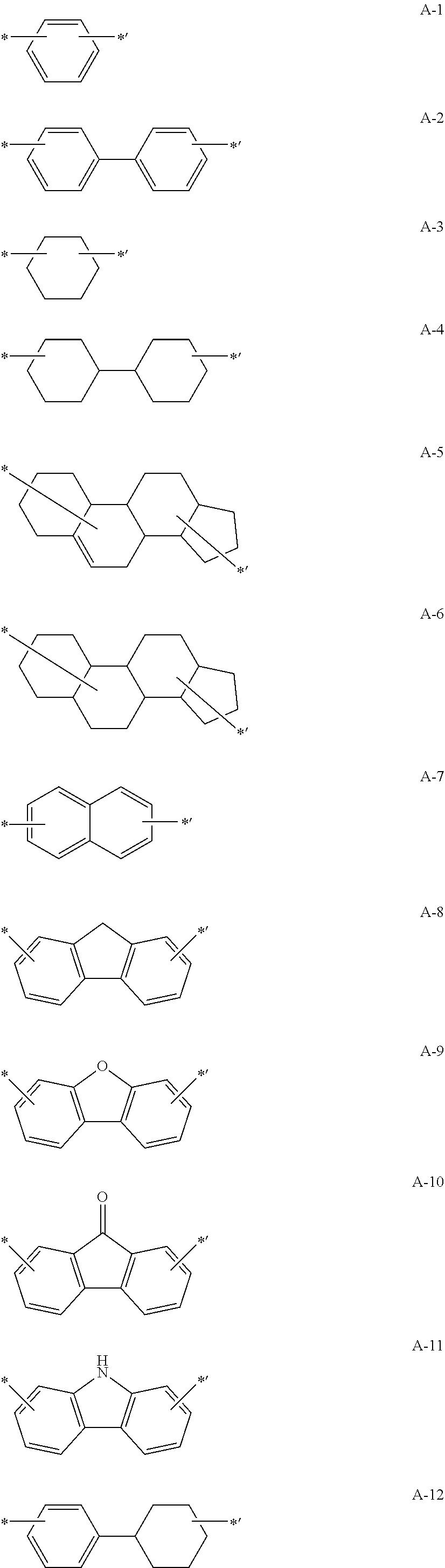

-
- wherein, in Formulae A-1 to A-21,
- * and *′ each indicate a binding site to a neighboring atom.
- L1 to L3 in Formula 1 may each independently be selected from *—O—*′, *—S—*′, *—C(═O)—*′, *—C(═O)O—*′, *—OC(═O)—*′, *—O—C(═O)—O—*′, *—OCH2—*′, *—SCH2—*′, *—CH2S—*′, *—CF2O—*′, *—OCF2*′, *—CF2S—*′, *—SCF2—*′, *—(CH2)n1—*′, *—CF2CH2*′, *—CH2CF2*′, *—(CF2)n1*′, *—CH═CH*′, *—CF═CF—*′, *—C≡C*′, *—CH═CH—C(═O)O—*′, *—OC(═O)—CH═CH—*′, *—C(Q1)(Q2)*′, *—CH(—(Sp)c1—P3)—*′, *—CH2CH(—(Sp)c1—P3)—*′, *—CH(—(Sp)c1—P3)CH(—(Sp)c2—P3)—*′, *—O—(CH2)—O(C═O)—(CH2)n2—*′, *—S(═O)(Q1)-*′, *—S(═O)2—*′, *—P(═O)(Q1)-*′, *—P(═O)2—*′, *—P(═S)(Q1)-*′, and *—P(═S)2—*′,
- b1 to b3 may each independently be an integer from 0 to 6, and
- n1 may be an integer from 1 to 4, and n2 may be an integer from 0 to 2.
- b1 to b3 each indicate numbers of L1 to L3, respectively, and when b1 is 2 or more, two or more of L1(s) may be identical to or different from each other, when b2 is 2 or more, two or more of L2(s) may be identical to or different from each other, when b3 is 2 or more, two or more of L3(s) may be identical to or different from each other, when b1 is 0, -(L1)b1- may be a single bond, when b2 is 0, -(L2)b2- may be a single bond, and when b3 is 0, -(L3)b3- may be a single bond.
- Sp in
Formula 1 may be a spacer group or a single bond.
-
- Q1 to Q2 may each independently be selected from hydrogen, a C1-C20 alkyl group, a C1-C20 alkoxy group, a phenyl group, a biphenyl group, a terphenyl group, a naphthyl group, and a pyridinyl group, and
- * and *′ each indicate a binding site to a neighboring atom.
- c1 and c2 in
Formula 1 may each independently be an integer from 1 to 4.


-
- wherein, in Formulae L-1 to L-64,
- * and *′ each indicate a binding site to a neighboring atom.
- R1 in
Formula 1 may be an anchoring group.
-
- Ra to Re may each independently be selected from hydrogen, deuterium, —F, —Cl, —Br, —I, a hydroxyl group, a cyano group, a nitro group, an amidino group, a hydrazine group, a hydrazone group, a substituted or unsubstituted C1-C60 alkyl group, a substituted or unsubstituted C2-C60 alkenyl group, a substituted or unsubstituted C2-C60 alkynyl group, and a substituted or unsubstituted C1-C60 alkoxy group, and
- d1 may be an integer from 0 to 6.
-
- Ra may be selected from hydrogen, deuterium, —F, —Cl, —Br, —I, a hydroxyl group, a cyano group, a nitro group, an amino group, an amidino group, a hydrazine group, a hydrazone group, a C1-C20 alkyl group, a C2-C20 alkenyl group, a C2-C20 alkynyl group, and a C1-C20 alkoxy group; and
- a C1-C20 alkyl group, a C2-C20 alkenyl group, a C2-C20 alkynyl group, and a C1-C20 alkoxy group, each substituted with at least one selected from deuterium, —F, —Cl, —Br, —I, a hydroxyl group, a cyano group, a nitro group, an amino group, an amidino group, a hydrazine group, a hydrazone group, a C1-C20 alkyl group, a C2-C20 alkenyl group, a C2-C20 alkynyl group, and a C1-C20 alkoxy group, and
- * indicates a binding site to a neighboring atom.
-
- wherein Q1 to Q2 and Q11 to Q13 may each independently be selected from hydrogen, deuterium, —F, —Cl, —Br, —I, a hydroxyl group, a cyano group, a nitro group, an amino group, an amidino group, a hydrazine group, a hydrazone group, a C1-C60 alkyl group, a C2-C60 alkenyl group, a C2-C60 alkynyl group, a C1-C60 alkoxy group, a C3-C10 cycloalkyl group, a C1-C10 heterocycloalkyl group, a C3-C10 cycloalkenyl group, a C1-C10 heterocycloalkenyl group, a C6-C60 aryl group, a C1-C60 heteroaryl group, a monovalent non-aromatic condensed polycyclic group, a monovalent non-aromatic condensed heteropolycyclic group, a biphenyl group, and a terphenyl group, and
- * and *′ each indicate a binding site to a neighboring atom.

-
- GaN, GaP, GaAs, GaSb, AlN, AlP, AlAs, AlSb, InN, InP, InAs, InSb; GaNP, GaNAs, GaNSb, GaPAs, GaPSb, AlNP, AlNAs, AlNSb, AlPAs, AlPSb, InGaP, InAlP, InNP, InNAs, InNSb, InPAs, InPSb, GaAlNP; GaAlNAs, GaAlNSb, GaAlPAs, GaAlPSb, GaInNP, GaInNAs, GaInNSb, GaInPAs, GaInPSb, InAlNP, InAlNAs, InAlNSb, InAlPAs, InAlPSb, InZnP;
- SnS, SnSe, SnTe, PbS, PbSe, PbTe; SnSeS, SnSeTe, SnSTe, PbSeS, PbSeTe, PbSTe, SnPbS, SnPbSe, SnPbTe; SnPbSSe, SnPbSeTe, SnPbSTe;
- Si, Ge, SiC, SiGe;
- AgInS, AgInS2, CuInS, CuInS2, CuGaO2, AgGaO2, AgAlO2; or any combination thereof.
[A][Bm][X]3 Formula 4
-
- wherein, in Formula 4,
- A may be at least one monovalent organic-cation, a monovalent inorganic-cation, or any combination thereof,
- B may be at least one divalent inorganic-cation,
- m is a real number satisfying the condition of 0<m≤1, and
- X may be at least one monovalent anion.


-
- wherein, in Formulae 201 and 202,
- L201 to L204 may each independently be selected from a substituted or unsubstituted C3-C10 cycloalkylene group, a substituted or unsubstituted C1-C10 heterocycloalkylene group, a substituted or unsubstituted C3-C10 cycloalkenylene group, a substituted or unsubstituted C1-C10 heterocycloalkenylene group, a substituted or unsubstituted C6-C60 arylene group, a substituted or unsubstituted C1-C60 heteroarylene group, a substituted or unsubstituted divalent non-aromatic condensed polycyclic group, and a substituted or unsubstituted divalent non-aromatic condensed heteropolycyclic group,
- L205 may be selected from *—O—*′, *—S—*′, *—N(Q201)-*′, a substituted or unsubstituted C1-C20 alkylene group, a substituted or unsubstituted C2-C20 alkenylene group, a substituted or unsubstituted C3-C10 cycloalkylene group, a substituted or unsubstituted C1-C10 heterocycloalkylene group, a substituted or unsubstituted C3-C10 cycloalkenylene group, a substituted or unsubstituted C1-C10 heterocycloalkenylene group, a substituted or unsubstituted C6-C60 arylene group, a substituted or unsubstituted C1-C60 heteroarylene group, a substituted or unsubstituted divalent non-aromatic condensed polycyclic group, and a substituted or unsubstituted divalent non-aromatic condensed heteropolycyclic group,
- xa1 to xa4 may each independently be an integer from 0 to 3,
- xa5 may be an integer from 1 to 10, and
- R201 to R204 and Q201 may each independently be selected from a substituted or unsubstituted C3-C10 cycloalkyl group, a substituted or unsubstituted C1-C10 heterocycloalkyl group, a substituted or unsubstituted C3-C10 cycloalkenyl group, a substituted or unsubstituted C1-C10 heterocycloalkenyl group, a substituted or unsubstituted C6-C60 aryl group, a substituted or unsubstituted C6-C60 aryloxy group, a substituted or unsubstituted C6-C60 arylthio group, a substituted or unsubstituted C1-C60 heteroaryl group, a substituted or unsubstituted monovalent non-aromatic condensed polycyclic group, and a substituted or unsubstituted monovalent non-aromatic condensed heteropolycyclic group.
-
- L201 to L205 may each independently be selected from:
- a phenylene group, a pentalenylene group, an indenylene group, a naphthylene group, an azulenylene group, a heptalenylene group, an indacenylene group, an acenaphthylene group, a fluorenylene group, a spiro-bifluorenylene group, a benzofluorenylene group, a dibenzofluorenylene group, a phenalenylene group, a phenanthrenylene group, an anthracenylene group, a fluoranthenylene group, a triphenylenylene group, a pyrenylene group, a chrysenylene group, a naphthacenylene group, a picenylene group, a perylenylene group, a pentaphenylene group, a hexacenylene group, a pentacenylene group, a rubicenylene group, a coronenylene group, an ovalenylene group, a thiophenylene group, a furanylene group, a carbazolylene group, an indolylene group, an isoindolylene group, a benzofuranylene group, a benzothiophenylene group, a dibenzofuranylene group, a dibenzothiophenylene group, a benzocarbazolylene group, a dibenzocarbazolylene group, a dibenzosilolylene group, and a pyridinylene group; and
- a phenylene group, a pentalenylene group, an indenylene group, a naphthylene group, an azulenylene group, a heptalenylene group, an indacenylene group, an acenaphthylene group, a fluorenylene group, a spiro-bifluorenylene group, a benzofluorenylene group, a dibenzofluorenylene group, a phenalenylene group, a phenanthrenylene group, an anthracenylene group, a fluoranthenylene group, a triphenylenylene group, a pyrenylene group, a chrysenylene group, a naphthacenylene group, a picenylene group, a perylenylene group, a pentaphenylene group, a hexacenylene group, a pentacenylene group, a rubicenylene group, a coronenylene group, an ovalenylene group, a thiophenylene group, a furanylene group, a carbazolylene group, an indolylene group, an isoindolylene group, a benzofuranylene group, a benzothiophenylene group, a dibenzofuranylene group, a dibenzothiophenylene group, a benzocarbazolylene group, a dibenzocarbazolylene group, a dibenzosilolylene group, and a pyridinylene group, each substituted with at least one selected from deuterium, —F, —Cl, —Br, —I, a hydroxyl group, a cyano group, a nitro group, an amidino group, a hydrazino group, a hydrazono group, a C1-C20 alkyl group, a C1-C20 alkoxy group, a cyclopentyl group, a cyclohexyl group, a cycloheptyl group, a cyclopentenyl group, a cyclohexenyl group, a phenyl group, a biphenyl group, a terphenyl group, a phenyl group substituted with a C1-C10 alkyl group, a phenyl group substituted with —F, a pentalenyl group, an indenyl group, a naphthyl group, an azulenyl group, a heptalenyl group, an indacenyl group, an acenaphthyl group, a fluorenyl group, a spiro-bifluorenyl group, a benzofluorenyl group, a dibenzofluorenyl group, a phenalenyl group, a phenanthrenyl group, an anthracenyl group, a fluoranthenyl group, a triphenylenyl group, a pyrenyl group, a chrysenyl group, a naphthacenyl group, a picenyl group, a perylenyl group, a pentaphenyl group, a hexacenyl group, a pentacenyl group, a rubicenyl group, a coronenyl group, an ovalenyl group, a thiophenyl group, a furanyl group, a carbazolyl group, an indolyl group, an isoindolyl group, a benzofuranyl group, a benzothiophenyl group, a dibenzofuranyl group, a dibenzothiophenyl group, a benzocarbazolyl group, a dibenzocarbazolyl group, a dibenzosilolyl group, a pyridinyl group, —Si(Q31)(Q32)(Q33) and —N(Q31)(Q32),
- wherein Q31 to Q33 may each independently be selected from a C1-C10 alkyl group, a C1-C10 alkoxy group, a phenyl group, a biphenyl group, a terphenyl group, and a naphthyl group.
-
- a phenyl group, a biphenyl group, a terphenyl group, a pentalenyl group, an indenyl group, a naphthyl group, an azulenyl group, a heptalenyl group, an indacenyl group, an acenaphthyl group, a fluorenyl group, a spiro-bifluorenyl group, a benzofluorenyl group, a dibenzofluorenyl group, a phenalenyl group, a phenanthrenyl group, an anthracenyl group, a fluoranthenyl group, a triphenylenyl group, a pyrenyl group, a chrysenyl group, a naphthacenyl group, a picenyl group, a perylenyl group, a pentaphenyl group, a hexacenyl group, a pentacenyl group, a rubicenyl group, a coronenyl group, an ovalenyl group, a thiophenyl group, a furanyl group, a carbazolyl group, an indolyl group, an isoindolyl group, a benzofuranyl group, a benzothiophenyl group, a dibenzofuranyl group, a dibenzothiophenyl group, a benzocarbazolyl group, a dibenzocarbazolyl group, a dibenzosilolyl group, and a pyridinyl group, each substituted with at least one selected from deuterium, —F, —Cl, —Br, —I, a hydroxyl group, a cyano group, a nitro group, an amidino group, a hydrazino group, a hydrazono group, a C1-C20 alkyl group, a C1-C20 alkoxy group, a cyclopentyl group, a cyclohexyl group, a cycloheptyl group, a cyclopentenyl group, a cyclohexenyl group, a phenyl group, a biphenyl group, a terphenyl group, a phenyl group substituted with a C1-C10 alkyl group, a phenyl group substituted with —F, a pentalenyl group, an indenyl group, a naphthyl group, an azulenyl group, a heptalenyl group, an indacenyl group, an acenaphthyl group, a fluorenyl group, a spiro-bifluorenyl group, a benzofluorenyl group, a dibenzofluorenyl group, a phenalenyl group, a phenanthrenyl group, an anthracenyl group, a fluoranthenyl group, a triphenylenyl group, a pyrenyl group, a chrysenyl group, a naphthacenyl group, a picenyl group, a perylenyl group, a pentaphenyl group, a hexacenyl group, a pentacenyl group, a rubicenyl group, a coronenyl group, an ovalenyl group, a thiophenyl group, a furanyl group, a carbazolyl group, an indolyl group, an isoindolyl group, a benzofuranyl group, a benzothiophenyl group, a dibenzofuranyl group, a dibenzothiophenyl group, a benzocarbazolyl group, a dibenzocarbazolyl group, a dibenzosilolyl group, a pyridinyl group, —Si(Q31)(Q32)(Q33) and —N(Q31)(Q32),
- wherein Q31 to Q33 are the same as described above.
-
- a fluorenyl group, a spiro-bifluorenyl group, a carbazolyl group, a dibenzofuranyl group, and a dibenzothiophenyl group; and
- a fluorenyl group, a spiro-bifluorenyl group, a carbazolyl group, a dibenzofuranyl group, and a dibenzothiophenyl group, each substituted with at least one selected from deuterium, —F, —Cl, —Br, —I, a hydroxyl group, a cyano group, a nitro group, an amidino group, a hydrazino group, a hydrazono group, a C1-C20 alkyl group, a C1-C20 alkoxy group, a cyclopentyl group, a cyclohexyl group, a cycloheptyl group, a cyclopentenyl group, a cyclohexenyl group, a phenyl group, a biphenyl group, a terphenyl group, a phenyl group substituted with a C1-C10 alkyl group, a phenyl group substituted with —F, a naphthyl group, a fluorenyl group, a spiro-bifluorenyl group, a carbazolyl group, a dibenzofuranyl group, and a dibenzothiophenyl group,
- but embodiments of the present disclosure are not limited thereto.
-
- a carbazolyl group; and
- a carbazolyl group substituted with at least one selected from deuterium, —F, —Cl, —Br, —I, a hydroxyl group, a cyano group, a nitro group, an amidino group, a hydrazino group, a hydrazono group, a C1-C20 alkyl group, a C1-C20 alkoxy group, a cyclopentyl group, a cyclohexyl group, a cycloheptyl group, a cyclopentenyl group, a cyclohexenyl group, a phenyl group, a biphenyl group, a terphenyl group, a phenyl group substituted with a C1-C10 alkyl group, a phenyl group substituted with —F, a naphthyl group, a fluorenyl group, a spiro-bifluorenyl group, a carbazolyl group, a dibenzofuranyl group, and a dibenzothiophenyl group,
- but embodiments of the present disclosure are not limited thereto.
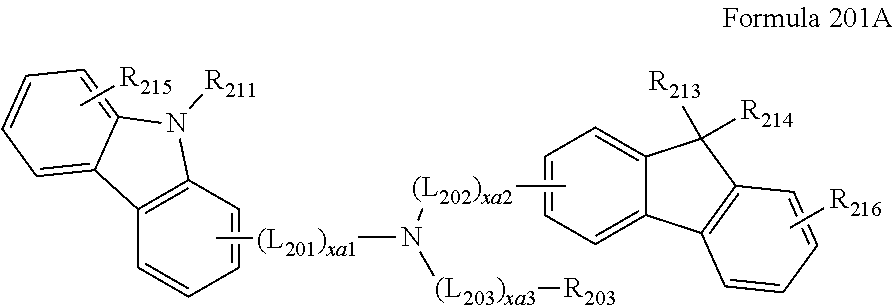


-
- L201 to L203, xa1 to xa3, xa5, and R202 to R204 are the same as respectively described above,
- R211 and R212 are each independently the same as described in connection with R203, and
- R213 to R217 may each independently be selected from hydrogen, deuterium, —F, —Cl, —Br, —I, a hydroxyl group, a cyano group, a nitro group, an amidino group, a hydrazino group, a hydrazono group, a C1-C20 alkyl group, a C1-C20 alkoxy group, a cyclopentyl group, a cyclohexyl group, a cycloheptyl group, a cyclopentenyl group, a cyclohexenyl group, a phenyl group, a biphenyl group, a terphenyl group, a phenyl group substituted with a C1-C10 alkyl group, a phenyl group substituted with —F, a pentalenyl group, an indenyl group, a naphthyl group, an azulenyl group, a heptalenyl group, an indacenyl group, an acenaphthyl group, a fluorenyl group, a spiro-bifluorenyl group, a benzofluorenyl group, a dibenzofluorenyl group, a phenalenyl group, a phenanthrenyl group, an anthracenyl group, a fluoranthenyl group, a triphenylenyl group, a pyrenyl group, a chrysenyl group, a naphthacenyl group, a picenyl group, a perylenyl group, a pentaphenyl group, a hexacenyl group, a pentacenyl group, a rubicenyl group, a coronenyl group, an ovalenyl group, a thiophenyl group, a furanyl group, a carbazolyl group, an indolyl group, an isoindolyl group, a benzofuranyl group, a benzothiophenyl group, a dibenzofuranyl group, a dibenzothiophenyl group, a benzocarbazolyl group, a dibenzocarbazolyl group, a dibenzosilolyl group, and a pyridinyl group.


[Ar601]xe11-[(L601)xe1-R601]xe21 Formula 601
-
- wherein, in Formula 601,
- Ar601 may be a substituted or unsubstituted C5-C60 carbocyclic group or a substituted or unsubstituted C1-C60 heterocyclic group,
- xe11 may be 1, 2, or 3,
- L601 may be selected from a substituted or unsubstituted C3-C10 cycloalkylene group, a substituted or unsubstituted C1-C10 heterocycloalkylene group, a substituted or unsubstituted C3-C10 cycloalkenylene group, a substituted or unsubstituted C1-C10 heterocycloalkenylene group, a substituted or unsubstituted C6-C60 arylene group, a substituted or unsubstituted C1-C60 heteroarylene group, a substituted or unsubstituted divalent non-aromatic condensed polycyclic group, and a substituted or unsubstituted divalent non-aromatic condensed heteropolycyclic group,
- xe1 may be an integer from 0 to 5,
- R601 may be selected from a substituted or unsubstituted C3-C10 cycloalkyl group, a substituted or unsubstituted C1-C10 heterocycloalkyl group, a substituted or unsubstituted C3-C10 cycloalkenyl group, a substituted or unsubstituted C1-C10 heterocycloalkenyl group, a substituted or unsubstituted C6-C60 aryl group, a substituted or unsubstituted C6-C60 aryloxy group, a substituted or unsubstituted C6-C60 arylthio group, a substituted or unsubstituted C1-C60 heteroaryl group, a substituted or unsubstituted monovalent non-aromatic condensed polycyclic group, a substituted or unsubstituted monovalent non-aromatic condensed heteropolycyclic group, —Si(Q601)(Q602)(Q603), —C(═O)(Q601), —S(═O)2(Q601), and —P(═O)(Q601)(Q602),
- Q601 to Q603 may each independently be a C1-C10 alkyl group, a C1-C10 alkoxy group, a phenyl group, a biphenyl group, a terphenyl group, or a naphthyl group, and
- xe21 may be an integer from 1 to 5.
-
- a benzene group, a naphthalene group, a fluorene group, a spiro-bifluorene group, a benzofluorene group, a dibenzofluorene group, a phenalene group, a phenanthrene group, an anthracene group, a fluoranthene group, a triphenylene group, a pyrene group, a chrysene group, a naphthacene group, a picene group, a perylene group, a pentaphene group, an indenoanthracene group, a dibenzofuran group, a dibenzothiophene group, a carbazole group, an imidazole group, a pyrazole group, a thiazole group, an isothiazole group, an oxazole group, an isoxazole group, a pyridine group, a pyrazine group, a pyrimidine group, a pyridazine group, an indazole group, a purine group, a quinoline group, an isoquinoline group, a benzoquinoline group, a phthalazine group, a naphthyridine group, a quinoxaline group, a quinazoline group, a cinnoline group, a phenanthridine group, an acridine group, a phenanthroline group, a phenazine group, a benzimidazole group, an isobenzothiazole group, a benzoxazole group, an isobenzoxazole group, a triazole group, a tetrazole group, an oxadiazole group, a triazine group, a thiadiazole group, an imidazopyridine group, an imidazopyrimidine group, and an azacarbazole group; and
- a benzene group, a naphthalene group, a fluorene group, a spiro-bifluorene group, a benzofluorene group, a dibenzofluorene group, a phenalene group, a phenanthrene group, an anthracene group, a fluoranthene group, a triphenylene group, a pyrene group, a chrysene group, a naphthacene group, a picene group, a perylene group, a pentaphene group, an indenoanthracene group, a dibenzofuran group, a dibenzothiophene group, a carbazole group, an imidazole group, a pyrazole group, a thiazole group, an isothiazole group, an oxazole group, an isoxazole group, a pyridine group, a pyrazine group, a pyrimidine group, a pyridazine group, an indazole group, a purine group, a quinoline group, an isoquinoline group, a benzoquinoline group, a phthalazine group, a naphthyridine group, a quinoxaline group, a quinazoline group, a cinnoline group, a phenanthridine group, an acridine group, a phenanthroline group, a phenazine group, a benzimidazole group, an isobenzothiazole group, a benzoxazole group, an isobenzoxazole group, a triazole group, a tetrazole group, an oxadiazole group, a triazine group, a thiadiazole group, an imidazopyridine group, an imidazopyrimidine group, and an azacarbazole group, each substituted with at least one selected from deuterium, —F, —Cl, —Br, —I, a hydroxyl group, a cyano group, a nitro group, an amidino group, a hydrazino group, a hydrazono group, a C1-C20 alkyl group, a C1-C20 alkoxy group, a phenyl group, a biphenyl group, a terphenyl group, a naphthyl group, —Si(Q31)(Q32)(Q33), —S(═O)2(Q31), and —P(═O)(Q31)(Q32),
- wherein Q31 to Q33 may each independently be selected from a C1-C10 alkyl group, a C1-C10 alkoxy group, a phenyl group, a biphenyl group, a terphenyl group, and a naphthyl group.

-
- wherein, in Formula 601-1,
- X614 may be N or C(R614), X615 may be N or C(R615), X616 may be N or C(R616), and at least one of X614 to X616 may be N,
- L611 to L613 may each independently be the same as described in connection with L601,
- xe611 to xe613 may each independently be the same as described in connection with xe1,
- R611 to R613 may each independently be the same as described in connection with R601, and
- R614 to R616 may each independently be selected from hydrogen, deuterium, —F, —Cl, —Br, —I, a hydroxyl group, a cyano group, a nitro group, an amidino group, a hydrazino group, a hydrazono group, a C1-C20 alkyl group, a C1-C20 alkoxy group, a phenyl group, a biphenyl group, a terphenyl group, and a naphthyl group.
-
- a phenylene group, a naphthylene group, a fluorenylene group, a spiro-bifluorenylene group, a benzofluorenylene group, a dibenzofluorenylene group, a phenanthrenylene group, an anthracenylene group, a fluoranthenylene group, a triphenylenylene group, a pyrenylene group, a chrysenylene group, a perylenylene group, a pentaphenylene group, a hexacenylene group, a pentacenylene group, a thiophenylene group, a furanylene group, a carbazolylene group, an indolylene group, an isoindolylene group, a benzofuranylene group, a benzothiophenylene group, a dibenzofuranylene group, a dibenzothiophenylene group, a benzocarbazolylene group, a dibenzocarbazolylene group, a dibenzosilolylene group, a pyridinylene group, an imidazolylene group, a pyrazolylene group, a thiazolylene group, an isothiazolylene group, an oxazolylene group, an isoxazolylene group, a thiadiazolylene group, an oxadiazolylene group, a pyrazinylene group, a pyrimidinylene group, a pyridazinylene group, a triazinylene group, a quinolinylene group, an isoquinolinylene group, a benzoquinolinylene group, a phthalazinylene group, a naphthyridinylene group, a quinoxalinylene group, a quinazolinylene group, a cinnolinylene group, a phenanthridinylene group, an acridinylene group, a phenanthrolinylene group, a phenazinylene group, a benzimidazolylene group, an isobenzothiazolylene group, a benzoxazolylene group, an isobenzoxazolylene group, a triazolylene group, a tetrazolylene group, an imidazopyridinylene group, an imidazopyrimidinylene group, and an azacarbazolylene group; and
- a phenylene group, a naphthylene group, a fluorenylene group, a spiro-bifluorenylene group, a benzofluorenylene group, a dibenzofluorenylene group, a phenanthrenylene group, an anthracenylene group, a fluoranthenylene group, a triphenylenylene group, a pyrenylene group, a chrysenylene group, a perylenylene group, a pentaphenylene group, a hexacenylene group, a pentacenylene group, a thiophenylene group, a furanylene group, a carbazolylene group, an indolylene group, an isoindolylene group, a benzofuranylene group, a benzothiophenylene group, a dibenzofuranylene group, a dibenzothiophenylene group, a benzocarbazolylene group, a dibenzocarbazolylene group, a dibenzosilolylene group, a pyridinylene group, an imidazolylene group, a pyrazolylene group, a thiazolylene group, an isothiazolylene group, an oxazolylene group, an isoxazolylene group, a thiadiazolylene group, an oxadiazolylene group, a pyrazinylene group, a pyrimidinylene group, a pyridazinylene group, a triazinylene group, a quinolinylene group, an isoquinolinylene group, a benzoquinolinylene group, a phthalazinylene group, a naphthyridinylene group, a quinoxalinylene group, a quinazolinylene group, a cinnolinylene group, a phenanthridinylene group, an acridinylene group, a phenanthrolinylene group, a phenazinylene group, a benzimidazolylene group, an isobenzothiazolylene group, a benzoxazolylene group, an isobenzoxazolylene group, a triazolylene group, a tetrazolylene group, an imidazopyridinylene group, an imidazopyrimidinylene group, and an azacarbazolylene group, each substituted with at least one selected from deuterium, —F, —Cl, —Br, —I, a hydroxyl group, a cyano group, a nitro group, an amidino group, a hydrazino group, a hydrazono group, a C1-C20 alkyl group, a C1-C20 alkoxy group, a phenyl group, a biphenyl group, a terphenyl group, a naphthyl group, a fluorenyl group, a spiro-bifluorenyl group, a benzofluorenyl group, a dibenzofluorenyl group, a phenanthrenyl group, an anthracenyl group, a fluoranthenyl group, a triphenylenyl group, a pyrenyl group, a chrysenyl group, a perylenyl group, a pentaphenyl group, a hexacenyl group, a pentacenyl group, a thiophenyl group, a furanyl group, a carbazolyl group, an indolyl group, an isoindolyl group, a benzofuranyl group, a benzothiophenyl group, a dibenzofuranyl group, a dibenzothiophenyl group, a benzocarbazolyl group, a dibenzocarbazolyl group, a dibenzosilolyl group, a pyridinyl group, an imidazolyl group, a pyrazolyl group, a thiazolyl group, an isothiazolyl group, an oxazolyl group, an isoxazolyl group, a thiadiazolyl group, an oxadiazolyl group, a pyrazinyl group, a pyrimidinyl group, a pyridazinyl group, a triazinyl group, a quinolinyl group, an isoquinolinyl group, a benzoquinolinyl group, a phthalazinyl group, a naphthyridinyl group, a quinoxalinyl group, a quinazolinyl group, a cinnolinyl group, a phenanthridinyl group, an acridinyl group, a phenanthrolinyl group, a phenazinyl group, a benzimidazolyl group, an isobenzothiazolyl group, a benzoxazolyl group, an isobenzoxazolyl group, a triazolyl group, a tetrazolyl group, an imidazopyridinyl group, an imidazopyrimidinyl group, and an azacarbazolyl group,
- but embodiments of the present disclosure are not limited thereto.
-
- a phenyl group, a biphenyl group, a terphenyl group, a naphthyl group, a fluorenyl group, a spiro-bifluorenyl group, a benzofluorenyl group, a dibenzofluorenyl group, a phenanthrenyl group, an anthracenyl group, a fluoranthenyl group, a triphenylenyl group, a pyrenyl group, a chrysenyl group, a perylenyl group, a pentaphenyl group, a hexacenyl group, a pentacenyl group, a thiophenyl group, a furanyl group, a carbazolyl group, an indolyl group, an isoindolyl group, a benzofuranyl group, a benzothiophenyl group, a dibenzofuranyl group, a dibenzothiophenyl group, a benzocarbazolyl group, a dibenzocarbazolyl group, a dibenzosilolyl group, a pyridinyl group, an imidazolyl group, a pyrazolyl group, a thiazolyl group, an isothiazolyl group, an oxazolyl group, an isoxazolyl group, a thiadiazolyl group, an oxadiazolyl group, a pyrazinyl group, a pyrimidinyl group, a pyridazinyl group, a triazinyl group, a quinolinyl group, an isoquinolinyl group, a benzoquinolinyl group, a phthalazinyl group, a naphthyridinyl group, a quinoxalinyl group, a quinazolinyl group, a cinnolinyl group, a phenanthridinyl group, an acridinyl group, a phenanthrolinyl group, a phenazinyl group, a benzimidazolyl group, an isobenzothiazolyl group, a benzoxazolyl group, an isobenzoxazolyl group, a triazolyl group, a tetrazolyl group, an imidazopyridinyl group, an imidazopyrimidinyl group, and an azacarbazolyl group, each substituted with at least one selected from deuterium, —F, —Cl, —Br, —I, a hydroxyl group, a cyano group, a nitro group, an amidino group, a hydrazino group, a hydrazono group, a C1-C20 alkyl group, a C1-C20 alkoxy group, a phenyl group, a biphenyl group, a terphenyl group, a naphthyl group, a fluorenyl group, a spiro-bifluorenyl group, a benzofluorenyl group, a dibenzofluorenyl group, a phenanthrenyl group, an anthracenyl group, a fluoranthenyl group, a triphenylenyl group, a pyrenyl group, a chrysenyl group, a perylenyl group, a pentaphenyl group, a hexacenyl group, a pentacenyl group, a thiophenyl group, a furanyl group, a carbazolyl group, an indolyl group, an isoindolyl group, a benzofuranyl group, a benzothiophenyl group, a dibenzofuranyl group, a dibenzothiophenyl group, a benzocarbazolyl group, a dibenzocarbazolyl group, a dibenzosilolyl group, a pyridinyl group, an imidazolyl group, a pyrazolyl group, a thiazolyl group, an isothiazolyl group, an oxazolyl group, an isoxazolyl group, a thiadiazolyl group, an oxadiazolyl group, a pyrazinyl group, a pyrimidinyl group, a pyridazinyl group, a triazinyl group, a quinolinyl group, an isoquinolinyl group, a benzoquinolinyl group, a phthalazinyl group, a naphthyridinyl group, a quinoxalinyl group, a quinazolinyl group, a cinnolinyl group, a phenanthridinyl group, an acridinyl group, a phenanthrolinyl group, a phenazinyl group, a benzimidazolyl group, an isobenzothiazolyl group, a benzoxazolyl group, an isobenzoxazolyl group, a triazolyl group, a tetrazolyl group, an imidazopyridinyl group, an imidazopyrimidinyl group, and an azacarbazolyl group; and
- —S(═O)2(Q601) and —P(═O)(Q601)(Q602),
- wherein Q601 and Q602 are the same as described above.
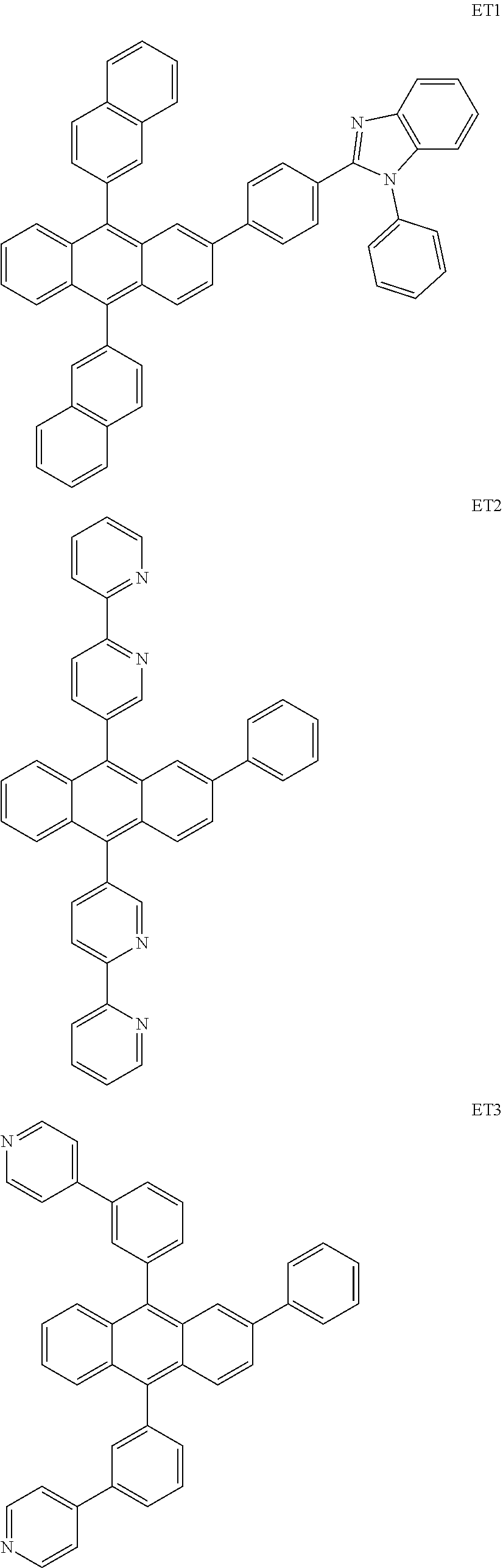


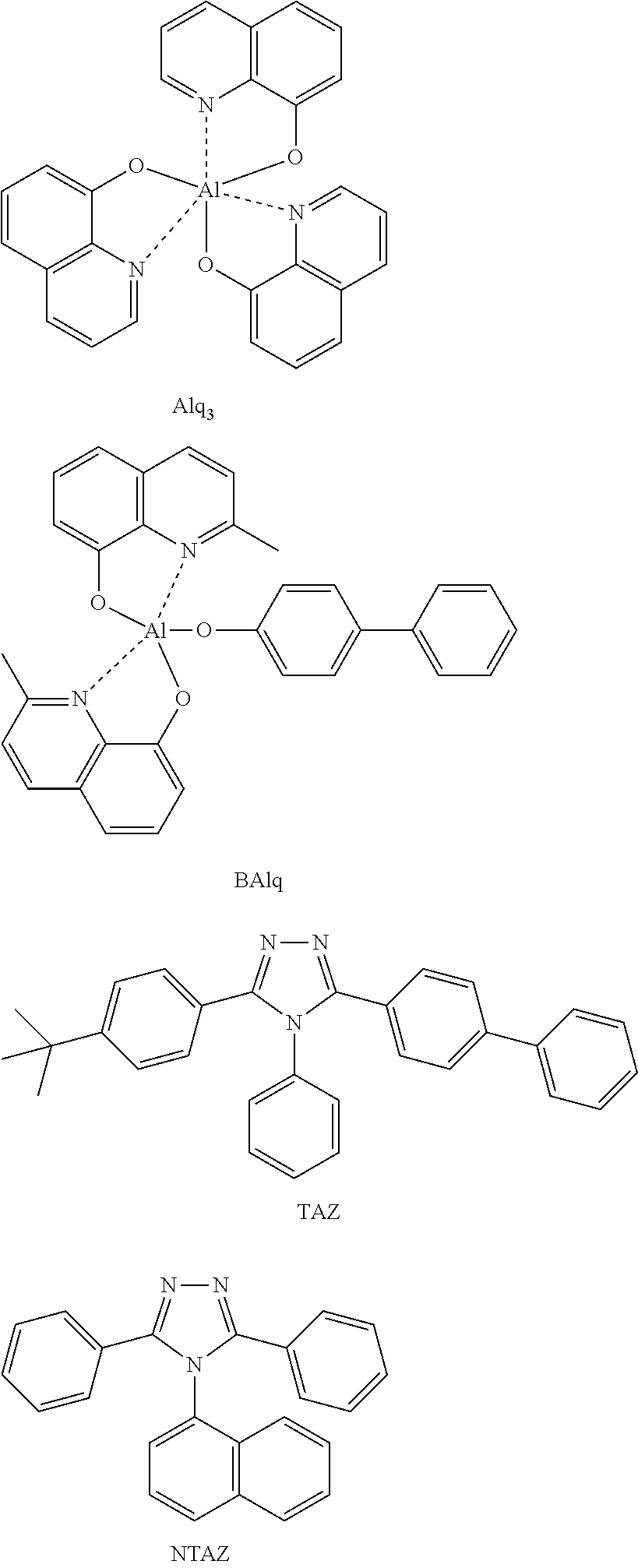

-
- deuterium (-D), —F, —Cl, —Br, —I, a hydroxyl group, a cyano group, a nitro group, an amidino group, a hydrazino group, a hydrazono group, a C1-C60 alkyl group, a C2-C60 alkenyl group, a C2-C60 alkynyl group, and a C1-C60 alkoxy group;
- a C1-C60 alkyl group, a C2-C60 alkenyl group, a C2-C60 alkynyl group, and a C1-C60 alkoxy group, each substituted with at least one selected from deuterium, —F, —Cl, —Br, —I, a hydroxyl group, a cyano group, a nitro group, an amidino group, a hydrazino group, a hydrazono group, a C3-C10 cycloalkyl group, a C1-C10 heterocycloalkyl group, a C3-C10 cycloalkenyl group, a C1-C10 heterocycloalkenyl group, a C6-C60 aryl group, a C6-C60 aryloxy group, a C6-C60 arylthio group, a C1-C60 heteroaryl group, a monovalent non-aromatic condensed polycyclic group, a monovalent non-aromatic condensed heteropolycyclic group, —Si(Q11)(Q12)(Q13), —N(Q11)(Q12), —B(Q11)(Q12), —C(═O)(Q11), —S(═O)2(Q11), and —P(═O)(Q11)(Q12);
- a C3-C10 cycloalkyl group, a C1-C10 heterocycloalkyl group, a C3-C10 cycloalkenyl group, a C1-C10 heterocycloalkenyl group, a C6-C60 aryl group, a C6-C60 aryloxy group, a C6-C60 arylthio group, a C1-C60 heteroaryl group, a monovalent non-aromatic condensed polycyclic group, and a monovalent non-aromatic condensed heteropolycyclic group;
- a C3-C10 cycloalkyl group, a C1-C10 heterocycloalkyl group, a C3-C10 cycloalkenyl group, a C1-C10 heterocycloalkenyl group, a C6-C60 aryl group, a C6-C60 aryloxy group, a C6-C60 arylthio group, a C1-C60 heteroaryl group, a monovalent non-aromatic condensed polycyclic group, and a monovalent non-aromatic condensed heteropolycyclic group, each substituted with at least one selected from deuterium, —F, —Cl, —Br, —I, a hydroxyl group, a cyano group, a nitro group, an amidino group, a hydrazino group, a hydrazono group, a C1-C60 alkyl group, a C2-C60 alkenyl group, a C2-C60 alkynyl group, a C1-C60 alkoxy group, a C3-C10 cycloalkyl group, a C1-C10 heterocycloalkyl group, a C3-C10 cycloalkenyl group, a C1-C10 heterocycloalkenyl group, a C6-C60 aryl group, a C6-C60 aryloxy group, a C6-C60 arylthio group, a C1-C60 heteroaryl group, a monovalent non-aromatic condensed polycyclic group, a monovalent non-aromatic condensed heteropolycyclic group, —Si(Q21)(Q22)(Q23), —N(Q21)(Q22), —B(Q21)(Q22), —C(═O)(Q21), —S(═O)2(Q21), and —P(═O)(Q21)(Q22), and
- —Si(Q31)(Q32)(Q33), —N(Q31)(Q32), —B(Q31)(Q32), —C(═O)(Q31), —S(═O)2(Q31), and —P(═O)(Q31)(Q32),
- wherein Q11 to Q13, Q21 to Q23, and Q31 to Q33 may each independently be selected from hydrogen, deuterium, —F, —Cl, —Br, —I, a hydroxyl group, a cyano group, a nitro group, an amidino group, a hydrazino group, a hydrazono group, a C1-C60 alkyl group, a C2-C60 alkenyl group, a C2-C60 alkynyl group, a C1-C60 alkoxy group, a C3-C10 cycloalkyl group, a C1-C10 heterocycloalkyl group, a C3-C10 cycloalkenyl group, a C1-C10 heterocycloalkenyl group, a C6-C60 aryl group, a C1-C60 heteroaryl group, a monovalent non-aromatic condensed polycyclic group, a monovalent non-aromatic condensed heteropolycyclic group, a C1-C60 alkyl group substituted with at least one selected from deuterium, —F, and a cyano group, a C6-C60 aryl group substituted with at least one selected from deuterium, —F, and a cyano group, a biphenyl group, and a terphenyl group.


| TABLE 1 | ||||||
| Com- | Com- | Com- | ||||
| parative | parative | parative | ||||
| Example A | Example B | | ligand | 1 | ||
| HOMO energy level (eV) | −6.382 | −6.55 | −6.18 | −5.75 |
| LUMO energy level (eV) | 0.804 | −1.83 | −1.75 | −2.25 |
| B.D.E(eV) | Anion | 1.3 to 4.9 | 1.9 to 4.0 | up to 3.97 | 2.6 to 5.0 |
| Neutron | 3.1 to 4.0 | 3.0 to 5.9 | up to 5.95 | 3.6 to 5.9 | |
| Cation | 2.0 to 2.9 | 2.0 to 5.9 | up to 6.29 | 5.3 to 9.0 | |
| TABLE 2 | ||||
| |
ligand 3 | ligand 4 | ||
| HOMO energy level (eV) | −6.32 | −6.02 | −6.64 |
| LUMO energy level (eV) | −2.32 | −1.76 | −1.90 |
| B.D.E(eV) | Anion | — | −0.3 to 4.6 | −1.3 to 4.1 |
| Neutron | 1.6 to 5.9 | 1.6 to 5.9 | 2.9 to 5.8 | |
| Cation | 0.6 to 7.6 | at least 0.7 | 1.9 to 6.0 | |
Claims (20)
R1-(L1)b1-(A1)a1-(L2)b2-(A2)a2-(L3)b3-T1 Formula 1
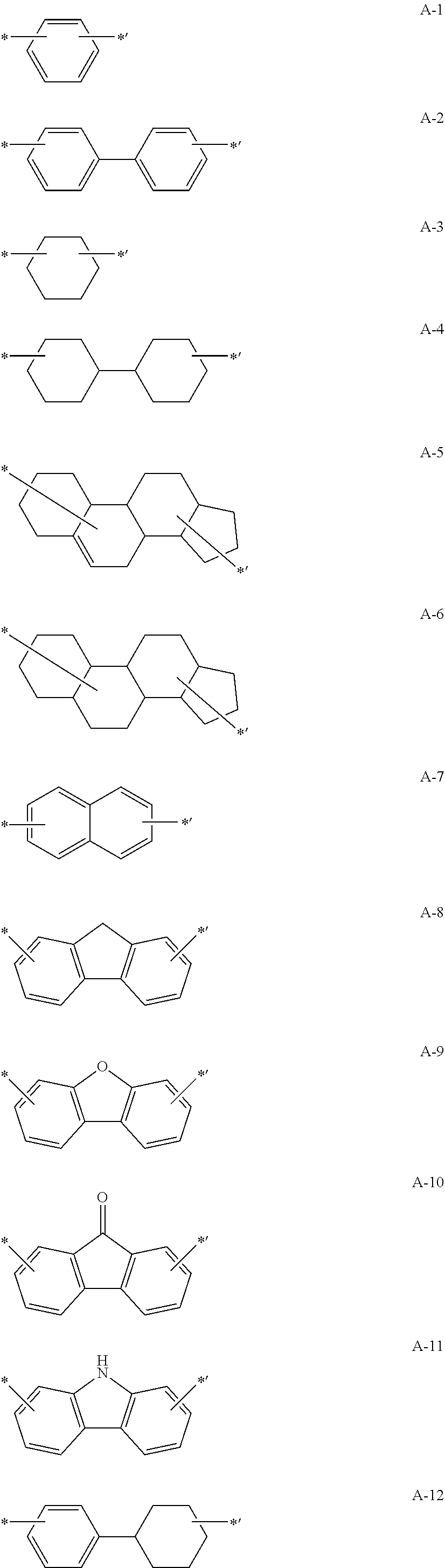


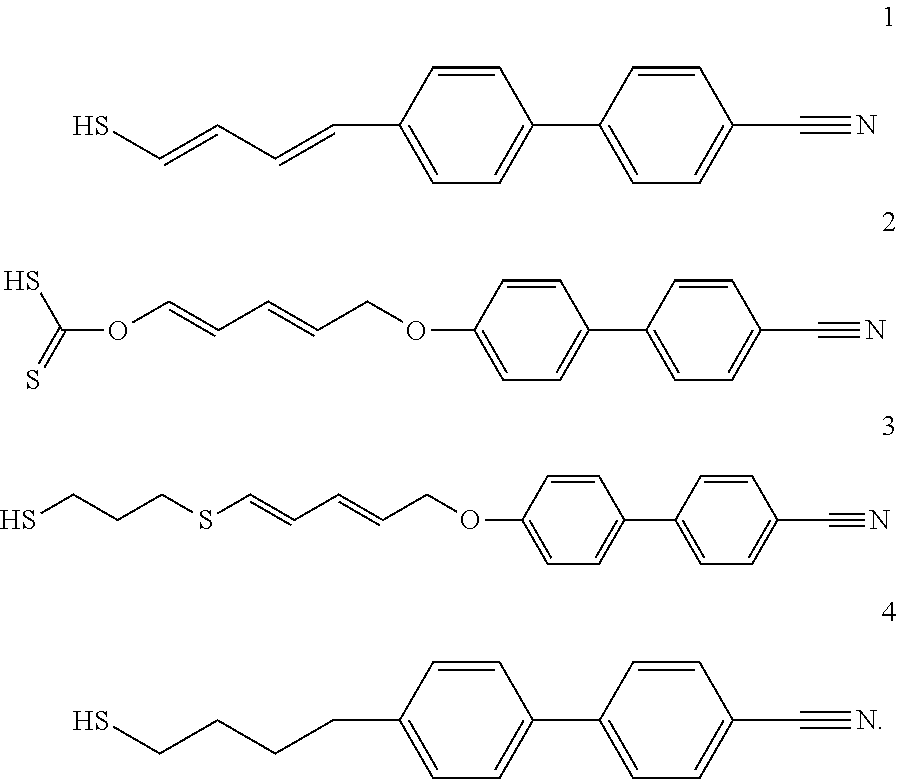
R1-(L1)b1-(A1)a1-(L2)b2-(A2)a2-(L3)b3-T1 Formula 1
R1-(L1)b1-(A1)a1-(L2)b2-(A2)a2-(L3)b3-T1 Formula 1
Applications Claiming Priority (2)
| Application Number | Priority Date | Filing Date | Title |
|---|---|---|---|
| KR10-2020-0066022 | 2020-06-01 | ||
| KR1020200066022A KR102821746B1 (en) | 2020-06-01 | 2020-06-01 | Quantum rod, and light-emitting device and optical member and device including the same |
Publications (2)
| Publication Number | Publication Date |
|---|---|
| US20210371750A1 US20210371750A1 (en) | 2021-12-02 |
| US11802242B2 true US11802242B2 (en) | 2023-10-31 |
Family
ID=78704589
Family Applications (1)
| Application Number | Title | Priority Date | Filing Date |
|---|---|---|---|
| US17/334,563 Active 2041-08-27 US11802242B2 (en) | 2020-06-01 | 2021-05-28 | Quantum rod, and light-emitting device, optical member, and apparatus, including the same |
Country Status (3)
| Country | Link |
|---|---|
| US (1) | US11802242B2 (en) |
| KR (1) | KR102821746B1 (en) |
| CN (1) | CN113764595B (en) |
Families Citing this family (1)
| Publication number | Priority date | Publication date | Assignee | Title |
|---|---|---|---|---|
| KR20230124161A (en) * | 2022-02-17 | 2023-08-25 | 삼성디스플레이 주식회사 | Optical control member and display device including the same |
Citations (5)
| Publication number | Priority date | Publication date | Assignee | Title |
|---|---|---|---|---|
| KR20140086058A (en) | 2012-12-28 | 2014-07-08 | 엘지디스플레이 주식회사 | Quantum rod and display using the same |
| KR20170048311A (en) | 2017-04-27 | 2017-05-08 | 엘지디스플레이 주식회사 | Quantum rod solution composition, Quantum rod sheet and Display device including the same |
| KR20180069687A (en) | 2016-12-15 | 2018-06-25 | 엘지디스플레이 주식회사 | Luminescent body, light emitthg film, led pacakge, litgh emitting diode and luminescent device having the same |
| KR20180111260A (en) | 2017-03-31 | 2018-10-11 | 도레이케미칼 주식회사 | Nanocomposite comprising ferrite nano-sized rod and lyotropic liquid crystal, polarizer film comprising the same, and its preparation method |
| US10174249B2 (en) | 2014-11-13 | 2019-01-08 | Lg Display Co., Ltd. | Quantum rod composition, quantum rod film and display device including the same |
Family Cites Families (1)
| Publication number | Priority date | Publication date | Assignee | Title |
|---|---|---|---|---|
| CN110305656B (en) * | 2019-05-24 | 2023-05-02 | 纳晶科技股份有限公司 | A kind of nano particle and preparation method thereof, quantum dot optoelectronic device |
-
2020
- 2020-06-01 KR KR1020200066022A patent/KR102821746B1/en active Active
-
2021
- 2021-05-28 US US17/334,563 patent/US11802242B2/en active Active
- 2021-06-01 CN CN202110608893.8A patent/CN113764595B/en active Active
Patent Citations (5)
| Publication number | Priority date | Publication date | Assignee | Title |
|---|---|---|---|---|
| KR20140086058A (en) | 2012-12-28 | 2014-07-08 | 엘지디스플레이 주식회사 | Quantum rod and display using the same |
| US10174249B2 (en) | 2014-11-13 | 2019-01-08 | Lg Display Co., Ltd. | Quantum rod composition, quantum rod film and display device including the same |
| KR20180069687A (en) | 2016-12-15 | 2018-06-25 | 엘지디스플레이 주식회사 | Luminescent body, light emitthg film, led pacakge, litgh emitting diode and luminescent device having the same |
| KR20180111260A (en) | 2017-03-31 | 2018-10-11 | 도레이케미칼 주식회사 | Nanocomposite comprising ferrite nano-sized rod and lyotropic liquid crystal, polarizer film comprising the same, and its preparation method |
| KR20170048311A (en) | 2017-04-27 | 2017-05-08 | 엘지디스플레이 주식회사 | Quantum rod solution composition, Quantum rod sheet and Display device including the same |
Non-Patent Citations (5)
| Title |
|---|
| Luigi Carbone et al., Synthesis and Micrometer-Scale Assembly of Colloidal CdSe/CdS Nanorods Prepared by a Seeded Growth Approach, Nano Letters, 2007, pp. 2942-2950, vol. 7, No. 10, American Chemical Society. |
| Taejong Paik et al., Studies of Liquid Crystalline Self-Assembly of GdF3 Nanoplates by In-Plane, Out-of-Plane SAXS, ACS Nano, Sep. 11, 2011, pp. 8322-8330, vol. 5 No. 10, American Chemical Society. |
| Whi Dong Kim et al., Pushing the Efficiency Envelope for Semiconductor Nanocrystal-Based Electroluminescence Devices Using Anisotropic Nanocrystals, Chemistry of Materials, Apr. 22, 2019, pp. 3066-3082, vol. 31, ACS Publications, American Chemical Society. |
| Wiktor Lewandowski et al., Metal Nanoparticles with Liquid-Crystalline Ligands: Controlling Nanoparticle Superlattice Structure and Properties, ChemPhysChem Minireviews, 2014, pp. 1283-1295, vol. 15, Wiley-VCH Veriag GmbH & Co. KGaA, Weinheim, Germany. |
| Yorai Amit et al., Semiconductor nanorod layers aligned through mechanical rubbing, Phys. Status Solidi A, 2012, pp. 235-242, vol. 209, No. 2, WILEY-VCH Veriag GmbH & Co. KGaA, Weinheim, Germany. |
Also Published As
| Publication number | Publication date |
|---|---|
| CN113764595A (en) | 2021-12-07 |
| KR102821746B1 (en) | 2025-06-18 |
| KR20210149281A (en) | 2021-12-09 |
| CN113764595B (en) | 2025-12-05 |
| US20210371750A1 (en) | 2021-12-02 |
Similar Documents
| Publication | Publication Date | Title |
|---|---|---|
| US20210261806A1 (en) | Quantum dot ink composition, apparatus using the same, and light-emitting device using the same | |
| US12446460B2 (en) | Organic light-emitting device and apparatus including the same | |
| US12004364B2 (en) | Light-emitting device and apparatus including same | |
| US11421153B2 (en) | Quantum dot-containing complex, and light-emitting device, optical member, and device, each including the same | |
| US11895916B2 (en) | Light-emitting device and method of manufacturing the same | |
| US20250160199A1 (en) | Organic light-emitting device and apparatus including the same | |
| US20210296605A1 (en) | Light-emitting device and apparatus including the same | |
| US12250877B2 (en) | Organic light-emitting device and apparatus including the same | |
| US12310233B2 (en) | Development of material for hole blocking layer with high efficiency and long lifespan, and organic light-emitting device and electronic apparatus utilizing the same | |
| US12127477B2 (en) | Organic light-emitting device | |
| US12173209B2 (en) | Quantum dot, and ink composition, light-emitting device, optical member, and apparatus including quantum dot | |
| US11802242B2 (en) | Quantum rod, and light-emitting device, optical member, and apparatus, including the same | |
| US11917905B2 (en) | Light-emitting device including hole transport region containing group 11 metal chalcogenide compound | |
| US11616208B2 (en) | Quantum dot composition, light-emitting device and method of manufacturing light-emitting device | |
| US11818953B2 (en) | Heterocyclic compound, organic light-emitting device including heterocyclic compound, and electronic apparatus including organic light-emitting device | |
| US11910626B2 (en) | Light-emitting device | |
| US20210028368A1 (en) | Condensed cyclic compound and organic light-emitting device including the same | |
| US12371614B2 (en) | Condensed cyclic compound, organic light-emitting device including the same and electronic apparatus including the organic light emitting device | |
| US20210399229A1 (en) | Heterocyclic compound, organic light-emitting device including same |
Legal Events
| Date | Code | Title | Description |
|---|---|---|---|
| FEPP | Fee payment procedure |
Free format text: ENTITY STATUS SET TO UNDISCOUNTED (ORIGINAL EVENT CODE: BIG.); ENTITY STATUS OF PATENT OWNER: LARGE ENTITY |
|
| AS | Assignment |
Owner name: SAMSUNG DISPLAY CO., LTD., KOREA, REPUBLIC OF Free format text: ASSIGNMENT OF ASSIGNORS INTEREST;ASSIGNORS:JUNG, YUNKU;PARK, JAEHONG;REEL/FRAME:056440/0796 Effective date: 20210525 |
|
| STPP | Information on status: patent application and granting procedure in general |
Free format text: DOCKETED NEW CASE - READY FOR EXAMINATION |
|
| STPP | Information on status: patent application and granting procedure in general |
Free format text: NON FINAL ACTION MAILED |
|
| STPP | Information on status: patent application and granting procedure in general |
Free format text: RESPONSE TO NON-FINAL OFFICE ACTION ENTERED AND FORWARDED TO EXAMINER |
|
| STPP | Information on status: patent application and granting procedure in general |
Free format text: NOTICE OF ALLOWANCE MAILED -- APPLICATION RECEIVED IN OFFICE OF PUBLICATIONS |
|
| STPP | Information on status: patent application and granting procedure in general |
Free format text: PUBLICATIONS -- ISSUE FEE PAYMENT VERIFIED |
|
| STCF | Information on status: patent grant |
Free format text: PATENTED CASE |