TWI756950B - Display device and touch feedback method - Google Patents
Display device and touch feedback method Download PDFInfo
- Publication number
- TWI756950B TWI756950B TW109142119A TW109142119A TWI756950B TW I756950 B TWI756950 B TW I756950B TW 109142119 A TW109142119 A TW 109142119A TW 109142119 A TW109142119 A TW 109142119A TW I756950 B TWI756950 B TW I756950B
- Authority
- TW
- Taiwan
- Prior art keywords
- vibration
- circuit
- display device
- mode
- frequency
- Prior art date
Links
Images




Classifications
-
- G—PHYSICS
- G06—COMPUTING OR CALCULATING; COUNTING
- G06F—ELECTRIC DIGITAL DATA PROCESSING
- G06F3/00—Input arrangements for transferring data to be processed into a form capable of being handled by the computer; Output arrangements for transferring data from processing unit to output unit, e.g. interface arrangements
- G06F3/01—Input arrangements or combined input and output arrangements for interaction between user and computer
- G06F3/016—Input arrangements with force or tactile feedback as computer generated output to the user
-
- G—PHYSICS
- G06—COMPUTING OR CALCULATING; COUNTING
- G06F—ELECTRIC DIGITAL DATA PROCESSING
- G06F3/00—Input arrangements for transferring data to be processed into a form capable of being handled by the computer; Output arrangements for transferring data from processing unit to output unit, e.g. interface arrangements
- G06F3/01—Input arrangements or combined input and output arrangements for interaction between user and computer
- G06F3/03—Arrangements for converting the position or the displacement of a member into a coded form
- G06F3/041—Digitisers, e.g. for touch screens or touch pads, characterised by the transducing means
-
- G—PHYSICS
- G06—COMPUTING OR CALCULATING; COUNTING
- G06F—ELECTRIC DIGITAL DATA PROCESSING
- G06F3/00—Input arrangements for transferring data to be processed into a form capable of being handled by the computer; Output arrangements for transferring data from processing unit to output unit, e.g. interface arrangements
- G06F3/01—Input arrangements or combined input and output arrangements for interaction between user and computer
- G06F3/03—Arrangements for converting the position or the displacement of a member into a coded form
- G06F3/041—Digitisers, e.g. for touch screens or touch pads, characterised by the transducing means
- G06F3/0414—Digitisers, e.g. for touch screens or touch pads, characterised by the transducing means using force sensing means to determine a position
Landscapes
- Engineering & Computer Science (AREA)
- General Engineering & Computer Science (AREA)
- Theoretical Computer Science (AREA)
- Human Computer Interaction (AREA)
- Physics & Mathematics (AREA)
- General Physics & Mathematics (AREA)
- Position Input By Displaying (AREA)
- User Interface Of Digital Computer (AREA)
Abstract
Description
本揭示內容關於一種顯示裝置,特別是在顯示面板上配置振動電路,以產生觸控回饋之電路及方法。The present disclosure relates to a display device, especially a circuit and method for disposing a vibration circuit on a display panel to generate touch feedback.
隨著電子科技的快速進展,顯示裝置被廣泛地應用在人們的生活當中,其功能也越來越多樣化。其中,觸控功能是顯示裝置上極為常見的基礎功能,可用於檢測使用者的手指在顯示面板上的位置及按壓力道。為了提供消費者更方便的操作模式,如何使顯示裝置具有與觸控功能相配合的互動功能,乃成為當前的一大課題。With the rapid development of electronic technology, display devices are widely used in people's lives, and their functions are becoming more and more diverse. Among them, the touch function is an extremely common basic function on the display device, which can be used to detect the position and pressing force of the user's finger on the display panel. In order to provide consumers with a more convenient operation mode, how to make the display device have an interactive function in conjunction with the touch function has become a major issue at present.
本揭示內容之一實施例為一種觸覺回饋方法,包含下列步驟:透過觸控電路,偵測顯示裝置上的接觸物,並產生對應之偵測訊號;根據偵測訊號,判斷接觸物的位移幅度;在位移幅度小於位移門檻值時,驅動振動電路,使振動電路以第一模式振動;在位移幅度大於位移門檻值時,驅動振動電路,使振動電路以第二模式振動。An embodiment of the present disclosure is a tactile feedback method, which includes the following steps: detecting a contact object on a display device through a touch circuit, and generating a corresponding detection signal; and judging the displacement amplitude of the contact object according to the detection signal When the displacement amplitude is less than the displacement threshold, the vibration circuit is driven to vibrate in the first mode; when the displacement amplitude is greater than the displacement threshold, the vibration circuit is driven to vibrate in the second mode.
本揭示內容之另一實施例為一種顯示裝置,包含顯示面板、觸控偵測單元及觸覺回饋單元。觸控偵測單元電性連接於顯示面板,用以檢測顯示裝置與接觸物的觸控事件,以取得偵測訊號。觸控偵測單元還用以根據偵測訊號判斷接觸物的位移幅度;在位移幅度小於位移門檻值時,觸控偵測單元產生第一判斷訊號。在位移幅度大於位移門檻值時,觸控偵測單元產生第二判斷訊號。觸覺回饋單元電性連接於觸控偵測單元。觸覺回饋單元用以接收第一判斷訊號,以驅動振動電路第一模式振動。觸覺回饋單元還用以接收第二判斷訊號,以驅動振動電路以第二模式振動。Another embodiment of the present disclosure is a display device including a display panel, a touch detection unit, and a haptic feedback unit. The touch detection unit is electrically connected to the display panel, and is used for detecting touch events between the display device and the contact object, so as to obtain a detection signal. The touch detection unit is also used for determining the displacement amplitude of the contact object according to the detection signal; when the displacement amplitude is less than the displacement threshold, the touch detection unit generates a first determination signal. When the displacement amplitude is greater than the displacement threshold, the touch detection unit generates a second judgment signal. The tactile feedback unit is electrically connected to the touch detection unit. The haptic feedback unit is used for receiving the first judgment signal to drive the vibration circuit to vibrate in the first mode. The haptic feedback unit is further used for receiving the second judgment signal to drive the vibration circuit to vibrate in the second mode.
據此,透過將振動電路控制於不同模式,顯示裝置將根據使用者的不同接觸狀態,產生不同之回饋,以提昇顯示裝置的互動真實感。Accordingly, by controlling the vibration circuit in different modes, the display device will generate different feedbacks according to different contact states of the user, so as to enhance the interactive realism of the display device.
以下將以圖式揭露本發明之複數個實施方式,為明確說明起見,許多實務上的細節將在以下敘述中一併說明。然而,應瞭解到,這些實務上的細節不應用以限制本發明。也就是說,在本揭示內容之部分實施方式中,這些實務上的細節是非必要的。此外,為簡化圖式起見,一些習知慣用的結構與元件在圖式中將以簡單示意的方式繪示之。Several embodiments of the present invention will be disclosed in the drawings below, and for the sake of clarity, many practical details will be described together in the following description. It should be understood, however, that these practical details should not be used to limit the invention. That is, in some embodiments of the present disclosure, these practical details are unnecessary. In addition, for the purpose of simplifying the drawings, some well-known structures and elements will be shown in a simple and schematic manner in the drawings.
於本文中,當一元件被稱為「連接」或「耦接」時,可指「電性連接」或「電性耦接」。「連接」或「耦接」亦可用以表示二或多個元件間相互搭配操作或互動。此外,雖然本文中使用「第一」、「第二」、…等用語描述不同元件,該用語僅是用以區別以相同技術用語描述的元件或操作。除非上下文清楚指明,否則該用語並非特別指稱或暗示次序或順位,亦非用以限定本發明。In this document, when an element is referred to as being "connected" or "coupled," it may be referred to as "electrically connected" or "electrically coupled." "Connected" or "coupled" may also be used to indicate the cooperative operation or interaction between two or more elements. In addition, although terms such as "first", "second", . . . are used herein to describe different elements, the terms are only used to distinguish elements or operations described by the same technical terms. Unless clearly indicated by the context, the terms do not specifically refer to or imply a sequence or sequence and are not intended to limit the invention.
第1圖所示為根據本揭示內容之部份實施例繪示的顯示裝置100示意圖。顯示裝置100包含顯示單元110、觸控偵測單元120及觸覺回饋單元130。顯示單元110包含顯示控制器111及顯示面板112。顯示控制器111提供顯示訊號至顯示面板112,使顯示面板112透過複數個畫素電路呈現出對應的畫面。顯示面板112可為液晶顯示面板(LCD)、有機發光二極體顯示面板(OLED)、微發光二極體顯示面板(micro-LED display),但並不以此為限。FIG. 1 is a schematic diagram of a
觸控偵測單元120包含觸控電路121及偵測控制器122。觸控電路121用以檢測顯示裝置100與接觸物(如:使用者之手指)的觸控事件,並產生對應的偵測訊號。在部份實施例中,觸控電路121可實施為觸控面板,且裝設於顯示面板112的上方或下方。意即,當使用者以手指接觸顯示裝置100時,手指係接觸觸控電路121(觸控面板),且觸控電路121能檢測出手指的對應位置,並得到對應於顯示面板112之位置。在部份實施例中,觸控偵測單元120為電容式觸碰設計,透過電極間之電容值變化來判斷觸碰位置,但本揭示內容並不以此為限。The
偵測控制器122電性連接於觸控電路121,用以根據觸控電路121傳來之偵測訊號,判斷接觸物的位移幅度。例如:判斷出使用者之手指是停留於顯示面板112上,或是在顯示面板112上滑動。偵測控制器122能根據位移幅度的判斷結果,產生不同的判斷訊號。位移幅度的判斷方式將於後續段落中說明。
The
觸覺回饋單元130包含回饋控制器131及振動電路132。回饋控制器131電性連接於偵測控制器122及振動電路132,用以根據偵測控制器122傳來的判斷訊號,以驅動振動電路132。在一實施例中,振動電路132係用以產生至少兩個不同軸向的振動。
The
振動電路132的位置係鄰近於顯示面板112,以帶動顯示面板112產生振動,並將振動回饋至接觸物(如:使用者的手指)。第2圖所示為本揭示內容之部份實施例的顯示裝置100之結構示意圖,顯示單元110、觸控偵測單元120及觸覺回饋單元130分別透過黏合劑A(adhesion)組合在一起。在部份實施例中,觸控偵測單元120及觸覺回饋單元130係位於顯示單元110的上方,且觸控偵測單元120之觸控電路121(觸控面板)為透明,故使用者係透過觸控偵測單元120之透明面板,觀察到顯示面板112之顯示畫面。在另一部份實施例中,觸控偵測單元120及觸覺回饋單元130係依序黏合於顯示單元110的下方。
The
在一實施例中,觸控偵測單元120判斷出接觸物的位移幅度後,將會進一步判斷位移幅度是否大於位移門檻值。位移門檻值可為位移距離、位移速度或位移的持續時間。若位移幅度小於位移門檻值,則可視為接觸物並未移動。此時,偵測控制器122將傳送第一判斷訊號至回饋控制器131,使回饋控制器131根據第一判斷訊號,控制振動電路132運作於第一模式。反之,若位移幅度大於或等於位移門檻值,代表接觸物在顯示面板112上移動。此時,偵測控制器122將傳送第二判斷訊號至回饋控制器131,使回饋控制器131根據第二判斷訊號後,控制振動電路132運作於第二模式。In one embodiment, after determining the displacement amplitude of the contact object, the
承上,由於振動電路132在運作於第一模式及第二模式時,係以不同方式產生振動,因此能呈現出不同的回饋效果。在部份實施例中,當振動電路132運作於第一模式時,振動電路132係沿著第一方向振動。在振動電路132運作於第二模式時,振動電路132係沿著第二方向振動。第一方向可為與顯示面板112相平行的水平方向,第二方向則可為與顯示面板112相垂直的垂直方向。亦即,第一方向係與第二方向互為正交,但本揭示內容並不以此為限。On the other hand, since the
另一方面,振動電路132亦能根據不同模式,改變其振動波形或振動頻率。舉例而言,當振動電路132運作於第一模式時,偵測控制器122傳送第一判斷訊號(如:「未產生位移」之訊號)至回饋控制器131。回饋控制器131根據該第一判斷訊號,以第一頻率設定驅動訊號,再輸出驅動訊號至振動電路132。此時,振動電路132將以第一頻率為振動頻率振動,並產生振動波形。相對地,當振動電路132運作於第二模式時,偵測控制器122傳送第二判斷訊號(如:「位移中」的訊號)至回饋控制器131。回饋控制器131根據該第二判斷訊號,以第二頻率設定驅動訊號,再輸出驅動訊號至振動電路132。此時,振動電路132將以第二頻率為振動頻率震動,並產生振動波形。第一頻率與第二頻率係不相同,或為互不重疊的頻率區段。振動電路132的振動頻率係介於100~500赫茲之間。在部份實施例中,第一頻率可介於100~300赫茲之間,第二頻率則可介於300~500赫茲之間。On the other hand, the
在部份實施例中,振動電路132運作於不同模式時,其振動方向及振動頻率皆不同。例如:在第一模式中,振動電路132以第一頻率且沿著第一方向振動;在第二模式中,振動電路132以第二頻率且沿著第二方向振動。In some embodiments, when the
第3A圖所示為本揭示內容之部份實施例中振動電路132及其振動特性之示意圖。具體而言,振動電路132可包雙軸向控制器132a及觸覺振動板132b。雙軸向控制器132a具有至少兩個軸向的振動方向及對應之兩個振動頻率,用以帶動觸覺振動板132b。當回饋控制器131接收到第一判斷訊號/第二判斷訊號時,回饋控制器131以第一頻率/第二頻率設定驅動訊號,以使雙軸向控制器132a沿著第一方向D1或第二方向D2振動。在部份實施例中,振動電路132之雙軸向控制器132a可由線性諧振制動器(LRA)或壓電致動器(Piezo actuator)來實現。振動電路132(雙軸向控制器132a)將以驅動訊號中之第一頻率/第二頻率作為振動頻率振動。由於本領域人士能理解振動電路132(雙軸向控制器132a)的結構與振動原理,故在此不另贅述。FIG. 3A is a schematic diagram of the
請搭配參閱第2及3A圖,由於觸覺回饋單元130多為不透明之元件,為了避免影響到顯示面板112的顯示區域(AA區),在部份實施例中,觸覺回饋單元130可設置於顯示裝置100上靠近顯示單元110或觸控偵測單元120的外側。例如:振動電路132設於顯示裝置100的左右兩側(第2圖);或者雙軸向控制器132a可設於觸覺振動板132b的左右兩側(第3A圖)。Please refer to FIGS. 2 and 3A. Since the
如第3A圖所示的振動特性圖,其中振動特性圖的縱軸為震動強度(G值)、橫軸則為頻率(赫茲)。在雙軸向控制器132a的諧振頻率範圍fr(broad haptic range)中,第一頻率f1及第二頻率f2為最明顯的諧振峰值,能使雙軸向控制器132a產生的振動程度最為明顯。例如:第一頻率f1對應於第一方向D1、第二頻率f2對應於第二方向D2。因此,振動電路132運作於第一頻率f1時的狀態可作為「第一模式」,振動電路132運作於第二頻率f2的狀態可作為「第二模式」。本揭示內容之振動電路132的運作方式或驅動訊號的波形並不以第3A圖所示為限,根據不同類型的振動電路,亦可具有三種以上的運作模式(如:運作於第一頻率、第二頻率及第三頻率時,皆具有明顯且不同的振動效果)。As shown in Fig. 3A, the vibration characteristic diagram, in which the vertical axis of the vibration characteristic diagram is the vibration intensity (G value), and the horizontal axis is the frequency (Hertz). In the resonant frequency range fr (broad haptic range) of the
第3B及3C圖為本揭示內容之部份實施例中,雙軸向控制器132a及其振動特性圖。其中振動特性圖的縱軸為震動強度(G值)、橫軸則為頻率(赫茲)。如第3B圖所示,在振動電路132運作於第一模式時,驅動訊號中的第一頻率f1被設定於約160赫茲,且雙軸向控制器132a係朝第一方向D1振動。如第3C圖所示,在振動電路132運作於第二模式時,驅動訊號中的第二頻率f2被設定於約310赫茲,且雙軸向控制器132a係朝第二方向D2振動。3B and 3C are diagrams of the
在前述實施例中,當振動電路132沿著第一方向D1(如:與顯示面板112相平行的水平方向)振動時為第一模式;振動電路132沿著第二方向D2(如:垂直方向)振動時為第二模式。在其他實施例中,振動電路132亦可設定有第三模式。例如:振動電路132沿著第一方向D1及第二方向D2的振動強度的比例為1:2,以混合不同方向的振動方式作為第三模式。In the foregoing embodiment, the first mode is when the
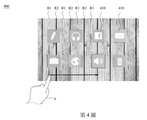
透過振動電路132以不同模式振動,當使用者之手指觸摸於顯示面板112、或滑動於顯示面板112上時,將會有不同的觸感,據此將能模擬出特殊的材質(例如:木紋、大理石紋等)。第4圖係本揭示內容之部份實施例中,顯示裝置100所顯示的螢幕畫面400之示意圖。在一實施例中,顯示裝置100係應用於車用面板。顯示面板112所顯示的螢幕畫面400中係包含了特殊材質的影像(如:木紋背景)。藉由前述振動電路132的不同模式,當使用者以手指F觸碰顯示裝置100、或者在螢幕畫面400上滑動出軌跡時,將會分別感受不同的觸感,如同接觸真實木板般。Through the
第5圖係本揭示內容之部份實施例的觸覺回饋方法的流程圖,包含步驟S501~S505。在步驟S501中,觸控偵測單元120偵測觸控電路121(觸控面板)與接觸物的觸控事件,而產生相應的偵測訊號。如第2圖所示之顯示裝置100之結構圖,「觸控事件」可為使用者以手指接觸觸控偵測單元120,使手指與觸控偵測單元120之間產生電位或電容變化,而形成偵測訊號。在其他實施例中,根據顯示裝置100的不同結構,「觸控事件」亦可為使用者距離觸控偵測單元120一段距離,以使觸控偵測單元120上之感測元件(如:電極)產生電性變化的狀態。FIG. 5 is a flowchart of a haptic feedback method according to some embodiments of the present disclosure, including steps S501 - S505 . In step S501, the
在步驟S502中,觸控電路121將偵測訊號傳遞至偵測控制器122,以計算出接觸物的位移幅度。在部份實施例中,偵測訊號包含接觸物的座標位置。偵測控制器122判斷座標位置於一段偵測時間內的變化量,再根據變化量,計算出接觸物的位移速度及位移方向。在步驟S503中,偵測控制器122進一步判斷位移幅度是否大於位移門檻值。在其他部份實施例中,偵測控制器122可根據位移速度產生第一判斷訊號或第二判斷訊號,以改變振動電路132的振動頻率。例如:當位移速度越快時,振動頻率亦越高。In step S502, the
舉例而言,若在偵測時間中,觸控電路121所檢測到的偵測訊號中的座標位置係由(2,0)變化至(2.2,0),由於位移距離只有0.2,其位移幅度小於位移門檻值(如:1),故可視為接觸物處於靜止。反之,若在偵測時間中,若觸控電路121所檢測到的偵測訊號中的座標位置由(2,0)變化至(15,0),由於位移距離為13,其位移幅度大於門檻值,即可確認接觸物係在顯示面板112上滑動。For example, if during the detection time, the coordinate position in the detection signal detected by the
在步驟S504中,當位移幅度小於位移門檻值時,偵測控制器122傳送第一判斷訊號至回饋控制器131,使回饋控制器131以第一頻率設定驅動訊號,並驅動振動電路132運作於第一模式。振動電路132將沿著第一方向振動。In step S504, when the displacement amplitude is less than the displacement threshold, the
在步驟S505中,當位移幅度大於位移門檻值時,偵測控制器122傳送第二判斷訊號至回饋控制器131,使回饋控制器131根以第二頻率設定驅動訊號,並驅動振動電路132運作於第二模式。振動電路132將沿著第二方向振動。In step S505, when the displacement amplitude is greater than the displacement threshold, the
第6A及6B圖為回饋控制器131輸出之驅動訊號(或振動電路132的振動波形)示意圖。如第6A圖所示,在部份實施例中,在回饋控制器131以第一頻率f1設定為驅動訊號的頻率時,驅動訊號的振幅會隨著時間變化。如第6B圖所示,在回饋控制器131以第二頻率f2設定為驅動訊號的頻率時,驅動訊號則呈現方波訊號之形式。6A and 6B are schematic diagrams of the driving signal (or the vibration waveform of the vibration circuit 132 ) output by the
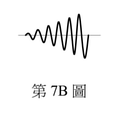
第7A及7B圖所示為根據本揭示內容之部份實施例中振動電路132於第一模式時的驅動訊號(或振動電路132的振動波形)示意圖。如第7A圖所示,驅動訊號之振幅可隨著時間變化起伏。如第7B圖所示,在其他實施例中,驅動訊號可為隨著時間逐漸加強。FIGS. 7A and 7B are schematic diagrams illustrating the driving signal (or the vibration waveform of the vibration circuit 132 ) when the
請搭配參閱第1、4、7A~7B圖所示,回饋控制器131可根據接觸物接觸力道或接觸位置,選擇性地改變驅動訊號的形式。例如:在一實施例中,顯示裝置100還包含壓力感測單元140。壓力感測單元140電性連接於觸控電路121及/或回饋控制器131,且用以感測接觸物接觸至顯示單元110或觸控偵測單元120時所施加的接觸力道。偵測控制器122或回饋控制器131能根據接觸力道來調整振動電路132的振動波形。振動波形的改變可包含頻率、振幅及波形(如:弦波或脈衝波)。舉例而言,在接觸力道大於預設值時,回饋控制器131調整驅動訊號,使振動電路的振動波形從第7A圖所示之波形變更為第7B圖之波形Please refer to Figures 1, 4, and 7A-7B. The
承上,在其他部份實施例中,當接觸物的靜止位置對應於使用者介面400上的圖標410(ICON)位置時,回饋控制器131係以第7A圖的波形產生驅動訊號。而當接觸物的靜止位置並未對應於使用者介面400上的圖標410時,回饋控制器131則改以第7B圖的波形產生驅動訊號。In other embodiments, when the static position of the contact object corresponds to the position of the icon 410 (ICON) on the
在部份實施例中,請參閱第1、4及8圖,顯示裝置100可根據接觸物的位置,選擇性地驅動振動電路132。顯示裝置100上設有多個第一區域R1及多個第二區域R2。該些第一區域R1及第二區域R2係對應於顯示面板112及觸控電路121。如第4圖所示,第一區域R1及第二區域R2於螢幕畫面400中交錯排列。當接觸物的位置對應於其中一個第一區域R1時,偵測控制器122輸出第一判斷訊號/第二判斷訊號至觸覺回饋單元130。反之,當接觸物的位置對應於其中一個第二區域R2時,偵測控制器122停止輸出第一判斷訊號/第二判斷訊號至觸覺回饋單元130。此時,回饋控制器131亦將停止驅動振動電路132。In some embodiments, please refer to FIGS. 1 , 4 and 8 , the
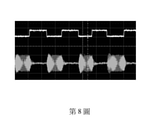
第8圖所示為根據本揭示內容之部份實施例中振動電路132於第二模式時的驅動訊號示意圖。如圖所示,偵測控制器122係輸出第一判斷訊號/第二判斷訊號及區域偵測訊號至回饋控制器131。如第8圖的上方波形,區域偵測訊號可為高低電位組成之方波形式,用以代表接觸物對應於第一區域R1或第二區域R2。例如:當接觸物處於第一區域R1時,區域偵測訊號將處於致能準位(如:低電壓),此時偵測控制器122才會輸出驅動訊號至回饋控制器131。反之,當接觸物處於第二區域R2時,區域偵測訊號將處於禁能準位(如:高電壓),此時偵測控制器122將會停止輸出驅動訊號至回饋控制器131,確保振動電路132不會以第一模式或第二模式振動。FIG. 8 is a schematic diagram of driving signals of the
本揭示內容可使觸覺回饋單元130利用較少數量的振動源,來實現單點振動之效果(single point feedback),以及模擬紋理表面效果(texture feedback),形成多重觸覺之回饋,藉此將能改善顯示裝置100的互動真實感。The present disclosure enables the
前述各實施例中的各項元件、方法步驟或技術特徵,係可相互結合,而不以本揭示內容中的文字描述順序或圖式呈現順序為限。The various elements, method steps or technical features in the foregoing embodiments can be combined with each other, and are not limited by the order of description in the text or the order of presentation of the drawings in the present disclosure.
雖然本揭示內容已以實施方式揭露如上,然其並非用以限定本揭示內容,任何熟習此技藝者,在不脫離本揭示內容之精神和範圍內,當可作各種更動與潤飾,因此本揭示內容之保護範圍當視後附之申請專利範圍所界定者為準。Although the present disclosure has been disclosed as above in embodiments, it is not intended to limit the present disclosure. Anyone skilled in the art can make various changes and modifications without departing from the spirit and scope of the present disclosure. Therefore, the present disclosure The scope of protection of the content shall be determined by the scope of the appended patent application.
100:顯示裝置100: Display device
110:顯示單元110: Display unit
111:顯示控制器111: Display Controller
112:顯示面板112: Display panel
120:觸控偵測單元120: Touch detection unit
121:觸控電路121: Touch circuit
122:偵測控制器122: detect controller
130:觸覺回饋單元130: Haptic feedback unit
131:回饋控制器131: Feedback Controller
132:振動電路132: Vibration Circuit
132a:雙軸向控制器132a: Dual Axial Controller
132b:觸覺振動板132b: Haptic Vibration Plate
140:壓力感測單元140: Pressure Sensing Unit
A:黏合劑A: Adhesive
fr:諧振頻率範圍fr: resonant frequency range
f1:第一頻率f1: the first frequency
f2:第二頻率f2: second frequency
D1:第一方向D1: first direction
D2:第二方向D2: Second direction
400:螢幕畫面400: screen image
410:圖標410: Icon
R1:第一區域R1: The first area
R2:第二區域R2: The second area
F:手指F: finger
S501-S505:步驟S501-S505: Steps
第1圖為根據本揭示內容之部份實施例之顯示裝置的示意圖。 第2圖為根據本揭示內容之部份實施例之顯示裝置的結構示意圖。 第3A~3C圖為根據本揭示內容之部份實施例之振動電路及其振動特性圖。 第4圖為根據本揭示內容之部份實施例之驅動訊號的示意圖。 第5圖為根據本揭示內容之部份實施例之觸覺回饋方法的步驟流程圖。 第6A及6B圖為根據本揭示內容之部份實施例之回饋控制器輸出之驅動訊號的示意圖。 第7A及7B圖為根據本揭示內容之部份實施例之振動電路於第一模式時的驅動訊號的示意圖。 第8圖所示為根據本揭示內容之部份實施例之振動電路於第二模式時的驅動訊號的示意圖。 FIG. 1 is a schematic diagram of a display device according to some embodiments of the present disclosure. FIG. 2 is a schematic structural diagram of a display device according to some embodiments of the present disclosure. FIGS. 3A-3C are diagrams of vibration circuits and vibration characteristics thereof according to some embodiments of the present disclosure. FIG. 4 is a schematic diagram of driving signals according to some embodiments of the present disclosure. FIG. 5 is a flow chart of steps of a haptic feedback method according to some embodiments of the present disclosure. 6A and 6B are schematic diagrams of driving signals output by a feedback controller according to some embodiments of the present disclosure. FIGS. 7A and 7B are schematic diagrams of driving signals of the vibrating circuit in the first mode according to some embodiments of the present disclosure. FIG. 8 is a schematic diagram illustrating the driving signal of the vibrating circuit in the second mode according to some embodiments of the present disclosure.
國內寄存資訊(請依寄存機構、日期、號碼順序註記) 無 國外寄存資訊(請依寄存國家、機構、日期、號碼順序註記) 無 Domestic storage information (please note in the order of storage institution, date and number) without Foreign deposit information (please note in the order of deposit country, institution, date and number) without
100:顯示裝置 100: Display device
110:顯示單元 110: Display unit
111:顯示控制器 111: Display Controller
112:顯示面板 112: Display panel
120:觸控偵測單元 120: Touch detection unit
121:觸控電路 121: Touch circuit
122:偵測控制器 122: detect controller
130:觸覺回饋單元 130: Haptic feedback unit
131:回饋控制器 131: Feedback Controller
132:振動電路 132: Vibration Circuit
140:壓力感測單元 140: Pressure Sensing Unit
Claims (16)
Priority Applications (3)
| Application Number | Priority Date | Filing Date | Title |
|---|---|---|---|
| TW109142119A TWI756950B (en) | 2020-11-30 | 2020-11-30 | Display device and touch feedback method |
| CN202110672664.2A CN113448436A (en) | 2020-11-30 | 2021-06-17 | Display device and tactile feedback method |
| US17/468,084 US20220171463A1 (en) | 2020-11-30 | 2021-09-07 | Display device and touch feedback method |
Applications Claiming Priority (1)
| Application Number | Priority Date | Filing Date | Title |
|---|---|---|---|
| TW109142119A TWI756950B (en) | 2020-11-30 | 2020-11-30 | Display device and touch feedback method |
Publications (2)
| Publication Number | Publication Date |
|---|---|
| TWI756950B true TWI756950B (en) | 2022-03-01 |
| TW202223604A TW202223604A (en) | 2022-06-16 |
Family
ID=77811694
Family Applications (1)
| Application Number | Title | Priority Date | Filing Date |
|---|---|---|---|
| TW109142119A TWI756950B (en) | 2020-11-30 | 2020-11-30 | Display device and touch feedback method |
Country Status (3)
| Country | Link |
|---|---|
| US (1) | US20220171463A1 (en) |
| CN (1) | CN113448436A (en) |
| TW (1) | TWI756950B (en) |
Families Citing this family (3)
| Publication number | Priority date | Publication date | Assignee | Title |
|---|---|---|---|---|
| JP2023151407A (en) * | 2022-03-31 | 2023-10-16 | シャープディスプレイテクノロジー株式会社 | Touch panel system, display device, and touch panel control method |
| US12254135B2 (en) * | 2023-03-28 | 2025-03-18 | Sensel, Inc. | Simulation of a physical interface utilizing touch tracking, force sensing, and haptic feedback |
| CN116704891A (en) * | 2023-05-26 | 2023-09-05 | 瑞声开泰声学科技(上海)有限公司 | Vehicle-mounted large screen module with vibration sense |
Citations (5)
| Publication number | Priority date | Publication date | Assignee | Title |
|---|---|---|---|---|
| US20050110769A1 (en) * | 2003-11-26 | 2005-05-26 | Dacosta Henry | Systems and methods for adaptive interpretation of input from a touch-sensitive input device |
| TW201108054A (en) * | 2009-08-21 | 2011-03-01 | J Touch Corp | Light permeable vibrating component and module thereof |
| US20110316798A1 (en) * | 2010-02-26 | 2011-12-29 | Warren Jackson | Tactile Display for Providing Touch Feedback |
| TW201642943A (en) * | 2015-03-20 | 2016-12-16 | 新力電腦娛樂股份有限公司 | Dynamic gloves to convey sense of touch and movement for virtual objects in HMD rendered environments |
| TW202004475A (en) * | 2018-06-01 | 2020-01-16 | 美商谷歌有限責任公司 | Trackpad with capacitive force sensing and haptic feedback |
Family Cites Families (3)
| Publication number | Priority date | Publication date | Assignee | Title |
|---|---|---|---|---|
| KR20140047897A (en) * | 2012-10-15 | 2014-04-23 | 삼성전자주식회사 | Method for providing for touch effect and an electronic device thereof |
| JP6731866B2 (en) * | 2017-02-06 | 2020-07-29 | 株式会社デンソーテン | Control device, input system and control method |
| FR3066030B1 (en) * | 2017-05-02 | 2019-07-05 | Centre National De La Recherche Scientifique | METHOD AND DEVICE FOR GENERATING TOUCH PATTERNS |
-
2020
- 2020-11-30 TW TW109142119A patent/TWI756950B/en active
-
2021
- 2021-06-17 CN CN202110672664.2A patent/CN113448436A/en active Pending
- 2021-09-07 US US17/468,084 patent/US20220171463A1/en not_active Abandoned
Patent Citations (5)
| Publication number | Priority date | Publication date | Assignee | Title |
|---|---|---|---|---|
| US20050110769A1 (en) * | 2003-11-26 | 2005-05-26 | Dacosta Henry | Systems and methods for adaptive interpretation of input from a touch-sensitive input device |
| TW201108054A (en) * | 2009-08-21 | 2011-03-01 | J Touch Corp | Light permeable vibrating component and module thereof |
| US20110316798A1 (en) * | 2010-02-26 | 2011-12-29 | Warren Jackson | Tactile Display for Providing Touch Feedback |
| TW201642943A (en) * | 2015-03-20 | 2016-12-16 | 新力電腦娛樂股份有限公司 | Dynamic gloves to convey sense of touch and movement for virtual objects in HMD rendered environments |
| TW202004475A (en) * | 2018-06-01 | 2020-01-16 | 美商谷歌有限責任公司 | Trackpad with capacitive force sensing and haptic feedback |
Also Published As
| Publication number | Publication date |
|---|---|
| US20220171463A1 (en) | 2022-06-02 |
| CN113448436A (en) | 2021-09-28 |
| TW202223604A (en) | 2022-06-16 |
Similar Documents
| Publication | Publication Date | Title |
|---|---|---|
| CN105718106B (en) | Touch-sensitive device and display device including the same | |
| JP4803105B2 (en) | Electronics | |
| US9857872B2 (en) | Multi-touch display screen with localized tactile feedback | |
| JP4997335B2 (en) | Portable device with touch screen and digital tactile pixels | |
| JP4229098B2 (en) | Touch panel display device, electronic device including touch panel display device, and camera including touch panel display device | |
| TWI756950B (en) | Display device and touch feedback method | |
| KR20140109292A (en) | Haptic device with linear resonant actuator | |
| TWI644242B (en) | Touch device, electronic device applying the same, and driving method of touch feedback | |
| CN101882023B (en) | Touch display device with vibrating function and vibrating type touch pad | |
| US20120038568A1 (en) | Touch Sensitive Device | |
| JP2015121983A (en) | Tactile presentation device | |
| JPWO2015121955A1 (en) | Electronic device, input device, and drive control method | |
| US20060097996A1 (en) | Input device | |
| JP2019067379A (en) | Display device equipped with force sensor and method of manufacturing the same | |
| KR20210018703A (en) | Display device | |
| JP2018128741A (en) | Control device, input system, and control method | |
| TWI397845B (en) | Touch sensing display having vibration function and vibration type touch sensing board | |
| KR20160069752A (en) | Haptic display device and method for driving the same | |
| JP2008123429A (en) | Touch panel display device, electronic device, and game device | |
| WO2020110737A1 (en) | Electronic device | |
| JP2018128742A (en) | Control device, input system, and control method | |
| KR101181676B1 (en) | Touch panel | |
| KR20160075019A (en) | Display device | |
| JP2006209570A (en) | Input device | |
| TWI767727B (en) | Haptic plate system and method for forming the same |