TWI753968B - Spunbond nonwoven fabric and method of making the same - Google Patents
Spunbond nonwoven fabric and method of making the same Download PDFInfo
- Publication number
- TWI753968B TWI753968B TW106138892A TW106138892A TWI753968B TW I753968 B TWI753968 B TW I753968B TW 106138892 A TW106138892 A TW 106138892A TW 106138892 A TW106138892 A TW 106138892A TW I753968 B TWI753968 B TW I753968B
- Authority
- TW
- Taiwan
- Prior art keywords
- fiber
- nonwoven fabric
- section
- line segment
- spunbond nonwoven
- Prior art date
Links
- 239000004745 nonwoven fabric Substances 0.000 title claims abstract description 117
- 238000004519 manufacturing process Methods 0.000 title claims description 14
- 239000000835 fiber Substances 0.000 claims abstract description 172
- 229920000098 polyolefin Polymers 0.000 claims abstract description 33
- 238000001069 Raman spectroscopy Methods 0.000 claims abstract description 24
- 238000000034 method Methods 0.000 claims abstract description 15
- 238000001816 cooling Methods 0.000 claims description 19
- 229920005672 polyolefin resin Polymers 0.000 claims description 6
- 238000007599 discharging Methods 0.000 claims description 4
- 239000007787 solid Substances 0.000 claims description 2
- 239000000463 material Substances 0.000 abstract description 23
- 239000004743 Polypropylene Substances 0.000 description 37
- 229920001155 polypropylene Polymers 0.000 description 36
- 239000002994 raw material Substances 0.000 description 25
- 229920005989 resin Polymers 0.000 description 22
- 239000011347 resin Substances 0.000 description 22
- 238000009987 spinning Methods 0.000 description 22
- 238000002844 melting Methods 0.000 description 21
- -1 polyethylene terephthalate Polymers 0.000 description 20
- 230000008018 melting Effects 0.000 description 19
- 238000005259 measurement Methods 0.000 description 18
- 238000004049 embossing Methods 0.000 description 14
- 229920000642 polymer Polymers 0.000 description 14
- 238000002788 crimping Methods 0.000 description 9
- 238000011156 evaluation Methods 0.000 description 9
- 239000000155 melt Substances 0.000 description 6
- 239000004698 Polyethylene Substances 0.000 description 5
- 230000000052 comparative effect Effects 0.000 description 5
- 229920000573 polyethylene Polymers 0.000 description 5
- 238000007664 blowing Methods 0.000 description 4
- 239000000654 additive Substances 0.000 description 3
- 239000003795 chemical substances by application Substances 0.000 description 3
- 238000012360 testing method Methods 0.000 description 3
- VXNZUUAINFGPBY-UHFFFAOYSA-N 1-Butene Chemical compound CCC=C VXNZUUAINFGPBY-UHFFFAOYSA-N 0.000 description 2
- LIKMAJRDDDTEIG-UHFFFAOYSA-N 1-hexene Chemical compound CCCCC=C LIKMAJRDDDTEIG-UHFFFAOYSA-N 0.000 description 2
- KWKAKUADMBZCLK-UHFFFAOYSA-N 1-octene Chemical compound CCCCCCC=C KWKAKUADMBZCLK-UHFFFAOYSA-N 0.000 description 2
- WSSSPWUEQFSQQG-UHFFFAOYSA-N 4-methyl-1-pentene Chemical compound CC(C)CC=C WSSSPWUEQFSQQG-UHFFFAOYSA-N 0.000 description 2
- VGGSQFUCUMXWEO-UHFFFAOYSA-N Ethene Chemical compound C=C VGGSQFUCUMXWEO-UHFFFAOYSA-N 0.000 description 2
- 239000005977 Ethylene Substances 0.000 description 2
- 238000001237 Raman spectrum Methods 0.000 description 2
- 150000001336 alkenes Chemical class 0.000 description 2
- 239000003963 antioxidant agent Substances 0.000 description 2
- 239000002216 antistatic agent Substances 0.000 description 2
- 239000002131 composite material Substances 0.000 description 2
- 238000002425 crystallisation Methods 0.000 description 2
- 230000008025 crystallization Effects 0.000 description 2
- 229920001903 high density polyethylene Polymers 0.000 description 2
- 239000004700 high-density polyethylene Substances 0.000 description 2
- 239000004611 light stabiliser Substances 0.000 description 2
- 239000000314 lubricant Substances 0.000 description 2
- 239000002184 metal Substances 0.000 description 2
- 239000002667 nucleating agent Substances 0.000 description 2
- JRZJOMJEPLMPRA-UHFFFAOYSA-N olefin Natural products CCCCCCCC=C JRZJOMJEPLMPRA-UHFFFAOYSA-N 0.000 description 2
- YWAKXRMUMFPDSH-UHFFFAOYSA-N pentene Chemical compound CCCC=C YWAKXRMUMFPDSH-UHFFFAOYSA-N 0.000 description 2
- 239000000049 pigment Substances 0.000 description 2
- 230000010287 polarization Effects 0.000 description 2
- 229920013716 polyethylene resin Polymers 0.000 description 2
- 239000005020 polyethylene terephthalate Substances 0.000 description 2
- 229920000139 polyethylene terephthalate Polymers 0.000 description 2
- 239000003381 stabilizer Substances 0.000 description 2
- 238000009941 weaving Methods 0.000 description 2
- 239000004711 α-olefin Substances 0.000 description 2
- 229920010126 Linear Low Density Polyethylene (LLDPE) Polymers 0.000 description 1
- 239000011954 Ziegler–Natta catalyst Substances 0.000 description 1
- 239000011324 bead Substances 0.000 description 1
- 239000002981 blocking agent Substances 0.000 description 1
- 238000004364 calculation method Methods 0.000 description 1
- 238000003490 calendering Methods 0.000 description 1
- 125000004432 carbon atom Chemical group C* 0.000 description 1
- 238000009960 carding Methods 0.000 description 1
- 239000003054 catalyst Substances 0.000 description 1
- 229920001577 copolymer Polymers 0.000 description 1
- 238000007334 copolymerization reaction Methods 0.000 description 1
- 230000008878 coupling Effects 0.000 description 1
- 238000010168 coupling process Methods 0.000 description 1
- 238000005859 coupling reaction Methods 0.000 description 1
- 238000011161 development Methods 0.000 description 1
- 238000010586 diagram Methods 0.000 description 1
- 230000000694 effects Effects 0.000 description 1
- 230000004927 fusion Effects 0.000 description 1
- 238000007429 general method Methods 0.000 description 1
- 239000012943 hotmelt Substances 0.000 description 1
- 230000001771 impaired effect Effects 0.000 description 1
- 238000002074 melt spinning Methods 0.000 description 1
- 239000004750 melt-blown nonwoven Substances 0.000 description 1
- 239000000178 monomer Substances 0.000 description 1
- TVMXDCGIABBOFY-UHFFFAOYSA-N n-Octanol Natural products CCCCCCCC TVMXDCGIABBOFY-UHFFFAOYSA-N 0.000 description 1
- 230000000704 physical effect Effects 0.000 description 1
- 229920005629 polypropylene homopolymer Polymers 0.000 description 1
- QQONPFPTGQHPMA-UHFFFAOYSA-N propylene Natural products CC=C QQONPFPTGQHPMA-UHFFFAOYSA-N 0.000 description 1
- 125000004805 propylene group Chemical group [H]C([H])([H])C([H])([*:1])C([H])([H])[*:2] 0.000 description 1
- 238000003466 welding Methods 0.000 description 1
Images


Classifications
-
- D—TEXTILES; PAPER
- D01—NATURAL OR MAN-MADE THREADS OR FIBRES; SPINNING
- D01D—MECHANICAL METHODS OR APPARATUS IN THE MANUFACTURE OF ARTIFICIAL FILAMENTS, THREADS, FIBRES, BRISTLES OR RIBBONS
- D01D5/00—Formation of filaments, threads, or the like
- D01D5/08—Melt spinning methods
- D01D5/088—Cooling filaments, threads or the like, leaving the spinnerettes
-
- D—TEXTILES; PAPER
- D01—NATURAL OR MAN-MADE THREADS OR FIBRES; SPINNING
- D01D—MECHANICAL METHODS OR APPARATUS IN THE MANUFACTURE OF ARTIFICIAL FILAMENTS, THREADS, FIBRES, BRISTLES OR RIBBONS
- D01D5/00—Formation of filaments, threads, or the like
- D01D5/253—Formation of filaments, threads, or the like with a non-circular cross section; Spinnerette packs therefor
-
- D—TEXTILES; PAPER
- D01—NATURAL OR MAN-MADE THREADS OR FIBRES; SPINNING
- D01F—CHEMICAL FEATURES IN THE MANUFACTURE OF ARTIFICIAL FILAMENTS, THREADS, FIBRES, BRISTLES OR RIBBONS; APPARATUS SPECIALLY ADAPTED FOR THE MANUFACTURE OF CARBON FILAMENTS
- D01F6/00—Monocomponent artificial filaments or the like of synthetic polymers; Manufacture thereof
- D01F6/02—Monocomponent artificial filaments or the like of synthetic polymers; Manufacture thereof from homopolymers obtained by reactions only involving carbon-to-carbon unsaturated bonds
- D01F6/04—Monocomponent artificial filaments or the like of synthetic polymers; Manufacture thereof from homopolymers obtained by reactions only involving carbon-to-carbon unsaturated bonds from polyolefins
-
- D—TEXTILES; PAPER
- D04—BRAIDING; LACE-MAKING; KNITTING; TRIMMINGS; NON-WOVEN FABRICS
- D04H—MAKING TEXTILE FABRICS, e.g. FROM FIBRES OR FILAMENTARY MATERIAL; FABRICS MADE BY SUCH PROCESSES OR APPARATUS, e.g. FELTS, NON-WOVEN FABRICS; COTTON-WOOL; WADDING ; NON-WOVEN FABRICS FROM STAPLE FIBRES, FILAMENTS OR YARNS, BONDED WITH AT LEAST ONE WEB-LIKE MATERIAL DURING THEIR CONSOLIDATION
- D04H3/00—Non-woven fabrics formed wholly or mainly of yarns or like filamentary material of substantial length
- D04H3/005—Synthetic yarns or filaments
- D04H3/007—Addition polymers
-
- D—TEXTILES; PAPER
- D04—BRAIDING; LACE-MAKING; KNITTING; TRIMMINGS; NON-WOVEN FABRICS
- D04H—MAKING TEXTILE FABRICS, e.g. FROM FIBRES OR FILAMENTARY MATERIAL; FABRICS MADE BY SUCH PROCESSES OR APPARATUS, e.g. FELTS, NON-WOVEN FABRICS; COTTON-WOOL; WADDING ; NON-WOVEN FABRICS FROM STAPLE FIBRES, FILAMENTS OR YARNS, BONDED WITH AT LEAST ONE WEB-LIKE MATERIAL DURING THEIR CONSOLIDATION
- D04H3/00—Non-woven fabrics formed wholly or mainly of yarns or like filamentary material of substantial length
- D04H3/018—Non-woven fabrics formed wholly or mainly of yarns or like filamentary material of substantial length characterised by the shape
-
- D—TEXTILES; PAPER
- D04—BRAIDING; LACE-MAKING; KNITTING; TRIMMINGS; NON-WOVEN FABRICS
- D04H—MAKING TEXTILE FABRICS, e.g. FROM FIBRES OR FILAMENTARY MATERIAL; FABRICS MADE BY SUCH PROCESSES OR APPARATUS, e.g. FELTS, NON-WOVEN FABRICS; COTTON-WOOL; WADDING ; NON-WOVEN FABRICS FROM STAPLE FIBRES, FILAMENTS OR YARNS, BONDED WITH AT LEAST ONE WEB-LIKE MATERIAL DURING THEIR CONSOLIDATION
- D04H3/00—Non-woven fabrics formed wholly or mainly of yarns or like filamentary material of substantial length
- D04H3/08—Non-woven fabrics formed wholly or mainly of yarns or like filamentary material of substantial length characterised by the method of strengthening or consolidating
- D04H3/16—Non-woven fabrics formed wholly or mainly of yarns or like filamentary material of substantial length characterised by the method of strengthening or consolidating with bonds between thermoplastic filaments produced in association with filament formation, e.g. immediately following extrusion
Landscapes
- Engineering & Computer Science (AREA)
- Textile Engineering (AREA)
- Mechanical Engineering (AREA)
- Chemical & Material Sciences (AREA)
- Chemical Kinetics & Catalysis (AREA)
- General Chemical & Material Sciences (AREA)
- Nonwoven Fabrics (AREA)
- Spinning Methods And Devices For Manufacturing Artificial Fibers (AREA)
- Artificial Filaments (AREA)
Abstract
本發明提供一種紡黏不織布,其係柔軟且膨鬆性優異,特別適用作為衛生材料。 The present invention provides a spunbond nonwoven fabric, which is soft and has excellent bulkiness, and is particularly suitable as a sanitary material.
本發明之紡黏不織布係以聚烯烴纖維作為主成分的不織布,於前述的聚烯烴纖維之橫剖面中,以下述(1)~(4)之方法能求出的線段A1’A2’與線段B1’B2’(設為A1’A2’≧B1’B2’)之比率A1’A2’/B1’B2’值為1.05以上。 The spunbond nonwoven fabric of the present invention is a nonwoven fabric with polyolefin fibers as the main component. In the cross section of the polyolefin fibers, the line segments A1'A2' and the line segments that can be obtained by the following methods (1) to (4) The ratio A1'A2'/B1'B2' of B1'B2' (set as A1'A2'≧B1'B2') is 1.05 or more.
(1)於連接纖維橫剖面外周上的2點之線段內,畫出最長線段,將該線段與纖維橫剖面外周之接點當作A及B,(2)將線段AB的長度當作D,將自A起D/4之距離的點當作A’,同樣地將自B起D/4之距離的點當作B’,(3)將通過A’且垂直於線段AB的直線與纖維橫剖面之接點當作A1’及A2’,(4)將通過B’且垂直於線段AB的直線與纖維橫剖面之接點當作B1’及B2’。 (1) In the line segment connecting 2 points on the outer circumference of the fiber cross section, draw the longest line segment, and the junction between the line segment and the outer circumference of the fiber cross section is regarded as A and B, (2) The length of the line segment AB is regarded as D , take the point at a distance of D/4 from A as A', and similarly take a point at a distance of D/4 from B as B', (3) take the line passing through A' and perpendicular to line segment AB and The junction of the fiber cross-section is regarded as A1' and A2', and (4) the junction of the straight line passing through B' and perpendicular to the line segment AB and the fiber cross-section is regarded as B1' and B2'.
本發明之紡黏不織布係以聚烯烴纖維作為主成分的不織布,於纖維剖面圓周方向中等分割的4點中,使用拉曼分光自纖維側面所測定得到的配向參數之最大值Imax與最小值Imin之差為0.6以上。 The spunbond non-woven fabric of the present invention is a non-woven fabric with polyolefin fibers as the main component, and the maximum value I max and the minimum value of the alignment parameters measured from the side of the fiber using Raman spectroscopy are at 4 equally divided points in the circumferential direction of the fiber section. The difference in I min is 0.6 or more.
Description
本發明關於紡黏不織布與其製造方法,其係工業上生產性與安定性優異,尤其在作為衛生材料使用上令人滿足之水準的膨鬆性優異者。 The present invention relates to a spunbond nonwoven fabric and a method for producing the same, which are excellent in industrial productivity and stability, and are particularly excellent in bulkiness at a level satisfactory for use as a sanitary material.
一般而言,於紙尿布或生理用衛生棉等之衛生材料用的不織布中,為了穿戴時的質感,要求膨鬆性及柔軟性優異的性能。特別地,於直接接觸皮膚的表面構件中,要求膨鬆性。 In general, in nonwoven fabrics for sanitary materials such as disposable diapers and sanitary napkins, performances excellent in bulkiness and softness are required for texture during wearing. In particular, bulkiness is required in surface members that directly contact the skin.
以往,作為衛生材料的表面構件,較宜採用藉由梳理以聚對苯二甲酸乙二酯(PET)/聚乙烯(PE)複合纖維為代表的短纖維而薄片化後,藉由熱風處理而自我熔接之所謂的透氣不織布。 Conventionally, as a surface member of a sanitary material, it is preferable to use short fibers such as polyethylene terephthalate (PET)/polyethylene (PE) composite fibers by carding and thinning, and then hot air treatment is used. The so-called breathable non-woven fabric of self-welding.
此透氣不織布由於具有膨鬆性與柔軟性優異之特徵,而廣泛使用於衛生材料用途等。然而,透氣不織布有製程複雜,而生產速度慢之問題。 This breathable non-woven fabric has the characteristics of excellent bulkiness and softness, and is widely used in sanitary materials and the like. However, the breathable non-woven fabric has the problem of complicated manufacturing process and slow production speed.
另一方面,使用以聚丙烯(以下,亦簡稱PP)為代表的聚烯烴系樹脂纖維作為原料之紡黏不織布,從其製程來看,特徵為生產性高、低成本。然而,此紡黏不織布由於構成紡黏不織布的長纖維為在不織布的面方 向中配向之構造,而有膨鬆性差之問題。 On the other hand, spunbond nonwoven fabrics using polyolefin resin fibers represented by polypropylene (hereinafter also referred to as PP) as raw materials are characterized by high productivity and low cost in terms of the manufacturing process. However, this spunbond nonwoven fabric has a problem of poor bulkiness because the long fibers constituting the spunbond nonwoven fabric are oriented in the plane direction of the nonwoven fabric.
因此,作為對於紡黏不織布賦予膨鬆性之手法,有提案在構成不織布的纖維中,採用捲縮纖維之手法。 Therefore, as a method of imparting bulkiness to a spunbond nonwoven fabric, a method of crimping fibers among fibers constituting the nonwoven fabric has been proposed.
例如,有提案由熔點相差10℃以上的2成分之聚合物所構成的捲縮複合纖維(參照專利文獻1)。 For example, there has been proposed a crimped conjugate fiber composed of polymers of two components whose melting points differ by 10° C. or more (refer to Patent Document 1).
又,有提案對於使用V型剖面噴嘴的異形剖面,對於吐出後的纖維進行從單側來冷卻之非對稱冷卻,使其展現捲縮之手法(參照專利文獻2)。 In addition, there has been proposed a method of performing asymmetrical cooling of the discharged fibers from one side to exhibit crimping in a deformed cross-section using a V-shaped cross-section nozzle (refer to Patent Document 2).
[專利文獻1]日本發明專利第5484564號公報 [Patent Document 1] Japanese Invention Patent No. 5484564
[專利文獻2]日本特開平11-292159號公報 [Patent Document 2] Japanese Patent Application Laid-Open No. 11-292159
然而,於專利文獻1之提案的情況中,由於有將不同的原料藉由各自的擠壓機擠出,並從噴嘴吐出之必要,而有設備投資變高之問題。又,於專利文獻1之提案中,有選擇熔點相差10℃以上的原料之必要,必須用通常的PP(所謂的均聚PP)與共聚合PP(所謂的雜亂PP)之組合。一般而言,由於雜亂PP係原料價格比均聚PP高,而成本上升,再者由於所得之複合纖維的捲縮數係有限度,而得不到與透氣不織布同等的膨鬆性。 However, in the case of the proposal of patent document 1, since it is necessary to extrude a different raw material by each extruder, and discharge it from a nozzle, there exists a problem that an equipment investment becomes high. Furthermore, in the proposal of Patent Document 1, it is necessary to select raw materials whose melting points differ by 10°C or more, and a combination of normal PP (so-called homo-PP) and copolymerized PP (so-called random PP) must be used. Generally speaking, since the raw material price of disordered PP is higher than that of homopolymerized PP, the cost is increased, and because the crimp number of the obtained conjugated fiber is limited, the bulkiness equivalent to that of air-permeable non-woven fabric cannot be obtained.
又,於專利文獻2之提案的情況中,具有即使原料為單成分也展現捲縮之特徵,但是於此提案之方法中,現狀為若增大冷卻風速,則發生紗搖晃與斷紗,故從生產安定性之觀點來看,不得不減小冷卻風速,所得之捲縮數變小,得不到能適用於衛生材料的表面材料之程度的膨鬆性。 In addition, in the case of the proposal of Patent Document 2, it has the feature of showing crimp even if the raw material is a single component. However, in the method proposed in this proposal, the current situation is that if the cooling air velocity is increased, yarn shaking and yarn breakage will occur, so From the viewpoint of production stability, the cooling air velocity has to be reduced, the resulting crimp number becomes small, and bulkiness to a level suitable for use as a surface material for sanitary materials cannot be obtained.
因此,以往之低成本且工業上生產性與安定性優異,在適用作為衛生材料上令人滿足之水準的膨鬆性優異之捲縮纖維及紡黏不織布係現狀為得不到。 Therefore, conventionally, crimped fibers and spunbonded nonwoven fabrics that are low-cost, have excellent industrial productivity and stability, and are suitable for use as sanitary materials and have excellent bulkiness are not currently available.
因此,本發明之目的係鑒於上述問題,提供低成本且工業上生產性與安定性優異,特別在適用作為衛生材料上令人滿足之水準的膨鬆性優異之紡黏不織布及其製造方法。 Therefore, an object of the present invention is to provide a spunbond nonwoven fabric with excellent bulkiness at a low cost and excellent in industrial productivity and stability, particularly suitable for use as a sanitary material, and a method for producing the same.
本發明之紡黏不織布係以聚烯烴纖維作為主成分的不織布,其特徵為:於前述的聚烯烴纖維之橫剖面中,以下述(1)~(4)之方法能求出的線段A1’A2’與線段B1’B2’(設為A1’A2’≧B1’B2’)之比率A1’A2’/B1’B2’值為1.05以上,前述聚烯烴纖維為實心纖維。 The spunbond nonwoven fabric of the present invention is a nonwoven fabric with polyolefin fibers as the main component, and is characterized by a line segment A1' that can be obtained by the following methods (1) to (4) in the cross section of the aforementioned polyolefin fibers The ratio A1'A2'/B1'B2' of A2' to line segment B1'B2' (set as A1'A2'≧B1'B2') is 1.05 or more, and the polyolefin fiber is a solid fiber.
(1)於連接纖維橫剖面外周上的2點之線段內,畫出最長線段,將該線段與纖維橫剖面外周之接點當作A及B,(2)將線段AB的長度當作D,將自A起D/4之距離的點當作A’,同樣地將自B起D/4之距離的點當作B’,(3)將通過A’且垂直於線段AB的直線與纖維橫剖面之接點當作A1’及A2’,(4)將通過B’且垂直於線段AB的直線與纖維橫剖面之接點當作B1’及B2’。 (1) In the line segment connecting 2 points on the outer circumference of the fiber cross section, draw the longest line segment, and the junction between the line segment and the outer circumference of the fiber cross section is regarded as A and B, (2) The length of the line segment AB is regarded as D , take the point at a distance of D/4 from A as A', and similarly take a point at a distance of D/4 from B as B', (3) take the line passing through A' and perpendicular to line segment AB and The junction of the fiber cross-section is regarded as A1' and A2', and (4) the junction of the straight line passing through B' and perpendicular to the line segment AB and the fiber cross-section is regarded as B1' and B2'.
本發明之紡黏不織布係以聚烯烴纖維作為主成分的不織布,其特徵為:於纖維剖面圓周方向中等分割的4點中,使用拉曼分光自纖維側面所測定得到的配向參數之最大值Imax與最小值Imin之差為0.6以上。 The spunbond non-woven fabric of the present invention is a non-woven fabric with polyolefin fibers as the main component, and is characterized in that: the maximum value I of the alignment parameter measured from the side of the fiber using Raman spectroscopy at four points equally divided in the circumferential direction of the fiber section The difference between max and the minimum value I min is 0.6 or more.
依照本發明之紡黏不織布的較佳態樣,前述的聚烯烴纖維係以單一成分構成。 According to a preferred aspect of the spunbond nonwoven fabric of the present invention, the aforementioned polyolefin fibers are composed of a single component.
本發明之前述紡黏不織布係藉由對於自啞鈴型噴嘴吐出聚烯烴樹脂而成的纖維群之側面,從相對的2方向來噴吹冷卻風進行冷卻而製造。 The spunbond nonwoven fabric of the present invention is produced by blowing cooling air from two opposite directions to the side surface of the fiber group formed by discharging the polyolefin resin from the dumbbell-shaped nozzle and cooling it.
又,本發明之前述紡黏不織布係藉由對於自啞鈴型噴嘴吐出聚烯烴樹脂而成的纖維群,進行自然冷卻而製造。 Moreover, the said spunbond nonwoven fabric of this invention is manufactured by naturally cooling the fiber group which discharged polyolefin resin from a dumbbell-shaped nozzle.
依照本發明,可得到低成本且工業上生產性與安定性優異,尤其在作為衛生材料使用上令人滿足之水準的膨鬆性優異之紡黏不織布。 According to the present invention, it is possible to obtain a spunbond nonwoven fabric having excellent bulkiness at a low cost and excellent in industrial productivity and stability, especially for use as a sanitary material.
又,依照本發明,由於可藉由將纖維剖面的線段A1’A2’與線段B1’B2’(設為A1’A2’≧B1’B2’)之比率A1’A2’/B1’B2’值設為1.05以上而對於纖維賦予捲縮,故可藉由控制上述的A1’A2’/B1’B2’之值,控制賦予纖維的捲縮程度,而能得到具有符合用途或要求的膨鬆性之紡黏不織布。 In addition, according to the present invention, the ratio A1'A2'/B1'B2' of the line segment A1'A2' of the fiber cross section to the line segment B1'B2' (set as A1'A2'≧B1'B2') can be determined by the value of A1'A2'/B1'B2' By setting the value of 1.05 or more to impart crimp to the fiber, the degree of crimp imparted to the fiber can be controlled by controlling the value of the above-mentioned A1'A2'/B1'B2', and the bulkiness that meets the application or requirement can be obtained. of spunbond nonwovens.
另一方面,依照本發明,由於可藉由賦予纖維剖面的配向參數之差而對於纖維賦予捲縮,故亦可藉 由控制纖維剖面的配向參數之差的值,控制賦予纖維的捲縮程度,而能得到具有符合用途或要求的膨鬆性之紡黏不織布。 On the other hand, according to the present invention, since crimping can be imparted to the fibers by the difference in the alignment parameters imparted to the fiber cross section, the degree of crimp imparted to the fiber can also be controlled by controlling the value of the difference in the alignment parameters of the fiber cross section. , and can obtain a spunbond nonwoven fabric with bulkiness that meets the application or requirements.
A、B:於連接纖維橫剖面外周上的2點之線段內,最長線段與纖維橫剖面外周之接點 A, B: In the line segment connecting 2 points on the outer circumference of the fiber cross section, the longest line segment and the junction of the outer circumference of the fiber cross section
D:線段AB的長度 D: length of line segment AB
A’:自A起D/4之距離的點 A': A point at a distance of D/4 from A
B’:自B起D/4之距離的點 B': A point at a distance of D/4 from B
A1’、A2’:通過A’且垂直於線段AB的直線與纖維橫剖面之接點 A1', A2': the junction of the straight line passing through A' and perpendicular to the line segment AB and the fiber cross section
B1’、B2’:通過B’且垂直於線段AB的直線與纖維橫剖面之接點 B1', B2': the junction of the straight line passing through B' and perpendicular to the line segment AB and the fiber cross section
10:配向參數測定位置 10: Alignment parameter measurement position
20:吐出孔(大孔徑側) 20: Discharge hole (large diameter side)
30:吐出孔(小孔徑側) 30: Discharge hole (small diameter side)
圖1係例示構成本發明之紡黏不織布的聚烯烴纖維之橫剖面的示意剖面圖之圖式代用照片。 FIG. 1 is a schematic surrogate photograph illustrating a schematic cross-section of a cross-section of a polyolefin fiber constituting the spunbond nonwoven fabric of the present invention.
圖2係例示構成本發明之紡黏不織布的另一聚烯烴纖維之橫剖面的示意剖面圖之圖式代用照片。 Fig. 2 is a schematic surrogate photograph illustrating a schematic cross-sectional view of a cross-section of another polyolefin fiber constituting the spunbond nonwoven fabric of the present invention.
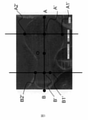
圖3係例示構成本發明之紡黏不織布的聚烯烴纖維之剖面的示意剖面圖之圖式代用照片。又,圖中的箭頭表示後述的拉曼分光法之測定位置之例。圖3(a)與(b)顯示本發明中的配向參數不同之2個例子。 FIG. 3 is a schematic surrogate photograph illustrating a schematic cross-sectional view of a cross-section of a polyolefin fiber constituting the spunbond nonwoven fabric of the present invention. In addition, the arrow in the figure shows an example of the measurement position of the Raman spectrometry mentioned later. Figures 3(a) and (b) show two examples of different alignment parameters in the present invention.
圖4係例示在製造本發明中的纖維時所使用的紡絲噴嘴之吐出面的示意剖面圖。 FIG. 4 is a schematic cross-sectional view illustrating a discharge surface of a spinning nozzle used for producing the fiber of the present invention.
本發明之紡黏不織布係以聚烯烴纖維作為主成分的不織布,於前述的聚烯烴纖維之橫剖面中,以下述(1)~(4)之方法能求出的線段A1’A2’與線段B1’B2’(設為A1’A2’≧B1’B2’)之比率A1’A2’/B1’B2’值為1.05以上。 The spunbond nonwoven fabric of the present invention is a nonwoven fabric with polyolefin fibers as the main component. In the cross section of the polyolefin fibers, the line segments A1'A2' and the line segments that can be obtained by the following methods (1) to (4) The ratio A1'A2'/B1'B2' of B1'B2' (set as A1'A2'≧B1'B2') is 1.05 or more.
(1)於連接纖維橫剖面外周上的2點之線段內,畫出最長線段,將該線段與纖維橫剖面外周之接點當作A及B,(2)將線段AB的長度當作D,將自A起D/4之距離的點當作A’,同樣地將自B起D/4之距離的點當作B’,(3)將通過A’且垂直於線段AB的直線與纖維橫剖面之接點當作A1’及A2’,(4)將通過B’且垂直於線段AB的直線與纖維橫剖面之接點當作B1’及B2’。 (1) In the line segment connecting 2 points on the outer circumference of the fiber cross section, draw the longest line segment, and the junction between the line segment and the outer circumference of the fiber cross section is regarded as A and B, (2) The length of the line segment AB is regarded as D , take the point at a distance of D/4 from A as A', and similarly take a point at a distance of D/4 from B as B', (3) take the line passing through A' and perpendicular to line segment AB and The junction of the fiber cross-section is regarded as A1' and A2', and (4) the junction of the straight line passing through B' and perpendicular to the line segment AB and the fiber cross-section is regarded as B1' and B2'.
本發明之紡黏不織布係以聚烯烴纖維作為主成分的不織布,於纖維剖面圓周方向中等分割的4點中,使用拉曼分光自纖維側面所測定得到的配向參數之最大值Imax與最小值Imin之差為0.6以上。 The spunbond non-woven fabric of the present invention is a non-woven fabric with polyolefin fibers as the main component, and the maximum value I max and the minimum value of the alignment parameters measured from the side of the fiber using Raman spectroscopy are at 4 equally divided points in the circumferential direction of the fiber section. The difference in I min is 0.6 or more.
本發明之紡黏不織布係含有聚烯烴纖維的不織布。 The spunbond nonwoven fabric of the present invention is a nonwoven fabric containing polyolefin fibers.
構成本發明之紡黏不織布的聚烯烴纖維之橫剖面的形狀,不是通常的圓型剖面,而是特殊的異型剖面構造。更具體而言,於連接纖維橫剖面外周上的2點之線段內,對於最長線段為對稱之構造,對於與其垂直的線段為非對稱之構造。藉由成為如上述的構造,由於在纖維橫剖面方向中發生冷卻的差異而形成構造差,故於延伸後的應力緩和中藉由在纖維橫剖面方向中發生收縮差,可對於纖維賦予捲縮。 The shape of the cross section of the polyolefin fibers constituting the spunbond nonwoven fabric of the present invention is not a normal circular section, but a special special-shaped section structure. More specifically, in a line segment connecting two points on the outer periphery of the fiber cross-section, the longest line segment has a symmetrical structure, and a line segment perpendicular to it has an asymmetric structure. By having the above-mentioned structure, the difference in cooling occurs in the fiber cross-sectional direction to form a structural difference, so that the shrinkage difference occurs in the fiber cross-sectional direction during stress relaxation after stretching, and crimp can be imparted to the fiber. .
圖1係例示構成本發明之紡黏不織布的聚烯烴纖維之橫剖面的示意剖面圖之圖式代用照片,圖2係例示構成本發明之紡黏不織布的另一聚烯烴纖維之橫剖面的示意剖面圖之圖式代用照片。 Fig. 1 is a schematic representation of a schematic cross-sectional view illustrating a cross-section of a polyolefin fiber constituting the spunbond nonwoven fabric of the present invention, and Fig. 2 is a schematic diagram illustrating a cross-section of another polyolefin fiber constituting the spunbond nonwoven fabric of the present invention. Schematic surrogate photograph of the sectional drawing.
於圖1與圖2中,於連接纖維橫剖面外周上的2點之線段內,將最長線段與纖維橫剖面外周之接點當作A及B。將線段AB的長度當作D,將自A起D/4之距離的點 當作A’,同樣地將自B起D/4之距離的點當作B’,畫出通過各自且垂直於線段AB的直線,將與纖維橫剖面外周的交點分別當作A1’、A2’、B1’、B2’(A1’A2’≧B1’B2’)。 In FIGS. 1 and 2 , in the line segment connecting two points on the outer periphery of the fiber cross section, the junctions between the longest line segment and the outer periphery of the fiber cross section are referred to as A and B. Taking the length of the line segment AB as D, take the point from A at a distance of D/4 As A', similarly regard the point at the distance of D/4 from B as B', draw a straight line passing through each and perpendicular to the line segment AB, and regard the intersection with the outer circumference of the fiber cross section as A1', A2 respectively ', B1', B2' (A1'A2'≧B1'B2').
構成本發明之紡黏不織布的聚烯烴纖維,重要的是線段A1’A2’與線段B1’B2’之比率A1’A2’/B1’B2’值為1.05以上。上述之比率A1’A2’/B1’B2’值較佳為1.10以上,更佳為1.20以上。藉由將上述之比率A1’A2’/B1’B2’值設為1.05以上,由於可在纖維橫剖面方向中形成構造差,故在延伸後成為容易展現捲縮的構造而為較佳的形態。 In the polyolefin fiber constituting the spunbond nonwoven fabric of the present invention, it is important that the ratio A1'A2'/B1'B2' of the line segment A1'A2' to the line segment B1'B2' is 1.05 or more. The value of the above ratio A1'A2'/B1'B2' is preferably 1.10 or more, more preferably 1.20 or more. By setting the value of the ratio A1'A2'/B1'B2' to 1.05 or more, a structure difference can be formed in the fiber cross-sectional direction, so it becomes a structure that easily exhibits crimping after stretching, which is a preferable form. .
上述之比率A1’A2’/B1’B2’值的上限係隨著此比率變大而纖維橫剖面的構造差亦變大,故在纖維的紡絲吐出時容易變不安定。因此,從紡絲的安定性來看,此比率的上限值為頂多5.0左右。 The upper limit of the value of the ratio A1'A2'/B1'B2' above is that as the ratio increases, the structural difference in the cross section of the fiber also increases, so that the fiber tends to become unstable during spinning and discharging. Therefore, from the viewpoint of spinning stability, the upper limit of this ratio is at most about 5.0.
於本發明中,重要的是於構成本發明之紡黏不織布的聚烯烴纖維之纖維剖面圓周方向中等分割的4點中,使用拉曼分光自纖維側面所測定得到的配向參數之最大值Imax與最小值Imin之差為0.6以上。 In the present invention, it is important to use Raman spectroscopy to measure the maximum value Imax of the alignment parameter obtained from the side of the fiber at four points equally divided in the circumferential direction of the fiber cross section of the polyolefin fiber constituting the spunbonded nonwoven fabric of the present invention. The difference from the minimum value I min is 0.6 or more.
本發明中所言的配向參數,可於拉曼分光法所得的拉曼光譜中,例如於PP之情況,自810cm-1與840cm-1附近之拉曼頻帶的強度求出。於PP之情況,810cm-1與840cm-1附近之拉曼頻帶已知係對於入射光的偏光顯示強的異向性者。此等各自歸屬於CH2變形振動(deformation vibration)與C-C伸縮振動之耦合模型、CH2變形振動模型。於此等之中,關於810cm-1之拉曼頻帶,振動模型的拉曼張量之主軸係對於分子的主鏈方向為平行,另一方面,於840cm-1之拉曼頻帶中為正交。因此,從此等之拉曼頻帶之對於偏光方向而言的頻帶強度比,得到分子鏈的配向。 The alignment parameters mentioned in the present invention can be obtained from the Raman spectrum obtained by Raman spectroscopy, for example, in the case of PP, from the intensities of the Raman bands around 810 cm -1 and 840 cm -1 . In the case of PP, the Raman bands around 810 cm -1 and 840 cm -1 are known to show strong anisotropy with respect to the polarization of incident light. These are respectively attributed to the coupling model of CH 2 deformation vibration and CC stretching vibration, and the CH 2 deformation vibration model. Among these, the principal axis of the Raman tensor of the vibrational model is parallel to the main chain direction of the molecule with respect to the Raman band of 810 cm -1 , and, on the other hand, is orthogonal in the Raman band of 840 cm -1 . Therefore, the molecular chain alignment is obtained from the band intensity ratio of these Raman bands with respect to the polarization direction.
本發明中所言的配向參數I係可作為I810/I840(I810:810cm-1附近之拉曼頻帶強度,I840:840cm-1附近的拉曼頻帶強度)之值求出。 The alignment parameter I referred to in the present invention can be obtained as a value of I 810 /I 840 (I 810 : Raman band intensity around 810 cm −1 , I 840 : Raman band intensity around 840 cm −1 ).
又,於PE之情況,1130cm-1附近之拉曼頻帶為振動模型的拉曼張量之主軸係對於分子的主鏈方向為平行,1060cm-1附近之拉曼頻帶為正交。因此,本發明中所言的配向參數I係可作為I1130/I1060(I1130:1130cm-1附近之拉曼頻帶強度,I1060:1060cm-1附近之拉曼頻帶強度)之值求出。 Also, in the case of PE, the Raman band around 1130 cm -1 is the principal axis of the Raman tensor of the vibrational model, which is parallel to the main chain direction of the molecule, and the Raman band around 1060 cm -1 is orthogonal. Therefore, the alignment parameter I mentioned in the present invention can be obtained as the value of I 1130 /I 1060 (I 1130 : Raman band intensity around 1130 cm −1 , I 1060 : Raman band intensity around 1060 cm −1 ) .
於一般的PP纖維之情況,配向參數的最大值與最小值之差為頂多0.2左右。使用眾所周知的不同2成分之原料的PP系並列捲縮複合纖維時,配向參數的最大值與最小值之差為0.4左右。藉由將構成紡黏不織布的纖維之配向參數的最大值與最小值之差設為0.6以上,可成為捲縮非常容易展現的構造。 In the case of general PP fibers, the difference between the maximum value and the minimum value of the alignment parameter is at most about 0.2. When a well-known PP-series side-by-side crimped conjugate fiber with different two-component raw materials is used, the difference between the maximum value and the minimum value of the alignment parameter is about 0.4. By setting the difference between the maximum value and the minimum value of the orientation parameters of the fibers constituting the spunbond nonwoven fabric to 0.6 or more, a structure in which crimping is very easy to develop can be obtained.
構成本發明之紡黏不織布的纖維之配向參數的最大值與最小值之差較佳為0.6以上,更佳為0.8以上,尤佳為1.0以上。藉由將配向參數之差設為0.6以上,於纖維捲縮展現上,可形成充分的構造差。又,配向參數之差的上限係在相同纖維內能製造的極限中,頂多7.0左右。 The difference between the maximum value and the minimum value of the orientation parameter of the fibers constituting the spunbond nonwoven fabric of the present invention is preferably 0.6 or more, more preferably 0.8 or more, and still more preferably 1.0 or more. By setting the difference of the alignment parameters to be 0.6 or more, a sufficient difference in structure can be formed in the development of fiber crimps. In addition, the upper limit of the difference between the alignment parameters is within the limit of the inner capacity of the same fiber, and it is at most about 7.0.
作為構成本發明之紡黏不織布的聚烯烴纖維 ,例如可舉出由聚乙烯、聚丙烯及彼等的單體與其它的α-烯烴之共聚物等之樹脂所構成的纖維。其中,從強度強,使用時不易斷裂,且在衛生材料的生產時尺寸安定性優異來看,使用聚丙烯纖維者為較佳的態樣。 Examples of the polyolefin fibers constituting the spunbond nonwoven fabric of the present invention include fibers composed of resins such as polyethylene, polypropylene, and copolymers of monomers thereof and other α-olefins. Among them, polypropylene fibers are preferred from the viewpoint of high strength, difficulty in breaking during use, and excellent dimensional stability during the production of sanitary materials.
聚丙烯樹脂係可為藉由一般的齊格勒-納塔觸媒所合成之聚合物,也可使用藉由以茂金屬代表的單位點(single-site)活性觸媒所合成之聚合物。又,亦可使用乙烯雜亂共聚合聚丙烯。乙烯含量較佳小於2質量%,更佳小於1質量%。 The polypropylene resin may be a polymer synthesized by a general Ziegler-Natta catalyst or a polymer synthesized by a single-site active catalyst represented by a metallocene. In addition, ethylene random copolymerization polypropylene can also be used. The ethylene content is preferably less than 2% by mass, more preferably less than 1% by mass.
作為其它的α-烯烴,是碳數3~10者,具體地可舉出丙烯、1-丁烯、1-戊烯、1-己烯、4-甲基-1-戊烯及1-辛烯等。此等係可為單獨1種,也可組合2種以上使用。 As other α-olefins, those having 3 to 10 carbon atoms include propylene, 1-butene, 1-pentene, 1-hexene, 4-methyl-1-pentene, and 1-octene. ene, etc. These systems may be used alone or in combination of two or more.
從強度與尺寸安定性、以及生產性與成本之觀點來看,聚丙烯樹脂以均聚聚丙烯作為主成分者為特佳的態樣。 From the viewpoints of strength and dimensional stability, as well as productivity and cost, a polypropylene resin containing homopolypropylene as a main component is particularly preferred.
作為構成本發明之紡黏不織布的聚丙烯纖維,可以單一成分的聚合物所構成,也可為以2種以上不同的聚合物所構成之複合纖維,但從生產性與成本之觀點來看,以單一成分的聚合物構成者係特佳的態樣。本發明中所言的以單一成分的聚合物構成者,例如就是意指主原料的烯烴種類為1種。通常使用的抗氧化劑、耐候安定劑、耐光安定劑、抗靜電劑、防霧劑、防黏連劑、潤滑劑、成核劑及顏料等之添加物等係不計算作為聚合物的原料。即,烯烴種類為1種的聚合物即使包含任何種類 的此等之添加物等,其聚合物亦為實質上以單一原料所構成的聚合物。 The polypropylene fiber constituting the spunbond nonwoven fabric of the present invention may be composed of a single-component polymer, or may be a composite fiber composed of two or more different polymers, but from the viewpoint of productivity and cost, A single-component polymer structure is particularly preferred. The term "consisting of a single-component polymer" as used in the present invention means, for example, that there is one type of olefin as the main raw material. Commonly used additives such as antioxidants, weather stabilizers, light stabilizers, antistatic agents, antifogging agents, antiblocking agents, lubricants, nucleating agents and pigments are not counted as polymer raw materials. That is, even if a polymer having one kind of olefin includes any kind of additives and the like, the polymer is substantially a polymer composed of a single raw material.
又,以碎片的狀態混合複數的原料後進行紡絲之所謂的混合紡絲,由於無法確認原料彼此的界面,故在本發明中作為單一成分的聚合物看待。於本發明中,以聚烯烴作為主成分者,就是指纖維中的聚烯烴之含有率為80質量%以上。前述之含有率較佳為90質量%以上,更佳為95質量%以上,特佳為100質量%。 In addition, the so-called mixed spinning in which a plurality of raw materials are mixed in the state of chips and then spun, is regarded as a single-component polymer in the present invention since the interface between the raw materials cannot be confirmed. In the present invention, when a polyolefin is used as a main component, it means that the content rate of the polyolefin in the fiber is 80% by mass or more. The aforementioned content is preferably 90% by mass or more, more preferably 95% by mass or more, and particularly preferably 100% by mass.
本發明所用之聚丙烯樹脂的熔體流動速率(以下,亦記載為MFR;ASTM D-1238荷重:2160g,溫度:230℃)較佳為1~1000g/10分鐘,更佳為10~500g/10分鐘,尤佳為20~200g/10分鐘的態樣。藉由將熔體流動速率設為1~1000g/10分鐘之範圍,而容易進行安定的紡絲,且配向結晶化變容易進行,容易得到高強度的纖維。 The melt flow rate of the polypropylene resin used in the present invention (hereinafter, also described as MFR; ASTM D-1238 load: 2160g, temperature: 230°C) is preferably 1~1000g/10min, more preferably 10~500g/ 10 minutes, preferably 20~200g/10 minutes. By setting the melt flow rate in the range of 1 to 1000 g/10 minutes, stable spinning is facilitated, orientation crystallization is facilitated, and high-strength fibers are easily obtained.
又,本發明所用之聚乙烯樹脂的熔體流動速率(ASTM D-1238荷重:2160g,溫度:190℃)較佳為1~1000g/10分鐘,更佳為10~500g/10分鐘,尤佳為15~100g/10分鐘。藉由將熔體流動速率設為1~1000g/10分鐘之範圍而容易進行安定的紡絲,且配向結晶化變容易進行,容易得到高強度的纖維。 In addition, the melt flow rate of the polyethylene resin used in the present invention (ASTM D-1238 load: 2160 g, temperature: 190° C.) is preferably 1 to 1000 g/10 minutes, more preferably 10 to 500 g/10 minutes, especially 15~100g/10min. By setting the melt flow rate to be in the range of 1 to 1000 g/10 minutes, stable spinning is facilitated, orientation crystallization is facilitated, and high-strength fibers are easily obtained.
於本發明所用之聚丙烯樹脂及聚乙烯樹脂中,在不損害本發明的效果之範圍內,可按照需要添加通常使用的抗氧化劑、耐候安定劑、耐光安定劑、抗靜電劑、防霧劑、防黏連劑、潤滑劑、成核劑及顏料等之添加物或其它的聚合物。 In the polypropylene resin and polyethylene resin used in the present invention, commonly used antioxidants, weather stabilizers, light stabilizers, antistatic agents, and antifogging agents can be added as required within the scope of not impairing the effects of the present invention. , Additives such as anti-blocking agents, lubricants, nucleating agents and pigments or other polymers.
作為一般的不織布之製法,例如可舉出針扎不織布、濕式不織布、水刺不織布、紡黏不織布、熔噴不織布、樹脂黏合不織布、化學黏合不織布、熱黏合不織布、絲束開纖式不織布及氣流成網不織布等之各種製法,但本發明中由紡黏法所製的不織布為重要。紡黏不織布係生產性或機械強度優異,且由於由長纖維所構成,故具有比短纖維不織布不易起毛之特徵。 As a general method for producing nonwovens, for example, needle-punched nonwovens, wet-laid nonwovens, spunlace nonwovens, spunbond nonwovens, meltblown nonwovens, resin-bonded nonwovens, chemically-bonded nonwovens, thermally-bonded nonwovens, tow-opened nonwovens, and There are various production methods such as air-laid nonwoven fabrics, but in the present invention, the nonwoven fabric produced by the spunbond method is important. Spunbond nonwovens are excellent in productivity and mechanical strength, and because they are composed of long fibers, they are characterized by being less prone to fluff than short fiber nonwovens.
構成本發明之紡黏不織布的聚烯烴纖維之平均單纖維纖度較佳為0.5dtex以上3.5dtex以下,更佳為0.7dtex以上3.2dtex以下,尤佳為0.9dtex以上2.8dtex以下。從紡絲安定性之觀點來看,平均單纖維纖度較佳為0.5dtex以上,由於纖度愈細,與成為不織布的紗之接著點愈多,而強度高,柔軟性良好。本發明之紡黏不織布由於主要使用於衛生材料,故從紡黏不織布的強力之觀點來看,平均單纖維纖度為3.5dtex以下者係較佳的態樣。上述的平均單纖維纖度係可自纖維剖面照片中的纖維剖面積A(m2)與聚合物密度ρ(g/m3),使用下式算出。 The average single fiber fineness of the polyolefin fibers constituting the spunbond nonwoven fabric of the present invention is preferably 0.5 dtex or more and 3.5 dtex or less, more preferably 0.7 dtex or more and 3.2 dtex or less, particularly preferably 0.9 dtex or more and 2.8 dtex or less. From the viewpoint of spinning stability, the average single fiber fineness is preferably 0.5 dtex or more, since the finer the fineness, the more bonding points with the nonwoven yarn, the higher the strength and the better the softness. Since the spunbond nonwoven fabric of the present invention is mainly used for sanitary materials, from the viewpoint of the strength of the spunbond nonwoven fabric, an average single fiber fineness of 3.5 dtex or less is a preferable aspect. The above-mentioned average single fiber fineness can be calculated from the fiber cross-sectional area A (m 2 ) and the polymer density ρ (g/m 3 ) in the fiber cross-sectional photograph using the following formula.
‧單纖維纖度(dtex)=A(m2)×ρ(g/m3)×10000(m)。 ‧Single fiber fineness (dtex)=A(m 2 )×ρ(g/m 3 )×10000(m).
本發明之紡黏不織布的單位面積重量為3~200g/m2者係較佳態樣。前述的單位面積重量更佳為5~150g/m2,尤佳為10~100g/m2。藉由將單位面積重量設為上述之範圍,尤其在作為衛生材料用不織布使用時,可得到充分的柔軟性。 The preferred embodiment of the spunbond nonwoven fabric of the present invention has a weight per unit area of 3 to 200 g/m 2 . The aforementioned weight per unit area is more preferably 5 to 150 g/m 2 , particularly preferably 10 to 100 g/m 2 . Sufficient flexibility can be obtained by making a basis weight into the said range, especially when using it as a nonwoven fabric for hygiene materials.
又,本發明之紡黏不織布的表觀密度為0.130g/cm3以下者係較佳態樣。前述的表觀密度係可藉 由將單位面積重量除以厚度而算出。表觀密度更佳為0.025g/cm3以上0.125g/cm3以下,尤佳為0.040g/cm3以上0.100g/cm3以下。藉由將表觀密度設為上述之範圍,尤其在作為衛生材料用不織布使用時,可得到充分的膨鬆性與物性。 In addition, the apparent density of the spunbond nonwoven fabric of the present invention is preferably 0.130 g/cm 3 or less. The aforementioned apparent density can be calculated by dividing the basis weight by the thickness. The apparent density is more preferably 0.025 g/cm 3 or more and 0.125 g/cm 3 or less, particularly preferably 0.040 g/cm 3 or more and 0.100 g/cm 3 or less. Sufficient bulkiness and physical properties can be obtained when the apparent density is within the above-mentioned range, especially when used as a nonwoven fabric for hygiene materials.
接著,說明製造本發明的紡黏不織布之方法的一例。 Next, an example of a method for producing the spunbond nonwoven fabric of the present invention will be described.
紡黏法係將原料樹脂熔融,從紡絲噴嘴紡絲後,對於經冷卻固化的纖維群,以噴射器(ejector)牽引及延伸,在移動的網狀物(net)上捕集而不織網化後,需要熱接著之步驟的製造方法。 The spunbond method melts the raw resin and spins it from a spinning nozzle. After cooling and solidifying the fiber group, it is drawn and stretched by an ejector, and collected on a moving net without weaving. After the meshing, a manufacturing method of a thermal subsequent step is required.
作為紡絲噴嘴或噴射器之形狀,可採用圓形或矩形等各種者。其中,從壓縮空氣的使用量比較少,不易發生纖維群彼此的熔黏或摩擦之點來看,較宜使用矩形噴嘴與矩形噴射器之組合。 As the shape of the spinning nozzle or the injector, various ones such as circular and rectangular can be adopted. Among them, the combination of a rectangular nozzle and a rectangular injector is more suitable from the point of view that the amount of compressed air used is relatively small, and the fusion or friction of the fiber groups is less likely to occur.
作為得到本發明所用之聚烯烴纖維的剖面形狀之噴嘴,重要的是成為圖4中例示的吐出孔之形狀(本發明中,亦稱為啞鈴形狀)。啞鈴形狀的吐出孔徑係在長方形之兩側分別配置有圓的形狀,且為在此圓的孔徑有差異之形狀。圖4係例示紡絲噴嘴的吐出面,此處顯示吐出孔(大孔徑側)20與吐出孔(小孔徑側)30。 As a nozzle for obtaining the cross-sectional shape of the polyolefin fiber used in the present invention, it is important to have the shape of the discharge hole illustrated in FIG. 4 (also referred to as a dumbbell shape in the present invention). The discharge hole diameter of the dumbbell shape is a shape in which circles are arranged on both sides of the rectangle, and the hole diameters of the circles are different. FIG. 4 shows an example of the discharge surface of the spinning nozzle, and the discharge hole (large diameter side) 20 and the discharge hole (small diameter side) 30 are shown here.
為了得到構成本發明之紡黏不織布的聚烯烴纖維,重要的是在2個圓的吐出孔面積具有差異,大孔徑面積/小孔徑面積之值(面積比率)較佳為1.2以上,更佳為1.5以上,尤佳為2.0以上。藉由將面積比率設為1.2以上 ,可將構造差賦予至所得之纖維。面積比率之上限值,從隨著面積比率變大,剛吐出後的絲彎曲變大而紡絲變不安定來看,面積比率頂多5.0以下。 In order to obtain the polyolefin fiber constituting the spunbond nonwoven fabric of the present invention, it is important to have a difference in the area of the discharge holes of the two circles, and the value (area ratio) of the large hole diameter area/small hole diameter area (area ratio) is preferably 1.2 or more, more preferably 1.5 or more, more preferably 2.0 or more. By making the area ratio 1.2 or more, a structural difference can be imparted to the obtained fiber. The upper limit of the area ratio is at most 5.0 or less, from the viewpoint that as the area ratio becomes larger, the yarn warp immediately after discharge becomes larger and the spinning becomes unstable.
構成本發明之紡黏不織布的聚烯烴纖維之剖面係可藉由適宜調整上述噴嘴的吐出形狀而得到。藉由將上述的大孔徑面積/小孔徑面積之值設為1.2以上,可得到纖維剖面的線段A1’A2’與線段B1’B2’(設為A1’A2’≧B1’B2’)之比率A1’A2’/B1’B2’值成為1.05以上之構成本發明的纖維剖面。 The cross section of the polyolefin fiber constituting the spunbond nonwoven fabric of the present invention can be obtained by appropriately adjusting the discharge shape of the nozzle. The ratio of the line segment A1'A2' to the line segment B1'B2' (set as A1'A2'≧B1'B2') of the fiber cross-section can be obtained by setting the value of the above-mentioned large aperture area/small aperture area to 1.2 or more. The fiber cross section of the present invention is constituted by the A1'A2'/B1'B2' value being 1.05 or more.
熔融紡絲時的紡絲溫度較佳為200~300℃,更佳為210~280℃,尤佳為220~260℃。由於將紡絲溫度設為上述之範圍內,可成為安定的熔融狀態,得到優異的紡絲安定性。 The spinning temperature during melt spinning is preferably 200 to 300°C, more preferably 210 to 280°C, and particularly preferably 220 to 260°C. By setting the spinning temperature within the above-mentioned range, a stable molten state can be obtained, and excellent spinning stability can be obtained.
聚烯烴樹脂(原料)係藉由擠壓機所熔融及計量,從往紡絲噴嘴供給的噴嘴吐出孔來紡出。 The polyolefin resin (raw material) is melted and metered by an extruder, and spun from a nozzle discharge hole supplied to a spinning nozzle.
作為冷卻經紡出的長纖維之纖維群的方法,例如可採用將冷風強制地噴吹至纖維群之方法、在纖維群周圍的環境溫度下自然冷卻之方法、調整紡絲噴嘴與噴射器間的距離之方法、及此等之組合。 As a method of cooling the fiber group of the spun long fibers, for example, a method of forcibly blowing cold air to the fiber group, a method of natural cooling at the ambient temperature of the fiber group, adjustment of the gap between the spinning nozzle and the injector can be used distances, and combinations of these.
又,冷卻較佳為對於纖維群,從相對的2方向來噴吹冷卻風,或進行自然冷卻。從單側來噴吹冷卻風之所謂的非對稱冷卻時,由於纖維群的晃動變大而容易發生斷紗,而且會發生纖維間的冷卻不均。另外,冷卻條件係可考慮紡絲噴嘴的每單孔之吐出量、紡絲的溫度及環境溫度等,適宜調整而採用。 In addition, it is preferable to cool the fiber group by blowing cooling air from two opposite directions, or by natural cooling. In the case of so-called asymmetric cooling in which cooling air is blown from one side, yarn breakage is likely to occur due to increased sway of the fiber group, and cooling unevenness between fibers occurs. In addition, the cooling conditions can be appropriately adjusted and adopted in consideration of the discharge rate per single hole of the spinning nozzle, the spinning temperature, the ambient temperature, and the like.
接著,經冷卻固化的纖維群係藉由從噴射器所噴射出的壓縮空氣來牽引及延伸。經延伸後,由於壓縮空氣的拘束變無,延伸纖維係受到應力緩和之影響。此時,藉由因纖維橫剖面的構造差所造成的收縮差,而在纖維中展現捲縮。然後,於移動的網狀物上捕集長纖維而不織網化,藉由熱接著而將所得之不織網予以一體化,可得到紡黏不織布。 Then, the cooled and solidified fiber population is drawn and extended by compressed air ejected from the ejector. After being stretched, the stretched fibers are affected by stress relaxation due to the release of the restraint of the compressed air. At this time, crimping is exhibited in the fiber due to the difference in shrinkage due to the difference in the structure of the fiber cross section. Then, long fibers are collected on the moving web without being woven into a web, and the obtained nonwoven web is integrated by thermal bonding to obtain a spunbond nonwoven fabric.
作為熱接著之方法,例如可採用:於上下一對的輥表面上分別施有雕刻(凹凸部)的熱壓花輥、由一個輥表面為扁平(平滑)的輥與在另一個輥表面上施有雕刻(凹凸部)的輥之組合所構成的熱壓花輥、由上下一對的扁平(平滑)輥之組合所構成的熱壓延輥等各種輥之熱壓接,或超音波的熔接。 As a method of thermal bonding, for example, a thermal embossing roll in which engravings (concavities and convexities) are respectively applied to the surfaces of the upper and lower pair of rolls, a roll having a flat (smooth) surface on one roll, and a roll having a flat (smooth) surface on the other roll surface can be used. Thermal embossing rolls composed of a combination of rolls with engraving (concave and convex), hot calendering rolls composed of a combination of a pair of upper and lower flat (smooth) rolls, etc. Thermocompression bonding of various rolls, or ultrasonic Weld.
其中,從強度與耐磨耗性之觀點來看,較宜採用使用壓花輥的熱接著。又,使用在上下的任一者施有雕刻(凹凸部)者,由於不易對於全體施加壓力,不損害捲縮纖維所致的膨鬆性而為較佳態樣。 Among them, thermal bonding using an embossing roll is preferable from the viewpoint of strength and wear resistance. In addition, it is a preferable aspect to use one with engraving (concave-convex portion) applied to either one of the upper and lower parts, since it is difficult to apply pressure to the whole and the bulkiness of the crimped fiber is not impaired.
熱熔黏時的壓花接著面積率較佳為5~30%。藉由將壓花接著面積率設為5%以上,較佳設為10%以上,作為紡黏不織布,可得到能供實用的強度。另一方面,藉由將壓花接著面積率設為30%以下,較佳設為20%以下,可維持捲縮纖維所致的膨鬆性。 The area ratio of embossing during hot melt bonding is preferably 5 to 30%. By setting the area ratio of embossing to 5% or more, preferably 10% or more, practical strength can be obtained as a spunbond nonwoven fabric. On the other hand, the bulkiness due to crimped fibers can be maintained by setting the embossing bonding area ratio to 30% or less, preferably 20% or less.
此處所言的壓花接著面積率,當藉由一對具有凹凸的輥進行熱接著時,就是指上側輥的凸部與下側輥的凸部重疊而抵接於不織網的部分佔不織布全體之比 例。又,當藉由具有凹凸的輥與平輥進行熱接著時,就是指具有凹凸的輥之凸部抵接於不織網的部分佔不織布全體之比例。 The area ratio of the embossing bonding mentioned here, when thermal bonding is performed by a pair of rollers with unevenness, means that the portion of the upper roller and the lower roller that are in contact with the non-woven web occupies the portion of the non-woven fabric. proportion of the whole. In addition, when thermal bonding is performed by a roll having unevenness and a flat roll, it means the proportion of the entire nonwoven fabric where the convex portion of the roll having unevenness abuts against the nonwoven web.
作為施予熱壓花輥的雕刻之形狀,可使用圓形、橢圓形、正方形、長方形、平行四邊形、菱形、正六角形及正八角形等之形狀。 As the shape of the engraving applied to the hot embossing roll, a circle, an ellipse, a square, a rectangle, a parallelogram, a rhombus, a regular hexagon, a regular octagon, or the like can be used.
熱壓花輥之表面溫度,相對於所使用的樹脂之中最低熔點的樹脂(以下,亦稱為低熔點樹脂)之熔點而言,較佳設為-50~-1℃。相對於低熔點樹脂之熔點,將熱壓花輥之表面溫度設為-50℃以上,較佳設為-30℃以上,更佳設為-10℃以上,可使其充分地熱接著,帶來強度,容易抑制絨毛之發生。 The surface temperature of the hot embossing roll is preferably -50 to -1°C with respect to the melting point of the resin with the lowest melting point (hereinafter, also referred to as a low melting point resin) among the resins used. With respect to the melting point of the low-melting resin, the surface temperature of the hot embossing roll is set to -50°C or higher, preferably -30°C or higher, and more preferably -10°C or higher, so that it can be sufficiently thermally bonded to bring Strength, easy to inhibit the occurrence of fluff.
又,藉由相對於低熔點樹脂之熔點,將熱壓花輥之表面溫度設為-1℃以下,可容易防止因纖維之熔化而發生樹脂彼此的剝離者。 In addition, by setting the surface temperature of the hot embossing roll to -1°C or lower with respect to the melting point of the low-melting resin, it is possible to easily prevent the peeling of the resins due to the melting of the fibers.
熱接著時的熱壓花輥之線壓較佳為5~50kgf/cm。藉由將前述線壓設為5kgf/cm以上,較佳設為10kgf/cm以上,更佳設為15kgf/cm以上,可使其充分地熱接著。另一方面,藉由將前述線壓設為50kgf/cm以下,較佳設為40kgf/cm以下,更佳設為30kgf/cm以下,可使輥的應力不過度施加,而維持捲縮纖維所致的膨鬆性。 The linear pressure of the hot embossing roll during thermal bonding is preferably 5 to 50 kgf/cm. By setting the above-mentioned line pressure to be 5 kgf/cm or more, preferably 10 kgf/cm or more, more preferably 15 kgf/cm or more, sufficient thermal bonding can be achieved. On the other hand, by setting the linear pressure to be 50 kgf/cm or less, preferably 40 kgf/cm or less, and more preferably 30 kgf/cm or less, the stress of the rollers is not excessively applied, and the crimped fibers can be maintained. resulting bulkiness.
本發明之紡黏不織布由於膨鬆性非常優異,可適合利用於拋棄式紙尿布或衛生棉等的衛生材料用途。於衛生材料之中,尤其可適合利用於表面材料(頂片)等。又,於繃帶、醫療用紗布、毛巾等的醫療衛生材料 及衛生口罩等之要求膨鬆性與柔軟性的各種用途中皆可適合使用。 Since the spunbond nonwoven fabric of the present invention is excellent in bulkiness, it can be suitably used for sanitary materials such as disposable diapers and sanitary napkins. Among hygienic materials, it can be suitably used for surface materials (top sheets) and the like. In addition, it can be suitably used in various applications requiring bulkiness and softness, such as medical and sanitary materials such as bandages, medical gauze, and towels, and sanitary masks.
以下,以實施例為基礎,具體地說明本發明之紡黏不織布與其製造方法。 Hereinafter, the spunbond nonwoven fabric of the present invention and its manufacturing method will be specifically described based on the examples.
(1)纖維橫剖面中的比率A1’A2’/B1’B2’值之算出: (1) Calculation of the ratio A1'A2'/B1'B2' in the fiber cross section:
藉由KEYENCE公司製掃描型電子顯微鏡(型號:VE7800),拍攝構成紡黏不織布的纖維橫剖面,依照以下(A)~(D)之程序,測定線段A1’A2’及線段B1’B2’的長度(設為A1’A2’≧B1’B2’),算出比率A1’A2’/B1’B2’值。此比率中的各種線段之測定,係使用影像攝影中使用的顯微鏡軟體所附屬的計測機能而算出。對於從不織布之不同位置所採集的纖維3條,進行測定,求出其平均。 Using a scanning electron microscope (model: VE7800) manufactured by KEYENCE, the cross-section of the fibers constituting the spunbond nonwoven fabric was photographed, and the following procedures (A) to (D) were used to measure the line segments A1'A2' and B1'B2'. Length (set as A1'A2'≧B1'B2'), and calculate the ratio A1'A2'/B1'B2' value. The measurement of the various line segments in this ratio is calculated using the measurement function attached to the microscope software used for image capturing. Three fibers collected from different positions of the nonwoven fabric were measured, and the average was obtained.
(A)於連接纖維橫剖面外周上的2點之線段內,畫出最長線段,將該線段與纖維橫剖面外周之接點當作A及B。 (A) In the line segment connecting 2 points on the outer periphery of the fiber cross section, draw the longest line segment, and the junctions between this line segment and the outer periphery of the fiber cross section are regarded as A and B.
(B)將線段AB的長度當作D,將自A起D/4之距離的點當作A’,同樣地將自B起D/4之距離的點當作B’。 (B) Let the length of the line segment AB be D, the point at a distance of D/4 from A is called A', and similarly the point at a distance of D/4 from B is called B'.
(C)將通過A’且垂直於線段AB的直線與纖維橫剖面之接點當作A1’及A2’。 (C) The junction of the straight line passing through A' and perpendicular to the line segment AB and the fiber cross section is taken as A1' and A2'.
(D)將通過B’且垂直於線段AB的直線與纖維橫剖面之接點當作B1’及B2’。 (D) The junctions of the straight line passing through B' and perpendicular to the line segment AB and the fiber cross section are taken as B1' and B2'.
(2)纖維剖面中的配向參數之差(Imax-Imin): (2) Difference between alignment parameters in the fiber cross section (I max -I min ):
於測定裝置,使用愛宕物產製三重拉曼分光裝置T-64000。測定條件係如以下而實施。 As the measurement device, a triple Raman spectrometer T-64000 manufactured by Atago Co., Ltd. was used. The measurement conditions were implemented as follows.
‧測定模式:顯微拉曼(偏光測定) ‧Measurement mode: Micro Raman (polarized light measurement)
‧物鏡:長焦點90倍(NA=0.90) ‧Objective lens: 90x long focus (NA=0.90)
‧束徑:51μm,光源:Ar+雷射/514.5nm ‧Beam diameter: 51μm, light source: Ar + laser/514.5nm
‧雷射功率:100mW ‧Laser power: 100mW
‧繞射光柵:Single1800gr/mm ‧Diffraction grating: Single1800gr/mm
‧狹縫:100μm ‧Slit: 100μm
‧十字狹縫:200μm ‧Cross slit: 200μm
‧檢測器:CCD/Jobin Yvon 1024×256 ‧Detector: CCD/Jobin Yvon 1024×256
‧累計時間:120秒 ‧Accumulated time: 120 seconds
從紡黏不織布中取出纖維1條,於纖維剖面圓周方向中等分割的4點中,從纖維側面分別測定拉曼光譜。於PP之情況,算出在各測定點的810cm-1及840cm-1之拉曼頻帶的強度I810及I840,算出其比率I810/I840,當作配向參數I。又,於PE之情況,算出1130cm-1及1060cm-1之拉曼頻帶的強度I1130及I1060,算出其比率I1130/I1060,當作配向參數I。求出在各測定點的配向參數之最大值Imax與最小值Imin,算出其差(Imax-Imin)。對於從紡黏不織布之不同位置所採集的纖維1條,同樣地測定,求出2點的平均,當作配向參數之差。 One fiber was taken out from the spunbond nonwoven fabric, and the Raman spectrum was measured from the side of the fiber at four points equally divided in the circumferential direction of the fiber cross section. In the case of PP, the intensities I 810 and I 840 of the Raman bands at 810 cm −1 and 840 cm −1 at each measurement point were calculated, and the ratio I 810 /I 840 was calculated as the alignment parameter I. Also, in the case of PE, the intensities I 1130 and I 1060 of the Raman bands at 1130 cm -1 and 1060 cm -1 were calculated, and the ratio I 1130 /I 1060 was calculated as the alignment parameter I. The maximum value I max and the minimum value I min of the alignment parameters at each measurement point were obtained, and the difference (I max -I min ) was calculated. For one fiber collected from different positions of the spunbond nonwoven fabric, the measurement was performed in the same manner, and the average of the two points was obtained, which was regarded as the difference of the alignment parameters.
說明本發明中的配向參數之測定位置。圖3係例示構成本發明之紡黏不織布的聚烯烴纖維之橫剖面,顯示配向參數測定位置10之一例。圖3的(a)與(b)顯示本發明中的2個不同之具體例。圖3中所示的配向參數測定位置10係表示測定本發明之配向參數的4點之位置的一例,可依照發明之形態來適宜選擇測定位置。重要的 是使配向參數測定位置10所示的測定位置彼此成為在纖維圓周上等間隔的4點,藉由設為如此的測定位置,可算出本發明中的配向參數之差。 The measurement positions of the alignment parameters in the present invention will be described. FIG. 3 is an example of a cross section of a polyolefin fiber constituting the spunbond nonwoven fabric of the present invention, and an example of an alignment
(3)纖維之捲縮數: (3) The number of crimps of the fiber:
自藉由顯微鏡所拍攝的纖維之影像,測定纖維的捲縮數。計數每單位長度的纖維之所有山與谷之數,將其合計除以2,並將每25mm之數當作捲縮數。測定10條的纖維,求出其平均。將捲縮數為50個/25mm以上當作捲縮度(◎),將捲縮數為25個/25mm以上且少於50個/25mm當作捲縮度(○),將捲縮數為0個/25mm(無捲縮者)~少於25個/25mm當作捲縮度(×)。將捲縮數為25個/25mm以上者(◎及○)當作合格。 The number of crimps of the fiber was determined from the image of the fiber taken by a microscope. Count all the hills and valleys per unit length of fiber, divide the total by 2, and take the number per 25 mm as the number of crimps. 10 fibers were measured, and the average was obtained. The number of crimps is 50/25mm or more as the degree of crimp (◎), the number of crimps is 25/25mm or more and less than 50/25mm as the degree of crimp (○), and the number of crimps is 0 pcs/25mm (without crimping) to less than 25 pcs/25mm is regarded as the degree of crimping (×). Those with a crimp number of 25 pieces/25mm or more (◎ and ○) were regarded as acceptable.
(4)紡黏不織布之單位面積重量: (4) Weight per unit area of spunbond non-woven fabric:
紡黏不織布之單位面積重量係根據JIS L1913(2010年)的6.2「每單位面積的質量」,於試料的寬度每1m,採集3片的20cm×25cm之試驗片,秤量標準狀態的各自之質量(g),以每1m2的質量(g/m2)表示其平均值。 The weight per unit area of spunbond non-woven fabrics is based on JIS L1913 (2010) 6.2 "Mass per unit area", collect 3 test pieces of 20cm × 25cm for every 1m of the width of the sample, and measure the mass of each in the standard state (g), the average value is shown in mass per 1 m 2 (g/m 2 ).
(5)紡黏不織布之厚度: (5) Thickness of spunbond non-woven fabric:
依據JIS L 1908(2010年),測定紡黏不織布之厚度。準備具有2500mm2的面積之壓腳。對於壓腳的直徑之1.75倍以上的大小之試驗片,以一定時間施加2kPa的壓力後,測定厚度。算出試驗片10片份的平均值,將其值當作厚度。此數值愈高,則評價膨鬆性愈優異。 According to JIS L 1908 (2010), the thickness of spunbond non-woven fabric is measured. Prepare a presser foot with an area of 2500mm 2 . After applying a pressure of 2 kPa for a certain period of time to a test piece having a size of 1.75 times or more the diameter of the presser foot, the thickness was measured. The average value of 10 test pieces was calculated, and the value was taken as the thickness. The higher this value is, the more excellent the bulkiness is evaluated.
(6)紡黏不織布之表觀密度: (6) Apparent density of spunbond nonwoven:
自所測定的上述紡黏不織布之單位面積重量與厚度 ,算出紡黏不織布之表觀密度。此數值愈低,則評價膨鬆性愈優異。 From the measured weight per unit area and thickness of the spunbond nonwoven fabric, the apparent density of the spunbond nonwoven fabric was calculated. The lower this value is, the more excellent the bulkiness is evaluated.
(實施例1) (Example 1)
於原料中,使用熔體流動速率(MFR)為60g/10分鐘(荷重:2160g,溫度:230℃)且熔點為162℃之聚丙烯(PP)樹脂,以擠壓機將此熔融,於紡絲溫度235℃,從具有孔徑為Φ0.38mm與Φ0.27mm且兩孔的中心距離為0.8mm之形狀的紡絲噴嘴(啞鈴型噴嘴),以單孔吐出量0.6g/分鐘,紡出圖1中所示之剖面形狀的長纖維。 Among the raw materials, a polypropylene (PP) resin with a melt flow rate (MFR) of 60g/10min (load: 2160g, temperature: 230°C) and a melting point of 162°C was used, melted by an extruder, and spun in a spinning machine. The yarn temperature was 235°C, and the spinning nozzle (dumbbell-shaped nozzle) with a hole diameter of Φ0.38mm and a Φ0.27mm and the center distance between the two holes was 0.8mm, and the output rate was 0.6g/min per hole. Long fibers of the cross-sectional shape shown in 1.
對於經紡出的長纖維群之側面,從相對的2方向來噴吹冷卻風而冷卻後,通過噴射器,以0.17MPa的噴射器壓力從噴射器來噴射出壓縮空氣,牽引纖維群,進行延伸,而使其展現捲縮。然後,於移動的網狀物上捕集紗條而不織網化。接著,使用由金屬製的施有水珠圖樣之雕刻的上輥及金屬製的扁平下輥所構成之上下一對的接著面積10%之壓花輥,以線壓20kgf/cm、熱接著溫度135℃進行熱接著處理,得到單位面積重量為20g/m2的紡黏不織布。測定構成所得之紡黏不織布的纖維剖面之比率A1’A2’/B1’B2’之值、構成紡黏不織布的纖維之纖維剖面中的配向參數之差(Imax-Imin)、捲縮數、不織布的單位面積重量、厚度及表觀密度。表1中顯示所得之評價結果。 The side surfaces of the spun long fiber group were cooled by blowing cooling air from two opposite directions, and then the compressed air was injected from the injector at an injector pressure of 0.17 MPa to draw the fiber group, and the stretch, so that it appears curled. Then, the sliver is captured on the moving mesh without weaving. Next, a pair of upper and lower embossing rollers with a bonding area of 10% consisting of a metal upper roller with a bead pattern engraved and a metal flat lower roller was used, and the line pressure was 20kgf/cm, and the thermal bonding temperature was 10%. Thermal bonding was performed at 135° C. to obtain a spunbond nonwoven fabric with a basis weight of 20 g/m 2 . The value of the ratio A1'A2'/B1'B2' of the fiber cross section constituting the obtained spunbond nonwoven fabric, the difference between the orientation parameters in the fiber cross section of the fiber constituting the spunbond nonwoven fabric (I max -I min ), and the number of crimps were measured. , Weight per unit area, thickness and apparent density of non-woven fabrics. Table 1 shows the obtained evaluation results.
(實施例2) (Example 2)
除了於原料中,使用MFR為35g/10分鐘(荷重:2160g,溫度:230℃)且熔點為162℃之聚丙烯(PP)樹脂以外, 與實施例1同樣地得到紡黏不織布。表1中顯示所得之評價結果。 A spunbond nonwoven fabric was obtained in the same manner as in Example 1, except that a polypropylene (PP) resin having an MFR of 35 g/10 minutes (load: 2160 g, temperature: 230° C.) and a melting point of 162° C. was used as the raw material. Table 1 shows the obtained evaluation results.
(實施例3) (Example 3)
除了於原料中,使用MFR為33g/10分鐘(荷重:2160g,溫度:230℃)且熔點為149℃之共聚合聚丙烯(共聚合PP)樹脂以外,與實施例1同樣地得到紡黏不織布。表1中顯示所得之評價結果。 A spunbond nonwoven fabric was obtained in the same manner as in Example 1, except that a copolymerized polypropylene (copolymerized PP) resin having an MFR of 33 g/10 minutes (load: 2160 g, temperature: 230°C) and a melting point of 149°C was used as the raw material . Table 1 shows the obtained evaluation results.
(實施例4) (Example 4)
除了於原料中,使用MFR為18g/10分鐘(荷重:2160g,溫度:190℃)且熔點為130℃之高密度聚乙烯(HDPE)樹脂,將壓花輥的熱接著溫度設為90℃以外,與實施例1同樣地得到紡黏不織布。表1中顯示所得之評價結果。 Except using high density polyethylene (HDPE) resin with MFR of 18g/10min (load: 2160g, temperature: 190°C) and melting point of 130°C as the raw material, the thermal bonding temperature of the embossing roll was set to 90°C , spunbonded nonwoven fabric was obtained in the same manner as in Example 1. Table 1 shows the obtained evaluation results.
(實施例5) (Example 5)
除了於原料的第一成分中,使用MFR為60g/10分鐘(荷重:2160g,溫度:230℃)且熔點為162℃的聚丙烯(PP)樹脂,於第二成分中使用MFR為35g/10分鐘(荷重:2160g,溫度:230℃)且熔點為162℃之聚丙烯樹脂,各自藉由個別的擠壓機熔融,以各成分的質量比成為50:50之方式計量,將第一成分導入至吐出孔徑Φ0.38mm側,將第二成分導入至吐出孔徑Φ0.27mm側,而進行紡絲以外,與實施例1同樣地得到紡黏不織布。表1中顯示所得之評價結果。 Except for the first component of the raw material, a polypropylene (PP) resin having an MFR of 60 g/10 minutes (load: 2160 g, temperature: 230°C) and a melting point of 162°C was used, and the second component used a MFR of 35 g/10 Minutes (load: 2160 g, temperature: 230°C) and polypropylene resins with a melting point of 162°C were melted by separate extruders, measured so that the mass ratio of each component was 50:50, and the first component was introduced A spunbonded nonwoven fabric was obtained in the same manner as in Example 1, except that the second component was introduced to the discharge hole diameter Φ0.27 mm side to the discharge hole diameter Φ0.38 mm side and spinning was performed. Table 1 shows the obtained evaluation results.
(實施例6) (Example 6)
除了於原料的第一成分之原料中使用MFR為60g/10分鐘(荷重:2160g,溫度:230℃)且熔點為162℃之聚丙 烯(PP)樹脂,於第二成分之原料中使用MFR為33g/10分鐘(荷重:2160g,溫度:230℃)且熔點為149℃之共聚合聚丙烯(共聚合PP)樹脂以外,與實施例5同樣地得到紡黏不織布。表1中顯示所得之評價結果。 In addition to using polypropylene (PP) resin with MFR of 60g/10min (load: 2160g, temperature: 230°C) and melting point of 162°C in the raw material of the first component of the raw material, the MFR used in the raw material of the second component is: A spunbond nonwoven fabric was obtained in the same manner as in Example 5, except for the copolymerized polypropylene (copolymerized PP) resin having a melting point of 33 g/10 minutes (load: 2160 g, temperature: 230°C) and a melting point of 149°C. Table 1 shows the obtained evaluation results.
(實施例7) (Example 7)
除了將所使用的噴嘴設為具有孔徑為Φ0.35mm與Φ0.32mm且兩孔的中心距離為0.8mm之吐出形狀的紡絲噴嘴以外,與實施例1同樣地得到紡黏不織布。表1中顯示所得之結果。 A spunbond nonwoven fabric was obtained in the same manner as in Example 1, except that the nozzle used was a spinning nozzle having a discharge shape of Φ0.35 mm and Φ0.32 mm, and the center distance between the two holes was 0.8 mm. The results obtained are shown in Table 1 .
(實施例8) (Example 8)
除了於原料中,使用將MFR為35g/10分鐘(荷重:2160g,溫度:230℃)且熔點為162℃之聚丙烯(PP)樹脂與MFR為25g/10分鐘(荷重:2160g,溫度:230℃)之共聚合聚丙烯(PP)樹脂,以各原料之質量比率成為88:12的方式所摻合的混合原料以外,與實施例1同樣地得到紡黏不織布。表2中顯示所得之結果。 Except for the raw materials, polypropylene (PP) resin with MFR of 35g/10min (load: 2160g, temperature: 230°C) and melting point of 162°C and MFR of 25g/10min (load: 2160g, temperature: 230°C) were used. ℃) copolymerized polypropylene (PP) resin, except that the mixed raw materials were blended so that the mass ratio of each raw material was 88:12, a spunbond nonwoven fabric was obtained in the same manner as in Example 1. The results obtained are shown in Table 2.
(實施例9) (Example 9)
除了於原料中,使用MFR為30g/10分鐘(荷重:2160g,溫度:190℃)且熔點為130℃之線狀低密度聚乙烯(LLDPE)以外,與實施例4同樣地得到紡黏不織布。表2中顯示所得之結果。 A spunbond nonwoven fabric was obtained in the same manner as in Example 4, except that a linear low density polyethylene (LLDPE) having an MFR of 30 g/10 minutes (load: 2160 g, temperature: 190° C.) and a melting point of 130° C. was used as the raw material. The results obtained are shown in Table 2.
(實施例10) (Example 10)
除了將纖維群的冷卻設為自然冷卻以外,與實施例1同樣地得到紡黏不織布。表2中顯示所得之結果。 A spunbonded nonwoven fabric was obtained in the same manner as in Example 1, except that the cooling of the fiber group was made to be naturally cooled. The results obtained are shown in Table 2.
(比較例1) (Comparative Example 1)
除了將所使用的噴嘴之吐出孔徑設為習知的圓形形狀(吐出孔徑Φ0.5mm)以外,與實施例5同樣地得到紡黏不織布。表2中顯示所得之評價結果。 A spunbonded nonwoven fabric was obtained in the same manner as in Example 5, except that the discharge hole diameter of the nozzle used was a conventional circular shape (discharge hole diameter Φ0.5 mm). Table 2 shows the obtained evaluation results.
(比較例2) (Comparative Example 2)
除了將所使用的噴嘴之吐出孔徑設為習知的圓形形狀(吐出孔徑Φ0.5mm)以外,與實施例6同樣地得到紡黏不織布。表2中顯示所得之評價結果。 A spunbond nonwoven fabric was obtained in the same manner as in Example 6, except that the discharge hole diameter of the nozzle used was a conventional circular shape (discharge hole diameter Φ0.5 mm). Table 2 shows the obtained evaluation results.
(比較例3) (Comparative Example 3)
除了從吐出形狀為習知的V型形狀之噴嘴來吐出以外,與實施例1同樣地得到紡黏不織布。表2中顯示所得之評價結果。 A spunbond nonwoven fabric was obtained in the same manner as in Example 1, except that it was discharged from a nozzle having a conventional V-shaped discharge shape. Table 2 shows the obtained evaluation results.


本發明之實施例1~4及8~10雖然原料為單一成分,但是由於比率A1’A2’/B1’B2’值為1.05以上,藉由在纖維橫剖面中能形成構造差,而纖維捲縮,所得之紡黏不織布係膨鬆性非常優異,非常適用作為衛生材料的表面構件。又,纖維剖面的配向參數之差為0.6以上,可形成充分的構造差,而纖維係捲縮,所得之紡黏不織布係膨鬆性非常優異,非常適用作為衛生材料的表面構件。 In Examples 1 to 4 and 8 to 10 of the present invention, although the raw material is a single component, since the ratio A1'A2'/B1'B2' is 1.05 or more, a structural difference can be formed in the fiber cross section, and the fiber rolls shrinkage, the obtained spunbond non-woven fabric has excellent bulkiness and is very suitable as a surface member of sanitary materials. In addition, when the difference in the orientation parameters of the fiber cross section is 0.6 or more, a sufficient structural difference can be formed, and the fibers are crimped.
又,相較於比較例1及2,本發明之實施例5及6係藉由在纖維橫剖面中形成構造差而捲縮數多,紡黏不織布的膨鬆性優異,非常適用作為衛生材料的表面構件。另外,配向參數之差大,捲縮數亦多,不織布的膨鬆性優異,非常適用作為衛生材料的表面構件。 In addition, compared with Comparative Examples 1 and 2, Examples 5 and 6 of the present invention have a large number of crimps due to the structural difference in the fiber cross section, and the bulkiness of the spunbond nonwoven fabric is excellent, which is very suitable as a sanitary material surface components. In addition, the difference in alignment parameters is large, the number of crimps is large, and the bulkiness of the nonwoven fabric is excellent, and it is very suitable as a surface member of a sanitary material.
與實施例1之比較下,表1之實施例7雖然比率A1’A2’/B1’B2’值較小,所得之纖維的捲縮數與不織布的膨鬆性較差,但是適用作為衛生材料的表面構件。又,與實施例1對比,實施例7雖然配向參數之差小,所得之纖維的捲縮數、紡黏不織布的膨鬆性較差,但是適用作為衛生材料的表面構件。 Compared with Example 1, although the ratio A1'A2'/B1'B2' of Example 7 in Table 1 is small, the crimp number of the obtained fiber and the bulkiness of the non-woven fabric are poor, but it is suitable for use as a sanitary material. surface components. In addition, compared with Example 1, Example 7 is suitable as a surface member of a sanitary material, although the difference in the alignment parameters is small, and the crimp number of the obtained fiber and the bulkiness of the spunbond nonwoven fabric are inferior.
相對於其,比較例3雖然為異形剖面,但是沒有纖維剖面構造差,不展現捲縮,不織布的膨鬆性差。又,幾乎沒有配向參數之差,於纖維中不展現捲縮,紡黏不織布的膨鬆性差。 On the other hand, Comparative Example 3 has a deformed cross-section, but has no difference in fiber cross-sectional structure, does not exhibit crimping, and is inferior in bulkiness of the nonwoven fabric. In addition, there is almost no difference in alignment parameters, no crimp is exhibited in the fibers, and the bulkiness of the spunbond nonwoven fabric is poor.
Claims (5)
Applications Claiming Priority (4)
| Application Number | Priority Date | Filing Date | Title |
|---|---|---|---|
| JP2016224187 | 2016-11-17 | ||
| JP2016-224187 | 2016-11-17 | ||
| JP2016-224188 | 2016-11-17 | ||
| JP2016224188 | 2016-11-17 |
Publications (2)
| Publication Number | Publication Date |
|---|---|
| TW201829868A TW201829868A (en) | 2018-08-16 |
| TWI753968B true TWI753968B (en) | 2022-02-01 |
Family
ID=62145565
Family Applications (1)
| Application Number | Title | Priority Date | Filing Date |
|---|---|---|---|
| TW106138892A TWI753968B (en) | 2016-11-17 | 2017-11-10 | Spunbond nonwoven fabric and method of making the same |
Country Status (3)
| Country | Link |
|---|---|
| JP (1) | JP6904260B2 (en) |
| TW (1) | TWI753968B (en) |
| WO (1) | WO2018092444A1 (en) |
Families Citing this family (4)
| Publication number | Priority date | Publication date | Assignee | Title |
|---|---|---|---|---|
| JP7567478B2 (en) * | 2019-07-16 | 2024-10-16 | 東レ株式会社 | Spunbond nonwoven fabrics and laminated nonwoven fabrics |
| WO2021065446A1 (en) * | 2019-09-30 | 2021-04-08 | 東レ株式会社 | Layered stretchable nonwoven fabric, hygenic material, and layered stretchable nonwoven fabric production method |
| CN116981804B (en) * | 2021-03-18 | 2025-12-16 | 东丽株式会社 | Spun-bonded nonwoven fabric, laminated nonwoven fabric, method for producing same, and sanitary material |
| JP7409524B2 (en) * | 2021-11-18 | 2024-01-09 | 東レ株式会社 | spunbond nonwoven fabric |
Citations (4)
| Publication number | Priority date | Publication date | Assignee | Title |
|---|---|---|---|---|
| JPH04174753A (en) * | 1990-11-02 | 1992-06-22 | Teijin Ltd | Nonwoven filament cloth |
| JPH05156562A (en) * | 1991-12-05 | 1993-06-22 | Teijin Ltd | Long-fiber non-woven fabric |
| CN201317836Y (en) * | 2008-10-27 | 2009-09-30 | 中国水产科学研究院东海水产研究所 | Polyolefine fiberized flat filament |
| US7919420B2 (en) * | 2006-09-21 | 2011-04-05 | Fiberweb Corovin Gmbh | Lightweight spun-bonded nonwoven fabric having special barrier properties |
Family Cites Families (8)
| Publication number | Priority date | Publication date | Assignee | Title |
|---|---|---|---|---|
| JPH01201566A (en) * | 1988-01-30 | 1989-08-14 | Asahi Chem Ind Co Ltd | Bulky spun-bond nonwoven fabric |
| JPH0531137A (en) * | 1991-02-02 | 1993-02-09 | Oji Paper Co Ltd | Bulky non-woven fabric suitable as a surface material for sanitary materials |
| JP3292343B2 (en) * | 1994-04-01 | 2002-06-17 | 東洋紡績株式会社 | Nonwoven fabric and method for producing the same |
| JPH0813244A (en) * | 1994-06-28 | 1996-01-16 | Teijin Ltd | Polyester flat cross section yarn having swirl part and method for producing the same |
| JPH0978382A (en) * | 1995-09-04 | 1997-03-25 | Toyobo Co Ltd | Polyester composite yarn |
| JP2001303366A (en) * | 2000-04-27 | 2001-10-31 | Teijin Ltd | Polyester irregular cross section thick and thin yarn |
| JP4271226B2 (en) * | 2006-10-20 | 2009-06-03 | 三井化学株式会社 | Non-woven fabric manufacturing method and apparatus |
| JP6201558B2 (en) * | 2012-09-21 | 2017-09-27 | 東レ株式会社 | Polyphenylene sulfide fiber and nonwoven fabric |
-
2017
- 2017-10-03 WO PCT/JP2017/035941 patent/WO2018092444A1/en not_active Ceased
- 2017-10-03 JP JP2017558584A patent/JP6904260B2/en active Active
- 2017-11-10 TW TW106138892A patent/TWI753968B/en active
Patent Citations (4)
| Publication number | Priority date | Publication date | Assignee | Title |
|---|---|---|---|---|
| JPH04174753A (en) * | 1990-11-02 | 1992-06-22 | Teijin Ltd | Nonwoven filament cloth |
| JPH05156562A (en) * | 1991-12-05 | 1993-06-22 | Teijin Ltd | Long-fiber non-woven fabric |
| US7919420B2 (en) * | 2006-09-21 | 2011-04-05 | Fiberweb Corovin Gmbh | Lightweight spun-bonded nonwoven fabric having special barrier properties |
| CN201317836Y (en) * | 2008-10-27 | 2009-09-30 | 中国水产科学研究院东海水产研究所 | Polyolefine fiberized flat filament |
Also Published As
| Publication number | Publication date |
|---|---|
| JPWO2018092444A1 (en) | 2019-10-17 |
| WO2018092444A1 (en) | 2018-05-24 |
| JP6904260B2 (en) | 2021-07-14 |
| TW201829868A (en) | 2018-08-16 |
Similar Documents
| Publication | Publication Date | Title |
|---|---|---|
| JP6633783B2 (en) | Extensible nonwoven fabric | |
| JP5289459B2 (en) | Crimped composite fiber and nonwoven fabric made of the fiber | |
| JP5484564B2 (en) | Crimped composite fiber and nonwoven fabric made of the fiber | |
| JP5717769B2 (en) | Spunbond nonwoven fabric | |
| TWI753968B (en) | Spunbond nonwoven fabric and method of making the same | |
| JP7247884B2 (en) | spunbond nonwoven fabric | |
| CN113348277B (en) | Spunbonded nonwoven fabric, method for producing spunbonded nonwoven fabric, embossing roll | |
| CN111826808A (en) | Method for making nonwoven laminates and nonwoven laminates | |
| TWI803245B (en) | Spunbonded nonwoven fabrics and laminated nonwoven fabrics, processes for their manufacture and hygienic materials | |
| JP2019026955A (en) | Spunbond nonwoven fabric | |
| CN113677516A (en) | Nonwoven Laminates and Hygiene Products | |
| JP7172250B2 (en) | spunbond nonwoven fabric | |
| JP7156033B2 (en) | CRIMPED FIBERS, SPUNBOND NONWOVENS AND METHOD OF MANUFACTURE THEREOF | |
| TWI822865B (en) | Spunbond nonwoven fabric | |
| TWI843872B (en) | Spunbond nonwovens and laminated nonwovens | |
| JPH10266056A (en) | Polyolefin composite long-fiber nonwoven fabric and method for producing the same | |
| JP7040122B2 (en) | Spunbond non-woven fabric | |
| JP2008133572A (en) | Crimped composite fiber and method for producing the same | |
| CN118202105A (en) | Spunbond nonwoven fabric | |
| JP6798223B2 (en) | Spun bond non-woven fabric | |
| JP2019026956A (en) | Crimped fiber, spunbonded non-woven fabric, and method for manufacturing crimped fiber | |
| JP6842340B2 (en) | Spunbonded non-woven fabric and sanitary materials | |
| JP2019007112A (en) | Stretchable nonwoven fabric and method for producing the same | |
| JPH1143856A (en) | Composite long-fiber nonwoven fabric | |
| TW202447010A (en) | Nonwoven fabric, manufacturing method thereof, laminated nonwoven fabric, and sanitary material |