TWI676633B - Novel transition metal compound, catalyst composition including the same, and method for preparing ethylene homopolymer or copolymer of ethylene and α-olefin using the same - Google Patents
Novel transition metal compound, catalyst composition including the same, and method for preparing ethylene homopolymer or copolymer of ethylene and α-olefin using the same Download PDFInfo
- Publication number
- TWI676633B TWI676633B TW107121204A TW107121204A TWI676633B TW I676633 B TWI676633 B TW I676633B TW 107121204 A TW107121204 A TW 107121204A TW 107121204 A TW107121204 A TW 107121204A TW I676633 B TWI676633 B TW I676633B
- Authority
- TW
- Taiwan
- Prior art keywords
- alkyl
- aryl
- ethylene
- transition metal
- olefin
- Prior art date
Links
- VGGSQFUCUMXWEO-UHFFFAOYSA-N Ethene Chemical compound C=C VGGSQFUCUMXWEO-UHFFFAOYSA-N 0.000 title claims abstract description 114
- 239000005977 Ethylene Substances 0.000 title claims abstract description 114
- 239000004711 α-olefin Substances 0.000 title claims abstract description 53
- 229920001577 copolymer Polymers 0.000 title claims abstract description 50
- 150000003623 transition metal compounds Chemical class 0.000 title claims abstract description 46
- 239000000203 mixture Substances 0.000 title claims abstract description 42
- 229920001519 homopolymer Polymers 0.000 title claims abstract description 38
- 238000000034 method Methods 0.000 title claims abstract description 23
- 239000003054 catalyst Substances 0.000 title abstract description 45
- 230000003197 catalytic effect Effects 0.000 claims abstract description 41
- 229910052723 transition metal Inorganic materials 0.000 claims abstract description 37
- 150000003624 transition metals Chemical class 0.000 claims abstract description 37
- 150000001875 compounds Chemical class 0.000 claims abstract description 35
- 238000007334 copolymerization reaction Methods 0.000 claims abstract description 25
- 125000003837 (C1-C20) alkyl group Chemical group 0.000 claims description 83
- -1 (C1-C10) alkyl phosphine Chemical compound 0.000 claims description 75
- 238000006116 polymerization reaction Methods 0.000 claims description 45
- 125000006736 (C6-C20) aryl group Chemical group 0.000 claims description 43
- 239000000126 substance Substances 0.000 claims description 43
- 125000003118 aryl group Chemical group 0.000 claims description 36
- 239000001257 hydrogen Substances 0.000 claims description 34
- 229910052739 hydrogen Inorganic materials 0.000 claims description 34
- 229910052736 halogen Inorganic materials 0.000 claims description 32
- 150000002367 halogens Chemical class 0.000 claims description 32
- 125000000217 alkyl group Chemical group 0.000 claims description 25
- 239000003426 co-catalyst Substances 0.000 claims description 25
- 125000001072 heteroaryl group Chemical group 0.000 claims description 25
- LWNGJAHMBMVCJR-UHFFFAOYSA-N (2,3,4,5,6-pentafluorophenoxy)boronic acid Chemical compound OB(O)OC1=C(F)C(F)=C(F)C(F)=C1F LWNGJAHMBMVCJR-UHFFFAOYSA-N 0.000 claims description 24
- 125000006651 (C3-C20) cycloalkyl group Chemical group 0.000 claims description 22
- UFHFLCQGNIYNRP-UHFFFAOYSA-N Hydrogen Chemical compound [H][H] UFHFLCQGNIYNRP-UHFFFAOYSA-N 0.000 claims description 22
- LIKMAJRDDDTEIG-UHFFFAOYSA-N 1-hexene Chemical compound CCCCC=C LIKMAJRDDDTEIG-UHFFFAOYSA-N 0.000 claims description 21
- 125000000008 (C1-C10) alkyl group Chemical group 0.000 claims description 19
- 125000003342 alkenyl group Chemical group 0.000 claims description 17
- 238000006243 chemical reaction Methods 0.000 claims description 17
- 125000004104 aryloxy group Chemical group 0.000 claims description 16
- 125000000592 heterocycloalkyl group Chemical group 0.000 claims description 16
- 125000003545 alkoxy group Chemical group 0.000 claims description 15
- KWKAKUADMBZCLK-UHFFFAOYSA-N 1-octene Chemical compound CCCCCCC=C KWKAKUADMBZCLK-UHFFFAOYSA-N 0.000 claims description 14
- 239000010936 titanium Substances 0.000 claims description 12
- 229910052782 aluminium Inorganic materials 0.000 claims description 11
- 125000001424 substituent group Chemical group 0.000 claims description 11
- RTAQQCXQSZGOHL-UHFFFAOYSA-N Titanium Chemical group [Ti] RTAQQCXQSZGOHL-UHFFFAOYSA-N 0.000 claims description 9
- 229910052719 titanium Inorganic materials 0.000 claims description 9
- PPBRXRYQALVLMV-UHFFFAOYSA-N Styrene Chemical compound C=CC1=CC=CC=C1 PPBRXRYQALVLMV-UHFFFAOYSA-N 0.000 claims description 8
- TVMXDCGIABBOFY-UHFFFAOYSA-N n-Octanol Natural products CCCCCCCC TVMXDCGIABBOFY-UHFFFAOYSA-N 0.000 claims description 8
- 125000001118 alkylidene group Chemical group 0.000 claims description 7
- 125000000753 cycloalkyl group Chemical group 0.000 claims description 7
- 230000000737 periodic effect Effects 0.000 claims description 7
- VXNZUUAINFGPBY-UHFFFAOYSA-N 1-Butene Chemical compound CCC=C VXNZUUAINFGPBY-UHFFFAOYSA-N 0.000 claims description 6
- AFFLGGQVNFXPEV-UHFFFAOYSA-N 1-decene Chemical compound CCCCCCCCC=C AFFLGGQVNFXPEV-UHFFFAOYSA-N 0.000 claims description 6
- ZOXJGFHDIHLPTG-UHFFFAOYSA-N Boron Chemical compound [B] ZOXJGFHDIHLPTG-UHFFFAOYSA-N 0.000 claims description 6
- JLTDJTHDQAWBAV-UHFFFAOYSA-N N,N-dimethylaniline Chemical compound CN(C)C1=CC=CC=C1 JLTDJTHDQAWBAV-UHFFFAOYSA-N 0.000 claims description 6
- 125000003282 alkyl amino group Chemical group 0.000 claims description 6
- 229910052796 boron Inorganic materials 0.000 claims description 6
- 150000001639 boron compounds Chemical class 0.000 claims description 6
- 239000000178 monomer Substances 0.000 claims description 6
- 229910052760 oxygen Inorganic materials 0.000 claims description 6
- 125000002947 alkylene group Chemical group 0.000 claims description 5
- XAGFODPZIPBFFR-UHFFFAOYSA-N aluminium Chemical compound [Al] XAGFODPZIPBFFR-UHFFFAOYSA-N 0.000 claims description 5
- 125000004093 cyano group Chemical group *C#N 0.000 claims description 5
- 229910052735 hafnium Chemical group 0.000 claims description 5
- VBJZVLUMGGDVMO-UHFFFAOYSA-N hafnium atom Chemical group [Hf] VBJZVLUMGGDVMO-UHFFFAOYSA-N 0.000 claims description 5
- 125000000449 nitro group Chemical group [O-][N+](*)=O 0.000 claims description 5
- 125000000027 (C1-C10) alkoxy group Chemical group 0.000 claims description 4
- CRSBERNSMYQZNG-UHFFFAOYSA-N 1-dodecene Chemical compound CCCCCCCCCCC=C CRSBERNSMYQZNG-UHFFFAOYSA-N 0.000 claims description 4
- GQEZCXVZFLOKMC-UHFFFAOYSA-N 1-hexadecene Chemical compound CCCCCCCCCCCCCCC=C GQEZCXVZFLOKMC-UHFFFAOYSA-N 0.000 claims description 4
- DCTOHCCUXLBQMS-UHFFFAOYSA-N 1-undecene Chemical compound CCCCCCCCCC=C DCTOHCCUXLBQMS-UHFFFAOYSA-N 0.000 claims description 4
- WSSSPWUEQFSQQG-UHFFFAOYSA-N 4-methyl-1-pentene Chemical compound CC(C)CC=C WSSSPWUEQFSQQG-UHFFFAOYSA-N 0.000 claims description 4
- HGCIXCUEYOPUTN-UHFFFAOYSA-N cyclohexene Chemical compound C1CCC=CC1 HGCIXCUEYOPUTN-UHFFFAOYSA-N 0.000 claims description 4
- LPIQUOYDBNQMRZ-UHFFFAOYSA-N cyclopentene Chemical compound C1CC=CC1 LPIQUOYDBNQMRZ-UHFFFAOYSA-N 0.000 claims description 4
- 125000005842 heteroatom Chemical group 0.000 claims description 4
- CCCMONHAUSKTEQ-UHFFFAOYSA-N octadec-1-ene Chemical compound CCCCCCCCCCCCCCCCC=C CCCMONHAUSKTEQ-UHFFFAOYSA-N 0.000 claims description 4
- RGSFGYAAUTVSQA-UHFFFAOYSA-N pentamethylene Natural products C1CCCC1 RGSFGYAAUTVSQA-UHFFFAOYSA-N 0.000 claims description 4
- YWAKXRMUMFPDSH-UHFFFAOYSA-N pentene Chemical compound CCCC=C YWAKXRMUMFPDSH-UHFFFAOYSA-N 0.000 claims description 4
- MCULRUJILOGHCJ-UHFFFAOYSA-N triisobutylaluminium Chemical compound CC(C)C[Al](CC(C)C)CC(C)C MCULRUJILOGHCJ-UHFFFAOYSA-N 0.000 claims description 4
- QCWXUUIWCKQGHC-UHFFFAOYSA-N Zirconium Chemical group [Zr] QCWXUUIWCKQGHC-UHFFFAOYSA-N 0.000 claims description 3
- 125000005103 alkyl silyl group Chemical group 0.000 claims description 3
- AZDRQVAHHNSJOQ-UHFFFAOYSA-N alumane Chemical class [AlH3] AZDRQVAHHNSJOQ-UHFFFAOYSA-N 0.000 claims description 3
- 125000005104 aryl silyl group Chemical group 0.000 claims description 3
- 125000004429 atom Chemical group 0.000 claims description 3
- 125000005843 halogen group Chemical group 0.000 claims description 3
- VOITXYVAKOUIBA-UHFFFAOYSA-N triethylaluminium Chemical compound CC[Al](CC)CC VOITXYVAKOUIBA-UHFFFAOYSA-N 0.000 claims description 3
- JLTRXTDYQLMHGR-UHFFFAOYSA-N trimethylaluminium Chemical compound C[Al](C)C JLTRXTDYQLMHGR-UHFFFAOYSA-N 0.000 claims description 3
- 125000002221 trityl group Chemical group [H]C1=C([H])C([H])=C([H])C([H])=C1C([*])(C1=C(C(=C(C(=C1[H])[H])[H])[H])[H])C1=C([H])C([H])=C([H])C([H])=C1[H] 0.000 claims description 3
- 229910052726 zirconium Inorganic materials 0.000 claims description 3
- HMDQPBSDHHTRNI-UHFFFAOYSA-N 1-(chloromethyl)-3-ethenylbenzene Chemical compound ClCC1=CC=CC(C=C)=C1 HMDQPBSDHHTRNI-UHFFFAOYSA-N 0.000 claims description 2
- JLBJTVDPSNHSKJ-UHFFFAOYSA-N 4-Methylstyrene Chemical compound CC1=CC=C(C=C)C=C1 JLBJTVDPSNHSKJ-UHFFFAOYSA-N 0.000 claims description 2
- UDMMZSJNHAWYKX-UHFFFAOYSA-N 4-phenylbicyclo[2.2.1]hept-2-ene Chemical compound C1C(C=C2)CCC21C1=CC=CC=C1 UDMMZSJNHAWYKX-UHFFFAOYSA-N 0.000 claims description 2
- 125000004414 alkyl thio group Chemical group 0.000 claims description 2
- XYLMUPLGERFSHI-UHFFFAOYSA-N alpha-Methylstyrene Chemical compound CC(=C)C1=CC=CC=C1 XYLMUPLGERFSHI-UHFFFAOYSA-N 0.000 claims description 2
- 125000005110 aryl thio group Chemical group 0.000 claims description 2
- 229940069096 dodecene Drugs 0.000 claims description 2
- 125000004433 nitrogen atom Chemical group N* 0.000 claims description 2
- JFNLZVQOOSMTJK-KNVOCYPGSA-N norbornene Chemical compound C1[C@@H]2CC[C@H]1C=C2 JFNLZVQOOSMTJK-KNVOCYPGSA-N 0.000 claims description 2
- QQONPFPTGQHPMA-UHFFFAOYSA-N propylene Natural products CC=C QQONPFPTGQHPMA-UHFFFAOYSA-N 0.000 claims description 2
- 125000004805 propylene group Chemical group [H]C([H])([H])C([H])([*:1])C([H])([H])[*:2] 0.000 claims description 2
- ANEFWEBMQHRDLH-UHFFFAOYSA-N tris(2,3,4,5,6-pentafluorophenyl) borate Chemical compound FC1=C(F)C(F)=C(F)C(F)=C1OB(OC=1C(=C(F)C(F)=C(F)C=1F)F)OC1=C(F)C(F)=C(F)C(F)=C1F ANEFWEBMQHRDLH-UHFFFAOYSA-N 0.000 claims description 2
- ZGEGCLOFRBLKSE-UHFFFAOYSA-N 1-Heptene Chemical compound CCCCCC=C ZGEGCLOFRBLKSE-UHFFFAOYSA-N 0.000 claims 2
- XYFCBTPGUUZFHI-UHFFFAOYSA-N Phosphine Natural products P XYFCBTPGUUZFHI-UHFFFAOYSA-N 0.000 claims 2
- CPOFMOWDMVWCLF-UHFFFAOYSA-N methyl(oxo)alumane Chemical compound C[Al]=O CPOFMOWDMVWCLF-UHFFFAOYSA-N 0.000 claims 2
- VAMFXQBUQXONLZ-UHFFFAOYSA-N n-alpha-eicosene Natural products CCCCCCCCCCCCCCCCCCC=C VAMFXQBUQXONLZ-UHFFFAOYSA-N 0.000 claims 2
- 229910000073 phosphorus hydride Inorganic materials 0.000 claims 2
- 229940106006 1-eicosene Drugs 0.000 claims 1
- FIKTURVKRGQNQD-UHFFFAOYSA-N 1-eicosene Natural products CCCCCCCCCCCCCCCCCC=CC(O)=O FIKTURVKRGQNQD-UHFFFAOYSA-N 0.000 claims 1
- 150000004982 aromatic amines Chemical class 0.000 claims 1
- XKWRJEBRBGIQBA-UHFFFAOYSA-N deca-1,3,5,7,9-pentaene Chemical compound C=CC=CC=CC=CC=C XKWRJEBRBGIQBA-UHFFFAOYSA-N 0.000 claims 1
- 125000004430 oxygen atom Chemical group O* 0.000 claims 1
- 125000004434 sulfur atom Chemical group 0.000 claims 1
- 125000001624 naphthyl group Chemical group 0.000 abstract description 11
- 230000009257 reactivity Effects 0.000 abstract description 8
- 150000001336 alkenes Chemical class 0.000 abstract description 7
- 229920006158 high molecular weight polymer Polymers 0.000 abstract description 5
- VLKZOEOYAKHREP-UHFFFAOYSA-N n-Hexane Chemical compound CCCCCC VLKZOEOYAKHREP-UHFFFAOYSA-N 0.000 description 51
- YXFVVABEGXRONW-UHFFFAOYSA-N Toluene Chemical compound CC1=CC=CC=C1 YXFVVABEGXRONW-UHFFFAOYSA-N 0.000 description 45
- 238000002360 preparation method Methods 0.000 description 28
- MZRVEZGGRBJDDB-UHFFFAOYSA-N N-Butyllithium Chemical compound [Li]CCCC MZRVEZGGRBJDDB-UHFFFAOYSA-N 0.000 description 22
- 239000011541 reaction mixture Substances 0.000 description 21
- 125000000484 butyl group Chemical group [H]C([*])([H])C([H])([H])C([H])([H])C([H])([H])[H] 0.000 description 20
- 230000000052 comparative effect Effects 0.000 description 18
- 239000002904 solvent Substances 0.000 description 18
- RTZKZFJDLAIYFH-UHFFFAOYSA-N Diethyl ether Chemical compound CCOCC RTZKZFJDLAIYFH-UHFFFAOYSA-N 0.000 description 15
- 239000007787 solid Substances 0.000 description 15
- 239000000243 solution Substances 0.000 description 15
- 125000002496 methyl group Chemical group [H]C([H])([H])* 0.000 description 14
- 238000005481 NMR spectroscopy Methods 0.000 description 13
- 125000001495 ethyl group Chemical group [H]C([H])([H])C([H])([H])* 0.000 description 13
- 125000004435 hydrogen atom Chemical group [H]* 0.000 description 13
- OFBQJSOFQDEBGM-UHFFFAOYSA-N n-pentane Natural products CCCCC OFBQJSOFQDEBGM-UHFFFAOYSA-N 0.000 description 13
- 239000000460 chlorine Substances 0.000 description 12
- NFHFRUOZVGFOOS-UHFFFAOYSA-N palladium;triphenylphosphane Chemical compound [Pd].C1=CC=CC=C1P(C=1C=CC=CC=1)C1=CC=CC=C1.C1=CC=CC=C1P(C=1C=CC=CC=1)C1=CC=CC=C1.C1=CC=CC=C1P(C=1C=CC=CC=1)C1=CC=CC=C1.C1=CC=CC=C1P(C=1C=CC=CC=1)C1=CC=CC=C1 NFHFRUOZVGFOOS-UHFFFAOYSA-N 0.000 description 12
- 229920000642 polymer Polymers 0.000 description 12
- 239000000706 filtrate Substances 0.000 description 11
- 125000000959 isobutyl group Chemical group [H]C([H])([H])C([H])(C([H])([H])[H])C([H])([H])* 0.000 description 10
- 125000001449 isopropyl group Chemical group [H]C([H])([H])C([H])(*)C([H])([H])[H] 0.000 description 10
- 125000001997 phenyl group Chemical group [H]C1=C([H])C([H])=C(*)C([H])=C1[H] 0.000 description 10
- COOXAWDWHWRVRD-UHFFFAOYSA-N C[Ti]C Chemical compound C[Ti]C COOXAWDWHWRVRD-UHFFFAOYSA-N 0.000 description 9
- VYPSYNLAJGMNEJ-UHFFFAOYSA-N Silicium dioxide Chemical compound O=[Si]=O VYPSYNLAJGMNEJ-UHFFFAOYSA-N 0.000 description 9
- 230000000694 effects Effects 0.000 description 9
- UAEPNZWRGJTJPN-UHFFFAOYSA-N methylcyclohexane Chemical compound CC1CCCCC1 UAEPNZWRGJTJPN-UHFFFAOYSA-N 0.000 description 9
- 239000000047 product Substances 0.000 description 9
- 238000009826 distribution Methods 0.000 description 8
- 239000003446 ligand Substances 0.000 description 8
- 125000004108 n-butyl group Chemical group [H]C([H])([H])C([H])([H])C([H])([H])C([H])([H])* 0.000 description 8
- 125000004123 n-propyl group Chemical group [H]C([H])([H])C([H])([H])C([H])([H])* 0.000 description 8
- IJGRMHOSHXDMSA-UHFFFAOYSA-N Atomic nitrogen Chemical compound N#N IJGRMHOSHXDMSA-UHFFFAOYSA-N 0.000 description 6
- ISWSIDIOOBJBQZ-UHFFFAOYSA-N Phenol Chemical compound OC1=CC=CC=C1 ISWSIDIOOBJBQZ-UHFFFAOYSA-N 0.000 description 6
- ZSWFCLXCOIISFI-UHFFFAOYSA-N cyclopentadiene Chemical compound C1C=CC=C1 ZSWFCLXCOIISFI-UHFFFAOYSA-N 0.000 description 6
- ZUOUZKKEUPVFJK-UHFFFAOYSA-N diphenyl Chemical compound C1=CC=CC=C1C1=CC=CC=C1 ZUOUZKKEUPVFJK-UHFFFAOYSA-N 0.000 description 6
- 229910052731 fluorine Inorganic materials 0.000 description 6
- 125000000740 n-pentyl group Chemical group [H]C([H])([H])C([H])([H])C([H])([H])C([H])([H])C([H])([H])* 0.000 description 6
- 229910052757 nitrogen Inorganic materials 0.000 description 6
- AQZWEFBJYQSQEH-UHFFFAOYSA-N 2-methyloxaluminane Chemical compound C[Al]1CCCCO1 AQZWEFBJYQSQEH-UHFFFAOYSA-N 0.000 description 5
- 239000007983 Tris buffer Substances 0.000 description 5
- 229910052799 carbon Inorganic materials 0.000 description 5
- JNGZXGGOCLZBFB-IVCQMTBJSA-N compound E Chemical compound N([C@@H](C)C(=O)N[C@@H]1C(N(C)C2=CC=CC=C2C(C=2C=CC=CC=2)=N1)=O)C(=O)CC1=CC(F)=CC(F)=C1 JNGZXGGOCLZBFB-IVCQMTBJSA-N 0.000 description 5
- 239000011737 fluorine Substances 0.000 description 5
- 238000010528 free radical solution polymerization reaction Methods 0.000 description 5
- 229910052751 metal Inorganic materials 0.000 description 5
- 239000002184 metal Substances 0.000 description 5
- 239000002685 polymerization catalyst Substances 0.000 description 5
- JYBRVGXWFFVCCT-UHFFFAOYSA-N 2-methyl-9bH-cyclopenta[a]naphthalene Chemical compound CC=1C=C2C(C3=CC=CC=C3C=C2)C=1 JYBRVGXWFFVCCT-UHFFFAOYSA-N 0.000 description 4
- UHOVQNZJYSORNB-UHFFFAOYSA-N Benzene Chemical compound C1=CC=CC=C1 UHOVQNZJYSORNB-UHFFFAOYSA-N 0.000 description 4
- PXGOKWXKJXAPGV-UHFFFAOYSA-N Fluorine Chemical compound FF PXGOKWXKJXAPGV-UHFFFAOYSA-N 0.000 description 4
- UHOVQNZJYSORNB-MZWXYZOWSA-N benzene-d6 Chemical compound [2H]C1=C([2H])C([2H])=C([2H])C([2H])=C1[2H] UHOVQNZJYSORNB-MZWXYZOWSA-N 0.000 description 4
- 125000001797 benzyl group Chemical group [H]C1=C([H])C([H])=C(C([H])=C1[H])C([H])([H])* 0.000 description 4
- 229910052801 chlorine Inorganic materials 0.000 description 4
- 125000004122 cyclic group Chemical group 0.000 description 4
- YMWUJEATGCHHMB-DICFDUPASA-N dichloromethane-d2 Chemical compound [2H]C([2H])(Cl)Cl YMWUJEATGCHHMB-DICFDUPASA-N 0.000 description 4
- VZZJVOCVAZHETD-UHFFFAOYSA-N diethylphosphane Chemical compound CCPCC VZZJVOCVAZHETD-UHFFFAOYSA-N 0.000 description 4
- JZZIHCLFHIXETF-UHFFFAOYSA-N dimethylsilicon Chemical group C[Si]C JZZIHCLFHIXETF-UHFFFAOYSA-N 0.000 description 4
- 238000005516 engineering process Methods 0.000 description 4
- 125000003983 fluorenyl group Chemical group C1(=CC=CC=2C3=CC=CC=C3CC12)* 0.000 description 4
- GYNNXHKOJHMOHS-UHFFFAOYSA-N methyl-cycloheptane Natural products CC1CCCCCC1 GYNNXHKOJHMOHS-UHFFFAOYSA-N 0.000 description 4
- 125000001280 n-hexyl group Chemical group C(CCCCC)* 0.000 description 4
- 125000001971 neopentyl group Chemical group [H]C([*])([H])C(C([H])([H])[H])(C([H])([H])[H])C([H])([H])[H] 0.000 description 4
- 239000012299 nitrogen atmosphere Substances 0.000 description 4
- 125000001147 pentyl group Chemical group C(CCCC)* 0.000 description 4
- 229920000573 polyethylene Polymers 0.000 description 4
- 229910052717 sulfur Inorganic materials 0.000 description 4
- PBKONEOXTCPAFI-UHFFFAOYSA-N 1,2,4-trichlorobenzene Chemical compound ClC1=CC=C(Cl)C(Cl)=C1 PBKONEOXTCPAFI-UHFFFAOYSA-N 0.000 description 3
- WKBOTKDWSSQWDR-UHFFFAOYSA-N Bromine atom Chemical group [Br] WKBOTKDWSSQWDR-UHFFFAOYSA-N 0.000 description 3
- ZAMOUSCENKQFHK-UHFFFAOYSA-N Chlorine atom Chemical compound [Cl] ZAMOUSCENKQFHK-UHFFFAOYSA-N 0.000 description 3
- YMWUJEATGCHHMB-UHFFFAOYSA-N Dichloromethane Chemical compound ClCCl YMWUJEATGCHHMB-UHFFFAOYSA-N 0.000 description 3
- HFKJQIJFRMRSKM-UHFFFAOYSA-N [3,5-bis(trifluoromethyl)phenoxy]boronic acid Chemical compound OB(O)OC1=CC(C(F)(F)F)=CC(C(F)(F)F)=C1 HFKJQIJFRMRSKM-UHFFFAOYSA-N 0.000 description 3
- 125000005336 allyloxy group Chemical group 0.000 description 3
- 238000004458 analytical method Methods 0.000 description 3
- 235000010290 biphenyl Nutrition 0.000 description 3
- 239000004305 biphenyl Substances 0.000 description 3
- 239000007795 chemical reaction product Substances 0.000 description 3
- YGHUUVGIRWMJGE-UHFFFAOYSA-N chlorodimethylsilane Chemical compound C[SiH](C)Cl YGHUUVGIRWMJGE-UHFFFAOYSA-N 0.000 description 3
- 229940125904 compound 1 Drugs 0.000 description 3
- 229940125782 compound 2 Drugs 0.000 description 3
- 125000001995 cyclobutyl group Chemical group [H]C1([H])C([H])([H])C([H])(*)C1([H])[H] 0.000 description 3
- 125000000113 cyclohexyl group Chemical group [H]C1([H])C([H])([H])C([H])([H])C([H])(*)C([H])([H])C1([H])[H] 0.000 description 3
- 125000001511 cyclopentyl group Chemical group [H]C1([H])C([H])([H])C([H])([H])C([H])(*)C1([H])[H] 0.000 description 3
- 125000001559 cyclopropyl group Chemical group [H]C1([H])C([H])([H])C1([H])* 0.000 description 3
- GPAYUJZHTULNBE-UHFFFAOYSA-N diphenylphosphine Chemical compound C=1C=CC=CC=1PC1=CC=CC=C1 GPAYUJZHTULNBE-UHFFFAOYSA-N 0.000 description 3
- RAXXELZNTBOGNW-UHFFFAOYSA-N imidazole Chemical group C1=CNC=N1 RAXXELZNTBOGNW-UHFFFAOYSA-N 0.000 description 3
- 239000002198 insoluble material Substances 0.000 description 3
- NXPHGHWWQRMDIA-UHFFFAOYSA-M magnesium;carbanide;bromide Chemical compound [CH3-].[Mg+2].[Br-] NXPHGHWWQRMDIA-UHFFFAOYSA-M 0.000 description 3
- 239000003960 organic solvent Substances 0.000 description 3
- 230000037048 polymerization activity Effects 0.000 description 3
- LVTJOONKWUXEFR-FZRMHRINSA-N protoneodioscin Natural products O(C[C@@H](CC[C@]1(O)[C@H](C)[C@@H]2[C@]3(C)[C@H]([C@H]4[C@@H]([C@]5(C)C(=CC4)C[C@@H](O[C@@H]4[C@H](O[C@H]6[C@@H](O)[C@@H](O)[C@@H](O)[C@H](C)O6)[C@@H](O)[C@H](O[C@H]6[C@@H](O)[C@@H](O)[C@@H](O)[C@H](C)O6)[C@H](CO)O4)CC5)CC3)C[C@@H]2O1)C)[C@H]1[C@H](O)[C@H](O)[C@H](O)[C@@H](CO)O1 LVTJOONKWUXEFR-FZRMHRINSA-N 0.000 description 3
- 238000000746 purification Methods 0.000 description 3
- 125000004076 pyridyl group Chemical group 0.000 description 3
- 229920006395 saturated elastomer Polymers 0.000 description 3
- 238000003756 stirring Methods 0.000 description 3
- 125000002023 trifluoromethyl group Chemical group FC(F)(F)* 0.000 description 3
- NLARLXBFDQWRDC-UHFFFAOYSA-N 1,2-dimethyl-9bH-cyclopenta[a]naphthalene Chemical compound CC1=C(C=C2C1C1=CC=CC=C1C=C2)C NLARLXBFDQWRDC-UHFFFAOYSA-N 0.000 description 2
- YJTKZCDBKVTVBY-UHFFFAOYSA-N 1,3-Diphenylbenzene Chemical group C1=CC=CC=C1C1=CC=CC(C=2C=CC=CC=2)=C1 YJTKZCDBKVTVBY-UHFFFAOYSA-N 0.000 description 2
- WPCZUGMDNBDCNF-UHFFFAOYSA-N 1-[(dimethylamino-ethylsulfanyl-methylsulfanylmethyl)-(N-(2-ethoxy-3-methoxyphenyl)anilino)phosphanyl]-1-N,1-N',1-N'-triethylethane-1,1-diamine Chemical group COC=1C(=C(C=CC=1)N(C1=CC=CC=C1)P(C(N(CC)CC)(NCC)C)C(N(C)C)(SCC)SC)OCC WPCZUGMDNBDCNF-UHFFFAOYSA-N 0.000 description 2
- FCEHBMOGCRZNNI-UHFFFAOYSA-N 1-benzothiophene Chemical compound C1=CC=C2SC=CC2=C1 FCEHBMOGCRZNNI-UHFFFAOYSA-N 0.000 description 2
- RMSGQZDGSZOJMU-UHFFFAOYSA-N 1-butyl-2-phenylbenzene Chemical group CCCCC1=CC=CC=C1C1=CC=CC=C1 RMSGQZDGSZOJMU-UHFFFAOYSA-N 0.000 description 2
- HFDVRLIODXPAHB-UHFFFAOYSA-N 1-tetradecene Chemical compound CCCCCCCCCCCCC=C HFDVRLIODXPAHB-UHFFFAOYSA-N 0.000 description 2
- WBZVXZGPXBXMSC-UHFFFAOYSA-N 2,5,6,6-tetrakis(2-methylpropyl)oxaluminane Chemical compound CC(C)CC1CC[Al](CC(C)C)OC1(CC(C)C)CC(C)C WBZVXZGPXBXMSC-UHFFFAOYSA-N 0.000 description 2
- NLZUEZXRPGMBCV-UHFFFAOYSA-N Butylhydroxytoluene Chemical compound CC1=CC(C(C)(C)C)=C(O)C(C(C)(C)C)=C1 NLZUEZXRPGMBCV-UHFFFAOYSA-N 0.000 description 2
- VFSFCYAQBIPUSL-UHFFFAOYSA-N C(C1)C1c1ccccc1 Chemical compound C(C1)C1c1ccccc1 VFSFCYAQBIPUSL-UHFFFAOYSA-N 0.000 description 2
- USLHJCRFWUNDDH-UHFFFAOYSA-N C(CCC)[Ti](C)C Chemical group C(CCC)[Ti](C)C USLHJCRFWUNDDH-UHFFFAOYSA-N 0.000 description 2
- HBPLHCDNMFSBGJ-UHFFFAOYSA-N C[Si](=CC1C(=C(C(=C1)C)C)C)C Chemical compound C[Si](=CC1C(=C(C(=C1)C)C)C)C HBPLHCDNMFSBGJ-UHFFFAOYSA-N 0.000 description 2
- 229940126062 Compound A Drugs 0.000 description 2
- XDTMQSROBMDMFD-UHFFFAOYSA-N Cyclohexane Chemical compound C1CCCCC1 XDTMQSROBMDMFD-UHFFFAOYSA-N 0.000 description 2
- YLQBMQCUIZJEEH-UHFFFAOYSA-N Furan Chemical compound C=1C=COC=1 YLQBMQCUIZJEEH-UHFFFAOYSA-N 0.000 description 2
- NLDMNSXOCDLTTB-UHFFFAOYSA-N Heterophylliin A Natural products O1C2COC(=O)C3=CC(O)=C(O)C(O)=C3C3=C(O)C(O)=C(O)C=C3C(=O)OC2C(OC(=O)C=2C=C(O)C(O)=C(O)C=2)C(O)C1OC(=O)C1=CC(O)=C(O)C(O)=C1 NLDMNSXOCDLTTB-UHFFFAOYSA-N 0.000 description 2
- IMNFDUFMRHMDMM-UHFFFAOYSA-N N-Heptane Chemical compound CCCCCCC IMNFDUFMRHMDMM-UHFFFAOYSA-N 0.000 description 2
- ZCQWOFVYLHDMMC-UHFFFAOYSA-N Oxazole Chemical group C1=COC=N1 ZCQWOFVYLHDMMC-UHFFFAOYSA-N 0.000 description 2
- 239000004698 Polyethylene Substances 0.000 description 2
- JUJWROOIHBZHMG-UHFFFAOYSA-N Pyridine Chemical group C1=CC=NC=C1 JUJWROOIHBZHMG-UHFFFAOYSA-N 0.000 description 2
- SMWDFEZZVXVKRB-UHFFFAOYSA-N Quinoline Chemical group N1=CC=CC2=CC=CC=C21 SMWDFEZZVXVKRB-UHFFFAOYSA-N 0.000 description 2
- XUIMIQQOPSSXEZ-UHFFFAOYSA-N Silicon Chemical group [Si] XUIMIQQOPSSXEZ-UHFFFAOYSA-N 0.000 description 2
- YTPLMLYBLZKORZ-UHFFFAOYSA-N Thiophene Chemical compound C=1C=CSC=1 YTPLMLYBLZKORZ-UHFFFAOYSA-N 0.000 description 2
- 229910003074 TiCl4 Inorganic materials 0.000 description 2
- HEDRZPFGACZZDS-MICDWDOJSA-N Trichloro(2H)methane Chemical compound [2H]C(Cl)(Cl)Cl HEDRZPFGACZZDS-MICDWDOJSA-N 0.000 description 2
- 229910007926 ZrCl Inorganic materials 0.000 description 2
- 125000001931 aliphatic group Chemical group 0.000 description 2
- 125000005428 anthryl group Chemical group [H]C1=C([H])C([H])=C2C([H])=C3C(*)=C([H])C([H])=C([H])C3=C([H])C2=C1[H] 0.000 description 2
- QVGXLLKOCUKJST-UHFFFAOYSA-N atomic oxygen Chemical compound [O] QVGXLLKOCUKJST-UHFFFAOYSA-N 0.000 description 2
- 239000002585 base Substances 0.000 description 2
- 230000008901 benefit Effects 0.000 description 2
- GDTBXPJZTBHREO-UHFFFAOYSA-N bromine Substances BrBr GDTBXPJZTBHREO-UHFFFAOYSA-N 0.000 description 2
- 229910052794 bromium Inorganic materials 0.000 description 2
- 229940126214 compound 3 Drugs 0.000 description 2
- 125000000582 cycloheptyl group Chemical group [H]C1([H])C([H])([H])C([H])([H])C([H])([H])C([H])(*)C([H])([H])C1([H])[H] 0.000 description 2
- BYLOHCRAPOSXLY-UHFFFAOYSA-N dichloro(diethyl)silane Chemical compound CC[Si](Cl)(Cl)CC BYLOHCRAPOSXLY-UHFFFAOYSA-N 0.000 description 2
- 125000001664 diethylamino group Chemical group [H]C([H])([H])C([H])([H])N(*)C([H])([H])C([H])([H])[H] 0.000 description 2
- JLTDJTHDQAWBAV-UHFFFAOYSA-O dimethyl(phenyl)azanium Chemical compound C[NH+](C)C1=CC=CC=C1 JLTDJTHDQAWBAV-UHFFFAOYSA-O 0.000 description 2
- 239000012153 distilled water Substances 0.000 description 2
- SNRUBQQJIBEYMU-UHFFFAOYSA-N dodecane Chemical compound CCCCCCCCCCCC SNRUBQQJIBEYMU-UHFFFAOYSA-N 0.000 description 2
- 239000003480 eluent Substances 0.000 description 2
- HEAMQYHBJQWOSS-UHFFFAOYSA-N ethene;oct-1-ene Chemical compound C=C.CCCCCCC=C HEAMQYHBJQWOSS-UHFFFAOYSA-N 0.000 description 2
- 238000003818 flash chromatography Methods 0.000 description 2
- 125000001153 fluoro group Chemical group F* 0.000 description 2
- 125000004216 fluoromethyl group Chemical group [H]C([H])(F)* 0.000 description 2
- NNPPMTNAJDCUHE-UHFFFAOYSA-N isobutane Chemical compound CC(C)C NNPPMTNAJDCUHE-UHFFFAOYSA-N 0.000 description 2
- AWJUIBRHMBBTKR-UHFFFAOYSA-N isoquinoline Chemical group C1=NC=CC2=CC=CC=C21 AWJUIBRHMBBTKR-UHFFFAOYSA-N 0.000 description 2
- 229920001684 low density polyethylene Polymers 0.000 description 2
- 239000004702 low-density polyethylene Substances 0.000 description 2
- 238000002844 melting Methods 0.000 description 2
- 230000008018 melting Effects 0.000 description 2
- 239000012968 metallocene catalyst Substances 0.000 description 2
- 239000011259 mixed solution Substances 0.000 description 2
- 238000012986 modification Methods 0.000 description 2
- 230000004048 modification Effects 0.000 description 2
- 125000004923 naphthylmethyl group Chemical group C1(=CC=CC2=CC=CC=C12)C* 0.000 description 2
- 239000003921 oil Substances 0.000 description 2
- JRZJOMJEPLMPRA-UHFFFAOYSA-N olefin Natural products CCCCCCCC=C JRZJOMJEPLMPRA-UHFFFAOYSA-N 0.000 description 2
- 239000012044 organic layer Substances 0.000 description 2
- 239000001301 oxygen Substances 0.000 description 2
- 125000005004 perfluoroethyl group Chemical group FC(F)(F)C(F)(F)* 0.000 description 2
- 125000005009 perfluoropropyl group Chemical group FC(C(C(F)(F)F)(F)F)(F)* 0.000 description 2
- 230000008569 process Effects 0.000 description 2
- 239000002516 radical scavenger Substances 0.000 description 2
- 238000001953 recrystallisation Methods 0.000 description 2
- 125000006413 ring segment Chemical group 0.000 description 2
- VSZWPYCFIRKVQL-UHFFFAOYSA-N selanylidenegallium;selenium Chemical compound [Se].[Se]=[Ga].[Se]=[Ga] VSZWPYCFIRKVQL-UHFFFAOYSA-N 0.000 description 2
- 239000002002 slurry Substances 0.000 description 2
- 239000011734 sodium Substances 0.000 description 2
- XJDNKRIXUMDJCW-UHFFFAOYSA-J titanium tetrachloride Chemical compound Cl[Ti](Cl)(Cl)Cl XJDNKRIXUMDJCW-UHFFFAOYSA-J 0.000 description 2
- ZWYDDDAMNQQZHD-UHFFFAOYSA-L titanium(ii) chloride Chemical compound [Cl-].[Cl-].[Ti+2] ZWYDDDAMNQQZHD-UHFFFAOYSA-L 0.000 description 2
- 125000003944 tolyl group Chemical group 0.000 description 2
- IMFACGCPASFAPR-UHFFFAOYSA-N tributylamine Chemical compound CCCCN(CCCC)CCCC IMFACGCPASFAPR-UHFFFAOYSA-N 0.000 description 2
- XLYOFNOQVPJJNP-UHFFFAOYSA-N water Chemical compound O XLYOFNOQVPJJNP-UHFFFAOYSA-N 0.000 description 2
- ZOICEQJZAWJHSI-UHFFFAOYSA-N (2,3,4,5,6-pentafluorophenyl)boron Chemical class [B]C1=C(F)C(F)=C(F)C(F)=C1F ZOICEQJZAWJHSI-UHFFFAOYSA-N 0.000 description 1
- OJJVPGJEBAZOIF-UHFFFAOYSA-N (2,3,4,5-tetrafluorophenoxy)boronic acid Chemical compound OB(O)OC1=CC(F)=C(F)C(F)=C1F OJJVPGJEBAZOIF-UHFFFAOYSA-N 0.000 description 1
- OUHOZBRDLAZZLQ-UHFFFAOYSA-N (2,3,5,6-tetrafluorophenoxy)boronic acid Chemical compound OB(O)OC1=C(F)C(F)=CC(F)=C1F OUHOZBRDLAZZLQ-UHFFFAOYSA-N 0.000 description 1
- QKTBXFQWCKMZKK-UHFFFAOYSA-N (2-fluoro-3-pentylphenoxy)boronic acid Chemical compound B(O)(O)OC1=CC=CC(=C1F)CCCCC QKTBXFQWCKMZKK-UHFFFAOYSA-N 0.000 description 1
- FWUHUNUOUDQTFG-UHFFFAOYSA-N (3,4,5-trifluorophenoxy)boronic acid Chemical compound OB(O)OC1=CC(F)=C(F)C(F)=C1 FWUHUNUOUDQTFG-UHFFFAOYSA-N 0.000 description 1
- MEWYWWUPSWTFMU-UHFFFAOYSA-N (4,6,6-trifluorocyclohexa-2,4-dien-1-yl)oxyboronic acid Chemical compound B(O)(O)OC1C=CC(=CC1(F)F)F MEWYWWUPSWTFMU-UHFFFAOYSA-N 0.000 description 1
- RELMFMZEBKVZJC-UHFFFAOYSA-N 1,2,3-trichlorobenzene Chemical compound ClC1=CC=CC(Cl)=C1Cl RELMFMZEBKVZJC-UHFFFAOYSA-N 0.000 description 1
- KYMFUFJOCJGRGE-UHFFFAOYSA-N 1-[(N-(2-butoxy-3-ethoxy-4-methoxyphenyl)anilino)-(dimethylamino-ethylsulfanyl-methylsulfanylmethyl)phosphanyl]-1-N,1-N',1-N'-triethylethane-1,1-diamine Chemical compound COC1=C(C(=C(C=C1)N(C1=CC=CC=C1)P(C(N(CC)CC)(NCC)C)C(N(C)C)(SCC)SC)OCCCC)OCC KYMFUFJOCJGRGE-UHFFFAOYSA-N 0.000 description 1
- 238000001644 13C nuclear magnetic resonance spectroscopy Methods 0.000 description 1
- 238000005160 1H NMR spectroscopy Methods 0.000 description 1
- HYZJCKYKOHLVJF-UHFFFAOYSA-N 1H-benzimidazole Chemical group C1=CC=C2NC=NC2=C1 HYZJCKYKOHLVJF-UHFFFAOYSA-N 0.000 description 1
- YBYIRNPNPLQARY-UHFFFAOYSA-N 1H-indene Natural products C1=CC=C2CC=CC2=C1 YBYIRNPNPLQARY-UHFFFAOYSA-N 0.000 description 1
- KAESVJOAVNADME-UHFFFAOYSA-N 1H-pyrrole Natural products C=1C=CNC=1 KAESVJOAVNADME-UHFFFAOYSA-N 0.000 description 1
- KXYGKDBONOVZOM-UHFFFAOYSA-N 1h-cyclopenta[a]naphthalene Chemical group C1=CC=CC2=C3CC=CC3=CC=C21 KXYGKDBONOVZOM-UHFFFAOYSA-N 0.000 description 1
- NMVXHZSPDTXJSJ-UHFFFAOYSA-L 2-methylpropylaluminum(2+);dichloride Chemical compound CC(C)C[Al](Cl)Cl NMVXHZSPDTXJSJ-UHFFFAOYSA-L 0.000 description 1
- ZCYVEMRRCGMTRW-UHFFFAOYSA-N 7553-56-2 Chemical group [I] ZCYVEMRRCGMTRW-UHFFFAOYSA-N 0.000 description 1
- BTBUEUYNUDRHOZ-UHFFFAOYSA-N Borate Chemical compound [O-]B([O-])[O-] BTBUEUYNUDRHOZ-UHFFFAOYSA-N 0.000 description 1
- AURBYHLWZCKBRA-UHFFFAOYSA-M C(C)(C)(C)C=1C(=CC=C(C1)C)O[Ti](C)C Chemical compound C(C)(C)(C)C=1C(=CC=C(C1)C)O[Ti](C)C AURBYHLWZCKBRA-UHFFFAOYSA-M 0.000 description 1
- FYPYDXOFUGKQOR-UHFFFAOYSA-M C(C)C([Ti](C=[SiH2])(OC1=C(C=C(C=C1)F)C(C)(C)C)C1=C(CC=2C1=CC=C1C=CC=CC21)C)CC Chemical compound C(C)C([Ti](C=[SiH2])(OC1=C(C=C(C=C1)F)C(C)(C)C)C1=C(CC=2C1=CC=C1C=CC=CC21)C)CC FYPYDXOFUGKQOR-UHFFFAOYSA-M 0.000 description 1
- NXOHJGRJWPYKLM-UHFFFAOYSA-N C(C)[SiH](C1C(=CC=2C1=CC=C1C=CC=CC21)C)CC Chemical compound C(C)[SiH](C1C(=CC=2C1=CC=C1C=CC=CC21)C)CC NXOHJGRJWPYKLM-UHFFFAOYSA-N 0.000 description 1
- ZDHIYKULEBXBEN-HGUWKOMRSA-N CC(C)c1cccc([SiH2][C@H]2C3(C)C=Cc4ccccc4[C@H]3C[C@@H]2C)c1O[N](C)(C)C=C Chemical compound CC(C)c1cccc([SiH2][C@H]2C3(C)C=Cc4ccccc4[C@H]3C[C@@H]2C)c1O[N](C)(C)C=C ZDHIYKULEBXBEN-HGUWKOMRSA-N 0.000 description 1
- HNMVTFHJZYTSNR-UHFFFAOYSA-N CC1=CC2=C(C=CC=C3)C3=CC=C2C1[SiH](C)C Chemical compound CC1=CC2=C(C=CC=C3)C3=CC=C2C1[SiH](C)C HNMVTFHJZYTSNR-UHFFFAOYSA-N 0.000 description 1
- LQSSIKWLDRCUBL-UHFFFAOYSA-N CC1C(=C(C=2C1=C1C=CC=CC1=CC2)[SiH](CC)CC)C Chemical compound CC1C(=C(C=2C1=C1C=CC=CC1=CC2)[SiH](CC)CC)C LQSSIKWLDRCUBL-UHFFFAOYSA-N 0.000 description 1
- KOVQAEVCEMNCFH-GKMQRNFJSA-N CCC[C@H](C)c1cc(F)cc(/[Si](/CC)=C\c2c(C=C)c3ccccc3c3ccccc23)c1O[N](C)(C)C Chemical compound CCC[C@H](C)c1cc(F)cc(/[Si](/CC)=C\c2c(C=C)c3ccccc3c3ccccc23)c1O[N](C)(C)C KOVQAEVCEMNCFH-GKMQRNFJSA-N 0.000 description 1
- UDTVYEQUNJJBED-IYXVLPAFSA-N C[C@](C1)(C1C#C)c1cc(F)cc([Si](C)(C)=Cc2c(C=C)c3ccccc3c3ccccc23)c1O[N](C)(C)C Chemical compound C[C@](C1)(C1C#C)c1cc(F)cc([Si](C)(C)=Cc2c(C=C)c3ccccc3c3ccccc23)c1O[N](C)(C)C UDTVYEQUNJJBED-IYXVLPAFSA-N 0.000 description 1
- OKTJSMMVPCPJKN-UHFFFAOYSA-N Carbon Chemical compound [C] OKTJSMMVPCPJKN-UHFFFAOYSA-N 0.000 description 1
- 239000004215 Carbon black (E152) Substances 0.000 description 1
- VEXZGXHMUGYJMC-UHFFFAOYSA-M Chloride anion Chemical compound [Cl-] VEXZGXHMUGYJMC-UHFFFAOYSA-M 0.000 description 1
- SNHMUERNLJLMHN-UHFFFAOYSA-N Ic1ccccc1 Chemical compound Ic1ccccc1 SNHMUERNLJLMHN-UHFFFAOYSA-N 0.000 description 1
- NHTMVDHEPJAVLT-UHFFFAOYSA-N Isooctane Chemical compound CC(C)CC(C)(C)C NHTMVDHEPJAVLT-UHFFFAOYSA-N 0.000 description 1
- CTQNGGLPUBDAKN-UHFFFAOYSA-N O-Xylene Chemical compound CC1=CC=CC=C1C CTQNGGLPUBDAKN-UHFFFAOYSA-N 0.000 description 1
- FDTCYTDHHSSPKM-UHFFFAOYSA-N P.C(C)PCC Chemical group P.C(C)PCC FDTCYTDHHSSPKM-UHFFFAOYSA-N 0.000 description 1
- 239000004793 Polystyrene Substances 0.000 description 1
- CZPWVGJYEJSRLH-UHFFFAOYSA-N Pyrimidine Chemical group C1=CN=CN=C1 CZPWVGJYEJSRLH-UHFFFAOYSA-N 0.000 description 1
- KEAYESYHFKHZAL-UHFFFAOYSA-N Sodium Chemical compound [Na] KEAYESYHFKHZAL-UHFFFAOYSA-N 0.000 description 1
- NINIDFKCEFEMDL-UHFFFAOYSA-N Sulfur Chemical compound [S] NINIDFKCEFEMDL-UHFFFAOYSA-N 0.000 description 1
- FZWLAAWBMGSTSO-UHFFFAOYSA-N Thiazole Chemical group C1=CSC=N1 FZWLAAWBMGSTSO-UHFFFAOYSA-N 0.000 description 1
- 239000011954 Ziegler–Natta catalyst Substances 0.000 description 1
- 238000001994 activation Methods 0.000 description 1
- 230000004913 activation Effects 0.000 description 1
- 125000005234 alkyl aluminium group Chemical group 0.000 description 1
- PNEYBMLMFCGWSK-UHFFFAOYSA-N aluminium oxide Inorganic materials [O-2].[O-2].[O-2].[Al+3].[Al+3] PNEYBMLMFCGWSK-UHFFFAOYSA-N 0.000 description 1
- 125000003368 amide group Chemical group 0.000 description 1
- 150000001450 anions Chemical class 0.000 description 1
- 125000002178 anthracenyl group Chemical group C1(=CC=CC2=CC3=CC=CC=C3C=C12)* 0.000 description 1
- 150000004945 aromatic hydrocarbons Chemical class 0.000 description 1
- 125000003710 aryl alkyl group Chemical group 0.000 description 1
- 125000001769 aryl amino group Chemical group 0.000 description 1
- 150000005840 aryl radicals Chemical class 0.000 description 1
- 230000009286 beneficial effect Effects 0.000 description 1
- RFRXIWQYSOIBDI-UHFFFAOYSA-N benzarone Chemical compound CCC=1OC2=CC=CC=C2C=1C(=O)C1=CC=C(O)C=C1 RFRXIWQYSOIBDI-UHFFFAOYSA-N 0.000 description 1
- RWCCWEUUXYIKHB-UHFFFAOYSA-N benzophenone Chemical compound C=1C=CC=CC=1C(=O)C1=CC=CC=C1 RWCCWEUUXYIKHB-UHFFFAOYSA-N 0.000 description 1
- 239000012965 benzophenone Substances 0.000 description 1
- 230000015572 biosynthetic process Effects 0.000 description 1
- PCGYNXNSBCFBSU-UHFFFAOYSA-N bis(2,3,4,5,6-pentafluorophenyl)-phenylborane Chemical compound FC1=C(F)C(F)=C(F)C(F)=C1B(C=1C(=C(F)C(F)=C(F)C=1F)F)C1=CC=CC=C1 PCGYNXNSBCFBSU-UHFFFAOYSA-N 0.000 description 1
- HQMRIBYCTLBDAK-UHFFFAOYSA-M bis(2-methylpropyl)alumanylium;chloride Chemical compound CC(C)C[Al](Cl)CC(C)C HQMRIBYCTLBDAK-UHFFFAOYSA-M 0.000 description 1
- SIPUZPBQZHNSDW-UHFFFAOYSA-N bis(2-methylpropyl)aluminum Chemical compound CC(C)C[Al]CC(C)C SIPUZPBQZHNSDW-UHFFFAOYSA-N 0.000 description 1
- UORVGPXVDQYIDP-BJUDXGSMSA-N borane Chemical compound [10BH3] UORVGPXVDQYIDP-BJUDXGSMSA-N 0.000 description 1
- 229910000085 borane Inorganic materials 0.000 description 1
- 239000001273 butane Substances 0.000 description 1
- 125000002837 carbocyclic group Chemical group 0.000 description 1
- 125000004432 carbon atom Chemical group C* 0.000 description 1
- 125000002915 carbonyl group Chemical group [*:2]C([*:1])=O 0.000 description 1
- 239000007810 chemical reaction solvent Substances 0.000 description 1
- 125000001309 chloro group Chemical group Cl* 0.000 description 1
- WEAGTHQEGNMQLU-UHFFFAOYSA-N chloro(diethyl)silane Chemical compound CC[SiH](Cl)CC WEAGTHQEGNMQLU-UHFFFAOYSA-N 0.000 description 1
- DFGSACBYSGUJDZ-UHFFFAOYSA-M chloro(dihexyl)alumane Chemical compound [Cl-].CCCCCC[Al+]CCCCCC DFGSACBYSGUJDZ-UHFFFAOYSA-M 0.000 description 1
- 230000002860 competitive effect Effects 0.000 description 1
- 229940125898 compound 5 Drugs 0.000 description 1
- 239000013078 crystal Substances 0.000 description 1
- 125000000640 cyclooctyl group Chemical group [H]C1([H])C([H])([H])C([H])([H])C([H])([H])C([H])(*)C([H])([H])C([H])([H])C1([H])[H] 0.000 description 1
- BOXSCYUXSBYGRD-UHFFFAOYSA-N cyclopenta-1,3-diene;iron(3+) Chemical compound [Fe+3].C=1C=C[CH-]C=1.C=1C=C[CH-]C=1 BOXSCYUXSBYGRD-UHFFFAOYSA-N 0.000 description 1
- DIOQZVSQGTUSAI-NJFSPNSNSA-N decane Chemical compound CCCCCCCCC[14CH3] DIOQZVSQGTUSAI-NJFSPNSNSA-N 0.000 description 1
- 230000007423 decrease Effects 0.000 description 1
- 125000003963 dichloro group Chemical group Cl* 0.000 description 1
- RFUDQCRVCDXBGK-UHFFFAOYSA-L dichloro(propyl)alumane Chemical compound [Cl-].[Cl-].CCC[Al+2] RFUDQCRVCDXBGK-UHFFFAOYSA-L 0.000 description 1
- SPWVRYZQLGQKGK-UHFFFAOYSA-N dichloromethane;hexane Chemical compound ClCCl.CCCCCC SPWVRYZQLGQKGK-UHFFFAOYSA-N 0.000 description 1
- HJXBDPDUCXORKZ-UHFFFAOYSA-N diethylalumane Chemical compound CC[AlH]CC HJXBDPDUCXORKZ-UHFFFAOYSA-N 0.000 description 1
- YNLAOSYQHBDIKW-UHFFFAOYSA-M diethylaluminium chloride Chemical compound CC[Al](Cl)CC YNLAOSYQHBDIKW-UHFFFAOYSA-M 0.000 description 1
- CPDVHGLWIFENDJ-UHFFFAOYSA-N dihexylalumane Chemical compound C(CCCCC)[AlH]CCCCCC CPDVHGLWIFENDJ-UHFFFAOYSA-N 0.000 description 1
- IJKVHSBPTUYDLN-UHFFFAOYSA-N dihydroxy(oxo)silane Chemical compound O[Si](O)=O IJKVHSBPTUYDLN-UHFFFAOYSA-N 0.000 description 1
- 125000000118 dimethyl group Chemical group [H]C([H])([H])* 0.000 description 1
- RQVHQTNIYXBRPX-UHFFFAOYSA-N dimethyl-(2,3,4,5-tetramethylcyclopenta-2,4-dien-1-ylidene)silane Chemical compound CC=1C(C(=C(C=1C)C)C)=[Si](C)C RQVHQTNIYXBRPX-UHFFFAOYSA-N 0.000 description 1
- JVSWJIKNEAIKJW-UHFFFAOYSA-N dimethyl-hexane Natural products CCCCCC(C)C JVSWJIKNEAIKJW-UHFFFAOYSA-N 0.000 description 1
- TUTOKIOKAWTABR-UHFFFAOYSA-N dimethylalumane Chemical compound C[AlH]C TUTOKIOKAWTABR-UHFFFAOYSA-N 0.000 description 1
- JGHYBJVUQGTEEB-UHFFFAOYSA-M dimethylalumanylium;chloride Chemical compound C[Al](C)Cl JGHYBJVUQGTEEB-UHFFFAOYSA-M 0.000 description 1
- XOCWTYIVWYOSGQ-UHFFFAOYSA-N dipropylalumane Chemical compound C(CC)[AlH]CCC XOCWTYIVWYOSGQ-UHFFFAOYSA-N 0.000 description 1
- ZMXPNWBFRPIZFV-UHFFFAOYSA-M dipropylalumanylium;chloride Chemical compound [Cl-].CCC[Al+]CCC ZMXPNWBFRPIZFV-UHFFFAOYSA-M 0.000 description 1
- 238000004821 distillation Methods 0.000 description 1
- UAIZDWNSWGTKFZ-UHFFFAOYSA-L ethylaluminum(2+);dichloride Chemical compound CC[Al](Cl)Cl UAIZDWNSWGTKFZ-UHFFFAOYSA-L 0.000 description 1
- 125000004705 ethylthio group Chemical group C(C)S* 0.000 description 1
- 230000001747 exhibiting effect Effects 0.000 description 1
- 238000002474 experimental method Methods 0.000 description 1
- 238000012685 gas phase polymerization Methods 0.000 description 1
- 125000001188 haloalkyl group Chemical group 0.000 description 1
- DMEGYFMYUHOHGS-UHFFFAOYSA-N heptamethylene Natural products C1CCCCCC1 DMEGYFMYUHOHGS-UHFFFAOYSA-N 0.000 description 1
- 125000003187 heptyl group Chemical group [H]C([*])([H])C([H])([H])C([H])([H])C([H])([H])C([H])([H])C([H])([H])C([H])([H])[H] 0.000 description 1
- 239000002638 heterogeneous catalyst Substances 0.000 description 1
- 125000004051 hexyl group Chemical group [H]C([H])([H])C([H])([H])C([H])([H])C([H])([H])C([H])([H])C([H])([H])* 0.000 description 1
- VMLUVDHAXSZZSR-UHFFFAOYSA-L hexylaluminum(2+);dichloride Chemical compound CCCCCC[Al](Cl)Cl VMLUVDHAXSZZSR-UHFFFAOYSA-L 0.000 description 1
- 239000002815 homogeneous catalyst Substances 0.000 description 1
- 238000006703 hydration reaction Methods 0.000 description 1
- 229930195733 hydrocarbon Natural products 0.000 description 1
- 150000002430 hydrocarbons Chemical class 0.000 description 1
- 239000012535 impurity Substances 0.000 description 1
- 125000003454 indenyl group Chemical group C1(C=CC2=CC=CC=C12)* 0.000 description 1
- 229910052740 iodine Inorganic materials 0.000 description 1
- 150000002500 ions Chemical class 0.000 description 1
- YTOVAWUSMUMHIM-UHFFFAOYSA-N iron(2+);5-methylcyclopenta-1,3-diene Chemical compound [Fe+2].C[C-]1C=CC=C1.C[C-]1C=CC=C1 YTOVAWUSMUMHIM-UHFFFAOYSA-N 0.000 description 1
- 239000001282 iso-butane Substances 0.000 description 1
- CTAPFRYPJLPFDF-UHFFFAOYSA-N isoxazole Chemical group C=1C=NOC=1 CTAPFRYPJLPFDF-UHFFFAOYSA-N 0.000 description 1
- 239000007788 liquid Substances 0.000 description 1
- KWGKDLIKAYFUFQ-UHFFFAOYSA-M lithium chloride Chemical class [Li+].[Cl-] KWGKDLIKAYFUFQ-UHFFFAOYSA-M 0.000 description 1
- 238000004519 manufacturing process Methods 0.000 description 1
- 239000000463 material Substances 0.000 description 1
- 238000000691 measurement method Methods 0.000 description 1
- 229920001179 medium density polyethylene Polymers 0.000 description 1
- 239000004701 medium-density polyethylene Substances 0.000 description 1
- 239000000155 melt Substances 0.000 description 1
- 239000002905 metal composite material Substances 0.000 description 1
- 229910044991 metal oxide Inorganic materials 0.000 description 1
- 150000004706 metal oxides Chemical class 0.000 description 1
- 125000000956 methoxy group Chemical group [H]C([H])([H])O* 0.000 description 1
- YSTQWZZQKCCBAY-UHFFFAOYSA-L methylaluminum(2+);dichloride Chemical compound C[Al](Cl)Cl YSTQWZZQKCCBAY-UHFFFAOYSA-L 0.000 description 1
- YULMNMJFAZWLLN-UHFFFAOYSA-N methylenecyclohexane Chemical compound C=C1CCCCC1 YULMNMJFAZWLLN-UHFFFAOYSA-N 0.000 description 1
- WPHGSKGZRAQSGP-UHFFFAOYSA-N methylenecyclohexane Natural products C1CCCC2CC21 WPHGSKGZRAQSGP-UHFFFAOYSA-N 0.000 description 1
- 238000002156 mixing Methods 0.000 description 1
- 239000002808 molecular sieve Substances 0.000 description 1
- 125000002950 monocyclic group Chemical group 0.000 description 1
- 239000012452 mother liquor Substances 0.000 description 1
- JZBZLRKFJWQZHU-UHFFFAOYSA-N n,n,2,4,6-pentamethylaniline Chemical compound CN(C)C1=C(C)C=C(C)C=C1C JZBZLRKFJWQZHU-UHFFFAOYSA-N 0.000 description 1
- IJDNQMDRQITEOD-UHFFFAOYSA-N n-butane Chemical compound CCCC IJDNQMDRQITEOD-UHFFFAOYSA-N 0.000 description 1
- DIOQZVSQGTUSAI-UHFFFAOYSA-N n-butylhexane Natural products CCCCCCCCCC DIOQZVSQGTUSAI-UHFFFAOYSA-N 0.000 description 1
- BKIMMITUMNQMOS-UHFFFAOYSA-N normal nonane Natural products CCCCCCCCC BKIMMITUMNQMOS-UHFFFAOYSA-N 0.000 description 1
- 125000002347 octyl group Chemical group [H]C([*])([H])C([H])([H])C([H])([H])C([H])([H])C([H])([H])C([H])([H])C([H])([H])C([H])([H])[H] 0.000 description 1
- 125000000962 organic group Chemical group 0.000 description 1
- 230000003647 oxidation Effects 0.000 description 1
- 238000007254 oxidation reaction Methods 0.000 description 1
- UUEVFMOUBSLVJW-UHFFFAOYSA-N oxo-[[1-[2-[2-[2-[4-(oxoazaniumylmethylidene)pyridin-1-yl]ethoxy]ethoxy]ethyl]pyridin-4-ylidene]methyl]azanium;dibromide Chemical group [Br-].[Br-].C1=CC(=C[NH+]=O)C=CN1CCOCCOCCN1C=CC(=C[NH+]=O)C=C1 UUEVFMOUBSLVJW-UHFFFAOYSA-N 0.000 description 1
- BEZDDPMMPIDMGJ-UHFFFAOYSA-N pentamethylbenzene Chemical group CC1=CC(C)=C(C)C(C)=C1C BEZDDPMMPIDMGJ-UHFFFAOYSA-N 0.000 description 1
- 125000001792 phenanthrenyl group Chemical group C1(=CC=CC=2C3=CC=CC=C3C=CC12)* 0.000 description 1
- PAYRUJLWNCNPSJ-UHFFFAOYSA-O phenylazanium Chemical group [NH3+]C1=CC=CC=C1 PAYRUJLWNCNPSJ-UHFFFAOYSA-O 0.000 description 1
- 125000004437 phosphorous atom Chemical group 0.000 description 1
- 229910052698 phosphorus Inorganic materials 0.000 description 1
- 230000000704 physical effect Effects 0.000 description 1
- 125000003367 polycyclic group Chemical group 0.000 description 1
- 230000000379 polymerizing effect Effects 0.000 description 1
- 229920002223 polystyrene Polymers 0.000 description 1
- 125000001436 propyl group Chemical group [H]C([*])([H])C([H])([H])C([H])([H])[H] 0.000 description 1
- UMJSCPRVCHMLSP-UHFFFAOYSA-N pyridine Chemical group COC1=CC=CN=C1 UMJSCPRVCHMLSP-UHFFFAOYSA-N 0.000 description 1
- 125000000168 pyrrolyl group Chemical group 0.000 description 1
- 150000003254 radicals Chemical class 0.000 description 1
- 239000000376 reactant Substances 0.000 description 1
- 238000010992 reflux Methods 0.000 description 1
- 238000011160 research Methods 0.000 description 1
- 229930195734 saturated hydrocarbon Natural products 0.000 description 1
- 238000000926 separation method Methods 0.000 description 1
- 239000000741 silica gel Substances 0.000 description 1
- 229910002027 silica gel Inorganic materials 0.000 description 1
- URGAHOPLAPQHLN-UHFFFAOYSA-N sodium aluminosilicate Chemical compound [Na+].[Al+3].[O-][Si]([O-])=O.[O-][Si]([O-])=O URGAHOPLAPQHLN-UHFFFAOYSA-N 0.000 description 1
- 238000003860 storage Methods 0.000 description 1
- 150000003440 styrenes Chemical class 0.000 description 1
- 238000006467 substitution reaction Methods 0.000 description 1
- 239000011593 sulfur Substances 0.000 description 1
- 238000003786 synthesis reaction Methods 0.000 description 1
- 238000010189 synthetic method Methods 0.000 description 1
- 125000001935 tetracenyl group Chemical group C1(=CC=CC2=CC3=CC4=CC=CC=C4C=C3C=C12)* 0.000 description 1
- VLLMWSRANPNYQX-UHFFFAOYSA-N thiadiazole Chemical group C1=CSN=N1.C1=CSN=N1 VLLMWSRANPNYQX-UHFFFAOYSA-N 0.000 description 1
- 229930192474 thiophene Natural products 0.000 description 1
- 150000003852 triazoles Chemical group 0.000 description 1
- ZMANZCXQSJIPKH-UHFFFAOYSA-O triethylammonium ion Chemical compound CC[NH+](CC)CC ZMANZCXQSJIPKH-UHFFFAOYSA-O 0.000 description 1
- ORYGRKHDLWYTKX-UHFFFAOYSA-N trihexylalumane Chemical compound CCCCCC[Al](CCCCCC)CCCCCC ORYGRKHDLWYTKX-UHFFFAOYSA-N 0.000 description 1
- UORVGPXVDQYIDP-UHFFFAOYSA-N trihydridoboron Substances B UORVGPXVDQYIDP-UHFFFAOYSA-N 0.000 description 1
- LFXVBWRMVZPLFK-UHFFFAOYSA-N trioctylalumane Chemical compound CCCCCCCC[Al](CCCCCCCC)CCCCCCCC LFXVBWRMVZPLFK-UHFFFAOYSA-N 0.000 description 1
- 125000003960 triphenylenyl group Chemical group C1(=CC=CC=2C3=CC=CC=C3C3=CC=CC=C3C12)* 0.000 description 1
- CNWZYDSEVLFSMS-UHFFFAOYSA-N tripropylalumane Chemical compound CCC[Al](CCC)CCC CNWZYDSEVLFSMS-UHFFFAOYSA-N 0.000 description 1
- YFTHZRPMJXBUME-UHFFFAOYSA-N tripropylamine Chemical compound CCCN(CCC)CCC YFTHZRPMJXBUME-UHFFFAOYSA-N 0.000 description 1
- BMKAZNZYKFHZCV-UHFFFAOYSA-N tris(2,3,4-trifluorophenyl)borane Chemical compound FC1=C(F)C(F)=CC=C1B(C=1C(=C(F)C(F)=CC=1)F)C1=CC=C(F)C(F)=C1F BMKAZNZYKFHZCV-UHFFFAOYSA-N 0.000 description 1
- GZQXROYFQLBBPK-UHFFFAOYSA-N tris(2,3,5,6-tetrafluorophenyl)borane Chemical compound FC1=CC(F)=C(F)C(B(C=2C(=C(F)C=C(F)C=2F)F)C=2C(=C(F)C=C(F)C=2F)F)=C1F GZQXROYFQLBBPK-UHFFFAOYSA-N 0.000 description 1
- LKNHGIFPRLUGEG-UHFFFAOYSA-N tris(3,4,5-trifluorophenyl)borane Chemical compound FC1=C(F)C(F)=CC(B(C=2C=C(F)C(F)=C(F)C=2)C=2C=C(F)C(F)=C(F)C=2)=C1 LKNHGIFPRLUGEG-UHFFFAOYSA-N 0.000 description 1
- OBAJXDYVZBHCGT-UHFFFAOYSA-N tris(pentafluorophenyl)borane Chemical compound FC1=C(F)C(F)=C(F)C(F)=C1B(C=1C(=C(F)C(F)=C(F)C=1F)F)C1=C(F)C(F)=C(F)C(F)=C1F OBAJXDYVZBHCGT-UHFFFAOYSA-N 0.000 description 1
- OLFPYUPGPBITMH-UHFFFAOYSA-N tritylium Chemical compound C1=CC=CC=C1[C+](C=1C=CC=CC=1)C1=CC=CC=C1 OLFPYUPGPBITMH-UHFFFAOYSA-N 0.000 description 1
- 238000005292 vacuum distillation Methods 0.000 description 1
- 150000003682 vanadium compounds Chemical class 0.000 description 1
- 239000008096 xylene Substances 0.000 description 1
- 125000005023 xylyl group Chemical group 0.000 description 1
Classifications
-
- C—CHEMISTRY; METALLURGY
- C07—ORGANIC CHEMISTRY
- C07F—ACYCLIC, CARBOCYCLIC OR HETEROCYCLIC COMPOUNDS CONTAINING ELEMENTS OTHER THAN CARBON, HYDROGEN, HALOGEN, OXYGEN, NITROGEN, SULFUR, SELENIUM OR TELLURIUM
- C07F17/00—Metallocenes
-
- C—CHEMISTRY; METALLURGY
- C07—ORGANIC CHEMISTRY
- C07F—ACYCLIC, CARBOCYCLIC OR HETEROCYCLIC COMPOUNDS CONTAINING ELEMENTS OTHER THAN CARBON, HYDROGEN, HALOGEN, OXYGEN, NITROGEN, SULFUR, SELENIUM OR TELLURIUM
- C07F7/00—Compounds containing elements of Groups 4 or 14 of the Periodic Table
- C07F7/28—Titanium compounds
-
- C—CHEMISTRY; METALLURGY
- C07—ORGANIC CHEMISTRY
- C07F—ACYCLIC, CARBOCYCLIC OR HETEROCYCLIC COMPOUNDS CONTAINING ELEMENTS OTHER THAN CARBON, HYDROGEN, HALOGEN, OXYGEN, NITROGEN, SULFUR, SELENIUM OR TELLURIUM
- C07F7/00—Compounds containing elements of Groups 4 or 14 of the Periodic Table
- C07F7/02—Silicon compounds
- C07F7/08—Compounds having one or more C—Si linkages
- C07F7/0803—Compounds with Si-C or Si-Si linkages
-
- C—CHEMISTRY; METALLURGY
- C08—ORGANIC MACROMOLECULAR COMPOUNDS; THEIR PREPARATION OR CHEMICAL WORKING-UP; COMPOSITIONS BASED THEREON
- C08F—MACROMOLECULAR COMPOUNDS OBTAINED BY REACTIONS ONLY INVOLVING CARBON-TO-CARBON UNSATURATED BONDS
- C08F10/00—Homopolymers and copolymers of unsaturated aliphatic hydrocarbons having only one carbon-to-carbon double bond
- C08F10/02—Ethene
-
- C—CHEMISTRY; METALLURGY
- C08—ORGANIC MACROMOLECULAR COMPOUNDS; THEIR PREPARATION OR CHEMICAL WORKING-UP; COMPOSITIONS BASED THEREON
- C08F—MACROMOLECULAR COMPOUNDS OBTAINED BY REACTIONS ONLY INVOLVING CARBON-TO-CARBON UNSATURATED BONDS
- C08F2/00—Processes of polymerisation
- C08F2/02—Polymerisation in bulk
-
- C—CHEMISTRY; METALLURGY
- C08—ORGANIC MACROMOLECULAR COMPOUNDS; THEIR PREPARATION OR CHEMICAL WORKING-UP; COMPOSITIONS BASED THEREON
- C08F—MACROMOLECULAR COMPOUNDS OBTAINED BY REACTIONS ONLY INVOLVING CARBON-TO-CARBON UNSATURATED BONDS
- C08F2/00—Processes of polymerisation
- C08F2/38—Polymerisation using regulators, e.g. chain terminating agents, e.g. telomerisation
-
- C—CHEMISTRY; METALLURGY
- C08—ORGANIC MACROMOLECULAR COMPOUNDS; THEIR PREPARATION OR CHEMICAL WORKING-UP; COMPOSITIONS BASED THEREON
- C08F—MACROMOLECULAR COMPOUNDS OBTAINED BY REACTIONS ONLY INVOLVING CARBON-TO-CARBON UNSATURATED BONDS
- C08F210/00—Copolymers of unsaturated aliphatic hydrocarbons having only one carbon-to-carbon double bond
- C08F210/16—Copolymers of ethene with alpha-alkenes, e.g. EP rubbers
-
- C—CHEMISTRY; METALLURGY
- C08—ORGANIC MACROMOLECULAR COMPOUNDS; THEIR PREPARATION OR CHEMICAL WORKING-UP; COMPOSITIONS BASED THEREON
- C08F—MACROMOLECULAR COMPOUNDS OBTAINED BY REACTIONS ONLY INVOLVING CARBON-TO-CARBON UNSATURATED BONDS
- C08F220/00—Copolymers of compounds having one or more unsaturated aliphatic radicals, each having only one carbon-to-carbon double bond, and only one being terminated by only one carboxyl radical or a salt, anhydride ester, amide, imide or nitrile thereof
- C08F220/02—Monocarboxylic acids having less than ten carbon atoms; Derivatives thereof
-
- C—CHEMISTRY; METALLURGY
- C08—ORGANIC MACROMOLECULAR COMPOUNDS; THEIR PREPARATION OR CHEMICAL WORKING-UP; COMPOSITIONS BASED THEREON
- C08F—MACROMOLECULAR COMPOUNDS OBTAINED BY REACTIONS ONLY INVOLVING CARBON-TO-CARBON UNSATURATED BONDS
- C08F4/00—Polymerisation catalysts
- C08F4/42—Metals; Metal hydrides; Metallo-organic compounds; Use thereof as catalyst precursors
- C08F4/44—Metals; Metal hydrides; Metallo-organic compounds; Use thereof as catalyst precursors selected from light metals, zinc, cadmium, mercury, copper, silver, gold, boron, gallium, indium, thallium, rare earths or actinides
-
- C—CHEMISTRY; METALLURGY
- C08—ORGANIC MACROMOLECULAR COMPOUNDS; THEIR PREPARATION OR CHEMICAL WORKING-UP; COMPOSITIONS BASED THEREON
- C08F—MACROMOLECULAR COMPOUNDS OBTAINED BY REACTIONS ONLY INVOLVING CARBON-TO-CARBON UNSATURATED BONDS
- C08F4/00—Polymerisation catalysts
- C08F4/42—Metals; Metal hydrides; Metallo-organic compounds; Use thereof as catalyst precursors
- C08F4/44—Metals; Metal hydrides; Metallo-organic compounds; Use thereof as catalyst precursors selected from light metals, zinc, cadmium, mercury, copper, silver, gold, boron, gallium, indium, thallium, rare earths or actinides
- C08F4/60—Metals; Metal hydrides; Metallo-organic compounds; Use thereof as catalyst precursors selected from light metals, zinc, cadmium, mercury, copper, silver, gold, boron, gallium, indium, thallium, rare earths or actinides together with refractory metals, iron group metals, platinum group metals, manganese, rhenium technetium or compounds thereof
- C08F4/62—Refractory metals or compounds thereof
- C08F4/64—Titanium, zirconium, hafnium or compounds thereof
- C08F4/642—Component covered by group C08F4/64 with an organo-aluminium compound
- C08F4/6428—Component covered by group C08F4/64 with an organo-aluminium compound with an aluminoxane, i.e. a compound containing an Al-O-Al- group
-
- C—CHEMISTRY; METALLURGY
- C08—ORGANIC MACROMOLECULAR COMPOUNDS; THEIR PREPARATION OR CHEMICAL WORKING-UP; COMPOSITIONS BASED THEREON
- C08F—MACROMOLECULAR COMPOUNDS OBTAINED BY REACTIONS ONLY INVOLVING CARBON-TO-CARBON UNSATURATED BONDS
- C08F4/00—Polymerisation catalysts
- C08F4/42—Metals; Metal hydrides; Metallo-organic compounds; Use thereof as catalyst precursors
- C08F4/44—Metals; Metal hydrides; Metallo-organic compounds; Use thereof as catalyst precursors selected from light metals, zinc, cadmium, mercury, copper, silver, gold, boron, gallium, indium, thallium, rare earths or actinides
- C08F4/60—Metals; Metal hydrides; Metallo-organic compounds; Use thereof as catalyst precursors selected from light metals, zinc, cadmium, mercury, copper, silver, gold, boron, gallium, indium, thallium, rare earths or actinides together with refractory metals, iron group metals, platinum group metals, manganese, rhenium technetium or compounds thereof
- C08F4/62—Refractory metals or compounds thereof
- C08F4/64—Titanium, zirconium, hafnium or compounds thereof
- C08F4/646—Catalysts comprising at least two different metals, in metallic form or as compounds thereof, in addition to the component covered by group C08F4/64
- C08F4/6465—Catalysts comprising at least two different metals, in metallic form or as compounds thereof, in addition to the component covered by group C08F4/64 containing silicium
-
- C—CHEMISTRY; METALLURGY
- C08—ORGANIC MACROMOLECULAR COMPOUNDS; THEIR PREPARATION OR CHEMICAL WORKING-UP; COMPOSITIONS BASED THEREON
- C08F—MACROMOLECULAR COMPOUNDS OBTAINED BY REACTIONS ONLY INVOLVING CARBON-TO-CARBON UNSATURATED BONDS
- C08F4/00—Polymerisation catalysts
- C08F4/42—Metals; Metal hydrides; Metallo-organic compounds; Use thereof as catalyst precursors
- C08F4/44—Metals; Metal hydrides; Metallo-organic compounds; Use thereof as catalyst precursors selected from light metals, zinc, cadmium, mercury, copper, silver, gold, boron, gallium, indium, thallium, rare earths or actinides
- C08F4/60—Metals; Metal hydrides; Metallo-organic compounds; Use thereof as catalyst precursors selected from light metals, zinc, cadmium, mercury, copper, silver, gold, boron, gallium, indium, thallium, rare earths or actinides together with refractory metals, iron group metals, platinum group metals, manganese, rhenium technetium or compounds thereof
- C08F4/62—Refractory metals or compounds thereof
- C08F4/64—Titanium, zirconium, hafnium or compounds thereof
- C08F4/659—Component covered by group C08F4/64 containing a transition metal-carbon bond
- C08F4/65912—Component covered by group C08F4/64 containing a transition metal-carbon bond in combination with an organoaluminium compound
-
- C—CHEMISTRY; METALLURGY
- C08—ORGANIC MACROMOLECULAR COMPOUNDS; THEIR PREPARATION OR CHEMICAL WORKING-UP; COMPOSITIONS BASED THEREON
- C08F—MACROMOLECULAR COMPOUNDS OBTAINED BY REACTIONS ONLY INVOLVING CARBON-TO-CARBON UNSATURATED BONDS
- C08F4/00—Polymerisation catalysts
- C08F4/42—Metals; Metal hydrides; Metallo-organic compounds; Use thereof as catalyst precursors
- C08F4/44—Metals; Metal hydrides; Metallo-organic compounds; Use thereof as catalyst precursors selected from light metals, zinc, cadmium, mercury, copper, silver, gold, boron, gallium, indium, thallium, rare earths or actinides
- C08F4/60—Metals; Metal hydrides; Metallo-organic compounds; Use thereof as catalyst precursors selected from light metals, zinc, cadmium, mercury, copper, silver, gold, boron, gallium, indium, thallium, rare earths or actinides together with refractory metals, iron group metals, platinum group metals, manganese, rhenium technetium or compounds thereof
- C08F4/62—Refractory metals or compounds thereof
- C08F4/64—Titanium, zirconium, hafnium or compounds thereof
- C08F4/659—Component covered by group C08F4/64 containing a transition metal-carbon bond
- C08F4/65916—Component covered by group C08F4/64 containing a transition metal-carbon bond supported on a carrier, e.g. silica, MgCl2, polymer
-
- C—CHEMISTRY; METALLURGY
- C08—ORGANIC MACROMOLECULAR COMPOUNDS; THEIR PREPARATION OR CHEMICAL WORKING-UP; COMPOSITIONS BASED THEREON
- C08F—MACROMOLECULAR COMPOUNDS OBTAINED BY REACTIONS ONLY INVOLVING CARBON-TO-CARBON UNSATURATED BONDS
- C08F4/00—Polymerisation catalysts
- C08F4/42—Metals; Metal hydrides; Metallo-organic compounds; Use thereof as catalyst precursors
- C08F4/44—Metals; Metal hydrides; Metallo-organic compounds; Use thereof as catalyst precursors selected from light metals, zinc, cadmium, mercury, copper, silver, gold, boron, gallium, indium, thallium, rare earths or actinides
- C08F4/60—Metals; Metal hydrides; Metallo-organic compounds; Use thereof as catalyst precursors selected from light metals, zinc, cadmium, mercury, copper, silver, gold, boron, gallium, indium, thallium, rare earths or actinides together with refractory metals, iron group metals, platinum group metals, manganese, rhenium technetium or compounds thereof
- C08F4/62—Refractory metals or compounds thereof
- C08F4/64—Titanium, zirconium, hafnium or compounds thereof
- C08F4/659—Component covered by group C08F4/64 containing a transition metal-carbon bond
- C08F4/6592—Component covered by group C08F4/64 containing a transition metal-carbon bond containing at least one cyclopentadienyl ring, condensed or not, e.g. an indenyl or a fluorenyl ring
-
- C—CHEMISTRY; METALLURGY
- C08—ORGANIC MACROMOLECULAR COMPOUNDS; THEIR PREPARATION OR CHEMICAL WORKING-UP; COMPOSITIONS BASED THEREON
- C08F—MACROMOLECULAR COMPOUNDS OBTAINED BY REACTIONS ONLY INVOLVING CARBON-TO-CARBON UNSATURATED BONDS
- C08F110/00—Homopolymers of unsaturated aliphatic hydrocarbons having only one carbon-to-carbon double bond
- C08F110/02—Ethene
-
- C—CHEMISTRY; METALLURGY
- C08—ORGANIC MACROMOLECULAR COMPOUNDS; THEIR PREPARATION OR CHEMICAL WORKING-UP; COMPOSITIONS BASED THEREON
- C08F—MACROMOLECULAR COMPOUNDS OBTAINED BY REACTIONS ONLY INVOLVING CARBON-TO-CARBON UNSATURATED BONDS
- C08F2420/00—Metallocene catalysts
- C08F2420/01—Cp or analog bridged to a non-Cp X neutral donor
-
- C—CHEMISTRY; METALLURGY
- C08—ORGANIC MACROMOLECULAR COMPOUNDS; THEIR PREPARATION OR CHEMICAL WORKING-UP; COMPOSITIONS BASED THEREON
- C08F—MACROMOLECULAR COMPOUNDS OBTAINED BY REACTIONS ONLY INVOLVING CARBON-TO-CARBON UNSATURATED BONDS
- C08F2420/00—Metallocene catalysts
- C08F2420/02—Cp or analog bridged to a non-Cp X anionic donor
-
- C—CHEMISTRY; METALLURGY
- C08—ORGANIC MACROMOLECULAR COMPOUNDS; THEIR PREPARATION OR CHEMICAL WORKING-UP; COMPOSITIONS BASED THEREON
- C08F—MACROMOLECULAR COMPOUNDS OBTAINED BY REACTIONS ONLY INVOLVING CARBON-TO-CARBON UNSATURATED BONDS
- C08F2420/00—Metallocene catalysts
- C08F2420/06—Cp analog where at least one of the carbon atoms of the non-coordinating part of the condensed ring is replaced by a heteroatom
-
- C—CHEMISTRY; METALLURGY
- C08—ORGANIC MACROMOLECULAR COMPOUNDS; THEIR PREPARATION OR CHEMICAL WORKING-UP; COMPOSITIONS BASED THEREON
- C08F—MACROMOLECULAR COMPOUNDS OBTAINED BY REACTIONS ONLY INVOLVING CARBON-TO-CARBON UNSATURATED BONDS
- C08F4/00—Polymerisation catalysts
- C08F4/42—Metals; Metal hydrides; Metallo-organic compounds; Use thereof as catalyst precursors
- C08F4/44—Metals; Metal hydrides; Metallo-organic compounds; Use thereof as catalyst precursors selected from light metals, zinc, cadmium, mercury, copper, silver, gold, boron, gallium, indium, thallium, rare earths or actinides
- C08F4/60—Metals; Metal hydrides; Metallo-organic compounds; Use thereof as catalyst precursors selected from light metals, zinc, cadmium, mercury, copper, silver, gold, boron, gallium, indium, thallium, rare earths or actinides together with refractory metals, iron group metals, platinum group metals, manganese, rhenium technetium or compounds thereof
- C08F4/62—Refractory metals or compounds thereof
- C08F4/64—Titanium, zirconium, hafnium or compounds thereof
- C08F4/659—Component covered by group C08F4/64 containing a transition metal-carbon bond
- C08F4/65908—Component covered by group C08F4/64 containing a transition metal-carbon bond in combination with an ionising compound other than alumoxane, e.g. (C6F5)4B-X+
-
- Y—GENERAL TAGGING OF NEW TECHNOLOGICAL DEVELOPMENTS; GENERAL TAGGING OF CROSS-SECTIONAL TECHNOLOGIES SPANNING OVER SEVERAL SECTIONS OF THE IPC; TECHNICAL SUBJECTS COVERED BY FORMER USPC CROSS-REFERENCE ART COLLECTIONS [XRACs] AND DIGESTS
- Y02—TECHNOLOGIES OR APPLICATIONS FOR MITIGATION OR ADAPTATION AGAINST CLIMATE CHANGE
- Y02P—CLIMATE CHANGE MITIGATION TECHNOLOGIES IN THE PRODUCTION OR PROCESSING OF GOODS
- Y02P20/00—Technologies relating to chemical industry
- Y02P20/50—Improvements relating to the production of bulk chemicals
- Y02P20/52—Improvements relating to the production of bulk chemicals using catalysts, e.g. selective catalysts
Landscapes
- Chemical & Material Sciences (AREA)
- Organic Chemistry (AREA)
- Health & Medical Sciences (AREA)
- Chemical Kinetics & Catalysis (AREA)
- Medicinal Chemistry (AREA)
- Polymers & Plastics (AREA)
- Engineering & Computer Science (AREA)
- Materials Engineering (AREA)
- Crystallography & Structural Chemistry (AREA)
- Transition And Organic Metals Composition Catalysts For Addition Polymerization (AREA)
- Addition Polymer Or Copolymer, Post-Treatments, Or Chemical Modifications (AREA)
Abstract
一種基於環戊[a]萘基的新穎過渡金屬化合物、用於製備乙烯均聚物或乙烯與至少一α-烯烴之共聚物的具有高催化活性且包含所述新穎過渡金屬化合物的過渡金屬催化組成物、使用所述過渡金屬催化組成物用以製備乙烯均聚物或乙烯與α-烯烴之共聚物的方法,以及由上述所製備的乙烯均聚物或乙烯與α-烯烴之共聚物被提供。根據本發明之茂金屬化合物以及包括其的催化組成物可以提供催化劑高溫度穩定性以在甚至是高溫下維持高催化活性、具備與其他烯烴之間良好的共聚反應性,並製備高產率的高分子量聚合物。 A novel transition metal compound based on cyclopenta [ a ] naphthyl group, a transition metal catalyst having high catalytic activity and containing the novel transition metal compound for preparing ethylene homopolymer or copolymer of ethylene and at least one α-olefin Composition, method for preparing ethylene homopolymer or copolymer of ethylene and α-olefin by using said transition metal catalytic composition, and ethylene homopolymer or copolymer of ethylene and α-olefin prepared from the above provide. The metallocene compound and the catalytic composition comprising the same according to the present invention can provide high temperature stability of the catalyst to maintain high catalytic activity even at high temperatures, have good copolymerization reactivity with other olefins, and produce high yields of high Molecular weight polymer.
Description
本發明是有關一種新穎過渡金屬化合物、包含其之用於製備乙烯均聚物或乙烯與至少一α-烯烴之共聚物且具有高催化活性的過渡金屬催化組成物、使用其用以製備乙烯均聚物或乙烯與α-烯烴之共聚物的方法,以及由前述所製備的乙烯均聚物或乙烯與α-烯烴之共聚物。 The present invention relates to a novel transition metal compound, a transition metal catalytic composition containing the same for preparing an ethylene homopolymer or a copolymer of ethylene and at least one α-olefin, and having a high catalytic activity. A method of polymer or copolymer of ethylene and α-olefin, and ethylene homopolymer or copolymer of ethylene and α-olefin prepared from the foregoing.
傳統上,由鈦或釩化合物之主要催化組分及烷基鋁化合物之共催化組分所組成的所謂齊格勒-納他(Ziegler-Natta)催化系統已被通常地用於製備乙烯均聚物或乙烯與α-烯烴之共聚物。該齊格勒-納他催化系統展現對於乙烯聚合反應的高活性。然而,上述系統具有一些缺點:由於非均一(non-uniform)催化活性部位(active sites),所獲得的聚合物通常具有寬的分子量分布,特別是乙烯與α-烯烴之共聚物的組成分布是不均一的。 Traditionally, a so-called Ziegler-Natta catalytic system consisting of the main catalytic component of a titanium or vanadium compound and the co-catalytic component of an aluminum alkyl compound has been commonly used to produce ethylene homopolymerization Or copolymer of ethylene and alpha-olefin. The Ziegler-Natta catalytic system exhibits high activity for the polymerization of ethylene. However, the above system has some disadvantages: due to non-uniform catalytic active sites, the polymers obtained generally have a broad molecular weight distribution, especially the composition distribution of copolymers of ethylene and α-olefins is Not uniform.
由於金屬茂催化系統是由週期表中第4族之過渡金屬,例如鈦、鋯、鉿等的金屬茂化合物與甲基鋁氧烷(其為共催化劑)所構成,其是具有單一種類的催化活性部位的勻相催化劑(homogeneous catalyst),其特徵在 於,相較於現有齊格勒-納他催化系統,該金屬茂催化系統得以製備具有窄分子量分布及均一組成分佈的聚乙烯。例如,歐洲發明專利公開案第320,762號、第372,632號或日本發明專利公開案第S63-0926251號、第H02-84405號或第H03-2347號報導得以通過活化諸如Cp2TiCl2、Cp2ZrCl2、Cp2ZrMeCl、Cp2ZrMe2、乙烯(IndH4)2ZrCl2等金屬茂化合物與共催化劑-甲基鋁氧烷以藉此在高活性下聚合乙烯,進而製備具有範圍係1.5至2.0之分子量分布(Mw/Mn)的聚乙烯。然而,在該催化系統中是難以獲得高分子量聚合物。特別是,已知當施用於在120℃或更高的高溫下進行的溶液聚合方法時,聚合活性迅速地降低且由β-水合反應加以支配(predominate),因此不適合製備重均分子量(Mw)為100,000或更高的高分子量聚合物。 Since the metallocene catalyst system is composed of transition metals of Group 4 in the periodic table, such as metallocene compounds of titanium, zirconium, hafnium, etc., and methylalumoxane (which is a co-catalyst), it has a single type of catalyst The homogeneous catalyst at the active site is characterized in that the metallocene catalyst system can prepare polyethylene having a narrow molecular weight distribution and a uniform composition distribution compared to the existing Ziegler-Natta catalyst system. For example, European Patent Publication Nos. 320,762, 372,632, or Japanese Patent Publication Nos. S63-0926251, H02-84405, or H03-2347 are reported to be activated by activations such as Cp 2 TiCl 2 , Cp 2 ZrCl 2. Metallocene compounds such as Cp 2 ZrMeCl, Cp 2 ZrMe 2 , ethylene (IndH 4 ) 2 ZrCl 2 and a co-catalyst-methylaluminoxane to polymerize ethylene under high activity, thereby preparing a range of 1.5 to 2.0 The molecular weight distribution (Mw / Mn) of polyethylene. However, it is difficult to obtain high molecular weight polymers in this catalytic system. In particular, it is known that when applied to a solution polymerization method carried out at a high temperature of 120 ° C. or higher, the polymerization activity rapidly decreases and is predominated by a β-hydration reaction, so it is not suitable for producing a weight average molecular weight (Mw) High molecular weight polymers of 100,000 or higher.
同時,作為得以在溶液聚合反應條件下由乙烯均聚反應或乙烯與α-烯烴之共聚反應製備具有高催化活性及高分子量之聚合物的催化劑,其中過渡金屬連接至一環型(ring form)之稱為幾何約束(geometrically constrained)之基於非金屬茂的催化劑(稱為單一活性部位催化劑)已被報導。歐洲發明專利第0416815號以及第0420436號建議一實例,其中醯胺基團係連結至該環型中的一個環戊二烯配位基。歐洲發明專利第0842939號顯示一催化劑的實例,其中做為電子供體化合物(electron donor compound)的基於苯酚的配位基是於環型中與環戊二烯配位基連結。在幾何約束催化劑中,由於該催化劑本身的經降低的立體阻礙效應(steric hindrance effect),與高α-烯烴(high alpha-olefin)之反應性被顯著地改善,但在商業使用中有許多困難。因此,確保更具競爭性的催化系統是重要的,該催化系統具有鑒於經濟可行性之作為商業催化劑所需的特性,包括絕佳高溫活性、與高α-烯烴 之絕佳反應性,以及製備高分子量聚合物的能力等。 At the same time, as a catalyst capable of preparing polymers with high catalytic activity and high molecular weight from ethylene homopolymerization or copolymerization of ethylene and α-olefins under solution polymerization conditions, in which the transition metal is connected to a ring form Non-metallocene-based catalysts known as geometrically constrained (known as single active site catalysts) have been reported. European Invention Patent Nos. 0416815 and 0420436 suggest an example in which the amido group is linked to a cyclopentadiene ligand in the cyclic type. European Invention Patent No. 0842939 shows an example of a catalyst in which a phenol-based ligand as an electron donor compound is linked to a cyclopentadiene ligand in a ring type. In geometrically constrained catalysts, due to the reduced stereo hindrance effect of the catalyst itself, the reactivity with high alpha-olefins is significantly improved, but there are many difficulties in commercial use . Therefore, it is important to ensure a more competitive catalytic system with the characteristics required as a commercial catalyst in view of economic feasibility, including excellent high-temperature activity, excellent reactivity with high α-olefins, and preparation High molecular weight polymers etc.
相關技術文件 Related technical documents
(專利文件1)歐洲發明專利公開案第320,762號(1989年6月21日) (Patent Document 1) European Patent Publication No. 320,762 (June 21, 1989)
(專利文件2)歐洲發明專利公開案第372,632號(1990年6月13日) (Patent Document 2) European Patent Publication No. 372,632 (June 13, 1990)
(專利文件3)日本發明專利公開案第S63-092621號(1988年4月23日) (Patent Document 3) Japanese Invention Patent Publication No. S63-092621 (April 23, 1988)
(專利文件4)日本發明專利公開案第H02-84405號(1990年3月26日) (Patent Document 4) Japanese Invention Patent Publication No. H02-84405 (March 26, 1990)
(專利文件5)日本發明專利公開案第H03-2347號(1991年1月8日) (Patent Document 5) Japanese Invention Patent Publication No. H03-2347 (January 8, 1991)
(專利文件6)歐洲發明專利第0416815號(1991年3月13日) (Patent Document 6) European Invention Patent No. 0416815 (March 13, 1991)
(專利文件7)歐洲發明專利第0420436號(1991年4月3日) (Patent Document 7) European Invention Patent No. 0420436 (April 3, 1991)
(專利文件8)歐洲發明專利第0842939號(1998年5月20日) (Patent Document 8) European Invention Patent No. 0842939 (May 20, 1998)
為了克服相關技術的問題,本案發明人進行廣泛的研究,並獲得一過渡金屬化合物,其在乙烯以及烯烴之聚合反應中展現絕佳催化活性,該過渡金屬化合物具有的結構中,作為中心金屬的週期表第4族之過渡金屬通過一個其中多個苯環經稠合成環戊二烯環(cyclopentadiene ring)之配位基被連結,而該環戊二烯環是作為具有剛性平面結構且包括多餘且廣泛地非定域電子之配位基;以及被以烷基所取代的苯酚基團,於該烷基中對於改善溶解度以及效能有用的一個取代基是得以被輕易地導入。基於這個獲得,本案發明人通過改變在高溫下進行之溶液聚合反應過程中之聚合溫度,研發一種得以製備具有所欲的密度及高活性之高分子量乙烯均聚物或乙烯及α-烯烴之共聚物的催化劑,並完成本發明。 In order to overcome the problems of related technologies, the inventors of the present case conducted extensive research and obtained a transition metal compound that exhibits excellent catalytic activity in the polymerization reaction of ethylene and olefins. The transition metal compound has a structure that serves as a central metal. The transition metal of Group 4 of the periodic table is connected by a ligand in which a plurality of benzene rings are fused to form a cyclopentadiene ring, and the cyclopentadiene ring has a rigid planar structure and includes a redundant structure. And a wide range of unlocalized electron ligands; and a phenol group substituted with an alkyl group, in which a substituent useful for improving solubility and efficiency can be easily introduced. Based on this acquisition, the inventor of the present case developed a high-molecular-weight ethylene homopolymer or copolymer of ethylene and α-olefin by preparing a high-molecular-weight ethylene homopolymer having a desired density and high activity by changing the polymerization temperature during a solution polymerization reaction performed at high temperature. Catalyst and complete the present invention.
本發明的一個目的是提供一種過渡金屬化合物,其可作為製備乙烯均聚物或乙烯與α-烯烴之共聚物的催化劑,亦提供包括該過渡金屬化合物的催化組成物。 An object of the present invention is to provide a transition metal compound which can be used as a catalyst for preparing an ethylene homopolymer or a copolymer of ethylene and an α-olefin, and also provide a catalytic composition including the transition metal compound.
本發明的另一個目的是鑒於商業觀點,提供使用包括該過渡金屬化合物之催化組成物而用於經濟地製備乙烯均聚物或乙烯與α-烯烴之共聚物的方法。 Another object of the present invention is to provide a method for economically preparing an ethylene homopolymer or a copolymer of ethylene and an α-olefin using a catalytic composition including the transition metal compound in view of a commercial viewpoint.
本發明的再一目的是鑒於商業觀點,提供具有簡單的合成途徑以在非常經濟的條件下被合成,並在烯烴聚合反應中具有高活性的單一活性部分催化劑,以及使用該催化組成物用以經濟地製備具有各種特性之乙烯均聚物或乙烯與α-烯烴之共聚物的方法。 Still another object of the present invention is to provide a single active partial catalyst having a simple synthetic route to be synthesized under very economical conditions and having high activity in olefin polymerization in view of a commercial viewpoint, and to use the catalytic composition for A method for economically preparing ethylene homopolymers or copolymers of ethylene and alpha-olefins having various characteristics.
在一個一般性的態樣中,係提供一種以下列化學式1所表示之基於環戊[a]萘基(cyclopenta[a]naphthalene group)的新穎過渡金屬化合物。更具體而言,該過渡金屬化合物可以具有的結構中,做為中心金屬的週期表第4族之過渡金屬通過一個具有剛性平面結構且包括多餘且廣泛的非定域電子之環戊[a]萘基而連結;以及經烷基取代的苯酚基團,於該烷基中對於改善溶解度以及效能有用的一個取代基是得以被輕易地導入,其中環戊[a]萘基及經烷基取代之苯酚基團是通過矽基而連結:[化學式1]

在化學式1中,M係週期表中第4族具有+2、+3及+4之氧化數的過渡金屬;R1至R5各自獨立地係氫、(C1-C20)烷基、(C6-C20)芳基、(C3-C20)環烷基、鹵素、(C2-C20)烯基、(C3-C20)雜芳基、(C3-C20)雜環烷基、-ORa1、-SRa2、-NRa3Ra4或-PRa5Ra6,或R2至R4可以通過具有或不具有芳環的(C2-C7)伸烷基或(C3-C7)伸烯基與相鄰取代基連結而形成稠環;m係1或2之整數,且當m是2之整數時,R1可以是彼此相同或是彼此不同;R6及R7各自獨立地係氫、(C1-C20)烷基、鹵代(C1-C20)烷基、(C3-C20)環烷基、(C6-C20)芳基、(C1-C20)烷基(C6-C20)芳基、(C6-C20)芳基(C1-C20)烷基、(C3-C20)雜芳基、-ORa1、-SRa2、-NRa3Ra4或-PRa5Ra6,或R6及R7可通過(C4-C7)伸烷基連結而形成環;R8至R10各自獨立地係氫、(C1-C20)烷基、鹵代(C1-C20)烷基、鹵素、(C6-C20)芳基、(C3-C20)環烷基、(C2-C20)烯基、(C3-C20)雜芳基、(C1-C20)雜環烷基、-ORa1、-SRa2、-NRa3Ra4或-PRa5Ra6,或R8至R10可通過具有或不具有芳環的(C4-C7)伸烯基而與相鄰取代基連結而形成稠環;R11係(C1-C20)烷基或可以通過具有或不具有芳環的(C4-C7) 伸烯基連結至R10以形成稠環,且R11的烷基可進一步以選自於由下列所組成之群組的至少一者所取代:鹵素、(C1-C20)烷基、鹵代(C1-C20)烷基、(C6-C20)芳基、(C1-C20)烷基(C6-C20)芳基、(C6-C12)芳基(C1-C20)烷基、-ORa1、-SRa2、-NRa3Ra4及-PRa5Ra6;Ra1至Ra6各自獨立地為(C1-C20)烷基或(C6-C20)芳基;R1至R5及R8至R10的烷基、芳基、環烷基、雜芳基或雜環烷基及Ra1至Ra6的烷基或芳基可進一步由選自於由下列所組成之群組的至少一者所取代:鹵素、(C1-C20)烷基、鹵代(C1-C20)烷基、(C1-C20)烷氧基、(C6-C20)芳基、(C6-C20)芳氧基、硝基、氰基、-OSiRb1Rb2Rb3、-SRb4、-NRb5Rb6,及-PRb7Rb8;Rb1至Rb8各自獨立地係(C1-C20)烷基、(C6-C20)芳基、(C6-C20)芳基(C1-C20)烷基、(C1-C20)烷基(C6-C20)芳基或(C3-C20)環烷基;X1及X2各自獨立地係鹵素、(C1-C20)烷基、(C3-C20)環烷基、(C6-C20)芳基、(C6-C20)芳基(C1-C20)烷基、((C1-C20)烷基(C6-C20)芳基)(C1-C20)烷基、(C1-C20)烷氧基、(C6-C20)芳氧基、(C1-C20)烷基(C6-C20)芳氧基、(C1-C20)烷氧基(C6-C20)芳氧基、-OSiRaRbRc、-SRd、-NReRf、-PRgRh或(C1-C20)烷叉基(alkylidene);Ra至Rd各自獨立地係(C1-C20)烷基、(C6-C20)芳基、(C6-C20)芳基(C1-C20)烷基、(C1-C20)烷基(C6-C20)芳基或(C3-C20)環烷基;Re至Rh各自獨立地係(C1-C20)烷基、(C6-C20)芳基、(C6-C20)芳基(C1-C20)烷基、(C1-C20)烷基(C6-C20)芳基、(C3-C20)環烷基、三(C1-C20)烷基矽基或三(C6-C20)芳基矽基; 條件在於X1及X2其中之一係(C1-C20)烷叉基時,另一者被忽略;且該雜芳基以及雜環烷基包括選自於N、O以及S的至少一雜原子。 In Chemical Formula 1, M is a transition metal of Group 4 of the periodic table having an oxidation number of +2, +3, and +4; R 1 to R 5 are each independently hydrogen, (C1-C20) alkyl, (C6 -C20) aryl, (C3-C20) cycloalkyl, halogen, (C2-C20) alkenyl, (C3-C20) heteroaryl, (C3-C20) heterocycloalkyl, -OR a1 , -SR a2 , -NR a3 R a4 or -PR a5 R a6 , or R 2 to R 4 may be substituted with (C2-C7) alkylene or (C3-C7) alkenyl with or without an aromatic ring and adjacent substitution Groups are connected to form a fused ring; m is an integer of 1 or 2, and when m is an integer of 2, R 1 may be the same as or different from each other; R 6 and R 7 are each independently hydrogen, (C1-C20 ) Alkyl, halo (C1-C20) alkyl, (C3-C20) cycloalkyl, (C6-C20) aryl, (C1-C20) alkyl (C6-C20) aryl, (C6-C20 ) (C1-C20) alkyl, (C3-C20) heteroaryl, -OR a1 , -SR a2 , -NR a3 R a4 or -PR a5 R a6 , or R 6 and R 7 can pass (C4 -C7) alkyl groups are connected to form a ring; R 8 to R 10 are each independently hydrogen, (C1-C20) alkyl, halo (C1-C20) alkyl, halogen, (C6-C20) aryl, (C3-C20) cycloalkyl, (C2-C20) alkenyl, (C3-C20) heteroaryl, (C1-C20) heterocycloalkyl, -OR a1 , -SR a2 , -NR a3 R a4 or -PR a5 R a6 , or R 8 to R 10 can be bonded to adjacent substituents by (C4-C7) alkenyl with or without aromatic ring to form a thick Ring; R 11 is a (C1-C20) alkyl group or may be connected to R 10 through a (C4-C7) alkenyl group with or without an aromatic ring to form a fused ring, and the alkyl group of R 11 may be further selected from Substituted with at least one of the group consisting of: halogen, (C1-C20) alkyl, halo (C1-C20) alkyl, (C6-C20) aryl, (C1-C20) alkyl (C6-C20) aryl, (C6-C12) aryl (C1-C20) alkyl, -OR a1 , -SR a2 , -NR a3 R a4 and -PR a5 R a6 ; R a1 to R a6 are each independent for (C1-C20) alkyl or (C6-C20) aryl; R. 1 through R 5 and R 8 to R 10 is an alkyl, aryl, cycloalkyl, heteroaryl or heterocycloalkyl and R The alkyl or aryl group of a1 to R a6 may be further substituted with at least one selected from the group consisting of: halogen, (C1-C20) alkyl, halo (C1-C20) alkyl, (C1-C20) alkoxy, (C6-C20) aryl, (C6-C20) aryloxy, nitro, cyano, -OSiR b1 R b2 R b3 , -SR b4 , -NR b5 R b6 , and -PR b7 R b8; R b1 to R b8 each independently (C1-C20) alkyl, (C6-C20) aryl, (C6-C20) aryl (C1-C20) alkyl, (C1-C20) alkyl (C6-C20) aryl, or (C3- C20) cycloalkyl; X 1 and X 2 are each independently halogen, (C1-C20) alkyl, (C3-C20) cycloalkyl, (C6-C20) aryl, (C6-C20) aryl ( (C1-C20) alkyl, ((C1-C20) alkyl (C6-C20) aryl) (C1-C20) alkyl, (C1-C20) alkoxy, (C6-C20) aryloxy, ( C1-C20) alkyl (C6-C20) aryloxy, (C1-C20) alkoxy (C6-C20) aryloxy, -OSiR a R b R c , -SR d , -NR e R f , -PR g R h, or (C1-C20) alkylidene group (alkylidene); R a to R d are each independently based (C1-C20) alkyl, (C6-C20) aryl, (C6-C20) aryl (C1-C20) alkyl, (C1-C20) alkyl (C6-C20) aryl or (C3-C20) cycloalkyl; R e to R h are each independently based (C1-C20) alkyl, ( C6-C20) aryl, (C6-C20) aryl (C1-C20) alkyl, (C1-C20) alkyl (C6-C20) aryl, (C3-C20) cycloalkyl, tris (C1- C20) alkylsilyl or tri (C6-C20) arylsilyl; provided that one of X 1 and X 2 is (C1-C20) alkylidene, the other is ignored; and the heteroaryl And heterocycloalkyl includes at least one heteroatom selected from N, O, and S.
在另一個一般的態樣中,係提供一種用以製備乙烯均聚物或乙烯與α-烯烴之共聚物的過渡金屬催化組成物,其包括由化學式1所表示的過渡金屬化合物;以及選自於鋁化合物、硼化合物,或其等的混合物的共催化劑。 In another general aspect, a transition metal catalytic composition for preparing an ethylene homopolymer or a copolymer of ethylene and an α-olefin is provided, which includes a transition metal compound represented by Chemical Formula 1; Co-catalyst for aluminum compounds, boron compounds, or mixtures thereof.
在再另一個一般的態樣中,係提供一種使用該催化組成物用以製備乙烯均聚物或乙烯與α-烯烴之共聚物的方法。 In yet another general aspect, a method is provided for using the catalytic composition to prepare an ethylene homopolymer or a copolymer of ethylene and an alpha-olefin.
在再另一個一般的態樣中,係提供一種使用由化學式1所表示之過渡金屬化合物或該催化組成物而製備的乙烯均聚物或乙烯與α-烯烴之共聚物。 In yet another general aspect, there is provided an ethylene homopolymer or a copolymer of ethylene and an α-olefin prepared using the transition metal compound represented by Chemical Formula 1 or the catalytic composition.
根據本發明之該過渡金屬化合物或包含該過渡金屬化合物的該催化組成物可具有簡單的合成方法以得以通過經濟的方法而被簡易地製備並具有高產率,再者,其可以提供催化劑之高溫穩定性以得以在高溫下維持高催化活性、與其他烯烴具有良好的共聚反應反應性,且通過調整聚合反應溫度以製備高產率、具有所欲的密度之高分子量聚合物,如此一來,商業實用性較先前已知的金屬茂及非金屬茂單一活性部位催化劑來得高。因此,根據本發明之過渡金屬及包括其的催化劑組成物可以被有效地用於製備具有各種物理特性之乙烯均聚物或乙烯與α-烯烴之共聚物。 The transition metal compound or the catalytic composition containing the transition metal compound according to the present invention may have a simple synthetic method so as to be easily prepared by an economical method and have a high yield, and furthermore, it may provide a high temperature of the catalyst Stability to maintain high catalytic activity at high temperatures, good copolymerization reactivity with other olefins, and to adjust the polymerization reaction temperature to produce high-yield, high-molecular-weight polymers with the desired density. In this way, commercial It is more practical than previously known single active site catalysts of metallocene and non-metallocene. Therefore, the transition metal and the catalyst composition including the same according to the present invention can be effectively used to prepare an ethylene homopolymer or a copolymer of ethylene and an α-olefin having various physical characteristics.
圖1顯示於實例1中所製備的過渡金屬化合物1之X射線結晶學晶體結構。 FIG. 1 shows the X-ray crystallographic crystal structure of the transition metal compound 1 prepared in Example 1. FIG.
此後將詳細敘述本發明。在此,除非此處所使用之技術及科學用語係另外界定,它們具有本發明所屬技術領域具有通常知識者所了解的含意。以非必要細節模糊本發明之說明及所附之圖式的已知功能及組分將被省略。 Hereinafter, the present invention will be described in detail. Here, unless the technical and scientific terms used herein are otherwise defined, they have the meaning understood by those having ordinary knowledge in the technical field to which the present invention belongs. Known functions and components that obscure the description of the invention and the accompanying drawings with unnecessary details will be omitted.
根據本發明之一例示實施例之過渡金屬化合物係基於環戊[a]萘基的過渡金屬化合物,其係以下列化學式1所表示,且可具有之結構中,做為中心金屬的週期表第4族之過渡金屬通過一個具有剛性平面結構且包括多餘且廣泛地非定域電子之環戊[a]萘基而連結;以及經烷基取代的苯酚基團,於該烷基中對於改善溶解度以及效能有用的一個取代基是得以被輕易地導入,其中環戊[a]萘基及經烷基取代之苯酚基團是通過矽基而連結,藉此於乙烯及烯烴之聚合反應中展現絕佳催化活性以提供結構上的優勢,此優勢對於獲得高效能及高分子量乙烯聚合物而言是有益的:

在化學式1中,M係週期表中第4族的過渡金屬;R1至R5各自獨立地係氫、(C1-C20)烷基、(C6-C20)芳基、(C3-C20)環烷基、鹵素、(C2-C20)烯基、(C3-C20)雜芳基、(C3-C20)雜環烷基、-ORa1、-SRa2、-NRa3Ra4或-PRa5Ra6,或R2至R4可以通過具有或不具有芳環的(C2-C7)伸烷基或(C3-C7)伸烯基與相鄰取代基連結而形成稠環;m係1或2之整數,且當m是2之整數時,R1可以是彼此相同或是彼此不同;R6及R7各自獨立地係氫、(C1-C20)烷基、鹵代(C1-C20)烷基、(C3-C20)環烷基、(C6-C20)芳基、(C1-C20)烷基(C6-C20)芳基、(C6-C20)芳基(C1-C20)烷基、(C3-C20)雜芳基、-ORa1、-SRa2、-NRa3Ra4或-PRa5Ra6,或R6及R7可通過(C4-C7)伸烷基連結而形成環;R8至R10各自獨立地係氫、(C1-C20)烷基、鹵代(C1-C20)烷基、鹵素、(C6-C20)芳基、(C3-C20)環烷基、(C2-C20)烯基、(C3-C20)雜芳基、(C1-C20)雜環烷基、-ORa1、-SRa2、-NRa3Ra4或-PRa5Ra6,或R8至R10可通過具有或不具有芳環的(C4-C7)伸烯基而與相鄰取代基連結而形成稠環;R11係(C1-C20)烷基或可以通過具有或不具有芳環的(C4-C7)伸烯基連結至R10以形成稠環,且R11的烷基可進一步以選自於由下列所組成之群組的至少一者所取代:鹵素、(C1-C20)烷基、鹵代(C1-C20)烷基、(C6-C12)芳基、(C1-C10)烷基(C6-C12)芳基、(C6-C12)芳基(C1-C10)烷基、-ORa1、-SRa2、-NRa3Ra4及-PRa5Ra6;Ra1至Ra6各自獨立地為(C1-C20)烷基或(C6-C20)芳基; R1至R5及R8至R10的烷基、芳基、環烷基、雜芳基或雜環烷基及Ra1至Ra6的烷基或芳基可進一步由選自於由下列所組成之群組的至少一者所取代:鹵素、(C1-C20)烷基、鹵代(C1-C20)烷基、(C1-C20)烷氧基、(C6-C20)芳基、(C6-C20)芳氧基、硝基、氰基、-OSiRb1Rb2Rb3、-SRb4、-NRb5Rb6,及-PRb7Rb8;Rb1至Rb8各自獨立地係(C1-C20)烷基、(C6-C20)芳基、(C6-C20)芳基(C1-C20)烷基、(C1-C20)烷基(C6-C20)芳基或(C3-C20)環烷基;X1及X2各自獨立地係鹵素、(C1-C20)烷基、(C3-C20)環烷基、(C6-C20)芳基、(C6-C20)芳基(C1-C20)烷基、((C1-C20)烷基(C6-C20)芳基)(C1-C20)烷基、(C1-C20)烷氧基、(C6-C20)芳氧基、(C1-C20)烷基(C6-C20)芳氧基、(C1-C20)烷氧基(C6-C20)芳氧基、-OSiRaRbRc、-SRd、-NReRf、-PRgRh或(C1-C20)烷叉基;Ra至Rd各自獨立地係(C1-C20)烷基、(C6-C20)芳基、(C6-C20)芳基(C1-C20)烷基、(C1-C20)烷基(C6-C20)芳基或(C3-C20)環烷基;Re至Rh各自獨立地係(C1-C20)烷基、(C6-C20)芳基、(C6-C20)芳基(C1-C20)烷基、(C1-C20)烷基(C6-C20)芳基、(C3-C20)環烷基、三(C1-C20)烷基矽基或三(C6-C20)芳基矽基;條件在於X1及X2其中之一係(C1-C20)烷叉基時,另一者被忽略;且該雜芳基以及雜環烷基包括選自於N、O以及S的至少一雜原子。 In Chemical Formula 1, M is a transition metal of Group 4 in the periodic table; R 1 to R 5 are each independently hydrogen, (C1-C20) alkyl, (C6-C20) aryl, and (C3-C20) ring Alkyl, halogen, (C2-C20) alkenyl, (C3-C20) heteroaryl, (C3-C20) heterocycloalkyl, -OR a1 , -SR a2 , -NR a3 R a4 or -PR a5 R a6 , or R 2 to R 4 may form a condensed ring by linking (C2-C7) alkylene or (C3-C7) alkenyl with or without an aromatic ring to an adjacent substituent; m is 1 or 2 Integers, and when m is an integer of 2, R 1 may be the same as or different from each other; R 6 and R 7 are each independently hydrogen, (C1-C20) alkyl, halo (C1-C20) alkane (C3-C20) cycloalkyl, (C6-C20) aryl, (C1-C20) alkyl (C6-C20) aryl, (C6-C20) aryl (C1-C20) alkyl, ( C3-C20) heteroaryl, -OR a1 , -SR a2 , -NR a3 R a4 or -PR a5 R a6 , or R 6 and R 7 may be linked through (C4-C7) alkylene to form a ring; R 8 to R 10 are each independently hydrogen, (C1-C20) alkyl, halo (C1-C20) alkyl, halogen, (C6-C20) aryl, (C3-C20) cycloalkyl, (C2- C20) alkenyl, (C3-C20) heteroaryl, (C1-C20) heterocycloalkyl, -OR a1 , -SR a2 , -NR a3 R a4 or -P R a5 R a6 , or R 8 to R 10 may be connected to adjacent substituents to form a condensed ring by (C4-C7) alkenyl with or without aromatic ring; R 11 is (C1-C20) alkyl Or may be connected to R 10 through a (C4-C7) alkenyl group with or without an aromatic ring to form a fused ring, and the alkyl group of R 11 may be further selected from at least one selected from the group consisting of Replaced by: halogen, (C1-C20) alkyl, halo (C1-C20) alkyl, (C6-C12) aryl, (C1-C10) alkyl (C6-C12) aryl, (C6-C12 ) Aryl (C1-C10) alkyl, -OR a1 , -SR a2 , -NR a3 R a4, and -PR a5 R a6 ; R a1 to R a6 are each independently (C1-C20) alkyl or (C6 -C20) aryl; R 1 to R 5 and R 8 to R 10 alkyl, aryl, cycloalkyl, heteroaryl or heterocycloalkyl and alkyl or aryl of R a1 to R a6 may further Substituted with at least one member selected from the group consisting of: halogen, (C1-C20) alkyl, halo (C1-C20) alkyl, (C1-C20) alkoxy, (C6- C20) aryl, (C6-C20) aryloxy, nitro, cyano, -OSiR b1 R b2 R b3 , -SR b4 , -NR b5 R b6 , and -PR b7 R b8 ; R b1 to R b8 Each independently (C1-C20) alkyl, (C6-C20) Aryl, (C6-C20) aryl (C1-C20) alkyl, (C1-C20) alkyl (C6-C20) aryl or (C3-C20) cycloalkyl; X 1 and X 2 are each independently Halogen, (C1-C20) alkyl, (C3-C20) cycloalkyl, (C6-C20) aryl, (C6-C20) aryl (C1-C20) alkyl, ((C1-C20) alkane (C6-C20) aryl) (C1-C20) alkyl, (C1-C20) alkoxy, (C6-C20) aryloxy, (C1-C20) alkyl (C6-C20) aryloxy (C1-C20) alkoxy (C6-C20) aryloxy, -OSiR a R b R c , -SR d , -NR e R f , -PR g R h or (C1-C20) alkylidene ; R a to Rd are each independently (C1-C20) alkyl, (C6-C20) aryl, (C6-C20) aryl (C1-C20) alkyl, (C1-C20) alkyl (C6 -C20) aryl or (C3-C20) cycloalkyl; R e to R h are each independently based (C1-C20) alkyl, (C6-C20) aryl, (C6-C20) aryl (C1 C20) alkyl, (C1-C20) alkyl (C6-C20) aryl, (C3-C20) cycloalkyl, tri (C1-C20) alkylsilyl or tri (C6-C20) arylsilyl Provided that one of X 1 and X 2 is a (C1-C20) alkylidene group, the other is ignored; and the heteroaryl group and the heterocycloalkyl group include at least one selected from N, O, and S Heteroatom.
此處所使用的用語「烷基(alkyl)」表示僅由碳原子與氫原子 所組成的單價線性或分支飽和烴基團(hydrocarbon radical)。烷基基團(alkyl radical)的實例包括甲基、乙基、丙基、異丙基、丁基、異丁基、三級丁基、戊基、己基、庚基、辛基等,但本發明不限於此。 The term "alkyl" as used herein means a monovalent linear or branched saturated hydrocarbon radical composed of only carbon atoms and hydrogen atoms. Examples of alkyl radicals include methyl, ethyl, propyl, isopropyl, butyl, isobutyl, tertiary butyl, pentyl, hexyl, heptyl, octyl, etc. The invention is not limited to this.
此處所使用的用語「芳基」表示由移除一個氫而衍生自芳族烴的有機基,且包括每個環中適當地包括4至7個環原子(ring atoms),較佳5或6個環原子之單環系統或稠環系統,且甚至包括多個芳基(aryls)通過一直接鍵結(direct bond)而連接的形式。稠環系統可包括脂族環,諸如飽和環或部分飽和環,且必須包括至少一個芳族環。另外,脂族環可在環中包括氮、氧、硫、羰基等。芳基基團(aryl radical)的特定實例包括苯基、萘基、聯苯、茚基、芴基、菲基(phenanthrenyl)、蒽基(anthracenyl)、三亞苯基(triphenylenyl)、芘基、屈基(chrycenyl)、稠四苯基(naphthacenyl)、9,10-二氫蒽基等。 The term "aryl" as used herein means an organic group derived from an aromatic hydrocarbon by removing one hydrogen, and includes each ring suitably including 4 to 7 ring atoms, preferably 5 or 6 A single ring system or a condensed ring system of each ring atom, and even a form in which a plurality of aryls are connected through a direct bond. The fused ring system may include an aliphatic ring, such as a saturated ring or a partially saturated ring, and must include at least one aromatic ring. In addition, the aliphatic ring may include nitrogen, oxygen, sulfur, carbonyl, and the like in the ring. Specific examples of aryl radicals include phenyl, naphthyl, biphenyl, indenyl, fluorenyl, phenanthrenyl, anthracenyl, triphenylenyl, fluorenyl, triphenyl Chrycenyl, naphthacenyl, 9,10-dihydroanthryl and the like.
此處所使用的用語「雜芳基」表示包括1至4個選自於N、O及S之雜原子作為一個芳族環骨架原子,以及碳作為剩餘的芳族環骨架原子的芳基,其係5-至6-員單環雜芳基及與至少一個苯環縮合之聚環雜芳基,並可為部分飽和的。另外,本發明中之雜芳基甚至包括其中一或多個雜芳基係由一單鍵連接的形式。雜芳基基團(heteroaryl group)的實例包括吡咯、喹啉、異喹啉、吡啶、嘧啶、噁唑、噻唑、噻二唑、三唑、咪唑、苯並咪唑、異噁唑、苯並異噁唑、噻吩、苯並噻吩、呋喃、苯並呋喃等,但本發明不限於此。 The term "heteroaryl" as used herein means an aryl group including 1 to 4 heteroatoms selected from N, O, and S as one aromatic ring skeleton atom, and carbon as the remaining aromatic ring skeleton atom, which It is a 5- to 6-membered monocyclic heteroaryl group and a polycyclic heteroaryl group condensed with at least one benzene ring, and may be partially saturated. In addition, the heteroaryl group in the present invention even includes a form in which one or more heteroaryl groups are connected by a single bond. Examples of heteroaryl groups include pyrrole, quinoline, isoquinoline, pyridine, pyrimidine, oxazole, thiazole, thiadiazole, triazole, imidazole, benzimidazole, isoxazole, benzoxe Oxazole, thiophene, benzothiophene, furan, benzofuran, etc., but the present invention is not limited thereto.
此處所使用的用語「環烷基」表示由一或多個環所構成之單價飽和碳環基團。環烷基基團之實例包括環丙基、環丁基、環戊基、環己 基、環庚基等,但本發明不限於此。 The term "cycloalkyl" as used herein means a monovalent saturated carbocyclic group composed of one or more rings. Examples of the cycloalkyl group include cyclopropyl, cyclobutyl, cyclopentyl, cyclohexyl, cycloheptyl and the like, but the present invention is not limited thereto.
此處所使用的用語「鹵代(halo)」或「鹵素(halogen)」表示氟原子、氯原子、溴原子或碘原子。 The term "halo" or "halogen" as used herein means a fluorine atom, a chlorine atom, a bromine atom, or an iodine atom.
此處所使用的用語「鹵烷基」表示以一或多個鹵素所取代的烷基,且可包括三氟甲基等作為實例。 The term "haloalkyl" as used herein means an alkyl group substituted with one or more halogens, and may include a trifluoromethyl group or the like as an example.
此處所使用的用語「烷氧基」及「芳烷基」分別表示「-O-烷基」基團以及「-O-芳基」基團,其中烷基及芳基係與上述相同。 The terms "alkoxy" and "aralkyl" as used herein mean a "-O-alkyl" group and a "-O-aryl" group, respectively, and the alkyl and aryl groups are the same as described above.
根據本發明之化學式1所代表的過渡金屬化合物可具有其中具有特定結構之配位基化合物係與該過渡金屬結合的結構,藉此具有高催化活性並容易控制該過渡金屬周圍的電子/立體環境,並因此能夠輕易控制將被合成之乙烯均聚物或乙烯與α-烯烴之共聚物的特性,諸如化學結構、分子量、分子量分布、密度,以及機械特性等。 The transition metal compound represented by Chemical Formula 1 according to the present invention may have a structure in which a ligand compound having a specific structure is combined with the transition metal, thereby having high catalytic activity and easily controlling the electronic / stereo environment around the transition metal. Therefore, the characteristics of the ethylene homopolymer or the copolymer of ethylene and α-olefin to be synthesized can be easily controlled, such as chemical structure, molecular weight, molecular weight distribution, density, and mechanical properties.
在本發明的一例示實施例中,由化學式1所代表的過渡金屬化合物可以是由下列化學式2、3或4所代表的過渡金屬化合物:

[化學式3]


在化學式2至4中,M、R6、R7、R8、R9、R10、R11、X1及X2係與界定於以上化學式1中者相同;R、R’、R2、R3、R4及R5各自獨立地係氫、(C1-C20)烷基、(C6-C20)芳基、(C3-C20)環烷基、鹵素、(C2-C20)烯基、(C3-C20)雜芳基、(C3-C20)雜環烷基、-ORa1、-SRa2、-NRa3Ra4或-PRa5Ra6;Ra1至Ra6各自獨立地係(C1-C20)烷基或(C6-C20)芳基;R、R’、R2、R3、R4及R5之烷基、芳基、環烷基、雜芳基或雜環烷基及Ra1至Ra6之烷基或芳基可進一步以選自於下列所組成之群組的至少一者所取代:鹵素、(C1-C20)烷基、鹵代(C1-C20)烷基、(C1-C20)烷氧基、(C6-C20)芳基、(C6-C20)芳氧基、硝基、氰基、-OSiRb1Rb2Rb3、-SRb4、-NRb5Rb6,及-PRb7Rb8;Rb1至Rb8各自獨立地係(C1-C20)烷基、(C6-C20)芳基、 (C6-C20)芳基(C1-C20)烷基、(C1-C20)烷基(C6-C20)芳基或(C3-C20)環烷基。 In Chemical Formulas 2 to 4, M, R 6 , R 7 , R 8 , R 9 , R 10 , R 11 , X 1 and X 2 are the same as those defined in Chemical Formula 1 above; R, R ', R 2 , R 3 , R 4 and R 5 are each independently hydrogen, (C1-C20) alkyl, (C6-C20) aryl, (C3-C20) cycloalkyl, halogen, (C2-C20) alkenyl, (C3-C20) heteroaryl, (C3-C20) heterocycloalkyl, -OR a1 , -SR a2 , -NR a3 R a4 or -PR a5 R a6 ; R a1 to R a6 are each independently (C1 -C20) alkyl or (C6-C20) aryl; R, R ', R 2 , R 3, R 4 and R 5 the alkyl, aryl, cycloalkyl, heteroaryl or heterocycloalkyl and The alkyl or aryl group of R a1 to R a6 may be further substituted with at least one selected from the group consisting of halogen, (C1-C20) alkyl, halo (C1-C20) alkyl, (C1-C20) alkoxy, (C6-C20) aryl, (C6-C20) aryloxy, nitro, cyano, -OSiR b1 R b2 R b3 , -SR b4 , -NR b5 R b6 , And -PR b7 R b8 ; R b1 to R b8 are each independently (C1-C20) alkyl, (C6-C20) aryl, (C6-C20) aryl (C1-C20) alkyl, (C1- C20) alkyl (C6-C20) aryl or (C3-C20) cycloalkyl.
在本發明的一實施例中,R11係(C1-C20)烷基,且R11的烷基可進一步以選自於下列所組成之群組的至少一者所取代:鹵素、(C1-C20)烷基、鹵代(C1-C20)烷基、(C6-C12)芳基、(C1-C10)烷基(C6-C12)芳基、(C6-C12)芳基(C1-C10)烷基、(C1-C10)烷氧基、(C6-C12)芳氧基、(C1-C10)烷硫基、(C6-C12)芳硫基、二(C1-C10)烷胺基、二(C6-C12)芳胺基、二(C1-C10)烷基膦及二(C6-C12)芳基膦。 In an embodiment of the present invention, R 11 is a (C1-C20) alkyl group, and the R 11 alkyl group may be further substituted with at least one selected from the group consisting of: halogen, (C1- C20) alkyl, halo (C1-C20) alkyl, (C6-C12) aryl, (C1-C10) alkyl (C6-C12) aryl, (C6-C12) aryl (C1-C10) Alkyl, (C1-C10) alkoxy, (C6-C12) aryloxy, (C1-C10) alkylthio, (C6-C12) arylthio, di (C1-C10) alkylamino, di (C6-C12) arylamino, bis (C1-C10) alkylphosphine and bis (C6-C12) arylphosphine.
在本發明的一例示實施例中,由化學式1所表示之過渡金屬化合物較佳可以是由下列化學式5、6或7所表示的過渡金屬化合物:


[化學式7]

在化學式5至7中,M、X1及X2係與界定於以上化學式1中者相同;R及R’各自獨立地係氫、(C1-C20)烷基或鹵代(C1-C20)烷基;R6及R7各自獨立地係(C1-C20)烷基、鹵代(C1-C20)烷基、(C6-C20)芳基或(C6-C20)芳基(C1-C20)烷基;R9及R10各自獨立地係氫、(C1-C20)烷基、鹵代(C1-C20)烷基 或鹵素,或R9及R10可通過


在本發明的一例示實施例中,該過渡金屬化合物之M可為週期表第4族之過渡金屬,較佳係鈦(Ti)、鋯(Zr)或鉿(Hf),且可具有+2、+3或+4之氧化數。 In an exemplary embodiment of the present invention, M of the transition metal compound may be a transition metal of Group 4 of the periodic table, preferably titanium (Ti), zirconium (Zr), or hafnium (Hf), and may have +2. , +3 or +4.
在本發明的一例示實施例中,R1至R5可各自獨立地係氫、甲基、乙基、正丙基、異丙基、正丁基、異丁基、二級丁基、三級丁基、正戊基、新戊基、戊基(amyl)、正己基、正辛基、正癸基、正十二烷基、正十四烷基、正十六烷基、正十五烷基、苯基、吡啶基、甲氧基、乙氧基、丁 氧基、甲硫基、乙硫基、二甲氨基、甲基乙氨基、二乙氨基、二苯基氨基、 二甲基膦、二乙基膦或二苯基膦,且R2至R4可通過


在本發明的一例示實施例中,R1至R5可各自獨立地係氫、(C1-C20)烷基、(C1-C20)烷氧基或二(C1-C20)烷基胺基,較佳地,R1可為氫或(C1-C10)烷基、(C1-C10)烷氧基或二(C1-C10)烷基胺基,R2至R5可各自獨 立地係氫或(C1-C10)烷基,或R2至R4可通過


在本發明的一例示實施例中,R1可為氫、甲基、乙基、正丙基、異丙基、正丁基、異丁基、二級丁基、三級丁基、甲氧基、乙氧基、丁氧基、二甲氨基,甲基乙氨基或二乙氨基,m係1或2之整數,R2至R5可各自獨立地係氫、乙基、正丙基、異丙基、正丁基、異丁基、二級丁基或三 級丁基,或R2及R3可通過

在本發明的一例示實施例中,R1可為氫,且R2及R3可通過 
在本發明的一例示實施例中,R1可為(C1-C10)烷基、(C1-C20)烷氧基或二(C1-C10)烷胺基,且R2至R5可各自獨立地為氫或(C1-C10)烷基。 In an exemplary embodiment of the present invention, R 1 may be (C1-C10) alkyl, (C1-C20) alkoxy or bis (C1-C10) alkylamino, and R 2 to R 5 may be independent of each other. Ground is hydrogen or (C1-C10) alkyl.
在本發明的一實施例中,R1係(C1-C10)烷基、(C1-C10)烷氧 基或二(C1-C10)烷胺基,且R3及R4可通過
在本發明的一例示實施例中,R1可以是甲基、乙基、正丙基、異丙基、正丁基、異丁基、二級丁基、三級丁基、甲氧基、乙氧基、丁氧基、二甲氨基、甲基乙氨基或二乙氨基,且R2及R5可各自獨立地為氫、乙基、正丙基、異丙基、正丁基、異丁基、二級丁基或三級丁基。 In an exemplary embodiment of the present invention, R 1 may be methyl, ethyl, n-propyl, isopropyl, n-butyl, isobutyl, secondary butyl, tertiary butyl, methoxy, Ethoxy, butoxy, dimethylamino, methylethylamino or diethylamino, and each of R 2 and R 5 may be independently hydrogen, ethyl, n-propyl, isopropyl, n-butyl, iso Butyl, secondary butyl or tertiary butyl.
在本發明的一例示實施例中,R6及R7可各自獨立地為甲基、乙基、正丙基、異丙基、正丁基、異丁基、二級丁基、三級丁基、正戊基、新戊基、戊基、正己基、正辛基、正癸基、正十二烷基、正十四烷基、正十六烷基、正十五烷基、氟甲基、三氟甲基、全氟乙基、全氟丙基、環丙基、環丁基、環戊基、環己基、環庚基、環辛基、苯基、甲苯基、二甲苯基、三甲基苯基、四甲基苯基、五甲基苯基、乙基苯基、正丙基苯基、異丙基苯基、正丁基苯基、二級丁基苯基、三級丁基苯基、正戊基苯基、新戊基苯基、正己基苯基、正辛基苯基、正癸基苯基、正十二烷基苯基、聯苯基、芴基、三苯基、萘基、蒽基、芐基、萘基甲基、蒽基甲基、吡啶基、甲氧基、乙氧基、甲硫基、乙硫基、二甲氨基、甲基乙氨基、二乙氨基、二苯基氨基、二甲基膦、二乙基膦或二苯基膦,或是R6及R7可通過伸丁基(butylene)或伸戊基(pentylene)連結而形成環。 In an exemplary embodiment of the present invention, R 6 and R 7 may be each independently methyl, ethyl, n-propyl, isopropyl, n-butyl, isobutyl, secondary butyl, or tertiary butyl. Base, n-pentyl, neopentyl, pentyl, n-hexyl, n-octyl, n-decyl, n-dodecyl, n-tetradecyl, n-hexadecyl, n-pentadecyl, fluoromethyl Base, trifluoromethyl, perfluoroethyl, perfluoropropyl, cyclopropyl, cyclobutyl, cyclopentyl, cyclohexyl, cycloheptyl, cyclooctyl, phenyl, tolyl, xylyl, Trimethylphenyl, tetramethylphenyl, pentamethylphenyl, ethylphenyl, n-propylphenyl, isopropylphenyl, n-butylphenyl, secondary butylphenyl, tertiary Butylphenyl, n-pentylphenyl, neopentylphenyl, n-hexylphenyl, n-octylphenyl, n-decylphenyl, n-dodecylphenyl, biphenyl, fluorenyl, triphenyl Phenyl, naphthyl, anthryl, benzyl, naphthylmethyl, anthrylmethyl, pyridyl, methoxy, ethoxy, methylthio, ethylthio, dimethylamino, methylethylamino, Diethylamino, diphenylamino, dimethylphosphine, diethylphosphine or diethylphosphine Phosphine group, or R 6 and R 7 may form a ring by extending butyl (butylene) or extending pentyl (pentylene) link.
在本發明的一例示實施例中,R6及R7可各自獨立地為(C1-C20)烷基,較佳(C1-C10)烷基、鹵代(C1-C20)烷基,較佳鹵代(C1-C10)烷基或(C6-C20)芳基,較佳(C6-C12)芳基或(C6-C20)芳基(C1-C20)烷基,且較佳(C6-C12)芳基(C1-C10)烷基。 In an exemplary embodiment of the present invention, R 6 and R 7 may be each independently a (C1-C20) alkyl group, preferably (C1-C10) alkyl, a halogenated (C1-C20) alkyl group, and more preferably Halo (C1-C10) alkyl or (C6-C20) aryl, preferably (C6-C12) aryl or (C6-C20) aryl (C1-C20) alkyl, and more preferably (C6-C12) ) Aryl (C1-C10) alkyl.
在本發明的一例示實施例中,R6及R7可各自獨立地為甲基、乙基、苯基或芐基。 In an exemplary embodiment of the present invention, R 6 and R 7 may be each independently a methyl group, an ethyl group, a phenyl group, or a benzyl group.
在本發明的一例示實施例中,R8至R10可各自獨立地為氫、甲基、乙基、正丙基、異丙基、正丁基、異丁基、二級丁基、三級丁基、正戊基、新戊基、戊基(amyl)、正己基、正辛基、正癸基、正十二烷基、正十四烷基、正十六烷基、正十五烷基、氟甲基、三氟甲基、全氟乙基、全氟丙基、氯、氟、溴、苯基、聯苯、芴基、三苯基、萘基、蒽基、芐基、萘基甲基、蒽基甲基、吡啶基、甲氧基、乙氧基、甲硫基、乙硫基、二甲氨基、甲基乙氨基、二乙氨基、二苯基氨基、二甲基膦、二乙基膦或二苯 基膦,或R9及R10可通過


在本發明的一例示實施例中,R8至R10可各自獨立地為氫、(C1-C20)烷基,較佳(C1-C10)烷基、鹵代(C1-C20)烷基,及較佳鹵代(C1-C10)烷基或鹵素。 In an exemplary embodiment of the present invention, R 8 to R 10 may each independently be hydrogen, (C1-C20) alkyl, preferably (C1-C10) alkyl, or halogenated (C1-C20) alkyl, And preferably halogenated (C1-C10) alkyl or halogen.
在本發明的一例示實施例中,R8至R10可各自獨立地為氫、甲基、乙基、三級丁基或氟。 In an exemplary embodiment of the present invention, each of R 8 to R 10 may be independently hydrogen, methyl, ethyl, tertiary butyl, or fluorine.
在本發明的一例示實施例中,R8可為氫,且R9及R10可各自獨立地為氫、(C1-C20)烷基,較佳(C1-C10)烷基、鹵代(C1-C20)烷基,及較 佳鹵代(C1-C10)烷基或鹵素,且R9及R10可通過


在本發明的一例示實施例中,R8及R10可為氫,R9可為(C1-C10)烷基或鹵素,或R9及R10可通過
在本發明的一例示實施例中,R8及R10可為氫,R9可為甲基、乙基、三級丁基或氟,且R9及R10可通過
在本發明的一實施例中,R11可為(C1-C10)烷基,較佳(C3-C10)烷基,且更佳地R11可為甲基、乙基、正丙基、異丙基、正丁基、異丁基、二級丁基、三級丁基、正戊基、新戊基、戊基、正己基或正辛基。 In an embodiment of the present invention, R 11 may be (C1-C10) alkyl, preferably (C3-C10) alkyl, and more preferably R 11 may be methyl, ethyl, n-propyl, iso Propyl, n-butyl, isobutyl, secondary butyl, tertiary butyl, n-pentyl, neopentyl, pentyl, n-hexyl or n-octyl.
在本發明的一例示實施例中,X1及X2可各自獨立地為氟、氯、溴、甲基、乙基、異丙基、戊基、環丙基、環丁基、環戊基、環己基、苯基、萘基、芐基、甲氧基、乙氧基、異丙氧基、三級丁氧基、苯氧基、4-三級丁基苯氧基、三甲基甲矽烷氧基、三級丁基二甲基甲矽烷氧基、二甲基氨基、二苯基氨基、二甲基膦、二乙基膦、二苯基膦、乙硫基或異丙硫基。 In an exemplary embodiment of the present invention, X 1 and X 2 may be each independently fluorine, chlorine, bromine, methyl, ethyl, isopropyl, pentyl, cyclopropyl, cyclobutyl, or cyclopentyl. , Cyclohexyl, phenyl, naphthyl, benzyl, methoxy, ethoxy, isopropoxy, tertiary butoxy, phenoxy, 4-tert-butylphenoxy, trimethyl methyl Silyloxy, tert-butyldimethylsilyloxy, dimethylamino, diphenylamino, dimethylphosphine, diethylphosphine, diphenylphosphine, ethylthio or isopropylthio.
在本發明的一例示實施例中,X1及X2可為(C1-C20)烷基,較 佳(C1-C10)烷基或鹵素,且更佳地,X1及X2可為(C1-C10)烷基。 In an exemplary embodiment of the present invention, X 1 and X 2 may be (C1-C20) alkyl, preferably (C1-C10) alkyl or halogen, and more preferably, X 1 and X 2 may be ( C1-C10) alkyl.
在本發明的一例示實施例中,X1及X2可為甲基或氯,且較佳為甲基。 In an exemplary embodiment of the present invention, X 1 and X 2 may be methyl or chlorine, and are preferably methyl.
在本發明的一例示實施例中,該過渡金屬化合物可以選自於具有下列結構的化合物,但不限於此:

M係鈦(Ti)、鋯(Zr)或鉿(Hf);R及R’各自獨立地為(C1-C20)烷基或鹵代(C1-C20)烷基;R6及R7各自獨立地為(C1-C20)烷基、鹵代(C1-C20)烷基、(C6-C20)芳基或(C6-C20)芳基(C1-C20)烷基;R9係(C1-C20)烷基、鹵代(C1-C20)烷基或鹵素;R11係(C1-C20)烷基;X1及X2係(C1-C20)烷基或鹵素。 M-based titanium (Ti), zirconium (Zr) or hafnium (Hf); R and R 'are each independently (C1-C20) alkyl or halo (C1-C20) alkyl; R 6 and R 7 are each independently Ground is (C1-C20) alkyl, halo (C1-C20) alkyl, (C6-C20) aryl or (C6-C20) aryl (C1-C20) alkyl; R 9 is (C1-C20 ) Alkyl, halo (C1-C20) alkyl or halogen; R 11 is (C1-C20) alkyl; X 1 and X 2 are (C1-C20) alkyl or halogen.
在本發明的一例示實施例中,更具體而言,該過渡金屬化合物可以選自於具有下列結構的化合物,但不限於此:


其中M係鈦、鋯或鉿。 Among them, M is titanium, zirconium or hafnium.
同時,為了通過使用根據本發明之過渡金屬化合物而製備用於基於乙烯之聚合物(選自於乙烯均聚物及乙烯與α-烯烴之共聚物)的製備中的活性催化組分,較佳地,該過渡金屬化合物可與共催化劑共同作用,該共催化劑係選自於鋁化合物、硼化合物或其等之混合物,且在通過提取(extracting)該過渡金屬複合物中之X1及X2配位基而陽離子化(cationizing)該 中心金屬,即陰離子時,可作為具有弱連結力(binding force)之相對離子(counter ion),且包含該過渡金屬化合物以及該共催化劑的該催化組成物亦涵蓋於本發明的範圍內。 Meanwhile, in order to prepare an active catalytic component for use in the preparation of an ethylene-based polymer (selected from an ethylene homopolymer and a copolymer of ethylene and an α-olefin) by using the transition metal compound according to the present invention, it is preferable The transition metal compound may co-act with a co-catalyst, the co-catalyst is selected from the group consisting of an aluminum compound, a boron compound, or a mixture thereof, and X 1 and X 2 are extracted by the transition metal composite. The central metal, ie, anion, can be used as a counter ion with weak binding force when cationizing the central metal, and the catalytic composition containing the transition metal compound and the co-catalyst It is also included in the scope of the present invention.
在根據本發明的例示實施例之催化組成物中,可用作該共催化劑之該鋁化合物可為特定一個或兩個或更多選自於由化學式8或9表示的鋁氧烷化合物、由化學式8所表示的有機鋁(organoaluminum)化合物,或由化學式10或11所表示之有機鋁氧化物:[化學式8](-Al(R51)-O-)n In the catalytic composition according to the exemplary embodiment of the present invention, the aluminum compound that can be used as the cocatalyst may be a specific one or two or more selected from the alumoxane compounds represented by Chemical Formula 8 or 9, An organoaluminum compound represented by Chemical Formula 8, or an organoaluminum oxide represented by Chemical Formula 10 or 11: [Chemical Formula 8] (-Al (R 51 ) -O-) n
[化學式9](R51)2Al-(-O(R51)-)q-(R51)2 [Chemical Formula 9] (R 51 ) 2 Al-(-O (R 51 )-) q- (R 51 ) 2
[化學式10](R52)rAl(E)3-r [Chemical Formula 10] (R 52 ) r Al (E) 3-r
[化學式11](R53)2AlOR54 [Chemical Formula 11] (R 53 ) 2 AlOR 54
[化學式12]R53Al(OR54)2 [Chemical Formula 12] R 53 Al (OR 54 ) 2
於化學式8至12中,R51係(C1-C20)烷基,較佳甲基或異丁基,n及q各自獨立地為5至20之整數;R52及R53各自獨立地係(C1-C20)烷基; E為氫或鹵素;r為1至3之整數;且R54為(C1-C20)烷基或(C6-C20)芳基。 In Chemical Formulas 8 to 12, R 51 is a (C1-C20) alkyl group, preferably methyl or isobutyl, and n and q are each independently an integer of 5 to 20; R 52 and R 53 are each independently ( C1-C20) alkyl; E is hydrogen or halogen; r is an integer from 1 to 3; and R 54 is (C1-C20) alkyl or (C6-C20) aryl.
該鋁化合物之特定實例可包括作為鋁氧烷化合物之甲基鋁氧烷、經改質之甲基鋁氧烷以及四異丁基鋁氧烷;有機鋁化合物的實例可包括三烷基鋁,包括三甲基鋁、三乙基鋁、三丙基鋁、三異丁基鋁及三己基鋁,二烷基氯化鋁包括二甲基氯化鋁、二乙基氯化鋁、二丙基氯化鋁、二異丁基氯化鋁,及二己基氯化鋁,烷基二氯化鋁包括甲基二氯化鋁、乙基二氯化鋁、丙基二氯化鋁、異丁基二氯化鋁,及己基二氯化鋁,以及二烷基氫化鋁包括二甲基氫化鋁、二乙基氫化鋁、二丙基氫化鋁、二異丁基氫化鋁,及二己基氫化鋁。 Specific examples of the aluminum compound may include methylalumoxane as an alumoxane compound, modified methylalumoxane, and tetraisobutylalumoxane; examples of the organoaluminum compound may include trialkylaluminum, Includes trimethylaluminum, triethylaluminum, tripropylaluminum, triisobutylaluminum, and trihexylaluminum. Dialkylaluminum chloride includes dimethylaluminum chloride, diethylaluminum chloride, and dipropyl Aluminum chloride, diisobutyl aluminum chloride, and dihexyl aluminum chloride. Alkyl aluminum dichloride includes methyl aluminum dichloride, ethyl aluminum dichloride, propyl aluminum dichloride, isobutyl Aluminum dichloride, and hexyl aluminum dichloride, and dialkyl aluminum hydride include dimethyl aluminum hydride, diethyl aluminum hydride, dipropyl aluminum hydride, diisobutyl aluminum hydride, and dihexyl aluminum hydride.
在本發明的一例示實施例中,鋁化合物較佳可以是選自於烷基鋁氧烷化合物及三烷基鋁的一者或是二或多者的混合物。更佳地,該鋁化合物可以是選自於甲基鋁氧烷、經改質之甲基鋁氧烷、四異丁基鋁氧烷、三甲基鋁、三乙基鋁、三辛基鋁,及三異丁基鋁之一者或二或多者的混合物。 In an exemplary embodiment of the present invention, the aluminum compound may preferably be one or a mixture of two or more selected from an alkylalumoxane compound and a trialkylaluminum. More preferably, the aluminum compound may be selected from methylalumoxane, modified methylalumoxane, tetraisobutylalumoxane, trimethylaluminum, triethylaluminum, and trioctylaluminum. , And one of triisobutylaluminum or a mixture of two or more.
可以作為本發明中之共催化劑的硼化合物係已知於美國發明專利第5,198,401號且可選自於由下列化學式13至15所表示之硼化合物:[化學式13]B(R41)3 The boron compound that can be used as the co-catalyst in the present invention is known from US Patent No. 5,198,401 and can be selected from the boron compounds represented by the following chemical formulas 13 to 15: [Chemical Formula 13] B (R 41 ) 3
[化學式14][R42]+[B(R41)4]- [Chemical Formula 14] [R 42 ] + [B (R 41 ) 4 ] -
[化學式15][(R43)pZH]+[B(R41)4]- [Chemical Formula 15] [(R 43 ) p ZH] + [B (R 41 ) 4 ] -
在化學式13至15中,B係硼原子;R41係苯基,且苯基可進一步以選自於下列的3至5個取代基所取代:氟、經氟取代或未經氟取代之(C1-C20)烷基以及經氟取代或未經氟取代之(C1-C20)烷氧基;R42係(C5-C7)芳族基團或(C1-C20)烷基(C6-C20)芳基基團、(C6-C20)芳基(C1-C20)烷基基團,諸如三苯基甲基基團(triphenylmethylium radical);Z係氮原子或磷原子;且R43係(C1-C50)烷基基團或以兩個(C1-C10)烷基與氮原子共同取代的苯胺(anilinium)基團;且p係2或3之整數。 In Chemical Formulas 13 to 15, B is a boron atom; R 41 is a phenyl group, and the phenyl group may be further substituted with 3 to 5 substituents selected from the group consisting of fluorine, fluorine-substituted or non-fluorine-substituted ( C1-C20) alkyl and (C1-C20) alkoxy substituted or not; R 42 is (C5-C7) aromatic group or (C1-C20) alkyl (C6-C20) Aryl groups, (C6-C20) aryl (C1-C20) alkyl groups, such as triphenylmethylium radical; Z is a nitrogen or phosphorus atom; and R 43 is (C1- C50) an alkyl group or an anilinium group substituted with two (C1-C10) alkyl groups and a nitrogen atom; and p is an integer of 2 or 3.
基於硼之共催化劑的較佳實例可包括三(五氟苯基)硼烷、三(2,3,5,6-四氟苯基)硼烷、三(2,3,4,5-四氟苯基)硼烷、三(3,4,5-三氟苯基)硼烷、三(2,3,4-三氟苯基)硼烷、苯基雙(五氟苯基)硼烷、四(五氟苯基)硼酸鹽、四(2,3,5,6-四氟苯基)硼酸鹽、四(2,3,4,5-四氟苯基)硼酸鹽、四(3,4,5-三氟苯基)硼酸鹽,四(2,2,4-三氟苯基)硼酸鹽,苯基雙(五氟苯基)硼酸鹽或四(3,5-雙三氟甲基苯基)硼酸鹽。其等之特定組合的實例包括二茂鐵四(五氟苯基)硼酸鹽(ferrocenium tetrakis(pentafluorophenyl)borate)、1,1'-二甲基二茂鐵四(五氟苯基)硼酸鹽、四(五氟苯基)硼酸鹽、三苯基甲基四(五氟苯基)硼酸鹽、三苯基甲基四(3,5-雙三氟甲基苯基)硼酸鹽、三乙基銨四(五氟苯基)硼酸鹽、三丙基銨四(五氟苯基)硼酸鹽、三(正丁基)銨四(戊基氟苯基)硼酸鹽、三(正丁基)銨四(3,5-雙三氟甲基苯基)硼酸鹽、N,N-二甲基苯胺四(五氟苯基)硼酸鹽、N,N-二乙基苯胺四(五氟苯基)硼酸鹽、N,N-2,4,6-五甲基苯胺四(戊氟苯基)硼酸鹽、N,N-二甲基苯胺四(3,5-雙三氟甲基苯基)硼酸鹽,二異丙基 氨四(五氟苯基)硼酸鹽、二環己基氨四(五氟苯基)硼酸鹽、三苯基磷四(五氟苯基)硼酸鹽、三(甲基苯基)磷四(五氟苯基)硼酸鹽,或三(二甲基苯基)磷四(五氟苯基)硼酸鹽,在其中最佳者係N,N-二甲基苯氨四(五氟苯基)硼酸鹽、三苯基甲基四(五氟苯基)硼酸鹽或三(五氟苯基)硼酸鹽。 Preferred examples of boron-based cocatalysts may include tris (pentafluorophenyl) borane, tris (2,3,5,6-tetrafluorophenyl) borane, tris (2,3,4,5-tetrafluorophenyl) Fluorophenyl) borane, tris (3,4,5-trifluorophenyl) borane, tris (2,3,4-trifluorophenyl) borane, phenylbis (pentafluorophenyl) borane , Tetrakis (pentafluorophenyl) borate, tetra (2,3,5,6-tetrafluorophenyl) borate, tetra (2,3,4,5-tetrafluorophenyl) borate, tetra (3 , 4,5-trifluorophenyl) borate, tetra (2,2,4-trifluorophenyl) borate, phenylbis (pentafluorophenyl) borate or tetra (3,5-bistrifluoro) Methylphenyl) borate. Examples of specific combinations thereof include ferrocenium tetrakis (pentafluorophenyl) borate, 1,1'-dimethylferrocene tetrakis (pentafluorophenyl) borate, Tetrakis (pentafluorophenyl) borate, triphenylmethyltetrakis (pentafluorophenyl) borate, triphenylmethyltetra (3,5-bistrifluoromethylphenyl) borate, triethyl Ammonium tetra (pentafluorophenyl) borate, tripropylammonium tetra (pentafluorophenyl) borate, tri (n-butyl) ammonium tetra (pentylfluorophenyl) borate, tri (n-butyl) ammonium Tetrakis (3,5-bistrifluoromethylphenyl) borate, N, N-dimethylanilinetetrakis (pentafluorophenyl) borate, N, N-diethylanilinetetrakis (pentafluorophenyl) Borate, N, N-2,4,6-pentamethylaniline tetra (pentafluorophenyl) borate, N, N-dimethylaniline tetra (3,5-bistrifluoromethylphenyl) borate Salt, diisopropylaminotetrakis (pentafluorophenyl) borate, dicyclohexylaminotetrakis (pentafluorophenyl) borate, triphenylphosphotetrakis (pentafluorophenyl) borate, tris (methylbenzene) Phospho) tetrakis (pentafluorophenyl) borate, or tris (dimethylphenyl) phosphotetrakis (pentafluorophenyl) borate, the best of which is N, N-dimethylaniline tetrakis ( (Pentafluorophenyl) boron Salt, triphenylmethyl tetrakis (pentafluorophenyl) borate or tris (pentafluorophenyl) borate.
同時,該共催化劑可作為用以移除反應物中對催化劑作為有害物質之雜質的捕捉劑(scavenger)。 At the same time, the co-catalyst can be used as a scavenger to remove impurities in the reactants that are harmful to the catalyst as a harmful substance.
在本發明的一例示實施例中,當鋁化合物是作為共催化劑,本發明之過渡金屬化合物及共催化劑之間的比例可以具有1:10至5,000之過渡金屬(M):鋁原子(Al)的較佳的莫耳比範圍。 In an exemplary embodiment of the present invention, when the aluminum compound is used as a co-catalyst, the ratio between the transition metal compound and the co-catalyst of the present invention may have a transition metal (M): aluminum atom (Al) of 1:10 to 5,000. The preferred Morse ratio range.
在本發明之例示實施例中,當鋁化合物及硼化合物是同時作為共催化劑,本發明之該過渡金屬化合物及該共催化劑之間的比例可具有1:0.1至100:10至3,000,且較佳地為1:0.5至5:100至3,000的過渡金屬(M):硼原子(B):鋁原子(Al)之較佳的莫耳比範圍。 In the exemplary embodiment of the present invention, when the aluminum compound and the boron compound are simultaneously used as a co-catalyst, the ratio between the transition metal compound and the co-catalyst of the present invention may have 1: 0.1 to 100: 10 to 3,000, and more than A preferable molar range of the transition metal (M): boron atom (B): aluminum atom (Al) is 1: 0.5 to 5: 100 to 3,000, preferably.
當本發明之過渡金屬化合物及共催化劑之間的比例是超出上述範圍,由於共催化劑的量是相對少的,過渡金屬化合物可能無法被完全活化,且因此過渡金屬化合物之催化活性可能為不充足的,或是共催化劑是以超過所需之量的量被使用,導致製備成本大幅增加之問題。在上述範圍內,用以製備乙烯均聚物或乙烯及α-烯烴之共聚物的絕佳催化活性被展現,且該比例的範圍依據該反應的純度而改變。 When the ratio between the transition metal compound and the co-catalyst of the present invention is beyond the above range, since the amount of the co-catalyst is relatively small, the transition metal compound may not be fully activated, and therefore the catalytic activity of the transition metal compound may be insufficient Or, the co-catalyst is used in an amount exceeding the required amount, resulting in a problem that the production cost increases significantly. Within the above range, excellent catalytic activity for preparing an ethylene homopolymer or a copolymer of ethylene and an α-olefin is exhibited, and the range of the ratio varies depending on the purity of the reaction.
作為本發明的另一態樣,使用過渡金屬催化組成物製備乙烯聚合物的方法可以通過在合適的有機溶劑之存在下接觸過渡金屬催化劑、共催化劑及乙烯或可擇的α-烯烴共單體而進行。在此,過渡金屬催化劑及共 催化劑組分可被分別導入至反應器中,或該等組分各自可以被預先混合並添加至反應器中,其中並無對於混合諸如導入順序、溫度、濃度等條件之特定限制。 As another aspect of the present invention, a method for preparing an ethylene polymer using a transition metal catalytic composition can be obtained by contacting a transition metal catalyst, a co-catalyst, and ethylene or an optional α-olefin co-monomer in the presence of a suitable organic solvent. And proceed. Here, the transition metal catalyst and co-catalyst components may be introduced into the reactor separately, or each of these components may be pre-mixed and added to the reactor. There is no such thing as the order of introduction, temperature, concentration, etc. for mixing. Specific restrictions on conditions.
可用於製備方法中的較佳有機溶劑可為(C3-C20)烴,且其之特定實例可包括丁烷、異丁烷、戊烷、己烷、庚烷、辛烷、異辛烷、壬烷、癸烷、十二烷、環己烷、甲基環己烷、苯、甲苯、二甲苯及類似物。 A preferred organic solvent that can be used in the preparation method may be a (C3-C20) hydrocarbon, and specific examples thereof may include butane, isobutane, pentane, hexane, heptane, octane, isooctane, nonane Alkanes, decane, dodecane, cyclohexane, methylcyclohexane, benzene, toluene, xylene and the like.
在本發明的一實施例中,聚合反應可以在漿體、液體、蒸氣或主體相(bulk phase)中進行,但由於催化組成物是在聚合反應反應器中以勻相形式存在,較佳將催化組成物施用於在對應之聚合物的熔點或是更高溫度下進行之溶液聚合反應方法中。 In one embodiment of the present invention, the polymerization reaction can be performed in a slurry, liquid, vapor, or bulk phase. However, since the catalytic composition exists in a homogeneous phase in the polymerization reactor, it is preferred that The catalytic composition is applied to a solution polymerization reaction method carried out at the melting point of the corresponding polymer or at a higher temperature.
在本發明的一實施例中,聚合反應可以批次性、半連續(semi-continuous)或連續反應的方式進行,較佳係以連續的方式進行。 In an embodiment of the present invention, the polymerization reaction may be performed in a batch, semi-continuous or continuous manner, and preferably in a continuous manner.
用以進行乙烯均聚合反應或乙烯單體與α-烯烴之共聚合反應的反應器中的壓力可為1至10,000大氣壓(atm),更佳為10至150大氣壓。用於聚合反應的溫度有效地為20至400℃,較佳50至260℃,且更佳100至200℃。然而,聚合反應步驟之溫度及壓力條件可以依據反應種類以及施用之反應器種類,考量聚合反應的效率而決定。 The pressure in the reactor used to perform the homopolymerization of ethylene or the copolymerization of ethylene monomer and α-olefin may be 1 to 10,000 atm, more preferably 10 to 150 atm. The temperature for the polymerization reaction is effectively 20 to 400 ° C, preferably 50 to 260 ° C, and more preferably 100 to 200 ° C. However, the temperature and pressure conditions of the polymerization reaction step can be determined by considering the efficiency of the polymerization reaction according to the type of reaction and the type of reactor used.
在製備乙烯均聚物時,乙烯係單獨使用作為單體,且在製備乙烯與α-烯烴之共聚物時,至少一選自於C3-C18 α-烯烴、C5-C20環烯烴、苯乙烯及苯乙烯之衍生物可被與乙烯一同使用以作為共單體。C3-C18 α-烯烴的較佳實例可選自於由下列所組成之群組:丙烯、1-丁烯、1-戊烯、4-甲基-1-戊烯、1-己烯、1-辛烯、1-癸烯、1-十一碳烯、1-十二碳烯、1-十四碳 烯、1-十六碳烯及1-十八碳烯,且C5-C20環烯烴之較佳實例可選自於由下列所組成之群組:環戊烯、環己烯、降冰片烯及苯基降冰片烯。苯乙烯及其之衍生物可選自於苯乙烯、α-甲基苯乙烯、對甲基苯乙烯及3-氯甲基苯乙烯。在本發明中,乙烯可以與上述烯烴進行均聚反應或與兩種或多種之烯烴進行共聚反應。更佳的是,1-丁烯、1-己烯、1-辛烯或1-癸烯可以與乙烯進行共聚合。在此案例中,乙烯之較佳壓力及較佳聚合反應溫度可與乙烯均聚物之製備中者相同,且根據本發明之方法所製備之共聚物通常包含30重量%(wt%)或更多之乙烯,較佳60重量%或更多之乙烯,且更佳60至99重量%之乙烯。 In the preparation of ethylene homopolymers, ethylene is used alone as a monomer, and in the preparation of copolymers of ethylene and α-olefins, at least one is selected from C3-C18 α-olefins, C5-C20 cycloolefins, styrene and Derivatives of styrene can be used with ethylene as a comonomer. Preferred examples of the C3-C18 α-olefin may be selected from the group consisting of propylene, 1-butene, 1-pentene, 4-methyl-1-pentene, 1-hexene, 1 -Octene, 1-decene, 1-undecene, 1-dodecene, 1-tetradecene, 1-hexadecene, and 1-octadecene, and C5-C20 cycloolefins Preferred examples may be selected from the group consisting of cyclopentene, cyclohexene, norbornene and phenylnorbornene. Styrene and its derivatives can be selected from styrene, α-methylstyrene, p-methylstyrene, and 3-chloromethylstyrene. In the present invention, ethylene may be subjected to a homopolymerization reaction with the above-mentioned olefin or a copolymerization reaction with two or more olefins. More preferably, 1-butene, 1-hexene, 1-octene or 1-decene can be copolymerized with ethylene. In this case, the preferred pressure and preferred polymerization temperature of ethylene may be the same as those in the preparation of an ethylene homopolymer, and the copolymer prepared according to the method of the present invention usually contains 30% by weight (wt%) or more More ethylene, preferably 60% by weight or more of ethylene, and more preferably 60 to 99% by weight of ethylene.
如上所述,使用本發明之催化劑且使用乙烯及C3至C18 α-烯烴作為共單體所製備之聚合物可具有1.5至4.0之分子量分布(Mw/Mn)以及1,000克/莫耳(g/mol)或更高,較佳5,000至1,000,000克/莫耳的數均分子量(Mn)。 As described above, the polymer prepared using the catalyst of the present invention and using ethylene and C3 to C18 α-olefin as comonomers may have a molecular weight distribution (Mw / Mn) of 1.5 to 4.0 and 1,000 grams / mole (g / mol) or higher, preferably a number average molecular weight (Mn) of 5,000 to 1,000,000 grams / mole.
在本發明的一實施例中,根據聚合反應溫度,具有所欲的密度之高分子量乙烯均聚物或乙烯與α-烯烴之共聚物可被製備。 In one embodiment of the present invention, a high molecular weight ethylene homopolymer or a copolymer of ethylene and an α-olefin having a desired density may be prepared according to a polymerization reaction temperature.
特別是,當聚合反應反應溫度低於180℃,較佳130℃或更高且低於180℃,高分子量及低密度乙烯均聚物或乙烯與α-烯烴之共聚物可被製備,且更具體地,可具有1,000克/莫耳或更高,較佳5,000至300,000克/莫耳,更佳10,000至150,000克/莫耳之數均分子量,以及少於0.900克/cc(g/cc)之超低(ultralow)密度,較佳0.850克/cc或更高至少於0.900克/cc之密度。 In particular, when the polymerization reaction temperature is lower than 180 ° C, preferably 130 ° C or higher and lower than 180 ° C, high molecular weight and low density ethylene homopolymers or copolymers of ethylene and α-olefins can be prepared, and more Specifically, it may have a number average molecular weight of 1,000 g / mol or higher, preferably 5,000 to 300,000 g / mol, more preferably 10,000 to 150,000 g / mol, and less than 0.900 g / cc (g / cc) The ultralow density is preferably a density of 0.850 g / cc or more and less than 0.900 g / cc.
另外,當聚合反應反應溫度係180℃或更高,較佳180℃至200℃,高分子量及高密度乙烯均聚物或乙烯與α-烯烴之共聚物可被製備,且更 具體地,可具有1,000克/莫耳或更高,較佳5,000至1,000,000克/莫耳,更佳10,000至300,000克/莫耳之數均分子量,以及0.900克/cc或更高之高密度,較佳0.900克/cc至0.980克/cc之密度。 In addition, when the polymerization reaction temperature is 180 ° C or higher, preferably 180 ° C to 200 ° C, a high molecular weight and high density ethylene homopolymer or a copolymer of ethylene and an α-olefin may be prepared, and more specifically, may Number average molecular weight of 1,000 g / mol or higher, preferably 5,000 to 1,000,000 g / mol, more preferably 10,000 to 300,000 g / mol, and high density of 0.900 g / cc or higher, preferably 0.900 g / cc to 0.980 g / cc density.
另外,當根據本發明之乙烯均聚物或共聚物被製備,氫可以作為分子量調節劑(molecular weight regulator)以調節分子量。 In addition, when an ethylene homopolymer or copolymer according to the present invention is prepared, hydrogen can be used as a molecular weight regulator to adjust the molecular weight.
由於本發明中所提出之催化組成物存在於聚合反應反應器中之勻相狀態中,催化組成物較佳可以是使用於在高於對應之聚合物之熔點的溫度下進行的溶液聚合反應方法中。然而,如美國發明專利第4,752,597號所揭示,過渡金屬化合物及共催化劑可以被支撐於多孔金屬氧化物支撐件上,藉此作為異質催化組成物(heterogeneous catalyst composition)被使用於漿體聚合反應或氣相聚合反應方法。 Since the catalytic composition proposed in the present invention exists in a homogeneous state in a polymerization reactor, the catalytic composition may preferably be a solution polymerization method used at a temperature higher than the melting point of the corresponding polymer. in. However, as disclosed in U.S. Invention Patent No. 4,752,597, transition metal compounds and co-catalysts can be supported on a porous metal oxide support, thereby being used as a heterogeneous catalyst composition in a slurry polymerization reaction or Gas phase polymerization method.
此後,本發明係參考下列實例而被詳細敘述。然而,本發明之範圍並未由下列實例所限制。 Hereinafter, the present invention is described in detail with reference to the following examples. However, the scope of the present invention is not limited by the following examples.
除非另外指明,所有的配位基(ligand)及催化劑合成實驗係通過使用標準的舒倫克(Schlenk)技術或手套箱技術於氮氣氣氛下進行,且用於反應中的有機溶劑是在鈉金屬及二苯甲酮的存在下回流以移除濕氣,接著在使用前進行蒸餾。經合成的配位基及催化劑的1H-NMR分析通過在室溫下使用布魯克(Bruker)500MHz進行。 Unless otherwise specified, all ligand and catalyst synthesis experiments are performed under nitrogen atmosphere using standard Schlenk technology or glove box technology, and the organic solvent used in the reaction is sodium metal And benzophenone in the presence of reflux to remove moisture, followed by distillation before use. 1 H-NMR analysis of the synthesized ligands and catalyst was performed using Bruker 500 MHz at room temperature.
在使用前,環己烷,作為聚合反應之溶劑,被通過填充有分子篩5Å及經活化之氧化鋁(alumina),並由高純度氮充入氣泡(bubbled)的管材,以藉此有效地移除濕氣、氧及其他對催化劑有害的材料。經聚合之聚合物由下述量測方法分析。 Before use, cyclohexane, as a solvent for the polymerization reaction, is passed through a tube filled with molecular sieve 5Å and activated alumina, and bubbled with high-purity nitrogen, thereby effectively moving Remove moisture, oxygen and other materials that are harmful to the catalyst. The polymerized polymer was analyzed by the following measurement method.
1.分子量及分子量分布 1. Molecular weight and molecular weight distribution
在135℃及1.0毫升/分鐘(mL/min),1,2,3-三氯苯溶劑的存在下,使用佛利史萊快速凝膠層析儀(Freeslate Rapid GPC)進行測量,且分子量係使用PL聚苯乙烯標準品(PL polystyrene standards)校準。 Measured using Freeslate Rapid GPC at 135 ° C and 1.0 ml / min (mL / min) in the presence of 1,2,3-trichlorobenzene solvent. Calibration was performed using PL polystyrene standards.
2.共聚物中α-烯烴之含量(莫耳%) 2.α-olefin content in copolymer (mole%)
α-烯烴之含量係在13C-NMR模式下,於120℃,使用1,2,4-三氯苯/C6D6(重量分率7/3)混合溶液在125百萬赫(MHz)下,使用布魯克Avance 400核磁共振光譜儀測量。(見Randal,J.C.JMS-Rev.Macromol.Chem.Phys.1980,C29,201) The content of α-olefin is in a 13 C-NMR mode at 120 ° C using a mixed solution of 1,2,4-trichlorobenzene / C6D6 (weight fraction 7/3) at 125 megahertz (MHz). Measured using a Bruker Avance 400 nuclear magnetic resonance spectrometer. (See Randal, JCJMS-Rev. Macromol. Chem. Phys. 1980, C29, 201)
共聚物中乙烯及α-烯烴之間的比例係使用紅外光譜儀定量。 The ratio between ethylene and α-olefin in the copolymer was quantified using an infrared spectrometer.
3.融熔指數(MI2.16):融熔指數係於190℃下通過ASTM D1238分析方法,在2.16公斤(kg)之載重下量測。 3. Melt index (MI2.16): The melt index is measured at 190 ° C by ASTM D1238 analysis method under a load of 2.16 kilograms (kg).
4.密度:密度係由ASTM D792分析方法所量測。 4. Density: Density is measured by ASTM D792 analysis method.
[實例1]根據本發明之過渡金屬催化劑1之製備 [Example 1] Preparation of transition metal catalyst 1 according to the present invention

[2-烯丙氧基-3-三級丁基-5-甲基苯基](二甲基)(2-甲基-3H-環戊並[a]萘[2-allyloxy-3-tertiarybutyl-5-methylphenyl] (dimethyl) (2-methyl-3H-cyclopenta [a] naphthalene -3-基)矽烷(化合物B)之製備-3-yl) silane (Compound B)
[2-烯丙氧基-3-三級丁基-5-甲基苯基](氯)二甲基矽烷(化合物A)係參考敘述於論文[J.Organomet.Chem.,2007,692,4059-4066)]之合成內容合成。 [2-Allyloxy-3-tertiarybutyl-5-methylphenyl] (chloro) dimethylsilane (Compound A) is described in the paper with reference to the article [J.Organomet.Chem., 2007,692, 4059-4066)].
2-甲基-9bH-環戊[a]萘(2-Methyl-9bH-cyclopenta[a]naphthalene,30.08毫莫耳(mmol))被添加至THF(112毫升)且接著n-BuLi(正丁基鋰)之己烷溶液(2.5M,31.58毫莫耳)在-78℃被緩慢添加。在n-BuLi之添加完成後,溫度被緩慢提升至室溫,且接著混合物被攪拌2小時。在攪拌完成後,混合物被冷卻至-78℃,[2-(烯丙氧基)-3-三級丁基-5-甲基苯基](氯)二甲基矽烷(化合物A,33.09毫莫耳)之甲苯(14毫升)溶液被緩慢逐滴添加,且接著反應混合物之溫度被提升至室溫。在於室溫下再攪拌3小時後,反應混合物被添加至蒸餾水(200毫升)以終止反應。有機層被以甲苯(2 x 50毫升)萃取,濕氣以Na2SO4移除,且溶劑通過真空蒸餾裝置移除以獲得呈油形式(oil form)之黃色殘留物。接著,該殘留物係通過急速層析法(flash chromatography)(1:10 vol之溶析液:二氯甲烷/己烷),使用填充矽膠60(40-63微米(μm))之管柱以獲得作為目標化合物(title compound)之化合物B(產率:62%)。 2-Methyl-9bH-cyclopenta [a] naphthalene (2-Methyl-9bH-cyclopenta [a] naphthalene, 30.08 millimolar (mmol)) was added to THF (112 ml) and then n-BuLi (n-butyl Lithium) in hexane (2.5M, 31.58 mmol) was slowly added at -78 ° C. After the addition of n-BuLi was completed, the temperature was slowly raised to room temperature, and then the mixture was stirred for 2 hours. After the stirring was completed, the mixture was cooled to -78 ° C, and [2- (allyloxy) -3-tertiarybutyl-5-methylphenyl] (chloro) dimethylsilane (Compound A, 33.09 mmol) A solution of toluene (14 ml) in Mol was slowly added dropwise, and then the temperature of the reaction mixture was raised to room temperature. After stirring at room temperature for another 3 hours, the reaction mixture was added to distilled water (200 ml) to stop the reaction. The organic layer was extracted with toluene (2 x 50 ml), the moisture was removed with Na 2 SO 4 , and the solvent was removed by a vacuum distillation apparatus to obtain a yellow residue in an oil form. Next, the residue was subjected to flash chromatography (1:10 vol eluent: dichloromethane / hexane) using a silica gel 60 (40-63 micrometer (μm)) packed column. Compound B was obtained as a title compound (yield: 62%).
1H NMR(CDCl3):δ 8.17(m,1H),7.92(m,1H),7.45-7.56(m,3H),7.34(m,1H),7.31(m,1H),7.20(m,1H),7.11(m,1H),6.14(m,1H),5.66(m,1H),5.39(m,1H),4.54(m,2H),4.30(m,1H),2.37(s,3H),2.08(s,3H),1.54(s,9H),0.32(s,3H),0.08(s,3H)。 1 H NMR (CDCl3): δ 8.17 (m, 1H), 7.92 (m, 1H), 7.45-7.56 (m, 3H), 7.34 (m, 1H), 7.31 (m, 1H), 7.20 (m, 1H) ), 7.11 (m, 1H), 6.14 (m, 1H), 5.66 (m, 1H), 5.39 (m, 1H), 4.54 (m, 2H), 4.30 (m, 1H), 2.37 (s, 3H) , 2.08 (s, 3H), 1.54 (s, 9H), 0.32 (s, 3H), 0.08 (s, 3H).
二甲基亞矽基(2-甲基環戊[a]萘-3-基)-2-三級丁基-4-甲基苯氧基)二氯Dimethylsilylene (2-methylcyclopenta [a] naphth-3-yl) -2-tertiary butyl-4-methylphenoxy) dichloro 鈦(化合物C)之製備Preparation of Titanium (Compound C)
溶解有化合物B(10毫莫耳)及Et3N(45毫莫耳)之甲苯(70毫升)被冷卻至-78℃,而n-BuLi之己烷溶液(2.5M,22毫莫耳)被加入其中。在n-BuLi之添加完成後,反應混合物被提升至室溫並在室溫下攪拌20小時。在該反應混合物被再次冷卻至-78℃後,TiCl4(15毫莫耳)在甲苯(22毫升)中之溶液被緩慢逐滴添加。在TiCl4的添加完成後,反應混合物被加溫(warmed)至室溫並在90℃下攪拌16小時。反應混合物的溫度被冷卻至室溫且溶劑在氮氣氣氛下通過真空抽氣被移除。在溶劑被移除後,熱的甲基環己烷被添加且濾液(filtrate)藉由填充有矽藻土503(Celite 503)之過濾器獲得。所得之濾液在真空下烘乾且接著被溶解於甲基環己烷與己烷之混合溶液中以在-30℃下獲得呈紅褐色固體之形式的目標化合物C(產率:58%)。 Toluene (70 ml) in which Compound B (10 mmol) and Et 3 N (45 mmol) were dissolved was cooled to -78 ° C, and n-BuLi in hexane solution (2.5M, 22 mmol) Be added to it. After the addition of n-BuLi was completed, the reaction mixture was warmed to room temperature and stirred at room temperature for 20 hours. After the reaction mixture was cooled to -78 ° C again, a solution of TiCl 4 (15 mmol) in toluene (22 ml) was slowly added dropwise. After the addition of TiCl 4 was completed, the reaction mixture was warmed to room temperature and stirred at 90 ° C. for 16 hours. The temperature of the reaction mixture was cooled to room temperature and the solvent was removed by vacuum evacuation under a nitrogen atmosphere. After the solvent was removed, hot methylcyclohexane was added and the filtrate was obtained through a filter filled with Celite 503. The obtained filtrate was dried under vacuum and then dissolved in a mixed solution of methylcyclohexane and hexane to obtain the target compound C as a red-brown solid at -30 ° C (yield: 58%).
1H NMR(CD2Cl2):δ 8.35(m,1H),7.83(m,1H),7.74(m,1H),7.66(m,2H),7.51(m,1H),7.37(m,1H),7.30(m,1H),7.21(m,1H),2.47(s,3H),2.41(s,3H),1.25(s,9H),0.75(s,3H),0.69(s,3H)。 1 H NMR (CD2Cl2): δ 8.35 (m, 1H), 7.83 (m, 1H), 7.74 (m, 1H), 7.66 (m, 2H), 7.51 (m, 1H), 7.37 (m, 1H), 7.30 (m, 1H), 7.21 (m, 1H), 2.47 (s, 3H), 2.41 (s, 3H), 1.25 (s, 9H), 0.75 (s, 3H), 0.69 (s, 3H).
二甲基亞矽基(2-甲基環戊[a]萘-3-基)-2-叔丁基-4-甲基苯氧基)二甲基鈦(化合物1)之製備Preparation of dimethylsilylene (2-methylcyclopenta [a] naphthalen-3-yl) -2-t-butyl-4-methylphenoxy) dimethyl titanium (Compound 1)
呈二氯化物形式之鈦(Ti)化合物C被溶解於二乙醚(100毫升)中,冷卻至-30℃,且MeMgBr(乙醚中2.9M,22毫莫耳)溶液被緩慢逐滴添加至反應溶液中。反應混合物被緩慢地加溫至室溫,攪拌22小時,且接著溶劑在氮氣氣氛下通過真空抽氣移除。熱的己烷接著被添加且濾液通過填充有Celite 503之過濾器而獲得。在氮氣氣氛之真空抽氣下自所獲得之過濾物移除溶劑。所獲得之固體被溶解於己烷(70毫升)中,再次以Celite 503過濾, 且所獲得之濾液被冷卻至-30℃以獲得呈黃色固體形式之目標化合物1(產率78%)。 The titanium (Ti) compound C in the form of dichloride was dissolved in diethyl ether (100 ml), cooled to -30 ° C, and a solution of MeMgBr (2.9M in ether, 22 mmol) was slowly added dropwise to the reaction In solution. The reaction mixture was slowly warmed to room temperature, stirred for 22 hours, and then the solvent was removed by vacuum evacuation under a nitrogen atmosphere. Hot hexane was then added and the filtrate was obtained through a filter filled with Celite 503. The solvent was removed from the obtained filtrate under vacuum evacuation in a nitrogen atmosphere. The obtained solid was dissolved in hexane (70 ml), filtered through Celite 503 again, and the obtained filtrate was cooled to -30 ° C to obtain the target compound 1 as a yellow solid (yield 78%).
1H NMR(C6D6):δ 8.37(m,1H),7.86(m,1H),7.66(m,1H),7.59(m,1H),7.54-7.57(m,1H),7.50(m,1H),7.40(m,1H),7.22(m,1H),7.16(m,1H),2.36(s,3H),1.95(s,3H),1.57(s,9H),0.67(s,3H),0.61(s,3H),0.58(s,3H),-0.47(s,3H);13C NMR(CD2Cl2):δ 164.46,137.37,136.17,132.95,131.89,131.57,130.53,130.42,129.58,129.08,128.77,127.54,126.93,126.75,124.99,123.94,111.67,103.26,59.88,51.82,35.25,30.08,21.23,1.20,-0.45。 1 H NMR (C6D6): δ 8.37 (m, 1H), 7.86 (m, 1H), 7.66 (m, 1H), 7.59 (m, 1H), 7.54-7.57 (m, 1H), 7.50 (m, 1H) ), 7.40 (m, 1H), 7.22 (m, 1H), 7.16 (m, 1H), 2.36 (s, 3H), 1.95 (s, 3H), 1.57 (s, 9H), 0.67 (s, 3H) , 0.61 (s, 3H), 0.58 (s, 3H), -0.47 (s, 3H); 13 C NMR (CD2Cl2): δ 164.46, 137.37, 136.17, 132.95, 131.89, 131.57, 130.53, 130.42, 129.58, 129.08 , 128.77, 127.54, 126.93, 126.75, 124.99, 123.94, 111.67, 103.26, 59.88, 51.82, 35.25, 30.08, 21.23, 1.20, -0.45.
[實例2]根據本發明之過渡金屬催化劑2之製備 [Example 2] Preparation of transition metal catalyst 2 according to the present invention

[2-(烯丙氧基)-3-三級丁基-5-甲基苯基](氯代)二甲基矽烷(化合物D)之製備Preparation of [2- (allyloxy) -3-tertiarybutyl-5-methylphenyl] (chloro) dimethylsilane (Compound D)
2-烯丙氧基-1-溴-3-三級丁基-5-甲基苯(2-Allyloxy-1-bromo-3-tert-butyl-5-methylbenzene,19.8克,70毫莫耳)被溶解 於甲苯(200毫升)中,接著n-BuLi(36.4毫升,己烷中2.5M,91毫莫耳)於-78℃下被緩慢添加,且該反應混合物在將溫度提升至-20℃下攪拌1小時。反應混合物被再次冷卻至-78℃且二氯二乙基矽烷(33克,210毫莫耳)被迅速添加。反應混合物被加熱至室溫並接著被攪拌5小時。所得之LiCl鹽被過濾掉且溶劑於真空抽氣下被移除以獲得黃色產物(約21.6克,95%),此是在不進行進一步純化步驟下而進行下一個反應。 2-Allyloxy-1-bromo-3-tert-butyl-5-methylbenzene (2-Allyloxy-1-bromo-3-tert-butyl-5-methylbenzene, 19.8 g, 70 mmol) Dissolved in toluene (200 mL), then n-BuLi (36.4 mL, 2.5M in hexane, 91 mmol) was slowly added at -78 ° C, and the reaction mixture was raised to -20 ° C Stir for 1 hour. The reaction mixture was cooled again to -78 ° C and dichlorodiethylsilane (33 g, 210 mmol) was added quickly. The reaction mixture was warmed to room temperature and then stirred for 5 hours. The resulting LiCl salt was filtered off and the solvent was removed under vacuum evacuation to obtain a yellow product (about 21.6 g, 95%), which was the next reaction without further purification steps.
1H NMR(CDCl3):δ 7.32(m,1H),7.25(m,1H),6.03(m,1H),5.51(m,1H),5.29(m,1H),4.36(m,2H),2.32(s,3H),1.38(s,9H),1.09-1.14(m,4H),1.01-1.05(m,6H)。 1 H NMR (CDCl 3 ): δ 7.32 (m, 1H), 7.25 (m, 1H), 6.03 (m, 1H), 5.51 (m, 1H), 5.29 (m, 1H), 4.36 (m, 2H) , 2.32 (s, 3H), 1.38 (s, 9H), 1.09-1.14 (m, 4H), 1.01-1.05 (m, 6H).
[2-烯丙氧基-3-三級丁基-5-氟苯基](二乙基)(2-甲基-3H-環戊並[a]萘-3-基)矽烷(化合物E)之製備[2-allyloxy-3-tertiarybutyl-5-fluorophenyl] (diethyl) (2-methyl-3H-cyclopenta [a] naphth-3-yl) silane (Compound E Preparation of)
2-甲基-9bH-環戊[a]萘(5.42克,30.1毫莫耳)被添加至THF(110毫升)且接著n-BuLi(12.6毫升,己烷中2.5M,31.6毫莫耳)於-78℃下被緩慢添加。在n-BuLi之添加完成後,該混合物被攪拌2小時,同時緩慢提升溫度至室溫。在反應混合物被冷卻至-78℃後,2-(烯丙氧基)-3-三級丁基-5-甲基苯基](氯代)二乙基矽烷(化合物D,10.75克,33.09毫莫耳)之甲苯溶液(14毫升)被緩慢逐滴添加,且接著反應混合物之溫度被緩慢提升至室溫。反應混合物於室溫下被額外攪拌3小時,且蒸餾水(200毫升)被添加以中止反應。有機層被以甲苯(2 x 50毫升)萃取並使用Na2SO4乾燥。溶劑於真空抽氣下被移除以獲得黃色油狀(oily)產物,且該產物通過急速層析法(矽膠40-63微米,溶析液:己烷-二氯甲烷,以體積計10:1)純化以獲得目標化合物E(12.6克,產率89%)。 2-methyl-9bH-cyclopenta [a] naphthalene (5.42 g, 30.1 mmol) was added to THF (110 mL) and then n-BuLi (12.6 mL, 2.5M in hexane, 31.6 mmol) It was added slowly at -78 ° C. After the addition of n-BuLi was completed, the mixture was stirred for 2 hours while slowly raising the temperature to room temperature. After the reaction mixture was cooled to -78 ° C, 2- (allyloxy) -3-tertiarybutyl-5-methylphenyl] (chloro) diethylsilane (Compound D, 10.75 g, 33.09 Toluene solution (14 ml) was slowly added dropwise, and then the temperature of the reaction mixture was slowly raised to room temperature. The reaction mixture was stirred for an additional 3 hours at room temperature, and distilled water (200 mL) was added to stop the reaction. The organic layer was extracted and dried with Na 2 SO 4 toluene (2 x 50 mL). The solvent was removed under vacuum evacuation to obtain a yellow oily product, and the product was subjected to flash chromatography (silica gel 40-63 microns, eluent: hexane-dichloromethane, 10 by volume): 1) Purification to obtain the target compound E (12.6 g, yield 89%).
1H NMR(CDCl3):δ 8.13(m,1H),7.90(m,1H),7.44-7.56(m,3H),7.36(m,1H),7.30(m,1H),7.16(m,1H),7.02(m,1H),6.12(m,1H),5.63(m,1H),5.34(m,1H),4.51(m,2H),4.35(m,1H),2.31(s,3H),2.10(s,3H),1.50(s,9H),0.84-0.95(m,6H),0.64-0.70(m,4H)。 1 H NMR (CDCl 3 ): δ 8.13 (m, 1H), 7.90 (m, 1H), 7.44 (7.5) (m, 3H), 7.36 (m, 1H), 7.30 (m, 1H), 7.16 (m, 1H), 7.02 (m, 1H), 6.12 (m, 1H), 5.63 (m, 1H), 5.34 (m, 1H), 4.51 (m, 2H), 4.35 (m, 1H), 2.31 (s, 3H ), 2.10 (s, 3H), 1.50 (s, 9H), 0.84-0.95 (m, 6H), 0.64-0.70 (m, 4H).
二乙基亞矽基(2-甲基環戊[a]萘-3-基)-2-三級丁基-4-氟苯氧基)二氯鈦(化合物F)之製備Preparation of diethylsilylene (2-methylcyclopenta [a] naphthalen-3-yl) -2-tertiary butyl-4-fluorophenoxy) dichlorotitanium (compound F)
其中溶解有Et3N(4.6克,6.3毫升,45毫莫耳)及化合物E(4.7克,10毫莫耳)的甲苯(70毫升)被冷卻至-78℃且n-BuLi(8.8毫升,己烷中2.5M,22毫莫耳)被緩慢添加。反應混合物被加熱至室溫並攪拌20小時。反應混合物被再次冷卻至-78℃且TiCl4(2.8克,1.65毫升,15毫莫耳)之甲苯溶液(22毫升)通過注射器(syringe)被緩慢添加至反應混合物。反應混合物被緩慢加熱至室溫,並在90℃下攪拌16小時。混合物被冷卻至室溫,且接著溶劑通過真空抽氣移除。反應產物被以熱己烷處理,且不可溶的材料通過矽藻土墊(celite-pad)過濾器移除。溶劑被適當地通過真空抽氣而由所獲得之濾液移除,且產物於-30℃進行再結晶以獲得紅褐色產物(當溫度被提升至室溫時該固體被熔融)。NMR分析顯示2.6克之產物,化合物F,可在約55莫耳%之產率下被獲得。接下來的反應在未進一步純化下進行。 Toluene (70 ml) in which Et 3 N (4.6 g, 6.3 ml, 45 mmol) and Compound E (4.7 g, 10 mmol) were dissolved was cooled to -78 ° C and n-BuLi (8.8 ml, 2.5M in hexane, 22 mmol) was added slowly. The reaction mixture was warmed to room temperature and stirred for 20 hours. The reaction mixture was cooled again to -78 ° C and a toluene solution (22 ml) of TiCl4 (2.8 g, 1.65 ml, 15 mmol) was slowly added to the reaction mixture via a syringe. The reaction mixture was slowly warmed to room temperature and stirred at 90 ° C for 16 hours. The mixture was cooled to room temperature, and then the solvent was removed by vacuum evacuation. The reaction product was treated with hot hexane and insoluble materials were removed through a celite-pad filter. The solvent was suitably removed from the obtained filtrate by vacuum evacuation, and the product was recrystallized at -30 ° C to obtain a red-brown product (the solid was melted when the temperature was raised to room temperature). NMR analysis showed that 2.6 g of product, Compound F, was obtained in a yield of about 55 mole%. The next reaction was carried out without further purification.
1H NMR(CDCl3):δ 8.31(m,1H),7.76(m,1H),7.70(m,1H),7.61(m,1H),7.59(m,1H),7.44(m,1H),7.29(m,1H),7.18(m,2H),2.50(s,3H),2.41(s,3H),1.25(s,9H),1.03(m,6H),0.85(m,4H)。 1 H NMR (CDCl 3 ): δ 8.31 (m, 1H), 7.76 (m, 1H), 7.70 (m, 1H), 7.61 (m, 1H), 7.59 (m, 1H), 7.44 (m, 1H) , 7.29 (m, 1H), 7.18 (m, 2H), 2.50 (s, 3H), 2.41 (s, 3H), 1.25 (s, 9H), 1.03 (m, 6H), 0.85 (m, 4H).
二乙基亞矽基(2-甲基環戊[a]萘-3-基)-2-三級丁基-(4-氟苯氧基)二甲基鈦(化合物2)之製備Preparation of diethylsilylene (2-methylcyclopenta [a] naphth-3-yl) -2-tertiary butyl- (4-fluorophenoxy) dimethyl titanium (compound 2)
化合物F(5.5克,10毫莫耳,在假設純度為100%的條件下進行反應)被溶解於乙醚(100毫升)中,且接著MeMgBr(7.6毫升,在醚中2.9M,22毫莫耳)溶液在-30℃下被緩慢添加。反應混合物在室溫下被攪拌22小時,接著溶劑通過真空抽氣移除,且殘留物被以熱己烷處理以通過矽藻土墊過濾器移除不可溶材料。溶劑通過真空抽氣而移除並接著以額外熱己烷(70毫升)處理以再次通過矽藻土墊過濾器移除不可溶材料。在己烷被移除後,戊烷(30毫升)被添加,且通過於-30℃下再結晶而獲得黃色固體。所得之黃色固體以冷戊烷沖洗,並通過過濾器回收。母液係通過真空抽氣移除,且接著第二產物係藉由添加戊烷(10毫升)而通過再結晶而獲得。所獲得之黃色固體在真空下乾燥4小時以獲得目標化合物2(1.7克)。 Compound F (5.5 g, 10 mmol, reacted under the assumption of 100% purity) was dissolved in diethyl ether (100 mL), and then MeMgBr (7.6 mL, 2.9 M in ether, 22 mmol) ) The solution was added slowly at -30 ° C. The reaction mixture was stirred at room temperature for 22 hours, then the solvent was removed by vacuum evacuation, and the residue was treated with hot hexane to remove insoluble materials through a celite pad filter. The solvent was removed by vacuum evacuation and then treated with additional hot hexane (70 mL) to remove the insoluble material again through a celite pad filter. After hexane was removed, pentane (30 mL) was added and a yellow solid was obtained by recrystallization at -30 ° C. The resulting yellow solid was rinsed with cold pentane and recovered through a filter. The mother liquor was removed by vacuum evacuation, and then the second product was obtained by recrystallization by adding pentane (10 mL). The obtained yellow solid was dried under vacuum for 4 hours to obtain the target compound 2 (1.7 g).
1H NMR(CD2Cl2):δ 8.37(m,1H),7.86(m,1H),7.66(m,1H),7.59(m,1H),7.56(m,1H),7.50(m,1H),7.40(m,1H),7.21(m,1H),7.10(m,1H),2.35(s,3H),1.92(s,3H),1.55(s,9H),1.01-1.19(m,10H),0.65(s,3H),-0.48(s,3H);13C NMR(CD2Cl2):δ 165.11,137.60,136.11,133.64,131.88,131.11,130.58,130.18,129.41,129.03,128.83,127.97,127.53,126.90,126.84,125.07,123.93,112.06,102.03,59.64,51.89,35.19,30.10,21.26,15.46,7.83,7.73,6.08,5.18。 1 H NMR (CD 2 Cl 2 ): δ 8.37 (m, 1H), 7.86 (m, 1H), 7.66 (m, 1H), 7.59 (m, 1H), 7.56 (m, 1H), 7.50 (m, 1H), 7.40 (m, 1H), 7.21 (m, 1H), 7.10 (m, 1H), 2.35 (s, 3H), 1.92 (s, 3H), 1.55 (s, 9H), 1.01-1.19 (m , 10H), 0.65 (s, 3H), -0.48 (s, 3H); 13 C NMR (CD 2 Cl 2 ): δ 165.11, 137.60, 136.11, 133.64, 131.88, 131.11, 130.58, 130.18, 129.41, 129.03, 128.83, 127.97, 127.53, 126.90, 126.84, 125.07, 123.93, 112.06, 102.03, 59.64, 51.89, 35.19, 30.10, 21.26, 15.46, 7.83, 7.73, 6.08, 5.18.
[實例3]根據本發明之過渡金屬催化劑3之製備 [Example 3] Preparation of transition metal catalyst 3 according to the present invention

(2-烯丙氧基-3-三級丁基-5-甲基苯基)(1,2-二甲基環戊並[a]萘-3-基)二乙基矽烷(化合物G)之製備(2-allyloxy-3-tertiarybutyl-5-methylphenyl) (1,2-dimethylcyclopenta [a] naphth-3-yl) diethylsilane (Compound G) Preparation
化合物G(產率:78%,黃色油體)係以實例2之化合物E之製備相同的方式獲得,除了1,2-二甲基-9bH-環戊[a]萘(1,2-dimethyl-9bH-cyclopenta[a]naphthalene,30.08毫莫耳)係代替2-甲基-9bH-環戊[a]萘(30.08毫莫耳)被使用。 Compound G (yield: 78%, yellow oil) was obtained in the same manner as in the preparation of compound E of Example 2, except that 1,2-dimethyl-9bH-cyclopenta [a] naphthalene (1,2-dimethyl -9bH-cyclopenta [a] naphthalene (30.08 mmol) was used instead of 2-methyl-9bH-cyclopenta [a] naphthalene (30.08 mmol).
1HNMR(CDCl3):δ 8.57(m,1H),7.87(m,1H),7.36-7.49(m,3H),7.28(m,1H),7.22(m,1H),6.84(m,1H),6.06(m,1H),5.56(m,1H),5.30(m,1H),4.41(m,2H),4.16(m,1H),2.50(s,3H),2.21(s,3H),1.98(s,3H),1.44(s,9H),0.88-0.96(m,2H),0.79-0.85(m,3H),0.63-0.72(m,5H)。 1 HNMR (CDCl 3 ): δ 8.57 (m, 1H), 7.87 (m, 1H), 7.36-7.49 (m, 3H), 7.28 (m, 1H), 7.22 (m, 1H), 6.84 (m, 1H) ), 6.06 (m, 1H), 5.56 (m, 1H), 5.30 (m, 1H), 4.41 (m, 2H), 4.16 (m, 1H), 2.50 (s, 3H), 2.21 (s, 3H) , 1.98 (s, 3H), 1.44 (s, 9H), 0.88-0.96 (m, 2H), 0.79-0.85 (m, 3H), 0.63-0.72 (m, 5H).
二乙基亞矽基(1,2-二甲基環戊[a]萘-3-基)(3-三級丁基-5-甲基-2-苯氧基)二氯化鈦(化合物H)之製備Diethylsilylene (1,2-dimethylcyclopenta [a] naphthalene-3-yl) (3-tert-butyl-5-methyl-2-phenoxy) titanium dichloride (compound H) Preparation
化合物H(產率:26%,紅褐色固體)係以實例2之化合物F之製備的相同方式獲得,除了化合物G(10毫莫耳)係代替化合物E(10毫莫耳) 被使用。 Compound H (yield: 26%, red-brown solid) was obtained in the same manner as in the preparation of compound F of Example 2, except that compound G (10 mmol) was used instead of compound E (10 mmol).
1HNMR(CDCl3):8.64(m,1H),7.78(m,1H),7.70(m,1H),7.60(m,1H),7.41(m,1H),7.33(m,1H),7.19(m,1H),3.01(s,3H),2.41(s,3H),2.39(s,3H),1.18-1.31(m,2H),1.24(s,9H),1.03(m,6H),0.84-0.90(m,2H)。 1 HNMR (CDCl 3 ): 8.64 (m, 1H), 7.78 (m, 1H), 7.70 (m, 1H), 7.60 (m, 1H), 7.41 (m, 1H), 7.33 (m, 1H), 7.19 (m, 1H), 3.01 (s, 3H), 2.41 (s, 3H), 2.39 (s, 3H), 1.18-1.31 (m, 2H), 1.24 (s, 9H), 1.03 (m, 6H), 0.84-0.90 (m, 2H).
二乙基亞矽基(1,2-二甲基環戊[a]萘-3-基)(3-三級丁基-5-甲基-2-苯氧基)二甲基鈦(化合物3)之製備Diethylsilylene (1,2-dimethylcyclopenta [a] naphth-3-yl) (3-tert-butyl-5-methyl-2-phenoxy) dimethyl titanium (compound 3) Preparation
化合物3(產率:93%,黃色固體)係以實例2之化合物2之製備之相同方式獲得,除了化合物H(10毫莫耳)係代替化合物F(10毫莫耳)被使用。 Compound 3 (yield: 93%, yellow solid) was obtained in the same manner as in the preparation of Compound 2 of Example 2, except that Compound H (10 mmol) was used instead of Compound F (10 mmol).
1HNMR(CD2Cl2):δ 8.66(m,1H),7.81(m,1H),7.65(m,1H),7.53(m,1H),7.37(m,1H),7.27(m,1H),7.20(m,1H),7.10(m,1H),2.89(s,3H),2.35(s,3H),1.92(s,3H),1.50(s,9H),1.00-1.13(m,7H),0.93(m,3H),0.47(s,3H),-0.50(s,3H);13CNMR(CD2Cl2):δ 165.18,136.08,135.98,135.56,132.60,131.97,130.96,129.82,129.33,129.24,128.41,127.19,126.73,126.33,124.69,124.41,123.75,101.77,58.54,56.69,35.13,30.02,21.25,15.35,13.37,7.80,6.10,6.56。 1 HNMR (CD 2 Cl 2 ): δ 8.66 (m, 1H), 7.81 (m, 1H), 7.65 (m, 1H), 7.53 (m, 1H), 7.37 (m, 1H), 7.27 (m, 1H ), 7.20 (m, 1H), 7.10 (m, 1H), 2.89 (s, 3H), 2.35 (s, 3H), 1.92 (s, 3H), 1.50 (s, 9H), 1.00-1.13 (m, 7H), 0.93 (m, 3H), 0.47 (s, 3H), -0.50 (s, 3H); 13 CNMR (CD 2 Cl 2 ): δ 165.18, 136.08, 135.98, 135.56, 132.60, 131.97, 130.96, 129.82 , 129.33, 129.24, 128.41, 127.19, 126.73, 126.33, 124.69, 124.41, 123.75, 101.77, 58.54, 56.69, 35.13, 30.02, 21.25, 15.35, 13.37, 7.80, 6.10, 6.56.
[實例4]根據本發明之過渡金屬催化劑4之製備 [Example 4] Preparation of transition metal catalyst 4 according to the present invention

二甲基亞矽基(3-二甲基環戊[a]萘-3-基)(3-三級丁基-5-甲基-2-苯氧基)二甲基鈦(化合物4)係藉由實例1之方法所製備(產率93%,黃色固體)。 Dimethylsilylene (3-dimethylcyclopenta [a] naphth-3-yl) (3-tert-butyl-5-methyl-2-phenoxy) dimethyl titanium (Compound 4) Prepared by the method of Example 1 (93% yield, yellow solid).
1HNMR(CD2Cl2):δ 8.63(m,1H),7.73(m,1H),7.68(m,1H),7.52(m,1H),7.19(s,1H),7.15(d,1H),6.82(d,1H),6.52(s,1H),3.14(s,3H),2.36(s,3H),1.45(s,9H),0.69(s,3H),0.62(s,3H),0.37(s,3H),-0.49(s,3H)。 1 HNMR (CD 2 Cl 2 ): δ 8.63 (m, 1H), 7.73 (m, 1H), 7.68 (m, 1H), 7.52 (m, 1H), 7.19 (s, 1H), 7.15 (d, 1H ), 6.82 (d, 1H), 6.52 (s, 1H), 3.14 (s, 3H), 2.36 (s, 3H), 1.45 (s, 9H), 0.69 (s, 3H), 0.62 (s, 3H) , 0.37 (s, 3H), -0.49 (s, 3H).
[實例5]根據本發明之過渡金屬催化劑5之製備 [Example 5] Preparation of transition metal catalyst 5 according to the present invention

二乙基亞矽基(3-二甲基環戊[a]萘-3-基)(3-三級丁基-5-甲基-2-苯氧基)二甲基鈦(化合物5)係藉由實例1之方法製備(產率93%,黃色固體)。 Diethylsilylene (3-dimethylcyclopenta [a] naphthalen-3-yl) (3-tert-butyl-5-methyl-2-phenoxy) dimethyl titanium (compound 5) Prepared by the method of Example 1 (93% yield, yellow solid).
1HNMR(CD2Cl2):δ 8.63(d,1H),7.74(d,1H),7.68(m,1H),7.52(m,1H),7.21(s,1H),7.15(d,2H),6.82(s,1H),6.53(s,1H),3.15(s,3H),2.37(s,3H),1.46(s,9H),1.17(m,4H),1.04(m,6H),0.7(s,3H),-0.49(s,3H)。 1 HNMR (CD 2 Cl 2 ): δ 8.63 (d, 1H), 7.74 (d, 1H), 7.68 (m, 1H), 7.52 (m, 1H), 7.21 (s, 1H), 7.15 (d, 2H ), 6.82 (s, 1H), 6.53 (s, 1H), 3.15 (s, 3H), 2.37 (s, 3H), 1.46 (s, 9H), 1.17 (m, 4H), 1.04 (m, 6H) , 0.7 (s, 3H), -0.49 (s, 3H).
[比較例1]二甲基亞矽基(2-甲基茚-1-基)(3-三級丁基-5-甲基-2-苯氧基)二甲基鈦之製備 [Comparative Example 1] Preparation of dimethylsilylene (2-methylinden-1-yl) (3-tert-butyl-5-methyl-2-phenoxy) dimethyl titanium

二甲基二甲基亞矽基(2-甲基茚-1-基)(3-三級丁基-5-甲基-2-苯氧基)二甲基鈦(Dimethylsilylene(2-methylinden-1-yl)(3-tert-butyl-5-methyl-2-phenoxy)dimeth yltitanium)係以實例1中相同方式製備(產率:73%,黃色固體)。 Dimethylsilylene (2-methylinden- 1-yl) (3-tert-butyl-5-methyl-2-phenoxy) dimeth yltitanium) was prepared in the same manner as in Example 1 (yield: 73%, yellow solid).
1HNMR(C6D6):δ 7.60(m,1H),7.47(m,1H),7.27(m,1H),7.18(m,1H),7.06(m,1H),6.98(m,1H),6.64,(m,1H),2.27(s,3H),1.70(s,9H),1.63(s,3H),0.95(s,3H),0.48(s,3H),0.41(s,3H),0.13(s,3H);13CNMR(CD2Cl2):δ 164.51,136.11,135.35,132.57,133.21,131.56,129.59,129.03,128.77,127.33,126.43,125.01,124.88,110.56,102.14,58.41,52.19,35.25,30.07,21.18,1.10,-0.42。 1 HNMR (C 6 D 6 ): δ 7.60 (m, 1H), 7.47 (m, 1H), 7.27 (m, 1H), 7.18 (m, 1H), 7.06 (m, 1H), 6.98 (m, 1H) ), 6.64, (m, 1H), 2.27 (s, 3H), 1.70 (s, 9H), 1.63 (s, 3H), 0.95 (s, 3H), 0.48 (s, 3H), 0.41 (s, 3H) ), 0.13 (s, 3H); 13 CNMR (CD 2 Cl 2 ): δ 164.51, 136.11, 135.35, 132.57, 133.21, 131.56, 129.59, 129.03, 128.77, 127.33, 126.33, 125.01, 124.88, 110.56, 102.14, 58.41 , 52.19, 35.25, 30.07, 21.18, 1.10, -0.42.
[比較例2]二甲基亞矽基(2,4,5-三甲基-6H-環戊[2,3-b]噻吩-6-基)(3-三級丁基-5-甲基-2-苯氧基)二甲基鈦之製備 [Comparative Example 2] Dimethylsilylene (2,4,5-trimethyl-6H-cyclopentyl [2,3-b] thiophen-6-yl) (3-tert-butyl-5-methyl Of phenyl-2-phenoxy) dimethyl titanium
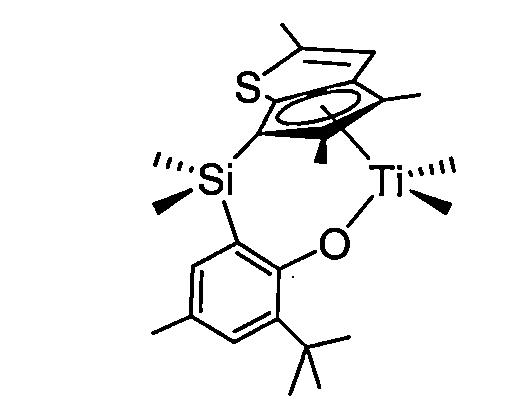
二甲基亞矽基(2,4,5-三甲基-6H-環戊[2,3-b]噻吩-6-基)(3-三級丁基-5-甲基-2-苯氧基)二甲基鈦係以實例1中相同方式製備(產率:81%,黃色固體)。 Dimethylsilylene (2,4,5-trimethyl-6H-cyclopentyl [2,3-b] thiophen-6-yl) (3-tert-butyl-5-methyl-2-benzene Oxy) dimethyl titanium was prepared in the same manner as in Example 1 (yield: 81%, yellow solid).
1HNMR(CD2Cl2):δ 7.18(m,1H),7.07(m,1H),6.89(m, 1H),2.56(s,3H),2.36(s,3H),2.31(s,3H),1.61(s,3H),1.58(s,9H),0.51(s,3H),0.43(s,3H),0.35(s,3H),0.02(s,3H);13CNMR(CD2Cl2):δ 164.54,148.69,142.46,136.12,135.55,134.54,133.14,131.14,129.59,129.51,118.09,116.24,99.60,57.41,55.19,35.25,30.06,21.14,16.88,12.72,-0.35,-1.42。 1 HNMR (CD 2 Cl 2 ): δ 7.18 (m, 1H), 7.07 (m, 1H), 6.89 (m, 1H), 2.56 (s, 3H), 2.36 (s, 3H), 2.31 (s, 3H ), 1.61 (s, 3H), 1.58 (s, 9H), 0.51 (s, 3H), 0.43 (s, 3H), 0.35 (s, 3H), 0.02 (s, 3H); 13 CNMR (CD 2 Cl 2 ): δ 164.54, 148.69, 142.46, 136.12, 135.55, 134.54, 133.14, 131.14, 129.59, 129.51, 118.09, 116.24, 99.60, 57.41, 55.19, 35.25, 30.06, 21.14, 16.88, 12.72, -0.35, -1.42.
[比較例3]二甲基亞矽基(2,3,4,5-四甲基環戊二烯)(3-三級丁基-5-甲基-2-苯氧基)二甲基鈦之製備 [Comparative Example 3] Dimethylsilylene (2,3,4,5-tetramethylcyclopentadiene) (3-tertiarybutyl-5-methyl-2-phenoxy) dimethyl Preparation of titanium

二甲基亞矽基(2,3,4,5-四甲基環戊二烯)(3-三級丁基-5-甲基-2-苯氧基)二甲基鈦係以實例1中相同方式製備。 Dimethylsilylene (2,3,4,5-tetramethylcyclopentadiene) (3-tert-butyl-5-methyl-2-phenoxy) dimethyl titanium Prepared in the same way.
1H NMR(CDCl3):δ 7.21(m,1H,Ar-H),7.17(m,1H,Ar-H),2.31(s,3H,Ar-Me),2.02(s,6H,C5Me4),1.95(s,6H,C5Me4),1.36(s,9H,Ar-tBu),0.62(s,3H,Si-Me),0.58(s,3H,Si-Me),0.21(s,3H),0.07(s,3H)。 1 H NMR (CDCl 3 ): δ 7.21 (m, 1H, Ar-H), 7.17 (m, 1H, Ar-H), 2.31 (s, 3H, Ar-Me), 2.02 (s, 6H, C 5 Me 4 ), 1.95 (s, 6H, C 5 Me 4 ), 1.36 (s, 9H, Ar-tBu), 0.62 (s, 3H, Si-Me), 0.58 (s, 3H, Si-Me), 0.21 (s, 3H), 0.07 (s, 3H).
[比較例4]二甲基亞矽基(-四甲基環戊二烯)-N-三級丁基二甲基鈦之製備 [Comparative Example 4] Preparation of dimethylsilylene (-tetramethylcyclopentadiene) -N-tertiary butyldimethyl titanium

溶解有化合物I(20毫莫耳)及Et3N(45毫莫耳)之甲苯(70毫升) 被冷卻至-78℃,且n-BuLi(己烷中2.5M,22毫莫耳)被緩慢添加至其中。在n-BuLi之添加完成後,反應混合物被升溫至室溫並攪拌20小時。在反應混合物被再次冷卻至-78℃後,甲苯(22毫升)中之TiCl4之溶液(15毫莫耳)被緩慢逐滴加入。反應溶液被加熱至室溫並攪拌16小時。反應溶液在真空下乾燥,且所得之反應產物係以己烷處理以通過填充有Celite 503之過濾器而獲得濾液。所獲得之濾液係通過真空乾燥並溶解於己烷溶劑中,並接著被冷卻至-30℃以獲得產率為58%之紅褐色固體化合物J。化合物J被溶解於乙醚(100毫升)中,冷卻至-30℃,且MeMgBr(醚中2.9M,22毫莫耳)溶液被緩慢逐滴添加至反應溶液中。反應混合物被加熱至室溫,攪拌22小時,並真空乾燥。所獲得之反應產物係通過填充有Celite 503之過濾器以戊烷處理以獲得濾液。所獲得之濾液通過真空抽氣被乾燥,且產物係溶解於戊烷(70毫升)中。接著,產物被通過Celite 503過濾,且所獲得之濾液被冷卻至-30℃以獲得產率78%、呈黃色固體之形式的二甲基亞矽基(-四甲基環戊二烯)-N-三級丁基二甲基鈦。 Toluene (70 ml) in which Compound I (20 mmol) and Et 3 N (45 mmol) were dissolved was cooled to -78 ° C, and n-BuLi (2.5 M in hexane, 22 mmol) was Add it slowly. After the addition of n-BuLi was completed, the reaction mixture was warmed to room temperature and stirred for 20 hours. After the reaction mixture was cooled to -78 ° C again, a solution (15 mmol) of TiCl4 in toluene (22 ml) was slowly added dropwise. The reaction solution was warmed to room temperature and stirred for 16 hours. The reaction solution was dried under vacuum, and the resulting reaction product was treated with hexane to obtain a filtrate through a filter filled with Celite 503. The obtained filtrate was dried by vacuum and dissolved in a hexane solvent, and then cooled to -30 ° C to obtain a red-brown solid compound J with a yield of 58%. Compound J was dissolved in diethyl ether (100 ml), cooled to -30 ° C, and a MeMgBr (2.9M in ether, 22 mmol) solution was slowly added dropwise to the reaction solution. The reaction mixture was warmed to room temperature, stirred for 22 hours, and dried under vacuum. The obtained reaction product was treated with pentane through a filter filled with Celite 503 to obtain a filtrate. The obtained filtrate was dried by vacuum evacuation, and the product was dissolved in pentane (70 ml). Next, the product was filtered through Celite 503, and the obtained filtrate was cooled to -30 ° C to obtain a dimethylsilylene (-tetramethylcyclopentadiene)-in the form of a yellow solid with a yield of 78%- N-tertiary butyl dimethyl titanium.
1H NMR(CDCl3);δ 2.15(s,6H,C5Me4),1.902(s,6H,C5Me4),1.553(s,9H,Me3CN),0.464(s,6H,Me2Si),0.159(s,6H,Me2Si) 1 H NMR (CDCl 3 ); δ 2.15 (s, 6H, C 5 Me 4 ), 1.902 (s, 6H, C 5 Me 4 ), 1.553 (s, 9H, Me 3 CN), 0.464 (s, 6H, Me 2 Si), 0.159 (s, 6H, Me 2 Si)
[實例6至15及比較例5至8]乙烯與1-己烯之共聚反應 [Examples 6 to 15 and Comparative Examples 5 to 8] Copolymerization reaction of ethylene and 1-hexene
乙烯/1-己烯共聚反應過程係如下進行:聚合反應係於在高壓下使用之配備機械攪拌器之可溫控反應器中進行。TiBA/BHT(莫耳比為1:1之三異丁基鋁/2,6-二-三級丁基-4-甲基苯酚,30微莫耳(μmol),120微升(μL),0.25M甲苯溶液)作為去除劑(scavenger),1-己烯(270微升、300微升,或450微升)及甲苯被添加至此反應 器以達到5毫升之總體積。該反應器的溫度被調整至聚合反應溫度(130℃或150℃),且接著攪拌速率被設置於800rpm。乙烯係於220psi,150℃,以及於180psi,130℃下添加以依據聚合反應溫度維持定量(constant)之乙烯。被使用之聚合反應催化劑的量為10奈米莫耳(nmole)或15奈米莫耳,且相對於聚合反應催化劑之共催化劑的量是固定為5當量(equivalents)。聚合反應催化劑被加入至該反應器,並接著聚合反應在添加5當量之該共催化劑三苯基甲基四(五氟苯基)硼酸鹽時起始(triphenylmethylium tetrakis(pentafluorophenyl)borate,TTB)。該聚合反應係進行5分鐘,或該聚合反應所製備之聚合物不超過100至200毫克之時點終止。 The ethylene / 1-hexene copolymerization process is performed as follows: The polymerization reaction is performed in a temperature-controllable reactor equipped with a mechanical stirrer for use under high pressure. TiBA / BHT (triisobutylaluminum / 2,6-di-tertiary-butyl-4-methylphenol with a molar ratio of 1: 1, 30 micromoles (μmol), 120 microliters (μL), 0.25 M toluene solution) as a scavenger, 1-hexene (270 μl, 300 μl, or 450 μl) and toluene were added to this reactor to reach a total volume of 5 ml. The temperature of the reactor was adjusted to the polymerization temperature (130 ° C or 150 ° C), and then the stirring rate was set at 800 rpm. Ethylene was added at 220 psi, 150 ° C, and at 180 psi, 130 ° C to maintain a constant amount of ethylene depending on the polymerization temperature. The amount of the polymerization catalyst used was 10 nmole or 15 nmole, and the amount of the co-catalyst relative to the polymerization catalyst was fixed at 5 equivalents. A polymerization catalyst was added to the reactor, and then the polymerization was initiated with the addition of 5 equivalents of the cocatalyst triphenylmethyl tetrakis (pentafluorophenyl) borate (TTB). The polymerization reaction is terminated for 5 minutes, or when the polymer prepared by the polymerization reaction does not exceed 100 to 200 mg.
在聚合反應完成後,反應器溫度被冷卻至室溫,且反應器中的乙烯藉由抽氣(evacuation)而被緩慢移除。所製備之聚合物接著通過真空被乾燥。 After the polymerization reaction was completed, the reactor temperature was cooled to room temperature, and the ethylene in the reactor was slowly removed by evacuation. The prepared polymer is then dried by vacuum.
實例及比較例之聚合反應條件以及所獲得之聚合物的物理特性顯示於下表1中。 The polymerization conditions of the examples and comparative examples and the physical properties of the obtained polymers are shown in Table 1 below.
如表1中所示,可以理解的是實例8至15之乙烯/1-己烯共聚反應的活性係較比較例5至8者高。特別是,可以證實的是實例7、9、11、13及15在150℃之聚合溫度下的活性被維持於高於比較例6及8的活性。可以了解的是鑒於共聚反應特徵(其係相對於1-己烯之反應性),實例之催化劑相較於比較例之結果而言具有較高等級之共聚反應反應性。可以證實的是實例之催化劑在150℃之聚合反應溫度下(相對高溫下)維持較高的共聚反應特徵。特別是,在實例9、11、13及15中可證實,即使聚合反應是在150微升之1-己烯的濃度下進行,共聚物中的1-己烯的含量是較比較例6及8高,且可以理解的是實例9、11、13及15在實例之催化劑之中具有最高的共聚特徵。可以證實的是,在所獲得之共聚物之分子量中,即使具有較高等級之共聚合反應特徵,實例之催化劑具有與在150℃之高溫下之實例聚合而得之共聚物之分子量相當的分子量。 As shown in Table 1, it can be understood that the activity of the ethylene / 1-hexene copolymerization reaction of Examples 8 to 15 is higher than that of Comparative Examples 5 to 8. In particular, it can be confirmed that the activities at the polymerization temperature of 150 ° C of Examples 7, 9, 11, 13, and 15 were maintained higher than those of Comparative Examples 6 and 8. It can be understood that in view of the copolymerization reaction characteristics (which are relative to the reactivity of 1-hexene), the catalysts of the examples have higher levels of copolymerization reactivity than the results of the comparative examples. It can be confirmed that the catalyst of the example maintains a high copolymerization reaction characteristic at a polymerization reaction temperature of 150 ° C (at a relatively high temperature). In particular, it was confirmed in Examples 9, 11, 13, and 15 that even if the polymerization was performed at a concentration of 150 microliters of 1-hexene, the content of 1-hexene in the copolymer was higher than that of Comparative Examples 6 and 8 high, and it is understandable that Examples 9, 11, 13 and 15 have the highest copolymerization characteristics among the catalysts of Examples. It can be confirmed that, among the molecular weights of the obtained copolymers, even if the copolymerization characteristics of higher grades are possessed, the catalyst of the example has a molecular weight equivalent to that of the copolymer obtained by polymerizing the example at a high temperature of 150 ° C .
如上所述,可以證實的是,在高溫共聚反應條件下,相較於比較例之催化劑,實例之催化劑具有高等級之共聚反應特徵及聚合反應活性,且可以證實所獲得之共聚物的分子量是與由比較例之催化劑所製備之共聚物的分子量相當。 As described above, it can be confirmed that, compared with the catalyst of the comparative example, the catalyst of the example has high-level copolymerization reaction characteristics and polymerization activity under high temperature copolymerization reaction conditions, and it can be confirmed that the molecular weight of the obtained copolymer is The molecular weight is comparable to the copolymer prepared from the catalyst of the comparative example.
[實例16至18及比較例9至14]乙烯及1-辛烯之共聚反應 [Examples 16 to 18 and Comparative Examples 9 to 14] Copolymerization reaction of ethylene and 1-octene
乙烯/1-辛烯共聚反應過程係如下進行: 聚合反應係於配備有機械攪拌器之可溫控連續聚合反應反應器中進行。 The ethylene / 1-octene copolymerization process is performed as follows: The polymerization reaction is performed in a temperature-controllable continuous polymerization reactor equipped with a mechanical stirrer.
亞甲基環己烷溶劑、1-辛烯,以及乙烯單體在40巴(bar)的壓力下被進料至在130至200℃下預熱之1.0升(L)之連續攪拌反應器中。共聚合 反應通過將聚合反應催化劑及AnB(N,N-二甲基苯銨四(五氟苯基)硼酸鹽,N,N-dimethylanilinium tetrakis(pentafluorophenyl)borate)或TTB(三苯基甲基四(五氟苯基)硼酸鹽,triphenylmethylium tetrakis(pentafluorophenyl)borate)之共催化劑由催化劑儲存槽進料至該反應器而進行。反應溶劑、甲基環己烷以每小時5公斤的量被進料至該反應器,該反應器的滯留時間(residence time)被調整至約8分鐘,且乙烯在根據8、10及12之C2/MCH比例將其量調節於每小時約400至600克的情況下進料至該反應器內。該聚合反應係在130至200℃之相對高溫下進行。一定量之被進料之催化劑是在其量被調節的情況下進料至該反應器,使得進料溫度以及反應器溫度之間的溫度差被維持。由共聚反應而形成的聚合物溶液在該反應器的後端被解壓(decompressed)至3巴,並接著被送至溶劑分離器以藉由溶劑分離程序移除大部分的溶劑。依據上述內容進行而獲得之聚合反應結果總結於下表2中。 Methylene cyclohexane solvent, 1-octene, and ethylene monomer were fed at a pressure of 40 bar into a continuously stirred reactor of 1.0 liter (L) preheated at 130 to 200 ° C. . The copolymerization reaction is performed by using a polymerization catalyst and AnB (N, N-dimethylanilinium tetrakis (pentafluorophenyl) borate, N, N-dimethylanilinium tetrakis (pentafluorophenyl) borate) or TTB (triphenylmethyltetra The co-catalyst of (pentafluorophenyl) borate, triphenylmethylium tetrakis (pentafluorophenyl) borate) is fed from the catalyst storage tank to the reactor. The reaction solvent, methylcyclohexane was fed to the reactor in an amount of 5 kg per hour, and the residence time of the reactor was adjusted to about 8 minutes, and ethylene was used in accordance with 8, 10, and 12. The C2 / MCH ratio is adjusted to the amount fed to the reactor at about 400 to 600 grams per hour. The polymerization reaction is performed at a relatively high temperature of 130 to 200 ° C. A certain amount of the catalyst to be fed is fed to the reactor with its amount adjusted so that the temperature between the feed temperature and the reactor temperature is maintained. The polymer solution formed by the copolymerization reaction is decompressed to 3 bar at the rear end of the reactor, and then sent to a solvent separator to remove most of the solvent by a solvent separation process. The polymerization results obtained according to the above are summarized in Table 2 below.
如以上表2所示,藉由證實在相同聚合反應溫度條件下(實例16及20 vs比較例9及12)本發明之催化劑的進料量小,可以了解的是當本發明之過渡金屬化合物被使用作為聚合反應催化劑時,乙烯/1-辛烯聚合反應活性比使用已知催化劑之已烯/1-辛烯聚合反應活性高。特別是,可以證實的是在150℃之聚合反應溫度下,實例18、19、22及23之活性被維持於高於比較例10及13者。鑒於共聚合反應特徵(其係對於1-辛烯之反應性),實例之催化劑即使在低C8/C2比例下,可以製備低密度共聚物,由此可以理解相對於比較例之結果,實例之催化劑具有相對高等級之共聚反應反應性。可以證實的是實例之催化劑在150℃之聚合反應溫度下(其係被認為在製備低密度聚乙烯中的高聚合反應溫度)維持高共聚合反應特徵。特別是,可以證實在實例24至26中,即使在150℃及160℃之高聚合反應溫度下,具有0.87克/毫升之高分子量的低密度聚乙烯可以在低C8/C2比例之條件下被製備。不像比較例14,可以被證實的是在實例27及28中,在0.901或0.915克/毫升之密度的線性低密度區域具有高分子量的共聚物可在180℃及200℃之非常高的聚合反應溫度下被製備。如表2所示,可以證實的是,相較於比較例之催化劑,實例之催化劑在140℃或更高之高聚合反應溫度下具有高共聚反應特徵,且可以製備具有高等級之分子量的低密度至中密度聚乙烯。 As shown in Table 2 above, by confirming that the amount of the catalyst of the present invention is small under the same polymerization reaction temperature conditions (Examples 16 and 20 vs Comparative Examples 9 and 12), it can be understood that when the transition metal compound of the present invention When used as a polymerization catalyst, ethylene / 1-octene polymerization activity is higher than that of hexene / 1-octene polymerization using a known catalyst. In particular, it was confirmed that the activities of Examples 18, 19, 22, and 23 were maintained higher than those of Comparative Examples 10 and 13 at a polymerization reaction temperature of 150 ° C. In view of the characteristics of the copolymerization reaction (which is the reactivity to 1-octene), the catalysts of the examples can prepare low-density copolymers even at low C8 / C2 ratios, so it can be understood that the results relative to the comparative examples, the examples are The catalyst has a relatively high level of copolymerization reactivity. It can be confirmed that the catalysts of the examples maintain high copolymerization characteristics at a polymerization temperature of 150 ° C., which is considered to be a high polymerization temperature in the preparation of low density polyethylene. In particular, it can be confirmed that in Examples 24 to 26, even at high polymerization temperatures of 150 ° C and 160 ° C, a low-density polyethylene having a high molecular weight of 0.87 g / ml can be used at a low C8 / C2 ratio. preparation. Unlike Comparative Example 14, it can be confirmed that in Examples 27 and 28, a copolymer having a high molecular weight in a linear low-density region having a density of 0.901 or 0.915 g / ml can be polymerized at 180 ° C and 200 ° C at a very high level. Prepared at reaction temperature. As shown in Table 2, it can be confirmed that, compared with the catalyst of the comparative example, the catalyst of the example has a high copolymerization characteristic at a high polymerization reaction temperature of 140 ° C or higher, and a low molecular weight having a high grade can be prepared. Density to medium density polyethylene.
雖然本發明之實例係以上述較為詳細的方式揭示,所屬技術領域具有通常知識者可以了解本發明之各種修飾可以在不背離界定於所附之申請專利範圍中之本發明的範圍之下進行。因此,本發明之實例的進一步修飾將不會偏離本發明之技術。 Although the examples of the present invention are disclosed in the above detailed manner, those skilled in the art can understand that various modifications of the present invention can be made without departing from the scope of the present invention defined in the scope of the attached patent application. Therefore, further modifications of the examples of the present invention will not depart from the technology of the present invention.
Claims (17)


Applications Claiming Priority (3)
| Application Number | Priority Date | Filing Date | Title |
|---|---|---|---|
| KR1020170105468A KR102100134B1 (en) | 2017-08-21 | 2017-08-21 | New transition metal complexes, catalysts composition containing the same, and methods for preparing ethylene homopolymers or copolymers of ethylene and α-olefins using the same |
| ??10-2017-0105468 | 2017-08-21 | ||
| KR10-2017-0105468 | 2017-08-21 |
Publications (2)
| Publication Number | Publication Date |
|---|---|
| TW201912649A TW201912649A (en) | 2019-04-01 |
| TWI676633B true TWI676633B (en) | 2019-11-11 |
Family
ID=65438438
Family Applications (1)
| Application Number | Title | Priority Date | Filing Date |
|---|---|---|---|
| TW107121204A TWI676633B (en) | 2017-08-21 | 2018-06-21 | Novel transition metal compound, catalyst composition including the same, and method for preparing ethylene homopolymer or copolymer of ethylene and α-olefin using the same |
Country Status (7)
| Country | Link |
|---|---|
| US (1) | US11339230B2 (en) |
| JP (1) | JP7213252B2 (en) |
| KR (1) | KR102100134B1 (en) |
| CN (1) | CN111247157B (en) |
| SA (1) | SA520411326B1 (en) |
| TW (1) | TWI676633B (en) |
| WO (1) | WO2019038605A1 (en) |
Families Citing this family (6)
| Publication number | Priority date | Publication date | Assignee | Title |
|---|---|---|---|---|
| EP4334367A1 (en) * | 2021-05-07 | 2024-03-13 | Oxford University Innovation Limited | Polymerisation of propylene |
| US20240239925A1 (en) * | 2021-05-07 | 2024-07-18 | Oxford University Innovation Limited | Catalysts |
| CN113501850B (en) * | 2021-07-06 | 2023-08-15 | 山东京博石油化工有限公司 | A bridged nitrogen-containing heterocyclic metallocene compound, its preparation method and application |
| CN114315916B (en) * | 2021-12-30 | 2023-11-07 | 山东京博石油化工有限公司 | Bridged metallocene compound with oxygen-containing and sulfur heterocyclic structures and application thereof |
| WO2024074937A1 (en) * | 2022-10-07 | 2024-04-11 | Sabic Sk Nexlene Company Pte. Ltd. | Transition metal compound, catalyst composition containing the same, and method for preparing olefin polymer using the same |
| CN115572341B (en) * | 2022-11-04 | 2024-04-23 | 大连万慷工业科技有限公司 | Functionalized polyolefin elastomer and preparation method thereof |
Citations (5)
| Publication number | Priority date | Publication date | Assignee | Title |
|---|---|---|---|---|
| JP2007177187A (en) * | 2005-12-28 | 2007-07-12 | Nippon Polyethylene Kk | Polyethylene film and use thereof |
| CN101014629A (en) * | 2004-08-27 | 2007-08-08 | 三井化学株式会社 | Catalysts for olefin polymerization, process for production of olefin polymers, olefin copolymers, novel transition metal compounds, and process for production of transition metal compounds |
| WO2016196293A1 (en) * | 2015-05-29 | 2016-12-08 | Dow Global Technologies Llc | A process for producing a polyolefin |
| CN106279485A (en) * | 2011-03-30 | 2017-01-04 | 日本聚乙烯株式会社 | Polyvinyls, polythylene resin composition and application thereof, catalyst for olefines polymerizing composition, the catalyst for olefines polymerizing comprising described composition and the method using described Catalyst Production polyvinyls |
| KR20170075529A (en) * | 2015-12-23 | 2017-07-03 | 주식회사 엘지화학 | Transition metal compound, catalyst composition comprising the same, and method for preparing olefin polymer using the same |
Family Cites Families (19)
| Publication number | Priority date | Publication date | Assignee | Title |
|---|---|---|---|---|
| US4752597A (en) | 1985-12-12 | 1988-06-21 | Exxon Chemical Patents Inc. | New polymerization catalyst |
| JPS6392621A (en) | 1986-10-08 | 1988-04-23 | Mitsubishi Petrochem Co Ltd | Manufacturing method of ethylene copolymer |
| US5198401A (en) | 1987-01-30 | 1993-03-30 | Exxon Chemical Patents Inc. | Ionic metallocene catalyst compositions |
| US5055438A (en) | 1989-09-13 | 1991-10-08 | Exxon Chemical Patents, Inc. | Olefin polymerization catalysts |
| DE3742934A1 (en) | 1987-12-18 | 1989-06-29 | Hoechst Ag | METHOD FOR PRODUCING A CHIRAL, STEREORIGIDAL METALLOCEN COMPOUND |
| JPH0284405A (en) | 1988-09-20 | 1990-03-26 | Mitsubishi Petrochem Co Ltd | Production method of ethylene polymer |
| GB8828206D0 (en) | 1988-12-02 | 1989-01-05 | Shell Int Research | Process for conversion of hydrocarbonaceous feedstock |
| JP2926836B2 (en) | 1989-02-22 | 1999-07-28 | 住友電気工業株式会社 | Nitrogen-containing cermet alloy |
| NZ235032A (en) | 1989-08-31 | 1993-04-28 | Dow Chemical Co | Constrained geometry complexes of titanium, zirconium or hafnium comprising a substituted cyclopentadiene ligand; use as olefin polymerisation catalyst component |
| KR100414757B1 (en) * | 1995-07-14 | 2004-06-04 | 스미또모 가가꾸 고오교오 가부시끼가이샤 | Transition metal complex, its production method, olefin polymerization catalyst containing the transition metal complex, and production method of olefin polymer |
| JP3378436B2 (en) * | 1995-07-14 | 2003-02-17 | 住友化学工業株式会社 | Olefin polymerization catalyst component comprising a transition metal complex, olefin polymerization catalyst containing the catalyst component, and method for producing olefin polymer |
| JP4414028B2 (en) * | 1998-09-09 | 2010-02-10 | 住友化学株式会社 | Modified aluminum oxy compound, catalyst component for addition polymerization, catalyst for addition polymerization, method for producing olefin polymer, method for producing alkenyl aromatic hydrocarbon polymer, and copolymer |
| JP4062929B2 (en) * | 2002-02-08 | 2008-03-19 | 住友化学株式会社 | Transition metal complex, ligand, catalyst for olefin polymerization, and method for producing olefin polymer |
| JP4225079B2 (en) * | 2003-02-25 | 2009-02-18 | 住友化学株式会社 | Transition metal complexes and catalysts for olefin polymerization |
| CN101107260B (en) * | 2005-01-28 | 2012-02-08 | 住友化学株式会社 | Transition metal complex, method for preparing said transition metal complex, substituted fluorene compound, method for preparing said substituted fluorene compound, catalyst component for olefin polymerization, catalyst for olefin polymerization, and preparation of olefin polymer Methods |
| JP5082247B2 (en) * | 2005-01-28 | 2012-11-28 | 住友化学株式会社 | Process for producing alkoxytitanium complex |
| WO2006080479A1 (en) * | 2005-01-28 | 2006-08-03 | Sumitomo Chemical Company, Limited | Method for producing alkoxytitanium complex |
| JP2006347899A (en) * | 2005-06-13 | 2006-12-28 | Mitsui Chemicals Inc | Transition metal compound, method for producing transition metal compound, olefin polymerization catalyst component composed of transition metal compound and method for polymerizing olefin by using olefin polymerization catalyst component |
| WO2014169017A1 (en) | 2013-04-11 | 2014-10-16 | Exxonmobil Chemical Patents Inc. | Process of producing polyolefins using metallocene polymerization catalysts and copolymers therefrom |
-
2017
- 2017-08-21 KR KR1020170105468A patent/KR102100134B1/en active Active
-
2018
- 2018-06-19 US US16/641,190 patent/US11339230B2/en active Active
- 2018-06-19 WO PCT/IB2018/054486 patent/WO2019038605A1/en not_active Ceased
- 2018-06-19 JP JP2020531827A patent/JP7213252B2/en active Active
- 2018-06-19 CN CN201880068379.6A patent/CN111247157B/en active Active
- 2018-06-21 TW TW107121204A patent/TWI676633B/en active
-
2020
- 2020-02-20 SA SA520411326A patent/SA520411326B1/en unknown
Patent Citations (5)
| Publication number | Priority date | Publication date | Assignee | Title |
|---|---|---|---|---|
| CN101014629A (en) * | 2004-08-27 | 2007-08-08 | 三井化学株式会社 | Catalysts for olefin polymerization, process for production of olefin polymers, olefin copolymers, novel transition metal compounds, and process for production of transition metal compounds |
| JP2007177187A (en) * | 2005-12-28 | 2007-07-12 | Nippon Polyethylene Kk | Polyethylene film and use thereof |
| CN106279485A (en) * | 2011-03-30 | 2017-01-04 | 日本聚乙烯株式会社 | Polyvinyls, polythylene resin composition and application thereof, catalyst for olefines polymerizing composition, the catalyst for olefines polymerizing comprising described composition and the method using described Catalyst Production polyvinyls |
| WO2016196293A1 (en) * | 2015-05-29 | 2016-12-08 | Dow Global Technologies Llc | A process for producing a polyolefin |
| KR20170075529A (en) * | 2015-12-23 | 2017-07-03 | 주식회사 엘지화학 | Transition metal compound, catalyst composition comprising the same, and method for preparing olefin polymer using the same |
Also Published As
| Publication number | Publication date |
|---|---|
| US20210139617A1 (en) | 2021-05-13 |
| TW201912649A (en) | 2019-04-01 |
| JP7213252B2 (en) | 2023-01-26 |
| CN111247157B (en) | 2023-03-28 |
| KR20190020467A (en) | 2019-03-04 |
| JP2020531584A (en) | 2020-11-05 |
| KR102100134B1 (en) | 2020-04-13 |
| CN111247157A (en) | 2020-06-05 |
| WO2019038605A1 (en) | 2019-02-28 |
| SA520411326B1 (en) | 2022-11-13 |
| US11339230B2 (en) | 2022-05-24 |
Similar Documents
| Publication | Publication Date | Title |
|---|---|---|
| TWI676633B (en) | Novel transition metal compound, catalyst composition including the same, and method for preparing ethylene homopolymer or copolymer of ethylene and α-olefin using the same | |
| JP6469832B2 (en) | Ligand compound, transition metal compound and catalyst composition containing the same | |
| KR101060838B1 (en) | Bis-arylaryloxy catalyst system for preparing ethylene homopolymer or copolymer with α-olefin | |
| JP6711906B2 (en) | Hybrid supported metallocene catalyst and method for producing polyolefin using the same | |
| CA2838097C (en) | Cyclopenta[b]fluorenyl transition metal compound, catalyst composition containing the same, and method of preparing ethylene homopolymer or copolymer of ethylene and .alpha.-olefin using the same | |
| JP6442536B2 (en) | Ligand compound, transition metal compound and catalyst composition containing the same | |
| JP2017530247A (en) | Hybrid supported catalyst and method for producing olefin polymer using the same | |
| KR101470564B1 (en) | Method for preparing elastomeric copolymers of ethylene and a-olefins | |
| US10544247B2 (en) | Supported hybrid metallocene catalyst, and method for preparing polyolefin using the same | |
| TWI431012B (en) | Transition metal catalytic systems and methods for preparing ethylene homopolymers or copolymers of ethylene and α-olefins using the same | |
| TWI754776B (en) | A NOVEL INDENE-BASED TRANSITION METAL COMPLEXES, CATALYSTS COMPOSITION CONTAINING THE SAME, AND METHODS FOR PREPARING ETHYLENE HOMOPOLYMERS OR COPOLYMERS OF ETHYLENE AND α-OLEFINS USING THE SAME | |
| KR102101878B1 (en) | Supported hybrid catalyst system for propylene polymerization and method for preparing propylene polymer with the catalyst system | |
| KR102418590B1 (en) | Method for preparing supported hybrid metallocene catalyst, and method for preparing polypropylene using supported hybrid metallocene catalyst | |
| TWI667244B (en) | Novel indene-based transition metal compound, catalyst composition comprising the same, and method for preparing ethylene homopolymer or copolymer of ethylene and a-olefin using the same | |
| KR102065163B1 (en) | Transition metal compound and catalytic composition comprising thereof | |
| TWI646102B (en) | Novel cyclopenta[b]thiophenyl transition metal compound, transition metal catalyst composition comprising the same, and method for preparing ethylene homopolymer or copolymer of ethylene and a-olefin using the same | |
| KR102034133B1 (en) | New transition metal complexes, catalysts composition containing the same, and methods for preparing ethylene homopolymers or copolymers of ethylene and α-olefins using the same | |
| CN111094306B (en) | Ligand compound, transition metal compound and catalyst composition comprising the same | |
| CN121646613A (en) | Hybrid supported metallocene catalyst and method for preparing polyethylene using the same |