TW202134214A - Process for the preparation of 5-chloro-pyridine-2-carboxylic acid amides and carboxylates with 3-sulfur containing substituents - Google Patents
Process for the preparation of 5-chloro-pyridine-2-carboxylic acid amides and carboxylates with 3-sulfur containing substituents Download PDFInfo
- Publication number
- TW202134214A TW202134214A TW110107290A TW110107290A TW202134214A TW 202134214 A TW202134214 A TW 202134214A TW 110107290 A TW110107290 A TW 110107290A TW 110107290 A TW110107290 A TW 110107290A TW 202134214 A TW202134214 A TW 202134214A
- Authority
- TW
- Taiwan
- Prior art keywords
- formula
- compound
- hydrogen
- alkyl
- pyridyl
- Prior art date
Links
Classifications
-
- C—CHEMISTRY; METALLURGY
- C07—ORGANIC CHEMISTRY
- C07D—HETEROCYCLIC COMPOUNDS
- C07D213/00—Heterocyclic compounds containing six-membered rings, not condensed with other rings, with one nitrogen atom as the only ring hetero atom and three or more double bonds between ring members or between ring members and non-ring members
- C07D213/02—Heterocyclic compounds containing six-membered rings, not condensed with other rings, with one nitrogen atom as the only ring hetero atom and three or more double bonds between ring members or between ring members and non-ring members having three double bonds between ring members or between ring members and non-ring members
- C07D213/04—Heterocyclic compounds containing six-membered rings, not condensed with other rings, with one nitrogen atom as the only ring hetero atom and three or more double bonds between ring members or between ring members and non-ring members having three double bonds between ring members or between ring members and non-ring members having no bond between the ring nitrogen atom and a non-ring member or having only hydrogen or carbon atoms directly attached to the ring nitrogen atom
- C07D213/60—Heterocyclic compounds containing six-membered rings, not condensed with other rings, with one nitrogen atom as the only ring hetero atom and three or more double bonds between ring members or between ring members and non-ring members having three double bonds between ring members or between ring members and non-ring members having no bond between the ring nitrogen atom and a non-ring member or having only hydrogen or carbon atoms directly attached to the ring nitrogen atom with hetero atoms or with carbon atoms having three bonds to hetero atoms with at the most one bond to halogen, e.g. ester or nitrile radicals, directly attached to ring carbon atoms
- C07D213/78—Carbon atoms having three bonds to hetero atoms, with at the most one bond to halogen, e.g. ester or nitrile radicals
- C07D213/79—Acids; Esters
-
- A—HUMAN NECESSITIES
- A01—AGRICULTURE; FORESTRY; ANIMAL HUSBANDRY; HUNTING; TRAPPING; FISHING
- A01N—PRESERVATION OF BODIES OF HUMANS OR ANIMALS OR PLANTS OR PARTS THEREOF; BIOCIDES, e.g. AS DISINFECTANTS, AS PESTICIDES OR AS HERBICIDES; PEST REPELLANTS OR ATTRACTANTS; PLANT GROWTH REGULATORS
- A01N43/00—Biocides, pest repellants or attractants, or plant growth regulators containing heterocyclic compounds
- A01N43/34—Biocides, pest repellants or attractants, or plant growth regulators containing heterocyclic compounds having rings with one nitrogen atom as the only ring hetero atom
- A01N43/40—Biocides, pest repellants or attractants, or plant growth regulators containing heterocyclic compounds having rings with one nitrogen atom as the only ring hetero atom six-membered rings
-
- C—CHEMISTRY; METALLURGY
- C07—ORGANIC CHEMISTRY
- C07D—HETEROCYCLIC COMPOUNDS
- C07D213/00—Heterocyclic compounds containing six-membered rings, not condensed with other rings, with one nitrogen atom as the only ring hetero atom and three or more double bonds between ring members or between ring members and non-ring members
- C07D213/02—Heterocyclic compounds containing six-membered rings, not condensed with other rings, with one nitrogen atom as the only ring hetero atom and three or more double bonds between ring members or between ring members and non-ring members having three double bonds between ring members or between ring members and non-ring members
- C07D213/04—Heterocyclic compounds containing six-membered rings, not condensed with other rings, with one nitrogen atom as the only ring hetero atom and three or more double bonds between ring members or between ring members and non-ring members having three double bonds between ring members or between ring members and non-ring members having no bond between the ring nitrogen atom and a non-ring member or having only hydrogen or carbon atoms directly attached to the ring nitrogen atom
- C07D213/60—Heterocyclic compounds containing six-membered rings, not condensed with other rings, with one nitrogen atom as the only ring hetero atom and three or more double bonds between ring members or between ring members and non-ring members having three double bonds between ring members or between ring members and non-ring members having no bond between the ring nitrogen atom and a non-ring member or having only hydrogen or carbon atoms directly attached to the ring nitrogen atom with hetero atoms or with carbon atoms having three bonds to hetero atoms with at the most one bond to halogen, e.g. ester or nitrile radicals, directly attached to ring carbon atoms
- C07D213/78—Carbon atoms having three bonds to hetero atoms, with at the most one bond to halogen, e.g. ester or nitrile radicals
- C07D213/81—Amides; Imides
Landscapes
- Chemical & Material Sciences (AREA)
- Organic Chemistry (AREA)
- Life Sciences & Earth Sciences (AREA)
- Agronomy & Crop Science (AREA)
- Pest Control & Pesticides (AREA)
- Plant Pathology (AREA)
- Health & Medical Sciences (AREA)
- Engineering & Computer Science (AREA)
- Dentistry (AREA)
- General Health & Medical Sciences (AREA)
- Wood Science & Technology (AREA)
- Zoology (AREA)
- Environmental Sciences (AREA)
- Pyridine Compounds (AREA)
- Pharmaceuticals Containing Other Organic And Inorganic Compounds (AREA)
Abstract

Description
本發明關於可用作用於製備農用化學品之中間體的具有3-含硫取代基的5-氯吡啶-2-甲酸醯胺以及甲酸鹽的製備。The present invention relates to the preparation of 5-chloropyridine-2-carboxylic acid amides with 3-sulfur-containing substituents and formates which can be used as intermediates for the preparation of agricultural chemicals.
某些具有3-烷基氫硫基取代基的5-鹵代-吡啶-2-甲酸(及其某些對應的酯、醯胺和鹽)可用作用於製備農用化學工業中的生物活性化合物之中間體,如先前例如在以下中描述的:WO 2016/005263、WO 2016/030229、WO 2016/059145、WO 2016/096584、WO 2016/104746、WO 2018/059145、WO 2019/065568和JP 2019081800。Certain 5-halo-pyridine-2-carboxylic acids (and some of their corresponding esters, amides, and salts) with 3-alkyl sulfhydryl substituents can be used as bioactive compounds in the agrochemical industry. Intermediates, as previously described for example in the following: WO 2016/005263, WO 2016/030229, WO 2016/059145, WO 2016/096584, WO 2016/104746, WO 2018/059145, WO 2019/065568 and JP 2019081800.
如本文使用的,術語「C1 -C4 烷基」係指具有1至4個碳原子的經由該等碳原子中任一個附接的飽和直鏈或支鏈烴基,例如以下基團中的任一個:甲基、乙基、正丙基、丁基、二級丁基、三級丁基。As used herein, the term "C 1 -C 4 alkyl" refers to a saturated linear or branched hydrocarbon group having 1 to 4 carbon atoms attached via any of these carbon atoms, such as in the following groups Any one: methyl, ethyl, n-propyl, butyl, secondary butyl, tertiary butyl.
鹵代烷基基團較佳的是具有1至4個碳原子的鏈長。C1 -C4 鹵代烷基係例如氟甲基、二氟甲基、三氟甲基、氯甲基、二氯甲基、三氯甲基、2,2,2-三氟乙基、2-氟乙基、2-氯乙基、2,2-二氟乙基、五氟乙基、1,1-二氟-2,2,2-三氯乙基、2,2,3,3-四氟乙基和2,2,2-三氯乙基。The haloalkyl group preferably has a chain length of 1 to 4 carbon atoms. C 1 -C 4 haloalkyl series such as fluoromethyl, difluoromethyl, trifluoromethyl, chloromethyl, dichloromethyl, trichloromethyl, 2,2,2-trifluoroethyl, 2- Fluoroethyl, 2-chloroethyl, 2,2-difluoroethyl, pentafluoroethyl, 1,1-difluoro-2,2,2-trichloroethyl, 2,2,3,3- Tetrafluoroethyl and 2,2,2-trichloroethyl.
羥烷基基團較佳的是具有1個至4個碳原子的鏈長。C1 -C4 羥烷基係例如甲氧基甲基、甲氧基乙基、乙氧基甲基、乙氧基乙基、正丙氧基甲基、正丙氧基乙基、異丙氧基甲基或異丙氧基乙基。The hydroxyalkyl group preferably has a chain length of 1 to 4 carbon atoms. C 1 -C 4 hydroxyalkyl groups such as methoxymethyl, methoxyethyl, ethoxymethyl, ethoxyethyl, n-propoxymethyl, n-propoxyethyl, isopropyl Oxymethyl or isopropoxyethyl.
如本文使用的,術語「芳基」係指僅由碳原子和氫原子組成的芳香族環系統,該芳香族環系統可為單環的、二環的或三環的。此類環系統之實例包括苯基、萘基、蒽基、茚基或菲基;較佳的是苯基。As used herein, the term "aryl" refers to an aromatic ring system composed only of carbon atoms and hydrogen atoms, and the aromatic ring system may be monocyclic, bicyclic, or tricyclic. Examples of such ring systems include phenyl, naphthyl, anthryl, indenyl or phenanthryl; preferred is phenyl.
如本文使用的,術語「雜芳基」一般係指包含1、2、3或4個單獨地選自氮、氧和硫的雜原子的5-或6-員單環芳香族環基團。雜芳基基團經碳原子鍵合至分子的剩餘部分。雜芳基之實例可包括吡啶基、嘧啶基、吡咯基、吡唑基、呋喃基、噻吩基、咪唑基、異㗁唑基、㗁唑基、噻唑基、異噻唑基、三唑基、㗁二唑基、噻二唑基、四唑基、吡𠯤基、嗒𠯤基、三𠯤基、哌喃基;較佳的是吡啶基。As used herein, the term "heteroaryl" generally refers to a 5- or 6-membered monocyclic aromatic ring group containing 1, 2, 3, or 4 heteroatoms individually selected from nitrogen, oxygen, and sulfur. The heteroaryl group is bonded to the rest of the molecule via a carbon atom. Examples of heteroaryl groups may include pyridyl, pyrimidinyl, pyrrolyl, pyrazolyl, furyl, thienyl, imidazolyl, isoazolyl, oxazolyl, thiazolyl, isothiazolyl, triazolyl, 㗁Diazolyl, thiadiazolyl, tetrazolyl, pyridine, triazole, piperanyl; preferably pyridyl.
在一個實施方式中,雜芳基視需要被例如,1個或2個選自胺基、C1 -C4 烷胺基(較佳的是甲胺基)和C1 -C4 鹵代烷基(較佳的是三氟甲基)的取代基取代。In one embodiment, the heteroaryl group is optionally selected from, for example, 1 or 2 selected from the group consisting of amino, C 1 -C 4 alkylamino (preferably methylamino) and C 1 -C 4 haloalkyl ( Preferably, the substituents of trifluoromethyl) are substituted.
如本文使用的,術語「C3 -C7 環烷基」係指3-7員環烷基基團,如環丙烷、環丁烷、環丙烷、環戊烷、環己烷和環庚烷。As used herein, the term "C 3 -C 7 cycloalkyl" refers to a 3-7 membered cycloalkyl group, such as cyclopropane, cyclobutane, cyclopropane, cyclopentane, cyclohexane, and cycloheptane .
更特別地,本發明關於具有式I之5-氯吡啶-2-甲酸醯胺或具有式 (I) 之化合物的農用化學上可接受的鹽,並且關於其製備方法
本發明還關於具有式II之5-氯吡啶-2-甲酸及其鹽,並且關於其製備方法
5-鹵代-吡啶-2-甲酸以及具有3-烷基氫硫基取代基的甲酸鹽的已知合成涉及許多反應步驟。例如,已經報導了獲得5-溴衍生物的兩種途徑(途徑A:CN 105218437;途徑B:US2012/0165338或J. Org. Chem.
[有機化學期刊]2009
, 74, 4547-4553),並且這兩種途徑示於方案1中(R1
係H、C1
-C4
烷基或鹼金屬離子)。
在WO 2016/104746中已報導了如方案2中所示從可商購的5,6-二氯菸鹼酸在七個步驟中獲得相應的5-碘衍生物。
先前未報導過含有5-氯取代基的具有式 (II) 之甲酸鹽或具有式 (II) 之醯胺,然而原則上可使用熟悉該項技術者熟知的方法如上所述類似地進行製備。儘管如此,此類費時且費力的合成由於總產率低且產生大量廢物而不適用於製備大量材料。It has not been previously reported that the formate salt of formula (II) or the amide of formula (II) containing 5-chloro substituents, but in principle can be prepared similarly as described above using methods familiar to those skilled in the art . Nevertheless, such time-consuming and laborious synthesis is not suitable for the preparation of large amounts of materials due to low overall yields and large amounts of waste.
因此,獲得對該等有用的中間體更有效且更經濟的途徑將係有利的。Therefore, it would be advantageous to obtain a more efficient and economical approach to these useful intermediates.
3,5-二氯吡啶-2-甲酸的醯胺係方便的起始原料,因為它們可藉由標準方法從可商購的3,5-二氯吡啶-2-甲酸及其酯或者藉由胺基羰基化從2,3,5-三氯吡啶容易地製備。也可以藉由使用標準方法對可商購的3,5-二氯吡啶-2-甲腈進行半水解來製備3,5-二氯吡啶-2-甲醯胺。然後在3-位置對氯進行選擇性置換將產出具有式 (I) 之化合物,其中R1
和R2
係如先前所定義的。如有需要,可以使用標準方法水解具有結構 (I) 之化合物,以產出具有式 (II) 之化合物,其中R3
係H、Li、Na或K(方案3)。
已在Synth.Comm.[合成通訊雜誌] 1995, 899中報導了苯基系列中鹵素的鄰位選擇性置換(方案4),吡啶甲酸系列中的類似轉化係未知的。
然而,將針對具有式 (III) 之化合物的轉化報導的條件直接應用於具有式 (I) 之化合物導致非常低的選擇性或者完全形成不需要的異構物作為主要產物。However, applying the conditions reported for the conversion of compounds of formula (III) directly to compounds of formula (I) results in very low selectivity or complete formation of undesired isomers as the main product.
因此,根據本發明,提供了一種用於製備具有式I之化合物之方法:

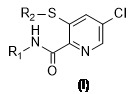

在一個實施方式中,R1 係氫、C1 -C4 烷基、C1 -C4 羥烷基、C3 -C7 環烷基、芳基或視需要取代的雜芳基,並且R2 係C1 -C4 烷基;較佳的是,R1 係C1 -C4 烷基或氫,並且R2 係乙基;更較佳的是,R1 係氫,並且R2 係乙基。In one embodiment, R 1 is hydrogen, C 1 -C 4 alkyl, C 1 -C 4 hydroxyalkyl, C 3 -C 7 cycloalkyl, aryl or optionally substituted heteroaryl, and R 2 is C 1 -C 4 alkyl; preferably, R 1 is C 1 -C 4 alkyl or hydrogen, and R 2 is ethyl; more preferably, R 1 is hydrogen, and R 2 is Ethyl.
在另一個實施方式中,R1 係氫、C1 -C2 烷基、C1 -C2 羥烷基、C3 -C5 環烷基、苯基、吡啶基或者可以被胺基、甲胺基或三氟甲基單或雙取代的吡啶基,並且R2 係C1 -C2 烷基;較佳的是,R1 係甲基或氫,並且R2 係乙基。In another embodiment, R 1 is hydrogen, C 1 -C 2 alkyl, C 1 -C 2 hydroxyalkyl, C 3 -C 5 cycloalkyl, phenyl, pyridyl or can be substituted by amino, methyl Amino or trifluoromethyl mono- or di-substituted pyridyl group, and R 2 is a C 1 -C 2 alkyl group; preferably, R 1 is a methyl group or hydrogen, and R 2 is an ethyl group.
在另外的實施方式中,R1 係氫、甲基、乙基、苯基、環丙基、環戊基、羥甲基、羥乙基、吡啶基或2-(甲胺基)-5-(三氟甲基)-3-吡啶基,並且R2 係乙基;較佳的是,R1 係氫、乙基、苯基、環戊基、羥乙基或2-(甲胺基)-5-(三氟甲基)-3-吡啶基,並且R2 係乙基。In another embodiment, R 1 is hydrogen, methyl, ethyl, phenyl, cyclopropyl, cyclopentyl, hydroxymethyl, hydroxyethyl, pyridyl or 2-(methylamino)-5- (Trifluoromethyl)-3-pyridyl, and R 2 is ethyl; preferably, R 1 is hydrogen, ethyl, phenyl, cyclopentyl, hydroxyethyl or 2-(methylamino) -5-(trifluoromethyl)-3-pyridyl, and R 2 is an ethyl group.
此方法被證明具有很大的有用性,因為它允許相對於先前所述途徑以更高的產率和更有利的條件合成用於製備農用化學品的關鍵結構單元。This method has proved to be very useful because it allows the synthesis of key building blocks for the preparation of agrochemicals with higher yields and more favorable conditions than the previously described approach.
出人意料地發現,在非質子非極性溶劑和質子非極性溶劑兩者中觀察到對3,5-二氯吡啶甲酸醯胺的硫醇化的高鄰位選擇性。特別地,發現該選擇性受到溶劑性質的顯著影響:在具有高相對介電常數的溶劑(即,DMF [介電常數為36.7])中,觀察到對「對位」異構物 (V) 的高選擇性,而在具有低相對介電常數的溶劑(即,THF、吡啶、苯甲醚… [介電常數為7.6、12.4、4.3])中,觀察到「鄰位」異構物(由具有式IV之化合物表示的具有式 (I) 之化合物)的選擇性形成。此外,使用低介電常數溶劑極大地減少了具有式 (VI) 之化合物的形成。此概念示於方案5中。
在本發明的另一個實施方式中,提供了一種由具有式IV之化合物或具有式IV之化合物的農用化學上可接受的鹽表示的具有式I之化合物,其中R1
係如針對具有式I之化合物所定義的:
在具有式IV之化合物中,可以提及如下化合物,其中R1 係氫、C1 -C4 烷基、C1 -C4 羥烷基、C3 -C7 環烷基、芳基或視需要取代的雜芳基;較佳的是,R1 係C1 -C4 烷基或氫,更較佳的是R1 係氫。Among the compounds of formula IV, the following compounds may be mentioned, wherein R 1 is hydrogen, C 1 -C 4 alkyl, C 1 -C 4 hydroxyalkyl, C 3 -C 7 cycloalkyl, aryl or as Heteroaryl groups that need to be substituted; preferably, R 1 is a C 1 -C 4 alkyl group or hydrogen, more preferably R 1 is hydrogen.
在一個實施方式中,R1 係氫、C1 -C2 烷基、C1 -C2 羥烷基、C3 -C5 環烷基、苯基、吡啶基或者可以被胺基、甲胺基或三氟甲基單或雙取代的吡啶基;較佳的是,R1 係甲基或氫,更較佳的是,R1 係氫。In one embodiment, R 1 is hydrogen, C 1 -C 2 alkyl, C 1 -C 2 hydroxyalkyl, C 3 -C 5 cycloalkyl, phenyl, pyridyl, or can be substituted by amino or methylamine. Or trifluoromethyl mono- or di-substituted pyridyl; preferably, R 1 is methyl or hydrogen, more preferably, R 1 is hydrogen.
在另外的實施方式中,R1 係氫、甲基、乙基、苯基、環丙基、環戊基、羥甲基、羥乙基、吡啶基或2-(甲胺基)-5-(三氟甲基)-3-吡啶基;較佳的是,R1 係氫、乙基、苯基、環戊基、羥乙基或2-(甲胺基)-5-(三氟甲基)-3-吡啶基。In another embodiment, R 1 is hydrogen, methyl, ethyl, phenyl, cyclopropyl, cyclopentyl, hydroxymethyl, hydroxyethyl, pyridyl or 2-(methylamino)-5- (Trifluoromethyl)-3-pyridyl; preferably, R 1 is hydrogen, ethyl, phenyl, cyclopentyl, hydroxyethyl or 2-(methylamino)-5-(trifluoromethyl基)-3-pyridyl.
在本發明的另外的實施方式中,提供了一種由具有式IIa之化合物表示的具有式II之化合物:
參照方案5對根據本發明的用於製造具有式 (I) 之化合物之方法的某些方面進行進一步詳述和解釋。應當理解的是,具有式I之化合物在方案5中由具有式IV之化合物表示。With reference to Scheme 5, some aspects of the method for manufacturing the compound of formula (I) according to the present invention will be further detailed and explained. It should be understood that the compound of formula I is represented in Scheme 5 by the compound of formula IV.
在根據本發明的用於製造具有式 (I) 之化合物之方法(方案5)中,合適的鹼的實例係鹼金屬氫氧化物或鹼金屬碳酸鹽。可以提及的實例係氫氧化鈉、碳酸鈉、氫氧化鋰、氫氧化鉀和碳酸鉀;較佳的是鹼金屬碳酸鹽,更較佳的是碳酸鈉或碳酸鉀。In the method for producing a compound of formula (I) according to the present invention (Scheme 5), examples of suitable bases are alkali metal hydroxides or alkali metal carbonates. Examples that may be mentioned are sodium hydroxide, sodium carbonate, lithium hydroxide, potassium hydroxide and potassium carbonate; preferred are alkali metal carbonates, more preferred are sodium carbonate or potassium carbonate.
在根據本發明的製造具有式 (I) 之化合物之方法(方案5)中,適當的溶劑(或稀釋劑)的實例係介電常數小於15的那些;更較佳的是,介電常數小於12的溶劑(或稀釋劑);甚至更較佳的是,介電常數小於10的溶劑(或稀釋劑)。在另一個實施方式中,適當的溶劑(或稀釋劑)的介電常數小於6。適當的溶劑(或稀釋劑)的實例係二㗁𠮿、四氫呋喃、2-甲基四氫呋喃、甲苯、苯甲醚、吡啶、丙酮、甲基異丁基酮、甲基異丁基酮、乙酸乙酯、三級丁醇、桉油精;更較佳的是,非極性有機溶劑選自二㗁𠮿、2-甲基四氫呋喃或四氫呋喃;最較佳的是,適當的溶劑係介電常數在從1.5至15範圍內的那些。In the method for producing a compound of formula (I) according to the present invention (Scheme 5), examples of suitable solvents (or diluents) are those with a dielectric constant of less than 15; more preferably, the dielectric constant is less than A solvent (or diluent) of 12; even more preferably, a solvent (or diluent) with a dielectric constant of less than 10. In another embodiment, the dielectric constant of a suitable solvent (or diluent) is less than 6. Examples of suitable solvents (or diluents) are dioxane, tetrahydrofuran, 2-methyltetrahydrofuran, toluene, anisole, pyridine, acetone, methyl isobutyl ketone, methyl isobutyl ketone, ethyl acetate , Tertiary butanol, eucalyptol; more preferably, the non-polar organic solvent is selected from di-, 2-methyltetrahydrofuran or tetrahydrofuran; most preferably, the dielectric constant of the appropriate solvent is from 1.5 To those in the range of 15.
在一個實施方式中,在根據本發明的製造具有式 (I) 之化合物之方法(方案5)中,反應在從大約0°C至大約+100°C,較佳的是從大約0°C至大約+50°C的溫度範圍內有利地進行,在許多情況下在環境溫度與大約+40°C之間的範圍內進行。在較佳的實施方式中,反應在環境溫度下進行。In one embodiment, in the method for producing a compound of formula (I) according to the present invention (Scheme 5), the reaction is at from about 0°C to about +100°C, preferably from about 0°C It is advantageously carried out in a temperature range of up to approximately +50°C, in many cases between ambient temperature and approximately +40°C. In a preferred embodiment, the reaction is carried out at ambient temperature.
在一個較佳的實施方式中,本發明提供了在可擴大的條件下使用乙硫醇鈉或乙硫醇以及鹼在選擇的質子或非質子非極性溶劑(介電常數小於15)中的具有式 (III) 之3,5-二氯吡啶甲酸醯胺化合物的高度選擇性硫醇化反應,其中R1
係如在式I中所定義的,產生(例如,烷基或與R1
相對應的其他部分)5-氯-3-乙基氫硫基-吡啶-2-甲醯胺之具有式 (IV) 的中間體。
使用1,3,5-三甲氧基苯作為內標,用定量1 H NMR確定起始材料和產物的純度。Using 1,3,5-trimethoxybenzene as an internal standard, quantitative 1 H NMR was used to determine the purity of the starting material and product.
實例1:5-氯-3-乙基氫硫基-吡啶-2-甲醯胺之製備
將3,5-二氯吡啶-2-甲醯胺(6.50 g,95%純度,32.5 mmol)和EtSNa(3.33 g,82%純度,32.5 mmol)懸浮於MeTHF(100 ml)中,並在環境溫度下攪拌淺棕色懸浮液。在2 h和4 h的反應時間後,添加額外量的EtSNa(2 x 0.167 g,82%純度,1.62 mmol)。在5 h的總反應時間後,用水(50 ml)萃取反應溶液,用EtOAc(2 x 50 ml)萃取水相,並且將合併的有機層用鹽水洗滌,經無水MgSO4乾燥,並在減壓下蒸發。在高真空下乾燥得到呈白色粉末的5-氯-3-乙基氫硫基-吡啶-2-甲醯胺(7.36 g,94%純度,97%產率)。3,5-Dichloropyridine-2-carboxamide (6.50 g, 95% purity, 32.5 mmol) and EtSNa (3.33 g, 82% purity, 32.5 mmol) were suspended in MeTHF (100 ml), and in the environment Stir the light brown suspension at temperature. After a reaction time of 2 h and 4 h, an additional amount of EtSNa (2 x 0.167 g, 82% purity, 1.62 mmol) was added. After a total reaction time of 5 h, the reaction solution was extracted with water (50 ml), the aqueous phase was extracted with EtOAc (2 x 50 ml), and the combined organic layer was washed with brine, dried over anhydrous MgSO4, and under reduced pressure evaporation. Drying under high vacuum gave 5-chloro-3-ethylhydrosulfanyl-pyridine-2-carboxamide (7.36 g, 94% purity, 97% yield) as a white powder.
1 H NMR (400 MHz, DMSO-d6) δ ppm 8.35 (d, J = 2.2 Hz, 1H), 8.01 (br s, 1H), 7.85 (d, J = 2.2 Hz, 1H), 7.61 (br s, 1H), 2.93 (q, J = 7.3 Hz, 2H), 1.25 (t, J = 7.3 Hz, 3H) 1 H NMR (400 MHz, DMSO-d6) δ ppm 8.35 (d, J = 2.2 Hz, 1H), 8.01 (br s, 1H), 7.85 (d, J = 2.2 Hz, 1H), 7.61 (br s, 1H), 2.93 (q, J = 7.3 Hz, 2H), 1.25 (t, J = 7.3 Hz, 3H)
實例1a:用於製備5-氯-3-乙基氫硫基-吡啶-2-甲醯胺的替代性程序Example 1a: Alternative procedure for the preparation of 5-chloro-3-ethylhydrosulfanyl-pyridine-2-carboxamide
在具有頂置式攪拌器的1 L雙層夾套玻璃反應器中裝入3,5-二氯吡啶-2-甲醯胺(100.0 g,0.52 mol)和Me-THF(400 g)。固體在攪拌下溶解,得到均勻的無色溶液。以單份添加固體NaOH(31.5 g,0.79 mol)。經40 min向該懸浮液中滴加乙硫醇(32.5 g,0.52 mol),由於添加是放熱的,施加冷卻以保持Ti = 25°C。完全添加後,將混合物在Ti = 25°C攪拌90 min,然後加熱到Ti = 65°C持續120 min。在此期間之後,達到完全完成,添加水(100 g),並將雙相混合物在Ti = 65°C下攪拌10 min。分離各相,並將有機層在Ti = 65°C下用水(2 x 60 g)洗滌。藉由蒸餾出250 g的溶劑將有機相部分濃縮。在Ti = 65°C下添加反溶劑甲基環己烷(150 g),並且經60 min將均勻的混合物冷卻至Ti = 25°C。在冷卻過程中,產物開始從溶液結晶。A 1 L double jacketed glass reactor with an overhead stirrer was charged with 3,5-dichloropyridine-2-carboxamide (100.0 g, 0.52 mol) and Me-THF (400 g). The solid was dissolved under stirring to obtain a uniform colorless solution. Add solid NaOH (31.5 g, 0.79 mol) in a single portion. Ethyl mercaptan (32.5 g, 0.52 mol) was added dropwise to the suspension over 40 min. Since the addition is exothermic, cooling was applied to maintain Ti = 25°C. After the addition is complete, the mixture is stirred at Ti = 25°C for 90 min, and then heated to Ti = 65°C for 120 min. After this period, complete completion is reached, water (100 g) is added, and the biphasic mixture is stirred for 10 min at Ti = 65°C. The phases were separated, and the organic layer was washed with water (2 x 60 g) at Ti = 65°C. The organic phase was partially concentrated by distilling off 250 g of solvent. The anti-solvent methylcyclohexane (150 g) was added at Ti = 65°C, and the homogeneous mixture was cooled to Ti = 25°C over 60 min. During the cooling process, the product began to crystallize from the solution.
將固體過濾,用2 x 50 g的甲基環己烷洗滌,並在減壓下乾燥,得到呈白色固體的5-氯-3-乙基氫硫基-吡啶-2-甲醯胺(96 g,80%產率)。The solid was filtered, washed with 2 x 50 g of methylcyclohexane, and dried under reduced pressure to give 5-chloro-3-ethylhydrosulfanyl-pyridine-2-methanamide (96 g, 80% yield).
實例2:用於製備5-氯-3-乙基氫硫基-吡啶-2-甲醯胺的溶劑篩選
將3,5-二氯吡啶-2-甲醯胺(50-100 mg)和NaSEt(1.1 eq)懸浮於/溶解於給定的溶劑中,並在環境溫度下攪拌5 h。然後,將反應混合物用EtOAc稀釋,用水和鹽水洗滌,將有機層經無水MgSO4
乾燥並在減壓下蒸發。藉由1
H NMR分析所得粗混合物,得到下表所示的產物比率。
實例3:5-氯-3-乙基氫硫基-吡啶-2-甲酸的製備
將5-氯-3-乙基氫硫基-吡啶-2-甲醯胺(0.500 g,95%純度,2.19 mmol)懸浮於水性3M NaOH(3.3 ml,6.6 mmol)中,並將所得混合物在100°C下加熱20 h。將反應混合物冷卻至環境溫度,並用2M HCl酸化至約pH 3。將所得沈澱物濾出,用冷水在過濾器上洗滌並在高真空下乾燥,以產出呈淡粉紅色粉末的5-氯-3-乙基氫硫基-吡啶-2-甲酸(0.505 g,91%純度,96%產率)。5-Chloro-3-ethylsulfanyl-pyridine-2-carboxamide (0.500 g, 95% purity, 2.19 mmol) was suspended in aqueous 3M NaOH (3.3 ml, 6.6 mmol), and the resulting mixture was Heat at 100°C for 20 h. The reaction mixture was cooled to ambient temperature and acidified to about pH 3 with 2M HCl. The resulting precipitate was filtered off, washed with cold water on the filter and dried under high vacuum to yield 5-chloro-3-ethylhydrosulfanyl-pyridine-2-carboxylic acid (0.505 g , 91% purity, 96% yield).
1 H NMR (400 MHz, DMSO-d6) δ ppm 8.44 (s, 1 H), 7.95 (d,J = 2.2 Hz, 1 H), 3.14 (q,J = 7.1 Hz, 2 H), 1.26 (t,J = 7.1 Hz, 3 H) 1 H NMR (400 MHz, DMSO-d6) δ ppm 8.44 (s, 1 H), 7.95 (d, J = 2.2 Hz, 1 H), 3.14 (q, J = 7.1 Hz, 2 H), 1.26 (t , J = 7.1 Hz, 3 H)
實例4:5-氯-N-乙基-3-乙基氫硫基-吡啶-2-甲醯胺的製備
向3,5-二氯-N-乙基-吡啶-2-甲醯胺(0.100 g,0.456 mmol)在THF(1.4 ml)中之溶液中添加NaSEt(0.052 g,82%純度,0.502 mmol),並將所得懸浮液在rt下攪拌3 h。將反應混合物用EtOAc稀釋,用水和鹽水洗滌。將有機層經無水MgSO4 乾燥並在減壓下蒸發,以產出呈灰白色粉末的5-氯-N-乙基-3-乙基氫硫基-吡啶-2-甲醯胺(0.103 g,80%純度,75%產率)。除了約15%未反應的起始材料外,還檢測到約3%的不希望的異構物。To a solution of 3,5-dichloro-N-ethyl-pyridine-2-carboxamide (0.100 g, 0.456 mmol) in THF (1.4 ml) was added NaSEt (0.052 g, 82% purity, 0.502 mmol) , And the resulting suspension was stirred at rt for 3 h. The reaction mixture was diluted with EtOAc, washed with water and brine. The organic layer was dried over anhydrous MgSO 4 and evaporated under reduced pressure to yield 5-chloro-N-ethyl-3-ethylhydrosulfanyl-pyridine-2-methanamide (0.103 g, 80% purity, 75% yield). In addition to about 15% of unreacted starting material, about 3% of undesired isomers were also detected.
1 H NMR (400 MHz, CDCl3 ) δ ppm 8.17 (d, J = 1.8 Hz, 1H), 7.87 (br s, 1H), 7.59 (d, J = 1.8 Hz, 1H), 3.52-3.43 (m, 2 H), 2.88 (q, J = 7.5 Hz, 2H), 1.42 (t, J = 7.3 Hz, 3H), 1.25 (t, J = 7.3 Hz, 3H) 1 H NMR (400 MHz, CDCl 3 ) δ ppm 8.17 (d, J = 1.8 Hz, 1H), 7.87 (br s, 1H), 7.59 (d, J = 1.8 Hz, 1H), 3.52-3.43 (m, 2 H), 2.88 (q, J = 7.5 Hz, 2H), 1.42 (t, J = 7.3 Hz, 3H), 1.25 (t, J = 7.3 Hz, 3H)
實例5:5-氯-3-乙基氫硫基-N-苯基-吡啶-2-甲醯胺的製備
向3,5-二氯-N-苯基-吡啶-2-甲醯胺(0.100 g,0.374 mmol)在THF(1.2 ml)中之溶液中添加NaSEt(0.042 g,82%純度,0.412 mmol),並將所得懸浮液在rt下攪拌3 h。將反應混合物用EtOAc稀釋,用水和鹽水洗滌。將有機層經無水MgSO4 乾燥並在減壓下蒸發,以產出呈橙色固體的5-氯-3-乙基氫硫基-N-苯基-吡啶-2-甲醯胺(0.096 g,83%純度,73%產率)。約10%未反應的起始材料,但也未檢測到不希望的異構物。To a solution of 3,5-dichloro-N-phenyl-pyridine-2-carboxamide (0.100 g, 0.374 mmol) in THF (1.2 ml) was added NaSEt (0.042 g, 82% purity, 0.412 mmol) , And the resulting suspension was stirred at rt for 3 h. The reaction mixture was diluted with EtOAc, washed with water and brine. The organic layer was dried over anhydrous MgSO 4 and evaporated under reduced pressure to yield 5-chloro-3-ethylhydrosulfanyl-N-phenyl-pyridine-2-carboxamide (0.096 g, 83% purity, 73% yield). About 10% unreacted starting material, but no undesirable isomers were also detected.
1 H NMR (400 MHz, CDCl3 ) δ ppm 9.92 (br s, 1H), 8.26 (d, J = 1.8 Hz, 1H), 7.80-7.75 (m, 2H), 7.66 (d, J = 1.8 Hz, 1H), 7.41-7.35 (m, 2H), 7.17-7.12 (m, 1H), 2.94 (q, J = 7.3 Hz, 2H), 1.46 (t, J = 7.3 Hz, 3H) 1 H NMR (400 MHz, CDCl 3 ) δ ppm 9.92 (br s, 1H), 8.26 (d, J = 1.8 Hz, 1H), 7.80-7.75 (m, 2H), 7.66 (d, J = 1.8 Hz, 1H), 7.41-7.35 (m, 2H), 7.17-7.12 (m, 1H), 2.94 (q, J = 7.3 Hz, 2H), 1.46 (t, J = 7.3 Hz, 3H)
實例6:5-氯-N-環戊基-3-乙基氫硫基-吡啶-2-甲醯胺的製備
向3,5-二氯-N-環戊基-吡啶-2-甲醯胺(0.100 g,0.386 mmol)在THF(1.2 ml)中之溶液中添加NaSEt(0.044 g,82%純度,0.43 mmol),並將所得懸浮液在rt下攪拌3 h。將反應混合物用EtOAc稀釋,用水和鹽水洗滌。將有機層經無水MgSO4 乾燥並在減壓下蒸發,以產出呈橙色固體的5-氯-N-環戊基-3-乙基氫硫基-吡啶-2-甲醯胺(0.091 g,87%純度,72%產率)。約10%未反應的起始材料,但也未檢測到不希望的異構物。To a solution of 3,5-dichloro-N-cyclopentyl-pyridine-2-carboxamide (0.100 g, 0.386 mmol) in THF (1.2 ml) was added NaSEt (0.044 g, 82% purity, 0.43 mmol) ), and the resulting suspension was stirred at rt for 3 h. The reaction mixture was diluted with EtOAc, washed with water and brine. The organic layer was dried over anhydrous MgSO 4 and evaporated under reduced pressure to yield 5-chloro-N-cyclopentyl-3-ethylhydrosulfanyl-pyridine-2-methanamide as an orange solid (0.091 g , 87% purity, 72% yield). About 10% unreacted starting material, but no undesirable isomers were also detected.
1 H NMR (400 MHz, CDCl3 ) δ ppm 8.16 (d, J = 2.2 Hz, 1H), 7.85 (br s, 1H), 7.58 (d, J = 2.2 Hz, 1H), 4.41-4.30 (m, 1H), 2.88 (q, J = 7.3 Hz, 2H), 2.13-2.02 (m, 2H), 1.79-1.49 (m, 6H), 1.42 (t, J = 7.3 Hz, 3H) 1 H NMR (400 MHz, CDCl 3 ) δ ppm 8.16 (d, J = 2.2 Hz, 1H), 7.85 (br s, 1H), 7.58 (d, J = 2.2 Hz, 1H), 4.41-4.30 (m, 1H), 2.88 (q, J = 7.3 Hz, 2H), 2.13-2.02 (m, 2H), 1.79-1.49 (m, 6H), 1.42 (t, J = 7.3 Hz, 3H)
實例7:5-氯-3-乙基氫硫基-N-(2-羥乙基)吡啶-2-甲醯胺的製備
向3,5-二氯-N-(2-羥乙基)吡啶-2-甲醯胺(0.100 g,93%純度,0.396 mmol)在THF(1.2 ml)中之溶液中添加NaSEt(0.045 g,82%純度,0.44 mmol),並將所得懸浮液在rt下攪拌3 h。將反應混合物用EtOAc稀釋,用水和鹽水洗滌。將有機層經無水MgSO4 乾燥並在減壓下蒸發,以產出呈橙色固體的5-氯-3-乙基氫硫基-N-(2-羥乙基)吡啶-2-甲醯胺(0.084 g,82%純度,67%產率)。除了11%未反應的起始材料外,還檢測到約1%的不希望的異構物。To a solution of 3,5-dichloro-N-(2-hydroxyethyl)pyridine-2-carboxamide (0.100 g, 93% purity, 0.396 mmol) in THF (1.2 ml) was added NaSEt (0.045 g , 82% purity, 0.44 mmol), and the resulting suspension was stirred at rt for 3 h. The reaction mixture was diluted with EtOAc, washed with water and brine. The organic layer was dried over anhydrous MgSO 4 and evaporated under reduced pressure to yield 5-chloro-3-ethylhydrosulfanyl-N-(2-hydroxyethyl)pyridine-2-methanamide as an orange solid (0.084 g, 82% purity, 67% yield). In addition to the 11% unreacted starting material, about 1% of undesirable isomers were also detected.
1 H NMR (400 MHz, CDCl3 ) δ ppm 8.28 (br s, 1H), 8.19 (d, J = 1.8 Hz, 1H), 7.60 (d, J = 1.8 Hz, 1H), 3.87-3.81 (m, 2H), 3.66-3.59 (m, 2H), 2.90 (q, J = 7.3 Hz, 2H), 2.38 (br s, 1H), 1.43 (t, J = 7.3 Hz, 3H) 1 H NMR (400 MHz, CDCl 3 ) δ ppm 8.28 (br s, 1H), 8.19 (d, J = 1.8 Hz, 1H), 7.60 (d, J = 1.8 Hz, 1H), 3.87-3.81 (m, 2H), 3.66-3.59 (m, 2H), 2.90 (q, J = 7.3 Hz, 2H), 2.38 (br s, 1H), 1.43 (t, J = 7.3 Hz, 3H)
實例8:5-氯-3-乙基氫硫基-N-[2-(甲胺基)-5-(三氟甲基)-3-吡啶基]吡啶-2-甲醯胺的製備
將3,5-二氯-N-[2-(甲胺基)-5-(三氟甲基)-3-吡啶基]吡啶-2-甲醯胺(1.500 g,94%純度,3.85 mmol)溶解於THF(15.4 ml)中,並將EtSNa(0.647 g,80%純度,6.15 mmol)添加至混合物中。將反應在65°C下攪拌1 h 15 min(褐色溶液),然後在室溫下攪拌過夜。然後將其用水(10 ml)淬滅,用EtOAc(20 ml)稀釋,分離各相,並將水相用EtOAc(2 x 20 ml)萃取兩次。然後將合併的有機層用鹽水(2 x 20 ml)洗滌,經固體Na2 SO4 乾燥,過濾,並且蒸發溶劑,產出粗產物(1.5595 g,純度90%,化學產率94%)。然後將粗品藉由管柱層析法純化,產出呈黃色固體的5-氯-3-乙基氫硫基-N-[2-(甲胺基)-5-(三氟甲基)-3-吡啶基]吡啶-2-甲醯胺(1.396 g,純度93%,分離產率91%)。3,5-Dichloro-N-[2-(methylamino)-5-(trifluoromethyl)-3-pyridyl]pyridine-2-carboxamide (1.500 g, 94% purity, 3.85 mmol ) Was dissolved in THF (15.4 ml), and EtSNa (0.647 g, 80% purity, 6.15 mmol) was added to the mixture. The reaction was stirred at 65°C for 1 h 15 min (brown solution), and then at room temperature overnight. It was then quenched with water (10 ml), diluted with EtOAc (20 ml), the phases were separated, and the aqueous phase was extracted twice with EtOAc (2 x 20 ml). The combined organic layer was then washed with brine (2 x 20 ml), dried over solid Na 2 SO 4 , filtered, and the solvent was evaporated, yielding a crude product (1.5595 g, purity 90%, chemical yield 94%). Then the crude product was purified by column chromatography, yielding 5-chloro-3-ethylhydrosulfanyl-N-[2-(methylamino)-5-(trifluoromethyl)- as a yellow solid 3-pyridyl]pyridine-2-carboxamide (1.396 g, purity 93%, isolated yield 91%).
1 H NMR (400 MHz, CDCl3 ) δ ppm 9.47 (s, 1 H), 8.35 (d,J = 2.2 Hz, 1 H), 8.27 (d,J = 2.2 Hz, 1 H), 7.93 (d,J = 2.2 Hz, 1 H), 7.68 (d,J = 2.2 Hz, 1 H), 5.05 (bd,J = 4.4 Hz, 1 H), 5.05 (bd,J = 4.4 Hz, 1 H), 3.09 (d,J = 5.1 Hz, 3 H), 2.95 (q,J = 7.4 Hz, 2 H), 1.46 (t,J = 7.4 Hz, 3 H), 1 H NMR (400 MHz, CDCl 3 ) δ ppm 9.47 (s, 1 H), 8.35 (d, J = 2.2 Hz, 1 H), 8.27 (d, J = 2.2 Hz, 1 H), 7.93 (d, J = 2.2 Hz, 1 H), 7.68 (d, J = 2.2 Hz, 1 H), 5.05 (bd, J = 4.4 Hz, 1 H), 5.05 (bd, J = 4.4 Hz, 1 H), 3.09 ( d, J = 5.1 Hz, 3 H), 2.95 (q, J = 7.4 Hz, 2 H), 1.46 (t, J = 7.4 Hz, 3 H),
無without
無without

Claims (10)


Applications Claiming Priority (2)
| Application Number | Priority Date | Filing Date | Title |
|---|---|---|---|
| EP20160977.3 | 2020-03-04 | ||
| EP20160977 | 2020-03-04 |
Publications (1)
| Publication Number | Publication Date |
|---|---|
| TW202134214A true TW202134214A (en) | 2021-09-16 |
Family
ID=69770657
Family Applications (1)
| Application Number | Title | Priority Date | Filing Date |
|---|---|---|---|
| TW110107290A TW202134214A (en) | 2020-03-04 | 2021-03-02 | Process for the preparation of 5-chloro-pyridine-2-carboxylic acid amides and carboxylates with 3-sulfur containing substituents |
Country Status (11)
| Country | Link |
|---|---|
| US (1) | US12540116B2 (en) |
| EP (1) | EP4114827B1 (en) |
| JP (1) | JP2023516710A (en) |
| KR (1) | KR20220149701A (en) |
| CN (2) | CN121159453A (en) |
| BR (1) | BR112022017363A2 (en) |
| CA (1) | CA3170449A1 (en) |
| IL (1) | IL295994B1 (en) |
| MX (1) | MX2022010709A (en) |
| TW (1) | TW202134214A (en) |
| WO (1) | WO2021175959A1 (en) |
Families Citing this family (1)
| Publication number | Priority date | Publication date | Assignee | Title |
|---|---|---|---|---|
| TW202513547A (en) | 2023-06-06 | 2025-04-01 | 瑞士商先正達農作物保護股份公司 | Synthesis of enantioenriched 2-cyano pyridyl sulfoxides |
Family Cites Families (21)
| Publication number | Priority date | Publication date | Assignee | Title |
|---|---|---|---|---|
| FR2803592A1 (en) * | 2000-01-06 | 2001-07-13 | Aventis Cropscience Sa | NOVEL DERIVATIVES OF 3-HYDROXYPICOLINIC ACID, PROCESS FOR THEIR PREPARATION AND FUNGICIDAL COMPOSITIONS CONTAINING SAME |
| FR2827286A1 (en) * | 2001-07-11 | 2003-01-17 | Aventis Cropscience Sa | New 3,4-disubstituted pyridine-2-carboxylic acid derivatives, useful as broad-spectrum plant fungicides and medicinal antifungal agents |
| US8912221B2 (en) | 2010-12-27 | 2014-12-16 | Hoffmann-La Roche Inc. | Biaryl amide derivatives |
| CN103459386B (en) * | 2011-03-15 | 2016-06-22 | 拜耳知识产权有限责任公司 | N-(1,2,5-oxadiazol-3-yl)pyridinecarboxamides and their use as herbicides |
| JP6237629B2 (en) | 2012-07-31 | 2017-11-29 | 住友化学株式会社 | Amide compounds |
| EP2938601B1 (en) | 2012-12-27 | 2018-05-16 | Sumitomo Chemical Company Limited | Fused oxazole compounds and use thereof for pest control |
| JP6500898B2 (en) * | 2014-06-26 | 2019-04-17 | 住友化学株式会社 | Process for producing 3- (alkylsulfonyl) pyridine-2-carboxylic acid |
| ES2663523T3 (en) | 2014-07-08 | 2018-04-13 | Syngenta Participations Ag | Heterocyclic derivatives with sulfur-containing substituents active as pesticides |
| US10005775B2 (en) * | 2014-08-12 | 2018-06-26 | Syngenta Participations, Ag | Pesticidally active heterocyclic derivatives with sulphur containing substituents |
| WO2016030229A1 (en) | 2014-08-25 | 2016-03-03 | Syngenta Participations Ag | Pesticidally active heterocyclic derivatives with sulphur containing substituents |
| WO2016046071A1 (en) * | 2014-09-25 | 2016-03-31 | Syngenta Participations Ag | Pesticidally active heterocyclic derivatives with sulphur containing substituents |
| ES2690131T3 (en) | 2014-10-16 | 2018-11-19 | Syngenta Participations Ag | Heterocyclic tetracyclic derivatives with sulfur-containing substituents, active as pesticides |
| US10323030B2 (en) | 2014-12-17 | 2019-06-18 | Syngenta Participations Ag | Pesticidally active heterocyclic derivatives with sulphur containing substituents |
| JP2018052816A (en) | 2014-12-26 | 2018-04-05 | 日本農薬株式会社 | Fused heterocyclic compound with cycloalkyl group, salts thereof, agricultural and horticultural insecticide containing the compound, and method of using the same |
| CN105218437A (en) | 2015-10-31 | 2016-01-06 | 高大元 | The synthetic method of a kind of 3-chloro-5-bromo-2-pyridyl formic acid |
| US10730872B2 (en) * | 2015-11-16 | 2020-08-04 | Syngenta Participations Ag | Pesticidally active heterocyclic derivatives with sulphur containing sustitutents |
| CN206191346U (en) | 2016-09-27 | 2017-05-24 | 欧普照明股份有限公司 | Linear lamp and linear banks |
| WO2019065568A1 (en) | 2017-09-26 | 2019-04-04 | 住友化学株式会社 | Heterocyclic compound and harmful arthropod-controlling agent containing same |
| US11046725B2 (en) * | 2018-01-10 | 2021-06-29 | Galecto Biotech Ab | Galactoside inhibitor of galectins |
| WO2019229089A1 (en) * | 2018-05-31 | 2019-12-05 | Syngenta Participations Ag | Pesticidally active heterocyclic derivatives with sulfur containing substituents |
| JP2019081800A (en) | 2019-03-04 | 2019-05-30 | 住友化学株式会社 | Harmful arthropod pest control method using heterocyclic compound |
-
2021
- 2021-03-02 TW TW110107290A patent/TW202134214A/en unknown
- 2021-03-03 JP JP2022552871A patent/JP2023516710A/en active Pending
- 2021-03-03 EP EP21708256.9A patent/EP4114827B1/en active Active
- 2021-03-03 KR KR1020227033017A patent/KR20220149701A/en active Pending
- 2021-03-03 MX MX2022010709A patent/MX2022010709A/en unknown
- 2021-03-03 IL IL295994A patent/IL295994B1/en unknown
- 2021-03-03 CA CA3170449A patent/CA3170449A1/en active Pending
- 2021-03-03 CN CN202511247450.5A patent/CN121159453A/en active Pending
- 2021-03-03 BR BR112022017363A patent/BR112022017363A2/en unknown
- 2021-03-03 CN CN202180018538.3A patent/CN115210220A/en active Pending
- 2021-03-03 WO PCT/EP2021/055400 patent/WO2021175959A1/en not_active Ceased
- 2021-03-03 US US17/908,375 patent/US12540116B2/en active Active
Also Published As
| Publication number | Publication date |
|---|---|
| JP2023516710A (en) | 2023-04-20 |
| BR112022017363A2 (en) | 2022-10-18 |
| IL295994A (en) | 2022-10-01 |
| MX2022010709A (en) | 2022-09-27 |
| EP4114827B1 (en) | 2025-05-14 |
| US20230091373A1 (en) | 2023-03-23 |
| WO2021175959A1 (en) | 2021-09-10 |
| EP4114827C0 (en) | 2025-05-14 |
| KR20220149701A (en) | 2022-11-08 |
| US12540116B2 (en) | 2026-02-03 |
| CN121159453A (en) | 2025-12-19 |
| EP4114827A1 (en) | 2023-01-11 |
| CA3170449A1 (en) | 2021-09-10 |
| CN115210220A (en) | 2022-10-18 |
| IL295994B1 (en) | 2026-04-01 |
Similar Documents
| Publication | Publication Date | Title |
|---|---|---|
| US11434238B2 (en) | Method for producing triazolopyridine compound | |
| CN110691771B (en) | Cis-para-substituted cyclohexyl amino nitrile salt and preparation method thereof | |
| JP2025026926A (en) | Processes and intermediates for preparing certain nematicidal sulfonamides - Patents.com | |
| TW202134214A (en) | Process for the preparation of 5-chloro-pyridine-2-carboxylic acid amides and carboxylates with 3-sulfur containing substituents | |
| KR100585407B1 (en) | Process and intermediates for the manufacture of pyridine-2,3-dicarboxylate compounds | |
| JPH08337571A (en) | Improved process for producing 5-(alkoxymethyl)-pyridine-2, 3-dicarboxylic acid salt | |
| JPH11130752A (en) | Production of heteroaryl carboxylic amide and ester | |
| TW202120479A (en) | Process for the preparation of 5-chloro-pyridine-2-carboxylic acids and carboxylates with 3-sulfur containing substituents | |
| CN115298167A (en) | Improved synthesis of 6-aryl-4-aminopicolinates | |
| JP2009505997A (en) | Preparation of thioalkylamines in high yield | |
| JP3387723B2 (en) | Method for producing 2-nitroiminohexahydro-1,3,5-triazines | |
| KR100371590B1 (en) | Process for the preparation of 2-chloropyridine | |
| KR20240006335A (en) | Method for producing lactic acid | |
| JPH1059964A (en) | Production of arylamide of heterocyclic aromatic carboxylic acid | |
| JPH06774B2 (en) | Method for producing pyrrole derivative | |
| TW202535810A (en) | Processes for the preparation of substituted phenylacetonitriles and substituted phenylacetic acids | |
| JPH0478632B2 (en) | ||
| JPS6327348B2 (en) | ||
| KR20050108739A (en) | Process for the preparation of (e)-2-benzoyl-3-dimethylaminoacrylate derivatives | |
| WO2019021889A1 (en) | Production method for fluorophenol derivative, and novel fluorocompound | |
| WO2015036550A1 (en) | Process for making etoricoxib | |
| JPH0572381B2 (en) | ||
| HK1139402A1 (en) | Process for the preparation of 2-substituted-5-(1-alkylthio) alkylpyridines | |
| KR20140131677A (en) | Process of preparing α-keto (cyanomethylene)triphenylphosphoranes using sulfonyl compounds |